EP2576556B1 - Process for the synthesis of carbonucleoside and intermediates for use therein - Google Patents
Process for the synthesis of carbonucleoside and intermediates for use therein Download PDFInfo
- Publication number
- EP2576556B1 EP2576556B1 EP11789021.0A EP11789021A EP2576556B1 EP 2576556 B1 EP2576556 B1 EP 2576556B1 EP 11789021 A EP11789021 A EP 11789021A EP 2576556 B1 EP2576556 B1 EP 2576556B1
- Authority
- EP
- European Patent Office
- Prior art keywords
- compound
- formula
- process according
- group
- protecting groups
- Prior art date
- Legal status (The legal status is an assumption and is not a legal conclusion. Google has not performed a legal analysis and makes no representation as to the accuracy of the status listed.)
- Not-in-force
Links
- 238000000034 method Methods 0.000 title claims description 29
- 239000000543 intermediate Substances 0.000 title description 6
- 238000003786 synthesis reaction Methods 0.000 title description 5
- 230000015572 biosynthetic process Effects 0.000 title description 4
- 150000001875 compounds Chemical class 0.000 claims description 58
- 125000006239 protecting group Chemical group 0.000 claims description 29
- 238000006243 chemical reaction Methods 0.000 claims description 24
- XYFCBTPGUUZFHI-UHFFFAOYSA-N Phosphine Natural products P XYFCBTPGUUZFHI-UHFFFAOYSA-N 0.000 claims description 23
- -1 alkyl phosphine Chemical compound 0.000 claims description 16
- 229910000073 phosphorus hydride Inorganic materials 0.000 claims description 14
- RIOQSEWOXXDEQQ-UHFFFAOYSA-N triphenylphosphine Chemical group C1=CC=CC=C1P(C=1C=CC=CC=1)C1=CC=CC=C1 RIOQSEWOXXDEQQ-UHFFFAOYSA-N 0.000 claims description 8
- SDTORDSXCYSNTD-UHFFFAOYSA-N 1-methoxy-4-[(4-methoxyphenyl)methoxymethyl]benzene Chemical compound C1=CC(OC)=CC=C1COCC1=CC=C(OC)C=C1 SDTORDSXCYSNTD-UHFFFAOYSA-N 0.000 claims description 6
- 239000002253 acid Substances 0.000 claims description 6
- NSPJNIDYTSSIIY-UHFFFAOYSA-N methoxy(methoxymethoxy)methane Chemical compound COCOCOC NSPJNIDYTSSIIY-UHFFFAOYSA-N 0.000 claims description 6
- 125000004430 oxygen atom Chemical group O* 0.000 claims description 6
- VVWRJUBEIPHGQF-UHFFFAOYSA-N propan-2-yl n-propan-2-yloxycarbonyliminocarbamate Chemical compound CC(C)OC(=O)N=NC(=O)OC(C)C VVWRJUBEIPHGQF-UHFFFAOYSA-N 0.000 claims description 6
- 125000001412 tetrahydropyranyl group Chemical group 0.000 claims description 6
- 125000001181 organosilyl group Chemical group [SiH3]* 0.000 claims description 5
- UIFGGABIJBWRMG-FMQUCBEESA-N (4-chlorophenyl)methyl (ne)-n-[(4-chlorophenyl)methoxycarbonylimino]carbamate Chemical compound C1=CC(Cl)=CC=C1COC(=O)\N=N\C(=O)OCC1=CC=C(Cl)C=C1 UIFGGABIJBWRMG-FMQUCBEESA-N 0.000 claims description 4
- FAMRKDQNMBBFBR-BQYQJAHWSA-N diethyl azodicarboxylate Substances CCOC(=O)\N=N\C(=O)OCC FAMRKDQNMBBFBR-BQYQJAHWSA-N 0.000 claims description 4
- FAMRKDQNMBBFBR-UHFFFAOYSA-N ethyl n-ethoxycarbonyliminocarbamate Chemical compound CCOC(=O)N=NC(=O)OCC FAMRKDQNMBBFBR-UHFFFAOYSA-N 0.000 claims description 4
- 238000004519 manufacturing process Methods 0.000 claims description 4
- YWWDBCBWQNCYNR-UHFFFAOYSA-N trimethylphosphine Chemical group CP(C)C YWWDBCBWQNCYNR-UHFFFAOYSA-N 0.000 claims description 4
- GPAAEZIXSQCCES-UHFFFAOYSA-N 1-methoxy-2-(2-methoxyethoxymethoxymethoxy)ethane Chemical compound COCCOCOCOCCOC GPAAEZIXSQCCES-UHFFFAOYSA-N 0.000 claims description 3
- YQTCQNIPQMJNTI-UHFFFAOYSA-N 2,2-dimethylpropan-1-one Chemical group CC(C)(C)[C]=O YQTCQNIPQMJNTI-UHFFFAOYSA-N 0.000 claims description 3
- DHKHKXVYLBGOIT-UHFFFAOYSA-N acetaldehyde Diethyl Acetal Natural products CCOC(C)OCC DHKHKXVYLBGOIT-UHFFFAOYSA-N 0.000 claims description 3
- 125000002777 acetyl group Chemical group [H]C([H])([H])C(*)=O 0.000 claims description 3
- 125000003236 benzoyl group Chemical group [H]C1=C([H])C([H])=C(C([H])=C1[H])C(*)=O 0.000 claims description 3
- 125000001797 benzyl group Chemical group [H]C1=C([H])C([H])=C(C([H])=C1[H])C([H])([H])* 0.000 claims description 3
- 238000005580 one pot reaction Methods 0.000 claims description 3
- 125000002221 trityl group Chemical group [H]C1=C([H])C([H])=C([H])C([H])=C1C([*])(C1=C(C(=C(C(=C1[H])[H])[H])[H])[H])C1=C([H])C([H])=C([H])C([H])=C1[H] 0.000 claims description 3
- QWLSHZKQRSNZKL-UHFFFAOYSA-N phenyl(pyridin-2-yl)diazene Chemical compound C1=CC=CC=C1N=NC1=CC=CC=N1 QWLSHZKQRSNZKL-UHFFFAOYSA-N 0.000 claims description 2
- QKSQWQOAUQFORH-UHFFFAOYSA-N tert-butyl n-[(2-methylpropan-2-yl)oxycarbonylimino]carbamate Chemical compound CC(C)(C)OC(=O)N=NC(=O)OC(C)(C)C QKSQWQOAUQFORH-UHFFFAOYSA-N 0.000 claims description 2
- 125000005931 tert-butyloxycarbonyl group Chemical group [H]C([H])([H])C(OC(*)=O)(C([H])([H])[H])C([H])([H])[H] 0.000 claims description 2
- 125000002088 tosyl group Chemical group [H]C1=C([H])C(=C([H])C([H])=C1C([H])([H])[H])S(*)(=O)=O 0.000 claims description 2
- 125000002485 formyl group Chemical class [H]C(*)=O 0.000 claims 1
- 229910052757 nitrogen Inorganic materials 0.000 claims 1
- 125000004433 nitrogen atom Chemical group N* 0.000 claims 1
- UYTPUPDQBNUYGX-UHFFFAOYSA-N guanine Chemical compound O=C1NC(N)=NC2=C1N=CN2 UYTPUPDQBNUYGX-UHFFFAOYSA-N 0.000 description 16
- YMWUJEATGCHHMB-UHFFFAOYSA-N Dichloromethane Chemical compound ClCCl YMWUJEATGCHHMB-UHFFFAOYSA-N 0.000 description 15
- QDGZDCVAUDNJFG-FXQIFTODSA-N entecavir (anhydrous) Chemical compound C1=2NC(N)=NC(=O)C=2N=CN1[C@H]1C[C@H](O)[C@@H](CO)C1=C QDGZDCVAUDNJFG-FXQIFTODSA-N 0.000 description 11
- 238000002360 preparation method Methods 0.000 description 8
- XEKOWRVHYACXOJ-UHFFFAOYSA-N Ethyl acetate Chemical compound CCOC(C)=O XEKOWRVHYACXOJ-UHFFFAOYSA-N 0.000 description 6
- HEMHJVSKTPXQMS-UHFFFAOYSA-M Sodium hydroxide Chemical compound [OH-].[Na+] HEMHJVSKTPXQMS-UHFFFAOYSA-M 0.000 description 6
- WYURNTSHIVDZCO-UHFFFAOYSA-N Tetrahydrofuran Chemical compound C1CCOC1 WYURNTSHIVDZCO-UHFFFAOYSA-N 0.000 description 6
- 238000010511 deprotection reaction Methods 0.000 description 6
- 229960000980 entecavir Drugs 0.000 description 5
- 239000002904 solvent Substances 0.000 description 5
- 238000005160 1H NMR spectroscopy Methods 0.000 description 4
- IAZDPXIOMUYVGZ-WFGJKAKNSA-N Dimethyl sulfoxide Chemical compound [2H]C([2H])([2H])S(=O)C([2H])([2H])[2H] IAZDPXIOMUYVGZ-WFGJKAKNSA-N 0.000 description 4
- IMNFDUFMRHMDMM-UHFFFAOYSA-N N-Heptane Chemical compound CCCCCCC IMNFDUFMRHMDMM-UHFFFAOYSA-N 0.000 description 4
- HEDRZPFGACZZDS-MICDWDOJSA-N Trichloro(2H)methane Chemical compound [2H]C(Cl)(Cl)Cl HEDRZPFGACZZDS-MICDWDOJSA-N 0.000 description 4
- 230000008878 coupling Effects 0.000 description 4
- 238000010168 coupling process Methods 0.000 description 4
- 238000005859 coupling reaction Methods 0.000 description 4
- 125000002887 hydroxy group Chemical group [H]O* 0.000 description 4
- 239000007787 solid Substances 0.000 description 4
- 239000000725 suspension Substances 0.000 description 4
- WEVYAHXRMPXWCK-UHFFFAOYSA-N Acetonitrile Chemical compound CC#N WEVYAHXRMPXWCK-UHFFFAOYSA-N 0.000 description 3
- YXFVVABEGXRONW-UHFFFAOYSA-N Toluene Chemical compound CC1=CC=CC=C1 YXFVVABEGXRONW-UHFFFAOYSA-N 0.000 description 3
- 150000001299 aldehydes Chemical class 0.000 description 3
- 125000000524 functional group Chemical group 0.000 description 3
- 239000000203 mixture Substances 0.000 description 3
- YLQBMQCUIZJEEH-UHFFFAOYSA-N tetrahydrofuran Natural products C=1C=COC=1 YLQBMQCUIZJEEH-UHFFFAOYSA-N 0.000 description 3
- IFQJQWYPFYOBEG-SXBSXPTQSA-N 9-[(4ar,6s,7as)-5-methylidene-2-phenyl-4a,6,7,7a-tetrahydro-4h-cyclopenta[d][1,3]dioxin-6-yl]-6-phenylmethoxy-n-trimethylsilylpurin-2-amine Chemical compound C=12N=CN([C@@H]3C([C@@H]4COC(O[C@H]4C3)C=3C=CC=CC=3)=C)C2=NC(N[Si](C)(C)C)=NC=1OCC1=CC=CC=C1 IFQJQWYPFYOBEG-SXBSXPTQSA-N 0.000 description 2
- PWSUPJTYCGMVSB-UHFFFAOYSA-N CC(C)(C)OC(Nc(nc1OCc2ccccc2)nc2c1nc[nH]2)=O Chemical compound CC(C)(C)OC(Nc(nc1OCc2ccccc2)nc2c1nc[nH]2)=O PWSUPJTYCGMVSB-UHFFFAOYSA-N 0.000 description 2
- RGSFGYAAUTVSQA-UHFFFAOYSA-N Cyclopentane Chemical compound C1CCCC1 RGSFGYAAUTVSQA-UHFFFAOYSA-N 0.000 description 2
- LFQSCWFLJHTTHZ-UHFFFAOYSA-N Ethanol Chemical compound CCO LFQSCWFLJHTTHZ-UHFFFAOYSA-N 0.000 description 2
- 125000000217 alkyl group Chemical group 0.000 description 2
- HUMNYLRZRPPJDN-UHFFFAOYSA-N benzaldehyde Chemical compound O=CC1=CC=CC=C1 HUMNYLRZRPPJDN-UHFFFAOYSA-N 0.000 description 2
- 230000002051 biphasic effect Effects 0.000 description 2
- 239000006227 byproduct Substances 0.000 description 2
- 239000003610 charcoal Substances 0.000 description 2
- 239000003153 chemical reaction reagent Substances 0.000 description 2
- 239000012043 crude product Substances 0.000 description 2
- 238000003818 flash chromatography Methods 0.000 description 2
- 239000000047 product Substances 0.000 description 2
- 239000011541 reaction mixture Substances 0.000 description 2
- 238000003756 stirring Methods 0.000 description 2
- KSFXTQYICGBKFN-SXBSXPTQSA-N tert-butyl n-[9-[(4ar,6s,7as)-5-methylidene-2-phenyl-4a,6,7,7a-tetrahydro-4h-cyclopenta[d][1,3]dioxin-6-yl]-6-phenylmethoxypurin-2-yl]carbamate Chemical compound C=12N=CN([C@@H]3C([C@@H]4COC(O[C@H]4C3)C=3C=CC=CC=3)=C)C2=NC(NC(=O)OC(C)(C)C)=NC=1OCC1=CC=CC=C1 KSFXTQYICGBKFN-SXBSXPTQSA-N 0.000 description 2
- XLYOFNOQVPJJNP-UHFFFAOYSA-N water Substances O XLYOFNOQVPJJNP-UHFFFAOYSA-N 0.000 description 2
- KJFJIEHJCVSAKJ-UHFFFAOYSA-N 2-(trimethyl-$l^{5}-phosphanylidene)acetonitrile Chemical group CP(C)(C)=CC#N KJFJIEHJCVSAKJ-UHFFFAOYSA-N 0.000 description 1
- WJSVJNDMOQTICG-UHFFFAOYSA-N 2-amino-1-[(2-methyl-4-methylidene-5-oxooxolan-2-yl)methyl]-7h-purin-6-one Chemical compound NC1=NC=2N=CNC=2C(=O)N1CC1(C)CC(=C)C(=O)O1 WJSVJNDMOQTICG-UHFFFAOYSA-N 0.000 description 1
- QDGZDCVAUDNJFG-PPSBICQBSA-N C=C([C@H](CO)[C@H](C1)O)C1[n]1c(N=C(N)NC2=O)c2nc1 Chemical compound C=C([C@H](CO)[C@H](C1)O)C1[n]1c(N=C(N)NC2=O)c2nc1 QDGZDCVAUDNJFG-PPSBICQBSA-N 0.000 description 1
- ZAMOUSCENKQFHK-UHFFFAOYSA-N Chlorine atom Chemical compound [Cl] ZAMOUSCENKQFHK-UHFFFAOYSA-N 0.000 description 1
- 238000006751 Mitsunobu reaction Methods 0.000 description 1
- 150000001241 acetals Chemical class 0.000 description 1
- 125000006242 amine protecting group Chemical group 0.000 description 1
- 150000001412 amines Chemical class 0.000 description 1
- 230000000840 anti-viral effect Effects 0.000 description 1
- 229940002637 baraclude Drugs 0.000 description 1
- 229910052801 chlorine Inorganic materials 0.000 description 1
- 239000000460 chlorine Substances 0.000 description 1
- 238000001816 cooling Methods 0.000 description 1
- 238000001212 derivatisation Methods 0.000 description 1
- 239000012467 final product Substances 0.000 description 1
- 150000004820 halides Chemical class 0.000 description 1
- 238000010438 heat treatment Methods 0.000 description 1
- 208000002672 hepatitis B Diseases 0.000 description 1
- DMEGYFMYUHOHGS-UHFFFAOYSA-N heptamethylene Natural products C1CCCCCC1 DMEGYFMYUHOHGS-UHFFFAOYSA-N 0.000 description 1
- 230000007062 hydrolysis Effects 0.000 description 1
- 238000006460 hydrolysis reaction Methods 0.000 description 1
- 125000004029 hydroxymethyl group Chemical group [H]OC([H])([H])* 0.000 description 1
- PNDPGZBMCMUPRI-UHFFFAOYSA-N iodine Chemical compound II PNDPGZBMCMUPRI-UHFFFAOYSA-N 0.000 description 1
- 150000002576 ketones Chemical class 0.000 description 1
- 239000007935 oral tablet Substances 0.000 description 1
- QNGNSVIICDLXHT-UHFFFAOYSA-N para-ethylbenzaldehyde Natural products CCC1=CC=C(C=O)C=C1 QNGNSVIICDLXHT-UHFFFAOYSA-N 0.000 description 1
- 238000010992 reflux Methods 0.000 description 1
- 239000007858 starting material Substances 0.000 description 1
- 230000000707 stereoselective effect Effects 0.000 description 1
- 125000001424 substituent group Chemical group 0.000 description 1
- 125000000026 trimethylsilyl group Chemical group [H]C([H])([H])[Si]([*])(C([H])([H])[H])C([H])([H])[H] 0.000 description 1
Classifications
-
- C—CHEMISTRY; METALLURGY
- C07—ORGANIC CHEMISTRY
- C07H—SUGARS; DERIVATIVES THEREOF; NUCLEOSIDES; NUCLEOTIDES; NUCLEIC ACIDS
- C07H19/00—Compounds containing a hetero ring sharing one ring hetero atom with a saccharide radical; Nucleosides; Mononucleotides; Anhydro-derivatives thereof
- C07H19/02—Compounds containing a hetero ring sharing one ring hetero atom with a saccharide radical; Nucleosides; Mononucleotides; Anhydro-derivatives thereof sharing nitrogen
- C07H19/04—Heterocyclic radicals containing only nitrogen atoms as ring hetero atom
- C07H19/16—Purine radicals
-
- C—CHEMISTRY; METALLURGY
- C07—ORGANIC CHEMISTRY
- C07D—HETEROCYCLIC COMPOUNDS
- C07D319/00—Heterocyclic compounds containing six-membered rings having two oxygen atoms as the only ring hetero atoms
- C07D319/04—1,3-Dioxanes; Hydrogenated 1,3-dioxanes
- C07D319/08—1,3-Dioxanes; Hydrogenated 1,3-dioxanes condensed with carbocyclic rings or ring systems
-
- C—CHEMISTRY; METALLURGY
- C07—ORGANIC CHEMISTRY
- C07D—HETEROCYCLIC COMPOUNDS
- C07D473/00—Heterocyclic compounds containing purine ring systems
- C07D473/02—Heterocyclic compounds containing purine ring systems with oxygen, sulphur, or nitrogen atoms directly attached in positions 2 and 6
- C07D473/18—Heterocyclic compounds containing purine ring systems with oxygen, sulphur, or nitrogen atoms directly attached in positions 2 and 6 one oxygen and one nitrogen atom, e.g. guanine
-
- C—CHEMISTRY; METALLURGY
- C07—ORGANIC CHEMISTRY
- C07D—HETEROCYCLIC COMPOUNDS
- C07D493/00—Heterocyclic compounds containing oxygen atoms as the only ring hetero atoms in the condensed system
- C07D493/02—Heterocyclic compounds containing oxygen atoms as the only ring hetero atoms in the condensed system in which the condensed system contains two hetero rings
- C07D493/04—Ortho-condensed systems
-
- Y—GENERAL TAGGING OF NEW TECHNOLOGICAL DEVELOPMENTS; GENERAL TAGGING OF CROSS-SECTIONAL TECHNOLOGIES SPANNING OVER SEVERAL SECTIONS OF THE IPC; TECHNICAL SUBJECTS COVERED BY FORMER USPC CROSS-REFERENCE ART COLLECTIONS [XRACs] AND DIGESTS
- Y02—TECHNOLOGIES OR APPLICATIONS FOR MITIGATION OR ADAPTATION AGAINST CLIMATE CHANGE
- Y02P—CLIMATE CHANGE MITIGATION TECHNOLOGIES IN THE PRODUCTION OR PROCESSING OF GOODS
- Y02P20/00—Technologies relating to chemical industry
- Y02P20/50—Improvements relating to the production of bulk chemicals
- Y02P20/55—Design of synthesis routes, e.g. reducing the use of auxiliary or protecting groups
Definitions
- This specification relates to a process for synthesis of carbonucleoside and intermediates for use therein.
- Entecavir structural formula 1, shown below is an anti-viral compound used in the treatment of hepatitis B infections in humans. It is marketed under the trade name “Baraclude”, as oral tablets and solutions.
- Prior art methods of making entecavir involve protection of hydroxyl and hydroxymethyl groups on a cyclopentane starting material with silyl protecting groups; while chemical reaction and derivatization of other groups to form the entecavir molecule are conducted.
- the silyl protecting groups are removed by hydrolysis in a final or close to final synthetic process step.
- WO2004052310 discloses also a process for the preparation of entecavir.
- the specification relates to a process for preparing a compound of formula 1, the process containing the steps of:
- the specification relates to a process for preparing a compound of formula 1, the process containing the steps of:
- Compounds of formula 2 are disclosed in Canadian Patent Application No. 2,705,953 .
- the compound of formula 3 can be obtained by protection of the oxygen atom at the 6-position of guanine followed by reacting with an amine protecting group to protect the N2-position to form the compound of formula 3.
- each of the protecting groups selected for the compounds of formula 2 and 3 are the same or different and are acid labile protecting groups.
- An acid labile protecting group allows deprotection of the functional group by using an acid.
- acid labile protecting groups By using acid labile protecting groups, a single one-pot deprotection step can be performed, preferably near the end of the synthesis to obtain the compound of formula 1.
- the protecting groups PG 1 , PG 2 and PG 3 for protecting the oxygen atoms in the compounds of formula 2 and 3 are not particularly limited and would be recognized by a person of skill in the art as being suitable for protection of a -OH substituent on an alkyl or ringed system. Moreover, such protecting groups can be removed (deprotection) using methods known to a person of skill in the art. Examples of suitable protecting groups can be found in the latest edition of Greene and Wats, Protecting Groups in Organic Synthesis.
- the protecting group is acetyl, benzoyl, benzyl, ⁇ -methoxyethoxymethyl ether (MEM), dimethoxytrityl (DMT), methoxytrityl (MMT), trityl, methoxymethyl ether (MOM), p-methoxybenzyl ether (PMB), pivaloyl (Piv) or tetrahydropyranyl (THP).
- the protecting groups PG 1 and PG 2 used for protecting the two hydroxyl groups in the compound of formula 2 together form an aldehyde or a ketone acetal.
- an aldehyde or a ketone can lead to formation of an acetal or ketal, which can be subsequently cleaved by using an acid.
- This procedure allows for a single protecting group for the two hydroxyl groups in the compound of formula 2.
- the aldehyde used for protecting the two hydroxyl groups in the compound of formula 2 is benzaldehyde.
- the protecting group PG 3 on the oxygen atom in the compound of formula 3 is benzyl.
- the protecting group PG 4 used for protecting the amine at the 2-position (N2) in guanine is not particularly limited and would be recognized by a person of skill in the art as being suitable for protection of a -NH 2 substituent on an alkyl or ringed system. Moreover, such protecting groups can be removed (deprotection) using methods known to a person of skill in the art. Examples of suitable protecting groups can be found in the latest edition of Greene and Wuts, Protecting Groups in Organic Synthesis. In one embodiment, for example and without limitation, the PG 4 protecting group is tert -butyloxycarbonyl (BOC), tosyl (Ts) or a silyl based protecting groups, such as, for example and without limitation, trimethylsilyl.
- BOC tert -butyloxycarbonyl
- Ts tosyl
- silyl based protecting groups such as, for example and without limitation, trimethylsilyl.
- the compounds of formula 2 and 3 are reacted under Mitsunobu-type reaction conditions.
- a Mitsunobu reaction allows conversion of an alcohol into a different functional group, while undergoing inversion of stereochemistry. Therefore, the new functional group has the opposite stereochemistry to the stereochemistry of the alcohol.
- the reaction can involve use of a phosphine, such as an aryl phosphine or an alkyl phosphine, along with an azo-based compound in an appropriate solvent and reaction conditions.
- the phosphine used for the Mitsunobu-type reaction is not particularly limited, and can be for example and without limitation, an alkyl phosphine or an aryl phosphine, as noted above.
- the phosphine is triphenyl phosphine (PPh 3 ) or trimethylphosphine (PMe 3 ).
- Azo based compounds used in Mitsunobu-type reactions are not particularly limited.
- the azo-based compound is, for example and without limitation, diethylazodicarboxylate (DEAD), diisopropylazodicarboxylate (DIAD), di- t -butylazodicarboxylate, 2-(phenylazo)pyridine (azpy), di- p -chlorobenzylazodicarboxylate (DCAD) or 1,1'-(azodicarboxyl)dipiperidine (ADDP).
- a phosphorane ylide is utilized rather than a phosphine and azo-based compound.
- the phosphorane ylide is not particularly limited. In one embodiment, for example and without limitation, the phosphorane ylide is (cyanomethylene)trimethyl phosphorane or tributylphosphorane.
- the solvent used for the Mitsunobu-type reaction is not particularly limited.
- the solvent used for the Mitsunobu-type reaction is tetrahydrofuran, acetonitrile, dichloromethane, toluene, or a mixture thereof.
- the temperature for carrying out the Mitsunobu-type reaction is also not particularly limited.
- the temperature used for the Mitsunobu-type reaction is room temperature.
- the reaction is carried out by refluxing the solvent.
- the reaction is carried out by heating up to about 120°C, and all temperatures between room temperature and 120°C.
- the reaction is carried out by cooling the reaction up to about -20°C and all temperature between room temperature and -20°C.
- the reaction temperature would depend upon the reagent used and the desired conditions.
- the sequence of addition of the reagents for carrying out the Mitsunobu-type reaction is not particularly limited and should be known or can be determined by a person of skill in the art.
- the compounds of formula 2 and 3 and the phosphine are dissolved in the solvent, followed by addition of the azo-based compound.
- the process can lead to a higher yield of the intermediate compound of formula 4 compared to when an unprotected N2-guanine has been used.
- the intermediate compound of formula 4 can then be deprotected, optionally, in a single step using a one-pot process to obtain the compound of formula 1.
- This can also lead to higher overall yield.
- use of the compound of formula 3 can lead to higher regioselectivity of N9 versus N2, N7 or 06, which can improve the purity profile of compounds obtained in the process for preparing the compound of formula 1.
- use of the Mitsunobu type reaction conditions allows for inversion of stereochemistry, and hence control of the stereochemistry of the final product obtained.
Landscapes
- Chemical & Material Sciences (AREA)
- Organic Chemistry (AREA)
- Biotechnology (AREA)
- Life Sciences & Earth Sciences (AREA)
- Engineering & Computer Science (AREA)
- Biochemistry (AREA)
- Health & Medical Sciences (AREA)
- General Health & Medical Sciences (AREA)
- Genetics & Genomics (AREA)
- Molecular Biology (AREA)
- Pharmaceuticals Containing Other Organic And Inorganic Compounds (AREA)
- Organic Low-Molecular-Weight Compounds And Preparation Thereof (AREA)
- Plural Heterocyclic Compounds (AREA)
Description
-
- The content of the above patent applications are hereby expressly incorporated by reference into the detailed description hereof.
- This specification relates to a process for synthesis of carbonucleoside and intermediates for use therein.
- Entecavir (structural formula 1, shown below) is an anti-viral compound used in the treatment of hepatitis B infections in humans. It is marketed under the trade name "Baraclude", as oral tablets and solutions.

- Prior art methods of making entecavir involve protection of hydroxyl and hydroxymethyl groups on a cyclopentane starting material with silyl protecting groups; while chemical reaction and derivatization of other groups to form the entecavir molecule are conducted. The silyl protecting groups are removed by hydrolysis in a final or close to final synthetic process step.
- Canadian Patent Application No.
2,705,953 , incorporated herein by reference, discloses a process for preparation of entecavir and similar carbonucleoside compounds, which avoids the use of such silyl protecting groups. -
WO2004052310 discloses also a process for the preparation of entecavir. - In the preparation of carbonucleosides, coupling using guanine can be challenging and can lead to carbonucleosides having different stereochemistry. Moreover, use of guanine in forming carbonucleosides can lead to undesired side-products, such as, coupling of the guanine at the N2, N7 or 06 position rather than at the N9 position. These side products can be difficult to isolate and purify from the N9 product. This is addressed to some extent by using a guanine derivative that has a halide, such as chlorine or iodine, at the O6-position, to obtain an intermediate carbonucleoside. This intermediate carbonucleoside is further reacted to obtain the guanine based carbonucleoside. However, such a procedure does not avoid coupling at the N2 or N7 position. Furthermore, additional processing steps are required to obtain the desired product.
- Therefore, there is a need in the art for a process for preparation of guanine based carbonucleoside that can lead to higher selectivity in coupling guanine at the N9 position and can also be stereoselective. In addition, there is a need in the art for a process that avoids use of protecting groups requiring different conditions for deprotection. Hence, there is a need in the art for a process where a final global deprotection can be performed in a single step.
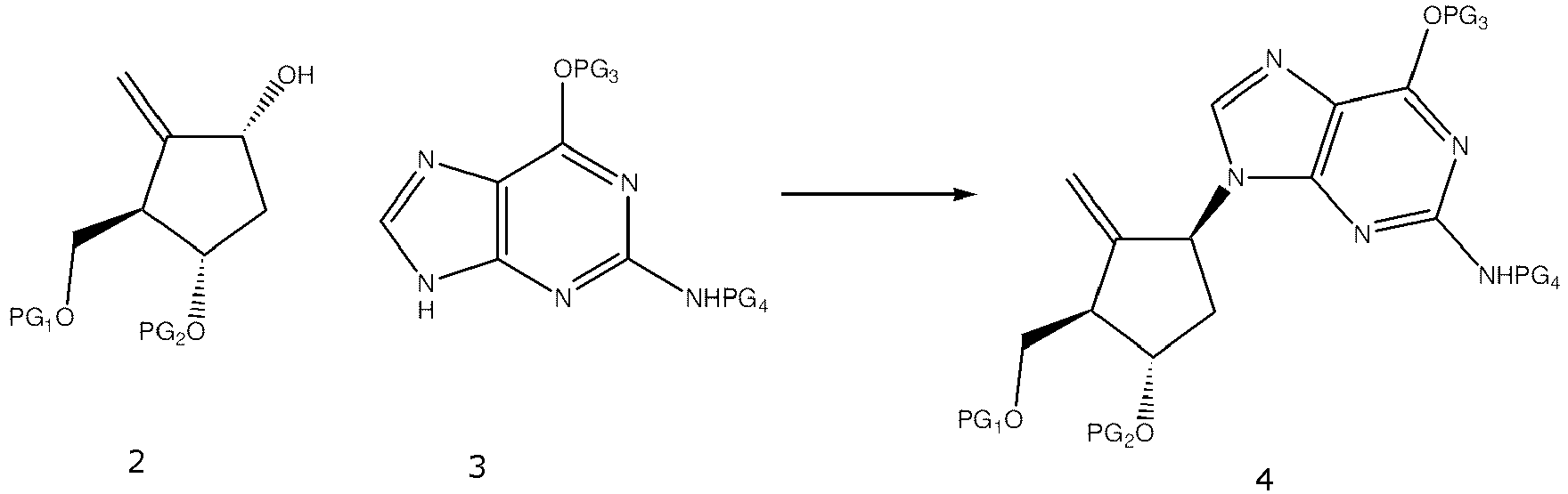
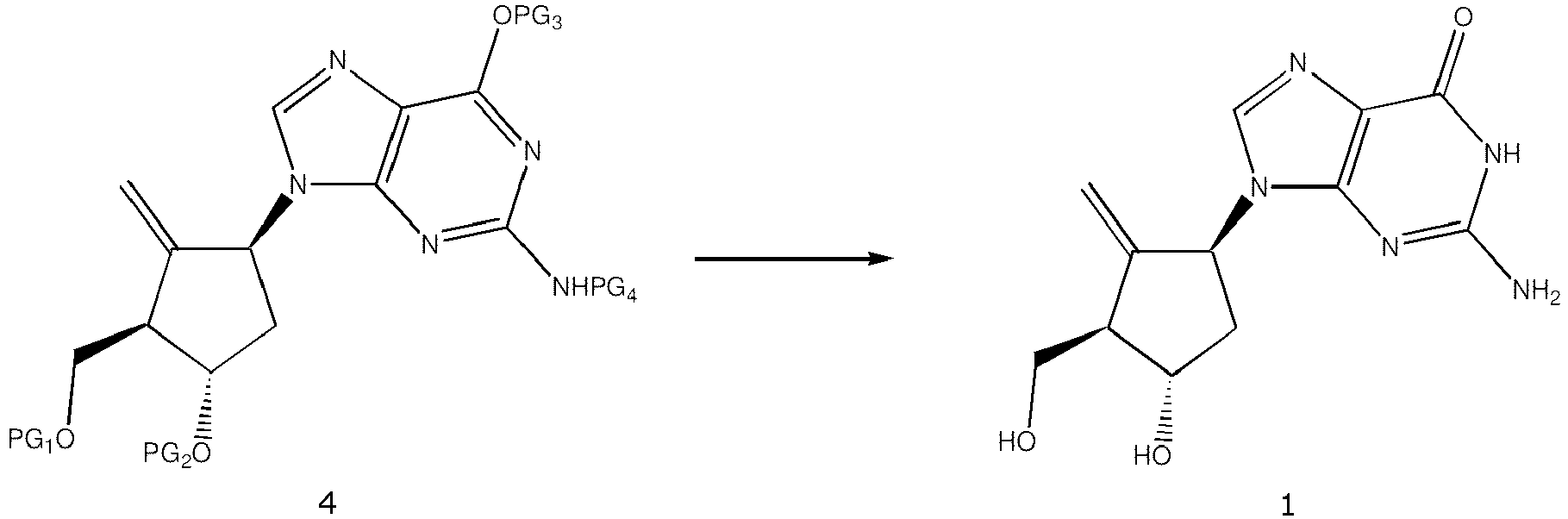
- In one aspect, the specification relates to a process for preparing a compound of formula 1, the process containing the steps of:
- reacting a compound of formula 2 with a compound of formula 3 under Mitsunobu-type reaction condition to obtain a compound of formula 4;
- deprotecting the compound of formula 4 to obtain the compound of formula 1
- In another aspect, the specification relates to a compound of formula 4':

- In a further aspect, the specification relates to a compound of formula 3':

- As noted above, the specification relates to a process for preparing a compound of formula 1, the process containing the steps of:
- reacting a compound of formula 2 with a compound of formula 3 under Mitsunobu-type reaction condition to obtain a compound of formula 4;

- deprotecting the compound of formula 4 to obtain the compound of formula 1

- Compounds of formula 2 are disclosed in Canadian Patent Application No.
2,705,953 . The compound of formula 3 can be obtained by protection of the oxygen atom at the 6-position of guanine followed by reacting with an amine protecting group to protect the N2-position to form the compound of formula 3. - The protecting groups in the process for obtaining the compound of formula 4 are not particularly limited. In one embodiment, for example and without limitation, each of the protecting groups selected for the compounds of formula 2 and 3 are the same or different and are acid labile protecting groups. An acid labile protecting group allows deprotection of the functional group by using an acid. By using acid labile protecting groups, a single one-pot deprotection step can be performed, preferably near the end of the synthesis to obtain the compound of formula 1.
- The protecting groups PG1, PG2 and PG3 for protecting the oxygen atoms in the compounds of formula 2 and 3 are not particularly limited and would be recognized by a person of skill in the art as being suitable for protection of a -OH substituent on an alkyl or ringed system. Moreover, such protecting groups can be removed (deprotection) using methods known to a person of skill in the art. Examples of suitable protecting groups can be found in the latest edition of Greene and Wats, Protecting Groups in Organic Synthesis. In one embodiment, for example and without limitation, the protecting group is acetyl, benzoyl, benzyl, β-methoxyethoxymethyl ether (MEM), dimethoxytrityl (DMT), methoxytrityl (MMT), trityl, methoxymethyl ether (MOM), p-methoxybenzyl ether (PMB), pivaloyl (Piv) or tetrahydropyranyl (THP). In another embodiment, the protecting groups PG1 and PG2 used for protecting the two hydroxyl groups in the compound of formula 2 together form an aldehyde or a ketone acetal. Using an aldehyde or a ketone can lead to formation of an acetal or ketal, which can be subsequently cleaved by using an acid. This procedure allows for a single protecting group for the two hydroxyl groups in the compound of formula 2. In a further embodiment, the aldehyde used for protecting the two hydroxyl groups in the compound of formula 2 is benzaldehyde. In a still further embodiment, the protecting group PG3 on the oxygen atom in the compound of formula 3 is benzyl.
- The protecting group PG4 used for protecting the amine at the 2-position (N2) in guanine is not particularly limited and would be recognized by a person of skill in the art as being suitable for protection of a -NH2 substituent on an alkyl or ringed system. Moreover, such protecting groups can be removed (deprotection) using methods known to a person of skill in the art. Examples of suitable protecting groups can be found in the latest edition of Greene and Wuts, Protecting Groups in Organic Synthesis. In one embodiment, for example and without limitation, the PG4 protecting group is tert-butyloxycarbonyl (BOC), tosyl (Ts) or a silyl based protecting groups, such as, for example and without limitation, trimethylsilyl.
- The compounds of formula 2 and 3 are reacted under Mitsunobu-type reaction conditions. A Mitsunobu reaction allows conversion of an alcohol into a different functional group, while undergoing inversion of stereochemistry. Therefore, the new functional group has the opposite stereochemistry to the stereochemistry of the alcohol. The reaction can involve use of a phosphine, such as an aryl phosphine or an alkyl phosphine, along with an azo-based compound in an appropriate solvent and reaction conditions.
- The phosphine used for the Mitsunobu-type reaction is not particularly limited, and can be for example and without limitation, an alkyl phosphine or an aryl phosphine, as noted above. In one embodiment, for example and without limitation, the phosphine is triphenyl phosphine (PPh3) or trimethylphosphine (PMe3).
- Azo based compounds used in Mitsunobu-type reactions are not particularly limited. In one embodiment, the azo-based compound is, for example and without limitation, diethylazodicarboxylate (DEAD), diisopropylazodicarboxylate (DIAD), di-t-butylazodicarboxylate, 2-(phenylazo)pyridine (azpy), di-p-chlorobenzylazodicarboxylate (DCAD) or 1,1'-(azodicarboxyl)dipiperidine (ADDP).
- In another embodiment of the Mitsunobu-type reaction, a phosphorane ylide is utilized rather than a phosphine and azo-based compound. The phosphorane ylide is not particularly limited. In one embodiment, for example and without limitation, the phosphorane ylide is (cyanomethylene)trimethyl phosphorane or tributylphosphorane.
- The solvent used for the Mitsunobu-type reaction is not particularly limited. In one embodiment, for example and without limitation, the solvent used for the Mitsunobu-type reaction is tetrahydrofuran, acetonitrile, dichloromethane, toluene, or a mixture thereof.
- The temperature for carrying out the Mitsunobu-type reaction is also not particularly limited. In one embodiment, for example and without limitation, the temperature used for the Mitsunobu-type reaction is room temperature. In another embodiment, for example and without limitation, the reaction is carried out by refluxing the solvent. In further embodiment, for example and without limitation, the reaction is carried out by heating up to about 120°C, and all temperatures between room temperature and 120°C. In a further embodiment, for example and without limitation, the reaction is carried out by cooling the reaction up to about -20°C and all temperature between room temperature and -20°C. The reaction temperature would depend upon the reagent used and the desired conditions.
- The sequence of addition of the reagents for carrying out the Mitsunobu-type reaction is not particularly limited and should be known or can be determined by a person of skill in the art. In one embodiment, for example and without limitation, the compounds of formula 2 and 3 and the phosphine are dissolved in the solvent, followed by addition of the azo-based compound.
- Using the process, as disclosed herein, can lead to a higher yield of the intermediate compound of formula 4 compared to when an unprotected N2-guanine has been used. The intermediate compound of formula 4 can then be deprotected, optionally, in a single step using a one-pot process to obtain the compound of formula 1. This can also lead to higher overall yield. Moreover, use of the compound of formula 3 can lead to higher regioselectivity of N9 versus N2, N7 or 06, which can improve the purity profile of compounds obtained in the process for preparing the compound of formula 1. Still further, use of the Mitsunobu type reaction conditions allows for inversion of stereochemistry, and hence control of the stereochemistry of the final product obtained.
- The following examples are illustrative and non-limiting and represent specific embodiments of the present invention.
- To a round bottom flask was added 2 (250 mg, 1.08 mmol, 1 equiv), 3 (441 mg, 1.30 mmol, 1.2 equiv), triphenylphosphine (370 mg, 1.40 mmol, 1.3 equiv), and tetrahydrofuran (6 mL). The resulting suspension was stirred at room temperature for 10 min and diisopropyl azodicarboxylate (283 mg, 1.40 mmol, 1.3 equiv) was added dropwise over 10 min. Stirring was continued for an additional 30 min and then the reaction mixture was concentrated to dryness. The crude product was purified by flash column chromatography using 35% ethyl acetate/heptane to afford 465 mg of 3 as a white solid (78%). 1H NMR (300 MHz, CDCl3) δ 7.77 (s, 1H), 7.54 (m, 4H), 7.30 (m, 6H), 7.27 (s, 1H), 5.86 (s, 1H), 5.60 (s, 2H), 5.50 (brd, 1H, J = 9.5 Hz), 4.91 (m, 2H), 4.61 (m, 2H), 4.18 (t, 1H, J = 10.6 Hz), 2.66 (brt, 1H, 8.6 Hz), 2.33-2.59 (m, 2H), 1.55 (s, 9H).

- To a round bottom flask was added 3 (450 mg, 0.81 mmol, 1 equiv), dichloromethane (10 mL), and 2N aq HCl (5 mL). The resulting biphasic solution was stirred at room temperature over 18 h. The layers were separated and the aqueous layer was washed with dichloromethane (2x2 mL). To the aqueous layer was added charcoal (100 mg) and the mixture was stirred for 10 min and then filtered. 3N aq NaOH was added dropwise to the aqueous layer to a pH of 7-8. The resulting suspension was stirred at room temperature for 45 min, filtered, and washed with water (2 mL) to afford 120 mg of 4 as a white solid (50%), purity: >99.8%. 1H NMR (300 MHz, DMSO-d6) δ 10.57 (s, 1H), 7.67 (s, 1H), 6.42 (s, 2H), 5.36 (t, 3H, J = 8.4 Hz), 5.10 (s, 1H), 4.88 (d, 1H, J = 2.9 Hz), 4.85 (t, 1H, J = 5.1 Hz), 4.56 (s, 1H), 4.23 (s, 1H), 3.53 (t, 2H, J = 6.1 Hz), 2.50 (s, 1H).

- To a round bottom flask was added 2 (700 mg, 3.01 mmol, 1 equiv), 5 (1.22 g, 3.16 mmol, 1.05 equiv), triphenylphosphine (1.03 g, 3.92 mmol, 1.3 equiv), and tetrahydrofuran (18 mL). The resulting suspension was stirred at room temperature for 10 min and diisopropyl azodicarboxylate (790 mg, 3.92 mmol, 1.3 equiv) was added dropwise over 10 min. Stirring was continued for an additional 2 h and then the reaction mixture was concentrated to dryness. The crude product was purified by flash column chromatography using 50% ethyl acetate/heptane to afford 540 mg of 6 as a white solid (34%). 1H NMR (300 MHz, CDCl3) δ 7.58 (s, 1H), 7.50 (m, 4H), 7.40 (m, 6H), 5.66 (s, 1H), 5.56 (s, 2H), 5.46 (brd, 1H, J = 9.9 Hz), 4.95 (t, 1H, J = 2.5 Hz), 4.75 (t, 1H, J = 1.9 Hz), 4.65 (m, 2H), 4.24 (m, 1H), 4.05 (t, 1H, J = 9.9 Hz), 2.68 (m, 1H), 2.47 (m, 2H), 0.31 (s, 9H).

- To a round bottom flask was added 6 (470 mg, 0.89 mmol, 1 equiv), dichloromethane (7 mL), and 2N aq HCl (5 mL). The resulting biphasic solution was stirred at room temperature over 18 h. The layers were separated and the aqueous layer was washed with dichloromethane (2x3 mL). To the aqueous layer was added charcoal (50 mg) and the mixture was stirred for 2 h and then filtered. 3N aq NaOH was added dropwise to the aqueous layer to a pH of 7-8. The resulting suspension was stirred at room temperature for 1 h, filtered, and washed with water (2 mL) to afford 230 mg of 4 as a white solid (88%), purity: >99.8%. 1H NMR (300 MHz, DMSO-d6) δ 10.57 (s, 1H), 7.67 (s, 1H), 6.42 (s, 2H), 5.36 (t, 3H, J = 8.4 Hz), 5.10 (s, 1H), 4.88 (d, 1H, J = 2.9 Hz), 4.85 (t, 1H, J = 5.1 Hz), 4.56 (s, 1H), 4.23 (s, 1H), 3.53 (t, 2H, J = 6.1 Hz), 2.50 (s, 1H).

Claims (15)
- A process for preparing a compound of formula 1, the process comprising the steps of:i) reacting a compound of formula 2 with a compound of formula 3 under Mitsunobu-type reaction condition to obtain a compound of formula 4;
 ii) deprotecting the compound of formula 4 to obtain the compound of formula 1
- The process according to claim 1, wherein the Mitsunobu type reaction condition comprises an alkyl phosphine or an aryl phosphine, and an azo-based compound.
- The process according to claim 2, wherein the alkyl phosphine is PMe3 or the aryl phosphine is PPh3.
- The process according to claim 2 or 3, wherein the azo based compound is selected from the group consisting of diethylazodicarboxylate (DEAD), diisopropylazodicarboxylate (DIAD), di-t-butylazodicarboxylate, 2-(phenylazo)pyridine (azpy), di-p-chlorobenzylazodicarboxylate (DCAD) or 1,1'-(azodicarboxyl)dipiperidine (ADDP).
- The process according to claim 1, wherein the Mitsunobu type reaction condition comprises a phosphorane ylide.
- The process according to any one of claims 1 to 5, wherein the protecting groups on the compound of formula 2 and 3 are acid labile protecting groups.
- The process according to any one of claims 1 to 6, wherein each protecting group PG1 and PG2 present on the oxygen atom in the compound of formula 2, independently, is selected from the group consisting of acetyl, benzoyl, benzy, β-methoxyethoxymethyl ether (MEM), dimethoxytrityl (DMT), methoxytrityl (MMT), trityl, methoxymethyl ether (MOM), p-methoxybenzyl ether (PMB), pivaloyl (Piv) or tetrahydropyranyl (THP).
- The process according to any one of claims 1 to 6, wherein the protecting groups PG1 and PG2 used for protecting the two oxygen atoms in the compound of formula 2 together form an aldehyde or a ketone acetal.
- The process according to any one of claims 1 to 8, wherein the protecting group PG3 on the oxygen atom in the compound of formula 3 is selected from the group consisting of acetyl, benzoyl, benzyl, β-methoxyethoxymethyl ether (MEM), dimethoxytrityl (DMT), methoxytrityl (MMT), trityl, methoxymethyl ether (MOM), p-methoxybenzyl ether (PMB), pivaloyl (Piv) or tetrahydropyranyl (THP).
- The process according to any one of claims 1 to 9, wherein the protecting group PG4 on the nitrogen atom in the compound of formula 3 is selected from the group consisting of tert-butyloxycarbonyl (BOC), tosyl (Ts) or a silyl based protecting group.
- The process according to any one of claims 1 to 10, wherein step (ii) of the process for deprotecting the compound of formula 4 is carried out in a one pot process.
- The compound of formula 4':

- The compound of formula 3':

- The compound of formula 6:

- The compound of formula 5:

Priority Applications (1)
| Application Number | Priority Date | Filing Date | Title |
|---|---|---|---|
| SI201130588T SI2576556T1 (en) | 2010-05-31 | 2011-05-30 | Process for the synthesis of carbonucleoside and intermediates for use therein |
Applications Claiming Priority (3)
| Application Number | Priority Date | Filing Date | Title |
|---|---|---|---|
| CA2705953A CA2705953C (en) | 2010-05-31 | 2010-05-31 | Carbanucleoside synthesis and intermediate compounds useful therein |
| CA2730622A CA2730622C (en) | 2010-05-31 | 2011-02-03 | Process for the synthesis of carbonucleoside and intermediates for use therein |
| PCT/CA2011/050323 WO2011150512A1 (en) | 2010-05-31 | 2011-05-30 | Process for the synthesis of carbonucleoside and intermediates for use therein |
Publications (3)
| Publication Number | Publication Date |
|---|---|
| EP2576556A1 EP2576556A1 (en) | 2013-04-10 |
| EP2576556A4 EP2576556A4 (en) | 2014-01-01 |
| EP2576556B1 true EP2576556B1 (en) | 2015-08-26 |
Family
ID=45066001
Family Applications (2)
| Application Number | Title | Priority Date | Filing Date |
|---|---|---|---|
| EP11789021.0A Not-in-force EP2576556B1 (en) | 2010-05-31 | 2011-05-30 | Process for the synthesis of carbonucleoside and intermediates for use therein |
| EP11789022.8A Not-in-force EP2576565B1 (en) | 2010-05-31 | 2011-05-30 | Carbanucleoside synthesis and novel intermediate compounds useful therein |
Family Applications After (1)
| Application Number | Title | Priority Date | Filing Date |
|---|---|---|---|
| EP11789022.8A Not-in-force EP2576565B1 (en) | 2010-05-31 | 2011-05-30 | Carbanucleoside synthesis and novel intermediate compounds useful therein |
Country Status (6)
| Country | Link |
|---|---|
| US (2) | US8658792B2 (en) |
| EP (2) | EP2576556B1 (en) |
| CN (2) | CN102958931B (en) |
| CA (4) | CA2705953C (en) |
| SI (2) | SI2576556T1 (en) |
| WO (2) | WO2011150512A1 (en) |
Families Citing this family (6)
| Publication number | Priority date | Publication date | Assignee | Title |
|---|---|---|---|---|
| US8481728B2 (en) * | 2010-02-16 | 2013-07-09 | Scinopharm Taiwan, Ltd. | Process for preparing entecavir and its intermediates |
| CA2705953C (en) | 2010-05-31 | 2018-05-01 | Alphora Research Inc. | Carbanucleoside synthesis and intermediate compounds useful therein |
| CN106928227B (en) * | 2010-07-15 | 2020-06-30 | 浙江奥翔药业股份有限公司 | Synthetic method of entecavir and intermediate compound thereof |
| WO2014000673A1 (en) * | 2012-06-29 | 2014-01-03 | Sunshine Lake Pharma Co., Ltd. | Process for preparation of entecavir |
| CN108203435B (en) * | 2016-12-16 | 2020-09-04 | 正大天晴药业集团股份有限公司 | A kind of preparation method of entecavir utilizing Boc protecting group |
| CN112625041A (en) * | 2020-12-25 | 2021-04-09 | 常州博海威医药科技股份有限公司 | Novel preparation method and intermediate of entecavir |
Family Cites Families (13)
| Publication number | Priority date | Publication date | Assignee | Title |
|---|---|---|---|---|
| JPH02229192A (en) * | 1989-03-02 | 1990-09-11 | Kohjin Co Ltd | Preparation of purine derivative |
| US5206244A (en) * | 1990-10-18 | 1993-04-27 | E. R. Squibb & Sons, Inc. | Hydroxymethyl (methylenecyclopentyl) purines and pyrimidines |
| WO2003051881A1 (en) | 2001-12-17 | 2003-06-26 | Ribapharm Inc. | Substituted purine nucleoside libraries and compounds by solid-phase combinatorial strategies |
| CN101899063B (en) * | 2002-12-11 | 2012-12-12 | 布里斯托尔-迈尔斯斯奎布公司 | Process for preparing the antiviral agent [1S-(1alpha,3 alpha,4beta)]-2-amino-1,9-dihydro-9-[4-hydroxy-3-(hydroxymethyl)-2-methylenecyclopentyl]-6H-purin-6-one |
| CN1289510C (en) | 2003-06-27 | 2006-12-13 | 成都地奥制药集团有限公司 | Antiviral activity possessed compound and preparation method thereof |
| CN101235034A (en) | 2008-02-28 | 2008-08-06 | 陆锦康 | Method for synthesizing entecavir |
| CA2639240A1 (en) * | 2008-08-29 | 2010-02-28 | Alphora Research Inc. | Prostaglandin synthesis and intermediates for use therein |
| KR101150254B1 (en) * | 2008-12-26 | 2012-06-12 | 한미사이언스 주식회사 | Process for preparing entecavir and intermediates used therein |
| US8481728B2 (en) * | 2010-02-16 | 2013-07-09 | Scinopharm Taiwan, Ltd. | Process for preparing entecavir and its intermediates |
| CN101805339B (en) * | 2010-04-12 | 2012-01-11 | 王明 | Entecavir compound preparation method |
| US8999246B2 (en) | 2010-05-25 | 2015-04-07 | Exxonmobil Research And Engineering Company | Fluid injection nozzle for fluid bed reactors |
| CA2705953C (en) | 2010-05-31 | 2018-05-01 | Alphora Research Inc. | Carbanucleoside synthesis and intermediate compounds useful therein |
| CN106928227B (en) | 2010-07-15 | 2020-06-30 | 浙江奥翔药业股份有限公司 | Synthetic method of entecavir and intermediate compound thereof |
-
2010
- 2010-05-31 CA CA2705953A patent/CA2705953C/en not_active Expired - Fee Related
-
2011
- 2011-02-03 CA CA2730622A patent/CA2730622C/en active Active
- 2011-05-30 EP EP11789021.0A patent/EP2576556B1/en not_active Not-in-force
- 2011-05-30 WO PCT/CA2011/050323 patent/WO2011150512A1/en not_active Ceased
- 2011-05-30 CA CA2801128A patent/CA2801128A1/en not_active Abandoned
- 2011-05-30 EP EP11789022.8A patent/EP2576565B1/en not_active Not-in-force
- 2011-05-30 SI SI201130588T patent/SI2576556T1/en unknown
- 2011-05-30 US US13/698,886 patent/US8658792B2/en not_active Expired - Fee Related
- 2011-05-30 SI SI201131341T patent/SI2576565T1/en unknown
- 2011-05-30 US US13/700,259 patent/US9403864B2/en not_active Expired - Fee Related
- 2011-05-30 CA CA2800367A patent/CA2800367A1/en not_active Abandoned
- 2011-05-30 WO PCT/CA2011/050324 patent/WO2011150513A1/en not_active Ceased
- 2011-05-30 CN CN201180026821.7A patent/CN102958931B/en not_active Expired - Fee Related
- 2011-05-30 CN CN201180026406.1A patent/CN102933585B/en not_active Expired - Fee Related
Also Published As
| Publication number | Publication date |
|---|---|
| EP2576565A4 (en) | 2014-01-01 |
| CA2730622C (en) | 2018-07-03 |
| CA2801128A1 (en) | 2011-12-08 |
| EP2576565A1 (en) | 2013-04-10 |
| SI2576565T1 (en) | 2018-03-30 |
| CN102958931B (en) | 2016-04-06 |
| CN102933585A (en) | 2013-02-13 |
| US8658792B2 (en) | 2014-02-25 |
| CN102958931A (en) | 2013-03-06 |
| EP2576556A1 (en) | 2013-04-10 |
| CA2730622A1 (en) | 2011-11-30 |
| US20130144058A1 (en) | 2013-06-06 |
| CA2800367A1 (en) | 2011-12-08 |
| SI2576556T1 (en) | 2015-10-30 |
| EP2576565B1 (en) | 2017-08-02 |
| WO2011150513A1 (en) | 2011-12-08 |
| CA2705953A1 (en) | 2011-11-30 |
| US20130066071A1 (en) | 2013-03-14 |
| EP2576556A4 (en) | 2014-01-01 |
| US9403864B2 (en) | 2016-08-02 |
| WO2011150512A1 (en) | 2011-12-08 |
| CA2705953C (en) | 2018-05-01 |
| CN102933585B (en) | 2015-09-02 |
Similar Documents
| Publication | Publication Date | Title |
|---|---|---|
| JP5831455B2 (en) | Morpholino nucleic acid derivatives | |
| CN108738321B (en) | GalNAc cluster phosphoramidites | |
| US9403864B2 (en) | Process for the synthesis of carbonucleoside and intermediates for use therein | |
| KR101983033B1 (en) | A method for synthesis of entecavir and intermediate compounds thereof | |
| JP5791636B2 (en) | Process for preparing entecavir and its intermediates | |
| KR20180100313A (en) | 4 - ((6- (2- (2,4-difluorophenyl) -1,1-difluoro-2-hydroxy- ) Propyl) pyridin-3-yl) oxy) benzonitrile and the preparation method | |
| Sahnoun et al. | A site selective C–H arylation of free-(NH 2) adenines with aryl chlorides: Application to the synthesis of 6, 8-disubstituted adenines | |
| US20110178295A1 (en) | Synthesis of statins | |
| CN100410255C (en) | Inosine and its production method | |
| CN108912055B (en) | A kind of method for synthesizing antiviral drug cidofovir intermediate and buciclovir intermediate | |
| KR101471047B1 (en) | Improved process for preparation of highly pure bosentan | |
| WO2015051900A1 (en) | Process for the preparation of entecavir through novel intermediates | |
| EP2227478A1 (en) | Process and intermediates for the preparation of substituted 1, 3-oxathiolanes, especially lamivudine | |
| JP2009256335A (en) | Preparation method of ribonucleic acid having alkyl protective group at position 2' | |
| KR101032761B1 (en) | Method for preparing docetaxel and novel intermediates for the production of docetaxel | |
| JP5205971B2 (en) | Method for producing tetrahydropyran compound | |
| KR100618232B1 (en) | Method for producing famciclovir | |
| KR20250156701A (en) | Method for preparing 2'-O-modified adenosine phosphoramidite and its intermediates | |
| JP4627625B2 (en) | Method for producing N-acetylcytidines | |
| WO2010029756A1 (en) | 5-[2-(methylthio)ethoxy]pyrimidine-2-amine manufacturing method | |
| WO2014188334A2 (en) | Process for preparation of alogliptin | |
| JP2007137843A (en) | Method for producing ribofuranose compound and purine nucleoside compound | |
| JP5034277B2 (en) | Of 3- (N-acylamino) -3- (4-tetrahydropyranyl) -2-oxopropanoic acid ester and 3- (N-acylamino) -3- (4-tetrahydropyranyl) -2-oxopropanohydrazide Production method | |
| KR20160126700A (en) | New Statin intermediate, the preparation of the same and the preparation of Rosuvastatin using the same | |
| KR20050062944A (en) | New process for preparing diisopropyl ((1-((2-amino-6-chloro-9h-purin-9-yl)methyl)cyclopropyl)oxy)-methylphosphonate |
Legal Events
| Date | Code | Title | Description |
|---|---|---|---|
| PUAI | Public reference made under article 153(3) epc to a published international application that has entered the european phase |
Free format text: ORIGINAL CODE: 0009012 |
|
| 17P | Request for examination filed |
Effective date: 20121218 |
|
| AK | Designated contracting states |
Kind code of ref document: A1 Designated state(s): AL AT BE BG CH CY CZ DE DK EE ES FI FR GB GR HR HU IE IS IT LI LT LU LV MC MK MT NL NO PL PT RO RS SE SI SK SM TR |
|
| DAX | Request for extension of the european patent (deleted) | ||
| A4 | Supplementary search report drawn up and despatched |
Effective date: 20131128 |
|
| RIC1 | Information provided on ipc code assigned before grant |
Ipc: C07F 7/18 20060101ALI20131122BHEP Ipc: C07D 473/18 20060101AFI20131122BHEP |
|
| 17Q | First examination report despatched |
Effective date: 20140610 |
|
| RIC1 | Information provided on ipc code assigned before grant |
Ipc: C07D 319/08 20060101ALI20150206BHEP Ipc: C07F 7/18 20060101ALI20150206BHEP Ipc: C07D 473/18 20060101AFI20150206BHEP Ipc: C07D 493/04 20060101ALI20150206BHEP Ipc: C07H 19/16 20060101ALI20150206BHEP |
|
| GRAP | Despatch of communication of intention to grant a patent |
Free format text: ORIGINAL CODE: EPIDOSNIGR1 |
|
| INTG | Intention to grant announced |
Effective date: 20150320 |
|
| GRAS | Grant fee paid |
Free format text: ORIGINAL CODE: EPIDOSNIGR3 |
|
| GRAA | (expected) grant |
Free format text: ORIGINAL CODE: 0009210 |
|
| AK | Designated contracting states |
Kind code of ref document: B1 Designated state(s): AL AT BE BG CH CY CZ DE DK EE ES FI FR GB GR HR HU IE IS IT LI LT LU LV MC MK MT NL NO PL PT RO RS SE SI SK SM TR |
|
| REG | Reference to a national code |
Ref country code: GB Ref legal event code: FG4D |
|
| REG | Reference to a national code |
Ref country code: CH Ref legal event code: EP |
|
| REG | Reference to a national code |
Ref country code: AT Ref legal event code: REF Ref document number: 745136 Country of ref document: AT Kind code of ref document: T Effective date: 20150915 |
|
| REG | Reference to a national code |
Ref country code: IE Ref legal event code: FG4D |
|
| REG | Reference to a national code |
Ref country code: DE Ref legal event code: R096 Ref document number: 602011019230 Country of ref document: DE |
|
| REG | Reference to a national code |
Ref country code: AT Ref legal event code: MK05 Ref document number: 745136 Country of ref document: AT Kind code of ref document: T Effective date: 20150826 |
|
| REG | Reference to a national code |
Ref country code: LT Ref legal event code: MG4D |
|
| PG25 | Lapsed in a contracting state [announced via postgrant information from national office to epo] |
Ref country code: NO Free format text: LAPSE BECAUSE OF FAILURE TO SUBMIT A TRANSLATION OF THE DESCRIPTION OR TO PAY THE FEE WITHIN THE PRESCRIBED TIME-LIMIT Effective date: 20151126 Ref country code: FI Free format text: LAPSE BECAUSE OF FAILURE TO SUBMIT A TRANSLATION OF THE DESCRIPTION OR TO PAY THE FEE WITHIN THE PRESCRIBED TIME-LIMIT Effective date: 20150826 Ref country code: LV Free format text: LAPSE BECAUSE OF FAILURE TO SUBMIT A TRANSLATION OF THE DESCRIPTION OR TO PAY THE FEE WITHIN THE PRESCRIBED TIME-LIMIT Effective date: 20150826 Ref country code: LT Free format text: LAPSE BECAUSE OF FAILURE TO SUBMIT A TRANSLATION OF THE DESCRIPTION OR TO PAY THE FEE WITHIN THE PRESCRIBED TIME-LIMIT Effective date: 20150826 Ref country code: GR Free format text: LAPSE BECAUSE OF FAILURE TO SUBMIT A TRANSLATION OF THE DESCRIPTION OR TO PAY THE FEE WITHIN THE PRESCRIBED TIME-LIMIT Effective date: 20151127 |
|
| REG | Reference to a national code |
Ref country code: NL Ref legal event code: MP Effective date: 20150826 |
|
| PG25 | Lapsed in a contracting state [announced via postgrant information from national office to epo] |
Ref country code: HR Free format text: LAPSE BECAUSE OF FAILURE TO SUBMIT A TRANSLATION OF THE DESCRIPTION OR TO PAY THE FEE WITHIN THE PRESCRIBED TIME-LIMIT Effective date: 20150826 Ref country code: RS Free format text: LAPSE BECAUSE OF FAILURE TO SUBMIT A TRANSLATION OF THE DESCRIPTION OR TO PAY THE FEE WITHIN THE PRESCRIBED TIME-LIMIT Effective date: 20150826 Ref country code: AT Free format text: LAPSE BECAUSE OF FAILURE TO SUBMIT A TRANSLATION OF THE DESCRIPTION OR TO PAY THE FEE WITHIN THE PRESCRIBED TIME-LIMIT Effective date: 20150826 Ref country code: ES Free format text: LAPSE BECAUSE OF FAILURE TO SUBMIT A TRANSLATION OF THE DESCRIPTION OR TO PAY THE FEE WITHIN THE PRESCRIBED TIME-LIMIT Effective date: 20150826 Ref country code: IS Free format text: LAPSE BECAUSE OF FAILURE TO SUBMIT A TRANSLATION OF THE DESCRIPTION OR TO PAY THE FEE WITHIN THE PRESCRIBED TIME-LIMIT Effective date: 20151226 Ref country code: PL Free format text: LAPSE BECAUSE OF FAILURE TO SUBMIT A TRANSLATION OF THE DESCRIPTION OR TO PAY THE FEE WITHIN THE PRESCRIBED TIME-LIMIT Effective date: 20150826 Ref country code: PT Free format text: LAPSE BECAUSE OF FAILURE TO SUBMIT A TRANSLATION OF THE DESCRIPTION OR TO PAY THE FEE WITHIN THE PRESCRIBED TIME-LIMIT Effective date: 20151228 Ref country code: SE Free format text: LAPSE BECAUSE OF FAILURE TO SUBMIT A TRANSLATION OF THE DESCRIPTION OR TO PAY THE FEE WITHIN THE PRESCRIBED TIME-LIMIT Effective date: 20150826 |
|
| PG25 | Lapsed in a contracting state [announced via postgrant information from national office to epo] |
Ref country code: NL Free format text: LAPSE BECAUSE OF FAILURE TO SUBMIT A TRANSLATION OF THE DESCRIPTION OR TO PAY THE FEE WITHIN THE PRESCRIBED TIME-LIMIT Effective date: 20150826 |
|
| REG | Reference to a national code |
Ref country code: FR Ref legal event code: PLFP Year of fee payment: 6 |
|
| PG25 | Lapsed in a contracting state [announced via postgrant information from national office to epo] |
Ref country code: DK Free format text: LAPSE BECAUSE OF FAILURE TO SUBMIT A TRANSLATION OF THE DESCRIPTION OR TO PAY THE FEE WITHIN THE PRESCRIBED TIME-LIMIT Effective date: 20150826 Ref country code: IT Free format text: LAPSE BECAUSE OF FAILURE TO SUBMIT A TRANSLATION OF THE DESCRIPTION OR TO PAY THE FEE WITHIN THE PRESCRIBED TIME-LIMIT Effective date: 20150826 Ref country code: SK Free format text: LAPSE BECAUSE OF FAILURE TO SUBMIT A TRANSLATION OF THE DESCRIPTION OR TO PAY THE FEE WITHIN THE PRESCRIBED TIME-LIMIT Effective date: 20150826 Ref country code: CZ Free format text: LAPSE BECAUSE OF FAILURE TO SUBMIT A TRANSLATION OF THE DESCRIPTION OR TO PAY THE FEE WITHIN THE PRESCRIBED TIME-LIMIT Effective date: 20150826 Ref country code: EE Free format text: LAPSE BECAUSE OF FAILURE TO SUBMIT A TRANSLATION OF THE DESCRIPTION OR TO PAY THE FEE WITHIN THE PRESCRIBED TIME-LIMIT Effective date: 20150826 |
|
| REG | Reference to a national code |
Ref country code: DE Ref legal event code: R097 Ref document number: 602011019230 Country of ref document: DE |
|
| PG25 | Lapsed in a contracting state [announced via postgrant information from national office to epo] |
Ref country code: RO Free format text: LAPSE BECAUSE OF FAILURE TO SUBMIT A TRANSLATION OF THE DESCRIPTION OR TO PAY THE FEE WITHIN THE PRESCRIBED TIME-LIMIT Effective date: 20150826 |
|
| PLBE | No opposition filed within time limit |
Free format text: ORIGINAL CODE: 0009261 |
|
| STAA | Information on the status of an ep patent application or granted ep patent |
Free format text: STATUS: NO OPPOSITION FILED WITHIN TIME LIMIT |
|
| 26N | No opposition filed |
Effective date: 20160530 |
|
| PG25 | Lapsed in a contracting state [announced via postgrant information from national office to epo] |
Ref country code: BE Free format text: LAPSE BECAUSE OF NON-PAYMENT OF DUE FEES Effective date: 20160531 |
|
| PG25 | Lapsed in a contracting state [announced via postgrant information from national office to epo] |
Ref country code: BE Free format text: LAPSE BECAUSE OF FAILURE TO SUBMIT A TRANSLATION OF THE DESCRIPTION OR TO PAY THE FEE WITHIN THE PRESCRIBED TIME-LIMIT Effective date: 20150826 Ref country code: LU Free format text: LAPSE BECAUSE OF FAILURE TO SUBMIT A TRANSLATION OF THE DESCRIPTION OR TO PAY THE FEE WITHIN THE PRESCRIBED TIME-LIMIT Effective date: 20160530 |
|
| REG | Reference to a national code |
Ref country code: CH Ref legal event code: PL |
|
| PG25 | Lapsed in a contracting state [announced via postgrant information from national office to epo] |
Ref country code: CH Free format text: LAPSE BECAUSE OF NON-PAYMENT OF DUE FEES Effective date: 20160531 Ref country code: LI Free format text: LAPSE BECAUSE OF NON-PAYMENT OF DUE FEES Effective date: 20160531 |
|
| REG | Reference to a national code |
Ref country code: IE Ref legal event code: MM4A |
|
| REG | Reference to a national code |
Ref country code: FR Ref legal event code: PLFP Year of fee payment: 7 |
|
| PG25 | Lapsed in a contracting state [announced via postgrant information from national office to epo] |
Ref country code: IE Free format text: LAPSE BECAUSE OF NON-PAYMENT OF DUE FEES Effective date: 20160530 |
|
| REG | Reference to a national code |
Ref country code: FR Ref legal event code: PLFP Year of fee payment: 8 |
|
| PG25 | Lapsed in a contracting state [announced via postgrant information from national office to epo] |
Ref country code: SM Free format text: LAPSE BECAUSE OF FAILURE TO SUBMIT A TRANSLATION OF THE DESCRIPTION OR TO PAY THE FEE WITHIN THE PRESCRIBED TIME-LIMIT Effective date: 20150826 Ref country code: CY Free format text: LAPSE BECAUSE OF FAILURE TO SUBMIT A TRANSLATION OF THE DESCRIPTION OR TO PAY THE FEE WITHIN THE PRESCRIBED TIME-LIMIT Effective date: 20150826 Ref country code: HU Free format text: LAPSE BECAUSE OF FAILURE TO SUBMIT A TRANSLATION OF THE DESCRIPTION OR TO PAY THE FEE WITHIN THE PRESCRIBED TIME-LIMIT; INVALID AB INITIO Effective date: 20110530 |
|
| PG25 | Lapsed in a contracting state [announced via postgrant information from national office to epo] |
Ref country code: MC Free format text: LAPSE BECAUSE OF FAILURE TO SUBMIT A TRANSLATION OF THE DESCRIPTION OR TO PAY THE FEE WITHIN THE PRESCRIBED TIME-LIMIT Effective date: 20150826 Ref country code: MT Free format text: LAPSE BECAUSE OF NON-PAYMENT OF DUE FEES Effective date: 20160531 Ref country code: MK Free format text: LAPSE BECAUSE OF FAILURE TO SUBMIT A TRANSLATION OF THE DESCRIPTION OR TO PAY THE FEE WITHIN THE PRESCRIBED TIME-LIMIT Effective date: 20150826 Ref country code: TR Free format text: LAPSE BECAUSE OF FAILURE TO SUBMIT A TRANSLATION OF THE DESCRIPTION OR TO PAY THE FEE WITHIN THE PRESCRIBED TIME-LIMIT Effective date: 20150826 |
|
| PG25 | Lapsed in a contracting state [announced via postgrant information from national office to epo] |
Ref country code: BG Free format text: LAPSE BECAUSE OF FAILURE TO SUBMIT A TRANSLATION OF THE DESCRIPTION OR TO PAY THE FEE WITHIN THE PRESCRIBED TIME-LIMIT Effective date: 20150826 |
|
| PG25 | Lapsed in a contracting state [announced via postgrant information from national office to epo] |
Ref country code: AL Free format text: LAPSE BECAUSE OF FAILURE TO SUBMIT A TRANSLATION OF THE DESCRIPTION OR TO PAY THE FEE WITHIN THE PRESCRIBED TIME-LIMIT Effective date: 20150826 |
|
| PGFP | Annual fee paid to national office [announced via postgrant information from national office to epo] |
Ref country code: DE Payment date: 20210505 Year of fee payment: 11 Ref country code: FR Payment date: 20210426 Year of fee payment: 11 |
|
| PGFP | Annual fee paid to national office [announced via postgrant information from national office to epo] |
Ref country code: GB Payment date: 20210505 Year of fee payment: 11 Ref country code: SI Payment date: 20210429 Year of fee payment: 11 |
|
| REG | Reference to a national code |
Ref country code: DE Ref legal event code: R119 Ref document number: 602011019230 Country of ref document: DE |
|
| GBPC | Gb: european patent ceased through non-payment of renewal fee |
Effective date: 20220530 |
|
| PG25 | Lapsed in a contracting state [announced via postgrant information from national office to epo] |
Ref country code: SI Free format text: LAPSE BECAUSE OF NON-PAYMENT OF DUE FEES Effective date: 20220531 |
|
| PG25 | Lapsed in a contracting state [announced via postgrant information from national office to epo] |
Ref country code: FR Free format text: LAPSE BECAUSE OF NON-PAYMENT OF DUE FEES Effective date: 20220531 |
|
| PG25 | Lapsed in a contracting state [announced via postgrant information from national office to epo] |
Ref country code: GB Free format text: LAPSE BECAUSE OF NON-PAYMENT OF DUE FEES Effective date: 20220530 Ref country code: DE Free format text: LAPSE BECAUSE OF NON-PAYMENT OF DUE FEES Effective date: 20221201 |