EP2575981B1 - Training apparatus and system with musical feedback - Google Patents
Training apparatus and system with musical feedback Download PDFInfo
- Publication number
- EP2575981B1 EP2575981B1 EP11722409.7A EP11722409A EP2575981B1 EP 2575981 B1 EP2575981 B1 EP 2575981B1 EP 11722409 A EP11722409 A EP 11722409A EP 2575981 B1 EP2575981 B1 EP 2575981B1
- Authority
- EP
- European Patent Office
- Prior art keywords
- audio
- training apparatus
- signal
- training
- control signal
- Prior art date
- Legal status (The legal status is an assumption and is not a legal conclusion. Google has not performed a legal analysis and makes no representation as to the accuracy of the status listed.)
- Active
Links
Images



Classifications
-
- A—HUMAN NECESSITIES
- A63—SPORTS; GAMES; AMUSEMENTS
- A63B—APPARATUS FOR PHYSICAL TRAINING, GYMNASTICS, SWIMMING, CLIMBING, OR FENCING; BALL GAMES; TRAINING EQUIPMENT
- A63B71/00—Games or sports accessories not covered in groups A63B1/00 - A63B69/00
- A63B71/06—Indicating or scoring devices for games or players, or for other sports activities
- A63B71/0619—Displays, user interfaces and indicating devices, specially adapted for sport equipment, e.g. display mounted on treadmills
- A63B71/0622—Visual, audio or audio-visual systems for entertaining, instructing or motivating the user
-
- A—HUMAN NECESSITIES
- A63—SPORTS; GAMES; AMUSEMENTS
- A63B—APPARATUS FOR PHYSICAL TRAINING, GYMNASTICS, SWIMMING, CLIMBING, OR FENCING; BALL GAMES; TRAINING EQUIPMENT
- A63B71/00—Games or sports accessories not covered in groups A63B1/00 - A63B69/00
- A63B71/06—Indicating or scoring devices for games or players, or for other sports activities
- A63B71/0619—Displays, user interfaces and indicating devices, specially adapted for sport equipment, e.g. display mounted on treadmills
- A63B71/0622—Visual, audio or audio-visual systems for entertaining, instructing or motivating the user
- A63B2071/0625—Emitting sound, noise or music
-
- A—HUMAN NECESSITIES
- A63—SPORTS; GAMES; AMUSEMENTS
- A63B—APPARATUS FOR PHYSICAL TRAINING, GYMNASTICS, SWIMMING, CLIMBING, OR FENCING; BALL GAMES; TRAINING EQUIPMENT
- A63B21/00—Exercising apparatus for developing or strengthening the muscles or joints of the body by working against a counterforce, with or without measuring devices
- A63B21/06—User-manipulated weights
-
- A—HUMAN NECESSITIES
- A63—SPORTS; GAMES; AMUSEMENTS
- A63B—APPARATUS FOR PHYSICAL TRAINING, GYMNASTICS, SWIMMING, CLIMBING, OR FENCING; BALL GAMES; TRAINING EQUIPMENT
- A63B22/00—Exercising apparatus specially adapted for conditioning the cardio-vascular system, for training agility or co-ordination of movements
- A63B22/0048—Exercising apparatus specially adapted for conditioning the cardio-vascular system, for training agility or co-ordination of movements with cantilevered support elements pivoting about an axis
- A63B22/0056—Exercising apparatus specially adapted for conditioning the cardio-vascular system, for training agility or co-ordination of movements with cantilevered support elements pivoting about an axis the pivoting movement being in a vertical plane, e.g. steppers with a horizontal axis
-
- A—HUMAN NECESSITIES
- A63—SPORTS; GAMES; AMUSEMENTS
- A63B—APPARATUS FOR PHYSICAL TRAINING, GYMNASTICS, SWIMMING, CLIMBING, OR FENCING; BALL GAMES; TRAINING EQUIPMENT
- A63B2220/00—Measuring of physical parameters relating to sporting activity
- A63B2220/10—Positions
-
- A—HUMAN NECESSITIES
- A63—SPORTS; GAMES; AMUSEMENTS
- A63B—APPARATUS FOR PHYSICAL TRAINING, GYMNASTICS, SWIMMING, CLIMBING, OR FENCING; BALL GAMES; TRAINING EQUIPMENT
- A63B2225/00—Miscellaneous features of sport apparatus, devices or equipment
- A63B2225/10—Multi-station exercising machines
- A63B2225/105—Multi-station exercising machines each station having its own resisting device, e.g. for training multiple users simultaneously
-
- A—HUMAN NECESSITIES
- A63—SPORTS; GAMES; AMUSEMENTS
- A63B—APPARATUS FOR PHYSICAL TRAINING, GYMNASTICS, SWIMMING, CLIMBING, OR FENCING; BALL GAMES; TRAINING EQUIPMENT
- A63B2225/00—Miscellaneous features of sport apparatus, devices or equipment
- A63B2225/20—Miscellaneous features of sport apparatus, devices or equipment with means for remote communication, e.g. internet or the like
-
- A—HUMAN NECESSITIES
- A63—SPORTS; GAMES; AMUSEMENTS
- A63B—APPARATUS FOR PHYSICAL TRAINING, GYMNASTICS, SWIMMING, CLIMBING, OR FENCING; BALL GAMES; TRAINING EQUIPMENT
- A63B2225/00—Miscellaneous features of sport apparatus, devices or equipment
- A63B2225/50—Wireless data transmission, e.g. by radio transmitters or telemetry
-
- A—HUMAN NECESSITIES
- A63—SPORTS; GAMES; AMUSEMENTS
- A63B—APPARATUS FOR PHYSICAL TRAINING, GYMNASTICS, SWIMMING, CLIMBING, OR FENCING; BALL GAMES; TRAINING EQUIPMENT
- A63B23/00—Exercising apparatus specially adapted for particular parts of the body
- A63B23/02—Exercising apparatus specially adapted for particular parts of the body for the abdomen, the spinal column or the torso muscles related to shoulders (e.g. chest muscles)
-
- A—HUMAN NECESSITIES
- A63—SPORTS; GAMES; AMUSEMENTS
- A63B—APPARATUS FOR PHYSICAL TRAINING, GYMNASTICS, SWIMMING, CLIMBING, OR FENCING; BALL GAMES; TRAINING EQUIPMENT
- A63B24/00—Electric or electronic controls for exercising apparatus of preceding groups; Controlling or monitoring of exercises, sportive games, training or athletic performances
-
- G—PHYSICS
- G10—MUSICAL INSTRUMENTS; ACOUSTICS
- G10H—ELECTROPHONIC MUSICAL INSTRUMENTS; INSTRUMENTS IN WHICH THE TONES ARE GENERATED BY ELECTROMECHANICAL MEANS OR ELECTRONIC GENERATORS, OR IN WHICH THE TONES ARE SYNTHESISED FROM A DATA STORE
- G10H1/00—Details of electrophonic musical instruments
- G10H1/0033—Recording/reproducing or transmission of music for electrophonic musical instruments
- G10H1/0041—Recording/reproducing or transmission of music for electrophonic musical instruments in coded form
- G10H1/0058—Transmission between separate instruments or between individual components of a musical system
- G10H1/0066—Transmission between separate instruments or between individual components of a musical system using a MIDI interface
-
- G—PHYSICS
- G10—MUSICAL INSTRUMENTS; ACOUSTICS
- G10H—ELECTROPHONIC MUSICAL INSTRUMENTS; INSTRUMENTS IN WHICH THE TONES ARE GENERATED BY ELECTROMECHANICAL MEANS OR ELECTRONIC GENERATORS, OR IN WHICH THE TONES ARE SYNTHESISED FROM A DATA STORE
- G10H1/00—Details of electrophonic musical instruments
- G10H1/32—Constructional details
-
- G—PHYSICS
- G10—MUSICAL INSTRUMENTS; ACOUSTICS
- G10H—ELECTROPHONIC MUSICAL INSTRUMENTS; INSTRUMENTS IN WHICH THE TONES ARE GENERATED BY ELECTROMECHANICAL MEANS OR ELECTRONIC GENERATORS, OR IN WHICH THE TONES ARE SYNTHESISED FROM A DATA STORE
- G10H2220/00—Input/output interfacing specifically adapted for electrophonic musical tools or instruments
- G10H2220/155—User input interfaces for electrophonic musical instruments
- G10H2220/201—User input interfaces for electrophonic musical instruments for movement interpretation, i.e. capturing and recognizing a gesture or a specific kind of movement, e.g. to control a musical instrument
-
- G—PHYSICS
- G10—MUSICAL INSTRUMENTS; ACOUSTICS
- G10H—ELECTROPHONIC MUSICAL INSTRUMENTS; INSTRUMENTS IN WHICH THE TONES ARE GENERATED BY ELECTROMECHANICAL MEANS OR ELECTRONIC GENERATORS, OR IN WHICH THE TONES ARE SYNTHESISED FROM A DATA STORE
- G10H2240/00—Data organisation or data communication aspects, specifically adapted for electrophonic musical tools or instruments
- G10H2240/171—Transmission of musical instrument data, control or status information; Transmission, remote access or control of music data for electrophonic musical instruments
- G10H2240/175—Transmission of musical instrument data, control or status information; Transmission, remote access or control of music data for electrophonic musical instruments for jam sessions or musical collaboration through a network, e.g. for composition, ensemble playing or repeating; Compensation of network or internet delays therefor
-
- G—PHYSICS
- G10—MUSICAL INSTRUMENTS; ACOUSTICS
- G10H—ELECTROPHONIC MUSICAL INSTRUMENTS; INSTRUMENTS IN WHICH THE TONES ARE GENERATED BY ELECTROMECHANICAL MEANS OR ELECTRONIC GENERATORS, OR IN WHICH THE TONES ARE SYNTHESISED FROM A DATA STORE
- G10H2240/00—Data organisation or data communication aspects, specifically adapted for electrophonic musical tools or instruments
- G10H2240/171—Transmission of musical instrument data, control or status information; Transmission, remote access or control of music data for electrophonic musical instruments
- G10H2240/281—Protocol or standard connector for transmission of analog or digital data to or from an electrophonic musical instrument
- G10H2240/295—Packet switched network, e.g. token ring
- G10H2240/305—Internet or TCP/IP protocol use for any electrophonic musical instrument data or musical parameter transmission purposes
Definitions
- the present invention relates to a training system and method with apparatuses or fitness devices for physical exercise having resistance means.
- the training apparatus By playing music depending on the configuration of the training apparatus, the training apparatus is effectively turned into a music instrument.
- the training apparatus allows the user to control the musical experience by performing fine movements, such as changes in direction, small shifts, etc, in line with a desired musical dynamics. These movements are rather atypical when using a training apparatus according to the state of the art, but emerge naturally when using the present invention. This experience is increased when also the control signal is generated continuously, i.e. when gradual movements are translated into gradual changes in the musical signal.
- the invention does not set out to guide the user but to provide him with a means to explore a continuum of possible soundscapes by actuating the training apparatus.
- Figure 1 is a schematic block diagram of a training apparatus 100 according to a preferred embodiment of the invention.
- the training apparatus comprises resistance means 110 and a lever.
- training apparatuses include, without limitation, weight machines, friction machines, spring-loaded machines, fan-loaded machines, fluid-loaded machines and/or hydraulic machines.
- the resistance means are adjustable.
- the resistance of the adjustable resistance means may be adjusted to be greater than 25 Newton (N).
- N Preferably, it may be adjusted to be greater than 100 Newton (N) or greater than 250 Newton (N).
- the adjustable resistance may be incremented either continually or discretely. In the discrete case, adjustments are preferably possible in increments of approximately 25 or approximately 50 Newton (N).
- the training apparatus further comprises means 120 for continuously determining an actual configuration 130 of the training apparatus during exercise.
- An actual configuration 130 of the apparatus may comprise a single or several parameters, such as a variable position of a lever of the training apparatus that is actioned or operated by a user as he exercises.
- the different configurations of the apparatus may vary continuously.
- a position transducing means such as a potentiometer may be used for determining the position of a lever.
- a digital potentiometer may be used.
- the apparatus 100 further comprises means 140 for generating a control signal 150 for controlling an audio device, the control signal 150 being at least partially based on the actual configuration of the training apparatus 130.
- the control signal may be any kind of control signal for controlling an audio device, either in digital or analog form.
- the control signal may be a changing current or voltage.
- the control signal may cause an audio device to reproduce a piece of recorded music or to generate a sequence of sounds or distinct notes.
- the control signal may also cause the audio device to modify a piece of recorded music before reproduction.
- the control signal is a MIDI signal for controlling a MIDI audio device.
- the control signal is also generated continuously.
- the generating means 140 may process the configuration 130 in analog form or in digital form, as it is provided by determining means 120.
- the apparatus 100 comprises means for outputting the generated control signal 150 to an audio device (not shown in figure 1 ).
- the outputting means is a MIDI (OUT) jack.
- the audio feedback signal 150 may also be output to a recorder (not shown) for storing the signal in or on a machine-readable medium (also not shown). Recorded signals may be used in order to create loops continuously repeating the recorded signal.
- the training apparatus according to the invention may advantageously be used in the rehabilitation of physically impaired patients, e.g. stroke patients.
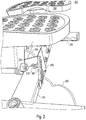
- Figure 2 shows an embodiment of a step training apparatus (stepper) 200 according to the invention.
- the stepper 200 comprises a foot 210, on which are mounted two levers 220. Mounted on each lever 220 are stepping platforms 230 on each of which a user steps with one foot. If the user shifts his weight to one platform 230, i.e. to one lever 220, this lever 220 moves downwards. At the same time, the other lever that is not loaded by the user's weight moves upwards.
- Each lever 220 comprises adjustable resistance means 240.
- the speed of moving downwards depends on the user's weight and on the adjustable resistance means 240 forming part of the lever. If a high resistance is chosen, the loaded lever moves down rather slowly. The lower the resistance, the faster a lever moves. Moreover, the resistance means 240 restores the lever 220 to its original position whenever it is unloaded.
- the stepper 200 further comprises a potentiometer 250 in order to determine the position of at least one lever 220. More particularly, one lever 220 comprises a holding bracket 270 in which a wiper 260 of the potentiometer 250 is inserted, such that the bracket 270 moves the wiper 260 substantially whenever the lever 220 moves. In the present example, the position of the wiper 260 changes linearly with the position of the lever.
- the potentiometer 250 Based on the position of the wiper, the potentiometer 250 generates a current that changes with the position of the lever 220 and is output through a connection cable 280.
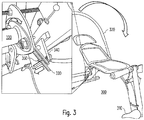
- Figure 3 shows a further embodiment of a training apparatus 300 for the abdominal muscles according to the invention.
- the training apparatus 300 comprises a bench 310 and a handle 320 in the form of an arch.
- the handle 320 is pivotally mounted to the bench 310.
- a user lies or sits on the bench 310 and moves the handle 320 forwards with his hands as indicated by the arrow.
- the handle comprises an adjustable resistance (not shown) that restores the handle to its original position when the user releases it.
- the handle 320 rotates in the direction indicated by the small arrow.
- the handle 300 further comprises a bracket 330 that rotates with the handle and moves a wiper 350 of a potentiometer 340.
- the position of the wiper 350 changes linearly with the rotation angle (position) of the handle.
- the apparatus according to figure 3 may further comprise a second resistance means that the user may actuate with his legs or feet and that is also equipped with a means for determining the configuration of the second resistance means, wherein the determined configurations of the two resistance means may be combined to form the control signal, such that the training apparatus may be "played" in two dimensions.
- a second resistance means that the user may actuate with his legs or feet and that is also equipped with a means for determining the configuration of the second resistance means, wherein the determined configurations of the two resistance means may be combined to form the control signal, such that the training apparatus may be "played" in two dimensions.
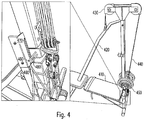
- Figure 4 shows an example of a training apparatus for the upper body and arm muscles not part of the invention.
- the training apparatus comprises a bench 410, a handle 420, pulleys 430, a cable 440 and an adjustable weight 450.
- a user sits on the bench and pulls the handle down towards himself. As the user pulls down the handle, the weight moves upwards.
- the training apparatus further comprises a bracket 460 that moves in line with the weight and engages a wiper 480 of a potentiometer 470 installed in the training apparatus. Again, the position of the wiper 480 changes linearly with the position of the weight.
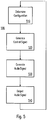
- Figure 5 is a flowchart of a method 500 for operating a training apparatus having adjustable resistance means.
- step 510 an actual configuration of the training apparatus is continuously determined during exercise.
- a control signal for controlling an audio device is generated, the control signal being at least partially based on the actual configuration of the training apparatus.
- the control signal is also generated continuously.
- the control signal may be a MIDI signal.
- step 530 an audio signal is generated, the audio signal being at least partially based on the control signal.
- An audio signal is a representation of sound waves, typically in the form of an electrical voltage, but also through alternative mediums such as magnetic particles, when recorded onto analogue tape; or as radio frequency waves, when broadcast through radio; or even as pulses of light, when transmitting through fiber optic cables like TOSLINK (trademark).
- An audio signal can be manipulated, stored, transmitted and reproduced in ways that a sound wave cannot.
- a volume, or a pitch, or a tempo of the audio signal may depend at least partially on the actual position of the adjustable resistance means. More particularly, the volume, or the pitch, or the tempo of the audio feedback signal may be linear-proportional to the actual position of the adjustable resistance means. Alternatively, the relationship may also be set to be non-linear, e.g. by using a band-pass filter, because the user of the apparatus will be able to pick up non-linear relationships after a while. The challenge to do so may further increase the motivation to use the apparatus.
- the audio signal may comprise different tracks.
- the user may select different instruments for the generation of the audio signal, e.g. a drum or a piano. Tracks for different instruments are merged in one audio signal, for example when several users exercise together.
- the choice of the audio signal may depend on the magnitude of the resistance, as set by the user.
- the audio signal may comprise a prerecorded audio sequence that may be output as the user exercises. This sequence may be merged with the audio feedback signal generated by the user, as he exercises.
- the user may record the acoustic sequence generated during his own exercise by himself in permanent form and replay it while going on to a different training apparatus.
- the audio feedback signal generated by the user may be merged with audio feedback signals generated by users of other training apparatuses, e.g. when they exercise in concert.
- step 540 the audio signal is output by the audio device.
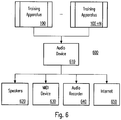
- Figure 6 is a schematic overview of a training system with acoustic feedback according to an embodiment of the invention.
- the training system comprises at least one training apparatus 100 as previously described, an audio device 610 for generating an audio signal and one or several output devices, e.g. loudspeakers and/or headphones 620, a MIDI device 630 or an audio recording device 640 to which the audio signal may be output simultaneously.
- an audio device 610 for generating an audio signal
- one or several output devices e.g. loudspeakers and/or headphones 620
- a MIDI device 630 e.g. a MIDI device 630 or an audio recording device 640 to which the audio signal may be output simultaneously.
- the training system operates as described in connection with figure 5 .
- the invention also comprises streaming an audio stream generated by use of the training system to the Internet, such that users at different locations may exercise together.
- the musical feedback creates for the user or a group of users an experience of playing a song when using the training apparatus rather than actually exercising.
- Figure 7 depicts results from a behavioral study with fitness training with or without musical feedback (30 participants). It shows that with musical feedback the sense of effort was lower and the fun was higher compared with usual fitness training.
Landscapes
- Engineering & Computer Science (AREA)
- Multimedia (AREA)
- Health & Medical Sciences (AREA)
- General Health & Medical Sciences (AREA)
- Physical Education & Sports Medicine (AREA)
- Human Computer Interaction (AREA)
- Physics & Mathematics (AREA)
- Acoustics & Sound (AREA)
- Rehabilitation Tools (AREA)
Description
- The present invention relates to a training system and method with apparatuses or fitness devices for physical exercise having resistance means.
- In the state of the art, a large variety of training apparatuses of this kind are known for training different muscles or muscle groups of the human body. However, they are usually characterized by a certain monotony and repetitiousness in their use. If a user has no intrinsic motivation to repeat a given exercise the necessary number of times, the use of the device quickly becomes boring.
- Also, as the user focuses his attention on his interaction with the apparatus, he stays fully aware of his effort and strain, and his possible exhaustion. Further, the kind of movement required by fitness devices is uniform and predefined, leaving little room for the user to vary movements or the intensity of its use.
- What is particularly lacking is an occasion or cause for varying use of the training apparatus or the training movements. In other words, the user often lacks a concrete adequate cause or incentive to engage in harmonic motoric movements.
- Therefore, it is an object of the present invention to provide a training apparatus, which increases the user's motivation to overcome physical exhaustion and to provide a greater motivation in using the device by providing a mechanism that guides the exercise in a more adequate way. It is a further object of the invention to provide a training apparatus that may be used by a group of people, thereby creating further incentives or motivations to exercise.
- These objects are achieved by a training system and a method for generating an audio signal according to the independent claims. Advantageous embodiments are defined in the dependent claims.
- By playing music depending on the configuration of the training apparatus, the training apparatus is effectively turned into a music instrument.
- The user's very strong motivation to vary the generated music or audio feedback signal leads to a finer and more varied interaction with the training apparatus, guided by musical principles, such has harmony, rhythm and variation. More particularly, by determining the configuration of the training apparatus continuously, the training apparatus according to the invention allows the user to control the musical experience by performing fine movements, such as changes in direction, small shifts, etc, in line with a desired musical dynamics. These movements are rather atypical when using a training apparatus according to the state of the art, but emerge naturally when using the present invention. This experience is increased when also the control signal is generated continuously, i.e. when gradual movements are translated into gradual changes in the musical signal.
- Most importantly, the invention does not set out to guide the user but to provide him with a means to explore a continuum of possible soundscapes by actuating the training apparatus.
- Further aspects and advantages of the present invention will become apparent to the skilled person when studying the following description of a preferred embodiment of the present invention, in connection with the drawings, in which
- Fig. 1
- is a schematic diagram of a training apparatus according to a preferred embodiment of the invention; and
- Fig. 2
- shows an embodiment of a step training apparatus according to the invention.
- Fig. 3
- shows a further embodiment of a training apparatus for the abdominal muscles according to the invention.
- Fig. 4
- shows an example of a training apparatus for the upper body and arm muscles not part of the invention.
- Fig. 5
- is a flowchart of a method for operating a training apparatus according to the invention.
- Fig. 6
- is a schematic overview of a training system with acoustic feedback according to the invention.
- Fig. 7
- depicts results from a behavioral study with fitness training with or without musical feedback (30 participants). It shows that with musical feedback the sense of effort was lower and the fun was higher compared with usual fitness training.
- Fig. 8
- shows measured force, metabolism (Oxygen consumption and RER as measured with a Spirometer), and Sense of effort as a ratio of no feedback/feedback (N=10).
-
Figure 1 is a schematic block diagram of atraining apparatus 100 according to a preferred embodiment of the invention. - The training apparatus comprises resistance means 110 and a lever.
- Examples of such training apparatuses include, without limitation, weight machines, friction machines, spring-loaded machines, fan-loaded machines, fluid-loaded machines and/or hydraulic machines.
- The resistance means are adjustable. Preferably, the resistance of the adjustable resistance means may be adjusted to be greater than 25 Newton (N). Preferably, it may be adjusted to be greater than 100 Newton (N) or greater than 250 Newton (N).
- The adjustable resistance may be incremented either continually or discretely. In the discrete case, adjustments are preferably possible in increments of approximately 25 or approximately 50 Newton (N).
- The training apparatus further comprises means 120 for continuously determining an
actual configuration 130 of the training apparatus during exercise. - An
actual configuration 130 of the apparatus may comprise a single or several parameters, such as a variable position of a lever of the training apparatus that is actioned or operated by a user as he exercises. The different configurations of the apparatus may vary continuously. - For determining the
configuration 130, a position transducing means such as a potentiometer may be used for determining the position of a lever. Preferably, a digital potentiometer may be used. - The
apparatus 100 further comprises means 140 for generating acontrol signal 150 for controlling an audio device, thecontrol signal 150 being at least partially based on the actual configuration of thetraining apparatus 130. The control signal may be any kind of control signal for controlling an audio device, either in digital or analog form. For example, the control signal may be a changing current or voltage. The control signal may cause an audio device to reproduce a piece of recorded music or to generate a sequence of sounds or distinct notes. The control signal may also cause the audio device to modify a piece of recorded music before reproduction. In a preferred embodiment, the control signal is a MIDI signal for controlling a MIDI audio device. Preferably, the control signal is also generated continuously. - For this purpose, the generating means 140 may process the
configuration 130 in analog form or in digital form, as it is provided by determiningmeans 120. - Finally, the
apparatus 100 comprises means for outputting the generatedcontrol signal 150 to an audio device (not shown infigure 1 ). In case of a MIDI signal, the outputting means is a MIDI (OUT) jack. - Optionally, the
audio feedback signal 150 may also be output to a recorder (not shown) for storing the signal in or on a machine-readable medium (also not shown). Recorded signals may be used in order to create loops continuously repeating the recorded signal. - The training apparatus according to the invention may advantageously be used in the rehabilitation of physically impaired patients, e.g. stroke patients.
-
Figure 2 shows an embodiment of a step training apparatus (stepper) 200 according to the invention. - The
stepper 200 comprises afoot 210, on which are mounted twolevers 220. Mounted on eachlever 220 arestepping platforms 230 on each of which a user steps with one foot. If the user shifts his weight to oneplatform 230, i.e. to onelever 220, thislever 220 moves downwards. At the same time, the other lever that is not loaded by the user's weight moves upwards. - Each
lever 220 comprises adjustable resistance means 240. The speed of moving downwards depends on the user's weight and on the adjustable resistance means 240 forming part of the lever. If a high resistance is chosen, the loaded lever moves down rather slowly. The lower the resistance, the faster a lever moves. Moreover, the resistance means 240 restores thelever 220 to its original position whenever it is unloaded. - The
stepper 200 further comprises apotentiometer 250 in order to determine the position of at least onelever 220. More particularly, onelever 220 comprises a holdingbracket 270 in which awiper 260 of thepotentiometer 250 is inserted, such that thebracket 270 moves thewiper 260 substantially whenever thelever 220 moves. In the present example, the position of thewiper 260 changes linearly with the position of the lever. - Based on the position of the wiper, the
potentiometer 250 generates a current that changes with the position of thelever 220 and is output through aconnection cable 280. -
Figure 3 shows a further embodiment of atraining apparatus 300 for the abdominal muscles according to the invention. - The
training apparatus 300 comprises abench 310 and ahandle 320 in the form of an arch. Thehandle 320 is pivotally mounted to thebench 310. During exercise, a user lies or sits on thebench 310 and moves thehandle 320 forwards with his hands as indicated by the arrow. - The handle comprises an adjustable resistance (not shown) that restores the handle to its original position when the user releases it.
- As shown in the cut-out of
figure 3 on the left-hand side, thehandle 320 rotates in the direction indicated by the small arrow. In order to determine the position of the handle, thehandle 300 further comprises abracket 330 that rotates with the handle and moves awiper 350 of apotentiometer 340. As in the previous example, the position of thewiper 350 changes linearly with the rotation angle (position) of the handle. - Optionally, the apparatus according to
figure 3 may further comprise a second resistance means that the user may actuate with his legs or feet and that is also equipped with a means for determining the configuration of the second resistance means, wherein the determined configurations of the two resistance means may be combined to form the control signal, such that the training apparatus may be "played" in two dimensions. -
Figure 4 shows an example of a training apparatus for the upper body and arm muscles not part of the invention. - The training apparatus comprises a
bench 410, ahandle 420,pulleys 430, acable 440 and anadjustable weight 450. During exercise, a user sits on the bench and pulls the handle down towards himself. As the user pulls down the handle, the weight moves upwards. - In order to determine the position of the weight, the training apparatus further comprises a
bracket 460 that moves in line with the weight and engages awiper 480 of apotentiometer 470 installed in the training apparatus. Again, the position of thewiper 480 changes linearly with the position of the weight. -
Figure 5 is a flowchart of amethod 500 for operating a training apparatus having adjustable resistance means. - In
step 510, an actual configuration of the training apparatus is continuously determined during exercise. - In
step 520, a control signal for controlling an audio device is generated, the control signal being at least partially based on the actual configuration of the training apparatus. Preferably, the control signal is also generated continuously. In particular, the control signal may be a MIDI signal. - In
step 530, an audio signal is generated, the audio signal being at least partially based on the control signal. - An audio signal is a representation of sound waves, typically in the form of an electrical voltage, but also through alternative mediums such as magnetic particles, when recorded onto analogue tape; or as radio frequency waves, when broadcast through radio; or even as pulses of light, when transmitting through fiber optic cables like TOSLINK (trademark). An audio signal can be manipulated, stored, transmitted and reproduced in ways that a sound wave cannot. Advantageously, a volume, or a pitch, or a tempo of the audio signal may depend at least partially on the actual position of the adjustable resistance means. More particularly, the volume, or the pitch, or the tempo of the audio feedback signal may be linear-proportional to the actual position of the adjustable resistance means. Alternatively, the relationship may also be set to be non-linear, e.g. by using a band-pass filter, because the user of the apparatus will be able to pick up non-linear relationships after a while. The challenge to do so may further increase the motivation to use the apparatus.
- Optionally, the audio signal may comprise different tracks. Further, the user may select different instruments for the generation of the audio signal, e.g. a drum or a piano. Tracks for different instruments are merged in one audio signal, for example when several users exercise together.
- As a further option, the choice of the audio signal may depend on the magnitude of the resistance, as set by the user.
- The audio signal may comprise a prerecorded audio sequence that may be output as the user exercises. This sequence may be merged with the audio feedback signal generated by the user, as he exercises.
- Optionally, the user may record the acoustic sequence generated during his own exercise by himself in permanent form and replay it while going on to a different training apparatus.
- Finally, the audio feedback signal generated by the user may be merged with audio feedback signals generated by users of other training apparatuses, e.g. when they exercise in concert.
- In
step 540, the audio signal is output by the audio device. -
Figure 6 is a schematic overview of a training system with acoustic feedback according to an embodiment of the invention. - The training system comprises at least one
training apparatus 100 as previously described, anaudio device 610 for generating an audio signal and one or several output devices, e.g. loudspeakers and/orheadphones 620, aMIDI device 630 or anaudio recording device 640 to which the audio signal may be output simultaneously. - The training system operates as described in connection with
figure 5 . - If several training apparatuses are linked together as shown in
figure 6 , the users effectively exercise in concert. - The invention also comprises streaming an audio stream generated by use of the training system to the Internet, such that users at different locations may exercise together.
- By using the described system, the musical feedback creates for the user or a group of users an experience of playing a song when using the training apparatus rather than actually exercising.
-
Figure 7 depicts results from a behavioral study with fitness training with or without musical feedback (30 participants). It shows that with musical feedback the sense of effort was lower and the fun was higher compared with usual fitness training. -
Figure 8 shows measured force, metabolism (Oxygen consumption and RER as measured with a Spirometer), and Sense of effort as a ratio of no feedback/feedback (N=10). - The force and metabolism is quite comparable between the conditions. It is slightly higher without feedback where participants would rather go into anaerobic metabolism, (RER > 1), which from a sport physiological point of view is not good. Note that the sense of effort with a mean value of 1.75 is much higher than the difference in metabolism between the conditions, showing that it is unproportionally to the work which has been done higher without musical feedback (or unproportionally lower with musical feedback). This demonstrates that the explored method of musical feedback during workout decreased the sense of effort invested in the workout.
Claims (7)
- Method for generating an acoustic feedback during a physical exercise of a person on a training apparatus, the training apparatus comprising adjustable resistance means, comprising the steps of:- continuously determining (510) an actual position of a lever of the training apparatus during exercise using a position transducing means;- continuously generating (520) a control signal for an audio device, the signal being at least partially based on the actual position of the lever of the training apparatus;- generating (530) an audio signal, the audio signal being at least partially based on the generated control signal, wherein a volume or a pitch of the audio signal depends at least partially on the actual position of the lever of the training apparatus; and- outputting (540) the audio signal,characterized in that the generated audio signal is merged with a second audio signal before it is put out, wherein the second audio signal is one of a prerecorded audio sequence, an audio sequence prerecorded by a user while exercising or audio feedback signals generated by users of other training apparatuses exercising in concert.
- Method according to claim 1, wherein the volume or the pitch of the audio feedback signal is linear-proportional to the actual position of the adjustable resistance means.
- Method according to claim 1, wherein the audio signal comprises different tracks.
- Method according to claim 1, wherein the tracks comprise a drum track.
- Method according to claim 1, wherein the tracks comprise a piano track.
- Method according to claim 1, wherein the control signal is a MIDI signal.
- Training system (600) with acoustic feedback, comprising:- several training apparatuses (100 - 100+N) linked together, each training apparatus comprisingthe training system (600) further comprising:- adjustable resistance means (110);- position transducing means (120) for continuously determining an actual configuration (130) of the training apparatus during exercise;- means (140) for generating a control signal for an audio device, the control signal being at least partially based on the actual configuration of the training apparatus; and- means for outputting the control signal;- an audio device (610) for generating an audio signal and for merging audio signals, the audio signals comprising one of a prerecorded audio sequence, an audio sequence prerecorded by a user while exercising or audio feedback signals generated by users of other training apparatuses exercising in concert; and- outputting means for the generated and merged audio signals;wherein the training system (600) is configured to carry out a method according to claim 1.
Priority Applications (1)
| Application Number | Priority Date | Filing Date | Title |
|---|---|---|---|
| EP11722409.7A EP2575981B1 (en) | 2010-05-26 | 2011-05-26 | Training apparatus and system with musical feedback |
Applications Claiming Priority (4)
| Application Number | Priority Date | Filing Date | Title |
|---|---|---|---|
| US34840210P | 2010-05-26 | 2010-05-26 | |
| EP10005458A EP2389992A1 (en) | 2010-05-26 | 2010-05-26 | Training apparatus with musical feedback |
| EP11722409.7A EP2575981B1 (en) | 2010-05-26 | 2011-05-26 | Training apparatus and system with musical feedback |
| PCT/EP2011/058677 WO2011147934A1 (en) | 2010-05-26 | 2011-05-26 | Training apparatus and system with musical feedback |
Publications (2)
| Publication Number | Publication Date |
|---|---|
| EP2575981A1 EP2575981A1 (en) | 2013-04-10 |
| EP2575981B1 true EP2575981B1 (en) | 2021-09-15 |
Family
ID=43244997
Family Applications (2)
| Application Number | Title | Priority Date | Filing Date |
|---|---|---|---|
| EP10005458A Withdrawn EP2389992A1 (en) | 2010-05-26 | 2010-05-26 | Training apparatus with musical feedback |
| EP11722409.7A Active EP2575981B1 (en) | 2010-05-26 | 2011-05-26 | Training apparatus and system with musical feedback |
Family Applications Before (1)
| Application Number | Title | Priority Date | Filing Date |
|---|---|---|---|
| EP10005458A Withdrawn EP2389992A1 (en) | 2010-05-26 | 2010-05-26 | Training apparatus with musical feedback |
Country Status (3)
| Country | Link |
|---|---|
| US (1) | US10384114B2 (en) |
| EP (2) | EP2389992A1 (en) |
| WO (1) | WO2011147934A1 (en) |
Families Citing this family (13)
| Publication number | Priority date | Publication date | Assignee | Title |
|---|---|---|---|---|
| US9339691B2 (en) | 2012-01-05 | 2016-05-17 | Icon Health & Fitness, Inc. | System and method for controlling an exercise device |
| CN104884133B (en) | 2013-03-14 | 2018-02-23 | 艾肯运动与健康公司 | Force exercise equipment with flywheel |
| US9403047B2 (en) | 2013-12-26 | 2016-08-02 | Icon Health & Fitness, Inc. | Magnetic resistance mechanism in a cable machine |
| WO2015138339A1 (en) | 2014-03-10 | 2015-09-17 | Icon Health & Fitness, Inc. | Pressure sensor to quantify work |
| CN106470739B (en) | 2014-06-09 | 2019-06-21 | 爱康保健健身有限公司 | Cable system incorporated into the treadmill |
| WO2015195965A1 (en) | 2014-06-20 | 2015-12-23 | Icon Health & Fitness, Inc. | Post workout massage device |
| US10391361B2 (en) | 2015-02-27 | 2019-08-27 | Icon Health & Fitness, Inc. | Simulating real-world terrain on an exercise device |
| US10625137B2 (en) | 2016-03-18 | 2020-04-21 | Icon Health & Fitness, Inc. | Coordinated displays in an exercise device |
| US10493349B2 (en) | 2016-03-18 | 2019-12-03 | Icon Health & Fitness, Inc. | Display on exercise device |
| US10272317B2 (en) | 2016-03-18 | 2019-04-30 | Icon Health & Fitness, Inc. | Lighted pace feature in a treadmill |
| US10671705B2 (en) | 2016-09-28 | 2020-06-02 | Icon Health & Fitness, Inc. | Customizing recipe recommendations |
| WO2019038452A1 (en) | 2017-08-25 | 2019-02-28 | MAX-PLANCK-Gesellschaft zur Förderung der Wissenschaften e.V. | Method and device for controlling acoustic feedback during a physical exercise |
| WO2020172547A1 (en) * | 2019-02-21 | 2020-08-27 | Radow Scott B | Exercise equipment with music synchronization |
Family Cites Families (28)
| Publication number | Priority date | Publication date | Assignee | Title |
|---|---|---|---|---|
| JPS5068723A (en) | 1973-10-22 | 1975-06-09 | ||
| US4905676A (en) * | 1984-01-06 | 1990-03-06 | Loredan Biomedical, Inc. | Exercise diagnostic system and method |
| US4705268A (en) * | 1985-12-09 | 1987-11-10 | Zorcom Enterprise, Inc. | Toy exercizing machine for children |
| DE3543716A1 (en) * | 1985-12-11 | 1987-06-19 | Richard Ohmann | Sport device |
| DE3871957D1 (en) * | 1987-07-08 | 1992-07-16 | Frank L Dr Mertesdorf | METHOD AND DEVICE FOR SUPPORTING FITNESS TRAINING BY MEANS OF MUSIC. |
| US4998725A (en) * | 1989-02-03 | 1991-03-12 | Proform Fitness Products, Inc. | Exercise machine controller |
| FR2680113B3 (en) * | 1991-08-07 | 1993-06-25 | Denis Brely | MUSICAL Hopscotch. |
| JP3306423B2 (en) * | 1991-09-09 | 2002-07-24 | 株式会社電気工事西川組 | Kicking instrument type health equipment |
| US5785630A (en) * | 1993-02-02 | 1998-07-28 | Tectrix Fitness Equipment, Inc. | Interactive exercise apparatus |
| US6183354B1 (en) | 1996-11-08 | 2001-02-06 | Applied Materials, Inc. | Carrier head with a flexible membrane for a chemical mechanical polishing system |
| US5830107A (en) * | 1997-04-17 | 1998-11-03 | Brigliadoro; George R. | Exercise platform with performance display |
| JP2000296185A (en) * | 1999-02-12 | 2000-10-24 | Nabco Ltd | Exercise system |
| US7985164B2 (en) * | 1999-07-08 | 2011-07-26 | Icon Ip, Inc. | Methods and systems for controlling an exercise apparatus using a portable data storage device |
| EP1837858B1 (en) * | 2000-01-11 | 2013-07-10 | Yamaha Corporation | Apparatus and method for detecting performer´s motion to interactively control performance of music or the like |
| US6793607B2 (en) * | 2002-01-22 | 2004-09-21 | Kinetic Sports Interactive | Workout assistant |
| US20030216228A1 (en) * | 2002-05-18 | 2003-11-20 | Rast Rodger H. | Systems and methods of sports training using specific biofeedback |
| EP1595243A2 (en) * | 2003-02-12 | 2005-11-16 | Koninklijke Philips Electronics N.V. | Audio reproduction apparatus, method, computer program |
| GB2414195A (en) * | 2004-05-18 | 2005-11-23 | Prec Sport Ltd | Electronic physical exercise system |
| US7648446B2 (en) * | 2004-06-09 | 2010-01-19 | Unisen, Inc. | System and method for electronically controlling resistance of an exercise machine |
| SE0401511L (en) * | 2004-06-10 | 2005-04-05 | Interactive Inst Ii Ab | Climbing systems |
| US20070213110A1 (en) * | 2005-01-28 | 2007-09-13 | Outland Research, Llc | Jump and bob interface for handheld media player devices |
| JP5225548B2 (en) * | 2005-03-25 | 2013-07-03 | ソニー株式会社 | Content search method, content list search method, content search device, content list search device, and search server |
| US20060229164A1 (en) * | 2005-03-28 | 2006-10-12 | Tylertone International Inc. | Apparatuses for retrofitting exercise equipment and methods for using same |
| US20070049470A1 (en) * | 2005-08-29 | 2007-03-01 | Johnson Health Tech Co., Ltd. | Rapid circuit training machine with dual resistance |
| JP2007075172A (en) * | 2005-09-12 | 2007-03-29 | Sony Corp | Sound output control device, sound output control method, and sound output control program |
| JP2008279250A (en) * | 2007-04-10 | 2008-11-20 | Shinsedai Kk | Weight training support apparatus and weight training support program |
| US20100075806A1 (en) * | 2008-03-24 | 2010-03-25 | Michael Montgomery | Biorhythm feedback system and method |
| US8251874B2 (en) * | 2009-03-27 | 2012-08-28 | Icon Health & Fitness, Inc. | Exercise systems for simulating real world terrain |
-
2010
- 2010-05-26 EP EP10005458A patent/EP2389992A1/en not_active Withdrawn
-
2011
- 2011-05-26 EP EP11722409.7A patent/EP2575981B1/en active Active
- 2011-05-26 WO PCT/EP2011/058677 patent/WO2011147934A1/en not_active Ceased
- 2011-05-26 US US13/699,675 patent/US10384114B2/en active Active
Also Published As
| Publication number | Publication date |
|---|---|
| US10384114B2 (en) | 2019-08-20 |
| EP2389992A1 (en) | 2011-11-30 |
| WO2011147934A1 (en) | 2011-12-01 |
| EP2575981A1 (en) | 2013-04-10 |
| US20130116091A1 (en) | 2013-05-09 |
Similar Documents
| Publication | Publication Date | Title |
|---|---|---|
| US10384114B2 (en) | Training apparatus and system with musical feedback | |
| US6075197A (en) | Apparatus and method for providing interactive drum lessons | |
| US11011145B2 (en) | Input device with a variable tensioned joystick with travel distance for operating a musical instrument, and a method of use thereof | |
| US20090260506A1 (en) | Method for controlling the tempo of a periodic conscious human physiological activity | |
| US20030066413A1 (en) | Apparatus and method for detecting performer's motion to interactively control performance of music or the like | |
| US20040244566A1 (en) | Method and apparatus for producing acoustical guitar sounds using an electric guitar | |
| JP4607213B2 (en) | Training apparatus, music playback method, and program | |
| JP2005537499A (en) | Voice-controlled electronic musical instrument | |
| JP2008229101A (en) | Training support apparatus, training support method, and program for training support apparatus | |
| Kinoshita et al. | Left hand finger force in violin playing: Tempo, loudness, and finger differences | |
| JP5381293B2 (en) | Sound emission control device | |
| JP2007007100A (en) | Method and device for reproducing musical piece for supporting exercise | |
| US20190366147A1 (en) | Training apparatus and system with musical feedback | |
| JP2009512107A (en) | Audio information playback control | |
| CN120183367A (en) | An electronic piano accompaniment system with adaptive rhythm based on artificial intelligence | |
| Martin | Percussion and computer in live performance | |
| Alexandrovsky et al. | Jump ‘n’rhythm: a video game for training timing skills | |
| JP2002253700A (en) | Foot-operated repetitive exercise equipment | |
| JP4085471B2 (en) | Karaoke device and microphone | |
| JP6772640B2 (en) | Devices and methods for generating phrases | |
| JP4816360B2 (en) | Pronunciation control device | |
| JP7571952B2 (en) | Rhythm Sound Generator | |
| KR101842282B1 (en) | Guitar playing system, playing guitar and, method for displaying of guitar playing information | |
| Mainka et al. | Music Technology for Neurologic Music Therapy (NMT)® | |
| Hawk | An Analysis and Performer's Guide of Boulder Canyon, Hoover Dam by Clark Hubbard |
Legal Events
| Date | Code | Title | Description |
|---|---|---|---|
| PUAI | Public reference made under article 153(3) epc to a published international application that has entered the european phase |
Free format text: ORIGINAL CODE: 0009012 |
|
| 17P | Request for examination filed |
Effective date: 20121116 |
|
| AK | Designated contracting states |
Kind code of ref document: A1 Designated state(s): AL AT BE BG CH CY CZ DE DK EE ES FI FR GB GR HR HU IE IS IT LI LT LU LV MC MK MT NL NO PL PT RO RS SE SI SK SM TR |
|
| DAX | Request for extension of the european patent (deleted) | ||
| STAA | Information on the status of an ep patent application or granted ep patent |
Free format text: STATUS: EXAMINATION IS IN PROGRESS |
|
| 17Q | First examination report despatched |
Effective date: 20161115 |
|
| GRAP | Despatch of communication of intention to grant a patent |
Free format text: ORIGINAL CODE: EPIDOSNIGR1 |
|
| STAA | Information on the status of an ep patent application or granted ep patent |
Free format text: STATUS: GRANT OF PATENT IS INTENDED |
|
| INTG | Intention to grant announced |
Effective date: 20210122 |
|
| GRAS | Grant fee paid |
Free format text: ORIGINAL CODE: EPIDOSNIGR3 |
|
| GRAA | (expected) grant |
Free format text: ORIGINAL CODE: 0009210 |
|
| STAA | Information on the status of an ep patent application or granted ep patent |
Free format text: STATUS: THE PATENT HAS BEEN GRANTED |
|
| RAP3 | Party data changed (applicant data changed or rights of an application transferred) |
Owner name: MAX-PLANCK-GESELLSCHAFT ZUR FOERDERUNG DER WISSENSCHAFTEN E.V. |
|
| AK | Designated contracting states |
Kind code of ref document: B1 Designated state(s): AL AT BE BG CH CY CZ DE DK EE ES FI FR GB GR HR HU IE IS IT LI LT LU LV MC MK MT NL NO PL PT RO RS SE SI SK SM TR |
|
| REG | Reference to a national code |
Ref country code: CH Ref legal event code: EP Ref country code: GB Ref legal event code: FG4D |
|
| REG | Reference to a national code |
Ref country code: DE Ref legal event code: R096 Ref document number: 602011071780 Country of ref document: DE |
|
| REG | Reference to a national code |
Ref country code: IE Ref legal event code: FG4D |
|
| REG | Reference to a national code |
Ref country code: AT Ref legal event code: REF Ref document number: 1430081 Country of ref document: AT Kind code of ref document: T Effective date: 20211015 |
|
| REG | Reference to a national code |
Ref country code: LT Ref legal event code: MG9D |
|
| REG | Reference to a national code |
Ref country code: NL Ref legal event code: FP |
|
| PG25 | Lapsed in a contracting state [announced via postgrant information from national office to epo] |
Ref country code: NO Free format text: LAPSE BECAUSE OF FAILURE TO SUBMIT A TRANSLATION OF THE DESCRIPTION OR TO PAY THE FEE WITHIN THE PRESCRIBED TIME-LIMIT Effective date: 20211215 Ref country code: RS Free format text: LAPSE BECAUSE OF FAILURE TO SUBMIT A TRANSLATION OF THE DESCRIPTION OR TO PAY THE FEE WITHIN THE PRESCRIBED TIME-LIMIT Effective date: 20210915 Ref country code: FI Free format text: LAPSE BECAUSE OF FAILURE TO SUBMIT A TRANSLATION OF THE DESCRIPTION OR TO PAY THE FEE WITHIN THE PRESCRIBED TIME-LIMIT Effective date: 20210915 Ref country code: BG Free format text: LAPSE BECAUSE OF FAILURE TO SUBMIT A TRANSLATION OF THE DESCRIPTION OR TO PAY THE FEE WITHIN THE PRESCRIBED TIME-LIMIT Effective date: 20211215 Ref country code: LT Free format text: LAPSE BECAUSE OF FAILURE TO SUBMIT A TRANSLATION OF THE DESCRIPTION OR TO PAY THE FEE WITHIN THE PRESCRIBED TIME-LIMIT Effective date: 20210915 Ref country code: SE Free format text: LAPSE BECAUSE OF FAILURE TO SUBMIT A TRANSLATION OF THE DESCRIPTION OR TO PAY THE FEE WITHIN THE PRESCRIBED TIME-LIMIT Effective date: 20210915 Ref country code: HR Free format text: LAPSE BECAUSE OF FAILURE TO SUBMIT A TRANSLATION OF THE DESCRIPTION OR TO PAY THE FEE WITHIN THE PRESCRIBED TIME-LIMIT Effective date: 20210915 |
|
| PG25 | Lapsed in a contracting state [announced via postgrant information from national office to epo] |
Ref country code: LV Free format text: LAPSE BECAUSE OF FAILURE TO SUBMIT A TRANSLATION OF THE DESCRIPTION OR TO PAY THE FEE WITHIN THE PRESCRIBED TIME-LIMIT Effective date: 20210915 Ref country code: GR Free format text: LAPSE BECAUSE OF FAILURE TO SUBMIT A TRANSLATION OF THE DESCRIPTION OR TO PAY THE FEE WITHIN THE PRESCRIBED TIME-LIMIT Effective date: 20211216 |
|
| PG25 | Lapsed in a contracting state [announced via postgrant information from national office to epo] |
Ref country code: IS Free format text: LAPSE BECAUSE OF FAILURE TO SUBMIT A TRANSLATION OF THE DESCRIPTION OR TO PAY THE FEE WITHIN THE PRESCRIBED TIME-LIMIT Effective date: 20220115 Ref country code: SM Free format text: LAPSE BECAUSE OF FAILURE TO SUBMIT A TRANSLATION OF THE DESCRIPTION OR TO PAY THE FEE WITHIN THE PRESCRIBED TIME-LIMIT Effective date: 20210915 Ref country code: SK Free format text: LAPSE BECAUSE OF FAILURE TO SUBMIT A TRANSLATION OF THE DESCRIPTION OR TO PAY THE FEE WITHIN THE PRESCRIBED TIME-LIMIT Effective date: 20210915 Ref country code: RO Free format text: LAPSE BECAUSE OF FAILURE TO SUBMIT A TRANSLATION OF THE DESCRIPTION OR TO PAY THE FEE WITHIN THE PRESCRIBED TIME-LIMIT Effective date: 20210915 Ref country code: PT Free format text: LAPSE BECAUSE OF FAILURE TO SUBMIT A TRANSLATION OF THE DESCRIPTION OR TO PAY THE FEE WITHIN THE PRESCRIBED TIME-LIMIT Effective date: 20220117 Ref country code: PL Free format text: LAPSE BECAUSE OF FAILURE TO SUBMIT A TRANSLATION OF THE DESCRIPTION OR TO PAY THE FEE WITHIN THE PRESCRIBED TIME-LIMIT Effective date: 20210915 Ref country code: ES Free format text: LAPSE BECAUSE OF FAILURE TO SUBMIT A TRANSLATION OF THE DESCRIPTION OR TO PAY THE FEE WITHIN THE PRESCRIBED TIME-LIMIT Effective date: 20210915 Ref country code: EE Free format text: LAPSE BECAUSE OF FAILURE TO SUBMIT A TRANSLATION OF THE DESCRIPTION OR TO PAY THE FEE WITHIN THE PRESCRIBED TIME-LIMIT Effective date: 20210915 Ref country code: CZ Free format text: LAPSE BECAUSE OF FAILURE TO SUBMIT A TRANSLATION OF THE DESCRIPTION OR TO PAY THE FEE WITHIN THE PRESCRIBED TIME-LIMIT Effective date: 20210915 Ref country code: AL Free format text: LAPSE BECAUSE OF FAILURE TO SUBMIT A TRANSLATION OF THE DESCRIPTION OR TO PAY THE FEE WITHIN THE PRESCRIBED TIME-LIMIT Effective date: 20210915 |
|
| REG | Reference to a national code |
Ref country code: DE Ref legal event code: R097 Ref document number: 602011071780 Country of ref document: DE |
|
| PLBE | No opposition filed within time limit |
Free format text: ORIGINAL CODE: 0009261 |
|
| STAA | Information on the status of an ep patent application or granted ep patent |
Free format text: STATUS: NO OPPOSITION FILED WITHIN TIME LIMIT |
|
| PG25 | Lapsed in a contracting state [announced via postgrant information from national office to epo] |
Ref country code: DK Free format text: LAPSE BECAUSE OF FAILURE TO SUBMIT A TRANSLATION OF THE DESCRIPTION OR TO PAY THE FEE WITHIN THE PRESCRIBED TIME-LIMIT Effective date: 20210915 |
|
| 26N | No opposition filed |
Effective date: 20220616 |
|
| PG25 | Lapsed in a contracting state [announced via postgrant information from national office to epo] |
Ref country code: SI Free format text: LAPSE BECAUSE OF FAILURE TO SUBMIT A TRANSLATION OF THE DESCRIPTION OR TO PAY THE FEE WITHIN THE PRESCRIBED TIME-LIMIT Effective date: 20210915 |
|
| REG | Reference to a national code |
Ref country code: AT Ref legal event code: UEP Ref document number: 1430081 Country of ref document: AT Kind code of ref document: T Effective date: 20210915 |
|
| PG25 | Lapsed in a contracting state [announced via postgrant information from national office to epo] |
Ref country code: MC Free format text: LAPSE BECAUSE OF FAILURE TO SUBMIT A TRANSLATION OF THE DESCRIPTION OR TO PAY THE FEE WITHIN THE PRESCRIBED TIME-LIMIT Effective date: 20210915 Ref country code: LU Free format text: LAPSE BECAUSE OF NON-PAYMENT OF DUE FEES Effective date: 20220526 Ref country code: IT Free format text: LAPSE BECAUSE OF FAILURE TO SUBMIT A TRANSLATION OF THE DESCRIPTION OR TO PAY THE FEE WITHIN THE PRESCRIBED TIME-LIMIT Effective date: 20210915 |
|
| PG25 | Lapsed in a contracting state [announced via postgrant information from national office to epo] |
Ref country code: IE Free format text: LAPSE BECAUSE OF NON-PAYMENT OF DUE FEES Effective date: 20220526 |
|
| PGFP | Annual fee paid to national office [announced via postgrant information from national office to epo] |
Ref country code: BE Payment date: 20230822 Year of fee payment: 13 |
|
| PGFP | Annual fee paid to national office [announced via postgrant information from national office to epo] |
Ref country code: NL Payment date: 20231122 Year of fee payment: 13 |
|
| PG25 | Lapsed in a contracting state [announced via postgrant information from national office to epo] |
Ref country code: HU Free format text: LAPSE BECAUSE OF FAILURE TO SUBMIT A TRANSLATION OF THE DESCRIPTION OR TO PAY THE FEE WITHIN THE PRESCRIBED TIME-LIMIT; INVALID AB INITIO Effective date: 20110526 |
|
| PG25 | Lapsed in a contracting state [announced via postgrant information from national office to epo] |
Ref country code: MK Free format text: LAPSE BECAUSE OF FAILURE TO SUBMIT A TRANSLATION OF THE DESCRIPTION OR TO PAY THE FEE WITHIN THE PRESCRIBED TIME-LIMIT Effective date: 20210915 Ref country code: CY Free format text: LAPSE BECAUSE OF FAILURE TO SUBMIT A TRANSLATION OF THE DESCRIPTION OR TO PAY THE FEE WITHIN THE PRESCRIBED TIME-LIMIT Effective date: 20210915 |
|
| PG25 | Lapsed in a contracting state [announced via postgrant information from national office to epo] |
Ref country code: TR Free format text: LAPSE BECAUSE OF FAILURE TO SUBMIT A TRANSLATION OF THE DESCRIPTION OR TO PAY THE FEE WITHIN THE PRESCRIBED TIME-LIMIT Effective date: 20210915 |
|
| PG25 | Lapsed in a contracting state [announced via postgrant information from national office to epo] |
Ref country code: MT Free format text: LAPSE BECAUSE OF FAILURE TO SUBMIT A TRANSLATION OF THE DESCRIPTION OR TO PAY THE FEE WITHIN THE PRESCRIBED TIME-LIMIT Effective date: 20210915 |
|
| REG | Reference to a national code |
Ref country code: NL Ref legal event code: MM Effective date: 20240601 |
|
| PG25 | Lapsed in a contracting state [announced via postgrant information from national office to epo] |
Ref country code: NL Free format text: LAPSE BECAUSE OF NON-PAYMENT OF DUE FEES Effective date: 20240601 |
|
| REG | Reference to a national code |
Ref country code: BE Ref legal event code: MM Effective date: 20240531 |
|
| PG25 | Lapsed in a contracting state [announced via postgrant information from national office to epo] |
Ref country code: BE Free format text: LAPSE BECAUSE OF NON-PAYMENT OF DUE FEES Effective date: 20240531 |
|
| REG | Reference to a national code |
Ref country code: CH Ref legal event code: U11 Free format text: ST27 STATUS EVENT CODE: U-0-0-U10-U11 (AS PROVIDED BY THE NATIONAL OFFICE) Effective date: 20251127 |
|
| PGFP | Annual fee paid to national office [announced via postgrant information from national office to epo] |
Ref country code: DE Payment date: 20251120 Year of fee payment: 15 |
|
| PGFP | Annual fee paid to national office [announced via postgrant information from national office to epo] |
Ref country code: GB Payment date: 20251127 Year of fee payment: 15 |
|
| PGFP | Annual fee paid to national office [announced via postgrant information from national office to epo] |
Ref country code: AT Payment date: 20251124 Year of fee payment: 15 |
|
| PGFP | Annual fee paid to national office [announced via postgrant information from national office to epo] |
Ref country code: FR Payment date: 20251120 Year of fee payment: 15 |
|
| PGFP | Annual fee paid to national office [announced via postgrant information from national office to epo] |
Ref country code: CH Payment date: 20251127 Year of fee payment: 15 |