EP2575377A1 - Réglage d'amplification d'un appareil auditif - Google Patents
Réglage d'amplification d'un appareil auditif Download PDFInfo
- Publication number
- EP2575377A1 EP2575377A1 EP12178668A EP12178668A EP2575377A1 EP 2575377 A1 EP2575377 A1 EP 2575377A1 EP 12178668 A EP12178668 A EP 12178668A EP 12178668 A EP12178668 A EP 12178668A EP 2575377 A1 EP2575377 A1 EP 2575377A1
- Authority
- EP
- European Patent Office
- Prior art keywords
- frequency
- frequency bands
- transposition
- frequency band
- input signal
- Prior art date
- Legal status (The legal status is an assumption and is not a legal conclusion. Google has not performed a legal analysis and makes no representation as to the accuracy of the status listed.)
- Withdrawn
Links
Images

Classifications
-
- H—ELECTRICITY
- H04—ELECTRIC COMMUNICATION TECHNIQUE
- H04R—LOUDSPEAKERS, MICROPHONES, GRAMOPHONE PICK-UPS OR LIKE ACOUSTIC ELECTROMECHANICAL TRANSDUCERS; ELECTRIC HEARING AIDS; PUBLIC ADDRESS SYSTEMS
- H04R25/00—Electric hearing aids
- H04R25/35—Electric hearing aids using translation techniques
- H04R25/353—Frequency, e.g. frequency shift or compression
-
- H—ELECTRICITY
- H04—ELECTRIC COMMUNICATION TECHNIQUE
- H04R—LOUDSPEAKERS, MICROPHONES, GRAMOPHONE PICK-UPS OR LIKE ACOUSTIC ELECTROMECHANICAL TRANSDUCERS; ELECTRIC HEARING AIDS; PUBLIC ADDRESS SYSTEMS
- H04R2225/00—Details of deaf aids covered by H04R25/00, not provided for in any of its subgroups
- H04R2225/43—Signal processing in hearing aids to enhance the speech intelligibility
-
- H—ELECTRICITY
- H04—ELECTRIC COMMUNICATION TECHNIQUE
- H04R—LOUDSPEAKERS, MICROPHONES, GRAMOPHONE PICK-UPS OR LIKE ACOUSTIC ELECTROMECHANICAL TRANSDUCERS; ELECTRIC HEARING AIDS; PUBLIC ADDRESS SYSTEMS
- H04R2430/00—Signal processing covered by H04R, not provided for in its groups
- H04R2430/03—Synergistic effects of band splitting and sub-band processing
Definitions
- the invention relates to a method for processing an electrical input signal in a hearing aid device suitable for carrying out a frequency transposition. Furthermore, the invention relates to a hearing aid for performing a corresponding method.
- a suitable for carrying out a frequency transposition hearing aid is, for example, from the patent DE 10 2008 046 966 B3 known.
- a method for processing acoustic speech signals is off WO 2010/078938 A2 known, wherein the speech signals to be processed are divided into a plurality of frequency bands and the high-frequency frequency bands are shifted above a cutoff frequency to lower frequencies below the cutoff frequency, and wherein the spectral energy ratios of the speech signal are detected.
- the object of the present invention is to improve speech understanding in the supply of a hearing aid device suitable for carrying out a frequency transposition.
- This object is achieved by a method for processing an electrical input signal in a hearing aid with the method steps specified in claim 1. Furthermore, the object is achieved by a hearing aid for carrying out such a method with the features according to claim 3.
- an acoustic or electromagnetic input signal is picked up and received by an input transducer, e.g. a microphone, converted into an electrical input signal.
- an input transducer e.g. a microphone
- the electrical input signal is divided into several frequency bands (so-called channels).
- the energy of the electrical input signal is determined in at least two frequency bands, but preferably in all frequency bands.
- an energy distribution between individual frequency bands, preferably between all frequency bands determined. On the basis of the energy distribution, certain fricatives contained in the input signal can be detected.
- a frequency transposition is effected, as a result of which at least one channel, usually in the upper frequency range, is imaged onto another, generally deeper, channel.
- Frequency transposition generally pursues the goal of transferring or reproducing a specific frequency range, for example 0 to 8 kHz, into another, usually narrower, transposed frequency range, for example 0 to 6 kHz.
- the bandwidths and cut-off frequencies of the transposed frequency bands coincide with those of the respective original frequency bands (eg starting at 0 Hz: 6 frequency bands with a bandwidth of 1 kHz), only to certain original frequency bands no transposed Frequency bands exist (eg to the frequency band between 6 and 7 kHz as well as to the frequency band between 7 and 8 kHz).
- limit frequencies are shifted by the frequency transposition, so that, for example, 8 frequency bands between 0 and 8 kHz are mapped onto 8 frequency bands between 0 and 6 kHz.
- Mixed forms are also possible in which both the cutoff frequencies and the number of frequency bands vary between the original frequency range and the transposed frequency range.
- a hearing aid device there is at least one amplifier unit by means of which the amplification in a specific frequency band, in particular a specific frequency band affected by the frequency transposition, can be set individually.
- a specific frequency band in particular a specific frequency band affected by the frequency transposition
- the gain is adjusted as a function of the previously determined energy distribution.
- the invention offers the advantage that by controlling the amplification in individual frequency bands, an energy distribution present in the transposition between at least two frequency bands can be imaged on the transposed frequency bands, that is, even after the frequency transposition a corresponding energy distribution between two frequency bands (the transposed frequency range) available. This ensures that speech components present in the input signal remain intelligible even after the frequency transposition and, in particular, that fricatives present in the input signal are correctly recognized.
- the invention provides for a ratio of the energy distribution between a first upper frequency band and a first lower frequency band before the frequency transposition to be mapped into a corresponding ratio between a second upper frequency band and a second lower frequency band after the frequency transposition. This can be avoided, in particular, that certain fricatives are confused with other fricatives after the frequency transposition.
- an electrical input signal is first divided into a plurality of frequency bands in a method step S1.
- a division into eight frequency bands is customary.
- a second method step S2 an energy distribution between the frequency bands is determined. It is also possible, in particular for a large number of frequency bands, to combine several frequency bands to determine the energy distribution.
- a frequency transposition in a method step S4.
- certain frequency bands are mapped to certain other frequency bands. It can also be said that a certain frequency range is mapped or shifted into a transposed frequency range.
- the invention therefore provides in a method step S5 the adjustment of the gain in at least one transposed frequency band as a function of the determined energy distribution in the original frequency bands.
- the gain is adjusted so that an existing in the original frequency bands energy distribution between at least a first upper frequency band and a first lower frequency band at least substantially in the energy distribution between a second upper transposed frequency band and a second lower transposed frequency band is present.
- the invention makes it possible for a fricative present in the original input signal and recognizable on the basis of the energy distribution to be perceptible even after the frequency transposition as the same fricative.
- the intelligibility of a speech signal contained in the input signal is retained even after the frequency transposition.
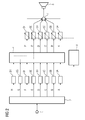
- FIG. 2 shows a hearing aid according to the invention in a highly simplified block diagram.
- a microphone 1 an acoustic input signal is recorded and converted into an electrical input signal, which is first fed to a filter bank 2.
- a filter bank 2 Through the filter bank 2 is a division of the electrical input signal into eight frequency bands A to H.
- energy detection unit 3A or 3B or 3C ... or 3H is present, by which the energy of the electrical input signal in the respective frequency band is determined.
- the thus determined values of the energy in the respective frequency bands are fed to a signal processing and control unit 9. From the individual energy values, this determines an energy distribution between the individual frequency bands on the basis of which specific fricatives present in the input signal can be detected.
- the signals of the individual frequency bands are also fed to a frequency transposition unit 4, by which certain frequency bands are shifted (transposed) to other frequency bands.
- the originally existing 8 frequency bands A to H are transferred to 6 transposed frequency bands A 'to F', wherein the lower 4 frequency bands A to D remain unaffected by the frequency transposition, ie the original frequency bands A to D coincide with the transposed frequency bands A '. to D ', both in terms of the cutoff frequencies and in terms of the electrical signal in the respective frequency band.
- the original 7th frequency band G is also transferred to the 5th transposed frequency band E 'as well as the originally existing 8th frequency band H to the 6th transposed frequency band F'.
- the electrical signals in the transposed frequency bands A 'to F' are finally combined in an adder 7 and supplied as an electrical output signal to a receiver 8, which converts the electrical output signal into an acoustic output signal.
- the hearing aid according to the invention further comprises in each transposed frequency band, an amplifier unit 5A or 5B or .... or 5F, the gain of which is individually adjustable by means of the signal processing and control unit 9. Since both the energy in the individual frequency bands before the frequency transposition and the frequency transposition prescription are known, it is possible to set the amplifier units 5A to 5F such that an energy distribution present in the frequency bands before the frequency transposition between at least a first upper frequency band (eg G) and a first lower frequency band (eg D) to a corresponding energy distribution between at least a second upper frequency band (eg E ') and a second lower frequency band (eg D') in the transposed frequency bands. Alternatively, it would also be possible to directly measure the energy of the signal components in the transposed frequency bands by corresponding energy detection units in the transposed frequency bands (not shown) and to adjust the amplifier units 5A to 5F accordingly to achieve a specific energy distribution.
- an amplifier unit 5A or 5B or .... or 5F the gain of which is individually adjustable by means of the
Landscapes
- Health & Medical Sciences (AREA)
- General Health & Medical Sciences (AREA)
- Neurosurgery (AREA)
- Otolaryngology (AREA)
- Physics & Mathematics (AREA)
- Engineering & Computer Science (AREA)
- Acoustics & Sound (AREA)
- Signal Processing (AREA)
- Circuit For Audible Band Transducer (AREA)
Applications Claiming Priority (1)
| Application Number | Priority Date | Filing Date | Title |
|---|---|---|---|
| DE102011083736.1A DE102011083736B4 (de) | 2011-09-29 | 2011-09-29 | Verstärkungseinstellung bei einem Hörhilfegerät |
Publications (1)
| Publication Number | Publication Date |
|---|---|
| EP2575377A1 true EP2575377A1 (fr) | 2013-04-03 |
Family
ID=46800012
Family Applications (1)
| Application Number | Title | Priority Date | Filing Date |
|---|---|---|---|
| EP12178668A Withdrawn EP2575377A1 (fr) | 2011-09-29 | 2012-07-31 | Réglage d'amplification d'un appareil auditif |
Country Status (3)
| Country | Link |
|---|---|
| US (1) | US20130083950A1 (fr) |
| EP (1) | EP2575377A1 (fr) |
| DE (1) | DE102011083736B4 (fr) |
Citations (3)
| Publication number | Priority date | Publication date | Assignee | Title |
|---|---|---|---|---|
| DE102008046966B3 (de) | 2008-09-12 | 2010-05-06 | Siemens Medical Instruments Pte. Ltd. | Hörgerät und Betrieb eines Hörgeräts mit Frequenztransposition |
| WO2010078938A2 (fr) | 2008-12-18 | 2010-07-15 | Forschungsgesellschaft Für Arbeitsphysiologie Und Arbeitsschutz E. V. | Procédé et dispositif de traitement de signaux acoustiques vocaux |
| EP2506254A1 (fr) * | 2011-03-31 | 2012-10-03 | Siemens Medical Instruments Pte. Ltd. | Procédé d'amélioration de l'intelligibilité de la parole avec un appareil auditif ainsi qu'appareil auditif |
Family Cites Families (1)
| Publication number | Priority date | Publication date | Assignee | Title |
|---|---|---|---|---|
| TWI451770B (zh) * | 2010-12-01 | 2014-09-01 | Kuo Ping Yang | 增加聽障者聽到聲音正確性之方法及助聽器 |
-
2011
- 2011-09-29 DE DE102011083736.1A patent/DE102011083736B4/de active Active
-
2012
- 2012-07-31 EP EP12178668A patent/EP2575377A1/fr not_active Withdrawn
- 2012-10-01 US US13/632,508 patent/US20130083950A1/en not_active Abandoned
Patent Citations (3)
| Publication number | Priority date | Publication date | Assignee | Title |
|---|---|---|---|---|
| DE102008046966B3 (de) | 2008-09-12 | 2010-05-06 | Siemens Medical Instruments Pte. Ltd. | Hörgerät und Betrieb eines Hörgeräts mit Frequenztransposition |
| WO2010078938A2 (fr) | 2008-12-18 | 2010-07-15 | Forschungsgesellschaft Für Arbeitsphysiologie Und Arbeitsschutz E. V. | Procédé et dispositif de traitement de signaux acoustiques vocaux |
| EP2506254A1 (fr) * | 2011-03-31 | 2012-10-03 | Siemens Medical Instruments Pte. Ltd. | Procédé d'amélioration de l'intelligibilité de la parole avec un appareil auditif ainsi qu'appareil auditif |
Non-Patent Citations (1)
| Title |
|---|
| MUNOZ C M A ET AL: "Frequency lowering processing for listeners with significant hearing loss", ICECS'99. PROCEEDINGS OF ICECS'99. 6TH IEEE INTERNATIONAL CONFERENCE ON ELECTRONICS, CIRCUITS AND SYSTEMS; 5-8 SEPT. 1999; PAFOS, CYPRUS, IEEE, PISCATAWAY, NJ, USA, vol. 2, 5 September 1999 (1999-09-05), pages 741 - 744, XP010361677, ISBN: 978-0-7803-5682-5, DOI: 10.1109/ICECS.1999.813215 * |
Also Published As
| Publication number | Publication date |
|---|---|
| DE102011083736B4 (de) | 2014-11-20 |
| DE102011083736A1 (de) | 2013-04-04 |
| US20130083950A1 (en) | 2013-04-04 |
Similar Documents
| Publication | Publication Date | Title |
|---|---|---|
| EP1919257B1 (fr) | Réduction du bruit dépendant du niveau | |
| DE69509555T2 (de) | Verfahren zur veränderung eines sprachsignales mittels grundfrequenzmanipulation | |
| EP1853089B1 (fr) | Méthode pour la suppression de la rétroaction et pour l'éxpansion spéctrale pour des appareils de correction auditive | |
| EP1307072B1 (fr) | Procédé pour actionner une prothèse auditive et prothèse auditive | |
| EP1850635B1 (fr) | Réglages adaptatifs temporels d'une prothèse auditive et procédé correspondant | |
| EP2437394A1 (fr) | Procédé de traitement de signal dans un appareil auditif et appareil auditif | |
| EP2919485B1 (fr) | Transmission d'un signal à bruits de vent réduits à temps de latence diminué | |
| EP2244491A1 (fr) | Procédé de fonctionnement d'un dispositif auditif et dispositif ayant un filtre d'aiguillage | |
| EP1101390B1 (fr) | Appareil auditif permettant une meilleure comprehension de la parole grace a un traitement de signal selectif en frequence, et procede permettant de faire fonctionner un tel appareil auditif | |
| DE19624092B4 (de) | Verstärkungsschaltung, vorzugsweise für analoge oder digitale Hörgeräte sowie Hörgeräte unter Verwendung einer entsprechenden Verstärkungsschaltung bzw. eines entsprechenden Signalverarbeitungs-Algorithmus | |
| EP2200341A1 (fr) | Procédé de fonctionnement d'un appareil d'aide auditive et appareil d'aide auditive doté d'un dispositif de séparation de sources | |
| DE10114101A1 (de) | Verfahren zum Verarbeiten eines Eingangssignals in einer Signalverarbeitungseinheit eines Hörgerätes sowie Schaltung zur Durchführung des Verfahrens | |
| DE102021205251B4 (de) | Verfahren und Vorrichtung zur frequenzselektiven Verarbeitung eines Audiosignals mit geringer Latenz | |
| EP2584795B1 (fr) | Procédé de détermination d'une ligne caractéristique de compression | |
| EP2437520B1 (fr) | Appareil auditif pour la compression de fréquence | |
| EP1351550B1 (fr) | Procédé d'adaptation d'une amplification de signal dans une prothèse auditive et prothèse auditive | |
| EP4529227A1 (fr) | Système auditif et procédé de génération de béat monaural ou binaural | |
| EP4529225A1 (fr) | Système auditif et procédé de génération de béat monaural ou binaural | |
| DE112016006762T5 (de) | Vorrichtung und Verfahren zur Ausgleichung einer Klangfarbe eines Ohrhörersets | |
| EP2437521B1 (fr) | Procédé de compression fréquentielle à l'aide d'une correction harmonique et dispositif correspondant | |
| DE102011083736B4 (de) | Verstärkungseinstellung bei einem Hörhilfegerät | |
| EP3048808B1 (fr) | Systeme de transmission audionumerique sans fil ayant une dynamique optimisee | |
| DE2316939B2 (de) | Elektrische Hörhilfeschaltung | |
| DE102006025403B3 (de) | Verfahren zum Analysieren eines nichtlinearen Signalverarbeitungssystems | |
| DE10159928A1 (de) | Verfahren zum Vermeiden rückkopplungsbedingter Oszillationen in einem Hörgerät sowie Hörgerät |
Legal Events
| Date | Code | Title | Description |
|---|---|---|---|
| PUAI | Public reference made under article 153(3) epc to a published international application that has entered the european phase |
Free format text: ORIGINAL CODE: 0009012 |
|
| AK | Designated contracting states |
Kind code of ref document: A1 Designated state(s): AL AT BE BG CH CY CZ DE DK EE ES FI FR GB GR HR HU IE IS IT LI LT LU LV MC MK MT NL NO PL PT RO RS SE SI SK SM TR |
|
| AX | Request for extension of the european patent |
Extension state: BA ME |
|
| STAA | Information on the status of an ep patent application or granted ep patent |
Free format text: STATUS: THE APPLICATION IS DEEMED TO BE WITHDRAWN |
|
| 18D | Application deemed to be withdrawn |
Effective date: 20131005 |