EP2571084A2 - Anode active material for a lithium secondary battery, method for preparing same, and lithium secondary battery including same - Google Patents
Anode active material for a lithium secondary battery, method for preparing same, and lithium secondary battery including same Download PDFInfo
- Publication number
- EP2571084A2 EP2571084A2 EP11780792A EP11780792A EP2571084A2 EP 2571084 A2 EP2571084 A2 EP 2571084A2 EP 11780792 A EP11780792 A EP 11780792A EP 11780792 A EP11780792 A EP 11780792A EP 2571084 A2 EP2571084 A2 EP 2571084A2
- Authority
- EP
- European Patent Office
- Prior art keywords
- active material
- secondary battery
- anode active
- lithium secondary
- carbon
- Prior art date
- Legal status (The legal status is an assumption and is not a legal conclusion. Google has not performed a legal analysis and makes no representation as to the accuracy of the status listed.)
- Withdrawn
Links
- 239000006183 anode active material Substances 0.000 title claims abstract description 80
- 229910052744 lithium Inorganic materials 0.000 title claims abstract description 64
- WHXSMMKQMYFTQS-UHFFFAOYSA-N Lithium Chemical compound [Li] WHXSMMKQMYFTQS-UHFFFAOYSA-N 0.000 title claims abstract description 63
- 238000000034 method Methods 0.000 title claims abstract description 41
- 239000002245 particle Substances 0.000 claims abstract description 47
- 239000000463 material Substances 0.000 claims abstract description 45
- 239000002121 nanofiber Substances 0.000 claims abstract description 39
- 239000010703 silicon Substances 0.000 claims abstract description 29
- 229910052710 silicon Inorganic materials 0.000 claims abstract description 28
- 239000007833 carbon precursor Substances 0.000 claims abstract description 25
- 239000011247 coating layer Substances 0.000 claims abstract description 23
- 238000006243 chemical reaction Methods 0.000 claims abstract description 16
- HBBGRARXTFLTSG-UHFFFAOYSA-N Lithium ion Chemical compound [Li+] HBBGRARXTFLTSG-UHFFFAOYSA-N 0.000 claims abstract description 10
- 239000011149 active material Substances 0.000 claims abstract description 10
- 229910001416 lithium ion Inorganic materials 0.000 claims abstract description 10
- OKTJSMMVPCPJKN-UHFFFAOYSA-N Carbon Chemical compound [C] OKTJSMMVPCPJKN-UHFFFAOYSA-N 0.000 claims description 49
- 229910052799 carbon Inorganic materials 0.000 claims description 30
- KRKNYBCHXYNGOX-UHFFFAOYSA-N citric acid Chemical compound OC(=O)CC(O)(C(O)=O)CC(O)=O KRKNYBCHXYNGOX-UHFFFAOYSA-N 0.000 claims description 27
- VYPSYNLAJGMNEJ-UHFFFAOYSA-N Silicium dioxide Chemical compound O=[Si]=O VYPSYNLAJGMNEJ-UHFFFAOYSA-N 0.000 claims description 15
- 239000006185 dispersion Substances 0.000 claims description 12
- CZMRCDWAGMRECN-UGDNZRGBSA-N Sucrose Chemical compound O[C@H]1[C@H](O)[C@@H](CO)O[C@@]1(CO)O[C@@H]1[C@H](O)[C@@H](O)[C@H](O)[C@@H](CO)O1 CZMRCDWAGMRECN-UGDNZRGBSA-N 0.000 claims description 10
- 229930006000 Sucrose Natural products 0.000 claims description 10
- 238000001354 calcination Methods 0.000 claims description 10
- 239000011248 coating agent Substances 0.000 claims description 10
- 238000000576 coating method Methods 0.000 claims description 10
- 239000000203 mixture Substances 0.000 claims description 10
- 229910052814 silicon oxide Inorganic materials 0.000 claims description 10
- 239000005720 sucrose Substances 0.000 claims description 10
- 239000011261 inert gas Substances 0.000 claims description 9
- 229910052751 metal Inorganic materials 0.000 claims description 9
- 239000002184 metal Substances 0.000 claims description 9
- 150000004706 metal oxides Chemical class 0.000 claims description 7
- WQZGKKKJIJFFOK-GASJEMHNSA-N Glucose Natural products OC[C@H]1OC(O)[C@H](O)[C@@H](O)[C@@H]1O WQZGKKKJIJFFOK-GASJEMHNSA-N 0.000 claims description 6
- 238000001035 drying Methods 0.000 claims description 6
- 239000008103 glucose Substances 0.000 claims description 6
- 229910044991 metal oxide Inorganic materials 0.000 claims description 6
- 238000002156 mixing Methods 0.000 claims description 5
- 239000002048 multi walled nanotube Substances 0.000 claims description 5
- 238000005393 sonoluminescence Methods 0.000 claims description 5
- FDLZQPXZHIFURF-UHFFFAOYSA-N [O-2].[Ti+4].[Li+] Chemical compound [O-2].[Ti+4].[Li+] FDLZQPXZHIFURF-UHFFFAOYSA-N 0.000 claims description 4
- 229910052782 aluminium Inorganic materials 0.000 claims description 4
- 239000002202 Polyethylene glycol Substances 0.000 claims description 3
- 239000004372 Polyvinyl alcohol Substances 0.000 claims description 3
- WQZGKKKJIJFFOK-VFUOTHLCSA-N beta-D-glucose Chemical compound OC[C@H]1O[C@@H](O)[C@H](O)[C@@H](O)[C@@H]1O WQZGKKKJIJFFOK-VFUOTHLCSA-N 0.000 claims description 3
- 229910052797 bismuth Inorganic materials 0.000 claims description 3
- 229910052793 cadmium Inorganic materials 0.000 claims description 3
- 239000002134 carbon nanofiber Substances 0.000 claims description 3
- 229910052804 chromium Inorganic materials 0.000 claims description 3
- 229910052802 copper Inorganic materials 0.000 claims description 3
- 239000013078 crystal Substances 0.000 claims description 3
- 229910021389 graphene Inorganic materials 0.000 claims description 3
- 229910052738 indium Inorganic materials 0.000 claims description 3
- 229910052741 iridium Inorganic materials 0.000 claims description 3
- 229910052745 lead Inorganic materials 0.000 claims description 3
- VNWKTOKETHGBQD-UHFFFAOYSA-N methane Chemical compound C VNWKTOKETHGBQD-UHFFFAOYSA-N 0.000 claims description 3
- 229910052750 molybdenum Inorganic materials 0.000 claims description 3
- 229910052759 nickel Inorganic materials 0.000 claims description 3
- 229910052763 palladium Inorganic materials 0.000 claims description 3
- 229910052697 platinum Inorganic materials 0.000 claims description 3
- 229920001223 polyethylene glycol Polymers 0.000 claims description 3
- 229920002451 polyvinyl alcohol Polymers 0.000 claims description 3
- 229920000915 polyvinyl chloride Polymers 0.000 claims description 3
- 239000004800 polyvinyl chloride Substances 0.000 claims description 3
- 239000011164 primary particle Substances 0.000 claims description 3
- 229910052703 rhodium Inorganic materials 0.000 claims description 3
- 229910052707 ruthenium Inorganic materials 0.000 claims description 3
- 239000011163 secondary particle Substances 0.000 claims description 3
- 229910052709 silver Inorganic materials 0.000 claims description 3
- 239000002109 single walled nanotube Substances 0.000 claims description 3
- 229910052718 tin Inorganic materials 0.000 claims description 3
- 229910052719 titanium Inorganic materials 0.000 claims description 3
- 239000010936 titanium Substances 0.000 claims description 3
- 229910052721 tungsten Inorganic materials 0.000 claims description 3
- 229910052720 vanadium Inorganic materials 0.000 claims description 3
- 229910052725 zinc Inorganic materials 0.000 claims description 3
- 239000007864 aqueous solution Substances 0.000 claims description 2
- 238000003756 stirring Methods 0.000 claims description 2
- 238000007599 discharging Methods 0.000 abstract description 13
- XUIMIQQOPSSXEZ-UHFFFAOYSA-N Silicon Chemical compound [Si] XUIMIQQOPSSXEZ-UHFFFAOYSA-N 0.000 description 27
- -1 acetate compound Chemical class 0.000 description 20
- 239000003575 carbonaceous material Substances 0.000 description 20
- 239000002041 carbon nanotube Substances 0.000 description 12
- 229910021393 carbon nanotube Inorganic materials 0.000 description 12
- 239000000243 solution Substances 0.000 description 9
- XKRFYHLGVUSROY-UHFFFAOYSA-N Argon Chemical compound [Ar] XKRFYHLGVUSROY-UHFFFAOYSA-N 0.000 description 8
- 230000003247 decreasing effect Effects 0.000 description 6
- 150000001875 compounds Chemical class 0.000 description 5
- 239000007789 gas Substances 0.000 description 5
- 229910052786 argon Inorganic materials 0.000 description 4
- 238000002474 experimental method Methods 0.000 description 4
- 239000002243 precursor Substances 0.000 description 4
- 239000000047 product Substances 0.000 description 4
- IJGRMHOSHXDMSA-UHFFFAOYSA-N Atomic nitrogen Chemical compound N#N IJGRMHOSHXDMSA-UHFFFAOYSA-N 0.000 description 3
- 229910003641 H2SiO3 Inorganic materials 0.000 description 3
- 238000004458 analytical method Methods 0.000 description 3
- 229910001873 dinitrogen Inorganic materials 0.000 description 3
- 230000002035 prolonged effect Effects 0.000 description 3
- 239000000377 silicon dioxide Substances 0.000 description 3
- 235000012239 silicon dioxide Nutrition 0.000 description 3
- 150000003608 titanium Chemical class 0.000 description 3
- XLYOFNOQVPJJNP-UHFFFAOYSA-N water Chemical compound O XLYOFNOQVPJJNP-UHFFFAOYSA-N 0.000 description 3
- QTBSBXVTEAMEQO-UHFFFAOYSA-N Acetic acid Chemical compound CC(O)=O QTBSBXVTEAMEQO-UHFFFAOYSA-N 0.000 description 2
- CURLTUGMZLYLDI-UHFFFAOYSA-N Carbon dioxide Chemical compound O=C=O CURLTUGMZLYLDI-UHFFFAOYSA-N 0.000 description 2
- WMFOQBRAJBCJND-UHFFFAOYSA-M Lithium hydroxide Chemical compound [Li+].[OH-] WMFOQBRAJBCJND-UHFFFAOYSA-M 0.000 description 2
- GWEVSGVZZGPLCZ-UHFFFAOYSA-N Titan oxide Chemical compound O=[Ti]=O GWEVSGVZZGPLCZ-UHFFFAOYSA-N 0.000 description 2
- 150000001768 cations Chemical class 0.000 description 2
- 230000000052 comparative effect Effects 0.000 description 2
- 239000012153 distilled water Substances 0.000 description 2
- 238000009826 distribution Methods 0.000 description 2
- 230000000694 effects Effects 0.000 description 2
- 239000003792 electrolyte Substances 0.000 description 2
- 238000011156 evaluation Methods 0.000 description 2
- 239000000835 fiber Substances 0.000 description 2
- 229910002804 graphite Inorganic materials 0.000 description 2
- 239000010439 graphite Substances 0.000 description 2
- 238000010438 heat treatment Methods 0.000 description 2
- 229910001386 lithium phosphate Inorganic materials 0.000 description 2
- 238000004519 manufacturing process Methods 0.000 description 2
- 239000011148 porous material Substances 0.000 description 2
- 239000002409 silicon-based active material Substances 0.000 description 2
- XOLBLPGZBRYERU-UHFFFAOYSA-N tin dioxide Chemical compound O=[Sn]=O XOLBLPGZBRYERU-UHFFFAOYSA-N 0.000 description 2
- TWQULNDIKKJZPH-UHFFFAOYSA-K trilithium;phosphate Chemical compound [Li+].[Li+].[Li+].[O-]P([O-])([O-])=O TWQULNDIKKJZPH-UHFFFAOYSA-K 0.000 description 2
- NWUYHJFMYQTDRP-UHFFFAOYSA-N 1,2-bis(ethenyl)benzene;1-ethenyl-2-ethylbenzene;styrene Chemical compound C=CC1=CC=CC=C1.CCC1=CC=CC=C1C=C.C=CC1=CC=CC=C1C=C NWUYHJFMYQTDRP-UHFFFAOYSA-N 0.000 description 1
- 239000004251 Ammonium lactate Substances 0.000 description 1
- UGFAIRIUMAVXCW-UHFFFAOYSA-N Carbon monoxide Chemical compound [O+]#[C-] UGFAIRIUMAVXCW-UHFFFAOYSA-N 0.000 description 1
- 229910000733 Li alloy Inorganic materials 0.000 description 1
- 229910002986 Li4Ti5O12 Inorganic materials 0.000 description 1
- 229910001290 LiPF6 Inorganic materials 0.000 description 1
- 229910002651 NO3 Inorganic materials 0.000 description 1
- 229910019142 PO4 Inorganic materials 0.000 description 1
- 229960000583 acetic acid Drugs 0.000 description 1
- 239000000956 alloy Substances 0.000 description 1
- 229910045601 alloy Inorganic materials 0.000 description 1
- XAGFODPZIPBFFR-UHFFFAOYSA-N aluminium Chemical compound [Al] XAGFODPZIPBFFR-UHFFFAOYSA-N 0.000 description 1
- 229940059265 ammonium lactate Drugs 0.000 description 1
- 235000019286 ammonium lactate Nutrition 0.000 description 1
- 239000010405 anode material Substances 0.000 description 1
- QVGXLLKOCUKJST-UHFFFAOYSA-N atomic oxygen Chemical compound [O] QVGXLLKOCUKJST-UHFFFAOYSA-N 0.000 description 1
- RZOBLYBZQXQGFY-HSHFZTNMSA-N azanium;(2r)-2-hydroxypropanoate Chemical compound [NH4+].C[C@@H](O)C([O-])=O RZOBLYBZQXQGFY-HSHFZTNMSA-N 0.000 description 1
- 239000011230 binding agent Substances 0.000 description 1
- 238000007664 blowing Methods 0.000 description 1
- 229910002092 carbon dioxide Inorganic materials 0.000 description 1
- 239000001569 carbon dioxide Substances 0.000 description 1
- 229910002091 carbon monoxide Inorganic materials 0.000 description 1
- 239000003729 cation exchange resin Substances 0.000 description 1
- 230000001413 cellular effect Effects 0.000 description 1
- 239000007795 chemical reaction product Substances 0.000 description 1
- 150000001805 chlorine compounds Chemical class 0.000 description 1
- 239000004020 conductor Substances 0.000 description 1
- 230000006866 deterioration Effects 0.000 description 1
- 238000011161 development Methods 0.000 description 1
- 230000018109 developmental process Effects 0.000 description 1
- 239000012362 glacial acetic acid Substances 0.000 description 1
- 239000001989 lithium alloy Substances 0.000 description 1
- 229910003002 lithium salt Inorganic materials 0.000 description 1
- 159000000002 lithium salts Chemical class 0.000 description 1
- 150000002736 metal compounds Chemical class 0.000 description 1
- 229910052760 oxygen Inorganic materials 0.000 description 1
- 239000001301 oxygen Substances 0.000 description 1
- 239000010452 phosphate Substances 0.000 description 1
- 229960005235 piperonyl butoxide Drugs 0.000 description 1
- 238000001556 precipitation Methods 0.000 description 1
- 238000002360 preparation method Methods 0.000 description 1
- 238000010298 pulverizing process Methods 0.000 description 1
- 238000011160 research Methods 0.000 description 1
- 150000003839 salts Chemical class 0.000 description 1
- 239000002002 slurry Substances 0.000 description 1
- 229910052911 sodium silicate Inorganic materials 0.000 description 1
- 239000007921 spray Substances 0.000 description 1
- 239000000126 substance Substances 0.000 description 1
- 239000010409 thin film Substances 0.000 description 1
Images


Classifications
-
- H—ELECTRICITY
- H01—ELECTRIC ELEMENTS
- H01M—PROCESSES OR MEANS, e.g. BATTERIES, FOR THE DIRECT CONVERSION OF CHEMICAL ENERGY INTO ELECTRICAL ENERGY
- H01M4/00—Electrodes
- H01M4/02—Electrodes composed of, or comprising, active material
- H01M4/36—Selection of substances as active materials, active masses, active liquids
- H01M4/38—Selection of substances as active materials, active masses, active liquids of elements or alloys
- H01M4/386—Silicon or alloys based on silicon
-
- H—ELECTRICITY
- H01—ELECTRIC ELEMENTS
- H01M—PROCESSES OR MEANS, e.g. BATTERIES, FOR THE DIRECT CONVERSION OF CHEMICAL ENERGY INTO ELECTRICAL ENERGY
- H01M4/00—Electrodes
- H01M4/02—Electrodes composed of, or comprising, active material
- H01M4/36—Selection of substances as active materials, active masses, active liquids
- H01M4/58—Selection of substances as active materials, active masses, active liquids of inorganic compounds other than oxides or hydroxides, e.g. sulfides, selenides, tellurides, halogenides or LiCoFy; of polyanionic structures, e.g. phosphates, silicates or borates
- H01M4/583—Carbonaceous material, e.g. graphite-intercalation compounds or CFx
-
- H—ELECTRICITY
- H01—ELECTRIC ELEMENTS
- H01M—PROCESSES OR MEANS, e.g. BATTERIES, FOR THE DIRECT CONVERSION OF CHEMICAL ENERGY INTO ELECTRICAL ENERGY
- H01M10/00—Secondary cells; Manufacture thereof
- H01M10/05—Accumulators with non-aqueous electrolyte
- H01M10/052—Li-accumulators
-
- H—ELECTRICITY
- H01—ELECTRIC ELEMENTS
- H01M—PROCESSES OR MEANS, e.g. BATTERIES, FOR THE DIRECT CONVERSION OF CHEMICAL ENERGY INTO ELECTRICAL ENERGY
- H01M4/00—Electrodes
- H01M4/02—Electrodes composed of, or comprising, active material
- H01M4/13—Electrodes for accumulators with non-aqueous electrolyte, e.g. for lithium-accumulators; Processes of manufacture thereof
- H01M4/134—Electrodes based on metals, Si or alloys
-
- H—ELECTRICITY
- H01—ELECTRIC ELEMENTS
- H01M—PROCESSES OR MEANS, e.g. BATTERIES, FOR THE DIRECT CONVERSION OF CHEMICAL ENERGY INTO ELECTRICAL ENERGY
- H01M4/00—Electrodes
- H01M4/02—Electrodes composed of, or comprising, active material
- H01M4/13—Electrodes for accumulators with non-aqueous electrolyte, e.g. for lithium-accumulators; Processes of manufacture thereof
- H01M4/139—Processes of manufacture
- H01M4/1397—Processes of manufacture of electrodes based on inorganic compounds other than oxides or hydroxides, e.g. sulfides, selenides, tellurides, halogenides or LiCoFy
-
- H—ELECTRICITY
- H01—ELECTRIC ELEMENTS
- H01M—PROCESSES OR MEANS, e.g. BATTERIES, FOR THE DIRECT CONVERSION OF CHEMICAL ENERGY INTO ELECTRICAL ENERGY
- H01M4/00—Electrodes
- H01M4/02—Electrodes composed of, or comprising, active material
- H01M4/36—Selection of substances as active materials, active masses, active liquids
- H01M4/362—Composites
- H01M4/366—Composites as layered products
-
- H—ELECTRICITY
- H01—ELECTRIC ELEMENTS
- H01M—PROCESSES OR MEANS, e.g. BATTERIES, FOR THE DIRECT CONVERSION OF CHEMICAL ENERGY INTO ELECTRICAL ENERGY
- H01M4/00—Electrodes
- H01M4/02—Electrodes composed of, or comprising, active material
- H01M4/36—Selection of substances as active materials, active masses, active liquids
- H01M4/38—Selection of substances as active materials, active masses, active liquids of elements or alloys
-
- H—ELECTRICITY
- H01—ELECTRIC ELEMENTS
- H01M—PROCESSES OR MEANS, e.g. BATTERIES, FOR THE DIRECT CONVERSION OF CHEMICAL ENERGY INTO ELECTRICAL ENERGY
- H01M4/00—Electrodes
- H01M4/02—Electrodes composed of, or comprising, active material
- H01M4/36—Selection of substances as active materials, active masses, active liquids
- H01M4/48—Selection of substances as active materials, active masses, active liquids of inorganic oxides or hydroxides
-
- H—ELECTRICITY
- H01—ELECTRIC ELEMENTS
- H01M—PROCESSES OR MEANS, e.g. BATTERIES, FOR THE DIRECT CONVERSION OF CHEMICAL ENERGY INTO ELECTRICAL ENERGY
- H01M4/00—Electrodes
- H01M4/02—Electrodes composed of, or comprising, active material
- H01M4/36—Selection of substances as active materials, active masses, active liquids
- H01M4/48—Selection of substances as active materials, active masses, active liquids of inorganic oxides or hydroxides
- H01M4/483—Selection of substances as active materials, active masses, active liquids of inorganic oxides or hydroxides for non-aqueous cells
-
- H—ELECTRICITY
- H01—ELECTRIC ELEMENTS
- H01M—PROCESSES OR MEANS, e.g. BATTERIES, FOR THE DIRECT CONVERSION OF CHEMICAL ENERGY INTO ELECTRICAL ENERGY
- H01M4/00—Electrodes
- H01M4/02—Electrodes composed of, or comprising, active material
- H01M4/36—Selection of substances as active materials, active masses, active liquids
- H01M4/48—Selection of substances as active materials, active masses, active liquids of inorganic oxides or hydroxides
- H01M4/485—Selection of substances as active materials, active masses, active liquids of inorganic oxides or hydroxides of mixed oxides or hydroxides for inserting or intercalating light metals, e.g. LiTi2O4 or LiTi2OxFy
-
- H—ELECTRICITY
- H01—ELECTRIC ELEMENTS
- H01M—PROCESSES OR MEANS, e.g. BATTERIES, FOR THE DIRECT CONVERSION OF CHEMICAL ENERGY INTO ELECTRICAL ENERGY
- H01M4/00—Electrodes
- H01M4/02—Electrodes composed of, or comprising, active material
- H01M4/36—Selection of substances as active materials, active masses, active liquids
- H01M4/58—Selection of substances as active materials, active masses, active liquids of inorganic compounds other than oxides or hydroxides, e.g. sulfides, selenides, tellurides, halogenides or LiCoFy; of polyanionic structures, e.g. phosphates, silicates or borates
- H01M4/583—Carbonaceous material, e.g. graphite-intercalation compounds or CFx
- H01M4/587—Carbonaceous material, e.g. graphite-intercalation compounds or CFx for inserting or intercalating light metals
-
- H—ELECTRICITY
- H01—ELECTRIC ELEMENTS
- H01M—PROCESSES OR MEANS, e.g. BATTERIES, FOR THE DIRECT CONVERSION OF CHEMICAL ENERGY INTO ELECTRICAL ENERGY
- H01M4/00—Electrodes
- H01M4/02—Electrodes composed of, or comprising, active material
- H01M4/62—Selection of inactive substances as ingredients for active masses, e.g. binders, fillers
- H01M4/624—Electric conductive fillers
- H01M4/625—Carbon or graphite
-
- Y—GENERAL TAGGING OF NEW TECHNOLOGICAL DEVELOPMENTS; GENERAL TAGGING OF CROSS-SECTIONAL TECHNOLOGIES SPANNING OVER SEVERAL SECTIONS OF THE IPC; TECHNICAL SUBJECTS COVERED BY FORMER USPC CROSS-REFERENCE ART COLLECTIONS [XRACs] AND DIGESTS
- Y02—TECHNOLOGIES OR APPLICATIONS FOR MITIGATION OR ADAPTATION AGAINST CLIMATE CHANGE
- Y02E—REDUCTION OF GREENHOUSE GAS [GHG] EMISSIONS, RELATED TO ENERGY GENERATION, TRANSMISSION OR DISTRIBUTION
- Y02E60/00—Enabling technologies; Technologies with a potential or indirect contribution to GHG emissions mitigation
- Y02E60/10—Energy storage using batteries
Definitions
- the present invention relates to an anode active material for a lithium secondary battery, a method for preparing same, and a lithium secondary battery including same, and more particularly, the present invention relates to an anode active material for a lithium secondary battery, a method for preparing same, and a lithium secondary battery including same, wherein a rapid decrease of a capacity as charging/discharging cycle progressed due to the volume change by the reaction with lithium during charging/discharging and the generation of cracks and the breakage of active material particles, may be prevented, the cycle lifetime may be prolonged, and a high energy density appropriate for a high-capacity battery may be confirmed.
- lithium secondary batteries Recently, demands on lithium secondary batteries have been largely increased as an electric power and a power source of portable small-sized electronic devices such as a cellular phone, a portable personal digital assistant (PDA), a notebook personal computer (PC), MP3, etc. and an electric vehicle. Accordingly, demands on the lithium secondary batteries having a high-capacity and a prolonged lifetime also have been increased.
- PDA portable personal digital assistant
- PC notebook personal computer
- MP3 notebook personal computer
- anode active material of a lithium secondary battery As an anode active material of a lithium secondary battery, carbon-based materials have been widely used. However, the carbon-based anode active material has a limited theoretical maximum capacity of 372 mAh/g and has serious lifetime deterioration problem. Accordingly, a lot of researches and suggestions on a lithium alloy material having a high-capacity and being possibly replaced with the lithium metal have been conducted. One method among these is concerned with an application of silicon (Si).
- silicon reversibly absorbs/releases lithium through a compound forming reaction with lithium.
- the theoretical maximum capacity of the silicon is about 4,020 mAh/g (9,800 mAh/cc) and is very large when comparing with the carbon-based material.
- the silicon has been a promising material as the anode material having a high-capacity.
- cracks may be generated due to the volume change of the silicon active material through the reaction with lithium during charging/discharging, and due to the breakage of the silicon active material particles, the capacity may be rapidly decreased as the charging/discharging cycle proceeds, and the cycle lifetime may be shortened.
- anode active material having an appropriate energy density for a high-capacity battery, having an excellent stability and safety, keeping good battery properties, and having a long cycle lifetime, and an economic method for preparing the anode active material are required.
- a method of using silicon with graphite after pulverizing mechanically, or a method of mixing silicon with a carbon material and then calcining has been suggested.
- the capacity may be decreased however, the cycle lifetime may be remarkably enhanced.
- an anode active material for a secondary battery including silicon along with hollow nanofiber type carbon, and lithium titanium oxide (LTO) or a carbon-based material, at the same time, and a method for preparing the anode active material have not been suggested.
- an object of the present invention is to provide an anode active material for a lithium secondary battery and a precursor thereof, having an improved electric conductivity, energy density, stability, safety and cycle lifetime property.
- Another object of the present invention is to provide a method for preparing the anode active material for the lithium secondary battery.
- Another object of the present invention is to provide a lithium secondary battery including the anode active material for the lithium secondary battery.
- an anode active material for a lithium secondary battery includes active particles for absorbing/releasing a lithium ion, and a coating layer coated on a surface of the active particles.
- the coating layer includes a first material of a hollow nanofiber and a second material of a carbon precursor or lithium titanium oxide (LTO).
- the active particle may be one selected from the group consisting of silicon, silicon oxide, a metal, a metal oxide and a mixture thereof.
- the metal may be at least one selected from the group consisting of Sn, Al, Pb, Zn, Bi, In, Mg, Ga, Cd, Ag, Pt, Pd, Ir, Rh, Ru, Ni, Mo, Cr, Cu, Ti, W, Co, V and Ge.
- the hollow nanofiber may be hollow nanofiber type carbon, and may be one of a single-wall carbon nanotube, a multi-wall carbon nanotube, a carbon nanofiber, graphene and a mixture thereof.
- the carbon precursor may be at least one of glucose, sucrose, polyethylene glycol, polyvinyl alcohol, polyvinyl chloride and citric acid, and the carbon precursor preferably may be at least one selected from the group consisting of the glucose, the sucrose and the citric acid.
- the diameter of the hollow nanofiber type carbon may be 2 nm to 100 nm, and a complex anode active material coated with the second material of the carbon precursor or the LTO and the first material of the hollow nanofiber type carbon may be a crystal having a mean diameter of a primary particle of 5 nm to 400 nm and a mean diameter of a secondary particle of 3 ⁇ m to 30 ⁇ m.
- a method for preparing an anode active material for a lithium secondary battery includes (a) preparing a dispersion by mixing and dispersing active particles for an anode active material, a carbon precursor and a hollow nanofiber type carbon in an aqueous solution, and (b) uniformly coating a surface of the active particles with a coating layer including the hollow nanofiber type carbon and the carbon precursor by stirring a reaction system in a reactor or by applying a sonochemical treatment to the reaction system.
- the sonochemical treatment may be performed under a multibubble sonoluminescence (MBSL) condition.
- MBSL multibubble sonoluminescence
- the method may further include drying thus obtained product after coating and calcining the dried product under an inert gas atmosphere to obtain a complex anode active material.
- the amount of the hollow nanofiber type carbon in the dispersion at step (a) may be in a range of 0.5 to 8 wt% based on a total amount of the dispersion.
- the dispersing for preparing the dispersion at step (a) may be performed by using one of a sonic wave dispersing method and a high pressure dispersion method.
- the coating at step (b) may be performed under an inert gas atmosphere at a temperature range of 10°C to 50°C, and the calcining may be performed under an inert gas atmosphere at a temperature range of 500°C to 900°C.
- a lithium secondary battery including the above-described anode active material for a lithium secondary battery is provided.
- the anode active material for the lithium secondary battery in accordance with example embodiments may prevent a rapid decrease of a capacity as charging/discharging cycle progressed due to the volume change by the reaction with lithium during charging/discharging and the generation of cracks and the breakage of active material particles, which may be generated for a silicon anode active material.
- the cycle lifetime may be prolonged, and a high energy density appropriate for a high-capacity battery may be confirmed. Therefore, the lithium secondary battery obtained by using the anode active material for the lithium secondary battery in accordance with the present invention may keep a good fundamental electric property, may improve the stability and the safety and may increase the cycle lifetime.
- the complex anode active material may be prepared with a good reproducibility and productivity.
- An anode active material for a lithium secondary battery in accordance with example embodiments includes a core and a coating layer coating the core, and the coating layer includes a first material of a hollow nanofiber and a second material to be mixed with the first material.
- the core may be silicon, a metal or a metal oxide, a mixture thereof and an alloy thereof, which may absorb/release lithium ions.
- the second material may be a carbon-based material in accordance with an example embodiment and may be lithium titanium oxide (LTO, Li 4 Ti 5 O 12 ) in accordance with another example embodiment.
- an anode active material is divided into a core and a coating layer.
- the coating layer includes a fiber (first material) having a hollow structure, which is a moving passage of lithium ions and a material (second material) possibly minimizing the particle size of the active material and the volume change due to the reaction with the lithium ions, at the same time.
- first material having a hollow structure
- second material possibly minimizing the particle size of the active material and the volume change due to the reaction with the lithium ions, at the same time.
- the coating layer in accordance with example embodiments may be formed by coating the first material and the second material at the same time and so, may be coated on a metal oxide core. Therefore, the present invention is economic.
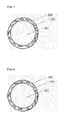
- FIGS. 1 and 2 illustrate a schematic cross-sectional view of a complex anode active material precursor for a lithium secondary battery or a complex anode active material for a lithium secondary battery in accordance with example embodiments.
- an active particle 102 which is a core, and a coating layer coating the active particle 102 are illustrated.
- the coating layer includes a first material 101, which is a hollow nanofiber, and a second material used along with the first material.
- the second material includes a carbon-based material 100 or LTO 103.
- the active particles refer to particles having a specific shape (spherical shape, tube shape, etc.) and including an optional material possibly absorb/release the lithium ions.
- the active particle may be selected from the group consisting of silicon, silicon oxide, a metal, a metal oxide and a mixture thereof, and the metal may be at least one selected from the group consisting of Sn, Al, Pb, Zn, Bi, In, Mg, Ga, Cd, Ag, Pt, Pd, Ir, Rh, Ru, Ni, Mo, Cr, Cu, Ti, W, Co, V and Ge.
- the active particle may be silicon.
- the anode active material may have a silicon (core)-(hollow nanofiber + carbon-based compound) (coating layer) structure, or a silicon (core)-(hollow nanofiber + LTO) (coating layer) structure.
- the hollow nanofiber 101 preferably is a carbon material having a nano size and pores and may include a single-wall carbon nanotube, a multi-wall carbon nanotube, a carbon nanofiber, graphene or a mixture thereof.
- the scope of the present invention is not limited to these examples but includes all kinds of optional fibers having a structure possibly providing the moving passage of the lithium ions (for example, pore or channel).
- the carbon precursor of the second material may include at least one of glucose, sucrose, polyethylene glycol, polyvinyl alcohol, polyvinyl chloride and citric acid and may preferably include the glucose, the sucrose and the citric acid.
- the carbon precursor may be any material that may undergo a first reaction step with the hollow nanofiber and then may be uniformly coated on the surface of the anode active material 102.
- the carbon precursor may be coated on the surface of the active particles such as silicon, and a portion of carbon and oxygen included in the carbon precursor may be transformed and evaporated into carbon dioxide and carbon monoxide during performing a subsequent heat treatment (calcining process). At last, only the carbon remains on the surface of the active material.
- An amount of the second material 100 is preferably in a range of 5 to 50 wt% based on the anode active material, is more preferably in a range of 10 to 40 wt%, and is most preferably in a range of 20 to 30 wt%.
- the amount of the carbon precursor or the LTO is less than 5 wt%, the stability of the anode active material and the lifetime of the battery may be decreased, and when the amount exceeds 50 wt%, the energy density and the tap density may be decreased.
- the lithium salt in the precursor 100 for preparing the LTO may include an acetate compound, a nitrate compound, a sulfate compound, a carbonate compound, a hydroxide compound and a phosphate compound such as lithium phosphate (Li 3 PO 4 ) , etc.
- the titanium salt for preparing the LTO may include a bis(ammonium lactate)dihydroxide compound, a boride compound, a bromide compound, a butoxide compound, a tert-butoxide compound, a chloride compound, a chloride tetrahydrofuran compound, a diisopropoxide bis(acetyacetonate) compound, an ethoxide compound, an ethylhexyloxide compound, a fluoride compound, a hydride compound, an iodide compound, an isopropoxide compound, a methoxide compound, an oxysulfate compound, a propoxide compound, a sulfate compound, etc. All kinds of commercially available salts may be used without specific limitation.
- a method for preparing an anode active material for a lithium secondary battery includes a first step of mixing an active particle such as the silicon, tin dioxide, silicon oxide, a metal oxide including the same, a metal compound, a first material of a hollow nanofiber and a second material of an LTO precursor or a carbon-based material and reacting these materials; and a second step of drying the reaction product from the first step and heat treating at a temperature range of 300°C to 1,000°C.
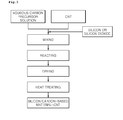
- FIG. 3 is a flow chart illustrating a method for preparing an anode active material using the carbon-based material as the second material.
- a carbon nanotube of a hollow nanofiber type carbon material is dispersed as a first material of a coating layer into an aqueous carbon precursor solution of the second material of the coating layer.
- the amount of the hollow nanofiber type carbon is preferably 0.5 to 8 wt% based on the total amount of the dispersion.
- an active material such as silicon or silicon oxide may be mixed and dispersed.
- the carbon precursor is dissolved in a distilled water and then, the carbon nanotube as the hollow nanofiber type carbon material and the silicon or silicon dioxide as the active particle are continuously mixed.
- the mixing is conducted through a transporting manner of the mixture to a reactor by using a constant delivery pump.
- the reacting system in a reactor may be sufficiently stirred or may be undergo a sonochemical treatment using a sonic wave (sonochemistry) to obtain a silicon complex anode active material coated with the second material of the carbon precursor and the first material of the hollow nanofiber type carbon at the same time, or a silicon oxide complex anode active material coated with the carbon precursor and the hollow nanofiber type carbon at the same time.
- the kinds of the active particle may not be limited to the silicon or the silicon oxide, but various other metal or metal oxides may be used.
- the temperature in the reactor is kept at 5°C to 70°C by using a circulation type constant-temperature bath, an operating frequency is kept to 28 kHz to 400 kHz, and intensity is kept to 100 W to 800 W. More preferably, the precipitation of a crystal may be even more advantageously processed through a multibubble sonoluminescence (MBSL) condition in accordance with example embodiments.
- the operating frequency is kept to 20 kHz to 300 kHz
- the operating intensity is kept to 160 W to 600 W
- the temperature in the reactor is kept to 15°C to 35°C
- the reactor is constantly pressurized to 1 to 5 atm.
- an inert gas selected from the group consisting of a nitrogen gas, an argon gas and a combination thereof is preferably blown into the reactor.
- the nitrogen gas and/or the argon gas is introduced into the reactor, the size of the obtained silicon complex anode active material coated with the carbon-based material and the hollow nanofiber type carbon at the same time, or the silicon dioxide complex anode active material coated with the carbon-based material and the hollow nanofiber type carbon at the same time, may be decreased. Accordingly, the tap density may be further increased. This effect is obtainable through a sonoluminescence phenomenon. This effect is obtained because the reaction is performed at a high temperature under a high pressure obtained through the sonoluminescence phenomenon.
- silicon complex anode active material coated with the carbon-based material and the hollow nanofiber type carbon at the same time has a mean particle diameter of 1 ⁇ m to 30 ⁇ m, more preferably has 1 ⁇ m to 10 ⁇ m, and most preferably has 1 ⁇ m to 5 ⁇ m.
- the mean diameter of the particle before the reaction is 5 nm to 400 nm
- the mean diameter of the particles after coating and calcining is 1 ⁇ m to 30 ⁇ m degree.
- the preferred particle shape is spherical.
- the mixture may be dried and then calcined to obtain the silicon complex anode active material coated with the carbon-based material (carbon precursor) and the hollow nanofiber type carbon at the same time, or the silicon dioxide complex anode active material coated with the carbon-based material and the hollow nanofiber type carbon at the same time, appropriate as the anode active material of the high-capacity lithium secondary battery.
- the calcining may be performed under an inert gas atmosphere at a temperature range of 400°C to 800°C, preferably at 500°C to 700°C to suppress the growing of the particle diameter and to form a preferred structure.
- the inert gas atmosphere in a calcining furnace may be accomplished by blowing at least one gas selected from the group consisting of a nitrogen gas, an argon gas and a combination thereof.
- a nitrogen gas an argon gas and a combination thereof.
- complex anode active material for the secondary battery may include the coating layer including the second material of the carbon-based material and the first material of the hollow nanofiber type carbon, and the active particle within the coating layer, as illustrated in FIG. 1 .
- FIG. 4 is a flow chart illustrating a method for preparing an anode active material using the LTO as the first material in accordance with another example embodiment.
- carbon nanotube dispersed glacial acetic acid and a titanium salt are mixed.
- examples of the titanium salt applicable are as illustrated above.
- silicon or silicon oxide as the active particle is added into the mixture and then mixed. Distilled water is added. After that, the first material and the second material are coated on the surface of the active particle.
- a drying process and a heat treating process are conducted. The condition of the heat treatment for calcining is as described above. Then, an anode active material having a core-coating layer structure of silicon (active particle)-carbon nanotube (CNT, first material)/LTO (second material) is produced.
- the complex anode active material having the above-described properties may be obtained with a good reproducibility and productivity.
- a method of manufacturing a lithium secondary battery including the anode active material for the lithium secondary battery obtained by the above described method is provided.
- the lithium secondary battery in accordance with example embodiments corresponds to a lithium battery including a cathode and anode, a separator disposed between the cathode and the anode and an electrolyte.
- the anode includes the active material. Accordingly, the lithium secondary battery in accordance with example embodiments illustrates better reproducibility, a good lifetime property, etc. than a common lithium secondary battery.
- An aqueous H 2 SiO 3 solution was prepared by substituting Na cation with H cation in an 1M aqueous Na 2 SiO 3 solution by using a cation-exchange resin.
- 3 wt% of hollow nanofiber type carbon (multi-wall carbon nanotube, MWCNT) was uniformly dispersed to obtain a dispersion.
- the dispersing of the hollow nanofiber type carbon was performed by using a sonic wave dispersing method and a high pressure dispersing method.
- an aqueous sucrose solution and an aqueous citric acid solution were added and then stirred for 1 hour.
- a reaction system in a reactor was sufficiently stirred at low speed or was treated using sonic wave (sonochemistry) for 1 hour.
- the temperature in the reactor was kept to 30°C by using a circulation type constant-temperature bath, an operating frequency was kept to 200 kHz and intensity was kept to 300 W.
- the reactor was constantly pressurized to 3 atm, and the inside of the reactor was filled with an argon gas.
- the product was dried in a spray drier at 150°C. After drying, the product was calcined at 700°C to 1,100°C for 24 hours to obtain an anode active material including silicon/silicon oxide active particles and a coating layer of a hollow nanofiber including the CNT and the carbon precursor (sucrose).
- Example 2 The same procedure as described in Example 1 was performed, except that TiO 2 and LiOH were added to prepare LTO instead of the aqueous sucrose solution and the aqueous citric acid solution.
- Example 2 The same procedure as described in Example 1 was performed, except for excluding the sucrose, the citric acid and the carbon nanotube (CNT).
- the particle shapes of the anode active materials obtained from the above Examples were observed by means of a field emission scanning electron microscope (FE-SEM). The results are illustrated in FIGS. 5 and 6 .
- CNT are uniformly dispersed on the particles of the anode active material, and the particle mean size is about 10 micrometers.
- the tap density was calculated by adding 50g of a sample in a cylinder and then measuring the volume after 2,000 times of taps. The results are illustrated in the above Table 1.
- the tap density decreased as the carbon material and the CNT was included in the anode active material.
- the battery performance was improved when the carbon material and the CNT was included from a battery evaluation.
- Anode active material conductive material : binder were weighted in a ratio of 80 : 12 : 8 by weight. Mixed material was made to a slurry and then was coated on an aluminum thin film. After that, a drying was performed at 120°C for 8 hours to manufacture an electrode plate, and the electrode plate was pressed. A Li metal was used as an anode, and a 2030 type coin cell was manufactured. 1M-LiPF 6 dissolved in EC-DEC (1:1 by volume ratio) was used as an electrolyte. Charging/discharging was performed with a charging condition of 1.5V and a discharging condition of 0.02V. The results are illustrated in FIG. 7 .
- an anode active material including the carbon material and the CNT simultaneously is found to illustrate an excellent specific discharging capacity.
Landscapes
- Chemical & Material Sciences (AREA)
- Chemical Kinetics & Catalysis (AREA)
- Electrochemistry (AREA)
- General Chemical & Material Sciences (AREA)
- Inorganic Chemistry (AREA)
- Engineering & Computer Science (AREA)
- Materials Engineering (AREA)
- Composite Materials (AREA)
- Manufacturing & Machinery (AREA)
- Battery Electrode And Active Subsutance (AREA)
Abstract
Description
- The present invention relates to an anode active material for a lithium secondary battery, a method for preparing same, and a lithium secondary battery including same, and more particularly, the present invention relates to an anode active material for a lithium secondary battery, a method for preparing same, and a lithium secondary battery including same, wherein a rapid decrease of a capacity as charging/discharging cycle progressed due to the volume change by the reaction with lithium during charging/discharging and the generation of cracks and the breakage of active material particles, may be prevented, the cycle lifetime may be prolonged, and a high energy density appropriate for a high-capacity battery may be confirmed.
- Recently, demands on lithium secondary batteries have been largely increased as an electric power and a power source of portable small-sized electronic devices such as a cellular phone, a portable personal digital assistant (PDA), a notebook personal computer (PC), MP3, etc. and an electric vehicle. Accordingly, demands on the lithium secondary batteries having a high-capacity and a prolonged lifetime also have been increased.
- As an anode active material of a lithium secondary battery, carbon-based materials have been widely used. However, the carbon-based anode active material has a limited theoretical maximum capacity of 372 mAh/g and has serious lifetime deterioration problem. Accordingly, a lot of researches and suggestions on a lithium alloy material having a high-capacity and being possibly replaced with the lithium metal have been conducted. One method among these is concerned with an application of silicon (Si).
- Generally, silicon reversibly absorbs/releases lithium through a compound forming reaction with lithium. The theoretical maximum capacity of the silicon is about 4,020 mAh/g (9,800 mAh/cc) and is very large when comparing with the carbon-based material. Thus, the silicon has been a promising material as the anode material having a high-capacity. However, cracks may be generated due to the volume change of the silicon active material through the reaction with lithium during charging/discharging, and due to the breakage of the silicon active material particles, the capacity may be rapidly decreased as the charging/discharging cycle proceeds, and the cycle lifetime may be shortened.
- Accordingly, developments on an anode active material having an appropriate energy density for a high-capacity battery, having an excellent stability and safety, keeping good battery properties, and having a long cycle lifetime, and an economic method for preparing the anode active material are required. A method of using silicon with graphite after pulverizing mechanically, or a method of mixing silicon with a carbon material and then calcining has been suggested. When the graphite is added into the silicon, the capacity may be decreased however, the cycle lifetime may be remarkably enhanced. However, an anode active material for a secondary battery including silicon along with hollow nanofiber type carbon, and lithium titanium oxide (LTO) or a carbon-based material, at the same time, and a method for preparing the anode active material have not been suggested.
- Accordingly, an object of the present invention is to provide an anode active material for a lithium secondary battery and a precursor thereof, having an improved electric conductivity, energy density, stability, safety and cycle lifetime property.
- Another object of the present invention is to provide a method for preparing the anode active material for the lithium secondary battery.
- Further another object of the present invention is to provide a lithium secondary battery including the anode active material for the lithium secondary battery.
- According to example embodiments, an anode active material for a lithium secondary battery is provided. The active material includes active particles for absorbing/releasing a lithium ion, and a coating layer coated on a surface of the active particles. The coating layer includes a first material of a hollow nanofiber and a second material of a carbon precursor or lithium titanium oxide (LTO).
- The active particle may be one selected from the group consisting of silicon, silicon oxide, a metal, a metal oxide and a mixture thereof. In this case, the metal may be at least one selected from the group consisting of Sn, Al, Pb, Zn, Bi, In, Mg, Ga, Cd, Ag, Pt, Pd, Ir, Rh, Ru, Ni, Mo, Cr, Cu, Ti, W, Co, V and Ge.
- The hollow nanofiber may be hollow nanofiber type carbon, and may be one of a single-wall carbon nanotube, a multi-wall carbon nanotube, a carbon nanofiber, graphene and a mixture thereof.
- The carbon precursor may be at least one of glucose, sucrose, polyethylene glycol, polyvinyl alcohol, polyvinyl chloride and citric acid, and the carbon precursor preferably may be at least one selected from the group consisting of the glucose, the sucrose and the citric acid.
- The diameter of the hollow nanofiber type carbon may be 2 nm to 100 nm, and a complex anode active material coated with the second material of the carbon precursor or the LTO and the first material of the hollow nanofiber type carbon may be a crystal having a mean diameter of a primary particle of 5 nm to 400 nm and a mean diameter of a secondary particle of 3 µm to 30 µm.
- According to other example embodiments, a method for preparing an anode active material for a lithium secondary battery is provided. The method includes (a) preparing a dispersion by mixing and dispersing active particles for an anode active material, a carbon precursor and a hollow nanofiber type carbon in an aqueous solution, and (b) uniformly coating a surface of the active particles with a coating layer including the hollow nanofiber type carbon and the carbon precursor by stirring a reaction system in a reactor or by applying a sonochemical treatment to the reaction system. The sonochemical treatment may be performed under a multibubble sonoluminescence (MBSL) condition.
- The method may further include drying thus obtained product after coating and calcining the dried product under an inert gas atmosphere to obtain a complex anode active material. The amount of the hollow nanofiber type carbon in the dispersion at step (a) may be in a range of 0.5 to 8 wt% based on a total amount of the dispersion. The dispersing for preparing the dispersion at step (a) may be performed by using one of a sonic wave dispersing method and a high pressure dispersion method.
- The coating at step (b) may be performed under an inert gas atmosphere at a temperature range of 10°C to 50°C, and the calcining may be performed under an inert gas atmosphere at a temperature range of 500°C to 900°C.
- According to further other example embodiments, a lithium secondary battery including the above-described anode active material for a lithium secondary battery is provided.
- The anode active material for the lithium secondary battery in accordance with example embodiments may prevent a rapid decrease of a capacity as charging/discharging cycle progressed due to the volume change by the reaction with lithium during charging/discharging and the generation of cracks and the breakage of active material particles, which may be generated for a silicon anode active material. Thus, the cycle lifetime may be prolonged, and a high energy density appropriate for a high-capacity battery may be confirmed. Therefore, the lithium secondary battery obtained by using the anode active material for the lithium secondary battery in accordance with the present invention may keep a good fundamental electric property, may improve the stability and the safety and may increase the cycle lifetime. In addition, according to the method for preparing the complex anode active material for the lithium secondary battery of the present invention, the complex anode active material may be prepared with a good reproducibility and productivity.
-
-
FIG. 1 is a schematic cross-sectional view of an anode active material for a lithium secondary battery obtained by Example 1. -
FIG. 2 is a schematic cross-sectional view of an anode active material for a lithium secondary battery obtained by Example 2. -
FIG. 3 is a flow chart for explaining a preparing method of an anode active material obtained from Example 1 through a wet process. -
FIG. 4 is a flow chart for explaining a preparing method of an anode active material obtained from Example 2 through a wet process. -
FIG. 5 illustrates analysis results on a complex anode active material for a lithium secondary battery obtained from Example 1 by means of a field emission scanning electron microscope (FE-SEM). -
FIG. 6 illustrates analysis results on a complex anode active material for a lithium secondary battery obtained from Example 2 by means of a field emission scanning electron microscope (FE-SEM). -
FIG. 7 is a graph illustrating charging/discharging results of anode active materials for a lithium secondary battery obtained by example embodiments. - An anode active material for a lithium secondary battery in accordance with example embodiments includes a core and a coating layer coating the core, and the coating layer includes a first material of a hollow nanofiber and a second material to be mixed with the first material. In example embodiments, the core may be silicon, a metal or a metal oxide, a mixture thereof and an alloy thereof, which may absorb/release lithium ions. In addition, the second material may be a carbon-based material in accordance with an example embodiment and may be lithium titanium oxide (LTO, Li4Ti5O12) in accordance with another example embodiment.
- According to example embodiments, an anode active material is divided into a core and a coating layer. The coating layer includes a fiber (first material) having a hollow structure, which is a moving passage of lithium ions and a material (second material) possibly minimizing the particle size of the active material and the volume change due to the reaction with the lithium ions, at the same time. Thus, a rapid decrease of a capacity as charging/discharging cycle progressed due to the volume change by the reaction with lithium during charging/discharging and the generation of cracks and the breakage of active material particles may be prevented. In addition, the coating layer in accordance with example embodiments may be formed by coating the first material and the second material at the same time and so, may be coated on a metal oxide core. Therefore, the present invention is economic.
- Hereinafter, the present invention will be described in more detail referring to example embodiments.
-
FIGS. 1 and 2 illustrate a schematic cross-sectional view of a complex anode active material precursor for a lithium secondary battery or a complex anode active material for a lithium secondary battery in accordance with example embodiments. - Referring to
FIGS. 1 and 2 , anactive particle 102, which is a core, and a coating layer coating theactive particle 102 are illustrated. The coating layer includes afirst material 101, which is a hollow nanofiber, and a second material used along with the first material. The second material includes a carbon-basedmaterial 100 or LTO 103. - The active particles refer to particles having a specific shape (spherical shape, tube shape, etc.) and including an optional material possibly absorb/release the lithium ions. For example, the active particle may be selected from the group consisting of silicon, silicon oxide, a metal, a metal oxide and a mixture thereof, and the metal may be at least one selected from the group consisting of Sn, Al, Pb, Zn, Bi, In, Mg, Ga, Cd, Ag, Pt, Pd, Ir, Rh, Ru, Ni, Mo, Cr, Cu, Ti, W, Co, V and Ge.
- For example, the active particle may be silicon. In this case, the anode active material may have a silicon (core)-(hollow nanofiber + carbon-based compound) (coating layer) structure, or a silicon (core)-(hollow nanofiber + LTO) (coating layer) structure. The
hollow nanofiber 101 preferably is a carbon material having a nano size and pores and may include a single-wall carbon nanotube, a multi-wall carbon nanotube, a carbon nanofiber, graphene or a mixture thereof. However, the scope of the present invention is not limited to these examples but includes all kinds of optional fibers having a structure possibly providing the moving passage of the lithium ions (for example, pore or channel). - The carbon precursor of the second material may include at least one of glucose, sucrose, polyethylene glycol, polyvinyl alcohol, polyvinyl chloride and citric acid and may preferably include the glucose, the sucrose and the citric acid. The carbon precursor may be any material that may undergo a first reaction step with the hollow nanofiber and then may be uniformly coated on the surface of the anode
active material 102. In example embodiments, the carbon precursor may be coated on the surface of the active particles such as silicon, and a portion of carbon and oxygen included in the carbon precursor may be transformed and evaporated into carbon dioxide and carbon monoxide during performing a subsequent heat treatment (calcining process). At last, only the carbon remains on the surface of the active material. An example of the reaction is as follows.
[Chemical Formula 1] C6H8O7•H2O = 3CO + 5H2O + 3C
- An amount of the
second material 100, that is, the carbon precursor or the LTO, is preferably in a range of 5 to 50 wt% based on the anode active material, is more preferably in a range of 10 to 40 wt%, and is most preferably in a range of 20 to 30 wt%. When the amount of the carbon precursor or the LTO is less than 5 wt%, the stability of the anode active material and the lifetime of the battery may be decreased, and when the amount exceeds 50 wt%, the energy density and the tap density may be decreased. - The lithium salt in the
precursor 100 for preparing the LTO may include an acetate compound, a nitrate compound, a sulfate compound, a carbonate compound, a hydroxide compound and a phosphate compound such as lithium phosphate (Li3PO4) , etc. In addition, the titanium salt for preparing the LTO may include a bis(ammonium lactate)dihydroxide compound, a boride compound, a bromide compound, a butoxide compound, a tert-butoxide compound, a chloride compound, a chloride tetrahydrofuran compound, a diisopropoxide bis(acetyacetonate) compound, an ethoxide compound, an ethylhexyloxide compound, a fluoride compound, a hydride compound, an iodide compound, an isopropoxide compound, a methoxide compound, an oxysulfate compound, a propoxide compound, a sulfate compound, etc. All kinds of commercially available salts may be used without specific limitation. - In order to solve another object of the present invention, a method for preparing an anode active material for a lithium secondary battery is provided. The method includes a first step of mixing an active particle such as the silicon, tin dioxide, silicon oxide, a metal oxide including the same, a metal compound, a first material of a hollow nanofiber and a second material of an LTO precursor or a carbon-based material and reacting these materials; and a second step of drying the reaction product from the first step and heat treating at a temperature range of 300°C to 1,000°C.
- The preparation method will be described in more detail below.
-
FIG. 3 is a flow chart illustrating a method for preparing an anode active material using the carbon-based material as the second material. - Referring to
FIG. 3 , a carbon nanotube of a hollow nanofiber type carbon material is dispersed as a first material of a coating layer into an aqueous carbon precursor solution of the second material of the coating layer. The amount of the hollow nanofiber type carbon is preferably 0.5 to 8 wt% based on the total amount of the dispersion. When the amount of the carbon is less than 0.5 wt%, the movement of the lithium ions may be limited, and when the amount of the carbon exceeds 8 wt%, a problem concerning a volume expansion due to heat may be generated. After that, an active material such as silicon or silicon oxide may be mixed and dispersed. That is, the carbon precursor is dissolved in a distilled water and then, the carbon nanotube as the hollow nanofiber type carbon material and the silicon or silicon dioxide as the active particle are continuously mixed. In this case, the mixing is conducted through a transporting manner of the mixture to a reactor by using a constant delivery pump. - After that, the reacting system in a reactor may be sufficiently stirred or may be undergo a sonochemical treatment using a sonic wave (sonochemistry) to obtain a silicon complex anode active material coated with the second material of the carbon precursor and the first material of the hollow nanofiber type carbon at the same time, or a silicon oxide complex anode active material coated with the carbon precursor and the hollow nanofiber type carbon at the same time. The kinds of the active particle may not be limited to the silicon or the silicon oxide, but various other metal or metal oxides may be used.
- Preferably in this case, the temperature in the reactor is kept at 5°C to 70°C by using a circulation type constant-temperature bath, an operating frequency is kept to 28 kHz to 400 kHz, and intensity is kept to 100 W to 800 W. More preferably, the precipitation of a crystal may be even more advantageously processed through a multibubble sonoluminescence (MBSL) condition in accordance with example embodiments. In this case, the operating frequency is kept to 20 kHz to 300 kHz, the operating intensity is kept to 160 W to 600 W, and the temperature in the reactor is kept to 15°C to 35°C, and the reactor is constantly pressurized to 1 to 5 atm.
- Further, an inert gas selected from the group consisting of a nitrogen gas, an argon gas and a combination thereof is preferably blown into the reactor. When the nitrogen gas and/or the argon gas is introduced into the reactor, the size of the obtained silicon complex anode active material coated with the carbon-based material and the hollow nanofiber type carbon at the same time, or the silicon dioxide complex anode active material coated with the carbon-based material and the hollow nanofiber type carbon at the same time, may be decreased. Accordingly, the tap density may be further increased. This effect is obtainable through a sonoluminescence phenomenon. This effect is obtained because the reaction is performed at a high temperature under a high pressure obtained through the sonoluminescence phenomenon.
- Thus obtained silicon complex anode active material coated with the carbon-based material and the hollow nanofiber type carbon at the same time has a mean particle diameter of 1 µm to 30 µm, more preferably has 1 µm to 10 µm, and most preferably has 1 µm to 5 µm. The mean diameter of the particle before the reaction (primary particle) is 5 nm to 400 nm, and the mean diameter of the particles after coating and calcining (secondary particle) is 1 µm to 30 µm degree. The preferred particle shape is spherical.
- Referring to
FIG. 3 again, the mixture may be dried and then calcined to obtain the silicon complex anode active material coated with the carbon-based material (carbon precursor) and the hollow nanofiber type carbon at the same time, or the silicon dioxide complex anode active material coated with the carbon-based material and the hollow nanofiber type carbon at the same time, appropriate as the anode active material of the high-capacity lithium secondary battery. The calcining may be performed under an inert gas atmosphere at a temperature range of 400°C to 800°C, preferably at 500°C to 700°C to suppress the growing of the particle diameter and to form a preferred structure. The inert gas atmosphere in a calcining furnace may be accomplished by blowing at least one gas selected from the group consisting of a nitrogen gas, an argon gas and a combination thereof. Thus obtained complex anode active material for the secondary battery may include the coating layer including the second material of the carbon-based material and the first material of the hollow nanofiber type carbon, and the active particle within the coating layer, as illustrated inFIG. 1 . -
FIG. 4 is a flow chart illustrating a method for preparing an anode active material using the LTO as the first material in accordance with another example embodiment. - Referring to
FIG. 4 , carbon nanotube dispersed glacial acetic acid and a titanium salt, are mixed. Examples of the titanium salt applicable are as illustrated above. Then, silicon or silicon oxide as the active particle is added into the mixture and then mixed. Distilled water is added. After that, the first material and the second material are coated on the surface of the active particle. A drying process and a heat treating process are conducted. The condition of the heat treatment for calcining is as described above. Then, an anode active material having a core-coating layer structure of silicon (active particle)-carbon nanotube (CNT, first material)/LTO (second material) is produced. - In accordance with the method for preparing the complex anode active material for the lithium secondary battery, the complex anode active material having the above-described properties may be obtained with a good reproducibility and productivity.
- According to example embodiments, a method of manufacturing a lithium secondary battery including the anode active material for the lithium secondary battery obtained by the above described method is provided.
- The lithium secondary battery in accordance with example embodiments corresponds to a lithium battery including a cathode and anode, a separator disposed between the cathode and the anode and an electrolyte. The anode includes the active material. Accordingly, the lithium secondary battery in accordance with example embodiments illustrates better reproducibility, a good lifetime property, etc. than a common lithium secondary battery.
- Hereinafter, the present invention will be described in more detail referring to Examples and a Comparative Example not corresponding to the present inventive concept. The scope of the present invention is not limited to the following Examples.
- An aqueous H2SiO3 solution was prepared by substituting Na cation with H cation in an 1M aqueous Na2SiO3 solution by using a cation-exchange resin. Into the aqueous H2SiO3 solution, 3 wt% of hollow nanofiber type carbon (multi-wall carbon nanotube, MWCNT) was uniformly dispersed to obtain a dispersion. The dispersing of the hollow nanofiber type carbon was performed by using a sonic wave dispersing method and a high pressure dispersing method. Into the aqueous H2SiO3 solution, an aqueous sucrose solution and an aqueous citric acid solution were added and then stirred for 1 hour. After that, a reaction system in a reactor was sufficiently stirred at low speed or was treated using sonic wave (sonochemistry) for 1 hour. In this case, the temperature in the reactor was kept to 30°C by using a circulation type constant-temperature bath, an operating frequency was kept to 200 kHz and intensity was kept to 300 W. The reactor was constantly pressurized to 3 atm, and the inside of the reactor was filled with an argon gas. Then, the product was dried in a spray drier at 150°C. After drying, the product was calcined at 700°C to 1,100°C for 24 hours to obtain an anode active material including silicon/silicon oxide active particles and a coating layer of a hollow nanofiber including the CNT and the carbon precursor (sucrose).
- The same procedure as described in Example 1 was performed, except that TiO2 and LiOH were added to prepare LTO instead of the aqueous sucrose solution and the aqueous citric acid solution.
- The same procedure as described in Example 1 was performed, except for excluding the sucrose, the citric acid and the carbon nanotube (CNT).
- The particle shapes of the anode active materials obtained from the above Examples were observed by means of a field emission scanning electron microscope (FE-SEM). The results are illustrated in
FIGS. 5 and6 . - Referring to
FIGS. 5 and6 , it may be confirmed that CNT are uniformly dispersed on the particles of the anode active material, and the particle mean size is about 10 micrometers. - The particle sizes of the samples were analyzed by using a particle size distribution analyzer of a laser diffraction type. The particle size was confirmed when the accumulated volume reached to 10%, 50% and 90% from the result of particle size distribution and was designated by d10, d50 and d90, respectively. The results are illustrated in the following Table 1.
Table 1 Sample Particle size (µm) Tap density (g/cc) Example 1 d10 5.6 1.5 D50 11.2 D90 15.3 Example 2 d10 5.3 1.6 D50 10.2 D90 15.0 Example 3 d10 4.9 1.8 D50 9.0 D90 13.9 - The tap density was calculated by adding 50g of a sample in a cylinder and then measuring the volume after 2,000 times of taps. The results are illustrated in the above Table 1.
- Referring to the results in Table 1, the tap density decreased as the carbon material and the CNT was included in the anode active material. However, the battery performance was improved when the carbon material and the CNT was included from a battery evaluation.
- Anode active material : conductive material : binder were weighted in a ratio of 80 : 12 : 8 by weight. Mixed material was made to a slurry and then was coated on an aluminum thin film. After that, a drying was performed at 120°C for 8 hours to manufacture an electrode plate, and the electrode plate was pressed. A Li metal was used as an anode, and a 2030 type coin cell was manufactured. 1M-LiPF6 dissolved in EC-DEC (1:1 by volume ratio) was used as an electrolyte. Charging/discharging was performed with a charging condition of 1.5V and a discharging condition of 0.02V. The results are illustrated in
FIG. 7 . - Referring to
FIG. 7 , an anode active material including the carbon material and the CNT simultaneously, is found to illustrate an excellent specific discharging capacity.
Claims (13)
- An anode active material for a lithium secondary battery, the active material comprising:active particles for absorbing/releasing a lithium ion; anda coating layer coated on a surface of the active particles, the coating layer comprising a first material of a hollow nanofiber and a second material of a carbon precursor or lithium titanium oxide (LTO).
- The anode active material for a lithium secondary battery according to claim 1, wherein the active particle is one selected from the group consisting of silicon, silicon oxide, a metal, a metal oxide and a mixture thereof, the metal being at least one selected from the group consisting of Sn, Al, Pb, Zn, Bi, In, Mg, Ga, Cd, Ag, Pt, Pd, Ir, Rh, Ru, Ni, Mo, Cr, Cu, Ti, W, Co, V and Ge.
- The anode active material for a lithium secondary battery according to claim 1, wherein the hollow nanofiber is hollow nanofiber type carbon, and one of a single-wall carbon nanotube, a multi-wall carbon nanotube, a carbon nanofiber, graphene and a mixture thereof.
- The anode active material for a lithium secondary battery according to claim 1, wherein the carbon precursor is at least one of glucose, sucrose, polyethylene glycol, polyvinyl alcohol, polyvinyl chloride and citric acid, the carbon precursor preferably being at least one selected from the group consisting of the glucose, the sucrose and the citric acid.
- The anode active material for a lithium secondary battery according to claim 3, wherein a diameter of the hollow nanofiber type carbon is 2 nm to 100 nm, and
wherein a complex anode active material coated with the second material of the carbon precursor or the LTO and the first material of the hollow nanofiber type carbon is a crystal having a mean diameter of a primary particle of 5 nm to 400 nm and a mean diameter of a secondary particle of 3 µm to 30 µm. - A method for preparing an anode active material for a lithium secondary battery comprising:(a) preparing a dispersion by mixing and dispersing active particles for an anode active material, a carbon precursor and a hollow nanofiber type carbon in an aqueous solution; and(b) uniformly coating a surface of the active particles with a coating layer including the hollow nanofiber type carbon and the carbon precursor by stirring a reaction system in a reactor or by applying a sonochemical treatment to the reaction system.
- The method for preparing an anode active material for a lithium secondary battery according to claim 6, wherein the sonochemical treatment is performed under a multibubble sonoluminescence (MBSL) condition.
- The method for preparing an anode active material for a lithium secondary battery according to claim 6, further comprising
drying thus obtained product after coating; and
calcining the dried product under an inert gas atmosphere to obtain a complex anode active material. - The method for preparing an anode active material for a lithium secondary battery according to claim 6, wherein an amount of the hollow nanofiber type carbon in the dispersion at step (a) is in a range of 0.5 to 8 wt% based on a total amount of the dispersion.
- The method for preparing an anode active material for a lithium secondary battery according to claim 6, wherein the dispersing for preparing the dispersion at step (a) is performed by using one of a sonic wave dispersing method and a high pressure dispersion method.
- The method for preparing an anode active material for a lithium secondary battery according to claim 7, wherein the coating at step (b) is performed under an inert gas atmosphere at a temperature range of 10°C to 50°C.
- The method for preparing an anode active material for a lithium secondary battery according to claim 8, wherein the calcining is performed under an inert gas atmosphere at a temperature range of 500°C to 900°C.
- A lithium secondary battery including an anode active material for a lithium secondary battery according to any one of claims 1 to 5.
Applications Claiming Priority (2)
| Application Number | Priority Date | Filing Date | Title |
|---|---|---|---|
| KR20100043798 | 2010-05-11 | ||
| PCT/KR2011/003453 WO2011142575A2 (en) | 2010-05-11 | 2011-05-11 | Anode active material for a lithium secondary battery, method for preparing same, and lithium secondary battery including same |
Publications (2)
| Publication Number | Publication Date |
|---|---|
| EP2571084A2 true EP2571084A2 (en) | 2013-03-20 |
| EP2571084A4 EP2571084A4 (en) | 2013-10-02 |
Family
ID=44914810
Family Applications (1)
| Application Number | Title | Priority Date | Filing Date |
|---|---|---|---|
| EP11780792.5A Withdrawn EP2571084A4 (en) | 2010-05-11 | 2011-05-11 | Anode active material for a lithium secondary battery, method for preparing same, and lithium secondary battery including same |
Country Status (6)
| Country | Link |
|---|---|
| US (1) | US20130059203A1 (en) |
| EP (1) | EP2571084A4 (en) |
| JP (1) | JP2013528907A (en) |
| KR (1) | KR20110124728A (en) |
| CN (1) | CN102934265A (en) |
| WO (1) | WO2011142575A2 (en) |
Cited By (1)
| Publication number | Priority date | Publication date | Assignee | Title |
|---|---|---|---|---|
| CN108602689A (en) * | 2016-07-04 | 2018-09-28 | 株式会社Lg化学 | Method for preparing positive electrode active material for secondary battery and positive electrode active material for secondary battery prepared thereby |
Families Citing this family (44)
| Publication number | Priority date | Publication date | Assignee | Title |
|---|---|---|---|---|
| JP2013191529A (en) * | 2012-02-16 | 2013-09-26 | Hitachi Chemical Co Ltd | Composite material, method for manufacturing composite material, electrode material for lithium ion secondary battery, negative electrode for lithium ion secondary battery, and lithium ion secondary battery |
| WO2014027845A1 (en) * | 2012-08-16 | 2014-02-20 | 충남대학교산학협력단 | Silicon composite anode active material for lithium secondary batteries, method for preparing same, and lithium secondary batteries including same |
| WO2014054792A1 (en) * | 2012-10-05 | 2014-04-10 | ソニー株式会社 | Active material, process for manufacturing active material, electrode, and secondary battery |
| KR101456201B1 (en) * | 2012-10-16 | 2014-10-31 | 국립대학법인 울산과학기술대학교 산학협력단 | Negative electrode active material for rechargeable lithium battery, method for preparing the same, and rechargeable lithium battery including the same |
| KR101906973B1 (en) * | 2012-12-05 | 2018-12-07 | 삼성전자주식회사 | Silicon nano particles for anode active materials having modified surface characteristics and methods of preparing the same |
| KR101582385B1 (en) | 2012-12-21 | 2016-01-04 | 주식회사 엘지화학 | Anode active material for lithium secondary battery, preparation method thereof, and lithium secondary battery comprising the same |
| CN104011910B (en) * | 2012-12-21 | 2017-08-08 | 株式会社Lg 化学 | Cathode active material, its preparation method and the lithium secondary battery for including the negative active core-shell material |
| KR101463171B1 (en) * | 2013-01-11 | 2014-11-21 | 주식회사 예일전자 | Manufacturing method of carbon-coated silicon oxide in use of anode material for secondary battery |
| KR101687055B1 (en) * | 2013-05-16 | 2016-12-15 | 주식회사 엘지화학 | Hollow silicon-based particles, preparation method of thereof, and anode active material for lithium secondary battery comprising the same |
| JP6193184B2 (en) * | 2013-07-08 | 2017-09-06 | 株式会社東芝 | Negative electrode active material for nonaqueous electrolyte secondary battery, method for producing negative electrode active material for nonaqueous electrolyte secondary battery, nonaqueous electrolyte secondary battery, battery pack and vehicle |
| CN104282881B (en) * | 2013-07-11 | 2017-03-08 | 万向一二三股份公司 | A kind of soft bag lithium ionic cell silicium cathode and its manufacture method |
| US9959947B2 (en) | 2013-09-30 | 2018-05-01 | Samsung Electronics Co., Ltd. | Composite, carbon composite including the composite, electrode, lithium battery, electroluminescent device, biosensor, semiconductor device, and thermoelectric device including the composite and/or the carbon composite |
| CN103872326A (en) * | 2014-04-08 | 2014-06-18 | 福建师范大学 | Lantern ring shaped oxide modified carbon nanofiber as lithium ion battery cathode material |
| KR102161625B1 (en) | 2014-05-09 | 2020-10-05 | 삼성에스디아이 주식회사 | Negative electrode, lithium battery including the same and method of manufacture of lithium battery |
| KR102234287B1 (en) * | 2014-08-08 | 2021-03-31 | 삼성에스디아이 주식회사 | Negative active material, negative electrode and lithium battery including the negative active material, and method for manufacturing the negative active material |
| US20160181604A1 (en) * | 2014-09-12 | 2016-06-23 | Johnson Controls Technology Company | Systems and methods for lithium titanate oxide (lto) anode electrodes for lithium ion battery cells |
| US20160181603A1 (en) * | 2014-09-12 | 2016-06-23 | Johnson Controls Technology Company | Systems and methods for lithium titanate oxide (lto) anode electrodes for lithium ion battery cells |
| JP6438287B2 (en) | 2014-12-05 | 2018-12-12 | 株式会社東芝 | Non-aqueous electrolyte battery active material, non-aqueous electrolyte battery electrode, non-aqueous electrolyte secondary battery and battery pack |
| KR101942496B1 (en) | 2015-08-20 | 2019-01-25 | 주식회사 엘지화학 | Device for Manufacturing Secondary Battery Capable of Removing Gas by Vibration |
| KR101997746B1 (en) | 2015-09-24 | 2019-07-08 | 삼성전자주식회사 | Battery pack and method of controlling charging and dischraging of the battery pack |
| KR102537224B1 (en) * | 2015-10-12 | 2023-05-26 | 삼성에스디아이 주식회사 | Composite electrode active material, lithium battery including the same, and method for preparing the composite electrode active material |
| KR102479726B1 (en) | 2015-10-22 | 2022-12-21 | 삼성전자주식회사 | Electrode active material, electrode and secondary battery including the same, and method of preparing the electrode active material |
| KR102537225B1 (en) * | 2015-10-23 | 2023-05-30 | 삼성전자주식회사 | Composite anode active material, anode including the material, and lithium secondary battery including the anode |
| US20170214038A1 (en) * | 2016-01-25 | 2017-07-27 | Ford Cheer International Limited | Lithium titanate electrode material, producing method and applications of same |
| PL3343677T3 (en) | 2016-06-02 | 2023-10-30 | Lg Energy Solution, Ltd. | Cathode active material, cathode comprising same, and lithium secondary battery comprising same |
| WO2017209561A1 (en) * | 2016-06-02 | 2017-12-07 | 주식회사 엘지화학 | Cathode active material, cathode comprising same, and lithium secondary battery comprising same |
| PL3516716T3 (en) * | 2016-09-19 | 2021-06-28 | Umicore | Rechargeable electrochemical cell and battery |
| EP3324419B1 (en) | 2016-11-18 | 2020-04-22 | Samsung Electronics Co., Ltd. | Porous silicon composite cluster structure, method of preparing the same, carbon composite using the same, and electrode, lithium battery, and device each including the same |
| JP7099325B2 (en) | 2016-11-22 | 2022-07-12 | 三菱ケミカル株式会社 | Negative electrode material for non-aqueous secondary batteries, negative electrode for non-aqueous secondary batteries and non-aqueous secondary batteries |
| WO2018098506A1 (en) * | 2016-11-28 | 2018-05-31 | Sila Nanotechnologies Inc. | High-capacity battery electrodes with improved binders, construction, and performance |
| CN106848225B (en) * | 2017-01-20 | 2020-03-10 | 祝巧凤 | Coating material for improving safety of lithium ion battery, preparation method thereof and battery application |
| JP6986199B2 (en) * | 2017-11-08 | 2021-12-22 | トヨタ自動車株式会社 | Negative electrode material and lithium secondary battery using it |
| JP6876257B2 (en) * | 2018-09-14 | 2021-05-26 | トヨタ自動車株式会社 | Negative electrode for lithium ion secondary battery |
| KR102701081B1 (en) | 2018-10-25 | 2024-09-04 | 삼성전자주식회사 | Porous silicon-containing composite, carbon composite using the same, and electrode, lithium battery, and electronic device each including the same |
| CN109326788A (en) * | 2018-11-20 | 2019-02-12 | 青海大学 | Negative electrode material, lithium ion battery and preparation method thereof |
| KR102799193B1 (en) | 2019-07-26 | 2025-04-23 | 주식회사 엘지에너지솔루션 | Composite active material for negative electrode, method for manufacturing the same, negative electrode and secondary battery comprising the same |
| KR102666155B1 (en) | 2019-09-30 | 2024-05-16 | 주식회사 엘지에너지솔루션 | Composite active material for negative electrode, method for manufacturing the same, and negative electrode comprising the same |
| KR102789813B1 (en) * | 2019-10-10 | 2025-03-31 | 주식회사 엘지화학 | A method for manufacturing an anode including silicon for an electrochemical device |
| KR102362667B1 (en) * | 2019-12-20 | 2022-02-14 | 주식회사 포스코 | Negative electrode for lithium ion secondary battery and lithium ion secondary battery using the same |
| CN113823772B (en) * | 2020-06-19 | 2023-10-31 | 兰溪致德新能源材料有限公司 | Silicon-carbon composite material for secondary lithium battery and preparation method thereof |
| CN112103481B (en) * | 2020-08-17 | 2025-07-11 | 格力钛新能源股份有限公司 | Lithium battery silicon-carbon negative electrode material and its preparation method and application |
| JP7582135B2 (en) * | 2021-09-13 | 2024-11-13 | トヨタ自動車株式会社 | Coated negative electrode active material and all-solid-state battery |
| CN114275823B (en) * | 2021-12-15 | 2024-02-13 | 欣旺达惠州动力新能源有限公司 | Hollow nanosphere composite material, preparation method thereof and lithium battery |
| CN114907613B (en) * | 2022-03-23 | 2023-10-31 | 上海工程技术大学 | Carbon nano tube/polydopamine-reduced graphene oxide/three-dimensional interconnected porous silicon rubber composite material, and preparation method and application thereof |
Family Cites Families (7)
| Publication number | Priority date | Publication date | Assignee | Title |
|---|---|---|---|---|
| EP0851517B1 (en) * | 1996-12-26 | 2001-03-21 | Mitsubishi Denki Kabushiki Kaisha | Electrode having PTC characteristics and battery using the same |
| CN100511781C (en) * | 2004-12-22 | 2009-07-08 | 松下电器产业株式会社 | Composite negative-electrode active material, process for producing the same and nonaqueous-electrolyte secondary battery |
| KR100759556B1 (en) * | 2005-10-17 | 2007-09-18 | 삼성에스디아이 주식회사 | Anode active material, method of preparing the same, and anode and lithium battery containing the material |
| KR101064767B1 (en) * | 2007-07-26 | 2011-09-14 | 주식회사 엘지화학 | Core-shell electrode active material |
| KR100888685B1 (en) * | 2007-11-05 | 2009-03-13 | 주식회사 코캄 | Anode active material for core-shell type lithium secondary battery, method for manufacturing same and lithium secondary battery comprising same |
| KR100913178B1 (en) * | 2007-11-22 | 2009-08-19 | 삼성에스디아이 주식회사 | Active material for lithium secondary battery and lithium secondary battery comprising same |
| KR20100073506A (en) * | 2008-12-23 | 2010-07-01 | 삼성전자주식회사 | Negative active material, negative electrode comprising same, method of preparing negative electrode, and lithium battery |
-
2011
- 2011-05-11 KR KR1020110043988A patent/KR20110124728A/en not_active Ceased
- 2011-05-11 CN CN2011800285886A patent/CN102934265A/en active Pending
- 2011-05-11 JP JP2013510022A patent/JP2013528907A/en not_active Withdrawn
- 2011-05-11 WO PCT/KR2011/003453 patent/WO2011142575A2/en not_active Ceased
- 2011-05-11 US US13/696,916 patent/US20130059203A1/en not_active Abandoned
- 2011-05-11 EP EP11780792.5A patent/EP2571084A4/en not_active Withdrawn
Cited By (2)
| Publication number | Priority date | Publication date | Assignee | Title |
|---|---|---|---|---|
| CN108602689A (en) * | 2016-07-04 | 2018-09-28 | 株式会社Lg化学 | Method for preparing positive electrode active material for secondary battery and positive electrode active material for secondary battery prepared thereby |
| US10637056B2 (en) | 2016-07-04 | 2020-04-28 | Lg Chem, Ltd. | Method of preparing positive electrode active material for secondary battery and positive electrode active material for secondary battery prepared thereby |
Also Published As
| Publication number | Publication date |
|---|---|
| KR20110124728A (en) | 2011-11-17 |
| CN102934265A (en) | 2013-02-13 |
| US20130059203A1 (en) | 2013-03-07 |
| WO2011142575A2 (en) | 2011-11-17 |
| EP2571084A4 (en) | 2013-10-02 |
| WO2011142575A3 (en) | 2012-03-01 |
| JP2013528907A (en) | 2013-07-11 |
| WO2011142575A9 (en) | 2012-04-19 |
Similar Documents
| Publication | Publication Date | Title |
|---|---|---|
| EP2571084A2 (en) | Anode active material for a lithium secondary battery, method for preparing same, and lithium secondary battery including same | |
| CN112952049B (en) | A method for repairing the surface structure of high-nickel cathode materials, the high-nickel cathode materials obtained therefrom, and lithium-ion batteries. | |
| JP7816885B2 (en) | Positive electrode active material for lithium secondary battery, method for producing the same, and lithium secondary battery including the same | |
| EP2741354B1 (en) | Cathode active material for lithium-ion secondary battery | |
| EP3550641A1 (en) | Nickel active material precursor for lithium secondary battery, method for producing nickel active material precursor, nickel active material for lithium secondary battery produced by method, and lithium secondary battery having cathode containing nickel active material | |
| EP3550642A1 (en) | Nickel active material precursor for lithium secondary battery, method for producing nickel active material precursor, nickel active material for lithium secondary battery produced by method, and lithium secondary battery having cathode containing nickel active material | |
| CN115472838B (en) | Positive electrode material, preparation method thereof, and lithium ion battery | |
| EP4318665A1 (en) | Positive electrode active material for lithium secondary battery and lithium secondary battery comprising same | |
| EP2763217A1 (en) | Lithium ion secondary battery positive electrode active material, and production method thereof | |
| Ghiyasiyan-Arani et al. | Synergic and coupling effect between SnO 2 nanoparticles and hierarchical AlV 3 O 9 microspheres toward emerging electrode materials for lithium-ion battery devices | |
| US11239463B2 (en) | Process for producing cathode active material, cathode active material, positive electrode, and lithium ion secondary battery | |
| CN112349885B (en) | Modified lithium ion battery positive electrode material and preparation method thereof | |
| Zhang et al. | Sacrificial template strategy toward a hollow LiNi1/3Co1/3Mn1/3O2 nanosphere cathode for advanced lithium-ion batteries | |
| US11001506B2 (en) | Method of producing high performance lithium titanate anode material for lithium ion battery applications | |
| US20130337335A1 (en) | Negative electrode material for a secondary battery and method for manufacturing same | |
| CN1178396A (en) | Mannufacturing method of lithium complex oxide comprising cobalt or nickel | |
| Song et al. | Coating TiO2 on lithium-rich Li1. 2Mn0. 54Ni0. 13Co0. 13O2 material to improve its electrochemical performance | |
| CN115663126A (en) | Positive electrode material and preparation method thereof, lithium ion battery | |
| Yang et al. | Oxygen vacancies in CeO2 surface coating to improve the activation of layered Li1. 2Mn0. 54Ni0. 13Co0. 13O2 cathode material for Li-ion batteries | |
| Zhou et al. | Fabrication of TiO 2 coated porous CoMn 2 O 4 submicrospheres for advanced lithium-ion anodes | |
| Yang et al. | Uniform Ag 6 Mo 10 O 33 meso/nanowires: High-efficient fabrication, novel growth mechanism, and reversibly high-energy sodium-ion battery | |
| US10811682B2 (en) | Cathode active material, positive electrode for lithium ion secondary battery and lithium ion secondary battery | |
| Leng et al. | Spinel LiMn2O4 nanoparticles grown in situ on nitrogen-doped reduced graphene oxide as an efficient cathode for a Li-O2/Li-ion twin battery | |
| Guo et al. | Sb nanocrystal-anchored hollow carbon microspheres for high-capacity and high-cycling performance lithium-ion batteries | |
| KR102912050B1 (en) | Silicon-carbon composite, preparation method thereof, and negative electrode active material comprising same |
Legal Events
| Date | Code | Title | Description |
|---|---|---|---|
| PUAI | Public reference made under article 153(3) epc to a published international application that has entered the european phase |
Free format text: ORIGINAL CODE: 0009012 |
|
| 17P | Request for examination filed |
Effective date: 20121211 |
|
| AK | Designated contracting states |
Kind code of ref document: A2 Designated state(s): AL AT BE BG CH CY CZ DE DK EE ES FI FR GB GR HR HU IE IS IT LI LT LU LV MC MK MT NL NO PL PT RO RS SE SI SK SM TR |
|
| DAX | Request for extension of the european patent (deleted) | ||
| A4 | Supplementary search report drawn up and despatched |
Effective date: 20130903 |
|
| RIC1 | Information provided on ipc code assigned before grant |
Ipc: H01M 4/62 20060101ALI20130828BHEP Ipc: H01M 10/052 20100101ALN20130828BHEP Ipc: H01M 4/134 20100101AFI20130828BHEP Ipc: H01M 4/48 20100101ALI20130828BHEP Ipc: H01M 4/485 20100101ALI20130828BHEP Ipc: H01M 4/38 20060101ALI20130828BHEP Ipc: H01M 4/587 20100101ALI20130828BHEP Ipc: H01M 4/1397 20100101ALI20130828BHEP |
|
| STAA | Information on the status of an ep patent application or granted ep patent |
Free format text: STATUS: THE APPLICATION IS DEEMED TO BE WITHDRAWN |
|
| 18D | Application deemed to be withdrawn |
Effective date: 20140401 |