EP2569260B1 - Coating composition , method and article - Google Patents
Coating composition , method and article Download PDFInfo
- Publication number
- EP2569260B1 EP2569260B1 EP11781000.2A EP11781000A EP2569260B1 EP 2569260 B1 EP2569260 B1 EP 2569260B1 EP 11781000 A EP11781000 A EP 11781000A EP 2569260 B1 EP2569260 B1 EP 2569260B1
- Authority
- EP
- European Patent Office
- Prior art keywords
- nanoparticles
- groups
- coating composition
- nonspherical
- coating
- Prior art date
- Legal status (The legal status is an assumption and is not a legal conclusion. Google has not performed a legal analysis and makes no representation as to the accuracy of the status listed.)
- Revoked
Links
- 0 CC(C)(C*C(C)(C)C=C*)N Chemical compound CC(C)(C*C(C)(C)C=C*)N 0.000 description 2
Classifications
-
- H—ELECTRICITY
- H10—SEMICONDUCTOR DEVICES; ELECTRIC SOLID-STATE DEVICES NOT OTHERWISE PROVIDED FOR
- H10F—INORGANIC SEMICONDUCTOR DEVICES SENSITIVE TO INFRARED RADIATION, LIGHT, ELECTROMAGNETIC RADIATION OF SHORTER WAVELENGTH OR CORPUSCULAR RADIATION
- H10F77/00—Constructional details of devices covered by this subclass
- H10F77/30—Coatings
- H10F77/306—Coatings for devices having potential barriers
- H10F77/311—Coatings for devices having potential barriers for photovoltaic cells
- H10F77/315—Coatings for devices having potential barriers for photovoltaic cells the coatings being antireflective or having enhancing optical properties
-
- C—CHEMISTRY; METALLURGY
- C03—GLASS; MINERAL OR SLAG WOOL
- C03C—CHEMICAL COMPOSITION OF GLASSES, GLAZES OR VITREOUS ENAMELS; SURFACE TREATMENT OF GLASS; SURFACE TREATMENT OF FIBRES OR FILAMENTS MADE FROM GLASS, MINERALS OR SLAGS; JOINING GLASS TO GLASS OR OTHER MATERIALS
- C03C17/00—Surface treatment of glass, not in the form of fibres or filaments, by coating
- C03C17/006—Surface treatment of glass, not in the form of fibres or filaments, by coating with materials of composite character
- C03C17/007—Surface treatment of glass, not in the form of fibres or filaments, by coating with materials of composite character containing a dispersed phase, e.g. particles, fibres or flakes, in a continuous phase
-
- C—CHEMISTRY; METALLURGY
- C09—DYES; PAINTS; POLISHES; NATURAL RESINS; ADHESIVES; COMPOSITIONS NOT OTHERWISE PROVIDED FOR; APPLICATIONS OF MATERIALS NOT OTHERWISE PROVIDED FOR
- C09D—COATING COMPOSITIONS, e.g. PAINTS, VARNISHES OR LACQUERS; FILLING PASTES; CHEMICAL PAINT OR INK REMOVERS; INKS; CORRECTING FLUIDS; WOODSTAINS; PASTES OR SOLIDS FOR COLOURING OR PRINTING; USE OF MATERIALS THEREFOR
- C09D1/00—Coating compositions, e.g. paints, varnishes or lacquers, based on inorganic substances
-
- C—CHEMISTRY; METALLURGY
- C09—DYES; PAINTS; POLISHES; NATURAL RESINS; ADHESIVES; COMPOSITIONS NOT OTHERWISE PROVIDED FOR; APPLICATIONS OF MATERIALS NOT OTHERWISE PROVIDED FOR
- C09D—COATING COMPOSITIONS, e.g. PAINTS, VARNISHES OR LACQUERS; FILLING PASTES; CHEMICAL PAINT OR INK REMOVERS; INKS; CORRECTING FLUIDS; WOODSTAINS; PASTES OR SOLIDS FOR COLOURING OR PRINTING; USE OF MATERIALS THEREFOR
- C09D7/00—Features of coating compositions, not provided for in group C09D5/00; Processes for incorporating ingredients in coating compositions
- C09D7/40—Additives
- C09D7/60—Additives non-macromolecular
- C09D7/61—Additives non-macromolecular inorganic
-
- C—CHEMISTRY; METALLURGY
- C09—DYES; PAINTS; POLISHES; NATURAL RESINS; ADHESIVES; COMPOSITIONS NOT OTHERWISE PROVIDED FOR; APPLICATIONS OF MATERIALS NOT OTHERWISE PROVIDED FOR
- C09D—COATING COMPOSITIONS, e.g. PAINTS, VARNISHES OR LACQUERS; FILLING PASTES; CHEMICAL PAINT OR INK REMOVERS; INKS; CORRECTING FLUIDS; WOODSTAINS; PASTES OR SOLIDS FOR COLOURING OR PRINTING; USE OF MATERIALS THEREFOR
- C09D7/00—Features of coating compositions, not provided for in group C09D5/00; Processes for incorporating ingredients in coating compositions
- C09D7/40—Additives
- C09D7/66—Additives characterised by particle size
- C09D7/67—Particle size smaller than 100 nm
-
- C—CHEMISTRY; METALLURGY
- C09—DYES; PAINTS; POLISHES; NATURAL RESINS; ADHESIVES; COMPOSITIONS NOT OTHERWISE PROVIDED FOR; APPLICATIONS OF MATERIALS NOT OTHERWISE PROVIDED FOR
- C09D—COATING COMPOSITIONS, e.g. PAINTS, VARNISHES OR LACQUERS; FILLING PASTES; CHEMICAL PAINT OR INK REMOVERS; INKS; CORRECTING FLUIDS; WOODSTAINS; PASTES OR SOLIDS FOR COLOURING OR PRINTING; USE OF MATERIALS THEREFOR
- C09D7/00—Features of coating compositions, not provided for in group C09D5/00; Processes for incorporating ingredients in coating compositions
- C09D7/40—Additives
- C09D7/70—Additives characterised by shape, e.g. fibres, flakes or microspheres
-
- C—CHEMISTRY; METALLURGY
- C03—GLASS; MINERAL OR SLAG WOOL
- C03C—CHEMICAL COMPOSITION OF GLASSES, GLAZES OR VITREOUS ENAMELS; SURFACE TREATMENT OF GLASS; SURFACE TREATMENT OF FIBRES OR FILAMENTS MADE FROM GLASS, MINERALS OR SLAGS; JOINING GLASS TO GLASS OR OTHER MATERIALS
- C03C2217/00—Coatings on glass
- C03C2217/40—Coatings comprising at least one inhomogeneous layer
- C03C2217/425—Coatings comprising at least one inhomogeneous layer consisting of a porous layer
-
- C—CHEMISTRY; METALLURGY
- C03—GLASS; MINERAL OR SLAG WOOL
- C03C—CHEMICAL COMPOSITION OF GLASSES, GLAZES OR VITREOUS ENAMELS; SURFACE TREATMENT OF GLASS; SURFACE TREATMENT OF FIBRES OR FILAMENTS MADE FROM GLASS, MINERALS OR SLAGS; JOINING GLASS TO GLASS OR OTHER MATERIALS
- C03C2217/00—Coatings on glass
- C03C2217/40—Coatings comprising at least one inhomogeneous layer
- C03C2217/43—Coatings comprising at least one inhomogeneous layer consisting of a dispersed phase in a continuous phase
- C03C2217/46—Coatings comprising at least one inhomogeneous layer consisting of a dispersed phase in a continuous phase characterized by the dispersed phase
- C03C2217/465—Coatings comprising at least one inhomogeneous layer consisting of a dispersed phase in a continuous phase characterized by the dispersed phase having a specific shape
-
- C—CHEMISTRY; METALLURGY
- C03—GLASS; MINERAL OR SLAG WOOL
- C03C—CHEMICAL COMPOSITION OF GLASSES, GLAZES OR VITREOUS ENAMELS; SURFACE TREATMENT OF GLASS; SURFACE TREATMENT OF FIBRES OR FILAMENTS MADE FROM GLASS, MINERALS OR SLAGS; JOINING GLASS TO GLASS OR OTHER MATERIALS
- C03C2217/00—Coatings on glass
- C03C2217/40—Coatings comprising at least one inhomogeneous layer
- C03C2217/43—Coatings comprising at least one inhomogeneous layer consisting of a dispersed phase in a continuous phase
- C03C2217/46—Coatings comprising at least one inhomogeneous layer consisting of a dispersed phase in a continuous phase characterized by the dispersed phase
- C03C2217/47—Coatings comprising at least one inhomogeneous layer consisting of a dispersed phase in a continuous phase characterized by the dispersed phase consisting of a specific material
- C03C2217/475—Inorganic materials
- C03C2217/478—Silica
-
- C—CHEMISTRY; METALLURGY
- C08—ORGANIC MACROMOLECULAR COMPOUNDS; THEIR PREPARATION OR CHEMICAL WORKING-UP; COMPOSITIONS BASED THEREON
- C08K—Use of inorganic or non-macromolecular organic substances as compounding ingredients
- C08K3/00—Use of inorganic substances as compounding ingredients
- C08K3/34—Silicon-containing compounds
- C08K3/36—Silica
-
- C—CHEMISTRY; METALLURGY
- C08—ORGANIC MACROMOLECULAR COMPOUNDS; THEIR PREPARATION OR CHEMICAL WORKING-UP; COMPOSITIONS BASED THEREON
- C08K—Use of inorganic or non-macromolecular organic substances as compounding ingredients
- C08K9/00—Use of pretreated ingredients
- C08K9/04—Ingredients treated with organic substances
- C08K9/06—Ingredients treated with organic substances with silicon-containing compounds
-
- Y—GENERAL TAGGING OF NEW TECHNOLOGICAL DEVELOPMENTS; GENERAL TAGGING OF CROSS-SECTIONAL TECHNOLOGIES SPANNING OVER SEVERAL SECTIONS OF THE IPC; TECHNICAL SUBJECTS COVERED BY FORMER USPC CROSS-REFERENCE ART COLLECTIONS [XRACs] AND DIGESTS
- Y02—TECHNOLOGIES OR APPLICATIONS FOR MITIGATION OR ADAPTATION AGAINST CLIMATE CHANGE
- Y02E—REDUCTION OF GREENHOUSE GAS [GHG] EMISSIONS, RELATED TO ENERGY GENERATION, TRANSMISSION OR DISTRIBUTION
- Y02E10/00—Energy generation through renewable energy sources
- Y02E10/50—Photovoltaic [PV] energy
-
- Y—GENERAL TAGGING OF NEW TECHNOLOGICAL DEVELOPMENTS; GENERAL TAGGING OF CROSS-SECTIONAL TECHNOLOGIES SPANNING OVER SEVERAL SECTIONS OF THE IPC; TECHNICAL SUBJECTS COVERED BY FORMER USPC CROSS-REFERENCE ART COLLECTIONS [XRACs] AND DIGESTS
- Y10—TECHNICAL SUBJECTS COVERED BY FORMER USPC
- Y10T—TECHNICAL SUBJECTS COVERED BY FORMER US CLASSIFICATION
- Y10T428/00—Stock material or miscellaneous articles
- Y10T428/31—Surface property or characteristic of web, sheet or block
- Y10T428/315—Surface modified glass [e.g., tempered, strengthened, etc.]
-
- Y—GENERAL TAGGING OF NEW TECHNOLOGICAL DEVELOPMENTS; GENERAL TAGGING OF CROSS-SECTIONAL TECHNOLOGIES SPANNING OVER SEVERAL SECTIONS OF THE IPC; TECHNICAL SUBJECTS COVERED BY FORMER USPC CROSS-REFERENCE ART COLLECTIONS [XRACs] AND DIGESTS
- Y10—TECHNICAL SUBJECTS COVERED BY FORMER USPC
- Y10T—TECHNICAL SUBJECTS COVERED BY FORMER US CLASSIFICATION
- Y10T428/00—Stock material or miscellaneous articles
- Y10T428/31504—Composite [nonstructural laminate]
- Y10T428/31511—Of epoxy ether
- Y10T428/31525—Next to glass or quartz
-
- Y—GENERAL TAGGING OF NEW TECHNOLOGICAL DEVELOPMENTS; GENERAL TAGGING OF CROSS-SECTIONAL TECHNOLOGIES SPANNING OVER SEVERAL SECTIONS OF THE IPC; TECHNICAL SUBJECTS COVERED BY FORMER USPC CROSS-REFERENCE ART COLLECTIONS [XRACs] AND DIGESTS
- Y10—TECHNICAL SUBJECTS COVERED BY FORMER USPC
- Y10T—TECHNICAL SUBJECTS COVERED BY FORMER US CLASSIFICATION
- Y10T428/00—Stock material or miscellaneous articles
- Y10T428/31504—Composite [nonstructural laminate]
- Y10T428/31551—Of polyamidoester [polyurethane, polyisocyanate, polycarbamate, etc.]
- Y10T428/31645—Next to addition polymer from unsaturated monomers
-
- Y—GENERAL TAGGING OF NEW TECHNOLOGICAL DEVELOPMENTS; GENERAL TAGGING OF CROSS-SECTIONAL TECHNOLOGIES SPANNING OVER SEVERAL SECTIONS OF THE IPC; TECHNICAL SUBJECTS COVERED BY FORMER USPC CROSS-REFERENCE ART COLLECTIONS [XRACs] AND DIGESTS
- Y10—TECHNICAL SUBJECTS COVERED BY FORMER USPC
- Y10T—TECHNICAL SUBJECTS COVERED BY FORMER US CLASSIFICATION
- Y10T428/00—Stock material or miscellaneous articles
- Y10T428/31504—Composite [nonstructural laminate]
- Y10T428/31652—Of asbestos
- Y10T428/31667—Next to addition polymer from unsaturated monomers, or aldehyde or ketone condensation product
Definitions
- the present application relates to a coating composition, a method of modifying a substrate surface and articles coated with the coating composition.
- Articles having surfaces with antireflective, easy cleaning and improved durability characteristics are desirable for a variety of uses.
- photoelectric conversion ratio of the solar glass for a solar battery can be improved by a glass coating.
- U.S. Patent Nos. 6,040,378 and 6,352,780 disclosed a polymeric coating composition for application onto glass substrates for anti-reflective properties.
- the coating is provided via chemical grafting that involves the use of monomers and/or prepolymers, catalyst and graft initiator and when applied onto the surface of the glass substrate forms a polymeric film chemically bonded to the glass with excellent adhesion.
- This coating can reduce the reflectance of the coated glass surface as close to zero as possible, thus maximizing transmittance and providing resistance to abrasion, water/chemical attack and UV degradation.
- 6,838,178 disclosed a color neutral absorbing film that is applied as a coating on a glass substrate, to which a conductive coating is first applied. An additional metal oxide layer is deposited on the absorbing film.
- the coating is suitable for use in anti-reflective coatings containing other metal oxides to achieve a coated glass article having a visible light transmittance of 30% or greater and a reflectance of less than 5%.
- the coated glass article is absorbing, anti-reflective and conducting.
- U.S. Patent No. 6,858,306 disclosed a coated article including a glass substrate, a coating of antimony doped tin oxide deposited on and adhering to the glass substrate and a coating of fluorine doped tin oxide.
- the low emittance of the coated glass article when combined with the surprisingly selective solar absorption of the multilayer stack provides improved heat rejection in summer and heat retention in winter, while permitting the transmittance of a relatively high degree of visible light.
- US-A-2008/032053 describes a low refractive index composition comprising the reaction product of (i) a cross-linkable polymer; (ii) a multiolefinic crosslinker; and (iii) a plurality of solid nanosilica particles; (iv) a plurality of porous nanosilica particles; (v) an oxysilane having at least one polymerizable functional group and at least one of a hydrolysis and condensation product of said oxysilane; and (vi) a free radical polymerization initiator.
- the liquid is an aqueous-based liquid.
- the coating compositions utilize nonspherical and spherical nanoparticles, wherein a least a portion of nonspherical nanoparticles or at least a portion of spherical nanoparticles are functionalized with at least one group selected from the group consisting of epoxy group, amine group, hydroxyl, olefin, alkyne, (meth) acrylato, mercapto or combinations thereof attached to their surfaces through chemical bonds.
- the nanoparticles are silica nanoparticles.
- all of the nonspherical nanoparticles are functionalized with at least one group selected from the group consisting of epoxy group, amine group, hydroxyl, olefin, alkyne, (meth) acrylato, mercapto or combinations thereof attached to their surfaces through chemical bonds.
- all of the spherical nanoparticles are functionalized with at least one group selected from the group consisting of epoxy group, amine group, hydroxyl, olefin, alkyne, (meth) acrylato, mercapto or combinations thereof attached to their surfaces through chemical bonds.
- the coating compositions are particularly useful on solar panels, outdoor signages, automobile bodies for easy cleaning and on a wide variety of personal protection equipment such as face masks, shields, and protective glasses.
- the present invention provides a method of modifying a substrate surface.
- the method includes: applying a coating composition to a substrate; and drying the coating composition to form a hydrophilic coating on the substrate; wherein the coated substrate demonstrates improvement, relative to the uncoated substrate, in at least one characteristic selected from the group consisting of antireflective, dust or dirt repellent, easy cleaning and improved durability.
- the coating composition includes: nonspherical nanoparticles; spherical nanoparticles; optional hydrophilic groups and an optional surfactant; and a liquid medium comprising water and no greater than 30 wt% organic solvent, if present, based on the total weight of liquid medium, wherein a least a portion of nonspherical nanoparticles or at least a portion of spherical nanoparticles comprises functional groups attached to their surfaces through chemical bonds, wherein the functional groups comprise at least one group selected from the group consisting of epoxy group, amine group, hydroxyl, olefin, alkyne, (meth)acrylato, mercapto, or combinations thereof.
- all of the nonspherical nanoparticles comprises functional groups attached to their surfaces through chemical bonds, wherein the functional groups comprise at least one group selected from the group consisting of epoxy group, amine group, hydroxy, olefin, alkyne, (meth)acrylato, mercapto, or combinations thereof.
- all of the spherical nanoparticles comprises functional groups attached to their surfaces through chemical bonds, wherein the functional groups comprise at least one group selected from the group consisting of epoxy group, amine group, hydroxyl, olefin, alkyne, (meth)acrylato, mercapto, or combinations thereof.
- the present invention provides a coating composition.
- the coating composition includes: nonspherical nanoparticles; spherical nanoparticles; optional hydrophilic groups and an optional surfactant; and a liquid medium comprising water and no greater than 30 wt% organic solvent, if present, based on the total weight of liquid medium, wherein a least a portion of nonspherical nanoparticles or at least a portion of spherical nanoparticles comprises functional groups attached to their surface through chemical bonds, wherein the functional groups comprise at least one group selected from the group consisting of epoxy group, amine group, hydroxyl, olefin, alkyne, (meth)acrylato, mercapto, or combinations thereof, wherein the coating composition, when dried on a substrate, forms a hydrophilic coating on the substrate.
- all of the nonspherical nanoparticles comprises functional groups attached to their surfaces through chemical bonds, wherein the functional groups comprise at least one group selected from the group consisting of epoxy group, amine group, hydroxyl, olefin, alkyne, (meth)acrylato, mercapto, or combinations thereof.
- all of the spherical nanoparticles comprises functional groups attached to their surfaces through chemical bonds, wherein the functional groups comprise at least one group selected from the group consisting of epoxy group, amine group, hydroxyl, olefin, alkyne, (meth)acrylato, mercapto, or combinations thereof.
- the coating composition provides a coating to a substrate on which it is coated and dried, having an improvement, relative to an uncoated substrate, in at least one characteristic selected from the group consisting of antireflective, easy cleaning and improved durability.
- the present coating compositions may optionally contain a curing agent or a co-curing agent including a radical initiator, aliphatic amine, or polyamine or epoxy or multifunctional epoxy monomer/oligomers or combinations thereof.
- a curing agent or a co-curing agent including a radical initiator, aliphatic amine, or polyamine or epoxy or multifunctional epoxy monomer/oligomers or combinations thereof.
- the present invention provides an article comprising a substrate surface modified using the method of the present invention.
- the article is a personal protection article, an automotive vehicle or an outdoor signage.
- the article is a solar panel.
- the substrate is glass or ceramic.
- the present invention provides an article comprising a substrate surface modified using the coating composition of the present invention.
- the spherical nanoparticles have an average particle size ranging from 1 nm to 120 nm.
- Nanoparticles are herein defined as nanometer-sized particles, having, for example, an average particle size of no greater than 200 nanometers (nm).
- particle size and “particle diameter” as used herein have the same meaning and are used to refer to the largest dimension of a particle, or agglomerates or agglomerations thereof.
- agglomeration refers to a weak association between particles that may be held together by charge or polarity and can be broken down into smaller entities.
- spherical as used herein means a three dimensional shape, all points of which are equidistance from a fixed point.
- nonspherical as used herein means all 3 dimensional shapes other than spherical ones, including but not limited to particles having needle-like elongated shapes, sting-like elongated shapes, rod-like elongated shapes, chain-like elongated shapes, and filamentary elongated shapes.
- Hydrophilic groups include water-dispersible groups, water-soluble groups, and/or charged groups that provide hydrophilicity to the surface of the nanoparticles. Preferably, if such groups are attached to nanoparticles, they are capable of reducing, and preferably preventing, excessive agglomeration and precipitation of nanoparticles in water, and are referred to as “water-dispersible groups.”
- Charge groups refer to groups that have one or more than one ionizable group per functional group.
- Tempored glass means glass that has been subjected to a toughening process that includes heating at an elevated temperature, for example a temperature equal to at least 500°C, at least 600°C, or at least 700°C, for a time up to 30 minutes, up to 20 minutes, up to 10 minutes, or up to 5 minutes and then cooling rapidly.
- the glass can be heated at a temperature in the range of 700°C to 750°C for 2 to 5 minutes followed by rapid cooling.
- a “dried” coating is a coating that has been applied from a coating composition that includes a liquid carrier (i.e., fluid or liquid media), and the liquid carrier has been substantially completely removed, for example, by evaporation.
- a dried coating is typically also "cured” as a result of reaction between the reactive functional groups (e.g., amine groups and epoxy groups) during the solvent evaporation. The rate and degree of curing can be enhanced by heating the coating composition during the drying process.
- a As used herein, “a,” “an,” “the,” “at least one,” and “one or more” are used interchangeably. Thus, for example, a nanoparticle that comprises “a” functional group can be interpreted to mean that the nanoparticle includes “one or more” functional groups.
- the invention relates to aqueous-based coating compositions containing functionalized nonspherical or spherical nanoparticles, particularly silica nanoparticles, as well as methods of coating and coated articles as described in the claims.
- At least a portion of nonspherical nanoparticles or at least a portion of spherical nanoparticles are functionalized with at least one group selected from the group consisting of epoxy group, amine group, hydroxyl, olefin, alkyne, (meth) acrylato, mercapto, or combinations thereof, and optionally hydrophilic groups (which are water-like functionalities and may be water-dispersible, water-soluble, and/or charged groups).
- nonspherical nanoparticles are functionalized. It should be understood that, in these embodiments, although a certain portion of the population of nonspherical nanoparticles can be bare particles upon applying the coating composition to a substrate, a large portion, and preferably a majority, of the nonspherical nanoparticles have functionalities (e.g., epoxy group, amine group, hydroxyl, olefin, alkyne, (meth) acrylato, mercapto, or combinations thereof) covalently bonded thereto.
- functionalities e.g., epoxy group, amine group, hydroxyl, olefin, alkyne, (meth) acrylato, mercapto, or combinations thereof
- only spherical nanoparticles are functionalized. It should be understood that, in these embodiments, although a certain portion of the population of shperical nanoparticles can be bare particles upon applying the coating composition to a substrate, a large portion, and preferably a majority, of the shperical nanoparticles have functionalities (e.g., epoxy group, amine group, hydroxyl, olefin, alkyne, (meth) acrylato, mercapto, or combinations thereof) covalently bonded thereto.
- functionalities e.g., epoxy group, amine group, hydroxyl, olefin, alkyne, (meth) acrylato, mercapto, or combinations thereof
- all of the nonspherical nanoparticles or all of the spherical nanoparticles are functionalized. It should be understood that, in other certain embodiments, a certain portion of the population of nonspherical nanoparticles and/or spherical nanoparticles can be bare particles upon applying the coating composition to a substrate.
- Coating compositions of the present invention impart at least one of antireflective, easy cleaning and improved durability to substrates coated therewith.
- One or more of these properties results from the design of nanoparticle surface-chemistries that enable assembling/interconnecting these nanoparticles together through covalently chemical bonds, thereby forming a continuous network structure, which contributes to the formation of coatings with one or more of such desired properties.
- Certain coating compositions of the present invention provide "antireflective" properties to substrates coated and dried thereon, which can be defined as follows.
- glare is reduced by increasing the light transmission of the coated substrate.
- a single-sided coated substrate exhibits an increase in transmission of normal incident light of at least 0.5 percentage points such as a glass substrate, at least 3 percentage points, and up to as much as 10 percentage points or more with a double-sided coated substrates, when compared to an uncoated substrate, at 550 mm (e.g., the wavelength at which the human eye displays peak photo-optic response).
- the percent transmission is dependent upon the angle of incidence and the wavelength of light and is determined, for example, for plastics, using ASTM test method D1003-92, entitled "Haze and Luminous Transmittance of Transparent Plastics.”
- single-sided coated glass substrates display an increase in percent transmission of at least 0.5 percent, and more preferably least 3 percent, when compared with an uncoated substrate, using 550 nm light.
- single-sided coated plastic substrates display an increase in percent transmission of at least 2 percent for plastics, more preferably at least 5 percent, and most preferably greater than 8 percent with double sided coated substrates, when compared with an uncoated substrate, using 550 nm light.
- the increase in percent transmission is typically twice these values.
- Antireflection properties are considered over an even broader range than 550 nm when considering solar cells.
- Solar cells have been developed with a variety of semiconductor materials that have unique absorption spectra for converting solar energy into electricity. Each type of semiconductor material will have a characteristic band gap energy which causes it to absorb light most efficiently at certain wavelengths of light, or more precisely, to absorb electromagnetic radiation over a portion of the solar spectrum.
- Examples of semiconductor materials used to make solar cells and their solar light absorption band-edge wavelengths include crystalline silicon single junction (about 400 nm to about 1150 nm), amorphous silicon single junction (about 300 nm to about 720 nm), ribbon silicon (about 350 nm to about 1150 nm), CIGS (Copper Indium Gallium Selenide, about 350 nm to about 1000 nm), CdTe (Cadmium Telluride, about 400 nm to about 895 nm), and GaAs multi-junction (about 350 nm to about 1750 nm).
- the shorter wavelength left absorption band edge of these semiconductor materials is typically between 300 nm and 400nm.
- One skilled in the art understands that new materials are being developed for more efficient solar cells having their own unique longer wavelength absorption band-edge and the multi-layer reflective film would have a corresponding reflective band-edge.
- Certain coating compositions of the present invention provide easy-cleaning or dust repellent properties to substrates coated and dried thereon.
- Dried coatings are considered “cleanable” or “easily cleaned” or possessing "cleanable” or “easy-cleaning” characteristics if a coated substrate exhibits oil and/or soil resistance.
- dried coatings are considered easy-cleaning or cleanable if organic contaminates, such as soil, food, machine oils, paints, dust, and/or dirt, may be simply rinsed away by water.
- Such easy-cleaning or cleanable characteristics typically result because the nanoporous structure of the coatings tends to prevent penetration by oligomeric and polymeric molecules and possibly provides unique triboelectric properties.
- Coating compositions of the present invention when applied to a substrate (e.g., of inorganic or organic material) and dried, are generally durable such that handling during normal use (e.g., touching) does not completely remove the dried coating.
- Preferred coatings are durable such that the dried coating is not completely removed under more mechanically harsh (e.g., rubbing) conditions, as demonstrated in the Examples Section.
- Preferred dried coatings prepared from coating compositions of the present invention can be sufficiently durable that they can provide one or more desirable properties (antireflective, and/or easy-cleaning characteristics) for at least 12 hours, more preferably for at least 24 hours, even more preferably at least 120 hours, and often as long as 200 or more hours under 50°C and 90% humidity conditions.
- a least a portion of nonspherical nanoparticles or at least a portion of spherical nanoparticles used in the coating compositions of the present invention are functionalized with epoxy group, amine group, hydroxyl, olefin, alkyne, (meth) acrylato, mercapto, or combinations thereof.
- amine does not include quaternary ammonium.
- the amine groups are primary or secondary (i.e., nontertiary), and more preferably, they are primary amines. They may be aliphatic or aromatic.
- the present coating compositions may contain a curing agent or a co-curing agent including a radical initiator, aliphatic amine, or polyamine or epoxy or multifunctional epoxy monomer/oligomers.
- a curing agent or a co-curing agent including a radical initiator, aliphatic amine, or polyamine or epoxy or multifunctional epoxy monomer/oligomers.
- compositions of the present invention can have a relatively long shelf-life, preferably up to several months even when stored in liquid form, or impregnated in an applicator substrate in a sealed container, under ambient conditions (e.g., at Room Temperature).
- Nanoparticles that are surface modified in accordance with the present invention comprise nanometer-sized particles.
- the term "nanometer-sized” refers to particles that are characterized by an average particle size (i.e., the average of the largest dimension of the particles, or the average particle diameter for spherical particles) in the nanometer range, often no greater than 200 nanometers (nm), and preferably no greater than 100 nm (prior to surface modification, i.e., functionalization).
- Average particle size of the nanoparticles can be measured using transmission electron microscopy.
- particle size may be determined using any suitable technique.
- particle size refers to the number average particle size and is measured using an instrument that uses transmission electron microscopy or scanning electron microscopy.
- Another method to measure particle size is dynamic light scattering that measures weight average particle size.
- N4 PLUS SUB-MICRON PARTICLE ANALYZER available from Beckman Coulter Inc. of Fullerton, CA.
- the nanoparticles be relatively uniform in size. Uniformly sized nanoparticles generally provide more reproducible results. Preferably, variability in the size of the nanoparticles is less than 25% of the mean particle size.
- bare nanoparticles are water-dispersible to reduce, and preferably prevent, excessive agglomeration and precipitation of the particles in an aqueous environment. If necessary, water-dispersibility can be enhanced by functionalizing the nanoparticles with water-dispersible groups. Nanoparticle aggregation can result in undesirable precipitation, gellation, or a dramatic increase in viscosity; however, small amounts of agglomeration can be tolerated when the nanoparticles are in an aqueous environment as long as the average size of the agglomerates (i.e., agglomerated particles) is no greater than 200 nm. Thus, the nanoparticles are preferably referred to herein as colloidal nanoparticles since they can be individual particles or small agglomerates thereof.
- the nanoparticles preferably have a surface area of at least 10 m 2 /gram, more preferably at least 20 m 2 /gram, and even more preferably at least 25 m 2 /gram.
- the nanoparticles preferably have a surface area of greater than 750 m 2 /gram.
- Nanoparticles of the present invention can be porous or nonporous.
- Suitable glass and ceramic nanopartices can include, for example, sodium, silicon, aluminum, lead, boron, phosphorous, zirconium, magnesium, calcium, arsenic, gallium, titanium, copper, or combinations thereof. Glasses typically include various types of silicate-containing materials.
- the unmodified nanoparticles can be provided as a sol rather than as a powder.
- Preferred sols generally contain from 15 wt% to 50 wt% of colloidal particles dispersed in a fluid medium.
- suitable fluid media for the colloidal particles include water, aqueous alcohol solutions, lower aliphatic alcohols, ethylene glycol, N,N-dimethylacetamide, formamide, or combinations thereof.
- the preferred fluid medium is aqueous, e.g., water and optionally one or more alcohols.
- silica sols in aqueous media are well known in the art and available commercially.
- Silica sols in water or water-alcohol solutions are available commercially under such trade names as LUDOX ® (manufactured by E.I. duPont de Nemours and Co., Inc., Wilmington, DE), NYACOL ® (available from Nyacol Co., Ashland, MA) or NALCO ® (manufactured by Nalco Chemical Co., Oak Brook, IL).
- Some useful silica sols are NALCO ® 1115, 2326, 1050, 2327, and 2329 available as silica sols with mean particle sizes of 4 nanometers (nm) to 77 nm.
- Another useful silica sol is NALCO ® 1034a available as a silica sol with mean particle size of 20 nanometers.
- Another useful silica sol is NALCO ® 8699 available as a silica sol with mean particle size of 2 ⁇ 4 nanometers. Additional examples of suitable colloidal silicas are described in U.S. Pat. No. 5,126,394 .
- the sols used in the present invention generally can include counter cations, in order to counter the surface charge of the colloids.
- the surface charges on the colloids can be negative or positive.
- either cations or anions are used as counter ions.
- Examples of cations suitable for use as counter ions for negatively charged colloids include Na + , K + , Li + , a quaternary ammonium cation such as NR 4 + , wherein each R can be any monovalent moiety, but is preferably H or lower alkyl, such as -CH 3 , and combinations of these.
- nanoparticles used in the coating composition of the present invention include not only nonspherical nanoparticles but also spherical nanoparticles.
- the weight ratio of the nonspherical nanoparticles to the spherical nanoparticles ranges from 95:5 to 5:95, more preferably, 80:20 to 20:80, most preferably, 70:30 to 30:70.
- the nanoparticle concentration in coating compositions of the present invention, in total, is preferably at least 0.1 percent by weight (wt%), more preferably at least 0.2 wt%, even more preferably at least 0.5 wt%, even more preferably at least 1 wt%, even more preferably at least 2 wt%, even more preferably greater than 2 wt%, even more preferably at least 3 wt%, even more preferably at least 4 wt%, even more preferably at least 5 wt%, and even more preferably at least 10 wt%, based on the total weight of the coating composition.
- the nanoparticle concentration is preferably no greater than 45 wt%, more preferably no greater than 40 wt%, and even more preferably no greater than 10 wt%, based on the total weight of the coating composition. Above 45 percent by weight the coating composition becomes difficult to apply in the desired thickness range and below 0.1 percent by weight, excessive time periods may be required for the coating to dry after application to the substrate.
- composition and “solution” as used herein include dispersions or suspensions of nanoparticles in a liquid medium.
- the coating composition comprises at least 0.05 wt% nonspherical nanoparticles and no greater than 40 wt% nonspherical nanoparticles, based on the total weight of the coating composition. In certain preferred embodiments, the coating composition comprises at least 0.05 wt% spherical nanoparticles and no greater than 40 wt% spherical nanoparticles, based on the total weight of the coating composition.
- nonspherical silica particles may have a diameter of 5 ⁇ 20 nm, a length of 50 ⁇ 200nm.
- U.S. Pat. No. 5,221,497 discloses a method for producing nonspherical silica nanoparticles by adding water-soluble calcium salt, magnesium salt or mixtures thereof to an aqueous colloidal solution of active silicic acid or acidic silica sol having a mean particle diameter of 3 to 30 nm in an amount of 0.15 to 1.00 wt. % based on CaO, MgO or both to silica, then adding an alkali metal hydroxide so that the molar ratio of SiO 2 /M 2 O (M:alkali metal atom) becomes 20 to 300, and heating the obtained liquid at 60 to 300°C for 0.5 to 40 hours.
- the colloidal silica particles obtained by this method are elongate-shaped silica particles that have elongations of a uniform thickness within the range of 5 to 40 nm extending in only one plane.
- the nonspherical silica sol may also be prepared as described by Watanabe et al. in U.S. 5,597,512 .
- the method comprises: (a) mixing an aqueous solution containing a water-soluble calcium salt or magnesium salt or a mixture of said calcium salt and said magnesium salt with an aqueous colloidal liquid of an active silicic acid containing from 1 to 6% (w/w) of SiO 2 and having a pH in the range of from 2 to 5 in an amount of 1500 to 8500 ppm as a weight ratio of CaO or MgO or a mixture of CaO and MgO to SiO 2 of the active silicic acid; (b) mixing an alkali metal hydroxide or a water-soluble organic base or a water-soluble silicate of said alkali metal hydroxide or said water-soluble organic base with the aqueous solution obtained in step (a) in a molar ratio of SiO 2 /M 2 O of from 20 to 200, where SiO 2 represents the total silica content derived from the active silicic acid and the silica content of the silicate and M represents an alkali metal atom or organic base
- Useful nonspherical silica particles may be obtained as an aqueous suspension under the trade name SNOWTEX ® -OUP, SNOWTEX ® -UP, by Nissan Chemical Industries (Tokyo, Japan).
- the SNOWTEX ® -OUP consists of 15-16 % (w/w) of nonspherical silica, less than 0.03% (w/w) of Na 2 O, and water.
- the particles are 9 to 15 nanometers in diameter and have lengths of 40 to 300 nanometers.
- the suspension has a viscosity of less than 20 mPas at 25°C, a pH of 2 to 4, and a specific gravity of 1.10 at 20°C.
- the SNOWTEX ® -UP consists of 20-21 % (w/w) of nonspherical silica, less than 0.35% (w/w) of Na 2 O, and water.
- the particles are 9 to 15 nanometers in diameter and have lengths of 40 to 300 nanometers.
- the suspension has a viscosity of less than 100 mPas at 25°C, a pH of 9 to 10.5, and a specific gravity of 1.13 at 20°C.
- SNOWTEX ® -PS-S has a morphology of a string of pearls comprised of nanoparticles.
- the mixture consists of 20-21 % (w/w) of silica, less than 0.2% (w/w) of Na 2 O and water.
- the SNOWTEX ® -PS-M particles are 18 to 25 nanometers in diameter and have lengths of 80 to 150 nanometers. The particle size is 80 to 150 nanometers by dynamic light scattering methods.
- the suspension has a viscosity of less than 100 mPas at 25°C, a pH of 9 to 10.5, and a specific gravity of 1.13 at 20°C.
- the SNOWTEX ® -PS-S has a particle diameter of 10-15 nm and a length of 80-120 nm.
- the term “spherical” is taken to include nominally spherical particles.
- the term “spherical nanometer-sized” refers to particles that are characterized by an average particle diameter (particle size) in the nanometer range, often no greater than 200 nanometers (nm), and preferably no greater than 60 nm (prior to surface modification, i.e., functionalization). More preferably, the average particle size is no greater than 45 nm (prior to surface modification), even more preferably no greater than 20 nm (prior to surface modification), even more preferably no greater than 10 nm (prior to surface modification), and even more preferably no greater than 5 nm (prior to surface modification).
- the average particle size of the silica nanoparticles is at least 1 nm, more preferably at least 2 nm. A particularly preferred particle size is 2 nm to 5 nm.
- At least a portion of nonspherical nanoparticles or at least a portion of spherical nanoparticles used in coating compositions of the present invention include at least one group selected from the group consisting of epoxy group, amine group, hydroxyl, olefin, alkyne, (meth) acrylato, mercapto, or combinations thereof. If two or more kinds of functional groups are present, these functional groups may be on the same nanoparticle or on different nanoparticles. In one embodiment, only one of the functional groups is included in the nanoparticles.
- the present invention involves the design of nanoparticle surface-chemistries that enable assembling/interconnecting the nanoparticles together through covalent chemical bonds (which can include a combination of organic-organic, organic-inorganic (e.g., C-N), or inorganic-inorganic bonds (e.g., Si-O-Si)), thereby forming a dendritic network.
- This network is believed to include a generally continuous phase of interbonded nanoparticles (which may be the same or different).
- Such structure contributes to the formation of coatings with improved properties relative to uncoated substrates.
- Coatings resulting from nonspherical particles alone or spherical particles alone or the combination of functionalized nonspherical particles and functionalized spherical particles may not give the desired balance of mechanical durability, antireflective, and easy cleaning. Even if the combination of functionalized nonspherical particles and functionalized spherical particles can provide desired properties, the production cost of the coating composition will be abruptly increased as a result of excess functionalization, as compared with the present invention. Surprisingly, it was found that the combination of the functionalized nanoparticles in one shape and the non-functionalized nanoparticles in another shape can provide improved properties for the coating. For example, improved mechanical durability, antireflective, easy cleaning and control of porosity can be obtained by such a combination.
- improved mechanical properties may be obtained by mixing the nonspherical particles with smaller functionalized spherical particles in certain ratios, which may help to achieve particle packing and coating topology which are important for mechanical durability.
- improved durability can be obtained relative to mixtures of bared particles having the same weight ratio.
- a portion of the nanoparticles of the present invention are functionalized with organic groups, such as epoxy groups, which can be formed, for example, using epoxy alkoxysilane chemistry.
- the epoxy groups are covalently bonded to a preferred silica surface of individual nanoparticles, preferably through Si-O-Si bonds.
- Other nanoparticles containing zirconia, alumina, ceria, tin oxide, or titanium dioxide, may similarly be attached to epoxy alkoxysilanes by the chemical bonds Zr-O-Si, Al-O-Si, Ce-O-Si, Sn-O-Si, and Ti-O-Si, respectively. These chemical bonds may not be as strong as the siloxane bond, Si-O-Si, however, their bond strength is suitable for the present coating applications.
- the level of coverage of the epoxy-functionalized nanoparticles herein is reported in terms of the concentration of epoxy groups in the coating composition, assuming 100% of the amount of epoxy groups in the coating composition would be covalently bonded to surfaces of the silica particles.
- the epoxy groups are present on a particle surface in the coating composition in an amount equivalent to at least 3 mole-% of the total molar functional groups on said surface.
- the epoxy groups are present on a particle surface in the coating composition in an amount equivalent to at least 5 mole-%, even more preferably at least 10 mole-%, and even more preferably at least 25 mole-%, of total molar functional groups on the particle surface.
- Higher molar equivalents of epoxy groups can contribute to more bonds between particles, thereby forming a coating with a more dense particle network.
- an excess of epoxy groups i.e., greater than 100%
- typically the amount of epoxy groups on a particle surface in the coating composition is no more than 150 mole-% of the total molar functional groups on the particle surface.
- the coating composition includes more than 100 mole-% epoxy groups, more than a monolayer of the epoxysiloxane is created on the particle surface.
- An excess of hydrolyzed epoxy alkoxysilane, when present, can also function as a primer on the surface of the substrate.
- the nanoparticle functionalization with epoxy groups can be accomplished using conventional techniques. For silica nanoparticles, however, it has been discovered that this can be advantageously accomplished by functionalizing the nanoparticles using epoxy functional compounds under acidic conditions.
- the pH is no greater than 6, more preferably at a pH of no more than 5, even more preferably at a pH of no more than 3, and even more preferably at a pH of 1 to 3. Such pH is maintained for at least 3 hours, preferably at least 8 hours, and more preferably at least 12 hours.
- the desired pH and time of reaction are ones that enhance functionalization, enhance stability of the composition (e.g., reduce precipitation and/or agglomeration of the particles), and enhance antifogging characteristics of the resultant coating.
- the preferred pH range for the functionalization reaction is 1 to 3.
- the pH of the coating solution may be brought to a desired pH (e.g., to a range of 5 to 8).
- the functional groups include various chemical groups that allow for binding to the nanoparticles. Such groups are typically provided by functional compound represented by the formula A-L-F1.
- the functional group F1 includes the epoxy groups.
- the group A is the nanoparticle surface-bonding group
- L can be a bond or any of a variety of organic linkers.
- Organic linkers L can be linear or branched alkylene, arylene, or a combination of alkylene and arylene groups, optionally including heteroatoms.
- Exemplary epoxy functional compounds include:
- a variety of methods are available for modifying the surface of nanoparticles including, e.g., adding a surface modifying agent to nanoparticles (e.g., in the form of a powder or a colloidal dispersion) and allowing the surface modifying agent to react with the nanoparticles.
- the surface-bonding groups A are typically silanols, alkoxysilanes, or chlorosilanes, which can be monofunctional, difunctional, or trifunctional.
- the silanol groups on the surfaces of the silica nanoparticles are reacted with at least one silanol, alkoxysilane, or chlorosilane group of a functional compound to form a functionalized nanoparticle.
- Exemplary conditions for reacting functional compounds with silica nanoparticles are described in the Examples Section.
- a portion of the nanoparticles of the present invention are functionalized with amine groups, which can be formed typically using aminosiloxane chemistry.
- the amine groups can be protected if desired. Combinations of protected amine groups and unprotected amine groups can be used if desired.
- the amine groups are covalently bonded to a preferred silica surface of individual nanoparticles, preferably through Si-O-Si bonds.
- Other nanoparticles containing zirconia, alumina, ceria, tin oxide, or titanium dioxide, may similarly be attached to aminosiloxanes by the chemical bonds Zr-O-Si, Al-O-Si, Ce-O-Si, Sn-O-Si, and Ti-O-Si, respectively. These chemical bonds may not be as strong as the siloxane bond, Si-O-Si, however, their bond strength can be enough for the present coating applications.
- the level of coverage of the amine-functionalized nanoparticles herein is reported in terms of the concentration of amine groups in the coating composition, assuming 100% of the amount of amine groups in the coating composition would be covalently bonded to surfaces of the silica particles.
- the amine groups are present on a particle surface in the coating composition in an amount equivalent to at least 3 mole-% of the total molar functional groups on said surface.
- the amine groups are present on a particle surface in the coating composition in an amount equivalent to at least 5 mole-%, even more preferably at least 10 mole-%, and even more preferably at least 25 mole-%, of total molar functional groups on said surface.
- Higher molar equivalents of amine groups can contribute to more bonds between particles, thereby forming a coating with a more dense particle network.
- an excess of amine groups i.e., greater than 100%
- typically the amount of amine groups are present on a particle surface in the coating composition in an amount equivalent to no more than 150 mole-% of the total molar functional groups on said particle surface.
- amine alkoxysilanes Due to the multifunctionality of the amine alkoxysilanes, when the coating composition includes more than 100 mole-% amine groups, more than a monolayer of the aminosiloxane is created on the particle surface. An excess of hydrolyzed amine alkoxysilane, when present, can also function as a primer on the surface of the substrate.
- the nanoparticle functionalization with amine groups can be accomplished using conventional techniques.
- reacting amine alkoxysilanes to create amino functionality on the surface of the silica nanoparticles can be advantageously accomplished (for example, without gelling) using basic conditions.
- this is accomplished at a pH of at least 10. 5, even more preferably at a pH of at least 11.0, even more preferably at a pH of at least 11.5, even more preferably at a pH of at least 12.0, and even more preferably at a pH of at least 12.5.
- a typically upper pH is 14.0.
- the pH of an aqueous dispersion of silica nanoparticles is initially adjusted to this pH to generate negatively charged silica particles.
- the amine alkoxysilane is combined with the negatively charged silica nanoparticles and allowed to react for a time effective for the alkoxysilyl end of the amine alkoxysilane to preferentially react with the negatively charged silica surface.
- Such pH is maintained for a time effective to cause reaction between the alkoxysilyl end of the amine alkoxysilane and the silica nanoparticles.
- this is at least 2 hours, preferably at least 8 hours, and more preferably at least 12 hours.
- the desired pH and time of reaction are ones that enhance functionalization and enhance stability of the composition (e.g., reduce precipitation and/or agglomeration of the particles).
- the pH of the coating solution may be brought to a desired pH (e.g., to a range of 5 to 8).
- the functional groups include various chemical groups that allow for binding to the nanoparticles. Such groups are typically provided by functional compound represented by the formula A-L-F2.
- the functional group F2 includes the amine groups.
- the group A is the nanoparticle surface-bonding group
- L can be a bond or any of a variety of organic linkers.
- Organic linkers L can be linear or branched alkylene, arylene, or a combination of alkylene and arylene groups, optionally including heteroatoms.
- Exemplary amine functional compounds include:
- a variety of methods are available for modifying the surface of nanoparticles including, e.g., adding a surface modifying agent to nanoparticles (e.g., in the form of a powder or a colloidal dispersion) and allowing the surface modifying agent to react with the nanoparticles.
- the surface-bonding groups A are typically silanols, alkoxysilane, or chlorosilanes, which can be monofunctional, difunctional, or trifunctional.
- the silanol groups on the surfaces of the silica nanoparticles are reacted with at least one silanol, alkoxysilane, or chlorosilane group of a functional compound to form a functionalized nanoparticle.
- Exemplary conditions for reacting functional compounds with silica nanoparticles are described in the Examples Section.
- the surface-bonding groups in the described in invention may not be limited to silanols or alkoxy silanes. Ionic bonds or hydrogen bonds and other types of covalent bonds to nanoarticle surfaces may also be included.
- the amine groups can be protected if desired.
- amine groups may be converted to a protected form by reaction with a suitable reagent that reacts with (i.e., protects) the amine and converts it to a form without hydrogen atoms bonded to the nitrogen atom. Subsequent deprotection regenerates the original amine group.
- a suitable reagent that reacts with (i.e., protects) the amine and converts it to a form without hydrogen atoms bonded to the nitrogen atom.
- Subsequent deprotection regenerates the original amine group.
- Methods for protecting amine groups, and deprotecting the corresponding protected amine groups are widely known and are described, for example, by P.J. Kocienski in "Protecting Groups", 3rd ed., Stuttgart: Thieme, 2004 and by T.W. Greene and P.G.M.
- Suitable protecting groups include CH 3 C(O)-, CF 3 C(O)-, (CH 3 ) 3 Si-, (CH 3 ) 2 CH-O-C(O)-, CH 3 -O-C(O)-C(O)-, -C(O)OH, -C(O)O-, alkyl-NH-C(O)-, wherein "-" represents a bond to the nitrogen.
- a portion of the nanoparticles of the present invention are functionalized with at least one selected from the group consisting of olefin, alkyne, (meth) acrylato, and mercapto groups, which can be formed typically using olefin, alkyne, (meth) acrylato, mercapto siloxane chemistry.
- the olefin, alkyne, (meth) acrylato, mercapto groups are covalently bonded to a preferred silica surface of individual nanoparticles, preferably through Si-O-Si bonds.
- Other nanoparticles containing zirconia, alumina, ceria, tin oxide, or titanium dioxide, may similarly be attached to olefin, alkyne, (meth) acrylato, mercapto siloxanes by the chemical bonds Zr-O-Si, Al-O-Si, Ce-O-Si, Sn-O-Si, and Ti-O-Si, respectively. These chemical bonds may not be as strong as the siloxane bond, Si-O-Si, however, their bond strength can be enough for the present coating applications.
- the level of coverage of the olefin, alkyne, (meth) acrylato, mercapto functionalized nanoparticles herein is reported in terms of the concentration of unsaturated alkene, alkyne, acryl(metha) groups in the coating composition, assuming 100% of the amount of olefin, alkyne, (meth) acrylato, mercapto groups in the coating composition would be covalently bonded to surfaces of the silica particles.
- the olefin, alkyne, (meth) acrylato, mercapto groups are present on a particle surface in the coating composition in an amount equivalent to at least 3 mole-% of the total molar functional groups on said surface.
- the olefin, alkyne, (meth) acrylato, mercapto groups are present on a particle surface in the coating composition in an amount equivalent to at least 5 mole-%, even more preferably at least 10 mole-%, and even more preferably at least 25 mole-%, of total molar functional groups on said surface.
- Higher molar equivalents of olefin, alkyne, (meth) acrylato, mercapto groups can contribute to more bonds between particles, thereby forming a coating with a more dense particle network.
- an excess of olefin, alkyne, (meth) acrylato, mercapto groups can be desirable; however, typically the amount of olefin, alkyne, (meth) acrylato, mercapto groups are present on a particle surface in the coating composition in an amount equivalent to no more than 150 mole-% of the total molar functional groups on said particle surface.
- the coating composition includes more than 100 mole-% olefin, alkyne, (meth) acrylato, mercapto groups, more than a monolayer of the olefin, alkyne, (meth) acrylato, mercapto siloxane is created on the particle surface.
- An excess of hydrolyzed olefin, alkyne, (meth) acrylato, mercapto alkoxysilane, when present, can also function as a primer on the surface of the substrate.
- the nanoparticle functionalization with olefin, alkyne, (meth) acrylato, mercapto groups can be accomplished using conventional techniques.
- reacting olefin, alkyne, (meth) acrylato, mercapto alkoxysilanes to create amino functionality on the surface of the silica nanoparticles can be advantageously accomplished (for example, without gelling) using basic conditions.
- this is accomplished at a pH of at least 10. 5, even more preferably at a pH of at least 11.0, even more preferably at a pH of at least 11.5, even more preferably at a pH of at least 12.0, and even more preferably at a pH of at least 12.5.
- a typically upper pH is 14.0.
- the pH of an aqueous dispersion of silica nanoparticles is initially adjusted to this pH to generate negatively charged silica particles.
- the alkene, alkyne, acryl(Metha) alkoxysilane are combined with the negatively charged silica nanoparticles and allowed to react for a time effective for the alkoxysilyl end of the alkene, alkyne, acryl(Metha) alkoxysilane to preferentially react with the negatively charged silica surface.
- Such pH is maintained for a time effective to cause reaction between the alkoxysilyl end of the olefin, alkyne, (meth) acrylato, mercapto alkoxysilane and the silica nanoparticles. Typically, this is at least 2 hours, preferably at least 8 hours, and more preferably at least 12 hours. Temperatures above room temperature (e.g., 60°C-80°C) can be used to reduce the reaction time.
- the desired pH and time of reaction are ones that enhance functionalization and enhance stability of the composition (e.g., reduce precipitation and/or agglomeration of the particles).
- the pH of the coating solution may be brought to a desired pH (e.g., to a range of 5 to 8).
- the functional groups include various chemical groups that allow for binding to the nanoparticles. Such groups are typically provided by functional compound represented by the formula A-L-F3.
- the functional group F3 includes the olefin, alkyne, (meth) acrylato, mercapto groups.
- the group A is the nanoparticle surface-bonding group
- L can be a bond or any of a variety of organic linkers.
- Organic linkers L can be linear or branched alkylene, arylene, or a combination of alkylene and arylene groups, optionally including heteroatoms.
- alkene, alkyne, acryl(metha) functional compounds are shown as follows in this order:
- a variety of methods are available for modifying the surface of nanoparticles including, e.g., adding a surface modifying agent to nanoparticles (e.g., in the form of a powder or a colloidal dispersion) and allowing the surface modifying agent to react with the nanoparticles.
- a surface modifying agent e.g., in the form of a powder or a colloidal dispersion
- the surface-bonding groups A are typically silanols, alkoxysilane, or chlorosilanes, which can be monofunctional, difunctional, or trifunctional.
- the silanol groups on the surfaces of the silica nanoparticles are reacted with at least one silanol, alkoxysilane, or chlorosilane group of a functional compound to form a functionalized nanoparticle.
- exemplary conditions for reacting functional compounds with silica nanoparticles are described in the Examples Section.
- hydrophilic groups e.g., water-dispersible groups, water-soluble, and/or charged groups
- Hydrophilic groups are monovalent groups that are capable of providing hydrophilic characteristics to the nanoparticle surface, thereby reducing, and preferably preventing, excessive agglomeration and/or precipitation of the nanoparticles in an aqueous environment (although small amounts of agglomeration can be tolerated when the nanoparticles are in an aqueous environment as long as the average size of the agglomerates is preferably no greater than 80 nm).
- hydrophilic compound e.g., “water-dispersible compound,” “water-soluble” and/or charged
- hydrophilic groups e.g., water-dispersible groups
- A-L-WD wherein A are the surface-bonding groups, which may be the same or different as other surface-bonding groups described herein, WD represents the hydrophilic groups (e.g., water-dispersible groups, water-soluble groups, and/or charged groups), and L represents an organic linker or a bond.
- Organic linkers L can be linear or branched alkylene, arylene, or a combination of alkylene and arylene groups, optionally including heteroatoms.
- the hydrophilic groups are water-like groups. They typically include, for example, anionic groups, cationic groups, groups that are capable of forming an anionic group or cationic group when dispersed in water (e.g., salts or acids), or mixtures thereof.
- the anionic or anion-forming groups can be any suitable groups that contribute to anionic ionization of the surface.
- suitable groups include: carboxylate groups and structural units bearing multiple carboxylate groups, exemplified by bonded ethylenediamine triacetatic acid group and by bonded citric acid; sulfate half-ester groups and structural units bearing multiple sulfate half-ester groups; sulfonate groups and structural units bearing multiple sufonate groups; phosphate mono- and/or diester groups and structural units bearing multiple phosphate mono and/or diester groups; phosphonate groups and structural units bearing multiple phosphonate groups; and similar groups, and acids thereof.
- the cationic or cation-forming groups can be any suitable groups that contribute to cationic ionization of the surface.
- suitable groups include quaternary ammonium groups, quaternary phosphonium groups, tertiary sulfonium groups, combinations thereof, and structural units bearing multiples thereof.
- hydrophilic groups include hydroxyl groups, polyethylene oxide groups, combinations thereof, and structural units bearing multiples thereof.
- hydrophilic groups may be neutral, but many are charged.
- Charge groups refer to groups that have one or more than one ionizable group per functional group.
- preferred hydrophilic groups include carboxylic acid groups, sulfonic acid groups, phosphonic acid groups, or combinations thereof.
- the attachment of water-dispersible groups on the surface of nanoparticles means that dispersions thereof do not require external emulsifiers, such as surfactants, for stability.
- anionic and cationic water-dispersible compounds can also be used in a composition that includes the functionalized nanoparticles to function as an external emulsifier and assist in the dispersion of the nanoparticles.
- hydrophilic groups can be provided using hydrophilic compounds of the formula A-L-WD.
- Suitable surface-bonding groups A of the hydrophilic compounds are described herein for the epoxy functional compounds, for example. Examples include silanols, alkoxysilanes, or chlorosilanes.
- Some preferred hydrophilic compounds include the following: as well as other known compounds.
- hydrophilic compounds are useful in the present invention as external emulsifiers or as compounds that can be used to modify the nanoparticles with water-dispersible groups.
- a sufficient amount of hydrophilic compound is reacted with the nanoparticles to provide the desired level of hydrophilicity without interfering with the antifogging, antireflective, and cleanable characteristics of the compositions of the present invention.
- the level of coverage of the nanoparticles by hydrophilic groups herein is reported in terms of the concentration of hydrophilic groups in the coating composition, assuming 100% of the amount of hydrophilic groups in the coating composition would be covalently bonded to surface of the particles. If used, the hydrophilic groups are preferably present on a nanoparticle surface in the coating composition in an amount equivalent to at least 1 mole-%, and more preferably at least 10 mole-%, of the total molar functional groups on said surface.
- the hydrophilic groups are preferably present on a nanoparticle surface in the coating composition in an amount equivalent to no more than 60 mole-%, more preferably no more than 50 mole-%, more preferably, no more than 20 mole-%, and even more preferably no more than 10 mole-%, of the total molar functional groups on said surface.
- the desired level of hydrophilicity is such that an external emulsifier is not necessary for preparing a storage-stable dispersion.
- compositions of the present invention include one or more surfactants.
- surfactant as used herein describes molecules that reduce the surface tension of the coating composition and provide a coating which imparts desirable easy-cleaning, antireflective, and improved durability characteristics to substrates or articles coated therewith.
- Surfactants described in this invention may also be used as leveling agents for coating uniformity.
- Useful surfactants of the present invention include anionic, cationic, nonionic, or amphoteric surfactants.
- Examples include the following: Surfactant Type Surfactant Name Product Name Source Anionic Sodium dodecyl benzene sulfonate DS-10 Rhone-Poulenc Amphoteric N-coco-aminopropionic acid MIRATAINE ® AP-C Rhone-Poulenc Amphoteric Cocaamidopropyl betaine CAPB-30S Shanghai Gaowei Chemical Co. Nonionic Lauryl dimethylamine oxide RRODAMOX LO Rhone-Poulenc Nonionic Alkyl polyglucoside TRITON ® BG10 Dow Chemical Nonionic PEG/PPG/PEG block copolvmer PLURONIC® F38 BASF Corp.
- Surfactant Type and Class Surfactant Name Product Name Anionic Sulfosuccinate Dioctyl ester of sodium sulfosuccinic acid AEROSOL ® OT Cytec Industries Anionic Sulfosuccinates Alkyl benzenesulfonic acid (C10-C16) POLYSTEP® A-13 Stepan Company Anionic Alkylbenzene sulfonates and sulfates Sodium branched alkyl (C12) benzene sulfonate POLYSTEP ® A-16 Stepan Company Anionic Alkylbenzene sulfonates and sulfates Sodium dodecyl benzene sulfonate RHODOCAL® DS-10 Rhone-Poulenc Anionic Polyethoxylated derivatives of straight or branched chain aliphatic sulfate Polyethoxylated alkyl (C12) ether sulfate, ammonium salt STE
- Nonionic Amine oxide Lauryl dimethylamine oxide
- Nonionic Polyethoxylated alkyl alcohol Ethoxylated trimethylnonanol TERGITOL ® TMN-6 Union Carbide Chemical & Plastics Co.
- the surfactant concentration in coating compositions of the present invention is preferably at least 0.01 percent by weight of the coating composition, more preferably at least 0.04 wt%, and even more preferably at least 0.1 wt%. If used, the surfactant concentration is preferably no greater than 10 wt% of the coating composition, more preferably no greater than 5 wt% of the coating composition.
- Another optional but preferred additive is an antimicrobial agent.
- examples include the following (with information with respect to solubility in water): Product Name Composition Company Soluble in Water KATHON ® CG 5-Chloro-2-methyl-4-isot hiazolin-3-one 2-Methyl-4-isothiazolin-3-one Magnesium chloride magnesium nitrate Water Rohm & Haas Good C302 1,3-Dimethylol-5,5-dimet hylhydantoin Shanghai JiuXin Chem. Co. Ltd.
- the antimicrobial concentration in coating compositions of the present invention is preferably at least 0.0005 percent by weight (wt%) of the total weight of the coating composition, more preferably at least 0.001 wt%, and even more preferably at least 0.002 wt%. If used, the antimicrobial concentration is preferably no greater than 1 wt%, and more preferably no greater than 0.1 wt% of the total weight of the coating composition.
- the coating compositions of the present invention include water as the liquid carrier (i.e., fluid media); however, organic solvents can be used in addition to the water.
- organic solvents in the present invention include methanol, ethanol, isopropanol, butanol, propylene glycol and its monomethyl ether, ethylene glycol and its monomethyl ether, ketones such as acetone and methyl ethyl ketone, and ethers such as tetrahydrofuran (THF), N,N-dimethylacetamide, formamide, or combinations thereof.
- the organic solvent is an alcohol or combination of alcohols.
- the amount of organic solvent in the coating composition is no more than 30 wt%, preferably no more than 10 wt%, more preferably no more than 5 wt%, even more preferably no more than 2 wt%, and even more preferably no more than 1 wt%, based on the total weight of the liquid medium.
- the most preferred liquid medium is 100% water.
- the coatings when applied to a substrate (e.g., of inorganic and/or organic material) and dried, are removable or permanent.
- Substrates to which the coating compositions of the invention can be applied are preferably transparent or translucent to visible light. They include organic, inorganic materials, or combinations thereof.
- Exemplary substrates are made of polyester (e.g., polyethylene terephthalate (PET), polybutylene terephthalate), polycarbonate (PC), allyldiglycolcarbonate, polyacrylates such as polymethylmethacrylate, polystyrene, polysulfone, polyethersulfone, cellulose acetate butyrate, glass, polyolefin, and PVC, including blends and laminates thereof.
- the substrate is in the form of a film, sheet, panel or pane of material and is part of an article such as a solar panel, protective eye wear, face masks, face shields, surgical masks, and various other types of personal protection equipment, particularly for eyes, as well as mirrors, motor vehicle windows and windshields.
- the coatings may, if desired, cover only a portion of the article, e.g., only the section immediately adjacent the eyes in a face shield may be coated.
- the substrate may be flat, curved, or shaped.
- the article to be coated may be produced by any method such as by blowing, casting, extruding, or injection molding.
- compositions can be coated on a substrate as a fluid coating composition such as in the form of a liquid-based coating composition (e.g., in a pourable form or sprayable form) using conventional techniques, for example, such as bar, roll, curtain, rotogravure, spray, or dip coating techniques.
- Sprayers and nozzle systems suitable for use in this application are known to one skilled in the art and include, for example, hydraulic, pneumatic, rotary and ultrasonic nozzles and associated sprayer systems.
- An example of a hydraulic sprayer is the MSO sprayer available for US Global Resources (Seattle, WA).
- suitable pneumatic sprayers include the EGA Manual Touch-Up Gun available from DeVilbiss Corporation (Glendale Hts., IL) or the AJ-401-LH sprayer available from Jacto (Tualaltin, OR).
- Rotary atomizers use a high speed rotating disk, cup or wheel to disperse the liquid into a hollow cone spray. The rotational speed controls the drop size.
- Examples of rotary atomizers include PROPTEC and PENGUIN atomizers available from Ledebuhr Industries (Williamston, MI).
- Ultrasonic atomizers use a high (20 kHz to 50 kHz) frequency vibration of a piezoelectric crystal to produce narrow drop size distribution and low velocity spray.
- suitable sprayers with ultrasonic atomizer nozzles include models VC5020AT and VC5040AT available from Sonics and Materials, Inc. (Newtown, CT).
- compositions of the present invention can be coated on a substrate by simply wiping a pad, cloth, paper towel, or other application device/material over the surface of the substrate, wherein the composition is contained within the pad, cloth, etc. or applied to the surface of the substrate surface.
- Suitable applicator substrates can be in the form of a sponge, foam, woven, nonwoven, or knit material, for example.
- nonwoven web or “nonwoven fabric” refers to a web or fabric having a structure of individual fibers that are interlaid in an irregular manner. In contrast, knit or woven fabrics have fibers that are interlaid in a regular manner.
- Materials of the applicator substrate can include synthetic or natural fibers, filaments, or yarns. Suitable materials include, but are not limited to, polyolefins, polyesters, polyamides (e.g., nylons), polyurethanes, halogenated polyolefins, polyacrylates, polyureas, polyacrylonitriles, cellulose, cotton, rayon, jute, hemp, as well as copolymers and polymer blends thereof. Various combinations of materials in various shapes can be used for applicator substrates if desired. The most typical substrate is a paper wipe containing the coating composition (soaked or impregnated into the wipe).
- the coatings of the present invention can be coated on one side or both sides of a substrate.
- the coatings of the present invention may be coated on one side of the substrate and the opposite side of the substrate may be uncoated or coated with a wide variety of conventional compositions, particularly conventional antifogging compositions.
- the coating surface should face the direction of higher humidity, e.g., on a face shield the side having an antifog coating should face the wearer.
- a coated surface may be dried at room temperature (e.g., over a 15 minute period) or if desired, at elevated temperatures, to dry more quickly (such as within 5 minutes).
- drying conditions can impact, for example, the durability, removability, and permanency of the dried coating.
- a “dried" coating i.e., one in which the liquid carrier (i.e., fluid media) has been substantially completely removed, for example, by evaporation, from the coating composition
- drying conditions can include a temperature of at least 80°C, or a temperature of at least 100°C, or at a temperature of at least 120°C.
- the substrate on which the coating composition is applied typically controls the temperature of drying.
- coatings can generally be dried at temperatures of 120°C to 160°C.
- coatings can be dried at temperatures of 120°C to 140°C, and more specifically, for PET substrates, coatings can be dried at temperatures of 120°C to 135°C, and for PMMA substrates, coatings can be dried at temperatures of only up to 80°C.
- the coatings can be heated at temperatures and times typical of glass tempering (e.g., temperatures such as 700 to 750°C for 2 to 5 minutes) do not destroy the properties important to solar cell coatings (high light transmittance, antireflection, anti-soiling, and anti-abrasion) even though Transmission Electron Microscopy (TEM) and ESCA do indicate some changes to the shape of the particles and the elemental composition of the coatings on the particles after the tempering process.
- TEM Transmission Electron Microscopy
- ESCA Transmission Electron Microscopy
- the specific tempering conditions mentioned do not appear to sinter the particles. Tempering may be necessary for commercialized solar glass and thus the coating compositions may be applied before or after tempering.
- the relatively lower refractive index caused by the nanostructure imparts antireflection properties which can, at least in some embodiments, improve light transmittance by 2.0 to 3.0 percent and thus improves light to power conversion by 2.0 to 2.5 percent. Even under these high temperature tempering conditions, the resulting coatings can impart higher power conversion than naked silica particles.
- the functional groups on the nanoparticles can contribute to adhesion of the coating to a substrate.
- functional groups such as epoxy groups and/or amine groups can react with functionalities of a surface to form covalent bonds between the nanoparticles and the substrate.
- a substrate can be treated to improve adhesion between the substrate and the coating, using, e.g., chemical treatment, mechanical roughening, corona treatment such as air or nitrogen corona, plasma, flame, or actinic radiation.
- an optional tie layer can also be applied between the substrate and the coating to increase the interlayer adhesion.
- An example of another article that can include a coating composition of the present invention includes a solar panel (e.g., a photovoltaic cell module) comprising: a photovoltaic cell or an array of photovoltaic cells (a series of interconnected photovoltaic cells); and a coating composition disposed on the front side of solar panel for tansmission increase and for antisoiling and rinse-away cleaning.
- a solar panel e.g., a photovoltaic cell module
- a photovoltaic cell or an array of photovoltaic cells a series of interconnected photovoltaic cells
- a coating composition disposed on the front side of solar panel for tansmission increase and for antisoiling and rinse-away cleaning.
- photovoltaic cells are semiconductor devices used to convert light into electricity and may be referred to as solar cells.
- a photovoltaic cell Upon exposure to light, a photovoltaic cell generates a voltage across its terminals resulting in a consequent flow of electrons, the size of which is proportional to the intensity of the light impinging on the photovoltaic junction formed at the surface of the cell.
- a series of solar cell modules are interconnected to form a solar array (i.e., solar panel), which functions as a single electricity producing unit wherein the cells and modules are interconnected in such a way as to generate a suitable voltage in order to power a piece of equipment or supply a battery for storage.
- Semiconductor materials used in photovoltaic cells include crystalline or polycrystalline silicon or thin film silicon (e.g., amorphous, semicrystalline silicon) as well as non-silicon materials such as gallium arsenide, copper indium diselenide, organic semiconductors, and CIGS.
- crystalline or polycrystalline silicon or thin film silicon e.g., amorphous, semicrystalline silicon
- non-silicon materials such as gallium arsenide, copper indium diselenide, organic semiconductors, and CIGS.
- photovoltaic cells wafers and thin films.
- a wafer is a thin sheet of semiconductor material made by mechanically sawing it from a single crystal or multicrystal ingot or casting.
- Thin film based photovoltaic cells are continuous layers of semiconducting materials typically deposited on a substrate or substrate using sputtering or chemical vapour deposition processes.
- Wafer and thin film photovoltaic cells are often fragile enough such that a module may require one or more supports.
- the support may be rigid, e.g., a glass plate rigid material, or it may be a flexible material, e.g., a metallic film and/or sheet of suitable polymer material such as a polyimide or polyethylene terephthalate.
- the support may be a top layer or substrate, i.e., positioned between the photovoltaic cell and the light source, which is transparent to light coming from the light source.
- the support may be a bottom layer positioned behind the photovoltaic cell.
- the coating composition of the present invention may be coated on the front side of a solar panel.
- the preferred coating thickness is in a range of 100 nm to 200 nm for antireflective coatings.
- Spherical silica nanoparticles dispersions 1115 (4-nm), 2326 (5-nm), 8699 (2 ⁇ 4-nm), were obtained from Nalco ® Company, Naperville, IL.
- Nonspherical silica nanoparticles dispersions IPA-ST-UP, ST-OUP, ST-UP and ST-PS-S were obtained from Nissan Chemical Industries, LTD.
- 3-(glycidoxypropyl)-trimethoxysilane (KH560, 97%), aminoethylaminopropyltrimethoxysilane (Z-6020, 85%), and ⁇ -methacryloxypropyltrimethoxysilane(Z-6030,98%) were obtained from Zhejiang Chem-Tech Group Co., Ltd. Hangzhou, Zhejiang Province, China, or from Dow Corning Company, Midland, MI.
- the light transmission spectrum in 400 ⁇ 1200nm was performed on Lambda 900, PerkinElmer.
- the mechanical durability was evaluated by wet and dry scrubbing.
- the dry scrubbing was performed by rubbing (by hand, with strong pressure) the coated surface 100 times with a paper towel.
- the wet scrubbing was preformed on a Sheen Wet Abrasion Scrub Tester using 1kg weight pressure with dishcloth and a 1.0% by weight detergent water solution (commercial dish detergent with anionic and nonionic surfactants from Shanghai Baimao Company) for 1000 cycles. (see table 2).
- SSN Surface Modified Nanoparticle 1 (epoxy functionalized - 5-nm spherical nanoparticles):
- Nalco ® 2326 silica nanoparticles (20 grams (g), 15 wt%) and deionized water (40 g) were stirred together in a glass jar for 15 minutes (min).
- Concentrated H 3 PO 4 was dropped into the dispersion to adjust pH value to 1.5 ⁇ 2.0.
- SSN Surface Modified Nanoparticle 2 (epoxy functionalized - 4nm spherical nanoparticles):
- Nalco ® 2326 silica nanoparticles (20 grams (g), 15 wt%) and deionized water (40 g) were stirred together in a glass jar for 15 minutes (min). Concentrated H 2 SO 4 was dropped into the dispersion to adjust pH value to 1.5 ⁇ 2.0. 0.85 g 3-(glycidoxypropyl)-trimethoxysilane (KH560) was slowly added to the solution. Then the solution was heated to 60°C and kept reaction for 10 hours. Coating solution concentrations were about 5 wt% and were used in the preparation of coating samples for examples described in Table 1.
- SSN Surface Modified Nanoparticle 3 (epoxy functionalized - 4nm spherical nanoparticles):
- SSN Surface Modified Nanoparticle 4 (epoxy functionalized - 40-100nm nonspherical nanoparticles):
- SSN Surface Modified Nanoparticle 5 (epoxy functionalized - 2-4nm silica spherical nanoparticles):
- SSN Surface Modified Nanoparticle 6 (amine functionalized -40-100nm nonspherical nanoparticles)
- Nissan SNOWTEX ® -UP (20 g, 20 wt%) nonspherical nanoparticles and deionized water (60 g) were stirred together in a glass jar for 15 min. The pH of this mixture was adjusted to about 12 using 0.1N sodium hydroxide. 0.06g aminoethylaminopropyltrimethoxysilane (Z-6020) in ethanol (5 g) was added drop-wise with stirring over a period of 1 to 1.5 hrs and the resulting mixture was continuously stirred at 20°C for an additional 14 hrs. The resulting solution (5wt%) was used in the preparation of coating samples for examples described in Table 1.
- SSN 7 Surface Modified Nanoparticle (SMN) 7 (amine functionalized -2-4nm silica spherical nanoparticles)
- Nalco ® 8699 silica nanoparticles (20 g, 15 wt%) and deionized water (40 g) were stirred together in a glass jar for 15 min.
- the pH of this mixture was adjusted to about 12 using 0.1N sodium hydroxide.
- 0.20g aminoethylaminopropyltrimethoxysilane (Z-6020) in ethanol (5 g) was added drop-wise with stirring over a period of 1 to 1.5 hrs and the resulting mixture was continuously stirred at 20°C for an additional 14 hrs.
- the resulting solution (5wt%) was used in the preparation of coating samples for examples described in Table 1.
- SSN Surface Modified Nanoparticle 8 (acrylate functionalized -40-100nm nonspherical nanoparticles)
- BN Bared Nanoparticle 1 (4nm silica spherical nanoparticle)
- Nalco ® 1115 silica nanoparticles (20 g, 15 wt%) and deionized water (80 g) were stirred together in a glass jar for 15 min. Concentrated H 2 SO 4 was dropped into the dispersion to adjust pH value to 1.5 ⁇ 2.0. Coating solution concentrations were about 3 wt% and were used in the preparation of coating samples for examples described in Table 1.
- BN 2 Bared Nanoparticle (BN) 2 (5nm silica spherical nanoparticle)
- Nalco ® 2326 silica nanoparticles (20 g, 15 wt%) and deionized water (80 g) were stirred together in a glass jar for 15 min. Concentrated H 3 PO 4 was dropped into the dispersion to adjust pH value to 1.5 ⁇ 2.0. Coating solution concentrations were about 3 wt% and were used in the preparation of coating samples for examples described in Table 1.
- BN Bared Nanoparticle 4 (40-100nm nonspherical nanoparticles in IPA/H2O)
- BN 5 acidic 40-100nm nonspherical nanoparticles
- BN 6 alkaline 40-100nm nonspherical nanoparticles
- Coating solutions (3 wt%) were prepared by mixing appropriate amounts of SMN and BN solutions with water and surfactants to improve wetting as indicated in Table 1.
- Example 1 was prepared by gradually adding 9.0g SMN 1 to 35.0 g BN4. Then 6.0 g deionized water was added to dilute the solution by the addition of 0.75 g of a 10% solution of TRITON ® BG10.
- Example 2 was prepared by gradually adding 9.0g SMN 2 to 35.0 g BN4. Then 6.0 g deionized water was added to dilute the solution by the addition of 0.75 g of a 10% solution of TRITON ® BG10.
- Example 3 was prepared by gradually adding 1.5 g SMN 3 to 45.0 g BN4. Then 3.5 g deionized water was added to dilute the solution by the addition of 0.75 g of a 10% solution of TRITON ® BG10.
- Example 4 was prepared by gradually adding 2.5 g BN1 to 28.5 g SMN4. Then 19.0 g deionized water was added to dilute the solution by the addition of 0.75 g of a 10% solution of TRITON ® BG10.
- Example 5 was prepared by gradually adding 2.5 g BN3 to 28.5 g SMN8. Then 19.0 g deionized water was added to dilute the solution by the addition of 0.75 g of a 10% solution of TRITON ® BG10.
- Example 6 was prepared by gradually adding 2.5 g BN3 to 47.5 g BN 5. Then 0.75 g of a 10% solution of TRITON ® BG10 was added to the coating solution. (control example)
- Example 7 was prepared by gradually adding 2.5 g BN3 3 to 28.5 g SMN 4. Then 19.0 g deionized water was added to dilute the solution by the addition of 0.75 g of a 10% solution of TRITON ® BG10.
- Example 8 was prepared by gradually adding 15.0 g BN3 to 21.0 g SMN 6. Then 14.0 g deionized water was added to dilute the solution by the addition of 0.75 g of a 10% solution of TRITON ® BG10.
- Example 9 was prepared by gradually adding 20.0 g BN3 to 18.0 g SMN 6. Then 12.0 g deionized water was added to dilute the solution by the addition of 0.75 g of a 10% solution of TRITON ® BG10.
- Example 10 was prepared by gradually adding 6.0 g SMN5 to 40.0 g BN5. Then 4.0 g deionized water was added to dilute the solution by the addition of 0.75 g of a 10% solution of TRITON ® BG10.
- Example 11 was prepared by gradually adding 12.0 g SMN5 to 30.0 g BN 5. Then 8.0 g deionized water was added to dilute the solution by the addition of 0.75 g of a 10% solution of TRITON ® BG10.
- Example 12 was prepared by gradually adding 15.0 g SMN5 to 25.0 g BN 5. Then 10.0 g deionized water was added to dilute the solution by the addition of 0.75 g of a 10% solution of TRITON ® BG10.
- Example 13 was prepared by gradually adding 10.0 g BN3 to 24.0 g SMN6. Then 16.0 g deionized water was added to dilute the solution by the addition of 0.75 g of a 10% solution of TRITON ® BG10.
- Example 14 was prepared by gradually adding 20.0 g BN3 to 18.0 g SMN6. Then 12.0 g deionized water was added to dilute the solution by the addition of 0.75 g of a 10% solution of TRITON ® BG10.
- Example 15 was prepared by gradually adding 6.0 g SMN7 to 40.0 g BN6. Then 4.0 g deionized water was added to dilute the solution by the addition of 0.75 g of a 10% solution of TRITON ® BG10.
- Example 16 was prepared by gradually adding 12.0 g SMN7 to 30.0 g BN6. Then 8.0 g deionized water was added to dilute the solution by the addition of 0.75 g of a 10% solution of TRITON ® BG10.
- Example 17 was prepared by gradually adding 5.0 g BN3 to 27.0 g SMN8. Then 18.0 g deionized water was added to dilute the solution by the addition of 0.75 g of a 10% solution of TRITON ® BG10.
- Example 18 was prepared by gradually adding 15.0 g BN3 to 21.0 g SMN8. Then 14.0 g deionized water was added to dilute the solution by the addition of 0.75 g of a 10% solution of TRITON ® BG10.
- Example 19 was prepared by gradually adding 25.0 g BN3 to 15.0 g SMN8. Then 10.0 g deionized water was added to dilute the solution by the addition of 0.75 g of a 10% solution of TRITON ® BG10.
- Example 20 was prepared by gradually adding 15.0 g BN3 to 21.0 g SMN4. Then 14.0 g deionized water was added to dilute the solution by the addition of 0.75 g of a 10% solution of TRITON ® BG10.
- Example 21 was prepared by gradually adding 47.5 g BN3 to 1.5 g SMN4. Then 1.0 g deionized water was added to dilute the solution by the addition of 0.75 g of a 10% solution of TRITON ® BG10.
- Example 22 was prepared by gradually adding 2.5 g BN5 to 28.5 g SMN5. Then 19.0 g deionized water was added to dilute the solution by the addition of 0.75 g of a 10% solution of TRITON ® BG10.
- Example 23 was prepared by gradually adding 15.0 g BN5 to 21.0 g SMN5. Then 14.0 g deionized water was added to dilute the solution by the addition of 0.75 g of a 10% solution of TRITON ® BG10.
- Example 24 was prepared by gradually adding 35.0 g BN5 to 9.0 g SMN5. Then 6.0 g deionized water was added to dilute the solution by the addition of 0.75 g of a 10% solution of TRITON ® BG10.
- Example 25 was prepared by gradually adding 47.5 g BN5 to 1.5 g SMN5. Then 1.0 g deionized water was added to dilute the solution by the addition of 0.75 g of a 10% solution of TRITON ® BG10.
- Example 26 was prepared by gradually adding 2.5 g BN3 to 28.5 g SMN6. Then 19.0 g deionized water was added to dilute the solution by the addition of 0.75 g of a 10% solution of TRITON ® BG10.
- Example 27 was prepared by gradually adding 15.0 g BN3 to 21.0 g SMN6. Then 14.0 g deionized water was added to dilute the solution by the addition of 0.75 g of a 10% solution of TRITON ® BG10.
- Example 28 was prepared by gradually adding 35.0 g BN3 to 9.0 g SMN6. Then 6.0 g deionized water was added to dilute the solution by the addition of 0.75 g of a 10% solution of TRITON ® BG10.
- Example 29 was prepared by gradually adding 47.5 g BN3 to 1.5 g SMN6. Then 1.0 g deionized water was added to dilute the solution by the addition of 0.75 g of a 10% solution of TRITON ® BG10.
- Example 30 was prepared by gradually adding 47.5 g BN6 to 1.5 g SMN7. Then 1.0 g deionized water was added to dilute the solution by the addition of 0.75 g of a 10% solution of TRITON ® BG10.
- Example 31 was prepared by gradually adding 35.0 g BN6 to 9.0 g SMN7. Then 6.0 g deionized water was added to dilute the solution by the addition of 0.75 g of a 10% solution of TRITON ® BG10.
- Example 32 was prepared by gradually adding 15.0 g BN6 to 21.0 g SMN7. Then 14.0 g deionized water was added to dilute the solution by the addition of 0.75 g of a 10% solution of TRITON ® BG10.
- Example 33 was prepared by gradually adding 2.5 g BN6 to 28.5 g SMN7. Then 19.0 g deionized water was added to dilute the solution by the addition of 0.75 g of a 10% solution of TRITON ® BG10.
- Example 34 was prepared by gradually adding 47.5 g BN3 to 1.5 g SMN8. Then 1.0 g deionized water was added to dilute the solution by the addition of 0.75 g of a 10% solution of TRITON ® BG10.
- Example 35 was prepared by gradually adding 35.0 g BN3 to 9.0 g SMN8. Then 6.0 g deionized water was added to dilute the solution by the addition of 0.75 g of a 10% solution of TRITON ® BG10.
- Example 36 was prepared by adding 12.5 g BN6 into solution of example 19.
- Example 37 was prepared by adding 5.0 g SMN7 into solution of example 27.
- Coating solutions were coated on the smooth side of solar glass substrates (CSG Holding Co. Ltd) by using a dip coater to obtain a dry coating thickness of about 100 ⁇ 200nm.
- the coated samples were then dried at 100°C for 10 minutes. After that, the coated samples were tempered at 750 °C for 3 minutes.
- the % transmittance increased after coating and tempering was 2.0 ⁇ 3.5 vs the uncoated glass in the case of all the examples.
- Example 6 is prepared by bared nanoparticles, used here as a control example.
Landscapes
- Chemical & Material Sciences (AREA)
- Engineering & Computer Science (AREA)
- Life Sciences & Earth Sciences (AREA)
- Materials Engineering (AREA)
- Organic Chemistry (AREA)
- Wood Science & Technology (AREA)
- Inorganic Chemistry (AREA)
- Composite Materials (AREA)
- Dispersion Chemistry (AREA)
- Chemical Kinetics & Catalysis (AREA)
- General Chemical & Material Sciences (AREA)
- Geochemistry & Mineralogy (AREA)
- Nanotechnology (AREA)
- Paints Or Removers (AREA)
- Application Of Or Painting With Fluid Materials (AREA)
- Surface Treatment Of Glass (AREA)
- Silicon Compounds (AREA)
- Photovoltaic Devices (AREA)
- Sustainable Development (AREA)
Description
- The present application relates to a coating composition, a method of modifying a substrate surface and articles coated with the coating composition.
- Articles having surfaces with antireflective, easy cleaning and improved durability characteristics are desirable for a variety of uses. For example, photoelectric conversion ratio of the solar glass for a solar battery can be improved by a glass coating.
- Some glass coating compositions have been developed. For example,
U.S. Patent Nos. 6,040,378 and6,352,780 disclosed a polymeric coating composition for application onto glass substrates for anti-reflective properties. The coating is provided via chemical grafting that involves the use of monomers and/or prepolymers, catalyst and graft initiator and when applied onto the surface of the glass substrate forms a polymeric film chemically bonded to the glass with excellent adhesion. This coating can reduce the reflectance of the coated glass surface as close to zero as possible, thus maximizing transmittance and providing resistance to abrasion, water/chemical attack and UV degradation.U.S. Patent No. 6,838,178 disclosed a color neutral absorbing film that is applied as a coating on a glass substrate, to which a conductive coating is first applied. An additional metal oxide layer is deposited on the absorbing film. The coating is suitable for use in anti-reflective coatings containing other metal oxides to achieve a coated glass article having a visible light transmittance of 30% or greater and a reflectance of less than 5%. The coated glass article is absorbing, anti-reflective and conducting.U.S. Patent No. 6,858,306 disclosed a coated article including a glass substrate, a coating of antimony doped tin oxide deposited on and adhering to the glass substrate and a coating of fluorine doped tin oxide. The low emittance of the coated glass article, when combined with the surprisingly selective solar absorption of the multilayer stack provides improved heat rejection in summer and heat retention in winter, while permitting the transmittance of a relatively high degree of visible light. -
US-A-2008/032053 describes a low refractive index composition comprising the reaction product of (i) a cross-linkable polymer; (ii) a multiolefinic crosslinker; and (iii) a plurality of solid nanosilica particles; (iv) a plurality of porous nanosilica particles; (v) an oxysilane having at least one polymerizable functional group and at least one of a hydrolysis and condensation product of said oxysilane; and (vi) a free radical polymerization initiator. - However, a need still exists for a coating composition that will impart at least one of antireflective, easy cleaning and improved durability to a substrate coated therewith.
- Herein described is a liquid coating composition that imparts at least one of the following characteristics antireflective, easy cleaning and improved durability to substrates coated therewith, as well as methods of coating and coated articles. In some embodiments, the liquid is an aqueous-based liquid. The coating compositions utilize nonspherical and spherical nanoparticles, wherein a least a portion of nonspherical nanoparticles or at least a portion of spherical nanoparticles are functionalized with at least one group selected from the group consisting of epoxy group, amine group, hydroxyl, olefin, alkyne, (meth) acrylato, mercapto or combinations thereof attached to their surfaces through chemical bonds. In some embodiments, the nanoparticles are silica nanoparticles. In some embodiments, all of the nonspherical nanoparticles are functionalized with at least one group selected from the group consisting of epoxy group, amine group, hydroxyl, olefin, alkyne, (meth) acrylato, mercapto or combinations thereof attached to their surfaces through chemical bonds. In some embodiments all of the spherical nanoparticles are functionalized with at least one group selected from the group consisting of epoxy group, amine group, hydroxyl, olefin, alkyne, (meth) acrylato, mercapto or combinations thereof attached to their surfaces through chemical bonds. The coating compositions are particularly useful on solar panels, outdoor signages, automobile bodies for easy cleaning and on a wide variety of personal protection equipment such as face masks, shields, and protective glasses.
- In one embodiment, the present invention provides a method of modifying a substrate surface. The method includes: applying a coating composition to a substrate;
and drying the coating composition to form a hydrophilic coating on the substrate; wherein the coated substrate demonstrates improvement, relative to the uncoated substrate, in at least one characteristic selected from the group consisting of antireflective, dust or dirt repellent,
easy cleaning and improved durability. The coating composition includes: nonspherical nanoparticles; spherical nanoparticles; optional hydrophilic groups and an optional surfactant; and a liquid medium comprising water and no greater than 30 wt% organic solvent, if present, based on the total weight of liquid medium, wherein a least a portion of nonspherical nanoparticles or at least a portion of spherical nanoparticles comprises functional groups attached to their surfaces through chemical bonds, wherein the functional groups comprise at least one group selected from the group consisting of epoxy group, amine group, hydroxyl, olefin, alkyne, (meth)acrylato, mercapto, or combinations thereof. In some embodiments, all of the nonspherical nanoparticles comprises functional groups attached to their surfaces through chemical bonds, wherein the functional groups comprise at least one group selected from the group consisting of epoxy group, amine group, hydroxy, olefin, alkyne, (meth)acrylato, mercapto, or combinations thereof. In some embodiments, all of the spherical nanoparticles comprises functional groups attached to their surfaces through chemical bonds, wherein the functional groups comprise at least one group selected from the group consisting of epoxy group, amine group, hydroxyl, olefin, alkyne, (meth)acrylato, mercapto, or combinations thereof. - In another embodiment, the present invention provides a coating composition. The coating composition includes: nonspherical nanoparticles; spherical nanoparticles; optional hydrophilic groups and an optional surfactant; and a liquid medium comprising water and no greater than 30 wt% organic solvent, if present, based on the total weight of liquid medium, wherein a least a portion of nonspherical nanoparticles or at least a portion of spherical nanoparticles comprises functional groups attached to their surface through chemical bonds, wherein the functional groups comprise at least one group selected from the group consisting of epoxy group, amine group, hydroxyl, olefin, alkyne, (meth)acrylato, mercapto, or combinations thereof, wherein the coating composition, when dried on a substrate, forms a hydrophilic coating on the substrate.
- In some embodiments, all of the nonspherical nanoparticles comprises functional groups attached to their surfaces through chemical bonds, wherein the functional groups comprise at least one group selected from the group consisting of epoxy group, amine group, hydroxyl, olefin, alkyne, (meth)acrylato, mercapto, or combinations thereof. In some embodiments, all of the spherical nanoparticles comprises functional groups attached to their surfaces through chemical bonds, wherein the functional groups comprise at least one group selected from the group consisting of epoxy group, amine group, hydroxyl, olefin, alkyne, (meth)acrylato, mercapto, or combinations thereof. The coating composition provides a coating to a substrate on which it is coated and dried, having an improvement, relative to an uncoated substrate, in at least one characteristic selected from the group consisting of antireflective, easy cleaning and improved durability.
- In one embodiment, the present coating compositions may optionally contain a curing agent or a co-curing agent including a radical initiator, aliphatic amine, or polyamine or epoxy or multifunctional epoxy monomer/oligomers or combinations thereof.
- In another embodiment, the present invention provides an article comprising a substrate surface modified using the method of the present invention. In certain embodiments, the article is a personal protection article, an automotive vehicle or an outdoor signage. In certain embodiments, the article is a solar panel. In certain embodiments, the substrate is glass or ceramic.
- In another embodiment, the present invention provides an article comprising a substrate surface modified using the coating composition of the present invention.
- In some embodiments, the spherical nanoparticles have an average particle size ranging from 1 nm to 120 nm.
- "Nanoparticles" are herein defined as nanometer-sized particles, having, for example, an average particle size of no greater than 200 nanometers (nm). The terms "particle size" and "particle diameter" as used herein have the same meaning and are used to refer to the largest dimension of a particle, or agglomerates or agglomerations thereof. In this context, "agglomeration" refers to a weak association between particles that may be held together by charge or polarity and can be broken down into smaller entities.
- The term "spherical" as used herein means a three dimensional shape, all points of which are equidistance from a fixed point.
- The term "nonspherical" as used herein means all 3 dimensional shapes other than spherical ones, including but not limited to particles having needle-like elongated shapes, sting-like elongated shapes, rod-like elongated shapes, chain-like elongated shapes, and filamentary elongated shapes.
- "Hydrophilic groups" include water-dispersible groups, water-soluble groups, and/or charged groups that provide hydrophilicity to the surface of the nanoparticles. Preferably, if such groups are attached to nanoparticles, they are capable of reducing, and preferably preventing, excessive agglomeration and precipitation of nanoparticles in water, and are referred to as "water-dispersible groups."
- "Charged groups" refer to groups that have one or more than one ionizable group per functional group.
- "Tempered glass" means glass that has been subjected to a toughening process that includes heating at an elevated temperature, for example a temperature equal to at least 500°C, at least 600°C, or at least 700°C, for a time up to 30 minutes, up to 20 minutes, up to 10 minutes, or up to 5 minutes and then cooling rapidly. For example, the glass can be heated at a temperature in the range of 700°C to 750°C for 2 to 5 minutes followed by rapid cooling.
- A "dried" coating is a coating that has been applied from a coating composition that includes a liquid carrier (i.e., fluid or liquid media), and the liquid carrier has been substantially completely removed, for example, by evaporation. A dried coating is typically also "cured" as a result of reaction between the reactive functional groups (e.g., amine groups and epoxy groups) during the solvent evaporation. The rate and degree of curing can be enhanced by heating the coating composition during the drying process.
- The terms "comprises" and variations thereof do not have a limiting meaning where these terms appear in the description and claims.
- The terms "preferred" and "preferably" refer to embodiments of the invention that may afford certain benefits, under certain circumstances. However, other embodiments may also be preferred, under the same or other circumstances. Furthermore, the recitation of one or more preferred embodiments does not imply that other embodiments are not useful, and is not intended to exclude other embodiments from the scope of the invention.
- As used herein, "a," "an," "the," "at least one," and "one or more" are used interchangeably. Thus, for example, a nanoparticle that comprises "a" functional group can be interpreted to mean that the nanoparticle includes "one or more" functional groups.
- The term "and/or" means one or all of the listed elements/characteristics or a combination of any two or more of the listed elements/characteristics.
- As used herein, the term "or" is generally employed in its usual sense including "and/or" unless the content clearly dictates otherwise.
- Also herein, the recitations of numerical ranges by endpoints include all numbers subsumed within that range (e.g., 1 to 5 includes 1, 1.5, 2, 2.75, 3, 3.80, 4, and 5). The above summary of the present invention is not intended to describe each disclosed embodiment or every implementation of the present invention. The description that follows more particularly exemplifies illustrative embodiments. In several places throughout the application, guidance is provided through lists of examples, which examples can be used in various combinations. In each instance, the recited list serves only as a representative group and should not be interpreted as an exclusive list.
- The invention relates to aqueous-based coating compositions containing functionalized nonspherical or spherical nanoparticles, particularly silica nanoparticles, as well as methods of coating and coated articles as described in the claims. At least a portion of nonspherical nanoparticles or at least a portion of spherical nanoparticles are functionalized with at least one group selected from the group consisting of epoxy group, amine group, hydroxyl, olefin, alkyne, (meth) acrylato, mercapto, or combinations thereof, and optionally hydrophilic groups (which are water-like functionalities and may be water-dispersible, water-soluble, and/or charged groups).
- In certain embodiments, only nonspherical nanoparticles are functionalized. It should be understood that, in these embodiments, although a certain portion of the population of nonspherical nanoparticles can be bare particles upon applying the coating composition to a substrate, a large portion, and preferably a majority, of the nonspherical nanoparticles have functionalities (e.g., epoxy group, amine group, hydroxyl, olefin, alkyne, (meth) acrylato, mercapto, or combinations thereof) covalently bonded thereto.
- In certain embodiments, only spherical nanoparticles are functionalized. It should be understood that, in these embodiments, although a certain portion of the population of shperical nanoparticles can be bare particles upon applying the coating composition to a substrate, a large portion, and preferably a majority, of the shperical nanoparticles have functionalities (e.g., epoxy group, amine group, hydroxyl, olefin, alkyne, (meth) acrylato, mercapto, or combinations thereof) covalently bonded thereto.
- In certain embodiments, all of the nonspherical nanoparticles or all of the spherical nanoparticles are functionalized. It should be understood that, in other certain embodiments, a certain portion of the population of nonspherical nanoparticles and/or spherical nanoparticles can be bare particles upon applying the coating composition to a substrate.
- Coating compositions of the present invention impart at least one of antireflective, easy cleaning and improved durability to substrates coated therewith. One or more of these properties results from the design of nanoparticle surface-chemistries that enable assembling/interconnecting these nanoparticles together through covalently chemical bonds, thereby forming a continuous network structure, which contributes to the formation of coatings with one or more of such desired properties.
- Certain coating compositions of the present invention provide "antireflective" properties to substrates coated and dried thereon, which can be defined as follows. When the coating compositions of the invention are applied to substrates to provide antireflection or reduced reflection properties, glare is reduced by increasing the light transmission of the coated substrate. Preferably, a single-sided coated substrate exhibits an increase in transmission of normal incident light of at least 0.5 percentage points such as a glass substrate, at least 3 percentage points, and up to as much as 10 percentage points or more with a double-sided coated substrates, when compared to an uncoated substrate, at 550 mm (e.g., the wavelength at which the human eye displays peak photo-optic response). The percent transmission is dependent upon the angle of incidence and the wavelength of light and is determined, for example, for plastics, using ASTM test method D1003-92, entitled "Haze and Luminous Transmittance of Transparent Plastics." Preferably, single-sided coated glass substrates display an increase in percent transmission of at least 0.5 percent, and more preferably least 3 percent, when compared with an uncoated substrate, using 550 nm light. Preferably, single-sided coated plastic substrates display an increase in percent transmission of at least 2 percent for plastics, more preferably at least 5 percent, and most preferably greater than 8 percent with double sided coated substrates, when compared with an uncoated substrate, using 550 nm light. For double-sided coated substrates the increase in percent transmission is typically twice these values. When the desired usage involves significant "off-axis" (i.e., non-normal) viewing or unwanted reflections, gains in visibility may be greater especially where the reflections approach or exceed in brightness the object in view.
- Antireflection properties are considered over an even broader range than 550 nm when considering solar cells. Solar cells have been developed with a variety of semiconductor materials that have unique absorption spectra for converting solar energy into electricity. Each type of semiconductor material will have a characteristic band gap energy which causes it to absorb light most efficiently at certain wavelengths of light, or more precisely, to absorb electromagnetic radiation over a portion of the solar spectrum. Examples of semiconductor materials used to make solar cells and their solar light absorption band-edge wavelengths include crystalline silicon single junction (about 400 nm to about 1150 nm), amorphous silicon single junction (about 300 nm to about 720 nm), ribbon silicon (about 350 nm to about 1150 nm), CIGS (Copper Indium Gallium Selenide, about 350 nm to about 1000 nm), CdTe (Cadmium Telluride, about 400 nm to about 895 nm), and GaAs multi-junction (about 350 nm to about 1750 nm). The shorter wavelength left absorption band edge of these semiconductor materials is typically between 300 nm and 400nm. One skilled in the art understands that new materials are being developed for more efficient solar cells having their own unique longer wavelength absorption band-edge and the multi-layer reflective film would have a corresponding reflective band-edge.
- Certain coating compositions of the present invention provide easy-cleaning or dust repellent properties to substrates coated and dried thereon. Dried coatings are considered "cleanable" or "easily cleaned" or possessing "cleanable" or "easy-cleaning" characteristics if a coated substrate exhibits oil and/or soil resistance. Alternatively and/or additionally, dried coatings are considered easy-cleaning or cleanable if organic contaminates, such as soil, food, machine oils, paints, dust, and/or dirt, may be simply rinsed away by water. Such easy-cleaning or cleanable characteristics typically result because the nanoporous structure of the coatings tends to prevent penetration by oligomeric and polymeric molecules and possibly provides unique triboelectric properties.
- Coating compositions of the present invention, when applied to a substrate (e.g., of inorganic or organic material) and dried, are generally durable such that handling during normal use (e.g., touching) does not completely remove the dried coating. Preferred coatings are durable such that the dried coating is not completely removed under more mechanically harsh (e.g., rubbing) conditions, as demonstrated in the Examples Section.
- Preferred dried coatings prepared from coating compositions of the present invention can be sufficiently durable that they can provide one or more desirable properties (antireflective, and/or easy-cleaning characteristics) for at least 12 hours, more preferably for at least 24 hours, even more preferably at least 120 hours, and often as long as 200 or more hours under 50°C and 90% humidity conditions.
- In preferred embodiments, a least a portion of nonspherical nanoparticles or at least a portion of spherical nanoparticles used in the coating compositions of the present invention are functionalized with epoxy group, amine group, hydroxyl, olefin, alkyne, (meth) acrylato, mercapto, or combinations thereof. Herein, "amine" does not include quaternary ammonium. Preferably, the amine groups are primary or secondary (i.e., nontertiary), and more preferably, they are primary amines. They may be aliphatic or aromatic. Optionally, the present coating compositions may contain a curing agent or a co-curing agent including a radical initiator, aliphatic amine, or polyamine or epoxy or multifunctional epoxy monomer/oligomers. These curatives lead to form covalent organic networks among these inorganic nanoparticles, thus improved mechanical durability can be achieved.
- Preferred compositions of the present invention can have a relatively long shelf-life, preferably up to several months even when stored in liquid form, or impregnated in an applicator substrate in a sealed container, under ambient conditions (e.g., at Room Temperature).
- Nanoparticles that are surface modified in accordance with the present invention comprise nanometer-sized particles. The term "nanometer-sized" refers to particles that are characterized by an average particle size (i.e., the average of the largest dimension of the particles, or the average particle diameter for spherical particles) in the nanometer range, often no greater than 200 nanometers (nm), and preferably no greater than 100 nm (prior to surface modification, i.e., functionalization).
- Average particle size of the nanoparticles can be measured using transmission electron microscopy. In the practice of the present invention, particle size may be determined using any suitable technique. Preferably, particle size refers to the number average particle size and is measured using an instrument that uses transmission electron microscopy or scanning electron microscopy. Another method to measure particle size is dynamic light scattering that measures weight average particle size. One example of such an instrument found to be suitable is the N4 PLUS SUB-MICRON PARTICLE ANALYZER available from Beckman Coulter Inc. of Fullerton, CA.
- It is also preferable that the nanoparticles be relatively uniform in size. Uniformly sized nanoparticles generally provide more reproducible results. Preferably, variability in the size of the nanoparticles is less than 25% of the mean particle size.
- Herein, bare nanoparticles (prior to functionalization) are water-dispersible to reduce, and preferably prevent, excessive agglomeration and precipitation of the particles in an aqueous environment. If necessary, water-dispersibility can be enhanced by functionalizing the nanoparticles with water-dispersible groups. Nanoparticle aggregation can result in undesirable precipitation, gellation, or a dramatic increase in viscosity; however, small amounts of agglomeration can be tolerated when the nanoparticles are in an aqueous environment as long as the average size of the agglomerates (i.e., agglomerated particles) is no greater than 200 nm. Thus, the nanoparticles are preferably referred to herein as colloidal nanoparticles since they can be individual particles or small agglomerates thereof.
- The nanoparticles preferably have a surface area of at least 10 m2/gram, more preferably at least 20 m2/gram, and even more preferably at least 25 m2/gram. The nanoparticles preferably have a surface area of greater than 750 m2/gram. Nanoparticles of the present invention can be porous or nonporous.
- Suitable glass and ceramic nanopartices can include, for example, sodium, silicon, aluminum, lead, boron, phosphorous, zirconium, magnesium, calcium, arsenic, gallium, titanium, copper, or combinations thereof. Glasses typically include various types of silicate-containing materials.
- The unmodified nanoparticles can be provided as a sol rather than as a powder. Preferred sols generally contain from 15 wt% to 50 wt% of colloidal particles dispersed in a fluid medium. Representative examples of suitable fluid media for the colloidal particles include water, aqueous alcohol solutions, lower aliphatic alcohols, ethylene glycol, N,N-dimethylacetamide, formamide, or combinations thereof. The preferred fluid medium is aqueous, e.g., water and optionally one or more alcohols. When the colloidal particles are dispersed in an aqueous fluid, the particles can be stabilized due to common electrical charges that develop on the surface of each particle. The common electrical charges tend to promote dispersion rather than agglomeration or aggregation, because the similarly charged particles repel one another.
- Inorganic silica sols in aqueous media are well known in the art and available commercially. Silica sols in water or water-alcohol solutions are available commercially under such trade names as LUDOX®(manufactured by E.I. duPont de Nemours and Co., Inc., Wilmington, DE), NYACOL®(available from Nyacol Co., Ashland, MA) or NALCO® (manufactured by Nalco Chemical Co., Oak Brook, IL). Some useful silica sols are NALCO®1115, 2326, 1050, 2327, and 2329 available as silica sols with mean particle sizes of 4 nanometers (nm) to 77 nm. Another useful silica sol is NALCO®1034a available as a silica sol with mean particle size of 20 nanometers. Another useful silica sol is NALCO®8699 available as a silica sol with mean particle size of 2∼4 nanometers. Additional examples of suitable colloidal silicas are described in
U.S. Pat. No. 5,126,394 . - The sols used in the present invention generally can include counter cations, in order to counter the surface charge of the colloids. Depending upon pH and the kind of colloids being used, the surface charges on the colloids can be negative or positive. Thus, either cations or anions are used as counter ions. Examples of cations suitable for use as counter ions for negatively charged colloids include Na+, K+, Li+, a quaternary ammonium cation such as NR4 +, wherein each R can be any monovalent moiety, but is preferably H or lower alkyl, such as -CH3, and combinations of these.
- A variety of methods are available for modifying the surfaces of nanoparticles, depending on the functionality of the surface. Of the suggested reaction below, it is understood that when working in aqueous media there is a strong preference for groups stable or metastable in water.
- Various mixtures of different types of nanoparticles can be used if desired (even including "bare" or "naked", i.e., nonfunctionalized nanoparticles or nanoparticles functionalized with only hydrophilic groups). The nanoparticles used in the coating composition of the present invention include not only nonspherical nanoparticles but also spherical nanoparticles. In certain preferred embodiments, the weight ratio of the nonspherical nanoparticles to the spherical nanoparticles ranges from 95:5 to 5:95, more preferably, 80:20 to 20:80, most preferably, 70:30 to 30:70.
- The nanoparticle concentration in coating compositions of the present invention, in total, is preferably at least 0.1 percent by weight (wt%), more preferably at least 0.2 wt%, even more preferably at least 0.5 wt%, even more preferably at least 1 wt%, even more preferably at least 2 wt%, even more preferably greater than 2 wt%, even more preferably at least 3 wt%, even more preferably at least 4 wt%, even more preferably at least 5 wt%, and even more preferably at least 10 wt%, based on the total weight of the coating composition. The nanoparticle concentration is preferably no greater than 45 wt%, more preferably no greater than 40 wt%, and even more preferably no greater than 10 wt%, based on the total weight of the coating composition. Above 45 percent by weight the coating composition becomes difficult to apply in the desired thickness range and below 0.1 percent by weight, excessive time periods may be required for the coating to dry after application to the substrate. The terms "composition" and "solution" as used herein include dispersions or suspensions of nanoparticles in a liquid medium. In certain preferred embodiments, the coating composition comprises at least 0.05 wt% nonspherical nanoparticles and no greater than 40 wt% nonspherical nanoparticles, based on the total weight of the coating composition. In certain preferred embodiments, the coating composition comprises at least 0.05 wt% spherical nanoparticles and no greater than 40 wt% spherical nanoparticles, based on the total weight of the coating composition.
- The nonspherical nanoparticles (preferably, elongated colloidal silica particles) may have an average diameter of 5 to 60 nm, a length, D1, of 40 to 500 nm (as measured by dynamic light-scattering method) and a degree of elongation D1/D2 of 5 to 30, wherein D2 means a diameter in nm calculated by the equation D2 =2720/S and S means specific surface area in m2/g of the particle, as is disclosed in the specification of
U.S. Pat. No. 5,221,497 . According to certain embodiments, nonspherical silica particles may have a diameter of 5∼20 nm, a length of 50~200nm. -
U.S. Pat. No. 5,221,497 discloses a method for producing nonspherical silica nanoparticles by adding water-soluble calcium salt, magnesium salt or mixtures thereof to an aqueous colloidal solution of active silicic acid or acidic silica sol having a mean particle diameter of 3 to 30 nm in an amount of 0.15 to 1.00 wt. % based on CaO, MgO or both to silica, then adding an alkali metal hydroxide so that the molar ratio of SiO2 /M2O (M:alkali metal atom) becomes 20 to 300, and heating the obtained liquid at 60 to 300°C for 0.5 to 40 hours. The colloidal silica particles obtained by this method are elongate-shaped silica particles that have elongations of a uniform thickness within the range of 5 to 40 nm extending in only one plane. The nonspherical silica sol may also be prepared as described by Watanabe et al. inU.S. 5,597,512 . Briefly stated, the method comprises: (a) mixing an aqueous solution containing a water-soluble calcium salt or magnesium salt or a mixture of said calcium salt and said magnesium salt with an aqueous colloidal liquid of an active silicic acid containing from 1 to 6% (w/w) of SiO2 and having a pH in the range of from 2 to 5 in an amount of 1500 to 8500 ppm as a weight ratio of CaO or MgO or a mixture of CaO and MgO to SiO2 of the active silicic acid; (b) mixing an alkali metal hydroxide or a water-soluble organic base or a water-soluble silicate of said alkali metal hydroxide or said water-soluble organic base with the aqueous solution obtained in step (a) in a molar ratio of SiO2/M2O of from 20 to 200, where SiO2 represents the total silica content derived from the active silicic acid and the silica content of the silicate and M represents an alkali metal atom or organic base molecule; and (c) heating at least a part of the mixture obtained in step (b) to 60°C or higher to obtain a heel solution, and preparing a feed solution by using another part of the mixture obtained in step (b) or a mixture prepared separately in accordance with step (b), and adding said feed solution to said heel solution while vaporizing water from the mixture during the adding step until the concentration of SiO2 is from 6 to 30% (w/w). The silica sol produced in step (c) typically has a pH of from 8.5 to 11. - Useful nonspherical silica particles may be obtained as an aqueous suspension under the trade name SNOWTEX®-OUP, SNOWTEX®-UP, by Nissan Chemical Industries (Tokyo, Japan). The SNOWTEX®-OUP consists of 15-16 % (w/w) of nonspherical silica, less than 0.03% (w/w) of Na2O, and water. The particles are 9 to 15 nanometers in diameter and have lengths of 40 to 300 nanometers. The suspension has a viscosity of less than 20 mPas at 25°C, a pH of 2 to 4, and a specific gravity of 1.10 at 20°C. The SNOWTEX®-UP consists of 20-21 % (w/w) of nonspherical silica, less than 0.35% (w/w) of Na2O, and water. The particles are 9 to 15 nanometers in diameter and have lengths of 40 to 300 nanometers. The suspension has a viscosity of less than 100 mPas at 25°C, a pH of 9 to 10.5, and a specific gravity of 1.13 at 20°C.
- Other useful nonspherical silica particles may be obtained as an aqueous suspension under the trade name SNOWTEX®-PS-S and SNOWTEX-PS-M by Nissan Chemical Industries. SNOWTEX®-PS-S has a morphology of a string of pearls comprised of nanoparticles. The mixture consists of 20-21 % (w/w) of silica, less than 0.2% (w/w) of Na2O and water. The SNOWTEX®-PS-M particles are 18 to 25 nanometers in diameter and have lengths of 80 to 150 nanometers. The particle size is 80 to 150 nanometers by dynamic light scattering methods. The suspension has a viscosity of less than 100 mPas at 25°C, a pH of 9 to 10.5, and a specific gravity of 1.13 at 20°C. The SNOWTEX®-PS-S has a particle diameter of 10-15 nm and a length of 80-120 nm.
- The term "spherical" is taken to include nominally spherical particles. The term "spherical nanometer-sized" refers to particles that are characterized by an average particle diameter (particle size) in the nanometer range, often no greater than 200 nanometers (nm), and preferably no greater than 60 nm (prior to surface modification, i.e., functionalization). More preferably, the average particle size is no greater than 45 nm (prior to surface modification), even more preferably no greater than 20 nm (prior to surface modification), even more preferably no greater than 10 nm (prior to surface modification), and even more preferably no greater than 5 nm (prior to surface modification). Preferably, prior to surface modification, the average particle size of the silica nanoparticles is at least 1 nm, more preferably at least 2 nm. A particularly preferred particle size is 2 nm to 5 nm.
- At least a portion of nonspherical nanoparticles or at least a portion of spherical nanoparticles used in coating compositions of the present invention include at least one group selected from the group consisting of epoxy group, amine group, hydroxyl, olefin, alkyne, (meth) acrylato, mercapto, or combinations thereof. If two or more kinds of functional groups are present, these functional groups may be on the same nanoparticle or on different nanoparticles. In one embodiment, only one of the functional groups is included in the nanoparticles.
- The present invention involves the design of nanoparticle surface-chemistries that enable assembling/interconnecting the nanoparticles together through covalent chemical bonds (which can include a combination of organic-organic, organic-inorganic (e.g., C-N), or inorganic-inorganic bonds (e.g., Si-O-Si)), thereby forming a dendritic network. This network is believed to include a generally continuous phase of interbonded nanoparticles (which may be the same or different). Such structure contributes to the formation of coatings with improved properties relative to uncoated substrates.
- Coatings resulting from nonspherical particles alone or spherical particles alone or the combination of functionalized nonspherical particles and functionalized spherical particles may not give the desired balance of mechanical durability, antireflective, and easy cleaning. Even if the combination of functionalized nonspherical particles and functionalized spherical particles can provide desired properties, the production cost of the coating composition will be abruptly increased as a result of excess functionalization, as compared with the present invention. Surprisingly, it was found that the combination of the functionalized nanoparticles in one shape and the non-functionalized nanoparticles in another shape can provide improved properties for the coating. For example, improved mechanical durability, antireflective, easy cleaning and control of porosity can be obtained by such a combination. As our assumption, the reasons may be explained as follows. For example, improved mechanical properties may be obtained by mixing the nonspherical particles with smaller functionalized spherical particles in certain ratios, which may help to achieve particle packing and coating topology which are important for mechanical durability. For example, when epoxy-functionalized nanoparticles having a diameter of 4 nm are mixed with non-functionalized nonspherical nanoparticles, improved durability can be obtained relative to mixtures of bared particles having the same weight ratio.
- In some embodiments, a portion of the nanoparticles of the present invention are functionalized with organic groups, such as epoxy groups, which can be formed, for example, using epoxy alkoxysilane chemistry. The epoxy groups are covalently bonded to a preferred silica surface of individual nanoparticles, preferably through Si-O-Si bonds. Other nanoparticles containing zirconia, alumina, ceria, tin oxide, or titanium dioxide, may similarly be attached to epoxy alkoxysilanes by the chemical bonds Zr-O-Si, Al-O-Si, Ce-O-Si, Sn-O-Si, and Ti-O-Si, respectively. These chemical bonds may not be as strong as the siloxane bond, Si-O-Si, however, their bond strength is suitable for the present coating applications.
- The level of coverage of the epoxy-functionalized nanoparticles herein is reported in terms of the concentration of epoxy groups in the coating composition, assuming 100% of the amount of epoxy groups in the coating composition would be covalently bonded to surfaces of the silica particles. Preferably, the epoxy groups are present on a particle surface in the coating composition in an amount equivalent to at least 3 mole-% of the total molar functional groups on said surface.
- In some embodiments, the epoxy groups are present on a particle surface in the coating composition in an amount equivalent to at least 5 mole-%, even more preferably at least 10 mole-%, and even more preferably at least 25 mole-%, of total molar functional groups on the particle surface. Higher molar equivalents of epoxy groups can contribute to more bonds between particles, thereby forming a coating with a more dense particle network. In certain situations, an excess of epoxy groups (i.e., greater than 100%) can be desirable; however, typically the amount of epoxy groups on a particle surface in the coating composition is no more than 150 mole-% of the total molar functional groups on the particle surface. Due to the multifunctionality of the epoxy alkoxysilanes, when the coating composition includes more than 100 mole-% epoxy groups, more than a monolayer of the epoxysiloxane is created on the particle surface. An excess of hydrolyzed epoxy alkoxysilane, when present, can also function as a primer on the surface of the substrate.
- The nanoparticle functionalization with epoxy groups can be accomplished using conventional techniques. For silica nanoparticles, however, it has been discovered that this can be advantageously accomplished by functionalizing the nanoparticles using epoxy functional compounds under acidic conditions. Preferably, the pH is no greater than 6, more preferably at a pH of no more than 5, even more preferably at a pH of no more than 3, and even more preferably at a pH of 1 to 3. Such pH is maintained for at least 3 hours, preferably at least 8 hours, and more preferably at least 12 hours. The desired pH and time of reaction are ones that enhance functionalization, enhance stability of the composition (e.g., reduce precipitation and/or agglomeration of the particles), and enhance antifogging characteristics of the resultant coating. For nanoparticles of 4-5 nm, the preferred pH range for the functionalization reaction is 1 to 3. After the functionalization reaction is carried out to the desired level (preferably, completed), the pH of the coating solution may be brought to a desired pH (e.g., to a range of 5 to 8).
- The functional groups include various chemical groups that allow for binding to the nanoparticles. Such groups are typically provided by functional compound represented by the formula A-L-F1. The functional group F1 includes the epoxy groups. In this representation, the group A is the nanoparticle surface-bonding group, and L can be a bond or any of a variety of organic linkers. Organic linkers L can be linear or branched alkylene, arylene, or a combination of alkylene and arylene groups, optionally including heteroatoms.
- Exemplary epoxy functional compounds include:


- A variety of methods are available for modifying the surface of nanoparticles including, e.g., adding a surface modifying agent to nanoparticles (e.g., in the form of a powder or a colloidal dispersion) and allowing the surface modifying agent to react with the nanoparticles. For epoxy functional compounds A-L-F1, the surface-bonding groups A are typically silanols, alkoxysilanes, or chlorosilanes, which can be monofunctional, difunctional, or trifunctional. For example, the silanol groups on the surfaces of the silica nanoparticles are reacted with at least one silanol, alkoxysilane, or chlorosilane group of a functional compound to form a functionalized nanoparticle. Exemplary conditions for reacting functional compounds with silica nanoparticles are described in the Examples Section.
- In certain embodiments, a portion of the nanoparticles of the present invention are functionalized with amine groups, which can be formed typically using aminosiloxane chemistry. The amine groups can be protected if desired. Combinations of protected amine groups and unprotected amine groups can be used if desired.
- The amine groups are covalently bonded to a preferred silica surface of individual nanoparticles, preferably through Si-O-Si bonds. Other nanoparticles containing zirconia, alumina, ceria, tin oxide, or titanium dioxide, may similarly be attached to aminosiloxanes by the chemical bonds Zr-O-Si, Al-O-Si, Ce-O-Si, Sn-O-Si, and Ti-O-Si, respectively. These chemical bonds may not be as strong as the siloxane bond, Si-O-Si, however, their bond strength can be enough for the present coating applications.
- The level of coverage of the amine-functionalized nanoparticles herein is reported in terms of the concentration of amine groups in the coating composition, assuming 100% of the amount of amine groups in the coating composition would be covalently bonded to surfaces of the silica particles. Preferably, the amine groups are present on a particle surface in the coating composition in an amount equivalent to at least 3 mole-% of the total molar functional groups on said surface.
- More preferably, the amine groups are present on a particle surface in the coating composition in an amount equivalent to at least 5 mole-%, even more preferably at least 10 mole-%, and even more preferably at least 25 mole-%, of total molar functional groups on said surface. Higher molar equivalents of amine groups can contribute to more bonds between particles, thereby forming a coating with a more dense particle network. In certain situations, an excess of amine groups (i.e., greater than 100%) can be desirable; however, typically the amount of amine groups are present on a particle surface in the coating composition in an amount equivalent to no more than 150 mole-% of the total molar functional groups on said particle surface. Due to the multifunctionality of the amine alkoxysilanes, when the coating composition includes more than 100 mole-% amine groups, more than a monolayer of the aminosiloxane is created on the particle surface. An excess of hydrolyzed amine alkoxysilane, when present, can also function as a primer on the surface of the substrate.
- The nanoparticle functionalization with amine groups can be accomplished using conventional techniques. For silica nanoparticles, however, it has been discovered that reacting amine alkoxysilanes to create amino functionality on the surface of the silica nanoparticles can be advantageously accomplished (for example, without gelling) using basic conditions. Preferably, this is accomplished at a pH of at least 10. 5, even more preferably at a pH of at least 11.0, even more preferably at a pH of at least 11.5, even more preferably at a pH of at least 12.0, and even more preferably at a pH of at least 12.5. A typically upper pH is 14.0. In a typical method, the pH of an aqueous dispersion of silica nanoparticles is initially adjusted to this pH to generate negatively charged silica particles. Then the amine alkoxysilane is combined with the negatively charged silica nanoparticles and allowed to react for a time effective for the alkoxysilyl end of the amine alkoxysilane to preferentially react with the negatively charged silica surface. Such pH is maintained for a time effective to cause reaction between the alkoxysilyl end of the amine alkoxysilane and the silica nanoparticles. Typically, this is at least 2 hours, preferably at least 8 hours, and more preferably at least 12 hours. Temperatures above room temperature (e.g., 60°C-80°C) can be used to reduce the reaction time. The desired pH and time of reaction are ones that enhance functionalization and enhance stability of the composition (e.g., reduce precipitation and/or agglomeration of the particles). After the functionalization reaction is carried out to the desired level (preferably, completed), the pH of the coating solution may be brought to a desired pH (e.g., to a range of 5 to 8).
- The functional groups include various chemical groups that allow for binding to the nanoparticles. Such groups are typically provided by functional compound represented by the formula A-L-F2. The functional group F2 includes the amine groups. In this representation, the group A is the nanoparticle surface-bonding group, and L can be a bond or any of a variety of organic linkers. Organic linkers L can be linear or branched alkylene, arylene, or a combination of alkylene and arylene groups, optionally including heteroatoms.
- Exemplary amine functional compounds include:


- A variety of methods are available for modifying the surface of nanoparticles including, e.g., adding a surface modifying agent to nanoparticles (e.g., in the form of a powder or a colloidal dispersion) and allowing the surface modifying agent to react with the nanoparticles. For amine functional compounds A-L-F2, the surface-bonding groups A are typically silanols, alkoxysilane, or chlorosilanes, which can be monofunctional, difunctional, or trifunctional. For example, the silanol groups on the surfaces of the silica nanoparticles are reacted with at least one silanol, alkoxysilane, or chlorosilane group of a functional compound to form a functionalized nanoparticle. Exemplary conditions for reacting functional compounds with silica nanoparticles are described in the Examples Section. The surface-bonding groups in the described in invention may not be limited to silanols or alkoxy silanes. Ionic bonds or hydrogen bonds and other types of covalent bonds to nanoarticle surfaces may also be included.
- The amine groups can be protected if desired. Typically, amine groups may be converted to a protected form by reaction with a suitable reagent that reacts with (i.e., protects) the amine and converts it to a form without hydrogen atoms bonded to the nitrogen atom. Subsequent deprotection regenerates the original amine group. Methods for protecting amine groups, and deprotecting the corresponding protected amine groups, are widely known and are described, for example, by P.J. Kocienski in "Protecting Groups", 3rd ed., Stuttgart: Thieme, 2004 and by T.W. Greene and P.G.M. Wuts in "Protective Groups in Organic Synthesis", 2nd ed., New York: Wiley-Interscience, 1991. Suitable protecting groups include CH3C(O)-, CF3C(O)-, (CH3)3Si-, (CH3)2CH-O-C(O)-, CH3-O-C(O)-C(O)-, -C(O)OH, -C(O)O-, alkyl-NH-C(O)-, wherein "-" represents a bond to the nitrogen.
- In certain preferred embodiments, a portion of the nanoparticles of the present invention are functionalized with at least one selected from the group consisting of olefin, alkyne, (meth) acrylato, and mercapto groups, which can be formed typically using olefin, alkyne, (meth) acrylato, mercapto siloxane chemistry.
- The olefin, alkyne, (meth) acrylato, mercapto groups are covalently bonded to a preferred silica surface of individual nanoparticles, preferably through Si-O-Si bonds. Other nanoparticles containing zirconia, alumina, ceria, tin oxide, or titanium dioxide, may similarly be attached to olefin, alkyne, (meth) acrylato, mercapto siloxanes by the chemical bonds Zr-O-Si, Al-O-Si, Ce-O-Si, Sn-O-Si, and Ti-O-Si, respectively. These chemical bonds may not be as strong as the siloxane bond, Si-O-Si, however, their bond strength can be enough for the present coating applications.
- The level of coverage of the olefin, alkyne, (meth) acrylato, mercapto functionalized nanoparticles herein is reported in terms of the concentration of unsaturated alkene, alkyne, acryl(metha) groups in the coating composition, assuming 100% of the amount of olefin, alkyne, (meth) acrylato, mercapto groups in the coating composition would be covalently bonded to surfaces of the silica particles. Preferably, the olefin, alkyne, (meth) acrylato, mercapto groups are present on a particle surface in the coating composition in an amount equivalent to at least 3 mole-% of the total molar functional groups on said surface.
- More preferably, the olefin, alkyne, (meth) acrylato, mercapto groups are present on a particle surface in the coating composition in an amount equivalent to at least 5 mole-%, even more preferably at least 10 mole-%, and even more preferably at least 25 mole-%, of total molar functional groups on said surface. Higher molar equivalents of olefin, alkyne, (meth) acrylato, mercapto groups can contribute to more bonds between particles, thereby forming a coating with a more dense particle network. In certain situations, an excess of olefin, alkyne, (meth) acrylato, mercapto groups (i.e., greater than 100%) can be desirable; however, typically the amount of olefin, alkyne, (meth) acrylato, mercapto groups are present on a particle surface in the coating composition in an amount equivalent to no more than 150 mole-% of the total molar functional groups on said particle surface. Due to the multifunctionality of the olefin, alkyne, (meth) acrylato, mercapto alkoxysilanes, when the coating composition includes more than 100 mole-% olefin, alkyne, (meth) acrylato, mercapto groups, more than a monolayer of the olefin, alkyne, (meth) acrylato, mercapto siloxane is created on the particle surface. An excess of hydrolyzed olefin, alkyne, (meth) acrylato, mercapto alkoxysilane, when present, can also function as a primer on the surface of the substrate.
- The nanoparticle functionalization with olefin, alkyne, (meth) acrylato, mercapto groups can be accomplished using conventional techniques. For silica nanoparticles, however, it has been discovered that reacting olefin, alkyne, (meth) acrylato, mercapto alkoxysilanes to create amino functionality on the surface of the silica nanoparticles can be advantageously accomplished (for example, without gelling) using basic conditions. Preferably, this is accomplished at a pH of at least 10. 5, even more preferably at a pH of at least 11.0, even more preferably at a pH of at least 11.5, even more preferably at a pH of at least 12.0, and even more preferably at a pH of at least 12.5. A typically upper pH is 14.0. In a typical method, the pH of an aqueous dispersion of silica nanoparticles is initially adjusted to this pH to generate negatively charged silica particles. Then the alkene, alkyne, acryl(Metha) alkoxysilane are combined with the negatively charged silica nanoparticles and allowed to react for a time effective for the alkoxysilyl end of the alkene, alkyne, acryl(Metha) alkoxysilane to preferentially react with the negatively charged silica surface. Such pH is maintained for a time effective to cause reaction between the alkoxysilyl end of the olefin, alkyne, (meth) acrylato, mercapto alkoxysilane and the silica nanoparticles. Typically, this is at least 2 hours, preferably at least 8 hours, and more preferably at least 12 hours. Temperatures above room temperature (e.g., 60°C-80°C) can be used to reduce the reaction time. The desired pH and time of reaction are ones that enhance functionalization and enhance stability of the composition (e.g., reduce precipitation and/or agglomeration of the particles). After the functionalization reaction is carried out to the desired level (preferably, completed), the pH of the coating solution may be brought to a desired pH (e.g., to a range of 5 to 8).
- The functional groups include various chemical groups that allow for binding to the nanoparticles. Such groups are typically provided by functional compound represented by the formula A-L-F3. The functional group F3 includes the olefin, alkyne, (meth) acrylato, mercapto groups. In this representation, the group A is the nanoparticle surface-bonding group, and L can be a bond or any of a variety of organic linkers. Organic linkers L can be linear or branched alkylene, arylene, or a combination of alkylene and arylene groups, optionally including heteroatoms.
- Exemplary alkene, alkyne, acryl(metha) functional compounds are shown as follows in this order:


- A variety of methods are available for modifying the surface of nanoparticles including, e.g., adding a surface modifying agent to nanoparticles (e.g., in the form of a powder or a colloidal dispersion) and allowing the surface modifying agent to react with the nanoparticles. For alkene, alkyne, acryl(metha) fictional compounds A-L-F3, the surface-bonding groups A are typically silanols, alkoxysilane, or chlorosilanes, which can be monofunctional, difunctional, or trifunctional. For example, the silanol groups on the surfaces of the silica nanoparticles are reacted with at least one silanol, alkoxysilane, or chlorosilane group of a functional compound to form a functionalized nanoparticle. Exemplary conditions for reacting functional compounds with silica nanoparticles are described in the Examples Section.
- If desired, to enhance hydrophilicity of the functionalized nanoparticles of the present invention, additional hydrophilic (e.g., water-dispersible, water-soluble, and/or charged) groups can be covalently attached to individual particles. Hydrophilic groups (e.g., water-dispersible groups, water-soluble, and/or charged groups) are monovalent groups that are capable of providing hydrophilic characteristics to the nanoparticle surface, thereby reducing, and preferably preventing, excessive agglomeration and/or precipitation of the nanoparticles in an aqueous environment (although small amounts of agglomeration can be tolerated when the nanoparticles are in an aqueous environment as long as the average size of the agglomerates is preferably no greater than 80 nm).
- As used herein, the term "hydrophilic compound" (e.g., "water-dispersible compound," "water-soluble" and/or charged) describes a compound that can react with a surface of the nanoparticles to modify it with hydrophilic groups (e.g., water-dispersible groups). It can be represented by the formula A-L-WD, wherein A are the surface-bonding groups, which may be the same or different as other surface-bonding groups described herein, WD represents the hydrophilic groups (e.g., water-dispersible groups, water-soluble groups, and/or charged groups), and L represents an organic linker or a bond. Organic linkers L can be linear or branched alkylene, arylene, or a combination of alkylene and arylene groups, optionally including heteroatoms.
- The hydrophilic groups are water-like groups. They typically include, for example, anionic groups, cationic groups, groups that are capable of forming an anionic group or cationic group when dispersed in water (e.g., salts or acids), or mixtures thereof. The anionic or anion-forming groups can be any suitable groups that contribute to anionic ionization of the surface. For example, suitable groups include: carboxylate groups and structural units bearing multiple carboxylate groups, exemplified by bonded ethylenediamine triacetatic acid group and by bonded citric acid; sulfate half-ester groups and structural units bearing multiple sulfate half-ester groups; sulfonate groups and structural units bearing multiple sufonate groups; phosphate mono- and/or diester groups and structural units bearing multiple phosphate mono and/or diester groups; phosphonate groups and structural units bearing multiple phosphonate groups; and similar groups, and acids thereof.
- The cationic or cation-forming groups can be any suitable groups that contribute to cationic ionization of the surface. For example, suitable groups include quaternary ammonium groups, quaternary phosphonium groups, tertiary sulfonium groups, combinations thereof, and structural units bearing multiples thereof.
- Other suitable hydrophilic groups include hydroxyl groups, polyethylene oxide groups, combinations thereof, and structural units bearing multiples thereof.
- The hydrophilic groups may be neutral, but many are charged. "Charged groups" refer to groups that have one or more than one ionizable group per functional group.
- In certain embodiments, preferred hydrophilic groups include carboxylic acid groups, sulfonic acid groups, phosphonic acid groups, or combinations thereof.
- In certain embodiments, the attachment of water-dispersible groups on the surface of nanoparticles, significantly, means that dispersions thereof do not require external emulsifiers, such as surfactants, for stability. However, if desired anionic and cationic water-dispersible compounds can also be used in a composition that includes the functionalized nanoparticles to function as an external emulsifier and assist in the dispersion of the nanoparticles.
- The hydrophilic groups can be provided using hydrophilic compounds of the formula A-L-WD. Suitable surface-bonding groups A of the hydrophilic compounds are described herein for the epoxy functional compounds, for example. Examples include silanols, alkoxysilanes, or chlorosilanes.
- Some preferred hydrophilic compounds include the following:


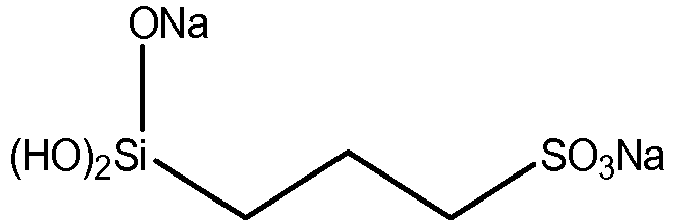


- Those of ordinary skill in the art will recognize that a wide variety of other hydrophilic compounds are useful in the present invention as external emulsifiers or as compounds that can be used to modify the nanoparticles with water-dispersible groups.
- Preferably, a sufficient amount of hydrophilic compound is reacted with the nanoparticles to provide the desired level of hydrophilicity without interfering with the antifogging, antireflective, and cleanable characteristics of the compositions of the present invention.
- The level of coverage of the nanoparticles by hydrophilic groups herein is reported in terms of the concentration of hydrophilic groups in the coating composition, assuming 100% of the amount of hydrophilic groups in the coating composition would be covalently bonded to surface of the particles. If used, the hydrophilic groups are preferably present on a nanoparticle surface in the coating composition in an amount equivalent to at least 1 mole-%, and more preferably at least 10 mole-%, of the total molar functional groups on said surface. If used, the hydrophilic groups are preferably present on a nanoparticle surface in the coating composition in an amount equivalent to no more than 60 mole-%, more preferably no more than 50 mole-%, more preferably, no more than 20 mole-%, and even more preferably no more than 10 mole-%, of the total molar functional groups on said surface.
- Preferably, the desired level of hydrophilicity is such that an external emulsifier is not necessary for preparing a storage-stable dispersion.
- In certain embodiments, the compositions of the present invention include one or more surfactants. The term "surfactant" as used herein describes molecules that reduce the surface tension of the coating composition and provide a coating which imparts desirable easy-cleaning, antireflective, and improved durability characteristics to substrates or articles coated therewith. Surfactants described in this invention may also be used as leveling agents for coating uniformity. Useful surfactants of the present invention include anionic, cationic, nonionic, or amphoteric surfactants. Examples include the following:
Surfactant Type Surfactant Name Product Name Source Anionic Sodium dodecyl benzene sulfonate DS-10 Rhone-Poulenc Amphoteric N-coco-aminopropionic acid MIRATAINE® AP-C Rhone-Poulenc Amphoteric Cocaamidopropyl betaine CAPB-30S Shanghai Gaowei Chemical Co. Nonionic Lauryl dimethylamine oxide RRODAMOX LO Rhone-Poulenc Nonionic Alkyl polyglucoside TRITON®BG10 Dow Chemical Nonionic PEG/PPG/PEG block copolvmer PLURONIC® F38 BASF Corp. Nonionic Organosilicone surfactant BYK-333 BYK Nonionic Organosilicone surfactant Q2-5211 Dow-Corning Nonionic Fluorochemical surfactant FC-4430 3M Nonionic Fluorochemical surfactant FC-4432 3M Nonionic Polyoxyethylene (7) lauryl ether AEO7-24S Sasol (China) Chemical Co., Ltd. Nonionic Polyoxyethylene (9) lauryl ether AEO7-24S Sasol (China) Chemical Co., Ltd. Nonionic Polyoxyethylene (18) lauryl ether AEO7-24S Sasol (China) Chemical Co., Ltd. Cationic Di-oleic acid triethanolamine esterquat PRAEPAGEN® 4317 Clariant Chemicals (China) Ltd. Cationic Di-tallow dimethyl ammonium chloride PRAEPAGEN® 3345 Clariant Chemicals (China) Ltd. Cationic Alkyldimethylbenzyl-amm onium chloride DODIGEN®226 Clariant Chemicals (China) Ltd. Surfactant Type and Class Surfactant Name Product Name Source Anionic Sulfosuccinate Dioctyl ester of sodium sulfosuccinic acid AEROSOL®OT Cytec Industries Anionic Sulfosuccinates Alkyl benzenesulfonic acid (C10-C16) POLYSTEP® A-13 Stepan Company Anionic Alkylbenzene sulfonates and sulfates Sodium branched alkyl (C12) benzene sulfonate POLYSTEP® A-16 Stepan Company Anionic Alkylbenzene sulfonates and sulfates Sodium dodecyl benzene sulfonate RHODOCAL® DS-10 Rhone-Poulenc Anionic Polyethoxylated derivatives of straight or branched chain aliphatic sulfate Polyethoxylated alkyl (C12) ether sulfate, ammonium salt STEOL®CA-460 Stepan Company Anionic Straight or branched chain aliphatic sulfates and sulfonates Aliphatic sulfates HOSTASTAT® HS-1 Hoechst Celanese Corp. Anionic Alkylbenzene sulfonates and sulfates Sodium linear alkyl (C12) benzene sulfonate POLYSTEP® A-15 Stepan Company Anionic Alkyl carboxylate Sodium stearate Witco Amphoteric Alkyl carboxylates N-coco-aminopropionic acid MIRATAINE® AP-C Rhone-Poulenc Anionic Alkyl phosphate mono- or di- ester Ethoxylated dodecyl alcohol phosphate ester, sodium salt RHODAFAC® MC-470 Rhone-Poulenc Nonionic Polyethoxylated alkyl alcohol Polyoxyethylene (23) lauryl ether BRIJ®35 ICI Americas Inc. Nonionic Polyethoxylated alkyl alcohol Plyoxyethylene (4) lauryl ether BRIJ®30 ICI Americas Inc. Nonionic Polyethoxylated alkyl alcohol Polyoxyethylene (7) lauryl ether AEO7-24S Sasol (China) Chemical Co., Ltd. Nonionic Polyethoxylated alkyl alcohol Polyoxyethylene (9) lauryl ether AEO9-24S Sasol (China) Chemical Co., Ltd. Nonionic Polyethoxylated alkyl alcohol Polyoxyethylene (18) lauryl ether AEO18-24S Sasol (China) Chemical Co., Ltd. Nonionic Block copolymers of polyethylene oxide and polypropylene oxide Block copolymer of ethylene oxide and propylene oxide TETRONIC® 1502 BASF Corp. Nonionic Block copolymers of polyethylene oxide and polypropylene oxide PEG-PPG-PEG block copolymer PLURONIC® F38 BASF Corp. Nonionic Block copolymers of polyethylene oxide and polypropylene oxide PEG-PPG-PEG block copolymer TETRONIC® 908 BASF Corp. Nonionic Amine oxide Lauryl dimethylamine oxide RHODAMOX® LO Rhone-Poulenc Nonionic Polyethoxylated alkyl alcohol Ethoxylated trimethylnonanol TERGITOL ® TMN-6 Union Carbide Chemical & Plastics Co., - If used, the surfactant concentration in coating compositions of the present invention is preferably at least 0.01 percent by weight of the coating composition, more preferably at least 0.04 wt%, and even more preferably at least 0.1 wt%. If used, the surfactant concentration is preferably no greater than 10 wt% of the coating composition, more preferably no greater than 5 wt% of the coating composition.
- Another optional but preferred additive is an antimicrobial agent. Examples include the following (with information with respect to solubility in water):
Product Name Composition Company Soluble in Water KATHON® CG 5-Chloro-2-methyl-4-isot hiazolin-3-one 2-Methyl-4-isothiazolin-3-one Magnesium chloride magnesium nitrate Water Rohm & Haas Good C302 1,3-Dimethylol-5,5-dimet hylhydantoin Shanghai JiuXin Chem. Co. Ltd. Good PROTECTOL® PE/PES 2-Phenoxyethanol BASF Dissolves in hot water METHYL-SAR ABEN® Methyl-p-hydrobenzoate Taizhou Necchem Company (China) Dissolves in hot water PROPYL-SAR ABEN® Propyl-p- hydrobenzoate Taizhou Necchem Company (China) Does not dissolve in hot water DODIGEN®226 Alkyldimethylbenzylam monium chloride Clariant Chemicals (China) Ltd. Good NIPACIDE® BIT20 Benzisothiazolinone Clariant Chemicals (China) Ltd. Good - If used, the antimicrobial concentration in coating compositions of the present invention is preferably at least 0.0005 percent by weight (wt%) of the total weight of the coating composition, more preferably at least 0.001 wt%, and even more preferably at least 0.002 wt%. If used, the antimicrobial concentration is preferably no greater than 1 wt%, and more preferably no greater than 0.1 wt% of the total weight of the coating composition.
- The coating compositions of the present invention include water as the liquid carrier (i.e., fluid media); however, organic solvents can be used in addition to the water. Suitable organic solvents in the present invention include methanol, ethanol, isopropanol, butanol, propylene glycol and its monomethyl ether, ethylene glycol and its monomethyl ether, ketones such as acetone and methyl ethyl ketone, and ethers such as tetrahydrofuran (THF), N,N-dimethylacetamide, formamide, or combinations thereof. If present, typically the organic solvent is an alcohol or combination of alcohols. The amount of organic solvent in the coating composition is no more than 30 wt%, preferably no more than 10 wt%, more preferably no more than 5 wt%, even more preferably no more than 2 wt%, and even more preferably no more than 1 wt%, based on the total weight of the liquid medium. The most preferred liquid medium is 100% water.
- The coatings, when applied to a substrate (e.g., of inorganic and/or organic material) and dried, are removable or permanent. Substrates to which the coating compositions of the invention can be applied are preferably transparent or translucent to visible light. They include organic, inorganic materials, or combinations thereof. Exemplary substrates are made of polyester (e.g., polyethylene terephthalate (PET), polybutylene terephthalate), polycarbonate (PC), allyldiglycolcarbonate, polyacrylates such as polymethylmethacrylate, polystyrene, polysulfone, polyethersulfone, cellulose acetate butyrate, glass, polyolefin, and PVC, including blends and laminates thereof.
- Typically the substrate is in the form of a film, sheet, panel or pane of material and is part of an article such as a solar panel, protective eye wear, face masks, face shields, surgical masks, and various other types of personal protection equipment, particularly for eyes, as well as mirrors, motor vehicle windows and windshields. The coatings may, if desired, cover only a portion of the article, e.g., only the section immediately adjacent the eyes in a face shield may be coated. The substrate may be flat, curved, or shaped. The article to be coated may be produced by any method such as by blowing, casting, extruding, or injection molding.
- The compositions can be coated on a substrate as a fluid coating composition such as in the form of a liquid-based coating composition (e.g., in a pourable form or sprayable form) using conventional techniques, for example, such as bar, roll, curtain, rotogravure, spray, or dip coating techniques. Sprayers and nozzle systems suitable for use in this application are known to one skilled in the art and include, for example, hydraulic, pneumatic, rotary and ultrasonic nozzles and associated sprayer systems. An example of a hydraulic sprayer is the MSO sprayer available for US Global Resources (Seattle, WA). Examples of suitable pneumatic sprayers include the EGA Manual Touch-Up Gun available from DeVilbiss Corporation (Glendale Hts., IL) or the AJ-401-LH sprayer available from Jacto (Tualaltin, OR). Rotary atomizers use a high speed rotating disk, cup or wheel to disperse the liquid into a hollow cone spray. The rotational speed controls the drop size. Examples of rotary atomizers include PROPTEC and PENGUIN atomizers available from Ledebuhr Industries (Williamston, MI). Ultrasonic atomizers use a high (20 kHz to 50 kHz) frequency vibration of a piezoelectric crystal to produce narrow drop size distribution and low velocity spray. Examples of suitable sprayers with ultrasonic atomizer nozzles include models VC5020AT and VC5040AT available from Sonics and Materials, Inc. (Newtown, CT).
- Alternatively, the compositions of the present invention can be coated on a substrate by simply wiping a pad, cloth, paper towel, or other application device/material over the surface of the substrate, wherein the composition is contained within the pad, cloth, etc. or applied to the surface of the substrate surface. Suitable applicator substrates can be in the form of a sponge, foam, woven, nonwoven, or knit material, for example. The term "nonwoven web" or "nonwoven fabric" refers to a web or fabric having a structure of individual fibers that are interlaid in an irregular manner. In contrast, knit or woven fabrics have fibers that are interlaid in a regular manner. Materials of the applicator substrate (e.g., applicator pad or wipe) can include synthetic or natural fibers, filaments, or yarns. Suitable materials include, but are not limited to, polyolefins, polyesters, polyamides (e.g., nylons), polyurethanes, halogenated polyolefins, polyacrylates, polyureas, polyacrylonitriles, cellulose, cotton, rayon, jute, hemp, as well as copolymers and polymer blends thereof. Various combinations of materials in various shapes can be used for applicator substrates if desired. The most typical substrate is a paper wipe containing the coating composition (soaked or impregnated into the wipe).
- The coatings of the present invention can be coated on one side or both sides of a substrate. The coatings of the present invention may be coated on one side of the substrate and the opposite side of the substrate may be uncoated or coated with a wide variety of conventional compositions, particularly conventional antifogging compositions. Preferably, the coating surface should face the direction of higher humidity, e.g., on a face shield the side having an antifog coating should face the wearer.
- A coated surface may be dried at room temperature (e.g., over a 15 minute period) or if desired, at elevated temperatures, to dry more quickly (such as within 5 minutes). For coating compositions of the present invention, drying conditions can impact, for example, the durability, removability, and permanency of the dried coating. A "dried" coating (i.e., one in which the liquid carrier (i.e., fluid media) has been substantially completely removed, for example, by evaporation, from the coating composition) is typically also "cured" as a result of reaction between the reactive functional groups (e.g., amine groups and epoxy groups). Such curing can be enhanced by heating the coating composition during the drying process. For example, drying conditions can include a temperature of at least 80°C, or a temperature of at least 100°C, or at a temperature of at least 120°C. The substrate on which the coating composition is applied typically controls the temperature of drying. For example, for glass substrates, coatings can generally be dried at temperatures of 120°C to 160°C. Generally, for plastic substrates, coatings can be dried at temperatures of 120°C to 140°C, and more specifically, for PET substrates, coatings can be dried at temperatures of 120°C to 135°C, and for PMMA substrates, coatings can be dried at temperatures of only up to 80°C.
- Additionally, the coatings can be heated at temperatures and times typical of glass tempering (e.g., temperatures such as 700 to 750°C for 2 to 5 minutes) do not destroy the properties important to solar cell coatings (high light transmittance, antireflection, anti-soiling, and anti-abrasion) even though Transmission Electron Microscopy (TEM) and ESCA do indicate some changes to the shape of the particles and the elemental composition of the coatings on the particles after the tempering process. However, the specific tempering conditions mentioned do not appear to sinter the particles. Tempering may be necessary for commercialized solar glass and thus the coating compositions may be applied before or after tempering. The relatively lower refractive index caused by the nanostructure imparts antireflection properties which can, at least in some embodiments, improve light transmittance by 2.0 to 3.0 percent and thus improves light to power conversion by 2.0 to 2.5 percent. Even under these high temperature tempering conditions, the resulting coatings can impart higher power conversion than naked silica particles.
- The functional groups on the nanoparticles can contribute to adhesion of the coating to a substrate. For example, functional groups such as epoxy groups and/or amine groups can react with functionalities of a surface to form covalent bonds between the nanoparticles and the substrate. Alternatively or additionally, a substrate can be treated to improve adhesion between the substrate and the coating, using, e.g., chemical treatment, mechanical roughening, corona treatment such as air or nitrogen corona, plasma, flame, or actinic radiation. If desired, an optional tie layer can also be applied between the substrate and the coating to increase the interlayer adhesion.
- An example of another article that can include a coating composition of the present invention includes a solar panel (e.g., a photovoltaic cell module) comprising: a photovoltaic cell or an array of photovoltaic cells (a series of interconnected photovoltaic cells); and a coating composition disposed on the front side of solar panel for tansmission increase and for antisoiling and rinse-away cleaning.
- In general, photovoltaic cells are semiconductor devices used to convert light into electricity and may be referred to as solar cells. Upon exposure to light, a photovoltaic cell generates a voltage across its terminals resulting in a consequent flow of electrons, the size of which is proportional to the intensity of the light impinging on the photovoltaic junction formed at the surface of the cell. Typically, a series of solar cell modules are interconnected to form a solar array (i.e., solar panel), which functions as a single electricity producing unit wherein the cells and modules are interconnected in such a way as to generate a suitable voltage in order to power a piece of equipment or supply a battery for storage.
- Semiconductor materials used in photovoltaic cells include crystalline or polycrystalline silicon or thin film silicon (e.g., amorphous, semicrystalline silicon) as well as non-silicon materials such as gallium arsenide, copper indium diselenide, organic semiconductors, and CIGS. There are two types of photovoltaic cells, wafers and thin films. A wafer is a thin sheet of semiconductor material made by mechanically sawing it from a single crystal or multicrystal ingot or casting. Thin film based photovoltaic cells are continuous layers of semiconducting materials typically deposited on a substrate or substrate using sputtering or chemical vapour deposition processes.
- Wafer and thin film photovoltaic cells are often fragile enough such that a module may require one or more supports. The support may be rigid, e.g., a glass plate rigid material, or it may be a flexible material, e.g., a metallic film and/or sheet of suitable polymer material such as a polyimide or polyethylene terephthalate. The support may be a top layer or substrate, i.e., positioned between the photovoltaic cell and the light source,
which is transparent to light coming from the light source. Alternatively or in addition thereto, the support may be a bottom layer positioned behind the photovoltaic cell. - The coating composition of the present invention may be coated on the front side of a solar panel. The preferred coating thickness is in a range of 100 nm to 200 nm for antireflective coatings.
- In the following items, embodiments of the present invention are summarized:
- 1. A method of modifying a substrate surface, the method comprising:
- (a) applying a coating composition to a substrate, wherein the coating composition comprises:
- (i) nonspherical nanoparticles;
- (ii) spherical nanoparticles;
- (iii) optionally hydrophilic groups and optionally a surfactant; and
- (iv) a liquid medium comprising water and no greater than 30 wt% organic solvent, if present, based on the total weight of liquid medium,
- (b)drying the coating composition to form a hydrophilic coating on the substrate.
- (a) applying a coating composition to a substrate, wherein the coating composition comprises:
- 2. The method of item 1 wherein all the nonspherical nanoparticles or all the spherical nanoparticles comprise the functional groups.
- 3. The method of item 1 wherein the weight ratio of the nonspherical nanoparticles to the spherical nanoparticles ranges from 95:5 to 5:95.
- 4. The method of item 3 wherein the weight ratio of the nonspherical nanoparticles to the spherical nanoparticles ranges from 80:20 to 20:80.
- 5. The method of item 4 wherein the weight ratio of the nonspherical nanoparticles to the spherical nanoparticles ranges from 70:30 to 30:70.
- 6. The method of item 1 wherein at least a portion of the nonspherical nanoparticles comprise silica nanoparticles.
- 7. The method of item 1 wherein at least a portion of the spherical nanoparticles comprise silica nanoparticles.
- 8. The method of item 1 wherein the substrate is glass or ceramic.
- 9. The method of item 1 wherein the method further comprises the step of sintering the coated substrate at a temperature ranging from 200 degrees C to 750 degrees C.
- 10. The method of item 1 wherein the nonspherical nanoparticles have an average particle size between 1 and 200 nm and an aspect ratio between 2 and 100.
- 11. The method of item 1 wherein the spherical nanoparticles have an average particle size between 1 and 120 nm.
- 12. The method of item 1 wherein the coating composition comprises at least 0.05 wt% nonspherical nanoparticles and no greater than 40wt% nonspherical nanoparticles, based on the total weight of the coating composition.
- 13. The method of item 1 wherein the coating composition comprises at least 0.05 wt% spherical nanoparticles and no greater than 40 wt% spherical nanoparticles, based on the total weight of the coating composition.
- 14. The method of item 1 wherein the coating composition comprises 0.01-5 wt% surfactant, based on the total weight of the coating composition.
- 15. The method of item 1 wherein the nonspherical nanoparticles are elongated nanoparticles.
- 16. The method of item 1 wherein the spherical nanoparticles comprise the functional groups.
- 17. An article comprising a substrate surface modified by using the method of item 1.
- 18. A coating composition comprising
nonspherical nanoparticles;
spherical nanoparticles;
optionally hydrophilic groups and optionally a surfactant; and
a liquid medium comprising water and no greater than 30 wt% organic solvent, if present, based on the total weight of liquid medium,
wherein at least a portion of the nonspherical nanoparticles or at least a portion of the spherical nanoparticles comprises functional groups attached to their surface through chemical bonds, wherein the functional groups comprise at least one group selected from the group consisting of epoxy group, amine group, hydroxyl, olefin, alkyne, (meth) acrylato, mercapto group, or combinations thereof,
wherein the coating composition, when dried on a substrate, forms a hydrophilic coating on the substrate. - 19. The composition of item 18 wherein all the nonspherical nanoparticles or all the spherical nanoparticles comprise the functional groups.
- 20. The composition of item 18 wherein the weight ratio of the nonspherical nanoparticles to the spherical nanoparticles ranges from 95:5 to 5:95.
- 21. The composition of item 20 wherein the weight ratio of the nonspherical nanoparticles to the spherical nanoparticles ranges from 70:30 to 30:70.
- 22. The composition of item 18 wherein at least a portion of the nonspherical nanoparticles comprise silica nanoparticles.
- 23. The composition of item 18 wherein at least a portion of the spherical nanoparticles comprise silica nanoparticles.
- 24. The composition of item 18 wherein the substrate is glass or ceramic.
- 25. The composition of item 18 wherein the nonspherical nanoparticles have an average particle size between 1 and 200 nm and an aspect ratio between 2 and 100.
- 26. The composition of item 18 wherein the spherical nanoparticles have an average particle size between 1 and 120 nm.
- 27. The composition of item 18 wherein the coating composition comprises at least 0.05 wt% nonspherical nanoparticles and no greater than 40 wt% nonspherical nanoparticles, based on the total weight of the coating composition.
- 28. The composition of item 18 wherein the coating composition comprises at least 0.05 wt% spherical nanoparticles and no greater than 40 wt% spherical nanoparticles, based on the total weight of the coating composition.
- 29. The composition of item 18 wherein the coating composition comprises 0.01-5 wt% surfactant, based on the total weight of the coating composition.
- 30. The composition of item 18 wherein a dried coating provides antireflective, easy cleaning and/or durability characteristics to the substrate for at least 24 hours.
- 31. The composition of item 18 wherein the nonspherical nanoparticles are elongated nanoparticles.
- 32. The composition of item 18 wherein the spherical nanoparticles comprise the functional groups.
- 33. An article comprising a substrate surface modified using the coating composition of item 18.
- 34. The article of item 33 which is a solar panel.
- 35. The article of item 33 wherein the substrate is glass.
- 36. The article of item 35 wherein the glass is tempered.
- Unless otherwise indicated, all chemical reagents and solvents were or can be obtained from Aldrich Chemical Co., Milwaukee, WI. All parts, percentages, or ratios specified in the examples are by weight, unless specified otherwise. All temperatures specified in the examples are in degrees Celsius, unless specified otherwise.
- Spherical silica nanoparticles dispersions 1115 (4-nm), 2326 (5-nm), 8699 (2~4-nm), were obtained from Nalco®Company, Naperville, IL.
- Nonspherical silica nanoparticles dispersions IPA-ST-UP, ST-OUP, ST-UP and ST-PS-S were obtained from Nissan Chemical Industries, LTD.
- 3-(glycidoxypropyl)-trimethoxysilane (KH560, 97%), aminoethylaminopropyltrimethoxysilane (Z-6020, 85%), and γ-methacryloxypropyltrimethoxysilane(Z-6030,98%) were obtained from Zhejiang Chem-Tech Group Co., Ltd. Hangzhou, Zhejiang Province, China, or from Dow Corning Company, Midland, MI.
- Solar glass was obtained by CSG Holding Co. Ltd.
- Total transmittance measurements were made on a HAZE-GARD DUAL haze and transmittance meter (BYK-Gardner, Columbia, Maryland, USA). The % transmission was directly read from the instrument as the average of the solar daylight wavelength range (CIE D65 standard illuminant) according to ASTM D1003.
- The light transmission spectrum in 400∼1200nm was performed on Lambda 900, PerkinElmer.
- The mechanical durability was evaluated by wet and dry scrubbing. The dry scrubbing was performed by rubbing (by hand, with strong pressure) the coated surface 100 times with a paper towel. The wet scrubbing was preformed on a Sheen Wet Abrasion Scrub Tester using 1kg weight pressure with dishcloth and a 1.0% by weight detergent water solution (commercial dish detergent with anionic and nonionic surfactants from Shanghai Baimao Company) for 1000 cycles. (see table 2).
- This test was carried out by immersing the coated substrate sample into Gorecki Standard Carpet Soil available from Gorecki Manufacturing Inc., Milaca, MN and shaking it for 30 seconds. The sample was removed from the soil container and rinsed with tap water for 1 minute at a speed of 750 millimeters per minute (mm/min). The samples were rated based on their appearance. A rating of "good" was given if the sample was completely clean, and a rating of "bad" was given if the sample was not clean (see table 3).
- The hardness was tested simply by personal nail and pencil by Test Method for film hardness coating (ASTM D 3363). If there is no scraping trace by scratching the coating with nail, we value the coating "pass", or else "fail". (see table 4).
- Coated glass samples were put in climatic chamber under 85%±5% RH and 85 °C after 1250 hours and the light transmission was tracked to determine the effect of damp heat aging durability. (see table 5).
- Nalco®2326 silica nanoparticles (20 grams (g), 15 wt%) and deionized water (40 g) were stirred together in a glass jar for 15 minutes (min). Concentrated H3PO4 was dropped into the dispersion to adjust pH value to 1.5∼2.0. 0.85 g 3-(glycidoxypropyl)-trimethoxysilane (KH560) was slowly added to the solution. Then the solution was heated to 60°C and kept reaction for 10 hours. Coating solution concentrations were about 5 wt% and were used in the preparation of coating samples for examples described in Table 1.
- Nalco®2326 silica nanoparticles (20 grams (g), 15 wt%) and deionized water (40 g) were stirred together in a glass jar for 15 minutes (min). Concentrated H2SO4 was dropped into the dispersion to adjust pH value to 1.5∼2.0. 0.85 g 3-(glycidoxypropyl)-trimethoxysilane (KH560) was slowly added to the solution. Then the solution was heated to 60°C and kept reaction for 10 hours. Coating solution concentrations were about 5 wt% and were used in the preparation of coating samples for examples described in Table 1.
- Nalco®1115 silica nanoparticles (20 g, 15 wt%) and deionized water (40 g) were stirred together in a glass jar for 15 min. Concentrated H2SO4 was dropped into the dispersion to adjust pH value to 1.5∼2.0. 1.06 g 3-(glycidoxypropyl)-trimethoxysilane (KH560) was slowly added to the solution. Then the solution was heated to 60°C and kept reaction for 10 hours. Coating solution concentrations were about 5 wt% and were used in the preparation of coating samples for examples described in Tables 1.
- Nissan SNOWTEX®-OUP nonspherical nanoparticles (20 g, 15 wt%) and deionized water (40 g) were stirred together in a glass jar for 15 min. Concentrated H3PO4 was dropped into the dispersion to adjust pH value to 1.5∼2.0. 0.21 g 3-(glycidoxypropyl)-trimethoxysilane (KH560) was slowly added to the solution. Then the solution was heated to 60°C and kept reaction for 10 hours. Coating solution concentrations were about 5 wt% and were used in the preparation of coating samples for examples described in Table 1.
- Nalco®8699 silica nanoparticles (20 g, 15 wt%) and deionized water (40 g) were stirred together in a glass jar for 15min. Concentrated H3PO4 was dropped into the dispersion to adjust pH value to 1.5∼2.0. 1.06 g 3-(glycidoxypropyl)-trimethoxysilane (KH560) was slowly added to the solution. Then the solution was heated to 60°C and kept reaction for 10 hours. Coating solution concentrations were about 5 wt% and were used in the preparation of coating samples for examples described in Table 1.
- Nissan SNOWTEX®-UP (20 g, 20 wt%) nonspherical nanoparticles and deionized water (60 g) were stirred together in a glass jar for 15 min. The pH of this mixture was adjusted to about 12 using 0.1N sodium hydroxide. 0.06g aminoethylaminopropyltrimethoxysilane (Z-6020) in ethanol (5 g) was added drop-wise with stirring over a period of 1 to 1.5 hrs and the resulting mixture was continuously stirred at 20°C for an additional 14 hrs. The resulting solution (5wt%) was used in the preparation of coating samples for examples described in Table 1.
- Nalco®8699 silica nanoparticles (20 g, 15 wt%) and deionized water (40 g) were stirred together in a glass jar for 15 min. The pH of this mixture was adjusted to about 12 using 0.1N sodium hydroxide. 0.20g aminoethylaminopropyltrimethoxysilane (Z-6020) in ethanol (5 g) was added drop-wise with stirring over a period of 1 to 1.5 hrs and the resulting mixture was continuously stirred at 20°C for an additional 14 hrs. The resulting solution (5wt%) was used in the preparation of coating samples for examples described in Table 1.
- Nissan SNOWTEX®-OUP nonspherical nanoparticles (20 g, 15 wt%) and deionized water (40 g) were stirred together in a glass jar for 15 min. Concentrated H3PO4 was dropped into the dispersion to adjust pH value to 1.5∼2.0. 0.5 g γ-methacryloxypropyltrimethoxysilane (Z6030) was slowly added to the solution. Then the solution was heated to 60°C and kept reaction for 10 hours. Coating solution concentrations were about 5 wt% and were used in the preparation of coating samples for examples described in Table 1.
- Nalco®1115 silica nanoparticles (20 g, 15 wt%) and deionized water (80 g) were stirred together in a glass jar for 15 min. Concentrated H2SO4 was dropped into the dispersion to adjust pH value to 1.5∼2.0. Coating solution concentrations were about 3 wt% and were used in the preparation of coating samples for examples described in Table 1.
- Nalco®2326 silica nanoparticles (20 g, 15 wt%) and deionized water (80 g) were stirred together in a glass jar for 15 min. Concentrated H3PO4 was dropped into the dispersion to adjust pH value to 1.5∼2.0. Coating solution concentrations were about 3 wt% and were used in the preparation of coating samples for examples described in Table 1.
- Nalco®8699 silica nanoparticles (20 g, 15 wt%) and deionized water (80 g) were stirred together in a glass jar for 15 min. Concentrated H3PO4 was dropped into the dispersion to adjust pH value to 1.5∼2.0. Coating solution concentrations were about 3 wt% and were used in the preparation of coating samples for examples described in Table 1.
- Nissan IPA-ST-UP nonspherical nanoparticles (20 g, 15 wt%) and deionized water (80 g) were stirred together in a glass jar for 15 min. Coating solution concentrations were about 3 wt% and were used in the preparation of coating samples for examples described in Table 1.
- Nissan SNOWTEX®-OUP nonspherical nanoparticles (20 g, 15 wt%) and deionized water (80 g) were stirred together in a glass jar for 15 min. Coating solution concentrations were about 3 wt% and were used in the preparation of coating samples for examples described in Table 1.
- Nissan SNOWTEX®-UP (30 g, 20 wt%) nonspherical nanoparticles and deionized water (170g) were stirred together in a glass jar for 15 min. Coating solution concentrations were about 3 wt% and were used in the preparation of coating samples for examples described in Table 1.
Example 5:95 20:80 30:70 40:60 50:50 1 SMN1:BN4 2 SMN2:BN4 3 SMN3:BN5 4 BN1: SMN4 5 BN3:SMN8 6 BN3:BN5 7 BN3:SMN4 8 BN3:SMN4 9 BN3:SMN4 BN3:SMN4 10 SMN5:BN5 11 SMN5:BN5 12 SMN5:BN5 13 BN3:SMN6 14 BN3:SMN6 15 SM7:BN6 16 SM7:BN6 17 BN3:SMN8 18 BN3:SMN8 19 BN3:SMN8 20 SMN4:BN3 21 SMN4:BN3 22 SMN5:BN5 23 SMN5:BN5 24 BN5:SMN5 25 BN5:SMN5 26 BN3:SMN6 27 BN3:SMN6 28 SMN6:BN3 29 SMN6:BN3 30 SM7:BN6 31 SM7:BN6 32 BN6:SM7 33 BN6:SM7 34 SMN8:BN3 35 SMN8:BN3 - Coating solutions (3 wt%) were prepared by mixing appropriate amounts of SMN and BN solutions with water and surfactants to improve wetting as indicated in Table 1.
- Example 1 was prepared by gradually adding 9.0g SMN 1 to 35.0 g BN4. Then 6.0 g deionized water was added to dilute the solution by the addition of 0.75 g of a 10% solution of TRITON®BG10.
- Example 2 was prepared by gradually adding 9.0g SMN 2 to 35.0 g BN4. Then 6.0 g deionized water was added to dilute the solution by the addition of 0.75 g of a 10% solution of TRITON®BG10.
- Example 3 was prepared by gradually adding 1.5 g SMN 3 to 45.0 g BN4. Then 3.5 g deionized water was added to dilute the solution by the addition of 0.75 g of a 10% solution of TRITON®BG10.
- Example 4 was prepared by gradually adding 2.5 g BN1 to 28.5 g SMN4. Then 19.0 g deionized water was added to dilute the solution by the addition of 0.75 g of a 10% solution of TRITON®BG10.
- Example 5 was prepared by gradually adding 2.5 g BN3 to 28.5 g SMN8. Then 19.0 g deionized water was added to dilute the solution by the addition of 0.75 g of a 10% solution of TRITON®BG10.
- Example 6 was prepared by gradually adding 2.5 g BN3 to 47.5 g BN 5. Then 0.75 g of a 10% solution of TRITON®BG10 was added to the coating solution. (control example)
- Example 7 was prepared by gradually adding 2.5 g BN3 3 to 28.5 g SMN 4. Then 19.0 g deionized water was added to dilute the solution by the addition of 0.75 g of a 10% solution of TRITON®BG10.
- Example 8 was prepared by gradually adding 15.0 g BN3 to 21.0 g SMN 6. Then 14.0 g deionized water was added to dilute the solution by the addition of 0.75 g of a 10% solution of TRITON®BG10.
- Example 9 was prepared by gradually adding 20.0 g BN3 to 18.0 g SMN 6. Then 12.0 g deionized water was added to dilute the solution by the addition of 0.75 g of a 10% solution of TRITON®BG10.
- Example 10 was prepared by gradually adding 6.0 g SMN5 to 40.0 g BN5. Then 4.0 g deionized water was added to dilute the solution by the addition of 0.75 g of a 10% solution of TRITON®BG10.
- Example 11 was prepared by gradually adding 12.0 g SMN5 to 30.0 g BN 5. Then 8.0 g deionized water was added to dilute the solution by the addition of 0.75 g of a 10% solution of TRITON®BG10.
- Example 12 was prepared by gradually adding 15.0 g SMN5 to 25.0 g BN 5. Then 10.0 g deionized water was added to dilute the solution by the addition of 0.75 g of a 10% solution of TRITON®BG10.
- Example 13 was prepared by gradually adding 10.0 g BN3 to 24.0 g SMN6. Then 16.0 g deionized water was added to dilute the solution by the addition of 0.75 g of a 10% solution of TRITON®BG10.
- Example 14 was prepared by gradually adding 20.0 g BN3 to 18.0 g SMN6. Then 12.0 g deionized water was added to dilute the solution by the addition of 0.75 g of a 10% solution of TRITON®BG10.
- Example 15 was prepared by gradually adding 6.0 g SMN7 to 40.0 g BN6. Then 4.0 g deionized water was added to dilute the solution by the addition of 0.75 g of a 10% solution of TRITON®BG10.
- Example 16 was prepared by gradually adding 12.0 g SMN7 to 30.0 g BN6. Then 8.0 g deionized water was added to dilute the solution by the addition of 0.75 g of a 10% solution of TRITON®BG10.
- Example 17 was prepared by gradually adding 5.0 g BN3 to 27.0 g SMN8. Then 18.0 g deionized water was added to dilute the solution by the addition of 0.75 g of a 10% solution of TRITON®BG10.
- Example 18 was prepared by gradually adding 15.0 g BN3 to 21.0 g SMN8. Then 14.0 g deionized water was added to dilute the solution by the addition of 0.75 g of a 10% solution of TRITON®BG10.
- Example 19 was prepared by gradually adding 25.0 g BN3 to 15.0 g SMN8. Then 10.0 g deionized water was added to dilute the solution by the addition of 0.75 g of a 10% solution of TRITON®BG10.
- Example 20 was prepared by gradually adding 15.0 g BN3 to 21.0 g SMN4. Then 14.0 g deionized water was added to dilute the solution by the addition of 0.75 g of a 10% solution of TRITON®BG10.
- Example 21 was prepared by gradually adding 47.5 g BN3 to 1.5 g SMN4. Then 1.0 g deionized water was added to dilute the solution by the addition of 0.75 g of a 10% solution of TRITON®BG10.
- Example 22 was prepared by gradually adding 2.5 g BN5 to 28.5 g SMN5. Then 19.0 g deionized water was added to dilute the solution by the addition of 0.75 g of a 10% solution of TRITON®BG10.
- Example 23 was prepared by gradually adding 15.0 g BN5 to 21.0 g SMN5. Then 14.0 g deionized water was added to dilute the solution by the addition of 0.75 g of a 10% solution of TRITON®BG10.
- Example 24 was prepared by gradually adding 35.0 g BN5 to 9.0 g SMN5. Then 6.0 g deionized water was added to dilute the solution by the addition of 0.75 g of a 10% solution of TRITON®BG10.
- Example 25 was prepared by gradually adding 47.5 g BN5 to 1.5 g SMN5. Then 1.0 g deionized water was added to dilute the solution by the addition of 0.75 g of a 10% solution of TRITON®BG10.
- Example 26 was prepared by gradually adding 2.5 g BN3 to 28.5 g SMN6. Then 19.0 g deionized water was added to dilute the solution by the addition of 0.75 g of a 10% solution of TRITON®BG10.
- Example 27 was prepared by gradually adding 15.0 g BN3 to 21.0 g SMN6. Then 14.0 g deionized water was added to dilute the solution by the addition of 0.75 g of a 10% solution of TRITON®BG10.
- Example 28 was prepared by gradually adding 35.0 g BN3 to 9.0 g SMN6. Then 6.0 g deionized water was added to dilute the solution by the addition of 0.75 g of a 10% solution of TRITON®BG10.
- Example 29 was prepared by gradually adding 47.5 g BN3 to 1.5 g SMN6. Then 1.0 g deionized water was added to dilute the solution by the addition of 0.75 g of a 10% solution of TRITON®BG10.
- Example 30 was prepared by gradually adding 47.5 g BN6 to 1.5 g SMN7. Then 1.0 g deionized water was added to dilute the solution by the addition of 0.75 g of a 10% solution of TRITON®BG10.
- Example 31 was prepared by gradually adding 35.0 g BN6 to 9.0 g SMN7. Then 6.0 g deionized water was added to dilute the solution by the addition of 0.75 g of a 10% solution of TRITON®BG10.
- Example 32 was prepared by gradually adding 15.0 g BN6 to 21.0 g SMN7. Then 14.0 g deionized water was added to dilute the solution by the addition of 0.75 g of a 10% solution of TRITON®BG10.
- Example 33 was prepared by gradually adding 2.5 g BN6 to 28.5 g SMN7. Then 19.0 g deionized water was added to dilute the solution by the addition of 0.75 g of a 10% solution of TRITON®BG10.
- Example 34 was prepared by gradually adding 47.5 g BN3 to 1.5 g SMN8. Then 1.0 g deionized water was added to dilute the solution by the addition of 0.75 g of a 10% solution of TRITON®BG10.
- Example 35 was prepared by gradually adding 35.0 g BN3 to 9.0 g SMN8. Then 6.0 g deionized water was added to dilute the solution by the addition of 0.75 g of a 10% solution of TRITON®BG10.
- Example 36 was prepared by adding 12.5 g BN6 into solution of example 19. Example 37 was prepared by adding 5.0 g SMN7 into solution of example 27.
- Coating solutions were coated on the smooth side of solar glass substrates (CSG Holding Co. Ltd) by using a dip coater to obtain a dry coating thickness of about 100∼200nm. The coated samples were then dried at 100°C for 10 minutes. After that, the coated samples were tempered at 750 °C for 3 minutes. The % transmittance increased after coating and tempering was 2.0∼3.5 vs the uncoated glass in the case of all the examples. Example 6 is prepared by bared nanoparticles, used here as a control example.
Table 2 Example Durability Dry Wet Increased T(%) -original Increased T(%) -After 100 times Increased T(%) -original Increased T(%) -After 1000 times 1 2.2 -0.2 2.6 0 2 2.3 -0.2 2.4 0 3 2.3 -0.1 2.3 -0.1 4 2.0 0 2.2 -0.1 5 2.9 -0.5 NT NT 6 3.1 -1.0 2.4 -0.7 7 2.8 -0.3 NT NT 8 2.5 -0.2 NT NT 9 2.6 -0.1 NT NT 10 2.5 -0.2 NT NT 11 2.6 -0.2 NT NT 12 2.4 -0.1 NT NT 13 3.2 -0.2 NT NT 14 2.6 -0.2 NT NT 15 2.8 -0.4 NT NT 16 2.6 -0.4 NT NT 17 2.8 -0.4 NT NT 18 2.5 -0.3 NT NT 19 2.2 -0.3 NT NT 20 2.5 -0.2 NT NT 21 2.2 -0.3 NT NT 22 2.8 -0.3 NT NT 23 2.6 -0.2 NT NT 24 2.5 -0.2 NT NT 25 2.3 -0.4 NT NT 26 2.9 -0.4 NT NT 27 2.7 -0.3 NT NT 28 2.5 -0.2 NT NT 29 2.4 -0.3 NT NT 30 2.8 -0.4 NT NT 31 2.6 -0.2 NT NT 32 2.5 -0.2 NT NT 33 2.3 -0.3 NT NT 34 2.4 -0.4 NT NT 35 2.6 -0.3 NT NT 36 2.7 -0.3 NT NT 37 2.8 -0.2 NT NT Table 3 Example Cleanability Blank glass Bad 1 Good 3 Good 6 Good 7 Good 10 Good 13 Good 15 Good 17 Good Table 4 Example Hardness Nail Scratch 1 3H Pass 2 3H Pass 4 2H∼3H Fail 6 1H Fail 9 3H Pass 12 3H Pass 14 3H Pass 15 2H~3H Fail 19 3H Pass Table 5 Example Increased T(%) -Original Increased T(%) -After 1250h 1 2.2 -0.3 4 2.0 +0.2 6 2.4 -0.9 9 2.5 -0.1 - Various modifications and alterations to this invention will become apparent to those skilled in the art without departing from the scope of this invention. It should be understood that this invention is not intended to be unduly limited by the illustrative embodiments and examples set forth herein and that such examples and embodiments are presented by way of example only with the scope of the invention intended to be limited only by the claims set forth herein as follows.
Claims (19)
- A coating composition comprising(i) nonspherical nanoparticles;(ii) spherical nanoparticles;(iii) optionally hydrophilic groups and optionally a surfactant; and(iv) a liquid medium comprising water and no greater than 30 wt% organic solvent, if present, based on the total weight of liquid medium,wherein at least a portion of the nonspherical nanoparticles or at least a portion of the spherical nanoparticles comprises functional groups attached to their surface through chemical bonds, wherein the functional groups comprise at least one group selected from the group consisting of epoxy group, amine group, hydroxyl, olefin, alkyne, (meth) acrylato, mercapto group, or combinations thereof,
wherein the coating composition, when dried on a substrate, forms a hydrophilic coating on the substrate. - A method of modifying a substrate surface, the method comprising:(a) applying a coating composition to a substrate, wherein the coating composition comprises:(i) nonspherical nanoparticles;(ii) spherical nanoparticles;(iii) optionally hydrophilic groups and optionally a surfactant; and(iv) a liquid medium comprising water and no greater than 30 wt% organic solvent, if present, based on the total weight of liquid medium,wherein at least a portion of the nonspherical nanoparticles or at least a portion of the spherical nanoparticles comprises functional groups attached to the surface of the nonspherical nanoparticles or the spherical nanoparticles through chemical bonds, and further wherein the functional groups comprise at least one group selected from epoxy group, amine group, hydroxyl, olefin, alkyne, (meth) acrylato, mercapto, or combinations thereof; and(b) drying the coating composition to form a hydrophilic coating on the substrate.
- The composition of claim 1 or the method of claim 2, wherein all the nonspherical nanoparticles or all the spherical nanoparticles comprise the functional groups.
- The composition of claim 1 or the method of claim 2, wherein the weight ratio of the nonspherical nanoparticles to the spherical nanoparticles ranges from 95:5 to 5:95.
- The composition of claim 4 or the method of claim 4, wherein the weight ratio of the nonspherical nanoparticles to the spherical nanoparticles ranges from 70:30 to 30:70.
- The composition of claim 1 or the method of claim 2, wherein at least a portion of the nonspherical nanoparticles comprise silica nanoparticles.
- The composition of claim 1 or the method of claim 2, wherein at least a portion of the spherical nanoparticles comprise silica nanoparticles.
- The composition of claim 1 or the method of claim 2, wherein the substrate is glass or ceramic.
- The composition of claim 1 or the method of claim 2, wherein the nonspherical nanoparticles have an average particle size between 1 and 200 nm and an aspect ratio between 2 and 100.
- The composition of claim 1 or the method of claim 2, wherein the spherical nanoparticles have an average particle size between 1 and 120 nm.
- The composition of claim 1 or the method of claim 2, wherein the coating composition comprises at least 0.05 wt% nonspherical nanoparticles and no greater than 40 wt% nonspherical nanoparticles, based on the total weight of the coating composition.
- The composition of claim 1 or the method of claim 2, wherein the coating composition comprises at least 0.05 wt% spherical nanoparticles and no greater than 40 wt% spherical nanoparticles, based on the total weight of the coating composition.
- The composition of claim 1 or the method of claim 2, wherein the coating composition comprises 0.01-5 wt% surfactant, based on the total weight of the coating composition.
- The composition of claim 1 or the method of claim 2, wherein the nonspherical nanoparticles are elongated nanoparticles.
- The composition of claim 1 or the method of claim 2, wherein the spherical nanoparticles comprise the functional groups.
- An article comprising a substrate surface modified by using the coating composition of claim 1 or the method of claim 2.
- The article of claim 16 which is a solar panel.
- The article of claim 16 wherein the substrate is glass.
- The article of claim 18 wherein the glass is tempered.
Priority Applications (1)
| Application Number | Priority Date | Filing Date | Title |
|---|---|---|---|
| PL11781000T PL2569260T3 (en) | 2010-05-11 | 2011-04-25 | COATING COMPOSITION, METHOD AND PRODUCT |
Applications Claiming Priority (2)
| Application Number | Priority Date | Filing Date | Title |
|---|---|---|---|
| CN201010170156.6A CN102241899B (en) | 2010-05-11 | 2010-05-11 | Coating composition, method for modifying matrix surface, and product |
| PCT/US2011/033723 WO2011142956A2 (en) | 2010-05-11 | 2011-04-25 | Articles, coating compositions, and methods |
Publications (3)
| Publication Number | Publication Date |
|---|---|
| EP2569260A2 EP2569260A2 (en) | 2013-03-20 |
| EP2569260A4 EP2569260A4 (en) | 2014-07-16 |
| EP2569260B1 true EP2569260B1 (en) | 2017-06-21 |
Family
ID=44914902
Family Applications (1)
| Application Number | Title | Priority Date | Filing Date |
|---|---|---|---|
| EP11781000.2A Revoked EP2569260B1 (en) | 2010-05-11 | 2011-04-25 | Coating composition , method and article |
Country Status (6)
| Country | Link |
|---|---|
| US (2) | US20130045387A1 (en) |
| EP (1) | EP2569260B1 (en) |
| JP (2) | JP5882989B2 (en) |
| CN (1) | CN102241899B (en) |
| PL (1) | PL2569260T3 (en) |
| WO (1) | WO2011142956A2 (en) |
Families Citing this family (32)
| Publication number | Priority date | Publication date | Assignee | Title |
|---|---|---|---|---|
| CN101941001B (en) | 2009-07-03 | 2014-04-02 | 3M创新有限公司 | Hydrophilic coating, product, coating composition and method |
| US9745190B2 (en) | 2010-07-07 | 2017-08-29 | Saint Louis University | Passivated metal nanoparticles having an epoxide-based oligomer coating |
| EP2592119B1 (en) * | 2010-07-08 | 2016-04-13 | LG Chem, Ltd. | Antireflection film and method for manufacturing same |
| EP2808368B1 (en) * | 2012-01-23 | 2017-06-21 | Asahi Kasei Kabushiki Kaisha | Coating composition and antireflection film |
| EP2820090A4 (en) * | 2012-02-27 | 2015-10-28 | 3M Innovative Properties Co | Basic compositions including inorganic oxide nanoparticles and an organic base, coated substrates, articles, and methods |
| CN103311320B (en) * | 2012-03-14 | 2016-12-14 | 江苏新源动力有限公司 | Transparent conductive film used for solar batteries and preparation method thereof |
| JP6062680B2 (en) * | 2012-08-01 | 2017-01-18 | スリーエム イノベイティブ プロパティズ カンパニー | Antifouling hard coat and antifouling hard coat precursor |
| JP6371032B2 (en) * | 2012-08-01 | 2018-08-08 | スリーエム イノベイティブ プロパティズ カンパニー | Anti-reflective hard coat and anti-reflective article |
| CN104854196B (en) * | 2012-09-26 | 2018-06-19 | 3M创新有限公司 | It can application type composition, antimicrobial compositions, antimicrobial articles and their preparation method |
| JP6216505B2 (en) * | 2012-12-07 | 2017-10-18 | 富士電機株式会社 | Solar cell integrated membrane material |
| EP2752386B1 (en) * | 2012-12-13 | 2019-08-28 | Guardian Glass, LLC | Method of making coated article including anti-reflection coating with porosity differences in two layers, and products containing the same |
| EP2752388A1 (en) * | 2012-12-13 | 2014-07-09 | Guardian Industries Corp. | Method of making coated article including anti-reflection coating and products containing the same |
| US10023750B2 (en) * | 2013-04-26 | 2018-07-17 | Nihon Parkerizing Co., Ltd. | Aqueous hydrophilizing surface treatment agent, hydrophilic coating film and hydrophilizing surface treatment method |
| CN103466958A (en) * | 2013-09-22 | 2013-12-25 | 四川世创达电子科技有限公司 | Anti-dazzle method for optical glass by wet process |
| EP3052572A1 (en) | 2013-10-04 | 2016-08-10 | 3M Innovative Properties Company | Coatable composition, antistatic composition, antistatic articles, and methods of making the same |
| CN103811588B (en) * | 2014-01-26 | 2016-07-13 | 晶澳太阳能有限公司 | A kind of Double side diffusion technique of solaode |
| KR20170016946A (en) * | 2014-06-23 | 2017-02-14 | 사우쓰와이어 컴퍼니, 엘엘씨 | Uv-resistant superhydrophobic coating compositions |
| CN105440825B (en) * | 2014-09-01 | 2018-10-12 | 上海三银制漆有限公司 | The aqueous fluorocarbon coating and its preparation method and application of resistance to greasy dirt |
| JP2016087561A (en) * | 2014-11-06 | 2016-05-23 | 富士フイルム株式会社 | Aqueous coating liquid, film, production method of the same, laminate and solar cell module |
| CN104362205B (en) * | 2014-11-14 | 2016-08-24 | 无锡中洁能源技术有限公司 | A kind of preparation method of solar cell backboard based on modified fluoropolymer |
| JP2016123928A (en) * | 2014-12-26 | 2016-07-11 | 富士フイルム株式会社 | Aqueous coating liquid, film, and its manufacturing method, laminate, and solar cell module |
| CN108026394B (en) | 2015-07-29 | 2021-02-19 | 3M创新有限公司 | Antifouling composition comprising silica nanoparticles and functional silane compounds and coated articles thereof |
| US20180282548A1 (en) * | 2015-09-23 | 2018-10-04 | Rhodia Operations | Hydrophobically-modified cerium oxide particles and uses thereof |
| EP3153550A1 (en) * | 2015-10-05 | 2017-04-12 | 3M Innovative Properties Company | Room temperature curing highly durable anti-reflective coating containing nanoparticles |
| JP7176409B2 (en) * | 2016-05-20 | 2022-11-22 | 大日本印刷株式会社 | Optical laminate and image display device |
| KR102388720B1 (en) | 2017-06-02 | 2022-04-21 | 삼성디스플레이 주식회사 | Nanocomposite body, method for manufacturing same and nanocomposite film comprising same |
| KR102787019B1 (en) * | 2018-12-13 | 2025-03-27 | 현대자동차주식회사 | Lithium secondary battery and manufacturing method thereof |
| CN111592780B (en) * | 2020-06-08 | 2021-12-14 | 青岛浩普凯诚环保新材料有限公司 | High-speed train shell protection liquid and preparation method thereof |
| US11351570B2 (en) | 2020-07-22 | 2022-06-07 | Saudi Arabian Oil Company | Apparatus for coating dust particles uniformly on flat surfaces for accelerated testing |
| US12428743B2 (en) | 2021-02-02 | 2025-09-30 | Saudi Arabian Oil Company | Porous copper/copper oxide xerogel catalyst |
| WO2022232018A1 (en) | 2021-04-26 | 2022-11-03 | Milwaukee Electric Tool Corporation | Safety eyewear with heated lenses |
| CN114042614B (en) * | 2021-12-09 | 2023-04-07 | 大连理工大学 | Method for preparing super-hydrophilic film in large area |
Citations (6)
| Publication number | Priority date | Publication date | Assignee | Title |
|---|---|---|---|---|
| WO1994027830A1 (en) | 1993-05-20 | 1994-12-08 | Rexham Graphics Inc. | Receptor sheet using low glass transition coating |
| WO2004035473A1 (en) | 2002-10-14 | 2004-04-29 | Akzo Nobel N.V. | Colloidal silica dispersion |
| WO2009085680A1 (en) | 2007-12-26 | 2009-07-09 | 3M Innovative Properties Company | Removable antifogging coatings, articles, coating compositions, and methods |
| EP1831728B1 (en) | 2004-12-30 | 2009-07-29 | 3M Innovative Properties Company | Displays having a high refractive index, durable hardcoat layer |
| US20100035039A1 (en) | 2008-08-07 | 2010-02-11 | 3M Innovative Properties Company | Acicular silica coating for enhanced hydrophilicity/transmittivity |
| US8980818B2 (en) | 2010-12-16 | 2015-03-17 | Akzo Nobel Chemicals International B.V. | Low streak degreasing composition |
Family Cites Families (127)
| Publication number | Priority date | Publication date | Assignee | Title |
|---|---|---|---|---|
| CH219890A (en) | 1939-05-27 | 1942-03-15 | Jenaer Glaswerk Schott & Gen | Process for the production of one or more superimposed, thin, resistant layers on solid objects. |
| US2432484A (en) | 1943-03-12 | 1947-12-09 | American Optical Corp | Reflection reducing coating having a gradually increasing index of refraction |
| US2601123A (en) | 1947-04-05 | 1952-06-17 | American Optical Corp | Composition for reducing the reflection of light |
| US2536764A (en) | 1947-04-05 | 1951-01-02 | American Optical Corp | Method of forming a reflection reducing coating |
| US2801185A (en) * | 1952-05-16 | 1957-07-30 | Du Pont | Silica hydrosol powder |
| US2803552A (en) | 1953-06-23 | 1957-08-20 | Ca Nat Research Council | Antifog materials and method of producing the same |
| US3075228A (en) | 1958-02-24 | 1963-01-29 | Nathaniel M Elias | Anti-fogging article |
| US3337351A (en) | 1962-01-24 | 1967-08-22 | Union Carbide Corp | Organosilicon anti-fogging agents |
| US3507897A (en) | 1966-07-18 | 1970-04-21 | Union Carbide Corp | Novel silicon sulfonate compositions and novel processes for making same |
| US3819522A (en) | 1972-09-25 | 1974-06-25 | Colgate Palmolive Co | Anti-fogging window cleaner surfactant mixture |
| US3976497A (en) | 1974-06-25 | 1976-08-24 | Dow Corning Corporation | Paint compositions |
| US3986997A (en) | 1974-06-25 | 1976-10-19 | Dow Corning Corporation | Pigment-free coating compositions |
| US4152165A (en) | 1978-04-11 | 1979-05-01 | Minnesota Mining And Manufacturing Company | One-part hydrophilic treatment compositions |
| US4275118A (en) | 1979-01-15 | 1981-06-23 | Dow Corning Corporation | Pigment-free coatings with improved resistance to weathering |
| US4338377A (en) | 1979-10-10 | 1982-07-06 | Minnesota Mining And Manufacturing Company | Sulfonato-organosilanol compounds and aqueous solutions thereof |
| JPS5699263A (en) | 1980-01-10 | 1981-08-10 | Nippon Sheet Glass Co Ltd | Coating composition |
| US4478909A (en) | 1980-10-24 | 1984-10-23 | Toray Industries, Inc. | Anti-fogging coating film |
| JPS5890604A (en) | 1981-11-25 | 1983-05-30 | Toyota Central Res & Dev Lab Inc | Infrared shielding laminate |
| JPS58209549A (en) | 1982-06-01 | 1983-12-06 | 株式会社豊田中央研究所 | Heat-wave shielding laminate |
| JPS5915473A (en) | 1982-07-19 | 1984-01-26 | Mitsubishi Petrochem Co Ltd | Antifogging composition |
| US4467073A (en) | 1982-10-20 | 1984-08-21 | Hydromer, Inc. | Transparent anti-fog coating compositions |
| JPS6044147A (en) | 1983-08-19 | 1985-03-09 | Daicel Chem Ind Ltd | Production of molding sand |
| JPS6044149A (en) | 1983-08-23 | 1985-03-09 | Toshiba Corp | Glass mold for vacuum suction casting |
| JPS6044148U (en) | 1983-08-29 | 1985-03-28 | 日産自動車株式会社 | Barcode display device |
| US4522958A (en) | 1983-09-06 | 1985-06-11 | Ppg Industries, Inc. | High-solids coating composition for improved rheology control containing chemically modified inorganic microparticles |
| EP0145308A3 (en) | 1983-11-21 | 1986-03-19 | Dow Corning Corporation | Phenolic resin-containing aqueous compositions |
| CA1275208C (en) | 1985-01-25 | 1990-10-16 | Roger W. Lange | Silica coating |
| IL84025A0 (en) | 1986-10-03 | 1988-02-29 | Ppg Industries Inc | Organosiloxane/metal oxide coating compositions and their production |
| US4876039A (en) | 1986-11-04 | 1989-10-24 | Dow Corning Corporation | Process for preparing silicone microparticles cured by a Michael addition reaction |
| US5204219A (en) | 1987-07-30 | 1993-04-20 | Minnesota Mining And Manufacturing Company | Photographic element with novel subbing layer |
| US5221497A (en) | 1988-03-16 | 1993-06-22 | Nissan Chemical Industries, Ltd. | Elongated-shaped silica sol and method for preparing the same |
| US4944294A (en) | 1988-04-20 | 1990-07-31 | Borek Jr Theodore S | Face mask with integral anti-glare, anti-fog eye shield |
| CA2002449C (en) | 1988-12-05 | 2001-05-08 | Mark A. Strobel | Pressure-sensitive article with priming layer |
| US5126394A (en) | 1989-10-18 | 1992-06-30 | Dow Corning Corporation | Radiation curable abrasion resistant coatings from colloidal silica and acrylate monomer |
| US5639546A (en) | 1991-09-03 | 1997-06-17 | Minnesota Mining And Manufacturing Company | Coated article having improved adhesion to organic coatings |
| JPH05163463A (en) | 1991-12-12 | 1993-06-29 | Japan Synthetic Rubber Co Ltd | Production of coating composition |
| CA2093686A1 (en) | 1992-05-11 | 1993-11-12 | Gautam A. Patel | Heat curable primerless silicone hardcoat compositions, and thermoplastic composites |
| US5637368A (en) | 1992-06-04 | 1997-06-10 | Minnesota Mining And Manufacturing Company | Adhesive tape having antistatic properties |
| US5286782A (en) | 1992-08-31 | 1994-02-15 | E. I. Du Pont De Nemours And Company | Coating composition of an acrylic polymer, polyol and polyisocyanate crosslinking agent |
| US5354797A (en) | 1992-08-31 | 1994-10-11 | E. I. Du Pont De Nemours And Company | Coating composition of hydroxy functional acrylic polymer, polyol and polyisocyanate crosslinking agent |
| US5873931A (en) | 1992-10-06 | 1999-02-23 | Minnesota Mining And Manufacturing Company | Coating composition having anti-reflective and anti-fogging properties |
| JP3517913B2 (en) | 1993-10-15 | 2004-04-12 | 日産化学工業株式会社 | Manufacturing method of elongated silica sol |
| US5464900A (en) | 1993-10-19 | 1995-11-07 | Minnesota Mining And Manufacturing Company | Water soluble organosiloxane compounds |
| GB9417112D0 (en) | 1994-08-24 | 1994-10-12 | Glaverbel | Coated substrate and process for its formation |
| WO1996018691A2 (en) | 1994-12-12 | 1996-06-20 | Minnesota Mining And Manufacturing Company | Coating composition having anti-reflective and anti-fogging properties |
| US5585186A (en) | 1994-12-12 | 1996-12-17 | Minnesota Mining And Manufacturing Company | Coating composition having anti-reflective, and anti-fogging properties |
| DE69634528T2 (en) | 1995-10-06 | 2006-03-23 | Mitsubishi Chemical Corp. | Polyalkoxysiloxanes and process for their preparation |
| US5820978A (en) | 1995-11-09 | 1998-10-13 | Minnesota Mining And Manufacturing Company | Durability improved colloidal silica coating |
| US5753373A (en) | 1995-12-21 | 1998-05-19 | Minnesota Mining And Manufacturing Company | Coating composition having anti-reflective and anti-fogging properties |
| US6040053A (en) | 1996-07-19 | 2000-03-21 | Minnesota Mining And Manufacturing Company | Coating composition having anti-reflective and anti-fogging properties |
| US6165256A (en) | 1996-07-19 | 2000-12-26 | Toto Ltd. | Photocatalytically hydrophilifiable coating composition |
| US5989515A (en) | 1996-07-24 | 1999-11-23 | Nissan Chemical Industries, Ltd. | Process for producing an acidic aqueous alumina sol |
| US5756226A (en) | 1996-09-05 | 1998-05-26 | Sterling Diagnostic Imaging, Inc. | Transparent media for phase change ink printing |
| US5922299A (en) | 1996-11-26 | 1999-07-13 | Battelle Memorial Institute | Mesoporous-silica films, fibers, and powders by evaporation |
| EP0863191A3 (en) | 1997-03-05 | 1999-01-27 | Nippon Paint Co., Ltd. | Raindrop fouling-resistant paint film, coating composition, film-forming method, and coated article |
| EP0897898B1 (en) | 1997-08-16 | 2004-04-28 | MERCK PATENT GmbH | Method for the deposition of optical layers |
| EP0974560B2 (en) | 1997-12-09 | 2015-12-30 | Nippon Sheet Glass Co., Ltd. | Antireflection glass plate, process for producing the same, and antireflection coating composition |
| CA2319547A1 (en) | 1998-02-06 | 1999-08-12 | E.I. Du Pont De Nemours And Company | Silicon reactive oligomers and coating compositions made therefrom |
| US6040378A (en) | 1998-05-15 | 2000-03-21 | Afg Industries, Inc. | Coating for glass substrate for anti-reflective properties with abrasion, chemical and UV resistance |
| US6395149B1 (en) | 1998-06-30 | 2002-05-28 | 3M Innovative Properties Company | Method of making light colored, electrically conductive coated particles |
| AU4844999A (en) | 1998-06-30 | 2000-01-17 | Kimberly-Clark Worldwide, Inc. | Coating composition for reducing reflection and fogging |
| JP4126788B2 (en) | 1998-12-09 | 2008-07-30 | 日産化学工業株式会社 | Silica-magnesium fluoride hydrate composite sol and process for producing the same |
| BR0010383A (en) | 1999-03-17 | 2002-02-05 | Du Pont | Transparent coating composition and transparent coating production method |
| US6096469A (en) | 1999-05-18 | 2000-08-01 | 3M Innovative Properties Company | Ink receptor media suitable for inkjet printing |
| JP3459408B2 (en) | 1999-06-18 | 2003-10-20 | 日本山村硝子株式会社 | Method for producing silicone oligomer solution and organopolysiloxane film formed from the solution |
| US6858306B1 (en) | 1999-08-10 | 2005-02-22 | Pilkington North America Inc. | Glass article having a solar control coating |
| EP1167313B1 (en) | 1999-12-13 | 2015-09-23 | Nippon Sheet Glass Co., Ltd. | Low-reflection glass article |
| JP2001254072A (en) | 2000-03-09 | 2001-09-18 | Central Glass Co Ltd | Preparation process of anti-fogging composition, anti- fogging coating agent and anti-fogging coated film- forming base material |
| JP2001316630A (en) | 2000-05-09 | 2001-11-16 | Nippon Paint Co Ltd | Top coating composition |
| US7066998B2 (en) | 2000-06-14 | 2006-06-27 | The Procter & Gamble Company | Coatings for modifying hard surfaces and processes for applying the same |
| US6838178B1 (en) | 2000-07-26 | 2005-01-04 | Libbey-Owens-Ford Co. | Glass article with anti-reflective coating |
| US6797391B2 (en) | 2000-08-24 | 2004-09-28 | Basf Nof Coatings Co., Ltd. | Stain resistant coating compositions, methods of coating and coated articles |
| DE10051725A1 (en) | 2000-10-18 | 2002-05-02 | Merck Patent Gmbh | Aqueous coating solution for abrasion-resistant SiO2 anti-reflective coatings |
| US6467897B1 (en) | 2001-01-08 | 2002-10-22 | 3M Innovative Properties Company | Energy curable inks and other compositions incorporating surface modified, nanometer-sized particles |
| FR2827854B1 (en) | 2001-07-25 | 2003-09-19 | Saint Gobain Rech | SUBSTRATE COATED WITH A COMPOSITE FILM, MANUFACTURING METHOD AND APPLICATIONS |
| EP1449641A4 (en) | 2001-11-08 | 2007-06-13 | Nippon Sheet Glass Co Ltd | Article coated with coating film, and functional article coated with coating film using the same |
| US6599976B2 (en) | 2001-11-26 | 2003-07-29 | Mitsubishi Chemical Corporation | Coating process and silicon-containing liquid composition |
| DE10158437A1 (en) | 2001-11-29 | 2003-06-12 | Nano X Gmbh | Coating for permanent hydrophilization of surfaces and their use |
| US7369122B2 (en) | 2001-12-14 | 2008-05-06 | 3M Innovative Properties Company | Touch panel spacer dots and methods of making |
| US20050095420A1 (en) | 2002-03-22 | 2005-05-05 | Institut Fur Neue Materialien Gem. Gmbh | Plastic film with a multilayered interference coating |
| JP4419422B2 (en) | 2002-06-24 | 2010-02-24 | 三菱化学株式会社 | Active energy ray-curable organic-inorganic hybrid resin composition |
| DE10239762A1 (en) | 2002-08-26 | 2004-03-11 | Syntec Gesellschaft Für Chemie Und Technologie Der Informationsaufzeichnung Mbh | Hydrophilic protective layer, e.g. for preventing misting-up of spectacles,visors, windows or windscreens, comprises crosslinkable nanoparticles of silica surface-modified with amino and polypropylene glycol sulfonate groups |
| US6727309B1 (en) | 2002-10-08 | 2004-04-27 | 3M Innovative Properties Company | Floor finish composition |
| WO2004070436A1 (en) | 2003-02-06 | 2004-08-19 | Sdc Technologies-Asia Ltd. | Method for producing article having been subjected to low reflection treatment, solution for forming low reflection layer and article having been subjected to low reflection treatment |
| KR100709527B1 (en) * | 2003-02-21 | 2007-04-20 | 아사히 가세이 가부시키가이샤 | Laminate containing silica and application composition for forming porous silica layer |
| JP4370111B2 (en) | 2003-03-06 | 2009-11-25 | 日華化学株式会社 | Hydrophilic treatment agent composition and hydrophilic protective film forming method |
| JPWO2004113966A1 (en) | 2003-06-18 | 2006-08-03 | 旭化成株式会社 | Anti-reflection coating |
| JP2005010470A (en) * | 2003-06-19 | 2005-01-13 | Asahi Kasei Corp | Coating composition for antireflection film and antireflection film |
| US7282272B2 (en) | 2003-09-12 | 2007-10-16 | 3M Innovative Properties Company | Polymerizable compositions comprising nanoparticles |
| US7074463B2 (en) | 2003-09-12 | 2006-07-11 | 3M Innovative Properties Company | Durable optical element |
| US7703456B2 (en) | 2003-12-18 | 2010-04-27 | Kimberly-Clark Worldwide, Inc. | Facemasks containing an anti-fog / anti-glare composition |
| WO2005103172A2 (en) | 2004-04-15 | 2005-11-03 | Avery Dennison Corporation | Dew resistant coatings |
| US7354624B2 (en) | 2004-05-28 | 2008-04-08 | Ppg Industries Ohio, Inc. | Multi-layer coatings and related methods |
| BRPI0515102A (en) | 2004-09-10 | 2008-07-08 | Honeywell Int Inc | method of protection of the exterior of a car, method of providing short-term protection of the exterior of a car, and a two-component set for use in a method of providing short-term protection of an external part of a car |
| WO2006054888A2 (en) | 2004-11-16 | 2006-05-26 | Jsr Corporation | Curable liquid composition, cured film, and antistatic laminate |
| US7297810B2 (en) | 2004-12-30 | 2007-11-20 | 3M Innovative Properties Company | High refractive index monomers for optical applications |
| US7264872B2 (en) | 2004-12-30 | 2007-09-04 | 3M Innovative Properties Company | Durable high index nanocomposites for AR coatings |
| US7326448B2 (en) | 2005-02-17 | 2008-02-05 | 3M Innovative Properties Company | Polymerizable oligomeric urethane compositions comprising nanoparticles |
| US20060204676A1 (en) | 2005-03-11 | 2006-09-14 | Jones Clinton L | Polymerizable composition comprising low molecular weight organic component |
| US20060204679A1 (en) | 2005-03-11 | 2006-09-14 | 3M Innovative Properties Company | Polymerizable compositions comprising nanoparticles |
| DE102005013857A1 (en) | 2005-03-24 | 2006-09-28 | Schott Ag | Antibacterial coating article, process for its preparation and its use |
| JP4883383B2 (en) | 2005-06-02 | 2012-02-22 | 旭硝子株式会社 | Dispersion containing hollow SiO2, coating composition, and substrate with antireflection coating |
| CN1884409A (en) | 2005-06-24 | 2006-12-27 | 上海华明高技术(集团)有限公司 | Nanometer antimony-doped stannic oxide antistatic coating and method for making same |
| FR2889745B1 (en) | 2005-08-10 | 2007-12-21 | Commissariat Energie Atomique | ANTI-REFLECTION COATING, ESPECIALLY FOR SOLAR CELLS, AND METHOD OF MAKING THE COATING |
| JP4963813B2 (en) | 2005-09-05 | 2012-06-27 | 電気化学工業株式会社 | Antistatic hard coat resin composition and use thereof |
| US20070104922A1 (en) | 2005-11-08 | 2007-05-10 | Lei Zhai | Superhydrophilic coatings |
| US7981949B2 (en) | 2006-05-23 | 2011-07-19 | 3M Innovative Properties Company | Curable hydrophilic compositions |
| JP4797810B2 (en) | 2006-05-31 | 2011-10-19 | 東洋紡績株式会社 | Laminated thermoplastic resin film and laminated thermoplastic resin film roll |
| US20070292679A1 (en) | 2006-06-14 | 2007-12-20 | 3M Innovative Properties Company | Optical article having an antistatic fluorochemical surface layer |
| JP5377820B2 (en) | 2006-06-14 | 2013-12-25 | 日本曹達株式会社 | Organic-inorganic composite containing functional substances |
| US20080032053A1 (en) * | 2006-08-04 | 2008-02-07 | Kostantinos Kourtakis | Low refractive index composition |
| DE102006041469B3 (en) | 2006-09-02 | 2008-01-31 | Schott Ag | Coating anti-reflection layer containing silicon dioxide on a borosilicate glass body comprises wetting the body containing e.g. silicon dioxide with a coating solution containing e.g. hydrochloric acid, followed by drying and annealing |
| US20080070030A1 (en) | 2006-09-15 | 2008-03-20 | 3M Innovative Properties Company | Static dissipative articles |
| FR2908406B1 (en) * | 2006-11-14 | 2012-08-24 | Saint Gobain | POROUS LAYER, METHOD FOR MANUFACTURING THE SAME, AND APPLICATIONS THEREOF |
| US20080138538A1 (en) | 2006-12-06 | 2008-06-12 | General Electric Company | Barrier layer, composite article comprising the same, electroactive device, and method |
| WO2008103593A1 (en) | 2007-02-19 | 2008-08-28 | 3M Innovative Properties Company | Powder coating fluoropolymer compositions with deprotectable aromatic materials |
| WO2008131063A1 (en) | 2007-04-19 | 2008-10-30 | 3M Innovative Properties Company | Methods of use of solid support material for binding biomolecules |
| CN101663581A (en) | 2007-04-19 | 2010-03-03 | 3M创新有限公司 | Use of water-dispersible silica nanoparticles for attachment of biomolecules |
| US8015970B2 (en) | 2007-07-26 | 2011-09-13 | 3M Innovative Properties Company | Respirator, welding helmet, or face shield that has low surface energy hard-coat lens |
| JP2009098658A (en) * | 2007-09-25 | 2009-05-07 | Fujifilm Corp | Optical film, polarizing plate, and image display device |
| EP2238182B1 (en) * | 2007-12-28 | 2012-08-15 | 3M Innovative Properties Company | A coated sheet material having a release coating comprising a copolymer of nanoparticles, vinyl monomer and silicone macromer |
| CN102076762A (en) | 2008-05-07 | 2011-05-25 | 3M创新有限公司 | Antimicrobial nanoparticles |
| CN101579672A (en) | 2008-05-16 | 2009-11-18 | 3M创新有限公司 | Silica coating for enhanced hydrophilicity/transmittance |
| US8092905B2 (en) * | 2008-10-10 | 2012-01-10 | E.I Du Pont De Nemours And Company | Compositions containing multifunctional nanoparticles |
| US9284426B2 (en) | 2008-10-23 | 2016-03-15 | Dai Nippon Printing Co., Ltd. | Hard coat film and curable resin composition for hard coat layer |
| JP5157819B2 (en) * | 2008-10-23 | 2013-03-06 | 大日本印刷株式会社 | Hard coat film |
| CN101941001B (en) * | 2009-07-03 | 2014-04-02 | 3M创新有限公司 | Hydrophilic coating, product, coating composition and method |
-
2010
- 2010-05-11 CN CN201010170156.6A patent/CN102241899B/en not_active Expired - Fee Related
-
2011
- 2011-04-25 PL PL11781000T patent/PL2569260T3/en unknown
- 2011-04-25 US US13/695,674 patent/US20130045387A1/en not_active Abandoned
- 2011-04-25 WO PCT/US2011/033723 patent/WO2011142956A2/en not_active Ceased
- 2011-04-25 EP EP11781000.2A patent/EP2569260B1/en not_active Revoked
- 2011-04-25 JP JP2013510117A patent/JP5882989B2/en not_active Expired - Fee Related
-
2015
- 2015-10-23 JP JP2015208700A patent/JP6181729B2/en not_active Expired - Fee Related
-
2018
- 2018-03-23 US US15/933,412 patent/US10297698B2/en active Active
Patent Citations (7)
| Publication number | Priority date | Publication date | Assignee | Title |
|---|---|---|---|---|
| WO1994027830A1 (en) | 1993-05-20 | 1994-12-08 | Rexham Graphics Inc. | Receptor sheet using low glass transition coating |
| WO2004035473A1 (en) | 2002-10-14 | 2004-04-29 | Akzo Nobel N.V. | Colloidal silica dispersion |
| WO2004035474A1 (en) | 2002-10-14 | 2004-04-29 | Akzo Nobel N.V. | Aqueous silica dispersion |
| EP1831728B1 (en) | 2004-12-30 | 2009-07-29 | 3M Innovative Properties Company | Displays having a high refractive index, durable hardcoat layer |
| WO2009085680A1 (en) | 2007-12-26 | 2009-07-09 | 3M Innovative Properties Company | Removable antifogging coatings, articles, coating compositions, and methods |
| US20100035039A1 (en) | 2008-08-07 | 2010-02-11 | 3M Innovative Properties Company | Acicular silica coating for enhanced hydrophilicity/transmittivity |
| US8980818B2 (en) | 2010-12-16 | 2015-03-17 | Akzo Nobel Chemicals International B.V. | Low streak degreasing composition |
Non-Patent Citations (6)
| Title |
|---|
| CELANESE: "Mowilith LDM 7602 S", SAFETY DATA SHEET, 9 November 2015 (2015-11-09), pages 1 - 8, XP055474764 |
| DE LAME CELINE ET AL: "MODIFIED COLLOIDAL SILICA IN SILICATE PAINTS", 19TH SLF CONGRESS, 7 September 2009 (2009-09-07), XP055474773 |
| EKA: "Bindzil 30/360 Colloidal silica", PRODUCT DATA SHEET, May 2006 (2006-05-01), XP055474779 |
| EKA: "BINDZIL® CC PRODUCTS", PRODUCT DATA SHEET, May 2008 (2008-05-01), XP055474780 |
| PETER GREENWOOD: "Surface Modifications and Applications of Aqueous Silica Sols", THESIS (SECTIONS 4&5), 2010, Chalmers University of Technology. Göteborg, Sweden, XP055474768 |
| RALPH K. ILER: "Chemistry of Silica", 1979, JOHN WILEY, article "Polimerization of Silica", pages: 172-189,344 - 355, XP055474758 |
Also Published As
| Publication number | Publication date |
|---|---|
| CN102241899B (en) | 2014-05-14 |
| JP6181729B2 (en) | 2017-08-16 |
| JP2016029181A (en) | 2016-03-03 |
| CN102241899A (en) | 2011-11-16 |
| JP2013527879A (en) | 2013-07-04 |
| EP2569260A4 (en) | 2014-07-16 |
| US20180212076A1 (en) | 2018-07-26 |
| WO2011142956A2 (en) | 2011-11-17 |
| WO2011142956A3 (en) | 2012-03-01 |
| US20130045387A1 (en) | 2013-02-21 |
| EP2569260A2 (en) | 2013-03-20 |
| US10297698B2 (en) | 2019-05-21 |
| JP5882989B2 (en) | 2016-03-09 |
| PL2569260T3 (en) | 2017-11-30 |
Similar Documents
| Publication | Publication Date | Title |
|---|---|---|
| US10297698B2 (en) | Articles, coating compositions, and methods | |
| US10208190B2 (en) | Hydrophilic coatings, articles, coating compositions, and methods | |
| US9944822B2 (en) | Coating composition and method of making and using the same | |
| EP2344597B1 (en) | Silica coating for enhanced hydrophilicity | |
| JP6099587B2 (en) | Aqueous coating agent, film, film production method, laminate, and solar cell module | |
| US9206335B2 (en) | Silica coating for enhanced hydrophilicity | |
| WO2013127054A1 (en) | Basic compositions including inorganic oxide nanoparticles and an organic base, coated substrates, articles, and methods | |
| TWI630246B (en) | Water-based anti-soiling agent, anti-fouling coating, laminated body and solar cell module | |
| US10787582B2 (en) | Composition, method of making composition, and article | |
| Chungsiriporn et al. | Sol-gel self cleaning superhydrophobic nanocoating for glass surface of solar cell |
Legal Events
| Date | Code | Title | Description |
|---|---|---|---|
| PUAI | Public reference made under article 153(3) epc to a published international application that has entered the european phase |
Free format text: ORIGINAL CODE: 0009012 |
|
| 17P | Request for examination filed |
Effective date: 20121106 |
|
| AK | Designated contracting states |
Kind code of ref document: A2 Designated state(s): AL AT BE BG CH CY CZ DE DK EE ES FI FR GB GR HR HU IE IS IT LI LT LU LV MC MK MT NL NO PL PT RO RS SE SI SK SM TR |
|
| DAX | Request for extension of the european patent (deleted) | ||
| A4 | Supplementary search report drawn up and despatched |
Effective date: 20140613 |
|
| RIC1 | Information provided on ipc code assigned before grant |
Ipc: C03C 23/00 20060101ALI20140606BHEP Ipc: C09D 7/12 20060101ALI20140606BHEP Ipc: C03C 17/00 20060101AFI20140606BHEP Ipc: H01L 31/042 20140101ALI20140606BHEP Ipc: C09D 1/00 20060101ALN20140606BHEP Ipc: C09D 5/00 20060101ALI20140606BHEP |
|
| 17Q | First examination report despatched |
Effective date: 20150422 |
|
| RIC1 | Information provided on ipc code assigned before grant |
Ipc: H01L 31/042 20060101ALI20160503BHEP Ipc: C09D 7/12 20060101ALI20160503BHEP Ipc: C03C 17/00 20060101AFI20160503BHEP Ipc: C03C 23/00 20060101ALI20160503BHEP Ipc: C09D 1/00 20060101ALN20160503BHEP Ipc: C09D 5/00 20060101ALI20160503BHEP |
|
| RIC1 | Information provided on ipc code assigned before grant |
Ipc: C09D 1/00 20060101ALN20160530BHEP Ipc: C09D 5/00 20060101ALI20160530BHEP Ipc: C03C 17/00 20060101AFI20160530BHEP Ipc: C03C 23/00 20060101ALI20160530BHEP Ipc: C09D 7/12 20060101ALI20160530BHEP Ipc: H01L 31/042 20060101ALI20160530BHEP |
|
| GRAP | Despatch of communication of intention to grant a patent |
Free format text: ORIGINAL CODE: EPIDOSNIGR1 |
|
| RIC1 | Information provided on ipc code assigned before grant |
Ipc: C09D 7/12 20060101ALI20160607BHEP Ipc: C09D 5/00 20060101ALI20160607BHEP Ipc: H01L 31/042 20060101ALI20160607BHEP Ipc: C03C 17/00 20060101AFI20160607BHEP Ipc: C03C 23/00 20060101ALI20160607BHEP Ipc: C09D 1/00 20060101ALN20160607BHEP |
|
| INTG | Intention to grant announced |
Effective date: 20160708 |
|
| RIC1 | Information provided on ipc code assigned before grant |
Ipc: C03C 23/00 20060101ALI20160627BHEP Ipc: C09D 7/12 20060101ALI20160627BHEP Ipc: C03C 17/00 20060101AFI20160627BHEP Ipc: C09D 1/00 20060101ALN20160627BHEP Ipc: H01L 31/042 20060101ALI20160627BHEP Ipc: C09D 5/00 20060101ALI20160627BHEP |
|
| GRAJ | Information related to disapproval of communication of intention to grant by the applicant or resumption of examination proceedings by the epo deleted |
Free format text: ORIGINAL CODE: EPIDOSDIGR1 |
|
| STAA | Information on the status of an ep patent application or granted ep patent |
Free format text: STATUS: EXAMINATION IS IN PROGRESS |
|
| INTC | Intention to grant announced (deleted) | ||
| GRAP | Despatch of communication of intention to grant a patent |
Free format text: ORIGINAL CODE: EPIDOSNIGR1 |
|
| STAA | Information on the status of an ep patent application or granted ep patent |
Free format text: STATUS: GRANT OF PATENT IS INTENDED |
|
| RIC1 | Information provided on ipc code assigned before grant |
Ipc: C03C 17/00 20060101AFI20161125BHEP Ipc: H01L 31/042 20060101ALI20161125BHEP Ipc: C03C 23/00 20060101ALI20161125BHEP Ipc: C09D 1/00 20060101ALN20161125BHEP Ipc: C09D 5/00 20060101ALI20161125BHEP Ipc: C09D 7/12 20060101ALI20161125BHEP |
|
| INTG | Intention to grant announced |
Effective date: 20170104 |
|
| GRAS | Grant fee paid |
Free format text: ORIGINAL CODE: EPIDOSNIGR3 |
|
| GRAA | (expected) grant |
Free format text: ORIGINAL CODE: 0009210 |
|
| STAA | Information on the status of an ep patent application or granted ep patent |
Free format text: STATUS: THE PATENT HAS BEEN GRANTED |
|
| AK | Designated contracting states |
Kind code of ref document: B1 Designated state(s): AL AT BE BG CH CY CZ DE DK EE ES FI FR GB GR HR HU IE IS IT LI LT LU LV MC MK MT NL NO PL PT RO RS SE SI SK SM TR |
|
| REG | Reference to a national code |
Ref country code: GB Ref legal event code: FG4D |
|
| REG | Reference to a national code |
Ref country code: CH Ref legal event code: EP |
|
| REG | Reference to a national code |
Ref country code: IE Ref legal event code: FG4D |
|
| REG | Reference to a national code |
Ref country code: AT Ref legal event code: REF Ref document number: 902779 Country of ref document: AT Kind code of ref document: T Effective date: 20170715 |
|
| REG | Reference to a national code |
Ref country code: DE Ref legal event code: R096 Ref document number: 602011038960 Country of ref document: DE |
|
| REG | Reference to a national code |
Ref country code: NL Ref legal event code: FP |
|
| PG25 | Lapsed in a contracting state [announced via postgrant information from national office to epo] |
Ref country code: FI Free format text: LAPSE BECAUSE OF FAILURE TO SUBMIT A TRANSLATION OF THE DESCRIPTION OR TO PAY THE FEE WITHIN THE PRESCRIBED TIME-LIMIT Effective date: 20170621 Ref country code: GR Free format text: LAPSE BECAUSE OF FAILURE TO SUBMIT A TRANSLATION OF THE DESCRIPTION OR TO PAY THE FEE WITHIN THE PRESCRIBED TIME-LIMIT Effective date: 20170922 Ref country code: LT Free format text: LAPSE BECAUSE OF FAILURE TO SUBMIT A TRANSLATION OF THE DESCRIPTION OR TO PAY THE FEE WITHIN THE PRESCRIBED TIME-LIMIT Effective date: 20170621 Ref country code: NO Free format text: LAPSE BECAUSE OF FAILURE TO SUBMIT A TRANSLATION OF THE DESCRIPTION OR TO PAY THE FEE WITHIN THE PRESCRIBED TIME-LIMIT Effective date: 20170921 Ref country code: HR Free format text: LAPSE BECAUSE OF FAILURE TO SUBMIT A TRANSLATION OF THE DESCRIPTION OR TO PAY THE FEE WITHIN THE PRESCRIBED TIME-LIMIT Effective date: 20170621 |
|
| REG | Reference to a national code |
Ref country code: LT Ref legal event code: MG4D |
|
| REG | Reference to a national code |
Ref country code: AT Ref legal event code: MK05 Ref document number: 902779 Country of ref document: AT Kind code of ref document: T Effective date: 20170621 |
|
| PG25 | Lapsed in a contracting state [announced via postgrant information from national office to epo] |
Ref country code: RS Free format text: LAPSE BECAUSE OF FAILURE TO SUBMIT A TRANSLATION OF THE DESCRIPTION OR TO PAY THE FEE WITHIN THE PRESCRIBED TIME-LIMIT Effective date: 20170621 Ref country code: BG Free format text: LAPSE BECAUSE OF FAILURE TO SUBMIT A TRANSLATION OF THE DESCRIPTION OR TO PAY THE FEE WITHIN THE PRESCRIBED TIME-LIMIT Effective date: 20170921 Ref country code: LV Free format text: LAPSE BECAUSE OF FAILURE TO SUBMIT A TRANSLATION OF THE DESCRIPTION OR TO PAY THE FEE WITHIN THE PRESCRIBED TIME-LIMIT Effective date: 20170621 Ref country code: SE Free format text: LAPSE BECAUSE OF FAILURE TO SUBMIT A TRANSLATION OF THE DESCRIPTION OR TO PAY THE FEE WITHIN THE PRESCRIBED TIME-LIMIT Effective date: 20170621 |
|
| PG25 | Lapsed in a contracting state [announced via postgrant information from national office to epo] |
Ref country code: EE Free format text: LAPSE BECAUSE OF FAILURE TO SUBMIT A TRANSLATION OF THE DESCRIPTION OR TO PAY THE FEE WITHIN THE PRESCRIBED TIME-LIMIT Effective date: 20170621 Ref country code: AT Free format text: LAPSE BECAUSE OF FAILURE TO SUBMIT A TRANSLATION OF THE DESCRIPTION OR TO PAY THE FEE WITHIN THE PRESCRIBED TIME-LIMIT Effective date: 20170621 Ref country code: CZ Free format text: LAPSE BECAUSE OF FAILURE TO SUBMIT A TRANSLATION OF THE DESCRIPTION OR TO PAY THE FEE WITHIN THE PRESCRIBED TIME-LIMIT Effective date: 20170621 Ref country code: RO Free format text: LAPSE BECAUSE OF FAILURE TO SUBMIT A TRANSLATION OF THE DESCRIPTION OR TO PAY THE FEE WITHIN THE PRESCRIBED TIME-LIMIT Effective date: 20170621 Ref country code: SK Free format text: LAPSE BECAUSE OF FAILURE TO SUBMIT A TRANSLATION OF THE DESCRIPTION OR TO PAY THE FEE WITHIN THE PRESCRIBED TIME-LIMIT Effective date: 20170621 |
|
| PG25 | Lapsed in a contracting state [announced via postgrant information from national office to epo] |
Ref country code: ES Free format text: LAPSE BECAUSE OF FAILURE TO SUBMIT A TRANSLATION OF THE DESCRIPTION OR TO PAY THE FEE WITHIN THE PRESCRIBED TIME-LIMIT Effective date: 20170621 Ref country code: IS Free format text: LAPSE BECAUSE OF FAILURE TO SUBMIT A TRANSLATION OF THE DESCRIPTION OR TO PAY THE FEE WITHIN THE PRESCRIBED TIME-LIMIT Effective date: 20171021 Ref country code: IT Free format text: LAPSE BECAUSE OF FAILURE TO SUBMIT A TRANSLATION OF THE DESCRIPTION OR TO PAY THE FEE WITHIN THE PRESCRIBED TIME-LIMIT Effective date: 20170621 Ref country code: SM Free format text: LAPSE BECAUSE OF FAILURE TO SUBMIT A TRANSLATION OF THE DESCRIPTION OR TO PAY THE FEE WITHIN THE PRESCRIBED TIME-LIMIT Effective date: 20170621 |
|
| REG | Reference to a national code |
Ref country code: DE Ref legal event code: R026 Ref document number: 602011038960 Country of ref document: DE |
|
| PLBI | Opposition filed |
Free format text: ORIGINAL CODE: 0009260 |
|
| PLAX | Notice of opposition and request to file observation + time limit sent |
Free format text: ORIGINAL CODE: EPIDOSNOBS2 |
|
| 26 | Opposition filed |
Opponent name: AKZO NOBEL CHEMICALS INTERNATIONAL BV Effective date: 20180321 |
|
| PG25 | Lapsed in a contracting state [announced via postgrant information from national office to epo] |
Ref country code: DK Free format text: LAPSE BECAUSE OF FAILURE TO SUBMIT A TRANSLATION OF THE DESCRIPTION OR TO PAY THE FEE WITHIN THE PRESCRIBED TIME-LIMIT Effective date: 20170621 |
|
| PGFP | Annual fee paid to national office [announced via postgrant information from national office to epo] |
Ref country code: DE Payment date: 20180410 Year of fee payment: 8 |
|
| PG25 | Lapsed in a contracting state [announced via postgrant information from national office to epo] |
Ref country code: SI Free format text: LAPSE BECAUSE OF FAILURE TO SUBMIT A TRANSLATION OF THE DESCRIPTION OR TO PAY THE FEE WITHIN THE PRESCRIBED TIME-LIMIT Effective date: 20170621 |
|
| PG25 | Lapsed in a contracting state [announced via postgrant information from national office to epo] |
Ref country code: MC Free format text: LAPSE BECAUSE OF FAILURE TO SUBMIT A TRANSLATION OF THE DESCRIPTION OR TO PAY THE FEE WITHIN THE PRESCRIBED TIME-LIMIT Effective date: 20170621 |
|
| REG | Reference to a national code |
Ref country code: CH Ref legal event code: PL |
|
| REG | Reference to a national code |
Ref country code: NL Ref legal event code: MM Effective date: 20180501 |
|
| REG | Reference to a national code |
Ref country code: BE Ref legal event code: MM Effective date: 20180430 |
|
| GBPC | Gb: european patent ceased through non-payment of renewal fee |
Effective date: 20180425 |
|
| RDAF | Communication despatched that patent is revoked |
Free format text: ORIGINAL CODE: EPIDOSNREV1 |
|
| REG | Reference to a national code |
Ref country code: DE Ref legal event code: R064 Ref document number: 602011038960 Country of ref document: DE Ref country code: DE Ref legal event code: R103 Ref document number: 602011038960 Country of ref document: DE |
|
| REG | Reference to a national code |
Ref country code: IE Ref legal event code: MM4A |
|
| PG25 | Lapsed in a contracting state [announced via postgrant information from national office to epo] |
Ref country code: LU Free format text: LAPSE BECAUSE OF NON-PAYMENT OF DUE FEES Effective date: 20180425 Ref country code: NL Free format text: LAPSE BECAUSE OF NON-PAYMENT OF DUE FEES Effective date: 20180501 |
|
| PG25 | Lapsed in a contracting state [announced via postgrant information from national office to epo] |
Ref country code: CH Free format text: LAPSE BECAUSE OF NON-PAYMENT OF DUE FEES Effective date: 20180430 Ref country code: GB Free format text: LAPSE BECAUSE OF NON-PAYMENT OF DUE FEES Effective date: 20180425 Ref country code: BE Free format text: LAPSE BECAUSE OF NON-PAYMENT OF DUE FEES Effective date: 20180430 Ref country code: LI Free format text: LAPSE BECAUSE OF NON-PAYMENT OF DUE FEES Effective date: 20180430 |
|
| STAA | Information on the status of an ep patent application or granted ep patent |
Free format text: STATUS: PATENT REVOKED |
|
| RDAG | Patent revoked |
Free format text: ORIGINAL CODE: 0009271 |
|
| PG25 | Lapsed in a contracting state [announced via postgrant information from national office to epo] |
Ref country code: IE Free format text: LAPSE BECAUSE OF NON-PAYMENT OF DUE FEES Effective date: 20180425 Ref country code: FR Free format text: LAPSE BECAUSE OF NON-PAYMENT OF DUE FEES Effective date: 20180430 |
|
| 27W | Patent revoked |
Effective date: 20190113 |
|
| PG25 | Lapsed in a contracting state [announced via postgrant information from national office to epo] |
Ref country code: PL Free format text: LAPSE BECAUSE OF NON-PAYMENT OF DUE FEES Effective date: 20180425 |
|
| PG25 | Lapsed in a contracting state [announced via postgrant information from national office to epo] |
Ref country code: PT Free format text: LAPSE BECAUSE OF FAILURE TO SUBMIT A TRANSLATION OF THE DESCRIPTION OR TO PAY THE FEE WITHIN THE PRESCRIBED TIME-LIMIT Effective date: 20170621 Ref country code: CY Free format text: LAPSE BECAUSE OF FAILURE TO SUBMIT A TRANSLATION OF THE DESCRIPTION OR TO PAY THE FEE WITHIN THE PRESCRIBED TIME-LIMIT Effective date: 20170621 |
|
| PG25 | Lapsed in a contracting state [announced via postgrant information from national office to epo] |
Ref country code: MK Free format text: LAPSE BECAUSE OF NON-PAYMENT OF DUE FEES Effective date: 20170621 |
|
| PG25 | Lapsed in a contracting state [announced via postgrant information from national office to epo] |
Ref country code: AL Free format text: LAPSE BECAUSE OF FAILURE TO SUBMIT A TRANSLATION OF THE DESCRIPTION OR TO PAY THE FEE WITHIN THE PRESCRIBED TIME-LIMIT Effective date: 20170621 |
|
| PG25 | Lapsed in a contracting state [announced via postgrant information from national office to epo] |
Ref country code: TR Free format text: LAPSE BECAUSE OF FAILURE TO SUBMIT A TRANSLATION OF THE DESCRIPTION OR TO PAY THE FEE WITHIN THE PRESCRIBED TIME-LIMIT Effective date: 20170621 |