EP2568774B1 - Polymer and organic light-emitting device including the same - Google Patents
Polymer and organic light-emitting device including the same Download PDFInfo
- Publication number
- EP2568774B1 EP2568774B1 EP12183531.8A EP12183531A EP2568774B1 EP 2568774 B1 EP2568774 B1 EP 2568774B1 EP 12183531 A EP12183531 A EP 12183531A EP 2568774 B1 EP2568774 B1 EP 2568774B1
- Authority
- EP
- European Patent Office
- Prior art keywords
- group
- substituted
- unsubstituted
- butyl
- polymer
- Prior art date
- Legal status (The legal status is an assumption and is not a legal conclusion. Google has not performed a legal analysis and makes no representation as to the accuracy of the status listed.)
- Active
Links
- 0 Cc(c1c2cc(*)cc1)c(*)cc2-c1cc(I)c(C)c2c1cc(*)cc2 Chemical compound Cc(c1c2cc(*)cc1)c(*)cc2-c1cc(I)c(C)c2c1cc(*)cc2 0.000 description 4
- ZAICVPRRLSZKCI-MVXUZIMESA-M CC(CC(C)c(cc1)ccc1S(OC1OC(/C(/S/C2=C(\C3=C4OCCO3)/S/C4=C3/SC(c4c5OCCOc5c(C)[s]4)C4=C3OCCO4)=C3\SC(c4c5OCCOc5c(C)[s]4)C4=C3OCCO4)=C2OC1)(=O)=O)c(cc1)ccc1S([O-])(=O)=O Chemical compound CC(CC(C)c(cc1)ccc1S(OC1OC(/C(/S/C2=C(\C3=C4OCCO3)/S/C4=C3/SC(c4c5OCCOc5c(C)[s]4)C4=C3OCCO4)=C3\SC(c4c5OCCOc5c(C)[s]4)C4=C3OCCO4)=C2OC1)(=O)=O)c(cc1)ccc1S([O-])(=O)=O ZAICVPRRLSZKCI-MVXUZIMESA-M 0.000 description 1
- FBQOZMKGUKAPLX-MJUWZLCISA-M CC(CC(C)c(cc1)ccc1S(OC1OC(/C(/S/C2=C3/SC(c4c5OCCOc5c(C)[s]4)C(O)=C3O)=C(/C(O)=C3O)\S/C3=C3/SC(c([s]c(C)c4O)c4O)C4=C3OCCO4)=C2OC1)(=O)=O)c(cc1)ccc1S([O-])(=O)=O Chemical compound CC(CC(C)c(cc1)ccc1S(OC1OC(/C(/S/C2=C3/SC(c4c5OCCOc5c(C)[s]4)C(O)=C3O)=C(/C(O)=C3O)\S/C3=C3/SC(c([s]c(C)c4O)c4O)C4=C3OCCO4)=C2OC1)(=O)=O)c(cc1)ccc1S([O-])(=O)=O FBQOZMKGUKAPLX-MJUWZLCISA-M 0.000 description 1
- MWDKTXJTZAMNNH-UHFFFAOYSA-N CCCCC(CC)COc(cc1)cc(cc2)c1cc2N1c(ccc(B2OC(C)(C)C(C)(C)O2)c2)c2Sc2c1ccc(B1OC(C)(C)C(C)(C)O1)c2 Chemical compound CCCCC(CC)COc(cc1)cc(cc2)c1cc2N1c(ccc(B2OC(C)(C)C(C)(C)O2)c2)c2Sc2c1ccc(B1OC(C)(C)C(C)(C)O1)c2 MWDKTXJTZAMNNH-UHFFFAOYSA-N 0.000 description 1
Images






Classifications
-
- C—CHEMISTRY; METALLURGY
- C08—ORGANIC MACROMOLECULAR COMPOUNDS; THEIR PREPARATION OR CHEMICAL WORKING-UP; COMPOSITIONS BASED THEREON
- C08G—MACROMOLECULAR COMPOUNDS OBTAINED OTHERWISE THAN BY REACTIONS ONLY INVOLVING UNSATURATED CARBON-TO-CARBON BONDS
- C08G61/00—Macromolecular compounds obtained by reactions forming a carbon-to-carbon link in the main chain of the macromolecule
- C08G61/12—Macromolecular compounds containing atoms other than carbon in the main chain of the macromolecule
- C08G61/122—Macromolecular compounds containing atoms other than carbon in the main chain of the macromolecule derived from five- or six-membered heterocyclic compounds, other than imides
-
- C—CHEMISTRY; METALLURGY
- C08—ORGANIC MACROMOLECULAR COMPOUNDS; THEIR PREPARATION OR CHEMICAL WORKING-UP; COMPOSITIONS BASED THEREON
- C08G—MACROMOLECULAR COMPOUNDS OBTAINED OTHERWISE THAN BY REACTIONS ONLY INVOLVING UNSATURATED CARBON-TO-CARBON BONDS
- C08G61/00—Macromolecular compounds obtained by reactions forming a carbon-to-carbon link in the main chain of the macromolecule
- C08G61/12—Macromolecular compounds containing atoms other than carbon in the main chain of the macromolecule
- C08G61/122—Macromolecular compounds containing atoms other than carbon in the main chain of the macromolecule derived from five- or six-membered heterocyclic compounds, other than imides
- C08G61/123—Macromolecular compounds containing atoms other than carbon in the main chain of the macromolecule derived from five- or six-membered heterocyclic compounds, other than imides derived from five-membered heterocyclic compounds
- C08G61/124—Macromolecular compounds containing atoms other than carbon in the main chain of the macromolecule derived from five- or six-membered heterocyclic compounds, other than imides derived from five-membered heterocyclic compounds with a five-membered ring containing one nitrogen atom in the ring
-
- H—ELECTRICITY
- H05—ELECTRIC TECHNIQUES NOT OTHERWISE PROVIDED FOR
- H05B—ELECTRIC HEATING; ELECTRIC LIGHT SOURCES NOT OTHERWISE PROVIDED FOR; CIRCUIT ARRANGEMENTS FOR ELECTRIC LIGHT SOURCES, IN GENERAL
- H05B33/00—Electroluminescent light sources
- H05B33/12—Light sources with substantially two-dimensional [2D] radiating surfaces
- H05B33/20—Light sources with substantially two-dimensional [2D] radiating surfaces characterised by the chemical or physical composition or the arrangement of the material in which the electroluminescent material is embedded
-
- H—ELECTRICITY
- H10—SEMICONDUCTOR DEVICES; ELECTRIC SOLID-STATE DEVICES NOT OTHERWISE PROVIDED FOR
- H10K—ORGANIC ELECTRIC SOLID-STATE DEVICES
- H10K50/00—Organic light-emitting devices
- H10K50/10—OLEDs or polymer light-emitting diodes [PLED]
- H10K50/11—OLEDs or polymer light-emitting diodes [PLED] characterised by the electroluminescent [EL] layers
-
- H—ELECTRICITY
- H10—SEMICONDUCTOR DEVICES; ELECTRIC SOLID-STATE DEVICES NOT OTHERWISE PROVIDED FOR
- H10K—ORGANIC ELECTRIC SOLID-STATE DEVICES
- H10K50/00—Organic light-emitting devices
- H10K50/80—Constructional details
- H10K50/805—Electrodes
-
- H—ELECTRICITY
- H10—SEMICONDUCTOR DEVICES; ELECTRIC SOLID-STATE DEVICES NOT OTHERWISE PROVIDED FOR
- H10K—ORGANIC ELECTRIC SOLID-STATE DEVICES
- H10K85/00—Organic materials used in the body or electrodes of devices covered by this subclass
- H10K85/10—Organic polymers or oligomers
- H10K85/111—Organic polymers or oligomers comprising aromatic, heteroaromatic, or aryl chains, e.g. polyaniline, polyphenylene or polyphenylene vinylene
-
- H—ELECTRICITY
- H10—SEMICONDUCTOR DEVICES; ELECTRIC SOLID-STATE DEVICES NOT OTHERWISE PROVIDED FOR
- H10K—ORGANIC ELECTRIC SOLID-STATE DEVICES
- H10K85/00—Organic materials used in the body or electrodes of devices covered by this subclass
- H10K85/10—Organic polymers or oligomers
- H10K85/111—Organic polymers or oligomers comprising aromatic, heteroaromatic, or aryl chains, e.g. polyaniline, polyphenylene or polyphenylene vinylene
- H10K85/113—Heteroaromatic compounds comprising sulfur or selene, e.g. polythiophene
- H10K85/1135—Polyethylene dioxythiophene [PEDOT]; Derivatives thereof
-
- H—ELECTRICITY
- H10—SEMICONDUCTOR DEVICES; ELECTRIC SOLID-STATE DEVICES NOT OTHERWISE PROVIDED FOR
- H10K—ORGANIC ELECTRIC SOLID-STATE DEVICES
- H10K85/00—Organic materials used in the body or electrodes of devices covered by this subclass
- H10K85/10—Organic polymers or oligomers
- H10K85/151—Copolymers
-
- H—ELECTRICITY
- H10—SEMICONDUCTOR DEVICES; ELECTRIC SOLID-STATE DEVICES NOT OTHERWISE PROVIDED FOR
- H10K—ORGANIC ELECTRIC SOLID-STATE DEVICES
- H10K85/00—Organic materials used in the body or electrodes of devices covered by this subclass
- H10K85/30—Coordination compounds
- H10K85/341—Transition metal complexes, e.g. Ru(II)polypyridine complexes
- H10K85/342—Transition metal complexes, e.g. Ru(II)polypyridine complexes comprising iridium
-
- H—ELECTRICITY
- H10—SEMICONDUCTOR DEVICES; ELECTRIC SOLID-STATE DEVICES NOT OTHERWISE PROVIDED FOR
- H10K—ORGANIC ELECTRIC SOLID-STATE DEVICES
- H10K85/00—Organic materials used in the body or electrodes of devices covered by this subclass
- H10K85/60—Organic compounds having low molecular weight
- H10K85/649—Aromatic compounds comprising a hetero atom
- H10K85/654—Aromatic compounds comprising a hetero atom comprising only nitrogen as heteroatom
-
- C—CHEMISTRY; METALLURGY
- C08—ORGANIC MACROMOLECULAR COMPOUNDS; THEIR PREPARATION OR CHEMICAL WORKING-UP; COMPOSITIONS BASED THEREON
- C08G—MACROMOLECULAR COMPOUNDS OBTAINED OTHERWISE THAN BY REACTIONS ONLY INVOLVING UNSATURATED CARBON-TO-CARBON BONDS
- C08G2261/00—Macromolecular compounds obtained by reactions forming a carbon-to-carbon link in the main chain of the macromolecule
- C08G2261/30—Monomer units or repeat units incorporating structural elements in the main chain
- C08G2261/31—Monomer units or repeat units incorporating structural elements in the main chain incorporating aromatic structural elements in the main chain
- C08G2261/312—Non-condensed aromatic systems, e.g. benzene
-
- C—CHEMISTRY; METALLURGY
- C08—ORGANIC MACROMOLECULAR COMPOUNDS; THEIR PREPARATION OR CHEMICAL WORKING-UP; COMPOSITIONS BASED THEREON
- C08G—MACROMOLECULAR COMPOUNDS OBTAINED OTHERWISE THAN BY REACTIONS ONLY INVOLVING UNSATURATED CARBON-TO-CARBON BONDS
- C08G2261/00—Macromolecular compounds obtained by reactions forming a carbon-to-carbon link in the main chain of the macromolecule
- C08G2261/30—Monomer units or repeat units incorporating structural elements in the main chain
- C08G2261/31—Monomer units or repeat units incorporating structural elements in the main chain incorporating aromatic structural elements in the main chain
- C08G2261/314—Condensed aromatic systems, e.g. perylene, anthracene or pyrene
- C08G2261/3142—Condensed aromatic systems, e.g. perylene, anthracene or pyrene fluorene-based, e.g. fluorene, indenofluorene, or spirobifluorene
-
- C—CHEMISTRY; METALLURGY
- C08—ORGANIC MACROMOLECULAR COMPOUNDS; THEIR PREPARATION OR CHEMICAL WORKING-UP; COMPOSITIONS BASED THEREON
- C08G—MACROMOLECULAR COMPOUNDS OBTAINED OTHERWISE THAN BY REACTIONS ONLY INVOLVING UNSATURATED CARBON-TO-CARBON BONDS
- C08G2261/00—Macromolecular compounds obtained by reactions forming a carbon-to-carbon link in the main chain of the macromolecule
- C08G2261/30—Monomer units or repeat units incorporating structural elements in the main chain
- C08G2261/32—Monomer units or repeat units incorporating structural elements in the main chain incorporating heteroaromatic structural elements in the main chain
- C08G2261/324—Monomer units or repeat units incorporating structural elements in the main chain incorporating heteroaromatic structural elements in the main chain condensed
- C08G2261/3241—Monomer units or repeat units incorporating structural elements in the main chain incorporating heteroaromatic structural elements in the main chain condensed containing one or more nitrogen atoms as the only heteroatom, e.g. carbazole
-
- C—CHEMISTRY; METALLURGY
- C08—ORGANIC MACROMOLECULAR COMPOUNDS; THEIR PREPARATION OR CHEMICAL WORKING-UP; COMPOSITIONS BASED THEREON
- C08G—MACROMOLECULAR COMPOUNDS OBTAINED OTHERWISE THAN BY REACTIONS ONLY INVOLVING UNSATURATED CARBON-TO-CARBON BONDS
- C08G2261/00—Macromolecular compounds obtained by reactions forming a carbon-to-carbon link in the main chain of the macromolecule
- C08G2261/90—Applications
- C08G2261/95—Use in organic luminescent diodes
-
- H—ELECTRICITY
- H10—SEMICONDUCTOR DEVICES; ELECTRIC SOLID-STATE DEVICES NOT OTHERWISE PROVIDED FOR
- H10K—ORGANIC ELECTRIC SOLID-STATE DEVICES
- H10K2101/00—Properties of the organic materials covered by group H10K85/00
- H10K2101/10—Triplet emission
-
- H—ELECTRICITY
- H10—SEMICONDUCTOR DEVICES; ELECTRIC SOLID-STATE DEVICES NOT OTHERWISE PROVIDED FOR
- H10K—ORGANIC ELECTRIC SOLID-STATE DEVICES
- H10K2102/00—Constructional details relating to the organic devices covered by this subclass
Definitions
- the present disclosure relates to a polymer and an organic light-emitting device including the polymer.
- Organic light-emitting devices are self-emitting devices that are lightweight, can be easily manufactured using a relatively small number of components, and provide high-quality images with a wide viewing angle. Furthermore, organic light-emitting devices provide high color purity, accurately realize moving pictures, have low power consumption, and are operated at a low voltage. Due to these characteristics, organic light-emitting devices are suitable for mobile electronic devices.
- a typical organic light-emitting device may have a structure in which an anode, a first layer, and a cathode are sequentially stacked on a substrate, wherein the first layer may include a hole transport layer (HTL), an emission layer (EML), and an electron transport layer (ETL).
- HTL hole transport layer
- EML emission layer
- ETL electron transport layer
- Materials used to form the first layer may be classified as either vacuum-depositable materials or solution-coatable materials according to the method of forming the first layer.
- the solution-coatable materials should be miscible with a solvent to form a composition that is coatable on a substrate by a known solution application method, such as inkjet printing, screen printing, or spin coating.
- US 2007/0173633 discloses electroluminescent polymers including repeating units of Formula (1) and Formula (2) below and an organic electroluminescent device including an organic layer having the electroluminescent polymer:
- OLED organic light-emitting device
- a polymer includes m repeating units, wherein an n th repeating unit of the m repeating units is a first repeating unit represented by Formula 1 below,
- the polymer may be used as a phosphorescent host in an emission layer of an organic light-emitting device.
- an organic light-emitting device includes: a substrate; a first electrode; a second electrode; and a first layer disposed between the first electrode and the second electrode, the first layer including the polymer.
- a polymer includes m repeating units, wherein an n th repeating unit of the m repeating units is a first repeating unit represented by Formula 1 below:
- m indicates the number of repeating units of the polymer, which may be an integer from 2 to 1000, and in some embodiments, may be an integer from 10 to 200; n is a variable from 2 to m-1; and X may be a single bond, or a linker including carbon or a Group 16 element.
- X of Formula 1 may be selected from among a linker with carbon, a single bond, a linker with -O-, a linker with -S-, a linker with-Se-, but is not limited thereto.
- Equation 1 A is 26.03, and B is 0.0445.
- Equation 1 ⁇ is an angle between the A 1 ring and A 2 ring of Formula 1, as illustrated in Formula 1-1 below, and ⁇ is an angle between a first imaginary line extending from a bond between the A 1 ring and an A 3 ring of Formula 1 in a direction close to nitrogen of the A 3 ring and a second imaginary line extending from a bond between the A 2 ring and A 3 ring in a direction close to the nitrogen of the A 3 ring, as illustrated in Formula 1-2 below:
- Formula 1-1 and Formula 1-2 are for describing ⁇ and ⁇ of Equation 1 with imaginary lines (first and second imaginary lines) and planes (of Formula 1-1 with the A 1 and A 2 rings thereon).
- a first aromatic ring in the (n-1) th repeating unit is bound to the A 1 ring of the n th repeating unit via a single bond
- a second aromatic ring in the (n+1) th repeating unit is bound to the A 2 ring of the n th repeating unit via a single bond.
- ⁇ and ⁇ may be dependent on X.
- X may be a linker that includes carbon represented by Formula 2.
- R 11 to R 14 of Formula 2 are each independently a hydrogen atom, a deuterium atom, a halogen atom, a hydroxyl group, a cyano group, a nitro group, a carboxyl group, a substituted or unsubstituted C 1 -C 60 alkyl group, a substituted or unsubstituted C 2 -C 60 alkenyl group, a substituted or unsubstituted C 2 -C 60 alkynyl group, a substituted or unsubstituted C 1 -C 60 alkoxy group, a substituted or unsubstituted C 3 -C 60 cycloalkyl group, a substituted or unsubstituted C 3 -C 60 cycloalkenyl group, a substituted or unsubstituted C 6 -C 60 aryl group, a substituted or unsubstituted C 6 -C 60 aryloxy group, a substituted or unsub
- R 11 to R 14 of Formula 2 are each independently a hydrogen atom, a deuterium atom, a halogen atom, a hydroxyl group, a cyano group, a nitro group, a carboxyl group, a substituted or unsubstituted C 1 -C 20 alkyl group, or a substituted or unsubstituted C 1 -C 20 alkoxy group, but are not limited thereto.
- R 11 to R 14 of Formula 2 may be each independently at least one of a hydrogen atom; a deuterium atom; F; Cl; a hydroxyl group; a cyano group; a nitro group; a carboxyl group; a methyl group; an ethyl group; a propyl group; an i-propyl group; a butyl group; an i-butyl group; a t-butyl group; a pentyl group; a hexyl group; a heptyl group; an octyl group; a 2-ethylhexyl group; a nonyl group; a decyl group; a 3,7-dimethyloctyl group; a methyl group, an ethyl group, a propyl group, an i-propyl group, a butyl group, an i-butyl group, a t-butyl group, a
- R 11 to R 14 may be all hydrogen atoms.
- X of Formula 1 is a linker represented by Formula 2 above, that 158.37 ⁇ ⁇ ⁇ 160.37 (for example, 158.87 ⁇ ⁇ ⁇ 159.87), 32.52 ⁇ ⁇ ⁇ 34.52 (for example, 33.02 ⁇ ⁇ ⁇ 34.02), and 38.00 ⁇ ⁇ 50% ⁇ 40.00 (for example, 38.50 ⁇ ⁇ 50% ⁇ 39.50) may be satisfied.
- X of Formula 1 is a linker represented by Formula 2
- that 159.17 ⁇ ⁇ ⁇ 159.57, 33.32 ⁇ ⁇ ⁇ 33.72, and 38.80 ⁇ ⁇ 50% ⁇ 39.20 may be satisfied.
- X of Formula 1 is a linker represented by -O-, that 167.18 ⁇ ⁇ ⁇ 169.18 (for example, 167.68 ⁇ ⁇ ⁇ 168.68), -2.81 ⁇ ⁇ ⁇ -0.81 (for example, -2.31 ⁇ ⁇ ⁇ -1.31), and 32.00 ⁇ ⁇ 50% ⁇ 34.00 (for example, 32.50 ⁇ ⁇ 50% ⁇ 33.50) may be satisfied.
- X of Formula 1 is a linker represented by -O-, that 167.98 ⁇ ⁇ ⁇ 168.38, -2.01 ⁇ ⁇ ⁇ -1.61, and 32.80 ⁇ ⁇ 50% ⁇ 33.20 may be satisfied.
- X of Formula 1 is a linker represented by -S-, that 149.27 ⁇ ⁇ ⁇ 151.27 (for example, 149.77 ⁇ ⁇ ⁇ 150.77), 10.01 ⁇ ⁇ ⁇ 12.01 (for example, 10.51 ⁇ ⁇ ⁇ 11.51), and 34.00 ⁇ ⁇ 50% ⁇ 36.00 (for example, 34.50 ⁇ ⁇ 50% ⁇ 35.50) may be satisfied.
- X of Formula 1 is a linker represented by -S-, that 150.07 ⁇ ⁇ ⁇ 150.47, 10.81 ⁇ ⁇ ⁇ 11.21, and 34.80 ⁇ ⁇ 50% ⁇ 35.20 may be satisfied.
- X of Formula 1 is a linker represented by -Se-, that 145.94 ⁇ ⁇ ⁇ 147.94 (for example, 146.44 ⁇ ⁇ ⁇ 147.44), 14.46 ⁇ ⁇ ⁇ 16.46 (for example, 14.96 ⁇ ⁇ ⁇ 15.96), and 34.00 ⁇ ⁇ 50% ⁇ 36.00 (for example, 34.50 ⁇ ⁇ 50% ⁇ 35.50) may be satisfied.
- X of Formula 1 is a linker represented by -Se-, that 146.74 ⁇ ⁇ ⁇ 147.14, 15.26 ⁇ ⁇ ⁇ 15.66, and 34.80 ⁇ ⁇ 50% ⁇ 35.20 may be satisfied.
- ⁇ , ⁇ , and ⁇ 50% of Equation 1 may have the following values in Table 1 depending on X, but are not limited thereto: Table 1 X ⁇ (°) ⁇ (°) ⁇ 50% (°) Linker represented by Formula 2 (where R 11 to R 14 are all hydrogen atoms.) 159.37 33.52 39.08 single bond 180.00 -33.45 28.08 -O- 168.18 -1.81 33.19 -S- 150.27 11.01 34.67 -Se- 146.94 15.46 35.32 ⁇ and ⁇ of Equation 1 may be calculated by the application of density functional theory (DFT) with the B3LYP/6-31+G(D) basis set to a unit compound where R 1 to R 7 are all hydrogen atoms (i.e., and ⁇ 50% may be calculated using time-dependent density functional theory (TDDFT).
- DFT density functional theory
- TDDFT is a quantum mechanical theory used to investigate the properties and dynamics of body systems in the presence of time-dependent potentials, such as electric or magnetic fields, which has been suggested to describe the time dependency that is unexplainable with DFT, which is one of the quantum computation theory methods, and may be applicable in describing the effects of such time-dependent electric or magnetic fields.
- TDDEF may be used for a calculation of the quantum state (energy, structure, etc.) of a target system in an excited state based on linear response theory to obtain absorption/emission spectra, or for interpretation of the excited state information.
- the polymer may have a high triplet state energy, for example, that is suitable for use as a phosphorescent host in an organic light-emitting device. Therefore, the polymer including the first repeating unit of Formula 1 may be used as a phosphorescent host of an organic light-emitting device.
- An increased conjugation length in a polymer for use as an organic semiconductor may lead to a higher charge mobility, but at the same time, to a reduction in excited state energy of the polymer, which is not conducive to use as a phosphorescent host. Therefore, for availability as a phosphorescent host, designing a polymer with a conjugation structure that ensures both an appropriate range of excited state energies as a phosphorescent host and no reduction in charge mobility is required.
- the inventors of the present disclosure found that with a polymer designed to include the first repeating unit of Formula 1 above in which at least one of the first dihedral angle and the second dihedral angle is equal to or greater than an angle of ⁇ 50% defined by Equation 1, an original conjugation length of the polymer may be maintained, and at the same time, a conjugation structure breakage effect in some regions of the polymer may be obtained due to tilting of the n th repeating unit with respect to the n-1 th repeating unit and/or to the n+1 th repeating unit of the polymer, which may maintain both the charge mobility and the excited state energy of the polymer high. Accordingly, the polymer may have a high triplet state energy, and thus may be available as a phosphorescent host of an organic light-emitting device.
- a polymer having an effective triplet state energy may be designed using monomers that allow the target polymer to have a smallest dihedral angle (refer to the definition above) that is equal to or greater than ⁇ 50% defined by Equation 1.
- Analysis of ⁇ 50% and dihedral angles of a polymer has a wide range of applications, for example, in predicting whether the polymer may provide an effective triplet state energy (i.e., its availability as a phosphorescent host of an organic light-emitting device).
- first and second dihedral angle angles of the polymer is possible via computational simulations of electronic structures.
- the first dihedral angle and the second dihedral angle of a target polymer are predictable using DFT with the exchange-correlation potential functional (xc-functional) of B3LYP using a 6-31+G(D) basis set.
- Dihedral angles of polymers may be experimentally measured using x-ray diffraction analysis.
- a first dihedral angle of a polymer A below may be practically measured by X-ray diffraction analysis on carbazole having an - OC 8 H 17 substituted phenyl group as illustrated in Formula A(1) below.
- the triplet state energy of the polymer may be measured by analysis of peaks from photoluminescence (PL) spectra on a mixture of the polymer and toluene contained in a quartz cell.
- PL photoluminescence
- R 1 to R 7 are each independently one of a hydrogen atom, a deuterium atom, a halogen atom, a hydroxyl group, a cyano group, a nitro group, a carboxyl group, a substituted or unsubstituted C 1 -C 60 alkyl group, a substituted or unsubstituted C 2 -C 60 alkenyl group, a substituted or unsubstituted C 2 -C 60 alkynyl group, a substituted or unsubstituted C 1 -C 60 alkoxy group, a substituted or unsubstituted C 3 -C 60 cycloalkyl group, a substituted or unsubstituted C 3 -C 60 cycloalkenyl group, a substituted or unsubstituted C 6 -C 60 aryl group, a substituted or unsubstituted C 6 -C 60 aryloxy group, a substituted or un unsub
- R 1 to R 7 in Formula 1 may be each independently one of a hydrogen atom, a deuterium atom, a halogen atom, a hydroxyl group, a cyano group, a nitro group, a carboxyl group, a substituted or unsubstituted C 1 -C 20 alkyl group, a substituted or unsubstituted C 1 -C 20 alkoxy group, a substituted or unsubstituted phenyl group, a substituted or unsubstituted pentalenyl group, a substituted or unsubstituted indenyl group, a substituted or unsubstituted naphthyl group, a substituted or unsubstituted azulenyl group, a substituted or unsubstituted heptalenyl group, a substituted or unsubstituted indacenyl group, a substituted or unsubstituted acenap
- R 2 to R 7 may be hydrogen atoms
- R 1 may be represented by Formula 3A, 3B, 3C, 3D, 3E, 3F, 3G, 3H, or 3I.
- Z 1 and Z 2 may be each independently a deuterium atom, a halogen atom, a hydroxyl group, a cyano group, a nitro group, a carboxyl group, a substituted or unsubstituted C 1 -C 60 alkyl group, a substituted or unsubstituted C 2 -C 60 alkenyl group, a substituted or unsubstituted C 2 -C 60 alkynyl group, a substituted or unsubstituted C 1 -C 60 alkoxy group, a substituted or unsubstituted C 3 -C 60 cycloalkyl group, a substituted or unsubstituted C 3 -C 60 cycloalkenyl group, a substituted or unsubstituted C 6 -C 60 aryl group, a substituted or unsubstituted C 6 -C 60 aryloxy group, a substituted or unsubd or unsub
- Z 1 and Z 2 may be each independently a deuterium atom, a halogen atom, a hydroxyl group, a cyano group, a nitro group, a carboxyl group, a substituted or unsubstituted C 1 -C 20 alkyl group, or a substituted or unsubstituted C 1 -C 20 alkoxy group.
- Z 1 and Z 2 of Formulae 3A to 3I may be each independently at least one of a deuterium atom; F; Cl; a hydroxyl group; a cyano group; a nitro group; a carboxyl group; a methyl group; an ethyl group; a propyl group; an i-propyl group; a butyl group; an i-butyl group; a t-butyl group; a pentyl group; a hexyl group; a heptyl group; an octyl group; a 2-ethylhexyl group; a nonyl group; a decyl group; a 3,7-dimethyloctyl group; a methyl group, an ethyl group, a propyl group, an i-propyl group, a butyl group, an i-butyl group, a t-butyl group, a
- p may be an integer from 0 to 3, and in some embodiments, may be an integer from 1 to 3; and q may be an integer from 0 to 2, and in some embodiments, may be an integer of 1 or 2, but p and q are not limited thereto.
- R 2 to R 7 may be hydrogen atoms, and R 1 may be represented by Formula 4A below, but R 2 to R 7 and R 1 are not limited thereto:
- Z 1 in Formula 4A is defined above, so a detailed description thereof will not be recited here.
- the first aromatic ring and the second aromatic ring of the polymer may be substituted or unsubstituted benzene rings.
- the first aromatic ring and the second aromatic ring may be pure substituted or unsubstituted benzene rings.
- the first aromatic ring and the second aromatic ring may be benzene rings fused in substituted or unsubstituted naphthalene rings or in substituted or unsubstituted fluorene rings.
- the polymer further includes a second repeating unit represented by Formula 5A, 5B, 5C, 5D or 5E:
- R 21 and R 22 may be each independently a substituted or unsubstituted C 1 -C 60 alkyl group (for example, a substituted or unsubstituted C 1 -C 20 alkyl group);
- Y 1 to Y 4 may be each independently a hydrogen atom, a substituted or unsubstituted C 1 -C 60 alkyl group (for example, a substituted or unsubstituted C 1 -C 20 alkyl group), or a substituted or unsubstituted C 1 -C 60 alkoxy group (for example, a substituted or unsubstituted C 1 -C 20 alkoxy group).
- R 21 and R 22 may be each independently a methyl group; an ethyl group; a propyl group; an i-propyl group; a butyl group; an i-butyl group; a t-butyl group; a pentyl group; a hexyl group; a heptyl group; an octyl group; a 2-ethylhexyl group; a nonyl group; a decyl group; a 3,7-dimethyloctyl group; and a methyl group, an ethyl group, a propyl group, an i-propyl group, a butyl group, an i-butyl group, a t-butyl group, a pentyl group, a hexyl group, a heptyl group, an octyl group, a 2-ethylhexyl group, a nonyl group
- Y 1 to Y 4 may be each independently a hydrogen atom; a methyl group; an ethyl group; a propyl group; an i-propyl group; a butyl group; an i-butyl group; a t-butyl group; a pentyl group; a hexyl group; a heptyl group; an octyl group; a 2-ethylhexyl group; a nonyl group; a decyl group; a 3,7-dimethyloctyl group; a methyl group, an ethyl group, a propyl group, an i-propyl group, a butyl group, an i-butyl group, a t-butyl group, a pentyl group, a hexyl group, a heptyl group, an octyl group, a 2-ethylhexyl group
- the polymer may be a copolymer consisting of the first repeating unit and the second repeating unit.
- the copolymer may be a block copolymer, a random copolymer, or an alternating copolymer.
- the copolymer may be an alternating copolymer consisting of the first repeating unit and the second repeating unit.
- the polymer may be an alternating polymer consisting of a repeating unit represented by Formula 6A or 6B:
- a weight average molecular weight of the polymer of Formula 1 may be from 2,000 to 1,000,000 on the basis of polystyrene, and a polydispersity index (PDI) thereof may be from 1.5 to 5, but the weight average molecular weight and the PDI of the polymer are not limited thereto.
- the weight average molecular weight and the PDI which may be obtained, for example, by gel permeation chromatography (GPC) on the basis of polystyrene calibration, may be determined in consideration of, for example, a structure and desired characteristics of an organic light-emitting device including the polymer.
- substituted X in the term “substituted or unsubstituted X (wherein X is a group” refers to a group X of which at least one hydrogen atom is substituted with a deuterium atom, a halogen atom, a hydroxyl group, a nitro group, a cyano group, an amidino group, a hydrazinyl group, a carboxylic acid group or a salt derivative thereof, a sulfonic acid group or a salt derivative thereof, a phosphoric acid group or a salt derivative thereof, a substituted or unsubstituted C 1 -C 60 alkyl group, a substituted or unsubstituted C 2 -C 60 alkenyl group, a substituted or unsubstituted C 2 -C 60 alkynyl group, a substituted or unsubstituted C 1 -C 60 alkoxy group, a substituted
- the "substituted X" may refer to a group X of which at least one hydrogen atom is substituted with a deuterium atom, a halogen atom, a hydroxyl group, a cyano group, a substituted or unsubstituted C 1 -C 10 alkyl group, a substituted or unsubstituted C 1 -C 10 alkoxy group, a substituted or unsubstituted C 6 -C 20 aryl group, a substituted or unsubstituted C 2 -C 20 heteroaryl group, -N(Q 101 )(Q 102 ), or-Si(Q 103 )(Q 104 )(Q 105 ), wherein Q 101 to Q 105 may be each independently a hydrogen atom, a halogen atom, a hydroxyl group, a cyano group, a substituted or unsubstituted C 1 -C 10 alkyl group, a substituted
- the "substituted X" may refer to a group X of which at least one hydrogen atom is substituted with a deuterium atom, a halogen atom, a hydroxyl group, a cyano group, a C 1 -C 10 alkyl group, a C 1 -C 10 alkoxy group, a C 6 -C 20 aryl group, a C 2 -C 20 heteroaryl group, -N(Q 101 )(Q 102 ), or -Si(Q 103 )(Q 104 )(Q 105 ), wherein Q 101 to Q 105 may be each independently a hydrogen atom, a halogen atom, a hydroxyl group, a cyano group, a C 1 -C 10 alkyl group, a C 1 -C 10 alkoxy group, a C 6 -C 20 aryl group, or a C 2 -C 20 heteroaryl group.
- the "substituted X" may refer to a group X of which at least one hydrogen atom is substituted with a deuterium atom, a halogen atom, a hydroxyl group, a cyano group, a methyl group, an ethyl group, a propyl group, a butyl group, a pentyl group, a methoxy group, an ethoxy group, a propoxy group, a pentoxy group, a phenyl group, a naphthyl group, or an anthryl group.
- the term "unsubstituted C 1 -C 60 alkyl group” may have a linear or branched group.
- Examples of the C 1 -C 60 alkyl group include, but are not limited to, methyl, ethyl, propyl, isobutyl, sec-butyl, pentyl, iso-amyl, hexyl, heptyl, octyl, nonyl, and the like.
- Substituents of the substituted C 1 -C 60 alkyl group are the same as described above in conjunction with the "substituted X".
- the unsubstituted C 2 -C 60 alkenyl group indicates a hydrocarbon chain having at least one carbon-carbon double bond in the center or at a terminal of the unsubstituted C 2 -C 60 alkyl group.
- Nonlimiting examples of the unsubstituted C 2 -C 60 alkenyl group include ethenyl, propenyl, butenyl, pentenyl, hexenyl, heptenyl, octenyl, propadienyl, isoprenyl, and allyl.
- Substituents of the substituted C 2 -C 60 alkenyl group are the same as described above in conjunction with the "substituted X".
- the unsubstituted C 2 -C 60 alkenyl group indicates a hydrocarbon chain having at least one carbon-carbon triple bond in the center or at a terminal of the unsubstituted C 2 -C 60 alkyl group.
- An example of the unsubstituted C 2 -C 60 alkynyl group is acetylenyl.
- Substituents of the substituted C 2 -C 60 alkynyl group are the same as described above in conjunction with the "substituted X".
- the unsubstituted C 1 -C 60 alkoxy group refers to a group having a structure of -OY, wherein Y is an unsubstituted C 1 -C 60 alkyl group as described above.
- Examples of the unsubstituted C 1 -C 60 alkoxy group include a methoxy group, an ethoxy group, an isopropyloxy group, a butoxy group, and a pentoxy group.
- Substituents of the substituted C 1 -C 60 alkoxy group are the same as described above in conjunction with the "substituted X".
- the unsubstituted C 3 -C 60 cycloalkyl group indicates a cyclic saturated hydrocarbon group.
- Non-limiting examples of the unsubstituted C 3 -C 60 cycloalkyl group include cyclopropyl, cyclobutyl, cyclopentyl, cyclohexyl, and cyclooctyl.
- Substituents of the substituted C 3 -C 60 cycloalkyl group are the same as described above in conjunction with the "substituted X".
- the unsubstituted C 3 -C 60 cycloalkenyl group indicates a nonaromatic, cyclic unsaturated hydrocarbon group with at least one carbon-carbon double bond.
- the unsubstituted C 3 -C 60 cycloalkenyl group include cyclopropenyl, cyclobutenyl, cyclopentenyl, cyclohexcenyl, cycloheptenyl, 1,3-cyclohexadienyl, 1,4-cyclohexadienyl, 2,4-cycloheptadienyl, and 1,5-cyclooctadienyl.
- Substituents of the substituted C 3 -C 60 cycloalkenyl group are the same as described above in conjunction with the "substituted X".
- the unsubstituted C 6 -C 60 aryl group indicates a monovalent group including a C 6 -C 60 carbocyclic aromatic system, which may be monocyclic or polycyclic. In a polycyclic group, at least two rings may be fused to each other.
- Examples of the unsubstituted C 6 -C 60 aryl group include phenyl, pentalenyl, indenyl, naphtyl, azulenyl, heptalenyl, indacenyl, acenaphtyl, fluorenyl, spiro-fluorenyl, phenalenyl, phenanthryl, anthryl, fluoranthenyl, triphenylenyl, pyrenyl, chrysenyl, naphthacenyl, picenyl, perylenyl, pentaphenyl, and hexacenyl.
- Substituents of the substituted C 6 -C 60 aryl group are the same as described above in conjunction with the "substituted X".
- the unsubstituted C 2 -C 60 heteroaryl group indicates a monocyclic or polycyclic group including at least one ring with at least one heteroatom selected from among N, O, P, and S. In a polycyclic group, at least two rings may be fused to each other.
- Examples of the unsubstituted C 2 -C 60 heterocyclic group include pyrrolyl, imidazolyl, pyrazolyl, pyridinyl, pyrazinyl, pyrimidinyl, pyridazinyl, isoindolyl, indolyl, indazolyl, purinyl, quinolinyl, benzoquinolinyl, phthalazinyl, naphthyridinyl, quinoxalinyl, quinazolinyl, cinnolinyl, carbazolyl, phenanthridinyl, acridinyl, phenanthrolinyl, phenazinyl, benzooxazolyl, benzoimidazolyl, furanyl, benzofuranyl, thiophenyl, benzothiophenyl, thiazolyl, isothiazolyl, benzothiazolyl, isoxazolyl, ox
- the polymer including the first repeating unit of Formula 1 may be synthesized using a known organic synthesis method, for example, using Suzuki coupling or Yamamoto coupling.
- a synthesis method of the polymer may be understood by those of ordinary skill in the art from the examples that are described below.
- the polymer may be used in an organic light-emitting device, for example, as a phosphorescent host in an emission layer of an organic light-emitting device along with a phosphorescent dopant.
- phosphorescent materials that allow intersystem crossing between singlet and triplet state energy levels may theoretically have a 100% internal quantum efficiency due to the excitons of triplet state energy level involved in light emission. Therefore, a high-efficiency organic light-emission device may be implemented using a phosphorescent material.
- the polymer may be used as a phosphorescent host in an emission layer of an organic light-emitting device.
- the polymer may be used as a red, green, and/or blue phosphorescent host in an emission layer of an organic light-emitting device. In some other embodiments, the polymer may be used as a red and/or green phosphorescent host in an emission layer of an organic light-emitting device, but is not limited thereto.
- an organic light-emitting device includes a substrate, a first electrode, a second electrode, and a first layer disposed between the first electrode and the second electrode, the first layer including the above-described polymer.
- the first layer may function as, for example, an emission layer.
- the first layer may further include a phosphorescent dopant.
- the phosphorescent dopant used in the first layer may be any known phosphorescent dopant.
- the phosphorescent dopant may include an organometallic complex including at least one of iridium (Ir), platinum (Pt), osmium (Os), rhenium (Re), titanium (Ti), zirconium (Zr), hafnium (Hf), or a combination of at least two thereof.
- the phosphorescent dopant may include at least one of bisthienylpyridine acetylacetonate iridium, bis(benzothienylpyridine)acetylacetonate iridium, bis(2-phenylbenzothiazole)acetylacetonate iridium, bis(1-phenylisoquinoline) iridium acetylacetonate, tris(1-phenylisoquinoline) iridium, tris(phenylpyridine) iridium, tris(2-biphenylpyridine) iridium, tris(3-biphenyl pyridine) iridium, tris(4-biphenyl pyridine) iridium, Ir(pq) 2 (acac) (wherein "pq” is an abbreviation for 2-phenylquinoline; and “acac” is an abbreviation for acetylacetone, see Compound 10 below),
- the OLED may further include at least one of a hole injection layer (HIL), a hole transport layer (HTL), a hole blocking layer (HBL), an electron transport layer (ETL), and an electron injection layer (EIL) between the first electrode and the second electrode.
- HIL hole injection layer
- HTL hole transport layer
- HBL hole blocking layer
- ETL electron transport layer
- EIL electron injection layer
- FIG. 1 is a schematic sectional view of an OLED 10 according to an embodiment of the present disclosure.
- the OLED 10 includes a substrate 11, a first electrode 12, an HTL 13, a first layer 15, an ETL 16, an EIL 18, and a second electrode 19.
- the first layer 15 may function as an emission layer (EML).
- EML emission layer
- the first electrode 12 is formed on the substrate 11 by deposition, ion plating, plating, or sputtering.
- the first electrode 12 may be formed of a first electrode-forming material having a high work function.
- the first electrode 12 may constitute an anode that may inject holes or a cathode that may inject electrons.
- the substrate 11, which may be any substrate that is used in general OLEDs, may be a glass substrate or a transparent plastic substrate with excellent mechanical strength, thermal stability, transparency, surface smoothness, ease of handling, and water resistance.
- the first electrode-forming material include a metal oxide, a metal sulfide, or a metal, all of which have a high electrical conductivity. In general, these materials are used to form a thin film.
- the first electrode-forming material examples include indium oxide, zinc oxide, tin oxide, a combination thereof, such as indium tin oxide (ITO) or indium zinc oxide (IZO), gold (Au), platinum (Pt), silver (Ag), and copper (Cu). Furthermore, polyaniline or a derivative thereof, or polythiophene or a derivative thereof may also be used as the first electrode-forming material.
- the first electrode 12 may have a monolayered structure or a multilayered structure including at least two layers. The first electrode 12 may contain at least two different materials. The thickness of the first electrode 12 may appropriately vary in consideration of light transmittance and electrical conductivity, for example, may be in the range of 10 nm to 10 ⁇ m.
- HIL may be further formed on the first electrode 12.
- the HIL may be formed by vacuum deposition, spin coating, casting, inkjet printing, LB deposition, or the like.
- the deposition conditions may vary according to a material that is used to form the HIL, and the structure and thermal properties of the HIL to be formed.
- conditions for vacuum deposition may include a deposition temperature of 100 to 500°C, a pressure of 1.33*10 -9 to 1.33*10 -4 kPa (10 -8 to 10 -3 torr), and a deposition rate of 0.001 to 10 nm/sec.
- the coating conditions may vary according to a material that is used to form the HIL, and the structure and thermal properties of the HIL to be formed. In general, however, conditions for spin coating may include a coating rate of 2000 to 5000 rpm and a heat treatment temperature of 80 to 300°C for removing a solvent after coating.
- the HIL may be formed of any material that is commonly used to form an HIL.
- the material that may be used to form the HIL include a phthalocyanine compound such as copper phthalocyanine, 4,4',4"-tris (3-methylphenylphenylamino) triphenylamine (m-MTDATA), N,N'-di(1-naphthyl)-N,N'-diphenylbenzidine (NPB), TDATA (see the formula below), and 2T-NATA (see the formula below), but are not limited thereto.
- a phthalocyanine compound such as copper phthalocyanine, 4,4',4"-tris (3-methylphenylphenylamino) triphenylamine (m-MTDATA), N,N'-di(1-naphthyl)-N,N'-diphenylbenzidine (NPB), TDATA (see the formula below), and 2T-NATA (see the formula below), but are not limited thereto.
- the thickness of the HIL may be from 10 nm to 1000 nm, and in some other embodiments, may be from 10 nm to 100 nm. When the thickness of the HIL is within these ranges, the HIL may have satisfactory hole injection properties without an increase in a driving voltage.
- the HTL 13 may be formed on the first electrode 12 or the HIL by using vacuum deposition, spin coating, casting, inkjet printing, or LB deposition.
- the conditions for deposition and coating are similar to those for the formation of the HIL, though the conditions for the deposition and coating may vary according to the material that is used to form the HTL 13.
- the HTL 13 may be formed of any known materials used to form an HTL.
- the material that may be used to form the HTL 13 include an amine derivative having an aromatic condensed ring, such as N,N'-bis(3-methylphenyl)-N,N'-diphenyl-[1,1-biphenyl]-4,4'-diamine (TPD, see the formula below), polyaniline/dodecylbenzenesulfonic acid (Pani/DBSA, see the formula below); poly(3,4-ethylenedioxythiophene)/poly(4-styrenesulfonate) (PEDOT/PSS, see the formula below); polyaniline/camphor sulfonicacid (Pani/CSA); and polyaniline/poly(4-styrenesulfonate (PANI/PSS), but are not limited thereto.
- TPD N,N'-bis(3-methylphenyl)-N,N'-diphenyl-[
- the thickness of the HTL 13 may be from 5 nm to 100nm, and in some other embodiments, may be from 10 nm to 60 nm. When the thickness of the HTL 13 is within these ranges, the HTL 13 may have satisfactory hole transport properties without a substantial increase in a driving voltage.
- the first layer 15, which may function as an emission layer, may be formed on the HTL 13.
- the first layer 15 may be formed by spin coating, casting, inkjet printing, LB deposition, or the like.
- the conditions for forming the first layer 15 are similar to those for the formation of the HIL 13, though the conditions for forming the first layer 15 may vary according to a polymer and/or a compound that is used to form the first layer 15.
- the first layer 15 may include the polymer as a host.
- the first layer 15 may further include a phosphorescent dopant, in addition to the above-described polymer. Examples of the phosphorescent dopant are described above.
- the amount of the phosphorescent dopant in the first layer 15 may be from 0.5wt% to 10wt% based on a total weight (100 wt%) of the first layer 15. When the amount of the phosphorescent dopant is within this range, concentration quenching may be substantially prevented.
- the first layer 15 may exclusively include the above-described polymer or may further include a known fluorescent dopant, in addition to the polymer.
- the thickness of the first layer 15, which may function as an EML, may be from 10 nm to 100 nm, and in some other embodiments, may be from 20 nm to 90 nm. When the thickness of the first layer 15 is within these ranges, the first layer 15 may have satisfactory light emission characteristics without a substantial increase in a driving voltage.
- An HBL may further be formed on the first layer 15, if required, although not illustrated in FIG. 1 .
- the HBL may prevent triplet excitons or holes in the first layer 15 from diffusing into the second electrode 19.
- the HBL may be formed by using vacuum deposition, spin coating, casting, LB deposition, or the like.
- the deposition and coating conditions may be similar to those for the formation of the HIL, though the conditions for deposition and coating may vary according to the material that is used to form the HBL. Examples of the material that may be used to form the HBL include an oxadiazole derivative, a triazole derivative, a phenanthroline derivative, and TAZ (see the formula below), but are not limited thereto.
- the thickness of the HBL may be from 5 nm to 100 nm, and in some other embodiments, may be from 10 nm to 30nm. When the thickness of the HBL is within these ranges, the HBL may have satisfactory hole blocking properties.
- the ETL 16 may be formed on the first layer 15 or HBL by using vacuum deposition, spin coating, casting, or the like.
- the deposition and coating conditions may be similar to those for the formation of the HIL, though the deposition and coating conditions may vary according to the material that is used to form the ETL.
- Examples of the material that may be used to form the ETL 16 include any known materials that stably transports electrons injected from an electron injection electrode, that is, a cathode, such as a quinoline derivative, 4,7-diphenyl-1,10-phenanthroline (Bphen), BAlq (see the formula below), tris(8-quinolinorate)aluminum (Alq 3 ), beryllium bis(benzoquinolin-10-olate (Bebq 2 ), or TPBi (see the formula below).
- a cathode such as a quinoline derivative, 4,7-diphenyl-1,10-phenanthroline (Bphen), BAlq (see the formula below), tris(8-quinolinorate)aluminum (Alq 3 ), beryllium bis(benzoquinolin-10-olate (Bebq 2 ), or TPBi (see the formula below).
- the thickness of the ETL 16 may be from 10 nm to 100 nm, and in some other embodiments, may be from 20 nm to 50 nm. When the thickness of the ETL 16 is within these ranges, the ETL 16 may have satisfactory electron transport properties without a substantial increase in a driving voltage.
- the EIL 18 may be formed on the ETL 16 or the first layer 15.
- the EIL 18 may be formed of any known material, such as LiF, NaCl, CsF, Li 2 O, BaO, BaF 2 , or the like.
- the deposition and coating conditions for forming the EIL 18 may be similar to those for the formation of the HIL, though the deposition and coating conditions may vary according to the material that is used to form the EIL 18.
- the thickness of the EIL 18 may be from 0.1 nm to 10 nm, and in some other embodiments, may be from 0.5 nm to 5 nm. When the thickness of the EIL 18 is within these ranges, the EIL 18 may have satisfactory electron injection properties without a substantial increase in a driving voltage.
- the second electrode 19 may be formed on the EIL 19.
- the second electrode 19 may be formed according to the method described above in conjunction with the first electrode 12.
- the second electrode 19 may constitute a cathode or an anode.
- the second electrode 19 may be formed of a material having a low work function.
- Examples of the material having a low work function include an alkali metal, such as lithium (Li), sodium (Na), potassium (K), rubidium (Rb), or cesium (Cs); an alkali earth metal, such as beryllium (Be), magnesium (Mg), calcium (Ca), strontium (Sr), or barium (Ba); a metal, such as aluminum (Al), scandium (Sc), vanadium (V), zinc (Zn), yttrium (Y), indium (In), cerium (Ce), samarium (Sm), europium (Eu), terbium (Tb), or ytterbium (Yb); an alloy of at least two of these metals; an alloy of at least one of these metals with gold (Au), silver (Ag), platinum (Pt), copper (Cu), manganese (Mg), titanium (Ti), cobalt (Co), nickel (Ni), tungsten (W), and tin (Sn); graphite; and a
- Examples of alloys that may be used to form the second electrode 19 include a Mg-Ag alloy, a Mg-In alloy, a Mg-Al alloy, an In-Ag alloy, a Li-Al alloy, a Li-Mg alloy, a Li-In alloy, and a Ca-Al alloy.
- the second electrode 19 may be formed as a monolayer or a multilayer structure including at least two layers.
- the second electrode 19 may exclusively contain one material or may include two different materials.
- the second electrode 19 may be implemented in various forms, for example, as a transparent, semitransparent, or reflective electrode.
- the thickness of the second electrode 19 may be from 10 nm to 10 ⁇ m, but is not limited thereto.
- the polymer A was found to have a weight average molecular weight (M w ) of about 1.82 x 10 4 , a number average molecular weight (M n ) of about 6.59 x 10 3 , and a molecular weight distribution (MWD) of about 2.76.
- M w weight average molecular weight
- M n number average molecular weight
- MWD molecular weight distribution
- Polymer D was synthesized in the same manner as in Synthesis Example 1, except that Compound E below, instead of Compound B, was used. As a result of analyzing the polymer D using GPC, the polymer D was found to have an M w of about 7.34 x 10 3 , an M n of about 3.50 x 10 3 , and an MWD of about 2.10.
- Polymer F was synthesized in the same manner as in Synthesis Example 1, except that Compound G below, instead of Compound B, was used. As a result of analyzing the polymer F using GPC, the polymer F was found to have an M w of about 6.60 x 10 3 , an M n of about 3.46 x 10 3 , and an MWD of about 1.91.
- Polymer H was synthesized in the same manner as in Synthesis Example 1, except that Compound I below, instead of Compound B, was used. As a result of analyzing the polymer H using GPC, the polymer H was found to have an M w of about 8.05 x 10 3 , an M n of about 4.33 x 10 3 , and an MWD of about 1.86.
- Polymer J was synthesized in the same manner as in Synthesis Example 1, except that Compound K below, instead of Compound B, was used. As a result of analyzing the polymer J using GPC, the polymer J was found to have an M w of about 2.34 x 10 4 , an M n of about 1.09 x 10 4 , and an MWD of about 2.15.
- Polymer L was synthesized in the same manner as in Synthesis Example 1, except that Compound M below, instead of Compound B, was used. As a result of analyzing the polymer L using GPC, the polymer L was found to have an M w of about 8.66 x 10 3 , an M n of about 4.37 x 10 3 , and an MWD of about 1.98.
- Evaluation Example 1 Estimation of ⁇ 50% , dihedral angle, and triplet state energy (E T1 ) of polymers
- a first dihedral angle, a second dihedral angle, and triplet state energy (E T1 ) are estimated using methods described in Table 1 below. The results are shown in Table 2.
- ⁇ 50% in Table 2 was calculated according to Equation 1 above: Table 2 Parameter Estimation method ⁇ and ⁇ Using DFT with (B3LYP/6-31+G(d)), i.e, with the xc-functional of B3LYP and a 6-31+G(D) basis set.
- Triplet state energy(E T1 ) Using TDDFT with (B3LYP/6-31+G(d), i.e., with the xc-functional of B3LYP and a 6-31+G(D) basis set; or by analyzing only low-temperature peaks (relative to room temperature) from PL spectra of a mixture of a target polymer and toluene (1 mg of the polymer dissolved in 3 cc of toluene), wherein the mixture is contained in a quartz cell, placed in liquid nitrogen (77K), and analyzed using a PL analyzer.
- the Polymers A and D were found to have a first dihedral angle and a second dihedral angle that are greater than ⁇ 50% of Polymers A and D, respectively, and a high triplet state energy relative to the polymer F, whereas the polymer F has a first dihedral angle and a second dihedral angle that are smaller than ⁇ 50% of Polymer F and a relatively low triplet state energy.
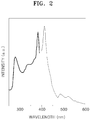
- Light-emitting properties of the polymer A were evaluated using PL spectra.
- the polymer A was diluted to a concentration of 10 mM with toluene, and the PL of the solution was measured using an ISC PC1 Spectrofluorometer equipped with a Xenon lamp.
- FIG. 2 shows that the polymer A in the solution has better light-emitting characteristics.
- a transparent electrode substrate formed by coating a glass substrate with indium-tin oxide (ITO) was cleaned. Then, the ITO layer was patterned using a photosensitive resin and an etchant into a desired pattern, followed by further cleaning.
- An HTL composition (Batron P 4083, available from Bayer AG) containing 3,4-ethylenedioxythiopene (PEDOT) was coated on the ITO layer and baked at about 200°C for about 0.5 hours to form an HTL.
- An EML composition containing the polymer A and 0.7 wt% of Dopant 1 in chlorobenzene was spin-coated on the HTL and baked at about 120°C for 30 minutes to form an EML containing the polymer A and Dopant 1.
- the HTL composition and the EML composition were filtered using a 0.2-mm filter prior to the coating.
- the concentrations and coating rates of the HTL composition and the EML compositions were adjusted to form an HTL and an EML having a thickness of about 55 nm and about 40 nm, respectively.
- TPBi was vacuum-deposited on the EML at a pressure of 5.32 x 10 -7 kPa (4 ⁇ 10 -6 torr) or less to form an ETL having a thickness of about 30 nm.
- LiF and Al were sequentially deposited on the ETL to form an EIL having a thickness of about 0.5 nm and a second electrode having a thickness of about 100 nm, thereby manufacturing an OLED.
- the thickness and growth rate of each of the layers were adjusted using a crystal sensor during the deposition process.
- An OLED was manufactured in the same manner as in Example 1, except that Dopant 2, instead of Dopant 1, was used to form the EML.
- An OLED was manufactured in the same manner as in Example 1, except that Polymer D, instead of Polymer A, was used to form the EML.
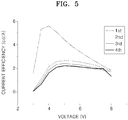
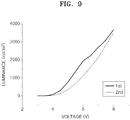
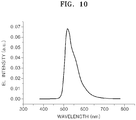
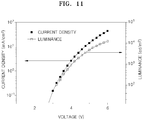
- Electroluminescence spectrum, current density, current efficiency, and luminance of the OLEDs of Examples 1 to 3 were evaluated using a PR650 Spectroscan Source Measurement Unit (available from PhotoResearch). The results are shown in FIGS. 3 to 12 .
- the OLEDs of Examples 1 to 3 including the polymer A or D were found to have better current density and luminance characteristics.
- a polymer including a repeating unit of Formula 1 above may have a high triplet state energy level, and thus an OLED including the polymer may have high current density and high luminance characteristics.
Landscapes
- Chemical & Material Sciences (AREA)
- Engineering & Computer Science (AREA)
- Materials Engineering (AREA)
- Medicinal Chemistry (AREA)
- Polymers & Plastics (AREA)
- Organic Chemistry (AREA)
- Health & Medical Sciences (AREA)
- Chemical Kinetics & Catalysis (AREA)
- Physics & Mathematics (AREA)
- Optics & Photonics (AREA)
- Spectroscopy & Molecular Physics (AREA)
- Crystallography & Structural Chemistry (AREA)
- Inorganic Chemistry (AREA)
- Electroluminescent Light Sources (AREA)
- Polyoxymethylene Polymers And Polymers With Carbon-To-Carbon Bonds (AREA)
Description
- The present disclosure relates to a polymer and an organic light-emitting device including the polymer.
- Organic light-emitting devices are self-emitting devices that are lightweight, can be easily manufactured using a relatively small number of components, and provide high-quality images with a wide viewing angle. Furthermore, organic light-emitting devices provide high color purity, accurately realize moving pictures, have low power consumption, and are operated at a low voltage. Due to these characteristics, organic light-emitting devices are suitable for mobile electronic devices.
- A typical organic light-emitting device may have a structure in which an anode, a first layer, and a cathode are sequentially stacked on a substrate, wherein the first layer may include a hole transport layer (HTL), an emission layer (EML), and an electron transport layer (ETL).
- When a current is applied between the anode and the cathode, holes injected from the anode move to the EML via the HTL, and electrons injected from the cathode move to the EML via the ETL. The holes and electrons recombine in the EML to generate excitons. The excitons radioactively decay to emit light having a wavelength corresponding to the band gap of a material.
- Materials used to form the first layer may be classified as either vacuum-depositable materials or solution-coatable materials according to the method of forming the first layer. The solution-coatable materials should be miscible with a solvent to form a composition that is coatable on a substrate by a known solution application method, such as inkjet printing, screen printing, or spin coating.
-
US 2007/0173633 discloses electroluminescent polymers including repeating units of Formula (1) and Formula (2) below and an organic electroluminescent device including an organic layer having the electroluminescent polymer:
- Provided is a polymer having a novel structure.
- Provided is an organic light-emitting device (OLED) including the polymer.
- Additional aspects will be set forth in part in the description which follows and, in part, will be apparent from the description, or may be learned by practice of the presented embodiments.
- According to the present invention, a polymer includes m repeating units, wherein an nth repeating unit of the m repeating units is a first repeating unit represented by Formula 1 below,
- Wherein, when estimated by density functional theory using B3LYP exchange functional and 6-31+G(d) basis set, at least one of a first dihedral angle between an A1 ring of the nth repeating unit and a first aromatic ring of an (n-1)th repeating unit and a second dihedral angle between an A2 ring of the nth repeating unit and a second aromatic ring of a (n+1)th repeating unit is equal to or greater than an angle of χ 50% represented by Equation 1:


- wherein the first aromatic ring is bound to the A1 ring by a single bond;
- the second aromatic ring is bound to the A2 ring by a single bond;
- R1 to R7 of
Formula 1 are each independently one of a hydrogen atom, a deuterium atom, a halogen atom, a hydroxyl group, a cyano group, a nitro group, a carboxyl group, a substituted or unsubstituted C1-C60 alkyl group, a substituted or unsubstituted C2-C60 alkenyl group, a substituted or unsubstituted C2-C60 alkynyl group, a substituted or unsubstituted C1-C60 alkoxy group, a substituted or unsubstituted C3-C60 cycloalkyl group, a substituted or unsubstituted C3-C60 cycloalkenyl group, a substituted or unsubstituted C6-C60 aryl group, a substituted or unsubstituted C6-C60 aryloxy group, a substituted or unsubstituted C6-C60 arylthio group, a substituted or unsubstituted C2-C60 heteroaryl group, -N(Q1)(Q2), and -Si(Q3)(Q4)(Q5), wherein Q1 to Q5 are each independently a hydrogen atom, a deuterium atom, a halogen atom, a hydroxyl group, a cyano group, a nitro group, a carboxyl group, a C1-C60 alkyl group, a C2-C60 alkenyl group, a C2-C60 alkynyl group, a C3-C60 cycloalkyl group, a C6-C60 aryl group, or a C2-C60 heteroaryl group; - X of Formula 1 is a single bond, or a linker including carbon or a
Group 16 element; - m is an integer from 2 to 1000;
- n is a variable of from 2 to m-1;
- A of
Formula 1 is 26.03, and B is 0.0445; - ϕ of
Equation 1 is an angle between the A1 ring and A2 ring ofFormula 1, as illustrated in Formula 1-1 below; and - θ of
Equation 1 is an angle between a first imaginary line extending from a bond between the A1 ring and a A3 ring ofFormula 1 in a direction close to nitrogen of the A3 ring and a second imaginary line extending from a bond between the A2 ring and A3 ring in a direction close to the nitrogen of the A3 ring, as illustrated in Formula 1-2 below:

- wherein, in Formulae 5A to 5E, R21 and R22 are each independently a substituted or unsubstituted C1-C60 alkyl group; and
- Y1 to Y4 are each independently a hydrogen atom, a substituted or unsubstituted C1-C60 alkyl group, or a substituted or unsubstituted C1-C60 alkoxy group, or a combination thereof.
- The polymer may be used as a phosphorescent host in an emission layer of an organic light-emitting device.
- According to another aspect of the present invention, an organic light-emitting device includes: a substrate; a first electrode; a second electrode; and a first layer disposed between the first electrode and the second electrode, the first layer including the polymer.
- These and/or other aspects will become apparent and more readily appreciated from the following description of the embodiments, taken in conjunction with the accompanying drawings in which:
-
FIG. 1 is a schematic sectional view of an organic light-emitting device according to an embodiment of the present disclosure; -
FIG. 2 is a graph of photoluminescence (PL) spectrum data of a polymer A; -
FIG. 3 is a graph of electroluminescence (EL) spectrum data of an organic light-emitting devices of Examples 1 and 2; -
FIG. 4 is a graph of voltage versus current density of the organic light-emitting device of Example 1 (4 measurement times); -
FIG. 5 is a graph of voltage versus current efficiency of the organic light-emitting device of Example 1 (4 measurement times); -
FIG. 6 is a graph of voltage versus luminance of the organic light-emitting device of Example 1 (4 measurement times); -
FIG. 7 is a graph of voltage versus current density of the organic light-emitting device of Example 2 (2 measurement times); -
FIG. 8 is a graph of voltage versus current density of the organic light-emitting device of Example 2 (2 measurement times); -
FIG. 9 is a graph of voltage versus luminance of the organic light-emitting device of Example 2 (2 measurement times); -
FIG. 10 is a graph of electroluminescence (EL) spectra of an organic light-emitting device of Example 3; -
FIG. 11 is graphs of voltage versus current density and voltage versus luminance of the organic light-emitting device of Example 3; and -
FIG. 12 is a graph of current density versus current efficiency of the organic light-emitting device of Example 3. - Reference will now be made in detail to embodiments, examples of which are illustrated in the accompanying drawings, wherein like reference numerals refer to like elements throughout. In this regard, the present embodiments may have different forms and should not be construed as being limited to the descriptions set forth herein. Accordingly, the embodiments are merely described below, by referring to the figures, to explain aspects of the present description. As used herein, the term "and/or" includes any and all combinations of one or more of the associated listed items. Expressions such as "at least one of," when preceding a list of elements, modify the entire list of elements and do not modify the individual elements of the list.
- According to an exemplary embodiment of the present disclosure, a polymer includes m repeating units, wherein an nth repeating unit of the m repeating units is a first repeating unit represented by Formula 1 below:

- In Formula 1, m indicates the number of repeating units of the polymer, which may be an integer from 2 to 1000, and in some embodiments, may be an integer from 10 to 200;
n is a variable from 2 to m-1; and
X may be a single bond, or a linker including carbon or aGroup 16 element. - For example, X of Formula 1 may be selected from among a linker with carbon, a single bond, a linker with -O-, a linker with -S-, a linker with-Se-, but is not limited thereto.
- At least one of a first dihedral angle between an A1 ring of the nth repeating unit and a first aromatic ring of an (n-1)th repeating unit and a second dihedral angle between an A2 ring of the nth repeating unit and a second aromatic ring of a (n+1)th repeating unit may be equal to or greater than an angle of χ 50% represented by Equation 1:

- In
Equation 1, A is 26.03, and B is 0.0445. - In
Equation 1, ϕ is an angle between the A1 ring and A2 ring ofFormula 1, as illustrated in Formula 1-1 below, and θ is an angle between a first imaginary line extending from a bond between the A1 ring and an A3 ring ofFormula 1 in a direction close to nitrogen of the A3 ring and a second imaginary line extending from a bond between the A2 ring and A3 ring in a direction close to the nitrogen of the A3 ring, as illustrated in Formula 1-2 below:
- Formula 1-1 and Formula 1-2 are for describing ϕ and θ of
Equation 1 with imaginary lines (first and second imaginary lines) and planes (of Formula 1-1 with the A1 and A2 rings thereon). - A first aromatic ring in the (n-1)th repeating unit is bound to the A1 ring of the nth repeating unit via a single bond, and a second aromatic ring in the (n+1)th repeating unit is bound to the A2 ring of the nth repeating unit via a single bond.
- In Formula 1, ϕ and θ may be dependent on X.
- For example, X may be a linker that includes carbon represented by Formula 2.


- R11 to R14 of
Formula 2 are each independently a hydrogen atom, a deuterium atom, a halogen atom, a hydroxyl group, a cyano group, a nitro group, a carboxyl group, a substituted or unsubstituted C1-C60 alkyl group, a substituted or unsubstituted C2-C60 alkenyl group, a substituted or unsubstituted C2-C60 alkynyl group, a substituted or unsubstituted C1-C60 alkoxy group, a substituted or unsubstituted C3-C60 cycloalkyl group, a substituted or unsubstituted C3-C60 cycloalkenyl group, a substituted or unsubstituted C6-C60 aryl group, a substituted or unsubstituted C6-C60 aryloxy group, a substituted or unsubstituted C6-C60 arylthio group, or a substituted or unsubstituted C2-C60 heteroaryl group. - In some embodiments, R11 to R14 of
Formula 2 are each independently a hydrogen atom, a deuterium atom, a halogen atom, a hydroxyl group, a cyano group, a nitro group, a carboxyl group, a substituted or unsubstituted C1-C20 alkyl group, or a substituted or unsubstituted C1-C20 alkoxy group, but are not limited thereto. - For example, R11 to R14 of Formula 2 may be each independently at least one of a hydrogen atom; a deuterium atom; F; Cl; a hydroxyl group; a cyano group; a nitro group; a carboxyl group; a methyl group; an ethyl group; a propyl group; an i-propyl group; a butyl group; an i-butyl group; a t-butyl group; a pentyl group; a hexyl group; a heptyl group; an octyl group; a 2-ethylhexyl group; a nonyl group; a decyl group; a 3,7-dimethyloctyl group; a methyl group, an ethyl group, a propyl group, an i-propyl group, a butyl group, an i-butyl group, a t-butyl group, a pentyl group, a hexyl group, a heptyl group, an octyl group, a 2-ethylhexyl group, a nonyl group, a decyl group, and a 3,7-dimethyloctyl that are each substituted with at least one of a deuterium atom, F, Cl, a hydroxyl group, a cyano group, a nitro group, and a carboxyl group; a methoxy group; an ethoxy group; a propyloxy group; an i-propyloxy group; a butoxy group; an i-butoxy group; a t-butoxy group; a pentyloxy group; a hexyloxy group; a heptyloxy group; an octyloxy group; a 2-ethylhexyloxy group; a nonyloxy group; a decyloxy group; a 3,7-dimethyloctyloxy group; and a methoxy group, an ethoxy group, a propyloxy group, an i-propyloxy group, a butoxy group, a i-butoxy group, a t-butoxy group, a pentyloxy group, a hexyloxy group, a heptyloxy group, an octyloxy group, a 2-ethylhexyloxy group, a nonyloxy group, a decyloxy group, and a 3,7-dimethyloctyloxy group that are each substituted with at least one of a deuterium atom, F, Cl, a hydroxyl group, a cyano group, a nitro group, and a carboxyl group.
- For example, in
Formula 2, R11 to R14 may be all hydrogen atoms. - When X of
Formula 1 is a linker represented byFormula 2 above, that 158.37≤ϕ≤160.37 (for example, 158.87≤ϕ≤159.87), 32.52≤θ≤34.52 (for example, 33.02≤θ≤34.02), and 38.00≤χ 50%≤40.00 (for example, 38.50≤χ 50%≤39.50) may be satisfied. In some other embodiments, when X ofFormula 1 is a linker represented byFormula 2, that 159.17≤ϕ≤159.57, 33.32≤θ≤33.72, and 38.80≤χ 50%≤39.20 may be satisfied. - When X of
Formula 1 is a single bond, that ϕ =180.00; -34.45≤θ≤-32.45 (for example, -33.95≤θ≤-32.95), and 27.00≤χ 50%≤29.00 (for example, 27.50≤χ 50%≤28.50) may be satisfied. In some other embodiments, when X ofFormula 1 is a single bond, that ϕ =180.00, -33.65≤θ≤-33.25, and 27.80≤χ 50%≤28.20 may be satisfied. - When X of
Formula 1 is a linker represented by -O-, that 167.18≤ϕ≤169.18 (for example, 167.68≤ϕ≤168.68), -2.81≤θ≤-0.81 (for example, -2.31≤θ≤-1.31), and 32.00≤χ 50%≤34.00 (for example, 32.50≤χ 50%≤33.50) may be satisfied. In some other embodiments, when X ofFormula 1 is a linker represented by -O-, that 167.98≤χ≤168.38, -2.01≤θ≤-1.61, and 32.80≤χ 50%≤33.20 may be satisfied. - When X of
Formula 1 is a linker represented by -S-, that 149.27≤ϕ≤151.27 (for example, 149.77≤ϕ≤150.77), 10.01≤θ≤12.01 (for example, 10.51≤θ≤11.51), and 34.00≤χ 50%≤36.00 (for example, 34.50≤χ 50%≤35.50) may be satisfied. In some other embodiments, when X ofFormula 1 is a linker represented by -S-, that 150.07≤ϕ≤150.47, 10.81≤θ≤11.21, and 34.80≤χ 50%≤35.20 may be satisfied. - When X of
Formula 1 is a linker represented by -Se-, that 145.94≤ϕ≤147.94 (for example, 146.44≤ϕ≤147.44), 14.46≤θ≤16.46 (for example, 14.96≤θ≤15.96), and 34.00≤χ 50%≤36.00 (for example, 34.50≤χ 50%≤35.50) may be satisfied. In some other embodiments, when X ofFormula 1 is a linker represented by -Se-, that 146.74≤ϕ≤147.14, 15.26≤θ≤15.66, and 34.80≤χ 50%≤35.20 may be satisfied. - For example, ϕ, θ, and χ 50% of
Equation 1 may have the following values in Table 1 depending on X, but are not limited thereto:Table 1 X ϕ(°) θ(°) χ 50%(°) Linker represented by Formula 2 (where R11 to R14 are all hydrogen atoms.) 159.37 33.52 39.08 single bond 180.00 -33.45 28.08 -O- 168.18 -1.81 33.19 -S- 150.27 11.01 34.67 -Se- 146.94 15.46 35.32 Equation 1 may be calculated by the application of density functional theory (DFT) with the B3LYP/6-31+G(D) basis set to a unit compound where R1 to R7 are all hydrogen atoms (i.e.,
- When at least one of the first dihedral angle and the second dihedral angle of the polymer including the first repeating unit of
Formula 1 above is equal to or greater than an angle of χ 50% defined byEquation 1 above, the polymer may have a high triplet state energy, for example, that is suitable for use as a phosphorescent host in an organic light-emitting device. Therefore, the polymer including the first repeating unit ofFormula 1 may be used as a phosphorescent host of an organic light-emitting device. - An increased conjugation length in a polymer for use as an organic semiconductor may lead to a higher charge mobility, but at the same time, to a reduction in excited state energy of the polymer, which is not conducive to use as a phosphorescent host. Therefore, for availability as a phosphorescent host, designing a polymer with a conjugation structure that ensures both an appropriate range of excited state energies as a phosphorescent host and no reduction in charge mobility is required.
- However, essential measures and requirements for designing a polymer with a conjugation structure appropriate as a phosphorescent host have not been revealed yet. The inventors of the present disclosure found that with a polymer designed to include the first repeating unit of
Formula 1 above in which at least one of the first dihedral angle and the second dihedral angle is equal to or greater than an angle of χ 50% defined byEquation 1, an original conjugation length of the polymer may be maintained, and at the same time, a conjugation structure breakage effect in some regions of the polymer may be obtained due to tilting of the nth repeating unit with respect to the n-1th repeating unit and/or to the n+1th repeating unit of the polymer, which may maintain both the charge mobility and the excited state energy of the polymer high. Accordingly, the polymer may have a high triplet state energy, and thus may be available as a phosphorescent host of an organic light-emitting device. - As described above, a polymer having an effective triplet state energy may be designed using monomers that allow the target polymer to have a smallest dihedral angle (refer to the definition above) that is equal to or greater than χ 50% defined by
Equation 1. Analysis of χ 50% and dihedral angles of a polymer has a wide range of applications, for example, in predicting whether the polymer may provide an effective triplet state energy (i.e., its availability as a phosphorescent host of an organic light-emitting device). - Evaluation of the first and second dihedral angle angles of the polymer is possible via computational simulations of electronic structures. For example, the first dihedral angle and the second dihedral angle of a target polymer are predictable using DFT with the exchange-correlation potential functional (xc-functional) of B3LYP using a 6-31+G(D) basis set.
- Dihedral angles of polymers may be experimentally measured using x-ray diffraction analysis. For example, a first dihedral angle of a polymer A below may be practically measured by X-ray diffraction analysis on carbazole having an - OC8H17 substituted phenyl group as illustrated in Formula A(1) below.


- The triplet state energy of the polymer may be measured by analysis of peaks from photoluminescence (PL) spectra on a mixture of the polymer and toluene contained in a quartz cell.
- In
Formula 1, R1 to R7 are each independently one of a hydrogen atom, a deuterium atom, a halogen atom, a hydroxyl group, a cyano group, a nitro group, a carboxyl group, a substituted or unsubstituted C1-C60 alkyl group, a substituted or unsubstituted C2-C60 alkenyl group, a substituted or unsubstituted C2-C60 alkynyl group, a substituted or unsubstituted C1-C60 alkoxy group, a substituted or unsubstituted C3-C60 cycloalkyl group, a substituted or unsubstituted C3-C60 cycloalkenyl group, a substituted or unsubstituted C6-C60 aryl group, a substituted or unsubstituted C6-C60 aryloxy group, a substituted or unsubstituted C6-C60 arylthio group, a substituted or unsubstituted C2-C60 heteroaryl group, -N(Q1)(Q2), and -Si(Q3)(Q4)(Q5), wherein Q1 to Q5 are each independently a hydrogen atom, a deuterium atom, a halogen atom, a hydroxyl group, a cyano group, a nitro group, a carboxyl group, a C1-C60 alkyl group, a C2-C60 alkenyl group, a C2-C60 alkynyl group, a C3-C60 cycloalkyl group, a C6-C60 aryl group, or a C2-C60 heteroaryl group. - For example, R1 to R7 in Formula 1 may be each independently one of a hydrogen atom, a deuterium atom, a halogen atom, a hydroxyl group, a cyano group, a nitro group, a carboxyl group, a substituted or unsubstituted C1-C20 alkyl group, a substituted or unsubstituted C1-C20 alkoxy group, a substituted or unsubstituted phenyl group, a substituted or unsubstituted pentalenyl group, a substituted or unsubstituted indenyl group, a substituted or unsubstituted naphthyl group, a substituted or unsubstituted azulenyl group, a substituted or unsubstituted heptalenyl group, a substituted or unsubstituted indacenyl group, a substituted or unsubstituted acenaphthyl group, a substituted or unsubstituted fluorenyl group, a substituted or unsubstituted phenalenyl group, a substituted or unsubstituted phenanthryl group, a substituted or unsubstituted anthryl group, a substituted or unsubstituted fluoranthenyl group, a substituted or unsubstituted triphenylenyl group, a substituted or unsubstituted pyrenyl group, a substituted or unsubstituted chrysenyl group, a substituted or unsubstituted naphthacenyl group, a substituted or unsubstituted picenyl group, a substituted or unsubstituted perylenyl group, a substituted or unsubstituted pentaphenyl group, a substituted or unsubstituted hexacenyl group, a substituted or unsubstituted pyrrolyl group, a substituted or unsubstituted pyrazolyl group, a substituted or unsubstituted imidazolyl group, a substituted or unsubstituted imidazolinyl group, a substituted or unsubstituted imidazopyridinyl group, a substituted or unsubstituted imidazopyrimidinyl group, a substituted or unsubstituted pyridinyl group, a substituted or unsubstituted pyrazinyl group, a substituted or unsubstituted pyrimidinyl group, a substituted or unsubstituted indolyl group, a substituted or unsubstituted purinyl group, a substituted or unsubstituted quinolinyl group, a substituted or unsubstituted phthalazinyl group, a substituted or unsubstituted indolizinyl group, a substituted or unsubstituted naphthyridinyl group, a substituted or unsubstituted quinazolinyl group, a substituted or unsubstituted cinnolinyl group, a substituted or unsubstituted indazolyl group, a substituted or unsubstituted carbazolyl group, a substituted or unsubstituted phenazinyl group, a substituted or unsubstituted phenanthridinyl group, a substituted or unsubstituted chromenyl group, a substituted or unsubstituted benzofuranyl group, a substituted or unsubstituted thiophenyl group, a substituted or unsubstituted benzothiophenyl group, a substituted or unsubstituted isothiazolyl group, a substituted or unsubstituted benzoimidazolyl group, and a substituted or unsubstituted isoxazolyl group.
- For example, in
Formula 1, R2 to R7 may be hydrogen atoms, and R1 may be represented by Formula 3A, 3B, 3C, 3D, 3E, 3F, 3G, 3H, or 3I.
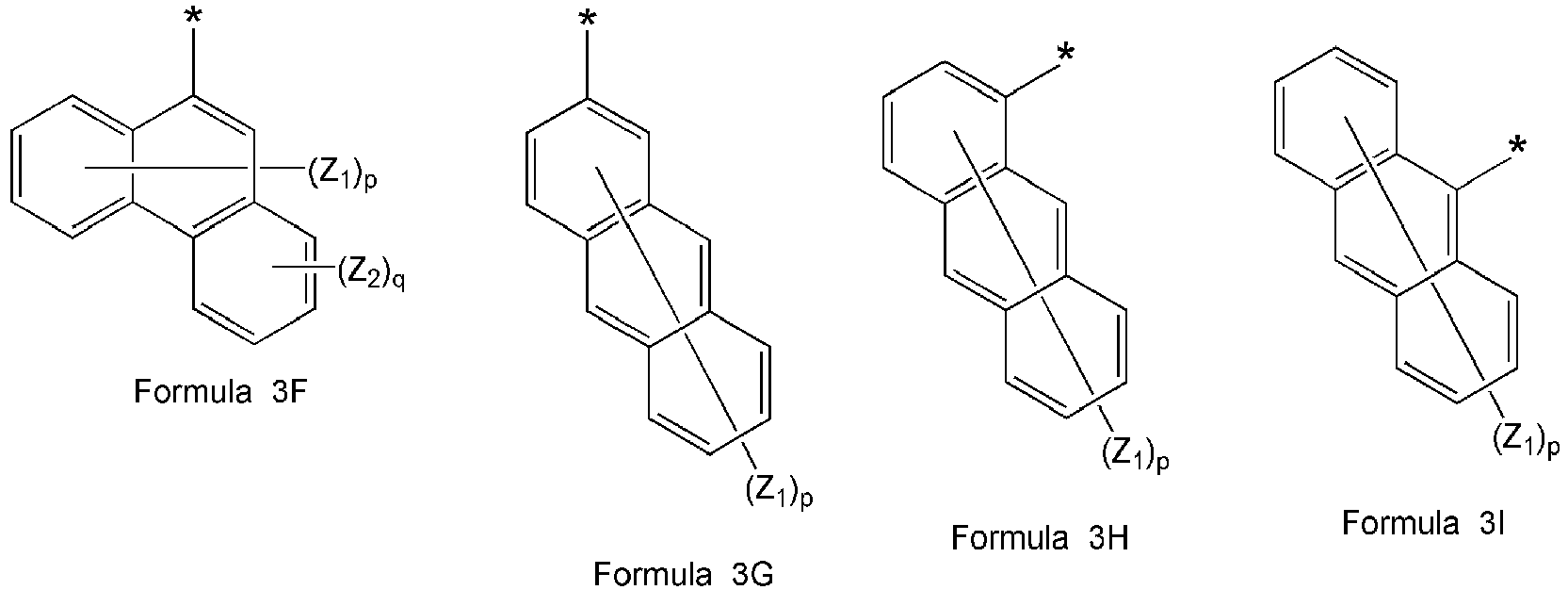
- In Formulae 3A to 3I, Z1 and Z2 may be each independently a deuterium atom, a halogen atom, a hydroxyl group, a cyano group, a nitro group, a carboxyl group, a substituted or unsubstituted C1-C60 alkyl group, a substituted or unsubstituted C2-C60 alkenyl group, a substituted or unsubstituted C2-C60 alkynyl group, a substituted or unsubstituted C1-C60 alkoxy group, a substituted or unsubstituted C3-C60 cycloalkyl group, a substituted or unsubstituted C3-C60 cycloalkenyl group, a substituted or unsubstituted C6-C60 aryl group, a substituted or unsubstituted C6-C60 aryloxy group, a substituted or unsubstituted C6-C60 arylthio group, or a substituted or unsubstituted C2-C60 heteroaryl group; p is an integer from 0 to 9; and q is an integer from 0 to 4.
- For example, in Formulae 3A to 3I, Z1 and Z2 may be each independently a deuterium atom, a halogen atom, a hydroxyl group, a cyano group, a nitro group, a carboxyl group, a substituted or unsubstituted C1-C20 alkyl group, or a substituted or unsubstituted C1-C20 alkoxy group.
- For example, Z1 and Z2 of Formulae 3A to 3I may be each independently at least one of a deuterium atom; F; Cl; a hydroxyl group; a cyano group; a nitro group; a carboxyl group; a methyl group; an ethyl group; a propyl group; an i-propyl group; a butyl group; an i-butyl group; a t-butyl group; a pentyl group; a hexyl group; a heptyl group; an octyl group; a 2-ethylhexyl group; a nonyl group; a decyl group; a 3,7-dimethyloctyl group; a methyl group, an ethyl group, a propyl group, an i-propyl group, a butyl group, an i-butyl group, a t-butyl group, a pentyl group, a hexyl group, a heptyl group, an octyl group, a 2-ethylhexyl group, a nonyl group, a decyl group, and 3,7-dimethyloctyl that are each substituted with at least one of a deuterium atom, F, Cl, a hydroxyl group, a cyano group, a nitro group, and a carboxyl group; a methoxy group; an ethoxy group; a propyloxy group; an i-propyloxy group; a butoxy group; an i-butoxy group; a t-butoxy group; a pentyloxy group; a hexyloxy group; a heptyloxy group; an octyloxy group; a 2-ethylhexyloxy group; a nonyloxy group; a decyloxy group; a 3,7-dimethyloctyloxy group; and a methoxy group, an ethoxy group, a propyloxy group, an i-propyloxy group, a butoxy group, a i-butoxy group, a t-butoxy group, a pentyloxy group, a hexyloxy group, a heptyloxy group, an octyloxy group, a 2-ethylhexyloxy group, a nonyloxy group, a decyloxy group, and a 3,7-dimethyloctyloxy group that are each substituted with at least one of a deuterium atom, F, Cl, a hydroxyl group, a cyano group, a nitro group, and a carboxyl group.
- In Formulae 3A to 3I, p may be an integer from 0 to 3, and in some embodiments, may be an integer from 1 to 3; and q may be an integer from 0 to 2, and in some embodiments, may be an integer of 1 or 2, but p and q are not limited thereto.
- For example, in
Formula 1, R2 to R7 may be hydrogen atoms, and R1 may be represented by Formula 4A below, but R2 to R7 and R1 are not limited thereto:
- Z1 in Formula 4A is defined above, so a detailed description thereof will not be recited here.
- The first aromatic ring and the second aromatic ring of the polymer may be substituted or unsubstituted benzene rings. For example, the first aromatic ring and the second aromatic ring may be pure substituted or unsubstituted benzene rings. In an embodiment, the first aromatic ring and the second aromatic ring may be benzene rings fused in substituted or unsubstituted naphthalene rings or in substituted or unsubstituted fluorene rings.
- The polymer further includes a second repeating unit represented by Formula 5A, 5B, 5C, 5D or 5E:
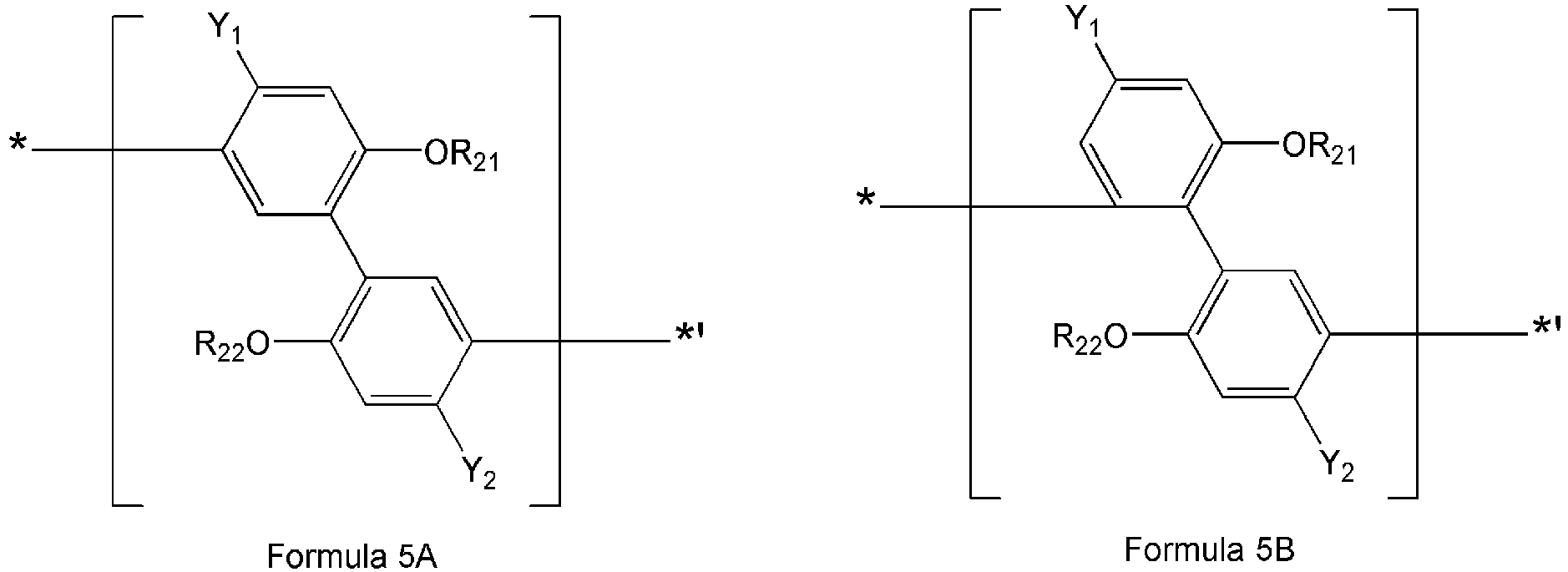


- In Formulae 5A to 5E, R21 and R22 may be each independently a substituted or unsubstituted C1-C60 alkyl group (for example, a substituted or unsubstituted C1-C20 alkyl group); Y1 to Y4 may be each independently a hydrogen atom, a substituted or unsubstituted C1-C60 alkyl group (for example, a substituted or unsubstituted C1-C20 alkyl group), or a substituted or unsubstituted C1-C60 alkoxy group (for example, a substituted or unsubstituted C1-C20 alkoxy group).
- For example, R21 and R22 may be each independently a methyl group; an ethyl group; a propyl group; an i-propyl group; a butyl group; an i-butyl group; a t-butyl group; a pentyl group; a hexyl group; a heptyl group; an octyl group; a 2-ethylhexyl group; a nonyl group; a decyl group; a 3,7-dimethyloctyl group; and a methyl group, an ethyl group, a propyl group, an i-propyl group, a butyl group, an i-butyl group, a t-butyl group, a pentyl group, a hexyl group, a heptyl group, an octyl group, a 2-ethylhexyl group, a nonyl group, a decyl group, and a 3,7-dimethyloctyl that are each substituted with at least one of a deuterium atom, F, Cl, a hydroxyl group, a cyano group, a nitro group, and a carboxyl group, but are not limited thereto.
- For example, Y1 to Y4 may be each independently a hydrogen atom; a methyl group; an ethyl group; a propyl group; an i-propyl group; a butyl group; an i-butyl group; a t-butyl group; a pentyl group; a hexyl group; a heptyl group; an octyl group; a 2-ethylhexyl group; a nonyl group; a decyl group; a 3,7-dimethyloctyl group; a methyl group, an ethyl group, a propyl group, an i-propyl group, a butyl group, an i-butyl group, a t-butyl group, a pentyl group, a hexyl group, a heptyl group, an octyl group, a 2-ethylhexyl group, a nonyl group, a decyl group, and a 3,7-dimethyloctyl group that are each substituted with at least one of a deuterium atom, F, Cl, a hydroxyl group, a cyano group, a nitro group, and a carboxyl group; a methoxy group; an ethoxy group; a propyloxy group; an i-propyloxy group; a butoxy group; an i-butoxy group; a t-butoxy group; a pentyloxy group; a hexyloxy group; a heptyloxy group; an octyloxy group; a 2-ethylhexyloxy group; a nonyloxy group; a decyloxy group; a 3,7-dimethyloctyloxy group; a methoxy group, an ethoxy group, a propyloxy group, an i-propyloxy group, a butoxy group, an i-butoxy group, a t-butoxy group, a pentyloxy group, a hexyloxy group, a heptyloxy group, an octyloxy group, a 2-ethylhexyloxy group, a nonyloxy group, a decyloxy group, and a 3,7-dimethyloctyloxy group that are each substituted with at least one of a deuterium atom, F, Cl, a hydroxyl group, a cyano group, a nitro group, and a carboxyl group; but are not limited thereto.
- The polymer may be a copolymer consisting of the first repeating unit and the second repeating unit. The copolymer may be a block copolymer, a random copolymer, or an alternating copolymer. For example, the copolymer may be an alternating copolymer consisting of the first repeating unit and the second repeating unit.
- In some other embodiments, the polymer may be an alternating polymer consisting of a repeating unit represented by Formula 6A or 6B:


- Z1, R21, and R22 in Formulae 6A and 6B are defined above, so a detailed description thereof will not be recited here.
- A weight average molecular weight of the polymer of
Formula 1 may be from 2,000 to 1,000,000 on the basis of polystyrene, and a polydispersity index (PDI) thereof may be from 1.5 to 5, but the weight average molecular weight and the PDI of the polymer are not limited thereto. The weight average molecular weight and the PDI, which may be obtained, for example, by gel permeation chromatography (GPC) on the basis of polystyrene calibration, may be determined in consideration of, for example, a structure and desired characteristics of an organic light-emitting device including the polymer. - As used herein, the term "substituted X" in the term "substituted or unsubstituted X (wherein X is a group" refers to a group X of which at least one hydrogen atom is substituted with a deuterium atom, a halogen atom, a hydroxyl group, a nitro group, a cyano group, an amidino group, a hydrazinyl group, a carboxylic acid group or a salt derivative thereof, a sulfonic acid group or a salt derivative thereof, a phosphoric acid group or a salt derivative thereof, a substituted or unsubstituted C1-C60 alkyl group, a substituted or unsubstituted C2-C60 alkenyl group, a substituted or unsubstituted C2-C60 alkynyl group, a substituted or unsubstituted C1-C60 alkoxy group, a substituted or unsubstituted C3-C60 cycloalkyl group, a substituted or unsubstituted C3-C60 cycloalkenyl group, a substituted or unsubstituted C6-C60 aryl group, a substituted or unsubstituted C6-C60 aryloxy group, a substituted or unsubstituted C2-C60 heteroaryl group,-N(Q101)(Q102), or -Si(Q103)(Q104)(Q105), wherein Q101 to Q105 may be each independently a hydrogen atom, a halogen atom, a hydroxyl group, a cyano group, a substituted or unsubstituted C1-C60 alkyl group, a substituted or unsubstituted C2-C60 alkenyl group, a substituted or unsubstituted C2-C60 alkynyl group, a substituted or unsubstituted C1-C60 alkoxy group, a substituted or unsubstituted C3-C60 cycloalkyl group, a substituted or unsubstituted C3-C60 cycloalkenyl group, a substituted or unsubstituted C6-C60 aryl group, a substituted or unsubstituted C6-C60 aryloxy group, or a substituted or unsubstituted C2-C60 heteroaryl group. If the number of substituents is at least 2, the substituents may be identical to or different from each other.
- In some embodiments, the "substituted X" may refer to a group X of which at least one hydrogen atom is substituted with a deuterium atom, a halogen atom, a hydroxyl group, a cyano group, a substituted or unsubstituted C1-C10 alkyl group, a substituted or unsubstituted C1-C10 alkoxy group, a substituted or unsubstituted C6-C20 aryl group, a substituted or unsubstituted C2-C20 heteroaryl group, -N(Q101)(Q102), or-Si(Q103)(Q104)(Q105), wherein Q101 to Q105 may be each independently a hydrogen atom, a halogen atom, a hydroxyl group, a cyano group, a substituted or unsubstituted C1-C10 alkyl group, a substituted or unsubstituted C1-C10 alkoxy group, a substituted or unsubstituted C6-C20 aryl group, or a substituted or unsubstituted C2-C20 heteroaryl group.
- In some embodiments, the "substituted X" may refer to a group X of which at least one hydrogen atom is substituted with a deuterium atom, a halogen atom, a hydroxyl group, a cyano group, a C1-C10 alkyl group, a C1-C10 alkoxy group, a C6-C20 aryl group, a C2-C20 heteroaryl group, -N(Q101)(Q102), or -Si(Q103)(Q104)(Q105), wherein Q101 to Q105 may be each independently a hydrogen atom, a halogen atom, a hydroxyl group, a cyano group, a C1-C10 alkyl group, a C1-C10 alkoxy group, a C6-C20 aryl group, or a C2-C20 heteroaryl group.
- In some embodiments, the "substituted X" may refer to a group X of which at least one hydrogen atom is substituted with a deuterium atom, a halogen atom, a hydroxyl group, a cyano group, a methyl group, an ethyl group, a propyl group, a butyl group, a pentyl group, a methoxy group, an ethoxy group, a propoxy group, a pentoxy group, a phenyl group, a naphthyl group, or an anthryl group.
- As used herein, the term "unsubstituted C1-C60 alkyl group" may have a linear or branched group. Examples of the C1-C60 alkyl group include, but are not limited to, methyl, ethyl, propyl, isobutyl, sec-butyl, pentyl, iso-amyl, hexyl, heptyl, octyl, nonyl, and the like. Substituents of the substituted C1-C60 alkyl group are the same as described above in conjunction with the "substituted X".
- As used herein, the unsubstituted C2-C60 alkenyl group indicates a hydrocarbon chain having at least one carbon-carbon double bond in the center or at a terminal of the unsubstituted C2-C60 alkyl group. Nonlimiting examples of the unsubstituted C2-C60 alkenyl group include ethenyl, propenyl, butenyl, pentenyl, hexenyl, heptenyl, octenyl, propadienyl, isoprenyl, and allyl. Substituents of the substituted C2-C60 alkenyl group are the same as described above in conjunction with the "substituted X".
- As used herein, the unsubstituted C2-C60 alkenyl group indicates a hydrocarbon chain having at least one carbon-carbon triple bond in the center or at a terminal of the unsubstituted C2-C60 alkyl group. An example of the unsubstituted C2-C60 alkynyl group is acetylenyl. Substituents of the substituted C2-C60 alkynyl group are the same as described above in conjunction with the "substituted X".
- As used herein, the unsubstituted C1-C60 alkoxy group refers to a group having a structure of -OY, wherein Y is an unsubstituted C1-C60 alkyl group as described above. Examples of the unsubstituted C1-C60 alkoxy group include a methoxy group, an ethoxy group, an isopropyloxy group, a butoxy group, and a pentoxy group. Substituents of the substituted C1-C60 alkoxy group are the same as described above in conjunction with the "substituted X".
- As used herein, the unsubstituted C3-C60 cycloalkyl group indicates a cyclic saturated hydrocarbon group. Non-limiting examples of the unsubstituted C3-C60 cycloalkyl group include cyclopropyl, cyclobutyl, cyclopentyl, cyclohexyl, and cyclooctyl. Substituents of the substituted C3-C60 cycloalkyl group are the same as described above in conjunction with the "substituted X".
- As used herein, the unsubstituted C3-C60 cycloalkenyl group indicates a nonaromatic, cyclic unsaturated hydrocarbon group with at least one carbon-carbon double bond. Examples of the unsubstituted C3-C60 cycloalkenyl group include cyclopropenyl, cyclobutenyl, cyclopentenyl, cyclohexcenyl, cycloheptenyl, 1,3-cyclohexadienyl, 1,4-cyclohexadienyl, 2,4-cycloheptadienyl, and 1,5-cyclooctadienyl. Substituents of the substituted C3-C60 cycloalkenyl group are the same as described above in conjunction with the "substituted X".
- As used herein, the unsubstituted C6-C60 aryl group indicates a monovalent group including a C6-C60 carbocyclic aromatic system, which may be monocyclic or polycyclic. In a polycyclic group, at least two rings may be fused to each other. Examples of the unsubstituted C6-C60 aryl group include phenyl, pentalenyl, indenyl, naphtyl, azulenyl, heptalenyl, indacenyl, acenaphtyl, fluorenyl, spiro-fluorenyl, phenalenyl, phenanthryl, anthryl, fluoranthenyl, triphenylenyl, pyrenyl, chrysenyl, naphthacenyl, picenyl, perylenyl, pentaphenyl, and hexacenyl. Substituents of the substituted C6-C60 aryl group are the same as described above in conjunction with the "substituted X".
- As used herein, the unsubstituted C2-C60 heteroaryl group indicates a monocyclic or polycyclic group including at least one ring with at least one heteroatom selected from among N, O, P, and S. In a polycyclic group, at least two rings may be fused to each other. Examples of the unsubstituted C2-C60 heterocyclic group include pyrrolyl, imidazolyl, pyrazolyl, pyridinyl, pyrazinyl, pyrimidinyl, pyridazinyl, isoindolyl, indolyl, indazolyl, purinyl, quinolinyl, benzoquinolinyl, phthalazinyl, naphthyridinyl, quinoxalinyl, quinazolinyl, cinnolinyl, carbazolyl, phenanthridinyl, acridinyl, phenanthrolinyl, phenazinyl, benzooxazolyl, benzoimidazolyl, furanyl, benzofuranyl, thiophenyl, benzothiophenyl, thiazolyl, isothiazolyl, benzothiazolyl, isoxazolyl, oxazolyl, triazolyl , tetrazolyl, oxadiazolyl, triazinyl, and benzooxazolyl. Substituents of the substituted C6-C60 heteroaryl group are the same as described above in conjunction with the "substituted X".
- As used herein, "*" and "*"' indicate binding sites with neighboring moieties, which would be understood by one of ordinary skill in the art.
- The polymer including the first repeating unit of
Formula 1 may be synthesized using a known organic synthesis method, for example, using Suzuki coupling or Yamamoto coupling. A synthesis method of the polymer may be understood by those of ordinary skill in the art from the examples that are described below. - Thus, the polymer may be used in an organic light-emitting device, for example, as a phosphorescent host in an emission layer of an organic light-emitting device along with a phosphorescent dopant.
- Compared to fluorescence materials with a mere 25% internal quantum efficiency at maximum due to the involvement of only a singlet state energy level in light emission, phosphorescent materials that allow intersystem crossing between singlet and triplet state energy levels may theoretically have a 100% internal quantum efficiency due to the excitons of triplet state energy level involved in light emission. Therefore, a high-efficiency organic light-emission device may be implemented using a phosphorescent material. In consideration that known phosphorescent dopants have high triplet state energy and the above-described characteristics of the polymer, the polymer may be used as a phosphorescent host in an emission layer of an organic light-emitting device.
- In some embodiments, the polymer may be used as a red, green, and/or blue phosphorescent host in an emission layer of an organic light-emitting device. In some other embodiments, the polymer may be used as a red and/or green phosphorescent host in an emission layer of an organic light-emitting device, but is not limited thereto.
- According to another exemplary embodiment of the present disclosure, an organic light-emitting device (OLED) includes a substrate, a first electrode, a second electrode, and a first layer disposed between the first electrode and the second electrode, the first layer including the above-described polymer.
- The first layer may function as, for example, an emission layer.
- If the first layer is an emission layer, the first layer may further include a phosphorescent dopant. The phosphorescent dopant used in the first layer may be any known phosphorescent dopant. For example, the phosphorescent dopant may include an organometallic complex including at least one of iridium (Ir), platinum (Pt), osmium (Os), rhenium (Re), titanium (Ti), zirconium (Zr), hafnium (Hf), or a combination of at least two thereof.
- For example, the phosphorescent dopant may include at least one of bisthienylpyridine acetylacetonate iridium, bis(benzothienylpyridine)acetylacetonate iridium, bis(2-phenylbenzothiazole)acetylacetonate iridium, bis(1-phenylisoquinoline) iridium acetylacetonate, tris(1-phenylisoquinoline) iridium, tris(phenylpyridine) iridium, tris(2-biphenylpyridine) iridium, tris(3-biphenyl pyridine) iridium, tris(4-biphenyl pyridine) iridium, Ir(pq)2(acac) (wherein "pq" is an abbreviation for 2-phenylquinoline; and "acac" is an abbreviation for acetylacetone, see Compound 10 below), Ir(ppy)3 (wherein "ppy" is an abbreviation for phenylpyridine, see Compound 11 below), platinum(II)octaethylporphyrin (PtOEP, see a compound below), Compound 12 below, Firpic (see Compound 13 below), Ir(piq)3 (see a compound below), Ir(piq)2acac (wherein "piq" is an abbreviation for phenylisoquinoline, see Compound 14 below), Ir(mppy)3 (see Dopant 1 below), Dopant 2 below, Btp2Ir(acac) (see a compound below), F2Irpic (see a compound below), (F2ppy)2Ir(tmd) (see a compound below), and Ir(dfppz)3 (see a compound below), but is not limited thereto:


- In addition to the first layer that may function as an emission layer, as described above, the OLED may further include at least one of a hole injection layer (HIL), a hole transport layer (HTL), a hole blocking layer (HBL), an electron transport layer (ETL), and an electron injection layer (EIL) between the first electrode and the second electrode.
-
FIG. 1 is a schematic sectional view of anOLED 10 according to an embodiment of the present disclosure. Referring toFIG. 1 , theOLED 10 includes asubstrate 11, afirst electrode 12, anHTL 13, afirst layer 15, anETL 16, anEIL 18, and asecond electrode 19. Thefirst layer 15 may function as an emission layer (EML). Hereinafter, theOLED 10 and a method of manufacturing the same will be described in detail. - First, the
first electrode 12 is formed on thesubstrate 11 by deposition, ion plating, plating, or sputtering. Thefirst electrode 12 may be formed of a first electrode-forming material having a high work function. Thefirst electrode 12 may constitute an anode that may inject holes or a cathode that may inject electrons. Thesubstrate 11, which may be any substrate that is used in general OLEDs, may be a glass substrate or a transparent plastic substrate with excellent mechanical strength, thermal stability, transparency, surface smoothness, ease of handling, and water resistance. Examples of the first electrode-forming material include a metal oxide, a metal sulfide, or a metal, all of which have a high electrical conductivity. In general, these materials are used to form a thin film. Examples of the first electrode-forming material include indium oxide, zinc oxide, tin oxide, a combination thereof, such as indium tin oxide (ITO) or indium zinc oxide (IZO), gold (Au), platinum (Pt), silver (Ag), and copper (Cu). Furthermore, polyaniline or a derivative thereof, or polythiophene or a derivative thereof may also be used as the first electrode-forming material. Thefirst electrode 12 may have a monolayered structure or a multilayered structure including at least two layers. Thefirst electrode 12 may contain at least two different materials. The thickness of thefirst electrode 12 may appropriately vary in consideration of light transmittance and electrical conductivity, for example, may be in the range of 10 nm to 10 µm. - Next, although not illustrated in
FIG. 1 , if thefirst electrode 12 is an anode, HIL may be further formed on thefirst electrode 12. The HIL may be formed by vacuum deposition, spin coating, casting, inkjet printing, LB deposition, or the like. - When the HIL is formed using vacuum deposition, the deposition conditions may vary according to a material that is used to form the HIL, and the structure and thermal properties of the HIL to be formed. For example, conditions for vacuum deposition may include a deposition temperature of 100 to 500°C, a pressure of 1.33*10-9 to 1.33*10-4 kPa (10-8 to 10-3 torr), and a deposition rate of 0.001 to 10 nm/sec.
- When the HIL is formed using spin coating, the coating conditions may vary according to a material that is used to form the HIL, and the structure and thermal properties of the HIL to be formed. In general, however, conditions for spin coating may include a coating rate of 2000 to 5000 rpm and a heat treatment temperature of 80 to 300°C for removing a solvent after coating.
- The HIL may be formed of any material that is commonly used to form an HIL. Examples of the material that may be used to form the HIL include a phthalocyanine compound such as copper phthalocyanine, 4,4',4"-tris (3-methylphenylphenylamino) triphenylamine (m-MTDATA), N,N'-di(1-naphthyl)-N,N'-diphenylbenzidine (NPB), TDATA (see the formula below), and 2T-NATA (see the formula below), but are not limited thereto.

- The thickness of the HIL may be from 10 nm to 1000 nm, and in some other embodiments, may be from 10 nm to 100 nm. When the thickness of the HIL is within these ranges, the HIL may have satisfactory hole injection properties without an increase in a driving voltage.
- Next, the
HTL 13 may be formed on thefirst electrode 12 or the HIL by using vacuum deposition, spin coating, casting, inkjet printing, or LB deposition. - When the
HTL 13 is formed using vacuum deposition or spin coating, the conditions for deposition and coating are similar to those for the formation of the HIL, though the conditions for the deposition and coating may vary according to the material that is used to form theHTL 13. - The
HTL 13 may be formed of any known materials used to form an HTL. Examples of the material that may be used to form theHTL 13 include an amine derivative having an aromatic condensed ring, such as N,N'-bis(3-methylphenyl)-N,N'-diphenyl-[1,1-biphenyl]-4,4'-diamine (TPD, see the formula below), polyaniline/dodecylbenzenesulfonic acid (Pani/DBSA, see the formula below); poly(3,4-ethylenedioxythiophene)/poly(4-styrenesulfonate) (PEDOT/PSS, see the formula below); polyaniline/camphor sulfonicacid (Pani/CSA); and polyaniline/poly(4-styrenesulfonate (PANI/PSS), but are not limited thereto.
- The thickness of the
HTL 13 may be from 5 nm to 100nm, and in some other embodiments, may be from 10 nm to 60 nm. When the thickness of theHTL 13 is within these ranges, theHTL 13 may have satisfactory hole transport properties without a substantial increase in a driving voltage. - The
first layer 15, which may function as an emission layer, may be formed on theHTL 13. Thefirst layer 15 may be formed by spin coating, casting, inkjet printing, LB deposition, or the like. When thefirst layer 15 is formed using spin coating, the conditions for forming thefirst layer 15 are similar to those for the formation of theHIL 13, though the conditions for forming thefirst layer 15 may vary according to a polymer and/or a compound that is used to form thefirst layer 15. - The
first layer 15 may include the polymer as a host. In another embodiment, thefirst layer 15 may further include a phosphorescent dopant, in addition to the above-described polymer. Examples of the phosphorescent dopant are described above. - If the
first layer 15 includes the above-described polymer and a phosphorescent dopant, the amount of the phosphorescent dopant in thefirst layer 15 may be from 0.5wt% to 10wt% based on a total weight (100 wt%) of thefirst layer 15. When the amount of the phosphorescent dopant is within this range, concentration quenching may be substantially prevented. - In some other embodiments, the
first layer 15 may exclusively include the above-described polymer or may further include a known fluorescent dopant, in addition to the polymer. - The thickness of the
first layer 15, which may function as an EML, may be from 10 nm to 100 nm, and in some other embodiments, may be from 20 nm to 90 nm. When the thickness of thefirst layer 15 is within these ranges, thefirst layer 15 may have satisfactory light emission characteristics without a substantial increase in a driving voltage. - An HBL may further be formed on the
first layer 15, if required, although not illustrated inFIG. 1 . - The HBL may prevent triplet excitons or holes in the
first layer 15 from diffusing into thesecond electrode 19. The HBL may be formed by using vacuum deposition, spin coating, casting, LB deposition, or the like. When the HBL is formed using vacuum deposition or spin coating, the deposition and coating conditions may be similar to those for the formation of the HIL, though the conditions for deposition and coating may vary according to the material that is used to form the HBL. Examples of the material that may be used to form the HBL include an oxadiazole derivative, a triazole derivative, a phenanthroline derivative, and TAZ (see the formula below), but are not limited thereto.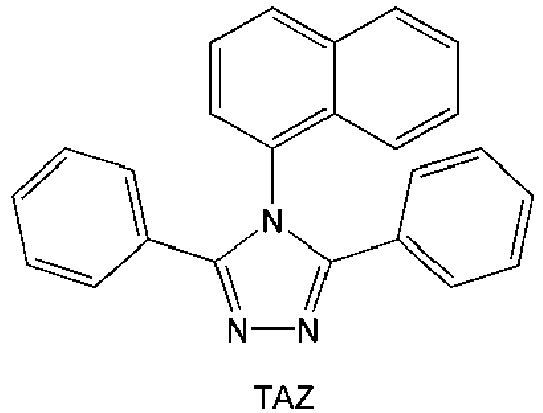
- The thickness of the HBL may be from 5 nm to 100 nm, and in some other embodiments, may be from 10 nm to 30nm. When the thickness of the HBL is within these ranges, the HBL may have satisfactory hole blocking properties.
- Next, the
ETL 16 may be formed on thefirst layer 15 or HBL by using vacuum deposition, spin coating, casting, or the like. When theETL 16 is formed using vacuum deposition or spin coating, the deposition and coating conditions may be similar to those for the formation of the HIL, though the deposition and coating conditions may vary according to the material that is used to form the ETL. Examples of the material that may be used to form theETL 16 include any known materials that stably transports electrons injected from an electron injection electrode, that is, a cathode, such as a quinoline derivative, 4,7-diphenyl-1,10-phenanthroline (Bphen), BAlq (see the formula below), tris(8-quinolinorate)aluminum (Alq3), beryllium bis(benzoquinolin-10-olate (Bebq2), or TPBi (see the formula below).
- The thickness of the
ETL 16 may be from 10 nm to 100 nm, and in some other embodiments, may be from 20 nm to 50 nm. When the thickness of theETL 16 is within these ranges, theETL 16 may have satisfactory electron transport properties without a substantial increase in a driving voltage. - Next, the
EIL 18 may be formed on theETL 16 or thefirst layer 15. TheEIL 18 may be formed of any known material, such as LiF, NaCl, CsF, Li2O, BaO, BaF2, or the like. The deposition and coating conditions for forming theEIL 18 may be similar to those for the formation of the HIL, though the deposition and coating conditions may vary according to the material that is used to form theEIL 18. - The thickness of the
EIL 18 may be from 0.1 nm to 10 nm, and in some other embodiments, may be from 0.5 nm to 5 nm. When the thickness of theEIL 18 is within these ranges, theEIL 18 may have satisfactory electron injection properties without a substantial increase in a driving voltage. - Finally, the
second electrode 19 may be formed on theEIL 19. Thesecond electrode 19 may be formed according to the method described above in conjunction with thefirst electrode 12. Thesecond electrode 19 may constitute a cathode or an anode. When thesecond electrode 19 constitutes a cathode, thesecond electrode 19 may be formed of a material having a low work function. Examples of the material having a low work function include an alkali metal, such as lithium (Li), sodium (Na), potassium (K), rubidium (Rb), or cesium (Cs); an alkali earth metal, such as beryllium (Be), magnesium (Mg), calcium (Ca), strontium (Sr), or barium (Ba); a metal, such as aluminum (Al), scandium (Sc), vanadium (V), zinc (Zn), yttrium (Y), indium (In), cerium (Ce), samarium (Sm), europium (Eu), terbium (Tb), or ytterbium (Yb); an alloy of at least two of these metals; an alloy of at least one of these metals with gold (Au), silver (Ag), platinum (Pt), copper (Cu), manganese (Mg), titanium (Ti), cobalt (Co), nickel (Ni), tungsten (W), and tin (Sn); graphite; and a graphite intercalation compound, but are not limited thereto. Examples of alloys that may be used to form thesecond electrode 19 include a Mg-Ag alloy, a Mg-In alloy, a Mg-Al alloy, an In-Ag alloy, a Li-Al alloy, a Li-Mg alloy, a Li-In alloy, and a Ca-Al alloy. Thesecond electrode 19 may be formed as a monolayer or a multilayer structure including at least two layers. Thesecond electrode 19 may exclusively contain one material or may include two different materials. Thesecond electrode 19 may be implemented in various forms, for example, as a transparent, semitransparent, or reflective electrode. The thickness of thesecond electrode 19 may be from 10 nm to 10 µm, but is not limited thereto. - One or more embodiments of the present invention will now be described in detail with reference to the following examples. However, these examples are not intended to limit the scope of the one or more embodiments of the present invention.
-

- After equipment of a 50 mL, well-dried 2-necked flask with a reflux condenser, 668 mg (1.0 mmol) of Compound B below, 568 mg (1.0 mmol) of Compound C below, 4.49 mg (0.02 mmol) of acetic acid palladium (Pd(OAC)2), and 22.4 mg (0.08 mmol) of tricyclohexylphosphine (PCy3) were put into the flask, which was then connected to a Schlenk line, followed by evacuation several times, and refluxing under a nitrogen atmosphere. Subsequently, after addition of 6 mL of anhydrous toluene in a nitrogen atmosphere by stirring, 45.7 µL (0.1 mmol) of
Aliquat 336 and 4 mL of a 2M aqueous potassium carbonate solution were added thereto. The reaction mixture was stirred under reflux conditions and a nitrogen atmosphere for about 48 hours. After addition of 340 mg (2.5 mmol) of p-tolyl boronic acid and stirring for 1 hour, 308 µL (2.5 mmol) of 4-bromotoluene was added and further stirred for 2 hours. After completion of the reaction, the temperature of the reaction mixture was decreased to room temperature, diluted by addition of 30 mL of toluene and 30 mL of water, and the organic phase was separated and concentrated. A resulting concentrated compound was dissolved in 10 mL of toluene, and precipitated with 300 mL of methanol, thereby obtaining 680 mL of polymer A. As a result of analyzing the polymer A using gel permeation chromatography (GPC), the polymer A was found to have a weight average molecular weight (Mw) of about 1.82 x 10⁴, a number average molecular weight (Mn) of about 6.59 x 10³, and a molecular weight distribution (MWD) of about 2.76.
-

- Polymer D was synthesized in the same manner as in Synthesis Example 1, except that Compound E below, instead of Compound B, was used. As a result of analyzing the polymer D using GPC, the polymer D was found to have an Mw of about 7.34 x 10³, an Mn of about 3.50 x 10³, and an MWD of about 2.10.

-

- Polymer F was synthesized in the same manner as in Synthesis Example 1, except that Compound G below, instead of Compound B, was used. As a result of analyzing the polymer F using GPC, the polymer F was found to have an Mw of about 6.60 x 10³, an Mn of about 3.46 x 10³, and an MWD of about 1.91.

-

- Polymer H was synthesized in the same manner as in Synthesis Example 1, except that Compound I below, instead of Compound B, was used. As a result of analyzing the polymer H using GPC, the polymer H was found to have an Mw of about 8.05 x 10³, an Mn of about 4.33 x 10³, and an MWD of about 1.86.

-

- Polymer J was synthesized in the same manner as in Synthesis Example 1, except that Compound K below, instead of Compound B, was used. As a result of analyzing the polymer J using GPC, the polymer J was found to have an Mw of about 2.34 x 10⁴, an Mn of about 1.09 x 10⁴, and an MWD of about 2.15.

-


- Polymer L was synthesized in the same manner as in Synthesis Example 1, except that Compound M below, instead of Compound B, was used. As a result of analyzing the polymer L using GPC, the polymer L was found to have an Mw of about 8.66 x 10³, an Mn of about 4.37 x 10³, and an MWD of about 1.98.

- Four consecutive repeating units in the main chain of the polymers A, D, and F are represented by Formulas A, D, and F:


- With regard to the polymers A, D, and F, respectively, having units represented by Formulae A, D, and F, ϕ and θ in the nth repeating unit, a first dihedral angle, a second dihedral angle, and triplet state energy (ET1) are estimated using methods described in Table 1 below. The results are shown in Table 2. χ 50% in Table 2 was calculated according to
Equation 1 above:Table 2 Parameter Estimation method ϕ and θ Using DFT with (B3LYP/6-31+G(d)), i.e, with the xc-functional of B3LYP and a 6-31+G(D) basis set. First dihedral angle & Second dihedral angle Using DFT with (B3LYP/6-31+G(d)), i.e., with the xc-functional of B3LYP and a 6-31+G(D) basis set. Triplet state energy(ET1) Using TDDFT with (B3LYP/6-31+G(d), i.e., with the xc-functional of B3LYP and a 6-31+G(D) basis set; or by analyzing only low-temperature peaks (relative to room temperature) from PL spectra of a mixture of a target polymer and toluene (1 mg of the polymer dissolved in 3 cc of toluene), wherein the mixture is contained in a quartz cell, placed in liquid nitrogen (77K), and analyzed using a PL analyzer. Table 3 Polymer No. ϕ (°) θ (°) χ 50% (°) First dihedral angle & Second dihedral angle(°) ET1 (eV) A 180.00 -33.45 28.08 38.6 2.56 D 159.37 33.52 39.08 39.2 2.45 F 145.48 28.28 37.50 31.3 1.81 - Referring to Table 3, the Polymers A and D were found to have a first dihedral angle and a second dihedral angle that are greater than χ 50% of Polymers A and D, respectively, and a high triplet state energy relative to the polymer F, whereas the polymer F has a first dihedral angle and a second dihedral angle that are smaller than χ 50% of Polymer F and a relatively low triplet state energy.
- Light-emitting properties of the polymer A were evaluated using PL spectra. First, the polymer A was diluted to a concentration of 10 mM with toluene, and the PL of the solution was measured using an ISC PC1 Spectrofluorometer equipped with a Xenon lamp.
-
FIG. 2 shows that the polymer A in the solution has better light-emitting characteristics. - First, a transparent electrode substrate formed by coating a glass substrate with indium-tin oxide (ITO) was cleaned. Then, the ITO layer was patterned using a photosensitive resin and an etchant into a desired pattern, followed by further cleaning. An HTL composition (Batron P 4083, available from Bayer AG) containing 3,4-ethylenedioxythiopene (PEDOT) was coated on the ITO layer and baked at about 200°C for about 0.5 hours to form an HTL. An EML composition containing the polymer A and 0.7 wt% of
Dopant 1 in chlorobenzene was spin-coated on the HTL and baked at about 120°C for 30 minutes to form an EML containing the polymer A andDopant 1. The HTL composition and the EML composition were filtered using a 0.2-mm filter prior to the coating. The concentrations and coating rates of the HTL composition and the EML compositions were adjusted to form an HTL and an EML having a thickness of about 55 nm and about 40 nm, respectively. TPBi was vacuum-deposited on the EML at a pressure of 5.32 x 10⁻⁷ kPa (4×10⁻⁶ torr) or less to form an ETL having a thickness of about 30 nm. Then, LiF and Al were sequentially deposited on the ETL to form an EIL having a thickness of about 0.5 nm and a second electrode having a thickness of about 100 nm, thereby manufacturing an OLED. The thickness and growth rate of each of the layers were adjusted using a crystal sensor during the deposition process.

- An OLED was manufactured in the same manner as in Example 1, except that
Dopant 2, instead ofDopant 1, was used to form the EML.

- An OLED was manufactured in the same manner as in Example 1, except that Polymer D, instead of Polymer A, was used to form the EML.
- The structures of the OLEDs of Examples 1 to 3 are summarized in Table 1 below:
Table 4 Anode HTL Emission layer ETL EIL/ Cathode Example 1 ITO (150nm) PEDOT:PSS (55nm) Polymer A:Dopant 1 (0.7wt%)(40nm) TPBi (30nm) LiF(0.5nm)/ Al (100 nm) Example 2 ITO (150nm) PEDOT:PSS (55nm) Polymer A:Dopant 2 (0.7wt%)(40nm) TPBi (30nm) LiF (0.5nm)/ Al(100 nm) Example 3 ITO (150nm) PEDOT:PSS (55nm) Polymer D:Dopant 1 (0.7wt%)(40nm) TPBi (30nm) LiF(0.5nm)/ Al (100 nm) - Electroluminescence spectrum, current density, current efficiency, and luminance of the OLEDs of Examples 1 to 3 were evaluated using a PR650 Spectroscan Source Measurement Unit (available from PhotoResearch). The results are shown in
FIGS. 3 to 12 . - Referring to
FIGS. 3 to 12 , the OLEDs of Examples 1 to 3 including the polymer A or D were found to have better current density and luminance characteristics. - As described above, according to the one or more of the above embodiments of the present invention, a polymer including a repeating unit of
Formula 1 above may have a high triplet state energy level, and thus an OLED including the polymer may have high current density and high luminance characteristics.


Claims (13)
- A polymer comprising m repeating units,
wherein an nth repeating unit of the m repeating units is a first repeating unit represented by Formula 1 below,
wherein, when estimated by density functional theory using the B3LYP exchange functional and a 6-31+G(d) basis set, at least one of a first dihedral angle between an A1 ring of the nth repeating unit and a first aromatic ring of an (n-1)th repeating unit and a second dihedral angle between an A2 ring of the nth repeating unit and a second aromatic ring of a (n+1)th repeating unit is equal to or greater than an angle of χ 50% represented by Equation 1:
 wherein the first aromatic ring is bound to the A1 ring by a single bond;the second aromatic ring is bound to the A2 ring by a single bond;R1 to R7 of Formula 1 are each independently one of a hydrogen atom, a deuterium atom, a halogen atom, a hydroxyl group, a cyano group, a nitro group, a carboxyl group, a substituted or unsubstituted C1-C60 alkyl group, a substituted or unsubstituted C2-C60 alkenyl group, a substituted or unsubstituted C2-C60 alkynyl group, a substituted or unsubstituted C1-C60 alkoxy group, a substituted or unsubstituted C3-C60 cycloalkyl group, a substituted or unsubstituted C3-C60 cycloalkenyl group, a substituted or unsubstituted C6-C60 aryl group, a substituted or unsubstituted C6-C60 aryloxy group, a substituted or unsubstituted C6-C60 arylthio group, a substituted or unsubstituted C2-C60 heteroaryl group, -N(Q1)(Q2), and -Si(Q3)(Q4)(Q5), wherein Q1 to Q5 are each independently a hydrogen atom, a deuterium atom, a halogen atom, a hydroxyl group, a cyano group, a nitro group, a carboxyl group, a C1-C60 alkyl group, a C2-C60 alkenyl group, a C2-C60 alkynyl group, a C3-C60 cycloalkyl group, a C6-C60 aryl group, or a C2-C60 heteroaryl group;X of Formula 1 is a single bond, or a linker including carbon or a Group 16 element;m is an integer from 2 to 1000;n is a variable of from 2 to m-1;A of Formula 1 is 26.03, and B is 0.0445;wherein the polymer further comprises a second repeating unit represented by Formula 5A, 5B, 5C, 5D, or 5E below:ϕ of Equation 1 is an angle between the A1 ring and A2 ring of Formula 1, as illustrated in Formula 1-1 below; andθ of Equation 1 is an angle between a first imaginary line extending from a bond between the A1 ring and a A3 ring of Formula 1 in a direction close to nitrogen of the A3 ring and a second imaginary line extending from a bond between the A2 ring and A3 ring in a direction close to the nitrogen of the A3 ring, as illustrated in Formula 1-2 below:


 wherein, in Formulae 5A to 5E, R21 and R22 are each independently a substituted or unsubstituted C1-C60 alkyl group; andY1 to Y4 are each independently a hydrogen atom, a substituted or unsubstituted C1-C60 alkyl group, or a substituted or unsubstituted C1-C60 alkoxy group, or a combination thereof.
 - The polymer of claim 1, wherein X is a linker represented by Formula 2 below; 158.37≤ϕ≤160.37; 32.52≤θ≤34.52; and 38.00≤χ 50%≤40.00:

- The polymer of claim 2, wherein R11 to R14 of Formula 2 are each independently a hydrogen atom; a deuterium atom; F; Cl; a hydroxyl group; a cyano group; a nitro group; a carboxyl group; a methyl group; an ethyl group; a propyl group; an i-propyl group; a butyl group; an i-butyl group; a t-butyl group; a pentyl group; a hexyl group; a heptyl group; an octyl group; a 2-ethylhexyl group; a nonyl group; a decyl group; a 3,7-dimethyloctyl group; a methyl group, an ethyl group, a propyl group, an i-propyl group, a butyl group, an i-butyl group, a t-butyl group, a pentyl group, a hexyl group, a heptyl group, an octyl group, a 2-ethylhexyl group, a nonyl group, a decyl group, and 3,7-dimethyloctyl that are each substituted with at least one of a deuterium atom, F, Cl, a hydroxyl group, a cyano group, a nitro group, and a carboxyl group; a methoxy group; an ethoxy group; a propyloxy group; an i-propyloxy group; a butoxy group; an i-butoxy group; a t-butoxy group; a pentyloxy group; a hexyloxy group; a heptyloxy group; an octyloxy group; a 2-ethylhexyloxy group; a nonyloxy group; a decyloxy group; a 3,7-dimethyloctyloxy group; and a methoxy group, an ethoxy group, a propyloxy group, an i-propyloxy group, a butoxy group, a i-butoxy group, a t-butoxy group, a pentyloxy group, a hexyloxy group, a heptyloxy group, an octyloxy group, a 2-ethylhexyloxy group, a nonyloxy group, a decyloxy group, and a 3,7-dimethyloctyloxy group that are each substituted with at least one of a deuterium atom, F, Cl, a hydroxyl group, a cyano group, a nitro group, and a carboxyl group.
- The polymer of any of claims 1-3, wherein X is a single bond; ϕ=180.00; - 34.45≤θ≤-32.45; and 27.00≤χ 50%≤29.00.
- The polymer of any of claims 1-3, wherein:- X is a linker represented by -O-; 167.18≤ϕ≤169.18; -2.81≤θ≤-0.81; and 32.00≤χ 50%≤34.00;- X is a linker represented by -S-; 149.27≤ϕ≤151.27; 10.01≤θ≤12.01; and 34.00≤χ 50%≤36.00; or- X is a linker represented by -Se-;145.94≤ϕ≤147.94; 14.46≤θ≤16.46; and 34.00≤χ 50%≤36.00.
- The polymer of claim 1, wherein, in Formula 1, R2 to R7 are a hydrogen atom, and R1 is represented by Formula 3A, 3B, 3C, 3D, 3E, 3F, 3G, 3H, or 3I below:

 wherein in Formulae 3A to 3I, Z1 and Z2 are each independently a deuterium atom, a halogen atom, a hydroxyl group, a cyano group, a nitro group, a carboxyl group, a substituted or unsubstituted C1-C60 alkyl group, a substituted or unsubstituted C2-C60 alkenyl group, a substituted or unsubstituted C2-C60 alkynyl group, a substituted or unsubstituted C1-C60 alkoxy group, a substituted or unsubstituted C3-C60 cycloalkyl group, a substituted or unsubstituted C3-C60 cycloalkenyl group, a substituted or unsubstituted C6-C60 aryl group, a substituted or unsubstituted C6-C60 aryloxy group, a substituted or unsubstituted C6-C60 arylthio group, or a substituted or unsubstituted C2-C60 heteroaryl group;p is an integer from 0 to 9; andq is an integer from 0 to 4;
 - The polymer of claim 1, wherein R1 of Formula 1 is represented by Formula 4A below:

- The polymer of any of claims 1-7, wherein R21 and R22 are each independently a methyl group; an ethyl group; a propyl group; an i-propyl group; a butyl group; an i-butyl group; a t-butyl group; a pentyl group; a hexyl group; a heptyl group; an octyl group; a 2-ethylhexyl group; a nonyl group; a decyl group; a 3,7-dimethyloctyl group; and a methyl group, an ethyl group, a propyl group, an i-propyl group, a butyl group, an i-butyl group, a t-butyl group, a pentyl group, a hexyl group, a heptyl group, an octyl group, a 2-ethylhexyl group, a nonyl group, a decyl group, and a 3,7-dimethyloctyl that are each substituted with at least one of a deuterium atom, F, Cl, a hydroxyl group, a cyano group, a nitro group, and a carboxyl group.
- The polymer of any of claims 1-8, wherein the polymer is an alternating polymer consisting of the first repeating unit and the second repeating unit.
- The polymer of claim 1, wherein the polymer is an alternating polymer consisting of a repeating unit represented by Formula 6A or 6B below.

 wherein, in Formulae 6A and 6B, R21 and R22 are each independently a methyl group; an ethyl group; a propyl group; an i-propyl group; a butyl group; an i-butyl group; a t-butyl group; a pentyl group; a hexyl group; a heptyl group; an octyl group; a 2-ethylhexyl group; a nonyl group; a decyl group; a 3,7-dimethyloctyl group; and a methyl group, an ethyl group, a propyl group, an i-propyl group, a butyl group, an i-butyl group, a t-butyl group, a pentyl group, a hexyl group, a heptyl group, an octyl group, a 2-ethylhexyl group, a nonyl group, a decyl group, and a 3,7-dimethyloctyl that are each substituted with at least one of a deuterium atom, F, Cl, a hydroxyl group, a cyano group, a nitro group, and a carboxyl group; andZ1 is a hydrogen atom; a deuterium atom; F; Cl; a hydroxyl group; a cyano group; a nitro group; a carboxyl group; a methyl group; an ethyl group; a propyl group; an i-propyl group; a butyl group; an i-butyl group; a t-butyl group; a pentyl group; a hexyl group; a heptyl group; an octyl group; a 2-ethylhexyl group; a nonyl group; a decyl group; a 3,7-dimethyloctyl group; a methyl group, an ethyl group, a propyl group, an i-propyl group, a butyl group, an i-butyl group, a t-butyl group, a pentyl group, a hexyl group, a heptyl group, an octyl group, a 2-ethylhexyl group, a nonyl group, a decyl group, and 3,7-dimethyloctyl that are each substituted with at least one of a deuterium atom, F, Cl, a hydroxyl group, a cyano group, a nitro group, and a carboxyl group; a methoxy group; an ethoxy group; a propyloxy group; an i-propyloxy group; a butoxy group; an i-butoxy group; a t-butoxy group; a pentyloxy group; a hexyloxy group; a heptyloxy group; an octyloxy group; a 2-ethylhexyloxy group; a nonyloxy group; a decyloxy group; a 3,7-dimethyloctyloxy group; and a methoxy group, an ethoxy group, a propyloxy group, an i-propyloxy group, a butoxy group, a i-butoxy group, a t-butoxy group, a pentyloxy group, a hexyloxy group, a heptyloxy group, an octyloxy group, a 2-ethylhexyloxy group, a nonyloxy group, a decyloxy group, and a 3,7-dimethyloctyloxy group that are each substituted with at least one of a deuterium atom, F, Cl, a hydroxyl group, a cyano group, a nitro group, and a carboxyl group.
 - An organic light-emitting device comprising a substrate; a first electrode; a second electrode; and a first layer disposed between the first electrode and the second electrode, the first layer comprising the polymer of any of claims 1-10.
- The organic light-emitting device of claim 11, wherein the organic layer is an emission layer and further comprises a phosphorescent dopant, wherein an amount of the phosphorescent dopant in the organic layer preferably is in the range of 1-10 wt% based on a total weight of the organic layer.
- The organic light-emitting device of claim 12, wherein the phosphorescent dopant comprises an organometallic complex including at least one of iridium (Ir), platinum (Pt), osmium (Os), rhenium (Re), titanium (Ti), zirconium (Zr), hafnium (Hf), or a combination of at least two thereof.
Applications Claiming Priority (1)
| Application Number | Priority Date | Filing Date | Title |
|---|---|---|---|
| KR1020110092224A KR101830784B1 (en) | 2011-09-09 | 2011-09-09 | Polymer and organic light emitting diode comprising the same |
Publications (2)
| Publication Number | Publication Date |
|---|---|
| EP2568774A1 EP2568774A1 (en) | 2013-03-13 |
| EP2568774B1 true EP2568774B1 (en) | 2019-02-27 |
Family
ID=46832254
Family Applications (1)
| Application Number | Title | Priority Date | Filing Date |
|---|---|---|---|
| EP12183531.8A Active EP2568774B1 (en) | 2011-09-09 | 2012-09-07 | Polymer and organic light-emitting device including the same |
Country Status (5)
| Country | Link |
|---|---|
| US (1) | US9346912B2 (en) |
| EP (1) | EP2568774B1 (en) |
| JP (1) | JP5913016B2 (en) |
| KR (1) | KR101830784B1 (en) |
| CN (1) | CN102993412B (en) |
Families Citing this family (5)
| Publication number | Priority date | Publication date | Assignee | Title |
|---|---|---|---|---|
| KR101788090B1 (en) * | 2014-11-28 | 2017-11-15 | 삼성에스디아이 주식회사 | Polymer, organic layer composition, organic layer, and method of forming patterns |
| US10636978B2 (en) | 2014-12-30 | 2020-04-28 | Universal Display Corporation | Organic electroluminescent materials and devices |
| EP3374538B1 (en) * | 2015-11-10 | 2024-02-21 | Novaled GmbH | Process for making a metal containing layer |
| JP6802189B2 (en) * | 2016-01-08 | 2020-12-16 | コニカミノルタ株式会社 | Thin film and organic electroluminescence device |
| CN109608625B (en) * | 2018-11-16 | 2020-06-26 | 中国科学技术大学 | Organic conjugated polymer fluorescent material and synthesis method thereof |
Citations (1)
| Publication number | Priority date | Publication date | Assignee | Title |
|---|---|---|---|---|
| US20070278455A1 (en) * | 2006-06-05 | 2007-12-06 | Sang-Hoon Park | Polymer compound and organic light-emitting device using the same |
Family Cites Families (14)
| Publication number | Priority date | Publication date | Assignee | Title |
|---|---|---|---|---|
| DE60121611T2 (en) * | 2000-09-26 | 2007-07-26 | Cambridge Display Technology Ltd. | Twisted polymers, their use and methods of making random copopymeres |
| KR100528322B1 (en) * | 2001-09-28 | 2005-11-15 | 삼성에스디아이 주식회사 | Blue Electroluminescent Polymer And Organo-electroluminescent Device Using Thereof |
| US6984461B2 (en) | 2002-06-21 | 2006-01-10 | Samsung Sdi Co., Ltd. | Blue electroluminescent polymer and organic-electroluminescent device using the same |
| US20040202892A1 (en) | 2003-04-08 | 2004-10-14 | Jsr Corporation | Polymer, polymer for forming organic electroluminescence device, polymer composition for organic electroluminescence device and organic electroluminescence device |
| ITRM20040403A1 (en) | 2004-08-05 | 2004-11-05 | Pasteur Institut | SHIGELLA MUTANTS IN THE FUNCTIONS RELATING TO THE MATURATION AND RECYCLING PROCESSES OF PEPTIDOGLICANS AND THEIR USE AS IMMUNOGENIC. |
| KR100762832B1 (en) * | 2004-12-03 | 2007-10-02 | 주식회사 엘지화학 | LIGHT-REACTIVE COMPOUND, LIQUIDIZATION LAYERING MEMBER USING THE SAME, PROCESS FOR PRODUCING THE SAME, AND LIQUID CRYSTAL DISPLAY DEVICE |
| TW200639193A (en) | 2004-12-18 | 2006-11-16 | Merck Patent Gmbh | Electroluminescent polymers and their use |
| KR101328972B1 (en) | 2006-01-26 | 2013-11-13 | 삼성디스플레이 주식회사 | Electroluminescent Polymer And Organic-electroluminescent Device Manufactured By Using The Same |
| JP5298460B2 (en) | 2006-06-08 | 2013-09-25 | コニカミノルタ株式会社 | Organic electroluminescence element, display device and lighting device |
| US7906274B2 (en) | 2007-11-21 | 2011-03-15 | Molecular Imprints, Inc. | Method of creating a template employing a lift-off process |
| TWI385235B (en) | 2008-07-22 | 2013-02-11 | Ind Tech Res Inst | Organic compound and organic electroluminescence device employing the same |
| KR20100048210A (en) * | 2008-10-30 | 2010-05-11 | 다우어드밴스드디스플레이머티리얼 유한회사 | Novel organic electroluminescent compounds and organic electroluminescent device using the same |
| KR101594129B1 (en) | 2008-11-28 | 2016-02-16 | 삼성전자주식회사 | Emitting polymer and organic emitting device the emitting polymer |
| JP5763632B2 (en) * | 2009-06-30 | 2015-08-12 | ソルベイ ユーエスエイ インコーポレイテッド | Polymer comprising at least one bithiophene repeat unit, method of synthesizing the polymer, and composition comprising the same |
-
2011
- 2011-09-09 KR KR1020110092224A patent/KR101830784B1/en active Active
-
2012
- 2012-09-07 EP EP12183531.8A patent/EP2568774B1/en active Active
- 2012-09-07 US US13/606,879 patent/US9346912B2/en active Active
- 2012-09-10 CN CN201210332504.4A patent/CN102993412B/en active Active
- 2012-09-10 JP JP2012198583A patent/JP5913016B2/en active Active
Patent Citations (1)
| Publication number | Priority date | Publication date | Assignee | Title |
|---|---|---|---|---|
| US20070278455A1 (en) * | 2006-06-05 | 2007-12-06 | Sang-Hoon Park | Polymer compound and organic light-emitting device using the same |
Also Published As
| Publication number | Publication date |
|---|---|
| CN102993412B (en) | 2016-12-21 |
| US20130240843A1 (en) | 2013-09-19 |
| CN102993412A (en) | 2013-03-27 |
| KR101830784B1 (en) | 2018-02-22 |
| JP5913016B2 (en) | 2016-04-27 |
| KR20130028577A (en) | 2013-03-19 |
| JP2013060595A (en) | 2013-04-04 |
| EP2568774A1 (en) | 2013-03-13 |
| US9346912B2 (en) | 2016-05-24 |
Similar Documents
| Publication | Publication Date | Title |
|---|---|---|
| JP7358435B2 (en) | Organic electroluminescent materials and devices | |
| US11788001B2 (en) | Organic light emitting polymer comprising light-emitting repeat unit in backbone of polymer and device therewith | |
| JP6167126B2 (en) | Compounds used in photoelectric devices | |
| KR102132591B1 (en) | Iridium complex compound, composition containing iridium complex compound, organic electroluminescent element, display device and lighting device | |
| JP2019501906A (en) | Luminescent compound | |
| JP2013209655A (en) | Hard amine | |
| CN108290837A (en) | Carbazole derivative and organic light-emitting device using same | |
| KR101670964B1 (en) | Polymer and organic light emitting diode comprising the same | |
| EP2568774A1 (en) | Polymer and organic light-emitting device including the same | |
| WO2005082969A1 (en) | Polymer and polymeric luminescent element comprising the same | |
| KR20180005203A (en) | Luminescent compound | |
| JP5162888B2 (en) | Polymer compound and polymer light emitting device using the same | |
| WO2002088223A1 (en) | Block copolymer and polymeric luminescent element | |
| KR102171425B1 (en) | Organic electroluminescent element and method for manufacturing same | |
| TW201326141A (en) | Compounds, devices and methods of making same | |
| US20140151659A1 (en) | Light-emitting compound | |
| US9920167B2 (en) | Polymer and organic light-emitting diode including the same | |
| WO2009157425A1 (en) | Composition, and light-emission element produced by using the composition | |
| EP3960778B1 (en) | Polymer, coating composition comprising same, and organic light emitting device using same | |
| JP2002155274A (en) | Polymer phosphor and polymer light emitting device | |
| CN101243156A (en) | Luminescent material containing metal complex and optoelectronic device using the same | |
| JP4904752B2 (en) | Polymer compound and polymer light emitting device using the same | |
| JP6994470B2 (en) | Use in phosphorescent luminescent complexes and luminescent devices | |
| JP6510801B2 (en) | Luminescent compound | |
| US20100177264A1 (en) | Light-emitting material containing metal complex and photoelectric device using same |
Legal Events
| Date | Code | Title | Description |
|---|---|---|---|
| PUAI | Public reference made under article 153(3) epc to a published international application that has entered the european phase |
Free format text: ORIGINAL CODE: 0009012 |
|
| AK | Designated contracting states |
Kind code of ref document: A1 Designated state(s): AL AT BE BG CH CY CZ DE DK EE ES FI FR GB GR HR HU IE IS IT LI LT LU LV MC MK MT NL NO PL PT RO RS SE SI SK SM TR |
|
| AX | Request for extension of the european patent |
Extension state: BA ME |
|
| 17P | Request for examination filed |
Effective date: 20130913 |
|
| RBV | Designated contracting states (corrected) |
Designated state(s): AL AT BE BG CH CY CZ DE DK EE ES FI FR GB GR HR HU IE IS IT LI LT LU LV MC MK MT NL NO PL PT RO RS SE SI SK SM TR |
|
| STAA | Information on the status of an ep patent application or granted ep patent |
Free format text: STATUS: EXAMINATION IS IN PROGRESS |
|
| RIC1 | Information provided on ipc code assigned before grant |
Ipc: C08G 61/12 20060101ALI20170411BHEP Ipc: H01L 51/00 20060101ALI20170411BHEP Ipc: H01L 51/50 20060101ALI20170411BHEP Ipc: H05B 33/20 20060101AFI20170411BHEP Ipc: H01L 51/52 20060101ALI20170411BHEP |
|
| 17Q | First examination report despatched |
Effective date: 20170421 |
|
| GRAP | Despatch of communication of intention to grant a patent |
Free format text: ORIGINAL CODE: EPIDOSNIGR1 |
|
| STAA | Information on the status of an ep patent application or granted ep patent |
Free format text: STATUS: GRANT OF PATENT IS INTENDED |
|
| INTG | Intention to grant announced |
Effective date: 20181113 |
|
| GRAS | Grant fee paid |
Free format text: ORIGINAL CODE: EPIDOSNIGR3 |
|
| GRAA | (expected) grant |
Free format text: ORIGINAL CODE: 0009210 |
|
| STAA | Information on the status of an ep patent application or granted ep patent |
Free format text: STATUS: THE PATENT HAS BEEN GRANTED |
|
| AK | Designated contracting states |
Kind code of ref document: B1 Designated state(s): AL AT BE BG CH CY CZ DE DK EE ES FI FR GB GR HR HU IE IS IT LI LT LU LV MC MK MT NL NO PL PT RO RS SE SI SK SM TR |
|
| REG | Reference to a national code |
Ref country code: GB Ref legal event code: FG4D |
|
| REG | Reference to a national code |
Ref country code: CH Ref legal event code: EP |
|
| REG | Reference to a national code |
Ref country code: AT Ref legal event code: REF Ref document number: 1103284 Country of ref document: AT Kind code of ref document: T Effective date: 20190315 |
|
| REG | Reference to a national code |
Ref country code: IE Ref legal event code: FG4D |
|
| REG | Reference to a national code |
Ref country code: DE Ref legal event code: R096 Ref document number: 602012057062 Country of ref document: DE |
|
| REG | Reference to a national code |
Ref country code: NL Ref legal event code: MP Effective date: 20190227 |
|
| REG | Reference to a national code |
Ref country code: LT Ref legal event code: MG4D |
|
| PG25 | Lapsed in a contracting state [announced via postgrant information from national office to epo] |
Ref country code: PT Free format text: LAPSE BECAUSE OF FAILURE TO SUBMIT A TRANSLATION OF THE DESCRIPTION OR TO PAY THE FEE WITHIN THE PRESCRIBED TIME-LIMIT Effective date: 20190627 Ref country code: LT Free format text: LAPSE BECAUSE OF FAILURE TO SUBMIT A TRANSLATION OF THE DESCRIPTION OR TO PAY THE FEE WITHIN THE PRESCRIBED TIME-LIMIT Effective date: 20190227 Ref country code: NO Free format text: LAPSE BECAUSE OF FAILURE TO SUBMIT A TRANSLATION OF THE DESCRIPTION OR TO PAY THE FEE WITHIN THE PRESCRIBED TIME-LIMIT Effective date: 20190527 Ref country code: FI Free format text: LAPSE BECAUSE OF FAILURE TO SUBMIT A TRANSLATION OF THE DESCRIPTION OR TO PAY THE FEE WITHIN THE PRESCRIBED TIME-LIMIT Effective date: 20190227 Ref country code: NL Free format text: LAPSE BECAUSE OF FAILURE TO SUBMIT A TRANSLATION OF THE DESCRIPTION OR TO PAY THE FEE WITHIN THE PRESCRIBED TIME-LIMIT Effective date: 20190227 Ref country code: SE Free format text: LAPSE BECAUSE OF FAILURE TO SUBMIT A TRANSLATION OF THE DESCRIPTION OR TO PAY THE FEE WITHIN THE PRESCRIBED TIME-LIMIT Effective date: 20190227 |
|
| PG25 | Lapsed in a contracting state [announced via postgrant information from national office to epo] |
Ref country code: IS Free format text: LAPSE BECAUSE OF FAILURE TO SUBMIT A TRANSLATION OF THE DESCRIPTION OR TO PAY THE FEE WITHIN THE PRESCRIBED TIME-LIMIT Effective date: 20190627 Ref country code: LV Free format text: LAPSE BECAUSE OF FAILURE TO SUBMIT A TRANSLATION OF THE DESCRIPTION OR TO PAY THE FEE WITHIN THE PRESCRIBED TIME-LIMIT Effective date: 20190227 Ref country code: GR Free format text: LAPSE BECAUSE OF FAILURE TO SUBMIT A TRANSLATION OF THE DESCRIPTION OR TO PAY THE FEE WITHIN THE PRESCRIBED TIME-LIMIT Effective date: 20190528 Ref country code: HR Free format text: LAPSE BECAUSE OF FAILURE TO SUBMIT A TRANSLATION OF THE DESCRIPTION OR TO PAY THE FEE WITHIN THE PRESCRIBED TIME-LIMIT Effective date: 20190227 Ref country code: RS Free format text: LAPSE BECAUSE OF FAILURE TO SUBMIT A TRANSLATION OF THE DESCRIPTION OR TO PAY THE FEE WITHIN THE PRESCRIBED TIME-LIMIT Effective date: 20190227 Ref country code: BG Free format text: LAPSE BECAUSE OF FAILURE TO SUBMIT A TRANSLATION OF THE DESCRIPTION OR TO PAY THE FEE WITHIN THE PRESCRIBED TIME-LIMIT Effective date: 20190527 |
|
| REG | Reference to a national code |
Ref country code: AT Ref legal event code: MK05 Ref document number: 1103284 Country of ref document: AT Kind code of ref document: T Effective date: 20190227 |
|
| PG25 | Lapsed in a contracting state [announced via postgrant information from national office to epo] |
Ref country code: SK Free format text: LAPSE BECAUSE OF FAILURE TO SUBMIT A TRANSLATION OF THE DESCRIPTION OR TO PAY THE FEE WITHIN THE PRESCRIBED TIME-LIMIT Effective date: 20190227 Ref country code: EE Free format text: LAPSE BECAUSE OF FAILURE TO SUBMIT A TRANSLATION OF THE DESCRIPTION OR TO PAY THE FEE WITHIN THE PRESCRIBED TIME-LIMIT Effective date: 20190227 Ref country code: IT Free format text: LAPSE BECAUSE OF FAILURE TO SUBMIT A TRANSLATION OF THE DESCRIPTION OR TO PAY THE FEE WITHIN THE PRESCRIBED TIME-LIMIT Effective date: 20190227 Ref country code: RO Free format text: LAPSE BECAUSE OF FAILURE TO SUBMIT A TRANSLATION OF THE DESCRIPTION OR TO PAY THE FEE WITHIN THE PRESCRIBED TIME-LIMIT Effective date: 20190227 Ref country code: CZ Free format text: LAPSE BECAUSE OF FAILURE TO SUBMIT A TRANSLATION OF THE DESCRIPTION OR TO PAY THE FEE WITHIN THE PRESCRIBED TIME-LIMIT Effective date: 20190227 Ref country code: ES Free format text: LAPSE BECAUSE OF FAILURE TO SUBMIT A TRANSLATION OF THE DESCRIPTION OR TO PAY THE FEE WITHIN THE PRESCRIBED TIME-LIMIT Effective date: 20190227 Ref country code: DK Free format text: LAPSE BECAUSE OF FAILURE TO SUBMIT A TRANSLATION OF THE DESCRIPTION OR TO PAY THE FEE WITHIN THE PRESCRIBED TIME-LIMIT Effective date: 20190227 Ref country code: AL Free format text: LAPSE BECAUSE OF FAILURE TO SUBMIT A TRANSLATION OF THE DESCRIPTION OR TO PAY THE FEE WITHIN THE PRESCRIBED TIME-LIMIT Effective date: 20190227 |
|
| REG | Reference to a national code |
Ref country code: DE Ref legal event code: R097 Ref document number: 602012057062 Country of ref document: DE |
|
| PG25 | Lapsed in a contracting state [announced via postgrant information from national office to epo] |
Ref country code: PL Free format text: LAPSE BECAUSE OF FAILURE TO SUBMIT A TRANSLATION OF THE DESCRIPTION OR TO PAY THE FEE WITHIN THE PRESCRIBED TIME-LIMIT Effective date: 20190227 Ref country code: SM Free format text: LAPSE BECAUSE OF FAILURE TO SUBMIT A TRANSLATION OF THE DESCRIPTION OR TO PAY THE FEE WITHIN THE PRESCRIBED TIME-LIMIT Effective date: 20190227 |
|
| PG25 | Lapsed in a contracting state [announced via postgrant information from national office to epo] |
Ref country code: AT Free format text: LAPSE BECAUSE OF FAILURE TO SUBMIT A TRANSLATION OF THE DESCRIPTION OR TO PAY THE FEE WITHIN THE PRESCRIBED TIME-LIMIT Effective date: 20190227 |
|
| PLBE | No opposition filed within time limit |
Free format text: ORIGINAL CODE: 0009261 |
|
| STAA | Information on the status of an ep patent application or granted ep patent |
Free format text: STATUS: NO OPPOSITION FILED WITHIN TIME LIMIT |
|
| 26N | No opposition filed |
Effective date: 20191128 |
|
| PG25 | Lapsed in a contracting state [announced via postgrant information from national office to epo] |
Ref country code: SI Free format text: LAPSE BECAUSE OF FAILURE TO SUBMIT A TRANSLATION OF THE DESCRIPTION OR TO PAY THE FEE WITHIN THE PRESCRIBED TIME-LIMIT Effective date: 20190227 |
|
| PG25 | Lapsed in a contracting state [announced via postgrant information from national office to epo] |
Ref country code: TR Free format text: LAPSE BECAUSE OF FAILURE TO SUBMIT A TRANSLATION OF THE DESCRIPTION OR TO PAY THE FEE WITHIN THE PRESCRIBED TIME-LIMIT Effective date: 20190227 |
|
| PG25 | Lapsed in a contracting state [announced via postgrant information from national office to epo] |
Ref country code: MC Free format text: LAPSE BECAUSE OF FAILURE TO SUBMIT A TRANSLATION OF THE DESCRIPTION OR TO PAY THE FEE WITHIN THE PRESCRIBED TIME-LIMIT Effective date: 20190227 |
|
| REG | Reference to a national code |
Ref country code: CH Ref legal event code: PL |
|
| PG25 | Lapsed in a contracting state [announced via postgrant information from national office to epo] |
Ref country code: IE Free format text: LAPSE BECAUSE OF NON-PAYMENT OF DUE FEES Effective date: 20190907 Ref country code: LI Free format text: LAPSE BECAUSE OF NON-PAYMENT OF DUE FEES Effective date: 20190930 Ref country code: CH Free format text: LAPSE BECAUSE OF NON-PAYMENT OF DUE FEES Effective date: 20190930 Ref country code: LU Free format text: LAPSE BECAUSE OF NON-PAYMENT OF DUE FEES Effective date: 20190907 |
|
| REG | Reference to a national code |
Ref country code: BE Ref legal event code: MM Effective date: 20190930 |
|
| PG25 | Lapsed in a contracting state [announced via postgrant information from national office to epo] |
Ref country code: BE Free format text: LAPSE BECAUSE OF NON-PAYMENT OF DUE FEES Effective date: 20190930 |
|
| PG25 | Lapsed in a contracting state [announced via postgrant information from national office to epo] |
Ref country code: CY Free format text: LAPSE BECAUSE OF FAILURE TO SUBMIT A TRANSLATION OF THE DESCRIPTION OR TO PAY THE FEE WITHIN THE PRESCRIBED TIME-LIMIT Effective date: 20190227 |
|
| PG25 | Lapsed in a contracting state [announced via postgrant information from national office to epo] |
Ref country code: MT Free format text: LAPSE BECAUSE OF FAILURE TO SUBMIT A TRANSLATION OF THE DESCRIPTION OR TO PAY THE FEE WITHIN THE PRESCRIBED TIME-LIMIT Effective date: 20190227 Ref country code: HU Free format text: LAPSE BECAUSE OF FAILURE TO SUBMIT A TRANSLATION OF THE DESCRIPTION OR TO PAY THE FEE WITHIN THE PRESCRIBED TIME-LIMIT; INVALID AB INITIO Effective date: 20120907 |
|
| PG25 | Lapsed in a contracting state [announced via postgrant information from national office to epo] |
Ref country code: MK Free format text: LAPSE BECAUSE OF FAILURE TO SUBMIT A TRANSLATION OF THE DESCRIPTION OR TO PAY THE FEE WITHIN THE PRESCRIBED TIME-LIMIT Effective date: 20190227 |
|
| P01 | Opt-out of the competence of the unified patent court (upc) registered |
Effective date: 20230520 |
|
| PGFP | Annual fee paid to national office [announced via postgrant information from national office to epo] |
Ref country code: DE Payment date: 20250813 Year of fee payment: 14 |
|
| PGFP | Annual fee paid to national office [announced via postgrant information from national office to epo] |
Ref country code: GB Payment date: 20250814 Year of fee payment: 14 |
|
| PGFP | Annual fee paid to national office [announced via postgrant information from national office to epo] |
Ref country code: FR Payment date: 20250808 Year of fee payment: 14 |