EP2568435A2 - Rendering von beschnittenen NURBS auf programmierbaren Grafikarchitekturen - Google Patents
Rendering von beschnittenen NURBS auf programmierbaren Grafikarchitekturen Download PDFInfo
- Publication number
- EP2568435A2 EP2568435A2 EP12007113A EP12007113A EP2568435A2 EP 2568435 A2 EP2568435 A2 EP 2568435A2 EP 12007113 A EP12007113 A EP 12007113A EP 12007113 A EP12007113 A EP 12007113A EP 2568435 A2 EP2568435 A2 EP 2568435A2
- Authority
- EP
- European Patent Office
- Prior art keywords
- processing unit
- trimming
- input
- vertex
- graphics processor
- Prior art date
- Legal status (The legal status is an assumption and is not a legal conclusion. Google has not performed a legal analysis and makes no representation as to the accuracy of the status listed.)
- Ceased
Links
Images
Classifications
-
- G—PHYSICS
- G06—COMPUTING OR CALCULATING; COUNTING
- G06T—IMAGE DATA PROCESSING OR GENERATION, IN GENERAL
- G06T1/00—General purpose image data processing
- G06T1/20—Processor architectures; Processor configuration, e.g. pipelining
-
- G—PHYSICS
- G06—COMPUTING OR CALCULATING; COUNTING
- G06T—IMAGE DATA PROCESSING OR GENERATION, IN GENERAL
- G06T17/00—Three-dimensional [3D] modelling for computer graphics
- G06T17/30—Polynomial surface description
Definitions
- This relates generally to rendering images in processor-based systems.
- splines In order to depict complex geometric shapes, those shapes must be represented in mathematical form.
- splines In graphics, splines have a parameter value t that varies from zero to one across a surface.
- the spline may be represented by an equation that weights neighboring points and describes how to combine them to create a curve segment.
- an entire surface is determined by a combination of splines in three-dimensional space.
- a change in one point results in modification of a part of the surface whose size grows proportionally to the degree of the polynomial.
- a B-spline is a curved surface representation.
- a B-spline provides local control and influence for its various control points.
- B-splines have the same continuity as natural splines, but they do not interpolate their control points.
- a control point is a vertex in a polygon that is used to represent shapes of geometric images.
- the B in B-splines stands for "basis" since the B-splines can be represented as weighted sums of polynomial basis functions.
- a rational B-spline is a ratio of polynomials.
- a non-uniform rational B-spline or NURB is characterized by the non-uniform location of so-called knots.
- the knots are the starting values for the spline parameters along a curved segment. By having successive knot values have the same starting value, the curvature of the surface may be affected at that particular point in space.
- Non-uniform in NURB means that the knot positions may not be evenly spaced.
- a trimmed non-uniform rational B-spline or trimmed NURB is arrived at by defining curves on the surface of the NURB and cutting holes in the NURB surface.
- NURBs allow the representation of high fidelity curved geometries used in games, computer aided design, scientific visualization, and movies.
- trimmed NURBs may be generated by a graphics processor. This avoids the need to send complex graphics information back and forth between the central processing unit and the graphics processor. Such transfers use up available bandwidth and make rendering of complex shapes impractical.
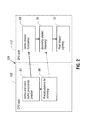
- a typical graphics pipeline provides rendered graphics from a graphics processor 112 over a link 106 to a frame buffer 114 for display via link 107 on a display screen 118.
- the graphics processor 112 may be coupled by a bus 105, such as a Peripheral Component Interconnect (PCI) bus, to a chipset core logic 110.
- the graphics processor 112 may be a multicore processor.
- the core logic 110 is coupled to a main processor or central processing unit (CPU) 100.
- the central processing unit may be one or more processors that handle a variety of processing functions of a computer system, while the graphics processor is dedicated to graphics functions.
- the core logic may also be coupled to removable medium 136, hard drives 134, and main memory 132, which may store a program 139.
- the core logic 110 may be coupled by a link 108 to a keyboard or mouse 120 for control of the display.
- the program 139 may be made up of instructions that are executed by the processor 100 or the processor 112.
- the main memory 132 constitutes one example of a computer readable medium that may store executable instructions in accordance with some embodiments of the present invention.
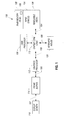
- the central processing unit 100 loads in the control points.
- the control points are the vertices of the polygons that make up the digital image.
- the processor 100 loads in the trimming curves.
- the trimming curves are the curves that can be used to trim patches to create curve shapes.
- An analogy to a patch is a square piece of paper.
- the piece of paper can be folded or crumpled, but it is still always a square piece of paper. Folding or crumpling the square piece of paper does not make it round. Instead, if a circle is cut out of the paper square, the piece of paper can be made round.
- a NURB is a parametric surface in three-dimensional space. Complex surfaces are made up of patches and each patch is a set of points corresponding to a certain pair of parameters u and v, where both u and v are greater than or equal to zero and less that or equal to one.
- a patch in parametric space, a patch is equivalent to the square piece of paper.
- the patches are reshaped, but the patches cannot be made round, any more than you can make the piece of paper round by folding it or crumpling it.
- a patch is made round by trimming.
- a cut is made in parametric space and this cut is called a trimming curve (or a trimming circle if the cut is round or a trimming line if the cut is straight).
- a circular cut generates two surfaces. The first surface is the outside part of the cut (which corresponds to the square piece of paper with a circular hole in it). The second surface is the inside part, which is the disk that is cut out.
- the trimming curves are loaded by the processor 100.
- the pre-calculations for trimming are also done in the processor 100, as indicated in block 66.
- the vertex and index data is calculated on the fly in the processor 100, as indicated at block 64.
- the control points and resulting trimming curves are transferred over the bus 105 to the graphics processor 112 and, particularly, to its vertex shader 68.
- the graphics processor's vertex shader then does the tessellation of the NURBs using the transferred control points.
- the vertex shader in block 68 also transforms the vertices.
- the vertex shader 68 works as follows. The vertex shader does a calculation of a variable, float2 col which is equal to float2 ((float(vertld%g_size))/g_size, (float (vertld/g_size))/g_size). Vertld is the number of the input vertices within the range [0,g_size*g_size]. There are g_size*g_size vertices in total.
- This number of vertices corresponds to the uniform division of [u,v] which is less than or equal to one and greater than or equal to zero in a NURBs parameter space. This step sets up the correspondence between the vertex number and position inside a square.
- the next step is float4 res4 equals EvalSurface (col. x, col. y).
- EvalSurface (col. x, col. y)
- the transformation (u,v) ⁇ (x,y,z) is done by evaluation of a point on a NURB surface.
- the contents of the EvalSurface () function is a well known method of evaluating a point on a surface.
- the rest of the vertex shader passes input parameters to further stages of the graphics pipeline.
- the geometry shader then trims the NURBs using the trimming curves transferred from the central processing unit 100, as also indicated in block 70. To the extent the trimming curves intersect, they are culled along the trim to simplify pieces of the trimming curve obtained by the intersection of two or more trimming segments inside a triangle.
- red (r), green (g), and blue (b) components of the vectors m_trim1 and m_trim2 may contain information about intersections between a trimming curve and adjacent edges to vertices of the processed triangle is determined in the following pseudo code:
- the result of the above code is an output triangle.
- One of the vertices of the output triangle is a vertex of the processed triangle (input [tri_compl]).
- Two other vertices are the points of intersection between the edges of the processed triangles and the trimming curve.
- the processed triangle does not have to be trimmed out as a whole and it does not contain intersection points as processed above. This means that all the vertices are outside the trimmed parts and they just pass through:
- the graphics processor sends these new polygons to the pixel shader 72.
- the pixel shader rasterizes them and renders them to the display 188.
- trimming may be accomplished in a single pass.
- control points of a mesh to be tessellated are transferred to the graphics pipeline, as opposed to transferring an entire set of polygons.
- the geometry shader performs the trimming or tessellated NURB patch, as opposed to using a neutral processing unit.
- graphics processing techniques described herein may be implemented in various hardware architectures. For example, graphics functionality may be integrated within a chipset. Alternatively, a discrete graphics processor may be used. As still another embodiment, the graphics functions may be implemented by a general purpose processor, including a multicore processor.
- references throughout this specification to "one embodiment” or “an embodiment” mean that a particular feature, structure, or characteristic described in connection with the embodiment is included in at least one implementation encompassed within the present invention. Thus, appearances of the phrase “one embodiment” or “in an embodiment” are not necessarily referring to the same embodiment. Furthermore, the particular features, structures, or characteristics may be instituted in other suitable forms other than the particular embodiment illustrated and all such forms may be encompassed within the claims of the present application.
Landscapes
- Physics & Mathematics (AREA)
- General Physics & Mathematics (AREA)
- Engineering & Computer Science (AREA)
- Theoretical Computer Science (AREA)
- Algebra (AREA)
- Mathematical Analysis (AREA)
- Mathematical Optimization (AREA)
- Mathematical Physics (AREA)
- Pure & Applied Mathematics (AREA)
- Computer Graphics (AREA)
- Geometry (AREA)
- Software Systems (AREA)
- Image Generation (AREA)
Applications Claiming Priority (2)
| Application Number | Priority Date | Filing Date | Title |
|---|---|---|---|
| US12/286,543 US20100079469A1 (en) | 2008-09-30 | 2008-09-30 | Rendering tremmed nurbs on programmable graphics architectures |
| EP09252305A EP2169615A3 (de) | 2008-09-30 | 2009-09-29 | Rendering von beschnittenen NURBS auf programmierbaren Grafikarchitekturen |
Related Parent Applications (1)
| Application Number | Title | Priority Date | Filing Date |
|---|---|---|---|
| EP09252305.9 Division | 2009-09-29 |
Publications (2)
| Publication Number | Publication Date |
|---|---|
| EP2568435A2 true EP2568435A2 (de) | 2013-03-13 |
| EP2568435A3 EP2568435A3 (de) | 2013-12-18 |
Family
ID=41343418
Family Applications (2)
| Application Number | Title | Priority Date | Filing Date |
|---|---|---|---|
| EP09252305A Withdrawn EP2169615A3 (de) | 2008-09-30 | 2009-09-29 | Rendering von beschnittenen NURBS auf programmierbaren Grafikarchitekturen |
| EP12007113.9A Ceased EP2568435A3 (de) | 2008-09-30 | 2009-09-29 | Rendering von beschnittenen NURBS auf programmierbaren Grafikarchitekturen |
Family Applications Before (1)
| Application Number | Title | Priority Date | Filing Date |
|---|---|---|---|
| EP09252305A Withdrawn EP2169615A3 (de) | 2008-09-30 | 2009-09-29 | Rendering von beschnittenen NURBS auf programmierbaren Grafikarchitekturen |
Country Status (4)
| Country | Link |
|---|---|
| US (1) | US20100079469A1 (de) |
| EP (2) | EP2169615A3 (de) |
| CN (1) | CN101714248B (de) |
| BR (1) | BRPI0905648A2 (de) |
Families Citing this family (2)
| Publication number | Priority date | Publication date | Assignee | Title |
|---|---|---|---|---|
| ES2363546B2 (es) * | 2011-03-28 | 2012-02-22 | Universidad De Cantabria | "método de diseño geométrico de mallas espaciales, perteneciente al campo de la arquitectura e ingenieria civil, mediante superficies nurbs". |
| US9984496B1 (en) | 2016-08-23 | 2018-05-29 | Bentley Systems, Incorporated | Technique for compact and accurate encoding trim geometry for application in a graphical processing unit |
Family Cites Families (8)
| Publication number | Priority date | Publication date | Assignee | Title |
|---|---|---|---|---|
| US7212205B2 (en) * | 2002-11-12 | 2007-05-01 | Matsushita Electric Industrial Co., Ltd. | Curved surface image processing apparatus and curved surface image processing method |
| US20050275760A1 (en) * | 2004-03-02 | 2005-12-15 | Nvidia Corporation | Modifying a rasterized surface, such as by trimming |
| WO2006034034A2 (en) * | 2004-09-16 | 2006-03-30 | Nvidia Corporation | Load balancing |
| US20070018988A1 (en) * | 2005-07-20 | 2007-01-25 | Michael Guthe | Method and applications for rasterization of non-simple polygons and curved boundary representations |
| CN1928918B (zh) * | 2005-10-14 | 2012-10-10 | 威盛电子股份有限公司 | 图形处理装置及于图形处理装置中执行着色操作的方法 |
| US7844429B2 (en) * | 2006-07-19 | 2010-11-30 | Align Technology, Inc. | System and method for three-dimensional complete tooth modeling |
| US8643644B2 (en) * | 2008-03-20 | 2014-02-04 | Qualcomm Incorporated | Multi-stage tessellation for graphics rendering |
| CN100573592C (zh) * | 2008-03-31 | 2009-12-23 | 北京大学 | 一种在图形处理器上拾取三维几何图元的方法 |
-
2008
- 2008-09-30 US US12/286,543 patent/US20100079469A1/en not_active Abandoned
-
2009
- 2009-09-29 EP EP09252305A patent/EP2169615A3/de not_active Withdrawn
- 2009-09-29 EP EP12007113.9A patent/EP2568435A3/de not_active Ceased
- 2009-09-30 BR BRPI0905648-3A patent/BRPI0905648A2/pt not_active IP Right Cessation
- 2009-09-30 CN CN200910221456.XA patent/CN101714248B/zh not_active Expired - Fee Related
Non-Patent Citations (1)
| Title |
|---|
| None |
Also Published As
| Publication number | Publication date |
|---|---|
| EP2568435A3 (de) | 2013-12-18 |
| BRPI0905648A2 (pt) | 2011-03-29 |
| EP2169615A2 (de) | 2010-03-31 |
| EP2169615A3 (de) | 2010-04-28 |
| US20100079469A1 (en) | 2010-04-01 |
| CN101714248A (zh) | 2010-05-26 |
| CN101714248B (zh) | 2013-04-24 |
Similar Documents
| Publication | Publication Date | Title |
|---|---|---|
| CN104933749B (zh) | 图形图元的裁剪 | |
| CN103180882B (zh) | 基于图块的渲染系统中表面面片的细化 | |
| US8289323B2 (en) | Drawing processing apparatus, texture processing apparatus, and tessellation method | |
| JP5224222B2 (ja) | テッセレーション量に対してテッセレーション時間が線形に増加するテッセレータ | |
| JP5721358B2 (ja) | グラフィックス処理システム | |
| US20060044312A1 (en) | Rendering outline fonts | |
| CN115147579B (zh) | 一种扩展图块边界的分块渲染模式图形处理方法及系统 | |
| CA2717278A1 (en) | Multi-stage tessellation for graphics rendering | |
| KR20170016301A (ko) | 그래픽 처리 | |
| CN101714259B (zh) | 图形处理系统 | |
| CN101714258B (zh) | 图形处理系统 | |
| KR20160003223A (ko) | 그래픽 파이프라인을 사용한 2 차원 곡선의 테셀레이션 | |
| US10134171B2 (en) | Graphics processing systems | |
| US12293485B2 (en) | Super resolution upscaling | |
| US12493990B2 (en) | Locking mechanism for image classification | |
| KR102853920B1 (ko) | 텍스쳐 처리 방법 및 장치 | |
| EP2568435A2 (de) | Rendering von beschnittenen NURBS auf programmierbaren Grafikarchitekturen | |
| Auzinger et al. | Non-Sampled Anti-Aliasing. | |
| US12056823B2 (en) | Segmenting three-dimensional meshes in graphical applications based on detection of elongated shapes | |
| KR102508568B1 (ko) | 그래픽스 처리 | |
| US9984496B1 (en) | Technique for compact and accurate encoding trim geometry for application in a graphical processing unit | |
| Santina | Resolution independent nurbs curves rendering using programmable graphics pipeline | |
| JPH04137075A (ja) | 画像生成装置 |
Legal Events
| Date | Code | Title | Description |
|---|---|---|---|
| PUAI | Public reference made under article 153(3) epc to a published international application that has entered the european phase |
Free format text: ORIGINAL CODE: 0009012 |
|
| 17P | Request for examination filed |
Effective date: 20121031 |
|
| AC | Divisional application: reference to earlier application |
Ref document number: 2169615 Country of ref document: EP Kind code of ref document: P |
|
| AK | Designated contracting states |
Kind code of ref document: A2 Designated state(s): AT BE BG CH CY CZ DE DK EE ES FI FR GB GR HR HU IE IS IT LI LT LU LV MC MK MT NL NO PL PT RO SE SI SK SM TR |
|
| PUAL | Search report despatched |
Free format text: ORIGINAL CODE: 0009013 |
|
| AK | Designated contracting states |
Kind code of ref document: A3 Designated state(s): AT BE BG CH CY CZ DE DK EE ES FI FR GB GR HR HU IE IS IT LI LT LU LV MC MK MT NL NO PL PT RO SE SI SK SM TR |
|
| RIC1 | Information provided on ipc code assigned before grant |
Ipc: G06T 1/20 20060101AFI20131111BHEP Ipc: G06T 17/30 20060101ALI20131111BHEP |
|
| 17Q | First examination report despatched |
Effective date: 20131202 |
|
| STAA | Information on the status of an ep patent application or granted ep patent |
Free format text: STATUS: THE APPLICATION HAS BEEN REFUSED |
|
| 18R | Application refused |
Effective date: 20180130 |