EP2565286A1 - Beliebig schneidbares edelstahlmaterial für präzisionsverarbeitung und verfahren zu seiner herstellung - Google Patents
Beliebig schneidbares edelstahlmaterial für präzisionsverarbeitung und verfahren zu seiner herstellung Download PDFInfo
- Publication number
- EP2565286A1 EP2565286A1 EP11774682A EP11774682A EP2565286A1 EP 2565286 A1 EP2565286 A1 EP 2565286A1 EP 11774682 A EP11774682 A EP 11774682A EP 11774682 A EP11774682 A EP 11774682A EP 2565286 A1 EP2565286 A1 EP 2565286A1
- Authority
- EP
- European Patent Office
- Prior art keywords
- stainless steel
- cutting
- free
- precision machining
- steel material
- Prior art date
- Legal status (The legal status is an assumption and is not a legal conclusion. Google has not performed a legal analysis and makes no representation as to the accuracy of the status listed.)
- Withdrawn
Links
Images

Classifications
-
- C—CHEMISTRY; METALLURGY
- C21—METALLURGY OF IRON
- C21D—MODIFYING THE PHYSICAL STRUCTURE OF FERROUS METALS; GENERAL DEVICES FOR HEAT TREATMENT OF FERROUS OR NON-FERROUS METALS OR ALLOYS; MAKING METAL MALLEABLE, e.g. BY DECARBURISATION OR TEMPERING
- C21D9/00—Heat treatment, e.g. annealing, hardening, quenching or tempering, adapted for particular articles; Furnaces therefor
- C21D9/0068—Heat treatment, e.g. annealing, hardening, quenching or tempering, adapted for particular articles; Furnaces therefor for particular articles not mentioned below
-
- C—CHEMISTRY; METALLURGY
- C21—METALLURGY OF IRON
- C21C—PROCESSING OF PIG-IRON, e.g. REFINING, MANUFACTURE OF WROUGHT-IRON OR STEEL; TREATMENT IN MOLTEN STATE OF FERROUS ALLOYS
- C21C5/00—Manufacture of carbon-steel, e.g. plain mild steel, medium carbon steel or cast steel or stainless steel
- C21C5/005—Manufacture of stainless steel
-
- C—CHEMISTRY; METALLURGY
- C21—METALLURGY OF IRON
- C21C—PROCESSING OF PIG-IRON, e.g. REFINING, MANUFACTURE OF WROUGHT-IRON OR STEEL; TREATMENT IN MOLTEN STATE OF FERROUS ALLOYS
- C21C7/00—Treating molten ferrous alloys, e.g. steel, not covered by groups C21C1/00 - C21C5/00
- C21C7/0006—Adding metallic additives
-
- C—CHEMISTRY; METALLURGY
- C21—METALLURGY OF IRON
- C21C—PROCESSING OF PIG-IRON, e.g. REFINING, MANUFACTURE OF WROUGHT-IRON OR STEEL; TREATMENT IN MOLTEN STATE OF FERROUS ALLOYS
- C21C7/00—Treating molten ferrous alloys, e.g. steel, not covered by groups C21C1/00 - C21C5/00
- C21C7/04—Removing impurities by adding a treating agent
- C21C7/072—Treatment with gases
-
- C—CHEMISTRY; METALLURGY
- C21—METALLURGY OF IRON
- C21D—MODIFYING THE PHYSICAL STRUCTURE OF FERROUS METALS; GENERAL DEVICES FOR HEAT TREATMENT OF FERROUS OR NON-FERROUS METALS OR ALLOYS; MAKING METAL MALLEABLE, e.g. BY DECARBURISATION OR TEMPERING
- C21D6/00—Heat treatment of ferrous alloys
- C21D6/002—Heat treatment of ferrous alloys containing Cr
-
- C—CHEMISTRY; METALLURGY
- C21—METALLURGY OF IRON
- C21D—MODIFYING THE PHYSICAL STRUCTURE OF FERROUS METALS; GENERAL DEVICES FOR HEAT TREATMENT OF FERROUS OR NON-FERROUS METALS OR ALLOYS; MAKING METAL MALLEABLE, e.g. BY DECARBURISATION OR TEMPERING
- C21D6/00—Heat treatment of ferrous alloys
- C21D6/004—Heat treatment of ferrous alloys containing Cr and Ni
-
- C—CHEMISTRY; METALLURGY
- C21—METALLURGY OF IRON
- C21D—MODIFYING THE PHYSICAL STRUCTURE OF FERROUS METALS; GENERAL DEVICES FOR HEAT TREATMENT OF FERROUS OR NON-FERROUS METALS OR ALLOYS; MAKING METAL MALLEABLE, e.g. BY DECARBURISATION OR TEMPERING
- C21D9/00—Heat treatment, e.g. annealing, hardening, quenching or tempering, adapted for particular articles; Furnaces therefor
-
- C—CHEMISTRY; METALLURGY
- C22—METALLURGY; FERROUS OR NON-FERROUS ALLOYS; TREATMENT OF ALLOYS OR NON-FERROUS METALS
- C22C—ALLOYS
- C22C33/00—Making ferrous alloys
- C22C33/04—Making ferrous alloys by melting
-
- C—CHEMISTRY; METALLURGY
- C22—METALLURGY; FERROUS OR NON-FERROUS ALLOYS; TREATMENT OF ALLOYS OR NON-FERROUS METALS
- C22C—ALLOYS
- C22C38/00—Ferrous alloys, e.g. steel alloys
-
- C—CHEMISTRY; METALLURGY
- C22—METALLURGY; FERROUS OR NON-FERROUS ALLOYS; TREATMENT OF ALLOYS OR NON-FERROUS METALS
- C22C—ALLOYS
- C22C38/00—Ferrous alloys, e.g. steel alloys
- C22C38/001—Ferrous alloys, e.g. steel alloys containing N
-
- C—CHEMISTRY; METALLURGY
- C22—METALLURGY; FERROUS OR NON-FERROUS ALLOYS; TREATMENT OF ALLOYS OR NON-FERROUS METALS
- C22C—ALLOYS
- C22C38/00—Ferrous alloys, e.g. steel alloys
- C22C38/002—Ferrous alloys, e.g. steel alloys containing In, Mg, or other elements not provided for in one single group C22C38/001 - C22C38/60
-
- C—CHEMISTRY; METALLURGY
- C22—METALLURGY; FERROUS OR NON-FERROUS ALLOYS; TREATMENT OF ALLOYS OR NON-FERROUS METALS
- C22C—ALLOYS
- C22C38/00—Ferrous alloys, e.g. steel alloys
- C22C38/02—Ferrous alloys, e.g. steel alloys containing silicon
-
- C—CHEMISTRY; METALLURGY
- C22—METALLURGY; FERROUS OR NON-FERROUS ALLOYS; TREATMENT OF ALLOYS OR NON-FERROUS METALS
- C22C—ALLOYS
- C22C38/00—Ferrous alloys, e.g. steel alloys
- C22C38/04—Ferrous alloys, e.g. steel alloys containing manganese
-
- C—CHEMISTRY; METALLURGY
- C22—METALLURGY; FERROUS OR NON-FERROUS ALLOYS; TREATMENT OF ALLOYS OR NON-FERROUS METALS
- C22C—ALLOYS
- C22C38/00—Ferrous alloys, e.g. steel alloys
- C22C38/18—Ferrous alloys, e.g. steel alloys containing chromium
- C22C38/40—Ferrous alloys, e.g. steel alloys containing chromium with nickel
-
- C—CHEMISTRY; METALLURGY
- C22—METALLURGY; FERROUS OR NON-FERROUS ALLOYS; TREATMENT OF ALLOYS OR NON-FERROUS METALS
- C22C—ALLOYS
- C22C38/00—Ferrous alloys, e.g. steel alloys
- C22C38/18—Ferrous alloys, e.g. steel alloys containing chromium
- C22C38/40—Ferrous alloys, e.g. steel alloys containing chromium with nickel
- C22C38/54—Ferrous alloys, e.g. steel alloys containing chromium with nickel with boron
-
- C—CHEMISTRY; METALLURGY
- C21—METALLURGY OF IRON
- C21C—PROCESSING OF PIG-IRON, e.g. REFINING, MANUFACTURE OF WROUGHT-IRON OR STEEL; TREATMENT IN MOLTEN STATE OF FERROUS ALLOYS
- C21C7/00—Treating molten ferrous alloys, e.g. steel, not covered by groups C21C1/00 - C21C5/00
- C21C7/0006—Adding metallic additives
- C21C2007/0018—Boron
Definitions
- the present invention relates to a free-cutting stainless steel material used for forming performed by cutting of a micrometer level.
- stainless steels have been used by making the most of the corrosion resistance thereof. Since the use of stainless steel in precision machining makes it difficult to perform cutting work as compared with the use of other steels, it has been desired to improve the machinability of stainless steel.
- a free-cutting stainless steel SUS303 containing sulfur has been known widely.
- the surface after cutting is rough, and it has been supposed that this stainless steel has a difficulty in being used for precision cutting work of a micrometer level. That is, it has conventionally been supposed that in a stainless steel, machinability and precision workability (surface roughness after cutting) are incompatible with each other.
- WO2008/016158 discloses a free-cutting stainless steel capable of attaining excellent machinability and corrosion resistance at the same time and a method for producing the same stainless steel.
- the corrosion resistance is equivalent to that of the conventional stainless steel material, and the machinability has been improved by about 25%; however, the surface roughness after cutting of this material is not disclosed.
- the present invention has been made in view of the above situation, and accordingly an object thereof is to provide a free-cutting stainless steel material for precision machining capable of attaining both of machinability and precision workability and a method for producing the same material.
- the present invention has been made by finding a free-cutting stainless steel material for precision machining, which is excellent in surface property after cutting, in which importance is attached to dimensional accuracy, machinability, and corrosion resistance, and a method for producing the same material by effectively utilizing the properties of h-BN (hexagonal boron nitride) particles, which are excellent as a solid lubricant, are chemically stable, and are resistant to acid or alkali, and by utilizing the solid dissolution and reprecipitation of h-BN caused by specific heat treatment.
- h-BN hexagonal boron nitride
- Invention 1 employs a configuration characterized by a free-cutting stainless steel material for precision machining used for forming performed by cutting of a micrometer level, characterized in that a free-cutting additive is h-BN (hexagonal boron nitride) particles that are spherical particles having a particle diameter of 200 nm to 5 ⁇ m, and are dispersedly precipitated in a simple substance state in a steel.
- the simple substance state means a state in which a plurality of h-BN particles are not cohesive to each other, or the h-BN particles are not cohesive to nonmetallic inclusion particles other than the h-BN particles.
- Invention 2 employs a configuration characterized by the free-cutting stainless steel material for precision machining of invention 1, characterized in that the content of B is 0.003 to 0.1 mass%.
- Invention 3 employs a configuration characterized by the free-cutting stainless steel material for precision machining of invention 1, characterized in that the content of N is equivalent to or higher than the content of B in mole ratio.
- Invention 4 employs a configuration characterized by the free-cutting stainless steel material for precision machining described in any one of inventions 1 to 3, characterized in that the material has a lathe-turned surface property such that the 10-points average roughness (Rz) of surface roughness of the lathe-turned surface is 5 ⁇ m or smaller.
- Invention 5 employs a configuration characterized by the free-cutting stainless steel material for precision machining of invention 4, characterized in that the lathe-turned surface property is obtained by turning a 8 mm-diameter round bar under the conditions of cutting speed: 16 m/min, cutting depth: 0.2 mm, tool feeding speed: 0.08 mm/rev, tool material: M30, tool shape: regular triangle, chip breaker: provided, and cutting fluid: not used.
- Invention 6 employs a configuration characterized by a method for producing the free-cutting stainless steel material for precision machining described in any one of inventions 1 to 5, characterized in that B is added to molten stainless steel by the addition of ferroboron or metallic boron, and N is added to the molten stainless steel by melting in the melting atmosphere of (argon plus nitrogen) or reduced-pressure nitrogen.
- Invention 7 employs a configuration characterized by a method for producing the free-cutting stainless steel material for precision machining described in any one of inventions 1 to 5, characterized in that B is added to molten stainless steel by the addition of ferroboron or metallic boron, and N is added to the molten stainless steel by the addition of a nitrogen-containing compound.
- Invention 8 employs a configuration characterized by a method for producing the free-cutting stainless steel material for precision machining described in any one of inventions 1 to 5, characterized in that a stainless steel in which h-BN particles precipitate unevenly in the microstructure obtained by the method described in claim 6 or 7 is heated to a temperature of 1200°C or higher followed by rapid cooling to make the h-BN particles once dissolve and disappear, and subsequently is subjected to tempering heat treatment at a temperature of 950 to 1100°C, whereby the h-BN particles are dispersedly precipitated again.
- the present invention provides a free-cutting stainless steel material for precision machining which is excellent in machinability, cutting accuracy, and corrosion resistance, and a method for producing the same material by dispersedly precipitating h-BN particles, which are chemically stable, are resistant to acid or alkali, and are excellent as a solid lubricant, in a simple substance state.
- the free-cutting stainless steel material for precision machining has a property that the surface roughness after cutting is equivalent to or smaller than that of the stainless steel having poor machinability, so that the material scarcely needs surface treating work after precision machining.
- the provision of the free-cutting stainless steel material for precision machining not only having excellent working accuracy, corrosion resistance, and free-cutting property but also attaining satisfied environmental friendliness can be realized. Also, since the working accuracy is excellent, a process for further improving the working accuracy, such as grinding or polishing, can be omitted. Also, the power for a cutting machine can be saved by the improvement in machinability, which leads to a reduction in electrical energy consumption, and high-speed cutting can be performed, which leads to the improvement in productivity.
- the present invention has features described above, and the embodiment thereof is explained hereunder.
- the free-cutting stainless steel material for precision machining is melted by using a melting furnace for melting an ordinary stainless steel, in which furnace the melting atmosphere can be controlled.
- a melting furnace for melting an ordinary stainless steel, in which furnace the melting atmosphere can be controlled.
- ferroboron or metallic boron is used as a raw material of B (boron).
- the ferroboron having a low melting point is technically advantageous as a melting raw material, and is economical because the market price per unit weight of B (boron) is low.
- the final B content in the free-cutting stainless steel material for precision machining is preferably 0.003 to 0.1 mass%B, further preferably 0.003 to 0.03 mass%B as a general criterion.
- N nitrogen
- N in a melting atmosphere is absorbed in molten stainless steel, or nitrides of alloying elements for constituting a stainless steel, such as chromium nitride or ferrochromium nitride, are added.
- N/B in mole ratio has only to be 1 or higher as a general criterion. If the mole ratio of N to B in the free-cutting stainless steel material for precision machining is lower than 1, the amount of solute B increases, and the precipitation amount of h-BN effective in machinability decreases. Therefore, the ratio of N/B must be made 1 or higher.
- the N content depending on the constituent element components in the free-cutting stainless steel material for precision machining, since B increases the activity of N, the equilibrium concentration of N decreases with the increase in B. In the component composition of SUS304, the N content is 0.25 mass% or less excluding the melting in the pressurized N atmosphere.
- the molten stainless steel containing B and N, thus produced, is poured into a mold to form a free-cutting stainless steel ingot for precision machining.
- the free-cutting stainless steel ingot for precision machining is subjected to ordinary forging and hot working such as rolling, and is formed into a bar material, wire material, plate material, or the like of the free-cutting stainless steel material for precision machining. After hot working, the free-cutting stainless steel material for precision machining is air-cooled to room temperature. In the free-cutting stainless steel material for precision machining, in the cooling process after hot working, h-BN having grown coarsely to about 20 to 30 ⁇ m is sometimes produced depending on the cooling rate in a state of being distributed unevenly in some of the material.
- the h-BN precipitating in the free-cutting stainless steel material for precision machining can exist in the matrix in a state of being decomposed into B and N having solid dissolved in a relatively short time period (for example, 0.5 to 1 hour at 1250°C) by being held at a temperature of 1200°C or higher.
- a relatively short time period for example, 0.5 to 1 hour at 1250°C
- heat treatment for solid dissolving the h-BN which has been produced unevenly in the material or produced coarsely, again in the material is performed. Since such a treatment is impossible to do when the free-cutting stainless steel material for precision machining is melted, this heat treatment must be performed at a temperature lower than the melting temperature of the material.
- the rapid cooling operation may be performed by water cooling that is performed for the ordinary stainless steel, but the cooling rate in the temperature range in which h-BN precipitates, described later, must be a cooling rate at which precipitation does not occur.
- the selection of tempering temperature is of importance.
- the tempering temperature at which the particle diameter and distribution state such that the machinability is excellent can be obtained is preferably in the range of 950 to 1100°C.
- a state in which B and N are in the state of supersaturated solid solution can be formed by rapid cooling after hot working. In the case of such a working temperature condition, needless to say, the heat treatment for solid dissolution of h-BN at a temperature of 1200°C or higher is unnecessary.
- This tempering heat treatment can double as solution heat treatment, which is performed for a general stainless steel, so that cooling is performed at a cooling rate with which the solution heat treatment is performed.
- the reason why the content of B is made 0.003 to 0.1 mass% is that if the B content is less than 0.003 mass%, the remarkable effect of machinability is lost, and if the B content exceeds 0.1 mass%, a tendency for a plurality of h-BN particles to be made cohesive by the precipitation of a large amount of h-BN is enhanced, and the machinability is greatly improved; however inversely, the surface roughness is adversely affected.
- N content is made such that N/B in mole ratio is 1 or higher is that if the ratio of N/B is lower than 1, the reprecipitation of h-BN at the time of heat treatment of B and N h in the state of supersaturated solid solution cannot be attained, and plastic working is difficult to do because B exists excessively.
- a commercially sold austenitic stainless steel (SUS304) round bar (weight: 2 kg) was used as a melting raw material, and was melted by using a cold crucible levitation melting furnace.
- the chemical composition (mass%) of melting raw material was 0.06% C, 0.28% Si, 1.33% Mn, 0.035% P, 0.025% S, 8.05% Ni, and 18.39% Cr.
- N of 0.07 MPa was filled into a vacuum induction melting furnace, and thereby the N concentration in molten steel was controlled.
- a predetermined amount of commercially sold ferroboron (19.2 mass%B) was added to the molten metal, and the B concentration was controlled.
- the molten steel was held at 1600°C for 10 minutes, and was solidified in a cold crucible, whereby an ingot was produced.
- the ingot was worked into a 14 mm-square rod material by being subjected to hot forging at 1200°C, and was air-cooled. After being held at 1250°C for 0.5 hour, the rod material was water-cooled, and further, after being held at 1100°C for one hour, it was subjected to water cooling.
- the analysis values of development steels are given in Table 1. Also, as comparison material 1, a commercially sold SUS304 stainless steel, which was used as the melting raw material of Example 1, and as comparison material 2, a commercially sold free-cutting SUS303 stainless steel containing sulfur were cut out of a 55 mm-diameter round bar, and were used as specimens for a surface roughness test.
- the analysis values (unit: mass%) of B, N and S of the material are given in Table 1.
- Table 1 Analysis values of B and N in specimens (unit: mass%) (mark - indicates not analyzed)
- Specimen name B content N content S content Development steel 1 0. 0031 0. 23 0. 025 Development steel 2 0. 0070 0. 22 0. 025 Development steel 3 0. 0140 0. 22 0. 025 Comparison material 1 - 0. 058 0. 025 Comparison material 2 - - 0. 29
- Table 2 reveals that the surface roughness of the respective developed free-cutting stainless steel materials for precision machining was smaller than that of comparison material 1 (SUS304), and reduced to one-third as compared with the free-cutting stainless steel SUS303 of comparison material 2 and was far smaller than that of comparison material 2.
- comparison material 1 SUS304
- comparison material 2 a microstructure in which MnS particles, which are a free-cutting additive, are coarse and extend in a needle form is formed.
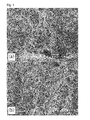
- Figure 1 shows a SEM micrograph of a fracture surface of a specimen cut out of development steel 2.
- Figure 1(a) is a micrograph of a specimen subjected to heat treatment in which the specimen was water-cooled after being held at 1250°C for 0.5 hour, and further was water-cooled after being held at 1100°C for one hour.
- Figure 1(b) is a micrograph of a specimen subjected to heat treatment in which the specimen was water-cooled after being held at 1250°C for 0.5 hour, and further was water-cooled after being held at 850°C for two hours. It was recognized by EDS analysis that all of the white spherical particles in the figures are h-BN particles.
- Figure 2 shows a SEM micrograph of a fracture surface of a specimen of comparison material 2 (SUS303). It was confirmed by EDS analysis that the portions indicated by arrow marks are MnS particles existing in a fiber form in the steel, in which the particles are extended so that the diameter is several micrometers and the length is several tens micrometers. When cutting work is performed, the extended MnS particles come out onto the worked surface and fall. The surface roughness corresponding to the shape of MnS having fallen is also shown in Table 2
- a free-cutting stainless steel material for precision machining excellent in cutting accuracy and machinability and also excellent in corrosion resistance and environmental friendliness can be provided, and excellent usability can be brought about in various work fields using a stainless steel.
Landscapes
- Chemical & Material Sciences (AREA)
- Engineering & Computer Science (AREA)
- Materials Engineering (AREA)
- Metallurgy (AREA)
- Organic Chemistry (AREA)
- Mechanical Engineering (AREA)
- Physics & Mathematics (AREA)
- Thermal Sciences (AREA)
- Crystallography & Structural Chemistry (AREA)
- Manufacturing & Machinery (AREA)
- Heat Treatment Of Steel (AREA)
- Treatment Of Steel In Its Molten State (AREA)
Applications Claiming Priority (2)
| Application Number | Priority Date | Filing Date | Title |
|---|---|---|---|
| JP2010104780A JP6044037B2 (ja) | 2010-04-30 | 2010-04-30 | 精密加工用快削ステンレス鋼素材及びその製造方法 |
| PCT/JP2011/053330 WO2011135897A1 (ja) | 2010-04-30 | 2011-02-17 | 精密加工用快削ステンレス鋼素材及びその製造方法 |
Publications (2)
| Publication Number | Publication Date |
|---|---|
| EP2565286A1 true EP2565286A1 (de) | 2013-03-06 |
| EP2565286A4 EP2565286A4 (de) | 2014-05-07 |
Family
ID=44861218
Family Applications (1)
| Application Number | Title | Priority Date | Filing Date |
|---|---|---|---|
| EP11774682.6A Withdrawn EP2565286A4 (de) | 2010-04-30 | 2011-02-17 | Beliebig schneidbares edelstahlmaterial für präzisionsverarbeitung und verfahren zu seiner herstellung |
Country Status (4)
| Country | Link |
|---|---|
| EP (1) | EP2565286A4 (de) |
| JP (1) | JP6044037B2 (de) |
| CN (1) | CN102906290B (de) |
| WO (1) | WO2011135897A1 (de) |
Cited By (1)
| Publication number | Priority date | Publication date | Assignee | Title |
|---|---|---|---|---|
| EP2537952A4 (de) * | 2010-07-27 | 2014-05-07 | Nat Inst For Materials Science | Automatenedelstahlgussprodukt und verfahren zu dessen herstellung |
Families Citing this family (2)
| Publication number | Priority date | Publication date | Assignee | Title |
|---|---|---|---|---|
| JP6103746B2 (ja) * | 2012-08-23 | 2017-03-29 | 国立研究開発法人物質・材料研究機構 | 快削鉄系形状記憶合金 |
| KR102010052B1 (ko) * | 2017-10-19 | 2019-08-12 | 주식회사 포스코 | 열간 압연성이 우수한 중탄소 쾌삭강 및 그 제조방법 |
Family Cites Families (5)
| Publication number | Priority date | Publication date | Assignee | Title |
|---|---|---|---|---|
| JP3425124B2 (ja) | 2000-07-21 | 2003-07-07 | 清仁 石田 | フェライト系快削ステンレス鋼 |
| JP3791664B2 (ja) | 2000-02-24 | 2006-06-28 | 山陽特殊製鋼株式会社 | オーステナイト系Ca添加快削ステンレス鋼 |
| JP4279041B2 (ja) * | 2003-05-01 | 2009-06-17 | 山陽特殊製鋼株式会社 | アウトガス特性に優れた非Pb快削ステンレス鋼 |
| JP2006291296A (ja) * | 2005-04-11 | 2006-10-26 | Nisshin Steel Co Ltd | 深絞り性に優れたオーステナイト系ステンレス鋼 |
| EP2048257B1 (de) * | 2006-07-31 | 2014-02-19 | National Institute for Materials Science | Nichtrostender automatenstahl und herstellungsverfahren dafür |
-
2010
- 2010-04-30 JP JP2010104780A patent/JP6044037B2/ja not_active Expired - Fee Related
-
2011
- 2011-02-17 CN CN201180021615.7A patent/CN102906290B/zh not_active Expired - Fee Related
- 2011-02-17 WO PCT/JP2011/053330 patent/WO2011135897A1/ja not_active Ceased
- 2011-02-17 EP EP11774682.6A patent/EP2565286A4/de not_active Withdrawn
Cited By (1)
| Publication number | Priority date | Publication date | Assignee | Title |
|---|---|---|---|---|
| EP2537952A4 (de) * | 2010-07-27 | 2014-05-07 | Nat Inst For Materials Science | Automatenedelstahlgussprodukt und verfahren zu dessen herstellung |
Also Published As
| Publication number | Publication date |
|---|---|
| CN102906290B (zh) | 2015-01-14 |
| CN102906290A (zh) | 2013-01-30 |
| JP2011231387A (ja) | 2011-11-17 |
| JP6044037B2 (ja) | 2016-12-14 |
| EP2565286A4 (de) | 2014-05-07 |
| WO2011135897A1 (ja) | 2011-11-03 |
Similar Documents
| Publication | Publication Date | Title |
|---|---|---|
| Sakuraya et al. | BN type inclusions formed in high Cr ferritic heat resistant steel | |
| KR102099767B1 (ko) | 강, 침탄강 부품 및 침탄강 부품의 제조 방법 | |
| JP5186878B2 (ja) | プラスチック成形金型用鋼およびプラスチック成形金型 | |
| CN109943772A (zh) | 石墨钢用钢材及改善切削性的石墨钢 | |
| EP3492614A1 (de) | Stahl für maschinenstrukturen | |
| TWI633193B (zh) | 模具用鋼 | |
| KR20060125467A (ko) | 플라스틱 성형금형용 철 | |
| US3933480A (en) | Method of making stainless steel having improved machinability | |
| US9090949B2 (en) | Method for the production of tools made of alloyed steel and tools in particular for the chip-removing machining of metals | |
| JP2007197784A (ja) | 合金鋼 | |
| EP2565286A1 (de) | Beliebig schneidbares edelstahlmaterial für präzisionsverarbeitung und verfahren zu seiner herstellung | |
| EP3309272A1 (de) | Automatenstahl | |
| KR101657790B1 (ko) | 흑연화 열처리용 강재 및 피삭성 및 냉간단조성이 우수한 흑연강 | |
| EP2048257B1 (de) | Nichtrostender automatenstahl und herstellungsverfahren dafür | |
| CN109790604A (zh) | 冷锻用钢及其制造方法 | |
| KR101657792B1 (ko) | 흑연화 열처리용 강재 및 피삭성이 우수한 흑연강 | |
| JP5713299B2 (ja) | 快削ステンレス鋼鋳鋼製品及びその製造方法 | |
| JP6683075B2 (ja) | 浸炭用鋼、浸炭鋼部品及び浸炭鋼部品の製造方法 | |
| Di et al. | A new Pb-free machinable austenitic stainless steel | |
| TW574382B (en) | Steel article | |
| JP6683073B2 (ja) | 浸炭用鋼、浸炭鋼部品及び浸炭鋼部品の製造方法 | |
| JP6683074B2 (ja) | 浸炭用鋼、浸炭鋼部品及び浸炭鋼部品の製造方法 | |
| Emura et al. | Machinability improvement and its mechanism in SUS304 austenitic stainless steel by precipitated hexagonal boron nitride | |
| WO2000071771A1 (en) | Free-machining steels containing tin, antimony, and/or arsenic | |
| Kawajiri et al. | Effect of additional boron amount on surface roughness after lathe turning in h-BN dispersed type 304 stainless steels |
Legal Events
| Date | Code | Title | Description |
|---|---|---|---|
| PUAI | Public reference made under article 153(3) epc to a published international application that has entered the european phase |
Free format text: ORIGINAL CODE: 0009012 |
|
| 17P | Request for examination filed |
Effective date: 20121031 |
|
| AK | Designated contracting states |
Kind code of ref document: A1 Designated state(s): AL AT BE BG CH CY CZ DE DK EE ES FI FR GB GR HR HU IE IS IT LI LT LU LV MC MK MT NL NO PL PT RO RS SE SI SK SM TR |
|
| DAX | Request for extension of the european patent (deleted) | ||
| A4 | Supplementary search report drawn up and despatched |
Effective date: 20140403 |
|
| RIC1 | Information provided on ipc code assigned before grant |
Ipc: C21C 7/00 20060101ALI20140328BHEP Ipc: C21C 7/072 20060101ALI20140328BHEP Ipc: C22C 38/54 20060101ALI20140328BHEP Ipc: C21C 7/04 20060101ALI20140328BHEP Ipc: C21C 7/10 20060101ALI20140328BHEP Ipc: C22C 38/00 20060101AFI20140328BHEP Ipc: C21D 6/00 20060101ALI20140328BHEP |
|
| 17Q | First examination report despatched |
Effective date: 20150227 |
|
| RIC1 | Information provided on ipc code assigned before grant |
Ipc: C22C 33/04 20060101ALI20180615BHEP Ipc: C21C 7/04 20060101ALI20180615BHEP Ipc: C21C 7/00 20060101ALI20180615BHEP Ipc: C21D 9/00 20060101ALI20180615BHEP Ipc: C22C 38/00 20060101AFI20180615BHEP Ipc: C22C 38/02 20060101ALI20180615BHEP Ipc: C21C 7/072 20060101ALI20180615BHEP Ipc: C22C 38/54 20060101ALI20180615BHEP Ipc: C21C 7/10 20060101ALI20180615BHEP Ipc: C21D 6/00 20060101ALI20180615BHEP Ipc: C21C 5/00 20060101ALI20180615BHEP Ipc: C22C 38/40 20060101ALI20180615BHEP Ipc: C22C 38/04 20060101ALI20180615BHEP |
|
| GRAP | Despatch of communication of intention to grant a patent |
Free format text: ORIGINAL CODE: EPIDOSNIGR1 |
|
| INTG | Intention to grant announced |
Effective date: 20180727 |
|
| STAA | Information on the status of an ep patent application or granted ep patent |
Free format text: STATUS: THE APPLICATION IS DEEMED TO BE WITHDRAWN |
|
| 18D | Application deemed to be withdrawn |
Effective date: 20181207 |