EP2564356B1 - Computerwekzeug für sparsame darstellung - Google Patents
Computerwekzeug für sparsame darstellung Download PDFInfo
- Publication number
- EP2564356B1 EP2564356B1 EP11725130.6A EP11725130A EP2564356B1 EP 2564356 B1 EP2564356 B1 EP 2564356B1 EP 11725130 A EP11725130 A EP 11725130A EP 2564356 B1 EP2564356 B1 EP 2564356B1
- Authority
- EP
- European Patent Office
- Prior art keywords
- dictionary
- approximation
- iteration
- atom
- data
- Prior art date
- Legal status (The legal status is an assumption and is not a legal conclusion. Google has not performed a legal analysis and makes no representation as to the accuracy of the status listed.)
- Active
Links
Images


Classifications
-
- G—PHYSICS
- G06—COMPUTING OR CALCULATING; COUNTING
- G06F—ELECTRIC DIGITAL DATA PROCESSING
- G06F17/00—Digital computing or data processing equipment or methods, specially adapted for specific functions
-
- G—PHYSICS
- G06—COMPUTING OR CALCULATING; COUNTING
- G06F—ELECTRIC DIGITAL DATA PROCESSING
- G06F16/00—Information retrieval; Database structures therefor; File system structures therefor
- G06F16/10—File systems; File servers
- G06F16/17—Details of further file system functions
- G06F16/174—Redundancy elimination performed by the file system
- G06F16/1744—Redundancy elimination performed by the file system using compression, e.g. sparse files
-
- G—PHYSICS
- G06—COMPUTING OR CALCULATING; COUNTING
- G06F—ELECTRIC DIGITAL DATA PROCESSING
- G06F16/00—Information retrieval; Database structures therefor; File system structures therefor
- G06F16/10—File systems; File servers
- G06F16/16—File or folder operations, e.g. details of user interfaces specifically adapted to file systems
-
- G—PHYSICS
- G06—COMPUTING OR CALCULATING; COUNTING
- G06F—ELECTRIC DIGITAL DATA PROCESSING
- G06F16/00—Information retrieval; Database structures therefor; File system structures therefor
- G06F16/20—Information retrieval; Database structures therefor; File system structures therefor of structured data, e.g. relational data
-
- G—PHYSICS
- G06—COMPUTING OR CALCULATING; COUNTING
- G06F—ELECTRIC DIGITAL DATA PROCESSING
- G06F17/00—Digital computing or data processing equipment or methods, specially adapted for specific functions
- G06F17/10—Complex mathematical operations
-
- G—PHYSICS
- G06—COMPUTING OR CALCULATING; COUNTING
- G06F—ELECTRIC DIGITAL DATA PROCESSING
- G06F18/00—Pattern recognition
- G06F18/20—Analysing
- G06F18/21—Design or setup of recognition systems or techniques; Extraction of features in feature space; Blind source separation
- G06F18/213—Feature extraction, e.g. by transforming the feature space; Summarisation; Mappings, e.g. subspace methods
Definitions
- the invention relates to the field of the parsimonious representation of a signal in a computer manner.
- the representations start from a set of known data called dictionary.
- the parsimonious representation is obtained by selecting the atoms of the dictionary which are closest to the content to be compressed, and transmitting only information relating to these atoms.
- an algorithm of the family is implemented to determine the parsimonious representation from the content to be compressed and the dictionary.
- K-SVD so-called K-SVD
- this method generally remains insufficient. Indeed, it provides a dictionary that is optimized on average, but not necessarily for each of the iterations of the MP algorithm. In addition, this dictionary is fixed for all iterations, and generally unsuitable if one decides to change the number of iterations.
- D1 makes no mention that for each iteration n, aimed at approximating a residual R n f, one is only interested in a given level of the tree. In particular, D1 does not describe the fact that the selection law is based on the atom identifier defined during the previous iteration. The invention, as claimed, improves the situation.
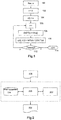
- the figure 1 represents a method for calculating a parsimonious representation according to the invention.
- the element x can be any type of computer data to be encoded.
- this element can be an image block at within an image or a stream of images to be encoded, or a soundtrack in a musical excerpt, or other.
- an iteration counter i is initialized, and in an operation 104, a residue variable r (i) receives the element x.
- the residual variable r (i) receives at each iteration the remainder of the current approximation, and constitutes the approximated element at the next iteration, as is conventional in an MP algorithm.
- the parsimonious representation of x is computed by means of a loop which comprises a step 106 of incrementing the iteration counter, followed by a dictionary selection operation 108 for the current iteration, of a calculation operation 110 of the approach vector, and a loop output condition test operation 112.
- the operation 108 comprises the call of a function Cho () which receives the iteration counter i as an argument, and returns in response an optimized dictionary for this iteration, which is stored in a variable DICT (i).
- a function MP () is called with the residue of the previous iteration r (i-1), as well as the dictionary of the current iteration DICT (i).
- the element x is approached according to the classical formula of the algorithms MP.
- the MP () function can implement any type of algorithm of the family of MP algorithms.
- the result of the operation 110 is an approximation y (i) and a residue r (i).
- the approximation y (i) comprises an identifier of the atom of the DICT dictionary (i) which is closest to the rest of the previous iteration r (i-1), and its multiplier coefficient.
- the parsimonious vector search method presented here is particularly interesting because the function Cho () makes it possible to adapt the choice of the dictionary to the current iteration.
- the figure 2 represents a simplified diagram of a computer tool implementing the method of the figure 1 .
- the computer tool comprises a dictionary selector 200 and a vector reducer 202, as well as a memory 204 for storing the DICT (i) dictionaries.
- the tool receives elements x in the form of data 206, and returns parsimonious representation data 208.
- the computer tool described here represents an element that is suitable for being incorporated into a computing device that uses parsimonious representations, for example a Encoding / decoding, denoising, prediction, or source separation device. As such, it is adapted to be a "brick" of processing a larger device.
- the data 206 and 208 can be stored in a temporary memory of the tool, or in the memory 204, and that these memories can be those of a device in which the computer tool is integrated.
- selector 200 and the gear 202 can be implemented separately or together, in a software manner, that is to say in the form of a code executed by a general purpose processor. a device to which the computer tool is integrated, or in a "physical" manner, that is to say by one or more dedicated processors.
- the dictionaries within the memory 204 are not randomly stored or generated automatically by the function Cho (). These dictionaries are intrinsically associated with iterations of the reducer, as will be seen later.
- the figure 3 represents an example of architecture of dictionaries for the implementation of the method of the figure 1 .
- each level will contain all the dictionaries available for the iteration whose number corresponds to the level of the tree.
- the first level of the tree includes a single dictionary that will be used for the first iteration
- the second level of the tree includes a set of dictionaries that will be used for the second iteration, and so on.
- each dictionary chosen for an iteration conditions the choice of the dictionary at the next iteration. Indeed, as we will see with the description of Figures 5 to 7 it is possible to train dictionaries according to the "dictionary paths" taken at previous iterations.
- the figure 4 represents an example of implementation of the function Cho () which is based on the tree architecture of the figure 3 .
- the function Cho () retrieves the index of the atom that has been chosen to approach the residue at the previous iteration.
- a function Rnk () receives as arguments the approximation y (i-1) determined at the previous iteration, as well as the dictionary DICT (i-1) which was used for its calculation.
- the selected dictionary DICT (i) is then defined in an operation 402 as being the j th child of the node corresponding to the dictionary DICT (i-1) in the tree.
- the first embodiment is based on a tree of dictionaries that are optimized according to the path taken at previous iterations.
- This tree of optimized dictionaries can be created using a recursive ITD () function.
- the ITD () function is based on a principle of propagation of a set of training vectors which is used to optimize the dictionaries as each step is taken. At each level, each training set generates several sets of residues which serve to train lower level dictionaries.
- the ITD () function must first be initialized by an operation 500 in which the first dictionary and the first set of residuals are computed.
- Operation 500 is performed by a function Creat () which receives as arguments a set of P drive vectors y.
- the training set comprises a multitude of drive vectors y, the number P of vectors being much greater than the target size for each of the dictionaries of the tree.
- These training vectors are chosen as varied as possible in order to offer an optimal construction of the dictionaries.
- the drive vectors can be derived from a drive vector database, or they can also be synthetic, i.e., created to cover as evenly as possible an intended vector space.
- the function Creat () starts from an operation 600 in which the drive vectors are stored therein in an RS (0) residue set.
- the tool implements a function KM () for partitioning the set of residuals RS (0) into a number N of sets of training residues R (s).
- the function KM () is a function that implements an algorithm of the K-Means family, from the set of residuals RS (0) and the number N as arguments.
- the measure used to calculate the distance between the vectors and the centroids to carry out the iteration partitioning and the computation law of the centroids before each iteration are parameters which define the particular algorithm.
- the measurement used is the projection
- the selection / calculation law of the centroids is based on a decomposition of each partition into singular values.
- the vectors of a given partition are first assembled side by side in a matrix. This matrix is then decomposed into singular values in the form U ⁇ V T , where the singular values are ordered by decreasing value in the diagonal of ⁇ . Then, the matrix U is reduced to its first column U1 as centroid for this partition.
- the DICT dictionary (1) is calculated by means of an LSV () function.
- the function LSV () takes as argument the N sets of training residues R (s) calculated with the operation 602 and reduces them into a dictionary.
- the LSV () function implements a selection law based on a decomposition of each set of training residues R (s) in singular values. This law of selection is very close to the law of computation of the centroids of the function KM (). More specifically, the vectors of a given training residue set R (s) are first assembled side by side in a matrix. This matrix is then decomposed into singular values in the form U ⁇ V T , where the singular values are ordered by decreasing value in the diagonal of ⁇ .
- the matrix U is reduced to its first column U1, and the set of training residues R (s) is reduced to this vector U1.
- the dictionary DICT (1) is defined as the concatenation of all the vectors obtained by reducing the sets of training residues R (s).
- the first set of training residues RS (1) is computed in an operation 606.
- a tree structure is created for the training residue sets that is included in the dictionaries tree, as it appears on the figure 3 .
- the tailings sets could be stored in a separate tree.
- the zero level node produces N sets of RS drive residue threads (1) that were derived from the RS (0) input drive set.
- the figure 7 represents an example of implementation of this function.
- the ITD () function starts with the test of a stop condition in an operation 700. This stop condition is in the example described here tested by a restricted version of the Tresh () function described with the figure 1 .
- the only stop condition of the Thresh () function is the number of iterations.
- the reason for this stopping condition is that, from a mathematical point of view, each iteration corresponds to a projection of the residue on a base formed by the atoms of the dictionary of this iteration.
- the vector is thus projected with respect to a new vector independent of this base. So there can not be more iterations than there are dimensions in the vector that we are trying to approach.
- the ITD () function stops in an operation 702.
- the threshold condition for the residues is not Implementation.
- the residues zero or less than a threshold are removed from the sets of training residues to which they belong along the water.
- the iteration counter i is incremented in an operation 704. It is now necessary to describe the execution context of the ITD () function. If one places oneself after the first iteration, the dictionary tree includes a DICT dictionary (1) and the residue tree includes N sets of training residues from the DICT dictionary (1). The tree structure is simple to imagine,
- each dictionary of a level i gives rise to N level i + 1 dictionaries, that is to say a father dictionary of children per atom, which are trained in the games. of residues of level i corresponding to this atom.
- the function ITD () thus receives as input a set of training residues denoted RS (i-1) .j, corresponding to j- th atom of a dictionary DICT (i-1) .m.
- the training residue set of the iteration i-1 is partitioned, as it was done in the operation 602. Once this is done, we thus obtain N sets of training residues. R (s).
- the dictionary DICT (i) .j that will result from these N sets of training residues is initialized as a son of the dictionary DICT (i-1) .m.
- This dictionary is initialized at the j-th rank because it comes from the atom j of the dictionary DICT (i-1) .m.
- the N sets of drive residues RS (i) .t are then initialized in an operation 710, as the child of the set of residues RS (i-1).
- the dictionary DICT (i) .j is then filled in an operation 712 by the function LSV () called with the N sets of training residues R (s) resulting from the operation 706, in a manner similar to what has been done at operation 604.
- the set of residues RS (i-1) .j is split into the N residue sets RS (i) .t with t varying between 1 and N, by means of the Proj () function in an operation 714.
- the ITD () function is restarted N times in an operation 716, with as arguments pair the DICT dictionary (i) .j on the one hand, and each of the N sets RS (i) .t on the other hand .
- the input dictionary is the dictionary DICT (i-1) .m, any dictionary among all the dictionaries of the level i-1.
- the DICT (i-1) .m notation indicates the point of entry into the dictionary tree, it is a pointer, and its content in itself does not matter.
- this dictionary DICT (i-1) .m corresponds a set of training residues from a previous iteration denoted RS (i-2) .j.
- the example described here concerns only one of these games (the set RS (i- 1) .j), but as shown in step 716, the function ITD () is called N times with each set of drive residues RS (i) .t produced during the current execution of the ITD function. ().
- each training residue set is the result of a projection on an atom of a dictionary. Therefore, the dictionaries created at the next level in the tree based on these sets of training residues are orthogonal to the atom that served as the basis for the projection. The components (the line) corresponding to this atom can therefore be removed from the training residues because their contribution will be zero.
- the operation 800 is identical to the operation 500 and the operation 802 differs from the operation 502 in that it is a new function RITD () which is called.
- the function GS () is an orthogonalization function which takes as input vector the selected atom at the previous iteration, and derives an orthogonal vector base and complements this atom. This can be achieved for example by means of a Gram-Schmidt type algorithm. These vectors form the columns of the matrix Phi (i-1).
- This process saves space, as each dictionary sees its size reduced by one line at each iteration. This also saves computing power because the size of the arrays and dictionaries reduces at each iteration.
- the training methods of the dictionaries described above are conditioned by two main elements.
- the method of selection / calculation of the centroids in the partitioning method is, in the example described, based on each iteration on the selection of the strongest atom in the singular value decomposition of each partition.
- This law could be replaced by a law of selection / calculation of the barycentric type for example.
- the method of calculating atoms to form the dictionaries is also crucial, and is based in the operations 712 and 912 on the selection of the strongest atom in the singular value decomposition of each set of residue set partitioning. drive.
- Another law could be used, such as a barycentric type.
- Another selection law could be used to select the dictionary of an iteration.
- such a law could select the designated dictionary by the atom of the DICT dictionary (i-1) of the previous iteration that comes closest to the vector residue we are trying to approach, taking into account the vectors corresponding to the K strongest singular values, and not only the first.
- the Align () function performs a singular value decomposition of each set RS (i-1) .t in the form U ⁇ V T , where the singular values are ordered by decreasing value in the diagonal of ⁇ .
- the matrix U is reduced to its columns which correspond to the non-zero singular values of ⁇ .
- the matrix Phi (i-1) .t forms an orthogonal basis of RS (i-1) .t.
- the KM2 () function is very similar to the KM () function in that it performs the same calculations. However, it differs by its inputs and its output.
- the set of reduced sets RRS (i-1) .t are grouped to form the input, and the output is the RDICT dictionary (i).
- the function KM2 () uses as selection law / calculation of the centroids the selection of the vector corresponding to the strongest singular value. It is these centroids that are used to populate the RDICT (i) dictionary in an 1112 operation.
- the operations 1105a and 1105b "align" the residues, in the sense that all the reduced residue sets RRS (i-1) .j will have the same matrix U in their singular value decomposition. .
- the Cho () function could choose a dictionary per group of a chosen number of iterations, or be called only every K iterations.
Landscapes
- Engineering & Computer Science (AREA)
- Theoretical Computer Science (AREA)
- Physics & Mathematics (AREA)
- Data Mining & Analysis (AREA)
- General Physics & Mathematics (AREA)
- General Engineering & Computer Science (AREA)
- Databases & Information Systems (AREA)
- Computer Vision & Pattern Recognition (AREA)
- Mathematical Physics (AREA)
- Bioinformatics & Computational Biology (AREA)
- Evolutionary Computation (AREA)
- Evolutionary Biology (AREA)
- Bioinformatics & Cheminformatics (AREA)
- Artificial Intelligence (AREA)
- Life Sciences & Earth Sciences (AREA)
- Software Systems (AREA)
- Human Computer Interaction (AREA)
- Mathematical Analysis (AREA)
- Computational Mathematics (AREA)
- Mathematical Optimization (AREA)
- Pure & Applied Mathematics (AREA)
- Algebra (AREA)
- Compression, Expansion, Code Conversion, And Decoders (AREA)
- Machine Translation (AREA)
- Character Discrimination (AREA)
- Information Retrieval, Db Structures And Fs Structures Therefor (AREA)
Claims (9)
- Informatikwerkzeug zum Verarbeiten eines Signals, dadurch gekennzeichnet, dass es Folgendes umfasst:- einen Arbeitsspeicher (206) zum Empfangen von Eingangsdaten,- einen Zusatzspeicher (204) zum Speichern von mehreren Annäherungsverzeichnissen,- einen Reduzierer (202), ausgelegt zum iterativen Berechnen von Annäherungsdaten von Eingangsdaten, wobei die sukzessiven Iterationen vom adaptiven Verfolgungstyp sind,- einen Selektor (200), ausgelegt zum Wählen eines Annäherungsverzeichnisses in dem Zusatzspeicher in Abhängigkeit von einem Auswahlgesetz auf der Basis von wenigstens bestimmten der vorherigen Iterationen,
wobei der Reduzierer (202) den Selektor (200) bei jeder Iteration aufruft und das so gewählte Verzeichnis bei der adaptiven Verfolgung benutzt,
wobei für jede gegebene Iteration und in Anwesenheit eines für den Selektor gewählten Annäherungsverzeichnisses der Reduzierer:* ein Atom des Annäherungsverzeichnisses entsprechend laufenden Eingangsdaten der gegebenen Iteration bestimmt,* einen entsprechenden Atomidentifikator und einen Proportionalitätskoeffizienten zwischen den laufenden Eingangsdaten und dem Atom als Annäherungsdaten definiert,* einen Rest entsprechend der Differenz zwischen den Eingangsdaten und dem Atom multipliziert mit seinem Proportionalitätskoeffizienten berechnet, und* die folgende Iteration mit dem Atomidentifikator für den Selektor und den Rest als neue laufende Eingangsdaten aufruft, wobei das Auswahlgesetz für die folgende Iteration auf dem bei der gegebenen Iteration definierten Atomidentifikator basiert. - Informatikwerkzeug nach Anspruch 1, bei dem das Auswahlgesetz die Wahl eines Verzeichnisses in Abhängigkeit von der laufenden Iterationsnummer und/oder von in den vorherigen Iterationen berechneten Annäherungsdaten umfasst.
- Informatikwerkzeug nach Anspruch 2, bei dem die Annäherungsverzeichnisse untereinander durch eine Struktur des Baumtyps verbunden sind und bei dem das Auswahlgesetz das Wählen eines Verzeichnisses auf einer Ebene des Baums umfasst, abgeleitet von der laufenden Iterationsnummer.
- Informatikwerkzeug nach Anspruch 3, bei dem jedes Annäherungsverzeichnis einer gegebenen Ebene mit einer gewählten Anzahl von Kind-Annäherungsverzeichnissen auf der folgenden Ebene des Baums assoziiert ist, und bei dem das Auswahlgesetz die Wahl eines Annäherungsverzeichnisses unter den Kindern des bei der vorherigen Iteration gewählten Annäherungsverzeichnisses umfasst.
- Informatikwerkzeug nach Anspruch 4, bei dem jedes Atom jedes Annäherungsverzeichnisses einer gegebenen Ebene mit einem Kindverzeichnis auf der folgenden Ebene des Baums assoziiert ist, und wobei das Auswahlgesetz für eine gegebene Iteration die Wahl des Kindverzeichnisses entsprechend dem Atom umfasst, bezeichnet durch den Atomidentifikator von bei der vorherigen Iteration berechneten Annäherungsdaten.
- Informatikwerkzeug nach einem der Ansprüche 3 bis 5, bei dem jedes Verzeichnis einer gegebenen Ebene auf dem Baum Atome umfasst, deren Abmessung kleiner als eins in Bezug auf die Abmessung von Atomen der Verzeichnisse der höheren Ebene ist.
- Informatikwerkzeug nach Anspruch 6, bei dem der Reduzierer in jeder Iteration einen Satz von Reduktionsdaten berechnet und bei dem der Reduzierer diesen Satz von Reduktionsdaten zum Berechnen der sukzessiven Annäherungsdaten benutzt.
- Informatikwerkzeug nach Anspruch 6, bei dem der Baum ein einziges Verzeichnis pro Ebene umfasst, wobei der Zusatzspeicher ferner die Sätze von Reduktionsdaten speichert, wobei jedes Atom des Verzeichnisses einer gegebenen Ebene in dem Baum mit einem Satz von Reduktionsdaten assoziiert ist.
- Informatikwerkzeug nach Anspruch 8, bei dem der Reduzierer einen Satz von Reduktionsdaten für die Berechnung von sukzessiven Annäherungsdaten benutzt.
Applications Claiming Priority (2)
| Application Number | Priority Date | Filing Date | Title |
|---|---|---|---|
| FR1001771A FR2959328A1 (fr) | 2010-04-26 | 2010-04-26 | Outil informatique a representation parcimonieuse |
| PCT/FR2011/050947 WO2011135248A1 (fr) | 2010-04-26 | 2011-04-26 | Outil informatique a representation parcimonieuse |
Publications (2)
| Publication Number | Publication Date |
|---|---|
| EP2564356A1 EP2564356A1 (de) | 2013-03-06 |
| EP2564356B1 true EP2564356B1 (de) | 2019-08-07 |
Family
ID=43648687
Family Applications (1)
| Application Number | Title | Priority Date | Filing Date |
|---|---|---|---|
| EP11725130.6A Active EP2564356B1 (de) | 2010-04-26 | 2011-04-26 | Computerwekzeug für sparsame darstellung |
Country Status (6)
| Country | Link |
|---|---|
| US (2) | US9244948B2 (de) |
| EP (1) | EP2564356B1 (de) |
| JP (1) | JP5728571B2 (de) |
| KR (1) | KR101845098B1 (de) |
| FR (1) | FR2959328A1 (de) |
| WO (1) | WO2011135248A1 (de) |
Families Citing this family (2)
| Publication number | Priority date | Publication date | Assignee | Title |
|---|---|---|---|---|
| EP4712009A3 (de) * | 2016-03-07 | 2026-05-06 | Assurant, Inc. | Schirmfehlerdetektion für vorrichtungen |
| FR3112048A1 (fr) * | 2020-06-26 | 2021-12-31 | Orange | Détermination du bruit dans un signal |
Family Cites Families (7)
| Publication number | Priority date | Publication date | Assignee | Title |
|---|---|---|---|---|
| JP2002176437A (ja) * | 2000-12-07 | 2002-06-21 | Fujitsu Ltd | パケット転送制御方法 |
| US20040107361A1 (en) * | 2002-11-29 | 2004-06-03 | Redan Michael C. | System for high speed network intrusion detection |
| CA2452945C (en) | 2003-09-23 | 2016-05-10 | Mcmaster University | Binaural adaptive hearing system |
| US20140037199A1 (en) * | 2005-04-04 | 2014-02-06 | Michal Aharon | System and method for designing of dictionaries for sparse representation |
| US7760733B1 (en) * | 2005-10-13 | 2010-07-20 | Chelsio Communications, Inc. | Filtering ingress packets in network interface circuitry |
| US8311334B2 (en) * | 2008-10-31 | 2012-11-13 | Ntt Docomo, Inc. | Complexity regularized pattern representation, search, and compression |
| US8760572B2 (en) * | 2009-11-19 | 2014-06-24 | Siemens Aktiengesellschaft | Method for exploiting structure in sparse domain for magnetic resonance image reconstruction |
-
2010
- 2010-04-26 FR FR1001771A patent/FR2959328A1/fr not_active Ceased
-
2011
- 2011-04-26 WO PCT/FR2011/050947 patent/WO2011135248A1/fr not_active Ceased
- 2011-04-26 EP EP11725130.6A patent/EP2564356B1/de active Active
- 2011-04-26 KR KR1020127030874A patent/KR101845098B1/ko not_active Expired - Fee Related
- 2011-04-26 US US13/643,248 patent/US9244948B2/en not_active Expired - Fee Related
- 2011-04-26 JP JP2013506714A patent/JP5728571B2/ja active Active
-
2015
- 2015-12-15 US US14/969,491 patent/US10120874B2/en not_active Expired - Fee Related
Non-Patent Citations (1)
| Title |
|---|
| None * |
Also Published As
| Publication number | Publication date |
|---|---|
| US20160098421A1 (en) | 2016-04-07 |
| JP2013531829A (ja) | 2013-08-08 |
| US9244948B2 (en) | 2016-01-26 |
| US10120874B2 (en) | 2018-11-06 |
| KR101845098B1 (ko) | 2018-05-18 |
| KR20130070605A (ko) | 2013-06-27 |
| US20130080431A1 (en) | 2013-03-28 |
| EP2564356A1 (de) | 2013-03-06 |
| FR2959328A1 (fr) | 2011-10-28 |
| CN103189879A (zh) | 2013-07-03 |
| JP5728571B2 (ja) | 2015-06-03 |
| WO2011135248A1 (fr) | 2011-11-03 |
Similar Documents
| Publication | Publication Date | Title |
|---|---|---|
| Anagnostidis et al. | Dynamic context pruning for efficient and interpretable autoregressive transformers | |
| WO2007096550A2 (fr) | Codage/decodage perfectionnes d'un signal audionumerique, en technique celp | |
| WO2005083889A1 (fr) | Quantification vectorielle en dimension et resolution variables | |
| FR2933793A1 (fr) | Procedes de codage et de decodage, par referencement, de valeurs dans un document structure, et systemes associes. | |
| FR2914759A1 (fr) | Procede et dispositif de codage d'un document hierarchise | |
| EP4315170A1 (de) | Multimodaler autocodierer mit verbesserter latenter datenfusion | |
| EP2002546A2 (de) | Verbesserte verschlüsselung/entschlüsselung digitaler signale, vor allem bei der vektorquantisierung mit transpositionscodes | |
| CA2725799C (fr) | Procede de traitement de donnees numeriques | |
| WO2002061616A1 (fr) | Procede de codage et de decodage d'un chemin dans l'arborescence d'un document structure | |
| EP0801788A1 (de) | Verfahren zur sprachkodierung mittels analyse durch synthese | |
| WO2005066936A1 (fr) | Transcodage entre indices de dictionnaires multi-impulsionnels utilises en codage en compression de signaux numeriques | |
| EP2564356A1 (de) | Computerwerkzeug mit verstreuter darstellung | |
| FR2815151A1 (fr) | Procede de recherche d'images dans un film et dispositif faisant application dudit procede | |
| FR3110725A1 (fr) | Procédé mis en oeuvre par ordinateur pour générer des modèles additifs généralisés | |
| CA2725809A1 (fr) | Procede de denombrement des vecteurs dans les reseaux reguliers de points | |
| WO2017001767A1 (fr) | Dispositif de traitement de donnees | |
| Benoumechiara | Treatment of dependency in sensitivity analysis for industrial reliability | |
| Jourdan | Approches statistiques des expériences simulées | |
| FR3049213A1 (fr) | Dispositif de traitement de donnees pour la generation de microstructures a elasticite variable par fabrication additive | |
| US12450507B2 (en) | Automatic theorem solver | |
| CN103189879B (zh) | 利用稀疏表示的计算机工具 | |
| FR3018385A1 (fr) | Methodes de compression audio additionnelles a tres bas debit utilisant la quantification vectorielle et la recherche du plus proche voisin | |
| Smerlak | Divergences in spinfoam quantum gravity | |
| Hoscheit | Continuum random tree-valued processes | |
| Thevenin | Random trees, laminations of the disk and factorizations |
Legal Events
| Date | Code | Title | Description |
|---|---|---|---|
| PUAI | Public reference made under article 153(3) epc to a published international application that has entered the european phase |
Free format text: ORIGINAL CODE: 0009012 |
|
| 17P | Request for examination filed |
Effective date: 20121026 |
|
| AK | Designated contracting states |
Kind code of ref document: A1 Designated state(s): AL AT BE BG CH CY CZ DE DK EE ES FI FR GB GR HR HU IE IS IT LI LT LU LV MC MK MT NL NO PL PT RO RS SE SI SK SM TR |
|
| DAX | Request for extension of the european patent (deleted) | ||
| RIN1 | Information on inventor provided before grant (corrected) |
Inventor name: ZEPEDA, JOAQUIN Inventor name: GUILLEMOT, CHRISTINE Inventor name: KIJAK, EWA |
|
| GRAP | Despatch of communication of intention to grant a patent |
Free format text: ORIGINAL CODE: EPIDOSNIGR1 |
|
| STAA | Information on the status of an ep patent application or granted ep patent |
Free format text: STATUS: GRANT OF PATENT IS INTENDED |
|
| INTG | Intention to grant announced |
Effective date: 20170711 |
|
| GRAS | Grant fee paid |
Free format text: ORIGINAL CODE: EPIDOSNIGR3 |
|
| GRAA | (expected) grant |
Free format text: ORIGINAL CODE: 0009210 |
|
| STAA | Information on the status of an ep patent application or granted ep patent |
Free format text: STATUS: THE PATENT HAS BEEN GRANTED |
|
| AK | Designated contracting states |
Kind code of ref document: B1 Designated state(s): AL AT BE BG CH CY CZ DE DK EE ES FI FR GB GR HR HU IE IS IT LI LT LU LV MC MK MT NL NO PL PT RO RS SE SI SK SM TR |
|
| REG | Reference to a national code |
Ref country code: GB Ref legal event code: FG4D Free format text: NOT ENGLISH |
|
| REG | Reference to a national code |
Ref country code: CH Ref legal event code: EP Ref country code: AT Ref legal event code: REF Ref document number: 1164982 Country of ref document: AT Kind code of ref document: T Effective date: 20190815 |
|
| REG | Reference to a national code |
Ref country code: DE Ref legal event code: R096 Ref document number: 602011061036 Country of ref document: DE |
|
| REG | Reference to a national code |
Ref country code: IE Ref legal event code: FG4D Free format text: LANGUAGE OF EP DOCUMENT: FRENCH |
|
| REG | Reference to a national code |
Ref country code: NL Ref legal event code: MP Effective date: 20190807 |
|
| REG | Reference to a national code |
Ref country code: LT Ref legal event code: MG4D |
|
| PG25 | Lapsed in a contracting state [announced via postgrant information from national office to epo] |
Ref country code: PT Free format text: LAPSE BECAUSE OF FAILURE TO SUBMIT A TRANSLATION OF THE DESCRIPTION OR TO PAY THE FEE WITHIN THE PRESCRIBED TIME-LIMIT Effective date: 20191209 Ref country code: NO Free format text: LAPSE BECAUSE OF FAILURE TO SUBMIT A TRANSLATION OF THE DESCRIPTION OR TO PAY THE FEE WITHIN THE PRESCRIBED TIME-LIMIT Effective date: 20191107 Ref country code: SE Free format text: LAPSE BECAUSE OF FAILURE TO SUBMIT A TRANSLATION OF THE DESCRIPTION OR TO PAY THE FEE WITHIN THE PRESCRIBED TIME-LIMIT Effective date: 20190807 Ref country code: HR Free format text: LAPSE BECAUSE OF FAILURE TO SUBMIT A TRANSLATION OF THE DESCRIPTION OR TO PAY THE FEE WITHIN THE PRESCRIBED TIME-LIMIT Effective date: 20190807 Ref country code: NL Free format text: LAPSE BECAUSE OF FAILURE TO SUBMIT A TRANSLATION OF THE DESCRIPTION OR TO PAY THE FEE WITHIN THE PRESCRIBED TIME-LIMIT Effective date: 20190807 Ref country code: BG Free format text: LAPSE BECAUSE OF FAILURE TO SUBMIT A TRANSLATION OF THE DESCRIPTION OR TO PAY THE FEE WITHIN THE PRESCRIBED TIME-LIMIT Effective date: 20191107 Ref country code: LT Free format text: LAPSE BECAUSE OF FAILURE TO SUBMIT A TRANSLATION OF THE DESCRIPTION OR TO PAY THE FEE WITHIN THE PRESCRIBED TIME-LIMIT Effective date: 20190807 Ref country code: FI Free format text: LAPSE BECAUSE OF FAILURE TO SUBMIT A TRANSLATION OF THE DESCRIPTION OR TO PAY THE FEE WITHIN THE PRESCRIBED TIME-LIMIT Effective date: 20190807 |
|
| REG | Reference to a national code |
Ref country code: AT Ref legal event code: MK05 Ref document number: 1164982 Country of ref document: AT Kind code of ref document: T Effective date: 20190807 |
|
| PG25 | Lapsed in a contracting state [announced via postgrant information from national office to epo] |
Ref country code: AL Free format text: LAPSE BECAUSE OF FAILURE TO SUBMIT A TRANSLATION OF THE DESCRIPTION OR TO PAY THE FEE WITHIN THE PRESCRIBED TIME-LIMIT Effective date: 20190807 Ref country code: ES Free format text: LAPSE BECAUSE OF FAILURE TO SUBMIT A TRANSLATION OF THE DESCRIPTION OR TO PAY THE FEE WITHIN THE PRESCRIBED TIME-LIMIT Effective date: 20190807 Ref country code: GR Free format text: LAPSE BECAUSE OF FAILURE TO SUBMIT A TRANSLATION OF THE DESCRIPTION OR TO PAY THE FEE WITHIN THE PRESCRIBED TIME-LIMIT Effective date: 20191108 Ref country code: IS Free format text: LAPSE BECAUSE OF FAILURE TO SUBMIT A TRANSLATION OF THE DESCRIPTION OR TO PAY THE FEE WITHIN THE PRESCRIBED TIME-LIMIT Effective date: 20191207 Ref country code: RS Free format text: LAPSE BECAUSE OF FAILURE TO SUBMIT A TRANSLATION OF THE DESCRIPTION OR TO PAY THE FEE WITHIN THE PRESCRIBED TIME-LIMIT Effective date: 20190807 Ref country code: LV Free format text: LAPSE BECAUSE OF FAILURE TO SUBMIT A TRANSLATION OF THE DESCRIPTION OR TO PAY THE FEE WITHIN THE PRESCRIBED TIME-LIMIT Effective date: 20190807 |
|
| PG25 | Lapsed in a contracting state [announced via postgrant information from national office to epo] |
Ref country code: TR Free format text: LAPSE BECAUSE OF FAILURE TO SUBMIT A TRANSLATION OF THE DESCRIPTION OR TO PAY THE FEE WITHIN THE PRESCRIBED TIME-LIMIT Effective date: 20190807 |
|
| PG25 | Lapsed in a contracting state [announced via postgrant information from national office to epo] |
Ref country code: RO Free format text: LAPSE BECAUSE OF FAILURE TO SUBMIT A TRANSLATION OF THE DESCRIPTION OR TO PAY THE FEE WITHIN THE PRESCRIBED TIME-LIMIT Effective date: 20190807 Ref country code: IT Free format text: LAPSE BECAUSE OF FAILURE TO SUBMIT A TRANSLATION OF THE DESCRIPTION OR TO PAY THE FEE WITHIN THE PRESCRIBED TIME-LIMIT Effective date: 20190807 Ref country code: AT Free format text: LAPSE BECAUSE OF FAILURE TO SUBMIT A TRANSLATION OF THE DESCRIPTION OR TO PAY THE FEE WITHIN THE PRESCRIBED TIME-LIMIT Effective date: 20190807 Ref country code: EE Free format text: LAPSE BECAUSE OF FAILURE TO SUBMIT A TRANSLATION OF THE DESCRIPTION OR TO PAY THE FEE WITHIN THE PRESCRIBED TIME-LIMIT Effective date: 20190807 Ref country code: PL Free format text: LAPSE BECAUSE OF FAILURE TO SUBMIT A TRANSLATION OF THE DESCRIPTION OR TO PAY THE FEE WITHIN THE PRESCRIBED TIME-LIMIT Effective date: 20190807 Ref country code: DK Free format text: LAPSE BECAUSE OF FAILURE TO SUBMIT A TRANSLATION OF THE DESCRIPTION OR TO PAY THE FEE WITHIN THE PRESCRIBED TIME-LIMIT Effective date: 20190807 |
|
| PG25 | Lapsed in a contracting state [announced via postgrant information from national office to epo] |
Ref country code: SK Free format text: LAPSE BECAUSE OF FAILURE TO SUBMIT A TRANSLATION OF THE DESCRIPTION OR TO PAY THE FEE WITHIN THE PRESCRIBED TIME-LIMIT Effective date: 20190807 Ref country code: SM Free format text: LAPSE BECAUSE OF FAILURE TO SUBMIT A TRANSLATION OF THE DESCRIPTION OR TO PAY THE FEE WITHIN THE PRESCRIBED TIME-LIMIT Effective date: 20190807 Ref country code: CZ Free format text: LAPSE BECAUSE OF FAILURE TO SUBMIT A TRANSLATION OF THE DESCRIPTION OR TO PAY THE FEE WITHIN THE PRESCRIBED TIME-LIMIT Effective date: 20190807 Ref country code: IS Free format text: LAPSE BECAUSE OF FAILURE TO SUBMIT A TRANSLATION OF THE DESCRIPTION OR TO PAY THE FEE WITHIN THE PRESCRIBED TIME-LIMIT Effective date: 20200224 |
|
| REG | Reference to a national code |
Ref country code: DE Ref legal event code: R097 Ref document number: 602011061036 Country of ref document: DE |
|
| PGFP | Annual fee paid to national office [announced via postgrant information from national office to epo] |
Ref country code: FR Payment date: 20200326 Year of fee payment: 10 |
|
| PLBE | No opposition filed within time limit |
Free format text: ORIGINAL CODE: 0009261 |
|
| STAA | Information on the status of an ep patent application or granted ep patent |
Free format text: STATUS: NO OPPOSITION FILED WITHIN TIME LIMIT |
|
| PG2D | Information on lapse in contracting state deleted |
Ref country code: IS |
|
| PGFP | Annual fee paid to national office [announced via postgrant information from national office to epo] |
Ref country code: DE Payment date: 20200415 Year of fee payment: 10 |
|
| 26N | No opposition filed |
Effective date: 20200603 |
|
| PG25 | Lapsed in a contracting state [announced via postgrant information from national office to epo] |
Ref country code: SI Free format text: LAPSE BECAUSE OF FAILURE TO SUBMIT A TRANSLATION OF THE DESCRIPTION OR TO PAY THE FEE WITHIN THE PRESCRIBED TIME-LIMIT Effective date: 20190807 |
|
| PGFP | Annual fee paid to national office [announced via postgrant information from national office to epo] |
Ref country code: GB Payment date: 20200411 Year of fee payment: 10 |
|
| PG25 | Lapsed in a contracting state [announced via postgrant information from national office to epo] |
Ref country code: MC Free format text: LAPSE BECAUSE OF FAILURE TO SUBMIT A TRANSLATION OF THE DESCRIPTION OR TO PAY THE FEE WITHIN THE PRESCRIBED TIME-LIMIT Effective date: 20190807 |
|
| REG | Reference to a national code |
Ref country code: CH Ref legal event code: PL |
|
| PG25 | Lapsed in a contracting state [announced via postgrant information from national office to epo] |
Ref country code: LI Free format text: LAPSE BECAUSE OF NON-PAYMENT OF DUE FEES Effective date: 20200430 Ref country code: CH Free format text: LAPSE BECAUSE OF NON-PAYMENT OF DUE FEES Effective date: 20200430 Ref country code: LU Free format text: LAPSE BECAUSE OF NON-PAYMENT OF DUE FEES Effective date: 20200426 |
|
| REG | Reference to a national code |
Ref country code: BE Ref legal event code: MM Effective date: 20200430 |
|
| PG25 | Lapsed in a contracting state [announced via postgrant information from national office to epo] |
Ref country code: BE Free format text: LAPSE BECAUSE OF NON-PAYMENT OF DUE FEES Effective date: 20200430 |
|
| PG25 | Lapsed in a contracting state [announced via postgrant information from national office to epo] |
Ref country code: IE Free format text: LAPSE BECAUSE OF NON-PAYMENT OF DUE FEES Effective date: 20200426 |
|
| REG | Reference to a national code |
Ref country code: DE Ref legal event code: R119 Ref document number: 602011061036 Country of ref document: DE |
|
| REG | Reference to a national code |
Ref country code: DE Ref legal event code: R079 Ref document number: 602011061036 Country of ref document: DE Free format text: PREVIOUS MAIN CLASS: G06K0009620000 Ipc: G06V0030190000 |
|
| GBPC | Gb: european patent ceased through non-payment of renewal fee |
Effective date: 20210426 |
|
| PG25 | Lapsed in a contracting state [announced via postgrant information from national office to epo] |
Ref country code: GB Free format text: LAPSE BECAUSE OF NON-PAYMENT OF DUE FEES Effective date: 20210426 Ref country code: FR Free format text: LAPSE BECAUSE OF NON-PAYMENT OF DUE FEES Effective date: 20210430 Ref country code: DE Free format text: LAPSE BECAUSE OF NON-PAYMENT OF DUE FEES Effective date: 20211103 |
|
| PG25 | Lapsed in a contracting state [announced via postgrant information from national office to epo] |
Ref country code: MT Free format text: LAPSE BECAUSE OF FAILURE TO SUBMIT A TRANSLATION OF THE DESCRIPTION OR TO PAY THE FEE WITHIN THE PRESCRIBED TIME-LIMIT Effective date: 20190807 Ref country code: CY Free format text: LAPSE BECAUSE OF FAILURE TO SUBMIT A TRANSLATION OF THE DESCRIPTION OR TO PAY THE FEE WITHIN THE PRESCRIBED TIME-LIMIT Effective date: 20190807 |
|
| PG25 | Lapsed in a contracting state [announced via postgrant information from national office to epo] |
Ref country code: MK Free format text: LAPSE BECAUSE OF FAILURE TO SUBMIT A TRANSLATION OF THE DESCRIPTION OR TO PAY THE FEE WITHIN THE PRESCRIBED TIME-LIMIT Effective date: 20190807 |