EP2560167A2 - Verfahren und Vorrichtung zur Detektion von Liedern in einem Audiosignal - Google Patents
Verfahren und Vorrichtung zur Detektion von Liedern in einem Audiosignal Download PDFInfo
- Publication number
- EP2560167A2 EP2560167A2 EP12180534A EP12180534A EP2560167A2 EP 2560167 A2 EP2560167 A2 EP 2560167A2 EP 12180534 A EP12180534 A EP 12180534A EP 12180534 A EP12180534 A EP 12180534A EP 2560167 A2 EP2560167 A2 EP 2560167A2
- Authority
- EP
- European Patent Office
- Prior art keywords
- candidate
- song
- boundary
- boundaries
- music
- Prior art date
- Legal status (The legal status is an assumption and is not a legal conclusion. Google has not performed a legal analysis and makes no representation as to the accuracy of the status listed.)
- Granted
Links
- 238000000034 method Methods 0.000 title claims abstract description 74
- 230000005236 sound signal Effects 0.000 title claims abstract description 70
- 238000001514 detection method Methods 0.000 title claims abstract description 24
- 238000005192 partition Methods 0.000 claims abstract description 14
- 230000003252 repetitive effect Effects 0.000 claims description 26
- 238000009826 distribution Methods 0.000 claims description 18
- 230000008859 change Effects 0.000 claims description 7
- 238000013210 evaluation model Methods 0.000 claims description 5
- 238000011835 investigation Methods 0.000 abstract description 2
- 230000006870 function Effects 0.000 description 16
- 238000009499 grossing Methods 0.000 description 15
- 239000011159 matrix material Substances 0.000 description 15
- 238000010586 diagram Methods 0.000 description 12
- 238000003860 storage Methods 0.000 description 11
- 238000004590 computer program Methods 0.000 description 10
- 238000012545 processing Methods 0.000 description 8
- 230000003044 adaptive effect Effects 0.000 description 7
- 238000013459 approach Methods 0.000 description 7
- 230000008569 process Effects 0.000 description 6
- 230000033764 rhythmic process Effects 0.000 description 6
- 230000003287 optical effect Effects 0.000 description 5
- 230000001020 rhythmical effect Effects 0.000 description 5
- 238000013145 classification model Methods 0.000 description 4
- 230000006854 communication Effects 0.000 description 3
- 238000012549 training Methods 0.000 description 3
- 238000004891 communication Methods 0.000 description 2
- 238000004519 manufacturing process Methods 0.000 description 2
- 239000000463 material Substances 0.000 description 2
- 239000000203 mixture Substances 0.000 description 2
- 238000012986 modification Methods 0.000 description 2
- 230000004048 modification Effects 0.000 description 2
- 239000013307 optical fiber Substances 0.000 description 2
- 230000000644 propagated effect Effects 0.000 description 2
- 239000004065 semiconductor Substances 0.000 description 2
- 230000003595 spectral effect Effects 0.000 description 2
- 238000012360 testing method Methods 0.000 description 2
- 230000001413 cellular effect Effects 0.000 description 1
- 230000001427 coherent effect Effects 0.000 description 1
- 238000000605 extraction Methods 0.000 description 1
- 230000004907 flux Effects 0.000 description 1
- 239000004973 liquid crystal related substance Substances 0.000 description 1
- 238000007670 refining Methods 0.000 description 1
- 230000004044 response Effects 0.000 description 1
- 238000005070 sampling Methods 0.000 description 1
- 238000000926 separation method Methods 0.000 description 1
- 238000012706 support-vector machine Methods 0.000 description 1
Images


Classifications
-
- G—PHYSICS
- G10—MUSICAL INSTRUMENTS; ACOUSTICS
- G10L—SPEECH ANALYSIS TECHNIQUES OR SPEECH SYNTHESIS; SPEECH RECOGNITION; SPEECH OR VOICE PROCESSING TECHNIQUES; SPEECH OR AUDIO CODING OR DECODING
- G10L25/00—Speech or voice analysis techniques not restricted to a single one of groups G10L15/00 - G10L21/00
- G10L25/78—Detection of presence or absence of voice signals
-
- G—PHYSICS
- G10—MUSICAL INSTRUMENTS; ACOUSTICS
- G10L—SPEECH ANALYSIS TECHNIQUES OR SPEECH SYNTHESIS; SPEECH RECOGNITION; SPEECH OR VOICE PROCESSING TECHNIQUES; SPEECH OR AUDIO CODING OR DECODING
- G10L25/00—Speech or voice analysis techniques not restricted to a single one of groups G10L15/00 - G10L21/00
- G10L25/48—Speech or voice analysis techniques not restricted to a single one of groups G10L15/00 - G10L21/00 specially adapted for particular use
-
- G—PHYSICS
- G10—MUSICAL INSTRUMENTS; ACOUSTICS
- G10H—ELECTROPHONIC MUSICAL INSTRUMENTS; INSTRUMENTS IN WHICH THE TONES ARE GENERATED BY ELECTROMECHANICAL MEANS OR ELECTRONIC GENERATORS, OR IN WHICH THE TONES ARE SYNTHESISED FROM A DATA STORE
- G10H2210/00—Aspects or methods of musical processing having intrinsic musical character, i.e. involving musical theory or musical parameters or relying on musical knowledge, as applied in electrophonic musical tools or instruments
- G10H2210/031—Musical analysis, i.e. isolation, extraction or identification of musical elements or musical parameters from a raw acoustic signal or from an encoded audio signal
- G10H2210/046—Musical analysis, i.e. isolation, extraction or identification of musical elements or musical parameters from a raw acoustic signal or from an encoded audio signal for differentiation between music and non-music signals, based on the identification of musical parameters, e.g. based on tempo detection
-
- G—PHYSICS
- G10—MUSICAL INSTRUMENTS; ACOUSTICS
- G10H—ELECTROPHONIC MUSICAL INSTRUMENTS; INSTRUMENTS IN WHICH THE TONES ARE GENERATED BY ELECTROMECHANICAL MEANS OR ELECTRONIC GENERATORS, OR IN WHICH THE TONES ARE SYNTHESISED FROM A DATA STORE
- G10H2240/00—Data organisation or data communication aspects, specifically adapted for electrophonic musical tools or instruments
- G10H2240/121—Musical libraries, i.e. musical databases indexed by musical parameters, wavetables, indexing schemes using musical parameters, musical rule bases or knowledge bases, e.g. for automatic composing methods
- G10H2240/131—Library retrieval, i.e. searching a database or selecting a specific musical piece, segment, pattern, rule or parameter set
- G10H2240/141—Library retrieval matching, i.e. any of the steps of matching an inputted segment or phrase with musical database contents, e.g. query by humming, singing or playing; the steps may include, e.g. musical analysis of the input, musical feature extraction, query formulation, or details of the retrieval process
Definitions
- the present invention relates generally to audio signal processing. More specifically, embodiments of the present invention relate to methods and apparatus for performing song detection on audio signals.
- audio signals are recorded.
- FM frequency modulation
- Recorded audio signals may include a mixture of song, speech (including speech-over-music), noise, silence, etc. Users may desire to only save individual songs in the recorded audio signals.
- An approach has been proposed to detect songs from audio signals based on repeating occurrences of audio segments in the audio signals, assuming that a repeated long audio segment is a song while speech seldom repeats for multiple times.
- An example implementation of the approach can be found in PopCatcher Internet Radio Recorder Application from PopCatcher AB, Hastholmsvagen 28, 5tr, 131 40 Nacka, SWEDEN, which is herein incorporated by reference for all purposes.
- a method of performing song detection on an audio signal is provided.
- Clips of the audio signal are classified into classes comprising music.
- Class boundaries of the music clips are detected as candidate boundaries.
- At least one combination including one or more non-overlapped sections bounded by the candidate boundaries are derived.
- Each of the sections meets the following conditions: 1) including at least one music segment longer than a predetermined minimum song duration as a candidate song, 2) shorter than a predetermined maximum song duration, 3) both starting and ending with a music clip, and 4) a proportion of the music clips in each of the sections is greater than a predetermined minimum proportion.
- an apparatus for performing song detection on an audio signal includes a classifying unit, a boundary detector and a song searcher.
- the classifying unit classifies clips of the audio signal into classes comprising music.
- the boundary detector detects class boundaries of the music clips as candidate boundaries.
- the song searcher derives at least one combination including one or more non-overlapped sections bounded by the candidate boundaries. Each of the sections meets the following conditions: 1) including at least one music segment longer than a predetermined minimum song duration as a candidate song, 2) shorter than a predetermined maximum song duration, 3) both starting and ending with a music clip, and 4) a proportion of the music clips in each of the sections is greater than a predetermined minimum proportion.
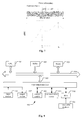
- Fig. 1 is a block diagram illustrating an example apparatus for performing song detection on an audio signal according to an embodiment of the present invention
- Fig. 2A is a schematic view for illustrating the detection of candidate boundaries
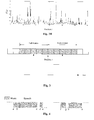
- Fig. 2B shows an example of a Kullback-Leibler Divergence ( KLD ) sequence calculated over a 1-hour audio signal
- Fig. 3 is a schematic view for illustrating an example method of calculating the content coherence distance
- Fig. 4 is a schematic view for illustrating an example of classification result and candidate boundaries
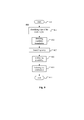
- Fig. 5 is a flow chart illustrating an example method of performing song detection on an audio signal according to an embodiment of the present invention
- Fig. 6 is a block diagram illustrating an example apparatus for performing song detection on an audio signal according to an embodiment of the present invention
- Fig. 7 is a schematic view for illustrating the relation between a log likelihood difference ⁇ BIC ( t ) and a Bayesian Information Criteria (BIC) window;
- Fig. 8 is a flow chart illustrating an example method of performing song detection on an audio signal according to an embodiment of the present invention.
- Fig. 9 is a block diagram illustrating an exemplary system for implementing aspects of the present invention.
- aspects of the present invention may be embodied as a system (e.g., an online digital media store, cloud computing service, streaming media service, telecommunication network, or the like), device (e.g., a cellular telephone, portable media player, personal computer, television set-top box, or digital video recorder, or any media player), method or computer program product.
- a system e.g., an online digital media store, cloud computing service, streaming media service, telecommunication network, or the like
- device e.g., a cellular telephone, portable media player, personal computer, television set-top box, or digital video recorder, or any media player
- aspects of the present invention may take the form of an entirely hardware embodiment, an entirely software embodiment (including firmware, resident software, microcode, etc.) or an embodiment combining software and hardware aspects that may all generally be referred to herein as a "circuit,” “module” or “system.”
- aspects of the present invention may take the form of a computer program product embodied in one or more computer readable medium(s) having computer readable program code embodied thereon.
- the computer readable medium may be a computer readable signal medium or a computer readable storage medium.
- a computer readable storage medium may be, for example, but not limited to, an electronic, magnetic, optical, electromagnetic, infrared, or semiconductor system, apparatus, or device, or any suitable combination of the foregoing.
- a computer readable storage medium may be any tangible medium that can contain, or store a program for use by or in connection with an instruction execution system, apparatus, or device.
- a computer readable signal medium may include a propagated data signal with computer readable program code embodied therein, for example, in baseband or as part of a carrier wave. Such a propagated signal may take any of a variety of forms, including, but not limited to, electro-magnetic, optical, or any suitable combination thereof.
- a computer readable signal medium may be any computer readable medium that is not a computer readable storage medium and that can communicate, propagate, or transport a program for use by or in connection with an instruction execution system, apparatus, or device.
- Program code embodied on a computer readable medium may be transmitted using any appropriate medium, including but not limited to wireless, wired line, optical fiber cable, RF, etc., or any suitable combination of the foregoing.
- Computer program code for carrying out operations for aspects of the present invention may be written in any combination of one or more programming languages, including an object oriented programming language such as Java, Smalltalk, C++ or the like and conventional procedural programming languages, such as the "C" programming language or similar programming languages.
- the program code may execute entirely on the user's computer, partly on the user's computer, as a stand-alone software package, partly on the user's computer and partly on a remote computer or entirely on the remote computer or server.
- the remote computer may be connected to the user's computer through any type of network, including a local area network (LAN) or a wide area network (WAN), or the connection may be made to an external computer (for example, through the Internet using an Internet Service Provider).
- LAN local area network
- WAN wide area network
- Internet Service Provider for example, AT&T, MCI, Sprint, EarthLink, MSN, GTE, etc.
- These computer program instructions may also be stored in a computer readable medium that can direct a computer, other programmable data processing apparatus, or other devices to function in a particular manner, such that the instructions stored in the computer readable medium produce an article of manufacture including instructions which implement the function/act specified in the flowchart and/or block diagram block or blocks.
- the computer program instructions may also be loaded onto a computer, other programmable data processing apparatus, or other devices to cause a series of operational steps to be performed on the computer, other programmable apparatus or other devices to produce a computer implemented process such that the instructions which execute on the computer or other programmable apparatus provide processes for implementing the functions/acts specified in the flowchart and/or block diagram block or blocks.
- Fig. 1 is a block diagram illustrating an example apparatus 100 for performing song detection on an audio signal according to an embodiment of the present invention.
- apparatus 100 includes a classifying unit 101, a boundary detector 102 and a song searcher 103.
- Audio signal 110 to be processed by apparatus 100 includes a plurality of consecutive clips.
- Each clip includes a plurality of consecutive frames.
- the length of the clips and the length of the frames depend on the requirement of the classification model for classifying the clips.
- Classifying unit 101 classifies the clips of audio signal 110 into classes comprising music.
- music includes songs with instrumental sound and songs without instrumental sound.
- the classification model may be trained based on training sample sets for the classes to be identified (e.g., music).
- Various models for classifying objects may be adopted.
- the classification model may be based on adaBoost, Support Vector Machine, Hidden Markov Model, or Gaussian Mixture Model.
- the features of each frame may comprise at least one of timbre-related feature and chroma feature.
- the timbre-related feature may be used to distinguish different types of sound production such as music, speech, etc.
- the timbre-related feature may comprise at least one of zero-crossing rate, short-time energy, sub-band spectral distribution, spectral flux and Mel-frequency Cepstral Coefficient.
- Chroma feature may be used to represent the melody information of an audio signal.
- chroma feature is generally defined as a 12-dimensional vector where each dimension corresponds to the intensity of a semitone class (there are 12 semitones in an octave).
- classifying unit 101 may calculate frame-level features of frames in each clip and derive features for characterizing variation of the frame-level features (also called as clip-level features) from the frame-level features of the clip.
- the clip-level features may be used to capture the rhythmic property of different sounds and especially to differentiate speech and music.
- the clip-level features of a clip may comprise mean and standard deviation of the frame-level features of the clip, and/or rhythmic feature.
- the rhythmic feature of a clip may be used to capture regular recurrence or pattern in the frame-level features of the clip.
- the rhythmic feature comprises at least one of rhythm strength, rhythm regularity, rhythm clarity and two dimension (2D) sub-band modulation.
- Each clip may be classified based on the corresponding clip-level features.
- the function of calculating the features may be implemented in classifying unit 101, or may be implemented in a separate feature extractor (not illustrated in Fig. 1 ).
- song signals recorded in audio signal 110 may include noise due to short time interference or other factors.
- the classes identified by classifying unit 101 may further comprise noise.
- Classifying unit 101 may further re-classify any noise segment adjoining with two music clips and having a length smaller than a threshold as music. The threshold may be obtained based on statistics on length of noise in sample song recordings. In this way, true song signal which incorrectly recorded as noise can be corrected as music class.
- classifying unit 101 may further calculate confidence for the class of each of the clips.
- Classifying unit 101 may comprise a first median filter and one or more second median filters with different smoothing windows.
- the first median filter smoothes the clips from the start to the stop of the audio signal.
- the class of the clip is updated with the median.
- the threshold is used to determine whether a confidence can indicate a correct classification. It can be set in advance, or can be learned by testing the classifier with a sample set.
- the second median filters with different smoothing windows smooth the clips subsequently. In this way, such incorrectly classified clips can be reclassified as music.
- class information of the clips in audio signal 110 may reveal one kind of information on true songs included in audio signal 110. Specifically, every music segment may be found from audio signal 110 based on the class information of the clips, and the music segment may be viewed as estimation to the corresponding true song.
- Boundary detector 102 detects class boundaries of the music clips (between music clip and non-music clip) as candidate boundaries 120. In this way, music segments which may be estimated as true songs can be detected.
- two or more consecutive songs can also exhibit as one music segment (e.g., music mixing or sampling).
- a sole music segment determined according to the class information is not always sufficient to discover the true boundary of the songs. It is possible to improve this estimation by exploiting the fact that for two segments belonging to different songs, features of signals in the different segments may exhibit some different characteristics (that is, lower consistency/ higher dissimilarity).
- boundary detector 102 may also detect positions as candidate boundaries 120 if feature dissimilarities between two windows disposed about the position within any music segment in audio signal 110 is higher than a threshold TH D .
- the threshold TH D may be determined based on statistics on feature dissimilarities calculated from sample signals including consecutive songs. In this way, it is possible to detect candidate boundaries for separating consecutive songs.
- the candidate boundaries detected based on classification are called as a first type and the candidate boundaries based on feature dissimilarity are called as a second type.
- Fig. 2A is a schematic view for illustrating an example detection of candidate boundaries of the second type.
- a left window is located at the immediately left side of position t
- a right window is located at the immediately right side of position t .
- a feature dissimilarity between features extracted from frames of the left window and features extracted from frames of the right window may be calculated.
- the left and right windows can be located away for position t by a separation margin.
- the feature dissimilarity between features of two windows can be adopted in boundary detector 102.
- the feature dissimilarity between two windows may be calculated as Kullback-Leibler Divergence (KLD).
- C l and C r are covariance matrices of features extracted from frames of the left window and the right window respectively
- u l and u r are corresponding means
- tr [ X ] is the sum of diagonal elements of a matrix X .
- Various features extracted from frames may be used for calculating the feature dissimilarity.
- the function for calculating the features may be included in boundary detector 102, or may be implemented in a separate feature extractor (not illustrated in Fig. 1 ).
- the features for calculating the feature dissimilarity may be the frame-level features described in connection with classifying unit 101.
- Fig. 2B shows an example of the KLD sequence calculated over a 1-hour audio signal, with small circles indicating true song boundaries. It can be seen that the distance is a little noisy. The distance is not always large at a true song boundary, while there are also many large distances within a song.
- the threshold TH D may be determined to ensure that most or all the local peak KLD s is higher than the threshold TH D . Therefore more true song boundaries that are missed due to consecutive songs can be detected as candidate boundaries for further investigation.
- the candidate boundaries may be boundaries of true songs. It is possible to judge whether the candidate boundaries are boundaries of true songs or not by investigating a broad range (if compared with the windows for calculating the feature dissimilarity in candidate boundary detector) of segments surrounding the candidate boundaries.
- the content coherence (distance) serves as a metric to further judge if a candidate boundary is a true song start/stop boundary. If the content coherence (distance) is large (small), the content of the surrounding segments is similar and thus the candidate boundary is not a true song start/stop boundary; otherwise, if the content coherence (distance) is small (large), the boundary is true.
- boundary detector 102 for each boundary t of the candidate boundaries, boundary detector 102 calculates at least one content coherence distance between two windows (e.g., one minute long) surrounding the boundary t . If more than one content coherence distances are calculated for one boundary, features for calculating the content coherence distances are at least partly different from each other.
- FIG. 3 is a schematic view for illustrating an example method of calculating the content coherence distance.
- a left window and a right window are divided into small segments, and the content coherence distance is derived from distances (e.g., KLD) between pairs of segments s i in the left window and corresponding segments s j in the right window.
- distances e.g., KLD
- features for calculating the content coherence distance may comprise at least one of chroma feature, timbre-related feature and Rhythm-related feature.
- the Rhythm-related feature may be obtained through at least one of tempo estimation, beat/bar detection and rhythm pattern extraction.
- boundary detector 102 calculates a possibility (e.g., confidence) that boundary t is the true boundary of a song based on the at least one corresponding content coherence distance.
- a possibility e.g., confidence
- Various methods may be adopted to calculate the possibility. For example, a sigmoid function may be adopted to calculate the possibility.
- Th lb and Th ub are the lower-bound threshold and upper-bound threshold respectively
- VH e.g., 1
- VM e.g., 0
- VM e.g., 0.5
- multiple content coherence distances are computed based on different features, they can be combined in various ways. For example, it is possible to set the possibility to VH if all the content coherence distances are larger than the corresponding upper-bound thresholds, or more loosely, if any one of the content coherence distances is larger than the corresponding upper-bound threshold.
- Another probabilistic way is to build a model to represent the joint distribution model of these distances based on a training set.
- boundary detector 102 may perform the following processing.
- boundary detector 102 may remove boundary t if the music segment including only boundary t and bounded by two candidate boundaries has a length smaller than the predetermined maximum song duration.
- boundary detector 102 may identify the two candidate boundaries as to-be-removed.
- the threshold may be obtained based on statistics on speech segments between two songs.
- Boundary detector 102 may remove all the to-be-removed candidate boundaries, or boundary detector 102 may change one or more pairs of two to-be-removed candidate boundaries bounding a music segment as the second type and remove the remaining to-be-removed candidate boundaries.
- boundary detector 102 may calculate a probability P ( H 0 ) that two music segments of durations l 1 and l 2 adjoining with each other at boundary t are two true songs with a pre-trained song duration model, and calculate a probability P ( H 1 ) that a music segment obtained by merging the two music segments is a true song with the pre-trained song duration model.
- boundary detector 102 may search for one or more pairs of two repetitive sections [ t 1 , t 2 ] and [ t 1 + l, t 2 + l ] in audio signal 110, where the lag l is shorter than the predetermined maximum song duration.
- songs may exhibit unique characteristics by including repetitive sections, i.e., segments with the same melody. It is possible to assume a section [ t 1 , t 2 + l ] between the repetitive sections [ t 1 , t 2 ] and [ t 1 + l, t 2 + l ] as belonging to one song. Therefore, if one candidate boundary in the section [ t 1 , t 2 + l ] is within a music segment, boundary detector 102 may remove the candidate boundary.
- boundary detector 102 may identify the two candidate boundaries as to-be-removed. Boundary detector 102 may remove all the to-be-removed candidate boundaries, or may change one or more pairs of two to-be-removed candidate boundaries bounding a music segment as the second type and remove the remaining to-be-removed candidate boundaries.
- the threshold may be obtained based on statistics on the length of music segments misclassified as speech in sample songs.
- candidate boundaries may be verified based on repetitive sections in the audio signal, reducing the possibility that false boundaries between songs are detected as true song boundaries.
- boundary detector 102 may adopt various methods of detecting repetitive sections in audio signals to search for repetitive sections in the segments. For example, methods based on similarity matrix or time-lag similarity matrix may be adopted.
- boundary detector 102 may calculate an adaptive threshold for binarizing the similarity matrix based on a percentile. In case of sorting similarity values in the similarity matrix in descending order, only the first small percentage of the similarity values depending on the percentile are binarized to a value representing repetition.
- the percentile is a product of the proportion of the music clips in the corresponding segment and a pre-defined base percentile. In this way, the percentile and the adaptive threshold are both adaptive to the proportion of music content in the segment.
- boundary detector 102 may only search for the repetitive sections longer than a threshold.
- the threshold may be obtained based on statistics on the length of repetitive sections in sample songs. In this way, only those repetitive sections long enough can be detected.
- boundary detector 102 may search for sections [ t 1 , t 2 ] and [ t 1 + l, t 2 + l ] such that the music clips are in the majority of section [ t 1 , t 2 + l ]. For example, the proportion of the clips classified as music in section [ t 1 , t 2 + l ] is greater than 50%.
- the proportion m 1 of the clips classified as music in the section [ t 1 , t 2 ], the proportion m 2 of the clips classified as music in the section [ t 1 + l, t 2 + l ], the proportion mc of the clips classified as music in the section [ t 2 , t 1 + l ] and the sum ms of m 1, m 2 and mc may meet some conditions, such as one of the following conditions:
- boundary detector 102 may merge two of the candidate boundaries spaced with a distance smaller than a threshold as one candidate boundary.
- the threshold may be a value smaller than or equal to the minimum song duration.
- the merged candidate boundary may be any one position between the two candidate boundaries.
- song searcher 103 derives at least one combination including non-overlapped sections bounded by the candidate boundaries.
- the sections meet the following conditions:
- the predetermined minimum song duration and the predetermined maximum song duration may be determined from statistics on length of various songs, or may be specified by a user who desires songs of a length within a specific range.
- Any portion bounded between two candidate boundaries in the audio signal meeting conditions 1) to 4) may be regarded as a possible section. Therefore, there may be multiple possible sections in the audio signal.
- the possible sections not overlapped with each other may be selected to form a combination.
- the number of sections in combinations may be set to a specific number, e.g., 2, 3 and so on.
- Fig. 4 is a schematic view for illustrating an example of classification result and candidate boundaries. As illustrated in Fig. 4 , there are candidate boundaries a, b, c , d, e, f, g, h and k .
- Two candidate boundaries bounding a possible section may be subsequent, that is to say, there is no other candidate boundary between the two candidate boundaries.
- the possible section is an undividable music segment.
- Candidate boundaries b and c bounds an undividable music segment [ b , c ].
- Two candidate boundaries bounding a possible section may also include one or more other candidate boundaries.
- the possible section includes at least two undividable segments.
- possible section [ a, c ] includes two undividable segments [ a, b ] and [ b, c ]
- possible section [ b, e ] includes undividable segments [ b, c ], [ c, d ] and [ d, e ].
- any possible section may be selected.
- at least two possible sections which are not overlapped with each other may be selected as sections to form a combination.
- Different combinations may have a different number of sections. For example, from the audio signal in Fig. 4 , combinations ([ b, c ], [ f , k ]), ([ a, b ], [ b, e ], [ h, k ]), ([ a, e ], [ f , k ]) may be formed, supposing that conditions 1) to 4) can be met.
- song searcher 103 in deriving a combination, song searcher 103 excludes any combination including a section where the possibility corresponding to one candidate boundary within the section indicates that the candidate boundary is a true boundary. That is to say, the possibility corresponding to each candidate boundary within the sections does not indicate that the candidate boundary is a true boundary.
- song searcher 103 may detect each music segment bounded by two subsequent candidate boundaries t 1 and t 2 and longer than the predetermined minimum song duration as a candidate song, and form the combination by including the candidate song [ t 1 , t 2 ] or their extensions as a section.
- the sections in the formed combination are not overlapped with each other, and also meet the above-mentioned conditions 1) to 4).
- Each extension may be obtained by at least one of the followings:
- song searcher 103 may obtains the extensions in a way such that:
- the extending in the left direction is stopped if the possibility based on content coherence distance of the candidate boundary t 1 -l 1 of the music segment [ t 1 -l 1 , t 1 -l 2 ] being extended to indicates that the candidate boundary t 1 -l 1 is a true song boundary, and
- the extending in the right direction is stopped if the possibility based on content coherence distance of the candidate boundary t 2 + l 4 of the music segment [ t 2 + l 3 , t 2 + l 4 ] being extended to indicates that the candidate boundary t 2 + l 4 is a true song boundary.
- a non-music (e.g., speech) segment is to be included in performing the extending and the non-music segment is longer than a pre-defined threshold, the extending may be stopped.
- song searcher 103 more than one combination may be derived by song searcher 103.
- song searcher may further separate the combinations into different groups. Every combination in each group includes the same candidate song(s) and each section in the combination includes the same candidate song(s) with one section in another combination of the same group.
- music segments [ b, c ] and [ h, k ] are candidate songs.
- song searcher 103 may derive combinations ([ b, c ], [ h, k ]), ([ a, c ], [ f , k ]), ([ b, e ], [ f , k ]) and ([ b, k ]).
- the combinations ([ b, c ], [ h, k ]), ([ a, c ], [ f, k ]) and ([ b, e ], [ f, k ]) include the same candidate songs [ b, c ] and [ h, k ].
- Each section of [ b, c ], [ a, c ] and [ b, e ] includes the same candidate song [ b, c ], and each section of [ h, k ] and [ f , k ] includes the same candidate song [ h, k ]. Therefore, the combinations ([ b, c ], [ h, k ]), ([ a, c ], [ f , k]), ([ b, e ], [ f , k ]) belong to the same group. For every two combinations belonging to different groups, at least one section in one of the two combinations does not include the same candidate song(s) with each section in another of the two combinations. Also in the example illustrated in Fig.
- the candidate songs [ b, c ] and [ h, k ] included in one section [ b, k ] of the combination ([ b, k ]) is not the same with any candidate song [ b, c ] or [ h, k ] included in each section of the combinations ([ b, c ], [ h, k ]), ([ a, c ], [ f , k ]), ([ b, e ], [ f , k ]), the combination ([ b , k ]) belongs to a different group.
- Fig. 5 is a flow chart illustrating an example method 500 of performing song detection on an audio signal according to an embodiment of the present invention.
- method 500 starts from step 501.
- clips of the audio signal are classified into classes comprising music.
- step 503 it is possible to calculate frame-level features of frames in each clip and derive clip-level features for characterizing variation of the frame-level features from the frame-level features of the clip.
- the clip-level features may be used to capture the rhythmic property of different sounds and especially to differentiate speech and music.
- the classes identified at step 503 may further comprise noise. It is possible to further re-classify any noise segment adjoining with two music clips and having a length smaller than a threshold as music.
- the threshold may be obtained based on statistics on length of noise in sample song recordings.
- step 503 it is possible to further calculate confidence for the class of each of the clips. Further, it is possible to smooth the clips from the start to the stop of the audio signal with a smoothing window. For each current clip, if the confidence of the clip is lower than a threshold and the class of the clip is different from the median of the classes of the clips in the smoothing window centered at the clip, the class of the clip is updated with the median. Further, it is possible to smooth the clips with different smoothing windows.
- the threshold is used to determine whether a confidence can indicate a correct classification. It can be set in advance, or can be learned by testing the classifier with a sample set.
- class boundaries of the music clips are detected as candidate boundaries.
- step 505 it is also possible to detect positions as candidate boundaries if feature dissimilarities between two windows disposed about the position within any music segment in the audio signal is higher than the threshold TH D .
- the feature dissimilarity between two windows may be calculated as Kullback-Leibler Divergence (KLD).
- KLD Kullback-Leibler Divergence
- the feature dissimilarity D sKLD may be calculated as a symmetric KLD by Eq. (1).
- Various features extracted from frames may be used for calculating the feature dissimilarity.
- step 505 for each boundary t of the candidate boundaries, it is possible to calculate at least one content coherence distance between two windows (e.g., one minute long) surrounding the boundary t . If more than one content coherence distances are calculated for one boundary, features for calculating the content coherence distances are at least partly different from each other.
- a possibility e.g., confidence
- a possibility e.g., confidence
- Various methods may be adopted to calculate the possibility. For example, a sigmoid function may be adopted to calculate the possibility.
- the possibility conf may be calculated based on the content coherence distance D coh by Eq. (3).
- multiple content coherence distances are computed based on different features, they can be combined in various ways. For example, it is possible to set the possibility to VH if all the content coherence distances are larger than the corresponding upper-bound thresholds, or more loosely, if any one of the content coherence distances is larger than the corresponding upper-bound threshold.
- Another probabilistic way is to build a model to represent the joint distribution model of these distances based on a training set.
- boundary t is a false boundary
- boundary t may be removed if the music segment including only boundary t and bounded by two candidate boundaries has a length smaller than the predetermined maximum song duration.
- a speech segment bounded by boundary t and another candidate boundary has a length smaller than a threshold
- the two candidate boundaries may be identified as to-be-removed.
- the threshold may be obtained based on statistics on speech segments between two songs.
- All the to-be-removed candidate boundaries may be removed, or one or more pairs of two to-be-removed candidate boundaries bounding a music segment may be changed as the second type and the remaining to-be-removed candidate boundaries may be removed.
- step 505 in case that the possibility neither indicates that boundary t is a true boundary nor indicates that boundary t is a false boundary, if boundary t is of the second type (that is, within a music segment), a probability P ( H 0 ) that two music segments of durations l 1 and l 2 adjoining with each other at boundary t are two true songs may be calculated with a pre-trained song duration model, and a probability P ( H 1 ) that a music segment obtained by merging the two music segments is a true song may be calculated with the pre-trained song duration model. If the condition defined by Eq. (4) is not met, it is possible to remove boundary t .
- step 505 it is possible to search for one or more pairs of two repetitive sections [ t 1 , t 2 ] and [ t 1 + l , t 2 + l ] in the audio signal, where the lag l is shorter than the predetermined maximum song duration.
- one candidate boundary in the section [ t 1 , t 2 + l ] is within a music segment, it is possible to remove the candidate boundary. If a speech segment in the section [ t 1 , t 2 + l ] bounded by two candidate boundaries has a length smaller than a threshold, it is possible to identify the two candidate boundaries as to-be-removed. All the to-be-removed candidate boundaries may be removed, or one or more pairs of two to-be-removed candidate boundaries bounding a music segment may be changed as the second type and the remaining to-be-removed candidate boundaries may be removed.
- the threshold may be obtained based on statistics on the length of music segments misclassified as speech in sample songs.
- Various methods of detecting repetitive sections in audio signals may be adopted to search for repetitive sections in the segments. For example, methods based on similarity matrix or time-lag similarity matrix may be adopted.
- step 505 it is possible to calculate an adaptive threshold for binarizing the similarity matrix based on a percentile.
- the percentile is a product of the proportion of the music clips in the corresponding segment and a pre-defined base percentile.
- step 505 it is possible to only search for the repetitive sections longer than a threshold.
- the threshold may be obtained based on statistics on the length of repetitive sections in sample songs.
- step 505 it is possible to search for sections [ t 1 , t 2 ] and [t 1 + l, t 2 + l ] such that the music clips are in the majority of section [ t 1 , t 2 + l ].
- the proportion of the clips classified as music in section [ t 1 , t 2 + l ] is greater than 50%.
- the proportion m 1 of the clips classified as music in the section [ t 1 , t 2 ], the proportion m 2 of the clips classified as music in the section [ t 1 + l, t 2 + l ], the proportion mc of the clips classified as music in the section [ t 2 , t 1 + l ] and the sum ms of m 1, m 2 and mc may meet some conditions, such as one of the following conditions:
- step 505 it is possible to merge two of the candidate boundaries spaced with a distance smaller than a threshold as one candidate boundary.
- the threshold may be a value smaller than or equal to the minimum song duration.
- the merged candidate boundary may be any one position between the two candidate boundaries.
- At step 507 at least one combination including non-overlapped sections bounded by the candidate boundaries is derived.
- the sections meet the above conditions 1) to 4).
- the predetermined minimum song duration and the predetermined maximum song duration may be determined from statistics on length of various songs, or may be specified by a user who desires songs of a length within a specific range.
- Any portion bounded between two candidate boundaries in the audio signal meeting conditions 1) to 4) may be regarded as a possible section. Therefore, there may be multiple possible sections in the audio signal.
- the possible sections not overlapped with each other may be selected to for a combination.
- the number of sections in combinations may be set to a specific number, e.g., 2, 3 and so on.
- step 507 it is possible to detect each music segment bounded by two subsequent candidate boundaries t 1 and t 2 and longer than the predetermined minimum song duration as a candidate song, and form the combination by including the candidate song [ t 1 , t 2 ] or their extensions as a section.
- the sections in the formed combination are not overlapped with each other, and also meet the above-mentioned conditions 1) to 4).
- Each extension may be obtained by at least one of the followings:
- step 507 it is possible to obtain the extensions in a way such that:
- the extending in the left direction is stopped if the possibility based on the content coherence distance of the candidate boundary t 1 -l 1 of the music segment [ t 1 -l 1 , t 1 -l 2 ] being extended to indicates that the candidate boundary t 1 -l 1 is a true son boundary, and
- the extending in the right direction is stopped if the possibility based on the content coherence distance of the candidate boundary t 2 + l 4 of the music segment [ t 2 + l 3 , t 2 + l 4 ] being extended to indicates that the candidate boundary t 2 + l 4 is a true song boundary.
- a non-music (e.g., speech) segment is to be included in performing the extending and the non-music segment is longer than a pre-defined threshold, the extending may be stopped.
- Method 500 ends at step 509.
- step 507 may further comprise separating the combinations into different groups. Every combination in each group includes the same candidate song(s) and each section in the combination includes the same candidate song(s) with one section in another combination of the same group. For every two combinations of different groups, at least one section in one of the two combinations does not include the same candidate song(s) with each section in another of the two combinations.
- Fig. 6 is a block diagram illustrating an example apparatus 600 for performing song detection on an audio signal according to an embodiment of the present invention.
- apparatus 600 includes a classifying unit 601, a boundary detector 602, a song searcher 603, a song evaluator 604 and a selector 605.
- Classifying unit 601, boundary detector 602 and song searcher 603 have the same functions as that of classifying unit 101, boundary detector 102 and song searcher 103 respectively, and will not be described in detail herein.
- song evaluator 604 evaluates a possibility that all the intervals for separating the sections represent true song partitions with an evaluation model trained based on at least one of song duration, interval between songs, and song probability.
- duration of the songs complies with a song duration distribution
- non-song duration (interval) between the songs complies with a song interval distribution.
- features extracted from the songs exhibit some characteristics different from that of non-songs.
- every section in the combination is assumed as a true song, and the combination represents a possible song partition in the audio signal.
- One or more of the above characteristics may be adopted to determine whether the combination can represent a true song partition. For example, it is possible to train a song duration model for evaluating whether a section is a true song based on statistics on durations of a set of sample songs, and estimate the possibility that a section is a true song with the trained model based on the length of the section.
- a non-song model for evaluating whether the portion between two adjacent sections is a non-song based on statistics on intervals between subsequent sample songs, and estimate the possibility that the portion between two subsequent sections is non-song with the trained model based on the interval between the sections.
- a song probability model for evaluating whether a section is a true song based on the features extracted from a set of sample songs, and estimate the possibility that a section is a true song with the trained model based on the features extracted from the section.
- Other criteria may also be adopted to determine whether the combination can represent a true song partition. If more than one possibility is obtained, it is possible to combine them in a joint model to obtain a final possibility. For example, it is possible to calculate mean or a joint probability function of respective possibilities.
- Selector 605 selects one combination with the highest possibility. Sections in the combination are regarded as true songs.
- selector 605 may calculate a log likelihood difference ⁇ BIC ( t ) based on a Bayesian Information Criteria (BIC) based method for each frame position t in a BIC window centered at boundary b , and adjust boundary b to the frame position t corresponding to a peak ⁇ BIC ( t ).
- BIC Bayesian Information Criteria
- Fig. 7 is a schematic view for illustrating the relation between ⁇ BIC ( t ) and the BIC window.
- BIC ( H ) represents the log likelihood under a hypothesis H
- H 0 represents a hypothesis that frame boundary t is a true boundary and it is better to represent the window by two separated models that are split at time t
- H 1 represents a hypothesis that frame boundary t is not a true boundary and it is better to represent
- selector 605 may adjust boundary b to be refined to frame position t corresponding to the peak ⁇ BIC ( t ) closer to boundary b than frame position t' corresponding to another peak ⁇ BIC ( t' ).
- selector 605 may calculate a value R ⁇ BIC ( t
- b ) ⁇ BIC ( t ) ⁇ P st (
- the frame-level features may comprise chroma feature.
- Fig. 8 is a flow chart illustrating an example method 800 of performing song detection on an audio signal according to an embodiment of the present invention.
- step 807 As illustrated in Fig. 8 , method 800 starts from step 801. Steps 801, 803, 805 and 807 have the same functions with that of steps 501, 503, 505 and 507 respectively, and will not be described in detail herein. After one or more combinations are derived at step 807, method 800 proceeds to step 809.
- a possibility that all the intervals for separating the sections represent true song partitions is calculated with an evaluation model trained based on at least one of song duration, interval between songs, and song probability.
- every section in the combination is assumed as a true song, and the combination represents a possible song partition in the audio signal.
- One or more of the above characteristics may be adopted to determine whether the combination can represent a true song partition.
- Other criteria may also be adopted to determine whether the combination can represent a true song partition. If more than one possibility is obtained, it is possible to combine them in a joint model to obtain a final possibility. For example, it is possible to calculate mean or a joint probability function of respective possibilities.
- the final possibility may be calculated in form of average or product of confidence P ([ e, s ]) for all the intervals [ e, s ] for separating the one or more sections in the corresponding combination based on Eqs. (5-1) and (5-2).
- one combination with the highest possibility is selected. Sections in the combination are regarded as true songs.
- step 811 for each boundary b of every section in the selected combination, it is possible to calculate a log likelihood difference ⁇ BIC ( t ) based on a Bayesian Information Criteria (BIC) based method for each frame position t in a BIC window centered at boundary b , and adjust boundary b to the frame position t corresponding to a peak ⁇ BIC ( t ).
- BIC Bayesian Information Criteria
- step 811 it is possible to adjust boundary b to be refined to frame position t corresponding to the peak ⁇ BIC ( t ) closer to boundary b than frame position t' corresponding to another peak ⁇ BIC ( t ').
- step 811 for each boundary b of every section in the selected combination, it is possible to calculate a value R ⁇ BIC ( t
- b ) ⁇ BIC ( t ) ⁇ P st (
- the frame-level features may comprise chroma feature.
- Fig. 9 is a block diagram illustrating an exemplary system for implementing the aspects of the present invention.
- a central processing unit (CPU) 901 performs various processes in accordance with a program stored in a read only memory (ROM) 902 or a program loaded from a storage section 908 to a random access memory (RAM) 903.
- ROM read only memory
- RAM random access memory
- data required when the CPU 901 performs the various processes or the like is also stored as required.
- the CPU 901, the ROM 902 and the RAM 903 are connected to one another via a bus 904.
- An input / output interface 905 is also connected to the bus 904.
- the following components are connected to the input / output interface 905: an input section 906 including a keyboard, a mouse, or the like ; an output section 907 including a display such as a cathode ray tube (CRT), a liquid crystal display (LCD), or the like, and a loudspeaker or the like; the storage section 908 including a hard disk or the like ; and a communication section 909 including a network interface card such as a LAN card, a modem, or the like.
- the communication section 909 performs a communication process via the network such as the internet.
- a drive 910 is also connected to the input / output interface 905 as required.
- a removable medium 911 such as a magnetic disk, an optical disk, a magneto - optical disk, a semiconductor memory, or the like, is mounted on the drive 910 as required, so that a computer program read therefrom is installed into the storage section 908 as required.
- the program that constitutes the software is installed from the network such as the internet or the storage medium such as the removable medium 911.
Landscapes
- Engineering & Computer Science (AREA)
- Computational Linguistics (AREA)
- Signal Processing (AREA)
- Health & Medical Sciences (AREA)
- Audiology, Speech & Language Pathology (AREA)
- Human Computer Interaction (AREA)
- Physics & Mathematics (AREA)
- Acoustics & Sound (AREA)
- Multimedia (AREA)
- Information Retrieval, Db Structures And Fs Structures Therefor (AREA)
- Auxiliary Devices For Music (AREA)
- Indexing, Searching, Synchronizing, And The Amount Of Synchronization Travel Of Record Carriers (AREA)
Applications Claiming Priority (2)
| Application Number | Priority Date | Filing Date | Title |
|---|---|---|---|
| CN201110243070.6A CN102956230B (zh) | 2011-08-19 | 2011-08-19 | 对音频信号进行歌曲检测的方法和设备 |
| US201161540346P | 2011-09-28 | 2011-09-28 |
Publications (3)
| Publication Number | Publication Date |
|---|---|
| EP2560167A2 true EP2560167A2 (de) | 2013-02-20 |
| EP2560167A3 EP2560167A3 (de) | 2014-01-22 |
| EP2560167B1 EP2560167B1 (de) | 2017-01-04 |
Family
ID=47172253
Family Applications (1)
| Application Number | Title | Priority Date | Filing Date |
|---|---|---|---|
| EP12180534.5A Not-in-force EP2560167B1 (de) | 2011-08-19 | 2012-08-15 | Verfahren und Vorrichtung zur Detektion von Liedern in einem Audiosignal |
Country Status (3)
| Country | Link |
|---|---|
| US (1) | US8595009B2 (de) |
| EP (1) | EP2560167B1 (de) |
| CN (1) | CN102956230B (de) |
Cited By (2)
| Publication number | Priority date | Publication date | Assignee | Title |
|---|---|---|---|---|
| WO2014072772A1 (en) * | 2012-11-12 | 2014-05-15 | Nokia Corporation | A shared audio scene apparatus |
| CN114596878A (zh) * | 2022-03-08 | 2022-06-07 | 北京字跳网络技术有限公司 | 一种音频检测方法、装置、存储介质及电子设备 |
Families Citing this family (23)
| Publication number | Priority date | Publication date | Assignee | Title |
|---|---|---|---|---|
| EP2304863B1 (de) | 2008-07-30 | 2018-06-27 | Regal Beloit America, Inc. | Motor mit inneren permanentmagneten mit rotor mit ungleichen polen |
| JP6019858B2 (ja) * | 2011-07-27 | 2016-11-02 | ヤマハ株式会社 | 楽曲解析装置および楽曲解析方法 |
| JP6123995B2 (ja) * | 2013-03-14 | 2017-05-10 | ヤマハ株式会社 | 音響信号分析装置及び音響信号分析プログラム |
| JP6179140B2 (ja) | 2013-03-14 | 2017-08-16 | ヤマハ株式会社 | 音響信号分析装置及び音響信号分析プログラム |
| CN104683933A (zh) | 2013-11-29 | 2015-06-03 | 杜比实验室特许公司 | 音频对象提取 |
| KR102255152B1 (ko) * | 2014-11-18 | 2021-05-24 | 삼성전자주식회사 | 가변적인 크기의 세그먼트를 전송하는 컨텐츠 처리 장치와 그 방법 및 그 방법을 실행하기 위한 컴퓨터 프로그램 |
| CN104778218A (zh) * | 2015-03-20 | 2015-07-15 | 广东欧珀移动通信有限公司 | 一种不完整歌曲处理的方法及装置 |
| US20170294185A1 (en) * | 2016-04-08 | 2017-10-12 | Knuedge Incorporated | Segmentation using prior distributions |
| US10504539B2 (en) * | 2017-12-05 | 2019-12-10 | Synaptics Incorporated | Voice activity detection systems and methods |
| CN108549675B (zh) * | 2018-03-31 | 2021-09-24 | 河南理工大学 | 一种基于大数据及神经网络的钢琴教学方法 |
| US11037583B2 (en) * | 2018-08-29 | 2021-06-15 | International Business Machines Corporation | Detection of music segment in audio signal |
| JP7407580B2 (ja) | 2018-12-06 | 2024-01-04 | シナプティクス インコーポレイテッド | システム、及び、方法 |
| JP7498560B2 (ja) | 2019-01-07 | 2024-06-12 | シナプティクス インコーポレイテッド | システム及び方法 |
| CN110097895B (zh) * | 2019-05-14 | 2021-03-16 | 腾讯音乐娱乐科技(深圳)有限公司 | 一种纯音乐检测方法、装置及存储介质 |
| US11064294B1 (en) | 2020-01-10 | 2021-07-13 | Synaptics Incorporated | Multiple-source tracking and voice activity detections for planar microphone arrays |
| CN112614515B (zh) * | 2020-12-18 | 2023-11-21 | 广州虎牙科技有限公司 | 音频处理方法、装置、电子设备及存储介质 |
| CN113038260B (zh) * | 2021-03-16 | 2024-03-19 | 北京字跳网络技术有限公司 | 音乐的延长方法、装置、电子设备和存储介质 |
| CN113889146B (zh) * | 2021-09-22 | 2025-05-27 | 北京小米移动软件有限公司 | 音频识别方法、装置、电子设备和存储介质 |
| US12189683B1 (en) * | 2021-12-10 | 2025-01-07 | Amazon Technologies, Inc. | Song generation using a pre-trained audio neural network |
| CN114245171B (zh) * | 2021-12-15 | 2023-08-29 | 百度在线网络技术(北京)有限公司 | 视频编辑方法、装置、电子设备、介质 |
| US12057138B2 (en) | 2022-01-10 | 2024-08-06 | Synaptics Incorporated | Cascade audio spotting system |
| US11823707B2 (en) | 2022-01-10 | 2023-11-21 | Synaptics Incorporated | Sensitivity mode for an audio spotting system |
| TWI879131B (zh) * | 2023-10-05 | 2025-04-01 | 瑞昱半導體股份有限公司 | 即時分析音樂節奏的方法與系統 |
Family Cites Families (13)
| Publication number | Priority date | Publication date | Assignee | Title |
|---|---|---|---|---|
| JP3598598B2 (ja) * | 1995-07-31 | 2004-12-08 | ヤマハ株式会社 | カラオケ装置 |
| US6819863B2 (en) * | 1998-01-13 | 2004-11-16 | Koninklijke Philips Electronics N.V. | System and method for locating program boundaries and commercial boundaries using audio categories |
| US7062442B2 (en) | 2001-02-23 | 2006-06-13 | Popcatcher Ab | Method and arrangement for search and recording of media signals |
| US7606388B2 (en) * | 2002-05-14 | 2009-10-20 | International Business Machines Corporation | Contents border detection apparatus, monitoring method, and contents location detection method and program and storage medium therefor |
| US7336890B2 (en) * | 2003-02-19 | 2008-02-26 | Microsoft Corporation | Automatic detection and segmentation of music videos in an audio/video stream |
| US6784354B1 (en) * | 2003-03-13 | 2004-08-31 | Microsoft Corporation | Generating a music snippet |
| DE102004047069A1 (de) | 2004-09-28 | 2006-04-06 | Fraunhofer-Gesellschaft zur Förderung der angewandten Forschung e.V. | Vorrichtung und Verfahren zum Ändern einer Segmentierung eines Audiostücks |
| US8521529B2 (en) * | 2004-10-18 | 2013-08-27 | Creative Technology Ltd | Method for segmenting audio signals |
| JP4626376B2 (ja) * | 2005-04-25 | 2011-02-09 | ソニー株式会社 | 音楽コンテンツの再生装置および音楽コンテンツ再生方法 |
| JP4321518B2 (ja) | 2005-12-27 | 2009-08-26 | 三菱電機株式会社 | 楽曲区間検出方法、及びその装置、並びにデータ記録方法、及びその装置 |
| JP2008076776A (ja) * | 2006-09-21 | 2008-04-03 | Sony Corp | データ記録装置、データ記録方法及びデータ記録プログラム |
| JP2008152840A (ja) * | 2006-12-15 | 2008-07-03 | Matsushita Electric Ind Co Ltd | 記録再生装置 |
| WO2009090705A1 (ja) * | 2008-01-16 | 2009-07-23 | Panasonic Corporation | 記録再生装置 |
-
2011
- 2011-08-19 CN CN201110243070.6A patent/CN102956230B/zh not_active Expired - Fee Related
-
2012
- 2012-07-26 US US13/559,265 patent/US8595009B2/en not_active Expired - Fee Related
- 2012-08-15 EP EP12180534.5A patent/EP2560167B1/de not_active Not-in-force
Non-Patent Citations (1)
| Title |
|---|
| None |
Cited By (2)
| Publication number | Priority date | Publication date | Assignee | Title |
|---|---|---|---|---|
| WO2014072772A1 (en) * | 2012-11-12 | 2014-05-15 | Nokia Corporation | A shared audio scene apparatus |
| CN114596878A (zh) * | 2022-03-08 | 2022-06-07 | 北京字跳网络技术有限公司 | 一种音频检测方法、装置、存储介质及电子设备 |
Also Published As
| Publication number | Publication date |
|---|---|
| CN102956230A (zh) | 2013-03-06 |
| EP2560167A3 (de) | 2014-01-22 |
| EP2560167B1 (de) | 2017-01-04 |
| US20130046536A1 (en) | 2013-02-21 |
| US8595009B2 (en) | 2013-11-26 |
| CN102956230B (zh) | 2017-03-01 |
Similar Documents
| Publication | Publication Date | Title |
|---|---|---|
| EP2560167B1 (de) | Verfahren und Vorrichtung zur Detektion von Liedern in einem Audiosignal | |
| US8918316B2 (en) | Content identification system | |
| US9460736B2 (en) | Measuring content coherence and measuring similarity | |
| US9411883B2 (en) | Audio signal processing apparatus and method, and monitoring system | |
| US20030182118A1 (en) | System and method for indexing videos based on speaker distinction | |
| CN114141252A (zh) | 声纹识别方法、装置、电子设备和存储介质 | |
| JP4572218B2 (ja) | 音楽区間検出方法、音楽区間検出装置、音楽区間検出プログラム及び記録媒体 | |
| US10665248B2 (en) | Device and method for classifying an acoustic environment | |
| JP4348970B2 (ja) | 情報検出装置及び方法、並びにプログラム | |
| CN102486920A (zh) | 音频事件检测方法和装置 | |
| CN108831506B (zh) | 基于gmm-bic的数字音频篡改点检测方法及系统 | |
| JP2005532582A (ja) | 音響信号に音響クラスを割り当てる方法及び装置 | |
| CN111243618B (zh) | 用于确定音频中的特定人声片段的方法、装置和电子设备 | |
| WO2015114216A2 (en) | Audio signal analysis | |
| CN114302301B (zh) | 频响校正方法及相关产品 | |
| JP2001147697A (ja) | 音響データ分析方法及びその装置 | |
| JP2004125944A (ja) | 情報識別装置及び方法、並びにプログラム及び記録媒体 | |
| Yarra et al. | A mode-shape classification technique for robust speech rate estimation and syllable nuclei detection | |
| KR100974871B1 (ko) | 특징 벡터 선택 방법 및 장치, 그리고 이를 이용한 음악장르 분류 방법 및 장치 | |
| CN113761269B (zh) | 音频识别方法、装置和计算机可读存储介质 | |
| JP2010038943A (ja) | 音響信号処理装置及び方法 | |
| Mohammed et al. | Overlapped music segmentation using a new effective feature and random forests | |
| CN112053686A (zh) | 一种音频中断方法、装置以及计算机可读存储介质 | |
| JP2011191542A (ja) | 音声分類装置、音声分類方法、及び音声分類用プログラム | |
| Goto | PreFEst: A predominant-F0 estimation method for polyphonic musical audio signals |
Legal Events
| Date | Code | Title | Description |
|---|---|---|---|
| PUAI | Public reference made under article 153(3) epc to a published international application that has entered the european phase |
Free format text: ORIGINAL CODE: 0009012 |
|
| AK | Designated contracting states |
Kind code of ref document: A2 Designated state(s): AL AT BE BG CH CY CZ DE DK EE ES FI FR GB GR HR HU IE IS IT LI LT LU LV MC MK MT NL NO PL PT RO RS SE SI SK SM TR |
|
| AX | Request for extension of the european patent |
Extension state: BA ME |
|
| RIC1 | Information provided on ipc code assigned before grant |
Ipc: G10L 25/48 20130101ALI20130826BHEP Ipc: G10L 25/78 20130101AFI20130826BHEP |
|
| PUAL | Search report despatched |
Free format text: ORIGINAL CODE: 0009013 |
|
| AK | Designated contracting states |
Kind code of ref document: A3 Designated state(s): AL AT BE BG CH CY CZ DE DK EE ES FI FR GB GR HR HU IE IS IT LI LT LU LV MC MK MT NL NO PL PT RO RS SE SI SK SM TR |
|
| AX | Request for extension of the european patent |
Extension state: BA ME |
|
| RIC1 | Information provided on ipc code assigned before grant |
Ipc: G10L 25/48 20130101ALI20131213BHEP Ipc: G10L 25/78 20130101AFI20131213BHEP |
|
| 17P | Request for examination filed |
Effective date: 20140722 |
|
| RBV | Designated contracting states (corrected) |
Designated state(s): AL AT BE BG CH CY CZ DE DK EE ES FI FR GB GR HR HU IE IS IT LI LT LU LV MC MK MT NL NO PL PT RO RS SE SI SK SM TR |
|
| 17Q | First examination report despatched |
Effective date: 20151012 |
|
| GRAP | Despatch of communication of intention to grant a patent |
Free format text: ORIGINAL CODE: EPIDOSNIGR1 |
|
| INTG | Intention to grant announced |
Effective date: 20160727 |
|
| RIN1 | Information on inventor provided before grant (corrected) |
Inventor name: BAUER, CLAUS Inventor name: LU, LIE |
|
| STAA | Information on the status of an ep patent application or granted ep patent |
Free format text: STATUS: GRANT OF PATENT IS INTENDED |
|
| GRAS | Grant fee paid |
Free format text: ORIGINAL CODE: EPIDOSNIGR3 |
|
| GRAA | (expected) grant |
Free format text: ORIGINAL CODE: 0009210 |
|
| STAA | Information on the status of an ep patent application or granted ep patent |
Free format text: STATUS: THE PATENT HAS BEEN GRANTED |
|
| AK | Designated contracting states |
Kind code of ref document: B1 Designated state(s): AL AT BE BG CH CY CZ DE DK EE ES FI FR GB GR HR HU IE IS IT LI LT LU LV MC MK MT NL NO PL PT RO RS SE SI SK SM TR |
|
| REG | Reference to a national code |
Ref country code: GB Ref legal event code: FG4D |
|
| REG | Reference to a national code |
Ref country code: CH Ref legal event code: EP |
|
| REG | Reference to a national code |
Ref country code: AT Ref legal event code: REF Ref document number: 859938 Country of ref document: AT Kind code of ref document: T Effective date: 20170115 |
|
| REG | Reference to a national code |
Ref country code: IE Ref legal event code: FG4D |
|
| REG | Reference to a national code |
Ref country code: DE Ref legal event code: R096 Ref document number: 602012027306 Country of ref document: DE |
|
| REG | Reference to a national code |
Ref country code: LT Ref legal event code: MG4D Ref country code: NL Ref legal event code: MP Effective date: 20170104 |
|
| REG | Reference to a national code |
Ref country code: AT Ref legal event code: MK05 Ref document number: 859938 Country of ref document: AT Kind code of ref document: T Effective date: 20170104 |
|
| PG25 | Lapsed in a contracting state [announced via postgrant information from national office to epo] |
Ref country code: NL Free format text: LAPSE BECAUSE OF FAILURE TO SUBMIT A TRANSLATION OF THE DESCRIPTION OR TO PAY THE FEE WITHIN THE PRESCRIBED TIME-LIMIT Effective date: 20170104 |
|
| PG25 | Lapsed in a contracting state [announced via postgrant information from national office to epo] |
Ref country code: LT Free format text: LAPSE BECAUSE OF FAILURE TO SUBMIT A TRANSLATION OF THE DESCRIPTION OR TO PAY THE FEE WITHIN THE PRESCRIBED TIME-LIMIT Effective date: 20170104 Ref country code: NO Free format text: LAPSE BECAUSE OF FAILURE TO SUBMIT A TRANSLATION OF THE DESCRIPTION OR TO PAY THE FEE WITHIN THE PRESCRIBED TIME-LIMIT Effective date: 20170404 Ref country code: GR Free format text: LAPSE BECAUSE OF FAILURE TO SUBMIT A TRANSLATION OF THE DESCRIPTION OR TO PAY THE FEE WITHIN THE PRESCRIBED TIME-LIMIT Effective date: 20170405 Ref country code: IS Free format text: LAPSE BECAUSE OF FAILURE TO SUBMIT A TRANSLATION OF THE DESCRIPTION OR TO PAY THE FEE WITHIN THE PRESCRIBED TIME-LIMIT Effective date: 20170504 Ref country code: HR Free format text: LAPSE BECAUSE OF FAILURE TO SUBMIT A TRANSLATION OF THE DESCRIPTION OR TO PAY THE FEE WITHIN THE PRESCRIBED TIME-LIMIT Effective date: 20170104 Ref country code: FI Free format text: LAPSE BECAUSE OF FAILURE TO SUBMIT A TRANSLATION OF THE DESCRIPTION OR TO PAY THE FEE WITHIN THE PRESCRIBED TIME-LIMIT Effective date: 20170104 |
|
| REG | Reference to a national code |
Ref country code: FR Ref legal event code: PLFP Year of fee payment: 6 |
|
| PG25 | Lapsed in a contracting state [announced via postgrant information from national office to epo] |
Ref country code: SE Free format text: LAPSE BECAUSE OF FAILURE TO SUBMIT A TRANSLATION OF THE DESCRIPTION OR TO PAY THE FEE WITHIN THE PRESCRIBED TIME-LIMIT Effective date: 20170104 Ref country code: LV Free format text: LAPSE BECAUSE OF FAILURE TO SUBMIT A TRANSLATION OF THE DESCRIPTION OR TO PAY THE FEE WITHIN THE PRESCRIBED TIME-LIMIT Effective date: 20170104 Ref country code: BG Free format text: LAPSE BECAUSE OF FAILURE TO SUBMIT A TRANSLATION OF THE DESCRIPTION OR TO PAY THE FEE WITHIN THE PRESCRIBED TIME-LIMIT Effective date: 20170404 Ref country code: RS Free format text: LAPSE BECAUSE OF FAILURE TO SUBMIT A TRANSLATION OF THE DESCRIPTION OR TO PAY THE FEE WITHIN THE PRESCRIBED TIME-LIMIT Effective date: 20170104 Ref country code: AT Free format text: LAPSE BECAUSE OF FAILURE TO SUBMIT A TRANSLATION OF THE DESCRIPTION OR TO PAY THE FEE WITHIN THE PRESCRIBED TIME-LIMIT Effective date: 20170104 Ref country code: ES Free format text: LAPSE BECAUSE OF FAILURE TO SUBMIT A TRANSLATION OF THE DESCRIPTION OR TO PAY THE FEE WITHIN THE PRESCRIBED TIME-LIMIT Effective date: 20170104 Ref country code: PL Free format text: LAPSE BECAUSE OF FAILURE TO SUBMIT A TRANSLATION OF THE DESCRIPTION OR TO PAY THE FEE WITHIN THE PRESCRIBED TIME-LIMIT Effective date: 20170104 Ref country code: PT Free format text: LAPSE BECAUSE OF FAILURE TO SUBMIT A TRANSLATION OF THE DESCRIPTION OR TO PAY THE FEE WITHIN THE PRESCRIBED TIME-LIMIT Effective date: 20170504 |
|
| REG | Reference to a national code |
Ref country code: DE Ref legal event code: R097 Ref document number: 602012027306 Country of ref document: DE |
|
| PG25 | Lapsed in a contracting state [announced via postgrant information from national office to epo] |
Ref country code: CZ Free format text: LAPSE BECAUSE OF FAILURE TO SUBMIT A TRANSLATION OF THE DESCRIPTION OR TO PAY THE FEE WITHIN THE PRESCRIBED TIME-LIMIT Effective date: 20170104 Ref country code: RO Free format text: LAPSE BECAUSE OF FAILURE TO SUBMIT A TRANSLATION OF THE DESCRIPTION OR TO PAY THE FEE WITHIN THE PRESCRIBED TIME-LIMIT Effective date: 20170104 Ref country code: IT Free format text: LAPSE BECAUSE OF FAILURE TO SUBMIT A TRANSLATION OF THE DESCRIPTION OR TO PAY THE FEE WITHIN THE PRESCRIBED TIME-LIMIT Effective date: 20170104 Ref country code: EE Free format text: LAPSE BECAUSE OF FAILURE TO SUBMIT A TRANSLATION OF THE DESCRIPTION OR TO PAY THE FEE WITHIN THE PRESCRIBED TIME-LIMIT Effective date: 20170104 Ref country code: SK Free format text: LAPSE BECAUSE OF FAILURE TO SUBMIT A TRANSLATION OF THE DESCRIPTION OR TO PAY THE FEE WITHIN THE PRESCRIBED TIME-LIMIT Effective date: 20170104 |
|
| PGFP | Annual fee paid to national office [announced via postgrant information from national office to epo] |
Ref country code: DE Payment date: 20170829 Year of fee payment: 6 Ref country code: GB Payment date: 20170829 Year of fee payment: 6 Ref country code: FR Payment date: 20170825 Year of fee payment: 6 |
|
| PLBE | No opposition filed within time limit |
Free format text: ORIGINAL CODE: 0009261 |
|
| STAA | Information on the status of an ep patent application or granted ep patent |
Free format text: STATUS: NO OPPOSITION FILED WITHIN TIME LIMIT |
|
| PG25 | Lapsed in a contracting state [announced via postgrant information from national office to epo] |
Ref country code: DK Free format text: LAPSE BECAUSE OF FAILURE TO SUBMIT A TRANSLATION OF THE DESCRIPTION OR TO PAY THE FEE WITHIN THE PRESCRIBED TIME-LIMIT Effective date: 20170104 Ref country code: SM Free format text: LAPSE BECAUSE OF FAILURE TO SUBMIT A TRANSLATION OF THE DESCRIPTION OR TO PAY THE FEE WITHIN THE PRESCRIBED TIME-LIMIT Effective date: 20170104 |
|
| 26N | No opposition filed |
Effective date: 20171005 |
|
| PG25 | Lapsed in a contracting state [announced via postgrant information from national office to epo] |
Ref country code: SI Free format text: LAPSE BECAUSE OF FAILURE TO SUBMIT A TRANSLATION OF THE DESCRIPTION OR TO PAY THE FEE WITHIN THE PRESCRIBED TIME-LIMIT Effective date: 20170104 |
|
| REG | Reference to a national code |
Ref country code: CH Ref legal event code: PL |
|
| PG25 | Lapsed in a contracting state [announced via postgrant information from national office to epo] |
Ref country code: MC Free format text: LAPSE BECAUSE OF FAILURE TO SUBMIT A TRANSLATION OF THE DESCRIPTION OR TO PAY THE FEE WITHIN THE PRESCRIBED TIME-LIMIT Effective date: 20170104 |
|
| PG25 | Lapsed in a contracting state [announced via postgrant information from national office to epo] |
Ref country code: CH Free format text: LAPSE BECAUSE OF NON-PAYMENT OF DUE FEES Effective date: 20170831 Ref country code: LI Free format text: LAPSE BECAUSE OF NON-PAYMENT OF DUE FEES Effective date: 20170831 |
|
| REG | Reference to a national code |
Ref country code: IE Ref legal event code: MM4A |
|
| REG | Reference to a national code |
Ref country code: BE Ref legal event code: MM Effective date: 20170831 |
|
| PG25 | Lapsed in a contracting state [announced via postgrant information from national office to epo] |
Ref country code: LU Free format text: LAPSE BECAUSE OF NON-PAYMENT OF DUE FEES Effective date: 20170815 |
|
| PG25 | Lapsed in a contracting state [announced via postgrant information from national office to epo] |
Ref country code: IE Free format text: LAPSE BECAUSE OF NON-PAYMENT OF DUE FEES Effective date: 20170815 |
|
| PG25 | Lapsed in a contracting state [announced via postgrant information from national office to epo] |
Ref country code: BE Free format text: LAPSE BECAUSE OF NON-PAYMENT OF DUE FEES Effective date: 20170831 |
|
| PG25 | Lapsed in a contracting state [announced via postgrant information from national office to epo] |
Ref country code: MT Free format text: LAPSE BECAUSE OF NON-PAYMENT OF DUE FEES Effective date: 20170815 |
|
| REG | Reference to a national code |
Ref country code: DE Ref legal event code: R119 Ref document number: 602012027306 Country of ref document: DE |
|
| GBPC | Gb: european patent ceased through non-payment of renewal fee |
Effective date: 20180815 |
|
| PG25 | Lapsed in a contracting state [announced via postgrant information from national office to epo] |
Ref country code: HU Free format text: LAPSE BECAUSE OF FAILURE TO SUBMIT A TRANSLATION OF THE DESCRIPTION OR TO PAY THE FEE WITHIN THE PRESCRIBED TIME-LIMIT; INVALID AB INITIO Effective date: 20120815 |
|
| PG25 | Lapsed in a contracting state [announced via postgrant information from national office to epo] |
Ref country code: DE Free format text: LAPSE BECAUSE OF NON-PAYMENT OF DUE FEES Effective date: 20190301 |
|
| PG25 | Lapsed in a contracting state [announced via postgrant information from national office to epo] |
Ref country code: FR Free format text: LAPSE BECAUSE OF NON-PAYMENT OF DUE FEES Effective date: 20180831 |
|
| PG25 | Lapsed in a contracting state [announced via postgrant information from national office to epo] |
Ref country code: GB Free format text: LAPSE BECAUSE OF NON-PAYMENT OF DUE FEES Effective date: 20180815 Ref country code: CY Free format text: LAPSE BECAUSE OF NON-PAYMENT OF DUE FEES Effective date: 20170104 |
|
| PG25 | Lapsed in a contracting state [announced via postgrant information from national office to epo] |
Ref country code: MK Free format text: LAPSE BECAUSE OF FAILURE TO SUBMIT A TRANSLATION OF THE DESCRIPTION OR TO PAY THE FEE WITHIN THE PRESCRIBED TIME-LIMIT Effective date: 20170104 |
|
| PG25 | Lapsed in a contracting state [announced via postgrant information from national office to epo] |
Ref country code: TR Free format text: LAPSE BECAUSE OF FAILURE TO SUBMIT A TRANSLATION OF THE DESCRIPTION OR TO PAY THE FEE WITHIN THE PRESCRIBED TIME-LIMIT Effective date: 20170104 |
|
| PG25 | Lapsed in a contracting state [announced via postgrant information from national office to epo] |
Ref country code: AL Free format text: LAPSE BECAUSE OF FAILURE TO SUBMIT A TRANSLATION OF THE DESCRIPTION OR TO PAY THE FEE WITHIN THE PRESCRIBED TIME-LIMIT Effective date: 20170104 |