EP2557571A1 - Electrically conductive metal/plastic hybrid comprising a polymer material, a first metal and metal particles of a second metal embedded in the first metal and method of producing such - Google Patents
Electrically conductive metal/plastic hybrid comprising a polymer material, a first metal and metal particles of a second metal embedded in the first metal and method of producing such Download PDFInfo
- Publication number
- EP2557571A1 EP2557571A1 EP11176866A EP11176866A EP2557571A1 EP 2557571 A1 EP2557571 A1 EP 2557571A1 EP 11176866 A EP11176866 A EP 11176866A EP 11176866 A EP11176866 A EP 11176866A EP 2557571 A1 EP2557571 A1 EP 2557571A1
- Authority
- EP
- European Patent Office
- Prior art keywords
- metal
- plastic hybrid
- metal particles
- aluminium
- electrically conductive
- Prior art date
- Legal status (The legal status is an assumption and is not a legal conclusion. Google has not performed a legal analysis and makes no representation as to the accuracy of the status listed.)
- Granted
Links
Images
Classifications
-
- H—ELECTRICITY
- H01—ELECTRIC ELEMENTS
- H01B—CABLES; CONDUCTORS; INSULATORS; SELECTION OF MATERIALS FOR THEIR CONDUCTIVE, INSULATING OR DIELECTRIC PROPERTIES
- H01B1/00—Conductors or conductive bodies characterised by the conductive materials; Selection of materials as conductors
- H01B1/20—Conductive material dispersed in non-conductive organic material
- H01B1/22—Conductive material dispersed in non-conductive organic material the conductive material comprising metals or alloys
Definitions
- the invention relates to an electrically conductive metal/plastic hybrid which comprises a matrix of a polymer material, a network embedded in the matrix and made of a metal, the metal having a first melting temperature, and metal particles within the network having a second melting temperature, the second melting temperature being higher than the first melting temperature. Further, the invention relates to a method of producing such a metal/plastic hybrid.
- Metal/plastic hybrids of the afore-mentioned type are known from the prior art, but in order to achieve high electric conductivity, contain high percentages of the higher melting metal particles. As these higher melting metals are usually very dense, the entire metal/plastic hybrid is very dense too. Further, the metals used for the higher melting metal particles can be expensive, which increases the price for the metal/plastic hybrid. Additionally, these metals generally have a high heat capacity, which makes the resulting metal/plastic hybrid difficult to process, in particular in a molding process.
- the object of the invention is to provide a metal/plastic hybrid which exhibits a lower density.
- a further object of the invention is to provide a metal/plastic hybrid that is cheaper.
- An even further object of the invention is to provide a metal/plastic hybrid that is easy to process, in particular in a molding process.
- the object is achieved by using metal particles that contain aluminium as the higher melting metal particles.
- the density of the resulting metal/plastic hybrid can be reduced considerably. Additionally, aluminium is usually cheaper than the metals often used for the metal particles, like for example copper, nickel, iron or silver. Furthermore, as aluminium has a low heat capacity, metal/plastic hybrids containing aluminium are easy to process and finer structures can be produced due to the lower volumetric heat capacity of the resulting metal/plastic hybrid. In particular, two-step processes can be conducted more easily, as negative effects of heat can be minimised. Especially if delicate and small structures are supposed to be created, the lower heat capacity can enable better results.
- aluminium and compounds containing aluminium are less toxic than the materials generally employed in metal/plastic hybrids, a health and environmental benefit can result.
- the metal particles contain primarily aluminium, that means, aluminium is the main component.
- the metal particles consist only of aluminium and unavoidable impurities.
- the percentage of impurities is preferably less than 3%, more preferably less than 1 % of the weight.
- the metal particles containing aluminium can be coated with a second metal.
- the coating of the metal particles takes place before the particles are mixed into the low melting metal.
- Such a coating can help to make better contact between the metal particles and the low melting metal, e.g. by reducing or removing oxide layers, which might be present on the outside of the metal particles.
- the coating can contain metals that can also be found in the low melting metal.
- the coating of the metal particles contains only one element and the low melting metal is a mixture of this element and other elements.
- the coating of the metal particles containing aluminium can be achieved with several methods. Preferentially, the metal particles are coated with a chemical method, for example by galvanizing. However, other methods of coating, for example Physical Vapour Deposition (PVD), Atomic Layer Deposition (ALD) or sputtering, can also be used.
- PVD Physical Vapour Deposition
- ALD Atomic Layer Deposition
- sputtering can also be used.
- the coating for the metal particles containing aluminium can be zinc.
- Zinc is a common coating material for many metals, in particular for aluminium. Therefore, several processes for generating such a zinc coating are widely known and corresponding substances or devices are easily available. Furthermore, a pool of knowledge, e.g. process parameters for achieving certain thicknesses, is already available.
- Such a coating can for example be achieved by wet chemical methods or by physical methods. As aluminium and zinc tend to form mixed crystals, an intimate connection between the two, and a good sticking of the zinc to the metal particle containing aluminium can be obtained.
- tin is used as a coating material for the metal particles. Aluminium and tin do not mix in the solid phase, so diffusion of the coating metal into the aluminium particle can be avoided by using tin. Tin is often employed as a component of the low melting metal. Hence, using tin as a coating material can help to make a good contact between the particles and the low melting metal.
- the tin coating can be applied by several methods, for example chemically or physically.
- the metal particles containing aluminium can contain two or even more coating layers.
- the metal particles containing aluminium can be coated with zinc in a first step, and with tin in a second step. Due to the intermixing of aluminium and zinc in the solid phase, the zinc will stick easily to the aluminium particles. As zinc and tin can form a eutectic system, further processing of such particles at temperatures as low as about 200°C can be made possible. Due to the low temperature, the production of the metal/plastic hybrid is further facilitated, in particular if tin is used as a component of the low melting metal. Furthermore, tin will not diffuse into the aluminium particles.
- the metal particles are coated with tin in a first step and with zinc in a second step.
- the metal/plastic hybrid is processed at a higher temperature, such a combination can be advantageous.
- using zinc as the second layer helps to make good contact between the metal particle and the low melting metal.
- solders e.g. tin
- a coating material By using a material that is employed in solders, e.g. tin, as a coating material, it is facilitated that contact is made, for example by soldering, to this metal/plastic hybrid, as the additional solder for contacting will readily make contact with the coating material.
- a coating layer of the metal particles contains the low melting metal. If enough of the low melting metal is applied onto the metal particles, the step of adding further low melting metal in another step can be avoided and the metal particles can be mixed with the polymer material directly.
- copper can be used as a first or additional coating material for the metal particles containing aluminium.
- a deposition by physical methods is preferred in this case.
- the polymer material can be a thermoplastic and the first metal can melt in the range of 100°C to 400°C.
- the addition of flux to the metal/plastic hybrid can help to make good contact between the metal particles containing aluminium and the low melting metal, as such a flux can remove oxide layers which might be present on the metal particles containing aluminium and can additionally improve the flowing properties of the low melting metal in the liquid phase.
- Shaped bodies especially electric or electronic elements, comprising at least in part the metal/plastic hybrid according to the invention, can be used for a big range of applications.
- they can be used in electric circuits, as electric or electromagnetic shieldings, as moldable plugs, housings, radio frequency (RF) connectors or antennas.
- RF radio frequency
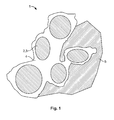
- a metal/plastic hybrid 1 according to the invention is depicted in a sectional view.
- Metal particles 2 according to the invention are formed as metal particles containing aluminium 3, which are embedded in a low melting metal 4.
- the metal particles 2 can have a basically spherical shape. However, they can have any other shape, in particular, they might be filaments, cubes, flakes, rods, coins or the like.
- the metal particles 2 together with the low melting metal 4 form an electrically conductive phase and can form an electrically conductive network within the metal/plastic hybrid 1, such that the entire metal/plastic hybrid 1 is electrically conductive.
- metals are defined by being electrically conductive.
- a metal can be elementary, an alloy, a compound or a mixture with metal.
- the metal/plastic hybrid 1 can also comprise a polymer material 5 which can comprise one or more plastic materials, which can be plastically deformable at elevated temperatures, for instance thermoplastics or resins.
- the metal particles 2 contain aluminium, in particular aluminium can be the main or the only component. However, other elements may also be present in the metal particles.
- aluminium as one of the components of the metal particles 2, the density of the metal particles 2 can be lowered.
- a further advantage of aluminium is, that it is usually cheaper than other metals employed for producing metal/plastic hybrids, like for example copper, nickel, iron or silver.
- aluminium has a low heat capacity, which can help to facilitate the production of parts that comprise such a metal/plastic hybrid 1.
- using a metal/plastic hybrid 1 according to the invention can help to make manufacturing this part easier, with less effort and time, thus saving money and additionally saving energy, as less energy is required to heat the metal/plastic hybrid 1 according to the invention.
- very fine structures can be produced with the metal/plastic hybrid according to the invention due to its low heat capacity.
- processes in which a second part can be affected negatively by heat or temperature, or in which using a lower temperature or less heat is advantageous can be carried out more efficiently, with less discard, faster and with less energy.
- the metal/plastic hybrid 1 might also contain flux.
- Flux can help to remove oxide layers which can be on the aluminium particles and which can make it difficult or impossible to establish a connection between the metal particles 2 and the low melting metal 4.
- such a flux can give a higher viscosity of the low melting metal 4, which further improves the interconnection between the metal particles 2 and the low melting metal 4.
- the sizes of the metal particles 2 can in a preferential embodiment be smaller than 200 ⁇ m. In case very fine structures are supposed to be manufactured, the size of the metal particles 2 can be lowered further. However, if for example a higher volume to surface ratio is desired, the size of the particles containing aluminium 3 can be increased. For more efficient packing and therefore a higher loading of metal particles and/or easier processing, also mixtures of various particle sizes, e.g. fine and coarse, can be used.
- the metal particles containing aluminium 3 are not covered by a coating layer 6 around the particle in their final state in the metal/plastic hybrid 1, it can be advantageous to coat the metal particles containing aluminium 3 during the process of manufacturing.
- the metal particles containing aluminium 3, which might exhibit oxide layers on the outside can be coated with tin.
- Such a coating can for instance be achieved with wet chemical methods like galvanization or by physical methods like Physical Vapour Deposition (PVD).
- PVD Physical Vapour Deposition
- the coating layer 6 of tin can intermix with the tin in the low melting metal 4.
- Such a coating step can help to make a better contact between the metal particles comprising aluminium 3 and the low melting metal 4.
- one of the coating layers 6 contains the low melting metal 4, preferably in large quantities.
- the addition of low melting metal 4 or the intermixing of the metal particles 2 with the low melting metal 4 can be avoided, as the coating layer 6 provides enough low melting metal 4.
- these coated particles can be blended with or into the polymer material, skipping one step in the manufacturing process.
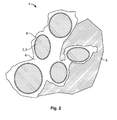
- the metal/plastic hybrid 1 according to the invention comprises metal particles which contain aluminium 3 with an additional coating layer 6 located on the interface between the metal particles containing aluminium 3 and the low melting metal 4. Furthermore, a polymer material 5, for example a thermoplastic material or a resin, can be seen.
- the preferred size range of the metal particles containing aluminium 3 is below 200 ⁇ m.
- the ratio of the coating material to the material of the metal particle containing aluminium 3 can be varied.
- aluminium is the main component of the metal particles, further reducing the density of the metal particles.
- aluminium is the only component in the metal particles 2.
- Such simple particles can easily be manufactured or be purchased readily, which reduces manufacturing time and costs.
- the metal particles containing aluminium 3 have a coating layer 6 containing zinc.
- a zinc coating can be achieved by several methods, for example by wet chemical methods like galvanization or by physical methods. Such methods are already known and widely used so that a wide knowledge of these processes exists and substances for this process are easily available. As aluminium and zinc can easily intermix by forming mixed crystals, a tight and intimate contact between the aluminium in the metal particle and the coating layer 6 is generated.
- tin is a component of the low melting metal, which makes using zinc as a coating layer 6 even more advantageous, as zinc and tin can form a eutectic system with a melting point as low as about 200°C.
- a low melting point helps to minimize the energy used for the production process of the metal/plastic hybrid 1. Furthermore, manufacturing time and effort is also decreased by such a low melting point.
- tin is used as a coating layer 6 for the metal particles containing aluminium 3.
- aluminium and tin do not intermix in the solid phase, a diffusion of the tin into the aluminium of the metal particle containing aluminium 3 over time is avoided.
- constant properties of the metal/plastic hybrid 1 during the lifetime of a part manufactured from this metal/plastic hybrid 1 can be expected.
- tin is used as a component of the low melting metal 4 in many cases, an easy contacting of the metal particles containing the aluminium 3 to the low melting metal can be facilitated.
- the coating of the metal particles containing aluminium 3 with tin can be accomplished with a variety of methods such as chemical methods or physical methods.
- the metal particles containing aluminium 3 can be coated with more than one coating layer 6.
- the first coating layer might be zinc, which forms mixed crystals with the aluminium and thus a good contact to the other components is established.
- a second layer might be made from tin, which can form a eutectic system with zinc, having a low melting point and giving a good connection of the zinc to the tin layer.
- tin is often used as a component of the low melting metal 4
- tin is often used as a component of the low melting metal 4
- tin is often used as a component of the low melting metal 4
- tin is often used as a component of the low melting metal 4
- tin is often used as a component of the low melting metal 4
- tin is often used as a component of the low melting metal 4
- tin is often used as a component of the low melting metal 4
- tin is often used as a component of the low melting metal 4
- tin is also provided by using
- Copper can also be used as a coating layer 6. If copper is used as a coating material, a physical coating process like Physical Vapour Deposition (PVD) might be preferred, as applying copper by chemical methods like wet chemical methods could be difficult.
- PVD Physical Vapour Deposition
- Parts or shaped bodies manufactured from or comprising at least partially a metal/plastic hybrid 1 according to the invention could be used in a variety of applications. Due to the electric conductivity of such a metal/plastic hybrid 1 it can easily be used in electric circuits, in particular if electric circuits or electric parts are supposed to be manufactured by methods that include plastic forming, especially at elevated temperatures, of these electric circuits or parts. Further, this method is very advantageous in 2-step-processes like a 2K or 2-shot molding process, as the metal/plastic hybrid 1 according to the invention has a low heat capacity, which allows for faster and more efficient processing with less energy and more precision. Parts made from this metal/plastic hybrid 1 could also be used as shieldings for electric or electromagnetic fields. Another exemplary application of a part made from such a metal/plastic hybrid 1 could be a plug molded onto a conductive element of an electric circuit, a radio frequency (RF) connector, an antenna or a casing.
- RF radio frequency
Landscapes
- Physics & Mathematics (AREA)
- Chemical & Material Sciences (AREA)
- Dispersion Chemistry (AREA)
- Spectroscopy & Molecular Physics (AREA)
- Conductive Materials (AREA)
- Other Surface Treatments For Metallic Materials (AREA)
- Non-Insulated Conductors (AREA)
- Powder Metallurgy (AREA)
- Manufacture Of Alloys Or Alloy Compounds (AREA)
- Laminated Bodies (AREA)
Abstract
Description
- The invention relates to an electrically conductive metal/plastic hybrid which comprises a matrix of a polymer material, a network embedded in the matrix and made of a metal, the metal having a first melting temperature, and metal particles within the network having a second melting temperature, the second melting temperature being higher than the first melting temperature. Further, the invention relates to a method of producing such a metal/plastic hybrid.
- Metal/plastic hybrids of the afore-mentioned type are known from the prior art, but in order to achieve high electric conductivity, contain high percentages of the higher melting metal particles. As these higher melting metals are usually very dense, the entire metal/plastic hybrid is very dense too. Further, the metals used for the higher melting metal particles can be expensive, which increases the price for the metal/plastic hybrid. Additionally, these metals generally have a high heat capacity, which makes the resulting metal/plastic hybrid difficult to process, in particular in a molding process.
- Thus, the object of the invention is to provide a metal/plastic hybrid which exhibits a lower density. A further object of the invention is to provide a metal/plastic hybrid that is cheaper. An even further object of the invention is to provide a metal/plastic hybrid that is easy to process, in particular in a molding process.
- According to the invention, the object is achieved by using metal particles that contain aluminium as the higher melting metal particles.
- By using aluminium as a material for the metal particles, the density of the resulting metal/plastic hybrid can be reduced considerably. Additionally, aluminium is usually cheaper than the metals often used for the metal particles, like for example copper, nickel, iron or silver. Furthermore, as aluminium has a low heat capacity, metal/plastic hybrids containing aluminium are easy to process and finer structures can be produced due to the lower volumetric heat capacity of the resulting metal/plastic hybrid. In particular, two-step processes can be conducted more easily, as negative effects of heat can be minimised. Especially if delicate and small structures are supposed to be created, the lower heat capacity can enable better results.
- As aluminium and compounds containing aluminium are less toxic than the materials generally employed in metal/plastic hybrids, a health and environmental benefit can result.
- The solution according to the invention may be combined in any way with one or several of the following further advantageous embodiments respectively.
- In a first advantageous development of the invention, the metal particles contain primarily aluminium, that means, aluminium is the main component.
- In a development of the invention, the metal particles consist only of aluminium and unavoidable impurities. The percentage of impurities is preferably less than 3%, more preferably less than 1 % of the weight.
- The metal particles containing aluminium can be coated with a second metal. Preferably, the coating of the metal particles takes place before the particles are mixed into the low melting metal. Such a coating can help to make better contact between the metal particles and the low melting metal, e.g. by reducing or removing oxide layers, which might be present on the outside of the metal particles. In particular, the coating can contain metals that can also be found in the low melting metal. In a very particular case, the coating of the metal particles contains only one element and the low melting metal is a mixture of this element and other elements.
- The coating of the metal particles containing aluminium can be achieved with several methods. Preferentially, the metal particles are coated with a chemical method, for example by galvanizing. However, other methods of coating, for example Physical Vapour Deposition (PVD), Atomic Layer Deposition (ALD) or sputtering, can also be used.
- In a preferential development of the invention, the coating for the metal particles containing aluminium can be zinc. Zinc is a common coating material for many metals, in particular for aluminium. Therefore, several processes for generating such a zinc coating are widely known and corresponding substances or devices are easily available. Furthermore, a pool of knowledge, e.g. process parameters for achieving certain thicknesses, is already available. Such a coating can for example be achieved by wet chemical methods or by physical methods. As aluminium and zinc tend to form mixed crystals, an intimate connection between the two, and a good sticking of the zinc to the metal particle containing aluminium can be obtained.
- In another advantageous development of the invention, tin is used as a coating material for the metal particles. Aluminium and tin do not mix in the solid phase, so diffusion of the coating metal into the aluminium particle can be avoided by using tin. Tin is often employed as a component of the low melting metal. Hence, using tin as a coating material can help to make a good contact between the particles and the low melting metal. The tin coating can be applied by several methods, for example chemically or physically.
- In a further advantageous development of the invention, the metal particles containing aluminium can contain two or even more coating layers. For example the metal particles containing aluminium can be coated with zinc in a first step, and with tin in a second step. Due to the intermixing of aluminium and zinc in the solid phase, the zinc will stick easily to the aluminium particles. As zinc and tin can form a eutectic system, further processing of such particles at temperatures as low as about 200°C can be made possible. Due to the low temperature, the production of the metal/plastic hybrid is further facilitated, in particular if tin is used as a component of the low melting metal. Furthermore, tin will not diffuse into the aluminium particles.
- In a further advantageous embodiment of the invention, the metal particles are coated with tin in a first step and with zinc in a second step. In particular if the metal/plastic hybrid is processed at a higher temperature, such a combination can be advantageous. In case the low melting metal contains tin, using zinc as the second layer helps to make good contact between the metal particle and the low melting metal.
- By using a material that is employed in solders, e.g. tin, as a coating material, it is facilitated that contact is made, for example by soldering, to this metal/plastic hybrid, as the additional solder for contacting will readily make contact with the coating material.
- In a further development of the invention, a coating layer of the metal particles contains the low melting metal. If enough of the low melting metal is applied onto the metal particles, the step of adding further low melting metal in another step can be avoided and the metal particles can be mixed with the polymer material directly.
- In another advantageous development of the invention, copper can be used as a first or additional coating material for the metal particles containing aluminium. As it might be difficult to apply copper by chemical methods, a deposition by physical methods is preferred in this case.
- In an even further advantageous development of the invention, the polymer material can be a thermoplastic and the first metal can melt in the range of 100°C to 400°C.
- In an advantageous development of the invention, in particular if the metal particles containing aluminium are not coated, the addition of flux to the metal/plastic hybrid can help to make good contact between the metal particles containing aluminium and the low melting metal, as such a flux can remove oxide layers which might be present on the metal particles containing aluminium and can additionally improve the flowing properties of the low melting metal in the liquid phase.
- Shaped bodies, especially electric or electronic elements, comprising at least in part the metal/plastic hybrid according to the invention, can be used for a big range of applications. In particular, they can be used in electric circuits, as electric or electromagnetic shieldings, as moldable plugs, housings, radio frequency (RF) connectors or antennas.
- The invention will be described hereinafter in greater detail and in an exemplary manner using advantageous embodiments and with reference to the drawings. The described embodiments are only possible configuration in which, however, the individual features as described above, can be provided independently of one another or can be omitted. In the drawings:
- Fig. 1
- is a schematic sectional view of a first embodiment of a metal/plastic hybrid according to the invention;
- Fig. 2
- is a schematic sectional view of a second embodiment of a metal/plastic hybrid according to the invention.
- In
Fig. 1 a metal/plastic hybrid 1 according to the invention is depicted in a sectional view. Metal particles 2 according to the invention are formed as metal particles containing aluminium 3, which are embedded in alow melting metal 4. The metal particles 2 can have a basically spherical shape. However, they can have any other shape, in particular, they might be filaments, cubes, flakes, rods, coins or the like. The metal particles 2 together with thelow melting metal 4 form an electrically conductive phase and can form an electrically conductive network within the metal/plastic hybrid 1, such that the entire metal/plastic hybrid 1 is electrically conductive. Herein, as usual, metals are defined by being electrically conductive. Thus, a metal can be elementary, an alloy, a compound or a mixture with metal. The metal/plastic hybrid 1 can also comprise apolymer material 5 which can comprise one or more plastic materials, which can be plastically deformable at elevated temperatures, for instance thermoplastics or resins. - According to the invention, the metal particles 2 contain aluminium, in particular aluminium can be the main or the only component. However, other elements may also be present in the metal particles. By using aluminium as one of the components of the metal particles 2, the density of the metal particles 2 can be lowered. A further advantage of aluminium is, that it is usually cheaper than other metals employed for producing metal/plastic hybrids, like for example copper, nickel, iron or silver.
- As an additional advantage, aluminium has a low heat capacity, which can help to facilitate the production of parts that comprise such a metal/
plastic hybrid 1. In particular, if other components of the part are affected negatively by heat, using a metal/plastic hybrid 1 according to the invention can help to make manufacturing this part easier, with less effort and time, thus saving money and additionally saving energy, as less energy is required to heat the metal/plastic hybrid 1 according to the invention. Furthermore, very fine structures can be produced with the metal/plastic hybrid according to the invention due to its low heat capacity. In particular, processes in which a second part can be affected negatively by heat or temperature, or in which using a lower temperature or less heat is advantageous, can be carried out more efficiently, with less discard, faster and with less energy. - In an advantageous embodiment of the invention, the metal/
plastic hybrid 1 might also contain flux. Flux can help to remove oxide layers which can be on the aluminium particles and which can make it difficult or impossible to establish a connection between the metal particles 2 and thelow melting metal 4. Furthermore, such a flux can give a higher viscosity of thelow melting metal 4, which further improves the interconnection between the metal particles 2 and thelow melting metal 4. - The sizes of the metal particles 2 can in a preferential embodiment be smaller than 200 µm. In case very fine structures are supposed to be manufactured, the size of the metal particles 2 can be lowered further. However, if for example a higher volume to surface ratio is desired, the size of the particles containing aluminium 3 can be increased. For more efficient packing and therefore a higher loading of metal particles and/or easier processing, also mixtures of various particle sizes, e.g. fine and coarse, can be used.
- Although in
Fig. 1 the metal particles containing aluminium 3 are not covered by acoating layer 6 around the particle in their final state in the metal/plastic hybrid 1, it can be advantageous to coat the metal particles containing aluminium 3 during the process of manufacturing. For example, the metal particles containing aluminium 3, which might exhibit oxide layers on the outside, can be coated with tin. Such a coating can for instance be achieved with wet chemical methods like galvanization or by physical methods like Physical Vapour Deposition (PVD). As tin is often contained in thelow melting metal 4 of the metal/plastic hybrid 1, thecoating layer 6 of tin can intermix with the tin in thelow melting metal 4. Such a coating step can help to make a better contact between the metal particles comprising aluminium 3 and thelow melting metal 4. - In an advantageous embodiment of the invention, one of the coating layers 6 contains the
low melting metal 4, preferably in large quantities. Thus, the addition oflow melting metal 4 or the intermixing of the metal particles 2 with thelow melting metal 4 can be avoided, as thecoating layer 6 provides enoughlow melting metal 4. Hence, these coated particles can be blended with or into the polymer material, skipping one step in the manufacturing process. - By using low melting material like brazing solders or leads as a coating material, connecting the material to external parts is made easier.
- In
Fig. 2 another advantageous embodiment of the invention is depicted. In this schematic sectional view the metal/plastic hybrid 1 according to the invention comprises metal particles which contain aluminium 3 with anadditional coating layer 6 located on the interface between the metal particles containing aluminium 3 and thelow melting metal 4. Furthermore, apolymer material 5, for example a thermoplastic material or a resin, can be seen. - Again, the preferred size range of the metal particles containing aluminium 3 is below 200 µm. However, by varying the size of the metal particles containing aluminium 3 at a constant thickness of the
coating layer 6, the ratio of the coating material to the material of the metal particle containing aluminium 3 can be varied. - In the first embodiment of the invention, aluminium is the main component of the metal particles, further reducing the density of the metal particles.
- In a preferential embodiment of the invention, aluminium is the only component in the metal particles 2. Such simple particles can easily be manufactured or be purchased readily, which reduces manufacturing time and costs.
- In a preferential embodiment of the invention, the metal particles containing aluminium 3 have a
coating layer 6 containing zinc. Such a zinc coating can be achieved by several methods, for example by wet chemical methods like galvanization or by physical methods. Such methods are already known and widely used so that a wide knowledge of these processes exists and substances for this process are easily available. As aluminium and zinc can easily intermix by forming mixed crystals, a tight and intimate contact between the aluminium in the metal particle and thecoating layer 6 is generated. - In many cases, tin is a component of the low melting metal, which makes using zinc as a
coating layer 6 even more advantageous, as zinc and tin can form a eutectic system with a melting point as low as about 200°C. Such a low melting point helps to minimize the energy used for the production process of the metal/plastic hybrid 1. Furthermore, manufacturing time and effort is also decreased by such a low melting point. - In another advantageous embodiment of the invention, tin is used as a
coating layer 6 for the metal particles containing aluminium 3. As aluminium and tin do not intermix in the solid phase, a diffusion of the tin into the aluminium of the metal particle containing aluminium 3 over time is avoided. Thus, constant properties of the metal/plastic hybrid 1 during the lifetime of a part manufactured from this metal/plastic hybrid 1 can be expected. Furthermore, as tin is used as a component of thelow melting metal 4 in many cases, an easy contacting of the metal particles containing the aluminium 3 to the low melting metal can be facilitated. The coating of the metal particles containing aluminium 3 with tin can be accomplished with a variety of methods such as chemical methods or physical methods. - In an even more advantageous embodiment of the invention, the metal particles containing aluminium 3 can be coated with more than one
coating layer 6. For instance the first coating layer might be zinc, which forms mixed crystals with the aluminium and thus a good contact to the other components is established. A second layer might be made from tin, which can form a eutectic system with zinc, having a low melting point and giving a good connection of the zinc to the tin layer. As tin is often used as a component of thelow melting metal 4, a good contact between the second layer and thelow melting metal 4 is also provided by using tin as asecond coating layer 6. Thesecond coating layer 6 might only exist in the process of manufacturing the metal/plastic hybrid, in particular if thelow melting metal 4 contains tin as a component. - Copper can also be used as a
coating layer 6. If copper is used as a coating material, a physical coating process like Physical Vapour Deposition (PVD) might be preferred, as applying copper by chemical methods like wet chemical methods could be difficult. - Parts or shaped bodies manufactured from or comprising at least partially a metal/
plastic hybrid 1 according to the invention could be used in a variety of applications. Due to the electric conductivity of such a metal/plastic hybrid 1 it can easily be used in electric circuits, in particular if electric circuits or electric parts are supposed to be manufactured by methods that include plastic forming, especially at elevated temperatures, of these electric circuits or parts. Further, this method is very advantageous in 2-step-processes like a 2K or 2-shot molding process, as the metal/plastic hybrid 1 according to the invention has a low heat capacity, which allows for faster and more efficient processing with less energy and more precision. Parts made from this metal/plastic hybrid 1 could also be used as shieldings for electric or electromagnetic fields. Another exemplary application of a part made from such a metal/plastic hybrid 1 could be a plug molded onto a conductive element of an electric circuit, a radio frequency (RF) connector, an antenna or a casing.
Claims (12)
- Electrically conductive metal/plastic hybrid (1) which comprises a matrix of a polymer material (5), a network embedded in the matrix and made of a metal, the metal having a first melting temperature, and metal particles (2) within the network having a second melting temperature, the second melting temperature being higher than the first melting temperature, characterised in that the metal particles (2) contain aluminium.
- Metal/plastic hybrid (1) according to claim 1, characterized in that the metal particles (2) consist primarily of aluminium.
- Metal/plastic hybrid (1) according to claim 1 or 2, characterized in that the metal particles (2) contain solely aluminium, apart from impurities, which constitute preferably less than 3 weight-%, more preferable less than 1 weight-% of the particles.
- Metal/plastic hybrid (1) according to any of claims 1 to 3, characterised in that the metal particles (2) containing aluminium are coated with at least one coating layer (6) of a metal.
- Metal/plastic hybrid (1) according to claim 4, characterised in that at least one coating layer (6) contains tin.
- Metal/plastic hybrid (1) according to any one of claims 4 or 5, characterised in that at least one coating layer (6) contains zinc.
- Electric or electronic element which comprises at least one electrically conductive section, made at least in part from a metal/plastic hybrid (1) according to any one of claims 1 to 6.
- Method for producing an electrically conductive metal/plastic hybrid (1), the method comprising the step of bringing a first metal and a polymer together, so that a network of metal in a polymer matrix results, characterized in that metal particles containing aluminium and the first metal are brought together, so that the metal particles are embedded in the metal network afterwards.
- Method for producing an electrically conductive metal/plastic hybrid (1) according to claim 8, characterised in that the method comprises a step of coating the metal particles containing aluminium (3) with a coating layer (6) of a metal.
- Method for producing an electrically conductive metal/plastic hybrid (1) according to claim 9, characterised in that the coating layer (6) of the metal particles containing aluminium (3) contains tin.
- Method for producing an electrically conductive metal/plastic hybrid (1) according to claim 9 or 10, characterised in that the coating layer (6) of the metal particles containing aluminium (3) contains zinc.
- Method for producing an electrically conductive metal/plastic hybrid (1) according to any of claims 9 to 11, characterised in that at least one coating layer (6) contains the material of the low melting metal, in particular in quantities sufficient to make further addition of the low melting metal redundant.
Priority Applications (7)
| Application Number | Priority Date | Filing Date | Title |
|---|---|---|---|
| EP11176866.9A EP2557571B1 (en) | 2011-08-08 | 2011-08-08 | Electrically conductive metal/plastic hybrid comprising a polymer material, a first metal and metal particles of a second metal embedded in the first metal and method of producing such |
| KR1020147006233A KR101949319B1 (en) | 2011-08-08 | 2012-08-06 | Electrically conductive metal/plastic hybrid comprising a polymer material, a first metal and metal particles of a second metal embedded in the first metal and method of producing such |
| PCT/EP2012/065328 WO2013020946A1 (en) | 2011-08-08 | 2012-08-06 | Electrically conductive metal/plastic hybrid comprising a polymer material, a first metal and metal particles of a second metal embedded in the first metal and method of producing such |
| CA2844277A CA2844277C (en) | 2011-08-08 | 2012-08-06 | Electrically conductive metal/plastic hybrid comprising a polymer material, a first metal and metal particles of a second metal embedded in the first metal and method of producing such |
| JP2014524353A JP2014527693A (en) | 2011-08-08 | 2012-08-06 | Conductive metal / plastic composite comprising a polymer material, a first metal, and second metal particles embedded in the first metal, and a method of manufacturing the same |
| CN201280038318.8A CN103718254B (en) | 2011-08-08 | 2012-08-06 | Including polymeric material, the first metal and the conducting metal/plastics heterocomplex and its manufacture method of the bimetallic metal particle for being embedded in the first metal |
| BR112014002914-8A BR112014002914B1 (en) | 2011-08-08 | 2012-08-06 | ELECTRICALLY CONDUCTIVE METALLIC / PLASTIC HYBRID, ITS PRODUCTION METHOD, AND ELECTRICAL OR ELECTRONIC ELEMENT |
Applications Claiming Priority (1)
| Application Number | Priority Date | Filing Date | Title |
|---|---|---|---|
| EP11176866.9A EP2557571B1 (en) | 2011-08-08 | 2011-08-08 | Electrically conductive metal/plastic hybrid comprising a polymer material, a first metal and metal particles of a second metal embedded in the first metal and method of producing such |
Publications (2)
| Publication Number | Publication Date |
|---|---|
| EP2557571A1 true EP2557571A1 (en) | 2013-02-13 |
| EP2557571B1 EP2557571B1 (en) | 2014-07-02 |
Family
ID=46603989
Family Applications (1)
| Application Number | Title | Priority Date | Filing Date |
|---|---|---|---|
| EP11176866.9A Active EP2557571B1 (en) | 2011-08-08 | 2011-08-08 | Electrically conductive metal/plastic hybrid comprising a polymer material, a first metal and metal particles of a second metal embedded in the first metal and method of producing such |
Country Status (7)
| Country | Link |
|---|---|
| EP (1) | EP2557571B1 (en) |
| JP (1) | JP2014527693A (en) |
| KR (1) | KR101949319B1 (en) |
| CN (1) | CN103718254B (en) |
| BR (1) | BR112014002914B1 (en) |
| CA (1) | CA2844277C (en) |
| WO (1) | WO2013020946A1 (en) |
Families Citing this family (4)
| Publication number | Priority date | Publication date | Assignee | Title |
|---|---|---|---|---|
| CN105274557A (en) * | 2015-11-12 | 2016-01-27 | 厦门理工学院 | Electrode and preparation method thereof |
| EP3911461A4 (en) | 2019-03-18 | 2022-11-09 | Hewlett-Packard Development Company, L.P. | RAW BODY OBJECT DEFORM COMMAND |
| CN113453825B (en) | 2019-03-18 | 2023-10-31 | 惠普发展公司,有限责任合伙企业 | 3D object shaping |
| EP3941668A4 (en) * | 2019-03-18 | 2023-01-04 | Hewlett-Packard Development Company, L.P. | THREE-DIMENSIONAL METAL OBJECT FORMATION |
Citations (2)
| Publication number | Priority date | Publication date | Assignee | Title |
|---|---|---|---|---|
| WO1998008362A1 (en) * | 1996-08-16 | 1998-02-26 | Craig Hugh P | Printable compositions, and their application to dielectric surfaces used in the manufacture of printed circuit boards |
| US20070012900A1 (en) * | 2005-07-12 | 2007-01-18 | Sulzer Metco (Canada) Inc. | Enhanced performance conductive filler and conductive polymers made therefrom |
Family Cites Families (4)
| Publication number | Priority date | Publication date | Assignee | Title |
|---|---|---|---|---|
| TW340132B (en) * | 1994-10-20 | 1998-09-11 | Ibm | Structure for use as an electrical interconnection means and process for preparing the same |
| TW396471B (en) * | 1997-06-04 | 2000-07-01 | Ibm | Electrodeposition of low temperature, high conductivity, powder materials for electrically conductive paste formulations |
| WO2009110095A1 (en) * | 2008-03-07 | 2009-09-11 | 富士通株式会社 | Conductive material, conductive paste, circuit board, and semiconductor device |
| KR101138519B1 (en) * | 2009-09-30 | 2012-04-25 | 삼성전기주식회사 | Conductive paste and manufacturing method for printed circuit board using thereof |
-
2011
- 2011-08-08 EP EP11176866.9A patent/EP2557571B1/en active Active
-
2012
- 2012-08-06 CN CN201280038318.8A patent/CN103718254B/en active Active
- 2012-08-06 CA CA2844277A patent/CA2844277C/en not_active Expired - Fee Related
- 2012-08-06 KR KR1020147006233A patent/KR101949319B1/en active Active
- 2012-08-06 BR BR112014002914-8A patent/BR112014002914B1/en not_active IP Right Cessation
- 2012-08-06 WO PCT/EP2012/065328 patent/WO2013020946A1/en not_active Ceased
- 2012-08-06 JP JP2014524353A patent/JP2014527693A/en active Pending
Patent Citations (2)
| Publication number | Priority date | Publication date | Assignee | Title |
|---|---|---|---|---|
| WO1998008362A1 (en) * | 1996-08-16 | 1998-02-26 | Craig Hugh P | Printable compositions, and their application to dielectric surfaces used in the manufacture of printed circuit boards |
| US20070012900A1 (en) * | 2005-07-12 | 2007-01-18 | Sulzer Metco (Canada) Inc. | Enhanced performance conductive filler and conductive polymers made therefrom |
Also Published As
| Publication number | Publication date |
|---|---|
| CN103718254B (en) | 2017-03-29 |
| BR112014002914B1 (en) | 2020-08-04 |
| EP2557571B1 (en) | 2014-07-02 |
| JP2014527693A (en) | 2014-10-16 |
| KR20140102175A (en) | 2014-08-21 |
| CA2844277C (en) | 2019-07-09 |
| WO2013020946A1 (en) | 2013-02-14 |
| KR101949319B1 (en) | 2019-02-18 |
| CA2844277A1 (en) | 2013-02-14 |
| BR112014002914A2 (en) | 2017-03-01 |
| CN103718254A (en) | 2014-04-09 |
Similar Documents
| Publication | Publication Date | Title |
|---|---|---|
| KR101736592B1 (en) | Inductance element and electronic device | |
| CN104066535B (en) | Silver coated copper alloy powder and production method thereof | |
| US8130485B2 (en) | Ceramic electronic component and method for manufacturing the same | |
| KR20160033463A (en) | Chip electronic component and manufacturing method thereof | |
| US11225720B2 (en) | Magnetic powder, and manufacturing method thereof | |
| CA2844277C (en) | Electrically conductive metal/plastic hybrid comprising a polymer material, a first metal and metal particles of a second metal embedded in the first metal and method of producing such | |
| US20170152386A1 (en) | Copper powder, and copper paste, electrically conductive coating material and electrically conductive sheet each produced using said copper powder | |
| EP2592127B1 (en) | Anisotropic conductive adhesive, process for producing same, connection structure, and process for producing same | |
| CN107017079B (en) | Coil component | |
| KR101514890B1 (en) | Preparing method of metal complex having excellent surface properties | |
| TW201327581A (en) | Electrically conductive metal/plastic hybrid comprising a polymer material, a first metal and metal particles of a second metal embedded in the first metal and method of producing such | |
| KR100698662B1 (en) | Terminals forming surfaces consisting of tin-silver-copper ternary alloys, parts and articles | |
| JP4535786B2 (en) | Copper-containing tin powder, mixed powder containing the copper-containing tin powder, method for producing the copper-containing tin powder, and conductive paste using the copper-containing tin powder or the mixed powder | |
| JP2011026631A (en) | Copper powder, conductive paste, and conductive connection structure | |
| EP1900461A1 (en) | Tin powder, process for producing tin powder, and tin powder-containing elctrically conductive paste | |
| EP0886461B1 (en) | Conductive filler, conductive paste and method of fabricating circuit body using the conductive paste | |
| KR102951572B1 (en) | Metal-coated resin particles and a method for manufacturing the same, a conductive paste containing metal-coated resin particles, and a conductive film | |
| US20020045042A1 (en) | Laminate | |
| TWI919651B (en) | Coil components, manufacturing methods of coil components, and electronic and electrical machinery | |
| JP2004193250A (en) | Conductive paste and semiconductor device using the same | |
| Freckmann et al. | Development of a Novel Highly Conductive Aluminum Particle based Filler for Low Density Conductive Composites | |
| JP2523097B2 (en) | Conductive resin composition and molded article thereof | |
| EP3966852A1 (en) | Method for thermally spraying conductor paths, and electronic module | |
| Zanon et al. | PM Non-Ferrous and Special Materials: The Conductive Behaviour of Copper and Silver-Coated Copper Powders | |
| HK40080972A (en) | Metal coated resin particles, method for producing same, conductive paste containing metal coated resin particles, and conductive film |
Legal Events
| Date | Code | Title | Description |
|---|---|---|---|
| PUAI | Public reference made under article 153(3) epc to a published international application that has entered the european phase |
Free format text: ORIGINAL CODE: 0009012 |
|
| AK | Designated contracting states |
Kind code of ref document: A1 Designated state(s): AL AT BE BG CH CY CZ DE DK EE ES FI FR GB GR HR HU IE IS IT LI LT LU LV MC MK MT NL NO PL PT RO RS SE SI SK SM TR |
|
| AX | Request for extension of the european patent |
Extension state: BA ME |
|
| 17P | Request for examination filed |
Effective date: 20130813 |
|
| RBV | Designated contracting states (corrected) |
Designated state(s): AL AT BE BG CH CY CZ DE DK EE ES FI FR GB GR HR HU IE IS IT LI LT LU LV MC MK MT NL NO PL PT RO RS SE SI SK SM TR |
|
| GRAP | Despatch of communication of intention to grant a patent |
Free format text: ORIGINAL CODE: EPIDOSNIGR1 |
|
| INTG | Intention to grant announced |
Effective date: 20140217 |
|
| GRAS | Grant fee paid |
Free format text: ORIGINAL CODE: EPIDOSNIGR3 |
|
| GRAA | (expected) grant |
Free format text: ORIGINAL CODE: 0009210 |
|
| AK | Designated contracting states |
Kind code of ref document: B1 Designated state(s): AL AT BE BG CH CY CZ DE DK EE ES FI FR GB GR HR HU IE IS IT LI LT LU LV MC MK MT NL NO PL PT RO RS SE SI SK SM TR |
|
| REG | Reference to a national code |
Ref country code: GB Ref legal event code: FG4D |
|
| REG | Reference to a national code |
Ref country code: CH Ref legal event code: EP |
|
| REG | Reference to a national code |
Ref country code: IE Ref legal event code: FG4D |
|
| REG | Reference to a national code |
Ref country code: DE Ref legal event code: R096 Ref document number: 602011008068 Country of ref document: DE Effective date: 20140821 |
|
| REG | Reference to a national code |
Ref country code: NL Ref legal event code: VDEP Effective date: 20140702 |
|
| REG | Reference to a national code |
Ref country code: LT Ref legal event code: MG4D |
|
| REG | Reference to a national code |
Ref country code: AT Ref legal event code: REF Ref document number: 703708 Country of ref document: AT Kind code of ref document: T Effective date: 20150115 |
|
| PG25 | Lapsed in a contracting state [announced via postgrant information from national office to epo] |
Ref country code: PT Free format text: LAPSE BECAUSE OF FAILURE TO SUBMIT A TRANSLATION OF THE DESCRIPTION OR TO PAY THE FEE WITHIN THE PRESCRIBED TIME-LIMIT Effective date: 20141103 Ref country code: ES Free format text: LAPSE BECAUSE OF FAILURE TO SUBMIT A TRANSLATION OF THE DESCRIPTION OR TO PAY THE FEE WITHIN THE PRESCRIBED TIME-LIMIT Effective date: 20140702 Ref country code: NO Free format text: LAPSE BECAUSE OF FAILURE TO SUBMIT A TRANSLATION OF THE DESCRIPTION OR TO PAY THE FEE WITHIN THE PRESCRIBED TIME-LIMIT Effective date: 20141002 Ref country code: SE Free format text: LAPSE BECAUSE OF FAILURE TO SUBMIT A TRANSLATION OF THE DESCRIPTION OR TO PAY THE FEE WITHIN THE PRESCRIBED TIME-LIMIT Effective date: 20140702 Ref country code: CZ Free format text: LAPSE BECAUSE OF FAILURE TO SUBMIT A TRANSLATION OF THE DESCRIPTION OR TO PAY THE FEE WITHIN THE PRESCRIBED TIME-LIMIT Effective date: 20140702 Ref country code: GR Free format text: LAPSE BECAUSE OF FAILURE TO SUBMIT A TRANSLATION OF THE DESCRIPTION OR TO PAY THE FEE WITHIN THE PRESCRIBED TIME-LIMIT Effective date: 20141003 Ref country code: FI Free format text: LAPSE BECAUSE OF FAILURE TO SUBMIT A TRANSLATION OF THE DESCRIPTION OR TO PAY THE FEE WITHIN THE PRESCRIBED TIME-LIMIT Effective date: 20140702 Ref country code: LT Free format text: LAPSE BECAUSE OF FAILURE TO SUBMIT A TRANSLATION OF THE DESCRIPTION OR TO PAY THE FEE WITHIN THE PRESCRIBED TIME-LIMIT Effective date: 20140702 Ref country code: BG Free format text: LAPSE BECAUSE OF FAILURE TO SUBMIT A TRANSLATION OF THE DESCRIPTION OR TO PAY THE FEE WITHIN THE PRESCRIBED TIME-LIMIT Effective date: 20141002 |
|
| PG25 | Lapsed in a contracting state [announced via postgrant information from national office to epo] |
Ref country code: NL Free format text: LAPSE BECAUSE OF FAILURE TO SUBMIT A TRANSLATION OF THE DESCRIPTION OR TO PAY THE FEE WITHIN THE PRESCRIBED TIME-LIMIT Effective date: 20140702 Ref country code: LV Free format text: LAPSE BECAUSE OF FAILURE TO SUBMIT A TRANSLATION OF THE DESCRIPTION OR TO PAY THE FEE WITHIN THE PRESCRIBED TIME-LIMIT Effective date: 20140702 Ref country code: RS Free format text: LAPSE BECAUSE OF FAILURE TO SUBMIT A TRANSLATION OF THE DESCRIPTION OR TO PAY THE FEE WITHIN THE PRESCRIBED TIME-LIMIT Effective date: 20140702 Ref country code: HR Free format text: LAPSE BECAUSE OF FAILURE TO SUBMIT A TRANSLATION OF THE DESCRIPTION OR TO PAY THE FEE WITHIN THE PRESCRIBED TIME-LIMIT Effective date: 20140702 Ref country code: PL Free format text: LAPSE BECAUSE OF FAILURE TO SUBMIT A TRANSLATION OF THE DESCRIPTION OR TO PAY THE FEE WITHIN THE PRESCRIBED TIME-LIMIT Effective date: 20140702 Ref country code: CY Free format text: LAPSE BECAUSE OF FAILURE TO SUBMIT A TRANSLATION OF THE DESCRIPTION OR TO PAY THE FEE WITHIN THE PRESCRIBED TIME-LIMIT Effective date: 20140702 Ref country code: IS Free format text: LAPSE BECAUSE OF FAILURE TO SUBMIT A TRANSLATION OF THE DESCRIPTION OR TO PAY THE FEE WITHIN THE PRESCRIBED TIME-LIMIT Effective date: 20141102 |
|
| REG | Reference to a national code |
Ref country code: AT Ref legal event code: MK05 Ref document number: 703708 Country of ref document: AT Kind code of ref document: T Effective date: 20140702 |
|
| REG | Reference to a national code |
Ref country code: CH Ref legal event code: PL |
|
| REG | Reference to a national code |
Ref country code: DE Ref legal event code: R097 Ref document number: 602011008068 Country of ref document: DE |
|
| PG25 | Lapsed in a contracting state [announced via postgrant information from national office to epo] |
Ref country code: CH Free format text: LAPSE BECAUSE OF NON-PAYMENT OF DUE FEES Effective date: 20140831 Ref country code: SK Free format text: LAPSE BECAUSE OF FAILURE TO SUBMIT A TRANSLATION OF THE DESCRIPTION OR TO PAY THE FEE WITHIN THE PRESCRIBED TIME-LIMIT Effective date: 20140702 Ref country code: LI Free format text: LAPSE BECAUSE OF NON-PAYMENT OF DUE FEES Effective date: 20140831 Ref country code: RO Free format text: LAPSE BECAUSE OF FAILURE TO SUBMIT A TRANSLATION OF THE DESCRIPTION OR TO PAY THE FEE WITHIN THE PRESCRIBED TIME-LIMIT Effective date: 20140702 Ref country code: MC Free format text: LAPSE BECAUSE OF FAILURE TO SUBMIT A TRANSLATION OF THE DESCRIPTION OR TO PAY THE FEE WITHIN THE PRESCRIBED TIME-LIMIT Effective date: 20140702 Ref country code: DK Free format text: LAPSE BECAUSE OF FAILURE TO SUBMIT A TRANSLATION OF THE DESCRIPTION OR TO PAY THE FEE WITHIN THE PRESCRIBED TIME-LIMIT Effective date: 20140702 Ref country code: EE Free format text: LAPSE BECAUSE OF FAILURE TO SUBMIT A TRANSLATION OF THE DESCRIPTION OR TO PAY THE FEE WITHIN THE PRESCRIBED TIME-LIMIT Effective date: 20140702 Ref country code: BE Free format text: LAPSE BECAUSE OF NON-PAYMENT OF DUE FEES Effective date: 20140831 |
|
| PLBE | No opposition filed within time limit |
Free format text: ORIGINAL CODE: 0009261 |
|
| STAA | Information on the status of an ep patent application or granted ep patent |
Free format text: STATUS: NO OPPOSITION FILED WITHIN TIME LIMIT |
|
| REG | Reference to a national code |
Ref country code: IE Ref legal event code: MM4A |
|
| PG25 | Lapsed in a contracting state [announced via postgrant information from national office to epo] |
Ref country code: AT Free format text: LAPSE BECAUSE OF FAILURE TO SUBMIT A TRANSLATION OF THE DESCRIPTION OR TO PAY THE FEE WITHIN THE PRESCRIBED TIME-LIMIT Effective date: 20140702 |
|
| 26N | No opposition filed |
Effective date: 20150407 |
|
| REG | Reference to a national code |
Ref country code: DE Ref legal event code: R082 Ref document number: 602011008068 Country of ref document: DE Representative=s name: GRUENECKER PATENT- UND RECHTSANWAELTE PARTG MB, DE Ref country code: DE Ref legal event code: R081 Ref document number: 602011008068 Country of ref document: DE Owner name: TE CONNECTIVITY GERMANY GMBH, DE Free format text: FORMER OWNERS: TYCO ELECTRONICS AMP GMBH, 64625 BENSHEIM, DE; TYCO ELECTRONICS CORP., BERWYN, PA., US Ref country code: DE Ref legal event code: R081 Ref document number: 602011008068 Country of ref document: DE Owner name: TYCO ELECTRONICS CORP., BERWYN, US Free format text: FORMER OWNERS: TYCO ELECTRONICS AMP GMBH, 64625 BENSHEIM, DE; TYCO ELECTRONICS CORP., BERWYN, PA., US |
|
| REG | Reference to a national code |
Ref country code: FR Ref legal event code: PLFP Year of fee payment: 5 |
|
| PG25 | Lapsed in a contracting state [announced via postgrant information from national office to epo] |
Ref country code: IE Free format text: LAPSE BECAUSE OF NON-PAYMENT OF DUE FEES Effective date: 20140808 |
|
| REG | Reference to a national code |
Ref country code: FR Ref legal event code: CD Owner name: TYCO ELECTRONICS CORPORATION, US Effective date: 20151027 Ref country code: FR Ref legal event code: CD Owner name: TE CONNECTIVITY GERMANY GMBH Effective date: 20151027 |
|
| PG25 | Lapsed in a contracting state [announced via postgrant information from national office to epo] |
Ref country code: SI Free format text: LAPSE BECAUSE OF FAILURE TO SUBMIT A TRANSLATION OF THE DESCRIPTION OR TO PAY THE FEE WITHIN THE PRESCRIBED TIME-LIMIT Effective date: 20140702 |
|
| PG25 | Lapsed in a contracting state [announced via postgrant information from national office to epo] |
Ref country code: SM Free format text: LAPSE BECAUSE OF FAILURE TO SUBMIT A TRANSLATION OF THE DESCRIPTION OR TO PAY THE FEE WITHIN THE PRESCRIBED TIME-LIMIT Effective date: 20140702 |
|
| PG25 | Lapsed in a contracting state [announced via postgrant information from national office to epo] |
Ref country code: MT Free format text: LAPSE BECAUSE OF FAILURE TO SUBMIT A TRANSLATION OF THE DESCRIPTION OR TO PAY THE FEE WITHIN THE PRESCRIBED TIME-LIMIT Effective date: 20140702 |
|
| PG25 | Lapsed in a contracting state [announced via postgrant information from national office to epo] |
Ref country code: BE Free format text: LAPSE BECAUSE OF FAILURE TO SUBMIT A TRANSLATION OF THE DESCRIPTION OR TO PAY THE FEE WITHIN THE PRESCRIBED TIME-LIMIT Effective date: 20140702 Ref country code: LU Free format text: LAPSE BECAUSE OF NON-PAYMENT OF DUE FEES Effective date: 20140808 Ref country code: HU Free format text: LAPSE BECAUSE OF FAILURE TO SUBMIT A TRANSLATION OF THE DESCRIPTION OR TO PAY THE FEE WITHIN THE PRESCRIBED TIME-LIMIT; INVALID AB INITIO Effective date: 20110808 Ref country code: TR Free format text: LAPSE BECAUSE OF FAILURE TO SUBMIT A TRANSLATION OF THE DESCRIPTION OR TO PAY THE FEE WITHIN THE PRESCRIBED TIME-LIMIT Effective date: 20140702 |
|
| REG | Reference to a national code |
Ref country code: FR Ref legal event code: PLFP Year of fee payment: 6 |
|
| REG | Reference to a national code |
Ref country code: FR Ref legal event code: PLFP Year of fee payment: 7 |
|
| PG25 | Lapsed in a contracting state [announced via postgrant information from national office to epo] |
Ref country code: MK Free format text: LAPSE BECAUSE OF FAILURE TO SUBMIT A TRANSLATION OF THE DESCRIPTION OR TO PAY THE FEE WITHIN THE PRESCRIBED TIME-LIMIT Effective date: 20140702 |
|
| REG | Reference to a national code |
Ref country code: FR Ref legal event code: PLFP Year of fee payment: 8 |
|
| REG | Reference to a national code |
Ref country code: FR Ref legal event code: CD Owner name: TYCO ELECTRONICS CORPORATION, US Effective date: 20180626 Ref country code: FR Ref legal event code: CD Owner name: TE CONNECTIVITY GERMANY GMBH Effective date: 20180626 |
|
| REG | Reference to a national code |
Ref country code: DE Ref legal event code: R082 Ref document number: 602011008068 Country of ref document: DE Representative=s name: GRUENECKER PATENT- UND RECHTSANWAELTE PARTG MB, DE Ref country code: DE Ref legal event code: R081 Ref document number: 602011008068 Country of ref document: DE Owner name: TE CONNECTIVITY CORPORATION, BERWYN, US Free format text: FORMER OWNERS: TE CONNECTIVITY GERMANY GMBH, 64625 BENSHEIM, DE; TYCO ELECTRONICS CORP., BERWYN, PA., US |
|
| PG25 | Lapsed in a contracting state [announced via postgrant information from national office to epo] |
Ref country code: AL Free format text: LAPSE BECAUSE OF FAILURE TO SUBMIT A TRANSLATION OF THE DESCRIPTION OR TO PAY THE FEE WITHIN THE PRESCRIBED TIME-LIMIT Effective date: 20140702 |
|
| PGFP | Annual fee paid to national office [announced via postgrant information from national office to epo] |
Ref country code: IT Payment date: 20180830 Year of fee payment: 8 Ref country code: FR Payment date: 20180712 Year of fee payment: 8 |
|
| PGFP | Annual fee paid to national office [announced via postgrant information from national office to epo] |
Ref country code: GB Payment date: 20180808 Year of fee payment: 8 |
|
| GBPC | Gb: european patent ceased through non-payment of renewal fee |
Effective date: 20190808 |
|
| PG25 | Lapsed in a contracting state [announced via postgrant information from national office to epo] |
Ref country code: FR Free format text: LAPSE BECAUSE OF NON-PAYMENT OF DUE FEES Effective date: 20190831 |
|
| PG25 | Lapsed in a contracting state [announced via postgrant information from national office to epo] |
Ref country code: IT Free format text: LAPSE BECAUSE OF NON-PAYMENT OF DUE FEES Effective date: 20190808 Ref country code: GB Free format text: LAPSE BECAUSE OF NON-PAYMENT OF DUE FEES Effective date: 20190808 |
|
| REG | Reference to a national code |
Ref country code: DE Ref legal event code: R081 Ref document number: 602011008068 Country of ref document: DE Owner name: TE CONNECTIVITY SOLUTIONS GMBH, CH Free format text: FORMER OWNER: TE CONNECTIVITY CORPORATION, BERWYN, PA., US |
|
| PGFP | Annual fee paid to national office [announced via postgrant information from national office to epo] |
Ref country code: DE Payment date: 20250611 Year of fee payment: 15 |