EP2555522A2 - Externe Vektoren in einem Bewegungsschätzungssystem - Google Patents
Externe Vektoren in einem Bewegungsschätzungssystem Download PDFInfo
- Publication number
- EP2555522A2 EP2555522A2 EP12179268A EP12179268A EP2555522A2 EP 2555522 A2 EP2555522 A2 EP 2555522A2 EP 12179268 A EP12179268 A EP 12179268A EP 12179268 A EP12179268 A EP 12179268A EP 2555522 A2 EP2555522 A2 EP 2555522A2
- Authority
- EP
- European Patent Office
- Prior art keywords
- vector
- vectors
- motion
- external source
- block
- Prior art date
- Legal status (The legal status is an assumption and is not a legal conclusion. Google has not performed a legal analysis and makes no representation as to the accuracy of the status listed.)
- Granted
Links
Images






Classifications
-
- H—ELECTRICITY
- H04—ELECTRIC COMMUNICATION TECHNIQUE
- H04N—PICTORIAL COMMUNICATION, e.g. TELEVISION
- H04N19/00—Methods or arrangements for coding, decoding, compressing or decompressing digital video signals
- H04N19/50—Methods or arrangements for coding, decoding, compressing or decompressing digital video signals using predictive coding
- H04N19/503—Methods or arrangements for coding, decoding, compressing or decompressing digital video signals using predictive coding involving temporal prediction
- H04N19/51—Motion estimation or motion compensation
-
- H—ELECTRICITY
- H04—ELECTRIC COMMUNICATION TECHNIQUE
- H04N—PICTORIAL COMMUNICATION, e.g. TELEVISION
- H04N19/00—Methods or arrangements for coding, decoding, compressing or decompressing digital video signals
- H04N19/50—Methods or arrangements for coding, decoding, compressing or decompressing digital video signals using predictive coding
- H04N19/503—Methods or arrangements for coding, decoding, compressing or decompressing digital video signals using predictive coding involving temporal prediction
- H04N19/51—Motion estimation or motion compensation
- H04N19/513—Processing of motion vectors
-
- H—ELECTRICITY
- H04—ELECTRIC COMMUNICATION TECHNIQUE
- H04N—PICTORIAL COMMUNICATION, e.g. TELEVISION
- H04N19/00—Methods or arrangements for coding, decoding, compressing or decompressing digital video signals
- H04N19/50—Methods or arrangements for coding, decoding, compressing or decompressing digital video signals using predictive coding
- H04N19/503—Methods or arrangements for coding, decoding, compressing or decompressing digital video signals using predictive coding involving temporal prediction
- H04N19/51—Motion estimation or motion compensation
- H04N19/513—Processing of motion vectors
- H04N19/521—Processing of motion vectors for estimating the reliability of the determined motion vectors or motion vector field, e.g. for smoothing the motion vector field or for correcting motion vectors
-
- H—ELECTRICITY
- H04—ELECTRIC COMMUNICATION TECHNIQUE
- H04N—PICTORIAL COMMUNICATION, e.g. TELEVISION
- H04N19/00—Methods or arrangements for coding, decoding, compressing or decompressing digital video signals
- H04N19/50—Methods or arrangements for coding, decoding, compressing or decompressing digital video signals using predictive coding
- H04N19/503—Methods or arrangements for coding, decoding, compressing or decompressing digital video signals using predictive coding involving temporal prediction
- H04N19/51—Motion estimation or motion compensation
- H04N19/56—Motion estimation with initialisation of the vector search, e.g. estimating a good candidate to initiate a search
-
- H—ELECTRICITY
- H04—ELECTRIC COMMUNICATION TECHNIQUE
- H04N—PICTORIAL COMMUNICATION, e.g. TELEVISION
- H04N19/00—Methods or arrangements for coding, decoding, compressing or decompressing digital video signals
- H04N19/60—Methods or arrangements for coding, decoding, compressing or decompressing digital video signals using transform coding
- H04N19/61—Methods or arrangements for coding, decoding, compressing or decompressing digital video signals using transform coding in combination with predictive coding
Definitions
- This invention relates to a method and apparatus for motion estimation for use in video sequences, and, in particular to methods associated with the introduction of candidate motion vectors taken from an external source.
- Motion estimation is used in various video techniques, and a wide range of methods for motion estimation are well known.
- One common method, known as block based motion estimation, will be used for illustration purposes in this document.
- Block based motion estimation generally takes two or more consecutive frames from a video sequence and subdivides them into multiple regions known as blocks or macroblocks.
- pixel data in each block in a frame is compared with pixel data from various candidate locations in a previous frame.
- the relative position of the candidate that gives the best match gives a vector that describes the motion in the scene at that block position.
- the set of motion vectors at each block position in a frame is known as the motion vector field for that frame.
- Video sequences typically comprise a series of non interlaced frames of video data, or a series of interlaced fields of video data.
- the interlaced sequences are produced by fields which carry data on alternate lines of a display, such that a first field will carry data for alternate lines, and a second field will carry data for the missing lines.
- the fields are thus spaced both temporally and spatially. Every alternate field in a sequence will carry data at the same spatial locations.
- Figure 1 illustrates a typical example of a block matching motion estimator.
- motion vectors are shown with the head of the arrow at the centre of the block to which the vector corresponds.
- the frames are divided into blocks, and an object 101 in the previous frame has moved to position 102 in the current frame.
- the previous position of the object is shown superimposed on the current frame as 103.
- Motion estimation is performed for blocks rather than for objects, where a block of pixels in the current frame is matched with a block sized pixel area in the previous frame which is not necessarily block aligned.
- block 104 is partially overlapped by the moving object 102, and has contents as illustrated at 105.
- Motion estimation for block 104 if it performs well, will find the pixel data area 106 in the previous frame, which can also be seen to contain the pixels illustrated in 105, i.e. a good match has been found. Superimposed back onto the current frame, the matching pixel data area is at 107. The motion vector associated with block 104 is therefore as illustrated by arrow 108.
- FIG. 2 illustrates the candidate evaluation process for the block 201 in the current frame which has pixel contents shown in 211.
- three motion vector candidates 206, 207 and 208 are considered which correspond to candidate pixel data areas at locations 202, 203 and 204 in the previous frame.
- the pixel contents of these pixel data areas can be seen in 212, 213 and 214 respectively. It is apparent that the pixel data at location 202 provides the best match for block 201 and should therefore be selected as the best match/lowest difference candidate.
- the matching pixel data area is at 205 and the associated motion vector is 206.
- the requirement is to form the most compact representation of a frame, by using motion vectors to reference pixel data from a previous frame from the sequence.
- These motion vectors generally focus on providing the "closest match" to a block of pixel data (or the lowest residual error), and while the resulting motion vectors are usually representative of the actual motion of objects in the scene, there is no requirement that this is always the case.
- Motion estimation and the vector fields produced can be generated using vastly different levels of computational resources. Encoders used by broadcasters, or for movie distribution, for example, may dedicate significant computational resources or extended offline processing time to producing vector fields of the highest quality. Conversely, many consumer level video pipelines, particularly those in handheld devices, must operate in real time and with significant limitations on the amount of computation resource (i.e. bandwidth, power and time) allocated to motion estimation. Consequently, in these systems it is impractical to apply exhaustive search and intensive optimization processes, and this typically results in sub-optimal motion vector fields being produced.
- One common approach to achieving the highest quality motion vector field within a computational resource limited environment is to identify and test a small set of motion vector candidates for each block.
- the challenge is in identifying the smallest possible set of vector candidates while still retaining a high probability of including in the set, one or more vector candidates that provide either a close pixel match or true motion match as required.
- Improving the set of candidate motion vectors allows either fewer motion vectors to be tested (improving efficiency) or increases the likelihood of a close pixel match or a true motion match being found (improving quality).
- Motion vectors are known to be highly correlated both spatially and temporally with vectors in adjacent blocks, so these neighbouring vectors are often used as the basis of a motion estimator's set of vector candidates.
- a pseudo-random element may also be incorporated into the candidates to allow the system to improve its matches, or to adapt as the motion in the video changes. Where a block has motion that is not simply predicted by its neighbours, the pseudo-random perturbation of vector candidates can often predict the changes in motion. This method works well for slowly changing vector fields, but tends not to allow the motion estimator to detect or converge quickly upon new motions that are significantly different to the motion vector candidates stored in neighbouring blocks.
- a system relying on pseudo-randomness may wander towards the new motion over time, but is prone to becoming stuck in local minima, or converging so slowly that the motion has changed again by the time it gets there.
- Figure 3 shows a simplified example of a conventional video pipeline architecture.
- the decode block 310 decodes a compressed input bit stream 300 into a set of motion vectors 312 and a residual 311.
- a sequence of output images are produced.
- This sequence of output images may consist of either progressive frames or interlaced fields depending upon the nature of the source. Interlaced fields are converted into progressive frames by a deinterlacer 320.
- High quality deinterlacing typically performs motion estimation 321 followed by a picture build 322 process in a manner which will be well known to those skilled in the art.
- overlays such as subtitles and/or user interface may be added to the video sequence by first identifying the location of the overlay pixels to produce an overlay mask 331 and then, in the region defined by the overlay mask, compositing the overlay's pixel data and the original video pixel data in an overlay compositing engine 332.
- frame rate conversion 340 is performed to convert the input frame rate of the video sequence to the output frame rate required by the display 301.
- Frame rate conversion typically requires motion estimate 341 and picture build 342 processes in a manner which will be well known to those skilled in the art.
- the decode block's motion vector field 312 will find closest match/lowest error vectors that have typically been determined using significant computational resources external to the video pipeline.
- Motion estimation in the deinterlace block 321 must determine true motion vectors using field data and the motion estimation in the frame rate conversion block 341 must determine true motion vectors using frame data.
- the overlay mask 331 can define regions of the frame with known motion vectors (e.g. either a static or animated overlay). Performing motion estimation at each of these locations seems inherently wasteful and it is proposed that a motion estimator later in the pipeline could be improved by using the motion vectors generated earlier in the pipeline.
- Figure 4 illustrates the issues that would be faced by a conventional video pipeline if it were to try and reuse motion vectors from another motion estimator in the pipeline or from an external source.
- an aeroplane located at 411 is flying diagonally down and right across the scene to location 421.
- the entire background (sun 412 and sky 413) are panning left behind the aeroplane (with sun moving to location 422 and sky moving to location 423).
- a true motion vector field for these frames is shown as 430, where the true motion of the aeroplane 411 is shown by the closed head arrow motion vectors, and the true motion of the background sun 412 and sky 413 are shown by the open head arrow motion vectors. Contrast these true motion vectors with a representative motion vector field produced by a motion estimator requiring the closest matching pixels 440 (with zero motion vectors shown as black dots). While some motion vectors happen to be the same or similar to the true motion of the objects in the frame, there are clearly significant differences in the produced motion vector fields.
- the block 424 containing the back of the plane 421 in frame 420 is matched sufficiently well by an area of pixels 414 containing the front of the plane 411 in frame 410, that the shorter vector is selected, even though the vector found is not representative of the true motion of the plane.
- Motion estimators looking for the true motion of objects typically include the quality of the pixel match as part of their vector candidate evaluation process. It is therefore inherently risky to include motion vectors that have very good pixel matches but do not represent true motion as they can confuse the vector selection process. Similarly, it may be wasteful to include motion vector candidates that identify the true motion of objects in a motion estimator trying to find the closest match (or lowest residual) because that motion vector candidate may have been better used in finding a local minimum or testing a vector candidate that could be represented in a more compact form.
- Embodiments of the present invention provides an efficient method of introducing candidate motion vectors into a motion estimator from other vector field sources in the video pipeline. Accordingly, good candidates that may be unavailable through conventional candidate motion vector generation techniques can be introduced, allowing either fewer motion vector candidates to be tested (improving efficiency) or better motion vectors to be selected (improving quality).
- a method for motion estimation in a sequence of video images comprising the steps of:
- an external source vector field is assigned a weighting value that biases towards or away from the selection of all candidate motion vectors from the external source vector field.
- the weighting value that biases towards or away from the selection of a candidate motion vector from an external source vector field is derived from the weighting value assigned to the candidate motion vector and from the weighting value assigned to the vector field from the external source.
- the weighting value that biases towards or away from the selection of a candidate motion vector is provided by the external source.
- the weighting value that biases towards or away from the selection of a candidate motion vector is determined from the external source.
- the weighting value that biases towards or away from the selection of a candidate motion vector is derived from the number of pixels in the block in a current video field or frame that are co-located with pixels used in the generation of the motion vector candidate provided by the external source.
- the weighting value that biases towards or away from the selection of candidate motion vectors from the external source vector field is provided by the external source.
- the weighting value that biases towards or away from the selection of candidate motion vectors from the external source vector field is determined from the external source.
- the weighting value that biases towards or away from the selection of candidate motion vectors from the external source is derived from the similarity of the vector field formed from the selected vectors for each block to the external source vector field.
- the weighting value that biases towards or away from the selection of candidate motion vectors from the external source is derived from the similarity of a region of vectors in the vector field formed from the selected vectors for each block to a co-located region of vectors in the external source vector field.
- the weighting value that biases towards or away from the selection of candidate motion vectors from the external source is derived from the similarity of a set of recently selected vectors to the co-located vectors in the external source vector field.
- the weighting value that biases towards or away from the selection of candidate motion vectors from the external source is derived from the historical similarity of vector fields previously formed from the selected vectors for each block to the external source vector fields.
- the similarity of vector fields is determined by accumulating a measure of similarity of the vectors within the fields, and similarity of vectors is derived from the difference in magnitude and direction of the vectors.
- the similarity of vector fields is determined by entropic measures.
- the candidate motion vector derived from an external source at step 1e) is derived from a motion estimator elsewhere in the system.
- the candidate motion vector derived from an external source at step 1e) is derived from a source elsewhere in the system that is not a motion estimator.
- the candidate motion vector derived from an external source at step 1e) is derived from vectors supplied by a computer graphics engine.
- the candidate motion vector derived from an external source at step 1e) is derived from vectors supplied by an overlay compositing engine.
- a best match is defined as the vector that represents the true motion of objects in the scene.
- a best match is defined as the vector that produces the closest match between areas of pixel data in the current and previous video fields or frames.
- Apparatus for motion estimation in a sequence or video images comprising:
- an external source vector field is assigned a weighting value that biases towards or away from the selection of all candidate motion vectors from the external source vector field.
- the weighting value that biases towards or away from the selection of a candidate motion vector from an external source vector field is derived from the weighting value assigned to the candidate motion vector and from the weighting value assigned to the vector field from the external source.
- the weighting value that biases towards or away from the selection of a candidate motion vector is provided by the external source.
- the weighting value that biases towards or away from the selection of a candidate motion vector is determined from the external source.
- the weighting value that biases towards or away from the selection of a candidate motion vector is derived from the number of pixels in the block in a current video field or frame that are co-located with pixels used in the generation of the motion vector candidate provided by the external source.
- the weighting value that biases towards or away from the selection of candidate motion vectors from the external source vector field is provided by the external source.
- the weighting value that biases towards or away from the selection of candidate motion vectors from the external source vector field is determined from the external source.
- the weighting value that biases towards or away from the selection of candidate motion vectors from the external source is derived from the similarity of the vector field formed from the selected vectors for each block to the external source vector field.
- the weighting value that biases towards or away from the selection of candidate motion vectors from the external source is derived from the similarity of a region of vectors in the vector field formed from the selected vectors for each block to a co-located region of vectors in the external source vector field.
- the weighting value that biases towards or away from the selection of candidate motion vectors from the external source is derived from the similarity of a set of recently selected vectors to the co-located vectors in the external source vector field.
- the weighting value that biases towards or away from the selection of candidate motion vectors from the external source is derived from the historical similarity of vector fields previously formed from the selected vectors for each block to the external source vector fields.
- the similarity of vector fields is determined by accumulating a measure of similarity of the vectors within the fields, and similarity of vectors is derived from the difference in magnitude and direction of the vectors.
- the similarity of vector fields is determined by entropic measures.
- the candidate motion vector derived from an external source at step 1e) is derived from a motion estimator elsewhere in the system.
- the candidate motion vector derived from an external source is derived from a source elsewhere in the system that is not a motion estimator.
- the candidate motion vector derived from an external source at step 1e) is derived from vectors supplied by a computer graphics engine.
- the candidate motion vector derived from an external source at step 1e) is derived from vectors supplied by an overlay compositing engine.
- a best match is defined as the vector that represents the true motion of objects in the scene.
- a best match is defined as the vector that produces the closest match between areas of pixel data in the current and previous video fields or frames.
- a “previous” field or frame can be any number of frames earlier than a "current” field or frame; it does not necessarily need to be immediately before the "current” field or frame, although in practice it often will be.
- a “following” field or frame can be any number of frames later than a “current” field or frame; it does not necessarily need to be immediately after the "current” field or frame, although in practice it often will be.
- a block processing unit of a block based motion estimator receives a set of candidate motion vectors from which one representative motion vector for the block must be selected.
- the motion estimator compares the pixels of each block in a current frame with pixel data areas in a previous frame, the positions of which are defined by a spatial offset equal to each candidate motion vector. These pixel data areas are not constrained to being block aligned.
- the vector selection process is illustrated in Figure 2 where the block areas corresponding to each motion vector candidate are compared using a metric such as one based on a sum of absolute differences (SAD) or mean squared difference (MSD), and typically incorporating other weighting terms.
- SAD sum of absolute differences
- MSD mean squared difference
- the vector chosen to represent the motion at a block is the candidate motion vector that gives the best score using the chosen metric. Finding good matches relies on the set of candidate vectors including either the true motion vector of an object present in the block or a candidate that results in a good block match (depending on the application requirements).
- Figure 5 shows a modified version of the example video pipeline previously shown in Figure 3 with the addition of data paths that allow external motion vector fields produced earlier in the video pipeline to be used as motion vector candidates by motion estimation processes later in the video pipeline.
- the motion vectors from the decode block 512 are made available outside of the decode block by a new data path 550 for re-use as motion vector candidates in the deinterlacer's motion estimator 521 and the frame rate conversion's motion estimator 541.
- Figure 5 shows the introduction of a new data path 560 between the overlay block mask 531 and the motion estimation block in the frame rate conversion 541.
- This data path illustrates that the system is able to utilize motion vector candidates from a source of image data for which some or all of the motion vectors are known but which have not been produced by a motion estimator.
- a static, opaque overlay e.g. subtitle text on a movie, or a user interface window added by a TV set.
- a clearly defined region of the screen can be identified as being static. This could be represented by storing a zero motion vector in a vector field at all locations covered by the static overlay.
- the overlay may be moving within the screen and a motion vector equal to the motion of the overlay would be stored instead of the zero motion vector. It is apparent that these motion vectors represent good motion vector candidates for use in a motion estimator. The risk and benefits afforded by using these motion vector candidates in a motion estimator become less clear in real world situations. If the resolution of the vector field generated from the overlay mask is different from the resolution of the motion estimator, the motion vector of the overlay may not provide either the true motion or the closest (or lowest residual) match for the majority of pixels in the block. Similarly, in the common case where the overlays produced are not completely opaque the usefulness of the overlay mask generated vector field may depend upon the level of transparency or upon the content of the overlay.
- a near transparent overlay for example, is unlikely to be the dominant visible feature of a block and therefore the motion vector of the overlay will not adequately describe the dominant motion of the pixels in the block.
- the motion vector of the overlay describes the motion vector of the dominant feature present in the block.
- motion vector field sources such as vectors derived from computer graphics engines as described in British patent application no. GB2480422 and from movement sensors such as gyroscopes and accelerometers fitted to video recording devices.
- motion vector candidates from an external vector source can be a worthwhile addition to the set of motion vector candidates used in a current motion estimator.
- these motion vectors may have been generated using significant computational power and/or information that is unavailable in the current motion estimator and as such can introduce useful motion vector candidates that would be otherwise be unavailable
- the risks involved in using motion vectors from external sources have already been discussed, and have previously meant that it has not been safe to consider these vectors as candidates in a motion estimator. Therefore a method of assigning a weighting value to each motion vector candidate from an external source is used.
- the weighting value for each motion vector candidate may be incorporated into the metric used by the vector selection process in such a way as to bias towards or away from the selection of that candidate by the current motion estimator.
- the current motion estimator is able to vary the way in which it uses motion vectors from an external source according to the degree to which that source can be determined to be trustworthy.
- the apparatus generating the external source motion vector field it may be possible for the apparatus generating the external source motion vector field to provide the weighting values directly.
- the weighting values can be determined from the external source by the current motion estimator.
- Figure 6 illustrates an example where the weighting value that biases towards or away from the selection of a candidate motion vector from the external source is determined from the external source.
- a high resolution motion vector field 600 from an external source is used to introduce motion vector candidates to a motion estimator working at a lower block resolution, 610.
- the motion estimator's resolution is half that of the external source vector field as illustrated by the difference in block areas.
- a vector may be derived from the external vector field for use as a candidate motion vector in the motion estimation of that block.
- the block of pixels 611 in the motion estimator can be seen to correspond to the region 601 in the high resolution external motion vector field.
- Region 601 contains four identical motion vectors, which implies that that motion vector is a good motion vector candidate for the current block 611. As all of the motion vectors in 601 have the same direction and magnitude, the motion vector candidate in 611 may be assigned a strong weighting value that biases towards the selection of this motion vector candidate.
- block 612 in the motion estimator can be seen to correspond to the region 602 in the high resolution external motion vector field. Three of the available motion vectors have the same size and magnitude, so it is likely that this dominant vector will be used as a motion vector candidate in block 612. This motion vector candidate should be assigned a weighting value that biases towards its selection. In this case the weighting value should not be as strong as was previously assigned to the motion vector candidate in block 611, due to the presence of a motion vector in region 602 of the external vector field that disagrees with the dominant motion of the region.
- the methods used to derive a motion vector candidate from an external vector field, and for the assignment of a weighting value to that candidate are application specific.
- the candidate is derived by selecting the motion vector closest to the mean vector in the region corresponding to the block in which the candidate will be used.
- the mean motion vector's x component is determined by adding the x components of each of the vectors in the region and dividing by the number of vectors.
- the mean motion vector's y component is determined by adding the y components of each of the vectors in the region and dividing by the number of vectors.
- the mean motion vector is used directly as the motion vector candidate for the block.
- weighting values that bias towards the selection of a candidate from a higher resolution external motion vector field are derived from the difference between the selected candidate and the mean motion vector in the region of the vector field from which the candidate was selected, while a weighting value that biases away from the selection of a candidate is chosen when there is no one vector that can be said to be dominant in the region.
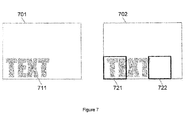
- Figure 7 illustrates another example where the weighting value that biases towards or away from the selection of a candidate motion vector from the external source is determined from the external source.
- a frame 701 includes a static subtitle text overlay and associated pixel resolution overlay mask 711 that indicates the extents of the overlay.
- the motion vector is known to be zero at all locations within the mask, because the subtitle text is known not to be moving.
- the external source does not indicate any motion vector for areas outside the mask.
- the motion vector of the overlay will be useful as a motion vector candidate for any blocks that include pixels from the overlay. Two illustrative blocks are shown.
- Block 721 can be seen to include a large number of pixels from the overlay and therefore the associated zero vector in the high resolution vector field provides a good motion vector candidate for the block.
- the zero vector can therefore be used with a high degree of confidence.
- the method used in the assignment of a weighting value that biases towards or away from the selection of the overlay vector is again application specific, however for this worked example a method is disclosed where the weighting is dependent upon the proportion of the pixels in the block which are covered by the overlay mask.
- block 721 which contains a high number of overlay pixels would include the overlay motion vector candidate with a weighting that strongly biases towards the selection of the overlay vector
- block 722 which contains a small number of overlay pixels would include the overlay's motion vector candidate with a weighting that biases against the selection of the motion vector candidate.
- the weightings allocated may be further modified by the opacity of the overlay, where an increasing degree of transparency decreases the weighting value used to bias towards the selection of the overlay vector.
- a weighting value is assigned to an external source of motion vectors such that the motion estimator is biased towards or away from the selection of any motion vector candidates coming from that source.
- a weighting value assigned to an entire external vector source may be used instead of, or in addition to, the weighting values described previously which are derived individually for each motion vector candidate derived from the external source.
- a weighting value assigned to an entire external vector source may be considered to represent the degree to which that source is trusted to provide suitable candidates to the current motion estimator. For example, a motion estimator attempting to determine true motion would not consider candidate vectors from a closest match motion estimator entirely trustworthy and would bias against their selection to some extent.
- the same true motion estimator might consider candidate vectors from a broadcast quality true motion estimator to be particularly trustworthy, and would bias towards their selection.
- the weighting value assigned to an external source may vary over time, determined, for example, by the degree to which vectors from that external source prove useful as candidates in the motion estimator.
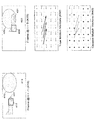
- Figure 8 illustrates an example where the weighting value of the external source motion vectors is used to allow the selection of a motion vector candidate that may otherwise have been discarded by the motion estimator.
- the motion vector field produced by the current motion estimator is shown at 870. Between these two source frames nothing has moved.
- the external source vector field contains zero vectors (represented by a black dot) at every location, and is in agreement with the motion vector field produced by the current motion estimator.
- the external source vector field is providing good motion vector candidates for use by the current motion vector field and is therefore assigned an increased weighting that will bias towards the selection of motion vector candidates from that external source in the future.
- the motion vectors provided by the external source again prove a good match for the as selected best motion vectors by the current motion estimator. This further increases the weighting that biases towards the selection of motion vector candidates from that external source.
- the shaded circle that had remained static at locations 801, 811 and 821 in previous frames suddenly moves upwards to location 831 in the current frame. Many block based motion estimators would fail to identify this motion immediately.
- the motion to location 831 in the current frame (corresponding to block 891 in the current motion estimator) is not anticipated by motion vectors in adjacent blocks or previous frames and the magnitude of the motion is too large to be found by simple pseudo-random perturbations of neighbouring block vectors. It is therefore unlikely that the correct vector would be available as a candidate in a prior art motion estimator.
- the external source vector field does contain the correct motion vector in block 861, perhaps through additional information available during the creation of its vector field or through a more computationally expensive search process.
- a motion vector candidate from an external source is significantly different from surrounding vectors in both the external source vector field 860, and in the motion vector fields 870, 880, and 890 produced by the current motion estimator, that candidate might be penalized heavily as being too risky or too inefficient to select.
- a strong bias towards selection of motion vector candidates derived from the external source vector field has been developed over a number of previous frames.
- the vector will be stored at block 891 in the output vector field of the current motion estimator. If the external source vector accurately predicted the new motion of the shaded circle between frames 820 and 830 it allows the selection of a good motion vector result that would otherwise have been unavailable.
- the apparatus generating the external source motion vector field may provide a weighting value for its own vector field to indicate the suitability of the motion vectors therein for use as motion vector candidates by the current motion estimator.
- the weighting value for the external source of motion vectors can be determined from the external source by the current motion estimator.
- a weighting value for the external source of motion vectors can be determined for the external source by the current motion estimator in one of several ways. Some of these methods produce a weighting value for the external source of motion vectors based on the degree of similarity between the motion vectors provided by the external source and the motion vectors produced by the current motion estimator. Similarity between vectors may be measured by determining whether the vectors have the same magnitude and direction, (often with a small amount of allowable variation, determined according to the application), by entropic measures, or by other methods well known to those skilled in the art.
- Vector field similarity can be defined in terms of vector similarity in the locality of the current block, globally across the frame, or can be based on historical similarity, either across previous vector fields or a recent history of processed vectors in the current frame.
- the external source is a good source of motion vector candidates for the current motion estimator. It may therefore be considered that the external source vectors are to be trusted and should be evaluated even when they appear to introduce motion vector candidates that would normally be excluded for violating spatial and temporal consistency checks. These unexpected motion vector candidates may be due to new motions in the scene that are known about or have been detected by the external source. Unexpected motion vectors introduced by the external vector source that are determined to have been poor candidates for the current motion estimator may be used to modify the weighting associated with the external source and reduce the likelihood of them being used in future. Unexpected motion vectors introduced by the external vector source that are determined to have been a good candidate for the current motion estimator and would otherwise have been missed may be used to modify the weighting associated with the external source to increase the likelihood of unexpected motion vector candidates being considered in the future.
- Figure 9 is a block diagram showing an example of a conventional system for motion vector candidate evaluation.
- a candidate generation unit 900 generates a number of motion vector candidates using methods known in the art, such as the use of vectors from spatially and temporally adjacent blocks, and the use of pseudo-random variation.
- Candidate generation results in a candidate list 905, which may include both the list of candidate vectors, 910, and a set of weighting values, 915.
- Candidate vectors from the list are evaluated to determine the quality of the block match, for example using an SAD calculation 920.
- the cost calculation block 925 combines the SAD value with terms derived from the weighting values 915 corresponding to the candidate vector to produce the metric by which vector selection will be determined.
- the system is able to guide the motion estimation process, for example towards “closest match” or towards “true motion” by appropriate control over the contents of candidate vector list 910, and the assignment of appropriate weights 915 to each candidate vector.
- the best vector update block 930 compares the cost metric with that of previous candidates, and updates the best vector storage 935. After each vector in the candidate list 905 has been evaluated, the best vector, and its associated cost, is available at output 940.
- Figure 10 is a block diagram in a system embodying the invention in which motion vector candidates are supplied from external sources.
- the candidate list is divided into two parts.
- the internal part 1010 contains candidate motion vectors and corresponding weights generated by the internal candidate generation unit 1015.
- the internal candidate generation unit corresponds to the candidate generation unit 900 shown in Figure 9 .
- Motion vectors candidates and weights in the second part of the list, 1011 are derived from the external sources 1000 and 1005.
- the SAD calculation, cost calculation, and best vector update blocks are similar to those shown in Figure 9 .
- Each external candidate source has a corresponding weight calculation block and a weight associated with the source as a whole.
- source 1000 has weight 1020, and weight calculation block 1030.
- Source 1005 has weight 1025 and weight calculation block 1035.
- a vector is supplied to weight calculation block 1030.
- the weight calculation block 1030 takes a further input from the source weight 1020, and derives a weight or weights for the vector.
- the vector and associated weights are then stored in candidate list 1011.
- the weights derived for each vector may be influenced by the source weight 1020, which reflects the extent to which source 1000 is to be trusted, and also by analysis of the individual vector, perhaps with respect to the rest of the external vector field or the vectors produced by the motion estimator.
- the data supplied from an external candidate source, e.g., 1005, to weight calculation block 1035 may include data in addition to the vector candidate. This is appropriate when the external source has access to information that is not otherwise available to the motion estimator.
- the external candidate source may provide weighting values for individual vectors, or mask values indicating the pixels to which the vector is expected to apply.
- Motion vector candidates from the internal, 1010, and external, 1011, candidate lists are evaluated in a manner similar to that shown in Figure 9 , using SAD calculation, a cost calculation derived from the SAD value and weights, and comparison with a best vector to produce a result which is the vector with the lowest overall cost.
- the source weight update unit, 1040 examines the cost metric for each vector candidate in list 1011, and whether that candidate is eventually selected as the best vector for the block.
- the source weight, 1020 or 1025 depending on the original source of the candidate, can then be updated to reflect the degree to which that particular source is trusted to provide good candidates.
- An external source which consistently provides candidates which are selected, or which are very similar to the candidates that are selected, will have its weight adjusted such that its candidates are considered more favourably in the future. Conversely, an external source whose candidates are rarely selected will not be trusted, and those candidates will be less likely to be used in the future.
Landscapes
- Engineering & Computer Science (AREA)
- Multimedia (AREA)
- Signal Processing (AREA)
- Image Analysis (AREA)
- Television Systems (AREA)
- Compression Or Coding Systems Of Tv Signals (AREA)
Applications Claiming Priority (1)
| Application Number | Priority Date | Filing Date | Title |
|---|---|---|---|
| GBGB1113527.4A GB201113527D0 (en) | 2011-08-04 | 2011-08-04 | External vectors in a motion estimation system |
Publications (3)
| Publication Number | Publication Date |
|---|---|
| EP2555522A2 true EP2555522A2 (de) | 2013-02-06 |
| EP2555522A3 EP2555522A3 (de) | 2017-01-04 |
| EP2555522B1 EP2555522B1 (de) | 2025-05-28 |
Family
ID=44735496
Family Applications (1)
| Application Number | Title | Priority Date | Filing Date |
|---|---|---|---|
| EP12179268.3A Active EP2555522B1 (de) | 2011-08-04 | 2012-08-03 | Externe Vektoren in einem Bewegungsschätzungssystem |
Country Status (4)
| Country | Link |
|---|---|
| US (1) | US8929451B2 (de) |
| EP (1) | EP2555522B1 (de) |
| CN (1) | CN102917197B (de) |
| GB (2) | GB201113527D0 (de) |
Families Citing this family (32)
| Publication number | Priority date | Publication date | Assignee | Title |
|---|---|---|---|---|
| GB2527315B (en) * | 2014-06-17 | 2017-03-15 | Imagination Tech Ltd | Error detection in motion estimation |
| CN104811726B (zh) * | 2015-04-24 | 2018-12-18 | 宏祐图像科技(上海)有限公司 | 帧率转换中运动估计的候选运动矢量选择方法 |
| GB2539198B (en) | 2015-06-08 | 2019-09-25 | Imagination Tech Ltd | Motion estimation using collocated blocks |
| US9883097B2 (en) | 2016-06-03 | 2018-01-30 | Google Inc. | Optical flow based auto focus |
| US10136155B2 (en) | 2016-07-27 | 2018-11-20 | Cisco Technology, Inc. | Motion compensation using a patchwork motion field |
| CN109391821B (zh) * | 2017-08-02 | 2020-08-28 | 联咏科技股份有限公司 | 运动估计方法以及运动估计装置 |
| US10873760B2 (en) * | 2017-04-07 | 2020-12-22 | Futurewei Technologies, Inc. | Motion vector (MV) constraints and transformation constraints in video coding |
| WO2019203527A1 (ko) * | 2018-04-16 | 2019-10-24 | 엘지전자 주식회사 | 영상 코딩 시스템에서 복수의 주변 블록들을 사용하는 인터 예측에 따른 영상 디코딩 방법 및 장치 |
| WO2019234598A1 (en) | 2018-06-05 | 2019-12-12 | Beijing Bytedance Network Technology Co., Ltd. | Interaction between ibc and stmvp |
| EP3788782A1 (de) | 2018-06-21 | 2021-03-10 | Beijing Bytedance Network Technology Co. Ltd. | Subblock-mv-vererbung zwischen farbkomponenten |
| CN110636298B (zh) | 2018-06-21 | 2022-09-13 | 北京字节跳动网络技术有限公司 | 对于Merge仿射模式和非Merge仿射模式的统一约束 |
| WO2020003282A1 (en) | 2018-06-29 | 2020-01-02 | Beijing Bytedance Network Technology Co., Ltd. | Managing motion vector predictors for video coding |
| KR102627814B1 (ko) | 2018-06-29 | 2024-01-23 | 베이징 바이트댄스 네트워크 테크놀로지 컴퍼니, 리미티드 | 룩업 테이블의 업데이트: fifo, 제약된 fifo |
| SG11202013028PA (en) | 2018-06-29 | 2021-01-28 | Beijing Bytedance Network Technology Co Ltd | Interaction between lut and amvp |
| CN110662052B (zh) | 2018-06-29 | 2022-07-08 | 北京字节跳动网络技术有限公司 | 更新查找表(lut)的条件 |
| KR102840294B1 (ko) | 2018-06-29 | 2025-07-30 | 두인 비전 컴퍼니 리미티드 | 하나 또는 다수의 룩업 테이블들을 사용하여 이전에 코딩된 모션 정보를 순서대로 저장하고 이를 사용하여 후속 블록들을 코딩하는 개념 |
| EP4322533A3 (de) | 2018-06-29 | 2024-03-06 | Beijing Bytedance Network Technology Co., Ltd. | Überprüfung der reihenfolge von bewegungskandidaten in lut |
| KR102680903B1 (ko) | 2018-06-29 | 2024-07-04 | 베이징 바이트댄스 네트워크 테크놀로지 컴퍼니, 리미티드 | Hmvp 후보를 병합/amvp에 추가할 때의 부분/풀 프루닝 |
| WO2020007362A1 (en) | 2018-07-06 | 2020-01-09 | Mediatek Inc. | Inherited motion information for decoding a current coding unit in a video coding system |
| CN111010565B (zh) * | 2018-10-04 | 2023-05-16 | 华为技术有限公司 | 帧间预测方法、装置及其应用的编/解方法及装置 |
| WO2020053798A1 (en) | 2018-09-12 | 2020-03-19 | Beijing Bytedance Network Technology Co., Ltd. | Conditions for starting checking hmvp candidates depend on total number minus k |
| WO2020065517A1 (en) | 2018-09-24 | 2020-04-02 | Beijing Bytedance Network Technology Co., Ltd. | Simplified history based motion vector prediction |
| CN109561303B (zh) * | 2018-10-26 | 2020-12-15 | 广东弘视数字传媒有限公司 | 一种基于视频压缩的预测方法 |
| CN113016187B (zh) * | 2018-11-07 | 2023-06-06 | 寰发股份有限公司 | 利用当前画面参照编码方式的视频区块编码或解码方法和装置 |
| CN112997495B (zh) | 2018-11-10 | 2024-02-20 | 北京字节跳动网络技术有限公司 | 当前图片参考中的取整 |
| KR102648159B1 (ko) | 2019-01-10 | 2024-03-18 | 베이징 바이트댄스 네트워크 테크놀로지 컴퍼니, 리미티드 | Lut 업데이트의 호출 |
| WO2020143824A1 (en) | 2019-01-13 | 2020-07-16 | Beijing Bytedance Network Technology Co., Ltd. | Interaction between lut and shared merge list |
| CN113330739B (zh) | 2019-01-16 | 2025-01-10 | 北京字节跳动网络技术有限公司 | Lut中的运动候选的插入顺序 |
| CN113615193B (zh) | 2019-03-22 | 2024-06-25 | 北京字节跳动网络技术有限公司 | Merge列表构建和其他工具之间的交互 |
| CN111953995A (zh) | 2019-05-17 | 2020-11-17 | 华为技术有限公司 | 一种帧间预测的方法和装置 |
| CN114079786A (zh) * | 2019-05-17 | 2022-02-22 | 华为技术有限公司 | 一种帧间预测的方法和装置 |
| WO2023113209A1 (ko) * | 2021-12-15 | 2023-06-22 | 현대자동차주식회사 | 움직임벡터 예측자들의 후보 리스트를 이용하는 비디오 코딩을 위한 방법 및 장치 |
Citations (1)
| Publication number | Priority date | Publication date | Assignee | Title |
|---|---|---|---|---|
| GB2480422A (en) | 2010-02-25 | 2011-11-23 | Imagination Tech Ltd | Generation of candidate motion vectors based on orientation and position of a camera or viewer |
Family Cites Families (24)
| Publication number | Priority date | Publication date | Assignee | Title |
|---|---|---|---|---|
| US6275532B1 (en) | 1995-03-18 | 2001-08-14 | Sharp Kabushiki Kaisha | Video coding device and video decoding device with a motion compensated interframe prediction |
| DE69727911D1 (de) | 1997-04-24 | 2004-04-08 | St Microelectronics Srl | Verfahren zur Erhöhung der bewegungsgeschätzten und bewegungskompensierten Bildfrequenz für Videoanwendungen, und Vorrichtung zur Verwendung eines solchen Verfahrens |
| US7206346B2 (en) | 1997-06-25 | 2007-04-17 | Nippon Telegraph And Telephone Corporation | Motion vector predictive encoding method, motion vector decoding method, predictive encoding apparatus and decoding apparatus, and storage media storing motion vector predictive encoding and decoding programs |
| WO1999016251A1 (en) * | 1997-09-23 | 1999-04-01 | Koninklijke Philips Electronics N.V. | Motion estimation and motion-compensated interpolation |
| KR100246918B1 (ko) | 1997-12-31 | 2000-03-15 | 윤종용 | 모션벡터 검출장치 |
| US6137837A (en) | 1998-01-23 | 2000-10-24 | Motorola, Inc. | Motion estimation for digital video with reduced number of search window pixels |
| JP3540142B2 (ja) | 1998-01-30 | 2004-07-07 | 株式会社東芝 | 動きベクトル検出回路および動きベクトル検出方法 |
| EP1189169A1 (de) * | 2000-09-07 | 2002-03-20 | STMicroelectronics S.r.l. | Eine VLSI Architektur, insbesondere für Bewegungsbestimmunsapplikationen |
| US7042945B2 (en) | 2001-04-24 | 2006-05-09 | Bellers Erwin B | 3-D recursive vector estimation for video enhancement |
| EP1430725B1 (de) * | 2001-09-07 | 2006-06-14 | Koninklijke Philips Electronics N.V. | Bildprozessor und anzeigegerät mit einem solchen bildprozessoren |
| KR100412501B1 (ko) | 2001-11-30 | 2003-12-31 | 삼성전자주식회사 | 움직임 보상을 위한 화소값 선택 장치 및 방법 |
| KR100441509B1 (ko) * | 2002-02-25 | 2004-07-23 | 삼성전자주식회사 | 주사포맷변환장치 및 방법 |
| WO2005022922A1 (en) * | 2003-09-02 | 2005-03-10 | Koninklijke Philips Electronics N.V. | Temporal interpolation of a pixel on basis of occlusion detection |
| KR20060083978A (ko) * | 2003-09-17 | 2006-07-21 | 코닌클리케 필립스 일렉트로닉스 엔.브이. | 움직임 벡터 필드 리-타이밍 |
| US20050163221A1 (en) * | 2004-01-14 | 2005-07-28 | Matsushita Electric Industrial Co., Ltd. | Motion vector detecting device |
| EP1592258B1 (de) | 2004-04-30 | 2011-01-12 | Panasonic Corporation | Bewegungsschätzung unter Verwendung von adaptiven räumlichen Verfeinerungsvektoren |
| GB2432068B (en) | 2005-11-02 | 2010-10-06 | Imagination Tech Ltd | Motion estimation |
| KR101217627B1 (ko) * | 2006-02-02 | 2013-01-02 | 삼성전자주식회사 | 블록 기반의 움직임 추정 방법 및 장치 |
| GB2435360B (en) | 2006-02-16 | 2009-09-23 | Imagination Tech Ltd | Method and apparatus for determining motion between video images |
| US8630346B2 (en) * | 2007-02-20 | 2014-01-14 | Samsung Electronics Co., Ltd | System and method for introducing virtual zero motion vector candidates in areas of a video sequence involving overlays |
| GB2469679B (en) * | 2009-04-23 | 2012-05-02 | Imagination Tech Ltd | Object tracking using momentum and acceleration vectors in a motion estimation system |
| US8254439B2 (en) * | 2009-05-08 | 2012-08-28 | Mediatek Inc. | Apparatus and methods for motion vector correction |
| US8711938B2 (en) * | 2009-09-04 | 2014-04-29 | Sharp Laboratories Of America, Inc. | Methods and systems for motion estimation with nonlinear motion-field smoothing |
| TW201328359A (zh) * | 2011-12-19 | 2013-07-01 | Ind Tech Res Inst | 基於壓縮域的移動物件偵測方法及裝置 |
-
2011
- 2011-08-04 GB GBGB1113527.4A patent/GB201113527D0/en not_active Ceased
-
2012
- 2012-07-31 US US13/563,525 patent/US8929451B2/en active Active
- 2012-08-01 GB GB1213785.7A patent/GB2495179B/en active Active
- 2012-08-03 EP EP12179268.3A patent/EP2555522B1/de active Active
- 2012-08-06 CN CN201210278046.0A patent/CN102917197B/zh active Active
Patent Citations (1)
| Publication number | Priority date | Publication date | Assignee | Title |
|---|---|---|---|---|
| GB2480422A (en) | 2010-02-25 | 2011-11-23 | Imagination Tech Ltd | Generation of candidate motion vectors based on orientation and position of a camera or viewer |
Also Published As
| Publication number | Publication date |
|---|---|
| GB201213785D0 (en) | 2012-09-12 |
| GB201113527D0 (en) | 2011-09-21 |
| GB2495179B (en) | 2013-08-14 |
| EP2555522A3 (de) | 2017-01-04 |
| CN102917197A (zh) | 2013-02-06 |
| EP2555522B1 (de) | 2025-05-28 |
| US20130101041A1 (en) | 2013-04-25 |
| GB2495179A (en) | 2013-04-03 |
| CN102917197B (zh) | 2016-11-02 |
| US8929451B2 (en) | 2015-01-06 |
Similar Documents
| Publication | Publication Date | Title |
|---|---|---|
| EP2555522B1 (de) | Externe Vektoren in einem Bewegungsschätzungssystem | |
| JP5877469B2 (ja) | 動き推定システムにおいてモーメント及び加速度ベクトルを使用するオブジェクト追跡 | |
| KR100582856B1 (ko) | 움직임 추정 및 움직임 보상된 보간법 | |
| CN1681291B (zh) | 用于计算数字视频序列中的运动矢量的方法 | |
| JP4997281B2 (ja) | イメージ中の推定動きベクトルの決定方法、コンピュータプログラムおよびディスプレイ装置 | |
| KR101092287B1 (ko) | 화상 처리 장치 및 화상 처리 방법 | |
| CN1992789B (zh) | 运动估计器和运动估计方法 | |
| EP1841234A2 (de) | Vorrichtung zur Erzeugung von Interpolationsbildern | |
| US7667778B2 (en) | Image processing apparatus and method, and recording medium and program used therewith | |
| US5754237A (en) | Method for determining motion vectors using a hierarchical motion estimation | |
| KR20030008150A (ko) | 단일 텔레비전 신호 필드들에서 병렬로 발생하는 필름 및비디오 오브젝트들의 인식 | |
| JP2004534336A (ja) | 動きまたは奥行き推定方法及び推定ユニット、並びにこのような動き推定ユニットを備える画像処理装置 | |
| US20050013364A1 (en) | Method of motion vector determination in digital video compression | |
| US20080239144A1 (en) | Frame rate conversion device and image display apparatus | |
| KR20040047963A (ko) | 움직임 예측 유닛 및 방법 및 이러한 움직임 예측 유닛을구비하는 이미지 처리 장치 | |
| US20060098886A1 (en) | Efficient predictive image parameter estimation | |
| US9106926B1 (en) | Using double confirmation of motion vectors to determine occluded regions in images | |
| US20080144716A1 (en) | Method For Motion Vector Determination | |
| US20130235274A1 (en) | Motion vector detection device, motion vector detection method, frame interpolation device, and frame interpolation method | |
| Heinrich et al. | Optimization of hierarchical 3DRS motion estimators for picture rate conversion | |
| JP2012095048A (ja) | 画像処理装置、画像処理方法、画像表示装置、及び画像表示方法 | |
| US20050195324A1 (en) | Method of converting frame rate of video signal based on motion compensation | |
| CN107124617B (zh) | 运动估计运动补偿中随机矢量的生成方法及系统 | |
| JP2000201328A (ja) | 動きベクトルの検出方法および回路 | |
| EP1606952A1 (de) | Verfahren zur bewegungsvektorbestimmung |
Legal Events
| Date | Code | Title | Description |
|---|---|---|---|
| PUAI | Public reference made under article 153(3) epc to a published international application that has entered the european phase |
Free format text: ORIGINAL CODE: 0009012 |
|
| AK | Designated contracting states |
Kind code of ref document: A2 Designated state(s): AL AT BE BG CH CY CZ DE DK EE ES FI FR GB GR HR HU IE IS IT LI LT LU LV MC MK MT NL NO PL PT RO RS SE SI SK SM TR |
|
| AX | Request for extension of the european patent |
Extension state: BA ME |
|
| PUAL | Search report despatched |
Free format text: ORIGINAL CODE: 0009013 |
|
| AK | Designated contracting states |
Kind code of ref document: A3 Designated state(s): AL AT BE BG CH CY CZ DE DK EE ES FI FR GB GR HR HU IE IS IT LI LT LU LV MC MK MT NL NO PL PT RO RS SE SI SK SM TR |
|
| AX | Request for extension of the european patent |
Extension state: BA ME |
|
| RIC1 | Information provided on ipc code assigned before grant |
Ipc: H04N 7/26 00000000AFI20161128BHEP Ipc: H04N 7/50 00000000ALI20161128BHEP |
|
| STAA | Information on the status of an ep patent application or granted ep patent |
Free format text: STATUS: REQUEST FOR EXAMINATION WAS MADE |
|
| 17P | Request for examination filed |
Effective date: 20170704 |
|
| RBV | Designated contracting states (corrected) |
Designated state(s): AL AT BE BG CH CY CZ DE DK EE ES FI FR GB GR HR HU IE IS IT LI LT LU LV MC MK MT NL NO PL PT RO RS SE SI SK SM TR |
|
| STAA | Information on the status of an ep patent application or granted ep patent |
Free format text: STATUS: EXAMINATION IS IN PROGRESS |
|
| 17Q | First examination report despatched |
Effective date: 20180711 |
|
| REG | Reference to a national code |
Ref country code: DE Ref legal event code: R079 Free format text: PREVIOUS MAIN CLASS: H04N0007260000 Ipc: H04N0019560000 Ref country code: DE Ref legal event code: R079 Ref document number: 602012081541 Country of ref document: DE Free format text: PREVIOUS MAIN CLASS: H04N0007260000 Ipc: H04N0019560000 |
|
| GRAP | Despatch of communication of intention to grant a patent |
Free format text: ORIGINAL CODE: EPIDOSNIGR1 |
|
| STAA | Information on the status of an ep patent application or granted ep patent |
Free format text: STATUS: GRANT OF PATENT IS INTENDED |
|
| RIC1 | Information provided on ipc code assigned before grant |
Ipc: H04N 19/52 20140101ALI20241210BHEP Ipc: H04N 19/61 20140101ALI20241210BHEP Ipc: H04N 19/513 20140101ALI20241210BHEP Ipc: H04N 19/56 20140101AFI20241210BHEP |
|
| INTG | Intention to grant announced |
Effective date: 20241219 |
|
| P01 | Opt-out of the competence of the unified patent court (upc) registered |
Free format text: CASE NUMBER: APP_2772/2025 Effective date: 20250116 |
|
| GRAS | Grant fee paid |
Free format text: ORIGINAL CODE: EPIDOSNIGR3 |
|
| GRAA | (expected) grant |
Free format text: ORIGINAL CODE: 0009210 |
|
| STAA | Information on the status of an ep patent application or granted ep patent |
Free format text: STATUS: THE PATENT HAS BEEN GRANTED |
|
| RAP3 | Party data changed (applicant data changed or rights of an application transferred) |
Owner name: IMAGINATION TECHNOLOGIES LIMITED |
|
| AK | Designated contracting states |
Kind code of ref document: B1 Designated state(s): AL AT BE BG CH CY CZ DE DK EE ES FI FR GB GR HR HU IE IS IT LI LT LU LV MC MK MT NL NO PL PT RO RS SE SI SK SM TR |
|
| REG | Reference to a national code |
Ref country code: GB Ref legal event code: FG4D |
|
| REG | Reference to a national code |
Ref country code: CH Ref legal event code: EP |
|
| REG | Reference to a national code |
Ref country code: IE Ref legal event code: FG4D Ref country code: DE Ref legal event code: R096 Ref document number: 602012081541 Country of ref document: DE |
|
| REG | Reference to a national code |
Ref country code: NL Ref legal event code: MP Effective date: 20250528 |
|
| PG25 | Lapsed in a contracting state [announced via postgrant information from national office to epo] |
Ref country code: ES Free format text: LAPSE BECAUSE OF FAILURE TO SUBMIT A TRANSLATION OF THE DESCRIPTION OR TO PAY THE FEE WITHIN THE PRESCRIBED TIME-LIMIT Effective date: 20250528 Ref country code: FI Free format text: LAPSE BECAUSE OF FAILURE TO SUBMIT A TRANSLATION OF THE DESCRIPTION OR TO PAY THE FEE WITHIN THE PRESCRIBED TIME-LIMIT Effective date: 20250528 |
|
| PGFP | Annual fee paid to national office [announced via postgrant information from national office to epo] |
Ref country code: DE Payment date: 20250820 Year of fee payment: 14 |
|
| REG | Reference to a national code |
Ref country code: LT Ref legal event code: MG9D |
|
| PG25 | Lapsed in a contracting state [announced via postgrant information from national office to epo] |
Ref country code: GR Free format text: LAPSE BECAUSE OF FAILURE TO SUBMIT A TRANSLATION OF THE DESCRIPTION OR TO PAY THE FEE WITHIN THE PRESCRIBED TIME-LIMIT Effective date: 20250829 Ref country code: NO Free format text: LAPSE BECAUSE OF FAILURE TO SUBMIT A TRANSLATION OF THE DESCRIPTION OR TO PAY THE FEE WITHIN THE PRESCRIBED TIME-LIMIT Effective date: 20250828 |
|
| PG25 | Lapsed in a contracting state [announced via postgrant information from national office to epo] |
Ref country code: PL Free format text: LAPSE BECAUSE OF FAILURE TO SUBMIT A TRANSLATION OF THE DESCRIPTION OR TO PAY THE FEE WITHIN THE PRESCRIBED TIME-LIMIT Effective date: 20250528 Ref country code: NL Free format text: LAPSE BECAUSE OF FAILURE TO SUBMIT A TRANSLATION OF THE DESCRIPTION OR TO PAY THE FEE WITHIN THE PRESCRIBED TIME-LIMIT Effective date: 20250528 |
|
| PG25 | Lapsed in a contracting state [announced via postgrant information from national office to epo] |
Ref country code: BG Free format text: LAPSE BECAUSE OF FAILURE TO SUBMIT A TRANSLATION OF THE DESCRIPTION OR TO PAY THE FEE WITHIN THE PRESCRIBED TIME-LIMIT Effective date: 20250528 |
|
| PGFP | Annual fee paid to national office [announced via postgrant information from national office to epo] |
Ref country code: GB Payment date: 20250821 Year of fee payment: 14 |
|
| PG25 | Lapsed in a contracting state [announced via postgrant information from national office to epo] |
Ref country code: HR Free format text: LAPSE BECAUSE OF FAILURE TO SUBMIT A TRANSLATION OF THE DESCRIPTION OR TO PAY THE FEE WITHIN THE PRESCRIBED TIME-LIMIT Effective date: 20250528 |
|
| PGFP | Annual fee paid to national office [announced via postgrant information from national office to epo] |
Ref country code: FR Payment date: 20250829 Year of fee payment: 14 |
|
| PG25 | Lapsed in a contracting state [announced via postgrant information from national office to epo] |
Ref country code: RS Free format text: LAPSE BECAUSE OF FAILURE TO SUBMIT A TRANSLATION OF THE DESCRIPTION OR TO PAY THE FEE WITHIN THE PRESCRIBED TIME-LIMIT Effective date: 20250828 |
|
| PG25 | Lapsed in a contracting state [announced via postgrant information from national office to epo] |
Ref country code: IS Free format text: LAPSE BECAUSE OF FAILURE TO SUBMIT A TRANSLATION OF THE DESCRIPTION OR TO PAY THE FEE WITHIN THE PRESCRIBED TIME-LIMIT Effective date: 20250928 |
|
| PG25 | Lapsed in a contracting state [announced via postgrant information from national office to epo] |
Ref country code: LV Free format text: LAPSE BECAUSE OF FAILURE TO SUBMIT A TRANSLATION OF THE DESCRIPTION OR TO PAY THE FEE WITHIN THE PRESCRIBED TIME-LIMIT Effective date: 20250528 |
|
| REG | Reference to a national code |
Ref country code: AT Ref legal event code: MK05 Ref document number: 1799327 Country of ref document: AT Kind code of ref document: T Effective date: 20250528 |
|
| PG25 | Lapsed in a contracting state [announced via postgrant information from national office to epo] |
Ref country code: SM Free format text: LAPSE BECAUSE OF FAILURE TO SUBMIT A TRANSLATION OF THE DESCRIPTION OR TO PAY THE FEE WITHIN THE PRESCRIBED TIME-LIMIT Effective date: 20250528 Ref country code: DK Free format text: LAPSE BECAUSE OF FAILURE TO SUBMIT A TRANSLATION OF THE DESCRIPTION OR TO PAY THE FEE WITHIN THE PRESCRIBED TIME-LIMIT Effective date: 20250528 Ref country code: AT Free format text: LAPSE BECAUSE OF FAILURE TO SUBMIT A TRANSLATION OF THE DESCRIPTION OR TO PAY THE FEE WITHIN THE PRESCRIBED TIME-LIMIT Effective date: 20250528 |
|
| PG25 | Lapsed in a contracting state [announced via postgrant information from national office to epo] |
Ref country code: CZ Free format text: LAPSE BECAUSE OF FAILURE TO SUBMIT A TRANSLATION OF THE DESCRIPTION OR TO PAY THE FEE WITHIN THE PRESCRIBED TIME-LIMIT Effective date: 20250528 |
|
| PG25 | Lapsed in a contracting state [announced via postgrant information from national office to epo] |
Ref country code: EE Free format text: LAPSE BECAUSE OF FAILURE TO SUBMIT A TRANSLATION OF THE DESCRIPTION OR TO PAY THE FEE WITHIN THE PRESCRIBED TIME-LIMIT Effective date: 20250528 |
|
| PG25 | Lapsed in a contracting state [announced via postgrant information from national office to epo] |
Ref country code: SK Free format text: LAPSE BECAUSE OF FAILURE TO SUBMIT A TRANSLATION OF THE DESCRIPTION OR TO PAY THE FEE WITHIN THE PRESCRIBED TIME-LIMIT Effective date: 20250528 Ref country code: RO Free format text: LAPSE BECAUSE OF FAILURE TO SUBMIT A TRANSLATION OF THE DESCRIPTION OR TO PAY THE FEE WITHIN THE PRESCRIBED TIME-LIMIT Effective date: 20250528 |
|
| PG25 | Lapsed in a contracting state [announced via postgrant information from national office to epo] |
Ref country code: IT Free format text: LAPSE BECAUSE OF FAILURE TO SUBMIT A TRANSLATION OF THE DESCRIPTION OR TO PAY THE FEE WITHIN THE PRESCRIBED TIME-LIMIT Effective date: 20250528 |
|
| REG | Reference to a national code |
Ref country code: DE Ref legal event code: R097 Ref document number: 602012081541 Country of ref document: DE |
|
| REG | Reference to a national code |
Ref country code: CH Ref legal event code: H13 Free format text: ST27 STATUS EVENT CODE: U-0-0-H10-H13 (AS PROVIDED BY THE NATIONAL OFFICE) Effective date: 20260324 |
|
| PG25 | Lapsed in a contracting state [announced via postgrant information from national office to epo] |
Ref country code: MC Free format text: LAPSE BECAUSE OF FAILURE TO SUBMIT A TRANSLATION OF THE DESCRIPTION OR TO PAY THE FEE WITHIN THE PRESCRIBED TIME-LIMIT Effective date: 20250528 |
|
| PLBE | No opposition filed within time limit |
Free format text: ORIGINAL CODE: 0009261 |
|
| STAA | Information on the status of an ep patent application or granted ep patent |
Free format text: STATUS: NO OPPOSITION FILED WITHIN TIME LIMIT |
|
| REG | Reference to a national code |
Ref country code: CH Ref legal event code: L10 Free format text: ST27 STATUS EVENT CODE: U-0-0-L10-L00 (AS PROVIDED BY THE NATIONAL OFFICE) Effective date: 20260409 |
|
| PG25 | Lapsed in a contracting state [announced via postgrant information from national office to epo] |
Ref country code: LU Free format text: LAPSE BECAUSE OF NON-PAYMENT OF DUE FEES Effective date: 20250803 |
|
| PG25 | Lapsed in a contracting state [announced via postgrant information from national office to epo] |
Ref country code: CH Free format text: LAPSE BECAUSE OF NON-PAYMENT OF DUE FEES Effective date: 20250831 |