EP2553493B1 - High performance computing for three dimensional proton computer tomography (hpc-pct) - Google Patents
High performance computing for three dimensional proton computer tomography (hpc-pct) Download PDFInfo
- Publication number
- EP2553493B1 EP2553493B1 EP11798535.8A EP11798535A EP2553493B1 EP 2553493 B1 EP2553493 B1 EP 2553493B1 EP 11798535 A EP11798535 A EP 11798535A EP 2553493 B1 EP2553493 B1 EP 2553493B1
- Authority
- EP
- European Patent Office
- Prior art keywords
- int
- mpi
- idx
- case
- float
- Prior art date
- Legal status (The legal status is an assumption and is not a legal conclusion. Google has not performed a legal analysis and makes no representation as to the accuracy of the status listed.)
- Active
Links
Images


Classifications
-
- G—PHYSICS
- G01—MEASURING; TESTING
- G01T—MEASUREMENT OF NUCLEAR OR X-RADIATION
- G01T1/00—Measuring X-radiation, gamma radiation, corpuscular radiation, or cosmic radiation
- G01T1/16—Measuring radiation intensity
- G01T1/20—Measuring radiation intensity with scintillation detectors
-
- G—PHYSICS
- G01—MEASURING; TESTING
- G01T—MEASUREMENT OF NUCLEAR OR X-RADIATION
- G01T1/00—Measuring X-radiation, gamma radiation, corpuscular radiation, or cosmic radiation
- G01T1/16—Measuring radiation intensity
- G01T1/20—Measuring radiation intensity with scintillation detectors
- G01T1/201—Measuring radiation intensity with scintillation detectors using scintillating fibres
-
- A—HUMAN NECESSITIES
- A61—MEDICAL OR VETERINARY SCIENCE; HYGIENE
- A61B—DIAGNOSIS; SURGERY; IDENTIFICATION
- A61B6/00—Apparatus or devices for radiation diagnosis; Apparatus or devices for radiation diagnosis combined with radiation therapy equipment
- A61B6/42—Arrangements for detecting radiation specially adapted for radiation diagnosis
- A61B6/4208—Arrangements for detecting radiation specially adapted for radiation diagnosis characterised by using a particular type of detector
- A61B6/4258—Arrangements for detecting radiation specially adapted for radiation diagnosis characterised by using a particular type of detector for detecting non x-ray radiation, e.g. gamma radiation
-
- G—PHYSICS
- G01—MEASURING; TESTING
- G01T—MEASUREMENT OF NUCLEAR OR X-RADIATION
- G01T1/00—Measuring X-radiation, gamma radiation, corpuscular radiation, or cosmic radiation
- G01T1/16—Measuring radiation intensity
- G01T1/20—Measuring radiation intensity with scintillation detectors
- G01T1/208—Circuits specially adapted for scintillation detectors, e.g. for the photo-multiplier section
-
- G—PHYSICS
- G01—MEASURING; TESTING
- G01T—MEASUREMENT OF NUCLEAR OR X-RADIATION
- G01T1/00—Measuring X-radiation, gamma radiation, corpuscular radiation, or cosmic radiation
- G01T1/16—Measuring radiation intensity
- G01T1/24—Measuring radiation intensity with semiconductor detectors
- G01T1/248—Silicon photomultipliers [SiPM], e.g. an avalanche photodiode [APD] array on a common Si substrate
-
- G—PHYSICS
- G01—MEASURING; TESTING
- G01T—MEASUREMENT OF NUCLEAR OR X-RADIATION
- G01T1/00—Measuring X-radiation, gamma radiation, corpuscular radiation, or cosmic radiation
- G01T1/16—Measuring radiation intensity
- G01T1/24—Measuring radiation intensity with semiconductor detectors
- G01T1/249—Measuring radiation intensity with semiconductor detectors specially adapted for use in SPECT or PET
-
- G—PHYSICS
- G01—MEASURING; TESTING
- G01T—MEASUREMENT OF NUCLEAR OR X-RADIATION
- G01T1/00—Measuring X-radiation, gamma radiation, corpuscular radiation, or cosmic radiation
- G01T1/29—Measurement performed on radiation beams, e.g. position or section of the beam; Measurement of spatial distribution of radiation
- G01T1/2914—Measurement of spatial distribution of radiation
- G01T1/2985—In depth localisation, e.g. using positron emitters; Tomographic imaging (longitudinal and transverse section imaging; apparatus for radiation diagnosis sequentially in different planes, steroscopic radiation diagnosis)
Definitions
- the present invention relates to three-dimensional computing.
- the present invention relates to proton-computed tomography.
- Generating an internal 3D image of an object with proton computed tomography starts by firing many protons through the object.
- Each proton's path i.e., trace history
- the collection of all the trace histories are used as input to a computer program that generates the image.
- Detectors for pCT in the prior art employ larger bulky plastic cube shaped tubes (such as in Pemler, et al.) with large and bulky photon sensors that require much larger volumes that present problems when mounted on a proton gantry with limited space around the patient.
- Pemler, et al. describes the possibility to perform radiography with protons and used a single X-Y plane in front of the object being analyzed and a single X-Y plane after.
- Pemler, et al. also uses vacuum photomultipliers, square fibers, and combinatorial readout.
- Amaldi, et al. describes a Proton Range Radiography system with an imaging area of 10 cm x 10 cm with a stack of thirty thin plastic scintillators.
- the current pCT detector at Loma Linda uses silicon wafers that are limited in available area (9 cm x 9 cm), thus requiring a mosaic of overlapping tiles to achieve large area (27 x 36 cm).
- the maximum size now produced of silicon wafers is 10 cm x 10 cm.
- the tiles are shingle overlapped or placed with edges butting, which create dead space in the detector or double layers that require "mathematical removal" during image calculations.
- the present invention provides for a proton computed tomography (pCT) detector system as defined in claim 1, including two tracking (2D) detectors in sequence on a first side of an object to be imaged, two tracking (2D) detectors in sequence on an opposite side of the object to be imaged, and a calorimeter, wherein the tracking detectors include plastic scintillation fibers.
- pCT proton computed tomography
- the present invention also provides for a method of imaging an object as defined in claim 16 by emitting protons from a source through two tracking detectors, through and around the object, and through two opposite tracking detectors, detecting energy of the protons with a calorimeter, and imaging the object.
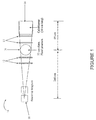
- the present invention provides for a pCT detector system 10, shown generally in FIGURE 1 , for generating 3D images from proton trace histories.
- the pCT detector system 10 preferably includes four tracking detectors 12, a calorimeter 14, and a computer cluster (not shown).
- the tracking detectors 12 are used to detect the coordinates in the X and Y plane of the protons.
- Each detector 12 has two planes, an X plane and a Y plane, with the fibers (strips) oriented in the appropriate direction for X and Y measurements of the proton tracks.
- Each detector is fabricated by placing one X and one Y plane in close proximity with a thin foam-like material in between.
- the tracking detectors 12 include 1 mm diameter thin circular plastic scintillation fibers 22, closely packed in a row, and covering the full area of the imaging field, preferably 27 cm by 36 cm, or 18 cm x 36 cm.
- the tracking detectors 12 can be any other suitable size.
- the core of the fibers is preferably polystyrene with cladding of PMMA (Poly(methyl methacrylate)).
- the tracking detectors 12 also include appropriate electronics in order to detect the position of the protons and relay this data to a computer cluster.
- the use of scintillation fibers for proton imaging has been reported in the prior art, but the tracking detectors 12 of the present invention offer higher spatial resolution and larger area coverage than previous detectors and eliminate the tile construction of the prior art. Up to six meters can be covered with these plastic scintillating fibers 22 without dead area. The smaller circular fibers 22 produce better resolution to sub-millimeter level over the larger square tubes used in prior art devices.
- One crucial difference between the present invention and the prior art is the use of SiPM (or solid state photomultiplier) 20 while reading out scintillating fibers 22. Previous devices were based on using bulky vacuum photomultipliers with poor light sensitivity in green diapazon of the light spectrum. The prior art used thick square scintillating fibers in order to increase light output.
- the tracking detectors 12 of the present invention use SiPM 20 with as much as two time higher light sensitivity and allows for use of thinner fibers 22.
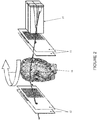
- the tracking detectors 12 are arranged so that two are placed in sequence on a first side of an object 16 to be imaged and two are placed in sequence on an opposite side of the object 16, as shown in FIGURES 1 and 2 .
- Scanning magnets (or a source) 18 that emit the proton beams of the system 10 are located at a position opposite to the calorimeter 14 on either side of the outer tracking detectors 12.
- the scanning magnets 18 can be located 240 cm from the center of the object 16, and the calorimeter 14 can be 65 cm from the center of the object 16.
- the inner tracking detectors 12 can be 15 cm from the center of the object 16 and the outer tracking detectors 12 can be 30 cm from the center of the object 16. Other distances can be used as appropriate.
- the tracking detectors 12 include the use of low cost Silicon Photomultipliers (SiPM) 20 attached to the plastic scintillating fibers 22 for signal amplification in lieu of phototubes as used in the prior art, as shown in FIGURES 3A-3C .
- the SiPMs 20 provide continuous coverage and remove the tile construction effect. SiPMs are unaffected by magnetics contrary to phototubes. SiPMs have been historically used in particle detectors. SiPMs are intrinsically fast, of order 100 nanosecond resolving time between events. Therefore, this design allows much higher data acquisition rates than previous detector systems.
- the plastic scintillating fibers 22 can have a cross-sectional shape of a square (shown in FIGURE 7 ), circle, or hexagon.
- the tracking detectors 12 with SiPMs 20 can include two scintillating fibers 22 simultaneously, alternatively, one fiber 22 can be used for one SiPM 20.
- the fiber 22 diameter is in the range of 0.75 mm - 1 mm.
- the fibers 22 can be polystyrene scintillating fibers that produce light when protons cross their thickness. Two layers of fibers 22 increase detection efficiency in contrast to one layer. Another orthogonal double layer of fibers 22 can be included in order to have a 2D coordinate of the protons in space.
- the tracking detectors can include a mechanical support 24 for the SiPM, as well as a Rohacell support 26 that serves as a support for scintillating fiber 22 placing. Any other supports can be used as known in the art in order to create the tracking detectors 12.
- the area of 27x36 cm 2 (tracking part) is covered. If the picked diameter of the scintillating fiber 22 is 1 mm then 270 fibers, 270 SiPMs, and 270 channels of electronics are needed. This is true for a one projection only (X).
- FIGURE 6A shows a side view of the tracking detector 12 of the present invention.
- this detector 12 there are two layers of silicon strips.
- the silicon sensors which connect to the SiPms 20 are 89.5 mm x 89.5 mm with a strip pitch of 238 ⁇ m and 400 ⁇ m thickness.
- the strips of each layer are individually connected to six ASICs*64 strips.
- FIGURE 6B shows a view of a proton beam detected by the tracking detector 12 with X and Y coordinates.
- the calorimeter 14 is used to detect proton energy that is emitted from the source 18.
- SiPM 20 with a diameter of 1.2 mm can provide a readout (digital or analog) through 1.2 mm wavelength shifter (WLS) fibers 36.
- the SiPM 20 used in the calorimeter 14 can be the same type as used in the tracking detectors 12.
- the calorimeter 14 can be arranged in a stack (at least two) of 3 mm scintillator plates 34, as shown in FIGURE 8 . In this case, the total number of channels are about 120. This is arrived at by the following.
- One scintillating plate 34 includes 1 WLS fiber and 1 SiPM.
- the total number of plates is 120. So, there are 120 plates, 120 WLS fibers, 120 SIPM, and 120 channels of electronics (120 channels).
- the calorimeter 14 can further include appropriate electronics to relay data to the computer cluster.
- FIGURE 4 shows the system 10 with a rotational stage 28 that holds and rotates an object 16 during proton exposition.
- This detector Unique features of this detector include large area coverage without dead zones or overlapping detectors that can produce artifacts in the reconstructed images. This solution offers better signal to noise than a previous approach that uses silicon strip detectors. Thus, scintillation fibers attached to silicon photo multipliers reduce background noise to produce cleaner images and lower dose to the patient for imaging. This is the first pCT detector to record protons at a rate of 2 million per second and reduce imaging time to less than 10 minutes, an acceptable time for patient imaging.
- the present invention provides for a method of imaging an object by emitting protons from a source through two tracking detectors, through and around the object, and though two opposite tracking detectors, detecting the protons with a calorimeter, and imaging the object.
- protons are emitted from a source 18 (scanning magnets) through two tracking detectors 12, through and around the object 16 to be imaged, through additional two tracking detectors 12, and finally pass through the energy detector (i.e., calorimeter 14) ( FIGURE 1 ).
- Protons of sufficient energy can penetrate the human body and can be tracked upon entry and exit of the tracking detectors 12.
- the X and Y position of the protons are measured and detected on the X and Y planes of each of the tracking detectors 12.
- the system 10 includes 4 detectors or eight planes of these fiber trackers to record the position of each proton track as it passes through each plane.
- the object 16 being imaged is located such that two detectors 12 are on each side of the image.
- the detectors 12 rotate about the object 360 degrees during operation.
- Generating 3D proton computed tomography images requires data from a large number of proton histories to be stored in memory.
- Previous computer programs executed on stand-alone general purpose graphical processing unit (GPGPU) workstations implemented in prior art were constrained by the demand on computer memory.
- the approach described here is not limited to demands on computer memory in the same manner as the reconstruction is executed on multiple workstations simultaneously.
- the resulting data recorded from the detector and the calorimeter can be fed into an image reconstruction software program on a computer cluster to allow high-resolution images to be formed in under 10 minutes after irradiation.
- the computer program is written in terms of the Message Passing Interface (MPI) standard.
- MPI Message Passing Interface
- Writing the program in terms of the MPI standard enables one to run the program on a cluster of many computers as opposed to a single computer.
- the program can be run on approximately 768 CPUs (computers) plus 96 GPUs (graphic processing units). In this way, it is possible to bring to bear the combined memory and computational power of many computers at one time, thus substantially reducing the time it takes to run the program (by orders of magnitude) as well as increasing the problem size (as measured by size of image space and the sharpness of the image) the program can image. Therefore, data acquired from the calorimeter 14 can be analyzed on a cluster of multiple computers with this standard.
- the compact memory representation enables one to deploy the computer program to solve the entire 3D image space at one time.
- the new computer program of the present invention is capable of producing high-quality 3D internal images for cancer patients being treated with proton therapy.
- the new computer program and specifically the two novel techniques of adding MPI and the compact memory representation, is able to produce quality images faster than any other known methods and, in fact, so fast (i.e., less than 10 minutes) that the program can not only be used to augment or replace X-ray generated images used in proton treatment of cancer today, but medical care providers can find new uses for such images to improve the quality of care delivered to the patient (e.g., just before treating the patient with proton therapy generate one more set of images to refine the treatment plan).
- pCT imaging and this new computer program can become the state of the art, and thus become the de facto standard, for generating images for every cancer patient globally treated with proton therapy.
- a foreman computer distributes equal amounts of proton histories to multiple worker computers and the foreman computer itself.
- An Integrated Electron Density (IED) and Most Likely Path (MLP) are computed by each of the computers.
- a solution vector is solved for and stored on computer readable memory in each of the computers. Copies of the solution vector from the worker computers are sent to the foreman computer and combined and stored on computer readable media.
- the combined solution vector is tested by the foreman computer, and if the combined solution vector is determined to be done, an image is then produced of the object. If it is determined that the combined solution vector is not done, the combined solution vector is transmitted to the worker computers, and each of the above steps are repeated until the combined solution vector is determined to be done by the foreman computer, and an image is produced of the object.
- FIGURE 5 shows a flow chart of the general process of the present invention.
- the proton detection process is shown in the bottom row, and data from the tracking detectors 12 and calorimeter 14 is analyzed from the top using parallel processors and the algorithms described above. Finally, an image is generated, which looks generally like a CT image.
- Our proposed solution to implement string averaging methods is to use MPI with set of worker processes where one worker is designated as the foreman.
- the foreman reads the proton histories and distributes them evenly across all the workers, saving an equal share for himself. From their portion of the histories each worker computes (one time only) IED and MLP and initializes their solution vector which represents the entire voxel space (i.e., each worker has its own copy of the entire solution).
- the program then enters an iteration loop in which:
- Each proton history is characterized by an 11-tuple comprised of four ⁇ x, y > tuples (one for each detector plane), input and output energies ( E in and E out ), and a projection angle. These values require b ph + b pw bytes of storage for each of the four ⁇ x, y > tuples plus three floats for the last three values.
- Each history is processed to determine the 3-D surface of the phantom (i.e., space carving). In this process the voxel space is represented by an array, one element for each voxel, and the elements of the array are set or cleared if the phantom does nor does not occupy the voxel, respectively.
- IED Integrated Electron Density
- Each proton history is used to compute the proton's Most Likely Path (MLP) by identifying those voxels through which the proton passed. Assuming near-linear trajectories, the set of voxels "touched" by a single proton's path is very small compared to the total voxel space and so a sparse representation is appropriate.
- Proton history data is generated by firing many imaging protons from each of a number of different angles.
- a simple memory layout that "connects" a chord length and the angle that produced it to the voxel indices of the protons fired from that angle is to maintain a vector of chord lengths and two additional vectors in tandem as follows;
- MLP evaluations will start and end with the entry and exit 3-tuples ⁇
- the solution vector is an array of floats whose length is determined by the number of voxels V.
- H w as follows: 2 GB ⁇ 180 4 ⁇ ⁇ 20 3 .1 3 ⁇ 4 4 + ⁇ ⁇ log 2 180 ⁇ 8 ⁇ + 4 + ⁇ 2 3 20 2 .1 ⁇ + 1 ⁇ ⁇ log 2 ⁇ 20 3 .1 3 ⁇ ⁇ 8 ⁇ + 4 ⁇ ⁇ log 2 20 .0238 ⁇ 8 ⁇ + ⁇ ⁇ log 2 20 .0238 ⁇ 8 > H w 2 , 139 , 482 , 928 16 + 1 + 4 + 692 + 1 4 + 4 2 + 2 > H w 761 , 652.9 > H w
- H w as follows 3 2 GB ⁇ 180 + ⁇ 20 3 .1 3 ⁇ 4 4 + ⁇ ⁇ log 2 180 ⁇ 8 ⁇ + 4 + ⁇ 2 3 20 2 .1 ⁇ ⁇ ⁇ log 2 ⁇ 20 3 .1 3 ⁇ ⁇ 8 ⁇ > H w 2 , 115 , 482 , 928 4 + 1 + 4 + 693 4 > H w 760 , 691.5 > H w 3 Rounded ⁇ log 2 ⁇ 20 3 1 3 ⁇ 8 ⁇ up from 3 to 4 so that value can be stored in int.
Landscapes
- Health & Medical Sciences (AREA)
- Life Sciences & Earth Sciences (AREA)
- High Energy & Nuclear Physics (AREA)
- Molecular Biology (AREA)
- Physics & Mathematics (AREA)
- General Physics & Mathematics (AREA)
- Spectroscopy & Molecular Physics (AREA)
- Engineering & Computer Science (AREA)
- Medical Informatics (AREA)
- Optics & Photonics (AREA)
- Heart & Thoracic Surgery (AREA)
- Nuclear Medicine, Radiotherapy & Molecular Imaging (AREA)
- Microelectronics & Electronic Packaging (AREA)
- Pathology (AREA)
- Radiology & Medical Imaging (AREA)
- Biomedical Technology (AREA)
- Biophysics (AREA)
- Surgery (AREA)
- Animal Behavior & Ethology (AREA)
- General Health & Medical Sciences (AREA)
- Public Health (AREA)
- Veterinary Medicine (AREA)
- Apparatus For Radiation Diagnosis (AREA)
- Measurement Of Radiation (AREA)
- Analysing Materials By The Use Of Radiation (AREA)
Applications Claiming Priority (2)
| Application Number | Priority Date | Filing Date | Title |
|---|---|---|---|
| US32054210P | 2010-04-02 | 2010-04-02 | |
| PCT/US2011/031104 WO2011162851A2 (en) | 2010-04-02 | 2011-04-04 | High performance computing for three dimensional proton computer tomography (hpc-pct) |
Publications (3)
| Publication Number | Publication Date |
|---|---|
| EP2553493A2 EP2553493A2 (en) | 2013-02-06 |
| EP2553493A4 EP2553493A4 (en) | 2014-07-30 |
| EP2553493B1 true EP2553493B1 (en) | 2016-08-24 |
Family
ID=45372011
Family Applications (1)
| Application Number | Title | Priority Date | Filing Date |
|---|---|---|---|
| EP11798535.8A Active EP2553493B1 (en) | 2010-04-02 | 2011-04-04 | High performance computing for three dimensional proton computer tomography (hpc-pct) |
Country Status (4)
| Country | Link |
|---|---|
| US (1) | US8766180B2 (https=) |
| EP (1) | EP2553493B1 (https=) |
| JP (2) | JP2013527918A (https=) |
| WO (1) | WO2011162851A2 (https=) |
Families Citing this family (16)
| Publication number | Priority date | Publication date | Assignee | Title |
|---|---|---|---|---|
| JP5468021B2 (ja) | 2008-02-22 | 2014-04-09 | ローマ リンダ ユニヴァーシティ メディカル センター | 3d画像化システムにおける空間歪を特徴づけるシステム及び方法 |
| US8632448B1 (en) | 2009-02-05 | 2014-01-21 | Loma Linda University Medical Center | Proton scattering analysis system |
| US8669533B2 (en) | 2009-10-01 | 2014-03-11 | Vladimir Bashkirov | Ion induced impact ionization detector and uses thereof |
| AU2011215659B2 (en) | 2010-02-12 | 2013-10-17 | Loma Linda University Medical Center | Systems and methodologies for proton computed tomography |
| CA2829094A1 (en) | 2011-03-07 | 2012-11-29 | Loma Linda University Medical Center | Systems, devices and methods related to calibration of a proton computed tomography scanner |
| US8644571B1 (en) | 2011-12-06 | 2014-02-04 | Loma Linda University Medical Center | Intensity-modulated proton therapy |
| GB2542539A (en) * | 2014-06-09 | 2017-03-22 | The Univ Of Lincoln | Assembly, apparatus, system and method |
| US20160033659A1 (en) * | 2014-07-29 | 2016-02-04 | Board Of Trustees Of Northern Illinois University | High performance computing for three dimensional proton computed tomography |
| GB201413729D0 (en) | 2014-08-01 | 2014-09-17 | Univ Lincoln The | Method and apparatus for proton computed tomography |
| JP2018524043A (ja) * | 2015-05-19 | 2018-08-30 | プロトンブイディーエー インコーポレイテッド | 陽子療法の最適化のための陽子撮像システム |
| US9884206B2 (en) | 2015-07-23 | 2018-02-06 | Loma Linda University Medical Center | Systems and methods for intensity modulated radiation therapy |
| CN106057050B (zh) * | 2016-08-16 | 2018-08-03 | 东北大学 | 一种基于gate平台的荧光ct系统模拟方法 |
| JP6746223B2 (ja) * | 2016-11-02 | 2020-08-26 | 株式会社日立製作所 | 放射線モニタ |
| CN111836583B (zh) | 2017-12-28 | 2022-03-29 | 北伊利诺伊大学董事会 | 处理管道以用于立即进行粒子图像重建 |
| GB2604088A (en) * | 2020-10-31 | 2022-08-31 | Univ Of Lincoln | Apparatus and method |
| US12332393B2 (en) * | 2021-10-21 | 2025-06-17 | ProtonVDA LLC. | Method to register an optical tracking system with a particle detector system |
Family Cites Families (9)
| Publication number | Priority date | Publication date | Assignee | Title |
|---|---|---|---|---|
| US6236050B1 (en) * | 1996-02-02 | 2001-05-22 | TüMER TüMAY O. | Method and apparatus for radiation detection |
| US6448560B1 (en) * | 1996-02-02 | 2002-09-10 | Tumay O. Tumer | Method and apparatus for gamma ray detection |
| US6078052A (en) | 1997-08-29 | 2000-06-20 | Picker International, Inc. | Scintillation detector with wavelength-shifting optical fibers |
| JP3276614B2 (ja) * | 1999-04-22 | 2002-04-22 | 浜松ホトニクス株式会社 | 光学素子、放射線イメージセンサ及び光学素子の製造方法 |
| ATE360199T1 (de) * | 2002-12-10 | 2007-05-15 | Commw Scient Ind Res Org | Radiographisches gerät |
| WO2006107727A2 (en) * | 2005-04-01 | 2006-10-12 | San Diego State University Foundation | Edge-on sar scintillator devices and systems for enhanced spect, pet, and compton gamma cameras |
| US7333107B2 (en) | 2005-08-18 | 2008-02-19 | Voxar Limited | Volume rendering apparatus and process |
| AU2011215659B2 (en) * | 2010-02-12 | 2013-10-17 | Loma Linda University Medical Center | Systems and methodologies for proton computed tomography |
| CA2829094A1 (en) * | 2011-03-07 | 2012-11-29 | Loma Linda University Medical Center | Systems, devices and methods related to calibration of a proton computed tomography scanner |
-
2011
- 2011-04-04 EP EP11798535.8A patent/EP2553493B1/en active Active
- 2011-04-04 WO PCT/US2011/031104 patent/WO2011162851A2/en not_active Ceased
- 2011-04-04 JP JP2013502916A patent/JP2013527918A/ja active Pending
- 2011-04-04 US US13/638,314 patent/US8766180B2/en active Active
-
2014
- 2014-09-05 JP JP2014180864A patent/JP2014232119A/ja active Pending
Non-Patent Citations (1)
| Title |
|---|
| RYAN J M ET AL: "A scintillating plastic fiber tracking detector for neutron and proton imaging and spectroscopy", NUCLEAR INSTRUMENTS & METHODS IN PHYSICS RESEARCH. SECTION A: ACCELERATORS, SPECTROMETERS, DETECTORS, AND ASSOCIATED EQUIPMENT, ELSEVIER BV * NORTH-HOLLAND, NL, vol. 422, no. 1-3, 11 February 1999 (1999-02-11), pages 49 - 53, XP004161799, ISSN: 0168-9002, DOI: 10.1016/S0168-9002(98)01061-4 * |
Also Published As
| Publication number | Publication date |
|---|---|
| EP2553493A4 (en) | 2014-07-30 |
| US8766180B2 (en) | 2014-07-01 |
| JP2013527918A (ja) | 2013-07-04 |
| JP2014232119A (ja) | 2014-12-11 |
| EP2553493A2 (en) | 2013-02-06 |
| WO2011162851A2 (en) | 2011-12-29 |
| WO2011162851A3 (en) | 2012-02-16 |
| US20130015352A1 (en) | 2013-01-17 |
Similar Documents
| Publication | Publication Date | Title |
|---|---|---|
| EP2553493B1 (en) | High performance computing for three dimensional proton computer tomography (hpc-pct) | |
| CN107250844B (zh) | 用于处理正电子发射断层摄影数据的方法和装置 | |
| JP5582370B2 (ja) | ガンマ線を利用する画像化装置、画像信号処理装置およびガンマ線測定データの画像処理方法 | |
| JP5174813B2 (ja) | Tofpetの再構成を改良するための方法及びシステム | |
| JP6607576B2 (ja) | 画像化装置及び方法 | |
| WO2009157071A1 (ja) | ガンマ線検出器、放射線診断装置、断層像撮影装置、及び、その解析方法 | |
| Mathews et al. | Improving PET imaging for breast cancer using virtual pinhole PET half-ring insert | |
| Krzemien et al. | Overview of the software architecture and data flow for the J-PET tomography device | |
| Fang et al. | Development and evaluation of a new high-TOF-resolution all-digital brain PET system | |
| Wu et al. | An accurate probabilistic model with detector resolution and Doppler broadening correction in list-mode MLEM reconstruction for Compton camera | |
| Yan et al. | Improved Cohen-Sutherland algorithm for TGS transmission imaging | |
| Krishnamoorthy et al. | PET physics and instrumentation | |
| Surti et al. | PET instrumentation | |
| JP2012177555A (ja) | 放射線撮像装置 | |
| Caucci et al. | Towards continuous-to-continuous 3D imaging in the real world | |
| CN102028485A (zh) | Pet扫描仪系统以及其中的图像重建方法 | |
| Wieler | PET in clinical oncology | |
| Strzelecki | Image reconstruction and simulation of strip positron emission tomography scanner using computational accelerators | |
| DiFilippo | Enhanced PET resolution by combining pinhole collimation and coincidence detection | |
| Gameiro et al. | Towards real time compton imaging in demanding conditions | |
| Xiao et al. | A study on scattering correction for γ-photon 3D imaging test method | |
| Baghaei et al. | Principles of positron emission tomography imaging | |
| WO2012173155A1 (ja) | 再構成装置、方法及びプログラム | |
| Kuikka et al. | Future developments in nuclear medicine instrumentation: a review | |
| Ceric Andelius et al. | Ring-configured CZT SPECT-CT system: clinical experience and implementation |
Legal Events
| Date | Code | Title | Description |
|---|---|---|---|
| PUAI | Public reference made under article 153(3) epc to a published international application that has entered the european phase |
Free format text: ORIGINAL CODE: 0009012 |
|
| 17P | Request for examination filed |
Effective date: 20121001 |
|
| AK | Designated contracting states |
Kind code of ref document: A2 Designated state(s): AL AT BE BG CH CY CZ DE DK EE ES FI FR GB GR HR HU IE IS IT LI LT LU LV MC MK MT NL NO PL PT RO RS SE SI SK SM TR |
|
| DAX | Request for extension of the european patent (deleted) | ||
| RIC1 | Information provided on ipc code assigned before grant |
Ipc: G01T 1/164 20060101AFI20140507BHEP |
|
| REG | Reference to a national code |
Ref country code: DE Ref legal event code: R079 Ref document number: 602011029666 Country of ref document: DE Free format text: PREVIOUS MAIN CLASS: G01T0001161000 Ipc: G01T0001164000 |
|
| A4 | Supplementary search report drawn up and despatched |
Effective date: 20140701 |
|
| RIC1 | Information provided on ipc code assigned before grant |
Ipc: G01T 1/164 20060101AFI20140625BHEP |
|
| 17Q | First examination report despatched |
Effective date: 20141118 |
|
| GRAP | Despatch of communication of intention to grant a patent |
Free format text: ORIGINAL CODE: EPIDOSNIGR1 |
|
| INTG | Intention to grant announced |
Effective date: 20160215 |
|
| GRAS | Grant fee paid |
Free format text: ORIGINAL CODE: EPIDOSNIGR3 |
|
| GRAJ | Information related to disapproval of communication of intention to grant by the applicant or resumption of examination proceedings by the epo deleted |
Free format text: ORIGINAL CODE: EPIDOSDIGR1 |
|
| GRAP | Despatch of communication of intention to grant a patent |
Free format text: ORIGINAL CODE: EPIDOSNIGR1 |
|
| GRAJ | Information related to disapproval of communication of intention to grant by the applicant or resumption of examination proceedings by the epo deleted |
Free format text: ORIGINAL CODE: EPIDOSDIGR1 |
|
| GRAL | Information related to payment of fee for publishing/printing deleted |
Free format text: ORIGINAL CODE: EPIDOSDIGR3 |
|
| GRAR | Information related to intention to grant a patent recorded |
Free format text: ORIGINAL CODE: EPIDOSNIGR71 |
|
| RIN1 | Information on inventor provided before grant (corrected) |
Inventor name: DUFFIN, KIRK Inventor name: KARONIS, NICHOLAS Inventor name: COUTRAKON, GEORGE Inventor name: RUBINOV, PAUL Inventor name: PENFOLD, SCOTT Inventor name: ERDELYI, BELA Inventor name: ZUTSHI, VISHNU Inventor name: RYKALIN, VICTOR Inventor name: NAGLICH, KEVIN |
|
| GRAA | (expected) grant |
Free format text: ORIGINAL CODE: 0009210 |
|
| AK | Designated contracting states |
Kind code of ref document: B1 Designated state(s): AL AT BE BG CH CY CZ DE DK EE ES FI FR GB GR HR HU IE IS IT LI LT LU LV MC MK MT NL NO PL PT RO RS SE SI SK SM TR |
|
| INTG | Intention to grant announced |
Effective date: 20160719 |
|
| REG | Reference to a national code |
Ref country code: GB Ref legal event code: FG4D |
|
| REG | Reference to a national code |
Ref country code: CH Ref legal event code: EP |
|
| REG | Reference to a national code |
Ref country code: AT Ref legal event code: REF Ref document number: 823575 Country of ref document: AT Kind code of ref document: T Effective date: 20160915 |
|
| REG | Reference to a national code |
Ref country code: IE Ref legal event code: FG4D |
|
| REG | Reference to a national code |
Ref country code: DE Ref legal event code: R096 Ref document number: 602011029666 Country of ref document: DE |
|
| REG | Reference to a national code |
Ref country code: CH Ref legal event code: NV Representative=s name: PATENTANWALT MATTHIAS W. SCHAEFER, CH |
|
| REG | Reference to a national code |
Ref country code: LT Ref legal event code: MG4D |
|
| REG | Reference to a national code |
Ref country code: NL Ref legal event code: MP Effective date: 20160824 |
|
| REG | Reference to a national code |
Ref country code: AT Ref legal event code: MK05 Ref document number: 823575 Country of ref document: AT Kind code of ref document: T Effective date: 20160824 |
|
| PG25 | Lapsed in a contracting state [announced via postgrant information from national office to epo] |
Ref country code: LT Free format text: LAPSE BECAUSE OF FAILURE TO SUBMIT A TRANSLATION OF THE DESCRIPTION OR TO PAY THE FEE WITHIN THE PRESCRIBED TIME-LIMIT Effective date: 20160824 Ref country code: HR Free format text: LAPSE BECAUSE OF FAILURE TO SUBMIT A TRANSLATION OF THE DESCRIPTION OR TO PAY THE FEE WITHIN THE PRESCRIBED TIME-LIMIT Effective date: 20160824 Ref country code: FI Free format text: LAPSE BECAUSE OF FAILURE TO SUBMIT A TRANSLATION OF THE DESCRIPTION OR TO PAY THE FEE WITHIN THE PRESCRIBED TIME-LIMIT Effective date: 20160824 Ref country code: NO Free format text: LAPSE BECAUSE OF FAILURE TO SUBMIT A TRANSLATION OF THE DESCRIPTION OR TO PAY THE FEE WITHIN THE PRESCRIBED TIME-LIMIT Effective date: 20161124 Ref country code: RS Free format text: LAPSE BECAUSE OF FAILURE TO SUBMIT A TRANSLATION OF THE DESCRIPTION OR TO PAY THE FEE WITHIN THE PRESCRIBED TIME-LIMIT Effective date: 20160824 Ref country code: NL Free format text: LAPSE BECAUSE OF FAILURE TO SUBMIT A TRANSLATION OF THE DESCRIPTION OR TO PAY THE FEE WITHIN THE PRESCRIBED TIME-LIMIT Effective date: 20160824 Ref country code: IT Free format text: LAPSE BECAUSE OF FAILURE TO SUBMIT A TRANSLATION OF THE DESCRIPTION OR TO PAY THE FEE WITHIN THE PRESCRIBED TIME-LIMIT Effective date: 20160824 |
|
| PG25 | Lapsed in a contracting state [announced via postgrant information from national office to epo] |
Ref country code: AT Free format text: LAPSE BECAUSE OF FAILURE TO SUBMIT A TRANSLATION OF THE DESCRIPTION OR TO PAY THE FEE WITHIN THE PRESCRIBED TIME-LIMIT Effective date: 20160824 Ref country code: LV Free format text: LAPSE BECAUSE OF FAILURE TO SUBMIT A TRANSLATION OF THE DESCRIPTION OR TO PAY THE FEE WITHIN THE PRESCRIBED TIME-LIMIT Effective date: 20160824 Ref country code: ES Free format text: LAPSE BECAUSE OF FAILURE TO SUBMIT A TRANSLATION OF THE DESCRIPTION OR TO PAY THE FEE WITHIN THE PRESCRIBED TIME-LIMIT Effective date: 20160824 Ref country code: SE Free format text: LAPSE BECAUSE OF FAILURE TO SUBMIT A TRANSLATION OF THE DESCRIPTION OR TO PAY THE FEE WITHIN THE PRESCRIBED TIME-LIMIT Effective date: 20160824 Ref country code: PT Free format text: LAPSE BECAUSE OF FAILURE TO SUBMIT A TRANSLATION OF THE DESCRIPTION OR TO PAY THE FEE WITHIN THE PRESCRIBED TIME-LIMIT Effective date: 20161226 Ref country code: GR Free format text: LAPSE BECAUSE OF FAILURE TO SUBMIT A TRANSLATION OF THE DESCRIPTION OR TO PAY THE FEE WITHIN THE PRESCRIBED TIME-LIMIT Effective date: 20161125 |
|
| PG25 | Lapsed in a contracting state [announced via postgrant information from national office to epo] |
Ref country code: EE Free format text: LAPSE BECAUSE OF FAILURE TO SUBMIT A TRANSLATION OF THE DESCRIPTION OR TO PAY THE FEE WITHIN THE PRESCRIBED TIME-LIMIT Effective date: 20160824 Ref country code: RO Free format text: LAPSE BECAUSE OF FAILURE TO SUBMIT A TRANSLATION OF THE DESCRIPTION OR TO PAY THE FEE WITHIN THE PRESCRIBED TIME-LIMIT Effective date: 20160824 |
|
| REG | Reference to a national code |
Ref country code: DE Ref legal event code: R097 Ref document number: 602011029666 Country of ref document: DE |
|
| PG25 | Lapsed in a contracting state [announced via postgrant information from national office to epo] |
Ref country code: BE Free format text: LAPSE BECAUSE OF FAILURE TO SUBMIT A TRANSLATION OF THE DESCRIPTION OR TO PAY THE FEE WITHIN THE PRESCRIBED TIME-LIMIT Effective date: 20160824 Ref country code: DK Free format text: LAPSE BECAUSE OF FAILURE TO SUBMIT A TRANSLATION OF THE DESCRIPTION OR TO PAY THE FEE WITHIN THE PRESCRIBED TIME-LIMIT Effective date: 20160824 Ref country code: PL Free format text: LAPSE BECAUSE OF FAILURE TO SUBMIT A TRANSLATION OF THE DESCRIPTION OR TO PAY THE FEE WITHIN THE PRESCRIBED TIME-LIMIT Effective date: 20160824 Ref country code: SM Free format text: LAPSE BECAUSE OF FAILURE TO SUBMIT A TRANSLATION OF THE DESCRIPTION OR TO PAY THE FEE WITHIN THE PRESCRIBED TIME-LIMIT Effective date: 20160824 Ref country code: CZ Free format text: LAPSE BECAUSE OF FAILURE TO SUBMIT A TRANSLATION OF THE DESCRIPTION OR TO PAY THE FEE WITHIN THE PRESCRIBED TIME-LIMIT Effective date: 20160824 Ref country code: BG Free format text: LAPSE BECAUSE OF FAILURE TO SUBMIT A TRANSLATION OF THE DESCRIPTION OR TO PAY THE FEE WITHIN THE PRESCRIBED TIME-LIMIT Effective date: 20161124 Ref country code: SK Free format text: LAPSE BECAUSE OF FAILURE TO SUBMIT A TRANSLATION OF THE DESCRIPTION OR TO PAY THE FEE WITHIN THE PRESCRIBED TIME-LIMIT Effective date: 20160824 |
|
| PLBE | No opposition filed within time limit |
Free format text: ORIGINAL CODE: 0009261 |
|
| STAA | Information on the status of an ep patent application or granted ep patent |
Free format text: STATUS: NO OPPOSITION FILED WITHIN TIME LIMIT |
|
| 26N | No opposition filed |
Effective date: 20170526 |
|
| PG25 | Lapsed in a contracting state [announced via postgrant information from national office to epo] |
Ref country code: SI Free format text: LAPSE BECAUSE OF FAILURE TO SUBMIT A TRANSLATION OF THE DESCRIPTION OR TO PAY THE FEE WITHIN THE PRESCRIBED TIME-LIMIT Effective date: 20160824 |
|
| GBPC | Gb: european patent ceased through non-payment of renewal fee |
Effective date: 20170404 |
|
| REG | Reference to a national code |
Ref country code: IE Ref legal event code: MM4A |
|
| REG | Reference to a national code |
Ref country code: FR Ref legal event code: ST Effective date: 20171229 |
|
| PG25 | Lapsed in a contracting state [announced via postgrant information from national office to epo] |
Ref country code: FR Free format text: LAPSE BECAUSE OF NON-PAYMENT OF DUE FEES Effective date: 20170502 Ref country code: MC Free format text: LAPSE BECAUSE OF FAILURE TO SUBMIT A TRANSLATION OF THE DESCRIPTION OR TO PAY THE FEE WITHIN THE PRESCRIBED TIME-LIMIT Effective date: 20160824 |
|
| PG25 | Lapsed in a contracting state [announced via postgrant information from national office to epo] |
Ref country code: GB Free format text: LAPSE BECAUSE OF NON-PAYMENT OF DUE FEES Effective date: 20170404 Ref country code: LU Free format text: LAPSE BECAUSE OF NON-PAYMENT OF DUE FEES Effective date: 20170404 |
|
| PG25 | Lapsed in a contracting state [announced via postgrant information from national office to epo] |
Ref country code: IE Free format text: LAPSE BECAUSE OF NON-PAYMENT OF DUE FEES Effective date: 20170404 |
|
| REG | Reference to a national code |
Ref country code: CH Ref legal event code: PCAR Free format text: NEW ADDRESS: SPLUEGENSTRASSE 10, 8002 ZUERICH (CH) |
|
| PG25 | Lapsed in a contracting state [announced via postgrant information from national office to epo] |
Ref country code: MT Free format text: LAPSE BECAUSE OF NON-PAYMENT OF DUE FEES Effective date: 20170404 |
|
| PG25 | Lapsed in a contracting state [announced via postgrant information from national office to epo] |
Ref country code: AL Free format text: LAPSE BECAUSE OF FAILURE TO SUBMIT A TRANSLATION OF THE DESCRIPTION OR TO PAY THE FEE WITHIN THE PRESCRIBED TIME-LIMIT Effective date: 20160824 |
|
| PG25 | Lapsed in a contracting state [announced via postgrant information from national office to epo] |
Ref country code: HU Free format text: LAPSE BECAUSE OF FAILURE TO SUBMIT A TRANSLATION OF THE DESCRIPTION OR TO PAY THE FEE WITHIN THE PRESCRIBED TIME-LIMIT; INVALID AB INITIO Effective date: 20110404 |
|
| PG25 | Lapsed in a contracting state [announced via postgrant information from national office to epo] |
Ref country code: CY Free format text: LAPSE BECAUSE OF NON-PAYMENT OF DUE FEES Effective date: 20160824 |
|
| PG25 | Lapsed in a contracting state [announced via postgrant information from national office to epo] |
Ref country code: MK Free format text: LAPSE BECAUSE OF FAILURE TO SUBMIT A TRANSLATION OF THE DESCRIPTION OR TO PAY THE FEE WITHIN THE PRESCRIBED TIME-LIMIT Effective date: 20160824 |
|
| PG25 | Lapsed in a contracting state [announced via postgrant information from national office to epo] |
Ref country code: TR Free format text: LAPSE BECAUSE OF FAILURE TO SUBMIT A TRANSLATION OF THE DESCRIPTION OR TO PAY THE FEE WITHIN THE PRESCRIBED TIME-LIMIT Effective date: 20160824 |
|
| PG25 | Lapsed in a contracting state [announced via postgrant information from national office to epo] |
Ref country code: IS Free format text: LAPSE BECAUSE OF FAILURE TO SUBMIT A TRANSLATION OF THE DESCRIPTION OR TO PAY THE FEE WITHIN THE PRESCRIBED TIME-LIMIT Effective date: 20161224 |
|
| P01 | Opt-out of the competence of the unified patent court (upc) registered |
Effective date: 20230524 |
|
| PGFP | Annual fee paid to national office [announced via postgrant information from national office to epo] |
Ref country code: DE Payment date: 20250429 Year of fee payment: 15 |
|
| PGFP | Annual fee paid to national office [announced via postgrant information from national office to epo] |
Ref country code: CH Payment date: 20250501 Year of fee payment: 15 |