EP2553002B1 - Verfahren zur stabilisierung von lösungen aus titandioxidnanopartikeln in acrylatpolymeren mittels kurz gepulster uv-laserbestrahlung - Google Patents
Verfahren zur stabilisierung von lösungen aus titandioxidnanopartikeln in acrylatpolymeren mittels kurz gepulster uv-laserbestrahlung Download PDFInfo
- Publication number
- EP2553002B1 EP2553002B1 EP11731085.4A EP11731085A EP2553002B1 EP 2553002 B1 EP2553002 B1 EP 2553002B1 EP 11731085 A EP11731085 A EP 11731085A EP 2553002 B1 EP2553002 B1 EP 2553002B1
- Authority
- EP
- European Patent Office
- Prior art keywords
- solution
- film
- titanium dioxide
- nanoparticles
- pmma
- Prior art date
- Legal status (The legal status is an assumption and is not a legal conclusion. Google has not performed a legal analysis and makes no representation as to the accuracy of the status listed.)
- Not-in-force
Links
- GWEVSGVZZGPLCZ-UHFFFAOYSA-N Titan oxide Chemical compound O=[Ti]=O GWEVSGVZZGPLCZ-UHFFFAOYSA-N 0.000 title claims description 149
- 239000002105 nanoparticle Substances 0.000 title claims description 70
- 239000004408 titanium dioxide Substances 0.000 title claims description 28
- 238000000034 method Methods 0.000 title claims description 26
- 229920000058 polyacrylate Polymers 0.000 title 1
- 230000000087 stabilizing effect Effects 0.000 title 1
- 239000004925 Acrylic resin Substances 0.000 claims description 17
- 229920000178 Acrylic resin Polymers 0.000 claims description 17
- 239000000084 colloidal system Substances 0.000 claims description 13
- 238000011282 treatment Methods 0.000 claims description 13
- 239000003960 organic solvent Substances 0.000 claims description 10
- 238000010521 absorption reaction Methods 0.000 claims description 9
- 238000004519 manufacturing process Methods 0.000 claims description 9
- 230000001427 coherent effect Effects 0.000 claims description 8
- CERQOIWHTDAKMF-UHFFFAOYSA-N Methacrylic acid Chemical compound CC(=C)C(O)=O CERQOIWHTDAKMF-UHFFFAOYSA-N 0.000 claims description 5
- SMZOUWXMTYCWNB-UHFFFAOYSA-N 2-(2-methoxy-5-methylphenyl)ethanamine Chemical compound COC1=CC=C(C)C=C1CCN SMZOUWXMTYCWNB-UHFFFAOYSA-N 0.000 claims description 4
- 230000002776 aggregation Effects 0.000 claims description 4
- 229920001577 copolymer Polymers 0.000 claims description 4
- 238000002360 preparation method Methods 0.000 claims description 4
- 238000004220 aggregation Methods 0.000 claims description 3
- 229920001519 homopolymer Polymers 0.000 claims description 3
- 230000006641 stabilisation Effects 0.000 claims description 3
- 238000011105 stabilization Methods 0.000 claims description 3
- 125000005907 alkyl ester group Chemical group 0.000 claims description 2
- 230000001678 irradiating effect Effects 0.000 claims 1
- 239000010408 film Substances 0.000 description 114
- 229920000642 polymer Polymers 0.000 description 38
- 238000005259 measurement Methods 0.000 description 21
- 239000006185 dispersion Substances 0.000 description 20
- YXFVVABEGXRONW-UHFFFAOYSA-N Toluene Chemical compound CC1=CC=CC=C1 YXFVVABEGXRONW-UHFFFAOYSA-N 0.000 description 18
- 238000002834 transmittance Methods 0.000 description 10
- 239000002245 particle Substances 0.000 description 9
- 238000012876 topography Methods 0.000 description 9
- 239000000463 material Substances 0.000 description 8
- 239000002904 solvent Substances 0.000 description 7
- 239000000203 mixture Substances 0.000 description 6
- 239000000126 substance Substances 0.000 description 6
- 230000003287 optical effect Effects 0.000 description 5
- WRIDQFICGBMAFQ-UHFFFAOYSA-N (E)-8-Octadecenoic acid Natural products CCCCCCCCCC=CCCCCCCC(O)=O WRIDQFICGBMAFQ-UHFFFAOYSA-N 0.000 description 4
- LQJBNNIYVWPHFW-UHFFFAOYSA-N 20:1omega9c fatty acid Natural products CCCCCCCCCCC=CCCCCCCCC(O)=O LQJBNNIYVWPHFW-UHFFFAOYSA-N 0.000 description 4
- QSBYPNXLFMSGKH-UHFFFAOYSA-N 9-Heptadecensaeure Natural products CCCCCCCC=CCCCCCCCC(O)=O QSBYPNXLFMSGKH-UHFFFAOYSA-N 0.000 description 4
- ZQPPMHVWECSIRJ-UHFFFAOYSA-N Oleic acid Natural products CCCCCCCCC=CCCCCCCCC(O)=O ZQPPMHVWECSIRJ-UHFFFAOYSA-N 0.000 description 4
- 239000005642 Oleic acid Substances 0.000 description 4
- QXJSBBXBKPUZAA-UHFFFAOYSA-N isooleic acid Natural products CCCCCCCC=CCCCCCCCCC(O)=O QXJSBBXBKPUZAA-UHFFFAOYSA-N 0.000 description 4
- ZQPPMHVWECSIRJ-KTKRTIGZSA-N oleic acid Chemical compound CCCCCCCC\C=C/CCCCCCCC(O)=O ZQPPMHVWECSIRJ-KTKRTIGZSA-N 0.000 description 4
- 230000005855 radiation Effects 0.000 description 4
- OGIDPMRJRNCKJF-UHFFFAOYSA-N titanium oxide Inorganic materials [Ti]=O OGIDPMRJRNCKJF-UHFFFAOYSA-N 0.000 description 4
- VXUYXOFXAQZZMF-UHFFFAOYSA-N titanium(IV) isopropoxide Chemical compound CC(C)O[Ti](OC(C)C)(OC(C)C)OC(C)C VXUYXOFXAQZZMF-UHFFFAOYSA-N 0.000 description 4
- XLYOFNOQVPJJNP-UHFFFAOYSA-N water Substances O XLYOFNOQVPJJNP-UHFFFAOYSA-N 0.000 description 4
- NIXOWILDQLNWCW-UHFFFAOYSA-M Acrylate Chemical compound [O-]C(=O)C=C NIXOWILDQLNWCW-UHFFFAOYSA-M 0.000 description 3
- 229910010413 TiO 2 Inorganic materials 0.000 description 3
- 230000000694 effects Effects 0.000 description 3
- 230000000704 physical effect Effects 0.000 description 3
- 229920003023 plastic Polymers 0.000 description 3
- 239000004033 plastic Substances 0.000 description 3
- 239000011347 resin Substances 0.000 description 3
- 229920005989 resin Polymers 0.000 description 3
- 238000004528 spin coating Methods 0.000 description 3
- HEDRZPFGACZZDS-UHFFFAOYSA-N Chloroform Chemical compound ClC(Cl)Cl HEDRZPFGACZZDS-UHFFFAOYSA-N 0.000 description 2
- 238000003917 TEM image Methods 0.000 description 2
- 238000013019 agitation Methods 0.000 description 2
- 230000008901 benefit Effects 0.000 description 2
- 230000015572 biosynthetic process Effects 0.000 description 2
- 239000000470 constituent Substances 0.000 description 2
- 239000002270 dispersing agent Substances 0.000 description 2
- 238000001704 evaporation Methods 0.000 description 2
- 230000008020 evaporation Effects 0.000 description 2
- 238000002474 experimental method Methods 0.000 description 2
- 239000007788 liquid Substances 0.000 description 2
- 239000011159 matrix material Substances 0.000 description 2
- 239000002114 nanocomposite Substances 0.000 description 2
- 239000002073 nanorod Substances 0.000 description 2
- 230000008569 process Effects 0.000 description 2
- 238000000527 sonication Methods 0.000 description 2
- 239000010409 thin film Substances 0.000 description 2
- NIXOWILDQLNWCW-UHFFFAOYSA-N 2-Propenoic acid Natural products OC(=O)C=C NIXOWILDQLNWCW-UHFFFAOYSA-N 0.000 description 1
- -1 2-ethylhexyl Chemical group 0.000 description 1
- 229920005479 Lucite® Polymers 0.000 description 1
- VVQNEPGJFQJSBK-UHFFFAOYSA-N Methyl methacrylate Chemical compound COC(=O)C(C)=C VVQNEPGJFQJSBK-UHFFFAOYSA-N 0.000 description 1
- 229920005439 Perspex® Polymers 0.000 description 1
- 229920005372 Plexiglas® Polymers 0.000 description 1
- 150000001252 acrylic acid derivatives Chemical class 0.000 description 1
- 239000000654 additive Substances 0.000 description 1
- 238000005054 agglomeration Methods 0.000 description 1
- 125000000484 butyl group Chemical group [H]C([*])([H])C([H])([H])C([H])([H])C([H])([H])[H] 0.000 description 1
- 238000007385 chemical modification Methods 0.000 description 1
- 238000000576 coating method Methods 0.000 description 1
- 238000007796 conventional method Methods 0.000 description 1
- 238000000151 deposition Methods 0.000 description 1
- 230000008021 deposition Effects 0.000 description 1
- 238000009826 distribution Methods 0.000 description 1
- 150000002148 esters Chemical class 0.000 description 1
- 125000001495 ethyl group Chemical group [H]C([H])([H])C([H])([H])* 0.000 description 1
- 230000009477 glass transition Effects 0.000 description 1
- 239000007970 homogeneous dispersion Substances 0.000 description 1
- 230000007062 hydrolysis Effects 0.000 description 1
- 238000006460 hydrolysis reaction Methods 0.000 description 1
- 230000002209 hydrophobic effect Effects 0.000 description 1
- 150000002734 metacrylic acid derivatives Chemical class 0.000 description 1
- 125000002496 methyl group Chemical group [H]C([H])([H])* 0.000 description 1
- 239000000178 monomer Substances 0.000 description 1
- 239000002077 nanosphere Substances 0.000 description 1
- 230000005693 optoelectronics Effects 0.000 description 1
- 238000005191 phase separation Methods 0.000 description 1
- 239000010453 quartz Substances 0.000 description 1
- 230000009467 reduction Effects 0.000 description 1
- 238000005204 segregation Methods 0.000 description 1
- VYPSYNLAJGMNEJ-UHFFFAOYSA-N silicon dioxide Inorganic materials O=[Si]=O VYPSYNLAJGMNEJ-UHFFFAOYSA-N 0.000 description 1
- 238000002798 spectrophotometry method Methods 0.000 description 1
- 238000001228 spectrum Methods 0.000 description 1
- 239000004094 surface-active agent Substances 0.000 description 1
- 238000003786 synthesis reaction Methods 0.000 description 1
- 230000007704 transition Effects 0.000 description 1
- 238000009281 ultraviolet germicidal irradiation Methods 0.000 description 1
Images




Classifications
-
- C—CHEMISTRY; METALLURGY
- C08—ORGANIC MACROMOLECULAR COMPOUNDS; THEIR PREPARATION OR CHEMICAL WORKING-UP; COMPOSITIONS BASED THEREON
- C08J—WORKING-UP; GENERAL PROCESSES OF COMPOUNDING; AFTER-TREATMENT NOT COVERED BY SUBCLASSES C08B, C08C, C08F, C08G or C08H
- C08J3/00—Processes of treating or compounding macromolecular substances
- C08J3/20—Compounding polymers with additives, e.g. colouring
- C08J3/205—Compounding polymers with additives, e.g. colouring in the presence of a continuous liquid phase
- C08J3/21—Compounding polymers with additives, e.g. colouring in the presence of a continuous liquid phase the polymer being premixed with a liquid phase
- C08J3/215—Compounding polymers with additives, e.g. colouring in the presence of a continuous liquid phase the polymer being premixed with a liquid phase at least one additive being also premixed with a liquid phase
-
- C—CHEMISTRY; METALLURGY
- C08—ORGANIC MACROMOLECULAR COMPOUNDS; THEIR PREPARATION OR CHEMICAL WORKING-UP; COMPOSITIONS BASED THEREON
- C08J—WORKING-UP; GENERAL PROCESSES OF COMPOUNDING; AFTER-TREATMENT NOT COVERED BY SUBCLASSES C08B, C08C, C08F, C08G or C08H
- C08J3/00—Processes of treating or compounding macromolecular substances
- C08J3/28—Treatment by wave energy or particle radiation
-
- C—CHEMISTRY; METALLURGY
- C08—ORGANIC MACROMOLECULAR COMPOUNDS; THEIR PREPARATION OR CHEMICAL WORKING-UP; COMPOSITIONS BASED THEREON
- C08J—WORKING-UP; GENERAL PROCESSES OF COMPOUNDING; AFTER-TREATMENT NOT COVERED BY SUBCLASSES C08B, C08C, C08F, C08G or C08H
- C08J5/00—Manufacture of articles or shaped materials containing macromolecular substances
- C08J5/18—Manufacture of films or sheets
-
- C—CHEMISTRY; METALLURGY
- C09—DYES; PAINTS; POLISHES; NATURAL RESINS; ADHESIVES; COMPOSITIONS NOT OTHERWISE PROVIDED FOR; APPLICATIONS OF MATERIALS NOT OTHERWISE PROVIDED FOR
- C09D—COATING COMPOSITIONS, e.g. PAINTS, VARNISHES OR LACQUERS; FILLING PASTES; CHEMICAL PAINT OR INK REMOVERS; INKS; CORRECTING FLUIDS; WOODSTAINS; PASTES OR SOLIDS FOR COLOURING OR PRINTING; USE OF MATERIALS THEREFOR
- C09D7/00—Features of coating compositions, not provided for in group C09D5/00; Processes for incorporating ingredients in coating compositions
- C09D7/40—Additives
- C09D7/60—Additives non-macromolecular
- C09D7/61—Additives non-macromolecular inorganic
-
- C—CHEMISTRY; METALLURGY
- C09—DYES; PAINTS; POLISHES; NATURAL RESINS; ADHESIVES; COMPOSITIONS NOT OTHERWISE PROVIDED FOR; APPLICATIONS OF MATERIALS NOT OTHERWISE PROVIDED FOR
- C09D—COATING COMPOSITIONS, e.g. PAINTS, VARNISHES OR LACQUERS; FILLING PASTES; CHEMICAL PAINT OR INK REMOVERS; INKS; CORRECTING FLUIDS; WOODSTAINS; PASTES OR SOLIDS FOR COLOURING OR PRINTING; USE OF MATERIALS THEREFOR
- C09D7/00—Features of coating compositions, not provided for in group C09D5/00; Processes for incorporating ingredients in coating compositions
- C09D7/40—Additives
- C09D7/66—Additives characterised by particle size
-
- B—PERFORMING OPERATIONS; TRANSPORTING
- B82—NANOTECHNOLOGY
- B82Y—SPECIFIC USES OR APPLICATIONS OF NANOSTRUCTURES; MEASUREMENT OR ANALYSIS OF NANOSTRUCTURES; MANUFACTURE OR TREATMENT OF NANOSTRUCTURES
- B82Y30/00—Nanotechnology for materials or surface science, e.g. nanocomposites
-
- C—CHEMISTRY; METALLURGY
- C08—ORGANIC MACROMOLECULAR COMPOUNDS; THEIR PREPARATION OR CHEMICAL WORKING-UP; COMPOSITIONS BASED THEREON
- C08J—WORKING-UP; GENERAL PROCESSES OF COMPOUNDING; AFTER-TREATMENT NOT COVERED BY SUBCLASSES C08B, C08C, C08F, C08G or C08H
- C08J2333/00—Characterised by the use of homopolymers or copolymers of compounds having one or more unsaturated aliphatic radicals, each having only one carbon-to-carbon double bond, and only one being terminated by only one carboxyl radical, or of salts, anhydrides, esters, amides, imides, or nitriles thereof; Derivatives of such polymers
- C08J2333/02—Homopolymers or copolymers of acids; Metal or ammonium salts thereof
-
- C—CHEMISTRY; METALLURGY
- C08—ORGANIC MACROMOLECULAR COMPOUNDS; THEIR PREPARATION OR CHEMICAL WORKING-UP; COMPOSITIONS BASED THEREON
- C08J—WORKING-UP; GENERAL PROCESSES OF COMPOUNDING; AFTER-TREATMENT NOT COVERED BY SUBCLASSES C08B, C08C, C08F, C08G or C08H
- C08J2333/00—Characterised by the use of homopolymers or copolymers of compounds having one or more unsaturated aliphatic radicals, each having only one carbon-to-carbon double bond, and only one being terminated by only one carboxyl radical, or of salts, anhydrides, esters, amides, imides, or nitriles thereof; Derivatives of such polymers
- C08J2333/04—Characterised by the use of homopolymers or copolymers of compounds having one or more unsaturated aliphatic radicals, each having only one carbon-to-carbon double bond, and only one being terminated by only one carboxyl radical, or of salts, anhydrides, esters, amides, imides, or nitriles thereof; Derivatives of such polymers esters
- C08J2333/06—Characterised by the use of homopolymers or copolymers of compounds having one or more unsaturated aliphatic radicals, each having only one carbon-to-carbon double bond, and only one being terminated by only one carboxyl radical, or of salts, anhydrides, esters, amides, imides, or nitriles thereof; Derivatives of such polymers esters of esters containing only carbon, hydrogen, and oxygen, the oxygen atom being present only as part of the carboxyl radical
-
- C—CHEMISTRY; METALLURGY
- C08—ORGANIC MACROMOLECULAR COMPOUNDS; THEIR PREPARATION OR CHEMICAL WORKING-UP; COMPOSITIONS BASED THEREON
- C08K—Use of inorganic or non-macromolecular organic substances as compounding ingredients
- C08K3/00—Use of inorganic substances as compounding ingredients
- C08K3/18—Oxygen-containing compounds, e.g. metal carbonyls
- C08K3/20—Oxides; Hydroxides
- C08K3/22—Oxides; Hydroxides of metals
-
- Y—GENERAL TAGGING OF NEW TECHNOLOGICAL DEVELOPMENTS; GENERAL TAGGING OF CROSS-SECTIONAL TECHNOLOGIES SPANNING OVER SEVERAL SECTIONS OF THE IPC; TECHNICAL SUBJECTS COVERED BY FORMER USPC CROSS-REFERENCE ART COLLECTIONS [XRACs] AND DIGESTS
- Y10—TECHNICAL SUBJECTS COVERED BY FORMER USPC
- Y10S—TECHNICAL SUBJECTS COVERED BY FORMER USPC CROSS-REFERENCE ART COLLECTIONS [XRACs] AND DIGESTS
- Y10S977/00—Nanotechnology
- Y10S977/70—Nanostructure
- Y10S977/773—Nanoparticle, i.e. structure having three dimensions of 100 nm or less
-
- Y—GENERAL TAGGING OF NEW TECHNOLOGICAL DEVELOPMENTS; GENERAL TAGGING OF CROSS-SECTIONAL TECHNOLOGIES SPANNING OVER SEVERAL SECTIONS OF THE IPC; TECHNICAL SUBJECTS COVERED BY FORMER USPC CROSS-REFERENCE ART COLLECTIONS [XRACs] AND DIGESTS
- Y10—TECHNICAL SUBJECTS COVERED BY FORMER USPC
- Y10S—TECHNICAL SUBJECTS COVERED BY FORMER USPC CROSS-REFERENCE ART COLLECTIONS [XRACs] AND DIGESTS
- Y10S977/00—Nanotechnology
- Y10S977/70—Nanostructure
- Y10S977/811—Of specified metal oxide composition, e.g. conducting or semiconducting compositions such as ITO, ZnOx
Definitions
- the present invention refers to a method for preparing a colloid solution of titanium dioxide nanoparticles in a solution of acrylic resin in organic solvent.
- solutions of acrylate-based polymers and titanium dioxide nanoparticles are used to produce polymeric films based on acrylate doped with titanium dioxide nanoparticles, through spin coating or evaporation techniques.
- Films of this type can be used for example in the production of optical devices, in opto-electronics (for example in making waveguides), in the production of rigid and thermoresistant transparent layers, in photovoltaics, in chemical sensors and in the field of biology.
- the prior art describes also processes for making polyacrylic based coatings or films comprising TiO 2 nanorods and whose surface undergoes a transition from a quite hydrophobic state to a very hydrophilic upon UV irradiation at 355 nm [5, 6].
- the purpose of the invention is to provide a method for preparing a colloid solution of titanium dioxide nanoparticles in a solution of acrylic resin in an organic solvent, in which the degree of dispersion of the nanoparticles can be simply adjusted as a function of the needs of use of the solution.
- the object of the invention is a method for producing a colloid so-lution of titanium dioxide nanoparticles in a solution of acrylic resin in organic solvent, having the characteristics defined in the following claims.
- the method according to the invention makes it possible to stabilize and homogenise a solution containing titanium dioxide nanoparticles and acrylic resin to the point of a total dispersion of the particles in the polymeric matrix; from the aforementioned solution it is possible to obtain thin films, and even thick ones, maintaining the properties of transparency of the polymer in the visible range and increasing its absorption in the ultraviolet range.
- the material that can thus be obtained has optical and physical properties that can be adjusted as a function of the ratio between the weight concentrations of nanoparticles and polymer.
- the titanium dioxide nanoparticles are prepared chemically in a per se conventional way, generally in the form of dispersion in a liquid organic dispersant.
- the aforementioned nanoparticles are generally coated with a surfactant, like for example oleic acid.
- a surfactant like for example oleic acid.
- nanoparticles we mean particles having dimensions smaller than 1 ⁇ m, and in particular smaller than 100 nm, such as nanobars or nanospheres.
- a solution is also prepared that is made up of an acrylic resin dissolved in a liquid organic solvent with respect to which such a resin is soluble, for example toluene or chloroform.
- the substance used as solvent for the resin generally coincides with the substance used as dispersant for the titanium dioxide nanoparticles.
- the acrylic resins that can be used in the invention comprise polymers of acrylic or methacrylic acid, polymers of alkyl esters of acrylic acid and of methacrylic acid such as acrylates or methacrylates of methyl, ethyl, butyl or 2-ethylhexyl, both in the form of homopolymers and of copolymers.
- An essential condition is that the acrylic resin used is transparent to the wavelength of the radiation used for the stabilization treatment according to the invention, which will be described hereafter.
- nanoparticles and solution are mixed together, so as to obtain a colloid solution of the nanoparticles in the solution of acrylic resin, in which polymer and nanoparticles are mixed in the best possible way, obtaining a substantial homogeneity of dispersion.
- the solution thus obtained is subjected to a stabilization treatment suitable for preventing or at least reducing nanoparticle aggregation, in which the colloid solution is irradiated with pulsed coherent light having a wavelength substantially comprised in the ultraviolet absorption band of the titanium dioxide nanoparticles.
- the coherent light used is a laser light having a wavelength equal to or less than 355 nm, a value below which the titanium dioxide of the nanoparticles begins to absorb it.
- laser light it is possible to use the third harmonic of a Nd:YAG laser. It is meant for the upper limit of the ultraviolet absorption band of the nanoparticles to depend on confinement effects related to the dimensions of such particles; for example, the limit of 355 nm indicated above refers to particles in the form of bars with a diameter of about 5nm and a length of about 25 (+-5)nm.
- the lower limit of the ultraviolet wavelength that can be used is on the other hand set by the other materials involved at the moment of the ultraviolet treatment; in particular, such a limit is given by the greater value between the absorption threshold of the solvent used, that of the container of the nanoparticles/solution mixture, and that of the resin used.
- the treatment according to the invention requires a relatively small amount of energy to be able to be carried out.
- the inventors have found that by applying radiation with energy density times irradiation time of less than 5000 mJs/cm 2 , it is possible to stabilize solutions containing up to 20% by weight of nanoparticles of TiO 2 (the percentages by weight refer to the total weight of acrylic resin plus titanium dioxide nanoparticles, and thus to the weight of the film that can be obtained from the solution).
- an average of 2.8 mW/cm 3 power per unit volume is already sufficient to stabilize in 1 hour 3 ml of solution at 5% by weight of TiO 2 contained in a quartz cuvette of 1 cm in length of the optical path.
- the pulse duration of the laser impulses is preferably less than 1 ns, even more preferably less than 100 ps.
- the dispersion thus obtained is ready to be used in the production of a thin or thick film, for example through conventional techniques such as spin-coating or evaporation, without requiring further treatments to stabilize the dispersion of nanoparticles.
- PMMA PolyMethylMethacrilate
- Aldrich M. W. 120000
- PMMA is a plastic material formed from polymers of methyl methacrylate, an ester of methacrylic acid, also known by the trade names Plexiglas®, Perspex®, Lucite®, Vitroflex®, Limacryl® and Resartglass ®.
- a particular protocol was decided upon to be able to study films containing different amounts of TiO 2 and polymer while keeping their thickness constant. In order to obtain this, it is necessary to keep the concentration of the polymer in the solution constant. Firstly, the concentration was decided, defined as C1, of just the polymer in the organic solvent to obtain the desired thicknesses (in the spin-coating process the thickness of the films depends on the concentration and on the rotation speed of the support). Then a solution of the polymer that is more concentrated than what was decided (C2) was prepared.
- the titanium dioxide nanoparticles were produced through hydrolysis of titanium isopropoxide (TTIP) in oleic acid (OLEA), according to the method described by Cozzoli PD, et al., "Low-temperature synthesis of soluble and processable organic-capped anatase TiO 2 nanorods” [4], incorporated here for reference.
- TTIP titanium isopropoxide
- OLEA oleic acid
- Figure 1 represents an AFM topography of the surface of the film of PMMA + TiO 2 5%wt obtained by the solution without UV treatment after 5 minutes of agitation with Vortex and 2 minutes of sonication at 59kHz to best mix the two components.
- Figure 2 represents an AFM topography of the surface of the film of PMMA + TiO 2 5%wt obtained after an exposure of a solution to 355 nm of wavelength with pulsed laser (60ps) and energy density times irradiation time equal to 360 mJs/cm 2 , agitated for 1 minute with Vortex and deposited in an analogous way to what was done for the film in figure 1 .
- Figures 3 and 4 represent AFM friction force measurements, respectively, of the film of figure 1 and of the film of figure 2 .
- the torsion of the cantilever with functionalised tip with end part OH induced by the friction forces during scanning allows a local measurement of the friction forces to be obtained.
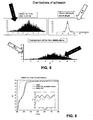
- Figures 6 to 8 show spectrophotometric measurements of films obtained from the same solution.
- figure 6 shows a comparison of the transmittance between a film of just PMMA (broken line), an untreated film of PMMA + TiO 2 5%wt (thin line), and a film of PMMA + TiO 2 5%wt obtained after exposure of the solution to 355nm of wavelength with pulsed laser (60ps) and energy density times irradiation time equal to 360mJs/cm 2 (thick line).
- the transmittance in the visible range is shown in the insert. All of the films of figure 6 have a thickness equal to 1.50 ⁇ 0,05 ⁇ m.
- Figure 7 shows a comparison of the total reflectance between the film of just PMMA (broken line), the untreated film of PMMA + TiO 2 5%wt (thin line), and the film of PMMA + TiO 2 5%wt obtained after exposure of the solution to 355nm of wavelength with pulsed laser (60ps) and energy density times irradiation time equal to 360mJs/cm 2 (thick line).
- the films are the same ones on which the measurements of figure 6 were carried out.
- Figure 8 shows a comparison of the diffused reflectance between the film of just PMMA (broken line), the untreated film of PMMA + TiO 2 5%wt (thin line), and the film of PMMA + TiO 2 5%wt obtained after exposure of the solution to 355nm of wavelength with pulsed laser (60ps) and energy density times irradiation time equal to 360mJs/cm 2 (thick line).
- the films are the same ones on which the measurements of figures 6 and 7 were carried out.
- the titanium dioxide nanoparticles were produced in the way indicated with reference to example 1.
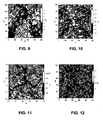
- Figures 9 to 12 show AFM measurements of films obtained from the same solution.
- Figure 9 shows an AFM topography of the surface of the film of PMMA + TiO 2 20%wt obtained from the solution without UV treatment after 5 minutes of agitation with Vortex and 2 minutes of sonication at 59kHz to best mix the two components.
- Figure 10 shows an AFM topography of the surface of the film of PMMA+TiO 2 20%wt obtained after exposure of the solution to 355nm of wavelength with pulsed laser (60ps) and energy density times irradiation time equal to 720mJs/cm 2 , agitated for 1 minute with Vortex and deposited in an analogous way to what was done for the film in figure 9 .
- Figures 11 and 12 show an AFM friction force measurement, respectively, of the film of figure 9 and of the film of figure 10 .
- the torsion of the cantilever with functionalized tip with end part OH induced by the friction forces during scanning allows a local measurement of the friction forces to be obtained.
- the measured roughness is much less for the films obtained from irradiated solutions, 0.771 nm instead of 1.680 nm of the films obtained from the untreated solution. Moreover, it is clear from the friction force measurements how in the case of films obtained from the treated solution ( figure 12 ) on the surface there are few nanoparticles with respect to the case of the films obtained from classical solutions, without UV treatment (surface entirely covered with nanoparticles).
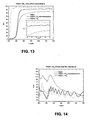
- Figures 13 to 15 show the spectra recorded in the UV-visible range of the films obtained from the same solution.
- Figure 13 shows a comparison of the transmittance between a film of just PMMA (broken line), an untreated film of PMMA + TiO 2 20%wt (thin line), a film of PMMA + TiO 2 20%wt obtained after exposure of the solution to 355nm of wavelength with pulsed laser (60ps) and energy density times irradiation time equal to 720mJs/cm 2 (thick line).
- the transmittance in the visible range is shown in the insert. All of the films of figure 13 have a thickness equal to 1.50 ⁇ 0.05 ⁇ m.
- Figure 14 shows a comparison of the total reflectance between the film of just PMMA (broken line), the untreated film of PMMA + TiO 2 20%wt (thin line), and the film of PMMA + TiO 2 20%wt obtained after exposure of the solution to 355nm of wavelength with pulsed laser (60ps) and energy density times irradiation time equal to 720mJs/cm 2 (thick line).
- the films are the same ones on which the measurements of figure 13 were carried out.
- Figure 15 shows a comparison of the diffused reflectance between the film of just PMMA (broken line), the untreated film of PMMA + TiO 2 20%wt (thin line), the film of PMMA + TiO 2 20%wt obtained after exposure of the solution to 355nm of wavelength with pulsed laser (60ps) and energy density times irradiation time equal to 720mJs/cm 2 (thick line).
- the films are the same ones on which the measurements of figures 13 and 14 were carried out.
- the graph of figure 16 shows the contact angle values with water (wettability index) for different films at different concentrations of titanium dioxide nanoparticles for different values of energy density times irradiation time.
- the graph of figure 17 identifies two regimes of energy density times irradiation time separated by a curve formed from the experimental data possessed. Below the curve there is a dispersion regime that can be adjusted as wished of the particles in the films, whereas for values above the curve there is a total dispersion regime. From the graph it is therefore clear that, for the same concentration of the particles in the solution, it is possible to adjust their dispersion according to requirements, and at the limit even obtain total dispersion, by simply setting the dose of radiation to administer to the solution.
- Figures 18 and 19 represent TEM images in bright field of thin slices of nanocomposite film, respectively not treated and treated with the technique according to the invention.
- the inserts of figures 18 and 19 show the images of the corresponding dried solutions.
- the method according to the invention therefore makes it possible to stabilize and homogenise a solution containing titanium dioxide nanoparticles and acrylate-based polymers with (optionally) total dispersion of the particles in the polymeric matrix, from which it is possible to obtain thin or thick films, keeping the properties of transparency of the polymer in the visible range and increasing its absorption in the ultraviolet range.
- the material thus produced has optical properties (refraction index, reflectance, absorption of ultraviolet rays) and physical properties (wettability, glass transition temperature Tg, hardness) that are adjustable as a function of the ratio between the concentrations in weight of nanoparticles and polymer.
- the advantage of the invention described above is the total absence of chemical modifications of the polymer and of the nanoparticles, factors that would have a negative impact on the production costs, and being able to have thick films whilst keeping the properties of transparency of the polymer intact.
- Films manufactured in this way can vary their properties such as wettability of the surface, both with the same weight ratio of the constituent materials (varying the UV exposure time, and thus the dose irradiated) and varying the weight ratio itself. It is also possible to vary their refraction index by varying the weight ratio of the components in the total dispersion condition, keeping the characteristic transparency of the polymer.
Landscapes
- Chemical & Material Sciences (AREA)
- Engineering & Computer Science (AREA)
- Organic Chemistry (AREA)
- Materials Engineering (AREA)
- Polymers & Plastics (AREA)
- Medicinal Chemistry (AREA)
- Chemical Kinetics & Catalysis (AREA)
- Health & Medical Sciences (AREA)
- Manufacturing & Machinery (AREA)
- Life Sciences & Earth Sciences (AREA)
- Wood Science & Technology (AREA)
- Nanotechnology (AREA)
- Inorganic Chemistry (AREA)
- Crystallography & Structural Chemistry (AREA)
- General Physics & Mathematics (AREA)
- Condensed Matter Physics & Semiconductors (AREA)
- Composite Materials (AREA)
- Physics & Mathematics (AREA)
- Inorganic Compounds Of Heavy Metals (AREA)
- Compositions Of Macromolecular Compounds (AREA)
Claims (10)
- Verfahren zur Herstellung einer Kolloidlösung von Titandioxidnanoteilchen in einer Lösung aus akrylischem Harz in organischem Lösungsmittel, umfassend
Mischen von Titandioxidnanoteilchen mit einer Lösung aus akrylischem Harz in organischem Lösungsmittel, um die Kolloidlösung zu erhalten;
dadurch gekennzeichnet, dass die Kolloidlösung einer Stabilisierungsbehandlung zum Verhindern oder Reduzieren von Nanoteilchenaggregation unterzogen wird, wobei diese Behandlung
Bestrahlen der Kolloidlösung mit einem gepulsten kohärenten Licht mit einer Wellenlänge, die im Wesentlichen in dem ultravioletten Absorptionsband der Titandioxidnanoteilchen umfasst ist, umfasst. - Verfahren nach Anspruch 1 , wobei die Nanoteilchen in dispergierter Form in einem organischen Lösungsmittel bereitgestellt werden.
- Verfahren nach Anspruch 1 oder 2, wobei das kohärente Licht ein Laserlicht ist.
- Verfahren nach einem der vorhergehenden Ansprüche, wobei die Wellenlänge gleich zu oder weniger als 355 nm ist.
- Verfahren nach einem der vorhergehenden Ansprüche, wobei das kohärente Licht mit Pulsen mit einer Pulsdauer von weniger als 1 ns eingestrahlt wird.
- Verfahren nach Anspruch 5, wobei das kohärente Licht mit Pulsen mit einer Pulsdauer von weniger als 100 ps eingestrahlt wird.
- Verfahren nach einem der vorhergehenden Ansprüche, wobei das akrylische Harz ausgewählt ist, aus der Gruppe, die aus Homopolymeren oder Copolymeren von Akryl- und/oder Methakryl-Säure, und Homopolymere oder Copolymere von Alkylestern der Akryl- und/oder Methakryl-Säure besteht, wobei das akrylische Harz so ausgewählt ist, dass es transparent für die Wellenlänge des eingestrahlten kohärenten Lichts ist.
- Verfahren nach einem der vorhergehenden Ansprüche, wobei das kohärente Licht in so einer Art und Weise auf die Kolloidlösung eingestrahlt wird, dass die Energiedichte mal Bestrahlungszeit, die durch die Kolloidlösung absorbiert wird, weniger als 5000 mJs/cm2 ist.
- Verfahren zur Herstellung eines akrylischen Harzfilms, der mit Titandioxidnanoteilchen dotiert ist, umfassend die Herstellung einer Kolloidlösung von Titandioxidnanoteilchen in einer Lösung aus akrylischem Harz in organischem Lösungsmittel,
dadurch gekennzeichnet, dass die Herstellung ein Verfahren nach einem der vorhergehenden Ansprüche umfasst. - Verfahren nach Anspruch 9, wobei die Gewichtskonzentration von Titandioxid in dem akrylischen Harz des Films weniger als 25% ist, insbesondere gleich zu oder weniger als 20%.
Applications Claiming Priority (2)
| Application Number | Priority Date | Filing Date | Title |
|---|---|---|---|
| ITTO2010A000240A IT1399684B1 (it) | 2010-03-29 | 2010-03-29 | Tecnica di stabilizzazione di soluzioni di nanoparticelle di diossido di titanio in polimeri acrilati tramite irradiamento uv con laser ad impulsi brevi |
| PCT/IB2011/051301 WO2011121519A1 (en) | 2010-03-29 | 2011-03-28 | A technique for stabilizing solutions of titanium dioxide nanoparticles in acrylate polymers by means of short-pulsed uv laser irradiation |
Publications (2)
| Publication Number | Publication Date |
|---|---|
| EP2553002A1 EP2553002A1 (de) | 2013-02-06 |
| EP2553002B1 true EP2553002B1 (de) | 2014-03-19 |
Family
ID=43012763
Family Applications (1)
| Application Number | Title | Priority Date | Filing Date |
|---|---|---|---|
| EP11731085.4A Not-in-force EP2553002B1 (de) | 2010-03-29 | 2011-03-28 | Verfahren zur stabilisierung von lösungen aus titandioxidnanopartikeln in acrylatpolymeren mittels kurz gepulster uv-laserbestrahlung |
Country Status (6)
| Country | Link |
|---|---|
| US (1) | US8877858B2 (de) |
| EP (1) | EP2553002B1 (de) |
| KR (1) | KR101824276B1 (de) |
| CN (1) | CN102884113B (de) |
| IT (1) | IT1399684B1 (de) |
| WO (1) | WO2011121519A1 (de) |
Families Citing this family (1)
| Publication number | Priority date | Publication date | Assignee | Title |
|---|---|---|---|---|
| US12534382B2 (en) * | 2018-04-20 | 2026-01-27 | École De Technologie Supérieure | Amorphous titanium dioxide precursor material, method of producing thereof and method of controlling crystalline phases thereof |
Family Cites Families (2)
| Publication number | Priority date | Publication date | Assignee | Title |
|---|---|---|---|---|
| US7226966B2 (en) | 2001-08-03 | 2007-06-05 | Nanogram Corporation | Structures incorporating polymer-inorganic particle blends |
| CN101507918A (zh) * | 2009-03-13 | 2009-08-19 | 云南师范大学 | 离子液体中微波合成纳米TiO2/PMMA复合光催化剂 |
-
2010
- 2010-03-29 IT ITTO2010A000240A patent/IT1399684B1/it active
-
2011
- 2011-03-28 WO PCT/IB2011/051301 patent/WO2011121519A1/en not_active Ceased
- 2011-03-28 EP EP11731085.4A patent/EP2553002B1/de not_active Not-in-force
- 2011-03-28 CN CN201180017053.9A patent/CN102884113B/zh not_active Expired - Fee Related
- 2011-03-28 US US13/636,990 patent/US8877858B2/en not_active Expired - Fee Related
- 2011-03-28 KR KR1020127028295A patent/KR101824276B1/ko not_active Expired - Fee Related
Also Published As
| Publication number | Publication date |
|---|---|
| US8877858B2 (en) | 2014-11-04 |
| KR101824276B1 (ko) | 2018-01-31 |
| EP2553002A1 (de) | 2013-02-06 |
| CN102884113B (zh) | 2014-03-12 |
| WO2011121519A1 (en) | 2011-10-06 |
| US20130012650A1 (en) | 2013-01-10 |
| ITTO20100240A1 (it) | 2011-09-30 |
| IT1399684B1 (it) | 2013-04-26 |
| KR20130077819A (ko) | 2013-07-09 |
| CN102884113A (zh) | 2013-01-16 |
Similar Documents
| Publication | Publication Date | Title |
|---|---|---|
| Chen et al. | Controllable fabrication of 2D colloidal-crystal films with polystyrene nanospheres of various diameters by spin-coating | |
| US20160075883A1 (en) | Methods of fabricating superhydrophobic, optically transparent surfaces | |
| Parlak et al. | Toward transparent nanocomposites based on polystyrene matrix and PMMA-grafted CeO2 nanoparticles | |
| Pavel et al. | Reverse micellar synthesis of a nanoparticle/polymer composite | |
| Fielding et al. | Visible Mie scattering from hollow silica particles with particulate shells | |
| Tamgadge et al. | Linear and nonlinear optical properties of nanostructured Zn (1− x) SrxO–PVA composite thin films | |
| Khan et al. | Synthesis at the nanoscale of ZnO into poly (methyl methacrylate) and its characterization | |
| Rahulan et al. | Synthesis and optical limiting effects in ZrO2 and ZrO2@ SiO2 core–shell nanostructures | |
| Li et al. | Rutile TiO2 inverse opal with photonic bandgap in the UV–visible range | |
| Edwards et al. | Capping Gold Nanoparticles with Stimuli-responsive Polymers to Cross Water− Oil Interfaces: In-Depth Insight to the Trans-Interfacial Activity of Nanoparticles | |
| Maharjan et al. | Sol-gel synthesis of stabilized silver nanoparticles in an organosiloxane matrix and its optical nonlinearity | |
| Bayat et al. | Structural, morphological, and optical analysis of TiO2 inverse opals prepared under different synthesis conditions | |
| Alziyadi et al. | Hematite Fe2O3 effects on the structural, morphological, and optical characteristics of PVP polymer for optoelectronic uses | |
| US8877858B2 (en) | Technique for stabilizing solutions of titanium dioxide nanoparticles in acrylate polymers by means of short-pulsed UV laser irradiation | |
| Zhu et al. | Photonic Janus films with highly tunable Janus balance | |
| Hirai et al. | RETRACTED: Size-controlled spherical polymer nanoparticles: Synthesis with tandem acoustic emulsification followed by soap-free emulsion polymerization and one-step fabrication of colloidal crystal films of various colors | |
| Cano et al. | Optical and conductive properties of as-synthesized organic-capped TiO2 nanorods highly dispersible in polystyrene-block-poly (methyl methacrylate) diblock copolymer | |
| Anna et al. | Coating zinc oxide submicron crystals on poly (methyl methacrylate) chips and spheres via ultrasound irradiation | |
| US9540235B2 (en) | Nanoparticle array comprising distributed nanoparticles | |
| Krishnan et al. | Synthesis and nonlinear optical studies of nano ZnO colloids | |
| Luo et al. | Nanoparticle layer via UV-induced directional migration of iron-doped titania nanoparticles in polyvinyl butyral films and superior UV-stability | |
| EP2350179A1 (de) | Verbundwerkstoffe mit biologisch synthetisierten nanomaterialien | |
| Gil et al. | High-speed fabrication of 3-dimensional colloidal photonic crystal films by slide coating of polymer microspheres with continuous feeding of colloidal suspension | |
| Banerjee et al. | A regular rippled pattern formed by the molecular self-organization of polyvinylpyrrolidone encapsulated Ag nanoparticles: A high transmissive coating for efficiency enhancement of c-Si solar cells | |
| Pignatelli et al. | Directional enhancement of refractive index and tunable wettability of polymeric coatings due to preferential dispersion of colloidal TiO2 nanorods towards their surface |
Legal Events
| Date | Code | Title | Description |
|---|---|---|---|
| PUAI | Public reference made under article 153(3) epc to a published international application that has entered the european phase |
Free format text: ORIGINAL CODE: 0009012 |
|
| 17P | Request for examination filed |
Effective date: 20121004 |
|
| AK | Designated contracting states |
Kind code of ref document: A1 Designated state(s): AL AT BE BG CH CY CZ DE DK EE ES FI FR GB GR HR HU IE IS IT LI LT LU LV MC MK MT NL NO PL PT RO RS SE SI SK SM TR |
|
| DAX | Request for extension of the european patent (deleted) | ||
| GRAP | Despatch of communication of intention to grant a patent |
Free format text: ORIGINAL CODE: EPIDOSNIGR1 |
|
| INTG | Intention to grant announced |
Effective date: 20131009 |
|
| GRAS | Grant fee paid |
Free format text: ORIGINAL CODE: EPIDOSNIGR3 |
|
| GRAA | (expected) grant |
Free format text: ORIGINAL CODE: 0009210 |
|
| AK | Designated contracting states |
Kind code of ref document: B1 Designated state(s): AL AT BE BG CH CY CZ DE DK EE ES FI FR GB GR HR HU IE IS IT LI LT LU LV MC MK MT NL NO PL PT RO RS SE SI SK SM TR |
|
| REG | Reference to a national code |
Ref country code: GB Ref legal event code: FG4D |
|
| REG | Reference to a national code |
Ref country code: CH Ref legal event code: EP |
|
| REG | Reference to a national code |
Ref country code: AT Ref legal event code: REF Ref document number: 657665 Country of ref document: AT Kind code of ref document: T Effective date: 20140415 |
|
| REG | Reference to a national code |
Ref country code: IE Ref legal event code: FG4D |
|
| REG | Reference to a national code |
Ref country code: DE Ref legal event code: R096 Ref document number: 602011005624 Country of ref document: DE Effective date: 20140508 |
|
| PG25 | Lapsed in a contracting state [announced via postgrant information from national office to epo] |
Ref country code: LT Free format text: LAPSE BECAUSE OF FAILURE TO SUBMIT A TRANSLATION OF THE DESCRIPTION OR TO PAY THE FEE WITHIN THE PRESCRIBED TIME-LIMIT Effective date: 20140319 Ref country code: NO Free format text: LAPSE BECAUSE OF FAILURE TO SUBMIT A TRANSLATION OF THE DESCRIPTION OR TO PAY THE FEE WITHIN THE PRESCRIBED TIME-LIMIT Effective date: 20140619 |
|
| REG | Reference to a national code |
Ref country code: NL Ref legal event code: VDEP Effective date: 20140319 |
|
| REG | Reference to a national code |
Ref country code: AT Ref legal event code: MK05 Ref document number: 657665 Country of ref document: AT Kind code of ref document: T Effective date: 20140319 |
|
| REG | Reference to a national code |
Ref country code: LT Ref legal event code: MG4D |
|
| PG25 | Lapsed in a contracting state [announced via postgrant information from national office to epo] |
Ref country code: SE Free format text: LAPSE BECAUSE OF FAILURE TO SUBMIT A TRANSLATION OF THE DESCRIPTION OR TO PAY THE FEE WITHIN THE PRESCRIBED TIME-LIMIT Effective date: 20140319 Ref country code: CY Free format text: LAPSE BECAUSE OF FAILURE TO SUBMIT A TRANSLATION OF THE DESCRIPTION OR TO PAY THE FEE WITHIN THE PRESCRIBED TIME-LIMIT Effective date: 20140319 Ref country code: FI Free format text: LAPSE BECAUSE OF FAILURE TO SUBMIT A TRANSLATION OF THE DESCRIPTION OR TO PAY THE FEE WITHIN THE PRESCRIBED TIME-LIMIT Effective date: 20140319 |
|
| PG25 | Lapsed in a contracting state [announced via postgrant information from national office to epo] |
Ref country code: RS Free format text: LAPSE BECAUSE OF FAILURE TO SUBMIT A TRANSLATION OF THE DESCRIPTION OR TO PAY THE FEE WITHIN THE PRESCRIBED TIME-LIMIT Effective date: 20140319 Ref country code: HR Free format text: LAPSE BECAUSE OF FAILURE TO SUBMIT A TRANSLATION OF THE DESCRIPTION OR TO PAY THE FEE WITHIN THE PRESCRIBED TIME-LIMIT Effective date: 20140319 Ref country code: LV Free format text: LAPSE BECAUSE OF FAILURE TO SUBMIT A TRANSLATION OF THE DESCRIPTION OR TO PAY THE FEE WITHIN THE PRESCRIBED TIME-LIMIT Effective date: 20140319 |
|
| PG25 | Lapsed in a contracting state [announced via postgrant information from national office to epo] |
Ref country code: RO Free format text: LAPSE BECAUSE OF FAILURE TO SUBMIT A TRANSLATION OF THE DESCRIPTION OR TO PAY THE FEE WITHIN THE PRESCRIBED TIME-LIMIT Effective date: 20140319 Ref country code: BG Free format text: LAPSE BECAUSE OF FAILURE TO SUBMIT A TRANSLATION OF THE DESCRIPTION OR TO PAY THE FEE WITHIN THE PRESCRIBED TIME-LIMIT Effective date: 20140619 Ref country code: NL Free format text: LAPSE BECAUSE OF FAILURE TO SUBMIT A TRANSLATION OF THE DESCRIPTION OR TO PAY THE FEE WITHIN THE PRESCRIBED TIME-LIMIT Effective date: 20140319 Ref country code: CZ Free format text: LAPSE BECAUSE OF FAILURE TO SUBMIT A TRANSLATION OF THE DESCRIPTION OR TO PAY THE FEE WITHIN THE PRESCRIBED TIME-LIMIT Effective date: 20140319 Ref country code: IS Free format text: LAPSE BECAUSE OF FAILURE TO SUBMIT A TRANSLATION OF THE DESCRIPTION OR TO PAY THE FEE WITHIN THE PRESCRIBED TIME-LIMIT Effective date: 20140719 Ref country code: BE Free format text: LAPSE BECAUSE OF FAILURE TO SUBMIT A TRANSLATION OF THE DESCRIPTION OR TO PAY THE FEE WITHIN THE PRESCRIBED TIME-LIMIT Effective date: 20140319 Ref country code: EE Free format text: LAPSE BECAUSE OF FAILURE TO SUBMIT A TRANSLATION OF THE DESCRIPTION OR TO PAY THE FEE WITHIN THE PRESCRIBED TIME-LIMIT Effective date: 20140319 |
|
| REG | Reference to a national code |
Ref country code: CH Ref legal event code: PL |
|
| PG25 | Lapsed in a contracting state [announced via postgrant information from national office to epo] |
Ref country code: AT Free format text: LAPSE BECAUSE OF FAILURE TO SUBMIT A TRANSLATION OF THE DESCRIPTION OR TO PAY THE FEE WITHIN THE PRESCRIBED TIME-LIMIT Effective date: 20140319 Ref country code: PL Free format text: LAPSE BECAUSE OF FAILURE TO SUBMIT A TRANSLATION OF THE DESCRIPTION OR TO PAY THE FEE WITHIN THE PRESCRIBED TIME-LIMIT Effective date: 20140319 Ref country code: ES Free format text: LAPSE BECAUSE OF FAILURE TO SUBMIT A TRANSLATION OF THE DESCRIPTION OR TO PAY THE FEE WITHIN THE PRESCRIBED TIME-LIMIT Effective date: 20140319 Ref country code: SK Free format text: LAPSE BECAUSE OF FAILURE TO SUBMIT A TRANSLATION OF THE DESCRIPTION OR TO PAY THE FEE WITHIN THE PRESCRIBED TIME-LIMIT Effective date: 20140319 |
|
| REG | Reference to a national code |
Ref country code: DE Ref legal event code: R097 Ref document number: 602011005624 Country of ref document: DE |
|
| PG25 | Lapsed in a contracting state [announced via postgrant information from national office to epo] |
Ref country code: PT Free format text: LAPSE BECAUSE OF FAILURE TO SUBMIT A TRANSLATION OF THE DESCRIPTION OR TO PAY THE FEE WITHIN THE PRESCRIBED TIME-LIMIT Effective date: 20140721 |
|
| REG | Reference to a national code |
Ref country code: IE Ref legal event code: MM4A |
|
| PLBE | No opposition filed within time limit |
Free format text: ORIGINAL CODE: 0009261 |
|
| STAA | Information on the status of an ep patent application or granted ep patent |
Free format text: STATUS: NO OPPOSITION FILED WITHIN TIME LIMIT |
|
| PG25 | Lapsed in a contracting state [announced via postgrant information from national office to epo] |
Ref country code: LI Free format text: LAPSE BECAUSE OF NON-PAYMENT OF DUE FEES Effective date: 20140331 Ref country code: IE Free format text: LAPSE BECAUSE OF NON-PAYMENT OF DUE FEES Effective date: 20140328 Ref country code: CH Free format text: LAPSE BECAUSE OF NON-PAYMENT OF DUE FEES Effective date: 20140331 Ref country code: MC Free format text: LAPSE BECAUSE OF FAILURE TO SUBMIT A TRANSLATION OF THE DESCRIPTION OR TO PAY THE FEE WITHIN THE PRESCRIBED TIME-LIMIT Effective date: 20140319 Ref country code: DK Free format text: LAPSE BECAUSE OF FAILURE TO SUBMIT A TRANSLATION OF THE DESCRIPTION OR TO PAY THE FEE WITHIN THE PRESCRIBED TIME-LIMIT Effective date: 20140319 |
|
| 26N | No opposition filed |
Effective date: 20141222 |
|
| REG | Reference to a national code |
Ref country code: DE Ref legal event code: R097 Ref document number: 602011005624 Country of ref document: DE Effective date: 20141222 |
|
| PG25 | Lapsed in a contracting state [announced via postgrant information from national office to epo] |
Ref country code: SI Free format text: LAPSE BECAUSE OF FAILURE TO SUBMIT A TRANSLATION OF THE DESCRIPTION OR TO PAY THE FEE WITHIN THE PRESCRIBED TIME-LIMIT Effective date: 20140319 |
|
| PG25 | Lapsed in a contracting state [announced via postgrant information from national office to epo] |
Ref country code: MT Free format text: LAPSE BECAUSE OF FAILURE TO SUBMIT A TRANSLATION OF THE DESCRIPTION OR TO PAY THE FEE WITHIN THE PRESCRIBED TIME-LIMIT Effective date: 20140319 |
|
| REG | Reference to a national code |
Ref country code: FR Ref legal event code: PLFP Year of fee payment: 6 |
|
| PG25 | Lapsed in a contracting state [announced via postgrant information from national office to epo] |
Ref country code: SM Free format text: LAPSE BECAUSE OF FAILURE TO SUBMIT A TRANSLATION OF THE DESCRIPTION OR TO PAY THE FEE WITHIN THE PRESCRIBED TIME-LIMIT Effective date: 20140319 |
|
| PG25 | Lapsed in a contracting state [announced via postgrant information from national office to epo] |
Ref country code: GR Free format text: LAPSE BECAUSE OF FAILURE TO SUBMIT A TRANSLATION OF THE DESCRIPTION OR TO PAY THE FEE WITHIN THE PRESCRIBED TIME-LIMIT Effective date: 20140620 |
|
| PG25 | Lapsed in a contracting state [announced via postgrant information from national office to epo] |
Ref country code: LU Free format text: LAPSE BECAUSE OF NON-PAYMENT OF DUE FEES Effective date: 20140328 Ref country code: TR Free format text: LAPSE BECAUSE OF FAILURE TO SUBMIT A TRANSLATION OF THE DESCRIPTION OR TO PAY THE FEE WITHIN THE PRESCRIBED TIME-LIMIT Effective date: 20140319 Ref country code: HU Free format text: LAPSE BECAUSE OF FAILURE TO SUBMIT A TRANSLATION OF THE DESCRIPTION OR TO PAY THE FEE WITHIN THE PRESCRIBED TIME-LIMIT; INVALID AB INITIO Effective date: 20110328 |
|
| REG | Reference to a national code |
Ref country code: FR Ref legal event code: PLFP Year of fee payment: 7 |
|
| REG | Reference to a national code |
Ref country code: FR Ref legal event code: PLFP Year of fee payment: 8 |
|
| PG25 | Lapsed in a contracting state [announced via postgrant information from national office to epo] |
Ref country code: MK Free format text: LAPSE BECAUSE OF FAILURE TO SUBMIT A TRANSLATION OF THE DESCRIPTION OR TO PAY THE FEE WITHIN THE PRESCRIBED TIME-LIMIT Effective date: 20140319 |
|
| PG25 | Lapsed in a contracting state [announced via postgrant information from national office to epo] |
Ref country code: AL Free format text: LAPSE BECAUSE OF FAILURE TO SUBMIT A TRANSLATION OF THE DESCRIPTION OR TO PAY THE FEE WITHIN THE PRESCRIBED TIME-LIMIT Effective date: 20140319 |
|
| PGFP | Annual fee paid to national office [announced via postgrant information from national office to epo] |
Ref country code: GB Payment date: 20200323 Year of fee payment: 10 |
|
| PGFP | Annual fee paid to national office [announced via postgrant information from national office to epo] |
Ref country code: DE Payment date: 20200330 Year of fee payment: 10 Ref country code: FR Payment date: 20200331 Year of fee payment: 10 |
|
| REG | Reference to a national code |
Ref country code: DE Ref legal event code: R119 Ref document number: 602011005624 Country of ref document: DE |
|
| GBPC | Gb: european patent ceased through non-payment of renewal fee |
Effective date: 20210328 |
|
| PG25 | Lapsed in a contracting state [announced via postgrant information from national office to epo] |
Ref country code: GB Free format text: LAPSE BECAUSE OF NON-PAYMENT OF DUE FEES Effective date: 20210328 Ref country code: FR Free format text: LAPSE BECAUSE OF NON-PAYMENT OF DUE FEES Effective date: 20210331 Ref country code: DE Free format text: LAPSE BECAUSE OF NON-PAYMENT OF DUE FEES Effective date: 20211001 |
|
| PGFP | Annual fee paid to national office [announced via postgrant information from national office to epo] |
Ref country code: IT Payment date: 20220304 Year of fee payment: 12 |
|
| PG25 | Lapsed in a contracting state [announced via postgrant information from national office to epo] |
Ref country code: IT Free format text: LAPSE BECAUSE OF NON-PAYMENT OF DUE FEES Effective date: 20230328 |