EP2548961A1 - Method for determination of progression risk of glaucoma - Google Patents
Method for determination of progression risk of glaucoma Download PDFInfo
- Publication number
- EP2548961A1 EP2548961A1 EP12174516A EP12174516A EP2548961A1 EP 2548961 A1 EP2548961 A1 EP 2548961A1 EP 12174516 A EP12174516 A EP 12174516A EP 12174516 A EP12174516 A EP 12174516A EP 2548961 A1 EP2548961 A1 EP 2548961A1
- Authority
- EP
- European Patent Office
- Prior art keywords
- seq
- allele
- glaucoma
- risk
- single nucleotide
- Prior art date
- Legal status (The legal status is an assumption and is not a legal conclusion. Google has not performed a legal analysis and makes no representation as to the accuracy of the status listed.)
- Withdrawn
Links
- 208000010412 Glaucoma Diseases 0.000 title claims abstract description 645
- 238000000034 method Methods 0.000 title claims abstract description 245
- 108700028369 Alleles Proteins 0.000 claims abstract description 803
- 239000002773 nucleotide Substances 0.000 claims abstract description 650
- 125000003729 nucleotide group Chemical group 0.000 claims abstract description 649
- 230000000750 progressive effect Effects 0.000 claims abstract description 240
- 230000000295 complement effect Effects 0.000 claims abstract description 141
- 238000000338 in vitro Methods 0.000 claims abstract description 17
- 239000000523 sample Substances 0.000 claims description 323
- 102000039446 nucleic acids Human genes 0.000 claims description 202
- 108020004707 nucleic acids Proteins 0.000 claims description 202
- 150000007523 nucleic acids Chemical class 0.000 claims description 202
- 102000054765 polymorphisms of proteins Human genes 0.000 claims description 194
- 230000002068 genetic effect Effects 0.000 claims description 82
- 230000036961 partial effect Effects 0.000 claims description 32
- 206010030348 Open-Angle Glaucoma Diseases 0.000 claims description 22
- 206010067013 Normal tension glaucoma Diseases 0.000 claims description 15
- 201000002978 low tension glaucoma Diseases 0.000 claims description 15
- 201000006366 primary open angle glaucoma Diseases 0.000 claims description 14
- 238000011282 treatment Methods 0.000 abstract description 13
- 230000003449 preventive effect Effects 0.000 abstract description 3
- 239000002585 base Substances 0.000 description 490
- 238000001514 detection method Methods 0.000 description 142
- 108090000623 proteins and genes Proteins 0.000 description 89
- 210000000349 chromosome Anatomy 0.000 description 64
- 238000004458 analytical method Methods 0.000 description 58
- 108020004414 DNA Proteins 0.000 description 46
- 102100024155 Cadherin-11 Human genes 0.000 description 37
- 101000762236 Homo sapiens Cadherin-11 Proteins 0.000 description 37
- 201000010099 disease Diseases 0.000 description 35
- 208000037265 diseases, disorders, signs and symptoms Diseases 0.000 description 35
- 101000835023 Homo sapiens Transcription factor A, mitochondrial Proteins 0.000 description 25
- 102100026155 Transcription factor A, mitochondrial Human genes 0.000 description 25
- 238000012937 correction Methods 0.000 description 23
- 239000000126 substance Substances 0.000 description 23
- 238000000546 chi-square test Methods 0.000 description 19
- 102000005031 SLC6A15 Human genes 0.000 description 17
- 108060007754 SLC6A15 Proteins 0.000 description 17
- 238000002493 microarray Methods 0.000 description 17
- 102100021473 Electrogenic sodium bicarbonate cotransporter 4 Human genes 0.000 description 15
- 108091006261 SLC4A5 Proteins 0.000 description 15
- 238000006243 chemical reaction Methods 0.000 description 15
- 230000004410 intraocular pressure Effects 0.000 description 15
- 238000012360 testing method Methods 0.000 description 15
- 101000639146 Homo sapiens Vesicle-associated membrane protein 4 Proteins 0.000 description 14
- 102100031489 Vesicle-associated membrane protein 4 Human genes 0.000 description 14
- 239000011324 bead Substances 0.000 description 14
- 238000009396 hybridization Methods 0.000 description 14
- 238000007477 logistic regression Methods 0.000 description 14
- 101000644661 Homo sapiens Ubiquitin-conjugating enzyme E2 E3 Proteins 0.000 description 13
- 108091081021 Sense strand Proteins 0.000 description 13
- 102100020709 Ubiquitin-conjugating enzyme E2 E3 Human genes 0.000 description 13
- 238000010197 meta-analysis Methods 0.000 description 12
- 239000000047 product Substances 0.000 description 12
- 101000665449 Homo sapiens RNA binding protein fox-1 homolog 1 Proteins 0.000 description 11
- 102100038188 RNA binding protein fox-1 homolog 1 Human genes 0.000 description 11
- 239000008280 blood Substances 0.000 description 11
- YBJHBAHKTGYVGT-ZKWXMUAHSA-N (+)-Biotin Chemical compound N1C(=O)N[C@@H]2[C@H](CCCCC(=O)O)SC[C@@H]21 YBJHBAHKTGYVGT-ZKWXMUAHSA-N 0.000 description 10
- 102100022442 Calmin Human genes 0.000 description 10
- 101000901707 Homo sapiens Calmin Proteins 0.000 description 10
- 108010036639 WW Domain-Containing Oxidoreductase Proteins 0.000 description 10
- 102100027534 WW domain-containing oxidoreductase Human genes 0.000 description 10
- 210000004369 blood Anatomy 0.000 description 10
- 229940126585 therapeutic drug Drugs 0.000 description 10
- 108010009392 Cyclin-Dependent Kinase Inhibitor p16 Proteins 0.000 description 9
- 208000009989 Posterior Leukoencephalopathy Syndrome Diseases 0.000 description 9
- 102100033254 Tumor suppressor ARF Human genes 0.000 description 9
- 230000000692 anti-sense effect Effects 0.000 description 9
- 239000000203 mixture Substances 0.000 description 9
- 238000011144 upstream manufacturing Methods 0.000 description 9
- 102100031655 Cytochrome b5 Human genes 0.000 description 8
- 101000922386 Homo sapiens Cytochrome b5 Proteins 0.000 description 8
- 239000003550 marker Substances 0.000 description 8
- 230000035772 mutation Effects 0.000 description 8
- 108091008146 restriction endonucleases Proteins 0.000 description 8
- 238000012163 sequencing technique Methods 0.000 description 8
- 102100021633 Cathepsin B Human genes 0.000 description 7
- 102000053602 DNA Human genes 0.000 description 7
- 102100030073 Doublesex- and mab-3-related transcription factor 2 Human genes 0.000 description 7
- 102100022767 Glutamate receptor ionotropic, kainate 3 Human genes 0.000 description 7
- 101000898449 Homo sapiens Cathepsin B Proteins 0.000 description 7
- 101000864823 Homo sapiens Doublesex- and mab-3-related transcription factor 2 Proteins 0.000 description 7
- 101000903337 Homo sapiens Glutamate receptor ionotropic, kainate 3 Proteins 0.000 description 7
- 101000743863 Homo sapiens ZW10 interactor Proteins 0.000 description 7
- 102100039102 ZW10 interactor Human genes 0.000 description 7
- 230000001419 dependent effect Effects 0.000 description 7
- 239000012634 fragment Substances 0.000 description 7
- 230000000007 visual effect Effects 0.000 description 7
- 102100027769 2'-5'-oligoadenylate synthase 1 Human genes 0.000 description 6
- 102100024167 C-C chemokine receptor type 3 Human genes 0.000 description 6
- 101710149862 C-C chemokine receptor type 3 Proteins 0.000 description 6
- 102100021579 Enhancer of filamentation 1 Human genes 0.000 description 6
- 102000004190 Enzymes Human genes 0.000 description 6
- 108090000790 Enzymes Proteins 0.000 description 6
- 102100022758 Glutamate receptor ionotropic, kainate 2 Human genes 0.000 description 6
- 101001008907 Homo sapiens 2'-5'-oligoadenylate synthase 1 Proteins 0.000 description 6
- 101000898310 Homo sapiens Enhancer of filamentation 1 Proteins 0.000 description 6
- 101000903346 Homo sapiens Glutamate receptor ionotropic, kainate 2 Proteins 0.000 description 6
- 101000903313 Homo sapiens Glutamate receptor ionotropic, kainate 5 Proteins 0.000 description 6
- 101000945500 Homo sapiens Kin of IRRE-like protein 3 Proteins 0.000 description 6
- 101000993455 Homo sapiens Metal transporter CNNM2 Proteins 0.000 description 6
- 101001000631 Homo sapiens Peripheral myelin protein 22 Proteins 0.000 description 6
- 101001082860 Homo sapiens Peroxisomal membrane protein 2 Proteins 0.000 description 6
- 101001132698 Homo sapiens Retinoic acid receptor beta Proteins 0.000 description 6
- 102100034831 Kin of IRRE-like protein 3 Human genes 0.000 description 6
- 102100031677 Metal transporter CNNM2 Human genes 0.000 description 6
- 108091028043 Nucleic acid sequence Proteins 0.000 description 6
- 102100030564 Peroxisomal membrane protein 2 Human genes 0.000 description 6
- 102100023204 Potassium channel subfamily K member 2 Human genes 0.000 description 6
- 102100030624 Proton myo-inositol cotransporter Human genes 0.000 description 6
- 102100033909 Retinoic acid receptor beta Human genes 0.000 description 6
- 108091006309 SLC2A13 Proteins 0.000 description 6
- ISAKRJDGNUQOIC-UHFFFAOYSA-N Uracil Chemical compound O=C1C=CNC(=O)N1 ISAKRJDGNUQOIC-UHFFFAOYSA-N 0.000 description 6
- 238000003556 assay Methods 0.000 description 6
- 239000003153 chemical reaction reagent Substances 0.000 description 6
- 108010083945 potassium channel protein TREK-1 Proteins 0.000 description 6
- 229920002477 rna polymer Polymers 0.000 description 6
- RWQNBRDOKXIBIV-UHFFFAOYSA-N thymine Chemical compound CC1=CNC(=O)NC1=O RWQNBRDOKXIBIV-UHFFFAOYSA-N 0.000 description 6
- 102100038220 Chromodomain-helicase-DNA-binding protein 6 Human genes 0.000 description 5
- 102100032218 Cytokine-inducible SH2-containing protein Human genes 0.000 description 5
- 101100457345 Danio rerio mapk14a gene Proteins 0.000 description 5
- 101100457347 Danio rerio mapk14b gene Proteins 0.000 description 5
- 101000883736 Homo sapiens Chromodomain-helicase-DNA-binding protein 6 Proteins 0.000 description 5
- 101000943420 Homo sapiens Cytokine-inducible SH2-containing protein Proteins 0.000 description 5
- 101000992396 Homo sapiens Oxysterol-binding protein-related protein 3 Proteins 0.000 description 5
- 101000606537 Homo sapiens Receptor-type tyrosine-protein phosphatase delta Proteins 0.000 description 5
- 101000584382 Homo sapiens Synaptic vesicle glycoprotein 2C Proteins 0.000 description 5
- 108700012928 MAPK14 Proteins 0.000 description 5
- 101150003941 Mapk14 gene Proteins 0.000 description 5
- 102000054819 Mitogen-activated protein kinase 14 Human genes 0.000 description 5
- 108091034117 Oligonucleotide Proteins 0.000 description 5
- 102100032154 Oxysterol-binding protein-related protein 3 Human genes 0.000 description 5
- 102100039666 Receptor-type tyrosine-protein phosphatase delta Human genes 0.000 description 5
- 108010090804 Streptavidin Proteins 0.000 description 5
- 102100030637 Synaptic vesicle glycoprotein 2C Human genes 0.000 description 5
- 229960002685 biotin Drugs 0.000 description 5
- 235000020958 biotin Nutrition 0.000 description 5
- 239000011616 biotin Substances 0.000 description 5
- 230000008859 change Effects 0.000 description 5
- 238000002474 experimental method Methods 0.000 description 5
- 238000000605 extraction Methods 0.000 description 5
- 230000006872 improvement Effects 0.000 description 5
- 239000000243 solution Substances 0.000 description 5
- 102100035389 2'-5'-oligoadenylate synthase 3 Human genes 0.000 description 4
- 102100040077 A-kinase anchor protein 6 Human genes 0.000 description 4
- 102100033328 Ankyrin repeat domain-containing protein 42 Human genes 0.000 description 4
- 102100031608 Centlein Human genes 0.000 description 4
- 108020004705 Codon Proteins 0.000 description 4
- 108020004635 Complementary DNA Proteins 0.000 description 4
- 102100027309 Cyclic AMP-responsive element-binding protein 5 Human genes 0.000 description 4
- 102100023359 Forkhead box protein N3 Human genes 0.000 description 4
- 102100021700 Glycoprotein-N-acetylgalactosamine 3-beta-galactosyltransferase 1 Human genes 0.000 description 4
- 102100039622 Granulocyte colony-stimulating factor receptor Human genes 0.000 description 4
- 101000597332 Homo sapiens 2'-5'-oligoadenylate synthase 3 Proteins 0.000 description 4
- 101000890611 Homo sapiens A-kinase anchor protein 6 Proteins 0.000 description 4
- 101000732369 Homo sapiens Ankyrin repeat domain-containing protein 42 Proteins 0.000 description 4
- 101000993339 Homo sapiens Centlein Proteins 0.000 description 4
- 101000726193 Homo sapiens Cyclic AMP-responsive element-binding protein 5 Proteins 0.000 description 4
- 101000907594 Homo sapiens Forkhead box protein N3 Proteins 0.000 description 4
- 101000746364 Homo sapiens Granulocyte colony-stimulating factor receptor Proteins 0.000 description 4
- 101001123300 Homo sapiens PR domain zinc finger protein 13 Proteins 0.000 description 4
- 101000609957 Homo sapiens PTB-containing, cubilin and LRP1-interacting protein Proteins 0.000 description 4
- 101000702718 Homo sapiens Phosphatidylcholine:ceramide cholinephosphotransferase 1 Proteins 0.000 description 4
- 101000888117 Homo sapiens Polypeptide N-acetylgalactosaminyltransferase 18 Proteins 0.000 description 4
- 101001098982 Homo sapiens Propionyl-CoA carboxylase beta chain, mitochondrial Proteins 0.000 description 4
- 101000617805 Homo sapiens Staphylococcal nuclease domain-containing protein 1 Proteins 0.000 description 4
- 101000802350 Homo sapiens Zinc finger SWIM domain-containing protein 6 Proteins 0.000 description 4
- 108010006746 KCNQ2 Potassium Channel Proteins 0.000 description 4
- 102100028973 PR domain zinc finger protein 13 Human genes 0.000 description 4
- 102100039157 PTB-containing, cubilin and LRP1-interacting protein Human genes 0.000 description 4
- 102100030919 Phosphatidylcholine:ceramide cholinephosphotransferase 1 Human genes 0.000 description 4
- 102100039225 Polypeptide N-acetylgalactosaminyltransferase 18 Human genes 0.000 description 4
- 102100034354 Potassium voltage-gated channel subfamily KQT member 2 Human genes 0.000 description 4
- 102100039025 Propionyl-CoA carboxylase beta chain, mitochondrial Human genes 0.000 description 4
- FAPWRFPIFSIZLT-UHFFFAOYSA-M Sodium chloride Chemical compound [Na+].[Cl-] FAPWRFPIFSIZLT-UHFFFAOYSA-M 0.000 description 4
- 102100021996 Staphylococcal nuclease domain-containing protein 1 Human genes 0.000 description 4
- 102100034685 Zinc finger SWIM domain-containing protein 6 Human genes 0.000 description 4
- 101150000895 c1galt1 gene Proteins 0.000 description 4
- 238000010804 cDNA synthesis Methods 0.000 description 4
- 238000004364 calculation method Methods 0.000 description 4
- 239000002299 complementary DNA Substances 0.000 description 4
- 239000007850 fluorescent dye Substances 0.000 description 4
- 230000014509 gene expression Effects 0.000 description 4
- GPRLSGONYQIRFK-UHFFFAOYSA-N hydron Chemical compound [H+] GPRLSGONYQIRFK-UHFFFAOYSA-N 0.000 description 4
- 230000003100 immobilizing effect Effects 0.000 description 4
- 238000002372 labelling Methods 0.000 description 4
- 102100024220 CD180 antigen Human genes 0.000 description 3
- 102100023073 Calcium-activated potassium channel subunit alpha-1 Human genes 0.000 description 3
- 102100035244 Cerebellin-1 Human genes 0.000 description 3
- 102100038164 Chromodomain-helicase-DNA-binding protein 9 Human genes 0.000 description 3
- 108010005939 Ciliary Neurotrophic Factor Proteins 0.000 description 3
- 102100031614 Ciliary neurotrophic factor Human genes 0.000 description 3
- 102100040495 Contactin-associated protein-like 5 Human genes 0.000 description 3
- 108010043471 Core Binding Factor Alpha 2 Subunit Proteins 0.000 description 3
- 108050006400 Cyclin Proteins 0.000 description 3
- 102100023387 Endoribonuclease Dicer Human genes 0.000 description 3
- 102100022360 GATOR complex protein NPRL2 Human genes 0.000 description 3
- 102100032844 Gamma-1-syntrophin Human genes 0.000 description 3
- 101000980829 Homo sapiens CD180 antigen Proteins 0.000 description 3
- 101001049859 Homo sapiens Calcium-activated potassium channel subunit alpha-1 Proteins 0.000 description 3
- 101000737277 Homo sapiens Cerebellin-1 Proteins 0.000 description 3
- 101000883548 Homo sapiens Chromodomain-helicase-DNA-binding protein 9 Proteins 0.000 description 3
- 101000749883 Homo sapiens Contactin-associated protein-like 5 Proteins 0.000 description 3
- 101000907904 Homo sapiens Endoribonuclease Dicer Proteins 0.000 description 3
- 101000868448 Homo sapiens Gamma-1-syntrophin Proteins 0.000 description 3
- 101000962526 Homo sapiens Hyaluronidase-2 Proteins 0.000 description 3
- 101001041128 Homo sapiens Hyaluronidase-3 Proteins 0.000 description 3
- 101001090713 Homo sapiens L-lactate dehydrogenase A chain Proteins 0.000 description 3
- 101001004871 Homo sapiens Leucine-rich repeat-containing protein 28 Proteins 0.000 description 3
- 101000984681 Homo sapiens Leucine-rich single-pass membrane protein 2 Proteins 0.000 description 3
- 101000958781 Homo sapiens N-alpha-acetyltransferase 80 Proteins 0.000 description 3
- 101100026704 Homo sapiens NPRL2 gene Proteins 0.000 description 3
- 101000640295 Homo sapiens Nesprin-4 Proteins 0.000 description 3
- 101000979498 Homo sapiens Ninein-like protein Proteins 0.000 description 3
- 101000871508 Homo sapiens PTB domain-containing engulfment adapter protein 1 Proteins 0.000 description 3
- 101000905839 Homo sapiens Phospholipid-transporting ATPase VA Proteins 0.000 description 3
- 101000974745 Homo sapiens Potassium channel subfamily K member 10 Proteins 0.000 description 3
- 101000997292 Homo sapiens Potassium voltage-gated channel subfamily B member 1 Proteins 0.000 description 3
- 101001072081 Homo sapiens Proprotein convertase subtilisin/kexin type 5 Proteins 0.000 description 3
- 101000712958 Homo sapiens Ras association domain-containing protein 1 Proteins 0.000 description 3
- 101000707156 Homo sapiens SH2 domain-containing protein 4B Proteins 0.000 description 3
- 101000632270 Homo sapiens Semaphorin-3B Proteins 0.000 description 3
- 101000650806 Homo sapiens Semaphorin-3F Proteins 0.000 description 3
- 101000614400 Homo sapiens Serine/threonine-protein phosphatase 2A regulatory subunit B'' subunit alpha Proteins 0.000 description 3
- 101001094647 Homo sapiens Serum paraoxonase/arylesterase 1 Proteins 0.000 description 3
- 101001026232 Homo sapiens Small conductance calcium-activated potassium channel protein 3 Proteins 0.000 description 3
- 101000738335 Homo sapiens T-cell surface glycoprotein CD3 zeta chain Proteins 0.000 description 3
- 101000714243 Homo sapiens Transcription factor IIIB 90 kDa subunit Proteins 0.000 description 3
- 101000598045 Homo sapiens Transmembrane protein 115 Proteins 0.000 description 3
- 101000659267 Homo sapiens Tumor suppressor candidate 2 Proteins 0.000 description 3
- 101000740759 Homo sapiens Voltage-dependent calcium channel subunit alpha-2/delta-2 Proteins 0.000 description 3
- 101000666068 Homo sapiens WD repeat-containing protein 75 Proteins 0.000 description 3
- 101000649171 Homo sapiens XK-related protein 6 Proteins 0.000 description 3
- 101000915479 Homo sapiens Zinc finger MYND domain-containing protein 10 Proteins 0.000 description 3
- 101000802094 Homo sapiens mRNA decay activator protein ZFP36L1 Proteins 0.000 description 3
- 102100039285 Hyaluronidase-2 Human genes 0.000 description 3
- 102100021082 Hyaluronidase-3 Human genes 0.000 description 3
- 102100034671 L-lactate dehydrogenase A chain Human genes 0.000 description 3
- 102100025949 Leucine-rich repeat-containing protein 28 Human genes 0.000 description 3
- 102100027112 Leucine-rich single-pass membrane protein 2 Human genes 0.000 description 3
- 102100038294 Metabotropic glutamate receptor 7 Human genes 0.000 description 3
- 102100038333 N-alpha-acetyltransferase 80 Human genes 0.000 description 3
- 102100033921 Nesprin-4 Human genes 0.000 description 3
- 102100023120 Ninein-like protein Human genes 0.000 description 3
- 102100040558 Osteoclast-stimulating factor 1 Human genes 0.000 description 3
- 102100033719 PTB domain-containing engulfment adapter protein 1 Human genes 0.000 description 3
- 108091093037 Peptide nucleic acid Proteins 0.000 description 3
- 102100023496 Phospholipid-transporting ATPase VA Human genes 0.000 description 3
- 102100022798 Potassium channel subfamily K member 10 Human genes 0.000 description 3
- 102100034310 Potassium voltage-gated channel subfamily B member 1 Human genes 0.000 description 3
- 102100036691 Proliferating cell nuclear antigen Human genes 0.000 description 3
- 102100036365 Proprotein convertase subtilisin/kexin type 5 Human genes 0.000 description 3
- 102100033243 Ras association domain-containing protein 1 Human genes 0.000 description 3
- 102100025373 Runt-related transcription factor 1 Human genes 0.000 description 3
- 102100031769 SH2 domain-containing protein 4B Human genes 0.000 description 3
- 108091006923 SLC38A3 Proteins 0.000 description 3
- 102100027979 Semaphorin-3B Human genes 0.000 description 3
- 102100027751 Semaphorin-3F Human genes 0.000 description 3
- 102100040446 Serine/threonine-protein phosphatase 2A regulatory subunit B'' subunit alpha Human genes 0.000 description 3
- 102100035476 Serum paraoxonase/arylesterase 1 Human genes 0.000 description 3
- 108020004682 Single-Stranded DNA Proteins 0.000 description 3
- 102100037442 Small conductance calcium-activated potassium channel protein 3 Human genes 0.000 description 3
- HEMHJVSKTPXQMS-UHFFFAOYSA-M Sodium hydroxide Chemical compound [OH-].[Na+] HEMHJVSKTPXQMS-UHFFFAOYSA-M 0.000 description 3
- 102100033769 Sodium-coupled neutral amino acid transporter 3 Human genes 0.000 description 3
- 102100037906 T-cell surface glycoprotein CD3 zeta chain Human genes 0.000 description 3
- 102100036535 Transcription factor IIIB 90 kDa subunit Human genes 0.000 description 3
- 102100036987 Transmembrane protein 115 Human genes 0.000 description 3
- 102100036129 Tumor suppressor candidate 2 Human genes 0.000 description 3
- 102100037058 Voltage-dependent calcium channel subunit alpha-2/delta-2 Human genes 0.000 description 3
- 102100038093 WD repeat-containing protein 75 Human genes 0.000 description 3
- 102100027970 XK-related protein 6 Human genes 0.000 description 3
- 102100028534 Zinc finger MYND domain-containing protein 10 Human genes 0.000 description 3
- 150000001413 amino acids Chemical class 0.000 description 3
- 239000002981 blocking agent Substances 0.000 description 3
- 210000004027 cell Anatomy 0.000 description 3
- 230000006735 deficit Effects 0.000 description 3
- 238000003745 diagnosis Methods 0.000 description 3
- 238000009826 distribution Methods 0.000 description 3
- 238000003205 genotyping method Methods 0.000 description 3
- 210000004209 hair Anatomy 0.000 description 3
- 238000004949 mass spectrometry Methods 0.000 description 3
- 108020004999 messenger RNA Proteins 0.000 description 3
- 108010038449 metabotropic glutamate receptor 7 Proteins 0.000 description 3
- 239000011259 mixed solution Substances 0.000 description 3
- 108010027635 osteoclast stimulating factor Proteins 0.000 description 3
- 229920000642 polymer Polymers 0.000 description 3
- 102000004169 proteins and genes Human genes 0.000 description 3
- 239000007787 solid Substances 0.000 description 3
- 125000006850 spacer group Chemical group 0.000 description 3
- 241000894007 species Species 0.000 description 3
- 238000007619 statistical method Methods 0.000 description 3
- 229940113082 thymine Drugs 0.000 description 3
- 229940035893 uracil Drugs 0.000 description 3
- 230000004393 visual impairment Effects 0.000 description 3
- 102100030390 1-phosphatidylinositol 4,5-bisphosphate phosphodiesterase beta-1 Human genes 0.000 description 2
- 102100023779 40S ribosomal protein S5 Human genes 0.000 description 2
- 102100032296 A disintegrin and metalloproteinase with thrombospondin motifs 12 Human genes 0.000 description 2
- 108091005671 ADAMTS12 Proteins 0.000 description 2
- 108010075348 Activated-Leukocyte Cell Adhesion Molecule Proteins 0.000 description 2
- 102100025976 Adenosine deaminase 2 Human genes 0.000 description 2
- 102100040149 Adenylyl-sulfate kinase Human genes 0.000 description 2
- 102100036792 Adhesion G protein-coupled receptor L4 Human genes 0.000 description 2
- 201000002862 Angle-Closure Glaucoma Diseases 0.000 description 2
- 102100023054 Band 4.1-like protein 4A Human genes 0.000 description 2
- 102100028243 Breast carcinoma-amplified sequence 1 Human genes 0.000 description 2
- 102100031023 CCR4-NOT transcription complex subunit 11 Human genes 0.000 description 2
- 102100024210 CD166 antigen Human genes 0.000 description 2
- 102100027098 CMP-N-acetylneuraminate-beta-galactosamide-alpha-2,3-sialyltransferase 1 Human genes 0.000 description 2
- 102100022480 Cadherin-20 Human genes 0.000 description 2
- 102100023243 Calcium-activated potassium channel subunit beta-3 Human genes 0.000 description 2
- 102100029184 Calmodulin regulator protein PCP4 Human genes 0.000 description 2
- 102100028797 Calsyntenin-2 Human genes 0.000 description 2
- 102100036568 Cell cycle and apoptosis regulator protein 2 Human genes 0.000 description 2
- 102100026772 Cell cycle control protein 50A Human genes 0.000 description 2
- 102100034229 Citramalyl-CoA lyase, mitochondrial Human genes 0.000 description 2
- 102100032371 Coiled-coil domain-containing protein 90B, mitochondrial Human genes 0.000 description 2
- 102100027995 Collagenase 3 Human genes 0.000 description 2
- 102100024343 Contactin-5 Human genes 0.000 description 2
- 102100028712 Cytosolic purine 5'-nucleotidase Human genes 0.000 description 2
- 238000007400 DNA extraction Methods 0.000 description 2
- 102100033072 DNA replication ATP-dependent helicase DNA2 Human genes 0.000 description 2
- 102100031604 Dedicator of cytokinesis protein 3 Human genes 0.000 description 2
- 102100024117 Disks large homolog 2 Human genes 0.000 description 2
- 102100034115 DnaJ homolog subfamily C member 15 Human genes 0.000 description 2
- 102100023228 Dynein axonemal intermediate chain 4 Human genes 0.000 description 2
- 102100036437 Ectonucleoside triphosphate diphosphohydrolase 6 Human genes 0.000 description 2
- 102100030880 Enoyl-CoA hydratase domain-containing protein 3, mitochondrial Human genes 0.000 description 2
- 241000206602 Eukaryota Species 0.000 description 2
- 102100029877 F-actin-uncapping protein LRRC16A Human genes 0.000 description 2
- 102100031812 Fibulin-1 Human genes 0.000 description 2
- 206010071602 Genetic polymorphism Diseases 0.000 description 2
- 102100039261 Guanine nucleotide-binding protein G(t) subunit alpha-1 Human genes 0.000 description 2
- 102100026342 Homeobox protein BarH-like 2 Human genes 0.000 description 2
- 101000583063 Homo sapiens 1-phosphatidylinositol 4,5-bisphosphate phosphodiesterase beta-1 Proteins 0.000 description 2
- 101000622644 Homo sapiens 40S ribosomal protein S5 Proteins 0.000 description 2
- 101000720051 Homo sapiens Adenosine deaminase 2 Proteins 0.000 description 2
- 101000610215 Homo sapiens Adenylyl-sulfate kinase Proteins 0.000 description 2
- 101000928172 Homo sapiens Adhesion G protein-coupled receptor L4 Proteins 0.000 description 2
- 101000933342 Homo sapiens BMP/retinoic acid-inducible neural-specific protein 1 Proteins 0.000 description 2
- 101001049968 Homo sapiens Band 4.1-like protein 4A Proteins 0.000 description 2
- 101000935635 Homo sapiens Breast carcinoma-amplified sequence 1 Proteins 0.000 description 2
- 101000919678 Homo sapiens CCR4-NOT transcription complex subunit 11 Proteins 0.000 description 2
- 101000836774 Homo sapiens CMP-N-acetylneuraminate-beta-galactosamide-alpha-2,3-sialyltransferase 1 Proteins 0.000 description 2
- 101000899410 Homo sapiens Cadherin-19 Proteins 0.000 description 2
- 101000899459 Homo sapiens Cadherin-20 Proteins 0.000 description 2
- 101000935111 Homo sapiens Cadherin-7 Proteins 0.000 description 2
- 101001049845 Homo sapiens Calcium-activated potassium channel subunit beta-2 Proteins 0.000 description 2
- 101001049846 Homo sapiens Calcium-activated potassium channel subunit beta-3 Proteins 0.000 description 2
- 101000988362 Homo sapiens Calmodulin regulator protein PCP4 Proteins 0.000 description 2
- 101000916406 Homo sapiens Calsyntenin-2 Proteins 0.000 description 2
- 101000715194 Homo sapiens Cell cycle and apoptosis regulator protein 2 Proteins 0.000 description 2
- 101000910814 Homo sapiens Cell cycle control protein 50A Proteins 0.000 description 2
- 101000710917 Homo sapiens Citramalyl-CoA lyase, mitochondrial Proteins 0.000 description 2
- 101000868844 Homo sapiens Coiled-coil domain-containing protein 90B, mitochondrial Proteins 0.000 description 2
- 101000577887 Homo sapiens Collagenase 3 Proteins 0.000 description 2
- 101000909507 Homo sapiens Contactin-5 Proteins 0.000 description 2
- 101000915162 Homo sapiens Cytosolic purine 5'-nucleotidase Proteins 0.000 description 2
- 101000927313 Homo sapiens DNA replication ATP-dependent helicase DNA2 Proteins 0.000 description 2
- 101000866238 Homo sapiens Dedicator of cytokinesis protein 3 Proteins 0.000 description 2
- 101001053980 Homo sapiens Disks large homolog 2 Proteins 0.000 description 2
- 101000870172 Homo sapiens DnaJ homolog subfamily C member 15 Proteins 0.000 description 2
- 101000907302 Homo sapiens Dynein axonemal intermediate chain 4 Proteins 0.000 description 2
- 101000851972 Homo sapiens Ectonucleoside triphosphate diphosphohydrolase 6 Proteins 0.000 description 2
- 101000919891 Homo sapiens Enoyl-CoA hydratase domain-containing protein 3, mitochondrial Proteins 0.000 description 2
- 101000793823 Homo sapiens F-actin-uncapping protein LRRC16A Proteins 0.000 description 2
- 101001065276 Homo sapiens Fibulin-1 Proteins 0.000 description 2
- 101000888178 Homo sapiens Guanine nucleotide-binding protein G(t) subunit alpha-1 Proteins 0.000 description 2
- 101000766187 Homo sapiens Homeobox protein BarH-like 2 Proteins 0.000 description 2
- 101000962530 Homo sapiens Hyaluronidase-1 Proteins 0.000 description 2
- 101000999373 Homo sapiens Interferon-related developmental regulator 2 Proteins 0.000 description 2
- 101000960952 Homo sapiens Interleukin-1 receptor accessory protein Proteins 0.000 description 2
- 101001091229 Homo sapiens Kinesin-like protein KIF16B Proteins 0.000 description 2
- 101001003569 Homo sapiens LIM domain only protein 3 Proteins 0.000 description 2
- 101001054659 Homo sapiens Latent-transforming growth factor beta-binding protein 1 Proteins 0.000 description 2
- 101000942133 Homo sapiens Leupaxin Proteins 0.000 description 2
- 101001038509 Homo sapiens Ly6/PLAUR domain-containing protein 2 Proteins 0.000 description 2
- 101001088893 Homo sapiens Lysine-specific demethylase 4C Proteins 0.000 description 2
- 101000590691 Homo sapiens MAGUK p55 subfamily member 2 Proteins 0.000 description 2
- 101001045534 Homo sapiens MTRF1L release factor glutamine methyltransferase Proteins 0.000 description 2
- 101001116314 Homo sapiens Methionine synthase reductase Proteins 0.000 description 2
- 101000635885 Homo sapiens Myosin light chain 1/3, skeletal muscle isoform Proteins 0.000 description 2
- 101000995204 Homo sapiens Neurabin-1 Proteins 0.000 description 2
- 101000581984 Homo sapiens Neural cell adhesion molecule 2 Proteins 0.000 description 2
- 101000577555 Homo sapiens Neuritin Proteins 0.000 description 2
- 101001086389 Homo sapiens Olfactory receptor 1S1 Proteins 0.000 description 2
- 101001086387 Homo sapiens Olfactory receptor 1S2 Proteins 0.000 description 2
- 101001102158 Homo sapiens Phosphatidylserine synthase 1 Proteins 0.000 description 2
- 101000689394 Homo sapiens Phospholipid scramblase 4 Proteins 0.000 description 2
- 101001077420 Homo sapiens Potassium voltage-gated channel subfamily H member 7 Proteins 0.000 description 2
- 101000617546 Homo sapiens Presenilin-2 Proteins 0.000 description 2
- 101001117509 Homo sapiens Prostaglandin E2 receptor EP4 subtype Proteins 0.000 description 2
- 101001028804 Homo sapiens Protein eyes shut homolog Proteins 0.000 description 2
- 101000686992 Homo sapiens Protein phosphatase 1 regulatory subunit 1C Proteins 0.000 description 2
- 101000822312 Homo sapiens Protein transport protein Sec24C Proteins 0.000 description 2
- 101000768465 Homo sapiens Protein unc-13 homolog C Proteins 0.000 description 2
- 101001072259 Homo sapiens Protocadherin-15 Proteins 0.000 description 2
- 101000580317 Homo sapiens RNA 3'-terminal phosphate cyclase-like protein Proteins 0.000 description 2
- 101000743272 Homo sapiens RNA-binding protein 5 Proteins 0.000 description 2
- 101000743264 Homo sapiens RNA-binding protein 6 Proteins 0.000 description 2
- 101000582998 Homo sapiens Rab effector MyRIP Proteins 0.000 description 2
- 101000694802 Homo sapiens Receptor-type tyrosine-protein phosphatase T Proteins 0.000 description 2
- 101000704874 Homo sapiens Rho family-interacting cell polarization regulator 2 Proteins 0.000 description 2
- 101000654679 Homo sapiens Semaphorin-5B Proteins 0.000 description 2
- 101000654674 Homo sapiens Semaphorin-6A Proteins 0.000 description 2
- 101000783404 Homo sapiens Serine/threonine-protein phosphatase 2A 65 kDa regulatory subunit A alpha isoform Proteins 0.000 description 2
- 101000709268 Homo sapiens Signal-regulatory protein beta-2 Proteins 0.000 description 2
- 101000835928 Homo sapiens Signal-regulatory protein gamma Proteins 0.000 description 2
- 101000694025 Homo sapiens Sodium channel protein type 7 subunit alpha Proteins 0.000 description 2
- 101000639987 Homo sapiens Stearoyl-CoA desaturase 5 Proteins 0.000 description 2
- 101000874762 Homo sapiens Synaptotagmin-2 Proteins 0.000 description 2
- 101000596174 Homo sapiens Taste receptor type 2 member 41 Proteins 0.000 description 2
- 101000831567 Homo sapiens Toll-like receptor 2 Proteins 0.000 description 2
- 101000979190 Homo sapiens Transcription factor MafB Proteins 0.000 description 2
- 101000640723 Homo sapiens Transmembrane protein 131-like Proteins 0.000 description 2
- 101000787972 Homo sapiens Transmembrane protein 132C Proteins 0.000 description 2
- 101000896379 Homo sapiens Transmembrane reductase CYB561D2 Proteins 0.000 description 2
- 101000661459 Homo sapiens Tyrosine-protein kinase STYK1 Proteins 0.000 description 2
- 101000863873 Homo sapiens Tyrosine-protein phosphatase non-receptor type substrate 1 Proteins 0.000 description 2
- 101000608633 Homo sapiens Ubiquitin-like domain-containing CTD phosphatase 1 Proteins 0.000 description 2
- 101000906690 Homo sapiens Uncharacterized protein C12orf40 Proteins 0.000 description 2
- 101000666502 Homo sapiens Xaa-Pro aminopeptidase 1 Proteins 0.000 description 2
- 101000723898 Homo sapiens Zinc finger matrin-type protein 4 Proteins 0.000 description 2
- 101000964590 Homo sapiens Zinc finger protein 175 Proteins 0.000 description 2
- 101000788658 Homo sapiens Zinc fingers and homeoboxes protein 3 Proteins 0.000 description 2
- 102100039283 Hyaluronidase-1 Human genes 0.000 description 2
- 101000829171 Hypocrea virens (strain Gv29-8 / FGSC 10586) Effector TSP1 Proteins 0.000 description 2
- 102100036480 Interferon-related developmental regulator 2 Human genes 0.000 description 2
- 102100039880 Interleukin-1 receptor accessory protein Human genes 0.000 description 2
- KFZMGEQAYNKOFK-UHFFFAOYSA-N Isopropanol Chemical compound CC(C)O KFZMGEQAYNKOFK-UHFFFAOYSA-N 0.000 description 2
- 102100034894 Kinesin-like protein KIF16B Human genes 0.000 description 2
- 102100026460 LIM domain only protein 3 Human genes 0.000 description 2
- 102100027000 Latent-transforming growth factor beta-binding protein 1 Human genes 0.000 description 2
- 102100032755 Leupaxin Human genes 0.000 description 2
- 102100040282 Ly6/PLAUR domain-containing protein 2 Human genes 0.000 description 2
- 102100033230 Lysine-specific demethylase 4C Human genes 0.000 description 2
- 239000007987 MES buffer Substances 0.000 description 2
- 102100022211 MTRF1L release factor glutamine methyltransferase Human genes 0.000 description 2
- 108010072582 Matrilin Proteins Proteins 0.000 description 2
- 102100033689 Matrilin-4 Human genes 0.000 description 2
- 102100024614 Methionine synthase reductase Human genes 0.000 description 2
- 101100181099 Mus musculus Klra1 gene Proteins 0.000 description 2
- 102100029839 Myocilin Human genes 0.000 description 2
- 101710196550 Myocilin Proteins 0.000 description 2
- 102100030740 Myosin light chain 1/3, skeletal muscle isoform Human genes 0.000 description 2
- 102100034438 Neurabin-1 Human genes 0.000 description 2
- 102100030467 Neural cell adhesion molecule 2 Human genes 0.000 description 2
- 102100028749 Neuritin Human genes 0.000 description 2
- 101710163270 Nuclease Proteins 0.000 description 2
- 102100032713 Olfactory receptor 1S1 Human genes 0.000 description 2
- 102100032712 Olfactory receptor 1S2 Human genes 0.000 description 2
- 102100039298 Phosphatidylserine synthase 1 Human genes 0.000 description 2
- 102100024494 Phospholipid scramblase 4 Human genes 0.000 description 2
- 102100025133 Potassium voltage-gated channel subfamily H member 7 Human genes 0.000 description 2
- 102100022036 Presenilin-2 Human genes 0.000 description 2
- 102100024622 Proenkephalin-B Human genes 0.000 description 2
- 102100024450 Prostaglandin E2 receptor EP4 subtype Human genes 0.000 description 2
- 102100037166 Protein eyes shut homolog Human genes 0.000 description 2
- 102100024576 Protein phosphatase 1 regulatory subunit 1C Human genes 0.000 description 2
- 102100022538 Protein transport protein Sec24C Human genes 0.000 description 2
- 102100027900 Protein unc-13 homolog C Human genes 0.000 description 2
- 102100036382 Protocadherin-15 Human genes 0.000 description 2
- 102100027566 RNA 3'-terminal phosphate cyclase-like protein Human genes 0.000 description 2
- 102100038152 RNA-binding protein 5 Human genes 0.000 description 2
- 102100038150 RNA-binding protein 6 Human genes 0.000 description 2
- 102100030371 Rab effector MyRIP Human genes 0.000 description 2
- 102100028645 Receptor-type tyrosine-protein phosphatase T Human genes 0.000 description 2
- 102100030814 Regulator of G-protein signaling 9 Human genes 0.000 description 2
- 102100032023 Rho family-interacting cell polarization regulator 2 Human genes 0.000 description 2
- 108091006748 SLC22A16 Proteins 0.000 description 2
- 102000005025 SLC6A19 Human genes 0.000 description 2
- 108060007758 SLC6A19 Proteins 0.000 description 2
- 102100032780 Semaphorin-5B Human genes 0.000 description 2
- 102100032795 Semaphorin-6A Human genes 0.000 description 2
- 102100036122 Serine/threonine-protein phosphatase 2A 65 kDa regulatory subunit A alpha isoform Human genes 0.000 description 2
- 102100034379 Signal-regulatory protein beta-2 Human genes 0.000 description 2
- VYPSYNLAJGMNEJ-UHFFFAOYSA-N Silicium dioxide Chemical compound O=[Si]=O VYPSYNLAJGMNEJ-UHFFFAOYSA-N 0.000 description 2
- 102100027190 Sodium channel protein type 7 subunit alpha Human genes 0.000 description 2
- 102100021543 Solute carrier family 22 member 16 Human genes 0.000 description 2
- 102100030435 Sp110 nuclear body protein Human genes 0.000 description 2
- 102100033930 Stearoyl-CoA desaturase 5 Human genes 0.000 description 2
- 102100036151 Synaptotagmin-2 Human genes 0.000 description 2
- 102000003610 TRPM8 Human genes 0.000 description 2
- 102000003566 TRPV1 Human genes 0.000 description 2
- 102100035216 Taste receptor type 2 member 41 Human genes 0.000 description 2
- 108020005038 Terminator Codon Proteins 0.000 description 2
- 102100024333 Toll-like receptor 2 Human genes 0.000 description 2
- 102100023234 Transcription factor MafB Human genes 0.000 description 2
- 102100033853 Transmembrane protein 131-like Human genes 0.000 description 2
- 102100025916 Transmembrane protein 132C Human genes 0.000 description 2
- 102100021728 Transmembrane reductase CYB561D2 Human genes 0.000 description 2
- 101150111302 Trpm8 gene Proteins 0.000 description 2
- 101150016206 Trpv1 gene Proteins 0.000 description 2
- 102100037781 Tyrosine-protein kinase STYK1 Human genes 0.000 description 2
- 102100029948 Tyrosine-protein phosphatase non-receptor type substrate 1 Human genes 0.000 description 2
- 102100039286 Ubiquitin-like domain-containing CTD phosphatase 1 Human genes 0.000 description 2
- 102100023450 Uncharacterized protein C12orf40 Human genes 0.000 description 2
- 102100031834 Unconventional myosin-VI Human genes 0.000 description 2
- 102100038365 Xaa-Pro aminopeptidase 1 Human genes 0.000 description 2
- 102100028433 Zinc finger matrin-type protein 4 Human genes 0.000 description 2
- 102100040810 Zinc finger protein 175 Human genes 0.000 description 2
- 102100025095 Zinc fingers and homeoboxes protein 3 Human genes 0.000 description 2
- 125000003275 alpha amino acid group Chemical group 0.000 description 2
- 230000001745 anti-biotin effect Effects 0.000 description 2
- 239000000872 buffer Substances 0.000 description 2
- 238000004422 calculation algorithm Methods 0.000 description 2
- 238000007385 chemical modification Methods 0.000 description 2
- 238000012790 confirmation Methods 0.000 description 2
- 238000013461 design Methods 0.000 description 2
- 229940079593 drug Drugs 0.000 description 2
- 239000003814 drug Substances 0.000 description 2
- 238000009472 formulation Methods 0.000 description 2
- 238000013467 fragmentation Methods 0.000 description 2
- 238000006062 fragmentation reaction Methods 0.000 description 2
- 230000004927 fusion Effects 0.000 description 2
- 210000000265 leukocyte Anatomy 0.000 description 2
- 238000013507 mapping Methods 0.000 description 2
- 239000000463 material Substances 0.000 description 2
- 210000002200 mouth mucosa Anatomy 0.000 description 2
- 238000000491 multivariate analysis Methods 0.000 description 2
- 108010049787 myosin VI Proteins 0.000 description 2
- 108010074732 preproenkephalin Proteins 0.000 description 2
- 108010064950 regulator of g-protein signaling 9 Proteins 0.000 description 2
- 238000007894 restriction fragment length polymorphism technique Methods 0.000 description 2
- 238000003757 reverse transcription PCR Methods 0.000 description 2
- 210000003296 saliva Anatomy 0.000 description 2
- 238000000926 separation method Methods 0.000 description 2
- 239000011780 sodium chloride Substances 0.000 description 2
- 238000006467 substitution reaction Methods 0.000 description 2
- JLKIGFTWXXRPMT-UHFFFAOYSA-N sulphamethoxazole Chemical compound O1C(C)=CC(NS(=O)(=O)C=2C=CC(N)=CC=2)=N1 JLKIGFTWXXRPMT-UHFFFAOYSA-N 0.000 description 2
- 230000002194 synthesizing effect Effects 0.000 description 2
- CJVFIJXEPCVCTK-LWMBYGOMSA-N (2s)-2-[[2-[[(2s)-2-[[(2s)-2-[[(2s)-2-[[(2s)-2-[[(2s)-2-[[(2s)-2-amino-3-methylbutanoyl]amino]propanoyl]amino]-3-methylbutanoyl]amino]-4-methylpentanoyl]amino]-3-methylbutanoyl]amino]-4-methylpentanoyl]amino]acetyl]amino]propanoic acid Chemical compound OC(=O)[C@H](C)NC(=O)CNC(=O)[C@H](CC(C)C)NC(=O)[C@H](C(C)C)NC(=O)[C@H](CC(C)C)NC(=O)[C@@H](NC(=O)[C@H](C)NC(=O)[C@@H](N)C(C)C)C(C)C CJVFIJXEPCVCTK-LWMBYGOMSA-N 0.000 description 1
- 108091032973 (ribonucleotides)n+m Proteins 0.000 description 1
- 102100028734 1,4-alpha-glucan-branching enzyme Human genes 0.000 description 1
- 102100021283 1-aminocyclopropane-1-carboxylate synthase-like protein 1 Human genes 0.000 description 1
- 102100026205 1-phosphatidylinositol 4,5-bisphosphate phosphodiesterase gamma-1 Human genes 0.000 description 1
- 102100026210 1-phosphatidylinositol 4,5-bisphosphate phosphodiesterase gamma-2 Human genes 0.000 description 1
- SXGZJKUKBWWHRA-UHFFFAOYSA-N 2-(N-morpholiniumyl)ethanesulfonate Chemical compound [O-]S(=O)(=O)CC[NH+]1CCOCC1 SXGZJKUKBWWHRA-UHFFFAOYSA-N 0.000 description 1
- 102100039082 3 beta-hydroxysteroid dehydrogenase/Delta 5->4-isomerase type 1 Human genes 0.000 description 1
- AMQVHASIFJZFOS-UHFFFAOYSA-N 3-[(4-chlorophenyl)-(4-hydroxy-2-oxochromen-3-yl)methyl]-4-hydroxychromen-2-one Chemical compound O=C1OC=2C=CC=CC=2C(O)=C1C(C=1C(OC2=CC=CC=C2C=1O)=O)C1=CC=C(Cl)C=C1 AMQVHASIFJZFOS-UHFFFAOYSA-N 0.000 description 1
- 102100033875 3-oxo-5-alpha-steroid 4-dehydrogenase 2 Human genes 0.000 description 1
- 102100036321 5-hydroxytryptamine receptor 2A Human genes 0.000 description 1
- 102100023777 60S ribosomal protein L31 Human genes 0.000 description 1
- 102100032292 A disintegrin and metalloproteinase with thrombospondin motifs 17 Human genes 0.000 description 1
- 108091005674 ADAMTS17 Proteins 0.000 description 1
- 102100028323 ADP-ribose glycohydrolase MACROD2 Human genes 0.000 description 1
- 102100023833 ADP-ribosylation factor 5 Human genes 0.000 description 1
- 102100023388 ATP-dependent RNA helicase DHX15 Human genes 0.000 description 1
- 108020004774 Alkaline Phosphatase Proteins 0.000 description 1
- 102000002260 Alkaline Phosphatase Human genes 0.000 description 1
- 102100040433 Alpha-ketoglutarate-dependent dioxygenase alkB homolog 6 Human genes 0.000 description 1
- 102100031993 Amphoterin-induced protein 3 Human genes 0.000 description 1
- 102100034611 Ankyrin repeat domain-containing protein 12 Human genes 0.000 description 1
- 102100040006 Annexin A1 Human genes 0.000 description 1
- 102100034613 Annexin A2 Human genes 0.000 description 1
- 102100021569 Apoptosis regulator Bcl-2 Human genes 0.000 description 1
- 101000693933 Arabidopsis thaliana Fructose-bisphosphate aldolase 8, cytosolic Proteins 0.000 description 1
- 101100049050 Arabidopsis thaliana PVA41 gene Proteins 0.000 description 1
- 101100412417 Arabidopsis thaliana REM5 gene Proteins 0.000 description 1
- 101100412418 Arabidopsis thaliana REM6 gene Proteins 0.000 description 1
- 241000972773 Aulopiformes Species 0.000 description 1
- 108091012583 BCL2 Proteins 0.000 description 1
- 102100022802 BTB/POZ domain-containing protein KCTD15 Human genes 0.000 description 1
- 108700030955 C9orf72 Proteins 0.000 description 1
- 101150014718 C9orf72 gene Proteins 0.000 description 1
- 102100028738 CAP-Gly domain-containing linker protein 3 Human genes 0.000 description 1
- 102100028742 CAP-Gly domain-containing linker protein 4 Human genes 0.000 description 1
- 102100027997 COP9 signalosome complex subunit 4 Human genes 0.000 description 1
- 102100025589 CaM kinase-like vesicle-associated protein Human genes 0.000 description 1
- 102100024154 Cadherin-13 Human genes 0.000 description 1
- 102100022481 Cadherin-22 Human genes 0.000 description 1
- 102100032220 Calcium and integrin-binding family member 2 Human genes 0.000 description 1
- 102100024436 Caldesmon Human genes 0.000 description 1
- 102100036806 Carboxylesterase 5A Human genes 0.000 description 1
- 102100026794 Carboxypeptidase A5 Human genes 0.000 description 1
- 102100024911 Caveolae-associated protein 4 Human genes 0.000 description 1
- 102100023473 Cell growth-regulating nucleolar protein Human genes 0.000 description 1
- 102100025828 Centromere protein C Human genes 0.000 description 1
- 102100039505 Choline transporter-like protein 5 Human genes 0.000 description 1
- 102100033577 Clusterin-like protein 1 Human genes 0.000 description 1
- 102100029057 Coagulation factor XIII A chain Human genes 0.000 description 1
- 108091026890 Coding region Proteins 0.000 description 1
- 102100028257 Collagen alpha-1(XVI) chain Human genes 0.000 description 1
- 102100031502 Collagen alpha-2(V) chain Human genes 0.000 description 1
- 102100022008 Complex I assembly factor TIMMDC1, mitochondrial Human genes 0.000 description 1
- 102100040499 Contactin-associated protein-like 2 Human genes 0.000 description 1
- 102100029653 Cordon-bleu protein-like 1 Human genes 0.000 description 1
- 102100038114 Cyclin-dependent kinase 13 Human genes 0.000 description 1
- 102100028182 Cystatin-D Human genes 0.000 description 1
- 102100033376 Cysteine and histidine-rich domain-containing protein 1 Human genes 0.000 description 1
- 102100022028 Cytochrome P450 4V2 Human genes 0.000 description 1
- 102100025644 Cytochrome c oxidase subunit 7A2, mitochondrial Human genes 0.000 description 1
- 102100039077 Cytosolic 10-formyltetrahydrofolate dehydrogenase Human genes 0.000 description 1
- 102100029582 DDB1- and CUL4-associated factor 1 Human genes 0.000 description 1
- 108020003215 DNA Probes Proteins 0.000 description 1
- 239000003298 DNA probe Substances 0.000 description 1
- 102100027564 DNA replication complex GINS protein PSF1 Human genes 0.000 description 1
- 102100024607 DNA topoisomerase 1 Human genes 0.000 description 1
- 102100030975 DNA transposase THAP9 Human genes 0.000 description 1
- 102000016928 DNA-directed DNA polymerase Human genes 0.000 description 1
- 108010014303 DNA-directed DNA polymerase Proteins 0.000 description 1
- 102100021429 DNA-directed RNA polymerase II subunit RPB1 Human genes 0.000 description 1
- 102100022317 Dihydropteridine reductase Human genes 0.000 description 1
- 102100035041 Dimethylaniline monooxygenase [N-oxide-forming] 3 Human genes 0.000 description 1
- 102100030068 Doublesex- and mab-3-related transcription factor 1 Human genes 0.000 description 1
- 102100036654 Dynactin subunit 1 Human genes 0.000 description 1
- 102100032237 Dynein axonemal assembly factor 9 Human genes 0.000 description 1
- 102100032300 Dynein axonemal heavy chain 11 Human genes 0.000 description 1
- 102100031647 Dynein axonemal heavy chain 7 Human genes 0.000 description 1
- 102100031534 E3 ubiquitin-protein ligase RNF144A Human genes 0.000 description 1
- 102100021069 E3 ubiquitin-protein ligase ZFP91 Human genes 0.000 description 1
- KCXVZYZYPLLWCC-UHFFFAOYSA-N EDTA Chemical compound OC(=O)CN(CC(O)=O)CCN(CC(O)=O)CC(O)=O KCXVZYZYPLLWCC-UHFFFAOYSA-N 0.000 description 1
- 102100037067 Electron transfer flavoprotein beta subunit lysine methyltransferase Human genes 0.000 description 1
- 102100029108 Elongation factor 1-alpha 2 Human genes 0.000 description 1
- 102100031417 Elongation factor-like GTPase 1 Human genes 0.000 description 1
- 101150078651 Epha4 gene Proteins 0.000 description 1
- 102100021616 Ephrin type-A receptor 4 Human genes 0.000 description 1
- 102100021606 Ephrin type-A receptor 7 Human genes 0.000 description 1
- 102100033175 Ethanolamine kinase 1 Human genes 0.000 description 1
- 102100029203 F-box only protein 8 Human genes 0.000 description 1
- 102000013339 FBXL17 Human genes 0.000 description 1
- 101150000662 FBXL17 gene Proteins 0.000 description 1
- 102100034553 Fanconi anemia group J protein Human genes 0.000 description 1
- 102100038523 Fascin-3 Human genes 0.000 description 1
- 102100030456 Follistatin-related protein 4 Human genes 0.000 description 1
- 102100020913 Follistatin-related protein 5 Human genes 0.000 description 1
- 102100035120 Forkhead box protein L1 Human genes 0.000 description 1
- 102100038904 GPI inositol-deacylase Human genes 0.000 description 1
- 102100035309 GRIP and coiled-coil domain-containing protein 1 Human genes 0.000 description 1
- 102100035099 General transcription factor 3C polypeptide 5 Human genes 0.000 description 1
- 108700039691 Genetic Promoter Regions Proteins 0.000 description 1
- 102100037491 Gilles de la Tourette syndrome chromosomal region candidate gene 1 protein Human genes 0.000 description 1
- 102100039847 Globoside alpha-1,3-N-acetylgalactosaminyltransferase 1 Human genes 0.000 description 1
- 102100028689 Glucocorticoid-induced transcript 1 protein Human genes 0.000 description 1
- 102100040094 Glycogen phosphorylase, brain form Human genes 0.000 description 1
- 102100033297 Graves disease carrier protein Human genes 0.000 description 1
- 102100029301 Guanine nucleotide exchange factor C9orf72 Human genes 0.000 description 1
- 102100034154 Guanine nucleotide-binding protein G(i) subunit alpha-2 Human genes 0.000 description 1
- 102100023158 Helicase ARIP4 Human genes 0.000 description 1
- 102100023934 Heparan sulfate glucosamine 3-O-sulfotransferase 2 Human genes 0.000 description 1
- 108010005336 Histone H2a Dioxygenase AlkB Homolog 1 Proteins 0.000 description 1
- 102100038720 Histone deacetylase 9 Human genes 0.000 description 1
- 102100039121 Histone-lysine N-methyltransferase MECOM Human genes 0.000 description 1
- 102100026345 Homeobox protein BarH-like 1 Human genes 0.000 description 1
- 101001058479 Homo sapiens 1,4-alpha-glucan-branching enzyme Proteins 0.000 description 1
- 101000675558 Homo sapiens 1-aminocyclopropane-1-carboxylate synthase-like protein 1 Proteins 0.000 description 1
- 101000691599 Homo sapiens 1-phosphatidylinositol 4,5-bisphosphate phosphodiesterase gamma-1 Proteins 0.000 description 1
- 101000691589 Homo sapiens 1-phosphatidylinositol 4,5-bisphosphate phosphodiesterase gamma-2 Proteins 0.000 description 1
- 101000744065 Homo sapiens 3 beta-hydroxysteroid dehydrogenase/Delta 5->4-isomerase type 1 Proteins 0.000 description 1
- 101000640851 Homo sapiens 3-oxo-5-alpha-steroid 4-dehydrogenase 2 Proteins 0.000 description 1
- 101000783617 Homo sapiens 5-hydroxytryptamine receptor 2A Proteins 0.000 description 1
- 101001113162 Homo sapiens 60S ribosomal protein L31 Proteins 0.000 description 1
- 101000578915 Homo sapiens ADP-ribose glycohydrolase MACROD2 Proteins 0.000 description 1
- 101000684206 Homo sapiens ADP-ribosylation factor 5 Proteins 0.000 description 1
- 101000907886 Homo sapiens ATP-dependent RNA helicase DHX15 Proteins 0.000 description 1
- 101000891530 Homo sapiens Alpha-ketoglutarate-dependent dioxygenase alkB homolog 6 Proteins 0.000 description 1
- 101000776186 Homo sapiens Amphoterin-induced protein 3 Proteins 0.000 description 1
- 101000924485 Homo sapiens Ankyrin repeat domain-containing protein 12 Proteins 0.000 description 1
- 101000959738 Homo sapiens Annexin A1 Proteins 0.000 description 1
- 101000924474 Homo sapiens Annexin A2 Proteins 0.000 description 1
- 101000974798 Homo sapiens BTB/POZ domain-containing protein KCTD15 Proteins 0.000 description 1
- 101000767055 Homo sapiens CAP-Gly domain-containing linker protein 3 Proteins 0.000 description 1
- 101000767061 Homo sapiens CAP-Gly domain-containing linker protein 4 Proteins 0.000 description 1
- 101000858667 Homo sapiens COP9 signalosome complex subunit 4 Proteins 0.000 description 1
- 101000932896 Homo sapiens CaM kinase-like vesicle-associated protein Proteins 0.000 description 1
- 101000762243 Homo sapiens Cadherin-13 Proteins 0.000 description 1
- 101000899455 Homo sapiens Cadherin-22 Proteins 0.000 description 1
- 101000943456 Homo sapiens Calcium and integrin-binding family member 2 Proteins 0.000 description 1
- 101000910297 Homo sapiens Caldesmon Proteins 0.000 description 1
- 101000851643 Homo sapiens Carboxylesterase 5A Proteins 0.000 description 1
- 101000910789 Homo sapiens Carboxypeptidase A5 Proteins 0.000 description 1
- 101000761524 Homo sapiens Caveolae-associated protein 4 Proteins 0.000 description 1
- 101000622133 Homo sapiens Cell growth-regulating nucleolar protein Proteins 0.000 description 1
- 101000914241 Homo sapiens Centromere protein C Proteins 0.000 description 1
- 101000889267 Homo sapiens Choline transporter-like protein 5 Proteins 0.000 description 1
- 101000945106 Homo sapiens Clusterin-like protein 1 Proteins 0.000 description 1
- 101000642971 Homo sapiens Cohesin subunit SA-1 Proteins 0.000 description 1
- 101000860648 Homo sapiens Collagen alpha-1(XVI) chain Proteins 0.000 description 1
- 101000941594 Homo sapiens Collagen alpha-2(V) chain Proteins 0.000 description 1
- 101000753266 Homo sapiens Complex I assembly factor TIMMDC1, mitochondrial Proteins 0.000 description 1
- 101000749877 Homo sapiens Contactin-associated protein-like 2 Proteins 0.000 description 1
- 101000939779 Homo sapiens Cordon-bleu protein-like 1 Proteins 0.000 description 1
- 101000884348 Homo sapiens Cyclin-dependent kinase 13 Proteins 0.000 description 1
- 101000916687 Homo sapiens Cystatin-D Proteins 0.000 description 1
- 101000943802 Homo sapiens Cysteine and histidine-rich domain-containing protein 1 Proteins 0.000 description 1
- 101000896951 Homo sapiens Cytochrome P450 4V2 Proteins 0.000 description 1
- 101000856741 Homo sapiens Cytochrome c oxidase subunit 7A2, mitochondrial Proteins 0.000 description 1
- 101000959030 Homo sapiens Cytosolic 10-formyltetrahydrofolate dehydrogenase Proteins 0.000 description 1
- 101000917426 Homo sapiens DDB1- and CUL4-associated factor 1 Proteins 0.000 description 1
- 101001080484 Homo sapiens DNA replication complex GINS protein PSF1 Proteins 0.000 description 1
- 101000830681 Homo sapiens DNA topoisomerase 1 Proteins 0.000 description 1
- 101000653002 Homo sapiens DNA transposase THAP9 Proteins 0.000 description 1
- 101001106401 Homo sapiens DNA-directed RNA polymerase II subunit RPB1 Proteins 0.000 description 1
- 101000902365 Homo sapiens Dihydropteridine reductase Proteins 0.000 description 1
- 101000864807 Homo sapiens Doublesex- and mab-3-related transcription factor 1 Proteins 0.000 description 1
- 101000929626 Homo sapiens Dynactin subunit 1 Proteins 0.000 description 1
- 101000869152 Homo sapiens Dynein axonemal assembly factor 9 Proteins 0.000 description 1
- 101001016208 Homo sapiens Dynein axonemal heavy chain 11 Proteins 0.000 description 1
- 101000866372 Homo sapiens Dynein axonemal heavy chain 7 Proteins 0.000 description 1
- 101001130270 Homo sapiens E3 ubiquitin-protein ligase RNF144A Proteins 0.000 description 1
- 101000798079 Homo sapiens E3 ubiquitin-protein ligase TRAIP Proteins 0.000 description 1
- 101000818429 Homo sapiens E3 ubiquitin-protein ligase ZFP91 Proteins 0.000 description 1
- 101000921276 Homo sapiens EMILIN-3 Proteins 0.000 description 1
- 101000881931 Homo sapiens Electron transfer flavoprotein beta subunit lysine methyltransferase Proteins 0.000 description 1
- 101000841231 Homo sapiens Elongation factor 1-alpha 2 Proteins 0.000 description 1
- 101000866914 Homo sapiens Elongation factor-like GTPase 1 Proteins 0.000 description 1
- 101000898708 Homo sapiens Ephrin type-A receptor 7 Proteins 0.000 description 1
- 101000851032 Homo sapiens Ethanolamine kinase 1 Proteins 0.000 description 1
- 101000917828 Homo sapiens F-box only protein 8 Proteins 0.000 description 1
- 101000848171 Homo sapiens Fanconi anemia group J protein Proteins 0.000 description 1
- 101001030532 Homo sapiens Fascin-3 Proteins 0.000 description 1
- 101001062597 Homo sapiens Follistatin-related protein 4 Proteins 0.000 description 1
- 101000931687 Homo sapiens Follistatin-related protein 5 Proteins 0.000 description 1
- 101001023352 Homo sapiens Forkhead box protein L1 Proteins 0.000 description 1
- 101001099051 Homo sapiens GPI inositol-deacylase Proteins 0.000 description 1
- 101001024398 Homo sapiens GRIP and coiled-coil domain-containing protein 1 Proteins 0.000 description 1
- 101000596761 Homo sapiens General transcription factor 3C polypeptide 5 Proteins 0.000 description 1
- 101001026456 Homo sapiens Gilles de la Tourette syndrome chromosomal region candidate gene 1 protein Proteins 0.000 description 1
- 101000887519 Homo sapiens Globoside alpha-1,3-N-acetylgalactosaminyltransferase 1 Proteins 0.000 description 1
- 101001058426 Homo sapiens Glucocorticoid-induced transcript 1 protein Proteins 0.000 description 1
- 101000748183 Homo sapiens Glycogen phosphorylase, brain form Proteins 0.000 description 1
- 101001070508 Homo sapiens Guanine nucleotide-binding protein G(i) subunit alpha-2 Proteins 0.000 description 1
- 101000685287 Homo sapiens Helicase ARIP4 Proteins 0.000 description 1
- 101001048053 Homo sapiens Heparan sulfate glucosamine 3-O-sulfotransferase 2 Proteins 0.000 description 1
- 101001066435 Homo sapiens Hepatocyte growth factor-like protein Proteins 0.000 description 1
- 101001032092 Homo sapiens Histone deacetylase 9 Proteins 0.000 description 1
- 101001033728 Homo sapiens Histone-lysine N-methyltransferase MECOM Proteins 0.000 description 1
- 101000766185 Homo sapiens Homeobox protein BarH-like 1 Proteins 0.000 description 1
- 101001035951 Homo sapiens Hyaluronan-binding protein 2 Proteins 0.000 description 1
- 101000967820 Homo sapiens Inactive dipeptidyl peptidase 10 Proteins 0.000 description 1
- 101001011985 Homo sapiens Inositol hexakisphosphate kinase 1 Proteins 0.000 description 1
- 101000945215 Homo sapiens Kelch-like protein 29 Proteins 0.000 description 1
- 101000945188 Homo sapiens Kelch-like protein 32 Proteins 0.000 description 1
- 101000971697 Homo sapiens Kinesin-like protein KIF1B Proteins 0.000 description 1
- 101001006787 Homo sapiens Kinesin-like protein KIF7 Proteins 0.000 description 1
- 101001130171 Homo sapiens L-lactate dehydrogenase C chain Proteins 0.000 description 1
- 101001135094 Homo sapiens LIM domain transcription factor LMO4 Proteins 0.000 description 1
- 101001038306 Homo sapiens Lamin tail domain-containing protein 1 Proteins 0.000 description 1
- 101000984844 Homo sapiens Leucine-rich repeat and fibronectin type-III domain-containing protein 5 Proteins 0.000 description 1
- 101001017833 Homo sapiens Leucine-rich repeat-containing protein 4 Proteins 0.000 description 1
- 101000917826 Homo sapiens Low affinity immunoglobulin gamma Fc region receptor II-a Proteins 0.000 description 1
- 101000917824 Homo sapiens Low affinity immunoglobulin gamma Fc region receptor II-b Proteins 0.000 description 1
- 101001043562 Homo sapiens Low-density lipoprotein receptor-related protein 2 Proteins 0.000 description 1
- 101001054876 Homo sapiens Ly-6/neurotoxin-like protein 1 Proteins 0.000 description 1
- 101001065559 Homo sapiens Lymphocyte antigen 6D Proteins 0.000 description 1
- 101001065550 Homo sapiens Lymphocyte antigen 6K Proteins 0.000 description 1
- 101000613960 Homo sapiens Lysine-specific histone demethylase 1B Proteins 0.000 description 1
- 101000742901 Homo sapiens Lysophosphatidylserine lipase ABHD12 Proteins 0.000 description 1
- 101001028836 Homo sapiens M-phase-specific PLK1-interacting protein Proteins 0.000 description 1
- 101000615657 Homo sapiens MAM domain-containing glycosylphosphatidylinositol anchor protein 2 Proteins 0.000 description 1
- 101000576160 Homo sapiens MOB kinase activator 3B Proteins 0.000 description 1
- 101000591256 Homo sapiens Maestro heat-like repeat-containing protein family member 2B Proteins 0.000 description 1
- 101000629860 Homo sapiens Major facilitator superfamily domain-containing protein 6-like Proteins 0.000 description 1
- 101001040781 Homo sapiens Mannose-1-phosphate guanyltransferase beta Proteins 0.000 description 1
- 101001005667 Homo sapiens Mastermind-like protein 2 Proteins 0.000 description 1
- 101001017592 Homo sapiens Mediator of RNA polymerase II transcription subunit 13-like Proteins 0.000 description 1
- 101000625226 Homo sapiens Melanoregulin Proteins 0.000 description 1
- 101001071429 Homo sapiens Metabotropic glutamate receptor 2 Proteins 0.000 description 1
- 101000653360 Homo sapiens Methylcytosine dioxygenase TET1 Proteins 0.000 description 1
- 101000653369 Homo sapiens Methylcytosine dioxygenase TET3 Proteins 0.000 description 1
- 101000628968 Homo sapiens Mitogen-activated protein kinase 13 Proteins 0.000 description 1
- 101000957259 Homo sapiens Mitotic spindle assembly checkpoint protein MAD2A Proteins 0.000 description 1
- 101001114675 Homo sapiens Multimerin-2 Proteins 0.000 description 1
- 101000957340 Homo sapiens Multivesicular body subunit 12B Proteins 0.000 description 1
- 101000624898 Homo sapiens Myb/SANT-like DNA-binding domain-containing protein 3 Proteins 0.000 description 1
- 101000982003 Homo sapiens Myopalladin Proteins 0.000 description 1
- 101001012535 Homo sapiens N(6)-adenine-specific methyltransferase METTL4 Proteins 0.000 description 1
- 101001111984 Homo sapiens N-acylneuraminate-9-phosphatase Proteins 0.000 description 1
- 101000708645 Homo sapiens N-lysine methyltransferase SMYD2 Proteins 0.000 description 1
- 101001007743 Homo sapiens Neurexophilin-2 Proteins 0.000 description 1
- 101000634537 Homo sapiens Neuronal PAS domain-containing protein 2 Proteins 0.000 description 1
- 101000634545 Homo sapiens Neuronal PAS domain-containing protein 3 Proteins 0.000 description 1
- 101000589749 Homo sapiens Nuclear pore complex protein Nup205 Proteins 0.000 description 1
- 101001118493 Homo sapiens Nuclear pore glycoprotein p62 Proteins 0.000 description 1
- 101000974345 Homo sapiens Nuclear receptor coactivator 7 Proteins 0.000 description 1
- 101000812677 Homo sapiens Nucleotide pyrophosphatase Proteins 0.000 description 1
- 101001121918 Homo sapiens Odorant-binding protein 2b Proteins 0.000 description 1
- 101000968756 Homo sapiens Olfactory receptor 10A7 Proteins 0.000 description 1
- 101000721129 Homo sapiens Olfactory receptor 4L1 Proteins 0.000 description 1
- 101000586095 Homo sapiens Olfactory receptor 5B12 Proteins 0.000 description 1
- 101000586098 Homo sapiens Olfactory receptor 5B17 Proteins 0.000 description 1
- 101000613971 Homo sapiens Olfactory receptor 5B2 Proteins 0.000 description 1
- 101000586096 Homo sapiens Olfactory receptor 5B3 Proteins 0.000 description 1
- 101001138466 Homo sapiens Olfactory receptor 6C74 Proteins 0.000 description 1
- 101000982216 Homo sapiens Olfactory receptor 9K2 Proteins 0.000 description 1
- 101000982218 Homo sapiens Olfactory receptor 9Q2 Proteins 0.000 description 1
- 101000998526 Homo sapiens PAK4-inhibitor INKA1 Proteins 0.000 description 1
- 101000693238 Homo sapiens PDZ domain-containing protein 2 Proteins 0.000 description 1
- 101000613360 Homo sapiens PPP2R1A-PPP2R2A-interacting phosphatase regulator 1 Proteins 0.000 description 1
- 101001074395 Homo sapiens PRELI domain containing protein 3B Proteins 0.000 description 1
- 101000613495 Homo sapiens Paired box protein Pax-4 Proteins 0.000 description 1
- 101000611312 Homo sapiens Pancreatic progenitor cell differentiation and proliferation factor Proteins 0.000 description 1
- 101000693847 Homo sapiens Peroxisome biogenesis factor 2 Proteins 0.000 description 1
- 101001113717 Homo sapiens Phenazine biosynthesis-like domain-containing protein Proteins 0.000 description 1
- 101001094024 Homo sapiens Phosphatase and actin regulator 1 Proteins 0.000 description 1
- 101001094028 Homo sapiens Phosphatase and actin regulator 2 Proteins 0.000 description 1
- 101000983850 Homo sapiens Phosphatidate phosphatase LPIN3 Proteins 0.000 description 1
- 101000595513 Homo sapiens Phosphatidylinositol 4-phosphate 5-kinase type-1 beta Proteins 0.000 description 1
- 101000583474 Homo sapiens Phosphatidylinositol-binding clathrin assembly protein Proteins 0.000 description 1
- 101000596005 Homo sapiens Phospholipid scramblase 2 Proteins 0.000 description 1
- 101000615933 Homo sapiens Phosphoserine aminotransferase Proteins 0.000 description 1
- 101001113706 Homo sapiens Photoreceptor cilium actin regulator Proteins 0.000 description 1
- 101000893745 Homo sapiens Plasma alpha-L-fucosidase Proteins 0.000 description 1
- 101000829578 Homo sapiens Polypeptide N-acetylgalactosaminyltransferase 10 Proteins 0.000 description 1
- 101001050878 Homo sapiens Potassium channel subfamily K member 9 Proteins 0.000 description 1
- 101000933173 Homo sapiens Pro-cathepsin H Proteins 0.000 description 1
- 101000864662 Homo sapiens Probable ATP-dependent RNA helicase DHX58 Proteins 0.000 description 1
- 101001136592 Homo sapiens Prostate stem cell antigen Proteins 0.000 description 1
- 101001049018 Homo sapiens Protein FAM81A Proteins 0.000 description 1
- 101000801270 Homo sapiens Protein O-mannosyl-transferase TMTC2 Proteins 0.000 description 1
- 101000638481 Homo sapiens Protein THEM6 Proteins 0.000 description 1
- 101000620365 Homo sapiens Protein TMEPAI Proteins 0.000 description 1
- 101000873612 Homo sapiens Protein bicaudal D homolog 1 Proteins 0.000 description 1
- 101000952631 Homo sapiens Protein cordon-bleu Proteins 0.000 description 1
- 101001026852 Homo sapiens Protein kinase C epsilon type Proteins 0.000 description 1
- 101001004334 Homo sapiens Protein lin-54 homolog Proteins 0.000 description 1
- 101000822459 Homo sapiens Protein transport protein Sec31A Proteins 0.000 description 1
- 101000686031 Homo sapiens Proto-oncogene tyrosine-protein kinase ROS Proteins 0.000 description 1
- 101000824299 Homo sapiens Protocadherin Fat 2 Proteins 0.000 description 1
- 101001125901 Homo sapiens Pterin-4-alpha-carbinolamine dehydratase Proteins 0.000 description 1
- 101001130554 Homo sapiens Putative RNA-binding protein 15B Proteins 0.000 description 1
- 101000868776 Homo sapiens Putative coiled-coil domain-containing protein 26 Proteins 0.000 description 1
- 101000693429 Homo sapiens Putative sodium-coupled neutral amino acid transporter 11 Proteins 0.000 description 1
- 101000712899 Homo sapiens RNA-binding protein with multiple splicing Proteins 0.000 description 1
- 101000713960 Homo sapiens RUN and FYVE domain-containing protein 2 Proteins 0.000 description 1
- 101001104100 Homo sapiens Rab effector Noc2 Proteins 0.000 description 1
- 101000854354 Homo sapiens Ran-binding protein 3-like Proteins 0.000 description 1
- 101000581176 Homo sapiens Rho GTPase-activating protein 18 Proteins 0.000 description 1
- 101001075563 Homo sapiens Rho GTPase-activating protein 31 Proteins 0.000 description 1
- 101000703435 Homo sapiens Rho GTPase-activating protein 44 Proteins 0.000 description 1
- 101000731737 Homo sapiens Rho guanine nucleotide exchange factor 26 Proteins 0.000 description 1
- 101000871032 Homo sapiens Rhodopsin kinase GRK7 Proteins 0.000 description 1
- 101000825740 Homo sapiens SLIT and NTRK-like protein 1 Proteins 0.000 description 1
- 101000701497 Homo sapiens STE20/SPS1-related proline-alanine-rich protein kinase Proteins 0.000 description 1
- 101000664418 Homo sapiens Secreted Ly-6/uPAR-related protein 1 Proteins 0.000 description 1
- 101000684514 Homo sapiens Sentrin-specific protease 6 Proteins 0.000 description 1
- 101000707474 Homo sapiens Serine incorporator 2 Proteins 0.000 description 1
- 101000880431 Homo sapiens Serine/threonine-protein kinase 4 Proteins 0.000 description 1
- 101000621061 Homo sapiens Serum paraoxonase/arylesterase 2 Proteins 0.000 description 1
- 101000621057 Homo sapiens Serum paraoxonase/lactonase 3 Proteins 0.000 description 1
- 101000654356 Homo sapiens Sodium channel protein type 10 subunit alpha Proteins 0.000 description 1
- 101000687662 Homo sapiens Sorting nexin-29 Proteins 0.000 description 1
- 101000637373 Homo sapiens Sperm acrosome membrane-associated protein 3 Proteins 0.000 description 1
- 101000642315 Homo sapiens Spermatogenesis-associated protein 17 Proteins 0.000 description 1
- 101000642323 Homo sapiens Spermatogenesis-associated protein 19, mitochondrial Proteins 0.000 description 1
- 101000820589 Homo sapiens Succinate-hydroxymethylglutarate CoA-transferase Proteins 0.000 description 1
- 101000630748 Homo sapiens Surfeit locus protein 6 Proteins 0.000 description 1
- 101000653635 Homo sapiens T-box transcription factor TBX18 Proteins 0.000 description 1
- 101000914484 Homo sapiens T-lymphocyte activation antigen CD80 Proteins 0.000 description 1
- 101000652482 Homo sapiens TBC1 domain family member 8 Proteins 0.000 description 1
- 101000800312 Homo sapiens TERF1-interacting nuclear factor 2 Proteins 0.000 description 1
- 101000852225 Homo sapiens THO complex subunit 5 homolog Proteins 0.000 description 1
- 101000759808 Homo sapiens Testis-expressed basic protein 1 Proteins 0.000 description 1
- 101000658250 Homo sapiens Testis-expressed protein 264 Proteins 0.000 description 1
- 101000847017 Homo sapiens Tetratricopeptide repeat protein 23 Proteins 0.000 description 1
- 101000598715 Homo sapiens Thrombospondin type-1 domain-containing protein 7B Proteins 0.000 description 1
- 101000785523 Homo sapiens Tight junction protein ZO-2 Proteins 0.000 description 1
- 101000834937 Homo sapiens Tomoregulin-1 Proteins 0.000 description 1
- 101000622239 Homo sapiens Transcription cofactor vestigial-like protein 2 Proteins 0.000 description 1
- 101000701154 Homo sapiens Transcription factor ATOH7 Proteins 0.000 description 1
- 101000909641 Homo sapiens Transcription factor COE2 Proteins 0.000 description 1
- 101000802109 Homo sapiens Transducin-like enhancer protein 3 Proteins 0.000 description 1
- 101001049688 Homo sapiens Translation initiation factor eIF-2B subunit gamma Proteins 0.000 description 1
- 101000655179 Homo sapiens Transmembrane protein 39A Proteins 0.000 description 1
- 101000891326 Homo sapiens Treacle protein Proteins 0.000 description 1
- 101000809243 Homo sapiens Ubiquitin carboxyl-terminal hydrolase 10 Proteins 0.000 description 1
- 101000748141 Homo sapiens Ubiquitin carboxyl-terminal hydrolase 32 Proteins 0.000 description 1
- 101000662026 Homo sapiens Ubiquitin-like modifier-activating enzyme 7 Proteins 0.000 description 1
- 101000868047 Homo sapiens Uncharacterized protein C1orf94 Proteins 0.000 description 1
- 101000715338 Homo sapiens Uncharacterized protein C3orf18 Proteins 0.000 description 1
- 101000702706 Homo sapiens Uncharacterized protein encoded by SND1-IT1 Proteins 0.000 description 1
- 101001000122 Homo sapiens Unconventional myosin-Ie Proteins 0.000 description 1
- 101000591906 Homo sapiens Vacuolar fusion protein MON1 homolog A Proteins 0.000 description 1
- 101000860430 Homo sapiens Versican core protein Proteins 0.000 description 1
- 101000854936 Homo sapiens Visual system homeobox 1 Proteins 0.000 description 1
- 101000740762 Homo sapiens Voltage-dependent calcium channel subunit alpha-2/delta-3 Proteins 0.000 description 1
- 101000854906 Homo sapiens WD repeat-containing protein 72 Proteins 0.000 description 1
- 101000665937 Homo sapiens Wnt inhibitory factor 1 Proteins 0.000 description 1
- 101000760224 Homo sapiens Zinc finger protein 337 Proteins 0.000 description 1
- 101000744943 Homo sapiens Zinc finger protein 497 Proteins 0.000 description 1
- 101000976472 Homo sapiens Zinc finger protein 596 Proteins 0.000 description 1
- 101000818839 Homo sapiens Zinc finger protein 600 Proteins 0.000 description 1
- 101000785604 Homo sapiens Zinc finger protein 649 Proteins 0.000 description 1
- 101000802397 Homo sapiens Zinc finger protein 766 Proteins 0.000 description 1
- 101000976455 Homo sapiens Zinc finger protein 800 Proteins 0.000 description 1
- 101000976244 Homo sapiens Zinc finger protein 804B Proteins 0.000 description 1
- 101000782310 Homo sapiens Zinc finger protein 836 Proteins 0.000 description 1
- 101000856554 Homo sapiens Zinc finger protein Gfi-1b Proteins 0.000 description 1
- 101000944207 Homo sapiens cAMP-dependent protein kinase catalytic subunit gamma Proteins 0.000 description 1
- 101000988419 Homo sapiens cAMP-specific 3',5'-cyclic phosphodiesterase 4D Proteins 0.000 description 1
- 101000747206 Homo sapiens tRNA pseudouridine synthase Pus10 Proteins 0.000 description 1
- 108010001336 Horseradish Peroxidase Proteins 0.000 description 1
- 241000597675 Hyalis Species 0.000 description 1
- 102100039238 Hyaluronan-binding protein 2 Human genes 0.000 description 1
- 102100021711 Ileal sodium/bile acid cotransporter Human genes 0.000 description 1
- 102100040449 Inactive dipeptidyl peptidase 10 Human genes 0.000 description 1
- 102100030213 Inositol hexakisphosphate kinase 1 Human genes 0.000 description 1
- 102100030704 Interleukin-21 Human genes 0.000 description 1
- 101710024993 KIAA1109 Proteins 0.000 description 1
- 101710059433 KIAA1755 Proteins 0.000 description 1
- 102100033557 Kelch-like protein 29 Human genes 0.000 description 1
- 102100033586 Kelch-like protein 32 Human genes 0.000 description 1
- 102100021524 Kinesin-like protein KIF1B Human genes 0.000 description 1
- 102100027929 Kinesin-like protein KIF7 Human genes 0.000 description 1
- 102100031357 L-lactate dehydrogenase C chain Human genes 0.000 description 1
- 102100033494 LIM domain transcription factor LMO4 Human genes 0.000 description 1
- 102100040253 Lamin tail domain-containing protein 1 Human genes 0.000 description 1
- 108010020246 Leucine-Rich Repeat Serine-Threonine Protein Kinase-2 Proteins 0.000 description 1
- 102100027167 Leucine-rich repeat and fibronectin type-III domain-containing protein 5 Human genes 0.000 description 1
- 102100032693 Leucine-rich repeat serine/threonine-protein kinase 2 Human genes 0.000 description 1
- 102100033304 Leucine-rich repeat-containing protein 4 Human genes 0.000 description 1
- 102000003960 Ligases Human genes 0.000 description 1
- 108090000364 Ligases Proteins 0.000 description 1
- 102100029204 Low affinity immunoglobulin gamma Fc region receptor II-a Human genes 0.000 description 1
- 102100021922 Low-density lipoprotein receptor-related protein 2 Human genes 0.000 description 1
- 108060001084 Luciferase Proteins 0.000 description 1
- 239000005089 Luciferase Substances 0.000 description 1
- 102100026856 Ly-6/neurotoxin-like protein 1 Human genes 0.000 description 1
- 102100032127 Lymphocyte antigen 6D Human genes 0.000 description 1
- 102100032129 Lymphocyte antigen 6K Human genes 0.000 description 1
- 102100040596 Lysine-specific histone demethylase 1B Human genes 0.000 description 1
- 102100038056 Lysophosphatidylserine lipase ABHD12 Human genes 0.000 description 1
- 102100037185 M-phase-specific PLK1-interacting protein Human genes 0.000 description 1
- 102100021319 MAM domain-containing glycosylphosphatidylinositol anchor protein 2 Human genes 0.000 description 1
- 102100028397 MAP kinase-activated protein kinase 3 Human genes 0.000 description 1
- 108010041980 MAP-kinase-activated kinase 3 Proteins 0.000 description 1
- 102100025931 MOB kinase activator 3B Human genes 0.000 description 1
- 108700012912 MYCN Proteins 0.000 description 1
- 101150022024 MYCN gene Proteins 0.000 description 1
- 102100034104 Maestro heat-like repeat-containing protein family member 2B Human genes 0.000 description 1
- 102100026237 Major facilitator superfamily domain-containing protein 6-like Human genes 0.000 description 1
- 102100021171 Mannose-1-phosphate guanyltransferase beta Human genes 0.000 description 1
- 102100025130 Mastermind-like protein 2 Human genes 0.000 description 1
- 241001461123 Matrona Species 0.000 description 1
- 102100034164 Mediator of RNA polymerase II transcription subunit 13-like Human genes 0.000 description 1
- 102100024976 Melanoregulin Human genes 0.000 description 1
- 102100036837 Metabotropic glutamate receptor 2 Human genes 0.000 description 1
- 102100025825 Methylated-DNA-protein-cysteine methyltransferase Human genes 0.000 description 1
- 102100030819 Methylcytosine dioxygenase TET1 Human genes 0.000 description 1
- 102100030812 Methylcytosine dioxygenase TET3 Human genes 0.000 description 1
- 102100030129 Mitochondrial 2-oxodicarboxylate carrier Human genes 0.000 description 1
- 102100026930 Mitogen-activated protein kinase 13 Human genes 0.000 description 1
- 102100038792 Mitotic spindle assembly checkpoint protein MAD2A Human genes 0.000 description 1
- 102100023346 Multimerin-2 Human genes 0.000 description 1
- 102100038748 Multivesicular body subunit 12B Human genes 0.000 description 1
- 102100023254 Myb/SANT-like DNA-binding domain-containing protein 3 Human genes 0.000 description 1
- 102100026786 Myopalladin Human genes 0.000 description 1
- 102100029738 N(6)-adenine-specific methyltransferase METTL4 Human genes 0.000 description 1
- OKIZCWYLBDKLSU-UHFFFAOYSA-M N,N,N-Trimethylmethanaminium chloride Chemical compound [Cl-].C[N+](C)(C)C OKIZCWYLBDKLSU-UHFFFAOYSA-M 0.000 description 1
- 108700026495 N-Myc Proto-Oncogene Proteins 0.000 description 1
- 102100023906 N-acylneuraminate-9-phosphatase Human genes 0.000 description 1
- 102100032806 N-lysine methyltransferase SMYD2 Human genes 0.000 description 1
- 102100030124 N-myc proto-oncogene protein Human genes 0.000 description 1
- 102000048238 Neuregulin-1 Human genes 0.000 description 1
- 108090000556 Neuregulin-1 Proteins 0.000 description 1
- 102100027526 Neurexophilin-2 Human genes 0.000 description 1
- 102100029045 Neuronal PAS domain-containing protein 2 Human genes 0.000 description 1
- 102100029051 Neuronal PAS domain-containing protein 3 Human genes 0.000 description 1
- 108091092724 Noncoding DNA Proteins 0.000 description 1
- 102100032226 Nuclear pore complex protein Nup205 Human genes 0.000 description 1
- 102100024057 Nuclear pore glycoprotein p62 Human genes 0.000 description 1
- 102100022930 Nuclear receptor coactivator 7 Human genes 0.000 description 1
- 102100027051 Nucleic acid dioxygenase ALKBH1 Human genes 0.000 description 1
- 102100039306 Nucleotide pyrophosphatase Human genes 0.000 description 1
- 102100027202 Odorant-binding protein 2b Human genes 0.000 description 1
- 102100021095 Olfactory receptor 10A7 Human genes 0.000 description 1
- 102100025202 Olfactory receptor 4L1 Human genes 0.000 description 1
- 102100030023 Olfactory receptor 5B12 Human genes 0.000 description 1
- 102100030036 Olfactory receptor 5B17 Human genes 0.000 description 1
- 102100040588 Olfactory receptor 5B2 Human genes 0.000 description 1
- 102100030022 Olfactory receptor 5B3 Human genes 0.000 description 1
- 102100020819 Olfactory receptor 6C74 Human genes 0.000 description 1
- 102100026647 Olfactory receptor 9K2 Human genes 0.000 description 1
- 102100026648 Olfactory receptor 9Q2 Human genes 0.000 description 1
- 108020005187 Oligonucleotide Probes Proteins 0.000 description 1
- 108700026244 Open Reading Frames Proteins 0.000 description 1
- 208000036580 Optic nerve cupping Diseases 0.000 description 1
- 102100031822 Optineurin Human genes 0.000 description 1
- 101710131459 Optineurin Proteins 0.000 description 1
- 102100033181 PAK4-inhibitor INKA1 Human genes 0.000 description 1
- 102100025646 PDZ domain-containing protein 2 Human genes 0.000 description 1
- 101150096217 PHYH gene Proteins 0.000 description 1
- 102100040914 PPP2R1A-PPP2R2A-interacting phosphatase regulator 1 Human genes 0.000 description 1
- 102100036156 PRELI domain containing protein 3B Human genes 0.000 description 1
- 102100040909 Paired box protein Pax-4 Human genes 0.000 description 1
- 102100040332 Pancreatic progenitor cell differentiation and proliferation factor Human genes 0.000 description 1
- 102100025516 Peroxisome biogenesis factor 2 Human genes 0.000 description 1
- 102100023743 Phenazine biosynthesis-like domain-containing protein Human genes 0.000 description 1
- 102100035271 Phosphatase and actin regulator 1 Human genes 0.000 description 1
- 102100035266 Phosphatase and actin regulator 2 Human genes 0.000 description 1
- 102100025728 Phosphatidate phosphatase LPIN3 Human genes 0.000 description 1
- 102100036081 Phosphatidylinositol 4-phosphate 5-kinase type-1 beta Human genes 0.000 description 1
- 102100031014 Phosphatidylinositol-binding clathrin assembly protein Human genes 0.000 description 1
- 102100035170 Phospholipid scramblase 2 Human genes 0.000 description 1
- 102100021768 Phosphoserine aminotransferase Human genes 0.000 description 1
- 102100023739 Photoreceptor cilium actin regulator Human genes 0.000 description 1
- 108010004729 Phycoerythrin Proteins 0.000 description 1
- 102100039421 Phytanoyl-CoA dioxygenase, peroxisomal Human genes 0.000 description 1
- 102100040523 Plasma alpha-L-fucosidase Human genes 0.000 description 1
- 102100023217 Polypeptide N-acetylgalactosaminyltransferase 10 Human genes 0.000 description 1
- 229920001213 Polysorbate 20 Polymers 0.000 description 1
- 239000004793 Polystyrene Substances 0.000 description 1
- 102100024986 Potassium channel subfamily K member 9 Human genes 0.000 description 1
- 101150104557 Ppargc1a gene Proteins 0.000 description 1
- 102100025974 Pro-cathepsin H Human genes 0.000 description 1
- 102100030090 Probable ATP-dependent RNA helicase DHX58 Human genes 0.000 description 1
- 102100036735 Prostate stem cell antigen Human genes 0.000 description 1
- 102100023805 Protein FAM81A Human genes 0.000 description 1
- 102100022309 Protein KIBRA Human genes 0.000 description 1
- 102100033745 Protein O-mannosyl-transferase TMTC2 Human genes 0.000 description 1
- 102100031255 Protein THEM6 Human genes 0.000 description 1
- 102100022429 Protein TMEPAI Human genes 0.000 description 1
- 102100035898 Protein bicaudal D homolog 1 Human genes 0.000 description 1
- 102100037447 Protein cordon-bleu Human genes 0.000 description 1
- 101710145046 Protein kibra Proteins 0.000 description 1
- 102100037339 Protein kinase C epsilon type Human genes 0.000 description 1
- 102100025692 Protein lin-54 homolog Human genes 0.000 description 1
- 102100022484 Protein transport protein Sec31A Human genes 0.000 description 1
- 102100023347 Proto-oncogene tyrosine-protein kinase ROS Human genes 0.000 description 1
- 102100022093 Protocadherin Fat 2 Human genes 0.000 description 1
- 102100029333 Pterin-4-alpha-carbinolamine dehydratase Human genes 0.000 description 1
- 102100031409 Putative RNA-binding protein 15B Human genes 0.000 description 1
- 102100032409 Putative coiled-coil domain-containing protein 26 Human genes 0.000 description 1
- 102100025793 Putative sodium-coupled neutral amino acid transporter 11 Human genes 0.000 description 1
- 102100030096 Putative thiamine transporter SLC35F3 Human genes 0.000 description 1
- 102100033135 RNA-binding protein with multiple splicing Human genes 0.000 description 1
- 102100036453 RUN and FYVE domain-containing protein 2 Human genes 0.000 description 1
- 102100040095 Rab effector Noc2 Human genes 0.000 description 1
- 102100028208 Raftlin Human genes 0.000 description 1
- 101710159571 Raftlin Proteins 0.000 description 1
- 102100023320 Ral guanine nucleotide dissociation stimulator Human genes 0.000 description 1
- 101150015043 Ralgds gene Proteins 0.000 description 1
- 102100036005 Ran-binding protein 3-like Human genes 0.000 description 1
- 101710140397 Regulator of G-protein signaling 6 Proteins 0.000 description 1
- 102100037418 Regulator of G-protein signaling 6 Human genes 0.000 description 1
- 102100027655 Rho GTPase-activating protein 18 Human genes 0.000 description 1
- 102100020890 Rho GTPase-activating protein 31 Human genes 0.000 description 1
- 102100030754 Rho GTPase-activating protein 44 Human genes 0.000 description 1
- 102100032447 Rho guanine nucleotide exchange factor 26 Human genes 0.000 description 1
- 102100033090 Rhodopsin kinase GRK7 Human genes 0.000 description 1
- 108010083644 Ribonucleases Proteins 0.000 description 1
- 102000006382 Ribonucleases Human genes 0.000 description 1
- 108091006614 SLC10A2 Proteins 0.000 description 1
- 108091006428 SLC25A16 Proteins 0.000 description 1
- 108091006427 SLC25A21 Proteins 0.000 description 1
- 108091006519 SLC26A8 Proteins 0.000 description 1
- 108091006531 SLC28A3 Proteins 0.000 description 1
- 108091006972 SLC35F3 Proteins 0.000 description 1
- 108091006971 SLC35F4 Proteins 0.000 description 1
- 108091006685 SLCO3A1 Proteins 0.000 description 1
- 102100022832 SLIT and NTRK-like protein 1 Human genes 0.000 description 1
- 102000015879 STAC1 Human genes 0.000 description 1
- 108050004209 STAC1 Proteins 0.000 description 1
- 102100030491 STE20/SPS1-related proline-alanine-rich protein kinase Human genes 0.000 description 1
- 102100038583 Secreted Ly-6/uPAR-related protein 1 Human genes 0.000 description 1
- 102100023713 Sentrin-specific protease 6 Human genes 0.000 description 1
- 102100031733 Serine incorporator 2 Human genes 0.000 description 1
- 102100037629 Serine/threonine-protein kinase 4 Human genes 0.000 description 1
- 102100022824 Serum paraoxonase/arylesterase 2 Human genes 0.000 description 1
- 102100022833 Serum paraoxonase/lactonase 3 Human genes 0.000 description 1
- XUIMIQQOPSSXEZ-UHFFFAOYSA-N Silicon Chemical compound [Si] XUIMIQQOPSSXEZ-UHFFFAOYSA-N 0.000 description 1
- 101150043341 Socs3 gene Proteins 0.000 description 1
- 102100031374 Sodium channel protein type 10 subunit alpha Human genes 0.000 description 1
- DBMJMQXJHONAFJ-UHFFFAOYSA-M Sodium laurylsulphate Chemical compound [Na+].CCCCCCCCCCCCOS([O-])(=O)=O DBMJMQXJHONAFJ-UHFFFAOYSA-M 0.000 description 1
- 102100021470 Solute carrier family 28 member 3 Human genes 0.000 description 1
- 102100029731 Solute carrier family 35 member F4 Human genes 0.000 description 1
- 102100022000 Solute carrier organic anion transporter family member 3A1 Human genes 0.000 description 1
- 102100024803 Sorting nexin-29 Human genes 0.000 description 1
- 102100032147 Sperm acrosome membrane-associated protein 3 Human genes 0.000 description 1
- 102100036408 Spermatogenesis-associated protein 17 Human genes 0.000 description 1
- 102100036418 Spermatogenesis-associated protein 19, mitochondrial Human genes 0.000 description 1
- 235000019892 Stellar Nutrition 0.000 description 1
- 208000037065 Subacute sclerosing leukoencephalitis Diseases 0.000 description 1
- 206010042297 Subacute sclerosing panencephalitis Diseases 0.000 description 1
- 102100021652 Succinate-hydroxymethylglutarate CoA-transferase Human genes 0.000 description 1
- 108700027337 Suppressor of Cytokine Signaling 3 Proteins 0.000 description 1
- 102100024283 Suppressor of cytokine signaling 3 Human genes 0.000 description 1
- 102100026318 Surfeit locus protein 6 Human genes 0.000 description 1
- 102100029848 T-box transcription factor TBX18 Human genes 0.000 description 1
- 102100027222 T-lymphocyte activation antigen CD80 Human genes 0.000 description 1
- 102100030302 TBC1 domain family member 8 Human genes 0.000 description 1
- 102100033085 TERF1-interacting nuclear factor 2 Human genes 0.000 description 1
- 102100036436 THO complex subunit 5 homolog Human genes 0.000 description 1
- 102000056818 TRAIP Human genes 0.000 description 1
- 102100035265 Testis anion transporter 1 Human genes 0.000 description 1
- 102100023292 Testis-expressed basic protein 1 Human genes 0.000 description 1
- 102100034948 Testis-expressed protein 264 Human genes 0.000 description 1
- 102100031452 Tetratricopeptide repeat protein 23 Human genes 0.000 description 1
- 102100037766 Thrombospondin type-1 domain-containing protein 7B Human genes 0.000 description 1
- 102100026637 Tight junction protein ZO-2 Human genes 0.000 description 1
- 102100026159 Tomoregulin-1 Human genes 0.000 description 1
- 102100023477 Transcription cofactor vestigial-like protein 2 Human genes 0.000 description 1
- 102100029372 Transcription factor ATOH7 Human genes 0.000 description 1
- 102100024204 Transcription factor COE2 Human genes 0.000 description 1
- 102100034698 Transducin-like enhancer protein 3 Human genes 0.000 description 1
- 102100023225 Translation initiation factor eIF-2B subunit gamma Human genes 0.000 description 1
- 102100033006 Transmembrane protein 39A Human genes 0.000 description 1
- 102100025378 Transmembrane protein KIAA1109 Human genes 0.000 description 1
- 102100040421 Treacle protein Human genes 0.000 description 1
- 102100029785 UDP-glucuronosyltransferase 2B4 Human genes 0.000 description 1
- 101710200334 UDP-glucuronosyltransferase 2B4 Proteins 0.000 description 1
- 102100038426 Ubiquitin carboxyl-terminal hydrolase 10 Human genes 0.000 description 1
- 102100037938 Ubiquitin-like modifier-activating enzyme 7 Human genes 0.000 description 1
- 102100032987 Uncharacterized protein C1orf94 Human genes 0.000 description 1
- 102100035826 Uncharacterized protein C3orf18 Human genes 0.000 description 1
- 102100022856 Uncharacterized protein KIAA1755 Human genes 0.000 description 1
- 102100030915 Uncharacterized protein encoded by SND1-IT1 Human genes 0.000 description 1
- 102100035820 Unconventional myosin-Ie Human genes 0.000 description 1
- 102100033389 Vacuolar fusion protein MON1 homolog A Human genes 0.000 description 1
- 102100028437 Versican core protein Human genes 0.000 description 1
- 102100020673 Visual system homeobox 1 Human genes 0.000 description 1
- 102100037054 Voltage-dependent calcium channel subunit alpha-2/delta-3 Human genes 0.000 description 1
- 102100020708 WD repeat-containing protein 72 Human genes 0.000 description 1
- 102100038258 Wnt inhibitory factor 1 Human genes 0.000 description 1
- 102100024659 Zinc finger protein 337 Human genes 0.000 description 1
- 102100039946 Zinc finger protein 497 Human genes 0.000 description 1
- 102100023613 Zinc finger protein 596 Human genes 0.000 description 1
- 102100021347 Zinc finger protein 600 Human genes 0.000 description 1
- 102100026492 Zinc finger protein 649 Human genes 0.000 description 1
- 102100034975 Zinc finger protein 766 Human genes 0.000 description 1
- 102100023643 Zinc finger protein 800 Human genes 0.000 description 1
- 102100023869 Zinc finger protein 804B Human genes 0.000 description 1
- 102100035782 Zinc finger protein 836 Human genes 0.000 description 1
- 102100025531 Zinc finger protein Gfi-1b Human genes 0.000 description 1
- 230000009471 action Effects 0.000 description 1
- 239000000853 adhesive Substances 0.000 description 1
- 230000001070 adhesive effect Effects 0.000 description 1
- 206010064930 age-related macular degeneration Diseases 0.000 description 1
- 239000003513 alkali Substances 0.000 description 1
- 239000003945 anionic surfactant Substances 0.000 description 1
- 210000001742 aqueous humor Anatomy 0.000 description 1
- 238000010170 biological method Methods 0.000 description 1
- 238000001574 biopsy Methods 0.000 description 1
- 230000000903 blocking effect Effects 0.000 description 1
- 210000000601 blood cell Anatomy 0.000 description 1
- 102100033064 cAMP-dependent protein kinase catalytic subunit gamma Human genes 0.000 description 1
- 102100029170 cAMP-specific 3',5'-cyclic phosphodiesterase 4D Human genes 0.000 description 1
- 230000030833 cell death Effects 0.000 description 1
- 239000003795 chemical substances by application Substances 0.000 description 1
- 238000003776 cleavage reaction Methods 0.000 description 1
- 238000010367 cloning Methods 0.000 description 1
- 239000011248 coating agent Substances 0.000 description 1
- 238000000576 coating method Methods 0.000 description 1
- 238000004737 colorimetric analysis Methods 0.000 description 1
- 238000010276 construction Methods 0.000 description 1
- 230000001276 controlling effect Effects 0.000 description 1
- 239000013078 crystal Substances 0.000 description 1
- 238000005520 cutting process Methods 0.000 description 1
- 238000007405 data analysis Methods 0.000 description 1
- 108010057167 dimethylaniline monooxygenase (N-oxide forming) Proteins 0.000 description 1
- XPPKVPWEQAFLFU-UHFFFAOYSA-N diphosphoric acid Chemical compound OP(O)(=O)OP(O)(O)=O XPPKVPWEQAFLFU-UHFFFAOYSA-N 0.000 description 1
- 230000000694 effects Effects 0.000 description 1
- 230000005684 electric field Effects 0.000 description 1
- 238000001962 electrophoresis Methods 0.000 description 1
- 230000006862 enzymatic digestion Effects 0.000 description 1
- 238000011156 evaluation Methods 0.000 description 1
- 230000007717 exclusion Effects 0.000 description 1
- 238000011049 filling Methods 0.000 description 1
- MHMNJMPURVTYEJ-UHFFFAOYSA-N fluorescein-5-isothiocyanate Chemical compound O1C(=O)C2=CC(N=C=S)=CC=C2C21C1=CC=C(O)C=C1OC1=CC(O)=CC=C21 MHMNJMPURVTYEJ-UHFFFAOYSA-N 0.000 description 1
- 102000054766 genetic haplotypes Human genes 0.000 description 1
- 238000013412 genome amplification Methods 0.000 description 1
- 239000011521 glass Substances 0.000 description 1
- 239000001257 hydrogen Substances 0.000 description 1
- 229910052739 hydrogen Inorganic materials 0.000 description 1
- 238000009399 inbreeding Methods 0.000 description 1
- 238000010348 incorporation Methods 0.000 description 1
- 230000000977 initiatory effect Effects 0.000 description 1
- 108010074108 interleukin-21 Proteins 0.000 description 1
- 238000012417 linear regression Methods 0.000 description 1
- 238000004020 luminiscence type Methods 0.000 description 1
- 230000002934 lysing effect Effects 0.000 description 1
- 208000002780 macular degeneration Diseases 0.000 description 1
- 230000000873 masking effect Effects 0.000 description 1
- 230000013011 mating Effects 0.000 description 1
- 239000011159 matrix material Substances 0.000 description 1
- 230000008018 melting Effects 0.000 description 1
- 238000002844 melting Methods 0.000 description 1
- 108040008770 methylated-DNA-[protein]-cysteine S-methyltransferase activity proteins Proteins 0.000 description 1
- 238000012986 modification Methods 0.000 description 1
- 230000004048 modification Effects 0.000 description 1
- 238000010369 molecular cloning Methods 0.000 description 1
- 229910000403 monosodium phosphate Inorganic materials 0.000 description 1
- 235000019799 monosodium phosphate Nutrition 0.000 description 1
- 210000003205 muscle Anatomy 0.000 description 1
- 210000005036 nerve Anatomy 0.000 description 1
- 239000002736 nonionic surfactant Substances 0.000 description 1
- 239000002751 oligonucleotide probe Substances 0.000 description 1
- 210000000056 organ Anatomy 0.000 description 1
- 230000037361 pathway Effects 0.000 description 1
- 230000035515 penetration Effects 0.000 description 1
- 150000008300 phosphoramidites Chemical class 0.000 description 1
- 210000002826 placenta Anatomy 0.000 description 1
- 239000004417 polycarbonate Substances 0.000 description 1
- 229920000515 polycarbonate Polymers 0.000 description 1
- 239000000256 polyoxyethylene sorbitan monolaurate Substances 0.000 description 1
- 235000010486 polyoxyethylene sorbitan monolaurate Nutrition 0.000 description 1
- 229920002223 polystyrene Polymers 0.000 description 1
- 239000002244 precipitate Substances 0.000 description 1
- 238000002360 preparation method Methods 0.000 description 1
- 230000008569 process Effects 0.000 description 1
- 229940005657 pyrophosphoric acid Drugs 0.000 description 1
- 230000006798 recombination Effects 0.000 description 1
- 238000005215 recombination Methods 0.000 description 1
- 230000009467 reduction Effects 0.000 description 1
- 230000022532 regulation of transcription, DNA-dependent Effects 0.000 description 1
- 230000001105 regulatory effect Effects 0.000 description 1
- 210000003994 retinal ganglion cell Anatomy 0.000 description 1
- 238000010839 reverse transcription Methods 0.000 description 1
- 235000019515 salmon Nutrition 0.000 description 1
- 230000007017 scission Effects 0.000 description 1
- 230000035945 sensitivity Effects 0.000 description 1
- 229910052710 silicon Inorganic materials 0.000 description 1
- 239000010703 silicon Substances 0.000 description 1
- 239000000377 silicon dioxide Substances 0.000 description 1
- 210000003491 skin Anatomy 0.000 description 1
- 239000001509 sodium citrate Substances 0.000 description 1
- NLJMYIDDQXHKNR-UHFFFAOYSA-K sodium citrate Chemical compound O.O.[Na+].[Na+].[Na+].[O-]C(=O)CC(O)(CC([O-])=O)C([O-])=O NLJMYIDDQXHKNR-UHFFFAOYSA-K 0.000 description 1
- AJPJDKMHJJGVTQ-UHFFFAOYSA-M sodium dihydrogen phosphate Chemical compound [Na+].OP(O)([O-])=O AJPJDKMHJJGVTQ-UHFFFAOYSA-M 0.000 description 1
- 239000007790 solid phase Substances 0.000 description 1
- 230000007928 solubilization Effects 0.000 description 1
- 238000005063 solubilization Methods 0.000 description 1
- 230000006641 stabilisation Effects 0.000 description 1
- 238000011105 stabilization Methods 0.000 description 1
- 239000000758 substrate Substances 0.000 description 1
- 238000001356 surgical procedure Methods 0.000 description 1
- 102100039155 tRNA pseudouridine synthase Pus10 Human genes 0.000 description 1
- 238000010998 test method Methods 0.000 description 1
- 210000001519 tissue Anatomy 0.000 description 1
- 238000013518 transcription Methods 0.000 description 1
- 230000035897 transcription Effects 0.000 description 1
- 210000002700 urine Anatomy 0.000 description 1
- MECHNRXZTMCUDQ-RKHKHRCZSA-N vitamin D2 Chemical compound C1(/[C@@H]2CC[C@@H]([C@]2(CCC1)C)[C@H](C)/C=C/[C@H](C)C(C)C)=C\C=C1\C[C@@H](O)CCC1=C MECHNRXZTMCUDQ-RKHKHRCZSA-N 0.000 description 1
- 238000005406 washing Methods 0.000 description 1
Classifications
-
- C—CHEMISTRY; METALLURGY
- C12—BIOCHEMISTRY; BEER; SPIRITS; WINE; VINEGAR; MICROBIOLOGY; ENZYMOLOGY; MUTATION OR GENETIC ENGINEERING
- C12Q—MEASURING OR TESTING PROCESSES INVOLVING ENZYMES, NUCLEIC ACIDS OR MICROORGANISMS; COMPOSITIONS OR TEST PAPERS THEREFOR; PROCESSES OF PREPARING SUCH COMPOSITIONS; CONDITION-RESPONSIVE CONTROL IN MICROBIOLOGICAL OR ENZYMOLOGICAL PROCESSES
- C12Q1/00—Measuring or testing processes involving enzymes, nucleic acids or microorganisms; Compositions therefor; Processes of preparing such compositions
- C12Q1/68—Measuring or testing processes involving enzymes, nucleic acids or microorganisms; Compositions therefor; Processes of preparing such compositions involving nucleic acids
- C12Q1/6876—Nucleic acid products used in the analysis of nucleic acids, e.g. primers or probes
- C12Q1/6883—Nucleic acid products used in the analysis of nucleic acids, e.g. primers or probes for diseases caused by alterations of genetic material
-
- C—CHEMISTRY; METALLURGY
- C12—BIOCHEMISTRY; BEER; SPIRITS; WINE; VINEGAR; MICROBIOLOGY; ENZYMOLOGY; MUTATION OR GENETIC ENGINEERING
- C12Q—MEASURING OR TESTING PROCESSES INVOLVING ENZYMES, NUCLEIC ACIDS OR MICROORGANISMS; COMPOSITIONS OR TEST PAPERS THEREFOR; PROCESSES OF PREPARING SUCH COMPOSITIONS; CONDITION-RESPONSIVE CONTROL IN MICROBIOLOGICAL OR ENZYMOLOGICAL PROCESSES
- C12Q1/00—Measuring or testing processes involving enzymes, nucleic acids or microorganisms; Compositions therefor; Processes of preparing such compositions
- C12Q1/68—Measuring or testing processes involving enzymes, nucleic acids or microorganisms; Compositions therefor; Processes of preparing such compositions involving nucleic acids
- C12Q1/6876—Nucleic acid products used in the analysis of nucleic acids, e.g. primers or probes
- C12Q1/6883—Nucleic acid products used in the analysis of nucleic acids, e.g. primers or probes for diseases caused by alterations of genetic material
- C12Q1/6886—Nucleic acid products used in the analysis of nucleic acids, e.g. primers or probes for diseases caused by alterations of genetic material for cancer
-
- C—CHEMISTRY; METALLURGY
- C12—BIOCHEMISTRY; BEER; SPIRITS; WINE; VINEGAR; MICROBIOLOGY; ENZYMOLOGY; MUTATION OR GENETIC ENGINEERING
- C12Q—MEASURING OR TESTING PROCESSES INVOLVING ENZYMES, NUCLEIC ACIDS OR MICROORGANISMS; COMPOSITIONS OR TEST PAPERS THEREFOR; PROCESSES OF PREPARING SUCH COMPOSITIONS; CONDITION-RESPONSIVE CONTROL IN MICROBIOLOGICAL OR ENZYMOLOGICAL PROCESSES
- C12Q1/00—Measuring or testing processes involving enzymes, nucleic acids or microorganisms; Compositions therefor; Processes of preparing such compositions
- C12Q1/68—Measuring or testing processes involving enzymes, nucleic acids or microorganisms; Compositions therefor; Processes of preparing such compositions involving nucleic acids
- C12Q1/6813—Hybridisation assays
- C12Q1/6834—Enzymatic or biochemical coupling of nucleic acids to a solid phase
-
- C—CHEMISTRY; METALLURGY
- C12—BIOCHEMISTRY; BEER; SPIRITS; WINE; VINEGAR; MICROBIOLOGY; ENZYMOLOGY; MUTATION OR GENETIC ENGINEERING
- C12Q—MEASURING OR TESTING PROCESSES INVOLVING ENZYMES, NUCLEIC ACIDS OR MICROORGANISMS; COMPOSITIONS OR TEST PAPERS THEREFOR; PROCESSES OF PREPARING SUCH COMPOSITIONS; CONDITION-RESPONSIVE CONTROL IN MICROBIOLOGICAL OR ENZYMOLOGICAL PROCESSES
- C12Q1/00—Measuring or testing processes involving enzymes, nucleic acids or microorganisms; Compositions therefor; Processes of preparing such compositions
- C12Q1/68—Measuring or testing processes involving enzymes, nucleic acids or microorganisms; Compositions therefor; Processes of preparing such compositions involving nucleic acids
- C12Q1/6844—Nucleic acid amplification reactions
-
- C—CHEMISTRY; METALLURGY
- C12—BIOCHEMISTRY; BEER; SPIRITS; WINE; VINEGAR; MICROBIOLOGY; ENZYMOLOGY; MUTATION OR GENETIC ENGINEERING
- C12Q—MEASURING OR TESTING PROCESSES INVOLVING ENZYMES, NUCLEIC ACIDS OR MICROORGANISMS; COMPOSITIONS OR TEST PAPERS THEREFOR; PROCESSES OF PREPARING SUCH COMPOSITIONS; CONDITION-RESPONSIVE CONTROL IN MICROBIOLOGICAL OR ENZYMOLOGICAL PROCESSES
- C12Q2600/00—Oligonucleotides characterized by their use
- C12Q2600/156—Polymorphic or mutational markers
Definitions
- the present invention relates to a method of detecting the presence of a single nucleotide polymorphism associated with the progression of glaucoma, or a single nucleotide polymorphism with a high progressive risk of glaucoma, and a. kit used in the detection method.
- Glaucoma is a disease which causes a characteristic optic nerve cupping and an impairment in a visual field by retinal ganglion cell death. An elevation in an intraocular pressure is considered to be a major cause for the nerve cupping and the impairment in the visual field in glaucoma. On the other hand, there is also glaucoma in which an intraocular pressure is held within a normal range in statistical calculation, and even in this case, it is considered that glaucoma develops because the intraocular pressure is at a sufficiently high level for causing the impairment in a. visual field for an individual.
- the basic treatment for glaucoma is to maintain an intraocular pressure at a low level, and it is necessary to consider the causes for a high intraocular pressure in order to maintain a low intraocular pressure. Therefore, in the diagnosis of glaucoma, it is important to classify the types of glaucoma, in accordance with the levels of intraocular pressures and causes therefor. As the causes for an elevation in an intraocular pressure, the presence or absence of closure of angle which is a major drainage pathway for an aqueous humor filling an eye is important. From these viewpoints, the primary glaucoma is roughly classified into the two groups of closed-angle glaucoma accompanying angle closure and open-angle glaucoma without accompanying angle closure.
- the open-angle glaucoma is classified into open-angle glaucoma, in a narrow sense, accompanying an elevation in an intraocular pressure, i.e. primary open-angle glaucoma, and normal tension glaucoma in which an intraocular pressure is held within a normal range.
- a single nucleotide polymorphism means that a substitution mutation in which a single base is changed into another base is found in base sequences of the genome of an individual, and the mutation exists in a certain frequency, generally a frequency of about 1% or more, in the population of an organism species.
- a single nucleotide polymorphism exists at intron or exon on genes, or any of the regions of the genome other than these.
- an intraocular pressure or an ocular fundus photograph is used as a simple examination for glaucoma; however, these examinations do not necessarily lead to a definite diagnosis for glaucoma.
- visual field examinations are performed; however, there are some disadvantages that the examination is carried out for a long period of time, causing burdens on patients, and that one must be accustomed to the examination, so that initial examination results have low reliability.
- the involvement of hereditary causes is strongly suspected in the onset of glaucoma, but critical responsible genes are not identified.
- the involvement of a single gene to the disease cannot be explained by a mutation or polymorphism, it is considered that there are numerous mutations or polymorphisms of a gene of which involvement to glaucoma is relatively moderate, and the involvement of hereditary causes to the onset of glaucoma can be explained by a combined action of each of these mutations or polymorphisms.
- the inventors have remarked on a polymorphism on the genome, especially a single nucleotide polymorphism, in order to find a gene associated with glaucoma.
- glaucoma is a disease that progresses gradually over a long period of time; however, some of the patients with fast progression are known empirically. The reasons of the existence of the patients with fast progression of glaucoma are unknown, and the involvement of hereditary factors is suspected.
- polymorphisms involved in the progression of glaucoma a person having a polymorphism which is found in a high frequency in patients with the fast progression of glaucoma is predicted to have a high progressive risk of glaucoma, whereby the prediction can be used in designing of the treatment plan, in a manner that a more carefully handled treatment and a follow-up in a high frequency are, carried out, the progression of glaucoma is controlled, and the like.
- a clinical trial for studying whether or not a candidate substance for a glaucoma therapeutic drug is actually usable for the glaucoma therapeutic drug requires a long period of time for trials; however, the period of a clinical trial of a candidate substance for a. glaucoma therapeutic drug can be shortened by performing a clinical trial on gathered patients having polymorphism involved in the progression of glaucoma in the present invention.
- a glaucoma therapeutic drug selected according to a clinical trial as described above has a possibility of being especially effective in the treatment of glaucoma of which progression is fast.
- An object of the present invention is to provide a method of detecting a single nucleotide polymorphism involved in the progression of glaucoma, thereby predicting a progressive risk of glaucoma, and a kit used in the detection method.
- the present inventors have found a single nucleotide polymorphism associated with the progression of glaucoma by a comprehensive analysis of known polymorphic sites existing on the genome of patients with fast progression and patients with slow progression in the glaucoma patients, and further found an allele identified in a high frequency in patients with fast progression of glaucoma and an opposite allele thereof, and a genotype identified in a high frequency in patients with fast progression of glaucoma, which is a combination of each of the alleles, in the single nucleotide polymorphism.
- the present inventors have found that a determination on whether or not a sample donor is a person who is more likely to suffer from the progression of glaucoma can be made at an even higher precision by performing the determination in a combination of these plural single nucleotide polymorphisms associated with the progression of glaucoma.
- the present invention has been perfected thereby.
- the present invention relates to:
- the presence or the absence of the progressive risk of glaucoma in a sample donor can be determined, and further the level of the risk can be predicted, by analyzing an allele or a genotype of a single nucleotide polymorphism in the present invention contained in a nucleic acid molecule derived from the genome existing in a sample.
- a sample donor can be provided with a preventive measure for glaucoma, or can receive appropriate treatments, on the basis of this risk.
- the method is useful because the period of a clinical trial for a glaucoma therapeutic drug can be shortened by selecting patients with a high progressive risk of glaucoma using a single nucleotide polymorphism associated with the progression of glaucoma in the present invention, and performing a clinical trial for a glaucoma therapeutic drug.
- the present invention is a method of determining the presence or the absence of a glaucoma risk, including the step of detecting in vitro an allele and/or a genotype having at least one single nucleotide polymorphism using at least one single nucleotide polymorphism (hereinafter may be referred to as SNP) contained in a base sequence selected from the group consisting of specified base sequences or a complementary sequence thereto, wherein the method of determining the presence or the absence of a glaucoma risk further includes the step of:
- the allele as used herein refers to each of types having a different base from each other that can be taken in a certain polymorphic site.
- the genotype as used herein refers to a combination of opposite alleles in a certain polymorphic site. Further, in a certain polymorphic site, there are three types for a genotype which is a combination of opposite alleles, wherein a combination of the same alleles is referred to as a homozygote, and a. combination of different alleles is referred to as a heterozygote.
- the opposite allele as used herein refers to another allele corresponding to a specified allele among the alleles constituting a. certain single nucleotide polymorphism.
- the single nucleotide polymorphism associated with glaucoma refers to a single nucleotide polymorphism associated with the onset of glaucoma or a single nucleotide polymorphism associated with the progression of glaucoma.
- the single nucleotide polymorphism associated with the onset of glaucoma refers to a single nucleotide polymorphism in which each allele or each genotype frequency in the single nucleotide polymorphism significantly differs in a statistical analysis at a given p-value between glaucoma patients and non-patients; and the single nucleotide polymorphism associated with the progression of glaucoma refers to a single nucleotide polymorphism in which each allele or each genotype frequency in the single nucleotide polymorphism significantly differs in a statistical analysis at a given p-value between the progressive glaucoma cases and the nonprogressive glaucoma cases.
- the high-risk allele refers to an allele having a higher frequency in a progressive glaucoma group than that of a nonprogressive glaucoma group among each of the alleles of the single nucleotide polymorphism associated with glaucoma.
- the low-risk allele refers to an allele opposite to the high-risk allele in a certain polymorphic site.
- homozygote and the heterozygote of a genotype are defined in the same manner as in the high-risk allele and the low-risk allele.
- a combination of high-risk alleles or low-risk alleles themselves is referred to a homozygote; and a combination of a high-risk allele and a low-risk allele is referred to as a heterozygote.
- an allele model An embodiment where allele frequencies of the progressive glaucoma group and the nonprogressive glaucoma group are statistically compared is referred to as an allele model, and an embodiment where genotype frequencies thereof are compared is referred to as a genotype model.
- genotype models There are a dominant genetic model and a recessive genetic model in the genotype models, wherein the former means an embodiment where both a homozygote of high-risk alleles and a heterozygote are involved with the progressive risk, and the latter means an embodiment where a homozygote of a high-risk allele is involved with the progressive risk.
- the glaucoma risk refers to a. risk concerning glaucoma.
- the progressive risk of glaucoma refers to a possibility of fast progression of glaucoma determined by susceptibility to a disease in a case where a patient suffers from glaucoma (or will suffer from the glaucoma in future).
- the prediction of a risk refers to a determination of the presence or the absence of a future risk at the present stage, or determining the level of a future risk at the present stage.
- the glaucoma as used herein means preferably open-angle glaucoma (OAG) or normal tension glaucoma (NTG), and the open-angle glaucoma, when used without specifying otherwise, means primary open-angle glaucoma (POAG) in a narrow sense; without embracing normal tension glaucoma.
- OAG open-angle glaucoma
- NVG normal tension glaucoma
- POAG primary open-angle glaucoma
- a candidate single nucleotide polymorphism is selected by the steps including extracting a total DNA from blood of each of patients with fast progression of glaucoma, i.e. progressive glaucoma cases, and patients with slow progression of glaucoma, i.e. nonprogressive glaucoma cases, and comparing allele or genotype frequencies of individual single nucleotide polymorphisms in the progressive glaucoma cases and the nonprogressive glaucoma cases using known single nucleotide polymorphisms of about 500,000 on the human genome as an index.
- the allele or genotype frequencies of individual single nucleotide polymorphisms for the single nucleotide polymorphisms that are selected as candidates are obtained for progressive glaucoma cases and nonprogressive glaucoma cases that are different from the sample groups mentioned above. By combining these results, a single nucleotide polymorphism of which difference in frequencies is recognized with high statistical significance is found.
- the progressive glaucoma cases refer to patients who are found to show progression in visual field within a certain period of time, even though a treatment by an intraocular pressure-lowering drug or surgical operation is given, and the nonprogressive glaucoma cases refer to patients of which progression in the visual field is inhibited by these treatments.
- a group composed of the progressive glaucoma, cases is referred to as a progressive glaucoma group, and a group composed of the nonprogressive glaucoma cases is referred to as a nonprogressive glaucoma group.
- a total DNA is extracted from blood of each of progressive glaucoma cases and nonprogressive glaucoma cases.
- the total DNA in blood can be extracted by any known methods; for example, a DNA can be extracted by binding a DNA eluted by lysing cells to surfaces of magnetic beads coated with silica, and separating and collecting the DNA utilizing a magnetic force.
- the kind of a base in a single nucleotide polymorphism in the extracted DNA sample i.e. an allele having a single nucleotide polymorphism can be identified by any methods, including, for example, a method using an immobilized probe described later, or the like.
- a probe used in the detection can be designed on the basis of the sequence information of a single nucleotide polymorphism of interest and surrounding sequences thereof.
- the sequence information obtained from the database for known single nucleotide polymorphism such as dbSNP can be used as a reference.
- the detection can be made with either a probe complementary to a. sense strand of the genome, or a probe complementary to an antisense strand.
- a kit in which probes capable of detecting single nucleotide polymorphisms existing on the human genome are immobilized in large amounts, thereby making it possible to determine alleles of numerous single nucleotide polymorphisms in a single operation is commercially available, and whereby an allele in a sample can be efficiently determined using the kit.
- Many of the kits also have the constitution that the alleles that are opposite to each other contained in one sample are detected in a single operation, so that a genotype can be determined.
- the single nucleotide polymorphism associated with glaucoma can be determined by previously identifying an allele existing on DNA from progressive glaucoma cases and nonprogressive glaucoma cases according to the method as mentioned above, statistically comparing each of the allele frequencies and the genotype frequencies in a progressive glaucoma group against a nonprogressive glaucoma group, and determining whether or not a difference that a p-value is below the significance level as defined by a given standard is caused in at least one of the allele frequencies and the genotype frequencies.
- the allele frequencies or genotype frequencies for these factors in the progressive glaucoma group and the nonprogressive glaucoma group are compared to determine whether any of the alleles or genotypes are identified in a high frequency in the progressive glaucoma group.
- a chi-square test can be used.
- Type I error caused by multiple comparisons can be corrected by a known correction method, for example, Bonferroni method.
- a significance level can be obtained by dividing a p-value of 5 ⁇ 10 -2 by the number of multiple comparisons, i.e. the number of polymorphisms to be compared in the chi-square test.
- a single nucleotide polymorphism below the significance level determined in the manner described above can be selected as a more preferred single nucleotide polymorphism, and a method used in other known multiple corrections, for example, an FDR method or a permutation method may also be used in the selection of a preferred single nucleotide polymorphism.
- a known multiple correction method such as Bonferroni correction is a method presupposing that the phenomenon of carrying out multiple analyses is completely independent; on the other hand, there are some cases where the phenomenon is not completely independent because linkage disequilibrium is found in a single nucleotide polymorphism as described later.
- a significance level can be set at any appropriate levels within the range that would not be below the significance level according to the Bonferroni correction.
- the significance level in a case where about 500,000 single nucleotide polymorphisms are analyzed repeatedly of 5 ⁇ 10 -2 is used, more preferably 1 ⁇ 10 -2 , even more preferably 1 ⁇ 10 -3 , even more preferably 1 ⁇ 10 -4 , even more preferably 3 ⁇ 10 -5 , and even more preferably 1 ⁇ 10 -5 .
- the adjustment of the significance level as described above is useful from the fact that it is confirmed that a single nucleotide polymorphism identified to be associated with glaucoma in the present invention exists continuously in a certain region on the genome.
- a method of maintaining the statistical power while lowering type I error includes a method of performing a single nucleotide polymorphism analysis in two divided steps ( SkoI A.D. et al., Nature Genetics. 2006: 38: 209-213 ).
- a single nucleotide polymorphism may be selected so as to have a relatively low p-value, for example, 0.05; preferably, a single nucleotide polymorphism serving as a candidate in the first analysis may be selected at a given significance level, and the selected single nucleotide polymorphism may be further analyzed using another sample.
- the results of the first analysis and the secondary analysis are not individually statistically analyzed but these results are combined and analyzed.
- the two analytical results can be combined by a known method of meta-analysis, for example, Mantel-Haenszel method ( Mantel N et al., Journal of the National Cancer Institute 1959: 22: 719-748 ).
- a meta-analysis method such as Mantel-Haensxel method
- the significance level for the selection of a single nucleotide polymorphism in individual analysis is not needed to be at the level of Bonferroni correction, and the significance level may be set by taking narrowing-down efficiency or the like into consideration.
- the significance level may be set by taking narrowing-down efficiency or the like into consideration.
- Mantel-Haenszel method refers to a m.ethod of combining analytical results by weighting the results obtained by multiple analyses when a chi-square test or the like is carried out.
- a statistical parameter combined by Mantel-Haenszel method includes, in addition to the p-value, an odds ratio described later or the like.
- a single nucleotide polymorphism for the detection of the allele or genotype associated with glaucoma is preferably a single nucleotide polymorphism having a p-value of 1 ⁇ 10 -3 or less, more preferably a single nucleotide polymorphism having a p-value of 3 ⁇ 10 -4 or less, even more preferably a single nucleotide polymorphism having a p-value of 1 ⁇ 10 -4 or less, and even more preferably a single nucleotide polymorphism having a p-value of 3 ⁇ 10 -5 or less, when the single nucleotide polymorphism for the detection is based on the results obtained in a single analysis using, for example, a microarray in which about 500,000 single nucleotide polymorphisms are detected in a single operation.
- the single nucleotide polymorphism for the detection is preferably a single nucleotide polymorphism having a p-value of 1 ⁇ 10 -2 or less, more preferably a single nucleotide polymorphism having a p-value of 3 ⁇ 10 -3 or less, even more preferably a single nucleotide polymorphism having a p-value of 1 ⁇ 10 -4 or less, and even more preferably a single nucleotide polymorphism having a p-value of 3 ⁇ 10 -4 or less.
- a sufficient number of single nucleotide polymorphisms are analyzed, in order to obtain highly reliable results upon analysis.
- a polymorphic site having a low determination rate of each single nucleotide polymorphism to the whole sample i.e. a low call rate
- the analysis is performed using a single nucleotide polymorphism having a. sufficiently high call rate.
- the call rate that serves as a standard of accepting or rejecting a single nucleotide polymorphism for example, it is preferable that a single nucleotide polymorphism showing a call rate of preferably 70%, more preferably 75%, even more preferably 80%, even more preferably 85%, and even more preferably 90% or more is employed.
- the Hardy-Weinberg's equilibrium means that a distribution frequency of the opposite alleles in a certain gene locus is constant even after generations, in a genetically homogeneous population having a sufficient number of individuals formed by panmixia without a mutation or selection pressure. Whether or not the Hardy-Weinberg's equilibrium is established can be confirmed by some known methods, for example, a chi-square test and a direct probability calculation method of Fischer. In a population of a sufficient number, it is considered that the Hardy-Weinberg's equilibrium is established by a single panmixia, i.e. the Hardy-Weinberg's equilibrium is established as long as inbreeding does not exist.
- the minor allele frequency refers to an allele frequency with a lower frequency of the frequencies of two alleles in a case where single nucleotide polymorphisms are contained in two alleles. It is possible that a threshold thereof is arbitrarily set. As mentioned above, it is preferable that a single nucleotide polymorphism having a minor allele frequency of below 1% is rejected, because the concept of a single nucleotide polymorphism is in that the single nucleotide polymorphism has a minor allele frequency exceeding about 1%. On the other hand, there is a possibility that an allele having a very high or very low allele frequency in a disease group has a predominant influence on a disease.
- polymorphism of which relative involvement to a disease is relatively low are multiply involved in search of polymorphism causative of multi-factorial diseases; therefore, for the purpose of searching the polymorphisms as mentioned above, an analysis excluding a frequency of a certain level or lower, for example, a minor allele of less than 5% can be a preferred means.
- search polymorphisms that have predominant influences on a disease it is effective not to reject the polymorphisms of the minor allele frequency.
- the information such as a location on the genome at which a single nucleotide polymorphism exists, the sequence information, a gene in which a single nucleotide polymorphism exists or a gene existing in the neighborhood, discrimination of intron or exon or a function thereof in a case where the single nucleotide polymorphism exists on the gene, and a homologous gene in other organism species can be obtained, by referring to the database of known sequences such as GenBank, or the database of known single nucleotide polymorphisms such as dbSNP, whereby a nucleic acid molecule used in the present invention is obtained, on the basis of the information, and a probe or the like used in the present invention can be designed.
- a high-risk allele refers to an allele having a higher frequency in a progressive glaucoma group than that of a nonprogressive glaucoma group among each of the alleles of single nucleotide polymorphisms associated with glaucoma
- the low-risk allele refers to an allele opposite to a high-risk allele in a certain polymorphic site.
- the determination of the presence or the absence of a progressive risk can be carried out according to an allele or a genotype.
- the presence of the progressive risk is determined for the single nucleotide polymorphism because of having a high-risk allele.
- the progressive risk is determined by taking into consideration whether the high-risk allele complies with a dominant genetic model, or with a recessive genetic model.
- the frequency of a homozygote of the high-risk allele and a heterozygote is significantly high in a progressive glaucoma group as compared to that of a nonprogressive glaucoma group, it is said that these genotypes comply with a dominant genetic model.
- the presence of a progressive risk is determined for the single nucleotide polymorphism in a case where the genotype is a homozygote of the high-risk allele or a heterozygote, when the high-risk allele, complies with a dominant genetic model.
- the frequency of a homozygote of the high-risk allele is significantly high in a progressive glaucoma group as compared to that of a nonprogressive glaucoma group, it is said that these genotypes comply with a recessive genetic model.
- the presence of a progressive risk is determined for the single nucleotide polymorphism in a case where the genotype is a homozygote of the high-risk allele, when the high-risk allele complies with a recessive genetic model.
- the determination of the presence or the absence of a progressive risk can be also carried out according to a low-risk allele.
- the low-risk allele is an allele opposite to a high-risk allele, i.e. an allele identified in a high frequency in a nonprogressive glaucoma group.
- the presence of a progressive risk is determined for the single nucleotide polymorphism because of not having a low-risk allele.
- the presence of a progressive risk is determined by taking into consideration whether the low-risk allele complies with a dominant genetic model, or with a recessive genetic model.
- the frequency of a homozygote of the low-risk allele and a heterozygote is significantly high in a nonprogressive glaucoma group as compared to that of a progressive glaucoma group it is said that these genotypes comply with a dominant genetic model.
- the presence of the progressive risk is determined for the single nucleotide polymorphism in a case where the genotype is not a homozygote of the low-risk allele or a heterozygote, when the low-risk allele complies with a dominant genetic model.
- the frequency of a homozygote of the low-risk allele is significantly high in a nonprogressive glaucoma group as compared to that of a progressive glaucoma group, it is said that these genotypes comply with a recessive genetic model.
- the presence of the progressive risk is determined for the single nucleotide polymorphism in a case where the genotype is not a homozygote of the low-risk allele, when the low-risk allele complies with a recessive genetic model.
- the same method as in a method where a p-value judged to be significant is obtained can be used.
- any of these methods may be used, and preferably, the same method as in a method where the lowest p-value is calculated is used.
- a relative risk or an odds ratio is used as an index of an extent of the strength of the association that exists between one allele or genotype and the presence or the absence of a disease.
- the relative risk refers to a ratio of an incidence rate in a group with a risk factor to an incidence rate in a group without a risk factor.
- the odds ratio generally refers to a ratio obtained by dividing odds, which is a ratio of a proportion of individuals with a risk factor to a proportion of individuals without a risk factor in a patient group, by odds obtained in a non-patient group in the same manner, which is in many cases used in a case-control study as in the present invention.
- the odds ratio in the present invention is determined on the basis of the allele frequency or the genotype frequency.
- the odds ratio of a single nucleotide polymorphism associated with the progression refers to a value obtained by calculating a.
- an extent to which a progressive risk of glaucoma increases can be predicted by comparing a case of having a certain allele or genotype to a case of having an allele or genotype other than the above, using these indices.
- an odds ratio of a certain allele in a certain single nucleotide polymorphism is greater than 1, the allele is an allele found in a high frequency in a progressive glaucoma group, in which the larger the odds ratio, the higher the progressive risk of glaucoma for a sample donor having the allele.
- an odds ratio of an allele is less than 1, the allele is an opposite allele of the allele that is identified in a high frequency in a disease, in which the smaller the odds ratio, the lower the progressive risk of glaucoma for a sample donor having the allele.
- the risk of a disease can also be predicted in the same manner for a genotype.
- the value of the odds ratio would be always greater than 1 by obtaining an odds ratio based on the high-risk allele.
- the risk prediction in a combination of plural single nucleotide polymorphism is facilitated by defining so that the odds ratio is greater than 1 when having the high-risk allele as mentioned above.
- the odds ratio may be a value obtained by calculating a quotient obtained in a ratio of the high-risk allele frequency to the low-risk allele frequency in a progressive glaucoma group, over a ratio of the high-risk allele frequency to the low-risk allele frequency in a nonprogressive glaucoma group.
- the odds ratio is obtained by taking into consideration whether the high-risk allele complies with a dominant genetic model, or with a recessive genetic model.
- a homozygote of the high-risk allele and a heterozygote becomes a risk factor when the high-risk allele complies with a dominant genetic model
- a homozygote of the high-risk allele becomes a risk factor when the high-risk allele complies with a recessive genetic model
- the odds ratio may be obtained by obtaining the sum of the homozygote frequency of the high-risk allele and the heterozygote frequency in a progressive glaucoma group, and calculating a quotient obtained in a ratio of the above sum to the homozygote frequency of the low-risk allele, over a ratio of frequencies obtained in the same manner in a nonprogressive glaucoma group.
- the odds ratio may be obtained by obtaining the sum of the homozygote frequency of the low-risk allele and the heterozygote frequency in a progressive glaucoma group, and calculating a quotient obtained in a ratio of the homozygote frequency of the high-risk allele to the above sum, over a ratio of frequencies obtained in the same manner in a nonprogressive glaucoma group.
- the reliability of a single nucleotide polymorphism used in the prediction of a risk can be confirmed with an odds ratio.
- the meaning for the prediction of a risk reverses in a case where the odds ratio is 1 or more and a case where the odds ratio is 1 or less. Therefore, in a case where a calculated 95% confidence interval of the odds ratio includes 1, it cannot be said that the reliability for the prediction of a risk for the odds ratio as mentioned above would be high.
- the level of the risk can be predicted by using the level of the odds ratio.
- the odds ratio of combined two or more single nucleotide polymorphisms can be calculated according to the following formula: RA ⁇ 1 comb ⁇ RA ⁇ 2 comb / RA ⁇ 3 comb ⁇ RA ⁇ 4 comb wherein
- an odds is determined by dividing the frequencies in a progressive glaucoma group all having high-risk alleles of a single nucleotide polymorphism, or having any one of high-risk alleles, by the frequency in the progressive glaucoma group not having any one of high-risk alleles.
- the odds ratio in a case of a combination of the single nucleotide polymorphisms can be determined by calculating a. ratio of said odds to the odds of that in a nonprogressive glaucoma group obtained in the same manner.
- the odds ratio is obtained by taking into consideration whether the high-risk allele complies with a dominant genetic model, or with a recessive genetic model, in the same manner as that alone.
- the odds ratio of combined two or more single nucleotide polymorphisms can be calculated according to the following formula: RGd ⁇ 1 comb ⁇ RGd ⁇ 2 comb / RGd ⁇ 3 comb ⁇ RGd ⁇ 4 comb wherein
- the odds ratio may be obtained by calculating a quotient obtained in a ratio of the frequency at which any of the two single nucleotide polymorphisms are a homozygote of a high-risk allele or a heterozygote in a progressive glaucoma group to the frequency at which both the two single nucleotide polymorphism are a homozygote of a low-risk allele in the progressive glaucoma group, over a ratio of frequencies of those obtained in the same manner in a nonprogressive glaucoma group.
- the odds ratio of combined two or more single nucleotide polymorphism can be calculated according to the following formula: RGr ⁇ 1 comb ⁇ RGr ⁇ 2 comb / RGr ⁇ 3 comb ⁇ RGr ⁇ 4 comb wherein
- the odds ratio may be obtained by calculating a quotient obtained in a ratio of the frequency at which any of the two single nucleotide polymorphisms are a homozygote of a high-risk allele in a progressive glaucoma group to the frequency at which both the two single nucleotide polymorphisms are a homozygote of a low-risk allele in the progressive glaucoma group, over a ratio of frequencies of those obtained in the same manner in a nonprogressive glaucoma group.
- the odds ratio for a combination of single nucleotide polymorphism can also be calculated by combining single nucleotide polymorphism having different genetic forms.
- the odds ratio increases by combining two or more single nucleotide polymorphisms, as compared to a case where these single nucleotide polymorphisms are used alone. Therefore, by a combination of two or more single nucleotide polymorphisms, a sample donor with a higher progressive risk of glaucoma would be identified, whereby the improvement in the precision of the prediction can be made possible, as compared to the case where a single nucleotide polymorphism is used alone.
- a multivariate analysis can be employed.
- a method well known to one of ordinary skill in the art such as logistic regression analysis method, discriminant analysis method, multiple linear regression analysis method, or proportional hazard analysis method can be employed, among which the logistic regression analysis method is effective in a case where a dichotomous variable such as the presence or the absence of a progressive risk of glaucoma is handled.
- the logistic regression analysis method refers to a method of analyzing a degree to which multiple independent variables ( ⁇ ) contribute in order to describe a single dependent variable ( ⁇ ) ( Wakariyasui Igaku Tokeigaku (Easy Medical Statistics), pp. 148-179, Toshio MORIZANE, Medical Trib une).
- ⁇ Wakariyasui Igaku Tokeigaku
- Toshio MORIZANE Medical Trib une
- a regression coefficient ( ⁇ ) for each independent variable can be obtained, and this regression coefficient can be utilized as an index showing a degree to which each independent variable describes a dependent variable.
- the stepwise method refers to a method for selecting independent variables ⁇ so as to maximize the regression coefficients by adding an optional independent variable ⁇ . In other words, it means that after the regression coefficient is maximized by adding an arbitrary independent variable ⁇ , the same outcome is obtained even if another independent variable ⁇ is further added.
- the extent to which the precision of the prediction of a progressive risk is improved can be known, as compared to that where each of the single nucleotide polymorphism is used alone.
- a dependent variable ⁇ is calculated by substituting a variable for each single nucleotide polymorphism into this formula.
- this sample donor is determined to be a progressive glaucoma case.
- the determination results are collated with the matter of whether the sample donor having a single nucleotide polymorphism was actually a progressive glaucoma case.
- a given threshold for example, 0.5
- the single nucleotide polymorphisms which exist in genetically sufficiently close locations to each other are inherited in linkage, not inherited independently, in some cases.
- a linkage disequilibrium a state in which a linkage as described above is held regardless of occurrence of a recombination by mating
- a unit holding the linkage is referred to a haplotype block or an LD block.
- the LD block can be determined by analyzing single nucleotide polymorphisms which exist in the region as many as possible by the method mentioned above, and applying an algorithm to determine an LD block, for example, an EM algorithm.
- the LD block can be considered as an LD block associated with glaucoma.
- Genome Browser provided on the internet web sites by California University at Santa Cruz, or the like can be consulted for a known LD block.
- a single nucleotide polymorphism that belongs to an LD block associated with glaucoma is linked to a single nucleotide polymorphism associated with glaucoma identified according to the experiments of the present inventors, it can be considered that the single nucleotide polymorphism that belongs to an LD block associated with glaucoma also associates with glaucoma in the same manner; therefore, the single nucleotide polymorphism is used in the prediction of an onset risk or progressive risk of glaucoma.
- an intronic single nucleotide polymorphism refers to one in which a single nucleotide polymorphism is identified in intron.
- a coding single nucleotide polymorphism refers to one that is accompanied by a change in an amino acid sequence, such as a codon in which the single nucleotide polymorphism is mutated to a codon encoding other amino acids or a termination codon, among those in which single nucleotide polymorphisms exist in regions translated in a protein.
- a silent single nucleotide polymorphism refers to one without accompanying a change in an amino acid sequence, among those in which a single nucleotide polymorphism is identified in a coding region.
- a genomic single nucleotide polymorphism refers to one in which a. single nucleotide polymorphism exists in a. region not encoding the gene on the genome.
- a regulatory polymorphism refers to a single nucleotide polymorphism existing in a site that is thought to be involved in the transcriptional regulation.
- a single nucleotide polymorphism may exist in any location on the genome, any cases of which can be associated with a disease. In a case where a single nucleotide polymorphism exists in the intron or a non-coding region, there may be some cases where the single nucleotide polymorphism may influence a gene expression control, or splicing that takes place after the gene transcription or stability of mRNA.
- a codon corresponding to a certain amino acid may be changed to a codon corresponding to a different amino acid, or may undergo a change, for example, a change to a termination codon, or the like, which may lead to a change in the structure of a protein encoded thereby. Changes in expression levels or functions of genes by these changes consequently lead to changes in expression levels or functions of proteins encoded by the genes, which can be causes for various diseases.
- genomic single nucleotide polymorphism is associated with a disease
- a region including the polymorphic site is actually translated, and influences in some way to other gene expressions.
- a silent single nucleotide polymorphism is associated with a disease
- a single nucleotide polymorphism other than the silent single nucleotide polymorphism even when the single nucleotide polymorphism itself is not a direct cause for glaucoma but links to a polymorphism which is the true cause for glaucoma existing in the surrounding, the association of these single nucleotide polymorphisms and glaucoma, may be found in some cases.
- a polymorphism which is causative of glaucoma can be found by re-sequencing the surrounding of the single nucleotide polymorphism in the present invention.
- these single nucleotide polymorphisms can be also used for the purpose of predicting a progressive risk of glaucoma, regardless of whether or not these would be the true causes for the disease.
- nucleic acid molecule having a single nucleotide polymorphism associated with glaucoma and a nucleic acid molecule comprising a sequence complementary to the nucleic acid molecule comprising a single nucleotide polymorphism associated with glaucoma.
- the nucleic acid molecule comprising a single nucleotide polymorphism associated with glaucoma or the nucleic acid molecule having a sequence complementary to the nucleic acid molecule can be used as a marker for determining the level of the progressive risk of glaucoma. Further, these nucleic acid molecules can be used as a probe for detecting an allele or an opposite allele thereof identified in a high frequency in progressive glaucoma cases, or determining a genotype, in the single nucleotide polymorphism. In addition, in a case where the single nucleotide polymorphism exists on exon or in the neighborhood thereof, these nucleic acid molecules can be used in the detection of transcripts of genes.
- the nucleic acid molecule constituting the genome of an eukaryote is constituted by double strands of a sense strand and an antisense strand complementary to the sense strand.
- the single nucleotide polymorphism also exists on the sense strand and the antisense strand, and the nucleic acid molecule of the present invention embraces both of these strands because the detection of a single nucleotide polymorphism of both the strands is equally significant.
- nucleic acid molecules comprising any one of single nucleotide polymorphisms listed in Tables 1 and 2, Tables 5 to 25, Tables 26 to 28 and Tables 29 to 70 shown later, nucleic acid molecules comprising any single nucleotide polymorphisms existing in a region or on a gene determined by the linkage disequilibrium data or the like listed in Tables 3 and 4 shown later, and nucleic acid molecules complementary to these nucleic acid molecules are all embraced in the nucleic acid molecule of the present invention.
- the nucleic acid molecule of the present invention is preferably nucleic acid molecules comprising a single nucleotide polymorphism listed in Tables 1 and 2, Tables 26 to 28 or Tables 52 to 70 shown later, or nucleic acid molecules complementary thereto, wherein in a case where the single nucleotide polymorphism is gSNP, the nucleic acid molecule is a nucleic acid molecule comprising a sequence from a next base of a known single nucleotide polymorphism on an upstream side of the sense strand to a base before a known single nucleotide polymorphism on a downstream side, or a nucleic acid molecule comprising a sequence complementary thereto, in a case where the single nucleotide polymorphism is iSNP, sSNP or cSNP, the nucleic acid molecule is a nucleic acid molecule comprising a full length of the gene on the genome including the single nucleot
- the nucleic acid molecule in the present invention is not limited whether it is a deoxyribonucleic acid, a ribonucleic acid, or a. peptide nucleic acid, and a nucleic acid molecule comprising a mixed sequence thereof is also embraced in the present invention.
- a ribonucleic acid is used in the nucleic acid molecule in the present invention
- thymine may be read as uracil.
- these nucleic acid molecules may be subjected to chemical modifications as occasion demands, within the range that would not impair a function to be used in the present invention.
- the function refers to a function of accomplishing the purpose of using the nucleic acid molecule.
- the nucleic acid molecule in the present invention can be synthesized by a known method, for example, a phosphoramidite method, on the basis of the sequence information disclose herein, or the sequence information obtained by searching the information disclosed herein with the database.
- the nucleic acid molecule can be synthesized using a commercially available DNA synthesizer.
- the nucleic acid molecule in the present invention can be obtained from a sample comprising DNA from human according to a known method such as a PCR method, or in some nucleic acid molecules, can be obtained from a sample containing RNA from human according to a known method such as an RT-PCR method.
- primers that are necessary for the obtainment can design the primers on the basis of the sequence information disclosed herein, or the sequence information that can be searched from ID of the database disclosed herein.
- primers having about 10 to about 30 bases that have sequences homologous to a part of the sequences of the nucleic acid molecule of interest can be used, and in a case where an RT-PCR method is used, the nucleic acid molecule can be obtained by carrying out reverse transcription reaction using an oligo dT primer, or a random hexamer, or the like to prepare CDNA, and amplifying a sequence of interest in the CDNA by the PCR method mentioned above.
- the nucleic acid molecule has a length of preferably from 16 to 55 bases, and more preferably from 23 to 27 bases or 47 to 53 bases. It is preferable that the nucleic acid molecule is a nucleic acid molecule containing the polymorphic site mentioned above and a surrounding sequence thereof, or a sequence complementary thereto.
- the nucleic acid molecule in the present invention is preferably a nucleic acid molecule having a p-value of 1 ⁇ 10 -3 or less, more preferably a nucleic acid molecule having a p-value of 3 ⁇ 10 -4 or less, even more preferably a nucleic acid molecule having a p-value of 1 ⁇ 10 -4 or less, and even more preferably a nucleic acid molecule having a p-value of 3 ⁇ 10 -5 or less.
- the nucleic acid molecule is preferably a nucleic acid molecule having a p-value of 1 ⁇ 10 -2 or less, more preferably a nucleic acid molecule having a p-value of 3 ⁇ 10 -3 or less, even more preferably a nucleic acid molecule having a p-valu.e of 1 ⁇ 10 -3 or less, even more preferably a nucleic acid molecule having a p-value of 3 ⁇ 10 -4 or less, and even more preferably a nucleic acid molecule having a p-value of 1 ⁇ 10 -4 or less.
- a significance level is set according to a known multiple correction method, whereby a preferred nucleic acid molecule can be selected.
- a significance level can be obtained by dividing a p-value of 5 ⁇ 10 -2 by the number of multiple comparisons; i.e. the number of polymorphisms to be compared in the chi-square test.
- a nucleic acid molecule having a single nucleotide polymorphism below the significance level thus obtained may be selected as a more preferred nucleic acid molecule.
- Bonferroni correction may be performed using a p-value that is combined according to a method of meta-analysis, such as Mantel-Haenszel method, and the number of single nucleotide polymorphisms to be subject for the meta-analysis.
- a method of meta-analysis such as Mantel-Haenszel method
- Other known methods used in multiple corrections for example, an FDR method or a permutation method may be used in the selection of a preferred nucleic acid molecule.
- Another embodiment of the present invention provides a method of detecting the presence or absence of an allele or genotype having a high frequency in progressive glaucoma cases in a sample containing a. nucleic acid molecule from the genome.
- the samples may be any ones so long as the nucleic acid molecules from the genome can be extracted, and for example, blood, white blood cells, hair root, hair, saliva, oral mucosa cells, skin, tissues such as muscles or organs obtained by biopsy, or the like can be used.
- the nucleic acid molecule constituting the genome of an eukaryote is constituted by a sense strand and an antisense strand that are complementary to each other, and the determination of the allele of the single nucleotide polymorphism in the present invention can also be performed by detecting any one of the bases of the sense strand and the antisense strand of the polymorphic site.
- any means can be used.
- hybridization is carried out using a probe specific to each of the alleles, preferably a probe in the present invention described later, which is designed based on the sequence information disclosed in the present invention, and each of the alleles can be detected by detecting signals therefor.
- each of the alleles opposite to each other in other words, a.n allele having a high association to a disease for a certain single nucleotide polymorphism and an allele having a low association thereto are each provided with different labels, and a probe capable of hybridizing these alleles to a polymorphic site, or an immobilized probe such as a microarray in which each of alleles opposite to each other is immobilized is used, whereby each of the alleles opposite to each other contained in the same sample can be detected.
- bust also the genotypes can be determined.
- the following method can be utilized.
- a method of hybridization using a probe examples include Taqman method, Invader (registered trademark) method, LightCycler method, cyclin probe method, MPSS method, beads-array method, and the like, and any of these methods can be employed.
- the probe for detecting the same allele a more preferred probe may differ in some cases depending upon a method used in the detection.
- the determination of the allele or genotype of the single nucleotide polymorphism in the present invention does not depend upon the detection method, and it is preferable to use a suitable probe depending upon die detection method.
- the Taqman method is a method of detecting a. genetic polymorphism using an oligoprobe having a. given length in which a fluorescent substance is bound to a 5'-side and a quencher is bound to a 3'-side.
- the presence or absence of the polymorphism is determined by hybridizing a probe to a nucleic acid molecule having a polymorphism of interest, cutting off a part of the probe on the 5'-side by a PCR reaction, and measuring a fluorescent amount emitted by a fluorescent substance.
- the Invader method is a method of detecting a genetic polymorphism using a probe (reported) which has a sequence common to a 3'-side of a nucleic acid molecule having a polymorphism, but the sequence on a 5'-side being completely different therefrom, and a probe (invader) having only a sequence common to a 5'-side,
- the nucleic acid molecules of interest and these two probes are hybridized, a product is then treated with a nuclease, a part of the cut-out reporter probe is hybridized with a probe for detection having a fluorescent substance and a quencher, a hybridization product is treated with a nuclease, and the fluorescent substance is released, whereby the presence or absence of the polymorphism is determined by a fluorescent amount thereof.
- the LightCycler method is a method of detecting a polymorphism including the step of hybridizing a polymorphic detection probe having a fluorescent substance and an anchor probe having a quencher to a nucleic acid molecule comprising a polymorphism previously amplified by PCR. If the hybridized DNA is gradually heated, the polymorphic detection probe is released when a given temperature is reached, and the presence or absence of the polymorphism is determined by measuring this fluorescent amount.
- the cyclin probe method is a polymorphic analysis method utilizing a probe having a fluorescent substance or a quencher on each end of a DNA (DRD probe), wherein DNA sequences are bound in a manner that both ends of an RNA sequence having a sequence complementary to a polymorphic site of a nucleic acid molecule of interest are sandwiched.
- a DRD probe is hybridized to a nucleic acid molecule of interest previously amplified by PCR or the like, RNase is allowed to act on this complex, and a fluorescent dye is released, whereby the presence or absence of the polymorphism, is determined by measuring this fluorescent amount.
- the MPSS method is a method of performing polymorphic analysis using an encoded adaptor probe and a decoder probe.
- the encoded adaptor probe is an oligo DNA having a 4-bases long protruding end on a 5'-side, subsequently a recognition sequence for a restriction enzyme Bbvl, and a single-stranded sequence bound to a decoder probe on a 3 '-side.
- the decoder probe is a single-stranded oligo DNA having a fluorescent substance on a 3'-side, and the decoder probe containing 4 different sequences, each sequence specifically hybridizing to a single encoded adaptor probe.
- the nucleic acid molecule having a polymorphism is previously immobilized on beads, and an initiation adaptor containing a recognition sequence for BbvI is bound thereto, to digest with BbvI to form a 4-bases long protruding end.
- the ligation with the encoded adaptor probe is carried out sequentially from a 3'-side of the protruding 4 bases, and the sequence of the bound encoded adaptor is detected with a specified decoder probe.
- the beads array method is a method of performing the determination of a genotype including the step of combining beads to which a probe for allele detection and an oligonucleotide (address sequence) specifying the location information on the array of signals detected by the probe for allele detection are bound.
- a probe for allele detection and an oligonucleotide address sequence
- Infinium registered trademark
- the method of the Golden Gate Assay will be shown herebelow.
- two kinds of probes specifically hybridizing to each allele, and a probe capable of specifically hybridizing to a sequence located 1 to 20 bases downstream on the 3'-side of the single nucleotide polymorphism (downstream sequence recognition probe) are used.
- the downstream sequences recognition probe an address sequence for specifying the location on the array is provided.
- these three probes contain a sequence to which universal primers described later are bound. The three probes are annealed with a genomic DNA, and a DNA polymerase and a ligase are added thereto.
- an allele-specific product ligating a gap between the allele-specific probe and the downstream sequence recognition probe is formed.
- a reaction for PCR is carried out with this allele-specific product as a template using two kinds of fluorescent-labeled universal primers, each being specific to each allele, and a universal primer bound to the downstream sequence recognition probe.
- a labeled PCR product is hybridized to an oligonucleotide immobilized on beads via an address sequence. The fluorescence on the beads is detected with a confocal laser scanner, thereby determining an allele and a genotype.
- the probe and the fragmented genomic DNA are hybridized, and thereafter an allele-specific extension reaction takes place, whereby a. base on the downstream (3'-side) by a single base of a polymorphic site labeled with a single kind of a fluorescent dye is incorporated corresponding to the probe.
- one kind of probe without having an allele-specific sequence of a single nucleotide polymorphism in the probe is used (probe for allele detection of 50 bases, Infinium II type).
- a 3'-end of this probe has a sequence up to a single base upstream (5'-side) from a polymorphic site.
- the probe and the fragmented gnomic DNA are hybridized, and according to a single base extension reaction, a base labeled with either one of two kinds of fluorescent dyes is incorporated corresponding to a single nucleotide polymorphic site of interest.
- the fluorescence is detected by a confocal laser scanner, thereby determining an allele and a genotype.
- a method without carrying out hybridization with a probe includes PCR-RFLP method, SSCP method, mass spectrometry and direct sequencing method.
- the PCR-RFLP method is a method including the steps of forming different DNA fragments according to enzymatic digestion of a nucleic acid molecule having a polymorphism due to the existence of a polymorphism in a cleavage site of the restriction enzyme in the nucleic acid molecule, and determining the presence or absence of a polymorphism from a difference in electrophoretic patterns thereof
- a nucleic acid molecule of interest is amplified by PCR, this amplified fragment is cleaved with a restriction enzyme, and a fragment formed electrophoretically is analyzed.
- the length of the nucleic acid molecule comprising an amplified polymorphism is usually from 50 to 10,000 base pairs, and more preferably from 100 to 1 ,000 base pairs.
- the SSCP method is a. method including the steps of amplifying a nucleic acid molecule having a polymorphism by PCR, forming a single-stranded DNA, electrophoresing the product, and determining the presence or absence of a polymorphism from a difference in the electrophoretic patterns thereof.
- the nucleic acid molecule of interest is amplified by PCR, and a single-stranded DNA is formed by subjecting this amplified fragment to heat or an alkali treatment. This single-stranded DNA forms a base sequence-specific higher-order structure; therefore, if these amplified fragments are electrophoresed, a difference in the electrophoretic mobility is found due to the difference in its structure.
- the primer used in PCR is labeled with a radioisotope or fluorescent substance.
- the length of the nucleic acid molecule comprising an amplified polymorphism is usually from 50 to 10,000 base pairs, and more preferably from 100 to 1,000 base pairs.
- the mass spectrometry is a method including the steps of ionizing a polymer with a matrix and a laser or the like, accelerating the ionized polymer in a high electric field to allow a flight to a detector, and identifying mass from a difference in the flight time, or the like. This mass spectrometry is combined with the above primer extension method or the like to detect a polymorphism.
- a single base extension reaction is carried out with a primer complementary to a sequence up to a single base upstream of a polymorphic site of a nucleic acid molecule having a polymorphism, any one of 4 kinds of dideoxyribonucleotides, and deoxyribonucleic acids other than those corresponding the above, and a difference in mass of nucleic acid products having different sequences incorporated in a 3'-end is determined, whereby a polymorphism can be identified.
- the direct sequencing method is a method of directly reading off a base sequence of a nucleic acid molecule having a polymorphism. Representative methods are called Sanger method (dideoxy method). A primer that is unlabeled or labeled with a radioisotope or a fluorescent substance is bound to a nucleic acid molecule of interest, an extension reaction with Klenow enzyme or the like is stopped with four kinds of dideoxyribonucleotides that are unlabeled or labeled with a radioisotope or a fluorescent substance, the product is digested with a restriction enzyme, and a DNA fragment generated is separated by electrophoresis.
- the base sequence of a 3'-end is read off in the order of fragments having a lower molecular weight on the basis of an electrophoretic image, thereby a base sequence containing a few bases before and after a polymorphism is determined.
- a primer extension method As a modified method thereof, there is a method called a primer extension method. This is a method including the steps of carrying out a single base extension reaction using a primer complementary to a. sequence up to a single base upstream of a polymorphic site of a nucleic acid molecule having a polymorphism, and reading off any one of the sequences of the 4 kinds of dideoxyribonucleotides incorporated in the 3-end.
- nucleotide there are various methods in the identification of this dideoxyribonucleotides, for example, 4 kinds of nucleotide are labeled with different fluorescent substances, and separated and identified electrophoretically.
- a method of converting pyrophosphoric acid formed during an extension reaction to ATP, and identifying its ATP from luminescence of luciferase is also employed.
- the length of the primer used in the extension reaction is usually from 10 to 300 base pairs, and preferably from 15 to 25 5 base pairs.
- the hybridization means that a nucleic acid molecule having a certain sequence is associated with a nucleic acid molecule complementary to at least a part of the nucleic acid molecule via a hydrogen bond on the basis of base sequences that are complementary to each other.
- the kind of the complementary nucleic acid molecule associated with the original nucleic acid molecule may be identical or different, and a nucleic acid constituting these nucleic acid molecules can be a deoxyribonucleic acid, a ribonucleic acid, or a peptide nucleic acid.
- thymine may be read as uracil.
- the stringent conditions in the present invention mean conditions in which a nucleic acid molecule having a sequence complementary to a partial sequence of a nucleic acid molecule having a certain sequence is specifically hybridized to the nucleic acid molecule (Fred M. Ausuble et al., Current Protocols in Molecular Biology, 2.10.1-2.10.16, John Wiley and Sons, Inc).
- conditions as described above include conditions such as a temperature lower than a melting temperature (Tm) of a complex formed between a nucleic acid molecule having a certain sequence and a complementary nucleic acid molecule hybridized to the nucleic acid molecule by preferably from about 5° to about 30°C, and by more preferably about 10° to about 25°C, a reaction solution for hybridization, such as SSC (mixed solution of sodium chloride and sodium citrate) in a concentration of 0.01 to 6-folds, SSPE (mixed solution of sodium chloride, sodium dihydrogenphosphate, and EDTA) or MES (a mixed solution of 2-(N-morpholino)ethanesulfonic acid and tetramethylammonium chloride) buffer, and hydrogen ion concentrations of a pH of from 6 to 8.
- Tm melting temperature
- the stringent conditions in a case where an immobilized probe is prepared by immobilizing a 25 bp DNA probe include conditions of hybridization at 49°C in the MES buffer (hydrogen ion concentrations being from 6.5 to 6.7) in a 1-fold concentration, and sequentially washing with SSC (hydrogen ion concentrations being 8.0) in a 6-fold concentration at 25°C, and thereafter SSC (hydrogen ion concentrations being 8.0) in a 0.6-fold concentration at 45°C.
- the term allele-specific means that the allele is contained in a sequence from the genome including the polymorphic site or in a prepared nucleic acid molecule including the polymorphic site, or a certain nucleic acid molecule is capable of specifically hybridizing under stringent conditions to a nucleic acid molecule having a sequence containing the allele in the polymorphic site, in other words, in the manner of being capable of discriminating the allele and the opposite allele.
- Base sequences of 61 bases in length including a single nucleotide polymorphism associated with the progression of glaucoma, disclosed in the present invention are composed of two pairs of base sequences which differ only by a base in the center (i.e. 31st base) (i.e. those pairs are consisting of a sequence having odd number of SEQ ID No. and a sequence having even number of SEQ ID No.), and the 31st base is a polymorphic site.
- the high-risk alleles in the polymorphic sites are listed in Tables 26 to 28 or Tables 52 to 70 given later.
- any of these single nucleotide polymorphisms in a case where the existence of an allele that exists in a high frequency in progressive glaucoma cases is determined, a high-risk allele in a sample is detected, whereby the existence of the allele that exists in a high frequency in progressive glaucoma cases can be determined.
- the genotype can be determined by detecting the presence or the absence of each of the alleles opposite to each other contained in one sample. In detail, in a case where only a certain allele is detected, the genotype is a. homozygote of the allele, and in a case where two alleles are detected, the genotype is a heterozygote having the two alleles.
- a homozygote of the high-risk allele or a heterozygote is a genotype that is identified in a higher frequency in a progressive glaucoma group than that of a nonprogressive glaucoma group
- a homozygote of the high-risk allele is a genotype that is identified in a higher frequency in a progressive glaucoma group than that of a nonprogressive glaucoma group. It is preferable that each of the opposite alleges is measured in a single operation, from the viewpoint of reducing judgmental error.
- the sample is analyzed in the manner described above, and in a case where the allele or genotype that is identified in a higher frequency in a progressive glaucoma group than that of a nonprogressive glaucoma, group exists in the sample, there are some high probabilities that a glaucoma patient donating the sample is predicted to have a high progressive risk of glaucoma, and that an individual donating the sample who is suspected of having glaucoma should be diagnosed as a progressive glaucoma case, and an individual donating the sample not having glaucoma at the present point is predicted to have a fast progression of glaucoma in a case of an onset of glaucoma in future.
- the single nucleotide polymorphism used in the detection is a single nucleotide polymorphism which is located on a 31st base of a base sequence, wherein the base sequence is at least one base sequence selected from the group consisting of base sequences shown in SEQ ID NOs: 203 to 752 or a complementary sequence thereto, more preferably a single nucleotide polymorphism which is located on a 31 st base of a base sequence, wherein the base sequence is at least one base sequence selected from the group consisting of base sequences shown in SEQ ID NOs: 203 to 240 or a.
- each of the pairs of sequences corresponds to one single nucleotide polymorphism
- each of the base sequences is a base sequence containing an allele opposite to each other of the single nucleotide polymorphism in a 31st base:
- any one of the single nucleotide polymorphisms is used, especially, it is preferable that an allele of a single nucleotide polymorphism located on a 31st base of a base sequence is used, wherein the base sequence is at least one base sequence selected from the group consisting of the following base sequences containing a single nucleotide polymorphism:
- the precision of the determination of a future progressive risk of glaucoma can be improved by detecting a combination of two or more of alleles or genotypes associated with glaucoma in the present invention, using one sample.
- any ones can be used so long as they are a single nucleotide polymorphism in the present invention, preferably a single nucleotide polymorphism having a low p-value, and more preferably a single nucleotide polymorphism of which p-value obtained by combining the results obtained in two analyses by a meta-analysis method, such as Mantel-Haenszel method, is determined to be significant even below the level of Bonferroni correction.
- a meta-analysis method such as Mantel-Haenszel method
- a risk of a disease is predicted by combining the single nucleotide polymorphism.s in the present invention, when it is intended to evaluate all the risks in even weighting, it is preferable that the prediction is carried out employing only one of the single nucleotide polymorphisms in the state of linkage disequilibrium, in a case that the plural single nucleotide polymorphism that are in the state of linkage disequilibrium mentioned above are contained.
- a progressive risk of glaucoma can be predicted using the regression formula obtained by the logistic regression analysis.
- a dependent variable ⁇ is calculated by substituting a value corresponding to each single nucleotide polymorphism into this formula.
- a dependent variable ⁇ is greater than a given threshold (for example, 0.5), the determination can be made that this sample donor has a progressive risk.
- the single nucleotide polymorphism used in the detection are preferably single nucleotide polymorphisms which are located on 31st bases of base sequences, wherein the base sequences are base sequences containing two or more different single nucleotide polymorphisms, selected from the group consisting of base sequences shown in SEQ ID NOs: 203 to 752 or a complementary sequence thereto, more preferably single nucleotide polymorphisms which are located on 31st bases of base sequences, wherein the base sequences are base sequences containing two or more different single nucleotide polymorphisms, selected from the group consisting of base sequences shown in SEQ ID NOs: 203 to 240 or a complementary sequence thereto,
- the single nucleotide polymorphisms to be used in combination are those that are not in the state of linkage disequilibrium, and from this viewpoint, in all the embodiments of the combinations mentioned above, supposing that a group composed of a single nucleotide polymorphism which is located on a 31 st base of a base sequence, wherein the base sequence is a base sequence belonging to the group consisting of:
- an allele of a single nucleotide polymorphism located on a 31st base of a base sequence is used, wherein the base sequence is a base sequence containing two or more different single nucleotide polymorphisms, selected from the group consisting of the following base sequences containing a single nucleotide polymorphism:
- an allele-specific nucleic acid molecule or probe capable of detecting an allele associated with glaucoma, and a method of detecting an allele or a genotype associated with glaucoma using the probe are provided.
- any probes may be used so long as the probe is capable of hybridizing under the stringent conditions to an allele-specific sequence, in a polymorphic site of the single nucleotide polymorphism associated with glaucoma in the present invention.
- the determination of the allele in a polymorphic site can be made by detecting any one of polymorphic sites of the sense strand and the antisense strand on the genome; therefore, the probe in the present invention embraces any one of sequences complementary to a sequence specific to an allele of the sense strand and sequences complementary to a sequence specific to an allele of the antisense strand, in other words, sequences specific to an allele of the sense strand.
- the probe in the present invention can also be used in the detection of cDNA or mRNA, containing a single nucleotide polymorphism in the present invention.
- a probe in which the single nucleotide polymorphism exists in exon or neighborhood thereof is used.
- the probes capable of detecting each of alleles of the single nucleotide polymorphisms listed in Tables 1 and 2, Tables 5 to 25, Tables 26 to 28, Tables 29 to 51, or Tables 52 to 70 given later or a complementary strand thereto, and the probes capable of specifically detecting each of alleles of any single nucleotide polymorphisms that exist in a region associated with glaucoma listed in Tables 3 and 4 or Tables 71 to 81 given later or a complementary strand thereto are all embraced in the probe in the present invention.
- the probe of the present invention is preferably a probe capable of specifically detecting each of alleles of a single nucleotide polymorphism or a complementary strand thereto, of which p-value is 1 ⁇ 10 -3 or less, more preferably a probe capable of specifically detecting each of alleles of a single nucleotide polymorphism or a complementary strand thereto, of which p-value is 3 ⁇ 10 -4 or less, even more preferably a probe capable of specifically detecting each of alleles of a single nucleotide polymorphism or a complementary strand thereto, of which p-value is 1 ⁇ 10 -4 or less, and even more preferably a probe capable of specifically detecting
- the probe is preferably a probe capable of specifically detecting each of alleles of a single nucleotide polymorphism or a complementary strand thereto, of which p-value is 1 ⁇ 10 -2 or less, more preferably a probe capable of specifically detecting each of alleles of a single nucleotide polymorphism or a complementary strand thereto, of which p-value is 3 ⁇ 10 -3 or less, even more preferably, a probe capable of specifically detecting each of alleles of a single nucleotide polymorphism or a complementary strand thereto, of which p-value is 1 ⁇ 10 -3 or less, even more preferably a probe capable of specifically detecting each of alleles of a single Nucleotide polymorphism or a complementary strand thereto, of which p-value is 3 ⁇ 10 -4 or less,
- the probe in the present invention preferably contains an allele-specific sequence or a complementary strand thereto, and even more preferably in the probe in the present invention, a sequence contributing to an allele-specific hybridization consists only of an allele-specific sequence or a complementary strand thereto.
- a spacer or (my sequences of several bases that are not from an allele-specific sequence for the purpose of providing stabilization or the like can be added in an end, within the range that the probe is capable of hybridizing to the sequence under the stringent conditions.
- the added sequence is preferably a sequence that does not take a three-dimensional structure, such as a hairpin structure.
- the probe can be provided with any labels for use in the detection. Any labels to be provided to the probe that are ordinarily used can be used, and in general, a fluorescent label such as FITC or Cy3, biotin, an enzyme label such as an alkaline phosphatase and horseradish peroxidase, or the like is usable.
- a fluorescent label such as FITC or Cy3
- biotin an enzyme label such as an alkaline phosphatase and horseradish peroxidase, or the like is usable.
- streptavidin capable of specifically binding to biotin is previously provided with a further detectable label, and the labeled streptavidin is used as a secondary label.
- a labeled anti-biotin antibody can also be used in place of the labeled streptavidin.
- any known methods may be used, and the methods are well known to one of ordinary skill in the art.
- An arbitrary sequence which serves as a spacer as mentioned above may be added to the probe, and the spacer may be provided with a label.
- a reagent for labeling a probe, a labeled streptavidin, a labeled anti-biotin antibody or the like is commercially available as a reagent, and can also be purchased.
- the probe in the present invention is not limited whether it is a deoxyribonucleic acid, a ribonucleic acid, or a peptide nucleic acid, and a probe containing a mixed sequence thereof is also embraced in the present invention, so long as the probe is capable of specifically hybridizing to a nucleic acid molecule comprising an allele of interest.
- a probe containing a ribonucleic acid in the sequence of the probe in the present invention (including a sequence complementary thereto), thymine may read as uracil.
- the probe in the present invention may be subjected to chemical modifications as needed, so long as the probe is capable of specifically hybridizing under stringent conditions to a nucleic acid molecule having an allele of interest.
- any known methods may be used as the method of providing a chemical label.
- the probe for the detection can be reacted with the sample in the state of solution and then detected by a known method, or previously immobilized to a carrier.
- the probe can take the form of an immobilized probe obtained by previously immobilizing a probe corresponding to each of the alleles of several to several hundred-thousand different single nucleotide polymorphisms to a location defined on a solid carrier in the number of from one to dozen probes per one single nucleotide polymorphism reacting a sample to the immobilized probes, scanning a signal generated from a hybridized probe, and analyzing the scanned data with a computer, which is a so-called microarray.
- the probe takes the form of an immobilized probe, the largest number of the immobilized probes are limited by immobilization density and area of immobilized sites for the probes.
- signals on the solid phase from the nucleic acid molecule having a labeled target allele can be detected by previously labeling a nucleic acid molecule in a sample by a known method, and binding the labeled nucleic acid molecule with an immobilized unlabeled probe in the present invention, or by binding a nucleic acid molecule having an allele to be detected to an immobilized unlabeled probe in the present invention, and thereafter labeling the product according to a known method.
- the immobilization can be carried out by any of known method, and for example, a method such as synthetic oligoprint or spotting photolithograph can be used.
- the material for the carrier is not limited, and a generally used material, for example, a polymer such as a polycarbonate or a polystyrene, glass, silicon crystal or the like can be used.
- a carrier may be provided with a coating such as cationization before the immobilization.
- blocking can be carried out with a known blocking agent after the immobilization.
- the blocking agent as mentioned above may be any ones so long as the blocking agent is capable of controlling the nonspecific nucleic acids from being adsorbed to the carrier, and for example, salmon sperm DNA, Denhardt's solution, Cot-I DNA extracted from human placenta, an anionic surfactant such as sodium dodecyl sulfate, a nonionic surfactant such as polyoxyethylene sorbitan monolaurate, or the like can be used.
- each of the opposite alleles contained in one sample is detected under the same operation by immobilizing a probe specific to each of the alleles opposite to each other on the same carrier.
- immobilizing a probe specific to each of the alleles opposite to each other on the same carrier In the construction as described above, not only the alleles but also the genotypes in the samples can be determined.
- the probe used in the detection of the allele is a probe having a length, of preferably from 16 to 55 bases, more preferably from 23 to 27 bases or 47 to 53 bases, and even more preferably 25 bases in total of a length of the polymorphic site and some bases before and after the polymorphic site, the probe containing the polymorphic site mentioned above and a surrounding sequence thereof, or a sequence complementary thereto, that the probe is a probe containing the polymorphic site mentioned above and a 5'-upstream side thereof, preferably a sequence of 49 bases (i.e.
- the probe containing the polymorphic site mentioned above and a surrounding sequence thereof, or a sequence complementary thereto, or that the probe is a probe containing a sequence of 50 bases on a 5'-upstream side of the polymorphic site mentioned above, the probe having a sequence adjoining the polymorphic site mentioned above, or a sequence complementary thereto.
- An even more preferred probe used in the detection of the allele is:
- the probe usable in the detection is a probe containing a single nucleotide polymorphism which is located on a 31st base of a base sequence, wherein the base sequence is at least one base sequence selected from the group consisting of base sequences shown in SEQ ID NOs: 203 to 752 or a complementary sequence thereto, or a partial sequence thereof, and/or a probe having a base sequence containing at least one base sequence selected from the group consisting of base sequences shown in SEQ ID NOs: 753 to 1061 or a complementary sequence thereto, more preferably a probe containing a single nucleotide polymorphism which is located on a 31st base of a base sequence, wherein the base sequence is at least one base sequence selected from the group consisting of base sequences shown in SEQ ID NOs: 203 to 240
- any one of the single nucleotide polymorphisms is used, especially, it is preferable that in Group A, a probe containing an allele of a single nucleotide polymorphism located on a 31 st base of a base sequence is used, wherein the base sequence is at least one base sequence selected from the group consisting of the following base sequences containing a single nucleotide polymorphism:
- the probes usable in the detection are preferably probes containing a single nucleotide polymorphism which is located on a 31 st base of a base sequence, wherein the base sequence is a base sequence containing a single Nucleotide polymorphism, selected from the group consisting of base sequences shown in SEQ ID NOs: 203 to 752 or a complementary sequence thereto, or a.
- probes having a base sequence containing a base sequence selected from the group consisting of base sequences shown in SEQ ID NOs: 753 to 1061 or a complementary sequence thereto wherein the probes are probes corresponding to two or more different single nucleotide polymorphisms thereof, more preferably probes containing a single nucleotide polymorphism which is located on a 3 1 st base of a base sequence, wherein the base sequence is a base sequence containing a single nucleotide polymorphism, selected from the group consisting of base sequences shown in SEQ ID NOs: 203 to 240 or a complementary sequence thereto, or a partial sequence thereof, and/or probes having a base sequence containing a base sequence selected from the group consisting of base sequences shown in SEQ ID NOs: 753 to 776 or a complementary sequence thereto, wherein the probes are probes corresponding to two or more different single nucleotide polymorphisms thereof, and
- the single nucleotide polymorphisms to be used in combination are those that are not in the state of linkage disequilibrium, and from this viewpoint, in all the embodiments of the combinations mentioned above, supposing that, in Group A, a group composed of a base sequence containing a single nucleotide polymorphism which is located on a 31 st base of a base sequence, wherein the base sequence is a base sequence belonging to the group consisting of:
- a probe containing an allele of a single nucleotide polymorphism located on a 31st base of a base sequence wherein the base sequence is a base sequence containing a single nucleotide polymorphism selected from the group consisting of the following base sequences containing a single nucleotide polymorphism:
- the probe in a case where a Taqman method is used in the detection of an allele usually has a length of preferably from 10 to 300 base, and contains the polymorphic site mentioned above and a surrounding sequence thereof, or a sequence complementary thereto, and the probe also contains a fluorescent substance and a quencher. More preferably, the probe has a. length of 20 to 60 bases, and contains the polymorphic site mentioned above and a surrounding sequence thereof, or a sequence complementary the-reto, and the probe contains a fluorescent substance and a quencher.
- the probes in a case where an Invader method is used in the detection of an allele comprise a probe (reporter) which have a common sequence to a 3'-side of the polymorphic site mentioned above and a sequence on a 5'-side being completely different therefrom, and a probe (invader) only composed of the common sequence to a 5'-side.
- These probes usually have a length of preferably from 10 to 300 bases, and more preferably a length of from 20 to 60 bases.
- the probe in a case where a LightCycler method is used in the detection of an allele usually has a length of preferably from 10 to 300 bases, and contains the polymorphic site mentioned above and a surrounding sequence thereof, or a sequence complementary thereto, and the probe contains a fluorescent substance and a quencher. More preferably, the probe has a length of 20 to 60 bases, and contains the polymorphic site mentioned above and a surrounding sequence thereof, or a sequence complementary thereto, and the probe contains a fluorescent substance and a quencher.
- the probe in a case where a cyclin probe method is used in the detection of an allele is a.
- These probes usually have a length of preferably from 10 to 300 bases, and contain the polymorphic site mentioned above and a surrounding sequence thereof, or a sequence complementary thereto. More preferably, the probe has a length of 20 to 60 bases, and contains the polymorphic site mentioned above and a surrounding sequence thereof, or a sequence complementary thereto.
- the probes in a case where an MPSS method is used in the detection of an allele comprise an oligo DNA (encoded adaptor probe) having a protruding end of 4 bases on a 5'-side, subsequently a recognition sequence for a restriction enzyme BbvI, and a single-stranded sequence to which a decoder probe is bound on a 3'-side, and a single strand oligo DNA (decoder probe) which has fluorescent substance on a 3'-side, and containing 4 different sequences, each sequence specifically hybridizing to one of the encoded adaptor probes.
- a DNA sequence is bound in a manner that both ends of an RNA sequence having the polymorphic site mentioned above and a surrounding sequence thereof, or a sequence complementary thereto, are sandwiched, and each of DNA ends has a fluorescent substance or a quencher.
- the encoded adaptor probe usually has a length of preferably from 10 to 300 base pairs, and more preferably from 15 to 40 base pairs.
- the decoder probe usually has a length of preferably from 10 to 300 base pairs, and more preferably from 5 to 30 base pairs.
- kits of detecting a single nucleotide polymorphism associated with glaucoma is provided.
- the kit of the present invention (or a composition for predicting a risk) embraces all those kits so long as the allele or genotype of any one of single nucleotide polymorphisms associated with glaucoma disclosed in the present invention can be detected in a nucleic acid molecule in a sample.
- the kit of the present invention may be those that detect a. base of either the sense strand or the antisense strand of the single Nucleotide polymorphism, or those that detect bases of both the strands.
- the kit of the present invention is based on the results obtained in a single analysis using a microarray for a kit of detecting an allele or genotype associated with glaucoma for detecting, for example, 500,000 single nucleotide polymorphism in a single operation
- the kit is preferably a kit of detecting an allele or genotype associated with glaucoma for single nucleotide polymorphism having a p-value of 1 ⁇ 10 -4 or less listed in Tables 26 to 28 set forth below, more preferably a kit of detecting an allele or genotype associated with glaucoma for single nucleotide polymorphisms having a p-value of 3 ⁇ 10 -4 or less, even more preferably a kit of detecting an allele or genotype associated with glaucoma for single nucleotide polymorphisms having a p-value of 1 ⁇ 10 -4 or less, and even more preferably a kit of detecting an allele or genotype associated with
- the kit is preferably a kit of detecting an allele or genotype associated with glaucoma for single nucleotide polymorphisms having a p-value listed in Tables 52 to 70 set forth below of 1 ⁇ 10 -2 or less, more preferably a kit of detecting an allele or genotype associated with glaucoma for single nucleotide polymorphisms having a.
- p-value of 3 ⁇ 10 -3 or less even more preferably a kit of detecting an allele or genotype associated with glaucoma for single nucleotide polymorphisms having a p-value of 1 ⁇ 10 -3 or less, even more preferably a kit of detecting an allele or genotype associated with glaucoma for single nucleotide polymorphisms having a p-value of 3 ⁇ 10 -4 or less, and even more preferably a kit of detecting an allele or genotype associated with glaucoma for single nucleotide polymorphisms having a p-value of 1 ⁇ 10 -4 or less.
- a kit of detecting both an allele identified in a high frequency in the progressive glaucoma group mentioned above and an allele opposite to the allele is also one embodiment of the present invention.
- a genotype of each of the alleles can also be determined.
- a progressive risk of a glaucoma patient can be predicted, and a progressive risk upon future onset of glaucoma of an individual not having glaucoma at the present stage can be predicted, or the diagnosis of an individual who is suspected of glaucoma can be made for glaucoma.
- kits for determining alleles that are opposite to each other in a single operation can be prepared by using a probe specific to each of the alleles that are opposite to each other, and providing different labels to the probes, or providing in the form of a microarray or beads array as mentioned above.
- the precision for the prediction of the progressive risk of glaucoma or the determination of whether or not precise visual field examinations are required can also be improved by providing a kit having the constitution of detecting these plural alleles or genotypes using one sample. Even in the constitution as described above, a constitution can be taken that the detection is carried out in a single operation by having the form of probes provided with different labels, or the form of the microarray or beads array mentioned above.
- the kit usable in detecting or predicting a risk is a kit of detecting a single nucleotide polymorphism associated with the progression of glaucoma or a kit of predicting a progressive risk of glaucoma, using a nucleic acid molecule containing a single nucleotide polymorphism which is located on a 31st base of a base sequence, wherein the base sequence is at least one base sequence selected from the group consisting of base sequences shown in SEQ NOs: 203 to 752 or a complementary sequence thereto, or a partial sequence thereof, and/or a kit of detecting a single nucleotide polymorphism associated with the progression of glaucoma or a kit of predicting a progressive risk of glaucoma, using a nucleic acid molecule comprising a
- nucleic acid molecule comprising a base sequence containing at least one base sequence or a pair of base sequences, selected from Group B consisting of base sequences aa to ss or pairs of the base sequences, or a. complementary sequence thereto, wherein in pairs of SEQ ID NOs: shown, in a to s, each of the pairs of sequences corresponds to one single nucleotide polymorphism, and each of the base sequences is a base sequence containing an allele opposite to each other of the single Nucleotide polymorphism on a 31st base, and in SEQ ID NOs: shown in aa to ss or pairs of the SEQ ID NOs:, each of the base sequences or the pairs of the base sequences is a sequence for the nucleic acid molecule or a pair of sequences for the nucleic acid molecule, used in the detection of one single nucleotide polymorphism, wherein a and aa , b and bb , c and
- any one of the single nucleotide polymorphisms is used, especially, in Group A, preferred is a kit of detecting a single nucleotide polymorphism associated with the progression of glaucoma or predicting a progressive risk of glaucoma, using a nucleic acid molecule, containing an allele of a single nucleotide polymorphism located on a 31st base of a base sequence, wherein the base sequence is at least one base sequence selected from the group consisting of the following base sequences containing a single nucleotide polymorphism:
- the kit usable in detecting or predicting a risk is preferably a kit of detecting a single nucleotide polymorphism associated with the progression of glaucoma or a kit of predicting a progressive risk of glaucoma, using a nucleic acid molecule comprising a single nucleotide polymorphism which is located on a 31st base of a base sequence, wherein the base sequence is a base sequence containing a single nucleotide polymorphism, selected from the group consisting of base sequences shown in SEQ ID NOs: 203 to 752 or a complementary sequences thereto, or a partial sequence thereof, and/or a kit of detecting a single Nucleotide polymorphism
- kit of predicting a progressive risk of glaucoma using a nucleic acid molecule comprising a base sequence containing a base sequence selected from the group consisting of base sequences shown in SEQ ID NOs: 753 to 1061 or.a complementary sequence thereto, wherein the kit is a kit corresponding to two or more different single Nucleotide polymorphisms thereof, more preferably a kit of detecting a.
- nucleic acid molecule containing a single nucleotide polymorphism which is located on a 31st base of a base sequence, wherein the base sequence is a base sequence containing a single nucleotide polymorphism, selected from the group consisting of base sequences shown in SEQ ID NOs: 203 to 240 or a complementary sequence thereto, or a partial sequence thereof, and/or a kit of detecting a single nucleotide polymorphism associated with the progression of glaucoma or a kit of predicting a progressive risk of glaucoma, using a nucleic acid molecule comprising a base sequence containing a base sequence selected from the group consisting of base sequences shown in SEQ ID NOs: 753 to 776 or a complementary sequence thereto, wherein the kit is a kit corresponding to two or more
- the single nucleotide polymorphisms to be used in combination are those that are not in the state of linkage disequilibrium, and from this viewpoint in all the embodiments of the combinations mentioned above, supposing that, in Group A, a group composed of a base sequence containing a single nucleotide polymorphism which is located on a 31st base of a base sequence, wherein the base sequence is a base sequence belonging to the group consisting of:
- kits of detecting a single nucleotide polymorphism associated with the progression of glaucoma or a kit of predicting a progressive risk of glaucoma using a nucleic acid molecule comprising an allele of a single nucleotide polymorphism located on a 31st base of a base sequence, wherein the base sequence is a base sequence containing a single nucleotide polymorphism, selected from the group consisting of the following base sequences containing a single nucleotide polymorphism:
- a prediction of a progressive risk of glaucoma using a single nucleotide polymorphism in the present invention can be performed in two or more steps as follows; candidates who are considered that precise prediction of a progressive risk of glaucoma is necessary are selected, and the candidates are subjected to detailed prediction of a risk.
- prediction of a risk is performed in two or more multi-steps
- prediction of a progressive risk of glaucoma mentioned above is preformed on at least one single nucleotide polymorphism in the present invention, preferably any one or several single nucleotide polymorphisms
- prediction of detailed risks may be performed using a combination of the single Nucleotide polymorphisms of the present invention mentioned above.
- the number of combinations may be further increased as occasion demands, whereby precision of the prediction of a risk can also be improved.
- the reduction in costs for performing the prediction of a risk and the prediction of a risk in a high precision can be both accomplished.
- the prediction of a risk in an initial step may be a convenient method of predicting a risk.
- a method of predicting a risk so that an immobilized probe capable of detecting at least one of the single nucleotide polymorphisms, preferably any one or several single nucleotide polymorphisms, is immobilized in a manner that at least one of the single nucleotide polymorphisms in the present invention is detectable is a convenient method, and can be realized at a low cost.
- a method for nucleic acid extraction in this case, a kit that can be realized according to a known technique, or a commercially available simple kit for nucleic acid extraction can be used.
- a method including the steps of using, for example, an enzyme-labeled probe as the immobilized probe used in the prediction of a risk as described above, and detecting the probe according to a colorimetric method.
- samples used in the detection those that are obtained in a relatively low penetration, such as saliva, oral mucosa cells, urine, hair root, blood or white blood cells are preferred.
- the prediction of a risk in a next step may be a method of predicting a risk with an emphasis on precision.
- the detection of a single nucleotide polymorphism associated with the progression of glaucoma is carried out by combining two or more single nucleotide polymorphisms in the present invention mentioned above, whereby prediction of a risk may be performed in a high precision.
- the precision for prediction of a risk can be improved, while reducing the costs or lowering a burden on a subject at an initial step to a minimum level.
- an individual who has an allele or genotype on the genome that is identified in a high frequency in progressive glaucoma cases disclosed in the present invention has a high risk of the fast progression of glaucoma, and an individual who does not have an allele or genotype that is identified in a high frequency in the progressive glaucoma cases has a low risk of the fast progression of glaucoma.
- the period of the clinical trial for a candidate substance for a glaucoma therapeutic drug can be shortened by selecting patients having a. high risk of the fast progression of glaucoma according to the present invention, and performing a. clinical trial of a candidate substance of the glaucoma therapeutic drug.
- a total DNA was extracted from blood of each of patients diagnosed as glaucoma, and non-patients diagnosed as being not with glaucoma and determined not to have any family history in glaucoma according to a medical interview, and gene loci associated with the disease were analyzed based on about 500,000 known single nucleotide polymorphisms on the human genome as an index to determine an association of a single nucleotide polymorphism and the disease.
- patients with fast progression of glaucoma i.e. progressive glaucoma cases
- patients with slow progression of glaucoma i.e. nonprogressive glaucoma cases were subjected to the identification of a single nucleotide polymorphism and the association of the single nucleotide polymorphism with the progression in the same manner as above.
- a commercially available automated nucleic acid extraction apparatus (QUIAGEN, BIOROBOT (registered trademark) EZ1), and a kit for extraction of a nucleic acid (EZ1 DNA Blood 350 ⁇ l Kit) compatible to the extraction apparatus and in which nucleic acids absorbed to magnetic beads were collected by a magnetic force were used.
- a total DNA was extracted in accordance with the instruction manuals of the apparatus and kit. According to the present method, a total DNA of about 5 ⁇ g was obtained from 350 ⁇ L of a blood specimen.
- microarray type single nucleotide polymorphism analysis kit (Affimetrix (GeneChip(registered trademark)Human Mapping 500K) (hereinafter also referred to as microarray) capable of analyzing about 500,000 known single nucleotide polymorphisms on the human genome was used.
- a scanner Affimetrix (GeneChip(registered trademark) Scanner 3000)
- a specialized analysis software (Affimetrix (GTYPE(registered trademark)) was used.
- Example 1 The total DNA extracted in Example 1 was treated in accordance with the instruction manuals of the kit and apparatus, and applied to a microarray, and a single nucleotide polymorphism existing on the DNA extracted from the specimen was analyzed. Briefly explaining, a sample obtained by treating 250 ng of a total DNA with a restriction enzyme NspI and a sample obtained by treating 250 ng of a total DNA with a restriction enzyme StyI were prepared, and amplified by a PCR method with adaptors bound to the protruding ends of each of the samples. A PCR product was collected, and fragmented with DNaseI, and the ends of the fragmented PCR products were biotin-labeled using the labeling reagent contained in the kit.
- a buffer for hybridization was added to the PCR products that were already fragmented at both ends and labeled, the mixture was heat-treated at 99°C for 10 minutes, and incubated at 49°C for 1 minute, and the resulting mixture was injected to a microarray for NspI-treated sample or a microarray for StyI-treated sample depending on a firstly treated restriction enzyme, and hybridized at 49°C for 16 to 18 hours.
- the microarray was stained with streptavidin-phycoerythrin. A fluorescence from phycoerythrin bound via biotin and streptavidin to DNA ends of samples hybridized with an immobilized allele-specific probe was read using the scanner mentioned above, and analyzed with the software mentioned above.
- Probes corresponding to about 250,000 single nucleotide polymorphisms each are previously immobilized to the microarray for NspI-treated sample and the microarray for StyI-treated sample, respectively, and analytical results for about 500,000 single nucleotide polymorphisms per one sample were obtained by combination of both the results. According to the present method, opposite alleles of each of the single nucleotide polymorphisms were read with a single operation, and consequently, a genotype was determined.
- the genotype was a heterozygote in a case where both signals from each of the alleles constituting a single nucleotide polymorphism were detected, and that the genotype was a homozygote of the detected allele in a case where only either one of the signals was detected.
- a probe for a sense strand or a probe for an antisense strand of the genome is used as the probe immobilized to the kit.
- the determination results for the present kit using 270 samples and those in HapMap are compared for single nucleotide polymorphisms overlapping between single nucleotide polymorphism reported in the HapMap project and single nucleotide polymorphism in the kit. As a result, a concordance rate of the single nucleotide polymorphisms shows 99% or more.
- the analytical results of a single nucleotide polymorphism obtained in each of the patients were stored in the Laboratory Information Management System (World Fusion, LaboServer) adopting a relational database.
- a specialized analysis program for a single nucleotide polymorphism was created and loaded within the system, and the analysis was performed as follows: A single nucleotide polymorphism considered to have a high experimental reliability was extracted by rejecting a single nucleotide polymorphism having a call rate of less than 90% in both the glaucoma patient group and the non-patient group, a single nucleotide polymorphism having a difference in call rates between the glaucoma patient group and the non-patient group by 5% or more, a single nucleotide polymorphism having a minor allele frequency of less than 5%, and a single nucleotide polymorphism that is determined to deviate from the Hardy-Weinberg's equilibrium under conditions of a p-value of 1 ⁇
- the allele frequencies and the genotype frequencies were statistically compared according to the chi-square test.
- cluster images serving as a basis for the determination of a. genotype were confirmed.
- the single nucleotide polymorphism was considered to be a non-subject of the analysis. In other words, the errors in the determination of a genotype were excluded by this step.
- the evaluation of the cluster was performed without informing the names of single nucleotide polymorphisms and the critical rates.
- Tables 1 and 2 list dbSNP ID number or Affimetrix Array ID number specifying known single nucleotide polymorphisms obtained, each of bases constituting Allele 1 and Allele 2, the exon, intron information (in a case where a single nucleotide polymorphism exists on a gene, the gene name and the exon or intron in which SNP exists are shown, and in a case where a single nucleotide polymorphism does not exist on a gene, neighboring genes and a distance between the gene and the single nucleotide polymorphism are shown), the chromosome number at which a single nucleotide polymorphism exists, the physical location of a single nucleotide polymorphism, the p-value for an allele according to a chi-square test (-log P), the high-risk allele frequencies in the glaucoma patient group and the non-patient group, the type of the high-risk allele (indicating whether the high-risk all
- a single nucleotide polymorphism is associated with the onset of glaucoma, of which 31st base is either A (Allele 1) or G (Allele 2), wherein Allele 1 indicated as a high-risk allele, that is, an allele of being A in the single nucleotide polymorphism is identified in a high frequency in the glaucoma patient group.
- the degree of which the risk of a disease increases can be predicted in a case of having the allele or genotype.
- all the sequences disclosed in Tables 1 and 2 have a polymorphic site associated with glaucoma in the sequence, and one allele or at least one genotype in the polymorphic site is identified in a high frequency in the glaucoma patient group.
- the allele or genotype identified in a high frequency in the glaucoma patient group of a single nucleotide polymorphism listed in Tables 1 and 2 can be used as a marker showing that an onset risk of glaucoma is high.
- an allele that is opposite to the allele or a genotype other than the genotype can be used as a marker showing that an onset risk of glaucoma is low.
- the surrounding regions and/or genes of the single nucleotide polymorphisms listed in Tables 1 and 2 were determined on the basis of the database provided by the HapMap project.
- regions in which single nucleotide polymorphisms that were considered to be in a linkage disequilibrium with the single nucleotide polymorphisms listed in Tables 1 and 2 exist were determined, on the basis of the linkage disequilibrium data in combination of the Japanese and the Chinese in the HapMap project.
- a single nucleotide polymorphism of which p-value is lowest in each region is considered to be a single nucleotide polymorphism representing the region.
- Tables 3 and 4 list a single nucleotide polymorphism representing the regions, the chromosome number at which the region exists, the physical location of the region (start point and end point) and the gene name contained in the region.
- the region listed in Tables 3 and 4 is a region or gene considered to be linked with a single nucleotide polymorphism listed in Tables 3 and 4 which is associated with glaucoma in the present invention, and a single nucleotide polymorphism which exists in these regions or genes is considered to be linked with a single nucleotide polymorphism in the present invention.
- any single nucleotide polymorphisms which exist in these regions are linked with the single nucleotide polymorphism which exists in the region as listed in Tables 3 and. 4, and any of these single nucleotide polymorphisms can be used in the prediction of a risk of glaucoma in the same manner.
- a single nucleotide polymorphism of which allele or genotype shows association with glaucoma at a p-value of 1 ⁇ 10 -3 or less, i.e. -log P of 3 or more, is also listed in Tables 5 to 25.
- Tables 5 to 25 list dbSNP ID number or Affimetrix Array ID number for specifying known single nucleotide polymorphisms obtained, the exon, intron information (in a case where a single nucleotide polymorphism exists on a gene, the gene name and the exon or intron in which SNP exists are shown, and in a case where a single nucleotide polymorphism does not exist on a gene, neighboring genes and a distance between the gene and the single nucleotide polymorphism are shown), the chromosome number at which the single nucleotide polymorphism exists, the physical location of the single nucleotide polymorphism, the p-value for an allele according to a chi-square test (-log P), the high-risk allele frequencies in the glaucoma patient group and the non-patient group, the odds ratio for an allele, the p-value for a genotype according to a chi-square test (-log
- Tables 26 to 28 list dbSNP ID number or Affimetrix Array ID number specifying known single nucleotide polymorphism obtained, each of bases constituting Allele 1 and Allele 2, the exon, intron information (in a case where a single nucleotide polymorphism exists on a gene, the gene name and the exon or intron in which SNP exists are shown, and in a case where a.
- the single nucleotide polymorphism does not exist on a gene, neighboring genes and a distance between the gene and the single nucleotide polymorphism are shown), the chromosome number at which the single nucleotide polymorphism exists, the physical location of the single nucleotide polymorphism, the p-vahie for an allele according to a chi-square test (-log P), the high-risk allele frequencies in the progressive glaucoma group and the nonprogressive glaucoma group, the type of the high-risk allele (indicating whether the high-risk allele is Allele 1 or Allele 2), the odds ratio for an allele, the p-value for genotype according to a chi-square test (-log P), the odds ratio for a genotype of a homozygote, the odds ratio for a genotype of a heterozygote, and SEQ ID NO of the sequence containing Allele 1 and SEQ ID NO of the sequence containing Allele 2 in each of
- the allele or genotype identified in a high frequency in the progressive glaucoma group for a single nucleotide polymorphism listed in Tables 26 to 28 can be used as a marker showing that a progressive risk of glaucoma is high.
- an allele that is opposite to die allele or a genotype other than the genotype can be used as a marker showing that a progressive risk of glaucoma is low.
- a. single nucleotide polymorphism of which allele or genotype shows association with the progression of glaucoma at a p-value of 1 ⁇ 10 -3 or less, i.e. -log P of 3 or more, is listed in Tables 29 to 51.
- RARB Intron3 (NM_016152.2) 3 25,580,286 3.28 0.64 0.52 1.67 2.61 2.73 1.53 rs217446 LOC152118 -103841bp (XM_098163) 3 154,581,141 3.52 0.92 0.83 2.26 2.61 5.02 2.39 rs11712746 KCNMB2 -262329bp (NM_181361.1), KCNMB2 -284723bp (NM_005832.3) 3 179,474,597 3.12 0.15 0.15 1.87 2.60 6.36 1.74 rs684773 PCCB -12843bp (NM_000532.2) 3 137,439,003 3.26 0.22 0.13 1.98 2.58 5.71 1.84 rs695983 STAG1 Intron29 (NM_005862.1) 3 137,547,245 3.33 0.24 0.14 1.94 2.58 5.20 1.72 rs1154988 LOC391581 -434bp (XM_497940
- Tables 29 to 51 list dbSNP ID number or Affimetrix Array ID number specifying known single nucleotide polymorphisms obtained, the exon, intron information (in a case where a single nucleotide polymorphism exists on a gene, the gene name and the exon or intron in which SNP exists are shown, and in a case where a single nucleotide polymorphism does not exist on a gene, neighboring genes and a distance between the gene and the single nucleotide polymorphism are shown), the chromosome number at which the single nucleotide polymorphism exists, the physical location of the single nucleotide polymorphism, the p-value for an allele according to a chi-square test (-log P), the high-risk allele frequencies in the progressive glaucoma group and the nonprogressive glaucoma group, the odds ratio for an allele, the p-value for a genotype according to a chi-
- re-sequencing Surrounding sequences of single nucleotide polymorphisms described in Tables 1 to 2 or Tables 26 to 28 are subjected to re-sequencing, so that the detection of a single nucleotide polymorphism can be confirmed, and that an unknown single nucleotide polymorphism that possibly exists can be identified.
- the re-sequencing can be performed according to any known methods, and for example, the re-sequencing can be performed by a direct sequencing method.
- an immobilized probe can be prepared.
- a known single nucleotide polymorphism can be referred to, for example, the database of dbSNP or J SNP.
- an oligonucleotide probe designed so as to maximize its sensitivity, specificity or reproducibility for several probes to several hundred-thousand probes can be loaded.
- the immobilized probe can be produced according to a method such as a method of synthesizing an oligonucleotide on a solid carrier or a method including the steps of previously synthesizing an oligonucleotide and immobilizing the oligonucleotide in a high density on a solid carrier.
- the presence or the absence of the progression of glaucoma can be determined at a more accurate level using the immobilized probe produced in Example 6.
- a probe for detecting a single nucleotide polymorphism associated with a disease is plurally combined, so that the level of which the progressive risk of glaucoma increases is evaluated. In a case where a value exceeds a threshold, it is determined that the progression of glaucoma takes place.
- the single nucleotide polymorphism existing on the genome of the glaucoma patients and that of the non-glaucoma patients can be compared.
- single Nucleotide polymorphism existing in locations with an adjacent distance to each other are linked and inherited by linkage disequilibrium.
- single nucleotide polymorphisms linked with the single nucleotide polymorphisms listed in Tables and 2 or Tables 26 to 28 can be identified by the immobilized probe, so that it can be expected that a single nucleotide polymorphism having an even stronger association with glaucoma is found.
- candidate single nucleotide polymorphisms associated with the progression of glaucoma identified in the primary analysis of Example 4 were subjected to a secondary analysis of a single nucleotide polymorphism in separately collected samples using an array for analyzing a single nucleotide polymorphism designed in an original style (hereinafter, referred to as a custom array).
- a. kit for analyzing a single nucleotide polymorphism commercially available from Illumina [Illumina, iSelect TM Genotyping BeadChip] was used.
- Illumina, iSelect TM Genotyping BeadChip For 531 single nucleotide polymorphisms associated with the progression of glaucoma showing a p-value of 1 ⁇ 10 -3 or less in Example 4, the designing of a probe for specifically detecting these single Nucleotide polymorphisms was tried. Since these probes are randomly immobilized to the substrate via beads, the step of specifying a location of the beads (decoding) is needed.
- a probe for detecting a single nucleotide polymorphism of which location was unable to be specified in a process of decoding was excluded from the subject for analysis.
- the preparation of a custom array capable of typing 477 single nucleotide polymorphisms out of 531 single nucleotide polymorphisms is made possible, and the custom array was used in the analysis of a single nucleotide polymorphism described later.
- Infinium (registered trademark) assay in a beads-array method there are two methods, i.e. a method using one kind of a probe and a method using two kinds of probes. Basically, in the detection of one single Nucleotide polymorphism, one kind of the probe was used, and two probes were used for some single nucleotide polymorphisms.
- the experiment was performed in accordance with the instruction manuals of the custom array kit and the analyzing instrument of Illumina, using specialized reagents contained in the kit. Briefly, the experimental procedures will be explained as follows. A reagent specialized in the treatment of the genome and a sodium hydroxide solution were added to 150 to 300 ng of the total DNA extracted in Example 1, Next, an enzyme for amplifying a whole genome was added thereto, and the mixture was incubated at 37°C for 20 to 24 hours, and a whole genome was amplified. Further, an enzyme for fragmentation was added thereto, and the mixture was incubated at 37°C for one hour.
- an allele-specific extension reaction or a single base extension reaction was performed for each probe, and the fluorescent signals were amplified.
- the signals were read with a scanner (Illumina, BeadArray Reader) compatible to the kit.
- a specialized software (Illumina, BeadStudio 3.1) was used in the analysis of the single nucleotide polymorphisms. According to the present analytical method, the opposite alleles of a single nucleotide polymorphism can be determined simultaneously, and the genotypes were determined on the basis of the analytical results.
- the genotype was determined to be a heterozygote when both the signals of each of the alleles constituting a single nucleotide polymorphism were detected, and the genotype was determined to be a homozygote of the detected allele when only one of the signals of the alleles was detected.
- genotypes of the single nucleotide polymorphisms that are determined accurately are indicated on the image as three clusters of fluorescent signals that are completely separated from each other (two kinds of homozygotes and a heterozygote).
- boundary lines of the three clusters become unclear for the single nucleotide polymorphisms that are not determined, accurately.
- the cluster image of the single nucleotide polymorphism was reconfirmed.
- the sample was excluded from the subsequent analytical operations.
- the confirmation of the cluster image was carried out under masking, in other words, in a state that the names of single nucleotide polymorphisms and p-values could not be compared with the single nucleotide polymorphisms.
- the single nucleotide polymorphism overlapping between the custom array used in the secondary analysis and GeneChip Human Mapping 500K of Affimetrix used in the primary analysis showed a concordance rate of 99% or more, when the concordance rates of the determination of genotypes were compared using 104 samples.
- Example 4 For the present analysis, the same samples used in Example 4 for performing the primary analysis were not used, and new samples where collected. Blood donated under the consent on free will of the participants after having sufficiently explained the contents of studies from 110 cases of the progressive glaucoma group and 113 cases of the nonprogressive glaucoma group, each group being different from those of Example 4 was used as a specimen, a total DNA was extracted according to the method described in Example 1, and the analysis of single nucleotide polymorphisms was performed according to the method described in Example 9. The analytical results of a single nucleotide polymorphism obtained in each of the samples were stored in the Laboratory Information Management System (World Fusion, LaboServer) adopting a relational database.
- Laboratory Information Management System World Fusion, LaboServer
- a specialized analysis program for a single nucleotide polymorphism was created and loaded within the system, and the analysis described as follows was performed.
- a single nucleotide polymorphism considered to have a high experimental reliability was extracted by rejecting a single nucleotide polymorphism having a call rate of less than 90% in both the progressive glaucoma group and the nonprogressive glaucoma group, and a single nucleotide polymorphism having a minor allele frequency of less than 5%.
- Mantel-Haenszel method was used ( Wakariyasui Igaku Tokeigaku (Easy Medical Statistics), pp. 48-80, Toshio, MORIZANE, Medical Trib une).
- 464 single nucleotide polymorphisms considered to have a high experimental reliability in both of the methods described in Example 4 and Example 10 were subjected to statistical comparisons of the allele frequency and two genotype frequencies (a dominant genetic model and a recessive genetic model) using Mantel-Haenszel chi-square test.
- a Mantel-Haenszel chi-square value was determined for the allele model, the dominant genetic model, and the recessive genetic model, and a p-value was calculated by comparing the value with the chi-square distribution of a degree of freedom of 1.
- the Mantel-Haenszel chi-square value ( ⁇ A MH 2 ) of the allele model was calculates according to the following formulas.
- EA i xA i ⁇ mA i / NA i
- VA i mA i ⁇ nA i ⁇ xA i ⁇ yA i NA i 2 ⁇ NA i - 1 ⁇
- the Mantet-Haenszel chi-square value ( ⁇ D MH 2 ) of the dominant genetic model was calculated according to the following formulas.
- ED i xD i ⁇ mD i / ND i
- the Mantel-Haenszel chi-square value ( ⁇ R MH 2 ) of the recessive genetic model was calculated according to the following formula.
- a 95% confidence interval of the odds ratio in the Mantel-Haenszel test was calculated for the allele model, the dominant genetic model, and the recessive genetic model.
- the 95% confidence interval (95% CI 4 ) for the allele model was calculated according to the following formulas.
- a 95% confidence interval ( 95 % CI d ) for the dominant genetic model was calculated according to the following formulas.
- a 95% confidence interval ( 95 % CI r ) for the recessive genetic model was calculated according to the following formulas.
- Table 52 lists dbSNP ID number specifying known single nucleotide polymorphisms obtained, the chromosome number at which a single nucleotide polymorphism exists, the physical location of a single nucleotide polymorphism, the exon, intron information (in a case where a single nucleotide polymorphism exists on a gene, the gene name and the exon or matron in which SNP exists are shown, and in a case where a single nucleotide polymorphism does not exist on a gene, neighboring genes and a distance between the gene and the single nucleotide polymorphism are shown), the information on the linkage disequilibrium state (the numbers of LD1 and LD2 were assigned to single nucleotide polymorphisms which exist in the same linkage disequilibrium region), each of bases constituting Allele 1 and Allele 2, the base of a high-risk allele, high-risk allele frequencies of the progressive glaucoma group
- An allele identified in a high frequency in the progressive glaucoma group for single nucleotide polymorphisms listed in Table 52 (in other words, a high-risk allele) or a genotype (in other words, a homozygote of a high-risk allele or a heterozygote when the high-risk allele complies with a dominant genetic model, or a homozygote of a high-risk allele when the high-risk allele complies with a recessive genetic model) can be used as a marker showing that a progressive risk of glaucoma is high.
- an allele that is opposite to the allele or a. genotype other than the genotype can be used as a marker showing that a progressive risk of glaucoma is low.
- the single nucleotide polymorphisms listed in Tables 53 to 70 can be also used as a marker for predicting a progressive risk of glaucoma in the same manner.
- regions and/or genes of the surrounding of single nucleotide polymorphism listed in Table 52 were determined by making reference to the database provided by the HapMap project.
- regions in which the single nucleotide polymorphism considered to be in a linkage disequilibrium with the single nucleotide polymorphisms listed in Table 52 exists were determined, on the basis of the linkage disequilibrium data in combination of the Japanese and the Chinese in the HapMap project.
- the single nucleotide polymorphism listed in Table 52 exists in the linkage disequilibrium region containing genes, the physical location of the region and the gene name were determined.
- the single nucleotide polymorphism listed in Table 52 exists in the linkage disequilibrium region without containing the genes, only the physical location of the region was determined.
- the gene name and the physical location of the gene were determined.
- a single nucleotide polymorphism of which p-value is the lowest for each region is considered to be a single nucleotide polymorphism representing the region
- Tables 71 to 81 list a single nucleotide polymorphism representing the region, the chromosome number at which the region exists, the physical location of the region (start point and end point) and the gene name contained in the region.
- the region listed in Tables 71 to 81 is a region or gene considered to be linked with a single nucleotide polymorphism associated with the progression of glaucoma in the present invention listed in Tables 53 to 70, and a single Nucleotide polymorphism which exists in these regions or genes is considered to be linked with a single nucleotide polymorphism in the present invention.
- any single nucleotide polymorphism which exist in these regions are linked with the single nucleotide polymorphism which exists in the region listed in Tables 53 to 70, and any of these single nucleotide polymorphisms can be used in the prediction of a progressive risk of glaucoma in the same manner.
- any two or more single nucleotide polymorphisms determined to be involved in the progression of glaucoma an extent to which the precision of the prediction of a risk of a disease improves is examined with logistic regression analysis, as compared to that where each of the single nucleotide polymorphisms is used alone.
- any combinations of the single nucleotide polymorphisms determined to be significantly associated with the progression of glaucoma by statistically comparing allele or genotype frequencies can be used.
- 19 single nucleotide polymorphisms that showed a significant difference under the Bonferroni correction were subjected to the logistic regression analysis.
- a single nucleotide polymorphism belonging to the same LD block (ones having the same description in the column of linkage disequilibrium in Table 52) is represented by any one of single nucleotide polymorphisms belonging to each of the LD blocks, and it is set so that any one of the single nucleotide polymorphisms is to be a subject to be incorporated.
- formula (18) ⁇ 1 / 1 + exp - ⁇ ⁇ 0 + ⁇ ⁇ 1 ⁇ ⁇ ⁇ 1 + ⁇ ⁇ 2 ⁇ ⁇ ⁇ 2 + ⁇ ⁇ 3 ⁇ ⁇ ⁇ 3 + ⁇
- this sample donor was determined to be with a progressive risk.
- a concordance rate was calculated by comparing the determination results with the matter of whether the sample donor having a single nucleotide polymorphism was actually a progressive glaucoma case. Further, the concordance rate was determined as mentioned above for each of the incorporated single nucleotide polymorphisms alone, and all the combinations of any two or more single nucleotide polymorphisms, and means and standard deviations of the concordance rate were obtained for each of the number of single nucleotide polymorphisms used in combination.
- Table 82 shows the number of single nucleotide polymorphism, alone or in a combination of arbitrary number, the number of combinations when arbitrary number of single nucleotide polymorphisms are combined, and the relationship between the mean and the standard deviation of the concordance rate.
- All the calculations were performed using SAS 9.1.3, Windows (registered trademark) Edition, SAS Institute Japan Corporation.
- the 19 single nucleotide polymorphisms (13 single Nucleotide polymorphisms, if those belonging to the same LD block were each counted as one) were narrowed down to 10 single nucleotide polymorphisms (rs4316157, rs1358105, rs4076919, rs2395453, rs6132S62, rs10483416, rs787433, rs4802905, rs12554461, and rs4927088).
- a value for risk prediction ( ⁇ ) of individual cases was calculated using a logistic regression formula, alone or in a combination of any two or more of these 10 single nucleotide polymorphisms.
- a cut-off value for a value for risk prediction is defined as 0.5
- mean ⁇ standard deviation of the concordance rate was 57.6 ⁇ 2.4% in a case thai each of the single nucleotide polymorphisms was used alone.
- This concordance rate was elevated as an increase in the number of single nucleotide polymorphisms used in combination, and reached the maximum of 67.8% in a case that all the ten were combined.
- the level of a progressive risk of glaucoma of a sample donor can be determined by analyzing an allele or a genotype of a single nucleotide polymorphism in the present invention in a sample.
- a sample donor can take a preventive measure of glaucoma, or can receive appropriate treatments, on the basis of this risk.
- the method is useful because the period of a clinical trial for a glaucoma therapeutic drug can be shortened by selecting patients with a high progressive risk of glaucoma using a single nucleotide polymorphism associated with the progression of glaucoma in the present invention, and performing a clinical trial for a glaucoma therapeutic drug.
- the present invention relates to the following items:
Landscapes
- Chemical & Material Sciences (AREA)
- Life Sciences & Earth Sciences (AREA)
- Health & Medical Sciences (AREA)
- Organic Chemistry (AREA)
- Proteomics, Peptides & Aminoacids (AREA)
- Engineering & Computer Science (AREA)
- Zoology (AREA)
- Wood Science & Technology (AREA)
- Analytical Chemistry (AREA)
- Genetics & Genomics (AREA)
- Immunology (AREA)
- Pathology (AREA)
- Physics & Mathematics (AREA)
- Biotechnology (AREA)
- Microbiology (AREA)
- Molecular Biology (AREA)
- Biophysics (AREA)
- Biochemistry (AREA)
- Bioinformatics & Cheminformatics (AREA)
- General Engineering & Computer Science (AREA)
- General Health & Medical Sciences (AREA)
- Hospice & Palliative Care (AREA)
- Oncology (AREA)
- Chemical Kinetics & Catalysis (AREA)
- Measuring Or Testing Involving Enzymes Or Micro-Organisms (AREA)
Abstract
Description
- The present invention relates to a method of detecting the presence of a single nucleotide polymorphism associated with the progression of glaucoma, or a single nucleotide polymorphism with a high progressive risk of glaucoma, and a. kit used in the detection method.
- Glaucoma is a disease which causes a characteristic optic nerve cupping and an impairment in a visual field by retinal ganglion cell death. An elevation in an intraocular pressure is considered to be a major cause for the nerve cupping and the impairment in the visual field in glaucoma. On the other hand, there is also glaucoma in which an intraocular pressure is held within a normal range in statistical calculation, and even in this case, it is considered that glaucoma develops because the intraocular pressure is at a sufficiently high level for causing the impairment in a. visual field for an individual.
- The basic treatment for glaucoma is to maintain an intraocular pressure at a low level, and it is necessary to consider the causes for a high intraocular pressure in order to maintain a low intraocular pressure. Therefore, in the diagnosis of glaucoma, it is important to classify the types of glaucoma, in accordance with the levels of intraocular pressures and causes therefor. As the causes for an elevation in an intraocular pressure, the presence or absence of closure of angle which is a major drainage pathway for an aqueous humor filling an eye is important. From these viewpoints, the primary glaucoma is roughly classified into the two groups of closed-angle glaucoma accompanying angle closure and open-angle glaucoma without accompanying angle closure. Among them, the open-angle glaucoma is classified into open-angle glaucoma, in a narrow sense, accompanying an elevation in an intraocular pressure, i.e. primary open-angle glaucoma, and normal tension glaucoma in which an intraocular pressure is held within a normal range.
- It is known from old times that glaucoma is associated with inheritance. It is reported that 5 to 50% of individuals with open-angle glaucoma have a family history, and it is generally understood that 20 to 25% of individuals have hereditary causes. Based on these reports, studies on a search for a gene responsible for glaucoma are performed. As a result, it is reported that a mutation in myocilin (MYOC) gene is associated with open-angle glaucoma (See Patent Publication: 1), and that a mutation in optineurin gene (OPTN) is associated with nonnal tension glaucoma (See Non-Patent Publication: 1). However, all the genetic causes of glaucoma cannot be explained only by these genes, and the presence of unknown glaucoma-related genes is expected.
- On the other hand, a single nucleotide polymorphism means that a substitution mutation in which a single base is changed into another base is found in base sequences of the genome of an individual, and the mutation exists in a certain frequency, generally a frequency of about 1% or more, in the population of an organism species. A single nucleotide polymorphism exists at intron or exon on genes, or any of the regions of the genome other than these.
- Patent Publication 1: Japanese Patent-Laid Open No.
2000-306165 - Non Patent Publication 1: Rezaie T and eleven others, Science, 2002, 295(5557), 1077-1079.
- Generally, an intraocular pressure or an ocular fundus photograph is used as a simple examination for glaucoma; however, these examinations do not necessarily lead to a definite diagnosis for glaucoma. Usually, in addition to these, visual field examinations are performed; however, there are some disadvantages that the examination is carried out for a long period of time, causing burdens on patients, and that one must be accustomed to the examination, so that initial examination results have low reliability.
- On the other hand, as mentioned above, the involvement of hereditary causes is strongly suspected in the onset of glaucoma, but critical responsible genes are not identified. On the other hand, even if the involvement of a single gene to the disease cannot be explained by a mutation or polymorphism, it is considered that there are numerous mutations or polymorphisms of a gene of which involvement to glaucoma is relatively moderate, and the involvement of hereditary causes to the onset of glaucoma can be explained by a combined action of each of these mutations or polymorphisms.
- The inventors have remarked on a polymorphism on the genome, especially a single nucleotide polymorphism, in order to find a gene associated with glaucoma.
- In addition, glaucoma is a disease that progresses gradually over a long period of time; however, some of the patients with fast progression are known empirically. The reasons of the existence of the patients with fast progression of glaucoma are unknown, and the involvement of hereditary factors is suspected. By finding polymorphisms involved in the progression of glaucoma, a person having a polymorphism which is found in a high frequency in patients with the fast progression of glaucoma is predicted to have a high progressive risk of glaucoma, whereby the prediction can be used in designing of the treatment plan, in a manner that a more carefully handled treatment and a follow-up in a high frequency are, carried out, the progression of glaucoma is controlled, and the like. Further, a clinical trial for studying whether or not a candidate substance for a glaucoma therapeutic drug is actually usable for the glaucoma therapeutic drug requires a long period of time for trials; however, the period of a clinical trial of a candidate substance for a. glaucoma therapeutic drug can be shortened by performing a clinical trial on gathered patients having polymorphism involved in the progression of glaucoma in the present invention. In addition, a glaucoma therapeutic drug selected according to a clinical trial as described above has a possibility of being especially effective in the treatment of glaucoma of which progression is fast.
- An object of the present invention is to provide a method of detecting a single nucleotide polymorphism involved in the progression of glaucoma, thereby predicting a progressive risk of glaucoma, and a kit used in the detection method.
- The present inventors have found a single nucleotide polymorphism associated with the progression of glaucoma by a comprehensive analysis of known polymorphic sites existing on the genome of patients with fast progression and patients with slow progression in the glaucoma patients, and further found an allele identified in a high frequency in patients with fast progression of glaucoma and an opposite allele thereof, and a genotype identified in a high frequency in patients with fast progression of glaucoma, which is a combination of each of the alleles, in the single nucleotide polymorphism. Furthermore, the present inventors have found that a determination on whether or not a sample donor is a person who is more likely to suffer from the progression of glaucoma can be made at an even higher precision by performing the determination in a combination of these plural single nucleotide polymorphisms associated with the progression of glaucoma. Thus, the present invention has been perfected thereby.
- Concretely, the present invention relates to:
- [1] a method of determining the presence or the absence of a glaucoma risk, including the steps of:
- detecting in vitro an allele and/or a genotype of a single nucleotide polymorphism which is located on a 31st base of a base sequence, in a sample from a subject, wherein the base sequence is at least one base sequence selected from the group consisting of base sequences shown in SEQ ID NOs: 203 to 752 or a complementary sequence thereto (step A), and
- comparing the allele and/or the genotype detected in the step A with at least one of an allele and/or a genotype, containing a high-risk allele, in the base sequences shown in SEQ ID NOs: 203 to 752 (step B),
wherein the presence of a glaucoma risk is determined in a case where the genotype detected in the step A is a homozygote of the genotype containing the high-risk allele or a heterozygote when the high-risk allele complies with a dominant genetic model, or
wherein the presence of a glaucoma risk is determined in a case where the genotype detected in the step A is a homozygote of the genotype containing the high-risk allele when the high-risk allele complies with a recessive genetic model; - [2] a method of determining the presence or the absence of a glaucoma risk, including the steps of:
- detecting in vitro, in a sample from a subject, an allele and/or a genotype of a single nucleotide polymorphism which is located on a 31st base of a base sequence in a nucleic acid molecule, wherein the nucleic acid molecule comprises at least one base sequence selected from the group consisting of base sequences shown in SEQ ID NOs: 203 to 752 or a complementary sequence thereto (step C1), or
- detecting in vitro, in a sample from a subject, an allele and/or a genotype of a. single nucleotide polymorphism, using a nucleic acid molecule comprising a base sequence containing at least one base sequence selected from the group consisting of base sequences shown in SEQ ID NOs: 753 to 1061 or a complementary sequence thereto (step C2), and
- comparing the allele and/or the genotype detected in the step C 1 or C2 with at least one nucleic acid molecule comprising an allele and/or a genotype, containing a high-risk allele, in the base sequences shown in the SEQ ID NOs: 203 to 752 (step D),
wherein the presence of a glaucoma risk is determined in a case where the genotype detected in the step C 1 or C2 is a homozygote of the genotype containing the high-risk allele or a heterozygote when the high-risk allele complies with a dominant genetic model, or
wherein the presence of a glaucoma risk is determined in a case where the genotype detected in the step C 1 or C2 is a homozygote of the genotype containing the high-risk allele when the high-risk allele complies with a recessive genetic model; - [3] a kit of determining the presence or the absence of a glaucoma risk, containing
- a nucleic acid molecule comprising at least one base sequence selected from the group consisting of base sequences shown in SEQ ID NOs: 203 to 752 or a complementary sequence thereto, or a partial sequence thereof, wherein the nucleic acid molecule comprises a single nucleotide polymorphism which is located on a 31st base of a base sequence, and/or
- a nucleic acid molecule comprising a base sequence containing at least one base sequence selected from the group consisting of base sequences shown in SEQ ID NOs: 753 to 1061 or a complementary sequence thereto,
- [4] a method of determining the presence or the absence of a glaucoma risk, including the following steps of:
- step (i): extracting a nucleic acid molecule from a sample from a subject,
- step (ii): detecting an allele of a single nucleotide polymorphism which is located on a 31st base of a base sequence, wherein the base sequence is at least one base sequence selected from base sequences shown in SEQ ID NOs: 203 to 752 or a complementary sequence thereto, for the nucleic acid molecule extracted in the step (i), and
- step (iii): determining the presence or the absence of a glaucoma risk, based on the allele detected in the step (ii);
- [5] use of a nucleic acid molecule for determining a glaucoma risk, wherein the nucleic acid molecule comprises at least one base sequence, the base sequence being a base sequence selected from the group consisting of base sequences shown in SEQ ID NOs: 203 to 752 or a complementary sequence thereto, or a. partial sequence thereof, wherein the nucleic acid molecule comprises an allele and/or a genotype of a single nucleotide polymorphism which is located on a 31st base of a base sequence;
- [6] a method of diagnosing glaucoma, including the steps of:
- detecting in vitro an alleles and/or a genotype of a single nucleotide polymorphism which is located on a 31st base of a base sequence, in a sample from a subject, wherein the base sequence is at least one base sequence selected from the group consisting of base sequences shown in SEQ ID NOs: 203 to 752 or a complementary sequence thereto (step E), and
- comparing the allele and/or the genotype detected in the step E with at least one of an allele and/or a genotype, containing a high-risk allele, in the base sequences shown in SEQ ID NOs: 203 to 752 (step F),
wherein the subject is diagnosed as glaucoma in a case where the genotype detected in the step E is a homozygote of the genotype containing the high-risk allele or a heterozygote when the high-risk allele complies with a dominant genetic model, or
wherein the subject is diagnosed as glaucoma in a case where the genotype detected in the step E is a homozygote of the genotype containing the high-risk allele when the high-risk allele complies with a recessive genetic model; and - [7] a method of determining a progressive risk of glaucoma, including the following steps of:
- step (I): determining the presence or the absence of the progressive risk of glaucoma, with the method as defined in claim 3,
- step (II): determining that a further risk determination is needed, in a case where the presence of the progressive risk is determined in the step (I) for any one of single nucleotide polymorphisms, and
- step (III): further determining the presence or the absence of the progressive risk of glaucoma, with the method as defined in claim 5, in a case of being determined that a further risk determination is needed in the step (II).
- According to the method of the present invention, the presence or the absence of the progressive risk of glaucoma in a sample donor can be determined, and further the level of the risk can be predicted, by analyzing an allele or a genotype of a single nucleotide polymorphism in the present invention contained in a nucleic acid molecule derived from the genome existing in a sample. A sample donor can be provided with a preventive measure for glaucoma, or can receive appropriate treatments, on the basis of this risk. In addition, the method is useful because the period of a clinical trial for a glaucoma therapeutic drug can be shortened by selecting patients with a high progressive risk of glaucoma using a single nucleotide polymorphism associated with the progression of glaucoma in the present invention, and performing a clinical trial for a glaucoma therapeutic drug.
- The present invention is a method of determining the presence or the absence of a glaucoma risk, including the step of detecting in vitro an allele and/or a genotype having at least one single nucleotide polymorphism using at least one single nucleotide polymorphism (hereinafter may be referred to as SNP) contained in a base sequence selected from the group consisting of specified base sequences or a complementary sequence thereto, wherein the method of determining the presence or the absence of a glaucoma risk further includes the step of:
- comparing the allele and/or the genotype detected in the step with at least one of an allele and/or a genotype, containing a high-risk allele, in the specified base sequences, in a sample from a subject,
- In addition, the allele as used herein refers to each of types having a different base from each other that can be taken in a certain polymorphic site. The genotype as used herein refers to a combination of opposite alleles in a certain polymorphic site. Further, in a certain polymorphic site, there are three types for a genotype which is a combination of opposite alleles, wherein a combination of the same alleles is referred to as a homozygote, and a. combination of different alleles is referred to as a heterozygote.
- The opposite allele as used herein refers to another allele corresponding to a specified allele among the alleles constituting a. certain single nucleotide polymorphism.
- In the present invention, the single nucleotide polymorphism associated with glaucoma refers to a single nucleotide polymorphism associated with the onset of glaucoma or a single nucleotide polymorphism associated with the progression of glaucoma. In other words, the single nucleotide polymorphism associated with the onset of glaucoma refers to a single nucleotide polymorphism in which each allele or each genotype frequency in the single nucleotide polymorphism significantly differs in a statistical analysis at a given p-value between glaucoma patients and non-patients; and the single nucleotide polymorphism associated with the progression of glaucoma refers to a single nucleotide polymorphism in which each allele or each genotype frequency in the single nucleotide polymorphism significantly differs in a statistical analysis at a given p-value between the progressive glaucoma cases and the nonprogressive glaucoma cases.
- In the present invention, the high-risk allele refers to an allele having a higher frequency in a progressive glaucoma group than that of a nonprogressive glaucoma group among each of the alleles of the single nucleotide polymorphism associated with glaucoma. On the other hand, in the present invention, the low-risk allele refers to an allele opposite to the high-risk allele in a certain polymorphic site.
- In addition, the homozygote and the heterozygote of a genotype are defined in the same manner as in the high-risk allele and the low-risk allele. In other words, in certain polymorphic sites, a combination of high-risk alleles or low-risk alleles themselves is referred to a homozygote; and a combination of a high-risk allele and a low-risk allele is referred to as a heterozygote.
- An embodiment where allele frequencies of the progressive glaucoma group and the nonprogressive glaucoma group are statistically compared is referred to as an allele model, and an embodiment where genotype frequencies thereof are compared is referred to as a genotype model. There are a dominant genetic model and a recessive genetic model in the genotype models, wherein the former means an embodiment where both a homozygote of high-risk alleles and a heterozygote are involved with the progressive risk, and the latter means an embodiment where a homozygote of a high-risk allele is involved with the progressive risk.
- In the present invention, the glaucoma risk refers to a. risk concerning glaucoma. The progressive risk of glaucoma refers to a possibility of fast progression of glaucoma determined by susceptibility to a disease in a case where a patient suffers from glaucoma (or will suffer from the glaucoma in future). In the present invention, the prediction of a risk refers to a determination of the presence or the absence of a future risk at the present stage, or determining the level of a future risk at the present stage.
- Also, the glaucoma as used herein means preferably open-angle glaucoma (OAG) or normal tension glaucoma (NTG), and the open-angle glaucoma, when used without specifying otherwise, means primary open-angle glaucoma (POAG) in a narrow sense; without embracing normal tension glaucoma.
- A method of identifying a single nucleotide polymorphism associated with glaucoma will be explained hereinbelow.
- In the present invention, in selecting the single nucleotide polymorphism associated with glaucoma, in particular, a candidate single nucleotide polymorphism is selected by the steps including extracting a total DNA from blood of each of patients with fast progression of glaucoma, i.e. progressive glaucoma cases, and patients with slow progression of glaucoma, i.e. nonprogressive glaucoma cases, and comparing allele or genotype frequencies of individual single nucleotide polymorphisms in the progressive glaucoma cases and the nonprogressive glaucoma cases using known single nucleotide polymorphisms of about 500,000 on the human genome as an index. Further, the allele or genotype frequencies of individual single nucleotide polymorphisms for the single nucleotide polymorphisms that are selected as candidates are obtained for progressive glaucoma cases and nonprogressive glaucoma cases that are different from the sample groups mentioned above. By combining these results, a single nucleotide polymorphism of which difference in frequencies is recognized with high statistical significance is found. Here, although the details will be explained in the section of Examples, the progressive glaucoma cases refer to patients who are found to show progression in visual field within a certain period of time, even though a treatment by an intraocular pressure-lowering drug or surgical operation is given, and the nonprogressive glaucoma cases refer to patients of which progression in the visual field is inhibited by these treatments. Here, a group composed of the progressive glaucoma, cases is referred to as a progressive glaucoma group, and a group composed of the nonprogressive glaucoma cases is referred to as a nonprogressive glaucoma group. By using the alleles or genotypes having a single nucleotide polymorphism associated with the progression of glaucoma found according to these analyses, the determination of the presence or the absence of the progressive risk of glaucoma, and the prediction of the level of a progressive risk can be enabled. Although the details will be explained in the section of Examples, a single nucleotide polymorphism associated with glaucoma disclosed in the present invention can be identified according to a method given below.
- (Identification of Single Nucleotide Polymorphism Associated with Glaucoma)
First, a total DNA is extracted from blood of each of progressive glaucoma cases and nonprogressive glaucoma cases. The total DNA in blood can be extracted by any known methods; for example, a DNA can be extracted by binding a DNA eluted by lysing cells to surfaces of magnetic beads coated with silica, and separating and collecting the DNA utilizing a magnetic force. - The kind of a base in a single nucleotide polymorphism in the extracted DNA sample, i.e. an allele having a single nucleotide polymorphism can be identified by any methods, including, for example, a method using an immobilized probe described later, or the like. Upon the identification, a probe used in the detection can be designed on the basis of the sequence information of a single nucleotide polymorphism of interest and surrounding sequences thereof. When the probe is designed, the sequence information obtained from the database for known single nucleotide polymorphism such as dbSNP can be used as a reference. As to a probe used in the detection of a single nucleotide polymorphism, the detection can be made with either a probe complementary to a. sense strand of the genome, or a probe complementary to an antisense strand. Although the details will be described later, a kit in which probes capable of detecting single nucleotide polymorphisms existing on the human genome are immobilized in large amounts, thereby making it possible to determine alleles of numerous single nucleotide polymorphisms in a single operation is commercially available, and whereby an allele in a sample can be efficiently determined using the kit. Many of the kits also have the constitution that the alleles that are opposite to each other contained in one sample are detected in a single operation, so that a genotype can be determined.
- The single nucleotide polymorphism associated with glaucoma can be determined by previously identifying an allele existing on DNA from progressive glaucoma cases and nonprogressive glaucoma cases according to the method as mentioned above, statistically comparing each of the allele frequencies and the genotype frequencies in a progressive glaucoma group against a nonprogressive glaucoma group, and determining whether or not a difference that a p-value is below the significance level as defined by a given standard is caused in at least one of the allele frequencies and the genotype frequencies. In a case where the difference is caused, the allele frequencies or genotype frequencies for these factors in the progressive glaucoma group and the nonprogressive glaucoma group are compared to determine whether any of the alleles or genotypes are identified in a high frequency in the progressive glaucoma group.
- In the statistical analysis, for example, a chi-square test can be used. Type I error caused by multiple comparisons can be corrected by a known correction method, for example, Bonferroni method. In a case where a correction is based on Bonferroni correction, for example, a significance level can be obtained by dividing a p-value of 5 × 10⁻² by the number of multiple comparisons, i.e. the number of polymorphisms to be compared in the chi-square test. A single nucleotide polymorphism below the significance level determined in the manner described above can be selected as a more preferred single nucleotide polymorphism, and a method used in other known multiple corrections, for example, an FDR method or a permutation method may also be used in the selection of a preferred single nucleotide polymorphism. However, a known multiple correction method such as Bonferroni correction is a method presupposing that the phenomenon of carrying out multiple analyses is completely independent; on the other hand, there are some cases where the phenomenon is not completely independent because linkage disequilibrium is found in a single nucleotide polymorphism as described later. In other words, in the case as mentioned above, it is considered that overcorrection takes place when correction is carried out according to Bonferroni method. Especially, in the analysis of a single nucleotide polymorphism over the whole genome as in the present invention, factors to be statistically compared are highly enormous in number; therefore, a p-value is drastically lowered when multiple corrections are performed, so that a possibility of an oversight of a single nucleotide polymorphism associated with a disease becomes high (Schymick J C et al., Lancet Neurology. 2007: 6: 322-8; Van Steen K et al., Nature Genetics. 2005: 37: 683-691). An academically preferred multiple correction method is not yet established, and as other correction methods, correction by another known correction method can be carried out, or a significance level can be set at any appropriate levels within the range that would not be below the significance level according to the Bonferroni correction. When any appropriate level is set, for example, the significance level in a case where about 500,000 single nucleotide polymorphisms are analyzed repeatedly of 5 × 10⁻² is used, more preferably 1 × 10⁻², even more preferably 1 × 10⁻³, even more preferably 1 × 10⁻⁴, even more preferably 3 × 10⁻⁵, and even more preferably 1 × 10⁻⁵. As described later, the adjustment of the significance level as described above is useful from the fact that it is confirmed that a single nucleotide polymorphism identified to be associated with glaucoma in the present invention exists continuously in a certain region on the genome.
- In addition, in general, it is known that type I error and the statistical power are inversely proportional. A method of maintaining the statistical power while lowering type I error includes a method of performing a single nucleotide polymorphism analysis in two divided steps (SkoI A.D. et al., Nature Genetics. 2006: 38: 209-213). For example, in a case where a single nucleotide polymorphism analysis is carried out for a fixed number of samples, firstly, analysis of enormous single nucleotide polymorphisms over the whole genome for a part of samples thereof i.s carried out as primary analysis, and secondly, analysis of single nucleotide polymorphisms narrowed down in the first analysis to some degree- is carried out for the remainder samples as secondary analysis. In this case, in both of the analyses, a single nucleotide polymorphism may be selected so as to have a relatively low p-value, for example, 0.05; preferably, a single nucleotide polymorphism serving as a candidate in the first analysis may be selected at a given significance level, and the selected single nucleotide polymorphism may be further analyzed using another sample. On the other hand, it is more preferable that the results of the first analysis and the secondary analysis are not individually statistically analyzed but these results are combined and analyzed. In the case as mentioned above, the two analytical results can be combined by a known method of meta-analysis, for example, Mantel-Haenszel method (Mantel N et al., Journal of the National Cancer Institute 1959: 22: 719-748). When the analytical results are combined according to a meta-analysis method such as Mantel-Haensxel method, the significance level for the selection of a single nucleotide polymorphism in individual analysis is not needed to be at the level of Bonferroni correction, and the significance level may be set by taking narrowing-down efficiency or the like into consideration. On the other hand, upon determination of whether or not a single nucleotide polymorphism is significant by a. p-value combined by a meta-analysis method such as Mantel-Haenszel method, it is preferable to use a significance level with considering multiple comparisons. Here, the Mantel-Haenszel method refers to a m.ethod of combining analytical results by weighting the results obtained by multiple analyses when a chi-square test or the like is carried out. A statistical parameter combined by Mantel-Haenszel method includes, in addition to the p-value, an odds ratio described later or the like.
- A single nucleotide polymorphism for the detection of the allele or genotype associated with glaucoma is preferably a single nucleotide polymorphism having a p-value of 1 × 10⁻³ or less, more preferably a single nucleotide polymorphism having a p-value of 3 × 10⁻⁴ or less, even more preferably a single nucleotide polymorphism having a p-value of 1 × 10⁻⁴ or less, and even more preferably a single nucleotide polymorphism having a p-value of 3 × 10⁻⁵ or less, when the single nucleotide polymorphism for the detection is based on the results obtained in a single analysis using, for example, a microarray in which about 500,000 single nucleotide polymorphisms are detected in a single operation. When the results are obtained by combining multiple analytical results according to a meta-analysis method such as Mantel-Haenszel method, the single nucleotide polymorphism for the detection is preferably a single nucleotide polymorphism having a p-value of 1 × 10⁻² or less, more preferably a single nucleotide polymorphism having a p-value of 3 × 10⁻³ or less, even more preferably a single nucleotide polymorphism having a p-value of 1 × 10⁻⁴ or less, and even more preferably a single nucleotide polymorphism having a p-value of 3 × 10⁻⁴ or less.
- It is preferable that a sufficient number of single nucleotide polymorphisms are analyzed, in order to obtain highly reliable results upon analysis. For example, a polymorphic site having a low determination rate of each single nucleotide polymorphism to the whole sample, i.e. a low call rate, is likely to have a. high rate of typing errors, so that the reliability is not high. Therefore, it is preferable that the analysis is performed using a single nucleotide polymorphism having a. sufficiently high call rate. As to the call rate that serves as a standard of accepting or rejecting a single nucleotide polymorphism, for example, it is preferable that a single nucleotide polymorphism showing a call rate of preferably 70%, more preferably 75%, even more preferably 80%, even more preferably 85%, and even more preferably 90% or more is employed.
- Besides them, factors that can be considered upon analysis arc Hardy-Weinberg's equilibrium and minor allele frequency.
- The Hardy-Weinberg's equilibrium means that a distribution frequency of the opposite alleles in a certain gene locus is constant even after generations, in a genetically homogeneous population having a sufficient number of individuals formed by panmixia without a mutation or selection pressure. Whether or not the Hardy-Weinberg's equilibrium is established can be confirmed by some known methods, for example, a chi-square test and a direct probability calculation method of Fischer. In a population of a sufficient number, it is considered that the Hardy-Weinberg's equilibrium is established by a single panmixia, i.e. the Hardy-Weinberg's equilibrium is established as long as inbreeding does not exist. Therefore, generally, under the assumption that the Hardy-Weinberg's equilibrium is established in the general population, analysis of the Hardy-Weinberg's equilibrium is used for the purpose of detecting errors of genotype determination of a sample. However, even if the Hardy-Weinberg's equilibrium is established as a whole, when a certain genotype is unevenly distributed in a disease group or a control group in a certain gene locus, for example, there are some cases where a certain genotype has a predominant influence on a disease, or the like; therefore, said analysis can be omitted, in a case where a search for disease-associated genes is carried out.
- The minor allele frequency refers to an allele frequency with a lower frequency of the frequencies of two alleles in a case where single nucleotide polymorphisms are contained in two alleles. It is possible that a threshold thereof is arbitrarily set. As mentioned above, it is preferable that a single nucleotide polymorphism having a minor allele frequency of below 1% is rejected, because the concept of a single nucleotide polymorphism is in that the single nucleotide polymorphism has a minor allele frequency exceeding about 1%. On the other hand, there is a possibility that an allele having a very high or very low allele frequency in a disease group has a predominant influence on a disease. It is considered that polymorphism of which relative involvement to a disease is relatively low are multiply involved in search of polymorphism causative of multi-factorial diseases; therefore, for the purpose of searching the polymorphisms as mentioned above, an analysis excluding a frequency of a certain level or lower, for example, a minor allele of less than 5% can be a preferred means. On the other hand, in order to search polymorphisms that have predominant influences on a disease, it is effective not to reject the polymorphisms of the minor allele frequency.
- From the allele or genotype associated with glaucoma thus obtained, the information such as a location on the genome at which a single nucleotide polymorphism exists, the sequence information, a gene in which a single nucleotide polymorphism exists or a gene existing in the neighborhood, discrimination of intron or exon or a function thereof in a case where the single nucleotide polymorphism exists on the gene, and a homologous gene in other organism species can be obtained, by referring to the database of known sequences such as GenBank, or the database of known single nucleotide polymorphisms such as dbSNP, whereby a nucleic acid molecule used in the present invention is obtained, on the basis of the information, and a probe or the like used in the present invention can be designed.
- As the criteria for determining the presence or the absence of a risk in a single nucleotide polymorphism associated with glaucoma determined as mentioned above, a high-risk allele is defined. As mentioned above, in the present invention the high-risk allele refers to an allele having a higher frequency in a progressive glaucoma group than that of a nonprogressive glaucoma group among each of the alleles of single nucleotide polymorphisms associated with glaucoma, and in the present invention, the low-risk allele refers to an allele opposite to a high-risk allele in a certain polymorphic site.
- The determination of the presence or the absence of a progressive risk can be carried out according to an allele or a genotype.
- In a case where the determination is carried out according to an allele, the presence of the progressive risk is determined for the single nucleotide polymorphism because of having a high-risk allele.
- In a case where the determination is carried out according to a genotype, the progressive risk is determined by taking into consideration whether the high-risk allele complies with a dominant genetic model, or with a recessive genetic model. In a certain polymorphic site, when the frequency of a homozygote of the high-risk allele and a heterozygote is significantly high in a progressive glaucoma group as compared to that of a nonprogressive glaucoma group, it is said that these genotypes comply with a dominant genetic model. The presence of a progressive risk is determined for the single nucleotide polymorphism in a case where the genotype is a homozygote of the high-risk allele or a heterozygote, when the high-risk allele, complies with a dominant genetic model. On the other hand, when the frequency of a homozygote of the high-risk allele is significantly high in a progressive glaucoma group as compared to that of a nonprogressive glaucoma group, it is said that these genotypes comply with a recessive genetic model. The presence of a progressive risk is determined for the single nucleotide polymorphism in a case where the genotype is a homozygote of the high-risk allele, when the high-risk allele complies with a recessive genetic model.
- The determination of the presence or the absence of a progressive risk can be also carried out according to a low-risk allele. As mentioned above, the low-risk allele is an allele opposite to a high-risk allele, i.e. an allele identified in a high frequency in a nonprogressive glaucoma group. In a case where the determination is carried out according to an allele, the presence of a progressive risk is determined for the single nucleotide polymorphism because of not having a low-risk allele.
- The same applies to a case of a genotype as well. When the determination is carried out according to a genotype, the presence of a progressive risk is determined by taking into consideration whether the low-risk allele complies with a dominant genetic model, or with a recessive genetic model. In a certain polymorphic site, when the frequency of a homozygote of the low-risk allele and a heterozygote is significantly high in a nonprogressive glaucoma group as compared to that of a progressive glaucoma group it is said that these genotypes comply with a dominant genetic model. The presence of the progressive risk is determined for the single nucleotide polymorphism in a case where the genotype is not a homozygote of the low-risk allele or a heterozygote, when the low-risk allele complies with a dominant genetic model. On the other hand, when the frequency of a homozygote of the low-risk allele is significantly high in a nonprogressive glaucoma group as compared to that of a progressive glaucoma group, it is said that these genotypes comply with a recessive genetic model. The presence of the progressive risk is determined for the single nucleotide polymorphism in a case where the genotype is not a homozygote of the low-risk allele, when the low-risk allele complies with a recessive genetic model.
- As to whether the determination is carried out using a method for any of an allele, a dominant genetic model, and a recessive genetic model, the same method as in a method where a p-value judged to be significant is obtained can be used. In a case where the methods where a p-value judged to be significant is obtained exist in a plurality for one single nucleotide polymorphism, any of these methods may be used, and preferably, the same method as in a method where the lowest p-value is calculated is used.
- Generally, in a single nucleotide polymorphism associated with a disease, a relative risk or an odds ratio is used as an index of an extent of the strength of the association that exists between one allele or genotype and the presence or the absence of a disease.
- Generally, the relative risk refers to a ratio of an incidence rate in a group with a risk factor to an incidence rate in a group without a risk factor. On the other hand, the odds ratio generally refers to a ratio obtained by dividing odds, which is a ratio of a proportion of individuals with a risk factor to a proportion of individuals without a risk factor in a patient group, by odds obtained in a non-patient group in the same manner, which is in many cases used in a case-control study as in the present invention. The odds ratio in the present invention is determined on the basis of the allele frequency or the genotype frequency. In other words, the odds ratio of a single nucleotide polymorphism associated with the progression refers to a value obtained by calculating a. quotient obtained in a ratio of an allele or genotype frequency to another allele or genotype frequency in a progressive glaucoma group, over a ratio of frequencies obtained in the same manner in a nonprogressive glaucoma group. In the present invention, an extent to which a progressive risk of glaucoma increases can be predicted by comparing a case of having a certain allele or genotype to a case of having an allele or genotype other than the above, using these indices. For example, when an odds ratio of a certain allele in a certain single nucleotide polymorphism is greater than 1, the allele is an allele found in a high frequency in a progressive glaucoma group, in which the larger the odds ratio, the higher the progressive risk of glaucoma for a sample donor having the allele. On the other hand, when an odds ratio of an allele is less than 1, the allele is an opposite allele of the allele that is identified in a high frequency in a disease, in which the smaller the odds ratio, the lower the progressive risk of glaucoma for a sample donor having the allele. The risk of a disease can also be predicted in the same manner for a genotype.
- In the present invention, the value of the odds ratio would be always greater than 1 by obtaining an odds ratio based on the high-risk allele. The risk prediction in a combination of plural single nucleotide polymorphism is facilitated by defining so that the odds ratio is greater than 1 when having the high-risk allele as mentioned above.
- Although the details are shown by the numerical formulas in the section of Examples, in a case where an odds ratio is obtained for an allele, the odds ratio may be a value obtained by calculating a quotient obtained in a ratio of the high-risk allele frequency to the low-risk allele frequency in a progressive glaucoma group, over a ratio of the high-risk allele frequency to the low-risk allele frequency in a nonprogressive glaucoma group. In order to obtain an odds ratio in a genotype, the odds ratio is obtained by taking into consideration whether the high-risk allele complies with a dominant genetic model, or with a recessive genetic model. In other words, a homozygote of the high-risk allele and a heterozygote becomes a risk factor when the high-risk allele complies with a dominant genetic model, and a homozygote of the high-risk allele becomes a risk factor when the high-risk allele complies with a recessive genetic model. Therefore, when the high-risk allele complies with a dominant genetic model, the odds ratio may be obtained by obtaining the sum of the homozygote frequency of the high-risk allele and the heterozygote frequency in a progressive glaucoma group, and calculating a quotient obtained in a ratio of the above sum to the homozygote frequency of the low-risk allele, over a ratio of frequencies obtained in the same manner in a nonprogressive glaucoma group. When the high-risk allele complies with a recessive genetic model, the odds ratio may be obtained by obtaining the sum of the homozygote frequency of the low-risk allele and the heterozygote frequency in a progressive glaucoma group, and calculating a quotient obtained in a ratio of the homozygote frequency of the high-risk allele to the above sum, over a ratio of frequencies obtained in the same manner in a nonprogressive glaucoma group.
- Further, the reliability of a single nucleotide polymorphism used in the prediction of a risk can be confirmed with an odds ratio. As mentioned above, the meaning for the prediction of a risk reverses in a case where the odds ratio is 1 or more and a case where the odds ratio is 1 or less. Therefore, in a case where a calculated 95% confidence interval of the odds ratio includes 1, it cannot be said that the reliability for the prediction of a risk for the odds ratio as mentioned above would be high.
- In addition, in a case where a progressive risk of glaucoma is predicted by a combination of single nucleotide polymorphisms of the present invention, the level of the risk can be predicted by using the level of the odds ratio.
- In the odds ratio according to an allele, the odds ratio of combined two or more single nucleotide polymorphisms can be calculated according to the following formula:

- RA1comb: an allele frequency in a case where at least one allele is a high-risk allele in a progressive glaucoma group;
- RA2comb: an allele frequency in a case where all the alleles are low-risk alleles in the progressive glaucoma group;
- RA3comb: an allele frequency corresponding to RA1comb in a nonprogressive glaucoma group; and
- RA4comb: an allele frequency in a case where all the alleles are low-risk alleles in the nonprogressive glaucoma group.
- For example, in a case where two single nucleotide polymorphisms associated with the progressive risk of glaucoma are combined, an odds is determined by dividing the frequencies in a progressive glaucoma group all having high-risk alleles of a single nucleotide polymorphism, or having any one of high-risk alleles, by the frequency in the progressive glaucoma group not having any one of high-risk alleles. The odds ratio in a case of a combination of the single nucleotide polymorphisms can be determined by calculating a. ratio of said odds to the odds of that in a nonprogressive glaucoma group obtained in the same manner.
- In order to obtain an odds ratio according to a combination in cases of genotypes, the odds ratio is obtained by taking into consideration whether the high-risk allele complies with a dominant genetic model, or with a recessive genetic model, in the same manner as that alone.
- In the odds ratio according to a dominant genetic model, the odds ratio of combined two or more single nucleotide polymorphisms can be calculated according to the following formula:

- RGd1comb: a frequency at which at least one genotype is a homozygote of a high-risk allele or a heterozygote, in a progressive glaucoma group;
- RGd2comb: a frequency at which all the genotypes are homozygotes of a low-risk allele in the progressive glaucoma group;
- RGd3comb: a frequency of the genotype corresponding to RGd1comb in a nonprogressive glaucoma group; and
- RGd4comb: a frequency at which all the genotypes are homozygotes of a low-risk allele in the nonprogressive glaucoma group.
- For example, in a case where both the high-risk alleles of the two single nucleotide polymorphisms comply with a dominant genetic model, the odds ratio may be obtained by calculating a quotient obtained in a ratio of the frequency at which any of the two single nucleotide polymorphisms are a homozygote of a high-risk allele or a heterozygote in a progressive glaucoma group to the frequency at which both the two single nucleotide polymorphism are a homozygote of a low-risk allele in the progressive glaucoma group, over a ratio of frequencies of those obtained in the same manner in a nonprogressive glaucoma group.
- In the odds ratio according to a recessive genetic mod.el, the odds ratio of combined two or more single nucleotide polymorphism can be calculated according to the following formula:

- RGr1comb: a frequency at which at least one genotype is a homozygote of a high-risk allele, in a progressive glaucoma group;
- RGr2comb: a frequency at which all the genotypes are homozygotes of a low-risk allele in the progressive glaucoma group;
- RGr3comb: a frequency of the genotype corresponding to RGr1comb in a nonprogressive glaucoma group; and
- RGr4comb: a frequency at which all the genotypes are homozygotes of a low-risk allele in the nonprogressive glaucoma group.
- In a case where both the high-risk alleles of the two single nucleotide polymorphism comply with a recessive genetic model, the odds ratio may be obtained by calculating a quotient obtained in a ratio of the frequency at which any of the two single nucleotide polymorphisms are a homozygote of a high-risk allele in a progressive glaucoma group to the frequency at which both the two single nucleotide polymorphisms are a homozygote of a low-risk allele in the progressive glaucoma group, over a ratio of frequencies of those obtained in the same manner in a nonprogressive glaucoma group. Here, the odds ratio for a combination of single nucleotide polymorphism can also be calculated by combining single nucleotide polymorphism having different genetic forms.
- Generally, the odds ratio increases by combining two or more single nucleotide polymorphisms, as compared to a case where these single nucleotide polymorphisms are used alone. Therefore, by a combination of two or more single nucleotide polymorphisms, a sample donor with a higher progressive risk of glaucoma would be identified, whereby the improvement in the precision of the prediction can be made possible, as compared to the case where a single nucleotide polymorphism is used alone.
- In order to confirm the improvement of the precision of the prediction of a progressive risk of glaucoma according to a combination of single nucleotide polymorphisms in the present invention, a multivariate analysis can be employed. As the multivariate analysis method, a method well known to one of ordinary skill in the art such as logistic regression analysis method, discriminant analysis method, multiple linear regression analysis method, or proportional hazard analysis method can be employed, among which the logistic regression analysis method is effective in a case where a dichotomous variable such as the presence or the absence of a progressive risk of glaucoma is handled.
- The logistic regression analysis method refers to a method of analyzing a degree to which multiple independent variables (Π) contribute in order to describe a single dependent variable (Φ) (Wakariyasui Igaku Tokeigaku (Easy Medical Statistics), pp. 148-179, Toshio MORIZANE, Medical Tribune). By performing the logistic repression analysis, a regression coefficient (λ) for each independent variable can be obtained, and this regression coefficient can be utilized as an index showing a degree to which each independent variable describes a dependent variable. In addition, a dependent variable on each obtained independent variable can be calculated by substituting this regression coefficient into the following formula:

- In the present invention, by combining any two or more single nucleotide polymorphisms determined to be involved in the progression of glaucoma, the extent to which the precision of the prediction of a progressive risk is improved can be known, as compared to that where each of the single nucleotide polymorphism is used alone. Concretely, the above formula is obtained according to logistic regression analysis by using each of any two or more single nucleotide polymorphisms as an independent variable Π (homozygote of one allele = 0, heterozygote = 1, homozygote of an opposite allele = 2). In each sample, a dependent variable Φ is calculated by substituting a variable for each single nucleotide polymorphism into this formula. When a dependent variable Φ is greater than a given threshold (for example, 0.5), this sample donor is determined to be a progressive glaucoma case. The determination results are collated with the matter of whether the sample donor having a single nucleotide polymorphism was actually a progressive glaucoma case. According to the combination of the two or more single nucleotide polymorphisms in the present invention, an improvement in a concordance proportion is confirmed, whereby the precision improvement by the combination can be confirmed.
- In addition, the single nucleotide polymorphisms which exist in genetically sufficiently close locations to each other are inherited in linkage, not inherited independently, in some cases. In a certain population, a state in which a linkage as described above is held regardless of occurrence of a recombination by mating is referred to as a linkage disequilibrium, and a unit holding the linkage is referred to a haplotype block or an LD block.
- In the experiment results by the present inventors, it is found that a single nucleotide polymorphism associated with glaucoma actually may exist in clusters in a relatively closely on the genome in some cases. It is considered that these regions belong to an LD block associated with glaucoma. In order to determine an LD block associated with glaucoma, the LD block can be determined by analyzing single nucleotide polymorphisms which exist in the region as many as possible by the method mentioned above, and applying an algorithm to determine an LD block, for example, an EM algorithm. In addition, when the single nucleotide polymorphism associated with glaucoma in the present invention belongs to a known LD block, the LD block can be considered as an LD block associated with glaucoma. Genome Browser provided on the internet web sites by California University at Santa Cruz, or the like can be consulted for a known LD block.
- Because a single nucleotide polymorphism that belongs to an LD block associated with glaucoma is linked to a single nucleotide polymorphism associated with glaucoma identified according to the experiments of the present inventors, it can be considered that the single nucleotide polymorphism that belongs to an LD block associated with glaucoma also associates with glaucoma in the same manner; therefore, the single nucleotide polymorphism is used in the prediction of an onset risk or progressive risk of glaucoma. In addition, by re-determining a sequence within the LD block associated with glaucoma, or a sequence surrounding the single nucleotide polymorphism associated with glaucoma that is identified according to the experiments by the present inventors, there is a possibility that an unknown single nucleotide polymorphism which is linked with the single nucleotide polymorphism, in other words, which is associated with the onset of glaucoma or the progression thereof, is found. Whether or not the found single nucleotide polymorphism is actually associated with the onset of glaucoma or the progress thereof can be determined by comparing an allele or genotype frequency of a disease group with that of a control group in the same manner as explained above.
- In the present invention, an intronic single nucleotide polymorphism (iSNP) refers to one in which a single nucleotide polymorphism is identified in intron. A coding single nucleotide polymorphism (cSNP) refers to one that is accompanied by a change in an amino acid sequence, such as a codon in which the single nucleotide polymorphism is mutated to a codon encoding other amino acids or a termination codon, among those in which single nucleotide polymorphisms exist in regions translated in a protein. A silent single nucleotide polymorphism (sSNP) refers to one without accompanying a change in an amino acid sequence, among those in which a single nucleotide polymorphism is identified in a coding region. A genomic single nucleotide polymorphism (gSNP) refers to one in which a. single nucleotide polymorphism exists in a. region not encoding the gene on the genome. A regulatory polymorphism (rSNP) refers to a single nucleotide polymorphism existing in a site that is thought to be involved in the transcriptional regulation.
- As described above, a single nucleotide polymorphism may exist in any location on the genome, any cases of which can be associated with a disease. In a case where a single nucleotide polymorphism exists in the intron or a non-coding region, there may be some cases where the single nucleotide polymorphism may influence a gene expression control, or splicing that takes place after the gene transcription or stability of mRNA. In a case where a single nucleotide polymorphism exists in the coding region, by substitution of its base, a codon corresponding to a certain amino acid may be changed to a codon corresponding to a different amino acid, or may undergo a change, for example, a change to a termination codon, or the like, which may lead to a change in the structure of a protein encoded thereby. Changes in expression levels or functions of genes by these changes consequently lead to changes in expression levels or functions of proteins encoded by the genes, which can be causes for various diseases. In a case where the genomic single nucleotide polymorphism is associated with a disease, there is a possibility that a region including the polymorphic site is actually translated, and influences in some way to other gene expressions. In a case where a silent single nucleotide polymorphism is associated with a disease, it is considered that a different polymorphism associating with the disease exists in the surrounding of the single nucleotide polymorphism, and the polymorphism and the silent single nucleotide polymorphism are linked, so that the association with the disease is found. Similarly, in a single nucleotide polymorphism other than the silent single nucleotide polymorphism, even when the single nucleotide polymorphism itself is not a direct cause for glaucoma but links to a polymorphism which is the true cause for glaucoma existing in the surrounding, the association of these single nucleotide polymorphisms and glaucoma, may be found in some cases. In the case as described above, as described later, a polymorphism which is causative of glaucoma can be found by re-sequencing the surrounding of the single nucleotide polymorphism in the present invention. However, in any case, these single nucleotide polymorphisms can be also used for the purpose of predicting a progressive risk of glaucoma, regardless of whether or not these would be the true causes for the disease.
- In an embodiment of the present invention, there are provided a nucleic acid molecule having a single nucleotide polymorphism associated with glaucoma and a nucleic acid molecule comprising a sequence complementary to the nucleic acid molecule comprising a single nucleotide polymorphism associated with glaucoma.
- The nucleic acid molecule comprising a single nucleotide polymorphism associated with glaucoma or the nucleic acid molecule having a sequence complementary to the nucleic acid molecule can be used as a marker for determining the level of the progressive risk of glaucoma. Further, these nucleic acid molecules can be used as a probe for detecting an allele or an opposite allele thereof identified in a high frequency in progressive glaucoma cases, or determining a genotype, in the single nucleotide polymorphism. In addition, in a case where the single nucleotide polymorphism exists on exon or in the neighborhood thereof, these nucleic acid molecules can be used in the detection of transcripts of genes.
- The nucleic acid molecule constituting the genome of an eukaryote is constituted by double strands of a sense strand and an antisense strand complementary to the sense strand. In other words, the single nucleotide polymorphism also exists on the sense strand and the antisense strand, and the nucleic acid molecule of the present invention embraces both of these strands because the detection of a single nucleotide polymorphism of both the strands is equally significant.
- Nucleic acid molecules comprising any one of single nucleotide polymorphisms listed in Tables 1 and 2, Tables 5 to 25, Tables 26 to 28 and Tables 29 to 70 shown later, nucleic acid molecules comprising any single nucleotide polymorphisms existing in a region or on a gene determined by the linkage disequilibrium data or the like listed in Tables 3 and 4 shown later, and nucleic acid molecules complementary to these nucleic acid molecules are all embraced in the nucleic acid molecule of the present invention.
- In an embodiment of the present invention, the nucleic acid molecule of the present invention is preferably nucleic acid molecules comprising a single nucleotide polymorphism listed in Tables 1 and 2, Tables 26 to 28 or Tables 52 to 70 shown later, or nucleic acid molecules complementary thereto, wherein
in a case where the single nucleotide polymorphism is gSNP, the nucleic acid molecule is a nucleic acid molecule comprising a sequence from a next base of a known single nucleotide polymorphism on an upstream side of the sense strand to a base before a known single nucleotide polymorphism on a downstream side, or a nucleic acid molecule comprising a sequence complementary thereto,
in a case where the single nucleotide polymorphism is iSNP, sSNP or cSNP, the nucleic acid molecule is a nucleic acid molecule comprising a full length of the gene on the genome including the single nucleotide polymorphism, a nucleic acid molecule comprising a sequence complementary thereto, and a nucleic acid molecule containing a complementary DNA (cDNA) molecule comprising the single nucleotide polymorphism or a sequence complementary thereto,
in a case where the single nucleotide polymorphism is rSNP, the nucleic acid molecule is a nucleic acid molecule comprising a sequence from a next base of a known single nucleotide polymorphism on an upstream side of the sense strand to a full length of the gene existing downstream of a promoter region in which the single nucleotide polymorphism exists, or a nucleic acid molecule comprising a sequence complementary thereto. - The nucleic acid molecule in the present invention is not limited whether it is a deoxyribonucleic acid, a ribonucleic acid, or a. peptide nucleic acid, and a nucleic acid molecule comprising a mixed sequence thereof is also embraced in the present invention. In a case where a ribonucleic acid is used in the nucleic acid molecule in the present invention, in the sequence of the nucleic acid molecule in the present invention (including a sequence complementary thereto), thymine may be read as uracil. In addition, these nucleic acid molecules may be subjected to chemical modifications as occasion demands, within the range that would not impair a function to be used in the present invention. In this case, the function refers to a function of accomplishing the purpose of using the nucleic acid molecule.
- The nucleic acid molecule in the present invention can be synthesized by a known method, for example, a phosphoramidite method, on the basis of the sequence information disclose herein, or the sequence information obtained by searching the information disclosed herein with the database. The nucleic acid molecule can be synthesized using a commercially available DNA synthesizer. In addition, the nucleic acid molecule in the present invention can be obtained from a sample comprising DNA from human according to a known method such as a PCR method, or in some nucleic acid molecules, can be obtained from a sample containing RNA from human according to a known method such as an RT-PCR method. As to primers that are necessary for the obtainment, one of ordinary skill in the art can design the primers on the basis of the sequence information disclosed herein, or the sequence information that can be searched from ID of the database disclosed herein. For example, in a case where a PCR method is used, primers having about 10 to about 30 bases that have sequences homologous to a part of the sequences of the nucleic acid molecule of interest can be used, and in a case where an RT-PCR method is used, the nucleic acid molecule can be obtained by carrying out reverse transcription reaction using an oligo dT primer, or a random hexamer, or the like to prepare CDNA, and amplifying a sequence of interest in the CDNA by the PCR method mentioned above.
- The nucleic acid molecule has a length of preferably from 16 to 55 bases, and more preferably from 23 to 27 bases or 47 to 53 bases. It is preferable that the nucleic acid molecule is a nucleic acid molecule containing the polymorphic site mentioned above and a surrounding sequence thereof, or a sequence complementary thereto.
- When a nucleic acid molecule comprising a single nucleotide polymorphism associated with the progression of glaucoma is selected, in a case where the nucleic acid molecule is selected based on the results obtained in a single analysis using a microarray in which, for example, 500,000 nucleic acid molecules are detected in a single operation, the nucleic acid molecule in the present invention is preferably a nucleic acid molecule having a p-value of 1 × 10⁻³ or less, more preferably a nucleic acid molecule having a p-value of 3 × 10⁻⁴ or less, even more preferably a nucleic acid molecule having a p-value of 1 × 10⁻⁴ or less, and even more preferably a nucleic acid molecule having a p-value of 3 × 10⁻⁵ or less. In a case where plural analytic results are combined and obtained according to a method of meta-analysis, such as Mantel-Haenszel method, the nucleic acid molecule is preferably a nucleic acid molecule having a p-value of 1 × 10⁻² or less, more preferably a nucleic acid molecule having a p-value of 3 × 10⁻³ or less, even more preferably a nucleic acid molecule having a p-valu.e of 1 × 10⁻³ or less, even more preferably a nucleic acid molecule having a p-value of 3 × 10⁻⁴ or less, and even more preferably a nucleic acid molecule having a p-value of 1 × 10⁻⁴ or less.
- As a different means of selecting a preferred nucleic acid molecule, a significance level is set according to a known multiple correction method, whereby a preferred nucleic acid molecule can be selected. In a case where a correction is based on Bonferroni correction, for example, a significance level can be obtained by dividing a p-value of 5 × 10⁻² by the number of multiple comparisons; i.e. the number of polymorphisms to be compared in the chi-square test. A nucleic acid molecule having a single nucleotide polymorphism below the significance level thus obtained may be selected as a more preferred nucleic acid molecule. Upon the selection, Bonferroni correction may be performed using a p-value that is combined according to a method of meta-analysis, such as Mantel-Haenszel method, and the number of single nucleotide polymorphisms to be subject for the meta-analysis. Other known methods used in multiple corrections, for example, an FDR method or a permutation method may be used in the selection of a preferred nucleic acid molecule.
- Another embodiment of the present invention provides a method of detecting the presence or absence of an allele or genotype having a high frequency in progressive glaucoma cases in a sample containing a. nucleic acid molecule from the genome. The samples may be any ones so long as the nucleic acid molecules from the genome can be extracted, and for example, blood, white blood cells, hair root, hair, saliva, oral mucosa cells, skin, tissues such as muscles or organs obtained by biopsy, or the like can be used.
- As mentioned above, the nucleic acid molecule constituting the genome of an eukaryote is constituted by a sense strand and an antisense strand that are complementary to each other, and the determination of the allele of the single nucleotide polymorphism in the present invention can also be performed by detecting any one of the bases of the sense strand and the antisense strand of the polymorphic site.
- As mentioned above, in the method of determining the presence or the absence of the allele or genotype in a sample containing a nucleic acid molecule, any means can be used. For example, hybridization is carried out using a probe specific to each of the alleles, preferably a probe in the present invention described later, which is designed based on the sequence information disclosed in the present invention, and each of the alleles can be detected by detecting signals therefor. In addition, each of the alleles opposite to each other, in other words, a.n allele having a high association to a disease for a certain single nucleotide polymorphism and an allele having a low association thereto are each provided with different labels, and a probe capable of hybridizing these alleles to a polymorphic site, or an immobilized probe such as a microarray in which each of alleles opposite to each other is immobilized is used, whereby each of the alleles opposite to each other contained in the same sample can be detected. In the constitution as described above, not only the alleles of the sample, bust also the genotypes can be determined. In addition, in a case where an immobilized probe such as a microarray in which each of the alleles opposite to each other is immobilized on the same carrier is used, a constitution that the hybridization is carried out in a single operation, and that the detection is carried out in a single operation can be also taken.
- As another method of detecting a single nucleotide polymorphism in the present invention, the following method can be utilized. Examples of a method of hybridization using a probe are Taqman method, Invader (registered trademark) method, LightCycler method, cyclin probe method, MPSS method, beads-array method, and the like, and any of these methods can be employed. As to the probe for detecting the same allele, a more preferred probe may differ in some cases depending upon a method used in the detection. The determination of the allele or genotype of the single nucleotide polymorphism in the present invention does not depend upon the detection method, and it is preferable to use a suitable probe depending upon die detection method.
- The Taqman method is a method of detecting a. genetic polymorphism using an oligoprobe having a. given length in which a fluorescent substance is bound to a 5'-side and a quencher is bound to a 3'-side. The presence or absence of the polymorphism is determined by hybridizing a probe to a nucleic acid molecule having a polymorphism of interest, cutting off a part of the probe on the 5'-side by a PCR reaction, and measuring a fluorescent amount emitted by a fluorescent substance.
- The Invader method is a method of detecting a genetic polymorphism using a probe (reported) which has a sequence common to a 3'-side of a nucleic acid molecule having a polymorphism, but the sequence on a 5'-side being completely different therefrom, and a probe (invader) having only a sequence common to a 5'-side, The nucleic acid molecules of interest and these two probes are hybridized, a product is then treated with a nuclease, a part of the cut-out reporter probe is hybridized with a probe for detection having a fluorescent substance and a quencher, a hybridization product is treated with a nuclease, and the fluorescent substance is released, whereby the presence or absence of the polymorphism is determined by a fluorescent amount thereof.
- The LightCycler method is a method of detecting a polymorphism including the step of hybridizing a polymorphic detection probe having a fluorescent substance and an anchor probe having a quencher to a nucleic acid molecule comprising a polymorphism previously amplified by PCR. If the hybridized DNA is gradually heated, the polymorphic detection probe is released when a given temperature is reached, and the presence or absence of the polymorphism is determined by measuring this fluorescent amount.
- The cyclin probe method is a polymorphic analysis method utilizing a probe having a fluorescent substance or a quencher on each end of a DNA (DRD probe), wherein DNA sequences are bound in a manner that both ends of an RNA sequence having a sequence complementary to a polymorphic site of a nucleic acid molecule of interest are sandwiched. A DRD probe is hybridized to a nucleic acid molecule of interest previously amplified by PCR or the like, RNase is allowed to act on this complex, and a fluorescent dye is released, whereby the presence or absence of the polymorphism, is determined by measuring this fluorescent amount.
- The MPSS method is a method of performing polymorphic analysis using an encoded adaptor probe and a decoder probe. The encoded adaptor probe is an oligo DNA having a 4-bases long protruding end on a 5'-side, subsequently a recognition sequence for a restriction enzyme Bbvl, and a single-stranded sequence bound to a decoder probe on a 3 '-side. On the other hand, the decoder probe is a single-stranded oligo DNA having a fluorescent substance on a 3'-side, and the decoder probe containing 4 different sequences, each sequence specifically hybridizing to a single encoded adaptor probe. The nucleic acid molecule having a polymorphism is previously immobilized on beads, and an initiation adaptor containing a recognition sequence for BbvI is bound thereto, to digest with BbvI to form a 4-bases long protruding end. The ligation with the encoded adaptor probe is carried out sequentially from a 3'-side of the protruding 4 bases, and the sequence of the bound encoded adaptor is detected with a specified decoder probe.
- The beads array method is a method of performing the determination of a genotype including the step of combining beads to which a probe for allele detection and an oligonucleotide (address sequence) specifying the location information on the array of signals detected by the probe for allele detection are bound. For example, there are Golden Gate Assay using beads immobilized with only an address sequence (23 bases) of Illumina, and Infinium (registered trademark) Assay using bead.s in which probes (50 bases) for allele detection are bound to an address sequence (30 bases). In both the methods, which location on an array the probes for allele detection are bound can be known for each of the beads arranged arbitrarily on the array, on the basis of the address sequence.
- The method of the Golden Gate Assay will be shown herebelow. In the detection of a single nucleotide polymorphism, two kinds of probes (allele-specific probes) specifically hybridizing to each allele, and a probe capable of specifically hybridizing to a sequence located 1 to 20 bases downstream on the 3'-side of the single nucleotide polymorphism (downstream sequence recognition probe) are used. In the downstream sequences recognition probe, an address sequence for specifying the location on the array is provided. In addition, these three probes contain a sequence to which universal primers described later are bound. The three probes are annealed with a genomic DNA, and a DNA polymerase and a ligase are added thereto. By carrying out an extension reaction and a ligation reaction, an allele-specific product ligating a gap between the allele-specific probe and the downstream sequence recognition probe is formed. A reaction for PCR is carried out with this allele-specific product as a template using two kinds of fluorescent-labeled universal primers, each being specific to each allele, and a universal primer bound to the downstream sequence recognition probe. A labeled PCR product is hybridized to an oligonucleotide immobilized on beads via an address sequence. The fluorescence on the beads is detected with a confocal laser scanner, thereby determining an allele and a genotype.
- The method of the Infinium Assay will be shown hereinbelow. An array by Illumina [Illumina, iSelect™ Genotyping BeadChip] described later is in accordance with this method. There are two methods in the detection of an allele by this array. In one method, two kinds of probes (probes for allele detection of 50 bases long, Infinium I type) only differing by a base at a 3'-end, wherein the 3'-end is a site for detecting a single nucleotide polymorphism, are used. Whole genome amplification for a genomic DNA is previously carried out, and fragmentation with an enzyme is carried out. The probe and the fragmented genomic DNA are hybridized, and thereafter an allele-specific extension reaction takes place, whereby a. base on the downstream (3'-side) by a single base of a polymorphic site labeled with a single kind of a fluorescent dye is incorporated corresponding to the probe. In another method, one kind of probe without having an allele-specific sequence of a single nucleotide polymorphism in the probe is used (probe for allele detection of 50 bases, Infinium II type). A 3'-end of this probe has a sequence up to a single base upstream (5'-side) from a polymorphic site. The probe and the fragmented gnomic DNA are hybridized, and according to a single base extension reaction, a base labeled with either one of two kinds of fluorescent dyes is incorporated corresponding to a single nucleotide polymorphic site of interest. In both the methods, the fluorescence is detected by a confocal laser scanner, thereby determining an allele and a genotype.
- Here, the details of properties for length, modification and the like of probes used in the hybridization method mentioned above will be described later.
- In addition, a method without carrying out hybridization with a probe includes PCR-RFLP method, SSCP method, mass spectrometry and direct sequencing method.
- The PCR-RFLP method is a method including the steps of forming different DNA fragments according to enzymatic digestion of a nucleic acid molecule having a polymorphism due to the existence of a polymorphism in a cleavage site of the restriction enzyme in the nucleic acid molecule, and determining the presence or absence of a polymorphism from a difference in electrophoretic patterns thereof A nucleic acid molecule of interest is amplified by PCR, this amplified fragment is cleaved with a restriction enzyme, and a fragment formed electrophoretically is analyzed. The length of the nucleic acid molecule comprising an amplified polymorphism is usually from 50 to 10,000 base pairs, and more preferably from 100 to 1 ,000 base pairs.
- The SSCP method is a. method including the steps of amplifying a nucleic acid molecule having a polymorphism by PCR, forming a single-stranded DNA, electrophoresing the product, and determining the presence or absence of a polymorphism from a difference in the electrophoretic patterns thereof. The nucleic acid molecule of interest is amplified by PCR, and a single-stranded DNA is formed by subjecting this amplified fragment to heat or an alkali treatment. This single-stranded DNA forms a base sequence-specific higher-order structure; therefore, if these amplified fragments are electrophoresed, a difference in the electrophoretic mobility is found due to the difference in its structure. The primer used in PCR is labeled with a radioisotope or fluorescent substance. In addition, the length of the nucleic acid molecule comprising an amplified polymorphism is usually from 50 to 10,000 base pairs, and more preferably from 100 to 1,000 base pairs.
- The mass spectrometry is a method including the steps of ionizing a polymer with a matrix and a laser or the like, accelerating the ionized polymer in a high electric field to allow a flight to a detector, and identifying mass from a difference in the flight time, or the like. This mass spectrometry is combined with the above primer extension method or the like to detect a polymorphism. Concretely, a single base extension reaction is carried out with a primer complementary to a sequence up to a single base upstream of a polymorphic site of a nucleic acid molecule having a polymorphism, any one of 4 kinds of dideoxyribonucleotides, and deoxyribonucleic acids other than those corresponding the above, and a difference in mass of nucleic acid products having different sequences incorporated in a 3'-end is determined, whereby a polymorphism can be identified.
- The direct sequencing method is a method of directly reading off a base sequence of a nucleic acid molecule having a polymorphism. Representative methods are called Sanger method (dideoxy method). A primer that is unlabeled or labeled with a radioisotope or a fluorescent substance is bound to a nucleic acid molecule of interest, an extension reaction with Klenow enzyme or the like is stopped with four kinds of dideoxyribonucleotides that are unlabeled or labeled with a radioisotope or a fluorescent substance, the product is digested with a restriction enzyme, and a DNA fragment generated is separated by electrophoresis. The base sequence of a 3'-end is read off in the order of fragments having a lower molecular weight on the basis of an electrophoretic image, thereby a base sequence containing a few bases before and after a polymorphism is determined. As a modified method thereof, there is a method called a primer extension method. This is a method including the steps of carrying out a single base extension reaction using a primer complementary to a. sequence up to a single base upstream of a polymorphic site of a nucleic acid molecule having a polymorphism, and reading off any one of the sequences of the 4 kinds of dideoxyribonucleotides incorporated in the 3-end. There are various methods in the identification of this dideoxyribonucleotides, for example, 4 kinds of nucleotide are labeled with different fluorescent substances, and separated and identified electrophoretically. In addition, a method of converting pyrophosphoric acid formed during an extension reaction to ATP, and identifying its ATP from luminescence of luciferase is also employed. The length of the primer used in the extension reaction is usually from 10 to 300 base pairs, and preferably from 15 to 25 5 base pairs.
- In the present invention, the hybridization means that a nucleic acid molecule having a certain sequence is associated with a nucleic acid molecule complementary to at least a part of the nucleic acid molecule via a hydrogen bond on the basis of base sequences that are complementary to each other. The kind of the complementary nucleic acid molecule associated with the original nucleic acid molecule may be identical or different, and a nucleic acid constituting these nucleic acid molecules can be a deoxyribonucleic acid, a ribonucleic acid, or a peptide nucleic acid. In these nucleic acid molecules, when referred to the ribonucleic acid, in the sequence of the nucleic acid molecule (including a complementary sequence), thymine may be read as uracil.
- The stringent conditions in the present invention mean conditions in which a nucleic acid molecule having a sequence complementary to a partial sequence of a nucleic acid molecule having a certain sequence is specifically hybridized to the nucleic acid molecule (Fred M. Ausuble et al., Current Protocols in Molecular Biology, 2.10.1-2.10.16, John Wiley and Sons, Inc). Concrete example of the conditions as described above include conditions such as a temperature lower than a melting temperature (Tm) of a complex formed between a nucleic acid molecule having a certain sequence and a complementary nucleic acid molecule hybridized to the nucleic acid molecule by preferably from about 5° to about 30°C, and by more preferably about 10° to about 25°C, a reaction solution for hybridization, such as SSC (mixed solution of sodium chloride and sodium citrate) in a concentration of 0.01 to 6-folds, SSPE (mixed solution of sodium chloride, sodium dihydrogenphosphate, and EDTA) or MES (a mixed solution of 2-(N-morpholino)ethanesulfonic acid and tetramethylammonium chloride) buffer, and hydrogen ion concentrations of a pH of from 6 to 8. For example, the stringent conditions in a case where an immobilized probe is prepared by immobilizing a 25 bp DNA probe include conditions of hybridization at 49°C in the MES buffer (hydrogen ion concentrations being from 6.5 to 6.7) in a 1-fold concentration, and sequentially washing with SSC (hydrogen ion concentrations being 8.0) in a 6-fold concentration at 25°C, and thereafter SSC (hydrogen ion concentrations being 8.0) in a 0.6-fold concentration at 45°C.
- In the present invention, the term allele-specific (or specific to allele) means that the allele is contained in a sequence from the genome including the polymorphic site or in a prepared nucleic acid molecule including the polymorphic site, or a certain nucleic acid molecule is capable of specifically hybridizing under stringent conditions to a nucleic acid molecule having a sequence containing the allele in the polymorphic site, in other words, in the manner of being capable of discriminating the allele and the opposite allele.
- Base sequences of 61 bases in length including a single nucleotide polymorphism associated with the progression of glaucoma, disclosed in the present invention, are composed of two pairs of base sequences which differ only by a base in the center (i.e. 31st base) (i.e. those pairs are consisting of a sequence having odd number of SEQ ID No. and a sequence having even number of SEQ ID No.), and the 31st base is a polymorphic site. The high-risk alleles in the polymorphic sites are listed in Tables 26 to 28 or Tables 52 to 70 given later. In any of these single nucleotide polymorphisms, in a case where the existence of an allele that exists in a high frequency in progressive glaucoma cases is determined, a high-risk allele in a sample is detected, whereby the existence of the allele that exists in a high frequency in progressive glaucoma cases can be determined.
- In addition, as to any single nucleotide polymorphisms associated with the progression of glaucoma identified above, the genotype can be determined by detecting the presence or the absence of each of the alleles opposite to each other contained in one sample. In detail, in a case where only a certain allele is detected, the genotype is a. homozygote of the allele, and in a case where two alleles are detected, the genotype is a heterozygote having the two alleles. In at least one of these single nucleotide polymorphisms, by detecting a genotype, it is determined whether or not the genotype that is identified in a higher frequency in a progressive glaucoma group than that of a nonprogressive glaucoma group exists in a sample. In other words, in the single nucleotide polymorphism mentioned above, when the high-risk allele complies with a dominant genetic model, a homozygote of the high-risk allele or a heterozygote is a genotype that is identified in a higher frequency in a progressive glaucoma group than that of a nonprogressive glaucoma group, and when the high-risk allele complies with a recessive genetic model, a homozygote of the high-risk allele is a genotype that is identified in a higher frequency in a progressive glaucoma group than that of a nonprogressive glaucoma group. It is preferable that each of the opposite alleges is measured in a single operation, from the viewpoint of reducing judgmental error.
- The sample is analyzed in the manner described above, and in a case where the allele or genotype that is identified in a higher frequency in a progressive glaucoma group than that of a nonprogressive glaucoma, group exists in the sample, there are some high probabilities that a glaucoma patient donating the sample is predicted to have a high progressive risk of glaucoma, and that an individual donating the sample who is suspected of having glaucoma should be diagnosed as a progressive glaucoma case, and an individual donating the sample not having glaucoma at the present point is predicted to have a fast progression of glaucoma in a case of an onset of glaucoma in future.
- In the method of detecting a single nucleotide polymorphism associated with glaucoma and the method of predicting a progressive risk of glaucoma in the present invention, the single nucleotide polymorphism used in the detection is a single nucleotide polymorphism which is located on a 31st base of a base sequence, wherein the base sequence is at least one base sequence selected from the group consisting of base sequences shown in SEQ ID NOs: 203 to 752 or a complementary sequence thereto, more preferably a single nucleotide polymorphism which is located on a 31 st base of a base sequence, wherein the base sequence is at least one base sequence selected from the group consisting of base sequences shown in SEQ ID NOs: 203 to 240 or a. complimentary sequence thereto, even more preferably a single nucleotide polymorphism which is located on a 31 st base of a base sequence, wherein the base sequence is at least one base sequence selected from the group consisting of pairs of base sequences containing a single nucleotide polymorphism listed below or a complementary sequence thereto,
wherein, as mentioned above, in the pairs of SEQ ID NOs: shown in a to s, each of the pairs of sequences corresponds to one single nucleotide polymorphism, and each of the base sequences is a base sequence containing an allele opposite to each other of the single nucleotide polymorphism in a 31st base: - a:
- SEQ ID NO: 203 and/or SEQ ID NO: 204,
- b:
- SEQ ID NO: 205 and/or SEQ ID NO: 206.
- c:
- SEQ ID NO: 207 and/or SEQ ID NO: 208,
- d:
- SEQ ID NO: 209 and/or SEQ ID NO: 210,
- c:
- SEQ ID NO: 211 and/or SEQ ID NO: 212,
- f:
- SEQ ID NO: 213 and/or SEQ ID NO: 214,
- g:
- SEQ ID NO: 215 and/or SEQ ID NO: 216,
- h:
- SEQ ID NO: 217 and/or SEQ ID NO: 218,
- i:
- SEQ ID NO: 219 and/or SEQ ID NO: 220,
- j:
- SEQ ID NO: 221 and/or SEQ ID NO: 222,
- k:
- SEQ ID NO: 223 and/or SEQ ID NO: 224,
- l:
- SEQ ID NO: 225 and/or SEQ ID NO: 226,
- m:
- SEQ ID NO: 227 and/or SEQ ID NO: 228,
- n:
- SEQ ID NO: 229 and/or SEQ ID NO: 230,
- o:
- SEQ ID NO: 231 and/or SEQ ID NO: 232,
- p:
- SEQ ID NO: 233 and/or SEQ ID NO: 234,
- q:
- SEQ ID NO: 235 and/or SEQ ID NO: 236,
- r:
- SEQ ID NO: 23 7 and/or SEQ ID NO: 238, and
- s:
- SEQ ID NO: 239 and/or SEQ ID NO: 240.
- In a case where any one of the single nucleotide polymorphisms is used, especially, it is preferable that an allele of a single nucleotide polymorphism located on a 31st base of a base sequence is used, wherein the base sequence is at least one base sequence selected from the group consisting of the following base sequences containing a single nucleotide polymorphism:
- SEQ ID NO: 203, SEQ ID NO: 205, SEQ ID NO: 207, SEQ ID NO: 210,
- SEQ ID NO: 212, SEQ ID NO: 214, SEQ ID NO: 215, SEQ ID NO: 218,
- SEQ ID NO: 220, SEQ ID NO: 222, SEQ ID NO: 223, SEQ ID NO: 226,
- SEQ ID NO: 228, SEQ ID NO: 230, SEQ ID NO: 232, SEQ ID NO: 233,
- SEQ ID NO: 236, SEQ ID NO: 238, and SEQ ID NO: 240,
- Further, the precision of the determination of a future progressive risk of glaucoma can be improved by detecting a combination of two or more of alleles or genotypes associated with glaucoma in the present invention, using one sample.
- For the single nucleotide polymorphisms to be combined, any ones can be used so long as they are a single nucleotide polymorphism in the present invention, preferably a single nucleotide polymorphism having a low p-value, and more preferably a single nucleotide polymorphism of which p-value obtained by combining the results obtained in two analyses by a meta-analysis method, such as Mantel-Haenszel method, is determined to be significant even below the level of Bonferroni correction. In addition, from a different viewpoint, it is preferable to use a single nucleotide polymorphism that is confirmed to contribute to the improvement in the precision of the risk prediction by a combination according to the logistic regression analysis described later. On the other hand, since the single nucleotide polymorphism, in a state of linkage disequilibrium mentioned above show the same behavior, in a case where plural single nucleotide polymorphisms in a state of linkage disequilibrium are combined, risks of glaucoma based on the same region may be evaluated unnecessarily seriously in some cases. In a case where a risk of a disease is predicted by combining the single nucleotide polymorphism.s in the present invention, when it is intended to evaluate all the risks in even weighting, it is preferable that the prediction is carried out employing only one of the single nucleotide polymorphisms in the state of linkage disequilibrium, in a case that the plural single nucleotide polymorphism that are in the state of linkage disequilibrium mentioned above are contained.
- In a case where a risk is predicted according to a combination of any two or more single nucleotide polymorphisms in the present invention, a progressive risk of glaucoma can be predicted using the regression formula obtained by the logistic regression analysis. Concretely, the regression formula according to the logistic regression analysis is obtained by respectively using each of the any two or more single nucleotide polymorphisms as an independent variable n (homozygote of one allele = 0, heterozygote = 1, homozygote of an opposite allele = 2). In each sample, a dependent variable Φ is calculated by substituting a value corresponding to each single nucleotide polymorphism into this formula. When a dependent variable Φ is greater than a given threshold (for example, 0.5), the determination can be made that this sample donor has a progressive risk.
- In the method of detecting a single nucleotide polymorphism associated with glaucoma and the method of predicting a progressive risk of glaucoma in the present invention, in a case where any two or more single nucleotide polymorphism are combined, the single nucleotide polymorphism used in the detection are preferably single nucleotide polymorphisms which are located on 31st bases of base sequences, wherein the base sequences are base sequences containing two or more different single nucleotide polymorphisms, selected from the group consisting of base sequences shown in SEQ ID NOs: 203 to 752 or a complementary sequence thereto,
more preferably single nucleotide polymorphisms which are located on 31st bases of base sequences, wherein the base sequences are base sequences containing two or more different single nucleotide polymorphisms, selected from the group consisting of base sequences shown in SEQ ID NOs: 203 to 240 or a complementary sequence thereto,
even more preferably single nucleotide polymorphisms which are located on 3 1 st bases of base sequences, wherein the base sequences are base sequences containing two or more different single nucleotide polymorphisms, selected from the group consisting of pairs of base sequences containing a single nucleotide polymorphism listed below or a complementary sequence thereto, wherein, as mentioned above, in the pairs of SEQ ID NOs: shown in a to s, each of the pairs of sequences corresponds to one single nucleotide polymorphism, and each of the base sequences is a base sequence containing an allege opposite to each other of the single nucleotide polymorphism in a 31st base: - a:
- SEQ ID NO: 203 and/or SEQ ID NO: 204,
- b:
- SEQ ID NO: 205 and/or SEQ ID NO: 206,
- c:
- SEQ ID NO: 207 and/or SEQ ID NO: 208,
- d:
- SEQ ID NO: 209 and/or SEQ ID NO: 210,
- e:
- SEQ ID NO: 211 and/or SEQ ID NO: 212,
- f:
- SEQ ID NO: 213 and/or SEQ ID NO: 214,
- g:
- SEQ ID NO: 215 and/or SEQ ID NO: 216,
- h:
- SEQ ID NO: 217 and/or SEQ ID NO: 218,
- i:
- SEQ ID NO: 219 and/or SEQ ID NO: 220,
- j:
- SEQ ID NO: 221 and/or SEQ ID NO: 222,
- k:
- SEQ ID NO: 223 and/or SEQ ID NO: 224.
- l:
- SEQ ID NO: 225 and/or SEQ ID NO: 226,
- m:
- SEQ ID NO: 227 and/or SEQ ID NO: 228,
- n:
- SEQ ID NO: 229 and/or SEQ ID NO: 230,
- o:
- SEQ ID NO: 231 and/or SEQ ID NO: 232,
- p:
- SEQ ID NO: 233 and/or SEQ ID NO: 234,
- q:
- SEQ ID NO: 235 and/or SEQ ID NO: 236,
- r:
- SEQ ID NO: 237 and/or SEQ ID NO: 238, and
- s:
- SEQ ID NO: 239 and/or SEQ ID NO: 240, and
- In addition, it is preferable that the single nucleotide polymorphisms to be used in combination are those that are not in the state of linkage disequilibrium, and from this viewpoint, in all the embodiments of the combinations mentioned above, supposing that
a group composed of a single nucleotide polymorphism which is located on a 31 st base of a base sequence, wherein the base sequence is a base sequence belonging to the group consisting of: - c:
- SEQ ID NO: 207 and/or SEQ ID NO: 208,
- d:
- SEQ ID NO: 209 and/or SEQ ID NO: 210,
- e:
- SEQ ID NO: 211 and/or SEQ ID NO: 212,
- f:
- SEQ ID NO: 213 and/or SEQ ID NO: 214,
- g:
- SEQ ID NO: 215 and/or SEQ ID NO: 216, and
- h:
- SEQ ID NO: 217 and/or SEQ ID NO: 218,
- i:
- SEQ ID NO: 219 and/or SEQ ID NO: 220, and
- j:
- SEQ ID NO: 221 and/or SEQ ID NO: 222,
- Further, in all the embodiments of the combinations mentioned above, it is preferable that an allele of a single nucleotide polymorphism located on a 31st base of a base sequence is used, wherein the base sequence is a base sequence containing two or more different single nucleotide polymorphisms, selected from the group consisting of the following base sequences containing a single nucleotide polymorphism:
- SEQ ID NO: 203, SEQ ID NO: 205. SEQ ID NO: 207, SEQ ID No: 210,
- SEQ ID NO: 212, SEQ ID NO: 214, SEQ ID NO: 215, SEQ ID NO: 218,
- SEQ ID NO: 220, SEQ ID NO: 222, SEQ ID NO: 223, SEQ ID NO: 226,
- SEQ ID NO: 228, SEQ ID NO: 230, SEQ ID NO: 232, SEQ ID NO: 233,
- SEQ ID NO: 236, SEQ ID NO: 238, and SEQ ID NO: 240,
- (Probe Capable of Detecting Allele Associated with Glaucoma) In another embodiment of the present invention, an allele-specific nucleic acid molecule or probe (hereinafter referred to as probe) capable of detecting an allele associated with glaucoma, and a method of detecting an allele or a genotype associated with glaucoma using the probe are provided.
- Any probes may be used so long as the probe is capable of hybridizing under the stringent conditions to an allele-specific sequence, in a polymorphic site of the single nucleotide polymorphism associated with glaucoma in the present invention. The determination of the allele in a polymorphic site can be made by detecting any one of polymorphic sites of the sense strand and the antisense strand on the genome; therefore, the probe in the present invention embraces any one of sequences complementary to a sequence specific to an allele of the sense strand and sequences complementary to a sequence specific to an allele of the antisense strand, in other words, sequences specific to an allele of the sense strand. The probe in the present invention can also be used in the detection of cDNA or mRNA, containing a single nucleotide polymorphism in the present invention. In a case where the probe is used in the detection of cDNA or mRNA, a probe in which the single nucleotide polymorphism exists in exon or neighborhood thereof is used.
- The probes capable of detecting each of alleles of the single nucleotide polymorphisms listed in Tables 1 and 2, Tables 5 to 25, Tables 26 to 28, Tables 29 to 51, or Tables 52 to 70 given later or a complementary strand thereto, and the probes capable of specifically detecting each of alleles of any single nucleotide polymorphisms that exist in a region associated with glaucoma listed in Tables 3 and 4 or Tables 71 to 81 given later or a complementary strand thereto are all embraced in the probe in the present invention. In a case where, for example, the obtained results are based on a single analysis using a microarray in which a probe capable of specifically detecting each of alleles of 500,000 single nucleotide polymorphisms, or a complementary strand thereto, is detected in a single operation, the probe of the present invention is preferably a probe capable of specifically detecting each of alleles of a single nucleotide polymorphism or a complementary strand thereto, of which p-value is 1 × 10⁻³ or less, more preferably a probe capable of specifically detecting each of alleles of a single nucleotide polymorphism or a complementary strand thereto, of which p-value is 3 × 10⁻⁴ or less, even more preferably a probe capable of specifically detecting each of alleles of a single nucleotide polymorphism or a complementary strand thereto, of which p-value is 1 × 10⁻⁴ or less, and even more preferably a probe capable of specifically detecting each of alleles of a single nucleotide polymorphism or a complementary strand thereto, of which p-value is 3 × 10⁻⁵ or less. In a case where plural analytical results are combined find obtained according to a method of meta-analysis, such as Mantel-Haenszel method, the probe is preferably a probe capable of specifically detecting each of alleles of a single nucleotide polymorphism or a complementary strand thereto, of which p-value is 1 × 10⁻² or less, more preferably a probe capable of specifically detecting each of alleles of a single nucleotide polymorphism or a complementary strand thereto, of which p-value is 3 × 10⁻³ or less, even more preferably, a probe capable of specifically detecting each of alleles of a single nucleotide polymorphism or a complementary strand thereto, of which p-value is 1 × 10⁻³ or less, even more preferably a probe capable of specifically detecting each of alleles of a single Nucleotide polymorphism or a complementary strand thereto, of which p-value is 3 × 10⁻⁴ or less, and even more preferably a probe capable of specifically detecting each of alleles of a single nucleotide polymorphism or a complementary strand thereto, of which p-value is 1 × 10⁻⁴ or less.
- The probe in the present invention preferably contains an allele-specific sequence or a complementary strand thereto, and even more preferably in the probe in the present invention, a sequence contributing to an allele-specific hybridization consists only of an allele-specific sequence or a complementary strand thereto. To the probe in the present invention, a spacer or (my sequences of several bases that are not from an allele-specific sequence for the purpose of providing stabilization or the like can be added in an end, within the range that the probe is capable of hybridizing to the sequence under the stringent conditions. The added sequence is preferably a sequence that does not take a three-dimensional structure, such as a hairpin structure.
- The probe can be provided with any labels for use in the detection. Any labels to be provided to the probe that are ordinarily used can be used, and in general, a fluorescent label such as FITC or Cy3, biotin, an enzyme label such as an alkaline phosphatase and horseradish peroxidase, or the like is usable. In a case where a biotin label is used, streptavidin capable of specifically binding to biotin is previously provided with a further detectable label, and the labeled streptavidin is used as a secondary label. A labeled anti-biotin antibody can also be used in place of the labeled streptavidin. As a method of providing a label to a probe, any known methods may be used, and the methods are well known to one of ordinary skill in the art. An arbitrary sequence which serves as a spacer as mentioned above may be added to the probe, and the spacer may be provided with a label. A reagent for labeling a probe, a labeled streptavidin, a labeled anti-biotin antibody or the like is commercially available as a reagent, and can also be purchased.
- The probe in the present invention is not limited whether it is a deoxyribonucleic acid, a ribonucleic acid, or a peptide nucleic acid, and a probe containing a mixed sequence thereof is also embraced in the present invention, so long as the probe is capable of specifically hybridizing to a nucleic acid molecule comprising an allele of interest. In a case where a probe containing a ribonucleic acid is used as the probe in the present invention, in the sequence of the probe in the present invention (including a sequence complementary thereto), thymine may read as uracil. In addition, the probe in the present invention may be subjected to chemical modifications as needed, so long as the probe is capable of specifically hybridizing under stringent conditions to a nucleic acid molecule having an allele of interest. As the method of providing a chemical label, any known methods may be used.
- The probe for the detection can be reacted with the sample in the state of solution and then detected by a known method, or previously immobilized to a carrier. The probe can take the form of an immobilized probe obtained by previously immobilizing a probe corresponding to each of the alleles of several to several hundred-thousand different single nucleotide polymorphisms to a location defined on a solid carrier in the number of from one to dozen probes per one single nucleotide polymorphism reacting a sample to the immobilized probes, scanning a signal generated from a hybridized probe, and analyzing the scanned data with a computer, which is a so-called microarray. In a case where the probe takes the form of an immobilized probe, the largest number of the immobilized probes are limited by immobilization density and area of immobilized sites for the probes.
- In a case where the probe takes the form of an immobilized probe as described above, signals on the solid phase from the nucleic acid molecule having a labeled target allele can be detected by previously labeling a nucleic acid molecule in a sample by a known method, and binding the labeled nucleic acid molecule with an immobilized unlabeled probe in the present invention, or by binding a nucleic acid molecule having an allele to be detected to an immobilized unlabeled probe in the present invention, and thereafter labeling the product according to a known method.
- The immobilization can be carried out by any of known method, and for example, a method such as synthetic oligoprint or spotting photolithograph can be used. Also, the material for the carrier is not limited, and a generally used material, for example, a polymer such as a polycarbonate or a polystyrene, glass, silicon crystal or the like can be used. In addition, in order to enhance adhesive strength of the nucleic acids, a carrier may be provided with a coating such as cationization before the immobilization. In addition, in order to prevent nonspecific nucleic acids from being adsorbed to a carrier, blocking can be carried out with a known blocking agent after the immobilization. The blocking agent as mentioned above may be any ones so long as the blocking agent is capable of controlling the nonspecific nucleic acids from being adsorbed to the carrier, and for example, salmon sperm DNA, Denhardt's solution, Cot-I DNA extracted from human placenta, an anionic surfactant such as sodium dodecyl sulfate, a nonionic surfactant such as polyoxyethylene sorbitan monolaurate, or the like can be used.
- In addition, in a case where the probe is immobilized, it is possible to construct that each of the opposite alleles contained in one sample is detected under the same operation by immobilizing a probe specific to each of the alleles opposite to each other on the same carrier. In the construction as described above, not only the alleles but also the genotypes in the samples can be determined.
- It is preferable that the probe used in the detection of the allele is a probe having a length, of preferably from 16 to 55 bases, more preferably from 23 to 27 bases or 47 to 53 bases, and even more preferably 25 bases in total of a length of the polymorphic site and some bases before and after the polymorphic site, the probe containing the polymorphic site mentioned above and a surrounding sequence thereof, or a sequence complementary thereto, that the probe is a probe containing the polymorphic site mentioned above and a 5'-upstream side thereof, preferably a sequence of 49 bases (i.e. a sequence of 50 bases), the probe containing the polymorphic site mentioned above and a surrounding sequence thereof, or a sequence complementary thereto, or that the probe is a probe containing a sequence of 50 bases on a 5'-upstream side of the polymorphic site mentioned above, the probe having a sequence adjoining the polymorphic site mentioned above, or a sequence complementary thereto.
- An even more preferred probe used in the detection of the allele is:
- 1) a probe capable of specifically detecting an allele of the single nucleotide polymorphism, containing the polymorphic site mentioned above and a sequence of 12 bases each before and after the polymorphic site, i.e. a sequence of 25 bases in length, and the probe containing the polymorphic site mentioned above and a surrounding sequence thereof, or a sequence complementary thereto, or
- 2a) a probe capable of specifically detecting an allele of the single nucleotide polymorphism, containing the polymorphic site mentioned above and a sequence of 49 bases on the 5'-upstream side thereof (i.e. sequence of 50 bases), and the probe containing a sequence containing the polymorphic site mentioned above or a sequence complementary thereto, or
- 2b) a probe capable of specifically detecting an allele of the single nucleotide polymorphism, having a sequence of 50 bases on a 5'-upstream side of the polymorphic site mentioned above, and the probe having a sequence adjoining the polymorphic site mentioned above, or a sequence complementary thereto.
- In the method of detecting a single nucleotide polymorphism associated with glaucoma and the method of predicting a progressive risk of glaucoma in the present invention, the probe usable in the detection is a probe containing a single nucleotide polymorphism which is located on a 31st base of a base sequence, wherein the base sequence is at least one base sequence selected from the group consisting of base sequences shown in SEQ ID NOs: 203 to 752 or a complementary sequence thereto, or a partial sequence thereof, and/or a probe having a base sequence containing at least one base sequence selected from the group consisting of base sequences shown in SEQ ID NOs: 753 to 1061 or a complementary sequence thereto, more preferably a probe containing a single nucleotide polymorphism which is located on a 31st base of a base sequence, wherein the base sequence is at least one base sequence selected from the group consisting of base sequences shown in SEQ ID NOs: 203 to 240 or a complementary sequence thereto, or a partial sequence thereof, and/or a probe having a base sequence containing at least one base sequence selected from the group consisting of base sequences shown in SEQ ID NOs: 753 to 776 or a complementary sequence thereto, and
even more preferably a probe containing a single nucleotide polymorphism which is located on a 31st base of a base sequence, wherein the base sequence is at least one base sequence selected from following Group A consisting of pairs of base sequences a to s containing a single nucleotide polymorphism or a complementary sequence thereto, or a partial sequence thereof, and/or a probe containing a base sequence, wherein the base sequence is at least one base sequence or a pair of base sequences, selected from Group B consisting of base sequences aa to ss or pairs of the base sequences, or a complementary sequence thereto,
wherein in pairs of SEQ ID NOs: shown in a to s, each of the pairs of sequences corresponds to one single nucleotide polymorphism, and each of the base sequences is a base sequence containing an allele opposite to each other of the single nucleotide polymorphism on a 31st base, and
in SEQ ID NOs: shown in aa to ss or pairs of the SEQ ID NOs:, each of the base sequences or the pairs of the base sequences is a sequence for the probe or a pair of sequences for the probes, used in the detection of one single nucleotide polymorphism,
wherein a and aa, b and bb, c and cc, d and dd, e and ee, f and ff, g and gg, h and hh, i and ii, j and jj, k and kk, I and II, m and mm, n and nn, o and oo, p and pp, q and qq, r and rr, and s and ss respectively correspond to the same single nucleotide polymorphism, - Group A
- a:
- SEQ ID NO: 203 and/or SEQ ID NO: 204,
- b:
- SEQ ID NO: 205 and/or SEQ ID NO: 206,
- c:
- SEQ ID NO: 207 and/or SEQ ID NO: 208,
- d:
- SEQ ID NO: 209 and/or SEQ ID NO: 210,
- e:
- SEQ ID NO: 211 and/or SEQ ID NO: 212,
- f:
- SEQ ID NO: 213 and/or SEQ ID NO: 214,
- g:
- SEQ ID NO: 215 and/or SEQ ID NO: 216,
- h:
- SEQ ID NO: 217 and/or SEQ ID NO: 218,
- i:
- SEQ ID NO: 219 and/or SEQ ID NO: 220,
- j:
- SEQ ID NO: 221 and/or SEQ ID NO: 222,
- k:
- SEQ ID NO: 223 and/or SEQ ID NO: 224,
- l:
- SEQ ID NO: 225 and/or SEQ ID NO: 226,
- m:
- SEQ ID NO: 227 and/or SEQ ID NO: 228,
- n:
- SEQ ID NO: 229 and/or SEQ ID NO: 230,
- o:
- SEQ ID NO: 231 and/or SEQ ID NO: 232,
- p:
- SEQ ID NO: 233 and/or SEQ ID NO: 234,
- q:
- SEQ ID NO: 235 and/or SEQ ID NO: 236,
- r:
- SEQ ID NO: 237 and/or SEQ ID NO: 238, and
- s:
- SEQ ID NO: 239 and/or SEQ ID NO: 240, and
- Group B
- aa:
- SEQ ID NO: 753,
- bb:
- SEQ ID NO: 754 and/or SEQ ID NO: 772,
- cc:
- SEQ ID NO: 755,
- dd:
- SEQ ID NO: 756,
- ee:
- SEQ ID NO: 757,
- ff:
- SEQ ID NO: 758,
- gg:
- SEQ ID NO: 759,
- hh:
- SEQ ID NO: 760 and/or SEQ ID NO: 773,
- ii:
- SEQ ID NO: 761 and/or SEQ ID NO: 774,
- jj:
- SEQ ID NO: 762 and/or SEQ ID NO: 775,
- kk:
- SEQ ID NO: 763,
- ll:
- SEQ ID NO: 764,
- mm:
- SEQ ID NO: 765,
- nn:
- SEQ ID NO: 766 and/or SEQ ID NO: 776,
- oo:
- SEQ ID NO: 767,
- pp:
- SEQ ID NO: 768,
- qq:
- SEQ ID NO: 769,
- rr:
- SEQ ID NO: 770, and
- ss:
- SEQ ID NO: 771.
- In a case where any one of the single nucleotide polymorphisms is used, especially, it is preferable that in Group A, a probe containing an allele of a single nucleotide polymorphism located on a 31 st base of a base sequence is used, wherein the base sequence is at least one base sequence selected from the group consisting of the following base sequences containing a single nucleotide polymorphism:
- SEQ ID NO: 203, SEQ ID NO: 205, SEQ ID NO: 207, SEQ ID NO: 210,
- SEQ ID NO: 212, SEQ ID NO: 214, SEQ ID NO: 215, SEQ ID NO: 218,
- SEQ ID NO: 220, SEQ ID NO: 222, SEQ ID NO: 223, SEQ ID NO: 226,
- SEQ ID NO: 228, SEQ ID NO: 230, SEQ ID NO: 232, SEQ ID NO: 233,
- SEQ ID NO: 236, SEQ ID NO: 238, and SEQ ID NO: 240,
- SEQ ID NO: 753, SEQ ID NO: 754, SEQ ID NO: 755, SEQ ID NO: 756,
- SEQ ID NO: 757, SEQ ID NO: 758, SEQ ID NO: 759, SEQ ID NO: 760,
- SEQ ID NO: 761, SEQ ID NO: 775, SEQ ID NO: 763, SEQ ID NO: 764,
- SEQ ID NO: 765, SEQ ID NO: 766, SEQ ID NO: 767, SEQ ID NO: 768,
- SEQ ID NO: 769, SEQ ID NO: 770, and SEQ ID NO: 771,
- In the method of detecting a single nucleotide polymorphism associated with glaucoma and the method of predicting a progressive risk of glaucoma in the present invention, in a case where any two or more single nucleotide polymorphisms are combined, the probes usable in the detection are preferably probes containing a single nucleotide polymorphism which is located on a 31 st base of a base sequence, wherein the base sequence is a base sequence containing a single Nucleotide polymorphism, selected from the group consisting of base sequences shown in SEQ ID NOs: 203 to 752 or a complementary sequence thereto, or a. partial sequence thereof, and/or probes having a base sequence containing a base sequence selected from the group consisting of base sequences shown in SEQ ID NOs: 753 to 1061 or a complementary sequence thereto, wherein the probes are probes corresponding to two or more different single nucleotide polymorphisms thereof,
more preferably probes containing a single nucleotide polymorphism which is located on a 3 1 st base of a base sequence, wherein the base sequence is a base sequence containing a single nucleotide polymorphism, selected from the group consisting of base sequences shown in SEQ ID NOs: 203 to 240 or a complementary sequence thereto, or a partial sequence thereof, and/or probes having a base sequence containing a base sequence selected from the group consisting of base sequences shown in SEQ ID NOs: 753 to 776 or a complementary sequence thereto, wherein the probes are probes corresponding to two or more different single nucleotide polymorphisms thereof, and
even more preferably probes containing a single nucleotide polymorphism which is located on a 31st base of a base sequence, wherein the base sequence is a base sequence containing a single nucleotide polymorphism selected from following Group A consisting of pairs of base sequences a to s containing a single nucleotide polymorphism or a complementary sequence thereto, or a partial sequence thereof, and/or two or more different probes having a base sequence, wherein the base sequence contains base sequences or a pair of base sequences, selected from Group B consisting of base sequences aa to ss or pairs of the base sequences, or a complementary sequence thereto,
wherein in pairs of SEQ ID NOs: shown in a to s, each of the pairs of sequences corresponds to one single nucleotide polymorphism, and each of the base sequences is a base sequence containing an allele opposite to each other of the single nucleotide polymorphism on a 31st base, and
in SEQ ID NOs: shown in aa to ss or pairs of the SEQ ID NOs:, each of the base sequences or the pairs of the base sequences is a sequence for the probe or a pair of sequences for the probes, used in the detection of one single nucleotide polymorphism,
wherein a and aa, b and bb, c and cc, d and dd, e and ee, f and ff, g and gg, h and hh, i and ii, j and jj, k and kk, l and ll, m and mm, n and nn, o and oo, p and pp, q and qq, r and rr, and s and ss respectively correspond to the same single nucleotide polymorphism, - Group A
- a:
- SEQ ID NO: 203 and/or SEQ ID NO: 204,
- b:
- SEQ ID NO: 205 and/or SEQ ID NO: 206,
- c:
- SEQ ID NO: 207 and/or SEQ ID NO: 208,
- d:
- SEQ ID NO: 209 and/or SEQ ID NO: 210,
- e:
- SEQ ID NO: 211 and/or SEQ ID NO: 212.
- f:
- SEQ ID NO: 213 and/or SEQ ID NO: 214,
- g:
- SEQ ID NO: 215 and/or SEQ ID NO: 216,
- h:
- SEQ ID NO: 217 and/or SEQ ID NO: 218,
- i:
- SEQ ID NO: 219 and/or SEQ ID NO: 220,
- j :
- SEQ ID NO: 221 and/or SEQ ID NO: 222,
- k:
- SEQ ID NO: 223 and/or SEQ ID NO: 224,
- l:
- SEQ ID NO: 225 and/or SEQ ID NO: 226,
- m:
- SEQ ID NO: 227 and/or SEQ ID NO: 228,
- n:
- SEQ ID NO: 229 and/or SEQ ID NO: 230,
- o:
- SEQ ID NO: 231 and/or SEQ ID NO: 232,
- p:
- SEQ ID NO: 233 and/or SEQ ID NO: 234,
- q:
- SEQ ID NO: 235 and/or SEQ ID NO: 236,
- r:
- SEQ ID NO: 237 and/or SEQ ID NO: 238, and
- s:
- SEQ ID NO: 239 and/or SEQ ID NO: 240, and
- Group B
- aa:
- SEQ ID NO: 753,
- bb:
- SEQ ID NO: 754 and/or SEQ ID NO: 772,
- cc:
- SEQ ID NO: 755,
- dd:
- SEQ ID NO: 756,
- ee:
- SEQ ID NO: 757,
- ff:
- SEQ ID NO: 758,
- gg:
- SEQ ID NO: 759,
- hh:
- SEQ ID NO: 760 and/or SEQ ID NO: 773,
- ii:
- SEQ ID NO: 761 and/or SEQ ID NO: 774,
- jj:
- SEQ ID NO: 762 and/or SEQ ID NO: 775,
- kk:
- SEQ ID NO: 763,
- ll:
- SEQ ID NO: 764,
- mm:
- SEQ ID NO: 765,
- nn:
- SEQ ID NO: 766 and/or SEQ ID NO: 776,
- oo:
- SEQ ID NO: 767,
- pp:
- SEQ ID NO: 768,
- qq:
- SEQ ID NO: 769,
- rr:
- SEQ ID NO: 770, and
- ss:
- SEQ ID NO: 771,
even more preferably probes containing a single nucleotide polymorphism which is located on a 31st base of a base sequence, wherein the base sequence is a base sequence containing a single nucleotide polymorphism selected from Group A listed above consisting of pairs of the base sequences containing the single nucleotide polymorphism or a complementary sequence thereto, or a partial sequence thereof, and/or probes having a base sequence, wherein the base sequence contains a base sequence selected from Group B listed above consisting of pairs of the base sequences or a complementary sequence thereto, wherein the probes are probes corresponding to all the different single Nucleotide polymorphisms thereof. - In addition, it is preferable that the single nucleotide polymorphisms to be used in combination are those that are not in the state of linkage disequilibrium, and from this viewpoint, in all the embodiments of the combinations mentioned above, supposing that, in Group A, a group composed of a base sequence containing a single nucleotide polymorphism which is located on a 31 st base of a base sequence, wherein the base sequence is a base sequence belonging to the group consisting of:
- c:
- SEQ ID NO: 207 and/or SEQ ID NO: 209,
- d:
- SEQ ID NO: 209 and/or SEQ ID NO: 210,
- e:
- SEQ ID NO: 211 and/or SEQ ID NO: 212,
- f:
- SEQ ID NO: 213 and/or SEQ ID NO: 214,
- g:
- SEQ ID NO: 215 and/or SEQ ID NO: 216, and
- h:
- SEQ ID NO: 217 and/or SEQ ID NO: 218.
- i:
- SEQ ID NO: 219 and/or SEQ ID NO: 220, and
- j:
- SEQ ID NO: 221 and/or SEQ ID NO: 222,
- cc:
- SEQ ID NO: 755,
- dd:
- SEQ ID NO: 756,
- ee:
- SEQ ID NO: 757,
- ff:
- SEQ ID NO: 75 8,
- gg:
- SEQ ID NO: 759, and
- hh:
- SEQ ID NO: 760 and/or SEQ ID NO: 773,
- ii:
- SEQ ID NO: 761 and/or SEQ ID NO: 774, and
- jj:
- SEQ ID NO: 762 and/or SEQ ID NO: 775,
- Further in all the embodiment of the combinations mentioned above, in Group A, a probe containing an allele of a single nucleotide polymorphism located on a 31st base of a base sequence, wherein the base sequence is a base sequence containing a single nucleotide polymorphism selected from the group consisting of the following base sequences containing a single nucleotide polymorphism:
- SEQ ID NO: 203, SEQ ID NO: 205, SEQ ID NO: 207, SEQ ID NO: 210,
- SEQ ID NO: 212, SEQ ID NO: 214, SEQ ID NO: 215, SEQ ID NO: 218,
- SEQ ID NO: 220, SEQ ID NO: 222, SEQ ID NO: 223, SEQ ID NO: 226,
- SEQ ID NO: 228, SEQ ID NO: 230, SEQ ID NO: 232, SEQ ID NO: 233,
- SEQ ID NO: 236, SEQ ID NO: 238, and SEQ ID NO: 240,
- SEQ ID NO: 753, SEQ ID NO: 754, SEQ ID NO: 755, SEQ ID NO: 756,
- SEQ ID NO: 757, SEQ ID NO: 758, SEQ ID NO: 759, SEQ ID NO: 760,
- SEQ ID NO: 761, SEQ ID NO: 775, SEQ ID NO: 763, SEQ ID NO: 764,
- SEQ ID NO: 765, SEQ ID NO: 766, SEQ ID NO: 767, SEQ ID NO: 768,
- SEQ ID NO: 769, SEQ ID NO: 770, and SEQ ID NO: 771,
- The probe in a case where a Taqman method is used in the detection of an allele usually has a length of preferably from 10 to 300 base, and contains the polymorphic site mentioned above and a surrounding sequence thereof, or a sequence complementary thereto, and the probe also contains a fluorescent substance and a quencher. More preferably, the probe has a. length of 20 to 60 bases, and contains the polymorphic site mentioned above and a surrounding sequence thereof, or a sequence complementary the-reto, and the probe contains a fluorescent substance and a quencher.
- The probes in a case where an Invader method is used in the detection of an allele comprise a probe (reporter) which have a common sequence to a 3'-side of the polymorphic site mentioned above and a sequence on a 5'-side being completely different therefrom, and a probe (invader) only composed of the common sequence to a 5'-side. These probes usually have a length of preferably from 10 to 300 bases, and more preferably a length of from 20 to 60 bases.
- The probe in a case where a LightCycler method is used in the detection of an allele, usually has a length of preferably from 10 to 300 bases, and contains the polymorphic site mentioned above and a surrounding sequence thereof, or a sequence complementary thereto, and the probe contains a fluorescent substance and a quencher. More preferably, the probe has a length of 20 to 60 bases, and contains the polymorphic site mentioned above and a surrounding sequence thereof, or a sequence complementary thereto, and the probe contains a fluorescent substance and a quencher.
- The probe in a case where a cyclin probe method is used in the detection of an allele is a. probe in which DNA sequences are bound in a manner that both ends of an RNA sequence having the polymorphic site and a surrounding sequence thereof, or a sequence complementary thereto, are sandwiches, and each of DNA ends has a fluorescent substance or a quencher. These probes usually have a length of preferably from 10 to 300 bases, and contain the polymorphic site mentioned above and a surrounding sequence thereof, or a sequence complementary thereto. More preferably, the probe has a length of 20 to 60 bases, and contains the polymorphic site mentioned above and a surrounding sequence thereof, or a sequence complementary thereto.
- The probes in a case where an MPSS method is used in the detection of an allele comprise an oligo DNA (encoded adaptor probe) having a protruding end of 4 bases on a 5'-side, subsequently a recognition sequence for a restriction enzyme BbvI, and a single-stranded sequence to which a decoder probe is bound on a 3'-side, and a single strand oligo DNA (decoder probe) which has fluorescent substance on a 3'-side, and containing 4 different sequences, each sequence specifically hybridizing to one of the encoded adaptor probes. Here, a DNA sequence is bound in a manner that both ends of an RNA sequence having the polymorphic site mentioned above and a surrounding sequence thereof, or a sequence complementary thereto, are sandwiched, and each of DNA ends has a fluorescent substance or a quencher. The encoded adaptor probe usually has a length of preferably from 10 to 300 base pairs, and more preferably from 15 to 40 base pairs. On the other hand, the decoder probe usually has a length of preferably from 10 to 300 base pairs, and more preferably from 5 to 30 base pairs.
- In another embodiment of the present invention, a kit of detecting a single nucleotide polymorphism associated with glaucoma is provided.
- The kit of the present invention (or a composition for predicting a risk) embraces all those kits so long as the allele or genotype of any one of single nucleotide polymorphisms associated with glaucoma disclosed in the present invention can be detected in a nucleic acid molecule in a sample. As mentioned above, the kit of the present invention may be those that detect a. base of either the sense strand or the antisense strand of the single Nucleotide polymorphism, or those that detect bases of both the strands. In a case where the kit of the present invention is based on the results obtained in a single analysis using a microarray for a kit of detecting an allele or genotype associated with glaucoma for detecting, for example, 500,000 single nucleotide polymorphism in a single operation, the kit is preferably a kit of detecting an allele or genotype associated with glaucoma for single nucleotide polymorphism having a p-value of 1 × 10⁻⁴ or less listed in Tables 26 to 28 set forth below, more preferably a kit of detecting an allele or genotype associated with glaucoma for single nucleotide polymorphisms having a p-value of 3 × 10⁻⁴ or less, even more preferably a kit of detecting an allele or genotype associated with glaucoma for single nucleotide polymorphisms having a p-value of 1 × 10⁻⁴ or less, and even more preferably a kit of detecting an allele or genotype associated with glaucoma for single nucleotide polymorphism having a p-value af 3 × 10⁻⁵ or less. In a case where the plural analytic results are combined and obtained according to a method of meta-analysis, such as Mantel-Haenszel method, the kit is preferably a kit of detecting an allele or genotype associated with glaucoma for single nucleotide polymorphisms having a p-value listed in Tables 52 to 70 set forth below of 1 × 10⁻² or less, more preferably a kit of detecting an allele or genotype associated with glaucoma for single nucleotide polymorphisms having a. p-value of 3 × 10⁻³ or less, even more preferably a kit of detecting an allele or genotype associated with glaucoma for single nucleotide polymorphisms having a p-value of 1 × 10⁻³ or less, even more preferably a kit of detecting an allele or genotype associated with glaucoma for single nucleotide polymorphisms having a p-value of 3 × 10⁻⁴ or less, and even more preferably a kit of detecting an allele or genotype associated with glaucoma for single nucleotide polymorphisms having a p-value of 1 × 10⁻⁴ or less.
- A kit of detecting both an allele identified in a high frequency in the progressive glaucoma group mentioned above and an allele opposite to the allele is also one embodiment of the present invention. In a case where a kit as described above is used, as already explained, a genotype of each of the alleles can also be determined.
- By detecting the presence of an allele or a genotype that is identified in a high frequency in the progressive glaucoma group in the sample using the kit of the present invention, a progressive risk of a glaucoma patient can be predicted, and a progressive risk upon future onset of glaucoma of an individual not having glaucoma at the present stage can be predicted, or the diagnosis of an individual who is suspected of glaucoma can be made for glaucoma.
- In addition, as mentioned above, a kit for determining alleles that are opposite to each other in a single operation can be prepared by using a probe specific to each of the alleles that are opposite to each other, and providing different labels to the probes, or providing in the form of a microarray or beads array as mentioned above.
- The precision for the prediction of the progressive risk of glaucoma or the determination of whether or not precise visual field examinations are required can also be improved by providing a kit having the constitution of detecting these plural alleles or genotypes using one sample. Even in the constitution as described above, a constitution can be taken that the detection is carried out in a single operation by having the form of probes provided with different labels, or the form of the microarray or beads array mentioned above.
- In the method of detecting a single nucleotide polymorphism associated with glaucoma and the method of predicting a progressive risk of glaucoma in the present invention, the kit usable in detecting or predicting a risk is
a kit of detecting a single nucleotide polymorphism associated with the progression of glaucoma or a kit of predicting a progressive risk of glaucoma, using a nucleic acid molecule containing a single nucleotide polymorphism which is located on a 31st base of a base sequence, wherein the base sequence is at least one base sequence selected from the group consisting of base sequences shown in SEQ NOs: 203 to 752 or a complementary sequence thereto, or a partial sequence thereof, and/or a kit of detecting a single nucleotide polymorphism associated with the progression of glaucoma or a kit of predicting a progressive risk of glaucoma, using a nucleic acid molecule comprising a base sequence containing at least one base sequence selected from the group consisting of base sequences shown in SEQ ID NOs: 753 to 1061 or a complementary sequence thereto,
more preferably a kit of detecting a single nucleotide polymorphism associated with the progression of glaucoma or a kit of predicting a progressive risk of glaucoma, using a nucleic acid molecule containing a single nucleotide polymorphism which is located on a 31st base of a base sequence, wherein the base sequence is at least one base sequence selected from the group consisting of base sequences shown in SEQ ID NOs: 203 to 240 or a complementary sequence thereto, or a partial sequence thereof, and/or
a kit of detecting a single nucleotide polymorphism associated with the progression of glaucoma or a kit of predicting a progressive risk of glaucoma, using a nucleic acid molecule comprising a base sequence containing at least one base sequence selected from the group consisting of base sequences shown in SEQ ID NOs: 753 to 776 or a complementary sequence thereto,
even more preferably a kit of detecting a single nucleotide polymorphism associated with the progression, of glaucoma or a kit of predicting a progressive risk of glaucoma, using a nuc-leic acid molecule containing a single nucleotide polymorphism which is located on a 31st base of a base sequence, wherein the base sequence is at least one base sequence selected from following Group A consisting of pairs of base sequences a to s containing a single nucleotide polymorphism or a complementary sequence thereto, or a partial sequence thereof, and/or
a kit of detecting a single Nucleotide polymorphism associated with the progression of glaucoma or a kit of predicting a progressive risk of glaucoma, using a. nucleic acid molecule comprising a base sequence containing at least one base sequence or a pair of base sequences, selected from Group B consisting of base sequences aa to ss or pairs of the base sequences, or a. complementary sequence thereto,
wherein in pairs of SEQ ID NOs: shown, in a to s, each of the pairs of sequences corresponds to one single nucleotide polymorphism, and each of the base sequences is a base sequence containing an allele opposite to each other of the single Nucleotide polymorphism on a 31st base, and in SEQ ID NOs: shown in aa to ss or pairs of the SEQ ID NOs:, each of the base sequences or the pairs of the base sequences is a sequence for the nucleic acid molecule or a pair of sequences for the nucleic acid molecule, used in the detection of one single nucleotide polymorphism,
wherein a and aa, b and bb, c and cc, d and dd, e and ee, f and ff, g and gg, h and hh, i and ii, j and jj, k and kk, I and II, m and mm, n and nn, o and oo, p and pp, q and qq, r and rr, and s and ss, respectively correspond to the same single nucleotide polymorphism, - Group A
- a:
- SEQ ID NO: 203 and/or SEQ ID NO: 204,
- b:
- SEQ ID NO: 205 and/or SEQ ID NO: 206,
- c:
- SEQ ID NO: 207 and/or SEQ ID NO: 208,
- d:
- SEQ ID NO: 209 and/or SEQ ID NO: 210,
- e:
- SEQ ID NC7: 21 and/or SEQ ID NO: 212,
- f:
- SEQ ID NO: 213 and/or SEQ ID NO: 214,
- g:
- SEQ ID NO: 215 and/or SEQ ID NO: 216,
- h:
- SEQ ID NO: 217 and/or SEQ ID NO: 218,
- i:
- SEQ ID NO: 219 and/or SEQ ID NO: 220,
- j:
- SEQ ID NO: 221 and/or SEQ ID NO: 222,
- k:
- SEQ ID NO: 223 and/or SEQ ID NO: 224,
- l:
- SEQ ID NO: 225 and/or SEQ ID NO: 226,
- m:
- SEQ ID NO: 227 and/or SEQ II) NO: 228,
- n:
- SEQ ID NO: 229 and/or SEQ ID NO: 230,
- o:
- SEQ ID NO: 231 and/or SEQ ID NO: 232,
- p:
- SEQ ID NO: 233 and/or SEQ ID NO: 234,
- q:
- SEQ ID NO: 235 and/or SEQ ID NO: 236,
- r:
- SEQ ID NO: 237 and/or SEQ II3 NO: 23 8, and
- s:
- SEQ ID NO: 239 and/or SEQ ID NO: 240, and
- Group B
- aa:
- SEQ ID NO: 753,
- bb:
- SEQ ID NO: 754 and/or SEQ ID NO: 772,
- cc:
- SEQ ID NO: 755,
- dd:
- SEQ ID NO: 756,
- ee:
- SEQ ID NO: 757,
- ff:
- SEQ ID NO: 758,
- gg:
- SEQ ID NO: 759,
- hh:
- SEQ ID NO: 760 and/or SEQ ID NO: 773,
- ii:
- SEQ ID NO: 761 and/or SEQ ID NO: 774,
- jj:
- SEQ ID NO: 762 and/or SEQ ID NO: 775,
- kk:
- SEQ ID NO: 763,
- ll:
- SEQ ID NO: 764,
- mm:
- SEQ ID NO: 765,
- nn:
- SEQ ID NO: 766 and/or SEQ ID NO: 776,
- oo:
- SEQ ID NO: 767,
- pp:
- SEQ ID NO: 768,
- qq:
- SEQ ID NO: 769,
- rr:
- SEQ ID NO: 770, and
- ss:
- SEQ ID NO: 771.
- In a case where any one of the single nucleotide polymorphisms is used, especially, in Group A, preferred is a kit of detecting a single nucleotide polymorphism associated with the progression of glaucoma or predicting a progressive risk of glaucoma, using a nucleic acid molecule, containing an allele of a single nucleotide polymorphism located on a 31st base of a base sequence, wherein the base sequence is at least one base sequence selected from the group consisting of the following base sequences containing a single nucleotide polymorphism:
- SEQ ID NO: 203, SEQ ID NO: 205, SEQ ID NO: 207, SEQ ID NO: 210,
- SEQ ID NO: 212, SEQ ID NO: 214, SEQ ID NO:215, SEQ ID NO: 218,
- SEQ ID NO: 220, SEQ ID NO: 222, SEQ ID NO: 223, SEQ ID NO: 226,
- SEQ ID NO: 228, SEQ ID NO: 230, SEQ ID NO: 232, SEQ ID NO: 233,
- SEQ ID NO: 236, SEQ ID NO: 238, and SEQ ID NO: 240,
- or a complementary sequence thereto, or a partial sequence thereof, and
- SEQ ID NO: 753, SEQ ID NO: 754, SEQ ID NO: 755, SEQ ID NO: 756,
- SEQ ID NO: 757, SEQ ID NO: 758, SEQ ID NO: 759, SEQ ID NO: 760,
- SEQ TI3 NO: 761, SEQ FED NO: 775, SEQ ID NO: 763, SEQ ID NO: 764,
- SEQ ID NO: 765, SEQ ID NO: 766, SEQ ID NO: 767, SEQ ID NO: 768,
- SEQ ID NO: 769, SEQ ID NO: 770, and SEQ ID NO: 771,
- In the method of detecting a single nucleotide polymorphism associated with glaucoma and the method of predicting a progressive risk of glaucoma in the present invention, in a case where any two or more single nucleotide polymorphisms are combined, the kit usable in detecting or predicting a risk is
preferably a kit of detecting a single nucleotide polymorphism associated with the progression of glaucoma or a kit of predicting a progressive risk of glaucoma, using a nucleic acid molecule comprising a single nucleotide polymorphism which is located on a 31st base of a base sequence, wherein the base sequence is a base sequence containing a single nucleotide polymorphism, selected from the group consisting of base sequences shown in SEQ ID NOs: 203 to 752 or a complementary sequences thereto, or a partial sequence thereof, and/or
a kit of detecting a single Nucleotide polymorphism associated with the progression of glaucoma or a. kit of predicting a progressive risk of glaucoma, using a nucleic acid molecule comprising a base sequence containing a base sequence selected from the group consisting of base sequences shown in SEQ ID NOs: 753 to 1061 or.a complementary sequence thereto, wherein the kit is a kit corresponding to two or more different single Nucleotide polymorphisms thereof,
more preferably a kit of detecting a. single nucleotide polymorphism associated with the progression of glaucoma or a kit of predicting a progressive risk of glaucoma, using a nucleic acid molecule containing a single nucleotide polymorphism which is located on a 31st base of a base sequence, wherein the base sequence is a base sequence containing a single nucleotide polymorphism, selected from the group consisting of base sequences shown in SEQ ID NOs: 203 to 240 or a complementary sequence thereto, or a partial sequence thereof, and/or
a kit of detecting a single nucleotide polymorphism associated with the progression of glaucoma or a kit of predicting a progressive risk of glaucoma, using a nucleic acid molecule comprising a base sequence containing a base sequence selected from the group consisting of base sequences shown in SEQ ID NOs: 753 to 776 or a complementary sequence thereto, wherein the kit is a kit corresponding to two or more different single nucleotide polymorphism thereof,
even more preferably a kit of detecting a single nucleotide polymorphism associated with the progression of glaucoma or a kit of predicting a progressive risk of glaucoma, using a nucleic acid molecule comprising a single nucleotide polymorphism which is located on a 31st base of a base sequence, wherein the base sequence is a base sequence containing a single nucleotide polymorphism, selected from the following Group A consisting of the following pairs of base sequences a to s containing a single nucleotide polymorphism or a complementary sequence thereto, or a partial sequence thereof, and/or
a kit of detecting a single nucleotide polymorphism associated with the progression of glaucoma or a kit of predicting a progressive risk of glaucoma, using a nucleic acid molecule comprising a base sequence, wherein the base sequence contains a base sequence or a pair of base sequences, selected from Group B consisting of base sequences aa to ss or pairs of the base sequences, or a complementary sequence thereto, wherein the kit is a kit corresponding to two or more different single nucleotide polymorphisms thereof,
wherein in pairs of SEQ ID NOs: shown in a to s, each of the pairs of sequences corresponds to one single nucleotide polymorphism, and each of the base sequences is a base sequence containing an allele opposite to each other of the single nucleotide polymorphism on a 31st base, and in SEQ ID NOs: shown in aa to ss or pairs of the SEQ ID NOs:, each of the base sequences or the pair of base sequences is a sequence for the nucleic acid molecule or a pair of sequences for the nucleic acid molecule, used in the detection of one single Nucleotide polymorphism,
wherein a and aa, b and bb, c and cc, d and dd, e and ee, f and ff, g and gg, h and hh, i and ii, j and jj, k and kk, I and II, m and mm, n and nn, o and oo, p and pp, q and qq, r and rr, and s and ss respectively correspond to the same single nucleotide polymorphism, - Group A
- a:
- SEQ ID NO: 203 and/or SEQ ID NO: 204,
- b:
- SEQ ID NO: 205 and/or SEQ ID NO: 206,
- c:
- SEQ ID NO: 207 and/or SEQ ID NO: 208,
- d:
- SEQ ID NO: 209 and/or SEQ ID NO: 210,
- e:
- SEQ ID NO: 211 and/or SEQ ID NO: 212,
- f:
- SEQ ID NO: 213 and/or SEQ ID NO: 214,
- g:
- SEQ ID NO: 215 and/or SEQ ID NO: 216,
- h:
- SEQ ID NO: 217 and/or SEQ ID NO: 218,
- i:
- SEQ ID NO: 219 and/or SEQ ID NO: 220,
- j:
- SEQ ID NO: 221 and/or SEQ ID NO: 222,
- k:
- SEQ ID NO: 223 and/or SEQ ID NO: 224,
- h
- SEQ LD NO: 225 and/or SEQ ID NO: 226,
- m:
- SEQ ID NO: 227 and/or SEQ ID NO: 228,
- n:
- SEQ ID NO: 229 and/or SEQ ID NO: 230,
- o:
- SEQ ID NO: 231 and/or SEQ ID NO: 232,
- p:
- SEQ ID NO: 233 and/or SEQ ID NO: 234,
- q:
- SEQ ID NO: 235 and/or SEQ ID NO: 236,
- r:
- SEQ ID NO: 237 and/or SEQ ID NO: 238, and
- s:
- SEQ ID NO: 239 and/or SEQ ID NO: 240, and
- Group B
- aa:
- SEQ ID NO: 753,
- bb:
- SEQ ID NO: 754 and/or SEQ ID NO: 772,
- cc:
- SEQ ID NO: 755,
- dd:
- SEQ ID NO: 756,
- ee:
- SEQ ID NO: 757,
- ff:
- SEQ ID NO: 758,
- gg:
- SEQ ID NO: 759,
- hh:
- SEQ ID NO: 760 and/or SEQ ID NO: 773,
- ii:
- SEQ ID NO: 761 and/or SEQ NO: 774,
- jj:
- SEQ ID NO: 762 and/or SEQ ID NO: 775,
- kk:
- SEQ ID NO: 763,
- ll:
- SEQ ID NO: 764,
- mm:
- SEQ ID NO: 765,
- nn:
- SEQ ID NO: 766 and/or SEQ ID NO: 776,
- oo:
- SEQ ID NO: 767,
- pp:
- SEQ ID NO: 768,
- qq:
- SEQ ID NO: 769,
- rr:
- SEQ ID NO: 770, and
- ss:
- SEQ ID NO: 771,
- In addition, it is preferable that the single nucleotide polymorphisms to be used in combination are those that are not in the state of linkage disequilibrium, and from this viewpoint in all the embodiments of the combinations mentioned above, supposing that, in Group A,
a group composed of a base sequence containing a single nucleotide polymorphism which is located on a 31st base of a base sequence, wherein the base sequence is a base sequence belonging to the group consisting of: - c:
- SEQ ID NO: 207 and/or SEQ ID NO: 208,
- d:
- SEQ ID NO: 209 and/or SEQ ID NO: 210,
- e:
- SEQ ID NO: 21 and/or SEQ ID NO: 212,
- f:
- SEQ ID NO: 213 and/or SEQ ID NO: 214,
- g:
- SEQ ID NO: 215 and/or SEQ ID NO: 216, and
- h:
- SEQ ID NO: 217 and/or SEQ ID NO: 218,
- i:
- SEQ ID NO: 219 and/or SEQ ID NO: 220, and
- j:
- SEQ ID NO: 221 and/or SEQ ID NO: 222,
- SEQ ID NO: 755,
- SEQ ID NO: 756,
- SEQ ID NO: 757,
- SEQ ID NO: 758,
- SEQ ID NO: 759, and
- SEQ ID NO: 760 and/or SEQ ID NO: 773,
- SE-Q ID NO: 761 and/or SEQ ID NO: 774, and
- SEQ ID NO: 762 and/or SEQ ID NO: 775,
- In all the embodiments of the combinations mentioned above, in Group A, preferred is a kit of detecting a single nucleotide polymorphism associated with the progression of glaucoma or a kit of predicting a progressive risk of glaucoma, using a nucleic acid molecule comprising an allele of a single nucleotide polymorphism located on a 31st base of a base sequence, wherein the base sequence is a base sequence containing a single nucleotide polymorphism, selected from the group consisting of the following base sequences containing a single nucleotide polymorphism:
- SEQ ID NO: 203, SEQ ID NO: 205, SEQ ID NO: 207, SEQ ID NO: 210,
- SEQ ID NO: 212, SEQ ID NO: 214, SEQ ID NO: 215, SEQ ID NO: 218,
- SEQ ID NO: 220, SEQ ID NO: 222, SEQ ID NO: 223, SEQ ID NO: 226,
- SEQ ID NO: 228, SEQ ID NO: 230, SEQ ID NO: 232, SEQ ID NO: 233,
- SEQ ID NO: 236, SEQ ID NO: 238, and SEQ ID NO: 240,
- SEQ ID NO: 753, SEQ ID NO: 754, SEQ ID NO: 755, SEQ ID NO: 756,
- SEQ ID NO: 757, SEQ ID NO: 758, SEQ ID NO: 759, SEQ ID NO: 760,
- SEQ ID NO: 761, SEQ ID NO: 775, SEQ ID NO: 763, SEQ ID NO: 764,
- SEQ ID NO: 765, SEQ ID NO: 766, SEQ ID NO: 767, SEQ ID NO: 768,
- SEQ ID NO: 769, SEQ ID NO: 770, and SEQ ID NO: 771,
- When a prediction of a progressive risk of glaucoma using a single nucleotide polymorphism in the present invention is carried out, it can be performed in two or more steps as follows; candidates who are considered that precise prediction of a progressive risk of glaucoma is necessary are selected, and the candidates are subjected to detailed prediction of a risk.
- In a case where prediction of a risk is performed in two or more multi-steps, first, prediction of a progressive risk of glaucoma mentioned above is preformed on at least one single nucleotide polymorphism in the present invention, preferably any one or several single nucleotide polymorphisms, and subsequently, prediction of detailed risks may be performed using a combination of the single Nucleotide polymorphisms of the present invention mentioned above. The number of combinations may be further increased as occasion demands, whereby precision of the prediction of a risk can also be improved. As described above, by performing prediction of a risk in two or more multi-steps, the reduction in costs for performing the prediction of a risk and the prediction of a risk in a high precision can be both accomplished.
- The prediction of a risk in an initial step may be a convenient method of predicting a risk. For example a method of predicting a risk so that an immobilized probe capable of detecting at least one of the single nucleotide polymorphisms, preferably any one or several single nucleotide polymorphisms, is immobilized in a manner that at least one of the single nucleotide polymorphisms in the present invention is detectable is a convenient method, and can be realized at a low cost. Here, as to a method for nucleic acid extraction in this case, a kit that can be realized according to a known technique, or a commercially available simple kit for nucleic acid extraction can be used. It is convenient to use a method including the steps of using, for example, an enzyme-labeled probe as the immobilized probe used in the prediction of a risk as described above, and detecting the probe according to a colorimetric method. As to the samples used in the detection, those that are obtained in a relatively low penetration, such as saliva, oral mucosa cells, urine, hair root, blood or white blood cells are preferred.
- The prediction of a risk in a next step may be a method of predicting a risk with an emphasis on precision. For example, the detection of a single nucleotide polymorphism associated with the progression of glaucoma is carried out by combining two or more single nucleotide polymorphisms in the present invention mentioned above, whereby prediction of a risk may be performed in a high precision.
- By performing prediction of a risk in two or more multi-steps, the precision for prediction of a risk can be improved, while reducing the costs or lowering a burden on a subject at an initial step to a minimum level.
- In addition, an individual who has an allele or genotype on the genome that is identified in a high frequency in progressive glaucoma cases disclosed in the present invention has a high risk of the fast progression of glaucoma, and an individual who does not have an allele or genotype that is identified in a high frequency in the progressive glaucoma cases has a low risk of the fast progression of glaucoma. The period of the clinical trial for a candidate substance for a glaucoma therapeutic drug can be shortened by selecting patients having a. high risk of the fast progression of glaucoma according to the present invention, and performing a. clinical trial of a candidate substance of the glaucoma therapeutic drug.
- The present invention will be specifically described hereinbelow by Examples, and Examples are given for illustration purposes for a better comprehension of the present invention, without intending to limit the scope of the present invention thereto. Here, in the following Example, as to generally used molecular biological methods that are not specifically described in detail, methods and conditions described in a textbook such as Molecular Cloning (Joseph Sambrook et al., Molexular Cloning - A Laboratory Manual, 3rd Edition, Cold Spring Harbor Laboratory Press, 2001) or the like are used.
- In the present invention, a total DNA was extracted from blood of each of patients diagnosed as glaucoma, and non-patients diagnosed as being not with glaucoma and determined not to have any family history in glaucoma according to a medical interview, and gene loci associated with the disease were analyzed based on about 500,000 known single nucleotide polymorphisms on the human genome as an index to determine an association of a single nucleotide polymorphism and the disease. In addition, patients with fast progression of glaucoma, i.e. progressive glaucoma cases, and patients with slow progression of glaucoma, i.e. nonprogressive glaucoma cases were subjected to the identification of a single nucleotide polymorphism and the association of the single nucleotide polymorphism with the progression in the same manner as above.
- In DNA extraction from specimens, a commercially available automated nucleic acid extraction apparatus (QUIAGEN, BIOROBOT (registered trademark) EZ1), and a kit for extraction of a nucleic acid (EZ1 DNA Blood 350 µl Kit) compatible to the extraction apparatus and in which nucleic acids absorbed to magnetic beads were collected by a magnetic force were used. A total DNA was extracted in accordance with the instruction manuals of the apparatus and kit. According to the present method, a total DNA of about 5 µg was obtained from 350 µL of a blood specimen.
- In the analysis of single nucleotide polymorphisms, a commercially available microarray type single nucleotide polymorphism analysis kit (Affimetrix (GeneChip(registered trademark)Human Mapping 500K) (hereinafter also referred to as microarray) capable of analyzing about 500,000 known single nucleotide polymorphisms on the human genome was used. In the detection of single nucleotide polymorphisms, a scanner (Affimetrix (GeneChip(registered trademark) Scanner 3000)) compatible to the kit was used. In the analysis of single nucleotide polymorphisms, a specialized analysis software (Affimetrix (GTYPE(registered trademark))) was used.
- The total DNA extracted in Example 1 was treated in accordance with the instruction manuals of the kit and apparatus, and applied to a microarray, and a single nucleotide polymorphism existing on the DNA extracted from the specimen was analyzed. Briefly explaining, a sample obtained by treating 250 ng of a total DNA with a restriction enzyme NspI and a sample obtained by treating 250 ng of a total DNA with a restriction enzyme StyI were prepared, and amplified by a PCR method with adaptors bound to the protruding ends of each of the samples. A PCR product was collected, and fragmented with DNaseI, and the ends of the fragmented PCR products were biotin-labeled using the labeling reagent contained in the kit. A buffer for hybridization was added to the PCR products that were already fragmented at both ends and labeled, the mixture was heat-treated at 99°C for 10 minutes, and incubated at 49°C for 1 minute, and the resulting mixture was injected to a microarray for NspI-treated sample or a microarray for StyI-treated sample depending on a firstly treated restriction enzyme, and hybridized at 49°C for 16 to 18 hours. After the termination of hybridization, the microarray was stained with streptavidin-phycoerythrin. A fluorescence from phycoerythrin bound via biotin and streptavidin to DNA ends of samples hybridized with an immobilized allele-specific probe was read using the scanner mentioned above, and analyzed with the software mentioned above. Probes corresponding to about 250,000 single nucleotide polymorphisms each are previously immobilized to the microarray for NspI-treated sample and the microarray for StyI-treated sample, respectively, and analytical results for about 500,000 single nucleotide polymorphisms per one sample were obtained by combination of both the results. According to the present method, opposite alleles of each of the single nucleotide polymorphisms were read with a single operation, and consequently, a genotype was determined. In this case, it was determined that the genotype was a heterozygote in a case where both signals from each of the alleles constituting a single nucleotide polymorphism were detected, and that the genotype was a homozygote of the detected allele in a case where only either one of the signals was detected.
- Here, in accordance with the instruction manual of the kit, as the probe immobilized to the kit, a probe for a sense strand or a probe for an antisense strand of the genome is used. In addition, according to the datasheet of the kit, the determination results for the present kit using 270 samples and those in HapMap are compared for single nucleotide polymorphisms overlapping between single nucleotide polymorphism reported in the HapMap project and single nucleotide polymorphism in the kit. As a result, a concordance rate of the single nucleotide polymorphisms shows 99% or more.
- The comparison on single nucleotide polymorphisms associated with a disease was made in accordance with the method used in the studies on genes responsible for age-related macular degeneration by Klein et al (Science, 308, 385, 2005).
- Primary open-angle glaucoma patients and normal tension glaucoma patients that were diagnosed on the basis of Guidelines offered by Japan Glaucoma Society were assigned to a glaucoma patient group, and healthy individuals that were confirmed to have no family history of glaucoma according to a medical interview were assigned to a non-patient group, Blood donated under the consent on free will of the participants after having sufficiently explained the contents of studies from 418 cases of the glaucoma patient group and 300 controls of the non-patient group was used as specimens, a total DNA was extracted from the specimens according to the method described in Example 1, and the analysis of single nucleotide polymorphism was performed according to the method described in Example 2. The analytical results of a single nucleotide polymorphism obtained in each of the patients were stored in the Laboratory Information Management System (World Fusion, LaboServer) adopting a relational database. A specialized analysis program for a single nucleotide polymorphism was created and loaded within the system, and the analysis was performed as follows: A single nucleotide polymorphism considered to have a high experimental reliability was extracted by rejecting a single nucleotide polymorphism having a call rate of less than 90% in both the glaucoma patient group and the non-patient group, a single nucleotide polymorphism having a difference in call rates between the glaucoma patient group and the non-patient group by 5% or more, a single nucleotide polymorphism having a minor allele frequency of less than 5%, and a single nucleotide polymorphism that is determined to deviate from the Hardy-Weinberg's equilibrium under conditions of a p-value of 1 × 10⁻⁴ or less according to a chi-square test, and allele frequencies and genotype frequencies of the single nucleotide polymorphisms were compared between the groups. The allele frequencies and the genotype frequencies were statistically compared according to the chi-square test. As to single nucleotide polymorphisms showing a p-value of 1 × 10⁻³ or less, cluster images serving as a basis for the determination of a. genotype were confirmed. In a case where the determination of a genotype was made regardless of unclearness of the separation among clusters, the single nucleotide polymorphism was considered to be a non-subject of the analysis. In other words, the errors in the determination of a genotype were excluded by this step. The evaluation of the cluster was performed without informing the names of single nucleotide polymorphisms and the critical rates. Single nucleotide polymorphisms of which allele or genotype shows association with glaucoma at a p-value of 1 × 10⁻⁴ or less, i.e. -log P of 4 or more are listed in Tables 1 to 2. Here, the odds ratio for association of an allele with a disease, and the odds ratio for association of a genotype with a disease in each of the tables, respectively, were calculated on the basis of the following formulas (1) to (5).


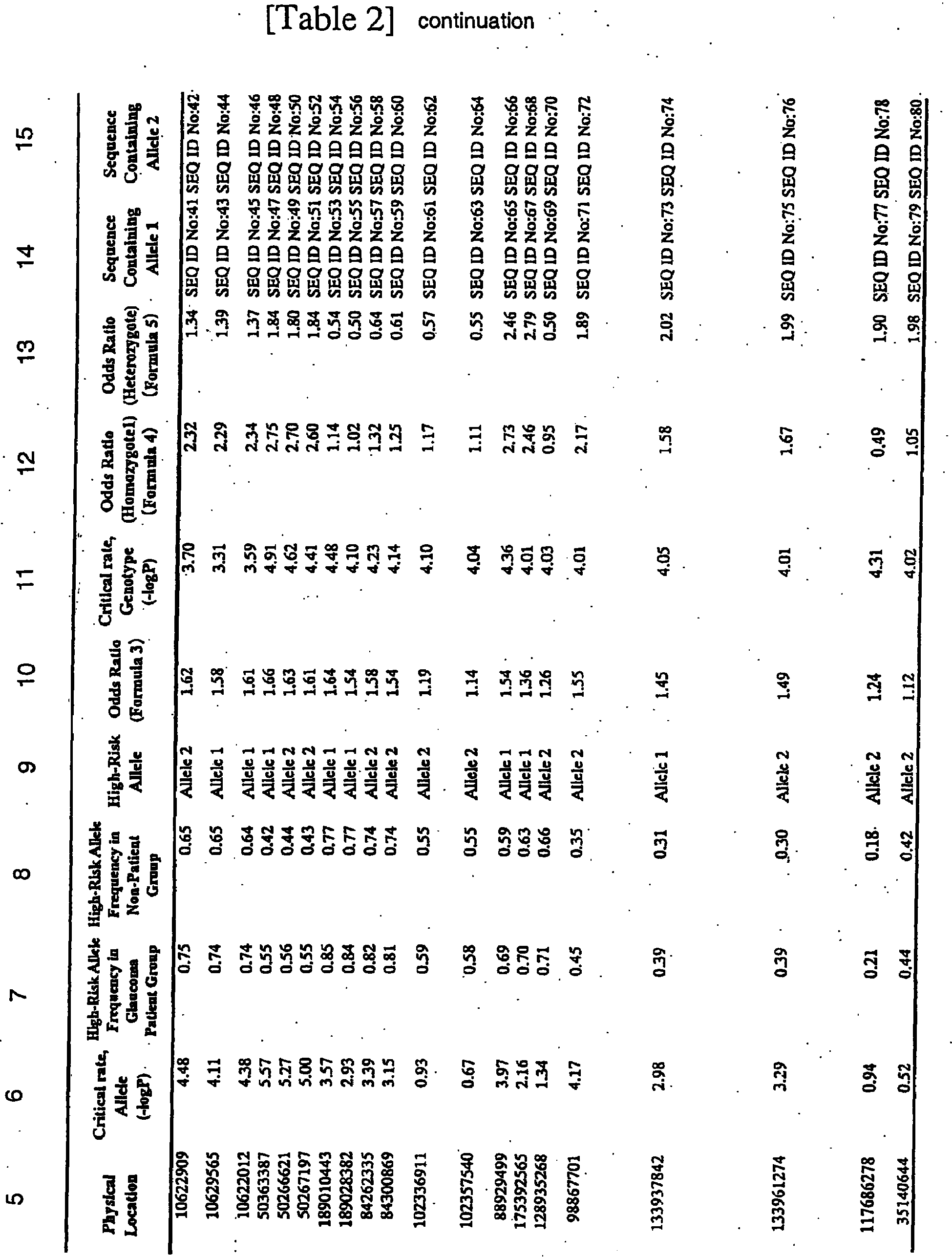
- Tables 1 and 2 list dbSNP ID number or Affimetrix Array ID number specifying known single nucleotide polymorphisms obtained, each of bases constituting Allele 1 and Allele 2, the exon, intron information (in a case where a single nucleotide polymorphism exists on a gene, the gene name and the exon or intron in which SNP exists are shown, and in a case where a single nucleotide polymorphism does not exist on a gene, neighboring genes and a distance between the gene and the single nucleotide polymorphism are shown), the chromosome number at which a single nucleotide polymorphism exists, the physical location of a single nucleotide polymorphism, the p-value for an allele according to a chi-square test (-log P), the high-risk allele frequencies in the glaucoma patient group and the non-patient group, the type of the high-risk allele (indicating whether the high-risk allele is Allele 1 or Allele 2), the odds ratio for an allele, the p-value for a genotype according to a chi-square test (-log P), the odds ratio for a genotype of a homozygote and the odds ratio for a genotype of a heterozygote, and SEQ ID NO of the sequence containing Allele 1 and Allele 2 in each of the polymorphic sites. Here, one of ordinary skill in the art can obtain the information for sequences or alleles of the single nucleotide polymorphisms from dbSNP ID number or Affimetrix array ID number mentioned above.
- When the allele or genotype frequencies listed in Tables 1 to 2 were compared between the non-patients without family history and the glaucoma patients, a statistical difference was found. By determining an allele of any one of these single nucleotide polymorphisms, whether or not an allele that is identified in a higher frequency in the glaucoma patient group than that of the non-patient group exists in the sample can be determined.
- Specifically, when a first single nucleotide polymorphism listed in Tables 1 and 2 is explained as an example, one polymorphic site exists in a nucleic acid molecule shown in SEQ ID NO: 1 or 2 occupying a gene locus homologous to each other. In detail, a single nucleotide polymorphism is associated with the onset of glaucoma, of which 31st base is either A (Allele 1) or G (Allele 2), wherein Allele 1 indicated as a high-risk allele, that is, an allele of being A in the single nucleotide polymorphism is identified in a high frequency in the glaucoma patient group. Further, using the odds ratio for an allele, or the odds ratio for a genotype of a homozygote and the odds ratio for a genotype of a heterozygote, the degree of which the risk of a disease increases can be predicted in a case of having the allele or genotype. Similarly, all the sequences disclosed in Tables 1 and 2 have a polymorphic site associated with glaucoma in the sequence, and one allele or at least one genotype in the polymorphic site is identified in a high frequency in the glaucoma patient group.
- According to the above studies, 40 single nucleotide polymorphisms of which alleles or genotypes were associated with glaucoma at a p-value of 1 × 10⁻⁴ or less existing in clusters in relatively adjacent regions on the genome were found in 21 regions.
- The allele or genotype identified in a high frequency in the glaucoma patient group of a single nucleotide polymorphism listed in Tables 1 and 2 can be used as a marker showing that an onset risk of glaucoma is high. On the other hand, an allele that is opposite to the allele or a genotype other than the genotype can be used as a marker showing that an onset risk of glaucoma is low.
- Next, the surrounding regions and/or genes of the single nucleotide polymorphisms listed in Tables 1 and 2 were determined on the basis of the database provided by the HapMap project. In detail, regions in which single nucleotide polymorphisms that were considered to be in a linkage disequilibrium with the single nucleotide polymorphisms listed in Tables 1 and 2 exist were determined, on the basis of the linkage disequilibrium data in combination of the Japanese and the Chinese in the HapMap project.
- Also, in a case where the single nucleotide polymorphism listed in Tables 1 and 2 exists in the linkage disequilibrium region containing the gene, the physical location and the gene name of the region were determined. On the other hand, in a case where the single nucleotide polymorphism listed in Tables 1 and 2 exists in the linkage disequilibrium region without containing the gene, only the physical location of the region was determined. In addition, in a case where the single nucleotide polymorphism listed in Tables 1 and 2 exists on one gene beyond the linkage disequilibrium region, only the gene name was determined.
- A single nucleotide polymorphism of which p-value is lowest in each region is considered to be a single nucleotide polymorphism representing the region. Tables 3 and 4 list a single nucleotide polymorphism representing the regions, the chromosome number at which the region exists, the physical location of the region (start point and end point) and the gene name contained in the region.
-
[Table 3] Representative SNP
(SNP with Lowest p-value of the Region)Chromosome Start Point of Physical Location End Point of Physical Location Genes Contained in the Region ra16883868 6 36,014,367 36.248.G14 SLC26A8 DPRXPZ MAPK14 MAPK13 rs2233476 3 49,952,596 50,516,561 RBM6 RBM5 SEMA3F GNAT1 SLC38A3 GNAL2 SEMA3B FLJ38608 C3orf45 IFRD2 HYAL3 NAT6 HYAL1 HYAL2 TUSC2 RASSF1 ZMYND10 TUSC4 CYB561D2 TMEM115 CACNA2D2 rs2004243 8 143,691,186 143,902,698 ARC AK092432 JRK PSCA LY6K LOC51337 C8orf55 SLURP1 LYPDC2 LYNX1 AK126845 LY6D LYPD2 rs10513095 3 - - CLSTN2 rs7081455 10 20,663,479 20.716.201 no gene rs7850541 9 134,756,557 135,192,865 TSC1 GFI1B LOC158078 GTF3C5 CEL CELP RALGDS GBGT1 OBP2B LOC286310 ABO LOC653163 SURF6 -
[Table 4] Representative SNP
(SNP with Lowest p-value of the Region)Chromosome Start Point of Physical Location End Point of Physical Location Genes Contained in the Region rs7109406 11 - - CNTN5 rs4763559 12 10,535,930 10,724,935 LOC255308 KLRA1 FL,TI0292 STYK1 rs10116267 9 - - PSAT1 rs6813301 4 183,058,962 183,243,277 LOC643296 rs2049723 11 13,851,048 14,245,926 SPONI rs9498701 6 - - GRIK2 rs2233476 3 49,952,596 50,516,561 RBM6 RBM5 SEMA3F GNAT1 SLC38A3 GNAL2 SEMA3B FLJ38608 C3orf45 IFRD2 HYAL3 NAT6 HYAL1 HYAL2 TUSC2 RASSF1 ZMYND10 TUSC4 CYE561D2 TMEM115 CACNA2D2 rs10130333 14 88,697,458 89,155,209 CHES1 LOC646224 CAP2P1 LOC400236 rs4430902 2 188,904,662 189,286,159 GULP1 rs13137759 4 83,800,064 84,215,995 SCD4 SEC31L1 THAP9 DKFZp686L1814 COPS4 rs1133030 4 175.234,727 175,450,910 FBXO8 KLAA1712 rs762164 21 35,049,200 35,343,511 RUNX1 rs7109406 11 - - CNTN5 rs220757 11 128,920,427 128,953,084 no gene rs803594 6 117,682,814 117,853,711 VGLL2 ROS1 rs2347897 7 - - CALD1 - The region listed in Tables 3 and 4 is a region or gene considered to be linked with a single nucleotide polymorphism listed in Tables 3 and 4 which is associated with glaucoma in the present invention, and a single nucleotide polymorphism which exists in these regions or genes is considered to be linked with a single nucleotide polymorphism in the present invention. In other words, any single nucleotide polymorphisms which exist in these regions are linked with the single nucleotide polymorphism which exists in the region as listed in Tables 3 and. 4, and any of these single nucleotide polymorphisms can be used in the prediction of a risk of glaucoma in the same manner.
- Also, a single nucleotide polymorphism of which allele or genotype shows association with glaucoma at a p-value of 1 × 10⁻³ or less, i.e. -log P of 3 or more, is also listed in Tables 5 to 25.
-
[Table 5] dbSNP ID Exon, Intron Chromosome Physical Location Critical rate, Allele (-logP) High-Risk Allele Frequency in Glearcome Patient Group High-Risk-Allele Frequency in Non-Patient Group Odds Ratio (Formals 3) Critical rate, Genotype (-logP) Odds Ratio (Homozygote) (Formula 4) Odds Ratio (Heterozygote) rs2139539 COL16A1 +69bp (NM_OO1856.2) 1 31,786,872 3.99 0.87 0.80 1.75 3.81 7.12 .52 rs693421 ZP4 -45155bp (NM_021186.2) 1 234,425,131 3.53 0.55 0.45 1.48 3.77 2.14 2.02 rs2038845 CACMAIS Intron2(NM_000069.1) 1 197,799,070 0.57 0.41 0.39 1.13 3.76 1.00 1.89 rs604040617 LOC284591 Intron2 (XM_211529) 1 819,185 0.24 0.17 0.15 1.09 3.68 ND 0.75 rs540782 ZP4 -43104bp (NM_021186.2) 1 234 ,423 ,080 3.43 0.56 0.46 1.47 3.52 2.09 1.96 rs2040073 LOC339442-148785bp(XM_37885.8) 1 38,498,317 3.58 0.38 0.29 1.52 3.38 1.93 1.80 rs547984 ZP4 -42951bp (NM_021186.2) 1 234,422,927 3.48 0.55 0.46 1.47 3.35 2.10 1.88 rs10798882 PEF Intron1 (NM_012392.1) 1 31,777,640 3.52 0.86 0.79 1.67 3.35 6.05 3.84 rs2499601 ZP4-50960bp (NM_021186.2) 1 234,430,936 3.24 0.55 0.46 1.45 3.23 2.05 1.89 rs909002 COL16A1 Intron44 (NM_001856.2) 1 31,808728 3.47 0.84 0.77 1.63 3.19 4.38 2.94 rs2147798 CACNAS Intron3 (NM_000069.1) 1 197,793,475 1.22 0.56 0.51 1.22 3.14 1.58 2.09 rs10752589 CSF3R -53414bp (NM_000760.2),
CSF3R -53414bp (NM_1.56038.2),
CSF3R -53414bp (NM_1 156039.2),
CSF3R -53414bp(NM_172.313.1)1 36,671,016 3.61 0.18 0.11 1.77 3.13 2.06 1.02 rs2236913 PSEN2 Intron5 (NM_000447.1). PSEN2 Intron5 (NM_012486.1) 1 223,380,860 0.61 0.35 0.33 1.14 3.13 0.88 1.74 rs10518601 ELID1-94220bp) (XM_371262) 1 79,312,758 0.27 0.79 0.78 1.08 3.08 3.51 4.57 rs17102821 ELTD1 -89304bp (XM_371262) 1 79,307,842 0.28 0.80 0.78 1.09 3.08 3.52 4.57 rs7525498 ELTD1 -102412bp (XM_371262) 1 79,320.950 0.30 0.80 0.78 1.09 3.04 3.53 4.54 rs2359112 MGC15882 +194951bp (NM_032884.2) 1 34,548,776 0.58 0.30 0.27 1.15 3.03 5.23 0.86 rs1892116 ELYS Intron2 (NM_175865.1), ELYS Intron2 (NM_01.5446.1) 1 243,406,363 3.15 0.75 0.67 1.49 2.91 2.89 2.07 rs7524405 PEF Intron1 (NM_012392.1) 1 31,777,672 3.27 0.84 0.77 1.59 2.89 3.77 2.54 rs704709 MGC39958 Intron8 (NM_152490.1) 1 231,947,0005 3.45 0.61 0.52 1.48 2.83 2.20 1.39 rs1951626 SERP1NC1 .5704bp (NM_000488.1) 1 170,623,758 3.34 0.38 0.30 1.49 2.66 2.33 1.43 rs11163089 MGC34032 Intron4 (NM_152697.2) 1 75,490,567 3.31 0.85 0.77 1.61 2.55 2.70 1.75 rs10430126 LOC388630 +220372bp (XM_371250) 1 47,934,070 3.10 0.64 0.55 1.45 2.54 2.08 1.33 -
[Table 6] dbSNP ID Exon, Intron Chromosome Physical Location Critical rate, Allele (-logP) High.Risk Allele Frequency in Glaucoma Patient Group High-Risk Allele Frequency in Non-Patient Group Odds Rikti6 (Formula 3) Critical rate, Genotype (-logP) Odds Ratio (Homozygote) (Formula 4) Odds Ratio (Heteroxygote) (Formula 5) rs168659R0 RNF144 +120346bp (NM_014746,2) 2 7,255,154 1,98 0.24 0.18 1.41 3.96 0,84 1.99 rs4953262 PRKCE Intron1 (NM_005400.2) 2 45,952,444 0.15 0.53 0.52 1.04 3.75 1.01 0.33 rs10170220 GULP1 Intron2 (NM_016315.1) 2 189,123,624 2.80 0.84 0.78 1.53 3.68 1.03 0.53 rs6717705 VIT Intron1 (NM_053276.2) 2 36,838,198 2.80 0.88 0.82 1.60 3.62 18.77 14.09 rs759428 VIT Intron1 (NM_053276.2) 2 36,844,694 2.76 0.88 0.82 1.59 3.58 18.68 14.12 rs4670589 VIT Intron1 (NM_053276.2) 2 36,840,872 2.72 0.88 0.82 1.59 3.57 18.77 14.29 rs10931358 GULP1 Intron2 (NM_016315.1) 2 189,096,087 2.69 0.84 0.77 1.52 3.55 1.02 0.53 rs11124532 VIT Intron1 (NM_053276.2) 2 36,840,580 2.65 0.88 0.82 1.58 3.50 18.48 14.14 rs828868 MGC22014 Intron8 (XM_371501) 2 74,236,159 3.37 0.66 0.57 1.47 3.48 2.06 1.10 rs11677028 LOC339789 Intron9 (NM_207358.1) 2 8,309,297 1.34 0.71 0.66 1.26 3.45 2.50 2.92 rs6431929 LOC3397B9 +41877bp (NM_207358.1) 2 8,255,994 1.22 0.69 0.65 1.24 3.43 2.32 2.78 rs2421844 SLC4A5 Intron5 (NM_033323.2),
SIC4A5 Intron5 (NM_133478.1),
SLC4A5 Intron5 (NM_133479.1),
SLC4A5 Intron1 (NM_021196.2)2 74.451,749 3.42 0.48 0.38 1.48 3.43 2.39 1.13 rs75591118 FIJ34870 Intron4 (NM_2117481.1) 2 133,706,762 2.37 0.64 0.56 1.37 3.34 2.15 2.25 rs17754672 PELIL -61125bp (NM_020651.2) 2 64,312,259 2.49 0.24 0.17 1.49 3.27 6.36 1.11 rs7584987 OPCT 41296689bp (MM_012413.2) 2 37,641,805; 2.56 0.44 0.37 1.39 3.26 2.40 1.03 rs7571760 CDC43EP3 +127985bp(NM_006449.3) 2 37,654,409 3.06 0.40 0.31 1.46 3.13 2.69 1,17 rs6724538 OPCT 127553bg (NM_012413.2) 2 37,639,669 3.33 0.42 0.32 1.48 3.12 2.49 1.16 rs13387588 SLC4A5 Intron2 (NM_033323_2),
SLC4A5 Intron2 (NM_133478.1),
SLC4A5 Inton2 (NM_133479.1),
SLC4A5 -19990bp (NM_021196.2)2 74,4 73,795 3.27 0.48 0.39 1.46 3.10 2.29 1.15 rs7601299 SP110 Intron3 (NM_004509.2),
SP110 Intron3 (NM_S80424.1),
SP110Intron3 (NM (0045102.2)2 230,903,499 1.26 0.91 0.88 1.39 3.08 ND ND -
[Table 7] dbSNP ID Exon, Intron Chromosome Physical Location Critical rate, Allele (-logP) High-Hisk Allele Frequency in Glaucoma Patient Glaucoma Patient Group High-Risk Allele Frequency in Non-Patient Group Odds Ratio (Formula 3) Critical rate, Genotype (-logP) Odds Ratio (Homozygote) (Formula 4) Odds Ratio (Heterozygote) (Formula 5) rs1198825 RAMPI -3950bp (NM_005855.1) 2 238,546,337 3.82 0.44 0.34 1-52 3.07 2.23 1.57 rs1093021 STK39 -102538bp (NN_013233.1) 2 169,032,150 3.70 0.44 0.34 1.51 3.04 2.42 1.40 SNP_A-2170785 LTBP1 Intron2 (NM_206943.1), LTBP1 -181297bp (NM_00067.2) 2 33,090,031 1.24 0.78 0.73 1.27 3.01 3.21 3.52 rs12611812 CNTNAP5 Intron3 (MM_130773.2),
CNTNAP5 Intron.3 (NM_138996.1)2 114,776,344 1.80 0.59 0.52 1.30 3.00 1.52 0.79 rs11123034 CNTNAP5 Intron3 (NM_130773.2),
CNTNAP5_Intton3 (NM_138996.1)2 124,776,637 1.80 0.59 0.52 1.30 3.00 1.52 0.79 rs7581836 SLC4A5 -7735bp (NM_03323.2),
SLC4A5 -7735bp (NM_134478.1),
SLC4A5 -7735bp (MM_133479.1),
SLC4A5 -35247bp (NM_021196.2)2 74,189,052 3.18 0.49 0.40 1.45 2.95 2.24 1.17 rs4430896 KBTBD9 -239670bp (XM_496546) 2 23,246,431 3.58 0.75 0.66 1.54 2.94 1.91 1.12 rs7574012 OPCT +126165bp (NM_012413.2) 2 37,638,881 3.04 0.41 0.32 1.45 2.81 2.49 1.22 rs9309484 DCTNI +1471bp (NM_023019.1), DCTN1 +1471bp (NM_tl'l411BZz) 2 74,498.466 3.06 0.49 0.40 1.44 2.77 2.16 1.16 rs4666488 ODD -128777bp (NM_145260.1) 2 19,608,777 3.13 0.36 0.28 1.48 2.67 1.90 1.65 rs3771738 SLC4A5 Intron (NM_0333323.2),
SLC4A5 Intron5 (NM_133478.1),
SLC4A5 Intron5 (NM_133479.1),
SLC4A5 Intron1 (NM_021196.2)2 74.452,572 3.04 0.48 0.40 1.43 2.65 2.14 1.19 rs4848607 FLF14816 -60027bp (NM_032845.1) 2 120,999,954 3.28 0.75 0.66 1.50 2.58 2.33 1.61 rs4668312 LOC-399059 -20365bp (XM_374017) 2 171,432,334 3.04 0.74 0.65 1.47 2.58 1.80 1.08 rs4411759 KILP Intron2 (NM_002158.2) 2 48.468,133 3.36 0.55 0.44 1.44 2.57 2.07 1.57 rs2268794 SRD5A2 Intron1 (NM_000348.2) 2 31,691,055 3.01 0.20 0.13 1.63 2.55 5.02 1.46 rs11676168 HTIF Intron1 (NM 0012158.2) 2 48,465,842 3.15 0.55 0.46 1.44 2.52 2.07 1.54 -
[Table 8] dbSNP ID Exon, Intron Chromosome Physical Location Critical rate, Allele (-logP) High-Risk Allele Frequency Glaucoma Patient Group High-Risk Allele Frequency in Group Odds Ratio (Formula 3) Critical rate, Genotype (-logP) Odds Ratio (Homozygote) (Formula 4) Odds Ratio (Heterozygote) (Formula 5) rs4667649 SP5 +8390bp (XM_371581) 2 171,408,305 3.21 0.73 0.65 1.49 2.43 1.93 1.23 rs6745010 LRPIB +648365bp (NM_018557.1) 2 140,174,363 3.09 0.91 0.86 1.73 2.42 3.69 2.17 rs2356232 SP5 +12276bp (XM_371581) 2 171,412,281 3.19 0.73 0.65 1.49 2.41 1.92 1.23 rs7608898 SP5 +23719bp (XM_371581) 2 171,423.724 3.19 0.73 0.65 1.48 2.41 1.92 1.23 rs10184230 LOC389059 -25058bp (XM_374017) 2 171,427,641 3.19 0.73 0.65 1.48 2.41 1.92 1.23 rs6433243 LOC389059-2169bp (XM_374017) 2 171,431,002 3.19 0.73 0.65 1.48 2.41 1,92 1.23 rs10930437 SP5 +6843bp (XM_371581) 2 171,406,848 3.15 0.73 0.64 1.48 2.40 1.92 1.22 rs1566993 DPP10 +503127bp(NM_020868.1) 2 116,821,290 3.13 0.96 0.91 2.10 2.40 4.55 2.22 rs1990702 LRP2 +8346bp (NM_004525.1) 2 169,802,022 3.04 0.71 0.63 1.46 2.36 2.00 1.32 rs10183959 NBDL2 Intron1 (XM_038999) 2 197,139,030 3.15 0.93 0.88 1.89 2.35 3.17 1.72 rs67467374 LOC389059 -7686bp (XM_374017) 2 171,4445,013 3.03 0.74 0.66 1.47 2.34 1.95 1.25 rs6599252 SCN10A Intron12 (NM_006514.1) 3 38,764,695 0.14 0.48 0.47 1.04 3.94 1.17 0.56 rs7612549 LOC285307 +209732bp (XM_211837) 3 34,789,105 2.18 0.44 0.36 1.35 3.93 2.38 0.88 rs1012728 FIJ22419 Intron4 (NM_024697.1) 3 21,539,300 2.60 0.49 0.41 1.39 3.84 1.76 2.08 rs13097360 GBE1 -805292bp (NM_000158.1) 3 82,698,727 1.55 0.82 0.77 1.34 3.22 0.56 0.32 rs33954719 SGBF Intron6 (NM_015595.2) 3 155,351;.077 1.70 0.65 0.58 1.30 3.07 2.09 2.33 rs1462840 LOC285194 +4266181Bp (XM_379207) 3 118,345.185 2.84 0.65 0.54 1.42 3.07 2.23 2.03 rs17013665 LOC440947 -8774bp (XM_496633) 3 23,718,507 3.79 0.71 0.62 1.53 3.05 2.42 1.69 rs2044757 SGEF Intron5 (NM_015595.2) 3 155,352,950 1.58 0.65 0.59 1.28 3.05 2.03 2.32 rs1503075 ALCAM -279337bp (NM_001627.1) 3 106,289,543 3.46 0.13 0.07 1.93 3.01 ND 1.84 rs6550308 LOC285307 +332200bp (XM_211837) 3 34,911,573 3.08 0.48 0.39 1.44 2.98 1.90 1.78 rs12494849 CACNA2D2 Intron2 (NM_006030.1) 3 50,499,362 3.61 0.59 0.49 1.48 2.89 2.20 1.52 rs3755827 ZNE112 -1350bp (NM_018008.2) 3 62,335,411 3.69 0.81 0.73 1.61 2.88 2.43 1.51 rs9881866 ALCAM -264171bp (NM_0016127.1) 3 106,304,709 3.32 0.15 0.09 1.81 2.87 1.97 1.97 rs34329203 LOC389099 -54783bp (XM_371621) 3 22,240,837 3.37 0.92 0.86 1.83 2.82 1.99 1.01 rs10935365 CLSTN2 Intron1 Intri),vt) (NM_022131.1) 3 141,227,766 3.47 0.84 0.76 1.61 2.77 2.61 1.62 -
[Table 9] dbSNP ID Exon, Intron Chromosome Physical Location Critical rate, Allele (-logP) High-Risk Allele Frequency in Glaucoma Patient Group High-Risk Allele Frequency in Non-Patent Group Odds Ratio (Formula 3) Critical Genotype (-logP) Odds Ratio (Homozygote) (Formula 4) Odds Ratio (Hetorozygote) (Formula 5) rs2138789 GRK7 Intron2 (NM_139209.1) 3 142,991,449 3.33 0.14 0.08 1.86 2.67 3.28 1.88 rs6550783 LOC440947 -8191bp (XM_496633) 3 23,719,090 3.18 0.69 0.61 1.47 2.48 2.18 1.51 rs779701 GRM7 Intron7 (NM_181875.1),
GRM7 Intron7 (NM_000844.2),
GRM7 Intron7 (NM_181874.1)3 7,493,772 3.03 0.33 0.25 1.48 2.48 1.80 1.64 rs2216524 ILIRAP Intron7 (NM_134470.2), IL1RAP Intron7 (NM_002182.2) 3 191,824,803 3.03 0.86 0.79 1.59 2.47 1.99 1.18 rs3922704 FL131579 Intron3 (NM_153268.1) 3 112,983,875 3.06 0.88 0.82 1.66 2.44 2.09 1.20 rs7641653 LOC389105 -266407bp (XM_374007) 3 35,093,422 3.06 0.40 0.32 1.45 2.43 2.08 1.50 rs2193877 ILIRAP Intron7 (NM_134470.2),
ILIRAP Intron7 (NM_002162.2)3 191,825,144 3.05 0.85 0.79 1.59 2.41 2.15 1.30 rs462606 IL1RAP Intron9 (NM_002182.2),
ILIRAP +6172bp (NM 134470.2)3 191,836,948 3.07 0.84 0.78 1.58 2.40 2.50 1.59 rs4858594 THRD Intron2 (NM_000461.2) 3 24,248,858 3.02 0.69 0.61 1.45 2.21 1.95 1.13 rs10454254 LOC285441 II1tloll1 (XM_379295) 4 187,735,925 1.17 0.81 0.77 1.21 3.70 0.60 0.33 rs13110551 CCRNAL +U6225bp ((NM_012118.2) 4 140,1 78,323 2.59 0.58 0.50 1.38 3.56 2.22 2.18 rs1503539 MAD21.1 +168679Bp (NM_002358.2) 4 121,169,516 3.91 0.38 0.28 1.56 3.53 3.05 1.40 rs3804100 TLR2 Exon2 (NM_003264.2) 4 154,983,014 3.96 0.74 0.64 1.57 3.37 2.72 1.84 rs4516662 CCRN4L-116103bp (NM_012116.2) 4 140,178,445 2.22 0.57 0.50 1.34 3.27 2.08 2.12 rs10009731 STX18-141961bp (MM_016930.2) 4 4,803,808 2.34 0.83 0.77 1.46 3.23 6.58 5.41 rs7676755 CYP4V2 Intron2 (NM_207352.1) 4 187,490,196 0.68 0.80 0.78 1.18 3.22 3.26 4.09 rs10517556 LOC391656 -135832bp (XM_373027) 4 62,947,647 2.42 0.51 0.43 1.37 3.21 1.75 1.96 rs16996478 UNCSC -11.150bp (NM_003728.2) 4 96,838,490 3.98 0.20 0.12 1.80 3.17 3.11 1.79 rs10517518 LOC285433 Intron4 (NM_173662.1) 4 155,005,757 3.89 0.74 0.65 1.56 3.15 2.47 1.63 rs34415360 LOC132391-118159bp (XM_497978) 4 117,08,308 3.45 0.29 0.21 1.57 3.01 3.26 1.28 rs930438 CENPC1+97050bp (NM_001812.1) 4 68,069,912 3.27 0.82 0.75 1.57 2.84 3.33 2.31 -
[Table 10] dbSNP ID Exon, Intron Chromosome Physical Location Critical rate, Allele (-logP) High-Risk Allele Frequency in Glaucoma Patient Group High-Risk Allele Frequency in Non-Patient Group Odds Ratio (Formula 3) Critical rate, Genotype (-logP) Odds Ratio (Homozygote) (Formula 4) Odds Ratio (Heterozygote) (Formula 5) rs17279573 KIAA0922 +22425bp (NM_015196.2) 4 154,937,893 3.34 0.68 0.60 1.48 2.74 2.31 1.66 rs11727442 TIR2-23144bp (NM_003264.2) 4 154,943,527 3.42 0.69 0.60 1.49 2.73 2.22 1.49 rs1027690 MAD2L1 +191047bp (NM_002358.2) 4 121,147,148 3.22 0.43 0.34 1.46 2.63 2.24 1.45 rs16891164 LOC441009 +88767bp (XM_ 498965) 4 14,590,288 3.15 0.96 0.92 2.12 2.63 ND ND rs73103767 LOC152519 +6607bp (NM_207330.1) 4 47,886,619 3.44 0.60 0.50 1.47 2.62 2.07 1.39 rs1980391 LOC389239 -207565bp (XM_371714) 4 165,986,419 3.18 0.62 0.53 1.45 2.60 1.99 1.23 rs17376639 LOC132391 -82192bp (XM_497978) 4 117,117,275 3.04 0.29 0.21 1.52 2.56 2.90 1.27 rs4256218 SCD4 Intron1 (NM_024906.1) 4 84,047,858 3.28 0.89 0.82 1.69 2.55 2.70 1.59 rs972469 FSTL5 +959616bp (NM_020116.2) 4 161,703,038 3.06 0.40 0.32 1.45 2.47 2.27 1.36 rs6829490 TXK +894bp (NM_003328.1) 4 47,908,795 3.23 0.57 0.48 1.45 2.46 2.04 1.46 rs3804099 TLR2 Exon2 (NM_003264.2) 4 154,982,261 3.07 0.71 0.63 1.46 2.45 2.24 1.57 rs4392496 KIAA0922 Intron3 (MM_015196.2) 4 154,800,110 3.10 0.46 0.37 1.44 2.41 2.04 1.47 rs4568220 LOC344988 Intron2 (XM_293671) 4 121,413,055 3.23 0.11 0.06 2.04 2.40 3.19 2.90 rs33964061 TXK +1806bp (NM_003328.1) 4 47,907,883 3.11 0.57 0.48 1.43 2.34 2.00 1.46 rs6447614 TXK +804bp (NM_003328.1) 4 47,908,885 3.11 0.57 0.48 1.43 2.34 2.00 1.46 rs12655405 PD2K3 -33552bp (NM_015022.2),
PDZK3 -33552bp (NM_178140.1)5 31,801,198 0.80 0.93 0.91 1.33 3.88 0.13 0.06 rs4515309 NNT +296580bp (NM_012343.2),
NNT +296936bp (NM_182977.1)5 44,037,927 1.77 0.12 0.08 1.56 3.74 0.00 2.02 rs1377489 MTRR +135148bp (NM_024010.1),
MTRR +135148bp (NM_002454.1)5 8,089,385 1.15 0.82 0.78 1.28 3.56 20.15 19.82 rs309593 CSPG2 Intron10 (NM_004385.2) 5 82,884,337 3.95 0.43 0.33 1.54 3.45 2.43 1.64 rs6579788 TCOF1 -25018bp (NM_000356.1) 5 149,692,410 1.15 0.37 0.32 1.23 3.43 2.27 0.80 rs6451268 FLJ25422 Intron1] (NM_145000.2) 5 36,291,121 1.39 0.61 0.56 1.25 3.38 1.85 2.30 rs529279 C5orC13 -5941bp (NM_0047772.1) 5 111,126,776 3.20 0.30 0.22 1.53 2.90 3.30 1.31 rs298091 FDEAD -114328bp (NM_006203.3) 5 59,032,360 3.58 0.82 0.74 1.61 2.86 2.37 1.43 rs3097776 FAT2 Intron2 (NM_001447.1) 5 150,916,554 3.34 0.72 0.63 1.49 2.77 2.01 1.23 rs11750584 FLJ40243 -22454bp (NM_173489.2) 5 41,129,616 3.13 0.20 0.13 1.64 2.68 1.86 1.80 -
[Table 11] dbSNP ID Exon, Intron Chromosome physical Location Critical rate, Allele (-logP) High-Risk Allele Frequency in Glaucoma Patient Group High-Risk Allele Frequency in Non-Patient Group Odds Ratio (Formula 3) Critical rate, Genotype (-logP) OddsRatio (Homozygote) (Formula 4) Odds Ratio (Heterozygote) (Formula 5) rs11748095 FBXL17 -103066bp (NM_022824.1) 5 107,848,076 3.18 0.50 0.41 1.45 2.66 1.95 1.66 rs1428470 LY64 -8157bp (NM_005582.1) 5 66,536,525 3.15 0.80 0.72 1.53 2.64 1.93 1.16 rs11167493 CSFIR +19417bp (NM_005211.2) 5 149,353,634 3.02 0.12 0.07 1.92 2.52 ND 1.77 rs6891720 LY64 -7944bp (NM_005582.1) 5 66,536,312 3.04 0.80 0.72 1.51 2.52 1.91 1.16 rs4246764 LY64 -384319bp (NM_005582.1) 5 66,912,687 3.00 0.29 0.21 1.51 2.46 2.43 1.54 rs429419 ADAMTS12 Intron17 (NM_030955.1) 5 33,624,092 3.12 0.91 0.85 1.76 2.44 3.75 2.20 rs298063 PDE4D -88343bp (NM_006203.3) 5 59,006,375 3.15 0.82 0.75 1.55 2.44 2.11 1.32 rs818725 ADAMTS12 Intron17 (NM_030955.1) 5 33,624,060 3.05 0.91 0.86 1.74 2.37 3.66 2.17 rs4285312 NEDD9 -191677bp (NM_006403.2),
NEDD9 -191687bp (NM_182966.1)6 11,532,564 3.28 0.16 0.10 1.76 3.87 1.07 2.27 rs4840196 ORIK2 Intron8(NM_021956.2),
GRIK2 Intron8 (NM_175763.1)6 102,359,520 0.96 0.60 0.55 1.19 3.72 1.19 0.60 rs4075603 NEDD9 -191609bp (NM_006403.2),
NEDD9 -191619bp (NM_182966.1)6 11,532,496 3.09 0.16 0.10 1.73 3.67 1.04 2.22 rs2764236 GRIK2 Intron9 (NM_021956.2),
GRIK2 Intron9 (NM_175768.1)6 102,389,150 0.83 0.59 0.56 1.17 3.61 1.15 0.59 rs4840195 GRIK2 Intron8 (NM_021956.2),
GRIK2 Intron8 (NM_175768.1)6 102,359,490 0.84 0.59 0.55 1.17 3.55 1.18 0.60 rs372534 AOF1 Intron (XM_173173) 6 18,295,895 3.02 0.68 0.59 1.45 3.50 2.40 2.31 rs6907963 LOC442154 Intron1 (XM_498036) 6 4,903,481 2.45 0.88 0.83 1.56 3.18 16.95 13.09 rs6915915 EGFL11 -135926bp (NM_198283.1) 6 66,398,533 3.44 0.54 0.45 1.47 3.08 2.18 1.20 rs3857597 LOC442216 -86680bp (XM_498099) 6 51,020,014 3.84 0.22 0.14 1.73 3.07 2.60 1.76 rs902287 EGFL11 -127786bp (NM_198283.1) 6 66,390,393 3.31 0.51 0.42 1.46 3.05 2.19 1.16 rs1761118 MAPK14 Intron9 (NM_139013.1),
MAPK14 Intron9 (NM_001315.1),
MAPK14 Intron9 (NM_139012.1),
MAPK14 Intron9 (MM_139014.1)6 36,176,281 3.63 0.93 0.87 1.95 3.05 4.77 2.39 -
[Table 12] dbSNP ID Exon, Intron Chromosome Physical Location Critical rate, Allele (-logP) Hig-Risk Allele Frequency in Glaucoma Patient Group High-Risk Allele Frequency in Non-Patient Group Odds Ratio (Formula 3) Critical rate, Genotype (-logP) Odds Ratio (Homozygote) (Formula 4) Odds Ratio (Heterozygote) (Formula 5) rs9473926 LOC442116 -10440bp (XM_ 498099) 6 50,943,774 3.30 0.54 0.45 1.46 2.90 2.17 1.69 rs1206153 KIAA1900 Intron6 (NM_052904.1) 6 97,652,757 3.02 0.56 0.47 1.43 2.80 1.95 1.03 rs16871306 NEDD9 -153599bp (NM_006403.2),
NEDD9 -153608bp (NM_182966.1)6 11,494,485 3.04 0.09 0.04 2.17 2.52 ND 2.22 rs9398995 ENPP1 Intron1 (NM_006208.1) 6 132,181,896 3.12 0.58 0.48 1.44 2.51 2.06 1.59 rs9358578 LOC389370 Intron1 (XM_374162) 6 22,810.626 3.27 0.44 0.35 1.47 2.46 2.12 1.39 rs10488281 PRES Intron2 (NM_206883.1),
PRES Intron2 (NM_206884.1),
PRES Intron2 (NM_206885.1),
PRES Intron2 (NM_198999.1)7 102,663,783 1.13 0.48 0.44 1.21 3.64 1.66 0.72 rs2215164 COB1 Intron1 (NM_015198.2) 7 51,093,537 1.75 0.88 0.83 1.44 3.60 0.32 0.17 rs2299257 PON1 Intron4 (NM_000446.3) 7 94,587,416 3.65 0.37 0.28 1.54 3.43 2.01 1.80 rs1075737 PRES Intron2 (NM_206883.1),
PRES Intron2 (NM_206884.1),
PRES Intron2 (NM_206885.1),
PRES Intron2 (NM_198999.1)7 102,665,144 0.99 0.48 0.44 1.19 3.41 1.60 0.72 rs10232532 CPA5 -3205bp (NM_080385.2) 7 129,575,431 0.30 0.52 0.50 1.07 3.24 1.18 1.94 rs3917538 PON1 Intron5 (NM_000446.3) 7 94,582,544 3.50 0.51 0.42 1.47 3.16 2.20 1.16 rs1222418 FL132786 Intron12 (NM_144648.1) 7 133,334,253 3.72 0.17 0.10 1.89 3.14 10.10 1.72 rs12966701 TAS2R41 +27695bp (NM_176883.1) 7 142,720,419 3.59 0.13 0.07 2.01 3.13 2.48 2.15 rs10271531 HGF +217504bp (NM_000603.3) 7 80,758,592 3.78 0.42 0.33 1.52 3.11 2.46 1.41 rs12700187 DNAH11 Intron8 (NM_003777.1) 7 21,385,860 3.76 0.96 0.92 2.39 3.10 ND ND rs10228385 LOC401324 +47600bp (XM_379484) 7 35,236,926 3.79 0.84 0.76 1.65 3.07 2.21 1.26 rs4726533 PRES -172004bp (NM_002769.2) 7 141,771,615 0.57 0.39 0.36 1.13 3.01 1.71 0.72 -
[Table 13] dbSNP ID Exon, Intron Chromosome Physical Location Critical rate, Allele (-logP) High-Risk Allele Frequency in Glaucoma Patient Group High-Risk Allele Frequency in Non-Patient Group Odds Ratio (Formula 3) Critical rate, Genotype (-logP) Odds Ratio (Homozygote) (Formula 4) Odds Ratio (Heterozygote) (Formula 5) rs2285652 OSBPL3 Intron22 (NM_015550.2),
OSBPL3 Intron21 (NM_145320.1),
(OSBPL3 Intron21 (NM_145321.1),
OSBPI3 Intron20(NM_145322.1),
OSBPL3 Intron22 (NM_145323.1),
OSBPL3 Intron21 (NM 145324.1)7 24,617,110 3.56 0.84 0.77 1.64 3.02 3.55 2.33 rs10250170 TPKI Intron8 (NM_ 022445.2) 7 143,650,537 0.69 0.12 0.10 1.24 3.02 0.11 1.67 rs2966712 TAS2R41 -7843bp (NM_176883.1) 7 142,683,960 3.22 0.11 0.06 1.97 3.02 0.82 2.20 rs1001148 COBL Intron1 (NM_015198.2) 7 51.094,064 1.40 0.88 0.84 1.37 3.01 0.32 0.18 rs17167646 FL132786 Intron16 (NM_144648.1) 7 133,305,708 3.50 0.15 0.09 1.84 2.93 9.85 1.66 rs930688 FLF32786 Intron16 (NM_144648.1) 7 133,366,047 3.50 0.15 0.09 1.84 2.93 9.85 1.66 rs991162 FLJ32110 -9270bp (NM_181646.2) 7 88,024,134 3.55 0.15 0.09 1.89 2.91 2.49 1.98 rs2592845 LOC401324 +94391 bp (XM_379484) 7 35,283,717 3.07 0.77 0.69 1.51 2.90 3.17 2.30 rs10228514 LOC401324 +47709bp (XM_379484) 7 35,237,035 3.55 0.83 0.75 1.62 2.86 2.20 1.30 rs10488110 LOC340268 Intron1 (XM_294634) 7 9,827,710 3.41 0.11 0.06 2.07 2.81 ND 1.89 r1875910 MC+252683bp (NM_199072.2) 7 114,505,890 3.53 0.94 0.88 1.98 2.72 5.49 3.05 rs2893506 LOC401324 +25585bp (XM_379484) 7 35,214,911 3.52 0.83 0.75 1.60 2.69 2.47 1.58 rs10236415 LOC401324 +28462bp (XM_379484) 7 35,217,788 3.52 0.83 0.75 1.60 2.69 2.47 1.58 rs9640055 GLCCI1 Intron1 (XM_166529) 7 7,802,756 3.27 0.82 0.75 1.57 2.65 2.55 1.62 rs52592860 LOC401324 +14726bp (XM_379484) 7 35,204,052 3.25 0.71 0.63 1.48 2.52 2.15 1.45 rs6961391 NUP205 -1742bp (XM_371954) 7 134,698,206 3.12 0.73 0.65 1.47 2.52 2.11 1.36 rs115357 FLJ13842 +13080bp (NM_024645.1) 8 40,376,469 1.62 0.31 0.25 1.32 3.49 1.01 1.90 rs2977752 LOC441352 +55834bp (XM_499115) 8 72,715,809 1.84 0.58 0.52 1.30 3.39 1.87 2.19 rs10504440 LOC389667 +50257bp (XM_372046) 8 70,255,391 2.06 0.70 0.64 1.35 3.32 2.77 2.73 rs2470722 GEM -2381bp (NM_005261.2),
GEM -2381bp (NM_181702.1)8 95,346,114 1.12 0.77 0.73 1.25 3.28 0.79 0.45 -
[Table 14] dbSNP ID Exon, Intron Chronomoxane Physical Location Critical rate, Allele (-logP) High-Risk Allele Frequency in Glaucoma Patient Group High-Risk Allele Frequency in Non-Patient Group Odds Ratio (Formula 3) Critical rate, Genotype (-logP) Odds Ratio (Homozygote) (Formula 4) Odds Ratio (Heterozygote) (Formula 5) rs12898 CTSB +629bp (NM_001908.2),
CTSB +629bp (NM_147780.1),
CTSH +629bp (NM_1.17781.1),
CISB +629bp (NM_147782.1),
CTSB +629bp (NM_147783.1),8 11,738,607 2.92 0.49 0.40 1.42 3.27 1.81 1.90 rs6991723 ZNF596 +33933bp (NM_173539.1) 8 221,272 2.75 0.58 0.49 1.40 3.25 2.08 2.04 rs16904092 MGC27434 Intron1 (NM_145050.2) 8 1310,571,112 1.05 0.90 0.87 1.33 3.19 0.16 0.09 rs6468360 LOC286135 -35034bp (XM_379573) 8 29,863,536 2.01 0.55 0.48 1.32 3.16 1.78 0.86 rs4736872 FD13842 Intron5 (NK_024645.1) 8 40,570,858 0.36 0.63 0.61 1.09 3.12 1.54 2.26 rs10958627 FIJ13842 Intron5 (NM_024645.1) 8 40,594,675 0.03 0.47 0.47 1.01 3.08 0.96 1.75 rs16935718 LOC389667 +60391bp (XM_372046) 8 70,265,525 1.87 0.74 0.68 1.34 3.07 3.16 3.04 rs1605950 PXMP3 -574113bp (NM_000318.1) 8 78,649,107 0.82 0.28 0.25 1.19 3.07 0.78 1.73 rs2513858 STARS -43515bp (NM_139166.2) 8 107,898,164 0.07 0.65 0.65 1.02 3.05 1.49 2.29 rs16935744 LOC389667 +75414bp (XM_372046) 8 70,280,548 1.80 0.74 0.68 1.33 3.04 3.05 2.98 rs2212767 CTSB Intron1 (NM_001908.2),
CTSB Intron3 (NM_147780.1),
CFSB Intron2 (MM_147781.1),
CTSB Intron2 (NM_147782.1),
CTSB Intron2 (NM_147783.1)8 11,748,468 2.69 0.48 0.40 1.40 3.01 1.75 1.85 rs705998 LOC389667 +90010bp (XM_372046) 8 70,295,144 1.55 0.71 0.65 1.29 3.01 2.51 2.69 rs1245915 SNTG1 Intron2 (NM_018967.1) 8 51,329,479 3.39 0.85 0.77 1.62 2.91 1.82 1.01 rs6999627 SNTG1 Intron2 (NM_018967.1) 8 51,340,728 3.27 0.85 0.78 1.61 2.77 1.81 1.02 rs3757916 RBPMS Intron9 (NM_006867.1) 8 30,545.447 3.10 0.43 0.34 1.45 2.62 1.96 1.62 rs2729482 LOC169355 Intron9 (NM_194294.1) 8 39,975,804 3.50 0.11 0.06 2.07 2.61 3.62 2.00 rs7823902 LOC286129 Intron2 (XM_209910) 8 26,963,854 3.20 0.34 0.26 1.50 2.58 2.12 1.56 rs11783765 GTF2EZ Intron7 (NM_002095.3) 8 30,556,550 3.12 0.40 0.32 1.46 2.55 2.17 1.51 -
[Table 15] dbSNP ID Exon, Intron Chromosome Physical Location Critical rate, Allele (-logF) High-Risk Allele Frequency In Glaucoma Patient Group High-Risk Allele Frequency In Non-Patient Group Odds Ratio (Formula 3) Critical rate, Genotype (-logP) Odds Ratio (Hemozygote) (Formula) 4) Odds Ratio (Heterozygote) (Formula 5) rs17758599 SNTG1 Intron1 (NM_018967.1) 8 51,109,255 3.14 0.85 0.78 1.59 2.49 2.77 1.78 rs2468705 KCNK9 +75721bp (NM_016601.2) 8 140,618,265 3.08 0.28 0.20 1.53 2.45 2.48 1.52 rs6474298 FLJ13842 -168006bp (NM_024645.1) 8 41,042,506 3.23 0.81 0.73 1.55 2.45 2.27 1.48 rs17473451 TUSC3-73601bp (NM_006765.2),
TUSC3-73601bp (NM_178234.1)8 15,368,500 3.05 0.79 0.71 1.51 2.43 1.98 1.24 rs6559770 SLC28A3 +116711bp (NM_022127.1) 9 64,005,935 2.83 0.47 0.38 1.41 3.55 1.82 1.96 rs10984339 LOC442434 +182746bp (XM_498343) 9 18,798,668 1.63 0.42 0.36 1.28 3.18 1.34 1.89 rs920753 LOC389771 -178380bp (XM_374296) 9 89,862,442 0.11 0.27 0.26 1.04 3.13 0.55 1.55 rs411102 LOC347265 +48076bp (XM_294590) 9 99,196,524 3.28 0.16 0.10 1.79 3.06 1.50 2.03 rs1342022 ANXA1 -61274bp (NM_000700.1) 9 72,935,061 1.37 0.60 0.54 1.24 3.05 1.34 0.70 rs10912299 VCP+4230bp (NM_007126.2) 9 35,042,331 3.54 0.95 0.89 2.09 3.01 2.57 15.88 rs303612 LOC340511 -47888bp (XM_295261) 9 103,142,991 0.20 0.61 0.59 1.05 3.01 1.39 2.12 rs1316814 BARX1 -2544bp (NM_021570.2) 9 93,822,273 3.20 0.57 0.48 1.45 2.80 2.27 1.60 rs1538844 JMJD2C Intron (NM_01506.1) 9 6,953,799 3.07 0.41 0.33 1.46 2.78 1.91 1.70 rs2148591 PCSK5 -63459bp (NM_06200.2) 9 75,671.716 3.11 0.45 0.36 1.45 2.72 2.28 1.21 rs932881 JMJD2C+1849bp (NM_015061.1) 9 7,167,496 3.25 0.78 0.70 1.52 2.53 2.37 1.61 rs10764881 MGMT -70674bp (NM_002412.1) 10 131,153,821 0.91 0.72 0.68 1.20 3.94 5.56 6.03 rs1649035 TFAM +176804bp (NM_003201.1),
TFAM +187289bp (NM_012251.1)10 60,002,707 3.82 0.61 0.51 1.51 3.94 2.56 2.09 rs782394 LOC387721 -351645bp (XM_370585) 10 130,449,442 2.06 0.54 0.47 1.33 3.70 1.75 0.80 rs1649048 TFAM +168385bp (NM_003201.1),
IFAM +178870bp (NM_012251.1)10 59,994,288 3.54 0.60 0.51 1.48 3.54 2.36 1.99 rs7477330 TFAM +162217bp (NM_003201.1),
TFAM +172702bp (NM_012251.1)10 59,988,120 3.63 0.60 0.51 1.49 3.52 2.38 1.95 rs17157033 LOC439960 -30545bp (XM_498478) 10 44,613,470 2.88 0.96 0.92 2.14 3.45 ND ND rs10458653 PCBD -54076bp (NM_000281.1) 10 72,369,768 0.63 0.25 0.22 1.16 3.45 5.56 0.82 -
[Table 16] dbSNP ID Exon, Intron Chromosome Physical Location Critical rate, Allele (-logP) High-Risk Allele Frequency In Glaucoma Patient Group High-Risk Allele Frequency in Non-Patient Group Odds Ratio (Formula 3) Critical rate, Genotype (-logP) Odds Ratio (Homozygote) (Formulation 4) Odds Ratio (Heterozygote) (Formula 5) rs3849969 SEC24C Intron12 (NM_004922.2),
SEC24C Intron1 (NM_198597.1)10 75,196,005 3.36 0.27 0.19 1.57 3.44 1.58 1.92 rs1658438 TFAM +170686bp (NM_003201.1),
TFAM +181171bp (NM_012251.1)10 59,996,589 3.56 0.60 0.51 1.48 3.43 2.35 1.92 rs1649039 TFAM +174144bp (NM_003201.1),
TFAM +184629bp (NM_012251.1)10 60,000.047 3.59 0.60 0.50 1.48 3.43 2.34 1.91 rs1658456 TFAM +148429bp (NM_003201.1),
TFAM +158914bp (NM_012251.1)10 59.974,332 3.54 0.60 0.51 1.48 3.40 2.33 1.91 rs1649060 TFAM +154583bp (NM_003201.1),
TFAM +165068bp (NM_012251.1)10 59,980,486 3.54 0.60 0.51 1.48 3.40 2.33 1.91 rs17130394 HABP2 -103263bp (NM_004132.2) 10 115,199,512 3.13 0.84 0.77 1.59 3.40 1.38 0.71 rs10763558 TFAM +186037bp (NM_003201.1),
TFAM +196522bp (NM_012251.1)10 60,011,940 3.62 0.60 0.50 1.49 3.36 2.33 1.87 rs10763556 TFAM +185501bp (NM_003201.1),
TFAM +195986bp (NM_012251.1)10 60,011,404 3.53 0.60 0.50 1.48 3.34 2.33 1.89 rs7902091 CINNA3 Intron7 (NM_013266.1) 10 68,268,298 2.66 0.51 0.43 1.39 3.33 1.98 0.94 rs1210065 TMEM23 Intron5 (NM_147156.3) 10 51,882,795 2.61 0.41 0.34 1.40 3.31 1.59 1.89 rs10994838 ACF Intron1 (NM_014576.2),
ACP Intron1 (NM_138932.1),10 52,312,506 1.16 0.36 0.32 1.23 3.31 2.21 0.80 rs11189912 ACP Intron1 (NM_138933.1) SH2D4B +793340bp (NM_207372.1) 10 83,189,636 3.27 0.92 0.86 1.83 3.15 1.07 0.52 rs102834 TMEM23 Intron3 (NM_147156.3) 10 51,898,627 2.47 0.66 0.59 1.38 3.10 2.22 2.21 rs1203392 TMEM23 Intron5 (NM_147156.3) 10 51,874,999 2.46 0.41 0.34 1.38 3.08 1.57 1.85 rs7910849 LOC220929 +29028bp (NM_182755.1) 10 31,144,546 3.06 0.74 0.66 1.48 3.08 1.69 0.93 rs7904101 TMEM23 -7099bp (NM_147156.3) 10 52,060,842 1.38 0.37 0.32 1.26 3.05 1.12 1.81 rs4474.374 LOC439991 -14752bp (XM _495838) 10 85,647,711 0.14 0.33 0.32 1.04 3.05 1.98 0.69 rs11016249 MK167 -323870bp(NM_002417.2) 10 130,138,328 3.24 0.69 0.60 1.47 2.90 2.42 1.91 -
[Table 17] dbSNP ID Exon, Intron Chromosome Physical Location Critical rate, Allele (-logP) High-Risk Allele Frequency In Glaucome Patient Group High-Risk Allele Frequency in Non-Patient Group Odds Ratio (Formula 3) Critical rate, Genotype (-logP) Odds Ratio (Homozygote) (Formula 4) Odds Ratio (Heterozygote) (Formula 5) rs2092832 SH2D4B +843746bp (NM_207372.1) 10 83,240,042 3.58 0.94 0.88 1.99 2.88 3.15 1.55 rs4934425 ANKKD22 Intron1 (NM_144590.1) 10 90,599,698 3.05 0.64 0.55 1.44 2.83 2.29 1.86 rs2688612 PLAU -17730bp (NM_002658.1) 10 75,323,211 3.57 0.42 0.33 1.50 2.81 2.28 1.45 rs10883820 CNNM2 Intron1 (NM_017649.3),
CNNM2 Intron1 (NM_199076.1),
CNNM2 +77286bp (NM_199077.1)10 104,754,651 3.37 0.90 0.84 1.76 2.78 2.47 1.34 rs7074084 TFAM +146618bp (NM_003201.1),
TFAM +157103bp (NM_012251.1)10 59,972,521 3.20 0.59 0.49 1.44 2.77 2.16 1.69 rs1649023 TFAM +129923bp (NM_003201.1),
TFAM +140408bp (NM_012251.1)10 59,955,826 3.11 039 0.50 1.44 2.69 2.13 1.69 rs1649080 TFAM +137397bp (NM_003201.1),
TFAM +147882bp (NM_012251.1)10 59,963,300 3.11 039 0.50 1.44 2.69 2.13 1.69 rs1303970 TFAM +142580bp (NM_003201.1),
TFAM +153065bp (NM_012251.1)10 59,968,483 3.11 0.59 0.50 1.44 2.69 2.13 1.69 rs3829154 ECHDC3 -1630bp (NM_024693.2) 10 11,822,759 3.17 0.49 0.40 1.44 2.61 2.16 1.29 rs1926029 NT5C2 Intron11 (NM_012229.2) 10 104,845,660 3.20 0.91 0.85 1.75 2.57 3.18 1.80 rs2802493 LOC283034 +233953bp (XM_210860) 10 43,873,589 3.15 0.39 0.31 1.47 2.50 2.27 1.38 rs718641 ECHDC3 -4475bp (NM_024693.2) 10 11,819,914 3.08 0.49 0.40 1.44 2.49 2.12 1.30 rs7913781 ZWINT -792415bp (NM_007057.2),
ZWINT -792415bp (NM_032997.1)10 58,583,444 3.22 0.18 0.11 1.72 2.46 4.17 1.49 rs7894588 CNNM2 Intron1 (NM_017649.3),
CNNM2 Intron1 (NM_199076.1),
CNNM2 +68655bp (NM_199077.1)10 104,746,020 3.08 0.91 0.85 1.72 2.46 2.41 1.35 rs1569868 SH2D4B +852561bp (NM_207372.1) 10 83,248,857 3.13 0.93 0.88 1.88 2.45 3.12 1.65 rs10883843 NTSC2 -6408bp (NM_012229.2) 10 104,937,483 3.03 0.91 0.85 1.71 2.41 2.39 1.35 rs7074395 NT5C2 +2984bp (NM_012229.2) 10 104,834,918 3.00 0.91 0.85 1.71 2.39 2.39 1.35 -
[Table 18] dbSNP ID Exon, Intron Chromosome Physical Location Critical rate, Allele (-logP) [ligh-Risk Allele Frequency in Glausoma Patient Group High-Risk Allele Frequency in Non-Patient Group Odds Ratio (Formula 3) Critical rate, Genotype (-logP) Odds Ratio (Homozygote) (Formula 4) Odds Ratio (Heterozygote) (Formula 5) rs10829630 MOMT +6919bp (NM_002412.1) 10 131,461,275 3.02 0.58 0.49 1.43 2.21 1.96 1.40 rs923811 BARX2 +93402bp (NM_003658.3) 11 128.920,427 0.82 0.67 0.63 1.17 3.76 0.91 0.49 rs4937431 BARX2 +124127bp (NM_003658.3) 11 128,951,152 1.56 0.44 0.38 1.27 3.24 2.05 0.85 rs11021202 MGC3371 +2.24211bp (NM_144664.3) 11 94,917,555 3.28 0.14 0.08 1.85 3.18 1.33 2.17 rs497776 MAML2 Intron1 (NM_032427.1) 11 95,597,312 2.23 0.80 0.74 1.42 3.06 3.58 3.31 rs11602121 LOC399921 Intron4 (XM_374904) 11 70,237,526 1.45 0.29 0.24 1.30 3.00 5.91 1.01 rs11220171 CNTNS Intron2 (NM_014361.2),
CNIN5 Intron2 (NM_175566.1)11 98,866,995 3.46 0.36 0.28 1.51 2.95 2.04 1.67 rs4307718 LOC440033 +175532bp (XM_498512) 11 23,320,437 3.48 0.96 0.92 2.27 2.90 ND ND rs1384483 LOC440033 +63001bp (XM_498512) 11 23,207,906 3.23 0.13 0.07 1.90 2.78 ND 1.79 rs500629 ZBT816 Intron3 (NM_006006.3) 11 113,550,770 3.13 0.29 0.22 1.52 2.72 1.88 1.69 rs1507527 LOC387754 -33940bp (XM_373490) 11 13,882,655 3.25 0.77 0.69 1.51 2.72 2.23 1.39 rs2007052 SPONI -37564bp (NM_006108.1) 11 13,903,250 3.21 0.77 0.69 1.51 2.69 2.24 1.40 rs7935243 PHACS Intron3 (MM_032592.1) 11 44,050.992 3.13 0.80 0.72 1.53 2.67 2.95 2.11 rs562160 CBORDC1 -291532bp (NM_012124.1) 11 89,887,386 3.32 0.82 0.75 1.55 2.57 2.91 2.02 rs474530 DLG2 Intron3 (NM_001364.1) 11 83,930,298 3.02 0.95 0.91 2.00 2.56 ND ND rs493622 CHORDC1 -286443bp (NM_01224.1) 11 89,982,297 3.04 0.82 0.75 1.54 2.45 2,76 1.89 rs610160 GR1A4 Intron3 (NM_000829.1) 11 105,202,105 3.06 0.20 0.14 1.64 2.25 3.19 1.42 rs10844107 BICD1 -37784bp (NM_001714.1) 12 32,113,668 0.28 0.24 0.23 1.08 3.48 5.00 0.75 rs10862853 LOC387871 +436103bp (XM_373539) 12 83,274,707 1.19 0.82 0.78 1.28 3.34 3.97 4.53 rs979879 SLC6A15 +353475bp (NM_182767.2),
SLC6A15 +37521 1bp (NM_018057.3)12 83,403,423 1.63 0.83 0.78 1.36 3.33 4.41 4.61 rs11116400 SLO6A15 +425437bp (NM_182767.2),
SLC6A15 +447173bp (NM_018057.3)12 83,331,461 1.53 0.83 0.78 1.34 3.33 4.38 4.65 rs2611284 SLC6A15 +335334bp (NM_181767.2),
SLC6A15 +357070bp (NM_018057.3)12 83,421,564 1.66 0.83 0.78 1.36 3.31 4.41 4.57 -
[Table 19] dbSNP ID Exon, Intron Chromosome Physical Location Critical rate, Allele (-logP) High-Risk Allele Frequency in Glaucoma Patient Group High-Risk Allele Frequency in Non-Patient Group OddsRatio (Formula 3) Critical rate, Genotype (-logP) Odds Ratio (Homozygote) (formula 4) Odds Ratio (Heterozygote) (Formula 5) rs10746324 SLC6A15 +349338bp (NM_181767.2),
SLC6A15 +371054bp (NM_018057.3)12 83,407,580 1.61 0.83 0.78 1.36 3.29 4.38 4.57 rs11056970 LMO3 +34143bp (NM_018640.3),
LMO3 +34143bp (NM_001001395.1)12 16,558,431 3.21 0.86 0.79 1.63 3.27 3.21 3,17 rs4766663 OAS1 +7223bp (NM_002534.1),
OAS1 -5266bp (NM_016816.1)12 111,825,694 3.28 0.20 0.13 1.68 3.12 12.40 1.52 rs7134411 FLJ25065 +34043bp (NM_182530.1) 12 68,673,713 0.33 0.51 0.49 1.08 3.12 1.17 0.61 rs1382851 FLJ36004 -92384bp (NM_152590.1) 12 25,689,829 2.11 0.58 0.51 1.33 3.10 1.86 2.07 rs7295295 LOC387871 +418915bp (XM_373539) 12 83,257,519 1.84 0.82 0.76 1.38 3.09 4.09 4.00 rs1380405 SLC6A15 +351862bp (NM_182767.2),
SLC6A15 +373598bp (NM_018057.3)12 83,405,036 1.56 0.83 0.79 2.35 3.08 4.25 4.38 rs11116414 SLC6A15 +389377bp (NM_182767.2),
SLC6A15 -411113bp (NM_018057.3)12 83,367,521 1.46 0.83 0.79 1.33 3.07 4.21 4.42 rs2468302 SLC6A15 +354436bp (MM_182767.2),
SLC6A15 +376192bp (NM_018057.3)12 83,402,442 1.46 0.83 0.79 1.33 3.07 4.21 4.42 rs2555255 LOC144742 +11128bp (XM_378388) 12 118,173,222 0.08 0.25 0.24 1.03 3.04 3.04 0.72 rs2072133 OAS3 Exon16 (NM_006187.2) 12 111,871,980 3.71 0.68 0.59 1.51 3.03 2.27 1.46 rs1647106 THRAF2 +168009bp (NM_015335.2) 12 114,691,094 3.67 0.33 0.24 1.56 3.02 2.29 1.63 rs10779090 LOC387871 +423693bp (XM_373539) 12 83,262,297 1.14 0.82 0.78 1.27 3.01 3.58 4.04 rs2125093 KLRA1 +10392bp (NM_006611.1) 12 10,622,647 3.52 0.77 0.68 1.54 2.92 2.11 1.27 rs900610 MGC50559 Intron2 (NM_273802.2) 12 31,707,890 3.14 0.16 0.10 1.75 2.91 1.47 1.98 rs10772350 STYK1 +7029hp (NM_018423.1) 12 10,724,935 3.08 0.71 0.62 1.47 2.83 1.91 1.11 rs4767030 OAS1 +3826bp (NM_002534.1),
OAS1 +18699bp (NM_016816.1)12 111,822,297 3.40 0.21 0.14 1.68 2.81 3.49 1.66 rs647110 THRAP2 +163373bp (NM_015335.2) 12 114,695,730 3.37 0.29 0.21 1.56 2.76 2.29 1.62 -
[Table 20] dbSNP ID Exon, Intron Chromosome Physical Location Critical rate, Allele (-logP) High-Risk Allele Frequency in Glaucoma Patient Group High-Risk Allele Frequency in non-Patient Group OddsRatio (Formula 3) Critical rate, Genotype [-logP) Odds Ratio (Homozygote) (Formula 4) Odds Ratio (Heterozygote) (Formula 5) rs1859336 OAS3 -8940bp (NM_006187.2) 12 111,830,029 3.06 0.21 0.14 1.63 2.58 4.24 1.57 rs1700369 LOC441646 Intron3 (XM_497358) 12 126,367,113 3.00 0.95 0.90 1.97 2.55 1.54 0.71 rs7134391 OAS1 +10940bp (NM_002534.1),
OAS1 +8983bp (NM_016816.1)12 111,829,411 3.09 0.20 0.14 1.63 2.50 3.57 1.57 rs2270152 VWF Intron49 (NM 000552.2) 12 5,931,330 3.16 0.86 0.80 1.62 2.48 2.47 1.50 rs4767040 OAS3 -2232bp (NM_006187.2) 12 111,836,737 3.07 0.20 0.14 1.63 2.48 3.56 1.56 rs10774679 OAS3_1501bp (NM_006187.2) 12 111,837,468 3.06 0.20 0.14 1.63 2.47 3.58 1.56 rs11104300 HONT-IV-H -287319bp (NM_013244.2) 12 86,0222,432 3.05 0.21 0.15 1.61 2.44 3.37 1.52 rs10735079 OAS3 Intron2 (NM_006187.2) 12 111,842,728 3.03 0.20 0.14 1.62 2.44 3.56 1.55 rs7961953 DKFZp762A217 Intron1 (NM_152588.1) 12 81,594,304 3.02 0.34 0.26 1.48 2.43 2.28 1.48 rs261912 ETNK1 Intron6 (NM_018638.3) 12 22,728,208 3.01 0.85 0.78 1.58 2.43 3.04 2.02 rs4145280 G30 +266246bp (XM_498445) 13 104,643,159 0.25 0.51 0.50 1.06 3.95 1.12 0.55 rs4772238 CLYBL -20285bp (NM_206808.1),
CLYBL -20285bp (NM_138280.3)13 99,202,794 0.14 0.12 0.11 1.06 3.78 0.00 1.53 rs9519091 SLC10A2 -518655bp (NM_000452.1) 13 103,035,852 1.56 0.49 0.43 1.27 3.58 1.48 2.06 rs3916959 G30 +269026bp (XM_498445) 13 104,640,379 0.25 0.51 0.50 1.06 3.58 1.12 0.57 rs9558509 G30 +271368bp (XM_498445) 13 104,638,037 0.27 0.51 0.50 1.07 3.47 1.13 0.58 rs9300981 G30 +46912bp (XM_498445) 13 104,440,279 3.79 0.63 0.53 1.52 3.14 2.32 1.75 rs1606405 SLITRK1 +664827bp (NM_052910.1) 13 82,684,518 1.37 0.55 0.50 1.24 3.10 1.47 0.74 rs10492680 LOC400123 -23647bp (XM_378411) 13 39,702,836 3.01 0.93 0.88 1.83 2.46 6.22 3.50 rs7150435 ALKBH +19861bp (NM_006020.1) 14 77,189,287 0.00 0.53 0.53 1.00 3.42 1.09 1.92 rs759363 CHES1 Intron3 (NM_005197.1) 14 88,828,894 3.89 0.32 0.23 1.59 3.29 2.36 1.69 rs11159897 CHES1 Intron3 (NM_005197.1) 14 88,829,194 3.89 0.32 0.23 1.59 3.29 2.36 1.69 rs4902116 LOC401778 +110022bp (XM_377343) 14 61,774,890 2.61 0.57 0.49 1.38 3.12 1.93 1.98 rs2241127 CHES1 Intron2 (MM_005197.1) 14 88,892,969 1.47 0.31 0.26 1.29 3.11 0.99 1.80 -
[Table 21] dbSNP ID Axon, Intron Chromsome Physical Location Critical rate, Allele (-logP) High-Risk Allele Frequency in Glaucoma Patient Group High-Risk Allele Frequency in Non-Patient Group Odds Ratio (Formula 3) Critical rate, Genotype (-logP) Odds Ratio (Homozygote) (Formula 4) Odds Ratio (Heterozygote) (Formula 5) rs10148022 LOC283584 -265499bp (XM_211108) 14 85,864,556 0.85 0.32 0.29 1.19 3.07 0.84 1.72 rs1571379 SELIL -289804bp (NM_005065.3) 14 81,359,690 3.60 0.73 0.63 1.53 3.03 2.22 1.36 rs11622536 KCNK10 -72402bp (NM_138318.1),
KCNK10 -20310bp (NM_136317.1),
KCNK10 -16406bp (NM_021161.3)14 87,879,410 0.64 0.77 0.75 1.16 3.00 0.64 0.38 rs2816632 BRF1 Intron2 (NM_001519.2),
BRF1 -27133bp (NM_145685.1),
BRF1 -26587bp (MM_145696.1)14 104,812,400 3.27 0.21 0.14 1.64 2.78 4.49 1.36 rs1106845 STELLAR +19768bp (XM_375075) 14 35,931,107 3.26 0.11 0.06 2.06 2.71 ND 1.98 rs17115925 SELIL -271331bp (NM_005065.3) 14 81,341,217 3.00 0.72 0.64 1.46 2.39 2.22 1.56 rs7176242 ATP10A +44699bp (NM_024490.2) 15 23,428,814 0.19 0.85 0.85 1.07 3.26 0.09 0.06 rs16969520 CIB2 Intron1 (NM_006383.2) 15 76,204,239 2.36 0.35 0.28 1.39 3.19 1.38 1.86 rs10902569 ADAMTS17 Intron3 (MM_139057.1) 15 98,663,829 0.08 0.67 0.67 1.03 3.10 0.64 0.41 rs11071129 UNC13C +173927bp (XM_496070) 15 52,882,022 0.20 0.59 0.58 1.05 3.08 1.37 2.11 rs1441354 FLJ3710 -290693bp (NM_024817.1) 15 69,517,251 0.22 0.25 0.24 1.07 3.07 5.71 0.76 rs11631211 ATP10A +61309bp (NM_024490.2) 15 23,412,204 0.22 0.86 0.85 1.08 3.06 0.30 0.07 rs12592527 UNC13C +174082bp (XM_496070) 15 52,882,177 0.27 0.60 0.58 1.07 3.05 1.42 2.13 rs4144951 FLJ38736 Intron17 (NM_182758.1) 15 51,643,802 3.40 0.16 0.09 1.82 2.73 2.80 1.87 rs2654216 EFTUD1 +28186bp (NM_024580.3) 15 80,181,440 3.18 0.60 0.51 1.44 2.57 2.14 L54 rs8026133 SLCO3A1 +2693bp (NM_013272.2) 15 90,171,014 3.10 0.16 0.10 1.74 2.48 4.60 1.66 rs4780091 LOC440268 +506bp (XM_496063) 15 31,271,629 3.26 0.63 0.54 1.46 2.46 2.02 1.37 rs17191316 ANXA2 +144537bp (NM_004039.1) 15 58,282,291 3.23 0.07 0.03 2.61 2.37 ND 2.22 rs12597526 USP10 +4263bp (NM_005153.1) 16 83,374,937 1.28 0.38 0.33 1.24 3.91 2.51 0.81 rs2133803 LOC14329-13263bp (XM_086494) 16 59,665,671 1.32 0.81 0.76 1.30 3.52 4.13 4.60 rs288601 CDH8-492870bp (NM_001796.2) 16 61,120,407 1.81 0.53 0.47 1.30 3.35 1.61 0.77 rs1819829 FLJ31547 Intron9 (NM_145024.1) 16 54,444,785 2.53 0.79 0.73 1.46 3.32 4.58 3.80 -
[Table 22] dbSNP ID Exon, Intron Chromosome Physical Location Critical rate, Allele (-logP) High-Risk Allele Frequency Glaucoma Patient Group High-Risk Allele Frequency in Non-Patient Group Odds Ratio (Formula 3) Critical rate, Genotype (-logP) Odds Ratio (Homozygote) (Formula 4) Odds Ratio (Heterozygote) (Formula 5) m1541639 HBZ +531bp (NM_005332.2) 16 145,035 2.77 0.22 0.16 1.55 3.13 1.23 1.90 rs372657 LOC283867 -31281bp (XM_378606) 16 64,480,523 3.63 0.24 0.16 1.65 2.84 3.03 1.56 rs173840 LOC283867 -313113bp (XM_378606) 16 64,480,817 3.63 0.88 0.16 1.65 2.84 3.03 1.56 n!4f!4342S FOXL1 +137429bp (NM_005250.1) 16 85.308,297 3.20 0.88 0.81 1.66 2.75 1.89 1.05 rs2.S4353 LOC283867 -301 507 bp (XM_378606) 16 64,469,211 3.33 0.19 0.12 1.71 2.71 4.73 1.57 w4077853 PLCG2 Intron27 (NM_002661.1) 16 80,528,471 3.16 0.35 0.27 1.49 2.62 2.17 1.57 n3859079 CDH13 -112144bp (MM_00125.2) 16 81,105,935 3.17 0.66 0.58 1.46 2.51 2.17 1.60 rs8062968 LOC283867 -298359bp (XM_379606) 16 64,466,063 3.05 0.24 0.17 1.57 2.49 1.99 1.68 rsl1074523 - HS3ST2 Intron1 (NM_006043.1) 16 22,734,434 3.11 0.80 0.73 L53 2.48 2.40 1.56 rs8045067 WWOX -1063753bp (NM_130844.1),
WWOX -1063753bp (NM_130791.1),
WWOX -1063753bp (NM_016373.1),
WWOX -1063753bp (NM_018560.4),
WWOX -48197bp (NM_130792.1)16 77,754,805 3.35 0.75 0.67 1.52 2.43 2.17 1.49 rs12443833 WWOX -1063238bp (NM_130844.1),
WWOX -1063238bp (NM_130791.1),
WWOX -1063238bp (NM_016373.1),
WWOX --1 061238bp (NM_018560.4),
WWOX -48712bp (NM 130792.1)16 77,754,290 3.17 0.72 0.63 1.48 2.38 2.11 1.45 rs1877821 RGS9 -9409bp (NM_003835.1) 17 60,605,875 1.17 0.75 0.71 1.25 3.80 3.21 3.78 rs9896245 ROS9 -11066bp (NM_003835.1) 17 60,604,218 1.45 0.75 0.70 1.29 3.65 3.30 3.62 rs1029754 LOC401887 +487202bp (XM_497555) 17 66,236,699 2.11 0.89 0.84 1.51 3.62 0.23 0.12 rs7808998 NTNI Intron2 (MM_004822.1) 17 8,919,071 2.23 0.63 0.56 1.35 3.30 1.57 0.81 rs9895463 SPACA3 +355bp (NM_173847.2) 17 28,336,640 0.01 0.58 0.58 1.00 323 1.23 2.04 rs11868422 RPFLAL intron1 (NM_006987.2) 17 198,072 3.62 0.21 0.14 1.71 3.05 2.06 1.85 rs1877823 RGS9 +3136bp (NM_003835.1) 17 60,657,405 1.20 0.77 0.73 1.26 3.03 3.22 3.52 -
[Table 23] dSNP ID Exon, Intron Chrosomosome Physical Location Critical rate, Allele (-logP) High-Risk Allele Frequency in Glaucoma Patient Group High-Rink Allele Frequency in Non-Patient Group Odds Ratio (Formula 3) Critical rate, Genotype (-logP) Odds Ratio (Homozygote) (Formula 4) Odds Ratio (Heterozygote) (Formula 5) rs8065080 TRPV1 Exon11 (NM_080706.1),
TRPV1 Exon12 (NM_080705.1),
TRPVI Exon12 (NM_018727.3),
TRPV1 Exon13 (NM_080704.1)17 3,427,196 3.67 0.69 0.60 1.51 2.88 2.25 1.51 rs8082149 LOC342600 Intron2 (XM_292624) 17 51,927,894 3.52 0.92 0.86 1.85 2.66 3.49 1.99 rs2269459 POLR2A Intron22 (NM_000937.2) 17 7,353,762 3.11 0.79 0.72 1.52 2.51 2.46 1,63 rs2072255 KIAA0672 Intron10 (XM_37540B) 17 12,793,117 3.09 0.21 0.14 1.63 2.43 3.35 1.53 rs9788983 RP113AL Intron6 (NM_006987,2) 17 129,457 3.05 0.89 0.82 1.65 2.40 3.21 2.00 rs1879610 LOC441825 +255198bp (XM_497596) 18 13,469,750 1.98 0.95 0.91 1.72 3.48 0.26 0.11 rs11876045 LDC441816 -222690bp (XM_ 497584) 18 20,564,102 3.73 0.26 0.20 1.61 3.41 1.79 1.88 rs11010861 BCL2 Intron1 (NM_000633.1),
BC.I.2 +78655bp (NM_000657.1)18 59,057,460 0.72 0.94 0.93 1.33 3.34 ND ND rs1790870 CYB5 + 163bp (NM_001914.1),
CYB5 +163bp (NM_148923.1)18 70,071,349 3.86 0.86 0.78 1.70 3.30 1.99 1.06 rs1790858 CYB5 Intron3 (NM_001914.1),
CYB5 Intron3 (NM_148923.1)18 70,075,799 3.74 0.86 0.78 1.68 3.18 1.99 1.08 rs17187933 LOC441816 -214621bp (XM_491584) 18 20,556,033 3.55 0.26 0.18 1.62 3.11 1.86 1.81 rs17088997 CYB5 +3361bp (NM_001914.1),
CYB5 +336bp) ("NM_148923.1)18 70,068,151 3.62 0.86 0.78 1.67 3.07 1.95 1.06 rs1372481 LOC390856 Intron1 (XM_497590) 18 49,466,756 3.51 0.96 0.92 2.35 3.07 1.52 0.58 rs10468763 CLUL1 Intron5 (NM_014410.4),
CUJL1 Intron5 (NM_199167.1)18 622,23 0.40 0.22 0.21 1.12 3.06 0.50 1.61 rs3862680 BCC Intron1 (NM_005215.1) 18 48,184,338 3.65 0.60 0.50 1.49 2.97 2.24 1.56 rs3910695 LOC390856 Intron1 (XM 497590) 18 49,464,63a 3.35 0.96 0.92 2.28 2.90 1.53 0.60 rs3862681 PCC Intron1 (NN_005215.1) 18 48,184,688 3.53 0.60 0.50 1.48 2.84 2.19 1.54 rs7238490 METTL4 +571947bp (NM_022840.2) 18 1,955583 3.40 0.71 0.62 1.49 2.72 2.04 1.27 rs9951036 LOC390856 Intron1 (XM_497590) 18 49,515,735 3.18 0.96 0.92 2.23 2.72 1.52 0.62 -
[Table 24] dbSNP ID Exon, Intron Chromosome Physical Location Critical rate, Allele (-logP) High-Risk Allele Frequency in Glaucoma Patient Group High-Risk Allele Frequency Non-Patient Group Odds Ratio (Formula 3) Critical rate, Genotype (-log1) Odds Ratio (Homozygote) (Formula 4) Odds Ratio (Heterozygote) (Formula 5) rs339858 LOC441816 -124776bp (XM_497584) 18 20,466,188 3.14 0.16 0.10 1.75 2.70 1.95 1.90 rs11151937 CYB5 +485bp (NM_001914.1),
CYB5 +4485bp (NM_ 148923.1)18 70,066,653 3.06 0.53 0.44 1.43 2.68 2.01 1.68 rs8094863 LOC390855 Intron3 (XM_497589) 18 47,458,218 3.17 0.50 0.41 1.44 2.55 2.12 1.32 rs17260163 LOC1441816 -250775bp (XM_.497584) 18 20,592,187 3.13 0.29 0.21 1.53 2.54 2.21 1.59 rs8086430 LOC14747468 +250079bp (XM_091Rl19) 18 20,600,317 3.10 0.29 0.21 1.52 2.51 2.20 1.58 rs16940484 C18orf17 Intron6 (NM_153211.1) 18 19,936,298 3.09 0.34 0.26 1.49 2.51 2.02 1.58 rs7229080 LOC390856 Intron1 (NM_497590) 18 49,503,583 3.19 0.97 0.93 2.28 2.49 3.03 1.30 rs10502927 LOC390855 Intron3 (XM_497589) 18 47,502,071 3.01 0.49 0.41 1.43 2.45 2.09 1.27 rs17660384 ZNF175 -10715bp (NM-0071472) 19 56,755,628 3.53 0.21 0.14 1.69 3.02 5.12 1.57 rs2864107 ZNF175 -5504bp (NM_007147.2) 19 56,760,839 3.40 0.21 0.14 1.68 2.90 4.82 1.58 rs433083 FLJ12644 Exon5 (NM_023074.2) 19 57,685,796 3.14 0.95 0.91 2.07 2.66 ND ND rs6097745 BCAS1 Intron3 (NM_00365.1) 20 52,101,533 1.67 0.29 0.24 1.33 3.56 1.00 1.92 rs2870304 BCAS1 Intron3 (MM_003657.1) 20 52,106,624 1.14 0.30 0.25 1.33 3.49 1.06 1.91 rs8123014 C20orf23 +57130bp(NM_024704.3) 20 15,629,440 2.16 0.75 0.68 1.38 3.20 1.23 0.66 rs6115865 C20orf194 -37687bp (XM_045421) 20 3,107,303 3.63 0.38 0.29 1.52 2.87 2.29 1.52 rs7268851 C30orf17 Intron2 (NM_173485.2) 20 51,501,200 3.45 0.73 0.65 1.51 2.86 2.08 1.27 rs6134494 LOC440753 +240718bp18bp (XM_498845) 20 12,196,345 3.12 0.22 0.15 1.61 2.86 1.59 1.86 rs3817879 PLCB1 Intron3 (NM_.015192.2). PLCB1 Intron3 (NM_182734.1) 20 8,470,921 3.17 0.80 0.72 1.54 2.52 2.65 1.89 rs2743246 MATN4 Intron3 (NM_003833.2),
MATN4 Intron4 (NM_030590.1),
MAIN4 Intron3 (NM_030592.1)20 43,362,112 3.10 0.88 0.81 1.64 2.43 2.97 1.85 rs6014430 KIAA1755 Intron2 (XM_02810) 20 36,305,948 3.05 0.11 0.06 1.94 2,03 3.66 1.69 rs2154450 RUNX1 Intron5 (NM_001754.2) 21 35,141,436 0.85 0.44 0.40 1.18 3.94 1.14 2.01 rs4817695 RUNX1 Intron5 (NM_001754.2) 21 35,141,141,187 0.66 0.44 0.41 1.14 3.68 1.10 1.94 rs2625423 LOC388817 +373452bp (XM 371409) 21 19,526,124 3.31 0.26 0.19 1.58 2.64 3.09 1.38 -
[Table 25] dbSNP ID Exon, Intron Chromosome Physical Location Critical rate, Allele (-logP) High-Risk Allele Frequency in GlaucomaPatient Group High-Risk Allele Frequency in Non-Patient Group Odds Ratio (Formula 3) Critical rate, Genotype (-logP) Odds Ratio (Homozygote) (formula 4) Odds Ratio (Heterozygote) (Formula 5) rs4813324 E461-Intron10 (NM_013236.1) 22 44,558,660 3.69 0.51 0.41 1.49 3.04 2.26 1.32 NF2 Intron10 (NM_181825.1), NF2 Intron8 (NM_181831.1), NF2 Intron10 (NM_000268.2), NF2 Intron10 (NM_016418.4), NF2 Intron11 (NM_181826.1), NF2 Intron10 (NM_181827.1), rs2857648 NF2 Intron9 (NM_181.828.1), 22 28,391,112 3.02 0.73 0.65 1.46 279 1.67 0.95 NF2 Intron9 (NM_181829.1), NF2 Intron8 (NM_181!l30.1), N12 Intron10 (NM_IR1 832.1), NF2 Intron4 (NM_181833.1), NF2 Intron5 (NM_181834.1), NF2 Intron8 (NM 181835.1) TBLN1 +65094bp (NM_006487.2), FBLN1 +60443bp (NM_(K)1996.2), rs6006787 FBLN1 +58104bp (NM_006485.2), 22 44,340,222 3.31 0.50 0.40 1.46 2.72 2.22 1.38 PBI.N1 +22671bp (NM_006486.2)M_fMMRft.2) rs572159 LOC284898 -273642bp (XM_379044) 22 26,054,663 3.11 0.94 0.89 1.92 2.48 4.67 2.44 rs467812 C22orf19 Intron2 (MM_003678.3) 22 28,265,503 3.22 0.27 0.19 1.56 2.48 2.23 1.57 rs5765558 (MM_013236.1) 22 44,363,516 3.09 0.58 0.49 1.43 2.3a 2.01 1.37 rs6006179 FA61. -24767bp C22orF19 Intron19 (NM UK3678.3) 22 28,231,255 3.03 0.27 0.20 1.53 2.33 2.19 1.55 - Tables 5 to 25 list dbSNP ID number or Affimetrix Array ID number for specifying known single nucleotide polymorphisms obtained, the exon, intron information (in a case where a single nucleotide polymorphism exists on a gene, the gene name and the exon or intron in which SNP exists are shown, and in a case where a single nucleotide polymorphism does not exist on a gene, neighboring genes and a distance between the gene and the single nucleotide polymorphism are shown), the chromosome number at which the single nucleotide polymorphism exists, the physical location of the single nucleotide polymorphism, the p-value for an allele according to a chi-square test (-log P), the high-risk allele frequencies in the glaucoma patient group and the non-patient group, the odds ratio for an allele, the p-value for a genotype according to a chi-square test (-log P), the odds ratio for a genotype of a homozygote, and the odds ratio for a genotype of a heterozygote. Here, in the tables, a portion of which odds ratio is indicated as ND shows a case where any one of the number of detection in the denominator is 0, so that the odds ratio could not be calculated.
- According to the above studies, 413 single nucleotide polymorphisms of which alleles or genotypes were associated with glaucoma at a p-value of 1 × 10⁻³ or less were found.
- When the allele or genotype frequencies listed in Tables 5 to 25 were compared between the non-patients without having family history and the glaucoma patients, a statistical difference was found. By determining an allele of any one of these single nucleotide polymorphisms, whether or not an allele that is identified in a higher frequency in the glaucoma patient group than that of the non-patient group exists in the sample can be determined.
- The comparison on single nucleotide polymorphisms was made for progressive glaucoma cases and nonprogressive glaucoma cases in the same manner as in Example 3.
- Concretely, blood donated under the consent on free will of the participants after having sufficiently explained the contents of studies from 210 cases ofpatients with progressive visual loss within a given time period, despite the treatments for lowering an intraocular pressure such as a drug for lowering an intraocular pressure or a surgical operation (progressive glaucoma cases), and 175 cases of patients without the progression (nonprogressive glaucoma cases), among the primary open-angle glaucoma, patients and the normal tension glaucoma patients diagnosed on the basis of Guidelines offered by Japan Glaucoma Society, was used as a specimen, and alleles frequencies and genotypes frequencies between the groups were also compared by performing the analysis in the same manner as in Example 3. Alleles frequencies and genotype frequencies were statistically compared According to the chi-square test in the same manner. Single nucleotide polymorphisms of which alleles or genotypes show association with the progression of glaucoma at a p-value of 1 × 10⁻⁴ or less, i.e. -log P of 4 or more are listed in Tables 26 to 28. Here, the odds ratio for association of an allele with the progression of glaucoma, and the odds ratio for association of a genotype with the progression of glaucoma in each of the tables, respectively were calculated on the basis of the following formulas (6) to (8).


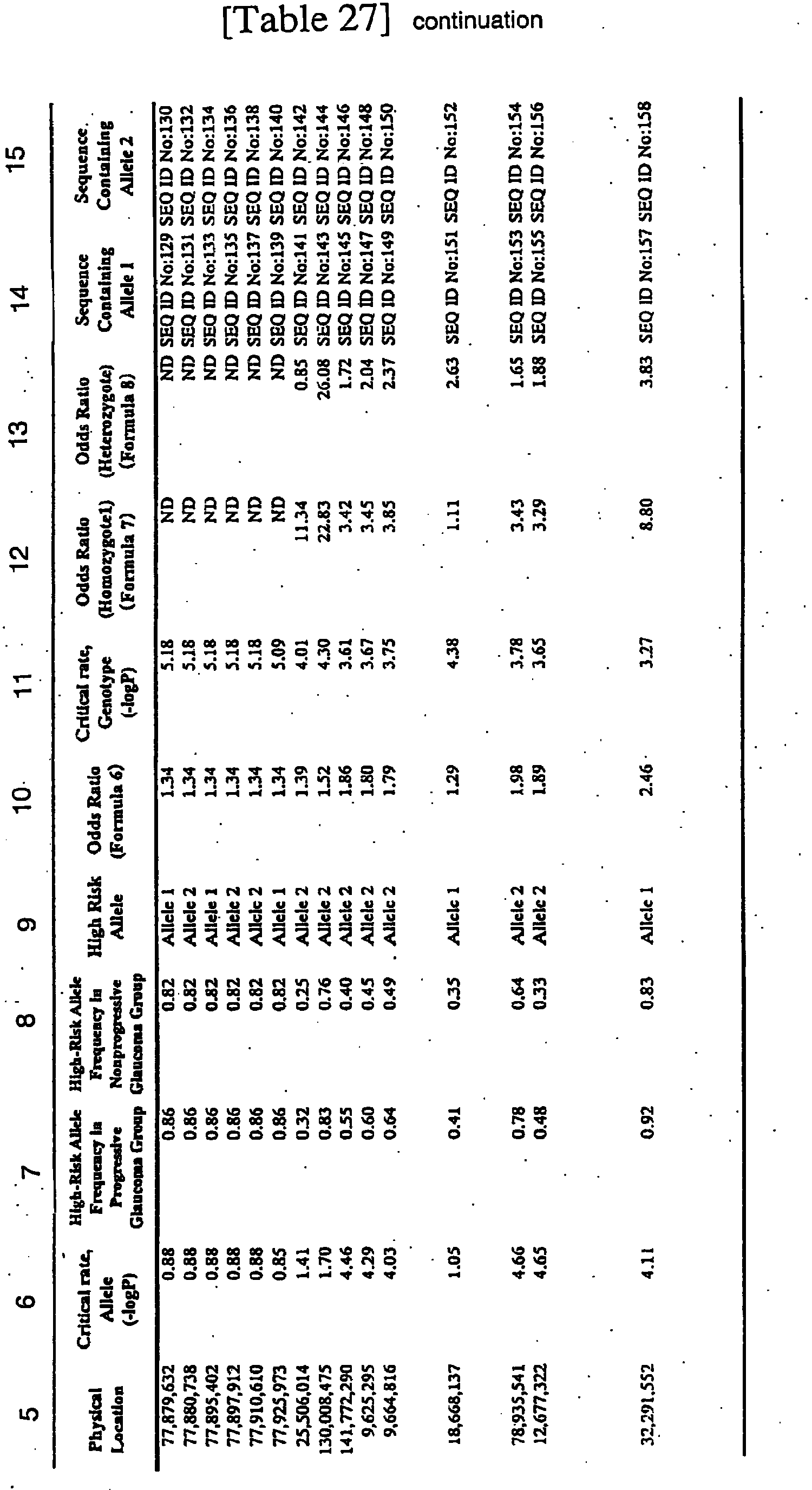


- Tables 26 to 28 list dbSNP ID number or Affimetrix Array ID number specifying known single nucleotide polymorphism obtained, each of bases constituting Allele 1 and Allele 2, the exon, intron information (in a case where a single nucleotide polymorphism exists on a gene, the gene name and the exon or intron in which SNP exists are shown, and in a case where a. single nucleotide polymorphism does not exist on a gene, neighboring genes and a distance between the gene and the single nucleotide polymorphism are shown), the chromosome number at which the single nucleotide polymorphism exists, the physical location of the single nucleotide polymorphism, the p-vahie for an allele according to a chi-square test (-log P), the high-risk allele frequencies in the progressive glaucoma group and the nonprogressive glaucoma group, the type of the high-risk allele (indicating whether the high-risk allele is Allele 1 or Allele 2), the odds ratio for an allele, the p-value for genotype according to a chi-square test (-log P), the odds ratio for a genotype of a homozygote, the odds ratio for a genotype of a heterozygote, and SEQ ID NO of the sequence containing Allele 1 and SEQ ID NO of the sequence containing Allele 2 in each of the polymorphic sites. Here, in the tables, a portion of which odds ratio is indicated as ND shows a case where any one of the number of detection in the denominator is 0, so that the odds ratio could not be calculated.
- According to the above studies, 61 single nucleotide polymorphisms of which alleles or genotypes were associated with the progression of glaucoma at a p-value of 1 × 10⁻⁴ or less were found.
- When the allele or genotype frequencies listed in Tables 26 to 28 were compared between the progressive glaucoma cases and the nonprogressive glaucoma cases, a statistical difference was found. By determining an allele of any one of these single nucleotide polymorphisms, whether or not an allele that is identified in a. higher frequency in the progressive glaucoma group than that of the nonprogressive glaucoma group exists in the sample can be determined.
- The allele or genotype identified in a high frequency in the progressive glaucoma group for a single nucleotide polymorphism listed in Tables 26 to 28 can be used as a marker showing that a progressive risk of glaucoma is high. On the other hand, an allele that is opposite to die allele or a genotype other than the genotype can be used as a marker showing that a progressive risk of glaucoma is low.
- Also, a. single nucleotide polymorphism of which allele or genotype shows association with the progression of glaucoma at a p-value of 1 × 10⁻³ or less, i.e. -log P of 3 or more, is listed in Tables 29 to 51.
-
[Table 29] DBSNP_ID Exon, Intron Chromosome Physical Location Critical rate, Allele (-logP) High-Risk Allele Frequency to Progressive Glaucoma Group High-Risk Allele Frequency in Nonprogressive Glaucoma Group Odds Ratio (Formula 6) Critical rate, Genotype (-logP) Odds Ratio (Homozygote) (Formula 7) Odds Ratio (Heterozygote) (Formula 8) rs1920146 FMO3 -14117bp (NM_006894.3) 1 167,777,607 3.00 0.16 0.08 2.14 3.79 0.78 3.05 rs594105 C8A Intron4 (NM_000562.1) 1 57,055,277 0.82 0.65 0.60 1.24 3.74 0.95 0.41 rs490647 GRIK3 +23871bp (NM_000831.2) 1 36,911,836 3.13 0.39 0.28 1.69 3.43 1.92 2.39 rs10489624 C8A Intron6 1 57,061,635 0.83 0.65 0.60 1.24 3.39 1.00 0.44 rs11117962 (MM_000562.1) LOC128153 +9779bp (NM_ 138796.2) 1 214,438,658 1.33 0.60 0.53 1.34 3.32 1.49 0.60 rs868162 NPHP4 Intron22 (NM_015102.2) 1 5,868,502 0.74 0.76 0.72 1.25 3.32 0.41 0.21 rs525798 GRIK3 +25728bp (NM_000831.2) 1 36,909,979 3.12 0.40 0.28 1.68 3.28 1.97 2.33 rs11120300 i20311U SMYD2 Intron11 (MM_020197.1) 1 210,897,894 1.38 0.08 0.04 1.90 3.14 0.23 4.08 rs10494300 KCNN3 Intron7 (NM_170782.1), KCNN3 Intron3 (NM_002249.3) 1 151,539,619 3.13 0.61 0.49 1.64 3.14 2.56 1.09 rs17401966 KIFIB Intron24 (NM_015074.2), KIF1B +18633bp (NM_183416.2) 1 10,319,737 2.53 0.28 0.19 1.68 3.09 17.83 1.28 rs687328 GADD45A- 40088bp (NM_001924.2) 1 67,822,816 3.19 0.75 0.63 1.71 3.07 3.66 3.07 rs7517439 EIF2B3 +3647bp (NM_020365.1) 1 44,981,960 0.01 0.75 0.75 1.01 3.05 4.99 7.80 rs479714 GRIK3 + 26576bp (NM_000831.2) 1 36,909,131 2.84 11.39 0.28 1.64 3.01 1.86 2.26 rs7528341 GRIK3 +125440bp (NM_000831.2) 1 36,810,267 3.27 0.75 0.63 1.73 2.97 2.40 1.14 rs1339411 KCNK2 +61589bp (NM_014217.1) 1 211,859,142 3.20 0.33 0.22 1.76 2.91 2.53 2.08 rs9471130 LOC391075 -11088bp (XM_497702) 1 119,728,774 3.47 0.82 0.71 1.86 2.89 4.69 2.75 7534078 SYT2 Intron (NM_177402.1) 1 199,346,710 3.84 0.37 0.25 1.84 2.89 2.83 1.87 rs479779 GRIK3 +10551bp (NM_000831.2) 1 36,925,156 3.03 0.39 0.28 1.67 2.86 2.00 2.16 rs2993076 GRIK3 +5529bp (NM_000831.2) 1 36,930,178 3.00 0.36 0.25 1.69 2.84 2.00 2.15 rs11590929 LMO4 +403174bp (NM_006769.2) 1 87,926,458 3.65 0.96 0.89 2.98 2.83 4.15 1.35 rs1416658 KCNK2 +6613bp (NM_014217.1) 1 211,804,166 3.28 0.32 0.21 1.79 2.82 2.63 2.02 rs4652921 GRIK3 +9184 bp (NM_000831.2) 1 36,843,866 3.22 0.66 0.54 1.67 2.81 2.56 1.25 rsL0157596 SLC35F3 -17535bp (NM_173508.1) 1 230,329,879 3.29 0.71 0.59 1.71 2.80 3.48 2.28 rs1416659 KCNK2+6647bp (NM_014217.1) 1 211,804,200 3.17 0.31 0.21 1.77 2.79 2.48 2.04 -
[Table 30] DBSNP_ID Exon, Intron Chromosome Physical Location Critical rate, Allele (-logP) High-Risk Allele Frequency in Progressive Glaucoma Group High-Risk Allele Frequency in Nonprogressive Glaucoma Group Odds Ratio (Formula 6) Critical rate, Genotype (-logP) Odds Ratio (Homozygote) (Formula 7) Odds Ratio (Heterozygote) (Formula 8) rs11120527 KCNK2 Intron6 (NM_014217.1) 1 211,796,452 3.16 0.32 0.21 1,77 2.79 1.49 2.05 rs10494994 KCNK2 Intron5 (NM_014217.1) 1 211,750,602 3.50 0.26 0.16 1.93 2.76 3.29 1.97 rs66655581 VAMP4 -9932bp (NM_201994.1),
VAMP4 -9932bp NM_003762.2)1 168,452,803 3.09 0.39 0.27 1.69 2.72 3.73 1.38 rs12120152 VAMP4 -12595bp (NM_201994.1),
VAMP4 -12595bp (NM_003762.2)1 168,455,466 3.09 0.39 0.27 1.69 2.72 3.73 1.38 rs2293325 CD3Z Intron1 (NM_000734.2),
CD3Z Intron1 (NM_198053.1)1 164,157,804 3.18 0.78 0.67 1.74 2.69 2.74 1.41 rs6577539 CA6 -16705bp (NM_001215.1) 1 8,923,501 3.16 0.94 0.87 2.40 2.69 ND ND rs34305923 GR1K3 +122474bp (NM_000831.2) 1 36,813,233 3.10 0.74 0.62 1.69 2.66 2.43 1.23 rs1315219 FLJ23129 Intron7 (NM_024763.3),
FLJ23129 Intron7 (NM_207014.1)1 67,031,546 3.32 0.58 0.45 1.67 2.63 2.78 1.54 rs10798603 VAMP4 Intron4 (NM_201994.1),
VAMP4 Intron4 (NM_003762.2)1 168,412,039 3.37 0.36 0.24 1.77 2.60 3.30 1.65 rs1317252 TDE2L Intron2 (NM_178865.2) 1 31,566,351 3.25 0.91 0.82 2.10 2.51 4.36 2.10 rs12024194 VAMP4 -12277bp (NM_201994.1),
VAMP4 -12277bp (NM_003762.2)1 168,455,14R 3.21 0.22 0.13 1.95 2.44 4.16 1.86 rs10489250 VAMP4 -4860bp (NM_201994.1),
VAMP4 -4860bp (NM_003762.2)1 168,447,731 3.03 0.22 0.13 1.91 2.28 3.12 1.91 rs271351 LOC391025 -173869bp (XM_372775) 1 29,821,213 3.21 0.16 0.08 2.22 2.23 4.90 1.96 rs6689380 LOC339535 -409013bp (XM_378941) 1 235,384,371 3.08 0.97 0.92 3.08 2.17 ND ND rs9943293 VAMP4 +14337bp (NM_201994.1),
VAMP4 + 18093bp (NM-003762.2)1 168,386,625 3.03 0.34 0.23 1.71 2.16 2.67 1.65 rs4342884 VAMP4 Intron4 (NM_201994.1),
VAMP4 Intron4 (NM_003762.2)1 168,416,489 3.03 0.36 0.25 1.72 2.11 2.81 1.52 rs11691504 UBE2E3 -377923bp (NM_182678.1),
UBE2-E3 -378153bp (NM_006357.2)2 131,292,695 3.11 0.82 0.72 1.79 3.96 1.41 0.55 -
[Table 31] DBSNP_ID Exon, Intron Chromosome Physical Location Critical rate, Allele (-logP) High-Risk Allele Frequency in Progressive Glaucoma Group High-Risk Allele Frequency in Nonprogressive Glaucoma Group Odds Ratio (Formula 6) Critical rate, Genotype (-logP) Odds Ratio (Homozygote) (Formula 7) Odds Ratio (Heterozygote) (Formula 8) rs9679229 UBE2E3 -350430bp (NM_182678.1),
UBE2E3 -350660bp (NM_006357.2)2 181,320,188 3.05 0.82 0.72 1.77 3.90 1.41 0.55 rs11691031 C2orf29 -90020bp (NM_017546.3) 2 101,237,876 1.36 0.49 0.42 1.34 3.85 1.62 2.75 rs714545 UBE2E3 -463121bp (NM_182678.1),
UBE2E3 -463351bp (NM_006357.2)2 181,207,497 3.54 0.81 0.70 1.85 3.76 1.88 0.76 rs10931418 FLJ12519 -41124bp (NM_032168.1) 2 190,090,541 0.90 0.65 0.59 1.26 3.61 2.14 3.40 rs4667078 UBE2E3 -367916bp (NM_182678.1),
UBE2E3 -368146bp (NM_006357.2)2 181,302,702 2.87 0.81 0.72 1.74 3.57 1.42 0.50 rs1355216 SCN7A-183021bp (NM_002976.1) 2 167,352,006 3.14 0.86 0.77 1.91 3.55 1.25 0.58 rs11695159 FLJ12519-22944bp(NM_032168.1) 2 190,108,721 0.79 0.64 0.59 1.23 3.47 2.07 3.32 rs13032853 FLJ12519 Intron1 (NM_032168.1) 2 190,134,918 1.05 0.65 0.59 1.29 3.45 2.20 3.33 n733830 C2orf29 -91059bp (NM_017546.3) 2 101,236,837 1.54 0.49 0.41 1.38 3.31 1.73 0.15 rs16833004 2 191,529,780 2.52 0.97 0.92 2.77 3.29 1.02 2.57 rs11563200 TRPM8 Intron25 (NM_024080.3) TRPM8 Intron25 (NM_024080.3) 2 234,706,8009 0.01 0.58 0.57 1.01 3.27 0.70 0.35 SCN7A -162624bp (NM_002976.1) 2 167,331,609 2.96 0.87 0.78 1.86 3.25 1.26 0.53 rs10930240 rs9287871 SCN7A -162839bp (NM_002976.1) 2 167,331,824 2.96 0.87 0.78 1.86 3.25 1.26 0.53 rs1686087 LOC91526 Intron15 (NM_153697.1) 2 197,723,413 3.53 0.90 0.81 2.15 3.23 2.07 0.82 rs1840111 UBE2E3 -484947bp (NM_182678.1),
UBE2E3 485177bp (MM_006357.2)2 181,185,671 3.05 0.77 0.66 1.71 3.22 1.84 0.99 rs934706 NXPH2 -373561bp (XM_371573) 2 139,745,104 1.84 0.21 0.15 1.60 3.22 ND 0.79 rs7420360 EPHA4 +369107bp (NM_004438.3) 2 221,739,147 0.50 0.41 0.38 1.16 3.21 0.93 2.18 rs6739369 FLJ20701 Intron3 (NM_017933.3) 2 229,138,357 3.71 0.18 0.08 2.39 3.20 4.06 2.60 rs4850410 LOC91526 Intron15 (NM_153697.1) 2 197,745,675 3.81 0.93 0.84 2.40 3.20 2.97 1.13 rs1453054 UBE2E3 -485205bp (NM_182678.1),
UBE2E3 -185435bp (NM_006357.2)2 181,185,413 3.18 0.78 0.67 1.75 3.13 2.03 0.90 -
[Table 32] DBSNP_ID Exon, Intron Chromosome Physical Location Critical rate Allele (-logP) High-Risk Allele Frequency in Progressive Glaucoma Group High-Risk Allele Frequency in Nonprogressive GlaucomaGroup Odds Ratio (Formula 6) Critical rate, (-logP) Odds Ratio (Homozygote) (Formula 7) Odds Ratio (Heterozygote) (Formula 8) rs10186570 UBE2E3 -482951bp (MM_182678.1),
UBE2E3 -483181bp (NM_006.357.2)2 181,187,667 2.67 0.78 0.68 1.65 3.08 1.62 0.71 rs4076919 FLJ10116 +486710bp (NM_018000.1) 2 216, 546,324 3.09 0.83 0.73 1.80 3.07 1.92 0.86 rs968871 FLJ32955 +20953bp (NM_153041.1) 2 150,428,575 3.81 0.45 0.31 1.77 3.06 3.17 1.75 rs968873 FLJ32955 +20796bp(NM_153041.1) 2 150,428,732 3.81 0.45 0.31 1.77 3.06 3.17 1.75 rs13426748 LOC91526 Intron15 (NM_153697.1} 2 197,723,066 3.39 0.90 0.81 2.11 3.06 2.01 0.82 rs2564118 FLJ32312 Intron-1 (NM_144709.1) 2 61,144,940 1.22 0.52 0.45 1.32 3.06 1.97 0.70 151468981 KIF7 +36314bp (NM_003709.1) 2 207,734,721 0.36 0.59 0.56 1.12 3.04 0.99 0.46 rs1641385 FL732955 +20086bp (NM_153041.1) 2 150,429,442 3.71 0.45 0.32 1.75 2.97 3.13 1.73 rs16825626 FLJ20701 Intron-3 (NM_017933.3) 2 229,744,146 3.38 0.17 0.08 2.27 2.94 3.11 2.51 rs4261668 MYLI Intron3 (NM_079422.1),
MYL1 Intron3 (NM_079420.1)2 210,987,818 3.62 035 0.23 1.81 2.91 3.39 1.81 rs848241 FLJ32955 Intron3 (NM_153041.1) 2 150,460,159 3.55 0.43 0.31 1.73 2.87 3.02 1.78 rs1196155 PPP1R1C Intron2 (XM_ 087137) 2 182,746,778 3.43 0.68 0.55 1.71 2.87 3.23 2.15 rs1104870 ALK Intron15 (NM_004304.3) 2 29,366,069 3.60 0.17 0.08 2.36 2.85 6.13 2.33 rs2692654 KCNH7 Intron2 (NM_033272.2). KCNH7 Intron2 (NM_173162.1) 2 163,309,182 3.36 0.77 0.65 1.76 2.83 2.82 1.44 rs4667333 FLJ32955 Intron3 (NM_153041.1) 2 150,461,734 3.44 0.44 0.31 1.72 2.78 3.00 1.77 r5787433 LOC401014 +29562bp (XM_379141) 2 145,697,590 3.44 0.42 0.30 1.72 2.78 3.29 1.54 rs119685 PPPIR1C Intron2 (XM_087137) 2 182,710,4645 3.33 0.67 0.55 1.68 2.78 3.08 2.11 rs1049rs10496018 LOC402072 +151618bp (XM_377741) 2 53,312,986 3.28 0.16 0.07 2.29 2.72 2.53 2.53 rs7582411 LOC91526 Intron15 (NM_153697.1) 2 191,738,392 3.10 0.91 0.83 2.13 2.71 2.16 0.89 rs1529404 MYCN +993218bp(NM_005378.3) 2 16,137,052 3.29 0.88 0.79 1.98 2.67 6.63 3.70 rs1608976 FLJ32955 Intron3 (NM_153041.1) 2 150,460,868 3.20 0.44 0.31 1.70 2.67 3.00 1.81 rs2701664 PPP1R1C Intron2 (XM_087137) 2 182,734,170 3.22 0.67 0.55 1.66 2.61 2.94 2.00 rs1196160 PPP1RIC Intron3 (XM_087137) 2 182,753,518 3.22 0.67 0.55 1.66 2.61 2.94 2.00 -
[Table 33] DBSNP_ID Exon, Intron Chromosome Physical Location Critical rate, Allele (-logP) High-Risk Allele Frequency in Progressive Glaucoma Group High-Risk Allele Frequency in Nonprogressive Glaucoma Group Odds Ratio (Formula 6) Critical rate, Genotype (-logP) Odds Ratio (Homozygote) (Formula 7) Odds Ratio (Heterozygote) (Formula 8) rs1358105 FLJ32955 +1781bp (NM_153041.1) 2 150,431,710 3.30 0.39 0.27 1.72 2.59 320 1.60 rs1724855 FLJ32955 Intron3 (NM_153041.1) 2 150,455,460 3.22 0.43 0.31 1.68 2.56 2.86 1.72 rs17589066 DNAH7 Intron48 (NM_018897_1) 2 196,522,530 3.05 0.83 0.72 1.82 2.53 4.89 2.95 rs31276 FLJ20701 Intron Intron3 (NM_017933.3) 2 229,746,025 3.08 0.19 0.11 2.02 2.53 6.18 2.03 rs7569506 FLJ39822 +44702bp (NM_173512.1) 2 165,535,617 3.15 0.85 0.76 1.87 2.53 3.48 1.81 rs16838454 KIAA1679 Intron9 (XM_046570) 2 137,843,162 3.08 0.16 0.08 2.23 1.70 2.79 1.93 rs17041614 PPPR1 + 16975bp (NM_002222.1) 3 4,881056 1.28 0.75 0.69 1.37 3.98 0.79 0.33 rs784288 MDSI Intron2 (NM_004991.1) 3 170,453,933 3.72 0.79 0.67 1.85 3.79 7.54 4.94 rs6773050 CDGAP Intron10 (XM_291085) 3 120,606,504 2.34 0.64 0.53 1.53 3.56 2.99 3.29 rs6792308 TTPR1 + 11521BP (NM_002222.1) 3 4,875,602 1.14 0.73 0.67 1.33 3.52 0.83 0.37 rs1828652 PLSCR4 Intron6 (NM_020353.1) 3 147,397,711 3.96 0.47 0.34 1.78 3.49 2.66 2.23 rs1877268 LOC93556 +73662bp (XM_376284) 3 170,104,751 2.31 0.37 0.27 1.55 3.41 1.49 2.45 rs16852789 LOC93556 + 75467bp (XM_376284) 3 170.106,5556 2.31 0.37 0.27 1.55 3.41 1.49 2.45 rs11920980 LOC440985 -77863bp(XM_498948) 3 154,176,1662 1.13 0.57 0.50 1.30 3.36 1.54 0.59 rs7429749 FLJIFD Intron1 (NM_012190.2). FTHFD Intron1 (NM_144776.1) 3 127,371,520 2.65 0.21 0.13 1.85 3.23 ND 2.16 rs7624272 SEMA5B Intron1 (NM_018987.1) 3 324,178,241 3.01 0.10 0.04 2.83 3.22 ND 3.06 rs6763643 MYRIP Intron3 (NM_015460.1) 3 40,072,995 0.70 0.38 0.34 1.22 3.17 2.51 0.67 rs4685335 RAFTLIN Intron4 (NM_015150.1) 3 16,423,640 0.62 0.47 0.43 1.19 3.15 1.22 2.39 rs12490570 LOC152118 -107632bp (XM_098163) 3 154,577,350 3.96 0.92 0.82 2.35 3.05 5.13 2.26 rs7371987 CCR3 +10346bp (NM_001837.2),
CCR3 +10346bp (NM_178329.1)3 46,293,512 3.21 0.31 0.20 1.78 3.02 6.91 1.56 rs3957816 PCCB -13296bp (NM_00532.2) 3 137,438,550 3.71 0.25 0.14 2.01 2.97 5.03 1.91 rs13032853 CCR3 +15697bp (NM_001837.2),
CCR3 +15697bp (NM_178329.1)3 46,298,863 3.07 0.31 0.21 1.76 2.91 6.79 1.53 rs70167821 RARB Intron3 (NM_000965.2),
RARB Intron3 (NM_016152.2)3 25,580,890 3.62 0.65 0.51 1.72 2.88 2.77 1.46 -
[Table 34] DBSNP_ID Exon, Intron Chromosome Physical Location Critical rate Allele (-logP) High-Risk Allele Frequency in Progressive Glaucoma Group High-Risk Allele Frequency in Nonprogressive Glaucoma Group Odds Ratio (Formula 6) Critical rate, Genotyp a (-logP) Odds Ratio (Homozygote) (Formula 7) Odds Ratio (Heterozygate) (Formula 8) rs453570 CISH +6457bp (NM_013324.4),
CISH +6457bp (NM_145071.1)3 50,612,473 3.25 0.67 0.55 1.68 2.88 3.30 1.85 rs13096142 CCR3 -1944bp (NM_001837.2),
CCR3 -1944bp (NM_178329.1)3 46,256,748 3.04 0.35 0.24 1.71 2.87 4.85 1.39 rs696518 STAGI Intron21 (NM_005862.1} 3 137,602,998 3.63 0.28 0.16 1.94 2.87 4.86 1.74 rs6446245 DOCK3 Intron5 (NM_004947.2) 3 51,012,298 3.15 0.66 0.54 1.65 2.80 3.11 2.26 rs16833788 SEMA5B-6558bp (NM_018987.1) 3 124,236,700 3.37 0.10 0.03 3.22 2.78 ND 3.29 rs6440881 LOC152118 -56902bp (XM_098163) 3 154,628,080 3.51 0.90 0.800 2.10 2.74 6.57 3.53 rs10510568 RARB Intron (NM_000965,2),
RARB Intron3 (NM_016152.2)3 25,577,736 3.24 0.64 0.52 1.67 2.70 2.90 1.58 rs16833786 SEMA5B-5978bp (NM_018987.1) 3 124,236, 120 3.26 0.10 0.03 3.16 2.68 ND 3.23 rs1545105 LOC389100 +81379bp (XM_374035) 3 29,199,691 3.01 0.37 0.26 1.68 2.67 2.20 2.04 rs9883170 LOC389100 +82213bp (XM_374035) 3 29,198,857 3.04 0.37 0.26 1.69 2.64 226 2.00 rs7016778 RARB Intron3 (NM_000965.2). RARB Intron3 (NM_016152.2) 3 25,580,286 3.28 0.64 0.52 1.67 2.61 2.73 1.53 rs217446 LOC152118 -103841bp (XM_098163) 3 154,581,141 3.52 0.92 0.83 2.26 2.61 5.02 2.39 rs11712746 KCNMB2 -262329bp (NM_181361.1),
KCNMB2 -284723bp (NM_005832.3)3 179,474,597 3.12 0.15 0.15 1.87 2.60 6.36 1.74 rs684773 PCCB -12843bp (NM_000532.2) 3 137,439,003 3.26 0.22 0.13 1.98 2.58 5.71 1.84 rs695983 STAG1 Intron29 (NM_005862.1) 3 137,547,245 3.33 0.24 0.14 1.94 2.58 5.20 1.72 rs1154988 LOC391581 -434bp (XM_497940) 3 137 ,407,889 3.23 0.23 0.13 1.93 2.55 5.68 1.45 rs2232248 HEMK1 Exon3 (NM_016173.1) 3 50,584,628 3.11 0.66 0.55 1.65 2.55 1.94 1.85 rs696081 PCCB Intron13 (NM_000532.2) 3 137,529,887 3.21 0.26 0.16 1.86 2.49 4.24 1.72 rs214040450 PPP2R3A Intron5 (NM_002718.3),
PPP2R3A Intron4 (NM_181897.1)3 137,252,444 3.01 0.33 0.23 1.72 2.47 3.87 1.50 -
[Table 35] DBSNP_ID Exon, Intron Chromosome Physical Location Allele Critical rate, Allele (-logP) High-Risk Allele Frequency in Progresssive Glaucoma Group High-Risk Allele Frequency in Nonprogressive Glaucoma Group Odds Ratio (Formula 6) Critical rate, Genotype (-logP) Odds Ratio (Homozygote) (Formula 7) Odds Ratio (Heterozygote) (Formula 8 ) rs6440874 LOC152118 -101011bp (XM_098163) 3 154,583,971 3.33 0.92 0.83 2.21 2.45 4.99 2.44 rs9852831 LOC152118 -133737bp (XM_098163) 3 154,551,245 3.19 0.90 0.82 2.08 2.43 50.5 2.57 rs9822326 LOC339894 Intron2. (XM_379230) 3 158,286,267 3.17 0.54 0.42 1.64 2.41 2.56 1.39 rs548288 PCCB Intron1 (NM_000532.2) 3 137,452,453 3.09 0.23 0.13 1.91 2.34 4.47 1.76 rs7428299 EDEMI +469242bp (XM_376201) 3 5,705,884 3.02 0.68 0.56 1.64 2.27 2.67 1.81 rs12648912 PAPSSI + 17033bp (NM_005443.4) 4 108,875,394 3.91 0.64 0.51 1.76 3.67 2.92 1.24 rs1865.328 LYAR+(NM_017816.1) 4 4,386,001 0.23 0.50 0.48 1.08 3.41 1.21 0.48 rs531823 QDPR +277295bp (NM 000320.1) 4 16,891,997 3.28 0.64 0.51 1.67 2.94 1.78 0.67 rs2642849 UG12B4 +7559bp (NM_021139.1) 4 70,519,085 3.18 0.55 0.43 1.64 2.90 2.77 2.13 rs2736463 UGT2B4 + 1792bp (NM_021139.1). 4 70,508,724 3.08 0.55 0.43 1.63 2.86 2.72 2.15 rs11734419 MAMI.3 Intron2 (NM_018717.2) 4 141,040,368 3.22 0.46 0.34 1.67 2.79 2.64 1.96 rs12502059 PAPSS1 Intron4 (NM_005443.4) 4 108,962,816 3.03 0.61 0.49 1.64 2.75 2.62 1.22 rs4697446 DHX15 +259479bp (NM_001358.1) 4 23,945,891 3.30 0.38 0.26 1.73 2.67 3.40 1.64 rs7692155 KIAAI109 -44906bp (XM_371706) 4 123,386,649 3.06 0.72 0.61 1.67 2.60 3.39 2.28 rs17605639 LOC389204 -297625bp (XM _374079) 4 27,290,0099 3.04 0.80 0.70 1.76 2.50 3.93 2.53 rs584374 PPARGC1A -1658bp (NM_013261.2) 4 23,733,817 3.55 0.11 0.04 3.20 1.90 5.93 1.94 rs17134333 EPB41L4A Intron2 (NM_022140.2) 5 111,670,626 2.67 0.71 0.60 1.63 3.71 1.80 0.69 rs7718321 EPB41L4A Intron1 (NM_022140.2) 5 111,697,251 0.93 0.69 0.64 1.27 3.38 0.94 0.42 rs7712363 LOC389319-181104 db (XM_374134) 5 125,542,548 1.03 0.76 0.71 1.32 3.38 0.59 0.28 rs10076364 LOC389319 -212764bp (XM_374134) S 125,510,888 0.93 0.75 0.70 1.29 3.27 0.67 0.32 rs7703461 SV2C Intron3 (XM_043493) 5 75,529,168 3.78 0.40 0.27 1.90 3.27 3.99 1.35 rs194229 MGC10067 -22589bp (MM_145049.1) 5 158,600,287 1.24 0.50 0.43 1.32 3.20 1.57 2.53 rs10478702 LOC389319-173069bp(XM_374134) 5 125,550,583 1.04 0.76 0.70 1.32 3.19 0.71 0.33 rs1713465 EPB41LAA Intron1 (NM_022140.2) 5 811,694,455 1.04 0.72 0.66 1.30 3.12 0.92 0.42 rs11743891 FSTL4 Intron3 (XM_048786) 5 132,838,807 0.29 0.42 0.40 1.10 3.11 1.75 0.58 rs166296 SEMA6A Intron3 (NM_020796.2) 5 115,861,466 3.48 0.38 0.26 1.76 3.07 4.18 1.40 rs17731499 KIBRA Intron1 (NM_015238.1) 5 167,697,178 3.53 0.25 0.14 1.97 3.04 9.22 1.51 -
[Table 36] DBSNP_ID Exon, Infron Chromosome Physical Location Critical rate Allele (-logP) High-Risk Allele Frequency in Progressive Glaucoma Group High-Risk Allele Frequency in Nonprogressive Glaucoma Group Odds Ratio (Formula 6) Critical rate, Genotype (-logP) Odds Ratio (Homozygote) (Formula 7) Odds Ratio (Heterozygote) (Formula 8) rs2055375 LOC441075 +72079bp (XM_499000) 5 60,566,977 3.56 0.26 0.15 1.97 3.03 7.10 1.84 rs1560026 LOC389319 225968bp (XM_374134) 5 125,497,684 0.82 0.74 0.69 1.26 3.00 0.67 0.33 rs16869864 PTGERR4 -300343bp (NM_000958.2) 5 40,415,446 3.36 0.21 0.12 2.04 2.96 5.54 2.19 rs7736074 SLC6A19 -1230bp (XM_291120) 5 1,242,456 3.35 0.65 0.52 1.69 2.76 3.00 2.07 rs581318 LOC441075 +56653bp (XM_ 499000) 5 60,551,551 3.24 0.25 0.15 1.89 2.75 6.89 1.73 rs30182 SV2C -30159bp (XM_043493) 5 75,384,836 3.46 0.84 0.73 1.89 2.74 4.40 2.54 rs7723981 PTGER4 -275120bp NM_000958.2) 5 40,440,669 3.16 0.20 0.11 2.04 2.67 5.19 2.13 rs10473185 PTGER4 -304865bp (NM_000958.2) 5 40,410,924 3.06 0.20 0.11 2.00 2.58 5.23 2.09 rs100419173 ZSWIM6 -51723bp (XM_035299) 5 60,612,035 3.19 0.11 0.04 2.75 2.48 ND 2.55 rs4958734 GALNT10 Intron9 (NM_198321.2),
GAINT10 Intron2 (NM_017540.3)5 153,769,698 3.05 0.94 0.87 2.33 2.36 4.20 1.77 rs10079115 i5 ZSWI M6 -71664bp (XM_035299) 5 60,592,094 3.04 0.11 0.04 2.68 2.34 ND 2.48 rs4379148 ZSWIM6 -72613bp (XM_035299) 5 64,591,145 3.03 0.11 0.04 2.75 2.32 ND 2.53 rs1501905 SV2C Intron1 (XM_043493) 5 75,433,640 3.04 0.79 0.68 1.73 2.29 3.12 1.94 rs30196 SV2C 1688bp (XM_043493) 5 75,413,307 3.06 0.78 0.67 1.72 2.25 2.77 1.65 rs158563 LOC91942 Intron1 (NM_17489.2) 5 60,290,761 3.44 0.20 0.10 2.19 2.19 4.28 1.69 rs10939888 ZSWIM6 -72737bp (XM_035299) 5 60,591,021 3.00 0.14 0.07 2.26 2.16 6.78 2.02 rs12696980 ZSWIM6 -71733bp (XM_035299) 5 60,591,025 3.00 0.14 0.07 2.26 2.16 6.78 2.02 rs2328883 LRRC16 -108438bp (NM_017640.2) 6 25,510,510 1.85 0.33 0.25 1.49 3.89 11.95 0.95 rs531970 EPIIA7 -35391bp (MM_004440.2) 6 94,221,384 1.06 0.46 0.40 1.28 3.84 2.25 0.65 rs880226 IRRC16-108666bp (NM_0176-40.2) 6 25,510,282 2.02 0.33 0.24 1.53 3.80 11.95 0.99 rs9469615 MLN -45140bp (NM_002418.1) 6 33,924,911 1.24 0.86 0.81 1.45 3.52 0.18 0.08 rs600709 NCOA7 Intron2 (NM_181782.2) 6 126,175,082 2.48 0.88 0.80 1.80 3.48 0.39 0.16 rs7767107 LOC441173 Intron1 (XM_496827) 6 142,237,572 3.49 0.30 0.19 1.86 3.35 2.24 2.29 rs1336272 LOC441173 -23126bp (XM_ 496827) 6 142,286,367 3.54 0.31 0.19 1.86 3.31 2.37 2.25 rs595805 NRN1 -34495bp (NM_016588.2) 6 5,987, 127 1.27 0.65 0.58 1.33 3.31 1.29 0.54 rs763075 LOC442255 +235684bp (XM 498140) 6 122, 253,219 0.20 0.71 0.69 1.08 3.23 0.41 0.22 -
[Table 37] DDSNP _ID Exon, Intron Chromosome Physical Location Critical rate, Allele (-logP) High-Risk Allele Frequency Progressive Glaucoma Group High-Risk Allele Frequency in Nonprogressive Glaucoma Group Odds Ratio (Formula 6) Critical rate, Genotype (-logP) Odds Ratio (Homozygote) (Formula 7) Odds Ratio (Heterozygote) (Formula 8) rs13213414 LOC441173 Intron1 (XM_496827) 6 142,262,919 3.60 0.31 0.19 1.87 3.15 2.59 2.17 D16886390 TMEM30A Intron1 (NM_018247.1) 6 76,038,298 1.18 0.87 0.82 1.47 3.14 0.78 0.27 rs1322867 TBX18 -222373bp (XM_496819) 6 85,752,991 1.35 0.35 0.28 1.38 3.14 1.00 2.24 rs2152589 LOC441173 Intron1 (XM_496827) 6 142,250,761 3.51 0.31 0.20 1.85 3.14 2.52 2.17 rs3798425 MYO6 Intron29 (XM_376516) 6 76,664,270 2.57 0.83 0.74 1.70 3.13 1.29 0.56 rs9496008 LOC441173 +181719bp (XM_496827) 6 141,762,720 3.74 0.54 0.40 1.73 3.04 3.06 1.62 rs9349248 PHACTR1-204207bp (XM_166420) 6 12,621,612 0.77 0.57 0.52 1.22 3.03 1.32 0.55 rs12200432 PHACTR1 -201248bp (XM_166420) 6 12,624,571 0.44 0.58 0.55 1.14 3.01 1.09 0.49 rs6570564 LOC285740 +20195bp (XM_379438) 6 143,896,965 3.35 0.52 0.40 1.67 3.00 2.89 2.05 rs9399445 LOC285740 +16163bp (XM_379438) 6 143,900,997 3.41 0.59 0.42 1.68 2.97 2.98 2.01 rs4713376 C6orf214 +7329bp (NM_207496.1) 6 30.881,293 3.37 0.17 0.08 2.27 2.94 3.11 2.51 rs9484507 LOC441173 + 179848bp (XM_496827) 6 141,764,651 3.93 0.53 0.39 1.80 2.93 2.98 1.58 rs9379712 C6orf32 -187336bp (NM_015864.2) 6 25,172,898 3.15 0.59 0.47 1.64 2.92 2.80 1.28 rs7754052 LOC441173 Intron1 (XM_496827) 6 142,254,496 3.20 0.32 0.21 1.77 2.88 2.37 2.09 rs9496179 LOC441173 Intron1 (XM_496827) 6 142,254,945 3.20 0.32 0.21 1.77 2.88 2.37 2.09 rs2039560 LOC441173 +145925bp (XM_496827827) 6 141,798,574 3.40 0.67 0.54 1.70 2.84 3.04 1.71 rs10485223 PRDM13 +130551bp (NM_021620.2) 6 100,300,726 3.31 0.79 0.68 1.80 2.83 4.45 2.68 rs4240580 PRDM13 + 138012bp (NM_021620.2) 6 100,308,187 3.51 0.79 0.68 1.82 2.81 3.79 2.25 rs9393611 C6orf32 -188810bp (NM_015864.2) 6 25,174,372 3.03 0.59 0.47 1.62 2.79 2.70 1.26 rs9356960 C60rf32-188588bp (NM_015864.2) 6 25,174,150 3.07 0.59 0.47 1.63 2.78 2.81 1.33 rs9367520 ELOVI5 Intron1 (NM_021814.2) 6 53,271,883 3.41 0.35 0.23 1.82 2.76 4.12 1.62 rs12195469 C6orf214 Intron1 (NM_207496.1) 6 30,897,587 3.21 0.16 0.08 2.22 2.75 3.06 2.43 rs17826560 PRDM13 + 132124bp (NM_021620.2) 6 100,302,299 3.29 0.79 0.68 1.79 2.73 4.08 2.50 rs1915463 VMP -52946bp (NM_080723.2) 6 24,181,383 3.24 0.53 0.41 1.66 2.61 2.72 1.84 rs17070891 LOC441173 + 153727bp (XM_496827) 6 141,790,772 3.27 0.55 0.42 1.66 2.60 2.79 1.61 rs1402406 VMP -35757bp (NM_080723.2) 6 24,198,572 3.06 0.57 0.45 1.62 2.59 2.63 2.00 rs10947096 C6orf214 +14748bp (NM_207496.1) 6 30,873,874 3.08 0.13 0.06 2.44 2.57 ND 2.47 -
[Table 38] DBSNP_ID Exon, Intron Chromosome Physical Location Critical rate, Allele (-logP) High-Risk Allele Frequency in Progressive GlaucomaGroup High-Risk Allele Frequency in Nonprogressive Glaucoma Group Odds Ratio (Formula 6) Critical rate, Genotype (-logP) Odds Ratio (Homozygote) (Formula 7) Odds Ratio (Heterozygote) (Formula 8) rs9403498 FUCA2 -18431bp (NM_032020.3) 6 143,892,987 3.04 0.63 0.51 1.63 2.56 2.89 2.01 rs302405 VMP -35853bp (NM_080723.2) 6 24,198,476 3.13 0.58 0.45 1.63 2.53 2.63 1.91 rs7740547 SLC22A16 Intron1 (NM_033125.2) 6 110,897,601 3.13 0.49 0.37 1.64 2.43 2.66 1.33 rs221712 SLC22A16 Intron4 (NM_033125.2) 6 110,869,519 3.18 0.49 0.37 1.65 2.39 2.64 1.39 rs17577123 C6orf10 +2945bp (NM_006781.2) 6 32,365,525 3.07 0.11 0.04 2.71 1.95 3.88 2.47 rs7802749 PPP1R9A Intron4 (XM_371933) 7 94,432,292 1.20 0.53 0.46 1.32 3.58 1.78 0.61 rs6965857 DLD -36997bp (NM_000108.2) 7 107,088,565 0.76 0.65 0.60 1.23 3.13 1.00 0.45 rs11972734 CREB3L2-6085bp (NM_194071.1) 7 137,150,143 3.19 0.26 0.16 1.86 3.12 15.95 1.54 rs1621819 C1GALT1 +30350bp (NM_020156.1) 7 7,087,571 3.80 0.61 0.47 1.76 3.11 3.14 2.03 rs1514880 LOC340268 Intron1 (XM_294634) 7 9,664,527 3.39 0.60 0.46 1.70 3.09 3.25 2.24 rs12609138 LOC340268 Intron1 (XM_294634) 7 9,564,997 2.83 0.65 0.54 1.60 3.08 3.15 2.74 rs698408 SND1 Intron8 (NM_014390.1) 7 126,939,887 2.61 0.30 0.21 1.66 3.03 1.55 2.28 rs7458284 LOC340268 Intron1 (XM_294634) 7 9,679,774 3.37 0.39 0.27 1.74 2.87 3.81 1.44 rs3757760 SNDI Intron16 (NM_014390.1) 7 127,252,147 3.23 0.30 0.19 1.81 2.85 2.51 2.08 rs2241291 SND1 Intron16 (NM_014390.1),
NAG8 Exon1 (NM_014411.1)7 127,232,825 3.27 0.30 0.19 1.81 2.81 2.63 2.04 rs17156635 CREB5 Intron1 (NM_182899.2),
CREB5 -56415bp (NM_182898.1),
CREB5 -79505bp (NM_004904.1)7 28,168,969 3.16 0.23 0.13 1.99 2.80 14.75 1.50 rs1638213 C1GALT1 +332.34bp (NM_020156.1) 7 7,090,455 3.36 0.60 0.47 1.67 2.72 2.82 1.90 rs320785 LOC340268 -6464bp (XM_294634) 7 9,532,629 3.41 0.59 0.46 1.68 2.71 2.84 1.73 rs1796121 C1GALT1 +33624bp (NM_020156.1) 7 7,090,845 3.24 0.59 0.47 1.65 2.58 2.74 1.84 rs3757759 SND1 Intron16 (NM_014390.1) 7 127,288,765 3.12 0.33 0.22 1.74 2.57 3.27 1.80 rs12530870 KIAA1706-11363bp (NM_030636.1) 7 35,954,741 3.00 0.81 0.71 1.76 2.42 3.98 2.76 rs17152703 LOC401384 +195612bp (XM_379506) 7 78,929,412 3.33 0.85 0.75 1.89 2.37 3.41 2.01 rs10441198 LOC442363 -76453bp (XM_498255) 7 144,098,654 3.17 0.60 0.48 1.64 2.36 2.41 1.33 -
[Table 39] DBSNP_ID Exon, Intron Chromosome Physical Location Critical rate, Allele (-logP) High-Risk Allele Frequency in Progressive Glaucoma Group Gramp High-Risk Allele Frequency in Nonprogressive Glaucoma Group Odds Ratio (Formula 6) Critical rate, Genotype (-logP) Odds Ratio (Homozygote) (Formula 7) Odds Ratio (Heterozygote) (Formula 8) rs13225076 LOCZ85984 -162101bp (XM_208373) 7 84,095,361 3.16 0.86 0.76 1.93 2.31 3.53 1.92 rs17171658 C7orf11 +13816bp (NM_138701.1) 7 39,931,767 3.02 0.78 0.67 1.75 2.31 2.98 1.70 rs826824 CNTNAP2 Intron9 (NM_014141.3) 7 146,496,639 3.04 0.74 0.63 1.69 2.26 2.60 1.52 rs6993934 FRXO16 + 12541bp (NM_172366.2) 8 28,329,307 0.01 0.27 0.27 1.00 3.56 0.37 1.81 rs1425735 EBF2 + 148803bp (NM_022659.1) 8 25,608,687 1.50 0.66 0.58 1.38 3.28 1.37 0.57 rs6991277 PTDSS1 +53377bp (NM_014754.1) 8 97,469,327 3.10 0.93 0.85 2.28 3.26 0.74 0.26 rs6981589 LOC286186 Intron1 (XM_379586) 8 66,612,011 2.30 0.66 0.56 1.52 3.13 2.85 3.04 rs4394361 LOC157657 -172125bp (NM_177965.2) 8 96,522,738 3.55 0.24 0.13 2.04 3.09 10.03 1.97 rs3133744 LOC157657- 252889bp (NM_177965.2) 8 96,603,502 3.53 0.31 0.19 1.90 2.97 4.79 1.84 rs10113800 LOC157657 -163565bp (NM_177965.2) 8 96,514,178 3.12 0.23 0.14 1.92 2.70 10.58 1.76 rs6601569 C8orf7 -14730bp (XM_088376) 8 11,110,988 3.45 0.93 0.85 2.32 2.66 7.14 3.26 rs10105301 LOC286186 +84181bp (XM_379586) 8 66,517,616 3.04 0.27 0.17 1.81 7.63 2.22 2.10 rs6995270 SIAT4A Intron2 (NM_003033.2),
S1AT4A Intron2 (NM_173344.1)8 134,582,401 3.02 0.51 0.39 1.62 2.37 2.71 1.49 rs10811638 CDKN2A +44473bp (NM_000077.3),
CDKN2A +44473bp (NM_058197.2),
CDKN2A+44473bp (NM_058195.2)9 21,913,279 0.15 0.42 0.41 1.06 3.80 0.84 2.27 rs10869589 PCSK5 -314572bp (NM_006200.2) 9 75,420,603 2.09 0,72 0.63 1.52 3.59 5.09 5.18 rs10967964 MOBK1.2B Intron1 (NM_024761.3) 9 27,485,920 3.13 0.23 0.13 1.95 3.55 1.34 2.62 rs2518713 CDKN2A +38086bp (NM_000077.3),
CDKN2A +38086bp (NM_058197.2),
CDKN2A +38086bp (NM_058195.2)9 21,919,666 0.38 0.44 0.41 1.13 3.39 1.01 2.32 rs10781440 LOC392347 Intron1 (XM_373298) 9 68,992,320 3.89 0.37 0.24 1.85 3.34 3.48 1.97 rs1412066 DBC1 -337786bp (NM_014618.1) 9 119,245,041 3.06 0.93 0.85 2.19 3.25 0.97 0.35 rs7022939 7I1ZZ9.19 LOC347273 +1.39903bp (XM_294 592) 9 100,568,349 1.91 0.36 0.28 1.48 3.21 1.32 2.30 rs4744760 PCSK5 Intron9 006200.2) 9 79,952,602 3.30 0.50 0.37 1.68 3.18 2.85 2.21 -
[Table 40] DRSNP_ID Exon, Intron Chromosome Physical Location Critical rate, Allele (-logP) High-Risk Allele Frequency in Progressive Glaucoma Group High-Risk Allele Frequency in Nonprogressive Glaucoma Group Odds Ratio (Formula 6) Critical rate, Genotype (-logP) Odds Ratio (Homozygote) (Formula 7) Odds Ratio (Heterozygote) (Formula 8) rs4743420 LOC347273+139198bp (XM_294592) 9 100,567,644 1.93 0.36 0.27 1.49 3.17 1.33 2.29 rs10815959 PTPRD -8253.3bp (NM_002839.1),
PTPRD -82533bp (NM_130391.1),
PTPRD -82533bp(NM_130392.1),
PTPRD -82533bp (NM_130393.3)9 8,806,479 3.11 0.58 0.46 1.63 3.15 2.73 2.41 rs953924 FLJ31810 Intron3 (NM_152570.3) 9 28,313,673 2.54 0.85 0.77 1.74 3.10 18.06 14.20 rs4836767 DBC1 -34887bp(NM_014618.1) 9 119,246,142 3.24 0.93 0.85 2.24 3.09 1.46 0.53 rs4977749 CDKN2A +40425bp(NM_000077.3). CDKN2A +40425bp (NM_058197.2),
CDKN2A +40425bp (NM_058195.2)9 21,917,327 0.38 0.44 0.41 1.13 3.09 1.02 2.22 rs10512277 LOC347273 +138909bp(XM_294592) 9 100,567,355 2.02 0.36 0.27 1.50 3.08 1.41 2.27 n9299341 LOC347273 +141993bp (XM_294592) 9 100,570,439 2.02 0.36 0.27 1.50 3.08 1.41 2.27 rs10491692 DOCKS Intron13 (NM-203447.1) 9 336,887 0.35 0.16 0.14 1.17 3.08 0.00 1.80 rs2780197 C9orf39 Intron13 (NM_017738.1) 9 17,416,186 3.83 0.81 0.70 1.90 3.05 3.93 2.16 rs7038186 C9orf39 Intron10 (NM_017738.1) 9 17,388,616 3.69 0.81 0.69 1.87 2.96 3.91 2.20 rs2773395 C9orf28 -119663bp (XK_089525) 9 126,049,019 3.39 0.36 0.24 1.77 2.94 2.98 1.97 rs1412067 DBCI -35540bp (NM_014618.1) 9 119,246,795 3.08 0.93 0.85 2.20 2.92 1.45 0.54 rs11144406 OSTF1 +226491bp (NM_012383.3) 9 75,217,808 3.39 0.20 0.11 2.10 2.91 5.39 2.22 rs10869690 PTP5K1B Intron15 (NM_003558.1) 9 68,851,241 3.37 0.38 0.26 1.74 2.85 3.90 1.51 rs10969339 LOC401497 +655774bp (XM_376822) 9 29,723,159 3.13 0.38 0.79 1.95 2.77 11.71 6.74 rs16929359 DMRT2 +392458bp (NM_006557.5),
DMRT2 +392458bp (NM_181872.1)9 1,440,010 3.62 0.11 0.04 3.02 2.70 ND 2.53 rs943509 OSTF1 +226788bp(NM_012383.3) 9 75,218,105 3.18 0.37 0.25 1.72 2.70 3.80 1.45 rs10869686 PEP5KID Intron15 (NM_003558.1) 9 68,850,168 3.22 0.37 0.26 1.73 2.68 3.74 1.52 rs10869553 OSTF1 +235138bp(NM_012383.3) 9 75,226,455 3.09 0.20 0.11 2.01 2.62 5.19 2.10 rs12554461 RCL1 +4195bp (MM_005772.2) 9 4,855,256 3.19 0.41 0.29 1.69 2.60 2.49 1.90 rs4142436 DMRT2 +396648bp (NM_006557.3),
DMRT2 +396648bp (NM_181872.1)9 1,444,200 3.23 0.13 0.06 2.49 2.54 3.92 2.56 -
[Table 41] DRSNP_ID Exon, Intron Chromosome Physical Location Critical rate, Allele (-logP) High-Risk Allele Progressive Glaucoma Group High-Risk Allele Frequency in Nonprogressive Glaucoma Group Odds Ratio (Formula 6) Critical rate, Genotype (-logP) Odds Ratio (Homozygote) (Formula 7) Odds Ratio (Heterozygote) (Formula 8) rs7048937 LOC392347 Intron2 (XM_373298) 9 68,975,807 3.16 0.38 0.27 1.70 2.52 2.57 1.85 rs7034303 LOC392347 Intron2 (XM_373298) 9 68,976,425 3.16 0.38 0.27 1.70 2.52 2.57 1.85 rs6560584 LOC392347 Intron2 (XM_373298) 9 68,976,726 3.16 0.38 0.27 1.70 2.52 2.57 1.85 rs7850573 LOC392347 Intron2 (XM_373298) 9 68,976,814 3.16 0.38 0.27 1.70 2.52 2.57 1.85 rs2584554 C9orf39 Intron13 (NM_017738.1) 9 17,416,808 3.13 0.80 0.70 1.78 2.50 3.38 1.91 rs1547335 LOC401497 +621065bp (XM_376822) 9 29,757,868 3.11 0.77 0.66 1.73 2.25 2.90 1.82 rs3781158 KCNMAI Intron18 (NM_002247.2) 10 78,426,444 1.61 0.60 0.51 1.39 3.96 1.65 0.59 rs10823349 HK1 Intron5 (NM_033497.1),
HK1 Intron5 (NM_033498.1),
HK1 Intron6 (NM_033500.1),
HK1 Intron2 (NM_033496.1),
HK1 Intron2 (NM 000188.1310 70,779,704 3.56 0.90 0.80 2.13 3.90 1.05 0.39 rs17388160 KCNMA1 Intron18 (NM_002247.2) 10 78,415,943 1.81 0.66 0.57 1.44 3.79 1.47 0.57 rs1801041 DNA2L Exon21 (XM_166103) 10 69,844,713 1.49 0.80 0.73 1,45 3.58 0.78 0.33 rs11001963 KCNMA1 Intron18 (NM_002247.2) 10 78,430,965 2.23 0.70 0.60 1.52 3.57 1.55 0.63 rs4454609 PHYH + 125499bp (NM_00621.2) 10 13,344,307 2.46 0.66 0.55 1.55 3.56 3.42 3.45 rs4589168 HK1 Intron10 (NM_033497.1),
HK1 iNTRON10 5nm8033498.1),
HK1 Intron11 (NM_033500.1),
HK1 Intron7 (NM_033496.1),
HK1 Intron7 (NM_000188.1]10 70,809,223 3.18 0.89 0.81 2.01 3.45 1.15 0.45 rs7093891 XPNPEP1 +214993bp (MN_020383.2) 11 111,593,021 3.00 0.69 0.57 1.64 3.31 2.15 0.92 rs10762840 LOC283050 Intron4 (XM_378238) 10 80,483,339 3.86 0.39 0.26 1.81 3.12 3.29 1.83 rs9416465 ZWINT +273128bp (NM_007057.2),
ZWINT +273128bp (NM_032997.1)10 57,514,084 3.32 0.82 0.71 1.85 2.78 3.55 1.81 rs7903897 LOC285444 +40505bp (XM 497256) 10 135,4321,566 3.05 0.61 0.49 1.63 2.72 2.68 2.21 -
[Table 42] DBSNP _ID Exon, Intron Chromosome Physical Location Critical rate, Allele (-logP) High-Risk Allele Frequency in Progressive Glaucoma Group High-Risk Allele Frequency in Nonprogressive Glaucoma Group Odds Ratio (Formula 6) Critical rate, Genotype (-logP) Odds Ratio (Homozygote) (Formula 7) Odds Ratio (Heterozygote) (Formula 8) rs2496057 ClOorf112 Intron20 (XM_295865) 10 19,623,674 3.05 0.56 0.44 1.62 2.57 2.75 1.90 rs1500763 ZWINT +308458bp (NM_007057.2),
ZWINT +308458bp (NM_032997.1)10 57,478,754 3.03 0.86 0.77 1.88 2.54 5.27 2.80 rs2151078 PCDH15 Intron3 (NM_033056.2) 10 55,864,965 3.11 0.95 0.88 2.49 2.21 3.40 1.37 rs1881716 LDHA Intron5 (NM_005566.1) 11 18,381,594 3.40 0.38 0.26 1.74 3.86 2.09 2.48 rs7107489 LOC119710 +809442bp (NM_138787.2) 11 37,446,835 1.46 0.65 0.58 1.37 3.69 2.69 3.66 rs6590698 SPAS1 +396277bp (NM_174927.1) 11 132,819,450 1.09 0.72 0.66 1.32 3.60 5.44 6.70 rs4274186 LDHA Intron2 (NM_005566.1) 11 18,375,295 3.41 0.38 0.26 1.76 3.58 2.15 2.41 rs7927545 MGC71806 Intron3 (NM_198516.1) 11 11,403,040 3.75 0.60 0.46 1.73 3.58 3.11 1.30 rs10792820 PICALM Intron2 (NM_007166.1) 11 85,381,622 0.44 0.49 0.46 1.15 3.46 1.48 0.53 rs9326253 LOC440070 +34118bp (XM_498530) 11 119,149,661 0.13 0.60 0.59 1.05 3.27 0.73 0.36 rs12576681 MGC71806 Intron3 (NM_198516.1) (NM_tM5i6.1) 11 11,402,663 3.67 0.31 0.19 1.88 3.23 6.26 1.53 rsr10837846 LOC387761 -1593086bp (XM_373495) 11 42,393,594 2.69 0.59 0.47 1.57 3.09 3.22 2.55 rs1462674 LOC387761 -160223bp (XM_373495) 11 42,394,509 2.71 0.59 0.47 1.57 3.07 3.22 2.53 rs1386239 LOC338645 Intron5 (XM_370616) 11 24,774,285 2.73 0.11 0.05 2.48 3.06 0.00 3.10 rs10837854 LOC387761 -227349bp (XM_373495) 11 42,461,635 2.09 0.56 0.47 1.47 3.05 2.58 2.69 rs504105 FLJ37874 +3946bp (NM_182603.1)p(NM_t82603.t) 11 82,641,607 3.17 0.57 0.45 1.64 3.05 2.97 1.30 rs524441 FLJ37874 +1045bp (NM_182603.1) 11 82,638,706 3.11 0.56 0.44 1.63 2.93 2.00 1.29 rs581367 FLJ37874 +1111bp (NM_182603.1) 11 82,638,772 3.10 0.56 0.44 1.63 2.41 2.90 1.31 rs628223 MDS025 +4340bp (NM_021825.3) 11 82,645,812 3.10 0.56 0.44 1.63 2.91 2.90 3.31 rs6484897 MGC71806 Intron3 (NM_198516.1) 11 11,401,879 3.15 0.31 0.20 1.78 2.90 5.97 1.41 rs4937173 KIRREL3 Intron1 (NM_032531.1) 11 126,034,466 3.37 0.43 0.31 1.71 2.90 2.75 1.96 rs11220587 KIRREL3 Intron1 (NM_032531.1) 11 126,082,725 3.35 0.50 0.37 1.68 2.88 2.99 1.31 rs2252070 MMP13 -77bp (NM_002427.2) 11 102,331,749 3.46 0.60 0.47 1.69 2.82 2.88 1.55 rs693253 KIRREL3 Intron1 (NM_032531.1) 11 126,032,975 3.40 0.44 0.31 1.71 2.77 2.85 1.82 rs49337174 KIRREL3 Intron1 (NM_032531.1) 11 126,5034,393 3.21 0.43 0.31 1.68 2.74 2.66 1.92 -
[Table 43] DBSNP_ID Exon, Intron Chromosome Physical Location Critical rate, Allele (-logP) High-Risk Allele Frequency progressive Glaucoma Group High-Risk Allele Frequency in Nonprogressive Glaucoma Odds Ratio (Formula 6) Critical rate Genotype (-logP) Odds Ratio (Homozygote) (Formula 7) Odds Ratio (Heterozygote) (Formula 8) rs12600710 LPXN Intron7 (NM_004811.1) 11 58,071,116 3.73 0.87 0.77 2.04 2.73 3.91 2.08 rs10898459 PED Intron6 (NM_003797.2),
EED Intron6 (NM_152991.1)31 85,650,587 3.14 0.60 0.48 1.64 2.72 2.89 2.06 rs3862632 KIRREL3 Intron1 (NM_032531.1) 11 126,054,713 3.21 0.43 0.31 1.68 2.66 2.70 1.86 rs1229555 CNTF +15485bp (NM_000614.2),
ZFP91-CNTF +15485bp (NM_170768.1)11 58,165,263 3.57 0.87 0.77 2.01 2.59 3.88 2.12 rs1451316 OR1S2 + 1990bp (XM 166916) 11 57,725,262 3.06 0.53 0.41 1.63 2.58 2.53 1.97 rs7108068 KIRREL3 Intron1 (NM_032531.1) 11 126,035,753 3.18 0.43 0.31 1.67 2.58 2.74 1.79 rs10896715 OR1S1 +5325bp (XM_166917) 11 57,745,095 3.38 0.84 0.74 1.88 2.51 3.08 1.65 rs2298608 CNTF +11265bp (NM_000614.2),
ZFP91+CNTF +11265bp (NM_170768.1)11 58,161,043 3.47 0.87 0.77 1.99 2.51 3.83 2.12 rs655316 MMP13 -5902bp (NM_002427.2) OOM27.2) 11 102,337,574 3.07 0.58 0.46 1.62 2.49 2.74 1.57 rs161130 LOC387810 -172677bp (XM_373513) 11 112,160,184 3.15 0.83 0.73 1.83 2.35 3.18 1.78 rs7102784 LOC399898 +878bp (XM_374885) 11 57,813,314 3.08 0.88 0.79 1.94 2.25 3.65 1.98 rs11175627 LOC400046 +33814bp (XM_378362) 12 63,691,379 3-08 0.27 0.17 1.83 3.15 16.90 1.47 rs7302136 DKFZp761O2018 +35186bp (XM_044062) 12 127,752,520 3.91 0.94 0.85 2.54 3.13 5.80 2.27 rs11175622 LOC400046 +28983bp (XM_378362) 12 63,686,548 2.98 0.27 0.17 1.79 3.10 16.58 1.46 rs7236577 LOC400046 +35244bp (XM_378362) 12 63,692,809 2.98 0.27 0.17 1.79 3.10 16.58 1.46 rs2169856 LOC441639 +48092bp (XM_497345) 12 53,858,919 1.26 0.72 0.66 1.35 3.06 0.97 0.45 rs7962260 FLJ40126 Intron18 (NM_173599.1). SLC2A13 Intron6 (NM_0528851) 12 38,510,570 3.77 0.24 0.13 2.07 3.05 8.32 1.68 rs7296095 LOC440112 -1159552bp (XM_498548) 12 114,337,597 2.55 0.28 0.19 1.68 3.05 10.32 1.19 rs7959848 LOC401725 +200037bp (XM_377278) 12 82,248,474 3.88 0.45 0.32 1.79 3.02 3.10 1.75 rs12227382 DKFZp761O2016 +36420bp(XM_044t)<t2) 12 127,753,754 3.72 0.94 0.85 2.48 2.94 5.75 2.33 rs11059865 DKFZp761O2018+34801bp (XM_044062) 12 127,752,135 3.58 0.94 0.86 2.48 2.92 4.34 1.67 rs4882448 LOC401725 +200630bp (XM_377278) 12 82,249,067 3.62 0.44 0.31 1.76 2.85 3.01 1.76 rs4473002 FLJ40126 Intron18 (NM_173599.1); SLC2A13 Intron6 (NM 052885.1) 12 38,541,898 3.40 0.24 0.14 1.97 2.82 8.19 1.58 -
[Table 44] DBSNP_ID Exon, Intron Chromosome Physical Location Critical rate, Allele (-logP) High-Risk Allele Frequency in Progressive Glaucoma Group High-Risk Allele Frequency in Nonprogressive Glaucoma Group Odds Ratio (Formula 6) Critical rate, Genotype (-logP) Odds Ratio (Homozygote) (Formula 7) Odds Ratio (Heterozygote) (Formula 8) rs7968509 FLI40120 Intron18 (NM_173599.1),
SLC2A13 Intron6 (NM_052885.1)12 38,541.115 3.46 0.24 0.13 1.99 2.82 7.74 1.66 rs7956512 LOC401725 +199585bp (XM_377278) 12 82,248,022 3.71 0.46 0.32 1.75 2.79 2.82 1.72 rs4768188 FLI40126 Inton18 (NM_173599.1),
SLC2A13 Intron7 (NM_052885.1)12 38,507,445 3.46 0.25 0.15 2.01 2.69 6.02 1.63 rs10877835 SLC2A13 Intron3 (NM_052885.1) 12 38,637,759 3.13 0.15 0.07 2.28 2.50 4.03 rs11116586 SLC6A15 +106086bp (NM_182767.2),
SLC6A15 +127822bp (NM_018057.3)12 83,650,812 3.08 0.73 0.62 1.68 2.48 2.41 2.36 1.27 rs908440 TRIIDE +374236bp (NM_13381.1) 12 71,719,925 3.11 0.73 0.62 1.69 2.48 3.10 1.95 rs7485210 LOC116437 -10703bp (XM_378394) 12 130,163,733 3.19 0.57 0.45 1.64 2.46 2.66 1.59 rs10862927 SLC6A15 +113194bp (MM_182767.2). SLC6A15 +134930bp (NM_018057.3) 12 83,643.704 3.01 0.73 0.62 1.67 2.40 2.40 1.29 rs4765680 CACNAIC Intron3 (NM_000719.3) 12 2,427,360 3.03 0.96 0.90 2.66 2.38 ND ND rs4643164 LOC122335 -355849bp (XM_063084) 13 106,724,352 0.88 0.38 0.33 1.26 3.63 3.26 0.70 rs2802402 HTR2A -215185bp (NM_00062.1) 13 46,583,361 2.21 0.30 0.21 1.59 3.39 1.16 2.38 rs17640758 DNAJD1 +11297bp (NM_01238.1) 13 12,590,879 2.16 0.14 0.08 1.91 3.07 0.00 2.48 rs2282267 CLMN Intron12 (NM_024734.2) 14 94,729,648 3.75 0.69 0.55 1.76 3.33 3.22 1.59 rs2208986 SLC35F4 -84786bp (XM_292260) 14 57,218,154 0.82 0.76 0.71 1.26 3.29 0.70 0.33 rs4304940 SIC35F4 -89221bp (XM_292260) 14 57,222,589 0.84 0.75 0.71 1.27 3.22 0.72 0.34 rs1028591 LOC283547 -65737bp (XM_378454) 14 38,495,490 0.43 0.64 0.61 1.14 3.20 0.82 0.39 rs7148801 AKAP6 Intron7 (NM_004274.3) 14 32,206,647 3.68 0.95 0.88 2.80 3.18 2.11 0.64 rs3180753 CLMN Intron12 (NM_024734.2) 14 94,729,500 3.64 0.68 0.53 1.74 3.11 3.01 1.53 rs2150324 OR4L1 -2371bp (XM_063310) 14 19,595,673 0.29 0.54 0.52 1.10 3.07 1.11 0.49 rs10483416 AKAP6 Intron7 (NM_004274.3) 14 32,145,585 3.27 0.81 0.70 1.79 2.95 2.07 0.95 rs6571593 NPAS3 Intron2 (NM_022123.1),
NFAS3 Intron3 (NM_173159.1)14 32,865,564 3.22 0.48 0.36 1.67 2.93 2.02 2.29 rs2282273 CLMN Intron11 (NM_024134.2) 14 94,730,437 3.41 0.66 0.54 1.70 2.91 3.07 1.66 -
[Table 45] DBSNP_ID Exon, Intron Chromosome Physical Location Critical rate, Allele (-logP) High-Risk Allele Frequency in Progressive Glaucoma Group High-Risk Allele Frequency in Nonprogressive Glaucoma Group Odds Ratio (Formula 6) Critical rate, Genotype (-logP) Odd, Ratio (Homozygote) (Formula 7) Odds Ratio (Heterozygote) (Formula 8) rs1622029 LOC283583 -1366892bp (XM_211092) 14 83,697,804 3.52 0.71 0.58 1.74 2.83 3.23 2.07 rs8003168 ROS6 -36445bp (NM_004296.3) 14 71,433,141 3.09 0.47 0.33 1.64 2.81 2.21 2.13 rs10498642 DICER1 Intron9 (NM_030621.2),
DICER1 Intron8 (NM_177438.1)14 94,658,292 3.42 0.62 0.49 1.68 2.80 2.91 1.97 rs9646147 LRFN5 -190930bp (NM_152447.2) 14 40,956,160 3.19 0.92 0.84 2.19 2.76 ND ND rs1187627 CLMN Intron9 (NM_024734,2) 14 94,734,482 3.50 0.59 0.46 1.69 2.75 2.82 1.79 SNF_A-18219 MAMDC1 -1035952bp (NM_183830.2) 14 47,918,097 3.37 0.59 0.47 1.67 2.72 2.68 1.38 rs14042 FLJ45244 Exon2 (NM_207443.1) 14 94,715,773 3.38 0.56 0.43 1.67 2.72 2.86 1.70 rs1187626 CLMN Intron9 (NM_024734.2) 14 94,735,610 3.38 0.60 0.47 1.68 2.71 2.88 1.80 rs1211448 CLMN Intron9 (NM_024734.2) 14 94,734,970 3.28 0.59 0.46 1.66 2.60 2.74 1.82 rs848117 SLC25A21 Intron3(NM_030631.1) 14 36,326,610 3.15 0.12 0.05 2.62 2.43 ND 2.34 rs12900219 NDN -100017bp (NM_002487.2) 15 21,583,560 3.84 0.93 0.85 2.46 3.79 1.48 0.48 rs2247154 TLE3 +105451bp (NM_005078.1) 15 68,024,022 2.86 0.82 0.72 1.74 3.05 1.62 0.71 rs12324063 ATP10A Intron3 (NM_024490.2) 15 23,540,049 3.60 0.43 0.30 1.74 2.82 2.80 1.82 rs16941388 MYO1E -6977bp (NM_004998.1) 15 57,459,340 3.32 0.94 0.86 2.42 2.79 2.83 1.07 rs3863401 LRRC28 Intron6 (NM_144598.2) 15 97,698,743 3.54 0.61 0.48 1.71 2.79 2.85 1.66 rs12591327 TIN2 +69488bp (NM_015059.1) 15 60,994,221 3.18 0.64 0.51 1.65 2.75 2.88 1.51 rs7173844 LRRC28 Intron6 (NM_144598.2) 15 97,694,416 3.49 0.61 0.48 1.69 2.70 2.79 1.73 rs1717831 NDN -95082bp (NM_002487.2) 15 21,578,625 3.06 0.90 0.82 2.03 2.51 2.45 1.10 rs4410020 MGC26690 -7119bp (NM_152450.1) 15 57,510,545 3.02 0.63 0.51 1.64 2.46 2.76 2.01 rs7198530 CHD9 -179353bp (NM_025134.2) 16 53,641,067 1.00 0.17 0.13 1.40 3.77 0.00 2.13 rs9937509 CHD9 -162783bp (NM_025134.2) 16 51,657,637 1.00 0.18 0.14 1.39 3.74 0.00 2.11 rs436962 CDH11 +25906bp (NM_001797.2),
CDH11 +25906bp (MM_033664.1)16 63,512,280 1.68 0.84 0.77 1.54 3.73 0.71 0.28 rs4309380 LOC440939 +245494bp (XM_4986.34) 10 13,523,196 3.83 0.32 0.20 1.89 3.47 2.73 2.23 -
[Table 46] DBSNP_ID Exon, Intron Chromosome Physical Location Critical rate, Allele (-logP) High-Risk Allele Frequency in Progressive Glaucoma Group High-Risk Allele Frequency in Nonprogressive Glaucoma Group Odds Ratio (Formula 6) Critical rate, Genotype (-logP) Odds Ratio (Homozygote) (Formula 7) Odds Ratio (Heterozygote) (Formula 8) rs35146 CDH11 Intron19 (NM_001797.2),
CDH11 Intron12 (NM_033664.1)16 63,541,382 2.24 0.86 0.79 1.70 3.43 0.76 0.31 rs35572 LOC390735 -442487bp (XM_497515) 16 62,385,041 1.02 0.85 0.81 1.38 3.42 ND ND rs35165 CDH11 +553bp (NM_001797.2),
CDH11 +5537bp (NM_033664.1)16 63,532,649 1.89 0.85 0.78 1.61 3.37 0.67 0.28 rs9302502 LOC440339 +251309bp (XM_498634) 16 13,517,321 3.58 0.33 0.21 1.84 3.36 2.44 2.24 rs35192 CDH11 Intron4 (NM_00797.2),
CDH11 Intron (NM_033664.1)16 63,587,141 2.72 0.87 0.78 1.85 3.31 ND ND rs16968101 CDH11 +28144bp (NM_001797.2),
CDH11 +28144bp (NM_033664.1)16 63,510,042 1.89 0.86 0.79 1.61 3.30 0.67 0.28 rs412474 CDH11 +1545bp (NM_001797.2),
CDH11 +15454bp (NM_033664.1)16 63,5222,732 2.15 0.86 0.79 1.68 3.28 0.76 0.32 rs429065 CDH11 +22043bp (NM_001797.2),
CDH11 +22043bp (NM 033664.1)16 63,516,143 2.11 0.86 0.79 1.67 3.23 0.76 0.32 rs1554401 CDH11 Intron4 (NM_001797.2),
CDH11 Intron4 (NM_033664.1)16 63,588,839 1.62 0.49 0.41 1.39 3.21 2.24 0.76 rs35162 CDH11 +5129bp (NM_001797.2),
CDH11 +5129bp (NM_033664.1)16 63,533,057 2.08 0.86 0.79 1.66 3.19 0.75 0.32 rs35216 CDH11 Intron8 (NM_001797.2),
CDH11 Intron8 (NM_033664.1)16 63,572,992 2.08 0.86 0.79 1.66 3.15 0.77 0.33 rs40116 CDH11 Intron8 (NM_001797.2),
CDH11 Intron8 (NM_033664.1)16 63,572,366 2.07 0.86 0.79 1.65 3.14 0.76 0.33 rs28216 CDH11 Exon7 (NM_001797.2),
CDH11 Exon7 (NM_033664.1)16 63,579,615 2.07 0.86 0.79 1.65 3.14 0.76 0.33 -
[Table 47] DBSNP_ID Exon, Intron Chromosome Physical Location Critical rate, Allele (-logP) High-Risk Allele Frequency in Progressive Glaucoma Group High-Risk Allele Frequency in Nonprogressive Glaucoma Group Odds Ratio (Formula 6) Critical rate, Genotype (-logP) Odds Ratio (Homozygote) (Formula 7) Odds Ratio (Heterozygote) (Formula 9) rs35140 CDH11 Intron11 (NM_001797.2),
CDH11 Intron11 (NM_033664.1)16 63,548,272 2.03 0.86 0.79 1.64 3.12 0.75 0.32 rs9925034 A2BP1 Intron2 (NM_018723.2),
A2BP1 -804582bp (NM_145891.1),
A2BP1 -804582bp (NM_145892.1),
A2BP1 -804582bp (MM_145893.1)16 6,518,170 1.07 0.48 0.41 1.29 3.10 1.40 2.42 rs460538 CDH11 +22417bp (NM_001797.2),
CDH11 +22417bp (NM_033664.1)16 63,515,769 2.03 0.86 0.79 1.65 3.09 0.76 0.32 rs1079008 CDH11 Intron2 (NM_001797.2),
CDH11 Intron2 (NM 033664.1)16 63,628,424 1.48 0.85 0.79 1.49 3.09 0.50 0.23 rs35164 CDH11 +5484bp (NM_001797.2),
CDH11 +5484bp (NM_033664.1)16 63,532,702 1.99 0.84 0.79 1.64 3.08 0.74 0.32 rs35214 CDH11 Intron8 (NM_001797.2),
CDH11 Intron8 (NM_033664.1)16 63,573,409 2.02 0.86 0.79 1.64 3.08 0.76 0.33 rs35200 CDH11 Intron7 (NM_001797.2),
CDH11 Intron7 (NM_033664.1)16 63,579,045 2.02 0.86 0.79 1.64 3.08 0.76 0.33 rs13333495 LOC440339 +265091bp (XM_498634) 16 13,503,539 3.31 0.32 0.21 1.79 3.03 2.39 2.14 rs16962155 LOC440339 +272794bp (XM_498634) 16 13,495,836 3.13 0.32 0.21 1.75 2.81 2.34 2.07 rs6500718 A2BP1-257472bp (NM_018723.2),
A2BP1 -1571091bp (NM_145891.1),
A2BP1 -1571091bp (NM_145892.1),
A2BP1 -1571091bp (NM_145893.1)16 5,731,661 3.43 0.95 0.88 2.65 2.74 ND ND rs12595990 LOC92017 Intron9 (XM_042234) 16 12,378,613 3.07 0.51 0.39 1.63 2.52 2.69 1.30 -
[Table 48] DBSNP_ID Exon, Intron Chromosome Physical Location Critical rate, Allele (-logP) High-Risk Allele in Frequency in Progressive Glaucoma Group High-Risk Allele Frequency in Nonprogressive Glaucoma Group Odds Ratio (Formula 6) Critical rate, Genotype (-logP) Odds Ratio (Homozygote) (Formula 7) Odds Ratio (Heterozygote) (Formula 8) rs8062798 A2BP1 -253070bp (NM_018723.2),
A2BP1 -1566689bp (NM_145891.1),
A2BP1 -1566689bp (NM_145891.1),
A2BP1 -1566689bp (NM_145891.1)16 5,756,063 3.02 0.95 0.89 2.50 2.38 ND ND rs1816581 CBLN1 +57699bp (NM_004352.1) 16 47,812,497 3.26 0.41 0.29 1.70 2.35 2.66 1.60 rs1898359 CBLN1 +57192bp (NM_004352.1) 16 47,813,004 3.26 0.41 0.29 1.70 2.35 2.66 1.60 rs98988312 SOCS3 +39255bp (NM_003955.3) 17 73,825,2U4 0.49 0.54 0.50 1.15 3.67 1.43 2.74 rs231005 PMP22 +34074bp (NM_153322.1),
PMP22 +34074bp (NM_153321.1),
PMP22 +34074bp (NM_000304.2)17 15,039,748 2.71 0.69 0.58 1.60 3.43 3.86 3.49 rs1043771 BRIP1 +31746bp (NM_032043.1) 17 57,083,021 0.02 0.26 0.25 1.01 3.27 0.44 1.86 rs2074159 LGP2 Intron11 (NM_024119.1) 17 37,510,024 1.71 0.86 0.80 1.57 3.25 ND ND rs4890199 RPH3AL +18823bp (NM_006987.2) 17 43,474 2.70 0.10 0.04 2.60 3.17 0.48 3.74 rs230923 PMP22 +16078bp (NK_153322.1),
PMP22 +16078bp (NM_153321.1),
PMP22 +16078bp (NM_000304.2)17 15,057,744 2.05 0.68 0.59 1.50 3.06 3.63 3.58 rs1553072 FLJ35773 +12632bp (NM_1522599.2) 17 8,628,576 3.20 0.24 0.14 1.93 2.60 6.76 L70 rs917593 MOC45562 Intron2 (NM_152349.1) 17 36,070,052 3.08 0.30 0.19 1.78 2.35 3.73 L60 rs17057804 LOC284274 -273821bp (XM_378756) 18 71,542,467 0.03 0.29 0.29 1.01 3.88 2.55 0.53 rs11872151 GTSCB1 -653277bp (XM_496277) 18 67,282,963 2.77 0.97 0.91 2.74 3.77 0.46 0.10 rs11150900 LOC284274 -284312bp (XM_378756) 18 71,552,958 0.37 0.67 0.64 1.13 3.50 0.73 0.35 rs1551434 GTSCR1 -637101bp (XM_496277) 18 67,266,787 3.59 0.95 0.87 2.71 3.13 2.07 0.65 rs8098925 LOC400655 -175143bp (XM_378753) 18 69,257,838 3.34 0.64 0.51 1.69 2.88 2.84 1.41 rs1828132 LOC284276 Intron2 (XM_378757) 18 72,388,920 3.23 0.52 0.40 1.67 2.81 2.89 1.28 rs8088082 prr4RI-11712bp(NM 005134.1) 18 9,647,279 3.49 0.21 0.11 2.08 2.68 6.23 1.85 -
[Table 49] DBSNP_ID Exon, Intron Chromosome Physical Location Critical rate Allele (-logP) High-Risk Allele Frequency in Progressive Glaucoma Group High-Risk AlleleFrequency in Nonprogressive Glaucoma Group Odds Ratio (Formulation 6) Critical rate, Genotype (-logP) Odds Ratio (Homozygote) (Formula 7) Odds Ratio (Heterozygote) formula 8) rs2587428 CDH7 +60322bp (NM_033646.1),
CDH7 +60323bp (NM_004361.2)18 61,759.477 3.15 0.50 0.38 1.64 2.60 2.56 1.91 rs6565975 LOC441825 +102358bp (XM_497596) 18 73,316,910 3.19 0.75 0.63 1.71 2.57 3.30 2.24 rs10451358 ANKRD12 Intron7 (NM_015208.2) 18 9,207,471 3.05 0.43 0.31 1.65 2.54 3.05 1.32 rs1942583 LOC441825 +112581)bp (XM_497596) 18 73,327,133 3.02 0.72 0.61 1.66 2.42 3.03 2.17 rs12051936 LOC441825 +962353.bp (XM_497596) 18 73,310,787 3.11 0.60 0.47 1.63 2.33 2.56 1.70 rs4482359 LOC440479 +52521bp (XM_498693) 18 10,180,764 3.16 0.64 0.51 1.66 2.30 2.51 1.46 rs12462868 FLJ36445 +22374bp (MM_153233.1) 19 41,163,676 2.44 0.30 0.21 1.64 3.69 11.93 1.05 rs7260296 NTE +9039bp (NM_006702.2) 19 7,541,689 0.57 0.62 0.58 1.18 3.37 1.89 3.13 rs1102152 KCTD15 +36141bp (NM_024076.1) 19 39,033,129 3.59 0.66 0.53 1.73 3.18 2.64 2.56 rs4802905 PPP2R1A Intron11 (NM_014225.3) 19 57,415,907 2.59 0.66 0.55 1.58 3.13 2.04 0.85 rs734380 RPS5 Intron1 (NM_0010090.2) 19 63,590,715 2.85 0.52 0.41 1.59 3.11 2.72 2.35 rs1072678 ZNF600 +14950bp (NM_198457.1) 19 57,944,329 3.53 0.14 0.06 2.59 2.92 ND 2.53 rs734379 RPSS Intron1 (NM_001009.2) 19 63,560,994 3.11 0.61 0.49 1.63 2.86 3.24 1.95 rs6132862 LOC400840 +29346bp (XM_375912) 20 25,669,248 3.95 0.37 0.24 1.86 3.67 2.58 2.31 rs4572656 PTPRT +22230bp (NM_007050.3),
PIPRT +22230bp (NM_1331700.1)20 40,112,577 3.60 0.89 0.79 2.08 3.41 1.95 0.77 rs119416 KCNB1 Intron1 (NM_004975.2) 20 47,469,004 3.98 0.70 0.56 1.79 3.40 3.04 1.48 rs6019825 KCNB1 Intron1 (NM_004975.2) 20 47,472,824 3.55 0.56 0.43 1.70 3.29 3.06 1.30 rs6045666 PDYN +1889bp (NM_0244211.2) 20 1,888,504 3.67 0.34 0.22 1.85 3.28 2.73 2.16 rs6138601 KIAA0980 -32244bp (NM_025176.3) 20 25,487,486 3.69 0.39 0.26 1.80 3.23 2.64 2.11 rs6035140 PTPNS1 +15755bp (NM_080792.1) 20 1,884,292 3.67 0.35 0.23 1.83 3.14 2.65 2.09 rs12480036 CHD6 Intron1 (NM_032221.3) 20 39,629,243 3.84 0.80 0.69 1.89 3.13 4.38 2.36 rs6138598 KIAA0980 -6294bp (NM_025176.3) 20 25,461,536 3.44 0.38 0.26 1.76 3.11 2.45 2.13 rs517578 SIRPB2 -50868bp (NM_018556.2),
SIRPD2 -50868bp (NM_080816.1)20 1,637,270 3.30 0.42 0.30 1.70 3.11 2.38 2.16 -
[Table 50] DBSNP_ID Exon, Intron Chromosome Physical Location Critical rate, (-logP) High-Risk Allele Frequency in Progressive Glaucoma Group High-Risk Allele Frequency Nonprogressive Glaucoma Group Odds Ratio (Formula 6) Critical rate, Genotype (-logP) Odds Ratio (Hemozygote) (Formula 7) Odds Ratio (Heterozygote) (Formula 8) rs2050223 C20orf23 +550936bp (NM_024704.3) 20 15,649,814 1.97 0.65 0.56 1.46 3.08 L66 0.70 rs926663 MAFB +68744bp (NM_005461.3) 20 38,679,189 2.89 0.47 0.35 1.61 3.08 2,29 2.27 ss6072407 CHD6 Intron2 (NM_03221.3) 20 39,596,216 3.83 0.82 0.71 1.92 3.07 4.47 258 rs6138532 ENTPD6 -5585bp (NM_001247.1) 20 25,118,787 3.00 0.45 0.33 1.66 3.04 2.44 2.24 rs6083320 CSTS -31324bp (NM_001900.2) 20 23,839,641 3.26 0.41 0.29 1.70 3.02 4.16 1.53 rs2076147 ZHX3 Exon4 (NM_015035.2) 20 39,246,420 3.68 0.50 0.37 1.72 3.01 2.99 1.82 rs1857051 CST5 -33523bp (NM_001900.2) 20 23,841,840 3.35 0.50 0.38 1.68 2.90 3.22 1.65 rs4810317 CHD6 +8124bp (NM_032221.3) 20 39,456,460 3.54 0.81 0.70 1.85 2.89 3.27 1.68 rs6089908 KCNO2 Intron10 (NM_004518.2),
KCNQ2 Intron11 (NM_172106.1),
KCNQ2 Intron12 (NM_172107.1),
KCNO2 Intron11 (NM_172108.1),
KCNQ2 +16378bp (NM_172109.1)20 61,519,098 3.33 0.90 0.81 2.16 2.76 2.60 1.09 rs6095508 KCNB1 Infron1 (NM_004975.2) 20 47,461,578 3.30 0.58 0.45 1.67 2.74 2.94 1.83 rs4812180 LOC284757 +371993bp (XM_496478) 20 58,704,985 3.73 0.09 0.03 3.77 2.72 ND 3.14 rs6115458 FlJ38374 -66026bp (NM_182583.1) 20 25,917,265 3.19 0.38 0.26 1.71 2.51 2.56 1.84 rs1321001 CDB22 Intron7 (NM_021248.1) 20 44,250,143 3.08 0.64 0.51 1.65 2.47 2.84 1.74 rs3761258 C20orf45 -727bp (NM_016045.1) 20 57,051,991 3.08 0.97 0.92 3.07 2.44 ND ND r94967 LOC150084 +21299bp (XN_086761) 21 40,117,177 3.96 0.78 0.65 1.88 3.72 5.80 3.59 rs4816657 LOC150084 Intron (XM_086761) 21 40,068.705 3.77 0.77 0.65 1.83 3.07 3.69 2.12 rs2837211 LOC150084 Intron4 (XM_086761) 21 40,070,264 3.64 0.77 0.65 1.80 2.96 3.66 2.14 rs1018350 LOC150084 Intron4 (XM_086761) 21 40,070,715 3.64 0.77 0.65 1.80 2.96 3.66 2.14 rs463903 LOC150084 Intron8 (XM_086761) 21 40,087,547 3.51 0.77 0.65 1.78 2.86 3.63 2.17 rs2837248 PCP4 -19612bp (NM_006198.1) 21 40,141,638 3.50 0.67 0.55 1.71 2.83 3.10 1.94 rs2176882 LOC150084 Intron5 (XM_086761) 21 40,075,682 3.44 0.77 0.65 1.80 2.73 3.61 2.20 -
[Table 51] DBSNP_ID Exon, Intron Chromosome Physical Location Critical rate, Allele (-logP) High-Risk Allele Frequence in Progressive Glaucoma Group High-Risk Allele Frequency in Nonprogressive Glaucoma Group Odds Ratio (Formula 6) Critical rate, Genotype (-logP) Odds Ratio (Homozygote) (formula 7) Odds Ratio (Heterozygote) (Formula 8) rs4816658 LOC150084 Intron5 (XM_086761) 21 40,075,924 3.53 0.77 0.65 1.82 2.72 3.32 1.92 rs458406 LOC150084 Intron8 (XM_086761) 21 40.089,698 3.32 0.77 0.65 1.75 2.69 3.46 2.07 rs2837220 LOC150084 Intron6 (XM_086761) 21 40,082,808 3.39 0.73 0.61 1.73 2.63 2.91 1.67 rs12627261 LOC150084 Intron6 (XM_086761) 2t 40,085,416 3.39 0.73 0.61 1.73 2.65 2.91 1.67 rs1571713 LOC150084 Intron5 (XM_086761) 21 40,075,065 3.32 0.77 0.65 1.76 2.65 3.38 1.99 rs2826774 NCAM2 Intron5 (NM_004540.2) 21 21,588,847 3.34 0.60 0.47 1.68 2.62 2.81 1.71 rs465258 LOC150084 Intron8 (XM_086761) 21 40,093,614 3.22 0.76 0.65 1.73 2.62 3.45 2.10 rs369977 LOC388814 +131764bp (XM_373926) 21 15,532,948 3.02 0.68 0.57 1.64 2.37 2.50 1.39 rs5750009 LOC402059 Intron8 (XM_497817) 22 33,679,879 2.13 0.81 0.73 1.58 3.68 12.15 11.55 rs1013513 LOC402059 Intron8 (XM_497817) 22 33,678,294 2.12 0.81 0.73 1.58 3.43 11.57 10.59 rs5999654 LOC402059 Intron8 (XM_497817) 22 33,682,537 2.12 0.81 0.73 1.58 3.43 11.57 10.59 rs1139056 CECR1 Exon7 (NM_177405.1),
CECR1 Exon9 (NM_017424.2)22 16,035,732 3.28 0.26 0.15 1.90 2.50 3.23 1.91 rs5759839 LOC388882 Intron4 (XM_371455) 22 22,141,794 3.04 0.59 0.47 1.62 2.36 2.61 1.55 - Tables 29 to 51 list dbSNP ID number or Affimetrix Array ID number specifying known single nucleotide polymorphisms obtained, the exon, intron information (in a case where a single nucleotide polymorphism exists on a gene, the gene name and the exon or intron in which SNP exists are shown, and in a case where a single nucleotide polymorphism does not exist on a gene, neighboring genes and a distance between the gene and the single nucleotide polymorphism are shown),
the chromosome number at which the single nucleotide polymorphism exists, the physical location of the single nucleotide polymorphism, the p-value for an allele according to a chi-square test (-log P), the high-risk allele frequencies in the progressive glaucoma group and the nonprogressive glaucoma group, the odds ratio for an allele, the p-value for a genotype according to a chi-square test (-log P), the odds ratio for a genotype of a homozygote, and the odds ratio for a genotype of a heterozygote. Here, in the tables, a portion of which odds ratio is indicated as ND shows a case where any one of the number of detection in the denominator is 0, so that the odds ratio could not be calculated. - According to the above studies, 480 single nucleotide polymorphism of which alleles or genotypes were associated with the progression of glaucoma at a p-value of 1 × 10⁻³ or less were found.
- When the allele or genotype frequencies listed in Tables 29 to 51 were compared between the progressive glaucoma cases and the nonprogressive glaucoma cases, a statistical difference was found. By determining an allele of any one of these single nucleotide polymorphisms, whether or not an allele that is identified in a higher frequency in the progressive glaucoma group than that of the nonprogressive glaucoma, group exists in the sample can be determined.
- Surrounding sequences of single nucleotide polymorphisms described in Tables 1 to 2 or Tables 26 to 28 are subjected to re-sequencing, so that the detection of a single nucleotide polymorphism can be confirmed, and that an unknown single nucleotide polymorphism that possibly exists can be identified. The re-sequencing can be performed according to any known methods, and for example, the re-sequencing can be performed by a direct sequencing method.
- In order to determine the single nucleotide polymorphisms associated with glaucoma identified in Example 3 or 4, or the alleles and genotypes of known single nucleotide polymorphisms existing in the surrounding sequences of the single nucleotide polymorphisms listed in Tables I to 51, an immobilized probe can be prepared. A known single nucleotide polymorphism can be referred to, for example, the database of dbSNP or J SNP. In the immobilized probe, for example, an oligonucleotide probe designed so as to maximize its sensitivity, specificity or reproducibility for several probes to several hundred-thousand probes can be loaded. The immobilized probe can be produced according to a method such as a method of synthesizing an oligonucleotide on a solid carrier or a method including the steps of previously synthesizing an oligonucleotide and immobilizing the oligonucleotide in a high density on a solid carrier.
- The presence or the absence of the progression of glaucoma can be determined at a more accurate level using the immobilized probe produced in Example 6. A probe for detecting a single nucleotide polymorphism associated with a disease is plurally combined, so that the level of which the progressive risk of glaucoma increases is evaluated. In a case where a value exceeds a threshold, it is determined that the progression of glaucoma takes place.
- In addition, using the immobilized probe produced in Example 6, the single nucleotide polymorphism existing on the genome of the glaucoma patients and that of the non-glaucoma patients can be compared. There is a possibility that single Nucleotide polymorphism existing in locations with an adjacent distance to each other are linked and inherited by linkage disequilibrium. There is a possibility that single nucleotide polymorphisms linked with the single nucleotide polymorphisms listed in Tables and 2 or Tables 26 to 28 can be identified by the immobilized probe, so that it can be expected that a single nucleotide polymorphism having an even stronger association with glaucoma is found.
- In order to maintain a statistical power white lowering type I error, candidate single nucleotide polymorphisms associated with the progression of glaucoma identified in the primary analysis of Example 4 were subjected to a secondary analysis of a single nucleotide polymorphism in separately collected samples using an array for analyzing a single nucleotide polymorphism designed in an original style (hereinafter, referred to as a custom array).
- For the custom array, a. kit for analyzing a single nucleotide polymorphism commercially available from Illumina [Illumina, iSelect™ Genotyping BeadChip] was used. For 531 single nucleotide polymorphisms associated with the progression of glaucoma showing a p-value of 1 × 10⁻³ or less in Example 4, the designing of a probe for specifically detecting these single Nucleotide polymorphisms was tried. Since these probes are randomly immobilized to the substrate via beads, the step of specifying a location of the beads (decoding) is needed. A probe for detecting a single nucleotide polymorphism of which location was unable to be specified in a process of decoding was excluded from the subject for analysis. As a result, the preparation of a custom array capable of typing 477 single nucleotide polymorphisms out of 531 single nucleotide polymorphisms is made possible, and the custom array was used in the analysis of a single nucleotide polymorphism described later. Here, as described in the section of Infinium (registered trademark) assay in a beads-array method, in these assay methods, there are two methods, i.e. a method using one kind of a probe and a method using two kinds of probes. Basically, in the detection of one single Nucleotide polymorphism, one kind of the probe was used, and two probes were used for some single nucleotide polymorphisms.
- The experiment was performed in accordance with the instruction manuals of the custom array kit and the analyzing instrument of Illumina, using specialized reagents contained in the kit. Briefly, the experimental procedures will be explained as follows. A reagent specialized in the treatment of the genome and a sodium hydroxide solution were added to 150 to 300 ng of the total DNA extracted in Example 1, Next, an enzyme for amplifying a whole genome was added thereto, and the mixture was incubated at 37°C for 20 to 24 hours, and a whole genome was amplified. Further, an enzyme for fragmentation was added thereto, and the mixture was incubated at 37°C for one hour. After the DNA was precipitated with isopropanol, a reagent for solubilization was added to the precipitates, and the mixture was suspended at 48°C for one hour. A mixture was heat-denatured at 95°C for 20 minutes, and this solution was injected into the custom array, and hybridization was carried out at 48°C for 16 to 24 hours.
- After the hybridization, an allele-specific extension reaction or a single base extension reaction was performed for each probe, and the fluorescent signals were amplified. The signals were read with a scanner (Illumina, BeadArray Reader) compatible to the kit. In addition, a specialized software (Illumina, BeadStudio 3.1) was used in the analysis of the single nucleotide polymorphisms. According to the present analytical method, the opposite alleles of a single nucleotide polymorphism can be determined simultaneously, and the genotypes were determined on the basis of the analytical results. The genotype was determined to be a heterozygote when both the signals of each of the alleles constituting a single nucleotide polymorphism were detected, and the genotype was determined to be a homozygote of the detected allele when only one of the signals of the alleles was detected.
- The precision of the determination of a genotype was confirmed for all the single Nucleotide polymorphism to be analyzed on the basis of a cluster image showing a distribution of fluorescent signals, in accordance with Infinium (registered trademark) Genotyping Data Analysis, an analyzing manual of Illumina. The genotypes of the single nucleotide polymorphisms that are determined accurately are indicated on the image as three clusters of fluorescent signals that are completely separated from each other (two kinds of homozygotes and a heterozygote).
On the other hand, boundary lines of the three clusters become unclear for the single nucleotide polymorphisms that are not determined, accurately. In a case where a degree of separation of the clusters is determined not to be high according to analysis software, the cluster image of the single nucleotide polymorphism was reconfirmed. In a case where a genotype was determined regardless of unclearness of the clusters, the sample was excluded from the subsequent analytical operations. Here, the confirmation of the cluster image was carried out under masking, in other words, in a state that the names of single nucleotide polymorphisms and p-values could not be compared with the single nucleotide polymorphisms. Here, the single nucleotide polymorphism overlapping between the custom array used in the secondary analysis and GeneChip Human Mapping 500K of Affimetrix used in the primary analysis showed a concordance rate of 99% or more, when the concordance rates of the determination of genotypes were compared using 104 samples. - Of primary open-angle glaucoma patients and normal tension glaucoma patients diagnosed on the basis of Guidelines offered by Japan Glaucoma Society, patients whose visual loss is progressed despite the treatment of lowering an intraocular pressure, such as an agent for lowering an intraocular pressure or surgical treatment within a certain period of time were assigned to a progressive glaucoma group, and patients without the progression were assigned to a nonprogressive glaucoma group. The determination of the progression of the visual loss was made, with reference to the standards used in The Advanced Glaucoma Intervention Study (the AIGS investigators, Ophthalmology 1994 101: 1445-1455).
- For the present analysis, the same samples used in Example 4 for performing the primary analysis were not used, and new samples where collected. Blood donated under the consent on free will of the participants after having sufficiently explained the contents of studies from 110 cases of the progressive glaucoma group and 113 cases of the nonprogressive glaucoma group, each group being different from those of Example 4 was used as a specimen, a total DNA was extracted according to the method described in Example 1, and the analysis of single nucleotide polymorphisms was performed according to the method described in Example 9. The analytical results of a single nucleotide polymorphism obtained in each of the samples were stored in the Laboratory Information Management System (World Fusion, LaboServer) adopting a relational database. A specialized analysis program for a single nucleotide polymorphism was created and loaded within the system, and the analysis described as follows was performed. In detail, a single nucleotide polymorphism considered to have a high experimental reliability was extracted by rejecting a single nucleotide polymorphism having a call rate of less than 90% in both the progressive glaucoma group and the nonprogressive glaucoma group, and a single nucleotide polymorphism having a minor allele frequency of less than 5%.
- In a meta-analysis, the Mantel-Haenszel method was used (Wakariyasui Igaku Tokeigaku (Easy Medical Statistics), pp. 48-80, Toshio, MORIZANE, Medical Tribune). In detail, 464 single nucleotide polymorphisms considered to have a high experimental reliability in both of the methods described in Example 4 and Example 10 were subjected to statistical comparisons of the allele frequency and two genotype frequencies (a dominant genetic model and a recessive genetic model) using Mantel-Haenszel chi-square test. Single nucleotide polymorphism of which any one of an allele model, a dominant genetic model, and a recessive genetic model shows association with glaucoma at a p-value of 1.1 × 10⁻⁴ or less (the level of Bonferroni correction corresponding to p < 0.05 when 464 times of multiple comparisons were performed), that is, -log P of 3.96 or more, are listed in. Table 52.
- The calculations of the Mantel-Haenszel chi-square test, and the odds ratio in the Mantel-Haenszel method for these single nucleotide polymorphisms, and a 95% confidence interval were performed according to the following procedures.
- A Mantel-Haenszel chi-square value was determined for the allele model, the dominant genetic model, and the recessive genetic model, and a p-value was calculated by comparing the value with the chi-square distribution of a degree of freedom of 1.
- The Mantel-Haenszel chi-square value (χAMH 2) of the allele model was calculates according to the following formulas.
-


- xAi : a. total number of detection of a high-risk allele,
- yAi : a total number of detection of a low-risk allele,
- mAi: a total number of detection of alleles in the progressive glaucoma group,
- nAi : a total number of detection of alleles in the nonprogressive glaucoma group,
- NAi : a total number of detection of alleges, and
- hAi : the number of detection of a high-risk allele in the progressive glaucoma group.
- The Mantet-Haenszel chi-square value (χDMH 2 ) of the dominant genetic model was calculated according to the following formulas.
-


- xDi : the sum of a total number of detection of a homozygote of a high-risk allele and a total number of detection of a heterozygote,
- yDi : a total number of detection of a homozygote of a low-risk allele,
- mDi : a total number of detection of genotypes in the progressive glaucoma group,
- nDi : a total number of detection of genotypes in the nonprogressive glaucoma group,
- NDi : a total number of detection of genotypes, and
- hDi : the sum of the number of detection of a homozygote of a high-risk allele and the number of detection of a heterozygote in the progressive glaucoma group.
- The Mantel-Haenszel chi-square value (χRMH 2 ) of the recessive genetic model was calculated according to the following formula.
-


- xRi : a total number of detection of a homozygote of a high-risk allele,
- yRi : the sum of a total number of detection of a homozygote of a low-risk allele and a total number of detection of a heterozygote,
- mRi : a total number of detection of genotypes in the progressive glaucoma group,
- nRi : a total number of detection of genotypes in the nonprogressive glaucoma group,
- NRi : a total number of detection of genotypes, and
- hRi : the number of detection of a homozygote of a high-risk allele in the progressive glaucoma group.
- The odds ratio in the Mantel-Haenszel test was calculated for the allele model, the dominant genetic model, and the recessive genetic model
- The odds ratio in the Mantel-Haenszel test (ORaMH ) for the allele model was calculated according to the following formula.
-

- Aai : the number of detection of a high-risk allele in the progressive glaucoma group,
- Bai : the number of detection of a low-risk allele in the progressive glaucoma group,
- Cai : the number of detection of a high-risk allele in the nonprogressive glaucoma group,
- Dai : the number of detection of a low-risk allele in the nonprogressive glaucoma group, and
- Zai : a total number of detection of alleles.
- The odds ratio in the Mantel-Haenszel test (ORdMH ) for the dominant genetic model was calculated according to the following formulas.
-

- Adi : the sum of the number of detection of a homozygote of a high-risk allele in the progressive glaucoma group and the number of detection of a heterozygote in the progressive glaucoma group,
- Bdi : the number of detection of a (homozygote of a low-risk alleles in the progressive glaucoma group,
- Cdi : the sum of the number of detection of a homozygote of a high-risk allele in the nonprogressive glaucoma group and the number of detection of a heterozygote in the nonprogressive Glaucoma group,
- Ddi: the number of detection of a homozygote of a low-risk allele in the nonprogressive glaucoma group, and
- Zdi : a. total number of detection of genotypes.
- The odds ratio in the Mantel-Haenszel test (ORrMH ) for the recessive genetic model was calculated according to the following formula.
-

- Ari : the number of detection of a homozygote of a high-risk allele in the progressive glaucoma group,
- Bri: the sum of the number of detection of a heterozygote in the progressive glaucoma group and the number of detection of a homozygote of a low-risk allele in the progressive glaucoma group
- Cri : the number of detection of a. homozygote of a high-risk allele in the nonprogressive glaucoma group,
- Dri: the sum of the number of detection of a heterozygote in the nonprogressive glaucoma group and the number of detection of a homozygote of a low-risk allele in the nonprogressive glaucoma group, and
- Zri : a total number of detection of genotypes.
- A 95% confidence interval of the odds ratio in the Mantel-Haenszel test was calculated for the allele model, the dominant genetic model, and the recessive genetic model.
- The 95% confidence interval (95% CI4 ) for the allele model was calculated according to the following formulas.
-

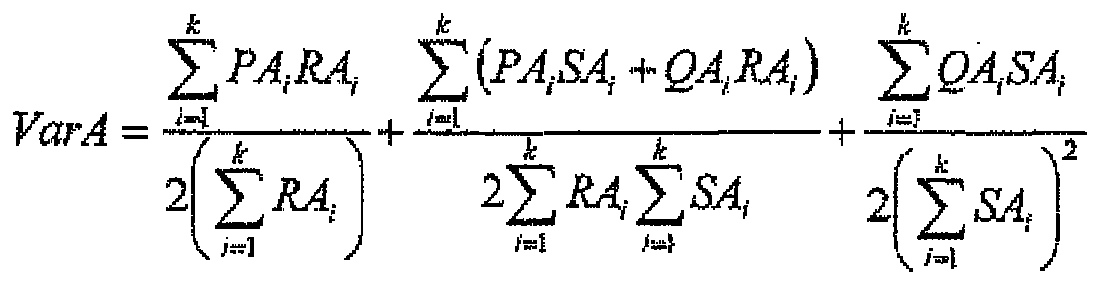

- aAi: the number of detection of a high-risk allele in the progressive glaucoma group,
- bAi: the number of detection of a low-risk allele in the progressive glaucoma group,
- cAi: the number of detection of a high-risk allele in the nonprogressive glaucoma group,
- dAi: the number of detection of a low-risk alleles in the nonprogressive glaucoma group.
- zAi: a total number of detection of alleles, and
- ORaMH : an odds ratio in Mantel-Haenszel test for an allele model.
- A 95% confidence interval (95% CId ) for the dominant genetic model was calculated according to the following formulas.
-


- aDi: the sum of the number of detection of a homozygote of a high-risk allele in the progressive glaucoma group and the number of detection of a heterozygote in the progressive glaucoma group,
- bDi: the number of detection of a homozygote of a low-risk allele in the progressive glaucoma group,
- cDi: the sum of the number of detection of a homozygote of a high-risk allele in the nonprogressive glaucoma group and the number of detection of a heterozygote in the nonprogressive glaucoma group,
- dDi: the number of detection of a homozygote of a low-risk allele in the nonprogressive glaucoma group,
- zDi: a total number of detection of genotypes, and
- ORdMH:an odds ratio in Mantel-Haenszel test for a dominant genetic model.
- A 95% confidence interval (95% CIr ) for the recessive genetic model was calculated according to the following formulas.
-

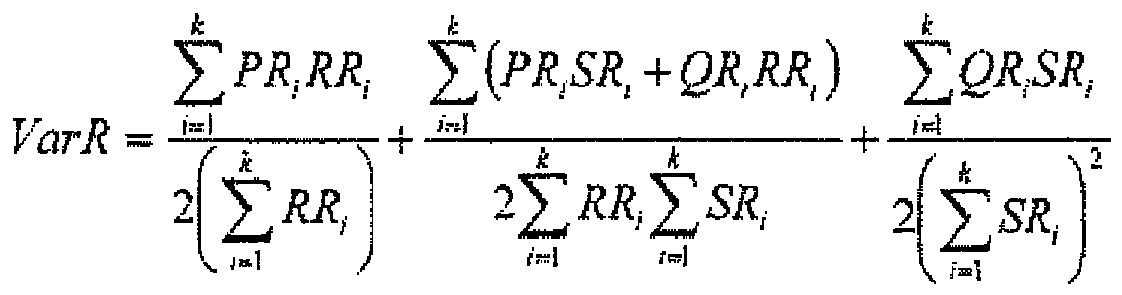

- aRi: the number of detection of a homozygote of a high-risk allele in the progressive glaucoma group,
- bRi: the sum of the number of detection of a heterozygote in the progressive glaucoma group and the number of detection of a homozygote of a low-risk allele in the progressive glaucoma group,
- cRi: the number of detection of a homozygote of a high-risk allele in the nonprogressive glaucoma group,
- dRi: the sum of the number of detection of a heterozygote in the nonprogressive glaucoma group and the number of detection of a homozygote of a low-risk allele in the nonprogressive glaucoma group,
- zRi: a total number of detection of genotypes, and
- ORrMH: an odds ratio in Mantel-Haenszel test for a recessive genetic model.
- Table 52 lists dbSNP ID number specifying known single nucleotide polymorphisms obtained, the chromosome number at which a single nucleotide polymorphism exists, the physical location of a single nucleotide polymorphism, the exon, intron information (in a case where a single nucleotide polymorphism exists on a gene, the gene name and the exon or matron in which SNP exists are shown, and in a case where a single nucleotide polymorphism does not exist on a gene, neighboring genes and a distance between the gene and the single nucleotide polymorphism are shown), the information on the linkage disequilibrium state (the numbers of LD1 and LD2 were assigned to single nucleotide polymorphisms which exist in the same linkage disequilibrium region), each of bases constituting Allele 1 and Allele 2, the base of a high-risk allele, high-risk allele frequencies of the progressive glaucoma group and the nonprogressive glaucoma group, the p-value in a test method having the lowest p-value among three Mantel-Haensxel tests (allele frequency, dominant genetic model, and recessive genetic model), the kinds of the tests thereof, the odds ratio thereof, the 95% confidence interval thereof, SEQ ID NO: of the sequence containing Allele 1 and SEQ ID NO: of the sequence containing Allele 2 in each of the polymorphic sites, and SEQ ID NO: or SEQ ID NOs: showing a base sequence of a probe used in a secondary analysis (basically, both the alleles are detected by the same probe, and in a case where the alleles are discriminated using two kinds of probes, both the sequences are listed together.). Here, one of ordinary skill in the art can obtain the information for sequences or alleles of the single nucleotide polymorphisms from dbSNP ID number listed above.
- When the allele or genotype frequencies of the single nucleotide polymorphisms listed in Table 52 were compared between the nonprogressive glaucoma group and the progressive glaucoma group, a statistical difference was found according to Mantel-Haenszel chi-square test. By determining an allele of any one of these single nucleotide polymorphisms in the same manner as that in Example 4, whether or not an allele that is identified in a higher frequency in the progressive glaucoma group than that of the nonprogressive glaucoma group exists in the sample can be determined.
- According to the above studies, 19 single nucleotide polymorphisms of which alleles or genotypes were associated with glaucoma at a p-value of 1.1. × 10-4 or less exiting in clusters in relatively adjacent region on the genome were found in 13 regions.
- An allele identified in a high frequency in the progressive glaucoma group for single nucleotide polymorphisms listed in Table 52 (in other words, a high-risk allele) or a genotype (in other words, a homozygote of a high-risk allele or a heterozygote when the high-risk allele complies with a dominant genetic model, or a homozygote of a high-risk allele when the high-risk allele complies with a recessive genetic model) can be used as a marker showing that a progressive risk of glaucoma is high. On the other hard, an allele that is opposite to the allele or a. genotype other than the genotype can be used as a marker showing that a progressive risk of glaucoma is low.
- Similarly, a single nucleotide polymorphism of which allele or genotype shows association with the progression of glaucoma at a p-value of 1 × 10⁻² or less, i.e. -log P of 2 or more is listed in Tables 53 to 70,
-
[Table 53] dbSNP ID Chromosome Physical Location Exon Intron Allele 1 Allele2 High-Risk Allele High-Risk Allele Frequency in Progressive Glaucoma Group High-Risk Allele Frenquency in Nonprogressive Glaucoma group Mantel-Haenszel Text p-value Mantel-Haenszel Test Model Odds Ratio 55% Containing Integral Sequence Consulting Allele 1 Sequence Containing Allele 2 Sequence Secondary Analytique Probe Sequence 2 Analytique Probe n6500718 16 3,755,661 A20FT 257472bp (NM_018723.2),
A20PI(NM_14571.3),
A29T1 (NM_143872),
A28P1 (NM_14583.3) 1)A C A 0.91 0.50 0.005469 Alkis 1.35 1.2-2.9 SEQ ID No: 241 SEQ ID No: 247 SEQ ID No: 277 n7144801 14 32,206,647 AKAP6 (NM_004274.3) A O A 0.54 0.89 0.00405 Accessoire 2.10 1.4-3.6 SEQ ID No: 241 SEQ ID No: 241 SEQ ID No: 241 n110 7 79.366.069 ALK (NM_000,304.3) A O A 0.16 0.11 0.11224 Alkis 1.63 1.1-1.3 SEQID No:245 SEQID No:246 SEQID No:247 n319393 6 130,0018,473 AMK15 (NM_033515.2) C O C 0.81 0.28 0.001223 Normale 3.88 12-16 SEQID No:247 SEQID No:248 SEQID No:240 SEQID No:2 n1621 J 7,087,571 CIGALTI +307500p(NM_020156.1) A O C 0.58 0.48 0.000735 Alkis 1.50 1.2-1.9 SEQID No:245 SEQID No:245 SEQID No:245 n16364.0 7 7,090,455 CIGALTI+3323 (NM_020156,1) C O A 0.57 0.57 0.001155 Alkis 1.46 1.2-1.3 SEQID No:245 SEQID No:245 SEQID No:245 SEQID No:245 n1796122 7.090,845 CIGALTI1.3362 (NM_020196.1) C O O 0.57 0.57 annu Alkis 1.45 17-5.6 SEQID No:245 SEQID No:245 SEQID No:245 SEQID No:245 rs2050223 70 15.678,814 CT0 +5609.361 (NM_024704.3) A O A 0.64 0.54 0.002597 Resistive 1.69 1.2-2.4 SEQID No:245 SEQID No:245 SEQID No:245 ns64 zn 41,411,120 C20-26619 176793.2) A C A 0.51 0.42 0.001116 Alkis 1.42 1.1-2.4 SEQID No:245 SEQID No:245 SEQID No:245 rs11691031 2 161,234,936 C2 (NM_017546_3) A C A 0.49 0.44 0.1MMIa Cruminan 1.83 1.3-2.8 SEQID No:245 SEQID No:245 SEQID No:245 r9733830 2 101,236,837 C2 (NM_017546.3) A O A 0.59 0.44 0.000865 Invention 1.65 1.3-2.7 SEQID No:245 SEQID No:245 SEQID No:245 ns 7 39,931,267 C2(NM_136201.1) A C C 0.77 0.68 0.002217 Alkis 1.57 1.22 SEQID No:245 SEQID No:245 SEQID No:245 rs66015.69 p 11.130,988 C8 (XN_088376) A O O 0.92 0.85 0.00375 Alkis 1.95 1.4-2.6 SEQID No:245 SEQID No:245 SEQID No:245 rs2333395 9 126,040,019 CIRZR (XM_089525) A O A 0.23 0.23 0002285 thrist 1.66 1.2-23 SEQID No:245 SEQID No:245 SEQID No:245 rs70,381,65 8 17,388,616 CS (NM_017738.1) A C A 0.70 0.62 0.006790 Alkis 1.41 1.7-1.8 SEQID No:245 SEQID No:245 SEQID No:245 -
[Table 54] dBSNP ID Chromosome Physical Location Exon, Intron Allele 1 Allele 1 High-Risk Allele 1 High-Risk Allele Frequency in progreatie Glaucoma Group High-Risk Allele Frequency be Glaucoma Group Manlal Harsal Test p-value Manted Incristal Test Mode Odds Rades 15% Confidence Interval Constatation Allele 1 Constatation Allele I frequence 1 for secondary Analyste Proter Sequence 2 for Secondary Analyste Proter rs2780197 8 17,416,186 C9cmC9 lition 13 (NM_017738.1) A 0 0 0.04 0.72 0.801857 Allele 1.53 1.2.3 SEQ ID No:271 SEQ ID No:272 SEQ ID No:792 rs2584554 9 17,166,809 C90-C19 Intron13 (NM_012_194) C G C 0.79 0.22 0.905818 Allele 1.45 1.1-1.9 SEQ ID No:273 SEQ ID No:274 SEQ ID No:793 SEQ ID No:1036 rs6577539 1 8,923,501 CA6-1676Step(NM_091245.1) A G A 0.94 6.90 0.009973 Recording 1.81 1.2-2.5 SEQ ID No:275 SEQ ID No:276 SEQ ID No:794 rs4836581 16 47,812,497 CBLN1 457697(NM_804152.1) A G A 0.60 0.31 0.002274 Allele 1.46 1.1-1.9 SEQ ID No:277 SEQ ID No:278 SEQ ID No:795 rs2293325 1 164,157,804 CR32 Intron (NM_000734.2),
CD32 Intron (NM_198053.F)A C G 0.77 0.70 0.003712 Allele 1.47 1.1-1.9 SEQ ID No:279 SEQ ID No:280 SEQ ID No:796 rs6733050 3 120,606,504 CDHDAP Introl (XM_291055) A G A 0.61 0.44 0.002115 Braisival 1.98 1.1-3.3 SEQ ID No:281 SEQ ID No:282 SEQ ID No:9797 rs1534401 16 63,588,839 CDHD6 Intron (NM_12917912),
CDHD6 Introl (NM_0116641)A G A 0.46 0.41 0.001996 Receive 1.91 12.2.9 SEQ ID No:283 SEQ ID No:284 SEQ ID No:798 rs1321001 20 44,140,143 CDHD6 Introl (NM_0212481) A C A 0.62 0.54 0.006422 Allele 1.39 1.1-1.5 SEQ ID No:285 SEQ ID No:286 SEQ ID No:799 rs4811013 20 39,456,660 CDHD6 +8124bp(NM_0322243) A G G 0.40 0.94 11,005705 Allele 1.47 1.31.9 SEQ ID No:287 SEQ ID No:288 SEQ ID No:800 rs12480036 70 39,629,243 CDHD6 Intron1 (NM_0322213) A G A 0.80 0.73 0.005334 Allele 1.46 1.1-1.5 SEQ ID No:289 SEQ ID No:290 SEQ ID No:801 rs60717407 20 39,396,216 CHD6 Intron2 (NM_032222.3) A G G 0.81 0.35 0.003421 Allele 1.52 1.1-I SEQ ID No:291 SEQ ID No:292 SEQ ID No:802 rs909882 30 39,509,923 CDHD6 Introl (NM_032221_3) A G A 0.98 0.72 0.002054 Allele 1.54 1.2-2 SEQ ID No:293 SEQ ID No:294 SEQ ID No:803 rs7898940 16 51,641,067 CDHD6 -179358p (NM_025134.2) A C A 0.17 0.13 0.009306 Dominant 1.64 1-2A SEQ ID No:295 SEQ ID No:296 SEQ ID No:804 rs453579 3 50,612,475 CISH +645 (NM_01.33244). CISH +645 (NM_145011.2) C G C 0.69 0.56 0.001909 Allele 1.46 1.3-1.2 SEQ ID No:297 SEQ ID No:298 SEQ ID No:298 SEQ ID No:805 SEQ ID No:1037 rs1282273 14 94,730,437 CDMN Introl (NM_024134.2) A G A 0.65 0.57 0.003007 Allele 1.40 1.5-1.8 SEQ ID No:299 SEQ ID No:300 SEQ ID No:806 -
[Table 55] dbSNP ID Chromosome Physical Location Exon, Intron Allele 1 Allele 1 High-Risk Allele High-Risk Allele Frequency la Progressive Glaucoma Group High-Risk Allele Frequency la Progressive Glaucoma Group Harsal Test Harsal Test Odds Rade Odds 95% Confidence Interval Sequence Constatate Allele 1 Sequence Constatate Allele 1 Allele 1 Sequence 1 Secondary Analyste Proter Sequence 2 for Secondary Analyste Proter rs3180753 14 94,719,500 CLMN Intron12 (NM_224734.2) A G G 0.47 0.59 0.0023405 Allele 1.43 1.1-1.8 SEQ ID No:303 SEQ ID No:302 SEQ ID No:307 rs2283367 14 94,339,614 CLMN Intron12 (NM_824734.2) A G A 0.67 0.59 0.003667 Allele 1.63 1.1-1.8 SEQ ID No:305 SEQ ID No:304 SEQ ID No:308 rs1142627 14 P4, P14, CR2 CLMN Intron9 (NM_824734.2) A G G 0.59 0.49 0.0043667 Allele 1.49 1.2-1.9 SEQ ID No:307 SEQ ID No:306 SEQ ID No:309 rs1187626 14 94,735,610 CDMN Intron12 (NM_024734.2) A G G 0.49 0.50 0.001214 Recessive 1.83 1.3-2.6 SEQ ID No:309 SEQ ID No:308 SEQ ID No:310 rs17556635 7 18,168,909 CRP85 Intron1 (NM_182099.1),
CRE85 -56415bp (NM_122878.1),
CRE85 -79509bp (NM_ 001504.1)A G A 0.21 0.16 0.002096 Recessive 6.31 1.2-0.4 SEQ ID No:305 SEQ ID No:310 SEQ ID No:311 rs6053320 20 23,809,641 CSCS -1132bp (NM_ 001900.2) A G A 0.40 0.43 0005655 Recessive 2.13 1.2-3.7 SEQ ID No:311 SEQ ID No:312 SEQ ID No:312 rs104914642 14 94,458,722 DRSR1 Intron9 (NM_ 090421.7) DRCTR Intron (NM_ 1714351) c G C 0.41 0.52 0.002954 Allele 1.42 1.1-1.8 SEQ ID No:313 SEQ ID No:314 SEQ ID No:313 SEQ ID No:1038 rs43059362 12 127,750,629 DKPZp16707018-3329Step (XM_5144062) A G A 0.91 0.85 0.009 Allele 1.69 1.2-2.4 SEQ ID No:315 SEQ ID No:316 SEQ ID No:314 rs110590265 12 122,152,135 DKPZp26102013 +34801bp (NM_ 044062) A G G 8.94 0.96 0.009337 Recessive 1.71 2.2-2.4 SEQ ID No:317 SEQ ID No:318 SEQ ID No:315 rs7302136 12 127,152,520 DKPZ p76102018 +152860p (XM_ 044062) A G G 0.91 0.06 0.006.01 Allele 1.65 1.2-2.4 SEQ ID No:319 SEQ ID No:320 SEQ ID No:316 rs12227382 12 127,733,754 DKPZ p76102078 +344200p (XM_ 044062) A G A 0.95 0.86 0.006356 Allele 1.63 1.1-2.3 SEQ ID No:321 SEQ ID No:322 SEQ ID No:317 rs16929359 9 1,440,810 DMRT2 +392458bp (NM_014557.3),
DMRT2 +392458bp (NM_141872.1)A G A 0.10 0.96 0.008247 Allele 1.84 1.2-2.9 SEQ ID No:323 SEQ ID No:324 SEQ ID No:318 rs4142436 9 1,444,200 DMRT1 +100614bp (NM_906597.3),
DMRT2 +306668bp (NM_181927.1),A G A 0.12 0.07 0.0020679 Dominant 6.99 1.3-3.1 SEQ ID No:325 SEQ ID No:326 SEQ ID No:319 rs1801046 10 69,944,713 DNAZL Intron21 (XM_166183) A T A 0.19 0.74 0.091254 Recessive 1.64 1.2-2.3 SEQ ID No:327 SEQ ID No:328 SEQ ID No:320 SEQ ID No:1039 rs17602758 12 42,500,879 DNAJDI +11277bp (NM_013204) A C A 0.14 0.09 0.005093 Dominant 1.80 1.2-2.7 SEQ ID No:329 SEQ ID No:330 SEQ ID No:321 -

-

-
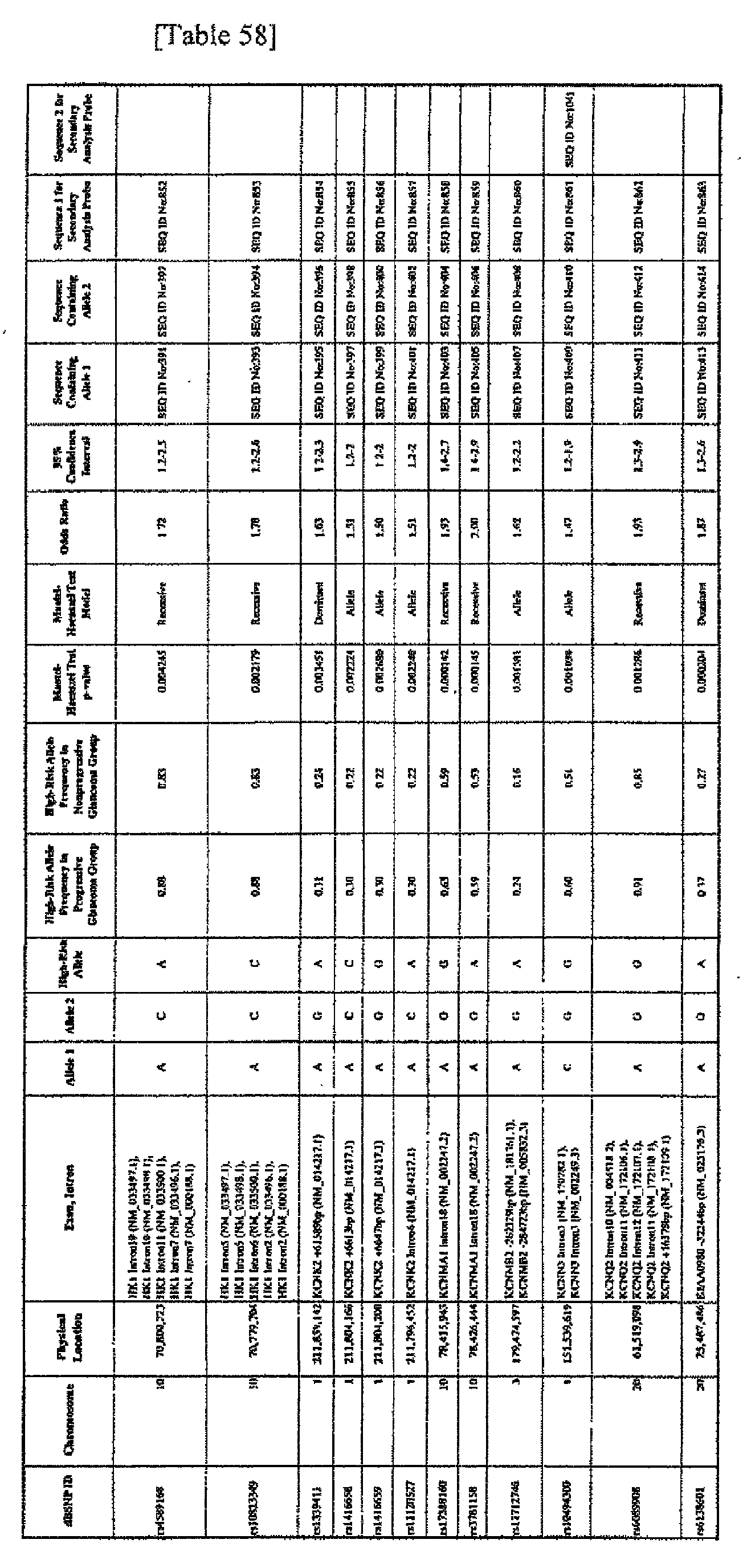
-

-

-

-
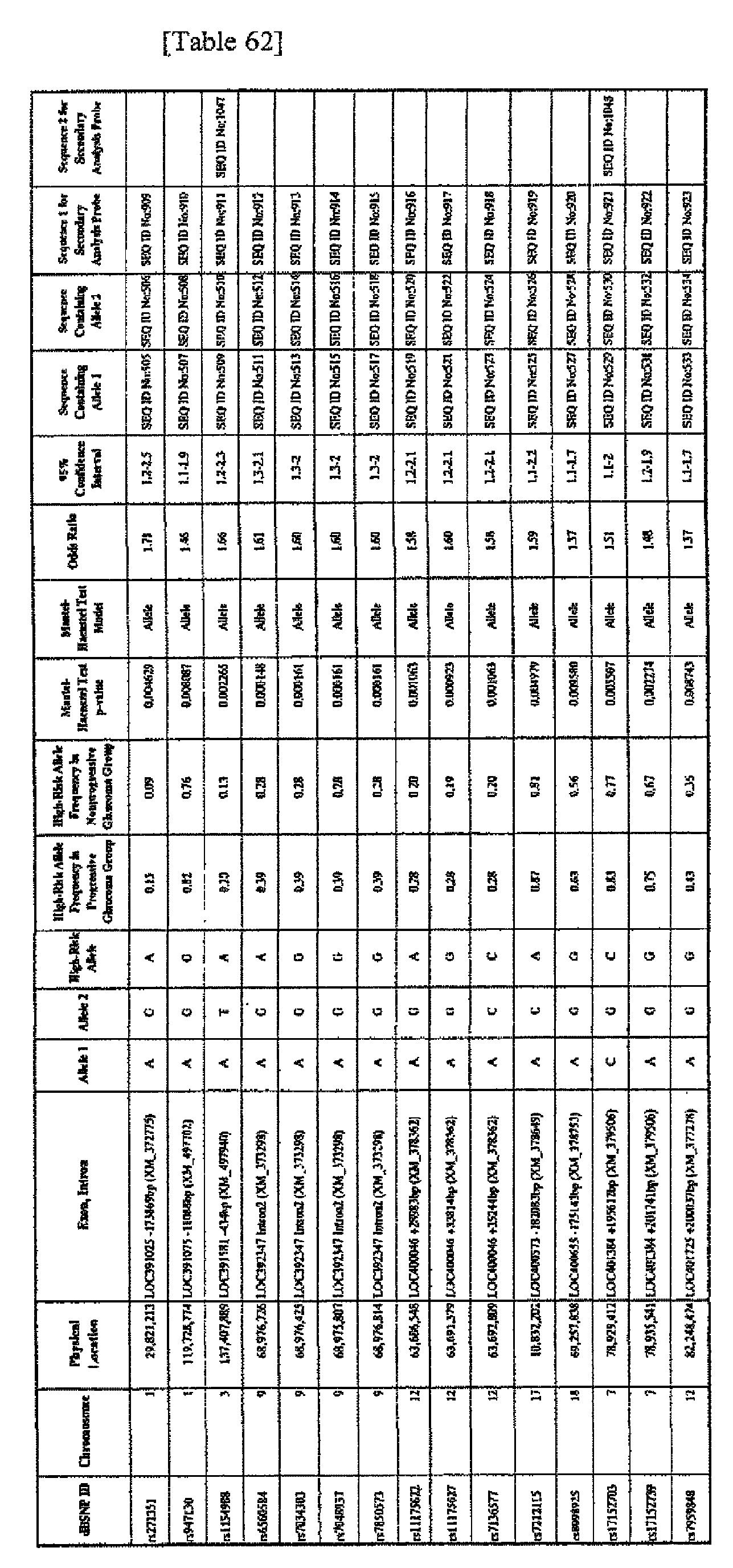
-

-

-

-

-

-

-

-

- The single nucleotide polymorphisms listed in Tables 53 to 70 can be also used as a marker for predicting a progressive risk of glaucoma in the same manner.
- Next, regions and/or genes of the surrounding of single nucleotide polymorphism listed in Table 52 were determined by making reference to the database provided by the HapMap project. In detail, regions in which the single nucleotide polymorphism considered to be in a linkage disequilibrium with the single nucleotide polymorphisms listed in Table 52 exists were determined, on the basis of the linkage disequilibrium data in combination of the Japanese and the Chinese in the HapMap project.
- Also, in a case where the single nucleotide polymorphism listed in Table 52 exists in the linkage disequilibrium region containing genes, the physical location of the region and the gene name were determined. On the other hand, in a case where the single nucleotide polymorphism listed in Table 52 exists in the linkage disequilibrium region without containing the genes, only the physical location of the region was determined. In addition, in a case where the single nucleotide polymorphism listed in Table 52 exists on one gene beyond the linkage disequilibrium region, the gene name and the physical location of the gene were determined.
- A single nucleotide polymorphism of which p-value is the lowest for each region is considered to be a single nucleotide polymorphism representing the region, and Tables 71 to 81 list a single nucleotide polymorphism representing the region, the chromosome number at which the region exists, the physical location of the region (start point and end point) and the gene name contained in the region.
-
[Table 71] Representative Single Nucleotide Polymorphism in the Region
(Single Nucleotide Polymorphism with Lowest p-value)Chromosome Start Location End Location Genes in the Region rs6577539 1 8,919,302 8,937,444 - rs271351 1 29,730,945 29,826,068 - rs490647 1 36,746,869 37,168,937 ORIK3 rs4927088 1 54,404,217 54,584,113 SSEP3 rs687328 1 67,652,235 67,824,796 - rs11590929 1 87,841,409 87,950,062 - rs947130 1 119,723,364 119,807,964 HSD3B1 rs10494300 1 151,492,990 151,655,827 KCNN3 rs2293325 1 164,125,293 164,219,505 CD3Z rs7534078 1 199,296,545 199,563,030 SYT2 JARIDIB AK125746 rs1416658 1 211,567,280 211,867,016 KCNK2 rs11117962 1 214,193,090 214,568,804 SPATA17 rs1529404 2 16,119,969 16,137,052 - rs1104870 2 29,196,209 30,056,083 FLJ34931 ALK RSNL2 rs10172264 2 53,257,353 53,405,293 - rs11691031 2 100,895,131 101,274,767 NPAS2 RPL31 TBC1D8 rs787433 2 145,590,348 145,799,392 - rs1358105 2 150,299,586 150,541,213 FLJ32955 rs7569506 2 165,366,767 165,555,753 COBLL1 -
[Table 72] Representative Single Nucleotide Polymorphism in the Region
(Single Nucleotide Polymorphism with lowest p-value)Chromosome Start Location End Location Genes in the Region rs10460373 2 181,134,445 181,453,645 - rs1196185 2 182,676,057 182,807,925 PPR1R1C rs1520855 2 189,708,226 190,181,703 WDR75 COL5A2 rs16850887 2 197,523,235 197,888,268 PGAP1 AMKRD44 rs4261668 2 210,923,619 211,070,689 MYL1 rs4076919 2 216,497,213 216,578,828 rs7420360 2 221,677,221 221,753,564 - rs6739369 2 229,714,194 229,961,562 PID1 rs7428299 3 5,570,819 5,773,991 - rs6763643 3 39,826,307 40,276,808 MYRIP -
[Table 73] Representative Single Nucleotide Polymorphism in the Region
(Single Nucleotide Polymorphism with Lowest p-value)Chromosome Start Location End Location Genes in the Region rs453570 3 49,686,439 51,799,207 APBH MST1 RNFL23 AMIGO3 GMPPB IHPK1 LOC389118 C3orf54 UBA7 TRAIP CAMKV MSTIR MON1A REM6 REM5 SEMA3F GNATI SLC38A3 GNAI2 SEMA3B RD2 NAT6 C3orf45 HYAL3 HYALI HYAL2 TUSC2 RASSF1 ZMYND10 TUSC4 CYB561D2 TMEM115 CACNA2D3 C3orf18 HEMK1 CISH MAPKAPK3 DOCK3 ARMET RBM15B VPRBP RAD54L2 TEX264 GRM2 -
[Table 74] Representative Single Nucleotide Polymorphism In the Region
(Single Nucleotide Polymorphism with Lowest p-value)Chromosome Start Location End Location Genes In the Region rs6773050 3 120,495,910 120,761,171 CDGAF CD80 PC03192 TMEM39A AK126736 MDSS010 C3orf1 rs7624272 3 124,110,731 124,251,512 SEMA5B rs3957816 3 137,167,265 137,992,954 PPP2R3A RNP184 PCCB STAC1 rs1822652 3 147,390,338 147,696,420 PLSCR2 PLSCR4 rs12490570 3 154,551,245 154,737,123 LOC152118 rs784288 3 170,068,388 170,864,176 MDS1 EV11 rs11713746 3 179,224,760 179,591,920 - rs17605639 2 27,256,221 37,198,338 - rs2736463 4 70,403,494 70,521,560 . rs3805347 2 108,823,357 108,999,023 PAPSS1 rs7692155 4 123,377,225 123,922,063 KIAA1109 CR936613 IL1 Tonf IL21 rs11734419 4 140,995,151 141,432,838 MAMLJ rs7736074 s 1,212,749 1,276,385 AK096054 SLC6A19 -
[Table 75] Representative Single Nucleotide Polymorphism in the Region
(Single Nucleotide Polymorphism with Lowest p-value)Chromosome Start Location End Location Genes in the Region rs7703461 5 75,337,998 75,657,172 SV2C rs166296 5 115,752,543 115,938,450 SEMA6A rs1560026 5 125,151,015 125,717,338 - rs194229 5 158,058,265 158,756,752 EBF FIJ31951 MGC10067 ILI2B rs595805 6 5,940,860 6,265,923 F13A1 NRN1 rs9349248 6 12,554,461 12,626,674 rs9461154 6 25,387,627 25,728,737 LRRC16A rs16886390 6 75,850,763 76,260,216 COLI2A1 FILJP1 COX7A2 TMEM30A rs3798425 6 76,074,522 76,686,994 FIL1P1 SENP6 MYO6 rs531970 6 94,007,852 94,384,201 EPHA7 rs10485223 6 100,160,966 100,372,844 PRDM13 rs13193932 6 129,939,934 130,073,063 ARHGAP18 rs17070863 6 141,512,817 141,829,487 - -
[Table 76] Representative Single Nucleotide Polymorphism in the Region
(Single Nucleotide Polymorphism with Lowest p-value)Chromosome Start Location End Location Genes in the Region rs7767107 6 141,944,499 142,393,247 AKo97143 rs6570564 6 143,882,061 144,194,015 PHACTR2 rs1621819 7 6,940,080 7, 128, 749 C1GALT1 AJ132443 rs12669138 7 9,422,364 9,677,953 - rs10230371 7 18,308,609 18,810,233 HDAC9 rs17156635 7 23,112,180 28,638,749 CREB5 rs17171658 7 39,637,423 40,673,597 C7orf10 CDC2L5 rs17152739 7 78,803,891 78,947,358 - rs7802749 7 94,162,046 94,722,947 PPP1R9A PON1 PON2 PON3 rs3757759 7 126,534,572 137,377,349 ZNF800 GCC1 ARF5 FSCN3 PAX4 NAGS LRRC4 SND1 rs6601569 8 10,791,891 11,126,489 C8orf21 C8orf5 C8orf6 C8orf15 CRorf16 XKR6 -
[Table 77] Representative Single Nucleotide Polymorphism in the Region
(Single Nucleotide Polymorphism with Lowest p-value)Chromosome Start Location End Location Genes in the Region rs4316157 8 12,664,980 12,698,048 rs10503907 8 31,616,810 32,720,310 NRG1 AK127911 rs9650336 8 38,606,462, 38,689,512 - rs4394361 8 96,504,810 96,604,166 rs4394361 8 97,343,317 97,558,505 BC002376 AK126443 PTDSS1 rs6995270 8 134,533,189 134,653,344 ST3GAL1 rs4142436 g 1,377,505 1,450,365 - rs12554461 9 4,777,149 4,366,435 RCL1 rs10815959 9 8,304,247 10,602,509 PTPRD rs2780197 9 16,976,415 17,493,915 CNTLN C9orf39 rs10967956 9 27,315,208 27,589,202 MOBKL2B TFNK C9orf72 rs10781440 9 68,550,170 69,099,672 PIP5K1B TJP2 PRKACG FXN FAM122A rs943509 9 75,083,939 75,297,469 - rs10869586 9 75,394,767 75,450,986 - rs10512277 9 100,256,889 100,625,025 MURC MGC17337 BC090888 AL831919 TMEFF1 corf30 rs4979255 9 107,506,524 107,557,442 - rs2773395 9 125,999,689 126,057,452 - rs2151078 10 55,250,866 56,231,057 PCDH15 rs9416465 10 57,227,132 57,996,501 ZWINT -
[Table 78] Representative Single Nucleotide Polymorphism in the Region
(Single Nucleotide Polymorphism with Lowest p-value)Chromosome Start Location End Location Genes in the Region rs1801041 10 69,539,256 70,125,600 MYPN ATOH7 PBLD HNRPH3 MAWBP HNRPH3 RUFY2 SLC25A16 DNA2 CXXC6 rs10823349 10 70,699,762 70,831,641 HK1 rs2395453 10 78,299,370 79,067,583 KCNMA1 rs7093891 10 111,370,433 111,673,192 XPNPEP1 m7927545 11 11,249,002 11,600,128 GALNTL4 rs7112492 11 18,349,559 18,457,723 LDHALAA LDHA LDHC rs12800710 11 57,713,408 58,200,377 LPXN OR9Q2 OR1S2 OR1S1 OR10O1 UNQ6469 LOC399898 OR5B17 OR5B3 OR5B2 OR5B12 ZFF9I rs504105 11 82,583,199 84,312,113 ANKRD42 DLG2 CCDC90B rs10898459 11 85,583,115 85,745,023 EED HSPC13B rs161130 11 112,150,907 112,255,730 - -
[Table 79] Representative Single Nucleotide Polymorphism in the Region
(Single NucleotiDe Polymorphism with Lowest p-value)Chromosome Start Location End Location Genes in the Region rs4269933 11 319,110,064 119,202,392 - rs2322728 11 126,615,901 126,702,818 - rs10877835 12 38,306,287 39,318,456 LOC283461 SLC2A13 BC047507 LRRK2 AK127729 AK093065 rs2169856 12 53,730,141 53,972,700 OR9K2 OR10A7 OR6C74 rs11175627 12 63,667,042 63,801,383 WIF1 rs7959848 12 82,043,793 82,360,242 - -rs11116586 12 83,546,501 83,667,628 - rs7296095 12 114,297,666 114,443,627 - rs11059862 12 127,746,927 127,761,568 - rs17640758 13 42,473,098 42,596,252 DNAJD1 rs4643164 13 105,618,880 107,317,084 LOC728215 rs10483416 14 31,868,274 32,372,018 AKAP6 rs8003168 14 71,294,225 72,102,991 RGS6 AF130114 C14orf57 rs1622029 14 83,422,711 84,117,961 - rs1187627 14 94,607,134 94,855,955 CLMN DICER1 FLJ45244 rs12400219 15 21,568,517 21,589,571 - -
[Table 80] Representative Single Nucleotide Polymorphism in the Region
(Single Nucleotide Polymorphism with Lowest p-value)Chromosome Start Location End Location Genes in the Region rs16941386 15 57,215,856 57,465,385 MYOIE rs12591327 15 60,926,419 61,002,704 - rs2247154 15 67,997,515 68,083,355 - rs3863401 15 97,440,341 97,748,455 AK127177 LRRC28 HCC-8 DMN AK125000 rs6500718 16 5,725,135 5,792,957 - rs12595990 16 12,053,556 12,575,647 SNX29 rs9302502 16 13,340,184 13,545,371 - rs1816583 16 47,722,996 47,860,850 - rs7198530 16 51,635,508 51,918,914 CHD9 rs1554401 16 63,494,458 63.713.420 CDH11 rs7212115 17 10,832,202 10,865,630 - rs295869 17 32,165,628 32,234,457 - rs8098925 is 69,240,762 69,384,770 - rs1828132 18 72,356,779 72,430,800 - rs12462868 19 41,159,572 41,215,615 CLIP3 LOC644096 FLJ36445 BC052573 C19orf46 ALKBH6 rs4802905 19 57,349,937 57,487,776 FLJ16287 ZNF766 PPP2R1A rs734380 19 63,548,356 63,597,982 A1BG RPS5 ZNF497 rs517578 20 1,557,798 1,674,903 SIRPB2 rs6035140 20 1,822,813 1.926,301 SIRPA PTPNS1 PDYN rs2050223 20 13,924,146 15,981,839 MACROD2 -
[Table 81] Representative Single Nucleotide Polymorphism in the Region
(Single Nucleotide Polymorphism with Lowest p-value)Chromosome Start Location End Location Genes in the Region rs6083320 20 23,811,795 23,841,840 - rs6132862 20 24,988,884 25,706,656 VSX1 ENTPD6 PYGB ABHD12 GINS1 NLP ZNF337 HDHD4 rs926663 20 38,563,539 38,754,165 MAFB rs2076147 20 39,011,156 39,443,459 TOP1 PLCG1 ZHX3 LPIN3 EMILIN3 AF090938 rs909882 20 39,456,460 39,703,552 CHD6 AK124874 rs4572656 20 40,018,906 41,251,971 PTPRT rs6017164 20 41,815,520 41,816,915 - rs1321001 20 44,235,783 44,313,741 CDH22 rs4812180 20 56,608,933 58,748,410 - rs6089908 20 61,470,599 61,628,090 KCNQ2 AK127527 Ak127768 AY358189 EEF1A2 C20orf149 rs369977 21 15,496,913 15,621,381 - rs7275647 21 21,292,504 21,833,085 NCAM2 rs94967 21 40,026,415 40,223,190 PCP4 1GSF5 rs5750009 22 33,671,179 33,694,293 - - The region listed in Tables 71 to 81 is a region or gene considered to be linked with a single nucleotide polymorphism associated with the progression of glaucoma in the present invention listed in Tables 53 to 70, and a single Nucleotide polymorphism which exists in these regions or genes is considered to be linked with a single nucleotide polymorphism in the present invention. In other words, any single nucleotide polymorphism which exist in these regions are linked with the single nucleotide polymorphism which exists in the region listed in Tables 53 to 70, and any of these single nucleotide polymorphisms can be used in the prediction of a progressive risk of glaucoma in the same manner.
- In the present invention, by combining any two or more single nucleotide polymorphisms determined to be involved in the progression of glaucoma, an extent to which the precision of the prediction of a risk of a disease improves is examined with logistic regression analysis, as compared to that where each of the single nucleotide polymorphisms is used alone. In the present analysis, any combinations of the single nucleotide polymorphisms determined to be significantly associated with the progression of glaucoma by statistically comparing allele or genotype frequencies can be used. In one example, 19 single nucleotide polymorphisms that showed a significant difference under the Bonferroni correction were subjected to the logistic regression analysis.
- Out of 19 single nucleotide polymorphisms that had a significance under the Bonferroni correction, single nucleotide polymorphisms for use in the logistic regression analysis were further narrowed down according to a stepwise method. The value of 0.01 was adopted as a criterion of variable incorporation and variable exclusion in the stepwise method. Upon the application of a stepwise method, a single nucleotide polymorphism belonging to the same LD block (ones having the same description in the column of linkage disequilibrium in Table 52) is represented by any one of single nucleotide polymorphisms belonging to each of the LD blocks, and it is set so that any one of the single nucleotide polymorphisms is to be a subject to be incorporated. Each of the narrowed-down single nucleotide polymorphism is defined as an independent variable (Π) (homozygote of one allele = 0, heterozygote = 1, (homozygote of opposite allele = 2), and a regression coefficient (λ) can be determined according to the logistic regression analysis, and the following formula (18) was obtained. formula (18)

- As listed in Table 82, according to a stepwise method, the 19 single nucleotide polymorphisms (13 single Nucleotide polymorphisms, if those belonging to the same LD block were each counted as one) were narrowed down to 10 single nucleotide polymorphisms (rs4316157, rs1358105, rs4076919, rs2395453, rs6132S62, rs10483416, rs787433, rs4802905, rs12554461, and rs4927088). Therefore, it shows that similar results are obtained with the combination of 10 single Nucleotide polymorphisms even when the remaining 3 single nucleotide polymorphisms are added. A value for risk prediction (Φ) of individual cases was calculated using a logistic regression formula, alone or in a combination of any two or more of these 10 single nucleotide polymorphisms. When a cut-off value for a value for risk prediction is defined as 0.5, mean ± standard deviation of the concordance rate was 57.6 ± 2.4% in a case thai each of the single nucleotide polymorphisms was used alone. This concordance rate was elevated as an increase in the number of single nucleotide polymorphisms used in combination, and reached the maximum of 67.8% in a case that all the ten were combined.
-
[Table 82] The Number of SNP The Number of Combination Concordance Rate (Mean Value) Standard Deviation 1 10 57.6 2.4 2 45 59.0 1.7 3 120 60.6 1.8 4 210 62.1 1.9 5 252 63.1 1.8 6 210 64.1 1.5 7 120 64.9 1.7 8 45 65.7 1.5 9 10 66.6 1.4 10 1 67.8 - - As described above, it was evident that, in the determination of a progressive risk of glaucoma by a single nucleotide polymorphism, an excellent concordance rate can be obtained even in a case that each of the single Nucleotide polymorphisms are used alone, and the diagnostic precision can be further enhanced by combining these single nucleotide polymorphisms.
- As described above, an individual who has an allele or a genotype that is identified in a high frequency in the progressive glaucoma group disclosed in the present invention on the genome ha.s a high progressive risk of glaucoma in future, and an individual who does not have an allele or a genotype that is identified in a high frequency in the progressive glaucoma group has a low progressive risk of glaucoma in future.
- According to the method of the present invention, the level of a progressive risk of glaucoma of a sample donor can be determined by analyzing an allele or a genotype of a single nucleotide polymorphism in the present invention in a sample. A sample donor can take a preventive measure of glaucoma, or can receive appropriate treatments, on the basis of this risk. In addition, the method is useful because the period of a clinical trial for a glaucoma therapeutic drug can be shortened by selecting patients with a high progressive risk of glaucoma using a single nucleotide polymorphism associated with the progression of glaucoma in the present invention, and performing a clinical trial for a glaucoma therapeutic drug.
Furthermore, the present invention relates to the following items: - [1] A method of determining the presence or the absence of a glaucoma risk, comprising the steps of:
- detecting in vitro an allele and/or a genotype of a single nucleotide polymorphism which is located on a 31st base of a base sequence, in a sample from a subject, wherein the base sequence is at least one base sequence selected from the group consisting of base sequences shown in SEQ ID NOs: 203 to 752 or a complementary sequence thereto (step A), and
- comparing the allele and/or the genotype detected in said step A with at least one of an allele and/or a genotype, comprising a high-risk allele, in the base sequences shown in SEQ ID NOs: 203 to 752 (step B),
wherein the presence of a glaucoma risk is determined in a case where the genotype detected in said step A is a homozygote of the genotype comprising the high-risk allele or a heterozygote when the high-risk allele complies with a dominant genetic model, or
wherein the presence of a glaucoma risk is determined in a case where the genotype detected in said step A is a homozygote of the genotype comprising the high-risk allele when the high-risk allele complies with a recessive genetic model. - [2] The method according to item 1, wherein the glaucoma risk is a progressive risk of glaucoma.
- [3] The method according to item 2, wherein the base sequence is selected from the group consisting of base sequences shown in SEQ ID NOs: 203 to 240.
- [4] The method according to item 3, wherein the comparison in said step B comprises selecting and combining any two or more alleles and/or genotypes, comprising the high-risk allele, in the base sequences shown in SEQ ID Nos: 203 to 240,
wherein the presence of a glaucoma risk is determined in a case where the allele detected in said step A is any one of the alleles selected for the comparison in said step B, or
wherein the presence of a glaucoma risk is determined in a case where the genotype detected in said step A is a homozygote or a heterozygote of any one of the genotypes selected for the comparison in said step B when the high-risk allele complies with a dominant genetic model, or
wherein the presence of a glaucoma risk is determined in a case where the genotype detected in said step A is a homozygote of any one of the genotypes selected for the comparison in said step B when the high-risk allele complies with a recessive genetic model. - [5] The method according to item 4, wherein the comparison in said step B comprises selecting and combining all the alleles and/or the genotypes, comprising the high-risk allele, in the base sequences shown in SEQ ID NOs: 203 to 240,
wherein the presence of a glaucoma risk is determined in a case where the allele detected in said step A is any one of the alleles selected for the comparison in said step B, or
wherein the presence of a glaucoma risk is determined in a case where the genotype detected in said step A is a homozygote or a heterozygote of any one of the genotypes selected for the comparison in the said step B when the high-risk allele complies with a dominant genetic model, or wherein the presence of a glaucoma risk is determined in a case where the genotype detected in said step A is a homozygote of any one of the genotypes selected for the comparison in said step B when the high-risk allele complies with a recessive genetic model. - [6] The method according to item 2, further comprising the step of predicting the level of the progressive risk.
- [7] The method according to item 1, wherein the glaucoma is primary open-angle glaucoma (POAG) or normal tension glaucoma (NTG).
- [8] A method of determining the presence or the absence of a glaucoma risk, comprising the steps of:
- detecting in vitro, in a sample from a subject, an allele and/or a genotype of a single nucleotide polymorphism which is located on a 31st base of a base sequence in a nucleic acid molecule, wherein the nucleic acid molecule comprises at least one base sequence selected from the group consisting of base sequences shown in SEQ ID NOs: 203 to 752 or a complementary sequence thereto (step C1), or
- detecting in vitro, in a sample from a subject, an allele and/or a genotype of a single nucleotide polymorphism, using a nucleic acid molecule comprising a base sequence comprising at least one base sequence selected from the group consisting of base sequences shown in SEQ ID NOs: 753 to 1061 or a complementary sequence thereto (step C2), and
- comparing the allele and/or the genotype detected in said step C1 or C2 with at least one nucleic acid molecule comprising an allele and/or a genotype, comprising a high-risk allele, in the base sequences shown in the SEQ ID NOs: 203 to 752 (step D),
wherein the presence of a glaucoma risk is determined in a case where the allele detected in said step C1 or C2 is the high-risk allele, or
wherein the presence of a glaucoma risk is determined in a case where the genotype detected in said step C1 or C2 is a homozygote of the genotype comprising the high-risk allele or a heterozygote when the high-risk allele complies with a dominant genetic model, or
wherein the presence of a glaucoma risk is determined in a case where the genotype detected in said step C1 or C2 is a homozygote of the genotype comprising the high-risk allele when the high-risk allele complies with a recessive genetic model.
- [9] The method according to item 8, wherein the glaucoma risk is a progressive risk of glaucoma.
- [10] The method according to item 9, wherein the base sequence in said steps C 1 and D is selected from the group consisting of base sequences shown in SEQ ID NOs: 203 to 240, or wherein the base sequence in said step C2 is selected from the group consisting of base sequences shown in SEQ ID NOs: 753 to 771.
- [11] The method according to item 10, wherein the comparison in said step D comprises selecting and combining any two or more nucleic acid molecules comprising the allele and/or the genotype, comprising the high-risk allele, in the base sequences shown in SEQ ID NOs: 203 to 240, wherein the presence of a glaucoma risk is determined in a case where the allele detected in said step C1 or C2 is a high-risk allele in any one of the nucleic acid molecules selected for the comparison in said step D, or wherein the presence of a glaucoma risk is determined in a case where the genotype detected in said step C1 or C2 is a homozygote or a heterozygote of the genotype in any one of the nucleic acid molecules selected for the comparison in said step D when the high-risk allele complies with a dominant genetic model, or
wherein the presence of a glaucoma risk is determined in a case where the genotype detected in said step C1 or C2 is a homozygote of the genotype in any one of the nucleic acid molecules selected for the comparison in said step D when the high-risk allele complies with a recessive genetic model. - [12] The method according to item 12, wherein the comparison in said step D comprises selecting and combining all the nucleic acid molecules comprising the alleles and/or the genotypes, comprising the high-risk allele, in the base sequences shown in SEQ ID NOs: 203 to 240,
wherein the presence of a glaucoma risk is determined in a case where the allele detected in said step C I or C2 is a high-risk allele in any one of the nucleic acid molecules selected for the comparison in said step D, or wherein the presence of a glaucoma risk is determined in a case where the genotype detected in said step C1 or C2 is a homozygote or a heterozygote of the genotype in any one of the nucleic acid molecules selected for the comparison in said step D when the high-risk allele complies with a dominant genetic model, or
wherein the presence of a glaucoma risk is determined in a case where the genotype detected in said step C1 or C2 is a homozygote of the genotype in any one of the nucleic acid molecules selected for the comparison in said step D when the high-risk allele complies with a recessive genetic model. - [13] The method according to item. 9, further comprising the step of predicting the level of the progressive risk.
- [14] The method according to any one of items 8 to 13, wherein the nucleic acid molecule is used as a probe.
- [15] The method according to item 14, wherein the nucleic acid molecule is in the length of from 23 to 55 bases.
- [16] The method according to item 14, wherein the probe is immobilized.
- [17] The method according to item 8, wherein the glaucoma is primary open-angle glaucoma (POAG) or normal tension glaucoma (NTG).
- [18] A kit of determining the presence or the absence of a glaucoma risk, comprising
a nucleic acid molecule comprising at least one base sequence selected from the group consisting of base sequences shown in SEQ ID NOs: 203 to 752 or a complementary sequence thereto, or a partial sequence thereof, wherein the nucleic acid molecule comprises a single nucleotide polymorphism which is located on a 31st base of a base sequence, and/or
a nucleic acid molecule comprising a base sequence comprising at least one base sequence selected from the group consisting of base sequences shown in SEQ ID NOs: 753 to 1061 or a complementary sequence thereto,
wherein the kit is for use in detecting in vitro an allele and/or a genotype of a single nucleotide polymorphism in a sample from a subject. - [19] The kit according to item 18, wherein the glaucoma risk is a progressive risk of glaucoma.
- [20] The kit according to item 19, wherein the base sequence is selected from the group consisting of base sequences shown in SEQ ID NOs: 203 to 240 and/or the group consisting of SEQ ID NOs: 753 to 771.
- [21] The kit according to item 20, wherein the kit comprises any two or more nucleic acid molecules comprising a base sequence shown in SEQ ID NOs: 203 to 240 or a complementary sequence thereto, or a partial sequence thereof, and/or any two or more nucleic acid molecules comprising a base sequence shown in SEQ ID NQs: 753 to 771 or a complementary sequence thereto.
- [22] The kit according to item 21, wherein the kit comprises all the nucleic acid molecules comprising a base sequence shown in SEQ ID NOs: 203 to 240 or a complementary sequence thereto, or a partial sequence thereof and/or all the nucleic acid molecules comprising a base sequence shown in SEQ ID NOs: 753 to 771 or a complementary sequence thereto.
- [23] The kit according to item 19, for use in further predicting the level of the progressive risk.
- [24] The kit according to any one of items 18 to 23, wherein the nucleic acid molecule is used as a probe.
- [25] The kit according to items 24, wherein the nucleic acid molecule is in the length of from 23 to 55 bases.
- [26] The kit according to item 24, wherein the probe is immobilized.
- [27] The kit according to item 18, wherein the glaucoma is primary open-angle glaucoma (POAG) or normal tension glaucoma (NTG).
- [28] A method of determining the presence or the absence of a glaucoma risk, comprising the following steps of:
- step (i): extracting a nucleic acid molecule from a sample from a subject,
- step (ii): detecting an allele of a single nucleotide polymorphism which is located on a 31st base of a base sequence, wherein the base sequence is at least one base sequence selected from base sequences shown in SEQ ID NOs: 203 to 752 or a complementary sequence thereto, for the nucleic acid molecule extracted in said step (i), and
- step (iii): determining the presence or the absence of a glaucoma risk, based on the allele detected in said step (ii).
- [29] The method according to item 28, wherein said step (iii) comprises the step of determining a genotype, based on the allele detected in said step (ii).
- [30] The method according to item 28 or 29, wherein said step (iii) comprises the step of determining whether or not the allele detected in said step (ii) is a high-risk allele.
- [31] The method according to item 30, wherein said step (iii) comprises the step of determining that the glaucoma risk is high in a case where the allele detected in said step (ii) is the high-risk allele.
- [32] Use of a nucleic acid molecule for determining a glaucoma risk, wherein the nucleic acid molecule comprises at least one base sequence, the base sequence being a base sequence selected from the group consisting of base sequences shown in SEQ ID NOs: 203 to 752 or a complementary sequence thereto, or a partial sequence thereof, wherein the nucleic acid molecule comprises an allele and/or a genotype of a single nucleotide polymorphism which is located on a 31st base of a base sequence.
- [33] A method of diagnosing glaucoma, comprising the steps of:
- detecting in vitro an allele and/or a genotype of a single nucleotide polymorphism which is located on a 31st base of a base sequence, in a sample from a subject, wherein the base sequence is at least one base sequence selected from the group consisting of base sequences shown in SEQ ID NOs: 203 to 752 or a complementary sequence thereto (step E), and
- comparing the allele and/or the genotype detected in said step E with at least one of an allele and/or a genotype, comprising a high-risk allele, in the base sequences shown in SEQ ID NOs: 203 to 752 (step F),
wherein the subject is diagnosed as glaucoma in a case where the genotype detected in said step E is a homozygote of the genotype comprising the high-risk allele or a heterozygote when the high-risk allele complies with a dominant genetic model, or
wherein the subject is diagnosed as glaucoma in a case where the genotype detected in said step E is a homozygote of the genotype comprising the high-risk allele when the high-risk allele complies with a recessive genetic model. - [34] A method of determining a progressive risk of glaucoma, comprising the following steps of:
- step (I): determining the presence or the absence of the progressive risk of glaucoma, with the method as defined in item 3,
- step (II): determining that a further risk determination is needed, in a case where the presence of the progressive risk is determined in said step (I) for any one of single nucleotide polymorphisms, and
- step (III): further determining the presence or the absence of the progressive risk of glaucoma, with the method as defined in item 5, in a case of being determined that a further risk determination is needed in said step (II).
wherein the presence of a glaucoma risk is determined in a case where the detected genotype is a. homozygote of the genotype containing the high-risk allele or a heterozygote when the high-risk allele complies with a dominant genetic model, or
wherein the presence of a glaucoma risk is determined in a case where the detected genotype is a homozygote of the genotype containing the high-risk allele when the high-risk allele complies with a recessive genetic model. A great feature of the present invention resides in that a single nucleotide polymorphism associated with the progression of glaucoma is found, further that in the single nucleotide polymorphism, an allele identified in a high frequency in progressive glaucoma cases and an opposite allele thereof and a genotype, which is a combination of each of the alleles identified in a high frequency in progressive glaucoma cases are found, and used. The polymorphism as used herein refers to a matter that a diversity is found in sequences of a specified location on the genome in a certain organism species, and a site at which the polymorphism exists (hereinafter also referred to as polymorphic site) refers to a site on the genome that a single nucleotide polymorphism is found.
Here, these sequences are sequences containing a high-risk allele in each of polymorphic sites.
even more preferably single nucleotide polymorphisms which are located on 31 st bases of base sequences, wherein the base sequences are base sequences containing all the different single nucleotide polymorphisms,
selected from the group consisting of pairs of base sequences containing a single nucleotide polymorphism listed above or a complementary sequence thereto.
a group composed of a single nucleotide polymorphism which is located on a 31 st base of a base sequence, wherein the base sequence is a base sequence belonging to the group consisting of:
it is preferable to use
any one of the single nucleotide polymorphisms in Group 1 in a case that the single nucleotide polymorphisms belonging to Group I are used, and/or
any one of the single nucleotide polymorphisms in Group 2 in a case that the single nucleotide polymorphisms belonging to Group 2 are used.
Here, these base sequences are sequences containing a high-risk allele in each of polymorphic sites.
Here, these base sequences are sequences corresponding to a probe used in the detection of a high-risk allele.
a group composed of a base sequence containing a single nucleotide polymorphism which is located on a 31st base of a base sequence, wherein the base sequence is a base sequence belonging to the group consisting of:
that in Group B,
a group composed of a base sequence containing a base sequence belonging to the group consisting of:
a group composed of a base sequence containing a base sequence belonging to the group consisting of:
it is preferable to use
a probe containing any one of the base sequences in Group 1 in a case that the base sequences belonging to Group 1 are used, and/or a probe containing any one of the base sequences in Group 2 in a case that the base sequences belonging to Group 2 are used.
in Group B, a probe containing a base sequence containing a base sequence selected from the group consisting of the following base sequences:
Here, these base sequences are sequences corresponding to a probe used in the detection of a. high-risk allele.
Here, these base sequences are sequence corresponding to a nucleic acid molecule used in the detection of a high-risk allele.
even more preferably a. kit of detecting a single nucleotide polymorphism associated with the progression of glaucoma or a kit of predicting a progressive risk of glaucoma, using a nucleic acid molecule comprising a single nucleotide polymorphism which is located on a 31st base of a base sequence, wherein the base sequence is a base sequence containing a single nucleotide polymorphism, selected from Group A consisting of pairs of the base sequences containing a single nucleotide polymorphism listed above or a complementary sequence thereto, or a partial sequence thereof, and/or a kit of detecting a single Nucleotide polymorphism associated with the progression of glaucoma or a kit of predicting a progressive risk of glaucoma, using a nucleic acid molecule comprising a base sequence containing a base sequence selected from Group B consisting of pairs of the base sequences listed above or a. complementary sequence thereto, wherein the kit is a kit corresponding to all the different single nucleotide polymorphism thereof.
a group composed of a base sequence containing a single nucleotide polymorphism which is located on a 31st base of a base sequence, wherein the base sequence is a base sequence belonging to the group consisting of:
that in Group B,
a group composed of a base sequence containing a base sequence belonging to the group consisting of:
a group composed of a base sequence containing a base sequence belonging to the group consisting of:
it is preferable to use
a kit of detecting a single Nucleotide polymorphism associated with the progression of glaucoma or a kit of predicting a progressive risk of glaucoma, using a nucleic acid molecule comprising any one of the base sequences in Group 1 when the base sequences belonging to Group 1 are used, and/or
a kit of detecting a single nucleotide polymorphism associated with the progression of glaucoma or a kit of predicting a progressive risk of glaucoma, using a nucleic acid molecule comprising any one of the base sequences in Group 2 when the base sequences belonging to Group 2 are used.
Here, these base sequences are sequences corresponding to a nucleic acid molecule used in the detection of a high-risk allele.


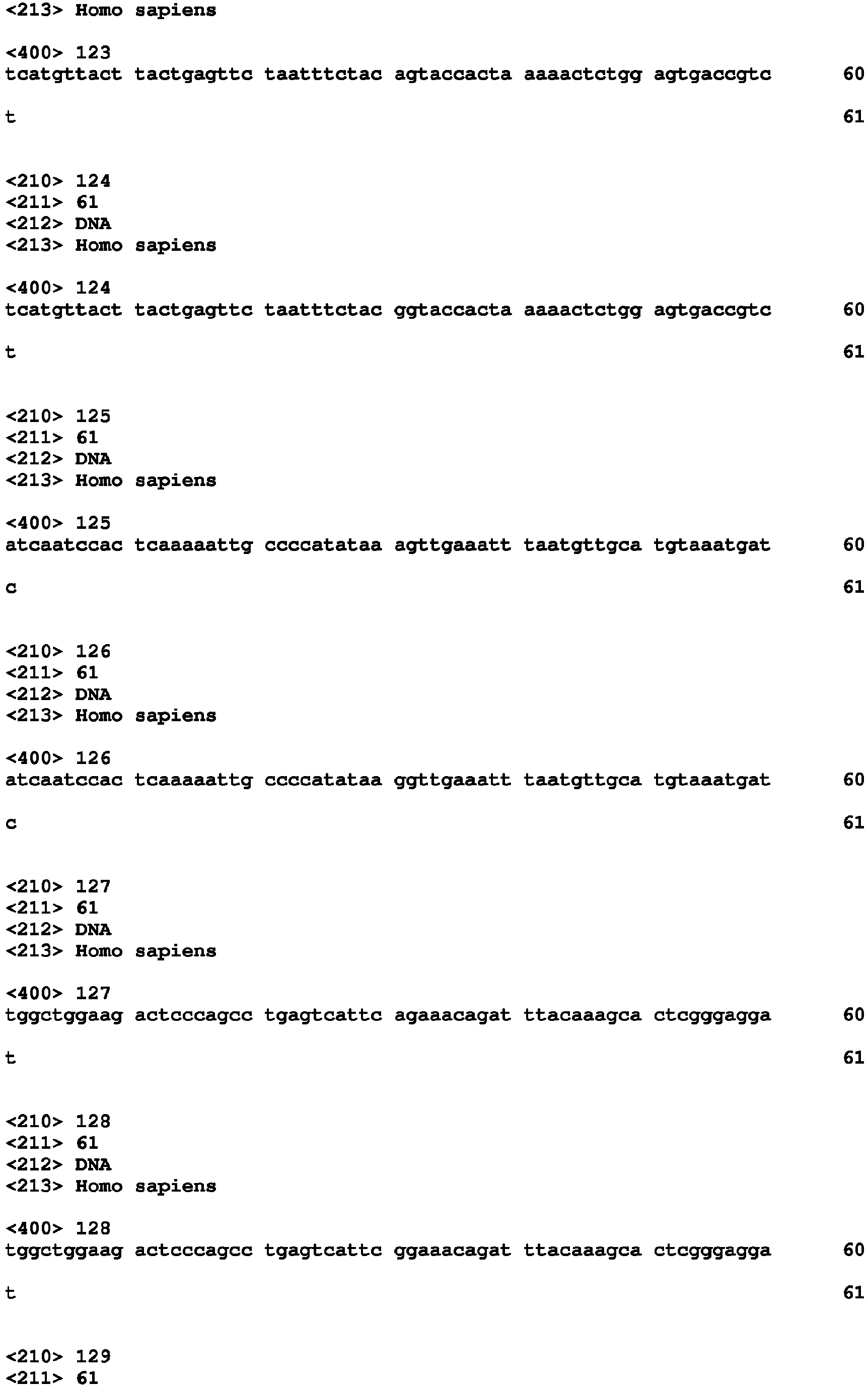


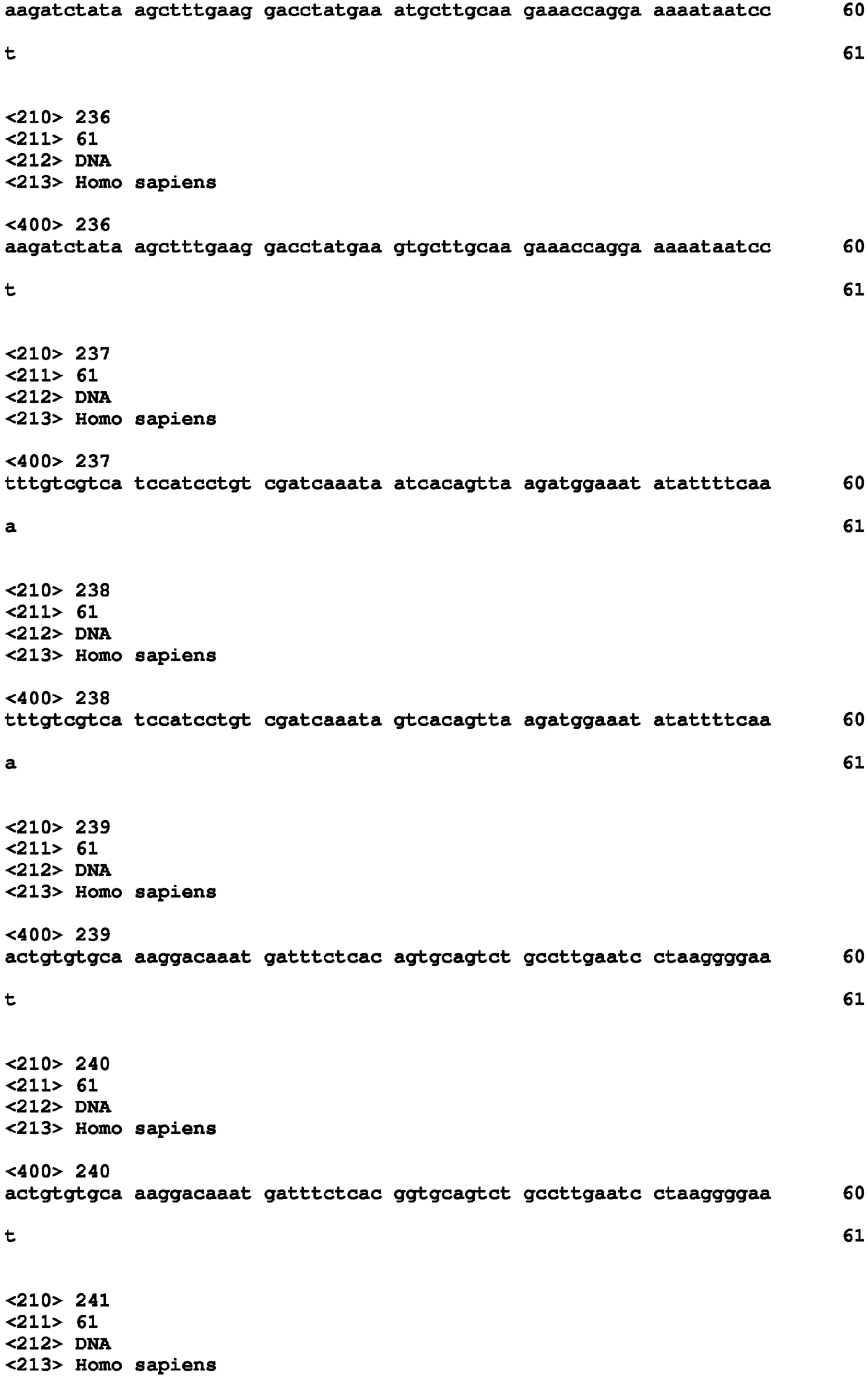


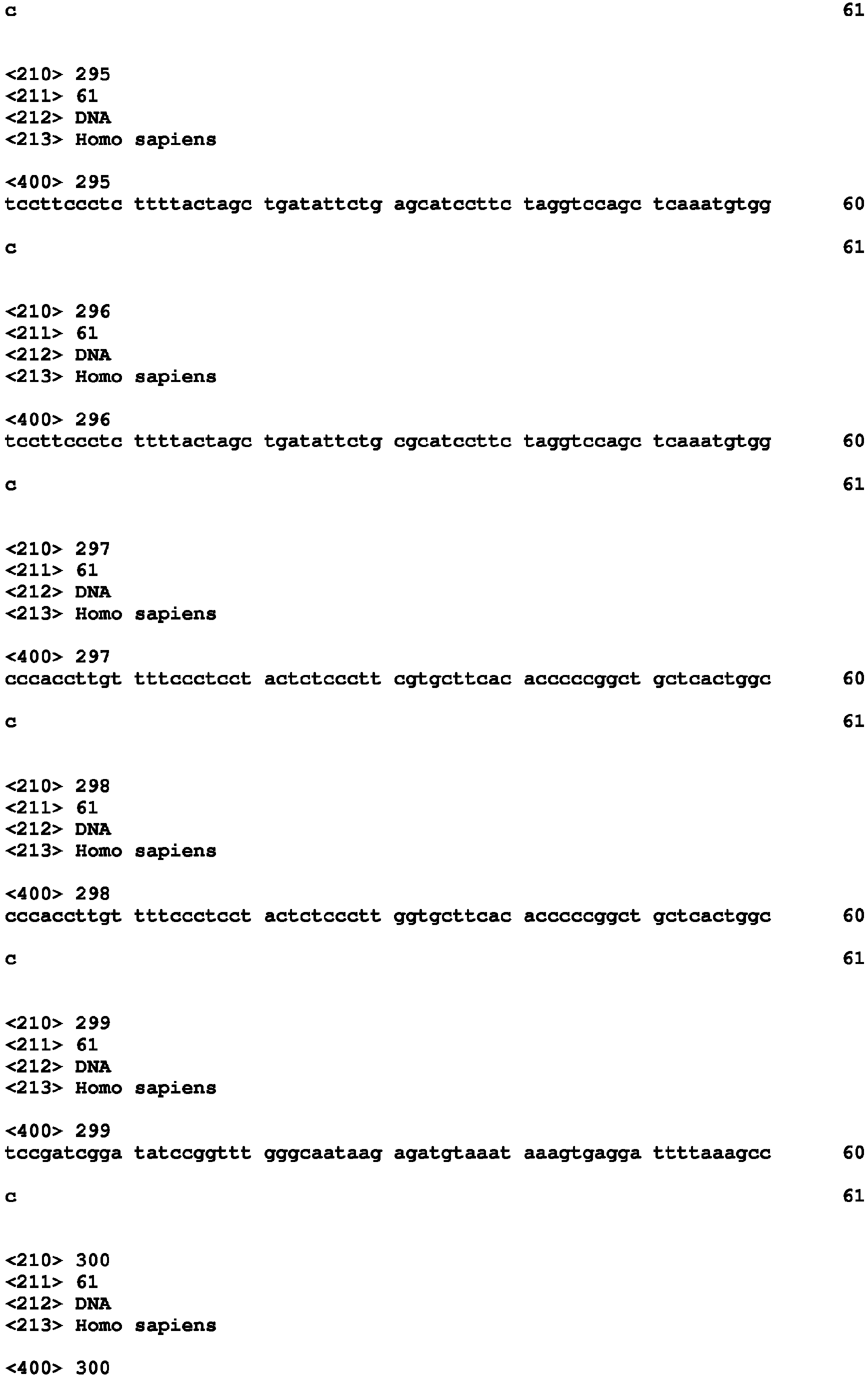


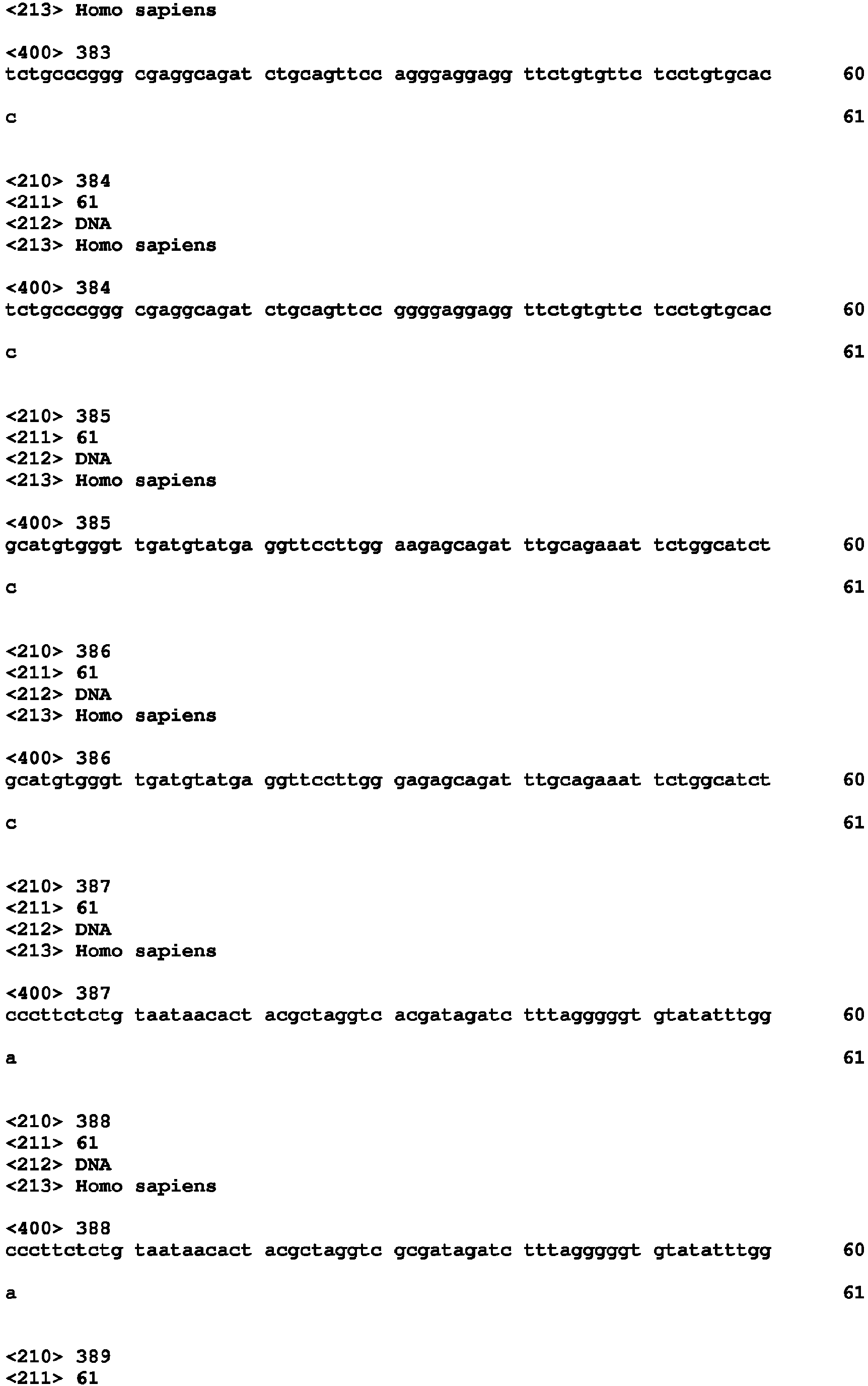


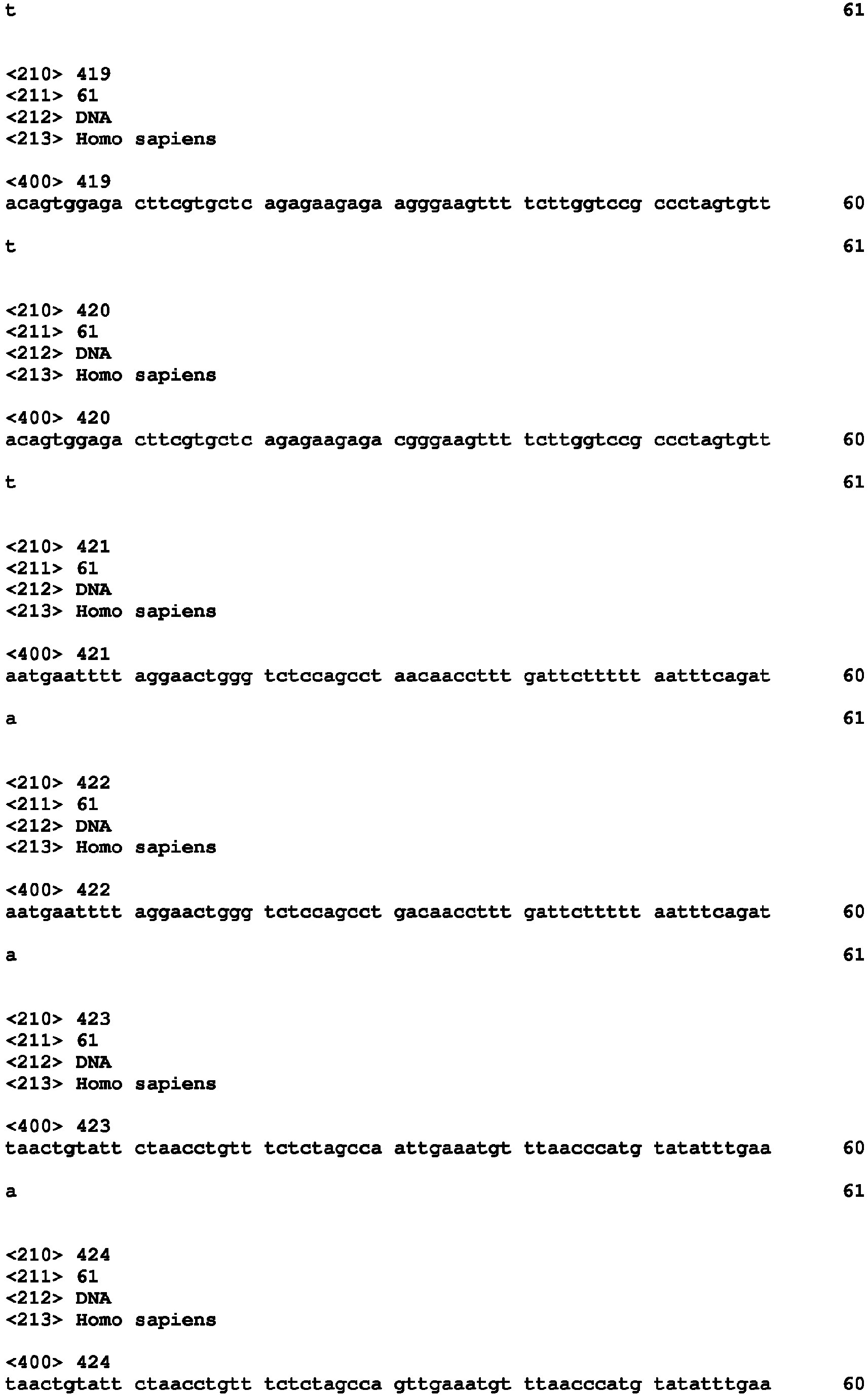


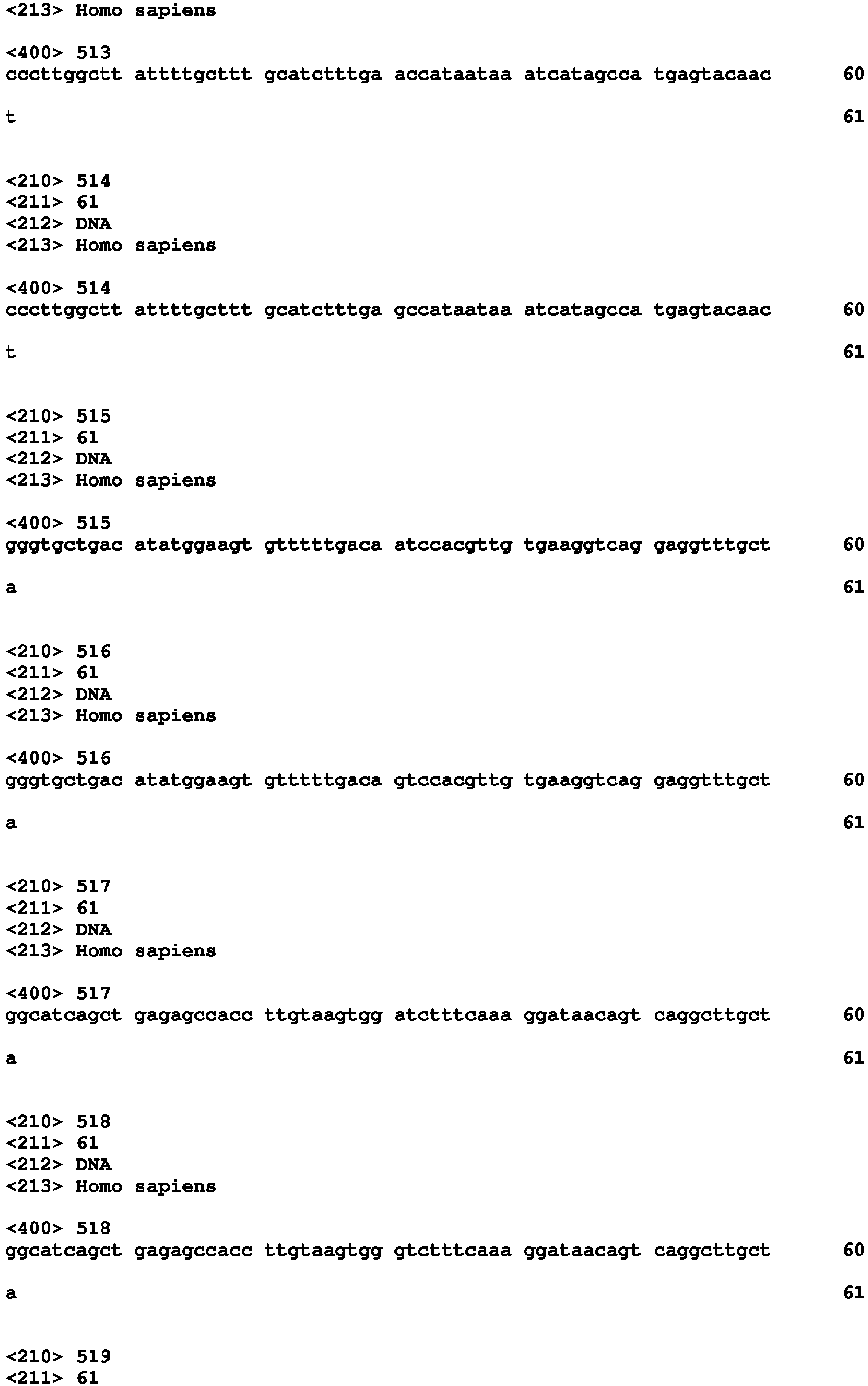


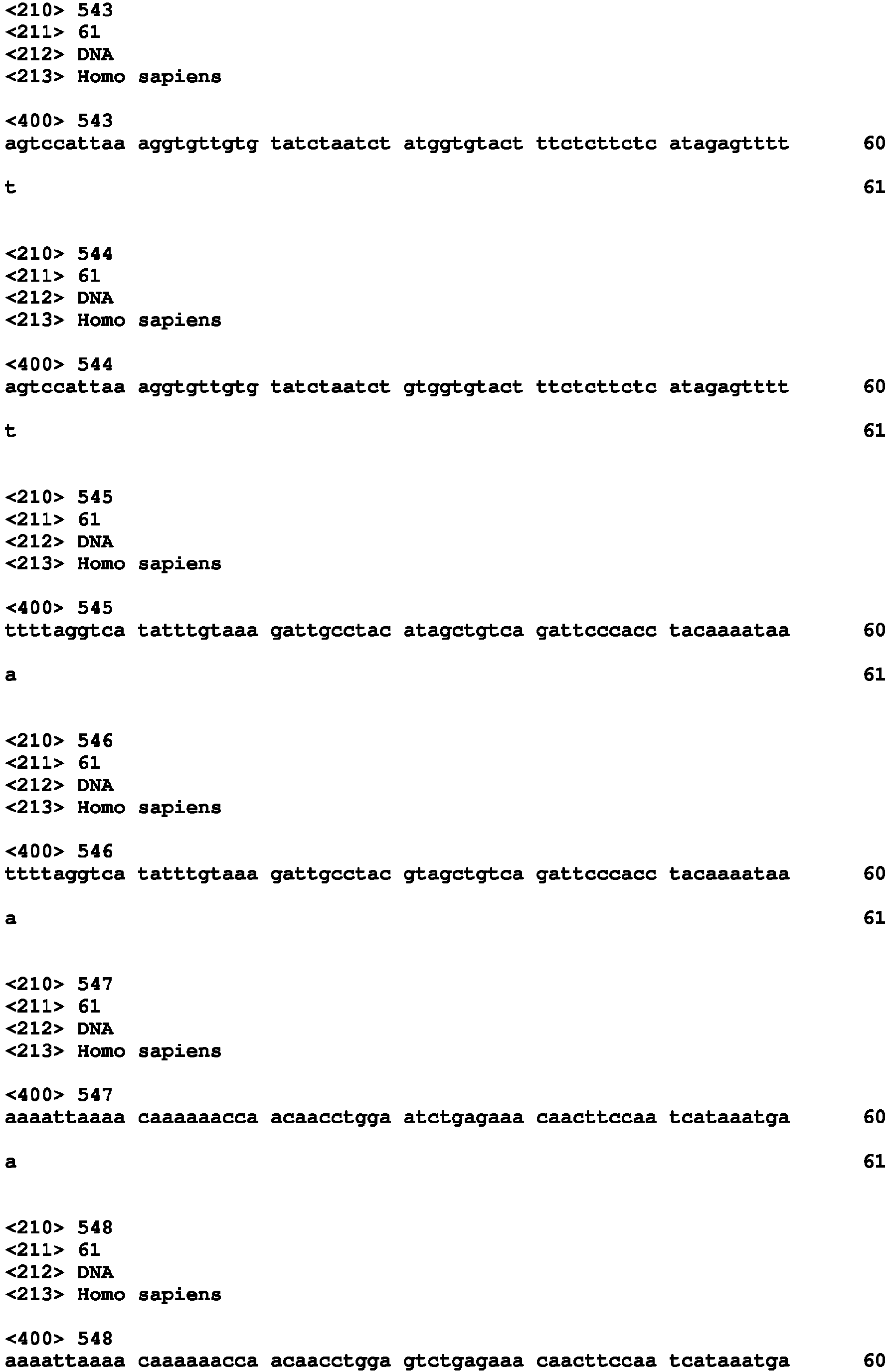


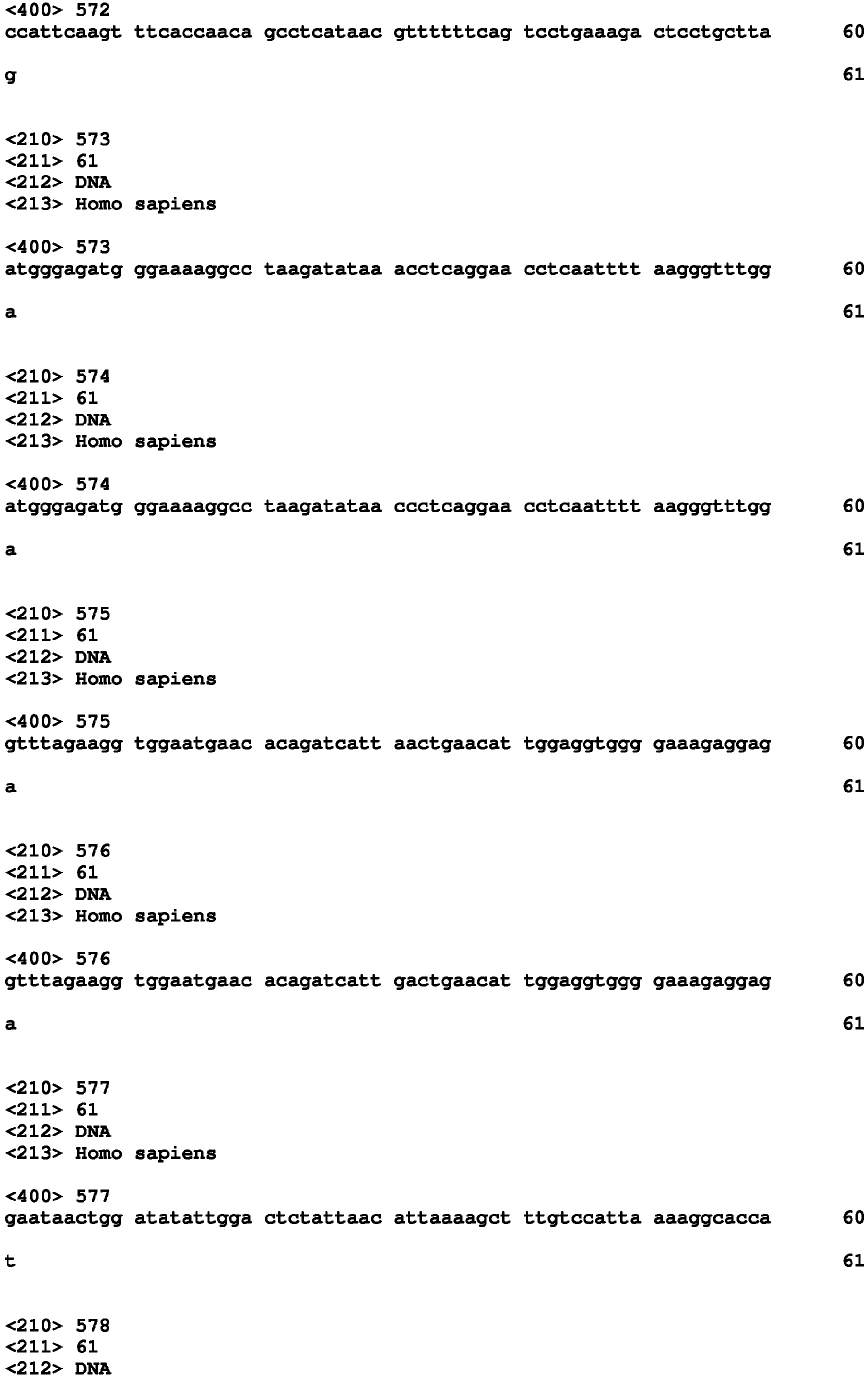


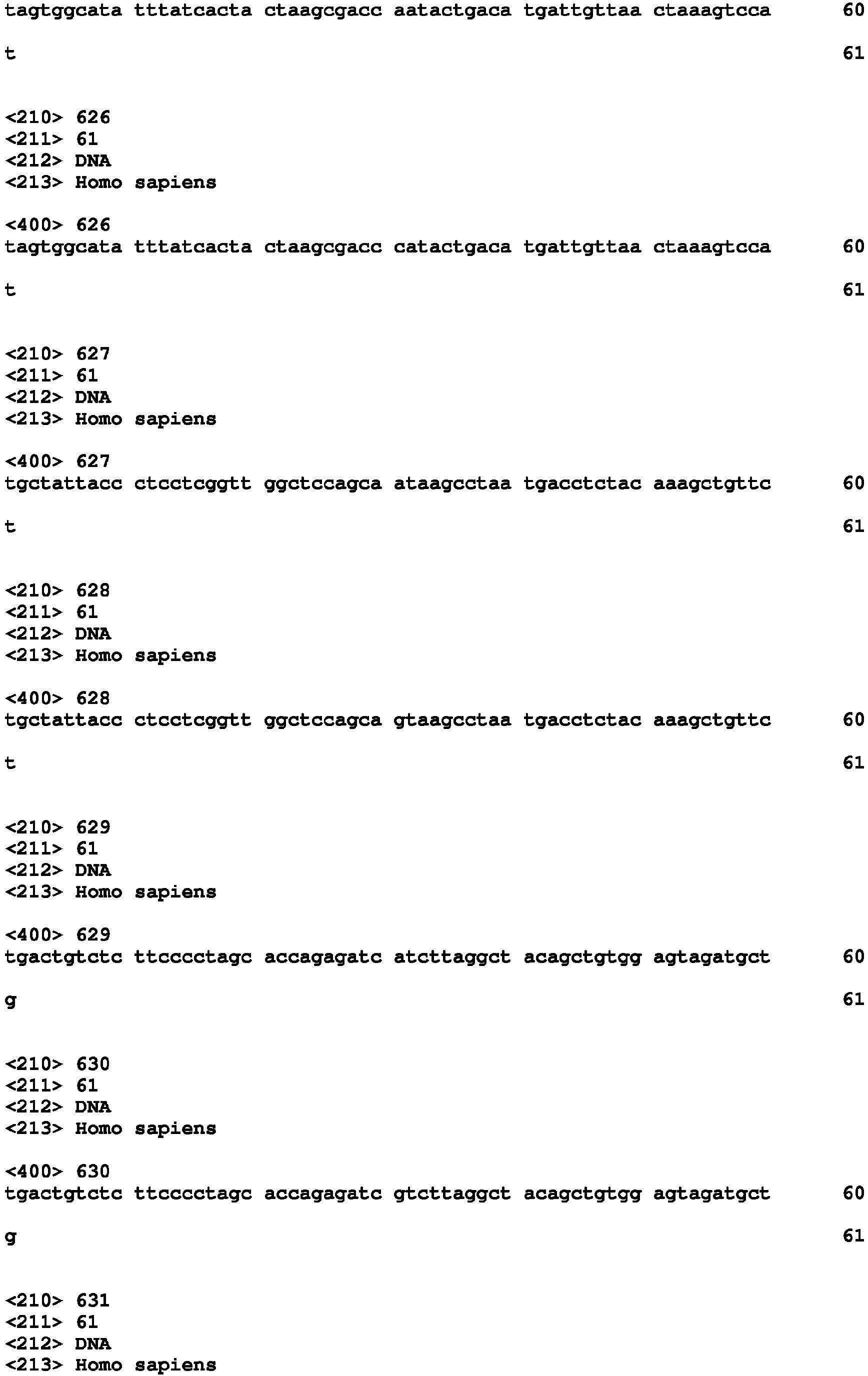
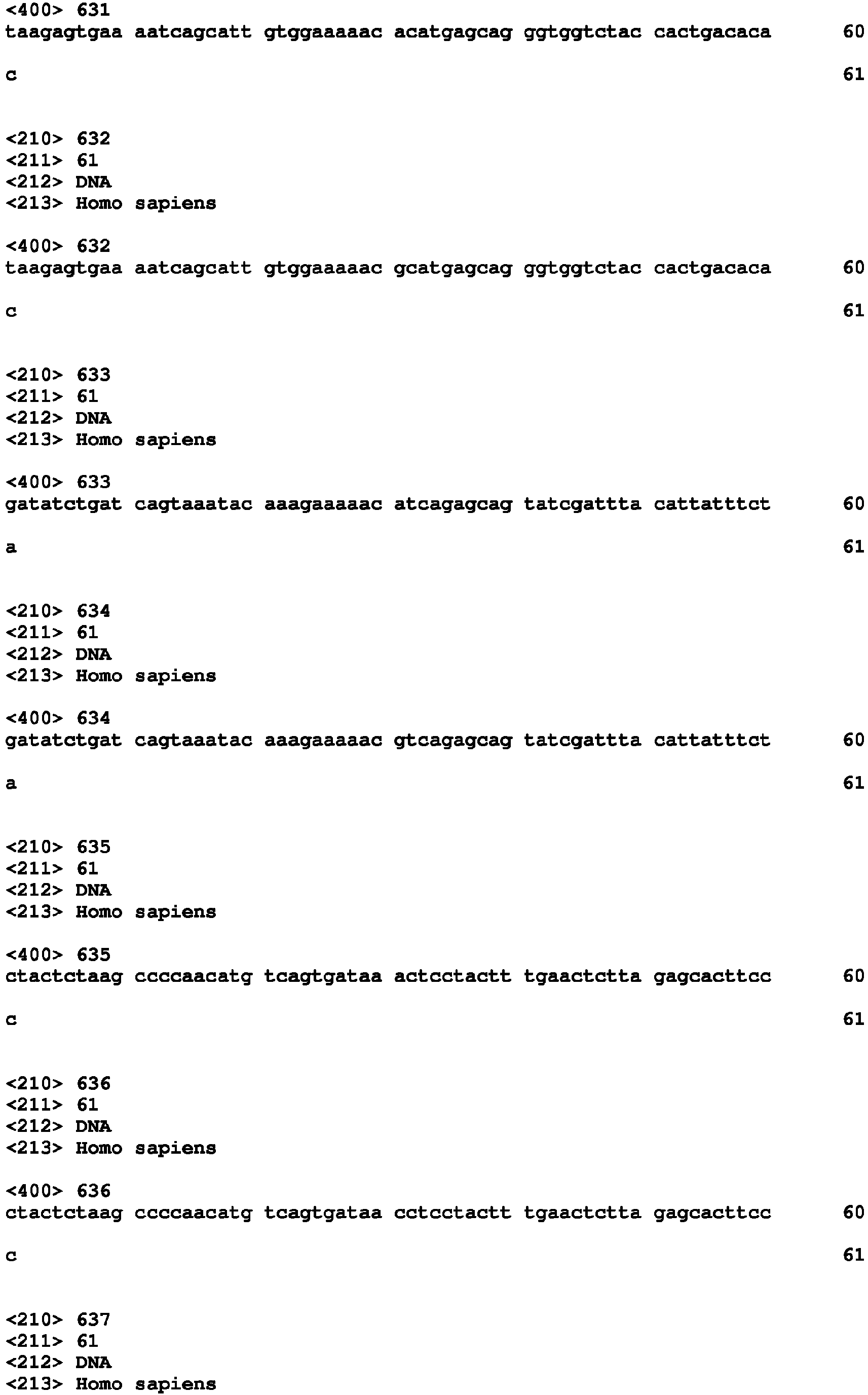


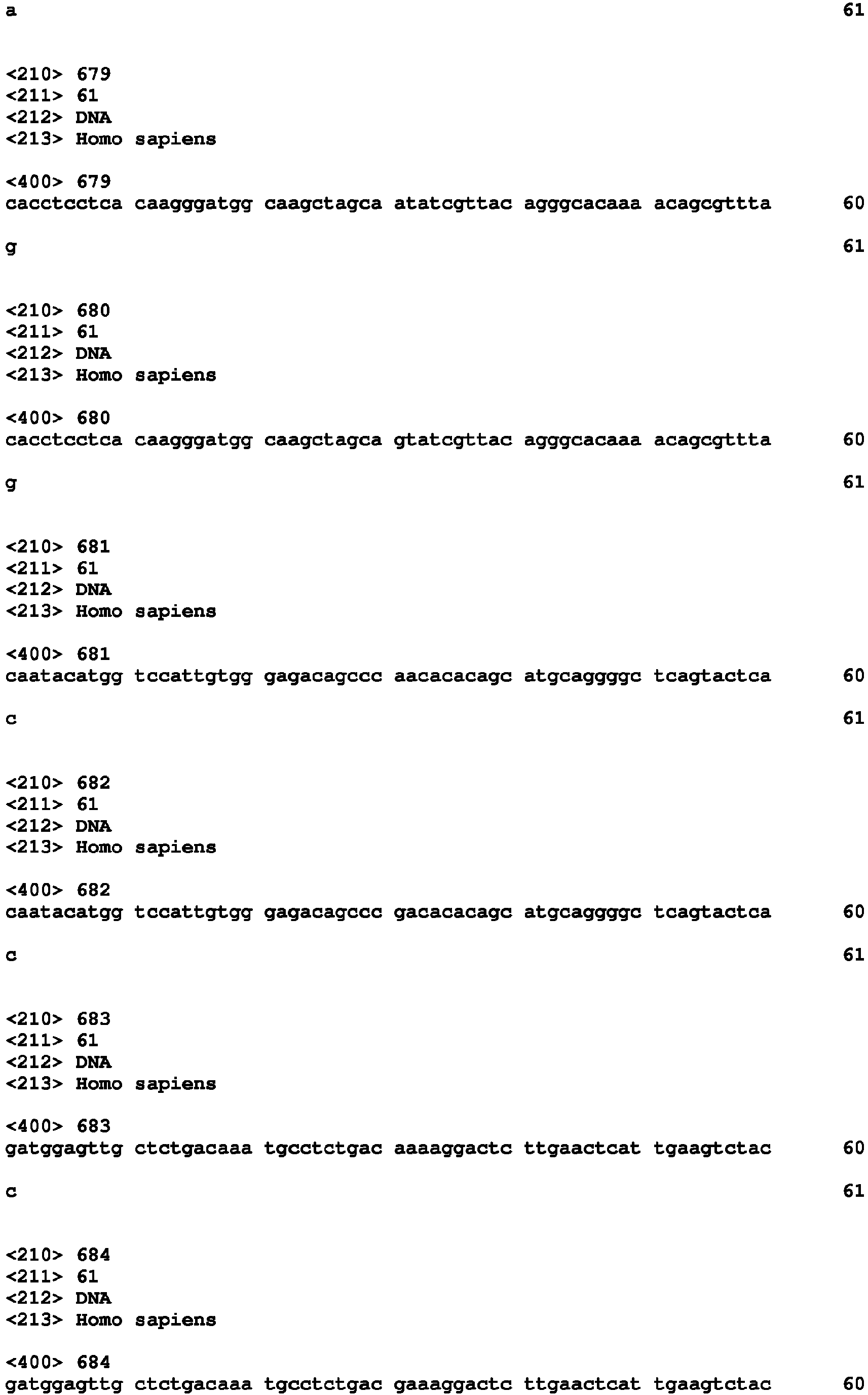

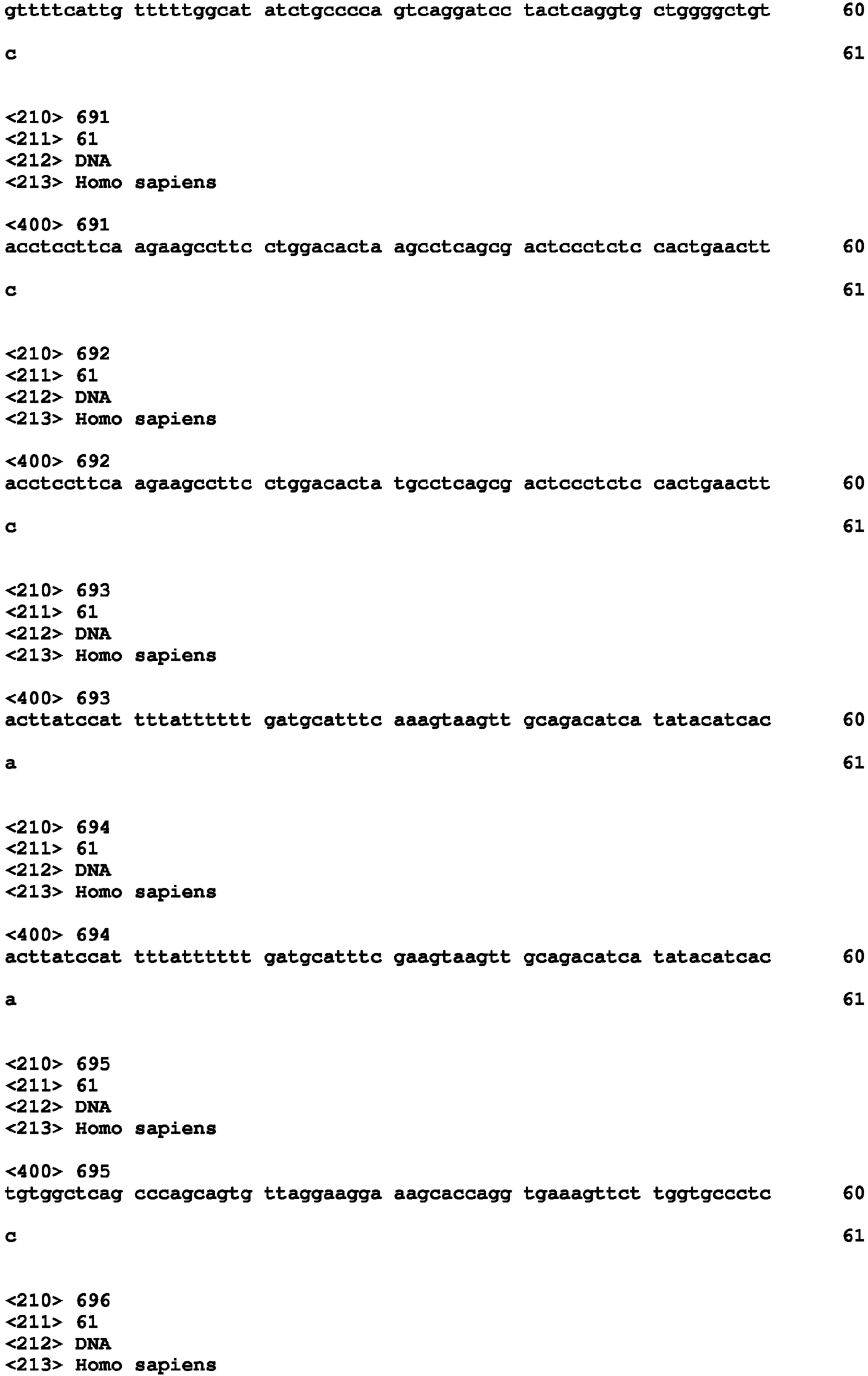


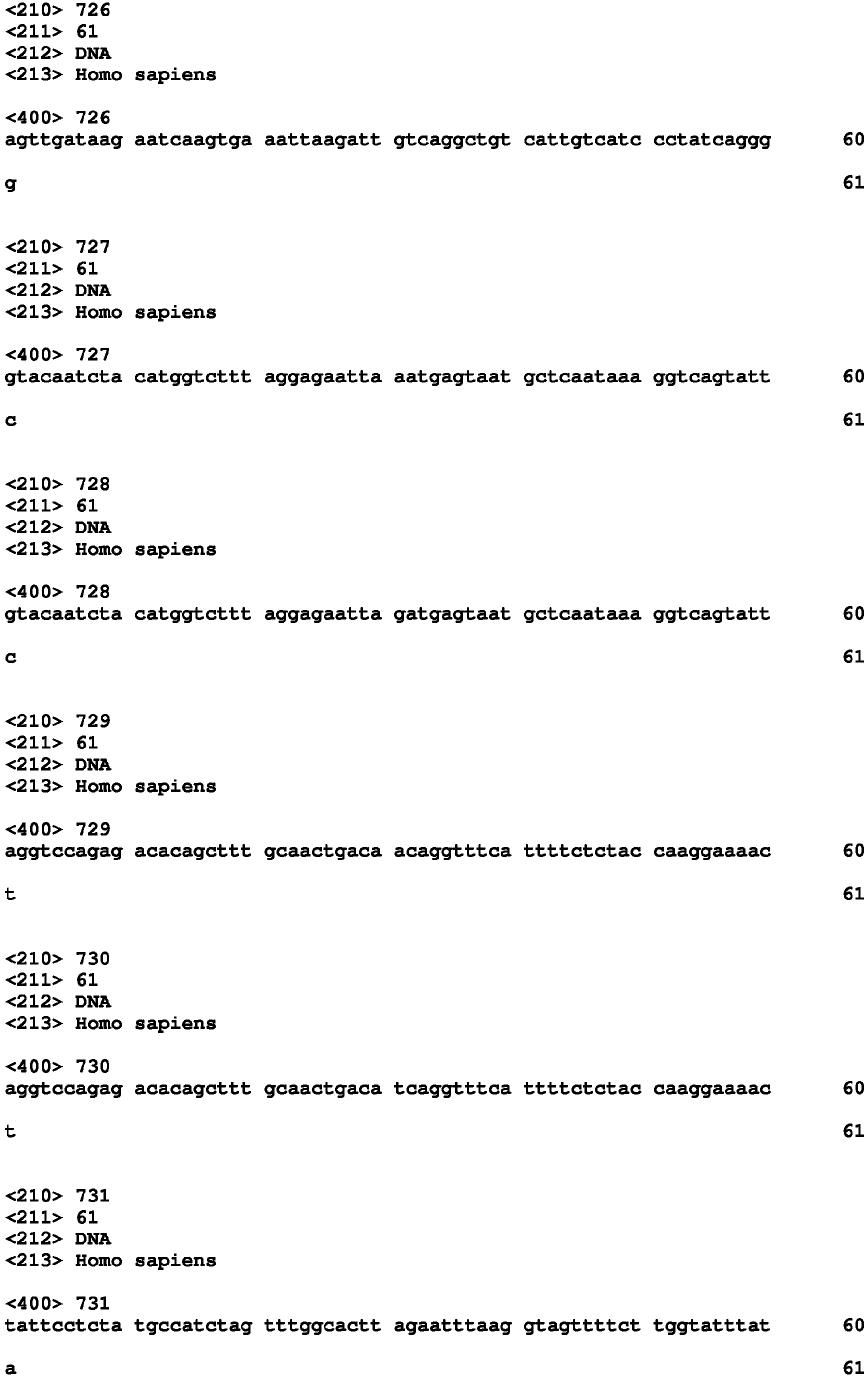


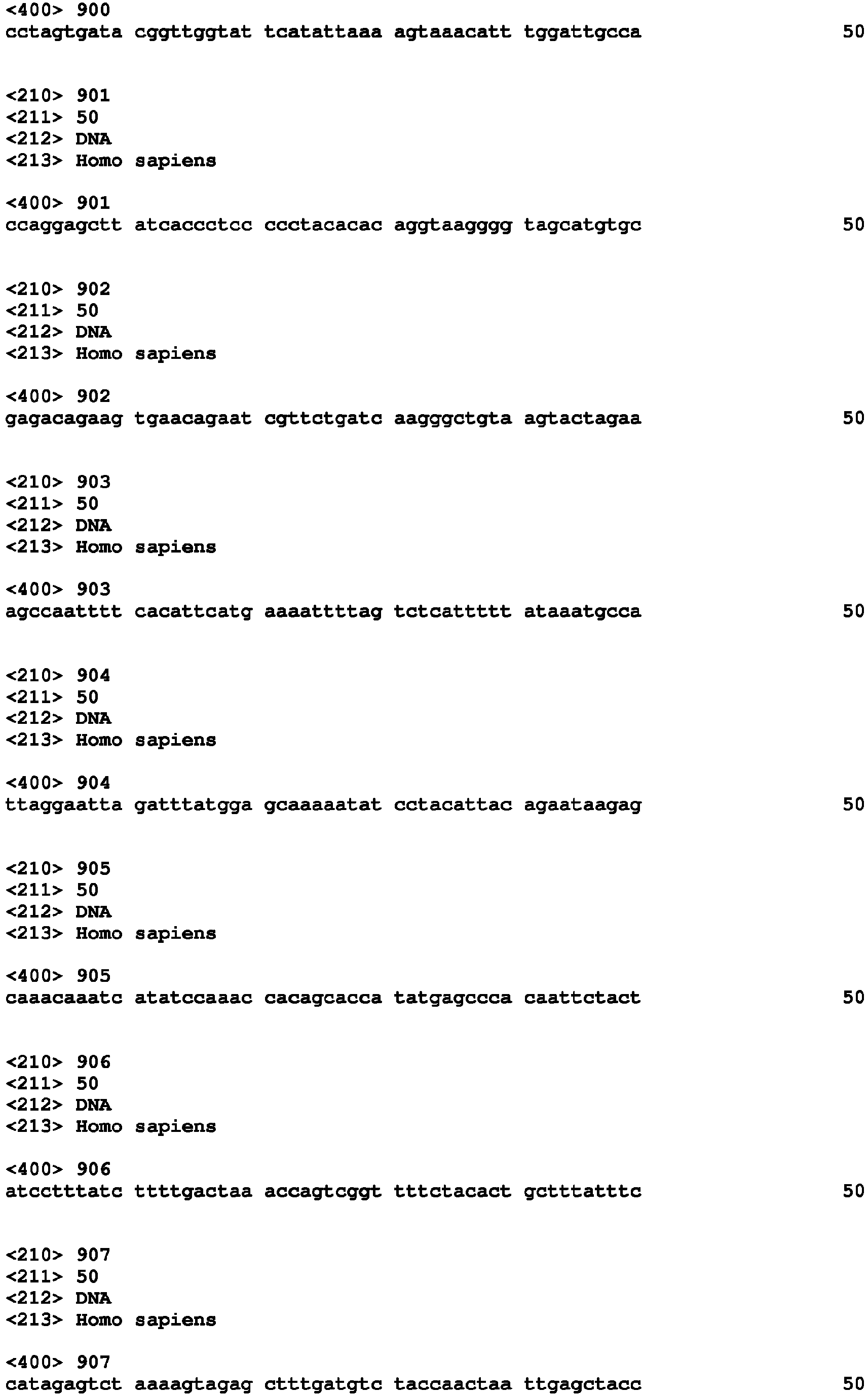


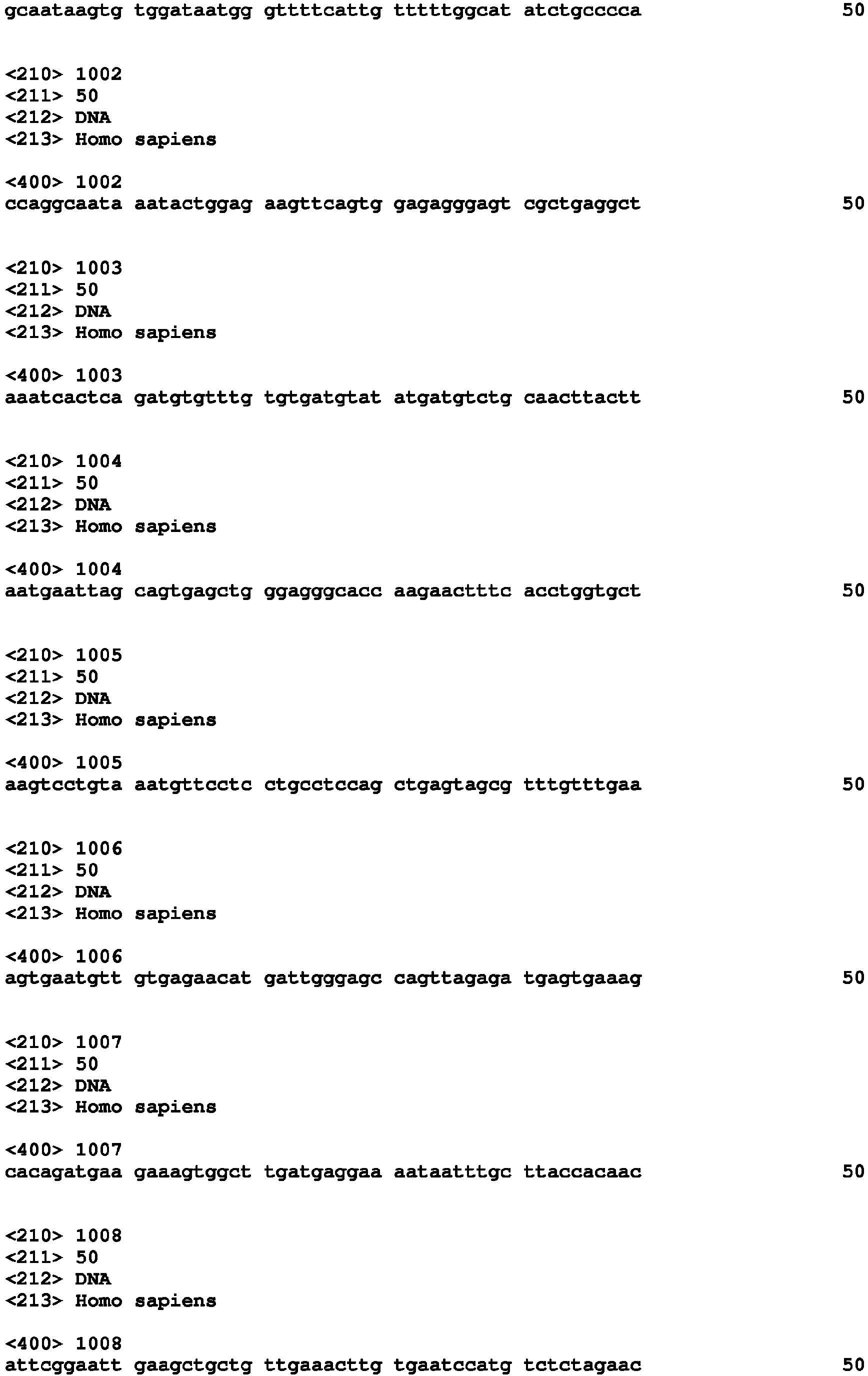


Claims (15)
- A method of determining the presence or the absence of a glaucoma risk, comprising the steps of:detecting in vitro an allele and/or a genotype of a single nucleotide polymorphism which is located on a 31 st base of a base sequence, in a sample from a subject, wherein the base sequence is at least one base sequence selected from the group consisting of base sequences shown in SEQ ID NOs: 307 and 308 or a complementary sequence thereto (step A), andcomparing the allele and/or the genotype detected in said step A with at least one of an allele and/or a genotype, comprising a high-risk allele, in the base sequences shown in SEQ ID NOs: 307 and 308 (step B),wherein the presence of a glaucoma risk is determined in a case where the allele detected in said step A is the high-risk allele, orwherein the presence of a glaucoma risk is determined in a case where the genotype detected in said step A is a homozygote of the genotype comprising the high-risk allele or a heterozygote when the high-risk allele complies with a dominant genetic model, orwherein the presence of a glaucoma risk is determined in a case where the genotype detected in said step A is a homozygote of the genotype comprising the high-risk allele when the high-risk allele complies with a recessive genetic model.
- A method of determining the presence or the absence of a glaucoma risk, comprising the steps of:detecting in vitro, in a sample from a subject, an allele and/or a genotype of a single nucleotide polymorphism which is located on a 31st base of a base sequence in a nucleic acid molecule, wherein the nucleic acid molecule comprises at least one base sequence selected from the group consisting of base sequences shown in SEQ ID NOs: 307 and 308 or a complementary sequence thereto (step C1), ordetecting in vitro, in a sample from a subject, an allele and/or a genotype of a single nucleotide polymorphism, using a nucleic acid molecule comprising a base sequence comprising at least one base sequence selected from the group consisting of base sequences shown in SEQ ID NO: 810 or a complementary sequence thereto (step C2), andcomparing the allele and/or the genotype detected in said step C1 or C2 with at least one nucleic acid molecule comprising an allele and/or a genotype,comprising a high-risk allele, in the base sequences shown in the SEQ ID NOs: 307 and 308 (step D),wherein the presence of a glaucoma risk is determined in a case where the allele detected in said step C1 or C2 is the high-risk allele, orwherein the presence of a glaucoma risk is determined in a case where the genotype detected in said step C1 or C2 is a homozygote of the genotype comprising the high-risk allele or a heterozygote when the high-risk allele complies with a dominant genetic model, orwherein the presence of a glaucoma risk is determined in a case where the genotype detected in said step C1 or C2 is a homozygote of the genotype comprising the high-risk allele when the high-risk allele complies with a recessive genetic model.
- The method according to claim 1 or 2, further comprising the step of predicting the level of the progressive risk.
- The method according to claim 1 or 2, wherein the glaucoma risk is a progressive risk of glaucoma.
- The method according to claim 2 or 3, wherein the nucleic acid molecule is used as a probe.
- The method according to claim 5, wherein the nucleic acid molecule is in the length of from 23 to 55 bases.
- The method according to claim 5, wherein the probe is immobilized.
- The method according to claim 1 or 2, wherein the glaucoma is primary open-angle glaucoma (POAG) or normal tension glaucoma (NTG).
- A method of determining the presence or the absence of a glaucoma risk, comprising the following steps of:step (i): extracting a nucleic acid molecule from a sample from a subject,step (ii): detecting an allele of a single nucleotide polymorphism which is located on a 31st base of a base sequence, wherein the base sequence is at least one base sequence selected from base sequences shown in SEQ ID NOs: 307 and 308 or a complementary sequence thereto, for the nucleic acid molecule extracted in said step (i), andstep (iii): determining the presence or the absence of a glaucoma risk, based on the allele detected in said step (ii).
- The method according to claim 9, wherein said step (iii) comprises the step of determining a genotype, based on the allele detected in said step (ii).
- The method according to claim 9 or 10, wherein said step (iii) comprises the step of determining whether or not the allele detected in said step (ii) is a high-risk allele.
- The method according to claim 11, wherein said step (iii) comprises the step of determining that the glaucoma risk is high in a case where the allele detected in said step (ii) is the high-risk allele.
- Use of a nucleic acid molecule for determining a glaucoma risk, wherein the nucleic acid molecule comprises at least one base sequence, the base sequence being a base sequence selected from the group consisting of base sequences shown in SEQ ID NOs: 307 and 308 or a complementary sequence thereto, or a partial sequence thereof, wherein the nucleic acid molecule comprises an allele and/or a genotype of a single nucleotide polymorphism which is located on a 31 st base of a base sequence.
- An in vitro method of diagnosing glaucoma, comprising the steps of:detecting in vitro an allele and/or a genotype of a single nucleotide polymorphism which is located on a 31st base of a base sequence, in a sample from a subject, wherein the base sequence is at least one base sequence selected from the group consisting of base sequences shown in SEQ ID NOs: 307 and 308 or a complementary sequence thereto (step E), andcomparing the allele and/or the genotype detected in said step E with at least one of an allele and/or a genotype, comprising a high-risk allele, in the base sequences shown in SEQ ID NOs: 307 and 308 (step F),wherein the subject is diagnosed as glaucoma in a case where the allele detected in said step E is the high-risk allele, orwherein the subject is diagnosed as glaucoma in a case where the genotype detected in said step E is a homozygote of the genotype comprising the high-risk allele or a heterozygote when the high-risk allele complies with a dominant genetic model, orwherein the subject is diagnosed as glaucoma in a case where the genotype detected in said step E is a homozygote of the genotype comprising the high-risk allele when the high-risk allele complies with a recessive genetic model.
- A method of determining a progressive risk of glaucoma, comprising the following steps of:step (I): determining the presence or the absence of the progressive risk of glaucoma, with the method as defined in claim 1,step (II): determining that a further risk determination is needed, in a case where the presence of the progressive risk is determined in said step (I) for any one of single nucleotide polymorphisms, andstep (III): further determining the presence or the absence of the progressive risk of glaucoma, with the method as defined in claim 2, in a case of being determined that a further risk determination is needed in said step (II).
Applications Claiming Priority (2)
| Application Number | Priority Date | Filing Date | Title |
|---|---|---|---|
| JP2007108688 | 2007-04-17 | ||
| EP08740595A EP2161334A4 (en) | 2007-04-17 | 2008-04-17 | Method for determination of progression risk of glaucoma |
Related Parent Applications (1)
| Application Number | Title | Priority Date | Filing Date |
|---|---|---|---|
| EP08740595.7 Division | 2008-04-17 |
Publications (1)
| Publication Number | Publication Date |
|---|---|
| EP2548961A1 true EP2548961A1 (en) | 2013-01-23 |
Family
ID=39875536
Family Applications (4)
| Application Number | Title | Priority Date | Filing Date |
|---|---|---|---|
| EP08740595A Withdrawn EP2161334A4 (en) | 2007-04-17 | 2008-04-17 | Method for determination of progression risk of glaucoma |
| EP12176714A Withdrawn EP2565270A1 (en) | 2007-04-17 | 2008-04-17 | Method for determination of onset risk of glaucoma |
| EP08751865A Withdrawn EP2147975A4 (en) | 2007-04-17 | 2008-04-17 | Method for determination of onset risk of glaucoma |
| EP12174516A Withdrawn EP2548961A1 (en) | 2007-04-17 | 2008-04-17 | Method for determination of progression risk of glaucoma |
Family Applications Before (3)
| Application Number | Title | Priority Date | Filing Date |
|---|---|---|---|
| EP08740595A Withdrawn EP2161334A4 (en) | 2007-04-17 | 2008-04-17 | Method for determination of progression risk of glaucoma |
| EP12176714A Withdrawn EP2565270A1 (en) | 2007-04-17 | 2008-04-17 | Method for determination of onset risk of glaucoma |
| EP08751865A Withdrawn EP2147975A4 (en) | 2007-04-17 | 2008-04-17 | Method for determination of onset risk of glaucoma |
Country Status (12)
| Country | Link |
|---|---|
| US (4) | US8431345B2 (en) |
| EP (4) | EP2161334A4 (en) |
| JP (5) | JPWO2008130008A1 (en) |
| KR (2) | KR20100016525A (en) |
| CN (2) | CN101679970A (en) |
| AU (2) | AU2008241868A1 (en) |
| BR (2) | BRPI0810071A2 (en) |
| CA (2) | CA2683691A1 (en) |
| MX (2) | MX2009011080A (en) |
| RU (2) | RU2009142225A (en) |
| SG (2) | SG177960A1 (en) |
| WO (2) | WO2008130009A1 (en) |
Families Citing this family (21)
| Publication number | Priority date | Publication date | Assignee | Title |
|---|---|---|---|---|
| SG158776A1 (en) * | 2008-07-25 | 2010-02-26 | Univ Kaohsiung Medical | Using genetic polymorphisms of the bicd1 gene as a method for diagnosing and treating myopia |
| JP4515524B2 (en) * | 2008-11-27 | 2010-08-04 | 株式会社メニコン | Normal-tension glaucoma disease susceptibility gene and use thereof |
| US12478503B2 (en) | 2009-05-18 | 2025-11-25 | Glaukos Corporation | Implants with controlled drug delivery features and methods of using same |
| US10206813B2 (en) | 2009-05-18 | 2019-02-19 | Dose Medical Corporation | Implants with controlled drug delivery features and methods of using same |
| CN102471800A (en) * | 2009-07-03 | 2012-05-23 | 加的夫大学学院咨询有限公司 | Diagnosis and treatment of alzheimer's disease |
| SG10201407330UA (en) * | 2009-11-16 | 2015-01-29 | Agency Science Tech & Res | Obtaining data for automatic glaucoma screening, and screening and diagnostic techniques and systems using the data |
| WO2011152098A1 (en) * | 2010-06-04 | 2011-12-08 | コニカミノルタエムジー株式会社 | Developing solution for immunochromatography method, and measurement method using same |
| WO2013159085A1 (en) | 2012-04-20 | 2013-10-24 | University Of Virginia Patent Foundation | Compositions and methods for identifying and diagnosing salt sensitivity of blood pressure |
| US9684959B2 (en) | 2012-08-24 | 2017-06-20 | Agency For Science, Technology And Research | Methods and systems for automatic location of optic structures in an image of an eye, and for automatic retina cup-to-disc ratio computation |
| WO2014082067A1 (en) | 2012-11-26 | 2014-05-30 | The Johns Hopkins University | Methods and compositions for diagnosing and treating gastric cancer |
| RU2508043C1 (en) * | 2012-12-20 | 2014-02-27 | федеральное государственное бюджетное учреждение "Межотраслевой научно-технический комплекс "Микрохирургия глаза" имени академика С.Н. Федорова" Министерства здравоохранения Российской Федерации | Method of predicting open-angle glaucoma in patients with eye manifestations of pseudoexfoliation syndrome |
| EP3140422A1 (en) * | 2014-05-03 | 2017-03-15 | The Regents of The University of California | Methods of identifying biomarkers associated with or causative of the progression of disease, in particular for use in prognosticating primary open angle glaucoma |
| RU2580306C1 (en) * | 2015-03-26 | 2016-04-10 | Федеральное государственное автономное образовательное учреждение высшего профессионального образования "Белгородский государственный национальный исследовательский университет" (НИУ "БелГУ") | Method of predicting risk of developing primary open angle glaucoma in individuals depending on presence/absence of other non-communicable eye diseases |
| RU2585381C1 (en) * | 2015-03-27 | 2016-05-27 | Федеральное государственное автономное образовательное учреждение высшего профессионального образования "Белгородский государственный национальный исследовательский университет" (НИУ "БелГУ") | Method of predicting hydrodynamics ratio in patients with primary open angle glaucoma |
| JP6542037B2 (en) * | 2015-06-04 | 2019-07-10 | シスメックス株式会社 | Methods to Assist in the Diagnosis of Methotrexate Efficacy in Patients With Rheumatoid Arthritis |
| JP7072803B2 (en) * | 2016-06-30 | 2022-05-23 | 京都府公立大学法人 | How to determine the risk of developing open-angle glaucoma in a broad sense |
| WO2018025521A1 (en) * | 2016-08-05 | 2018-02-08 | 京都府公立大学法人 | Method for determining risk of developing exfoliation syndrome or exfoliation glaucoma |
| WO2020002602A1 (en) | 2018-06-29 | 2020-01-02 | bioMérieux | Method for determining in vitro or ex vivo the immune status of an individual |
| WO2021086595A1 (en) * | 2019-10-31 | 2021-05-06 | Google Llc | Using machine learning-based trait predictions for genetic association discovery |
| CN113444788B (en) * | 2021-08-27 | 2021-11-02 | 中国医学科学院北京协和医院 | Glaucoma diagnostic products and applications |
| CN115807078A (en) * | 2023-01-04 | 2023-03-17 | 北京果壳生物科技有限公司 | A capture probe, gene chip, method and application thereof for recessive genetic disease screening |
Family Cites Families (10)
| Publication number | Priority date | Publication date | Assignee | Title |
|---|---|---|---|---|
| US6582908B2 (en) * | 1990-12-06 | 2003-06-24 | Affymetrix, Inc. | Oligonucleotides |
| US5474796A (en) * | 1991-09-04 | 1995-12-12 | Protogene Laboratories, Inc. | Method and apparatus for conducting an array of chemical reactions on a support surface |
| US5686407A (en) * | 1995-08-16 | 1997-11-11 | Alcon Laboratories, Inc. | Hepatocyte growth factor to treat glaucoma |
| US5962230A (en) | 1997-02-13 | 1999-10-05 | The University Of Connecticut | Diagnosis and treatment of glaucoma |
| JP2000306165A (en) | 1999-02-19 | 2000-11-02 | Toshiba Tec Corp | Receipt issuing device and recording medium for medical expenses deduction |
| JP2002306165A (en) | 2000-05-17 | 2002-10-22 | Tsubota:Kk | Gene related with open-angle glaucoma including normal tension glaucoma |
| JP5129563B2 (en) * | 2004-03-18 | 2013-01-30 | ラスク・インテレクチュアル・リザーブ・アクチェンゲゼルシャフト | Method for diagnosing or predicting susceptibility to optic neuropathy |
| US20060073506A1 (en) * | 2004-09-17 | 2006-04-06 | Affymetrix, Inc. | Methods for identifying biological samples |
| CA2667737A1 (en) | 2006-10-27 | 2008-05-02 | Julius Gudmundsson | Cancer susceptibility variants on chr8q24.21 |
| US20100240057A1 (en) * | 2007-11-08 | 2010-09-23 | St. Jude Children's Research Hospital | Methods and compositions for the diagnosis and treatment of chronic myeloid leukemia and acute lymphoblastic leukemia |
-
2008
- 2008-04-17 KR KR1020097023715A patent/KR20100016525A/en not_active Withdrawn
- 2008-04-17 CN CN200880020560A patent/CN101679970A/en active Pending
- 2008-04-17 RU RU2009142225/10A patent/RU2009142225A/en not_active Application Discontinuation
- 2008-04-17 US US12/596,462 patent/US8431345B2/en not_active Expired - Fee Related
- 2008-04-17 EP EP08740595A patent/EP2161334A4/en not_active Withdrawn
- 2008-04-17 RU RU2009142223/10A patent/RU2009142223A/en not_active Application Discontinuation
- 2008-04-17 AU AU2008241868A patent/AU2008241868A1/en not_active Abandoned
- 2008-04-17 US US12/596,258 patent/US20100196895A1/en not_active Abandoned
- 2008-04-17 CA CA002683691A patent/CA2683691A1/en not_active Abandoned
- 2008-04-17 WO PCT/JP2008/057533 patent/WO2008130009A1/en not_active Ceased
- 2008-04-17 MX MX2009011080A patent/MX2009011080A/en not_active Application Discontinuation
- 2008-04-17 MX MX2009011079A patent/MX2009011079A/en not_active Application Discontinuation
- 2008-04-17 CN CN200880020582A patent/CN101679971A/en active Pending
- 2008-04-17 EP EP12176714A patent/EP2565270A1/en not_active Withdrawn
- 2008-04-17 AU AU2008241867A patent/AU2008241867A1/en not_active Abandoned
- 2008-04-17 SG SG2012001400A patent/SG177960A1/en unknown
- 2008-04-17 BR BRPI0810071-3A2A patent/BRPI0810071A2/en not_active IP Right Cessation
- 2008-04-17 JP JP2009510856A patent/JPWO2008130008A1/en active Pending
- 2008-04-17 KR KR1020097023829A patent/KR20100016568A/en not_active Withdrawn
- 2008-04-17 BR BRPI0810425-5A2A patent/BRPI0810425A2/en not_active IP Right Cessation
- 2008-04-17 EP EP08751865A patent/EP2147975A4/en not_active Withdrawn
- 2008-04-17 SG SG2012001814A patent/SG177968A1/en unknown
- 2008-04-17 JP JP2009510857A patent/JP5624763B2/en not_active Expired - Fee Related
- 2008-04-17 CA CA002683836A patent/CA2683836A1/en not_active Abandoned
- 2008-04-17 WO PCT/JP2008/057527 patent/WO2008130008A1/en not_active Ceased
- 2008-04-17 EP EP12174516A patent/EP2548961A1/en not_active Withdrawn
-
2012
- 2012-07-11 US US13/546,674 patent/US20130012408A1/en not_active Abandoned
-
2013
- 2013-03-26 US US13/850,453 patent/US20130210668A1/en not_active Abandoned
- 2013-04-04 JP JP2013078380A patent/JP5759500B2/en not_active Expired - Fee Related
-
2015
- 2015-06-05 JP JP2015114381A patent/JP6203217B2/en not_active Expired - Fee Related
-
2017
- 2017-08-29 JP JP2017164488A patent/JP2017201995A/en active Pending
Non-Patent Citations (8)
| Title |
|---|
| "Wakariyasui Igaku Tokeigaku", TOSHIO MORIZANE, MEDICAL TRIBUNE, pages: 148 - 179 |
| ERKKI JURONEN ET AL: "Polymorphic Glutathione S-transferase M1 is a Risk Factor of Primary Open-angle Glaucoma among Estonians", EXPERIMENTAL EYE RESEARCH, vol. 71, no. 5, 1 November 2000 (2000-11-01), pages 447 - 452, XP055014423, ISSN: 0014-4835, DOI: 10.1006/exer.2000.0899 * |
| FAN ET AL: "Gene mapping for primary open angle glaucoma", CLINICAL BIOCHEMISTRY, ELSEVIER INC, US, CA LNKD- DOI:10.1016/J.CLINBIOCHEM.2005.11.001, vol. 39, no. 3, 1 March 2006 (2006-03-01), pages 249 - 258, XP005341846, ISSN: 0009-9120 * |
| JAMES C. VICKERS ET AL: "The apolipoprotein [epsilon]4 gene is associated with elevated risk of normal tension glaucoma", MOLECULAR VISION, vol. 8, 14 October 2002 (2002-10-14), pages 389 - 393, XP055014422 * |
| KAMMERER S ET AL: "Association of the NuMa region on chromosome 11q13 with breast cancer suspectibility", PROCEEDINGS OF THE NATIONAL ACADEMY OF SCIENCES OF THE UNITED STATES (PNAS), NATIONAL ACADEMY OF SCIENCE, US LNKD- DOI:10.1073/PNAS.0409806102, vol. 102, no. 6, 8 February 2005 (2005-02-08), pages 2004 - 2009, XP002988652, ISSN: 0027-8424 * |
| KLEIN R J ET AL: "Complement factor H polymorphism in age-related macular degeneration", SCIENCE, AMERICAN ASSOCIATION FOR THE ADVANCEMENT OF SCIENCE, WASHINGTON, DC; US LNKD- DOI:10.1126/SCIENCE.1109557, vol. 308, no. 5720, 15 April 2005 (2005-04-15), pages 385 - 389, XP002544688, ISSN: 0036-8075, [retrieved on 20050310] * |
| KOUICHI OZAKI ET AL: "Functional SNPs in the lymphotoxin-alpha gene that are associated with susceptibility to myocardial infarction", NATURE GENETICS, NATURE PUBLISHING GROUP, NEW YORK, US LNKD- DOI:10.1038/NG1047, vol. 32, 1 December 2002 (2002-12-01), pages 650 - 654, XP002964781, ISSN: 1061-4036 * |
| KOUROS NOURI-MAHDAVI ET AL: "Comparison of Methods to Predict Visual Field Progression in Glaucoma", ARCH OPHTHALMOL, vol. 125, no. 9, 1 January 2007 (2007-01-01), pages 1176 - 1181, XP055077754 * |
Also Published As
Similar Documents
| Publication | Publication Date | Title |
|---|---|---|
| US8431345B2 (en) | Method for determination of progression risk of glaucoma | |
| EP3730188B1 (en) | Compositions and methods for use in combination for the treatment and diagnosis of autoimmune diseases | |
| EP2700723A2 (en) | Novel single nucleotide polymorphisms and combinations of novel and known polymorphisms for determining the allele-specific expression of the IGF2 gene | |
| EP2463387B1 (en) | Markers for breast cancer | |
| EP2396429B1 (en) | Combinations of polymorphisms for determining allele-specific expression of igf2 | |
| WO2011043333A1 (en) | Susceptibility gene for hair shapes | |
| EP2393939B1 (en) | A snp marker of breast and ovarian cancer risk | |
| KR102189144B1 (en) | Marker for predicting exacerbation of chronic kidney disease and method for predicting exacerbation using the same | |
| US9752195B2 (en) | TTC8 as prognostic gene for progressive retinal atrophy in dogs | |
| JP5809388B2 (en) | How to determine the risk of developing Stevens-Johnson syndrome | |
| US9896728B2 (en) | Method for determining a therapeutic approach for the treatment of age-related macular degeneration (AMD) | |
| KR20110011306A (en) | Marker for Diagnosing Lung Cancer Susceptibility and Predicting and Determining Lung Cancer Susceptibility Using Telomere Retaining Gene | |
| KR20240057772A (en) | Single nucleotide polymorphism for diagnosing of depression and the use thereof | |
| Liu | Identification of genetic and epigenetic risk factors for psoriasis and psoratic arthritis | |
| Muenphon et al. | Differential expression of Trefoil factor family reflects their different roles in liver fluke related Cholangiocarcinoma |
Legal Events
| Date | Code | Title | Description |
|---|---|---|---|
| PUAI | Public reference made under article 153(3) epc to a published international application that has entered the european phase |
Free format text: ORIGINAL CODE: 0009012 |
|
| AC | Divisional application: reference to earlier application |
Ref document number: 2161334 Country of ref document: EP Kind code of ref document: P |
|
| AK | Designated contracting states |
Kind code of ref document: A1 Designated state(s): AT BE BG CH CY CZ DE DK EE ES FI FR GB GR HR HU IE IS IT LI LT LU LV MC MT NL NO PL PT RO SE SI SK TR |
|
| 17P | Request for examination filed |
Effective date: 20130719 |
|
| RBV | Designated contracting states (corrected) |
Designated state(s): AT BE BG CH CY CZ DE DK EE ES FI FR GB GR HR HU IE IS IT LI LT LU LV MC MT NL NO PL PT RO SE SI SK TR |
|
| 17Q | First examination report despatched |
Effective date: 20130912 |
|
| GRAP | Despatch of communication of intention to grant a patent |
Free format text: ORIGINAL CODE: EPIDOSNIGR1 |
|
| INTG | Intention to grant announced |
Effective date: 20180413 |
|
| STAA | Information on the status of an ep patent application or granted ep patent |
Free format text: STATUS: THE APPLICATION IS DEEMED TO BE WITHDRAWN |
|
| 18D | Application deemed to be withdrawn |
Effective date: 20180824 |