EP2544293A1 - Assembled battery and power storage system - Google Patents
Assembled battery and power storage system Download PDFInfo
- Publication number
- EP2544293A1 EP2544293A1 EP10846936A EP10846936A EP2544293A1 EP 2544293 A1 EP2544293 A1 EP 2544293A1 EP 10846936 A EP10846936 A EP 10846936A EP 10846936 A EP10846936 A EP 10846936A EP 2544293 A1 EP2544293 A1 EP 2544293A1
- Authority
- EP
- European Patent Office
- Prior art keywords
- battery
- storage
- battery pack
- batteries
- storage battery
- Prior art date
- Legal status (The legal status is an assumption and is not a legal conclusion. Google has not performed a legal analysis and makes no representation as to the accuracy of the status listed.)
- Granted
Links
Images


Classifications
-
- H—ELECTRICITY
- H01—ELECTRIC ELEMENTS
- H01M—PROCESSES OR MEANS, e.g. BATTERIES, FOR THE DIRECT CONVERSION OF CHEMICAL ENERGY INTO ELECTRICAL ENERGY
- H01M10/00—Secondary cells; Manufacture thereof
- H01M10/42—Methods or arrangements for servicing or maintenance of secondary cells or secondary half-cells
-
- H—ELECTRICITY
- H01—ELECTRIC ELEMENTS
- H01M—PROCESSES OR MEANS, e.g. BATTERIES, FOR THE DIRECT CONVERSION OF CHEMICAL ENERGY INTO ELECTRICAL ENERGY
- H01M10/00—Secondary cells; Manufacture thereof
- H01M10/42—Methods or arrangements for servicing or maintenance of secondary cells or secondary half-cells
- H01M10/44—Methods for charging or discharging
- H01M10/441—Methods for charging or discharging for several batteries or cells simultaneously or sequentially
-
- H—ELECTRICITY
- H01—ELECTRIC ELEMENTS
- H01M—PROCESSES OR MEANS, e.g. BATTERIES, FOR THE DIRECT CONVERSION OF CHEMICAL ENERGY INTO ELECTRICAL ENERGY
- H01M10/00—Secondary cells; Manufacture thereof
- H01M10/05—Accumulators with non-aqueous electrolyte
- H01M10/052—Li-accumulators
- H01M10/0525—Rocking-chair batteries, i.e. batteries with lithium insertion or intercalation in both electrodes; Lithium-ion batteries
-
- H—ELECTRICITY
- H01—ELECTRIC ELEMENTS
- H01M—PROCESSES OR MEANS, e.g. BATTERIES, FOR THE DIRECT CONVERSION OF CHEMICAL ENERGY INTO ELECTRICAL ENERGY
- H01M10/00—Secondary cells; Manufacture thereof
- H01M10/34—Gastight accumulators
-
- H—ELECTRICITY
- H01—ELECTRIC ELEMENTS
- H01M—PROCESSES OR MEANS, e.g. BATTERIES, FOR THE DIRECT CONVERSION OF CHEMICAL ENERGY INTO ELECTRICAL ENERGY
- H01M10/00—Secondary cells; Manufacture thereof
- H01M10/42—Methods or arrangements for servicing or maintenance of secondary cells or secondary half-cells
- H01M10/44—Methods for charging or discharging
-
- H—ELECTRICITY
- H01—ELECTRIC ELEMENTS
- H01M—PROCESSES OR MEANS, e.g. BATTERIES, FOR THE DIRECT CONVERSION OF CHEMICAL ENERGY INTO ELECTRICAL ENERGY
- H01M10/00—Secondary cells; Manufacture thereof
- H01M10/42—Methods or arrangements for servicing or maintenance of secondary cells or secondary half-cells
- H01M10/48—Accumulators combined with arrangements for measuring, testing or indicating the condition of cells, e.g. the level or density of the electrolyte
- H01M10/482—Accumulators combined with arrangements for measuring, testing or indicating the condition of cells, e.g. the level or density of the electrolyte for several batteries or cells simultaneously or sequentially
-
- H—ELECTRICITY
- H01—ELECTRIC ELEMENTS
- H01M—PROCESSES OR MEANS, e.g. BATTERIES, FOR THE DIRECT CONVERSION OF CHEMICAL ENERGY INTO ELECTRICAL ENERGY
- H01M50/00—Constructional details or processes of manufacture of the non-active parts of electrochemical cells other than fuel cells, e.g. hybrid cells
- H01M50/20—Mountings; Secondary casings or frames; Racks, modules or packs; Suspension devices; Shock absorbers; Transport or carrying devices; Holders
- H01M50/204—Racks, modules or packs for multiple batteries or multiple cells
-
- H—ELECTRICITY
- H01—ELECTRIC ELEMENTS
- H01M—PROCESSES OR MEANS, e.g. BATTERIES, FOR THE DIRECT CONVERSION OF CHEMICAL ENERGY INTO ELECTRICAL ENERGY
- H01M50/00—Constructional details or processes of manufacture of the non-active parts of electrochemical cells other than fuel cells, e.g. hybrid cells
- H01M50/50—Current conducting connections for cells or batteries
- H01M50/572—Means for preventing undesired use or discharge
-
- H—ELECTRICITY
- H01—ELECTRIC ELEMENTS
- H01M—PROCESSES OR MEANS, e.g. BATTERIES, FOR THE DIRECT CONVERSION OF CHEMICAL ENERGY INTO ELECTRICAL ENERGY
- H01M50/00—Constructional details or processes of manufacture of the non-active parts of electrochemical cells other than fuel cells, e.g. hybrid cells
- H01M50/50—Current conducting connections for cells or batteries
- H01M50/572—Means for preventing undesired use or discharge
- H01M50/574—Devices or arrangements for the interruption of current
-
- Y—GENERAL TAGGING OF NEW TECHNOLOGICAL DEVELOPMENTS; GENERAL TAGGING OF CROSS-SECTIONAL TECHNOLOGIES SPANNING OVER SEVERAL SECTIONS OF THE IPC; TECHNICAL SUBJECTS COVERED BY FORMER USPC CROSS-REFERENCE ART COLLECTIONS [XRACs] AND DIGESTS
- Y02—TECHNOLOGIES OR APPLICATIONS FOR MITIGATION OR ADAPTATION AGAINST CLIMATE CHANGE
- Y02E—REDUCTION OF GREENHOUSE GAS [GHG] EMISSIONS, RELATED TO ENERGY GENERATION, TRANSMISSION OR DISTRIBUTION
- Y02E60/00—Enabling technologies; Technologies with a potential or indirect contribution to GHG emissions mitigation
- Y02E60/10—Energy storage using batteries
Definitions
- the present invention relates to battery packs, in particular, to a battery pack that is for use in an electric power storage system.
- Battery packs that are mounted on apparatuses, vehicles or the like are configured by combining a plurality of storage batteries in series or parallel in order to obtain a voltage or capacity needed for the apparatuses.
- a load such as a semiconductor device or an electric motor is connected via a device such as a voltage converter.
- storage batteries are connected in series thereby increasing a voltage of the battery pack.
- the number of parallel rows of storage batteries is increased to augment the capacity. In this way, a combination of series/parallel connection is determined according to factors such as requirements of apparatuses or the like that serve as loads.
- Patent Reference 1 it is described that in a process where a plurality of storage batteries fabricated is assembled into a battery pack, a minimum capacity battery is selected for control operation, and as a representative of the batteries in the battery pack.
- Patent Reference 2 an idea is incorporated by which an over-discharged battery in a battery pack is detected early.
- One problem with a battery pack lies in that when an external short-circuit occurs in an apparatus connected to the battery pack, the short-circuit current causes the storage batteries to be heated and thereby damaged.
- a thermistor, a voltage sensing circuit and the like that achieve a current interruption capability to ensure safety is provided in an electric power storage system that uses the battery pack, and current interruption capability is incorporated that interrupts an electric current circuit in response to a control signal.
- a small type battery pack such as in a portable device, if used, produces less current and its switch for operating in an emergency is also of small type; thus, it is sufficiently possible to cause the small type battery pack to have the current interruption capability such as above.
- the present invention has been made in light of such a problem, and the object of the invention is to provide a battery pack that, while preventing the system from becoming large, minimizes damage to a storage battery due to an external short-circuit.
- a battery pack according to the present invention is configured by connecting a first storage battery and a second storage battery in series, and a starting point of a diffusion-limited region of the first storage battery is smaller in current than that of the second storage battery.
- a mechanism can be provided which minimizes damage due to an external short-circuit.
- FIG. 1 is a layout diagram of a battery pack according to Embodiment 1 of the present invention.
- the battery pack according to Embodiment 1 of the present invention includes a positive terminal 3 of the battery pack, an electro-conductive metal plate 4 of copper plated with nickel, a negative terminal 5 of the battery pack, a first storage battery 6, and a plurality of second storage batteries 7.
- Each storage battery is connected together in series by means of a conductive metal plate 4, and housed in a row in a battery pack casing 8. Further, each storage battery is disposed so that its positive and negative terminals are located alternately up and down in the figure, whereby a currant path, established by the conductive metal plate 4 that connects adjacent storage batteries horizontally in the figure, is designed to be short.
- the first storage battery 6 according to Embodiment 1 of the present invention is made not different in capacity from the second storage batteries 7, in the rated current, and only when the first battery 6 is discharged with a large amount of current, such as at the time of a short-circuit, the internal resistance is made high, causing a reduction in capacity. Further, the internal resistance and capacity of the second storage batteries 7 is made not varied to a great extent by variation in current.
- the first storage battery 6 is disposed at the end that is nearest the negative terminal 5 in the battery pack casing 8. Because in most castes a storage battery having undergone polarity inversion cannot be used, the first storage battery 6 that will undergo polarity inversion is disposed at the endmost position of the battery pack casing 8, thereby facilitating replacement of the first storage battery 6 even in situations where the battery pack is incorporated into an electric power storage system. Even when on rare occasions the first storage battery 6 generates heat and when the first storage battery 6 is disposed at the endmost position, the influence to the second storage butteries 7 is minimized.
- the internal resistance of a storage battery does not vary to a great extent even if a value of current flowing through the storage battery varies; however, storage batteries can be fabricated such that the internal resistance increases to a great extent when an extremely large amount of current flows through the storage battery (high rate discharge).
- Storage batteries having an increased internal resistance during high rate discharge are chosen by a method of separating from a plurality of storage batteries fabricated and are obtained by a method of fabricating storage batteries that have a high resistance during high rate discharge. The latter will be further described herein.
- n is the total number of the storage batteries of the battery pack formed by combining together one first storage battery 6 and n -1 second storage batteries 7; the rated current value for the first storage battery 6 and the second storage batteries 7, as I ; and the internal resistance of the first storage battery 6 and the second storage batteries 7, and a voltage of each storage battery at the time when the rated current flows therethrough, as R and V, respectively, then resistance Rx at the time when an external short-circuit occurs at the first storage battery 6 is expressed by the following equation:
- Rx n ⁇ V / I - n - 1 ⁇ R .
- the internal resistance R during normal operation is generally very small; thus, if the internal resistance during high rate discharge of a storage battery undergoing polarity inversion is a value of n x V / I or more, it is preferable for the above first storage battery 6 subject to polarity inversion. Consequently, it is preferable for the first storage battery 6 that the internal resistance during the external short-circuit be 0.8 Ohms or more when, for a battery pack of 6 batteries in series, the voltage of each storage battery is 4 V and the rated current is 30 A, for instance.
- a lithium-ion battery is used as a storage battery constituting the battery pack according to Embodiment 1 of the present invention; however, this battery may be replaced with a battery such as a nickel metal hydride battery, an alkaline storage battery, a nickel-cadmium battery, a lead-acid storage battery, an electric double-layer capacitor, or a lithium-ion capacitor.
- a battery such as a nickel metal hydride battery, an alkaline storage battery, a nickel-cadmium battery, a lead-acid storage battery, an electric double-layer capacitor, or a lithium-ion capacitor.
- the positive electrode of the lithium-ion battery is made by coating with a slurry an aluminum plate (or aluminum foil)-a positive electrode current collector-drying the slurry, and press forming the slurry-coated aluminum plate.
- the slurry is prepared by dissolving and dispersing lithium cobalt oxide, acetylene black and PVDF binder in solution.
- the negative electrode thereof is made by coating with another slurry a copper plate (or copper foil)-a negative electrode current collector-drying the other slurry and press forming the slurry-coated copper plate.
- the other slurry is prepared by dissolving and dispersing graphite and SBR binder in solution.
- a battery element is made by having a polyolefin microporous membrane between both electrodes, and injecting between each electrode and the intervening membrane an electrolyte solution that has a salt of LiPF 6 dissolved in a solvent prepared by mixing together ethylene carbonate (EC) and diethyl carbonate (DEC) by a volume ratio of 4:6, each having a water content adjusted to 10 ppm or less.
- EC ethylene carbonate
- DEC diethyl carbonate
- a lithium battery with a capacity of 20 Ah, thus fabricated was charged for three hours at a 1 C current rate in an environment controlled at a temperature in the neighborhood of 25 °C, and after stopping its charge for a period or 10 minutes, a value of the capacity was measured at a 30 A discharge, and then the value measured is defined as the rated-current discharge capacity.
- the high rate discharge capacity was measured under the same charge condition and by setting a discharge current value at 150 A and 300 A.
- FIG. 2 is a graph showing an example of capacity characteristics of the lithium-ion battery, measured under the above conditions.
- a curve 1 shows a capacity characteristic of a lithium-ion battery whose capacity lowers to a great extent during high rate discharge occurring when the current value is large. This lithium-ion battery is used as the first storage battery.
- the other curves 2 show capacity characteristics of lithium-ion batteries that provide predetermined capacity even during high rate discharge. These lithium-ion batteries are used as the second storage batteries 7.
- a starting point of a diffusion limited region of the first storage battery 6 is smaller in current than those of the second storage butteries 7, and when the value of flow current increases, the capacity or the first storage battery 6, shown by the curve 1, decreases more sharply than those of the second storage batteries 7, shown by the curves 2.
- the capacity of a battery having the lowest capacity in the battery pack formed of a plurality of batteries connected in series is that of the battery pack. For that reason, it is preferable that a capacity characteristic in the rated current be lowered as little as possible, and only the characteristic during high rate discharge be lowered.
- the internal resistance during high rate discharge largely reflects mass transfer resistance in the interior of the battery, it will suffice if the mass transfer resistance in the interior of the battery is increased.
- the mass transfer largely represents a transfer of the lithium ion in a negative or positive electrode active material crystal and transfers of the positive and negative ions in the electrolyte solution. Since the drive force for such mass transfers is generated largely by difference in ion concentrations of the electrolyte, the diffusion speed of ions does not satisfy a diffusion speed required during charge or discharge with a large amount of current, thereby increasing mass transfer resistance-an apparent resistance. This significantly occurs at the end of discharge. A region of the current value where such a phenomenon occurs is called a diffusion limited region. Therefore, the increase of the mass transfer resistance in the interior of the battery leads to reduction of the high rate discharge capacity.
- the first storage battery and the second storage batteries are of the same type (lithium-ion battery), there are three methods of increasing the mass transfer resistance in the interior of the battery. These methods will be described below.
- the first one is a method of decreasing an amount of electrolyte solution.
- An example thereof is that an amount of electrolyte solution in the first storage battery 6 is made smaller than an average amount of the electrolyte solution in the second storage batteries 7.
- the electrolyte solution is typically impregnated into cavities of the battery element.
- the 100 % amount of the electrolyte solution means a condition in which the solution is fully filled.
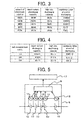
- FIG. 3 is a table showing capacity with respect to the amount of the electrolyte solution in the lithium-ion battery. Referring to FIG. 3 , the rated-current discharge capacity is a value of the capacity generated when the discharge current is set to 30 A, and the high rate discharge capacity is a value of the capacity generated when the discharge current is set to 300 A. FIG. 3 also shows resistance values at the end of discharge. If the amount of the electrolyte solution in the first storage battery 6 is reduced to 90 % or less, the high rate discharge capacity can be sufficiently reduced, as shown in FIG. 4 .
- the second method of increasing the mass transfer resistance in the interior of the battery is that of lowering a concentration of electrolyte solution.
- the concentration of electrolyte solution in the first storage battery 6 is made lower than that in each of the second storage batteries 7.
- the electrolyte solution in the lithium-ion battery typically contains about 1 mol/L of a salt of LiPF 6 , which is an electric charge carrier, in an organic electrolyte solution.
- FIG. 4 is a table showing capacity with respect to a salt concentration in the lithium-ion battery. Referring to FIG. 4 , the rated-current discharge capacity is a value of capacity generated when the discharge current is set to 30 A, and the high rate discharge capacity is that generated when the discharge current is set to 300 A. FIG.4 also shows resistance values at the end of discharge. By lowering the salt concentration in the first storage battery 6 to, for instance, 0.9 mol/L or less, the high rate discharge capacity can be sufficiently reduced, as shown in FIG. 3 .
- the third method of increasing the mass transfer resistance in the interior of the battery is that the mass transfer resistance can be increased by promoting the growth of a solid electrolyte interface (SEI) layer, in an interface of the electrolyte solution, which makes contact with a graphite negative electrode active material, other than by controlling the characteristic of the electrolyte solution.
- SEI solid electrolyte interface
- a method of promoting growth of SEI will be described.
- a battery fabricated is charged, with a constant current, up to its fully charged level.
- the fully charged battery is retained within a constant temperature bath of 60 °C for a period of 24 hours (aging), whereby the SEI layer is thickly created over a graphite surface layer where lithium is intercalated.
- this increases the mass transfer resistance existing when lithium ions diffuse through the SEI layer and migrate from the structure of the active material phase to the electrolyte solution. This method can reduce the high rate discharge capacity of the first storage battery 6.
- the battery pack according to Embodiment 1 of the present invention includes a specific battery-the storage battery 6-having a relatively low capacity-current characteristic, and a feature thereof is that polarity inversion of the first storage battery 6 by a large amount of current flowing during external short-circuit, thus avoiding the second storage batteries 7 from becoming damaged.
- the batteries can be prevented from becoming damaged by self-heating due to the large-amount-of-current discharge, or apparatuses connected to the batteries can be prevented from a failure, even in situations where sensors do not function properly, such as when a short-circuit occurs between both end electrodes of the battery pack during fabrication process, or when an external short-circuit occurs such as when the battery is integrated into a system after the fabrication, when an external load is connected to the battery pack, or prior to starting up the system.
- an electric power storage system to which the battery pack is applied can be reduced in size and weight.
- first storage batteries 6 may be used. During an external short-circuit, the plurality of first storage batteries 6 is sacrificed; however, the second storage batteries 7, other than those, can be protected.
- FIG. 5 is a partially schematic diagram of a configuration of an electric power storage system showing a comparison example of a battery pack according to Embodiment 2 of the present invention
- storage batteries are designated by 10; voltmeters, each of which measures respective voltages of the batteries, by 15; a polarity inversion detector that detects polarity inversion of each battery by voltage variations in response voltage signals from the voltmeters, by 9.
- a fault signal generation and memory storage unit that generates a fault signal and stores a fault history when the unit receives a polarity inversion signal sent from the polarity inversion detector 9, is designated by 17.
- each storage battery can be measured with each of the voltmeters 15, as shown in FIG. 5 .
- Each voltmeter 15 delivers to the polarity inversion detector 9 a voltage signal according to the result of measurement and the polarity inversion detector 9 can determine from the voltage signal as to which storage battery has undergone polarity inversion.
- the fault signal generation and memory storage unit 17 can issue a fault signal for communicating a fault to an external apparatus and also store a history of the polarity inversion.
- power required for monitoring the battery pack such as for issuance of the fault signal, storage of the history of polarity inversion and the like, needs to be fed by the power of the battery pack itself.
- FIG. 6 is a schematic diagram of a battery pack according to embodiment 2 of the present invention.
- the difference between the battery pack according to Embodiment 1 and that according to Embodiment 2 is that there are provided a voltmeter 16, a polarity inversion detector 19, a fault signal generation and memory storage unit 17 and a power supply cable 18.
- the rest of the configuration is the same as that for the battery pack according to Embodiment 1.
- the same reference numerals apply to the same components, and the corresponding description will not be repeated hereinafter.
- a battery that undergoes polarity inversion among batteries in the battery pack is the storage battery 6, disposed in a specific location, which has a high resistance during a high rate discharge. Consequently, if a voltage of the battery is monitored as a representative, the presence or absence of polarity inversion, i.e., the presence or absence of an external short-circuit can be detected. Further, since the second storage butteries 7 other than this specific battery 6 do not undergo polarity inversion during short-circuit, they can be utilized as a drive power supply for detection of polarity inversion, generation and memory-storage of a fault signal. For this reason, the battery pack enables a short-circuit to be detected and stored even when the system is inoperative.
- the voltmeter 16 that measures the voltage of the first storage battery 6 transmits a voltage signal to the polarity inversion detector 19, communicating occurrence of the polarity inversion.
- the polarity inversion defector 19 thereby detects the polarity inversion, to send a polarity inversion signal to the fault signal generation and memory storage unit 17.
- the fault signal generation and memory storage unit 17, having received the polarity inversion signal, generates a fault signal for communicating the fault to the external apparatus, and stores history data of the polarity inversion.
- devices such as the polarity inversion detector 19 and the fault signal generation and memory storage unit 17, can be powered through the power supply cable 18 from the second storage butteries 7 that do not undergo polarity inversion.
- the battery pack according to Embodiment 2 of the present invention can detect a short-circuit and store it in the memory even when the system is inoperative.
- FIG. 7 is a conceptual diagram of the regeneration energy storage system for an electric railcar, showing an example of the application.
- a regeneration energy storage system for an electric railcar according to Embodiment 3 includes an overhead line 50 for feeding electric power from a power substation, an on-ground electric power storage system 41 connected to the overhead line 50, an electric railcar 20 having an onboard electric storage system 21 and a pantograph 22, and an electric railcar 30 having an onboard electric storage system, 31 and a pantograph 32, as shown in FIG. 7 .
- the on-ground electric power storage system 41, the onboard electric storage system 21 and the onboard electric storage system 31 each have a battery pack according to Embodiment 2 incorporated therein.
- the feature of an electric railroad car is that regenerated power obtained via an overhead line during braking is reused at another car, and energy-saving can thereby be made.
- the power regenerated during braking of the car be consumed via the overhead line by another power running electric railcar.
- a power running railcar is located far away from a regenerative railcar, or the power running railcar cannot sufficiently consume regenerated power because of the amount of the regenerated power being large, an overhead line voltage increases. In such a case, braking energy is partially wasted as a heat so that the overhead line voltage is less than a certain level.
- the regenerated power is collected and stored in the on-ground electric power storage system 41, the onboard electric power storage system 21 and the onboard electric power storage system 31.
- the regenerated power that is generated when the electric railcar 20 is braked is supplied through the overhead line to, and consumed by, the electric railcar 30.
- the regenerated power during braking is partially or entirely collected and stored in the storage device 21.
- the stored power can be taken from the stored device and used, as required.
- the regeneration energy storage system for electric railcar according to Embodiment 3 can store the regenerated power and makes effective use of it.
- the on-ground electric power storage system 41, the onboard electric power storage system 21 and the onboard electric power storage system 31 may be configured such that when an onboard battery pack fails, a signal for communicating the fault of the battery pack is issued to a device, such as a safety device, or stored. This enhances reliability and safety of the system.
Landscapes
- Chemical & Material Sciences (AREA)
- Chemical Kinetics & Catalysis (AREA)
- Electrochemistry (AREA)
- General Chemical & Material Sciences (AREA)
- Engineering & Computer Science (AREA)
- Manufacturing & Machinery (AREA)
- Materials Engineering (AREA)
- Secondary Cells (AREA)
- Battery Mounting, Suspending (AREA)
- Connection Of Batteries Or Terminals (AREA)
Abstract
Description
- The present invention relates to battery packs, in particular, to a battery pack that is for use in an electric power storage system.
- Battery packs that are mounted on apparatuses, vehicles or the like are configured by combining a plurality of storage batteries in series or parallel in order to obtain a voltage or capacity needed for the apparatuses.
Across output terminals of the battery pack, a load such as a semiconductor device or an electric motor is connected via a device such as a voltage converter. In situations where a high voltage is needed in accordance with requirements of the load or where a low current is used to obtain the necessary electric power, storage batteries are connected in series thereby increasing a voltage of the battery pack.
In situations where an apparatus needs to be operative for a long period of time, the number of parallel rows of storage batteries is increased to augment the capacity. In this way, a combination of series/parallel connection is determined according to factors such as requirements of apparatuses or the like that serve as loads. - Many ideas have been proposed for a battery pack. In, for instance, Patent Reference 1, it is described that in a process where a plurality of storage batteries fabricated is assembled into a battery pack, a minimum capacity battery is selected for control operation, and as a representative of the batteries in the battery pack. In
Patent Reference 2, an idea is incorporated by which an over-discharged battery in a battery pack is detected early. - One problem with a battery pack lies in that when an external short-circuit occurs in an apparatus connected to the battery pack, the short-circuit current causes the storage batteries to be heated and thereby damaged.
- To take measures, conventionally a thermistor, a voltage sensing circuit and the like that achieve a current interruption capability to ensure safety is provided in an electric power storage system that uses the battery pack, and current interruption capability is incorporated that interrupts an electric current circuit in response to a control signal.
- For instance, a small type battery pack such as in a portable device, if used, produces less current and its switch for operating in an emergency is also of small type; thus, it is sufficiently possible to cause the small type battery pack to have the current interruption capability such as above.
-
- Patent Reference 1
- Japanese Unexamined Patent Application
PublicationJP-A-2003-178 808
(panes 3 through 5, andFIG. 2 ) -
Patent preference 2 - Japanese Unexamined Patent Application
PublicationJP-A-2000-150 002
(pages 2 through 4, andFIG. 1 ) - In an electric power storage system in which storage batteries are charged or discharged with a current of, for instance, several hundreds amperes, the provision of the above current interruption capability causes the system so increase in size to a great extent.
- The present invention has been made in light of such a problem, and the object of the invention is to provide a battery pack that, while preventing the system from becoming large, minimizes damage to a storage battery due to an external short-circuit.
- A battery pack according to the present invention is configured by connecting a first storage battery and a second storage battery in series, and a starting point of a diffusion-limited region of the first storage battery is smaller in current than that of the second storage battery.
- In a battery pack according to the present invention, a mechanism can be provided which minimizes damage due to an external short-circuit.
-
- FIG. 1
- is a layout diagram of a battery pack according to Embodiment 1 of the present invention;
- FIG. 2
- is a graph showing an example of a capacity characteristic of a storage battery according to Embodiment 1 of the present invention;
- FIG. 3
- is a table showing a capacity to an amount of electrolyte solution of a lithium-ion battery;
- FIG. 4
- is a table showing a capacity to a salt concentration of a lithium-ion battery;
- FIG. 5
- is a partially schematic diagram of a configuration of an electric power storage system, showing as a comparison example a battery pack according to
Embodiment 2 of the present invention; - FIG. 6
- is a configuration diagram of the battery pack according to
Embodiment 2 of the present invention; and - FIG. 7
- is a conceptual diagram of a regeneration energy storage system for an electric railcar according to
Embodiment 3 of the present invention. -
FIG. 1 is a layout diagram of a battery pack according to Embodiment 1 of the present invention. InFIG. 1 , the battery pack according to Embodiment 1 of the present invention includes apositive terminal 3 of the battery pack, an electro-conductive metal plate 4 of copper plated with nickel, anegative terminal 5 of the battery pack, afirst storage battery 6, and a plurality ofsecond storage batteries 7.
Each storage battery is connected together in series by means of aconductive metal plate 4, and housed in a row in abattery pack casing 8. Further, each storage battery is disposed so that its positive and negative terminals are located alternately up and down in the figure, whereby a currant path, established by theconductive metal plate 4 that connects adjacent storage batteries horizontally in the figure, is designed to be short. - When a plurality of storage batteries that is not uniform in capacity is assembled into a battery pack, the voltage of a storage battery having the minimum capacity reaches earliest the cutoff voltage during discharge. Thus, the capacity of the battery pack becomes equivalent to the capacity of this storage battery.
Further, when a plurality of storage batteries that is not uniform in direct current internal resistance is assembled into a battery pack, each battery voltage causes variations during charging, thereby impairing in some cases the material durability of a storage battery having a large internal resistance.
Therefore, in order to make full use of the capabilities of the storage batteries and enable the battery pack to be used for a long time, it is preferable that storage batteries equal in capacity and internal resistance as much as possible in a rated current be configured into a battery pack. - For this purpose, the
first storage battery 6 according to Embodiment 1 of the present invention is made not different in capacity from thesecond storage batteries 7, in the rated current, and only when thefirst battery 6 is discharged with a large amount of current, such as at the time of a short-circuit, the internal resistance is made high, causing a reduction in capacity. Further, the internal resistance and capacity of thesecond storage batteries 7 is made not varied to a great extent by variation in current. - By doing this way, when a low-resistance short-circuit occurs between the
positive terminal 3 and thenegative terminal 5 in the battery pack as configured inFIG. 1 , only thefirst storage battery 6 is greatly polarized, thereby causing polarity inversion, that is, its voltage changes from positive to negative.
This stops the current from flowing, and a voltage across thepositive terminal 3 and thenegative terminal 5 is substantially zero because of the external short-circuit. Thus, thesecond storage batteries 7, while exhibiting positive voltages, are in a stable condition in which only current of the rated value or less flows, enabling damage to thesecond storage batteries 7 to be minimizes. - The
first storage battery 6 is disposed at the end that is nearest thenegative terminal 5 in thebattery pack casing 8. Because in most castes a storage battery having undergone polarity inversion cannot be used, thefirst storage battery 6 that will undergo polarity inversion is disposed at the endmost position of thebattery pack casing 8, thereby facilitating replacement of thefirst storage battery 6 even in situations where the battery pack is incorporated into an electric power storage system.
Even when on rare occasions thefirst storage battery 6 generates heat and when thefirst storage battery 6 is disposed at the endmost position, the influence to thesecond storage butteries 7 is minimized. - Next, a method of fabricating storage batteries according to Embodiment 1 of the present invention will be described. Generally, the internal resistance of a storage battery does not vary to a great extent even if a value of current flowing through the storage battery varies; however, storage batteries can be fabricated such that the internal resistance increases to a great extent when an extremely large amount of current flows through the storage battery (high rate discharge).
Storage batteries having an increased internal resistance during high rate discharge are chosen by a method of separating from a plurality of storage batteries fabricated and are obtained by a method of fabricating storage batteries that have a high resistance during high rate discharge. The latter will be further described herein. - Given that, assigned as n is the total number of the storage batteries of the battery pack formed by combining together one
first storage battery 6 and n-1second storage batteries 7; the rated current value for thefirst storage battery 6 and thesecond storage batteries 7, as I; and the internal resistance of thefirst storage battery 6 and thesecond storage batteries 7, and a voltage of each storage battery at the time when the rated current flows therethrough, as R and V, respectively, then resistance Rx at the time when an external short-circuit occurs at thefirst storage battery 6 is expressed by the following equation: -

- In this case, the internal resistance R during normal operation is generally very small; thus, if the internal resistance during high rate discharge of a storage battery undergoing polarity inversion is a value of n x V/I or more, it is preferable for the above
first storage battery 6 subject to polarity inversion.
Consequently, it is preferable for thefirst storage battery 6 that the internal resistance during the external short-circuit be 0.8 Ohms or more when, for a battery pack of 6 batteries in series, the voltage of each storage battery is 4 V and the rated current is 30 A, for instance. - The following description will be provided assuming that a lithium-ion battery is used as a storage battery constituting the battery pack according to Embodiment 1 of the present invention; however, this battery may be replaced with a battery such as a nickel metal hydride battery, an alkaline storage battery, a nickel-cadmium battery, a lead-acid storage battery, an electric double-layer capacitor, or a lithium-ion capacitor.
- A method of fabricating a lithium-ion battery for use as the battery pack according to Embodiment 1 of the present invention will be described below. The positive electrode of the lithium-ion battery is made by coating with a slurry an aluminum plate (or aluminum foil)-a positive electrode current collector-drying the slurry, and press forming the slurry-coated aluminum plate. The slurry is prepared by dissolving and dispersing lithium cobalt oxide, acetylene black and PVDF binder in solution.
The negative electrode thereof is made by coating with another slurry a copper plate (or copper foil)-a negative electrode current collector-drying the other slurry and press forming the slurry-coated copper plate. The other slurry is prepared by dissolving and dispersing graphite and SBR binder in solution. - A battery element is made by having a polyolefin microporous membrane between both electrodes, and injecting between each electrode and the intervening membrane an electrolyte solution that has a salt of LiPF6 dissolved in a solvent prepared by mixing together ethylene carbonate (EC) and diethyl carbonate (DEC) by a volume ratio of 4:6, each having a water content adjusted to 10 ppm or less.
After the battery element has been inserted into a stainless oar aluminum container, pre-charging is performed for gas emission for 30 minutes with a current density of 3 A/cm2 per geometrical area of the electrode. Thereafter, in the atmosphere of inert gas, the container and its lid are welded together by laser welding and the container is sealed, thus fabricating the lithium-ion battery. - A lithium battery with a capacity of 20 Ah, thus fabricated was charged for three hours at a 1 C current rate in an environment controlled at a temperature in the neighborhood of 25 °C, and after stopping its charge for a period or 10 minutes, a value of the capacity was measured at a 30 A discharge, and then the value measured is defined as the rated-current discharge capacity. The high rate discharge capacity was measured under the same charge condition and by setting a discharge current value at 150 A and 300 A.
-
FIG. 2 is a graph showing an example of capacity characteristics of the lithium-ion battery, measured under the above conditions. A curve 1 shows a capacity characteristic of a lithium-ion battery whose capacity lowers to a great extent during high rate discharge occurring when the current value is large. This lithium-ion battery is used as the first storage battery. Theother curves 2 show capacity characteristics of lithium-ion batteries that provide predetermined capacity even during high rate discharge. These lithium-ion batteries are used as thesecond storage batteries 7. - Referring to
FIG. 2 , a starting point of a diffusion limited region of thefirst storage battery 6 is smaller in current than those of thesecond storage butteries 7, and when the value of flow current increases, the capacity or thefirst storage battery 6, shown by the curve 1, decreases more sharply than those of thesecond storage batteries 7, shown by thecurves 2. - In the battery pack according to Embodiment 1 of the present invention, a large amount of current flowing during external short-circuit thereby causes the
first storage battery 6 to undergo polarity inversion, while the voltage of eachsecond storage battery 7 remains near its open circuit voltage. - Next, a method of fabricating a storage battery that causes only a capacity characteristic during high rate discharge to lower without changing the capacity characteristic at the rated current will be described. As described previously, the capacity of a battery having the lowest capacity in the battery pack formed of a plurality of batteries connected in series is that of the battery pack. For that reason, it is preferable that a capacity characteristic in the rated current be lowered as little as possible, and only the characteristic during high rate discharge be lowered.
- In order to reduce the capacity, it will suffice if the internal resistance is increased. Further, since, as will be described next, the internal resistance during high rate discharge largely reflects mass transfer resistance in the interior of the battery, it will suffice if the mass transfer resistance in the interior of the battery is increased.
- In the interior of the battery, electrode reactions and their subsequent mass transfer occur during charging or discharging. The mass transfer largely represents a transfer of the lithium ion in a negative or positive electrode active material crystal and transfers of the positive and negative ions in the electrolyte solution.
Since the drive force for such mass transfers is generated largely by difference in ion concentrations of the electrolyte, the diffusion speed of ions does not satisfy a diffusion speed required during charge or discharge with a large amount of current, thereby increasing mass transfer resistance-an apparent resistance.
This significantly occurs at the end of discharge. A region of the current value where such a phenomenon occurs is called a diffusion limited region. Therefore, the increase of the mass transfer resistance in the interior of the battery leads to reduction of the high rate discharge capacity. - When the first storage battery and the second storage batteries are of the same type (lithium-ion battery), there are three methods of increasing the mass transfer resistance in the interior of the battery. These methods will be described below. The first one is a method of decreasing an amount of electrolyte solution. An example thereof is that an amount of electrolyte solution in the
first storage battery 6 is made smaller than an average amount of the electrolyte solution in thesecond storage batteries 7. - The electrolyte solution is typically impregnated into cavities of the battery element. The 100 % amount of the electrolyte solution means a condition in which the solution is fully filled.
FIG. 3 is a table showing capacity with respect to the amount of the electrolyte solution in the lithium-ion battery.
Referring toFIG. 3 , the rated-current discharge capacity is a value of the capacity generated when the discharge current is set to 30 A, and the high rate discharge capacity is a value of the capacity generated when the discharge current is set to 300 A.
FIG. 3 also shows resistance values at the end of discharge. If the amount of the electrolyte solution in thefirst storage battery 6 is reduced to 90 % or less, the high rate discharge capacity can be sufficiently reduced, as shown inFIG. 4 . - The second method of increasing the mass transfer resistance in the interior of the battery is that of lowering a concentration of electrolyte solution. In other words, the concentration of electrolyte solution in the
first storage battery 6 is made lower than that in each of thesecond storage batteries 7. - The electrolyte solution in the lithium-ion battery typically contains about 1 mol/L of a salt of LiPF6, which is an electric charge carrier, in an organic electrolyte solution.
FIG. 4 is a table showing capacity with respect to a salt concentration in the lithium-ion battery.
Referring toFIG. 4 , the rated-current discharge capacity is a value of capacity generated when the discharge current is set to 30 A, and the high rate discharge capacity is that generated when the discharge current is set to 300 A.
FIG.4 also shows resistance values at the end of discharge. By lowering the salt concentration in thefirst storage battery 6 to, for instance, 0.9 mol/L or less, the high rate discharge capacity can be sufficiently reduced, as shown inFIG. 3 . - The third method of increasing the mass transfer resistance in the interior of the battery is that the mass transfer resistance can be increased by promoting the growth of a solid electrolyte interface (SEI) layer, in an interface of the electrolyte solution, which makes contact with a graphite negative electrode active material, other than by controlling the characteristic of the electrolyte solution.
- A method of promoting growth of SEI will be described. A battery fabricated is charged, with a constant current, up to its fully charged level. The fully charged battery is retained within a constant temperature bath of 60 °C for a period of 24 hours (aging), whereby the SEI layer is thickly created over a graphite surface layer where lithium is intercalated.
During discharge, this increases the mass transfer resistance existing when lithium ions diffuse through the SEI layer and migrate from the structure of the active material phase to the electrolyte solution. This method can reduce the high rate discharge capacity of thefirst storage battery 6. - As described above, the battery pack according to Embodiment 1 of the present invention includes a specific battery-the storage battery 6-having a relatively low capacity-current characteristic, and a feature thereof is that polarity inversion of the
first storage battery 6 by a large amount of current flowing during external short-circuit, thus avoiding thesecond storage batteries 7 from becoming damaged. - In addition, since the battery pack autonomously interrupts a current flowing therethrough, the batteries can be prevented from becoming damaged by self-heating due to the large-amount-of-current discharge, or apparatuses connected to the batteries can be prevented from a failure, even in situations where sensors do not function properly, such as when a short-circuit occurs between both end electrodes of the battery pack during fabrication process, or when an external short-circuit occurs such as when the battery is integrated into a system after the fabrication, when an external load is connected to the battery pack, or prior to starting up the system.
- Further, unlike a circuit or the like that achieves a conventional current interruption capability, situations are eliminated in which a user continues to use the battery without knowing that it is a damaged battery, even when, although short-time short-circuit causes the battery to be heated to a high temperature and thereby damaged, the damaged battery recovers its voltage immediately.
- In addition, since devices, such as a thermistor and a voltage sensing circuit that are disposed outside the battery pack and achieve a current interruption capability, are unnecessary, an electric power storage system to which the battery pack is applied can be reduced in size and weight.
- Note that a plurality of
first storage batteries 6 may be used. During an external short-circuit, the plurality offirst storage batteries 6 is sacrificed; however, thesecond storage batteries 7, other than those, can be protected. -
FIG. 5 is a partially schematic diagram of a configuration of an electric power storage system showing a comparison example of a battery pack according toEmbodiment 2 of the present invention, Referring toFIG. 5 , storage batteries are designated by 10; voltmeters, each of which measures respective voltages of the batteries, by 15; a polarity inversion detector that detects polarity inversion of each battery by voltage variations in response voltage signals from the voltmeters, by 9.
A fault signal generation and memory storage unit that generates a fault signal and stores a fault history when the unit receives a polarity inversion signal sent from thepolarity inversion detector 9, is designated by 17. - If the battery pack is incorporated into the electric power storage system and operated by supplying power from an external auxiliary power supply, and when an external short-circuit occurs, the voltage of each storage battery can be measured with each of the
voltmeters 15, as shown inFIG. 5 . Eachvoltmeter 15 delivers to the polarity inversion detector 9 a voltage signal according to the result of measurement and thepolarity inversion detector 9 can determine from the voltage signal as to which storage battery has undergone polarity inversion. - By receiving a signal that communicates occurrence of polarity inversion from the
polarity inversion detector 9, the fault signal generation andmemory storage unit 17 can issue a fault signal for communicating a fault to an external apparatus and also store a history of the polarity inversion.
However, in a state prior to incorporation of the battery pack into the electric power storage system, power required for monitoring the battery pack, such as for issuance of the fault signal, storage of the history of polarity inversion and the like, needs to be fed by the power of the battery pack itself. -
FIG. 6 is a schematic diagram of a battery pack according toembodiment 2 of the present invention. The difference between the battery pack according to Embodiment 1 and that according toEmbodiment 2 is that there are provided avoltmeter 16, apolarity inversion detector 19, a fault signal generation andmemory storage unit 17 and apower supply cable 18.
The rest of the configuration is the same as that for the battery pack according to Embodiment 1. The same reference numerals apply to the same components, and the corresponding description will not be repeated hereinafter. - A battery that undergoes polarity inversion among batteries in the battery pack is the
storage battery 6, disposed in a specific location, which has a high resistance during a high rate discharge. Consequently, if a voltage of the battery is monitored as a representative, the presence or absence of polarity inversion, i.e., the presence or absence of an external short-circuit can be detected.
Further, since thesecond storage butteries 7 other than thisspecific battery 6 do not undergo polarity inversion during short-circuit, they can be utilized as a drive power supply for detection of polarity inversion, generation and memory-storage of a fault signal. For this reason, the battery pack enables a short-circuit to be detected and stored even when the system is inoperative. - The operation will be described next. When the
first storage battery 6 undergoes polarity inversion, thevoltmeter 16 that measures the voltage of thefirst storage battery 6 transmits a voltage signal to thepolarity inversion detector 19, communicating occurrence of the polarity inversion. Thepolarity inversion defector 19 thereby detects the polarity inversion, to send a polarity inversion signal to the fault signal generation andmemory storage unit 17.
The fault signal generation andmemory storage unit 17, having received the polarity inversion signal, generates a fault signal for communicating the fault to the external apparatus, and stores history data of the polarity inversion. Note that devices, such as thepolarity inversion detector 19 and the fault signal generation andmemory storage unit 17, can be powered through thepower supply cable 18 from thesecond storage butteries 7 that do not undergo polarity inversion. - As described above, the battery pack according to
Embodiment 2 of the present invention can detect a short-circuit and store it in the memory even when the system is inoperative. - The battery pack described in Embodiment 1 and
Embodiment 2 is applicable to a regeneration energy storage system for an electric railcar.FIG. 7 is a conceptual diagram of the regeneration energy storage system for an electric railcar, showing an example of the application. - A regeneration energy storage system for an electric railcar according to
Embodiment 3 includes anoverhead line 50 for feeding electric power from a power substation, an on-ground electricpower storage system 41 connected to theoverhead line 50, anelectric railcar 20 having an onboardelectric storage system 21 and apantograph 22, and anelectric railcar 30 having an onboard electric storage system, 31 and apantograph 32, as shown inFIG. 7 .
The on-ground electricpower storage system 41, the onboardelectric storage system 21 and the onboardelectric storage system 31 each have a battery pack according toEmbodiment 2 incorporated therein. - The feature of an electric railroad car is that regenerated power obtained via an overhead line during braking is reused at another car, and energy-saving can thereby be made. To maximize this advantage, it is preferable that the power regenerated during braking of the car be consumed via the overhead line by another power running electric railcar.
However, if a power running railcar is located far away from a regenerative railcar, or the power running railcar cannot sufficiently consume regenerated power because of the amount of the regenerated power being large, an overhead line voltage increases. In such a case, braking energy is partially wasted as a heat so that the overhead line voltage is less than a certain level. - For that reason, in the regeneration energy storage system for electric railcar according to
Embodiment 3, in order not to waste such an energy, the regenerated power is collected and stored in the on-ground electricpower storage system 41, the onboard electricpower storage system 21 and the onboard electricpower storage system 31. - Operation will be described next. Typically, the regenerated power that is generated when the
electric railcar 20 is braked is supplied through the overhead line to, and consumed by, theelectric railcar 30. - On the other hand, when the
electric railcar 20 is braked, and if theelectric railcar 30 is located far away from theelectric railcar 30, or theelectric railcar 30 cannot sufficiently consume a regenerated power because of the amount of the regenerated power being large, the regenerated power during braking is partially or entirely collected and stored in thestorage device 21. The stored power can be taken from the stored device and used, as required. - As described above, the regeneration energy storage system for electric railcar according to
Embodiment 3 can store the regenerated power and makes effective use of it. - Note that the on-ground electric
power storage system 41, the onboard electricpower storage system 21 and the onboard electricpower storage system 31 may be configured such that when an onboard battery pack fails, a signal for communicating the fault of the battery pack is issued to a device, such as a safety device, or stored. This enhances reliability and safety of the system. -
- 3
- positive terminal of battery pack
- 4
- electro-conductive metal
- 5
- negative terminal of battery pack
- 6
- first storage battery
- 7
- second storage battery
- 8
- battery pack casing
- 9
- polarity inversion detector
- 10
- storage batteries
- 15
- voltmeter
- 16
- voltmeters
- 17
- fault signal generation and memory storage unit
- 18
- electric power supply cable
- 19
- polarity inversion detector
- 20
- electric railcar
- 21
- onboard electric power storage system
- 22
- pantograph
- 30
- electric railcar
- 31
- onboard electric power storage system
- 32
- pantograph
- 41
- on-ground electric power storage system
- 50
- overhead line
Claims (7)
- A battery pack, comprising:- at least one first rechargeable storage battery; and- at least one second rechargeable storage battery, the first and second storage batteries being connected in series; wherein a starting point of a diffusion-limited region of the first storage battery is smaller in current than that of the second storage battery.
- A battery pack, comprising:- a first rechargeable storage battery, whose rated current is assigned as I and whose voltage generated when the rated current flows through the battery is assigned as V; and- n-1 second rechargeable storage batteries, whose rated current is assigned as I and whose voltage generated when the rated current flows through the battery is assigned as V, the first and second storage batteries being connected in series; wherein an internal resistance Rx in the first storage battery, when a short-circuit current flows through the first storage battery, is a value given as Rx ≥ n x V/I.
- The battery pack of claim 1,
wherein an amount of an electrolyte solution in the first storage battery is smaller than an average amount of the electrolyte solution in the second storage battery. - The battery pack of claim 1,
wherein a salt concentration of the electrolyte solution in the first storage battery is lower than that of the electrolyte solution in the second storage battery. - The battery pack of any one of claims 1 to 4,
wherein the first and second storage batteries are lithium-ion batteries. - An electric power storage system, comprising:- the battery pack of any one of claims 1 through 4;- detection means that detects a voltage of the first storage battery; and- fault signal generation means that generate an output fault signal when a voltage detected by the detection means inverses.
- An electric power storage system, comprising:- the battery pack of any one of claim 1 to 4;- detection means that detect a voltage of the first storage battery; and- fault signal memory-storage means that store a fault signal when a voltage detected by the detection means inverses.
Applications Claiming Priority (1)
| Application Number | Priority Date | Filing Date | Title |
|---|---|---|---|
| PCT/JP2010/001504 WO2011108025A1 (en) | 2010-03-04 | 2010-03-04 | Assembled battery and power storage system |
Publications (3)
| Publication Number | Publication Date |
|---|---|
| EP2544293A1 true EP2544293A1 (en) | 2013-01-09 |
| EP2544293A4 EP2544293A4 (en) | 2013-11-13 |
| EP2544293B1 EP2544293B1 (en) | 2019-01-16 |
Family
ID=44541716
Family Applications (1)
| Application Number | Title | Priority Date | Filing Date |
|---|---|---|---|
| EP10846936.2A Not-in-force EP2544293B1 (en) | 2010-03-04 | 2010-03-04 | Electric power storage system |
Country Status (8)
| Country | Link |
|---|---|
| US (1) | US9041404B2 (en) |
| EP (1) | EP2544293B1 (en) |
| JP (1) | JP4835808B2 (en) |
| KR (1) | KR101348026B1 (en) |
| CN (1) | CN102804477B (en) |
| AU (1) | AU2010347489B2 (en) |
| BR (1) | BR112012021101A2 (en) |
| WO (1) | WO2011108025A1 (en) |
Families Citing this family (4)
| Publication number | Priority date | Publication date | Assignee | Title |
|---|---|---|---|---|
| KR102392380B1 (en) * | 2015-08-19 | 2022-04-29 | 삼성에스디아이 주식회사 | Secondary battery |
| DE102018200145A1 (en) * | 2018-01-08 | 2019-07-11 | Robert Bosch Gmbh | Method for detecting an internal short circuit in a first electrical energy storage unit of an electrical energy store |
| JPWO2019156171A1 (en) * | 2018-02-07 | 2021-03-04 | パナソニックIpマネジメント株式会社 | Lithium-ion secondary battery control device and its control method |
| JP7605798B2 (en) * | 2022-09-22 | 2024-12-24 | プライムプラネットエナジー&ソリューションズ株式会社 | Secondary battery self-discharge inspection method and secondary battery manufacturing method |
Family Cites Families (20)
| Publication number | Priority date | Publication date | Assignee | Title |
|---|---|---|---|---|
| US4303877A (en) | 1978-05-05 | 1981-12-01 | Brown, Boveri & Cie Aktiengesellschaft | Circuit for protecting storage cells |
| US4333119A (en) * | 1980-04-28 | 1982-06-01 | Purex Corporation | Power monitor system |
| JP3107407B2 (en) * | 1991-02-20 | 2000-11-06 | 日立マクセル株式会社 | How to charge the battery pack |
| JP3397854B2 (en) * | 1993-09-10 | 2003-04-21 | 東芝電池株式会社 | Battery pack |
| US5683827A (en) * | 1995-11-20 | 1997-11-04 | Mobius Green Energy, Inc. | Protective device for protecting individual battery cells in a batterypack from damages and hazards caused by reverse polarity during discharge cycles |
| JPH1079472A (en) * | 1996-09-05 | 1998-03-24 | Mitsubishi Electric Corp | Semiconductor integrated circuit |
| JP3416461B2 (en) * | 1997-05-30 | 2003-06-16 | キヤノン株式会社 | Solar battery charge control device |
| JP3584760B2 (en) | 1998-11-06 | 2004-11-04 | トヨタ自動車株式会社 | Overdischarge cell detection device in assembled battery |
| JP2001346339A (en) * | 2000-05-31 | 2001-12-14 | Toshiba Corp | Power supply device using storage battery |
| DE10125828A1 (en) * | 2001-05-26 | 2002-12-05 | Bosch Gmbh Robert | Reverse polarity protection for energy sources |
| US6822423B2 (en) * | 2001-09-03 | 2004-11-23 | Gpe International Limited | Intelligent serial battery charger and charging block |
| US6822425B2 (en) * | 2002-01-25 | 2004-11-23 | Vector Products, Inc. | High frequency battery charger and method of operating same |
| JP2004095400A (en) | 2002-08-30 | 2004-03-25 | Nissan Motor Co Ltd | Bipolar battery and control method thereof |
| JP3625292B2 (en) | 2002-11-28 | 2005-03-02 | 東芝電池株式会社 | Manufacturing method of battery pack |
| US7009406B2 (en) * | 2003-04-24 | 2006-03-07 | Delphi Technologies, Inc. | Arc fault detector and method |
| DE102004033836B3 (en) * | 2004-07-13 | 2005-09-29 | Siemens Ag | Starter battery operating parameters determining device for motor vehicle, has comparator to effect transition of measuring device, controller, bus and converter from inactive to active mode when battery voltage falls below preset voltage |
| US7768236B2 (en) * | 2006-07-28 | 2010-08-03 | Panasonic Corporation | Electrical device and battery pack for preventing polarity reversal of battery |
| KR100823507B1 (en) * | 2006-08-29 | 2008-04-21 | 삼성에스디아이 주식회사 | Battery management system and its driving method |
| JP4782072B2 (en) * | 2007-05-18 | 2011-09-28 | パナソニック株式会社 | Power supply |
| DE102008054532A1 (en) | 2008-04-08 | 2009-10-15 | Robert Bosch Gmbh | battery module |
-
2010
- 2010-03-04 BR BR112012021101A patent/BR112012021101A2/en not_active IP Right Cessation
- 2010-03-04 KR KR1020127022028A patent/KR101348026B1/en not_active Expired - Fee Related
- 2010-03-04 US US13/582,204 patent/US9041404B2/en not_active Expired - Fee Related
- 2010-03-04 CN CN201080065129.0A patent/CN102804477B/en not_active Expired - Fee Related
- 2010-03-04 JP JP2011512777A patent/JP4835808B2/en not_active Expired - Fee Related
- 2010-03-04 AU AU2010347489A patent/AU2010347489B2/en not_active Ceased
- 2010-03-04 WO PCT/JP2010/001504 patent/WO2011108025A1/en not_active Ceased
- 2010-03-04 EP EP10846936.2A patent/EP2544293B1/en not_active Not-in-force
Also Published As
| Publication number | Publication date |
|---|---|
| JP4835808B2 (en) | 2011-12-14 |
| US20120319693A1 (en) | 2012-12-20 |
| KR20120123466A (en) | 2012-11-08 |
| KR101348026B1 (en) | 2014-01-10 |
| AU2010347489A1 (en) | 2012-09-27 |
| JPWO2011108025A1 (en) | 2013-06-20 |
| CN102804477B (en) | 2015-04-29 |
| BR112012021101A2 (en) | 2016-05-17 |
| CN102804477A (en) | 2012-11-28 |
| EP2544293A4 (en) | 2013-11-13 |
| WO2011108025A1 (en) | 2011-09-09 |
| US9041404B2 (en) | 2015-05-26 |
| AU2010347489B2 (en) | 2013-09-12 |
| EP2544293B1 (en) | 2019-01-16 |
Similar Documents
| Publication | Publication Date | Title |
|---|---|---|
| CN104103851B (en) | Lithium rechargable battery with the reference electrode for state of health monitoring | |
| US9933491B2 (en) | Electric storage system | |
| CN114665169B (en) | Method for restoring activity of lithium-ion battery and lithium-ion battery | |
| DK2926403T3 (en) | METAL AIR BATTERY WITH A DEVICE TO CONTROL THE POTENTIAL OF THE NEGATIVE ELECTRODE | |
| JP4771180B2 (en) | Battery pack and battery pack control system | |
| JP2016091613A (en) | Battery system and capacity recovery method | |
| TW201743497A (en) | Trickle charging power supply system | |
| US20160111727A1 (en) | Metal-Ion Battery with Offset Potential Material | |
| EP2544293B1 (en) | Electric power storage system | |
| KR101566864B1 (en) | Power Supply Apparatus | |
| EP4254719B1 (en) | Method for determining charging profile of battery and battery charging system using same | |
| JP6055246B2 (en) | Power supply | |
| JP4618025B2 (en) | Battery pack and charge control method thereof | |
| JP2013120680A (en) | Water electrolysis hybrid storage battery | |
| JP3649655B2 (en) | Charging method for multiple parallel alkaline aqueous solution secondary batteries for backup | |
| US20250167410A1 (en) | Rechargeable battery and rechargeable battery module | |
| JP7364618B2 (en) | How to recover the capacity of alkaline secondary batteries | |
| JP2013055005A (en) | Secondary battery device, and control method of secondary battery device | |
| JP2012003870A (en) | Power storage system | |
| CN121307265A (en) | Charge and discharge control methods, battery management systems, battery packs and electrical devices | |
| JP2013132144A (en) | Power storage system and anomaly determination method | |
| JP2011155785A (en) | Method and apparatus for managing lithium ion battery pack |
Legal Events
| Date | Code | Title | Description |
|---|---|---|---|
| PUAI | Public reference made under article 153(3) epc to a published international application that has entered the european phase |
Free format text: ORIGINAL CODE: 0009012 |
|
| 17P | Request for examination filed |
Effective date: 20120823 |
|
| AK | Designated contracting states |
Kind code of ref document: A1 Designated state(s): AT BE BG CH CY CZ DE DK EE ES FI FR GB GR HR HU IE IS IT LI LT LU LV MC MK MT NL NO PL PT RO SE SI SK SM TR |
|
| DAX | Request for extension of the european patent (deleted) | ||
| A4 | Supplementary search report drawn up and despatched |
Effective date: 20131010 |
|
| RIC1 | Information provided on ipc code assigned before grant |
Ipc: H01M 10/44 20060101ALI20131004BHEP Ipc: H01M 2/34 20060101ALI20131004BHEP Ipc: H01M 10/48 20060101AFI20131004BHEP Ipc: H01M 2/10 20060101ALI20131004BHEP |
|
| STAA | Information on the status of an ep patent application or granted ep patent |
Free format text: STATUS: EXAMINATION IS IN PROGRESS |
|
| 17Q | First examination report despatched |
Effective date: 20170410 |
|
| GRAP | Despatch of communication of intention to grant a patent |
Free format text: ORIGINAL CODE: EPIDOSNIGR1 |
|
| STAA | Information on the status of an ep patent application or granted ep patent |
Free format text: STATUS: GRANT OF PATENT IS INTENDED |
|
| INTG | Intention to grant announced |
Effective date: 20180801 |
|
| GRAS | Grant fee paid |
Free format text: ORIGINAL CODE: EPIDOSNIGR3 |
|
| GRAA | (expected) grant |
Free format text: ORIGINAL CODE: 0009210 |
|
| STAA | Information on the status of an ep patent application or granted ep patent |
Free format text: STATUS: THE PATENT HAS BEEN GRANTED |
|
| AK | Designated contracting states |
Kind code of ref document: B1 Designated state(s): AT BE BG CH CY CZ DE DK EE ES FI FR GB GR HR HU IE IS IT LI LT LU LV MC MK MT NL NO PL PT RO SE SI SK SM TR |
|
| REG | Reference to a national code |
Ref country code: GB Ref legal event code: FG4D |
|
| REG | Reference to a national code |
Ref country code: CH Ref legal event code: EP |
|
| REG | Reference to a national code |
Ref country code: IE Ref legal event code: FG4D |
|
| REG | Reference to a national code |
Ref country code: DE Ref legal event code: R096 Ref document number: 602010056658 Country of ref document: DE |
|
| REG | Reference to a national code |
Ref country code: AT Ref legal event code: REF Ref document number: 1090410 Country of ref document: AT Kind code of ref document: T Effective date: 20190215 |
|
| REG | Reference to a national code |
Ref country code: NL Ref legal event code: MP Effective date: 20190116 |
|
| REG | Reference to a national code |
Ref country code: LT Ref legal event code: MG4D |
|
| PG25 | Lapsed in a contracting state [announced via postgrant information from national office to epo] |
Ref country code: NL Free format text: LAPSE BECAUSE OF FAILURE TO SUBMIT A TRANSLATION OF THE DESCRIPTION OR TO PAY THE FEE WITHIN THE PRESCRIBED TIME-LIMIT Effective date: 20190116 |
|
| REG | Reference to a national code |
Ref country code: AT Ref legal event code: MK05 Ref document number: 1090410 Country of ref document: AT Kind code of ref document: T Effective date: 20190116 |
|
| PG25 | Lapsed in a contracting state [announced via postgrant information from national office to epo] |
Ref country code: ES Free format text: LAPSE BECAUSE OF FAILURE TO SUBMIT A TRANSLATION OF THE DESCRIPTION OR TO PAY THE FEE WITHIN THE PRESCRIBED TIME-LIMIT Effective date: 20190116 Ref country code: SE Free format text: LAPSE BECAUSE OF FAILURE TO SUBMIT A TRANSLATION OF THE DESCRIPTION OR TO PAY THE FEE WITHIN THE PRESCRIBED TIME-LIMIT Effective date: 20190116 Ref country code: PT Free format text: LAPSE BECAUSE OF FAILURE TO SUBMIT A TRANSLATION OF THE DESCRIPTION OR TO PAY THE FEE WITHIN THE PRESCRIBED TIME-LIMIT Effective date: 20190516 Ref country code: LT Free format text: LAPSE BECAUSE OF FAILURE TO SUBMIT A TRANSLATION OF THE DESCRIPTION OR TO PAY THE FEE WITHIN THE PRESCRIBED TIME-LIMIT Effective date: 20190116 Ref country code: PL Free format text: LAPSE BECAUSE OF FAILURE TO SUBMIT A TRANSLATION OF THE DESCRIPTION OR TO PAY THE FEE WITHIN THE PRESCRIBED TIME-LIMIT Effective date: 20190116 Ref country code: NO Free format text: LAPSE BECAUSE OF FAILURE TO SUBMIT A TRANSLATION OF THE DESCRIPTION OR TO PAY THE FEE WITHIN THE PRESCRIBED TIME-LIMIT Effective date: 20190416 Ref country code: FI Free format text: LAPSE BECAUSE OF FAILURE TO SUBMIT A TRANSLATION OF THE DESCRIPTION OR TO PAY THE FEE WITHIN THE PRESCRIBED TIME-LIMIT Effective date: 20190116 |
|
| PG25 | Lapsed in a contracting state [announced via postgrant information from national office to epo] |
Ref country code: GR Free format text: LAPSE BECAUSE OF FAILURE TO SUBMIT A TRANSLATION OF THE DESCRIPTION OR TO PAY THE FEE WITHIN THE PRESCRIBED TIME-LIMIT Effective date: 20190417 Ref country code: BG Free format text: LAPSE BECAUSE OF FAILURE TO SUBMIT A TRANSLATION OF THE DESCRIPTION OR TO PAY THE FEE WITHIN THE PRESCRIBED TIME-LIMIT Effective date: 20190416 Ref country code: IS Free format text: LAPSE BECAUSE OF FAILURE TO SUBMIT A TRANSLATION OF THE DESCRIPTION OR TO PAY THE FEE WITHIN THE PRESCRIBED TIME-LIMIT Effective date: 20190516 Ref country code: LV Free format text: LAPSE BECAUSE OF FAILURE TO SUBMIT A TRANSLATION OF THE DESCRIPTION OR TO PAY THE FEE WITHIN THE PRESCRIBED TIME-LIMIT Effective date: 20190116 Ref country code: HR Free format text: LAPSE BECAUSE OF FAILURE TO SUBMIT A TRANSLATION OF THE DESCRIPTION OR TO PAY THE FEE WITHIN THE PRESCRIBED TIME-LIMIT Effective date: 20190116 |
|
| REG | Reference to a national code |
Ref country code: DE Ref legal event code: R097 Ref document number: 602010056658 Country of ref document: DE |
|
| PG25 | Lapsed in a contracting state [announced via postgrant information from national office to epo] |
Ref country code: SK Free format text: LAPSE BECAUSE OF FAILURE TO SUBMIT A TRANSLATION OF THE DESCRIPTION OR TO PAY THE FEE WITHIN THE PRESCRIBED TIME-LIMIT Effective date: 20190116 Ref country code: IT Free format text: LAPSE BECAUSE OF FAILURE TO SUBMIT A TRANSLATION OF THE DESCRIPTION OR TO PAY THE FEE WITHIN THE PRESCRIBED TIME-LIMIT Effective date: 20190116 Ref country code: MC Free format text: LAPSE BECAUSE OF FAILURE TO SUBMIT A TRANSLATION OF THE DESCRIPTION OR TO PAY THE FEE WITHIN THE PRESCRIBED TIME-LIMIT Effective date: 20190116 Ref country code: DK Free format text: LAPSE BECAUSE OF FAILURE TO SUBMIT A TRANSLATION OF THE DESCRIPTION OR TO PAY THE FEE WITHIN THE PRESCRIBED TIME-LIMIT Effective date: 20190116 Ref country code: AT Free format text: LAPSE BECAUSE OF FAILURE TO SUBMIT A TRANSLATION OF THE DESCRIPTION OR TO PAY THE FEE WITHIN THE PRESCRIBED TIME-LIMIT Effective date: 20190116 Ref country code: EE Free format text: LAPSE BECAUSE OF FAILURE TO SUBMIT A TRANSLATION OF THE DESCRIPTION OR TO PAY THE FEE WITHIN THE PRESCRIBED TIME-LIMIT Effective date: 20190116 Ref country code: CZ Free format text: LAPSE BECAUSE OF FAILURE TO SUBMIT A TRANSLATION OF THE DESCRIPTION OR TO PAY THE FEE WITHIN THE PRESCRIBED TIME-LIMIT Effective date: 20190116 Ref country code: RO Free format text: LAPSE BECAUSE OF FAILURE TO SUBMIT A TRANSLATION OF THE DESCRIPTION OR TO PAY THE FEE WITHIN THE PRESCRIBED TIME-LIMIT Effective date: 20190116 |
|
| REG | Reference to a national code |
Ref country code: CH Ref legal event code: PL |
|
| PLBE | No opposition filed within time limit |
Free format text: ORIGINAL CODE: 0009261 |
|
| STAA | Information on the status of an ep patent application or granted ep patent |
Free format text: STATUS: NO OPPOSITION FILED WITHIN TIME LIMIT |
|
| PG25 | Lapsed in a contracting state [announced via postgrant information from national office to epo] |
Ref country code: SM Free format text: LAPSE BECAUSE OF FAILURE TO SUBMIT A TRANSLATION OF THE DESCRIPTION OR TO PAY THE FEE WITHIN THE PRESCRIBED TIME-LIMIT Effective date: 20190116 Ref country code: LU Free format text: LAPSE BECAUSE OF NON-PAYMENT OF DUE FEES Effective date: 20190304 |
|
| REG | Reference to a national code |
Ref country code: BE Ref legal event code: MM Effective date: 20190331 |
|
| 26N | No opposition filed |
Effective date: 20191017 |
|
| GBPC | Gb: european patent ceased through non-payment of renewal fee |
Effective date: 20190416 |
|
| PG25 | Lapsed in a contracting state [announced via postgrant information from national office to epo] |
Ref country code: CH Free format text: LAPSE BECAUSE OF NON-PAYMENT OF DUE FEES Effective date: 20190331 Ref country code: IE Free format text: LAPSE BECAUSE OF NON-PAYMENT OF DUE FEES Effective date: 20190304 Ref country code: LI Free format text: LAPSE BECAUSE OF NON-PAYMENT OF DUE FEES Effective date: 20190331 Ref country code: GB Free format text: LAPSE BECAUSE OF NON-PAYMENT OF DUE FEES Effective date: 20190416 |
|
| PG25 | Lapsed in a contracting state [announced via postgrant information from national office to epo] |
Ref country code: FR Free format text: LAPSE BECAUSE OF NON-PAYMENT OF DUE FEES Effective date: 20190316 Ref country code: SI Free format text: LAPSE BECAUSE OF FAILURE TO SUBMIT A TRANSLATION OF THE DESCRIPTION OR TO PAY THE FEE WITHIN THE PRESCRIBED TIME-LIMIT Effective date: 20190116 Ref country code: BE Free format text: LAPSE BECAUSE OF NON-PAYMENT OF DUE FEES Effective date: 20190331 |
|
| PG25 | Lapsed in a contracting state [announced via postgrant information from national office to epo] |
Ref country code: TR Free format text: LAPSE BECAUSE OF FAILURE TO SUBMIT A TRANSLATION OF THE DESCRIPTION OR TO PAY THE FEE WITHIN THE PRESCRIBED TIME-LIMIT Effective date: 20190116 |
|
| PG25 | Lapsed in a contracting state [announced via postgrant information from national office to epo] |
Ref country code: MT Free format text: LAPSE BECAUSE OF NON-PAYMENT OF DUE FEES Effective date: 20190304 |
|
| PG25 | Lapsed in a contracting state [announced via postgrant information from national office to epo] |
Ref country code: CY Free format text: LAPSE BECAUSE OF FAILURE TO SUBMIT A TRANSLATION OF THE DESCRIPTION OR TO PAY THE FEE WITHIN THE PRESCRIBED TIME-LIMIT Effective date: 20190116 |
|
| PGFP | Annual fee paid to national office [announced via postgrant information from national office to epo] |
Ref country code: DE Payment date: 20210216 Year of fee payment: 12 |
|
| PG25 | Lapsed in a contracting state [announced via postgrant information from national office to epo] |
Ref country code: HU Free format text: LAPSE BECAUSE OF FAILURE TO SUBMIT A TRANSLATION OF THE DESCRIPTION OR TO PAY THE FEE WITHIN THE PRESCRIBED TIME-LIMIT; INVALID AB INITIO Effective date: 20100304 |
|
| REG | Reference to a national code |
Ref country code: DE Ref legal event code: R084 Ref document number: 602010056658 Country of ref document: DE |
|
| PG25 | Lapsed in a contracting state [announced via postgrant information from national office to epo] |
Ref country code: MK Free format text: LAPSE BECAUSE OF FAILURE TO SUBMIT A TRANSLATION OF THE DESCRIPTION OR TO PAY THE FEE WITHIN THE PRESCRIBED TIME-LIMIT Effective date: 20190116 |
|
| REG | Reference to a national code |
Ref country code: DE Ref legal event code: R119 Ref document number: 602010056658 Country of ref document: DE |
|
| PG25 | Lapsed in a contracting state [announced via postgrant information from national office to epo] |
Ref country code: DE Free format text: LAPSE BECAUSE OF NON-PAYMENT OF DUE FEES Effective date: 20221001 |