EP2544216A1 - High-speed particle detector for discriminating ionic valence - Google Patents
High-speed particle detector for discriminating ionic valence Download PDFInfo
- Publication number
- EP2544216A1 EP2544216A1 EP11750449A EP11750449A EP2544216A1 EP 2544216 A1 EP2544216 A1 EP 2544216A1 EP 11750449 A EP11750449 A EP 11750449A EP 11750449 A EP11750449 A EP 11750449A EP 2544216 A1 EP2544216 A1 EP 2544216A1
- Authority
- EP
- European Patent Office
- Prior art keywords
- ions
- superconducting
- mass
- charged
- particle
- Prior art date
- Legal status (The legal status is an assumption and is not a legal conclusion. Google has not performed a legal analysis and makes no representation as to the accuracy of the status listed.)
- Granted
Links
Images


Classifications
-
- H—ELECTRICITY
- H01—ELECTRIC ELEMENTS
- H01J—ELECTRIC DISCHARGE TUBES OR DISCHARGE LAMPS
- H01J49/00—Particle spectrometers or separator tubes
- H01J49/02—Details
- H01J49/025—Detectors specially adapted to particle spectrometers
-
- H—ELECTRICITY
- H10—SEMICONDUCTOR DEVICES; ELECTRIC SOLID-STATE DEVICES NOT OTHERWISE PROVIDED FOR
- H10N—ELECTRIC SOLID-STATE DEVICES NOT OTHERWISE PROVIDED FOR
- H10N60/00—Superconducting devices
- H10N60/80—Constructional details
- H10N60/84—Switching means for devices switchable between superconducting and normal states
Definitions
- the present invention relates to a superconducting stripline particle detector that detects arrival of atoms or molecules necessary for mass spectrometry.
- a particle detector In order to detect particles such as charged particles or biopolymers having kinetic energies, a particle detector is used for converting the arrival of ions into an electric signal.
- mass spectrometry ions are subjected to separation analysis in accordance with the ratio ( m / z ) of the mass (m) of the particles and the charge number (z) of the ions.
- TOF time-of-flight
- e the elementary electric charge
- V is the acceleration voltage
- l is the flight length.
- Ion optics system such as a reflectron is used for reducing TOF variation caused by, for example, initial kinetic energy distribution in ionization and acceleration at a constant voltage.
- a superconducting tunnel junction (STJ) can measure particle kinetic energies when the detector surface is impacted by a particle with a kinetic energy such as several keV to several ten keV that is adopted by many mass spectrometers. Since the kinetic energy of ions accelerated at a constant voltage is proportional to the charge states of the ions, z can be determined by kinetic energy measurement. As a result, particles such as N + and N 2 2+ having the same m / z but having different m can be separated (Non-Patent Document 1).
- the electric pulses that the STJ detectors generate at the time of particle impact have a rise time of about 100 ns and a decay time of several ⁇ s. Therefore the pulses have a wide pulse width that is about 3 orders of magnitude longer than the nano-second pulses of microchannel plate (MCP) or secondary electron multiplier (SEM),both of which operate at room temperature for detecting particles. For this reason, it is difficult to achieve a high mass resolution.
- MCP microchannel plate
- SEM secondary electron multiplier
- an extremely low-temperature environment such as about 1 K or lower is required for the operation of the STJ detectors. Disadvantageously, a large cooling equipment would be required.
- a superconducting stripline detector is composed of superconducting thin films processed into fine line patterns (Patent Documents 1 and 2, Non-Patent Documents 2, 3, and 4).
- SSLD electric pulses induced by particle impact reportedly have a rise time of 400 ps to several ns and a decay time of 500 ps to several ten ps, which are faster than STJ.
- the SSLD detectors cannot perform separation analysis of different ions having the same m / z, because SSLD cannot measure individual particles kinetic energy like STJ.
- An object of the present invention is to enable charge state discrimination by superconducting stripline detectors (SSLDs) that can generate high-speed pulses of nano to several ten nano seconds for particle impact. This enables determination of charge states, which is not possible with conventional mass spectroscopy. As a result, m values for mass peaks are uniquely determined.
- SSLDs superconducting stripline detectors
- a particle detector with a superconducting stripline detector that is impacted with particles and counts the particles in accordance with hot spots induced locally in a superconductor by impact of the particles, wherein a range of detectable charge states is selectable.
- the superconducting stripline is arranged in series or in parallel within a sensitive area of a detecting element, and transitions from a superconducting state to a normal state by particle impact, thus causing resistance, thereby resulting in being sensitive to individual particle impact.
- the superconducting stripline allows passage of a bias current lower than a superconducting critical current of the superconducting stripline, that is, a critical current at or above which resistance appears, and selects a detectable particle kinetic energy range by changing the bias current.
- the superconducting striplines are made of a single metal element, a nitride, an oxide, a boride, or other compounds.
- the superconducting stripline is made of a thin film deposited on a substrate and processed into striplines.
- the bias current is set to be lower than the superconducting critical current, and the mass spectra are measured sequentially while the bias current is reduced. In the measurement, a set of mass spectra including singly charged ions and more highly charged ions, doubly charged ions and more highly charged ions, triply charged ions and more highly charged ions (and followed by successively ions with higher charge states), are obtained. If the bias current is conversely raised from a low one, a set of mass spectra are obtained in the reverse order. The mass spectra of singly charged ions alone are determined by subtracting a spectrum for doubly charged ions and higher ions from a spectrum for singly charged ions and higher ions.
- the mass spectra of doubly charged ions alone are determined by subtracting a spectrum for triply charged ions and higher ions from a spectrum for doubly charged ions and higher ions. In a similar manner, mass spectra of multiply charged ion are determined successively.
- the aforesaid set of mass spectra can also be obtained simultaneously.
- Fig. 1 is an example of use combined with matrix-assisted laser desorption ionization method (MALDI).
- a constant bias current (below or equal to the superconducting critical current) flows through the SSLD via a bias tee. Ions generated by MALDI and accelerated at a constant voltage enter the SSLD to induce superconduction-normal conduction transition. The change in the resistance generates a voltage pulse.
- the TOF from the start time of the flight till the detection of the ions is converted into a digital value by a time-digital converter and recorded.
- the lower limit of the detectable particle kinetic energy can be changed by changing the bias current.
- a set of mass spectra such as the spectrum of singly charged or higher ions, the spectrum of doubly charged or higher ions, and the spectrum of triply charged or higher ions.
- the set of mass spectra can be determined simultaneously by arranging a plurality of detectors in an array and flowing different bias currents therethrough.
- Fig. 2 shows an example of a superconducting stripline detector (SSLD).
- SSLD superconducting stripline detector
- Nb is used as a superconductor.
- a stripline having a scale in Fig. 2 is arranged in a region of 200 ⁇ m.
- Fig. 2 shows one stripline, but a plurality of striplines can be connected in parallel in terms of a circuit. The following data are determined by using an SSLD made of NbN.
- Fig. 3 shows an example in which the ratio ( I / I C ) of the bias current to the critical current is changed from 0.6 to 0.97.
- the measured molecules are lysozyme having a molecular weight of 14, 305.
- the peak 1-2 is a mass peak of doubly charged ions of the lysozyme monomer; the peak 3-2 is a mass peak of doubly charged ions of the lysozyme trimer; the peak 5-2 is a mass peak of doubly charged ions of the lysozyme pentamer; and the peak 7-2 is a mass peak of doubly charged ions of the lysozyme heptamer.
- the bias current is low, the shape of the mass peak trails to the high-molecular weight side.
- the bias current is increased, the peak intensity of the singly charged ions increases.
- the bias current is high, the shape of the mass peak trails to the low-molecular weight side.
- Fig. 4 shows plots of TOF-kinetic energy of the STJ that can measure the kinetic energy for each one of the particles.
- the series of 1mer, 2, 3, 4, 5, 6, 7, 8, 9 shows multimers of lysozyme.
- As a matrix 2,5-dihydroxybenzoic acid (DHB) is used.
- Fig. 5 shows mass spectra constructed from events between O-A, O-B, and O-C.
- the peak 1-2 is a mass peak of doubly charged ions of the lysozyme monomer; the peak 3-2 is a mass peak of doubly charged ions of the lysozyme trimer; the peak 5-2 is a mass peak of doubly charged ions of the lysozyme pentamer; and the peak 7-2 is a mass peak of doubly charged ions of the lysozyme heptamer.
- the trail to the high-molecular-weight side and the low-molecular-weight side and the change in the peak intensity of univalent ions and bivalent ions show that the lower limit of kinetic energy detection of the SSLD goes down as A, B, and C of Fig. 4 when the bias current flowing through the SSLD is increased.
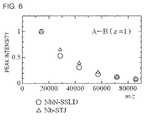
- Fig. 6 shows relative intensity values of singly charged ion mass peaks for the event between A-B in the distribution diagram of STJ of Fig. 4 and the relative intensity values measured by SSLD.
- the relative peak intensity values of STJ and SSLD coincide well. This shows that charge states can be discriminated by SSLD, and a mass spectrum only for singly charged ions can be obtained.
- Fig. 3 (b) corresponds to a mass spectrum of the doubly charged ions and more highly charged ions
- Fig. 3(c) corresponds to a spectrum of the singly charged ions and more highly charged ions.
- Fig. 3(h) corresponds to a mass spectrum in which the fragments are detected in addition to the intact ions having all charge states.
Landscapes
- Chemical & Material Sciences (AREA)
- Analytical Chemistry (AREA)
- Other Investigation Or Analysis Of Materials By Electrical Means (AREA)
- Measurement Of Radiation (AREA)
- Superconductor Devices And Manufacturing Methods Thereof (AREA)
- Electron Tubes For Measurement (AREA)
Abstract
Description
- The present invention relates to a superconducting stripline particle detector that detects arrival of atoms or molecules necessary for mass spectrometry.
- In order to detect particles such as charged particles or biopolymers having kinetic energies, a particle detector is used for converting the arrival of ions into an electric signal. In mass spectrometry, ions are subjected to separation analysis in accordance with the ratio (m/z) of the mass (m) of the particles and the charge number (z) of the ions. In linear type time-of-flight mass spectrometers with the simplest structure, time-of-flight (TOF) of ions is represented as TOF = (m/2zeV) 1/ 2l, and m/z can be determined by measuring the TOF. Here, e is the elementary electric charge; V is the acceleration voltage; and l is the flight length. Ion optics system such as a reflectron is used for reducing TOF variation caused by, for example, initial kinetic energy distribution in ionization and acceleration at a constant voltage.
- Disadvantageously, the mass spectroscopy, in principle, cannot distinguish different ions that have the same m/z, because ions are separated according to m/z. As a simple example, N+ and N2 2+ (m/z = 14) cannot be separated. In order to overcome this fundamental problem, particle detectors using superconductivity have been studied. A superconducting tunnel junction (STJ) can measure particle kinetic energies when the detector surface is impacted by a particle with a kinetic energy such as several keV to several ten keV that is adopted by many mass spectrometers. Since the kinetic energy of ions accelerated at a constant voltage is proportional to the charge states of the ions, z can be determined by kinetic energy measurement. As a result, particles such as N+ and N2 2+ having the same m/z but having different m can be separated (Non-Patent Document 1).
- Nevertheless, the electric pulses that the STJ detectors generate at the time of particle impact have a rise time of about 100 ns and a decay time of several µs. Therefore the pulses have a wide pulse width that is about 3 orders of magnitude longer than the nano-second pulses of microchannel plate (MCP) or secondary electron multiplier (SEM),both of which operate at room temperature for detecting particles. For this reason, it is difficult to achieve a high mass resolution. In addition, an extremely low-temperature environment such as about 1 K or lower is required for the operation of the STJ detectors. Disadvantageously, a large cooling equipment would be required.
- A superconducting stripline detector (SSLD) is composed of superconducting thin films processed into fine line patterns (
Patent Documents 1 and 2, Non-Patent Documents 2, 3, and 4). In SSLD, electric pulses induced by particle impact reportedly have a rise time of 400 ps to several ns and a decay time of 500 ps to several ten ps, which are faster than STJ. The SSLD detectors, however, cannot perform separation analysis of different ions having the same m/z, because SSLD cannot measure individual particles kinetic energy like STJ. -
- Patent Document 1: Japanese Patent Application Laid-Open (JP-A) No.
2004-214293 - Patent Document 2: Japanese Patent Application Laid-Open (JP-A) No.
2009-21478 -
- Non-Patent Document 1: Shigetomo Shiki, Masahiro Ukibe, Yuki Sato, Shigeo Tomita, Shigeo Hayakawa, and Masataka Ohkubo, J. Mass Spectrometry 43, 1686-1691(2008).
- Non-Patent Document 2: Koji Suzuki, Shigehito Miki, Shigetomo Shiki, Zhen Wang, and Masataka Ohkubo, Appl. Phys. Express 1,031702(2008).
- Non-Patent Document 3: A. Casaburi, N. Zen, K. Suzuki, M. Ejrnaes, S. Pagano, R. Cristiano, and M. Ohkubo, Appl. Phys. Lett. 94,212502(2009).
- Non-Patent Document 4: N. Zen, A. Casaburi, S. Shiki, K. Suzuki, M. Ejrnaes, R. Cristiano, and M. Ohkubo, Appl. Phys. Lett. 95,172508(2009).
- An object of the present invention is to enable charge state discrimination by superconducting stripline detectors (SSLDs) that can generate high-speed pulses of nano to several ten nano seconds for particle impact. This enables determination of charge states, which is not possible with conventional mass spectroscopy. As a result, m values for mass peaks are uniquely determined.
- When particles are accelerated with a constant voltage gradient, the particle kinetic energy is proportional to charge states of ions. For this reason, the energy imparted to the superconducting striplines at the time of impact increases in accordance with the increase in the charge number. We have revealed that the lower limit of the detectable particle kinetic energy is changed by adjustment of bias currents flowing through the superconducting striplines.
- According to the present invention, there is provided a particle detector with a superconducting stripline detector that is impacted with particles and counts the particles in accordance with hot spots induced locally in a superconductor by impact of the particles, wherein a range of detectable charge states is selectable.
In the particle detector according to the present invention, the superconducting stripline is arranged in series or in parallel within a sensitive area of a detecting element, and transitions from a superconducting state to a normal state by particle impact, thus causing resistance, thereby resulting in being sensitive to individual particle impact.
In the particle detector according to the present invention, the superconducting stripline allows passage of a bias current lower than a superconducting critical current of the superconducting stripline, that is, a critical current at or above which resistance appears, and selects a detectable particle kinetic energy range by changing the bias current.
In the particle detector according to the present invention, the superconducting striplines are made of a single metal element, a nitride, an oxide, a boride, or other compounds.
In the particle detector according to the present invention, the superconducting stripline is made of a thin film deposited on a substrate and processed into striplines. - The bias current is set to be lower than the superconducting critical current, and the mass spectra are measured sequentially while the bias current is reduced. In the measurement, a set of mass spectra including singly charged ions and more highly charged ions, doubly charged ions and more highly charged ions, triply charged ions and more highly charged ions (and followed by successively ions with higher charge states), are obtained. If the bias current is conversely raised from a low one, a set of mass spectra are obtained in the reverse order. The mass spectra of singly charged ions alone are determined by subtracting a spectrum for doubly charged ions and higher ions from a spectrum for singly charged ions and higher ions. The mass spectra of doubly charged ions alone are determined by subtracting a spectrum for triply charged ions and higher ions from a spectrum for doubly charged ions and higher ions. In a similar manner, mass spectra of multiply charged ion are determined successively.
- When a plurality of detectors is arranged and the bias current is changed for each of the individual detectors, the aforesaid set of mass spectra can also be obtained simultaneously.
-
-
Fig. 1 . is a view illustrating an example of use of a particle detector according to the present invention. -
Fig. 2 is a view illustrating an example of a superconducting stripline detector (SSLD). -
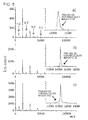
Fig. 3 is a view of mass spectra when the bias current flowing through the superconducting stripline detector (SSLD) is changed. -
Fig. 4 is a view of distribution of TOF-kinetic energy of particles measured by a superconducting tunnel junction (STJ) detector. -
Fig. 5(a) is a view of mass spectrum prepared by using events between O-A (doubly charged ions) ofFig. 4 ;Fig. 5(b) is a view of mass spectrum prepared by using events between O-B (doubly charged and triply charged ions) ofFig. 4 ; and Fig. 5 (c) is a view of mass spectrum prepared by using events between O-C (doubly charged, singly charged ions, and fragments) ofFig. 4 . -
Fig. 6 is a view of comparison between the relative intensity values of the charge state discrimination by the superconducting stripline detector (SSLD) and the relative intensity values of the charge state discrimination by the superconducting tunnel junction (STJ), showing a relative peak intensity comparison for singly charged ions in the superconducting tunnel junction (STJ) and the superconducting stripline detector (SSLD). -
Fig. 1 is an example of use combined with matrix-assisted laser desorption ionization method (MALDI). A constant bias current (below or equal to the superconducting critical current) flows through the SSLD via a bias tee. Ions generated by MALDI and accelerated at a constant voltage enter the SSLD to induce superconduction-normal conduction transition. The change in the resistance generates a voltage pulse. The TOF from the start time of the flight till the detection of the ions is converted into a digital value by a time-digital converter and recorded. The lower limit of the detectable particle kinetic energy can be changed by changing the bias current. Thus, a set of mass spectra, such as the spectrum of singly charged or higher ions, the spectrum of doubly charged or higher ions, and the spectrum of triply charged or higher ions, is determined. The set of mass spectra can be determined simultaneously by arranging a plurality of detectors in an array and flowing different bias currents therethrough. -
Fig. 2 shows an example of a superconducting stripline detector (SSLD). Nb is used as a superconductor. A stripline having a scale inFig. 2 is arranged in a region of 200 µm.Fig. 2 shows one stripline, but a plurality of striplines can be connected in parallel in terms of a circuit. The following data are determined by using an SSLD made of NbN. -
Fig. 3 shows an example in which the ratio (I/IC ) of the bias current to the critical current is changed from 0.6 to 0.97. The measured molecules are lysozyme having a molecular weight of 14, 305.Fig. 3 (a) shows that, with I/IC = 0. 6, mass peaks of doubly charged ions mainly appear. The peak 1-2 is a mass peak of doubly charged ions of the lysozyme monomer; the peak 3-2 is a mass peak of doubly charged ions of the lysozyme trimer; the peak 5-2 is a mass peak of doubly charged ions of the lysozyme pentamer; and the peak 7-2 is a mass peak of doubly charged ions of the lysozyme heptamer. When the bias current is low, the shape of the mass peak trails to the high-molecular weight side. When the bias current is increased, the peak intensity of the singly charged ions increases. When the bias current is high, the shape of the mass peak trails to the low-molecular weight side. -
Fig. 4 shows plots of TOF-kinetic energy of the STJ that can measure the kinetic energy for each one of the particles. The region z = 2 shows doubly charged ions; the region z = 1 shows singly charged ions; and the region "fragment" shows fragments generated by dissociation during the flight. The series of 1mer, 2, 3, 4, 5, 6, 7, 8, 9 shows multimers of lysozyme. As a matrix, 2,5-dihydroxybenzoic acid (DHB) is used.Fig. 5 shows mass spectra constructed from events between O-A, O-B, and O-C. The peak 1-2 is a mass peak of doubly charged ions of the lysozyme monomer; the peak 3-2 is a mass peak of doubly charged ions of the lysozyme trimer; the peak 5-2 is a mass peak of doubly charged ions of the lysozyme pentamer; and the peak 7-2 is a mass peak of doubly charged ions of the lysozyme heptamer. In comparison withFig. 3 , the trail to the high-molecular-weight side and the low-molecular-weight side and the change in the peak intensity of univalent ions and bivalent ions show that the lower limit of kinetic energy detection of the SSLD goes down as A, B, and C ofFig. 4 when the bias current flowing through the SSLD is increased. -
Fig. 6 shows relative intensity values of singly charged ion mass peaks for the event between A-B in the distribution diagram of STJ ofFig. 4 and the relative intensity values measured by SSLD. The relative intensity values of SSLD were calculated by subtracting the data at I/IC = 0.65 (Fig. 3(b) ) from the data at I/IC = 0.70 (Fig. 3(c) ). The relative peak intensity values of STJ and SSLD coincide well. This shows that charge states can be discriminated by SSLD, and a mass spectrum only for singly charged ions can be obtained.Fig. 3 (b) corresponds to a mass spectrum of the doubly charged ions and more highly charged ions, andFig. 3(c) corresponds to a spectrum of the singly charged ions and more highly charged ions.Fig. 3(h) corresponds to a mass spectrum in which the fragments are detected in addition to the intact ions having all charge states.
Claims (5)
- A particle detector with a superconducting stripline detector that is impacted with particles and counts the particles in accordance with hot spots induced locally in a superconductor by impact of the particles, wherein a detectable range of charge states is selectable.
- The particle detector according to claim 1, wherein the superconducting stripline is arranged in series or in parallel within a sensitive area of a detecting element, and transitions from superconducting state to a normal state by particle impact, thus causing resistance, thereby resulting in being sensitive to impact of individual particles.
- The particle detector according to claim 1, wherein the superconducting stripline allows passage of a bias current lower than a superconducting critical current of the superconducting stripline, that is, a critical current at or above which resistance appears, and selects a detectable particle kinetic energy range by changing the bias current.
- The particle detector according to any one of claims 1 to 3, wherein the superconducting striplines are made of a single metal element, a nitride, an oxide, a boride, or other compounds.
- The particle detector according to any one of claims 1 to 4, wherein the superconducting stripline is made of a thin film deposited on a substrate and processed into striplines.
Applications Claiming Priority (2)
| Application Number | Priority Date | Filing Date | Title |
|---|---|---|---|
| JP2010049161A JP5317126B2 (en) | 2010-03-05 | 2010-03-05 | Ion valence discrimination high-speed particle detector |
| PCT/JP2011/052407 WO2011108336A1 (en) | 2010-03-05 | 2011-02-04 | High-speed particle detector for discriminating ionic valence |
Publications (3)
| Publication Number | Publication Date |
|---|---|
| EP2544216A1 true EP2544216A1 (en) | 2013-01-09 |
| EP2544216A4 EP2544216A4 (en) | 2013-10-09 |
| EP2544216B1 EP2544216B1 (en) | 2015-04-01 |
Family
ID=44542003
Family Applications (1)
| Application Number | Title | Priority Date | Filing Date |
|---|---|---|---|
| EP11750449.8A Not-in-force EP2544216B1 (en) | 2010-03-05 | 2011-02-04 | High-speed particle detector for discriminating ionic valence |
Country Status (4)
| Country | Link |
|---|---|
| US (1) | US8872109B2 (en) |
| EP (1) | EP2544216B1 (en) |
| JP (1) | JP5317126B2 (en) |
| WO (1) | WO2011108336A1 (en) |
Cited By (1)
| Publication number | Priority date | Publication date | Assignee | Title |
|---|---|---|---|---|
| WO2016144628A1 (en) * | 2015-03-06 | 2016-09-15 | Wisconsin Alumni Research Foundation | System and method for characterizing ions using a superconducting transmission line detector |
Families Citing this family (5)
| Publication number | Priority date | Publication date | Assignee | Title |
|---|---|---|---|---|
| US9240539B2 (en) * | 2012-04-26 | 2016-01-19 | National Institute Of Standards And Technology | Efficient polarization independent single photon detector |
| JP6388815B2 (en) * | 2014-10-27 | 2018-09-12 | 国立研究開発法人産業技術総合研究所 | Particle detector |
| US11385099B1 (en) | 2017-06-26 | 2022-07-12 | SeeQC Inc. | Integrated superconducting nanowire digital photon detector |
| US12048256B2 (en) * | 2021-04-27 | 2024-07-23 | Microsoft Technology Licensing, Llc | Interfacing with superconducting circuitry |
| US12029141B1 (en) * | 2021-08-30 | 2024-07-02 | National Technology & Engineering Solutions Of Sandia, Llc | Systems and methods for resolving a number of incident RF-range photons |
Family Cites Families (34)
| Publication number | Priority date | Publication date | Assignee | Title |
|---|---|---|---|---|
| NL259296A (en) * | 1960-03-21 | |||
| US3182209A (en) * | 1962-11-01 | 1965-05-04 | Gen Electric | Superconducting switching device utilizing plural control superconductors |
| US3691381A (en) * | 1970-03-19 | 1972-09-12 | Massachusetts Inst Technology | Low energy superconducting particle counter |
| US5030614A (en) * | 1987-05-15 | 1991-07-09 | Omega Engineering, Inc. | Superconductor sensors |
| JP2656260B2 (en) * | 1987-09-02 | 1997-09-24 | 三菱電機株式会社 | Josephson junction radiation energy analyzer |
| US4873482A (en) * | 1988-07-28 | 1989-10-10 | The United States Of America As Represented By The United States Department Of Energy | Superconducting transmission line particle detector |
| JP3149996B2 (en) * | 1992-11-10 | 2001-03-26 | 財団法人国際超電導産業技術研究センター | How to make Josephson bonds |
| US5634718A (en) * | 1994-07-27 | 1997-06-03 | The United States Of America As Represented By The Secretary Of Commerce | Particle calorimeter with normal metal base layer |
| US5641961A (en) * | 1995-12-28 | 1997-06-24 | Stanford University | Application of electrothermal feedback for high resolution cryogenic particle detection using a transition edge sensor |
| US5880468A (en) * | 1996-08-26 | 1999-03-09 | The United States Of America As Represented By The Secretary Of Commerce | Superconducting transition-edge sensor |
| EP1095412A1 (en) * | 1998-06-17 | 2001-05-02 | Isis Innovation Limited | Superconductive tunnel junction device |
| US6211519B1 (en) * | 1998-09-14 | 2001-04-03 | The Board Of Trustees Of The Leland Stanford Junior University | Transition-edge sensor with enhanced electrothermal feedback for cryogenic particle detection |
| US6932600B2 (en) * | 1999-09-24 | 2005-08-23 | Cao Group, Inc. | Curing light |
| US6710343B2 (en) * | 2000-03-22 | 2004-03-23 | The United States Of America As Represented By The Secretary Of The Navy | Photon detector |
| US6812464B1 (en) * | 2000-07-28 | 2004-11-02 | Credence Systems Corporation | Superconducting single photon detector |
| JP4021177B2 (en) * | 2000-11-28 | 2007-12-12 | セイコーエプソン株式会社 | Organic electroluminescence device manufacturing method, organic electroluminescence device, and electronic apparatus |
| JP2004214293A (en) * | 2002-12-27 | 2004-07-29 | National Institute Of Advanced Industrial & Technology | Particle detector |
| JP4465457B2 (en) * | 2004-01-09 | 2010-05-19 | 独立行政法人 日本原子力研究開発機構 | Radiation detector and neutron detector with radiation type discrimination function |
| JP4811552B2 (en) * | 2004-03-30 | 2011-11-09 | 独立行政法人科学技術振興機構 | Neutron detector using superconducting elements |
| WO2006095659A1 (en) * | 2005-03-07 | 2006-09-14 | Japan Science And Technology Agency | Neutron detector and neutron image sensor |
| FR2884916B1 (en) * | 2005-04-25 | 2007-06-22 | Commissariat Energie Atomique | ULTRASENSITIVE OPTICAL SENSOR WITH HIGH TEMPORAL RESOLUTION USING SURFACE PLASMON |
| FR2886762B1 (en) * | 2005-06-07 | 2007-08-10 | Commissariat Energie Atomique | ULTRASENSITIVE OPTICAL DETECTOR WITH HIGH TIME RESOLUTION USING A WAVEGUIDE, AND METHODS OF MANUFACTURING SAME |
| FR2891400B1 (en) * | 2005-09-28 | 2007-10-26 | Commissariat Energie Atomique | ULTRASENSITIVE OPTICAL DETECTOR WITH HIGH TIME RESOLUTION USING A LEAKAGE MODE OF A PLANAR WAVEGUIDE AND METHODS OF MAKING SAME |
| US7728295B2 (en) * | 2005-09-29 | 2010-06-01 | The Trustees Of Princeton University | Method and apparatus for detecting surface and subsurface properties of materials |
| JP4997384B2 (en) * | 2005-10-21 | 2012-08-08 | 独立行政法人産業技術総合研究所 | Mass spectrometry method |
| JP4777749B2 (en) * | 2005-11-18 | 2011-09-21 | 公益財団法人鉄道総合技術研究所 | Method for producing low AC loss oxide superconducting conductor |
| JP2007268252A (en) * | 2006-03-07 | 2007-10-18 | Univ Of Ryukyus | Sterilization apparatus and sterilization method using the same |
| JP5026006B2 (en) * | 2006-07-05 | 2012-09-12 | エスアイアイ・ナノテクノロジー株式会社 | Superconducting radiation analyzer |
| US7652253B2 (en) * | 2007-02-23 | 2010-01-26 | Rensselaer Polytechnic Institute | Method and system for plasma-induced terahertz spectroscopy |
| JP5093654B2 (en) * | 2007-07-13 | 2012-12-12 | 独立行政法人産業技術総合研究所 | Particle / photon detector |
| US20090066948A1 (en) * | 2007-09-07 | 2009-03-12 | Hydroelectron Ventures, Inc. | Compact Terahertz Spectrometer Using Optical Beam Recycling and Heterodyne Detection |
| DE102008062612B4 (en) * | 2007-12-25 | 2018-10-25 | Hitachi High-Tech Science Corporation | X-ray analyzer |
| JP5164621B2 (en) | 2008-03-18 | 2013-03-21 | 株式会社日立ハイテクノロジーズ | Mass spectrometer, mass spectrometry method, and mass spectrometry program |
| US8571615B2 (en) * | 2010-09-10 | 2013-10-29 | California Institute Of Technology | Superconducting metallic glass transition-edge-sensors |
-
2010
- 2010-03-05 JP JP2010049161A patent/JP5317126B2/en not_active Expired - Fee Related
-
2011
- 2011-02-04 US US13/582,658 patent/US8872109B2/en not_active Expired - Fee Related
- 2011-02-04 EP EP11750449.8A patent/EP2544216B1/en not_active Not-in-force
- 2011-02-04 WO PCT/JP2011/052407 patent/WO2011108336A1/en not_active Ceased
Cited By (3)
| Publication number | Priority date | Publication date | Assignee | Title |
|---|---|---|---|---|
| WO2016144628A1 (en) * | 2015-03-06 | 2016-09-15 | Wisconsin Alumni Research Foundation | System and method for characterizing ions using a superconducting transmission line detector |
| US9490112B2 (en) | 2015-03-06 | 2016-11-08 | Robert Francis McDermott, III | System and method for characterizing ions using a superconducting transmission line detector |
| EP3266036B1 (en) * | 2015-03-06 | 2023-12-06 | Wisconsin Alumni Research Foundation | System and method for characterizing ions using a superconducting transmission line detector |
Also Published As
| Publication number | Publication date |
|---|---|
| EP2544216A4 (en) | 2013-10-09 |
| US8872109B2 (en) | 2014-10-28 |
| WO2011108336A1 (en) | 2011-09-09 |
| US20120326018A1 (en) | 2012-12-27 |
| JP5317126B2 (en) | 2013-10-16 |
| JP2011185642A (en) | 2011-09-22 |
| EP2544216B1 (en) | 2015-04-01 |
Similar Documents
| Publication | Publication Date | Title |
|---|---|---|
| Jagutzki et al. | Multiple hit readout of a microchannel plate detector with a three-layer delay-line anode | |
| US8872109B2 (en) | High-speed particle detector for discriminating charge states of ions | |
| Twerenbold et al. | Detection of single macromolecules using a cryogenic particle detector coupled to a biopolymer mass spectrometer | |
| US8575544B1 (en) | Methods and devices for improving atom probe detector performance | |
| Sortica et al. | A versatile time-of-flight medium-energy ion scattering setup using multiple delay-line detectors | |
| Martin et al. | Excitation and fragmentation of C 60 r+(r= 3–9) in Xe 3 0+− C 60 collisions | |
| Cristiano et al. | Superconducting nano-strip particle detectors | |
| Javanainen et al. | Linear energy transfer of heavy ions in silicon | |
| Motomura et al. | Multi-coincidence ion detection system for EUV–FEL fragmentation experiments at SPring-8 | |
| Ohkubo | Superconducting detectors for particles from atoms to proteins | |
| Novotný et al. | Cryogenic micro-calorimeters for mass spectrometric identification of neutral molecules and molecular fragments | |
| Lemell et al. | A versatile electron detector for studies on ion-surface scattering | |
| Suzuki et al. | Charge‐state‐derivation ion detection using a super‐conducting nanostructure device for mass spectrometry | |
| JP2004214293A (en) | Particle detector | |
| Shapira et al. | A high-efficiency compact setup to study evaporation residues formed in reactions induced by low-intensity radioactive ion beams | |
| Suzuki et al. | Superconducting NbN thin-film nanowire detectors for time-of-flight mass spectrometry | |
| Frank | Mass spectrometry with cryogenic detectors | |
| Banner et al. | Simultaneous measurement of flight time and energy of large matrix-assisted laser desorption ionization ions with a superconducting tunnel junction detector | |
| Ohkubo et al. | Fragmentation analysis by superconducting ion detectors in matrix-assisted laser desorption/ionization (MALDI) | |
| Suzuki et al. | Ultrafast ion detection by superconducting NbN thin-film nanowire detectors for time-of-flight mass spectrometry | |
| Ohkubo | Superconductivity for mass spectroscopy | |
| Hong et al. | Development of a high mass-resolution TOF-ERDA system for a wide mass range | |
| Chen | Multi-Electron Capture and Emission in Low Energy Highly Charged Ion-C60 Collisions | |
| Ehrich et al. | Ionization and fragmentation of small molecules in collisions with slow ions | |
| Ohkubo et al. | Effects of spatial nonuniformity of superconducting-tunnel-junction ion detectors on mass spectroscopy |
Legal Events
| Date | Code | Title | Description |
|---|---|---|---|
| PUAI | Public reference made under article 153(3) epc to a published international application that has entered the european phase |
Free format text: ORIGINAL CODE: 0009012 |
|
| 17P | Request for examination filed |
Effective date: 20120928 |
|
| AK | Designated contracting states |
Kind code of ref document: A1 Designated state(s): AL AT BE BG CH CY CZ DE DK EE ES FI FR GB GR HR HU IE IS IT LI LT LU LV MC MK MT NL NO PL PT RO RS SE SI SK SM TR |
|
| DAX | Request for extension of the european patent (deleted) | ||
| REG | Reference to a national code |
Ref country code: DE Ref legal event code: R079 Ref document number: 602011015278 Country of ref document: DE Free format text: PREVIOUS MAIN CLASS: H01J0049000000 Ipc: H01L0039000000 |
|
| A4 | Supplementary search report drawn up and despatched |
Effective date: 20130906 |
|
| RIC1 | Information provided on ipc code assigned before grant |
Ipc: G01T 1/16 20060101ALI20130902BHEP Ipc: H01J 49/00 20060101ALI20130902BHEP Ipc: H01L 39/00 20060101AFI20130902BHEP |
|
| 17Q | First examination report despatched |
Effective date: 20140221 |
|
| GRAP | Despatch of communication of intention to grant a patent |
Free format text: ORIGINAL CODE: EPIDOSNIGR1 |
|
| INTG | Intention to grant announced |
Effective date: 20140603 |
|
| GRAP | Despatch of communication of intention to grant a patent |
Free format text: ORIGINAL CODE: EPIDOSNIGR1 |
|
| INTG | Intention to grant announced |
Effective date: 20141017 |
|
| GRAS | Grant fee paid |
Free format text: ORIGINAL CODE: EPIDOSNIGR3 |
|
| GRAA | (expected) grant |
Free format text: ORIGINAL CODE: 0009210 |
|
| AK | Designated contracting states |
Kind code of ref document: B1 Designated state(s): AL AT BE BG CH CY CZ DE DK EE ES FI FR GB GR HR HU IE IS IT LI LT LU LV MC MK MT NL NO PL PT RO RS SE SI SK SM TR |
|
| REG | Reference to a national code |
Ref country code: GB Ref legal event code: FG4D |
|
| REG | Reference to a national code |
Ref country code: CH Ref legal event code: EP Ref country code: CH Ref legal event code: NV Representative=s name: NOVAGRAAF INTERNATIONAL SA, CH |
|
| REG | Reference to a national code |
Ref country code: IE Ref legal event code: FG4D |
|
| REG | Reference to a national code |
Ref country code: DE Ref legal event code: R096 Ref document number: 602011015278 Country of ref document: DE Effective date: 20150513 |
|
| REG | Reference to a national code |
Ref country code: AT Ref legal event code: REF Ref document number: 719539 Country of ref document: AT Kind code of ref document: T Effective date: 20150515 |
|
| REG | Reference to a national code |
Ref country code: NL Ref legal event code: VDEP Effective date: 20150401 |
|
| REG | Reference to a national code |
Ref country code: AT Ref legal event code: MK05 Ref document number: 719539 Country of ref document: AT Kind code of ref document: T Effective date: 20150401 |
|
| REG | Reference to a national code |
Ref country code: LT Ref legal event code: MG4D |
|
| PG25 | Lapsed in a contracting state [announced via postgrant information from national office to epo] |
Ref country code: NL Free format text: LAPSE BECAUSE OF FAILURE TO SUBMIT A TRANSLATION OF THE DESCRIPTION OR TO PAY THE FEE WITHIN THE PRESCRIBED TIME-LIMIT Effective date: 20150401 |
|
| PG25 | Lapsed in a contracting state [announced via postgrant information from national office to epo] |
Ref country code: HR Free format text: LAPSE BECAUSE OF FAILURE TO SUBMIT A TRANSLATION OF THE DESCRIPTION OR TO PAY THE FEE WITHIN THE PRESCRIBED TIME-LIMIT Effective date: 20150401 Ref country code: LT Free format text: LAPSE BECAUSE OF FAILURE TO SUBMIT A TRANSLATION OF THE DESCRIPTION OR TO PAY THE FEE WITHIN THE PRESCRIBED TIME-LIMIT Effective date: 20150401 Ref country code: CZ Free format text: LAPSE BECAUSE OF FAILURE TO SUBMIT A TRANSLATION OF THE DESCRIPTION OR TO PAY THE FEE WITHIN THE PRESCRIBED TIME-LIMIT Effective date: 20150401 Ref country code: PT Free format text: LAPSE BECAUSE OF FAILURE TO SUBMIT A TRANSLATION OF THE DESCRIPTION OR TO PAY THE FEE WITHIN THE PRESCRIBED TIME-LIMIT Effective date: 20150803 Ref country code: FI Free format text: LAPSE BECAUSE OF FAILURE TO SUBMIT A TRANSLATION OF THE DESCRIPTION OR TO PAY THE FEE WITHIN THE PRESCRIBED TIME-LIMIT Effective date: 20150401 Ref country code: NO Free format text: LAPSE BECAUSE OF FAILURE TO SUBMIT A TRANSLATION OF THE DESCRIPTION OR TO PAY THE FEE WITHIN THE PRESCRIBED TIME-LIMIT Effective date: 20150701 Ref country code: ES Free format text: LAPSE BECAUSE OF FAILURE TO SUBMIT A TRANSLATION OF THE DESCRIPTION OR TO PAY THE FEE WITHIN THE PRESCRIBED TIME-LIMIT Effective date: 20150401 |
|
| PG25 | Lapsed in a contracting state [announced via postgrant information from national office to epo] |
Ref country code: RS Free format text: LAPSE BECAUSE OF FAILURE TO SUBMIT A TRANSLATION OF THE DESCRIPTION OR TO PAY THE FEE WITHIN THE PRESCRIBED TIME-LIMIT Effective date: 20150401 Ref country code: LV Free format text: LAPSE BECAUSE OF FAILURE TO SUBMIT A TRANSLATION OF THE DESCRIPTION OR TO PAY THE FEE WITHIN THE PRESCRIBED TIME-LIMIT Effective date: 20150401 Ref country code: GR Free format text: LAPSE BECAUSE OF FAILURE TO SUBMIT A TRANSLATION OF THE DESCRIPTION OR TO PAY THE FEE WITHIN THE PRESCRIBED TIME-LIMIT Effective date: 20150702 Ref country code: IS Free format text: LAPSE BECAUSE OF FAILURE TO SUBMIT A TRANSLATION OF THE DESCRIPTION OR TO PAY THE FEE WITHIN THE PRESCRIBED TIME-LIMIT Effective date: 20150801 Ref country code: AT Free format text: LAPSE BECAUSE OF FAILURE TO SUBMIT A TRANSLATION OF THE DESCRIPTION OR TO PAY THE FEE WITHIN THE PRESCRIBED TIME-LIMIT Effective date: 20150401 |
|
| REG | Reference to a national code |
Ref country code: DE Ref legal event code: R097 Ref document number: 602011015278 Country of ref document: DE |
|
| REG | Reference to a national code |
Ref country code: FR Ref legal event code: PLFP Year of fee payment: 6 |
|
| PG25 | Lapsed in a contracting state [announced via postgrant information from national office to epo] |
Ref country code: DK Free format text: LAPSE BECAUSE OF FAILURE TO SUBMIT A TRANSLATION OF THE DESCRIPTION OR TO PAY THE FEE WITHIN THE PRESCRIBED TIME-LIMIT Effective date: 20150401 Ref country code: EE Free format text: LAPSE BECAUSE OF FAILURE TO SUBMIT A TRANSLATION OF THE DESCRIPTION OR TO PAY THE FEE WITHIN THE PRESCRIBED TIME-LIMIT Effective date: 20150401 |
|
| PLBE | No opposition filed within time limit |
Free format text: ORIGINAL CODE: 0009261 |
|
| STAA | Information on the status of an ep patent application or granted ep patent |
Free format text: STATUS: NO OPPOSITION FILED WITHIN TIME LIMIT |
|
| PG25 | Lapsed in a contracting state [announced via postgrant information from national office to epo] |
Ref country code: RO Free format text: LAPSE BECAUSE OF NON-PAYMENT OF DUE FEES Effective date: 20150401 Ref country code: SK Free format text: LAPSE BECAUSE OF FAILURE TO SUBMIT A TRANSLATION OF THE DESCRIPTION OR TO PAY THE FEE WITHIN THE PRESCRIBED TIME-LIMIT Effective date: 20150401 Ref country code: PL Free format text: LAPSE BECAUSE OF FAILURE TO SUBMIT A TRANSLATION OF THE DESCRIPTION OR TO PAY THE FEE WITHIN THE PRESCRIBED TIME-LIMIT Effective date: 20150401 |
|
| 26N | No opposition filed |
Effective date: 20160105 |
|
| PG25 | Lapsed in a contracting state [announced via postgrant information from national office to epo] |
Ref country code: IT Free format text: LAPSE BECAUSE OF FAILURE TO SUBMIT A TRANSLATION OF THE DESCRIPTION OR TO PAY THE FEE WITHIN THE PRESCRIBED TIME-LIMIT Effective date: 20150401 |
|
| PG25 | Lapsed in a contracting state [announced via postgrant information from national office to epo] |
Ref country code: SI Free format text: LAPSE BECAUSE OF FAILURE TO SUBMIT A TRANSLATION OF THE DESCRIPTION OR TO PAY THE FEE WITHIN THE PRESCRIBED TIME-LIMIT Effective date: 20150401 Ref country code: BE Free format text: LAPSE BECAUSE OF NON-PAYMENT OF DUE FEES Effective date: 20160229 |
|
| PG25 | Lapsed in a contracting state [announced via postgrant information from national office to epo] |
Ref country code: BE Free format text: LAPSE BECAUSE OF FAILURE TO SUBMIT A TRANSLATION OF THE DESCRIPTION OR TO PAY THE FEE WITHIN THE PRESCRIBED TIME-LIMIT Effective date: 20150401 |
|
| PG25 | Lapsed in a contracting state [announced via postgrant information from national office to epo] |
Ref country code: MC Free format text: LAPSE BECAUSE OF FAILURE TO SUBMIT A TRANSLATION OF THE DESCRIPTION OR TO PAY THE FEE WITHIN THE PRESCRIBED TIME-LIMIT Effective date: 20150401 Ref country code: LU Free format text: LAPSE BECAUSE OF FAILURE TO SUBMIT A TRANSLATION OF THE DESCRIPTION OR TO PAY THE FEE WITHIN THE PRESCRIBED TIME-LIMIT Effective date: 20160204 |
|
| REG | Reference to a national code |
Ref country code: IE Ref legal event code: MM4A |
|
| REG | Reference to a national code |
Ref country code: FR Ref legal event code: PLFP Year of fee payment: 7 |
|
| PG25 | Lapsed in a contracting state [announced via postgrant information from national office to epo] |
Ref country code: IE Free format text: LAPSE BECAUSE OF NON-PAYMENT OF DUE FEES Effective date: 20160204 |
|
| PG25 | Lapsed in a contracting state [announced via postgrant information from national office to epo] |
Ref country code: SE Free format text: LAPSE BECAUSE OF FAILURE TO SUBMIT A TRANSLATION OF THE DESCRIPTION OR TO PAY THE FEE WITHIN THE PRESCRIBED TIME-LIMIT Effective date: 20150401 |
|
| PG25 | Lapsed in a contracting state [announced via postgrant information from national office to epo] |
Ref country code: MT Free format text: LAPSE BECAUSE OF FAILURE TO SUBMIT A TRANSLATION OF THE DESCRIPTION OR TO PAY THE FEE WITHIN THE PRESCRIBED TIME-LIMIT Effective date: 20150401 |
|
| REG | Reference to a national code |
Ref country code: FR Ref legal event code: PLFP Year of fee payment: 8 |
|
| PG25 | Lapsed in a contracting state [announced via postgrant information from national office to epo] |
Ref country code: HU Free format text: LAPSE BECAUSE OF FAILURE TO SUBMIT A TRANSLATION OF THE DESCRIPTION OR TO PAY THE FEE WITHIN THE PRESCRIBED TIME-LIMIT; INVALID AB INITIO Effective date: 20110204 Ref country code: SM Free format text: LAPSE BECAUSE OF FAILURE TO SUBMIT A TRANSLATION OF THE DESCRIPTION OR TO PAY THE FEE WITHIN THE PRESCRIBED TIME-LIMIT Effective date: 20150401 Ref country code: CY Free format text: LAPSE BECAUSE OF FAILURE TO SUBMIT A TRANSLATION OF THE DESCRIPTION OR TO PAY THE FEE WITHIN THE PRESCRIBED TIME-LIMIT Effective date: 20150401 |
|
| PG25 | Lapsed in a contracting state [announced via postgrant information from national office to epo] |
Ref country code: TR Free format text: LAPSE BECAUSE OF FAILURE TO SUBMIT A TRANSLATION OF THE DESCRIPTION OR TO PAY THE FEE WITHIN THE PRESCRIBED TIME-LIMIT Effective date: 20150401 Ref country code: MK Free format text: LAPSE BECAUSE OF FAILURE TO SUBMIT A TRANSLATION OF THE DESCRIPTION OR TO PAY THE FEE WITHIN THE PRESCRIBED TIME-LIMIT Effective date: 20150401 Ref country code: MT Free format text: LAPSE BECAUSE OF FAILURE TO SUBMIT A TRANSLATION OF THE DESCRIPTION OR TO PAY THE FEE WITHIN THE PRESCRIBED TIME-LIMIT Effective date: 20160229 |
|
| PG25 | Lapsed in a contracting state [announced via postgrant information from national office to epo] |
Ref country code: BG Free format text: LAPSE BECAUSE OF FAILURE TO SUBMIT A TRANSLATION OF THE DESCRIPTION OR TO PAY THE FEE WITHIN THE PRESCRIBED TIME-LIMIT Effective date: 20150401 |
|
| PG25 | Lapsed in a contracting state [announced via postgrant information from national office to epo] |
Ref country code: AL Free format text: LAPSE BECAUSE OF FAILURE TO SUBMIT A TRANSLATION OF THE DESCRIPTION OR TO PAY THE FEE WITHIN THE PRESCRIBED TIME-LIMIT Effective date: 20150401 |
|
| PGFP | Annual fee paid to national office [announced via postgrant information from national office to epo] |
Ref country code: FR Payment date: 20201223 Year of fee payment: 11 Ref country code: GB Payment date: 20201223 Year of fee payment: 11 |
|
| PGFP | Annual fee paid to national office [announced via postgrant information from national office to epo] |
Ref country code: CH Payment date: 20210105 Year of fee payment: 11 |
|
| PGFP | Annual fee paid to national office [announced via postgrant information from national office to epo] |
Ref country code: DE Payment date: 20201221 Year of fee payment: 11 |
|
| REG | Reference to a national code |
Ref country code: DE Ref legal event code: R119 Ref document number: 602011015278 Country of ref document: DE |
|
| REG | Reference to a national code |
Ref country code: CH Ref legal event code: PL |
|
| GBPC | Gb: european patent ceased through non-payment of renewal fee |
Effective date: 20220204 |
|
| PG25 | Lapsed in a contracting state [announced via postgrant information from national office to epo] |
Ref country code: FR Free format text: LAPSE BECAUSE OF NON-PAYMENT OF DUE FEES Effective date: 20220228 |
|
| PG25 | Lapsed in a contracting state [announced via postgrant information from national office to epo] |
Ref country code: LI Free format text: LAPSE BECAUSE OF NON-PAYMENT OF DUE FEES Effective date: 20220228 Ref country code: GB Free format text: LAPSE BECAUSE OF NON-PAYMENT OF DUE FEES Effective date: 20220204 Ref country code: DE Free format text: LAPSE BECAUSE OF NON-PAYMENT OF DUE FEES Effective date: 20220901 Ref country code: CH Free format text: LAPSE BECAUSE OF NON-PAYMENT OF DUE FEES Effective date: 20220228 |