EP2543667A1 - 2-aminopyridine analogs as glucokinase activators - Google Patents
2-aminopyridine analogs as glucokinase activators Download PDFInfo
- Publication number
- EP2543667A1 EP2543667A1 EP12170853A EP12170853A EP2543667A1 EP 2543667 A1 EP2543667 A1 EP 2543667A1 EP 12170853 A EP12170853 A EP 12170853A EP 12170853 A EP12170853 A EP 12170853A EP 2543667 A1 EP2543667 A1 EP 2543667A1
- Authority
- EP
- European Patent Office
- Prior art keywords
- alkyl
- heteroaryl
- saturated
- partially unsaturated
- aryl
- Prior art date
- Legal status (The legal status is an assumption and is not a legal conclusion. Google has not performed a legal analysis and makes no representation as to the accuracy of the status listed.)
- Granted
Links
- 102000030595 Glucokinase Human genes 0.000 title claims abstract description 55
- 108010021582 Glucokinase Proteins 0.000 title claims abstract description 55
- 150000003930 2-aminopyridines Chemical class 0.000 title description 14
- 239000012190 activator Substances 0.000 title description 6
- 150000001875 compounds Chemical class 0.000 claims abstract description 347
- 238000000034 method Methods 0.000 claims abstract description 175
- 238000011282 treatment Methods 0.000 claims abstract description 46
- 230000003213 activating effect Effects 0.000 claims abstract description 8
- 206010011953 Decreased activity Diseases 0.000 claims abstract description 3
- -1 CH2-heterocyclyl Chemical group 0.000 claims description 174
- 125000000623 heterocyclic group Chemical group 0.000 claims description 137
- 125000004169 (C1-C6) alkyl group Chemical group 0.000 claims description 134
- 229920006395 saturated elastomer Chemical group 0.000 claims description 119
- 239000000203 mixture Substances 0.000 claims description 79
- 125000001072 heteroaryl group Chemical group 0.000 claims description 75
- 125000000217 alkyl group Chemical group 0.000 claims description 68
- 125000003118 aryl group Chemical group 0.000 claims description 68
- 229910052794 bromium Inorganic materials 0.000 claims description 52
- IJGRMHOSHXDMSA-UHFFFAOYSA-N Atomic nitrogen Chemical compound N#N IJGRMHOSHXDMSA-UHFFFAOYSA-N 0.000 claims description 50
- 208000037265 diseases, disorders, signs and symptoms Diseases 0.000 claims description 48
- 229910052801 chlorine Inorganic materials 0.000 claims description 40
- 125000000753 cycloalkyl group Chemical group 0.000 claims description 40
- 150000003839 salts Chemical class 0.000 claims description 39
- 125000002023 trifluoromethyl group Chemical group FC(F)(F)* 0.000 claims description 38
- 125000004043 oxo group Chemical group O=* 0.000 claims description 37
- 125000000882 C2-C6 alkenyl group Chemical group 0.000 claims description 35
- 229910052760 oxygen Inorganic materials 0.000 claims description 35
- 229910052717 sulfur Inorganic materials 0.000 claims description 35
- 125000003601 C2-C6 alkynyl group Chemical group 0.000 claims description 33
- 239000003814 drug Substances 0.000 claims description 33
- 229910052757 nitrogen Inorganic materials 0.000 claims description 31
- 125000003342 alkenyl group Chemical group 0.000 claims description 29
- 125000005913 (C3-C6) cycloalkyl group Chemical group 0.000 claims description 28
- 125000004429 atom Chemical group 0.000 claims description 28
- 229910052731 fluorine Inorganic materials 0.000 claims description 28
- 229910052740 iodine Inorganic materials 0.000 claims description 27
- 125000000304 alkynyl group Chemical group 0.000 claims description 26
- 125000001309 chloro group Chemical group Cl* 0.000 claims description 23
- 201000010099 disease Diseases 0.000 claims description 23
- 125000001246 bromo group Chemical group Br* 0.000 claims description 22
- KDLHZDBZIXYQEI-UHFFFAOYSA-N Palladium Chemical compound [Pd] KDLHZDBZIXYQEI-UHFFFAOYSA-N 0.000 claims description 20
- 125000004093 cyano group Chemical group *C#N 0.000 claims description 19
- 239000003054 catalyst Substances 0.000 claims description 17
- 125000002496 methyl group Chemical group [H]C([H])([H])* 0.000 claims description 17
- 125000001495 ethyl group Chemical group [H]C([H])([H])C([H])([H])* 0.000 claims description 15
- 229910003827 NRaRb Inorganic materials 0.000 claims description 12
- 150000004820 halides Chemical class 0.000 claims description 12
- 229910052751 metal Inorganic materials 0.000 claims description 12
- 239000002184 metal Substances 0.000 claims description 12
- 125000002947 alkylene group Chemical group 0.000 claims description 10
- 125000003178 carboxy group Chemical group [H]OC(*)=O 0.000 claims description 9
- 239000003085 diluting agent Substances 0.000 claims description 9
- 125000005842 heteroatom Chemical group 0.000 claims description 9
- 229910052763 palladium Inorganic materials 0.000 claims description 9
- 229910052799 carbon Inorganic materials 0.000 claims description 8
- 125000001997 phenyl group Chemical group [H]C1=C([H])C([H])=C(*)C([H])=C1[H] 0.000 claims description 8
- 125000004400 (C1-C12) alkyl group Chemical group 0.000 claims description 7
- 125000004450 alkenylene group Chemical group 0.000 claims description 7
- 239000010949 copper Substances 0.000 claims description 7
- 229910052736 halogen Inorganic materials 0.000 claims description 7
- 150000002367 halogens Chemical class 0.000 claims description 7
- 238000004519 manufacturing process Methods 0.000 claims description 6
- 125000006413 ring segment Chemical group 0.000 claims description 6
- 125000004419 alkynylene group Chemical group 0.000 claims description 5
- 125000002619 bicyclic group Chemical group 0.000 claims description 5
- 229910052802 copper Inorganic materials 0.000 claims description 5
- 125000006239 protecting group Chemical group 0.000 claims description 5
- 238000002560 therapeutic procedure Methods 0.000 claims description 5
- 125000006710 (C2-C12) alkenyl group Chemical group 0.000 claims description 4
- 125000006711 (C2-C12) alkynyl group Chemical group 0.000 claims description 4
- RYGMFSIKBFXOCR-UHFFFAOYSA-N Copper Chemical compound [Cu] RYGMFSIKBFXOCR-UHFFFAOYSA-N 0.000 claims description 4
- JNCMHMUGTWEVOZ-UHFFFAOYSA-N F[CH]F Chemical compound F[CH]F JNCMHMUGTWEVOZ-UHFFFAOYSA-N 0.000 claims description 4
- 125000002837 carbocyclic group Chemical group 0.000 claims description 4
- VUWZPRWSIVNGKG-UHFFFAOYSA-N fluoromethane Chemical compound F[CH2] VUWZPRWSIVNGKG-UHFFFAOYSA-N 0.000 claims description 4
- 229910052739 hydrogen Inorganic materials 0.000 claims description 4
- 125000002950 monocyclic group Chemical group 0.000 claims description 4
- 125000000714 pyrimidinyl group Chemical group 0.000 claims description 3
- 229910052705 radium Inorganic materials 0.000 claims description 3
- 229910052701 rubidium Inorganic materials 0.000 claims description 3
- 125000004076 pyridyl group Chemical group 0.000 claims description 2
- 229910052702 rhenium Inorganic materials 0.000 claims 4
- PXHVJJICTQNCMI-UHFFFAOYSA-N Nickel Chemical compound [Ni] PXHVJJICTQNCMI-UHFFFAOYSA-N 0.000 claims 2
- 125000004433 nitrogen atom Chemical group N* 0.000 claims 2
- 125000006570 (C5-C6) heteroaryl group Chemical group 0.000 claims 1
- XXJGBENTLXFVFI-UHFFFAOYSA-N 1-amino-methylene Chemical compound N[CH2] XXJGBENTLXFVFI-UHFFFAOYSA-N 0.000 claims 1
- 125000002373 5 membered heterocyclic group Chemical group 0.000 claims 1
- 229910017711 NHRa Inorganic materials 0.000 claims 1
- 125000003668 acetyloxy group Chemical group [H]C([H])([H])C(=O)O[*] 0.000 claims 1
- 125000004005 formimidoyl group Chemical group [H]\N=C(/[H])* 0.000 claims 1
- 229910052759 nickel Inorganic materials 0.000 claims 1
- 125000003386 piperidinyl group Chemical group 0.000 claims 1
- 206010012601 diabetes mellitus Diseases 0.000 abstract description 36
- 230000000694 effects Effects 0.000 abstract description 15
- 230000001404 mediated effect Effects 0.000 abstract description 14
- 230000002950 deficient Effects 0.000 abstract description 9
- 208000037765 diseases and disorders Diseases 0.000 abstract description 7
- 230000006806 disease prevention Effects 0.000 abstract description 3
- XEKOWRVHYACXOJ-UHFFFAOYSA-N Ethyl acetate Chemical compound CCOC(C)=O XEKOWRVHYACXOJ-UHFFFAOYSA-N 0.000 description 93
- 238000005160 1H NMR spectroscopy Methods 0.000 description 82
- 239000011541 reaction mixture Substances 0.000 description 82
- 238000001819 mass spectrum Methods 0.000 description 77
- IAZDPXIOMUYVGZ-WFGJKAKNSA-N Dimethyl sulfoxide Chemical compound [2H]C([2H])([2H])S(=O)C([2H])([2H])[2H] IAZDPXIOMUYVGZ-WFGJKAKNSA-N 0.000 description 66
- OKKJLVBELUTLKV-UHFFFAOYSA-N Methanol Chemical compound OC OKKJLVBELUTLKV-UHFFFAOYSA-N 0.000 description 63
- LFQSCWFLJHTTHZ-UHFFFAOYSA-N Ethanol Chemical compound CCO LFQSCWFLJHTTHZ-UHFFFAOYSA-N 0.000 description 61
- YMWUJEATGCHHMB-UHFFFAOYSA-N Dichloromethane Chemical compound ClCCl YMWUJEATGCHHMB-UHFFFAOYSA-N 0.000 description 58
- 239000007787 solid Substances 0.000 description 57
- ZMANZCXQSJIPKH-UHFFFAOYSA-N Triethylamine Chemical compound CCN(CC)CC ZMANZCXQSJIPKH-UHFFFAOYSA-N 0.000 description 55
- VLKZOEOYAKHREP-UHFFFAOYSA-N n-Hexane Chemical class CCCCCC VLKZOEOYAKHREP-UHFFFAOYSA-N 0.000 description 55
- XLYOFNOQVPJJNP-UHFFFAOYSA-N water Substances O XLYOFNOQVPJJNP-UHFFFAOYSA-N 0.000 description 54
- 230000015572 biosynthetic process Effects 0.000 description 50
- WQZGKKKJIJFFOK-GASJEMHNSA-N Glucose Natural products OC[C@H]1OC(O)[C@H](O)[C@@H](O)[C@@H]1O WQZGKKKJIJFFOK-GASJEMHNSA-N 0.000 description 49
- WQZGKKKJIJFFOK-VFUOTHLCSA-N beta-D-glucose Chemical compound OC[C@H]1O[C@@H](O)[C@H](O)[C@@H](O)[C@@H]1O WQZGKKKJIJFFOK-VFUOTHLCSA-N 0.000 description 48
- 239000008103 glucose Substances 0.000 description 48
- WYURNTSHIVDZCO-UHFFFAOYSA-N Tetrahydrofuran Chemical group C1CCOC1 WYURNTSHIVDZCO-UHFFFAOYSA-N 0.000 description 46
- 238000006243 chemical reaction Methods 0.000 description 41
- 235000019439 ethyl acetate Nutrition 0.000 description 40
- NOESYZHRGYRDHS-UHFFFAOYSA-N insulin Chemical compound N1C(=O)C(NC(=O)C(CCC(N)=O)NC(=O)C(CCC(O)=O)NC(=O)C(C(C)C)NC(=O)C(NC(=O)CN)C(C)CC)CSSCC(C(NC(CO)C(=O)NC(CC(C)C)C(=O)NC(CC=2C=CC(O)=CC=2)C(=O)NC(CCC(N)=O)C(=O)NC(CC(C)C)C(=O)NC(CCC(O)=O)C(=O)NC(CC(N)=O)C(=O)NC(CC=2C=CC(O)=CC=2)C(=O)NC(CSSCC(NC(=O)C(C(C)C)NC(=O)C(CC(C)C)NC(=O)C(CC=2C=CC(O)=CC=2)NC(=O)C(CC(C)C)NC(=O)C(C)NC(=O)C(CCC(O)=O)NC(=O)C(C(C)C)NC(=O)C(CC(C)C)NC(=O)C(CC=2NC=NC=2)NC(=O)C(CO)NC(=O)CNC2=O)C(=O)NCC(=O)NC(CCC(O)=O)C(=O)NC(CCCNC(N)=N)C(=O)NCC(=O)NC(CC=3C=CC=CC=3)C(=O)NC(CC=3C=CC=CC=3)C(=O)NC(CC=3C=CC(O)=CC=3)C(=O)NC(C(C)O)C(=O)N3C(CCC3)C(=O)NC(CCCCN)C(=O)NC(C)C(O)=O)C(=O)NC(CC(N)=O)C(O)=O)=O)NC(=O)C(C(C)CC)NC(=O)C(CO)NC(=O)C(C(C)O)NC(=O)C1CSSCC2NC(=O)C(CC(C)C)NC(=O)C(NC(=O)C(CCC(N)=O)NC(=O)C(CC(N)=O)NC(=O)C(NC(=O)C(N)CC=1C=CC=CC=1)C(C)C)CC1=CN=CN1 NOESYZHRGYRDHS-UHFFFAOYSA-N 0.000 description 40
- 238000002360 preparation method Methods 0.000 description 37
- HEDRZPFGACZZDS-MICDWDOJSA-N Trichloro(2H)methane Chemical compound [2H]C(Cl)(Cl)Cl HEDRZPFGACZZDS-MICDWDOJSA-N 0.000 description 36
- CYPYTURSJDMMMP-WVCUSYJESA-N (1e,4e)-1,5-diphenylpenta-1,4-dien-3-one;palladium Chemical compound [Pd].[Pd].C=1C=CC=CC=1\C=C\C(=O)\C=C\C1=CC=CC=C1.C=1C=CC=CC=1\C=C\C(=O)\C=C\C1=CC=CC=C1.C=1C=CC=CC=1\C=C\C(=O)\C=C\C1=CC=CC=C1 CYPYTURSJDMMMP-WVCUSYJESA-N 0.000 description 34
- HIXDQWDOVZUNNA-UHFFFAOYSA-N 2-(3,4-dimethoxyphenyl)-5-hydroxy-7-methoxychromen-4-one Chemical compound C=1C(OC)=CC(O)=C(C(C=2)=O)C=1OC=2C1=CC=C(OC)C(OC)=C1 HIXDQWDOVZUNNA-UHFFFAOYSA-N 0.000 description 30
- HEMHJVSKTPXQMS-UHFFFAOYSA-M Sodium hydroxide Chemical compound [OH-].[Na+] HEMHJVSKTPXQMS-UHFFFAOYSA-M 0.000 description 30
- 150000003840 hydrochlorides Chemical class 0.000 description 29
- RTZKZFJDLAIYFH-UHFFFAOYSA-N ether Substances CCOCC RTZKZFJDLAIYFH-UHFFFAOYSA-N 0.000 description 28
- 239000002904 solvent Substances 0.000 description 28
- CXNIUSPIQKWYAI-UHFFFAOYSA-N xantphos Chemical compound C=12OC3=C(P(C=4C=CC=CC=4)C=4C=CC=CC=4)C=CC=C3C(C)(C)C2=CC=CC=1P(C=1C=CC=CC=1)C1=CC=CC=C1 CXNIUSPIQKWYAI-UHFFFAOYSA-N 0.000 description 28
- 208000035475 disorder Diseases 0.000 description 25
- 239000008194 pharmaceutical composition Substances 0.000 description 25
- YXFVVABEGXRONW-UHFFFAOYSA-N Toluene Chemical compound CC1=CC=CC=C1 YXFVVABEGXRONW-UHFFFAOYSA-N 0.000 description 24
- 239000002585 base Substances 0.000 description 23
- 239000000460 chlorine Substances 0.000 description 23
- 238000009472 formulation Methods 0.000 description 23
- JGFZNNIVVJXRND-UHFFFAOYSA-N N,N-Diisopropylethylamine (DIPEA) Chemical compound CCN(C(C)C)C(C)C JGFZNNIVVJXRND-UHFFFAOYSA-N 0.000 description 22
- 239000012044 organic layer Substances 0.000 description 22
- RYHBNJHYFVUHQT-UHFFFAOYSA-N 1,4-Dioxane Chemical compound C1COCCO1 RYHBNJHYFVUHQT-UHFFFAOYSA-N 0.000 description 21
- ICSNLGPSRYBMBD-UHFFFAOYSA-N 2-aminopyridine Chemical compound NC1=CC=CC=N1 ICSNLGPSRYBMBD-UHFFFAOYSA-N 0.000 description 20
- 102000004877 Insulin Human genes 0.000 description 20
- 108090001061 Insulin Proteins 0.000 description 20
- 239000003153 chemical reaction reagent Substances 0.000 description 20
- 229940125396 insulin Drugs 0.000 description 20
- 239000000543 intermediate Substances 0.000 description 20
- BWHMMNNQKKPAPP-UHFFFAOYSA-L potassium carbonate Chemical compound [K+].[K+].[O-]C([O-])=O BWHMMNNQKKPAPP-UHFFFAOYSA-L 0.000 description 20
- 229940002612 prodrug Drugs 0.000 description 20
- 239000000651 prodrug Substances 0.000 description 20
- 239000000047 product Substances 0.000 description 20
- 238000010898 silica gel chromatography Methods 0.000 description 20
- VYPSYNLAJGMNEJ-UHFFFAOYSA-N Silicium dioxide Chemical compound O=[Si]=O VYPSYNLAJGMNEJ-UHFFFAOYSA-N 0.000 description 19
- 208000001072 type 2 diabetes mellitus Diseases 0.000 description 19
- IAZDPXIOMUYVGZ-UHFFFAOYSA-N Dimethylsulphoxide Chemical compound CS(C)=O IAZDPXIOMUYVGZ-UHFFFAOYSA-N 0.000 description 18
- 238000003556 assay Methods 0.000 description 18
- LPNYRYFBWFDTMA-UHFFFAOYSA-N potassium tert-butoxide Chemical compound [K+].CC(C)(C)[O-] LPNYRYFBWFDTMA-UHFFFAOYSA-N 0.000 description 18
- 239000004480 active ingredient Substances 0.000 description 17
- QTBSBXVTEAMEQO-UHFFFAOYSA-N Acetic acid Chemical compound CC(O)=O QTBSBXVTEAMEQO-UHFFFAOYSA-N 0.000 description 16
- WKBOTKDWSSQWDR-UHFFFAOYSA-N Bromine atom Chemical compound [Br] WKBOTKDWSSQWDR-UHFFFAOYSA-N 0.000 description 16
- GDTBXPJZTBHREO-UHFFFAOYSA-N bromine Substances BrBr GDTBXPJZTBHREO-UHFFFAOYSA-N 0.000 description 16
- FJDQFPXHSGXQBY-UHFFFAOYSA-L caesium carbonate Chemical compound [Cs+].[Cs+].[O-]C([O-])=O FJDQFPXHSGXQBY-UHFFFAOYSA-L 0.000 description 16
- 229940079593 drug Drugs 0.000 description 16
- 239000000463 material Substances 0.000 description 16
- 239000002207 metabolite Substances 0.000 description 16
- 239000000243 solution Substances 0.000 description 16
- VEXZGXHMUGYJMC-UHFFFAOYSA-N Hydrochloric acid Chemical compound Cl VEXZGXHMUGYJMC-UHFFFAOYSA-N 0.000 description 15
- 239000003795 chemical substances by application Substances 0.000 description 15
- 0 C*Sc1cnccc1 Chemical compound C*Sc1cnccc1 0.000 description 14
- 239000008280 blood Substances 0.000 description 13
- 210000004369 blood Anatomy 0.000 description 13
- 239000000741 silica gel Substances 0.000 description 13
- 229910002027 silica gel Inorganic materials 0.000 description 13
- 125000001424 substituent group Chemical group 0.000 description 13
- 229940124597 therapeutic agent Drugs 0.000 description 13
- UMGDCJDMYOKAJW-UHFFFAOYSA-N thiourea Chemical compound NC(N)=S UMGDCJDMYOKAJW-UHFFFAOYSA-N 0.000 description 13
- 241000124008 Mammalia Species 0.000 description 12
- PCLIMKBDDGJMGD-UHFFFAOYSA-N N-bromosuccinimide Chemical compound BrN1C(=O)CCC1=O PCLIMKBDDGJMGD-UHFFFAOYSA-N 0.000 description 12
- ISWSIDIOOBJBQZ-UHFFFAOYSA-N Phenol Chemical compound OC1=CC=CC=C1 ISWSIDIOOBJBQZ-UHFFFAOYSA-N 0.000 description 12
- PMZURENOXWZQFD-UHFFFAOYSA-L Sodium Sulfate Chemical compound [Na+].[Na+].[O-]S([O-])(=O)=O PMZURENOXWZQFD-UHFFFAOYSA-L 0.000 description 12
- 229910000024 caesium carbonate Inorganic materials 0.000 description 12
- 239000012954 diazonium Substances 0.000 description 12
- 150000001989 diazonium salts Chemical class 0.000 description 12
- ZLZOAWUKQKRPKA-UHFFFAOYSA-N methyl 3-[6-[(4-methyl-1,3-thiazol-2-yl)amino]-5-phenoxypyridin-3-yl]sulfanylpropanoate Chemical compound C=1C=CC=CC=1OC1=CC(SCCC(=O)OC)=CN=C1NC1=NC(C)=CS1 ZLZOAWUKQKRPKA-UHFFFAOYSA-N 0.000 description 12
- XRFBFVJFPOWVBV-UHFFFAOYSA-N n-(5-bromo-3-phenoxypyridin-2-yl)-4-methyl-1,3-thiazol-2-amine Chemical compound CC1=CSC(NC=2C(=CC(Br)=CN=2)OC=2C=CC=CC=2)=N1 XRFBFVJFPOWVBV-UHFFFAOYSA-N 0.000 description 12
- 239000000843 powder Substances 0.000 description 12
- 229910052938 sodium sulfate Inorganic materials 0.000 description 12
- 235000011152 sodium sulphate Nutrition 0.000 description 12
- 239000000725 suspension Substances 0.000 description 12
- RMVRSNDYEFQCLF-UHFFFAOYSA-N thiophenol Chemical compound SC1=CC=CC=C1 RMVRSNDYEFQCLF-UHFFFAOYSA-N 0.000 description 12
- LWIHDJKSTIGBAC-UHFFFAOYSA-K tripotassium phosphate Chemical compound [K+].[K+].[K+].[O-]P([O-])([O-])=O LWIHDJKSTIGBAC-UHFFFAOYSA-K 0.000 description 12
- 150000002148 esters Chemical class 0.000 description 11
- 238000000926 separation method Methods 0.000 description 11
- 239000012453 solvate Substances 0.000 description 11
- HBAQYPYDRFILMT-UHFFFAOYSA-N 8-[3-(1-cyclopropylpyrazol-4-yl)-1H-pyrazolo[4,3-d]pyrimidin-5-yl]-3-methyl-3,8-diazabicyclo[3.2.1]octan-2-one Chemical class C1(CC1)N1N=CC(=C1)C1=NNC2=C1N=C(N=C2)N1C2C(N(CC1CC2)C)=O HBAQYPYDRFILMT-UHFFFAOYSA-N 0.000 description 10
- CSNNHWWHGAXBCP-UHFFFAOYSA-L Magnesium sulfate Chemical compound [Mg+2].[O-][S+2]([O-])([O-])[O-] CSNNHWWHGAXBCP-UHFFFAOYSA-L 0.000 description 10
- 206010067584 Type 1 diabetes mellitus Diseases 0.000 description 10
- 239000002253 acid Substances 0.000 description 10
- 150000001732 carboxylic acid derivatives Chemical group 0.000 description 10
- MZRVEZGGRBJDDB-UHFFFAOYSA-N n-Butyllithium Substances [Li]CCCC MZRVEZGGRBJDDB-UHFFFAOYSA-N 0.000 description 10
- 239000000546 pharmaceutical excipient Substances 0.000 description 10
- 229910000027 potassium carbonate Inorganic materials 0.000 description 10
- 229910000104 sodium hydride Inorganic materials 0.000 description 10
- 125000004105 2-pyridyl group Chemical group N1=C([*])C([H])=C([H])C([H])=C1[H] 0.000 description 9
- 208000002705 Glucose Intolerance Diseases 0.000 description 9
- 206010056997 Impaired fasting glucose Diseases 0.000 description 9
- 150000001412 amines Chemical class 0.000 description 9
- RAXXELZNTBOGNW-UHFFFAOYSA-N imidazole Natural products C1=CNC=N1 RAXXELZNTBOGNW-UHFFFAOYSA-N 0.000 description 9
- 239000003112 inhibitor Substances 0.000 description 9
- 201000009104 prediabetes syndrome Diseases 0.000 description 9
- RAIPHJJURHTUIC-UHFFFAOYSA-N 1,3-thiazol-2-amine Chemical compound NC1=NC=CS1 RAIPHJJURHTUIC-UHFFFAOYSA-N 0.000 description 8
- CIWBSHSKHKDKBQ-JLAZNSOCSA-N Ascorbic acid Chemical compound OC[C@H](O)[C@H]1OC(=O)C(O)=C1O CIWBSHSKHKDKBQ-JLAZNSOCSA-N 0.000 description 8
- 206010006895 Cachexia Diseases 0.000 description 8
- JUJWROOIHBZHMG-UHFFFAOYSA-N Pyridine Chemical group C1=CC=NC=C1 JUJWROOIHBZHMG-UHFFFAOYSA-N 0.000 description 8
- KEAYESYHFKHZAL-UHFFFAOYSA-N Sodium Chemical compound [Na] KEAYESYHFKHZAL-UHFFFAOYSA-N 0.000 description 8
- UIIMBOGNXHQVGW-UHFFFAOYSA-M Sodium bicarbonate Chemical compound [Na+].OC([O-])=O UIIMBOGNXHQVGW-UHFFFAOYSA-M 0.000 description 8
- 230000002378 acidificating effect Effects 0.000 description 8
- 125000004432 carbon atom Chemical group C* 0.000 description 8
- 229910002092 carbon dioxide Inorganic materials 0.000 description 8
- QTMDXZNDVAMKGV-UHFFFAOYSA-L copper(ii) bromide Chemical compound [Cu+2].[Br-].[Br-] QTMDXZNDVAMKGV-UHFFFAOYSA-L 0.000 description 8
- 125000001449 isopropyl group Chemical group [H]C([H])([H])C([H])(*)C([H])([H])[H] 0.000 description 8
- 150000003254 radicals Chemical class 0.000 description 8
- 239000012312 sodium hydride Substances 0.000 description 8
- 230000001225 therapeutic effect Effects 0.000 description 8
- NBSCHQHZLSJFNQ-GASJEMHNSA-N D-Glucose 6-phosphate Chemical compound OC1O[C@H](COP(O)(O)=O)[C@@H](O)[C@H](O)[C@H]1O NBSCHQHZLSJFNQ-GASJEMHNSA-N 0.000 description 7
- VFRROHXSMXFLSN-UHFFFAOYSA-N Glc6P Natural products OP(=O)(O)OCC(O)C(O)C(O)C(O)C=O VFRROHXSMXFLSN-UHFFFAOYSA-N 0.000 description 7
- 102000005548 Hexokinase Human genes 0.000 description 7
- 108700040460 Hexokinases Proteins 0.000 description 7
- MHAJPDPJQMAIIY-UHFFFAOYSA-N Hydrogen peroxide Chemical compound OO MHAJPDPJQMAIIY-UHFFFAOYSA-N 0.000 description 7
- 206010020772 Hypertension Diseases 0.000 description 7
- XSQUKJJJFZCRTK-UHFFFAOYSA-N Urea Natural products NC(N)=O XSQUKJJJFZCRTK-UHFFFAOYSA-N 0.000 description 7
- 238000004587 chromatography analysis Methods 0.000 description 7
- 125000001511 cyclopentyl group Chemical group [H]C1([H])C([H])([H])C([H])([H])C([H])(*)C1([H])[H] 0.000 description 7
- 125000000959 isobutyl group Chemical group [H]C([H])([H])C([H])(C([H])([H])[H])C([H])([H])* 0.000 description 7
- 239000012071 phase Substances 0.000 description 7
- 239000003755 preservative agent Substances 0.000 description 7
- 208000024891 symptom Diseases 0.000 description 7
- 208000011580 syndromic disease Diseases 0.000 description 7
- 238000003786 synthesis reaction Methods 0.000 description 7
- LMBFAGIMSUYTBN-MPZNNTNKSA-N teixobactin Chemical compound C([C@H](C(=O)N[C@@H]([C@@H](C)CC)C(=O)N[C@@H](CO)C(=O)N[C@H](CCC(N)=O)C(=O)N[C@H]([C@@H](C)CC)C(=O)N[C@@H]([C@@H](C)CC)C(=O)N[C@@H](CO)C(=O)N[C@H]1C(N[C@@H](C)C(=O)N[C@@H](C[C@@H]2NC(=N)NC2)C(=O)N[C@H](C(=O)O[C@H]1C)[C@@H](C)CC)=O)NC)C1=CC=CC=C1 LMBFAGIMSUYTBN-MPZNNTNKSA-N 0.000 description 7
- 208000035408 type 1 diabetes mellitus 1 Diseases 0.000 description 7
- XWESVPXIDGLPNX-UHFFFAOYSA-N 1,2,4-oxadiazol-3-amine Chemical compound NC=1N=CON=1 XWESVPXIDGLPNX-UHFFFAOYSA-N 0.000 description 6
- ADHDUTITAKAASJ-UHFFFAOYSA-N 1,2,4-oxadiazol-5-amine Chemical compound NC1=NC=NO1 ADHDUTITAKAASJ-UHFFFAOYSA-N 0.000 description 6
- VJHTZTZXOKVQRN-UHFFFAOYSA-N 1,2,4-thiadiazol-5-amine Chemical compound NC1=NC=NS1 VJHTZTZXOKVQRN-UHFFFAOYSA-N 0.000 description 6
- ACTKAGSPIFDCMF-UHFFFAOYSA-N 1,3-oxazol-2-amine Chemical compound NC1=NC=CO1 ACTKAGSPIFDCMF-UHFFFAOYSA-N 0.000 description 6
- NXZNOPMZKPTBHC-UHFFFAOYSA-N 2-(1-bromoethyl)pyridine Chemical compound CC(Br)C1=CC=CC=N1 NXZNOPMZKPTBHC-UHFFFAOYSA-N 0.000 description 6
- YMWZHPCPDUFQAL-UHFFFAOYSA-N 3-bromo-1,2,4-thiadiazole Chemical compound BrC=1N=CSN=1 YMWZHPCPDUFQAL-UHFFFAOYSA-N 0.000 description 6
- CXUWGEWQRCXJDC-UHFFFAOYSA-N 3-bromo-5-chloro-1,2,4-thiadiazole Chemical compound ClC1=NC(Br)=NS1 CXUWGEWQRCXJDC-UHFFFAOYSA-N 0.000 description 6
- 239000004215 Carbon black (E152) Substances 0.000 description 6
- DNIAPMSPPWPWGF-UHFFFAOYSA-N Propylene glycol Chemical compound CC(O)CO DNIAPMSPPWPWGF-UHFFFAOYSA-N 0.000 description 6
- KAESVJOAVNADME-UHFFFAOYSA-N Pyrrole Chemical compound C=1C=CNC=1 KAESVJOAVNADME-UHFFFAOYSA-N 0.000 description 6
- RWRDLPDLKQPQOW-UHFFFAOYSA-N Pyrrolidine Chemical group C1CCNC1 RWRDLPDLKQPQOW-UHFFFAOYSA-N 0.000 description 6
- 150000001408 amides Chemical class 0.000 description 6
- 239000003963 antioxidant agent Substances 0.000 description 6
- 235000006708 antioxidants Nutrition 0.000 description 6
- 239000000969 carrier Substances 0.000 description 6
- 125000000816 ethylene group Chemical group [H]C([H])([*:1])C([H])([H])[*:2] 0.000 description 6
- 239000000796 flavoring agent Substances 0.000 description 6
- 229930195733 hydrocarbon Natural products 0.000 description 6
- 125000002887 hydroxy group Chemical group [H]O* 0.000 description 6
- 238000011065 in-situ storage Methods 0.000 description 6
- 230000003914 insulin secretion Effects 0.000 description 6
- OWGHNRVCVGHXJN-UHFFFAOYSA-N n-(3-bromopyridin-2-yl)-4-methyl-1,3-thiazol-2-amine Chemical compound CC1=CSC(NC=2C(=CC=CN=2)Br)=N1 OWGHNRVCVGHXJN-UHFFFAOYSA-N 0.000 description 6
- QKHDNNACTIQSMX-UHFFFAOYSA-N n-(5-bromo-3-pyrrolidin-3-yloxypyridin-2-yl)-4-methyl-1,3-thiazol-2-amine;dihydrochloride Chemical compound Cl.Cl.CC1=CSC(NC=2C(=CC(Br)=CN=2)OC2CNCC2)=N1 QKHDNNACTIQSMX-UHFFFAOYSA-N 0.000 description 6
- 125000004108 n-butyl group Chemical group [H]C([H])([H])C([H])([H])C([H])([H])C([H])([H])* 0.000 description 6
- 125000004123 n-propyl group Chemical group [H]C([H])([H])C([H])([H])C([H])([H])* 0.000 description 6
- 239000003921 oil Substances 0.000 description 6
- 235000019198 oils Nutrition 0.000 description 6
- 229910000160 potassium phosphate Inorganic materials 0.000 description 6
- 235000011009 potassium phosphates Nutrition 0.000 description 6
- 230000000069 prophylactic effect Effects 0.000 description 6
- 239000007858 starting material Substances 0.000 description 6
- 239000000126 substance Substances 0.000 description 6
- 239000000375 suspending agent Substances 0.000 description 6
- 239000003765 sweetening agent Substances 0.000 description 6
- 125000000999 tert-butyl group Chemical group [H]C([H])([H])C(*)(C([H])([H])[H])C([H])([H])[H] 0.000 description 6
- XUFKWXQCPJGSDY-UHFFFAOYSA-N (5-chloro-3-phenoxypyridin-2-yl)thiourea Chemical compound NC(=S)NC1=NC=C(Cl)C=C1OC1=CC=CC=C1 XUFKWXQCPJGSDY-UHFFFAOYSA-N 0.000 description 5
- WGCAJRHEDWDNDN-UHFFFAOYSA-N 1,2,4-thiadiazol-3-amine Chemical compound NC=1N=CSN=1 WGCAJRHEDWDNDN-UHFFFAOYSA-N 0.000 description 5
- ZLEMWZUNUCEEOF-UHFFFAOYSA-N 1h-[1,3]thiazolo[5,4-c]pyridazin-2-amine Chemical compound C1=CN(N)NC2=C1N=CS2 ZLEMWZUNUCEEOF-UHFFFAOYSA-N 0.000 description 5
- MDGRWNJTIVZHRR-UHFFFAOYSA-N 3-[6-[(4-methyl-1,3-thiazol-2-yl)amino]-5-phenoxypyridin-3-yl]sulfanylphenol Chemical compound CC1=CSC(NC=2C(=CC(SC=3C=C(O)C=CC=3)=CN=2)OC=2C=CC=CC=2)=N1 MDGRWNJTIVZHRR-UHFFFAOYSA-N 0.000 description 5
- RYUNSQBXWQNVSN-UHFFFAOYSA-N 3-bromo-1,2,4-oxadiazole Chemical compound BrC=1N=CON=1 RYUNSQBXWQNVSN-UHFFFAOYSA-N 0.000 description 5
- KVCQTKNUUQOELD-UHFFFAOYSA-N 4-amino-n-[1-(3-chloro-2-fluoroanilino)-6-methylisoquinolin-5-yl]thieno[3,2-d]pyrimidine-7-carboxamide Chemical compound N=1C=CC2=C(NC(=O)C=3C4=NC=NC(N)=C4SC=3)C(C)=CC=C2C=1NC1=CC=CC(Cl)=C1F KVCQTKNUUQOELD-UHFFFAOYSA-N 0.000 description 5
- OUQMXTJYCAJLGO-UHFFFAOYSA-N 4-methyl-1,3-thiazol-2-amine Chemical compound CC1=CSC(N)=N1 OUQMXTJYCAJLGO-UHFFFAOYSA-N 0.000 description 5
- UOOPXWRBLYPXBT-UHFFFAOYSA-N 5-chloro-1,2,4-oxadiazole Chemical compound ClC1=NC=NO1 UOOPXWRBLYPXBT-UHFFFAOYSA-N 0.000 description 5
- RZKVGQCJNANFDR-UHFFFAOYSA-N 5-chloro-1,2,4-thiadiazole Chemical compound ClC1=NC=NS1 RZKVGQCJNANFDR-UHFFFAOYSA-N 0.000 description 5
- NLXLAEXVIDQMFP-UHFFFAOYSA-N Ammonia chloride Chemical compound [NH4+].[Cl-] NLXLAEXVIDQMFP-UHFFFAOYSA-N 0.000 description 5
- OKTJSMMVPCPJKN-UHFFFAOYSA-N Carbon Chemical group [C] OKTJSMMVPCPJKN-UHFFFAOYSA-N 0.000 description 5
- 229920002527 Glycogen Polymers 0.000 description 5
- 206010022489 Insulin Resistance Diseases 0.000 description 5
- 229940024606 amino acid Drugs 0.000 description 5
- 235000001014 amino acid Nutrition 0.000 description 5
- 150000001450 anions Chemical class 0.000 description 5
- 230000008901 benefit Effects 0.000 description 5
- CPEKAXYCDKETEN-UHFFFAOYSA-N benzoyl isothiocyanate Chemical compound S=C=NC(=O)C1=CC=CC=C1 CPEKAXYCDKETEN-UHFFFAOYSA-N 0.000 description 5
- 239000007859 condensation product Substances 0.000 description 5
- 235000014113 dietary fatty acids Nutrition 0.000 description 5
- 239000012039 electrophile Substances 0.000 description 5
- 239000003480 eluent Substances 0.000 description 5
- 239000000194 fatty acid Substances 0.000 description 5
- 229930195729 fatty acid Natural products 0.000 description 5
- 150000004665 fatty acids Chemical class 0.000 description 5
- 239000012458 free base Substances 0.000 description 5
- 229940096919 glycogen Drugs 0.000 description 5
- 125000004435 hydrogen atom Chemical group [H]* 0.000 description 5
- 210000003016 hypothalamus Anatomy 0.000 description 5
- 238000002347 injection Methods 0.000 description 5
- 239000007924 injection Substances 0.000 description 5
- 150000002540 isothiocyanates Chemical class 0.000 description 5
- 208000017169 kidney disease Diseases 0.000 description 5
- 239000007788 liquid Substances 0.000 description 5
- 210000004185 liver Anatomy 0.000 description 5
- 229910052943 magnesium sulfate Inorganic materials 0.000 description 5
- 235000019341 magnesium sulphate Nutrition 0.000 description 5
- 230000004048 modification Effects 0.000 description 5
- 238000012986 modification Methods 0.000 description 5
- MOXLUWMOEDVNJB-UHFFFAOYSA-N n-[5-bromo-3-(2-chlorophenyl)sulfanylpyridin-2-yl]-4-methyl-1,3-thiazol-2-amine Chemical compound CC1=CSC(NC=2C(=CC(Br)=CN=2)SC=2C(=CC=CC=2)Cl)=N1 MOXLUWMOEDVNJB-UHFFFAOYSA-N 0.000 description 5
- 231100000252 nontoxic Toxicity 0.000 description 5
- 230000003000 nontoxic effect Effects 0.000 description 5
- 230000036961 partial effect Effects 0.000 description 5
- 125000004482 piperidin-4-yl group Chemical group N1CCC(CC1)* 0.000 description 5
- 238000004366 reverse phase liquid chromatography Methods 0.000 description 5
- 125000002914 sec-butyl group Chemical group [H]C([H])([H])C([H])([H])C([H])(*)C([H])([H])[H] 0.000 description 5
- 239000011734 sodium Substances 0.000 description 5
- 238000003860 storage Methods 0.000 description 5
- 125000000335 thiazolyl group Chemical group 0.000 description 5
- 150000003568 thioethers Chemical class 0.000 description 5
- 150000003573 thiols Chemical class 0.000 description 5
- 239000000080 wetting agent Substances 0.000 description 5
- GFHUJMXBOSABHQ-UHFFFAOYSA-N 2-(2-chloropyridin-3-yl)oxybenzonitrile Chemical compound ClC1=NC=CC=C1OC1=CC=CC=C1C#N GFHUJMXBOSABHQ-UHFFFAOYSA-N 0.000 description 4
- RBCARPJOEUEZLS-UHFFFAOYSA-N 3-bromopyridin-2-amine Chemical compound NC1=NC=CC=C1Br RBCARPJOEUEZLS-UHFFFAOYSA-N 0.000 description 4
- 125000003349 3-pyridyl group Chemical group N1=C([H])C([*])=C([H])C([H])=C1[H] 0.000 description 4
- MDOCAWSPADWUMV-UHFFFAOYSA-N 5-bromo-3-phenoxypyridin-2-amine Chemical compound NC1=NC=C(Br)C=C1OC1=CC=CC=C1 MDOCAWSPADWUMV-UHFFFAOYSA-N 0.000 description 4
- 241000349731 Afzelia bipindensis Species 0.000 description 4
- QGZKDVFQNNGYKY-UHFFFAOYSA-N Ammonia Chemical compound N QGZKDVFQNNGYKY-UHFFFAOYSA-N 0.000 description 4
- VTYYLEPIZMXCLO-UHFFFAOYSA-L Calcium carbonate Chemical compound [Ca+2].[O-]C([O-])=O VTYYLEPIZMXCLO-UHFFFAOYSA-L 0.000 description 4
- 208000024172 Cardiovascular disease Diseases 0.000 description 4
- HEDRZPFGACZZDS-UHFFFAOYSA-N Chloroform Chemical compound ClC(Cl)Cl HEDRZPFGACZZDS-UHFFFAOYSA-N 0.000 description 4
- 229910021590 Copper(II) bromide Inorganic materials 0.000 description 4
- 229910021592 Copper(II) chloride Inorganic materials 0.000 description 4
- IAYPIBMASNFSPL-UHFFFAOYSA-N Ethylene oxide Chemical compound C1CO1 IAYPIBMASNFSPL-UHFFFAOYSA-N 0.000 description 4
- DHMQDGOQFOQNFH-UHFFFAOYSA-N Glycine Chemical compound NCC(O)=O DHMQDGOQFOQNFH-UHFFFAOYSA-N 0.000 description 4
- ZRALSGWEFCBTJO-UHFFFAOYSA-N Guanidine Chemical compound NC(N)=N ZRALSGWEFCBTJO-UHFFFAOYSA-N 0.000 description 4
- WTDHULULXKLSOZ-UHFFFAOYSA-N Hydroxylamine hydrochloride Chemical compound Cl.ON WTDHULULXKLSOZ-UHFFFAOYSA-N 0.000 description 4
- 208000031226 Hyperlipidaemia Diseases 0.000 description 4
- DGAQECJNVWCQMB-PUAWFVPOSA-M Ilexoside XXIX Chemical compound C[C@@H]1CC[C@@]2(CC[C@@]3(C(=CC[C@H]4[C@]3(CC[C@@H]5[C@@]4(CC[C@@H](C5(C)C)OS(=O)(=O)[O-])C)C)[C@@H]2[C@]1(C)O)C)C(=O)O[C@H]6[C@@H]([C@H]([C@@H]([C@H](O6)CO)O)O)O.[Na+] DGAQECJNVWCQMB-PUAWFVPOSA-M 0.000 description 4
- 238000003820 Medium-pressure liquid chromatography Methods 0.000 description 4
- NBIIXXVUZAFLBC-UHFFFAOYSA-N Phosphoric acid Chemical class OP(O)(O)=O NBIIXXVUZAFLBC-UHFFFAOYSA-N 0.000 description 4
- LOUPRKONTZGTKE-WZBLMQSHSA-N Quinine Chemical compound C([C@H]([C@H](C1)C=C)C2)C[N@@]1[C@@H]2[C@H](O)C1=CC=NC2=CC=C(OC)C=C21 LOUPRKONTZGTKE-WZBLMQSHSA-N 0.000 description 4
- CDBYLPFSWZWCQE-UHFFFAOYSA-L Sodium Carbonate Chemical compound [Na+].[Na+].[O-]C([O-])=O CDBYLPFSWZWCQE-UHFFFAOYSA-L 0.000 description 4
- DWAQJAXMDSEUJJ-UHFFFAOYSA-M Sodium bisulfite Chemical compound [Na+].OS([O-])=O DWAQJAXMDSEUJJ-UHFFFAOYSA-M 0.000 description 4
- NINIDFKCEFEMDL-UHFFFAOYSA-N Sulfur Chemical compound [S] NINIDFKCEFEMDL-UHFFFAOYSA-N 0.000 description 4
- YTPLMLYBLZKORZ-UHFFFAOYSA-N Thiophene Chemical group C=1C=CSC=1 YTPLMLYBLZKORZ-UHFFFAOYSA-N 0.000 description 4
- 230000004913 activation Effects 0.000 description 4
- 125000000266 alpha-aminoacyl group Chemical group 0.000 description 4
- 150000001409 amidines Chemical class 0.000 description 4
- 150000001413 amino acids Chemical class 0.000 description 4
- 235000010323 ascorbic acid Nutrition 0.000 description 4
- 229960005070 ascorbic acid Drugs 0.000 description 4
- 239000011668 ascorbic acid Substances 0.000 description 4
- 230000037396 body weight Effects 0.000 description 4
- 239000000872 buffer Substances 0.000 description 4
- 239000003086 colorant Substances 0.000 description 4
- ORTQZVOHEJQUHG-UHFFFAOYSA-L copper(II) chloride Chemical compound Cl[Cu]Cl ORTQZVOHEJQUHG-UHFFFAOYSA-L 0.000 description 4
- BERDEBHAJNAUOM-UHFFFAOYSA-N copper(i) oxide Chemical compound [Cu]O[Cu] BERDEBHAJNAUOM-UHFFFAOYSA-N 0.000 description 4
- 238000010168 coupling process Methods 0.000 description 4
- 239000002270 dispersing agent Substances 0.000 description 4
- 239000002552 dosage form Substances 0.000 description 4
- 239000000839 emulsion Substances 0.000 description 4
- 239000000706 filtrate Substances 0.000 description 4
- 235000003599 food sweetener Nutrition 0.000 description 4
- 125000000524 functional group Chemical group 0.000 description 4
- 230000007062 hydrolysis Effects 0.000 description 4
- 238000006460 hydrolysis reaction Methods 0.000 description 4
- 201000001421 hyperglycemia Diseases 0.000 description 4
- 230000001771 impaired effect Effects 0.000 description 4
- 238000001727 in vivo Methods 0.000 description 4
- 239000010410 layer Substances 0.000 description 4
- 150000002632 lipids Chemical class 0.000 description 4
- 229910052744 lithium Inorganic materials 0.000 description 4
- IHLVCKWPAMTVTG-UHFFFAOYSA-N lithium;carbanide Chemical compound [Li+].[CH3-] IHLVCKWPAMTVTG-UHFFFAOYSA-N 0.000 description 4
- 230000002503 metabolic effect Effects 0.000 description 4
- PLICAMJYVAUBDX-UHFFFAOYSA-N methyl 3-[5-(2-chlorophenyl)sulfanyl-6-[(4-methyl-1,3-thiazol-2-yl)amino]pyridin-3-yl]sulfanylpropanoate Chemical compound C=1C=CC=C(Cl)C=1SC1=CC(SCCC(=O)OC)=CN=C1NC1=NC(C)=CS1 PLICAMJYVAUBDX-UHFFFAOYSA-N 0.000 description 4
- LDTLDBDUBGAEDT-UHFFFAOYSA-N methyl 3-sulfanylpropanoate Chemical compound COC(=O)CCS LDTLDBDUBGAEDT-UHFFFAOYSA-N 0.000 description 4
- 239000003094 microcapsule Substances 0.000 description 4
- 230000003287 optical effect Effects 0.000 description 4
- 230000003647 oxidation Effects 0.000 description 4
- 238000007254 oxidation reaction Methods 0.000 description 4
- 210000000496 pancreas Anatomy 0.000 description 4
- 230000002093 peripheral effect Effects 0.000 description 4
- HXITXNWTGFUOAU-UHFFFAOYSA-N phenylboronic acid Chemical compound OB(O)C1=CC=CC=C1 HXITXNWTGFUOAU-UHFFFAOYSA-N 0.000 description 4
- 229920001223 polyethylene glycol Polymers 0.000 description 4
- 239000002244 precipitate Substances 0.000 description 4
- 230000008569 process Effects 0.000 description 4
- QELSKZZBTMNZEB-UHFFFAOYSA-N propylparaben Chemical compound CCCOC(=O)C1=CC=C(O)C=C1 QELSKZZBTMNZEB-UHFFFAOYSA-N 0.000 description 4
- UMJSCPRVCHMLSP-UHFFFAOYSA-N pyridine Natural products COC1=CC=CN=C1 UMJSCPRVCHMLSP-UHFFFAOYSA-N 0.000 description 4
- 230000009467 reduction Effects 0.000 description 4
- 238000010992 reflux Methods 0.000 description 4
- 238000007363 ring formation reaction Methods 0.000 description 4
- 230000036186 satiety Effects 0.000 description 4
- 230000028327 secretion Effects 0.000 description 4
- 229910052708 sodium Inorganic materials 0.000 description 4
- 235000015424 sodium Nutrition 0.000 description 4
- 229910000030 sodium bicarbonate Inorganic materials 0.000 description 4
- 235000017557 sodium bicarbonate Nutrition 0.000 description 4
- LPXPTNMVRIOKMN-UHFFFAOYSA-M sodium nitrite Chemical compound [Na+].[O-]N=O LPXPTNMVRIOKMN-UHFFFAOYSA-M 0.000 description 4
- 239000000758 substrate Substances 0.000 description 4
- 239000003826 tablet Substances 0.000 description 4
- 239000003981 vehicle Substances 0.000 description 4
- 239000011701 zinc Substances 0.000 description 4
- BXTWRMNZAGYXQQ-UHFFFAOYSA-N 1,2,4-oxadiazol-3-one Chemical compound O=C1N=CON1 BXTWRMNZAGYXQQ-UHFFFAOYSA-N 0.000 description 3
- ZCJAYDKWZAWMPR-UHFFFAOYSA-N 1-chloro-2-fluorobenzene Chemical compound FC1=CC=CC=C1Cl ZCJAYDKWZAWMPR-UHFFFAOYSA-N 0.000 description 3
- MEKOFIRRDATTAG-UHFFFAOYSA-N 2,2,5,8-tetramethyl-3,4-dihydrochromen-6-ol Chemical compound C1CC(C)(C)OC2=C1C(C)=C(O)C=C2C MEKOFIRRDATTAG-UHFFFAOYSA-N 0.000 description 3
- BECOWNQVGOVPHZ-UHFFFAOYSA-N 2-(1-bromopropyl)pyridine Chemical compound CCC(Br)C1=CC=CC=N1 BECOWNQVGOVPHZ-UHFFFAOYSA-N 0.000 description 3
- HZAXFHJVJLSVMW-UHFFFAOYSA-N 2-Aminoethan-1-ol Chemical compound NCCO HZAXFHJVJLSVMW-UHFFFAOYSA-N 0.000 description 3
- KPJJEXKLZAXHEE-UHFFFAOYSA-N 2-[2-[(4-methyl-1,3-thiazol-2-yl)amino]pyridin-3-yl]oxybenzonitrile Chemical compound CC1=CSC(NC=2C(=CC=CN=2)OC=2C(=CC=CC=2)C#N)=N1 KPJJEXKLZAXHEE-UHFFFAOYSA-N 0.000 description 3
- PWOBDMNCYMQTCE-UHFFFAOYSA-N 2-chlorobenzenethiol Chemical compound SC1=CC=CC=C1Cl PWOBDMNCYMQTCE-UHFFFAOYSA-N 0.000 description 3
- DTXVKPOKPFWSFF-UHFFFAOYSA-N 3(S)-hydroxy-13-cis-eicosenoyl-CoA Chemical compound NC1=CC=C(Cl)N=N1 DTXVKPOKPFWSFF-UHFFFAOYSA-N 0.000 description 3
- DTLBKXRFWUERQN-UHFFFAOYSA-N 3,5-dibromopyrazin-2-amine Chemical compound NC1=NC=C(Br)N=C1Br DTLBKXRFWUERQN-UHFFFAOYSA-N 0.000 description 3
- PGKGNDRTZLABGL-UHFFFAOYSA-N 3-(2-chlorophenyl)sulfanylpyridin-2-amine Chemical compound NC1=NC=CC=C1SC1=CC=CC=C1Cl PGKGNDRTZLABGL-UHFFFAOYSA-N 0.000 description 3
- MQCJBCOEDLTLGO-UHFFFAOYSA-N 3-(5-bromo-2-chlorophenoxy)pyridin-2-amine Chemical compound NC1=NC=CC=C1OC1=CC(Br)=CC=C1Cl MQCJBCOEDLTLGO-UHFFFAOYSA-N 0.000 description 3
- UWGGGYYCKDCTGN-UHFFFAOYSA-N 3-bromo-5-chloropyridin-2-amine Chemical compound NC1=NC=C(Cl)C=C1Br UWGGGYYCKDCTGN-UHFFFAOYSA-N 0.000 description 3
- LJQNMDZRCXJETK-UHFFFAOYSA-N 3-chloro-n,n-dimethylpropan-1-amine;hydron;chloride Chemical compound Cl.CN(C)CCCCl LJQNMDZRCXJETK-UHFFFAOYSA-N 0.000 description 3
- MJTHRNDBNYACBS-UHFFFAOYSA-N 3-phenoxypyridin-2-amine Chemical compound NC1=NC=CC=C1OC1=CC=CC=C1 MJTHRNDBNYACBS-UHFFFAOYSA-N 0.000 description 3
- URBIZDKERKNRAY-UHFFFAOYSA-N 3-phenylsulfanylpyridin-2-amine Chemical compound NC1=NC=CC=C1SC1=CC=CC=C1 URBIZDKERKNRAY-UHFFFAOYSA-N 0.000 description 3
- SSYNFFFEUCYDTM-UHFFFAOYSA-N 4-(2-chloropyridin-3-yl)oxybenzonitrile Chemical compound ClC1=NC=CC=C1OC1=CC=C(C#N)C=C1 SSYNFFFEUCYDTM-UHFFFAOYSA-N 0.000 description 3
- QCQCHGYLTSGIGX-GHXANHINSA-N 4-[[(3ar,5ar,5br,7ar,9s,11ar,11br,13as)-5a,5b,8,8,11a-pentamethyl-3a-[(5-methylpyridine-3-carbonyl)amino]-2-oxo-1-propan-2-yl-4,5,6,7,7a,9,10,11,11b,12,13,13a-dodecahydro-3h-cyclopenta[a]chrysen-9-yl]oxy]-2,2-dimethyl-4-oxobutanoic acid Chemical compound N([C@@]12CC[C@@]3(C)[C@]4(C)CC[C@H]5C(C)(C)[C@@H](OC(=O)CC(C)(C)C(O)=O)CC[C@]5(C)[C@H]4CC[C@@H]3C1=C(C(C2)=O)C(C)C)C(=O)C1=CN=CC(C)=C1 QCQCHGYLTSGIGX-GHXANHINSA-N 0.000 description 3
- DHHQCIAAMDZXDI-UHFFFAOYSA-N 4-butyl-n-(5-chloro-3-phenoxypyridin-2-yl)-1,3-thiazol-2-amine Chemical compound CCCCC1=CSC(NC=2C(=CC(Cl)=CN=2)OC=2C=CC=CC=2)=N1 DHHQCIAAMDZXDI-UHFFFAOYSA-N 0.000 description 3
- JNHVEJUDGXDCCE-UHFFFAOYSA-N 4-chloro-3-[2-[(4-methyl-1,3-thiazol-2-yl)amino]-5-phenylsulfanylpyridin-3-yl]oxybenzoic acid;hydrochloride Chemical compound Cl.CC1=CSC(NC=2C(=CC(SC=3C=CC=CC=3)=CN=2)OC=2C(=CC=C(C=2)C(O)=O)Cl)=N1 JNHVEJUDGXDCCE-UHFFFAOYSA-N 0.000 description 3
- VQLKNWWFIQBMOT-UHFFFAOYSA-N 4-methyl-n-(3-phenoxy-5-pyridin-3-ylpyridin-2-yl)-1,3-thiazol-2-amine Chemical compound CC1=CSC(NC=2C(=CC(=CN=2)C=2C=NC=CC=2)OC=2C=CC=CC=2)=N1 VQLKNWWFIQBMOT-UHFFFAOYSA-N 0.000 description 3
- ICGLPKIVTVWCFT-UHFFFAOYSA-N 4-methylbenzenesulfonohydrazide Chemical compound CC1=CC=C(S(=O)(=O)NN)C=C1 ICGLPKIVTVWCFT-UHFFFAOYSA-N 0.000 description 3
- ZRAJUMCBBIKFTJ-UHFFFAOYSA-N 5-bromo-3-(2-chlorophenyl)sulfanylpyridin-2-amine Chemical compound NC1=NC=C(Br)C=C1SC1=CC=CC=C1Cl ZRAJUMCBBIKFTJ-UHFFFAOYSA-N 0.000 description 3
- PBXBIPILRFHEOY-UHFFFAOYSA-N 5-bromo-3-phenylsulfanylpyridin-2-amine Chemical compound NC1=NC=C(Br)C=C1SC1=CC=CC=C1 PBXBIPILRFHEOY-UHFFFAOYSA-N 0.000 description 3
- AZUTZVQYMKBTBQ-UHFFFAOYSA-N 5-chloro-3-phenoxypyridin-2-amine Chemical compound NC1=NC=C(Cl)C=C1OC1=CC=CC=C1 AZUTZVQYMKBTBQ-UHFFFAOYSA-N 0.000 description 3
- YCEBTLFYCVYBJV-UHFFFAOYSA-N 6-[(4-methyl-1,3-thiazol-2-yl)amino]-5-phenoxypyridin-3-ol Chemical compound CC1=CSC(NC=2C(=CC(O)=CN=2)OC=2C=CC=CC=2)=N1 YCEBTLFYCVYBJV-UHFFFAOYSA-N 0.000 description 3
- WEVYAHXRMPXWCK-UHFFFAOYSA-N Acetonitrile Chemical compound CC#N WEVYAHXRMPXWCK-UHFFFAOYSA-N 0.000 description 3
- 201000001320 Atherosclerosis Diseases 0.000 description 3
- 210000002237 B-cell of pancreatic islet Anatomy 0.000 description 3
- UHOVQNZJYSORNB-UHFFFAOYSA-N Benzene Chemical compound C1=CC=CC=C1 UHOVQNZJYSORNB-UHFFFAOYSA-N 0.000 description 3
- WVDDGKGOMKODPV-UHFFFAOYSA-N Benzyl alcohol Chemical compound OCC1=CC=CC=C1 WVDDGKGOMKODPV-UHFFFAOYSA-N 0.000 description 3
- XZMCDFZZKTWFGF-UHFFFAOYSA-N Cyanamide Chemical compound NC#N XZMCDFZZKTWFGF-UHFFFAOYSA-N 0.000 description 3
- 208000002249 Diabetes Complications Diseases 0.000 description 3
- 206010012655 Diabetic complications Diseases 0.000 description 3
- YLQBMQCUIZJEEH-UHFFFAOYSA-N Furan Chemical group C=1C=COC=1 YLQBMQCUIZJEEH-UHFFFAOYSA-N 0.000 description 3
- PEDCQBHIVMGVHV-UHFFFAOYSA-N Glycerine Chemical compound OCC(O)CO PEDCQBHIVMGVHV-UHFFFAOYSA-N 0.000 description 3
- 241000282412 Homo Species 0.000 description 3
- 206010060378 Hyperinsulinaemia Diseases 0.000 description 3
- SIKJAQJRHWYJAI-UHFFFAOYSA-N Indole Chemical group C1=CC=C2NC=CC2=C1 SIKJAQJRHWYJAI-UHFFFAOYSA-N 0.000 description 3
- WHUUTDBJXJRKMK-VKHMYHEASA-N L-glutamic acid Chemical compound OC(=O)[C@@H](N)CCC(O)=O WHUUTDBJXJRKMK-VKHMYHEASA-N 0.000 description 3
- 241001465754 Metazoa Species 0.000 description 3
- 238000006411 Negishi coupling reaction Methods 0.000 description 3
- 108010025020 Nerve Growth Factor Proteins 0.000 description 3
- 208000008589 Obesity Diseases 0.000 description 3
- MUBZPKHOEPUJKR-UHFFFAOYSA-N Oxalic acid Chemical compound OC(=O)C(O)=O MUBZPKHOEPUJKR-UHFFFAOYSA-N 0.000 description 3
- 229910019142 PO4 Inorganic materials 0.000 description 3
- NFHFRUOZVGFOOS-UHFFFAOYSA-N Pd(PPh3)4 Substances [Pd].C1=CC=CC=C1P(C=1C=CC=CC=1)C1=CC=CC=C1.C1=CC=CC=C1P(C=1C=CC=CC=1)C1=CC=CC=C1.C1=CC=CC=C1P(C=1C=CC=CC=1)C1=CC=CC=C1.C1=CC=CC=C1P(C=1C=CC=CC=1)C1=CC=CC=C1 NFHFRUOZVGFOOS-UHFFFAOYSA-N 0.000 description 3
- OFOBLEOULBTSOW-UHFFFAOYSA-N Propanedioic acid Natural products OC(=O)CC(O)=O OFOBLEOULBTSOW-UHFFFAOYSA-N 0.000 description 3
- XBDQKXXYIPTUBI-UHFFFAOYSA-N Propionic acid Chemical class CCC(O)=O XBDQKXXYIPTUBI-UHFFFAOYSA-N 0.000 description 3
- 208000017442 Retinal disease Diseases 0.000 description 3
- 206010038923 Retinopathy Diseases 0.000 description 3
- VMHLLURERBWHNL-UHFFFAOYSA-M Sodium acetate Chemical compound [Na+].CC([O-])=O VMHLLURERBWHNL-UHFFFAOYSA-M 0.000 description 3
- 206010041277 Sodium retention Diseases 0.000 description 3
- CZMRCDWAGMRECN-UGDNZRGBSA-N Sucrose Chemical compound O[C@H]1[C@H](O)[C@@H](CO)O[C@@]1(CO)O[C@@H]1[C@H](O)[C@@H](O)[C@H](O)[C@@H](CO)O1 CZMRCDWAGMRECN-UGDNZRGBSA-N 0.000 description 3
- 229930006000 Sucrose Natural products 0.000 description 3
- 238000002835 absorbance Methods 0.000 description 3
- 150000007513 acids Chemical class 0.000 description 3
- 230000009471 action Effects 0.000 description 3
- 150000001263 acyl chlorides Chemical class 0.000 description 3
- 239000000556 agonist Substances 0.000 description 3
- 125000000539 amino acid group Chemical group 0.000 description 3
- 150000003927 aminopyridines Chemical class 0.000 description 3
- 239000000883 anti-obesity agent Substances 0.000 description 3
- 238000013459 approach Methods 0.000 description 3
- 239000007900 aqueous suspension Substances 0.000 description 3
- QVGXLLKOCUKJST-UHFFFAOYSA-N atomic oxygen Chemical compound [O] QVGXLLKOCUKJST-UHFFFAOYSA-N 0.000 description 3
- 210000000227 basophil cell of anterior lobe of hypophysis Anatomy 0.000 description 3
- WPYMKLBDIGXBTP-UHFFFAOYSA-N benzoic acid Chemical compound OC(=O)C1=CC=CC=C1 WPYMKLBDIGXBTP-UHFFFAOYSA-N 0.000 description 3
- JFDZBHWFFUWGJE-UHFFFAOYSA-N benzonitrile Chemical compound N#CC1=CC=CC=C1 JFDZBHWFFUWGJE-UHFFFAOYSA-N 0.000 description 3
- 125000001797 benzyl group Chemical group [H]C1=C([H])C([H])=C(C([H])=C1[H])C([H])([H])* 0.000 description 3
- 239000012267 brine Substances 0.000 description 3
- 230000031709 bromination Effects 0.000 description 3
- 238000005893 bromination reaction Methods 0.000 description 3
- 150000001649 bromium compounds Chemical class 0.000 description 3
- 150000001720 carbohydrates Chemical class 0.000 description 3
- 235000014633 carbohydrates Nutrition 0.000 description 3
- 208000026106 cerebrovascular disease Diseases 0.000 description 3
- KRKNYBCHXYNGOX-UHFFFAOYSA-N citric acid Chemical compound OC(=O)CC(O)(C(O)=O)CC(O)=O KRKNYBCHXYNGOX-UHFFFAOYSA-N 0.000 description 3
- 238000002648 combination therapy Methods 0.000 description 3
- 229920001577 copolymer Polymers 0.000 description 3
- 238000005859 coupling reaction Methods 0.000 description 3
- 239000006071 cream Substances 0.000 description 3
- 125000001559 cyclopropyl group Chemical group [H]C1([H])C([H])([H])C1([H])* 0.000 description 3
- 238000011161 development Methods 0.000 description 3
- 230000002255 enzymatic effect Effects 0.000 description 3
- OIYDVJFDEHXRKK-UHFFFAOYSA-N ethyl 3-(2-aminopyridin-3-yl)oxy-4-chlorobenzoate Chemical compound CCOC(=O)C1=CC=C(Cl)C(OC=2C(=NC=CC=2)N)=C1 OIYDVJFDEHXRKK-UHFFFAOYSA-N 0.000 description 3
- LQMWBROLTKLXJR-UHFFFAOYSA-N ethyl 3-[5-bromo-2-[(4-methyl-1,3-thiazol-2-yl)amino]pyridin-3-yl]oxy-4-chlorobenzoate Chemical compound CCOC(=O)C1=CC=C(Cl)C(OC=2C(=NC=C(Br)C=2)NC=2SC=C(C)N=2)=C1 LQMWBROLTKLXJR-UHFFFAOYSA-N 0.000 description 3
- NIHBYTKJROGNNS-UHFFFAOYSA-N ethyl 4-chloro-3-[2-[(4-methyl-1,3-thiazol-2-yl)amino]-5-phenylsulfanylpyridin-3-yl]oxybenzoate Chemical compound CCOC(=O)C1=CC=C(Cl)C(OC=2C(=NC=C(SC=3C=CC=CC=3)C=2)NC=2SC=C(C)N=2)=C1 NIHBYTKJROGNNS-UHFFFAOYSA-N 0.000 description 3
- RIFGWPKJUGCATF-UHFFFAOYSA-N ethyl chloroformate Chemical compound CCOC(Cl)=O RIFGWPKJUGCATF-UHFFFAOYSA-N 0.000 description 3
- 238000000605 extraction Methods 0.000 description 3
- 235000013355 food flavoring agent Nutrition 0.000 description 3
- 238000001640 fractional crystallisation Methods 0.000 description 3
- 239000000499 gel Substances 0.000 description 3
- 239000008187 granular material Substances 0.000 description 3
- 230000003451 hyperinsulinaemic effect Effects 0.000 description 3
- 201000008980 hyperinsulinism Diseases 0.000 description 3
- 230000001965 increasing effect Effects 0.000 description 3
- 208000015181 infectious disease Diseases 0.000 description 3
- 150000007529 inorganic bases Chemical class 0.000 description 3
- 239000002502 liposome Substances 0.000 description 3
- 229940057995 liquid paraffin Drugs 0.000 description 3
- 238000006138 lithiation reaction Methods 0.000 description 3
- 230000004060 metabolic process Effects 0.000 description 3
- PGLIOLWESVANKN-UHFFFAOYSA-N methyl 3-[2-[(5-bromo-3-phenoxypyridin-2-yl)amino]-1,3-thiazol-4-yl]propanoate Chemical compound COC(=O)CCC1=CSC(NC=2C(=CC(Br)=CN=2)OC=2C=CC=CC=2)=N1 PGLIOLWESVANKN-UHFFFAOYSA-N 0.000 description 3
- ZCJZRBFKVCTQLM-UHFFFAOYSA-N methyl 3-[2-[[5-(3-methoxy-3-oxopropyl)sulfanyl-3-phenoxypyridin-2-yl]amino]-1,3-thiazol-4-yl]propanoate Chemical compound C=1C=CC=CC=1OC1=CC(SCCC(=O)OC)=CN=C1NC1=NC(CCC(=O)OC)=CS1 ZCJZRBFKVCTQLM-UHFFFAOYSA-N 0.000 description 3
- AUQDWNOSVDUIAT-UHFFFAOYSA-N methyl 5-bromo-4-oxopentanoate Chemical compound COC(=O)CCC(=O)CBr AUQDWNOSVDUIAT-UHFFFAOYSA-N 0.000 description 3
- 238000002156 mixing Methods 0.000 description 3
- JAVCMWCFDMXTLK-UHFFFAOYSA-N n-(3-cyclohex-2-en-1-yloxypyridin-2-yl)-4-methyl-1,3-thiazol-2-amine Chemical compound CC1=CSC(NC=2C(=CC=CN=2)OC2C=CCCC2)=N1 JAVCMWCFDMXTLK-UHFFFAOYSA-N 0.000 description 3
- QAXSICFRGTWUGW-UHFFFAOYSA-N n-(5-chloro-3-phenoxypyridin-2-yl)-4-methyl-1,3-thiazol-2-amine Chemical compound CC1=CSC(NC=2C(=CC(Cl)=CN=2)OC=2C=CC=CC=2)=N1 QAXSICFRGTWUGW-UHFFFAOYSA-N 0.000 description 3
- RQMQZJSNGGKYLJ-UHFFFAOYSA-N n-[5-bromo-3-[1-(1-methylimidazol-4-yl)sulfonylpyrrolidin-3-yl]oxypyridin-2-yl]-4-methyl-1,3-thiazol-2-amine Chemical compound CC1=CSC(NC=2C(=CC(Br)=CN=2)OC2CN(CC2)S(=O)(=O)C=2N=CN(C)C=2)=N1 RQMQZJSNGGKYLJ-UHFFFAOYSA-N 0.000 description 3
- 125000000740 n-pentyl group Chemical group [H]C([H])([H])C([H])([H])C([H])([H])C([H])([H])C([H])([H])* 0.000 description 3
- 201000001119 neuropathy Diseases 0.000 description 3
- 230000007823 neuropathy Effects 0.000 description 3
- 235000020824 obesity Nutrition 0.000 description 3
- 239000004006 olive oil Substances 0.000 description 3
- 235000008390 olive oil Nutrition 0.000 description 3
- 150000007524 organic acids Chemical class 0.000 description 3
- 125000002971 oxazolyl group Chemical group 0.000 description 3
- 239000001301 oxygen Substances 0.000 description 3
- 208000033808 peripheral neuropathy Diseases 0.000 description 3
- 235000021317 phosphate Nutrition 0.000 description 3
- 229920003023 plastic Polymers 0.000 description 3
- 239000004033 plastic Substances 0.000 description 3
- ZNNZYHKDIALBAK-UHFFFAOYSA-M potassium thiocyanate Chemical compound [K+].[S-]C#N ZNNZYHKDIALBAK-UHFFFAOYSA-M 0.000 description 3
- 150000003140 primary amides Chemical class 0.000 description 3
- 108090000765 processed proteins & peptides Chemical group 0.000 description 3
- 102000004196 processed proteins & peptides Human genes 0.000 description 3
- 239000004405 propyl p-hydroxybenzoate Substances 0.000 description 3
- 235000010232 propyl p-hydroxybenzoate Nutrition 0.000 description 3
- 238000000425 proton nuclear magnetic resonance spectrum Methods 0.000 description 3
- 238000000746 purification Methods 0.000 description 3
- 230000002441 reversible effect Effects 0.000 description 3
- YGSDEFSMJLZEOE-UHFFFAOYSA-N salicylic acid Chemical class OC(=O)C1=CC=CC=C1O YGSDEFSMJLZEOE-UHFFFAOYSA-N 0.000 description 3
- 238000009738 saturating Methods 0.000 description 3
- HPALAKNZSZLMCH-UHFFFAOYSA-M sodium;chloride;hydrate Chemical compound O.[Na+].[Cl-] HPALAKNZSZLMCH-UHFFFAOYSA-M 0.000 description 3
- 239000003381 stabilizer Substances 0.000 description 3
- 239000005720 sucrose Substances 0.000 description 3
- 239000011593 sulfur Substances 0.000 description 3
- 230000002195 synergetic effect Effects 0.000 description 3
- WAHQJUDHIBKXEU-UHFFFAOYSA-N tert-butyl 3-[5-bromo-2-[(4-methyl-1,3-thiazol-2-yl)amino]pyridin-3-yl]oxypyrrolidine-1-carboxylate Chemical compound CC1=CSC(NC=2C(=CC(Br)=CN=2)OC2CN(CC2)C(=O)OC(C)(C)C)=N1 WAHQJUDHIBKXEU-UHFFFAOYSA-N 0.000 description 3
- 150000003511 tertiary amides Chemical class 0.000 description 3
- 238000012360 testing method Methods 0.000 description 3
- 125000001113 thiadiazolyl group Chemical group 0.000 description 3
- 210000001519 tissue Anatomy 0.000 description 3
- VZCYOOQTPOCHFL-UHFFFAOYSA-N trans-butenedioic acid Natural products OC(=O)C=CC(O)=O VZCYOOQTPOCHFL-UHFFFAOYSA-N 0.000 description 3
- 125000001425 triazolyl group Chemical group 0.000 description 3
- PUPZLCDOIYMWBV-UHFFFAOYSA-N (+/-)-1,3-Butanediol Chemical compound CC(O)CCO PUPZLCDOIYMWBV-UHFFFAOYSA-N 0.000 description 2
- KWGRBVOPPLSCSI-WPRPVWTQSA-N (-)-ephedrine Chemical compound CN[C@@H](C)[C@H](O)C1=CC=CC=C1 KWGRBVOPPLSCSI-WPRPVWTQSA-N 0.000 description 2
- QBYIENPQHBMVBV-HFEGYEGKSA-N (2R)-2-hydroxy-2-phenylacetic acid Chemical compound O[C@@H](C(O)=O)c1ccccc1.O[C@@H](C(O)=O)c1ccccc1 QBYIENPQHBMVBV-HFEGYEGKSA-N 0.000 description 2
- WAAPEIZFCHNLKK-UFBFGSQYSA-N (2s,4s)-6-fluoro-2',5'-dioxospiro[2,3-dihydrochromene-4,4'-imidazolidine]-2-carboxamide Chemical compound C([C@H](OC1=CC=C(F)C=C11)C(=O)N)[C@@]21NC(=O)NC2=O WAAPEIZFCHNLKK-UFBFGSQYSA-N 0.000 description 2
- 125000004178 (C1-C4) alkyl group Chemical group 0.000 description 2
- KWTSXDURSIMDCE-QMMMGPOBSA-N (S)-amphetamine Chemical compound C[C@H](N)CC1=CC=CC=C1 KWTSXDURSIMDCE-QMMMGPOBSA-N 0.000 description 2
- ZORQXIQZAOLNGE-UHFFFAOYSA-N 1,1-difluorocyclohexane Chemical compound FC1(F)CCCCC1 ZORQXIQZAOLNGE-UHFFFAOYSA-N 0.000 description 2
- IIZPXYDJLKNOIY-JXPKJXOSSA-N 1-palmitoyl-2-arachidonoyl-sn-glycero-3-phosphocholine Chemical compound CCCCCCCCCCCCCCCC(=O)OC[C@H](COP([O-])(=O)OCC[N+](C)(C)C)OC(=O)CCC\C=C/C\C=C/C\C=C/C\C=C/CCCCC IIZPXYDJLKNOIY-JXPKJXOSSA-N 0.000 description 2
- 125000001462 1-pyrrolyl group Chemical group [*]N1C([H])=C([H])C([H])=C1[H] 0.000 description 2
- YBYIRNPNPLQARY-UHFFFAOYSA-N 1H-indene Chemical compound C1=CC=C2CC=CC2=C1 YBYIRNPNPLQARY-UHFFFAOYSA-N 0.000 description 2
- GQHTUMJGOHRCHB-UHFFFAOYSA-N 2,3,4,6,7,8,9,10-octahydropyrimido[1,2-a]azepine Chemical compound C1CCCCN2CCCN=C21 GQHTUMJGOHRCHB-UHFFFAOYSA-N 0.000 description 2
- OIALIKXMLIAOSN-UHFFFAOYSA-N 2-Propylpyridine Chemical compound CCCC1=CC=CC=N1 OIALIKXMLIAOSN-UHFFFAOYSA-N 0.000 description 2
- HLJLOVWQXPNZSU-UHFFFAOYSA-N 2-[(4-methyl-1,3-thiazol-2-yl)amino]pyridin-3-ol Chemical compound CC1=CSC(NC=2C(=CC=CN=2)O)=N1 HLJLOVWQXPNZSU-UHFFFAOYSA-N 0.000 description 2
- ORIHZIZPTZTNCU-VMPITWQZSA-N 2-[(E)-hydroxyiminomethyl]phenol Chemical compound O\N=C\C1=CC=CC=C1O ORIHZIZPTZTNCU-VMPITWQZSA-N 0.000 description 2
- XUNYSXVBYVFTPY-UHFFFAOYSA-N 2-[3-[6-[(4-methyl-1,3-thiazol-2-yl)amino]-5-phenoxypyridin-3-yl]sulfanylphenoxy]acetic acid;hydrochloride Chemical compound Cl.CC1=CSC(NC=2C(=CC(SC=3C=C(OCC(O)=O)C=CC=3)=CN=2)OC=2C=CC=CC=2)=N1 XUNYSXVBYVFTPY-UHFFFAOYSA-N 0.000 description 2
- FHEYFIGWYQJVDR-ACJLOTCBSA-N 2-[[3-[(2r)-2-[[(2r)-2-(3-chlorophenyl)-2-hydroxyethyl]amino]propyl]-1h-indol-7-yl]oxy]acetic acid Chemical compound C1([C@@H](O)CN[C@@H](CC=2C3=CC=CC(OCC(O)=O)=C3NC=2)C)=CC=CC(Cl)=C1 FHEYFIGWYQJVDR-ACJLOTCBSA-N 0.000 description 2
- RSOPTYAZDFSMTN-UHFFFAOYSA-N 2-chloropyridin-3-ol Chemical compound OC1=CC=CN=C1Cl RSOPTYAZDFSMTN-UHFFFAOYSA-N 0.000 description 2
- GDHXJNRAJRCGMX-UHFFFAOYSA-N 2-fluorobenzonitrile Chemical compound FC1=CC=CC=C1C#N GDHXJNRAJRCGMX-UHFFFAOYSA-N 0.000 description 2
- 125000004398 2-methyl-2-butyl group Chemical group CC(C)(CC)* 0.000 description 2
- 125000004918 2-methyl-2-pentyl group Chemical group CC(C)(CCC)* 0.000 description 2
- 125000004922 2-methyl-3-pentyl group Chemical group CC(C)C(CC)* 0.000 description 2
- ATWSJKYYCSKVIE-UHFFFAOYSA-N 3-[2-[[3-phenoxy-5-(1-pyridin-2-ylethylsulfanyl)pyridin-2-yl]amino]-1,3-thiazol-4-yl]propanoic acid;dihydrochloride Chemical compound Cl.Cl.C=1C=CC=NC=1C(C)SC(C=C1OC=2C=CC=CC=2)=CN=C1NC1=NC(CCC(O)=O)=CS1 ATWSJKYYCSKVIE-UHFFFAOYSA-N 0.000 description 2
- SZZWZYCAXOGNDI-UHFFFAOYSA-N 3-[5-bromo-2-[(4-methyl-1,3-thiazol-2-yl)amino]pyridin-3-yl]oxy-n-propan-2-ylpyrrolidine-1-carboxamide Chemical compound C1N(C(=O)NC(C)C)CCC1OC1=CC(Br)=CN=C1NC1=NC(C)=CS1 SZZWZYCAXOGNDI-UHFFFAOYSA-N 0.000 description 2
- HAEHAGPAHKPHRV-UHFFFAOYSA-N 3-[6-[(4-methyl-1,3-thiazol-2-yl)amino]-5-phenoxypyridin-3-yl]propanoic acid;hydrochloride Chemical compound Cl.CC1=CSC(NC=2C(=CC(CCC(O)=O)=CN=2)OC=2C=CC=CC=2)=N1 HAEHAGPAHKPHRV-UHFFFAOYSA-N 0.000 description 2
- QMVAZEHZOPDGHA-UHFFFAOYSA-N 3-methoxybenzenethiol Chemical compound COC1=CC=CC(S)=C1 QMVAZEHZOPDGHA-UHFFFAOYSA-N 0.000 description 2
- 125000004917 3-methyl-2-butyl group Chemical group CC(C(C)*)C 0.000 description 2
- 125000004919 3-methyl-2-pentyl group Chemical group CC(C(C)*)CC 0.000 description 2
- 125000004921 3-methyl-3-pentyl group Chemical group CC(CC)(CC)* 0.000 description 2
- 125000004364 3-pyrrolinyl group Chemical group [H]C1=C([H])C([H])([H])N(*)C1([H])[H] 0.000 description 2
- LFZCYCHXWJGWSY-UHFFFAOYSA-N 4-[2-[(4-methyl-1,3-thiazol-2-yl)amino]pyridin-3-yl]oxybenzonitrile Chemical compound CC1=CSC(NC=2C(=CC=CN=2)OC=2C=CC(=CC=2)C#N)=N1 LFZCYCHXWJGWSY-UHFFFAOYSA-N 0.000 description 2
- AGYWDGVTLKNTBS-UHFFFAOYSA-N 4-bromo-1-chloro-2-fluorobenzene Chemical compound FC1=CC(Br)=CC=C1Cl AGYWDGVTLKNTBS-UHFFFAOYSA-N 0.000 description 2
- GBIWTCQOYLECOA-UHFFFAOYSA-N 4-chloro-3-[2-[(4-methyl-1,3-thiazol-2-yl)amino]-5-(1-pyridin-2-ylethylsulfanyl)pyridin-3-yl]oxybenzoic acid Chemical compound C=1C=CC=NC=1C(C)SC(C=C1OC=2C(=CC=C(C=2)C(O)=O)Cl)=CN=C1NC1=NC(C)=CS1 GBIWTCQOYLECOA-UHFFFAOYSA-N 0.000 description 2
- RLGXZIGNNNMUAY-UHFFFAOYSA-N 4-chloro-n-[2-(dimethylamino)ethyl]-3-[2-[(4-methyl-1,3-thiazol-2-yl)amino]-5-phenylsulfanylpyridin-3-yl]oxybenzamide;dihydrochloride Chemical compound Cl.Cl.CN(C)CCNC(=O)C1=CC=C(Cl)C(OC=2C(=NC=C(SC=3C=CC=CC=3)C=2)NC=2SC=C(C)N=2)=C1 RLGXZIGNNNMUAY-UHFFFAOYSA-N 0.000 description 2
- AEKVBBNGWBBYLL-UHFFFAOYSA-N 4-fluorobenzonitrile Chemical compound FC1=CC=C(C#N)C=C1 AEKVBBNGWBBYLL-UHFFFAOYSA-N 0.000 description 2
- 125000004920 4-methyl-2-pentyl group Chemical group CC(CC(C)*)C 0.000 description 2
- KXRITRJYNOEGBX-UHFFFAOYSA-N 4-methyl-n-(3-phenoxy-5-phenylpyridin-2-yl)-1,3-thiazol-2-amine;hydrochloride Chemical compound Cl.CC1=CSC(NC=2C(=CC(=CN=2)C=2C=CC=CC=2)OC=2C=CC=CC=2)=N1 KXRITRJYNOEGBX-UHFFFAOYSA-N 0.000 description 2
- VIFIPNKDFGGBAU-UHFFFAOYSA-N 4-methyl-n-(3-phenoxy-5-phenylsulfanylpyridin-2-yl)-1,3-thiazol-2-amine;hydrochloride Chemical compound Cl.CC1=CSC(NC=2C(=CC(SC=3C=CC=CC=3)=CN=2)OC=2C=CC=CC=2)=N1 VIFIPNKDFGGBAU-UHFFFAOYSA-N 0.000 description 2
- FCGWYQXZSLPTMI-UHFFFAOYSA-N 4-methyl-n-(3-phenoxy-5-pyridin-4-ylpyridin-2-yl)-1,3-thiazol-2-amine;dihydrochloride Chemical compound Cl.Cl.CC1=CSC(NC=2C(=CC(=CN=2)C=2C=CN=CC=2)OC=2C=CC=CC=2)=N1 FCGWYQXZSLPTMI-UHFFFAOYSA-N 0.000 description 2
- TXCZSSFIMNXEIG-UHFFFAOYSA-N 4-methyl-n-(3-phenylsulfanylpyridin-2-yl)-1,3-thiazol-2-amine;hydrochloride Chemical compound Cl.CC1=CSC(NC=2C(=CC=CN=2)SC=2C=CC=CC=2)=N1 TXCZSSFIMNXEIG-UHFFFAOYSA-N 0.000 description 2
- AMSATQYRWYIHFK-UHFFFAOYSA-N 4-methyl-n-[3-(2-nitrophenoxy)pyridin-2-yl]-1,3-thiazol-2-amine Chemical compound CC1=CSC(NC=2C(=CC=CN=2)OC=2C(=CC=CC=2)[N+]([O-])=O)=N1 AMSATQYRWYIHFK-UHFFFAOYSA-N 0.000 description 2
- ARXVWKABBJXIPW-UHFFFAOYSA-N 4-methyl-n-[3-(4-methylsulfonylphenoxy)pyridin-2-yl]-1,3-thiazol-2-amine;hydrochloride Chemical compound Cl.CC1=CSC(NC=2C(=CC=CN=2)OC=2C=CC(=CC=2)S(C)(=O)=O)=N1 ARXVWKABBJXIPW-UHFFFAOYSA-N 0.000 description 2
- CKVCOLXCBRYALX-UHFFFAOYSA-N 4-methyl-n-[3-(4-nitrophenoxy)pyridin-2-yl]-1,3-thiazol-2-amine Chemical compound CC1=CSC(NC=2C(=CC=CN=2)OC=2C=CC(=CC=2)[N+]([O-])=O)=N1 CKVCOLXCBRYALX-UHFFFAOYSA-N 0.000 description 2
- CCZMZVABUSGNKJ-UHFFFAOYSA-N 4-methyl-n-[3-phenoxy-5-(1-phenylethylsulfanyl)pyridin-2-yl]-1,3-thiazol-2-amine;hydrochloride Chemical compound Cl.C=1C=CC=CC=1C(C)SC(C=C1OC=2C=CC=CC=2)=CN=C1NC1=NC(C)=CS1 CCZMZVABUSGNKJ-UHFFFAOYSA-N 0.000 description 2
- OBPQGOMQWQGKCJ-UHFFFAOYSA-N 4-methyl-n-[3-phenoxy-5-(1-pyridin-2-ylethylsulfanyl)pyridin-2-yl]-1,3-thiazol-2-amine;dihydrochloride Chemical compound Cl.Cl.C=1C=CC=NC=1C(C)SC(C=C1OC=2C=CC=CC=2)=CN=C1NC1=NC(C)=CS1 OBPQGOMQWQGKCJ-UHFFFAOYSA-N 0.000 description 2
- DRMDTPOLHVXXPP-UHFFFAOYSA-N 4-methyl-n-[3-phenoxy-5-(1-pyridin-2-ylpropylsulfanyl)pyridin-2-yl]-1,3-thiazol-2-amine;dihydrochloride Chemical compound Cl.Cl.C=1C=CC=NC=1C(CC)SC(C=C1OC=2C=CC=CC=2)=CN=C1NC1=NC(C)=CS1 DRMDTPOLHVXXPP-UHFFFAOYSA-N 0.000 description 2
- MSAPJCJTLYFBSZ-UHFFFAOYSA-N 4-methyl-n-[3-phenoxy-5-(piperidin-4-ylmethylsulfanyl)pyridin-2-yl]-1,3-thiazol-2-amine;dihydrochloride Chemical compound Cl.Cl.CC1=CSC(NC=2C(=CC(SCC3CCNCC3)=CN=2)OC=2C=CC=CC=2)=N1 MSAPJCJTLYFBSZ-UHFFFAOYSA-N 0.000 description 2
- YSFYDQOQFMBKHM-UHFFFAOYSA-N 4-methyl-n-[3-phenoxy-5-(pyridin-2-ylmethylsulfanyl)pyridin-2-yl]-1,3-thiazol-2-amine;dihydrochloride Chemical compound Cl.Cl.CC1=CSC(NC=2C(=CC(SCC=3N=CC=CC=3)=CN=2)OC=2C=CC=CC=2)=N1 YSFYDQOQFMBKHM-UHFFFAOYSA-N 0.000 description 2
- 125000000339 4-pyridyl group Chemical group N1=C([H])C([H])=C([*])C([H])=C1[H] 0.000 description 2
- KVPJWHFULPEXLN-UHFFFAOYSA-N 5-(2-chlorophenyl)sulfanyl-6-[(4-methyl-1,3-thiazol-2-yl)amino]pyridin-3-ol Chemical compound CC1=CSC(NC=2C(=CC(O)=CN=2)SC=2C(=CC=CC=2)Cl)=N1 KVPJWHFULPEXLN-UHFFFAOYSA-N 0.000 description 2
- NHKHATUGPJEPIS-UHFFFAOYSA-N 6-[(4-methyl-1,3-thiazol-2-yl)amino]-5-phenoxypyridine-3-carbaldehyde Chemical compound CC1=CSC(NC=2C(=CC(C=O)=CN=2)OC=2C=CC=CC=2)=N1 NHKHATUGPJEPIS-UHFFFAOYSA-N 0.000 description 2
- 102100031126 6-phosphogluconolactonase Human genes 0.000 description 2
- 108010029731 6-phosphogluconolactonase Proteins 0.000 description 2
- CYJRNFFLTBEQSQ-UHFFFAOYSA-N 8-(3-methyl-1-benzothiophen-5-yl)-N-(4-methylsulfonylpyridin-3-yl)quinoxalin-6-amine Chemical compound CS(=O)(=O)C1=C(C=NC=C1)NC=1C=C2N=CC=NC2=C(C=1)C=1C=CC2=C(C(=CS2)C)C=1 CYJRNFFLTBEQSQ-UHFFFAOYSA-N 0.000 description 2
- PVFOHMXILQEIHX-UHFFFAOYSA-N 8-[(6-bromo-1,3-benzodioxol-5-yl)sulfanyl]-9-[2-(2-bromophenyl)ethyl]purin-6-amine Chemical compound C=1C=2OCOC=2C=C(Br)C=1SC1=NC=2C(N)=NC=NC=2N1CCC1=CC=CC=C1Br PVFOHMXILQEIHX-UHFFFAOYSA-N 0.000 description 2
- USVZHTBPMMSRHY-UHFFFAOYSA-N 8-[(6-bromo-1,3-benzodioxol-5-yl)sulfanyl]-9-[2-(2-chlorophenyl)ethyl]purin-6-amine Chemical compound C=1C=2OCOC=2C=C(Br)C=1SC1=NC=2C(N)=NC=NC=2N1CCC1=CC=CC=C1Cl USVZHTBPMMSRHY-UHFFFAOYSA-N 0.000 description 2
- IQRBNRFCRAJXJF-UHFFFAOYSA-N 9-benzyl-9-borabicyclo[3.3.1]nonane Chemical compound C1CCC2CCCC1B2CC1=CC=CC=C1 IQRBNRFCRAJXJF-UHFFFAOYSA-N 0.000 description 2
- UJOBWOGCFQCDNV-UHFFFAOYSA-N 9H-carbazole Chemical compound C1=CC=C2C3=CC=CC=C3NC2=C1 UJOBWOGCFQCDNV-UHFFFAOYSA-N 0.000 description 2
- 244000215068 Acacia senegal Species 0.000 description 2
- 235000006491 Acacia senegal Nutrition 0.000 description 2
- 235000003911 Arachis Nutrition 0.000 description 2
- 244000105624 Arachis hypogaea Species 0.000 description 2
- 239000004475 Arginine Substances 0.000 description 2
- XKRFYHLGVUSROY-UHFFFAOYSA-N Argon Chemical compound [Ar] XKRFYHLGVUSROY-UHFFFAOYSA-N 0.000 description 2
- 108010011485 Aspartame Proteins 0.000 description 2
- 241000416162 Astragalus gummifer Species 0.000 description 2
- 239000004342 Benzoyl peroxide Substances 0.000 description 2
- OMPJBNCRMGITSC-UHFFFAOYSA-N Benzoylperoxide Chemical compound C=1C=CC=CC=1C(=O)OOC(=O)C1=CC=CC=C1 OMPJBNCRMGITSC-UHFFFAOYSA-N 0.000 description 2
- 229940123208 Biguanide Drugs 0.000 description 2
- LSNNMFCWUKXFEE-UHFFFAOYSA-M Bisulfite Chemical compound OS([O-])=O LSNNMFCWUKXFEE-UHFFFAOYSA-M 0.000 description 2
- KXDHJXZQYSOELW-UHFFFAOYSA-M Carbamate Chemical compound NC([O-])=O KXDHJXZQYSOELW-UHFFFAOYSA-M 0.000 description 2
- CURLTUGMZLYLDI-UHFFFAOYSA-N Carbon dioxide Chemical compound O=C=O CURLTUGMZLYLDI-UHFFFAOYSA-N 0.000 description 2
- BVKZGUZCCUSVTD-UHFFFAOYSA-L Carbonate Chemical compound [O-]C([O-])=O BVKZGUZCCUSVTD-UHFFFAOYSA-L 0.000 description 2
- 102000014914 Carrier Proteins Human genes 0.000 description 2
- FLZZRDHPXZHWRH-UHFFFAOYSA-N Cc1csc(Nc2ncc(SCCC(O)=O)cc2Oc2ccccc2)n1 Chemical compound Cc1csc(Nc2ncc(SCCC(O)=O)cc2Oc2ccccc2)n1 FLZZRDHPXZHWRH-UHFFFAOYSA-N 0.000 description 2
- 108010005939 Ciliary Neurotrophic Factor Proteins 0.000 description 2
- 102100031614 Ciliary neurotrophic factor Human genes 0.000 description 2
- 235000001258 Cinchona calisaya Nutrition 0.000 description 2
- YVIXXPCJZAUQHJ-YGRLFVJLSA-N Cp-114271 Chemical compound C([C@@H](C)NC[C@H](O)C=1N=C(SC=1)C(F)(F)F)C1=CC=C(OCC(O)=O)C=C1 YVIXXPCJZAUQHJ-YGRLFVJLSA-N 0.000 description 2
- FBPFZTCFMRRESA-FSIIMWSLSA-N D-Glucitol Natural products OC[C@H](O)[C@H](O)[C@@H](O)[C@H](O)CO FBPFZTCFMRRESA-FSIIMWSLSA-N 0.000 description 2
- FBPFZTCFMRRESA-JGWLITMVSA-N D-glucitol Chemical compound OC[C@H](O)[C@@H](O)[C@H](O)[C@H](O)CO FBPFZTCFMRRESA-JGWLITMVSA-N 0.000 description 2
- FEWJPZIEWOKRBE-JCYAYHJZSA-N Dextrotartaric acid Chemical compound OC(=O)[C@H](O)[C@@H](O)C(O)=O FEWJPZIEWOKRBE-JCYAYHJZSA-N 0.000 description 2
- 206010012735 Diarrhoea Diseases 0.000 description 2
- XTHFKEDIFFGKHM-UHFFFAOYSA-N Dimethoxyethane Chemical compound COCCOC XTHFKEDIFFGKHM-UHFFFAOYSA-N 0.000 description 2
- GUUVPOWQJOLRAS-UHFFFAOYSA-N Diphenyl disulfide Chemical compound C=1C=CC=CC=1SSC1=CC=CC=C1 GUUVPOWQJOLRAS-UHFFFAOYSA-N 0.000 description 2
- 208000004930 Fatty Liver Diseases 0.000 description 2
- VZCYOOQTPOCHFL-OWOJBTEDSA-N Fumaric acid Chemical compound OC(=O)\C=C\C(O)=O VZCYOOQTPOCHFL-OWOJBTEDSA-N 0.000 description 2
- IAJILQKETJEXLJ-UHFFFAOYSA-N Galacturonsaeure Natural products O=CC(O)C(O)C(O)C(O)C(O)=O IAJILQKETJEXLJ-UHFFFAOYSA-N 0.000 description 2
- 102400000321 Glucagon Human genes 0.000 description 2
- 108060003199 Glucagon Proteins 0.000 description 2
- 108010018962 Glucosephosphate Dehydrogenase Proteins 0.000 description 2
- 239000004471 Glycine Substances 0.000 description 2
- AEMRFAOFKBGASW-UHFFFAOYSA-N Glycolic acid Chemical compound OCC(O)=O AEMRFAOFKBGASW-UHFFFAOYSA-N 0.000 description 2
- 239000007818 Grignard reagent Substances 0.000 description 2
- 229920000084 Gum arabic Polymers 0.000 description 2
- OAKJQQAXSVQMHS-UHFFFAOYSA-N Hydrazine Chemical compound NN OAKJQQAXSVQMHS-UHFFFAOYSA-N 0.000 description 2
- 206010020710 Hyperphagia Diseases 0.000 description 2
- KFZMGEQAYNKOFK-UHFFFAOYSA-N Isopropanol Chemical compound CC(C)O KFZMGEQAYNKOFK-UHFFFAOYSA-N 0.000 description 2
- AHLPHDHHMVZTML-BYPYZUCNSA-N L-Ornithine Chemical compound NCCC[C@H](N)C(O)=O AHLPHDHHMVZTML-BYPYZUCNSA-N 0.000 description 2
- ZGUNAGUHMKGQNY-ZETCQYMHSA-N L-alpha-phenylglycine zwitterion Chemical compound OC(=O)[C@@H](N)C1=CC=CC=C1 ZGUNAGUHMKGQNY-ZETCQYMHSA-N 0.000 description 2
- ODKSFYDXXFIFQN-BYPYZUCNSA-P L-argininium(2+) Chemical compound NC(=[NH2+])NCCC[C@H]([NH3+])C(O)=O ODKSFYDXXFIFQN-BYPYZUCNSA-P 0.000 description 2
- HNDVDQJCIGZPNO-YFKPBYRVSA-N L-histidine Chemical compound OC(=O)[C@@H](N)CC1=CN=CN1 HNDVDQJCIGZPNO-YFKPBYRVSA-N 0.000 description 2
- KDXKERNSBIXSRK-YFKPBYRVSA-N L-lysine Chemical compound NCCCC[C@H](N)C(O)=O KDXKERNSBIXSRK-YFKPBYRVSA-N 0.000 description 2
- 108010000817 Leuprolide Proteins 0.000 description 2
- 108090001030 Lipoproteins Proteins 0.000 description 2
- 102000004895 Lipoproteins Human genes 0.000 description 2
- WHXSMMKQMYFTQS-UHFFFAOYSA-N Lithium Chemical compound [Li] WHXSMMKQMYFTQS-UHFFFAOYSA-N 0.000 description 2
- KDXKERNSBIXSRK-UHFFFAOYSA-N Lysine Natural products NCCCCC(N)C(O)=O KDXKERNSBIXSRK-UHFFFAOYSA-N 0.000 description 2
- 239000004472 Lysine Substances 0.000 description 2
- TWRXJAOTZQYOKJ-UHFFFAOYSA-L Magnesium chloride Chemical compound [Mg+2].[Cl-].[Cl-] TWRXJAOTZQYOKJ-UHFFFAOYSA-L 0.000 description 2
- YNAVUWVOSKDBBP-UHFFFAOYSA-N Morpholine Chemical group C1COCCN1 YNAVUWVOSKDBBP-UHFFFAOYSA-N 0.000 description 2
- QIAFMBKCNZACKA-UHFFFAOYSA-N N-benzoylglycine Chemical compound OC(=O)CNC(=O)C1=CC=CC=C1 QIAFMBKCNZACKA-UHFFFAOYSA-N 0.000 description 2
- LFTLOKWAGJYHHR-UHFFFAOYSA-N N-methylmorpholine N-oxide Chemical compound CN1(=O)CCOCC1 LFTLOKWAGJYHHR-UHFFFAOYSA-N 0.000 description 2
- BAWFJGJZGIEFAR-NNYOXOHSSA-O NAD(+) Chemical compound NC(=O)C1=CC=C[N+]([C@H]2[C@@H]([C@H](O)[C@@H](COP(O)(=O)OP(O)(=O)OC[C@@H]3[C@H]([C@@H](O)[C@@H](O3)N3C4=NC=NC(N)=C4N=C3)O)O2)O)=C1 BAWFJGJZGIEFAR-NNYOXOHSSA-O 0.000 description 2
- UFWIBTONFRDIAS-UHFFFAOYSA-N Naphthalene Chemical compound C1=CC=CC2=CC=CC=C21 UFWIBTONFRDIAS-UHFFFAOYSA-N 0.000 description 2
- 102000007072 Nerve Growth Factors Human genes 0.000 description 2
- GRYLNZFGIOXLOG-UHFFFAOYSA-N Nitric acid Chemical compound O[N+]([O-])=O GRYLNZFGIOXLOG-UHFFFAOYSA-N 0.000 description 2
- AHLPHDHHMVZTML-UHFFFAOYSA-N Orn-delta-NH2 Natural products NCCCC(N)C(O)=O AHLPHDHHMVZTML-UHFFFAOYSA-N 0.000 description 2
- UTJLXEIPEHZYQJ-UHFFFAOYSA-N Ornithine Natural products OC(=O)C(C)CCCN UTJLXEIPEHZYQJ-UHFFFAOYSA-N 0.000 description 2
- 208000001132 Osteoporosis Diseases 0.000 description 2
- YGYAWVDWMABLBF-UHFFFAOYSA-N Phosgene Chemical class ClC(Cl)=O YGYAWVDWMABLBF-UHFFFAOYSA-N 0.000 description 2
- GLUUGHFHXGJENI-UHFFFAOYSA-N Piperazine Chemical group C1CNCCN1 GLUUGHFHXGJENI-UHFFFAOYSA-N 0.000 description 2
- NQRYJNQNLNOLGT-UHFFFAOYSA-N Piperidine Chemical group C1CCNCC1 NQRYJNQNLNOLGT-UHFFFAOYSA-N 0.000 description 2
- 239000002202 Polyethylene glycol Substances 0.000 description 2
- 208000004880 Polyuria Diseases 0.000 description 2
- WTKZEGDFNFYCGP-UHFFFAOYSA-N Pyrazole Chemical group C=1C=NNC=1 WTKZEGDFNFYCGP-UHFFFAOYSA-N 0.000 description 2
- LCTONWCANYUPML-UHFFFAOYSA-N Pyruvic acid Chemical compound CC(=O)C(O)=O LCTONWCANYUPML-UHFFFAOYSA-N 0.000 description 2
- IWYDHOAUDWTVEP-UHFFFAOYSA-N R-2-phenyl-2-hydroxyacetic acid Natural products OC(=O)C(O)C1=CC=CC=C1 IWYDHOAUDWTVEP-UHFFFAOYSA-N 0.000 description 2
- 241000700159 Rattus Species 0.000 description 2
- YASAKCUCGLMORW-UHFFFAOYSA-N Rosiglitazone Chemical compound C=1C=CC=NC=1N(C)CCOC(C=C1)=CC=C1CC1SC(=O)NC1=O YASAKCUCGLMORW-UHFFFAOYSA-N 0.000 description 2
- 102000000070 Sodium-Glucose Transport Proteins Human genes 0.000 description 2
- 108010080361 Sodium-Glucose Transport Proteins Proteins 0.000 description 2
- 201000002661 Spondylitis Diseases 0.000 description 2
- 229920002472 Starch Polymers 0.000 description 2
- 229940100389 Sulfonylurea Drugs 0.000 description 2
- QAOWNCQODCNURD-UHFFFAOYSA-N Sulfuric acid Chemical compound OS(O)(=O)=O QAOWNCQODCNURD-UHFFFAOYSA-N 0.000 description 2
- 238000006069 Suzuki reaction reaction Methods 0.000 description 2
- FEWJPZIEWOKRBE-UHFFFAOYSA-N Tartaric acid Natural products [H+].[H+].[O-]C(=O)C(O)C(O)C([O-])=O FEWJPZIEWOKRBE-UHFFFAOYSA-N 0.000 description 2
- FZWLAAWBMGSTSO-UHFFFAOYSA-N Thiazole Chemical group C1=CSC=N1 FZWLAAWBMGSTSO-UHFFFAOYSA-N 0.000 description 2
- 229920001615 Tragacanth Polymers 0.000 description 2
- 230000002159 abnormal effect Effects 0.000 description 2
- 235000010489 acacia gum Nutrition 0.000 description 2
- 125000002252 acyl group Chemical group 0.000 description 2
- 125000004423 acyloxy group Chemical group 0.000 description 2
- 238000012382 advanced drug delivery Methods 0.000 description 2
- 239000003513 alkali Substances 0.000 description 2
- 229910052784 alkaline earth metal Inorganic materials 0.000 description 2
- 125000005907 alkyl ester group Chemical group 0.000 description 2
- 150000001350 alkyl halides Chemical class 0.000 description 2
- 125000003277 amino group Chemical group 0.000 description 2
- 229950003476 aminothiazole Drugs 0.000 description 2
- 229910021529 ammonia Inorganic materials 0.000 description 2
- 235000019270 ammonium chloride Nutrition 0.000 description 2
- 238000004458 analytical method Methods 0.000 description 2
- MWPLVEDNUUSJAV-UHFFFAOYSA-N anthracene Chemical compound C1=CC=CC2=CC3=CC=CC=C3C=C21 MWPLVEDNUUSJAV-UHFFFAOYSA-N 0.000 description 2
- 239000002220 antihypertensive agent Substances 0.000 description 2
- 239000003524 antilipemic agent Substances 0.000 description 2
- 229940125710 antiobesity agent Drugs 0.000 description 2
- 239000007864 aqueous solution Substances 0.000 description 2
- 239000003125 aqueous solvent Substances 0.000 description 2
- ODKSFYDXXFIFQN-UHFFFAOYSA-N arginine Natural products OC(=O)C(N)CCCNC(N)=N ODKSFYDXXFIFQN-UHFFFAOYSA-N 0.000 description 2
- IAOZJIPTCAWIRG-QWRGUYRKSA-N aspartame Chemical compound OC(=O)C[C@H](N)C(=O)N[C@H](C(=O)OC)CC1=CC=CC=C1 IAOZJIPTCAWIRG-QWRGUYRKSA-N 0.000 description 2
- 239000000605 aspartame Substances 0.000 description 2
- 235000010357 aspartame Nutrition 0.000 description 2
- 229960003438 aspartame Drugs 0.000 description 2
- HONIICLYMWZJFZ-UHFFFAOYSA-N azetidine Chemical compound C1CNC1 HONIICLYMWZJFZ-UHFFFAOYSA-N 0.000 description 2
- 125000004069 aziridinyl group Chemical group 0.000 description 2
- 239000008228 bacteriostatic water for injection Substances 0.000 description 2
- 235000019400 benzoyl peroxide Nutrition 0.000 description 2
- UENWRTRMUIOCKN-UHFFFAOYSA-N benzyl thiol Chemical compound SCC1=CC=CC=C1 UENWRTRMUIOCKN-UHFFFAOYSA-N 0.000 description 2
- UCMIRNVEIXFBKS-UHFFFAOYSA-N beta-alanine Chemical compound NCCC(O)=O UCMIRNVEIXFBKS-UHFFFAOYSA-N 0.000 description 2
- 150000004283 biguanides Chemical class 0.000 description 2
- 238000009835 boiling Methods 0.000 description 2
- ZADPBFCGQRWHPN-UHFFFAOYSA-N boronic acid Chemical compound OBO ZADPBFCGQRWHPN-UHFFFAOYSA-N 0.000 description 2
- 125000000484 butyl group Chemical group [H]C([*])([H])C([H])([H])C([H])([H])C([H])([H])[H] 0.000 description 2
- XJHCXCQVJFPJIK-UHFFFAOYSA-M caesium fluoride Chemical compound [F-].[Cs+] XJHCXCQVJFPJIK-UHFFFAOYSA-M 0.000 description 2
- 229910000019 calcium carbonate Inorganic materials 0.000 description 2
- 235000010216 calcium carbonate Nutrition 0.000 description 2
- 239000001506 calcium phosphate Substances 0.000 description 2
- 235000011010 calcium phosphates Nutrition 0.000 description 2
- 239000002775 capsule Substances 0.000 description 2
- 235000013877 carbamide Nutrition 0.000 description 2
- CREMABGTGYGIQB-UHFFFAOYSA-N carbon carbon Chemical compound C.C CREMABGTGYGIQB-UHFFFAOYSA-N 0.000 description 2
- 239000011203 carbon fibre reinforced carbon Substances 0.000 description 2
- 238000006555 catalytic reaction Methods 0.000 description 2
- YCIMNLLNPGFGHC-UHFFFAOYSA-N catechol Chemical compound OC1=CC=CC=C1O YCIMNLLNPGFGHC-UHFFFAOYSA-N 0.000 description 2
- 210000004027 cell Anatomy 0.000 description 2
- 230000002490 cerebral effect Effects 0.000 description 2
- 239000002738 chelating agent Substances 0.000 description 2
- HVYWMOMLDIMFJA-DPAQBDIFSA-N cholesterol Chemical compound C1C=C2C[C@@H](O)CC[C@]2(C)[C@@H]2[C@@H]1[C@@H]1CC[C@H]([C@H](C)CCCC(C)C)[C@@]1(C)CC2 HVYWMOMLDIMFJA-DPAQBDIFSA-N 0.000 description 2
- LOUPRKONTZGTKE-UHFFFAOYSA-N cinchonine Natural products C1C(C(C2)C=C)CCN2C1C(O)C1=CC=NC2=CC=C(OC)C=C21 LOUPRKONTZGTKE-UHFFFAOYSA-N 0.000 description 2
- 230000008878 coupling Effects 0.000 description 2
- 239000013058 crude material Substances 0.000 description 2
- 125000000596 cyclohexenyl group Chemical group C1(=CCCCC1)* 0.000 description 2
- 125000000113 cyclohexyl group Chemical group [H]C1([H])C([H])([H])C([H])([H])C([H])(*)C([H])([H])C1([H])[H] 0.000 description 2
- DZFSTAUMUPHORN-NRFANRHFSA-N cyclohexyl-[[4-[2-[[(2s)-2-hydroxy-3-(4-hydroxyphenoxy)propyl]amino]ethyl]phenoxy]methyl]phosphinic acid Chemical compound C([C@H](O)COC=1C=CC(O)=CC=1)NCCC(C=C1)=CC=C1OCP(O)(=O)C1CCCCC1 DZFSTAUMUPHORN-NRFANRHFSA-N 0.000 description 2
- 201000003146 cystitis Diseases 0.000 description 2
- 239000003405 delayed action preparation Substances 0.000 description 2
- 230000001419 dependent effect Effects 0.000 description 2
- 238000013461 design Methods 0.000 description 2
- 125000004852 dihydrofuranyl group Chemical group O1C(CC=C1)* 0.000 description 2
- 125000005043 dihydropyranyl group Chemical group O1C(CCC=C1)* 0.000 description 2
- 238000010790 dilution Methods 0.000 description 2
- 239000012895 dilution Substances 0.000 description 2
- ZUOUZKKEUPVFJK-UHFFFAOYSA-N diphenyl Chemical compound C1=CC=CC=C1C1=CC=CC=C1 ZUOUZKKEUPVFJK-UHFFFAOYSA-N 0.000 description 2
- FUZBPOHHSBDTJQ-CFOQQKEYSA-L disodium;5-[(2r)-2-[[(2r)-2-(3-chlorophenyl)-2-hydroxyethyl]amino]propyl]-1,3-benzodioxole-2,2-dicarboxylate Chemical compound [Na+].[Na+].C1([C@@H](O)CN[C@@H](CC=2C=C3OC(OC3=CC=2)(C([O-])=O)C([O-])=O)C)=CC=CC(Cl)=C1 FUZBPOHHSBDTJQ-CFOQQKEYSA-L 0.000 description 2
- 238000004821 distillation Methods 0.000 description 2
- 239000003937 drug carrier Substances 0.000 description 2
- 239000003995 emulsifying agent Substances 0.000 description 2
- AEOCXXJPGCBFJA-UHFFFAOYSA-N ethionamide Chemical compound CCC1=CC(C(N)=S)=CC=N1 AEOCXXJPGCBFJA-UHFFFAOYSA-N 0.000 description 2
- ZILVMAWIVFBXBV-UHFFFAOYSA-N ethyl 3-(2-amino-5-bromopyridin-3-yl)oxy-4-chlorobenzoate Chemical compound CCOC(=O)C1=CC=C(Cl)C(OC=2C(=NC=C(Br)C=2)N)=C1 ZILVMAWIVFBXBV-UHFFFAOYSA-N 0.000 description 2
- HIWNJCXLHANHEJ-UHFFFAOYSA-N ethyl 4-chloro-3-[5-(3-methoxy-3-oxopropyl)sulfanyl-2-[(4-methyl-1,3-thiazol-2-yl)amino]pyridin-3-yl]oxybenzoate Chemical compound CCOC(=O)C1=CC=C(Cl)C(OC=2C(=NC=C(SCCC(=O)OC)C=2)NC=2SC=C(C)N=2)=C1 HIWNJCXLHANHEJ-UHFFFAOYSA-N 0.000 description 2
- 239000004403 ethyl p-hydroxybenzoate Substances 0.000 description 2
- 235000010228 ethyl p-hydroxybenzoate Nutrition 0.000 description 2
- 239000000284 extract Substances 0.000 description 2
- 238000001914 filtration Methods 0.000 description 2
- BTCSSZJGUNDROE-UHFFFAOYSA-N gamma-aminobutyric acid Chemical compound NCCCC(O)=O BTCSSZJGUNDROE-UHFFFAOYSA-N 0.000 description 2
- 210000001035 gastrointestinal tract Anatomy 0.000 description 2
- 239000007903 gelatin capsule Substances 0.000 description 2
- 238000010353 genetic engineering Methods 0.000 description 2
- 239000011521 glass Substances 0.000 description 2
- MASNOZXLGMXCHN-ZLPAWPGGSA-N glucagon Chemical compound C([C@@H](C(=O)N[C@H](C(=O)N[C@@H](CCC(N)=O)C(=O)N[C@@H](CC=1C2=CC=CC=C2NC=1)C(=O)N[C@@H](CC(C)C)C(=O)N[C@@H](CCSC)C(=O)N[C@@H](CC(N)=O)C(=O)N[C@@H]([C@@H](C)O)C(O)=O)C(C)C)NC(=O)[C@H](CC(O)=O)NC(=O)[C@H](CCC(N)=O)NC(=O)[C@H](C)NC(=O)[C@H](CCCNC(N)=N)NC(=O)[C@H](CCCNC(N)=N)NC(=O)[C@H](CO)NC(=O)[C@H](CC(O)=O)NC(=O)[C@H](CC(C)C)NC(=O)[C@H](CC=1C=CC(O)=CC=1)NC(=O)[C@H](CCCCN)NC(=O)[C@H](CO)NC(=O)[C@H](CC=1C=CC(O)=CC=1)NC(=O)[C@H](CC(O)=O)NC(=O)[C@H](CO)NC(=O)[C@@H](NC(=O)[C@H](CC=1C=CC=CC=1)NC(=O)[C@@H](NC(=O)CNC(=O)[C@H](CCC(N)=O)NC(=O)[C@H](CO)NC(=O)[C@@H](N)CC=1NC=NC=1)[C@@H](C)O)[C@@H](C)O)C1=CC=CC=C1 MASNOZXLGMXCHN-ZLPAWPGGSA-N 0.000 description 2
- 229960004666 glucagon Drugs 0.000 description 2
- 229940124828 glucokinase activator Drugs 0.000 description 2
- 230000004190 glucose uptake Effects 0.000 description 2
- 229960002989 glutamic acid Drugs 0.000 description 2
- 230000002641 glycemic effect Effects 0.000 description 2
- 230000034659 glycolysis Effects 0.000 description 2
- 150000004795 grignard reagents Chemical class 0.000 description 2
- 230000026030 halogenation Effects 0.000 description 2
- 238000005658 halogenation reaction Methods 0.000 description 2
- 238000010438 heat treatment Methods 0.000 description 2
- BXWNKGSJHAJOGX-UHFFFAOYSA-N hexadecan-1-ol Chemical compound CCCCCCCCCCCCCCCCO BXWNKGSJHAJOGX-UHFFFAOYSA-N 0.000 description 2
- HNDVDQJCIGZPNO-UHFFFAOYSA-N histidine Natural products OC(=O)C(N)CC1=CN=CN1 HNDVDQJCIGZPNO-UHFFFAOYSA-N 0.000 description 2
- 229940088597 hormone Drugs 0.000 description 2
- 239000005556 hormone Substances 0.000 description 2
- 239000001257 hydrogen Substances 0.000 description 2
- 230000003301 hydrolyzing effect Effects 0.000 description 2
- 208000006575 hypertriglyceridemia Diseases 0.000 description 2
- 125000002883 imidazolyl group Chemical group 0.000 description 2
- 238000000338 in vitro Methods 0.000 description 2
- PQNFLJBBNBOBRQ-UHFFFAOYSA-N indane Chemical compound C1=CC=C2CCCC2=C1 PQNFLJBBNBOBRQ-UHFFFAOYSA-N 0.000 description 2
- 238000001990 intravenous administration Methods 0.000 description 2
- PNDPGZBMCMUPRI-UHFFFAOYSA-N iodine Chemical group II PNDPGZBMCMUPRI-UHFFFAOYSA-N 0.000 description 2
- 239000012948 isocyanate Substances 0.000 description 2
- 150000002513 isocyanates Chemical class 0.000 description 2
- 125000000904 isoindolyl group Chemical group C=1(NC=C2C=CC=CC12)* 0.000 description 2
- 125000002183 isoquinolinyl group Chemical group C1(=NC=CC2=CC=CC=C12)* 0.000 description 2
- 125000000842 isoxazolyl group Chemical group 0.000 description 2
- JVTAAEKCZFNVCJ-UHFFFAOYSA-N lactic acid Chemical compound CC(O)C(O)=O JVTAAEKCZFNVCJ-UHFFFAOYSA-N 0.000 description 2
- 235000010445 lecithin Nutrition 0.000 description 2
- 239000000787 lecithin Substances 0.000 description 2
- 229940067606 lecithin Drugs 0.000 description 2
- RGLRXNKKBLIBQS-XNHQSDQCSA-N leuprolide acetate Chemical compound CC(O)=O.CCNC(=O)[C@@H]1CCCN1C(=O)[C@H](CCCNC(N)=N)NC(=O)[C@H](CC(C)C)NC(=O)[C@@H](CC(C)C)NC(=O)[C@@H](NC(=O)[C@H](CO)NC(=O)[C@H](CC=1C2=CC=CC=C2NC=1)NC(=O)[C@H](CC=1N=CNC=1)NC(=O)[C@H]1NC(=O)CC1)CC1=CC=C(O)C=C1 RGLRXNKKBLIBQS-XNHQSDQCSA-N 0.000 description 2
- 125000005647 linker group Chemical group 0.000 description 2
- 238000004895 liquid chromatography mass spectrometry Methods 0.000 description 2
- DLEDOFVPSDKWEF-UHFFFAOYSA-N lithium butane Chemical compound [Li+].CCC[CH2-] DLEDOFVPSDKWEF-UHFFFAOYSA-N 0.000 description 2
- UBJFKNSINUCEAL-UHFFFAOYSA-N lithium;2-methylpropane Chemical compound [Li+].C[C-](C)C UBJFKNSINUCEAL-UHFFFAOYSA-N 0.000 description 2
- 210000005229 liver cell Anatomy 0.000 description 2
- 239000000314 lubricant Substances 0.000 description 2
- 239000012931 lyophilized formulation Substances 0.000 description 2
- RLSSMJSEOOYNOY-UHFFFAOYSA-N m-cresol Chemical compound CC1=CC=CC(O)=C1 RLSSMJSEOOYNOY-UHFFFAOYSA-N 0.000 description 2
- HQKMJHAJHXVSDF-UHFFFAOYSA-L magnesium stearate Chemical compound [Mg+2].CCCCCCCCCCCCCCCCCC([O-])=O.CCCCCCCCCCCCCCCCCC([O-])=O HQKMJHAJHXVSDF-UHFFFAOYSA-L 0.000 description 2
- VZCYOOQTPOCHFL-UPHRSURJSA-N maleic acid Chemical compound OC(=O)\C=C/C(O)=O VZCYOOQTPOCHFL-UPHRSURJSA-N 0.000 description 2
- 229960002510 mandelic acid Drugs 0.000 description 2
- 235000012054 meals Nutrition 0.000 description 2
- 230000007246 mechanism Effects 0.000 description 2
- 239000002609 medium Substances 0.000 description 2
- 239000012528 membrane Substances 0.000 description 2
- XZWYZXLIPXDOLR-UHFFFAOYSA-N metformin Chemical compound CN(C)C(=N)NC(N)=N XZWYZXLIPXDOLR-UHFFFAOYSA-N 0.000 description 2
- 229960003105 metformin Drugs 0.000 description 2
- PLULIFHCXPGSJY-CMDGGOBGSA-N methyl (e)-3-[6-[(4-methyl-1,3-thiazol-2-yl)amino]-5-phenoxypyridin-3-yl]prop-2-enoate Chemical compound C=1C=CC=CC=1OC1=CC(/C=C/C(=O)OC)=CN=C1NC1=NC(C)=CS1 PLULIFHCXPGSJY-CMDGGOBGSA-N 0.000 description 2
- NTNUDYROPUKXNA-UHFFFAOYSA-N methyl 2-(triphenyl-$l^{5}-phosphanylidene)acetate Chemical compound C=1C=CC=CC=1P(C=1C=CC=CC=1)(=CC(=O)OC)C1=CC=CC=C1 NTNUDYROPUKXNA-UHFFFAOYSA-N 0.000 description 2
- LQIXLHKHIOCYDT-UHFFFAOYSA-N methyl 2-[2-[(4-methyl-1,3-thiazol-2-yl)amino]pyridin-3-yl]sulfanylbenzoate;hydrochloride Chemical compound Cl.COC(=O)C1=CC=CC=C1SC1=CC=CN=C1NC1=NC(C)=CS1 LQIXLHKHIOCYDT-UHFFFAOYSA-N 0.000 description 2
- SJKDPYJLHQMNBE-UHFFFAOYSA-N methyl 3-[6-[(4-methyl-1,3-thiazol-2-yl)amino]-5-phenoxypyridin-3-yl]propanoate Chemical compound C=1C=CC=CC=1OC1=CC(CCC(=O)OC)=CN=C1NC1=NC(C)=CS1 SJKDPYJLHQMNBE-UHFFFAOYSA-N 0.000 description 2
- DVSDBMFJEQPWNO-UHFFFAOYSA-N methyllithium Chemical compound C[Li] DVSDBMFJEQPWNO-UHFFFAOYSA-N 0.000 description 2
- 239000004005 microsphere Substances 0.000 description 2
- 239000002480 mineral oil Substances 0.000 description 2
- 235000010446 mineral oil Nutrition 0.000 description 2
- 150000007522 mineralic acids Chemical class 0.000 description 2
- 230000035772 mutation Effects 0.000 description 2
- DILRJUIACXKSQE-UHFFFAOYSA-N n',n'-dimethylethane-1,2-diamine Chemical compound CN(C)CCN DILRJUIACXKSQE-UHFFFAOYSA-N 0.000 description 2
- KSWGXACVRNJIMB-UHFFFAOYSA-N n-(3-benzylpyridin-2-yl)-4-methyl-1,3-thiazol-2-amine;hydrochloride Chemical compound Cl.CC1=CSC(NC=2C(=CC=CN=2)CC=2C=CC=CC=2)=N1 KSWGXACVRNJIMB-UHFFFAOYSA-N 0.000 description 2
- GKVXZLRHBNAMMA-UHFFFAOYSA-N n-(3-cyclopentyloxypyridin-2-yl)-4-methyl-1,3-thiazol-2-amine;hydrochloride Chemical compound Cl.CC1=CSC(NC=2C(=CC=CN=2)OC2CCCC2)=N1 GKVXZLRHBNAMMA-UHFFFAOYSA-N 0.000 description 2
- JTDZFHFHBSWYKF-UHFFFAOYSA-N n-(3-cyclopentylsulfanylpyridin-2-yl)-4-methyl-1,3-thiazol-2-amine;hydrochloride Chemical compound Cl.CC1=CSC(NC=2C(=CC=CN=2)SC2CCCC2)=N1 JTDZFHFHBSWYKF-UHFFFAOYSA-N 0.000 description 2
- TVOJAUOYKQWZSR-UHFFFAOYSA-N n-(5-benzylsulfanyl-3-phenoxypyridin-2-yl)-4-methyl-1,3-thiazol-2-amine;hydrochloride Chemical compound Cl.CC1=CSC(NC=2C(=CC(SCC=3C=CC=CC=3)=CN=2)OC=2C=CC=CC=2)=N1 TVOJAUOYKQWZSR-UHFFFAOYSA-N 0.000 description 2
- MSTPRMYSYPSSJY-UHFFFAOYSA-N n-(5-chloro-3-phenoxypyridin-2-yl)-4,5-dimethyl-1,3-thiazol-2-amine Chemical compound S1C(C)=C(C)N=C1NC1=NC=C(Cl)C=C1OC1=CC=CC=C1 MSTPRMYSYPSSJY-UHFFFAOYSA-N 0.000 description 2
- PHUFEHZWAZPJCF-UHFFFAOYSA-N n-(5-chloro-3-phenoxypyridin-2-yl)-4-(2-methylpropyl)-1,3-thiazol-2-amine Chemical compound CC(C)CC1=CSC(NC=2C(=CC(Cl)=CN=2)OC=2C=CC=CC=2)=N1 PHUFEHZWAZPJCF-UHFFFAOYSA-N 0.000 description 2
- QWKZSVFIEQFOIR-UHFFFAOYSA-N n-(5-chloro-3-phenoxypyridin-2-yl)-4-cyclopropyl-1,3-thiazol-2-amine Chemical compound C=1C=CC=CC=1OC1=CC(Cl)=CN=C1NC(SC=1)=NC=1C1CC1 QWKZSVFIEQFOIR-UHFFFAOYSA-N 0.000 description 2
- VNYJRZHTYDZDBX-UHFFFAOYSA-N n-(5-chloro-3-phenoxypyridin-2-yl)-4-ethyl-1,3-thiazol-2-amine Chemical compound CCC1=CSC(NC=2C(=CC(Cl)=CN=2)OC=2C=CC=CC=2)=N1 VNYJRZHTYDZDBX-UHFFFAOYSA-N 0.000 description 2
- YFBXPAFNCGNBOF-UHFFFAOYSA-N n-(5-cyclohexylsulfanyl-3-phenoxypyridin-2-yl)-4-methyl-1,3-thiazol-2-amine;hydrochloride Chemical compound Cl.CC1=CSC(NC=2C(=CC(SC3CCCCC3)=CN=2)OC=2C=CC=CC=2)=N1 YFBXPAFNCGNBOF-UHFFFAOYSA-N 0.000 description 2
- NLKZQMMEHYPIJH-UHFFFAOYSA-N n-(5-methoxy-3-phenoxypyridin-2-yl)-4-methyl-1,3-thiazol-2-amine Chemical compound C=1C=CC=CC=1OC1=CC(OC)=CN=C1NC1=NC(C)=CS1 NLKZQMMEHYPIJH-UHFFFAOYSA-N 0.000 description 2
- GOCNYSINUHJKGU-UHFFFAOYSA-N n-[(5-bromo-3-phenoxypyridin-2-yl)carbamothioyl]benzamide Chemical compound C=1C=CC=CC=1OC1=CC(Br)=CN=C1NC(=S)NC(=O)C1=CC=CC=C1 GOCNYSINUHJKGU-UHFFFAOYSA-N 0.000 description 2
- YRIFJEDPFZEGNM-UHFFFAOYSA-N n-[(5-bromo-3-phenylsulfanylpyridin-2-yl)carbamothioyl]benzamide Chemical compound C=1C=CC=CC=1SC1=CC(Br)=CN=C1NC(=S)NC(=O)C1=CC=CC=C1 YRIFJEDPFZEGNM-UHFFFAOYSA-N 0.000 description 2
- WXBMYDZLJBBRHU-UHFFFAOYSA-N n-[(5-chloro-3-phenoxypyridin-2-yl)carbamothioyl]benzamide Chemical compound C=1C=CC=CC=1OC1=CC(Cl)=CN=C1NC(=S)NC(=O)C1=CC=CC=C1 WXBMYDZLJBBRHU-UHFFFAOYSA-N 0.000 description 2
- ARVPQHUYCZXANX-UHFFFAOYSA-N n-[3-(2-chlorophenyl)sulfanyl-5-(1-pyridin-2-ylethylsulfanyl)pyridin-2-yl]-4-methyl-1,3-thiazol-2-amine;dihydrochloride Chemical compound Cl.Cl.C=1C=CC=NC=1C(C)SC(C=C1SC=2C(=CC=CC=2)Cl)=CN=C1NC1=NC(C)=CS1 ARVPQHUYCZXANX-UHFFFAOYSA-N 0.000 description 2
- IUEANKLXNZVXBZ-UHFFFAOYSA-N n-[3-(2-chlorophenyl)sulfanyl-5-[3-(dimethylamino)propylsulfanyl]pyridin-2-yl]-4-methyl-1,3-thiazol-2-amine;dihydrochloride Chemical compound Cl.Cl.C=1C=CC=C(Cl)C=1SC1=CC(SCCCN(C)C)=CN=C1NC1=NC(C)=CS1 IUEANKLXNZVXBZ-UHFFFAOYSA-N 0.000 description 2
- XHSFZPPPBIMXTD-UHFFFAOYSA-N n-[3-(2-chlorophenyl)sulfanyl-5-phenylsulfanylpyridin-2-yl]-4-methyl-1,3-thiazol-2-amine;hydrochloride Chemical compound Cl.CC1=CSC(NC=2C(=CC(SC=3C=CC=CC=3)=CN=2)SC=2C(=CC=CC=2)Cl)=N1 XHSFZPPPBIMXTD-UHFFFAOYSA-N 0.000 description 2
- YGJQLPPXXOEDEH-UHFFFAOYSA-N n-[3-(2-chlorophenyl)sulfanylpyridin-2-yl]-4-methyl-1,3-thiazol-2-amine;hydrochloride Chemical compound Cl.CC1=CSC(NC=2C(=CC=CN=2)SC=2C(=CC=CC=2)Cl)=N1 YGJQLPPXXOEDEH-UHFFFAOYSA-N 0.000 description 2
- XHJHRIJIZNEGBG-UHFFFAOYSA-N n-[3-(3-methoxyphenyl)sulfanylpyridin-2-yl]-4-methyl-1,3-thiazol-2-amine;hydrochloride Chemical compound Cl.COC1=CC=CC(SC=2C(=NC=CC=2)NC=2SC=C(C)N=2)=C1 XHJHRIJIZNEGBG-UHFFFAOYSA-N 0.000 description 2
- SCMQACNVDVEQQI-UHFFFAOYSA-N n-[5-(2-methoxyphenyl)sulfanyl-3-phenoxypyridin-2-yl]-4-methyl-1,3-thiazol-2-amine;hydrochloride Chemical compound Cl.COC1=CC=CC=C1SC(C=C1OC=2C=CC=CC=2)=CN=C1NC1=NC(C)=CS1 SCMQACNVDVEQQI-UHFFFAOYSA-N 0.000 description 2
- GZIYPKQVBIUWGJ-UHFFFAOYSA-N n-[5-(3-chlorophenyl)sulfanyl-3-phenoxypyridin-2-yl]-4-methyl-1,3-thiazol-2-amine;hydrochloride Chemical compound Cl.CC1=CSC(NC=2C(=CC(SC=3C=C(Cl)C=CC=3)=CN=2)OC=2C=CC=CC=2)=N1 GZIYPKQVBIUWGJ-UHFFFAOYSA-N 0.000 description 2
- XWLVOJZVWRCRMD-OFNKIYASSA-N n-[5-[(1r)-2-[[(1r)-1-[4-(difluoromethoxy)phenyl]-2-phenylethyl]amino]-1-hydroxyethyl]-2-hydroxyphenyl]methanesulfonamide Chemical compound C1=C(O)C(NS(=O)(=O)C)=CC([C@@H](O)CN[C@H](CC=2C=CC=CC=2)C=2C=CC(OC(F)F)=CC=2)=C1 XWLVOJZVWRCRMD-OFNKIYASSA-N 0.000 description 2
- RXWAEKHJHFRVST-UHFFFAOYSA-N n-[5-[(2-chlorophenyl)methylsulfanyl]-3-phenoxypyridin-2-yl]-4-methyl-1,3-thiazol-2-amine;hydrochloride Chemical compound Cl.CC1=CSC(NC=2C(=CC(SCC=3C(=CC=CC=3)Cl)=CN=2)OC=2C=CC=CC=2)=N1 RXWAEKHJHFRVST-UHFFFAOYSA-N 0.000 description 2
- PGEATNHFGBPBQE-UHFFFAOYSA-N n-[5-[(2-fluorophenyl)methylsulfanyl]-3-phenoxypyridin-2-yl]-4-methyl-1,3-thiazol-2-amine;hydrochloride Chemical compound Cl.CC1=CSC(NC=2C(=CC(SCC=3C(=CC=CC=3)F)=CN=2)OC=2C=CC=CC=2)=N1 PGEATNHFGBPBQE-UHFFFAOYSA-N 0.000 description 2
- GYPXPFDTAHDLEL-UHFFFAOYSA-N n-[5-[(2-methoxyphenyl)methylsulfanyl]-3-phenoxypyridin-2-yl]-4-methyl-1,3-thiazol-2-amine;hydrochloride Chemical compound Cl.COC1=CC=CC=C1CSC(C=C1OC=2C=CC=CC=2)=CN=C1NC1=NC(C)=CS1 GYPXPFDTAHDLEL-UHFFFAOYSA-N 0.000 description 2
- BUORMIJCMXVIAP-UHFFFAOYSA-N n-[5-[(3-methoxyphenyl)methylsulfanyl]-3-phenoxypyridin-2-yl]-4-methyl-1,3-thiazol-2-amine;hydrochloride Chemical compound Cl.COC1=CC=CC(CSC=2C=C(OC=3C=CC=CC=3)C(NC=3SC=C(C)N=3)=NC=2)=C1 BUORMIJCMXVIAP-UHFFFAOYSA-N 0.000 description 2
- WKIQCHSBRRZDFK-UHFFFAOYSA-N n-[5-[(4-methoxyphenyl)methylsulfanyl]-3-phenoxypyridin-2-yl]-4-methyl-1,3-thiazol-2-amine;hydrochloride Chemical compound Cl.C1=CC(OC)=CC=C1CSC(C=C1OC=2C=CC=CC=2)=CN=C1NC1=NC(C)=CS1 WKIQCHSBRRZDFK-UHFFFAOYSA-N 0.000 description 2
- JSPJXKJNBNIEJA-UHFFFAOYSA-N n-[5-[3-(dimethylamino)propylsulfanyl]-3-phenoxypyridin-2-yl]-4-methyl-1,3-thiazol-2-amine;dihydrochloride Chemical compound Cl.Cl.C=1C=CC=CC=1OC1=CC(SCCCN(C)C)=CN=C1NC1=NC(C)=CS1 JSPJXKJNBNIEJA-UHFFFAOYSA-N 0.000 description 2
- SCKJYSMGYVZACR-UHFFFAOYSA-N n-[5-[3-[3-(dimethylamino)propoxy]phenyl]sulfanyl-3-phenoxypyridin-2-yl]-4-methyl-1,3-thiazol-2-amine Chemical compound CN(C)CCCOC1=CC=CC(SC=2C=C(OC=3C=CC=CC=3)C(NC=3SC=C(C)N=3)=NC=2)=C1 SCKJYSMGYVZACR-UHFFFAOYSA-N 0.000 description 2
- YFNOGRDHHYLRIR-UHFFFAOYSA-N n-[[5-bromo-3-(2-chlorophenyl)sulfanylpyridin-2-yl]carbamothioyl]benzamide Chemical compound ClC1=CC=CC=C1SC1=CC(Br)=CN=C1NC(=S)NC(=O)C1=CC=CC=C1 YFNOGRDHHYLRIR-UHFFFAOYSA-N 0.000 description 2
- 125000001280 n-hexyl group Chemical group C(CCCCC)* 0.000 description 2
- 208000004296 neuralgia Diseases 0.000 description 2
- 239000003900 neurotrophic factor Substances 0.000 description 2
- 229910017604 nitric acid Inorganic materials 0.000 description 2
- QJGQUHMNIGDVPM-UHFFFAOYSA-N nitrogen group Chemical group [N] QJGQUHMNIGDVPM-UHFFFAOYSA-N 0.000 description 2
- 239000000346 nonvolatile oil Substances 0.000 description 2
- QIQXTHQIDYTFRH-UHFFFAOYSA-N octadecanoic acid Chemical compound CCCCCCCCCCCCCCCCCC(O)=O QIQXTHQIDYTFRH-UHFFFAOYSA-N 0.000 description 2
- 239000002674 ointment Substances 0.000 description 2
- 238000007410 oral glucose tolerance test Methods 0.000 description 2
- 150000007530 organic bases Chemical class 0.000 description 2
- 150000002894 organic compounds Chemical class 0.000 description 2
- 229960003104 ornithine Drugs 0.000 description 2
- 201000008482 osteoarthritis Diseases 0.000 description 2
- WCPAKWJPBJAGKN-UHFFFAOYSA-N oxadiazole Chemical compound C1=CON=N1 WCPAKWJPBJAGKN-UHFFFAOYSA-N 0.000 description 2
- 125000001715 oxadiazolyl group Chemical group 0.000 description 2
- 238000004806 packaging method and process Methods 0.000 description 2
- YJVFFLUZDVXJQI-UHFFFAOYSA-L palladium(ii) acetate Chemical compound [Pd+2].CC([O-])=O.CC([O-])=O YJVFFLUZDVXJQI-UHFFFAOYSA-L 0.000 description 2
- 239000002245 particle Substances 0.000 description 2
- AQIXEPGDORPWBJ-UHFFFAOYSA-N pentan-3-ol Chemical compound CCC(O)CC AQIXEPGDORPWBJ-UHFFFAOYSA-N 0.000 description 2
- 125000003538 pentan-3-yl group Chemical group [H]C([H])([H])C([H])([H])C([H])(*)C([H])([H])C([H])([H])[H] 0.000 description 2
- DHHVAGZRUROJKS-UHFFFAOYSA-N phentermine Chemical compound CC(C)(N)CC1=CC=CC=C1 DHHVAGZRUROJKS-UHFFFAOYSA-N 0.000 description 2
- 125000003356 phenylsulfanyl group Chemical group [*]SC1=C([H])C([H])=C([H])C([H])=C1[H] 0.000 description 2
- 239000010452 phosphate Substances 0.000 description 2
- XHXFXVLFKHQFAL-UHFFFAOYSA-N phosphoryl trichloride Chemical compound ClP(Cl)(Cl)=O XHXFXVLFKHQFAL-UHFFFAOYSA-N 0.000 description 2
- 125000000587 piperidin-1-yl group Chemical group [H]C1([H])N(*)C([H])([H])C([H])([H])C([H])([H])C1([H])[H] 0.000 description 2
- 125000004483 piperidin-3-yl group Chemical group N1CC(CCC1)* 0.000 description 2
- 125000003367 polycyclic group Chemical group 0.000 description 2
- 206010036067 polydipsia Diseases 0.000 description 2
- 229920001184 polypeptide Chemical group 0.000 description 2
- 208000022530 polyphagia Diseases 0.000 description 2
- 239000001267 polyvinylpyrrolidone Substances 0.000 description 2
- 235000013855 polyvinylpyrrolidone Nutrition 0.000 description 2
- 229910052700 potassium Inorganic materials 0.000 description 2
- 238000001556 precipitation Methods 0.000 description 2
- 230000002265 prevention Effects 0.000 description 2
- 125000002924 primary amino group Chemical group [H]N([H])* 0.000 description 2
- 238000011321 prophylaxis Methods 0.000 description 2
- 108090000623 proteins and genes Proteins 0.000 description 2
- 125000003373 pyrazinyl group Chemical group 0.000 description 2
- 150000003222 pyridines Chemical class 0.000 description 2
- 150000003230 pyrimidines Chemical class 0.000 description 2
- 229960000948 quinine Drugs 0.000 description 2
- 125000002943 quinolinyl group Chemical group N1=C(C=CC2=CC=CC=C12)* 0.000 description 2
- 230000002829 reductive effect Effects 0.000 description 2
- GHMLBKRAJCXXBS-UHFFFAOYSA-N resorcinol Chemical compound OC1=CC=CC(O)=C1 GHMLBKRAJCXXBS-UHFFFAOYSA-N 0.000 description 2
- 230000004044 response Effects 0.000 description 2
- 238000012552 review Methods 0.000 description 2
- FSYKKLYZXJSNPZ-UHFFFAOYSA-N sarcosine Chemical compound C[NH2+]CC([O-])=O FSYKKLYZXJSNPZ-UHFFFAOYSA-N 0.000 description 2
- 235000019627 satiety Nutrition 0.000 description 2
- 239000000377 silicon dioxide Substances 0.000 description 2
- 239000001632 sodium acetate Substances 0.000 description 2
- 235000017281 sodium acetate Nutrition 0.000 description 2
- 229910000029 sodium carbonate Inorganic materials 0.000 description 2
- MUBCSQAVXUQHFR-UHFFFAOYSA-M sodium;4-chloro-3-[2-[(4-methyl-1,3-thiazol-2-yl)amino]-5-(1-pyridin-2-ylethylsulfanyl)pyridin-3-yl]oxybenzoate Chemical compound [Na+].C=1C=CC=NC=1C(C)SC(C=C1OC=2C(=CC=C(C=2)C([O-])=O)Cl)=CN=C1NC1=NC(C)=CS1 MUBCSQAVXUQHFR-UHFFFAOYSA-M 0.000 description 2
- 235000011069 sorbitan monooleate Nutrition 0.000 description 2
- 239000001593 sorbitan monooleate Substances 0.000 description 2
- 229940035049 sorbitan monooleate Drugs 0.000 description 2
- 239000000600 sorbitol Substances 0.000 description 2
- 125000003003 spiro group Chemical group 0.000 description 2
- 239000008107 starch Substances 0.000 description 2
- 235000019698 starch Nutrition 0.000 description 2
- 238000000859 sublimation Methods 0.000 description 2
- 230000008022 sublimation Effects 0.000 description 2
- 125000001273 sulfonato group Chemical class [O-]S(*)(=O)=O 0.000 description 2
- 150000003467 sulfuric acid derivatives Chemical class 0.000 description 2
- 239000004094 surface-active agent Substances 0.000 description 2
- 230000004083 survival effect Effects 0.000 description 2
- 230000008961 swelling Effects 0.000 description 2
- 238000010189 synthetic method Methods 0.000 description 2
- 239000006188 syrup Substances 0.000 description 2
- 235000020357 syrup Nutrition 0.000 description 2
- 239000007916 tablet composition Substances 0.000 description 2
- 239000011975 tartaric acid Substances 0.000 description 2
- 235000002906 tartaric acid Nutrition 0.000 description 2
- YGJXBTRLYHCWGD-UHFFFAOYSA-N tert-butyl 4-(bromomethyl)piperidine-1-carboxylate Chemical compound CC(C)(C)OC(=O)N1CCC(CBr)CC1 YGJXBTRLYHCWGD-UHFFFAOYSA-N 0.000 description 2
- VZGDMQKNWNREIO-UHFFFAOYSA-N tetrachloromethane Chemical compound ClC(Cl)(Cl)Cl VZGDMQKNWNREIO-UHFFFAOYSA-N 0.000 description 2
- 125000003831 tetrazolyl group Chemical group 0.000 description 2
- 239000002562 thickening agent Substances 0.000 description 2
- JOXIMZWYDAKGHI-UHFFFAOYSA-N toluene-4-sulfonic acid Chemical compound CC1=CC=C(S(O)(=O)=O)C=C1 JOXIMZWYDAKGHI-UHFFFAOYSA-N 0.000 description 2
- 230000000699 topical effect Effects 0.000 description 2
- QORWJWZARLRLPR-UHFFFAOYSA-H tricalcium bis(phosphate) Chemical compound [Ca+2].[Ca+2].[Ca+2].[O-]P([O-])([O-])=O.[O-]P([O-])([O-])=O QORWJWZARLRLPR-UHFFFAOYSA-H 0.000 description 2
- RIOQSEWOXXDEQQ-UHFFFAOYSA-N triphenylphosphine Chemical compound C1=CC=CC=C1P(C=1C=CC=CC=1)C1=CC=CC=C1 RIOQSEWOXXDEQQ-UHFFFAOYSA-N 0.000 description 2
- 235000015112 vegetable and seed oil Nutrition 0.000 description 2
- 239000008158 vegetable oil Substances 0.000 description 2
- 125000000391 vinyl group Chemical group [H]C([*])=C([H])[H] 0.000 description 2
- 238000010626 work up procedure Methods 0.000 description 2
- AIFRHYZBTHREPW-UHFFFAOYSA-N β-carboline Chemical compound N1=CC=C2C3=CC=CC=C3NC2=C1 AIFRHYZBTHREPW-UHFFFAOYSA-N 0.000 description 2
- HDTRYLNUVZCQOY-UHFFFAOYSA-N α-D-glucopyranosyl-α-D-glucopyranoside Natural products OC1C(O)C(O)C(CO)OC1OC1C(O)C(O)C(O)C(CO)O1 HDTRYLNUVZCQOY-UHFFFAOYSA-N 0.000 description 1
- DBGIVFWFUFKIQN-VIFPVBQESA-N (+)-Fenfluramine Chemical compound CCN[C@@H](C)CC1=CC=CC(C(F)(F)F)=C1 DBGIVFWFUFKIQN-VIFPVBQESA-N 0.000 description 1
- DBGIVFWFUFKIQN-UHFFFAOYSA-N (+-)-Fenfluramine Chemical compound CCNC(C)CC1=CC=CC(C(F)(F)F)=C1 DBGIVFWFUFKIQN-UHFFFAOYSA-N 0.000 description 1
- OGNSCSPNOLGXSM-UHFFFAOYSA-N (+/-)-DABA Natural products NCCC(N)C(O)=O OGNSCSPNOLGXSM-UHFFFAOYSA-N 0.000 description 1
- VCGRFBXVSFAGGA-UHFFFAOYSA-N (1,1-dioxo-1,4-thiazinan-4-yl)-[6-[[3-(4-fluorophenyl)-5-methyl-1,2-oxazol-4-yl]methoxy]pyridin-3-yl]methanone Chemical compound CC=1ON=C(C=2C=CC(F)=CC=2)C=1COC(N=C1)=CC=C1C(=O)N1CCS(=O)(=O)CC1 VCGRFBXVSFAGGA-UHFFFAOYSA-N 0.000 description 1
- XUFXOAAUWZOOIT-SXARVLRPSA-N (2R,3R,4R,5S,6R)-5-[[(2R,3R,4R,5S,6R)-5-[[(2R,3R,4S,5S,6R)-3,4-dihydroxy-6-methyl-5-[[(1S,4R,5S,6S)-4,5,6-trihydroxy-3-(hydroxymethyl)-1-cyclohex-2-enyl]amino]-2-oxanyl]oxy]-3,4-dihydroxy-6-(hydroxymethyl)-2-oxanyl]oxy]-6-(hydroxymethyl)oxane-2,3,4-triol Chemical compound O([C@H]1O[C@H](CO)[C@H]([C@@H]([C@H]1O)O)O[C@H]1O[C@@H]([C@H]([C@H](O)[C@H]1O)N[C@@H]1[C@@H]([C@@H](O)[C@H](O)C(CO)=C1)O)C)[C@@H]1[C@@H](CO)O[C@@H](O)[C@H](O)[C@H]1O XUFXOAAUWZOOIT-SXARVLRPSA-N 0.000 description 1
- VLPIATFUUWWMKC-SNVBAGLBSA-N (2r)-1-(2,6-dimethylphenoxy)propan-2-amine Chemical compound C[C@@H](N)COC1=C(C)C=CC=C1C VLPIATFUUWWMKC-SNVBAGLBSA-N 0.000 description 1
- LDDMACCNBZAMSG-BDVNFPICSA-N (2r,3r,4s,5r)-3,4,5,6-tetrahydroxy-2-(methylamino)hexanal Chemical compound CN[C@@H](C=O)[C@@H](O)[C@H](O)[C@H](O)CO LDDMACCNBZAMSG-BDVNFPICSA-N 0.000 description 1
- LNAZSHAWQACDHT-XIYTZBAFSA-N (2r,3r,4s,5r,6s)-4,5-dimethoxy-2-(methoxymethyl)-3-[(2s,3r,4s,5r,6r)-3,4,5-trimethoxy-6-(methoxymethyl)oxan-2-yl]oxy-6-[(2r,3r,4s,5r,6r)-4,5,6-trimethoxy-2-(methoxymethyl)oxan-3-yl]oxyoxane Chemical compound CO[C@@H]1[C@@H](OC)[C@H](OC)[C@@H](COC)O[C@H]1O[C@H]1[C@H](OC)[C@@H](OC)[C@H](O[C@H]2[C@@H]([C@@H](OC)[C@H](OC)O[C@@H]2COC)OC)O[C@@H]1COC LNAZSHAWQACDHT-XIYTZBAFSA-N 0.000 description 1
- XMQUEQJCYRFIQS-YFKPBYRVSA-N (2s)-2-amino-5-ethoxy-5-oxopentanoic acid Chemical compound CCOC(=O)CC[C@H](N)C(O)=O XMQUEQJCYRFIQS-YFKPBYRVSA-N 0.000 description 1
- PAORVUMOXXAMPL-SECBINFHSA-N (2s)-3,3,3-trifluoro-2-methoxy-2-phenylpropanoyl chloride Chemical compound CO[C@](C(Cl)=O)(C(F)(F)F)C1=CC=CC=C1 PAORVUMOXXAMPL-SECBINFHSA-N 0.000 description 1
- LJRDOKAZOAKLDU-UDXJMMFXSA-N (2s,3s,4r,5r,6r)-5-amino-2-(aminomethyl)-6-[(2r,3s,4r,5s)-5-[(1r,2r,3s,5r,6s)-3,5-diamino-2-[(2s,3r,4r,5s,6r)-3-amino-4,5-dihydroxy-6-(hydroxymethyl)oxan-2-yl]oxy-6-hydroxycyclohexyl]oxy-4-hydroxy-2-(hydroxymethyl)oxolan-3-yl]oxyoxane-3,4-diol;sulfuric ac Chemical compound OS(O)(=O)=O.N[C@@H]1[C@@H](O)[C@H](O)[C@H](CN)O[C@@H]1O[C@H]1[C@@H](O)[C@H](O[C@H]2[C@@H]([C@@H](N)C[C@@H](N)[C@@H]2O)O[C@@H]2[C@@H]([C@@H](O)[C@H](O)[C@@H](CO)O2)N)O[C@@H]1CO LJRDOKAZOAKLDU-UDXJMMFXSA-N 0.000 description 1
- ZGGHKIMDNBDHJB-NRFPMOEYSA-M (3R,5S)-fluvastatin sodium Chemical compound [Na+].C12=CC=CC=C2N(C(C)C)C(\C=C\[C@@H](O)C[C@@H](O)CC([O-])=O)=C1C1=CC=C(F)C=C1 ZGGHKIMDNBDHJB-NRFPMOEYSA-M 0.000 description 1
- VMDKRSNUUUUARH-MQDBWYGVSA-N (3s)-4-[[(2s)-1-[[(2s)-2-[[(2s)-3-(1h-indol-3-yl)-2-[[2-[[(2s)-2-[[2-(4-sulfooxyphenyl)acetyl]amino]hexanoyl]amino]acetyl]amino]propanoyl]amino]hexanoyl]amino]-1-oxo-3-phenylpropan-2-yl]amino]-3-(methylamino)-4-oxobutanoic acid Chemical compound N([C@@H](CCCC)C(=O)NCC(=O)N[C@@H](CC=1C2=CC=CC=C2NC=1)C(=O)N[C@@H](CCCC)C(=O)NC(=O)[C@H](CC=1C=CC=CC=1)NC(=O)[C@H](CC(O)=O)NC)C(=O)CC1=CC=C(OS(O)(=O)=O)C=C1 VMDKRSNUUUUARH-MQDBWYGVSA-N 0.000 description 1
- BMHZAHGTGIZZCT-LJQANCHMSA-N (4r)-2-[(4-bromo-2-fluorophenyl)methyl]-6-fluorospiro[isoquinoline-4,3'-pyrrolidine]-1,2',3,5'-tetrone Chemical compound C1([C@]2(C(NC(=O)C2)=O)C2=O)=CC(F)=CC=C1C(=O)N2CC1=CC=C(Br)C=C1F BMHZAHGTGIZZCT-LJQANCHMSA-N 0.000 description 1
- BMPNDQIDZCCNTL-UHFFFAOYSA-N (5-bromo-3-phenoxypyridin-2-yl)thiourea Chemical compound NC(=S)NC1=NC=C(Br)C=C1OC1=CC=CC=C1 BMPNDQIDZCCNTL-UHFFFAOYSA-N 0.000 description 1
- KIUPCUCGVCGPPA-UHFFFAOYSA-N (5-methyl-2-propan-2-ylcyclohexyl) carbonochloridate Chemical compound CC(C)C1CCC(C)CC1OC(Cl)=O KIUPCUCGVCGPPA-UHFFFAOYSA-N 0.000 description 1
- 125000000008 (C1-C10) alkyl group Chemical group 0.000 description 1
- 125000005862 (C1-C6)alkanoyl group Chemical group 0.000 description 1
- 125000005859 (C1-C6)alkanoyloxymethyl group Chemical group 0.000 description 1
- 125000006272 (C3-C7) cycloalkyl group Chemical group 0.000 description 1
- WRIDQFICGBMAFQ-UHFFFAOYSA-N (E)-8-Octadecenoic acid Natural products CCCCCCCCCC=CCCCCCCC(O)=O WRIDQFICGBMAFQ-UHFFFAOYSA-N 0.000 description 1
- AGBQKNBQESQNJD-SSDOTTSWSA-N (R)-lipoic acid Chemical compound OC(=O)CCCC[C@@H]1CCSS1 AGBQKNBQESQNJD-SSDOTTSWSA-N 0.000 description 1
- MIOPJNTWMNEORI-GMSGAONNSA-N (S)-camphorsulfonic acid Chemical compound C1C[C@@]2(CS(O)(=O)=O)C(=O)C[C@@H]1C2(C)C MIOPJNTWMNEORI-GMSGAONNSA-N 0.000 description 1
- 125000003088 (fluoren-9-ylmethoxy)carbonyl group Chemical group 0.000 description 1
- UKAUYVFTDYCKQA-UHFFFAOYSA-N -2-Amino-4-hydroxybutanoic acid Natural products OC(=O)C(N)CCO UKAUYVFTDYCKQA-UHFFFAOYSA-N 0.000 description 1
- WBYWAXJHAXSJNI-VOTSOKGWSA-M .beta-Phenylacrylic acid Natural products [O-]C(=O)\C=C\C1=CC=CC=C1 WBYWAXJHAXSJNI-VOTSOKGWSA-M 0.000 description 1
- KZPYGQFFRCFCPP-UHFFFAOYSA-N 1,1'-bis(diphenylphosphino)ferrocene Chemical compound [Fe+2].C1=CC=C[C-]1P(C=1C=CC=CC=1)C1=CC=CC=C1.C1=CC=C[C-]1P(C=1C=CC=CC=1)C1=CC=CC=C1 KZPYGQFFRCFCPP-UHFFFAOYSA-N 0.000 description 1
- 125000005988 1,1-dioxo-thiomorpholinyl group Chemical group 0.000 description 1
- BWKMGYQJPOAASG-UHFFFAOYSA-N 1,2,3,4-tetrahydroisoquinoline-3-carboxylic acid Chemical compound C1=CC=C2CNC(C(=O)O)CC2=C1 BWKMGYQJPOAASG-UHFFFAOYSA-N 0.000 description 1
- KEIFWROAQVVDBN-UHFFFAOYSA-N 1,2-dihydronaphthalene Chemical compound C1=CC=C2C=CCCC2=C1 KEIFWROAQVVDBN-UHFFFAOYSA-N 0.000 description 1
- JPRPJUMQRZTTED-UHFFFAOYSA-N 1,3-dioxolanyl Chemical group [CH]1OCCO1 JPRPJUMQRZTTED-UHFFFAOYSA-N 0.000 description 1
- 125000005860 1-((C1-C6)alkanoyloxy)ethyl group Chemical group 0.000 description 1
- VFLQQZCRHPIGJU-UHFFFAOYSA-N 1-(2-chloroethyl)piperidine;hydron;chloride Chemical compound Cl.ClCCN1CCCCC1 VFLQQZCRHPIGJU-UHFFFAOYSA-N 0.000 description 1
- PURSZYWBIQIANP-UHFFFAOYSA-N 1-(bromomethyl)-2-chlorobenzene Chemical compound ClC1=CC=CC=C1CBr PURSZYWBIQIANP-UHFFFAOYSA-N 0.000 description 1
- MOBRMRJUKNQBMY-UHFFFAOYSA-N 1-(chloromethyl)-2-fluorobenzene Chemical compound FC1=CC=CC=C1CCl MOBRMRJUKNQBMY-UHFFFAOYSA-N 0.000 description 1
- UAWVMPOAIVZWFQ-UHFFFAOYSA-N 1-(chloromethyl)-2-methoxybenzene Chemical compound COC1=CC=CC=C1CCl UAWVMPOAIVZWFQ-UHFFFAOYSA-N 0.000 description 1
- VGISFWWEOGVMED-UHFFFAOYSA-N 1-(chloromethyl)-3-methoxybenzene Chemical compound COC1=CC=CC(CCl)=C1 VGISFWWEOGVMED-UHFFFAOYSA-N 0.000 description 1
- MOHYOXXOKFQHDC-UHFFFAOYSA-N 1-(chloromethyl)-4-methoxybenzene Chemical compound COC1=CC=C(CCl)C=C1 MOHYOXXOKFQHDC-UHFFFAOYSA-N 0.000 description 1
- BOVGTQGAOIONJV-BETUJISGSA-N 1-[(3ar,6as)-3,3a,4,5,6,6a-hexahydro-1h-cyclopenta[c]pyrrol-2-yl]-3-(4-methylphenyl)sulfonylurea Chemical compound C1=CC(C)=CC=C1S(=O)(=O)NC(=O)NN1C[C@H]2CCC[C@H]2C1 BOVGTQGAOIONJV-BETUJISGSA-N 0.000 description 1
- ABDDQTDRAHXHOC-QMMMGPOBSA-N 1-[(7s)-5,7-dihydro-4h-thieno[2,3-c]pyran-7-yl]-n-methylmethanamine Chemical compound CNC[C@@H]1OCCC2=C1SC=C2 ABDDQTDRAHXHOC-QMMMGPOBSA-N 0.000 description 1
- UNACRIZLPRBERI-UHFFFAOYSA-N 1-[3-[5-bromo-2-[(4-methyl-1,3-thiazol-2-yl)amino]pyridin-3-yl]oxypyrrolidin-1-yl]-2-(dimethylamino)ethanone;dihydrochloride Chemical compound Cl.Cl.C1N(C(=O)CN(C)C)CCC1OC1=CC(Br)=CN=C1NC1=NC(C)=CS1 UNACRIZLPRBERI-UHFFFAOYSA-N 0.000 description 1
- OWVPGSDSJDSAQX-UHFFFAOYSA-N 1-[3-[5-bromo-2-[(4-methyl-1,3-thiazol-2-yl)amino]pyridin-3-yl]oxypyrrolidin-1-yl]ethanone;hydrochloride Chemical compound Cl.C1N(C(=O)C)CCC1OC1=CC(Br)=CN=C1NC1=NC(C)=CS1 OWVPGSDSJDSAQX-UHFFFAOYSA-N 0.000 description 1
- CCXQVBSQUQCEEO-UHFFFAOYSA-N 1-bromobutan-2-one Chemical compound CCC(=O)CBr CCXQVBSQUQCEEO-UHFFFAOYSA-N 0.000 description 1
- CRRUGYDDEMGVDY-UHFFFAOYSA-N 1-bromoethylbenzene Chemical compound CC(Br)C1=CC=CC=C1 CRRUGYDDEMGVDY-UHFFFAOYSA-N 0.000 description 1
- QVMRSFQXWJGXRL-UHFFFAOYSA-N 1-chloro-4-methylpentan-2-one Chemical compound CC(C)CC(=O)CCl QVMRSFQXWJGXRL-UHFFFAOYSA-N 0.000 description 1
- FVXNLWRKEVZHKO-UHFFFAOYSA-N 1-chlorohexan-2-one Chemical compound CCCCC(=O)CCl FVXNLWRKEVZHKO-UHFFFAOYSA-N 0.000 description 1
- PWKNBLFSJAVFAB-UHFFFAOYSA-N 1-fluoro-2-nitrobenzene Chemical compound [O-][N+](=O)C1=CC=CC=C1F PWKNBLFSJAVFAB-UHFFFAOYSA-N 0.000 description 1
- WFQDTOYDVUWQMS-UHFFFAOYSA-N 1-fluoro-4-nitrobenzene Chemical compound [O-][N+](=O)C1=CC=C(F)C=C1 WFQDTOYDVUWQMS-UHFFFAOYSA-N 0.000 description 1
- IXPNQXFRVYWDDI-UHFFFAOYSA-N 1-methyl-2,4-dioxo-1,3-diazinane-5-carboximidamide Chemical compound CN1CC(C(N)=N)C(=O)NC1=O IXPNQXFRVYWDDI-UHFFFAOYSA-N 0.000 description 1
- KXUGUWTUFUWYRS-UHFFFAOYSA-N 1-methylimidazole-4-sulfonyl chloride Chemical compound CN1C=NC(S(Cl)(=O)=O)=C1 KXUGUWTUFUWYRS-UHFFFAOYSA-N 0.000 description 1
- 125000001637 1-naphthyl group Chemical group [H]C1=C([H])C([H])=C2C(*)=C([H])C([H])=C([H])C2=C1[H] 0.000 description 1
- KWTSXDURSIMDCE-UHFFFAOYSA-N 1-phenylpropan-2-amine Chemical compound CC(N)CC1=CC=CC=C1 KWTSXDURSIMDCE-UHFFFAOYSA-N 0.000 description 1
- 125000004214 1-pyrrolidinyl group Chemical group [H]C1([H])N(*)C([H])([H])C([H])([H])C1([H])[H] 0.000 description 1
- BAXOFTOLAUCFNW-UHFFFAOYSA-N 1H-indazole Chemical group C1=CC=C2C=NNC2=C1 BAXOFTOLAUCFNW-UHFFFAOYSA-N 0.000 description 1
- RNNOTACWESGMBE-UHFFFAOYSA-N 1h-[1,3]thiazolo[5,4-d]triazin-2-amine Chemical compound C1=NN(N)NC2=C1N=CS2 RNNOTACWESGMBE-UHFFFAOYSA-N 0.000 description 1
- KEQTWHPMSVAFDA-UHFFFAOYSA-N 2,3-dihydro-1h-pyrazole Chemical group C1NNC=C1 KEQTWHPMSVAFDA-UHFFFAOYSA-N 0.000 description 1
- HCSBTDBGTNZOAB-UHFFFAOYSA-N 2,3-dinitrobenzoic acid Chemical class OC(=O)C1=CC=CC([N+]([O-])=O)=C1[N+]([O-])=O HCSBTDBGTNZOAB-UHFFFAOYSA-N 0.000 description 1
- FFMBYMANYCDCMK-UHFFFAOYSA-N 2,5-dihydro-1h-imidazole Chemical group C1NCN=C1 FFMBYMANYCDCMK-UHFFFAOYSA-N 0.000 description 1
- YEZLFBCEZYSGQC-UHFFFAOYSA-N 2-(bromomethyl)pyridin-1-ium-3-ol;bromide Chemical compound Br.OC1=CC=CN=C1CBr YEZLFBCEZYSGQC-UHFFFAOYSA-N 0.000 description 1
- JQDNCGRNPYKRAO-UHFFFAOYSA-N 2-(bromomethyl)pyridine;hydron;bromide Chemical compound Br.BrCC1=CC=CC=N1 JQDNCGRNPYKRAO-UHFFFAOYSA-N 0.000 description 1
- MVAXDKDOPWPFML-UHFFFAOYSA-N 2-(dimethylamino)acetyl chloride;hydrochloride Chemical compound [Cl-].C[NH+](C)CC(Cl)=O MVAXDKDOPWPFML-UHFFFAOYSA-N 0.000 description 1
- TXHAHOVNFDVCCC-UHFFFAOYSA-N 2-(tert-butylazaniumyl)acetate Chemical compound CC(C)(C)NCC(O)=O TXHAHOVNFDVCCC-UHFFFAOYSA-N 0.000 description 1
- DSCJETUEDFKYGN-UHFFFAOYSA-N 2-Methoxybenzenethiol Chemical compound COC1=CC=CC=C1S DSCJETUEDFKYGN-UHFFFAOYSA-N 0.000 description 1
- USFOMTRZOKGEJV-UHFFFAOYSA-N 2-[2-[(3-methyl-1,2,4-thiadiazol-5-yl)amino]pyridin-3-yl]oxybenzonitrile Chemical compound CC1=NSC(NC=2C(=CC=CN=2)OC=2C(=CC=CC=2)C#N)=N1 USFOMTRZOKGEJV-UHFFFAOYSA-N 0.000 description 1
- ILNRQFBVVQUOLP-UHFFFAOYSA-N 2-[2-[[[4-(2-chlorophenyl)-2-thiazolyl]amino]-oxomethyl]-1-indolyl]acetic acid Chemical compound C=1C2=CC=CC=C2N(CC(=O)O)C=1C(=O)NC(SC=1)=NC=1C1=CC=CC=C1Cl ILNRQFBVVQUOLP-UHFFFAOYSA-N 0.000 description 1
- LUACLLSCZRRTIH-UPHRSURJSA-N 2-[[4-[(z)-4-[4-[(3,5-dioxo-1,2,4-oxadiazolidin-2-yl)methyl]phenoxy]but-2-enoxy]phenyl]methyl]-1,2,4-oxadiazolidine-3,5-dione Chemical compound O1C(=O)NC(=O)N1CC(C=C1)=CC=C1OC\C=C/COC(C=C1)=CC=C1CN1C(=O)NC(=O)O1 LUACLLSCZRRTIH-UPHRSURJSA-N 0.000 description 1
- BDLLJQKBXFNLES-UHFFFAOYSA-N 2-[[6-[(4-methyl-1,3-thiazol-2-yl)amino]-5-phenoxypyridin-3-yl]sulfanylmethyl]pyridin-3-ol Chemical compound CC1=CSC(NC=2C(=CC(SCC=3C(=CC=CN=3)O)=CN=2)OC=2C=CC=CC=2)=N1 BDLLJQKBXFNLES-UHFFFAOYSA-N 0.000 description 1
- DYQYKMYXQYGPTK-UHFFFAOYSA-N 2-[[6-[(4-methyl-1,3-thiazol-2-yl)amino]-5-phenoxypyridin-3-yl]sulfanylmethyl]pyridin-3-ol;dihydrochloride Chemical compound Cl.Cl.CC1=CSC(NC=2C(=CC(SCC=3C(=CC=CN=3)O)=CN=2)OC=2C=CC=CC=2)=N1 DYQYKMYXQYGPTK-UHFFFAOYSA-N 0.000 description 1
- NSVFSAJIGAJDMR-UHFFFAOYSA-N 2-[benzyl(phenyl)amino]ethyl 5-(5,5-dimethyl-2-oxido-1,3,2-dioxaphosphinan-2-yl)-2,6-dimethyl-4-(3-nitrophenyl)-1,4-dihydropyridine-3-carboxylate Chemical compound CC=1NC(C)=C(C(=O)OCCN(CC=2C=CC=CC=2)C=2C=CC=CC=2)C(C=2C=C(C=CC=2)[N+]([O-])=O)C=1P1(=O)OCC(C)(C)CO1 NSVFSAJIGAJDMR-UHFFFAOYSA-N 0.000 description 1
- BMTSZVZQNMNPCT-UHFFFAOYSA-N 2-aminopyridin-3-ol Chemical compound NC1=NC=CC=C1O BMTSZVZQNMNPCT-UHFFFAOYSA-N 0.000 description 1
- GRWKNBPOGBTZMN-UHFFFAOYSA-N 2-benzyl-3-phenylpropane-1,2-diamine Chemical compound C=1C=CC=CC=1CC(N)(CN)CC1=CC=CC=C1 GRWKNBPOGBTZMN-UHFFFAOYSA-N 0.000 description 1
- RXNZFHIEDZEUQM-UHFFFAOYSA-N 2-bromo-1,3-thiazole Chemical compound BrC1=NC=CS1 RXNZFHIEDZEUQM-UHFFFAOYSA-N 0.000 description 1
- WCCCDMWRBVVYCQ-UHFFFAOYSA-N 2-bromo-1-cyclopropylethanone Chemical compound BrCC(=O)C1CC1 WCCCDMWRBVVYCQ-UHFFFAOYSA-N 0.000 description 1
- CPERBBGJMTWPQA-UHFFFAOYSA-N 2-chloro-3-(2-nitrophenoxy)pyridine Chemical compound [O-][N+](=O)C1=CC=CC=C1OC1=CC=CN=C1Cl CPERBBGJMTWPQA-UHFFFAOYSA-N 0.000 description 1
- SJFLYQWBOBSSRS-UHFFFAOYSA-N 2-chloro-3-(4-methylsulfonylphenoxy)pyridine Chemical compound C1=CC(S(=O)(=O)C)=CC=C1OC1=CC=CN=C1Cl SJFLYQWBOBSSRS-UHFFFAOYSA-N 0.000 description 1
- OTTKLKHGSJSCLK-UHFFFAOYSA-N 2-chloro-3-(4-nitrophenoxy)pyridine Chemical compound C1=CC([N+](=O)[O-])=CC=C1OC1=CC=CN=C1Cl OTTKLKHGSJSCLK-UHFFFAOYSA-N 0.000 description 1
- LIEPVGBDUYKPLC-UHFFFAOYSA-N 2-chloro-4-nitropyridine Chemical compound [O-][N+](=O)C1=CC=NC(Cl)=C1 LIEPVGBDUYKPLC-UHFFFAOYSA-N 0.000 description 1
- IKCLCGXPQILATA-UHFFFAOYSA-N 2-chlorobenzoic acid Chemical class OC(=O)C1=CC=CC=C1Cl IKCLCGXPQILATA-UHFFFAOYSA-N 0.000 description 1
- NRGGMCIBEHEAIL-UHFFFAOYSA-N 2-ethylpyridine Chemical compound CCC1=CC=CC=N1 NRGGMCIBEHEAIL-UHFFFAOYSA-N 0.000 description 1
- 150000005749 2-halopyridines Chemical class 0.000 description 1
- 150000005695 2-halopyrimidines Chemical class 0.000 description 1
- GSLTVFIVJMCNBH-UHFFFAOYSA-N 2-isocyanatopropane Chemical compound CC(C)N=C=O GSLTVFIVJMCNBH-UHFFFAOYSA-N 0.000 description 1
- LFOIDLOIBZFWDO-UHFFFAOYSA-N 2-methoxy-6-[6-methoxy-4-[(3-phenylmethoxyphenyl)methoxy]-1-benzofuran-2-yl]imidazo[2,1-b][1,3,4]thiadiazole Chemical compound N1=C2SC(OC)=NN2C=C1C(OC1=CC(OC)=C2)=CC1=C2OCC(C=1)=CC=CC=1OCC1=CC=CC=C1 LFOIDLOIBZFWDO-UHFFFAOYSA-N 0.000 description 1
- 125000004493 2-methylbut-1-yl group Chemical group CC(C*)CC 0.000 description 1
- 125000001622 2-naphthyl group Chemical group [H]C1=C([H])C([H])=C2C([H])=C(*)C([H])=C([H])C2=C1[H] 0.000 description 1
- 125000003903 2-propenyl group Chemical group [H]C([*])([H])C([H])=C([H])[H] 0.000 description 1
- 125000001494 2-propynyl group Chemical group [H]C#CC([H])([H])* 0.000 description 1
- 125000004485 2-pyrrolidinyl group Chemical group [H]N1C([H])([H])C([H])([H])C([H])([H])C1([H])* 0.000 description 1
- RSEBUVRVKCANEP-UHFFFAOYSA-N 2-pyrroline Chemical group C1CC=CN1 RSEBUVRVKCANEP-UHFFFAOYSA-N 0.000 description 1
- BCOLNMGFOWHFNI-UHFFFAOYSA-N 2-trimethylsilylethanethiol Chemical compound C[Si](C)(C)CCS BCOLNMGFOWHFNI-UHFFFAOYSA-N 0.000 description 1
- LQJBNNIYVWPHFW-UHFFFAOYSA-N 20:1omega9c fatty acid Natural products CCCCCCCCCCC=CCCCCCCCC(O)=O LQJBNNIYVWPHFW-UHFFFAOYSA-N 0.000 description 1
- 125000001698 2H-pyranyl group Chemical group O1C(C=CC=C1)* 0.000 description 1
- XVPDCSLVBVJOGX-UHFFFAOYSA-N 2h-thiadiazol-3-amine Chemical compound NN1NSC=C1 XVPDCSLVBVJOGX-UHFFFAOYSA-N 0.000 description 1
- BCSVCWVQNOXFGL-UHFFFAOYSA-N 3,4-dihydro-4-oxo-3-((5-trifluoromethyl-2-benzothiazolyl)methyl)-1-phthalazine acetic acid Chemical compound O=C1C2=CC=CC=C2C(CC(=O)O)=NN1CC1=NC2=CC(C(F)(F)F)=CC=C2S1 BCSVCWVQNOXFGL-UHFFFAOYSA-N 0.000 description 1
- NKPYIZCCIFRRRC-USWKJHDZSA-N 3-(1-benzofuran-5-yl)-1-[2-hydroxy-4-methyl-6-[(2r,3r,4s,5s,6s)-3,4,5,6-tetrahydroxyoxan-2-yl]oxyphenyl]propan-1-one Chemical compound C=1C(C)=CC(O)=C(C(=O)CCC=2C=C3C=COC3=CC=2)C=1O[C@@H]1O[C@H](O)[C@@H](O)[C@H](O)[C@H]1O NKPYIZCCIFRRRC-USWKJHDZSA-N 0.000 description 1
- HCDMJFOHIXMBOV-UHFFFAOYSA-N 3-(2,6-difluoro-3,5-dimethoxyphenyl)-1-ethyl-8-(morpholin-4-ylmethyl)-4,7-dihydropyrrolo[4,5]pyrido[1,2-d]pyrimidin-2-one Chemical compound C=1C2=C3N(CC)C(=O)N(C=4C(=C(OC)C=C(OC)C=4F)F)CC3=CN=C2NC=1CN1CCOCC1 HCDMJFOHIXMBOV-UHFFFAOYSA-N 0.000 description 1
- BRMWTNUJHUMWMS-UHFFFAOYSA-N 3-Methylhistidine Natural products CN1C=NC(CC(N)C(O)=O)=C1 BRMWTNUJHUMWMS-UHFFFAOYSA-N 0.000 description 1
- UYGZODVVDUIDDQ-UHFFFAOYSA-N 3-[(2,4-dichlorophenyl)methyl]-2-methyl-n-pentylsulfonylbenzimidazole-5-carboxamide Chemical compound C12=CC(C(=O)NS(=O)(=O)CCCCC)=CC=C2N=C(C)N1CC1=CC=C(Cl)C=C1Cl UYGZODVVDUIDDQ-UHFFFAOYSA-N 0.000 description 1
- BMYNFMYTOJXKLE-UHFFFAOYSA-N 3-azaniumyl-2-hydroxypropanoate Chemical compound NCC(O)C(O)=O BMYNFMYTOJXKLE-UHFFFAOYSA-N 0.000 description 1
- XACJPBYMQOCTCK-UHFFFAOYSA-N 3-bromo-2h-thiadiazole Chemical compound BrN1NSC=C1 XACJPBYMQOCTCK-UHFFFAOYSA-N 0.000 description 1
- AJKDUJRRWLQXHM-UHFFFAOYSA-N 3-bromocyclohexene Chemical compound BrC1CCCC=C1 AJKDUJRRWLQXHM-UHFFFAOYSA-N 0.000 description 1
- CQJDYPZUDYXHLM-UHFFFAOYSA-N 3-chlorobenzenethiol Chemical compound SC1=CC=CC(Cl)=C1 CQJDYPZUDYXHLM-UHFFFAOYSA-N 0.000 description 1
- OIMRLHCSLQUXLL-UHFFFAOYSA-N 3-chlorobutan-2-one Chemical compound CC(Cl)C(C)=O OIMRLHCSLQUXLL-UHFFFAOYSA-N 0.000 description 1
- BXRLWGXPSRYJDZ-UHFFFAOYSA-N 3-cyanoalanine Chemical compound OC(=O)C(N)CC#N BXRLWGXPSRYJDZ-UHFFFAOYSA-N 0.000 description 1
- DKIDEFUBRARXTE-UHFFFAOYSA-N 3-mercaptopropanoic acid Chemical compound OC(=O)CCS DKIDEFUBRARXTE-UHFFFAOYSA-N 0.000 description 1
- DJKUIGPCSNRFRK-UHFFFAOYSA-N 3-methyl-1,2,4-thiadiazol-5-amine Chemical compound CC1=NSC(N)=N1 DJKUIGPCSNRFRK-UHFFFAOYSA-N 0.000 description 1
- 125000004575 3-pyrrolidinyl group Chemical group [H]N1C([H])([H])C([H])([H])C([H])(*)C1([H])[H] 0.000 description 1
- JVQIKJMSUIMUDI-UHFFFAOYSA-N 3-pyrroline Chemical group C1NCC=C1 JVQIKJMSUIMUDI-UHFFFAOYSA-N 0.000 description 1
- 125000001397 3-pyrrolyl group Chemical group [H]N1C([H])=C([*])C([H])=C1[H] 0.000 description 1
- FCTXEFOUDMXDPD-UHFFFAOYSA-N 3-sulfanylpropanenitrile Chemical compound SCCC#N FCTXEFOUDMXDPD-UHFFFAOYSA-N 0.000 description 1
- MCGBIXXDQFWVDW-UHFFFAOYSA-N 4,5-dihydro-1h-pyrazole Chemical group C1CC=NN1 MCGBIXXDQFWVDW-UHFFFAOYSA-N 0.000 description 1
- QBQLYIISSRXYKL-UHFFFAOYSA-N 4-[[4-[2-(5-methyl-2-phenyl-1,3-oxazol-4-yl)ethoxy]phenyl]methyl]-1,2-oxazolidine-3,5-dione Chemical compound CC=1OC(C=2C=CC=CC=2)=NC=1CCOC(C=C1)=CC=C1CC1C(=O)NOC1=O QBQLYIISSRXYKL-UHFFFAOYSA-N 0.000 description 1
- SOCYYSZLJQWJNA-UHFFFAOYSA-N 4-chloro-3-[2-[(4-methyl-1,3-thiazol-2-yl)amino]-5-phenylsulfanylpyridin-3-yl]oxybenzoic acid Chemical compound CC1=CSC(NC=2C(=CC(SC=3C=CC=CC=3)=CN=2)OC=2C(=CC=C(C=2)C(O)=O)Cl)=N1 SOCYYSZLJQWJNA-UHFFFAOYSA-N 0.000 description 1
- SZXGUBTULVVSSD-UHFFFAOYSA-N 4-chloro-n-[2-(dimethylamino)ethyl]-3-[2-[(4-methyl-1,3-thiazol-2-yl)amino]-5-(1-pyridin-2-ylethylsulfanyl)pyridin-3-yl]oxybenzamide Chemical compound C=1C=CC=NC=1C(C)SC(C=C1OC=2C(=CC=C(C=2)C(=O)NCCN(C)C)Cl)=CN=C1NC1=NC(C)=CS1 SZXGUBTULVVSSD-UHFFFAOYSA-N 0.000 description 1
- YUKGVQWDQFKJBD-UHFFFAOYSA-N 4-chloro-n-[2-(dimethylamino)ethyl]-3-[2-[(4-methyl-1,3-thiazol-2-yl)amino]-5-(1-pyridin-2-ylethylsulfanyl)pyridin-3-yl]oxybenzamide;trihydrochloride Chemical compound Cl.Cl.Cl.C=1C=CC=NC=1C(C)SC(C=C1OC=2C(=CC=C(C=2)C(=O)NCCN(C)C)Cl)=CN=C1NC1=NC(C)=CS1 YUKGVQWDQFKJBD-UHFFFAOYSA-N 0.000 description 1
- 150000005696 4-halopyrimidines Chemical class 0.000 description 1
- SJZRECIVHVDYJC-UHFFFAOYSA-N 4-hydroxybutyric acid Chemical class OCCCC(O)=O SJZRECIVHVDYJC-UHFFFAOYSA-N 0.000 description 1
- HFYOUSNODQBQNR-UHFFFAOYSA-N 4-methyl-n-(3-phenoxy-5-pyridin-3-ylpyridin-2-yl)-1,3-thiazol-2-amine;dihydrochloride Chemical compound Cl.Cl.CC1=CSC(NC=2C(=CC(=CN=2)C=2C=NC=CC=2)OC=2C=CC=CC=2)=N1 HFYOUSNODQBQNR-UHFFFAOYSA-N 0.000 description 1
- VSZXWBUCYVJAHD-UHFFFAOYSA-N 4-methyl-n-(3-phenoxypyridin-2-yl)-1,3-thiazol-2-amine Chemical compound CC1=CSC(NC=2C(=CC=CN=2)OC=2C=CC=CC=2)=N1 VSZXWBUCYVJAHD-UHFFFAOYSA-N 0.000 description 1
- YTTFOSRUPUWBBP-UHFFFAOYSA-N 4-methyl-n-(3-phenoxypyridin-2-yl)-1,3-thiazol-2-amine;hydrochloride Chemical compound Cl.CC1=CSC(NC=2C(=CC=CN=2)OC=2C=CC=CC=2)=N1 YTTFOSRUPUWBBP-UHFFFAOYSA-N 0.000 description 1
- RNZGBOZOPHEGGR-UHFFFAOYSA-N 4-methyl-n-[3-phenoxy-5-(1-pyridin-2-ylethylsulfanyl)pyridin-2-yl]-1,3-thiazol-2-amine;hydrochloride Chemical compound Cl.C=1C=CC=NC=1C(C)SC(C=C1OC=2C=CC=CC=2)=CN=C1NC1=NC(C)=CS1 RNZGBOZOPHEGGR-UHFFFAOYSA-N 0.000 description 1
- KDDQRKBRJSGMQE-UHFFFAOYSA-N 4-thiazolyl Chemical group [C]1=CSC=N1 KDDQRKBRJSGMQE-UHFFFAOYSA-N 0.000 description 1
- 125000001826 4H-pyranyl group Chemical group O1C(=CCC=C1)* 0.000 description 1
- NFFXEUUOMTXWCX-UHFFFAOYSA-N 5-[(2,4-dioxo-1,3-thiazolidin-5-yl)methyl]-2-methoxy-n-[[4-(trifluoromethyl)phenyl]methyl]benzamide Chemical compound C1=C(C(=O)NCC=2C=CC(=CC=2)C(F)(F)F)C(OC)=CC=C1CC1SC(=O)NC1=O NFFXEUUOMTXWCX-UHFFFAOYSA-N 0.000 description 1
- SFKCNLJAWARBDA-UHFFFAOYSA-N 5-bromo-2-[(4-methyl-1,3-thiazol-2-yl)amino]pyridin-3-ol;hydrochloride Chemical compound Cl.CC1=CSC(NC=2C(=CC(Br)=CN=2)O)=N1 SFKCNLJAWARBDA-UHFFFAOYSA-N 0.000 description 1
- MAXBVGJEFDMHNV-UHFFFAOYSA-N 5-chloropyridin-2-amine Chemical compound NC1=CC=C(Cl)C=N1 MAXBVGJEFDMHNV-UHFFFAOYSA-N 0.000 description 1
- 125000004938 5-pyridyl group Chemical group N1=CC=CC(=C1)* 0.000 description 1
- CWDWFSXUQODZGW-UHFFFAOYSA-N 5-thiazolyl Chemical group [C]1=CN=CS1 CWDWFSXUQODZGW-UHFFFAOYSA-N 0.000 description 1
- 125000004939 6-pyridyl group Chemical group N1=CC=CC=C1* 0.000 description 1
- QSBYPNXLFMSGKH-UHFFFAOYSA-N 9-Heptadecensaeure Natural products CCCCCCCC=CCCCCCCCC(O)=O QSBYPNXLFMSGKH-UHFFFAOYSA-N 0.000 description 1
- 239000005541 ACE inhibitor Substances 0.000 description 1
- 208000030507 AIDS Diseases 0.000 description 1
- 208000004611 Abdominal Obesity Diseases 0.000 description 1
- CSCPPACGZOOCGX-UHFFFAOYSA-N Acetone Chemical class CC(C)=O CSCPPACGZOOCGX-UHFFFAOYSA-N 0.000 description 1
- 102000009027 Albumins Human genes 0.000 description 1
- 108010088751 Albumins Proteins 0.000 description 1
- 229940077274 Alpha glucosidase inhibitor Drugs 0.000 description 1
- GUBGYTABKSRVRQ-XLOQQCSPSA-N Alpha-Lactose Chemical compound O[C@@H]1[C@@H](O)[C@@H](O)[C@@H](CO)O[C@H]1O[C@@H]1[C@@H](CO)O[C@H](O)[C@H](O)[C@H]1O GUBGYTABKSRVRQ-XLOQQCSPSA-N 0.000 description 1
- 239000005995 Aluminium silicate Substances 0.000 description 1
- QGZKDVFQNNGYKY-UHFFFAOYSA-O Ammonium Chemical compound [NH4+] QGZKDVFQNNGYKY-UHFFFAOYSA-O 0.000 description 1
- VHUUQVKOLVNVRT-UHFFFAOYSA-N Ammonium hydroxide Chemical compound [NH4+].[OH-] VHUUQVKOLVNVRT-UHFFFAOYSA-N 0.000 description 1
- 229940127438 Amylin Agonists Drugs 0.000 description 1
- 206010002383 Angina Pectoris Diseases 0.000 description 1
- 229940123413 Angiotensin II antagonist Drugs 0.000 description 1
- DCXYFEDJOCDNAF-UHFFFAOYSA-N Asparagine Natural products OC(=O)C(N)CC(N)=O DCXYFEDJOCDNAF-UHFFFAOYSA-N 0.000 description 1
- XUKUURHRXDUEBC-KAYWLYCHSA-N Atorvastatin Chemical compound C=1C=CC=CC=1C1=C(C=2C=CC(F)=CC=2)N(CC[C@@H](O)C[C@@H](O)CC(O)=O)C(C(C)C)=C1C(=O)NC1=CC=CC=C1 XUKUURHRXDUEBC-KAYWLYCHSA-N 0.000 description 1
- XUKUURHRXDUEBC-UHFFFAOYSA-N Atorvastatin Natural products C=1C=CC=CC=1C1=C(C=2C=CC(F)=CC=2)N(CCC(O)CC(O)CC(O)=O)C(C(C)C)=C1C(=O)NC1=CC=CC=C1 XUKUURHRXDUEBC-UHFFFAOYSA-N 0.000 description 1
- 208000008035 Back Pain Diseases 0.000 description 1
- 239000005711 Benzoic acid Substances 0.000 description 1
- 241000283690 Bos taurus Species 0.000 description 1
- 108090000715 Brain-derived neurotrophic factor Proteins 0.000 description 1
- 102000004219 Brain-derived neurotrophic factor Human genes 0.000 description 1
- 206010006187 Breast cancer Diseases 0.000 description 1
- 208000026310 Breast neoplasm Diseases 0.000 description 1
- 238000007125 Buchwald synthesis reaction Methods 0.000 description 1
- FERIUCNNQQJTOY-UHFFFAOYSA-N Butyric acid Natural products CCCC(O)=O FERIUCNNQQJTOY-UHFFFAOYSA-N 0.000 description 1
- 239000002083 C09CA01 - Losartan Substances 0.000 description 1
- 239000002080 C09CA02 - Eprosartan Substances 0.000 description 1
- 239000002947 C09CA04 - Irbesartan Substances 0.000 description 1
- 239000002081 C09CA05 - Tasosartan Substances 0.000 description 1
- RJZYPQXMMXGCMA-UHFFFAOYSA-N C=C(N(CCC1)CC1I)O Chemical compound C=C(N(CCC1)CC1I)O RJZYPQXMMXGCMA-UHFFFAOYSA-N 0.000 description 1
- 125000006416 CBr Chemical group BrC* 0.000 description 1
- JQXFBJIDTLTFNU-UHFFFAOYSA-N CC(CC1)CN1C(OC(C)(C)C)=O Chemical compound CC(CC1)CN1C(OC(C)(C)C)=O JQXFBJIDTLTFNU-UHFFFAOYSA-N 0.000 description 1
- QJAGBEWPDWICTO-UHFFFAOYSA-N CC(CC1)CN1S(c1c[n](C)cn1)(=O)=O Chemical compound CC(CC1)CN1S(c1c[n](C)cn1)(=O)=O QJAGBEWPDWICTO-UHFFFAOYSA-N 0.000 description 1
- JCUIQTCSMQDXQP-UHFFFAOYSA-N CC1=CSC(Nc(c(Oc2ccccc2)c2)ncc2SCc2ccccc2)N1 Chemical compound CC1=CSC(Nc(c(Oc2ccccc2)c2)ncc2SCc2ccccc2)N1 JCUIQTCSMQDXQP-UHFFFAOYSA-N 0.000 description 1
- LCNLSFRRONIQFX-UHFFFAOYSA-N CSc1cc(O)ccc1 Chemical compound CSc1cc(O)ccc1 LCNLSFRRONIQFX-UHFFFAOYSA-N 0.000 description 1
- OYPRJOBELJOOCE-UHFFFAOYSA-N Calcium Chemical compound [Ca] OYPRJOBELJOOCE-UHFFFAOYSA-N 0.000 description 1
- 229940127291 Calcium channel antagonist Drugs 0.000 description 1
- GHOSNRCGJFBJIB-UHFFFAOYSA-N Candesartan cilexetil Chemical compound C=12N(CC=3C=CC(=CC=3)C=3C(=CC=CC=3)C3=NNN=N3)C(OCC)=NC2=CC=CC=1C(=O)OC(C)OC(=O)OC1CCCCC1 GHOSNRCGJFBJIB-UHFFFAOYSA-N 0.000 description 1
- 241000282472 Canis lupus familiaris Species 0.000 description 1
- OKTJSMMVPCPJKN-NJFSPNSNSA-N Carbon-14 Chemical compound [14C] OKTJSMMVPCPJKN-NJFSPNSNSA-N 0.000 description 1
- 108010078791 Carrier Proteins Proteins 0.000 description 1
- 208000002177 Cataract Diseases 0.000 description 1
- 241000700198 Cavia Species 0.000 description 1
- 241000700199 Cavia porcellus Species 0.000 description 1
- 241000282693 Cercopithecidae Species 0.000 description 1
- 206010008190 Cerebrovascular accident Diseases 0.000 description 1
- ZAMOUSCENKQFHK-UHFFFAOYSA-N Chlorine atom Chemical group [Cl] ZAMOUSCENKQFHK-UHFFFAOYSA-N 0.000 description 1
- RKWGIWYCVPQPMF-UHFFFAOYSA-N Chloropropamide Chemical compound CCCNC(=O)NS(=O)(=O)C1=CC=C(Cl)C=C1 RKWGIWYCVPQPMF-UHFFFAOYSA-N 0.000 description 1
- 101800001982 Cholecystokinin Proteins 0.000 description 1
- 102100025841 Cholecystokinin Human genes 0.000 description 1
- 229940127328 Cholesterol Synthesis Inhibitors Drugs 0.000 description 1
- WBYWAXJHAXSJNI-SREVYHEPSA-N Cinnamic acid Chemical compound OC(=O)\C=C/C1=CC=CC=C1 WBYWAXJHAXSJNI-SREVYHEPSA-N 0.000 description 1
- KRKNYBCHXYNGOX-UHFFFAOYSA-K Citrate Chemical compound [O-]C(=O)CC(O)(CC([O-])=O)C([O-])=O KRKNYBCHXYNGOX-UHFFFAOYSA-K 0.000 description 1
- BMOVQUBVGICXQN-UHFFFAOYSA-N Clinofibrate Chemical compound C1=CC(OC(C)(CC)C(O)=O)=CC=C1C1(C=2C=CC(OC(C)(CC)C(O)=O)=CC=2)CCCCC1 BMOVQUBVGICXQN-UHFFFAOYSA-N 0.000 description 1
- GJSURZIOUXUGAL-UHFFFAOYSA-N Clonidine Chemical compound ClC1=CC=CC(Cl)=C1NC1=NCCN1 GJSURZIOUXUGAL-UHFFFAOYSA-N 0.000 description 1
- 206010009900 Colitis ulcerative Diseases 0.000 description 1
- 208000035473 Communicable disease Diseases 0.000 description 1
- 241000699800 Cricetinae Species 0.000 description 1
- WVDYBOADDMMFIY-UHFFFAOYSA-N Cyclopentanethiol Chemical compound SC1CCCC1 WVDYBOADDMMFIY-UHFFFAOYSA-N 0.000 description 1
- FBPFZTCFMRRESA-KVTDHHQDSA-N D-Mannitol Chemical compound OC[C@@H](O)[C@@H](O)[C@H](O)[C@H](O)CO FBPFZTCFMRRESA-KVTDHHQDSA-N 0.000 description 1
- AEMOLEFTQBMNLQ-YMDCURPLSA-N D-galactopyranuronic acid Chemical compound OC1O[C@H](C(O)=O)[C@H](O)[C@H](O)[C@H]1O AEMOLEFTQBMNLQ-YMDCURPLSA-N 0.000 description 1
- AEMOLEFTQBMNLQ-AQKNRBDQSA-N D-glucopyranuronic acid Chemical compound OC1O[C@H](C(O)=O)[C@@H](O)[C@H](O)[C@H]1O AEMOLEFTQBMNLQ-AQKNRBDQSA-N 0.000 description 1
- WQZGKKKJIJFFOK-QTVWNMPRSA-N D-mannopyranose Chemical compound OC[C@H]1OC(O)[C@@H](O)[C@@H](O)[C@@H]1O WQZGKKKJIJFFOK-QTVWNMPRSA-N 0.000 description 1
- 101150032624 DPPV gene Proteins 0.000 description 1
- YZCKVEUIGOORGS-OUBTZVSYSA-N Deuterium Chemical compound [2H] YZCKVEUIGOORGS-OUBTZVSYSA-N 0.000 description 1
- 239000004375 Dextrin Substances 0.000 description 1
- 229920001353 Dextrin Polymers 0.000 description 1
- 208000007342 Diabetic Nephropathies Diseases 0.000 description 1
- 206010070901 Diabetic dyslipidaemia Diseases 0.000 description 1
- 206010012665 Diabetic gangrene Diseases 0.000 description 1
- 206010012669 Diabetic hyperosmolar coma Diseases 0.000 description 1
- YXHKONLOYHBTNS-UHFFFAOYSA-N Diazomethane Chemical compound C=[N+]=[N-] YXHKONLOYHBTNS-UHFFFAOYSA-N 0.000 description 1
- BWLUMTFWVZZZND-UHFFFAOYSA-N Dibenzylamine Chemical compound C=1C=CC=CC=1CNCC1=CC=CC=C1 BWLUMTFWVZZZND-UHFFFAOYSA-N 0.000 description 1
- 229940124213 Dipeptidyl peptidase 4 (DPP IV) inhibitor Drugs 0.000 description 1
- 206010061818 Disease progression Diseases 0.000 description 1
- 208000032928 Dyslipidaemia Diseases 0.000 description 1
- KCXVZYZYPLLWCC-UHFFFAOYSA-N EDTA Chemical compound OC(=O)CN(CC(O)=O)CCN(CC(O)=O)CC(O)=O KCXVZYZYPLLWCC-UHFFFAOYSA-N 0.000 description 1
- 108010061435 Enalapril Proteins 0.000 description 1
- 241000588724 Escherichia coli Species 0.000 description 1
- GMEONFUTDYJSNV-UHFFFAOYSA-N Ethyl levulinate Chemical compound CCOC(=O)CCC(C)=O GMEONFUTDYJSNV-UHFFFAOYSA-N 0.000 description 1
- 241000282326 Felis catus Species 0.000 description 1
- PXGOKWXKJXAPGV-UHFFFAOYSA-N Fluorine Chemical group FF PXGOKWXKJXAPGV-UHFFFAOYSA-N 0.000 description 1
- 102100023374 Forkhead box protein M1 Human genes 0.000 description 1
- 230000005526 G1 to G0 transition Effects 0.000 description 1
- 101710198884 GATA-type zinc finger protein 1 Proteins 0.000 description 1
- 108010010803 Gelatin Proteins 0.000 description 1
- 206010018364 Glomerulonephritis Diseases 0.000 description 1
- DTHNMHAUYICORS-KTKZVXAJSA-N Glucagon-like peptide 1 Chemical compound C([C@@H](C(=O)N[C@@H]([C@@H](C)CC)C(=O)N[C@@H](C)C(=O)N[C@@H](CC=1C2=CC=CC=C2NC=1)C(=O)N[C@@H](CC(C)C)C(=O)N[C@@H](C(C)C)C(=O)N[C@@H](CCCCN)C(=O)NCC(=O)N[C@@H](CCCNC(N)=N)C(N)=O)NC(=O)[C@H](CCC(O)=O)NC(=O)[C@H](CCCCN)NC(=O)[C@H](C)NC(=O)[C@H](C)NC(=O)[C@H](CCC(N)=O)NC(=O)CNC(=O)[C@H](CCC(O)=O)NC(=O)[C@H](CC(C)C)NC(=O)[C@H](CC=1C=CC(O)=CC=1)NC(=O)[C@H](CO)NC(=O)[C@H](CO)NC(=O)[C@@H](NC(=O)[C@H](CC(O)=O)NC(=O)[C@H](CO)NC(=O)[C@@H](NC(=O)[C@H](CC=1C=CC=CC=1)NC(=O)[C@@H](NC(=O)CNC(=O)[C@H](CCC(O)=O)NC(=O)[C@H](C)NC(=O)[C@@H](N)CC=1N=CNC=1)[C@@H](C)O)[C@@H](C)O)C(C)C)C1=CC=CC=C1 DTHNMHAUYICORS-KTKZVXAJSA-N 0.000 description 1
- FAEKWTJYAYMJKF-QHCPKHFHSA-N GlucoNorm Chemical compound C1=C(C(O)=O)C(OCC)=CC(CC(=O)N[C@@H](CC(C)C)C=2C(=CC=CC=2)N2CCCCC2)=C1 FAEKWTJYAYMJKF-QHCPKHFHSA-N 0.000 description 1
- 229940121931 Gluconeogenesis inhibitor Drugs 0.000 description 1
- 102000003638 Glucose-6-Phosphatase Human genes 0.000 description 1
- 108010086800 Glucose-6-Phosphatase Proteins 0.000 description 1
- WHUUTDBJXJRKMK-UHFFFAOYSA-N Glutamic acid Natural products OC(=O)C(N)CCC(O)=O WHUUTDBJXJRKMK-UHFFFAOYSA-N 0.000 description 1
- NMWQEPCLNXHPDX-UHFFFAOYSA-N Glybuzole Chemical compound S1C(C(C)(C)C)=NN=C1NS(=O)(=O)C1=CC=CC=C1 NMWQEPCLNXHPDX-UHFFFAOYSA-N 0.000 description 1
- 244000068988 Glycine max Species 0.000 description 1
- 235000010469 Glycine max Nutrition 0.000 description 1
- HNSCCNJWTJUGNQ-UHFFFAOYSA-N Glyclopyramide Chemical compound C1=CC(Cl)=CC=C1S(=O)(=O)NC(=O)NN1CCCC1 HNSCCNJWTJUGNQ-UHFFFAOYSA-N 0.000 description 1
- 102000007390 Glycogen Phosphorylase Human genes 0.000 description 1
- 108010046163 Glycogen Phosphorylase Proteins 0.000 description 1
- 201000005569 Gout Diseases 0.000 description 1
- 229940121710 HMGCoA reductase inhibitor Drugs 0.000 description 1
- 238000007341 Heck reaction Methods 0.000 description 1
- 206010019708 Hepatic steatosis Diseases 0.000 description 1
- 101000907578 Homo sapiens Forkhead box protein M1 Proteins 0.000 description 1
- 101000840558 Homo sapiens Hexokinase-4 Proteins 0.000 description 1
- 101000976075 Homo sapiens Insulin Proteins 0.000 description 1
- CPELXLSAUQHCOX-UHFFFAOYSA-N Hydrogen bromide Chemical compound Br CPELXLSAUQHCOX-UHFFFAOYSA-N 0.000 description 1
- AVXURJPOCDRRFD-UHFFFAOYSA-N Hydroxylamine Chemical compound ON AVXURJPOCDRRFD-UHFFFAOYSA-N 0.000 description 1
- LCWXJXMHJVIJFK-UHFFFAOYSA-N Hydroxylysine Natural products NCC(O)CC(N)CC(O)=O LCWXJXMHJVIJFK-UHFFFAOYSA-N 0.000 description 1
- PMMYEEVYMWASQN-DMTCNVIQSA-N Hydroxyproline Chemical compound O[C@H]1CN[C@H](C(O)=O)C1 PMMYEEVYMWASQN-DMTCNVIQSA-N 0.000 description 1
- 208000035150 Hypercholesterolemia Diseases 0.000 description 1
- 208000013016 Hypoglycemia Diseases 0.000 description 1
- WRYCSMQKUKOKBP-UHFFFAOYSA-N Imidazolidine Chemical group C1CNCN1 WRYCSMQKUKOKBP-UHFFFAOYSA-N 0.000 description 1
- 108060003951 Immunoglobulin Proteins 0.000 description 1
- 206010021518 Impaired gastric emptying Diseases 0.000 description 1
- 206010061216 Infarction Diseases 0.000 description 1
- 206010061218 Inflammation Diseases 0.000 description 1
- 229940122199 Insulin secretagogue Drugs 0.000 description 1
- 238000012695 Interfacial polymerization Methods 0.000 description 1
- 102000004310 Ion Channels Human genes 0.000 description 1
- SNDPXSYFESPGGJ-BYPYZUCNSA-N L-2-aminopentanoic acid Chemical compound CCC[C@H](N)C(O)=O SNDPXSYFESPGGJ-BYPYZUCNSA-N 0.000 description 1
- 150000008575 L-amino acids Chemical class 0.000 description 1
- DCXYFEDJOCDNAF-REOHCLBHSA-N L-asparagine Chemical compound OC(=O)[C@@H](N)CC(N)=O DCXYFEDJOCDNAF-REOHCLBHSA-N 0.000 description 1
- CKLJMWTZIZZHCS-REOHCLBHSA-N L-aspartic acid Chemical compound OC(=O)[C@@H](N)CC(O)=O CKLJMWTZIZZHCS-REOHCLBHSA-N 0.000 description 1
- ZDXPYRJPNDTMRX-VKHMYHEASA-N L-glutamine Chemical compound OC(=O)[C@@H](N)CCC(N)=O ZDXPYRJPNDTMRX-VKHMYHEASA-N 0.000 description 1
- FFFHZYDWPBMWHY-VKHMYHEASA-N L-homocysteine Chemical compound OC(=O)[C@@H](N)CCS FFFHZYDWPBMWHY-VKHMYHEASA-N 0.000 description 1
- UKAUYVFTDYCKQA-VKHMYHEASA-N L-homoserine Chemical compound OC(=O)[C@@H](N)CCO UKAUYVFTDYCKQA-VKHMYHEASA-N 0.000 description 1
- FFEARJCKVFRZRR-BYPYZUCNSA-N L-methionine Chemical compound CSCC[C@H](N)C(O)=O FFEARJCKVFRZRR-BYPYZUCNSA-N 0.000 description 1
- UCUNFLYVYCGDHP-BYPYZUCNSA-N L-methionine sulfone Chemical compound CS(=O)(=O)CC[C@H](N)C(O)=O UCUNFLYVYCGDHP-BYPYZUCNSA-N 0.000 description 1
- SNDPXSYFESPGGJ-UHFFFAOYSA-N L-norVal-OH Natural products CCCC(N)C(O)=O SNDPXSYFESPGGJ-UHFFFAOYSA-N 0.000 description 1
- DGYHPLMPMRKMPD-UHFFFAOYSA-N L-propargyl glycine Natural products OC(=O)C(N)CC#C DGYHPLMPMRKMPD-UHFFFAOYSA-N 0.000 description 1
- 108010028554 LDL Cholesterol Proteins 0.000 description 1
- 108010007622 LDL Lipoproteins Proteins 0.000 description 1
- 102000007330 LDL Lipoproteins Human genes 0.000 description 1
- GUBGYTABKSRVRQ-QKKXKWKRSA-N Lactose Natural products OC[C@H]1O[C@@H](O[C@H]2[C@H](O)[C@@H](O)C(O)O[C@@H]2CO)[C@H](O)[C@@H](O)[C@H]1O GUBGYTABKSRVRQ-QKKXKWKRSA-N 0.000 description 1
- 108010092277 Leptin Proteins 0.000 description 1
- 102000016267 Leptin Human genes 0.000 description 1
- 208000008930 Low Back Pain Diseases 0.000 description 1
- 239000007993 MOPS buffer Substances 0.000 description 1
- 239000004907 Macro-emulsion Substances 0.000 description 1
- 206010054805 Macroangiopathy Diseases 0.000 description 1
- 229930195725 Mannitol Natural products 0.000 description 1
- ZPXSCAKFGYXMGA-UHFFFAOYSA-N Mazindol Chemical compound N12CCN=C2C2=CC=CC=C2C1(O)C1=CC=C(Cl)C=C1 ZPXSCAKFGYXMGA-UHFFFAOYSA-N 0.000 description 1
- 208000001145 Metabolic Syndrome Diseases 0.000 description 1
- 208000029725 Metabolic bone disease Diseases 0.000 description 1
- IBAQFPQHRJAVAV-ULAWRXDQSA-N Miglitol Chemical compound OCCN1C[C@H](O)[C@@H](O)[C@H](O)[C@H]1CO IBAQFPQHRJAVAV-ULAWRXDQSA-N 0.000 description 1
- PCZOHLXUXFIOCF-UHFFFAOYSA-N Monacolin X Natural products C12C(OC(=O)C(C)CC)CC(C)C=C2C=CC(C)C1CCC1CC(O)CC(=O)O1 PCZOHLXUXFIOCF-UHFFFAOYSA-N 0.000 description 1
- 241000699666 Mus <mouse, genus> Species 0.000 description 1
- 241000699670 Mus sp. Species 0.000 description 1
- HSHXDCVZWHOWCS-UHFFFAOYSA-N N'-hexadecylthiophene-2-carbohydrazide Chemical compound CCCCCCCCCCCCCCCCNNC(=O)c1cccs1 HSHXDCVZWHOWCS-UHFFFAOYSA-N 0.000 description 1
- JDHILDINMRGULE-LURJTMIESA-N N(pros)-methyl-L-histidine Chemical compound CN1C=NC=C1C[C@H](N)C(O)=O JDHILDINMRGULE-LURJTMIESA-N 0.000 description 1
- AYCPARAPKDAOEN-LJQANCHMSA-N N-[(1S)-2-(dimethylamino)-1-phenylethyl]-6,6-dimethyl-3-[(2-methyl-4-thieno[3,2-d]pyrimidinyl)amino]-1,4-dihydropyrrolo[3,4-c]pyrazole-5-carboxamide Chemical compound C1([C@H](NC(=O)N2C(C=3NN=C(NC=4C=5SC=CC=5N=C(C)N=4)C=3C2)(C)C)CN(C)C)=CC=CC=C1 AYCPARAPKDAOEN-LJQANCHMSA-N 0.000 description 1
- GDFAOVXKHJXLEI-VKHMYHEASA-N N-methyl-L-alanine Chemical compound C[NH2+][C@@H](C)C([O-])=O GDFAOVXKHJXLEI-VKHMYHEASA-N 0.000 description 1
- CHJJGSNFBQVOTG-UHFFFAOYSA-N N-methyl-guanidine Natural products CNC(N)=N CHJJGSNFBQVOTG-UHFFFAOYSA-N 0.000 description 1
- 125000001429 N-terminal alpha-amino-acid group Chemical group 0.000 description 1
- LZXXAIBXCRSIDK-UHFFFAOYSA-N NC(Nc(c(Sc(cccc1)c1Cl)c1)ncc1Br)=S Chemical compound NC(Nc(c(Sc(cccc1)c1Cl)c1)ncc1Br)=S LZXXAIBXCRSIDK-UHFFFAOYSA-N 0.000 description 1
- 238000005481 NMR spectroscopy Methods 0.000 description 1
- 206010028980 Neoplasm Diseases 0.000 description 1
- 206010029164 Nephrotic syndrome Diseases 0.000 description 1
- 102000015336 Nerve Growth Factor Human genes 0.000 description 1
- 108090000742 Neurotrophin 3 Proteins 0.000 description 1
- 102100029268 Neurotrophin-3 Human genes 0.000 description 1
- ZBBHBTPTTSWHBA-UHFFFAOYSA-N Nicardipine Chemical compound COC(=O)C1=C(C)NC(C)=C(C(=O)OCCN(C)CC=2C=CC=CC=2)C1C1=CC=CC([N+]([O-])=O)=C1 ZBBHBTPTTSWHBA-UHFFFAOYSA-N 0.000 description 1
- 239000006057 Non-nutritive feed additive Substances 0.000 description 1
- QMGVPVSNSZLJIA-UHFFFAOYSA-N Nux Vomica Natural products C1C2C3C4N(C=5C6=CC=CC=5)C(=O)CC3OCC=C2CN2C1C46CC2 QMGVPVSNSZLJIA-UHFFFAOYSA-N 0.000 description 1
- 125000005861 N—(C1-C6)alkoxycarbonylaminomethyl group Chemical group 0.000 description 1
- ILUJQPXNXACGAN-UHFFFAOYSA-N O-methylsalicylic acid Chemical class COC1=CC=CC=C1C(O)=O ILUJQPXNXACGAN-UHFFFAOYSA-N 0.000 description 1
- BZQFBWGGLXLEPQ-UHFFFAOYSA-N O-phosphoryl-L-serine Natural products OC(=O)C(N)COP(O)(O)=O BZQFBWGGLXLEPQ-UHFFFAOYSA-N 0.000 description 1
- 239000005642 Oleic acid Substances 0.000 description 1
- ZQPPMHVWECSIRJ-UHFFFAOYSA-N Oleic acid Natural products CCCCCCCCC=CCCCCCCCC(O)=O ZQPPMHVWECSIRJ-UHFFFAOYSA-N 0.000 description 1
- 206010049088 Osteopenia Diseases 0.000 description 1
- 201000002451 Overnutrition Diseases 0.000 description 1
- 229940123973 Oxygen scavenger Drugs 0.000 description 1
- 229910019201 POBr3 Inorganic materials 0.000 description 1
- 229910019213 POCl3 Inorganic materials 0.000 description 1
- 229940126033 PPAR agonist Drugs 0.000 description 1
- 102000019280 Pancreatic lipases Human genes 0.000 description 1
- 108050006759 Pancreatic lipases Proteins 0.000 description 1
- 206010033645 Pancreatitis Diseases 0.000 description 1
- 229910002666 PdCl2 Inorganic materials 0.000 description 1
- 235000019483 Peanut oil Nutrition 0.000 description 1
- PCNDJXKNXGMECE-UHFFFAOYSA-N Phenazine Natural products C1=CC=CC2=NC3=CC=CC=C3N=C21 PCNDJXKNXGMECE-UHFFFAOYSA-N 0.000 description 1
- IGVPBCZDHMIOJH-UHFFFAOYSA-N Phenyl butyrate Chemical class CCCC(=O)OC1=CC=CC=C1 IGVPBCZDHMIOJH-UHFFFAOYSA-N 0.000 description 1
- OAICVXFJPJFONN-UHFFFAOYSA-N Phosphorus Chemical group [P] OAICVXFJPJFONN-UHFFFAOYSA-N 0.000 description 1
- 108091000080 Phosphotransferase Proteins 0.000 description 1
- 238000003482 Pinner synthesis reaction Methods 0.000 description 1
- GHUUBYQTCDQWRA-UHFFFAOYSA-N Pioglitazone hydrochloride Chemical compound Cl.N1=CC(CC)=CC=C1CCOC(C=C1)=CC=C1CC1C(=O)NC(=O)S1 GHUUBYQTCDQWRA-UHFFFAOYSA-N 0.000 description 1
- 206010035664 Pneumonia Diseases 0.000 description 1
- 229920003171 Poly (ethylene oxide) Polymers 0.000 description 1
- 239000004698 Polyethylene Substances 0.000 description 1
- 229920002556 Polyethylene Glycol 300 Polymers 0.000 description 1
- 229920002565 Polyethylene Glycol 400 Polymers 0.000 description 1
- 239000004793 Polystyrene Substances 0.000 description 1
- ZLMJMSJWJFRBEC-UHFFFAOYSA-N Potassium Chemical compound [K] ZLMJMSJWJFRBEC-UHFFFAOYSA-N 0.000 description 1
- TUZYXOIXSAXUGO-UHFFFAOYSA-N Pravastatin Natural products C1=CC(C)C(CCC(O)CC(O)CC(O)=O)C2C(OC(=O)C(C)CC)CC(O)C=C21 TUZYXOIXSAXUGO-UHFFFAOYSA-N 0.000 description 1
- 241000288906 Primates Species 0.000 description 1
- 102100040918 Pro-glucagon Human genes 0.000 description 1
- 206010060862 Prostate cancer Diseases 0.000 description 1
- 208000000236 Prostatic Neoplasms Diseases 0.000 description 1
- 102000002727 Protein Tyrosine Phosphatase Human genes 0.000 description 1
- KYQCOXFCLRTKLS-UHFFFAOYSA-N Pyrazine Natural products C1=CN=CC=N1 KYQCOXFCLRTKLS-UHFFFAOYSA-N 0.000 description 1
- 206010057190 Respiratory tract infections Diseases 0.000 description 1
- RYMZZMVNJRMUDD-UHFFFAOYSA-N SJ000286063 Natural products C12C(OC(=O)C(C)(C)CC)CC(C)C=C2C=CC(C)C1CCC1CC(O)CC(=O)O1 RYMZZMVNJRMUDD-UHFFFAOYSA-N 0.000 description 1
- 240000004808 Saccharomyces cerevisiae Species 0.000 description 1
- 108010077895 Sarcosine Proteins 0.000 description 1
- 208000020764 Sensation disease Diseases 0.000 description 1
- 102000007562 Serum Albumin Human genes 0.000 description 1
- 108010071390 Serum Albumin Proteins 0.000 description 1
- JLRNKCZRCMIVKA-UHFFFAOYSA-N Simfibrate Chemical compound C=1C=C(Cl)C=CC=1OC(C)(C)C(=O)OCCCOC(=O)C(C)(C)OC1=CC=C(Cl)C=C1 JLRNKCZRCMIVKA-UHFFFAOYSA-N 0.000 description 1
- 208000000453 Skin Neoplasms Diseases 0.000 description 1
- UIIMBOGNXHQVGW-DEQYMQKBSA-M Sodium bicarbonate-14C Chemical class [Na+].O[14C]([O-])=O UIIMBOGNXHQVGW-DEQYMQKBSA-M 0.000 description 1
- FAPWRFPIFSIZLT-UHFFFAOYSA-M Sodium chloride Chemical compound [Na+].[Cl-] FAPWRFPIFSIZLT-UHFFFAOYSA-M 0.000 description 1
- 206010062255 Soft tissue infection Diseases 0.000 description 1
- 238000003477 Sonogashira cross-coupling reaction Methods 0.000 description 1
- 235000021355 Stearic acid Nutrition 0.000 description 1
- 238000006619 Stille reaction Methods 0.000 description 1
- 208000006011 Stroke Diseases 0.000 description 1
- KDYFGRWQOYBRFD-UHFFFAOYSA-N Succinic acid Natural products OC(=O)CCC(O)=O KDYFGRWQOYBRFD-UHFFFAOYSA-N 0.000 description 1
- 208000034972 Sudden Infant Death Diseases 0.000 description 1
- 206010042440 Sudden infant death syndrome Diseases 0.000 description 1
- LSNNMFCWUKXFEE-UHFFFAOYSA-N Sulfurous acid Chemical class OS(O)=O LSNNMFCWUKXFEE-UHFFFAOYSA-N 0.000 description 1
- 241000282898 Sus scrofa Species 0.000 description 1
- ZMZDMBWJUHKJPS-UHFFFAOYSA-M Thiocyanate anion Chemical compound [S-]C#N ZMZDMBWJUHKJPS-UHFFFAOYSA-M 0.000 description 1
- JLRGJRBPOGGCBT-UHFFFAOYSA-N Tolbutamide Chemical compound CCCCNC(=O)NS(=O)(=O)C1=CC=C(C)C=C1 JLRGJRBPOGGCBT-UHFFFAOYSA-N 0.000 description 1
- HDTRYLNUVZCQOY-WSWWMNSNSA-N Trehalose Natural products O[C@@H]1[C@@H](O)[C@@H](O)[C@@H](CO)O[C@@H]1O[C@@H]1[C@H](O)[C@@H](O)[C@@H](O)[C@@H](CO)O1 HDTRYLNUVZCQOY-WSWWMNSNSA-N 0.000 description 1
- OKJPEAGHQZHRQV-UHFFFAOYSA-N Triiodomethane Natural products IC(I)I OKJPEAGHQZHRQV-UHFFFAOYSA-N 0.000 description 1
- 239000013504 Triton X-100 Substances 0.000 description 1
- 229920004890 Triton X-100 Polymers 0.000 description 1
- 201000006704 Ulcerative Colitis Diseases 0.000 description 1
- FZNCGRZWXLXZSZ-CIQUZCHMSA-N Voglibose Chemical compound OCC(CO)N[C@H]1C[C@](O)(CO)[C@@H](O)[C@H](O)[C@H]1O FZNCGRZWXLXZSZ-CIQUZCHMSA-N 0.000 description 1
- 208000005946 Xerostomia Diseases 0.000 description 1
- HCHKCACWOHOZIP-UHFFFAOYSA-N Zinc Chemical compound [Zn] HCHKCACWOHOZIP-UHFFFAOYSA-N 0.000 description 1
- OXYYOEIGQRXGPI-WSZWBAFRSA-N [(2s)-1-[(2r)-2-boronopyrrolidin-1-yl]-3-methyl-1-oxobutan-2-yl]azanium;methanesulfonate Chemical compound CS(O)(=O)=O.CC(C)[C@H](N)C(=O)N1CCC[C@H]1B(O)O OXYYOEIGQRXGPI-WSZWBAFRSA-N 0.000 description 1
- WERKSKAQRVDLDW-ANOHMWSOSA-N [(2s,3r,4r,5r)-2,3,4,5,6-pentahydroxyhexyl] (z)-octadec-9-enoate Chemical compound CCCCCCCC\C=C/CCCCCCCC(=O)OC[C@H](O)[C@@H](O)[C@H](O)[C@H](O)CO WERKSKAQRVDLDW-ANOHMWSOSA-N 0.000 description 1
- NCKJIJSEWKIXAT-DQRAZIAOSA-N [(z)-2-diphenylphosphanylethenyl]-diphenylphosphane Chemical compound C=1C=CC=CC=1P(C=1C=CC=CC=1)/C=C\P(C=1C=CC=CC=1)C1=CC=CC=C1 NCKJIJSEWKIXAT-DQRAZIAOSA-N 0.000 description 1
- WFIHKLWVLPBMIQ-UHFFFAOYSA-N [1,3]thiazolo[5,4-b]pyridine Chemical compound C1=CN=C2SC=NC2=C1 WFIHKLWVLPBMIQ-UHFFFAOYSA-N 0.000 description 1
- AGVJBCVQXAMCFY-UHFFFAOYSA-N [1,3]thiazolo[5,4-e][1,2,4]triazine Chemical group N1=CN=C2SC=NC2=N1 AGVJBCVQXAMCFY-UHFFFAOYSA-N 0.000 description 1
- SZPWXAOBLNYOHY-UHFFFAOYSA-N [C]1=CC=NC2=CC=CC=C12 Chemical group [C]1=CC=NC2=CC=CC=C12 SZPWXAOBLNYOHY-UHFFFAOYSA-N 0.000 description 1
- 201000000690 abdominal obesity-metabolic syndrome Diseases 0.000 description 1
- 230000005856 abnormality Effects 0.000 description 1
- 239000002250 absorbent Substances 0.000 description 1
- 230000002745 absorbent Effects 0.000 description 1
- 238000010521 absorption reaction Methods 0.000 description 1
- 229960002632 acarbose Drugs 0.000 description 1
- XUFXOAAUWZOOIT-UHFFFAOYSA-N acarviostatin I01 Natural products OC1C(O)C(NC2C(C(O)C(O)C(CO)=C2)O)C(C)OC1OC(C(C1O)O)C(CO)OC1OC1C(CO)OC(O)C(O)C1O XUFXOAAUWZOOIT-UHFFFAOYSA-N 0.000 description 1
- 239000000370 acceptor Substances 0.000 description 1
- ZVDDJPSHRNMSKV-UHFFFAOYSA-N acetaldehyde;hydrochloride Chemical compound Cl.CC=O ZVDDJPSHRNMSKV-UHFFFAOYSA-N 0.000 description 1
- 239000008351 acetate buffer Substances 0.000 description 1
- 150000001242 acetic acid derivatives Chemical class 0.000 description 1
- DPXJVFZANSGRMM-UHFFFAOYSA-N acetic acid;2,3,4,5,6-pentahydroxyhexanal;sodium Chemical compound [Na].CC(O)=O.OCC(O)C(O)C(O)C(O)C=O DPXJVFZANSGRMM-UHFFFAOYSA-N 0.000 description 1
- VGZSUPCWNCWDAN-UHFFFAOYSA-N acetohexamide Chemical compound C1=CC(C(=O)C)=CC=C1S(=O)(=O)NC(=O)NC1CCCCC1 VGZSUPCWNCWDAN-UHFFFAOYSA-N 0.000 description 1
- 229960001466 acetohexamide Drugs 0.000 description 1
- WETWJCDKMRHUPV-UHFFFAOYSA-N acetyl chloride Chemical compound CC(Cl)=O WETWJCDKMRHUPV-UHFFFAOYSA-N 0.000 description 1
- 239000012346 acetyl chloride Substances 0.000 description 1
- 125000002777 acetyl group Chemical group [H]C([H])([H])C(*)=O 0.000 description 1
- 150000001252 acrylic acid derivatives Chemical class 0.000 description 1
- 239000008186 active pharmaceutical agent Substances 0.000 description 1
- 239000013543 active substance Substances 0.000 description 1
- 201000009840 acute diarrhea Diseases 0.000 description 1
- 230000001154 acute effect Effects 0.000 description 1
- 239000000654 additive Substances 0.000 description 1
- 210000000577 adipose tissue Anatomy 0.000 description 1
- 239000003463 adsorbent Substances 0.000 description 1
- 230000002411 adverse Effects 0.000 description 1
- 239000000443 aerosol Substances 0.000 description 1
- 125000003158 alcohol group Chemical group 0.000 description 1
- 150000001299 aldehydes Chemical class 0.000 description 1
- 239000003288 aldose reductase inhibitor Substances 0.000 description 1
- 229940090865 aldose reductase inhibitors used in diabetes Drugs 0.000 description 1
- 150000001342 alkaline earth metals Chemical class 0.000 description 1
- 125000005206 alkoxycarbonyloxymethyl group Chemical group 0.000 description 1
- 125000000278 alkyl amino alkyl group Chemical group 0.000 description 1
- 230000029936 alkylation Effects 0.000 description 1
- 238000005804 alkylation reaction Methods 0.000 description 1
- 239000003888 alpha glucosidase inhibitor Substances 0.000 description 1
- 229940061720 alpha hydroxy acid Drugs 0.000 description 1
- 150000001280 alpha hydroxy acids Chemical class 0.000 description 1
- HDTRYLNUVZCQOY-LIZSDCNHSA-N alpha,alpha-trehalose Chemical compound O[C@@H]1[C@@H](O)[C@H](O)[C@@H](CO)O[C@@H]1O[C@@H]1[C@H](O)[C@@H](O)[C@H](O)[C@@H](CO)O1 HDTRYLNUVZCQOY-LIZSDCNHSA-N 0.000 description 1
- AGBQKNBQESQNJD-UHFFFAOYSA-N alpha-Lipoic acid Natural products OC(=O)CCCCC1CCSS1 AGBQKNBQESQNJD-UHFFFAOYSA-N 0.000 description 1
- HSFWRNGVRCDJHI-UHFFFAOYSA-N alpha-acetylene Natural products C#C HSFWRNGVRCDJHI-UHFFFAOYSA-N 0.000 description 1
- 229910000147 aluminium phosphate Inorganic materials 0.000 description 1
- 235000012211 aluminium silicate Nutrition 0.000 description 1
- 230000009435 amidation Effects 0.000 description 1
- 238000007112 amidation reaction Methods 0.000 description 1
- DQPBABKTKYNPMH-UHFFFAOYSA-N amino hydrogen sulfate Chemical compound NOS(O)(=O)=O DQPBABKTKYNPMH-UHFFFAOYSA-N 0.000 description 1
- HAMNKKUPIHEESI-UHFFFAOYSA-N aminoguanidine Chemical compound NNC(N)=N HAMNKKUPIHEESI-UHFFFAOYSA-N 0.000 description 1
- 229960000528 amlodipine Drugs 0.000 description 1
- ZPBWCRDSRKPIDG-UHFFFAOYSA-N amlodipine benzenesulfonate Chemical compound OS(=O)(=O)C1=CC=CC=C1.CCOC(=O)C1=C(COCCN)NC(C)=C(C(=O)OC)C1C1=CC=CC=C1Cl ZPBWCRDSRKPIDG-UHFFFAOYSA-N 0.000 description 1
- VZTDIZULWFCMLS-UHFFFAOYSA-N ammonium formate Chemical compound [NH4+].[O-]C=O VZTDIZULWFCMLS-UHFFFAOYSA-N 0.000 description 1
- SOIFLUNRINLCBN-UHFFFAOYSA-N ammonium thiocyanate Chemical compound [NH4+].[S-]C#N SOIFLUNRINLCBN-UHFFFAOYSA-N 0.000 description 1
- 229940025084 amphetamine Drugs 0.000 description 1
- 239000002333 angiotensin II receptor antagonist Substances 0.000 description 1
- 229940044094 angiotensin-converting-enzyme inhibitor Drugs 0.000 description 1
- 150000008064 anhydrides Chemical class 0.000 description 1
- SMWDFEZZVXVKRB-UHFFFAOYSA-N anhydrous quinoline Natural products N1=CC=CC2=CC=CC=C21 SMWDFEZZVXVKRB-UHFFFAOYSA-N 0.000 description 1
- 238000010171 animal model Methods 0.000 description 1
- 230000001539 anorectic effect Effects 0.000 description 1
- 239000005557 antagonist Substances 0.000 description 1
- 239000002246 antineoplastic agent Substances 0.000 description 1
- 230000003078 antioxidant effect Effects 0.000 description 1
- 235000019789 appetite Nutrition 0.000 description 1
- 230000036528 appetite Effects 0.000 description 1
- 229910052786 argon Inorganic materials 0.000 description 1
- 125000005251 aryl acyl group Chemical group 0.000 description 1
- 150000001502 aryl halides Chemical class 0.000 description 1
- 229960001230 asparagine Drugs 0.000 description 1
- 235000009582 asparagine Nutrition 0.000 description 1
- 235000003704 aspartic acid Nutrition 0.000 description 1
- 229960005370 atorvastatin Drugs 0.000 description 1
- 125000002393 azetidinyl group Chemical group 0.000 description 1
- 125000000852 azido group Chemical group *N=[N+]=[N-] 0.000 description 1
- 229910052788 barium Inorganic materials 0.000 description 1
- DSAJWYNOEDNPEQ-UHFFFAOYSA-N barium atom Chemical compound [Ba] DSAJWYNOEDNPEQ-UHFFFAOYSA-N 0.000 description 1
- 230000004888 barrier function Effects 0.000 description 1
- 238000005815 base catalysis Methods 0.000 description 1
- 235000013871 bee wax Nutrition 0.000 description 1
- 239000012166 beeswax Substances 0.000 description 1
- 230000009286 beneficial effect Effects 0.000 description 1
- 229960000686 benzalkonium chloride Drugs 0.000 description 1
- UREZNYTWGJKWBI-UHFFFAOYSA-M benzethonium chloride Chemical compound [Cl-].C1=CC(C(C)(C)CC(C)(C)C)=CC=C1OCCOCC[N+](C)(C)CC1=CC=CC=C1 UREZNYTWGJKWBI-UHFFFAOYSA-M 0.000 description 1
- 229960001950 benzethonium chloride Drugs 0.000 description 1
- 125000003785 benzimidazolyl group Chemical group N1=C(NC2=C1C=CC=C2)* 0.000 description 1
- 125000000499 benzofuranyl group Chemical group O1C(=CC2=C1C=CC=C2)* 0.000 description 1
- 125000004601 benzofurazanyl group Chemical group N1=C2C(=NO1)C(=CC=C2)* 0.000 description 1
- 235000010233 benzoic acid Nutrition 0.000 description 1
- 150000001558 benzoic acid derivatives Chemical class 0.000 description 1
- 125000001164 benzothiazolyl group Chemical group S1C(=NC2=C1C=CC=C2)* 0.000 description 1
- 125000004196 benzothienyl group Chemical group S1C(=CC2=C1C=CC=C2)* 0.000 description 1
- 125000004541 benzoxazolyl group Chemical group O1C(=NC2=C1C=CC=C2)* 0.000 description 1
- 235000019445 benzyl alcohol Nutrition 0.000 description 1
- CADWTSSKOVRVJC-UHFFFAOYSA-N benzyl(dimethyl)azanium;chloride Chemical compound [Cl-].C[NH+](C)CC1=CC=CC=C1 CADWTSSKOVRVJC-UHFFFAOYSA-N 0.000 description 1
- QQFYLZXBFWWJHR-UHFFFAOYSA-M benzyl(triethyl)phosphanium;bromide Chemical compound [Br-].CC[P+](CC)(CC)CC1=CC=CC=C1 QQFYLZXBFWWJHR-UHFFFAOYSA-M 0.000 description 1
- WGQKYBSKWIADBV-UHFFFAOYSA-O benzylaminium Chemical compound [NH3+]CC1=CC=CC=C1 WGQKYBSKWIADBV-UHFFFAOYSA-O 0.000 description 1
- 229940000635 beta-alanine Drugs 0.000 description 1
- OQFSQFPPLPISGP-UHFFFAOYSA-N beta-carboxyaspartic acid Natural products OC(=O)C(N)C(C(O)=O)C(O)=O OQFSQFPPLPISGP-UHFFFAOYSA-N 0.000 description 1
- 229960000516 bezafibrate Drugs 0.000 description 1
- IIBYAHWJQTYFKB-UHFFFAOYSA-N bezafibrate Chemical compound C1=CC(OC(C)(C)C(O)=O)=CC=C1CCNC(=O)C1=CC=C(Cl)C=C1 IIBYAHWJQTYFKB-UHFFFAOYSA-N 0.000 description 1
- 150000005347 biaryls Chemical class 0.000 description 1
- GPRLTFBKWDERLU-UHFFFAOYSA-N bicyclo[2.2.2]octane Chemical group C1CC2CCC1CC2 GPRLTFBKWDERLU-UHFFFAOYSA-N 0.000 description 1
- GNTFBMAGLFYMMZ-UHFFFAOYSA-N bicyclo[3.2.2]nonane Chemical group C1CC2CCC1CCC2 GNTFBMAGLFYMMZ-UHFFFAOYSA-N 0.000 description 1
- 239000011230 binding agent Substances 0.000 description 1
- 108091008324 binding proteins Proteins 0.000 description 1
- 230000033228 biological regulation Effects 0.000 description 1
- 239000012472 biological sample Substances 0.000 description 1
- 239000004305 biphenyl Substances 0.000 description 1
- 235000010290 biphenyl Nutrition 0.000 description 1
- ZBCBWPMODOFKDW-UHFFFAOYSA-O bis(2-hydroxyethyl)azanium Chemical compound OCC[NH2+]CCO ZBCBWPMODOFKDW-UHFFFAOYSA-O 0.000 description 1
- IPWKHHSGDUIRAH-UHFFFAOYSA-N bis(pinacolato)diboron Chemical compound O1C(C)(C)C(C)(C)OB1B1OC(C)(C)C(C)(C)O1 IPWKHHSGDUIRAH-UHFFFAOYSA-N 0.000 description 1
- HUTDDBSSHVOYJR-UHFFFAOYSA-H bis[(2-oxo-1,3,2$l^{5},4$l^{2}-dioxaphosphaplumbetan-2-yl)oxy]lead Chemical compound [Pb+2].[Pb+2].[Pb+2].[O-]P([O-])([O-])=O.[O-]P([O-])([O-])=O HUTDDBSSHVOYJR-UHFFFAOYSA-H 0.000 description 1
- QAOWNCQODCNURD-UHFFFAOYSA-M bisulphate group Chemical group S([O-])(O)(=O)=O QAOWNCQODCNURD-UHFFFAOYSA-M 0.000 description 1
- ILAHWRKJUDSMFH-UHFFFAOYSA-N boron tribromide Chemical compound BrB(Br)Br ILAHWRKJUDSMFH-UHFFFAOYSA-N 0.000 description 1
- 125000005621 boronate group Chemical class 0.000 description 1
- 125000005620 boronic acid group Chemical class 0.000 description 1
- 210000004556 brain Anatomy 0.000 description 1
- RRKTZKIUPZVBMF-IBTVXLQLSA-N brucine Chemical compound O([C@@H]1[C@H]([C@H]2C3)[C@@H]4N(C(C1)=O)C=1C=C(C(=CC=11)OC)OC)CC=C2CN2[C@@H]3[C@]41CC2 RRKTZKIUPZVBMF-IBTVXLQLSA-N 0.000 description 1
- RRKTZKIUPZVBMF-UHFFFAOYSA-N brucine Natural products C1=2C=C(OC)C(OC)=CC=2N(C(C2)=O)C3C(C4C5)C2OCC=C4CN2C5C31CC2 RRKTZKIUPZVBMF-UHFFFAOYSA-N 0.000 description 1
- 229960004111 buformin Drugs 0.000 description 1
- XSEUMFJMFFMCIU-UHFFFAOYSA-N buformin Chemical compound CCCC\N=C(/N)N=C(N)N XSEUMFJMFFMCIU-UHFFFAOYSA-N 0.000 description 1
- 239000012512 bulk drug substance Substances 0.000 description 1
- 244000309464 bull Species 0.000 description 1
- DQXBYHZEEUGOBF-UHFFFAOYSA-N but-3-enoic acid;ethene Chemical compound C=C.OC(=O)CC=C DQXBYHZEEUGOBF-UHFFFAOYSA-N 0.000 description 1
- KDYFGRWQOYBRFD-NUQCWPJISA-N butanedioic acid Chemical compound O[14C](=O)CC[14C](O)=O KDYFGRWQOYBRFD-NUQCWPJISA-N 0.000 description 1
- LRHPLDYGYMQRHN-UHFFFAOYSA-N butyl alcohol Substances CCCCO LRHPLDYGYMQRHN-UHFFFAOYSA-N 0.000 description 1
- 239000006227 byproduct Substances 0.000 description 1
- 239000011575 calcium Substances 0.000 description 1
- 229910052791 calcium Inorganic materials 0.000 description 1
- 229910000389 calcium phosphate Inorganic materials 0.000 description 1
- 159000000007 calcium salts Chemical class 0.000 description 1
- 229960004349 candesartan cilexetil Drugs 0.000 description 1
- FAKRSMQSSFJEIM-RQJHMYQMSA-N captopril Chemical compound SC[C@@H](C)C(=O)N1CCC[C@H]1C(O)=O FAKRSMQSSFJEIM-RQJHMYQMSA-N 0.000 description 1
- 229960000830 captopril Drugs 0.000 description 1
- 239000004202 carbamide Substances 0.000 description 1
- 125000004452 carbocyclyl group Chemical group 0.000 description 1
- 230000023852 carbohydrate metabolic process Effects 0.000 description 1
- 150000001721 carbon Chemical group 0.000 description 1
- 239000001569 carbon dioxide Substances 0.000 description 1
- 150000001723 carbon free-radicals Chemical class 0.000 description 1
- BVKZGUZCCUSVTD-UHFFFAOYSA-N carbonic acid Chemical class OC(O)=O BVKZGUZCCUSVTD-UHFFFAOYSA-N 0.000 description 1
- PFKFTWBEEFSNDU-UHFFFAOYSA-N carbonyldiimidazole Chemical compound C1=CN=CN1C(=O)N1C=CN=C1 PFKFTWBEEFSNDU-UHFFFAOYSA-N 0.000 description 1
- 239000001768 carboxy methyl cellulose Substances 0.000 description 1
- UHBYWPGGCSDKFX-UHFFFAOYSA-N carboxyglutamic acid Chemical compound OC(=O)C(N)CC(C(O)=O)C(O)=O UHBYWPGGCSDKFX-UHFFFAOYSA-N 0.000 description 1
- 125000002843 carboxylic acid group Chemical group 0.000 description 1
- 150000001735 carboxylic acids Chemical class 0.000 description 1
- 230000003197 catalytic effect Effects 0.000 description 1
- 230000010261 cell growth Effects 0.000 description 1
- 210000003169 central nervous system Anatomy 0.000 description 1
- 208000015114 central nervous system disease Diseases 0.000 description 1
- 210000003710 cerebral cortex Anatomy 0.000 description 1
- 206010008118 cerebral infarction Diseases 0.000 description 1
- 229960005110 cerivastatin Drugs 0.000 description 1
- SEERZIQQUAZTOL-ANMDKAQQSA-N cerivastatin Chemical compound COCC1=C(C(C)C)N=C(C(C)C)C(\C=C\[C@@H](O)C[C@@H](O)CC(O)=O)=C1C1=CC=C(F)C=C1 SEERZIQQUAZTOL-ANMDKAQQSA-N 0.000 description 1
- 229960000541 cetyl alcohol Drugs 0.000 description 1
- 230000008859 change Effects 0.000 description 1
- 238000012512 characterization method Methods 0.000 description 1
- 239000007795 chemical reaction product Substances 0.000 description 1
- 238000004296 chiral HPLC Methods 0.000 description 1
- 150000001805 chlorine compounds Chemical class 0.000 description 1
- AOGYCOYQMAVAFD-UHFFFAOYSA-N chlorocarbonic acid Chemical class OC(Cl)=O AOGYCOYQMAVAFD-UHFFFAOYSA-N 0.000 description 1
- 229960001761 chlorpropamide Drugs 0.000 description 1
- 229940107137 cholecystokinin Drugs 0.000 description 1
- 208000019902 chronic diarrheal disease Diseases 0.000 description 1
- 230000001684 chronic effect Effects 0.000 description 1
- 235000013985 cinnamic acid Nutrition 0.000 description 1
- 229930016911 cinnamic acid Natural products 0.000 description 1
- 125000000259 cinnolinyl group Chemical group N1=NC(=CC2=CC=CC=C12)* 0.000 description 1
- 238000002983 circular dichroism Methods 0.000 description 1
- 150000001860 citric acid derivatives Chemical class 0.000 description 1
- 238000003776 cleavage reaction Methods 0.000 description 1
- 229950003072 clinofibrate Drugs 0.000 description 1
- LRXXRIXDSAEIOR-ZDUSSCGKSA-N clobenzorex Chemical compound C([C@H](C)NCC=1C(=CC=CC=1)Cl)C1=CC=CC=C1 LRXXRIXDSAEIOR-ZDUSSCGKSA-N 0.000 description 1
- 229960002492 clobenzorex Drugs 0.000 description 1
- 229960001214 clofibrate Drugs 0.000 description 1
- KNHUKKLJHYUCFP-UHFFFAOYSA-N clofibrate Chemical compound CCOC(=O)C(C)(C)OC1=CC=C(Cl)C=C1 KNHUKKLJHYUCFP-UHFFFAOYSA-N 0.000 description 1
- 229960002896 clonidine Drugs 0.000 description 1
- 238000005354 coacervation Methods 0.000 description 1
- 239000011248 coating agent Substances 0.000 description 1
- 229940110456 cocoa butter Drugs 0.000 description 1
- 235000019868 cocoa butter Nutrition 0.000 description 1
- 239000003240 coconut oil Substances 0.000 description 1
- 235000019864 coconut oil Nutrition 0.000 description 1
- 206010009887 colitis Diseases 0.000 description 1
- 238000004440 column chromatography Methods 0.000 description 1
- 230000000295 complement effect Effects 0.000 description 1
- 238000010668 complexation reaction Methods 0.000 description 1
- 238000010276 construction Methods 0.000 description 1
- 238000007796 conventional method Methods 0.000 description 1
- 239000012084 conversion product Substances 0.000 description 1
- 150000003983 crown ethers Chemical class 0.000 description 1
- 239000012043 crude product Substances 0.000 description 1
- 238000002425 crystallisation Methods 0.000 description 1
- 230000008025 crystallization Effects 0.000 description 1
- 125000004122 cyclic group Chemical group 0.000 description 1
- 125000001995 cyclobutyl group Chemical group [H]C1([H])C([H])([H])C([H])(*)C1([H])[H] 0.000 description 1
- 125000001162 cycloheptenyl group Chemical group C1(=CCCCCC1)* 0.000 description 1
- 125000000582 cycloheptyl group Chemical group [H]C1([H])C([H])([H])C([H])([H])C([H])([H])C([H])(*)C([H])([H])C1([H])[H] 0.000 description 1
- CMKBCTPCXZNQKX-UHFFFAOYSA-N cyclohexanethiol Chemical compound SC1CCCCC1 CMKBCTPCXZNQKX-UHFFFAOYSA-N 0.000 description 1
- HPXRVTGHNJAIIH-UHFFFAOYSA-N cyclohexanol Chemical compound OC1CCCCC1 HPXRVTGHNJAIIH-UHFFFAOYSA-N 0.000 description 1
- 125000002433 cyclopentenyl group Chemical group C1(=CCCC1)* 0.000 description 1
- 229940127089 cytotoxic agent Drugs 0.000 description 1
- KWGRBVOPPLSCSI-UHFFFAOYSA-N d-ephedrine Natural products CNC(C)C(O)C1=CC=CC=C1 KWGRBVOPPLSCSI-UHFFFAOYSA-N 0.000 description 1
- 230000006240 deamidation Effects 0.000 description 1
- 125000005534 decanoate group Chemical class 0.000 description 1
- 238000006114 decarboxylation reaction Methods 0.000 description 1
- 206010061428 decreased appetite Diseases 0.000 description 1
- 230000003247 decreasing effect Effects 0.000 description 1
- 238000007257 deesterification reaction Methods 0.000 description 1
- 239000012024 dehydrating agents Substances 0.000 description 1
- WOUOLAUOZXOLJQ-MBSDFSHPSA-N delapril Chemical compound C([C@@H](C(=O)OCC)N[C@@H](C)C(=O)N(CC(O)=O)C1CC2=CC=CC=C2C1)CC1=CC=CC=C1 WOUOLAUOZXOLJQ-MBSDFSHPSA-N 0.000 description 1
- 229960005227 delapril Drugs 0.000 description 1
- 230000001934 delay Effects 0.000 description 1
- YSMODUONRAFBET-UHFFFAOYSA-N delta-DL-hydroxylysine Natural products NCC(O)CCC(N)C(O)=O YSMODUONRAFBET-UHFFFAOYSA-N 0.000 description 1
- 238000001212 derivatisation Methods 0.000 description 1
- 239000007933 dermal patch Substances 0.000 description 1
- 229910052805 deuterium Inorganic materials 0.000 description 1
- 229960004597 dexfenfluramine Drugs 0.000 description 1
- 229950006137 dexfosfoserine Drugs 0.000 description 1
- 235000019425 dextrin Nutrition 0.000 description 1
- 208000033679 diabetic kidney disease Diseases 0.000 description 1
- 238000003745 diagnosis Methods 0.000 description 1
- 125000005265 dialkylamine group Chemical group 0.000 description 1
- 125000002576 diazepinyl group Chemical group N1N=C(C=CC=C1)* 0.000 description 1
- 238000006193 diazotization reaction Methods 0.000 description 1
- MHDVGSVTJDSBDK-UHFFFAOYSA-N dibenzyl ether Chemical compound C=1C=CC=CC=1COCC1=CC=CC=C1 MHDVGSVTJDSBDK-UHFFFAOYSA-N 0.000 description 1
- 235000005911 diet Nutrition 0.000 description 1
- 230000000378 dietary effect Effects 0.000 description 1
- 125000004786 difluoromethoxy group Chemical group [H]C(F)(F)O* 0.000 description 1
- 125000001028 difluoromethyl group Chemical group [H]C(F)(F)* 0.000 description 1
- 125000005057 dihydrothienyl group Chemical group S1C(CC=C1)* 0.000 description 1
- PSHRANCNVXNITH-UHFFFAOYSA-N dimethylamino acetate Chemical compound CN(C)OC(C)=O PSHRANCNVXNITH-UHFFFAOYSA-N 0.000 description 1
- SWSQBOPZIKWTGO-UHFFFAOYSA-N dimethylaminoamidine Natural products CN(C)C(N)=N SWSQBOPZIKWTGO-UHFFFAOYSA-N 0.000 description 1
- 125000000532 dioxanyl group Chemical group 0.000 description 1
- 239000003603 dipeptidyl peptidase IV inhibitor Substances 0.000 description 1
- SXZIXHOMFPUIRK-UHFFFAOYSA-N diphenylmethanimine Chemical compound C=1C=CC=CC=1C(=N)C1=CC=CC=C1 SXZIXHOMFPUIRK-UHFFFAOYSA-N 0.000 description 1
- 235000011180 diphosphates Nutrition 0.000 description 1
- LOKCTEFSRHRXRJ-UHFFFAOYSA-I dipotassium trisodium dihydrogen phosphate hydrogen phosphate dichloride Chemical compound P(=O)(O)(O)[O-].[K+].P(=O)(O)([O-])[O-].[Na+].[Na+].[Cl-].[K+].[Cl-].[Na+] LOKCTEFSRHRXRJ-UHFFFAOYSA-I 0.000 description 1
- 150000002016 disaccharides Chemical class 0.000 description 1
- 230000005750 disease progression Effects 0.000 description 1
- 238000004090 dissolution Methods 0.000 description 1
- 238000009826 distribution Methods 0.000 description 1
- 125000005883 dithianyl group Chemical group 0.000 description 1
- 125000005411 dithiolanyl group Chemical group S1SC(CC1)* 0.000 description 1
- PMMYEEVYMWASQN-UHFFFAOYSA-N dl-hydroxyproline Natural products OC1C[NH2+]C(C([O-])=O)C1 PMMYEEVYMWASQN-UHFFFAOYSA-N 0.000 description 1
- DLNKOYKMWOXYQA-UHFFFAOYSA-N dl-pseudophenylpropanolamine Natural products CC(N)C(O)C1=CC=CC=C1 DLNKOYKMWOXYQA-UHFFFAOYSA-N 0.000 description 1
- 238000012377 drug delivery Methods 0.000 description 1
- 238000009510 drug design Methods 0.000 description 1
- 238000009509 drug development Methods 0.000 description 1
- 230000036267 drug metabolism Effects 0.000 description 1
- 206010013781 dry mouth Diseases 0.000 description 1
- 238000001035 drying Methods 0.000 description 1
- 230000002500 effect on skin Effects 0.000 description 1
- 229950003102 efonidipine Drugs 0.000 description 1
- 229920001971 elastomer Polymers 0.000 description 1
- 125000006575 electron-withdrawing group Chemical group 0.000 description 1
- 229950000269 emiglitate Drugs 0.000 description 1
- 239000003974 emollient agent Substances 0.000 description 1
- GBXSMTUPTTWBMN-XIRDDKMYSA-N enalapril Chemical compound C([C@@H](C(=O)OCC)N[C@@H](C)C(=O)N1[C@@H](CCC1)C(O)=O)CC1=CC=CC=C1 GBXSMTUPTTWBMN-XIRDDKMYSA-N 0.000 description 1
- 229960000873 enalapril Drugs 0.000 description 1
- 230000002708 enhancing effect Effects 0.000 description 1
- CHNUOJQWGUIOLD-NFZZJPOKSA-N epalrestat Chemical compound C=1C=CC=CC=1\C=C(/C)\C=C1/SC(=S)N(CC(O)=O)C1=O CHNUOJQWGUIOLD-NFZZJPOKSA-N 0.000 description 1
- 229950010170 epalrestat Drugs 0.000 description 1
- CHNUOJQWGUIOLD-UHFFFAOYSA-N epalrestate Natural products C=1C=CC=CC=1C=C(C)C=C1SC(=S)N(CC(O)=O)C1=O CHNUOJQWGUIOLD-UHFFFAOYSA-N 0.000 description 1
- 229960002179 ephedrine Drugs 0.000 description 1
- OROAFUQRIXKEMV-LDADJPATSA-N eprosartan Chemical compound C=1C=C(C(O)=O)C=CC=1CN1C(CCCC)=NC=C1\C=C(C(O)=O)/CC1=CC=CS1 OROAFUQRIXKEMV-LDADJPATSA-N 0.000 description 1
- 229960004563 eprosartan Drugs 0.000 description 1
- YSMODUONRAFBET-UHNVWZDZSA-N erythro-5-hydroxy-L-lysine Chemical compound NC[C@H](O)CC[C@H](N)C(O)=O YSMODUONRAFBET-UHNVWZDZSA-N 0.000 description 1
- 230000032050 esterification Effects 0.000 description 1
- 238000005886 esterification reaction Methods 0.000 description 1
- CCIVGXIOQKPBKL-UHFFFAOYSA-M ethanesulfonate Chemical compound CCS([O-])(=O)=O CCIVGXIOQKPBKL-UHFFFAOYSA-M 0.000 description 1
- 125000005678 ethenylene group Chemical group [H]C([*:1])=C([H])[*:2] 0.000 description 1
- 125000005677 ethinylene group Chemical group [*:2]C#C[*:1] 0.000 description 1
- 125000001301 ethoxy group Chemical group [H]C([H])([H])C([H])([H])O* 0.000 description 1
- CEIPQQODRKXDSB-UHFFFAOYSA-N ethyl 3-(6-hydroxynaphthalen-2-yl)-1H-indazole-5-carboximidate dihydrochloride Chemical compound Cl.Cl.C1=C(O)C=CC2=CC(C3=NNC4=CC=C(C=C43)C(=N)OCC)=CC=C21 CEIPQQODRKXDSB-UHFFFAOYSA-N 0.000 description 1
- NWWORXYTJRPSMC-QKPAOTATSA-N ethyl 4-[2-[(2r,3r,4r,5s)-3,4,5-trihydroxy-2-(hydroxymethyl)piperidin-1-yl]ethoxy]benzoate Chemical compound C1=CC(C(=O)OCC)=CC=C1OCCN1[C@H](CO)[C@@H](O)[C@H](O)[C@@H](O)C1 NWWORXYTJRPSMC-QKPAOTATSA-N 0.000 description 1
- OAYLNYINCPYISS-UHFFFAOYSA-N ethyl acetate;hexane Chemical compound CCCCCC.CCOC(C)=O OAYLNYINCPYISS-UHFFFAOYSA-N 0.000 description 1
- 239000005038 ethylene vinyl acetate Substances 0.000 description 1
- 125000005469 ethylenyl group Chemical group 0.000 description 1
- 125000002534 ethynyl group Chemical group [H]C#C* 0.000 description 1
- 230000007717 exclusion Effects 0.000 description 1
- ZZCHHVUQYRMYLW-HKBQPEDESA-N farglitazar Chemical compound N([C@@H](CC1=CC=C(C=C1)OCCC=1N=C(OC=1C)C=1C=CC=CC=1)C(O)=O)C1=CC=CC=C1C(=O)C1=CC=CC=C1 ZZCHHVUQYRMYLW-HKBQPEDESA-N 0.000 description 1
- 208000010706 fatty liver disease Diseases 0.000 description 1
- 229960001582 fenfluramine Drugs 0.000 description 1
- 229940125753 fibrate Drugs 0.000 description 1
- 229950007256 fidarestat Drugs 0.000 description 1
- 238000003818 flash chromatography Methods 0.000 description 1
- 239000011737 fluorine Chemical group 0.000 description 1
- 125000001153 fluoro group Chemical group F* 0.000 description 1
- 125000004785 fluoromethoxy group Chemical group [H]C([H])(F)O* 0.000 description 1
- 125000004216 fluoromethyl group Chemical group [H]C([H])(F)* 0.000 description 1
- 229960003765 fluvastatin Drugs 0.000 description 1
- 239000006260 foam Substances 0.000 description 1
- 239000011888 foil Substances 0.000 description 1
- 150000004675 formic acid derivatives Chemical class 0.000 description 1
- 239000012634 fragment Substances 0.000 description 1
- VZCYOOQTPOCHFL-OWOJBTEDSA-L fumarate(2-) Chemical class [O-]C(=O)\C=C\C([O-])=O VZCYOOQTPOCHFL-OWOJBTEDSA-L 0.000 description 1
- 239000001530 fumaric acid Substances 0.000 description 1
- 230000006870 function Effects 0.000 description 1
- 238000007306 functionalization reaction Methods 0.000 description 1
- 125000003838 furazanyl group Chemical group 0.000 description 1
- 125000004612 furopyridinyl group Chemical group O1C(=CC2=C1C=CC=N2)* 0.000 description 1
- 125000002541 furyl group Chemical group 0.000 description 1
- 229960003692 gamma aminobutyric acid Drugs 0.000 description 1
- 208000001288 gastroparesis Diseases 0.000 description 1
- 239000008273 gelatin Substances 0.000 description 1
- 229920000159 gelatin Polymers 0.000 description 1
- 235000019322 gelatine Nutrition 0.000 description 1
- 235000011852 gelatine desserts Nutrition 0.000 description 1
- 230000014509 gene expression Effects 0.000 description 1
- 238000007429 general method Methods 0.000 description 1
- 235000021474 generally recognized As safe (food) Nutrition 0.000 description 1
- 235000021473 generally recognized as safe (food ingredients) Nutrition 0.000 description 1
- 230000002068 genetic effect Effects 0.000 description 1
- 238000011686 genetic mapping animal model Methods 0.000 description 1
- 229960004580 glibenclamide Drugs 0.000 description 1
- 229960000346 gliclazide Drugs 0.000 description 1
- 229960004346 glimepiride Drugs 0.000 description 1
- WIGIZIANZCJQQY-RUCARUNLSA-N glimepiride Chemical compound O=C1C(CC)=C(C)CN1C(=O)NCCC1=CC=C(S(=O)(=O)NC(=O)N[C@@H]2CC[C@@H](C)CC2)C=C1 WIGIZIANZCJQQY-RUCARUNLSA-N 0.000 description 1
- 229960001381 glipizide Drugs 0.000 description 1
- ZJJXGWJIGJFDTL-UHFFFAOYSA-N glipizide Chemical compound C1=NC(C)=CN=C1C(=O)NCCC1=CC=C(S(=O)(=O)NC(=O)NC2CCCCC2)C=C1 ZJJXGWJIGJFDTL-UHFFFAOYSA-N 0.000 description 1
- 206010061989 glomerulosclerosis Diseases 0.000 description 1
- 230000014101 glucose homeostasis Effects 0.000 description 1
- 230000004153 glucose metabolism Effects 0.000 description 1
- 229940097043 glucuronic acid Drugs 0.000 description 1
- 239000004220 glutamic acid Substances 0.000 description 1
- 235000013922 glutamic acid Nutrition 0.000 description 1
- ZDXPYRJPNDTMRX-UHFFFAOYSA-N glutamine Natural products OC(=O)C(N)CCC(N)=O ZDXPYRJPNDTMRX-UHFFFAOYSA-N 0.000 description 1
- ZNNLBTZKUZBEKO-UHFFFAOYSA-N glyburide Chemical compound COC1=CC=C(Cl)C=C1C(=O)NCCC1=CC=C(S(=O)(=O)NC(=O)NC2CCCCC2)C=C1 ZNNLBTZKUZBEKO-UHFFFAOYSA-N 0.000 description 1
- 229950005232 glybuzole Drugs 0.000 description 1
- 229950002888 glyclopyramide Drugs 0.000 description 1
- 229960004275 glycolic acid Drugs 0.000 description 1
- 125000003147 glycosyl group Chemical group 0.000 description 1
- 230000012010 growth Effects 0.000 description 1
- 229940093915 gynecological organic acid Drugs 0.000 description 1
- 125000001475 halogen functional group Chemical group 0.000 description 1
- 125000005843 halogen group Chemical group 0.000 description 1
- 239000007902 hard capsule Substances 0.000 description 1
- 150000002373 hemiacetals Chemical group 0.000 description 1
- 208000006454 hepatitis Diseases 0.000 description 1
- 231100000283 hepatitis Toxicity 0.000 description 1
- 210000003494 hepatocyte Anatomy 0.000 description 1
- MNWFXJYAOYHMED-UHFFFAOYSA-N heptanoic acid Chemical class CCCCCCC(O)=O MNWFXJYAOYHMED-UHFFFAOYSA-N 0.000 description 1
- 150000002390 heteroarenes Chemical class 0.000 description 1
- KKLGDUSGQMHBPB-UHFFFAOYSA-N hex-2-ynedioic acid Chemical class OC(=O)CCC#CC(O)=O KKLGDUSGQMHBPB-UHFFFAOYSA-N 0.000 description 1
- VHHHONWQHHHLTI-UHFFFAOYSA-N hexachloroethane Chemical compound ClC(Cl)(Cl)C(Cl)(Cl)Cl VHHHONWQHHHLTI-UHFFFAOYSA-N 0.000 description 1
- FBPFZTCFMRRESA-UHFFFAOYSA-N hexane-1,2,3,4,5,6-hexol Chemical compound OCC(O)C(O)C(O)C(O)CO FBPFZTCFMRRESA-UHFFFAOYSA-N 0.000 description 1
- 150000004678 hydrides Chemical class 0.000 description 1
- 239000000017 hydrogel Substances 0.000 description 1
- ZMZDMBWJUHKJPS-UHFFFAOYSA-N hydrogen thiocyanate Natural products SC#N ZMZDMBWJUHKJPS-UHFFFAOYSA-N 0.000 description 1
- 238000005984 hydrogenation reaction Methods 0.000 description 1
- 229920001477 hydrophilic polymer Polymers 0.000 description 1
- 229920001600 hydrophobic polymer Polymers 0.000 description 1
- XLYOFNOQVPJJNP-UHFFFAOYSA-M hydroxide Chemical compound [OH-] XLYOFNOQVPJJNP-UHFFFAOYSA-M 0.000 description 1
- 125000004356 hydroxy functional group Chemical group O* 0.000 description 1
- QJHBJHUKURJDLG-UHFFFAOYSA-N hydroxy-L-lysine Natural products NCCCCC(NO)C(O)=O QJHBJHUKURJDLG-UHFFFAOYSA-N 0.000 description 1
- 125000002768 hydroxyalkyl group Chemical group 0.000 description 1
- 229920003063 hydroxymethyl cellulose Polymers 0.000 description 1
- 229940031574 hydroxymethyl cellulose Drugs 0.000 description 1
- 229960002591 hydroxyproline Drugs 0.000 description 1
- 235000010979 hydroxypropyl methyl cellulose Nutrition 0.000 description 1
- 239000001866 hydroxypropyl methyl cellulose Substances 0.000 description 1
- 229920003088 hydroxypropyl methyl cellulose Polymers 0.000 description 1
- 230000000910 hyperinsulinemic effect Effects 0.000 description 1
- 208000020346 hyperlipoproteinemia Diseases 0.000 description 1
- 230000001631 hypertensive effect Effects 0.000 description 1
- 230000002218 hypoglycaemic effect Effects 0.000 description 1
- 230000002267 hypothalamic effect Effects 0.000 description 1
- 125000002962 imidazol-1-yl group Chemical group [*]N1C([H])=NC([H])=C1[H] 0.000 description 1
- 125000002632 imidazolidinyl group Chemical group 0.000 description 1
- MTNDZQHUAFNZQY-UHFFFAOYSA-N imidazoline Chemical group C1CN=CN1 MTNDZQHUAFNZQY-UHFFFAOYSA-N 0.000 description 1
- 125000004857 imidazopyridinyl group Chemical group N1C(=NC2=C1C=CC=N2)* 0.000 description 1
- 102000018358 immunoglobulin Human genes 0.000 description 1
- 229940072221 immunoglobulins Drugs 0.000 description 1
- 239000012535 impurity Substances 0.000 description 1
- MGXWVYUBJRZYPE-YUGYIWNOSA-N incretin Chemical class C([C@@H](C(=O)N[C@@H](CO)C(=O)N[C@@H]([C@@H](C)CC)C(=O)N[C@@H](C)C(=O)N[C@@H](CCSC)C(=O)N[C@@H](CC(O)=O)C(=O)N[C@@H](CCCCN)C(=O)N[C@@H]([C@@H](C)CC)C(=O)N[C@@H](CC=1NC=NC=1)C(=O)N[C@@H](CCC(N)=O)C(=O)N[C@@H](CCC(N)=O)C(=O)N[C@@H](CC(O)=O)C(=O)N[C@@H](CC=1C=CC=CC=1)C(=O)N[C@@H](C(C)C)C(=O)N[C@@H](CC(N)=O)C(=O)N[C@@H](CC=1C2=CC=CC=C2NC=1)C(=O)N[C@@H](CC(C)C)C(=O)N[C@@H](CC(C)C)C(=O)N[C@@H](C)C(=O)N[C@@H](CCC(N)=O)C(=O)N[C@@H](CCCCN)C(=O)NCC(=O)N[C@@H](CCCCN)C(=O)N[C@@H](CCCCN)C(=O)N[C@@H](CC(N)=O)C(=O)N[C@@H](CC(O)=O)C(=O)N[C@@H](CC=1C2=CC=CC=C2NC=1)C(=O)N[C@@H](CCCCN)C(=O)N[C@@H](CC=1NC=NC=1)C(=O)N[C@@H](CC(N)=O)C(=O)N[C@@H]([C@@H](C)CC)C(=O)N[C@@H]([C@@H](C)O)C(=O)N[C@@H](CCC(N)=O)C(O)=O)NC(=O)[C@H](CC(O)=O)NC(=O)[C@H](CO)NC(=O)[C@@H](NC(=O)[C@H](CC=1C=CC=CC=1)NC(=O)[C@@H](NC(=O)CNC(=O)[C@H](CCC(O)=O)NC(=O)[C@H](C)NC(=O)[C@@H](N)CC=1C=CC(O)=CC=1)[C@@H](C)O)[C@@H](C)CC)C1=CC=C(O)C=C1 MGXWVYUBJRZYPE-YUGYIWNOSA-N 0.000 description 1
- 239000000859 incretin Substances 0.000 description 1
- 125000003453 indazolyl group Chemical group N1N=C(C2=C1C=CC=C2)* 0.000 description 1
- PZOUSPYUWWUPPK-UHFFFAOYSA-N indole Chemical group CC1=CC=CC2=C1C=CN2 PZOUSPYUWWUPPK-UHFFFAOYSA-N 0.000 description 1
- RKJUIXBNRJVNHR-UHFFFAOYSA-N indolenine Chemical group C1=CC=C2CC=NC2=C1 RKJUIXBNRJVNHR-UHFFFAOYSA-N 0.000 description 1
- 125000003387 indolinyl group Chemical group N1(CCC2=CC=CC=C12)* 0.000 description 1
- 125000003406 indolizinyl group Chemical group C=1(C=CN2C=CC=CC12)* 0.000 description 1
- 125000001041 indolyl group Chemical group 0.000 description 1
- 239000003701 inert diluent Substances 0.000 description 1
- 230000007574 infarction Effects 0.000 description 1
- 230000002458 infectious effect Effects 0.000 description 1
- 208000027866 inflammatory disease Diseases 0.000 description 1
- 230000002757 inflammatory effect Effects 0.000 description 1
- 230000004054 inflammatory process Effects 0.000 description 1
- 239000004615 ingredient Substances 0.000 description 1
- 230000002401 inhibitory effect Effects 0.000 description 1
- 229940102223 injectable solution Drugs 0.000 description 1
- 229940102213 injectable suspension Drugs 0.000 description 1
- 229910052500 inorganic mineral Inorganic materials 0.000 description 1
- PBGKTOXHQIOBKM-FHFVDXKLSA-N insulin (human) Chemical compound C([C@@H](C(=O)N[C@@H](CC(C)C)C(=O)N[C@H]1CSSC[C@H]2C(=O)N[C@H](C(=O)N[C@@H](CO)C(=O)N[C@H](C(=O)N[C@H](C(N[C@@H](CO)C(=O)N[C@@H](CC(C)C)C(=O)N[C@@H](CC=3C=CC(O)=CC=3)C(=O)N[C@@H](CCC(N)=O)C(=O)N[C@@H](CC(C)C)C(=O)N[C@@H](CCC(O)=O)C(=O)N[C@@H](CC(N)=O)C(=O)N[C@@H](CC=3C=CC(O)=CC=3)C(=O)N[C@@H](CSSC[C@H](NC(=O)[C@H](C(C)C)NC(=O)[C@H](CC(C)C)NC(=O)[C@H](CC=3C=CC(O)=CC=3)NC(=O)[C@H](CC(C)C)NC(=O)[C@H](C)NC(=O)[C@H](CCC(O)=O)NC(=O)[C@H](C(C)C)NC(=O)[C@H](CC(C)C)NC(=O)[C@H](CC=3NC=NC=3)NC(=O)[C@H](CO)NC(=O)CNC1=O)C(=O)NCC(=O)N[C@@H](CCC(O)=O)C(=O)N[C@@H](CCCNC(N)=N)C(=O)NCC(=O)N[C@@H](CC=1C=CC=CC=1)C(=O)N[C@@H](CC=1C=CC=CC=1)C(=O)N[C@@H](CC=1C=CC(O)=CC=1)C(=O)N[C@@H]([C@@H](C)O)C(=O)N1[C@@H](CCC1)C(=O)N[C@@H](CCCCN)C(=O)N[C@@H]([C@@H](C)O)C(O)=O)C(=O)N[C@@H](CC(N)=O)C(O)=O)=O)CSSC[C@@H](C(N2)=O)NC(=O)[C@H](CCC(N)=O)NC(=O)[C@H](CCC(O)=O)NC(=O)[C@H](C(C)C)NC(=O)[C@@H](NC(=O)CN)[C@@H](C)CC)[C@@H](C)CC)[C@@H](C)O)NC(=O)[C@H](CCC(N)=O)NC(=O)[C@H](CC(N)=O)NC(=O)[C@@H](NC(=O)[C@@H](N)CC=1C=CC=CC=1)C(C)C)C1=CN=CN1 PBGKTOXHQIOBKM-FHFVDXKLSA-N 0.000 description 1
- 230000002452 interceptive effect Effects 0.000 description 1
- 238000001361 intraarterial administration Methods 0.000 description 1
- 238000007918 intramuscular administration Methods 0.000 description 1
- 238000007912 intraperitoneal administration Methods 0.000 description 1
- 238000007913 intrathecal administration Methods 0.000 description 1
- 150000004694 iodide salts Chemical class 0.000 description 1
- 125000002346 iodo group Chemical group I* 0.000 description 1
- PCEBAZIVZVIQEO-UHFFFAOYSA-N iodocyclopentane Chemical compound IC1CCCC1 PCEBAZIVZVIQEO-UHFFFAOYSA-N 0.000 description 1
- INQOMBQAUSQDDS-UHFFFAOYSA-N iodomethane Chemical compound IC INQOMBQAUSQDDS-UHFFFAOYSA-N 0.000 description 1
- 238000005342 ion exchange Methods 0.000 description 1
- 239000012500 ion exchange media Substances 0.000 description 1
- 150000002500 ions Chemical class 0.000 description 1
- 229960002198 irbesartan Drugs 0.000 description 1
- YCPOHTHPUREGFM-UHFFFAOYSA-N irbesartan Chemical compound O=C1N(CC=2C=CC(=CC=2)C=2C(=CC=CC=2)C=2[N]N=NN=2)C(CCCC)=NC21CCCC2 YCPOHTHPUREGFM-UHFFFAOYSA-N 0.000 description 1
- 208000002551 irritable bowel syndrome Diseases 0.000 description 1
- AWJUIBRHMBBTKR-UHFFFAOYSA-N iso-quinoline Natural products C1=NC=CC2=CC=CC=C21 AWJUIBRHMBBTKR-UHFFFAOYSA-N 0.000 description 1
- APNSGVMLAYLYCT-UHFFFAOYSA-N isobutyl nitrite Chemical compound CC(C)CON=O APNSGVMLAYLYCT-UHFFFAOYSA-N 0.000 description 1
- KQNPFQTWMSNSAP-UHFFFAOYSA-N isobutyric acid Chemical class CC(C)C(O)=O KQNPFQTWMSNSAP-UHFFFAOYSA-N 0.000 description 1
- GWVMLCQWXVFZCN-UHFFFAOYSA-N isoindoline Chemical group C1=CC=C2CNCC2=C1 GWVMLCQWXVFZCN-UHFFFAOYSA-N 0.000 description 1
- 238000006317 isomerization reaction Methods 0.000 description 1
- QXJSBBXBKPUZAA-UHFFFAOYSA-N isooleic acid Natural products CCCCCCCC=CCCCCCCCCC(O)=O QXJSBBXBKPUZAA-UHFFFAOYSA-N 0.000 description 1
- 125000001972 isopentyl group Chemical group [H]C([H])([H])C([H])(C([H])([H])[H])C([H])([H])C([H])([H])* 0.000 description 1
- ZLTPDFXIESTBQG-UHFFFAOYSA-N isothiazole Chemical group C=1C=NSC=1 ZLTPDFXIESTBQG-UHFFFAOYSA-N 0.000 description 1
- 125000001786 isothiazolyl group Chemical group 0.000 description 1
- NLYAJNPCOHFWQQ-UHFFFAOYSA-N kaolin Chemical compound O.O.O=[Al]O[Si](=O)O[Si](=O)O[Al]=O NLYAJNPCOHFWQQ-UHFFFAOYSA-N 0.000 description 1
- 150000003893 lactate salts Chemical class 0.000 description 1
- 239000004310 lactic acid Substances 0.000 description 1
- 235000014655 lactic acid Nutrition 0.000 description 1
- 239000008101 lactose Substances 0.000 description 1
- CFHGBZLNZZVTAY-UHFFFAOYSA-N lawesson's reagent Chemical compound C1=CC(OC)=CC=C1P1(=S)SP(=S)(C=2C=CC(OC)=CC=2)S1 CFHGBZLNZZVTAY-UHFFFAOYSA-N 0.000 description 1
- NRYBAZVQPHGZNS-ZSOCWYAHSA-N leptin Chemical compound O=C([C@H](CO)NC(=O)[C@H](CC(C)C)NC(=O)[C@H](CC(O)=O)NC(=O)[C@H](CC(C)C)NC(=O)[C@H](CCC(N)=O)NC(=O)[C@H](CC=1C2=CC=CC=C2NC=1)NC(=O)[C@H](CC(C)C)NC(=O)[C@@H](NC(=O)[C@H](CC(O)=O)NC(=O)[C@H](CCC(N)=O)NC(=O)[C@H](CC(C)C)NC(=O)[C@H](CO)NC(=O)CNC(=O)[C@H](CCC(N)=O)NC(=O)[C@@H](N)CC(C)C)CCSC)N1CCC[C@H]1C(=O)NCC(=O)N[C@@H](CS)C(O)=O NRYBAZVQPHGZNS-ZSOCWYAHSA-N 0.000 description 1
- 229940039781 leptin Drugs 0.000 description 1
- 208000032839 leukemia Diseases 0.000 description 1
- 229960004338 leuprorelin Drugs 0.000 description 1
- 239000003446 ligand Substances 0.000 description 1
- 230000000670 limiting effect Effects 0.000 description 1
- 229950003977 lintitript Drugs 0.000 description 1
- 230000037356 lipid metabolism Effects 0.000 description 1
- 235000019136 lipoic acid Nutrition 0.000 description 1
- 239000008263 liquid aerosol Substances 0.000 description 1
- 238000004811 liquid chromatography Methods 0.000 description 1
- 229960004773 losartan Drugs 0.000 description 1
- KJJZZJSZUJXYEA-UHFFFAOYSA-N losartan Chemical compound CCCCC1=NC(Cl)=C(CO)N1CC1=CC=C(C=2C(=CC=CC=2)C=2[N]N=NN=2)C=C1 KJJZZJSZUJXYEA-UHFFFAOYSA-N 0.000 description 1
- PCZOHLXUXFIOCF-BXMDZJJMSA-N lovastatin Chemical compound C([C@H]1[C@@H](C)C=CC2=C[C@H](C)C[C@@H]([C@H]12)OC(=O)[C@@H](C)CC)C[C@@H]1C[C@@H](O)CC(=O)O1 PCZOHLXUXFIOCF-BXMDZJJMSA-N 0.000 description 1
- 229960004844 lovastatin Drugs 0.000 description 1
- QLJODMDSTUBWDW-UHFFFAOYSA-N lovastatin hydroxy acid Natural products C1=CC(C)C(CCC(O)CC(O)CC(O)=O)C2C(OC(=O)C(C)CC)CC(C)C=C21 QLJODMDSTUBWDW-UHFFFAOYSA-N 0.000 description 1
- 238000003819 low-pressure liquid chromatography Methods 0.000 description 1
- 210000003141 lower extremity Anatomy 0.000 description 1
- 239000007937 lozenge Substances 0.000 description 1
- 229940087857 lupron Drugs 0.000 description 1
- 239000008176 lyophilized powder Substances 0.000 description 1
- 229910001629 magnesium chloride Inorganic materials 0.000 description 1
- 235000019359 magnesium stearate Nutrition 0.000 description 1
- 239000011976 maleic acid Substances 0.000 description 1
- 150000002688 maleic acid derivatives Chemical class 0.000 description 1
- 150000002690 malonic acid derivatives Chemical class 0.000 description 1
- ANEBWFXPVPTEET-UHFFFAOYSA-N manidipine Chemical compound COC(=O)C1=C(C)NC(C)=C(C(=O)OCCN2CCN(CC2)C(C=2C=CC=CC=2)C=2C=CC=CC=2)C1C1=CC=CC([N+]([O-])=O)=C1 ANEBWFXPVPTEET-UHFFFAOYSA-N 0.000 description 1
- 229960003963 manidipine Drugs 0.000 description 1
- 239000000594 mannitol Substances 0.000 description 1
- 235000010355 mannitol Nutrition 0.000 description 1
- 229960000299 mazindol Drugs 0.000 description 1
- 238000002844 melting Methods 0.000 description 1
- 230000008018 melting Effects 0.000 description 1
- 125000005341 metaphosphate group Chemical group 0.000 description 1
- VNWKTOKETHGBQD-UHFFFAOYSA-N methane Natural products C VNWKTOKETHGBQD-UHFFFAOYSA-N 0.000 description 1
- AFVFQIVMOAPDHO-UHFFFAOYSA-M methanesulfonate group Chemical class CS(=O)(=O)[O-] AFVFQIVMOAPDHO-UHFFFAOYSA-M 0.000 description 1
- 229930182817 methionine Natural products 0.000 description 1
- BAQGCWNPCFABAY-UHFFFAOYSA-N methyl 2-sulfanylbenzoate Chemical compound COC(=O)C1=CC=CC=C1S BAQGCWNPCFABAY-UHFFFAOYSA-N 0.000 description 1
- QPJVMBTYPHYUOC-UHFFFAOYSA-N methyl benzoate Chemical class COC(=O)C1=CC=CC=C1 QPJVMBTYPHYUOC-UHFFFAOYSA-N 0.000 description 1
- 229920000609 methyl cellulose Polymers 0.000 description 1
- OBWFJXLKRAFEDI-UHFFFAOYSA-N methyl cyanoformate Chemical compound COC(=O)C#N OBWFJXLKRAFEDI-UHFFFAOYSA-N 0.000 description 1
- 239000004292 methyl p-hydroxybenzoate Substances 0.000 description 1
- 235000010270 methyl p-hydroxybenzoate Nutrition 0.000 description 1
- WBYWAXJHAXSJNI-UHFFFAOYSA-N methyl p-hydroxycinnamate Natural products OC(=O)C=CC1=CC=CC=C1 WBYWAXJHAXSJNI-UHFFFAOYSA-N 0.000 description 1
- 235000010981 methylcellulose Nutrition 0.000 description 1
- 239000001923 methylcellulose Substances 0.000 description 1
- 229960002216 methylparaben Drugs 0.000 description 1
- 125000004170 methylsulfonyl group Chemical group [H]C([H])([H])S(*)(=O)=O 0.000 description 1
- 229960003404 mexiletine Drugs 0.000 description 1
- 239000004530 micro-emulsion Substances 0.000 description 1
- 229960001110 miglitol Drugs 0.000 description 1
- 230000005012 migration Effects 0.000 description 1
- 238000013508 migration Methods 0.000 description 1
- 229950002259 minalrestat Drugs 0.000 description 1
- 235000010755 mineral Nutrition 0.000 description 1
- 239000011707 mineral Substances 0.000 description 1
- WPGGHFDDFPHPOB-BBWFWOEESA-N mitiglinide Chemical compound C([C@@H](CC(=O)N1C[C@@H]2CCCC[C@@H]2C1)C(=O)O)C1=CC=CC=C1 WPGGHFDDFPHPOB-BBWFWOEESA-N 0.000 description 1
- 229960003365 mitiglinide Drugs 0.000 description 1
- 239000002808 molecular sieve Substances 0.000 description 1
- 238000012544 monitoring process Methods 0.000 description 1
- 150000002772 monosaccharides Chemical class 0.000 description 1
- 210000003205 muscle Anatomy 0.000 description 1
- 201000006938 muscular dystrophy Diseases 0.000 description 1
- KRKPYFLIYNGWTE-UHFFFAOYSA-N n,o-dimethylhydroxylamine Chemical class CNOC KRKPYFLIYNGWTE-UHFFFAOYSA-N 0.000 description 1
- VDHOZXZNXUPWFY-UHFFFAOYSA-N n-(3-cyclohexyloxypyridin-2-yl)-4-methyl-1,3-thiazol-2-amine Chemical compound CC1=CSC(NC=2C(=CC=CN=2)OC2CCCCC2)=N1 VDHOZXZNXUPWFY-UHFFFAOYSA-N 0.000 description 1
- XOROOUGJULYAMF-UHFFFAOYSA-N n-(3-cyclohexyloxypyridin-2-yl)-4-methyl-1,3-thiazol-2-amine;hydrochloride Chemical compound Cl.CC1=CSC(NC=2C(=CC=CN=2)OC2CCCCC2)=N1 XOROOUGJULYAMF-UHFFFAOYSA-N 0.000 description 1
- AWBKQZSYNWLCMW-UHFFFAOYSA-N n-(dibromomethylidene)hydroxylamine Chemical compound ON=C(Br)Br AWBKQZSYNWLCMW-UHFFFAOYSA-N 0.000 description 1
- DOLLDVHWKWKPPG-UHFFFAOYSA-N n-[3-(2-chlorophenyl)sulfanyl-5-(piperidin-4-ylmethylsulfanyl)pyridin-2-yl]-4-methyl-1,3-thiazol-2-amine;dihydrochloride Chemical compound Cl.Cl.CC1=CSC(NC=2C(=CC(SCC3CCNCC3)=CN=2)SC=2C(=CC=CC=2)Cl)=N1 DOLLDVHWKWKPPG-UHFFFAOYSA-N 0.000 description 1
- RAGYZTHUKXPQDU-UHFFFAOYSA-N n-[5-(2-chlorophenyl)sulfanyl-3-phenoxypyridin-2-yl]-4-methyl-1,3-thiazol-2-amine;hydrochloride Chemical compound Cl.CC1=CSC(NC=2C(=CC(SC=3C(=CC=CC=3)Cl)=CN=2)OC=2C=CC=CC=2)=N1 RAGYZTHUKXPQDU-UHFFFAOYSA-N 0.000 description 1
- WNMVUOWSVIZOIJ-UHFFFAOYSA-N n-[5-(3-methoxyphenyl)sulfanyl-3-phenoxypyridin-2-yl]-4-methyl-1,3-thiazol-2-amine Chemical compound COC1=CC=CC(SC=2C=C(OC=3C=CC=CC=3)C(NC=3SC=C(C)N=3)=NC=2)=C1 WNMVUOWSVIZOIJ-UHFFFAOYSA-N 0.000 description 1
- NBAFLPHNLZJCGZ-UHFFFAOYSA-N n-[5-(3-methoxyphenyl)sulfanyl-3-phenoxypyridin-2-yl]-4-methyl-1,3-thiazol-2-amine;hydrochloride Chemical compound Cl.COC1=CC=CC(SC=2C=C(OC=3C=CC=CC=3)C(NC=3SC=C(C)N=3)=NC=2)=C1 NBAFLPHNLZJCGZ-UHFFFAOYSA-N 0.000 description 1
- HSZCJVZRHXPCIA-UHFFFAOYSA-N n-benzyl-n-ethylaniline Chemical compound C=1C=CC=CC=1N(CC)CC1=CC=CC=C1 HSZCJVZRHXPCIA-UHFFFAOYSA-N 0.000 description 1
- DQMWMUMCNOJLSI-UHFFFAOYSA-N n-carbamothioylbenzamide Chemical compound NC(=S)NC(=O)C1=CC=CC=C1 DQMWMUMCNOJLSI-UHFFFAOYSA-N 0.000 description 1
- 239000002088 nanocapsule Substances 0.000 description 1
- 239000002105 nanoparticle Substances 0.000 description 1
- PSZYNBSKGUBXEH-UHFFFAOYSA-N naphthalene-1-sulfonic acid Chemical class C1=CC=C2C(S(=O)(=O)O)=CC=CC2=C1 PSZYNBSKGUBXEH-UHFFFAOYSA-N 0.000 description 1
- KVBGVZZKJNLNJU-UHFFFAOYSA-N naphthalene-2-sulfonic acid Chemical class C1=CC=CC2=CC(S(=O)(=O)O)=CC=C21 KVBGVZZKJNLNJU-UHFFFAOYSA-N 0.000 description 1
- 125000004593 naphthyridinyl group Chemical group N1=C(C=CC2=CC=CN=C12)* 0.000 description 1
- OELFLUMRDSZNSF-BRWVUGGUSA-N nateglinide Chemical compound C1C[C@@H](C(C)C)CC[C@@H]1C(=O)N[C@@H](C(O)=O)CC1=CC=CC=C1 OELFLUMRDSZNSF-BRWVUGGUSA-N 0.000 description 1
- 229960000698 nateglinide Drugs 0.000 description 1
- 201000009925 nephrosclerosis Diseases 0.000 description 1
- PKWDZWYVIHVNKS-UHFFFAOYSA-N netoglitazone Chemical compound FC1=CC=CC=C1COC1=CC=C(C=C(CC2C(NC(=O)S2)=O)C=C2)C2=C1 PKWDZWYVIHVNKS-UHFFFAOYSA-N 0.000 description 1
- 230000004770 neurodegeneration Effects 0.000 description 1
- 208000015122 neurodegenerative disease Diseases 0.000 description 1
- 210000002569 neuron Anatomy 0.000 description 1
- 230000007935 neutral effect Effects 0.000 description 1
- 229960001783 nicardipine Drugs 0.000 description 1
- HYIMSNHJOBLJNT-UHFFFAOYSA-N nifedipine Chemical compound COC(=O)C1=C(C)NC(C)=C(C(=O)OC)C1C1=CC=CC=C1[N+]([O-])=O HYIMSNHJOBLJNT-UHFFFAOYSA-N 0.000 description 1
- 229960001597 nifedipine Drugs 0.000 description 1
- 150000002825 nitriles Chemical class 0.000 description 1
- 125000000449 nitro group Chemical group [O-][N+](*)=O 0.000 description 1
- 208000008338 non-alcoholic fatty liver disease Diseases 0.000 description 1
- 206010053219 non-alcoholic steatohepatitis Diseases 0.000 description 1
- 231100000344 non-irritating Toxicity 0.000 description 1
- 239000002736 nonionic surfactant Substances 0.000 description 1
- UMRZSTCPUPJPOJ-KNVOCYPGSA-N norbornane Chemical group C1C[C@H]2CC[C@@H]1C2 UMRZSTCPUPJPOJ-KNVOCYPGSA-N 0.000 description 1
- OQCDKBAXFALNLD-UHFFFAOYSA-N octadecanoic acid Natural products CCCCCCCC(C)CCCCCCCCC(O)=O OQCDKBAXFALNLD-UHFFFAOYSA-N 0.000 description 1
- CQYBNXGHMBNGCG-RNJXMRFFSA-N octahydroindole-2-carboxylic acid Chemical compound C1CCC[C@H]2N[C@H](C(=O)O)C[C@@H]21 CQYBNXGHMBNGCG-RNJXMRFFSA-N 0.000 description 1
- WWZKQHOCKIZLMA-UHFFFAOYSA-M octanoate Chemical class CCCCCCCC([O-])=O WWZKQHOCKIZLMA-UHFFFAOYSA-M 0.000 description 1
- ZQPPMHVWECSIRJ-KTKRTIGZSA-N oleic acid Chemical compound CCCCCCCC\C=C/CCCCCCCC(O)=O ZQPPMHVWECSIRJ-KTKRTIGZSA-N 0.000 description 1
- 235000005985 organic acids Nutrition 0.000 description 1
- AHLBNYSZXLDEJQ-FWEHEUNISA-N orlistat Chemical compound CCCCCCCCCCC[C@H](OC(=O)[C@H](CC(C)C)NC=O)C[C@@H]1OC(=O)[C@H]1CCCCCC AHLBNYSZXLDEJQ-FWEHEUNISA-N 0.000 description 1
- 229960001243 orlistat Drugs 0.000 description 1
- 238000007122 ortho-metalation reaction Methods 0.000 description 1
- 230000002018 overexpression Effects 0.000 description 1
- 235000020823 overnutrition Nutrition 0.000 description 1
- 150000003891 oxalate salts Chemical class 0.000 description 1
- 229940116315 oxalic acid Drugs 0.000 description 1
- 235000006408 oxalic acid Nutrition 0.000 description 1
- 125000003551 oxepanyl group Chemical group 0.000 description 1
- 125000003566 oxetanyl group Chemical group 0.000 description 1
- 239000007800 oxidant agent Substances 0.000 description 1
- 230000001590 oxidative effect Effects 0.000 description 1
- LXCFILQKKLGQFO-UHFFFAOYSA-N p-hydroxybenzoic acid methyl ester Natural products COC(=O)C1=CC=C(O)C=C1 LXCFILQKKLGQFO-UHFFFAOYSA-N 0.000 description 1
- PIBWKRNGBLPSSY-UHFFFAOYSA-L palladium(II) chloride Chemical compound Cl[Pd]Cl PIBWKRNGBLPSSY-UHFFFAOYSA-L 0.000 description 1
- 229940116369 pancreatic lipase Drugs 0.000 description 1
- FJKROLUGYXJWQN-UHFFFAOYSA-N papa-hydroxy-benzoic acid Natural products OC(=O)C1=CC=C(O)C=C1 FJKROLUGYXJWQN-UHFFFAOYSA-N 0.000 description 1
- 239000012188 paraffin wax Substances 0.000 description 1
- 238000007911 parenteral administration Methods 0.000 description 1
- 238000005192 partition Methods 0.000 description 1
- 239000006072 paste Substances 0.000 description 1
- 230000001575 pathological effect Effects 0.000 description 1
- 230000007170 pathology Effects 0.000 description 1
- 239000000312 peanut oil Substances 0.000 description 1
- 229960001639 penicillamine Drugs 0.000 description 1
- 230000004108 pentose phosphate pathway Effects 0.000 description 1
- 239000000813 peptide hormone Substances 0.000 description 1
- RYFZYYUIAZYQLC-UHFFFAOYSA-N perchloromethyl mercaptan Chemical compound ClSC(Cl)(Cl)Cl RYFZYYUIAZYQLC-UHFFFAOYSA-N 0.000 description 1
- 239000002304 perfume Substances 0.000 description 1
- 239000002307 peroxisome proliferator activated receptor agonist Substances 0.000 description 1
- 239000008177 pharmaceutical agent Substances 0.000 description 1
- 239000000825 pharmaceutical preparation Substances 0.000 description 1
- 229940127557 pharmaceutical product Drugs 0.000 description 1
- 229960003243 phenformin Drugs 0.000 description 1
- ICFJFFQQTFMIBG-UHFFFAOYSA-N phenformin Chemical compound NC(=N)NC(=N)NCCC1=CC=CC=C1 ICFJFFQQTFMIBG-UHFFFAOYSA-N 0.000 description 1
- 150000002989 phenols Chemical class 0.000 description 1
- 229960003562 phentermine Drugs 0.000 description 1
- DYUMLJSJISTVPV-UHFFFAOYSA-N phenyl propanoate Chemical class CCC(=O)OC1=CC=CC=C1 DYUMLJSJISTVPV-UHFFFAOYSA-N 0.000 description 1
- WLJVXDMOQOGPHL-UHFFFAOYSA-N phenylacetic acid Chemical class OC(=O)CC1=CC=CC=C1 WLJVXDMOQOGPHL-UHFFFAOYSA-N 0.000 description 1
- 125000003884 phenylalkyl group Chemical group 0.000 description 1
- DLNKOYKMWOXYQA-APPZFPTMSA-N phenylpropanolamine Chemical compound C[C@@H](N)[C@H](O)C1=CC=CC=C1 DLNKOYKMWOXYQA-APPZFPTMSA-N 0.000 description 1
- 229960000395 phenylpropanolamine Drugs 0.000 description 1
- NBIIXXVUZAFLBC-UHFFFAOYSA-K phosphate Chemical compound [O-]P([O-])([O-])=O NBIIXXVUZAFLBC-UHFFFAOYSA-K 0.000 description 1
- 239000002953 phosphate buffered saline Substances 0.000 description 1
- 150000003904 phospholipids Chemical class 0.000 description 1
- 125000005541 phosphonamide group Chemical group 0.000 description 1
- 125000001476 phosphono group Chemical group [H]OP(*)(=O)O[H] 0.000 description 1
- 150000003013 phosphoric acid derivatives Chemical class 0.000 description 1
- UXCDUFKZSUBXGM-UHFFFAOYSA-N phosphoric tribromide Chemical compound BrP(Br)(Br)=O UXCDUFKZSUBXGM-UHFFFAOYSA-N 0.000 description 1
- 239000011574 phosphorus Chemical group 0.000 description 1
- 229910052698 phosphorus Inorganic materials 0.000 description 1
- UHZYTMXLRWXGPK-UHFFFAOYSA-N phosphorus pentachloride Chemical compound ClP(Cl)(Cl)(Cl)Cl UHZYTMXLRWXGPK-UHFFFAOYSA-N 0.000 description 1
- 230000026731 phosphorylation Effects 0.000 description 1
- 238000006366 phosphorylation reaction Methods 0.000 description 1
- BZQFBWGGLXLEPQ-REOHCLBHSA-N phosphoserine Chemical compound OC(=O)[C@@H](N)COP(O)(O)=O BZQFBWGGLXLEPQ-REOHCLBHSA-N 0.000 description 1
- USRGIUJOYOXOQJ-GBXIJSLDSA-N phosphothreonine Chemical compound OP(=O)(O)O[C@H](C)[C@H](N)C(O)=O USRGIUJOYOXOQJ-GBXIJSLDSA-N 0.000 description 1
- 102000020233 phosphotransferase Human genes 0.000 description 1
- DCWXELXMIBXGTH-UHFFFAOYSA-N phosphotyrosine Chemical compound OC(=O)C(N)CC1=CC=C(OP(O)(O)=O)C=C1 DCWXELXMIBXGTH-UHFFFAOYSA-N 0.000 description 1
- 125000005498 phthalate group Chemical class 0.000 description 1
- 125000004592 phthalazinyl group Chemical group C1(=NN=CC2=CC=CC=C12)* 0.000 description 1
- XKJCHHZQLQNZHY-UHFFFAOYSA-N phthalimide Chemical compound C1=CC=C2C(=O)NC(=O)C2=C1 XKJCHHZQLQNZHY-UHFFFAOYSA-N 0.000 description 1
- 230000000704 physical effect Effects 0.000 description 1
- 230000004962 physiological condition Effects 0.000 description 1
- 239000006187 pill Substances 0.000 description 1
- 229960003890 pimagedine Drugs 0.000 description 1
- 229960002827 pioglitazone hydrochloride Drugs 0.000 description 1
- 125000004193 piperazinyl group Chemical group 0.000 description 1
- VGYFMXBACGZSIL-MCBHFWOFSA-N pitavastatin Chemical compound OC(=O)C[C@H](O)C[C@H](O)\C=C\C1=C(C2CC2)N=C2C=CC=CC2=C1C1=CC=C(F)C=C1 VGYFMXBACGZSIL-MCBHFWOFSA-N 0.000 description 1
- 229960002797 pitavastatin Drugs 0.000 description 1
- 229920001200 poly(ethylene-vinyl acetate) Polymers 0.000 description 1
- 229920000747 poly(lactic acid) Polymers 0.000 description 1
- 201000010065 polycystic ovary syndrome Diseases 0.000 description 1
- 229920000728 polyester Polymers 0.000 description 1
- 229920000573 polyethylene Polymers 0.000 description 1
- 229920002338 polyhydroxyethylmethacrylate Polymers 0.000 description 1
- 235000010482 polyoxyethylene sorbitan monooleate Nutrition 0.000 description 1
- 239000000244 polyoxyethylene sorbitan monooleate Substances 0.000 description 1
- 229920000053 polysorbate 80 Polymers 0.000 description 1
- 229920002223 polystyrene Polymers 0.000 description 1
- 229920002451 polyvinyl alcohol Polymers 0.000 description 1
- 229920000036 polyvinylpyrrolidone Polymers 0.000 description 1
- 238000002600 positron emission tomography Methods 0.000 description 1
- 230000002980 postoperative effect Effects 0.000 description 1
- 230000000291 postprandial effect Effects 0.000 description 1
- 239000011591 potassium Substances 0.000 description 1
- 229940116357 potassium thiocyanate Drugs 0.000 description 1
- ZEMKJNLEYQVKEL-UHFFFAOYSA-N potassium;tri(propan-2-yl)-sulfidosilane Chemical compound [K+].CC(C)[Si]([S-])(C(C)C)C(C)C ZEMKJNLEYQVKEL-UHFFFAOYSA-N 0.000 description 1
- 229960003611 pramlintide Drugs 0.000 description 1
- 108010029667 pramlintide Proteins 0.000 description 1
- NRKVKVQDUCJPIZ-MKAGXXMWSA-N pramlintide acetate Chemical compound C([C@@H](C(=O)NCC(=O)N1CCC[C@H]1C(=O)N[C@@H]([C@@H](C)CC)C(=O)N[C@@H](CC(C)C)C(=O)N1[C@@H](CCC1)C(=O)N1[C@@H](CCC1)C(=O)N[C@@H]([C@@H](C)O)C(=O)N[C@@H](CC(N)=O)C(=O)N[C@@H](C(C)C)C(=O)NCC(=O)N[C@@H](CO)C(=O)N[C@@H](CC(N)=O)C(=O)N[C@@H]([C@@H](C)O)C(=O)N[C@@H](CC=1C=CC(O)=CC=1)C(N)=O)NC(=O)[C@H](CC(N)=O)NC(=O)[C@H](CC(N)=O)NC(=O)[C@H](CO)NC(=O)[C@H](CO)NC(=O)[C@H](CC=1NC=NC=1)NC(=O)[C@@H](NC(=O)[C@H](CC(C)C)NC(=O)[C@H](CC=1C=CC=CC=1)NC(=O)[C@H](CC(N)=O)NC(=O)[C@H](C)NC(=O)[C@H](CC(C)C)NC(=O)[C@H](CCCNC(N)=N)NC(=O)[C@H](CCC(N)=O)NC(=O)[C@@H](NC(=O)[C@H](C)NC(=O)[C@H](CS)NC(=O)[C@@H](NC(=O)[C@H](C)NC(=O)[C@@H](NC(=O)[C@H](CC(N)=O)NC(=O)[C@H](CS)NC(=O)[C@@H](N)CCCCN)[C@@H](C)O)[C@@H](C)O)[C@@H](C)O)C(C)C)C1=CC=CC=C1 NRKVKVQDUCJPIZ-MKAGXXMWSA-N 0.000 description 1
- 229960002965 pravastatin Drugs 0.000 description 1
- TUZYXOIXSAXUGO-PZAWKZKUSA-N pravastatin Chemical compound C1=C[C@H](C)[C@H](CC[C@@H](O)C[C@@H](O)CC(O)=O)[C@H]2[C@@H](OC(=O)[C@@H](C)CC)C[C@H](O)C=C21 TUZYXOIXSAXUGO-PZAWKZKUSA-N 0.000 description 1
- 230000002335 preservative effect Effects 0.000 description 1
- 125000001749 primary amide group Chemical group 0.000 description 1
- 150000003141 primary amines Chemical class 0.000 description 1
- MFDFERRIHVXMIY-UHFFFAOYSA-N procaine Chemical compound CCN(CC)CCOC(=O)C1=CC=C(N)C=C1 MFDFERRIHVXMIY-UHFFFAOYSA-N 0.000 description 1
- 229960004919 procaine Drugs 0.000 description 1
- 238000012545 processing Methods 0.000 description 1
- KCXFHTAICRTXLI-UHFFFAOYSA-N propane-1-sulfonic acid Chemical class CCCS(O)(=O)=O KCXFHTAICRTXLI-UHFFFAOYSA-N 0.000 description 1
- ADRFQQGOZPMKLG-UHFFFAOYSA-N propanoic acid dihydrochloride Chemical compound Cl.Cl.CCC(O)=O.CCC(O)=O ADRFQQGOZPMKLG-UHFFFAOYSA-N 0.000 description 1
- 125000006410 propenylene group Chemical group 0.000 description 1
- 125000001436 propyl group Chemical group [H]C([*])([H])C([H])([H])C([H])([H])[H] 0.000 description 1
- 229960003415 propylparaben Drugs 0.000 description 1
- UORVCLMRJXCDCP-UHFFFAOYSA-N propynoic acid Chemical class OC(=O)C#C UORVCLMRJXCDCP-UHFFFAOYSA-N 0.000 description 1
- 125000002568 propynyl group Chemical group [*]C#CC([H])([H])[H] 0.000 description 1
- 230000022558 protein metabolic process Effects 0.000 description 1
- 238000001243 protein synthesis Methods 0.000 description 1
- 108020000494 protein-tyrosine phosphatase Proteins 0.000 description 1
- 235000018102 proteins Nutrition 0.000 description 1
- 102000004169 proteins and genes Human genes 0.000 description 1
- 125000001042 pteridinyl group Chemical group N1=C(N=CC2=NC=CN=C12)* 0.000 description 1
- 125000000561 purinyl group Chemical group N1=C(N=C2N=CNC2=C1)* 0.000 description 1
- 125000004307 pyrazin-2-yl group Chemical group [H]C1=C([H])N=C(*)C([H])=N1 0.000 description 1
- 125000004944 pyrazin-3-yl group Chemical group [H]C1=C([H])N=C(*)C([H])=N1 0.000 description 1
- DNXIASIHZYFFRO-UHFFFAOYSA-N pyrazoline Chemical group C1CN=NC1 DNXIASIHZYFFRO-UHFFFAOYSA-N 0.000 description 1
- 125000002755 pyrazolinyl group Chemical group 0.000 description 1
- 125000003226 pyrazolyl group Chemical group 0.000 description 1
- 125000002206 pyridazin-3-yl group Chemical group [H]C1=C([H])C([H])=C(*)N=N1 0.000 description 1
- 125000004940 pyridazin-4-yl group Chemical group N1=NC=C(C=C1)* 0.000 description 1
- 125000004941 pyridazin-5-yl group Chemical group N1=NC=CC(=C1)* 0.000 description 1
- 125000004942 pyridazin-6-yl group Chemical group N1=NC=CC=C1* 0.000 description 1
- PBMFSQRYOILNGV-UHFFFAOYSA-N pyridazine Chemical group C1=CC=NN=C1 PBMFSQRYOILNGV-UHFFFAOYSA-N 0.000 description 1
- 125000002098 pyridazinyl group Chemical group 0.000 description 1
- QLULGIRFKAWHOJ-UHFFFAOYSA-N pyridin-4-ylboronic acid Chemical compound OB(O)C1=CC=NC=C1 QLULGIRFKAWHOJ-UHFFFAOYSA-N 0.000 description 1
- 125000000246 pyrimidin-2-yl group Chemical group [H]C1=NC(*)=NC([H])=C1[H] 0.000 description 1
- 125000004527 pyrimidin-4-yl group Chemical group N1=CN=C(C=C1)* 0.000 description 1
- 125000004528 pyrimidin-5-yl group Chemical group N1=CN=CC(=C1)* 0.000 description 1
- 125000004943 pyrimidin-6-yl group Chemical group N1=CN=CC=C1* 0.000 description 1
- 125000000719 pyrrolidinyl group Chemical group 0.000 description 1
- 125000000168 pyrrolyl group Chemical group 0.000 description 1
- 229940107700 pyruvic acid Drugs 0.000 description 1
- 238000010791 quenching Methods 0.000 description 1
- 125000002294 quinazolinyl group Chemical group N1=C(N=CC2=CC=CC=C12)* 0.000 description 1
- 125000001567 quinoxalinyl group Chemical group N1=C(C=NC2=CC=CC=C12)* 0.000 description 1
- 230000009257 reactivity Effects 0.000 description 1
- 102000005962 receptors Human genes 0.000 description 1
- 108020003175 receptors Proteins 0.000 description 1
- 210000000664 rectum Anatomy 0.000 description 1
- 238000006722 reduction reaction Methods 0.000 description 1
- 230000010656 regulation of insulin secretion Effects 0.000 description 1
- 230000007363 regulatory process Effects 0.000 description 1
- 230000008521 reorganization Effects 0.000 description 1
- 229960002354 repaglinide Drugs 0.000 description 1
- 238000011160 research Methods 0.000 description 1
- 208000037803 restenosis Diseases 0.000 description 1
- 206010039073 rheumatoid arthritis Diseases 0.000 description 1
- CRPGRUONUFDYBG-UHFFFAOYSA-N risarestat Chemical compound C1=C(OCC)C(OCCCCC)=CC=C1C1C(=O)NC(=O)S1 CRPGRUONUFDYBG-UHFFFAOYSA-N 0.000 description 1
- XMSXOLDPMGMWTH-UHFFFAOYSA-N rivoglitazone Chemical compound CN1C2=CC(OC)=CC=C2N=C1COC(C=C1)=CC=C1CC1SC(=O)NC1=O XMSXOLDPMGMWTH-UHFFFAOYSA-N 0.000 description 1
- 229960004586 rosiglitazone Drugs 0.000 description 1
- ZCBUQCWBWNUWSU-SFHVURJKSA-N ruboxistaurin Chemical compound O=C1NC(=O)C2=C1C(C1=CC=CC=C11)=CN1CCO[C@H](CN(C)C)CCN1C3=CC=CC=C3C2=C1 ZCBUQCWBWNUWSU-SFHVURJKSA-N 0.000 description 1
- CVHZOJJKTDOEJC-UHFFFAOYSA-N saccharin Chemical compound C1=CC=C2C(=O)NS(=O)(=O)C2=C1 CVHZOJJKTDOEJC-UHFFFAOYSA-N 0.000 description 1
- 229960004889 salicylic acid Drugs 0.000 description 1
- 229940043230 sarcosine Drugs 0.000 description 1
- HFHDHCJBZVLPGP-UHFFFAOYSA-N schardinger α-dextrin Chemical class O1C(C(C2O)O)C(CO)OC2OC(C(C2O)O)C(CO)OC2OC(C(C2O)O)C(CO)OC2OC(C(O)C2O)C(CO)OC2OC(C(C2O)O)C(CO)OC2OC2C(O)C(O)C1OC2CO HFHDHCJBZVLPGP-UHFFFAOYSA-N 0.000 description 1
- 230000007017 scission Effects 0.000 description 1
- CXMXRPHRNRROMY-UHFFFAOYSA-N sebacic acid Chemical class OC(=O)CCCCCCCCC(O)=O CXMXRPHRNRROMY-UHFFFAOYSA-N 0.000 description 1
- 150000003334 secondary amides Chemical class 0.000 description 1
- 150000003335 secondary amines Chemical class 0.000 description 1
- 239000008159 sesame oil Substances 0.000 description 1
- 235000011803 sesame oil Nutrition 0.000 description 1
- UNAANXDKBXWMLN-UHFFFAOYSA-N sibutramine Chemical compound C=1C=C(Cl)C=CC=1C1(C(N(C)C)CC(C)C)CCC1 UNAANXDKBXWMLN-UHFFFAOYSA-N 0.000 description 1
- 229960004425 sibutramine Drugs 0.000 description 1
- 229960004058 simfibrate Drugs 0.000 description 1
- XGVXKJKTISMIOW-ZDUSSCGKSA-N simurosertib Chemical compound N1N=CC(C=2SC=3C(=O)NC(=NC=3C=2)[C@H]2N3CCC(CC3)C2)=C1C XGVXKJKTISMIOW-ZDUSSCGKSA-N 0.000 description 1
- RYMZZMVNJRMUDD-HGQWONQESA-N simvastatin Chemical compound C([C@H]1[C@@H](C)C=CC2=C[C@H](C)C[C@@H]([C@H]12)OC(=O)C(C)(C)CC)C[C@@H]1C[C@@H](O)CC(=O)O1 RYMZZMVNJRMUDD-HGQWONQESA-N 0.000 description 1
- 229960002855 simvastatin Drugs 0.000 description 1
- IZTQOLKUZKXIRV-YRVFCXMDSA-N sincalide Chemical compound C([C@@H](C(=O)N[C@@H](CCSC)C(=O)NCC(=O)N[C@@H](CC=1C2=CC=CC=C2NC=1)C(=O)N[C@@H](CCSC)C(=O)N[C@@H](CC(O)=O)C(=O)N[C@@H](CC=1C=CC=CC=1)C(N)=O)NC(=O)[C@@H](N)CC(O)=O)C1=CC=C(OS(O)(=O)=O)C=C1 IZTQOLKUZKXIRV-YRVFCXMDSA-N 0.000 description 1
- 201000000849 skin cancer Diseases 0.000 description 1
- 208000017520 skin disease Diseases 0.000 description 1
- 235000010413 sodium alginate Nutrition 0.000 description 1
- 239000000661 sodium alginate Substances 0.000 description 1
- 229940005550 sodium alginate Drugs 0.000 description 1
- URGAHOPLAPQHLN-UHFFFAOYSA-N sodium aluminosilicate Chemical compound [Na+].[Al+3].[O-][Si]([O-])=O.[O-][Si]([O-])=O URGAHOPLAPQHLN-UHFFFAOYSA-N 0.000 description 1
- 229910001467 sodium calcium phosphate Inorganic materials 0.000 description 1
- 235000019812 sodium carboxymethyl cellulose Nutrition 0.000 description 1
- 229920001027 sodium carboxymethylcellulose Polymers 0.000 description 1
- 235000010288 sodium nitrite Nutrition 0.000 description 1
- 239000007901 soft capsule Substances 0.000 description 1
- 239000008247 solid mixture Substances 0.000 description 1
- 239000007790 solid phase Substances 0.000 description 1
- 239000011877 solvent mixture Substances 0.000 description 1
- 238000003797 solvolysis reaction Methods 0.000 description 1
- 241000894007 species Species 0.000 description 1
- 230000003595 spectral effect Effects 0.000 description 1
- 239000007921 spray Substances 0.000 description 1
- 239000004059 squalene synthase inhibitor Substances 0.000 description 1
- 238000010561 standard procedure Methods 0.000 description 1
- DFVFTMTWCUHJBL-BQBZGAKWSA-N statine Chemical compound CC(C)C[C@H](N)[C@@H](O)CC(O)=O DFVFTMTWCUHJBL-BQBZGAKWSA-N 0.000 description 1
- SFVFIFLLYFPGHH-UHFFFAOYSA-M stearalkonium chloride Chemical compound [Cl-].CCCCCCCCCCCCCCCCCC[N+](C)(C)CC1=CC=CC=C1 SFVFIFLLYFPGHH-UHFFFAOYSA-M 0.000 description 1
- 239000008117 stearic acid Substances 0.000 description 1
- 231100000240 steatosis hepatitis Toxicity 0.000 description 1
- 238000011146 sterile filtration Methods 0.000 description 1
- 230000001954 sterilising effect Effects 0.000 description 1
- 238000004659 sterilization and disinfection Methods 0.000 description 1
- 238000003756 stirring Methods 0.000 description 1
- 238000007920 subcutaneous administration Methods 0.000 description 1
- TYFQFVWCELRYAO-UHFFFAOYSA-N suberic acid Chemical class OC(=O)CCCCCCC(O)=O TYFQFVWCELRYAO-UHFFFAOYSA-N 0.000 description 1
- 125000000547 substituted alkyl group Chemical group 0.000 description 1
- 125000003107 substituted aryl group Chemical group 0.000 description 1
- 238000006467 substitution reaction Methods 0.000 description 1
- 150000003890 succinate salts Chemical class 0.000 description 1
- 235000000346 sugar Nutrition 0.000 description 1
- 150000008163 sugars Chemical class 0.000 description 1
- LSNNMFCWUKXFEE-UHFFFAOYSA-L sulfite Chemical class [O-]S([O-])=O LSNNMFCWUKXFEE-UHFFFAOYSA-L 0.000 description 1
- 229940124530 sulfonamide Drugs 0.000 description 1
- 150000003456 sulfonamides Chemical class 0.000 description 1
- 150000003460 sulfonic acids Chemical class 0.000 description 1
- YBBRCQOCSYXUOC-UHFFFAOYSA-N sulfuryl dichloride Chemical class ClS(Cl)(=O)=O YBBRCQOCSYXUOC-UHFFFAOYSA-N 0.000 description 1
- 239000013589 supplement Substances 0.000 description 1
- 239000000829 suppository Substances 0.000 description 1
- 238000013268 sustained release Methods 0.000 description 1
- 239000012730 sustained-release form Substances 0.000 description 1
- 239000000454 talc Substances 0.000 description 1
- 235000012222 talc Nutrition 0.000 description 1
- 229910052623 talc Inorganic materials 0.000 description 1
- 150000003892 tartrate salts Chemical class 0.000 description 1
- 229960000651 tasosartan Drugs 0.000 description 1
- ADXGNEYLLLSOAR-UHFFFAOYSA-N tasosartan Chemical compound C12=NC(C)=NC(C)=C2CCC(=O)N1CC(C=C1)=CC=C1C1=CC=CC=C1C=1N=NNN=1 ADXGNEYLLLSOAR-UHFFFAOYSA-N 0.000 description 1
- BNWCETAHAJSBFG-UHFFFAOYSA-N tert-butyl 2-bromoacetate Chemical compound CC(C)(C)OC(=O)CBr BNWCETAHAJSBFG-UHFFFAOYSA-N 0.000 description 1
- QJTKPXFJOXKUEY-UHFFFAOYSA-N tert-butyl 3-bromopyrrolidine-1-carboxylate Chemical compound CC(C)(C)OC(=O)N1CCC(Br)C1 QJTKPXFJOXKUEY-UHFFFAOYSA-N 0.000 description 1
- JRMUNVKIHCOMHV-UHFFFAOYSA-M tetrabutylammonium bromide Chemical compound [Br-].CCCC[N+](CCCC)(CCCC)CCCC JRMUNVKIHCOMHV-UHFFFAOYSA-M 0.000 description 1
- 125000003718 tetrahydrofuranyl group Chemical group 0.000 description 1
- 125000001412 tetrahydropyranyl group Chemical group 0.000 description 1
- 125000005958 tetrahydrothienyl group Chemical group 0.000 description 1
- ISXOBTBCNRIIQO-UHFFFAOYSA-N tetrahydrothiophene 1-oxide Chemical compound O=S1CCCC1 ISXOBTBCNRIIQO-UHFFFAOYSA-N 0.000 description 1
- 125000004632 tetrahydrothiopyranyl group Chemical group S1C(CCCC1)* 0.000 description 1
- CXWXQJXEFPUFDZ-UHFFFAOYSA-N tetralin Chemical compound C1=CC=C2CCCCC2=C1 CXWXQJXEFPUFDZ-UHFFFAOYSA-N 0.000 description 1
- CZDYPVPMEAXLPK-UHFFFAOYSA-N tetramethylsilane Chemical compound C[Si](C)(C)C CZDYPVPMEAXLPK-UHFFFAOYSA-N 0.000 description 1
- 150000004867 thiadiazoles Chemical class 0.000 description 1
- 125000005308 thiazepinyl group Chemical group S1N=C(C=CC=C1)* 0.000 description 1
- 125000004495 thiazol-4-yl group Chemical group S1C=NC(=C1)* 0.000 description 1
- 125000001544 thienyl group Chemical group 0.000 description 1
- 125000001583 thiepanyl group Chemical group 0.000 description 1
- 125000002053 thietanyl group Chemical group 0.000 description 1
- 238000004809 thin layer chromatography Methods 0.000 description 1
- 229960002663 thioctic acid Drugs 0.000 description 1
- 229930192474 thiophene Chemical group 0.000 description 1
- ZWZVWGITAAIFPS-UHFFFAOYSA-N thiophosgene Chemical compound ClC(Cl)=S ZWZVWGITAAIFPS-UHFFFAOYSA-N 0.000 description 1
- 238000003354 tissue distribution assay Methods 0.000 description 1
- 238000004448 titration Methods 0.000 description 1
- OUDSBRTVNLOZBN-UHFFFAOYSA-N tolazamide Chemical compound C1=CC(C)=CC=C1S(=O)(=O)NC(=O)NN1CCCCCC1 OUDSBRTVNLOZBN-UHFFFAOYSA-N 0.000 description 1
- 229960002277 tolazamide Drugs 0.000 description 1
- 229960005371 tolbutamide Drugs 0.000 description 1
- LUBHDINQXIHVLS-UHFFFAOYSA-N tolrestat Chemical compound OC(=O)CN(C)C(=S)C1=CC=CC2=C(C(F)(F)F)C(OC)=CC=C21 LUBHDINQXIHVLS-UHFFFAOYSA-N 0.000 description 1
- 229960003069 tolrestat Drugs 0.000 description 1
- 239000012049 topical pharmaceutical composition Substances 0.000 description 1
- 230000009466 transformation Effects 0.000 description 1
- 230000014616 translation Effects 0.000 description 1
- 230000000472 traumatic effect Effects 0.000 description 1
- 125000004306 triazinyl group Chemical group 0.000 description 1
- DHWBYAACHDUFAT-UHFFFAOYSA-N tricyclopentylphosphane Chemical compound C1CCCC1P(C1CCCC1)C1CCCC1 DHWBYAACHDUFAT-UHFFFAOYSA-N 0.000 description 1
- 125000004044 trifluoroacetyl group Chemical group FC(C(=O)*)(F)F 0.000 description 1
- VPAYJEUHKVESSD-UHFFFAOYSA-N trifluoroiodomethane Chemical compound FC(F)(F)I VPAYJEUHKVESSD-UHFFFAOYSA-N 0.000 description 1
- 125000000876 trifluoromethoxy group Chemical group FC(F)(F)O* 0.000 description 1
- UFTFJSFQGQCHQW-UHFFFAOYSA-N triformin Chemical compound O=COCC(OC=O)COC=O UFTFJSFQGQCHQW-UHFFFAOYSA-N 0.000 description 1
- WRECIMRULFAWHA-UHFFFAOYSA-N trimethyl borate Chemical compound COB(OC)OC WRECIMRULFAWHA-UHFFFAOYSA-N 0.000 description 1
- XPEMYYBBHOILIJ-UHFFFAOYSA-N trimethyl(trimethylsilylperoxy)silane Chemical compound C[Si](C)(C)OO[Si](C)(C)C XPEMYYBBHOILIJ-UHFFFAOYSA-N 0.000 description 1
- NHDIQVFFNDKAQU-UHFFFAOYSA-N tripropan-2-yl borate Chemical compound CC(C)OB(OC(C)C)OC(C)C NHDIQVFFNDKAQU-UHFFFAOYSA-N 0.000 description 1
- GXPHKUHSUJUWKP-UHFFFAOYSA-N troglitazone Chemical compound C1CC=2C(C)=C(O)C(C)=C(C)C=2OC1(C)COC(C=C1)=CC=C1CC1SC(=O)NC1=O GXPHKUHSUJUWKP-UHFFFAOYSA-N 0.000 description 1
- 229960001641 troglitazone Drugs 0.000 description 1
- GXPHKUHSUJUWKP-NTKDMRAZSA-N troglitazone Natural products C([C@@]1(OC=2C(C)=C(C(=C(C)C=2CC1)O)C)C)OC(C=C1)=CC=C1C[C@H]1SC(=O)NC1=O GXPHKUHSUJUWKP-NTKDMRAZSA-N 0.000 description 1
- 208000019206 urinary tract infection Diseases 0.000 description 1
- 210000002700 urine Anatomy 0.000 description 1
- WQEVDHBJGNOKKO-UHFFFAOYSA-K vanadic acid Chemical compound O[V](O)(O)=O WQEVDHBJGNOKKO-UHFFFAOYSA-K 0.000 description 1
- 230000002792 vascular Effects 0.000 description 1
- 210000005167 vascular cell Anatomy 0.000 description 1
- 230000006444 vascular growth Effects 0.000 description 1
- 210000005166 vasculature Anatomy 0.000 description 1
- 229940124549 vasodilator Drugs 0.000 description 1
- 239000003071 vasodilator agent Substances 0.000 description 1
- 229920002554 vinyl polymer Polymers 0.000 description 1
- 229960001729 voglibose Drugs 0.000 description 1
- 239000003643 water by type Substances 0.000 description 1
- GDJZZWYLFXAGFH-UHFFFAOYSA-M xylenesulfonate group Chemical group C1(C(C=CC=C1)C)(C)S(=O)(=O)[O-] GDJZZWYLFXAGFH-UHFFFAOYSA-M 0.000 description 1
- 229910052727 yttrium Inorganic materials 0.000 description 1
- SXONDGSPUVNZLO-UHFFFAOYSA-N zenarestat Chemical compound O=C1N(CC(=O)O)C2=CC(Cl)=CC=C2C(=O)N1CC1=CC=C(Br)C=C1F SXONDGSPUVNZLO-UHFFFAOYSA-N 0.000 description 1
- 229950006343 zenarestat Drugs 0.000 description 1
- 229910052725 zinc Inorganic materials 0.000 description 1
- 229950005346 zopolrestat Drugs 0.000 description 1
- 125000005863 α-amino(C1-C4)alkanoyl group Chemical group 0.000 description 1
Classifications
-
- C—CHEMISTRY; METALLURGY
- C07—ORGANIC CHEMISTRY
- C07D—HETEROCYCLIC COMPOUNDS
- C07D417/00—Heterocyclic compounds containing two or more hetero rings, at least one ring having nitrogen and sulfur atoms as the only ring hetero atoms, not provided for by group C07D415/00
- C07D417/02—Heterocyclic compounds containing two or more hetero rings, at least one ring having nitrogen and sulfur atoms as the only ring hetero atoms, not provided for by group C07D415/00 containing two hetero rings
- C07D417/12—Heterocyclic compounds containing two or more hetero rings, at least one ring having nitrogen and sulfur atoms as the only ring hetero atoms, not provided for by group C07D415/00 containing two hetero rings linked by a chain containing hetero atoms as chain links
-
- A—HUMAN NECESSITIES
- A61—MEDICAL OR VETERINARY SCIENCE; HYGIENE
- A61P—SPECIFIC THERAPEUTIC ACTIVITY OF CHEMICAL COMPOUNDS OR MEDICINAL PREPARATIONS
- A61P1/00—Drugs for disorders of the alimentary tract or the digestive system
- A61P1/02—Stomatological preparations, e.g. drugs for caries, aphtae, periodontitis
-
- A—HUMAN NECESSITIES
- A61—MEDICAL OR VETERINARY SCIENCE; HYGIENE
- A61P—SPECIFIC THERAPEUTIC ACTIVITY OF CHEMICAL COMPOUNDS OR MEDICINAL PREPARATIONS
- A61P1/00—Drugs for disorders of the alimentary tract or the digestive system
- A61P1/04—Drugs for disorders of the alimentary tract or the digestive system for ulcers, gastritis or reflux esophagitis, e.g. antacids, inhibitors of acid secretion, mucosal protectants
-
- A—HUMAN NECESSITIES
- A61—MEDICAL OR VETERINARY SCIENCE; HYGIENE
- A61P—SPECIFIC THERAPEUTIC ACTIVITY OF CHEMICAL COMPOUNDS OR MEDICINAL PREPARATIONS
- A61P1/00—Drugs for disorders of the alimentary tract or the digestive system
- A61P1/12—Antidiarrhoeals
-
- A—HUMAN NECESSITIES
- A61—MEDICAL OR VETERINARY SCIENCE; HYGIENE
- A61P—SPECIFIC THERAPEUTIC ACTIVITY OF CHEMICAL COMPOUNDS OR MEDICINAL PREPARATIONS
- A61P1/00—Drugs for disorders of the alimentary tract or the digestive system
- A61P1/16—Drugs for disorders of the alimentary tract or the digestive system for liver or gallbladder disorders, e.g. hepatoprotective agents, cholagogues, litholytics
-
- A—HUMAN NECESSITIES
- A61—MEDICAL OR VETERINARY SCIENCE; HYGIENE
- A61P—SPECIFIC THERAPEUTIC ACTIVITY OF CHEMICAL COMPOUNDS OR MEDICINAL PREPARATIONS
- A61P1/00—Drugs for disorders of the alimentary tract or the digestive system
- A61P1/18—Drugs for disorders of the alimentary tract or the digestive system for pancreatic disorders, e.g. pancreatic enzymes
-
- A—HUMAN NECESSITIES
- A61—MEDICAL OR VETERINARY SCIENCE; HYGIENE
- A61P—SPECIFIC THERAPEUTIC ACTIVITY OF CHEMICAL COMPOUNDS OR MEDICINAL PREPARATIONS
- A61P11/00—Drugs for disorders of the respiratory system
-
- A—HUMAN NECESSITIES
- A61—MEDICAL OR VETERINARY SCIENCE; HYGIENE
- A61P—SPECIFIC THERAPEUTIC ACTIVITY OF CHEMICAL COMPOUNDS OR MEDICINAL PREPARATIONS
- A61P13/00—Drugs for disorders of the urinary system
- A61P13/10—Drugs for disorders of the urinary system of the bladder
-
- A—HUMAN NECESSITIES
- A61—MEDICAL OR VETERINARY SCIENCE; HYGIENE
- A61P—SPECIFIC THERAPEUTIC ACTIVITY OF CHEMICAL COMPOUNDS OR MEDICINAL PREPARATIONS
- A61P13/00—Drugs for disorders of the urinary system
- A61P13/12—Drugs for disorders of the urinary system of the kidneys
-
- A—HUMAN NECESSITIES
- A61—MEDICAL OR VETERINARY SCIENCE; HYGIENE
- A61P—SPECIFIC THERAPEUTIC ACTIVITY OF CHEMICAL COMPOUNDS OR MEDICINAL PREPARATIONS
- A61P15/00—Drugs for genital or sexual disorders; Contraceptives
- A61P15/08—Drugs for genital or sexual disorders; Contraceptives for gonadal disorders or for enhancing fertility, e.g. inducers of ovulation or of spermatogenesis
-
- A—HUMAN NECESSITIES
- A61—MEDICAL OR VETERINARY SCIENCE; HYGIENE
- A61P—SPECIFIC THERAPEUTIC ACTIVITY OF CHEMICAL COMPOUNDS OR MEDICINAL PREPARATIONS
- A61P19/00—Drugs for skeletal disorders
- A61P19/02—Drugs for skeletal disorders for joint disorders, e.g. arthritis, arthrosis
-
- A—HUMAN NECESSITIES
- A61—MEDICAL OR VETERINARY SCIENCE; HYGIENE
- A61P—SPECIFIC THERAPEUTIC ACTIVITY OF CHEMICAL COMPOUNDS OR MEDICINAL PREPARATIONS
- A61P19/00—Drugs for skeletal disorders
- A61P19/06—Antigout agents, e.g. antihyperuricemic or uricosuric agents
-
- A—HUMAN NECESSITIES
- A61—MEDICAL OR VETERINARY SCIENCE; HYGIENE
- A61P—SPECIFIC THERAPEUTIC ACTIVITY OF CHEMICAL COMPOUNDS OR MEDICINAL PREPARATIONS
- A61P19/00—Drugs for skeletal disorders
- A61P19/08—Drugs for skeletal disorders for bone diseases, e.g. rachitism, Paget's disease
-
- A—HUMAN NECESSITIES
- A61—MEDICAL OR VETERINARY SCIENCE; HYGIENE
- A61P—SPECIFIC THERAPEUTIC ACTIVITY OF CHEMICAL COMPOUNDS OR MEDICINAL PREPARATIONS
- A61P19/00—Drugs for skeletal disorders
- A61P19/08—Drugs for skeletal disorders for bone diseases, e.g. rachitism, Paget's disease
- A61P19/10—Drugs for skeletal disorders for bone diseases, e.g. rachitism, Paget's disease for osteoporosis
-
- A—HUMAN NECESSITIES
- A61—MEDICAL OR VETERINARY SCIENCE; HYGIENE
- A61P—SPECIFIC THERAPEUTIC ACTIVITY OF CHEMICAL COMPOUNDS OR MEDICINAL PREPARATIONS
- A61P21/00—Drugs for disorders of the muscular or neuromuscular system
- A61P21/04—Drugs for disorders of the muscular or neuromuscular system for myasthenia gravis
-
- A—HUMAN NECESSITIES
- A61—MEDICAL OR VETERINARY SCIENCE; HYGIENE
- A61P—SPECIFIC THERAPEUTIC ACTIVITY OF CHEMICAL COMPOUNDS OR MEDICINAL PREPARATIONS
- A61P25/00—Drugs for disorders of the nervous system
-
- A—HUMAN NECESSITIES
- A61—MEDICAL OR VETERINARY SCIENCE; HYGIENE
- A61P—SPECIFIC THERAPEUTIC ACTIVITY OF CHEMICAL COMPOUNDS OR MEDICINAL PREPARATIONS
- A61P25/00—Drugs for disorders of the nervous system
- A61P25/02—Drugs for disorders of the nervous system for peripheral neuropathies
-
- A—HUMAN NECESSITIES
- A61—MEDICAL OR VETERINARY SCIENCE; HYGIENE
- A61P—SPECIFIC THERAPEUTIC ACTIVITY OF CHEMICAL COMPOUNDS OR MEDICINAL PREPARATIONS
- A61P25/00—Drugs for disorders of the nervous system
- A61P25/24—Antidepressants
-
- A—HUMAN NECESSITIES
- A61—MEDICAL OR VETERINARY SCIENCE; HYGIENE
- A61P—SPECIFIC THERAPEUTIC ACTIVITY OF CHEMICAL COMPOUNDS OR MEDICINAL PREPARATIONS
- A61P27/00—Drugs for disorders of the senses
- A61P27/02—Ophthalmic agents
-
- A—HUMAN NECESSITIES
- A61—MEDICAL OR VETERINARY SCIENCE; HYGIENE
- A61P—SPECIFIC THERAPEUTIC ACTIVITY OF CHEMICAL COMPOUNDS OR MEDICINAL PREPARATIONS
- A61P27/00—Drugs for disorders of the senses
- A61P27/02—Ophthalmic agents
- A61P27/12—Ophthalmic agents for cataracts
-
- A—HUMAN NECESSITIES
- A61—MEDICAL OR VETERINARY SCIENCE; HYGIENE
- A61P—SPECIFIC THERAPEUTIC ACTIVITY OF CHEMICAL COMPOUNDS OR MEDICINAL PREPARATIONS
- A61P27/00—Drugs for disorders of the senses
- A61P27/16—Otologicals
-
- A—HUMAN NECESSITIES
- A61—MEDICAL OR VETERINARY SCIENCE; HYGIENE
- A61P—SPECIFIC THERAPEUTIC ACTIVITY OF CHEMICAL COMPOUNDS OR MEDICINAL PREPARATIONS
- A61P29/00—Non-central analgesic, antipyretic or antiinflammatory agents, e.g. antirheumatic agents; Non-steroidal antiinflammatory drugs [NSAID]
-
- A—HUMAN NECESSITIES
- A61—MEDICAL OR VETERINARY SCIENCE; HYGIENE
- A61P—SPECIFIC THERAPEUTIC ACTIVITY OF CHEMICAL COMPOUNDS OR MEDICINAL PREPARATIONS
- A61P3/00—Drugs for disorders of the metabolism
-
- A—HUMAN NECESSITIES
- A61—MEDICAL OR VETERINARY SCIENCE; HYGIENE
- A61P—SPECIFIC THERAPEUTIC ACTIVITY OF CHEMICAL COMPOUNDS OR MEDICINAL PREPARATIONS
- A61P3/00—Drugs for disorders of the metabolism
- A61P3/04—Anorexiants; Antiobesity agents
-
- A—HUMAN NECESSITIES
- A61—MEDICAL OR VETERINARY SCIENCE; HYGIENE
- A61P—SPECIFIC THERAPEUTIC ACTIVITY OF CHEMICAL COMPOUNDS OR MEDICINAL PREPARATIONS
- A61P3/00—Drugs for disorders of the metabolism
- A61P3/06—Antihyperlipidemics
-
- A—HUMAN NECESSITIES
- A61—MEDICAL OR VETERINARY SCIENCE; HYGIENE
- A61P—SPECIFIC THERAPEUTIC ACTIVITY OF CHEMICAL COMPOUNDS OR MEDICINAL PREPARATIONS
- A61P3/00—Drugs for disorders of the metabolism
- A61P3/08—Drugs for disorders of the metabolism for glucose homeostasis
- A61P3/10—Drugs for disorders of the metabolism for glucose homeostasis for hyperglycaemia, e.g. antidiabetics
-
- A—HUMAN NECESSITIES
- A61—MEDICAL OR VETERINARY SCIENCE; HYGIENE
- A61P—SPECIFIC THERAPEUTIC ACTIVITY OF CHEMICAL COMPOUNDS OR MEDICINAL PREPARATIONS
- A61P31/00—Antiinfectives, i.e. antibiotics, antiseptics, chemotherapeutics
-
- A—HUMAN NECESSITIES
- A61—MEDICAL OR VETERINARY SCIENCE; HYGIENE
- A61P—SPECIFIC THERAPEUTIC ACTIVITY OF CHEMICAL COMPOUNDS OR MEDICINAL PREPARATIONS
- A61P31/00—Antiinfectives, i.e. antibiotics, antiseptics, chemotherapeutics
- A61P31/04—Antibacterial agents
-
- A—HUMAN NECESSITIES
- A61—MEDICAL OR VETERINARY SCIENCE; HYGIENE
- A61P—SPECIFIC THERAPEUTIC ACTIVITY OF CHEMICAL COMPOUNDS OR MEDICINAL PREPARATIONS
- A61P35/00—Antineoplastic agents
-
- A—HUMAN NECESSITIES
- A61—MEDICAL OR VETERINARY SCIENCE; HYGIENE
- A61P—SPECIFIC THERAPEUTIC ACTIVITY OF CHEMICAL COMPOUNDS OR MEDICINAL PREPARATIONS
- A61P35/00—Antineoplastic agents
- A61P35/02—Antineoplastic agents specific for leukemia
-
- A—HUMAN NECESSITIES
- A61—MEDICAL OR VETERINARY SCIENCE; HYGIENE
- A61P—SPECIFIC THERAPEUTIC ACTIVITY OF CHEMICAL COMPOUNDS OR MEDICINAL PREPARATIONS
- A61P37/00—Drugs for immunological or allergic disorders
- A61P37/08—Antiallergic agents
-
- A—HUMAN NECESSITIES
- A61—MEDICAL OR VETERINARY SCIENCE; HYGIENE
- A61P—SPECIFIC THERAPEUTIC ACTIVITY OF CHEMICAL COMPOUNDS OR MEDICINAL PREPARATIONS
- A61P43/00—Drugs for specific purposes, not provided for in groups A61P1/00-A61P41/00
-
- A—HUMAN NECESSITIES
- A61—MEDICAL OR VETERINARY SCIENCE; HYGIENE
- A61P—SPECIFIC THERAPEUTIC ACTIVITY OF CHEMICAL COMPOUNDS OR MEDICINAL PREPARATIONS
- A61P5/00—Drugs for disorders of the endocrine system
- A61P5/48—Drugs for disorders of the endocrine system of the pancreatic hormones
- A61P5/50—Drugs for disorders of the endocrine system of the pancreatic hormones for increasing or potentiating the activity of insulin
-
- A—HUMAN NECESSITIES
- A61—MEDICAL OR VETERINARY SCIENCE; HYGIENE
- A61P—SPECIFIC THERAPEUTIC ACTIVITY OF CHEMICAL COMPOUNDS OR MEDICINAL PREPARATIONS
- A61P7/00—Drugs for disorders of the blood or the extracellular fluid
-
- A—HUMAN NECESSITIES
- A61—MEDICAL OR VETERINARY SCIENCE; HYGIENE
- A61P—SPECIFIC THERAPEUTIC ACTIVITY OF CHEMICAL COMPOUNDS OR MEDICINAL PREPARATIONS
- A61P9/00—Drugs for disorders of the cardiovascular system
-
- A—HUMAN NECESSITIES
- A61—MEDICAL OR VETERINARY SCIENCE; HYGIENE
- A61P—SPECIFIC THERAPEUTIC ACTIVITY OF CHEMICAL COMPOUNDS OR MEDICINAL PREPARATIONS
- A61P9/00—Drugs for disorders of the cardiovascular system
- A61P9/04—Inotropic agents, i.e. stimulants of cardiac contraction; Drugs for heart failure
-
- A—HUMAN NECESSITIES
- A61—MEDICAL OR VETERINARY SCIENCE; HYGIENE
- A61P—SPECIFIC THERAPEUTIC ACTIVITY OF CHEMICAL COMPOUNDS OR MEDICINAL PREPARATIONS
- A61P9/00—Drugs for disorders of the cardiovascular system
- A61P9/08—Vasodilators for multiple indications
-
- A—HUMAN NECESSITIES
- A61—MEDICAL OR VETERINARY SCIENCE; HYGIENE
- A61P—SPECIFIC THERAPEUTIC ACTIVITY OF CHEMICAL COMPOUNDS OR MEDICINAL PREPARATIONS
- A61P9/00—Drugs for disorders of the cardiovascular system
- A61P9/10—Drugs for disorders of the cardiovascular system for treating ischaemic or atherosclerotic diseases, e.g. antianginal drugs, coronary vasodilators, drugs for myocardial infarction, retinopathy, cerebrovascula insufficiency, renal arteriosclerosis
-
- A—HUMAN NECESSITIES
- A61—MEDICAL OR VETERINARY SCIENCE; HYGIENE
- A61P—SPECIFIC THERAPEUTIC ACTIVITY OF CHEMICAL COMPOUNDS OR MEDICINAL PREPARATIONS
- A61P9/00—Drugs for disorders of the cardiovascular system
- A61P9/12—Antihypertensives
-
- A—HUMAN NECESSITIES
- A61—MEDICAL OR VETERINARY SCIENCE; HYGIENE
- A61P—SPECIFIC THERAPEUTIC ACTIVITY OF CHEMICAL COMPOUNDS OR MEDICINAL PREPARATIONS
- A61P9/00—Drugs for disorders of the cardiovascular system
- A61P9/14—Vasoprotectives; Antihaemorrhoidals; Drugs for varicose therapy; Capillary stabilisers
-
- C—CHEMISTRY; METALLURGY
- C07—ORGANIC CHEMISTRY
- C07D—HETEROCYCLIC COMPOUNDS
- C07D413/00—Heterocyclic compounds containing two or more hetero rings, at least one ring having nitrogen and oxygen atoms as the only ring hetero atoms
- C07D413/14—Heterocyclic compounds containing two or more hetero rings, at least one ring having nitrogen and oxygen atoms as the only ring hetero atoms containing three or more hetero rings
-
- C—CHEMISTRY; METALLURGY
- C07—ORGANIC CHEMISTRY
- C07D—HETEROCYCLIC COMPOUNDS
- C07D417/00—Heterocyclic compounds containing two or more hetero rings, at least one ring having nitrogen and sulfur atoms as the only ring hetero atoms, not provided for by group C07D415/00
- C07D417/14—Heterocyclic compounds containing two or more hetero rings, at least one ring having nitrogen and sulfur atoms as the only ring hetero atoms, not provided for by group C07D415/00 containing three or more hetero rings
-
- C—CHEMISTRY; METALLURGY
- C07—ORGANIC CHEMISTRY
- C07D—HETEROCYCLIC COMPOUNDS
- C07D471/00—Heterocyclic compounds containing nitrogen atoms as the only ring hetero atoms in the condensed system, at least one ring being a six-membered ring with one nitrogen atom, not provided for by groups C07D451/00 - C07D463/00
- C07D471/02—Heterocyclic compounds containing nitrogen atoms as the only ring hetero atoms in the condensed system, at least one ring being a six-membered ring with one nitrogen atom, not provided for by groups C07D451/00 - C07D463/00 in which the condensed system contains two hetero rings
- C07D471/04—Ortho-condensed systems
-
- C—CHEMISTRY; METALLURGY
- C07—ORGANIC CHEMISTRY
- C07D—HETEROCYCLIC COMPOUNDS
- C07D487/00—Heterocyclic compounds containing nitrogen atoms as the only ring hetero atoms in the condensed system, not provided for by groups C07D451/00 - C07D477/00
- C07D487/02—Heterocyclic compounds containing nitrogen atoms as the only ring hetero atoms in the condensed system, not provided for by groups C07D451/00 - C07D477/00 in which the condensed system contains two hetero rings
- C07D487/04—Ortho-condensed systems
-
- C—CHEMISTRY; METALLURGY
- C07—ORGANIC CHEMISTRY
- C07D—HETEROCYCLIC COMPOUNDS
- C07D491/00—Heterocyclic compounds containing in the condensed ring system both one or more rings having oxygen atoms as the only ring hetero atoms and one or more rings having nitrogen atoms as the only ring hetero atoms, not provided for by groups C07D451/00 - C07D459/00, C07D463/00, C07D477/00 or C07D489/00
- C07D491/02—Heterocyclic compounds containing in the condensed ring system both one or more rings having oxygen atoms as the only ring hetero atoms and one or more rings having nitrogen atoms as the only ring hetero atoms, not provided for by groups C07D451/00 - C07D459/00, C07D463/00, C07D477/00 or C07D489/00 in which the condensed system contains two hetero rings
- C07D491/04—Ortho-condensed systems
-
- C—CHEMISTRY; METALLURGY
- C07—ORGANIC CHEMISTRY
- C07D—HETEROCYCLIC COMPOUNDS
- C07D495/00—Heterocyclic compounds containing in the condensed system at least one hetero ring having sulfur atoms as the only ring hetero atoms
- C07D495/02—Heterocyclic compounds containing in the condensed system at least one hetero ring having sulfur atoms as the only ring hetero atoms in which the condensed system contains two hetero rings
- C07D495/04—Ortho-condensed systems
-
- C—CHEMISTRY; METALLURGY
- C07—ORGANIC CHEMISTRY
- C07D—HETEROCYCLIC COMPOUNDS
- C07D498/00—Heterocyclic compounds containing in the condensed system at least one hetero ring having nitrogen and oxygen atoms as the only ring hetero atoms
- C07D498/02—Heterocyclic compounds containing in the condensed system at least one hetero ring having nitrogen and oxygen atoms as the only ring hetero atoms in which the condensed system contains two hetero rings
- C07D498/04—Ortho-condensed systems
-
- C—CHEMISTRY; METALLURGY
- C07—ORGANIC CHEMISTRY
- C07D—HETEROCYCLIC COMPOUNDS
- C07D513/00—Heterocyclic compounds containing in the condensed system at least one hetero ring having nitrogen and sulfur atoms as the only ring hetero atoms, not provided for in groups C07D463/00, C07D477/00 or C07D499/00 - C07D507/00
- C07D513/02—Heterocyclic compounds containing in the condensed system at least one hetero ring having nitrogen and sulfur atoms as the only ring hetero atoms, not provided for in groups C07D463/00, C07D477/00 or C07D499/00 - C07D507/00 in which the condensed system contains two hetero rings
- C07D513/04—Ortho-condensed systems
Definitions
- glucokinase activity such as diabetes mellitus
- methods of preparing such compounds comprising administering an effective amount of a compound of this invention.
- Diabetes mellitus comprises a group of syndromes characterized by an inability of the body to produce adequate insulin or to properly use insulin. Most diabetes patients can be classified clinically as having either insulin-dependent diabetes mellitus (IDDM) or non-insulin-dependent diabetes mellitus (NIDDM). Nearly all forms of diabetes mellitus result from either a decrease in the secretion and blood concentration of insulin or a decrease in the response of tissues to insulin (insulin resistance), often associated with an elevated level of hormones (e.g., glucagon) with that act contrary to insulin. Such abnormalities give rise to changes in carbohydrate, lipid and protein metabolism. The syndrome's hallmark is hyperglycemia; other complications can include cardiovascular disease, retinopathy, neuropathy, nephropathy, skin disorders and gastroparesis.
- IDDM insulin-dependent diabetes mellitus
- NIDDM non-insulin-dependent diabetes mellitus
- IDDM Type I diabetes
- NIDDM Type II diabetes
- Type II diabetes occurs in at least 5% of the United States population, and in 1996 alone NIDDM affected 16 million people ( Roman, S. H.; Harris, M. I., Endocrinology and Metabolism Clinics of North America, 1997, 26.3, 443-474 ).
- Impaired glucose tolerance (IGT) a syndrome characterized by impaired glucose processing that presents symptoms similar to a mild form of Type II diabetes, is even more prevalent, affecting 35 to 40 million adults in the United States.
- Diabetes is most frequently diagnosed either by the presentation of a fasting plasma glucose of greater than or equal to 126 mg/dL on two occasions, or by an oral glucose tolerance test (OGTT) with a 2 hour post load value of greater than 200 mg/dL plus classic symptoms such as polydipsia, polyphagia and/or polyuria ( The Expert Committee on the Diagnosis and Classification of Diabetes Mellitus, Diabetes Care, 1998, 21, S5-19 ).
- OGTT oral glucose tolerance test
- IGT oral glucose tolerance test
- a fasting plasma glucose of less than 126 mg/dL but a 2-hour post-oral glucose challenge lever greater than 140 mg/dL is observed.
- a primary goal in the treatment of each of these conditions is the reduction and control of blood glucose levels.
- the reduction of hyperglycemia in insulin-dependent diabetes (IDDM) can attenuate the development of many of the attendant complications of IDDM ( Diabetes Control and Complications Trial Research Group, New England J. Med., 1993, 329, 977-986 ).
- IDDM insulin-dependent diabetes
- tight control of blood glucose levels through intensive insulin therapy can reduce the development of retinopathy, nephropathy and neuropathy by >50% each in IDDM patients.
- DPPV inhibitors such as GLP or a GLP mimetic (such as Exedin), promote cAMP secretion .at the ⁇ -cell through an incretin mechanism, and administration of these agents promotes insulin release in a glucose dependent manner ( Vahl, T. P., D'Alessio, D. A., Expert Opinion on Invest.
- glucose-6-phosphate has one of several fates: it can be broken down via the glycolytic pathway, converted into glycogen or it can be oxidized via the pentose phosphate pathway.
- Glucokinase (ATP:D-hexose 6-phosphotransferase), one of the four types of mammalian hexokinases (hexokinase IV), plays an essential role in blood glucose homeostasis.
- GK ATP:D-hexose 6-phosphotransferase
- hexokinase IV mammalian hexokinases
- glucokinase Unlike the enzymatic activities of the other three hexokinases (I, II, III), each of which becomes saturated at a glucose concentration of below 1 mM, glucokinase has a K m for glucose of 8 mM, which is close to the physiological glucose level (5 mM).
- glucose is more rapidly utilized in brain, muscle and other peripheral tissues - through conversion by a hexokinase other than glucokinase - than in the liver.
- glucose levels such as after a meal or overnutrition (the postprandial glucose level can exceed 10-15 mM)
- glucokinase-mediated glucose metabolism in the liver and pancreas is accelerated.
- hexokinases I, II and III are inhibited by high concentrations of glucose-6-phosphate, lowering glucose utilization, whereas glucokinase continues to catalyze utilization of glucose even at high levels of glucose-6-phosphate.
- glucose-6-phosphate produced is a necessary signal for insulin release; in the hypothalamus glucose-6-phosphate acts as a satiety signal and might contribute to the secretion of enteroincretins; and in the liver, where glucose-6-phosphate production by the action of glucokinase acts as a mechanism for disposal of excessive glucose through storage as glycogen ( Printz, R. L., et al., Annu. Rev. Nutr., 1993, 13, 463-496 ).
- Glucokinase-catalyzed glucose phosphorylation is the rate-limiting reaction for glycolysis in hepatocytes and pancreatic ⁇ -cells.
- glucokinase determines the rates of both glucose uptake and glycogen synthesis, and it is also thought to be essential for the regulation of various glucose-responsive genes ( Girard, J., et al., Annu. Rev. Nutr., 1997, 17, 325-352 ).
- glucokinase is rate limiting for glucose utilization, and consequently is a major component of the regulation of insulin secretion from the ⁇ -cell and glycogen storage in the liver.
- the control of insulin secretion and the control of glycogen storage are deficient in diabetes ( DeFronzo, R. A., Diabetes, 1988, 37, 667-687 ).
- glucokinase in diabetes is supported by studies of genetic populations and genetic manipulation of animal models of NIDDM. Mutation of glucokinase to a less active form of the kinase is the cause of the Maturity Onset of Diabetes in the Young_(MODY-2) ( Froguel, P., et al., New England J. Med., 1993, 328, 697-702 ; Bell, G. I., et al., Annual Rev. of Physiol., 1996, 58, 171-186 ). Conversely, humans with a glucokinase activation mutation are less prone to hyperglycemia and have increased insulin secretion in response to a glucose challenge ( Christesen, H.
- NIDDM patients have been reported to have inappropriately low glucokinase activity.
- over expression of glucokinase in dietary or genetic animal models of diabetes either prevents, ameliorates, or reverses the progress of pathological symptoms in the disease ( Caro, J. F., et al., Hormone & Metabolic Res., 1995, 27, 19-22 ).
- compounds that activate glucokinase have been sought by the pharmaceutical industry.
- the present invention relates to novel compounds that are activators of glucokinase which are useful in the treatment of diseases and disorders that would benefit from activation of glucokinase.
- the invention also provides pharmaceutical compositions comprising a compound of Formula I, or a solvate, metabolite, and solvate, metabolite, salt or pharmaceutically acceptable prodrugs thereof, and a pharmaceutically acceptable carrier.
- inventive compounds may be used advantageously in combination with other known therapeutic agents. Accordingly, this invention also provides pharmaceutical compositions comprising a compound of Formula I or a solvate, metabolite, or pharmaceutically acceptable salt or prodrug thereof, in combination with a second therapeutic agent.
- This invention also provides methods of preventing or treating a disease or disorder characterized by underactivation of glucokinase or which can be treated by activating glucokinase in a mammal, comprising administrating to said mammal one or more compounds of Formula I, or a metabolite, solvate, or pharmaceutically acceptable salt or prodrug thereof, in an amount effective to treat said disease or disorder.
- the compounds of the present invention can be used, for example, as prophylactics or therapeutic agents for treating diseases or disorders mediated by deficient levels of glucokinase activity, including, but not limited to, diabetes mellitus (type I and type II), impaired glucose tolerance, IFG (impaired fasting glucose) and IFG (impaired fasting glycemia), as well as other diseases and disorders characterized by underactivation of glucokinase or which can be treated by activation of glucokinase, such as those discussed below.
- diabetes mellitus type I and type II
- impaired glucose tolerance IFG (impaired fasting glucose)
- IFG impaired fasting glycemia
- This invention also provides compounds of Formula I for use in therapy.
- An additional aspect of the invention is the use of a compound of Formula I for the preparation of a medicament for use as a glucokinase activator.
- kits for the treatment or prevention of a disease or disorder characterized by underactivation of glucokinase comprising a compound of Formula I, or a solvate, metabolite, or pharmaceutically acceptable salt or prodrug thereof, a container, and optionally a package insert or label indicating a treatment.
- the kits may further comprise a second compound or formulation comprising a second pharmaceutical agent useful for treating said disease or disorder.
- This invention further includes methods of preparing, methods of separating, and methods of purifying of the compounds of this invention.
- alkyl refers to a saturated linear or branched-chain monovalent hydrocarbon radical of one to twelve carbon atoms, wherein the alkyl radical may be optionally substituted independently with one or more substituents described below.
- alkyl groups include, but are not limited to, methyl (Me, -CH 3 ), ethyl (Et, -CH 2 CH 3 ), 1-propyl (n-Pr, n-propyl, -CH 2 CH 2 CH 3 ), 2-propyl (i-Pr, i-propyl, -CH(CH 3 ) 2 ), 1-butyl (n-Bu, n-butyl, - CH 2 CH 2 CH 2 CH 3 ), 2-methyl-1-propyl (i-Bu, i-butyl, -CH 2 CH(CH 3 ) 2 ), 2-butyl (s-Bu, s-butyl, - CH(CH 3 )CH Z CH 3 ), 2-methyl-2-prop
- alkylene refers to a linear or branched saturated divalent hydrocarbon radical of one to twelve carbon atoms, wherein the alkylene radical may be optionally substituted independently with one or more substituents described herein. Examples include, but are not limited to, methylene, ethylene, propylene, 2-methylpropylene, pentylene, and the like.
- alkenylene refers to a linear or branched divalent hydrocarbon radical of two to twelve carbons containing at least one double bond, wherein the alkenylene radical may be optionally substituted independently with one or more substituents described herein. Examples include, but are not limited to, ethenylene, propenylene, and the like.
- alkynyl refers to a linear or branched monovalent hydrocarbon radical of two to twelve carbon atoms with at least one site of unsaturation, i.e., a carbon-carbon sp triple bond, wherein the alkynyl radical may be optionally substituted independently with one or more substituents described herein. Examples include, but are not limited to, ethynyl (-C ⁇ CH), propynyl (propargyl, -CH 2 C ⁇ CH) and the like.
- alkynylene refers to a linear or branched divalent hydrocarbon radical of two to twelve carbons containing at least one triple bond, wherein the alkynylene radical may be optionally substituted independently with one or more substituents described herein. Examples include, but are not limited to, ethynylene, propynylene, and the like.
- cycloalkyl “carbocycle,” “carbocyclyl” and “carbocyclic ring” are used interchangeably and refer to a saturated or partially unsaturated cyclic hydrocarbon radical having from three to twelve carbon atoms.
- cycloalkyl includes monocyclic and polycyclic (e.g., bicyclic and tricyclic) cycloalkyl structures, wherein the polycyclic structures optionally include a saturated or partially unsaturated cycloalkyl fused to a saturated, partially unsaturated or aromatic cycloalkyl or heterocyclic ring.
- cycloalkyl groups include, but are not limited to, cyclopropyl, cyclobutyl, cyclopentyl, cyclopentenyl, cyclohexyl, cyclohexenyl, cycloheptyl, cycloheptenyl, and the like.
- Bicyclic carbocycles include those having 7 to 12 ring atoms arranged, for example, as a bicyclo [4,5], [5,5], [5,6] or [6,6] system, or as bridged systems such as bicyclo[2.2.1]heptane, bicyclo[2.2.2]octane, and bicyclo[3.2.2]nonane.
- the cycloalkyl may be optionally substituted independently with one or more substituents described herein.
- Aryl as used herein means a monovalent aromatic hydrocarbon radical of 6-20 carbon atoms derived by the removal of one hydrogen atom from a single carbon atom of a parent aromatic ring system.
- Aryl includes bicyclic radicals comprising an aromatic ring fused to a saturated, partially unsaturated ring, or aromatic carbocyclic or heterocyclic ring.
- Exemplary aryl groups include, but are not limited to, radicals derived from benzene, naphthalene, anthracene, biphenyl, indene, indane, 1,2-dihydronapthalene, 1,2,3,4-tetrahydronapthalene, and the like.
- Aryl groups may be optionally substituted independently with one or more substituents described herein.
- heterocycle refers to a saturated or partially unsaturated carbocyclic radical of 3 to 12 ring atoms in which at least one ring atom is a heteroatom independently selected from nitrogen, oxygen and sulfur, the remaining ring atoms being C, where one or more ring atoms may be optionally substituted independently with one or more substituents described below.
- the radical may be a carbon radical or heteroatom radical.
- heterocycle includes heterocycloalkoxy.
- Heterocyclyl also includes radicals where heterocycle radicals are fused with a saturated, partially unsaturated, or aromatic carbocyclic or heterocyclic ring.
- heterocyclic rings include, but are not limited to, pyrrolidinyl, tetrahydrofuranyl, dihydrofuranyl, tetrahydrothienyl, tetrahydropyranyl, dihydropyranyl, tetrahydrothiopyranyl, piperidino, morpholino, thiomorpholino, thioxanyl, piperazinyl, homopiperazinyl, azetidinyl, oxetanyl, thietanyl, homopiperidinyl, oxepanyl, thiepanyl, oxazepinyl, diazepinyl, thiazepinyl, 2-pyrrolinyl, 3-pyrrolinyl, indolinyl, 2H-pyranyl, 4H-pyranyl, dioxanyl, 1,3-dioxolanyl, pyrazolinyl, dithianyl, dithiolan
- the heterocycle may be C-attached or N-attached where such is possible.
- a group derived from pyrrole may be pyrrol-1-yl (N-attached) or pyrrol-3-yl (C-attached).
- a group derived from imidazole may be imidazol-1-yl (N-attached) or imidazol-3-yl (C-attached).
- the heterocycle groups herein are unsubstituted or, as specified, substituted in one or more substitutable positions with various groups described herein.
- heteroaryl refers to a monovalent aromatic radical of a 5-, 6-, or 7-membered ring, and includes fused ring systems (at least one of which is aromatic) of 5-12 atoms, containing at least one heteroatom independently selected from nitrogen, oxygen, and sulfur.
- heteroaryl groups include, but are not limited to, pyridinyl, imidazolyl, imidazopyridinyl, pyrimidinyl, pyrazolyl, triazolyl, pyrazinyl, tetrazolyl, furyl, thienyl, isoxazolyl, thiazolyl, oxazolyl, isothiazolyl, pyrrolyl, quinolinyl, isoquinolinyl, indolyl, benzimidazolyl, benzofuranyl, cinnolinyl, indazolyl, indolizinyl, phthalazinyl, pyridazinyl, triazinyl, isoindolyl, pteridinyl, purinyl, oxadiazolyl, triazolyl, thiadiazolyl, thiadiazolyl, furazanyl, benzofurazanyl, benzothiophen
- Heteroaryl groups may be optionally substituted independently at one or more substitutable positions with one or more substituents described herein.
- Particular examples of heteroaryl groups include thiazolyl, thiadiazolyl, oxadiazolyl, oxazolyl, thiazolo[5,4-b]pyridinyl, thiazolo[5,4-b]pyrazinyl, and thiazolo[5,4-e][1,2,4]triazine.
- carbon bonded heterocycles and heteroaryls are bonded at position 2, 3, 4, 5, or 6 of a pyridine, position 3, 4, 5, or 6 of a pyridazine, position 2, 4, 5, or 6 of a pyrimidine, position 2, 3, 5, or 6 of a pyrazine, position 2, 3, 4, or 5 of a furan, tetrahydrofuran, thiofuran, thiophene, pyrrole or tetrahydropyrrole, position 2, 4, or 5 of an oxazole, imidazole or thiazole, position 3, 4, or 5 of an isoxazole, pyrazole, or isothiazole, position 2 or 3 of an aziridine, position 2, 3, or 4 of an azetidine, position 2, 3, 4, 5, 6, 7, or 8 of a quinoline or position 1, 3, 4, 5, 6, 7, or 8 of an isoquinoline.
- carbon bonded heterocycles include 2-pyridyl, 3-pyridyl, 4-pyridyl, 5-pyridyl, 6-pyridyl, 3-pyridazinyl, 4-pyridazinyl, 5-pyridazinyl, 6-pyridazinyl, 2-pyrimidinyl, 4-pyrimidinyl, 5-pyrimidinyl, 6-pyrimidinyl, 2-pyrazinyl, 3-pyrazinyl, 5-pyrazinyl, 6-pyrazinyl, 2-thiazolyl, 4-thiazolyl, or 5-thiazolyl.
- nitrogen bonded heterocycles and heteroaryls are bonded at position 1 of an aziridine, azetidine, pyrrole, pyrrolidine, 2-pyrroline, 3-pyrroline, imidazole, imidazolidine, 2-imidazoline, 3-imidazoline, pyrazole, pyrazoline, 2-pyrazoline, 3-pyrazoline, piperidine, piperazine, indole, indoline, 1H-indazole, position 2 of an isoindole, or isoindoline, position 4 of a morpholine, and position 9 of a carbazole, or ⁇ -carboline.
- nitrogen bonded heterocycles include 1-aziridyl, 1-azetedyl, 1-pyrrolyl, 1-imidazolyl, 1-pyrazolyl, and 1-piperidinyl.
- halogen as used herein means fluoro, chloro, bromo or iodo.
- the terms "compound of this invention,” “compounds of the present invention” and “compounds of Formula I” include compounds of Formula I and tautomers, resolved enantiomers, resolved diastereomers, racemic mixtures, solvates, metabolites, salts and prodrugs thereof, including pharmaceutically acceptable salts and prodrugs.
- V n -OR' V n -SR', V n -S(O)R', V n -S(O) 2 R', alkyl, alkenyl, alkynyl, V n -cycloalkyl, V n -heterocyclyl, V n -aryl, and V n -heteroaryl, where R', R" and R'" are independently H, alkyl, alkenyl, alkynyl, cycloalkyl, heterocyclyl, aryl, or heteroaryl.
- the present invention provides compounds, and pharmaceutical formulations thereof, that are useful in the treatment of diseases, conditions and/or disorders characterized by underactivation of glucokinase or which can be treated by activation of glucokinase. More specifically, one aspect of the invention provides compounds of Formula I
- Y is N or CR 4 ;
- Z is N or CR 3 , wherein at least one of G or Z is not N;
- G is N or CR 11 ;
- R 1 is a heteroaryl ring represented by the formula
- D 1 is S, O, or N;
- D 2 is N or CR 12 ;
- D 3 is S, O or CR 13 ;
- R 4 is H, methyl, ethyl, F, Cl, Br, I, CF 3 , CHF 2 or CH 2 F;
- R 6 and R 7 are independently H, C 1 -C 12 alkyl, C 2 -C 12 alkenyl, C 2 -C 12 alkynyl, saturated or partially unsaturated C 3 -C 12 cycloalkyl, saturated or partially unsaturated C 1 -C 12 heterocyclyl, V n -aryl, or V n -heteroaryl, wherein said alkyl, alkenyl, alkynyl, cycloalkyl, heterocyclyl, aryl and heteroaryl portions are optionally substituted with one or more groups independently selected from oxo, C 1 -C 6 alkyl, C 2 -C 6 alkenyl, C 2 -C 6 alkynyl, saturated and partially unsaturated C 3 -C 6 cycloalkyl, saturated and partially unsaturated C 1 -C 6 heterocyclyl, V n -aryl, V n -heteroaryl, V n -F, V n -
- R 8 , R 9 and R 10 are independently H, C 1 -C 6 alkyl, C 2 -C 6 alkenyl, C 2 -C 6 alkynyl, saturated and partially unsaturated C 3 -C 6 cycloalkyl, saturated and partially unsaturated C 1 -C 6 heterocyclyl, aryl or heteroaryl, wherein said alkyl, alkenyl, alkynyl, cycloalkyl, heterocyclyl, aryl and heteroaryl are optionally substituted with one or more groups independently selected from oxo, C 1 -C 6 alkyl, C 2 -C 6 alkenyl, C 2 -C 6 alkynyl, saturated and partially unsaturated C 3 -C 6 cycloalkyl, saturated and partially unsaturated C 1 -C 6 heterocyclyl, V n -aryl, V n -heteroaryl, V n -F, V n -Cl, V n -B
- R 8 and R 9 together with the atoms to which they are attached form a saturated or partially unsaturated heterocyclic ring, wherein said heterocyclic ring optionally comprises one or more additional ring heteroatoms independently selected from N, O or S, wherein said heterocyclic ring is optionally substituted with one or more groups independently selected from oxo, C 1 -C 6 alkyl, C 2 -C 6 alkenyl, C 2 -C 6 alkynyl, V n -F, V n -Cl, V n -Br, V n -I, V n -OR a , and V n -CN,
- R 9 and R 10 together with the atoms to which they are attached form a saturated or partially unsaturated heterocyclic ring, wherein said heterocyclic ring optionally comprises one or more additional ring heteroatoms independently selected from N, O or S, wherein said heterocyclic ring is optionally substituted with one or more groups independently selected from oxo,C 1 -C 6 alkyl, C 2 -C 6 alkenyl, C 2 -C 6 alkynyl, V n -F, V n -Cl, V n -Br, V n -I, V n -OR a , and V n -CN;
- R 11 is H, methyl, ethyl, F, Cl, Br, I, CF 3 , CHF 2 , CH 2 F, OH, O-(C 1 -C 4 alkyl), or NH 2 ;
- R 14 is H, methyl, ethyl or OH:
- R a and R b are independently H, C 1 -C 6 alkyl, C 2 -C 6 alkenyl, C 2 -C 6 alkynyl, saturated and partially unsaturated C 3 -C 6 cycloalkyl, saturated and partially unsaturated C 1 -C 6 heterocyclyl, V n -aryl, or V n -heteroaryl, wherein said alkyl, alkenyl, alkynyl, saturated or partially unsaturated V n -cycloalkyl, saturated or partially unsaturated V n -heterocyclyl, V n -aryl, and V n -heteroaryl are optionally substituted with one or more OH;
- n 0 or 1.
- R 11 is hydrogen
- R 1 Exemplary embodiments of R 1 include, but are not limited to, heteroaryl rings selected from
- each R 20 is independent of the other.
- R 1 is N-(2-aminoethyl)-2-aminoethyl-N-(2-aminoethyl)-2-aminoethyl-N-(2-aminoethyl)-2-aminoethyl-N-(2-aminoethyl)-2-aminoethyl-N-(2-aminoethyl)-2-aminoethyl
- R 12 and R 13 are independently selected from H, alkyl, or cycloalkyl, wherein said alkyl and cycloalkyl are optionally substituted.
- R 12 and R 13 are independently selected from H, methyl, ethyl, isopropyl, butyl, isobutyl, cyclopropyl, CH 2 CH 2 COOMe, CH 2 COOH, and CH 2 CH 2 COOH.
- R 2 include, but are not limited to, an aryl, or a saturated or partially unsaturated cycloalkyl ring selected from phenyl, 1-naphthyl, 2-naphthyl, 1-tetrahydronaphthalenyl, 2-tetrahydronaphthalenyl, 3-tetrahydronaphthalenyl, 4-tetrahydronaphthalenyl, 5-tetrahydronaphthalenyl, 6-tetrahydronaphthalenyl, 7-tetrahydronaphthalenyl, 8-tetrahydronaphthalenyl, cyclohexyl, cyclopentyl, cyclohexenyl, and substituted forms thereof.
- aryl or a saturated or partially unsaturated cycloalkyl ring selected from phenyl, 1-naphthyl, 2-naphthyl, 1-tetrahydronaphthalenyl, 2-tetrahydronaphthaleny
- R 2 is selected from
- R 20a is selected from alkyl, alkenyl, alkynyl, saturated or partially unsaturated cycloalkyl, saturated or partially unsaturated heterocyclyl, aryl, heteroaryl, F, Cl, Br, I, CF 3 , CN, OR 6 ,
- Exemplary embodiments of R 2 include, but are not limited to, the structures:
- R 2 further include, but are not limited to, heteroaryl and saturated or partially unsaturated heterocyclic rings selected from 2-pyridyl, 3-pyridyl, 4-pyridyl, 2-quinolinyl, 3-quinolinyl, 4-quinolinyl, 5-quinolinyl, 6-quinolinyl, 7-quinolinyl, 8-quinolinyl, 2-quinoxalinyl, 3-quinoxalinyl, 5-quinoxalinyl, 6-quinoxalinyl, 7-quinoxalinyl, 8-quinoxalinyl, benzo[d]thiazol-2-yl, 4-benzo[d]thiazolyl, 5-benzo[d]thiazolyl, 6-benzo[d]thiazolyl, 7-benzo[d]thiazolyl, 2-1 H -benzo[d]imidazolyl, 1 H -benzo[d]imidazole-4-yl, 1 H -benzo[d]
- R 2 is selected from the structures:
- R 3 is SR 6 , wherein R 6 is V n -aryl, V n -heteroaryl, V n -heterocyclyl, V n -cycloalkyl or alkyl, wherein said aryl, heteroaryl, heterocyclyl, cycloalkyl and alkyl portions are optionally substituted.
- exemplary embodiments include, but are not limited to, the structures:
- R 3 is OR 6 wherein R 6 is H, alkyl, V n -aryl, or V n -heteroaryl, wherein said alkyl, V n -aryl, and V n -heteroaryl are optionally substituted.
- OR 6 include, but are not limited to, OH, OMe,
- R 3 is optionally substituted aryl or heteroaryl.
- exemplary embodiments include, but are not limited to, the structures:
- R 3 is optionally substituted alkyl or alkenyl.
- Exemplary embodiments include, but are not limited to, the structures:
- Exemplary embodiments of compounds of Formula I include, but are not limited to, compounds of the general formulas
- Additional exemplary embodiment of compounds of Formula I include, but are not limited to, compounds of the general formulas
- Additional exemplary embodiment of compounds of Formula I include, but are not limited to, compounds of the general formulas
- Additional exemplary embodiment of compounds of Formula I include, but are not limited to, compounds of the general formulas
- R 1 , R 3 , R 4 , and R 11 are as defined herein.
- Additional exemplary embodiment of compounds of Formula I include, but are not limited to, compounds of the general formulas
- R 12 is H and R 13 is selected from C 1 -C 6 alkyl, C 3 -C 6 cycloalkyl, and (CH 2 ) 1-2 CO 2 R 6 .
- R 13 is methyl, ethyl, propyl, isopropyl, n-butyl, isobutyl, cyclopropyl, CH 2 CH 2 COOMe, CH 2 COOEt, CH 2 COOH, or CH 2 CH 2 COOH.
- Additional exemplary embodiment of compounds of Formula I include, but are not limited to, compounds of the general formulas
- R 4 , R 6 , R 11 , R 12 , R 13 , and R 20a are as defined herein.
- Additional exemplary embodiment of compounds of Formula I include, but are not limited to, compounds of the general formulas
- Additional exemplary embodiment of compounds of Formula I include, but are not limited to, compounds of the general formulas
- Additional exemplary embodiment of compounds of Formula I include, but are not limited to, compounds of the general formulas
- Additional exemplary embodiment of compounds of Formula II include, but are not limited to, compounds of the general formulas
- Additional exemplary embodiment of compounds of Formula II include, but are not limited to, compounds of the general formulas
- the compounds of this invention may possess one or more asymmetric centers; such compounds can therefore be produced as individual (R)- or (S)-stereoisomers or as mixtures thereof.
- the description or naming of a particular compound in the specification and claims is intended to include both individual enantiomers and diastereomers, and mixtures, racemic or otherwise, thereof. Accordingly, this invention also includes all such isomers, including diastereomeric mixtures, pure diastereomers and pure enantiomers of the compounds of this invention.
- enantiomer refers to two stereoisomers of a compound which are non-superimposable mirror images of one another.
- diastereomer refers to a pair of optical isomers which are not mirror images of one another. Diastereomers have different physical properties, e.g. melting points, boiling points, spectral properties, and reactivities.
- tautomer or "tautomeric form” refers to structural isomers of different energies which are interconvertible via a low energy barrier.
- proton tautomers also known as prototropic tautomers
- Valence tautomers include interconversions by reorganization of some of the bonding electrons.
- stereochemistry of any particular chiral atom is not specified, then all stereoisomers are contemplated and included as the compounds of the invention. Where stereochemistry is specified by a solid wedge or dashed line representing a particular configuration, then that stereoisomer is so specified and defined.
- the invention also includes solvates, pharmaceutically acceptable prodrugs, and salts of such compounds.
- a “solvate” refers to an association or complex of one or more solvent molecules and a compound of the invention.
- solvents that form solvates include, but are not limited to, water, isopropanol, ethanol, methanol, DMSO, ethyl acetate, acetic acid, and ethanolamine.
- hydrate can also be used to refer to a complex wherein the solvent molecule is water.
- a “prodrug” is a compound that may be converted under physiological conditions or by solvolysis to the specified compound or to a salt of such compound.
- Prodrugs include compounds wherein an amino acid residue, or a polypeptide chain of two or more amino acid residues, is covalently joined through an amide or ester bond to a free amino, hydroxy or carboxylic acid group of a compound of the present invention.
- the amino acid residues include but are not limited to the 20 naturally occurring amino acids commonly designated by three letter symbols and also includes phosphoserine, phosphothreonine, phosphotyrosine, 4-hydroxyproline, hydroxylysine, demosine, isodemosine, gamma-carboxyglutamate, hippuric acid, octahydroindole-2-carboxylic acid, statine, 1,2,3,4-tetrahydroisoquinoline-3-carboxylic acid, penicillamine, ornithine, 3-methylhistidine, norvaline, beta-alanine, gamma-aminobutyric acid, cirtulline, homocysteine, homoserine, methyl-alanine, para-benzoylphenylalanine, phenylglycine, propargylglycine, sarcosine, methionine sulfone and tert-butylglycine.
- prodrugs are also encompassed.
- a free carboxyl group of a compound of Formula II can be derivatized as an amide or alkyl ester.
- compounds of this invention comprising free hydroxy groups may be derivatized as prodrugs by converting the hydroxy group into a group such as, but not limited to, a phosphate ester, hemisuccinate, dimethylaminoacetate, or phosphoryloxymethyloxycarbonyl group, as outlined in Advanced Drug Delivery Reviews, 1996, 19, 115 .
- Carbamate prodrugs of hydroxy and amino groups are also included, as are carbonate prodrugs, sulfonate esters and sulfate esters of hydroxy groups.
- More specific examples include replacement of the hydrogen atom of the alcohol group with a group such as (C 1 -C 6 )alkanoyloxymethyl, 1-((C 1 -C 6 )alkanoyloxy)ethyl, 1-methyl-1-((C 1 -C 6 )alkanoyloxy)ethyl, (C 1 -C 6 )alkoxycarbonyloxymethyl, N-(C 1 -C 6 )alkoxycarbonylaminomethyl, succinoyl, (C 1 -C 6 )alkanoyl, ⁇ -amino(C 1 -C 4 )alkanoyl, arylacyl and ⁇ -aminoacyl, or ⁇ -aminoacyl- ⁇ -aminoacyl, where each ⁇ -aminoacyl group is independently selected from the naturally occurring L-amino acids, P(O)(OH) 2 , -P(O)(O(C 1 -C 6 )alkyl
- Free amines of compounds of Formula II can also be derivatized as amides, sulfonamides or phosphonamides. All of these moieties may incorporate groups including, but not limited to, ether, amine and carboxylic acid functionalities.
- a prodrug can be formed by the replacement of a hydrogen atom in the amine group with a group such as R-carbonyl, RO-carbonyl, NRR'-carbonyl, wherein R and R' are each independently (C 1 -C 10 )alkyl, (C 3 -C 7 )cycloalkyl, or benzyl, or R-carbonyl is a natural ⁇ -aminoacyl or natural ⁇ -aminoacyl-natural ⁇ -aminoacyl, -C(OH)C(O)OY wherein Y is H, (C 1 -C 6 )alkyl or benzyl, -C(OY 0 )Y 1 wherein Y 0 is (C 1 -C 4 ) alkyl and Y 1 is (C 1 -C 6 )alkyl, carboxy(C 1 -C 6 )alkyl, amino(C 1 -C 4 )alkyl or mono-N- or di-
- prodrug derivatives see, for example, a) Design of Prodrugs, edited by H. Bundgaard, (Elsevier, 1985 ) and Methods in Enzymology, Vol. 42, p. 309-396, edited by K. Widder, et al. (Academic Press, 1985 ); b) A Textbook of Drug Design and Development, edited by Krogsgaard-Larsen and H. Bundgaard, Chapter 5 "Design and Application of Prodrugs," by H. Bundgaard p. 113-191 (1991 ); c) H. Bundgaard, Advanced Drug Delivery Reviews, 8:1-38 (1992 ); d) H.
- a compound of the invention may possess a sufficiently acidic group, a sufficiently basic group, or both functional groups, and accordingly react with any of a number of inorganic or organic bases or acids to form a salt.
- salts include those salts prepared by reaction of the compounds of the present invention with a mineral or organic acid or an inorganic base, such salts including, but not limited to, sulfates, pyrosulfates, bisulfates, sulfites, bisulfites, phosphates, monohydrogenphosphates, dihydrogenphosphates, metaphosphates, pyrophosphates, chlorides, bromides, iodides, acetates, propionates, decanoates, caprylates, acrylates, formates, isobutyrates, caproates, heptanoates, propiolates, oxalates, malonates, succinates, suberates, sebacates, fumarates, maleates, butyn-1,4-dioates
- the desired salt may be prepared by any suitable method available in the art, for example, by treatment of the free base with an acidic compound, for example an inorganic acid such as hydrochloric acid, hydrobromic acid, sulfuric acid, nitric acid, phosphoric acid and the like, or with an organic acid, such as acetic acid, maleic acid, succinic acid, mandelic acid, fumaric acid, malonic acid, pyruvic acid, oxalic acid, glycolic acid, salicylic acid, a pyranosidyl acid such as glucuronic acid or galacturonic acid, an alpha hydroxy acid such as citric acid or tartaric acid, an amino acid such as aspartic acid or glutamic acid, an aromatic acid such as benzoic acid or cinnamic acid, a sulfonic acid such as p-toluenesulfonic acid or ethanesulfonic acid, or the like.
- an acidic compound for example an inorganic acid such as
- the desired salt may be prepared by any suitable method, for example, by treatment of the free acid with an inorganic or organic base.
- suitable inorganic salts include those formed with alkali and alkaline earth metals such as lithium, sodium, potassium, barium and calcium.
- suitable organic base salts include, for example, ammonium, dibenzylammonium, benzylammonium, 2-hydroxyethylammonium, bis(2-hydroxyethyl)ammonium, phenylethylbenzylamine, dibenzylethylenediamine, and the like salts.
- salts of acidic moieties may include, for example, those salts formed with procaine, quinine and N-methylglucosamine, plus salts formed with basic amino acids such as glycine, ornithine, histidine, phenylglycine, lysine and arginine.
- the salt of a compound of Formula II is a pharmaceutically acceptable salt.
- pharmaceutically acceptable indicates that the substance or composition is compatible chemically and/or toxicologically with the other ingredients comprising a formulation, and/or the mammal being treated therewith.
- a “pharmaceutically acceptable salt,” unless otherwise indicated, includes salts that retain the biological effectiveness of the corresponding free acid or base of the specified compound and are not biologically or otherwise undesirable.
- the present invention also embraces isotopically-labeled compounds of the present invention which are identical to those recited herein, but for the fact that one or more atoms are replaced by an atom having an atomic mass or mass number different from the atomic mass or mass number usually found in nature. All isotopes of any particular atom or element as specified is contemplated within the scope of the compounds of the invention, and their uses.
- Exemplary isotopes that can be incorporated into compounds of the invention include isotopes of hydrogen, carbon, nitrogen, oxygen, phosphorus, sulfur, fluorine, chlorine and iodine, such as 2 H, 3 H, 11 C, 13 C, 14 C, 13 N, 15 N, 15 O, 17 O, 18 O, 32 P, 33 P, 35 S, 18 F, 36 Cl, 123 I and 125 I.
- Certain isotopically-labeled compounds of the present invention e.g., those labeled with 3 H and 14 C
- Tritiated (i.e., 3 H) and carbon-14 (i.e., 14 C) isotopes are useful for their ease of preparation and detectability.
- isotopically labeled compounds of the present invention can generally be prepared by following procedures analogous to those disclosed in the Schemes and/or in the Examples herein below, by substituting an isotopically labeled reagent for a non-isotopically labeled reagent.
- a “metabolite” is a pharmacologically active product produced through metabolism in the body of a specified compound or salt thereof. Such products may result, for example, from the oxidation, reduction, hydrolysis, amidation, deamidation, esterification, deesterification, enzymatic cleavage, and the like, of the administered compound. Accordingly, the invention includes metabolites of compounds of Formula II, including compounds produced by a process comprising contacting a compound of this invention with a mammal for a period of time sufficient to yield a metabolic product thereof.
- Metabolites are identified, for example, by preparing a radiolabelled (e.g., 14 C or 3 H) isotope of a compound of the invention, administering it parenterally in a detectable dose (e.g., greater than about 0.5 mg/kg) to an animal such as rat, mouse, guinea pig, monkey, or to a human, allowing sufficient time for metabolism to occur (typically about 30 seconds to 30 hours) and isolating its conversion products from the urine, blood or other biological samples. These products are easily isolated since they are labeled (others are isolated by the use of antibodies capable of binding epitopes surviving in the metabolite).
- a detectable dose e.g., greater than about 0.5 mg/kg
- the metabolite structures are determined in conventional fashion, e.g., by MS, LC/MS or NMR analysis. In general, analysis of metabolites is done in the same way as conventional drug metabolism studies well known to those skilled in the art. The metabolites, so long as they are not otherwise found in vivo , are useful in diagnostic assays for therapeutic dosing of the compounds of the invention.
- Compounds of this invention may be synthesized by synthetic routes that include processes analogous to those well known in the chemical arts, particularly in light of the description contained herein.
- the starting materials are generally available from commercial sources such as Aldrich Chemicals (Milwaukee, WI) or are readily prepared using methods well known to those skilled in the art (e.g., prepared by methods generally described in Louis F. Fieser and Mary Fieser, Reagents for Organic Synthesis, v. 1-19, Wiley, N.Y. (1967-1999 ed .), or Beilsteins Handbuch der organischen Chemie, 4, Aufl. ed. Springer-Verlag, Berl in, including supplements).
- Compounds of Formula I may be prepared singly or as compound libraries comprising at least 2, for example 5 to 1,000 compounds, or 10 to 100 compounds.
- Libraries of compounds of Formula II may be prepared by a combinatorial 'split and mix' approach or by multiple parallel syntheses using either solution phase or solid phase chemistry, by procedures known to those skilled in the art.
- a compound library comprising at least 2 compounds of Formula II or salts thereof.
- Schemes A-U show general methods for preparing the compounds of the present invention as well as key intermediates.
- Examples section below For a more detailed description of the individual reaction steps, see the Examples section below.
- Those skilled in the art will appreciate that other synthetic routes may be used to synthesize the inventive compounds.
- specific starting materials and reagents are depicted in the Schemes and discussed below, other starting materials and reagents can be easily substituted to provide a variety of derivatives and/or reaction conditions.
- many of the compounds prepared by the methods described below can be further modified in light of this disclosure using conventional chemistry well known to those skilled in the art.
- a 2-aminoheterocycle (1) is reacted with benzoylisothiocyanate to afford a benzoylthiourea intermediate, which is hydrolyzed to the thiourea (2) with a base such as, but not limited to, potassium carbonate in a suitable solvent such as, but not limited to, ethanol.
- the aminoheterocycle (1) can be treated with an inorganic or ammonium isothiocyanate, e.g., Meckler's procedure, in the presence of an acid to afford the thiourea (2) in one step.
- Examples include, but are not limited to, bromination of commercially or readily synthesized methyl ketones ( Tetrahedron (1970) 5611-5615 ; Organic Synthesis (1946) 13-15 ; Tetrahedron (1990) 2943-2964 ), diazomethane treatment of carbonyl chlorides, oxidation of 1-chloro-2-alkanols, bromination of silyl enol ethers, or halogenation of ⁇ -keto esters followed by decarboxylation.
- Scheme B shows an alternative method of preparing a compound of Formula I .
- hydroxylated heteroaryl halide (5) (if not commercially available) can be prepared from heteroaryl halide (4) by: 1) ortho metalation with LDA or another suitable base; 2) conversion of the anion to the boronate via reaction with B(OR) 3 ; and 3) oxidation of the boronate with a suitable oxidant such as N-methylmorpholine oxide or hydrogen peroxide.
- the ortho metalated species can also be quenched with (TMSO) 2 to obtain the hydroxylated material (5) directly upon acidic workup.
- the hydroxylated heteroaromatic compound (5) can be alkylated with R 2 X in the presence of a base such as, but not limited to, cesium carbonate or sodium hydride and in a suitable solvent such as, but not limited to, DMF to afford compound (6) wherein L is O.
- a base such as, but not limited to, cesium carbonate or sodium hydride
- a suitable solvent such as, but not limited to, DMF
- R 2 X that may be utilized include substituted 2- and 4-nitrohalobenzenes, substituted 2- and 4-cyanohalobenzenes, 2-chloro-1-fluorobenzene, halogenated pyridines, halogenated pyrimidines, and other halogenated heterocycles.
- Compound (6) can be converted to compound (7) by the method of Hartwig et al.
- Compound (7) can be converted to compound (3) of Formula II upon reaction with an aryl or heteroaryl halide R 1 X in the presence of a base catalyst or metal (e.g., copper or palladium) catalyst.
- compound (6) can be converted directly to a compound (3) of Formula II upon treatment with R 1 NH 2 via base catalysis or via copper or palladium catalysis; i.e., the Buchwald reaction.
- Scheme C shows a method of preparing 2-aminothiazole and 2-bromothiazole intermediates (8) and (9), respectively, which are suitable for use in preparing compounds of Formula II as shown in Scheme B.
- ⁇ -haloketone R 13 COCHR 12 X can be treated with thiourea in the presence of a suitable base such as potassium carbonate or triethylamine in an appropriate solvent such as DMF or ethanol to afford aminothiazole (8).
- the aminothiazole (8) can be converted to a diazonium salt intermediate by numerous methods including, but not limited to, treatment with sodium nitrite in acid or isobutylnitrite.
- Scheme D shows a method of preparing 3-aminothiadiazole and 3-bromothiadiazole intermediates (11) and (12), respectively, which are suitable for use in preparing compounds of Formula II as shown in Scheme B.
- acylguanidine (10) Can. J. Chem., (1961) 39, 1017-29
- Lawesson's reagent or similar reagent in an appropriate solvent such as toluene can be treated with Lawesson's reagent or similar reagent in an appropriate solvent such as toluene to afford the corresponding thioamide ( EP 0307142 ).
- Oxidation of the thioamide to form 3-amino-1,2,4 thiadiazole (11) can be accomplished with bromine, iodine, hydrogen peroxide or nitric acid.
- Cyclization of compound (10) may also be achieved by treatment with hydroxylamine-O-sulphonic acid in an alcohol solvent such as methanol or ethanol in the presence of pyridine (EP 0307142 ). Formation of the diazonium salt of compound (11), followed by treatment of the in situ diazonium salt with CuBr 2 , affords the corresponding 3-bromo-1,2,4-thiadiazole (12) ( EP 0307142 ).
- the chloro derivative of compound (12) could also be synthesized through the use of CuCl 2 .
- Scheme E shows a method of preparing 5-amino-1,2,4-thiadiazole and 5-chloro-1,2,4-thiadiazole intermediates (15) and (16), respectively, which are suitable for use in preparing compounds of Formula II as shown in Scheme B.
- primary amide (14) can be converted into 5-amino-1,2,4 thiadiazole (15) by heating with KSCN in an appropriate solvent such as methanol or ethanol ( Adv. Heterocycl. Chem., (1982) 32, 285 ).
- Formation of the diazonium salt of compound (15), followed by treatment of the in situ diazonium salt with CuCl 2 affords the corresponding 5-chloro-1,2,4-thiadiazole (16).
- Scheme F shows a method of preparing 3-amino-1,2,4-oxadiazole and 3-bromo-1,2,4-oxadiazole intermediates (19) and (20), respectively, which are suitable for use in preparing compounds of Formula I as shown in Scheme B.
- cyanamide can be reacted with an appropriate acylchloride (18) or the corresponding anhydride, and subsequently reacted with hydroxylamine to afford 3-amino-1,2,4-oxadiazole (19) ( Heterocycles, (2002) 57, 811-823 ).
- Scheme G shows a method of preparing 5-amino-1,2,4-oxadiazole and 5-chloro-1,2,4-oxadiazole intermediates (23) and (24), respectively, which are suitable for use in preparing compounds of Formula I as shown in Scheme B.
- imidate hydrochloride salt (22) (made via the Pinner reaction) can be reacted with cyanamide in a suitable solvent such as methanol or ethanol to afford an intermediate N-cyanoimidate.
- Cyclization can be achieved by reacting the N-cyanoimidate with hydroxylamine hydrochloride in an appropriate solvent such as methanol or ethanol in the presence of an appropriate base such as triethylamine, Hunig's base, pyridine or sodium acetate to afford 5-amino-1,2,4-oxadiazole (23) ( J. Org. Chem., (1963) 28, 1861-21 ). Formation of the diazonium salt of compound (23), followed by treatment of the in situ diazonium salt with CuCl 2 affords the corresponding 5-chloro-1,2,4-oxadiazole (24). The bromo derivative could also be synthesized through the use of CuBr 2 .
- alkyl nitrile (21) can be converted into 5-chloro-1,2,4-oxadiazole (24) ( WO 95/005368 ) by reaction with hydroxylamine hydrochloride in an appropriate solvent such as methanol or ethanol, in the presence of an appropriate base such as triethylamine, Hunig's base, pyridine or sodium acetate, followed by cyclization to a 1,2,4-oxadiazolone with a bisacylating agent such as ethyl chloroformate, carbonyldiimidazole or phosgene.
- an appropriate solvent such as methanol or ethanol
- an appropriate base such as triethylamine, Hunig's base, pyridine or sodium acetate
- a bisacylating agent such as ethyl chloroformate, carbonyldiimidazole or phosgene.
- the cyclization requires the use of a base such as NaOH, NaH or triethylamine to allow for the formation of the 1,2,4-oxadiazolone.
- a base such as NaOH, NaH or triethylamine
- Reaction of the 1,2,4-oxadiazolone with a dehydrating agent such as POCl 3 , POBr 3 or PCl 5 affords the 5-halo-1,2,4-oxadiazole (24).
- the oxadiazole intermediates (23) and (24) can be converted into a compound (3E) of Formula II by the methods shown in Scheme B.
- Scheme H shows a method of preparing 2-aminooxazole and 2-halo-oxazole intermediates (26) and (27), respectively, which are suitable for use in preparing compounds of Formula II as shown in Scheme B.
- ⁇ -hydroxyketone (25) is reacted with cyanamide to afford 2-aminooxazole (26) ( Aust. J. Chem. (1985), 38, 447-458 ).
- Formation of the diazonium salt of compound (26), followed by treatment of the in situ diazonium salt with CuX 2 (where X Cl or Br) affords the corresponding 5-halo-1,2,4-thiadiazole (27).
- Intermediates (26) and (27) can be converted into compound (3F) of Formula II by the method of Scheme B.
- Scheme I shows a method of preparing compound (3G) of Formula II wherein Z is CR 3 .
- an alkyl lithium reagent such as n -BuLi, sec -butyl or tert -butyl lithium
- a Grignard reagent such as, i -PrMg-halide
- Suitable electrophiles include, but are not limited to: 1) aldehydes, 2) nitriles, 3) N -methoxy- N- methylamides (Weinreb amides), 4) dialkylsulphides, 5) hexachloroethane, 6) trialkyl boronates, 7) sulphonyl chlorides, 8) sulfamyl chlorides, 9) isocyanates, 10) carbon dioxide, (11) alkyl halides, (12) trifluoroiodomethane (13) Mander's reagent, and (14) chloroformates.
- the halo-substituted heterocycle (28) can be converted to compound (3G) wherein R 3 is alkyl, aryl, heteroaryl, alkenyl or alkynyl, via a metal (e.g., Cu or Pd) mediated coupling reaction such as, but not limited to, the Negishi reaction, the Suzuki reaction, the Sonogashira reaction, or the Stille reaction.
- a metal e.g., Cu or Pd
- the halo-substituted heterocycle (28) prepared by the method of Scheme A or B, can be converted to a thiol or alcohol (29) via one of several procedures.
- the halo-substituted heterocycle (28) is first treated with an appropriate amount of methyl lithium solution to remove exchangeable proton(s), and then transmetalated with an alkyl lithium reagent such as n -BuLi, sec -butyl or tert -butyl lithium, or a Grignard reagent such as, i -PrMg-halide.
- an alkyl lithium reagent such as n -BuLi, sec -butyl or tert -butyl lithium, or a Grignard reagent such as, i -PrMg-halide.
- the resulting anion is then quenched with either elemental sulfur or bis(trimethylsilyl) peroxide to form the corresponding mercapto- or hydroxyl-substituted compound (29).
- the anion can be quenched with trimethyl borate and oxidized with either hydrogen peroxide ( J. Med. Chem.
- the halide (28) can be converted under Pd-mediated conditions to thiol or phenol (29) utilizing potassium triisopropylsilanethiolate ( Tetrahedron Letters (1994) 3225-3226 ) or sodium tert -butyldimethylsiloxide ( J. Org. Chem., (2002) 5553-5566 ).
- the thiol or phenol (29) can be alkylated with a variety of electrophiles using standard reaction conditions to provide the corresponding ether (3H) of Formula II.
- Suitable electrophiles include, but are not limited to, alkyl halides, benzylic halides, heteraroyl-CH 2 X, cycloalkyl halides, Michael acceptors, and activated heteroaryl halides such as, but not limited to, 2-fluorocyanobenzene, 4-fluorocyanobenzene, 2-fluoronitrobenzene, 4-fluoronitrobenzene, 2-chloro-4-nitropyridine, 2-halopyridine, 2-halopyrimidine, 4-halopyrimidine, aryl halides and heteroaryl halides.
- halide (28) can be converted to an alkyl sulfide using Pd-mediated conditions with appropriately functionalized sulfides.
- sulfides include, but are not limited to, esters of 3-mercaptopropanoic acid, 3-mercaptopropanenitrile or 2-(trimethylsilyl)ethanethiol. Sulfides of this type can be deprotected to the thiol and alkylated with a variety of electrophiles under standard conditions ( Chemical & Pharmaceutical Bulletin (1990), 38(10), 2667-75 ).
- 2-amino-3,5-dibromopyrazine (30) is reacted with R 2 LH, wherein L is O or S, in the presence of a suitable base such as K 2 CO 3 or NaH in a suitable solvent such as DMF or ethanol to afford compound (31) regioselectively.
- Compound (31) can be converted to compound (31) of Formula II by the method of Scheme A or B.
- Compound (3I) can be converted into additional 5-substituted compounds of Formula II by the methods shown in Scheme I or J.
- Scheme L shows an alternate method of adding the linker OR 2 to a core heterocycle to provide a compound (3) of Formula II wherein L is O.
- a benzyl ether (32) prepared by the method of Scheme A or B, can be converted to the hydroxyl substituted heterocycle (33), for example by hydrolysis with a strong acid (e.g., 6N HCl) or by hydrogenation (e.g., H 2 or ammonium formate in the presence of a metal catalyst).
- a strong acid e.g., 6N HCl
- hydrogenation e.g., H 2 or ammonium formate in the presence of a metal catalyst.
- 6-chloropyridazin-3-amine (34) is regioselectively brominated with a suitable brominating agent such as bromine, NBS, etc., to provide compound (35).
- a suitable brominating agent such as bromine, NBS, etc.
- Reaction of compound (35) with R 2 LH (wherein L is O or S) in the presence of a suitable base such cesium carbonate or sodium hydride either with or without a metal catalyst (e.g., CuI) in DMSO or DMF regioselectively affords compound (36).
- Compound (36) can be converted to the chlorinated compound (37) of Formula II by the method of Scheme A or B.
- Compound (37) can be converted into a 5-substituted compound (3J) of Formula II by the method of Scheme I or J.
- the 2-aminopyridine (38) is regioselectively brominated with a suitable brominating agent such as NBS or bromine to provide compound (39).
- the brominated compound can be converted to compound (40) upon reaction with R 2 LH (wherein L is O or S) in the presence of a suitable base such as cesium carbonate, sodium hydride or triethylamine in the presence of a metal catalyst (i.e.; CuI or Pd 2 dba 3 ) in a suitable solvent such as DMSO or DMF.
- a suitable base such as cesium carbonate, sodium hydride or triethylamine
- a metal catalyst i.e.; CuI or Pd 2 dba 3
- the chlorinated product (40) can be converted to compound (41) by the method of Scheme A or B.
- Compound (41) can be converted to a 5-substituted compound (3L) of Formula II by the method of Scheme I or J.
- the chlorinated 2-aminopyridine (40) can be converted to a 5-substituted compound (42) by the method of Scheme I or J, and then the heterocyclyl group R 1 can be added to compound (42) by the method of Scheme A or B to provide compound (3L).
- reaction of compound (43) with R 2 LH (wherein L is O or S) in the presence of a suitable base such cesium carbonate or sodium hydride either with or without a metal catalyst (i.e.; Pd 2 dba 3 or CuI) in DMSO or DMF affords compound (44) wherein L is O or S.
- a suitable base such cesium carbonate or sodium hydride either with or without a metal catalyst (i.e.; Pd 2 dba 3 or CuI) in DMSO or DMF
- reaction of compound (43) with R 2 CH 2 Zn under similar conditions affords compound (44) wherein L is CH 2 .
- compound (43) can be treated to lithiation conditions as described in Scheme I, followed by treatment with R 2 CO(NMeOMe).
- the 2-aminopyridine (44) is then regioselectively brominated with a suitable brominating agent such as NBS or bromine to provide compound (45).
- a suitable brominating agent such as NBS or bromine
- the brominated product (45) can be converted to compound (46) by the method of Scheme A or B.
- Compound (46) can be converted to 5-substituted compounds (3L) of Formula I by the method of Scheme I or J.
- the brominated 2-aminopyridine (45) can be converted to a 5-substituted compound (47) by the method of Scheme I or J, and then the heterocyclyl group R 1 can be added to compound (47) by the method of Scheme A or B to provide compound (3L).
- reaction of compound (48) (which if not commercially available can be made from commercial aminopyridines via regioselective bromination) in the presence of a suitable base such cesium carbonate or sodium hydride and with or without a metal catalyst (e.g., Pd 2 dba 3 or CuI) in DMSO or DMF affords compound (49) by a method such as: ipso replacement (with R 6 OH or R 6 SH to provide compound (49) wherein R 3 is OR 6 or SR 6 , respectively); Buchwald ether or thioether formation (with R 6 OH or R 6 SH to provide compound (49) wherein R 3 is OR 6 or SR 6 , respectively); a Negishi reaction (with R 3 Zn); an aryl or alkyl Suzuki reaction (with R 3 Z
- the 2-aminopyridine (49) is then regioselectively brominated with a suitable brominating agent such as NBS or bromine to provide compound (50).
- a suitable brominating agent such as NBS or bromine
- the bromininated product (50) can be converted to compound (51) by the method of Scheme A or B.
- the brominated 2-aminopyridine (50) can first be converted to compound (52) by the Buchwald, Negishi, or lithiation chemistry, and compound (52) can be converted to compound (3L) by the method of Scheme A or B.
- a suitable base such as cesium carbonate or sodium hydride
- R 2 X examples include substituted 2- and 4-nitrohalobenzenes, substituted 2- and 4-cyanohalobenzenes, 2-chloro-1-fluorobenzene, halogenated pyridines, halogenated pyrimidines, and other halogenated heterocycles.
- R 2 X contains two halogens, the halogen ortho or para to an electron withdrawing group is selectively displaced in preference to the meta substituted halogen, and the leaving group potential using sodium hydride as a base is F > Cl > Br > I. In this way, a bromine-containing compound suitable for further functionalization can be made.
- compound (54) For example using a brominated version of 2-chloro-1-fluorobenzene with 3-hydroxy-2-amino pyridine affords a brominated version of compound (54).
- the bromine can be converted to a variety of functional groups at this stage to form other analogs of compound (54) using palladium mediated or anion chemistry.
- compound (54) can be regioselectively brominated to afford compound (55).
- This compound can be converted to compound (56) via the methods described in Schemes I or J.
- Compound (56) is then converted to compound (3L) via the procedures found in Schemes A or B.
- compound (55) can be converted to compound (57) via the procedures found in Schemes A or B, and then converted to compound (3L) via the procedures found in Schemes I or J.
- Scheme R shows a method of preparing compounds of Formula II wherein R 1 is a substituted thiazolyl.
- phthalimide-containing compound (58) wherein V is alkylene optionally substituted by one or more alkyl groups (which can be prepared by the method of Scheme A or B), can be converted to amine (59) via treatment with hydrazine.
- Amine (59) can be elaborated to the amide, carbamate, urea, thiourea, monoalkylamine, dialkylamine, amidine, or guanidine (60) by routine methods in the literature.
- Scheme S shows an alternative method of preparing compounds of Formula II wherein R 1 is a substituted thiazolyl.
- the ester-containing compound (61), wherein V is alkylene optionally substituted by one or more alkyl groups can be converted to carboxylic acid (62) by reduction or hydrolysis with a hydride or hydroxide, respectively.
- Compound (62) can be converted to alcohol (64) upon treatment with a lithium reagent R'Li.
- the carboxylic acid (62) can be converted to a primary, secondary or tertiary amide (63) using a variety of amide coupling methods known to those skilled in the art.
- Compound (62) can also be converted to compound (65), wherein R 9 is a heterocyclyl group such as, but not limited to, tetrazolyl, imidazolyl, triazolyl, or thiazoyl, by coupling methods known to those skilled in the art.
- R 9 is a heterocyclyl group such as, but not limited to, tetrazolyl, imidazolyl, triazolyl, or thiazoyl
- Scheme T describes the preparation of intermediates (68), (72) and (75) and substituted forms thereof suitable for use in preparing compounds of Formula (3A) wherein R 12 and R 13 form a fused heterocyclic ring.
- 2-halo-3-aminopyridine (66) is reacted with a thiocyanate (for example, sodium or potassium thiocyanate) in acidic media (for example, acetic acid) to provide thiazolopyridine (67).
- thiocyanate for example, sodium or potassium thiocyanate
- acidic media for example, acetic acid
- Compound (67) is converted to the corresponding 2-halo compound (68) by standard methods (for example, by diazotization of the amine with NaNO 2 and HX 3 , followed by reaction with Cu(X 3 ) 2 ).
- intermediate (72) the 2-amino-3-halopyridazine (69) is reacted with a protected isothiocyanate to provide protected 2-aminothiazolopyridazine (70), which is deprotected under standard hydrolytic conditions to provide 2-aminothiazolopyridazine (71) ( Koren, B., et al., Heterocycles 1987, 26(3), 689-697 ).
- the amino heterocyclic compound (71) is converted to the corresponding 2-halo compound (72), for example, as described above.
- compound (73) is converted to the 2-aminothiazolotriazine (74), for example, using the method of Jacobsen, et al., (Aust. J. Chem. 1987, 40(3), 491-499 ).
- the aminoheterocyclic compound (74) is then converted to the corresponding 2-halo compound (75), for example, as described above.
- aminoheterocycles (68), (72) and (75) can be further functionalized if desired, for example by halogenation of the 6-membered ring (for example with NBS or bromine). Such halogenated derivatives may be further modified using well known methods.
- Scheme U shows an alternative method of preparing compounds of Formula (3A) wherein R 12 and R 13 form a fused heterocyclic ring.
- Substituted 2-halo-aminoheterocycles (76), wherein at least one X N, but no more than two consecutive X are N, is reacted with thiophosgene to provide the isothiocyanate (77).
- Refluxing the isothiocyanate (77) with the 5-brominated aminopyridine (45) in a suitable solvent such as ethanol or THF affords the heterocycle (78), which can be converted to compounds of Formula (3A) via the methods described in Scheme P.
- the aminopyridine (47), prepared as in Scheme P is refluxed with the isocyanate (77) to afford compounds of structure (3A).
- Suitable amino-protecting groups include acetyl, trifluoroacetyl, t-butoxycarbonyl (BOC), benzyloxycarbonyl (CBz) and 9-fluorenylmethyleneoxycarbonyl (Fmoc).
- NH-Pg amino-protecting groups
- BOC t-butoxycarbonyl
- CBz benzyloxycarbonyl
- Fmoc 9-fluorenylmethyleneoxycarbonyl
- any of the synthetic methods for preparing compounds of Formula II it may be advantageous to separate reaction products from one another and/or from starting materials.
- the desired products of each step or series of steps is separated and/or purified to the desired degree of homogeneity by the techniques common in the art.
- separations involve multiphase extraction, crystallization from a solvent or solvent mixture, distillation, sublimation, or chromatography.
- Chromatography can involve any number of methods including, for example: reverse-phase and normal phase; size exclusion; ion exchange; high; medium and low pressure liquid chromatography methods and apparatus; small scale analytical; simulated moving bed (SMB) and preparative thin or thick layer chromatography, as well as techniques of small scale thin layer and flash chromatography.
- SMB simulated moving bed
- reagents selected to bind to or render otherwise separable a desired product, unreacted starting material, reaction by product, or the like.
- reagents include adsorbents or absorbents such as activated carbon, molecular sieves, ion exchange media, or the like.
- the reagents can be acids in the case of a basic material, bases in the case of an acidic material, binding reagents such as antibodies, binding proteins, selective chelators such as crown ethers, liquid/liquid ion extraction reagents (LIX), or the like.
- Diastereomeric mixtures can be separated into their individual diastereomers on the basis of their physical chemical differences by methods well known to those skilled in the art, such as by chromatography and/or fractional crystallization.
- Enantiomers can be separated by converting the enantiomeric mixture into a diastereomeric mixture by reaction with an appropriate optically active compound (e.g., chiral auxiliary such as a chiral alcohol or Mosher's acid chloride), separating the diastereomers and converting (e.g., hydrolyzing) the individual diastereoisomers to the corresponding pure enantiomers.
- an appropriate optically active compound e.g., chiral auxiliary such as a chiral alcohol or Mosher's acid chloride
- converting e.g., hydrolyzing
- some of the compounds of the present invention may be atropisomers (e.g., substituted biaryls) and are considered as part of this invention.
- Enantiomers can also be
- a single stereoisomer, e.g., an enantiomer, substantially free of its stereoisomer may be obtained by resolution of the racemic mixture using a method such as formation of diastereomers using optically active resolving agents ( Eliel, E. and Wilen, S. "Stereochemistry of Organic Compounds," John Wiley & Sons, Inc., New York, 1994 ; Lochmuller, C. H., J. Chromatogr., (1975) 113(3):283-302 ).
- Racemic mixtures of chiral compounds of the invention can be separated and isolated by any suitable method, including: (1) formation of ionic, diastereomeric salts with chiral compounds and separation by fractional crystallization or other methods, (2) formation of diastereomeric compounds with chiral derivatizing reagents, separation of the diastereomers, and conversion to the pure stereoisomers, and (3) separation of the substantially pure or enriched stereoisomers directly under chiral conditions. See: “ Drug Stereochemistry, Analytical Methods and Pharmacology," Irving W. Wainer, Ed., Marcel Dekker, Inc., New York (1993 ).
- diastereomeric salts can be formed by reaction of enantiomerically pure chiral bases such as brucine, quinine, ephedrine, strychnine, ⁇ -methyl- ⁇ -phenylethylamine (amphetamine), and the like with asymmetric compounds bearing acidic functionality, such as carboxylic acid and sulfonic acid.
- the diastereomeric salts may be induced to separate by fractional crystallization or ionic chromatography.
- addition of chiral carboxylic or sulfonic acids such as camphorsulfonic acid, tartaric acid, mandelic acid, or lactic acid can result in formation of the diastereomeric salts.
- the substrate to be resolved is reacted with one enantiomer of a chiral compound to form a diastereomeric pair
- a diastereomeric pair E. and Wilen, S. "Stereochemistry of Organic Compounds", John Wiley & Sons, Inc., 1994, p. 322 .
- Diastereomeric compounds can be formed by reacting asymmetric compounds with enantiomerically pure chiral derivatizing reagents, such as menthyl derivatives, followed by separation of the diastereomers and hydrolysis to yield the pure or enriched enantiomer.
- a method of determining optical purity involves making chiral esters, such as a menthyl ester, e.g., (-)menthyl chloroformate in the presence of base, or Mosher ester, ⁇ -methoxy- ⁇ -(trifluoromethyl)phenyl acetate ( Jacob III, J. Org. Chem., (1982) 47:4165 ), of the racemic mixture, and analyzing the 1 H NMR spectrum for the presence of the two atropisomeric enantiomers or diastereomers.
- chiral esters such as a menthyl ester, e.g., (-)menthyl chloroformate in the presence of base, or Mosher ester, ⁇ -methoxy- ⁇ -(trifluoromethyl)phenyl acetate ( Jacob III, J. Org. Chem., (1982) 47:4165 ), of the racemic mixture, and analyzing the 1 H NMR spectrum for the presence of the two atropisomeric
- Stable diastereomers of atropisomeric compounds can be separated and isolated by normal- and reverse-phase chromatography following methods for separation of atropisomeric naphthyl-isoquinolines ( WO 96/15111 ).
- a racemic mixture of two enantiomers can be separated by chromatography using a chiral stationary phase (" Chiral Liquid Chromatography" (1989) W. J. Lough, Ed., Chapman and Hall, New York ; Okamoto, J. of Chromatogr., (1990) 513:375-378 ).
- Enriched or purified enantiomers can be distinguished by methods used to distinguish other chiral molecules with asymmetric carbon atoms, such as optical rotation and circular dichroism.
- the compounds of the present invention can be used as prophylactics or therapeutic agents for treating diseases or disorders mediated by deficient levels of glucokinase activity or which can be treated by activating glucokinase including, but not limited to, diabetes mellitus, impaired glucose tolerance, IFG (impaired fasting glucose) and IFG (impaired fasting glycemia), as well as other diseases and disorders such as those discussed below.
- the compounds of the present invention can be also used to prevent the progression of the borderline type, impaired glucose tolerance, IFG (impaired fasting glucose) or IFG (impaired fasting glycemia) to diabetes mellitus.
- another aspect of the invention provides methods of treating or preventing diseases or conditions described herein by administering to a mammal, such as a human, a therapeutically effective amount of a compound of Formula II.
- terapéuticaally effective amount means an amount of a compound of the present invention that (i) treats or prevents the particular disease, condition, or disorder, (ii) attenuates, ameliorates, or eliminates one or more symptoms of the particular disease, condition, or disorder, or (iii) prevents or delays the onset of one or more symptoms of the particular disease, condition, or disorder described herein.
- the amount of a compound of Formula II that will correspond to such an amount will vary depending upon factors such as the particular compound, disease condition and its severity, the identity (e.g., weight) of the mammal in need of treatment, but can nevertheless be routinely determined by one skilled in the art.
- beneficial or desired clinical results include, but are not limited to, alleviation of symptoms, diminishment of extent of disease, stabilized (i.e., not worsening) state of disease, delay or slowing of disease progression, amelioration or palliation of the disease state, and remission (whether partial or total), whether detectable or undetectable.
- Treatment can also mean prolonging survival as compared to expected survival if not receiving treatment.
- Those in need of treatment include those already with the condition or disorder as well as those prone to have the condition or disorder or those in which the condition or disorder is to be prevented.
- the term "mammal” refers to a warm-blooded animal that has or is at risk of developing a disease described herein and includes, but is not limited to, guinea pigs, dogs, cats, rats, mice, hamsters, and primates, including humans.
- the methods of this invention are useful for treating diabetes mellitus.
- Diabetes mellitus is a condition where the fasting plasma glucose level (glucose concentration in venous plasma) is greater than or equal to 126 mg/dL (tested on two occasions) and the 2-hour plasma glucose level of a 75 g oral glucose tolerance test (OGTT) is greater than or equal to 200 mg/dL.
- Additional classic symptoms include polydipsia, polyphagia and polyuria.
- the methods of this invention are useful for treating the syndrome of impaired glucose tolerance (IGT).
- IGT is diagnosed by the presentation of a fasting plasma glucose level of less than 126 mg/dL and a 2-hour post-oral glucose challenge lever greater than 140 mg/dL.
- the compounds of the present invention can be also used as prophylactics or therapeutic agents of diabetic complications such as, but not limited to, neuropathy, nephropathy, retinopathy, cataract, macroangiopathy, osteopenia, diabetic hyperosmolar coma), infectious diseases (e.g., respiratory infection, urinary tract infection, gastrointestinal tract infection, dermal soft tissue infection, lower limb infection etc.), diabetic gangrene, xerostomia, decreased sense of hearing, cerebrovascular disease, peripheral circulatory disturbance, etc.
- diabetic complications such as, but not limited to, neuropathy, nephropathy, retinopathy, cataract, macroangiopathy, osteopenia, diabetic hyperosmolar coma
- infectious diseases e.g., respiratory infection, urinary tract infection, gastrointestinal tract infection, dermal soft tissue infection, lower limb infection etc.
- diabetic gangrene e.g., xerostomia, decreased sense of hearing, cerebrovascular disease, peripheral circulatory disturbance, etc.
- the compounds of the present invention can be also used as prophylactics or therapeutic agents in the treatment of diseases and disorders such as, but not limited to, obesity, metabolic syndrome (syndrome X), hyperinsulinemia, hyperinsulinemia-induced sensory disorder, dyslipoproteinemia (abnormal lipoproteins in the blood) including diabetic dyslipidemia, hyperlipidemia, hyperlipoproteinemia (excess of lipoproteins in the blood) including type I, II-a (hypercholesterolemia), II-b, III, IV (hypertriglyceridemia) and V (hypertriglyceridemia), low HDL levels, high LDL levels, atherosclerosis and its sequelae, vascular restenosis, neurodegenerative disease, depression, CNS disorders, liver steatosis, osteoporosis, hypertension, renal diseases (e.g., diabetic nephropathy, glomerular nephritis, glomerulosclerosis, nephrotic syndrome, hypertensive nephrosclerosis
- the compounds of the present invention can be also used as prophylactics or therapeutic agents in the treatment of diseases and disorders such as, but not limited to, osteoporosis, fatty liver, hypertension, insulin resistant syndrome, inflammatory diseases (e.g., chronic rheumatoid arthritis, spondylitis deformans, osteoarthritis, lumbago, gout, postoperative or traumatic inflammation, remission of swelling, neuralgia, pharyngolaryngitis, cystitis, hepatitis (including non-alcoholic steatohepatitis), pneumonia, inflammatory colitis, ulcerative colitis), pancreatitis, visceral obesity syndrome, cachexia (e.g., carcinomatous cachexia, tuberculous cachexia, diabetic cachexia, hemopathic cachexia, endocrinopathic cachexia, infectious cachexia, cachexia induced by acquired immunodeficiency syndrome), polycystic ovary syndrome, muscular dystrophy, tumor (e.g., leukemia, breast cancer,
- This invention also provides the use of a compound of Formula II in the treatment of diseases or disorders mediated by deficient levels of glucokinase activity or which can be treated by activating glucokinase.
- An additional aspect of the invention is the use of a compound of Formula II in the preparation of a medicament for the treatment or prevention of diseases or disorders mediated by deficient levels of glucokinase activity or which can be treated by activating glucokinase.
- the compounds of the present invention can be used in combination with one or more additional drugs such as described below.
- the dose of the second drug can be appropriately selected based on a clinically employed dose.
- the proportion of the compound of the present invention and the second drug can be appropriately determined according to the administration subject, the administration route, the target disease, the clinical condition, the combination, and other factors.
- the second drug may be used in an amount of 0.01 to 100 parts by weight per part by weight of the compound of the present invention.
- the second compound of the pharmaceutical combination formulation or dosing regimen preferably has complementary activities to the compound of this invention such that they do not adversely affect each other.
- Such drugs are suitably present in combination in amounts that are effective for the purpose intended.
- another aspect of the present invention provides a composition comprising a compound of this invention in combination with a second drug, such as described herein.
- a compound of this invention and the additional pharmaceutically active agent(s) may be administered together in a unitary pharmaceutical composition or separately and, when administered separately this may occur simultaneously or sequentially in any order. Such sequential administration may be close in time or remote in time.
- the amounts of the compound of this invention and the second agent(s) and the relative timings of administration will be selected in order to achieve the desired combined therapeutic effect.
- the combination therapy may provide "synergy” and prove “synergistic", i.e., the effect achieved when the active ingredients used together is greater than the sum of the effects that results from using the compounds separately.
- a synergistic effect may be attained when the active ingredients are: (1) co-formulated and administered or delivered simultaneously in a combined, unit dosage formulation; (2) delivered by alternation or in parallel as separate formulations; or (3) by some other regimen.
- a synergistic effect may be attained when the compounds are administered or delivered sequentially, e.g., by different injections in separate syringes.
- an effective dosage of each active ingredient is administered sequentially, i.e., serially, whereas in combination therapy, effective dosages of two or more active ingredients are administered together.
- the compounds of the present invention can be used, for example, in combination with additional drug(s) such as a therapeutic agent for diabetes mellitus, and/or a therapeutic agent for diabetic complications, as defined above.
- additional drug(s) such as a therapeutic agent for diabetes mellitus, and/or a therapeutic agent for diabetic complications, as defined above.
- known therapeutic agents for diabetes mellitus which can be used in combination with a compound of this invention include insulin preparations (e.g., animal insulin preparations extracted from the bovine or swine pancreas; human insulin preparations synthesized by a genetic engineering technique using Escherichia coli or a yeast), a fragment of insulin or derivatives thereof (e.g., INS-1), agents for improving insulin resistance (e.g., pioglitazone hydrochloride, troglitazone, rosiglitazone or its maleate, GI-262570, JTT-501, MCC-555, YM-440, KRP-297, CS-01
- aldose reductase inhibitors e.g., tolrestat, epalrestat, zenarestat, zopolrestat, minalrestat, fidarestat (SNK-860), CT-112
- neurotrophic factors e.g., NGF, NT-3, BDNF
- neurotrophic factor production secretion promoters PKC inhibitors (e.g., LY-333531)
- AGE inhibitors e.g., ALT946, pimagedine, pyratoxathine, N-phenacylthiazolium bromide (ALT766), EXO-226)
- active oxygen scavengers e.g., thioctic acid
- cerebral vasodilators e.g., tiapuride, mexiletine.
- the compounds of the present invention can also be used, for example in combination with antihyperlipidemic agents.
- Epidemiological evidence has firmly established hyperlipidemia as a primary risk factor in causing cardiovascular disease (CVD) due to atherosclerosis.
- CVD cardiovascular disease
- CVD cardiovascular disease
- emphasis has been placed on lowering plasma cholesterol levels, and low density lipoprotein cholesterol in particular, as an essential step in prevention of CVD.
- Cardiovascular disease is especially prevalent among diabetic subjects, at least in part because of the existence of multiple independent risk factors in this population.
- Successful treatment of hyperlipidemia in the general population, and in diabetic subjects in particular, is therefore of exceptional medical importance.
- antihyperlipidemic agents include, but are not limited to, statin compounds which are cholesterol synthesis inhibitors (e.g., cerivastatin, pravastatin, simvastatin, lovastatin, atorvastatin, fluvastatin, itavastatin or their salts, etc.), squalene synthase inhibitors or fibrate compounds (e.g., bezafibrate, clofibrate, simfibrate, clinofibrate) having a triglyceride lowering action and the like.
- statin compounds which are cholesterol synthesis inhibitors (e.g., cerivastatin, pravastatin, simvastatin, lovastatin, atorvastatin, fluvastatin, itavastatin or their salts, etc.), squalene synthase inhibitors or fibrate compounds (e.g., bezafibrate, clofibrate, simfibrate, clinofi
- the compounds of the present invention can also be used, for example, in combination with hypotensive agents.
- Hypertension has been associated with elevated blood insulin levels, a condition known as hyperinsulinemia.
- Insulin a peptide hormone whose primary actions are to promote glucose utilization, protein synthesis and the formation and storage of neutral lipids, also acts to promote vascular cell growth and increase renal sodium retention, among other things. These latter functions can be accomplished without affecting glucose levels and are known causes of hypertension.
- Peripheral vasculature growth for example, can cause constriction of peripheral capillaries, while sodium retention increases blood volume.
- the lowering of insulin levels in hyperinsulinemics can prevent abnormal vascular growth and renal sodium retention caused by high insulin levels and thereby alleviates hypertension.
- hypotensive agents include, but are not limited to, angiotensin converting enzyme inhibitors (e.g., captopril, enalapril, delapril), angiotensin II antagonists (e.g., candesartan cilexetil, losartan, eprosartan, valsantan, termisartan, irbesartan, tasosartan), calcium antagonists (e.g., manidipine, nifedipine, nicardipine, amlodipine, efonidipine), and clonidine.
- angiotensin converting enzyme inhibitors e.g., captopril, enalapril, delapril
- angiotensin II antagonists e.g., candesartan cilexetil, losartan, eprosartan, valsantan, termisartan, irbesartan, taso
- the compounds of the present invention can be used in combination with antiobesity agents.
- the term "obesity” implies an excess of adipose tissue. Obesity is a well-known risk factor for the development of many very common diseases such as diabetes, atherosclerosis, and hypertension. To some extent appetite is controlled by discrete areas in the hypothalamus: a feeding centre in the ventrolateral nucleus of the hypothalamus (VLH) and a satiety centre in the ventromedial hypothalamus (VMH).
- VLH ventrolateral nucleus of the hypothalamus
- VH ventromedial hypothalamus
- the cerebral cortex receives positive signals from the feeding center that stimulate eating, and the satiety center modulates this process by sending inhibitory impulses to the feeding center.
- Several regulatory processes may influence these hypothalamic centers.
- the satiety center may be activated by the increases in plasma glucose and/or insulin that follow a meal.
- antiobesity agents include, but are not limited to, antiobesity drugs acting on the central nervous system (e.g., dexfenfluramine, fenfluramine, phentermine, sibutramine, anfepramon, dexamphetamine, mazindol, phenylpropanolamine, clobenzorex), pancreatic lipase inhibitors (e.g.
- beta-3 agonists e.g., CL-316243, SR-58611-A, UL-TG-307, SB-226552, AJ-9677, BMS-196085, AZ-40140
- anorectic peptides e.g., leptin, CNTF (Ciliary Neurotrophic Factor) and cholecystokinin agonists (e.g. lintitript, FPL-15849).
- the compounds of the invention may be administered by any route appropriate to the condition to be treated. Suitable routes include oral, parenteral (including subcutaneous, intramuscular, intravenous, intraarterial, intradermal, intrathecal and epidural), transdermal, rectal, nasal, topical (including buccal and sublingual), vaginal, intraperitoneal, intrapulmonary and intranasal. It will be appreciated that the preferred route may vary with, for example, the condition of the recipient. Where the compound is administered orally, it may be formulated as a pill, capsule, tablet, etc. with a pharmaceutically acceptable carrier or excipient. Where the compound is administered parenterally, it may be formulated with a pharmaceutically acceptable parenteral vehicle and in a unit dosage injectable form, as detailed below.
- a compound of this invention for the therapeutic treatment (including prophylactic treatment) of mammals including humans, it is normally formulated in accordance with standard pharmaceutical practice as a pharmaceutical composition.
- a pharmaceutical composition that comprises a compound of this invention in association with a pharmaceutically acceptable diluent or carrier.
- compositions of the invention are formulated, dosed and administered in a fashion, i.e., amounts, concentrations, schedules, course, vehicles and route of administration, consistent with good medical practice.
- Factors for consideration in this context include the particular disorder being treated, the particular mammal being treated, the clinical condition of the individual patient, the cause of the disorder, the site of delivery of the agent, the method of administration, the scheduling of administration, and other factors known to medical practitioners.
- the therapeutically effective amount of the compound to be administered will be governed by such considerations, and is the minimum amount necessary to prevent, ameliorate, or treat the disorder.
- the compound of the present invention is typically formulated into pharmaceutical dosage forms to provide an easily controllable dosage of the drug and to enable patient compliance with the prescribed regimen.
- composition for use herein is preferably sterile.
- formulations to be used for in vivo administration must be sterile. Such sterilization is readily accomplished, for example, by filtration through sterile filtration membranes.
- the compound ordinarily can be stored as a solid composition, a lyophilized formulation or as an aqueous solution.
- compositions of the compounds of the present invention may be prepared for various routes and types of administration.
- a compound of this invention having the desired degree of purity may optionally be mixed with pharmaceutically acceptable diluents, carriers, excipients or stabilizers ( Remington's Pharmaceutical Sciences (1980) 16th edition, Osol, A. Ed .), in the form of a lyophilized formulation, a milled powder, or an aqueous solution.
- Formulation may be conducted by mixing at ambient temperature at the appropriate pH, and at the desired degree of purity, with physiologically acceptable carriers, i.e., carriers that are non-toxic to recipients at the dosages and concentrations employed.
- physiologically acceptable carriers i.e., carriers that are non-toxic to recipients at the dosages and concentrations employed.
- the pH of the formulation depends mainly on the particular use and the concentration of compound, but may range from about 3 to about 8.
- Formulation in an acetate buffer at pH 5 is a suitable embodiment.
- the formulations may be prepared using conventional dissolution and mixing procedures.
- the bulk drug substance i.e., compound of the present invention or stabilized form of the compound (e.g., complex with a cyclodextrin derivative or other known complexation agent) is dissolved in a suitable solvent in the presence of one or more excipients.
- Solvents are generally selected based on solvents recognized by persons skilled in the art as safe (GRAS) to be administered to a mammal.
- safe solvents are non-toxic aqueous solvents such as water and other non-toxic solvents that are soluble or miscible in water.
- Suitable aqueous solvents include water, ethanol, propylene glycol, polyethylene glycols (e.g., PEG 400, PEG 300), etc. and mixtures thereof.
- Acceptable diluents, carriers, excipients and stabilizers are nontoxic to recipients at the dosages and concentrations employed, and include buffers such as phosphate, citrate and other organic acids; antioxidants including ascorbic acid and methionine; preservatives (such as octadecyldimethylbenzyl ammonium chloride; hexamethonium chloride; benzalkonium chloride, benzethonium chloride; phenol, butyl or benzyl alcohol; alkyl parabens such as methyl or propyl paraben; catechol; resorcinol; cyclohexanol; 3-pentanol; and m-cresol); low molecular weight (less than about 10 residues) polypeptides; proteins, such as serum albumin, gelatin, or immunoglobulins; hydrophilic polymers such as polyvinylpyrrolidone; amino acids such as glycine, glutamine, asparagine,
- the formulations may also include one or more stabilizing agents, surfactants, wetting agents, lubricating agents, emulsifiers, suspending agents, preservatives, antioxidants, opaquing agents, glidants, processing aids, colorants, sweeteners, perfuming agents, flavoring agents and other known additives to provide an elegant presentation of the drug (i.e., a compound of the present invention or pharmaceutical composition thereof) or aid in the manufacturing of the pharmaceutical product (i.e., medicament).
- stabilizing agents i.e., surfactants, wetting agents, lubricating agents, emulsifiers, suspending agents, preservatives, antioxidants, opaquing agents, glidants, processing aids, colorants, sweeteners, perfuming agents, flavoring agents and other known additives to provide an elegant presentation of the drug (i.e., a compound of the present invention or pharmaceutical composition thereof) or aid in the manufacturing of the pharmaceutical product (i.e., medicament).
- the active pharmaceutical ingredients may also be entrapped in microcapsules prepared, for example, by coacervation techniques or by interfacial polymerization, for example, hydroxymethylcellulose or gelatin-microcapsules and poly-(methylmethacylate) microcapsules, respectively, in colloidal drug delivery systems (for example, liposomes, albumin microspheres, microemulsions, nano-particles and nanocapsules) or in macroemulsions.
- colloidal drug delivery systems for example, liposomes, albumin microspheres, microemulsions, nano-particles and nanocapsules
- a “liposome” is a small vesicle composed of various types of lipids, phospholipids and/or surfactant which is useful for delivery of a drug (such as the glucokinase inhibitors disclosed herein and, optionally, a chemotherapeutic agent) to a mammal.
- a drug such as the glucokinase inhibitors disclosed herein and, optionally, a chemotherapeutic agent
- the components of the liposome are commonly arranged in a bilayer formation, similar to the lipid arrangement of biological membranes.
- sustained-release preparations of compounds of this invention may be prepared.
- suitable examples of sustained-release preparations include semipermeable matrices of solid hydrophobic polymers containing a compound of Formula I, which matrices are in the form of shaped articles, e.g., films, or microcapsules.
- sustained-release matrices include polyesters, hydrogels (for example, poly(2-hydroxyethyl-methacrylate), or poly(vinylalcohol)), polylactides ( U.S. Patent No.
- copolymers of L-glutamic acid and gamma-ethyl-L-glutamate non-degradable ethylene-vinyl acetate
- degradable lactic acid-glycolic acid copolymers such as the LUPRON DEPOTTM (injectable microspheres composed of lactic acid-glycolic acid copolymer and leuprolide acetate) and poly-D-(-)-3-hydroxybutyric acid.
- compositions of compounds of this invention may be in the form of a sterile injectable preparation, such as a sterile injectable aqueous or oleaginous suspension.
- a sterile injectable preparation such as a sterile injectable aqueous or oleaginous suspension.
- This suspension may be formulated according to the known art using those suitable dispersing or wetting agents and suspending agents which have been mentioned above.
- the sterile injectable preparation may also be a sterile injectable solution or suspension in a non-toxic parenterally acceptable diluent or solvent, such as a solution in 1,3-butanediol or prepared as a lyophilized powder.
- a non-toxic parenterally acceptable diluent or solvent such as a solution in 1,3-butanediol or prepared as a lyophilized powder.
- acceptable vehicles and solvents that may be employed are water, Ringer's solution and isotonic sodium chloride solution.
- sterile fixed oils may conventionally be employed as a solvent or suspending medium.
- any bland fixed oil may be employed including synthetic mono- or diglycerides.
- fatty acids such as oleic acid may likewise be used in the preparation of injectables.
- Formulations suitable for parenteral administration include aqueous and non-aqueous sterile injection solutions which may contain anti-oxidants, buffers, bacteriostats and solutes which render the formulation isotonic with the blood of the intended recipient; and aqueous and non-aqueous sterile suspensions which may include suspending agents and thickening agents.
- compositions of the invention may also be in a form suitable for oral use (for example as tablets, lozenges, hard or soft capsules, aqueous or oily suspensions, emulsions, dispersible powders or granules, syrups or elixirs), for topical use (for example as creams, ointments, gels, or aqueous or oily solutions or suspensions), for administration by inhalation (for example as a finely divided powder or a liquid aerosol), for administration by insufflation (for example as a finely divided powder)
- oral use for example as tablets, lozenges, hard or soft capsules, aqueous or oily suspensions, emulsions, dispersible powders or granules, syrups or elixirs
- topical use for example as creams, ointments, gels, or aqueous or oily solutions or suspensions
- inhalation for example as a finely divided powder or a liquid aerosol
- Suitable pharmaceutically-acceptable excipients for a tablet formulation include, for example, inert diluents such as lactose, sodium carbonate, calcium phosphate or calcium carbonate, granulating and disintegrating agents such as com starch or algenic acid; binding agents such as starch; lubricating agents such as magnesium stearate, stearic acid or talc; preservative agents such as ethyl or propyl p-hydroxybenzoate, and anti-oxidants, such as ascorbic acid.
- Tablet formulations may be uncoated or coated either to modify their disintegration and the subsequent absorption of the active ingredient within the gastrointestinal tract, or to improve their stability and/or appearance, in either case, using conventional coating agents and procedures well known in the art.
- Compositions for oral use may be in the form of hard gelatin capsules in which the active ingredient is mixed with an inert solid diluent, for example, calcium carbonate, calcium phosphate or kaolin, or as soft gelatin capsules in which the active ingredient is mixed with water or an oil such as peanut oil, liquid paraffin, or olive oil.
- an inert solid diluent for example, calcium carbonate, calcium phosphate or kaolin
- water or an oil such as peanut oil, liquid paraffin, or olive oil.
- Aqueous suspensions generally contain the active ingredient in finely powdered form together with one or more suspending agents, such as sodium carboxymethylcellulose, methylcellulose, hydroxypropylmethylcellulose, sodium alginate, polyvinyl-pyrrolidone, gum tragacanth and gum acacia; dispersing or wetting agents such as lecithin or condensation products of an alkylene oxide with fatty acids (for example polyoxethylene stearate), or condensation products of ethylene oxide with long chain aliphatic alcohols, for example heptadecaethyleneoxycetanol, or condensation products of ethylene oxide with partial esters derived from fatty acids and a hexitol such as polyoxyethylene sorbitol monooleate, or condensation products of ethylene oxide with partial esters derived from fatty acids and hexitol anhydrides, for example polyethylene sorbitan monooleate.
- suspending agents such as sodium carboxymethylcellulose, methylcellulose, hydroxypropylmethylcellulose, sodium al
- the aqueous suspensions may also contain one or more preservatives (such as ethyl or propyl p-hydroxybenzoate, anti-oxidants (such as ascorbic acid), coloring agents, flavoring agents, and/or sweetening agents (such as sucrose, saccharine or aspartame).
- preservatives such as ethyl or propyl p-hydroxybenzoate, anti-oxidants (such as ascorbic acid), coloring agents, flavoring agents, and/or sweetening agents (such as sucrose, saccharine or aspartame).
- Oily suspensions may be formulated by suspending the active ingredient in a vegetable oil (such as arachis oil, olive oil, sesame oil or coconut oil) or in a mineral oil (such as liquid paraffin).
- the oily suspensions may also contain a thickening agent such as beeswax, hard paraffin or cetyl alcohol. Sweetening agents such as those set out above, and flavoring agents may be added to provide a palatable oral preparation. These compositions may be preserved by the addition of an anti-oxidant such as ascorbic acid.
- Dispersible powders and granules suitable for preparation of an aqueous suspension by the addition of water generally contain the active ingredient together with a dispersing or wetting agent, suspending agent and one or more preservatives. Suitable dispersing or wetting agents and suspending agents are exemplified by those already mentioned above. Additional excipients such as sweetening, flavoring and coloring agents, may also be present.
- the pharmaceutical compositions of the invention may also be in the form of oil-in-water emulsions.
- the oily phase may be a vegetable oil, such as olive oil or arachis oil, or a mineral oil, such as for example liquid paraffin or a mixture of any of these.
- Suitable emulsifying agents may be, for example, naturally-occurring gums such as gum acacia or gum tragacanth, naturally-occurring phosphatides such as soya bean, lecithin, esters or partial esters derived from fatty acids and hexitol anhydrides (for example sorbitan monooleate) and condensation products of the said partial esters with ethylene oxide such as polyoxyethylene sorbitan monooleate.
- the emulsions may also contain sweetening, flavoring and preservative agents.
- Syrups and elixirs may be formulated with sweetening agents such as glycerol, propylene glycol, sorbitol, aspartame or sucrose, and may also contain a demulcent, preservative, flavoring and/or coloring agent.
- sweetening agents such as glycerol, propylene glycol, sorbitol, aspartame or sucrose, and may also contain a demulcent, preservative, flavoring and/or coloring agent.
- Suppository formulations may be prepared by mixing the active ingredient with a suitable non-irritating excipient that is solid at ordinary temperatures but liquid at the rectal temperature and will therefore melt in the rectum to release the drug.
- suitable excipients include, for example, cocoa butter and polyethylene glycols.
- Formulations suitable for vaginal administration may be presented as pessaries, tampons, creams, gels, pastes, foams or spray formulations containing in addition to the active ingredient such carriers as are known in the art to be appropriate.
- Topical formulations such as creams, ointments, gels and aqueous or oily solutions or suspensions, may generally be obtained by formulating an active ingredient with a conventional, topically acceptable, vehicle or diluent using conventional procedures well known in the art.
- compositions for transdermal administration may be in the form of those transdermal skin patches that are well known to those of ordinary skill in the art.
- Formulations suitable for intrapulmonary or nasal administration have a particle size for example in the range of 0.1 to 500 microns (including particle sizes in a range between 0.1 and 500 microns in increments microns such as 0.5, 1, 30 microns, 35 microns, etc.), which is administered by rapid inhalation through the nasal passage or by inhalation through the mouth so as to reach the alveolar sacs.
- Suitable formulations include aqueous or oily solutions of the active ingredient.
- Formulations suitable for aerosol or dry powder administration may be prepared according to conventional methods and may be delivered with other therapeutic agents such as compounds heretofore used in the treatment or prophylaxis disorders as described herein.
- the pharmaceutical composition (or formulation) for application may be packaged in a variety of ways depending upon the method used for administering the drug.
- an article for distribution can include a container having deposited therein the pharmaceutical formulation in an appropriate form.
- suitable containers are well known to those skilled in the art and include materials such as bottles (plastic and glass), sachets, ampoules, plastic bags, metal cylinders, and the like.
- the container may also include a tamper-proof assemblage to prevent indiscreet access to the contents of the package.
- the container has deposited thereon a label that describes the contents of the container. The label may also include appropriate warnings.
- the formulations may also be packaged in unit-dose or multi-dose containers, for example sealed ampoules and vials, and may be stored in a freeze-dried (lyophilized) condition requiring only the addition of the sterile liquid carrier, for example water, for injection immediately prior to use.
- sterile liquid carrier for example water
- Extemporaneous injection solutions and suspensions are prepared from sterile powders, granules and tablets of the kind previously described.
- Preferred unit dosage formulations are those containing a daily dose or unit daily sub-dose, as herein above recited, or an appropriate fraction thereof, of the active ingredient.
- the invention further provides veterinary compositions comprising at least one active ingredient as above defined together with a veterinary carrier therefore.
- Veterinary carriers are materials useful for the purpose of administering the composition and may be solid, liquid or gaseous materials which are otherwise inert or acceptable in the veterinary art and are compatible with the active ingredient. These veterinary compositions may be administered parenterally, orally or by any other desired route.
- the amount of a compound of this invention that is combined with one or more excipients to produce a single dosage form will necessarily vary depending upon the subject treated, the severity of the disorder or condition, the rate of administration, the disposition of the compound and the discretion of the prescribing physician.
- a suitable amount of a compound of this invention is administered to a mammal in need thereof. Administration in one embodiment occurs in an amount between about 0.001 mg/kg of body weight to about 60 mg/kg of body weight per day. In another embodiment, administration occurs in an amount between 0.5 mg/kg of body weight to about 40 mg/kg of body weight per day.
- dosage levels below the lower limit of the aforesaid range may be more than adequate, while in other cases still larger doses may be employed without causing any harmful side effect, provided that such larger doses are first divided into several small doses for administration throughout the day.
- routes of administration and dosage regimes see Chapter 25.3 in Volume 5 of Comprehensive Medicinal Chemistry (Corwin Hansch; Chairman of Editorial Board), Pergamon Press 1990 , which is specifically incorporated herein by reference.
- kits containing materials useful for the treatment of the disorders described above.
- the kit comprises a container comprising a compound of this invention.
- suitable containers include, for example, bottles, vials, syringes, blister pack, etc.
- the container may be formed from a variety of materials such as glass or plastic.
- the container may hold a compound of this invention or a formulation thereof which is effective for treating the condition and may have a sterile access port (for example, the container may be an intravenous solution bag or a vial having a stopper pierceable by a hypodermic injection needle).
- the kit may further comprise a label or package insert on or associated with the container.
- package insert is used to refer to instructions customarily included in commercial packages of therapeutic products, that contain information about the indications, usage, dosage, administration, contraindications and/or warnings concerning the use of such therapeutic products.
- the label or package inserts indicates that the composition comprising a compound of this invention can be used to treat a disorder mediated by deficient levels of glucokinase activity, such as diabetes mellitus.
- the label or package insert may also indicate that the composition can be used to treat other disorders.
- kits are suitable for the delivery of solid oral forms of a compound of this invention, such as tablets or capsules.
- a kit preferably includes a number of unit dosages.
- Such kits can include a card having the dosages oriented in the order of their intended use.
- An example of such a kit is a "blister pack".
- Blister packs are well known in the packaging industry and are widely used for packaging pharmaceutical unit dosage forms.
- a memory aid can be provided, for example in the form of numbers, letters, or other markings or with a calendar insert, designating the days in the treatment schedule in which the dosages can be administered.
- a kit may comprise (a) a first container with a compound of this invention contained therein; and (b) a second container with a second pharmaceutical formulation contained therein, wherein the second pharmaceutical formulation comprises a second compound useful for treating a disorder mediated by deficient levels of glucokinase activity.
- the kit may further comprise a third container comprising a pharmaceutically-acceptable buffer, such as bacteriostatic water for injection (BWFI), phosphate-buffered saline, Ringer's solution and dextrose solution. It may further include other materials desirable from a commercial and user standpoint, including other buffers, diluents, filters, needles, and syringes.
- the kit may further comprise directions for the administration of the compound of this invention and, if present, the second pharmaceutical formulation.
- the kit may further comprise directions for the simultaneous, sequential or separate administration of the first and second pharmaceutical compositions to a patient in need thereof.
- this invention also includes a kit for treating a disease or condition resulting from underactivity of glucokinase or which can be treated by activating glucokinase, comprising: (a) a first pharmaceutical composition comprising a compound of Formula II; and (b) instructions for use.
- the kit further comprises (c) a second pharmaceutical composition, wherein the second pharmaceutical composition comprises a second glucokinase activator.
- the kit further comprising instructions for the simultaneous, sequential or separate administration of said first and second pharmaceutical compositions to a patient in need thereof.
- said first and second pharmaceutical compositions are contained in separate containers.
- said first and second pharmaceutical compositions are contained in the same container.
- the kit may comprise a container for containing the separate compositions such as a divided bottle or a divided foil packet, however, the separate compositions may also be contained within a single, undivided container.
- the kit comprises directions for the administration of the separate components.
- the kit form is particularly advantageous when the separate components are preferably administered in different dosage forms (e.g., oral and parenteral), are administered at different dosage intervals, or when titration of the individual components of the combination is desired by the prescribing physician.
- reaction flasks were typically fitted with rubber septa for the introduction of substrates and reagents via syringe. Glassware was oven dried and/or heat dried.
- Step A 2-(2-chloropyridin-3-yloxy)benzonitrile: A 50 mL round bottom flask was charged with 2-chloropyridin-3-ol (2.5 g, 19 mmol), 2-fluorobenzonitrile (2.6 g, 21 mmol) and potassium carbonate (6.7 g, 48 mmol) in DMF (10 mL) and heated at 90 °C for 1.5 days. Water was added water, and the reaction mixture was extracted with ethyl acetate, dried over magnesium sulfate, filtered and concentrated.
- Step B 2-(2-(4-methylthiazol-2-ylamino)pyridin-3-yloxy)benzonitrile: A 50 mL round bottom flask was charged with 2-(2-chloropyridin-3-yloxy)benzonitrile (0.667 g, 2.89 mmol), 4-methylthiazol-2-amine (0.300 g, 2.63 mmol), potassium phosphate (0.614 g, 2.89 mmol) and toluene (7 mL). The reaction mixture was degassed with nitrogen.
- Tris(dibenzylideneacetone)-dipalladium (0) (0.0602 g, 0.0657 mmol) and 4,5-bis(diphenylphosphino)-9,9-dimethyl-9H-xanthene (0.0418 g, 0.0723 mmol) were added, and the reaction mixture was degassed with nitrogen.
- the reaction mixture was warmed to 90 °C and degassed water (2 mL) was added.
- the reaction mixture was stirred at 90 °C overnight. Water was added and the reaction mixture was extracted with ethyl acetate. The organic layer was dried over magnesium sulfate, filtered and concentrated in vacuo.
- Step A 4-(2-chloropyridin-3-yloxy)benzonitrile: A 50 mL round bottom flask was charged with 2-chloropyridin-3-ol (2.5 g, 19.30 mmol), 4-fluorobenzonitrile (2.571 g, 21.23 mmol) and potassium carbonate (2.912 mL, 48.25 mmol) in DMF (10 mL) and heated at 90 °C for 1.5 days. Water and the reaction mixture was extracted with ethyl acetate, dried over magnesium sulfate, filtered and concentrated in vacuo.
- Step B 4-(2-(4-methylthiazol-2-ylamino)pyridin-3-yloxy)benzonitrile: A 50 mL round bottom flask was charged with 4-(2-chloropyridin-3-yloxy)benzonitrile (0.667 g, 2.89 mmol), 4-methylthiazol-2-amine (6.57 mL, 2.63 mmol), potassium phosphate (0.614 g, 2.89 mmol) and toluene (7 mL). The reaction mixture was degassed with nitrogen.
- Tris(dibenzylidene-acetone)dipalladium (0) (0.0602 g, 0.0657 mmol) and 4,5-bis(diphenylphosphino)-9,9-dimethyl-9H-xanthene (0.0418 g, 0.0723 mmol) were added, and the reaction mixture was degassed with nitrogen.
- the reaction mixture was warmed to 90 °C and added degassed water (2 mL). The reaction mixture was stirred at 90 °C overnight. Water was added and the reaction mixture was extracted with ethyl acetate, dried over magnesium sulfate, filtered and concentrated in vacuo.
- reaction mixture was bubbled with nitrogen, and degassed water (1.5 mL) was added.
- the reaction mixture was warmed to 90 °C and stirred overnight.
- Water was added and the reaction mixture was extracted with ethyl acetate, dried over magnesium sulfate, filtered and concentrated in vacuo.
- the residue was purified on a prepacked silica gel column chromatography using 15%-35% ethyl acetate in hexanes as eluent.
- Step A 3-bromo-5-chloropyridin-2-amine :
- 5-chloropyridin-2-amine 80 g, 622.3 mmol
- CHCl 3 100 mL
- bromine 31.98 mL, 622.3 mmol
- the reaction mixture was poured into saturated bicarbonate and NaHSO 3 and extracted with DCM.
- the organic layer was dried with sodium sulfate, filtered and concentrated in vacuo to afford 3-bromo-5-chloropyridin-2-amine (113.8 g, 88.1% yield) as a tan solid.
- 1 H NMR (d 6 -DMSO) ⁇ 7.97 (d, 1H), 7.90 (d, 1H), 6.44 (bs, 2H).
- Step B 5-chloro-3-phenoxypyridin-2-amine : 3-Bromo-5-chloropyridin-2-amine (50.0 g, 241 mmol), phenol (45.4 g, 482 mmol), copper(I)oxide (1.72 g, 12.1 mmol), (E)-2-hydroxybenzaldehyde oxime (6.61 g, 48.2 mmol), Cs 2 CO 3 (157 g, 482 mmol), and 3A powdered molecular (72.3 g) sieves were placed in DMF (300 mL) and heated at 110 °C for 3 days. Reaction was cooled then filtered through celite. Reaction was then partitioned between water and ether.
- Step C 1-benzoyl-3-(5-chloro-3-phenoxypyridin-2-yl)thiourea : 5-chloro-3-phenoxypyridin-2-amine (8.493 g, 38.490 mmol) and benzoyl isothiocyanate (6.9096 g, 42.339 mmol) were placed in THF (200 mL) and stirred at room temperature for 2 hours. THF was removed. A suspension was made by adding Hexanes:EtOAc (9:1).
- Step D 1-(5-chloro-3-phenoxypyridin-2-yl)thiourea: A 250 mL round-bottomed flask was charged with 1-benzoyl-3-(5-chloro-3-phenoxypyridin-2-yl)thiourea (13.752 g, 35.826 mmol) and THF (100 mL). 3M NaOH (119.42 mL, 358.26 mmol) was added and the reaction mixture was heated to 90 °C for 18 hours. The reaction mixture was cooled to room temperature and concentrated in vacuo.
- Step E 5-chloro-N-(4-methylthiazol-2-yl)-3-phenoxypyridin-2-amine : A mixture of 1-chloropropan-2-one (3.827 g, 41.36 mmol), 1-(5-chloro-3-phenoxypyridin-2-yl)thiourea (8.265 g, 29.54 mmol), triethylamine (7.001 mL, 50.23 mmol), and ethanol (30 mL) was refluxed for 3 hours. The ethanol was removed to about one third original volume, and then the reaction mixture was cooled in an ice bath and filtered.
- Step A 3-phenoxypyridin-2-amine : Following the procedure of Example 7 Step A, bromopyridin-2-amine (65.00 g, 375.7 mmol), phenol (106.1 g, 1127 mmol), copper(I) oxide (5.376 g, 37.57 mmol), (E)-2-hydroxybenzaldehyde oxime (20.61 g, 150.3 mmol), cesium carbonate (428.4 g, 1315 mmol), and 3A powdered molecular (30 g) sieves were reacted to provided 3-phenoxypyridin-2-amine (20.50 g, 29.30% yield).
- Step B 5-bromo-3-phenoxypyridin-2-amine : 3-Phenoxypyridin-2-amine (20.50 g, 110.1 mmol) was placed in acetic acid (50 mL) and cooled to 0 °C. Bromine (d 3.12) (7.049 mL, 137.6 mmol) was slowly added and the reaction mixture was stirred for 1 hour. The reaction mixture was poured onto saturated sodium bisulfite and ice and allowed to sit overnight. Solids were removed by filtration and washed with water to give pure 5-bromo-3-phenoxypyridin-2-amine. The filtrate was then extracted with DCM several times, combined, and washed with water. Organic layer was dried, filtered, and concentrated.
- Step C 1-benzoyl-3-(5-bromo-3-phenoxypyridin-2-yl)thiourea : Following the procedure of Example 7 Step C, 5-bromo-3-phenoxypyridin-2-amine (22.69 g, 85.59 mmol) and benzoyl isothiocyanate (15.36 g, 94.15 mmol) were reacted to provided 1-benzoyl-3-(5-bromo-3-phenoxypyridin-2-yl)thiourea (32.8 g, 89.48% yield) as a yellow solid.
- Step D 1-(5-bromo-3-phenoxypyridin-2-yl)thiourea : Following the method of Example 7 Step D, 1-benzoyl-3-(5-bromo-3-phenoxypyridin-2-yl)thiourea (32.8 g, 76.581 mmol) and 3M NaOH (255.27 mL, 765.81 mmol) were reacted to provide 1-(5-bromo-3-phenoxypyridin-2-yl)thiourea (23.31 g, 93.9% yield) as a yellow solid.
- Step E 5-bromo-N-(4-methylthiazol-2-yl)-3-phenoxypyridin-2-amine : Following the method of Example 7 Step E, 1-chloropropan-2-one (7.9911 g, 86.367 mmol), 1-(5-bromo-3-phenoxypyridin-2-yl)thiourea (20.00 g, 61.691 mmol), and triethylamine (14.617 mL, 104.87 mmol) were reacted to afford 5-bromo-N-(4-methylthiazol-2-yl)-3-phenoxypyridin-2-amine (17.36 g, 77.66% yield).
- N-(4-methylthiazol-2-yl)-3-phenoxy-5-(pyridin-3-yl)pyridin-2-amine was dissolved in DCM and 2M HCl in ether was added to give N-(4-methylthiazol-2-yl)-3-phenoxy-5-(pyridin-3-yl)pyridin-2-amine dihydrochloride (0.050 g, 59.71% yield).
- Step A Preparation of 2-(1-bromoethyl)pyridine : 2-Ethylpyridine (20.0 g, 186.65 mmol) was placed in carbon tetrachloride (830 mL) and benzoyl peroxide (4.5211 g, 18.665 mmol) and 1-bromopyrrolidine-2,5-dione (33.221 g, 186.65 mmol) were added. The reaction mixture was heated to reflux for 18 hours, then cooled to room temperature and filtered. The filtrate was concentrated and the. residue was purified over a plug of silica to give 2-(1-bromoethyl)pyridine (17.312 g, 49.9%).
- Step B Preparation of N-(4-methylthiazol-2-yl)-3-phenoxy-5-(1-(pyridin-2-yl)ethylthio)pyridin-2-amine dihydrochloride : Following the procedure in Example 16, methyl 3-(6-(4-methylthiazol-2-ylamino)-5-phenoxypyridin-3-ylthio)propanoate (0.325 g, 0.809 mmol), 1M potassium 2-methylpropan-2-olate (2.83 mL, 2.83 mmol), and 2-(1-bromoethyl)pyridine (0.151 g, 0.809 mmol) were reacted to provide N-(4-methylthiazol-2-yl)-3-phenoxy-5-(1-(pyridin-2-yl)ethylthio)pyridin-2-amine hydrochloride (0.114 g, 30.8%) after reverse phase purification and HCl salt formation.
- Step A Preparation of 3-(5-bromo-2-chlorophenoxy)pyridin-2-amine : 4-Bromo-1-chloro-2-fluorobenzene (13.69 g, 65.36 mmol) was added to a mixture of sodium hydride (1.725 g, 71.90 mmol) in DMF (20 mL) and stirred for 10 minutes. 4-Bromo-1-chloro-2-fluorobenzene (13.69 g, 65.36 mmol) was added and the reaction mixture was stirred at 100 °C for 38 hours. The reaction mixture was cooled to room temperature and partition between 1N NaOH and ether.
- Step B Preparation of ethyl 3-(2-aminopyridin-3-yloxy)-4-chlorobenzoate : 3-(5-Bromo-2-chlorophenoxy)pyridin-2-amine (11.30 g, 37.72 mmol), triethylamine (3.817 g, 37.72 mmol), Pd(OAc) 2 (0.8469 g, 3.772 mmol), and triphenylphosphine (0.9894 g, 3.772 mmol) were added to ethanol (100 mL) in a bomb. The bomb was pressurized with 100 psi CO and heated to 100 °C for 4 hours. The reaction mixture was cooled to room temperature and filtered.
- Step C Preparation of ethyl 3-(2-amino-5-bromopyridin-3-yloxy)-4-chlorobenzoate : Following the method of Example 10, Step B, ethyl 3-(2-aminopyridin-3-yloxy)-4-chlorobenzoate (7.555 g, 25.81 mmol) and bromine (1.983 mL, 38.71 mmol) were reacted to provide ethyl 3-(2-amino-5-bromopyridin-3-yloxy)-4-chlorobenzoate (9.645 g, 100%).
- Step D Preparation of ethyl 3-(2-(3-benzoylthioureido)-5-bromopyridin-3-yloxy)-4-chlorobenzoate : Ethyl 3-(2-amino-5-bromopyridin-3-yloxy)-4-chlorobenzoate (9.645 g, 25.95 mmol) and benzoyl isothiocyanate (4.659 g, 28.55 mmol) were placed in THF (250 mL) and the reaction mixture was stirred at room temperature for 18 hours, then heated at 55 °C for two days.
- Step E Preparation of ethyl 3-(5-bromo-2-thioureidopyridin-3-yloxy)-4-chlorobenzoate : Ethyl 1 3-(2-(3-benzoylthioureido)-5-bromopyridin-3-yloxy)-4-chlorobenzoate (8.05 g, 15.1 mmol) and K 2 CO 3 (10.4 g, 75.3 mmol) were placed in ethanol (150 mL) and heated to reflux for 2 days and then cooled. The reaction mixture was filtered and the filtrate was concentrated, triturated with water, and dried.
- Step F Ethyl 3-(5-bromo-2-(4-methylthiazol-2-ylamino)pyridin-3-yloxy)-4-chlorobenzoate : 1-chloropropan-2-one (0.469 g, 5.07 mmol), ethyl 3-(5-bromo-2-thioureidopyridin-3-yloxy)-4-chlorobenzoate (1.680 g, 3.39 mmol), triethylamine (0.671 g, 6.63 mmol), and ethanol (70 mL) were reacted according to the method of Example 10, Step E, to provide ethyl 3-(5-bromo-2-(4-methylthiazol-2-ylamino)pyridin-3-yloxy)-4-chlorobenzoate (1.40 g, 77% yield).
- Step A Preparation of 3-(phenylthio)pyridin-2-amine: A mixture of 3-bromopyridin-2-amine (167 mg, 0.966 mmol), Pd 2 dba 3 (22.1 mg, 0.024 mmol), 4,5-bis(diphenylphosphino)-9,9-dimethyl-9H-xanthene (27.9 mg, 0.048 mmol), N-ethyl-N-isopropylpropan-2-amine (0.33 mL, 1:9 mmol), thiophenol (121 mg, 1.1 mmol), and dioxane (10 mL) was heated at 100 °C under nitrogen for 2 hours. The reaction mixture was cooled to room temperature, filtered and concentrated. The reaction mixture was purified via MPLC to afford 3-(phenylthio)pyridin-2-amine.
- Step B Preparation of 5-bromo-3-(phenylthio)pyridin-2-amine: 3-(phenylthio)pyridin-2-amine (2.22 g, 11.0 mmol) and acetic acid (5 mL) were combined and cooled to 0 °C. Bromine (0.70 mL, 13.8 mmol) was slowly added and the reaction mixture was stirred for 1 hour. The reaction mixture was poured into saturated sodium bisulfite and ice and allowed to sit overnight. The reaction mixture was extracted with dichloromethane several times. The organic layers were combined and washed with water, brine, dried and concentrated. The residue was purified by MPLC (Biotage) to give 5-bromo-3-(phenylthio)pyridin-2-amine.
- Step C Preparation of N-(5-bromo-3-(phenylthio)pyridin-2-ylcarbamothioyl)benzamide: Following the method of Example 7, Step C, 5-bromo-3-(phenylthio)pyridin-2-amine and benzoyl isothiocyanate were reacted to provide N-(5-bromo-3-(phenylthio)pyridin-2-ylcarbamothioyl)benzamide.
- Step D Preparation of 1-(5-bromo-3-(phenylthio)pyridin-2-yl)thiourea: Following the method of Example 7, Step D, N-(5-bromo-3-(phenylthio)pyridin-2-ylcarbamothioyl)benzamide and 3M NaOH were reacted to provide 1-(5-bromo-3-(phenylthio)pyridin-2-yl)thiourea.
- Step E N-(5-bromo-3-(phenylthio)pyridin-2-yl)-4-methylthiazol-2-amine: Following the method of Example 7 Step E, 1-chloropropan-2-one, 1-(5-bromo-3-(phenylthio)pyridin-2-yl)thiourea, and triethylamine, were reacted to provide N-(5-bromo-3-(phenylthio)pyridin-2-yl)-4-methylthiazol-2-amine.
- Example 46 Using the procedure of Example 46, the following compounds can be prepared, utilizing the appropriate thiol and appropriate 1-chloroketone or 1-bromoketone.
- Example L R 2 R 3 R 13 64 S Ph 2-pyridyl Me 65 S Ph Ph CH 2 CH 2 COOMe 66 S Ph Ph Me
- N-(5-Bromo-3-phenoxypyridin-2-yl)-4-methylthiazol-2-amine (2.66 mmol) is dissolved in THF (30 mL) and cooled to -78°C. MeLi (2.07 mL, 3.32 mmol) is slowly added and the reaction mixture is stirred for 10 minutes. n-Butyllithium (1.33 mL, 3.32 mmol) is added and the reaction mixture is stirred for 15 minutes. Triisopropylborate (0.613 mL, 2.66 mmol) is added and the reaction mixture is stirred for 30 minutes.
- reaction mixture is warmed to 0 °C, and methanol (5 mL), 10% aqueous NaOH (5.1 mL, 12.8 mmol), and 30% aqueous H 2 O 2 (1.27 mL, 13.3 mmol) are added.
- methanol 5 mL
- 10% aqueous NaOH 5.1 mL, 12.8 mmol
- 30% aqueous H 2 O 2 (1.27 mL, 13.3 mmol
- the reaction mixture is stirred at 0 °C for 1 hour, then purified by silica gel chromatography (10-20% EtOAc in hexanes) to afford 6-(4-methylthiazol-2-ylamino)-5-phenoxypyridin-3-ol.
- a degassed mixture of N-(5-bromo-3-(2-chlorophenylthio)pyridin-2-yl)-4-methylthiazol-2-amine (1.10 g, 2.66 mmol), 4,4,4',4',5,5,5',5'-octamethyl-2,2'-bi(1,3,2-dioxaborolane) (1.35 g, 5.32 mmol), Pd(OAc) 2 (60 mg, 0.27 mmol), tricyclopentylphosphine (93 mg. 0.40 mmol) and cesium fluoride (3.64 g, 23.9 mmol) in acetonitrile is heated at 90 °C for 5 hours.
- reaction mixture is cooled and partitioned between ether and water.
- the crude product is dissolved in THF.
- N-morpholine N-oxide (1.40 g, 12.0 mmol) is added and the reaction mixture is heated at reflux for 12 hours.
- the reaction mixture is cooled and partitioned between ether and water.
- the organic layer is washed with water and brine, dried and concentrated.
- the residue is purified by silica gel chromatography, eluting with 10-20% EtOAc in hexanes to afford 5-(2-chlorophenylthio)-6-(4-methylthiazol-2-ylamino)pyridin-3-ol.
- Example L R 2 R 13 69 O Ph Et 70 S Ph Me 71 S cyclopentyl Me
- Iodomethane (0.0362 g, 0.255 mmol) is added to a mixture of 6-(4-methylthiazol-2-ylamino)-5-phenoxypyridin-3-ol (0.255 mmol) and potassium carbonate (0.0794 g, 0.574 mmol) in DMF (3 mL) and stirred overnight at room temperature.
- the reaction mixture is partitioned between water and ether. The organic layer is washed with water, dried, and concentrated. The residue is purified by silica gel chromatography, eluting with 15-20% EtOAc in hexanes, to afford N-(5-methoxy-3-phenoxypyridin-2-yl)-4-methylthiazol-2-amine.
- Example L R 2 R 6 R 13 73 O Ph CH 2 Ph Et 74 S Ph CHMe(2-pyridyl) Me 75 S cyclopentyl CHMe(2-pyridyl) Me
- Step A N-(5-bromo-3-phenoxypyridin-2-yl)-4-methylthiazol-2-amine (724 mg, 2.00 mmol) is dissolved in THF (20 mL) and cooled to -78 °C. MeLi (1.30 mL, 2.20 mmol) is added slowly, and stir for 10 minutes. n-Butyllithium (0.88 mL, 2.20 mmol) is added and the reaction mixture is stirred for 15 minutes. DMF (0.31 mL, 4.00 mmol) is added, and the reaction mixture is stirred for 30 minutes. The reaction mixture is warmed to room temperature and AcOH (2 mL) is added.
- reaction mixture is stirred at room temperature for 1 hour, poured into saturated aqueous sodium bicarbonate and extracted with ethyl acetate. The combined organic layers are dried over sodium sulfate, filtered and concentrated in vacuo. The residue is purified by silica gel (10-20% EtOAc in hexanes) to afford 6-(4-methylthiazol-2-ylamino)-5-phenoxynicotinaldehyde.
- Step B A 25 mL round-bottomed flask is charged with 6-(4-methylthiazol-2-ylamino)-5-phenoxynicotinaldehyde (311 mg, 1.00 mmol) and THF (10 mL). Methyl(triphenylphosphoranylidene)acetate (500 mg, 1.5 mmol) is added and the reaction mixture is stirred at room temperature. After 4 hours, additional methyl(triphenylphosphoranylidene)acetate (500 mg, 1.5 mmol) is added and the reaction mixture is and stirred overnight.
- Step C A 25 mL round-bottomed flask is charged with (E)-methyl 3-(6-(4-methylthiazol-2-ylamino)-5-phenoxypyridin-3-yl)acrylate (500 mg, 1.36 mmol), 4-methylbenzenesulfonohydrazide (1.27 g, 6.8 mmol), and toluene (15 mL). The reaction mixture is heated at reflux for 12 hours, then cooled to room temperature and concentrated in vacuo. The residue is purified by silica gel (20 to 30% EtOAc in hexanes) to afford methyl 3-(6-(4-methylthiazol-2-ylamino)-5-phenoxypyndin-3-yl)propanoate.
- Example L R 2 R 3 R 13 77 O Ph CH 2 CH 2 (4-piperidinyl) Me 78 S Ph CH 2 CH 2 (4-piperidinyl) Et 79 O Ph CH 2 CH 2 (4-piperidinyl) i-Pr 80 O Ph CH 2 CH 2 (2-pyridinyl) CH 2 CH 2 COOMe 81 S Ph CH 2 CH 2 (2-pyridinyl) Me 82 O Ph CH 2 CH(CH 3 ) 2 CH 2 CH 2 COOMe 83 S cyclopentyl CH 2 CH(CH 3 ) 2 CH 2 CH 2 COOMe 84 O 3-pyridyl CH 2 CH(CH 3 ) 2 Me 85 O Ph CH 2 CH 2 CO 2 Me Me Me Me 86 S Ph CH 2 CH 2 CO 2 Me Me Me Me 87 S cyclopentyl CH 2 CH 2 CO 2 Me Me Me Me
- Example L R 2 R 3 R 13 89 O Ph SCHMe(2-pyridyl) CH 2 CH 2 COOH 90 S Ph Ph CH 2 CH 2 COOH 91 S Ph Br CH 2 COOH 92 O Ph CH 2 CH 2 (2-pyridyl) CH 2 CH 2 COOH 93 S Ph Br CH 2 CH 2 COOH 94 O Ph CH 2 CH(CH 3 ) 2 CH 2 CH 2 COOH 95 S cyclopentyl CH 2 CH(CH 3 ) 2 CH 2 CH 2 COOH 96 O 3-pyridyl S-CH 2 (2-ClPh) CH 2 CH 2 COOH 97 O Ph CH 2 CH 2 CO 2 H Me 98 S Ph CH 2 CH 2 CO 2 H Me 99 S cyclopentyl CH 2 CH 2 CO 2 H Me
- Step A A mixture of 3-bromopyridin-2-amine (5.50 g, 31.8 mmol), Pd 2 dba 3 (0.73 g, 0.79 mmol), 4,5-bis(diphenylphosphino)-9,9-dimethyl-9H-xanthene (0.92 g, 1.6 mmol), 2-chlorobenzenethiol (4.3 mL, 38.1 mmol), N-ethyl-N-isopropylpropan-2-amine (11.1 mL, 63.6 mmol) and dioxane (250 mL) was heated to 95 °C under nitrogen overnight. The reaction was cooled to room temperature, filtered and concentrated.
- Step B A mixture of 3-(2-chlorophenylthio)pyridin-2-amine (2.0 g, 8.4 mmol), and CHCl 3 (10 mL) was stirred at room temperature. Bromine (0.43 mL, 8.4 mmol) was slowly added. After 5 minutes an additional 0.1 equivalents of bromine was added. The reaction was poured into saturated aqueous sodium bicarbonate with a small amount of NaHSO 3 added to quench excess bromine. The mixture was extracted with DCM and concentrated in vacuo. The residue was purified on silica gel (30 to 80% EtOAc in hexanes) to afford 5-bromo-3-(2-chlorophenylthio)pyridin-2-amine (1.8 g, 67.5% yield).
- Step C A mixture of 5-bromo-3-(2-chlorophenylthio)pyridin-2-amine (1.8 g, 5.7 mmol), benzoyl isothiocyanate (0.92 mL, 6.8 mmol), and THF (50 mL) was stirred at room temperature over the weekend. The solvent was reduced to ⁇ 10 mL in vacuo and hexanes (100 mL) was added. The resultant precipitate was filtered to afford 1-benzoyl-3-(5-bromo-3-(2-chlorophenylthio)pyridin-2-yl)thiourea (1.8 g, 65.9% yield).
- Step D A mixture of 1-benzoyl-3-(5-bromo-3- : (2-chlorophenylthio)pyridin-2-yl)thiourea (1.8 g, 3.8 mmol), K 2 CO 3 (2.6 g, 19 mmol) and EtOH (20 mL) was heated to reflux overnight. The reaction was cooled to room temperature and water (100 mL) was added, and the reaction mixture was stirred for 20 minutes. The resultant solids were filtered to afford 1-(5-bromo-3-(2-chlorophenylthio)pyridin-2-yl)thiourea (1.2 g, 85% yield).
- Step E A mixture of 1-(5-bromo-3-(2-chlorophenylthio)pyridin-2-yl)thiourea (1.2 g, 3.2 mmol), 1-chloropropan-2-one (0.33 mL, 4.2 mmol), triethylamine (0.76 mL, 5.4 mmol), and EtOH (25 mL) was heated to reflux overnight. After overnight 1-chloropropan-2-one (0.33 mL, 4.2 mmol) was added and cooled to room temperature after 2 hours.
- N-(5-bromo-3-(2-chlorophenylthio)pyridin-2-yl)-4-methylthiazol-2-amine (prepared according to Example 101) 70 mg, 0.17 mmol), 4,5-bis(diphenylphosphino)-9,9-dimethyl-9H-xanthene (4.9 mg, 0.009 mmol), Pd 2 dba 3 (3.9 mg, 0.0045 mmol), benzenethiol (0.021 mL, 0.20 mmol), N-ethyl-N-isopropylpropan-2-amine (0.059 mL, 0.34 mmol) and dioxane (2 mL) were reacted to afford 3-(2-chlorophenylthio)-N-(4-methylthiazol-2-yl)-5-(phenylthio)pyridin-2-amine hydrochloride (61.3 mg, 75.5% yield) as a white solid after HCl salt formation.
- N-(5-bromo-3-(2-chlorophenylthio)pyridin-2-yl)-4-methylthiazol-2-amine prepared according to Example 101; 400 mg, 0.970 mmol
- Pd 2 dba 3 (22.2 mg, 0.024 mmol)
- 4,5-bis(diphenylphosphino)-9,9-dimethyl-9H-xanthene (28.0 mg, 0.048 mmol)
- methyl 3-mercaptopropanoate (0.129 mL, 1.16 mmol)
- N-ethyl-N-isopropylpropan-2-amine 0.337 mL, 1.94 mmol
- dioxane (10 mL) were reacted to afford methyl 3-(5-(2-chlorophenylthio)-6-(4-methylthiazol-2-ylamino)pyridin-3-ylthio)propanoate (410 mg, 93.6% yield) as an off white solid.
- the resultant residue was purified on silica gel (10 to 15% EtOAc in hexanes) to afford the tert-butyl ester of the desired material.
- the material was dissolved in DCM (3 mL) and 4N HCl in dioxane added (4 mL) and stirred at room temperature overnight and concentrated.
- the resultant residue was dissolved in a small amount of DCM and added to vigorously stirred ether.
- the resultant precipitate was filtered to afford 2-(3-(6-(4-methylthiazol-2-ylamino)-5-phenoxypyridin-3-ylthio)phenoxy)acetic acid hydrochloride (21.1 mg, 8.56% yield) as a white solid.
- Example 117 Following the procedure of Example 117, a mixture of N-(5-bromo-3-(pyrrolidin-3-yloxy)pyridin-2-yl)-4-methylthiazol-2-amine dihydrochloride (prepared according to Example 116; 70 mg, 0.16 mmol), triethylamine (0.11 mL, 0.82 mmol), 2-(dimethylamino)acetyl chloride hydrochloride (25.8 mg, 0.163.
- N-(5-bromo-3-(pyrrolidin-3-yloxy)pyridin-2-yl)-4-methylthiazol-2-amine dihydrochloride prepared according to Example 116; 70 mg, 0.16 mmol
- triethylamine (0.11 mL, 0.82 mmol
- 2-(dimethylamino)acetyl chloride hydrochloride 25.8 mg, 0.163.
- Step A Preparation of 2-(1-bromopropyl)pyridine: Following the method of Example 33, Step A, 2-propylpyridine (4.915 g, 40.56 mmol), benzoyl peroxide (0.9825 g, 4.056 mmol), and 1-bromopyrrolidine-2,5-dione (7.219 g, 40.56 mmol) were reacted to provide 2-(1-bromopropyl)pyridine (5.19 g, 63.96% yield).
- Step B Preparation of N-(4-methylthiazol-2-yl)-3-phenoxy-5-(1-(pyrindin-2-yl)propylthio)pyridin-2-amine dihydrochloride: Following the method of Example 16, methyl 3-(6-(4-methylthiazol-2-ylamino)-5-phenoxypyridin-3-ylthio)propanoate (0.100 g, 0.249 mmol), potassium 2-methylpropan-2-olate (0.872 mL, 0.872 mmol), and 2-(1-bromopropyl)pyridine (0.0498 g, 0.249 mmol) were reacted to provide N-(4-methylthiazol-2-yl)-3-phenoxy-5-(1-(pyridin-2-yl)propylthio)pyridin-2-amine dihydrochloride (0.020 g, 15.8% yield) after salt formation.
- Step A Preparation of methyl 5-bromo-4-oxopentanoate: A solution of bromine (27.71 g, 173.4 mmol) in methanol (40 mL) was added dropwise to a solution of ethyl 4-oxopentanoate (25.0 g, 173.4 mmol) in methanol (200 mL) at room temperature over a period of 30 minute, and the reaction mixture was stirred overnight. The reaction mixture was concentrated, and the residue was partitioned between 3:1 ether:ethyl acetate and water, washed with saturated sodium bicarbonate, water, brine, dried, and concentrated to afford 17 g of a crude clear oil.
- Step B Preparation of methyl 3-(2-(5-bromo-3-phenoxypyridin-2-ylamino)thiazol-4-yl)propanoate: Following the method of Example 7 Step E, methyl 5-bromo-4-oxopentanoate (1.257 g, 6.015 mmol), 1-(5-bromo-3-phenoxypyridin-2-yl)thiourea (1.500 g, 4.627 mmol), and triethylamine (1.096 mL, 7.866 mmol) were reacted to provide methyl 3-(2-(5-bromo-3-phenoxypyridin-2-ylamino)thiazol-4-yl)propanoate (1.37 g, 68.18% yield).
- Step C Preparation of methyl 3-(2-(5-(3-methoxy-3-oxopropylthio)-3-phenoxypyridin-2-ylamino)thiazol-4-yl)propanoate: Following the method of Example 13, methyl 3-(2-(5-bromo-3-phenoxypyridin-2-ylamino)thiazol-4-yl)propanoate (1.37 g, 3.154 mmol), 4,5-bis(diphenylphosphino)-9,9-dimethyl-9H-xanthene (0.09126 g, 0.1577 mmol), Pd 2 dba 3 (0.07221 g, 0.07886 mmol), methyl 3-mercaptopropanoate (0.3668 mL, 3.312 mmol), and N-ethyl-N-isopropylpropan-2-amine (1.099 mL, 6.309 mmol) were reacted to provide methyl 3-(2-(5-(3-
- Step D Preparation of 3-(2-(3-phenox-5-(1-pyridin-2-yl)ethlthio pyridin-2-ylamino)thiazol-4-yl)propanoic acid dihydrochloride: A nitrogen purged 250 mL round-bottomed flask was charged with methyl 3-(2-(5-(3-methoxy-3-oxopropylthio)-3-phenoxypyridin-2-ylamino)thiazol-4-yl)propanoate (0.400 g, 0.845 mmol) and THF (50 mL) and purged with nitrogen.
- Step A Preparation of ethyl 4-chloro-3-(2-(4-methylthiazol-2 ylamino)-5-(phenylthio)pyridin-3-yloxy)benzoate: Ethyl 3-(5-bromo-2-(4-methylthiazol-2-ylamino)pyridin-3-yloxy)-4-chlorobenzoate (prepared according to Example 39; 680 mg, 1.45 mmol), Xantphos (42 mg, 0.023 mmol), Pd 2 dba 3 (33.0 mg, 0.036 mmol), benzenethiol (0.192 g, 1.74 mmol), N-ethyl-N-isopropylpropan-2-amine (375 mg, 2.90 mmol) and dioxane (6 mL) were reacted according to the method of Example 13.
- Step B Preparation of 4-chloro-3-(2-(4-methylthiazol-2-ylamino)-5-(phenylthio)pyridin-3-yloxy)benzoic acid hydrochloride: Ethyl 4-chloro-3-(2-(4-methylthiazol-2-ylamino)-5-(phenylthio)pyridin-3-yloxy)benzoate (0.226 g, 0.454 mmol) was dissolved in MeOH (8 mL) and 1M NaOH (3 mL) and heated at 60 °C for 18 hour. The reaction mixture was concentrated to about 1/3 the volume and 6M HCl was added. The reaction mixture was filtered to give 44 mg of product.
- Step A Preparation of ethyl 4-chloro-3-(5-(3-methoxy-3-oxopropylthio-2-(4-methylthiazol-2-ylamino)pyridin-3-yloxy)benzoate: Following the method of Example 13, ethyl 3-(5-bromo-2-(4-methylthiazol-2-ylamino)pyridin-3-yloxy)-4-chlorobenzoate (prepared according to Example 39; 0.720 g, 1.54 mmol), 4,5-bis(diphenylphosphino)-9,9-dimethyl-9H-xanthene (0.0444 g, 0.0768 mmol), Pd 2 dba 3 (0.0352 g, 0.0384 mmol), methyl 3-mercaptopropanoate (0.194 g, 1.61 mmol), N-ethyl-N-isopropylpropan-2-amine (0.535 mL, 3.07 mmol), and di
- Step B Preparation of 4-chloro-3-(2-(4-methylthiazol-2-ylamino)-5-(1-(pyridin-2-yl)ethylthio)pyridin-3-yloxy)benzoic acid sodium salt: A nitrogen purged vial was charged with ethyl 4-chloro-3-(5-(3-methoxy-3-oxopropylthio)-2-(4-methylthiazol-2-ylamino)pyridin-3-yloxy)benzoate (.674 g, 1.33 mmol) THF (25 mL) and purged with nitrogen.
- glucokinase activators of the present invention were assessed in two separate assays: an EC 50 assay to evaluate the potency of each compound at a fixed, physiologically relevant concentration of glucose, and a glucose S 0.5 assay at a fixed; near saturating (if possible) concentration of compound to evaluate its effect on the V m and S 0.5 for glucose.
- glucokinase activity was estimated by monitoring the increase in absorbance at 340 nm in a coupled assay system containing NAD + and glucose 6-phosphate dehydrogenase.
- Assays were conducted at 30 °C using a thermostatically controlled absorbance plate reader (Spectramax 340PC, Molecular Devices Corp.) and clear, 96-well, flat bottom, polystyrene plates (Costar 3695, Corning).
- Each 50- ⁇ L assay mixture contained 10 mM K + MOPS, pH 7.2, 2 mM MgCl 2 , 50 mM KCl, 0.01% Triton X-100, 2% DMSO, 1 mM DTT, 1 mM ATP, 1 mM NAD + , 5 U/mL glucose 6-phosphate dehydrogenase, approximately 5 nM human glucokinase and (depending on the assay) varying concentrations of glucose and test compound.
- the absorbance at 340 nm was monitored kinetically over a period of 5 minutes (10 s/cycle), and rates were estimated from the slopes of linear fits to the raw data.
- x is the concentration of compound
- y is the estimated rate
- a and B are the lower and upper asymptotes, respectively
- C is the EC 50
- D is the Hill slope.
- the EC 50 is defined as the midpoint or inflection point between the upper and lower asymptotes.
- the compounds exemplified herein have been found to have an EC 50 in the range of 6 and 50,000 nM in the above described assay. Certain compounds exemplified herein have been found to have an EC 50 in the range of 50 and 500 nM.
- the concentration of control or test compound was fixed at or near a saturating concentration, if possible, typically 50 ⁇ M, while the glucose concentration was varied over a 10-point, 2-fold dilution series ranging from 80 to approximately 0.16 mM.
- the same four-parameter logistic model used for the EC 50 assay (Equation 1) was employed to estimate the relevant kinetic parameters.
- the definitions for the variables and parameters are similar except that x represents the concentration of glucose, B is the rate at saturating glucose (V m ), C is the S 0.5 for glucose (the concentration of glucose at V m /2) and D is the Hill Coefficient.
- the compounds exemplified herein have been found to have an S 0.5 of between 1 and 5 mM in the above described assay.
Landscapes
- Health & Medical Sciences (AREA)
- Organic Chemistry (AREA)
- Chemical & Material Sciences (AREA)
- Nuclear Medicine, Radiotherapy & Molecular Imaging (AREA)
- General Chemical & Material Sciences (AREA)
- General Health & Medical Sciences (AREA)
- Animal Behavior & Ethology (AREA)
- Veterinary Medicine (AREA)
- Life Sciences & Earth Sciences (AREA)
- Chemical Kinetics & Catalysis (AREA)
- Pharmacology & Pharmacy (AREA)
- Medicinal Chemistry (AREA)
- Public Health (AREA)
- Engineering & Computer Science (AREA)
- Bioinformatics & Cheminformatics (AREA)
- Diabetes (AREA)
- Physical Education & Sports Medicine (AREA)
- Cardiology (AREA)
- Heart & Thoracic Surgery (AREA)
- Hematology (AREA)
- Rheumatology (AREA)
- Orthopedic Medicine & Surgery (AREA)
- Neurology (AREA)
- Obesity (AREA)
- Ophthalmology & Optometry (AREA)
- Endocrinology (AREA)
- Oncology (AREA)
- Pain & Pain Management (AREA)
- Urology & Nephrology (AREA)
- Biomedical Technology (AREA)
- Neurosurgery (AREA)
- Vascular Medicine (AREA)
- Communicable Diseases (AREA)
- Immunology (AREA)
- Pulmonology (AREA)
- Reproductive Health (AREA)
- Hospice & Palliative Care (AREA)
- Child & Adolescent Psychology (AREA)
- Emergency Medicine (AREA)
- Gastroenterology & Hepatology (AREA)
Abstract
Description
- Field of the Invention
- Provided are compounds that are useful in the treatment and/or prevention of diseases mediated by deficient levels of glucokinase activity, such as diabetes mellitus, and methods of preparing such compounds. Also provided are methods of treating diseases and disorders characterized by underactivation of glucokinase activity or which can be treated by activating glucokinase, comprising administering an effective amount of a compound of this invention.
- Background of the invention
- Diabetes mellitus comprises a group of syndromes characterized by an inability of the body to produce adequate insulin or to properly use insulin. Most diabetes patients can be classified clinically as having either insulin-dependent diabetes mellitus (IDDM) or non-insulin-dependent diabetes mellitus (NIDDM). Nearly all forms of diabetes mellitus result from either a decrease in the secretion and blood concentration of insulin or a decrease in the response of tissues to insulin (insulin resistance), often associated with an elevated level of hormones (e.g., glucagon) with that act contrary to insulin. Such abnormalities give rise to changes in carbohydrate, lipid and protein metabolism. The syndrome's hallmark is hyperglycemia; other complications can include cardiovascular disease, retinopathy, neuropathy, nephropathy, skin disorders and gastroparesis.
- Diabetes mellitus affects millions of persons worldwide, including over 18 million in the United States. It is estimated that IDDM (Type I diabetes), which results from the body's failure to produce insulin, accounts for 5-10% of the cases of diabetes diagnosed in the United States. The majority of diabetes patients in the United States are diagnosed with NIDDM (Type II diabetes), which results from insulin resistance combined with the inability of the pancreas to secrete sufficient insulin to overcome such resistance. Type II diabetes occurs in at least 5% of the United States population, and in 1996 alone NIDDM affected 16 million people (Roman, S. H.; Harris, M. I., Endocrinology and Metabolism Clinics of North America, 1997, 26.3, 443-474). Impaired glucose tolerance (IGT), a syndrome characterized by impaired glucose processing that presents symptoms similar to a mild form of Type II diabetes, is even more prevalent, affecting 35 to 40 million adults in the United States.
- Diabetes is most frequently diagnosed either by the presentation of a fasting plasma glucose of greater than or equal to 126 mg/dL on two occasions, or by an oral glucose tolerance test (OGTT) with a 2 hour post load value of greater than 200 mg/dL plus classic symptoms such as polydipsia, polyphagia and/or polyuria (The Expert Committee on the Diagnosis and Classification of Diabetes Mellitus, Diabetes Care, 1998, 21, S5-19). In the case of IGT, a fasting plasma glucose of less than 126 mg/dL but a 2-hour post-oral glucose challenge lever greater than 140 mg/dL is observed.
- A primary goal in the treatment of each of these conditions is the reduction and control of blood glucose levels. The reduction of hyperglycemia in insulin-dependent diabetes (IDDM) can attenuate the development of many of the attendant complications of IDDM (Diabetes Control and Complications Trial Research Group, New England J. Med., 1993, 329, 977-986). For example, tight control of blood glucose levels through intensive insulin therapy can reduce the development of retinopathy, nephropathy and neuropathy by >50% each in IDDM patients. These findings, together with the similarity of the pathologies seen in IDDM and NIDDM, suggest that control of blood glucose levels would produce similar benefits in NIDDM patients (American Diabetes Association, Diabetes Care, 1998, 21, S88-90), as has been reported (Ohkubo, Y., et al., Diabetes Res. Clin. Pract. 1995, 28, 103-117).
- Several methods to treat hyperglycemia have been attempted. Patients with Type I diabetes receive insulin. In patients with Type II diabetes, the pancreas secretes insulin, but in insufficient amounts to overcome the intrinsic insulin resistance of the disease. The administration of agents such as metformin (De Fronzo, R. A.; Goodman, A. M. N. Engl. J. Med., 1995, 333, 541-549; Bailey, C. J. Biguanides and NIDDM, Diabetes Care 1992, 15, 773-784) and the glitaoznes (PPAR agonist class of drugs; Willson, T. M., et al., J. Med. Chem. 1996, 39, 665-668) can at least partially ameliorate insulin resistance, but these agents do not promote insulin secretion. Treatment with certain sulfonylureas has been shown to promote insulin secretion by affecting an ion channel; however, the increase in insulin caused by this class of drugs is not glucose dependent or even glucose sensitive, and such treatment can actually raise the risk of overt hypoglycemia. DPPV inhibitors, such as GLP or a GLP mimetic (such as Exedin), promote cAMP secretion .at the β-cell through an incretin mechanism, and administration of these agents promotes insulin release in a glucose dependent manner (Vahl, T. P., D'Alessio, D. A., Expert Opinion on Invest. Drugs 2004, 13, 177-188). However, even with these potential treatments, it is difficult to achieve tight control of blood glucose levels in NIDMM patients in accordance with the guidelines recommended by the American Diabetes Association. Accordingly, there is significant demand for novel therapeutic approaches that allow sufficient glycemic control.
- Possible approaches to glycemic control include enhancing clearance of glucose from the blood and increasing the rate of glucose storage or utilization. Glucose enters most cells by a specific transport protein, where it is phosphorylated to form glucose-6-phosphate in a reaction catalyzed by a hexokinase. Inside the cell, glucose-6-phosphate has one of several fates: it can be broken down via the glycolytic pathway, converted into glycogen or it can be oxidized via the pentose phosphate pathway.
- Glucokinase (GK) (ATP:D-hexose 6-phosphotransferase), one of the four types of mammalian hexokinases (hexokinase IV), plays an essential role in blood glucose homeostasis. Expression of glucokinase is largely localized in the liver and pancreatic β-cells, where several types of glucokinase are expressed: these types differ in the sequence of the 15 N-terminal amino acids due to differences in splicing, but their enzymatic properties are virtually identical. Glucokinase is also expressed in a population of neurones in the hypothalamus.
- Unlike the enzymatic activities of the other three hexokinases (I, II, III), each of which becomes saturated at a glucose concentration of below 1 mM, glucokinase has a Km for glucose of 8 mM, which is close to the physiological glucose level (5 mM). Thus, at lower glucose levels, glucose is more rapidly utilized in brain, muscle and other peripheral tissues - through conversion by a hexokinase other than glucokinase - than in the liver. At elevated glucose levels, such as after a meal or overnutrition (the postprandial glucose level can exceed 10-15 mM), glucokinase-mediated glucose metabolism in the liver and pancreas is accelerated. Moreover, hexokinases I, II and III are inhibited by high concentrations of glucose-6-phosphate, lowering glucose utilization, whereas glucokinase continues to catalyze utilization of glucose even at high levels of glucose-6-phosphate.
- In tissues where glucokinase is expressed, it plays an important role in glucose uptake and utilization: in the β-cell, the glucose-6-phosphate produced is a necessary signal for insulin release; in the hypothalamus glucose-6-phosphate acts as a satiety signal and might contribute to the secretion of enteroincretins; and in the liver, where glucose-6-phosphate production by the action of glucokinase acts as a mechanism for disposal of excessive glucose through storage as glycogen (Printz, R. L., et al., Annu. Rev. Nutr., 1993, 13, 463-496). Glucokinase-catalyzed glucose phosphorylation is the rate-limiting reaction for glycolysis in hepatocytes and pancreatic β-cells. In the liver, glucokinase determines the rates of both glucose uptake and glycogen synthesis, and it is also thought to be essential for the regulation of various glucose-responsive genes (Girard, J., et al., Annu. Rev. Nutr., 1997, 17, 325-352). In both liver and pancreatic β-cells, glucokinase is rate limiting for glucose utilization, and consequently is a major component of the regulation of insulin secretion from the β-cell and glycogen storage in the liver. The control of insulin secretion and the control of glycogen storage are deficient in diabetes (DeFronzo, R. A., Diabetes, 1988, 37, 667-687).
- The theoretical importance of glucokinase in diabetes is supported by studies of genetic populations and genetic manipulation of animal models of NIDDM. Mutation of glucokinase to a less active form of the kinase is the cause of the Maturity Onset of Diabetes in the Young_(MODY-2) (Froguel, P., et al., New England J. Med., 1993, 328, 697-702; Bell, G. I., et al., Annual Rev. of Physiol., 1996, 58, 171-186). Conversely, humans with a glucokinase activation mutation are less prone to hyperglycemia and have increased insulin secretion in response to a glucose challenge (Christesen, H. B., et al., Diabetes, 2002, 51, 1240-1246; Gloyn, A. L, et al., Diabetes, 2003, 52, 2433-2440; Glaser, B., et al., New England J. Med., 1998, 338, 226-230). Also, NIDDM patients have been reported to have inappropriately low glucokinase activity. Furthermore, over expression of glucokinase in dietary or genetic animal models of diabetes either prevents, ameliorates, or reverses the progress of pathological symptoms in the disease (Caro, J. F., et al., Hormone & Metabolic Res., 1995, 27, 19-22). For these reasons, compounds that activate glucokinase have been sought by the pharmaceutical industry.
- The present invention relates to novel compounds that are activators of glucokinase which are useful in the treatment of diseases and disorders that would benefit from activation of glucokinase.
- More specifically, one aspect of this invention provides compounds of Formula I

- and solvates, metabolites, salts and pharmaceutically acceptable prodrugs thereof, wherein L, Y, Z, G, R1 and R2 are as defined below.
- The invention also provides pharmaceutical compositions comprising a compound of Formula I, or a solvate, metabolite, and solvate, metabolite, salt or pharmaceutically acceptable prodrugs thereof, and a pharmaceutically acceptable carrier.
- The inventive compounds may be used advantageously in combination with other known therapeutic agents. Accordingly, this invention also provides pharmaceutical compositions comprising a compound of Formula I or a solvate, metabolite, or pharmaceutically acceptable salt or prodrug thereof, in combination with a second therapeutic agent.
- This invention also provides methods of preventing or treating a disease or disorder characterized by underactivation of glucokinase or which can be treated by activating glucokinase in a mammal, comprising administrating to said mammal one or more compounds of Formula I, or a metabolite, solvate, or pharmaceutically acceptable salt or prodrug thereof, in an amount effective to treat said disease or disorder. The compounds of the present invention can be used, for example, as prophylactics or therapeutic agents for treating diseases or disorders mediated by deficient levels of glucokinase activity, including, but not limited to, diabetes mellitus (type I and type II), impaired glucose tolerance, IFG (impaired fasting glucose) and IFG (impaired fasting glycemia), as well as other diseases and disorders characterized by underactivation of glucokinase or which can be treated by activation of glucokinase, such as those discussed below.
- This invention also provides compounds of Formula I for use in therapy.
- An additional aspect of the invention is the use of a compound of Formula I for the preparation of a medicament for use as a glucokinase activator.
- This invention further provides kits for the treatment or prevention of a disease or disorder characterized by underactivation of glucokinase, said kit comprising a compound of Formula I, or a solvate, metabolite, or pharmaceutically acceptable salt or prodrug thereof, a container, and optionally a package insert or label indicating a treatment. The kits may further comprise a second compound or formulation comprising a second pharmaceutical agent useful for treating said disease or disorder.
- This invention further includes methods of preparing, methods of separating, and methods of purifying of the compounds of this invention.
- Additional advantages and novel features of this invention shall be set forth in part in the description that follows, and in part will become apparent to those skilled in the art upon examination of the following specification or may be learned by the practice of the invention. The advantages of the invention may be realized and attained by means of the instrumentalities, combinations, compositions, and methods particularly pointed out in the appended claims.
- Reference will now be made in detail to certain embodiments of the invention, examples of which are illustrated in the accompanying structures and formulas. While the invention will be described in conjunction with the enumerated embodiments, it will be understood that they are not intended to limit the invention to those embodiments. On the contrary, the invention is intended to cover all alternatives, modifications, and equivalents which may be included within the scope of the present invention as defined by the claims. One skilled in the art will recognize many methods and materials similar or equivalent to those described herein, which could be used in the practice of the present invention. The present invention is in no way limited to the methods and materials described. In the event that one or more of the incorporated literature and similar materials differs from or contradicts this application, including but not limited to defined terms, tem usage, described techniques, or the like, this application controls.
- DEFINITIONS
- The term "alkyl" as used herein refers to a saturated linear or branched-chain monovalent hydrocarbon radical of one to twelve carbon atoms, wherein the alkyl radical may be optionally substituted independently with one or more substituents described below. Examples of alkyl groups include, but are not limited to, methyl (Me, -CH3), ethyl (Et, -CH2CH3), 1-propyl (n-Pr, n-propyl, -CH2CH2CH3), 2-propyl (i-Pr, i-propyl, -CH(CH3)2), 1-butyl (n-Bu, n-butyl, - CH2CH2CH2CH3), 2-methyl-1-propyl (i-Bu, i-butyl, -CH2CH(CH3)2), 2-butyl (s-Bu, s-butyl, - CH(CH3)CHZCH3), 2-methyl-2-propyl (t-Bu, t-butyl, -C(CH3)3), 1-pentyl (n-pentyl, - CH2CH2CH2CH2CH3), 2-pentyl (-CH(CH3)CH2CH2CH3), 3-pentyl (-CH(CH2CH3)2), 2-methyl-2-butyl (-C(CH3)2CH2CH3), 3-methyl-2-butyl (-CH(CH3)CH(CH3)2), 3-methyl-1-butyl (-CH2CH2CH(CH3)2), 2-methyl-1-butyl (-CH2CH(CH3)CH2CH3), 1-hexyl (-CH2CH2CH2CH2CH2CH3), 2-hexyl (-CH(CH3)CH2CH2CH2CH3), 3-hexyl (-CH(CH2CH3)(CH2CH2CH3)), 2-methyl-2-pentyl (-C(CH3)2CH2CH2CH3), 3-methyl-2-pentyl (-CH(CH3)CH(CH3)CH2CH3), 4-methyl-2-pentyl (-CH(CH3)CH2CH(CH3)2), 3-methyl-3-pentyl (-C(CH3)(CH2CH3)2), 2-methyl-3-pentyl (-CH(CH2CH3)CH(CH3)2), 2,3-dimethyl-2-butyl (-C(CH3)2CH(CH3)2), 3,3-dimethyl-2-butyl (-CH(CH3)C(CH3)3, 1-heptyl, 1-octyl, and the like.
- The term "alkylene" as used herein refers to a linear or branched saturated divalent hydrocarbon radical of one to twelve carbon atoms, wherein the alkylene radical may be optionally substituted independently with one or more substituents described herein. Examples include, but are not limited to, methylene, ethylene, propylene, 2-methylpropylene, pentylene, and the like.
- The term "alkenyl" as used herein refers to a linear or branched-chain monovalent hydrocarbon radical of two to twelve carbon atoms with at least one site of unsaturation, i.e., a carbon-carbon sp2 double bond, wherein the alkenyl radical may be optionally substituted independently with one or more substituents described herein, and includes radicals having "cis" and "trans" orientations, or alternatively, "E" and "Z" orientations. Examples include, but are not limited to, ethylenyl or vinyl (-CH=CH2), allyl (-CH2CH=CH2), 1-buten-1-yl, 1-buten-2-yl, and the like.
- The term "alkenylene" as used herein refers to a linear or branched divalent hydrocarbon radical of two to twelve carbons containing at least one double bond, wherein the alkenylene radical may be optionally substituted independently with one or more substituents described herein. Examples include, but are not limited to, ethenylene, propenylene, and the like.
- The term "alkynyl" as used herein refers to a linear or branched monovalent hydrocarbon radical of two to twelve carbon atoms with at least one site of unsaturation, i.e., a carbon-carbon sp triple bond, wherein the alkynyl radical may be optionally substituted independently with one or more substituents described herein. Examples include, but are not limited to, ethynyl (-C≡CH), propynyl (propargyl, -CH2C≡CH) and the like.
- The term "alkynylene" as used herein refers to a linear or branched divalent hydrocarbon radical of two to twelve carbons containing at least one triple bond, wherein the alkynylene radical may be optionally substituted independently with one or more substituents described herein. Examples include, but are not limited to, ethynylene, propynylene, and the like.
- The terms "cycloalkyl," "carbocycle," "carbocyclyl" and "carbocyclic ring" are used interchangeably and refer to a saturated or partially unsaturated cyclic hydrocarbon radical having from three to twelve carbon atoms. The term "cycloalkyl" includes monocyclic and polycyclic (e.g., bicyclic and tricyclic) cycloalkyl structures, wherein the polycyclic structures optionally include a saturated or partially unsaturated cycloalkyl fused to a saturated, partially unsaturated or aromatic cycloalkyl or heterocyclic ring. Examples of cycloalkyl groups include, but are not limited to, cyclopropyl, cyclobutyl, cyclopentyl, cyclopentenyl, cyclohexyl, cyclohexenyl, cycloheptyl, cycloheptenyl, and the like. Bicyclic carbocycles include those having 7 to 12 ring atoms arranged, for example, as a bicyclo [4,5], [5,5], [5,6] or [6,6] system, or as bridged systems such as bicyclo[2.2.1]heptane, bicyclo[2.2.2]octane, and bicyclo[3.2.2]nonane. The cycloalkyl may be optionally substituted independently with one or more substituents described herein.
- "Aryl" as used herein means a monovalent aromatic hydrocarbon radical of 6-20 carbon atoms derived by the removal of one hydrogen atom from a single carbon atom of a parent aromatic ring system. Aryl includes bicyclic radicals comprising an aromatic ring fused to a saturated, partially unsaturated ring, or aromatic carbocyclic or heterocyclic ring. Exemplary aryl groups include, but are not limited to, radicals derived from benzene, naphthalene, anthracene, biphenyl, indene, indane, 1,2-dihydronapthalene, 1,2,3,4-tetrahydronapthalene, and the like. Aryl groups may be optionally substituted independently with one or more substituents described herein.
- The terms "heterocycle", "hetercyclyl" and "heterocyclic ring" as used herein are used interchangeably and refer to a saturated or partially unsaturated carbocyclic radical of 3 to 12 ring atoms in which at least one ring atom is a heteroatom independently selected from nitrogen, oxygen and sulfur, the remaining ring atoms being C, where one or more ring atoms may be optionally substituted independently with one or more substituents described below. The radical may be a carbon radical or heteroatom radical. The term "heterocycle" includes heterocycloalkoxy. "Heterocyclyl" also includes radicals where heterocycle radicals are fused with a saturated, partially unsaturated, or aromatic carbocyclic or heterocyclic ring. Examples of heterocyclic rings include, but are not limited to, pyrrolidinyl, tetrahydrofuranyl, dihydrofuranyl, tetrahydrothienyl, tetrahydropyranyl, dihydropyranyl, tetrahydrothiopyranyl, piperidino, morpholino, thiomorpholino, thioxanyl, piperazinyl, homopiperazinyl, azetidinyl, oxetanyl, thietanyl, homopiperidinyl, oxepanyl, thiepanyl, oxazepinyl, diazepinyl, thiazepinyl, 2-pyrrolinyl, 3-pyrrolinyl, indolinyl, 2H-pyranyl, 4H-pyranyl, dioxanyl, 1,3-dioxolanyl, pyrazolinyl, dithianyl, dithiolanyl, dihydropyranyl, dihydrothienyl, dihydrofuranyl, pyrazolidinylimidazolinyl, imidazolidinyl, 3-azabicyco[3.1.0]hexanyl, 3-azabicyclo[4.1.0]heptanyl, azabicyclo[2.2.2]hexanyl, 3H-indolyl quinolizinyl and N-pyridyl ureas. Spiro moieties are also included within the scope of this definition. The heterocycle may be C-attached or N-attached where such is possible. For instance, a group derived from pyrrole may be pyrrol-1-yl (N-attached) or pyrrol-3-yl (C-attached). Further, a group derived from imidazole may be imidazol-1-yl (N-attached) or imidazol-3-yl (C-attached). Examples of heterocyclic groups wherein 2 ring carbon atoms are substituted with oxo (=O) moieties are isoindoline-1,3-dionyl and 1,1-dioxo-thiomorpholinyl. The heterocycle groups herein are unsubstituted or, as specified, substituted in one or more substitutable positions with various groups described herein.
- The term "heteroaryl" as used herein refers to a monovalent aromatic radical of a 5-, 6-, or 7-membered ring, and includes fused ring systems (at least one of which is aromatic) of 5-12 atoms, containing at least one heteroatom independently selected from nitrogen, oxygen, and sulfur. Examples of heteroaryl groups include, but are not limited to, pyridinyl, imidazolyl, imidazopyridinyl, pyrimidinyl, pyrazolyl, triazolyl, pyrazinyl, tetrazolyl, furyl, thienyl, isoxazolyl, thiazolyl, oxazolyl, isothiazolyl, pyrrolyl, quinolinyl, isoquinolinyl, indolyl, benzimidazolyl, benzofuranyl, cinnolinyl, indazolyl, indolizinyl, phthalazinyl, pyridazinyl, triazinyl, isoindolyl, pteridinyl, purinyl, oxadiazolyl, triazolyl, thiadiazolyl, thiadiazolyl, furazanyl, benzofurazanyl, benzothiophenyl, benzothiazolyl, benzoxazolyl, quinazolinyl, quinoxalinyl, naphthyridinyl, and furopyridinyl. Spiro moieties are also included within the scope of this definition. Heteroaryl groups may be optionally substituted independently at one or more substitutable positions with one or more substituents described herein. Particular examples of heteroaryl groups include thiazolyl, thiadiazolyl, oxadiazolyl, oxazolyl, thiazolo[5,4-b]pyridinyl, thiazolo[5,4-b]pyrazinyl, and thiazolo[5,4-e][1,2,4]triazine.
- By way of example and not limitation, carbon bonded heterocycles and heteroaryls are bonded at position 2, 3, 4, 5, or 6 of a pyridine, position 3, 4, 5, or 6 of a pyridazine, position 2, 4, 5, or 6 of a pyrimidine, position 2, 3, 5, or 6 of a pyrazine, position 2, 3, 4, or 5 of a furan, tetrahydrofuran, thiofuran, thiophene, pyrrole or tetrahydropyrrole, position 2, 4, or 5 of an oxazole, imidazole or thiazole, position 3, 4, or 5 of an isoxazole, pyrazole, or isothiazole, position 2 or 3 of an aziridine, position 2, 3, or 4 of an azetidine, position 2, 3, 4, 5, 6, 7, or 8 of a quinoline or position 1, 3, 4, 5, 6, 7, or 8 of an isoquinoline. Further examples of carbon bonded heterocycles include 2-pyridyl, 3-pyridyl, 4-pyridyl, 5-pyridyl, 6-pyridyl, 3-pyridazinyl, 4-pyridazinyl, 5-pyridazinyl, 6-pyridazinyl, 2-pyrimidinyl, 4-pyrimidinyl, 5-pyrimidinyl, 6-pyrimidinyl, 2-pyrazinyl, 3-pyrazinyl, 5-pyrazinyl, 6-pyrazinyl, 2-thiazolyl, 4-thiazolyl, or 5-thiazolyl.
- By way of example and not limitation, nitrogen bonded heterocycles and heteroaryls are bonded at position 1 of an aziridine, azetidine, pyrrole, pyrrolidine, 2-pyrroline, 3-pyrroline, imidazole, imidazolidine, 2-imidazoline, 3-imidazoline, pyrazole, pyrazoline, 2-pyrazoline, 3-pyrazoline, piperidine, piperazine, indole, indoline, 1H-indazole, position 2 of an isoindole, or isoindoline, position 4 of a morpholine, and position 9 of a carbazole, or β-carboline. Still more typically, nitrogen bonded heterocycles include 1-aziridyl, 1-azetedyl, 1-pyrrolyl, 1-imidazolyl, 1-pyrazolyl, and 1-piperidinyl.
- The term "halogen" as used herein means fluoro, chloro, bromo or iodo.
- The term "a" as used herein means one or more.
- As used herein, the terms "compound of this invention," "compounds of the present invention" and "compounds of Formula I" include compounds of Formula I and tautomers, resolved enantiomers, resolved diastereomers, racemic mixtures, solvates, metabolites, salts and prodrugs thereof, including pharmaceutically acceptable salts and prodrugs.
- In general, the various moieties or functional groups of the compounds of this invention may be optionally substituted by one or more substituents. Examples of substituents suitable for purposes of this invention include, but are not limited to, oxo, halogen, CN, nitro, trifluoromethyl, difluoromethyl, fluoromethyl, fluoromethoxy, difluoromethoxy, trifluoromethoxy, azido, Vn-NR"SO2R', Vn-SO2NR'R", Vn-C(=O)R', Vn-C(=O)OR', Vn-OC(=O)R', Vn-NR"C(=O)OR', Vn-NR"C(=O)R', Vn-C(=O)NR'R", . Vn-NR'R", Vn-NR"'C(=O)N'R", Vn-OR', Vn-SR', Vn-S(O)R', Vn-S(O)2R', alkyl, alkenyl, alkynyl, Vn-cycloalkyl, Vn-heterocyclyl, Vn-aryl, and Vn-heteroaryl, where R', R" and R'" are independently H, alkyl, alkenyl, alkynyl, cycloalkyl, heterocyclyl, aryl, or heteroaryl.
- It is to be understood that in instances where two or more radicals are used in succession to define a substituent attached to a structure, the first named radical is considered to be terminal and the last named radical is considered to be attached to the structure in question. Thus, for example, an arylalkyl radical is attached to the structure in question by the alkyl group.
- GLUCOKINASE ACTIVATORS
- The present invention provides compounds, and pharmaceutical formulations thereof, that are useful in the treatment of diseases, conditions and/or disorders characterized by underactivation of glucokinase or which can be treated by activation of glucokinase. More specifically, one aspect of the invention provides compounds of Formula I

- and tautomers, resolved enantiomers, resolved diastereomers, racemic mixtures, solvates, metabolites, salts and pharmaceutically acceptable prodrugs thereof, wherein:
- L is O, S, C(=O) or CHR14;
- Y is N or CR4;
- Z is N or CR3, wherein at least one of G or Z is not N;
- G is N or CR11;
- R1 is a heteroaryl ring represented by the formula

- D1 is S, O, or N;
- D2 is N or CR12;
- D3 is S, O or CR13;
- R2 is aryl, heteroaryl, saturated or partially unsaturated cycloalkyl, or saturated or partially unsaturated heterocyclyl, wherein said aryl, heteroaryl, cycloalkyl and heterocyclyl are monocyclic or bicyclic and are optionally substituted with one or more groups independently selected from C1-C6 alkyl, C2-C6 alkenyl, C2-C6 alkynyl, saturated and partially unsaturated C3-C6 cycloalkyl, saturated and partially unsaturated C1-C6 heterocyclyl, aryl, heteroaryl, F, Cl, Br, I, CF3, CN, NO2, OR6, C(=O)R6, C(=O)OR6, OC(=O)R6, O(CH2)nC(=O)OR6, O(CH2)nC(=O)NR6R7, C(=O)NR6R7, NR6R7, NR6C(=O)R7, SR6, S(O)R6, and S(O)2R6, and wherein said alkyl, alkenyl, alkynyl, cycloalkyl, heterocyclyl, aryl, and heteroaryl are optionally substituted with one or more groups independently selected from oxo, C1-C6 alkyl, C2-C6 alkenyl, C2-C6 alkynyl, saturated and partially unsaturated C3-C6 Vn-cycloalkyl, saturated and partially unsaturated C1-C6 Vn-heterocyclyl, Vn-aryl, Vn-heteroaryl, Vn-F, Vn-Cl, Vn-Br, Vn-I, Vn-CF3, Vn-CN, Vn-OR8, Vn-C(=O)R8, Vn-C(=O)OR8, Vn-OC(=O)R8, Vn-C(=O)NR8R9, Vn-NR8R9, Vn-NR8C(=O)R9, Vn-SR8, Vn-S(O)R8, and Vn-S(O)2R8;
- R3 is H, C1-C12 alkyl, C2-C12 alkenyl, C2-C12 alkynyl, saturated or partially unsaturated C3-C12 cycloalkyl, saturated or partially unsaturated C1-C12 heterocyclyl, aryl, heteroaryl, F, Cl, Br, I, CN, OR6, C(=O)R6, C(=O)OR6, OC(=O)R6, C(=O)NR6R7, OC(=O)NR6R7, OC(=S)NR6R7, NR6R7, NR6C(=O)R7, SR6, S(O)R6, S(O)2R6 or S(O)2NR6R7, wherein said alkyl, alkenyl, alkynyl, cycloalkyl, heterocyclyl, aryl and heteroaryl are optionally substituted with one or more groups independently selected from oxo, C1-C6 alkyl, C2-C6 alkenyl, C2-C6 alkynyl, saturated and partially unsaturated C3-C6 cycloalkyl, saturated and partially unsaturated C1-C6 heterocyclyl, Vn-aryl, Vn-heteroaryl, Vn-F, Vn-Cl, Vn-Br, Vn-I, Vn-CF3, Vn-CN, Vn-OR8, Vn-C(=O)R8, Vn-C(=O)OR8, Vn-OC(=O)R8, Vn-C(=O)NR8R9, Vn-NR8R9, Vn-NR8C(=O)R9, Vn-SR8, Vn-S(O)R8, Vn-S(O)2R8 and Vn-S(O)2NR8R9;
- R4 is H, methyl, ethyl, F, Cl, Br, I, CF3, CHF2 or CH2F;
- R6 and R7 are independently H, C1-C12 alkyl, C2-C12 alkenyl, C2-C12 alkynyl, saturated or partially unsaturated C3-C12 cycloalkyl, saturated or partially unsaturated C1-C12 heterocyclyl, Vn-aryl, or Vn-heteroaryl, wherein said alkyl, alkenyl, alkynyl, cycloalkyl, heterocyclyl, aryl and heteroaryl portions are optionally substituted with one or more groups independently selected from oxo, C1-C6 alkyl, C2-C6 alkenyl, C2-C6 alkynyl, saturated and partially unsaturated C3-C6 cycloalkyl, saturated and partially unsaturated C1-C6 heterocyclyl, Vn-aryl, Vn-heteroaryl, Vn-F, Vn-Cl, Vn-Br, Vn-I, Vn-CF3, Vn-CN, Vn-OR8, Vn-C(=O)R8, Vn-C(=O)OR8, Vn-OC(=O)R8, Vn-C(=O)NR8R9, Vn-NR8R9, Vn-NR8C(=O)R9, Vn-SR8, Vn-S(O)R8, Vn-S(O)2R8, and Vn-S(O)2NR8R9,
- or R6 and R7 together with the atoms to which they are attached form a saturated or partially unsaturated heterocyclic ring, wherein said heterocyclic ring optionally comprises one or more additional ring heteroatoms independently selected from N, O or S, wherein said heterocyclic ring is optionally substituted with one or more groups independently selected from oxo, Vn-F, Vn-Cl, Vn-Br, Vn-I, Vn-OR8, Vn-C(=O)OR8, Vn-C(=O)NR8R9, Vn-NR8R9, Vn-NR8C(=O)R9, Vn-NR8C(=O)NR9R10, C1-C6 alkyl, C2-C6 alkenyl, and C2-C6 alkynyl;
- R8, R9 and R10 are independently H, C1-C6 alkyl, C2-C6 alkenyl, C2-C6 alkynyl, saturated and partially unsaturated C3-C6 cycloalkyl, saturated and partially unsaturated C1-C6 heterocyclyl, aryl or heteroaryl, wherein said alkyl, alkenyl, alkynyl, cycloalkyl, heterocyclyl, aryl and heteroaryl are optionally substituted with one or more groups independently selected from oxo, C1-C6 alkyl, C2-C6 alkenyl, C2-C6 alkynyl, saturated and partially unsaturated C3-C6 cycloalkyl, saturated and partially unsaturated C1-C6 heterocyclyl, Vn-aryl, Vn-heteroaryl, Vn-F, Vn-Cl, Vn-Br, Vn-I, Vn-ORa, Vn-NRaRb, Vn-C(=O)ORa, Vn-C(=O)NRaRb, and VnNReC(=O)Rb,
- or R8 and R9 together with the atoms to which they are attached form a saturated or partially unsaturated heterocyclic ring, wherein said heterocyclic ring optionally comprises one or more additional ring heteroatoms independently selected from N, O or S, wherein said heterocyclic ring is optionally substituted with one or more groups independently selected from oxo, C1-C6 alkyl, C2-C6 alkenyl, C2-C6 alkynyl, Vn-F, Vn-Cl, Vn-Br, Vn-I, Vn-ORa, and Vn-CN,
- or R9 and R10 together with the atoms to which they are attached form a saturated or partially unsaturated heterocyclic ring, wherein said heterocyclic ring optionally comprises one or more additional ring heteroatoms independently selected from N, O or S, wherein said heterocyclic ring is optionally substituted with one or more groups independently selected from oxo,C1-C6 alkyl, C2-C6 alkenyl, C2-C6 alkynyl, Vn-F, Vn-Cl, Vn-Br, Vn-I, Vn-ORa, and Vn-CN;
- R11 is H, methyl, ethyl, F, Cl, Br, I, CF3, CHF2, CH2F, OH, O-(C1-C4 alkyl), or NH2;
- R12 and R13 are independently H, C1-C6 alkyl, C2-C6 alkenyl, C2-C6 alkynyl, saturated and partially unsaturated C3-C6 cycloalkyl, saturated and partially unsaturated C1-C6 heterocyclyl, aryl, heteroaryl, F, Cl, Br, I, CF3, CN, OR6, C(=O)R6, C(=O)OR6, OC(=O)R6, C(=O)NR6R7, NR6R7, NR6C(=O)R7, SR6, S(O)R6 or S(O)2R6, wherein said alkyl, alkenyl, alkynyl, cycloalkyl, heterocyclyl, aryl and heteroaryl are optionally substituted with one or more groups independently selected from oxo, Vn-F, Vn-Cl, Vn-Br, Vn-I, Vn-CF3, Vn-CN, Vn-OR8, Vn-C(=O)OR8, Vn-OC(=O)R8, Vn-C(=O)NR8R9, Vn-NR8R9, Vn-NR8C(=O)R9, C1-C6 alkyl, C2-C6 alkenyl, C2-C6 alkynyl, saturated and partially unsaturated C3-C6 cycloalkyl, saturated and partially unsaturated C1-C6 heterocyclyl, Vn-aryl, and Vn-heteroaryl, wherein said heterocyclyl is optionally substituted with one or more oxo,
- or R12 and R13 together with the atoms to which they are attached form a saturated, partially unsaturated or aromatic carbocyclic or heterocyclic ring, wherein said carbocyclic and heterocyclic rings are optionally substituted with one or more groups independently selected from C1-C6 alkyl, C2-C6 alkenyl, C2-C6 alkynyl, saturated and partially unsaturated C3-C6 cycloalkyl, saturated and partially unsaturated C1-C6 heterocyclyl, aryl, heteroaryl, oxo, F, Cl, Br, I, CF3, CN, OR , C(=O)R6, C(=O)OR6, OC(=O)R6, C(=O)NR6R7, NR6R7, NR6C(=O)R7, SR6, S(O)R6, S(O)2R6 and SO2NR6R7, wherein said alkyl, alkenyl, alkynyl, cycloalkyl, heterocyclyl, aryl and heteroaryl are optionally substituted with one or more groups independently selected from oxo, Vn-F, Vn-Cl, Vn-Br, Vn-I, Vn-CF3, Vn-CN, Vn-OR8, Vn-C(=O)OR8, Vn-OC(=O)R8, Vn-C(=O)NR8R9, Vn-NR8R9, Vn-NR8C(=O)R9, C1-C6 alkyl, C2-C6 alkenyl, C2-C6 alkynyl, saturated and partially unsaturated C3-C6 cycloalkyl, saturated and partially unsaturated C1-C6 heterocyclyl, Vn-aryl, and Vn-heteroaryl;
- R14 is H, methyl, ethyl or OH:
- Ra and Rb are independently H, C1-C6 alkyl, C2-C6 alkenyl, C2-C6 alkynyl, saturated and partially unsaturated C3-C6 cycloalkyl, saturated and partially unsaturated C1-C6 heterocyclyl, Vn-aryl, or Vn-heteroaryl, wherein said alkyl, alkenyl, alkynyl, saturated or partially unsaturated Vn-cycloalkyl, saturated or partially unsaturated Vn-heterocyclyl, Vn-aryl, and Vn-heteroaryl are optionally substituted with one or more OH;
- V is alkylene having from 1 to 12 carbons, or alkenylene or alkynylene each having from 2 to 12 carbons, wherein said alkylene, alkenylene, or alkynylene are optionally substituted with one or more groups independently selected from C1-C6 alkyl, C2-C6 alkenyl, C2-C6 alkynyl, saturated and partially unsaturated C3-C6 cycloalkyl, saturated and partially unsaturated C1-C6 heterocyclyl, aryl, heteroaryl, F, Cl, Br, I, CF3, cyano, OR8, C(=O)OR8, OC(=O)R8, C(=O)NR8R9, NR8R9, and NR8C(=O)R9; and
- n is 0 or 1.
- In certain embodiments of compounds of Formula I, R11 is hydrogen.
- Exemplary embodiments of R1 include, but are not limited to, heteroaryl rings selected from

- wherein R20 is H, alkyl, alkenyl, alkynyl, saturated or partially unsaturated cycloalkyl, saturated or partially unsaturated heterocyclyl, aryl, heteroaryl, F, Cl, Br, I, CF3, CN, OR6, C(=O)R6, C(=O)OR6, OC(=O)R6, C(=O)NR6R7, NR6R7, NR6C(=O)R7, SR6, S(O)R6, S(O)2R6 or SO2NR6R7, wherein said alkyl, alkenyl, alkynyl, cycloalkyl, heterocyclyl, aryl and heteroaryl are optionally substituted with one or more groups independently selected from oxo, Vn-F, Vn-Cl, Vn-Br, Vn-I, Vn-CF3, Vn-CN, Vn-OR8, Vn-C(=O)OR8, Vn-OC(=O)R8, Vn-C(=O)NR8R9, Vn-NR8R9, Vn-NR8C(=O)R9, alkyl, alkenyl, alkynyl, saturated and partially unsaturated Vn-cycloalkyl, saturated and partially unsaturated Vn-heterocyclyl, Vn-aryl, and Vn-heteroaryl,
- and each R20 is independent of the other.
- In certain embodiments, R1 is

- In certain embodiments, R12 and R13 are independently selected from H, alkyl, or cycloalkyl, wherein said alkyl and cycloalkyl are optionally substituted. For example, in certain embodiments R12 and R13 are independently selected from H, methyl, ethyl, isopropyl, butyl, isobutyl, cyclopropyl, CH2CH2COOMe, CH2COOH, and CH2CH2COOH.
- Exemplary embodiments of R2 include, but are not limited to, an aryl, or a saturated or partially unsaturated cycloalkyl ring selected from phenyl, 1-naphthyl, 2-naphthyl, 1-tetrahydronaphthalenyl, 2-tetrahydronaphthalenyl, 3-tetrahydronaphthalenyl, 4-tetrahydronaphthalenyl, 5-tetrahydronaphthalenyl, 6-tetrahydronaphthalenyl, 7-tetrahydronaphthalenyl, 8-tetrahydronaphthalenyl, cyclohexyl, cyclopentyl, cyclohexenyl, and substituted forms thereof.
- In certain embodiments, R2 is selected from

- wherein R2 is optionally substituted with one or more R20a groups, wherein R20a is selected from alkyl, alkenyl, alkynyl, saturated or partially unsaturated cycloalkyl, saturated or partially unsaturated heterocyclyl, aryl, heteroaryl, F, Cl, Br, I, CF3, CN, OR6, C(=O)R6, C(=O)OR6, OC(=O)R6, C(=O)NR6R7, NR6R7, NR6C(=O)R7, SR6, S(O)R6, S(O)2R6 and SO2NR6R7.
- For example, in certain embodiments, R2 is phenyl optionally substituted with one or more groups independently selected from F, Cl, Br, I, CN, alkyl, NO2, SO2R6, OR6, C(=O)OR6, and NR6C(=O)R7,wherein said alkyl is optionally substituted with Vn-NR8R9, Vn-C(=O)OR8, or Vn-OC(=O)R8. Exemplary embodiments of R2 include, but are not limited to, the structures:


- Exemplary embodiments of R2 further include, but are not limited to, heteroaryl and saturated or partially unsaturated heterocyclic rings selected from 2-pyridyl, 3-pyridyl, 4-pyridyl, 2-quinolinyl, 3-quinolinyl, 4-quinolinyl, 5-quinolinyl, 6-quinolinyl, 7-quinolinyl, 8-quinolinyl, 2-quinoxalinyl, 3-quinoxalinyl, 5-quinoxalinyl, 6-quinoxalinyl, 7-quinoxalinyl, 8-quinoxalinyl, benzo[d]thiazol-2-yl, 4-benzo[d]thiazolyl, 5-benzo[d]thiazolyl, 6-benzo[d]thiazolyl, 7-benzo[d]thiazolyl, 2-1H-benzo[d]imidazolyl, 1H-benzo[d]imidazole-4-yl, 1H-benzo[d]imidazole-5-yl, 1H-benzo[d]imidazole-6-yl, 1H-benzo[d]imidazole-7-yl, 2-thiophenyl, 3-thiophenyl, 5-tetrahydroquinolinyl, 6-tetrahydroquinolinyl, 7-tetrahydroquinolinyl, 8-tetrahydroquinolinyl, 5-tetrahydroisoquinolinyl, 6-tetrahydroisoquinolinyl, 7-tetrahydroisoquinolinyl, 8-tetrahydroisoquinolinyl, 1-pyrazolyl, 2-pyrazolyl, 3-pyrazolyl, 4-pyrazolyl, 5-pyrazolyl, 1-piperidinyl, 2-piperidinyl, 3-piperidinyl, 4-piperidinyl, 2-pyrrolinyl, 3-pyrrolinyl, 4-pyrrolinyl, 5-pyrrolinyl, 2-piperidinyl, 3-piperidinyl, 4-piperidinyl, 5-piperidinyl, 6-piperidinyl, 2-pyrrolidinyl, 3-pyrrolidinyl, 4-pyrrolidinyl, 5-pyrrolidinyl, and substituted forms thereof.
- For example, in certain embodiments R2. is selected from the structures:

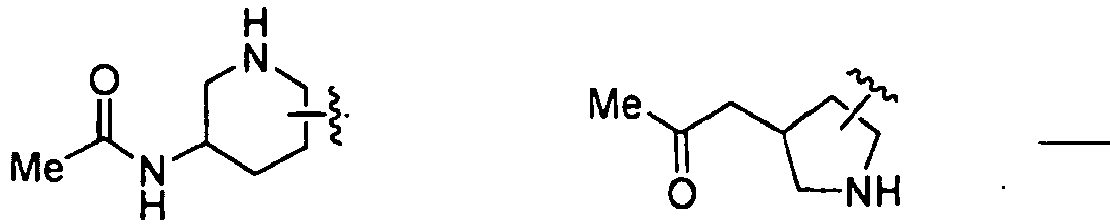


- and substituted forms thereof.
- In certain embodiment, R3 is selected from halogen, C(=O)R6, SR6, OR6, heteroaryl, alkyl, or alkenyl, wherein said heteroaryl, alkyl and alkenyl are optionally substituted.
- Exemplary embodiments of R3 include Br, Cl and C(=O)H.
- In certain embodiments R3 is SR6, wherein R6 is Vn-aryl, Vn-heteroaryl, Vn-heterocyclyl, Vn-cycloalkyl or alkyl, wherein said aryl, heteroaryl, heterocyclyl, cycloalkyl and alkyl portions are optionally substituted. Exemplary embodiments include, but are not limited to, the structures:


- and substituted forms thereof.
- In certain embodiments, R3 is OR6 wherein R6 is H, alkyl, Vn-aryl, or Vn-heteroaryl, wherein said alkyl, Vn-aryl, and Vn-heteroaryl are optionally substituted. Exemplary embodiments of OR6 include, but are not limited to, OH, OMe,


- In certain embodiments R3 is optionally substituted aryl or heteroaryl. Exemplary embodiments include, but are not limited to, the structures:

- and substituted forms thereof.
- In certain embodiments R3 is optionally substituted alkyl or alkenyl. Exemplary embodiments include, but are not limited to, the structures:


- and substituted forms thereof.
- Exemplary embodiments of compounds of Formula I include, but are not limited to, compounds of the general formulas

- and substituted forms thereof, wherein L, R1, R2, R3, R4 and R11 are as defined herein.
- Additional exemplary embodiment of compounds of Formula I include, but are not limited to, compounds of the general formulas


- and substituted forms thereof, wherein L, R2, R3, R4, R11, R12 and R13 are as defined herein.
- Additional exemplary embodiment of compounds of Formula I include, but are not limited to, compounds of the general formulas


- and substituted forms thereof, wherein L, R1, R3, R4, and R11 are as defined herein.
- Additional exemplary embodiment of compounds of Formula I include, but are not limited to, compounds of the general formulas

- and substituted forms thereof, wherein R1, R3, R4, and R11 are as defined herein.
- Additional exemplary embodiment of compounds of Formula I include, but are not limited to, compounds of the general formulas

- and substituted forms thereof, wherein R1, R3, R4, R11, R12 and R13 are as defined herein. In certain embodiments, the phenyl ring is optionally substituted with one or more R20a groups independently selected from F, Cl, Br, I, CN, C1-C12 alkyl, NO2, SO2R6, OR6, C(=O)OR6, and NR6C(=O)R7, wherein said alkyl is optionally substituted. In certain embodiments, the phenyl group is optionally substituted with one or more groups independently selected from Cl, OMe, CN, NO2, C(=O)OMe, C(=O)OEt, SO2Me, and OCH2CH2NMe2. In certain embodiments, R12 is H and R13 is selected from C1-C6 alkyl, C3-C6 cycloalkyl, and (CH2)1-2CO2R6. In certain embodiments, R13 is methyl, ethyl, propyl, isopropyl, n-butyl, isobutyl, cyclopropyl, CH2CH2COOMe, CH2COOEt, CH2COOH, or CH2CH2COOH.
- Additional exemplary embodiment of compounds of Formula I include, but are not limited to, compounds of the general formulas
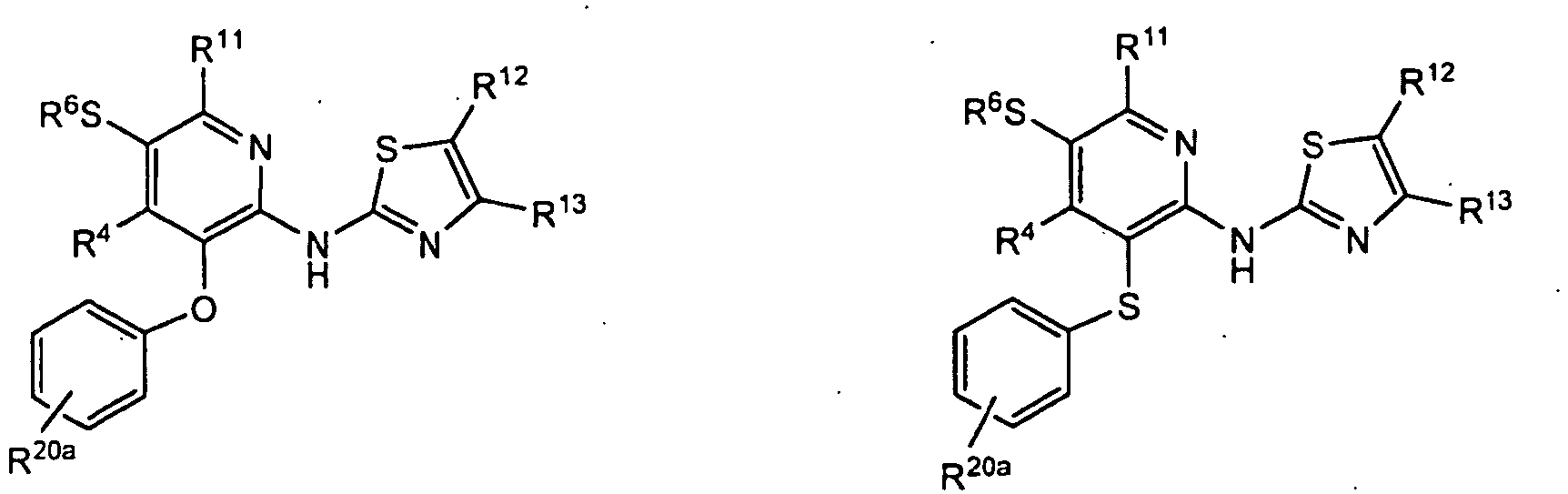

- wherein R4, R6, R11, R12, R13, and R20a are as defined herein.
- Additional exemplary embodiment of compounds of Formula I include, but are not limited to, compounds of the general formulas


- and substituted forms thereof, wherein L, R1, R4, and R11 are as defined herein.
- Additional exemplary embodiment of compounds of Formula I include, but are not limited to, compounds of the general formulas


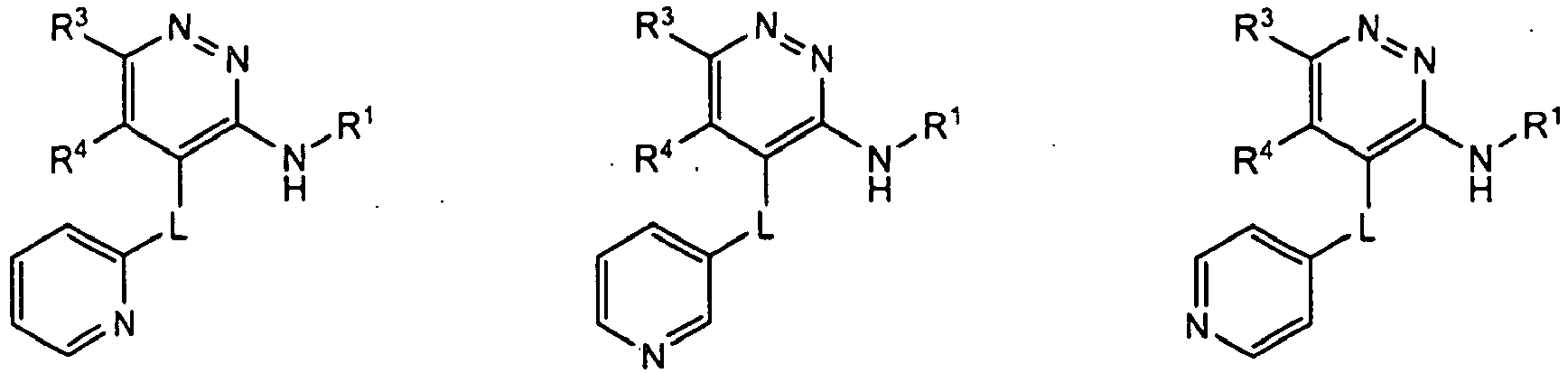
- and substituted forms thereof, wherein L, R1, R3, and R4 are as defined herein.
- Additional exemplary embodiment of compounds of Formula I include, but are not limited to, compounds of the general formulas

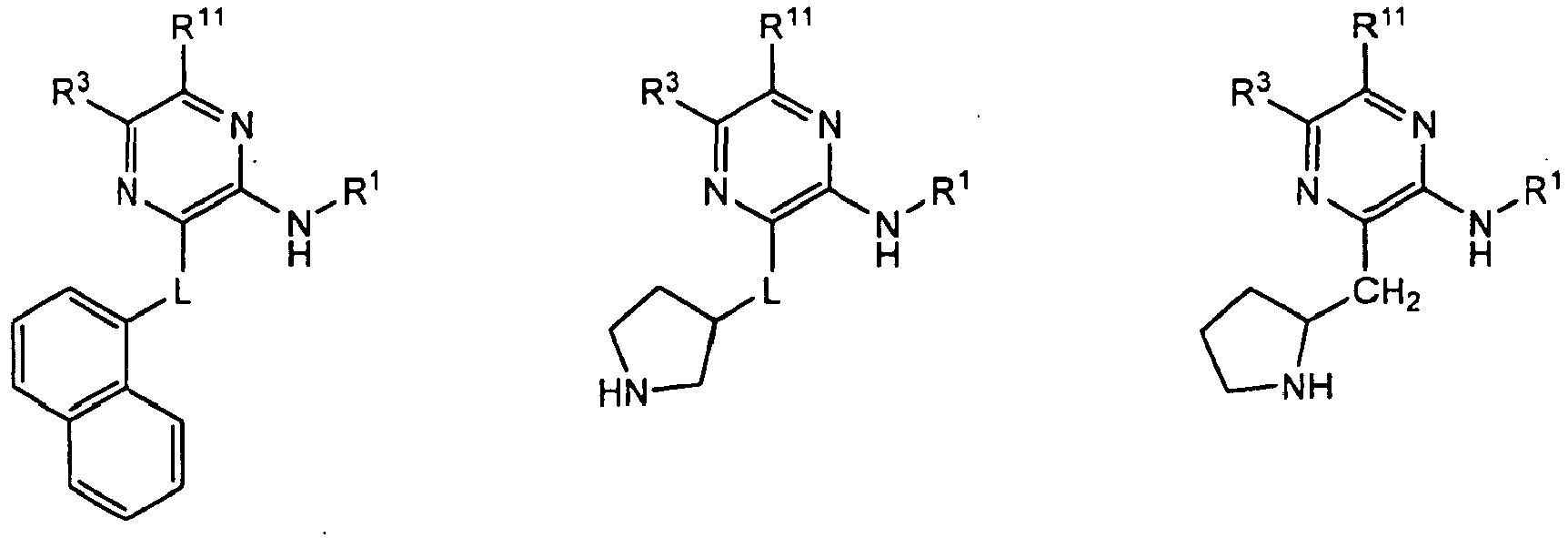

- and substituted forms thereof, wherein L, R1, R3, and R11 are as defined herein.
- Additional exemplary embodiment of compounds of Formula II include, but are not limited to, compounds of the general formulas


- and substituted forms thereof, wherein L, R3, R4, R11, R12 and R13 are as defined herein.
- Additional exemplary embodiment of compounds of Formula II include, but are not limited to, compounds of the general formulas


- and substituted forms thereof, wherein L, R3, R4, R11 and R20 are as defined herein, and each R20 is independent of the other.
- The compounds of this invention may possess one or more asymmetric centers; such compounds can therefore be produced as individual (R)- or (S)-stereoisomers or as mixtures thereof. Unless indicated otherwise, the description or naming of a particular compound in the specification and claims is intended to include both individual enantiomers and diastereomers, and mixtures, racemic or otherwise, thereof. Accordingly, this invention also includes all such isomers, including diastereomeric mixtures, pure diastereomers and pure enantiomers of the compounds of this invention. The term "enantiomer" refers to two stereoisomers of a compound which are non-superimposable mirror images of one another. The term "diastereomer" refers to a pair of optical isomers which are not mirror images of one another. Diastereomers have different physical properties, e.g. melting points, boiling points, spectral properties, and reactivities.
- The compounds of the present invention may also exist in different tautomeric forms, and all such forms are embraced within the scope of the invention. The term "tautomer" or "tautomeric form" refers to structural isomers of different energies which are interconvertible via a low energy barrier. For example, proton tautomers (also known as prototropic tautomers) include interconversions via migration of a proton, such as keto-enol and imine-enamine isomerizations. Valence tautomers include interconversions by reorganization of some of the bonding electrons.
- In the structures shown herein, where the stereochemistry of any particular chiral atom is not specified, then all stereoisomers are contemplated and included as the compounds of the invention. Where stereochemistry is specified by a solid wedge or dashed line representing a particular configuration, then that stereoisomer is so specified and defined.
- In addition to compounds of Formula I, the invention also includes solvates, pharmaceutically acceptable prodrugs, and salts of such compounds.
- A "solvate" refers to an association or complex of one or more solvent molecules and a compound of the invention. Examples of solvents that form solvates include, but are not limited to, water, isopropanol, ethanol, methanol, DMSO, ethyl acetate, acetic acid, and ethanolamine. The term "hydrate" can also be used to refer to a complex wherein the solvent molecule is water.
- A "prodrug" is a compound that may be converted under physiological conditions or by solvolysis to the specified compound or to a salt of such compound. Prodrugs include compounds wherein an amino acid residue, or a polypeptide chain of two or more amino acid residues, is covalently joined through an amide or ester bond to a free amino, hydroxy or carboxylic acid group of a compound of the present invention. The amino acid residues include but are not limited to the 20 naturally occurring amino acids commonly designated by three letter symbols and also includes phosphoserine, phosphothreonine, phosphotyrosine, 4-hydroxyproline, hydroxylysine, demosine, isodemosine, gamma-carboxyglutamate, hippuric acid, octahydroindole-2-carboxylic acid, statine, 1,2,3,4-tetrahydroisoquinoline-3-carboxylic acid, penicillamine, ornithine, 3-methylhistidine, norvaline, beta-alanine, gamma-aminobutyric acid, cirtulline, homocysteine, homoserine, methyl-alanine, para-benzoylphenylalanine, phenylglycine, propargylglycine, sarcosine, methionine sulfone and tert-butylglycine.
- Additional types of prodrugs are also encompassed. For instance, a free carboxyl group of a compound of Formula II can be derivatized as an amide or alkyl ester. As another example, compounds of this invention comprising free hydroxy groups may be derivatized as prodrugs by converting the hydroxy group into a group such as, but not limited to, a phosphate ester, hemisuccinate, dimethylaminoacetate, or phosphoryloxymethyloxycarbonyl group, as outlined in Advanced Drug Delivery Reviews, 1996, 19, 115. Carbamate prodrugs of hydroxy and amino groups are also included, as are carbonate prodrugs, sulfonate esters and sulfate esters of hydroxy groups. Derivatization of hydroxy groups as (acyloxy)methyl and (acyloxy)ethyl ethers, wherein the acyl group may be an alkyl ester optionally substituted with groups including, but not limited to, ether, amine and carboxylic acid functionalities, or where the acyl group is an amino acid ester as described above, are also encompassed. Prodrugs of this type are described in J. Med Chem., 1996, 39, 10. More specific examples include replacement of the hydrogen atom of the alcohol group with a group such as (C1-C6)alkanoyloxymethyl, 1-((C1-C6)alkanoyloxy)ethyl, 1-methyl-1-((C1-C6)alkanoyloxy)ethyl, (C1-C6)alkoxycarbonyloxymethyl, N-(C1-C6)alkoxycarbonylaminomethyl, succinoyl, (C1-C6)alkanoyl, α-amino(C1-C4)alkanoyl, arylacyl and α-aminoacyl, or α-aminoacyl-α-aminoacyl, where each α-aminoacyl group is independently selected from the naturally occurring L-amino acids, P(O)(OH)2, -P(O)(O(C1-C6)alkyl)2 or glycosyl (the radical resulting from the removal of a hydroxyl group of the hemiacetal form of a carbohydrate).
- Free amines of compounds of Formula II can also be derivatized as amides, sulfonamides or phosphonamides. All of these moieties may incorporate groups including, but not limited to, ether, amine and carboxylic acid functionalities. For example, a prodrug can be formed by the replacement of a hydrogen atom in the amine group with a group such as R-carbonyl, RO-carbonyl, NRR'-carbonyl, wherein R and R' are each independently (C1-C10)alkyl, (C3-C7)cycloalkyl, or benzyl, or R-carbonyl is a natural α-aminoacyl or natural α-aminoacyl-natural α-aminoacyl, -C(OH)C(O)OY wherein Y is H, (C1-C6)alkyl or benzyl, -C(OY0)Y1 wherein Y0 is (C1-C4) alkyl and Y1 is (C1-C6)alkyl, carboxy(C1-C6)alkyl, amino(C1-C4)alkyl or mono-N- or di-N,N-(C1-C6)alkylaminoalkyl, or -C(Y2)Y3 wherein Y2 is H or methyl and Y3 is mono-N- or di-N,N-(C1-C6)alkylamino, morpholino, piperidin-1-yl or pyrrolidin-1-yl.
- For additional examples of prodrug derivatives, see, for example, a) Design of Prodrugs, edited by H. Bundgaard, (Elsevier, 1985) and Methods in Enzymology, Vol. 42, p. 309-396, edited by K. Widder, et al. (Academic Press, 1985); b) A Textbook of Drug Design and Development, edited by Krogsgaard-Larsen and H. Bundgaard, Chapter 5 "Design and Application of Prodrugs," by H. Bundgaard p. 113-191 (1991); c) H. Bundgaard, Advanced Drug Delivery Reviews, 8:1-38 (1992); d) H. Bundgaard, et al., Journal of Pharmaceutical Sciences, 77:285 (1988); and e) N. Kakeya, et al., Chem. Pharm. Bull., 32:692 (1984), each of which is specifically incorporated herein by reference.
- A compound of the invention may possess a sufficiently acidic group, a sufficiently basic group, or both functional groups, and accordingly react with any of a number of inorganic or organic bases or acids to form a salt. Examples of salts include those salts prepared by reaction of the compounds of the present invention with a mineral or organic acid or an inorganic base, such salts including, but not limited to, sulfates, pyrosulfates, bisulfates, sulfites, bisulfites, phosphates, monohydrogenphosphates, dihydrogenphosphates, metaphosphates, pyrophosphates, chlorides, bromides, iodides, acetates, propionates, decanoates, caprylates, acrylates, formates, isobutyrates, caproates, heptanoates, propiolates, oxalates, malonates, succinates, suberates, sebacates, fumarates, maleates, butyn-1,4-dioates, hexyne-1,6-dioates, benzoates, chlorobenzoates, methylbenzoates, dinitrobenzoates, hydroxybenzoates, methoxybenzoates, phthalates, sulfonates, xylenesulfonates, phenylacetates, phenylpropionates, phenylbutyrates, citrates, lactates, γ-hydroxybutyrates, glycollates, tartrates, methanesulfonates, propanesulfonates, naphthalene-1-sulfonates, naphthalene-2-sulfonates, and mandelates. Since a single compound of the present invention may include more than one acidic or basic moiety, the compounds of the present invention may include mono, di or tri-salts in a single compound.
- If the inventive compound is a base, the desired salt may be prepared by any suitable method available in the art, for example, by treatment of the free base with an acidic compound, for example an inorganic acid such as hydrochloric acid, hydrobromic acid, sulfuric acid, nitric acid, phosphoric acid and the like, or with an organic acid, such as acetic acid, maleic acid, succinic acid, mandelic acid, fumaric acid, malonic acid, pyruvic acid, oxalic acid, glycolic acid, salicylic acid, a pyranosidyl acid such as glucuronic acid or galacturonic acid, an alpha hydroxy acid such as citric acid or tartaric acid, an amino acid such as aspartic acid or glutamic acid, an aromatic acid such as benzoic acid or cinnamic acid, a sulfonic acid such as p-toluenesulfonic acid or ethanesulfonic acid, or the like.
- If the inventive compound is an acid, the desired salt may be prepared by any suitable method, for example, by treatment of the free acid with an inorganic or organic base. Examples of suitable inorganic salts include those formed with alkali and alkaline earth metals such as lithium, sodium, potassium, barium and calcium. Examples of suitable organic base salts include, for example, ammonium, dibenzylammonium, benzylammonium, 2-hydroxyethylammonium, bis(2-hydroxyethyl)ammonium, phenylethylbenzylamine, dibenzylethylenediamine, and the like salts. Other salts of acidic moieties may include, for example, those salts formed with procaine, quinine and N-methylglucosamine, plus salts formed with basic amino acids such as glycine, ornithine, histidine, phenylglycine, lysine and arginine.
- In certain embodiments, the salt of a compound of Formula II is a pharmaceutically acceptable salt. The phrase "pharmaceutically acceptable" indicates that the substance or composition is compatible chemically and/or toxicologically with the other ingredients comprising a formulation, and/or the mammal being treated therewith. A "pharmaceutically acceptable salt," unless otherwise indicated, includes salts that retain the biological effectiveness of the corresponding free acid or base of the specified compound and are not biologically or otherwise undesirable.
- The present invention also embraces isotopically-labeled compounds of the present invention which are identical to those recited herein, but for the fact that one or more atoms are replaced by an atom having an atomic mass or mass number different from the atomic mass or mass number usually found in nature. All isotopes of any particular atom or element as specified is contemplated within the scope of the compounds of the invention, and their uses. Exemplary isotopes that can be incorporated into compounds of the invention include isotopes of hydrogen, carbon, nitrogen, oxygen, phosphorus, sulfur, fluorine, chlorine and iodine, such as 2H, 3H, 11C, 13C, 14C, 13N, 15N, 15O, 17O, 18O, 32P, 33P, 35S, 18F, 36Cl, 123I and 125I. Certain isotopically-labeled compounds of the present invention (e.g., those labeled with 3H and 14C) are useful in compound and/or substrate tissue distribution assays. Tritiated (i.e., 3H) and carbon-14 (i.e., 14C) isotopes are useful for their ease of preparation and detectability. Further, substitution with heavier isotopes such as deuterium (i.e., 2H) may afford certain therapeutic advantages resulting from greater metabolic stability (e.g., increased in vivo half-life or reduced dosage requirements) and hence may be preferred in some circumstances. Positron emitting isotopes such as 15O, 13N, 11C and 18F are useful for positron emission tomography (PET) studies to examine substrate receptor occupancy. Isotopically labeled compounds of the present invention can generally be prepared by following procedures analogous to those disclosed in the Schemes and/or in the Examples herein below, by substituting an isotopically labeled reagent for a non-isotopically labeled reagent.
- METABOLITES OF COMPOUNDS OF FORMULA II
- Also falling within the scope of this invention are the in vivo metabolic products of compounds of Formula I described herein. A "metabolite" is a pharmacologically active product produced through metabolism in the body of a specified compound or salt thereof. Such products may result, for example, from the oxidation, reduction, hydrolysis, amidation, deamidation, esterification, deesterification, enzymatic cleavage, and the like, of the administered compound. Accordingly, the invention includes metabolites of compounds of Formula II, including compounds produced by a process comprising contacting a compound of this invention with a mammal for a period of time sufficient to yield a metabolic product thereof.
- Metabolites are identified, for example, by preparing a radiolabelled (e.g., 14C or 3H) isotope of a compound of the invention, administering it parenterally in a detectable dose (e.g., greater than about 0.5 mg/kg) to an animal such as rat, mouse, guinea pig, monkey, or to a human, allowing sufficient time for metabolism to occur (typically about 30 seconds to 30 hours) and isolating its conversion products from the urine, blood or other biological samples. These products are easily isolated since they are labeled (others are isolated by the use of antibodies capable of binding epitopes surviving in the metabolite). The metabolite structures are determined in conventional fashion, e.g., by MS, LC/MS or NMR analysis. In general, analysis of metabolites is done in the same way as conventional drug metabolism studies well known to those skilled in the art. The metabolites, so long as they are not otherwise found in vivo, are useful in diagnostic assays for therapeutic dosing of the compounds of the invention.
- SYNTHESIS OF GLUOCOKINASE ACTIVATORS
- Compounds of this invention may be synthesized by synthetic routes that include processes analogous to those well known in the chemical arts, particularly in light of the description contained herein. The starting materials are generally available from commercial sources such as Aldrich Chemicals (Milwaukee, WI) or are readily prepared using methods well known to those skilled in the art (e.g., prepared by methods generally described in Louis F. Fieser and Mary Fieser, Reagents for Organic Synthesis, v. 1-19, Wiley, N.Y. (1967-1999 ed.), or Beilsteins Handbuch der organischen Chemie, 4, Aufl. ed. Springer-Verlag, Berlin, including supplements).
- Compounds of Formula I may be prepared singly or as compound libraries comprising at least 2, for example 5 to 1,000 compounds, or 10 to 100 compounds. Libraries of compounds of Formula II may be prepared by a combinatorial 'split and mix' approach or by multiple parallel syntheses using either solution phase or solid phase chemistry, by procedures known to those skilled in the art. Thus according to a further aspect of the invention there is provided a compound library comprising at least 2 compounds of Formula II or salts thereof.
- For illustrative purposes, Schemes A-U show general methods for preparing the compounds of the present invention as well as key intermediates. For a more detailed description of the individual reaction steps, see the Examples section below. Those skilled in the art will appreciate that other synthetic routes may be used to synthesize the inventive compounds. Although specific starting materials and reagents are depicted in the Schemes and discussed below, other starting materials and reagents can be easily substituted to provide a variety of derivatives and/or reaction conditions. In addition, many of the compounds prepared by the methods described below can be further modified in light of this disclosure using conventional chemistry well known to those skilled in the art.

- Scheme A shows a method of preparing compounds (3A) of Formula II wherein R1 is thiazolyl and L = O or S. To prepare compound (3A), a 2-aminoheterocycle (1) is reacted with benzoylisothiocyanate to afford a benzoylthiourea intermediate, which is hydrolyzed to the thiourea (2) with a base such as, but not limited to, potassium carbonate in a suitable solvent such as, but not limited to, ethanol. Alternatively, the aminoheterocycle (1) can be treated with an inorganic or ammonium isothiocyanate, e.g., Meckler's procedure, in the presence of an acid to afford the thiourea (2) in one step. Treatment of the thiourea (2) with an α-haloketone R13COCHR12X, wherein X = OTs, Cl, Br, I, or NR3 (wherein R = C1-C6 alkyl), in a suitable base such as triethylamine, Hunig's base, DBU, alkali carbonate, sodium hydroxide, etc. and a suitable solvent such as ethanol affords the thiazole (3A). If the desired α-halo ketone R13COCHR12X is not commercially available, it can be prepared by various methods known to those skilled in the art. Examples include, but are not limited to, bromination of commercially or readily synthesized methyl ketones (Tetrahedron (1970) 5611-5615; Organic Synthesis (1946) 13-15; Tetrahedron (1990) 2943-2964), diazomethane treatment of carbonyl chlorides, oxidation of 1-chloro-2-alkanols, bromination of silyl enol ethers, or halogenation of β-keto esters followed by decarboxylation.

- Scheme B shows an alternative method of preparing a compound of Formula I. According to Scheme B, hydroxylated heteroaryl halide (5) (if not commercially available) can be prepared from heteroaryl halide (4) by: 1) ortho metalation with LDA or another suitable base; 2) conversion of the anion to the boronate via reaction with B(OR)3; and 3) oxidation of the boronate with a suitable oxidant such as N-methylmorpholine oxide or hydrogen peroxide. The ortho metalated species can also be quenched with (TMSO)2 to obtain the hydroxylated material (5) directly upon acidic workup. The hydroxylated heteroaromatic compound (5) can be alkylated with R2X in the presence of a base such as, but not limited to, cesium carbonate or sodium hydride and in a suitable solvent such as, but not limited to, DMF to afford compound (6) wherein L is O. Examples of R2X that may be utilized include substituted 2- and 4-nitrohalobenzenes, substituted 2- and 4-cyanohalobenzenes, 2-chloro-1-fluorobenzene, halogenated pyridines, halogenated pyrimidines, and other halogenated heterocycles. Compound (6) can be converted to compound (7) by the method of Hartwig et al. (for an example of this transformation via analogy see: Organic Letters (2001) 2729-2732), or by treatment with a Pd catalyst and benzophenone imine, or by heating in the presence of ammonia (or NH2PG where PG is a protecting group).
- Compounds of the formulas (6) and (7) wherein L is S can be prepared according to methods described in Schemes I, J, K, M, N, O, and P. Compounds of the formulas (6) and (7) wherein L is CH2 can be prepared according to methods described below in Schemes I, K, M, N, O, and P. Compounds of formulas (6) and (7) subsequently can be used in Schemes A-H.
- Compound (7) can be converted to compound (3) of Formula II upon reaction with an aryl or heteroaryl halide R1X in the presence of a base catalyst or metal (e.g., copper or palladium) catalyst. Alternatively, compound (6) can be converted directly to a compound (3) of Formula II upon treatment with R1NH2 via base catalysis or via copper or palladium catalysis; i.e., the Buchwald reaction.

- Scheme C shows a method of preparing 2-aminothiazole and 2-bromothiazole intermediates (8) and (9), respectively, which are suitable for use in preparing compounds of Formula II as shown in Scheme B. According to Scheme C, α-haloketone R13COCHR12X can be treated with thiourea in the presence of a suitable base such as potassium carbonate or triethylamine in an appropriate solvent such as DMF or ethanol to afford aminothiazole (8). The aminothiazole (8) can be converted to a diazonium salt intermediate by numerous methods including, but not limited to, treatment with sodium nitrite in acid or isobutylnitrite. Treatment of the in situ diazonium salt with Cu(X1)2 (X1 = Cl or Br) or HBr affords the corresponding 2-halothiazole (9). Alternatively, using the Hantzsch synthetic method, the α-haloketone R13COCHR12X can be treated first with KSCN, then with HX wherein X is Cl or Br, to provide the 2-halothiazole (9). The 2-halothiazole compounds (8) and (9) can be converted into compound (3A) by the methods shown in Scheme B.

- Scheme D shows a method of preparing 3-aminothiadiazole and 3-bromothiadiazole intermediates (11) and (12), respectively, which are suitable for use in preparing compounds of Formula II as shown in Scheme B. According to Scheme D, acylguanidine (10) (Can. J. Chem., (1961) 39, 1017-29) can be treated with Lawesson's reagent or similar reagent in an appropriate solvent such as toluene to afford the corresponding thioamide (
EP 0307142 ). Oxidation of the thioamide to form 3-amino-1,2,4 thiadiazole (11) can be accomplished with bromine, iodine, hydrogen peroxide or nitric acid. Cyclization of compound (10) may also be achieved by treatment with hydroxylamine-O-sulphonic acid in an alcohol solvent such as methanol or ethanol in the presence of pyridine (EP 0307142 ). Formation of the diazonium salt of compound (11), followed by treatment of the in situ diazonium salt with CuBr2, affords the corresponding 3-bromo-1,2,4-thiadiazole (12) (EP 0307142 ). The chloro derivative of compound (12) could also be synthesized through the use of CuCl2. Alternatively, palladium-mediated coupling of the commercially available 3-bromo-5-chloro-1,2,4-thiadiazole (13) with a zinc reagent affords 3-bromo-1,2,4-thiadiazole (12) (WO 2003/037894 ). Intermediate thiadiazoles (11) and (12) can be converted into compound (3B) of Formula II by the methods shown in Scheme B.
- Scheme E shows a method of preparing 5-amino-1,2,4-thiadiazole and 5-chloro-1,2,4-thiadiazole intermediates (15) and (16), respectively, which are suitable for use in preparing compounds of Formula II as shown in Scheme B. According to Scheme E, primary amide (14) can be converted into 5-amino-1,2,4 thiadiazole (15) by heating with KSCN in an appropriate solvent such as methanol or ethanol (Adv. Heterocycl. Chem., (1982) 32, 285). Formation of the diazonium salt of compound (15), followed by treatment of the in situ diazonium salt with CuCl2 affords the corresponding 5-chloro-1,2,4-thiadiazole (16). The corresponding bromo derivative can also be synthesized through the use of CuBr2. Alternatively, reaction of amidine (17) with perchloromethyl mercaptan affords 5-chloro-1,2,4-thiadiazole (16) (Bioorg. Med. Chem., (2003) 11, 5529-5537). Intermediates (15) and (16) can be converted into compound (3C) of Formula II by the methods shown in Scheme B.

- Scheme F shows a method of preparing 3-amino-1,2,4-oxadiazole and 3-bromo-1,2,4-oxadiazole intermediates (19) and (20), respectively, which are suitable for use in preparing compounds of Formula I as shown in Scheme B. According to Scheme F, cyanamide can be reacted with an appropriate acylchloride (18) or the corresponding anhydride, and subsequently reacted with hydroxylamine to afford 3-amino-1,2,4-oxadiazole (19) (Heterocycles, (2002) 57, 811-823). Formation of the diazonium salt of (19), followed by treatment of the in situ diazonium salt with CuBr2 affords the corresponding 3-bromo-1,2,4-oxadiazole (20). The chloro derivative could also be synthesized through the use of CuCl2, Alternatively, alkyl nitrile (21) can be reacted with dibromoformaldoxime (neat) in the presence of an appropriate base such as sodium bicarbonate to afford 3-bromo-1,2,4-oxadiazole (20) (J. Heterocyclic Chem., (1989) 26, 23-24). The oxadiazole intermediates (19) and (20) can be converted into compound (3D) of Formula II by the methods shown in Scheme B.

- Scheme G shows a method of preparing 5-amino-1,2,4-oxadiazole and 5-chloro-1,2,4-oxadiazole intermediates (23) and (24), respectively, which are suitable for use in preparing compounds of Formula I as shown in Scheme B. According to Scheme G, imidate hydrochloride salt (22) (made via the Pinner reaction) can be reacted with cyanamide in a suitable solvent such as methanol or ethanol to afford an intermediate N-cyanoimidate. Cyclization can be achieved by reacting the N-cyanoimidate with hydroxylamine hydrochloride in an appropriate solvent such as methanol or ethanol in the presence of an appropriate base such as triethylamine, Hunig's base, pyridine or sodium acetate to afford 5-amino-1,2,4-oxadiazole (23) (J. Org. Chem., (1963) 28, 1861-21). Formation of the diazonium salt of compound (23), followed by treatment of the in situ diazonium salt with CuCl2 affords the corresponding 5-chloro-1,2,4-oxadiazole (24). The bromo derivative could also be synthesized through the use of CuBr2. Alternatively, alkyl nitrile (21) can be converted into 5-chloro-1,2,4-oxadiazole (24) (
WO 95/005368 
- Scheme H shows a method of preparing 2-aminooxazole and 2-halo-oxazole intermediates (26) and (27), respectively, which are suitable for use in preparing compounds of Formula II as shown in Scheme B. According to Scheme H, α-hydroxyketone (25) is reacted with cyanamide to afford 2-aminooxazole (26) (Aust. J. Chem. (1985), 38, 447-458). Formation of the diazonium salt of compound (26), followed by treatment of the in situ diazonium salt with CuX2 (where X = Cl or Br) affords the corresponding 5-halo-1,2,4-thiadiazole (27). Intermediates (26) and (27) can be converted into compound (3F) of Formula II by the method of Scheme B.

- Scheme I shows a method of preparing compound (3G) of Formula II wherein Z is CR3. According to Scheme I, the halo-substituted heterocycle (28) (prepared by the method of Scheme A or B) wherein X1 = Cl, Br or I, is first treated with an appropriate amount of methyl lithium solution to remove exchangeable proton(s), and then transmetalated with an alkyl lithium reagent such as n-BuLi, sec-butyl or tert-butyl lithium, or a Grignard reagent such as, i-PrMg-halide. The resulting anion is then quenched with an electrophile to provide compound (3G). Suitable electrophiles include, but are not limited to: 1) aldehydes, 2) nitriles, 3) N-methoxy-N-methylamides (Weinreb amides), 4) dialkylsulphides, 5) hexachloroethane, 6) trialkyl boronates, 7) sulphonyl chlorides, 8) sulfamyl chlorides, 9) isocyanates, 10) carbon dioxide, (11) alkyl halides, (12) trifluoroiodomethane (13) Mander's reagent, and (14) chloroformates. Exemplary compounds of the present invention which can be prepared according to the method of Scheme I include compounds (3G) wherein R3 is alkyl, phenylalkyl, cycloalkyl, hydroxylalkyl (from R3Si(CH2)nI), Cl, SH, SR', SOR', SO2R', OR', I, SCH2R', OCH2R', CO2H, CH(OH)-R', and C(=O)R', wherein R' is alkyl, alkenyl, alkynyl, cycloalkyl, or aryl.
- Alternatively, the halo-substituted heterocycle (28) can be converted to compound (3G) wherein R3 is alkyl, aryl, heteroaryl, alkenyl or alkynyl, via a metal (e.g., Cu or Pd) mediated coupling reaction such as, but not limited to, the Negishi reaction, the Suzuki reaction, the Sonogashira reaction, or the Stille reaction.

- Scheme J shows a method of preparing compounds (3H) of Formula II, wherein Z = C-SR3 or C-OR3, and Q = O or S, from a halo substituted heterocycle (28). According to Scheme J, the halo-substituted heterocycle (28), prepared by the method of Scheme A or B, can be converted to a thiol or alcohol (29) via one of several procedures. According to one method, the halo-substituted heterocycle (28) is first treated with an appropriate amount of methyl lithium solution to remove exchangeable proton(s), and then transmetalated with an alkyl lithium reagent such as n-BuLi, sec-butyl or tert-butyl lithium, or a Grignard reagent such as, i-PrMg-halide. The resulting anion is then quenched with either elemental sulfur or bis(trimethylsilyl) peroxide to form the corresponding mercapto- or hydroxyl-substituted compound (29). Alternatively, the anion can be quenched with trimethyl borate and oxidized with either hydrogen peroxide (J. Med. Chem. (2004) 3089-3104) or N-methyl morpholine oxide (Syn. Lett. (1995) 931-932) to afford the phenol (29). As a third synthetic route, the halide (28) can be converted under Pd-mediated conditions to thiol or phenol (29) utilizing potassium triisopropylsilanethiolate (Tetrahedron Letters (1994) 3225-3226) or sodium tert-butyldimethylsiloxide (J. Org. Chem., (2002) 5553-5566). The thiol or phenol (29) can be alkylated with a variety of electrophiles using standard reaction conditions to provide the corresponding ether (3H) of Formula II. Suitable electrophiles include, but are not limited to, alkyl halides, benzylic halides, heteraroyl-CH2X, cycloalkyl halides, Michael acceptors, and activated heteroaryl halides such as, but not limited to, 2-fluorocyanobenzene, 4-fluorocyanobenzene, 2-fluoronitrobenzene, 4-fluoronitrobenzene, 2-chloro-4-nitropyridine, 2-halopyridine, 2-halopyrimidine, 4-halopyrimidine, aryl halides and heteroaryl halides.
- Alternatively, halide (28) can be converted to an alkyl sulfide using Pd-mediated conditions with appropriately functionalized sulfides. Examples of such sulfides include, but are not limited to, esters of 3-mercaptopropanoic acid, 3-mercaptopropanenitrile or 2-(trimethylsilyl)ethanethiol. Sulfides of this type can be deprotected to the thiol and alkylated with a variety of electrophiles under standard conditions (Chemical & Pharmaceutical Bulletin (1990), 38(10), 2667-75).
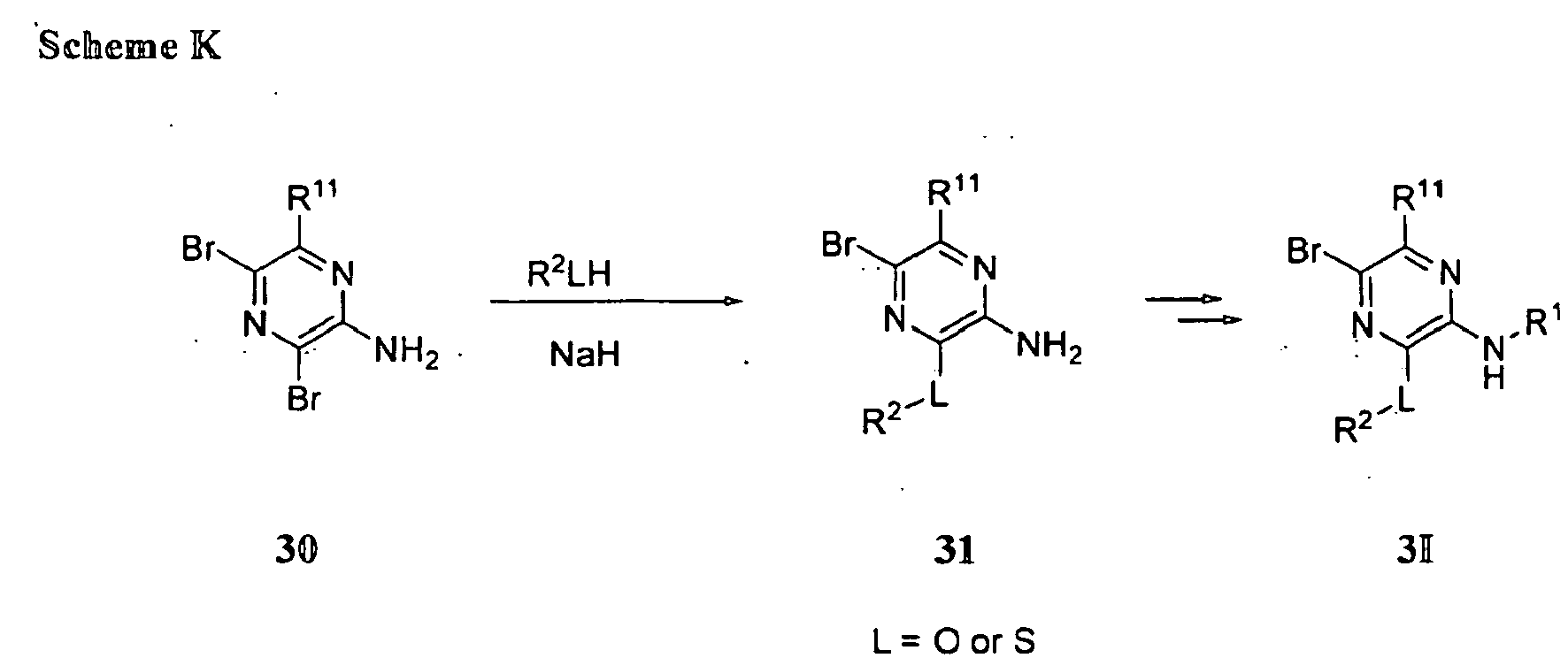
- Scheme K shows a method of adding a linker L, wherein L is O or S, to a core heterocycle to provide a compound (3I) of Formula II wherein G = CR11, Z = C-Br, and Y = N . According to Scheme K, 2-amino-3,5-dibromopyrazine (30) is reacted with R2LH, wherein L is O or S, in the presence of a suitable base such as K2CO3 or NaH in a suitable solvent such as DMF or ethanol to afford compound (31) regioselectively. Compound (31) can be converted to compound (31) of Formula II by the method of Scheme A or B. Compound (3I) can be converted into additional 5-substituted compounds of Formula II by the methods shown in Scheme I or J.

- Scheme L shows an alternate method of adding the linker OR2 to a core heterocycle to provide a compound (3) of Formula II wherein L is O. According to Scheme L, a benzyl ether (32), prepared by the method of Scheme A or B, can be converted to the hydroxyl substituted heterocycle (33), for example by hydrolysis with a strong acid (e.g., 6N HCl) or by hydrogenation (e.g., H2 or ammonium formate in the presence of a metal catalyst). Alkylation of the hydroxylated heterocycle (33) with R2X, wherein X = F, Cl, Br, I, or NR3, in the presence of a base such as, but not limited to, cesium carbonate, in a suitable solvent such as, but not limited to, DMF, or via copper or palladium catalysis (i.e., the Ullman reaction) affords compound (3) of Formula II.

- Scheme M shows a method of preparing a compound (3J) of Formula II wherein G = N, Z = CR3, Y = CH, and L = O or S. According to Scheme M, 6-chloropyridazin-3-amine (34) is regioselectively brominated with a suitable brominating agent such as bromine, NBS, etc., to provide compound (35). Reaction of compound (35) with R2LH (wherein L is O or S) in the presence of a suitable base such cesium carbonate or sodium hydride either with or without a metal catalyst (e.g., CuI) in DMSO or DMF regioselectively affords compound (36). Compound (36) can be converted to the chlorinated compound (37) of Formula II by the method of Scheme A or B. Compound (37) can be converted into a 5-substituted compound (3J) of Formula II by the method of Scheme I or J.
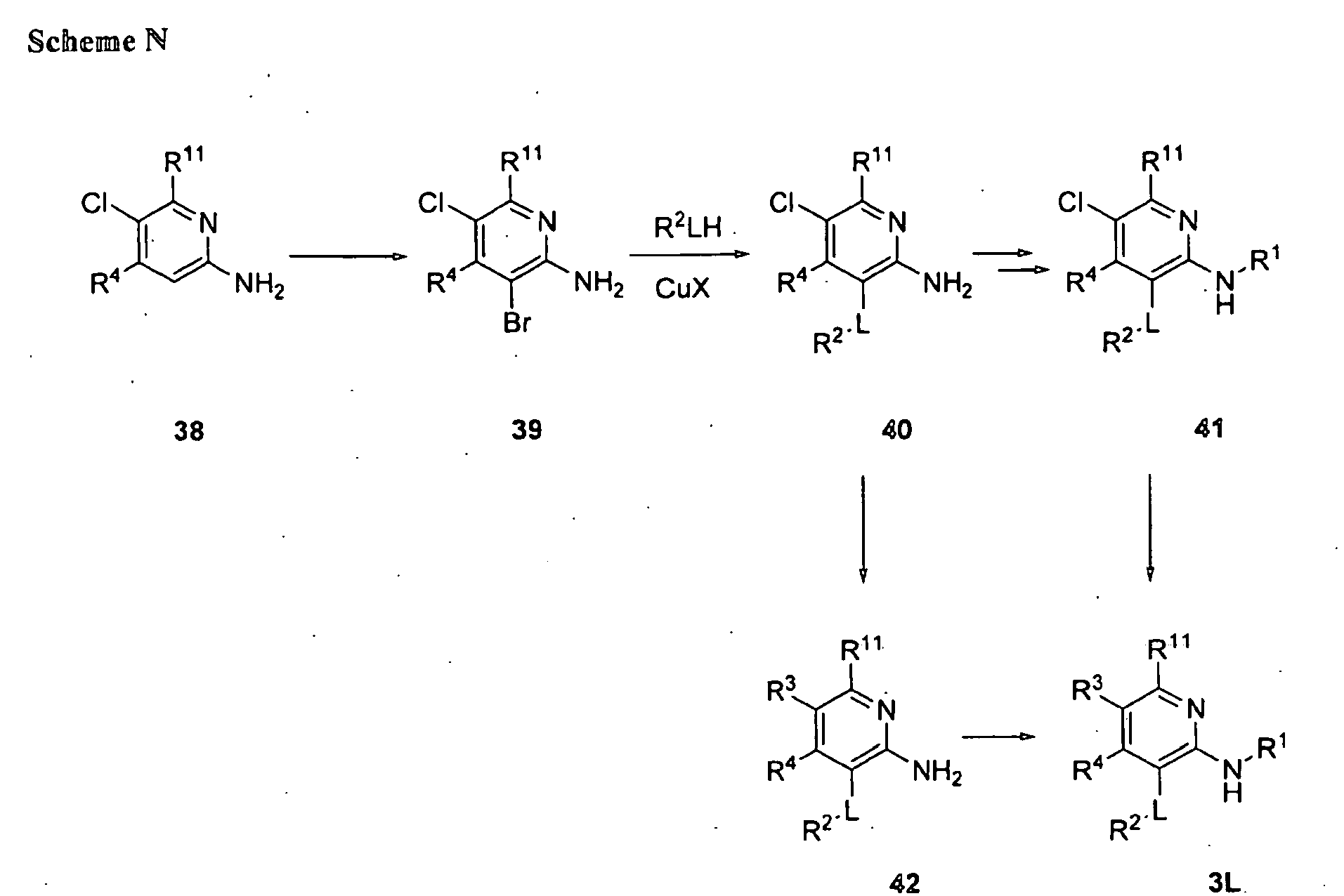
- Scheme N shows a method of preparing a compound (3L) of Formula II wherein G = CR11, Z = CR3, Y = CR4, and L is O or S. According to Scheme N, the 2-aminopyridine (38) is regioselectively brominated with a suitable brominating agent such as NBS or bromine to provide compound (39). The brominated compound can be converted to compound (40) upon reaction with R2LH (wherein L is O or S) in the presence of a suitable base such as cesium carbonate, sodium hydride or triethylamine in the presence of a metal catalyst (i.e.; CuI or Pd2dba3) in a suitable solvent such as DMSO or DMF. The chlorinated product (40) can be converted to compound (41) by the method of Scheme A or B. Compound (41) can be converted to a 5-substituted compound (3L) of Formula II by the method of Scheme I or J. Alternatively, the chlorinated 2-aminopyridine (40) can be converted to a 5-substituted compound (42) by the method of Scheme I or J, and then the heterocyclyl group R1 can be added to compound (42) by the method of Scheme A or B to provide compound (3L).

- Scheme O shows a method of preparing a compound (3L) of Formula I wherein G = CR11, Z = CR3, Y = CR4, and L is O or S. According to Scheme O, reaction of compound (43) with R2LH (wherein L is O or S) in the presence of a suitable base such cesium carbonate or sodium hydride either with or without a metal catalyst (i.e.; Pd2dba3 or CuI) in DMSO or DMF affords compound (44) wherein L is O or S. Alternatively, reaction of compound (43) with R2CH2Zn under similar conditions affords compound (44) wherein L is CH2. To prepare compound (44) wherein L is C=O, compound (43) can be treated to lithiation conditions as described in Scheme I, followed by treatment with R2CO(NMeOMe).
- The 2-aminopyridine (44) is then regioselectively brominated with a suitable brominating agent such as NBS or bromine to provide compound (45). The brominated product (45) can be converted to compound (46) by the method of Scheme A or B. Compound (46) can be converted to 5-substituted compounds (3L) of Formula I by the method of Scheme I or J. Alternatively, the brominated 2-aminopyridine (45) can be converted to a 5-substituted compound (47) by the method of Scheme I or J, and then the heterocyclyl group R1 can be added to compound (47) by the method of Scheme A or B to provide compound (3L).

- Scheme P shows an alternative method of preparing a compound (3L) of Formula II wherein G = CR11, Z = CR3, Y = CR4, and L is O, S or CH2. According to Scheme P, reaction of compound (48) (which if not commercially available can be made from commercial aminopyridines via regioselective bromination) in the presence of a suitable base such cesium carbonate or sodium hydride and with or without a metal catalyst (e.g., Pd2dba3 or CuI) in DMSO or DMF affords compound (49) by a method such as: ipso replacement (with R6OH or R6SH to provide compound (49) wherein R3 is OR6 or SR6, respectively); Buchwald ether or thioether formation (with R 6OH or R6SH to provide compound (49) wherein R3 is OR6 or SR6, respectively); a Negishi reaction (with R3Zn); an aryl or alkyl Suzuki reaction (with R3B(OH)2); a Heck reaction, etc., according to procedures well known in the literature and further exemplified in the Examples below. The 2-aminopyridine (49) is then regioselectively brominated with a suitable brominating agent such as NBS or bromine to provide compound (50). The bromininated product (50) can be converted to compound (51) by the method of Scheme A or B. Compound (51) can be converted to 5-substituted compounds (3L) of Formula II by Buchwald ether or thioether formation (with R2OH when L = O or R2SH when L = S), Negishi reactions (with R2CH2Zn when L = CH2), or via lithiation chemistry as described in Scheme I (when L is C=O) to provide compound (3L). Alternatively, the brominated 2-aminopyridine (50) can first be converted to compound (52) by the Buchwald, Negishi, or lithiation chemistry, and compound (52) can be converted to compound (3L) by the method of Scheme A or B.


- Scheme R shows a method of preparing compounds of Formula II wherein R1 is a substituted thiazolyl. According to Scheme R, phthalimide-containing compound (58) wherein V is alkylene optionally substituted by one or more alkyl groups (which can be prepared by the method of Scheme A or B), can be converted to amine (59) via treatment with hydrazine. Amine (59) can be elaborated to the amide, carbamate, urea, thiourea, monoalkylamine, dialkylamine, amidine, or guanidine (60) by routine methods in the literature.

- Scheme S shows an alternative method of preparing compounds of Formula II wherein R1 is a substituted thiazolyl. According to Scheme S, the ester-containing compound (61), wherein V is alkylene optionally substituted by one or more alkyl groups (which can be prepared by the method of Scheme A or B), can be converted to carboxylic acid (62) by reduction or hydrolysis with a hydride or hydroxide, respectively. Compound (62) can be converted to alcohol (64) upon treatment with a lithium reagent R'Li. Alternatively, the carboxylic acid (62) can be converted to a primary, secondary or tertiary amide (63) using a variety of amide coupling methods known to those skilled in the art. Compound (62) can also be converted to compound (65), wherein R9 is a heterocyclyl group such as, but not limited to, tetrazolyl, imidazolyl, triazolyl, or thiazoyl, by coupling methods known to those skilled in the art.

- Scheme T describes the preparation of intermediates (68), (72) and (75) and substituted forms thereof suitable for use in preparing compounds of Formula (3A) wherein R12 and R13 form a fused heterocyclic ring. To prepare intermediate (68), 2-halo-3-aminopyridine (66) is reacted with a thiocyanate (for example, sodium or potassium thiocyanate) in acidic media (for example, acetic acid) to provide thiazolopyridine (67). Compound (67) is converted to the corresponding 2-halo compound (68) by standard methods (for example, by diazotization of the amine with NaNO2 and HX3, followed by reaction with Cu(X3)2).
- To prepare intermediate (72), the 2-amino-3-halopyridazine (69) is reacted with a protected isothiocyanate to provide protected 2-aminothiazolopyridazine (70), which is deprotected under standard hydrolytic conditions to provide 2-aminothiazolopyridazine (71) (Koren, B., et al., Heterocycles 1987, 26(3), 689-697). The amino heterocyclic compound (71) is converted to the corresponding 2-halo compound (72), for example, as described above.
- To prepare intermediate (75), compound (73) is converted to the 2-aminothiazolotriazine (74), for example, using the method of Jacobsen, et al., (Aust. J. Chem. 1987, 40(3), 491-499). The aminoheterocyclic compound (74) is then converted to the corresponding 2-halo compound (75), for example, as described above.
- It will be appreciated that the aminoheterocycles (68), (72) and (75) can be further functionalized if desired, for example by halogenation of the 6-membered ring (for example with NBS or bromine). Such halogenated derivatives may be further modified using well known methods.

- Scheme U shows an alternative method of preparing compounds of Formula (3A) wherein R12 and R13 form a fused heterocyclic ring. Substituted 2-halo-aminoheterocycles (76), wherein at least one X = N, but no more than two consecutive X are N, is reacted with thiophosgene to provide the isothiocyanate (77). Refluxing the isothiocyanate (77) with the 5-brominated aminopyridine (45) in a suitable solvent such as ethanol or THF affords the heterocycle (78), which can be converted to compounds of Formula (3A) via the methods described in Scheme P. Alternatively, the aminopyridine (47), prepared as in Scheme P, is refluxed with the isocyanate (77) to afford compounds of structure (3A).
- In preparing compounds of Formula II, protection of remote functionalities (e.g., primary or secondary amines, etc.) of intermediates may be necessary. The need for such protection will vary depending on the nature of the remote functionality and the conditions of the preparation methods. Suitable amino-protecting groups (NH-Pg) include acetyl, trifluoroacetyl, t-butoxycarbonyl (BOC), benzyloxycarbonyl (CBz) and 9-fluorenylmethyleneoxycarbonyl (Fmoc). The need for such protection is readily determined by one skilled in the art. For a general description of protecting groups and their use, see T. W. Greene, Protective Groups in Organic Synthesis, John Wiley & Sons, New York, 1991.
- METHODS OF SEPARATION
- In any of the synthetic methods for preparing compounds of Formula II, it may be advantageous to separate reaction products from one another and/or from starting materials. The desired products of each step or series of steps is separated and/or purified to the desired degree of homogeneity by the techniques common in the art. Typically such separations involve multiphase extraction, crystallization from a solvent or solvent mixture, distillation, sublimation, or chromatography. Chromatography can involve any number of methods including, for example: reverse-phase and normal phase; size exclusion; ion exchange; high; medium and low pressure liquid chromatography methods and apparatus; small scale analytical; simulated moving bed (SMB) and preparative thin or thick layer chromatography, as well as techniques of small scale thin layer and flash chromatography.
- Another class of separation methods involves treatment of a reaction mixture with a reagent selected to bind to or render otherwise separable a desired product, unreacted starting material, reaction by product, or the like. Such reagents include adsorbents or absorbents such as activated carbon, molecular sieves, ion exchange media, or the like. Alternatively, the reagents can be acids in the case of a basic material, bases in the case of an acidic material, binding reagents such as antibodies, binding proteins, selective chelators such as crown ethers, liquid/liquid ion extraction reagents (LIX), or the like.
- Selection of appropriate methods of separation depends on the nature of the materials involved. For example, boiling point and molecular weight in distillation and sublimation, presence or absence of polar functional groups in chromatography, stability of materials in acidic and basic media in multiphase extraction, and the like. One skilled in the art will apply techniques most likely to achieve the desired separation.
- Diastereomeric mixtures can be separated into their individual diastereomers on the basis of their physical chemical differences by methods well known to those skilled in the art, such as by chromatography and/or fractional crystallization. Enantiomers can be separated by converting the enantiomeric mixture into a diastereomeric mixture by reaction with an appropriate optically active compound (e.g., chiral auxiliary such as a chiral alcohol or Mosher's acid chloride), separating the diastereomers and converting (e.g., hydrolyzing) the individual diastereoisomers to the corresponding pure enantiomers. Also, some of the compounds of the present invention may be atropisomers (e.g., substituted biaryls) and are considered as part of this invention. Enantiomers can also be separated by use of a chiral HPLC column.
- A single stereoisomer, e.g., an enantiomer, substantially free of its stereoisomer may be obtained by resolution of the racemic mixture using a method such as formation of diastereomers using optically active resolving agents (Eliel, E. and Wilen, S. "Stereochemistry of Organic Compounds," John Wiley & Sons, Inc., New York, 1994; Lochmuller, C. H., J. Chromatogr., (1975) 113(3):283-302). Racemic mixtures of chiral compounds of the invention can be separated and isolated by any suitable method, including: (1) formation of ionic, diastereomeric salts with chiral compounds and separation by fractional crystallization or other methods, (2) formation of diastereomeric compounds with chiral derivatizing reagents, separation of the diastereomers, and conversion to the pure stereoisomers, and (3) separation of the substantially pure or enriched stereoisomers directly under chiral conditions. See: "Drug Stereochemistry, Analytical Methods and Pharmacology," Irving W. Wainer, Ed., Marcel Dekker, Inc., New York (1993).
- Under method (1), diastereomeric salts can be formed by reaction of enantiomerically pure chiral bases such as brucine, quinine, ephedrine, strychnine, α-methyl-β-phenylethylamine (amphetamine), and the like with asymmetric compounds bearing acidic functionality, such as carboxylic acid and sulfonic acid. The diastereomeric salts may be induced to separate by fractional crystallization or ionic chromatography. For separation of the optical isomers of amino compounds, addition of chiral carboxylic or sulfonic acids, such as camphorsulfonic acid, tartaric acid, mandelic acid, or lactic acid can result in formation of the diastereomeric salts.
- Alternatively, by method (2), the substrate to be resolved is reacted with one enantiomer of a chiral compound to form a diastereomeric pair (E. and Wilen, S. "Stereochemistry of Organic Compounds", John Wiley & Sons, Inc., 1994, p. 322). Diastereomeric compounds can be formed by reacting asymmetric compounds with enantiomerically pure chiral derivatizing reagents, such as menthyl derivatives, followed by separation of the diastereomers and hydrolysis to yield the pure or enriched enantiomer. A method of determining optical purity involves making chiral esters, such as a menthyl ester, e.g., (-)menthyl chloroformate in the presence of base, or Mosher ester, α-methoxy-α-(trifluoromethyl)phenyl acetate (Jacob III, J. Org. Chem., (1982) 47:4165), of the racemic mixture, and analyzing the 1H NMR spectrum for the presence of the two atropisomeric enantiomers or diastereomers. Stable diastereomers of atropisomeric compounds can be separated and isolated by normal- and reverse-phase chromatography following methods for separation of atropisomeric naphthyl-isoquinolines (
WO 96/15111 - METHODS OF TREATMENT WITH COMPOUNDS OF FORMULA II
- The compounds of the present invention can be used as prophylactics or therapeutic agents for treating diseases or disorders mediated by deficient levels of glucokinase activity or which can be treated by activating glucokinase including, but not limited to, diabetes mellitus, impaired glucose tolerance, IFG (impaired fasting glucose) and IFG (impaired fasting glycemia), as well as other diseases and disorders such as those discussed below. Furthermore, the compounds of the present invention can be also used to prevent the progression of the borderline type, impaired glucose tolerance, IFG (impaired fasting glucose) or IFG (impaired fasting glycemia) to diabetes mellitus.
- Accordingly, another aspect of the invention provides methods of treating or preventing diseases or conditions described herein by administering to a mammal, such as a human, a therapeutically effective amount of a compound of Formula II.
- The phrase "therapeutically effective amount" means an amount of a compound of the present invention that (i) treats or prevents the particular disease, condition, or disorder, (ii) attenuates, ameliorates, or eliminates one or more symptoms of the particular disease, condition, or disorder, or (iii) prevents or delays the onset of one or more symptoms of the particular disease, condition, or disorder described herein. The amount of a compound of Formula II that will correspond to such an amount will vary depending upon factors such as the particular compound, disease condition and its severity, the identity (e.g., weight) of the mammal in need of treatment, but can nevertheless be routinely determined by one skilled in the art.
- The terms "treat" and "treatment" refer to both therapeutic treatment and prophylactic or preventative measures, wherein the object is to prevent or slow down (lessen) an undesired physiological change or disorder. For purposes of this invention, beneficial or desired clinical results include, but are not limited to, alleviation of symptoms, diminishment of extent of disease, stabilized (i.e., not worsening) state of disease, delay or slowing of disease progression, amelioration or palliation of the disease state, and remission (whether partial or total), whether detectable or undetectable. "Treatment" can also mean prolonging survival as compared to expected survival if not receiving treatment. Those in need of treatment include those already with the condition or disorder as well as those prone to have the condition or disorder or those in which the condition or disorder is to be prevented.
- As used herein, the term "mammal" refers to a warm-blooded animal that has or is at risk of developing a disease described herein and includes, but is not limited to, guinea pigs, dogs, cats, rats, mice, hamsters, and primates, including humans.
- In certain embodiments, the methods of this invention are useful for treating diabetes mellitus. Diabetes mellitus is a condition where the fasting plasma glucose level (glucose concentration in venous plasma) is greater than or equal to 126 mg/dL (tested on two occasions) and the 2-hour plasma glucose level of a 75 g oral glucose tolerance test (OGTT) is greater than or equal to 200 mg/dL. Additional classic symptoms include polydipsia, polyphagia and polyuria.
- In certain embodiments, the methods of this invention are useful for treating the syndrome of impaired glucose tolerance (IGT). IGT is diagnosed by the presentation of a fasting plasma glucose level of less than 126 mg/dL and a 2-hour post-oral glucose challenge lever greater than 140 mg/dL.
- The compounds of the present invention can be also used as prophylactics or therapeutic agents of diabetic complications such as, but not limited to, neuropathy, nephropathy, retinopathy, cataract, macroangiopathy, osteopenia, diabetic hyperosmolar coma), infectious diseases (e.g., respiratory infection, urinary tract infection, gastrointestinal tract infection, dermal soft tissue infection, lower limb infection etc.), diabetic gangrene, xerostomia, decreased sense of hearing, cerebrovascular disease, peripheral circulatory disturbance, etc.
- The compounds of the present invention can be also used as prophylactics or therapeutic agents in the treatment of diseases and disorders such as, but not limited to, obesity, metabolic syndrome (syndrome X), hyperinsulinemia, hyperinsulinemia-induced sensory disorder, dyslipoproteinemia (abnormal lipoproteins in the blood) including diabetic dyslipidemia, hyperlipidemia, hyperlipoproteinemia (excess of lipoproteins in the blood) including type I, II-a (hypercholesterolemia), II-b, III, IV (hypertriglyceridemia) and V (hypertriglyceridemia), low HDL levels, high LDL levels, atherosclerosis and its sequelae, vascular restenosis, neurodegenerative disease, depression, CNS disorders, liver steatosis, osteoporosis, hypertension, renal diseases (e.g., diabetic nephropathy, glomerular nephritis, glomerulosclerosis, nephrotic syndrome, hypertensive nephrosclerosis, terminal renal disorder etc.), myocardiac infarction, angina pectoris, and cerebrovascular disease (e.g., cerebral infarction, cerebral apoplexy).
- The compounds of the present invention can be also used as prophylactics or therapeutic agents in the treatment of diseases and disorders such as, but not limited to, osteoporosis, fatty liver, hypertension, insulin resistant syndrome, inflammatory diseases (e.g., chronic rheumatoid arthritis, spondylitis deformans, osteoarthritis, lumbago, gout, postoperative or traumatic inflammation, remission of swelling, neuralgia, pharyngolaryngitis, cystitis, hepatitis (including non-alcoholic steatohepatitis), pneumonia, inflammatory colitis, ulcerative colitis), pancreatitis, visceral obesity syndrome, cachexia (e.g., carcinomatous cachexia, tuberculous cachexia, diabetic cachexia, hemopathic cachexia, endocrinopathic cachexia, infectious cachexia, cachexia induced by acquired immunodeficiency syndrome), polycystic ovary syndrome, muscular dystrophy, tumor (e.g., leukemia, breast cancer, prostate cancer, skin cancer etc.), irritable bowel syndrome, acute or chronic diarrhea, spondylitis deformans, osteoarthritis, remission of swelling, neuralgia, pharyngolaryngitis, cystitis, SIDS, and the like.
- This invention also provides the use of a compound of Formula II in the treatment of diseases or disorders mediated by deficient levels of glucokinase activity or which can be treated by activating glucokinase.
- An additional aspect of the invention is the use of a compound of Formula II in the preparation of a medicament for the treatment or prevention of diseases or disorders mediated by deficient levels of glucokinase activity or which can be treated by activating glucokinase.
- COMBINATION THERAPY
- The compounds of the present invention can be used in combination with one or more additional drugs such as described below. The dose of the second drug can be appropriately selected based on a clinically employed dose. The proportion of the compound of the present invention and the second drug can be appropriately determined according to the administration subject, the administration route, the target disease, the clinical condition, the combination, and other factors. In cases where the administration subject is a human, for instance, the second drug may be used in an amount of 0.01 to 100 parts by weight per part by weight of the compound of the present invention.
- The second compound of the pharmaceutical combination formulation or dosing regimen preferably has complementary activities to the compound of this invention such that they do not adversely affect each other. Such drugs are suitably present in combination in amounts that are effective for the purpose intended. Accordingly, another aspect of the present invention provides a composition comprising a compound of this invention in combination with a second drug, such as described herein.
- A compound of this invention and the additional pharmaceutically active agent(s) may be administered together in a unitary pharmaceutical composition or separately and, when administered separately this may occur simultaneously or sequentially in any order. Such sequential administration may be close in time or remote in time. The amounts of the compound of this invention and the second agent(s) and the relative timings of administration will be selected in order to achieve the desired combined therapeutic effect.
- The combination therapy may provide "synergy" and prove "synergistic", i.e., the effect achieved when the active ingredients used together is greater than the sum of the effects that results from using the compounds separately. A synergistic effect may be attained when the active ingredients are: (1) co-formulated and administered or delivered simultaneously in a combined, unit dosage formulation; (2) delivered by alternation or in parallel as separate formulations; or (3) by some other regimen. When delivered in alternation therapy, a synergistic effect may be attained when the compounds are administered or delivered sequentially, e.g., by different injections in separate syringes. In general, during alternation therapy, an effective dosage of each active ingredient is administered sequentially, i.e., serially, whereas in combination therapy, effective dosages of two or more active ingredients are administered together.
- The compounds of the present invention can be used, for example, in combination with additional drug(s) such as a therapeutic agent for diabetes mellitus, and/or a therapeutic agent for diabetic complications, as defined above. Examples of known therapeutic agents for diabetes mellitus which can be used in combination with a compound of this invention include insulin preparations (e.g., animal insulin preparations extracted from the bovine or swine pancreas; human insulin preparations synthesized by a genetic engineering technique using Escherichia coli or a yeast), a fragment of insulin or derivatives thereof (e.g., INS-1), agents for improving insulin resistance (e.g., pioglitazone hydrochloride, troglitazone, rosiglitazone or its maleate, GI-262570, JTT-501, MCC-555, YM-440, KRP-297, CS-011, FK-614), alpha-glucosidase inhibitors (e.g., voglibose, acarbose, miglitol, emiglitate), biguanides (e.g., phenformin, metformin, buformin), insulin secretagogues [sulfonylureas (e.g., tolbutamide, glibenclamide, gliclazide, chlorpropamide, tolazamide, acetohexamide, glyclopyramide, glimepiride, glipizide, glybuzole), repaglinide, nateglinide, mitiglinide or its calcium salt hydrate, GLP-1], dipeptidylpeptidase IV inhibitors (e.g., NVP-DPP-278, PT-100), beta-3 agonists (e.g., CL-316243, SR-58611-A, UL-TG-307, SB-226552, AJ-9677, BMS-196085, AZ-40140, etc.), amylin agonists (e.g., pramlintide), phosphotyrosine phosphatase inhibitors (e.g., vanadic acid), gluconeogenesis inhibitors (e.g., glycogen phosphorylase inhibitors, glucose-6-phosphatase inhibitors, glucagon antagonists), SGLT (sodium-glucose cotransporter) inhibitors (e.g., T-1095), and the like.
- Examples of known therapeutic agents for diabetic complications include aldose reductase inhibitors (e.g., tolrestat, epalrestat, zenarestat, zopolrestat, minalrestat, fidarestat (SNK-860), CT-112), neurotrophic factors (e.g., NGF, NT-3, BDNF), neurotrophic factor production secretion promoters, PKC inhibitors (e.g., LY-333531), AGE inhibitors (e.g., ALT946, pimagedine, pyratoxathine, N-phenacylthiazolium bromide (ALT766), EXO-226), active oxygen scavengers (e.g., thioctic acid), and cerebral vasodilators (e.g., tiapuride, mexiletine).
- The compounds of the present invention can also be used, for example in combination with antihyperlipidemic agents. Epidemiological evidence has firmly established hyperlipidemia as a primary risk factor in causing cardiovascular disease (CVD) due to atherosclerosis. In recent years, emphasis has been placed on lowering plasma cholesterol levels, and low density lipoprotein cholesterol in particular, as an essential step in prevention of CVD. Cardiovascular disease is especially prevalent among diabetic subjects, at least in part because of the existence of multiple independent risk factors in this population. Successful treatment of hyperlipidemia in the general population, and in diabetic subjects in particular, is therefore of exceptional medical importance. Examples of antihyperlipidemic agents include, but are not limited to, statin compounds which are cholesterol synthesis inhibitors (e.g., cerivastatin, pravastatin, simvastatin, lovastatin, atorvastatin, fluvastatin, itavastatin or their salts, etc.), squalene synthase inhibitors or fibrate compounds (e.g., bezafibrate, clofibrate, simfibrate, clinofibrate) having a triglyceride lowering action and the like.
- The compounds of the present invention can also be used, for example, in combination with hypotensive agents. Hypertension has been associated with elevated blood insulin levels, a condition known as hyperinsulinemia. Insulin, a peptide hormone whose primary actions are to promote glucose utilization, protein synthesis and the formation and storage of neutral lipids, also acts to promote vascular cell growth and increase renal sodium retention, among other things. These latter functions can be accomplished without affecting glucose levels and are known causes of hypertension. Peripheral vasculature growth, for example, can cause constriction of peripheral capillaries, while sodium retention increases blood volume. Thus, the lowering of insulin levels in hyperinsulinemics can prevent abnormal vascular growth and renal sodium retention caused by high insulin levels and thereby alleviates hypertension. Examples of hypotensive agents include, but are not limited to, angiotensin converting enzyme inhibitors (e.g., captopril, enalapril, delapril), angiotensin II antagonists (e.g., candesartan cilexetil, losartan, eprosartan, valsantan, termisartan, irbesartan, tasosartan), calcium antagonists (e.g., manidipine, nifedipine, nicardipine, amlodipine, efonidipine), and clonidine.
- The compounds of the present invention can be used in combination with antiobesity agents. The term "obesity" implies an excess of adipose tissue. Obesity is a well-known risk factor for the development of many very common diseases such as diabetes, atherosclerosis, and hypertension. To some extent appetite is controlled by discrete areas in the hypothalamus: a feeding centre in the ventrolateral nucleus of the hypothalamus (VLH) and a satiety centre in the ventromedial hypothalamus (VMH). The cerebral cortex receives positive signals from the feeding center that stimulate eating, and the satiety center modulates this process by sending inhibitory impulses to the feeding center. Several regulatory processes may influence these hypothalamic centers. The satiety center may be activated by the increases in plasma glucose and/or insulin that follow a meal. Examples of antiobesity agents include, but are not limited to, antiobesity drugs acting on the central nervous system (e.g., dexfenfluramine, fenfluramine, phentermine, sibutramine, anfepramon, dexamphetamine, mazindol, phenylpropanolamine, clobenzorex), pancreatic lipase inhibitors (e.g. orlistat), beta-3 agonists (e.g., CL-316243, SR-58611-A, UL-TG-307, SB-226552, AJ-9677, BMS-196085, AZ-40140), anorectic peptides (e.g., leptin, CNTF (Ciliary Neurotrophic Factor) and cholecystokinin agonists (e.g. lintitript, FPL-15849).
- ROUTES OF ADMINISTRATION
- The compounds of the invention may be administered by any route appropriate to the condition to be treated. Suitable routes include oral, parenteral (including subcutaneous, intramuscular, intravenous, intraarterial, intradermal, intrathecal and epidural), transdermal, rectal, nasal, topical (including buccal and sublingual), vaginal, intraperitoneal, intrapulmonary and intranasal. It will be appreciated that the preferred route may vary with, for example, the condition of the recipient. Where the compound is administered orally, it may be formulated as a pill, capsule, tablet, etc. with a pharmaceutically acceptable carrier or excipient. Where the compound is administered parenterally, it may be formulated with a pharmaceutically acceptable parenteral vehicle and in a unit dosage injectable form, as detailed below.
- PHARMACEUTICAL FORMULATIONS
- In order to use a compound of this invention for the therapeutic treatment (including prophylactic treatment) of mammals including humans, it is normally formulated in accordance with standard pharmaceutical practice as a pharmaceutical composition. According to this aspect of the invention there is provided a pharmaceutical composition that comprises a compound of this invention in association with a pharmaceutically acceptable diluent or carrier.
- The pharmaceutical compositions of the invention are formulated, dosed and administered in a fashion, i.e., amounts, concentrations, schedules, course, vehicles and route of administration, consistent with good medical practice. Factors for consideration in this context include the particular disorder being treated, the particular mammal being treated, the clinical condition of the individual patient, the cause of the disorder, the site of delivery of the agent, the method of administration, the scheduling of administration, and other factors known to medical practitioners. The therapeutically effective amount of the compound to be administered will be governed by such considerations, and is the minimum amount necessary to prevent, ameliorate, or treat the disorder. The compound of the present invention is typically formulated into pharmaceutical dosage forms to provide an easily controllable dosage of the drug and to enable patient compliance with the prescribed regimen.
- The composition for use herein is preferably sterile. In particular, formulations to be used for in vivo administration must be sterile. Such sterilization is readily accomplished, for example, by filtration through sterile filtration membranes. The compound ordinarily can be stored as a solid composition, a lyophilized formulation or as an aqueous solution.
- Pharmaceutical formulations of the compounds of the present invention may be prepared for various routes and types of administration. For example, a compound of this invention having the desired degree of purity may optionally be mixed with pharmaceutically acceptable diluents, carriers, excipients or stabilizers (Remington's Pharmaceutical Sciences (1980) 16th edition, Osol, A. Ed.), in the form of a lyophilized formulation, a milled powder, or an aqueous solution. Formulation may be conducted by mixing at ambient temperature at the appropriate pH, and at the desired degree of purity, with physiologically acceptable carriers, i.e., carriers that are non-toxic to recipients at the dosages and concentrations employed. The pH of the formulation depends mainly on the particular use and the concentration of compound, but may range from about 3 to about 8. Formulation in an acetate buffer at pH 5 is a suitable embodiment. The formulations may be prepared using conventional dissolution and mixing procedures. For example, the bulk drug substance (i.e., compound of the present invention or stabilized form of the compound (e.g., complex with a cyclodextrin derivative or other known complexation agent) is dissolved in a suitable solvent in the presence of one or more excipients.
- The particular carrier, diluent or excipient used will depend upon the means and purpose for which the compound of the present invention is being applied. Solvents are generally selected based on solvents recognized by persons skilled in the art as safe (GRAS) to be administered to a mammal. In general, safe solvents are non-toxic aqueous solvents such as water and other non-toxic solvents that are soluble or miscible in water. Suitable aqueous solvents include water, ethanol, propylene glycol, polyethylene glycols (e.g., PEG 400, PEG 300), etc. and mixtures thereof. Acceptable diluents, carriers, excipients and stabilizers are nontoxic to recipients at the dosages and concentrations employed, and include buffers such as phosphate, citrate and other organic acids; antioxidants including ascorbic acid and methionine; preservatives (such as octadecyldimethylbenzyl ammonium chloride; hexamethonium chloride; benzalkonium chloride, benzethonium chloride; phenol, butyl or benzyl alcohol; alkyl parabens such as methyl or propyl paraben; catechol; resorcinol; cyclohexanol; 3-pentanol; and m-cresol); low molecular weight (less than about 10 residues) polypeptides; proteins, such as serum albumin, gelatin, or immunoglobulins; hydrophilic polymers such as polyvinylpyrrolidone; amino acids such as glycine, glutamine, asparagine, histidine, arginine, or lysine; monosaccharides, disaccharides and other carbohydrates including glucose, mannose, or dextrins; chelating agents such as EDTA; sugars such as sucrose, mannitol, trehalose or sorbitol; salt-forming counter-ions such as sodium; metal complexes (e.g., Zn-protein complexes); and/or non-ionic surfactants such as TWEEN™, PLURONICS™ or polyethylene glycol (PEG). The formulations may also include one or more stabilizing agents, surfactants, wetting agents, lubricating agents, emulsifiers, suspending agents, preservatives, antioxidants, opaquing agents, glidants, processing aids, colorants, sweeteners, perfuming agents, flavoring agents and other known additives to provide an elegant presentation of the drug (i.e., a compound of the present invention or pharmaceutical composition thereof) or aid in the manufacturing of the pharmaceutical product (i.e., medicament). The active pharmaceutical ingredients may also be entrapped in microcapsules prepared, for example, by coacervation techniques or by interfacial polymerization, for example, hydroxymethylcellulose or gelatin-microcapsules and poly-(methylmethacylate) microcapsules, respectively, in colloidal drug delivery systems (for example, liposomes, albumin microspheres, microemulsions, nano-particles and nanocapsules) or in macroemulsions. Such techniques are disclosed in Remington's Pharmaceutical Sciences 16th edition, Osol, A. Ed. (1980). A "liposome" is a small vesicle composed of various types of lipids, phospholipids and/or surfactant which is useful for delivery of a drug (such as the glucokinase inhibitors disclosed herein and, optionally, a chemotherapeutic agent) to a mammal. The components of the liposome are commonly arranged in a bilayer formation, similar to the lipid arrangement of biological membranes.
- Sustained-release preparations of compounds of this invention may be prepared. Suitable examples of sustained-release preparations include semipermeable matrices of solid hydrophobic polymers containing a compound of Formula I, which matrices are in the form of shaped articles, e.g., films, or microcapsules. Examples of sustained-release matrices include polyesters, hydrogels (for example, poly(2-hydroxyethyl-methacrylate), or poly(vinylalcohol)), polylactides (
U.S. Patent No. 3,773,919 ), copolymers of L-glutamic acid and gamma-ethyl-L-glutamate, non-degradable ethylene-vinyl acetate, degradable lactic acid-glycolic acid copolymers such as the LUPRON DEPOT™ (injectable microspheres composed of lactic acid-glycolic acid copolymer and leuprolide acetate) and poly-D-(-)-3-hydroxybutyric acid. - The pharmaceutical compositions of compounds of this invention may be in the form of a sterile injectable preparation, such as a sterile injectable aqueous or oleaginous suspension. This suspension may be formulated according to the known art using those suitable dispersing or wetting agents and suspending agents which have been mentioned above. The sterile injectable preparation may also be a sterile injectable solution or suspension in a non-toxic parenterally acceptable diluent or solvent, such as a solution in 1,3-butanediol or prepared as a lyophilized powder. Among the acceptable vehicles and solvents that may be employed are water, Ringer's solution and isotonic sodium chloride solution. In addition, sterile fixed oils may conventionally be employed as a solvent or suspending medium. For this purpose any bland fixed oil may be employed including synthetic mono- or diglycerides. In addition, fatty acids such as oleic acid may likewise be used in the preparation of injectables.
- Formulations suitable for parenteral administration include aqueous and non-aqueous sterile injection solutions which may contain anti-oxidants, buffers, bacteriostats and solutes which render the formulation isotonic with the blood of the intended recipient; and aqueous and non-aqueous sterile suspensions which may include suspending agents and thickening agents.
- The compositions of the invention may also be in a form suitable for oral use (for example as tablets, lozenges, hard or soft capsules, aqueous or oily suspensions, emulsions, dispersible powders or granules, syrups or elixirs), for topical use (for example as creams, ointments, gels, or aqueous or oily solutions or suspensions), for administration by inhalation (for example as a finely divided powder or a liquid aerosol), for administration by insufflation (for example as a finely divided powder)
- Suitable pharmaceutically-acceptable excipients for a tablet formulation include, for example, inert diluents such as lactose, sodium carbonate, calcium phosphate or calcium carbonate, granulating and disintegrating agents such as com starch or algenic acid; binding agents such as starch; lubricating agents such as magnesium stearate, stearic acid or talc; preservative agents such as ethyl or propyl p-hydroxybenzoate, and anti-oxidants, such as ascorbic acid. Tablet formulations may be uncoated or coated either to modify their disintegration and the subsequent absorption of the active ingredient within the gastrointestinal tract, or to improve their stability and/or appearance, in either case, using conventional coating agents and procedures well known in the art.
- Compositions for oral use may be in the form of hard gelatin capsules in which the active ingredient is mixed with an inert solid diluent, for example, calcium carbonate, calcium phosphate or kaolin, or as soft gelatin capsules in which the active ingredient is mixed with water or an oil such as peanut oil, liquid paraffin, or olive oil.
- Aqueous suspensions generally contain the active ingredient in finely powdered form together with one or more suspending agents, such as sodium carboxymethylcellulose, methylcellulose, hydroxypropylmethylcellulose, sodium alginate, polyvinyl-pyrrolidone, gum tragacanth and gum acacia; dispersing or wetting agents such as lecithin or condensation products of an alkylene oxide with fatty acids (for example polyoxethylene stearate), or condensation products of ethylene oxide with long chain aliphatic alcohols, for example heptadecaethyleneoxycetanol, or condensation products of ethylene oxide with partial esters derived from fatty acids and a hexitol such as polyoxyethylene sorbitol monooleate, or condensation products of ethylene oxide with partial esters derived from fatty acids and hexitol anhydrides, for example polyethylene sorbitan monooleate. The aqueous suspensions may also contain one or more preservatives (such as ethyl or propyl p-hydroxybenzoate, anti-oxidants (such as ascorbic acid), coloring agents, flavoring agents, and/or sweetening agents (such as sucrose, saccharine or aspartame).
- Oily suspensions may be formulated by suspending the active ingredient in a vegetable oil (such as arachis oil, olive oil, sesame oil or coconut oil) or in a mineral oil (such as liquid paraffin). The oily suspensions may also contain a thickening agent such as beeswax, hard paraffin or cetyl alcohol. Sweetening agents such as those set out above, and flavoring agents may be added to provide a palatable oral preparation. These compositions may be preserved by the addition of an anti-oxidant such as ascorbic acid.
- Dispersible powders and granules suitable for preparation of an aqueous suspension by the addition of water generally contain the active ingredient together with a dispersing or wetting agent, suspending agent and one or more preservatives. Suitable dispersing or wetting agents and suspending agents are exemplified by those already mentioned above. Additional excipients such as sweetening, flavoring and coloring agents, may also be present.
- The pharmaceutical compositions of the invention may also be in the form of oil-in-water emulsions. The oily phase may be a vegetable oil, such as olive oil or arachis oil, or a mineral oil, such as for example liquid paraffin or a mixture of any of these. Suitable emulsifying agents may be, for example, naturally-occurring gums such as gum acacia or gum tragacanth, naturally-occurring phosphatides such as soya bean, lecithin, esters or partial esters derived from fatty acids and hexitol anhydrides (for example sorbitan monooleate) and condensation products of the said partial esters with ethylene oxide such as polyoxyethylene sorbitan monooleate. The emulsions may also contain sweetening, flavoring and preservative agents.
- Syrups and elixirs may be formulated with sweetening agents such as glycerol, propylene glycol, sorbitol, aspartame or sucrose, and may also contain a demulcent, preservative, flavoring and/or coloring agent.
- Suppository formulations may be prepared by mixing the active ingredient with a suitable non-irritating excipient that is solid at ordinary temperatures but liquid at the rectal temperature and will therefore melt in the rectum to release the drug. Suitable excipients include, for example, cocoa butter and polyethylene glycols. Formulations suitable for vaginal administration may be presented as pessaries, tampons, creams, gels, pastes, foams or spray formulations containing in addition to the active ingredient such carriers as are known in the art to be appropriate.
- Topical formulations, such as creams, ointments, gels and aqueous or oily solutions or suspensions, may generally be obtained by formulating an active ingredient with a conventional, topically acceptable, vehicle or diluent using conventional procedures well known in the art.
- Compositions for transdermal administration may be in the form of those transdermal skin patches that are well known to those of ordinary skill in the art.
- Formulations suitable for intrapulmonary or nasal administration have a particle size for example in the range of 0.1 to 500 microns (including particle sizes in a range between 0.1 and 500 microns in increments microns such as 0.5, 1, 30 microns, 35 microns, etc.), which is administered by rapid inhalation through the nasal passage or by inhalation through the mouth so as to reach the alveolar sacs. Suitable formulations include aqueous or oily solutions of the active ingredient. Formulations suitable for aerosol or dry powder administration may be prepared according to conventional methods and may be delivered with other therapeutic agents such as compounds heretofore used in the treatment or prophylaxis disorders as described herein.
- The pharmaceutical composition (or formulation) for application may be packaged in a variety of ways depending upon the method used for administering the drug. For example, an article for distribution can include a container having deposited therein the pharmaceutical formulation in an appropriate form. Suitable containers are well known to those skilled in the art and include materials such as bottles (plastic and glass), sachets, ampoules, plastic bags, metal cylinders, and the like. The container may also include a tamper-proof assemblage to prevent indiscreet access to the contents of the package. In addition, the container has deposited thereon a label that describes the contents of the container. The label may also include appropriate warnings. The formulations may also be packaged in unit-dose or multi-dose containers, for example sealed ampoules and vials, and may be stored in a freeze-dried (lyophilized) condition requiring only the addition of the sterile liquid carrier, for example water, for injection immediately prior to use. Extemporaneous injection solutions and suspensions are prepared from sterile powders, granules and tablets of the kind previously described. Preferred unit dosage formulations are those containing a daily dose or unit daily sub-dose, as herein above recited, or an appropriate fraction thereof, of the active ingredient.
- The invention further provides veterinary compositions comprising at least one active ingredient as above defined together with a veterinary carrier therefore. Veterinary carriers are materials useful for the purpose of administering the composition and may be solid, liquid or gaseous materials which are otherwise inert or acceptable in the veterinary art and are compatible with the active ingredient. These veterinary compositions may be administered parenterally, orally or by any other desired route.
- The amount of a compound of this invention that is combined with one or more excipients to produce a single dosage form will necessarily vary depending upon the subject treated, the severity of the disorder or condition, the rate of administration, the disposition of the compound and the discretion of the prescribing physician. In one embodiment, a suitable amount of a compound of this invention is administered to a mammal in need thereof. Administration in one embodiment occurs in an amount between about 0.001 mg/kg of body weight to about 60 mg/kg of body weight per day. In another embodiment, administration occurs in an amount between 0.5 mg/kg of body weight to about 40 mg/kg of body weight per day. In some instances, dosage levels below the lower limit of the aforesaid range may be more than adequate, while in other cases still larger doses may be employed without causing any harmful side effect, provided that such larger doses are first divided into several small doses for administration throughout the day. For further information on routes of administration and dosage regimes, see Chapter 25.3 in Volume 5 of Comprehensive Medicinal Chemistry (Corwin Hansch; Chairman of Editorial Board), Pergamon Press 1990, which is specifically incorporated herein by reference.
- ARTICLES OF MANUFACTURE
- In another embodiment of the invention, an article of manufacture, or "kit", containing materials useful for the treatment of the disorders described above is provided. In one embodiment, the kit comprises a container comprising a compound of this invention. Suitable containers include, for example, bottles, vials, syringes, blister pack, etc. The container may be formed from a variety of materials such as glass or plastic. The container may hold a compound of this invention or a formulation thereof which is effective for treating the condition and may have a sterile access port (for example, the container may be an intravenous solution bag or a vial having a stopper pierceable by a hypodermic injection needle).
- The kit may further comprise a label or package insert on or associated with the container. The term "package insert" is used to refer to instructions customarily included in commercial packages of therapeutic products, that contain information about the indications, usage, dosage, administration, contraindications and/or warnings concerning the use of such therapeutic products. In one embodiment, the label or package inserts indicates that the composition comprising a compound of this invention can be used to treat a disorder mediated by deficient levels of glucokinase activity, such as diabetes mellitus. The label or package insert may also indicate that the composition can be used to treat other disorders.
- In certain embodiments, the kits are suitable for the delivery of solid oral forms of a compound of this invention, such as tablets or capsules. Such a kit preferably includes a number of unit dosages. Such kits can include a card having the dosages oriented in the order of their intended use. An example of such a kit is a "blister pack". Blister packs are well known in the packaging industry and are widely used for packaging pharmaceutical unit dosage forms. If desired, a memory aid can be provided, for example in the form of numbers, letters, or other markings or with a calendar insert, designating the days in the treatment schedule in which the dosages can be administered.
- According to another embodiment, a kit may comprise (a) a first container with a compound of this invention contained therein; and (b) a second container with a second pharmaceutical formulation contained therein, wherein the second pharmaceutical formulation comprises a second compound useful for treating a disorder mediated by deficient levels of glucokinase activity. Alternatively, or additionally, the kit may further comprise a third container comprising a pharmaceutically-acceptable buffer, such as bacteriostatic water for injection (BWFI), phosphate-buffered saline, Ringer's solution and dextrose solution. It may further include other materials desirable from a commercial and user standpoint, including other buffers, diluents, filters, needles, and syringes.
- The kit may further comprise directions for the administration of the compound of this invention and, if present, the second pharmaceutical formulation. For example, if the kit comprises a first composition comprising a compound of this invention and a second pharmaceutical formulation, the kit may further comprise directions for the simultaneous, sequential or separate administration of the first and second pharmaceutical compositions to a patient in need thereof.
- Accordingly, this invention also includes a kit for treating a disease or condition resulting from underactivity of glucokinase or which can be treated by activating glucokinase, comprising: (a) a first pharmaceutical composition comprising a compound of Formula II; and (b) instructions for use.
- In one embodiment, the kit further comprises (c) a second pharmaceutical composition, wherein the second pharmaceutical composition comprises a second glucokinase activator. In certain embodiments, the kit further comprising instructions for the simultaneous, sequential or separate administration of said first and second pharmaceutical compositions to a patient in need thereof. In certain embodiments, said first and second pharmaceutical compositions are contained in separate containers. In certain embodiments, said first and second pharmaceutical compositions are contained in the same container.
- In certain other embodiments wherein the kit comprises a composition of this invention and a second therapeutic agent, the kit may comprise a container for containing the separate compositions such as a divided bottle or a divided foil packet, however, the separate compositions may also be contained within a single, undivided container. In certain embodiments, the kit comprises directions for the administration of the separate components. The kit form is particularly advantageous when the separate components are preferably administered in different dosage forms (e.g., oral and parenteral), are administered at different dosage intervals, or when titration of the individual components of the combination is desired by the prescribing physician.
- In order to illustrate the invention, the following examples are included. However, it is to be understood that these examples do not limit the invention and are only meant to suggest a method of practicing the invention. Persons skilled in the art will recognize that the chemical reactions described may be readily adapted to prepare a number of other glucokinase activators of the invention, and alternative methods for preparing the compounds of this invention are deemed to be within the scope of this invention. For example, the synthesis of non-exemplified compounds according to the invention may be successfully performed by modifications apparent to those skilled in the art, e.g., by appropriately protecting interfering groups, by utilizing other suitable reagents known in the art other than those described, and/or by making routine modifications of reaction conditions. Alternatively, other reactions disclosed herein or known in the art will be recognized as having applicability for preparing other compounds of the invention.
- In the examples described below, unless otherwise indicated all temperatures are set forth in degrees Celsius. Reagents were purchased from commercial suppliers such as Aldrich Chemical Company, Lancaster, TCI or Maybridge, and were used without further purification unless otherwise indicated.
- The reactions set forth below were done generally under a positive pressure of nitrogen or argon or with a drying tube (unless otherwise stated) in anhydrous solvents, and the reaction flasks were typically fitted with rubber septa for the introduction of substrates and reagents via syringe. Glassware was oven dried and/or heat dried.
- Column chromatography was done on a Biotage system (Manufacturer: Dyax Corporation) having a silica gel column or on a silica SepPak cartridge (Waters). 1H NMR spectra were recorded on a Varian instrument operating at 400 MHz. 1H NMR spectra were obtained as CDCl3 or d6-DMSO solutions (reported in ppm), using (7.25 ppm) or tetramethylsilane (0.00 ppm) as the reference standard (7.25 ppm). When peak multiplicities are reported, the following abbreviations are used: s (singlet), d (doublet), t (triplet), m (multiplet), br (broadened), dd (doublet of doublets), dt (doublet of triplets). Coupling constants, when given, are reported in Hertz (Hz).
-

- Step A: 2-(2-chloropyridin-3-yloxy)benzonitrile: A 50 mL round bottom flask was charged with 2-chloropyridin-3-ol (2.5 g, 19 mmol), 2-fluorobenzonitrile (2.6 g, 21 mmol) and potassium carbonate (6.7 g, 48 mmol) in DMF (10 mL) and heated at 90 °C for 1.5 days. Water was added water, and the reaction mixture was extracted with ethyl acetate, dried over magnesium sulfate, filtered and concentrated. The residue was purified by silica gel column chromatography using 10-20% ethyl acetate in hexanes as eluent to afford 2-(2-chloropyridin-3-yloxy)benzonitrile as an off white solid (2.1 g, 47% yield). 1H NMR (CDCl3) δ 8.33 (dd, 1H), 7.71 (dd, 1H), 7.52 (m, 1H), 7.47 (dd, 1H), 7.33 (dd, 1H), 7.22 (dt, 1H), 6.72 (d, 1H); Mass spectrum (esi) m/z = 231 (100).
- Step B: 2-(2-(4-methylthiazol-2-ylamino)pyridin-3-yloxy)benzonitrile: A 50 mL round bottom flask was charged with 2-(2-chloropyridin-3-yloxy)benzonitrile (0.667 g, 2.89 mmol), 4-methylthiazol-2-amine (0.300 g, 2.63 mmol), potassium phosphate (0.614 g, 2.89 mmol) and toluene (7 mL). The reaction mixture was degassed with nitrogen. Tris(dibenzylideneacetone)-dipalladium (0) (0.0602 g, 0.0657 mmol) and 4,5-bis(diphenylphosphino)-9,9-dimethyl-9H-xanthene (0.0418 g, 0.0723 mmol) were added, and the reaction mixture was degassed with nitrogen. The reaction mixture was warmed to 90 °C and degassed water (2 mL) was added. The reaction mixture was stirred at 90 °C overnight. Water was added and the reaction mixture was extracted with ethyl acetate. The organic layer was dried over magnesium sulfate, filtered and concentrated in vacuo. The residue was purified by silica gel column chromatography using 10-20-40% ethyl acetate in hexanes as eluent to afford 2-(2-(4-methylthiazol-2-ylamino)pyridin-3-yloxy)benzonitrile as a yellow solid (0.385 g, 46.6% yield). 1H NMR (CDCl3) δ 8.19 (dd, 1H), 7.68 (dd, 1H), 7.49 (m, 1H), 7.19 (dd, 1H), 7.15 (dd, 1H), 6.85 (m, 2H), 6.39 (m, 1H), 2.29 (d, 3H); Mass spectrum (esi) m/z = 309 (100).
-

- Step A: 4-(2-chloropyridin-3-yloxy)benzonitrile: A 50 mL round bottom flask was charged with 2-chloropyridin-3-ol (2.5 g, 19.30 mmol), 4-fluorobenzonitrile (2.571 g, 21.23 mmol) and potassium carbonate (2.912 mL, 48.25 mmol) in DMF (10 mL) and heated at 90 °C for 1.5 days. Water and the reaction mixture was extracted with ethyl acetate, dried over magnesium sulfate, filtered and concentrated in vacuo. The residue was purified by silica gel column chromatography using 10-20% ethyl acetate in hexaries as eluent to afford 4-(2-chloropyridin-3-yloxy)benzonitrile (2.838 g, 63.76% yield) as yellow solid. 1H NMR (CDCl3) δ 8.29 (dd, 1H), 7.62 (m, 1H), 7.60 (m, 1H), 7.42 (dd, 1H), 7.29 (dd, 1H), 6.95 (m, 1H), 6.93 (m, 1H); Mass spectrum (esi) m/z = 231 (100).
- Step B: 4-(2-(4-methylthiazol-2-ylamino)pyridin-3-yloxy)benzonitrile: A 50 mL round bottom flask was charged with 4-(2-chloropyridin-3-yloxy)benzonitrile (0.667 g, 2.89 mmol), 4-methylthiazol-2-amine (6.57 mL, 2.63 mmol), potassium phosphate (0.614 g, 2.89 mmol) and toluene (7 mL). The reaction mixture was degassed with nitrogen. Tris(dibenzylidene-acetone)dipalladium (0) (0.0602 g, 0.0657 mmol) and 4,5-bis(diphenylphosphino)-9,9-dimethyl-9H-xanthene (0.0418 g, 0.0723 mmol) were added, and the reaction mixture was degassed with nitrogen. The reaction mixture was warmed to 90 °C and added degassed water (2 mL). The reaction mixture was stirred at 90 °C overnight. Water was added and the reaction mixture was extracted with ethyl acetate, dried over magnesium sulfate, filtered and concentrated in vacuo. The residue was purified by silica gel column chromatography using 10-15% ethyl acetate in hexanes as eluent to afford 4-(2-(4-methylthiazol-2-ylamino)pyridin-3-yloxy)benzonitrile (0.405 g, 49% yield) as a white solid. 1H NMR (CDCl3) δ 8.19 (dd, 1H), 7.62 (m, 1H), 7.59 (m, 1H), 7.21 (dd, 1H), 7.02 (m, 1H), 7.00 (m, 1H), 6.87 (dd, 1H), 6.39 (m, 1H), 2.28 (d, 3H); Mass spectrum (esi) m/z = 309 (100).
-

- Following procedure of Example 1, Step B, 2-(2-chloropyridin-3-yloxy)benzonitrile (0.330 g, 1.43 mmol), 3-methyl-1,2,4-thiadiazol-5-amine (3.26 mL, 1.30 mmol), potassium phosphate (0.304 g, 1.43 mmol), tris(dibenzylideneacetone)-dipalladium (0) (0.0298 g, 0.0326 mmol) and 4,5-bis(diphenylphosphino)-9,9-dimethyl-9H-xanthene (0.0207 g, 0.0358 mmol) in toluene (5 mL) and water (1.5 mL) were reacted to afford 2-(2-(3-methyl-1,2,4-thiadiazol-5-ylamino)pyridin-3-yloxy)benzonitrile (0.020 g, 4.9% yield) as off white solid. 1H NMR (CDCl3) δ 9.14 (bs, 1H), 8.28 (dd, 1H), 7.73 (dd, 1H), 7.56 (m, 1H), 7.24-7.29 (m, 2H), 7.00 (dd, 1H), 6.94 (d, 1H) 2.52 (s, 3H); Mass spectrum (esi) m/z = 310 (100).
-

- Following procedure of Example 1, Step B, 4-methylthiazol-2-amine (16.0 mL, 6.39 mmol), 2-chloro-3-(2-nitrophenoxy)pyridine (1.76 g, 7.03 mmol), potassium phosphate (1.49 g, 7.03 mmol), tris(dibenzylideneacetone)dipalladium (0) (0.146 g, 0.160 mmol) and 4,5-bis(diphenylphosphino)-9,9-dimethyl-9H-xanthene (0.102 g, 0.176 mmol) in toluene (16 mL) and water (4 mL) were reacted to afford N-(4-methylthiazol-2-yl)-3-(2-nitrophenoxy)-pyridin-2-amine (1.24 g, 57%) as yellow solid. 1H NMR (CDCl3) δ 10.12 (bs, 1H), 8.13 (m, 1H), 7.84 (dd, 1H), 7.71 (dt, 1H), 7.59 (m, 2H), 7.41 (dd, 1H), 7.11 (dd, 1H), 6.23 (m, 1H), 2.28 (d, 3H); Mass spectrum (esi) m/z = 329 (100).
-

- Following procedure of Example 1, Step B, 4-methylthiazol-2-amine (16.0 mL, 6.39 mmol), 2-chloro-3-(4-nitrophenoxy)pyridine (1.76 g, 7.03 mmol), potassium phosphate (1.49 g, 7.03 mmol), tris(dibenzylideneacetone)dipalladium (0) (0.146 g, 0.160 mmol) and 4,5-bis(diphenylphosphino)-9,9-dimethyl-9H-xanthene (0.102 g, 0.176 mmol) in toluene (16 mL) and water (4 mL) were reacted to afford N-(4-methylthiazol-2-yl)-3-(4-nitrophenoxy)-pyridin-2-amine (0.792 g, 38% yield) as yellow solid. 1H NMR (CDCl3) δ 9.30 (bs, 1H), 8.24 (m, 1H), 8.22 (m, 1H), 8.00 (dd, 1H), 7.44 (dd, 1H), 7.33 (m, 1H), 7.30 (m, 1H), 7.21 (dd, 1H), 6.53 (m, 1H), 2.36 (d, 3H); Mass spectrum (esi) m/z = 329 (100).
-

- A 20 mL vial was charged with 4-methylthiazol-2-amine (3.28 mL, 1.31 mmol), 2-chloro-3-(4-(methylsulfonyl)phenoxy)pyridine (0.410 g, 1.45 mmol), tris(dibenzylideneacetone)-dipalladium (0)(0.0301 g, 0.0328 mmol), 4,5-bis(diphenylphosphino)-9,9-dimethyl-9H-xanthene (0.0209 g, 0.0361 mmol), potassium phosphate (0.307 g, 1.45 mmol) and degassed toluene ( 4 mL). The reaction mixture was bubbled with nitrogen, and degassed water (1.5 mL) was added. The reaction mixture was warmed to 90 °C and stirred overnight. Water was added and the reaction mixture was extracted with ethyl acetate, dried over magnesium sulfate, filtered and concentrated in vacuo. The residue was purified on a prepacked silica gel column chromatography using 15%-35% ethyl acetate in hexanes as eluent. HCl in ether was added to the collected product and the resulting solid was dried over high vacuum to provide 3-(4-(methylsulfonyl)phenoxy)-N-(4-methylthiazol-2-yl)pyridin-2-amine hydrochloride as a light yellow solid (0.296 g, 57% yield). 1H NMR (CDCl3) δ 8.28 (dd, 1H), 7.94 (m, 1H), 7.92 (m, 1H), 7.63 (dd, 1H), 7.23 (m, 1H), 7.2 (m, 1H), 7.13 (dd, 1H), 6.74 (bs, 1H), 3.20 (s, 3H), 2.26 (d, 3H); Mass spectrum (esi) m/z= 362 (100).
-

- Step A: 3-bromo-5-chloropyridin-2-amine: A 250 mL round-bottomed flask was charged with 5-chloropyridin-2-amine (80 g, 622.3 mmol) and CHCl3 (100 mL). Added bromine (31.98 mL, 622.3 mmol) and stirred at room temperature for 30 minutes. The reaction mixture was poured into saturated bicarbonate and NaHSO3 and extracted with DCM. The organic layer was dried with sodium sulfate, filtered and concentrated in vacuo to afford 3-bromo-5-chloropyridin-2-amine (113.8 g, 88.1% yield) as a tan solid. 1H NMR (d6-DMSO) δ 7.97 (d, 1H), 7.90 (d, 1H), 6.44 (bs, 2H).
- Step B: 5-chloro-3-phenoxypyridin-2-amine: 3-Bromo-5-chloropyridin-2-amine (50.0 g, 241 mmol), phenol (45.4 g, 482 mmol), copper(I)oxide (1.72 g, 12.1 mmol), (E)-2-hydroxybenzaldehyde oxime (6.61 g, 48.2 mmol), Cs2CO3 (157 g, 482 mmol), and 3A powdered molecular (72.3 g) sieves were placed in DMF (300 mL) and heated at 110 °C for 3 days. Reaction was cooled then filtered through celite. Reaction was then partitioned between water and ether. An emulsion was formed and was filtered through a plug of celite. Water was extracted with ether then dried, filtered, and concentrated. Crude material was purified on a first silica gel chromatography (5-10% EtOAc in hexanes), and then on a second column to provide 5-chloro-3-phenoxypyridin-2-amine (8.00 g, 15.0% yield). 1H NMR (CDCl3) δ 7.80 (d, 1H), 7.39 (t, 2H), 7.19 (t, 1H), 7.03 (d, 2H), 6.94 (d, 1H), 4.76 (bs, 2H); Mass spectrum (apci) m/z = 221 (100).
- Step C: 1-benzoyl-3-(5-chloro-3-phenoxypyridin-2-yl)thiourea: 5-chloro-3-phenoxypyridin-2-amine (8.493 g, 38.490 mmol) and benzoyl isothiocyanate (6.9096 g, 42.339 mmol) were placed in THF (200 mL) and stirred at room temperature for 2 hours. THF was removed. A suspension was made by adding Hexanes:EtOAc (9:1). The suspension was filtered and the solid was washed with hexanes then dried to afford 1-benzoyl-3-(5-chloro-3-phenoxypyridin-2-yl)thiourea (13.752 g, 93.1% yield) as a yellow solid. 1H NMR (d6-DMSO) δ 12.35 (s, 1H), 11.84 (s, 1H), 8.34 (d, 1H), 7.95 (d, 2H), 7.66 (t, 1H), 7.53 (t, 2H), 7.44 (m, 3H), 7.24 (t, 1H), 7.18 (m, 2H); Mass spectrum (apci) m/z = 383.1 (M+H).
- Step D: 1-(5-chloro-3-phenoxypyridin-2-yl)thiourea: A 250 mL round-bottomed flask was charged with 1-benzoyl-3-(5-chloro-3-phenoxypyridin-2-yl)thiourea (13.752 g, 35.826 mmol) and THF (100 mL). 3M NaOH (119.42 mL, 358.26 mmol) was added and the reaction mixture was heated to 90 °C for 18 hours. The reaction mixture was cooled to room temperature and concentrated in vacuo. The resulting solids were filtered, washed with water, and dried to provide 1-(5-chloro-3-phenoxypyridin-2-yl)thiourea (9.49 g, 94.689% yield) as a yellow solid. 1H NMR (d6-DMSO) δ 9.97 (s, 1H), 9.25 (s, 1H), 8.87 (s, 1H), 8.11 (d, 1H), 7.49 (t, 2H), 7.31 (d, 1H), 7.28 (m, 2H), 7.23 (d, 2H); Mass spectrum (apci) m/z = 279.9 (M+H).
- Step E: 5-chloro-N-(4-methylthiazol-2-yl)-3-phenoxypyridin-2-amine: A mixture of 1-chloropropan-2-one (3.827 g, 41.36 mmol), 1-(5-chloro-3-phenoxypyridin-2-yl)thiourea (8.265 g, 29.54 mmol), triethylamine (7.001 mL, 50.23 mmol), and ethanol (30 mL) was refluxed for 3 hours. The ethanol was removed to about one third original volume, and then the reaction mixture was cooled in an ice bath and filtered. The solids were washed with cold ethanol and dried to afford 5-chloro-N-(4-methylthiazol-2-yl)-3-phenoxypyridin-2-amine (8.35 g, 88.96% yield) as a light yellow powder. 1H NMR (d6-DMSO) δ 10.94 (bs, 1H), 8.15 (d, 1H), 7.43 (t, 2H), 7.32 (d, 1H), 7.20 (t, 1H), 7.19 (d, 2H), 6.60 (s, 1H), 2.23 (s, 3H); Mass spectrum (apci) m/z = 318.2 (M+H).
-

- 5-Chloro-N-(4-methylthiazol-2-yl)-3-phenoxypyridin-2-amine (0.150 g, 0.472 mmol) was placed in THF (30 mL) and cooled to -78 °C. MeLi (0.369 mL, 0.590 mmol) was slowly added and the reaction mixture was stirred for 10 minutes. Butyllithium (0.236 mL, 0.590 mmol) was added and the reaction mixture was stirred for 30 minutes. 1,2-Diphenyldisulfane (0.103 g, 0.472 mmol) was added and the reaction mixture was warmed to rt then stirred for 15 minutes. The reaction mixture was quenched with ammonium chloride and extracted with DCM. The organic layer was dried, filtered, and concentrated. The residue was purified by silica gel chromatography (10-20% EtOAc in hexanes), and then by reverse phase chromatography to give N-(4-methylthiazol-2-yl)-3-phenoxy-5-(phenylthio)pyridin-2-amine hydrochloride (0.0572 g, 28.3% yield) after salt formation. 1H NMR (d6-DMSO) δ 10.94 (bs, 1H), 8.1 (d, 1H), 7.43 (t, 2H), 7.32 (d, 1H), 7.20 (t, 1H), 7.19 (d, 2H), 6.60 (s, 1H), 2.23 (s, 3H); Mass spectrum (apci) m/z = 392.2 (M+H-HCl).
-
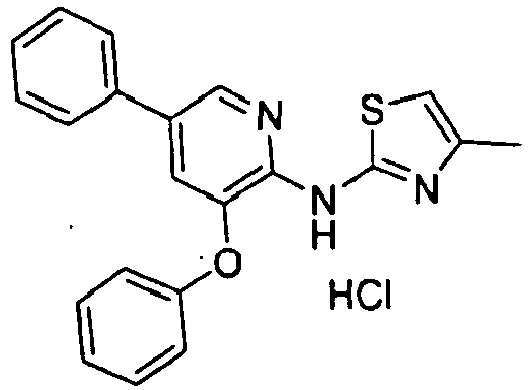
- 5-Chloro-N-(4-methylthiazol-2-yl)-3-phenoxypyridin-2-amine (0.150 g, 0.472 mmol), phenylboronic acid (0.0691 g, 0.566 mmol), Pd(PPh3)4 (0.0545 g, 0.0472 mmol), in DME (10 mL), and 2M Na2CO3 (5 mL) were placed in a round bottom flask, heated to 80 °C and stirred overnight. An extra equivalent of Pd(PPh3)4 (0.0545 g, 0.0472 mmol), and phenylboronic acid (0.0691 g, 0.566 mmol) were added and the reaction mixture was heated for 2 weeks. The reaction mixture was cooled to room temperature and partitioned between DCM and water. The organic layer was dried, filtered, and concentrated. The residue was purified by silica gel chromatography and then by reverse phase chromatography to give N-(4-methylthiazol-2-yl)-3-phenoxy-5-phenylpyridin-2-amine hydrochloride (0.0134 g, 7.17% yield) after salt formation. 1H NMR (d6-DMSO) δ 8.53 (d, 1H), 7.65 (m, 3H), 7.45 (m, 4H), 7.37 (m, 1H), 7.21 (t, 1H), 7.16 (d, 2H), 6.78 (s, 1H), 2.29 (s, 3H); Mass spectrum (apci) m/z = 360.3 (M+H-HCl).
-

- Step A: 3-phenoxypyridin-2-amine: Following the procedure of Example 7 Step A, bromopyridin-2-amine (65.00 g, 375.7 mmol), phenol (106.1 g, 1127 mmol), copper(I) oxide (5.376 g, 37.57 mmol), (E)-2-hydroxybenzaldehyde oxime (20.61 g, 150.3 mmol), cesium carbonate (428.4 g, 1315 mmol), and 3A powdered molecular (30 g) sieves were reacted to provided 3-phenoxypyridin-2-amine (20.50 g, 29.30% yield). 1H NMR (d6-DMSO) δ 7.77 (d, 1H), 7.37 (t, 2H), 7.10 (t, 1H), 7.04 (d, 1H), 6.96 (d, 2H), 6.54 (dd, 1H), 4.76 (bs, 2H); Mass spectrum (apci) m/z = 187.2 (M+H).
- Step B: 5-bromo-3-phenoxypyridin-2-amine: 3-Phenoxypyridin-2-amine (20.50 g, 110.1 mmol) was placed in acetic acid (50 mL) and cooled to 0 °C. Bromine (d 3.12) (7.049 mL, 137.6 mmol) was slowly added and the reaction mixture was stirred for 1 hour. The reaction mixture was poured onto saturated sodium bisulfite and ice and allowed to sit overnight. Solids were removed by filtration and washed with water to give pure 5-bromo-3-phenoxypyridin-2-amine. The filtrate was then extracted with DCM several times, combined, and washed with water. Organic layer was dried, filtered, and concentrated. The residue was purified by silica gel (5-20% EtOAc in hexanes) to give additional 5-bromo-3-phenoxypyridin-2-amine (total yield: 22.69 g, 77.74% yield). 1H NMR (d6-DMSO) δ 7.82 (d, 1H), 7.41 (t, 2H), 7.17 (t, 1H), 7.11 (d, 1H), 7.03 (d, 2H), 6.24 (bs, 2H); Mass spectrum (apci) m/z = 265.3 (M+H).
- Step C: 1-benzoyl-3-(5-bromo-3-phenoxypyridin-2-yl)thiourea: Following the procedure of Example 7 Step C, 5-bromo-3-phenoxypyridin-2-amine (22.69 g, 85.59 mmol) and benzoyl isothiocyanate (15.36 g, 94.15 mmol) were reacted to provided 1-benzoyl-3-(5-bromo-3-phenoxypyridin-2-yl)thiourea (32.8 g, 89.48% yield) as a yellow solid. 1H NMR (d6-DMSO) δ 12.34 (s, 1H), 11.84 (s, 1H), 8.41 (d, 1H), 7.95 (d, 2H), 7.66 (t, 1H), 7.53 (m, 3H), 7.44 (t, 2H), 7.24 (t, 1H), 7.17 (d, 2H); Mass spectrum (apci) m/z = 429.9 (M+H).
- Step D: 1-(5-bromo-3-phenoxypyridin-2-yl)thiourea: Following the method of Example 7 Step D, 1-benzoyl-3-(5-bromo-3-phenoxypyridin-2-yl)thiourea (32.8 g, 76.581 mmol) and 3M NaOH (255.27 mL, 765.81 mmol) were reacted to provide 1-(5-bromo-3-phenoxypyridin-2-yl)thiourea (23.31 g, 93.9% yield) as a yellow solid. 1H NMR (d6-DMSO) δ 9.99 (s, 1H), 9.29 (s, 1H), 8.18 (d, 1H), 7.47 (t, 2H), 7.39 (d, 1H), 7.29 (t, 1H), 7.22 (d, 2H); Mass spectrum (apci) m/z = 325.9 (M+H).
- Step E 5-bromo-N-(4-methylthiazol-2-yl)-3-phenoxypyridin-2-amine: Following the method of Example 7 Step E, 1-chloropropan-2-one (7.9911 g, 86.367 mmol), 1-(5-bromo-3-phenoxypyridin-2-yl)thiourea (20.00 g, 61.691 mmol), and triethylamine (14.617 mL, 104.87 mmol) were reacted to afford 5-bromo-N-(4-methylthiazol-2-yl)-3-phenoxypyridin-2-amine (17.36 g, 77.66% yield). 1H NMR (d6-DMSO) δ 10.90 (bs, 1H), 8.21 (d, 1H), 7.43 (t, 2H), 7.39 (d, 1H), 7.20 (t, 1H), 7.09 (d, 2H), 6.61 (s; 1H), 2.23 (s, 3H); Mass spectrum (apci) m/z = 364.1 (M+H).
-

- 5-Bromo-N-(4-methylthiazol-2-yl)-3-phenoxypyridin-2-amine (0.070 g, 0.1932 mmol), pyridin-3-ylboronic acid (0.02850 g, 0.2319 mmol), Pd(PPh3)4 (0.02233 g, 0.01932 mmol), DME (10 mL), and 2M sodium bicarbonate (2 mL) were combined, heated to 80 °C and stirred overnight. The reaction mixture was cooled and partitioned between DCM and water. The organic layer was dried, filtered, and concentrated. The residue was purified by silica gel chromatography (30-40% EtOAc in hexane) to give N-(4-methylthiazol-2-yl)-3-phenoxy-5-(pyridin-3-yl)pyridin-2-amine. N-(4-methylthiazol-2-yl)-3-phenoxy-5-(pyridin-3-yl)pyridin-2-amine was dissolved in DCM and 2M HCl in ether was added to give N-(4-methylthiazol-2-yl)-3-phenoxy-5-(pyridin-3-yl)pyridin-2-amine dihydrochloride (0.050 g, 59.71% yield). 1H NMR (d6-DMSO) δ 9.19 (d, 1H), 8.78 (dd, 1H), 8.70 (m, 2H), 7.93 (m, 2H), 7.42 (t, 2H), 7.18 (t, 1H), 7.12 (d, 2H), 6.74 (s, 1H), 2.28 (s, 3H); Mass spectrum (apci) m/z = 361.2 (M+H-2HCl).
-

- Following the procedure of Example 11, 5-bromo-N-(4-methylthiazol-2-yl)-3-phenoxypyridin-2-amine (.070 g, 0.1932 mmol), pyridin-4-ylboronic acid (0.02850 g, 0.2319 mmol), Pd(PPh3)4 (0.02233 g, 0.01932 mmol) were reacted to afford N-(4-methylthiazol-2-yl)-3-phenoxy-5-(pyridin-4-yl)pyridin-2-amine dihydrochloride (0.050 g, 59.71% yield). 1H NMR (d6-DMSO) δ 8.96 (d, 1H), 8.86 (d, 2H), 8.05 (d, 1H), 7.42 (t, 2H), 7.17 (t, 1H), 7.17 (t, 1H), 7.10 (d, 2H), 6.73 (s, 1H), 2.26 (s, 3H); Mass spectrum (apci) m/z = 361.3 (M+H-2HCl).
-

- A 25 mL round-bottomed flask was charged with 5-bromo-N-(4-methylthiazol-2-yl)-3-phenoxypyridin-2-amine (350 mg, 0.966 mmol), Pd2dba3 (22.1 mg, 0.024 mmol), 4,5-bis(diphenylphosphino)-9,9-dimethyl-9H-xanthene (27.9 mg, 0.048 mmol), N-ethyl-N-isopropylpropan-2-amine (0.33 mL, 1.9 mmol), methyl 3-mercaptopropanoate (0.12 mL, 1.1 mmol), and dioxane (10 mL). The reaction mixture was heated to 100 °C under nitrogen for 2 hours. The reaction mixture was cooled to room temperature, filtered and concentrated. The residue was purified by silica gel chromatography (40% EtOAc in hexanes) to afford methyl 3-(6-(4-methylthiazol-2-ylamino)-5-phenoxypyridin-3-ylthio)propanoate (328 mg, 84.5% yield) as a pale yellow solid. HCl salt made for characterization. 1H NMR (d6-DMSO) δ 8.18 (d, 1H), 7.45 (m, 2H), 7.36 (d, 1H), 7.22 (t, 1H), 7.13 (d, 2H), 6.79 (s, 1H), 3.55 (s, 3H), 3.07 (t, 2H), 2.57 (t, 2H), 2.29 (s, 3H); Mass spectrum (esi) m/z = 402.2 (100)(M+H-HCl).
-

- Following the procedure of Example 13, 5-bromo-N-(4-methylthiazol-2-yl)-3-phenoxypyridin-2-amine (70 mg, 0.19 mmol), 4,5-bis(diphenylphosphino)-9,9-dimethyl-9H-xanthene (5.6 mg, 0.009 mmol), Pd2dba3 (4.4 mg, 0.004 mmol), N-ethyl-N-isopropylpropan-2-amine (0.067 mL, 0.38 mmol), cyclohexanethiol (0.026 mL, 0.21 mmol) and dioxane (2 mL) were reacted to afford 5-(cyclohexylthio)-N-(4-methylthiazol-2-yl)-3-phenoxypyridin-2-amine hydrochloride (61.4 mg, 73.2% yield) as a white solid after HCl salt formation. 1H NMR (d6-DMSO) δ 8.17 (d, 1H), 7.45 (m, 2H), 7.30 (d, 1H), 7.22 (t, 1H), 7.13 (m, 2H), 6.80 (s, 1H), 3.08 (m, 1H), 2.29 (s, 3H), 1.82 (m, 2H), 1.66 (m, 2H), 1.52 (m, 1H), 1.23 (m, 5H); Mass spectrum (esi) m/z = 398.2 (100)(M+H-HCl).
-

- Following the procedure of Example 13, 5-bromo-N-(4-methylthiazol-2-yl)-3-phenoxypyridin-2-amine (70 mg, 0.19 mmol), 4,5-bis(diphenylphosphino)-9,9-dimethyl-9H-xanthene (5.6 mg, 0.009 mmol), Pd2dba3 (4.4 mg, 0.004 mmol), N-ethyl-N-isopropylpropan-2-amine (0.067 mL, 0.38 mmol), phenylmethanethiol (0.025 mL, 0.21 mmol) and dioxane (2 mL) were reacted to afford 5-(benzylthio)-N-(4-methylthiazol-2-yl)-3-phenoxypyridin-2-amine hydrochloride (79.4 mg, 92.9% yield) as a white solid after HCl salt formation. 1H NMR (d6-DMSO) δ 8.08 (d, 1H), 7.42 (m, 2H), 7.28-7.15 (m, 7H), 6.98 (m, 2H), 6.74 (s, 1H), 4.12 (s, 2H), 2.27 (s, 3H); Mass spectrum (esi) m/z = 406.2 (100) (M+H-HCl).
-

- A 20 mL vial was charged with methyl 3-(6-(4-methylthiazol-2-ylamino)-5-phenoxypyridin-3-ylthio)propanoate (135.8 mg, 0.338 mmol) and THF (0.5 mL). 1M KOtBu in THF (1.184 mL, 1.184 mmol) was added and the reaction mixture was stirred at room temperature for 30 seconds. 2-(Bromomethyl)pyridine hydrobromide (85.55 mg, 0.3382 mmol) was added and the reaction mixture was stirred at room temperature for 30 minutes. Saturated aqueous ammonium chloride was added and the reaction mixture was extracted with EtOAc. The concentrated residue was purified on silica gel to afford N-(4-methylthiazol-2-yl)-3-phenoxy-5-(pyridin-2-ylmethylthio)pyridin-2-amine dihydrochloride (98.2 mg, 60.5% yield) as a pale yellow solid after HCl salt formation. 1H NMR (d6-DMSO) δ 8.66 (dd, 1H), 8.22 (td, 1H), 8.12 (d, 1H), 7.70 (t, 1H), 7.62 (d, 1H), 7.45 (m, 2H), 7.23 (t, 1H), 7.16 (d, 1H), 7.06 (m, 2H), 6.82 (m, 1H), 4.42 (s, 2H), 2.29 (s, 3H); Mass spectrum (esi) m/z = 407.2 (100) (M+H-2HCl).
-

- Following the procedure of Example 16, methyl 3-(6-(4-methylthiazol-2-ylamino)-5-phenoxypyridin-3-ylthio)propanoate (147.9 mg, 0.368 mmol), 1M KOtBu in THF (1.3 mL, 1.3 mmol) and tert-butyl 4-(bromomethyl)piperidine-1-carboxylate (102.5 mg, 0.368 mmol) were reacted to afford N-(4-methylthiazol-2-yl)-3-phenoxy-5-(piperidin-4-ylmethylthio)pyridin-2-amine dihydrochloride (121.9 mg, 68.1% yield) as a white solid after HCl salt formation. 1H NMR (d6-DMSO) δ 8.83 (m, 1H), 8.52 (m, 1H), 8.18 (dd, 1H), 7.43 (m, 2H), 7.36 (dd, 1H), 7.20 (td, 1H), 7.10 (m, 2H), 6.72 (s, 1H), 3.57 (d, 1H), 3.21 (m, 2H), 2.86 (m, 2H), 2.79 (m, 2H), 2.26 (s, 3H), 1.87 (m, 2H), 1.67 (m, 1H), 1.35 (m, 2H); Mass spectrum (esi) m/z = 413.1 (100)(M+H-2HCl).
-

- Following the procedure in Example 7, 1-bromobutan-2-one (0.151 g, 1.00 mmol), 1-(5-chloro-3-phenoxypyridin-2-yl)thiourea (0.200 g, 0.715 mmol), triethylamine (0.174 mL, 1.25 mmol), and ethanol (5 mL) were reacted to afford N-(5-chloro-3-phenoxypyridin-2-yl)-4-ethylthiazol-2-amine as a white powder (0.110 g, 46%). Mass spectrum (esi) m/z = 332 (100), 334 (38).
-
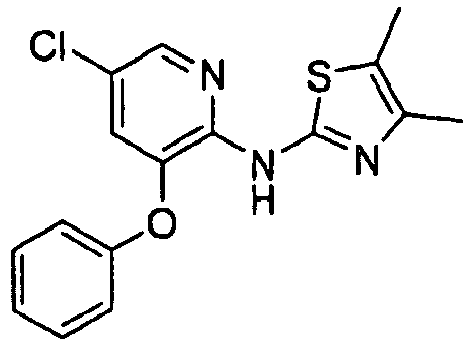
- Following the procedure in Example 7, 3-chlorobutan-2-one (0.160 g, 1.50 mmol), 1-(5-chloro-3-phenoxypyridin-2-yl)thiourea (0.300 g, 1.07 mmol), triethylamine (0.262 mL, 1.88 mmol), and ethanol (5 mL) were reacted to afford N-(5-chloro-3-phenoxypyridin-2-yl)-4,5-dimethylthiazol-2-amine as a white powder (0.356 g, 63%). 1H NMR (d6-DMSO) δ 10.78 (bs, 1H), 8.11 (s, 1H), 7.42 (t, 2H), 7.29 (s, 1H), 7.19 (t, 1H), 7.09 (d, 2H), 2.22 (s, 3H), 2.12 (s, 3H); Mass spectrum (esi) m/z = 332 (100), 334 (38).
-

- Following the procedure in Example 7, 1-chloro-4-methylpentan-2-one (0.202 g, 1.50 mmol), 1-(5-chloro-3-phenoxypyridin-2-yl)thiourea (0.300 g, 1.07 mmol), triethylamine (0.262 mL, 1.88 mmol), and ethanol (5 mL) were reacted to afford N-(5-chloro-3-phenoxypyridin-2-yl)-4-isobutylthiazol-2-amine as a white powder (0.125 g, 32%). 1H NMR (d6-DMSO) δ 10.89 (bs, 1H), 8.15 (s, 1H), 7.43 (t, 2H), 7.31 (s, 1H), 7.20 (t, 1H), 7.11 (d, 2H), 6.61 (s, 1H), 2.42 (d, 2H), 1.98 (m, 1H), 0.88 (d, 6H); Mass spectrum (esi) m/z = 360 (100), 362 (37).
-

- Following the procedure in Example 7, 1-chlorohexan-2-one (0.135 g, 1.00 mmol), 1-(5-chloro-3-phenoxypyridin-2-yl)thiourea (0.200 g, 0.715 mmol), triethylamine (0.174 mL, 1.25 mmol), and ethanol (5 mL) were reacted to afford 4-butyl-N-(5-chloro-3-phenoxypyridin-2-yl)thiazol-2-amine as a white powder (0.257 g, 50%). 1H NMR (d6-DMSO) δ 10.89 (bs, 1H), 8.15 (s, 1H), 7.42 (t, 2H), 7.32 (s, 1H), 7.21 (t, 1H), 7.10 (d, 2H), 6.61 (s, 1H), 2.56 (t, 2H), 1.59 (m, 2H), 1.31 (m, 2H), 0.87 (t, 3H); Mass spectrum (esi) m/z = 360 (100), 362 (37).
-

- Following the procedure in Example 7, 2-bromo-1-cyclopropylethanone (0.163 g, 1.00 mmol), 1-(5-chloro-3-phenoxypyridin-2-yl)thiourea (0.200 g, 0.715 mmol), triethylamine (0.174 mL, 1.25 mmol), and ethanol (5 mL) were reacted to afford N-(5-chloro-3-phenoxypyridin-2-yl)-4-cyclopropylthiazol-2-amine as a white powder (0.195 g, 79%). 1H NMR (d6-DMSO) δ 10.82 (bs, 1H), 8.15 (s, 1H), 7.43 (t, 2H), 7.31 (s, 1H), 7.21 (t, 1H), 7.10 (d, 2H), 6.64 (s, 1H), 1.94 (m, 1H), 0.72-0.85 (m, 4H); Mass spectrum (esi) m/z = 344 (100), 346 (37).
-
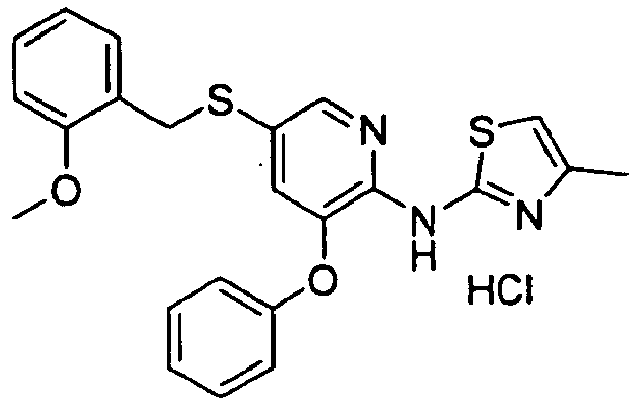
- Following the procedure in Example 16, methyl 3-(6-(4-methylthiazol-2-ylamino)-5-phenoxypyridin-3-ylthio)propanoate (0.300 g, 0.747 mmol), 1M potassium 2-methylpropan-2-olate (2.62 mL, 2.62 mmol), and 1-(chloromethyl)-2-methoxybenzene (0.117 g, 0.747 mmol) were reacted to provide 5-(2-methoxybenzylthio)-N-(4-methylthiazol-2-yl)-3-phenoxypyridin-2-amine hydrochloride (0.237 g, 72.8%) after HCl salt formation. 1H NMR (d6-DMSO) δ 8.05 (d, 1H), 7.43 (t, 2H), 7.21 (q, 2H), 7.11 (d, 1H), 7.01 (m, 3H), 6.93 (d, 1H), 6.80 (t, 1H), 6.69 (s, 1H), 4.01 (s, 2H), 3.68 (s, 3H), 2.26 (s, 3H); Mass spectrum (apci) m/z = 436.2 (M+H-HCl).
-

- Following the procedure of Example 16, 3-(6-(4-methylthiazol-2-ylamino)-5-phenoxypyridin-3-ylthio)propanoate (0.125 g, 0.311 mmol), 1M potassium 2-methylpropan-2-olate (1.09 mL, 1.09 mmol), and 1-(chloromethyl)-4-methoxybenzene (0.0488 g, 0.311 mmol) were reacted to provide 5-(4-methoxybenzylthio)-N-(4-methylthiazol-2-yl)-3-phenoxypyridin-2-amine hydrochloride (0.098 g, 72.3%) after HCl salt formation. 1H NMR (d6-DMSO) δ 8.09 (d, 1H), 7.42 (t, 2H), 7.21 (t, 1H), 7.14 (d, 1H), 7.10 (d, 2H), 7.00 (d, 2H), 6.81 (d, 2H), 6.75 (s, 1H), 4.06 (s, 2H), 3.71 (s, 3H), 2.27 (s, 3H); Mass spectrum (apci) m/z = 436.2 (M+H-HCl).
-

- Following the procedure of Example 16, 3-(6-(4-methylthiazol-2-ylamino)-5-phenoxypyridin-3-ylthio)propanoate (0.100 g, 0.249 mmol), 1M potassium 2-methylpropan-2-olate (0.872 mL, 0.872 mmol), and 1-(bromomethyl)-2-chlorobenzene (0.0512 g, 0.249 mmol) were reacted to provide 5-(2-chlorobenzylthio)-N-(4-methylthiazol-2-yl)-3-phenoxypyridin-2-amine hydrochloride (0.073 g, 61.5%) after HCl salt formation. 1H NMR (d6-DMSO) δ 8.09 (d, 1H), 7.42 (m, 3H), 7.27 (dt, 1H), 7.18 (m, 3H), 7.08 (d, 1H), 7.00 (d, 2H), 6.71 (s, 1H), 4.15 (s, 2H), 2.26 (s, 3H); Mass spectrum (apci) m/z = 440.1 (M+H-HCl).
-

- Following the procedure of Example 16, methyl 3-(6-(4-methylthiazol-2-ylamino)-5-phenoxypyridin-3-ylthio)propanoate (0.100 g, 0.249 mmol), 1M potassium 2-methylpropan-2-olate (0.872 mL, 0.872 mmol), and 1-(1-bromoethyl)benzene (0.0461 g, 0.249 mmol) were reacted to provide N-(4-methylthiazol-2-yl)-3-phenoxy-5-(1-phenylethylthio)pyridin-2-amine hydrochloride (0.058 g, 51.1%). 1H NMR (d6-DMSO) δ 8.05 (d, 1H), 7.42 (t, 2H), 7.22 (m, 6H), 7.03 (d, 1H), 6.94 (d, 2H), 6.73 (s, 1H), 4.43 (q, 1H), 2.26 (s, 3H), 1.51 (d, 3H); Mass spectrum (apci) m/z = 420.1 (M+H-HCl).
-

- Following the procedure of Example 13, 3-bromo-N-(4-methylthiazol-2-yl)pyridin-2-amine (100 mg, 0.370 mmol), 4,5-bis(diphenylphosphino)-9,9-dimethyl-9H-xanthene (10.7 mg, 0.018 mmol), Pd2dba3 (8.4 mg, 0.009 mmol), benzenethiol (0.041 mL, 0.40 mmol), N-ethyl-N-isopropylpropan-2-amine (0.129 mL, 0.74 mmol) and dioxane (3 mL) were reacted to provide N-(4-methylthiazol-2-yl)-3-(phenylthio)pyridin-2-amine hydrochloride (24.1 mg, 19.4%) as a white solid after HCl salt formation. 1H NMR (d6-DMSO) δ 8.42 (m, 1H), 7.90 (m, 1H), 7.41-7.25 (m, 5H), 7.12 (m, 1H), 6.74 (m, 1H), 2.25 (s, 3H); Mass spectrum (esi) m/z = 300.2 (100)(M+H-HCl).
-

- Following the procedure of Example 13, 3-bromo-N-(4-methylthiazol-2-yl)pyridin-2-amine (70 mg, 0.25 mmol), 4,5-bis(diphenylphosphino)-9,9-dimethyl-9H-xanthene (7.5 mg, 0.013 mmol), Pd2dba3 (5.9 mg, 0.006 mmol), N-ethyl-N-isopropylpropan-2-amine (0.090 mL, 0.51 mmol), 2-chlorobenzenethiol (0.029 mL, 0.25 mmol) and dioxane (3 mL) were reacted to provide 3-(2-chlorophenylthio)-N-(4-methylthiazol-2-yl)pyridin-2-amine hydrochloride (69.2 mg, 72.1%) as a white solid after HCl salt formation. 1H NMR (d6-DMSO) δ 8.45 (m, 1H), 7.80 (bs, 1H), 7.57 (m, 1H), 7.27 (m, 2H), 7.07 (m, 1H), 6.84 (m, 1H), 6.62 (m, 1H), 2.21 (s, 3H); Mass spectrum (esi) m/z = 334.2 (100)(M+H-HCl).
-

- Following the procedure of Example 13, 3-bromo-N-(4-methylthiazol-2-yl)pyridin-2-amine (70 mg, 0.25 mmol), 4,5-bis(diphenylphosphino)-9,9-dimethyl-9H-xanthene (7.5 mg, 0.013 mmol), Pd2dba3 (5.9 mg, 0.006 mmol), N-ethyl-N-isopropylpropan-2-amine (0.090 mL, 0.51 mmol), 3-methoxybenzenethiol (0.0321 mL, 0.259 mmol) and dioxane (3 mL) were reacted to provide 3-(3-methoxyphenylthio)-N-(4-methylthiazol-2-yl)pyridin-2-amine hydrochloride (74.1 mg, 78.2%) as a white solid after HCl salt formation. 1H NMR (d6-DMSO) δ 8.43 (d, 1H), 7.92 (bs, 1H), 7.27 (m, 1H), 7.12 (m, 1H), 6.86 (m, 2H), 6.80 (d, 1H), 6.72 (s, 1H), 3.72 (s, 3H), 2.25 (s, 3H).
-

- Following the procedure of Example 13, 3-bromo-N-(4-methylthiazol-2-yl)pyridin-2-amine (70 mg, 0.25 mmol), 4,5-bis(diphenylphosphino)-9,9-dimethyl-9H-xanthene (7.5 mg, 0.013 mmol), Pd2dba3 (5.9 mg, 0.006 mmol), N-ethyl-N-isopropylpropan-2-amine (0.090 mL, 0.51 mmol), methyl 2-mercaptobenzoate (0.035 mL, 0.25 mmol) and dioxane (3 mL) were reacted to provide methyl 2-(2-(4-methylthiazol-2-ylamino)pyridin-3-ylthio)benzoate hydrochloride (86.0 mg, 84.3%) as a tan solid after HCl salt formation. 1H NMR (d6-DMSO) δ 8.54 (d, 1H), 8.07 (s, 1H), 8.01 (dd, 1H), 7.41 (m, 1H), 7.28 (m, 1H), 7.19 (m, 1H), 6.73 (m, 1H), 6.61 (d, 1H), 3.92 (s, 3H), 2.21 (s, 3H).
-

- Following the procedure of Example 13, 3-bromo-N-(4-methylthiazol-2-yl)pyridin-2-amine (70 mg, 0.25 mmol), 4,5-bis(diphenylphosphino)-9,9-dimethyl-9H-xanthene (7.5 mg, 0.013 mmol), Pd2dba3 (5.9 mg, 0.006 mmol), N-ethyl-N-isopropylpropan-2-amine (0.090 mL, 0.51 mmol), cyclopentanethiol (0.027 mL, 0.25 mmol) and dioxane (3 mL) were reacted to provide 3-(cyclopentylthio)-N-(4-methylthiazol-2-yl)pyridin-2-amine hydrochloride (44.2 mg, 52.0%) as a white solid after HCl salt formation. 1H NMR (d6-DMSO) δ 8.39 (d, 1H), 8.05 (d, 1H), 7.18 (dd, 1H), 6.89 (s, 1H), 3.64 (m, 1H), 2.33 (s, 3H), 1.95 (m, 2H), 1.75 (m, 2H), 1.53 (m, 4H); Mass spectrum (esi) m/z = 292.1 (100)(M+H-HCl).
-
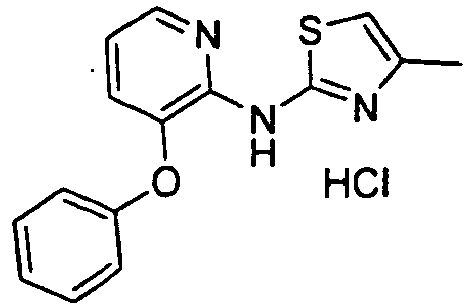
- Following the procedure of Example 8, 5-bromo-N-(4-methylthiazol-2-yl)-3-phenoxypyridin-2-amine (0.125 g, 0.345 mmol), MeLi (0.270 mL, 0.431 mmol), and butyllithium (0.0221 g, 0.345 mmol) were reacted to provide N-(4-methylthiazol-2-yl)-3-phenoxypyridin-2-amine (0.068 g, 69.5%) after reverse phase purification. 1H NMR (d6-DMSO) δ 8.20 (d, 1H), 7.46 (t, 2H), 7.39 (d, 1H), 7.24 (t, 1H), 7.15 (m, 3H), 6.89 (s, 1H), 2.33 (s, 3H); Mass spectrum (apci) m/z = 284.2 (M+H-HCl).
-

- Step A: Preparation of 2-(1-bromoethyl)pyridine: 2-Ethylpyridine (20.0 g, 186.65 mmol) was placed in carbon tetrachloride (830 mL) and benzoyl peroxide (4.5211 g, 18.665 mmol) and 1-bromopyrrolidine-2,5-dione (33.221 g, 186.65 mmol) were added. The reaction mixture was heated to reflux for 18 hours, then cooled to room temperature and filtered. The filtrate was concentrated and the. residue was purified over a plug of silica to give 2-(1-bromoethyl)pyridine (17.312 g, 49.9%). 1H NMR (CDCl3) δ 8.58 (d, 1H), 7.69 (td, 1H), 7.76 (d, 1H), 7.20 (dd, 1H), 5.24 (q, 1H), 2.08 (d, 3H)
- Step B: Preparation of N-(4-methylthiazol-2-yl)-3-phenoxy-5-(1-(pyridin-2-yl)ethylthio)pyridin-2-amine dihydrochloride: Following the procedure in Example 16, methyl 3-(6-(4-methylthiazol-2-ylamino)-5-phenoxypyridin-3-ylthio)propanoate (0.325 g, 0.809 mmol), 1M potassium 2-methylpropan-2-olate (2.83 mL, 2.83 mmol), and 2-(1-bromoethyl)pyridine (0.151 g, 0.809 mmol) were reacted to provide N-(4-methylthiazol-2-yl)-3-phenoxy-5-(1-(pyridin-2-yl)ethylthio)pyridin-2-amine hydrochloride (0.114 g, 30.8%) after reverse phase purification and HCl salt formation. 1H NMR (d6-DMSO) δ 8.58 (d, 1H), 8.09 (m, 1H), 8.04 (d, 1H), 7.58 (d, 2H), 7.45 (t, 2H), 7.23 (t, 1H), 7.02 (d, 2H), 6.95 (d, 1H); 6.79 (s, 1H), 4.67 (q, 1H), 2.28 (s, 3H), 1.62 (d, 3H); Mass spectrum (esi) m/z = 421.1 (M+H-2HCl).
-

- Following the procedure of Example 16, methyl 3-(6-(4-methylthiazol-2-ylamino)-5-phenoxypyridin-3-ylthio)propanoate (0.300 g, 0.747 mmol), 1M potassium 2-methylpropan-2-olate (2.62 mL, 2.62 mmol), and 1-(chloromethyl)-3-methoxybenzene (0.117 g, 0.747 mmol) were reacted to provide 5-(3-methoxybenzylthio)-N-(4-methylthiazol-2-yl)-3-phenoxypyridin-2-amine hydrochloride (0.218 g, 67.0%) after HCl salt formation. 1H NMR (d6-DMSO) δ 8.09 (d, 1H), 7.42 (t, 2H), 7.18 (m, 3H), 6.98 (d, 2H), 6.76 (m, 4H), 4.09 (s, 2H), 3.68 (s, 3H), 2.26 (s, 3H); Mass spectrum (esi) m/z = 436.2 (M+H-1HCl).
-

- 2-(4-Methylthiazol-2-ylamino)pyridin-3-ol (0.250 g, 1.21 mmol) and Cs2CO3 (1.18 g, 3.62 mmol) in were added to DMF (3 mL). 3-Bromocyclohex-1-ene (0.216 g, 1.21 mmol) was added, and the reaction mixture was stirred for 3 hours. Water was added and the reaction mixture was extracted with ether. The organic layer was dried, filtered, and concentrated. The residue was purified by silica gel chromatography provide 3-(cyclohex-2-enyloxy)-N-(4-methylthiazol-2-yl)pyridin-2-amine (0.130 g, 37.5%). 1H NMR (d6-DMSO) δ 9.53 (s, 1H), 7.85 (dd, 1H), 7.41 (d, 1H), 6.90 (dd, 1H), 6.58 (s, 1H), 6.00 (m, 1H), 6.88 (m, 1H), 6.88 (m, 1H), 4.99 (m, 1H), 2.24 (s, 3H), 2.05 (m, 2H), 1.87 (m, 3H), 1.62 (m, 1H); Mass spectrum (apci) m/z = 288.0 (M+H).
-

- 3-(Cyclohex-2-enyloxy)-N-(4-methylthiazol-2-yl)pyridin-2-amine (0.115 g, 0.400 mmol) and 4-methylbenzenesulfonohydrazide (1.12 g, 6.00 mmol) were placed in dimethoxyethane (5 mL). NaOAc (0.492 g, 6.00 mmol) was dissolved in water (2 mL) and added to the above solution and refluxed. Additional 4-methylbenzenesulfonohydrazide (1.12 g, 6.00 mmol) was added and the reaction mixture was refluxed overnight. An aqueous work up was done and the crude material was purified by silica gel chromatography to provide 3-(cyclohexyloxy)-N-(4-methylthiazol-2-yl)pyridin-2-amine (0.064 g, 55.3%) after HCl salt formation. 1H NMR (d6-DMSO) δ 7.79 (d, 1H), 7.57 (d, 1H), 7.09 (m, 1H), 6.83 (s, 1H), 4.54 (m, 1H), 2.32 (s, 3H), 1.97 (m, 2H), 1.79, (m, 2H), 1.57 (m, 3H), 1.36 (m, 3H); Mass spectrum (apci) m/z = 291.1 (M+H-HCl).
-

- Following the method of Example 35, 2-(4-methylthiazol-2-ylamino)pyridin-3-ol (0.075 g, 0.362 mmol), Cs2CO3 (0.354 g, 1.09 mmol), and iodocyclopentane (0.0709 g, 0.362 mmol) were reacted to provide 3-(cyclopentyloxy)-N-(4-methylthiazol-2-yl)pyridin-2-amine hydrochloride (0.0165 g, 16.6%) after HCl salt formation. 1H NMR (d6-DMSO) δ 7.92 (d, 1H), 7.46 (d, 1H), 7.08 (dd, 1H), 6.80 (s, 1H), 5.49 (m, 1H), 2.32 (s, 3H), 1.88 (m, 6H), 1.60 (m, 2H); Mass spectrum (apci) m/z = 276.1 (M+H-HCl).
-

- A nitrogen purged 25 mL round-bottomed flask was charged with methyl 3-(6-(4-methylthiazol-2-ylamino)-5-phenoxypyridin-3-ylthio)propanoate (0.150 g, 0.374 mmol) and THF (5 mL,) and the reaction mixture was purged with nitrogen. Potassium 2-methylpropan-2-olate (1M, 1.87 mL, 1.87 mmol) was added and the reaction mixture was stirred at room temperature for 30 seconds. 3-Chloro-N,N-dimethylpropan-1-amine hydrochloride (0.177 g, 1.12 mmol) was added and the reaction mixture was heated to 50 °C and stirred for 30 minutes The reaction mixture was poured onto saturated aqueous NH4Cl and extracted with 5% MeOH in dichloromethane. The organic layer was dried over sodium sulfate, filtered, and concentrated in vacuo. The residue was purified by silica gel chromatography (0-5% MeOH in dichloromethane) to provide 5-(3-(dimethylamino)propylthio)-N-(4-methylthiazol-2-yl)-3-phenoxypyridin-2-amine dihydrochloride (0.049 g, 27.7%) following HCl salt formation. 1H NMR (d6-DMSO) δ 9.90 (s, 1H), 8.21 (d, 1H), 7.43 (t, 2H), 7.39 (d, 1H), 7.18 (t, 1H), 7.08 (d, 2H), 6.67 (s, 1H), 3.10 (m, 2H), 2.92 (t, 2H), 2.72 (d, 6H), 2.24 (s, 3H), 1.85 (m, 2H); Mass spectrum (apci) m/z = 401.2 (M+H-2HCl).
-

- Step A: Preparation of 3-(5-bromo-2-chlorophenoxy)pyridin-2-amine: 4-Bromo-1-chloro-2-fluorobenzene (13.69 g, 65.36 mmol) was added to a mixture of sodium hydride (1.725 g, 71.90 mmol) in DMF (20 mL) and stirred for 10 minutes. 4-Bromo-1-chloro-2-fluorobenzene (13.69 g, 65.36 mmol) was added and the reaction mixture was stirred at 100 °C for 38 hours. The reaction mixture was cooled to room temperature and partition between 1N NaOH and ether. The organic layer was dried over sodium sulfate, filtered, and concentrated in vacuo. The residue was triturated with hexanes to give 3-(5-bromo-2-chlorophenoxy)pyridin-2-amine (11.30 g, 57.7%) as a yellow solid. 1H NMR (CDCl3) δ 7.92 (dd, 1H), 7.34 (d, 1H), 7.23 (dd, 1H), 7.06 (d, 1H), 6.99 (dd, 1H), 6.66 (dd, 1H), 4.74 (bs, 2H); Mass spectrum (apci) m/z = 301.1 (M+H).
- Step B: Preparation of ethyl 3-(2-aminopyridin-3-yloxy)-4-chlorobenzoate: 3-(5-Bromo-2-chlorophenoxy)pyridin-2-amine (11.30 g, 37.72 mmol), triethylamine (3.817 g, 37.72 mmol), Pd(OAc)2 (0.8469 g, 3.772 mmol), and triphenylphosphine (0.9894 g, 3.772 mmol) were added to ethanol (100 mL) in a bomb. The bomb was pressurized with 100 psi CO and heated to 100 °C for 4 hours. The reaction mixture was cooled to room temperature and filtered. Dichloromethane was added and solids were filtered off. The filtrate was washed with water. The organic layer was dried over sodium sulfate, filtered, and concentrated. The residue was purified by silica gel chromatography to give ethyl 3-(2-aminopyridin-3-yloxy)-4-chlorobenzoate (7.555 g, 68.42%). 1H NMR (d6-DMSO) δ 7.84 (dd, 1H), 7.72 (m, 2H), 7.30 (d, 1H), 7.07 (dd, 1H), 6.56 (dd, 1H), 6.04 (s, 2H), 4.28 (q, 2H), 1.26 (t, 3H); Mass spectrum (apci) m/z = 293.1 (M+H).
- Step C: Preparation of ethyl 3-(2-amino-5-bromopyridin-3-yloxy)-4-chlorobenzoate: Following the method of Example 10, Step B, ethyl 3-(2-aminopyridin-3-yloxy)-4-chlorobenzoate (7.555 g, 25.81 mmol) and bromine (1.983 mL, 38.71 mmol) were reacted to provide ethyl 3-(2-amino-5-bromopyridin-3-yloxy)-4-chlorobenzoate (9.645 g, 100%). 1H NMR (d6-DMSO) δ 7.95 (d, 1H), 7.84 (dd, 1H), 7.80 (d, 1H), 7.63 (d, 1H), 7.32(d, 1H), 4.31 (q, 2H), 1.30 (t, 3H); Mass spectrum (apci) m/z = 373.0 (M+H).
- Step D: Preparation of ethyl 3-(2-(3-benzoylthioureido)-5-bromopyridin-3-yloxy)-4-chlorobenzoate: Ethyl 3-(2-amino-5-bromopyridin-3-yloxy)-4-chlorobenzoate (9.645 g, 25.95 mmol) and benzoyl isothiocyanate (4.659 g, 28.55 mmol) were placed in THF (250 mL) and the reaction mixture was stirred at room temperature for 18 hours, then heated at 55 °C for two days. THF was removed and the residue was purified by silica gel chromatography (5-25% EtOAc in hexane) to provide ethyl 3-(2-(3-benzoylthioureido)-5-bromopyridin-3-yloxy)-4-chlorobenzoate (7.08 g, 51.0%) as a yellow solid. 1H NMR (d6-DMSO) δ 12.38 (s, 1H), 11.86 (s, 1H), 8.47 (d, 1H), 7.96 (d, 2H), 7.82 (m, 2H), 7.77 (m, 1H), 7.72 (d, 1H), 7.66 (t, 1H), 7.53 (t, 2H), 4.30 (q, 2H), 1.26 (t, 3H); Mass spectrum (apci) m/z = 356.0 (M+H).
- Step E: Preparation of ethyl 3-(5-bromo-2-thioureidopyridin-3-yloxy)-4-chlorobenzoate: Ethyl 1 3-(2-(3-benzoylthioureido)-5-bromopyridin-3-yloxy)-4-chlorobenzoate (8.05 g, 15.1 mmol) and K2CO3 (10.4 g, 75.3 mmol) were placed in ethanol (150 mL) and heated to reflux for 2 days and then cooled. The reaction mixture was filtered and the filtrate was concentrated, triturated with water, and dried. The remaining solid was dissolved in DCM and purified by silica gel chromatography to give ethyl 3-(5-bromo-2-thioureidopyridin-3-yloxy)-4-chlorobenzoate (1.70 g, 26.2% yield). 1H NMR (d6-DMSO) δ 9.96 (s, 1H), 9.25 (s, 1H), 9.13 (s, 1H), 8.20 (d, 1H), 7.87 (d, 1H), 7.86 (d, 1H), 7.82 (d, 1H), 7.46 (d, 1H), 4.32 (q, 2H), 1.31 (t, 3H).
- Step F: Ethyl 3-(5-bromo-2-(4-methylthiazol-2-ylamino)pyridin-3-yloxy)-4-chlorobenzoate: 1-chloropropan-2-one (0.469 g, 5.07 mmol), ethyl 3-(5-bromo-2-thioureidopyridin-3-yloxy)-4-chlorobenzoate (1.680 g, 3.39 mmol), triethylamine (0.671 g, 6.63 mmol), and ethanol (70 mL) were reacted according to the method of Example 10, Step E, to provide ethyl 3-(5-bromo-2-(4-methylthiazol-2-ylamino)pyridin-3-yloxy)-4-chlorobenzoate (1.40 g, 77% yield). 1H NMR (d6-DMSO) δ 8.26 (d, 1H), 7.78 (m, 2H), 7.50 (s, 1H), 7.46 (d, 1H), 6.59 (s, 1H), 4.29 (q, 2H), 2.23 (s, 3H), 1.28 (t, 3H); Mass spectrum (apci) m/z = 470.1 (M+H).
- Following the method of Example 10, utilizing the appropriate phenol and appropriate 1-chloroketone or 1-bromoketone, the following compounds can be prepared.

Examples R2 R13 40 Ph Et 41 Ph iPr 42 Ph CH2CH2COOMe 43 Ph-(3-OCH2CH2NMe2) Me 44 3-pyridyl Me 45 1-naphthyl CH2CH2COOMe -

- Step A: Preparation of 3-(phenylthio)pyridin-2-amine: A mixture of 3-bromopyridin-2-amine (167 mg, 0.966 mmol), Pd2dba3 (22.1 mg, 0.024 mmol), 4,5-bis(diphenylphosphino)-9,9-dimethyl-9H-xanthene (27.9 mg, 0.048 mmol), N-ethyl-N-isopropylpropan-2-amine (0.33 mL, 1:9 mmol), thiophenol (121 mg, 1.1 mmol), and dioxane (10 mL) was heated at 100 °C under nitrogen for 2 hours. The reaction mixture was cooled to room temperature, filtered and concentrated. The reaction mixture was purified via MPLC to afford 3-(phenylthio)pyridin-2-amine.
- Step B: Preparation of 5-bromo-3-(phenylthio)pyridin-2-amine: 3-(phenylthio)pyridin-2-amine (2.22 g, 11.0 mmol) and acetic acid (5 mL) were combined and cooled to 0 °C. Bromine (0.70 mL, 13.8 mmol) was slowly added and the reaction mixture was stirred for 1 hour. The reaction mixture was poured into saturated sodium bisulfite and ice and allowed to sit overnight. The reaction mixture was extracted with dichloromethane several times. The organic layers were combined and washed with water, brine, dried and concentrated. The residue was purified by MPLC (Biotage) to give 5-bromo-3-(phenylthio)pyridin-2-amine.
- Step C: Preparation of N-(5-bromo-3-(phenylthio)pyridin-2-ylcarbamothioyl)benzamide: Following the method of Example 7, Step C, 5-bromo-3-(phenylthio)pyridin-2-amine and benzoyl isothiocyanate were reacted to provide N-(5-bromo-3-(phenylthio)pyridin-2-ylcarbamothioyl)benzamide.
- Step D: Preparation of 1-(5-bromo-3-(phenylthio)pyridin-2-yl)thiourea: Following the method of Example 7, Step D, N-(5-bromo-3-(phenylthio)pyridin-2-ylcarbamothioyl)benzamide and 3M NaOH were reacted to provide 1-(5-bromo-3-(phenylthio)pyridin-2-yl)thiourea.
- Step E: N-(5-bromo-3-(phenylthio)pyridin-2-yl)-4-methylthiazol-2-amine: Following the method of Example 7 Step E, 1-chloropropan-2-one, 1-(5-bromo-3-(phenylthio)pyridin-2-yl)thiourea, and triethylamine, were reacted to provide N-(5-bromo-3-(phenylthio)pyridin-2-yl)-4-methylthiazol-2-amine.
- Using the procedure of Example 46, the following compounds can be prepared, utilizing the appropriate thiol and appropriate 1-chloroketone or 1-bromoketone.

Example R2 R13 47 Ph Et 48 Ph CH2COOEt 49 Ph CH2CH2COOMe 50 cyclopentyl Me 51 2-pyridyl Me 52 4-pyridyl Me 53 3-COOMePh Me 54 
Me 55 
Me 56 
Me - Using the procedures of Example 13 and 16, the following compounds can be prepared, utilizing the appropriate halides and methyl 3-mercaptopropanoate.

Example L R2 R6 R13 57 O Ph-(3-OCH2CH2NMe2) CHMe(2-pyridyl) Me 58 O 3-pyridyl CH2(2-ClPh) CH2CH2COOMe 59 O 3-pyridyl (CH2)3NMe2 Me 60 O Ph (CH2)3NMe2 Et 61 S 3-pyrrolidinyl-NHC(=O)CH3 (CH2)3NMe2 iPr 62 S cyclopentyl (CH2)3COOR8 Et 63 S Ph CHMe(2-pyridyl) CH2CH2COOMe - Using the procedure of Example 11, the following compounds can be prepared, utilizing the appropriate starting halides and boronic acids.

Example L R2 R3 R13 64 S Ph 2-pyridyl Me 65 S Ph Ph CH2CH2COOMe 66 S Ph Ph Me -

- N-(5-Bromo-3-phenoxypyridin-2-yl)-4-methylthiazol-2-amine (2.66 mmol) is dissolved in THF (30 mL) and cooled to -78°C. MeLi (2.07 mL, 3.32 mmol) is slowly added and the reaction mixture is stirred for 10 minutes. n-Butyllithium (1.33 mL, 3.32 mmol) is added and the reaction mixture is stirred for 15 minutes. Triisopropylborate (0.613 mL, 2.66 mmol) is added and the reaction mixture is stirred for 30 minutes. The reaction mixture is warmed to 0 °C, and methanol (5 mL), 10% aqueous NaOH (5.1 mL, 12.8 mmol), and 30% aqueous H2O2 (1.27 mL, 13.3 mmol) are added. The reaction mixture is stirred at 0 °C for 1 hour, then purified by silica gel chromatography (10-20% EtOAc in hexanes) to afford 6-(4-methylthiazol-2-ylamino)-5-phenoxypyridin-3-ol.
-
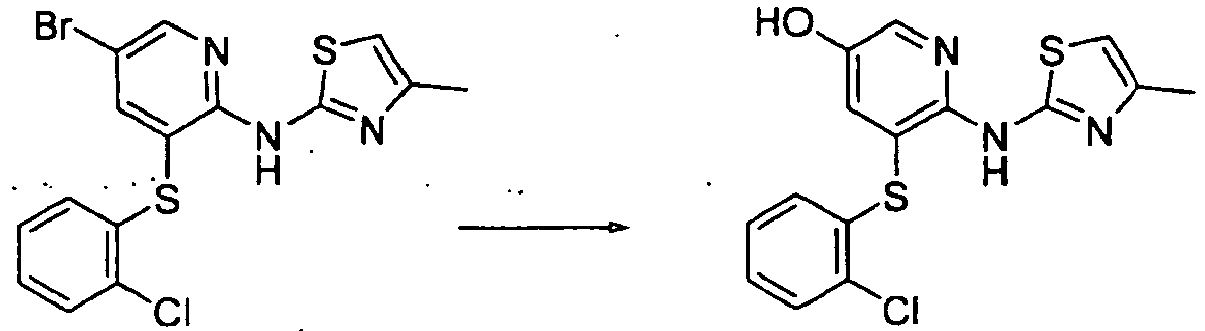
- A degassed mixture of N-(5-bromo-3-(2-chlorophenylthio)pyridin-2-yl)-4-methylthiazol-2-amine (1.10 g, 2.66 mmol), 4,4,4',4',5,5,5',5'-octamethyl-2,2'-bi(1,3,2-dioxaborolane) (1.35 g, 5.32 mmol), Pd(OAc)2 (60 mg, 0.27 mmol), tricyclopentylphosphine (93 mg. 0.40 mmol) and cesium fluoride (3.64 g, 23.9 mmol) in acetonitrile is heated at 90 °C for 5 hours. The reaction mixture is cooled and partitioned between ether and water. The crude product is dissolved in THF. N-morpholine N-oxide (1.40 g, 12.0 mmol) is added and the reaction mixture is heated at reflux for 12 hours. The reaction mixture is cooled and partitioned between ether and water. The organic layer is washed with water and brine, dried and concentrated. The residue is purified by silica gel chromatography, eluting with 10-20% EtOAc in hexanes to afford 5-(2-chlorophenylthio)-6-(4-methylthiazol-2-ylamino)pyridin-3-ol.
- Using the method of Example 68, the following compounds can be prepared, utilizing the appropriate starting bromides.

Example L R2 R13 69 O Ph Et 70 S Ph Me 71 S cyclopentyl Me -

- Iodomethane (0.0362 g, 0.255 mmol) is added to a mixture of 6-(4-methylthiazol-2-ylamino)-5-phenoxypyridin-3-ol (0.255 mmol) and potassium carbonate (0.0794 g, 0.574 mmol) in DMF (3 mL) and stirred overnight at room temperature. The reaction mixture is partitioned between water and ether. The organic layer is washed with water, dried, and concentrated. The residue is purified by silica gel chromatography, eluting with 15-20% EtOAc in hexanes, to afford N-(5-methoxy-3-phenoxypyridin-2-yl)-4-methylthiazol-2-amine.
- Using the procedure in Example 72, the following compounds can be prepared, utilizing the appropriate starting halides and phenols.

Example L R2 R6 R13 73 O Ph CH2Ph Et 74 S Ph CHMe(2-pyridyl) Me 75 S cyclopentyl CHMe(2-pyridyl) Me -

- Step A: N-(5-bromo-3-phenoxypyridin-2-yl)-4-methylthiazol-2-amine (724 mg, 2.00 mmol) is dissolved in THF (20 mL) and cooled to -78 °C. MeLi (1.30 mL, 2.20 mmol) is added slowly, and stir for 10 minutes. n-Butyllithium (0.88 mL, 2.20 mmol) is added and the reaction mixture is stirred for 15 minutes. DMF (0.31 mL, 4.00 mmol) is added, and the reaction mixture is stirred for 30 minutes. The reaction mixture is warmed to room temperature and AcOH (2 mL) is added. The reaction mixture is stirred at room temperature for 1 hour, poured into saturated aqueous sodium bicarbonate and extracted with ethyl acetate. The combined organic layers are dried over sodium sulfate, filtered and concentrated in vacuo. The residue is purified by silica gel (10-20% EtOAc in hexanes) to afford 6-(4-methylthiazol-2-ylamino)-5-phenoxynicotinaldehyde.
- Step B: A 25 mL round-bottomed flask is charged with 6-(4-methylthiazol-2-ylamino)-5-phenoxynicotinaldehyde (311 mg, 1.00 mmol) and THF (10 mL). Methyl(triphenylphosphoranylidene)acetate (500 mg, 1.5 mmol) is added and the reaction mixture is stirred at room temperature. After 4 hours, additional methyl(triphenylphosphoranylidene)acetate (500 mg, 1.5 mmol) is added and the reaction mixture is and stirred overnight. The precipitate is filtered, concentrated, and purified by silica gel chromatography (1:1 EtOAc in hexanes) to afford (E)-methyl 3-(6-(4-methylthiazol-2-ylamino)-5-phenoxypyridin-3-yl)acrylate.
- Step C: A 25 mL round-bottomed flask is charged with (E)-methyl 3-(6-(4-methylthiazol-2-ylamino)-5-phenoxypyridin-3-yl)acrylate (500 mg, 1.36 mmol), 4-methylbenzenesulfonohydrazide (1.27 g, 6.8 mmol), and toluene (15 mL). The reaction mixture is heated at reflux for 12 hours, then cooled to room temperature and concentrated in vacuo. The residue is purified by silica gel (20 to 30% EtOAc in hexanes) to afford methyl 3-(6-(4-methylthiazol-2-ylamino)-5-phenoxypyndin-3-yl)propanoate.
- Using the procedure in Example 76, the following compounds can be prepared, utilizing the appropriate starting bromides and ylides.

Example L R2 R3 R13 77 O Ph CH2CH2(4-piperidinyl) Me 78 S Ph CH2CH2(4-piperidinyl) Et 79 O Ph CH2CH2(4-piperidinyl) i-Pr 80 O Ph CH2CH2(2-pyridinyl) CH2CH2COOMe 81 S Ph CH2CH2(2-pyridinyl) Me 82 O Ph CH2CH(CH3)2 CH2CH2COOMe 83 S cyclopentyl CH2CH(CH3)2 CH2CH2COOMe 84 O 3-pyridyl CH2CH(CH3)2 Me 85 O Ph CH2CH2CO2Me Me 86 S Ph CH2CH2CO2Me Me 87 S cyclopentyl CH2CH2CO2Me Me -

- A 100 mL round bottom flask was charged with methyl 3-(6-(4-methylthiazol-2-ylamino)-5-phenoxypyridin-3-yl)propanoate (1.50 mmol) and ethanol (30 mL) and 1M NaOH (10 mL) were added. The reaction mixture was stirred and heated at 60 °C for 3 hours. The reaction mixture was concentrated and water and 6N HCl (2 mL) were added. The resulting solids were filtered and dried to yield 3-(6-(4-methylthiazol-2-ylamino)-5-phenoxypyridin-3-yl)propanoic acid hydrochloride.
- Using the procedure in Example 88, the following compounds can be prepared, utilizing the appropriate ester starting materials.

Example L R2 R3 R13 89 O Ph SCHMe(2-pyridyl) CH2CH2COOH 90 S Ph Ph CH2CH2COOH 91 S Ph Br CH2COOH 92 O Ph CH2CH2(2-pyridyl) CH2CH2COOH 93 S Ph Br CH2CH2COOH 94 O Ph CH2CH(CH3)2 CH2CH2COOH 95 S cyclopentyl CH2CH(CH3)2 CH2CH2COOH 96 O 3-pyridyl S-CH2(2-ClPh) CH2CH2COOH 97 O Ph CH2CH2CO2H Me 98 S Ph CH2CH2CO2H Me 99 S cyclopentyl CH2CH2CO2H Me -

- A 10 mL round-bottomed flask was charged with 3-bromo-N-(4-methylthiazol-2-yl)pyridin-2-amine (70 mg, 0.26 mmol), Cs2CO3 (250 mg, 0.78 mmol), PdCl2(dppf) (21.2 mg, 0.026 mmol), and DMF (2 mL) and water (0.5 mL). The flask was purged with nitrogen and 9-benzyl-9-bora-bicyclo[3.3.1]nonane (1.5 mL, 0.78 mmol) was added and heated to 60 °C overnight. Additional 9-benzyl-9-bora-bicyclo[3.3.1]nonane (1.5 mL, 0.78 mmol) was added and heated again overnight. The reaction was poured into water and extracted with ether. The organic layer was dried with sodium sulfate, filtered and concentrated in vacuo. The residue was purified on silica gel (10% EtOAc in hexanes) to afford 3-benzyl-N-(4-methylthiazol-2-yl)pyridin-2-amine hydrochloride (41.7 mg, 50.6% yield) as a white solid after HCl salt formation. 1H NMR (d6-DMSO) δ 8.30 (d, 1H), 7.62 (d, 1H), 7.35-7.10 (m, 6H), 6.82 (s, 1H), 4.21 (s, 2H), 2.32 (s, 3H); Mass spectrum (esi) m/z = 282.2 (100)(M+H-HCl).
-

- Step A: A mixture of 3-bromopyridin-2-amine (5.50 g, 31.8 mmol), Pd2dba3 (0.73 g, 0.79 mmol), 4,5-bis(diphenylphosphino)-9,9-dimethyl-9H-xanthene (0.92 g, 1.6 mmol), 2-chlorobenzenethiol (4.3 mL, 38.1 mmol), N-ethyl-N-isopropylpropan-2-amine (11.1 mL, 63.6 mmol) and dioxane (250 mL) was heated to 95 °C under nitrogen overnight. The reaction was cooled to room temperature, filtered and concentrated. The residue was purified on silica gel (30 to 80% EtOAc in hexanes) to afford 3-(2-chlorophenylthio)pyridin-2-amine (2.0 g, 26.6% yield) as a white solid. 1H NMR (CDCl3) δ 8.18 (dd, 1H), 7.72 (dd, 1H), 7.37 (dd, 1H), 7.09 (m, 2H), 6.71 (m, 2H), 5.06 (bs, 2H); Mass spectrum (esi) m/z = 237.2 (M+H).
- Step B: A mixture of 3-(2-chlorophenylthio)pyridin-2-amine (2.0 g, 8.4 mmol), and CHCl3 (10 mL) was stirred at room temperature. Bromine (0.43 mL, 8.4 mmol) was slowly added. After 5 minutes an additional 0.1 equivalents of bromine was added. The reaction was poured into saturated aqueous sodium bicarbonate with a small amount of NaHSO3 added to quench excess bromine. The mixture was extracted with DCM and concentrated in vacuo. The residue was purified on silica gel (30 to 80% EtOAc in hexanes) to afford 5-bromo-3-(2-chlorophenylthio)pyridin-2-amine (1.8 g, 67.5% yield).
- Step C: A mixture of 5-bromo-3-(2-chlorophenylthio)pyridin-2-amine (1.8 g, 5.7 mmol), benzoyl isothiocyanate (0.92 mL, 6.8 mmol), and THF (50 mL) was stirred at room temperature over the weekend. The solvent was reduced to ~10 mL in vacuo and hexanes (100 mL) was added. The resultant precipitate was filtered to afford 1-benzoyl-3-(5-bromo-3-(2-chlorophenylthio)pyridin-2-yl)thiourea (1.8 g, 65.9% yield). 1H NMR (CDCl3) δ 12.58 (bs, 1H), 9.18 (bs, 1H), 8.49 (d, 1H), 7.90 (d, 2H), 7.65 (m, 1H), 7.54 (m, 2H), 7.46 (dd, 1H), 7.38 (m, 1H), 7.33-7.22 (m, 3H).
- Step D: A mixture of 1-benzoyl-3-(5-bromo-3-:(2-chlorophenylthio)pyridin-2-yl)thiourea (1.8 g, 3.8 mmol), K2CO3 (2.6 g, 19 mmol) and EtOH (20 mL) was heated to reflux overnight. The reaction was cooled to room temperature and water (100 mL) was added, and the reaction mixture was stirred for 20 minutes. The resultant solids were filtered to afford 1-(5-bromo-3-(2-chlorophenylthio)pyridin-2-yl)thiourea (1.2 g, 85% yield). 1H NMR (CDCl3) δ 10.51 (bs, 1H), 9.05 (bs, 1H), 8.31 (d, 1H), 7.98 (d, 1H), 7.45 (dd, 1H), 7.28-7.18 (m, 2H), 7.03 (dd, 1H), 6.98 (bs, 1H).
- Step E: A mixture of 1-(5-bromo-3-(2-chlorophenylthio)pyridin-2-yl)thiourea (1.2 g, 3.2 mmol), 1-chloropropan-2-one (0.33 mL, 4.2 mmol), triethylamine (0.76 mL, 5.4 mmol), and EtOH (25 mL) was heated to reflux overnight. After overnight 1-chloropropan-2-one (0.33 mL, 4.2 mmol) was added and cooled to room temperature after 2 hours. The reaction was poured into water (100 mL) and the resultant solids were filtered to afford N-(5-bromo-3-(2-chlorophenylthio)pyridin-2-yl)-4-methylthiazol-2-amine (1.2 g, 90.8% yield) as a tan solid. 1H NMR (CDCl3) δ 8.95 (bs, 1H), 8.49 (d, 1h), 7.95 (d, 1h), 7.41 (dd, 1H), 7.19-7.08 (m, 2H), 6.69 (dd, 1H), 6.45 (s, 1H), 2.32 (s, 3H); Mass spectrum (esi) m/z = 414.1 (M+H).
-

- Following the procedure of Example 13, N-(5-bromo-3-(2-chlorophenylthio)pyridin-2-yl)-4-methylthiazol-2-amine (prepared according to Example 101) 70 mg, 0.17 mmol), 4,5-bis(diphenylphosphino)-9,9-dimethyl-9H-xanthene (4.9 mg, 0.009 mmol), Pd2dba3 (3.9 mg, 0.0045 mmol), benzenethiol (0.021 mL, 0.20 mmol), N-ethyl-N-isopropylpropan-2-amine (0.059 mL, 0.34 mmol) and dioxane (2 mL) were reacted to afford 3-(2-chlorophenylthio)-N-(4-methylthiazol-2-yl)-5-(phenylthio)pyridin-2-amine hydrochloride (61.3 mg, 75.5% yield) as a white solid after HCl salt formation. 1H NMR (d6-DMSO) δ 8.36 (bs, 1H), 7.57 (dd, 1H), 7.40-7.15 (m, 10H), 6.54 (s, 1H), 2.20 (s, 3H); Mass spectrum (esi) m/z = 442.2 (M+H-HCl).
-

- Following the procedure of Example 13, N-(5-bromo-3-(2-chlorophenylthio)pyridin-2-yl)-4-methylthiazol-2-amine (prepared according to Example 101; 400 mg, 0.970 mmol), Pd2dba3 (22.2 mg, 0.024 mmol), 4,5-bis(diphenylphosphino)-9,9-dimethyl-9H-xanthene (28.0 mg, 0.048 mmol), methyl 3-mercaptopropanoate (0.129 mL, 1.16 mmol), N-ethyl-N-isopropylpropan-2-amine (0.337 mL, 1.94 mmol), and dioxane (10 mL) were reacted to afford methyl 3-(5-(2-chlorophenylthio)-6-(4-methylthiazol-2-ylamino)pyridin-3-ylthio)propanoate (410 mg, 93.6% yield) as an off white solid. 1H NMR (CDCl3) δ 9.01 (bs, 1H), 8.52 (d, 1H), 7.95 (d, 1H), 7.40 (dd, 1H), 7.16-7.06 (m, 2H), 6.66 (dd, 1H), 6.46 (s, 1H), 3.68 (s, 3H), 3.07 (t, 2H), 2.61 (t, 2H), 2.32 (s, 3H).; Mass spectrum (esi) m/z = 452.1 (M+H).
-

- Following the procedure of Example 16, methyl 3-(5-(2-chlorophenylthio)-6-(4-methylthiazol-2-ylamino)pyridin-3-ylthio)propanoate (prepared according to Example 103; 100 mg, 0.221 mmol), THF (0.5 mL), potassium 2-methylpropan-2-olate (0.77 mL, 0.77 mmol) and 2-(1-bromoethyl)pyridine (0.029 mL, 0.22 mmol) were reacted to afford 3-(2-chlorophenylthio)-N-(4-methylthiazol-2-yl)-5-(1-(pyridin-2-yl)ethylthio)pyridin-2-amine dihydrochloride (91.2 mg, 75.8% yield) as a yellow solid after HCl salt formation. 1H NMR (d6-DMSO) δ 8.54 (d, 1H), 8.19 (bs, 1H), 7.97 (m, 1H), 7.61 (dd, 1H), 7.50 (m, 2H), 7.37 (m, 2H), 7.04 (bs, 2H), 6.52 (s, 1H), 4.56 (q, 1H), 2.18 (s, 3H), 1.59 (d, 3H); Mass spectrum (esi) m/z = 471.2 (M+H-2HC1).
-

- Following the procedure of Example 16, methyl 3-(5-(2-chlorophenylthio)-6-(4-methylthiazol-2-ylamino)pyridin-3-ylthio)propanoate (prepared according to Example 103; 100 mg, 0.221 mmol), THF (0.5 mL), potassium 2-methylpropan-2-olate (0.77 mL, 0.77 mmol) and tert-butyl 4-(bromomethyl)piperidine-1-carboxylate (61.5 mg, 0.221 mmol) were reacted to afford 3-(2-chlorophenylthio)-N-(4-methylthiazol-2-yl)-5-(piperidin-4-ylmethylthio)pyridin-2-amine dihydrochloride (74.1 mg, 62.5% yield) as a white solid after HCl salt formation. 1H NMR (d6-DMSO) δ 12.15 (bs, 1H), 10.05 (bs, 1H), 8.64 (m, 1H), 8.32 (m, 2H), 7.63 (m, 1H), 7.36 (m, 2H), 6.52 (s, 1H), 3.22 (m, 2H), 2.79 (m, 4H), 2.17 (s, 3H), 1.86 (m, 2H), 1.61 (m, 1H), 1.36 (m, 2H); Mass spectrum (esi) m/z = 463.0 (M+H-2HCl).
-

- Following the procedure of Example 16, methyl 3-(5-(2-chlorophenylthio)-6-(4-methylthiazol-2-ylamino)pyridin-3-ylthio)propanoate (prepared according to Example 103; 100 mg, 0.221 mmol), THF (0.5 mL), tetrabutylammonium bromide (catalytic amount), potassium 2-methylpropan-2-olate (0.77 mL, 0.77 mmol) and 3-chloro-N,N-dimethylpropan-1-amine hydrochloride (105 mg, 0.664 mmol) were reacted at 50 °C to afford 3-(2-chlorophenylthio)-5-(3-(dimethylamino)propylthio)-N-(4-methylthiazol-2-yl)pyridin-2-amine dihydrochloride (78.6 mg, 67.8% yield) as a pale yellow solid after HCl salt formation. 1H NMR (d6-DMSO) δ 10.12 (bs, 1H), 8.41 (s, 1H), 7.61 (d, 1H), 7.33 (m, 2H), 7.07 (m, 1H), 6.52 (s, 1H), 3.09 (m, 2H), 2.90 (m, 2H), 2.70 (d, 6H), 2.18 (s, 3H), 1.84 (m, 2H); Mass spectrum (esi) m/z = 451.0 (M+H-2HCl).
-

- Following the procedure of Example 13, 5-bromo-N-(4-methylthiazol-2-yl)-3-phenoxypyridin-2-amine (prepared according to Example 10; 100 mg, 0.276 mmol), Xantphos (7.99 mg, 0.014 mmol), Pd2dba3 (6.32 mg, 0.007 mmol), 2-chlorobenzenethiol (0.037 mL, 0.331 mmol), N-ethyl-N-isopropylpropan-2-amine (0.096 mL, 0.55 mmol) and dioxane (3 mL) were reacted to afford 5-(2-chlorophenylthio)-N-(4-methylthiazol-2-yl)-3-phenoxypyridin-2-amine hydrochloride (113 mg, 88.5% yield) as a white solid after HCl salt formation. 1H NMR (d6-DMSO) δ 8.26 (d, 1H), 7.49 (dd, 1H), 7.42 (t, 2H), 7.29 (d, 1H), 7.27-7.12 (m, 4H), 6.96 (dd, 1H), 6.80 (s, 1H), 2.30 (s, 3H); Mass spectrum (esi) m/z = 426.4 (M+H-HCl).
-

- Following the procedure of Example 13, 5-bromo-N-(4-methylthiazol-2-yl)-3-phenoxypyridin-2-amine (prepared according to Example 10; 100 mg, 0.276 mmol), Xantphos (7.99 mg, 0.014 mmol), Pd2dba3 (6.32 mg, 0.007 mmol), 3-chlorobenzenethiol (0.038 mL, 0.331 mmol), N-ethyl-N-isopropylpropan-2-amine (0.096 mL, 0.55 mmol) and dioxane (3 mL) were reacted to afford 5-(3-chlorophenylthio)-N-(4-methylthiazol-2-yl)-3-phenoxypyridin-2-amine hydrochloride (103 mg, 80.7% yield) as a white solid after HCl salt formation. 1H NMR (d6-DMSO) δ 8.27 (d, 1H), 7.42 (t, 2h), 7.35-7.10 (m, 8H), 6.81 (s, 1H), 2.30 (s, 3H); Mass spectrum (esi) m/z = 426.3 (M+H-HCl).
-

- Following the procedure of Example 13, 5-bromo-N-(4-methylthiazol-2-yl)-3-phenoxypyridin-2-amine (prepared according to Example 10; 70 mg, 0.19 mmol), 4,5-bis(diphenylphosphino)-9,9-dimethyl-9H-xanthene (5.6 mg, 0.0097 mmol), Pd2dba3 (4.4 mg, 0.0048 mmol), 2-methoxybenzenethiol (0.031 mL, 0.25 mmol), N-ethyl-N-isopropylpropan-2-amine (0.067 mL, 0.39 mmol) and dioxane (2.5 mL) were reacted to afford 5-(2-methoxyphenylthio)-N-(4-methylthiazol-2-yl)-3-phenoxypyridin-2-amine hydrochloride (62.5 mg, 70.6% yield) as a white solid after HCl salt formation. 1H NMR (d6-DMSO) δ 8.14 (d, 1H), 7.42 (t, 2H), 7.27-7.18 (m, 2H), 7.13 (m, 2H), 7.02 (d, 1H), 6.98 (d, 1H), 6.89 (t, 1H), 6.80 (s, 1H), 3.77 (s, 3H), 2.30 (s, 3H); Mass spectrum (esi) m/z = 422.2 (M+H-HCl).
-

- Following the procedure of Example 13, 5-bromo-N-(4-methylthiazol-2-yl)-3-phenoxypyridin-2-amine (prepared according to Example 10; 70 mg, 0.19 mmol), 4,5-bis(diphenylphosphino)-9,9-dimethyl-9H-xanthene (5.6 mg, 0.0097 mmol), Pd2dba3 (4.4 mg, 0.0048 mmol), 3-methoxybenzenethiol (0.031 mL, 0.25 mmol), N-ethyl-N-isopropylpropan-2-amine (0.067 mL, 0.39 mmol) and dioxane (2.5 mL) were reacted to afford N-(5-(3-methoxyphenylthio)-3-phenoxypyridin-2-yl)-4-methylthiazol-2-amine hydrochloride (74.1 mg, 83.7% yield) as a white solid after HCl salt formation. 1H NMR (d6-DMSO) δ 8.2 (s, 1H), 7.42 (m, 2H), 7.27-7.18 (m, 3h), 7.14 (m, 2H), 6.86-6.77 (m, 4H), 3.71 (s, 3H), 2.31 (s, 3H); Mass spectrum (esi) m/z = 422.2 (M+H-HCl).
-

- A mixture of N-(5-(3-methoxyphenylthio)-3-phenoxypyridin-2-yl)-4-methylthiazol-2-amine (prepared according to Example 110; 1.1 g, 2.6 mmol) and CH2Cl2 (20 mL) was cooled to 0 °C and tribromoborane (1M in DCM, 7.83 mL, 7.83 mmol) was added and stirred at 0 °C for 1 hour. The reaction was slowly poured into saturated aqueous sodium bicarbonate and extracted with 10% methanol in DCM. The organic layer was dried with sodium sulfate, filtered and concentrated in vacuo. The resultant residue was purified on silica gel (50 to 80% EtOAc in hexanes) to afford 3-(6-(4-methylthiazol-2-ylamino)-5-phenoxypyridin-3-ylthio)phenol (692 mg, 65.1% yield) as a white solid. 1H NMR (d6-DMSO) δ 8.18 (dd, 1H), 7.37 (m, 2H), 7.31 (d, 1H), 7.19 (m, 1H), 7.16 (dd, 1H), 7.11-7.02 (m, 3H), 6.69-6.61 (m, 3H), 6.45 (m, 1H), 2.33 (s, 3H); Mass spectrum (esi) m/z = 408.2 (M+H).
-

- A mixture of 3-(6-(4-methylthiazol-2-ylamino)-5-phenoxypyridin-3-ylthio)phenol (prepared according to Example 111; 200 mg, 0.491 mg), potassium carbonate (203 mg, 1.47 mmol), tert-butyl 2-bromoacetate (0.0725 mL, 0.491 mmol), and DMF (4 mL) was stirred at room temperature for 30 minutes. Water (15 mL) was added and the reaction mixture was extracted with ether. The organic layer was dried with sodium sulfate, filtered and concentrated in vacuo. The resultant residue was purified on silica gel (10 to 15% EtOAc in hexanes) to afford the tert-butyl ester of the desired material. The material was dissolved in DCM (3 mL) and 4N HCl in dioxane added (4 mL) and stirred at room temperature overnight and concentrated. The resultant residue was dissolved in a small amount of DCM and added to vigorously stirred ether. The resultant precipitate was filtered to afford 2-(3-(6-(4-methylthiazol-2-ylamino)-5-phenoxypyridin-3-ylthio)phenoxy)acetic acid hydrochloride (21.1 mg, 8.56% yield) as a white solid. 1H NMR (d6-DMSO) δ 9.70 (bs, 1H), 8.17 (d, 1H), 7.36 (t, 2H), 7.19 (d, 1H), 7.15 (m, 2H), 6.99 (d, 2H), 6.71 (m, 2H), 6.65 (m, 3H), 4.86 (s, 2H), 2.15 (s, 3H); Mass spectrum (esi) m/z = 466.1 (M+H-HCl).
-
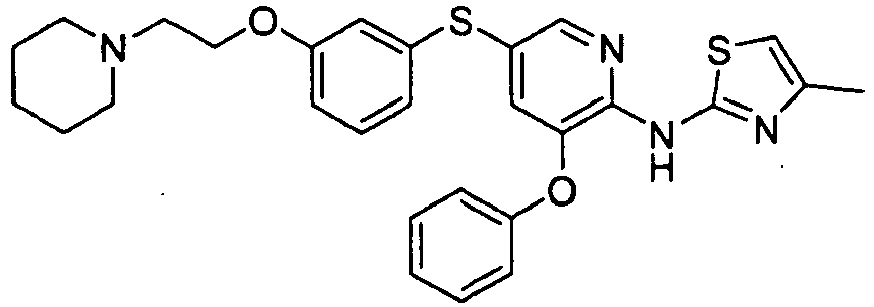
- A mixture of 3-(6-(4-methylthiazol-2-ylamino)-5-phenoxypyridin-3-ylthio)phenol (prepared according to Example 111; 70.0 mg, 0.172 mmol), potassium carbonate (71.2 mg, 0.515 mmol), 1-(2-chloroethyl)piperidine hydrochloride (31.6 mg, 0.172 mmol), and DMF (2 mL) was stirred at room temperature for 30 minutes and heated to 50°C overnight. The reaction was cooled to room temperature and water (15 mL) was added and extracted with ether. A white precipitate formed in the ether layer and was filtered to afford N-(4-methylthiazol-2-yl)-3-phenoxy-5-(3-(2-(pipendin-1-yl)ethoxy)phenylthio)pyridin-2-amine (34.2 mg, 38.4% yield) as a white solid. 1H NMR (d6-DMSO) δ 9.56 (s, 1H), 8.29 (dd, 1H), 7.50 (dd, 1H), 7.28 (m, 2H), 7.11 (t, 1H), 7.00 (t, 1H), 6.82 (m, 2H), 6.65 (m, 1H), 6.58 (m, 1H), 6.54 (m, 1H), 6.35 (m, 1H), 3.79 (t, 2H), 2.23 (s, 3H), 2.17 (m, 4H), 2.12 (t, 2H), 1.38 (m, 4H), 1.31 (m, 2H); Mass spectrum (esi) m/z = 519.1 (M+H).
-

- A mixture of 3-(6-(4-methylthiazol-2-ylamino)-5-phenoxypyridin-3-ylthio)phenol (prepared according to Example 111; 70.0 mg, 0.172 mmol), potassium carbonate (71.2 mg, 0.51 mmol), 3-chloro-N,N-dimethylpropan-1-amine hydrochloride (27.2 mg, 0.172 mmol), and DMF (2 mL) was stirred at room temperature for 30 minutes and heated to 50 °C overnight. The reaction was cooled to room temperature and water (15 mL) was added and extracted with ether. The organic layer was dried with sodium sulfate, filtered and concentrated in vacuo. The resultant residue was purified on silica gel (0 to 10% methanol in EtOAc with NH4OH) to afford a solid after concentration. The residue was triturated with DCM and filtered to afford 5-(3-(3-(dimethylamino)propoxy)phenylthio)-N-(4-methylthiazol-2-yl)-3-phenoxypyridin-2-amine (34.9 mg, 41.2% yield) as a white solid. 1H NMR (d6-DMSO) δ 9.55 (s, 1H), 8.28 (dd, 1H), 7.49 (dd, 1H), 7.29 (m, 2H), 7.11 (t, 1H), 7.00 (t, 1H), 6.85 (m, 2H), 6.65 (m, 1H), 6.58 (m, 1H), 6.54 (m, 1H), 6.38 (m, 1H), 3.70 (m, 2H), 2.21 (s, 3H), 2.04 (s, 6H) 1.96 (t, 2H), 1.44 (m, 2H); Mass spectrum (esi) m/z = 493.1 (M+H).
-

- A mixture of 5-bromo-2-(4-methylthiazol-2-ylamino)pyridin-3-ol hydrochloride (1.0 g, 3.10 mmol), tert-butyl 3-bromopyrrolidine-1-carboxylate (
WO 2003/062224 ) (1.01 g, 4.03 mmol), K2CO3 (1.29 g, 9.30 mmol), and DMF (20 mL) were reacted at 50 °C over the weekend. The reaction was cooled to room temperature, poured into water (250 mL) and extracted with EtOAc:ether (1:1). The organic layer was dried with sodium sulfate, filtered and concentrated in vacuo. The resultant residue was purified on silica gel (40% EtOAc in hexanes) to afford tert-butyl 3-(5-bromo-2-(4-methylthiazol-2-ylamino)pyridin-3-yloxy)pyrrolidine-1-carboxylate (584 mg, 41.4% yield) as a tan solid. 1H NMR (CDCl3) δ 8.42 (bs, 1H), 8.02 (s, 1h), 7.10 (d, 1H), 6.42 (s, 1H), 4.95 (m, 1H), 3.75-3.44 (m, 4H), 2.35 (d, 3H), 2.21 (m, 2H), 1.50 (s, 9H); Mass spectrum (apci) m/z = 456.9 (M+H). -

- A mixture of tert-butyl 3-(5-bromo-2-(4-methylthiazol-2-ylamino)pyridin-3-yloxy)pyrrolidine-1-carboxylate (prepared according to Example 115; 550 mg, 1.21 mmol) and CH2Cl2 (10 mL) and MeOH (2 mL) was stirred at room temperature. 4N HCl in dioxane (5 mL) was added and the reaction mixture was stirred at room temperature for 30 minutes. The reaction was concentrated and dissolved in small amount of DCM/methanol and added to vigorously stirred ether and filtered to afford N-(5-bromo-3-(pyrrolidin-3-yloxy)pyridin-2-yl)-4-methylthiazol-2-amine dihydrochloride (478 mg, 92.4% yield) as a white solid. 1H NMR (d6-DMSO) δ 11.18 (bs, 1H), 9.80 (bs, 1H), 9.27 (bs, 1H), 8.09 (d, 1H), 7.83 (d, 1H), 6.80 (s, 1H), 5.42 (m, 1H), 3.62-3.30 (m, 4H), 2.31 (s, 3H), 2.22 (m, 2H); Mass spectrum (apci) m/z = 357.0 (M+H-2HCl).
-

- A mixture of N-(5-bromo-3-(pyrrolidin-3-yloxy)pyridin-2-yl)-4-methylthiazol-2-amine dihydrochloride (prepared according to Example 116; 70 mg, 0.16 mmol), triethylamine (0.11 mL, 0.82 mmol), and THF (2 mL) was stirred at room temperature. Acetyl chloride (0.009 mL, 0.16 mmol) was added and stirred at room temperature for 30 minutes. Water (15 mL) was added and extracted with EtOAc. The organic layer was dried with sodium sulfate, filtered and concentrated in vacuo. The residue was purified on silica gel (10% methanol in EtOAc) to afford 1-(3-(5-bromo-2-(4-methylthiazol-2-ylamino)pyridin-3-yloxy)pyrrolidin-1-yl)ethanone hydrochloride (16 mg, 22.56% yield) as a white solid after HCl salt formation. 1H NMR (d6-DMSO) δ 11.60 (bs, 1H), 8.11 (m, 1H), 7.82 (m, 1H), 6.90 (m, 1H), 5.28 (m, 1H), 3.81 (m, 1H), 3.59 (m, 3H), 2.33 (s, 3H), 2.25 (m, 2H), 1.97 (m, 3H); Mass spectrum (apci) m/z = 399.1 (M+H-HCl).
-

- Following the procedure of Example 117, a mixture of N-(5-bromo-3-(pyrrolidin-3-yloxy)pyridin-2-yl)-4-methylthiazol-2-amine dihydrochloride (prepared according to Example 116; 70 mg, 0.16 mmol), triethylamine (0.11 mL, 0.82 mmol), 2-(dimethylamino)acetyl chloride hydrochloride (25.8 mg, 0.163. mmol) and THF (2 mL) were reacted to afford 1-(3-(5-bromo-2-(4-methylthiazol-2-ylamino)pyrdin-3-yloxy)pyrrolidin-1-yl)-2-(dimethylamino)ethanone dihydrochloride (56.1 mg, 66.9% yield) as a white solid after HCl salt formation. 1H NMR (d6-DMSO) δ 11.13 (bs, 1H), 9.75 (bs, 1H), 8.07 (d, 1H), 7.75 (m, 1H), 6.78 (s, 1H), 5.33 (m, 1H), 4.25 (m, 2H), 4.10 (m, 1H), 3.71 (m, 4H), 2.83 (m, 6H), 2.29 (m, 5H); Mass spectrum (apci) m/z = 440.1 (M+H-2HCl).
-

- Following the procedure of Example 117, A mixture of N-(5-bromo-3-(pyrrolidin-3-yloxy)pyridin-2-yl)-4-methylthiazol-2-amine dihydrochloride (prepared according to Example 116; 70 mg, 0.16 mmol), triethylamine (0.11 mL, 0.82 mmol), 2-isocyanatopropane (0.016 mL, 0.163 mmol), and THF (2 mL) were reacted to afford 3-(5-bromo-2-(4-methylthiazol-2-ylamino)pyridin-3-yloxy)-N-isopropylpyrrolidine-1-carboxamide (48.1 mg, 66.8% yield) as a tan solid after precipitation from water. 1H NMR (d6-DMSO) δ 10.49 (bs, 1H), 7.97 (m, 1H), 7.52 (m, 1H), 6.61 (m, 1H), 5.82 (d, 1H), 5.17 (m, 1H), 3.75 (m, 1H), 3.56 (m, 2H), 3.45 (m, 2H), 2.28-2.20 (m, 4H), 2.12 (m, 1H), 1.05 (m, 6H); Mass spectrum (apci) m/z = 440.1 (M+H).
-

- Following the procedure of Example 117, A mixture of N-(5-bromo-3-(pyrrolidin-3-yloxy)pyridin-2-yl)-4-methylthiazol-2-amine dihydrochloride (prepared according to Example 116; 70 mg, 0.16 mmol), triethylamine (0.11 mL, 0.82 mmol), 1-methyl-1H-imidazole-4-sulfonyl chloride (29.5 mg, 0.163 mmol) and THF (2 mL) were reacted to afford 5-bromo-3-(1-(1-methyl-1H-imidazol-4-ylsulfonyl)pyrrolidin-3-yloxy)-N-(4-methylthiazol-2-yl)pyridin-2-amine (72.1 mg, 88.3% yield) as a white solid after precipitation from water. 1H NMR (d6-DMSO) δ 10.05 (bs, 1H), 7.96 (d, 1H), 7.79 (s, 1H), 7.49 (m, 2H), 6.65 (s, 1H), 5.07 (m, 1H), 3.63 (m, 2H), 3.55-3.40 (m, 5H), 2.28 (s, 3H), 2.19 (m, 1H), 2.02 (m, 1H); Mass spectrum (apci) m/z = 501.1 (M+H).
-

- Following the procedure of Example 16, methyl 3-(6-(4-methylthiazol-2-ylamino)-5-phenoxypyridin-3-ylthio)propanoate (prepared according to Example 13; 0.075 g, 0.1868 mmol), potassium 2-methylpropan-2-olate (0.6538 mL, 0.6538 mmol), and 1-(chloromethyl)-2-fluorobenzene (0.02221 mL, 0.1868 mmol) were reacted to provide 5-(2-fluorobenzylthio)-N-(4-methylthiazol-2-yl)-3-phenoxypyridin-2-amine hydrochloride (0.016 g, 18.62% yield) after salt formation. 1H NMR (d6-DMSO) δ 8.06 (d, 1H), 7.42 (t, 2H), 7.28 (m, 1H), 7.15 (m, 4H), 7.09 (m, 1H), 6.97 (d, 2H), 6.69 (s, 1H), 4.09 (s, 2H), 2.25 (s, 3H); Mass spectrum (esi) m/z = 424.2 (100) (M+H-HCl).
-

- Step A: Preparation of 2-(1-bromopropyl)pyridine: Following the method of Example 33, Step A, 2-propylpyridine (4.915 g, 40.56 mmol), benzoyl peroxide (0.9825 g, 4.056 mmol), and 1-bromopyrrolidine-2,5-dione (7.219 g, 40.56 mmol) were reacted to provide 2-(1-bromopropyl)pyridine (5.19 g, 63.96% yield). 1H NMR (CDCl3) δ 8.58 (dm, 1H), 7.69 (td, 1H), 7.43 (dt, 1H), 7.20 (dd, 1H), 4.95 (t, 1H), 2.31 (m, 2H), 1.03 (t, 3H).
- Step B: Preparation of N-(4-methylthiazol-2-yl)-3-phenoxy-5-(1-(pyrindin-2-yl)propylthio)pyridin-2-amine dihydrochloride: Following the method of Example 16, methyl 3-(6-(4-methylthiazol-2-ylamino)-5-phenoxypyridin-3-ylthio)propanoate (0.100 g, 0.249 mmol), potassium 2-methylpropan-2-olate (0.872 mL, 0.872 mmol), and 2-(1-bromopropyl)pyridine (0.0498 g, 0.249 mmol) were reacted to provide N-(4-methylthiazol-2-yl)-3-phenoxy-5-(1-(pyridin-2-yl)propylthio)pyridin-2-amine dihydrochloride (0.020 g, 15.8% yield) after salt formation. 1H NMR (d6-DMSO) δ 8.47 (s, 1H), 7.98 (d, 1H), 7.80 (m, 1H), 7.43 (t, 2H), 7.33 (m, 2H), 7.20 (t, 1H), 6.95 (d, 2H), 6.92 (d, 1H), 6.65 (s, 1H), 4.26 (t, 1H), 2.24 (s, 3H), 1.95 (m, 2H), 0.85 (t, 3H). Mass spectrum (esi) m/z = 435.1 (100) (M+H-2HCl).
-

- Following the method of Example 16, methyl 3-(6-(4-methylthiazol-2-ylamino)-5-phenoxypyridin-3-ylthio)propanoate (prepared according to Example 13; 0.600 g, 1.49 mmol), potassium 2-methylpropan-2-olate (6.72 mL, 6.72 mmol), and 2-(bromomethyl)pyridin-3-ol hydrobromide (0.402 g, 1.49 mmol) were reacted to provide 2-((6-(4-methylthiazol-2-ylamino)-5-phenoxypyridin-3-ylthio)methyl)pyridin-3-ol (.226 g, 35.8% yield) after salt formation. 1H NMR (d6-DMSO) δ 8.16 (d, 1H), 8.11 (d, 1H), 7.82 (m, 1H), 7.64 (m, 1H), 7.45 (t, 2H), 7.22 (t, 1H), 7.08 (m, 3H), 6.76 (s, 1H), 4.26 (s, 2H), 2.28 (s, 3H); Mass spectrum (esi) m/z = 423.1 (100) (M+H-2HCl).
-

- Step A: Preparation of methyl 5-bromo-4-oxopentanoate: A solution of bromine (27.71 g, 173.4 mmol) in methanol (40 mL) was added dropwise to a solution of ethyl 4-oxopentanoate (25.0 g, 173.4 mmol) in methanol (200 mL) at room temperature over a period of 30 minute, and the reaction mixture was stirred overnight. The reaction mixture was concentrated, and the residue was partitioned between 3:1 ether:ethyl acetate and water, washed with saturated sodium bicarbonate, water, brine, dried, and concentrated to afford 17 g of a crude clear oil. The oil was purified by MPLC (Biotage) eluting with 8:1 hexane ethyl acetate to afford methyl 5-bromo-4-oxopentanoate (10.65 g, 29.38% yield) as a clear oil. 1H NMR (CDCl3) δ 3.96 (s, 2H), 3.69 (s, 3H), 2.96 (t, 2H), 2.66 (t, 2H).
- Step B: Preparation of methyl 3-(2-(5-bromo-3-phenoxypyridin-2-ylamino)thiazol-4-yl)propanoate: Following the method of Example 7 Step E, methyl 5-bromo-4-oxopentanoate (1.257 g, 6.015 mmol), 1-(5-bromo-3-phenoxypyridin-2-yl)thiourea (1.500 g, 4.627 mmol), and triethylamine (1.096 mL, 7.866 mmol) were reacted to provide methyl 3-(2-(5-bromo-3-phenoxypyridin-2-ylamino)thiazol-4-yl)propanoate (1.37 g, 68.18% yield). 1H NMR (d6-DMSO) δ 10.95 (s, 1H), 8.22 (d, 1H), 7.43 (t, 2H), 7.39 (s, 1H), 7.21 (t, 1H), 7.10 (d, 2H), 6.68 (s, 1H), 3.59 (s, 3H), 2.84 (t, 2H), 2.68 (t, 2H); Mass spectrum (esi) m/z = 435.1 (100) (M+H).
- Step C: Preparation of methyl 3-(2-(5-(3-methoxy-3-oxopropylthio)-3-phenoxypyridin-2-ylamino)thiazol-4-yl)propanoate: Following the method of Example 13, methyl 3-(2-(5-bromo-3-phenoxypyridin-2-ylamino)thiazol-4-yl)propanoate (1.37 g, 3.154 mmol), 4,5-bis(diphenylphosphino)-9,9-dimethyl-9H-xanthene (0.09126 g, 0.1577 mmol), Pd2dba3 (0.07221 g, 0.07886 mmol), methyl 3-mercaptopropanoate (0.3668 mL, 3.312 mmol), and N-ethyl-N-isopropylpropan-2-amine (1.099 mL, 6.309 mmol) were reacted to provide methyl 3-(2-(5-(3-methoxy-3-oxopropylthio)-3-phenoxypyridin-2-ylamino)thiazol-4-yl)propanoate (1.266 g, 84.75% yield). 1H NMR (d6-DMSO) δ 10.87 (s, 1H), 8.13 (d, 1H), 7.42 (t, 2H), 7.32 (d, 1H), 7.17 (t, 1H), 7.08 (d, 2H), 6.67 (s, 1H), 3.59 (s, 3H), 3.55 (s, 3H), 3.03 (t, 2H), 2.84 (t, 2H), 2.68 (t, 2H), 2.56 (t, 2H); Mass spectrum (esi) m/z = 474.1 (100) (M+H).
- Step D: Preparation of 3-(2-(3-phenox-5-(1-pyridin-2-yl)ethlthio pyridin-2-ylamino)thiazol-4-yl)propanoic acid dihydrochloride: A nitrogen purged 250 mL round-bottomed flask was charged with methyl 3-(2-(5-(3-methoxy-3-oxopropylthio)-3-phenoxypyridin-2-ylamino)thiazol-4-yl)propanoate (0.400 g, 0.845 mmol) and THF (50 mL) and purged with nitrogen. Potassium 2-methylpropan-2-olate (2.96 mL, 2.96 mmol) was added, and the reaction mixture was stirred at room temperature for 30 seconds. 2-(1-Bromoethyl)pyridine (0.157 g, 0.845 mmol) was added and the reaction mixture was stirred at room temperature under nitrogen for 20 minutes, and then an additional equivalent of tBuOK was added. After 30 minutes, LC/MS indicated reaction was complete. The reaction mixture was poured into saturated aqueous NH4C1 and extracted with EtOAc (2 x 100 mL). The organic layer was dried with sodium sulfate, filtered, and concentrated in vacuo. The residue was purified on 60s biotage (5 to 15% EtOAc in hexanes) afford the product with a small impurity. The product was further purified by reverse phase to give 106 mg of tBu ester. This was dissolved in DCM, and 4M HCl in dioxane was added and the mixture was stirred at room temperature for 5 hours. The mixture was concentrated to give impure product. The product was dissolved in 1N NaOH and extracted with ether. The aqueous layer was acidified with 1M HCl and concentrated. The .. residue was dissolved in 10% MeOH in DCM, filtered, and concentrated. The residue was dissolved in 1N NaOH and extract with 10% EtOAc in Ether. The aqueous layer was acidified with 1 M HCl and concentrated. The residue was dissolved in 10% MeOH in DCM, filtered and concentrated without the aid of heat to give 3-(2-(3-phenoxy-5-(1-(pyridin-2-yl)ethylthio)pyridin-2-ylamino)thiazol-4-yl)propanoic acid dihydrochloride (0.027 g, 5.80% yield). 1H NMR (d6-DMSO) δ 8.41 (s, 1H), 7.99 (s, 1H), 7.65 (t, 1H), 7.40 (t, 2H), 7.20 (m, 3H), 6.92 (m, 3H), 6.50 (s, 1H), 4.42 (m, 1H), 2.70 (m, 2H), 2.29 (m, 2H), 1.54 (d, 3H) ; Mass spectrum (esi) m/z = 479.1 (100) (M+H-2HC1).
-
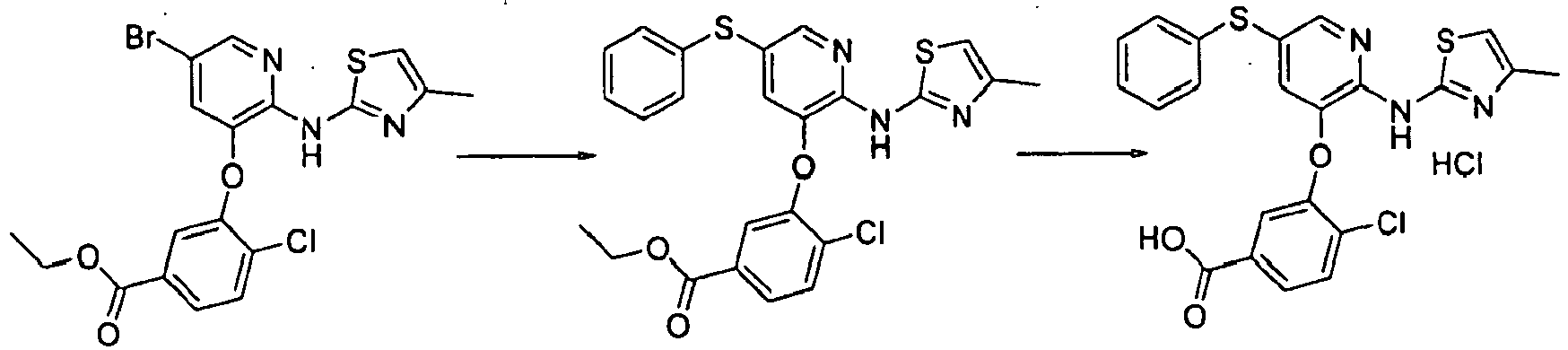
- Step A: Preparation of ethyl 4-chloro-3-(2-(4-methylthiazol-2 ylamino)-5-(phenylthio)pyridin-3-yloxy)benzoate: Ethyl 3-(5-bromo-2-(4-methylthiazol-2-ylamino)pyridin-3-yloxy)-4-chlorobenzoate (prepared according to Example 39; 680 mg, 1.45 mmol), Xantphos (42 mg, 0.023 mmol), Pd2dba3 (33.0 mg, 0.036 mmol), benzenethiol (0.192 g, 1.74 mmol), N-ethyl-N-isopropylpropan-2-amine (375 mg, 2.90 mmol) and dioxane (6 mL) were reacted according to the method of Example 13. The reaction mixture was purged with nitrogen and heated to 95 °C for 6 hours. Additional catalyst, ligand, and thiol were added and the reaction was heated overnight, then cooled to room temperature, filtered, and concentrated. The residue was purified on 12M biotage (10% EtOAc in hexanes) to afford ethyl 4-chloro-3-(2-(4-methylthiazol-2-ylamino)-5-(phenylthio)pyridin-3-yloxy)benzoate (0.246 g, 34.1% yield). Mass spectrum (esi) m/z = 498.2 (100) (M+H).
- Step B: Preparation of 4-chloro-3-(2-(4-methylthiazol-2-ylamino)-5-(phenylthio)pyridin-3-yloxy)benzoic acid hydrochloride: Ethyl 4-chloro-3-(2-(4-methylthiazol-2-ylamino)-5-(phenylthio)pyridin-3-yloxy)benzoate (0.226 g, 0.454 mmol) was dissolved in MeOH (8 mL) and 1M NaOH (3 mL) and heated at 60 °C for 18 hour. The reaction mixture was concentrated to about 1/3 the volume and 6M HCl was added. The reaction mixture was filtered to give 44 mg of product. The filtrate was concentrated and the residue was suspended in 1N HCl and filtered to provide 131 mg of product. The solids were combined to provide 4-chloro-3-(2-(4-methylthiazol-2-ylamino)-5-(phenylthio)pyridin-3-yloxy)benzoic acid hydrochloride (0.175 g, 76.1% yield) 1H NMR (d6-DMSO) δ 8.26 (d, 1H), 7.71 (s, 2H), 7.41 (m, 1H), 7.30 (m, 3H), 7.19 (m, 3H), 6.62 (s, 1H), 2.23 (s, 3H) ; Mass spectrum (esi) m/z = 470.2 (100) (M+H-HCl).
-

- 4-Chloro-3-(2-(4-methylthiazol-2-ylamino)-5-(phenylthio)pyridin-3-yloxy)benzoic acid (prepared according to Example 125; 0.131 g, 0.279 mmol) and TEA (0.117 mL, 0.836 mmol) were placed in a flask and cooled to 0 °C. Ethyl carbonochloridate (0.0303 g, 0.279 mmol) was added, and the reaction mixture was stirred at 0 °C for 30 minutes. N1,N1-dimethylethane-1,2-diamine (0.0306 mL, 0.279 mmol) was added, and the reaction mixture was stirred at room temperature for 1 hour. Water was added and the reaction mixture was extracted with DCM. The organic layer was concentrated and the residue was purified first by silica gel chromatography and then by reverse phase chromatography to provide the desired product as the free base. The free base was dissolved in DCM and HCl in ether was added to give 4-chloro-N-(2-(dimethylamino)ethyl)-3-(2-(4-methylthiazol-2-ylamino)-5-(phenylthio)pyridin-3-yloxy)benzamide dihydrochloride (0.069 g, 40.4% yield). 1H NMR (d6-DMSO) δ 9.83 (bs, 1H), 8.90 (m, 1H), 8.24 (m, 1H), 7.75 (m, 2H), 7.58 (s, 1H), 7.30 (m, 2H), 7.19 (m, 4H), 6.67 (s, 1H), 3.59 (m, 2H), 3.23 (m, 2H), 2.80 (d, 6H), 2.25 (s, 3H); Mass spectrum (esi) m/z = 540.1 (100) (M+H-2HCl).
-

- Step A: Preparation of ethyl 4-chloro-3-(5-(3-methoxy-3-oxopropylthio-2-(4-methylthiazol-2-ylamino)pyridin-3-yloxy)benzoate: Following the method of Example 13, ethyl 3-(5-bromo-2-(4-methylthiazol-2-ylamino)pyridin-3-yloxy)-4-chlorobenzoate (prepared according to Example 39; 0.720 g, 1.54 mmol), 4,5-bis(diphenylphosphino)-9,9-dimethyl-9H-xanthene (0.0444 g, 0.0768 mmol), Pd2dba3 (0.0352 g, 0.0384 mmol), methyl 3-mercaptopropanoate (0.194 g, 1.61 mmol), N-ethyl-N-isopropylpropan-2-amine (0.535 mL, 3.07 mmol), and dioxane (300 mL) were reacted to provide ethyl 4-chloro-3-(5-(3-methoxy-3-oxopropylthio)-2-(4-methylthiazol-2-ylamino)pyridin-3-yloxy)benzoate (0.675 g, 86.5% yield) as a pale yellow solid. 1H NMR (d6-DMSO) δ 11.12 (bs, 1H), 8.18 (d, 1H), 7.77 (s, 2H), 7.44 (s, 1H), 7.35 (d, 1H), 6.61 (s, 1H), 4.47 (q, 2H), 3.54 (s, 3H), 3.04 (t, 2H), 2.54 (t, 2H), 2.23 (s, 3H), 1.26 (t, 3H); Mass spectrum (esi) m/z = 508.2 (100) (M+H).
- Step B: Preparation of 4-chloro-3-(2-(4-methylthiazol-2-ylamino)-5-(1-(pyridin-2-yl)ethylthio)pyridin-3-yloxy)benzoic acid sodium salt: A nitrogen purged vial was charged with ethyl 4-chloro-3-(5-(3-methoxy-3-oxopropylthio)-2-(4-methylthiazol-2-ylamino)pyridin-3-yloxy)benzoate (.674 g, 1.33 mmol) THF (25 mL) and purged with nitrogen. Potassium 2-methylpropan-2-olate (4.64 mL, 4.64 mmol) was added, and the reaction mixture was stirred at room temperature for 30 seconds. Added 2-(1-bromoethyl)pyridine (0.247 g, 1.33 mmol) and stirred at room temperature under nitrogen for 45 minutes. 1M NaOH was added and the reaction mixture was stirred at room temperature for 26 hours. Ether was added, and the mixture was filtered to give 4-chloro-3-(2-(4-methylthiazol-2-ylamino)-5-(1-(pyridin-2-yl)ethylthio)pyridin-3-yloxy)benzoic acid (.407 g, 61.5% yield). 1H NMR (d6-DMSO) δ 8.49 (m, 1H), 8.04 (d, 1H), 7.89 (m, 1H), 7.78 (m, 2H), 7.40 (m, 3H), 6.98 (d, 1H), 6.68 (s, 1H), 4.60 (m, 1H), 2.25 (s, 3H), 1.58 (d, 3H); Mass spectrum (esi) m/z = 499.1 (100) (M+H-Na).
-

- 4-chloro-3-(2-(4-methylthiazol-2-ylamino)-5-(1-(pyridin-2-yl)ethylthio)pyridin-3-yloxy)benzoic acid (prepared according to Example 127; 0.131 g, 0.263 mmol), TEA (d. 0.726) (0.0732 mL, 0.525 mmol), ethyl carbonochloridate (0.057 g, 0.525 mmol), and N1,N1-dimethylethane-1,2-diamine (0.0231 g, 0.263 mmol) were reacted according the method of Example 126. 1N NaOH was added and the reaction mixture was stirred for 3 hours. The reaction mixture was extracted with DCM. The combined extracts were concentrated and purified by silica gel chromatography (4% MeOH in DCM, using 2% 7N ammonia in MeOH) and then purified by reverse phase chromatography to give the compound as the free base. The free base was dissolved in DCM and HCl in ether was added. The mixture was concentrated to give 4-chloro-N-(2-(dimethylamino)ethyl)-3-(2-(4-methylthiazol-2-ylamino)-5-(1-(pyridin-2-yl)ethylthio)pyridin-3-yloxy)benzamide triihydrochloride (0.025 g, 14.8% yield). 1H NMR (d6-DMSO) δ 9.73 (s, 1H), 8.91 (m, 1H), 8.42 (m, 1H), 8.01 (d, 1H), 7.78 (m, 3H), 7.51 (s, 1H), 7.29 (m, 2H), 6.83 (s, 1H), 6.66 (m, 1H), 4.48 (q, 1H), 3.60 (m, 2H), 3.24 (m, 2H), 2.81 (d, 6H), 2.24 (s, 3H), 1.54 (d, 3H); Mass spectrum (esi) m/z = 569.2 (100) (M+H-3HCl).
- The in vitro efficacy of glucokinase activators of the present invention was assessed in two separate assays: an EC50 assay to evaluate the potency of each compound at a fixed, physiologically relevant concentration of glucose, and a glucose S0.5 assay at a fixed; near saturating (if possible) concentration of compound to evaluate its effect on the Vm and S0.5 for glucose. For each of these assays, glucokinase activity was estimated by monitoring the increase in absorbance at 340 nm in a coupled assay system containing NAD+ and glucose 6-phosphate dehydrogenase. Assays were conducted at 30 °C using a thermostatically controlled absorbance plate reader (Spectramax 340PC, Molecular Devices Corp.) and clear, 96-well, flat bottom, polystyrene plates (Costar 3695, Corning). Each 50-µL assay mixture contained 10 mM K+MOPS, pH 7.2, 2 mM MgCl2, 50 mM KCl, 0.01% Triton X-100, 2% DMSO, 1 mM DTT, 1 mM ATP, 1 mM NAD+, 5 U/mL glucose 6-phosphate dehydrogenase, approximately 5 nM human glucokinase and (depending on the assay) varying concentrations of glucose and test compound. The absorbance at 340 nm was monitored kinetically over a period of 5 minutes (10 s/cycle), and rates were estimated from the slopes of linear fits to the raw data.
- Glucokinase EC 50 Assay:
- For this assay, the glucose concentration was fixed at 5 mM, while the control or test compound was varied over a 10-point, 3-fold dilution series and typically ranged from a high dose of 50 µM to a low dose of approximately 2.5 nM. A standard, four-parameter logistic model (Equation 1) was fit to the raw data (rate versus concentration of compound):

- where x is the concentration of compound, y is the estimated rate, A and B are the lower and upper asymptotes, respectively, C is the EC50 and D is the Hill slope. The EC50 is defined as the midpoint or inflection point between the upper and lower asymptotes.
- The compounds exemplified herein have been found to have an EC50 in the range of 6 and 50,000 nM in the above described assay. Certain compounds exemplified herein have been found to have an EC50 in the range of 50 and 500 nM.
- Glucose S 0.5 Assay:
- For this assay, the concentration of control or test compound was fixed at or near a saturating concentration, if possible, typically 50 µM, while the glucose concentration was varied over a 10-point, 2-fold dilution series ranging from 80 to approximately 0.16 mM. The same four-parameter logistic model used for the EC50 assay (Equation 1) was employed to estimate the relevant kinetic parameters. In this assay, the definitions for the variables and parameters are similar except that x represents the concentration of glucose, B is the rate at saturating glucose (Vm), C is the S0.5 for glucose (the concentration of glucose at Vm/2) and D is the Hill Coefficient.
- The compounds exemplified herein have been found to have an S0.5 of between 1 and 5 mM in the above described assay.
- The foregoing description is considered as illustrative only of the principles of the invention. Further, since numerous modifications and changes will be readily apparent to those skilled in the art, it is not desired to limit the invention to the exact construction and process shown as described above. Accordingly, all suitable modifications and equivalents may be resorted to falling within the scope of the invention as defined by the claims that follow.
- The words "comprise," "comprising," "include," "including," and "includes" when used in this specification and in the following claims are intended to specify the presence of stated features, integers, components, or steps, but they do not preclude the presence or addition of one or more other features, integers, components, steps, or groups thereof.
Claims (15)
- A compound selected from the Formula
 L is O, S, C(=O) or CHR14;Y is N or CR4;Z is N or CR3, wherein at least one of G or Z is not N;G is N or CR11 ;R1 is a heteroaryl ring represented by the formula
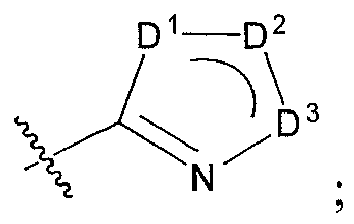 D1 is S, O, or N;D2 is N or CR12;D3 is S, O or CR13;R2 is aryl, heteroaryl, saturated or partially unsaturated cycloalkyl, or saturated or partially unsaturated heterocyclyl, wherein said aryl, heteroaryl, cycloalkyl and heterocyclyl are monocyclic or bicyclic and are optionally substituted with one or more groups independently selected from C1-C6 alkyl, C2-C6 alkenyl, C2-C6 alkynyl, saturated and partially unsaturated C3-C6 cycloalkyl, saturated and partially unsaturated C1-C6 heterocyclyl, aryl, heteroaryl, F, Cl, Br, I, CF3, CN, NO2, OR6, C(=O)R6, C(=O)OR6, OC(=O)R6, O(CH2)nC(=O)OR6, O(CH2)nC(=O)NR6R7, C(=O)NR6R7, NR6R7, NR6C(=O)R7, SR6, S(O)R6, and S(O)2R6, and wherein said alkyl, alkenyl, alkynyl, cycloalkyl, heterocyclyl, aryl, and heteroaryl are optionally substituted with one or more groups independently selected from oxo, C1-C6 alkyl, C2-C6 alkenyl, C2-C6 alkynyl, saturated and partially unsaturated C3-C6 Vn-cycloalkyl, saturated and partially unsaturated C1-C6 Vn-heterocyclyl, Vn-aryl, Vn-heteroaryl, Vn-F, Vn-Cl, Vn-Br, Vn-I, Vn-CF3, Vn-CN, Vn-OR8, Vn-C(=O)R8, Vn-C(=O)OR8, Vn-OC(=O)R8, Vn-C(=O)NR8R9, Vn-NR8R9, Vn-NR8C(=O)R9, Vn-SR8, Vn-S(O)R8, and Vn-S(O)2R8;R3 is H, C1-C12 alkyl, C2-C12 alkenyl, C2-C12 alkynyl, saturated or partially unsaturated C3-C12 cycloalkyl, saturated or partially unsaturated C1-C12 heterocyclyl, aryl, heteroaryl, F, Cl, Br, I, CN, OR6, C(=O)R6, C(=O)OR6, OC(=O)R6, C(=O)NR6R7, OC(=O)NR6R7, OC(=S)NR6R7, NR6R7, NR6C(=O)R7, SR6, S(O)R6, S(O)2R6 or S(O)2NR6R7, wherein said alkyl, alkenyl, alkynyl, cycloalkyl, heterocyclyl, aryl and heteroaryl are optionally substituted with one or more groups independently selected from oxo, C1-C6 alkyl, C2-C6 alkenyl, C2-C6 alkynyl, saturated and partially unsaturated C3-C6 cycloalkyl, saturated and partially unsaturated C1-C6 heterocyclyl, Vn-aryl, Vn-heteroaryl, Vn-F, Vn-Cl, Vn-Br, Vn-I, Vn-CF3, Vn-CN, Vn-OR8, Vn-C(=O)R8, Vn-C(=O)OR8, Vn-OC(=O)R8, Vn-C(=O)NR8R9, Vn-NR8R9, Vn-NR8C(=O)R9, Vn-SR8, Vn-S(O)R8, Vn-S(O)2R8 and Vn-S(O)2NR8R9;R4 is H, methyl, ethyl, F, Cl, Br, I, CF3, CHF2 or CH2F;R6 and R7 are independently H, C1-C12 alkyl, C2-C12 alkenyl, C2-C12 alkynyl, saturated or partially unsaturated C3-C12 cycloalkyl, saturated or partially unsaturated C1-C12 heterocyclyl, Vn-aryl, or Vn-heteroaryl, wherein said alkyl, alkenyl, alkynyl, cycloalkyl, heterocyclyl, aryl and heteroaryl portions are optionally substituted with one or more groups independently selected from oxo, C1-C6 alkyl, C2-C6 alkenyl, C2-C6 alkynyl, saturated and partially unsaturated C3-C6 cycloalkyl, saturated and partially unsaturated C1-C6 heterocyclyl [optionally substituted with C(O)O(1-6C alkyl), (1-6C)alkyl or (1-6C alkyl)OH], Vn-aryl, Vn-heteroaryl, Vn-F, Vn-Cl, Vn-Br, Vn-I, Vn-CF3, Vn-CN, Vn-OR8, Vn-C(=O)R8, Vn-C(=O)OR8, Vn-OC(=O)R8, Vn-C(=O)NR8R9, Vn-NR8R9, Vn-NR8C(=O)R9, Vn-SR8, Vn-S(O)R8, Vn-S(O)2R8, Vn-S(O)2NR8R9, and (C1-C6 alkyl)OH;or R6 and R7 together with the atoms to which they are attached form a saturated or partially unsaturated heterocyclic ring, wherein said heterocyclic ring optionally comprises one or more additional ring heteroatoms independently selected from N, O or S, wherein said heterocyclic ring is optionally substituted with one or more groups independently selected from oxo, Vn-F, Vn-Cl, Vn-Br, Vn-I, Vn-OR8, Vn-C(=O)OR8, Vn-C(=O)NR8R9, Vn-NR8R9, Vn-NR8C(=O)R9, Vn-NR8C(=O)NR9R10, C1-C6 alkyl, C2-C6 alkenyl, and C2-C6 alkynyl;R8, R9 and R10 are independently H, C1-C6 alkyl, C2-C6 alkenyl, C2-C6 alkynyl, saturated and partially unsaturated C3-C6 cycloalkyl, saturated and partially unsaturated C1-C6 heterocyclyl, aryl or heteroaryl, wherein said alkyl, alkenyl, alkynyl, cycloalkyl, heterocyclyl, aryl and heteroaryl are optionally substituted with one or more groups independently selected from oxo, C1-C6 alkyl, C2-C6 alkenyl, C2-C6 alkynyl, saturated and partially unsaturated C3-C6 cycloalkyl, saturated and partially unsaturated C1-C6 heterocyclyl, Vn-aryl, Vn-heteroaryl, Vn-F, Vn-Cl, Vn-Br, Vn-I, Vn-ORa, Vn-NRaRb, Vn-C(=O)ORa, Vn-C(=O)NRaRb, and Vn-NRaC(=O)Rb,or R8 and R9 together with the atoms to which they are attached form a saturated or partially unsaturated heterocyclic ring, wherein said heterocyclic ring optionally comprises one or more additional ring heteroatoms independently selected from N, O or S, wherein said heterocyclic ring is optionally substituted with one or more groups independently selected from oxo, C1-C6 alkyl, C2-C6 alkenyl, C2-C6 alkynyl, Vn-F, Vn-Cl, Vn-Br, Vn-I, Vn-ORa, and Vn-CN,or R9 and R10 together with the atoms to which they are attached form a saturated or partially unsaturated heterocyclic ring, wherein said heterocyclic ring optionally comprises one or more additional ring heteroatoms independently selected from N, O or S, wherein said heterocyclic ring is optionally substituted with one or more groups independently selected from oxo,C1-C6 alkyl, C2-C6 alkenyl, C2-C6 alkynyl, Vn-F, Vn-Cl, Vn-Br, Vn-I, Vn-ORa, and Vn-CN;R11 is H, methyl, ethyl, F, Cl, Br, I, CF3, CHF2, CH2F, OH, O-(C1-C4 alkyl), or NH2;R12 and R13 are independently H, C1-C6 alkyl, saturated and partially unsaturated C3-C6 cycloalkyl, saturated and partially unsaturated C1-C6 heterocyclyl, CH2-heterocyclyl, aryl, heteroaryl, (1-3C alkyl)heteroaryl, or (CH2)n(CRxRy)C(O)NR8R9, wherein said alkyl, alkenyl, alkynyl, cycloalkyl, CH2-heterocyclyl, heterocyclyl, aryl, heteroaryl and (1-3C alkyl)heteroaryl are optionally substituted with one or more groups independently selected from oxo, F, Cl, CF3, CN, OR8, C(=O)OR8, C(=O)NR8R9, NR8R9, C(O)(C1-C6 alkyl), C(O)-heterocycle [optionally substituted with O-(C1-C6 alkyl) or oxo], SRa, SO2Rf, SO2NRcRe, C(O)(C1-C6 alkyl)NRcRdd, C(O)(C1-C6 alkyl)ORc, C(O)CH2C(O)(C1-C6 alkyl), C(=O)CHRgNHC(=O)(C1-C6 alkyl), C(=O)CH2OC(=O)(C1-C6 alkyl), C1-C6 alkyl, 5-6 membered heterocycle (optionally substituted with oxo) and aryl,or R12 and R13 together with the atoms to which they are attached form a saturated, partially unsaturated or aromatic carbocyclic or heterocyclic ring, wherein said carbocyclic and heterocyclic rings are optionally substituted with one or more groups independently selected from C1-C6 alkyl, C2-C6 alkenyl, C2-C6 alkynyl, saturated and partially unsaturated C3-C6 cycloalkyl, saturated and partially unsaturated C1-C6 heterocyclyl, aryl, heteroaryl, oxo, F, Cl, Br, I, CF3, CN, OR6, C(=O)R6, C(=O)OR6, OC(=O)R6, C(=O)NR6R7, NR6R7, NR6C(=O)R7, SR6, S(O)R6, S(O)2R6 and SO2NR6R7, wherein said alkyl, alkenyl, alkynyl, cycloalkyl, heterocyclyl, aryl and heteroaryl are optionally substituted with one or more groups independently selected from oxo, Vn-F, Vn-Cl, Vn-Br, Vn-I, Vn-CF3, Vn-CN, Vn-OR8, Vn-C(=O)OR8, Vn-OC(=O)R8, Vn-C(=O)NR8R9, Vn-NR8R9, Vn-NR8C(=O)R9, C1-C6 alkyl, C2-C6 alkenyl, C2-C6 alkynyl, saturated and partially unsaturated C3-C6 cycloalkyl, saturated and partially unsaturated C1-C6 heterocyclyl, Vn-aryl, and Vn-heteroaryl;R14 is H, methyl, ethyl or OH;Ra and Rb are independently H, C1-C6 alkyl, C2-C6 alkenyl, C2-C6 alkynyl, saturated and partially unsaturated C3-C6 cycloalkyl, saturated and partially unsaturated C1-C6 heterocyclyl, Vn-aryl, or Vn-heteroaryl, wherein said alkyl, alkenyl, alkynyl, saturated or partially unsaturated Vn-cycloalkyl, saturated or partially unsaturated Vn-heterocyclyl, Vn-aryl, and Vn-heteroaryl are optionally substituted with one or more OH;each Rc, Re and Rg is independently H or C1-C6 alkyl;Rd is H, C1-C6 alkyl or C(O)O(C1-C6 alkyl);Rf is C1-C6 alkyl or (C1-C6 alkyl)NH2;Rx is H or C1-C6 alkyl;Ry is H, C1-C6 alkyl, or -O(C1-C6 alkyl);V is alkylene having from 1 to 12 carbons, or alkenylene or alkynylene each having from 2 to 12 carbons, wherein said alkylene, alkenylene, or alkynylene are optionally substituted with one or more groups independently selected from C1-C6 alkyl, C2-C6 alkenyl, C2-C6 alkynyl, saturated and partially unsaturated C3-C6 cycloalkyl, saturated and partially unsaturated C1-C6 heterocyclyl, aryl, heteroaryl, F, Cl, Br, I, CF3, cyano, OR8, C(=O)OR8, OC(=O)R8, C(=O)NR8R9, NR8R9, (C1-C6 alkyl)NRcRe, and NR8C(=O)R9; andn is 0 or 1.
 - The compound of claim 1, wherein:R6 and R7 are optionally substituted with one or more groups independently selected from oxo, C1-C6 alkyl, C2-C6 alkenyl, C2-C6 alkynyl, saturated and partially unsaturated C3-C6 cycloalkyl, saturated and partially unsaturated C1-C6 heterocyclyl, Vn-aryl, Vn-heteroaryl, Vn-F, Vn-Cl, Vn-Br, Vn-I, Vn-CF3, Vn-CN, Vn-OR8, Vn-C(=O)R8, Vn-C(=O)OR8, Vn-OC(=O)R8, Vn-C(=O)NR8R9, Vn-NR8R9, Vn-NR8C(=O)R9, Vn-SR8, Vn-S(O)R8, Vn-S(O)2R8, and Vn-S(O)2NR8R9, andR12 and R13 are independently H, C1-C6 alkyl, C2-C6 alkenyl, C2-C6 alkynyl, saturated and partially unsaturated C3-C6 cycloalkyl, saturated and partially unsaturated C1-C6 heterocyclyl, aryl, heteroaryl, F, Cl, Br, I, CF3, CN, OR6, C(=O)R6, C(=O)OR6, OC(=O)R6, C(=O)NR6R7, NR6R7, NR6C(=O)R7, SR6, S(O)R6 or S(O)2R6, wherein said alkyl, alkenyl, alkynyl, cycloalkyl, heterocyclyl, aryl and heteroaryl are optionally substituted with one or more groups independently selected from oxo, Vn-F, Vn-Cl, Vn-Br, Vn-I, Vn-CF3, Vn-CN, Vn-OR8, Vn-C(=O)OR8, Vn-OC(=O)R8, Vn-C(=O)NR8R9, Vn-NR8R9, Vn-NR8C(=O)R9, C1-C6 alkyl, C2-C6 alkenyl, C2-C6 alkynyl, saturated and partially unsaturated C3-C6 cycloalkyl, saturated and partially unsaturated C1-C6 heterocyclyl, Vn-aryl, and Vn-heteroaryl, wherein said heterocyclyl is optionally substituted with one or more oxo,or R12 and R13 together with the atoms to which they are attached form a saturated, partially unsaturated or aromatic carbocyclic or heterocyclic ring, wherein said carbocyclic and heterocyclic rings are optionally substituted with one or more groups independently selected from C1-C6 alkyl, C2-C6 alkenyl, C2-C6 alkynyl, saturated and partially unsaturated C3-C6 cycloalkyl, saturated and partially unsaturated C1-C6 heterocyclyl, aryl, heteroaryl, oxo, F, Cl, Br, I, CF3, CN, OR6, C(=O)R6, C(=O)OR6, OC(=O)R6, C(=O)NR6R7, NR6R7, NR6C(=O)R7, SR6, S(O)R6, S(O)2R6 and SO2NR6R7, wherein said alkyl, alkenyl, alkynyl, cycloalkyl, heterocyclyl, aryl and heteroaryl are optionally substituted with one or more groups independently selected from oxo, Vn-F, Vn-Cl, Vn-Br, Vn-I, Vn-CF3, Vn-CN, Vn-OR8, Vn-C(=O)OR8, Vn-OC(=O)R8, Vn-C(=O)NR8R9, Vn-NR8R9, Vn-NR8C(=O)R9, C1-C6 alkyl, C2-C6 alkenyl, C2-C6 alkynyl, saturated and partially unsaturated C3-C6 cycloalkyl, saturated and partially unsaturated C1-C6-heterocyclyl, Vn-aryl, and Vn-heteroaryl.
- The compound according to claim 1 or 2, wherein R1 is selected from:

- The compound of claim 3, wherein R20 is H.
- The compound according to any of claims 1-4, wherein:G is CH;Y is CH or N; andZ is CR3.
- The compound of claim 1, having the Formula Ia
 L is O, S, or CH2;Y is N or CH;D2 is N or CR12;R2 is aryl, heteroaryl, saturated or partially unsaturated cycloalkyl, or saturated or partially unsaturated heterocyclyl, wherein said aryl, heteroaryl, cycloalkyl and heterocyclyl are monocyclic or bicyclic and are optionally substituted with one or more groups independently selected from C1-C6 alkyl, (C1-C6 alkyl)OH, C1-C6 heterocyclyl, F, Cl, Br, CF3, CN, NO2, OR6, C(=O)R6, C(=O)OR6, C(=O)NR6R7, S(O)2R6 C(O)CH2NH2, and C(O)CH2NRaRb;R3 is H, C1-C12 alkyl, aryl, heteroaryl, F, Cl, Br, OR6,or SR6, wherein said alkyl, aryl and heteroaryl are optionally substituted with one or more groups independently selected from C1-C6 alkyl, C2-C6 alkenyl, saturated and partially unsaturated C1-C6 heterocyclyl, Vn-OR8, Vn-C(=O)OR8, and Vn-NR8R9;R6 and R7 are independently H, C1-C12 alkyl, saturated or partially unsaturated C3-C12 cycloalkyl, saturated or partially unsaturated C1-C12 heterocyclyl, Vn-aryl, or Vn-heteroaryl, wherein said alkyl, cycloalkyl, heterocyclyl, aryl and heteroaryl portions are optionally substituted with one or more groups independently selected from C1-C6 alkyl, saturated and partially unsaturated C1-C6 heterocyclyl [optionally substituted with C(O)O(C1-C6 alkyl) or (C1-C6 alkyl)OH], aryl, heteroaryl, CF3, F, Cl, Br, I, CN, OR8, C(=O)R8, C(=O)OR8, C(=O)NR8R9, NR8R9, NR8C(=O)R9 or (C1-C6 alkyl)OH,or R6 and R7 together with the atoms to which they are attached form a saturated or partially unsaturated heterocyclic ring, wherein said heterocyclic ring optionally comprises one or more additional ring heteroatoms independently selected from N, O or S;R8, R9 and R10 are independently H, C1-C6 alkyl, or saturated and partially unsaturated C1-C6 heterocyclyl, wherein said alkyl and heterocyclyl are optionally substituted with one or more groups independently selected from C1-C6 alkyl, saturated and partially unsaturated C1-C6 heterocyclyl, ORa, NRaRb, C(=O)ORa and C(=O)NRaRb,or R8 and R9 together with the atoms to which they are attached form a saturated or partially unsaturated heterocyclic ring;or R9 and R10 together with the atoms to which they are attached form a saturated or partially unsaturated heterocyclic ring;R12 is H or C1-C6 alkyl;R13 is H, C1-C6 alkyl, saturated and partially unsaturated C3-C6 cycloalkyl, saturated and partially unsaturated C1-C6 heterocyclyl, CH2-heterocyclyl, aryl, heteroaryl, (1-3C alkyl)heteroaryl, or (CH2)n(CRxRy)C(O)NR8R9, wherein said alkyl, alkenyl, alkynyl, cycloalkyl, CH2-heterocyclyl, heterocyclyl, aryl, heteroaryl and (1-3C alkyl)heteroaryl are optionally substituted with one or more groups independently selected from oxo, F, Cl, CF3, CN, OR8, C(=O)OR8, C(=O)NR8R9, NR8R9, C(O)(C1-C6 alkyl), C(O)-heterocycle [optionally substituted with O-(C1-C6 alkyl) or oxo], SRa, SO2Rf, SO2NRcRe, C(O)(C1-C6 alkyl)NRcRdd, C(O)(C1-C6 alkyl)ORc, C(O)CH2C(O)(C1-C6 alkyl), C1-C6 alkyl, C1-C6 heterocycle (optionally substituted with oxo) and aryl,or R12 and R13 together with the atoms to which they are attached form an heteroaryl ring;Ra and Rb are independently H, C1-C6 alkyl, saturated or partially unsaturated C1-C6 heterocyclyl;each Rc, Re and Rg is independently H or C1-C6 alkyl;Rd is H, C1-C6 alkyl or C(O)O(C1-C6 alkyl);Rf is C1-C6 alkyl or (C1-C6 alkyl)NH2;V is alkylene having from 1 to 4 carbons, or alkenylene having from 2 to 4 carbons, wherein said alkylene and alkenylene are optionally substituted with C1-C6 alkyl, O(C1-C6 alkyl), or (C1-C6 alkyl)NRcRe; andn is 0 or 1.
 - The compound according to any of claims 1-6, wherein R12 is H.
- The compound according to any of claims 1-7, wherein R13 is selected from H, C1-C6 alkyl, chloro(C1-C6 alkyl), CF3, (3-6C)cycloalkyl, (C1-C6 alkyl)CN, (C1-C6 alkyl)CO2R8, (C1-C6 alkyl)SRa, (C1-C6 alkyl)SO2Rf, (C1-C6 alkyl)aryl, (C1-C6 alkyl)OR8, (C1-C6 alkyl)NR8R9, (CH2)n(CRxRy)C(O)NR8R9, (CH2)n(CRxRy)C(O)NH-N=CHNR8R9, (C1-C6 alkyl)C(O)-heterocyclyl, aryl, heteroaryl, (C1-C6 alkyl)hetAr1, CH2(CRxRy)C(O)OR8, CH2(CRxRy)C(O)heterocyclyl [optionally substituted with one or two groups selected from O-(C1-C6 alkyl) and oxo], CH2CH(CO2H)-CH2CH2NHRa, hetCyc1 and CH2hetCyc2, wherein:Rx and Ry are independently H, methyl or OMe,n is 0 or 1,hetCyc1 is a heterocyclic ring optionally substituted with one or more groups independently selected from C1-C6 alkyl, C(O)(C1-C6 alkyl), (C1-C6 alkyl)OH, C(O)O(C1-C6 alkyl), C(O)(C1-C6 alkyl)NRcRd, C(O)(C1-C6 alkyl)ORc, C(O)CH2C(O)(C1-C6 alkyl), C(O)NRaRb, SO2NRcRe, SO2Rf, C(=O)CHRgNHC(=O)(C1-C6 alkyl) and C(=O)CH2OC(=O)(C1-C6 alkyl),hetCyc2 is a heterocyclic ring optionally substituted with one or more groups independently selected from C1-C6 alkyl, C(O)(C1-C6 alkyl), C(O)O(C1-C6 alkyl), and oxo, andhetAr1 is a heteroaryl ring optionally substituted with C1-C6 alkyl, OH or CF3.
- The compound according to any of claims 1-8, wherein R2 is:(i) phenyl optionally substituted with one or more groups independently selected from F, Cl, Br, CN, CF3, C1-C6 alkyl, NO2, SO2(C1-C6 alkyl), OH, O(C1-C6 alkyl), CO2H, CO2(C1-C6 alkyl), C(O)hetercyclyl [optionally substituted with C1-C6 alkyl], heterocyclyl and C(O)NR8R9;(ii) a 5-6 membered heteroaryl ring having 1-2 nitrogen atoms;(iii) a 9-10 membered bicyclic heteroaryl ring having a having 1 to 2 ring atoms independently selected from N and S;(iv) a 5 membered heterocyclic ring having at least one nitrogen atom, wherein the heterocyclic ring is unsubstituted or substituted with CO2-(C1-C6 alkyl), C(O)NH(C1-C6 alkyl), C(O)CH2N(C1-C6 alkyl)2, C(O)(C1-C6 alkyl)CO2H, or SO2-(heteroaryl); or(v) a 5-6 membered saturated or partially unsaturated cycloalkyl ring.
- The compound according to any of claims 1-9, wherein R3 is H, Br, Cl, SR6, OR6, aryl, heteroaryl, or C1-C6 alkyl, wherein said aryl is optionally substituted with Cl and said alkyl, is optionally substituted with C(O)OR8, NR8R9, or OR8.
- The compound of according to any of claims 1-10, wherein R3 is:(i) S-Vn-aryl wherein n is 0, and aryl is phenyl optionally substituted with one or two groups independently selected from Cl, OH, CN, CF3, CO2H, O(C1-C6 alkyl), O(C1-C6 alkyl)CO2H, O(C1-C6 alkyl)NRaRb, or O(C1-C6 alkyl)heterocycle;(ii) S-Vn-aryl wherein n is 1, V is alkyl optionally substituted with CH2CH2NRaRb, and aryl is phenyl optionally substituted with F, Cl, or O(C1-C6 alkyl);(iii) S-Vn-heteroaryl wherein n is 1, V is C1-C6 alkyl optionally substituted with C1-C6 alkyl, and heteroaryl is a 5-6 membered ring having 1-2 atoms independently selected from N, S and O;(iv) S-Vn-heteroaryl wherein n is 1, V is C1-C6 alkyl, and heteroaryl is a 10-membered bicyclic heteroaryl having at least one nitrogen;(v) SR6 wherein R6 is Vn-heteroaryl, n is 0, and the heteroaryl group is a 9-10 membered bicyclic heteroaromatic ring having 2-3 atoms independently selected from N, S and O, and optionally substituted with one or two groups independently selected from I, Br, C1-C6 alkyl and CO2H;(vi) S-Vn-heteroaryl wherein n is 0, and heteroaryl is a 5-6 membered ring having 1-4 atoms independently selected from N and S and optionally substituted with one or two groups independently selected from Cl, CN, C1-C6 alkyl, O-(C1-C6 alkyl), (C1-C6 alkyl)NRaRb, (C1-C6 alkyl)CN, C(=O)O(C1-C6 alkyl), and CF3;(vii) S-CHR6aR6b wherein R6a is piperidinyl (optionally substituted with C1-C6 alkyl, CO2-(C1-C6 alkyl) or (C1-C6 alkyl)OH) or a structure having the formula
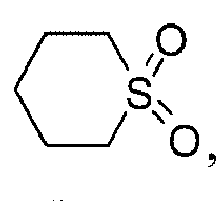
R6b is pyridyl, pyrimidyl, C(O)O(C1-C6 alkyl), (C1-C6 alkyl)OH, C(O)NH(C1-C6 alkyl), C(O)NH-heterocycle, or (C1-C6 alkyl);(viii) S-cycloalkyl,(ix) S-heterocyclyl which is optionally substituted with oxo;(x) S-(C1-C6 alkyl)C(O)OR8;(xi) S-CH2C(O)-heterocycle, sS-CH2C(O)-NR8(C1-C6 alkyl)NRaRb, S-CH2C(O)-NR8(C1-C6 alkyl)heterocycle, or S- (C1-C6 alkyl)NR8R9;(xii) OH, O-(C1-C6 alkyl), O-(C1-C6 alkyl)aryl, O-(C1-C6 alkyl)heterocycle, O-(C1-C6 alkyl)NR8R9, or O-phenyl which is optionally substituted with Br;(xiii) phenyl optionally substituted with Cl;(xiv) a 6-membered heteroaryl having at least one nitrogen;(xv) C1-C6 alkyl, (C1-C1 alkyl)heterocycle, (C1-C1 alkyl)heteroaryl, (C1-C1 alkyl)OH, (C1-C1 alkyl)CO2R8, (C1-C1 alkyl)CO2(C1-C1 alkyl), (C1-C1 alkyl)NR8R9, or (C2-C6 alkenyl)CO2R8; or(xvi) Br, Cl or H. - A composition comprising a compound according to any of claims 1-11 and a pharmaceutically acceptable diluent or carrier.
- A compound according to any of claims 1-11 for use in therapy.
- The use of a compound according to any of claims 1-11 in the manufacture of a medicaments for the treatment of a disease or condition resulting from underactivity of glucokinase or which can be treated by activating glucokinase.
- A method of preparing a compound of claim 1, said method comprising:(a) reacting a compound of the formula
 (b) reacting a compound of the formula
 (c) for a compound of Formula I wherein R1 is
 (d) for a compound of Formula I wherein R1 is

 (e) for a compound of Formula I wherein Z is SR6, reacting a corresponding compound having the formula
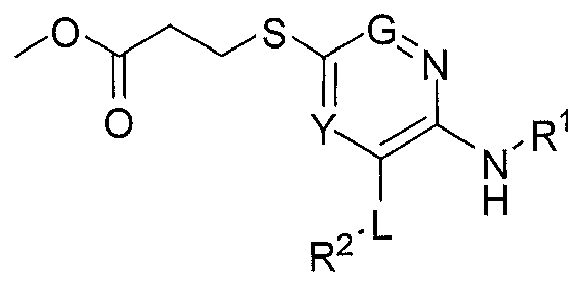 (f) for a compound of Formula I wherein R1 is

 (g) for a compound of Formula I wherein Z is CR3, reacting a corresponding compound having the formula
 (h) for a compound of Formula I wherein Z is C-SR6 and R6 is alkyl, CH2-aryl, heteroaryl, or aryl and wherein said R6 groups are optionally substituted, reacting a corresponding compound having the formula
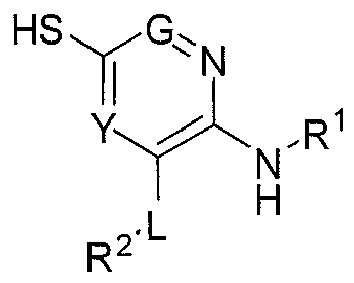 (i) for a compound of Formula I wherein L is O, reacting a corresponding compound having the formula
 (j) for a compound of Formula I wherein L is O or S, reacting a corresponding compound having the formula
 (k) for a compound of Formula I wherein L is CH2, reacting a corresponding compound having the formula
removing any protecting group or groups and, if desired, forming a salt.
Applications Claiming Priority (2)
| Application Number | Priority Date | Filing Date | Title |
|---|---|---|---|
| US78546006P | 2006-03-24 | 2006-03-24 | |
| EP07754021.9A EP2013204B1 (en) | 2006-03-24 | 2007-03-23 | 2-aminopyridine analogs as glucokinase activators |
Related Parent Applications (5)
| Application Number | Title | Priority Date | Filing Date |
|---|---|---|---|
| EP07754021.9A Division-Into EP2013204B1 (en) | 2006-03-24 | 2007-03-23 | 2-aminopyridine analogs as glucokinase activators |
| EP07754021.9A Division EP2013204B1 (en) | 2006-03-24 | 2007-03-23 | 2-aminopyridine analogs as glucokinase activators |
| WOPCT/US2007/007444 Previously-Filed-Application | 2007-03-23 | ||
| EP07754021.9 Division | 2007-03-23 | ||
| PCT/US2007/007444 Previously-Filed-Application WO2007117381A2 (en) | 2006-03-24 | 2007-03-23 | 2 -aminopyridine analogs as glucokinase activators |
Publications (3)
| Publication Number | Publication Date |
|---|---|
| EP2543667A1 true EP2543667A1 (en) | 2013-01-09 |
| EP2543667A9 EP2543667A9 (en) | 2013-08-21 |
| EP2543667B1 EP2543667B1 (en) | 2015-01-28 |
Family
ID=38542984
Family Applications (2)
| Application Number | Title | Priority Date | Filing Date |
|---|---|---|---|
| EP12170853.1A Not-in-force EP2543667B1 (en) | 2006-03-24 | 2007-03-23 | A method of preparing 2-aminopyridine analogs as glucokinase activators |
| EP07754021.9A Active EP2013204B1 (en) | 2006-03-24 | 2007-03-23 | 2-aminopyridine analogs as glucokinase activators |
Family Applications After (1)
| Application Number | Title | Priority Date | Filing Date |
|---|---|---|---|
| EP07754021.9A Active EP2013204B1 (en) | 2006-03-24 | 2007-03-23 | 2-aminopyridine analogs as glucokinase activators |
Country Status (25)
| Country | Link |
|---|---|
| US (3) | US8022223B2 (en) |
| EP (2) | EP2543667B1 (en) |
| JP (2) | JP5377284B2 (en) |
| KR (1) | KR101440634B1 (en) |
| CN (1) | CN101437816B (en) |
| AU (1) | AU2007235558B2 (en) |
| BR (1) | BRPI0709171A2 (en) |
| CA (1) | CA2647208C (en) |
| DK (1) | DK2013204T3 (en) |
| ES (1) | ES2536547T3 (en) |
| HR (1) | HRP20150347T1 (en) |
| IL (1) | IL194160A (en) |
| MX (1) | MX2008012168A (en) |
| MY (1) | MY148985A (en) |
| NZ (1) | NZ571997A (en) |
| PL (1) | PL2013204T3 (en) |
| PT (1) | PT2013204E (en) |
| RS (1) | RS53981B1 (en) |
| RU (1) | RU2457207C2 (en) |
| SG (1) | SG170775A1 (en) |
| SI (1) | SI2013204T1 (en) |
| TW (1) | TWI393718B (en) |
| UA (1) | UA103746C2 (en) |
| WO (1) | WO2007117381A2 (en) |
| ZA (1) | ZA200809017B (en) |
Cited By (2)
| Publication number | Priority date | Publication date | Assignee | Title |
|---|---|---|---|---|
| CN108329330A (en) * | 2017-01-20 | 2018-07-27 | 复旦大学 | 2- benzyloxies Ben Ji oxazoles and pyridine compounds and their and its medicinal usage |
| US11690841B2 (en) | 2017-09-14 | 2023-07-04 | Queen Mary University Of London | Glycolysis-activating agents for treatment or prevention of disease |
Families Citing this family (36)
| Publication number | Priority date | Publication date | Assignee | Title |
|---|---|---|---|---|
| EP2543667B1 (en) | 2006-03-24 | 2015-01-28 | Array Biopharma, Inc. | A method of preparing 2-aminopyridine analogs as glucokinase activators |
| US8431713B2 (en) * | 2007-01-24 | 2013-04-30 | Array Biopharma, Inc. | 2-aminopyridine derivatives as glucokinase activators |
| CA2681695A1 (en) * | 2007-03-23 | 2008-10-02 | Array Biopharma Inc. | 2-aminopyridine analogs as glucokinase activators |
| EP2025674A1 (en) | 2007-08-15 | 2009-02-18 | sanofi-aventis | Substituted tetra hydro naphthalines, method for their manufacture and their use as drugs |
| UA101166C2 (en) * | 2007-09-21 | 2013-03-11 | Аррей Биофарма Инк. | Pyridin-2-yl-amino-1,2,4-thiadiazole derivatives as glucokinase activators for the treatment of diabetes mellitus |
| EA201000561A1 (en) | 2007-10-09 | 2010-10-29 | Мерк Патент Гмбх | PYRIDINE DERIVATIVES, SUITABLE AS GLUKOKINASE ACTIVATORS |
| PL2239253T3 (en) * | 2008-02-06 | 2013-11-29 | Daiichi Sankyo Co Ltd | Novel phenylpyrrole derivative |
| US7741327B2 (en) | 2008-04-16 | 2010-06-22 | Hoffmann-La Roche Inc. | Pyrrolidinone glucokinase activators |
| WO2011107494A1 (en) | 2010-03-03 | 2011-09-09 | Sanofi | Novel aromatic glycoside derivatives, medicaments containing said compounds, and the use thereof |
| EP2553086B1 (en) | 2010-03-31 | 2017-04-19 | The Scripps Research Institute | Reprogramming cells |
| US8178689B2 (en) | 2010-06-17 | 2012-05-15 | Hoffman-La Roche Inc. | Tricyclic compounds |
| US8933024B2 (en) | 2010-06-18 | 2015-01-13 | Sanofi | Azolopyridin-3-one derivatives as inhibitors of lipases and phospholipases |
| US8530413B2 (en) | 2010-06-21 | 2013-09-10 | Sanofi | Heterocyclically substituted methoxyphenyl derivatives with an oxo group, processes for preparation thereof and use thereof as medicaments |
| TW201215388A (en) | 2010-07-05 | 2012-04-16 | Sanofi Sa | (2-aryloxyacetylamino)phenylpropionic acid derivatives, processes for preparation thereof and use thereof as medicaments |
| TW201221505A (en) | 2010-07-05 | 2012-06-01 | Sanofi Sa | Aryloxyalkylene-substituted hydroxyphenylhexynoic acids, process for preparation thereof and use thereof as a medicament |
| TW201215387A (en) | 2010-07-05 | 2012-04-16 | Sanofi Aventis | Spirocyclically substituted 1,3-propane dioxide derivatives, processes for preparation thereof and use thereof as a medicament |
| US8710050B2 (en) | 2011-03-08 | 2014-04-29 | Sanofi | Di and tri- substituted oxathiazine derivatives, method for the production, method for the production thereof, use thereof as medicine and drug containing said derivatives and use thereof |
| WO2012120054A1 (en) | 2011-03-08 | 2012-09-13 | Sanofi | Di- and tri-substituted oxathiazine derivates, method for the production thereof, use thereof as medicine and drug containing said derivatives and use thereof |
| EP2683704B1 (en) | 2011-03-08 | 2014-12-17 | Sanofi | Branched oxathiazine derivatives, method for the production thereof, use thereof as medicine and drug containing said derivatives and use thereof |
| WO2012120056A1 (en) | 2011-03-08 | 2012-09-13 | Sanofi | Tetrasubstituted oxathiazine derivatives, method for producing them, their use as medicine and drug containing said derivatives and the use thereof |
| EP2766349B1 (en) | 2011-03-08 | 2016-06-01 | Sanofi | Oxathiazine derivatives substituted with carbocycles or heterocycles, method for producing same, drugs containing said compounds, and use thereof |
| JPWO2012121314A1 (en) | 2011-03-09 | 2014-07-17 | 第一三共株式会社 | Dipyridylamine derivatives |
| WO2013037390A1 (en) | 2011-09-12 | 2013-03-21 | Sanofi | 6-(4-hydroxy-phenyl)-3-styryl-1h-pyrazolo[3,4-b]pyridine-4-carboxylic acid amide derivatives as kinase inhibitors |
| WO2013045413A1 (en) | 2011-09-27 | 2013-04-04 | Sanofi | 6-(4-hydroxy-phenyl)-3-alkyl-1h-pyrazolo[3,4-b]pyridine-4-carboxylic acid amide derivatives as kinase inhibitors |
| US9296735B2 (en) | 2012-05-18 | 2016-03-29 | Amgen Inc. | Method for the preparation of thiadiazoles |
| JP2015536993A (en) * | 2012-11-09 | 2015-12-24 | アムジェン インコーポレイテッド | (1S) -1- [5-({3-[(2-methylpyridin-3-yl) oxy] -5- (pyridin-2-ylsulfanyl) pyridin-2-yl} amino) -1,2, Crystal form of 4-thiadiazol-3-yl] ethane-1,2-diol |
| RS57541B1 (en) * | 2013-11-13 | 2018-10-31 | Vertex Pharma | Methods of preparing inhibitors of influenza viruses replication |
| CN108290840A (en) | 2015-12-01 | 2018-07-17 | 巴斯夫欧洲公司 | Pyridine compounds as fungicide |
| CN108290839A (en) | 2015-12-01 | 2018-07-17 | 巴斯夫欧洲公司 | Pyridine compounds as fungicides |
| CR20190580A (en) | 2017-05-30 | 2020-02-10 | Basf Se | Pyridine and pyrazine compounds |
| EP3703675A4 (en) | 2017-10-30 | 2021-06-16 | Neuropore Therapies, Inc. | SUBSTITUTED PHENYLSULFONYLPHENYLTRIAZOLTHIONES AND USES THEREOF |
| EP3846793B1 (en) | 2018-09-07 | 2024-01-24 | PIC Therapeutics, Inc. | Eif4e inhibitors and uses thereof |
| JP7648027B2 (en) | 2019-12-19 | 2025-03-18 | クリア、スペイン、エセ、ア、ウ | Processes and intermediates for the preparation of upadacitinib |
| MX2022010944A (en) | 2020-03-03 | 2022-11-09 | Pic Therapeutics Inc | Eif4e inhibitors and uses thereof. |
| TW202315621A (en) | 2021-08-25 | 2023-04-16 | 美商皮克醫療公司 | Eif4e inhibitors and uses thereof |
| JP2024532276A (en) | 2021-08-25 | 2024-09-05 | ピク セラピューティクス, インコーポレイテッド | eIF4E inhibitors and uses thereof |
Citations (10)
| Publication number | Priority date | Publication date | Assignee | Title |
|---|---|---|---|---|
| US3773919A (en) | 1969-10-23 | 1973-11-20 | Du Pont | Polylactide-drug mixtures |
| EP0307142A1 (en) | 1987-09-10 | 1989-03-15 | Merck Sharp & Dohme Ltd. | Thiadiazoles useful in the treatment of senile dementia |
| WO1995005368A1 (en) | 1993-08-13 | 1995-02-23 | Zeneca Limited | Thia- and oxadiazole derivatives and their use as fungicides or insecticides |
| WO1996015111A1 (en) | 1994-11-15 | 1996-05-23 | Regents Of The University Of Minnesota | Method and intermediates for the synthesis of korupensamines |
| WO2003037894A1 (en) | 2001-11-02 | 2003-05-08 | Glaxo Group Limited | 4-(5-membered)-heteroaryl acyl pyrrolidine derivatives as hcv inhibitors |
| WO2003062224A1 (en) | 2002-01-17 | 2003-07-31 | Eli Lilly And Company | Aza-cyclic compounds as modulators of acetylcholine receptors |
| WO2005086656A2 (en) * | 2004-02-27 | 2005-09-22 | Bayer Pharmaceuticals Corporation | Heteroarylaminopyrazole derivatives useful for the treatment of diabetes |
| WO2005090332A1 (en) * | 2004-03-23 | 2005-09-29 | Banyu Pharmaceutical Co., Ltd | Substituted quinazoline or pyridopyrimidine derivative |
| EP1598349A1 (en) * | 2003-02-13 | 2005-11-23 | Banyu Pharmaceutical Co., Ltd. | Novel 2-pyridinecarboxamide derivatives |
| WO2007058482A1 (en) * | 2005-11-16 | 2007-05-24 | Lg Life Sciences, Ltd. | Novel inhibitors of protein kinase |
Family Cites Families (4)
| Publication number | Priority date | Publication date | Assignee | Title |
|---|---|---|---|---|
| IL113112A (en) * | 1994-03-28 | 2000-06-01 | Nissan Chemical Ind Ltd | Pyridine substituted thiazolidinediones and pharmaceutical compositions comprising them |
| BR0013899A (en) | 1999-09-10 | 2003-07-08 | Merck & Co Inc | A compound, pharmaceutical composition, processes for treating or preventing cancer, a disease in which angiogenesis is implicated, retinal vascularization, diabetic retinopathy, age-related macular degeneration, inflammatory diseases, tyrosine-dependent disease or conditions. kinase, bone-associated pathologies, and processes for producing a pharmaceutical composition, and for reducing or preventing tissue damage following a cerebral ischemic event |
| ES2289279T3 (en) * | 2002-03-15 | 2008-02-01 | Vertex Pharmaceuticals Incorporated | USEFUL COMPOSITIONS AS PROTEINQUINASE INHIBITORS. |
| EP2543667B1 (en) | 2006-03-24 | 2015-01-28 | Array Biopharma, Inc. | A method of preparing 2-aminopyridine analogs as glucokinase activators |
-
2007
- 2007-03-23 EP EP12170853.1A patent/EP2543667B1/en not_active Not-in-force
- 2007-03-23 AU AU2007235558A patent/AU2007235558B2/en not_active Ceased
- 2007-03-23 CA CA2647208A patent/CA2647208C/en not_active Expired - Fee Related
- 2007-03-23 SI SI200731636T patent/SI2013204T1/en unknown
- 2007-03-23 UA UAA200812528A patent/UA103746C2/en unknown
- 2007-03-23 NZ NZ571997A patent/NZ571997A/en not_active IP Right Cessation
- 2007-03-23 KR KR1020087026141A patent/KR101440634B1/en not_active Expired - Fee Related
- 2007-03-23 MX MX2008012168A patent/MX2008012168A/en active IP Right Grant
- 2007-03-23 MY MYPI20083729A patent/MY148985A/en unknown
- 2007-03-23 CN CN2007800155903A patent/CN101437816B/en not_active Expired - Fee Related
- 2007-03-23 SG SG201102157-3A patent/SG170775A1/en unknown
- 2007-03-23 PT PT77540219T patent/PT2013204E/en unknown
- 2007-03-23 ES ES07754021.9T patent/ES2536547T3/en active Active
- 2007-03-23 JP JP2009501610A patent/JP5377284B2/en not_active Expired - Fee Related
- 2007-03-23 RS RS20150314A patent/RS53981B1/en unknown
- 2007-03-23 EP EP07754021.9A patent/EP2013204B1/en active Active
- 2007-03-23 WO PCT/US2007/007444 patent/WO2007117381A2/en not_active Ceased
- 2007-03-23 BR BRPI0709171-0A patent/BRPI0709171A2/en not_active Application Discontinuation
- 2007-03-23 RU RU2008141999/04A patent/RU2457207C2/en not_active IP Right Cessation
- 2007-03-23 US US12/282,600 patent/US8022223B2/en not_active Expired - Fee Related
- 2007-03-23 HR HRP20150347TT patent/HRP20150347T1/en unknown
- 2007-03-23 TW TW096110176A patent/TWI393718B/en not_active IP Right Cessation
- 2007-03-23 PL PL07754021T patent/PL2013204T3/en unknown
- 2007-03-23 DK DK07754021T patent/DK2013204T3/en active
-
2008
- 2008-09-17 IL IL194160A patent/IL194160A/en not_active IP Right Cessation
- 2008-10-21 ZA ZA2008/09017A patent/ZA200809017B/en unknown
-
2011
- 2011-07-27 US US13/191,994 patent/US8354540B2/en not_active Expired - Fee Related
-
2012
- 2012-11-05 US US13/669,083 patent/US8883828B2/en not_active Expired - Fee Related
-
2013
- 2013-08-22 JP JP2013171956A patent/JP2013245220A/en not_active Withdrawn
Patent Citations (11)
| Publication number | Priority date | Publication date | Assignee | Title |
|---|---|---|---|---|
| US3773919A (en) | 1969-10-23 | 1973-11-20 | Du Pont | Polylactide-drug mixtures |
| EP0307142A1 (en) | 1987-09-10 | 1989-03-15 | Merck Sharp & Dohme Ltd. | Thiadiazoles useful in the treatment of senile dementia |
| WO1995005368A1 (en) | 1993-08-13 | 1995-02-23 | Zeneca Limited | Thia- and oxadiazole derivatives and their use as fungicides or insecticides |
| WO1996015111A1 (en) | 1994-11-15 | 1996-05-23 | Regents Of The University Of Minnesota | Method and intermediates for the synthesis of korupensamines |
| WO2003037894A1 (en) | 2001-11-02 | 2003-05-08 | Glaxo Group Limited | 4-(5-membered)-heteroaryl acyl pyrrolidine derivatives as hcv inhibitors |
| WO2003062224A1 (en) | 2002-01-17 | 2003-07-31 | Eli Lilly And Company | Aza-cyclic compounds as modulators of acetylcholine receptors |
| EP1598349A1 (en) * | 2003-02-13 | 2005-11-23 | Banyu Pharmaceutical Co., Ltd. | Novel 2-pyridinecarboxamide derivatives |
| WO2005086656A2 (en) * | 2004-02-27 | 2005-09-22 | Bayer Pharmaceuticals Corporation | Heteroarylaminopyrazole derivatives useful for the treatment of diabetes |
| WO2005090332A1 (en) * | 2004-03-23 | 2005-09-29 | Banyu Pharmaceutical Co., Ltd | Substituted quinazoline or pyridopyrimidine derivative |
| EP1734040A1 (en) * | 2004-03-23 | 2006-12-20 | Banyu Pharmaceutical Co., Ltd. | Substituted quinazoline or pyridopyrimidine derivative |
| WO2007058482A1 (en) * | 2005-11-16 | 2007-05-24 | Lg Life Sciences, Ltd. | Novel inhibitors of protein kinase |
Non-Patent Citations (56)
| Title |
|---|
| "American Diabetes Association", DIABETES CARE, vol. 21, 1998, pages S88 - 90 |
| "Beilsteins Handbuch der organischen Chemie", SPRINGER-VERLAG |
| "Chiral Liquid Chromatography", 1989, CHAPMAN AND HALL |
| "Comprehensive Medicinal Chemistry", 1990, PERGAMON PRESS |
| "Design of Prodrugs", 1985, ELSEVIER |
| "Diabetes Control and Complications Trial Research Group", NEW ENGLAND J. MED., vol. 329, 1993, pages 977 - 986 |
| "Drug Stereochemistry, Analytical Methods and Pharmacology", 1993, MARCEL DEKKER, INC. |
| "Methods in Enzymology", vol. 42, 1985, ACADEMIC PRESS, pages: 309 - 396 |
| "Remington's Pharmaceutical Sciences", 1980 |
| "Scheme B. According to Scheme D, acylguanidine", CAN. J. CHEM., vol. 39, no. 10, 1961, pages 1017 - 29 |
| "The Expert Committee on the Diagnosis and Classification of Diabetes Mellitus", DIABETES CARE, vol. 21, 1998, pages 5 - 19 |
| ADV. HETEROCYCL. CHEM., vol. 32, 1982, pages 285 |
| ADVANCED DRUG DELIVERY REVIEWS, vol. 19, 1996, pages 115 |
| AUST. J. CHEM., vol. 38, 1985, pages 447 - 458 |
| BAILEY, C. J.: "Biguanides and NIDDM", DIABETES CARE, vol. 15, 1992, pages 773 - 784 |
| BELL, G. I. ET AL., ANNUAL REV. OF PHYSIOL., vol. 58, 1996, pages 171 - 186 |
| BIOORG. MED. CHEM., vol. 11, 2003, pages 5529 - 5537 |
| CARO, J. F. ET AL., HORMONE & METABOLIC RES., vol. 27, 1995, pages 19 - 22 |
| CHEMICAL & PHARMACEUTICAL BULLETIN, vol. 38, no. 10, 1990, pages 2667 - 75 |
| CHRISTESEN, H. B. ET AL., DIABETES, vol. 51, 2002, pages 1240 - 1246 |
| DE FRONZO, R. A.; GOODMAN, A. M. N., ENGL. J. MED., vol. 333, 1995, pages 541 - 549 |
| DEFRONZO, R. A., DIABETES, vol. 37, 1988, pages 667 - 687 |
| E.; WILEN, S.: "Stereochemistry of Organic Compounds", 1994, JOHN WILEY & SONS, INC., pages: 322 |
| ELIEL, E.; WILEN, S.: "Stereochemistry of Organic Compounds", 1994, JOHN WILEY & SONS, INC. |
| FROGUEL, P. ET AL., NEW ENGLAND J MED., vol. 328, 1993, pages 697 - 702 |
| GIRARD, J. ET AL., ANNU. REV. NUTR., vol. 17, 1997, pages 325 - 352 |
| GLASER, B. ET AL., NEW ENGLAND J. MED., vol. 338, 1998, pages 226 - 230 |
| GLOYN, A. L ET AL., DIABETES, vol. 52, 2003, pages 2433 - 2440 |
| H. BUNDGAARD ET AL., JOURNAL OF PHARMACEUTICAL SCIENCES, vol. 77, 1988, pages 285 |
| H. BUNDGAARD: "Advanced Drug Delivery Reviews", ADVANCED DRUG DELIVERY REVIEWS, vol. 8, 1992, pages 1 - 38 |
| H. BUNDGAARD: "Design and Application of Prodrugs", 1991, article "A Textbook of Drug Design and Development", pages: 113 - 191 |
| HETEROCYCLES, vol. 57, 2002, pages 811 - 823 |
| J HETEROCYCLIC CHEM., vol. 26, 1989, pages 23 - 24 |
| J MED. CHEM., 2004, pages 3089 - 3104 |
| J ORG. CHEM., vol. 28, 1963, pages 1861 - 21 |
| J. MED CHEM., vol. 39, 1996, pages 10 |
| J. ORG. CHEM., 2002, pages 5553 - 5566 |
| JACOB III, J. ORG. CHEM., vol. 47, 1982, pages 4165 |
| JACOBSEN ET AL., AUST. ,/ CHEM., vol. 40, no. 3, 1987, pages 491 - 499 |
| KOREN, B. ET AL., HETEROCYCLES, vol. 26, no. 3, 1987, pages 689 - 697 |
| LOCHMULLER, C. H., J. CHROMATOGR., vol. 113, no. 3, 1975, pages 283 - 302 |
| LOUIS F. FIESER; MARY FIESER: "Reagents for Organic Synthesis", vol. 1-19, 1967, WILEY |
| N. KAKEYA ET AL., CHEM. PHARM. BULL., vol. 32, 1984, pages 692 |
| OHKUBO, Y. ET AL., DIABETES RES. CLIN. PRACT., vol. 28, 1995, pages 103 - 117 |
| OKAMOTO, J. OF CHROMATOGR., vol. 513, 1990, pages 375 - 378 |
| ORGANIC LETTERS, 2001, pages 2729 - 2732 |
| ORGANIC SYNTHESIS, 1946, pages 13 - 15 |
| PRINTZ, R. L. ET AL., ANNU. REV. NUTR., vol. 13, 1993, pages 463 - 496 |
| ROMAN, S. H.; HARRIS, M. 1., ENDOCRINOLOGY AND METABOLISM CLINICS OF NORTH AMERICA, vol. 26.3, 1997, pages 443 - 474 |
| SYN. LETT., 1995, pages 931 - 932 |
| T. W. GREENE: "Protective Groups in Organic Synthesis", 1991, JOHN WILEY & SONS |
| TETRAHEDRON LETTERS, 1994, pages 3225 - 3226 |
| TETRAHEDRON, 1990, pages 2943 - 2964 |
| TETRAHEDRON, TETRAHEDRON, 1970, pages 5611 - 5615 |
| VAHL, T. P.; D'ALESSIO, D. A., EXPERT OPINION ON INVEST. DRUGS, vol. 13, 2004, pages 177 - 188 |
| WILLSON, T. M. ET AL.: "PPAR agonist class of drugs", J. MED. CHEM., vol. 39, 1996, pages 665 - 668 |
Cited By (3)
| Publication number | Priority date | Publication date | Assignee | Title |
|---|---|---|---|---|
| CN108329330A (en) * | 2017-01-20 | 2018-07-27 | 复旦大学 | 2- benzyloxies Ben Ji oxazoles and pyridine compounds and their and its medicinal usage |
| CN108329330B (en) * | 2017-01-20 | 2021-05-04 | 复旦大学 | 2-Benzyloxyphenyloxazolopyridine compounds and their medicinal uses |
| US11690841B2 (en) | 2017-09-14 | 2023-07-04 | Queen Mary University Of London | Glycolysis-activating agents for treatment or prevention of disease |
Also Published As
Similar Documents
| Publication | Publication Date | Title |
|---|---|---|
| EP1948652B1 (en) | Glucokinase activators | |
| US8883828B2 (en) | 2-aminopyridine analogs as glucokinase activators | |
| EP1986645B1 (en) | Glucokinase activators | |
| HK1178901A (en) | 2-aminopyridine analogs as glucokinase activators | |
| HK1128130B (en) | 2-aminopyridine analogs as glucokinase activators |
Legal Events
| Date | Code | Title | Description |
|---|---|---|---|
| PUAI | Public reference made under article 153(3) epc to a published international application that has entered the european phase |
Free format text: ORIGINAL CODE: 0009012 |
|
| AC | Divisional application: reference to earlier application |
Ref document number: 2013204 Country of ref document: EP Kind code of ref document: P |
|
| AK | Designated contracting states |
Kind code of ref document: A1 Designated state(s): AT BE BG CH CY CZ DE DK EE ES FI FR GB GR HU IE IS IT LI LT LU LV MC MT NL PL PT RO SE SI SK TR |
|
| AX | Request for extension of the european patent |
Extension state: AL BA HR MK RS |
|
| 17P | Request for examination filed |
Effective date: 20130708 |
|
| RBV | Designated contracting states (corrected) |
Designated state(s): AT BE BG CH CY CZ DE DK EE ES FI FR GB GR HU IE IS IT LI LT LU LV MC MT NL PL PT RO SE SI SK TR |
|
| REG | Reference to a national code |
Ref country code: HK Ref legal event code: DE Ref document number: 1178901 Country of ref document: HK |
|
| GRAP | Despatch of communication of intention to grant a patent |
Free format text: ORIGINAL CODE: EPIDOSNIGR1 |
|
| INTG | Intention to grant announced |
Effective date: 20140930 |
|
| GRAS | Grant fee paid |
Free format text: ORIGINAL CODE: EPIDOSNIGR3 |
|
| GRAA | (expected) grant |
Free format text: ORIGINAL CODE: 0009210 |
|
| AC | Divisional application: reference to earlier application |
Ref document number: 2013204 Country of ref document: EP Kind code of ref document: P |
|
| AK | Designated contracting states |
Kind code of ref document: B1 Designated state(s): AT BE BG CH CY CZ DE DK EE ES FI FR GB GR HU IE IS IT LI LT LU LV MC MT NL PL PT RO SE SI SK TR |
|
| REG | Reference to a national code |
Ref country code: GB Ref legal event code: FG4D |
|
| REG | Reference to a national code |
Ref country code: CH Ref legal event code: EP |
|
| REG | Reference to a national code |
Ref country code: IE Ref legal event code: FG4D |
|
| REG | Reference to a national code |
Ref country code: DE Ref legal event code: R096 Ref document number: 602007040219 Country of ref document: DE Effective date: 20150312 |
|
| REG | Reference to a national code |
Ref country code: AT Ref legal event code: REF Ref document number: 708183 Country of ref document: AT Kind code of ref document: T Effective date: 20150315 |
|
| REG | Reference to a national code |
Ref country code: CH Ref legal event code: NV Representative=s name: STOLMAR AND PARTNER PATENT- UND MARKENANWAELTE, CH |
|
| REG | Reference to a national code |
Ref country code: SE Ref legal event code: TRGR |
|
| REG | Reference to a national code |
Ref country code: AT Ref legal event code: MK05 Ref document number: 708183 Country of ref document: AT Kind code of ref document: T Effective date: 20150128 |
|
| REG | Reference to a national code |
Ref country code: NL Ref legal event code: VDEP Effective date: 20150128 |
|
| REG | Reference to a national code |
Ref country code: LT Ref legal event code: MG4D |
|
| PG25 | Lapsed in a contracting state [announced via postgrant information from national office to epo] |
Ref country code: LT Free format text: LAPSE BECAUSE OF FAILURE TO SUBMIT A TRANSLATION OF THE DESCRIPTION OR TO PAY THE FEE WITHIN THE PRESCRIBED TIME-LIMIT Effective date: 20150128 Ref country code: BG Free format text: LAPSE BECAUSE OF FAILURE TO SUBMIT A TRANSLATION OF THE DESCRIPTION OR TO PAY THE FEE WITHIN THE PRESCRIBED TIME-LIMIT Effective date: 20150428 Ref country code: ES Free format text: LAPSE BECAUSE OF FAILURE TO SUBMIT A TRANSLATION OF THE DESCRIPTION OR TO PAY THE FEE WITHIN THE PRESCRIBED TIME-LIMIT Effective date: 20150128 Ref country code: FI Free format text: LAPSE BECAUSE OF FAILURE TO SUBMIT A TRANSLATION OF THE DESCRIPTION OR TO PAY THE FEE WITHIN THE PRESCRIBED TIME-LIMIT Effective date: 20150128 |
|
| PG25 | Lapsed in a contracting state [announced via postgrant information from national office to epo] |
Ref country code: GR Free format text: LAPSE BECAUSE OF FAILURE TO SUBMIT A TRANSLATION OF THE DESCRIPTION OR TO PAY THE FEE WITHIN THE PRESCRIBED TIME-LIMIT Effective date: 20150429 Ref country code: PL Free format text: LAPSE BECAUSE OF FAILURE TO SUBMIT A TRANSLATION OF THE DESCRIPTION OR TO PAY THE FEE WITHIN THE PRESCRIBED TIME-LIMIT Effective date: 20150128 Ref country code: NL Free format text: LAPSE BECAUSE OF FAILURE TO SUBMIT A TRANSLATION OF THE DESCRIPTION OR TO PAY THE FEE WITHIN THE PRESCRIBED TIME-LIMIT Effective date: 20150128 Ref country code: IS Free format text: LAPSE BECAUSE OF FAILURE TO SUBMIT A TRANSLATION OF THE DESCRIPTION OR TO PAY THE FEE WITHIN THE PRESCRIBED TIME-LIMIT Effective date: 20150528 Ref country code: LV Free format text: LAPSE BECAUSE OF FAILURE TO SUBMIT A TRANSLATION OF THE DESCRIPTION OR TO PAY THE FEE WITHIN THE PRESCRIBED TIME-LIMIT Effective date: 20150128 Ref country code: AT Free format text: LAPSE BECAUSE OF FAILURE TO SUBMIT A TRANSLATION OF THE DESCRIPTION OR TO PAY THE FEE WITHIN THE PRESCRIBED TIME-LIMIT Effective date: 20150128 |
|
| REG | Reference to a national code |
Ref country code: DE Ref legal event code: R097 Ref document number: 602007040219 Country of ref document: DE |
|
| PG25 | Lapsed in a contracting state [announced via postgrant information from national office to epo] |
Ref country code: RO Free format text: LAPSE BECAUSE OF FAILURE TO SUBMIT A TRANSLATION OF THE DESCRIPTION OR TO PAY THE FEE WITHIN THE PRESCRIBED TIME-LIMIT Effective date: 20150128 Ref country code: SK Free format text: LAPSE BECAUSE OF FAILURE TO SUBMIT A TRANSLATION OF THE DESCRIPTION OR TO PAY THE FEE WITHIN THE PRESCRIBED TIME-LIMIT Effective date: 20150128 Ref country code: MC Free format text: LAPSE BECAUSE OF FAILURE TO SUBMIT A TRANSLATION OF THE DESCRIPTION OR TO PAY THE FEE WITHIN THE PRESCRIBED TIME-LIMIT Effective date: 20150128 Ref country code: EE Free format text: LAPSE BECAUSE OF FAILURE TO SUBMIT A TRANSLATION OF THE DESCRIPTION OR TO PAY THE FEE WITHIN THE PRESCRIBED TIME-LIMIT Effective date: 20150128 Ref country code: DK Free format text: LAPSE BECAUSE OF FAILURE TO SUBMIT A TRANSLATION OF THE DESCRIPTION OR TO PAY THE FEE WITHIN THE PRESCRIBED TIME-LIMIT Effective date: 20150128 Ref country code: LU Free format text: LAPSE BECAUSE OF FAILURE TO SUBMIT A TRANSLATION OF THE DESCRIPTION OR TO PAY THE FEE WITHIN THE PRESCRIBED TIME-LIMIT Effective date: 20150323 Ref country code: CZ Free format text: LAPSE BECAUSE OF FAILURE TO SUBMIT A TRANSLATION OF THE DESCRIPTION OR TO PAY THE FEE WITHIN THE PRESCRIBED TIME-LIMIT Effective date: 20150128 |
|
| PLBE | No opposition filed within time limit |
Free format text: ORIGINAL CODE: 0009261 |
|
| STAA | Information on the status of an ep patent application or granted ep patent |
Free format text: STATUS: NO OPPOSITION FILED WITHIN TIME LIMIT |
|
| 26N | No opposition filed |
Effective date: 20151029 |
|
| REG | Reference to a national code |
Ref country code: IE Ref legal event code: MM4A |
|
| REG | Reference to a national code |
Ref country code: CH Ref legal event code: PFA Owner name: ARRAY BIOPHARMA, INC., US Free format text: FORMER OWNER: ARRAY BIOPHARMA, INC., US |
|
| PG25 | Lapsed in a contracting state [announced via postgrant information from national office to epo] |
Ref country code: IE Free format text: LAPSE BECAUSE OF NON-PAYMENT OF DUE FEES Effective date: 20150323 |
|
| PG25 | Lapsed in a contracting state [announced via postgrant information from national office to epo] |
Ref country code: SI Free format text: LAPSE BECAUSE OF FAILURE TO SUBMIT A TRANSLATION OF THE DESCRIPTION OR TO PAY THE FEE WITHIN THE PRESCRIBED TIME-LIMIT Effective date: 20150128 |
|
| REG | Reference to a national code |
Ref country code: FR Ref legal event code: PLFP Year of fee payment: 10 |
|
| PG25 | Lapsed in a contracting state [announced via postgrant information from national office to epo] |
Ref country code: BE Free format text: LAPSE BECAUSE OF FAILURE TO SUBMIT A TRANSLATION OF THE DESCRIPTION OR TO PAY THE FEE WITHIN THE PRESCRIBED TIME-LIMIT Effective date: 20150128 |
|
| PG25 | Lapsed in a contracting state [announced via postgrant information from national office to epo] |
Ref country code: MT Free format text: LAPSE BECAUSE OF FAILURE TO SUBMIT A TRANSLATION OF THE DESCRIPTION OR TO PAY THE FEE WITHIN THE PRESCRIBED TIME-LIMIT Effective date: 20150128 |
|
| REG | Reference to a national code |
Ref country code: FR Ref legal event code: PLFP Year of fee payment: 11 |
|
| PGFP | Annual fee paid to national office [announced via postgrant information from national office to epo] |
Ref country code: CH Payment date: 20170327 Year of fee payment: 11 Ref country code: SE Payment date: 20170329 Year of fee payment: 11 Ref country code: FR Payment date: 20170327 Year of fee payment: 11 |
|
| PG25 | Lapsed in a contracting state [announced via postgrant information from national office to epo] |
Ref country code: HU Free format text: LAPSE BECAUSE OF FAILURE TO SUBMIT A TRANSLATION OF THE DESCRIPTION OR TO PAY THE FEE WITHIN THE PRESCRIBED TIME-LIMIT; INVALID AB INITIO Effective date: 20070323 |
|
| PGFP | Annual fee paid to national office [announced via postgrant information from national office to epo] |
Ref country code: GB Payment date: 20170327 Year of fee payment: 11 |
|
| PG25 | Lapsed in a contracting state [announced via postgrant information from national office to epo] |
Ref country code: CY Free format text: LAPSE BECAUSE OF FAILURE TO SUBMIT A TRANSLATION OF THE DESCRIPTION OR TO PAY THE FEE WITHIN THE PRESCRIBED TIME-LIMIT Effective date: 20150128 |
|
| PGFP | Annual fee paid to national office [announced via postgrant information from national office to epo] |
Ref country code: IT Payment date: 20170324 Year of fee payment: 11 |
|
| PG25 | Lapsed in a contracting state [announced via postgrant information from national office to epo] |
Ref country code: PT Free format text: LAPSE BECAUSE OF FAILURE TO SUBMIT A TRANSLATION OF THE DESCRIPTION OR TO PAY THE FEE WITHIN THE PRESCRIBED TIME-LIMIT Effective date: 20150528 |
|
| PG25 | Lapsed in a contracting state [announced via postgrant information from national office to epo] |
Ref country code: TR Free format text: LAPSE BECAUSE OF FAILURE TO SUBMIT A TRANSLATION OF THE DESCRIPTION OR TO PAY THE FEE WITHIN THE PRESCRIBED TIME-LIMIT Effective date: 20150128 |
|
| REG | Reference to a national code |
Ref country code: CH Ref legal event code: PCAR Free format text: NEW ADDRESS: RUE DU CENDRIER 15 CP 1489, 1201 GENEVE (CH) |
|
| PGFP | Annual fee paid to national office [announced via postgrant information from national office to epo] |
Ref country code: DE Payment date: 20180328 Year of fee payment: 12 |
|
| PG25 | Lapsed in a contracting state [announced via postgrant information from national office to epo] |
Ref country code: SE Free format text: LAPSE BECAUSE OF NON-PAYMENT OF DUE FEES Effective date: 20180324 |
|
| REG | Reference to a national code |
Ref country code: CH Ref legal event code: PL |
|
| GBPC | Gb: european patent ceased through non-payment of renewal fee |
Effective date: 20180323 |
|
| PG25 | Lapsed in a contracting state [announced via postgrant information from national office to epo] |
Ref country code: GB Free format text: LAPSE BECAUSE OF NON-PAYMENT OF DUE FEES Effective date: 20180323 Ref country code: IT Free format text: LAPSE BECAUSE OF NON-PAYMENT OF DUE FEES Effective date: 20180323 Ref country code: CH Free format text: LAPSE BECAUSE OF NON-PAYMENT OF DUE FEES Effective date: 20180331 Ref country code: LI Free format text: LAPSE BECAUSE OF NON-PAYMENT OF DUE FEES Effective date: 20180331 |
|
| PG25 | Lapsed in a contracting state [announced via postgrant information from national office to epo] |
Ref country code: FR Free format text: LAPSE BECAUSE OF NON-PAYMENT OF DUE FEES Effective date: 20180331 |
|
| REG | Reference to a national code |
Ref country code: DE Ref legal event code: R119 Ref document number: 602007040219 Country of ref document: DE |
|
| REG | Reference to a national code |
Ref country code: HK Ref legal event code: WD Ref document number: 1178901 Country of ref document: HK |
|
| PG25 | Lapsed in a contracting state [announced via postgrant information from national office to epo] |
Ref country code: DE Free format text: LAPSE BECAUSE OF NON-PAYMENT OF DUE FEES Effective date: 20191001 |