EP2543648A1 - Calcium ferroaluminate compound, cement admixture and process for producing same, and cement composition - Google Patents
Calcium ferroaluminate compound, cement admixture and process for producing same, and cement composition Download PDFInfo
- Publication number
- EP2543648A1 EP2543648A1 EP20100847055 EP10847055A EP2543648A1 EP 2543648 A1 EP2543648 A1 EP 2543648A1 EP 20100847055 EP20100847055 EP 20100847055 EP 10847055 A EP10847055 A EP 10847055A EP 2543648 A1 EP2543648 A1 EP 2543648A1
- Authority
- EP
- European Patent Office
- Prior art keywords
- cement
- cao
- cement admixture
- substance
- compound
- Prior art date
- Legal status (The legal status is an assumption and is not a legal conclusion. Google has not performed a legal analysis and makes no representation as to the accuracy of the status listed.)
- Granted
Links
Images

Classifications
-
- C—CHEMISTRY; METALLURGY
- C04—CEMENTS; CONCRETE; ARTIFICIAL STONE; CERAMICS; REFRACTORIES
- C04B—LIME, MAGNESIA; SLAG; CEMENTS; COMPOSITIONS THEREOF, e.g. MORTARS, CONCRETE OR LIKE BUILDING MATERIALS; ARTIFICIAL STONE; CERAMICS; REFRACTORIES; TREATMENT OF NATURAL STONE
- C04B28/00—Compositions of mortars, concrete or artificial stone, containing inorganic binders or the reaction product of an inorganic and an organic binder, e.g. polycarboxylate cements
- C04B28/02—Compositions of mortars, concrete or artificial stone, containing inorganic binders or the reaction product of an inorganic and an organic binder, e.g. polycarboxylate cements containing hydraulic cements other than calcium sulfates
-
- C—CHEMISTRY; METALLURGY
- C01—INORGANIC CHEMISTRY
- C01G—COMPOUNDS CONTAINING METALS NOT COVERED BY SUBCLASSES C01D OR C01F
- C01G49/00—Compounds of iron
- C01G49/0018—Mixed oxides or hydroxides
- C01G49/0036—Mixed oxides or hydroxides containing one alkaline earth metal, magnesium or lead
-
- C—CHEMISTRY; METALLURGY
- C01—INORGANIC CHEMISTRY
- C01G—COMPOUNDS CONTAINING METALS NOT COVERED BY SUBCLASSES C01D OR C01F
- C01G49/00—Compounds of iron
- C01G49/0018—Mixed oxides or hydroxides
- C01G49/0045—Mixed oxides or hydroxides containing aluminium
-
- C—CHEMISTRY; METALLURGY
- C04—CEMENTS; CONCRETE; ARTIFICIAL STONE; CERAMICS; REFRACTORIES
- C04B—LIME, MAGNESIA; SLAG; CEMENTS; COMPOSITIONS THEREOF, e.g. MORTARS, CONCRETE OR LIKE BUILDING MATERIALS; ARTIFICIAL STONE; CERAMICS; REFRACTORIES; TREATMENT OF NATURAL STONE
- C04B22/00—Use of inorganic materials as active ingredients for mortars, concrete or artificial stone, e.g. accelerators or shrinkage compensating agents
- C04B22/0093—Aluminates
-
- C—CHEMISTRY; METALLURGY
- C04—CEMENTS; CONCRETE; ARTIFICIAL STONE; CERAMICS; REFRACTORIES
- C04B—LIME, MAGNESIA; SLAG; CEMENTS; COMPOSITIONS THEREOF, e.g. MORTARS, CONCRETE OR LIKE BUILDING MATERIALS; ARTIFICIAL STONE; CERAMICS; REFRACTORIES; TREATMENT OF NATURAL STONE
- C04B7/00—Hydraulic cements
- C04B7/32—Aluminous cements
-
- C—CHEMISTRY; METALLURGY
- C01—INORGANIC CHEMISTRY
- C01P—INDEXING SCHEME RELATING TO STRUCTURAL AND PHYSICAL ASPECTS OF SOLID INORGANIC COMPOUNDS
- C01P2002/00—Crystal-structural characteristics
- C01P2002/70—Crystal-structural characteristics defined by measured X-ray, neutron or electron diffraction data
- C01P2002/72—Crystal-structural characteristics defined by measured X-ray, neutron or electron diffraction data by d-values or two theta-values, e.g. as X-ray diagram
-
- C—CHEMISTRY; METALLURGY
- C04—CEMENTS; CONCRETE; ARTIFICIAL STONE; CERAMICS; REFRACTORIES
- C04B—LIME, MAGNESIA; SLAG; CEMENTS; COMPOSITIONS THEREOF, e.g. MORTARS, CONCRETE OR LIKE BUILDING MATERIALS; ARTIFICIAL STONE; CERAMICS; REFRACTORIES; TREATMENT OF NATURAL STONE
- C04B2111/00—Mortars, concrete or artificial stone or mixtures to prepare them, characterised by specific function, property or use
- C04B2111/20—Resistance against chemical, physical or biological attack
- C04B2111/26—Corrosion of reinforcement resistance
-
- Y—GENERAL TAGGING OF NEW TECHNOLOGICAL DEVELOPMENTS; GENERAL TAGGING OF CROSS-SECTIONAL TECHNOLOGIES SPANNING OVER SEVERAL SECTIONS OF THE IPC; TECHNICAL SUBJECTS COVERED BY FORMER USPC CROSS-REFERENCE ART COLLECTIONS [XRACs] AND DIGESTS
- Y02—TECHNOLOGIES OR APPLICATIONS FOR MITIGATION OR ADAPTATION AGAINST CLIMATE CHANGE
- Y02W—CLIMATE CHANGE MITIGATION TECHNOLOGIES RELATED TO WASTEWATER TREATMENT OR WASTE MANAGEMENT
- Y02W30/00—Technologies for solid waste management
- Y02W30/50—Reuse, recycling or recovery technologies
- Y02W30/91—Use of waste materials as fillers for mortars or concrete
Definitions
- the present invention relates primarily to a cement admixture and a cement composition used in the civil engineering and construction fields.
- Calcium aluminoferrite has been well known as a CaO-Al 2 O 3 -Fe 2 O 3 based compound used for cement admixtures.
- the calcium aluminoferrite known so far in the art includes 4CaO•Al 2 O 3 •Fe 2 O 3 (C 4 AF) , 6CaO•2Al 2 O 3 •Fe 2 O 3 (C 6 A 2 F), and 6CaO•Al 2 O 3 •2Fe 2 O 3 (C 6 AF 2 ).
- These calcium aluminoferrites have a crystal structure of 2CaO•Fe 2 O 3 (C 2 F) that is a sort of calcium ferrite.
- C 2 F 2CaO•Fe 2 O 3
- They keep a C 2 F crystal structure although a large amount of Al 2 O 3 is solid-solubilized in C 2 F, and take a variety of Al 2 O 3 /Fe 2 O 3 molar ratios in terms of composition.
- CA 2 CaO•2Al 2 O 3
- C 2 F and CA 2 have quite different crystal structures, and never until now is any compound with a Fe 2 O 3 component solid-solubilized in CA 2 known in the art.
- the rapid-hardening feature would not only appear in regions where high temperatures prevail and Chloride Attack and acidic degradation are accelerated such as Okinawa at home and Singapore abroad, but it has also emerged through numerous studies made by the inventors that the resistance to penetration of chloride ions is not fully exerted.
- a rustproofing technology that works more effectively in high-temperature environments where the diffusion speed of corrosive components is high and corrosion reactions are accelerated.
- cement compositions mixed with finely pulverized, quenched, granulated blast-furnace slag and pozzolan substances have been known to make improvements in the resistance to penetration of chloride ions. Why they inhibit the penetration of chloride ions is that the Al component in the finely pulverized, quenched, granulated blast-furnace slag contributes to chemical fixation, or electrical absorption, of chloride ions.
- the pozzolan substances would appear to reduce voids of a few tens to a few hundred of micrometers that are otherwise formed in the case where calcium hydroxide is leached out in seawater.
- the present invention has for its purpose the provision of a cement admixture that can impart good rustproofness to rebars in hardened cement concrete even in high-temperature environments, has resistance to penetration of chloride ions entering from the outside into the hardened cement concrete, keeps the hardened cement concrete from getting porous because of less leaching of Ca ions out of the hardened cement concrete, and has a self-recovery capability enabling cracks to be recovered on their own, its manufacturing method, and a cement composition containing that cement admixture.
- the present invention is embodied as follows.
- the inventive cement admixture has some considerable advantages: it makes sure sufficient work times even in high-temperature environments, ensures a good rustproofing feature (rustproofness) combined with resistance to penetration of chloride ions entering from the outside, and keeps the hardened cement concrete from becoming porous due to less leaching of Ca ions out of it.
- cement concrete is a generic term for cement pastes, cement mortars, and concretes.
- the inventors have found that the Fe 2 O 3 component can be solid-solubilized in CA 2 , and revealed that this solid solution still keeps the CA 2 structure intact, providing a compound quite different from calcium aluminoferrites such as CAF, C 6 A 2 F, and C 6 AF 2 in terms of composition and crystal structure.
- the compound having Fe 2 O 3 solid-solubilized in CA 2 while keeping the crystal structure of CA 2 intact is called the calcium ferroaluminate.
- the calcium ferroaluminate compound (hereinafter referred to as the CFA compound) used herein is a generic term for compound composed primarily of CaO, Al 2 O 3 and Fe 2 O 3 and obtained by mixing together raw materials containing calcia, alumina, ferrite, etc. and firing the resultant mixture in a kiln, fusing it in an electric furnace or otherwise heat treating it.
- the composition of the CFA compound it has a CaO/Al 2 O 3 molar ratio of 0.15 to 0.7 and a Fe 2 O 3 content of 0.5 to 15%. More preferably, the CaO/Al 2 O 3 molar ratio should be 0.4 to 0.6.
- the Fe 2 O 3 content of the CFA compound should be preferably 0.5 to 15%, more preferably 1 to 12%, and most preferably 3 to 10%.
- the Fe 2 O 3 content of the CFA compound should be preferably 0.5 to 15%, more preferably 1 to 12%, and most preferably 3 to 10%.
- there may often a lot of unreacted aluminum oxide remaining upon heat treatment which does not only make the formation reaction of calcium ferroaluminate unlikely to keep on going but also gives rise to rapid-hardening features in high-temperature environments, ending up with a lowering of workability and a worsening of resistance to penetration of chloride ions.
- the effect on keeping the reaction on going efficiently levels off, and the resistance to penetration of chloride ions tends to go worse too.
- the fineness of the CFA compound should be preferably 2,000 to 7,000 cm 2 /g, more preferably 3,000 to 6,000 cm 2 /g, and most preferably 4,000 to 5,000 cm 2 /g as represented in terms of the Blaine's specific area value (hereinafter called the Blaine's value). If the CFA compound is in coarse particle form, no sufficient resistance to penetration of chloride ions may often be obtained, and if the CFA compound in powder form finer than 7,000 cm 2 /g, there may often be the rapid-hardening feature appearing, resulting in a failure to make sure pot life.
- the CaO-containing raw material includes quick lime (CaO), hydrated lime (Ca(OH) 2 ) and limestone (CaCO 3 ), all commercially available as industrial materials.
- the Al 2 O 3 -containing raw material includes Al 2 O3, aluminum hydroxide and bauxite, all commercially available as industrial materials, among which bauxite is more desirable because of containing both Al 2 O 3 and Fe 2 O 3 .
- the iron-containing raw material includes Fe 2 O 3 obtained from the pulverization, processing and refinement of iron ore, and Fe 2 O 3 obtained through the recovery and refinement of waste hydrochloric acid upon steel scrubbing, all commercially available as industrial materials. FeO, Fe 3 O 4 , and even pure iron, if heat treated in an oxidizing atmosphere, may be used too. These iron-containing raw materials may be used in combination with, for instance, SiO 2 and R 2 O (R is an alkaline metal) without detrimental to the object of the invention.
- the CFA compound may be obtained by mixing together the CaO-containing raw material, the Al 2 O 3 -containing raw material, the iron-containing raw material, etc., and firing the resultant mixture in a kiln, fusing it in an electric furnace or otherwise heat treating it.
- the heat-treatment temperature should be preferably 1,400 to 1,600°C inclusive, and more preferably 1,450 to 1,550°C inclusive. At lower than 1,400°C, it is less likely that the reaction involved keeps on going efficiently, leaving some Al 2 O 3 unreacted and rendering it impossible to obtain calcium ferroaluminate. At higher than 1,600°C, on the contrary, it is often likely that the raw materials may stick up, rendering operation difficult and giving rise to a worsening of energy efficiency.
- the CFA compound having a CaO/Al 2 O 3 molar ratio of 0.15 to 0.7 and a Fe 2 O 3 content of 0.5 to 20% may be used in combination with the potentially hydraulic substance and/or pozzolan substance for the purpose of maintaining sufficient rustproofness, resistance to penetration of chloride ions and the effect on keeping Ca ions from leaching, enhancing initial strength, and improving the self-recovery capability.
- the potentially hydraulic substance and/or pozzolan substance used herein include finely pulverized, quenched, granulated blast-furnace slag, fly ash, silica fume, metakaolin, incinerated pulp sludge ash, incinerated sewage sludge ash, and waste glass powder.
- finely pulverized, quenched, granulated blast-furnace slag, fly ash, silica fume, and metakaolin is preferred.
- the proportion of the CFA compound blended with the potentially hydraulic substance and/or pozzolan substance should be preferably 10/1 to 1/10 by mass, and more preferably 5/1 to 1/5 by mass. If the blending proportion of the CFA compound to the pozzolan substance (potentially hydraulic substance) is set in the aforesaid range, the sufficient rustproofness, the resistance to penetration of chloride ions, the effect on inhibition of leaching of Ca ions, and the self-recovery capability are much more improved than the CFA compound is used alone.
- the cement used herein includes a variety of Portland cements such as normal Portland cement, high-early strength. Portland cement, super-early strength Portland cement, low-heat Portland cement and moderate-heat Portland cement; a variety of mixed cements of those Portland cements with blast-furnace slag, fly ash or silica: filler cements mixed with limestone powders, finely pulverized, cooled-down blast-furnace slag; and Portland cements such as environmentally friendly cements (eco-cements) produced using incinerated municipal garbage ash, and incinerated sewage sludge ash as the raw material, which may be used alone or two or more.
- Portland cements such as normal Portland cement, high-early strength. Portland cement, super-early strength Portland cement, low-heat Portland cement and moderate-heat Portland cement
- mixed cements of those Portland cements with blast-furnace slag, fly ash or silica filler cements mixed with limestone powders, finely pulverized, cooled-down blast
- the amount of the cement admixture is preferably 1 to 15 parts, and more preferably 2 to 12 parts per 100 parts of the cement composition composed of cement and the cement admixture.
- the amount of the cement admixture used is smaller, it may often provide none of the sufficient rustproofness, the resistance to penetration of chloride ions and the effect on prevention of leaching of Ca ions, and excessive use may often cause the rapid-hardening feature to appear, failing to make sure sufficient pot life.
- the cement admixture is used in an amount of preferably 1 to 50 parts, and more preferably 5 to 30 parts per 100 parts of the cement composition made up of cement and the cement admixture.
- the amount of the cement admixture used is smaller, it may often provide none of the sufficient rustproofness, the resistance to penetration of chloride ions and the effect on prevention of leaching of Ca ions, and excessive use may often cause the rapid-hardening feature to appear, failing to make sure sufficient pot life.
- cement is blended with the cement admixture or the CFA compound into a cement composition.
- the water/binder ratio should be preferably 25 to 70%, and more preferably 30 to 65%. A smaller amount of water may often cause a lowering of pump delivery or workability, shrinkage or the like, and too much water may often render the ability to develop strength lower.
- the "binder” herein refers to the cement and CFA compound combined.
- the respective materials may be mixed on site or may have been partly or wholly mixed together.
- the cement and cement admixture as well as fine aggregates such as sand and coarse aggregates such as gravel may be used in combination with one or two or more in the group consisting of expanding materials, rapid-hardening mortar-accelerators, water-reducing agents, AE water-reducing agents, AE water-reducing agents, high-performance water-reducing agents, high-performance AE water-reducing agents, defoamers, thickeners, conventional rustproofing agents, antifreezers, shrinkage-reducing agents, hardening modifiers, clay minerals such as bentonite, anion exchangers such as hydrotalcite, slag such as finely pulverized, quenched, granulated blast-furnace slag and finely pulverized, cooled-down blast-furnace slag and admixture materials such as finely pulverized limestone without substantial detrimental to the object of the invention.
- expanding materials rapid-hardening mortar-accelerators, water-reducing agents, AE water-reducing agents, AE water-
- the mixing apparatus used may be any one of exiting mixers such as tilting mixers, omini mixers, Henschel mixers, V-type mixers, and Nauta mixers.
- Primary reagent calcium carbonate and primary reagent aluminum oxide were blended together in such molar ratios as set out in Table 1 on an oxide basis, and primary reagent iron oxide was blended to the mixture in such Fe 2 O 3 contents as set out in Table 1 for firing of the resulting mixture in an electric furnace.
- a blend having a CaO/Al 2 O 3 molar ratio of 0.7, a blend having a CaO/Al 2 O 3 molar ratio of 0.6, a blend having a CaO/Al 2 O 3 molar ratio of 0.4, and a blend having a CaO/Al 2 O 3 molar ratio of 0.15 were fired at 1,400°C 1,450°C, 1,500°C, and 1,550°C, respectively, for 3 hours, and then cooled down for synthesis.
- the samples were all adjusted to a Blaine's value of 4,000 cm 2 /g.
- a sample which was free of iron oxide, a sample which contained SiO 2 , and a sample which contained R 2 O were likewise synthesized. Whether or not there were unreacted matters were estimated by means of X-ray diffraction. The results are set out in Table 1.
- Cross x indicates that the diffraction peak for unreacted matters (aluminum oxide) was clearly identified; triangle ⁇ indicates that there is a little peak identified; and circle O indicates that no peak was identified.
- the CFA compounds set out in Table 2 were each blended with cement in an amount of 7 parts per 100 parts of cement and the CFA compound to prepare a cement composition, and a mortar sample having a water/binder ratio of 0.5 was prepared according to JIS R 5201. This mortar sample was measured in terms of hardening time, rustproofness, compressive strength, depth of penetration of chlorides, leaching of Ca ions and resistance to sulfate attack. The results are also set out in Table 2. Note here that the tests were carried out in an environment of 30°C .
- This compound was synthesized by firing at 1,400°C in an electric furnace, and cooling down; the CaO/Al 2 O 3 molar ratio was 0.9, the Fe 2 O 3 content was 3%, and the Blaine's value was 4,000 cm 2 /g.
- the resistance to penetration of chloride ions was estimated. More specifically, a columnar mortar sample of 10 cm ⁇ 20 cm was aged in water of 30°C until a material age of 28 days. After the sample was immersed in pseudo-seawater that was a brine of 30°C having a salt concentration of 3.5% for 12 weeks, the depth of penetration of chlorides was measured. A portion in section of the mortar sample that did not turned brown in the fluorosceine-silver nitrate method was regarded as the depth of penetration of chlorides, and 8 measurements taken by slide calipers were averaged.
- a mortar sample of 4 ⁇ 4 ⁇ 16 cm was immersed in 10-litter pure water for 28 days to measure the concentration of Ca ions dissolved in a liquid phase.
- a mortar sample of 4 ⁇ 4 ⁇ 16 cm was immersed in a 10% Na 2 SO 4 solution for 25 weeks to measure the expansion coefficient.
- CFA compounds C and D having a CaO/Al 2 O 3 molar ratio of 0.4 to 0.6 would be preferable.
- the fineness of the CFA compound would be preferably 2,000 to 7,000 cm 2 /g, more preferably 3,000 to 6,000 cm 2 /g, and most preferably 4,000 to 5,000 cm 2 /g.
- the CFA compounds having such varying CaO/Al 2 O 3 molar ratios as set out in Table 6 were mixed with the potentially hydraulic substance and/or pozzolan substance I at a mass ratio of 1/2 into cement admixtures.
- This cement admixture was used with cement to prepare a cement composition containing 21 parts of the cement admixture per 100 parts of the cement composition, and a mortar sample having a water/binder ratio of 0.5 was prepared according to JIS R 5201. This mortar sample was measured in terms of rustproofness, compressive strength, depth of penetration of chlorides, leaching of Ca ions and self-recovery capability. The results are also set out in Table 6.
- Finely pulverized, quenched, granulated blast-furnace slag Commercially available in the art and having a Blaine's value of 4,000 cm 2 /g
- the fineness of the CFA compound would be preferably 2,000 to 7,000 cm 2 /g, more preferably 3,000 to 6,000 cm 2 /g, and most preferably 4,000 to 5,000 cm 2 /g.
- silica fume having a BET specific surface area of 20 m 2 /g
- metakaolin having a BET specific of 10 m 2 /g
- the blending proportion of the CFA compound to the pozzolan substance is set at 1/20 to 20/1 by mass, then the rustproofing effect (rustproofness) and the resistance to penetration of chloride ions could be maintained not only with prevention of a lowering of strength but also with improvements in the effect on inhibition of leaching of Ca ions as well as the self-recovery capability.
- the aforesaid blending proportion would be preferably 1/10 to 10/1 by mass, and more preferably 1/5 to 5/1 by mass.
- the amount of the cement admixture used is adjusted, then the rustproofing effect (rustproofness) and the resistance to penetration of chloride ions could be maintained not only with prevention of a lowering of strength but also with improvements in the effect on inhibition of leaching of Ca ions as well as the self-recovery capability. From Table 11, it could be found that when the CFA compound and the pozzolan substance are used as the cement admixture, the amount of the cement admixture used would preferably range 1 to 50 parts, and more preferably 5 to 30 parts per 100 parts of the cement composition made up of cement and the cement admixture.
- inventive cement admixture could ensure sufficient work times even in high-temperature environments, and make sure good rustproofness and resistance to penetration of chloride ions combined with the effect on inhibition of leaching of Ca ions and resistance to sulfate attack; so it may be well compatible with a wide range of applications inclusive mainly of water-use structures, water tanks, floor slab concrete, etc. in seawaters and rivers in the civil engineering and construction fields.
Landscapes
- Chemical & Material Sciences (AREA)
- Organic Chemistry (AREA)
- Engineering & Computer Science (AREA)
- Ceramic Engineering (AREA)
- Inorganic Chemistry (AREA)
- Materials Engineering (AREA)
- Structural Engineering (AREA)
- Geology (AREA)
- General Life Sciences & Earth Sciences (AREA)
- Life Sciences & Earth Sciences (AREA)
- Chemical Kinetics & Catalysis (AREA)
- Curing Cements, Concrete, And Artificial Stone (AREA)
- Compounds Of Iron (AREA)
Abstract
Description
- The present invention relates primarily to a cement admixture and a cement composition used in the civil engineering and construction fields.
- Calcium aluminoferrite has been well known as a CaO-Al2O3-Fe2O3 based compound used for cement admixtures. The calcium aluminoferrite known so far in the art includes 4CaO•Al2O3•Fe2O3 (C4AF) , 6CaO•2Al2O3•Fe2O3 (C6A2F), and 6CaO•Al2O3•2Fe2O3 (C6AF2).
- These calcium aluminoferrites have a crystal structure of 2CaO•Fe2O3 (C2F) that is a sort of calcium ferrite. In short, they keep a C2F crystal structure although a large amount of Al2O3 is solid-solubilized in C2F, and take a variety of Al2O3/Fe2O3 molar ratios in terms of composition. The C2F crystal structure is an orthorhombic system where a=5.32Å, b=14.98Å and c=5.51Å with a unit lattice volume of 424.95Å3.
- On the other hand, CaO•2Al2O3 (CA2) has been known as a sort of calcium aluminate. The crystal structure of CA2 is a monoclinic system where a=12.89Å, b=8.88Å and c=5.45Å with a unit lattice volume of 596.41Å3.
- Thus, C2F and CA2 have quite different crystal structures, and never until now is any compound with a Fe2O3 component solid-solubilized in CA2 known in the art.
- By the way, there has recently been mounting demand for improvements in the durability of concrete structures in the civil engineering and construction fields.
- One factor of degradation of concrete structures is damage caused by salt where reinforcing bars (rebars) corrode visibly in the presence of chloride ions, and to hold back that damage, there is a method for imparting resistance to penetration of chloride ions to concrete structures.
- In order to keep chloride ions from penetrating into a concrete structure thereby imparting resistance to penetration of chloride ions to it, there is a method of reducing water/cement ratios known in the art (see Non-Patent Publication 1). However, the method of reducing water/cement ratios is not only detrimental to workability but may also provide no drastic measure.
- There has also been a method of using a cement admixture composed mainly of CaO•2Al2O3 and gypsum and further containing an inorganic chloride for the purpose of imparting early strength to cement concrete and preventing corrosion of rebars (see Patent Publication 1).
- In addition, there has been a method of using a cement admixture containing calcium aluminate having a CaO/Al2O3 molar ratio of 0.3 to 0.7 and a Blaine's specific surface area of 2,000 to 6,000 cm2/g thereby making sure good resistance to penetration of chloride ions and preventing temperature cracking of mass concrete (see Patent Publication 2). A problem with this cement admixture is, however, that a rapid-hardening feature appears in high-temperature environments with detrimental to the workability of cement concrete mixed with it. For instance, the rapid-hardening feature would not only appear in regions where high temperatures prevail and Chloride Attack and acidic degradation are accelerated such as Okinawa at home and Singapore abroad, but it has also emerged through numerous studies made by the inventors that the resistance to penetration of chloride ions is not fully exerted. Thus, there is still expectation of the development of a rustproofing technology that works more effectively in high-temperature environments where the diffusion speed of corrosive components is high and corrosion reactions are accelerated.
- On the other hand, cement compositions mixed with finely pulverized, quenched, granulated blast-furnace slag and pozzolan substances have been known to make improvements in the resistance to penetration of chloride ions. Why they inhibit the penetration of chloride ions is that the Al component in the finely pulverized, quenched, granulated blast-furnace slag contributes to chemical fixation, or electrical absorption, of chloride ions. Referring here to reductions of calcium hydroxide in hardened cement, the pozzolan substances would appear to reduce voids of a few tens to a few hundred of micrometers that are otherwise formed in the case where calcium hydroxide is leached out in seawater. However, the reactions of finely pulverized, quenched, granulated blast-furnace slag and pozzolan substances tend to take place over an extended period of time, impeding the development of initial strength, and giving rise to a problem that as they are immersed in seawater in an early material age, it causes the resistance to penetration of chloride ions to go down, resulting in degradation of concrete. In order to improve durability, viz., seawater resistance, it is thus required to accelerate reactions in hardened cement, thereby reducing penetration of chloride ions under the action of seawater from an early material age.
- On the other hand, there has also been a method for adding nitrites or the like proposed for the purpose of prevention rusting of rebars (see Patent Publications 3 and 4). However, the nitrites have been found to have no effect on acid resistance at all.
-
- Patent Publication 1:
JP(A) 47-035020 - Patent Publication 2:
JP(A) 2005-104828 - Patent Publication 3:
JP(A) 53-003423 - Patent Publication 4:
JP(A) 01-103970 -
- Non-Patent Publication 1: durability Series for Concrete Structures, Chloride Attack (I)" edited by K. Kishitani, N. Nishizawa, etc., Gihodobook, pp. 34-37, May 1986
- Providing a solution to such problems as described above, the present invention has for its purpose the provision of a cement admixture that can impart good rustproofness to rebars in hardened cement concrete even in high-temperature environments, has resistance to penetration of chloride ions entering from the outside into the hardened cement concrete, keeps the hardened cement concrete from getting porous because of less leaching of Ca ions out of the hardened cement concrete, and has a self-recovery capability enabling cracks to be recovered on their own, its manufacturing method, and a cement composition containing that cement admixture.
- To achieve the aforesaid object, the present invention is embodied as follows.
- (1) A calcium ferroaluminate compound, comprising a CaO-Al2O3-Fe2O3 system, and having a Fe2O3 content of 0.5 to 15 % by mass and a CaO•2Al2O3 structure.
- (2) A cement admixture, characterized by containing a calcium ferroaluminate as recited in (1), wherein the CaO/Al2O3 molar ratio ranges from 0.15 to 0.7.
- (3) A cement admixture as recited in (2), which has a fineness of 2,000 to 7,000 cm2/g as represented in terms of a Blaine's specific surface area value.
- (4) A cement admixture as recited in (2) or (3), which further contains a potentially hydraulic substance and/or a pozzolan substance.
- (5) A cement admixture as recited in (4), wherein said potentially hydraulic substance and/or said pozzolan substance contain one or two or more selected from the group consisting of finely pulverized, quenched, granulated blast-furnace slag, fly ash, silica fume, metakaolin, incinerated pulp sludge ash, incinerated sewage sludge ash, and waste glass powder.
- (6) A cement admixture as recited in (4) or (5), wherein said calcium ferroaluminate and said potentially hydraulic substance and/or said pozzolan substance are blended together in a blending proportion of 10/1 to 1/10 by mass.
- (7) A method for manufacturing a cement admixture, characterized in that a CaO-containing raw material, an Al2O3-containing raw material and an iron-containing raw material are blended together such that a CaO/Al2O3 molar ratio ranges from 0.15 to 0.7 and an Fe2O3 content ranges from 0.5% to 15% by mass, and heat treated at 1,400°C to 1,600°C inclusive to obtain a clinker, and said clinker is pulverized down to a Blaine's specific surface area value ranging from 2,000 to 7,000 cm2/g.
- (8) A cement composition, which contains cement and a cement admixture as recited in any one of (1) to (6).
- The inventive cement admixture has some considerable advantages: it makes sure sufficient work times even in high-temperature environments, ensures a good rustproofing feature (rustproofness) combined with resistance to penetration of chloride ions entering from the outside, and keeps the hardened cement concrete from becoming porous due to less leaching of Ca ions out of it.
-
-
Fig. 1 is an XRD diagram for calcium ferrite and calcium aluminoferrite. -
Fig. 2 is an XRD diagram for calcium ferroaluminate and calcium aluminate. - The present invention will now be explained in greater details.
It is to be noted that unless otherwise specified, the "part(s)" and "%" are given on a mass basis.
It is also to be noted that the "cement concrete" referred herein is a generic term for cement pastes, cement mortars, and concretes. - Through numerous experiments, the inventors have found that the Fe2O3 component can be solid-solubilized in CA2, and revealed that this solid solution still keeps the CA2 structure intact, providing a compound quite different from calcium aluminoferrites such as CAF, C6A2F, and C6AF2 in terms of composition and crystal structure. The compound having Fe2O3 solid-solubilized in CA2 while keeping the crystal structure of CA2 intact is called the calcium ferroaluminate.
- The calcium ferroaluminate compound (hereinafter referred to as the CFA compound) used herein is a generic term for compound composed primarily of CaO, Al2O3 and Fe2O3 and obtained by mixing together raw materials containing calcia, alumina, ferrite, etc. and firing the resultant mixture in a kiln, fusing it in an electric furnace or otherwise heat treating it.
Referring here to the composition of the CFA compound, it has a CaO/Al2O3 molar ratio of 0.15 to 0.7 and a Fe2O3 content of 0.5 to 15%. More preferably, the CaO/Al2O3 molar ratio should be 0.4 to 0.6. At less than 0.15, no sufficient resistance to penetration of chloride ions may often be obtained, and at greater than 0.7, on the contrary, the rapid-hardening feature may often appear, failing to make sure pot life. The Fe2O3 content of the CFA compound should be preferably 0.5 to 15%, more preferably 1 to 12%, and most preferably 3 to 10%. At less than 0.5%, there may often a lot of unreacted aluminum oxide remaining upon heat treatment, which does not only make the formation reaction of calcium ferroaluminate unlikely to keep on going but also gives rise to rapid-hardening features in high-temperature environments, ending up with a lowering of workability and a worsening of resistance to penetration of chloride ions. At greater than 15%, on the contrary, the effect on keeping the reaction on going efficiently levels off, and the resistance to penetration of chloride ions tends to go worse too. - The fineness of the CFA compound should be preferably 2,000 to 7,000 cm2/g, more preferably 3,000 to 6,000 cm2/g, and most preferably 4,000 to 5,000 cm2/g as represented in terms of the Blaine's specific area value (hereinafter called the Blaine's value). If the CFA compound is in coarse particle form, no sufficient resistance to penetration of chloride ions may often be obtained, and if the CFA compound in powder form finer than 7,000 cm2/g, there may often be the rapid-hardening feature appearing, resulting in a failure to make sure pot life.
- The raw materials used to prepare the CFA compound will now be explained.
By way of example but not by way of limitation, the CaO-containing raw material includes quick lime (CaO), hydrated lime (Ca(OH)2) and limestone (CaCO3), all commercially available as industrial materials.
By way of example but not by way of limitation, the Al2O3-containing raw material includes Al2O3, aluminum hydroxide and bauxite, all commercially available as industrial materials, among which bauxite is more desirable because of containing both Al2O3 and Fe2O3.
By way of example but not by way of limitation, the iron-containing raw material includes Fe2O3 obtained from the pulverization, processing and refinement of iron ore, and Fe2O3 obtained through the recovery and refinement of waste hydrochloric acid upon steel scrubbing, all commercially available as industrial materials. FeO, Fe3O4, and even pure iron, if heat treated in an oxidizing atmosphere, may be used too.
These iron-containing raw materials may be used in combination with, for instance, SiO2 and R2O (R is an alkaline metal) without detrimental to the object of the invention. - The CFA compound may be obtained by mixing together the CaO-containing raw material, the Al2O3-containing raw material, the iron-containing raw material, etc., and firing the resultant mixture in a kiln, fusing it in an electric furnace or otherwise heat treating it. Although depending on the blend of the raw materials, the heat-treatment temperature should be preferably 1,400 to 1,600°C inclusive, and more preferably 1,450 to 1,550°C inclusive. At lower than 1,400°C, it is less likely that the reaction involved keeps on going efficiently, leaving some Al2O3 unreacted and rendering it impossible to obtain calcium ferroaluminate. At higher than 1,600°C, on the contrary, it is often likely that the raw materials may stick up, rendering operation difficult and giving rise to a worsening of energy efficiency.
- In the present invention, the CFA compound having a CaO/Al2O3 molar ratio of 0.15 to 0.7 and a Fe2O3 content of 0.5 to 20% may be used in combination with the potentially hydraulic substance and/or pozzolan substance for the purpose of maintaining sufficient rustproofness, resistance to penetration of chloride ions and the effect on keeping Ca ions from leaching, enhancing initial strength, and improving the self-recovery capability.
Specifically but not exclusively, the potentially hydraulic substance and/or pozzolan substance used herein include finely pulverized, quenched, granulated blast-furnace slag, fly ash, silica fume, metakaolin, incinerated pulp sludge ash, incinerated sewage sludge ash, and waste glass powder. In order to make further enhancement of the aforesaid effects, finely pulverized, quenched, granulated blast-furnace slag, fly ash, silica fume, and metakaolin is preferred. - Specifically but not exclusively, the proportion of the CFA compound blended with the potentially hydraulic substance and/or pozzolan substance should be preferably 10/1 to 1/10 by mass, and more preferably 5/1 to 1/5 by mass.
If the blending proportion of the CFA compound to the pozzolan substance (potentially hydraulic substance) is set in the aforesaid range, the sufficient rustproofness, the resistance to penetration of chloride ions, the effect on inhibition of leaching of Ca ions, and the self-recovery capability are much more improved than the CFA compound is used alone. - The cement used herein includes a variety of Portland cements such as normal Portland cement, high-early strength. Portland cement, super-early strength Portland cement, low-heat Portland cement and moderate-heat Portland cement; a variety of mixed cements of those Portland cements with blast-furnace slag, fly ash or silica: filler cements mixed with limestone powders, finely pulverized, cooled-down blast-furnace slag; and Portland cements such as environmentally friendly cements (eco-cements) produced using incinerated municipal garbage ash, and incinerated sewage sludge ash as the raw material, which may be used alone or two or more.
- Specifically but not exclusively, when only the calcium ferroaluminate compound is used as the cement admixture, the amount of the cement admixture is preferably 1 to 15 parts, and more preferably 2 to 12 parts per 100 parts of the cement composition composed of cement and the cement admixture. As the amount of the cement admixture used is smaller, it may often provide none of the sufficient rustproofness, the resistance to penetration of chloride ions and the effect on prevention of leaching of Ca ions, and excessive use may often cause the rapid-hardening feature to appear, failing to make sure sufficient pot life. When the calcium ferroaluminate compound and the potentially hydraulic substance and/or pozzolan substance are used as the cement admixture, the cement admixture is used in an amount of preferably 1 to 50 parts, and more preferably 5 to 30 parts per 100 parts of the cement composition made up of cement and the cement admixture. As the amount of the cement admixture used is smaller, it may often provide none of the sufficient rustproofness, the resistance to penetration of chloride ions and the effect on prevention of leaching of Ca ions, and excessive use may often cause the rapid-hardening feature to appear, failing to make sure sufficient pot life.
- In the present invention, cement is blended with the cement admixture or the CFA compound into a cement composition.
- In the cement composition of the invention, the water/binder ratio should be preferably 25 to 70%, and more preferably 30 to 65%. A smaller amount of water may often cause a lowering of pump delivery or workability, shrinkage or the like, and too much water may often render the ability to develop strength lower. The "binder" herein refers to the cement and CFA compound combined.
- In the cement admixture or cement composition of the invention, the respective materials may be mixed on site or may have been partly or wholly mixed together.
- In the present invention, the cement and cement admixture as well as fine aggregates such as sand and coarse aggregates such as gravel may be used in combination with one or two or more in the group consisting of expanding materials, rapid-hardening mortar-accelerators, water-reducing agents, AE water-reducing agents, AE water-reducing agents, high-performance water-reducing agents, high-performance AE water-reducing agents, defoamers, thickeners, conventional rustproofing agents, antifreezers, shrinkage-reducing agents, hardening modifiers, clay minerals such as bentonite, anion exchangers such as hydrotalcite, slag such as finely pulverized, quenched, granulated blast-furnace slag and finely pulverized, cooled-down blast-furnace slag and admixture materials such as finely pulverized limestone without substantial detrimental to the object of the invention.
- The mixing apparatus used may be any one of exiting mixers such as tilting mixers, omini mixers, Henschel mixers, V-type mixers, and Nauta mixers.
- More Specifically but not exclusively, the present invention will now be explained with reference to inventive and comparative examples.
- Synthesized were calcium ferrite (C2F), calcium aluminoferrites (C4AF, C6A2F, C6AF2), calcium ferroaluminate and calcium alluminate (CA2).
Shown inFig. 1 are XRD diagrams for calcium ferrite (C2F) and calcium aluminoferrites (C4AF, C6A2F, C6AF2), from which it is found that these compounds have the same crystal structure.
Shown inFig. 2 , on the other hand, are XRD diagrams for calcium ferroaluminate and calcium aluminate (CA2), from which it can be seen that in the calcium ferroaluminate, Fe2O3 is solid-solubilized while keeping the CA2 structure intact. It can also be seen that as Fe2O3 exceeds 15%, there is no solid solubilization taking place, resulting in precipitation of magnetite. It has thus been demonstrated that the calcium ferroaluminate is a compound quite different from calcium aluminoferrite that is a CaO-Al2O3-Fe2O3 system compound known so far in the art. - Primary reagent calcium carbonate and primary reagent aluminum oxide were blended together in such molar ratios as set out in Table 1 on an oxide basis, and primary reagent iron oxide was blended to the mixture in such Fe2O3 contents as set out in Table 1 for firing of the resulting mixture in an electric furnace. A blend having a CaO/Al2O3 molar ratio of 0.7, a blend having a CaO/Al2O3 molar ratio of 0.6, a blend having a CaO/Al2O3 molar ratio of 0.4, and a blend having a CaO/Al2O3 molar ratio of 0.15 were fired at 1,400°C 1,450°C, 1,500°C, and 1,550°C, respectively, for 3 hours, and then cooled down for synthesis. The samples were all adjusted to a Blaine's value of 4,000 cm2/g. For the purpose of comparison, a sample which was free of iron oxide, a sample which contained SiO2, and a sample which contained R2O were likewise synthesized. Whether or not there were unreacted matters were estimated by means of X-ray diffraction. The results are set out in Table 1.
- Cross x indicates that the diffraction peak for unreacted matters (aluminum oxide) was clearly identified; triangle Δ indicates that there is a little peak identified; and circle O indicates that no peak was identified.
-
Table 1 Ex. No. CaO/Al2O3 Molar Ratio Fe2O3 (%) Identification by XRD 1-1 0.15 0.5 ○ 1-2 0.15 1 ○ 1-3 0.15 3 ○ 1-4 0.15 10 ○ 1-5 0.15 12 ○ 1-6 0.15 15 ○ 1-7 0.4 0.5 ○ 1-8 0.4 1 ○ 1-9 0.4 3 ○ 1-10 0.4 10 ○ 1-11 0.4 12 ○ 1-12 0.4 15 ○ 1-13 0.6 0.5 ○ 1-14 0.6 1 ○ 1-15 0.6 3 ○ 1-16 0.6 10 ○ 1-17 0.6 12 ○ 1-18 0.6 15 ○ 1-19 0.7 0.5 ○ 1-20 0.7 1 ○ 1-21 0.7 3 ○ 1-22 0.7 10 ○ 1-23 0.7 12 ○ 1-24 0.7 15 ○ 1-25 0.15 0 × 1-26 0.4 0 × 1-27 0.6 0 × 1-28 0.7 0 Δ 1-29 0.4 3* × 1-30 0.4 3** × - From Table 1, it is found that the incorporation of iron enables the CFA compounds to be synthesized without leaving some alumina unreacted yet with high energy efficiency.
Referring here to the iron-free samples, the diffraction peak for unreacted aluminum oxide disappeared by firing the sample having a CaO/Al2O3 molar ratio of 0.7 at 1,500°C or higher, the sample having a CaO/Al2O3, molar ratio of 0.6 at 1,550°C or higher, the sample having a CaO/Al2O3 molar ratio of 0.4 at 1,600°C or higher, and the sample having a CaO/Al2O3 molar ratio of 0.15 at 1,650°C or higher. - The CFA compounds set out in Table 2 were each blended with cement in an amount of 7 parts per 100 parts of cement and the CFA compound to prepare a cement composition, and a mortar sample having a water/binder ratio of 0.5 was prepared according to JIS R 5201. This mortar sample was measured in terms of hardening time, rustproofness, compressive strength, depth of penetration of chlorides, leaching of Ca ions and resistance to sulfate attack. The results are also set out in Table 2. Note here that the tests were carried out in an environment of 30°C .
- Primary reagent calcium carbonate and primary reagent aluminum oxide were blended together in a given proportion, and primary reagent iron oxide was further blended with the mixture in such a way as to provide a Fe2O3 content of 3%. As in Experimental Example 1, the blend was fired at 1,550°C in an electric furnace, and cooled down for synthesis. The CaO/Al2O3 molar ratio was 0.1, and the Blaine's value was 4,000 cm2/g.
- Experiment No. 1-3; the CaO/Al2O3 molar ratio was 0.15, the Fe2O3 content was 3%, and the Blaine's value was 4,000 cm2/g.
- Experiment No. 1-9; the CaO/Al2O3) molar ratio was 0.4, the Fe2O3 content was 3%, and the Blaine's value was 4,000 cm2/g.
- Experiment No. 1-15: the CaO/Al2O3 molar ratio was 0.6, the Fe2O3 content was 3%, and the Blaine's value was 4,000 cm2/g.
- Experiment No. 1-21; the CaO/Al2O3 molar ratio was 0.7, the Fe2O3 content was 3%, and the Blaine's value was 4,000 cm2/g.
- This compound was synthesized by firing at 1,400°C in an electric furnace, and cooling down; the CaO/Al2O3 molar ratio was 0.9, the Fe2O3 content was 3%, and the Blaine's value was 4,000 cm2/g.
- Experiment No. 1-26; the CaO/Al2O3 molar ratio was 0.4, and the Blaine's value was 4,000 cm2/g.
- (Experiment No. 1-29; the CaO/Al2O3 molar ratio was 0.4, the SiO2 content was 3%, and the Blaine's value was 4,000 cm2/g.
- Experiment Neo. 1-30; the CaO/Al2O3 molar ratio was 0.4, the Na2O content was 3%, and the Blaine's value was 4,000 cm2/g.
- Commercially available normal Portland cement
- Standard sand used according to JIS R 5201
- Tap Water
- For the hardening time, when hardening came to an end was measured according to JIS R 5201.
For the rustproofing effect (rustproofness), there was accelerated testing performed in which chloride ions were incorporated as intrinsic chloride ions in a mortar sample at a concentration of 10 kg/m3, and a round steel rebar was placed in it for heated aging at 50°C. No rusting of the rebar was estimated to be good; rusting of the rebar within an area of 1/10 acceptable; and rusting of the rebar beyond an area of 1/10 unacceptable.
For the compressive strength, the compressive strength of the sample was measure after the lapse of one day and 28 days according to JIS R 5201.
For the depth of penetration of chlorides, the resistance to penetration of chloride ions was estimated. More specifically, a columnar mortar sample of 10 cmφ×20 cm was aged in water of 30°C until a material age of 28 days. After the sample was immersed in pseudo-seawater that was a brine of 30°C having a salt concentration of 3.5% for 12 weeks, the depth of penetration of chlorides was measured. A portion in section of the mortar sample that did not turned brown in the fluorosceine-silver nitrate method was regarded as the depth of penetration of chlorides, and 8 measurements taken by slide calipers were averaged.
For the leaching of Ca ions, a mortar sample of 4×4× 16 cm was immersed in 10-litter pure water for 28 days to measure the concentration of Ca ions dissolved in a liquid phase.
For the resistance to sulfate attack, a mortar sample of 4×4×16 cm was immersed in a 10% Na2SO4 solution for 25 weeks to measure the expansion coefficient. -


- As can be seen from Table 2, if CFA compounds B, C, D and E having a CaO/Al2O3 molar ratio of 0.15 to 0.7 and containing iron (Fe2O3) are used as the cement admixture (Experiment Nos. 2-3 to 2-6), sufficient work time could be ensured even in high-temperature environments in particular, and the rustproofing effect and the resistance to penetration of chloride ions could be maintained much more, not only with prevention of a lowering of initial strength but also with improvements in the effect on inhibition of leaching of Ca ions and the resistance to sulfate attack, sharply contrast to Experiment No. 2-1 where no CFA compound was used. In particular, CFA compounds C and D having a CaO/Al2O3 molar ratio of 0.4 to 0.6 would be preferable. The use of CFA compound A containing iron but having a CaO/Al2O3 molar ratio of 0.1 (Experiment No. 2-2), and compound G having a CaO/Al2O3 molar ratio of 0.4 but containing no iron (compound G is conveniently classified as the CFA compound in Table 2, although it belongs to the CA compound) (Experiment No. 2-8) resulted in a lowering of the resistance to penetration of chloride ions because of an insufficient effect on inhibition of leaching of Ca ions. The use of CFA compound F having a CaO/Al2O3 molar ratio of 0.9 (Experiment No. 2-7) made it impossible to ensure pot life due to rapid hardening.
The use of compound H containing SiO2 instead of Fe2O3 (compound H is conveniently classified as the CFA compound in Table 2, although it does not belong to the CFA compound) (Experiment No. 2-9) made the rustproofing effect poor, gave rise to a lowering of initial strength, and failed to obtain sufficient resistance to penetration of chloride ions and sufficient effects on inhibition of leaching of Ca ions with a lowering of resistance to sulfate attack.
The use of compound I containing Na2O instead of Fe2O3 (compound I is conveniently classified as the CFA compound in Table 2, although it does not belong to the CFA compound) (Experiment No. 2-9) results in a lowering of fluidity within a short period of time leading to early setting of the cement composition. - Experimental Example 2 was repeated with the exception of combined use of the CFA compound that was synthesized by blending together primary reagent calcium carbonate and primary reagent aluminum oxide in a CaO/Al2O3 molar ratio of 0.4, blending the mixture with primary reagent iron oxide in such a way as to provide the contents of Fe2O3 set out in Table 3, and firing the blend in an electric furnace as in Example 1, followed by cooling down. The results are also set out in Table 3.
-

- As can be seen from Table 3, if the CFA compounds containing iron in an amount of 0.5 to 15% by mass are used as the cement admixture (Experiment Nos. 3-1 to 3-6), sufficient work times could be ensured even in high-temperature environments in particular, and the rustproofing effect and the resistance to penetration of chloride ions could be maintained much more, not only with prevention of a lowering of initial strength, but also with improvements in the effect on inhibition of leaching of Ca ions and the resistance to sulfate attack, sharply contrast to Experiment No. 2-8 where the iron-free CA compound was used. The use of the CFA compound containing iron in an amount of 20% by mass (Experiment No. 3-7) failed to obtain sufficient resistance to penetration of chloride ions and sufficient effects on inhibition of leaching of Ca ions.
- Experimental Example 2 was repeated with the exception of using CFA compound D whose fineness is set out in Table 4. The results are also set out in Table 4.
-


- As can be seen from Table 4, if the fineness of the CFA compound is adjusted for the cement admixture, the rustproofing effect (rustproofness) and the resistance to penetration of chloride ions could then be maintained much more, not only with prevention of a lowering of strength, but also with improvements in the effect on inhibition of leaching of Ca ions and the resistance to sulfate attack. The fineness of the CFA compound would be preferably 2,000 to 7,000 cm2/g, more preferably 3,000 to 6,000 cm2/g, and most preferably 4,000 to 5,000 cm2/g.
- Experimental Example 2 was repeated with the exception that CFA compound D was used in the amounts set out in Table 5. For the purpose of comparison, similar experimentation was carried out using conventional rustproofing materials. The results are also set out in Table 5.
-


- As can be seen from Table 5, if the amount of the CFA compound used is adjusted for the cement admixture, the rustproofing effect (rustproofness) and the resistance to penetration of chloride ions could then be maintained much more, not only with prevention of a lowering of strength, but also with improvements in the effect on inhibition of leaching of Ca ions and the resistance to sulfate attack.
From Table 5, it is found that when only the calcium ferroaluminate compound is used as the cement admixture, it should be used in an amount of preferably 1 to 15 parts, and more preferably 2 to 12 parts per 100 parts of the cement composition composed of cement and the cement admixture. - The CFA compounds having such varying CaO/Al2O3 molar ratios as set out in Table 6 were mixed with the potentially hydraulic substance and/or pozzolan substance I at a mass ratio of 1/2 into cement admixtures. This cement admixture was used with cement to prepare a cement composition containing 21 parts of the cement admixture per 100 parts of the cement composition, and a mortar sample having a water/binder ratio of 0.5 was prepared according to JIS R 5201. This mortar sample was measured in terms of rustproofness, compressive strength, depth of penetration of chlorides, leaching of Ca ions and self-recovery capability. The results are also set out in Table 6.
- Finely pulverized, quenched, granulated blast-furnace slag Commercially available in the art and having a Blaine's value of 4,000 cm2/g
- There was a mortar sample of 10×10×40 cm prepared with which 6-mm nylon fibers were mixed in an amount of 0.15% by mass, and a 0.3 mm-wide crack was introduced by bending stress in it. After the sample was immersed in pseudo-seawater for 180 days, the crack width was measured. Double circle Ⓞ indicates that the crack was fully closed up; circle O indicates that the crack width narrowed down to 0.1 mm or less; triangle Δ indicates that the crack width narrowed down to about 0.2 mm, and cross × indicates that the crack width did not narrow at all or, conversely, it widened.
-


- As can be seen from Table 6, if CFA compound B, C, D, and E of the invention having a CaO/Al2O3 molar ratio of 0.15 to 0.7 is used in combination with the potentially hydraulic substance and/or pozzolan substance (Experiment Nos. 6-2 to 6-5), the rustproofing effect (rustproofness) and the resistance to penetration of chloride ions could then be improved not only with an increased initial strength but also with improvements in the effect on inhibition of leaching of Ca ions as well as the self-recovery capability, sharp contrast to the comparative example where both are not used (Experiment No. 2-1). CFA compounds C and D having a CaO/Al2O3 molar ratio of 0.4 to 0.6 would be particularly preferred. With CFA compound A having a CaO/Al2O3 molar ratio of 0.1 (Experiment No. 6-1), both the resistance to penetration of chloride ions and the effect on inhibition of leaching of Ca ions remained insufficient with a lowering of the self-recovery capability, and with CFA compound F having CaO/Al2O3 molar ratio of 0.9 (Experiment No. 6-6), pot life was not ensured because of rapid hardening.
- Experimental Example 6 was repeated with the exception of using the CFA compounds set out in Table 7 with varying Fe2O3 contents in combination with the potentially hydraulic substance and/or pozzolan substance I. The results are also set out in Table 7.
- Primary reagent calcium carbonate and primary reagent aluminum oxide were blended together in a given proportion with addition of primary reagent iron oxide in a Fe2O3 content of 0.5%. Then, the mixture was fired at 1,450°C in an electric furnace, and finally cooled down for synthesis. The CaO/Al2O3 molar ratio was 0.6, and the Blaine's value was 4,000 cm2/g.
- Primary reagent calcium carbonate and primary reagent aluminum oxide were blended together in a given proportion with addition of primary reagent iron oxide in a Fe2O3 content of 1%. Then, the mixture was fired at 1,450°C in an electric furnace, and finally cooled down for synthesis. The CaO/Al2O3 molar ratio was 0.6, and the Blaine's value was 4,000 cm2/g.
- Primary reagent calcium carbonate and primary reagent aluminum oxide were blended together in a given proportion with addition of primary reagent iron oxide in a Fe2O3 content of 7%. Then, the mixture was fired at 1,450°C in an electric furnace, and finally cooled down for synthesis. The CaO/Al2O3 molar ratio was 0.6, and the Blaine's value was 4,000 cm2/g.
- Primary reagent calcium carbonate and primary reagent aluminum oxide were blended together in a given proportion with addition of primary reagent iron oxide in a Fe2O3 content of 10%. Then, the mixture was fired at 1,450°C in an electric furnace, and finally cooled down for synthesis. The CaO/Al2O3 molar ratio was 0.6, and the Blaine's value was 4,000 cm2/g.
- Primary reagent calcium carbonate and primary reagent aluminum oxide were blended together in a given proportion with addition of primary reagent iron oxide in a Fe2O3 content of 20%. Then, the mixture was fired at 1,450°C in an electric furnace, and finally cooled down for synthesis. The CaO/Al2O3 molar ratio was 0.6, and the Blaine's value was 4,000 cm2/g.
- Primary reagent calcium carbonate and primary reagent aluminum oxide were blended together in a given proportion. Then, the mixture was fired at 1,450°C in an electric furnace in the absence of Fe2O3, and finally cooled down for synthesis. The CaO/Al2O3 molar ratio was 0.6, and the Blaine's value was 4,000 cm2/g.
-
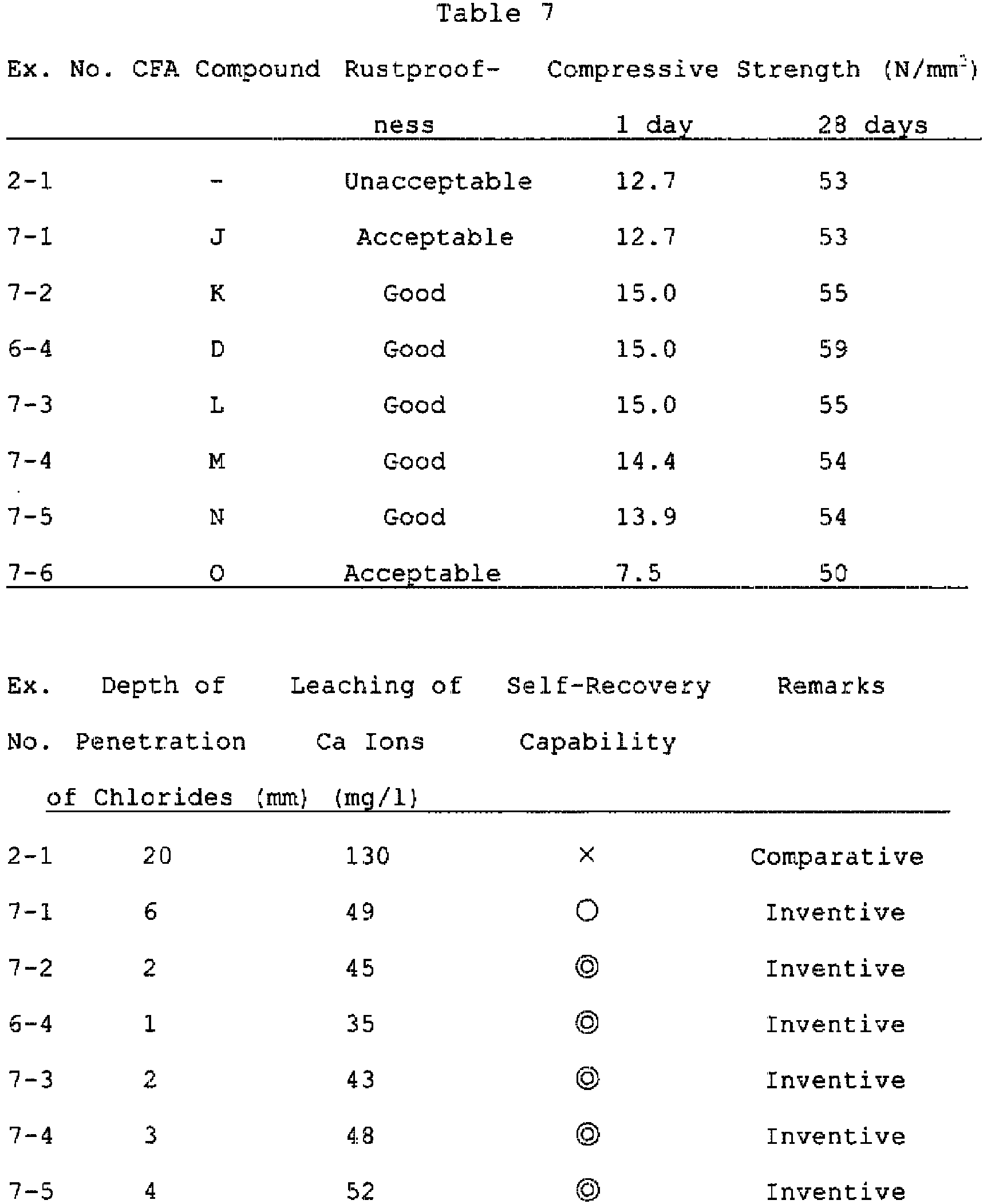

- As can be seen from Table 7, if CFA compound D, J, K, L, M, N, and O having a Fe2O3 content of 0.5 to 20% is used in combination with the potentially hydraulic substance and/or pozzolan substance (Experiment Nos. 6-4 and 7-1 to 7-5), the rustproofing effect (rustproofness) and the resistance to penetration of chloride ions could then be improved not only with an increased initial strength but also with improvements in the effect on inhibition of leaching of Ca ions as well as the self-recovery capability. When CFA compound O having a Fe2O3 content of 0 (this compound is conveniently classified as the CFA compound in Table 7, although it belongs to the CA compound) was used in combination with the potentially hydraulic substance and/or pozzolan substance (Experiment No. 7-6), the initial strength went down.
- Experimental Example 6 was repeated with the exception of using CFA compound D whose finenesses are set out in Table 8 in combination with the potentially hydraulic substance and/or pozzolan substance I. The results are also set out in Table 8.
-

- As can be seen from Table 8, if the fineness of the CFA compound is adjusted, then the rustproofing effect (rustproofness) and the resistance to penetration of chloride ions could then be maintained not only with prevention of a lowering of strength but also with improvements in the effect on inhibition of leaching of Ca ions as well as the self-recovery capability. The fineness of the CFA compound would be preferably 2,000 to 7,000 cm2/g, more preferably 3,000 to 6,000 cm2/g, and most preferably 4,000 to 5,000 cm2/g.
- Experimental Example 6 was repeated with the exception of using CFA compound D in combination with the potentially hydraulic substances and/or pozzolan substances (hereinafter called the pozzolan substances for short). The results are also set out in Table 9.
- Commercially available silica fume having a BET specific surface area of 20 m2/g
- Commercially available fly ash having a Blaine's value of 4,000 cm2/g
- Commercially available metakaolin having a BET specific of 10 m2/g
- Commercially available incinerated pulp sludge ash having a Blaine's value of 4,000 cm2/g
- Commercially available incinerated sewage sludge ash having a Blaine's value of 9,000 cm2/g
- Commercially available water glass powders having a Blaine's value of 4,000 cm2/g
- Mixture of 50 parts of Pozzolan Substance I and Pozzolan Substance II having a Blaine's value of 10,000 cm2/g
-

- As can be seen from Table 9, even with any pozzolan substances, the rustproofing effect (rustproofness) and the resistance to penetration of chloride ions could be maintained not only with prevention of a lowering of strength but also with improvements in the effect on inhibition of leaching of Ca ions as well as the self-recovery capability. In particular, finely pulverized, quenched, granulated blast-furnace slag (pozzolan substance I), silica fume (pozzolan substance II), fly ash (pozzolan substance III), and metakaolin (pozzolan substance IV) would preferably be used.
- Experimental example 6 was repeated with the exception that CFA compound D and pozzolan substance I were blended together in the proportions set out in Table 10 into cement admixtures.
-


- As can be seen from Table 10, if the blending proportion of the CFA compound to the pozzolan substance is set at 1/20 to 20/1 by mass, then the rustproofing effect (rustproofness) and the resistance to penetration of chloride ions could be maintained not only with prevention of a lowering of strength but also with improvements in the effect on inhibition of leaching of Ca ions as well as the self-recovery capability. The aforesaid blending proportion would be preferably 1/10 to 10/1 by mass, and more preferably 1/5 to 5/1 by mass.
- Experimental Example 6 was repeated with the exception that CFA compound D was used to prepare cement admixtures (CFA compound D plus pozzolan substance I) in the amounts set out in Table 11. For the purpose of comparison, similar experiments were carried out using conventional rustproofing materials. The results are also set out in Table 11.
-


- As can be seen from Table 11, if the amount of the cement admixture used is adjusted, then the rustproofing effect (rustproofness) and the resistance to penetration of chloride ions could be maintained not only with prevention of a lowering of strength but also with improvements in the effect on inhibition of leaching of Ca ions as well as the self-recovery capability.
From Table 11, it could be found that when the CFA compound and the pozzolan substance are used as the cement admixture, the amount of the cement admixture used would preferably range 1 to 50 parts, and more preferably 5 to 30 parts per 100 parts of the cement composition made up of cement and the cement admixture. - The use of the inventive cement admixture could ensure sufficient work times even in high-temperature environments, and make sure good rustproofness and resistance to penetration of chloride ions combined with the effect on inhibition of leaching of Ca ions and resistance to sulfate attack; so it may be well compatible with a wide range of applications inclusive mainly of water-use structures, water tanks, floor slab concrete, etc. in seawaters and rivers in the civil engineering and construction fields.
Claims (8)
- A calcium ferroaluminate compound, comprising a CaO-Al2O3-Fe2O3 system, and having a Fe2O3 content of 0.5 to 15 % by mass and a CaO·2Al2O3 structure.
- A cement admixture, characterized by containing a calcium ferroaluminate as recited in claim 1, wherein a CaO/Al2O3 molar ratio ranges from 0.15 to 0.7.
- A cement admixture as recited in claim 2, which has a fineness of 2,000 to 7,000 cm2/g as represented in terms of a Blaine's specific surface area value.
- A cement admixture as recited in claim 2, which further contains a potentially hydraulic substance and/or a pozzolan substance.
- A cement admixture as recited in claim 4, wherein said potentially hydraulic substance and/or said pozzolan substance contain one or two or more selected from the group consisting of finely pulverized, quenched, granulated blast-furnace slag, fly ash, silica fume, metakaolin, incinerated pulp sludge ash, incinerated sewage sludge ash, and waste glass powder.
- A cement admixture as recited in claim 4, wherein said calcium ferroaluminate and said potentially hydraulic substance and/or said pozzolan substance are blended together in a blending proportion of 10/1 to 1/10 by mass.
- A method for manufacturing a cement admixture, characterized in that a CaO-containing raw material, an Al2O3-containing raw material and an iron-containing raw material are blended together such that a CaO/Al2O3 molar ratio ranges from 0.15 to 0.7 and an Fe2O3 content ranges from 0.5% to 15% by mass, and heat treated at 1,400°C to 1,600°C inclusive to obtain a clinker, and said clinker is pulverized down to a Blaine's specific surface area value ranging from 2,000 to 7,000 cm2/g.
- A cement composition which contains cement and a cement admixture as recited in any one of claims 1 to 6.
Priority Applications (2)
| Application Number | Priority Date | Filing Date | Title |
|---|---|---|---|
| HRP20180634TT HRP20180634T1 (en) | 2010-03-01 | 2010-11-25 | USE OF CALCIUM FEROALUMINATE COMPOUND, CEMENT MIXTURE AND CEMENT MIXTURE |
| PL10847055T PL2543648T3 (en) | 2010-03-01 | 2010-11-25 | Use of a calcium ferroaluminate compound, cement admixture and cement composition |
Applications Claiming Priority (2)
| Application Number | Priority Date | Filing Date | Title |
|---|---|---|---|
| PCT/JP2010/053270 WO2011108065A1 (en) | 2010-03-01 | 2010-03-01 | Cement admixture and cement composition |
| PCT/JP2010/070972 WO2011108159A1 (en) | 2010-03-01 | 2010-11-25 | Calcium ferroaluminate compound, cement admixture and process for producing same, and cement composition |
Publications (3)
| Publication Number | Publication Date |
|---|---|
| EP2543648A1 true EP2543648A1 (en) | 2013-01-09 |
| EP2543648A4 EP2543648A4 (en) | 2016-06-08 |
| EP2543648B1 EP2543648B1 (en) | 2018-02-07 |
Family
ID=44541751
Family Applications (1)
| Application Number | Title | Priority Date | Filing Date |
|---|---|---|---|
| EP10847055.0A Active EP2543648B1 (en) | 2010-03-01 | 2010-11-25 | Use of a calcium ferroaluminate compound, cement admixture and cement composition |
Country Status (12)
| Country | Link |
|---|---|
| US (1) | US8425679B2 (en) |
| EP (1) | EP2543648B1 (en) |
| JP (1) | JP5688073B2 (en) |
| KR (1) | KR101799611B1 (en) |
| CN (1) | CN102869633B (en) |
| BR (1) | BR112012022020B1 (en) |
| ES (1) | ES2666344T3 (en) |
| HR (1) | HRP20180634T1 (en) |
| NO (1) | NO2543648T3 (en) |
| PL (1) | PL2543648T3 (en) |
| SG (1) | SG183833A1 (en) |
| WO (2) | WO2011108065A1 (en) |
Cited By (1)
| Publication number | Priority date | Publication date | Assignee | Title |
|---|---|---|---|---|
| WO2015055878A1 (en) * | 2013-10-14 | 2015-04-23 | Abengoa Solar New Technologies, S.A. | High-strength self-compacting concrete and method for the production thereof |
Families Citing this family (32)
| Publication number | Priority date | Publication date | Assignee | Title |
|---|---|---|---|---|
| JP5308358B2 (en) * | 2010-01-05 | 2013-10-09 | 電気化学工業株式会社 | Method for producing CaO-Al2O3-Fe2O3-based compound |
| JP5651055B2 (en) * | 2011-03-24 | 2015-01-07 | 電気化学工業株式会社 | Cement admixture and cement composition |
| JP5801106B2 (en) * | 2011-06-08 | 2015-10-28 | 電気化学工業株式会社 | Cement admixture and cement composition |
| JP5851343B2 (en) * | 2012-05-21 | 2016-02-03 | デンカ株式会社 | Cement admixture, cement composition and method for producing the same |
| JP5843105B2 (en) * | 2012-05-21 | 2016-01-13 | デンカ株式会社 | Cement admixture, cement composition and method for producing the same |
| CN103332877B (en) * | 2013-06-28 | 2014-04-02 | 华北水利水电大学 | Method for preparing inorganic cementing material by using dredged silt |
| ES2527702B1 (en) * | 2013-06-28 | 2016-02-10 | Envirocem, S.L. | HYDRAULIC MORTAR WITH GLASS. |
| CN103896521B (en) * | 2014-03-04 | 2015-10-28 | 黑龙江省水利科学研究院 | A kind of preparation method of canal seepage control water delivery tank |
| FR3037061B1 (en) * | 2015-06-03 | 2019-09-13 | Kerneos | COMPOSITION COMPRISING AMORPHOUS CALCIUM ALUMINATE AND METHOD OF MANUFACTURING THE SAME |
| CN105110663A (en) * | 2015-07-31 | 2015-12-02 | 沈阳航空航天大学 | Method for preparing geopolymer by using sludge ash |
| JP6577785B2 (en) * | 2015-08-07 | 2019-09-18 | 国立大学法人東京工業大学 | Hardened concrete for salt damage prevention and manufacturing method thereof |
| EP3368177B8 (en) | 2015-10-30 | 2024-07-10 | PerkinElmer U.S. LLC | Thermal gradient chromatography system |
| JP6899118B2 (en) * | 2016-09-07 | 2021-07-07 | 株式会社コンクレタス | Self-healing concrete products |
| JP6312778B1 (en) | 2016-11-11 | 2018-04-18 | デンカ株式会社 | Cement admixture and cement composition using the same |
| CN106380099A (en) * | 2016-11-29 | 2017-02-08 | 北京宝辰联合科技有限公司 | Chloride ion adsorption agent for reinforced concrete structure and preparation method thereof |
| CN106746801B (en) * | 2016-12-26 | 2019-01-11 | 西南石油大学 | A method of crystallite calcium aluminoferrite is prepared using red mud |
| DE102017101628A1 (en) * | 2017-01-27 | 2018-08-02 | TARTECH eco industries AG | Process for the preparation of a binder for the conditioning of sludges, hydrous soils and for the neutralization of acids |
| PL423560A1 (en) * | 2017-11-23 | 2019-06-03 | Walbet A D K Walkowiak Spolka Jawna | Integrated concrete self-repair activating agent and the concrete mix with the integrated activating agent and its application |
| CN108129051B (en) * | 2017-12-29 | 2020-10-23 | 江苏苏博特新材料股份有限公司 | Concrete additive for efficiently curing chloride ions for long time and application thereof |
| KR101963579B1 (en) * | 2018-07-19 | 2019-07-31 | 효성중공업 주식회사 | High Early Strength Concrete Composition and Constructing Methods using Thereof |
| KR102106800B1 (en) * | 2018-12-05 | 2020-05-07 | 주식회사 인트켐 | Manufacturing Method Of Hybrid Waterproofing Admixture With Self-Healing Properties And Cement Binder Composition Using The Waterproofing Admixture |
| CN109748326A (en) * | 2019-03-22 | 2019-05-14 | 西南石油大学 | A process for preparing tetracalcium ferric aluminate by sol-gel method |
| KR102097111B1 (en) * | 2019-08-07 | 2020-04-06 | 이관승 | Rapid hardening cement concrete composition for emergency eepair and a repairing method of road pavement using the same |
| CN110436492B (en) * | 2019-08-19 | 2021-10-19 | 河北科技大学 | A method for comprehensive utilization of low-grade aluminum resources |
| CN110790526A (en) * | 2019-11-18 | 2020-02-14 | 广西云燕特种水泥建材有限公司 | Marine engineering cement and production method thereof |
| CN111620576A (en) * | 2020-06-10 | 2020-09-04 | 上海宝宁环保科技有限公司 | Method for preparing iron correction material by using sludge ash and iron-rich industrial waste |
| CN112624720B (en) * | 2020-12-31 | 2023-02-03 | 广州建设工程质量安全检测中心有限公司 | A kind of auxiliary gelling material with high resistance to chloride ion erosion and preparation method thereof |
| KR102371890B1 (en) * | 2021-07-06 | 2022-03-11 | 주식회사 효승 | Rapid hardening concrete composition and repair and reinforcement method of concrete pavement using the same |
| JP7691310B2 (en) * | 2021-08-23 | 2025-06-11 | デンカ株式会社 | Rust inhibitor composition and rust prevention treatment method |
| JP2023050712A (en) * | 2021-09-30 | 2023-04-11 | 太平洋セメント株式会社 | Method for producing hydraulic hardened body, hydraulic hardened body |
| CN113968705B (en) * | 2021-11-10 | 2022-11-11 | 中铁十二局集团有限公司 | Multi-element gel system STC (concrete-time-dependent temperature) ultrahigh-toughness concrete material for bridge deck pavement |
| JP2024003453A (en) * | 2022-06-27 | 2024-01-15 | デンカ株式会社 | Bridge prestressed concrete structures including concrete compositions, concrete hardened bodies, and pier structures |
Family Cites Families (11)
| Publication number | Priority date | Publication date | Assignee | Title |
|---|---|---|---|---|
| IT1076068B (en) | 1976-06-28 | 1985-04-22 | Grace W R & Co | COMPOSITION TO PROTECT METAL CORROSION IN CONCRETE-BASED STRUCTURES, AND METHOD OF ITS USE |
| JPH01103970A (en) | 1987-10-15 | 1989-04-21 | Nissan Chem Ind Ltd | Method for preventing deterioration of hardened concrete |
| JPH08253354A (en) * | 1995-03-14 | 1996-10-01 | Chichibu Onoda Cement Corp | Crystalline highly hydrated active substance, quick setting material for cement, and method for promoting setting and hardening of concrete or mortar |
| US6610138B1 (en) * | 2001-11-13 | 2003-08-26 | Paul W. Brown | Method of resisting corrosion in metal reinforcing elements contained in concrete and related compounds and structures |
| JP4382614B2 (en) | 2003-09-10 | 2009-12-16 | 電気化学工業株式会社 | Cement admixture and cement composition using the same |
| CN1219719C (en) * | 2003-12-01 | 2005-09-21 | 济南大学 | Barium containing sulpho- ferro- aluminate cement |
| JP2007153714A (en) * | 2005-12-08 | 2007-06-21 | Denki Kagaku Kogyo Kk | Cement admixture and cement composition |
| JP5099349B2 (en) * | 2008-04-21 | 2012-12-19 | 戸田工業株式会社 | Adsorbent |
| JP5345821B2 (en) * | 2008-10-23 | 2013-11-20 | 電気化学工業株式会社 | Cement admixture and cement composition |
| JP5229952B2 (en) * | 2008-12-26 | 2013-07-03 | 太平洋マテリアル株式会社 | Quick-hardening admixture |
| CN101475327B (en) * | 2009-02-19 | 2011-09-07 | 武汉科技大学 | Aluminate cement and preparation thereof |
-
2010
- 2010-03-01 WO PCT/JP2010/053270 patent/WO2011108065A1/en not_active Ceased
- 2010-11-25 HR HRP20180634TT patent/HRP20180634T1/en unknown
- 2010-11-25 EP EP10847055.0A patent/EP2543648B1/en active Active
- 2010-11-25 JP JP2012502963A patent/JP5688073B2/en active Active
- 2010-11-25 KR KR1020127025441A patent/KR101799611B1/en not_active Expired - Fee Related
- 2010-11-25 SG SG2012064333A patent/SG183833A1/en unknown
- 2010-11-25 NO NO10847055A patent/NO2543648T3/no unknown
- 2010-11-25 WO PCT/JP2010/070972 patent/WO2011108159A1/en not_active Ceased
- 2010-11-25 CN CN201080066565.XA patent/CN102869633B/en active Active
- 2010-11-25 ES ES10847055.0T patent/ES2666344T3/en active Active
- 2010-11-25 PL PL10847055T patent/PL2543648T3/en unknown
- 2010-11-25 BR BR112012022020-9A patent/BR112012022020B1/en not_active IP Right Cessation
- 2010-11-25 US US13/581,573 patent/US8425679B2/en not_active Expired - Fee Related
Cited By (1)
| Publication number | Priority date | Publication date | Assignee | Title |
|---|---|---|---|---|
| WO2015055878A1 (en) * | 2013-10-14 | 2015-04-23 | Abengoa Solar New Technologies, S.A. | High-strength self-compacting concrete and method for the production thereof |
Also Published As
| Publication number | Publication date |
|---|---|
| KR20130049177A (en) | 2013-05-13 |
| SG183833A1 (en) | 2012-10-30 |
| PL2543648T3 (en) | 2018-08-31 |
| JP5688073B2 (en) | 2015-03-25 |
| BR112012022020A2 (en) | 2020-09-01 |
| NO2543648T3 (en) | 2018-07-07 |
| EP2543648B1 (en) | 2018-02-07 |
| KR101799611B1 (en) | 2017-11-20 |
| US20120318172A1 (en) | 2012-12-20 |
| WO2011108159A1 (en) | 2011-09-09 |
| BR112012022020B1 (en) | 2021-04-20 |
| ES2666344T3 (en) | 2018-05-04 |
| CN102869633A (en) | 2013-01-09 |
| HRP20180634T1 (en) | 2018-06-01 |
| WO2011108065A1 (en) | 2011-09-09 |
| EP2543648A4 (en) | 2016-06-08 |
| US8425679B2 (en) | 2013-04-23 |
| JPWO2011108159A1 (en) | 2013-06-20 |
| CN102869633B (en) | 2014-04-02 |
Similar Documents
| Publication | Publication Date | Title |
|---|---|---|
| EP2543648B1 (en) | Use of a calcium ferroaluminate compound, cement admixture and cement composition | |
| CN103764588B (en) | Neutralized inhibition type early strength cement composition | |
| EP2767521B1 (en) | Method for manufacturing rapid-hardening agent and concrete product | |
| EP2650268B1 (en) | Cement admixture, cement composition, and hexavalent chromium reduction method using same | |
| JP5345821B2 (en) | Cement admixture and cement composition | |
| CN117580812A (en) | Cement admixture, method for producing cement admixture, and cement composition | |
| JP2007153714A (en) | Cement admixture and cement composition | |
| TWI734863B (en) | Cement admixture, cement composition using the same, and salt damage suppression processing method of concrete structure | |
| JP5651067B2 (en) | Hydraulic cement composition | |
| JP5345820B2 (en) | Cement admixture and cement composition | |
| JP5308358B2 (en) | Method for producing CaO-Al2O3-Fe2O3-based compound | |
| JP5634683B2 (en) | Cement admixture and method for adjusting cement composition | |
| WO2019026674A1 (en) | Cement admixture, cement composition and production method therefor | |
| JP5313624B2 (en) | Cement composition and cement concrete | |
| JP4509015B2 (en) | Cement admixture and cement composition | |
| JP7701168B2 (en) | Cement concrete admixture, cement composition, and hardened product | |
| JP5701546B2 (en) | Spraying material and spraying method using the same | |
| JP2005035837A (en) | Cement composition | |
| JP2007153715A (en) | Cement admixture and cement composition | |
| JP2013241305A (en) | Cement admixture, cement composition and method for producing the same |
Legal Events
| Date | Code | Title | Description |
|---|---|---|---|
| PUAI | Public reference made under article 153(3) epc to a published international application that has entered the european phase |
Free format text: ORIGINAL CODE: 0009012 |
|
| 17P | Request for examination filed |
Effective date: 20120926 |
|
| AK | Designated contracting states |
Kind code of ref document: A1 Designated state(s): AL AT BE BG CH CY CZ DE DK EE ES FI FR GB GR HR HU IE IS IT LI LT LU LV MC MK MT NL NO PL PT RO RS SE SI SK SM TR |
|
| DAX | Request for extension of the european patent (deleted) | ||
| RA4 | Supplementary search report drawn up and despatched (corrected) |
Effective date: 20160510 |
|
| RIC1 | Information provided on ipc code assigned before grant |
Ipc: C04B 111/26 20060101ALI20160503BHEP Ipc: C04B 28/02 20060101ALI20160503BHEP Ipc: C04B 22/00 20060101ALI20160503BHEP Ipc: C04B 7/32 20060101ALI20160503BHEP Ipc: C04B 22/08 20060101AFI20160503BHEP Ipc: C01G 49/00 20060101ALI20160503BHEP |
|
| RAP1 | Party data changed (applicant data changed or rights of an application transferred) |
Owner name: DENKA COMPANY LIMITED |
|
| 17Q | First examination report despatched |
Effective date: 20170419 |
|
| GRAP | Despatch of communication of intention to grant a patent |
Free format text: ORIGINAL CODE: EPIDOSNIGR1 |
|
| INTG | Intention to grant announced |
Effective date: 20170818 |
|
| GRAS | Grant fee paid |
Free format text: ORIGINAL CODE: EPIDOSNIGR3 |
|
| GRAA | (expected) grant |
Free format text: ORIGINAL CODE: 0009210 |
|
| AK | Designated contracting states |
Kind code of ref document: B1 Designated state(s): AL AT BE BG CH CY CZ DE DK EE ES FI FR GB GR HR HU IE IS IT LI LT LU LV MC MK MT NL NO PL PT RO RS SE SI SK SM TR |
|
| REG | Reference to a national code |
Ref country code: GB Ref legal event code: FG4D |
|
| RIN1 | Information on inventor provided before grant (corrected) |
Inventor name: YAMAMOTO KENJI Inventor name: MORIOKA MINORU Inventor name: MORI TAIICHIRO Inventor name: TABARA KAZUTO Inventor name: HIGUCHI TAKAYUKI |
|
| REG | Reference to a national code |
Ref country code: AT Ref legal event code: REF Ref document number: 968714 Country of ref document: AT Kind code of ref document: T Effective date: 20180215 Ref country code: CH Ref legal event code: EP |
|
| RIN2 | Information on inventor provided after grant (corrected) |
Inventor name: HIGUCHI TAKAYUKI Inventor name: MORI TAIICHIRO Inventor name: MORIOKA MINORU Inventor name: YAMAMOTO KENJI Inventor name: TABARA KAZUTO |
|
| REG | Reference to a national code |
Ref country code: IE Ref legal event code: FG4D |
|
| REG | Reference to a national code |
Ref country code: DE Ref legal event code: R096 Ref document number: 602010048441 Country of ref document: DE |
|
| REG | Reference to a national code |
Ref country code: NL Ref legal event code: FP |
|
| REG | Reference to a national code |
Ref country code: HR Ref legal event code: TUEP Ref document number: P20180634 Country of ref document: HR |
|
| REG | Reference to a national code |
Ref country code: SE Ref legal event code: TRGR |
|
| REG | Reference to a national code |
Ref country code: ES Ref legal event code: FG2A Ref document number: 2666344 Country of ref document: ES Kind code of ref document: T3 Effective date: 20180504 |
|
| REG | Reference to a national code |
Ref country code: HR Ref legal event code: T1PR Ref document number: P20180634 Country of ref document: HR |
|
| REG | Reference to a national code |
Ref country code: CH Ref legal event code: NV Representative=s name: VOSSIUS AND PARTNER PATENTANWAELTE RECHTSANWAE, CH |
|
| REG | Reference to a national code |
Ref country code: NO Ref legal event code: T2 Effective date: 20180207 |
|
| REG | Reference to a national code |
Ref country code: AT Ref legal event code: MK05 Ref document number: 968714 Country of ref document: AT Kind code of ref document: T Effective date: 20180207 |
|
| PG25 | Lapsed in a contracting state [announced via postgrant information from national office to epo] |
Ref country code: LT Free format text: LAPSE BECAUSE OF FAILURE TO SUBMIT A TRANSLATION OF THE DESCRIPTION OR TO PAY THE FEE WITHIN THE PRESCRIBED TIME-LIMIT Effective date: 20180207 Ref country code: CY Free format text: LAPSE BECAUSE OF FAILURE TO SUBMIT A TRANSLATION OF THE DESCRIPTION OR TO PAY THE FEE WITHIN THE PRESCRIBED TIME-LIMIT Effective date: 20180207 |
|
| PG25 | Lapsed in a contracting state [announced via postgrant information from national office to epo] |
Ref country code: LV Free format text: LAPSE BECAUSE OF FAILURE TO SUBMIT A TRANSLATION OF THE DESCRIPTION OR TO PAY THE FEE WITHIN THE PRESCRIBED TIME-LIMIT Effective date: 20180207 Ref country code: AT Free format text: LAPSE BECAUSE OF FAILURE TO SUBMIT A TRANSLATION OF THE DESCRIPTION OR TO PAY THE FEE WITHIN THE PRESCRIBED TIME-LIMIT Effective date: 20180207 Ref country code: RS Free format text: LAPSE BECAUSE OF FAILURE TO SUBMIT A TRANSLATION OF THE DESCRIPTION OR TO PAY THE FEE WITHIN THE PRESCRIBED TIME-LIMIT Effective date: 20180207 Ref country code: BG Free format text: LAPSE BECAUSE OF FAILURE TO SUBMIT A TRANSLATION OF THE DESCRIPTION OR TO PAY THE FEE WITHIN THE PRESCRIBED TIME-LIMIT Effective date: 20180507 Ref country code: GR Free format text: LAPSE BECAUSE OF FAILURE TO SUBMIT A TRANSLATION OF THE DESCRIPTION OR TO PAY THE FEE WITHIN THE PRESCRIBED TIME-LIMIT Effective date: 20180508 Ref country code: IS Free format text: LAPSE BECAUSE OF FAILURE TO SUBMIT A TRANSLATION OF THE DESCRIPTION OR TO PAY THE FEE WITHIN THE PRESCRIBED TIME-LIMIT Effective date: 20180607 |
|
| PG25 | Lapsed in a contracting state [announced via postgrant information from national office to epo] |
Ref country code: AL Free format text: LAPSE BECAUSE OF FAILURE TO SUBMIT A TRANSLATION OF THE DESCRIPTION OR TO PAY THE FEE WITHIN THE PRESCRIBED TIME-LIMIT Effective date: 20180207 Ref country code: RO Free format text: LAPSE BECAUSE OF FAILURE TO SUBMIT A TRANSLATION OF THE DESCRIPTION OR TO PAY THE FEE WITHIN THE PRESCRIBED TIME-LIMIT Effective date: 20180207 Ref country code: EE Free format text: LAPSE BECAUSE OF FAILURE TO SUBMIT A TRANSLATION OF THE DESCRIPTION OR TO PAY THE FEE WITHIN THE PRESCRIBED TIME-LIMIT Effective date: 20180207 |
|
| REG | Reference to a national code |
Ref country code: DE Ref legal event code: R097 Ref document number: 602010048441 Country of ref document: DE |
|
| PG25 | Lapsed in a contracting state [announced via postgrant information from national office to epo] |
Ref country code: SM Free format text: LAPSE BECAUSE OF FAILURE TO SUBMIT A TRANSLATION OF THE DESCRIPTION OR TO PAY THE FEE WITHIN THE PRESCRIBED TIME-LIMIT Effective date: 20180207 Ref country code: SK Free format text: LAPSE BECAUSE OF FAILURE TO SUBMIT A TRANSLATION OF THE DESCRIPTION OR TO PAY THE FEE WITHIN THE PRESCRIBED TIME-LIMIT Effective date: 20180207 Ref country code: DK Free format text: LAPSE BECAUSE OF FAILURE TO SUBMIT A TRANSLATION OF THE DESCRIPTION OR TO PAY THE FEE WITHIN THE PRESCRIBED TIME-LIMIT Effective date: 20180207 Ref country code: CZ Free format text: LAPSE BECAUSE OF FAILURE TO SUBMIT A TRANSLATION OF THE DESCRIPTION OR TO PAY THE FEE WITHIN THE PRESCRIBED TIME-LIMIT Effective date: 20180207 |
|
| PLBE | No opposition filed within time limit |
Free format text: ORIGINAL CODE: 0009261 |
|
| STAA | Information on the status of an ep patent application or granted ep patent |
Free format text: STATUS: NO OPPOSITION FILED WITHIN TIME LIMIT |
|
| 26N | No opposition filed |
Effective date: 20181108 |
|
| PG25 | Lapsed in a contracting state [announced via postgrant information from national office to epo] |
Ref country code: SI Free format text: LAPSE BECAUSE OF FAILURE TO SUBMIT A TRANSLATION OF THE DESCRIPTION OR TO PAY THE FEE WITHIN THE PRESCRIBED TIME-LIMIT Effective date: 20180207 |
|
| PG25 | Lapsed in a contracting state [announced via postgrant information from national office to epo] |
Ref country code: MC Free format text: LAPSE BECAUSE OF FAILURE TO SUBMIT A TRANSLATION OF THE DESCRIPTION OR TO PAY THE FEE WITHIN THE PRESCRIBED TIME-LIMIT Effective date: 20180207 Ref country code: LU Free format text: LAPSE BECAUSE OF NON-PAYMENT OF DUE FEES Effective date: 20181125 |
|
| REG | Reference to a national code |
Ref country code: BE Ref legal event code: MM Effective date: 20181130 |
|
| REG | Reference to a national code |
Ref country code: IE Ref legal event code: MM4A |
|
| PG25 | Lapsed in a contracting state [announced via postgrant information from national office to epo] |
Ref country code: IE Free format text: LAPSE BECAUSE OF NON-PAYMENT OF DUE FEES Effective date: 20181125 |
|
| REG | Reference to a national code |
Ref country code: HR Ref legal event code: ODRP Ref document number: P20180634 Country of ref document: HR Payment date: 20191011 Year of fee payment: 10 |
|
| PG25 | Lapsed in a contracting state [announced via postgrant information from national office to epo] |
Ref country code: BE Free format text: LAPSE BECAUSE OF NON-PAYMENT OF DUE FEES Effective date: 20181130 |
|
| PG25 | Lapsed in a contracting state [announced via postgrant information from national office to epo] |
Ref country code: MT Free format text: LAPSE BECAUSE OF NON-PAYMENT OF DUE FEES Effective date: 20181125 |
|
| PG25 | Lapsed in a contracting state [announced via postgrant information from national office to epo] |
Ref country code: TR Free format text: LAPSE BECAUSE OF FAILURE TO SUBMIT A TRANSLATION OF THE DESCRIPTION OR TO PAY THE FEE WITHIN THE PRESCRIBED TIME-LIMIT Effective date: 20180207 |
|
| PG25 | Lapsed in a contracting state [announced via postgrant information from national office to epo] |
Ref country code: PT Free format text: LAPSE BECAUSE OF FAILURE TO SUBMIT A TRANSLATION OF THE DESCRIPTION OR TO PAY THE FEE WITHIN THE PRESCRIBED TIME-LIMIT Effective date: 20180207 |
|
| PG25 | Lapsed in a contracting state [announced via postgrant information from national office to epo] |
Ref country code: MK Free format text: LAPSE BECAUSE OF NON-PAYMENT OF DUE FEES Effective date: 20180207 Ref country code: HU Free format text: LAPSE BECAUSE OF FAILURE TO SUBMIT A TRANSLATION OF THE DESCRIPTION OR TO PAY THE FEE WITHIN THE PRESCRIBED TIME-LIMIT; INVALID AB INITIO Effective date: 20101125 |
|
| REG | Reference to a national code |
Ref country code: HR Ref legal event code: ODRP Ref document number: P20180634 Country of ref document: HR Payment date: 20201112 Year of fee payment: 11 |
|
| REG | Reference to a national code |
Ref country code: HR Ref legal event code: ODRP Ref document number: P20180634 Country of ref document: HR Payment date: 20211124 Year of fee payment: 12 |
|
| REG | Reference to a national code |
Ref country code: HR Ref legal event code: ODRP Ref document number: P20180634 Country of ref document: HR Payment date: 20221123 Year of fee payment: 13 |
|
| P01 | Opt-out of the competence of the unified patent court (upc) registered |
Effective date: 20230512 |
|
| PGFP | Annual fee paid to national office [announced via postgrant information from national office to epo] |
Ref country code: NL Payment date: 20231013 Year of fee payment: 14 Ref country code: FR Payment date: 20230929 Year of fee payment: 14 |
|
| REG | Reference to a national code |
Ref country code: HR Ref legal event code: ODRP Ref document number: P20180634 Country of ref document: HR Payment date: 20231012 Year of fee payment: 14 |
|
| PGFP | Annual fee paid to national office [announced via postgrant information from national office to epo] |
Ref country code: GB Payment date: 20231006 Year of fee payment: 14 |
|
| PGFP | Annual fee paid to national office [announced via postgrant information from national office to epo] |
Ref country code: ES Payment date: 20231201 Year of fee payment: 14 |
|
| PGFP | Annual fee paid to national office [announced via postgrant information from national office to epo] |
Ref country code: SE Payment date: 20231002 Year of fee payment: 14 Ref country code: NO Payment date: 20231108 Year of fee payment: 14 Ref country code: IT Payment date: 20231010 Year of fee payment: 14 Ref country code: FI Payment date: 20231116 Year of fee payment: 14 Ref country code: DE Payment date: 20230929 Year of fee payment: 14 Ref country code: CH Payment date: 20231201 Year of fee payment: 14 |
|
| PGFP | Annual fee paid to national office [announced via postgrant information from national office to epo] |
Ref country code: PL Payment date: 20231012 Year of fee payment: 14 |
|
| REG | Reference to a national code |
Ref country code: HR Ref legal event code: ODRP Ref document number: P20180634 Country of ref document: HR Payment date: 20241016 Year of fee payment: 15 |
|
| REG | Reference to a national code |
Ref country code: DE Ref legal event code: R119 Ref document number: 602010048441 Country of ref document: DE |
|
| REG | Reference to a national code |
Ref country code: CH Ref legal event code: PL |
|
| REG | Reference to a national code |
Ref country code: SE Ref legal event code: EUG |
|
| PG25 | Lapsed in a contracting state [announced via postgrant information from national office to epo] |
Ref country code: FI Free format text: LAPSE BECAUSE OF NON-PAYMENT OF DUE FEES Effective date: 20241125 |
|
| REG | Reference to a national code |
Ref country code: NL Ref legal event code: MM Effective date: 20241201 |
|
| PG25 | Lapsed in a contracting state [announced via postgrant information from national office to epo] |
Ref country code: NO Free format text: LAPSE BECAUSE OF NON-PAYMENT OF DUE FEES Effective date: 20241130 |
|
| REG | Reference to a national code |
Ref country code: CH Ref legal event code: PL |
|
| GBPC | Gb: european patent ceased through non-payment of renewal fee |
Effective date: 20241125 |
|
| PG25 | Lapsed in a contracting state [announced via postgrant information from national office to epo] |
Ref country code: CH Free format text: LAPSE BECAUSE OF NON-PAYMENT OF DUE FEES Effective date: 20241130 |
|
| PG25 | Lapsed in a contracting state [announced via postgrant information from national office to epo] |
Ref country code: NL Free format text: LAPSE BECAUSE OF NON-PAYMENT OF DUE FEES Effective date: 20241201 |
|
| PG25 | Lapsed in a contracting state [announced via postgrant information from national office to epo] |
Ref country code: DE Free format text: LAPSE BECAUSE OF NON-PAYMENT OF DUE FEES Effective date: 20250603 |
|
| PG25 | Lapsed in a contracting state [announced via postgrant information from national office to epo] |
Ref country code: IT Free format text: LAPSE BECAUSE OF NON-PAYMENT OF DUE FEES Effective date: 20241125 Ref country code: SE Free format text: LAPSE BECAUSE OF NON-PAYMENT OF DUE FEES Effective date: 20241126 |
|
| PG25 | Lapsed in a contracting state [announced via postgrant information from national office to epo] |
Ref country code: GB Free format text: LAPSE BECAUSE OF NON-PAYMENT OF DUE FEES Effective date: 20241125 |
|
| PG25 | Lapsed in a contracting state [announced via postgrant information from national office to epo] |
Ref country code: FR Free format text: LAPSE BECAUSE OF NON-PAYMENT OF DUE FEES Effective date: 20241130 |
|
| REG | Reference to a national code |
Ref country code: HR Ref legal event code: ODRP Ref document number: P20180634 Country of ref document: HR Payment date: 20251016 Year of fee payment: 16 |
|
| REG | Reference to a national code |
Ref country code: ES Ref legal event code: FD2A Effective date: 20260107 |
|
| PGFP | Annual fee paid to national office [announced via postgrant information from national office to epo] |
Ref country code: HR Payment date: 20251016 Year of fee payment: 16 |
|
| PG25 | Lapsed in a contracting state [announced via postgrant information from national office to epo] |
Ref country code: ES Free format text: LAPSE BECAUSE OF NON-PAYMENT OF DUE FEES Effective date: 20241126 |