EP2542559B1 - Polyhedral oligomeric silsesquioxane (poss)-linked ligands - Google Patents
Polyhedral oligomeric silsesquioxane (poss)-linked ligands Download PDFInfo
- Publication number
- EP2542559B1 EP2542559B1 EP11705578.0A EP11705578A EP2542559B1 EP 2542559 B1 EP2542559 B1 EP 2542559B1 EP 11705578 A EP11705578 A EP 11705578A EP 2542559 B1 EP2542559 B1 EP 2542559B1
- Authority
- EP
- European Patent Office
- Prior art keywords
- poss
- alkyl
- aryl
- polyhedral oligomeric
- heteroaryl
- Prior art date
- Legal status (The legal status is an assumption and is not a legal conclusion. Google has not performed a legal analysis and makes no representation as to the accuracy of the status listed.)
- Not-in-force
Links
- 239000003446 ligand Substances 0.000 title claims description 90
- 125000003118 aryl group Chemical group 0.000 claims description 47
- 150000003839 salts Chemical class 0.000 claims description 32
- 125000003837 (C1-C20) alkyl group Chemical group 0.000 claims description 25
- 125000000217 alkyl group Chemical group 0.000 claims description 25
- 125000001072 heteroaryl group Chemical group 0.000 claims description 25
- -1 C3-C10 cyclic alkyl Chemical group 0.000 claims description 21
- RTZKZFJDLAIYFH-UHFFFAOYSA-N Diethyl ether Chemical compound CCOCC RTZKZFJDLAIYFH-UHFFFAOYSA-N 0.000 claims description 19
- 125000004104 aryloxy group Chemical group 0.000 claims description 18
- 229910052723 transition metal Inorganic materials 0.000 claims description 18
- 150000003624 transition metals Chemical class 0.000 claims description 17
- ADLVDYMTBOSDFE-UHFFFAOYSA-N 5-chloro-6-nitroisoindole-1,3-dione Chemical compound C1=C(Cl)C([N+](=O)[O-])=CC2=C1C(=O)NC2=O ADLVDYMTBOSDFE-UHFFFAOYSA-N 0.000 claims description 16
- 125000003860 C1-C20 alkoxy group Chemical group 0.000 claims description 15
- 238000006880 cross-coupling reaction Methods 0.000 claims description 14
- 229910052739 hydrogen Inorganic materials 0.000 claims description 14
- 125000006850 spacer group Chemical group 0.000 claims description 12
- 238000006467 substitution reaction Methods 0.000 claims description 11
- 125000006165 cyclic alkyl group Chemical group 0.000 claims description 9
- 125000003710 aryl alkyl group Chemical group 0.000 claims description 8
- 125000000753 cycloalkyl group Chemical group 0.000 claims description 8
- 125000003358 C2-C20 alkenyl group Chemical group 0.000 claims description 7
- 125000005842 heteroatom Chemical group 0.000 claims description 7
- 239000001257 hydrogen Substances 0.000 claims description 6
- 239000004721 Polyphenylene oxide Substances 0.000 claims description 5
- 229910052736 halogen Inorganic materials 0.000 claims description 5
- 229920000570 polyether Polymers 0.000 claims description 5
- 229920006295 polythiol Polymers 0.000 claims description 5
- 125000002924 primary amino group Chemical group [H]N([H])* 0.000 claims description 5
- 150000001449 anionic compounds Chemical class 0.000 claims description 4
- 229910001412 inorganic anion Inorganic materials 0.000 claims description 4
- 150000002891 organic anions Chemical class 0.000 claims description 4
- UFHFLCQGNIYNRP-UHFFFAOYSA-N Hydrogen Chemical compound [H][H] UFHFLCQGNIYNRP-UHFFFAOYSA-N 0.000 claims description 3
- 125000000008 (C1-C10) alkyl group Chemical group 0.000 claims description 2
- 229910052740 iodine Inorganic materials 0.000 claims description 2
- 150000002431 hydrogen Chemical class 0.000 claims 2
- RAXXELZNTBOGNW-UHFFFAOYSA-N imidazole Natural products C1=CNC=N1 RAXXELZNTBOGNW-UHFFFAOYSA-N 0.000 description 62
- YXFVVABEGXRONW-UHFFFAOYSA-N Toluene Chemical compound CC1=CC=CC=C1 YXFVVABEGXRONW-UHFFFAOYSA-N 0.000 description 57
- 239000003054 catalyst Substances 0.000 description 36
- HEDRZPFGACZZDS-MICDWDOJSA-N Trichloro(2H)methane Chemical compound [2H]C(Cl)(Cl)Cl HEDRZPFGACZZDS-MICDWDOJSA-N 0.000 description 34
- 239000000047 product Substances 0.000 description 29
- XYFCBTPGUUZFHI-UHFFFAOYSA-N Phosphine Chemical compound P XYFCBTPGUUZFHI-UHFFFAOYSA-N 0.000 description 26
- 238000006243 chemical reaction Methods 0.000 description 25
- 238000000034 method Methods 0.000 description 23
- 238000003786 synthesis reaction Methods 0.000 description 19
- 229910052751 metal Inorganic materials 0.000 description 16
- KDLHZDBZIXYQEI-UHFFFAOYSA-N Palladium Chemical compound [Pd] KDLHZDBZIXYQEI-UHFFFAOYSA-N 0.000 description 15
- 239000002184 metal Substances 0.000 description 15
- 239000007787 solid Substances 0.000 description 15
- 229910000073 phosphorus hydride Inorganic materials 0.000 description 14
- 238000005160 1H NMR spectroscopy Methods 0.000 description 13
- 230000015572 biosynthetic process Effects 0.000 description 13
- 239000002904 solvent Substances 0.000 description 11
- OKKJLVBELUTLKV-UHFFFAOYSA-N Methanol Chemical compound OC OKKJLVBELUTLKV-UHFFFAOYSA-N 0.000 description 9
- 239000000126 substance Substances 0.000 description 9
- 125000001424 substituent group Chemical group 0.000 description 9
- 125000004429 atom Chemical group 0.000 description 8
- 229910052763 palladium Inorganic materials 0.000 description 8
- 239000011541 reaction mixture Substances 0.000 description 8
- 238000001914 filtration Methods 0.000 description 7
- 238000005374 membrane filtration Methods 0.000 description 7
- 230000035484 reaction time Effects 0.000 description 7
- 239000012043 crude product Substances 0.000 description 6
- 150000002460 imidazoles Chemical class 0.000 description 6
- 150000004693 imidazolium salts Chemical class 0.000 description 6
- 150000003003 phosphines Chemical class 0.000 description 6
- 238000000746 purification Methods 0.000 description 6
- 238000010626 work up procedure Methods 0.000 description 6
- 229910052799 carbon Inorganic materials 0.000 description 5
- 239000003153 chemical reaction reagent Substances 0.000 description 5
- 150000001875 compounds Chemical class 0.000 description 5
- 150000004714 phosphonium salts Chemical class 0.000 description 5
- VEFLKXRACNJHOV-UHFFFAOYSA-N 1,3-dibromopropane Chemical compound BrCCCBr VEFLKXRACNJHOV-UHFFFAOYSA-N 0.000 description 4
- CTQNGGLPUBDAKN-UHFFFAOYSA-N O-Xylene Chemical compound CC1=CC=CC=C1C CTQNGGLPUBDAKN-UHFFFAOYSA-N 0.000 description 4
- VYPSYNLAJGMNEJ-UHFFFAOYSA-N Silicium dioxide Chemical compound O=[Si]=O VYPSYNLAJGMNEJ-UHFFFAOYSA-N 0.000 description 4
- RRRZOLBZYZWQBZ-UHFFFAOYSA-N bis(1-adamantyl)phosphane Chemical compound C1C(C2)CC(C3)CC2CC13PC(C1)(C2)CC3CC2CC1C3 RRRZOLBZYZWQBZ-UHFFFAOYSA-N 0.000 description 4
- 238000006555 catalytic reaction Methods 0.000 description 4
- 230000000052 comparative effect Effects 0.000 description 4
- 125000000524 functional group Chemical group 0.000 description 4
- 125000001188 haloalkyl group Chemical group 0.000 description 4
- 238000002955 isolation Methods 0.000 description 4
- 239000000155 melt Substances 0.000 description 4
- 239000012528 membrane Substances 0.000 description 4
- 125000004437 phosphorous atom Chemical group 0.000 description 4
- 239000000741 silica gel Substances 0.000 description 4
- 229910002027 silica gel Inorganic materials 0.000 description 4
- 229960001866 silicon dioxide Drugs 0.000 description 4
- 238000003756 stirring Methods 0.000 description 4
- 239000008096 xylene Substances 0.000 description 4
- PAAZPARNPHGIKF-UHFFFAOYSA-N 1,2-dibromoethane Chemical compound BrCCBr PAAZPARNPHGIKF-UHFFFAOYSA-N 0.000 description 3
- XEFLCLZQKDDENB-UHFFFAOYSA-N 1-(2,4,6-trimethylphenyl)imidazole Chemical compound CC1=CC(C)=CC(C)=C1N1C=NC=C1 XEFLCLZQKDDENB-UHFFFAOYSA-N 0.000 description 3
- VWUCIBOKNZGWLX-UHFFFAOYSA-N 1h-imidazol-1-ium;bromide Chemical compound [Br-].C1=C[NH+]=CN1 VWUCIBOKNZGWLX-UHFFFAOYSA-N 0.000 description 3
- 238000004679 31P NMR spectroscopy Methods 0.000 description 3
- XEKOWRVHYACXOJ-UHFFFAOYSA-N Ethyl acetate Chemical compound CCOC(C)=O XEKOWRVHYACXOJ-UHFFFAOYSA-N 0.000 description 3
- NBIIXXVUZAFLBC-UHFFFAOYSA-N Phosphoric acid Chemical compound OP(O)(O)=O NBIIXXVUZAFLBC-UHFFFAOYSA-N 0.000 description 3
- 239000000370 acceptor Substances 0.000 description 3
- 230000008901 benefit Effects 0.000 description 3
- 238000005516 engineering process Methods 0.000 description 3
- OAYLNYINCPYISS-UHFFFAOYSA-N ethyl acetate;hexane Chemical compound CCCCCC.CCOC(C)=O OAYLNYINCPYISS-UHFFFAOYSA-N 0.000 description 3
- 238000000605 extraction Methods 0.000 description 3
- 239000012634 fragment Substances 0.000 description 3
- 238000007172 homogeneous catalysis Methods 0.000 description 3
- 125000002883 imidazolyl group Chemical group 0.000 description 3
- 238000004519 manufacturing process Methods 0.000 description 3
- VLKZOEOYAKHREP-UHFFFAOYSA-N n-Hexane Chemical compound CCCCCC VLKZOEOYAKHREP-UHFFFAOYSA-N 0.000 description 3
- 239000002105 nanoparticle Substances 0.000 description 3
- 125000004433 nitrogen atom Chemical group N* 0.000 description 3
- 230000003647 oxidation Effects 0.000 description 3
- 238000007254 oxidation reaction Methods 0.000 description 3
- 229910052698 phosphorus Inorganic materials 0.000 description 3
- 238000000053 physical method Methods 0.000 description 3
- 230000008569 process Effects 0.000 description 3
- 238000000926 separation method Methods 0.000 description 3
- 125000000547 substituted alkyl group Chemical group 0.000 description 3
- 125000003107 substituted aryl group Chemical group 0.000 description 3
- 0 *C1=C(*)N(*C2CCCC2)CN1*C1CCC1 Chemical compound *C1=C(*)N(*C2CCCC2)CN1*C1CCC1 0.000 description 2
- AUHZEENZYGFFBQ-UHFFFAOYSA-N 1,3,5-trimethylbenzene Chemical compound CC1=CC(C)=CC(C)=C1 AUHZEENZYGFFBQ-UHFFFAOYSA-N 0.000 description 2
- RAXXELZNTBOGNW-UHFFFAOYSA-O Imidazolium Chemical compound C1=C[NH+]=CN1 RAXXELZNTBOGNW-UHFFFAOYSA-O 0.000 description 2
- CSNNHWWHGAXBCP-UHFFFAOYSA-L Magnesium sulfate Chemical compound [Mg+2].[O-][S+2]([O-])([O-])[O-] CSNNHWWHGAXBCP-UHFFFAOYSA-L 0.000 description 2
- OAICVXFJPJFONN-UHFFFAOYSA-N Phosphorus Chemical compound [P] OAICVXFJPJFONN-UHFFFAOYSA-N 0.000 description 2
- 239000008186 active pharmaceutical agent Substances 0.000 description 2
- 230000002152 alkylating effect Effects 0.000 description 2
- 150000001412 amines Chemical class 0.000 description 2
- 239000006227 byproduct Substances 0.000 description 2
- 150000001721 carbon Chemical group 0.000 description 2
- 230000003197 catalytic effect Effects 0.000 description 2
- 238000004440 column chromatography Methods 0.000 description 2
- 230000000536 complexating effect Effects 0.000 description 2
- 238000010276 construction Methods 0.000 description 2
- 238000010924 continuous production Methods 0.000 description 2
- YMWUJEATGCHHMB-DICFDUPASA-N dichloromethane-d2 Chemical compound [2H]C([2H])(Cl)Cl YMWUJEATGCHHMB-DICFDUPASA-N 0.000 description 2
- 230000000694 effects Effects 0.000 description 2
- 150000004820 halides Chemical class 0.000 description 2
- 150000002367 halogens Chemical class 0.000 description 2
- 125000000623 heterocyclic group Chemical group 0.000 description 2
- 239000002815 homogeneous catalyst Substances 0.000 description 2
- 150000002466 imines Chemical class 0.000 description 2
- 230000003993 interaction Effects 0.000 description 2
- 229940079865 intestinal antiinfectives imidazole derivative Drugs 0.000 description 2
- 230000014759 maintenance of location Effects 0.000 description 2
- 239000000203 mixture Substances 0.000 description 2
- 150000002825 nitriles Chemical class 0.000 description 2
- 229910052757 nitrogen Inorganic materials 0.000 description 2
- 238000010651 palladium-catalyzed cross coupling reaction Methods 0.000 description 2
- 229920000734 polysilsesquioxane polymer Polymers 0.000 description 2
- 239000002244 precipitate Substances 0.000 description 2
- 238000000425 proton nuclear magnetic resonance spectrum Methods 0.000 description 2
- 239000007858 starting material Substances 0.000 description 2
- 239000000758 substrate Substances 0.000 description 2
- 150000003568 thioethers Chemical class 0.000 description 2
- 150000003573 thiols Chemical class 0.000 description 2
- XLYOFNOQVPJJNP-UHFFFAOYSA-N water Substances O XLYOFNOQVPJJNP-UHFFFAOYSA-N 0.000 description 2
- APQIUTYORBAGEZ-UHFFFAOYSA-N 1,1-dibromoethane Chemical compound CC(Br)Br APQIUTYORBAGEZ-UHFFFAOYSA-N 0.000 description 1
- UMXHKSZXFNVTQV-UHFFFAOYSA-N 1h-imidazole;phosphane Chemical compound P.C1=CNC=N1 UMXHKSZXFNVTQV-UHFFFAOYSA-N 0.000 description 1
- ZCYVEMRRCGMTRW-UHFFFAOYSA-N 7553-56-2 Chemical compound [I] ZCYVEMRRCGMTRW-UHFFFAOYSA-N 0.000 description 1
- QTBSBXVTEAMEQO-UHFFFAOYSA-M Acetate Chemical compound CC([O-])=O QTBSBXVTEAMEQO-UHFFFAOYSA-M 0.000 description 1
- 238000006443 Buchwald-Hartwig cross coupling reaction Methods 0.000 description 1
- OKTJSMMVPCPJKN-UHFFFAOYSA-N Carbon Chemical compound [C] OKTJSMMVPCPJKN-UHFFFAOYSA-N 0.000 description 1
- BVKZGUZCCUSVTD-UHFFFAOYSA-L Carbonate Chemical compound [O-]C([O-])=O BVKZGUZCCUSVTD-UHFFFAOYSA-L 0.000 description 1
- BWGNESOTFCXPMA-UHFFFAOYSA-N Dihydrogen disulfide Chemical compound SS BWGNESOTFCXPMA-UHFFFAOYSA-N 0.000 description 1
- LFQSCWFLJHTTHZ-UHFFFAOYSA-N Ethanol Chemical compound CCO LFQSCWFLJHTTHZ-UHFFFAOYSA-N 0.000 description 1
- 229910019142 PO4 Inorganic materials 0.000 description 1
- 238000006161 Suzuki-Miyaura coupling reaction Methods 0.000 description 1
- 239000002253 acid Substances 0.000 description 1
- 150000001299 aldehydes Chemical class 0.000 description 1
- 150000001350 alkyl halides Chemical class 0.000 description 1
- 229910000147 aluminium phosphate Inorganic materials 0.000 description 1
- 150000001408 amides Chemical class 0.000 description 1
- 125000000129 anionic group Chemical group 0.000 description 1
- 229910000074 antimony hydride Inorganic materials 0.000 description 1
- 239000008346 aqueous phase Substances 0.000 description 1
- RBFQJDQYXXHULB-UHFFFAOYSA-N arsane Chemical compound [AsH3] RBFQJDQYXXHULB-UHFFFAOYSA-N 0.000 description 1
- ZADPBFCGQRWHPN-UHFFFAOYSA-N boronic acid Chemical compound OBO ZADPBFCGQRWHPN-UHFFFAOYSA-N 0.000 description 1
- 150000001728 carbonyl compounds Chemical class 0.000 description 1
- 125000003178 carboxy group Chemical group [H]OC(*)=O 0.000 description 1
- 125000002091 cationic group Chemical group 0.000 description 1
- 239000007795 chemical reaction product Substances 0.000 description 1
- 238000011109 contamination Methods 0.000 description 1
- 238000005859 coupling reaction Methods 0.000 description 1
- 230000001419 dependent effect Effects 0.000 description 1
- 238000013461 design Methods 0.000 description 1
- 230000001627 detrimental effect Effects 0.000 description 1
- 238000011161 development Methods 0.000 description 1
- 229960004132 diethyl ether Drugs 0.000 description 1
- 239000000539 dimer Substances 0.000 description 1
- 238000004821 distillation Methods 0.000 description 1
- 150000002148 esters Chemical class 0.000 description 1
- DQYBDCGIPTYXML-UHFFFAOYSA-N ethoxyethane;hydrate Chemical compound O.CCOCC DQYBDCGIPTYXML-UHFFFAOYSA-N 0.000 description 1
- 239000003574 free electron Substances 0.000 description 1
- 238000010438 heat treatment Methods 0.000 description 1
- 125000004435 hydrogen atom Chemical class [H]* 0.000 description 1
- 125000002887 hydroxy group Chemical group [H]O* 0.000 description 1
- 238000011065 in-situ storage Methods 0.000 description 1
- 229910052500 inorganic mineral Inorganic materials 0.000 description 1
- 239000000543 intermediate Substances 0.000 description 1
- 150000004694 iodide salts Chemical class 0.000 description 1
- 239000011630 iodine Substances 0.000 description 1
- 150000002576 ketones Chemical class 0.000 description 1
- 239000007788 liquid Substances 0.000 description 1
- 229910052943 magnesium sulfate Inorganic materials 0.000 description 1
- 235000019341 magnesium sulphate Nutrition 0.000 description 1
- 150000002739 metals Chemical class 0.000 description 1
- HZVOZRGWRWCICA-UHFFFAOYSA-N methanediyl Chemical compound [CH2] HZVOZRGWRWCICA-UHFFFAOYSA-N 0.000 description 1
- 239000011707 mineral Substances 0.000 description 1
- 235000010755 mineral Nutrition 0.000 description 1
- 238000012986 modification Methods 0.000 description 1
- 230000004048 modification Effects 0.000 description 1
- 238000001728 nano-filtration Methods 0.000 description 1
- 239000002114 nanocomposite Substances 0.000 description 1
- LJDZFAPLPVPTBD-UHFFFAOYSA-N nitroformic acid Chemical compound OC(=O)[N+]([O-])=O LJDZFAPLPVPTBD-UHFFFAOYSA-N 0.000 description 1
- 239000012454 non-polar solvent Substances 0.000 description 1
- 150000002894 organic compounds Chemical class 0.000 description 1
- 239000011368 organic material Substances 0.000 description 1
- 239000012074 organic phase Substances 0.000 description 1
- 239000003960 organic solvent Substances 0.000 description 1
- 229910052760 oxygen Inorganic materials 0.000 description 1
- 125000004430 oxygen atom Chemical group O* 0.000 description 1
- 150000002940 palladium Chemical class 0.000 description 1
- WXHIJDCHNDBCNY-UHFFFAOYSA-N palladium dihydride Chemical compound [PdH2] WXHIJDCHNDBCNY-UHFFFAOYSA-N 0.000 description 1
- NBIIXXVUZAFLBC-UHFFFAOYSA-K phosphate Chemical compound [O-]P([O-])([O-])=O NBIIXXVUZAFLBC-UHFFFAOYSA-K 0.000 description 1
- 239000010452 phosphate Substances 0.000 description 1
- XYFCBTPGUUZFHI-UHFFFAOYSA-O phosphonium Chemical compound [PH4+] XYFCBTPGUUZFHI-UHFFFAOYSA-O 0.000 description 1
- 239000011574 phosphorus Substances 0.000 description 1
- 238000001394 phosphorus-31 nuclear magnetic resonance spectrum Methods 0.000 description 1
- 239000002798 polar solvent Substances 0.000 description 1
- 239000012041 precatalyst Substances 0.000 description 1
- 230000000063 preceeding effect Effects 0.000 description 1
- 238000001556 precipitation Methods 0.000 description 1
- 239000001294 propane Substances 0.000 description 1
- 239000012048 reactive intermediate Substances 0.000 description 1
- 230000001105 regulatory effect Effects 0.000 description 1
- 238000012552 review Methods 0.000 description 1
- 230000002000 scavenging effect Effects 0.000 description 1
- OUULRIDHGPHMNQ-UHFFFAOYSA-N stibane Chemical compound [SbH3] OUULRIDHGPHMNQ-UHFFFAOYSA-N 0.000 description 1
- BDHFUVZGWQCTTF-UHFFFAOYSA-M sulfonate Chemical compound [O-]S(=O)=O BDHFUVZGWQCTTF-UHFFFAOYSA-M 0.000 description 1
- 229910052717 sulfur Inorganic materials 0.000 description 1
- 238000001308 synthesis method Methods 0.000 description 1
- 238000012360 testing method Methods 0.000 description 1
- CZDYPVPMEAXLPK-UHFFFAOYSA-N tetramethylsilane Chemical compound C[Si](C)(C)C CZDYPVPMEAXLPK-UHFFFAOYSA-N 0.000 description 1
- 150000003852 triazoles Chemical class 0.000 description 1
- ITMCEJHCFYSIIV-UHFFFAOYSA-M triflate Chemical compound [O-]S(=O)(=O)C(F)(F)F ITMCEJHCFYSIIV-UHFFFAOYSA-M 0.000 description 1
- BPLUKJNHPBNVQL-UHFFFAOYSA-N triphenylarsine Chemical compound C1=CC=CC=C1[As](C=1C=CC=CC=1)C1=CC=CC=C1 BPLUKJNHPBNVQL-UHFFFAOYSA-N 0.000 description 1
Classifications
-
- C—CHEMISTRY; METALLURGY
- C08—ORGANIC MACROMOLECULAR COMPOUNDS; THEIR PREPARATION OR CHEMICAL WORKING-UP; COMPOSITIONS BASED THEREON
- C08G—MACROMOLECULAR COMPOUNDS OBTAINED OTHERWISE THAN BY REACTIONS ONLY INVOLVING UNSATURATED CARBON-TO-CARBON BONDS
- C08G77/00—Macromolecular compounds obtained by reactions forming a linkage containing silicon with or without sulfur, nitrogen, oxygen or carbon in the main chain of the macromolecule
- C08G77/04—Polysiloxanes
- C08G77/38—Polysiloxanes modified by chemical after-treatment
- C08G77/382—Polysiloxanes modified by chemical after-treatment containing atoms other than carbon, hydrogen, oxygen or silicon
- C08G77/398—Polysiloxanes modified by chemical after-treatment containing atoms other than carbon, hydrogen, oxygen or silicon containing boron or metal atoms
-
- C—CHEMISTRY; METALLURGY
- C07—ORGANIC CHEMISTRY
- C07F—ACYCLIC, CARBOCYCLIC OR HETEROCYCLIC COMPOUNDS CONTAINING ELEMENTS OTHER THAN CARBON, HYDROGEN, HALOGEN, OXYGEN, NITROGEN, SULFUR, SELENIUM OR TELLURIUM
- C07F7/00—Compounds containing elements of Groups 4 or 14 of the Periodic Table
- C07F7/02—Silicon compounds
- C07F7/21—Cyclic compounds having at least one ring containing silicon, but no carbon in the ring
-
- C—CHEMISTRY; METALLURGY
- C08—ORGANIC MACROMOLECULAR COMPOUNDS; THEIR PREPARATION OR CHEMICAL WORKING-UP; COMPOSITIONS BASED THEREON
- C08G—MACROMOLECULAR COMPOUNDS OBTAINED OTHERWISE THAN BY REACTIONS ONLY INVOLVING UNSATURATED CARBON-TO-CARBON BONDS
- C08G77/00—Macromolecular compounds obtained by reactions forming a linkage containing silicon with or without sulfur, nitrogen, oxygen or carbon in the main chain of the macromolecule
- C08G77/04—Polysiloxanes
- C08G77/38—Polysiloxanes modified by chemical after-treatment
- C08G77/382—Polysiloxanes modified by chemical after-treatment containing atoms other than carbon, hydrogen, oxygen or silicon
- C08G77/388—Polysiloxanes modified by chemical after-treatment containing atoms other than carbon, hydrogen, oxygen or silicon containing nitrogen
-
- C—CHEMISTRY; METALLURGY
- C08—ORGANIC MACROMOLECULAR COMPOUNDS; THEIR PREPARATION OR CHEMICAL WORKING-UP; COMPOSITIONS BASED THEREON
- C08G—MACROMOLECULAR COMPOUNDS OBTAINED OTHERWISE THAN BY REACTIONS ONLY INVOLVING UNSATURATED CARBON-TO-CARBON BONDS
- C08G77/00—Macromolecular compounds obtained by reactions forming a linkage containing silicon with or without sulfur, nitrogen, oxygen or carbon in the main chain of the macromolecule
- C08G77/04—Polysiloxanes
- C08G77/38—Polysiloxanes modified by chemical after-treatment
- C08G77/382—Polysiloxanes modified by chemical after-treatment containing atoms other than carbon, hydrogen, oxygen or silicon
- C08G77/395—Polysiloxanes modified by chemical after-treatment containing atoms other than carbon, hydrogen, oxygen or silicon containing phosphorus
Definitions
- the invention relates to polyhedral oligomeric silsesquioxane (POSS)-linked ligands and their salts, synthesis of said polyhedral oligomeric silsesquioxane (POSS)-linked ligands and their application in transition metal catalyzed cross-coupling reactions exemplified by Palladium-based catalyst systems.
- PES polyhedral oligomeric silsesquioxane
- Palladium catalysts bearing an N-heterocyclic carbene and sterically demanding phosphine ligands display the most robust and active catalytic systems to date (review on Pd-complexes of N-heterocyclic carbenes for cross-coupling reactions: M. G. Organ et al. Angew. Chem. Int. Ed. 2007, Vol 46, 16, 2768-2813 , recent examples of applications of phosphine ligands: M. Beller, Adv. Synth. Catal. 2008, 350, 2437-2442 , M. Beller, Chem.-Eur. J. 2008,14, 3645-3652 ; S. L. Buchwald Acc. Chem. Res. 2008, Vol. 41, 11, 1461-1473 and references cited therein).
- the application of homogeneous transition metal catalysts can result in soluble metal contamination. These soluble metals can be detrimental to product quality and product yield.
- the metal catalyst In the case of active pharmaceutical ingredient (API) development, the metal catalyst must be removed to a regulated level. This can be achieved by e.g. chemical metal scavenging substances or techniques where the metal residues are removed by physical methods such as extraction, distillation or precipitation.
- the POSS linked ligands according to the invention thus do not necessarily have to be monodentate. They could also be used as bidentate or tridentate ligands which are connected by linker molecules e.g. alkyl chains.
- the POSS linked ligands in a bidentate or tridentate molecule can be identical or different from each other.
- the invention also encompasses the salts of the POSS linked ligands.
- Said salts are obtained by the simple reaction of a leaving group containing POSS-connected alkyl residue with the corresponding ligand.
- the leaving group may e.g. be halogen, sulfonate, triflate, acetate or phosphate.
- polyhedral oligomeric silsesquioxanes as used herein means that the POSS molecule can be regarded in a simplified manner as a roughly 3-dimensional geometric structure with flat faces and straight edges in which the Si-atoms are located at the corners of the structure.
- the POSS molecule is a pentahedral structure in the shape of a triangular prism with 6 Si atoms located at the corners of the structure.
- the POSS molecule is a hexahedral structure in the shape of a cube with 8 Si atoms located at the corners of the structure.
- substituents R in the structure shown above and in the following structures are not all identical.
- One substituent R is needed as spacer that binds the POSS molecule to the ligand L, i.e. one of the substituents R equals substituent R 2 .
- the POSS molecule is a heptahedral structure in the shape of a pentagonal prism with 10 Si atoms located at the corners of the structure.
- POSS molecules are known to the skilled artisan since the first synthesis by Lichtenhan et al. in 1995 (J. D. Lichtenhan Comments. Inorg. Chem. 1995, Vol. 17, No. 2, pp.115-130 ; A. M. Seifalian, Acc. Chem. Res. 2005, Vol 38, No. 11 879-884 ).
- the POSS molecules which are also referred to as POSS-cages display rigid and robust structures due to the strong framework resulting from their shorter bond.
- the spacer R 2a , R 2b , R 2c bonds to the polyhedral oligomeric silsesquioxanes (POSS) molecule over a Si or O atom of the POSS molecule.
- the spacer R 2a , R 2b , R 2c can bond to the ligand L via all bonds that are known to the skilled artisan preferably via C, O, N or S :
- polyhedral oligomeric silsesquioxanes (POSS) molecules with the generic formula ((R 1 ) n-1 (SiO 1,5 ) n R 2 ) can be bonded to ligands and thus be used for enlarging the catalyst structure in order to enable membrane filtration separation.
- R 1 , R 2 is a generic term that also includes the a, b, c species as previously defined.
- One drawback of mass dependent membrane-filtration methodology is that a certain mass difference between the used catalyst and the substrates (and products) is required, so that retention of the catalyst is possible while product is transported through the membrane.
- most filtration techniques are limited to small sized molecules with a much lower molecular mass than the catalyst, since commercially used catalysts are of molecular weight between 400 and 900 g/mol.
- POSS-enlarged ligands for homogeneous catalyst systems are presented in this invention. These catalysts preferably have molecular weights ranging from 1500 to 3000 g/mol. Due to the increased mass of the catalyst a mass difference between catalyst and product can be reached that is sufficient to separate catalyst and product by membrane filtration. Products of a much larger weight range can thus be separated from a homogeneous catalyst comprising POSS enlarged ligands. The increased mass allows retention of the catalyst, passage of the product and final isolation of larger molecules by filtration. With respect to the production processes of intermediates and final products for the pharmaceutical industry, these new catalyst systems are of high-interest.
- ligands are chemical compounds comprising one or several atoms.
- a coordinate bond is formed when one or several atoms of a ligand contribute their electrons or their orbitals filled with electrons to another atom.
- the ligand contributing the electrons is designated as the "donor” whereas the atom accepting the free electrons or the electrons from a filled orbital of the donor is designated as the "acceptor”.
- Ligand-atoms contributing the electrons or orbitals for the coordinate bonds usually, are main-group-elements from groups III-VII with low oxidation numbers (e.g. C, N) Acceptors on the other hand, typically, are metal atoms with high oxidation numbers, e.g. z. B.
- An uncharged donor thus, is a ligand without net-charge that contributes electrons or orbitals filled with electrons for a coordinate bond with an acceptor.
- Examples of uncharged donors are (wherein the two dots preceeding the letter depict the electrons participating in the coordinate bond): PH3P: , R 2 N: , Ph 3 As: , or:
- carbon too can act as an uncharged (electron) donor.
- electron Usually found as carbene, the carbon atom bears a pair of electrons in an orbital. These electrons are provided for an uncharged sigma bond with the metal center. This is usually expressed by structures drawn as:
- Charged (electron) donors on the other hand carry a net-charge, i.e. cationic donors bear a positive net-charge and anionic donors bear a negative net-charge.
- polyhedral oligomeric silsesquioxane (POSS)-linked ligands and their salts according to the invention can be considered as "nanoparticles or nanocomposites" due to the fact that their size ranges several nanometers.
- the POSS linked ligands and their salts according to the present invention are on the one hand soluble which is a precondition for their use in homogeneous catalysis and on the other hand filtratable by membrane filtration methods which is a precondition for their cost efficient and simple removal out of a reaction solution.
- the use of POSS linked ligands or their salts for homogeneous transition metal catalysts therefore combine in an unexpected manner the advantages of homogeneous catalysis, i.e. high accessibility and high activity with the advantage of a simple removal of the catalyst.
- the POSS linked ligands or their salts therefore allow for the first time the use of homogeneous transition metal catalysts for continuous processes.
- the POSS linked ligands in particular their salts have another advantage over ligands or their salts that are not linked to a POSS molecule.
- Ligand salts having very low solubility in common organic solvents e.g. toluene show significantly improved solubility when they are linked to a POSS molecule.
- POSS enlarged salts thereof show drastically enhanced solubilities. The enhanced solubility will greatly facilitate the construction of the transition metal catalysts with these ligand salts in terms of ease of reaction performance. Tests showed that in toluene, which is widely used as solvent in commercial applications, POSS-free imidazolium and phosphonium salts are unsoluble whereas the POSS-derivatives can be dissolved very well.
- the present invention also pertains the application of novel nanoparticle linked phosphine and N-heterocyclic carbene ligands in cross-coupling reactions, where nanometer sized polysilsesquioxane cubes or other polyhedral shapes as mentioned above serve as nano-anchors.
- Preferred substituents R 1a , R 1b ,R 1c of the polyhedral oligomeric silsesquioxanes (POSS) linked ligands according to the invention are unsubstituted branched alkyl chains. These substituents ensure solubility of the POSS architecture in various organic polar and non-polar solvents. It is thus important that the preferred substituents R 1a-c bear no functional groups such as e.g. OH, NH or COOH. Otherwise chemical interaction between these functional groups and the catalyst or other reagents that are employed within the application could result especially when L is a N-heterocyclic carbene. Finally the said POSS-substituents contribute to further enlargement of the POSS-moiety.
- the spacer molecules R 2a , R 2b , R 2c are linear C 1 -C 20 alkyl, more preferably linear C 3 -C 10 alkyl.
- the ligand L is preferably selected from the group consisting of N-heterocyclic carbene, amine, imine, phosphine, stibine, arsine, carbonyl compound, carboxyl compound, nitrile, alcohol, ether, thiol or thioether.
- ligand L of the polyhedral oligomeric silsesquioxanes (POSS) ligand according to the invention is a N-heterocyclic carbene.
- N-heterocyclic carbenes are extremely reactive intermediates that are very difficult to isolate. Further, many substances destroy the N-heterocyclic carbenes through chemical interaction. It is thus surprising that it is possible to link the oligomeric silsesquioxanes (POSS) molecules with a N-heterocyclic carbene ligand.
- polyhedral oligomeric silsesquioxanes (POSS) linked N-heterocyclic carbenes or their salts are of the following structures:
- polyhedral oligomeric silsesquioxanes (POSS) linked triazole-carbenes or their salts that are of the following structures: wherein:
- the spacer molecule R 2 that binds the POSS-molecule and to the N-atom of the N-heterocyclic carbene is selected from the group consisting of C 1 -C 20 linear or branched alkyl chain, ether, polyether polythioether, amino, aryl bridged alkyl chain where the aryl moiety can include further substitution pattern, C 3 -C 10 cyclic alkyl, C 1 -C 20 alkoxy, C 2 -C 20 alkenyl, C 2 -C 20 alkenyloxy, aryloxy, C 1 -C 20 alkylthio, C 1 -C 20 carboxylate, aryl or heteroaryl, C 1 -C 20 alkyl halogenide, annulated aryl or heteroaryl, C 3 -C 10 cyclic alkyl groups which in turn may each be further substituted with one or more groups selected from hetero atom or aryl groups. Additionally the alkyl chain can contain further complexing moieties like phosphine
- R 3 , R 4 , R 5 and R 6 are the same or independent from each other and selected from the group consisting of hydrogen, linear or branched C 1 -C 20 alkyl, C 3 -C 10 cyclic alkyl, C 1 -C 20 alkoxy, C 2 -C 20 alkenyl, C 2 -C 20 alkenyloxy, aryloxy, C 1 -C 20 alkylthio, C 1 -C 20 carboxylate, aryl or heteroaryl, multiply substituted halogen aryl or heteroaryl, C 1 -C 20 alkyl halogenide, multiply substituted halogen alkyl, annulated aryl or heteroaryl, C 3 -C 10 cyclic alkyl groups which in turn may each be further substituted with one or more groups selected from hetero atom or aryl groups.
- R 5 or R 6 may also depict a POSS-molecule with the structure (R 1 ) n-1 (SiO 1,5 ) n linked by a spacer molecule R 2 to a carbon atom of the N-heterocyclic carbenes or their salts of the above given structures.
- the N-heterocyclic carbene contains an additional C 1 -C 20 alkyl chain-bridged POSS-moiety leading to a N-heterocyclic carbene ligand with two POSS molecules of the structure as depicted in formula VII and VIIa:
- POSS linked N-heterocyclic carbene may be connected via an alkyl chain R 7 to another POSS linked N-heterocyclic carbene, e.g. POSS linked imidazole thus leading to a dimeric structure as depicted in formula VIII and VIIIa:
- R 7 is substituted or unsubstituted linear or branched C 1 -C 10 alkyl chain.
- any of the ligands substituents R 3 -R 6 may further include one or more functional groups.
- suitable functional groups include but are not limited to: hydroxyl, amine, amide, nitrile, thiol, thioether, ketone, aldehyde, ester, ether, imine, nitro, carboxylic acid, disulfide, carbonate and halogen.
- Unsymmetrical substituted N-heterocyclic carbenes and the corresponding salts thereof contain one C 1 -C 20 alkyl chain-bridged POSS-moiety on one N-atom and a 2,4,6-trimethylbenzene (mesityl) substituent on the other N-atom of the imidazole moiety (formulas IX and IXa) .
- ligand L is a phosphine or a salt thereof.
- phosphine-based ligands or their salts disclosed in this present patent are preferably of general formula: wherein:
- R 8 and R 9 are adamantyl radicals XI or Xla where the phosphorus atom in XI is bound at the 2-postion and in Xla at the 1-position.
- the spacer R 2 between the POSS-molecule and the attached phosphorus is selected from the group consisting of C 1 -C 20 linear or branched alkyl chain, ether, polyether polythioether, amino, aryl bridged alkyl chain where the aryl moiety can include further substitution pattern.
- R 2 , R 8 and R 9 contain aryl groups, where the aryl groups are bonded to the P-atom and the POSS moieties is attached via alkyl chains R 10 that are connected to the said aryl groups as depicted in formula XII.
- Alkyl chain R 10 connected to the aryl group thus corresponds to spacer R 2 .
- alkyl chain can contain further complexing moieties like imidazol derivatives (formula XII):
- the POSS linked ligands according to the present invention can be considered as being nanoparticle anchored ligands. They can be used in metal catalyzed reactions in combination with nanofiltration technology.
- the nanometersized POSS-molecule to which the catalyst is linked allows specific filtration of the reaction products and other components where the nano-anchored catalyst remains within the membrane sphere.
- high molecular weights of these ligands lead to the corresponding transition metal catalysts with molecular weights ranging from 1500 to 3000, which allows synthesis and filtration of larger sized molecules.
- transition metal complexes with different POSS linked ligands are given below:
- the corresponding transition metal complexes preferably palladium complexes can be obtained and used in cross-coupling reactions in two ways: 1. they can be isolated after reaction of the phosphonium or imidazolium salts with bases and subsequent addition of a particular palladium source or 2.
- the active catalyst species can be obtained in the reaction mixture containing both catalyst compounds and the cross-coupling reaction partners in situ during the cross-coupling reaction in which a base is used in order to e. g. activate the palladium precatalyst or generate the active boronate species e. g. in the Suzuki-Miyaura reaction which is essential for the reaction.
- the POSS linked phosphonium salts can be obtained by simple conversion of different POSS-halides having different chain lengths (scheme 1) with a phosphine.
- the preferred bisadamantyl substituted phosphine is used since this phosphine substitution pattern is found in benchmark cataCXiumA ® , which has proven to be a superior ligand in particularly manifold palladium-catalyzed cross-coupling reactions.
- Connecting the POSS cube with bisadamantylphosphine via an unbranched alkyl chain leads to a ligand structure which is very close to that found in cataCXiumA ® .
- the mixed phosphine-imidazolium-based NHC type of ligands are obtained by conversion of the POSS-containing singly alkylated imidazolium salts by treating with phosphines or their mineral salts respectively:
- the symmetric POSS-substituted bis-imidazolium salts can be converted into the corresponding bis-NHC-transition metal complexes by treatment with a base and subsequent addition of an appropriate metal source.
- Palladium was taken as metal of choice for the synthesis of various carbene- and phosphine complexes and their employment in C-C- and C-N-coupling reactions.
- the POSS-based phosphine ligands were tested in a C-C cross-coupling reaction (Heck-Mizoroki reaction, scheme 5 , comparative example ).
- the 31 P- and 1 H-NMR-spectra were measured on Bruker DRX 500 (500 MHz) spectrometer.
- the chemical shifts were given in ppm from tetramethylsilane as an internal standard (0.00 ppm) or the solvent residue peaks (CDCl 3 : 7.26 ppm, CD 2 Cl 2 : 5.26 ppm).
- the chemical shifts of the 31 P resonances were determined relative to phosphoric acid (H 3 PO 4 ) as an internal standard (0.00 ppm).
- Peak multiciplities were abbreviated as: s, singlet; d, investigatinget, t, triplet, qr, quartet, qn, quintet, sep, septet; m, multiplet. All solvents and chemicals were used as purchased. Reagents and solvents were purchased from Aldrich. All POSS starting materials were purchased from Hybrid Catalysis. Di-(1-adamantyl)phosphine is an in-house product of EVONIK-DEGUSSA GmbH.
Landscapes
- Chemical & Material Sciences (AREA)
- Organic Chemistry (AREA)
- General Chemical & Material Sciences (AREA)
- Health & Medical Sciences (AREA)
- Chemical Kinetics & Catalysis (AREA)
- Medicinal Chemistry (AREA)
- Polymers & Plastics (AREA)
- Catalysts (AREA)
- Organic Low-Molecular-Weight Compounds And Preparation Thereof (AREA)
Description
- The invention relates to polyhedral oligomeric silsesquioxane (POSS)-linked ligands and their salts, synthesis of said polyhedral oligomeric silsesquioxane (POSS)-linked ligands and their application in transition metal catalyzed cross-coupling reactions exemplified by Palladium-based catalyst systems.
- Homogeneous transition metal catalyzed reactions have been refined into important processes for the synthesis of high-valued organic compounds (a) G. W. Parshall, S. D. Ittel, Homogeneous Catalysis: The Application and Chemistry by Soluble Transition Metal Complexes, Wiley VCH, 1992; b) F. Diederich, P. J. Stang Metal Catalyzed Cross-Coupling Reactions; Wiley-VCH: Weinheim 1998. c) M. Beller, C. Bolm, Transition Metals for Organic Synthesis; Wiley-VCH: Weinheim 1998). From these, Palladium-catalyzed cross-coupling reactions have emerged as one of the most important reactions both in industry and academia. In recent years there have been numerous contributions in this area ( a) J. Tsuji, Palladium Reagents and Catalysts: Innovations in Organic Synthesis; Wiley: Chicester, 1995.).
- Palladium catalysts bearing an N-heterocyclic carbene and sterically demanding phosphine ligands display the most robust and active catalytic systems to date (review on Pd-complexes of N-heterocyclic carbenes for cross-coupling reactions: M. G. Organ et al. Angew. Chem. Int. Ed. 2007, Vol 46, 16, 2768-2813, recent examples of applications of phosphine ligands: M. Beller, Adv. Synth. Catal. 2008, 350, 2437-2442, M. Beller, Chem.-Eur. J. 2008,14, 3645-3652; S. L. Buchwald Acc. Chem. Res. 2008, Vol. 41, 11, 1461-1473 and references cited therein).
- However, the application of homogeneous transition metal catalysts can result in soluble metal contamination. These soluble metals can be detrimental to product quality and product yield. In the case of active pharmaceutical ingredient (API) development, the metal catalyst must be removed to a regulated level. This can be achieved by e.g. chemical metal scavenging substances or techniques where the metal residues are removed by physical methods such as extraction, distillation or precipitation.
- From the industrial point of view one attractive physical method constitutes membrane filtration technology in which the organic materials are removed by filtration and the metal catalyst remains within the membrane sphere.
- Methods for removing the catalyst by either chemical or physical methods are usually very complex and thus expensive or in the case of membrane filtration can't be employed because there are no membranes available with the required selectivity.
- It is thus an object of the present invention to provide ligands and/or their salts as well as metal complexes comprising said ligands for homogeneous catalysed reactions with which the disadvantages of the prior art are at least reduced and that allow simple and cost efficient separation of metal complexes and reaction solution.
- This object is achieved with polyhedral oligomeric silsesquioxanes (POSS)-linked ligands according to general formula I and the corresponding salts according to general formula II as well as bidentate polyhedral oligomeric silsesquioxanes (POSS) linked ligands according to general formula III and the corresponding salts according to general formula IV, wherein L in each formula is an N-heterocyclic carbene.
- The POSS linked ligands according to the invention thus do not necessarily have to be monodentate. They could also be used as bidentate or tridentate ligands which are connected by linker molecules e.g. alkyl chains. The POSS linked ligands in a bidentate or tridentate molecule can be identical or different from each other.
- Since for the production of metal complexes often the salts of the ligands are used the invention also encompasses the salts of the POSS linked ligands. Said salts are obtained by the simple reaction of a leaving group containing POSS-connected alkyl residue with the corresponding ligand. The leaving group may e.g. be halogen, sulfonate, triflate, acetate or phosphate.
L [(R1a)n-1(SiO1,5)nR2a]k[R1b)n-1(SiO1,5)nR2b]l[R1c)n-1(SiO1,5)nR2c]m (I)
X- H-L+[(R1a)n-1(SiO1,5)nR2a]k[R1b)n-1(SiO1,5)nR2b]l[R1c)n-1(SiO1,5)nR2c]m (II)


- in which (R1a,b,c)n-1(SiO1,5)n is a polyhedral oligomeric silsesquioxane (POSS) with n = 4, 6, 8, 10, 12, 14, 16 or 18 and
- R1a, R1b, R1c is each independently selected from the group consisting of same or different branched or linear C1-C20 alkyl chains, cyclo alkyl, C1-C20 alkoxy, aryl, aryloxy, heteroaryl and arylalkyl groups,
- k, l, m is 0 or 1 provided that k+l+m ≥ 1,
- R2a, R2b, R2c is a spacer that binds the polyhedral oligomeric silsesquioxane (POSS) to the ligand L,
- R2a, R2b, R2c is each independently selected from the group consisting of linear or branched C1-C20alkyl, C3-C10cyclic alkyl, C1-C20alkoxy, C2-C20alkenyl, C2-C20 alkenyloxy, aryloxy, C1-C20 alkylthio, C1-C20 carboxylate, aryl or heteroaryl, C1-C20 alkyl halogenide, annulated aryl or heteroaryl, C3-C10 cyclic alkyl groups which in turn may each be further substituted with one or more groups selected from hetero atom or aryl groups, ether, polyether polythioether, amino, aryl bridged alkyl chain where the aryl moiety can include further substitution pattern and
- in structures I and III ligand L is an uncharged electron donor, whereas in structures II and IV L+ is a protonated species of L,
- H is hydrogen,
- Q is a branched or linear substituted or unsubstituted alkyl chain with a chain length ranging from C1 to C20. Furthermore Q may be a unsubstituted or substituted cyclic alkyl, aryl or heteroaryl group where the aryl and heteroaryl moieties can include further substitution pattern.
- X- is a mono- or polyvalent organic or inorganic anion
- The phrase "polyhedral oligomeric silsesquioxanes (POSS)" as used herein means that the POSS molecule can be regarded in a simplified manner as a roughly 3-dimensional geometric structure with flat faces and straight edges in which the Si-atoms are located at the corners of the structure.
- For example for n=6 the POSS molecule is a pentahedral structure in the shape of a triangular prism with 6 Si atoms located at the corners of the structure.

- In another example with n=8 the POSS molecule is a hexahedral structure in the shape of a cube with 8 Si atoms located at the corners of the structure. It should be noted that substituents R in the structure shown above and in the following structures are not all identical. One substituent R is needed as spacer that binds the POSS molecule to the ligand L, i.e. one of the substituents R equals substituent R2.

- For n=10 the POSS molecule is a heptahedral structure in the shape of a pentagonal prism with 10 Si atoms located at the corners of the structure.

- POSS molecules are known to the skilled artisan since the first synthesis by Lichtenhan et al. in 1995 (J. D. Lichtenhan Comments. Inorg. Chem. 1995, Vol. 17, No. 2, pp.115-130; A. M. Seifalian, Acc. Chem. Res. 2005, Vol 38, No. 11 879-884). The POSS molecules which are also referred to as POSS-cages display rigid and robust structures due to the strong framework resulting from their shorter bond.
- The spacer R2a, R2b, R2c bonds to the polyhedral oligomeric silsesquioxanes (POSS) molecule over a Si or O atom of the POSS molecule. The spacer R2a, R2b, R2c can bond to the ligand L via all bonds that are known to the skilled artisan preferably via C, O, N or S :

- Surprisingly it was found that polyhedral oligomeric silsesquioxanes (POSS) molecules with the generic formula ((R1)n-1(SiO1,5)nR2) can be bonded to ligands and thus be used for enlarging the catalyst structure in order to enable membrane filtration separation. R1, R2 is a generic term that also includes the a, b, c species as previously defined. One drawback of mass dependent membrane-filtration methodology is that a certain mass difference between the used catalyst and the substrates (and products) is required, so that retention of the catalyst is possible while product is transported through the membrane. Thus, most filtration techniques are limited to small sized molecules with a much lower molecular mass than the catalyst, since commercially used catalysts are of molecular weight between 400 and 900 g/mol.
- As a solution to this problem, POSS-enlarged ligands for homogeneous catalyst systems are presented in this invention. These catalysts preferably have molecular weights ranging from 1500 to 3000 g/mol. Due to the increased mass of the catalyst a mass difference between catalyst and product can be reached that is sufficient to separate catalyst and product by membrane filtration. Products of a much larger weight range can thus be separated from a homogeneous catalyst comprising POSS enlarged ligands. The increased mass allows retention of the catalyst, passage of the product and final isolation of larger molecules by filtration. With respect to the production processes of intermediates and final products for the pharmaceutical industry, these new catalyst systems are of high-interest.
- In the context of the present invention ligands are chemical compounds comprising one or several atoms. A coordinate bond is formed when one or several atoms of a ligand contribute their electrons or their orbitals filled with electrons to another atom. The ligand contributing the electrons is designated as the "donor" whereas the atom accepting the free electrons or the electrons from a filled orbital of the donor is designated as the "acceptor". Ligand-atoms contributing the electrons or orbitals for the coordinate bonds, usually, are main-group-elements from groups III-VII with low oxidation numbers (e.g. C, N) Acceptors on the other hand, typically, are metal atoms with high oxidation numbers, e.g. z. B. Pd(II), Ru(III). An uncharged donor, thus, is a ligand without net-charge that contributes electrons or orbitals filled with electrons for a coordinate bond with an acceptor. Examples of uncharged donors are (wherein the two dots preceeding the letter depict the electrons participating in the coordinate bond):
PH3P: , R2N: , Ph3As: , or:
- Importantly, carbon too can act as an uncharged (electron) donor. Mostly found as carbene, the carbon atom bears a pair of electrons in an orbital. These electrons are provided for an uncharged sigma bond with the metal center. This is usually expressed by structures drawn as:

- Charged (electron) donors on the other hand carry a net-charge, i.e. cationic donors bear a positive net-charge and anionic donors bear a negative net-charge.
- The polyhedral oligomeric silsesquioxane (POSS)-linked ligands and their salts according to the invention can be considered as "nanoparticles or nanocomposites" due to the fact that their size ranges several nanometers.
- Even more surprisingly the POSS linked ligands and their salts according to the present invention are on the one hand soluble which is a precondition for their use in homogeneous catalysis and on the other hand filtratable by membrane filtration methods which is a precondition for their cost efficient and simple removal out of a reaction solution. The use of POSS linked ligands or their salts for homogeneous transition metal catalysts therefore combine in an unexpected manner the advantages of homogeneous catalysis, i.e. high accessibility and high activity with the advantage of a simple removal of the catalyst. The POSS linked ligands or their salts therefore allow for the first time the use of homogeneous transition metal catalysts for continuous processes.
- The POSS linked ligands in particular their salts have another advantage over ligands or their salts that are not linked to a POSS molecule. Ligand salts having very low solubility in common organic solvents e.g. toluene show significantly improved solubility when they are linked to a POSS molecule. Compared to imidazolium or phosphonium salts which are used for the construction of transition metal catalysts in homogeneous processes, POSS enlarged salts thereof show drastically enhanced solubilities. The enhanced solubility will greatly facilitate the construction of the transition metal catalysts with these ligand salts in terms of ease of reaction performance. Tests showed that in toluene, which is widely used as solvent in commercial applications, POSS-free imidazolium and phosphonium salts are unsoluble whereas the POSS-derivatives can be dissolved very well.
- In preferred embodiments the present invention also pertains the application of novel nanoparticle linked phosphine and N-heterocyclic carbene ligands in cross-coupling reactions, where nanometer sized polysilsesquioxane cubes or other polyhedral shapes as mentioned above serve as nano-anchors.
- Preferred substituents R1a, R1b,R1c of the polyhedral oligomeric silsesquioxanes (POSS) linked ligands according to the invention are unsubstituted branched alkyl chains. These substituents ensure solubility of the POSS architecture in various organic polar and non-polar solvents. It is thus important that the preferred substituents R1a-c bear no functional groups such as e.g. OH, NH or COOH. Otherwise chemical interaction between these functional groups and the catalyst or other reagents that are employed within the application could result especially when L is a N-heterocyclic carbene. Finally the said POSS-substituents contribute to further enlargement of the POSS-moiety.
In another preferred embodiment of the invention the spacer molecules R2a, R2b, R2c are linear C1-C20alkyl, more preferably linear C3-C10alkyl. - In yet another preferred the polyhedral oligomeric silsesquioxanes (POSS) ligands are of the general formula (II)
L[(R1a)n-1(SiO1,5)nR2a]k (II)
in which R1a , n, R2a have the same meaning as described above and k = 1. - The ligand L is preferably selected from the group consisting of N-heterocyclic carbene, amine, imine, phosphine, stibine, arsine, carbonyl compound, carboxyl compound, nitrile, alcohol, ether, thiol or thioether.
- More preferably ligand L of the polyhedral oligomeric silsesquioxanes (POSS) ligand according to the invention is a N-heterocyclic carbene. N-heterocyclic carbenes are extremely reactive intermediates that are very difficult to isolate. Further, many substances destroy the N-heterocyclic carbenes through chemical interaction. It is thus surprising that it is possible to link the oligomeric silsesquioxanes (POSS) molecules with a N-heterocyclic carbene ligand.
- Most preferably the polyhedral oligomeric silsesquioxanes (POSS) linked N-heterocyclic carbenes or their salts are of the following structures:


- Additionally preferred are polyhedral oligomeric silsesquioxanes (POSS) linked triazole-carbenes or their salts that are of the following structures:


- R1 is the same or different branched or linear C1-C20 alkyl chains, cyclo alkyl, C1-C20 alkoxy, aryl, aryloxy, arylalkyl groups, substitution pattern also includes further POSS fragments having the same or different structure. R1 may also be multiply substituted halogen alkyl, unsubstituted or substituted aryl groups and substituted alkyl groups, aryloxy, hetaryloxy groups.
- X- is a mono or polyvalent organic or inorganic anion.
- The spacer molecule R2 that binds the POSS-molecule and to the N-atom of the N-heterocyclic carbene is selected from the group consisting of C1-C20 linear or branched alkyl chain, ether, polyether polythioether, amino, aryl bridged alkyl chain where the aryl moiety can include further substitution pattern, C3-C10 cyclic alkyl, C1-C20 alkoxy, C2-C20 alkenyl, C2-C20 alkenyloxy, aryloxy, C1-C20 alkylthio, C1-C20 carboxylate, aryl or heteroaryl, C1-C20 alkyl halogenide, annulated aryl or heteroaryl, C3-C10 cyclic alkyl groups which in turn may each be further substituted with one or more groups selected from hetero atom or aryl groups. Additionally the alkyl chain can contain further complexing moieties like phosphine derivatives.
- j is preferably 1-5 giving ring sizes of the heterocyclic ligand ranging from 5 to 8. In case of j =1 the most preferred heterocyclic ring moiety is imidazole. In case that j is 2, 3, 4 or 5 the additional substituents have the same meaning as R3, R4, R5 and R6.
- R3, R4, R5 and R6 are the same or independent from each other and selected from the group consisting of hydrogen, linear or branched C1-C20 alkyl, C3-C10 cyclic alkyl, C1-C20 alkoxy, C2-C20 alkenyl, C2-C20 alkenyloxy, aryloxy, C1-C20 alkylthio, C1-C20 carboxylate, aryl or heteroaryl, multiply substituted halogen aryl or heteroaryl, C1-C20 alkyl halogenide, multiply substituted halogen alkyl, annulated aryl or heteroaryl, C3-C10 cyclic alkyl groups which in turn may each be further substituted with one or more groups selected from hetero atom or aryl groups.
- In addition, R5 or R6 may also depict a POSS-molecule with the structure (R1)n-1(SiO1,5)n linked by a spacer molecule R2 to a carbon atom of the N-heterocyclic carbenes or their salts of the above given structures.
- Preferably the N-heterocyclic carbene contains an additional C1-C20 alkyl chain-bridged POSS-moiety leading to a N-heterocyclic carbene ligand with two POSS molecules of the structure as depicted in formula VII and VIIa:


- Additionally the POSS linked N-heterocyclic carbene may be connected via an alkyl chain R7 to another POSS linked N-heterocyclic carbene, e.g. POSS linked imidazole thus leading to a dimeric structure as depicted in formula VIII and VIIIa:

- Wherein R7 is substituted or unsubstituted linear or branched C1-C10 alkyl chain.
- Moreover, any of the ligands substituents R3-R6 may further include one or more functional groups. Examples of suitable functional groups include but are not limited to: hydroxyl, amine, amide, nitrile, thiol, thioether, ketone, aldehyde, ester, ether, imine, nitro, carboxylic acid, disulfide, carbonate and halogen.
- Further preferred embodiments include the following structures:

- Unsymmetrical substituted N-heterocyclic carbenes and the corresponding salts thereof contain one C1-C20 alkyl chain-bridged POSS-moiety on one N-atom and a 2,4,6-trimethylbenzene (mesityl) substituent on the other N-atom of the imidazole moiety (formulas IX and IXa) .
- Preferred embodiments of POSS linked triazole ligands are of following structures:


- In another preferred embodiment of the polyhedral oligomeric silsesquioxanes (POSS) linked ligands according to the invention ligand L is a phosphine or a salt thereof.
- The phosphine-based ligands or their salts disclosed in this present patent are preferably of general formula:

- R1 is the same or different branched or linear C1-C20 alkyl chains, cyclo alkyl, C1-C20 alkoxy, aryl, aryloxy, arylalkyl groups, substitution pattern also includes further POSS fragments having the same or different structure. R1 may also be multiply substituted halogen alkyl, unsubstituted or substituted aryl groups and substituted alkyl groups, aryloxy, hetaryloxy groups.
- X- is a mono- or polyvalent organic or halide anionic ion.
- R8 and R9 are the same or different branched or linear C1-C20 alkyl chains, cyclo alkyl, C1-C20 alkoxy, aryl, aryloxy, arylalkyl groups.
- Most preferably R8 and R9 are adamantyl radicals XI or Xla where the phosphorus atom in XI is bound at the 2-postion and in Xla at the 1-position.
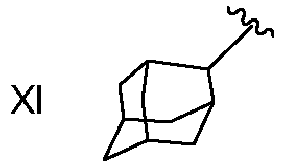

- The spacer R2 between the POSS-molecule and the attached phosphorus is selected from the group consisting of C1-C20 linear or branched alkyl chain, ether, polyether polythioether, amino, aryl bridged alkyl chain where the aryl moiety can include further substitution pattern.
- In another preferred embodiment R2, R8 and R9 contain aryl groups, where the aryl groups are bonded to the P-atom and the POSS moieties is attached via alkyl chains R10 that are connected to the said aryl groups as depicted in formula XII. Alkyl chain R10 connected to the aryl group thus corresponds to spacer R2.

- R10 is the same or different branched or linear C1-C20 alkyl chains, cyclo alkyl, C1-C20 alkoxy, aryl, aryloxy, arylalkyl groups, substitution pattern also includes further POSS fragments having the same or different structure. R10 may also be multiply substituted halogen alkyl, unsubstituted or substituted aryl groups and substituted alkyl groups, aryloxy, hetaryloxy groups.
- Additionally the alkyl chain can contain further complexing moieties like imidazol derivatives (formula XII):

- Due to their size the POSS linked ligands according to the present invention can be considered as being nanoparticle anchored ligands. They can be used in metal catalyzed reactions in combination with nanofiltration technology. The nanometersized POSS-molecule to which the catalyst is linked allows specific filtration of the reaction products and other components where the nano-anchored catalyst remains within the membrane sphere. Most importantly high molecular weights of these ligands lead to the corresponding transition metal catalysts with molecular weights ranging from 1500 to 3000, which allows synthesis and filtration of larger sized molecules.
- This methodology allows not only simplified separation of the metal catalyst from the organic components. Furthermore repeated multicycled processes and of course continuous processes are feasible as well.
- Preferred examples of transition metal complexes with different POSS linked ligands are given below:


- The corresponding transition metal complexes, preferably palladium complexes can be obtained and used in cross-coupling reactions in two ways: 1. they can be isolated after reaction of the phosphonium or imidazolium salts with bases and subsequent addition of a particular palladium source or 2. the active catalyst species can be obtained in the reaction mixture containing both catalyst compounds and the cross-coupling reaction partners in situ during the cross-coupling reaction in which a base is used in order to e. g. activate the palladium precatalyst or generate the active boronate species e. g. in the Suzuki-Miyaura reaction which is essential for the reaction.
- Since most alkyl substituted free phosphines are prone to oxidation when exposed to air, it is far better to store these compounds as their phosphonium salts. The phosphonium salts are very stable compounds to moisture and air that can be stored for a very long time. The syntheses of the ligand salts are straightforward by simple reactions of polysilsesquioxane halides and the corresponding imidazole- and phosphine substrates.
- The POSS linked phosphonium salts can be obtained by simple conversion of different POSS-halides having different chain lengths (scheme 1) with a phosphine. In this particular example the preferred bisadamantyl substituted phosphine is used since this phosphine substitution pattern is found in benchmark cataCXiumA®, which has proven to be a superior ligand in particularly manifold palladium-catalyzed cross-coupling reactions. Connecting the POSS cube with bisadamantylphosphine via an unbranched alkyl chain leads to a ligand structure which is very close to that found in cataCXiumA®.
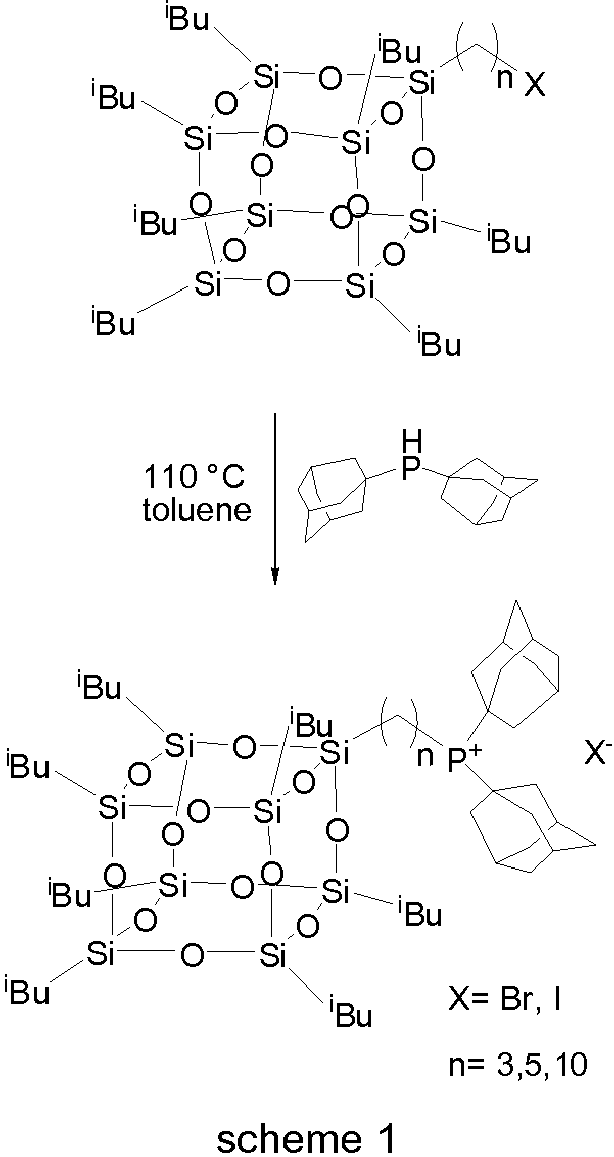
- This straight forward synthesis enables simple variation in both chain length between the phosphorus atom and the POSS cube and the moieties on the P-atom.
- From the group of imidazole-based NHC-type ligands the salts can be obtained simple reactions starting from POSS-halides and corresponding imidazole (scheme 2, left). For the synthesis of singly imidazole substituted POSS-derivatives, the POSS halides were added slowly two a melt of 10-30 fold excess of imidazol. Simple take-up of the crude product in water and extraction with ether gave the products in excellent yields and high purity.
- The syntheses of symmetrically bis-POSS functionalized imidazolium salts were achieved by slight modification of the methodology as demonstrated for the syntheses of mono POSS-substituted imidazoles. The reaction of only two equivalents of imidazole with POSS alkyl halides lead to the clean formation of the corresponding imidazolium salts (scheme 2, right). Addition of at least two equivalents of imidazole is required, because the acid HX which results from the first reaction of one equivalent of imidazole needs to be buffered, otherwise incomplete reaction can occur. Finally, unsymmetrical mesityl-substituted POSS-enlarged imidazolium salts as N-heterocyclic carbene sources can be obtained by the simple protocol as well (scheme 2, top).

- With the mono POSS enlarged imidazoles (from scheme 2) in hands, syntheses of various ligands that bear further POSS-substituted imidazole moieties or even mixed phosphine-NHC ligands were realized. Thus, starting from the mono POSS-substituted imidazole derivatives, in the first step the alkyl bridging moiety was installed (scheme 3, left). To avoid formation of side products, first an excess of the alkylating reagent (1,2-dibromoethane, 1,3-dibromopropane) was heated to 120 °C and the corresponding POSS-substituted imidazole derivative was added portionwise giving rise to the imidazolium salts.
- On the other hand addition of 0.5 eq. of the alkylating reagent to the molten POSS-substituted imidazole derivative lead to the formation of the alkyl bridged dimer in very good yields (scheme 3, right).

- The mixed phosphine-imidazolium-based NHC type of ligands are obtained by conversion of the POSS-containing singly alkylated imidazolium salts by treating with phosphines or their mineral salts respectively:

- The symmetric POSS-substituted bis-imidazolium salts can be converted into the corresponding bis-NHC-transition metal complexes by treatment with a base and subsequent addition of an appropriate metal source. As an interesting candidate for general industrial application, Palladium was taken as metal of choice for the synthesis of various carbene- and phosphine complexes and their employment in C-C- and C-N-coupling reactions.
- Furthermore new efficient and straightforward synthesis methods were established for the manufacture of these ligands to design new transition metal catalysts.
- The POSS-based phosphine ligands were tested in a C-C cross-coupling reaction (Heck-Mizoroki reaction, scheme 5, comparative example).

- These results demonstrate that the POSS-enlarged analogues of the benchmark ligand cataCXiumA® display also an outstanding performance in cross-coupling reactions.
- Some of the described imidazole derived N-heterocyclic carbene ligands which have been POSS enlarged were converted to various palladium catalysts. From these the iodine µ-bridged dimeric catalyst showed the highest activity in a C-N cross-coupling reaction (Buchwald-Hartwig reaction) in combination with POSS-enlarged cataCXiumA® ligands and were compared with further benchmark phosphine ligands (scheme 6).

- Importantly, the highest catalytic activities were observed when the enlarged catalyst systems were used together with the POSS-enlarged cataCXiumA® ligands.
- In conclusion, the enlarged structure properties of POSS-based phosphine ligands and imidazole-based NHC-palladium catalysts fulfil all of the requirements which were set for the application in cross-coupling reactions in connection with membrane-filtration technology.
- General. The 31P- and 1H-NMR-spectra were measured on Bruker DRX 500 (500 MHz) spectrometer. For the 1H-NMR-spectra the chemical shifts were given in ppm from tetramethylsilane as an internal standard (0.00 ppm) or the solvent residue peaks (CDCl3: 7.26 ppm, CD2Cl2: 5.26 ppm). The chemical shifts of the 31P resonances were determined relative to phosphoric acid (H3PO4) as an internal standard (0.00 ppm). Peak multiciplities were abbreviated as: s, singlet; d, dublet, t, triplet, qr, quartet, qn, quintet, sep, septet; m, multiplet. All solvents and chemicals were used as purchased. Reagents and solvents were purchased from Aldrich. All POSS starting materials were purchased from Hybrid Catalysis. Di-(1-adamantyl)phosphine is an in-house product of EVONIK-DEGUSSA GmbH. General procedure for the syntheses of POSS-phosphonium salts: Slight excess of the POSS starting material (1.1 equivalents related to the phosphine) was dissolved in toluene (or xylene) in a round bottomed flask fitted with a stirring bar by heating in an oil bath at 110 °C (130 °C for xylene, which is also the reaction temperature). The reaction mixture was stirred 2-4 hours whereupon the product precipitates as a solid. Next the solid was isolated by filtration and was washed with hexane. The products are snow-white solids whereas the iodide salts become yellowish after longer storing.
- 8.61 g (8.7 mmol) of Propyliodoisobutyl POSS was dissolved in 80 ml of xylene according to the general procedure. Then 2.40 g (7.9 mmol) Di(1-adamantyl)phosphine was added. After 12 h reaction time the reaction was accomplished. Crude product was purified as described. 7.5 g (73 %) of a snow-white product was yielded. 31P-NMR (162 MHz, CDCl3): δ= 19.08 ppm.
- 5.12 g (5 mmol) of Pentyliodoisobutyl POSS was dissolved in 60 ml of toluene according to the general procedure. Then 1.46 g (4.8 mmol) Di(1-adamantyl)phosphine was added. After 12 h reaction time the reaction was accomplished. Purification of the crude product afforded 5.86 g (92 %) of a snow-white product. 31P-NMR (162 MHz, CDCl3): δ= 22.93 ppm.
- 1.02 g (0.94 mmol) of Decyliodoisobutyl POSS was dissolved in xylene at 130 °C and 278 mg (0.92 mmol) Di(1-adamantyl)phosphine was added. After 12 h reaction time the reaction was accomplished. Purification of the crude product afforded 600 mg (49 %) of a snow-white to slightly yellow product. 31P-NMR (162 MHz, CDCl3): δ= 21.21 ppm.
- General procedure for the syntheses of POSS-imidazolium salts: The procedure is similar to the previous. Only variations are: Toluene as solvent was used and the reaction temperature is 110 °C. The reaction mixture stirred 12-16 hours whereupon the product precipitates as a solid. Next toluene was added as much as it is required to keep the reaction mixture liquid and mobile. The purification of the crude product is accomplished on a silica gel column (solvent: mixtures hexane-ethyl acetate 10:1, then methanol.
- 5.00 g (5.1 mmol) of Propyliodoisobutyl POSS was dissolved in 60 ml of toluene according to the general procedure at 110 °C. Then 860 mg (4.6 mmol) of 1-Mesitylimidazole was added. After 4 h the reaction was accomplished. Work-up and purification according to the general procedure resulted in the isolation of 4.58 g (78 %) pure product as a white solid.
1H-NMR (500 MHz, CDCl3): δ 0.61, (m, 16 H, Si-CH2 - and 7x POSS-Si-CH2 -), 0.96 (m, 7x (CH3 )2CH), 1.85 (m, 7 H, 7x Si-CH2-CH-), 2.07 (m, 2 H, Si-CH2-CH2 -CH2-), 2.11 (s, 6 H, 2 o-CH3 -Ph), 2.35 (s, 3 H, p-CH3-Ph), 4.76 (bt, 2 H, -CH2 -Nlm), 7.03 (s, 2 H, 2 m-Ph-H), 7.18 (s, 1 H, 5-H lm), 7.51 (s, 1 H, 4-H lm), 10.18 (s, 1 H, 2-Hlm). - 2.00 g (2.1 mmol) of Propylbromoisobutyl POSS was dissolved in 60 ml of toluene according to the general procedure at 110 °C. Then 367 mg (1.9 mmol) of 1-Mesitylimidazole was added. After 16 h the reaction was accomplished. Work-up and purification according to the general procedure resulted in the isolation of 3.05 g (67 %) pure product as a white solid.
1H-NMR (500 MHz, CDCl3): δ 0.58-0.61, (m, 16 H, Si-CH2 and 7x POSS-Si-CH2 -), 0.96, (m, 42 H 7x(CH3 )2CH), 1.43 (m, 4 H, 2 -CH2-), 1.85 (m, 7 H, 7x CH), 1.95 (m, 2 H, -CH2-), 2.08 (s, 6 H, 2 o-CH3 -Ph), 2.35 (s, 3 H, 2 m-Ph-H), 4.66 (t, J= 7.0 Hz, 2 H, -CH2 -N), 7.01 (s, 2 H, 2 m-Ph-H), 6.48 (s, 1 H, 5-H lm), 7.26 (m, 1 H, 5-H lm), 7.70 (m, 1H, 4-H lm)10.06 (s, 1 H, 2-Hlm). - 5.00 g (4.8 mmol) of Decylbromoisobutyl POSS was dissolved in 60 ml of toluene according to the general procedure at 110 °C. Then 816 mg (4.4 mmol) of 1-Mesitylimidazole was added. After 1 h the reaction was accomplished. Work-up and purification according to the general procedure resulted in the isolation of 4.94 g (92 %) pure product as a white solid.
1H-NMR (500 MHz, CDCl3): δ 0.57-0.61, (m, 16 H, Si-CH2- and 7x POSS-Si-CH2 -), 0.96, (m, 42 H 7x (CH3 )2CH), 1.25 (m, 8 H, 4 -CH2-), 1,37 (m, 6 H, 3 -CH2-), 1.86 (sep, J = 6.7 Hz, 7 H, 7x POSS-CH), 1.99 (m, 2 H, -CH2-), 2.08 (s, 6 H, 2 o-CH3 -Ph), 2.35 (s, 3 H, 2 m-Ph-H), 4.66 (t, J= 7.0 Hz, 2 H, -CH2 -N), 7.00 (s, 2 H, 2 m-Ph-H), 6.48 (s, 1 H, 5-H lm), 7.19 (m, 1 H, 5-H lm), 7.72 (m, 1 H, 4-H lm)10.50 (s, 1 H, 2-Hlm). - 10-40 fold excess of imidazole was dissolved in toluene in a round bottomed flask at 110 °C. To this solution the POSS compounds were added. The reaction mixture was stirred from 4 h to 24 h at this temperature. Then excess imidazole was removed by extraction with water and the product was extracted with diethyl ether. After a short silica-gel column filtration (ethyl acetate) the product was separated from the bis-POSS imidazole side product.
- 14.6 g (214 mmol) of imidazole was dissolved in 250 ml of toluene and 5.77 g (5.85 mmol) of Isobutyl-POSS-propyl-3-iodide was added portionwise to the solution. Work-up gave 5.27 g (97 %) of pure snow-white product.
1H-NMR (500 MHz, CDCl3): δ 0.60 (m, 16 H, Si-CH2 - and 7x POSS-Si-CH2 -), 0.95, (m, 42 H 7x (CH3 )2CH), 1.85 (m, 9 H, 7x POSS-CH, CH2), 3.91 (t, J= 7.1 Hz, 2 H, CH2), 6.87, 7.06, 7.44 (3 m, 1H each, Imidazole-H). - 5.37 g (79 mmol) of imidazole were dissolved in 60 ml of toluene at the given temperature. To this solution 2.0 g (3.95 mmol) of Isobutyl-POSS-pentyl-5-iodide was added. Workup gave 3.26 g (87 % yield) of the product as a white solid.
1H-NMR (500 MHz, CDCl3): δ 0.60 (m, 16 H, Si-CH2 - and 7x POSS-Si-CH2 -), 0.95, (m, 42 H 7x (CH3 )2CH), 1.34 (m, 2 H, CH2), 1.44 (m, 2 H, CH2),1.77 (m, 2 H, CH2), 1.85 (sep, J = 6.7 Hz, 7x POSS-CH), 3.91 (t, J= 7.3 Hz, 2 H, CH2), 6.89, 7.05, 7.46 (3 m, 1H each, Imidazole-H). - 10.6 g (157 mmol) of imidazole was dissolved in 200 ml of toluene at the given temperature and was treated with 8.5 g (7.85 mmol) of Isobutyl-POSS-decyl-10-iodide. The workup followed after 12 h reaction time and gave 5.56 g (61 % yield) of a white solid.
1H-NMR (500 MHz, CDCl3): δ 0.60 (m, 16 H, Si-CH2 - and 7x POSS-Si-CH2 -), 0.96, (m, 42 H 7x (CH3 )2CH), 1.25-1.30 (m, 12 H, CH2), 1.38 (m, 2 H, CH2),1.77 (m, 2 H, CH2), 1.85 (sep, J = 6.7 Hz, 7x POSS-CH), 3.91 (t, J= 7.2 Hz, 2 H, CH2), 6.89, 7.05, 7.46 (3 m, 1H each, Imidazole-H). - 6.0 g (5.92 mmol) of Isobutyl-POSS-pentyl-5-iodide was dissolved in 70 ml of toluene at 110 °C with stirring. Then two equivalents (806 mg, 18.4 mmol) of imidazole which was dissolved in 3 ml hot toluene was added. After 12 h of stirring the reaction was complete. The crude product was treated with water-diethylether. The aqueous phase was discarded and the organic phase was dried using magnesium sulphate. After removal of the solvent 5.17 g (82 % yield) of a yellow solid was isolated.
1H-NMR (500 MHz, CDCl3): 1H-NMR (500 MHz, CDCl3): δ 0.60 (m, 32 H, 2x Si-CH2 - and 14x POSS-Si-CH2 -), 0.95, (m, 84 H, 14x (CH3 )2CH), 1.31-1.45 (m, 8 H, 4x CH2), 1.75-1.93 (m, 18 H, 2 CH2 and 14x POSS-CH), 3.91 (t, J= 7.2 Hz, 2 H, CH2), 4.33 (t, J= 7.5 Hz, 2 H, 2 CH2), 6.89, 7.05, 10.57 (3 m, 1H each, Imidazole-H). - 8.59 g (46 mmol) of dibromoethane was heated to 120 °C and 2.18 g (2.3 mmol) of Isobutyl-POSS-pentyl-3-imidazole was added portionwise with stirring. After 2 h reaction time the crude reaction mixture was purified according to the general procedure and 1.09 (42 % yield) of a white solid as product was isolated.
1H-NMR (500 MHz, CDCl3): δ 0.59
(m, 16 H,Si-CH2 - and 7x POSS-Si-CH2 -),0.95, (m, 42 H 7x (CH3 )2CH), 1.35, 1.44 (2 m, 2 H each, 2 CH2), 1.85 (m, 9 H, -CH2 -, 7x (CH3)2 CH), 3.90 (t, J= 5.9 Hz, 2 H, - CH2 -), 4.21 (m, 2 H, -CH2 -), 4.71 (t, J= 5.8 Hz, 2 H, -CH2-), 7.66, 7.87, 9.58 (3m, 1 H each, imdazole-H). - 13.4 g (66 mmol) of 1,3-dibromopropane was heated to 120 °C. Then 3.1 g (3.3 mmol) of Isobutyl-POSS-propyl-3-imidazole portionwise over 1 h. After 6 h reaction time the crude reaction mixture was purified by column chromatography using silica gel (solvents: hexane-ethyl acetate 10:1, then methanol). The product was obtained as a white solid (2.75 g, 74 % yield).
1H-NMR (500 MHz, CDCl3): δ 0.61 (m, 16 H, -Si-CH2, 7x POSS-Si-CH2 -), 0.95, (m, 42 H 7x (CH3 )2CH), 1.85 (sep, J = 6.7 Hz, 7x POSS-CH 2.04 (m, 2 H, CH2, 7x POSS-CH), 2.63 (m, 2 H, CH2),3.54 (t, J= 6.0 Hz, 2 H, CH2), 4.36 (t, J= 7.1 Hz, 2 H, CH2), 7.17, 7.46, 10.88 (3 m, 1H each, Imidazole-H). - 6.0 g 30 mmol) of 1,3-dibromopropane was heated to 120 °C. Then 1.56 g (1.63 mmol) of Isobutyl-POSS-pentyl-3-imidazole was added. After 6 h reaction time the crude reaction mixture was purified by column chromatography using silica gel (solvents: hexane-ethyl acetate 10:1, then methanol). The product was obtained as a white solid (1.70 g, 90 % yield).
1H-NMR (500 MHz, CDCl3): δ 0.60 (m, 16 H, -Si-CH2, 7x POSS-Si-CH2 -), 0.95, (m, 42 H 7x (CH3 )2CH), 1.40-1.46 (m, 4 H, 2 CH2), 1.82-1.92 (m, 9 H, CH2, 7x POSS-CH ), 2.62 (m, 2 H, CH2),3.48 (m, 2 H, CH2), 4.30 (m, 2 H, CH2), 4.65 (m, 2 H, CH2), 7.21, 7.41, 10.81 (3 m, 1H each, Imidazole-H). - 1.63 g (1.71 mmol, 1.5 eq.) of Isobutyl-POSS-pentyl-5-imidazole was molten at 130 °C with the assistance of 3 ml toluene. To this melt 227 mg (1.21 mmol) of 1,2-dibromoethane which was dissolved in 0.5 ml of toluene was added via a pipette. The solvent together with excess of 1,2-dibromoethane were removed in vacuo and 1.51 g (77 % yield) of the pure product was obtained as a white solid.
1H-NMR (500 MHz, CDCl3): δ 0.61 (m, 16 H, -Si-CH2, 7x POSS-Si-CH2 -), 0.96, (m, 42 H 7x (CH3 )2CH), 1.32-1.47 (m, 4 H, 2 CH2), 1.78-1.91 (m, 9 H, CH2, 7x POSS-CH), 3.96 (m, 2 H, CH2), 4.14 (m, 2 H, bridge-CH2), 6.93, 7.69, 10.81 (3 m, 1H each, Imidazole-H). - 2.0 g (2.13 mmol) of Isobutyl-POSS-pentyl-5-imidazole was molten at 130 °C with the assistance of 3 ml of toluene. To this melt a toluene solution of 215 mg (1.065 mmol) 1,3-dibromopropane was added via pipette. The mixture was stirred 2 h at this temperature. The reaction is completed when the melt becomes ductile. The solvent is removed in vacuo and 2.0 g (81 % yield) of the pure product is isolated as a white solid.
1H-NMR (500 MHz, CDCl3): δ 0.61 (m, 16 H, -Si-CH2, 7x POSS-Si-CH2 -), 0.96, (m, 42 H 7x (CH3 )2CH), 1.38-1.45 (m, 8 H, 4 CH2), 1.82-1.89 (m, 18 H, 2x CH2, 14x POSS-CH), 2.93 (m, 2 H, bridge-CH2), 4.13 (m, 4 H, CH2), 4.21 (m, 4 H, 2x CH2), 4.77 (m, 4 H, 2 bridge-CH2), 7.14, 8.23, 10.25 (3 m, 1H each, Imidazole-H). - Polyhedral oligomeric silsesquioxanes (POSS) linked ligand of the general formula (I)
L [(R1a)n-1(SiO1,5)nR2a]k[(R1b)n-1SiO1,5)nR2b]l[(R1c)n-1SiO1,5)nR2c]m (I)
- in which (R1a,b,c)n-1(SiO1,5)n is a polyhedral oligomeric silsesquioxanes (POSS) with n = 4, 6, 8,10, 12, 14, 16 or 18 and
- R1a R1b R1c is each independently selected from the group consisting of same or different branched or linear C1-C20 alkyl chains, cyclo alkyl, C1-C20 alkoxy, aryl, aryloxy, heteroaryl and arylalkyl groups,
- k, l, m is 0 or 1 provided that k+l+m ≥ 1,
- R2a, R2b, R2c is a spacer that binds the polyhedral oligomeric silsesquioxane (POSS) to the ligand L and ligand L is an N-heterocyclic carbene.
Claims (12)
- Polyhedral oligomeric silsesquioxanes (POSS) linked ligand of the general formula (I)
L [(R1a)n-1(SiO1,5)nR2a]k[(R1b)n-1(SiO1,5)nR2b]l[(R1c)n-1(SiO1,5)nR2c]m (I)
in which (R1a,b,c)n-1(SiO1,5)n is a polyhedral oligomeric silsesquioxanes (POSS) with n = 4, 6, 8,10, 12, 14, 16 or 18 andR1a, R1b,R1c is each independently selected from the group consisting of same or different branched or linear C1-C20 alkyl chains, cyclo alkyl, C1-C20 alkoxy, aryl, aryloxy, heteroaryl and arylalkyl groups,k, I, m is 0 or 1 provided that k+l+m ≥ 1,R2a, R2b, R2c is a spacer that binds the polyhedral oligomeric silsesquioxane (POSS) to the ligand L,R2a, R2b, R2c is each independently selected from the group consisting of linear or branched C1-C20 alkyl, C3-C10 cyclic alkyl, C1-C20 alkoxy, C2-C20 alkenyl, C2-C20 alkenyloxy, aryloxy, C1-C20 alkylthio, C1-C20 carboxylate, aryl or heteroaryl, C1-C20 alkyl halogenide, annulated aryl or heteroaryl, C3-C10 cyclic alkyl groups which in turn may each be further substituted with one or more groups selected from hetero atom or aryl groups, ether, polyether polythioether, amino, aryl bridged alkyl chain where the aryl moiety can include further substitution pattern andligand L is an N-heterocyclic carbene. - Salt of a polyhedral oligomeric silsesquioxanes (POSS) linked ligand according to claim 1 of the general formula (II)
X- H-L+[(R1a)n-1(SiO1,5)nR2a]k[(R1b)n-1(SiO1,5)nR2b]l[(R1c)n-1(SiO1,5)nR2c]m (II)
in which X- is a mono- or polyvalent organic or inorganic anion,H is hydrogen and L+ is a protonated species of L, wherein R2a, R2b, R2c is each independently selected from linear C1-C20-alkyl. - Bidentate polyhedral oligomeric silsesquioxanes (POSS) linked ligands of the general formula (III)
 in which (R1ab,c)n-1(SiO1,5)n is a polyhedral oligomeric silsesquioxanes (POSS) with n = 4, 6, 8,10, 12, 14, 16 or 18 andR1a, R1b,R1c is each independently selected from the group consisting of same or different branched or linear C1-C20 alkyl chains, cyclo alkyl, C1-C20 alkoxy, aryl, aryloxy, heteroaryl and arylalkyl groups,k, l, m is 0 or 1 provided that k+l+m ≥ 1,R2a, R2b, R2c is a spacer that binds the polyhedral oligomeric silsesquioxane (POSS) to the ligand L,R2a, R2b, R2c is each independently selected from the group consisting of linear or branched C1-C20 alkyl, C3-C10 cyclic alkyl, C1-C20 alkoxy, C2-C20 alkenyl, C2-C20 alkenyloxy, aryloxy, C1-C20 alkylthio, C1-C20 carboxylate, aryl or heteroaryl, C1-C20 alkyl halogenide, annulated aryl or heteroaryl, C3-C10 cyclic alkyl groups which in turn may each be further substituted with one or more groups selected from hetero atom or aryl groups, ether, polyether polythioether, amino, aryl bridged alkyl chain where the aryl moiety can include further substitution pattern andligand L is an uncharged electron donor,Q is a branched or linear substituted or unsubstituted alkyl chain with a chain length ranging from C1 to C20, furthermore Q is unsubstituted or substituted cyclic alkyl, aryl or heteroaryl groups where the aryl and heteroaryl moieties can include further substitution pattern.
 - Salts of bidentate polyhedral oligomeric silsesquioxanes (POSS) linked ligands according to claim 3 of the general formula (IV)

- Polyhedral oligomeric silsesquioxanes (POSS) linked ligand or their salts according to any one of the previous claims, characterized in that R1a, R1b,R1c are unsubstituted branched C1-C20 alkyl chains.
- Polyhedral oligomeric silsesquioxanes (POSS) ligand or their salts according to any one of the previous claims, characterized in that R2a, R2b, R2c is linear C1-C20 alkyl.
- Polyhedral oligomeric silsesquioxanes (POSS) linked ligand or their salts according to any one of the previous claims, characterized in that k = 1, l = 0, and m = 0.
- Polyhedral oligomeric silsesquioxanes (POSS) linked ligand according to claim 1, characterized in that the polyhedral oligomeric silsesquioxanes (POSS) linked ligand is selected from the group consisting of:


 R1, R2 and X- has the same meaning as in the previous claims,R3, R5, R6 are the same or independent from each other selected from the group consisting of hydrogen, linear or branched C1-C20 alkyl, C3-C10 cyclic alkyl, C1-C20 alkoxy, C2-C20 alkenyl, C2-C20 alkenyloxy, aryloxy, C1-C20 alkylthio, C1-C20 carboxylate, aryl or heteroaryl, substituted halogen aryl or heteroaryl,C1-C20 alkyl halogenide, annulated aryl or heteroaryl, C3-C10 cyclic alkyl groups which in turn may each be further substituted with one or more groups selected from hetero atom or aryl groups andR7 is substituted or unsubstituted linear or branched C1-C10 alkyl chain.
 - Polyhedral oligomeric silsesquioxanes (POSS) linked ligand according to claim 1, characterized in that the polyhedral oligomeric silsesquioxanes (POSS) linked ligand is
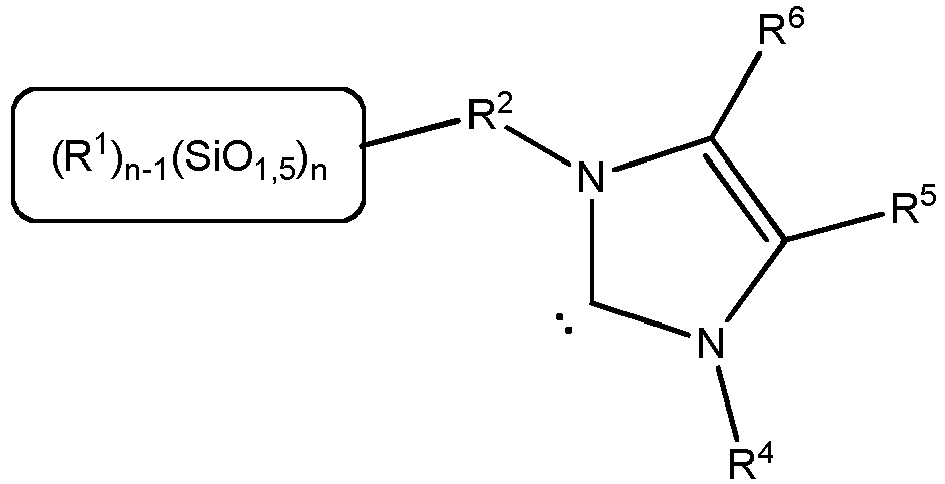 R1, R2 and n has the same meaning as in the previous claims,R4, R5 and R6 are the same or independent from each other selected from the group consisting of hydrogen, linear or branched C1-C20 alkyl, C3-C10 cyclic alkyl, C1-C20 alkoxy, C2-C20 alkenyl, C2-C20 alkenyloxy, aryloxy, C1-C20 alkylthio, C1-C20 carboxylate, aryl or heteroaryl, substituted halogen aryl or heteroaryl, C1-C20 alkyl halogenide, annulated aryl or heteroaryl, C3-C10 cyclic alkyl groups which in turn may each be further substituted with one or more groups selected from hetero atom or aryl groups.
 - Transition metal complex comprising polyhedral oligomeric silsesquioxanes (POSS) linked ligands according to any one of the previous claims.
- Use of a polyhedral oligomeric silsesquioxanes (POSS) linked ligand according to claims 1, 3, 5-9 in transition metal catalyzed cross-coupling reactions.
- Use of a transition metal complex according to claim 10 in transition metal catalyzed cross-coupling reactions.
Priority Applications (1)
| Application Number | Priority Date | Filing Date | Title |
|---|---|---|---|
| EP11705578.0A EP2542559B1 (en) | 2010-03-01 | 2011-02-28 | Polyhedral oligomeric silsesquioxane (poss)-linked ligands |
Applications Claiming Priority (4)
| Application Number | Priority Date | Filing Date | Title |
|---|---|---|---|
| EP10155081A EP2368894A1 (en) | 2010-03-01 | 2010-03-01 | Polysilsesquioxane (POSS)-linked Imidazole-based Carbene and Phosphine Ligands for Transition Metal Catalysts |
| EP10166004 | 2010-06-15 | ||
| EP11705578.0A EP2542559B1 (en) | 2010-03-01 | 2011-02-28 | Polyhedral oligomeric silsesquioxane (poss)-linked ligands |
| PCT/EP2011/052885 WO2011107417A1 (en) | 2010-03-01 | 2011-02-28 | Polyhedral oligomeric silsesquioxane (poss)-linked ligands |
Publications (2)
| Publication Number | Publication Date |
|---|---|
| EP2542559A1 EP2542559A1 (en) | 2013-01-09 |
| EP2542559B1 true EP2542559B1 (en) | 2016-07-06 |
Family
ID=43728966
Family Applications (1)
| Application Number | Title | Priority Date | Filing Date |
|---|---|---|---|
| EP11705578.0A Not-in-force EP2542559B1 (en) | 2010-03-01 | 2011-02-28 | Polyhedral oligomeric silsesquioxane (poss)-linked ligands |
Country Status (7)
| Country | Link |
|---|---|
| US (1) | US9029483B2 (en) |
| EP (1) | EP2542559B1 (en) |
| JP (1) | JP5864447B2 (en) |
| CN (1) | CN102834404B (en) |
| BR (1) | BR112012022112A2 (en) |
| PT (1) | PT2542559T (en) |
| WO (1) | WO2011107417A1 (en) |
Cited By (1)
| Publication number | Priority date | Publication date | Assignee | Title |
|---|---|---|---|---|
| CN110452385A (en) * | 2019-08-29 | 2019-11-15 | 北京理工大学 | A kind of incomplete polycondensation clathrate phenylsilsesquioxane containing alkali metal sodium and preparation method thereof |
Families Citing this family (18)
| Publication number | Priority date | Publication date | Assignee | Title |
|---|---|---|---|---|
| EP2363402A1 (en) * | 2010-03-01 | 2011-09-07 | Evonik Oxeno GmbH | Polyhedral oligomeric silsesquioxane (POSS)-bound ligands and use of same |
| EP2535344A1 (en) * | 2011-06-17 | 2012-12-19 | Evonik Degussa GmbH | Silsesquioxane-substituted compounds, method for producing same, use of same as ligands for catalyst systems and catalyst systems |
| CN103588808A (en) * | 2013-11-08 | 2014-02-19 | 复旦大学 | Polyhedral oligomeric silsesquioxane (POSS)-based solid ionic liquid, and preparation method and application thereof |
| WO2015130144A1 (en) * | 2014-02-28 | 2015-09-03 | 주식회사 동진쎄미켐 | Silsesquioxane complex polymer and method for preparing same |
| WO2015130145A1 (en) * | 2014-02-28 | 2015-09-03 | 주식회사 동진쎄미켐 | Silsesquioxane complex polymer and method for preparing same |
| KR102363819B1 (en) * | 2014-02-28 | 2022-02-17 | 주식회사 동진쎄미켐 | Silsesquioxane composite polymer and method for manufacturing thereof |
| KR102363818B1 (en) * | 2014-02-28 | 2022-02-17 | 주식회사 동진쎄미켐 | Silsesquioxane composite polymer and method for manufacturing thereof |
| CN104672458B (en) * | 2014-12-10 | 2017-02-01 | 杭州师范大学 | Dumbbell-shaped polysilsesquioxane as well as synthesizing method and application thereof |
| CN104672451B (en) * | 2014-12-10 | 2017-02-22 | 杭州师范大学 | Large cyclic polysilsesquioxane and synthesis method thereof |
| JP6991584B2 (en) * | 2015-10-29 | 2022-02-03 | ザ トラスティーズ オブ プリンストン ユニバーシティ | Tri- (adamantyl) phosphine and its uses |
| CN108424722B (en) * | 2017-01-26 | 2021-01-12 | 宁波甬安光科新材料科技有限公司 | Hardened antireflection optical coating liquid for flexible display device and preparation method and application thereof |
| KR102450815B1 (en) | 2017-06-16 | 2022-10-05 | 에스케이이노베이션 주식회사 | Heteroatomic ligand, oligomerization catalyst containing the same, and production method of oligomer |
| EP3741766B1 (en) | 2019-05-24 | 2022-08-31 | Covestro Intellectual Property GmbH & Co. KG | New catalysts suitable for the synthesis of oligomeric isocyanates |
| CN110452490B (en) * | 2019-08-29 | 2021-09-17 | 安徽立兴化工有限公司 | Dual POSS polyether hybrid water-based acrylic resin dispersion, preparation method and composition for preparing resin coating film |
| US12113279B2 (en) | 2020-09-22 | 2024-10-08 | Oti Lumionics Inc. | Device incorporating an IR signal transmissive region |
| US11985841B2 (en) | 2020-12-07 | 2024-05-14 | Oti Lumionics Inc. | Patterning a conductive deposited layer using a nucleation inhibiting coating and an underlying metallic coating |
| CN116143134B (en) * | 2023-02-17 | 2023-10-20 | 江苏海格新材料有限公司 | Preparation method of silicon micropowder for integrated circuit packaging |
| CN116253887B (en) * | 2023-03-10 | 2024-05-03 | 福州大学 | POSS-based organic porous polymer for catalyzing cycloaddition reaction of epoxide and carbon dioxide |
Family Cites Families (23)
| Publication number | Priority date | Publication date | Assignee | Title |
|---|---|---|---|---|
| US3373137A (en) * | 1962-05-18 | 1968-03-12 | Dow Corning | Nitrogen-containing organosilicon compounds and their preparation |
| EP0967229A1 (en) * | 1998-06-26 | 1999-12-29 | Dsm N.V. | Metal complex containing one or more silsesquioxane ligands |
| EP1196455B1 (en) * | 1999-02-05 | 2008-01-16 | Materia, Inc. | Metathesis-active adhesion agents and methods for enhancing polymer adhesion to surfaces |
| EP1202791B1 (en) * | 1999-06-11 | 2006-12-27 | Gas Separation Technology, Inc. | Porous gas permeable material for gas separation |
| US6911518B2 (en) * | 1999-12-23 | 2005-06-28 | Hybrid Plastics, Llc | Polyhedral oligomeric -silsesquioxanes, -silicates and -siloxanes bearing ring-strained olefinic functionalities |
| DE10060775A1 (en) * | 2000-12-07 | 2002-06-13 | Creavis Tech & Innovation Gmbh | Oligomeric silasesquioxanes and process for the preparation of oligomeric silasesquioxanes |
| DE10156619A1 (en) * | 2001-11-17 | 2003-05-28 | Creavis Tech & Innovation Gmbh | Process for the preparation of functionalized oligomeric silasesquioxanes and their use |
| ES2405508T3 (en) * | 2002-07-08 | 2013-05-31 | Basf Corporation | Elimination of metal compounds |
| US7863396B2 (en) * | 2003-03-07 | 2011-01-04 | Chisso Corporation | Silicon compounds |
| GB0326286D0 (en) * | 2003-11-11 | 2003-12-17 | Vantico Gmbh | Initiator systems for polymerisable compositions |
| CN1332963C (en) * | 2004-01-19 | 2007-08-22 | 北京化工大学 | Amino phenyl cage type sesqui siloxane and its preparing method |
| KR100682859B1 (en) * | 2004-01-27 | 2007-02-15 | 삼성에스디아이 주식회사 | Polysilsesquioxane Compound and Organic Electroluminescent Device Using the Same |
| TWI406890B (en) * | 2004-06-08 | 2013-09-01 | Sandisk Corp | Post-deposition encapsulation of nanostructures : compositions, devices and systems incorporating same |
| DE102004042522A1 (en) * | 2004-09-02 | 2006-03-09 | Kühnle, Adolf, Dr. | New oxidation catalyst (having high molecular weight) comprising silicon oxygen cluster units useful for the oxidation of hydrocarbons to alcohols, hydroperoxide, aldehyde, ketone, carboxylic acid or carboxylic acid ester |
| CA2499782A1 (en) * | 2005-03-07 | 2006-09-07 | Queen's University At Kingston | Sol gel functionalized silicate catalyst and scavenger |
| GB0524189D0 (en) * | 2005-11-28 | 2006-01-04 | Welding Inst | Process for the production of organosilsesquioxanes |
| US7662308B2 (en) * | 2006-08-07 | 2010-02-16 | Ciba Specialty Chemicals Corporation | Polyhedral oligomeric silsesquioxane (POSS) based fluorescent colorants |
| US7786209B2 (en) * | 2006-10-27 | 2010-08-31 | Xerox Corporation | Nanostructured particles, phase change inks including same and methods for making same |
| US8541532B2 (en) | 2007-02-09 | 2013-09-24 | Nippon Shokubai Co., Ltd. | Silane compound, production method thereof, and resin composition containing silane compound |
| JP5057078B2 (en) * | 2007-03-12 | 2012-10-24 | 信越化学工業株式会社 | Hydrosilylation reaction control agent, hydrosilylation catalyst composition, and curable composition |
| CN101619073A (en) * | 2009-08-18 | 2010-01-06 | 北京化工大学 | Cage type silsesquioxane sulphonate with potential catalytic action and thermosetting resin composite thereof |
| EP2363402A1 (en) * | 2010-03-01 | 2011-09-07 | Evonik Oxeno GmbH | Polyhedral oligomeric silsesquioxane (POSS)-bound ligands and use of same |
| EP2535344A1 (en) | 2011-06-17 | 2012-12-19 | Evonik Degussa GmbH | Silsesquioxane-substituted compounds, method for producing same, use of same as ligands for catalyst systems and catalyst systems |
-
2011
- 2011-02-28 BR BR112012022112A patent/BR112012022112A2/en not_active Application Discontinuation
- 2011-02-28 WO PCT/EP2011/052885 patent/WO2011107417A1/en not_active Ceased
- 2011-02-28 PT PT117055780T patent/PT2542559T/en unknown
- 2011-02-28 EP EP11705578.0A patent/EP2542559B1/en not_active Not-in-force
- 2011-02-28 CN CN201180011723.6A patent/CN102834404B/en not_active Expired - Fee Related
- 2011-02-28 US US13/582,010 patent/US9029483B2/en not_active Expired - Fee Related
- 2011-02-28 JP JP2012555376A patent/JP5864447B2/en not_active Expired - Fee Related
Cited By (1)
| Publication number | Priority date | Publication date | Assignee | Title |
|---|---|---|---|---|
| CN110452385A (en) * | 2019-08-29 | 2019-11-15 | 北京理工大学 | A kind of incomplete polycondensation clathrate phenylsilsesquioxane containing alkali metal sodium and preparation method thereof |
Also Published As
| Publication number | Publication date |
|---|---|
| US20130131284A1 (en) | 2013-05-23 |
| BR112012022112A2 (en) | 2016-10-25 |
| US9029483B2 (en) | 2015-05-12 |
| CN102834404A (en) | 2012-12-19 |
| EP2542559A1 (en) | 2013-01-09 |
| PT2542559T (en) | 2016-09-23 |
| CN102834404B (en) | 2016-03-09 |
| JP2013521243A (en) | 2013-06-10 |
| WO2011107417A1 (en) | 2011-09-09 |
| JP5864447B2 (en) | 2016-02-17 |
Similar Documents
| Publication | Publication Date | Title |
|---|---|---|
| US9029483B2 (en) | Polyhedral oligomeric silsesquioxane (POSS)-linked ligands | |
| JP7318871B2 (en) | Method for producing ammonia, molybdenum complex and benzimidazole compound | |
| Zhao et al. | Allyl‐functionalised ionic liquids: synthesis, characterisation, and reactivity | |
| Wang et al. | Efficient Heck reactions catalyzed by a highly recyclable palladium (II) complex of a pyridyl-functionalized imidazolium-based ionic liquid | |
| CN101010327B (en) | Complexes of ruthenium with 2-(aminomethyl) pyridines and phosphines, their preparation and use as catalysts | |
| JP5551062B2 (en) | Immobilization of catalyst on silica-based mesocell foam by click chemistry | |
| TW202219024A (en) | Production method for alkaline earth metal formate | |
| CN103071533A (en) | Pb(Ni1/3Nb2/3)O3 (PNN) ligand-iron complex catalyst and preparation method and application thereof | |
| CN106513048A (en) | Catalyst for nonterminal olefin hydroformylation reaction and preparation method and application of catalyst | |
| JP7231170B2 (en) | Organometallic complex catalyst | |
| Liedtke et al. | Very stable phosphiranes | |
| US12168217B2 (en) | Polyorganic functional groups modified silica, processes to make and use thereof | |
| Simler et al. | Coinage metal complexes with bridging hybrid phosphine–NHC ligands: synthesis of di-and tetra-nuclear complexes | |
| CN105585593A (en) | Novel pyridyl crown ether-containing chiral diphosphine ligand and application thereof in asymmetric catalytic reaction | |
| SG183842A1 (en) | Polyhedral oligomeric silsequioxane (poss) bonded ligands and the use thereof | |
| Schöffler et al. | Dinuclear thiazolylidene copper complex as highly active catalyst for azid–alkyne cycloadditions | |
| JPH06506485A (en) | phosphorus compounds | |
| Yuan et al. | Syntheses and characterizations of thiolato-functionalized N-heterocyclic carbene Pd (II) complexes with normal and mesoionic binding modes | |
| EP2368894A1 (en) | Polysilsesquioxane (POSS)-linked Imidazole-based Carbene and Phosphine Ligands for Transition Metal Catalysts | |
| JP7569618B2 (en) | Ring-supported catalyst | |
| Gadenne et al. | Easily recoverable BINOL ligand with ionic tag for asymmetric catalysis | |
| JP7209016B2 (en) | Ionic metal alkylidene compounds and their use in olefin metathesis reactions | |
| EP2914606B1 (en) | Complexes of phosphine ligands comprising a carba-closo-dodecaborate substituent | |
| JP4728958B2 (en) | Diene-bis-aquo-rhodium(I) complexes, processes for their preparation and use | |
| Azap et al. | Polysilsesquioxane (POSS)-linked imidazole-based carbene and phosphine ligands for transition metal catalysts |
Legal Events
| Date | Code | Title | Description |
|---|---|---|---|
| PUAI | Public reference made under article 153(3) epc to a published international application that has entered the european phase |
Free format text: ORIGINAL CODE: 0009012 |
|
| 17P | Request for examination filed |
Effective date: 20120823 |
|
| AK | Designated contracting states |
Kind code of ref document: A1 Designated state(s): AL AT BE BG CH CY CZ DE DK EE ES FI FR GB GR HR HU IE IS IT LI LT LU LV MC MK MT NL NO PL PT RO RS SE SI SK SM TR |
|
| DAX | Request for extension of the european patent (deleted) | ||
| 17Q | First examination report despatched |
Effective date: 20140102 |
|
| REG | Reference to a national code |
Ref country code: DE Ref legal event code: R079 Ref document number: 602011027916 Country of ref document: DE Free format text: PREVIOUS MAIN CLASS: C07F0007210000 Ipc: C08G0077388000 |
|
| GRAP | Despatch of communication of intention to grant a patent |
Free format text: ORIGINAL CODE: EPIDOSNIGR1 |
|
| RIC1 | Information provided on ipc code assigned before grant |
Ipc: C07F 7/21 20060101ALI20151222BHEP Ipc: C08G 77/388 20060101AFI20151222BHEP Ipc: C08G 77/398 20060101ALI20151222BHEP Ipc: C08G 77/395 20060101ALI20151222BHEP |
|
| INTG | Intention to grant announced |
Effective date: 20160127 |
|
| GRAS | Grant fee paid |
Free format text: ORIGINAL CODE: EPIDOSNIGR3 |
|
| GRAA | (expected) grant |
Free format text: ORIGINAL CODE: 0009210 |
|
| AK | Designated contracting states |
Kind code of ref document: B1 Designated state(s): AL AT BE BG CH CY CZ DE DK EE ES FI FR GB GR HR HU IE IS IT LI LT LU LV MC MK MT NL NO PL PT RO RS SE SI SK SM TR |
|
| REG | Reference to a national code |
Ref country code: GB Ref legal event code: FG4D |
|
| REG | Reference to a national code |
Ref country code: AT Ref legal event code: REF Ref document number: 810658 Country of ref document: AT Kind code of ref document: T Effective date: 20160715 Ref country code: CH Ref legal event code: EP |
|
| REG | Reference to a national code |
Ref country code: IE Ref legal event code: FG4D |
|
| REG | Reference to a national code |
Ref country code: DE Ref legal event code: R096 Ref document number: 602011027916 Country of ref document: DE |
|
| REG | Reference to a national code |
Ref country code: PT Ref legal event code: SC4A Ref document number: 2542559 Country of ref document: PT Date of ref document: 20160923 Kind code of ref document: T Free format text: AVAILABILITY OF NATIONAL TRANSLATION Effective date: 20160916 |
|
| REG | Reference to a national code |
Ref country code: NL Ref legal event code: FP |
|
| REG | Reference to a national code |
Ref country code: LT Ref legal event code: MG4D |
|
| REG | Reference to a national code |
Ref country code: AT Ref legal event code: MK05 Ref document number: 810658 Country of ref document: AT Kind code of ref document: T Effective date: 20160706 |
|
| PG25 | Lapsed in a contracting state [announced via postgrant information from national office to epo] |
Ref country code: IT Free format text: LAPSE BECAUSE OF FAILURE TO SUBMIT A TRANSLATION OF THE DESCRIPTION OR TO PAY THE FEE WITHIN THE PRESCRIBED TIME-LIMIT Effective date: 20160706 Ref country code: NO Free format text: LAPSE BECAUSE OF FAILURE TO SUBMIT A TRANSLATION OF THE DESCRIPTION OR TO PAY THE FEE WITHIN THE PRESCRIBED TIME-LIMIT Effective date: 20161006 Ref country code: RS Free format text: LAPSE BECAUSE OF FAILURE TO SUBMIT A TRANSLATION OF THE DESCRIPTION OR TO PAY THE FEE WITHIN THE PRESCRIBED TIME-LIMIT Effective date: 20160706 Ref country code: FI Free format text: LAPSE BECAUSE OF FAILURE TO SUBMIT A TRANSLATION OF THE DESCRIPTION OR TO PAY THE FEE WITHIN THE PRESCRIBED TIME-LIMIT Effective date: 20160706 Ref country code: HR Free format text: LAPSE BECAUSE OF FAILURE TO SUBMIT A TRANSLATION OF THE DESCRIPTION OR TO PAY THE FEE WITHIN THE PRESCRIBED TIME-LIMIT Effective date: 20160706 Ref country code: LT Free format text: LAPSE BECAUSE OF FAILURE TO SUBMIT A TRANSLATION OF THE DESCRIPTION OR TO PAY THE FEE WITHIN THE PRESCRIBED TIME-LIMIT Effective date: 20160706 Ref country code: IS Free format text: LAPSE BECAUSE OF FAILURE TO SUBMIT A TRANSLATION OF THE DESCRIPTION OR TO PAY THE FEE WITHIN THE PRESCRIBED TIME-LIMIT Effective date: 20161106 |
|
| REG | Reference to a national code |
Ref country code: FR Ref legal event code: PLFP Year of fee payment: 7 |
|
| PG25 | Lapsed in a contracting state [announced via postgrant information from national office to epo] |
Ref country code: GR Free format text: LAPSE BECAUSE OF FAILURE TO SUBMIT A TRANSLATION OF THE DESCRIPTION OR TO PAY THE FEE WITHIN THE PRESCRIBED TIME-LIMIT Effective date: 20161007 Ref country code: AT Free format text: LAPSE BECAUSE OF FAILURE TO SUBMIT A TRANSLATION OF THE DESCRIPTION OR TO PAY THE FEE WITHIN THE PRESCRIBED TIME-LIMIT Effective date: 20160706 Ref country code: ES Free format text: LAPSE BECAUSE OF FAILURE TO SUBMIT A TRANSLATION OF THE DESCRIPTION OR TO PAY THE FEE WITHIN THE PRESCRIBED TIME-LIMIT Effective date: 20160706 Ref country code: SE Free format text: LAPSE BECAUSE OF FAILURE TO SUBMIT A TRANSLATION OF THE DESCRIPTION OR TO PAY THE FEE WITHIN THE PRESCRIBED TIME-LIMIT Effective date: 20160706 Ref country code: LV Free format text: LAPSE BECAUSE OF FAILURE TO SUBMIT A TRANSLATION OF THE DESCRIPTION OR TO PAY THE FEE WITHIN THE PRESCRIBED TIME-LIMIT Effective date: 20160706 Ref country code: PL Free format text: LAPSE BECAUSE OF FAILURE TO SUBMIT A TRANSLATION OF THE DESCRIPTION OR TO PAY THE FEE WITHIN THE PRESCRIBED TIME-LIMIT Effective date: 20160706 |
|
| REG | Reference to a national code |
Ref country code: DE Ref legal event code: R097 Ref document number: 602011027916 Country of ref document: DE |
|
| PG25 | Lapsed in a contracting state [announced via postgrant information from national office to epo] |
Ref country code: RO Free format text: LAPSE BECAUSE OF FAILURE TO SUBMIT A TRANSLATION OF THE DESCRIPTION OR TO PAY THE FEE WITHIN THE PRESCRIBED TIME-LIMIT Effective date: 20160706 Ref country code: EE Free format text: LAPSE BECAUSE OF FAILURE TO SUBMIT A TRANSLATION OF THE DESCRIPTION OR TO PAY THE FEE WITHIN THE PRESCRIBED TIME-LIMIT Effective date: 20160706 |
|
| PGFP | Annual fee paid to national office [announced via postgrant information from national office to epo] |
Ref country code: FR Payment date: 20170217 Year of fee payment: 7 Ref country code: CH Payment date: 20170217 Year of fee payment: 7 Ref country code: DE Payment date: 20170217 Year of fee payment: 7 |
|
| PLBE | No opposition filed within time limit |
Free format text: ORIGINAL CODE: 0009261 |
|
| STAA | Information on the status of an ep patent application or granted ep patent |
Free format text: STATUS: NO OPPOSITION FILED WITHIN TIME LIMIT |
|
| PG25 | Lapsed in a contracting state [announced via postgrant information from national office to epo] |
Ref country code: SM Free format text: LAPSE BECAUSE OF FAILURE TO SUBMIT A TRANSLATION OF THE DESCRIPTION OR TO PAY THE FEE WITHIN THE PRESCRIBED TIME-LIMIT Effective date: 20160706 Ref country code: CZ Free format text: LAPSE BECAUSE OF FAILURE TO SUBMIT A TRANSLATION OF THE DESCRIPTION OR TO PAY THE FEE WITHIN THE PRESCRIBED TIME-LIMIT Effective date: 20160706 Ref country code: SK Free format text: LAPSE BECAUSE OF FAILURE TO SUBMIT A TRANSLATION OF THE DESCRIPTION OR TO PAY THE FEE WITHIN THE PRESCRIBED TIME-LIMIT Effective date: 20160706 Ref country code: DK Free format text: LAPSE BECAUSE OF FAILURE TO SUBMIT A TRANSLATION OF THE DESCRIPTION OR TO PAY THE FEE WITHIN THE PRESCRIBED TIME-LIMIT Effective date: 20160706 Ref country code: BG Free format text: LAPSE BECAUSE OF FAILURE TO SUBMIT A TRANSLATION OF THE DESCRIPTION OR TO PAY THE FEE WITHIN THE PRESCRIBED TIME-LIMIT Effective date: 20161006 |
|
| PGFP | Annual fee paid to national office [announced via postgrant information from national office to epo] |
Ref country code: NL Payment date: 20170216 Year of fee payment: 7 Ref country code: GB Payment date: 20170216 Year of fee payment: 7 Ref country code: BE Payment date: 20170216 Year of fee payment: 7 Ref country code: PT Payment date: 20170224 Year of fee payment: 7 |
|
| 26N | No opposition filed |
Effective date: 20170407 |
|
| PG25 | Lapsed in a contracting state [announced via postgrant information from national office to epo] |
Ref country code: SI Free format text: LAPSE BECAUSE OF FAILURE TO SUBMIT A TRANSLATION OF THE DESCRIPTION OR TO PAY THE FEE WITHIN THE PRESCRIBED TIME-LIMIT Effective date: 20160706 |
|
| PG25 | Lapsed in a contracting state [announced via postgrant information from national office to epo] |
Ref country code: MC Free format text: LAPSE BECAUSE OF FAILURE TO SUBMIT A TRANSLATION OF THE DESCRIPTION OR TO PAY THE FEE WITHIN THE PRESCRIBED TIME-LIMIT Effective date: 20160706 |
|
| REG | Reference to a national code |
Ref country code: IE Ref legal event code: MM4A |
|
| PG25 | Lapsed in a contracting state [announced via postgrant information from national office to epo] |
Ref country code: LU Free format text: LAPSE BECAUSE OF NON-PAYMENT OF DUE FEES Effective date: 20170228 |
|
| PG25 | Lapsed in a contracting state [announced via postgrant information from national office to epo] |
Ref country code: IE Free format text: LAPSE BECAUSE OF NON-PAYMENT OF DUE FEES Effective date: 20170228 |
|
| REG | Reference to a national code |
Ref country code: DE Ref legal event code: R119 Ref document number: 602011027916 Country of ref document: DE |
|
| REG | Reference to a national code |
Ref country code: CH Ref legal event code: PL |
|
| PG25 | Lapsed in a contracting state [announced via postgrant information from national office to epo] |
Ref country code: MT Free format text: LAPSE BECAUSE OF NON-PAYMENT OF DUE FEES Effective date: 20170228 |
|
| REG | Reference to a national code |
Ref country code: NL Ref legal event code: MM Effective date: 20180301 |
|
| GBPC | Gb: european patent ceased through non-payment of renewal fee |
Effective date: 20180228 |
|
| PG25 | Lapsed in a contracting state [announced via postgrant information from national office to epo] |
Ref country code: AL Free format text: LAPSE BECAUSE OF FAILURE TO SUBMIT A TRANSLATION OF THE DESCRIPTION OR TO PAY THE FEE WITHIN THE PRESCRIBED TIME-LIMIT Effective date: 20160706 Ref country code: PT Free format text: LAPSE BECAUSE OF NON-PAYMENT OF DUE FEES Effective date: 20180831 |
|
| REG | Reference to a national code |
Ref country code: BE Ref legal event code: FP Effective date: 20161005 Ref country code: BE Ref legal event code: MM Effective date: 20180228 |
|
| PG25 | Lapsed in a contracting state [announced via postgrant information from national office to epo] |
Ref country code: LI Free format text: LAPSE BECAUSE OF NON-PAYMENT OF DUE FEES Effective date: 20180228 Ref country code: CH Free format text: LAPSE BECAUSE OF NON-PAYMENT OF DUE FEES Effective date: 20180228 |
|
| REG | Reference to a national code |
Ref country code: FR Ref legal event code: ST Effective date: 20181031 |
|
| PG25 | Lapsed in a contracting state [announced via postgrant information from national office to epo] |
Ref country code: NL Free format text: LAPSE BECAUSE OF NON-PAYMENT OF DUE FEES Effective date: 20180301 |
|
| PG25 | Lapsed in a contracting state [announced via postgrant information from national office to epo] |
Ref country code: DE Free format text: LAPSE BECAUSE OF NON-PAYMENT OF DUE FEES Effective date: 20180901 |
|
| PG25 | Lapsed in a contracting state [announced via postgrant information from national office to epo] |
Ref country code: BE Free format text: LAPSE BECAUSE OF NON-PAYMENT OF DUE FEES Effective date: 20180228 Ref country code: FR Free format text: LAPSE BECAUSE OF NON-PAYMENT OF DUE FEES Effective date: 20180228 Ref country code: GB Free format text: LAPSE BECAUSE OF NON-PAYMENT OF DUE FEES Effective date: 20180228 |
|
| PG25 | Lapsed in a contracting state [announced via postgrant information from national office to epo] |
Ref country code: HU Free format text: LAPSE BECAUSE OF FAILURE TO SUBMIT A TRANSLATION OF THE DESCRIPTION OR TO PAY THE FEE WITHIN THE PRESCRIBED TIME-LIMIT; INVALID AB INITIO Effective date: 20110228 |
|
| PG25 | Lapsed in a contracting state [announced via postgrant information from national office to epo] |
Ref country code: CY Free format text: LAPSE BECAUSE OF NON-PAYMENT OF DUE FEES Effective date: 20160706 |
|
| PG25 | Lapsed in a contracting state [announced via postgrant information from national office to epo] |
Ref country code: MK Free format text: LAPSE BECAUSE OF FAILURE TO SUBMIT A TRANSLATION OF THE DESCRIPTION OR TO PAY THE FEE WITHIN THE PRESCRIBED TIME-LIMIT Effective date: 20160706 |
|
| PG25 | Lapsed in a contracting state [announced via postgrant information from national office to epo] |
Ref country code: TR Free format text: LAPSE BECAUSE OF FAILURE TO SUBMIT A TRANSLATION OF THE DESCRIPTION OR TO PAY THE FEE WITHIN THE PRESCRIBED TIME-LIMIT Effective date: 20160706 |