EP2540826A1 - Method for producing glucuronic acid conjugate using saccharomyces cerevisiae - Google Patents
Method for producing glucuronic acid conjugate using saccharomyces cerevisiae Download PDFInfo
- Publication number
- EP2540826A1 EP2540826A1 EP11747205A EP11747205A EP2540826A1 EP 2540826 A1 EP2540826 A1 EP 2540826A1 EP 11747205 A EP11747205 A EP 11747205A EP 11747205 A EP11747205 A EP 11747205A EP 2540826 A1 EP2540826 A1 EP 2540826A1
- Authority
- EP
- European Patent Office
- Prior art keywords
- udp
- gene
- saccharomyces cerevisiae
- expression vector
- glucuronosyl transferase
- Prior art date
- Legal status (The legal status is an assumption and is not a legal conclusion. Google has not performed a legal analysis and makes no representation as to the accuracy of the status listed.)
- Granted
Links
- 240000004808 Saccharomyces cerevisiae Species 0.000 title claims abstract description 168
- 235000014680 Saccharomyces cerevisiae Nutrition 0.000 title claims abstract description 168
- 238000004519 manufacturing process Methods 0.000 title claims abstract description 66
- IAJILQKETJEXLJ-UHFFFAOYSA-N Galacturonsaeure Natural products O=CC(O)C(O)C(O)C(O)C(O)=O IAJILQKETJEXLJ-UHFFFAOYSA-N 0.000 title description 2
- 229940097043 glucuronic acid Drugs 0.000 title description 2
- AEMOLEFTQBMNLQ-AQKNRBDQSA-N D-glucopyranuronic acid Chemical compound OC1O[C@H](C(O)=O)[C@@H](O)[C@H](O)[C@H]1O AEMOLEFTQBMNLQ-AQKNRBDQSA-N 0.000 title 1
- 108010054269 Uridine Diphosphate Glucose Dehydrogenase Proteins 0.000 claims abstract description 180
- 108090000623 proteins and genes Proteins 0.000 claims abstract description 149
- 102000057144 Uridine Diphosphate Glucose Dehydrogenase Human genes 0.000 claims abstract description 145
- 229930182480 glucuronide Natural products 0.000 claims abstract description 117
- 150000008134 glucuronides Chemical class 0.000 claims abstract description 102
- 239000000126 substance Substances 0.000 claims abstract description 59
- 238000000034 method Methods 0.000 claims abstract description 57
- 108010015742 Cytochrome P-450 Enzyme System Proteins 0.000 claims abstract description 50
- WQZGKKKJIJFFOK-GASJEMHNSA-N Glucose Natural products OC[C@H]1OC(O)[C@H](O)[C@@H](O)[C@@H]1O WQZGKKKJIJFFOK-GASJEMHNSA-N 0.000 claims abstract description 26
- 239000008103 glucose Substances 0.000 claims abstract description 26
- 238000012258 culturing Methods 0.000 claims abstract description 19
- 108010092364 Glucuronosyltransferase Proteins 0.000 claims description 222
- 102000016354 Glucuronosyltransferase Human genes 0.000 claims description 179
- 239000013604 expression vector Substances 0.000 claims description 160
- 230000014509 gene expression Effects 0.000 claims description 106
- 239000013598 vector Substances 0.000 claims description 54
- 150000001413 amino acids Chemical class 0.000 claims description 52
- 108010076504 Protein Sorting Signals Proteins 0.000 claims description 35
- 239000003814 drug Substances 0.000 claims description 31
- 101150053185 P450 gene Proteins 0.000 claims description 28
- 125000002887 hydroxy group Chemical group [H]O* 0.000 claims description 26
- 102100040198 UDP-glucuronosyltransferase 1-6 Human genes 0.000 claims description 24
- 101710008381 UGT1A6 Proteins 0.000 claims description 24
- 102100040213 UDP-glucuronosyltransferase 1A7 Human genes 0.000 claims description 19
- 101710205340 UDP-glucuronosyltransferase 1A7 Proteins 0.000 claims description 19
- -1 polyphenol compounds Chemical class 0.000 claims description 17
- 101710205316 UDP-glucuronosyltransferase 1A1 Proteins 0.000 claims description 15
- 102100029152 UDP-glucuronosyltransferase 1A1 Human genes 0.000 claims description 14
- 150000001875 compounds Chemical class 0.000 claims description 14
- 210000000349 chromosome Anatomy 0.000 claims description 12
- 125000000524 functional group Chemical group 0.000 claims description 12
- 230000023611 glucuronidation Effects 0.000 claims description 12
- 241001465754 Metazoa Species 0.000 claims description 9
- 125000003277 amino group Chemical group 0.000 claims description 9
- 230000010076 replication Effects 0.000 claims description 9
- 241000196324 Embryophyta Species 0.000 claims description 8
- 229940079593 drug Drugs 0.000 claims description 7
- 235000013824 polyphenols Nutrition 0.000 claims description 7
- 241000219194 Arabidopsis Species 0.000 claims description 6
- 241000124008 Mammalia Species 0.000 claims description 6
- 108010067922 UDP-Glucuronosyltransferase 1A9 Proteins 0.000 claims description 6
- 102100029151 UDP-glucuronosyltransferase 1A10 Human genes 0.000 claims description 6
- 102100040212 UDP-glucuronosyltransferase 1A9 Human genes 0.000 claims description 6
- 108010063091 bilirubin uridine-diphosphoglucuronosyl transferase 1A10 Proteins 0.000 claims description 6
- 101710205490 UDP-glucuronosyltransferase 1A4 Proteins 0.000 claims description 4
- 102100029161 UDP-glucuronosyltransferase 1A4 Human genes 0.000 claims description 4
- 238000007792 addition Methods 0.000 claims description 4
- PEYUIKBAABKQKQ-AFHBHXEDSA-N (+)-sesamin Chemical class C1=C2OCOC2=CC([C@H]2OC[C@H]3[C@@H]2CO[C@@H]3C2=CC=C3OCOC3=C2)=C1 PEYUIKBAABKQKQ-AFHBHXEDSA-N 0.000 claims description 3
- LRANPJDWHYRCER-UHFFFAOYSA-N 1,2-diazepine Chemical compound N1C=CC=CC=N1 LRANPJDWHYRCER-UHFFFAOYSA-N 0.000 claims description 3
- 150000001735 carboxylic acids Chemical class 0.000 claims description 3
- 238000012217 deletion Methods 0.000 claims description 3
- 230000037430 deletion Effects 0.000 claims description 3
- 125000001301 ethoxy group Chemical group [H]C([H])([H])C([H])([H])O* 0.000 claims description 3
- 238000003780 insertion Methods 0.000 claims description 3
- 230000037431 insertion Effects 0.000 claims description 3
- 125000000956 methoxy group Chemical group [H]C([H])([H])O* 0.000 claims description 3
- 125000000325 methylidene group Chemical group [H]C([H])=* 0.000 claims description 3
- 229940021182 non-steroidal anti-inflammatory drug Drugs 0.000 claims description 3
- 238000006467 substitution reaction Methods 0.000 claims description 3
- 102000002004 Cytochrome P-450 Enzyme System Human genes 0.000 claims 7
- 125000003275 alpha amino acid group Chemical group 0.000 claims 7
- 102100040210 UDP-glucuronosyltransferase 1A8 Human genes 0.000 claims 1
- 108010074998 UGT1A8 UDP-glucuronosyltransferase Proteins 0.000 claims 1
- HSCJRCZFDFQWRP-UHFFFAOYSA-N Uridindiphosphoglukose Natural products OC1C(O)C(O)C(CO)OC1OP(O)(=O)OP(O)(=O)OCC1C(O)C(O)C(N2C(NC(=O)C=C2)=O)O1 HSCJRCZFDFQWRP-UHFFFAOYSA-N 0.000 abstract description 43
- 102000004357 Transferases Human genes 0.000 abstract description 5
- 108090000992 Transferases Proteins 0.000 abstract description 5
- 241000235070 Saccharomyces Species 0.000 abstract description 2
- WEVYAHXRMPXWCK-UHFFFAOYSA-N Acetonitrile Chemical compound CC#N WEVYAHXRMPXWCK-UHFFFAOYSA-N 0.000 description 100
- 210000005253 yeast cell Anatomy 0.000 description 59
- 102000003849 Cytochrome P450 Human genes 0.000 description 38
- HDYANYHVCAPMJV-UHFFFAOYSA-N Uridine diphospho-D-glucuronic acid Natural products O1C(N2C(NC(=O)C=C2)=O)C(O)C(O)C1COP(O)(=O)OP(O)(=O)OC1OC(C(O)=O)C(O)C(O)C1O HDYANYHVCAPMJV-UHFFFAOYSA-N 0.000 description 34
- 238000006243 chemical reaction Methods 0.000 description 32
- HDYANYHVCAPMJV-USQUEEHTSA-N udp-glucuronic acid Chemical compound O([P@](O)(=O)O[P@](O)(=O)OC[C@H]1[C@@H]([C@H]([C@@H](O1)N1C(NC(=O)C=C1)=O)O)O)[C@H]1O[C@@H](C(O)=O)[C@H](O)[C@@H](O)[C@@H]1O HDYANYHVCAPMJV-USQUEEHTSA-N 0.000 description 31
- OKKJLVBELUTLKV-UHFFFAOYSA-N Methanol Chemical compound OC OKKJLVBELUTLKV-UHFFFAOYSA-N 0.000 description 30
- 108020004414 DNA Proteins 0.000 description 28
- 238000012408 PCR amplification Methods 0.000 description 28
- 238000000246 agarose gel electrophoresis Methods 0.000 description 28
- 239000012634 fragment Substances 0.000 description 28
- 239000002609 medium Substances 0.000 description 27
- 239000013612 plasmid Substances 0.000 description 24
- 210000004027 cell Anatomy 0.000 description 22
- LIFAQMGORKPVDH-UHFFFAOYSA-N 7-ethoxycoumarin Chemical class C1=CC(=O)OC2=CC(OCC)=CC=C21 LIFAQMGORKPVDH-UHFFFAOYSA-N 0.000 description 21
- HEDRZPFGACZZDS-UHFFFAOYSA-N Chloroform Chemical compound ClC(Cl)Cl HEDRZPFGACZZDS-UHFFFAOYSA-N 0.000 description 20
- 108090000790 Enzymes Proteins 0.000 description 19
- 229940024606 amino acid Drugs 0.000 description 19
- 235000001014 amino acid Nutrition 0.000 description 19
- 238000004458 analytical method Methods 0.000 description 19
- 238000010276 construction Methods 0.000 description 19
- 230000004186 co-expression Effects 0.000 description 17
- 239000012074 organic phase Substances 0.000 description 17
- AVKUERGKIZMTKX-NJBDSQKTSA-N ampicillin Chemical compound C1([C@@H](N)C(=O)N[C@H]2[C@H]3SC([C@@H](N3C2=O)C(O)=O)(C)C)=CC=CC=C1 AVKUERGKIZMTKX-NJBDSQKTSA-N 0.000 description 16
- 229960000723 ampicillin Drugs 0.000 description 16
- 239000002299 complementary DNA Substances 0.000 description 16
- 239000000499 gel Substances 0.000 description 16
- 230000000284 resting effect Effects 0.000 description 16
- 241000894007 species Species 0.000 description 15
- 102000004190 Enzymes Human genes 0.000 description 14
- 241000235347 Schizosaccharomyces pombe Species 0.000 description 14
- 230000000694 effects Effects 0.000 description 14
- CJIJXIFQYOPWTF-UHFFFAOYSA-N 7-hydroxycoumarin Natural products O1C(=O)C=CC2=CC(O)=CC=C21 CJIJXIFQYOPWTF-UHFFFAOYSA-N 0.000 description 13
- 238000005119 centrifugation Methods 0.000 description 13
- 239000000047 product Substances 0.000 description 13
- 238000010828 elution Methods 0.000 description 12
- 239000000284 extract Substances 0.000 description 12
- 239000002207 metabolite Substances 0.000 description 12
- 108010079892 phosphoglycerol kinase Proteins 0.000 description 12
- 239000011541 reaction mixture Substances 0.000 description 12
- XLYOFNOQVPJJNP-UHFFFAOYSA-N water Substances O XLYOFNOQVPJJNP-UHFFFAOYSA-N 0.000 description 12
- 102000016928 DNA-directed DNA polymerase Human genes 0.000 description 11
- 108010014303 DNA-directed DNA polymerase Proteins 0.000 description 11
- 108091028043 Nucleic acid sequence Proteins 0.000 description 11
- 241000235343 Saccharomycetales Species 0.000 description 11
- KWGKDLIKAYFUFQ-UHFFFAOYSA-M lithium chloride Chemical compound [Li+].[Cl-] KWGKDLIKAYFUFQ-UHFFFAOYSA-M 0.000 description 11
- 125000003178 carboxy group Chemical group [H]OC(*)=O 0.000 description 10
- 238000011534 incubation Methods 0.000 description 10
- ORHBXUUXSCNDEV-UHFFFAOYSA-N umbelliferone Chemical compound C1=CC(=O)OC2=CC(O)=CC=C21 ORHBXUUXSCNDEV-UHFFFAOYSA-N 0.000 description 10
- 108700007698 Genetic Terminator Regions Proteins 0.000 description 9
- 238000001514 detection method Methods 0.000 description 9
- 239000000203 mixture Substances 0.000 description 9
- 239000012071 phase Substances 0.000 description 9
- 238000002360 preparation method Methods 0.000 description 9
- 239000012429 reaction media Substances 0.000 description 9
- 239000000243 solution Substances 0.000 description 9
- 239000000758 substrate Substances 0.000 description 9
- 229920000936 Agarose Polymers 0.000 description 8
- IJGRMHOSHXDMSA-UHFFFAOYSA-N Atomic nitrogen Chemical compound N#N IJGRMHOSHXDMSA-UHFFFAOYSA-N 0.000 description 8
- 241000588724 Escherichia coli Species 0.000 description 8
- HNDVDQJCIGZPNO-YFKPBYRVSA-N L-histidine Chemical compound OC(=O)[C@@H](N)CC1=CN=CN1 HNDVDQJCIGZPNO-YFKPBYRVSA-N 0.000 description 8
- ISWSIDIOOBJBQZ-UHFFFAOYSA-N Phenol Natural products OC1=CC=CC=C1 ISWSIDIOOBJBQZ-UHFFFAOYSA-N 0.000 description 8
- REFJWTPEDVJJIY-UHFFFAOYSA-N Quercetin Chemical compound C=1C(O)=CC(O)=C(C(C=2O)=O)C=1OC=2C1=CC=C(O)C(O)=C1 REFJWTPEDVJJIY-UHFFFAOYSA-N 0.000 description 8
- DTQVDTLACAAQTR-UHFFFAOYSA-N Trifluoroacetic acid Chemical compound OC(=O)C(F)(F)F DTQVDTLACAAQTR-UHFFFAOYSA-N 0.000 description 8
- HSCJRCZFDFQWRP-JZMIEXBBSA-N UDP-alpha-D-glucose Chemical compound O[C@@H]1[C@@H](O)[C@H](O)[C@@H](CO)O[C@@H]1OP(O)(=O)OP(O)(=O)OC[C@@H]1[C@@H](O)[C@@H](O)[C@H](N2C(NC(=O)C=C2)=O)O1 HSCJRCZFDFQWRP-JZMIEXBBSA-N 0.000 description 8
- 125000003396 thiol group Chemical group [H]S* 0.000 description 8
- 101000640793 Homo sapiens UDP-galactose translocator Proteins 0.000 description 7
- 108010029485 Protein Isoforms Proteins 0.000 description 7
- 102000001708 Protein Isoforms Human genes 0.000 description 7
- 230000015572 biosynthetic process Effects 0.000 description 7
- 239000007853 buffer solution Substances 0.000 description 7
- 230000002438 mitochondrial effect Effects 0.000 description 7
- 238000004704 ultra performance liquid chromatography Methods 0.000 description 7
- 108700039691 Genetic Promoter Regions Proteins 0.000 description 6
- ROHFNLRQFUQHCH-YFKPBYRVSA-N L-leucine Chemical compound CC(C)C[C@H](N)C(O)=O ROHFNLRQFUQHCH-YFKPBYRVSA-N 0.000 description 6
- 238000012300 Sequence Analysis Methods 0.000 description 6
- 230000034303 cell budding Effects 0.000 description 6
- 238000010367 cloning Methods 0.000 description 6
- 230000012010 growth Effects 0.000 description 6
- 210000004185 liver Anatomy 0.000 description 6
- 230000000869 mutational effect Effects 0.000 description 6
- 238000001262 western blot Methods 0.000 description 6
- 229920001817 Agar Polymers 0.000 description 5
- 241000219195 Arabidopsis thaliana Species 0.000 description 5
- ZVOLCUVKHLEPEV-UHFFFAOYSA-N Quercetagetin Natural products C1=C(O)C(O)=CC=C1C1=C(O)C(=O)C2=C(O)C(O)=C(O)C=C2O1 ZVOLCUVKHLEPEV-UHFFFAOYSA-N 0.000 description 5
- HWTZYBCRDDUBJY-UHFFFAOYSA-N Rhynchosin Natural products C1=C(O)C(O)=CC=C1C1=C(O)C(=O)C2=CC(O)=C(O)C=C2O1 HWTZYBCRDDUBJY-UHFFFAOYSA-N 0.000 description 5
- NKANXQFJJICGDU-QPLCGJKRSA-N Tamoxifen Natural products C=1C=CC=CC=1C(/CC)=C(C=1C=CC(OCCN(C)C)=CC=1)/C1=CC=CC=C1 NKANXQFJJICGDU-QPLCGJKRSA-N 0.000 description 5
- PBCJIPOGFJYBJE-UHFFFAOYSA-N acetonitrile;hydrate Chemical compound O.CC#N PBCJIPOGFJYBJE-UHFFFAOYSA-N 0.000 description 5
- 239000008272 agar Substances 0.000 description 5
- 239000001963 growth medium Substances 0.000 description 5
- MWDZOUNAPSSOEL-UHFFFAOYSA-N kaempferol Natural products OC1=C(C(=O)c2cc(O)cc(O)c2O1)c3ccc(O)cc3 MWDZOUNAPSSOEL-UHFFFAOYSA-N 0.000 description 5
- 230000035772 mutation Effects 0.000 description 5
- 229960001285 quercetin Drugs 0.000 description 5
- 235000005875 quercetin Nutrition 0.000 description 5
- 235000000346 sugar Nutrition 0.000 description 5
- BYFGTSAYQQIUCN-HGIHDBQLSA-N (2s,3s,4s,5r,6s)-6-[[5-[(e)-5-carboxy-3-methylpent-2-enyl]-6-methoxy-7-methyl-3-oxo-1h-2-benzofuran-4-yl]oxy]-3,4,5-trihydroxyoxane-2-carboxylic acid Chemical compound OC(=O)CCC(/C)=C/CC=1C(OC)=C(C)C=2COC(=O)C=2C=1O[C@@H]1O[C@H](C(O)=O)[C@@H](O)[C@H](O)[C@H]1O BYFGTSAYQQIUCN-HGIHDBQLSA-N 0.000 description 4
- XSQUKJJJFZCRTK-UHFFFAOYSA-N Urea Chemical compound NC(N)=O XSQUKJJJFZCRTK-UHFFFAOYSA-N 0.000 description 4
- 230000003321 amplification Effects 0.000 description 4
- 230000008901 benefit Effects 0.000 description 4
- 230000001419 dependent effect Effects 0.000 description 4
- 210000002472 endoplasmic reticulum Anatomy 0.000 description 4
- 230000002255 enzymatic effect Effects 0.000 description 4
- 239000013613 expression plasmid Substances 0.000 description 4
- 238000004128 high performance liquid chromatography Methods 0.000 description 4
- 229960002885 histidine Drugs 0.000 description 4
- 239000000543 intermediate Substances 0.000 description 4
- 239000012528 membrane Substances 0.000 description 4
- HPNSFSBZBAHARI-UHFFFAOYSA-N micophenolic acid Natural products OC1=C(CC=C(C)CCC(O)=O)C(OC)=C(C)C2=C1C(=O)OC2 HPNSFSBZBAHARI-UHFFFAOYSA-N 0.000 description 4
- DUBCCGAQYVUYEU-ZUGPOPFOSA-N miquelianin Chemical compound O1[C@H](C(O)=O)[C@@H](O)[C@H](O)[C@@H](O)[C@@H]1OC1=C(C=2C=C(O)C(O)=CC=2)OC2=CC(O)=CC(O)=C2C1=O DUBCCGAQYVUYEU-ZUGPOPFOSA-N 0.000 description 4
- 229910052757 nitrogen Inorganic materials 0.000 description 4
- 238000003199 nucleic acid amplification method Methods 0.000 description 4
- 102000004169 proteins and genes Human genes 0.000 description 4
- 238000004007 reversed phase HPLC Methods 0.000 description 4
- 238000003786 synthesis reaction Methods 0.000 description 4
- OKTJSMMVPCPJKN-UHFFFAOYSA-N Carbon Chemical compound [C] OKTJSMMVPCPJKN-UHFFFAOYSA-N 0.000 description 3
- PEDCQBHIVMGVHV-UHFFFAOYSA-N Glycerine Chemical compound OCC(O)CO PEDCQBHIVMGVHV-UHFFFAOYSA-N 0.000 description 3
- 239000004395 L-leucine Substances 0.000 description 3
- 235000019454 L-leucine Nutrition 0.000 description 3
- 239000001888 Peptone Substances 0.000 description 3
- 108010080698 Peptones Proteins 0.000 description 3
- 230000009471 action Effects 0.000 description 3
- 238000005273 aeration Methods 0.000 description 3
- 125000000539 amino acid group Chemical group 0.000 description 3
- 230000003698 anagen phase Effects 0.000 description 3
- 229910052799 carbon Inorganic materials 0.000 description 3
- KRKNYBCHXYNGOX-UHFFFAOYSA-N citric acid Chemical compound OC(=O)CC(O)(C(O)=O)CC(O)=O KRKNYBCHXYNGOX-UHFFFAOYSA-N 0.000 description 3
- 239000012228 culture supernatant Substances 0.000 description 3
- AIUDWMLXCFRVDR-UHFFFAOYSA-N dimethyl 2-(3-ethyl-3-methylpentyl)propanedioate Chemical class CCC(C)(CC)CCC(C(=O)OC)C(=O)OC AIUDWMLXCFRVDR-UHFFFAOYSA-N 0.000 description 3
- 239000000386 donor Substances 0.000 description 3
- 230000036267 drug metabolism Effects 0.000 description 3
- 238000005516 engineering process Methods 0.000 description 3
- 230000006870 function Effects 0.000 description 3
- 230000002068 genetic effect Effects 0.000 description 3
- 238000000338 in vitro Methods 0.000 description 3
- 229960003136 leucine Drugs 0.000 description 3
- 229960003464 mefenamic acid Drugs 0.000 description 3
- 230000004060 metabolic process Effects 0.000 description 3
- 210000001589 microsome Anatomy 0.000 description 3
- HPNSFSBZBAHARI-RUDMXATFSA-N mycophenolic acid Chemical compound OC1=C(C\C=C(/C)CCC(O)=O)C(OC)=C(C)C2=C1C(=O)OC2 HPNSFSBZBAHARI-RUDMXATFSA-N 0.000 description 3
- 229960000951 mycophenolic acid Drugs 0.000 description 3
- 210000004897 n-terminal region Anatomy 0.000 description 3
- 239000008188 pellet Substances 0.000 description 3
- 235000019319 peptone Nutrition 0.000 description 3
- 229940066779 peptones Drugs 0.000 description 3
- 239000013600 plasmid vector Substances 0.000 description 3
- 239000002243 precursor Substances 0.000 description 3
- 235000018102 proteins Nutrition 0.000 description 3
- 229960001603 tamoxifen Drugs 0.000 description 3
- 239000002676 xenobiotic agent Substances 0.000 description 3
- 230000002034 xenobiotic effect Effects 0.000 description 3
- 108010082737 zymolyase Proteins 0.000 description 3
- YBJHBAHKTGYVGT-ZKWXMUAHSA-N (+)-Biotin Chemical compound N1C(=O)N[C@@H]2[C@H](CCCCC(=O)O)SC[C@@H]21 YBJHBAHKTGYVGT-ZKWXMUAHSA-N 0.000 description 2
- RLMLFADXHJLPSQ-NPPFTVEMSA-N (3s,6s,9s,12s,15s,18s,21s,24r,27s)-3,6-dibenzyl-12,24-bis[(2r)-butan-2-yl]-15-(2-hydroxypropan-2-yl)-4,10,16,22-tetramethyl-18-(2-methylpropyl)-9,21-di(propan-2-yl)-13-oxa-1,4,7,10,16,19,22,25-octazabicyclo[25.3.0]triacontane-2,5,8,11,14,17,20,23,26-nonon Chemical compound C([C@H]1C(=O)N2CCC[C@H]2C(=O)N[C@@H](C(N(C)[C@@H](C(C)C)C(=O)N[C@@H](CC(C)C)C(=O)N(C)[C@H](C(=O)O[C@H](C(=O)N(C)[C@@H](C(C)C)C(=O)N[C@@H](CC=2C=CC=CC=2)C(=O)N1C)[C@H](C)CC)C(C)(C)O)=O)[C@H](C)CC)C1=CC=CC=C1 RLMLFADXHJLPSQ-NPPFTVEMSA-N 0.000 description 2
- NLXLAEXVIDQMFP-UHFFFAOYSA-N Ammonia chloride Chemical compound [NH4+].[Cl-] NLXLAEXVIDQMFP-UHFFFAOYSA-N 0.000 description 2
- 102000018832 Cytochromes Human genes 0.000 description 2
- 108010052832 Cytochromes Proteins 0.000 description 2
- 101710088194 Dehydrogenase Proteins 0.000 description 2
- 101000747611 Homo sapiens UDP-glucuronosyltransferase 1A8 Proteins 0.000 description 2
- CSNNHWWHGAXBCP-UHFFFAOYSA-L Magnesium sulfate Chemical compound [Mg+2].[O-][S+2]([O-])([O-])[O-] CSNNHWWHGAXBCP-UHFFFAOYSA-L 0.000 description 2
- 108020005196 Mitochondrial DNA Proteins 0.000 description 2
- BAWFJGJZGIEFAR-NNYOXOHSSA-O NAD(+) Chemical compound NC(=O)C1=CC=C[N+]([C@H]2[C@@H]([C@H](O)[C@@H](COP(O)(=O)OP(O)(=O)OC[C@@H]3[C@H]([C@@H](O)[C@@H](O3)N3C4=NC=NC(N)=C4N=C3)O)O2)O)=C1 BAWFJGJZGIEFAR-NNYOXOHSSA-O 0.000 description 2
- 229910019142 PO4 Inorganic materials 0.000 description 2
- NBIIXXVUZAFLBC-UHFFFAOYSA-N Phosphoric acid Chemical compound OP(O)(O)=O NBIIXXVUZAFLBC-UHFFFAOYSA-N 0.000 description 2
- WCUXLLCKKVVCTQ-UHFFFAOYSA-M Potassium chloride Chemical compound [Cl-].[K+] WCUXLLCKKVVCTQ-UHFFFAOYSA-M 0.000 description 2
- 244000253724 Saccharomyces cerevisiae S288c Species 0.000 description 2
- 235000004905 Saccharomyces cerevisiae S288c Nutrition 0.000 description 2
- FAPWRFPIFSIZLT-UHFFFAOYSA-M Sodium chloride Chemical compound [Na+].[Cl-] FAPWRFPIFSIZLT-UHFFFAOYSA-M 0.000 description 2
- 102100029153 UDP-glucuronosyltransferase 1A3 Human genes 0.000 description 2
- 101710205493 UDP-glucuronosyltransferase 1A3 Proteins 0.000 description 2
- 240000008042 Zea mays Species 0.000 description 2
- 235000005824 Zea mays ssp. parviglumis Nutrition 0.000 description 2
- 235000002017 Zea mays subsp mays Nutrition 0.000 description 2
- XJLXINKUBYWONI-DQQFMEOOSA-N [[(2r,3r,4r,5r)-5-(6-aminopurin-9-yl)-3-hydroxy-4-phosphonooxyoxolan-2-yl]methoxy-hydroxyphosphoryl] [(2s,3r,4s,5s)-5-(3-carbamoylpyridin-1-ium-1-yl)-3,4-dihydroxyoxolan-2-yl]methyl phosphate Chemical compound NC(=O)C1=CC=C[N+]([C@@H]2[C@H]([C@@H](O)[C@H](COP([O-])(=O)OP(O)(=O)OC[C@@H]3[C@H]([C@@H](OP(O)(O)=O)[C@@H](O3)N3C4=NC=NC(N)=C4N=C3)O)O2)O)=C1 XJLXINKUBYWONI-DQQFMEOOSA-N 0.000 description 2
- 239000002253 acid Substances 0.000 description 2
- 238000013019 agitation Methods 0.000 description 2
- 230000004075 alteration Effects 0.000 description 2
- 150000001412 amines Chemical group 0.000 description 2
- 230000002788 anti-peptide Effects 0.000 description 2
- 238000003556 assay Methods 0.000 description 2
- QVGXLLKOCUKJST-UHFFFAOYSA-N atomic oxygen Chemical compound [O] QVGXLLKOCUKJST-UHFFFAOYSA-N 0.000 description 2
- 108010008887 aureobasidin A Proteins 0.000 description 2
- 230000036983 biotransformation Effects 0.000 description 2
- 210000004899 c-terminal region Anatomy 0.000 description 2
- 239000004202 carbamide Substances 0.000 description 2
- 230000008859 change Effects 0.000 description 2
- 235000005822 corn Nutrition 0.000 description 2
- 238000010586 diagram Methods 0.000 description 2
- 230000027721 electron transport chain Effects 0.000 description 2
- 230000008030 elimination Effects 0.000 description 2
- 238000003379 elimination reaction Methods 0.000 description 2
- 238000006911 enzymatic reaction Methods 0.000 description 2
- 239000003797 essential amino acid Substances 0.000 description 2
- 235000020776 essential amino acid Nutrition 0.000 description 2
- 230000004992 fission Effects 0.000 description 2
- 125000002367 glucuronosyl group Chemical group 0.000 description 2
- XLYOFNOQVPJJNP-UHFFFAOYSA-M hydroxide Chemical compound [OH-] XLYOFNOQVPJJNP-UHFFFAOYSA-M 0.000 description 2
- 238000011081 inoculation Methods 0.000 description 2
- 229910010272 inorganic material Inorganic materials 0.000 description 2
- 239000011147 inorganic material Substances 0.000 description 2
- 239000000463 material Substances 0.000 description 2
- 235000012054 meals Nutrition 0.000 description 2
- HYYBABOKPJLUIN-UHFFFAOYSA-N mefenamic acid Chemical compound CC1=CC=CC(NC=2C(=CC=CC=2)C(O)=O)=C1C HYYBABOKPJLUIN-UHFFFAOYSA-N 0.000 description 2
- 244000005700 microbiome Species 0.000 description 2
- 230000003228 microsomal effect Effects 0.000 description 2
- 229930027945 nicotinamide-adenine dinucleotide Natural products 0.000 description 2
- 239000002773 nucleotide Substances 0.000 description 2
- 235000015097 nutrients Nutrition 0.000 description 2
- 125000001477 organic nitrogen group Chemical group 0.000 description 2
- 239000001301 oxygen Substances 0.000 description 2
- 229910052760 oxygen Inorganic materials 0.000 description 2
- 239000008057 potassium phosphate buffer Substances 0.000 description 2
- 230000028327 secretion Effects 0.000 description 2
- 238000012163 sequencing technique Methods 0.000 description 2
- 238000000638 solvent extraction Methods 0.000 description 2
- KDYFGRWQOYBRFD-UHFFFAOYSA-N succinic acid Chemical compound OC(=O)CCC(O)=O KDYFGRWQOYBRFD-UHFFFAOYSA-N 0.000 description 2
- 239000006228 supernatant Substances 0.000 description 2
- JZRWCGZRTZMZEH-UHFFFAOYSA-N thiamine Chemical compound CC1=C(CCO)SC=[N+]1CC1=CN=C(C)N=C1N JZRWCGZRTZMZEH-UHFFFAOYSA-N 0.000 description 2
- 231100000419 toxicity Toxicity 0.000 description 2
- 230000001988 toxicity Effects 0.000 description 2
- 238000006276 transfer reaction Methods 0.000 description 2
- 230000009466 transformation Effects 0.000 description 2
- LWIHDJKSTIGBAC-UHFFFAOYSA-K tripotassium phosphate Chemical compound [K+].[K+].[K+].[O-]P([O-])([O-])=O LWIHDJKSTIGBAC-UHFFFAOYSA-K 0.000 description 2
- 239000012138 yeast extract Substances 0.000 description 2
- 239000007222 ypd medium Substances 0.000 description 2
- HDTRYLNUVZCQOY-UHFFFAOYSA-N α-D-glucopyranosyl-α-D-glucopyranoside Natural products OC1C(O)C(O)C(CO)OC1OC1C(O)C(O)C(O)C(CO)O1 HDTRYLNUVZCQOY-UHFFFAOYSA-N 0.000 description 1
- OWEGMIWEEQEYGQ-UHFFFAOYSA-N 100676-05-9 Natural products OC1C(O)C(O)C(CO)OC1OCC1C(O)C(O)C(O)C(OC2C(OC(O)C(O)C2O)CO)O1 OWEGMIWEEQEYGQ-UHFFFAOYSA-N 0.000 description 1
- VZSRBBMJRBPUNF-UHFFFAOYSA-N 2-(2,3-dihydro-1H-inden-2-ylamino)-N-[3-oxo-3-(2,4,6,7-tetrahydrotriazolo[4,5-c]pyridin-5-yl)propyl]pyrimidine-5-carboxamide Chemical compound C1C(CC2=CC=CC=C12)NC1=NC=C(C=N1)C(=O)NCCC(N1CC2=C(CC1)NN=N2)=O VZSRBBMJRBPUNF-UHFFFAOYSA-N 0.000 description 1
- PAWQVTBBRAZDMG-UHFFFAOYSA-N 2-(3-bromo-2-fluorophenyl)acetic acid Chemical compound OC(=O)CC1=CC=CC(Br)=C1F PAWQVTBBRAZDMG-UHFFFAOYSA-N 0.000 description 1
- QKNYBSVHEMOAJP-UHFFFAOYSA-N 2-amino-2-(hydroxymethyl)propane-1,3-diol;hydron;chloride Chemical compound Cl.OCC(N)(CO)CO QKNYBSVHEMOAJP-UHFFFAOYSA-N 0.000 description 1
- YLZOPXRUQYQQID-UHFFFAOYSA-N 3-(2,4,6,7-tetrahydrotriazolo[4,5-c]pyridin-5-yl)-1-[4-[2-[[3-(trifluoromethoxy)phenyl]methylamino]pyrimidin-5-yl]piperazin-1-yl]propan-1-one Chemical compound N1N=NC=2CN(CCC=21)CCC(=O)N1CCN(CC1)C=1C=NC(=NC=1)NCC1=CC(=CC=C1)OC(F)(F)F YLZOPXRUQYQQID-UHFFFAOYSA-N 0.000 description 1
- PRYLPCLGPXGILY-UHFFFAOYSA-N 7-Hydroxycoumarin glucuronide Natural products O1C(C(O)=O)C(O)C(O)C(O)C1OC1=CC=C(C=CC(=O)O2)C2=C1 PRYLPCLGPXGILY-UHFFFAOYSA-N 0.000 description 1
- JGODMDQMIHNTOG-UHFFFAOYSA-N 7-ethoxy-3-hydroxychromen-2-one Chemical compound C1=C(O)C(=O)OC2=CC(OCC)=CC=C21 JGODMDQMIHNTOG-UHFFFAOYSA-N 0.000 description 1
- PRYLPCLGPXGILY-DKBOKBLXSA-N 7-hydroxycoumarin O(7)-glucosiduronic acid Chemical compound O1[C@H](C(O)=O)[C@@H](O)[C@H](O)[C@@H](O)[C@@H]1OC1=CC=C(C=CC(=O)O2)C2=C1 PRYLPCLGPXGILY-DKBOKBLXSA-N 0.000 description 1
- 108010006533 ATP-Binding Cassette Transporters Proteins 0.000 description 1
- 102000005416 ATP-Binding Cassette Transporters Human genes 0.000 description 1
- 102100028161 ATP-binding cassette sub-family C member 2 Human genes 0.000 description 1
- 241000251468 Actinopterygii Species 0.000 description 1
- USFZMSVCRYTOJT-UHFFFAOYSA-N Ammonium acetate Chemical compound N.CC(O)=O USFZMSVCRYTOJT-UHFFFAOYSA-N 0.000 description 1
- 239000005695 Ammonium acetate Substances 0.000 description 1
- 239000004254 Ammonium phosphate Substances 0.000 description 1
- 101100298224 Arabidopsis thaliana POT2 gene Proteins 0.000 description 1
- 239000002028 Biomass Substances 0.000 description 1
- UXVMQQNJUSDDNG-UHFFFAOYSA-L Calcium chloride Chemical compound [Cl-].[Cl-].[Ca+2] UXVMQQNJUSDDNG-UHFFFAOYSA-L 0.000 description 1
- 108010001237 Cytochrome P-450 CYP2D6 Proteins 0.000 description 1
- 102100021704 Cytochrome P450 2D6 Human genes 0.000 description 1
- FBPFZTCFMRRESA-FSIIMWSLSA-N D-Glucitol Natural products OC[C@H](O)[C@H](O)[C@@H](O)[C@H](O)CO FBPFZTCFMRRESA-FSIIMWSLSA-N 0.000 description 1
- FBPFZTCFMRRESA-KVTDHHQDSA-N D-Mannitol Chemical compound OC[C@@H](O)[C@@H](O)[C@H](O)[C@H](O)CO FBPFZTCFMRRESA-KVTDHHQDSA-N 0.000 description 1
- FBPFZTCFMRRESA-JGWLITMVSA-N D-glucitol Chemical compound OC[C@H](O)[C@@H](O)[C@H](O)[C@H](O)CO FBPFZTCFMRRESA-JGWLITMVSA-N 0.000 description 1
- WQZGKKKJIJFFOK-QTVWNMPRSA-N D-mannopyranose Chemical compound OC[C@H]1OC(O)[C@@H](O)[C@@H](O)[C@@H]1O WQZGKKKJIJFFOK-QTVWNMPRSA-N 0.000 description 1
- 239000004375 Dextrin Substances 0.000 description 1
- 229920001353 Dextrin Polymers 0.000 description 1
- 108010082495 Dietary Plant Proteins Proteins 0.000 description 1
- 229930091371 Fructose Natural products 0.000 description 1
- 239000005715 Fructose Substances 0.000 description 1
- RFSUNEUAIZKAJO-ARQDHWQXSA-N Fructose Chemical compound OC[C@H]1O[C@](O)(CO)[C@@H](O)[C@@H]1O RFSUNEUAIZKAJO-ARQDHWQXSA-N 0.000 description 1
- 101150038242 GAL10 gene Proteins 0.000 description 1
- 102100024637 Galectin-10 Human genes 0.000 description 1
- 108010021582 Glucokinase Proteins 0.000 description 1
- 102000030595 Glucokinase Human genes 0.000 description 1
- WHUUTDBJXJRKMK-UHFFFAOYSA-N Glutamic acid Natural products OC(=O)C(N)CCC(O)=O WHUUTDBJXJRKMK-UHFFFAOYSA-N 0.000 description 1
- 102100031181 Glyceraldehyde-3-phosphate dehydrogenase Human genes 0.000 description 1
- 241000238631 Hexapoda Species 0.000 description 1
- 101000841493 Homo sapiens UDP-glucuronosyltransferase 1A4 Proteins 0.000 description 1
- 101000939535 Homo sapiens UDP-glucuronosyltransferase 2B10 Proteins 0.000 description 1
- UFHFLCQGNIYNRP-UHFFFAOYSA-N Hydrogen Chemical compound [H][H] UFHFLCQGNIYNRP-UHFFFAOYSA-N 0.000 description 1
- WHUUTDBJXJRKMK-VKHMYHEASA-N L-glutamic acid Chemical compound OC(=O)[C@@H](N)CCC(O)=O WHUUTDBJXJRKMK-VKHMYHEASA-N 0.000 description 1
- 206010067125 Liver injury Diseases 0.000 description 1
- GUBGYTABKSRVRQ-PICCSMPSSA-N Maltose Natural products O[C@@H]1[C@@H](O)[C@H](O)[C@@H](CO)O[C@@H]1O[C@@H]1[C@@H](CO)OC(O)[C@H](O)[C@H]1O GUBGYTABKSRVRQ-PICCSMPSSA-N 0.000 description 1
- 229930195725 Mannitol Natural products 0.000 description 1
- 108010052285 Membrane Proteins Proteins 0.000 description 1
- 102000018697 Membrane Proteins Human genes 0.000 description 1
- 102000004855 Multi drug resistance-associated proteins Human genes 0.000 description 1
- 108090001099 Multi drug resistance-associated proteins Proteins 0.000 description 1
- 108010066419 Multidrug Resistance-Associated Protein 2 Proteins 0.000 description 1
- 101000855355 Ovis aries Cytochrome P450 1A1 Proteins 0.000 description 1
- 229920001030 Polyethylene Glycol 4000 Polymers 0.000 description 1
- 101000855354 Rattus norvegicus Cytochrome P450 1A1 Proteins 0.000 description 1
- 108010008281 Recombinant Fusion Proteins Proteins 0.000 description 1
- 229920002472 Starch Polymers 0.000 description 1
- 101000666920 Streptomyces hygroscopicus subsp. limoneus Validoxylamine A 7'-phosphate phosphatase Proteins 0.000 description 1
- 229930006000 Sucrose Natural products 0.000 description 1
- CZMRCDWAGMRECN-UGDNZRGBSA-N Sucrose Chemical compound O[C@H]1[C@H](O)[C@@H](CO)O[C@@]1(CO)O[C@@H]1[C@H](O)[C@@H](O)[C@H](O)[C@@H](CO)O1 CZMRCDWAGMRECN-UGDNZRGBSA-N 0.000 description 1
- 241000282887 Suidae Species 0.000 description 1
- HDTRYLNUVZCQOY-WSWWMNSNSA-N Trehalose Natural products O[C@@H]1[C@@H](O)[C@@H](O)[C@@H](CO)O[C@@H]1O[C@@H]1[C@H](O)[C@@H](O)[C@@H](O)[C@@H](CO)O1 HDTRYLNUVZCQOY-WSWWMNSNSA-N 0.000 description 1
- 101710103202 UDP-glucose 6-dehydrogenase 3 Proteins 0.000 description 1
- 108010082433 UDP-glucose-hexose-1-phosphate uridylyltransferase Proteins 0.000 description 1
- 102100029634 UDP-glucuronosyltransferase 2B10 Human genes 0.000 description 1
- 102100029633 UDP-glucuronosyltransferase 2B15 Human genes 0.000 description 1
- 101710200683 UDP-glucuronosyltransferase 2B15 Proteins 0.000 description 1
- 102100029819 UDP-glucuronosyltransferase 2B7 Human genes 0.000 description 1
- 101710200333 UDP-glucuronosyltransferase 2B7 Proteins 0.000 description 1
- 241000235033 Zygosaccharomyces rouxii Species 0.000 description 1
- 238000002835 absorbance Methods 0.000 description 1
- 238000009825 accumulation Methods 0.000 description 1
- 150000007513 acids Chemical class 0.000 description 1
- 125000003158 alcohol group Chemical group 0.000 description 1
- IAJILQKETJEXLJ-QTBDOELSSA-N aldehydo-D-glucuronic acid Chemical compound O=C[C@H](O)[C@@H](O)[C@H](O)[C@H](O)C(O)=O IAJILQKETJEXLJ-QTBDOELSSA-N 0.000 description 1
- HDTRYLNUVZCQOY-LIZSDCNHSA-N alpha,alpha-trehalose Chemical compound O[C@@H]1[C@@H](O)[C@H](O)[C@@H](CO)O[C@@H]1O[C@@H]1[C@H](O)[C@@H](O)[C@H](O)[C@@H](CO)O1 HDTRYLNUVZCQOY-LIZSDCNHSA-N 0.000 description 1
- HXXFSFRBOHSIMQ-VFUOTHLCSA-N alpha-D-glucose 1-phosphate Chemical compound OC[C@H]1O[C@H](OP(O)(O)=O)[C@H](O)[C@@H](O)[C@@H]1O HXXFSFRBOHSIMQ-VFUOTHLCSA-N 0.000 description 1
- 229910000147 aluminium phosphate Inorganic materials 0.000 description 1
- 229940043376 ammonium acetate Drugs 0.000 description 1
- 235000019257 ammonium acetate Nutrition 0.000 description 1
- 235000019270 ammonium chloride Nutrition 0.000 description 1
- 229910000148 ammonium phosphate Inorganic materials 0.000 description 1
- 235000019289 ammonium phosphates Nutrition 0.000 description 1
- BFNBIHQBYMNNAN-UHFFFAOYSA-N ammonium sulfate Chemical compound N.N.OS(O)(=O)=O BFNBIHQBYMNNAN-UHFFFAOYSA-N 0.000 description 1
- 229910052921 ammonium sulfate Inorganic materials 0.000 description 1
- 235000011130 ammonium sulphate Nutrition 0.000 description 1
- 239000002246 antineoplastic agent Substances 0.000 description 1
- 229940041181 antineoplastic drug Drugs 0.000 description 1
- 230000001580 bacterial effect Effects 0.000 description 1
- 239000011324 bead Substances 0.000 description 1
- WQZGKKKJIJFFOK-VFUOTHLCSA-N beta-D-glucose Chemical compound OC[C@H]1O[C@@H](O)[C@H](O)[C@@H](O)[C@@H]1O WQZGKKKJIJFFOK-VFUOTHLCSA-N 0.000 description 1
- GUBGYTABKSRVRQ-QUYVBRFLSA-N beta-maltose Chemical compound OC[C@H]1O[C@H](O[C@H]2[C@H](O)[C@@H](O)[C@H](O)O[C@@H]2CO)[C@H](O)[C@@H](O)[C@@H]1O GUBGYTABKSRVRQ-QUYVBRFLSA-N 0.000 description 1
- 229960002685 biotin Drugs 0.000 description 1
- 235000020958 biotin Nutrition 0.000 description 1
- 239000011616 biotin Substances 0.000 description 1
- 239000001110 calcium chloride Substances 0.000 description 1
- 229910001628 calcium chloride Inorganic materials 0.000 description 1
- 159000000007 calcium salts Chemical class 0.000 description 1
- 235000013877 carbamide Nutrition 0.000 description 1
- 210000005056 cell body Anatomy 0.000 description 1
- 210000002421 cell wall Anatomy 0.000 description 1
- 150000001868 cobalt Chemical class 0.000 description 1
- 239000005515 coenzyme Substances 0.000 description 1
- 230000000295 complement effect Effects 0.000 description 1
- 238000012790 confirmation Methods 0.000 description 1
- 238000007796 conventional method Methods 0.000 description 1
- 150000001879 copper Chemical class 0.000 description 1
- 238000012136 culture method Methods 0.000 description 1
- 210000000172 cytosol Anatomy 0.000 description 1
- 230000002950 deficient Effects 0.000 description 1
- 238000009795 derivation Methods 0.000 description 1
- 238000011161 development Methods 0.000 description 1
- 230000018109 developmental process Effects 0.000 description 1
- 235000019425 dextrin Nutrition 0.000 description 1
- MNNHAPBLZZVQHP-UHFFFAOYSA-N diammonium hydrogen phosphate Chemical compound [NH4+].[NH4+].OP([O-])([O-])=O MNNHAPBLZZVQHP-UHFFFAOYSA-N 0.000 description 1
- 235000014113 dietary fatty acids Nutrition 0.000 description 1
- ZPWVASYFFYYZEW-UHFFFAOYSA-L dipotassium hydrogen phosphate Chemical compound [K+].[K+].OP([O-])([O-])=O ZPWVASYFFYYZEW-UHFFFAOYSA-L 0.000 description 1
- 238000009509 drug development Methods 0.000 description 1
- 239000002359 drug metabolite Substances 0.000 description 1
- 230000008406 drug-drug interaction Effects 0.000 description 1
- 238000004520 electroporation Methods 0.000 description 1
- 230000037149 energy metabolism Effects 0.000 description 1
- 230000007613 environmental effect Effects 0.000 description 1
- 238000007824 enzymatic assay Methods 0.000 description 1
- 239000000194 fatty acid Substances 0.000 description 1
- 229930195729 fatty acid Natural products 0.000 description 1
- 150000004665 fatty acids Chemical class 0.000 description 1
- 239000011790 ferrous sulphate Substances 0.000 description 1
- 235000003891 ferrous sulphate Nutrition 0.000 description 1
- 238000001914 filtration Methods 0.000 description 1
- 235000013312 flour Nutrition 0.000 description 1
- 239000011521 glass Substances 0.000 description 1
- 229950010772 glucose-1-phosphate Drugs 0.000 description 1
- 239000004220 glutamic acid Substances 0.000 description 1
- 235000013922 glutamic acid Nutrition 0.000 description 1
- 108020004445 glyceraldehyde-3-phosphate dehydrogenase Proteins 0.000 description 1
- 230000034659 glycolysis Effects 0.000 description 1
- 239000000348 glycosyl donor Substances 0.000 description 1
- 231100000234 hepatic damage Toxicity 0.000 description 1
- 230000002440 hepatic effect Effects 0.000 description 1
- 238000002744 homologous recombination Methods 0.000 description 1
- 230000006801 homologous recombination Effects 0.000 description 1
- 230000002209 hydrophobic effect Effects 0.000 description 1
- 230000033444 hydroxylation Effects 0.000 description 1
- 238000005805 hydroxylation reaction Methods 0.000 description 1
- 159000000014 iron salts Chemical class 0.000 description 1
- BAUYGSIQEAFULO-UHFFFAOYSA-L iron(2+) sulfate (anhydrous) Chemical compound [Fe+2].[O-]S([O-])(=O)=O BAUYGSIQEAFULO-UHFFFAOYSA-L 0.000 description 1
- 229910000359 iron(II) sulfate Inorganic materials 0.000 description 1
- 239000007788 liquid Substances 0.000 description 1
- XIXADJRWDQXREU-UHFFFAOYSA-M lithium acetate Chemical compound [Li+].CC([O-])=O XIXADJRWDQXREU-UHFFFAOYSA-M 0.000 description 1
- 230000008818 liver damage Effects 0.000 description 1
- 159000000003 magnesium salts Chemical class 0.000 description 1
- 229910052943 magnesium sulfate Inorganic materials 0.000 description 1
- 235000019341 magnesium sulphate Nutrition 0.000 description 1
- 150000002696 manganese Chemical class 0.000 description 1
- 229940099596 manganese sulfate Drugs 0.000 description 1
- 239000011702 manganese sulphate Substances 0.000 description 1
- 235000007079 manganese sulphate Nutrition 0.000 description 1
- SQQMAOCOWKFBNP-UHFFFAOYSA-L manganese(II) sulfate Chemical compound [Mn+2].[O-]S([O-])(=O)=O SQQMAOCOWKFBNP-UHFFFAOYSA-L 0.000 description 1
- 239000000594 mannitol Substances 0.000 description 1
- 235000010355 mannitol Nutrition 0.000 description 1
- 238000005259 measurement Methods 0.000 description 1
- 235000013372 meat Nutrition 0.000 description 1
- 230000002503 metabolic effect Effects 0.000 description 1
- 210000003470 mitochondria Anatomy 0.000 description 1
- 230000004048 modification Effects 0.000 description 1
- 238000012986 modification Methods 0.000 description 1
- 235000013379 molasses Nutrition 0.000 description 1
- 238000010369 molecular cloning Methods 0.000 description 1
- 150000002751 molybdenum Chemical class 0.000 description 1
- 238000005817 monooxygenase reaction Methods 0.000 description 1
- 150000004767 nitrides Chemical class 0.000 description 1
- 229910017464 nitrogen compound Inorganic materials 0.000 description 1
- 150000002830 nitrogen compounds Chemical class 0.000 description 1
- QJGQUHMNIGDVPM-UHFFFAOYSA-N nitrogen group Chemical group [N] QJGQUHMNIGDVPM-UHFFFAOYSA-N 0.000 description 1
- 125000003729 nucleotide group Chemical group 0.000 description 1
- 235000016709 nutrition Nutrition 0.000 description 1
- 150000007524 organic acids Chemical class 0.000 description 1
- 235000005985 organic acids Nutrition 0.000 description 1
- 239000003960 organic solvent Substances 0.000 description 1
- 230000003204 osmotic effect Effects 0.000 description 1
- 230000010412 perfusion Effects 0.000 description 1
- 230000002974 pharmacogenomic effect Effects 0.000 description 1
- 235000021317 phosphate Nutrition 0.000 description 1
- 239000010452 phosphate Substances 0.000 description 1
- 150000003013 phosphoric acid derivatives Chemical class 0.000 description 1
- 229920001223 polyethylene glycol Polymers 0.000 description 1
- 239000001103 potassium chloride Substances 0.000 description 1
- 235000011164 potassium chloride Nutrition 0.000 description 1
- 229910000160 potassium phosphate Inorganic materials 0.000 description 1
- 235000011009 potassium phosphates Nutrition 0.000 description 1
- 159000000001 potassium salts Chemical class 0.000 description 1
- 125000002924 primary amino group Chemical group [H]N([H])* 0.000 description 1
- 108090000765 processed proteins & peptides Proteins 0.000 description 1
- 230000001737 promoting effect Effects 0.000 description 1
- 238000000746 purification Methods 0.000 description 1
- 230000009257 reactivity Effects 0.000 description 1
- 238000011084 recovery Methods 0.000 description 1
- 238000011160 research Methods 0.000 description 1
- 230000029058 respiratory gaseous exchange Effects 0.000 description 1
- 230000000717 retained effect Effects 0.000 description 1
- 210000003660 reticulum Anatomy 0.000 description 1
- 150000003839 salts Chemical class 0.000 description 1
- 238000000926 separation method Methods 0.000 description 1
- 238000002741 site-directed mutagenesis Methods 0.000 description 1
- 210000000813 small intestine Anatomy 0.000 description 1
- 239000011734 sodium Substances 0.000 description 1
- 229910052708 sodium Inorganic materials 0.000 description 1
- 239000011780 sodium chloride Substances 0.000 description 1
- 159000000000 sodium salts Chemical class 0.000 description 1
- 238000000527 sonication Methods 0.000 description 1
- 239000000600 sorbitol Substances 0.000 description 1
- 235000010356 sorbitol Nutrition 0.000 description 1
- 239000008107 starch Substances 0.000 description 1
- 235000019698 starch Nutrition 0.000 description 1
- 239000007858 starting material Substances 0.000 description 1
- 238000003756 stirring Methods 0.000 description 1
- 239000001384 succinic acid Substances 0.000 description 1
- 239000005720 sucrose Substances 0.000 description 1
- 150000008163 sugars Chemical class 0.000 description 1
- 230000002194 synthesizing effect Effects 0.000 description 1
- 235000019157 thiamine Nutrition 0.000 description 1
- 239000011721 thiamine Substances 0.000 description 1
- 230000036962 time dependent Effects 0.000 description 1
- 238000011144 upstream manufacturing Methods 0.000 description 1
- 235000012141 vanillin Nutrition 0.000 description 1
- MWOOGOJBHIARFG-UHFFFAOYSA-N vanillin Chemical compound COC1=CC(C=O)=CC=C1O MWOOGOJBHIARFG-UHFFFAOYSA-N 0.000 description 1
- FGQOOHJZONJGDT-UHFFFAOYSA-N vanillin Natural products COC1=CC(O)=CC(C=O)=C1 FGQOOHJZONJGDT-UHFFFAOYSA-N 0.000 description 1
- 229940088594 vitamin Drugs 0.000 description 1
- 239000011782 vitamin Substances 0.000 description 1
- 235000013343 vitamin Nutrition 0.000 description 1
- 229930003231 vitamin Natural products 0.000 description 1
- 150000003751 zinc Chemical class 0.000 description 1
- NWONKYPBYAMBJT-UHFFFAOYSA-L zinc sulfate Chemical compound [Zn+2].[O-]S([O-])(=O)=O NWONKYPBYAMBJT-UHFFFAOYSA-L 0.000 description 1
- 229960001763 zinc sulfate Drugs 0.000 description 1
- 229910000368 zinc sulfate Inorganic materials 0.000 description 1
Images






Classifications
-
- C—CHEMISTRY; METALLURGY
- C12—BIOCHEMISTRY; BEER; SPIRITS; WINE; VINEGAR; MICROBIOLOGY; ENZYMOLOGY; MUTATION OR GENETIC ENGINEERING
- C12N—MICROORGANISMS OR ENZYMES; COMPOSITIONS THEREOF; PROPAGATING, PRESERVING, OR MAINTAINING MICROORGANISMS; MUTATION OR GENETIC ENGINEERING; CULTURE MEDIA
- C12N15/00—Mutation or genetic engineering; DNA or RNA concerning genetic engineering, vectors, e.g. plasmids, or their isolation, preparation or purification; Use of hosts therefor
- C12N15/09—Recombinant DNA-technology
- C12N15/63—Introduction of foreign genetic material using vectors; Vectors; Use of hosts therefor; Regulation of expression
- C12N15/79—Vectors or expression systems specially adapted for eukaryotic hosts
- C12N15/80—Vectors or expression systems specially adapted for eukaryotic hosts for fungi
- C12N15/81—Vectors or expression systems specially adapted for eukaryotic hosts for fungi for yeasts
-
- C—CHEMISTRY; METALLURGY
- C12—BIOCHEMISTRY; BEER; SPIRITS; WINE; VINEGAR; MICROBIOLOGY; ENZYMOLOGY; MUTATION OR GENETIC ENGINEERING
- C12N—MICROORGANISMS OR ENZYMES; COMPOSITIONS THEREOF; PROPAGATING, PRESERVING, OR MAINTAINING MICROORGANISMS; MUTATION OR GENETIC ENGINEERING; CULTURE MEDIA
- C12N9/00—Enzymes; Proenzymes; Compositions thereof; Processes for preparing, activating, inhibiting, separating or purifying enzymes
- C12N9/0004—Oxidoreductases (1.)
- C12N9/0006—Oxidoreductases (1.) acting on CH-OH groups as donors (1.1)
-
- C—CHEMISTRY; METALLURGY
- C12—BIOCHEMISTRY; BEER; SPIRITS; WINE; VINEGAR; MICROBIOLOGY; ENZYMOLOGY; MUTATION OR GENETIC ENGINEERING
- C12N—MICROORGANISMS OR ENZYMES; COMPOSITIONS THEREOF; PROPAGATING, PRESERVING, OR MAINTAINING MICROORGANISMS; MUTATION OR GENETIC ENGINEERING; CULTURE MEDIA
- C12N9/00—Enzymes; Proenzymes; Compositions thereof; Processes for preparing, activating, inhibiting, separating or purifying enzymes
- C12N9/10—Transferases (2.)
- C12N9/1048—Glycosyltransferases (2.4)
- C12N9/1051—Hexosyltransferases (2.4.1)
-
- C—CHEMISTRY; METALLURGY
- C12—BIOCHEMISTRY; BEER; SPIRITS; WINE; VINEGAR; MICROBIOLOGY; ENZYMOLOGY; MUTATION OR GENETIC ENGINEERING
- C12P—FERMENTATION OR ENZYME-USING PROCESSES TO SYNTHESISE A DESIRED CHEMICAL COMPOUND OR COMPOSITION OR TO SEPARATE OPTICAL ISOMERS FROM A RACEMIC MIXTURE
- C12P19/00—Preparation of compounds containing saccharide radicals
- C12P19/44—Preparation of O-glycosides, e.g. glucosides
Definitions
- the present invention relates to a method for producing a glucuronide, and to a Saccharomyces cerevisiae expression vector and transformant employed therein.
- the Saccharomyces cerevisiae expression vector is one into which UDP-glucuronosyl transferase and/or UDP-glucose dehydrogenase has been introduced.
- the transformant is Saccharomyces cerevisiae that has been transformed with the Saccharomyces cerevisiae expression vector.
- Glucuronides are eliminated as detoxifying metabolites of pharmaceuticals.
- acyl glucuronides which are ester glucuronides, present the possibility of becoming reactive metabolites and causing drug-induced liver damage (Nonpatent Reference 1).
- the present inventors constructed the expression system of glucuronosyl transferase employing Saccharomyces cerevisiae that has been employed thus far, and proposed the enzymatic synthesis of glucuronides that are pharmaceutical metabolites employing it as an enzyme source for glucuronide preparation (Nonpatent Reference 2).
- Dragan et al. (Nonpatent Reference 7, Patent Reference 1) constructed a system producing glucuronides from Schizosaccharomyces pombe ( S. Pombe) cells expressing UGT employing S. Pombe.
- Patent Reference 1 The entire contents of Patent Reference 1 and Nonpatent References 1 and 11 are incorporated herein particularly by reference.
- the object of the present invention is to provide a new method for producing glucuronides that affords good productivity in contrast to the above methods, and a new means employed in this producing method.
- the present inventors planned to employ Saccharomyces cerevisiae ( S. cerevisiae ) as host and to change the metabolic system of S. cerevisiae expressing UGT to permit the production of a sugar donor in the form of UDP-glucuronic acid.
- S. cerevisiae lacks the ability to produce UDP-glucuronic acid, which is considered essential to glucuronide production.
- the direct conversion into glucuronide within the cells was impossible.
- a UDP-glucose dehydrogenase gene derived from another organism was introduced. As a result, the expression of UDP-glucuronic acid was observed in S.
- the S. cerevisiae into which UDPGDH had been incorporated was caused to simultaneously express UGT molecular species, thereby achieving at high yield the direct conversion into glucuronide of the substrate added to S. cerevisiae.
- the present inventors employed S. cerevisiae as host to successfully construct a glucuronide conversion system in which the ability to produce glucuronide was greatly enhanced in S. cerevisiae.
- S. cerevisiae and S. Pombe are classified as yeasts. They are thought to have branched off some 3 to 4 hundred million years ago. The difference between the two as species can be said to be comparable to the difference between S. Pombe and animals (Nonpatent Reference 8). Both have similar genome sizes ( S. cerevisiae : 12 Mb, S. Pombe : 14 Mb) and numbers of genes ( S. cerevisiae : about 7,000; S. Pombe about 5,000). However, marked differences in numbers of chromosomes (as haploids, S. cerevisiae : 17, S. Pombe : 3) and growth methods ( S. cerevisiae buds and S. Pombe fissile) are seen.
- the present invention is as follows:
- the present invention permits the preparation of glucuronides using UDPGDH and UGT expression Saccharomyces cerevisiae cells. Based on the method for preparing glucuronides using genetically-altered Saccharomyces cerevisiae of the present invention, it is possible to prepare targeted metabolites extremely efficiently and economically relative to organic synthesis methods, in vitro enzymatic methods, and glucuronide preparation methods employing Saccharomyces Pombe. For example, as set forth in the Examples, a glucuronide of 7-hydroxycoumarin can be manufactured with a productivity of 200 mg per liter of reaction solution under optimal conditions employing Saccharomyces cerevisiae cells simultaneously expressing UDPGDH and UGT1A6.
- Saccharomyces cerevisiae cells expressing UDPGDH and UGT of the present invention can be used to prepare various UGT molecular species.
- Saccharomyces cerevisiae cells expressing UDPGDH and UGT of the present invention can be applied to various pharmaceuticals and are highly practical.
- S. cerevisiae is employed as a host yeast.
- S. cerevisiae was employed as host and the N-terminal signal sequence was changed as needed.
- high expression of all UGT molecular species was successfully achieved and the main drawbacks of the S. Pombe expression system were successfully elucidated.
- Simultaneous expression with animal or plant-derived UDPGDH was successfully achieved, and highly efficient extracellular secretion and production of glucuronide were achieved with cells.
- the present invention relates to transformed S. cerevisiae. More specifically, the present invention relates to S . cerevisiae that is transformed by inserting in an expressible manner a gene coding for UDP-glucuronosyl transferase and a gene coding for UDP-glucose dehydrogenase.
- the transformed S. cerevisiae of the present invention can be S. cerevisiae that has been transformed by introducing in an expressible manner a gene coding for cytochrome P450 in addition to S. cerevisiae that has been transformed by inserting in an expressible manner a gene coding for UDP-glucuronosyl transferase and a gene coding for UDP-glucose dehydrogenase.
- the gene coding for UDP-glucose dehydrogenase, the gene coding for UDP-glucuronosyl transferase, and the gene coding for cytochrome P450 can be combined into an S. cerevisiae expression vector which is then inserted into S. cerevisiae to transform it.
- these genes can be inserted in an expressible manner into the chromosomes of the S. cerevisiae that is to be transformed by, for example, a known technique such as homologous recombination.
- S. cerevisiae transformants selected from (A) to (G) below:
- the above UDP-glucose dehydrogenase expression vector is comprised of a UDP-glucose dehydrogenase gene inserted in an expressible manner into a S. cerevisiae expression vector.
- the UDP-glucuronosyl transferase expression vector is comprised of a UDP-glucuronosyl transferase gene inserted in an expressible manner into a S. cerevisiae expression vector.
- the UDP-glucuronosyl transferase and UDP-glucose dehydrogenase expression vector is comprised of a UDP-glucuronosyl transferase gene and a UDP-glucose dehydrogenase gene inserted in an expressible manner into a S. cerevisiae expression vector.
- the various vectors will be described below.
- the gene arrangement is not limited.
- Each of (1), (2), and (4) will be sequentially described below. It is possible to suitably provide vectors (3), (5), (6), and (7), each of which comprises multiple genes in a single vector, based on the description of (1), (2), and (4).
- the UDP-glucose dehydrogenase expression vector is comprised of a UDP-glucose dehydrogenase (UDPGDH) gene inserted into a yeast expression vector.
- UDPGDH UDP-glucose dehydrogenase
- the expression vector into which the enzyme gene is inserted can be an autonomous replication vector that causes the S. cerevisiae host to replicate, retain, and express the enzyme gene, or a chromosome integrative plasmid vector that is integrated into a chromosome of S. cerevisiae.
- Any autonomous replication vector or chromosome integrative plasmid vector is retained by the host S. cerevisiae and functions can be used without limitation.
- Examples of autonomous replication vectors are the pGYR employed in the Examples, and yeast-derived plasmids YEp352GAP, YEp51, pSH19, and the like.
- An example of a chromosome integrative plasmid vector is the pAUR employed in the Examples.
- the enzyme gene and, as needed, a signal sequence gene can be spliced downstream from a promoter in a vector suited to the above expression to obtain an expression vector.
- the promoter are EN01 promoter, GAL10 promoter, GAPDH promoter, and ADH promoter.
- the UDP-glucose dehydrogenase gene can be derived from either an animal or a plant.
- the animal or plant-derived UDP-glucose dehydrogenase gene can be suitably selected from among known genes (such as the human gene: AF061016.1 and the mouse gene: AF061017.1).
- an Arabidopsis-derived gene and a rat-derived gene are employed.
- any UDP-glucose dehydrogenase gene can be introduced.
- the S. cerevisiae that has been transformed with the S. cerevisiae expression vector will have UDP-glucose dehydrogenase activity.
- any known UDP-glucose dehydrogenase gene can be employed.
- the Arabidopsis-derived gene is available from a commercial cDNA library in the form of PCR ready First Strand cDNA (Biochain).
- the rat-derived gene is available from a rat liver cDNA library in the form of PCR ready First Strand cDNA (Biochain).
- UDP-glucose dehydrogenase genes can be suitably obtained from commercial cDNA libraries.
- the UDP-glucuronosyl transferase expression vector is comprised of a UDP-glucuronosyl transferase (UGT) gene that is inserted into a S. cerevisiae expression vector.
- UDP-glucuronosyl transferase UDP-glucuronosyl transferase
- S. cerevisiae expression vector as that described for the UDP-glucose dehydrogenase expression vector can be employed.
- the UDP-glucuronosyl transferase gene can be suitably selected from known genes.
- the UDP-glucuronosyl transferase gene can be derived from a mammal. Specifically, it can be a human-derived gene.
- UDP-glucuronosyl transferase (UGT) is an endoplasmic reticulum membrane protein comprised of about 530 amino acid residues. Multiple molecular species are present in the liver and small intestine. These molecular species are characterized in that the half on the amino terminal side (about 290 amino acid residues) comprises a domain recognizing a glucuronided substrate. The half on the carboxyl terminal side (about 240 amino acid residues), which exhibits high homology between molecular species, functions as the domain to which UDP-glucuronic acid binds and is the common substrate (Nonpatent References 3, 4, 10).
- UDP-glucuronosyl transferase gene Many molecular species of the UDP-glucuronosyl transferase gene have been cloned in the research thus far and its base sequence has been determined (Nonpatent Reference 3). These known genes are suitably employed in the present invention.
- Examples of representative glucuronosyl transferases are human and pig-derived enzymes. The genetic sequences of these transferases and the genetic sequences of their signal sequences have, in the case of the human-derived enzyme, been recorded in GenBank, and in the case of the pig-derived enzyme, been recorded in PEDE (Database of full-length cDNA clones and ESTs in pigs) (http://pede.dna.affrc.go.jp). The sequence information is readily available. Typical examples of the UGT gene are given below.
- Some expression systems of glucuronosyl transferase employing S. cerevisiae afford low expression levels depending on the molecular species.
- the signal sequence gene is desirably replaced with the signal sequence gene of a high-expression glucuronosyl transferase.
- a molecular species of the glucuronosyl transferase gene that affords a low expression level can be, for example, a low-expression level glucuronosyl transferase gene with an expression level of 50% or less than that of UGT1A7.
- the low-expression level glucuronosyl transferase can be UGT1A1, UGT1A4, UGT1A8, or UGT1A9, for example.
- the signal sequence gene of the low-expression level glucuronosyl transferase gene can be replaced with, for example, the signal sequence gene of a high-expression glucuronosyl transferase with an expression level of 80% or more of that of UGT1A7.
- Examples of high-expression glucuronosyl transferases are UGT1A7, UGT1A6, and UGT1A10. However, no limitation thereto is intended. Replacement with such a signal sequence strengthens the expression level of the glucuronosyl transferase by the S. cerevisiae transformant relative to that of a transformant in which the signal sequence gene has not been replaced.
- the low-expression level glucuronosyl transferase gene can be (A) a gene coding for any one of amino acid sequences (a) to (c) indicated below; (B) a gene coding for an amino acid sequence comprising any one of the amino acid sequences (a) to (c) in which 1 to 5 amino acids have been substituted or deleted; or (C) a gene coding for an amino acid sequence comprising any one of amino acid sequences (a) to (c) to which 1 to 5 amino acids have been added.
- the expression level of glucuronosyl transferase is 80% or more that of the wild strain.
- the signal sequence gene of a low-expression level glucuronosyl transferase gene is replaced with (B) a gene coding for an amino acid sequence comprising any one of amino acid sequences (a) to (c) in which 1 to 5 amino acids have been substituted or deleted, and this gene is employed as the signal sequence gene of a glucuronosyl transferase gene, the gene is to have a glucuronosyl transferase expression level of 80% or more that of UGT1A7.
- the UGT1A7 expression level of the gene is to be 80% or greater, desirably 90% or greater, and preferably, 100% that of UGT1A7 of the wild strain.
- the UGT1A6 expression level of the gene is to be 80% or greater, desirably 90% or greater, and preferably, 100% that of UGT1A6 of the wild strain.
- the UGT1A6 expression level of the gene is to be 80% or greater, desirably 90% or greater, and preferably, 100% that of UGT1A10 of the wild strain.
- the signal sequence gene of a low-expression level glucuronosyl transferase gene is replaced with (C) a gene coding for an amino acid sequence comprising any one of amino acid sequences (a) to (c) to which 1 to 5 amino acids have been added, and this gene is employed as the signal sequence gene of a glucuronosyl transferase gene, the gene is to have a glucuronosyl transferase expression level of 80% or more that of UGT1A7.
- the UGT1A7 expression level of the gene is to be 80% or greater, desirably 90% or greater, and preferably, 100% that of UGT1A7 of the wild strain.
- the UGT1A6 expression level of the gene is to be 80% or greater, desirably 90% or greater, and preferably, 100% that of UGT1A6 of the wild strain.
- the UGT1A6 expression level of the gene is to be 80% or greater, desirably 90% or greater, and preferably, 100% that of UGT1A10 of the wild strain.
- the expression level of glucuronosyl transferase can be compared to that of the wild strain by, for example, analyzing by the Western blotting method or the like the expression of glucuronosyl transferase in the microsome fraction using a common sequence-recognizing peptide antibody of the human glucuronosyl transferase family (Nonpatent Reference 6).
- the UDP-glucuronosyl transferase and UDP-glucose dehydrogenase expression vector is comprised of both a UDP-glucuronosyl transferase gene and a UDP-glucose dehydrogenase gene inserted into a single S. cerevisiae expression vector.
- the S. cerevisiae transformed with the vector will simultaneously exhibit UDP-glucuronosyl transferase and UDP-glucose dehydrogenase activity.
- the same S. cerevisiae expression vector as that described above for the UDP-glucuronosyl dehydrogenase expression vector can be employed.
- the same UDP-glucuronosyl transferase gene and UDP-glucose dehydrogenase gene as those set forth above can be employed.
- the order in which the UDP-glucuronosyl transferase gene and the UDP-glucose dehydrogenase gene are inserted into the vector is not specifically limited.
- the expression of the individual enzyme genes is not impeded by one or the other being positioned upstream.
- the cytochrome P450 gene expression vector is described in Nonpatent Reference 11 and can be prepared based on the description set forth therein.
- the same S. cerevisiae expression vector as that described for the UDP-glucose dehydrogenase expression vector above can be employed.
- cytochrome P450 an endoplasm reticulum membrane enzyme
- cytochrome P450 gene expression vector There are promoter and terminator regions derived from the glyceroaldehyde-3-phosphate dehydrogenase gene of Zygosaccharomyces rouxii in the expression-regulating region, permitting regular protein expression. Incorporating a S. cerevisiae -derived P450 reductase gene promotes a monooxygenase reaction based on P450 in the yeast by increasing the supply of electrons from NADPH.
- the methods of functionally splicing enzyme genes and, as needed, a cytochrome P450 gene, and introducing them into a suitable vector are known to persons having ordinary skill in the art. Examples are the methods described in Molecular Cloning (1989) (Cold Spring Harbor Lab. ).
- the position of insertion into the recombinant vector can be any region that is not involved in replication of the recombinant vector. Normally, multicloning sites within the vector are employed.
- the transformant of the present invention is comprised of S. cerevisiae that has been transformed with one or more of the vectors of the present invention set forth above.
- Saccharomyces cerevisiae is employed as host.
- the strain belongs to Saccharomyces cerevisiae.
- Saccharomyces cerevisiae strain AH22, strain NA87-11A, and strain SHY3 can be employed.
- S. cerevisiae strain AH22 is a respiration-deficient strain from which mitochondrial DNA has been deleted. It is known to be the optimal host for the expression of cytochrome P450 bound to an endoplasmic reticulum membrane.
- cytochrome P450 bound to an endoplasmic reticulum membrane.
- UDP-glucuronosyl transferase is a protein that binds to endoplasmic reticulum membranes in the same manner as P450.
- strain AH22 is thought to be a suitable host for the expression of UGT.
- strain AH22 is employed as host.
- strain AH22 is thought to be a desirable host.
- the present invention is not limited to cases where strain AH22 is used as host.
- transformant of the present invention are:
- the method of preparing the transformant is not specifically limited.
- Examples of methods of introducing a recombinant vector into a yeast host are: the electroporation method, the spheroplast method, and the lithium acetate method.
- the transformant that has been prepared is cultured and grown by suitable usual methods, after which it can be used in the method for producing glucuronide, set forth further below.
- suitable usual methods after which it can be used in the method for producing glucuronide, set forth further below.
- cells of the transformant that has been grown that are in the exponential growth phase will generally be suitable for use. There are also cases in which it is desirable to use cells prior to the exponential growth phase and cells subsequent to the exponential growth phase.
- the method for producing a glucuronide of the present invention comprises culturing the Saccharomyces cerevisiae transformant of the present invention in the presence of glucose and a substance being glucuronided to cause a glucuronide of the substance being glucuronided to be produced.
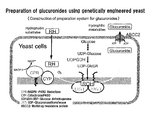
- Figure 16 shows a schematic descriptive diagram of the preparation of glucuronide employing the recombinant yeast cell (transformant) of the present invention.
- the substance being glucuronided that is employed in the method for producing a glucuronide of the present invention can be a compound having a functional group such as the above-mentioned hydroxyl group, amino group, carboxyl group, or thiol group.
- These compounds can be pharmaceuticals or candidate substances for pharmaceuticals.
- the substance being glucuronided comprises a functional group such as the above-mentioned hydroxyl group, amino group, carboxyl group, or thiol group
- it is converted to a glucuronide by the glucuronosyl transfer reaction that is catalyzed by the UDP-glucuronosyl transferase (UGT, UDP-glucuronic acid transferase) within the cell with UDP-glucuronic acid (UDP-GlcUA) as a sugar donor.
- UDP-glucuronosyl transferase UDP-glucuronosyl transferase
- UDP-GlcUA UDP-glucuronic acid
- the substance being glucuronided in the form of the liposoluble compound (hydrophilic substance) (RH, liposoluble substrate) inside or outside the organism is oxidized by cytochrome P450 (CYP) to form a hydroxide (ROH), and then converted to a glucuronide by the glucuronosyl transfer reaction that is catalyzed by the UDP-glucuronosyl transferase (UGT, UDP-glucuronic acid transferase) within the cell with UDP-glucuronic acid (UDP-GlcUA) as a sugar donor.
- UDP-glucuronosyl transferase UDP-glucuronic acid transferase
- UDP-GlcUA UDP-glucuronic acid
- UDP-glucuronic acid is produced from glucose via UDP-glucose by the action of UDP-glucose dehydrogenase (UDPGDH). With the uptake of glucose in yeast, it is converted into UDP-glucose by the action of glucokinase, phosphomutase, and UTP glucose-1-phosphate uridyltransferase in glycolysis, the energy metabolism system. The sixth position of UDP-glucose is oxidized by the action of UDP-glucose dehydrogenase (UDPGDH) with NAD + as coenzyme, converting it to UDP-glucuronic acid (UDP-GlcUA).
- UDP-glucuronic acid UDP-GlcUA
- the substance being glucuronided having a functional group such as a hydroxyl group, amino group, carboxyl group, or thiol group is not specifically limited.
- Examples are pharmaceuticals containing alcohol hydroxyl groups, candidate substances for such pharmaceuticals, polyphenol compounds comprising multiple phenol hydroxyl groups, non-steroidal anti-inflammatory drugs containing carboxylic acids, candidate substances for such drugs, and compounds comprising at least one primary to quaternary amine.
- examples of these substances that are glucuronided are listed in Table 1 on pp. 100-102 of Nonpatent Reference 10. The entire contents of Table 1 on pp. 100-102 of Nonpatent Reference 10 are hereby incorporated by reference.
- a hydroxyl group can be incorporated by an organic synthesis method or selective hydroxylation can be conducted enzymatically employing cytochrome P450 to first incorporate a functional group into the substance being glucuronided, at which point the method of Embodiment 1 can be employed.
- the transformant of (C), (D), (E), (F), or (G) above into which the cytochrome P450 gene has been incorporated can be employed as the transformant of the present invention.
- This transformant can be cultured in the presence of glucose and the substance being glucuronided to produce a glucuronide of the substance being glucuronided (Embodiment 2).
- the metabolite obtained in the simultaneous P450 and UGT expression system is not specifically limited other than that it be produced by the glucuronidation of a functional group (primarily a hydroxyl group) by metabolism by P450.
- a functional group primarily a hydroxyl group
- examples are pharmaceuticals containing methoxy groups or ethoxy groups, candidate substances for such pharmaceuticals, sesamin compounds having methylene dioxyphenyl groups, diazepine pharmaceuticals not comprising hydroxyl groups, and candidate substances for such pharmaceuticals.
- a glucuronide can be prepared from a precursor (the substance being glucuronided) of the glucuronidation substrate. That is, a glucuronide can be prepared without converting the substance being glucuronided to a precursor (converting it to a hydroxide).
- the substance being glucuronided that is employed in the producing method of the present invention is not specifically limited, as set forth above. That is because, in the present invention as set forth above, it is possible to suitably select the type of UDP-glucuronosyl transferase (UGT) gene that is contained in the transformant based on the type of substance being glucuronided that serves as the substrate for the UDP-glucuronosyl transferase (UGT).
- UGT1A6 is suitably employed as the UGT.
- UGT1A1 or UGT1A8 is suitably employed as the UGT.
- UGT1A9 is suitably employed as the UGT.
- the transformant of the present invention can be cultured by a culture method known to be suited to yeast in the presence of glucose and the substance being glucuronided.
- the yeast host is strain AH22, it can synthesize all essential amino acids except L-histidine and L-leucine. Accordingly, these two amino acids are either added to the medium for culturing, or a vector having a gene for synthesizing either one of these amino acids can be employed as the expression vector to selectively culture a yeast host having the expression vector.
- the culture conditions can be suitably set within conditions suited to the growth of yeast transformants.
- the culture medium employed to culture the transformant can be a natural medium or a synthetic medium, so long as it contains suitable proportions of a carbon source, nitrogen source, inorganic materials, and trace nutrients required by the bacterial strain employed, as needed.
- culturing can be conducted under conditions where at least some portion of the nutritional sources required for the yeast transformant to grow are lacking to achieve good production and accumulation of the glucuronide. There are also cases where these latter conditions are desirable based on the type of substance being glucuronided.
- Any substance that can be utilized by a yeast transformant can be employed as a carbon source in the culture medium.
- substances that can be employed are: sugars such as glucose, maltose, fructose, mannose, trehalose, sucrose, mannitol, sorbitol, starch, dextrin, and molasses; organic acids such as citric acid and succinic acid; and fatty acids such as glycerol.
- organic and inorganic nitrogen compounds can be incorporated as sources of nitrogen into the culture medium, and the medium can contain various inorganic salts.
- examples of compounds that can be employed are: organic nitrogen sources such as corn steep liquor, soy meal, and various peptones; and inorganic nitrogen sources such as ammonium chloride, ammonium sulfate, urea, ammonium nitrate, sodium nitride, and ammonium phosphate.
- Amino acids such as glutamic acid and organic nitrogen sources such as urea can also serve as carbon sources.
- Nitrogen-containing natural materials such as peptones, polypeptones, bacto peptones, meat extracts, fish extracts, yeast extracts, corn steep liquor, soy flour, soy meal, dried yeast, casamino acids, and soluble vegetable proteins can also be employed as nitrogen sources.
- inorganic materials that can be suitably employed in the culture medium are calcium salts, magnesium salts, potassium salts, sodium salts, phosphates, manganese salts, zinc salts, iron salts, copper salts, molybdenum salts, and cobalt salts.
- dihydrogen potassium phosphate, hydrogen dipotassium phosphate, magnesium sulfate, ferrous sulfate, manganese sulfate, zinc sulfate, sodium chloride, potassium chloride, and calcium chloride can be employed.
- trace quantity nutrients and vitamins such as amino acids, biotin, and thiamin can be suitably employed.
- a liquid culturing method is good as the culturing method; any from among batch culturing, fed-batch culturing, continuous culturing, and perfusion culturing can be employed.
- Culturing methods employing aeration and agitation are industrially desirable.
- Culturing temperature and pH conditions that are optimal for the growth of the transformant employed can be selected.
- the culture period need only be greater than or equal to the period required for the microorganism to begin to grow, is desirably 8 to 120 hours, and is preferably the period at which the production of the genetic product of the recombinant protein gene peaks. For example, when culturing a transformant of S .
- culturing is normally conducted with shaking or aeration and agitation under conditions selected from among a temperature of 20 to 40°C, desirably 25 to 35°C, a pH of 2 to 9, a desirable pH of 5 to 8, and a culturing period of from 0.5 to 7 days.
- the method of confirming growth of the yeast is not specifically limited.
- the culture product can be collected and observed under a microscope, or the absorbance can be observed.
- the concentration of dissolved oxygen in the culture solution is not specifically limited. Normally, 0.5 to 20 ppm is desirable. To that end, it suffices to regulate the level of aeration, conduct stirring, or add oxygen to the airflow.
- the quantity of transformant employed falls within a range of 0.5 to 5% (w/v, dry weight/volume of culture solution), for example.
- the quantities of glucose and substance being glucuronided that are added to the medium can be suitably determined taking into account the osmotic pressure in the medium and toxicity to the cells.
- glucose suitably ranges from 4 to 20% (w/v) and the substance being glucuronided from 0.5 to 25 mM.
- Glucuronide is accumulated in the culture product by culturing the transformant. Following culturing, the glucuronide is recovered from the culture solution of the yeast transformant. The glucuronide will often accumulate outside the transformant, but will sometimes accumulate within the transformant. The glucuronide that accumulates outside the transformant can be recovered by solvent extraction, for example. Recovery by solvent extraction can be conducted on the culture supernatant obtained once the transformant has been removed from the culture solution by the usual known methods. The transformant can also be re-utilized.
- glucuronide that accumulates within the transformant for example, a transformant cell disruption product obtained by the method of dissolving the cell wall of the transformant with an organic solvent or an enzyme such as zymolyase, or obtained by a cell disruption method such as the ultrasonic disruption method, French press method, glass bead disruption method, or dyno-mill disruption method, and/or the culture product can be separated into transformant and culture supernatant by operations such as centrifugal separation and filtering. The glucuronide can then be recovered from the culture supernatant that has thus been obtained in the same manner as above.
- UDP-glucose dehydrogenase derived from Arabidopsis thaliana or rat was cloned from PCR amplification method using specific primers and cDNA library as templates.
- pGYR as multicopy plasmid(Ref.4) or pAUR101 as genome integrated plasmid (TaKaRa) were used in yeast expression system.
- UDP-glucose dehydrogenase derived from Arabidopsis thaliana was cloned from PCR amplification method using specific primers and cDNA library as templates.
- PCR ready First Strand cDNA Biochain ) was used as cDNA library.
- KOD-plus-(TOYOBO) was used as DNA polymerase. PCR amplification was performed in reaction condition and specific primers as described below;
- UDP-glucose dehydrogenase derived from rat was cloned from PCR amplification method using specific primers and cDNA library as templates.
- PCR ready First Strand cDNA from liver (Biochain) was used as cDNA library.
- KOD-plus-(TOYOBO) was used as DNA polymerase. PCR amplification was performed in reaction condition and specific primers as described below;
- Not I site (GCGGCCGC) was generated at multicloning site of pAUR101 using site directed mutagenesis. Introduction of mutations were performed using Quick ChangeTM (Agilent Technologies). The DNA sequence analysis of the resultant mutational clone confirmed the desirable mutational changes of the clone (pAUR-N).
- the genome-integrated yeast expression vector containing At.UDP-glucose dehydrogenase and UDP-glucuronosyl transferase were constructed using pAUR-N described in 1-2-2 ( Figure 1 ). Not I insert of UDPGDH and promoter/terminator without Not I site at promoter half and pAUR-N with complementary sequence to the insert were ligated using In FusionTM Advantage PCR cloning kit (TaKaRa) to construct genome-integrated yeast expression vector containing UDPGDH and UGT (pAUR-At.UDPGDH).
- Prime STAR Max Premix (TaKaRa) was used as DNA polymerase. PCR amplification was performed in reaction condition and specific primers as described below;
- N-terminal sequences of the UGT were modified to replacement of the signal sequence of UGT1A7 with high level of expression.
- Table 4 showed the DNA sequences of N-terminal signal peptide in human UGT. (SEQ. ID NO: 15-17). To make the replacement of N-terminal region of UGT1A1 and 1A9, PCR amplification were performed using pUC119 with UGT cDNA and specific primers with modified sequences (Table 5; SEQ. ID NO: 18-20).
- Table 5 the DNA sequences of modified PCR with N-terminal signal peptide in human UGT SEQ. ID NO: 18 (1A7-1A1) 19 (1A7-1A9) 20 (UGT commonly used) 5'-ccc aagctt gatatcttctcaatgggtcttggatttgtgggcttt-3'
- PCR amplification were performed using pUC119 with UGT cDNA and specific primers with modified sequences. KOD-plus-(TOYOBO) was used as DNA polymerase. PCR amplification was performed in reaction condition and specific primers as described below;
- the resultant clones were cultivated with 5ml LB medium with 50 ⁇ g/ml ampicillin at 37°C, 200rpm, and 16hrs.Each plasmid was purified from the cultures using alkaline-SDS method. Digest of plasmids with Hind III confirmed the construction of the two kinds of yeast expression vectors (pGYR/UGT1A1and pGYRUGT1A9)
- AH22 strain For yeast expression, budding yeast cells (Saccharomyces cerevisiae) AH22 strain was used. AH22 strain is able to synthesize essential amino acids except for L-histidine and L-leucine. AH22 transformant with pGYR is able to growth in SD medium with L-histidine because of the ability of pGYR to synthesize L-leucine. Because genome-integrated vector pAUR has an aureobasdin A-resistant gene, AH22 transformant with pAUR is able to growth in YPD medium with aureobasdin A. Yeast strain AH22 transformed with expression plasmids to make the transformant using lithium chloride method. Table 2 showed the combination of expression vectors for co-expression system. Detail protocol was showed in below section.
- YPD medium 1 % (w/v) yeast extracts, 2%(w/v) polypeptone , 2%(w/v) glucose SDplate : 2%(w/v) glucose, 0.67% (w/v) N-base w/o amino acid, 1.5%(w/v) agar, 20pg/ml L-histidine, 0.2M LiCl: 10ml (filter sterilized), 1M LiCl: 10ml (filter sterilized) 70%(w/v) PEG 4000: 10ml
- pellet of yeast (1.0x10 7 cells) was obtained by centrifugation with 13,000rpm, 4min. The resultant pellet was washed by solution of 0.2M LiCl. After centrifugation with 13,000rpm, 4min, supernatant was completely removed. The pellet was resuspended with 20 ⁇ l of 1M LiCl. Plasmid solution (0.5-1 ⁇ g DNA/10 ⁇ l) and 70% (w/v) PEG 4(30 ⁇ l) were added to yeast-LiCl solution and gently suspend with pipetting procedure. After incubation with 40°C, 30min, sterilized water (140 ⁇ l) was added to transformation mixture.
- the transformants were spread on SD agar plate and YPD agar plate with 0.5 ug/ml Aureobasidin A, respectively. After 3-5 days-inoculation at 30°C, several colony of transformants with 3-5 mm diameters were obtained.
- the transformants were spread on SD agar plate and YPD agar plate with 0.5 ⁇ g/ml Aureobasidin A, respectively. After 3-5 days-inoculation at 30°C, several colony of transformants with 3-5 mm diameters were obtained.
- Figure 2 indicated reverse phase HPLC elution pattern of production of UDP-glucuronic acid byUDPGDH in yeast.
- the post mitochondrial fraction of yeast transformant with UDPGDH gene (pGYR/At.UDPGDH) showed the production of UDP-glucuronic acid with elution time around 11 min..
- Zymolyase-treated yeast cells were analyzed by western blot using antipeptide antibodies against commonly used C-terminal region of human UGT (Ref.5) or C-terminal region of At.UDPGDH (KPLDQWLKDMPALA) ( Figure 3 ).
- the post mitochondrial fraction of yeast transformants (No.1- 4 in Table 2) were analyzed by western blot.
- Lane 1-3 in Panel (A) showed the expression of At.UDPGDH proteins but not control lane in Panel (B) (AH22: pGYR/UGT1A6).
- the expression of UDP-glucose dehydrogenase and UDP-glucuronosyl transferase in the post mitochondrial fraction of yeast transformants were confirmed by western blot.
- Figure 4 indicated reverse phase HPLC elution pattern of endogenous UDP-glucuronic acid in yeast.
- Line A, B and C in figure 4 showed standard of UDP-glucuronic acid and UDP-glucose, control yeast (AH22: pGYR), and rat UDP-glucose dehydrogenase gene-transformed yeast, respectively. While only UDP-glucose was detected as sugar-nucleotide in line B, UDP glucuronic acid in addition to UDP-glucose was detected in line C. Based on the estimation of sugar nucleotide , concentration of endogenous UDP-glucuronic acid is about 4 -5 mM in yeast cells.
- transformants were cultivated in selection medium at 30°C, 48hrs, and the resultant yeast cells were suspended with appropriate buffer solution containing 0.1-1mM 7-hydroxycoumarine and 1-8%(w/v) glucose. After incubation at 30°C, 24hrs, 2 -fold volume of chloroform: methanol (3:1, v/v) was added to reaction medium containing yeast cells. Centrifugation of extracts was separated to upper water and lower organic phase. Lower organic phase were evaporated and redissolved in 200 ⁇ l acetonitrile. Each phase was analyzed by UPLC system.
- Figure 6 indicated time-dependent decrease of substrate (0.5mM 7OHC: ⁇ ) and increase of glucuronide (7GC: o), resulting in the complete conversion of 7OHC to glucuronide after 24 hrs.
- Figure 7 indicated concentration-dependent increase of glucuronide, resulting in the complete conversion of 7OHC to glucuronide at 8%(w/v) glucose. Base on the analysis of glucuronide in medium and cells, 90% of glucuronide were secreted to out of cells.
- Quercetin glucuronides in yeast cells was isolated and detected by WakoPack Navi C30-5 (3mm x 150mm, Wako Chemical) -column- HPLC system with followed condition; flow rate; 0.4ml/min, detection; 370 nm, temperature 37°C. Condition of gradient elution: water-acetonitrile with 0.5% (v/v) phosphoric acid, 18%(v/v) acetonitrile (10min), 18-55% acetonitrile (10min) 55% acetonitrile (5min).
- Quercetin is conjugated at multiple site of phenolic hydroxyl group.
- Figure 9 indicated the preferential production of querecetin glucuronide at 3' phenolic hydroxyl group in B ring.
- the combination of UGT isoforms with UDPGDH could allow us to produce the regiospecific glucuronides of several compounds.
- transformants were cultivated in selection medium at 30°C, 48hrs, and the resultant yeast cells were suspended with appropriate buffer solution containing 0.2mM mycophenolic acid and 8%(w/v) glucose. After incubation at 30°C, 24hrs, 2 -fold volume of chloroform: methanol (3:1, v/v) was added to reaction medium containing yeast cells. Centrifugation of extracts was separated to upper water and lower organic phase. Lower organic phase were evaporated and redissolved in 200 ⁇ l acetonitrile.
- Mycophenilic acid is conjugated at phenolic hydroxyl group and carboxyl group.
- Figure 10 indicated the preferential production of mycophenolic- O -glucuronide at phenolic hydroxyl group in B ring.
- the combination of UGT isoforms with UDPGDH could allow us to produce the regiospecific glucuronides of several compounds.
- Figure 11 indicated the ratio of mefenamic acid acyl glucuronide production in resting yeast cells.
- UGT1A8, 9, and 10 showed the significant activity of acyl glucuronide formation.
- Quercetin glucuronides in yeast cells was isolated and detected by WakoPack Navi C30-5 (3mm x 150mm, Wako Chemical ) -column- HPLC system with followed condition; flow rate; 0.5ml/min, detection; 254 nm, temperature 37°C. Condition of gradient elution: 100mM ammonium acetate (pH 5.0) -acetonitrile, 25% (v/v) acetonitrile (5min), 25-75% acetonitrile (25min), 75%(v/v) acetonitrile (10min), 75-25% acetonitrile (5min) ,25% acetonitrile (5min).
- Tamoxifen is well-known to be anticancer drug with N -glucuronidation site.
- Figure 12 indicated reverse phase HPLC elution pattern of production of tamoxifen N -glucuronide.
- the yeast transformant with UDPGDH and human UGT1A4 gene showed the production of N -glucuronide with elution time around 11.8 min.
- Table 6 showed the comparison of production of 4-metylumberrferone glucuronide in budding and fission yeast.
- the production ratio of glucuronide in budding yeast with UGT1A1 and UGT1A6 are 10- and 50- higher than those in fission yeast, respectively.
- the amount of glucuronide per dry weight of budding yeast indicated 20 to 100-fold increase compare to fission yeast. In the several cases of UGT isoforms, these results showed the advantage of budding yeast in the production of glucuronide.
- hydroxyl groups are introduced by P450-dependent monooxynenation.
- the expression system of several mammalian P450 and UGT isoforms was constructed in budding yeast cells, Saccharomyces cerevisiae AH22. This in vitro system is able to convert 7-ethoxycoumarine to its glucuronide via hydroxyl intermediate, 7-hydroxycoumarine (Ref 6).
- Yeast cells lack the ability of production of UDP-glucuronic acid (UDP-GlcUA) from UDP-glucose to synthesize the glucuronide in whole cells.
- co-expression yeast system containing UDPGDH, UGT, and P450 was constructed using combination of expression vectors (pAUR-At.UDPGDH/UGT1A6 and pGYR/ratCYP1A1, No.5 in Table 2). These transformants were cultivated in selection medium at 30°C, 48hrs, and the resultant yeast cells were suspended with appropriate buffer solution containing 1mM 7-ethoxycoumarine and 8%(w/v) glucose. After incubation at 30°C, 72hrs, 2 -fold volume of chloroform: methanol (3:1, v/v) was added to reaction medium containing yeast cells. Centrifugation of extracts was separated to upper water and lower organic phase. Lower organic phase were evaporated and redissolved in 200 ⁇ l acetonitrile. Each phase was analyzed by UPLC system ( Figure 13 ).
- promoter and terminator region of phosphoglycerol kinase (PGK1) derived from budding yeast was cloned and multicopy plasmid with promoter and terminator region of PGK1 was constructed for yeast expression ( Figure 14 ).
- Genome DNA was prepared from AH22 (Saccharomyces cerevisiae) using conventional method. The PCR cloning of promoter and terminator region of PGK1 was performed using genome DNA as template and a set of specific primers.
- KOD-plus-(TOYOBO) was used as DNA polymerase. PCR amplification was performed in reaction condition and specific primers as described below; For promoter region of PGK1
- SEQ. ID NO: 25 SEQ. ID NO: 26:
- co-expression yeast system containing UDPGDH, UGT, and P450 was constructed using combination of expression vectors (pAUR-ratUDPGDH/UGT1A6 and pPYR/humanCYP). These transformants were cultivated in selection medium at 30°C, 48hrs, and the resultant yeast cells were suspended with appropriate buffer solution containing 1mM 7-ethoxycoumarine and 8% (w/v) glucose. After incubation at 30°C, 72hrs, 2 -fold volume of chloroform: methanol (3:1, v/v) was added to reaction medium containing yeast cells. Centrifugation of extracts was separated to upper water and lower organic phase. Lower organic phase were evaporated and redissolved in 200 ⁇ l acetonitrile. Each phase was analyzed by UPLC system ( Figure 15 and Table 7).
- Figure 15 indicated reverse phase HPLC elution pattern of metabolites from 7-ethoxycoumarine using resting yeast cells containing UDPGDH, human UGT1A8, and human P450 2D6.
- 7-ethoxycoumarine was metabolized to 7-hydroxycoumarine or 3-hydroxy-7-ethoxycoumarine by human P450 2D6.
- Each hydroxyl intermediates further were metabolized to corresponding glucuronides by human UGT1A8.
- Table 7 indicated the metabolism of 7-ethoxycoumarine using the yeast co-expression system with different combination of human UGT and P450isoforms. The production of glucuronides from P450-dependent metabolites was observed in all transformants.
- the present invention is useful in fields relating to analysis of drug metabolism in a human body in drug developments.
Landscapes
- Life Sciences & Earth Sciences (AREA)
- Chemical & Material Sciences (AREA)
- Health & Medical Sciences (AREA)
- Genetics & Genomics (AREA)
- Organic Chemistry (AREA)
- Engineering & Computer Science (AREA)
- Zoology (AREA)
- Wood Science & Technology (AREA)
- Bioinformatics & Cheminformatics (AREA)
- Biotechnology (AREA)
- General Engineering & Computer Science (AREA)
- Microbiology (AREA)
- Biomedical Technology (AREA)
- Biochemistry (AREA)
- General Health & Medical Sciences (AREA)
- Molecular Biology (AREA)
- Mycology (AREA)
- Medicinal Chemistry (AREA)
- Physics & Mathematics (AREA)
- Biophysics (AREA)
- Plant Pathology (AREA)
- Chemical Kinetics & Catalysis (AREA)
- General Chemical & Material Sciences (AREA)
- Micro-Organisms Or Cultivation Processes Thereof (AREA)
- Preparation Of Compounds By Using Micro-Organisms (AREA)
- Enzymes And Modification Thereof (AREA)
Abstract
Description
- This application claims benefit of priority to Japanese Patent Application No.
2010-40150 filed on February 25, 2010 - The present invention relates to a method for producing a glucuronide, and to a Saccharomyces cerevisiae expression vector and transformant employed therein. The Saccharomyces cerevisiae expression vector is one into which UDP-glucuronosyl transferase and/or UDP-glucose dehydrogenase has been introduced. The transformant is Saccharomyces cerevisiae that has been transformed with the Saccharomyces cerevisiae expression vector.
- The analysis of pharmaceutical metabolites within the human body is important in the development of pharmaceuticals. Glucuronides are eliminated as detoxifying metabolites of pharmaceuticals. However, the possibility that some could turn into reactive metabolites and exhibit toxicity has been pointed out. For example, among the glucuronides, acyl glucuronides, which are ester glucuronides, present the possibility of becoming reactive metabolites and causing drug-induced liver damage (Nonpatent Reference 1).
- Accordingly, while it is necessary to evaluate the safety of the glucuronides themselves, site-specific glucuronidation is extremely difficult by organic synthesis methods. Accordingly, there is great need for a method permitting the efficient producing of a targeted glucuronide using enzymes, microorganisms, and the like. Currently, the preparation of glucuronides using animal liver-derived microsome fractions is being practiced. However, the productivity and the scope of applicability are inadequate. Human glucuronosyl transferase employing an insect cell system is already commercially available. However, use as an enzyme source in the preparation of glucuronides is impractical from a cost perspective.
- The present inventors constructed the expression system of glucuronosyl transferase employing Saccharomyces cerevisiae that has been employed thus far, and proposed the enzymatic synthesis of glucuronides that are pharmaceutical metabolites employing it as an enzyme source for glucuronide preparation (Nonpatent Reference 2).
- Recently, Dragan et al. (Nonpatent Reference 7, Patent Reference 1) constructed a system producing glucuronides from Schizosaccharomyces pombe (S. Pombe) cells expressing UGT employing S. Pombe.
-
- Patent Reference 1:
WO2010/031875 -
- Nonpatent Reference 1: Bailey MJ, Dickinson RG. Acyl glucuronide reactivity in perspective: biological consequences. Chem Biol Interact. 145, 117-37. (2003)
- Nonpatent Reference 2: S. Ikushiro, M. Sahara, Y. Emi, Y. Yabusaki, T. Iyanogi: Functional co-expression of xenobiotic metabolizing enzymes, rat cytochrome P450 1A1 and UDP-glucuronosylransferase 1A6. Biochimica et Biophysica Acta 1672 (2004) 86-92
- Nonpatent Reference 3: Mackenzie, P. I , Walter Bock, K., Burchell, B., Guillemette, C. , Ikushiro, S. I., Iyanagi, T. ,Miners, J.O., Owens, I.S. and Nebert, D.W.: Nomenclature Update for the Mammalian UDP Glycosyltransferase (UGT) Gene Superfamily. Pharmacogenetics and Genomics, 10, 677-685 (2005)
- Nonpatent Reference 4: Sinichi Ikushiro, Yoshikazu Ebi, Yutaka Iyanagi, UDP-glucuronic acid transferase, Recent Progess of Drug Metabolism, Kanzou, 42 , pp.297-301 (2001)
- Nonpatent Reference 5: T. Sakaki, M. Akiyoshi-Shibata, Y. Yabusaki, H. Ohkawa, Organellatargeted expression of rat liver cytochrome P450c27 in yeast: genetically engineered alteration of mitochondrial P450 into a microsomal form creates a novel functional electron transport chain, J. Biol.Chem. 267 16497-16502. (1992)
- Nonpatent Reference 6: Ikushiro. S., Emi, Y., Kato, Y., Yamada, S. and Sakaki, T.: Monospecific antipeptide antibodies against human hepatic UDP- glucuronosyltransferase 1A subfamily (UGT1A) isoforms. Drug Metabolism and Pharmacokinetics, 21, 70-75 (2006)
- Nonpatent Reference 7: Dragan CA, Buchheit D, Bischoff D, Ebner T, Bureik M .:Glucuronide production by whole-cell biotransformation using genetically engineered fission yeast S. pombe. Drug Metab Dispos. 38 509-515. (2010)
- Nonpatent Reference 8: Jo Wixon: Featured Organism: Schizosaccharomyces pombe, the fission yeast. Comp Funct Genom, 3: 194-204 (2002)
- Nonpatent Reference 9: Esben H. Hansen,Birger Lindberg Møller, Gertrud R. Kock,Camilla M. Bu¨nner,Charlotte Kristensen, Ole R. Jensen,Finn T. Okkels,Carl E. Olsen, Mohammed S. Motawia,and Jorgen Hansen1: De Novo Biosynthesis of Vanillin in Fission Yeast(Schizosaccharomyces pombe) and Baker's Yeast (Saccharomyces cerevisiae) APPLIED AND ENVIRONMENTAL MICROBIOLOGY, 75, 2765-2774 (2009)
- Nonpatent Reference 10: Tony K.L. Kiang, Mary H.H. Ensom, Thomas K.H. Chang: UDP-glucuronosyltansferases and clinical drug-drug interactions. Pharmacology & Therapeutics 106 97-132 (2005)
- Nonpatent Reference 11: Ikushiro, S., Sahara, M., Emi, Y., Yabusaki, Y.,and Iyanagi, T. : Functional Coexpression of Xenobiotic Metabolizing Enzymes, Rat Cytochrome P4501A1 and UDP-Glucuronosyltransferase 1A6, in Yeast Microsomes. Biochimica Biophysica Acta, 1672, 86-92 (2004)
- The entire contents of
Patent Reference 1 andNonpatent References - However, the method of preparing glucuronides by enzymatic conversion in vitro with human-derived UDP-glucuronosyl transferase (UGT) obtained by expression in yeast as the enzyme source is inadequate in terms of productivity and scope of applicability. In particular, the UDP-glucuronic acid that is employed as the glycosyl donor is expensive. The discovery of a method that can lower the cost when preparing glucuronides is being awaited.
- The system employing S. Pombe described in Nonpatent Reference 7 affords overall low productivity and remains impractical.
- Accordingly, the object of the present invention is to provide a new method for producing glucuronides that affords good productivity in contrast to the above methods, and a new means employed in this producing method.
- Accordingly, the present inventors planned to employ Saccharomyces cerevisiae (S. cerevisiae) as host and to change the metabolic system of S. cerevisiae expressing UGT to permit the production of a sugar donor in the form of UDP-glucuronic acid. However, S. cerevisiae lacks the ability to produce UDP-glucuronic acid, which is considered essential to glucuronide production. Thus, the direct conversion into glucuronide within the cells was impossible. Accordingly, to impart the ability to produce UDP-glucuronic acid to S. cerevisiae, a UDP-glucose dehydrogenase gene derived from another organism was introduced. As a result, the expression of UDP-glucuronic acid was observed in S. cerevisiae. The S. cerevisiae into which UDPGDH had been incorporated was caused to simultaneously express UGT molecular species, thereby achieving at high yield the direct conversion into glucuronide of the substrate added to S. cerevisiae. In this manner the present inventors employed S. cerevisiae as host to successfully construct a glucuronide conversion system in which the ability to produce glucuronide was greatly enhanced in S. cerevisiae.
- S. cerevisiae and S. Pombe are classified as yeasts. They are thought to have branched off some 3 to 4 hundred million years ago. The difference between the two as species can be said to be comparable to the difference between S. Pombe and animals (Nonpatent Reference 8). Both have similar genome sizes (S. cerevisiae: 12 Mb, S. Pombe: 14 Mb) and numbers of genes (S. cerevisiae: about 7,000; S. Pombe about 5,000). However, marked differences in numbers of chromosomes (as haploids, S. cerevisiae: 17, S. Pombe: 3) and growth methods (S. cerevisiae buds and S. Pombe fissile) are seen. There is also little homology between individual genes. Still further, the situations when expressing heterogeneous proteins derived from mammals are quite different. Although high expression is achieved in S. Pombe, high expression is not necessarily achieved in S. cerevisiae (Nonpatent Reference 9). Due to this situation, as described in Nonpatent Reference 7, although the simultaneous expression of UDPGDH and UGT has been successfully achieved in S. Pombe, the simultaneous expression of UDPGDH and UGT when applied as is to S. cerevisiae does not necessarily work.
- The present invention is as follows:
- [1]
Saccharomyces cerevisiae that has been transformed by the insertion in an expressible manner of a gene coding for UDP-glucose dehydrogenase and a gene coding for UDP-glucuronosyl transferase. - [2]
The Saccharomyces cerevisiae according to [1], that has been further transformed by inserting in an expressible manner a gene coding for cytochrome P450. - [3]
A transformed Saccharomyces cerevisiae selected from the group consisting of (A) to (G) below:- (A) Saccharomyces cerevisiae that has been transformed with a UDP-glucose dehydrogenase expression vector and a UDP-glucuronosyl transferase expression vector;
- (B) Saccharomyces cerevisiae that has been transformed with a UDP-glucuronosyl transferase and UDP-glucose dehydrogenase expression vector;
- (C) Saccharomyces cerevisiae that has been transformed with a UDP-glucose dehydrogenase expression vector, a UDP-glucuronosyl transferase expression vector, and a cytochrome P450 gene expression vector;
- (D) Saccharomyces cerevisiae that has been transformed with a UDP-glucuronosyl transferase and UDP-glucose dehydrogenase expression vector, and a cytochrome P450 gene expression vector;
- (E) Saccharomyces cerevisiae that has been transformed with a UDP-glucuronosyl transferase expression vector and a UDP-glucose dehydrogenase and cytochrome P450 gene expression vector;
- (F) Saccharomyces cerevisiae that has been transformed with a UDP-glucuronosyl transferase and cytochrome P450 gene expression vector and a UDP-glucose dehydrogenase expression vector; and
- (G) Saccharomyces cerevisiae that has been transformed with a UDP-glucose dehydrogenase, UDP-glucuronosyl transferase, and cytochrome P450 gene expression vector.
- [4]
The transformed Saccharomyces cerevisiae according to [3], wherein the UDP-glucose dehydrogenase expression vector is comprised of a UDP-glucose dehydrogenase gene that has been inserted in an expressible manner into a Saccharomyces cerevisiae expression vector;
the UDP-glucuronosyl transferase expression vector is comprised of a UDP-glucuronosyl transferase gene that has been inserted in an expressible manner into a Saccharomyces cerevisiae expression vector; and
the UDP-glucuronosyl transferase and UDP-glucose dehydrogenase expression vector is comprised of a UDP-glucuronosyl transferase gene and a UDP-glucose dehydrogenase gene that have been inserted in an expressible manner into a Saccharomyces cerevisiae expression vector; - [5]
The transformed Saccharomyces cerevisiae according to [4], wherein the Saccharomyces cerevisiae expression vector is an autonomous replication vector or a chromosome integrative vector. - [6]
The transformed Saccharomyces cerevisiae of any one of [1], [2], and [4] to [5], wherein the UDP-glucose dehydrogenase gene is a gene derived from an animal or a plant. - [7]
The transformed Saccharomyces cerevisiae of any one of [1], [2], and [4] to [5], wherein the UDP-glucose dehydrogenase gene is a gene derived from Arabidopsis or a gene derived from a rat. - [8]
The transformed Saccharomyces cerevisiae of any one of [1], [2], and [4] to [7], wherein the UDP-glucuronosyl transferase gene is a gene derived from a mammal. - [9]
The transformed Saccharomyces cerevisiae of any one of [1], [2], and [4] to [7], wherein the UDP-glucuronosyl transferase gene is a human-derived gene. - [10]
The transformed Saccharomyces cerevisiae of any one of [3] to [9], wherein the cytochrome P450 gene expression vector is comprised of a cytochrome P450 gene that has been inserted in an expressible manner in a Saccharomyces cerevisiae expression vector. - [11]
The transformed Saccharomyces cerevisiae according to any one of [1] to [10] wherein, when the UDP-glucuronosyl transferase gene in the UDP-glucuronosyl transferase expression vector is a low-expression level glucuronosyl transferase gene with an expression level of 50% or less that of UGT1A7,
either the signal sequence gene of the low-expression level glucuronosyl transferase gene is substituted with the signal sequence gene of a high-expression level glucuronosyl transferase with an expression level of 80% or more of UGT1A7, or
the signal sequence gene is (A) a gene coding for any one of amino acid sequences (a) to (c) indicated below; (B) a gene coding for an amino acid sequence comprising any one of amino acid sequences (a) to (c) in which 1 to 5 amino acids have been substituted or deleted; or (C) a gene coding for an amino acid sequence comprising any one of amino acid sequences (a) to (c) to which 1 to 5 amino acids have been added, such that when the gene coding for the amino acid sequence with substitutions or deletions of (B) or the amino acid sequence with additions of (C) is employed as a signal sequence gene, the expression level of glucuronosyl transferase is 80% or more that of the wild strain:- (a) MARAGWTGLLPLYVCLLLTCGFAKAG (SEQ. ID NO. 1),
- (b) MACLLRSFQRISAGVFFLALWGMVVG (SEQ. ID NO. 2),
- (c) MAPRRVDQPRSFMCVSTADLWLCEAG (SEQ. ID NO. 3).
- [12]
The transformed Saccharomyces cerevisiae according to [11], wherein the low-expression level glucuronosyl transferase is UGT1A1, UGT1A4, UGT1A8, or UGT1A9. - [13]
The transformed Saccharomyces cerevisiae according to [11] or [12], wherein the high-expression level glucuronosyl transferase is UGT1A7, UGT1A6, or UGT1A10. - [14]
The Saccharomyces cerevisiae according to any one of [1] to [13], used to produce a glucuronide of the substance being glucuronided. - [15]
A method for producing a glucuronide, comprising culturing the transformed Saccharomyces cerevisiae according to any one of [1] to [13] in the presence of glucose and a substance being glucuronided to cause a glucuronide of the substance being glucuronided to be produced. - [16]
The producing method according to [15], wherein the substance being glucuronided is at least one member selected from the group consisting of pharmaceuticals containing alcohol hydroxyl groups, candidate substances for such pharmaceuticals, polyphenol compounds comprising multiple phenol hydroxyl groups, non-steroidal anti-inflammatory drugs containing carboxylic acids, candidate substances for such drugs, and compounds comprising at least one primary to quaternary amine. - [17]
The producing method according to [15], wherein the substance being glucuronided is a substance producing a functional group (primarily a hydroxyl group) that undergoes glucuronidation when metabolized by P450. - [18]
The producing method according to [17] wherein the substance being glucuronided is at least one member selected from the group consisting of pharmaceuticals comprising methoxy groups or ethoxy groups, candidate substances for such pharmaceuticals, sesamin compounds having methylene dioxyphenyl groups, diazepine pharmaceuticals not comprising hydroxyl groups, and candidate substances for such pharmaceuticals. - [19]
A UDP-glucose dehydrogenase expression vector, comprising a UDP-glucose dehydrogenase gene inserted in an expressible manner in a Saccharomyces cerevisiae expression vector. - [20]
A UDP-glucuronosyl transferase expression vector, comprising a UDP-glucuronosyl transferase gene inserted in an expressible manner in a Saccharomyces cerevisiae expression vector. - [21]
A UDP-glucuronosyl transferase and UDP-glucose dehydrogenase expression vector, comprising a UDP-glucuronosyl transferase gene and a UDP-glucose dehydrogenase gene inserted in an expressible manner in a Saccharomyces cerevisiae expression vector. - [22]
The vector according to any one of [19] to [21], wherein the Saccharomyces cerevisiae expression vector is an autonomous replication vector or a chromosome integrative vector. - [23]
The vector according to any one of [15], [19], and [21] to [22], wherein the UDP-glucose dehydrogenase gene is a gene derived from an animal or a plant. - [24]
The vector according to any one of [19], and [21] to [22], wherein the UDP-glucose dehydrogenase gene is a gene derived from Arabidopsis or a gene derived from a rat. - [25]
The vector according to any one of [20] to [24], wherein the UDP-glucuronosyl transferase gene is a gene derived from a mammal. - [26]
The vector according to any one of [20] to [24], wherein the UDP-glucuronosyl transferase gene is a human-derived gene. - The present invention permits the preparation of glucuronides using UDPGDH and UGT expression Saccharomyces cerevisiae cells. Based on the method for preparing glucuronides using genetically-altered Saccharomyces cerevisiae of the present invention, it is possible to prepare targeted metabolites extremely efficiently and economically relative to organic synthesis methods, in vitro enzymatic methods, and glucuronide preparation methods employing Saccharomyces Pombe. For example, as set forth in the Examples, a glucuronide of 7-hydroxycoumarin can be manufactured with a productivity of 200 mg per liter of reaction solution under optimal conditions employing Saccharomyces cerevisiae cells simultaneously expressing UDPGDH and UGT1A6.
- Since there have been reports on genes of various UGT molecular species, the Saccharomyces cerevisiae cells expressing UDPGDH and UGT of the present invention can be used to prepare various UGT molecular species. As a result, the Saccharomyces cerevisiae cells expressing UDPGDH and UGT of the present invention can be applied to various pharmaceuticals and are highly practical.
- Further, in the method of the present invention, S. cerevisiae is employed as a host yeast. Through a certain amount of effort, the following advantages have been achieved over the method described in Nonpatent Reference 7, which employs S. Pombe as host:
- (1) With S. Pombe, the activity of UGT1A6 is extremely low, which is presumed to result in the low level of expression. However, with S. cerevisiae, the level of expression is high and activity is extremely high
Figure 5 ; 100% conversion is achieved). Compared to the data for S. Pombe employing 4-methylunbelliferone as substrate, production capacity that was several ten-fold higher was actually exhibited in multiple molecular species (see Table 6). - (2) One type of ABC transporter present in S. cerevisiae is presumed to relate to secretion outside the cell body (
Figure 6 ). That is an unanticipated result, and is thought to be a phenomenon unique to S. cerevisiae that is not found in S. Pombe. - (3) In S. Pombe, UGT1A3, 1A4, and 2B7 are not well expressed. However, in S. cerevisiae, high expression of these compounds is achieved. High expression of 1A4 was successfully achieved by changing the signal sequence.
- The main drawbacks of a UGT expression system employing S. Pombe as host in this manner are thought to be a low level of expression and differences in expression levels due to differences in molecular species.
- By contrast, in the present invention, S. cerevisiae was employed as host and the N-terminal signal sequence was changed as needed. Thus, high expression of all UGT molecular species was successfully achieved and the main drawbacks of the S. Pombe expression system were successfully elucidated. Simultaneous expression with animal or plant-derived UDPGDH was successfully achieved, and highly efficient extracellular secretion and production of glucuronide were achieved with cells.
-
-
Figure 1 shows the construction scheme of an autonomous replication yeast expression vector comprising both a UDP-glucuronosyl transferase gene and a UDP-glucose dehydrogenase gene. -
Figure 2 shows the results of enzymatic activity measurement of UDP-glucose dehydrogenase expressed in yeast. -
Figure 3 shows the results, observed by the Western blotting method, of UDP-glucose dehydrogenase protein and UDP-glucuronosyl transferase gene expression in yeast. -
Figure 4 shows the results of the production of UDP-glucuronic acid in yeast cells into which the UDP-glucose dehydrogenase gene has been introduced. -
Figure 5 shows the results of the production of glucuronide in yeast simultaneously expressing various human UDP-glucuronosyl transferases. -
Figure 6 shows the change over time in glucuronide production in UGT1A6 simultaneous expression strains. -
Figure 7 shows the effect of glucose concentration on glucuronide production in UGT1A6 simultaneous expression strains. -
Figure 8 shows the effect of expression vector combinations on the production of glucuronides by simultaneous expression strains. -
Figure 9 shows the results of producing quercetin glucuronide using stationary yeast cells. -
Figure 10 shows the results of producing mycophenolic acid glucuronide using stationary yeast cells. -
Figure 11 shows the results of producing acyl glucuronides of mefenamic acid using stationary yeast cells. -
Figure 12 shows the results of producing Tamoxifen glucuronide (N-glucuronide) using stationary yeast cells. -
Figure 13 shows the results of producing 7-hydroxycoumarin glucuronide using the stationary cells of simultaneous expression strains containing cytochrome P450. -
Figure 14 shows the construction scheme of human cytochrome P450 expression plasmid having an S. cerevisiae PGK1-derived promoter and terminator regions. -
Figure 15 shows the results of producing 7-ethoxycoumarin metabolites employing stationary cells of a yeast strain simultaneously expressing human cytochrome P450 (CYP2D6) and UDP-glucuronosyl transferase (UGT1A8). -
Figure 16 shows a schematic descriptive diagram of the preparation of glucuronide employing recombinant yeast cells. - The present invention relates to transformed S. cerevisiae. More specifically, the present invention relates to S. cerevisiae that is transformed by inserting in an expressible manner a gene coding for UDP-glucuronosyl transferase and a gene coding for UDP-glucose dehydrogenase. The transformed S. cerevisiae of the present invention can be S. cerevisiae that has been transformed by introducing in an expressible manner a gene coding for cytochrome P450 in addition to S. cerevisiae that has been transformed by inserting in an expressible manner a gene coding for UDP-glucuronosyl transferase and a gene coding for UDP-glucose dehydrogenase. The gene coding for UDP-glucose dehydrogenase, the gene coding for UDP-glucuronosyl transferase, and the gene coding for cytochrome P450 can be combined into an S. cerevisiae expression vector which is then inserted into S. cerevisiae to transform it. Alternatively, these genes can be inserted in an expressible manner into the chromosomes of the S. cerevisiae that is to be transformed by, for example, a known technique such as homologous recombination.
- Examples of S. cerevisiae transformed by incorporating these genes into an S. cerevisiae expression vector and inserting it into S. cerevisiae are S. cerevisiae transformants selected from (A) to (G) below:
- (A) Saccharomyces cerevisiae that has been transformed with a UDP-glucose dehydrogenase expression vector and a UDP-glucuronosyl transferase expression vector;
- (B) Saccharomyces cerevisiae that has been transformed with a UDP-glucuronosyl transferase and UDP-glucose dehydrogenase expression vector;
- (C) Saccharomyces cerevisiae that has been transformed with a UDP-glucose dehydrogenase expression vector, a UDP-glucuronosyl transferase expression vector, and a cytochrome P450 gene expression vector;
- (D) Saccharomyces cerevisiae that has been transformed with a UDP-glucuronosyl transferase and UDP-glucose dehydrogenase expression vector, and a cytochrome P450 gene expression vector;
- (E) Saccharomyces cerevisiae that has been transformed with a UDP-glucuronosyl transferase expression vector and a UDP-glucose dehydrogenase and cytochrome P450 gene expression vector;
- (F) Saccharomyces cerevisiae that has been transformed with a UDP-glucuronosyl transferase and cytochrome P450 gene expression vector and a UDP-glucose dehydrogenase expression vector; and
- (G) Saccharomyces cerevisiae that has been transformed with a UDP-glucose dehydrogenase, UDP-glucuronosyl transferase, and cytochrome P450 gene expression vector.
- For example, the above UDP-glucose dehydrogenase expression vector is comprised of a UDP-glucose dehydrogenase gene inserted in an expressible manner into a S. cerevisiae expression vector. The UDP-glucuronosyl transferase expression vector is comprised of a UDP-glucuronosyl transferase gene inserted in an expressible manner into a S. cerevisiae expression vector. The UDP-glucuronosyl transferase and UDP-glucose dehydrogenase expression vector is comprised of a UDP-glucuronosyl transferase gene and a UDP-glucose dehydrogenase gene inserted in an expressible manner into a S. cerevisiae expression vector. The various vectors will be described below.
- In the present invention, (1) a UDP-glucose dehydrogenase expression vector, (2) a UDP-glucuronosyl transferase expression vector, (3) a UDP-glucuronosyl transferase and UDP-glucose dehydrogenase expression vector, (4) a cytochrome P450 gene expression vector, (5) a UDP-glucuronosyl transferase and cytochrome P450 gene expression vector, (6) a UDP-glucose dehydrogenase and cytochrome P450 gene expression vector, and (7) a UDP-glucuronosyl transferase, UDP-glucose dehydrogenase, and cytochrome P450 gene expression vector are employed. When multiple genes are present in a single vector, the gene arrangement (order) is not limited. Each of (1), (2), and (4) will be sequentially described below. It is possible to suitably provide vectors (3), (5), (6), and (7), each of which comprises multiple genes in a single vector, based on the description of (1), (2), and (4).
- The UDP-glucose dehydrogenase expression vector is comprised of a UDP-glucose dehydrogenase (UDPGDH) gene inserted into a yeast expression vector.
- The expression vector into which the enzyme gene is inserted can be an autonomous replication vector that causes the S. cerevisiae host to replicate, retain, and express the enzyme gene, or a chromosome integrative plasmid vector that is integrated into a chromosome of S. cerevisiae. Any autonomous replication vector or chromosome integrative plasmid vector is retained by the host S. cerevisiae and functions can be used without limitation. Examples of autonomous replication vectors are the pGYR employed in the Examples, and yeast-derived plasmids YEp352GAP, YEp51, pSH19, and the like. An example of a chromosome integrative plasmid vector is the pAUR employed in the Examples.
- The enzyme gene and, as needed, a signal sequence gene can be spliced downstream from a promoter in a vector suited to the above expression to obtain an expression vector. Examples of the promoter are EN01 promoter, GAL10 promoter, GAPDH promoter, and ADH promoter.
- The UDP-glucose dehydrogenase gene can be derived from either an animal or a plant. The animal or plant-derived UDP-glucose dehydrogenase gene can be suitably selected from among known genes (such as the human gene: AF061016.1 and the mouse gene: AF061017.1). In the Examples,
an Arabidopsis-derived gene and a rat-derived gene are employed. However, any UDP-glucose dehydrogenase gene can be introduced. The S. cerevisiae that has been transformed with the S. cerevisiae expression vector will have UDP-glucose dehydrogenase activity. Accordingly, regardless of its derivation, any known UDP-glucose dehydrogenase gene can be employed. The Arabidopsis-derived gene is available from a commercial cDNA library in the form of PCR ready First Strand cDNA (Biochain). The rat-derived gene is available from a rat liver cDNA library in the form of PCR ready First Strand cDNA (Biochain). In addition to these, UDP-glucose dehydrogenase genes can be suitably obtained from commercial cDNA libraries. - The UDP-glucuronosyl transferase expression vector is comprised of a UDP-glucuronosyl transferase (UGT) gene that is inserted into a S. cerevisiae expression vector. The same S. cerevisiae expression vector as that described for the UDP-glucose dehydrogenase expression vector can be employed.
- The UDP-glucuronosyl transferase gene can be suitably selected from known genes. The UDP-glucuronosyl transferase gene can be derived from a mammal. Specifically, it can be a human-derived gene. UDP-glucuronosyl transferase (UGT) is an endoplasmic reticulum membrane protein comprised of about 530 amino acid residues. Multiple molecular species are present in the liver and small intestine. These molecular species are characterized in that the half on the amino terminal side (about 290 amino acid residues) comprises a domain recognizing a glucuronided substrate. The half on the carboxyl terminal side (about 240 amino acid residues), which exhibits high homology between molecular species, functions as the domain to which UDP-glucuronic acid binds and is the common substrate (Nonpatent References 3, 4, 10).
- Many molecular species of the UDP-glucuronosyl transferase gene have been cloned in the research thus far and its base sequence has been determined (Nonpatent Reference 3). These known genes are suitably employed in the present invention. Examples of representative glucuronosyl transferases are human and pig-derived enzymes. The genetic sequences of these transferases and the genetic sequences of their signal sequences have, in the case of the human-derived enzyme, been recorded in GenBank, and in the case of the pig-derived enzyme, been recorded in PEDE (Database of full-length cDNA clones and ESTs in pigs) (http://pede.dna.affrc.go.jp). The sequence information is readily available. Typical examples of the UGT gene are given below.
-
[Table 1] human UGT1A UGT GenbankAcc.No. UGT1A1 M57899 UGT1A3 M84127 UGT1A4 M57951 UGT1A6 M39570 UGT1A7 U89507 UGT1A8 U42604 UGT1A9 AF056188 UGT1A10 U89508 UGT2B7 J05428 UGT2B10 NM 001075 UGT2B15 U08854 porcineUGT UGT Clone name Porcine UGT OVRM1_0121_C02 - Some expression systems of glucuronosyl transferase employing S. cerevisiae afford low expression levels depending on the molecular species. For molecular species with low expression levels in S. cerevisiae, for example, by raising the expression level of the UGT1A1 gene, the scope of pharmaceutical glucuronide metabolites that can be prepared is expanded and the practical value of glucuronide preparation methods based on S. cerevisiae expressed glucuronosyl transferase is increased substantially. In the present invention, in an expression system of glucuronosyl transferase employing S. cerevisiae, for molecular species with low expression levels in S. cerevisiae, the signal sequence gene is desirably replaced with the signal sequence gene of a high-expression glucuronosyl transferase.
- A molecular species of the glucuronosyl transferase gene that affords a low expression level can be, for example, a low-expression level glucuronosyl transferase gene with an expression level of 50% or less than that of UGT1A7. The low-expression level glucuronosyl transferase can be UGT1A1, UGT1A4, UGT1A8, or UGT1A9, for example. However, no limitation thereto is intended. Further, the signal sequence gene of the low-expression level glucuronosyl transferase gene can be replaced with, for example, the signal sequence gene of a high-expression glucuronosyl transferase with an expression level of 80% or more of that of UGT1A7. Examples of high-expression glucuronosyl transferases are UGT1A7, UGT1A6, and UGT1A10. However, no limitation thereto is intended. Replacement with such a signal sequence strengthens the expression level of the glucuronosyl transferase by the S. cerevisiae transformant relative to that of a transformant in which the signal sequence gene has not been replaced.
- The low-expression level glucuronosyl transferase gene can be (A) a gene coding for any one of amino acid sequences (a) to (c) indicated below; (B) a gene coding for an amino acid sequence comprising any one of the amino acid sequences (a) to (c) in which 1 to 5 amino acids have been substituted or deleted; or (C) a gene coding for an amino acid sequence comprising any one of amino acid sequences (a) to (c) to which 1 to 5 amino acids have been added. However, when the gene coding for the amino acid sequence with substitutions or deletions of (B) or the amino acid sequence with additions of (C) is employed as a signal sequence gene, the expression level of glucuronosyl transferase is 80% or more that of the wild strain.
- (a) MARAGWTGLLPLYVCLLLTCGFAKAG (SEQ. ID NO. 1),
- (b) MACLLRSFQRISAGVFFLALWGMVVG (SEQ. ID NO. 2),
- (c) MAPRRVDQPRSFMCVSTADLWLCEAG (SEQ. ID NO. 3).
- When the signal sequence gene of a low-expression level glucuronosyl transferase gene is replaced with (B) a gene coding for an amino acid sequence comprising any one of amino acid sequences (a) to (c) in which 1 to 5 amino acids have been substituted or deleted, and this gene is employed as the signal sequence gene of a glucuronosyl transferase gene, the gene is to have a glucuronosyl transferase expression level of 80% or more that of UGT1A7. When a gene coding for an amino acid sequence comprising the amino acid sequence of (a) in which 1 to 5 amino acids have been substituted or deleted is employed as a signal sequence gene, the UGT1A7 expression level of the gene is to be 80% or greater, desirably 90% or greater, and preferably, 100% that of UGT1A7 of the wild strain. When a gene coding for an amino acid sequence comprising the amino acid sequence of (b) in which 1 to 5 amino acids have been substituted or deleted is employed as a signal sequence gene, the UGT1A6 expression level of the gene is to be 80% or greater, desirably 90% or greater, and preferably, 100% that of UGT1A6 of the wild strain. When a gene coding for an amino acid sequence comprising the amino acid sequence of (c) in which 1 to 5 amino acids have been substituted or deleted is employed as a signal sequence gene, the UGT1A6 expression level of the gene is to be 80% or greater, desirably 90% or greater, and preferably, 100% that of UGT1A10 of the wild strain.
- Further, when the signal sequence gene of a low-expression level glucuronosyl transferase gene is replaced with (C) a gene coding for an amino acid sequence comprising any one of amino acid sequences (a) to (c) to which 1 to 5 amino acids have been added, and this gene is employed as the signal sequence gene of a glucuronosyl transferase gene, the gene is to have a glucuronosyl transferase expression level of 80% or more that of UGT1A7. When a gene coding for an amino acid sequence comprising the amino acid sequence of (a) in which 1 to 5 amino acids have been added is employed as a signal sequence gene, the UGT1A7 expression level of the gene is to be 80% or greater, desirably 90% or greater, and preferably, 100% that of UGT1A7 of the wild strain. When a gene coding for an amino acid sequence comprising the amino acid sequence of (b) in which 1 to 5 amino acids have been added is employed as a signal sequence gene, the UGT1A6 expression level of the gene is to be 80% or greater, desirably 90% or greater, and preferably, 100% that of UGT1A6 of the wild strain. When a gene coding for an amino acid sequence comprising the amino acid sequence of (c) in which 1 to 5 amino acids have been added is employed as a signal sequence gene, the UGT1A6 expression level of the gene is to be 80% or greater, desirably 90% or greater, and preferably, 100% that of UGT1A10 of the wild strain.
- The expression level of glucuronosyl transferase can be compared to that of the wild strain by, for example, analyzing by the Western blotting method or the like the expression of glucuronosyl transferase in the microsome fraction using a common sequence-recognizing peptide antibody of the human glucuronosyl transferase family (Nonpatent Reference 6).
- Replacing the signal sequence gene of a low-expression level glucuronosyl transferase gene with a gene coding for the above amino acid sequence strengthens the level of expression of glucuronosyl transferase by the S. cerevisiae transformant relative to a transformant in which the signal sequence gene has not been replaced.
- The UDP-glucuronosyl transferase and UDP-glucose dehydrogenase expression vector is comprised of both a UDP-glucuronosyl transferase gene and a UDP-glucose dehydrogenase gene inserted into a single S. cerevisiae expression vector. The S. cerevisiae transformed with the vector will simultaneously exhibit UDP-glucuronosyl transferase and UDP-glucose dehydrogenase activity. The same S. cerevisiae expression vector as that described above for the UDP-glucuronosyl dehydrogenase expression vector can be employed. The same UDP-glucuronosyl transferase gene and UDP-glucose dehydrogenase gene as those set forth above can be employed.
- The order in which the UDP-glucuronosyl transferase gene and the UDP-glucose dehydrogenase gene are inserted into the vector is not specifically limited. The expression of the individual enzyme genes is not impeded by one or the other being positioned upstream.
- The cytochrome P450 gene expression vector is described in
Nonpatent Reference 11 and can be prepared based on the description set forth therein. The same S. cerevisiae expression vector as that described for the UDP-glucose dehydrogenase expression vector above can be employed. - pGYR, which has a proven track record in the expression of cytochrome P450, an endoplasm reticulum membrane enzyme, was employed as the cytochrome P450 gene expression vector. There are promoter and terminator regions derived from the glyceroaldehyde-3-phosphate dehydrogenase gene of Zygosaccharomyces rouxii in the expression-regulating region, permitting regular protein expression. Incorporating a S. cerevisiae-derived P450 reductase gene promotes a monooxygenase reaction based on P450 in the yeast by increasing the supply of electrons from NADPH.
- The methods of functionally splicing enzyme genes and, as needed, a cytochrome P450 gene, and introducing them into a suitable vector are known to persons having ordinary skill in the art. Examples are the methods described in Molecular Cloning (1989) (Cold Spring Harbor Lab.). The position of insertion into the recombinant vector can be any region that is not involved in replication of the recombinant vector. Normally, multicloning sites within the vector are employed.
- The transformant of the present invention is comprised of S. cerevisiae that has been transformed with one or more of the vectors of the present invention set forth above. Saccharomyces cerevisiae is employed as host. There is no specific limitation other than that the strain belongs to Saccharomyces cerevisiae. For example Saccharomyces cerevisiae strain AH22, strain NA87-11A, and strain SHY3 can be employed.
- S. cerevisiae strain AH22 is a respiration-deficient strain from which mitochondrial DNA has been deleted. It is known to be the optimal host for the expression of cytochrome P450 bound to an endoplasmic reticulum membrane. (Reference: T. Sakaki, M. Akiyoshi-Shibata, Y. Yabusaki, H. Ohkawa, Organella targeted expression of rat liver cytochrome P450c27 in yeast: genetically engineered alteration of mitochondrial P450 into a microsomal form creates a novel functional electron transport chain, J. Biol.Chem. 267 16497-16502.(1992).) Since strain AH22 lacks mitochondrial DNA, it does not form functional mitochondria. Instead, it develops endoplasmic reticulum membranes, increasing the sites where P450 and UGT are present. It is thus thought to be advantageous to the expression of these proteins. UDP-glucuronosyl transferase (UGT) is a protein that binds to endoplasmic reticulum membranes in the same manner as P450. Thus, strain AH22 is thought to be a suitable host for the expression of UGT. In the Examples, strain AH22 is employed as host. For reasons such as these, in a simultaneous cytochrome P450 and UGT expression system, strain AH22 is thought to be a desirable host. However, the present invention is not limited to cases where strain AH22 is used as host.
- Examples of the transformant of the present invention are:
- (A) Saccharomyces cerevisiae that has been transformed with a UDP-glucose dehydrogenase expression vector and a UDP-glucuronosyl transferase expression vector;
- (B) Saccharomyces cerevisiae that has been transformed with a UDP-glucuronosyl transferase and UDP-glucose dehydrogenase expression vector;
- (C) Saccharomyces cerevisiae that has been transformed with a UDP-glucose dehydrogenase expression vector, a UDP-glucuronosyl transferase expression vector, and a cytochrome P450 gene expression vector;
- (D) Saccharomyces cerevisiae that has been transformed with a UDP-glucuronosyl transferase and UDP-glucose dehydrogenase expression vector, and a cytochrome P450 gene expression vector;
- (E) Saccharomyces cerevisiae that has been transformed with a UDP-glucuronosyl transferase expression vector and a UDP-glucose dehydrogenase and cytochrome P450 gene expression vector;
- (F) Saccharomyces cerevisiae that has been transformed with a UDP-glucuronosyl transferase and cytochrome P450 gene expression vector and a UDP-glucose dehydrogenase expression vector; and
- (G) Saccharomyces cerevisiae that has been transformed with a UDP-glucose dehydrogenase, UDP-glucuronosyl transferase, and cytochrome P450 gene expression vector.
- The method of preparing the transformant is not specifically limited. Examples of methods of introducing a recombinant vector into a yeast host are: the electroporation method, the spheroplast method, and the lithium acetate method.
- The transformant that has been prepared is cultured and grown by suitable usual methods, after which it can be used in the method for producing glucuronide, set forth further below. Although varying with the types of genes incorporated and the type of host, cells of the transformant that has been grown that are in the exponential growth phase will generally be suitable for use. There are also cases in which it is desirable to use cells prior to the exponential growth phase and cells subsequent to the exponential growth phase.
- The method for producing a glucuronide of the present invention comprises culturing the Saccharomyces cerevisiae transformant of the present invention in the presence of glucose and a substance being glucuronided to cause a glucuronide of the substance being glucuronided to be produced.
-
Figure 16 shows a schematic descriptive diagram of the preparation of glucuronide employing the recombinant yeast cell (transformant) of the present invention. - Generally, foreign matter inside and outside the body (liposoluble compounds (hydrophobic substances)) (RH) undergoes a glucuronidation reaction and becomes a water-soluble glucuronide that is then eliminated to the exterior of the body. In particular, in glucuronides, the addition of glucuronic acid to a functional group such as a hydroxyl group, amino group, carboxyl group, or thiol group in a liposoluble compound converts it to a water-soluble polar metabolite. Elimination of the polar metabolite (glucuronide) to the exterior of the organism is promoted by multidrug resistance associated protein (ABCC2). Accordingly, the substance being glucuronided that is employed in the method for producing a glucuronide of the present invention can be a compound having a functional group such as the above-mentioned hydroxyl group, amino group, carboxyl group, or thiol group. These compounds can be pharmaceuticals or candidate substances for pharmaceuticals. When the substance being glucuronided comprises a functional group such as the above-mentioned hydroxyl group, amino group, carboxyl group, or thiol group, it is converted to a glucuronide by the glucuronosyl transfer reaction that is catalyzed by the UDP-glucuronosyl transferase (UGT, UDP-glucuronic acid transferase) within the cell with UDP-glucuronic acid (UDP-GlcUA) as a sugar donor.
- Additionally, when no functional group such as a hydroxyl group, amino group, carboxyl group, or thiol group is present in the substance being glucuronided, the substance being glucuronided in the form of the liposoluble compound (hydrophilic substance) (RH, liposoluble substrate) inside or outside the organism is oxidized by cytochrome P450 (CYP) to form a hydroxide (ROH), and then converted to a glucuronide by the glucuronosyl transfer reaction that is catalyzed by the UDP-glucuronosyl transferase (UGT, UDP-glucuronic acid transferase) within the cell with UDP-glucuronic acid (UDP-GlcUA) as a sugar donor. This system, in which UDP-glucuronosyl transferase (UGT) is involved, is a foreign matter metabolizing system with the role of promoting the elimination of foreign matter to the exterior of the organism.
- Additionally, UDP-glucuronic acid (UDP-GlcUA) is produced from glucose via UDP-glucose by the action of UDP-glucose dehydrogenase (UDPGDH). With the uptake of glucose in yeast, it is converted into UDP-glucose by the action of glucokinase, phosphomutase, and UTP glucose-1-phosphate uridyltransferase in glycolysis, the energy metabolism system. The sixth position of UDP-glucose is oxidized by the action of UDP-glucose dehydrogenase (UDPGDH) with NAD+ as coenzyme, converting it to UDP-glucuronic acid (UDP-GlcUA).
- As set forth above, in the method (Embodiment 1) employing a substance being glucuronided having a functional group such as a hydroxyl group, amino group, carboxyl group, or thiol group as a starting material, use of the transformant of (A), (B), or (E) above as the transformant of the present invention makes it possible to produce a glucuronide from the substance being glucuronided.
- The substance being glucuronided having a functional group such as a hydroxyl group, amino group, carboxyl group, or thiol group is not specifically limited. Examples are pharmaceuticals containing alcohol hydroxyl groups, candidate substances for such pharmaceuticals, polyphenol compounds comprising multiple phenol hydroxyl groups, non-steroidal anti-inflammatory drugs containing carboxylic acids, candidate substances for such drugs, and compounds comprising at least one primary to quaternary amine. Examples of these substances that are glucuronided are listed in Table 1 on pp. 100-102 of
Nonpatent Reference 10. The entire contents of Table 1 on pp. 100-102 ofNonpatent Reference 10 are hereby incorporated by reference. - When the substance being glucuronided does not contain a functional group such as a hydroxyl group, amino group, carboxyl group, or thiol group, for example, a hydroxyl group can be incorporated by an organic synthesis method or selective hydroxylation can be conducted enzymatically employing cytochrome P450 to first incorporate a functional group into the substance being glucuronided, at which point the method of
Embodiment 1 can be employed. Alternatively, when the substance being glucuronided does not contain a functional group such as a hydroxyl group, amino group, carboxyl group, or thiol group, the transformant of (C), (D), (E), (F), or (G) above into which the cytochrome P450 gene has been incorporated can be employed as the transformant of the present invention. This transformant can be cultured in the presence of glucose and the substance being glucuronided to produce a glucuronide of the substance being glucuronided (Embodiment 2). In the present invention, the metabolite obtained in the simultaneous P450 and UGT expression system is not specifically limited other than that it be produced by the glucuronidation of a functional group (primarily a hydroxyl group) by metabolism by P450. Examples are pharmaceuticals containing methoxy groups or ethoxy groups, candidate substances for such pharmaceuticals, sesamin compounds having methylene dioxyphenyl groups, diazepine pharmaceuticals not comprising hydroxyl groups, and candidate substances for such pharmaceuticals. InEmbodiment 2, since a simultaneous expression strain containing cytochrome P450 is employed, a glucuronide can be prepared from a precursor (the substance being glucuronided) of the glucuronidation substrate. That is, a glucuronide can be prepared without converting the substance being glucuronided to a precursor (converting it to a hydroxide). - The substance being glucuronided that is employed in the producing method of the present invention is not specifically limited, as set forth above. That is because, in the present invention as set forth above, it is possible to suitably select the type of UDP-glucuronosyl transferase (UGT) gene that is contained in the transformant based on the type of substance being glucuronided that serves as the substrate for the UDP-glucuronosyl transferase (UGT). For example, in the examples given in the Examples, when preparing a glucuronide of 7-hydroxycoumarin (a phenol hydroxyl group), UGT1A6 is suitably employed as the UGT. When preparing a glucuronide (phenol hydroxyl group) of the 4' position and 3' position hydroxyl groups of quercetin, UGT1A1 or UGT1A8 is suitably employed as the UGT. When preparing a glucuronide (alcohol hydroxyl group) of the 7 position hydroxyl group of mycophenolic acid, UGT1A9 is suitably employed as the UGT.
- The transformant of the present invention can be cultured by a culture method known to be suited to yeast in the presence of glucose and the substance being glucuronided. When the yeast host is strain AH22, it can synthesize all essential amino acids except L-histidine and L-leucine. Accordingly, these two amino acids are either added to the medium for culturing, or a vector having a gene for synthesizing either one of these amino acids can be employed as the expression vector to selectively culture a yeast host having the expression vector.
- The culture conditions can be suitably set within conditions suited to the growth of yeast transformants. The culture medium employed to culture the transformant can be a natural medium or a synthetic medium, so long as it contains suitable proportions of a carbon source, nitrogen source, inorganic materials, and trace nutrients required by the bacterial strain employed, as needed. Alternatively, there are also sometimes cases where culturing can be conducted under conditions where at least some portion of the nutritional sources required for the yeast transformant to grow are lacking to achieve good production and accumulation of the glucuronide. There are also cases where these latter conditions are desirable based on the type of substance being glucuronided.
- Any substance that can be utilized by a yeast transformant can be employed as a carbon source in the culture medium. Examples of substances that can be employed are: sugars such as glucose, maltose, fructose, mannose, trehalose, sucrose, mannitol, sorbitol, starch, dextrin, and molasses; organic acids such as citric acid and succinic acid; and fatty acids such as glycerol.
- Various organic and inorganic nitrogen compounds can be incorporated as sources of nitrogen into the culture medium, and the medium can contain various inorganic salts. Examples of compounds that can be employed are: organic nitrogen sources such as corn steep liquor, soy meal, and various peptones; and inorganic nitrogen sources such as ammonium chloride, ammonium sulfate, urea, ammonium nitrate, sodium nitride, and ammonium phosphate. Amino acids such as glutamic acid and organic nitrogen sources such as urea can also serve as carbon sources. Nitrogen-containing natural materials such as peptones, polypeptones, bacto peptones, meat extracts, fish extracts, yeast extracts, corn steep liquor, soy flour, soy meal, dried yeast, casamino acids, and soluble vegetable proteins can also be employed as nitrogen sources.
- Examples of inorganic materials that can be suitably employed in the culture medium are calcium salts, magnesium salts, potassium salts, sodium salts, phosphates, manganese salts, zinc salts, iron salts, copper salts, molybdenum salts, and cobalt salts. Specifically, dihydrogen potassium phosphate, hydrogen dipotassium phosphate, magnesium sulfate, ferrous sulfate, manganese sulfate, zinc sulfate, sodium chloride, potassium chloride, and calcium chloride can be employed. Further, as needed, trace quantity nutrients and vitamins such as amino acids, biotin, and thiamin can be suitably employed.
- A liquid culturing method is good as the culturing method; any from among batch culturing, fed-batch culturing, continuous culturing, and perfusion culturing can be employed. Culturing methods employing aeration and agitation are industrially desirable. Culturing temperature and pH conditions that are optimal for the growth of the transformant employed can be selected. The culture period need only be greater than or equal to the period required for the microorganism to begin to grow, is desirably 8 to 120 hours, and is preferably the period at which the production of the genetic product of the recombinant protein gene peaks. For example, when culturing a transformant of S. cerevisiae, culturing is normally conducted with shaking or aeration and agitation under conditions selected from among a temperature of 20 to 40°C, desirably 25 to 35°C, a pH of 2 to 9, a desirable pH of 5 to 8, and a culturing period of from 0.5 to 7 days. The method of confirming growth of the yeast is not specifically limited. For example, the culture product can be collected and observed under a microscope, or the absorbance can be observed. The concentration of dissolved oxygen in the culture solution is not specifically limited. Normally, 0.5 to 20 ppm is desirable. To that end, it suffices to regulate the level of aeration, conduct stirring, or add oxygen to the airflow.
- The quantity of transformant employed falls within a range of 0.5 to 5% (w/v, dry weight/volume of culture solution), for example. The quantities of glucose and substance being glucuronided that are added to the medium can be suitably determined taking into account the osmotic pressure in the medium and toxicity to the cells. By way of example, glucose suitably ranges from 4 to 20% (w/v) and the substance being glucuronided from 0.5 to 25 mM.
- Glucuronide is accumulated in the culture product by culturing the transformant. Following culturing, the glucuronide is recovered from the culture solution of the yeast transformant. The glucuronide will often accumulate outside the transformant, but will sometimes accumulate within the transformant. The glucuronide that accumulates outside the transformant can be recovered by solvent extraction, for example. Recovery by solvent extraction can be conducted on the culture supernatant obtained once the transformant has been removed from the culture solution by the usual known methods. The transformant can also be re-utilized.
- For glucuronide that accumulates within the transformant, for example, a transformant cell disruption product obtained by the method of dissolving the cell wall of the transformant with an organic solvent or an enzyme such as zymolyase, or obtained by a cell disruption method such as the ultrasonic disruption method, French press method, glass bead disruption method, or dyno-mill disruption method, and/or the culture product can be separated into transformant and culture supernatant by operations such as centrifugal separation and filtering. The glucuronide can then be recovered from the culture supernatant that has thus been obtained in the same manner as above.
- The present invention will be described in detail below based on examples. However, the present invention is not limited to the examples.
- UDP-glucose dehydrogenase derived from Arabidopsis thaliana or rat was cloned from PCR amplification method using specific primers and cDNA library as templates. pGYR as multicopy plasmid(Ref.4) or pAUR101 as genome integrated plasmid (TaKaRa) were used in yeast expression system.
- UDP-glucose dehydrogenase derived from Arabidopsis thaliana was cloned from PCR amplification method using specific primers and cDNA library as templates. PCR ready First Strand cDNA (Biochain) was used as cDNA library.
- KOD-plus-(TOYOBO) was used as DNA polymerase. PCR amplification was performed in reaction condition and specific primers as described below;
- Forward primer: SEQ. ID NO: 4
- Revers primer: SEQ. ID NO: 5
- Denature 94°C 2min
- 5 cycles 94°
C 15 sec, 37°C 30sec, 68°C 1 min 45sec - 30 cycles 94°C 15sec, 55°C 30sec, 68°
C 1 min45sec - Extension 68°C 10min
- Analysis of PCR products using agarose gel electrophoresis resulted in the specific amplification of DNA fragment with 1.5 kb. After the PCR fragment of reaction mixture was separated, the purified fragment was cloned to pTA vector using Target clone™-plus-(TOYOBO). The DNA sequence analysis of the resultant clone confirmed the gene product from GenBank Acc.No. AY056200 as showed in SEQ. ID NO: 6.
- To subclone into yeast expression vectors, several internal HindIII sites in the gene were changed without amino acid mutation. Introduction of mutations were performed using Quick Change™ (Agilent Technologies). The DNA sequence analysis of the resultant mutational clone confirmed the desirable mutational changes of the clone.
- UDP-glucose dehydrogenase derived from rat was cloned from PCR amplification method using specific primers and cDNA library as templates. PCR ready First Strand cDNA from liver (Biochain) was used as cDNA library.
- KOD-plus-(TOYOBO) was used as DNA polymerase. PCR amplification was performed in reaction condition and specific primers as described below;
- Forward primer: SEQ. ID NO: 7
- Revers primer: SEQ. ID NO: 8
- Denature 94°C 2min
- 5 cycles 94°
C 15 sec, 37°C 30sec, 68°C 1 min 45sec - 30 cycles 94°C 15sec, 55°C 30sec, 68°
C 1 min 45sec - Extension 68°C 10min
- Analysis of PCR products using agarose gel electrophoresis resulted in the specific amplification of DNA fragment with 1.5 kb. After the PCR fragment of reaction mixture was separated, the purified fragment was cloned to pTA vector using Target clone™-plus-(TOYOBO). The DNA sequence analysis of the resultant clone confirmed the gene product from GenBank Acc.No. 070199 as showed in SEQ. ID NO: 9.
- To subclone into yeast expression vectors, several internal HindIII sites in the gene were changed without amino acid mutation. Introduction of mutations were performed using Quick Change™ (Agilent Technologies). The DNA sequence analysis of the resultant mutational clone confirmed the desirable mutational changes of the clone.
- After the digest of plasmids containing UDP-glucose dehydrogenase gene using Hind III at 37°C,4hrs as described in section 1-1-1or 1-1-2, the resultant fragment of the genes (ca 1.5kbp) were separated using agarose gel electrophoresis and Wizard SV Gel and PCR Clean-Up System (Promega).
- After the digest of pGYR as yeast expression vector using Hind III at 37°C, 4hrs as described in section 1-1-1or 1-1-2, the resultant fragment of the genes (
ca 11 kbp) were separated using agarose gel electrophoresis and Wizard SV Gel and PCR Clean-Up System (Promega). - After estimation of DNA concentration of insert and vector using agarose gel electrophoresis, mixture of each gene at 3:1 to 10:1 molecules was ligated at 16°C, 1 hr using DNA Ligation Kit Ver. 2 (TaKaRa). After the ligation reaction, E.coli JM109 was transformed with the reaction mixture and spread on LB agarose plate with 50µg/ml ampicillin. To select the transformed colonies, direct PCR amplification were performed as colonies. Ex Taq (TaKaRa) was used as DNA polymerase. YGAP-P primer (SEQ. ID NO: 10) and reverse primers (SEQ. ID NO: 5 or 8) were used. PCR amplification was performed in reaction condition and specific primers as described below;
- PCR condition
- Denature 98°C 5min
- 30 cycles 94°C 30sec, 50°C 30sec, 72°C 2min 30sec
-
Extension 72°C 4min - After analysis of colony PCR, several clones with the desirable PCR amplification (ca 3kbp) were obtained from LB plate. The resultant clones were cultivated with 5ml LB medium with 50µg/ml ampicillin at 37°C, 200rpm, and 16hrs. Each plasmid was purified from the cultures using alkaline-SDS method. Digest of plasmids with Hind III confirmed the construction of the two kinds of yeast expression vectors (pGYR/At.UDPGDH and pGYR/ratUDPGDH)
- After the digest of pGYR/At.UDPGDH using Not I at 37°C,4hrs as described in section 1-2-2, the resultant fragment of the At.UDPGDH with yeast expression promoter and terminator (
ca 3 kbp) were separated using agarose gel electrophoresis and Wizard SV Gel and PCR Clean-Up System (Promega). - To insert the Not I DNA fragment of the At. UDPGDH with yeast expression promoter and terminator (
ca 3 kbp) in genome-integrated yeast expression vector pAUR101 (TaKaRa), Not I site (GCGGCCGC) was generated at multicloning site of pAUR101 using site directed mutagenesis. Introduction of mutations were performed using Quick Change™ (Agilent Technologies). The DNA sequence analysis of the resultant mutational clone confirmed the desirable mutational changes of the clone (pAUR-N). After the digest of pAUR-N as yeast expression vector using Not I at 37°C, 4hrs, the resultant fragment of the genes (ca 7 kbp) were separated using agarose gel electrophoresis and Wizard SV Gel and PCR Clean-Up System (Promega). - After estimation of DNA concentration of insert and vector using agarose gel electrophoresis, mixture of each gene at 3:1 to 10:1 molecules was ligated at 16°C, 1hr using DNA Ligation Kit Ver. 2 (TaKaRa). After the ligation reaction, E.coli JM109 was transformed with the reaction mixture and spread on LB agarose plate with 50µg/ml ampicillin. The resultant clones were cultivated with 5ml LB medium with 50µg/ml ampicillin at 37°C, 200rpm, and 16hrs. The plasmid was purified from the cultures using alkaline-SDS method. Digest of plasmids with Not I confirmed the construction of the yeast expression vectors (pAUR/At.UDPGDH).
- The genome-integrated yeast expression vector containing At.UDP-glucose dehydrogenase and UDP-glucuronosyl transferase were constructed using pAUR-N described in 1-2-2 (
Figure 1 ). Not I insert of UDPGDH and promoter/terminator without Not I site at promoter half and pAUR-N with complementary sequence to the insert were ligated using In Fusion™ Advantage PCR cloning kit (TaKaRa) to construct genome-integrated yeast expression vector containing UDPGDH and UGT (pAUR-At.UDPGDH). - Prime STAR Max Premix (TaKaRa) was used as DNA polymerase. PCR amplification was performed in reaction condition and specific primers as described below;
- PCR of insert DNA;
- Template : pGYR/At.UDPGDH
- Forward primer: SEQ. ID NO: 11
- Reverse primer: SEQ. ID NO: 12
- PCR condition
- Denature 98°C 10sec
- 30 cycles 98°C 10sec, 55°C 5sec, 72°C 16sec
-
Extension 72°C 10min
- PCR of vector DNA;
- Template: pAUR-N Notl digest
- Forward primer: SEQ. ID NO: 13
- Reverse primer: SEQ. ID NO: 14
- PCR condition
- Denature 98°C 10sec,
- 30 cycles 98°C 10sec, 55°C 5sec, 72°C 33sec
-
Extension 72°C 10min
- After the digest of pGYR/UGT using Not I at 37°C, the resultant fragment of the UGT with yeast expression promoter and terminator (ca 3.2 kbp) were separated using agarose gel electrophoresis and Wizard SV Gel and PCR Clean-Up System (Promega).
- After the digest of pAUR-At.UDPGDH using Not I at 37°C,4hrs, the resultant fragment with single cut of Not I site (
ca 10 kbp) was separated using agarose gel electrophoresis and Wizard SV Gel and PCR Clean-Up System (Promega). - After estimation of DNA concentration of insert and vector using agarose gel electrophoresis, mixture of each gene at 3:1 to 10:1 molecules was ligated at 16°C, 1hr using DNA Ligation Kit Ver. 2 (TaKaRa). After the ligation reaction, E.coli JM109 was transformed with the reaction mixture and spread on LB agarose plate with 50µg/ml ampicillin. The resultant clones were cultivated with 5ml LB medium with 50µg/ml ampicillin at 37°C, 200rpm, and 16hrs.The plasmid was purified from the cultures using alkaline-SDS method. Digest of plasmids with Not I confirmed the construction of the yeast expression vector containing UDPGDH and UGT (pAUR-At.UDPGDH/UGT).
-
[Table 2]Combination of yeast expression vector in co-expression system Transformants pGYR vector pAUR vector 1 At.UDPGDH UGT 2 UGT At.UDPGDH 3 At.UDPGDH UGT 4 RatUDPGDH UGT 5 RatCYP At.UDPGDH UGT -
[Table 31 List of DNA sequences SEQ. ID NO 4 cccaagcttaaaaaatggtgaagatatgctgcatagga 5 cccaagctttcatgccacagcaggcatatccttgagcc 6 
7 cccaagcttaaaaaatggttgagatcaagaagatctgt 8 cccaagcttctagactttgggcttcttgttaggtggat 9 

10 aatgacaccgtgtggtgatcttcaagg 11 gttgaagcttgcatggataagaatgcagaaagccc 12 acggccagtgaattcgcggccgcgatccgggcgtc 13 gaattcactggccgtcgttttacaacgtcgtgact 14 catgcaagcttcaacagaggaaagaataacgcaaa - To enhance the expression level of UGT1A1 and 1A9 in this study, N-terminal sequences of the UGT were modified to replacement of the signal sequence of UGT1A7 with high level of expression.
- Table 4 showed the DNA sequences of N-terminal signal peptide in human UGT. (SEQ. ID NO: 15-17). To make the replacement of N-terminal region of UGT1A1 and 1A9, PCR amplification were performed using pUC119 with UGT cDNA and specific primers with modified sequences (Table 5; SEQ. ID NO: 18-20).
- [Table 4]
Table 4 the DNA sequences of N-terminal signal peptide in human UGT SEQ. ID NO: 15 (UGT1A7) 
16(UGT1A1) 
17 (UGT1A9) 
- [Table 5]
Table 5 the DNA sequences of modified PCR with N-terminal signal peptide in human UGT SEQ. ID NO: 18 (1A7-1A1) 
19 (1A7-1A9) 
20 (UGT commonly used) 5'-cccaagcttgatatcttctcaatgggtcttggatttgtgggcttt-3' - To make the replacement of N-terminal region of UGT1A1 and 1A9] , PCR amplification were performed using pUC119 with UGT cDNA and specific primers with modified sequences. KOD-plus-(TOYOBO) was used as DNA polymerase. PCR amplification was performed in reaction condition and specific primers as described below;
- Primer
- Forward primer: SEQ. ID NO: 15 or 16
- Revers primer: SEQ. ID NO: 20
- PCR condition
Denature 94°C 2min - 5 cycles 94°
C 15 sec, 37°C 30sec, 68°C 1 min 45sec - 30 cycles 94°C 15sec, 55°C 30sec, 68°
C 1 min 45sec - Extension 68°C 4min
- Analysis of PCR products using agarose gel electrophoresis resulted in the specific amplification of DNA fragment with 1.6 kb. After the digest of modofed UGT fragment using Hind III at 37°C, 1 hrs, the resultant fragment of the genes were separated using agarose gel electrophoresis and Wizard SV Gel and PCR Clean-Up System (Promega).
- After the digest of pUC119 as subcloning vector using Hind III at 37°C, 4hrs, the resultant fragment of the genes (ca 2.8 kbp) were separated using agarose gel electrophoresis and Wizard SV Gel and PCR Clean-Up System (Promega).
- After estimation of DNA concentration of insert and vector using agarose gel electrophoresis, mixture of each gene at 3:1 to 10:1 molecules was ligated at 16°C, 1 hr using DNA Ligation Kit Ver. 2 (TaKaRa). After the ligation reaction, E.coli JM109 was transformed with the reaction mixture and spread on LB agarose plate with 50µg/ml ampicillin.
- To select the transformed colonies, direct PCR amplification were performed as colonies. Ex Taq (TaKaRa) was used as DNA polymerase. M13-M4 as forward primer and M13-Rev as reverse primers (SEQ. ID NO: 5 or 8) were used. PCR amplification was performed in reaction condition and specific primers as described below;
- PCR condition
- Denature 98°C 5min
- 30 cycles 94°C 30sec, 50°C 30sec, 72°C 2min
-
Extension 72°C 4min - To confirm the correct sequence of PCR products, these clones were sequenced. The resultant clones were cultivated with 5ml LB medium with 50µg/ml ampicillin at 37°C, 200rpm, and 16hrs. Each plasmid was purified from the cultures using Wizard Plus SV Minipreps DNA Purification System (Promega). Cycle sequencing were performed using BigDye Terminator v3.1 Cycle Sequencing Kit (Applied Biosystems). Analysis of the DNA sequences confirmed the modification of N-terminal region of UGT1A1 or 1A7 with replacement of that of UGT1A7.
- After the digest of pUC119/UGT as described in 1-2-4-1 using Hind III at 37°C , the resultant fragment of the UGT were separated using agarose gel electrophoresis and Wizard SV Gel and PCR Clean-Up System (Promega).
- After the digest of pGYR using Hind III at 37°C,4hrs, the resultant fragment with single cut of Hind III (
ca 11 kbp) was separated using agarose gel electrophoresis and Wizard SV Gel and PCR Clean-Up System (Promega). - After estimation of DNA concentration of insert and vector using agarose gel electrophoresis, mixture of each gene at 3:1 to 10:1 molecules was ligated at 16°C, 1hr using DNA Ligation Kit Ver. 2 (TaKaRa). After the ligation reaction, E.coli JM109 was transformed with the reaction mixture and spread on LB agarose plate with 50µg/ml ampicillin. To select the transformed colonies, direct PCR amplification were performed as colonies. Ex Taq (TaKaRa) was used as DNA polymerase. YGAP-P primer (SEQ. ID NO: 10) and reverse primers (SEQ. ID NO: 20) were used. PCR amplification was performed in reaction condition and specific primers as described below;
- PCR condition
- Denature 98°C 5min
- 30 cycles 94°C 30sec, 50°C 30sec, 72°C 2min
-
Extension 72°C 4min - The resultant clones were cultivated with 5ml LB medium with 50µg/ml ampicillin at 37°C, 200rpm, and 16hrs.Each plasmid was purified from the cultures using alkaline-SDS method. Digest of plasmids with Hind III confirmed the construction of the two kinds of yeast expression vectors (pGYR/UGT1A1and pGYRUGT1A9)
- For yeast expression, budding yeast cells (Saccharomyces cerevisiae) AH22 strain was used. AH22 strain is able to synthesize essential amino acids except for L-histidine and L-leucine. AH22 transformant with pGYR is able to growth in SD medium with L-histidine because of the ability of pGYR to synthesize L-leucine. Because genome-integrated vector pAUR has an aureobasdin A-resistant gene, AH22 transformant with pAUR is able to growth in YPD medium with aureobasdin A. Yeast strain AH22 transformed with expression plasmids to make the transformant using lithium chloride method. Table 2 showed the combination of expression vectors for co-expression system. Detail protocol was showed in below section.
- YPD medium : 1 % (w/v) yeast extracts, 2%(w/v) polypeptone , 2%(w/v) glucose SDplate : 2%(w/v) glucose, 0.67% (w/v) N-base w/o amino acid, 1.5%(w/v) agar, 20pg/ml L-histidine, 0.2M LiCl: 10ml (filter sterilized), 1M LiCl: 10ml (filter sterilized) 70%(w/v) PEG 4000: 10ml
- After overnight culture of S.cerevisiae AH22, pellet of yeast (1.0x10⁷ cells) was obtained by centrifugation with 13,000rpm, 4min. The resultant pellet was washed by solution of 0.2M LiCl. After centrifugation with 13,000rpm, 4min, supernatant was completely removed. The pellet was resuspended with 20µl of 1M LiCl. Plasmid solution (0.5-1µg DNA/10µl) and 70% (w/v) PEG 4(30µl) were added to yeast-LiCl solution and gently suspend with pipetting procedure. After incubation with 40°C, 30min, sterilized water (140µl) was added to transformation mixture. For single transformant of pGYR and pAUR, the transformants were spread on SD agar plate and YPD agar plate with 0.5 ug/ml Aureobasidin A, respectively. After 3-5 days-inoculation at 30°C, several colony of transformants with 3-5 mm diameters were obtained. For co-expression of pGYR and pAUR, the transformants were spread on SD agar plate and YPD agar plate with 0.5µg/ml Aureobasidin A, respectively. After 3-5 days-inoculation at 30°C, several colony of transformants with 3-5 mm diameters were obtained.
- Functional expression of UDPGDH and UGT in yeast cell were confirmed using western blot analysis and enzymatic assay of UDPGDH activity.
- After selected transformants were cultivated in selection medium at 30°C, 48hrs, zymolyase-treated yeast cells were disrupted using sonication, and the resultant solution were centrifuged to prepare the post mitochondrial fraction containing cytosol. For assay of UDP-glucose dehydrogenase, the reaction mixture containing enzyme, 5mM UDP-glucose, and 0.5mM NAD+,50mM Tris-HCl (pH8.6) was incubated at 37°C, 1 hr, and the supernatant was prepared by centrifugation. Produced UDP-glucuronic acid in enzyme reaction was isolated and detected by C18-column- HPLC system with isocratic 20mM trietylamine-acetate (pH 7.0), flow rate; 1ml/min, detection; 260 nm. The post mitochondrial fraction of yeast transformant with UDPGDH gene (pGYR/At.UDPGDH) showed the enzymatic activity of UDP-glucose dehydrogenase (
Figure 2 ). -
Figure 2 indicated reverse phase HPLC elution pattern of production of UDP-glucuronic acid byUDPGDH in yeast. A: AH22:pAUR(control), B:AH22:pAUR/At.UDPGDH. The post mitochondrial fraction of yeast transformant with UDPGDH gene (pGYR/At.UDPGDH) showed the production of UDP-glucuronic acid with elution time around 11 min.. - Zymolyase-treated yeast cells were analyzed by western blot using antipeptide antibodies against commonly used C-terminal region of human UGT (Ref.5) or C-terminal region of At.UDPGDH (KPLDQWLKDMPALA) (
Figure 3 ). To confirm the expression of UDP-glucose dehydrogenase and UDP-glucuronosyl transferase in yeast cells, the post mitochondrial fraction of yeast transformants (No.1- 4 in Table 2) were analyzed by western blot. Panel (A): anti-UGT1A antibody, Panel (B): anti-At.UDPGDH antibody. Lane 1-3 in Panel (A) showed the expression of At.UDPGDH proteins but not control lane in Panel (B) (AH22: pGYR/UGT1A6). The expression of UDP-glucose dehydrogenase and UDP-glucuronosyl transferase in the post mitochondrial fraction of yeast transformants were confirmed by western blot. - Production of UDP-glucuronic acid in yeast cells was confirmed by detection of endogenous UDP-glucuronic acid.
- After selected transformants were cultivated in selection medium at 30°C, 48hrs, 2.5-fold volume of chloroform: methanol (3:1, v/v) was added to culture medium containing yeast cells. Upper water phase of extracts were separated by centrifugation. Endogenous UDP-glucuronic acid in yeast cells was isolated and detected by WakoPack Navi C30-5 (3mm x 150mm, Wako Chemical)-column- HPLC system with isocratic 20mM trietylamine-acetate (pH 7.0), flow rate; 0.35ml/min, detection; 260 nm.
-
Figure 4 indicated reverse phase HPLC elution pattern of endogenous UDP-glucuronic acid in yeast. Line A, B and C infigure 4 showed standard of UDP-glucuronic acid and UDP-glucose, control yeast (AH22: pGYR), and rat UDP-glucose dehydrogenase gene-transformed yeast, respectively. While only UDP-glucose was detected as sugar-nucleotide in line B, UDP glucuronic acid in addition to UDP-glucose was detected in line C. Based on the estimation of sugar nucleotide , concentration of endogenous UDP-glucuronic acid is about 4 -5 mM in yeast cells. - To confirm the production of 7-hydroxycoumarine glucuronide in the resting yeast cells containing UDPGDH and UGT, transformants were cultivated in selection medium at 30°C, 48hrs, and the resultant yeast cells were suspended with appropriate buffer solution containing 0.1-1mM 7-hydroxycoumarine and 1-8%(w/v) glucose. After incubation at 30°C, 24hrs, 2 -fold volume of chloroform: methanol (3:1, v/v) was added to reaction medium containing yeast cells. Centrifugation of extracts was separated to upper water and lower organic phase. Lower organic phase were evaporated and redissolved in 200µl acetonitrile. Each phase was analyzed by UPLC system. Condition of analysis are described below; column: Cosmosil 2.5C18-MS-II (2.0mm X 100mm, nacalai tesque), flow rate 0.5ml/min, detection 320nm, temperature 45°C. Condition of gradient elution: water-acetonitrile with 0.5% (v/v) trifluoroacetic acid, 10%(v/v) acetonitrile (4min), 10-70% acetonitrile (6min), 70-10% acetonitrile (2min), 10% acetonitrile (4min).
- Production of glucuronide of 7-hydroxycoumarine in yeast cells with UDPGDH and UGT (AH22: pAUR/At.UDPGDH + pGYR/hUGT1A1, 1A6, 1A7, 1A8, 1A9) were confirmed by analysis of glucuronide formation.
- As showed in
Figure 5 , production of glucuronide of 7-hydroxycoumarine were observed in co-expressed UGT isoforms (UGT1A1,1A6,1A7,1A8,and 1A9) with UDPGDH. In co-expressed UDPGDH and UGT, UDPGDH is able to supply the UDP-glucuronic acid and UGT catalyzes the glucuronidation of exogenous substrates. As shown inFigure 5 , multiple utilization of UGT isoforms with different substrate- and region-specificity allows us to produce the variety of glucuronide in co-expression system. - Time course of conversion in the transformant with the highest activity of glucuronidation (AH22: pAUR/At.UDPGDH+pGYR/hUGT1A6) was examined (
Figure 6 ). -
Figure 6 indicated time-dependent decrease of substrate (0.5mM 7OHC: Δ) and increase of glucuronide (7GC: o), resulting in the complete conversion of 7OHC to glucuronide after 24 hrs. - Glucose concentration dependence of conversion in the transformant with the highest activity of glucuronidation (AH22: pAUR/At.UDPGDH+pGYR/hUGT1A6) was examined (
Figure 7 ). -
Figure 7 indicated concentration-dependent increase of glucuronide, resulting in the complete conversion of 7OHC to glucuronide at 8%(w/v) glucose. Base on the analysis of glucuronide in medium and cells, 90% of glucuronide were secreted to out of cells. - To examine the effect of combination of expression vectors on the production of glucuronide in yeast cells, co-expressed transformants (No.1- 4) as shown in Table 2 were cultivated with selection medium at 30°C, 48hrs, and the resultant yeast cells were suspended with appropriate buffer solution containing 1 mM 7-hydroxycoumarine and 8%(w/v) glucose. After incubation at 30°C, 24hrs, 2-fold volume of chloroform: methanol (3:1, v/v) was added to reaction medium containing yeast cells. Centrifugation of extracts was separated to upper water and lower organic phase. Upper water phase was analyzed by UPLC system (
Figure 8 ). - The comparison of glucuronide formation in transformants (Nos.1-3) of
Figure 8 indicated each transformant is independent on the combination of expression vectors. Results of No.3 and No.4 showed the comparable ability of yeast expressed UDPGDH derived from rat and plant to supply UDP-glucuronic acid for glucuronidation. - To confirm the production of quercetin glucuronide in the resting yeast cells containing UDPGDH and UGT (pAUR/At.UDPGDH+pGYR/hUGT1A1), transformants were cultivated in selection medium at 30°C, 48hrs, and the resultant yeast cells were suspended with 0.1 M potassium phosphate buffer (pH 7.4) containing 0.2mM quercetin and 8%(w/v) glucose. After incubation at 30°C, 24hrs, 2 -fold volume of chloroform: methanol (3:1, v/v) was added to reaction medium containing yeast cells. Centrifugation of extracts was separated to upper water and lower organic phase. Lower organic phase were evaporated and redissolved in 200µl acetonitrile. Quercetin glucuronides in yeast cells was isolated and detected by WakoPack Navi C30-5 (3mm x 150mm, Wako Chemical) -column- HPLC system with followed condition; flow rate; 0.4ml/min, detection; 370 nm, temperature 37°C. Condition of gradient elution: water-acetonitrile with 0.5% (v/v) phosphoric acid, 18%(v/v) acetonitrile (10min), 18-55% acetonitrile (10min) 55% acetonitrile (5min).
- As shown in
Figure 9 , the production of quercetin glucuronide was confirmed in the co-expressed transformant (pAUR/At.UDPGDH+pGYR/hUGT1A1).A : - AH22:pGYR/UGT1A1, B:AH22/pGYRUGT1A1+pAUR/At.UDPGDH,
- C:AH22:pAUR/At.UDPGDH
- Quercetin is conjugated at multiple site of phenolic hydroxyl group.
Figure 9 indicated the preferential production of querecetin glucuronide at 3' phenolic hydroxyl group in B ring. The combination of UGT isoforms with UDPGDH could allow us to produce the regiospecific glucuronides of several compounds. - To confirm the production of mycophenolic acid glucuronide in the resting yeast cells containing UDPGDH and UGT(pAUR/At.UDPGDH+pGYR/hUGT1A9), transformants were cultivated in selection medium at 30°C, 48hrs, and the resultant yeast cells were suspended with appropriate buffer solution containing 0.2mM mycophenolic acid and 8%(w/v) glucose. After incubation at 30°C, 24hrs, 2 -fold volume of chloroform: methanol (3:1, v/v) was added to reaction medium containing yeast cells. Centrifugation of extracts was separated to upper water and lower organic phase. Lower organic phase were evaporated and redissolved in 200µl acetonitrile. Each phase was analyzed by UPLC system. Condition of analysis are described below; column: Cosmosil 2.5C18-MS-II (2.0mm X 100mm, nacalai tesque), flow rate 0.5ml/min, detection 250nm, temperature 45°C. Condition of gradient elution: water-acetonitrile with 0.1% (v/v) trifluoroacetic acid, 20-40% acetonitrile (7min), 40% acetonitrile (2min), 40-20% acetonitrile (2min), 20% acetonitrile (2min).
- As shown in
Figure 10 , the production of mycophenolic acid glucuronide was confirmed in the co-expressed transformat (pAUR/At.UDPGDH+pGYR/hUGT1A9). A : Standard compounds (MPA;mycophenolic acid, MPA-G1; mycophenolic-O-glucuronide, MPA-G2; mycophenolic acyl-glucuronide), B:AH22/pGYRUGT1A9+pAUR/At.UDPGDH, C:AH22:pAUR/At.UDPGDH - Mycophenilic acid is conjugated at phenolic hydroxyl group and carboxyl group.
Figure 10 indicated the preferential production of mycophenolic-O-glucuronide at phenolic hydroxyl group in B ring. The combination of UGT isoforms with UDPGDH could allow us to produce the regiospecific glucuronides of several compounds. - To confirm the production of acyl glucuronide in the resting yeast cells containing UDPGDH and UGT, transformants were cultivated in selection medium at 30°C, 48hrs, and the resultant yeast cells were suspended with appropriate buffer solution containing 1mM mefenamic acid and 8%(w/v) glucose. After incubation at 30°C, 24hrs, 2 -fold volume of chloroform: methanol (3:1, v/v) was added to reaction medium containing yeast cells. Centrifugation of extracts was separated to upper water and lower organic phase. Lower organic phase were evaporated and redissolved in 200µl acetonitrile. Each phase was analyzed by UPLC system. Condition of analysis are described below; column: Cosmosil 2.5C18-MS-II (2.0mm X 100mm, nacalai tesque), flow rate 0.5ml/min, detection 320nm, temperature 45°C. Condition of gradient elution: water-acetonitrile with 0.1 % (v/v) trifluoroacetic acid, 5-40% acetonitrile (5min) , 40-100% acetonitrile (3min), 100% acetonitrile (1min) , 100-5% acetonitrile (3min) , 5% acetonitrile (3min).
-
Figure 11 indicated the ratio of mefenamic acid acyl glucuronide production in resting yeast cells. Among human UGT, UGT1A8, 9, and 10 showed the significant activity of acyl glucuronide formation. - To confirm the production of N-glucuronide in the resting yeast cells containing UDPGDH and UGT (pAUR/At.UDPGDH+pGYR/hUGT1A4), transformants were cultivated in selection medium at 30°C, 48hrs, and the resultant yeast cells were suspended with 0.1M potassium phosphate buffer (pH 7.4) containing 1mM tamoxfen and 8%(w/v) glucose. After incubation at 30°C, 24hrs, 2 -fold volume of chloroform: methanol (3:1, v/v) was added to reaction medium containing yeast cells. Centrifugation of extracts was separated to upper water and lower organic phase. Lower organic phase were evaporated and redissolved in 200µl acetonitrile. Quercetin glucuronides in yeast cells was isolated and detected by WakoPack Navi C30-5 (3mm x 150mm, Wako Chemical ) -column- HPLC system with followed condition; flow rate; 0.5ml/min, detection; 254 nm, temperature 37°C. Condition of gradient elution: 100mM ammonium acetate (pH 5.0) -acetonitrile, 25% (v/v) acetonitrile (5min), 25-75% acetonitrile (25min), 75%(v/v) acetonitrile (10min), 75-25% acetonitrile (5min) ,25% acetonitrile (5min).
- Tamoxifen is well-known to be anticancer drug with N-glucuronidation site.
Figure 12 indicated reverse phase HPLC elution pattern of production of tamoxifen N-glucuronide. The yeast transformant with UDPGDH and human UGT1A4 gene showed the production of N-glucuronide with elution time around 11.8 min. - To compare the production ability of glucuronide in budding (Saccharomyces cerevisiae) and fission yeast (Schizosaccharomyces pombe) containing UDPGDH and UGT, several transformants (No.4 in Table 2 and transformant with N-terminal modified UGT1A1) were selected for the assay. These transformants were cultivated in selection medium at 30°C, 48hrs, and the resultant yeast cells were suspended with appropriate buffer solution containing 0.5mM 4-metylumberrferone and 8%(w/v) glucose. After incubation at 30°C, 24hrs, 2 -fold volume of chloroform: methanol (3:1, v/v) was added to reaction medium containing yeast cells. Centrifugation of extracts was separated to upper water and lower organic phase. Lower organic phase were evaporated and redissolved in 200µl acetonitrile. Each phase was analyzed by UPLC system.
- Condition of analysis are described below; column: Cosmosil 2.5C18-MS-II (2.0mm X 100mm, nacalai tesque), flow rate 0.5ml/min, detection 320nm, temperature 45°C. Condition of gradient elution: water-acetonitrile with 0.1 % (v/v) trifluoroacetic acid, 10% acetonitrile (4min), 10-70% acetonitrile (6min), 70-10% acetonitrile (2min), 10% acetonitrile (3min).
- Table 6 showed the comparison of production of 4-metylumberrferone glucuronide in budding and fission yeast. The production ratio of glucuronide in budding yeast with UGT1A1 and UGT1A6 are 10- and 50- higher than those in fission yeast, respectively. The amount of glucuronide per dry weight of budding yeast indicated 20 to 100-fold increase compare to fission yeast. In the several cases of UGT isoforms, these results showed the advantage of budding yeast in the production of glucuronide.
- [Table 6]
Table 6 Comparison of production of 4-metylumberrferone glucuronide in budding and fission yeast UGT µM/day mol/day/ g biomass dry weight budding fission(a budding fission(a UGT1A1 20.2 1.8 2.6 0.14 UGT1A6 195.7 3.5 24.8 0.22 - Dragan CA, Buchheit D, Bischoff D, Ebner T, Bureik M.
- Drug Metab Dispos.. [Epub ahead of print]PMID: 20008039 [PubMed - as supplied by publisher]
- In the precursor of most glucuronide, hydroxyl groups are introduced by P450-dependent monooxynenation. To analyze the structure and function of these xenobiotic metabolizing enzymes the expression system of several mammalian P450 and UGT isoforms was constructed in budding yeast cells, Saccharomyces cerevisiae AH22. This in vitro system is able to convert 7-ethoxycoumarine to its glucuronide via hydroxyl intermediate, 7-hydroxycoumarine (Ref 6). Yeast cells lack the ability of production of UDP-glucuronic acid (UDP-GlcUA) from UDP-glucose to synthesize the glucuronide in whole cells. To achieve the sequential production of hydroxyl intermediate and glucuronidation, co-expression yeast system containing UDPGDH, UGT, and P450 was constructed using combination of expression vectors (pAUR-At.UDPGDH/UGT1A6 and pGYR/ratCYP1A1, No.5 in Table 2). These transformants were cultivated in selection medium at 30°C, 48hrs, and the resultant yeast cells were suspended with appropriate buffer solution containing 1mM 7-ethoxycoumarine and 8%(w/v) glucose. After incubation at 30°C, 72hrs, 2 -fold volume of chloroform: methanol (3:1, v/v) was added to reaction medium containing yeast cells. Centrifugation of extracts was separated to upper water and lower organic phase. Lower organic phase were evaporated and redissolved in 200µl acetonitrile. Each phase was analyzed by UPLC system (
Figure 13 ). - As indicated in
Figure 13 , 7-ethoxycoumarine was deethylated by P4501A1 and the resultant 7-hydroxycoumarine (•) was glucuronidated by UGT1A6 to its glucuronide (o). The formation of glucuronide has no lag phase, suggesting the sequential conversion of P450-UGT-dependent reaction with NADPH and UDP-glucuronic acid. Thus, this yeast co-expression system containing UDPGDH, UGT, and P450 allow us to produce the glucuronide from the parent compounds efficiently. - As shown in
application 3, many drugs are metabolized by P450, followed by the glucuronide formation. To produce the drug metabolites, co-expression system containing human P450 was constructed and the metabolism of 7-ethoxycoumarine was analyzed. - To construct the co-expression system containing human P450, promoter and terminator region of phosphoglycerol kinase (PGK1) derived from budding yeast was cloned and multicopy plasmid with promoter and terminator region of PGK1 was constructed for yeast expression (
Figure 14 ). - Genome DNA was prepared from AH22 (Saccharomyces cerevisiae) using conventional method. The PCR cloning of promoter and terminator region of PGK1 was performed using genome DNA as template and a set of specific primers.
- KOD-plus-(TOYOBO) was used as DNA polymerase. PCR amplification was performed in reaction condition and specific primers as described below;
For promoter region of PGK1 - Forward prime: SEQ. ID NO: 21
- Reverse primer: SEQ. ID NO: 22
- Forward primer: SEQ. ID NO: 23
- Reverse primer: SEQ. ID NO: 24
-
SEQ. ID NO: 21 TTGCGGCCGCTCTAACTGATCTATCCAAAA SEQ. ID NO: 22 CCCAAGCTTTGTTTTATATTTGTTGTAAA SEQ. ID NO: 23 CCCAAGCTTATTGAATTGAATTGAAATCG SEQ. ID NO: 24 TTGCGGCCGCTAACGAACGCAGAATTTT - PCR condition
- Denature 94°C 2min
- 5 cycles 94°
C 15 sec, 37°C 30sec, 68°C 1 min 45sec - 30 cycles 94°C 15sec, 55°C 30sec, 68°
C 1 min45sec - Extension 68°C 10min
- Analysis of PCR products using agarose gel electrophoresis resulted in the specific amplification of DNA fragments with 1.5 kb and 0.3 kbp of promoter and terminator sequence, respectively. After the PCR fragments of reaction mixture were separated, the purified fragments were cloned to pTA vector using Target cloneTM-plus-(TOYOBO). The DNA sequence analysis of the resultant clones confirmed the gene products from Genebank Acc.No. BK006937, TPA: Saccharomyces cerevisiae S288c chromosome III, complete sequence; 136264-137743 and Genebank Acc.No. BK006937, TPA: Saccharomyces cerevisiae S288c chromosome III, complete sequence; 138995-139270, as showed in SEQ. ID NO: 25 and 26, respectively.
-
SEQ. ID NO: 25: 
SEQ. ID NO: 26: 
- After the digest of plasmids containing PGK1 promoter or terminator using Not I and Hind III at 37°C, the resultant fragment of the genes were separated using agarose gel electrophoresis and Wizard SV Gel and PCR Clean-Up System (Promega).
- After the digest of pGEM-T-Easy Vector (Promega) as subcloning vector using Not I at 37°C, the resultant fragment of the genes (
ca 3 kbp) were separated using agarose gel electrophoresis and Wizard SV Gel and PCR Clean-Up System (Promega). - After estimation of DNA concentration of two kind of insert and pGEM vector using agarose gel electrophoresis, mixture of each gene at 3:1 to 10:1 molecules was ligated at 16°C, 1hr using DNA Ligation Kit Ver. 2 (TaKaRa). After the ligation reaction, E.coli JM109 transform with the reaction mixture and spread on LB agarose plate with 50µg/ml ampicillin. To select the transformed colonies, direct PCR amplification were performed as colonies. Ex Taq (TaKaRa) was used as DNA polymerase. Forward primer (SEQ. ID NO: 21) and reverse primers (SEQ. ID NO: 24) were used. PCR amplification was performed in reaction condition and specific primers as described below;
- PCR condition
- Denature 98°C 5min
- 30 cycles 94°C 30sec, 50°C 30sec, 72°C 2min 30sec
-
Extension 72°C 4min - After analysis of colony PCR, several clones with the desirable PCR amplification (ca 1.8 kbp) were obtained from LB plate. The resultant clones were cultivated with 5ml LB medium with 50µg/ml ampicillin at 37°C, 200rpm, and 16hrs. Each plasmid was purified from the cultures using alkaline-SDS method. Digest of plasmids with Not I and Hind III confirmed the construction of the vectors containing PGK1 promoter or terminator with Hind III at cloning site (pGEM/PGK-1-P/T)
- After the digest of plasmids containing PGK1 promoter and terminator using Not I at 37°C, the resultant fragment of the genes were separated using agarose gel electrophoresis and Wizard SV Gel and PCR Clean-Up System (Promega).
- After the digest of pGYR as yeast expression vector using Not I at 37°C, the resultant fragment of the genes (
ca 9 kbp) were separated using agarose gel electrophoresis and Wizard SV Gel and PCR Clean-Up System (Promega). - After estimation of DNA concentration of insert and pGEM-Not I vector using agarose gel electrophoresis, mixture of each gene at 3:1 to 10:1 molecules was ligated at 16°C, 1hr using DNA Ligation Kit Ver. 2 (TaKaRa). After the ligation reaction, E.coli JM109 was transformed with the reaction mixture and spread on LB agarose plate with 50µg/ml ampicillin. To select the transformed colonies, direct PCR amplification were performed as colonies. Ex Taq (TaKaRa) was used as DNA polymerase. Forward primer (SEQ. ID NO: 21) and reverse primers (SEQ. ID NO: 24) were used. PCR amplification was performed in reaction condition and specific primers as described below;
- PCR condition
- Denature 98°C 5min
- 30 cycles 94°C 30sec, 50°C 30sec, 72°C 2min 30sec
-
Extension 72°C 4min - After analysis of colony PCR, several clones with the desirable PCR amplification (ca 1.8 kbp) were obtained from LB plate. The resultant clones were cultivated with 5ml LB medium with 50µg/ml ampicillin at 37°C, 200rpm, and 16hrs. Each plasmid was purified from the cultures using alkaline-SDS method. Digest of plasmids with Not I and Hind III confirmed the construction of the yeast expression vectors with PGK1 promoter and terminator sequence (pPYR).
- After the digest of plasmid containing human P450 using Hind III at 37°C, 4hrs, the resultant fragment of the genes (
ca 11 kbp) were separated using agarose gel electrophoresis and Wizard SV Gel and PCR Clean-Up System (Promega). - After the digest of pPYR as yeast expression vector using Hind III at 37°C, the resultant fragment of the genes (
ca 11 kbp) were separated using agarose gel electrophoresis and Wizard SV Gel and PCR Clean-Up System (Promega). - After estimation of DNA concentration of insert of human P450 cDNA and pPYR-Not I vector using agarose gel electrophoresis, mixture of each gene at 3:1 to 10:1 molecules was ligated at 16°C, 1 hr using DNA Ligation Kit Ver. 2 (TaKaRa). After the ligation reaction, E.coli JM109 was transformed with the reaction mixture and spread on LB agarose plate with 50µg/ml ampicillin. To select the transformed colonies, direct PCR amplification were performed as colonies. Ex Taq (TaKaRa) was used as DNA polymerase. Forward primer (SEQ. ID NO: 21) and reverse primers of human P450 were used. PCR amplification was performed in reaction condition and specific primers as described below;
- PCR condition
- Denature 98°C 5min
- 30 cycles 94°C 30sec, 50°C 30sec, 72°C 2min 30sec
-
Extension 72°C 4min - After analysis of colony PCR, several clones with the desirable PCR amplification were obtained from LB plate. The resultant clones were cultivated with 5ml LB medium with 50pg/ml ampicillin at 37°C, 200rpm, and 16hrs. Each plasmid was purified from the cultures using alkaline-SDS method. Digest of plasmids with Not I and Hind III confirmed the construction of the yeast expression vectors of human P450 with PGK1 promoter and terminator sequence (pPYR/CYP).
- To achieve the sequential production of hydroxyl intermediate and glucuronidation, co-expression yeast system containing UDPGDH, UGT, and P450 was constructed using combination of expression vectors (pAUR-ratUDPGDH/UGT1A6 and pPYR/humanCYP).
These transformants were cultivated in selection medium at 30°C, 48hrs, and the resultant yeast cells were suspended with appropriate buffer solution containing 1mM 7-ethoxycoumarine and 8% (w/v) glucose. After incubation at 30°C, 72hrs, 2 -fold volume of chloroform: methanol (3:1, v/v) was added to reaction medium containing yeast cells. Centrifugation of extracts was separated to upper water and lower organic phase. Lower organic phase were evaporated and redissolved in 200µl acetonitrile. Each phase was analyzed by UPLC system (Figure 15 and Table 7). -


-
Figure 15 indicated reverse phase HPLC elution pattern of metabolites from 7-ethoxycoumarine using resting yeast cells containing UDPGDH, human UGT1A8, and human P450 2D6. 7-ethoxycoumarine was metabolized to 7-hydroxycoumarine or 3-hydroxy-7-ethoxycoumarine by human P450 2D6. Each hydroxyl intermediates further were metabolized to corresponding glucuronides by human UGT1A8.
Table 7 indicated the metabolism of 7-ethoxycoumarine using the yeast co-expression system with different combination of human UGT and P450isoforms. The production of glucuronides from P450-dependent metabolites was observed in all transformants. - The present invention is useful in fields relating to analysis of drug metabolism in a human body in drug developments.


Claims (26)
- Saccharomyces cerevisiae that has been transformed by the insertion in an expressible manner of a gene coding for UDP-glucose dehydrogenase and a gene coding for UDP-glucuronosyl transferase.
- The Saccharomyces cerevisiae according to claim 1, that has been further transformed by inserting in an expressible manner a gene coding for cytochrome P450.
- A transformed Saccharomyces cerevisiae selected from the group consisting of (A) to (G) below:(A) Saccharomyces cerevisiae that has been transformed with a UDP-glucose dehydrogenase expression vector and a UDP-glucuronosyl transferase expression vector;(B) Saccharomyces cerevisiae that has been transformed with a UDP-glucuronosyl transferase and UDP-glucose dehydrogenase expression vector;(C) Saccharomyces cerevisiae that has been transformed with a UDP-glucose dehydrogenase expression vector, a UDP-glucuronosyl transferase expression vector, and a cytochrome P450 gene expression vector;(D) Saccharomyces cerevisiae that has been transformed with a UDP-glucuronosyl transferase and UDP-glucose dehydrogenase expression vector, and a cytochrome P450 gene expression vector;(E) Saccharomyces cerevisiae that has been transformed with a UDP-glucuronosyl transferase expression vector and a UDP-glucose dehydrogenase and cytochrome P450 gene expression vector;(F) Saccharomyces cerevisiae that has been transformed with a UDP-glucuronosyl transferase and cytochrome P450 gene expression vector and a UDP-glucose dehydrogenase expression vector; and(G) Saccharomyces cerevisiae that has been transformed with a UDP-glucose dehydrogenase, UDP-glucuronosyl transferase, and cytochrome P450 gene expression vector.
- The transformed Saccharomyces cerevisiae according to claim 3, wherein the UDP-glucose dehydrogenase expression vector is comprised of a UDP-glucose dehydrogenase gene that has been inserted in an expressible manner into a Saccharomyces cerevisiae expression vector;
the UDP-glucuronosyl transferase expression vector is comprised of a UDP-glucuronosyl transferase gene that has been inserted in an expressible manner into a Saccharomyces cerevisiae expression vector; and
the UDP-glucuronosyl transferase and UDP-glucose dehydrogenase expression vector is comprised of a UDP-glucuronosyl transferase gene and a UDP-glucose dehydrogenase gene that have been inserted in an expressible manner into a Saccharomyces cerevisiae expression vector; - The transformed Saccharomyces cerevisiae according to claim 4, wherein the Saccharomyces cerevisiae expression vector is an autonomous replication vector or a chromosome integrative vector.
- The transformed Saccharomyces cerevisiae of any one of claims 1, 2, and 4 to 5, wherein the UDP-glucose dehydrogenase gene is a gene derived from an animal or a plant.
- The transformed Saccharomyces cerevisiae of any one of claims 1, 2, and 4 to 5, wherein the UDP-glucose dehydrogenase gene is a gene derived from Arabidopsis or a gene derived from a rat.
- The transformed Saccharomyces cerevisiae of any one of claims 1, 2, and 4 to 7, wherein the UDP-glucuronosyl transferase gene is a gene derived from a mammal.
- The transformed Saccharomyces cerevisiae of any one of claims 1, 2, and 4 to 7, wherein the UDP-glucuronosyl transferase gene is a human-derived gene.
- The transformed Saccharomyces cerevisiae of any one of claims 3 to 9, wherein the cytochrome P450 gene expression vector is comprised of a cytochrome P450 gene that has been inserted in an expressible manner in a Saccharomyces cerevisiae expression vector.
- The transformed Saccharomyces cerevisiae according to any one of claims 1 to 10 wherein, when the UDP-glucuronosyl transferase gene in the UDP-glucuronosyl transferase expression vector is a low-expression level glucuronosyl transferase gene with an expression level of 50% or less that of UGT1A7,
either the signal sequence gene of the low-expression level glucuronosyl transferase gene is substituted with the signal sequence gene of a high-expression level glucuronosyl transferase with an expression level of 80% or more of UGT1A7, or
the signal sequence gene is (A) a gene coding for any one of amino acid sequences (a) to (c) indicated below; (B) a gene coding for an amino acid sequence comprising any one of amino acid sequences (a) to (c) in which 1 to 5 amino acids have been substituted or deleted; or (C) a gene coding for an amino acid sequence comprising any one of amino acid sequences (a) to (c) to which 1 to 5 amino acids have been added, such that when the gene coding for the amino acid sequence with substitutions or deletions of (B) or the amino acid sequence with additions of (C) is employed as a signal sequence gene, the expression level of glucuronosyl transferase is 80% or more that of the wild strain:(a) MARAGWTGLLPLYVCLLLTCGFAKAG (SEQ. ID NO. 1),(b) MACLLRSFQRISAGVFFLALWGMWG (SEQ. ID NO. 2),(c) MAPRRVDQPRSFMCVSTADLWLCEAG (SEQ. ID NO. 3). - The transformed Saccharomyces cerevisiae according to claim 11, wherein the low-expression level glucuronosyl transferase is UGT1A1, UGT1A4, UGT1A8, or UGT1A9.
- The transformed Saccharomyces cerevisiae according to claim 11 or 12, wherein the high-expression level glucuronosyl transferase is UGT1A7, UGT1A6, or UGT1A10.
- The Saccharomyces cerevisiae according to any one of claims 1 to 13, used to produce a glucuronide of the substance being glucuronided.
- A method for producing a glucuronide, comprising culturing the transformed Saccharomyces cerevisiae according to any one of claims 1 to 13 in the presence of glucose and a substance being glucuronided to cause a glucuronide of the substance being glucuronided to be produced.
- The producing method according to claim 15, wherein the substance being glucuronided is at least one member selected from the group consisting of pharmaceuticals containing alcohol hydroxyl groups, candidate substances for such pharmaceuticals, polyphenol compounds comprising multiple phenol hydroxyl groups, non-steroidal anti-inflammatory drugs containing carboxylic acids, candidate substances for such drugs, and compounds comprising at least one primary to quaternary amine.
- The producing method according to claim 15, wherein the substance being glucuronided is a substance producing a functional group (primarily a hydroxyl group) that undergoes glucuronidation when metabolized by P450.
- The producing method according to claim 17 wherein the substance being glucuronided is at least one member selected from the group consisting of pharmaceuticals comprising methoxy groups or ethoxy groups, candidate substances for such pharmaceuticals, sesamin compounds having methylene dioxyphenyl groups, diazepine pharmaceuticals not comprising hydroxyl groups, and candidate substances for such pharmaceuticals.
- A UDP-glucose dehydrogenase expression vector, comprising a UDP-glucose dehydrogenase gene inserted in an expressible manner in a Saccharomyces cerevisiae expression vector.
- A UDP-glucuronosyl transferase expression vector, comprising a UDP-glucuronosyl transferase gene inserted in an expressible manner in a Saccharomyces cerevisiae expression vector.
- A UDP-glucuronosyl transferase and UDP-glucose dehydrogenase expression vector, comprising a UDP-glucuronosyl transferase gene and a UDP-glucose dehydrogenase gene inserted in an expressible manner in a Saccharomyces cerevisiae expression vector.
- The vector according to any one of claims 19 to 21, wherein the Saccharomyces cerevisiae expression vector is an autonomous replication vector or a chromosome integrative vector.
- The vector according to any one of claims 15, 19, and 21 to 22, wherein the UDP-glucose dehydrogenase gene is a gene derived from an animal or a plant.
- The vector according to any one of claims 19, and 21 to 22, wherein the UDP-glucose dehydrogenase gene is a gene derived from Arabidopsis or a gene derived from a rat.
- The vector according to any one of claims 20 to 24, wherein the UDP-glucuronosyl transferase gene is a gene derived from a mammal.
- The vector according to any one of claims 20 to 24, wherein the UDP-glucuronosyl transferase gene is a human-derived gene.
Applications Claiming Priority (2)
| Application Number | Priority Date | Filing Date | Title |
|---|---|---|---|
| JP2010040150 | 2010-02-25 | ||
| PCT/JP2011/053016 WO2011105241A1 (en) | 2010-02-25 | 2011-02-14 | Method for producing glucuronic acid conjugate using saccharomyces cerevisiae |
Publications (3)
| Publication Number | Publication Date |
|---|---|
| EP2540826A1 true EP2540826A1 (en) | 2013-01-02 |
| EP2540826A4 EP2540826A4 (en) | 2013-08-07 |
| EP2540826B1 EP2540826B1 (en) | 2015-12-09 |
Family
ID=44506655
Family Applications (1)
| Application Number | Title | Priority Date | Filing Date |
|---|---|---|---|
| EP11747205.0A Active EP2540826B1 (en) | 2010-02-25 | 2011-02-14 | Method for producing glucuronic acid conjugate using saccharomyces cerevisiae |
Country Status (4)
| Country | Link |
|---|---|
| US (1) | US8741602B2 (en) |
| EP (1) | EP2540826B1 (en) |
| JP (2) | JP5051485B2 (en) |
| WO (1) | WO2011105241A1 (en) |
Cited By (1)
| Publication number | Priority date | Publication date | Assignee | Title |
|---|---|---|---|---|
| CN104131005A (en) * | 2014-08-11 | 2014-11-05 | 天津科技大学 | High-ester-produced saccharomyces cerevisiae strain and method for seamlessly inserting promoter of high-ester-produced saccharomyces cerevisiae strain |
Families Citing this family (6)
| Publication number | Priority date | Publication date | Assignee | Title |
|---|---|---|---|---|
| US10704070B2 (en) | 2015-03-03 | 2020-07-07 | The Regents Of The University Of California | Protecting group chemistry for clean, reductant-free dyeing |
| WO2017078137A1 (en) * | 2015-11-06 | 2017-05-11 | 第一三共株式会社 | Method for producing acyl glucuronide by microbial transformation, and microorganism having such transformation activity |
| WO2020104582A1 (en) | 2018-11-22 | 2020-05-28 | Universiteit Gent | Improved production of symmetrical bolaform sophorosides |
| WO2021149587A1 (en) * | 2020-01-23 | 2021-07-29 | 池田食研株式会社 | Method for producing glucuronic acid |
| CN113416664B (en) * | 2021-02-02 | 2022-12-30 | 天津科技大学 | Saccharomyces cerevisiae gene engineering strain, construction method thereof and application thereof in brewing |
| CN113956990B (en) * | 2021-12-22 | 2022-06-03 | 中国中医科学院中药研究所 | Recombinant saccharomyces cerevisiae for producing dihydronilotinib as well as preparation method and application thereof |
Family Cites Families (5)
| Publication number | Priority date | Publication date | Assignee | Title |
|---|---|---|---|---|
| CA2522497A1 (en) | 2003-04-16 | 2004-11-04 | Whitehead Institute For Biomedical Research | Yeast ectopically expressing abnormally processed proteins and uses therefor |
| WO2006093289A1 (en) * | 2005-03-04 | 2006-09-08 | National Institute Of Advanced Industrial Science And Technology | Process for prpduction of udp-xylose |
| WO2009073557A2 (en) | 2007-11-30 | 2009-06-11 | The Regents Of The University Of California | Biological systems for production of commercially valuable compounds |
| JP2009183283A (en) | 2008-01-11 | 2009-08-20 | National Institute Of Advanced Industrial & Technology | Microbial production method, glycoprotein production method, and β-glucan production method |
| EP2166088A1 (en) | 2008-09-22 | 2010-03-24 | PomBio Tech GmbH | Drug metabolism |
-
2011
- 2011-02-14 JP JP2011028516A patent/JP5051485B2/en not_active Expired - Fee Related
- 2011-02-14 WO PCT/JP2011/053016 patent/WO2011105241A1/en not_active Ceased
- 2011-02-14 EP EP11747205.0A patent/EP2540826B1/en active Active
- 2011-02-14 US US13/580,316 patent/US8741602B2/en active Active
-
2012
- 2012-04-10 JP JP2012089372A patent/JP5207201B2/en not_active Expired - Fee Related
Non-Patent Citations (5)
| Title |
|---|
| IKUSHIRO SHINICHI ET AL: "Development of glucuronide preparation system for xenobiotic metabolites using genetically enginerred budding yeast", DRUG METABOLISM REVIEWS, vol. 42, no. Suppl. 1, August 2010 (2010-08), page 61, XP9170610, & 9TH INTERNATIONAL MEETING OF THE INTERNATIONAL-SOCIETY-FOR-THE-STUDY-OF-XEN OBIOTICS(ISSX); ISTANBUL, TURKEY; SEPTEMBER 04 -08, 2010 ISSN: 0360-2532 * |
| IWANO HIDETOMO ET AL: "cDNA cloning and expression of a bovine phenol UDP-glucuronosyltransferase, BovUGT1A6", LIFE SCIENCES, vol. 68, no. 18, 23 March 2001 (2001-03-23), pages 2131-2139, XP002699563, ISSN: 0024-3205 * |
| SAKAKI T ET AL: "Production of Glucurono- or Sulfo-conjugated Metabolites Using Genetically Engineered Yeast", 17TH INTERNATIONAL CONFERENCE ON CYTOCHROME P450: BIOCHEMISTRY, BIOPHYSICS AND STRUCTURE MEDIMOND S R L, VIA MASERATI 5, 40128 BOLOGNA, 00000, ITALY, 2011, pages 57-60, XP9170627, & 17TH INTERNATIONAL CONFERENCE ON CYTOCHROME P450 - BIOCHEMISTRY, BIOPHYSICS AND STRUCTURE (P450); MANCHESTER, UK; JUNE 26 -30, 2011 * |
| See also references of WO2011105241A1 * |
| ZOLLNER A ET AL: "Production of human phase 1 and 2 metabolites by whole-cell biotransformation with recombinant microbes", BIOANALYSIS 2010 FUTURE SCIENCE LTD GBR, vol. 2, no. 7, July 2010 (2010-07), pages 1277-1290, XP9170609, ISSN: 1757-6180 * |
Cited By (2)
| Publication number | Priority date | Publication date | Assignee | Title |
|---|---|---|---|---|
| CN104131005A (en) * | 2014-08-11 | 2014-11-05 | 天津科技大学 | High-ester-produced saccharomyces cerevisiae strain and method for seamlessly inserting promoter of high-ester-produced saccharomyces cerevisiae strain |
| CN104131005B (en) * | 2014-08-11 | 2017-02-22 | 天津科技大学 | High-ester-produced saccharomyces cerevisiae strain and method for seamlessly inserting promoter of high-ester-produced saccharomyces cerevisiae strain |
Also Published As
| Publication number | Publication date |
|---|---|
| JP2011193875A (en) | 2011-10-06 |
| EP2540826B1 (en) | 2015-12-09 |
| JP2012130357A (en) | 2012-07-12 |
| JP5051485B2 (en) | 2012-10-17 |
| JP5207201B2 (en) | 2013-06-12 |
| EP2540826A4 (en) | 2013-08-07 |
| US8741602B2 (en) | 2014-06-03 |
| US20130059341A1 (en) | 2013-03-07 |
| WO2011105241A1 (en) | 2011-09-01 |
Similar Documents
| Publication | Publication Date | Title |
|---|---|---|
| EP2540826B1 (en) | Method for producing glucuronic acid conjugate using saccharomyces cerevisiae | |
| CA2841794C (en) | Genetically modified yeast with increased alcohol dehydrogenase activity for preparing a fatty dicarboxylic acid | |
| Liu et al. | Improved production of arachidonic acid by combined pathway engineering and synthetic enzyme fusion in Yarrowia lipolytica | |
| CN107532141A (en) | Geranylgeranyl pyrophosphate synthase | |
| WO2020060948A1 (en) | Production of cannabinoids in yeast using a fatty acid feedstock | |
| Gao et al. | De novo biosynthesis of vindoline and catharanthine in Saccharomyces cerevisiae | |
| SG176970A1 (en) | Biological methods for preparing adipic acid | |
| JP2016501040A (en) | Biological methods for preparing aliphatic dicarboxylic acids | |
| JP2016501041A (en) | Biological methods for preparing aliphatic dicarboxylic acids | |
| EP2459710B1 (en) | Mutant methylglyoxal synthase (mgs) for the production of a biochemical by fermentation | |
| JP6144804B2 (en) | Method for producing glucaric acid | |
| EP3149187B1 (en) | Modified microorganisms comprising an optimized system for oligosaccharide utilization and methods of using same | |
| WO2020069142A1 (en) | Optimized expression systems for expressing berberine bridge enzyme and berberine bridge enzyme-like polypeptides | |
| WO2015057154A2 (en) | ENGINEERING OF ACETYL-CoA METABOLISM IN YEAST | |
| EP3158069B1 (en) | Improved selectivity of the production of vanilloids in a recombinant unicellular host | |
| WO2014128252A1 (en) | Biosynthesis of o-methylated phenolic compounds | |
| US20240228986A1 (en) | Engineered cells, enzymes, and methods for producing cannabinoids | |
| WO2019233853A1 (en) | Microorganisms and the production of fine chemicals | |
| EP2408911B1 (en) | Polypeptide expression in ciliates | |
| US7198932B1 (en) | Gdp-4-keto-6-deoxy-d-mannose-3,5-epimerase-4-reductase gene derived from arabidopsis thaliana | |
| KR20200023450A (en) | Microorganisms and Related Methods Having Stabilized Copy Numbers of Functional DNA Sequences | |
| KR102129279B1 (en) | Noble Carbon Monoxide:Formate Oxidoreductase Comprising Fe-S Fusion Protein, and Use thereof | |
| JPWO2005080572A1 (en) | Triterpene hydroxylase | |
| JP5771405B2 (en) | Method for producing sulfate conjugate using genetically modified yeast | |
| KR102192800B1 (en) | Noble Fe-S Fusion Protein Acting as an Electron Transfer Chain, and Use thereof |
Legal Events
| Date | Code | Title | Description |
|---|---|---|---|
| PUAI | Public reference made under article 153(3) epc to a published international application that has entered the european phase |
Free format text: ORIGINAL CODE: 0009012 |
|
| 17P | Request for examination filed |
Effective date: 20120924 |
|
| AK | Designated contracting states |
Kind code of ref document: A1 Designated state(s): AL AT BE BG CH CY CZ DE DK EE ES FI FR GB GR HR HU IE IS IT LI LT LU LV MC MK MT NL NO PL PT RO RS SE SI SK SM TR |
|
| DAX | Request for extension of the european patent (deleted) | ||
| A4 | Supplementary search report drawn up and despatched |
Effective date: 20130708 |
|
| RIC1 | Information provided on ipc code assigned before grant |
Ipc: C12N 15/09 20060101AFI20130628BHEP Ipc: C12N 1/19 20060101ALI20130628BHEP Ipc: C12P 19/18 20060101ALI20130628BHEP |
|
| 17Q | First examination report despatched |
Effective date: 20150105 |
|
| GRAP | Despatch of communication of intention to grant a patent |
Free format text: ORIGINAL CODE: EPIDOSNIGR1 |
|
| INTG | Intention to grant announced |
Effective date: 20150619 |
|
| GRAS | Grant fee paid |
Free format text: ORIGINAL CODE: EPIDOSNIGR3 |
|
| GRAA | (expected) grant |
Free format text: ORIGINAL CODE: 0009210 |
|
| AK | Designated contracting states |
Kind code of ref document: B1 Designated state(s): AL AT BE BG CH CY CZ DE DK EE ES FI FR GB GR HR HU IE IS IT LI LT LU LV MC MK MT NL NO PL PT RO RS SE SI SK SM TR |
|
| REG | Reference to a national code |
Ref country code: GB Ref legal event code: FG4D |
|
| REG | Reference to a national code |
Ref country code: AT Ref legal event code: REF Ref document number: 764592 Country of ref document: AT Kind code of ref document: T Effective date: 20151215 Ref country code: CH Ref legal event code: EP |
|
| REG | Reference to a national code |
Ref country code: IE Ref legal event code: FG4D |
|
| REG | Reference to a national code |
Ref country code: DE Ref legal event code: R096 Ref document number: 602011021850 Country of ref document: DE |
|
| REG | Reference to a national code |
Ref country code: FR Ref legal event code: PLFP Year of fee payment: 6 |
|
| REG | Reference to a national code |
Ref country code: LT Ref legal event code: MG4D |
|
| REG | Reference to a national code |
Ref country code: NL Ref legal event code: MP Effective date: 20151209 |
|
| PG25 | Lapsed in a contracting state [announced via postgrant information from national office to epo] |
Ref country code: ES Free format text: LAPSE BECAUSE OF FAILURE TO SUBMIT A TRANSLATION OF THE DESCRIPTION OR TO PAY THE FEE WITHIN THE PRESCRIBED TIME-LIMIT Effective date: 20151209 Ref country code: LT Free format text: LAPSE BECAUSE OF FAILURE TO SUBMIT A TRANSLATION OF THE DESCRIPTION OR TO PAY THE FEE WITHIN THE PRESCRIBED TIME-LIMIT Effective date: 20151209 Ref country code: NO Free format text: LAPSE BECAUSE OF FAILURE TO SUBMIT A TRANSLATION OF THE DESCRIPTION OR TO PAY THE FEE WITHIN THE PRESCRIBED TIME-LIMIT Effective date: 20160309 |
|
| REG | Reference to a national code |
Ref country code: AT Ref legal event code: MK05 Ref document number: 764592 Country of ref document: AT Kind code of ref document: T Effective date: 20151209 |
|
| PG25 | Lapsed in a contracting state [announced via postgrant information from national office to epo] |
Ref country code: RS Free format text: LAPSE BECAUSE OF FAILURE TO SUBMIT A TRANSLATION OF THE DESCRIPTION OR TO PAY THE FEE WITHIN THE PRESCRIBED TIME-LIMIT Effective date: 20151209 Ref country code: LV Free format text: LAPSE BECAUSE OF FAILURE TO SUBMIT A TRANSLATION OF THE DESCRIPTION OR TO PAY THE FEE WITHIN THE PRESCRIBED TIME-LIMIT Effective date: 20151209 Ref country code: NL Free format text: LAPSE BECAUSE OF FAILURE TO SUBMIT A TRANSLATION OF THE DESCRIPTION OR TO PAY THE FEE WITHIN THE PRESCRIBED TIME-LIMIT Effective date: 20151209 Ref country code: FI Free format text: LAPSE BECAUSE OF FAILURE TO SUBMIT A TRANSLATION OF THE DESCRIPTION OR TO PAY THE FEE WITHIN THE PRESCRIBED TIME-LIMIT Effective date: 20151209 Ref country code: BE Free format text: LAPSE BECAUSE OF NON-PAYMENT OF DUE FEES Effective date: 20160229 Ref country code: SE Free format text: LAPSE BECAUSE OF FAILURE TO SUBMIT A TRANSLATION OF THE DESCRIPTION OR TO PAY THE FEE WITHIN THE PRESCRIBED TIME-LIMIT Effective date: 20151209 Ref country code: GR Free format text: LAPSE BECAUSE OF FAILURE TO SUBMIT A TRANSLATION OF THE DESCRIPTION OR TO PAY THE FEE WITHIN THE PRESCRIBED TIME-LIMIT Effective date: 20160310 |
|
| PG25 | Lapsed in a contracting state [announced via postgrant information from national office to epo] |
Ref country code: IS Free format text: LAPSE BECAUSE OF FAILURE TO SUBMIT A TRANSLATION OF THE DESCRIPTION OR TO PAY THE FEE WITHIN THE PRESCRIBED TIME-LIMIT Effective date: 20151209 |
|
| REG | Reference to a national code |
Ref country code: CH Ref legal event code: NV Representative=s name: ING. MARCO ZARDI C/O M. ZARDI AND CO. S.A., CH |
|
| PG25 | Lapsed in a contracting state [announced via postgrant information from national office to epo] |
Ref country code: CZ Free format text: LAPSE BECAUSE OF FAILURE TO SUBMIT A TRANSLATION OF THE DESCRIPTION OR TO PAY THE FEE WITHIN THE PRESCRIBED TIME-LIMIT Effective date: 20151209 Ref country code: IT Free format text: LAPSE BECAUSE OF FAILURE TO SUBMIT A TRANSLATION OF THE DESCRIPTION OR TO PAY THE FEE WITHIN THE PRESCRIBED TIME-LIMIT Effective date: 20151209 |
|
| PG25 | Lapsed in a contracting state [announced via postgrant information from national office to epo] |
Ref country code: IS Free format text: LAPSE BECAUSE OF FAILURE TO SUBMIT A TRANSLATION OF THE DESCRIPTION OR TO PAY THE FEE WITHIN THE PRESCRIBED TIME-LIMIT Effective date: 20160409 Ref country code: AT Free format text: LAPSE BECAUSE OF FAILURE TO SUBMIT A TRANSLATION OF THE DESCRIPTION OR TO PAY THE FEE WITHIN THE PRESCRIBED TIME-LIMIT Effective date: 20151209 Ref country code: PT Free format text: LAPSE BECAUSE OF FAILURE TO SUBMIT A TRANSLATION OF THE DESCRIPTION OR TO PAY THE FEE WITHIN THE PRESCRIBED TIME-LIMIT Effective date: 20160411 Ref country code: SK Free format text: LAPSE BECAUSE OF FAILURE TO SUBMIT A TRANSLATION OF THE DESCRIPTION OR TO PAY THE FEE WITHIN THE PRESCRIBED TIME-LIMIT Effective date: 20151209 Ref country code: RO Free format text: LAPSE BECAUSE OF FAILURE TO SUBMIT A TRANSLATION OF THE DESCRIPTION OR TO PAY THE FEE WITHIN THE PRESCRIBED TIME-LIMIT Effective date: 20151209 Ref country code: SM Free format text: LAPSE BECAUSE OF FAILURE TO SUBMIT A TRANSLATION OF THE DESCRIPTION OR TO PAY THE FEE WITHIN THE PRESCRIBED TIME-LIMIT Effective date: 20151209 Ref country code: EE Free format text: LAPSE BECAUSE OF FAILURE TO SUBMIT A TRANSLATION OF THE DESCRIPTION OR TO PAY THE FEE WITHIN THE PRESCRIBED TIME-LIMIT Effective date: 20151209 |
|
| REG | Reference to a national code |
Ref country code: DE Ref legal event code: R097 Ref document number: 602011021850 Country of ref document: DE |
|
| PG25 | Lapsed in a contracting state [announced via postgrant information from national office to epo] |
Ref country code: LU Free format text: LAPSE BECAUSE OF FAILURE TO SUBMIT A TRANSLATION OF THE DESCRIPTION OR TO PAY THE FEE WITHIN THE PRESCRIBED TIME-LIMIT Effective date: 20160214 Ref country code: MC Free format text: LAPSE BECAUSE OF FAILURE TO SUBMIT A TRANSLATION OF THE DESCRIPTION OR TO PAY THE FEE WITHIN THE PRESCRIBED TIME-LIMIT Effective date: 20151209 |
|
| PLBE | No opposition filed within time limit |
Free format text: ORIGINAL CODE: 0009261 |
|
| STAA | Information on the status of an ep patent application or granted ep patent |
Free format text: STATUS: NO OPPOSITION FILED WITHIN TIME LIMIT |
|
| PG25 | Lapsed in a contracting state [announced via postgrant information from national office to epo] |
Ref country code: PL Free format text: LAPSE BECAUSE OF FAILURE TO SUBMIT A TRANSLATION OF THE DESCRIPTION OR TO PAY THE FEE WITHIN THE PRESCRIBED TIME-LIMIT Effective date: 20151209 Ref country code: DK Free format text: LAPSE BECAUSE OF FAILURE TO SUBMIT A TRANSLATION OF THE DESCRIPTION OR TO PAY THE FEE WITHIN THE PRESCRIBED TIME-LIMIT Effective date: 20151209 |
|
| 26N | No opposition filed |
Effective date: 20160912 |
|
| PG25 | Lapsed in a contracting state [announced via postgrant information from national office to epo] |
Ref country code: SI Free format text: LAPSE BECAUSE OF FAILURE TO SUBMIT A TRANSLATION OF THE DESCRIPTION OR TO PAY THE FEE WITHIN THE PRESCRIBED TIME-LIMIT Effective date: 20151209 |
|
| REG | Reference to a national code |
Ref country code: IE Ref legal event code: MM4A |
|
| PG25 | Lapsed in a contracting state [announced via postgrant information from national office to epo] |
Ref country code: BE Free format text: LAPSE BECAUSE OF FAILURE TO SUBMIT A TRANSLATION OF THE DESCRIPTION OR TO PAY THE FEE WITHIN THE PRESCRIBED TIME-LIMIT Effective date: 20151209 |
|
| PG25 | Lapsed in a contracting state [announced via postgrant information from national office to epo] |
Ref country code: IE Free format text: LAPSE BECAUSE OF NON-PAYMENT OF DUE FEES Effective date: 20160214 |
|
| REG | Reference to a national code |
Ref country code: FR Ref legal event code: PLFP Year of fee payment: 7 |
|
| PG25 | Lapsed in a contracting state [announced via postgrant information from national office to epo] |
Ref country code: MT Free format text: LAPSE BECAUSE OF FAILURE TO SUBMIT A TRANSLATION OF THE DESCRIPTION OR TO PAY THE FEE WITHIN THE PRESCRIBED TIME-LIMIT Effective date: 20151209 |
|
| REG | Reference to a national code |
Ref country code: FR Ref legal event code: PLFP Year of fee payment: 8 |
|
| REG | Reference to a national code |
Ref country code: CH Ref legal event code: PUE Owner name: PUBLIC UNIVERSITY CORPORATION TOYAMA PREFECTUR, JP Free format text: FORMER OWNER: TOYAMA PREFECTURE, JP |
|
| REG | Reference to a national code |
Ref country code: GB Ref legal event code: 732E Free format text: REGISTERED BETWEEN 20180503 AND 20180509 |
|
| PG25 | Lapsed in a contracting state [announced via postgrant information from national office to epo] |
Ref country code: HU Free format text: LAPSE BECAUSE OF FAILURE TO SUBMIT A TRANSLATION OF THE DESCRIPTION OR TO PAY THE FEE WITHIN THE PRESCRIBED TIME-LIMIT; INVALID AB INITIO Effective date: 20110214 Ref country code: CY Free format text: LAPSE BECAUSE OF FAILURE TO SUBMIT A TRANSLATION OF THE DESCRIPTION OR TO PAY THE FEE WITHIN THE PRESCRIBED TIME-LIMIT Effective date: 20151209 |
|
| PG25 | Lapsed in a contracting state [announced via postgrant information from national office to epo] |
Ref country code: TR Free format text: LAPSE BECAUSE OF FAILURE TO SUBMIT A TRANSLATION OF THE DESCRIPTION OR TO PAY THE FEE WITHIN THE PRESCRIBED TIME-LIMIT Effective date: 20151209 Ref country code: MT Free format text: LAPSE BECAUSE OF FAILURE TO SUBMIT A TRANSLATION OF THE DESCRIPTION OR TO PAY THE FEE WITHIN THE PRESCRIBED TIME-LIMIT Effective date: 20160229 Ref country code: MK Free format text: LAPSE BECAUSE OF FAILURE TO SUBMIT A TRANSLATION OF THE DESCRIPTION OR TO PAY THE FEE WITHIN THE PRESCRIBED TIME-LIMIT Effective date: 20151209 Ref country code: HR Free format text: LAPSE BECAUSE OF FAILURE TO SUBMIT A TRANSLATION OF THE DESCRIPTION OR TO PAY THE FEE WITHIN THE PRESCRIBED TIME-LIMIT Effective date: 20151209 |
|
| PG25 | Lapsed in a contracting state [announced via postgrant information from national office to epo] |
Ref country code: BG Free format text: LAPSE BECAUSE OF FAILURE TO SUBMIT A TRANSLATION OF THE DESCRIPTION OR TO PAY THE FEE WITHIN THE PRESCRIBED TIME-LIMIT Effective date: 20151209 |
|
| PG25 | Lapsed in a contracting state [announced via postgrant information from national office to epo] |
Ref country code: AL Free format text: LAPSE BECAUSE OF FAILURE TO SUBMIT A TRANSLATION OF THE DESCRIPTION OR TO PAY THE FEE WITHIN THE PRESCRIBED TIME-LIMIT Effective date: 20151209 |
|
| REG | Reference to a national code |
Ref country code: DE Ref legal event code: R082 Ref document number: 602011021850 Country of ref document: DE Representative=s name: CH KILGER ANWALTSPARTNERSCHAFT MBB - PATENTANW, DE Ref country code: DE Ref legal event code: R081 Ref document number: 602011021850 Country of ref document: DE Owner name: PUBLIC UNIVERSITY CORPORATION TOYAMA PREFECTUR, JP Free format text: FORMER OWNER: TOYAMA PREFECTURE, TOYAMA-SHI, JP |
|
| PGFP | Annual fee paid to national office [announced via postgrant information from national office to epo] |
Ref country code: GB Payment date: 20221230 Year of fee payment: 13 |
|
| PGFP | Annual fee paid to national office [announced via postgrant information from national office to epo] |
Ref country code: FR Payment date: 20230110 Year of fee payment: 13 Ref country code: CH Payment date: 20230307 Year of fee payment: 13 |
|
| PGFP | Annual fee paid to national office [announced via postgrant information from national office to epo] |
Ref country code: DE Payment date: 20221229 Year of fee payment: 13 |
|
| REG | Reference to a national code |
Ref country code: DE Ref legal event code: R119 Ref document number: 602011021850 Country of ref document: DE |
|
| REG | Reference to a national code |
Ref country code: CH Ref legal event code: PL |
|
| PG25 | Lapsed in a contracting state [announced via postgrant information from national office to epo] |
Ref country code: CH Free format text: LAPSE BECAUSE OF NON-PAYMENT OF DUE FEES Effective date: 20240229 |
|
| GBPC | Gb: european patent ceased through non-payment of renewal fee |
Effective date: 20240214 |
|
| PG25 | Lapsed in a contracting state [announced via postgrant information from national office to epo] |
Ref country code: CH Free format text: LAPSE BECAUSE OF NON-PAYMENT OF DUE FEES Effective date: 20240229 |
|
| PG25 | Lapsed in a contracting state [announced via postgrant information from national office to epo] |
Ref country code: DE Free format text: LAPSE BECAUSE OF NON-PAYMENT OF DUE FEES Effective date: 20240903 |
|
| PG25 | Lapsed in a contracting state [announced via postgrant information from national office to epo] |
Ref country code: GB Free format text: LAPSE BECAUSE OF NON-PAYMENT OF DUE FEES Effective date: 20240214 |
|
| PG25 | Lapsed in a contracting state [announced via postgrant information from national office to epo] |
Ref country code: FR Free format text: LAPSE BECAUSE OF NON-PAYMENT OF DUE FEES Effective date: 20240229 |
|
| PG25 | Lapsed in a contracting state [announced via postgrant information from national office to epo] |
Ref country code: GB Free format text: LAPSE BECAUSE OF NON-PAYMENT OF DUE FEES Effective date: 20240214 Ref country code: FR Free format text: LAPSE BECAUSE OF NON-PAYMENT OF DUE FEES Effective date: 20240229 Ref country code: DE Free format text: LAPSE BECAUSE OF NON-PAYMENT OF DUE FEES Effective date: 20240903 |