EP2539136B1 - Barrier post and method of manufacturing thereof - Google Patents
Barrier post and method of manufacturing thereof Download PDFInfo
- Publication number
- EP2539136B1 EP2539136B1 EP11705675.4A EP11705675A EP2539136B1 EP 2539136 B1 EP2539136 B1 EP 2539136B1 EP 11705675 A EP11705675 A EP 11705675A EP 2539136 B1 EP2539136 B1 EP 2539136B1
- Authority
- EP
- European Patent Office
- Prior art keywords
- post
- support member
- elongate
- barrier
- protrusion
- Prior art date
- Legal status (The legal status is an assumption and is not a legal conclusion. Google has not performed a legal analysis and makes no representation as to the accuracy of the status listed.)
- Active
Links
Images



Classifications
-
- B—PERFORMING OPERATIONS; TRANSPORTING
- B29—WORKING OF PLASTICS; WORKING OF SUBSTANCES IN A PLASTIC STATE IN GENERAL
- B29C—SHAPING OR JOINING OF PLASTICS; SHAPING OF MATERIAL IN A PLASTIC STATE, NOT OTHERWISE PROVIDED FOR; AFTER-TREATMENT OF THE SHAPED PRODUCTS, e.g. REPAIRING
- B29C48/00—Extrusion moulding, i.e. expressing the moulding material through a die or nozzle which imparts the desired form; Apparatus therefor
- B29C48/25—Component parts, details or accessories; Auxiliary operations
- B29C48/88—Thermal treatment of the stream of extruded material, e.g. cooling
- B29C48/90—Thermal treatment of the stream of extruded material, e.g. cooling with calibration or sizing, i.e. combined with fixing or setting of the final dimensions of the extruded article
- B29C48/901—Thermal treatment of the stream of extruded material, e.g. cooling with calibration or sizing, i.e. combined with fixing or setting of the final dimensions of the extruded article of hollow bodies
- B29C48/903—Thermal treatment of the stream of extruded material, e.g. cooling with calibration or sizing, i.e. combined with fixing or setting of the final dimensions of the extruded article of hollow bodies externally
-
- B—PERFORMING OPERATIONS; TRANSPORTING
- B29—WORKING OF PLASTICS; WORKING OF SUBSTANCES IN A PLASTIC STATE IN GENERAL
- B29C—SHAPING OR JOINING OF PLASTICS; SHAPING OF MATERIAL IN A PLASTIC STATE, NOT OTHERWISE PROVIDED FOR; AFTER-TREATMENT OF THE SHAPED PRODUCTS, e.g. REPAIRING
- B29C48/00—Extrusion moulding, i.e. expressing the moulding material through a die or nozzle which imparts the desired form; Apparatus therefor
- B29C48/03—Extrusion moulding, i.e. expressing the moulding material through a die or nozzle which imparts the desired form; Apparatus therefor characterised by the shape of the extruded material at extrusion
- B29C48/07—Flat, e.g. panels
-
- B—PERFORMING OPERATIONS; TRANSPORTING
- B29—WORKING OF PLASTICS; WORKING OF SUBSTANCES IN A PLASTIC STATE IN GENERAL
- B29C—SHAPING OR JOINING OF PLASTICS; SHAPING OF MATERIAL IN A PLASTIC STATE, NOT OTHERWISE PROVIDED FOR; AFTER-TREATMENT OF THE SHAPED PRODUCTS, e.g. REPAIRING
- B29C48/00—Extrusion moulding, i.e. expressing the moulding material through a die or nozzle which imparts the desired form; Apparatus therefor
- B29C48/03—Extrusion moulding, i.e. expressing the moulding material through a die or nozzle which imparts the desired form; Apparatus therefor characterised by the shape of the extruded material at extrusion
- B29C48/09—Articles with cross-sections having partially or fully enclosed cavities, e.g. pipes or channels
-
- B—PERFORMING OPERATIONS; TRANSPORTING
- B29—WORKING OF PLASTICS; WORKING OF SUBSTANCES IN A PLASTIC STATE IN GENERAL
- B29C—SHAPING OR JOINING OF PLASTICS; SHAPING OF MATERIAL IN A PLASTIC STATE, NOT OTHERWISE PROVIDED FOR; AFTER-TREATMENT OF THE SHAPED PRODUCTS, e.g. REPAIRING
- B29C65/00—Joining or sealing of preformed parts, e.g. welding of plastics materials; Apparatus therefor
- B29C65/56—Joining or sealing of preformed parts, e.g. welding of plastics materials; Apparatus therefor using mechanical means or mechanical connections, e.g. form-fits
- B29C65/565—Joining or sealing of preformed parts, e.g. welding of plastics materials; Apparatus therefor using mechanical means or mechanical connections, e.g. form-fits involving interference fits, e.g. force-fits or press-fits
-
- B—PERFORMING OPERATIONS; TRANSPORTING
- B29—WORKING OF PLASTICS; WORKING OF SUBSTANCES IN A PLASTIC STATE IN GENERAL
- B29C—SHAPING OR JOINING OF PLASTICS; SHAPING OF MATERIAL IN A PLASTIC STATE, NOT OTHERWISE PROVIDED FOR; AFTER-TREATMENT OF THE SHAPED PRODUCTS, e.g. REPAIRING
- B29C65/00—Joining or sealing of preformed parts, e.g. welding of plastics materials; Apparatus therefor
- B29C65/56—Joining or sealing of preformed parts, e.g. welding of plastics materials; Apparatus therefor using mechanical means or mechanical connections, e.g. form-fits
- B29C65/64—Joining a non-plastics element to a plastics element, e.g. by force
-
- B—PERFORMING OPERATIONS; TRANSPORTING
- B29—WORKING OF PLASTICS; WORKING OF SUBSTANCES IN A PLASTIC STATE IN GENERAL
- B29C—SHAPING OR JOINING OF PLASTICS; SHAPING OF MATERIAL IN A PLASTIC STATE, NOT OTHERWISE PROVIDED FOR; AFTER-TREATMENT OF THE SHAPED PRODUCTS, e.g. REPAIRING
- B29C66/00—General aspects of processes or apparatus for joining preformed parts
- B29C66/01—General aspects dealing with the joint area or with the area to be joined
- B29C66/05—Particular design of joint configurations
- B29C66/10—Particular design of joint configurations particular design of the joint cross-sections
- B29C66/12—Joint cross-sections combining only two joint-segments; Tongue and groove joints; Tenon and mortise joints; Stepped joint cross-sections
- B29C66/122—Joint cross-sections combining only two joint-segments, i.e. one of the parts to be joined comprising only two joint-segments in the joint cross-section
- B29C66/1222—Joint cross-sections combining only two joint-segments, i.e. one of the parts to be joined comprising only two joint-segments in the joint cross-section comprising at least a lapped joint-segment
-
- B—PERFORMING OPERATIONS; TRANSPORTING
- B29—WORKING OF PLASTICS; WORKING OF SUBSTANCES IN A PLASTIC STATE IN GENERAL
- B29C—SHAPING OR JOINING OF PLASTICS; SHAPING OF MATERIAL IN A PLASTIC STATE, NOT OTHERWISE PROVIDED FOR; AFTER-TREATMENT OF THE SHAPED PRODUCTS, e.g. REPAIRING
- B29C66/00—General aspects of processes or apparatus for joining preformed parts
- B29C66/01—General aspects dealing with the joint area or with the area to be joined
- B29C66/05—Particular design of joint configurations
- B29C66/10—Particular design of joint configurations particular design of the joint cross-sections
- B29C66/12—Joint cross-sections combining only two joint-segments; Tongue and groove joints; Tenon and mortise joints; Stepped joint cross-sections
- B29C66/122—Joint cross-sections combining only two joint-segments, i.e. one of the parts to be joined comprising only two joint-segments in the joint cross-section
- B29C66/1224—Joint cross-sections combining only two joint-segments, i.e. one of the parts to be joined comprising only two joint-segments in the joint cross-section comprising at least a butt joint-segment
-
- B—PERFORMING OPERATIONS; TRANSPORTING
- B29—WORKING OF PLASTICS; WORKING OF SUBSTANCES IN A PLASTIC STATE IN GENERAL
- B29C—SHAPING OR JOINING OF PLASTICS; SHAPING OF MATERIAL IN A PLASTIC STATE, NOT OTHERWISE PROVIDED FOR; AFTER-TREATMENT OF THE SHAPED PRODUCTS, e.g. REPAIRING
- B29C66/00—General aspects of processes or apparatus for joining preformed parts
- B29C66/50—General aspects of joining tubular articles; General aspects of joining long products, i.e. bars or profiled elements; General aspects of joining single elements to tubular articles, hollow articles or bars; General aspects of joining several hollow-preforms to form hollow or tubular articles
- B29C66/51—Joining tubular articles, profiled elements or bars; Joining single elements to tubular articles, hollow articles or bars; Joining several hollow-preforms to form hollow or tubular articles
- B29C66/52—Joining tubular articles, bars or profiled elements
- B29C66/524—Joining profiled elements
-
- B—PERFORMING OPERATIONS; TRANSPORTING
- B29—WORKING OF PLASTICS; WORKING OF SUBSTANCES IN A PLASTIC STATE IN GENERAL
- B29C—SHAPING OR JOINING OF PLASTICS; SHAPING OF MATERIAL IN A PLASTIC STATE, NOT OTHERWISE PROVIDED FOR; AFTER-TREATMENT OF THE SHAPED PRODUCTS, e.g. REPAIRING
- B29C66/00—General aspects of processes or apparatus for joining preformed parts
- B29C66/50—General aspects of joining tubular articles; General aspects of joining long products, i.e. bars or profiled elements; General aspects of joining single elements to tubular articles, hollow articles or bars; General aspects of joining several hollow-preforms to form hollow or tubular articles
- B29C66/51—Joining tubular articles, profiled elements or bars; Joining single elements to tubular articles, hollow articles or bars; Joining several hollow-preforms to form hollow or tubular articles
- B29C66/53—Joining single elements to tubular articles, hollow articles or bars
- B29C66/534—Joining single elements to open ends of tubular or hollow articles or to the ends of bars
-
- B—PERFORMING OPERATIONS; TRANSPORTING
- B29—WORKING OF PLASTICS; WORKING OF SUBSTANCES IN A PLASTIC STATE IN GENERAL
- B29C—SHAPING OR JOINING OF PLASTICS; SHAPING OF MATERIAL IN A PLASTIC STATE, NOT OTHERWISE PROVIDED FOR; AFTER-TREATMENT OF THE SHAPED PRODUCTS, e.g. REPAIRING
- B29C66/00—General aspects of processes or apparatus for joining preformed parts
- B29C66/70—General aspects of processes or apparatus for joining preformed parts characterised by the composition, physical properties or the structure of the material of the parts to be joined; Joining with non-plastics material
- B29C66/74—Joining plastics material to non-plastics material
- B29C66/742—Joining plastics material to non-plastics material to metals or their alloys
-
- E—FIXED CONSTRUCTIONS
- E04—BUILDING
- E04H—BUILDINGS OR LIKE STRUCTURES FOR PARTICULAR PURPOSES; SWIMMING OR SPLASH BATHS OR POOLS; MASTS; FENCING; TENTS OR CANOPIES, IN GENERAL
- E04H12/00—Towers; Masts or poles; Chimney stacks; Water-towers; Methods of erecting such structures
- E04H12/02—Structures made of specified materials
-
- E—FIXED CONSTRUCTIONS
- E04—BUILDING
- E04H—BUILDINGS OR LIKE STRUCTURES FOR PARTICULAR PURPOSES; SWIMMING OR SPLASH BATHS OR POOLS; MASTS; FENCING; TENTS OR CANOPIES, IN GENERAL
- E04H12/00—Towers; Masts or poles; Chimney stacks; Water-towers; Methods of erecting such structures
- E04H12/22—Sockets or holders for poles or posts
- E04H12/2253—Mounting poles or posts to the holder
- E04H12/2261—Mounting poles or posts to the holder on a flat base
-
- B—PERFORMING OPERATIONS; TRANSPORTING
- B29—WORKING OF PLASTICS; WORKING OF SUBSTANCES IN A PLASTIC STATE IN GENERAL
- B29C—SHAPING OR JOINING OF PLASTICS; SHAPING OF MATERIAL IN A PLASTIC STATE, NOT OTHERWISE PROVIDED FOR; AFTER-TREATMENT OF THE SHAPED PRODUCTS, e.g. REPAIRING
- B29C48/00—Extrusion moulding, i.e. expressing the moulding material through a die or nozzle which imparts the desired form; Apparatus therefor
- B29C48/25—Component parts, details or accessories; Auxiliary operations
- B29C48/88—Thermal treatment of the stream of extruded material, e.g. cooling
- B29C48/885—External treatment, e.g. by using air rings for cooling tubular films
-
- B—PERFORMING OPERATIONS; TRANSPORTING
- B29—WORKING OF PLASTICS; WORKING OF SUBSTANCES IN A PLASTIC STATE IN GENERAL
- B29C—SHAPING OR JOINING OF PLASTICS; SHAPING OF MATERIAL IN A PLASTIC STATE, NOT OTHERWISE PROVIDED FOR; AFTER-TREATMENT OF THE SHAPED PRODUCTS, e.g. REPAIRING
- B29C48/00—Extrusion moulding, i.e. expressing the moulding material through a die or nozzle which imparts the desired form; Apparatus therefor
- B29C48/25—Component parts, details or accessories; Auxiliary operations
- B29C48/88—Thermal treatment of the stream of extruded material, e.g. cooling
- B29C48/90—Thermal treatment of the stream of extruded material, e.g. cooling with calibration or sizing, i.e. combined with fixing or setting of the final dimensions of the extruded article
- B29C48/908—Thermal treatment of the stream of extruded material, e.g. cooling with calibration or sizing, i.e. combined with fixing or setting of the final dimensions of the extruded article characterised by calibrator surface, e.g. structure or holes for lubrication, cooling or venting
-
- B—PERFORMING OPERATIONS; TRANSPORTING
- B29—WORKING OF PLASTICS; WORKING OF SUBSTANCES IN A PLASTIC STATE IN GENERAL
- B29C—SHAPING OR JOINING OF PLASTICS; SHAPING OF MATERIAL IN A PLASTIC STATE, NOT OTHERWISE PROVIDED FOR; AFTER-TREATMENT OF THE SHAPED PRODUCTS, e.g. REPAIRING
- B29C48/00—Extrusion moulding, i.e. expressing the moulding material through a die or nozzle which imparts the desired form; Apparatus therefor
- B29C48/25—Component parts, details or accessories; Auxiliary operations
- B29C48/88—Thermal treatment of the stream of extruded material, e.g. cooling
- B29C48/911—Cooling
- B29C48/9115—Cooling of hollow articles
- B29C48/912—Cooling of hollow articles of tubular films
-
- B—PERFORMING OPERATIONS; TRANSPORTING
- B29—WORKING OF PLASTICS; WORKING OF SUBSTANCES IN A PLASTIC STATE IN GENERAL
- B29C—SHAPING OR JOINING OF PLASTICS; SHAPING OF MATERIAL IN A PLASTIC STATE, NOT OTHERWISE PROVIDED FOR; AFTER-TREATMENT OF THE SHAPED PRODUCTS, e.g. REPAIRING
- B29C48/00—Extrusion moulding, i.e. expressing the moulding material through a die or nozzle which imparts the desired form; Apparatus therefor
- B29C48/25—Component parts, details or accessories; Auxiliary operations
- B29C48/88—Thermal treatment of the stream of extruded material, e.g. cooling
- B29C48/911—Cooling
- B29C48/9135—Cooling of flat articles, e.g. using specially adapted supporting means
-
- B—PERFORMING OPERATIONS; TRANSPORTING
- B29—WORKING OF PLASTICS; WORKING OF SUBSTANCES IN A PLASTIC STATE IN GENERAL
- B29C—SHAPING OR JOINING OF PLASTICS; SHAPING OF MATERIAL IN A PLASTIC STATE, NOT OTHERWISE PROVIDED FOR; AFTER-TREATMENT OF THE SHAPED PRODUCTS, e.g. REPAIRING
- B29C66/00—General aspects of processes or apparatus for joining preformed parts
- B29C66/70—General aspects of processes or apparatus for joining preformed parts characterised by the composition, physical properties or the structure of the material of the parts to be joined; Joining with non-plastics material
- B29C66/71—General aspects of processes or apparatus for joining preformed parts characterised by the composition, physical properties or the structure of the material of the parts to be joined; Joining with non-plastics material characterised by the composition of the plastics material of the parts to be joined
-
- B—PERFORMING OPERATIONS; TRANSPORTING
- B29—WORKING OF PLASTICS; WORKING OF SUBSTANCES IN A PLASTIC STATE IN GENERAL
- B29C—SHAPING OR JOINING OF PLASTICS; SHAPING OF MATERIAL IN A PLASTIC STATE, NOT OTHERWISE PROVIDED FOR; AFTER-TREATMENT OF THE SHAPED PRODUCTS, e.g. REPAIRING
- B29C66/00—General aspects of processes or apparatus for joining preformed parts
- B29C66/70—General aspects of processes or apparatus for joining preformed parts characterised by the composition, physical properties or the structure of the material of the parts to be joined; Joining with non-plastics material
- B29C66/73—General aspects of processes or apparatus for joining preformed parts characterised by the composition, physical properties or the structure of the material of the parts to be joined; Joining with non-plastics material characterised by the intensive physical properties of the material of the parts to be joined, by the optical properties of the material of the parts to be joined, by the extensive physical properties of the parts to be joined, by the state of the material of the parts to be joined or by the material of the parts to be joined being a thermoplastic or a thermoset
- B29C66/737—General aspects of processes or apparatus for joining preformed parts characterised by the composition, physical properties or the structure of the material of the parts to be joined; Joining with non-plastics material characterised by the intensive physical properties of the material of the parts to be joined, by the optical properties of the material of the parts to be joined, by the extensive physical properties of the parts to be joined, by the state of the material of the parts to be joined or by the material of the parts to be joined being a thermoplastic or a thermoset characterised by the state of the material of the parts to be joined
- B29C66/7371—General aspects of processes or apparatus for joining preformed parts characterised by the composition, physical properties or the structure of the material of the parts to be joined; Joining with non-plastics material characterised by the intensive physical properties of the material of the parts to be joined, by the optical properties of the material of the parts to be joined, by the extensive physical properties of the parts to be joined, by the state of the material of the parts to be joined or by the material of the parts to be joined being a thermoplastic or a thermoset characterised by the state of the material of the parts to be joined oriented or heat-shrinkable
- B29C66/73711—General aspects of processes or apparatus for joining preformed parts characterised by the composition, physical properties or the structure of the material of the parts to be joined; Joining with non-plastics material characterised by the intensive physical properties of the material of the parts to be joined, by the optical properties of the material of the parts to be joined, by the extensive physical properties of the parts to be joined, by the state of the material of the parts to be joined or by the material of the parts to be joined being a thermoplastic or a thermoset characterised by the state of the material of the parts to be joined oriented or heat-shrinkable oriented
-
- B—PERFORMING OPERATIONS; TRANSPORTING
- B29—WORKING OF PLASTICS; WORKING OF SUBSTANCES IN A PLASTIC STATE IN GENERAL
- B29C—SHAPING OR JOINING OF PLASTICS; SHAPING OF MATERIAL IN A PLASTIC STATE, NOT OTHERWISE PROVIDED FOR; AFTER-TREATMENT OF THE SHAPED PRODUCTS, e.g. REPAIRING
- B29C66/00—General aspects of processes or apparatus for joining preformed parts
- B29C66/70—General aspects of processes or apparatus for joining preformed parts characterised by the composition, physical properties or the structure of the material of the parts to be joined; Joining with non-plastics material
- B29C66/74—Joining plastics material to non-plastics material
- B29C66/742—Joining plastics material to non-plastics material to metals or their alloys
- B29C66/7428—Transition metals or their alloys
- B29C66/74283—Iron or alloys of iron, e.g. steel
-
- B—PERFORMING OPERATIONS; TRANSPORTING
- B29—WORKING OF PLASTICS; WORKING OF SUBSTANCES IN A PLASTIC STATE IN GENERAL
- B29L—INDEXING SCHEME ASSOCIATED WITH SUBCLASS B29C, RELATING TO PARTICULAR ARTICLES
- B29L2031/00—Other particular articles
- B29L2031/766—Poles, masts, posts
-
- Y—GENERAL TAGGING OF NEW TECHNOLOGICAL DEVELOPMENTS; GENERAL TAGGING OF CROSS-SECTIONAL TECHNOLOGIES SPANNING OVER SEVERAL SECTIONS OF THE IPC; TECHNICAL SUBJECTS COVERED BY FORMER USPC CROSS-REFERENCE ART COLLECTIONS [XRACs] AND DIGESTS
- Y10—TECHNICAL SUBJECTS COVERED BY FORMER USPC
- Y10T—TECHNICAL SUBJECTS COVERED BY FORMER US CLASSIFICATION
- Y10T29/00—Metal working
- Y10T29/49—Method of mechanical manufacture
- Y10T29/49826—Assembling or joining
-
- Y—GENERAL TAGGING OF NEW TECHNOLOGICAL DEVELOPMENTS; GENERAL TAGGING OF CROSS-SECTIONAL TECHNOLOGIES SPANNING OVER SEVERAL SECTIONS OF THE IPC; TECHNICAL SUBJECTS COVERED BY FORMER USPC CROSS-REFERENCE ART COLLECTIONS [XRACs] AND DIGESTS
- Y10—TECHNICAL SUBJECTS COVERED BY FORMER USPC
- Y10T—TECHNICAL SUBJECTS COVERED BY FORMER US CLASSIFICATION
- Y10T428/00—Stock material or miscellaneous articles
- Y10T428/13—Hollow or container type article [e.g., tube, vase, etc.]
Definitions
- the invention relates to methods of connecting an upwardly extending member, for example a post, to a support member, for example a base plate.
- One application of the method according to the invention is to provide a secure means of connecting or anchoring a plastics component to a metal footplate.
- the plastics component may comprise part of a plastics barrier or fence system.
- the metal footplate may be of steel.
- All the GRP systems use a loose fitting sleeve which fits over a mating projection. Once the GRP section has been fitted onto a moulded footplate, by means of a loose fit, the components then have to be additionally secured, for example using a fixing bolt, which will generally also be of steel.
- US2005/204654 A1 discloses a method of forming a barrier post by connecting a post, which is elongate and hollow, to a support member so that the elongate post extends upwards from the support member, the method comprising a step of providing said support member, which is substantially rigid, a step of extruding plastics material to form said elongate, hollow post, wherein the post is undersized with respect to the support member; and a step of forcing the post and support member together such that the post slides over the support member, the post being such that it deforms elastically and radially outward as it moves over the support member, such that the post and support member are secured together by a combination of interference fit and elastic gripping of the support member by the post.
- US 2005/204654 A1 also discloses a barrier post comprising a post secured to a support member such that the post extends upwardly from the support member, wherein the post is elongate and hollow and formed from plastics material to have an internal dimension that is smaller than an external dimension of the support member, and the post support member and support member are secured together by a combination of interference fit and elastic gripping of the support member by the post.
- the invention provides a method of forming a barrier post by connecting a post, which is elongate and hollow, to a support member so that the elongate post extends upwards from the support member, the method comprising the steps of providing support member which is substantially rigid and comprises at least one protrusion; extruding plastics material to form said hollow, elongate post, wherein the post is undersized with respect to the support member, and forcing the post and the support member together such that the post slides over the support member, the post being such that it deforms elastically and radially outward as it moves relatively over the support member, such that the post and the support member are secured together by a combination of interference fit, mechanical keying due to the at least one protrusion and the elastic gripping of the support member by the post.
- the support member may comprise a base plate.
- the post may be made of polypropylene.
- the support member may be made of steel.
- the material of the post preferably has molecular properties in the form of randomly orientated tangled polymer chains, the polymer chains then being stretched and orientated, thus aligning the chain molecules, during the extrusion process.
- the invention includes a barrier post manufactured using the method according to the invention.
- the barrier post may comprise a post attached to a base plate.
- the barrier post may comprise part of a plastics barrier or fence system.
- the steel base plate used in this embodiment comprises a square base 10 having at each corner a bolt hole 11 for use in fixing the component to a base structure (not shown) for example a slab of concrete.
- a square cross-section tube 12 Projecting upwardly from the square base 10 is a square cross-section tube 12 constructed by welding together two C-shaped portions of steel 13, 14 and welding this tube 12 to the base 10.
- the square cross-section tube may be created in other ways and other cross-sections may be used including rectangular and round cross-sections.
- the cross-section tube 12 is attached to the base 10 by four thick welds 15.
- the components 13 and 14 are connected to each other by other thick welds 16.
- FIG. 1 The structure shown in Figure 1 is intended to support and secure in place an elongate post, which may for example comprise part of a fence or barrier.
- plastics material and particularly polymeric plastics material, for example polypropylene, is extruded into a square cross-section using dies 18 and 19.
- the plastics material 20, being extruded between the dies 18 and 19, has its polymeric material, at this stage, in the form of randomly orientated tangled polymer chains.
- the plastics material emerges from the dies at 21 as an unformed profile, and is then drawn down to size using a calibration and cooling unit 22. As the material is drawn down to size the polymer chains are stretched and orientated thus aligning the chain molecules.
- the final polymer profile 23 is calibrated through the unit 22 to maintain its new shape together with the molecular oriented properties.
- the average draw down during extrusion of the plastic profile is 10 - 100%.
- One example is 10 - 50% draw down.
- Another example is 20 - 40% draw down.
- the internal and external corners of the square post profile are designed to minimise the stress concentration imposed on the plastic post by the oversized steel base plate.
- the finished profile 23 is secured to the base plate, without the need for bolts or other fixing devices, by forcing the oriented profile down over the steel square cross-section 12 to form an interference fit.
- the interference fit results firstly from the fact that the finished profile 23 is slightly undersized with respect to the steel component 12, but is also assisted by the dimples 17.
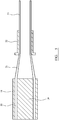
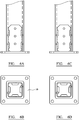
- Figures 6C and 6D illustrate the region of interference between the polymer profile 23 and the base plate component 12.
- Figures 7A and 7B illustrate the shape of the profile 23 after it has been oriented, but before it is forced down over a component 12.
- Figures 7A and 7C illustrate the polymer profile shape after deformation, the deformation caused by the dimples been clearly seen at 24.
- Figures 8A and 8B illustrate the displacement of the polymer profile and the deformation of shape.
- Figures 8C and 8D illustrate the compression forces that are brought about in the region of displacement of the polymer profile.
- the polymer profile 23 physically grips the component 12 tightly while at the same time the deformation of the profile around the dimples 17 bring about a mechanical keying effect.
- the internal measurements of the plastics post are 90 x 90 mm, while the external measurements of the component 12 are 92 x 92 mm.
- the friction between the two parts is very high, resulting in an extremely strong interference fit.
- the pressure is constant through the entire surface area of contact between the external surface of the component 12 and the internal surface of the profile 23.
- the component 12 is steel which is a rigid material and the profile 23 is plastics, usually polypropylene, which is malleable, when the components are forced together, the steel base does not deform, whereas the plastics post does, in order to fit over and around the steel component.
- This deformation in the example having the measurements just described, may be from 1 to 2 mm in displacement.
- the molecular orientated profiles exhibit great tensile strengths in the direction of extrusion, similar to that of timber in the direction of the grain.
- a moulded post would not provide the benefits of this embodiment of the invention.
- a moulded post would not exhibit the same strength as that of a molecular orientated extruded part.
- a moulded part would not acquire the same level of memory and so would not produce the same gripping effect.
- the top of the component 12 is designed and shaped in order to minimise the stress applied to the plastics profile during fitting. As it provides a leading edge, as best shown in Figure 3 , it guides the polypropylene profile during the initial phase of fitting the profile to the steel component, via a high powered press having a hydraulic ram.
- the typical forces of pressure required to fit a thick walled polypropylene square profiles and steel base plate together may be in the order of 50 - 200 kg/cm 2 .
- An example of the pressure required to insert the 110mm square profile post with a 10mm wall thickness onto the steel base plate is between 102 - 104 kg/cm 2 .
- Another example of the pressure required to insert a 110mm square profile post with a 11mm wall thickness onto the steel base plate is between 130 - 135 kg/cm 2 .
- Another example of the pressure required to insert a 90mm square profile post with a 7.5mm wall thickness onto the steel base plate is between 76 - 78 kg/cm 2 .
- Another example of the pressure required to insert a 75 x 50mm rectangular profile post with a 6mm wall thickness onto the steel base plate having similar interference is between 51 - 53 kg/cm 2 .
- the reaction pressure from the interference fit is constant, this is applied to the surface area on the internal of the plastic post section and the external of upright section of the steel base plate, for a standard base the surface area may be of the order of 0.02 - 0.08 m 2 .
- One example is, a 110mm square profile post with a 10mm wall thickness fitted onto a corresponding steel base plate, the pressure is applied to a 0.06m 2 surface area.
- Another example is, a 90mm square profile post with a 7.5mm wall thickness fitted onto a corresponding steel base plate, the pressure is applied to a 0.045m 2 surface area.
- Another example is, a 75 x 50mm rectangular profile post with a 6mm wall thickness fitted onto a corresponding steel base plate the pressure is applied to a 0.025m 2 surface area.
Landscapes
- Engineering & Computer Science (AREA)
- Mechanical Engineering (AREA)
- Architecture (AREA)
- Civil Engineering (AREA)
- Structural Engineering (AREA)
- Chemical & Material Sciences (AREA)
- Life Sciences & Earth Sciences (AREA)
- Materials Engineering (AREA)
- Wood Science & Technology (AREA)
- Physics & Mathematics (AREA)
- Thermal Sciences (AREA)
- Fencing (AREA)
- Extrusion Moulding Of Plastics Or The Like (AREA)
- Compositions Of Macromolecular Compounds (AREA)
Description
- The invention relates to methods of connecting an upwardly extending member, for example a post, to a support member, for example a base plate.
- One application of the method according to the invention is to provide a secure means of connecting or anchoring a plastics component to a metal footplate. The plastics component may comprise part of a plastics barrier or fence system. The metal footplate may be of steel.
- There is very little knowledge of products that use a plastic barrier system with a steel footplate. There is one known product that comprises a glass reinforced plastics (GRP) handrail system but this does not use a steel footplate for anchorage of the handrail system.
- All the GRP systems use a loose fitting sleeve which fits over a mating projection. Once the GRP section has been fitted onto a moulded footplate, by means of a loose fit, the components then have to be additionally secured, for example using a fixing bolt, which will generally also be of steel.
- In other words the loose fit items are not self supportive and they must be bolted together.
US2005/204654 A1 discloses a method of forming a barrier post by connecting a post, which is elongate and hollow, to a support member so that the elongate post extends upwards from the support member, the method comprising a step of providing said support member, which is substantially rigid, a step of extruding plastics material to form said elongate, hollow post, wherein the post is undersized with respect to the support member; and a step of forcing the post and support member together such that the post slides over the support member, the post being such that it deforms elastically and radially outward as it moves over the support member, such that the post and support member are secured together by a combination of interference fit and elastic gripping of the support member by the post. AccordinglyUS 2005/204654 A1 also discloses a barrier post comprising a post secured to a support member such that the post extends upwardly from the support member, wherein the post is elongate and hollow and formed from plastics material to have an internal dimension that is smaller than an external dimension of the support member, and the post support member and support member are secured together by a combination of interference fit and elastic gripping of the support member by the post. - The invention provides a method of forming a barrier post by connecting a post, which is elongate and hollow, to a support member so that the elongate post extends upwards from the support member, the method comprising the steps of providing support member which is substantially rigid and comprises at least one protrusion; extruding plastics material to form said hollow, elongate post, wherein the post is undersized with respect to the support member, and forcing the post and the support member together such that the post slides over the support member, the post being such that it deforms elastically and radially outward as it moves relatively over the support member, such that the post and the support member are secured together by a combination of interference fit, mechanical keying due to the at least one protrusion and the elastic gripping of the support member by the post.
- The support member may comprise a base plate.
- The post may be made of polypropylene. The support member may be made of steel.
- The material of the post preferably has molecular properties in the form of randomly orientated tangled polymer chains, the polymer chains then being stretched and orientated, thus aligning the chain molecules, during the extrusion process.
- The invention includes a barrier post manufactured using the method according to the invention.
- The barrier post may comprise a post attached to a base plate.
- The barrier post may comprise part of a plastics barrier or fence system.
- By way of example, specific embodiments of the invention will now be described, with reference to the accompanying drawings, in which:
-
Figure 1 is a perspective view of a base plate for use in an embodiment of method according to the invention; -
Figure 2 is a plan view of the base plate; -
Figure 3 is a view of the base plate from one side; -
Figure 4 is a view of the base plate from another side; -
Figure 5 is a view illustrating the manufacture of a post for use in the embodiment of method according to the invention; -
Figures 6A to 6D illustrate the post fitted to the base plate; -
Figures 7A to 7D illustrate how the post deforms during the execution of the method; and -
Figures 8A to 8D illustrate the displacement of the plastics material, the deformation of shape, and the way in which compressive forces are introduced by the method according to this embodiment of the invention. - The steel base plate used in this embodiment comprises a
square base 10 having at each corner abolt hole 11 for use in fixing the component to a base structure (not shown) for example a slab of concrete. - Projecting upwardly from the
square base 10 is asquare cross-section tube 12 constructed by welding together two C-shaped portions ofsteel tube 12 to thebase 10. - In other embodiments, the square cross-section tube may be created in other ways and other cross-sections may be used including rectangular and round cross-sections.
- As seen if
Figure 2 , thecross-section tube 12 is attached to thebase 10 by fourthick welds 15. - The
components thick welds 16. - An important feature of this embodiment of the invention is that further welds are applied to create
dimples 17. - The structure shown in
Figure 1 is intended to support and secure in place an elongate post, which may for example comprise part of a fence or barrier. - It is an important part of this embodiment of the invention that the post specially manufactured to critical tolerances, using an extrusion process. As shown in
Figure 5 , plastics material, and particularly polymeric plastics material, for example polypropylene, is extruded into a squarecross-section using dies - The
plastics material 20, being extruded between thedies - The plastics material emerges from the dies at 21 as an unformed profile, and is then drawn down to size using a calibration and
cooling unit 22. As the material is drawn down to size the polymer chains are stretched and orientated thus aligning the chain molecules. - The
final polymer profile 23 is calibrated through theunit 22 to maintain its new shape together with the molecular oriented properties. - The average draw down during extrusion of the plastic profile is 10 - 100%. One example is 10 - 50% draw down. Another example is 20 - 40% draw down.
- The internal and external corners of the square post profile are designed to minimise the stress concentration imposed on the plastic post by the oversized steel base plate.
- As shown in
Figures. 6A and 6B , the finishedprofile 23 is secured to the base plate, without the need for bolts or other fixing devices, by forcing the oriented profile down over thesteel square cross-section 12 to form an interference fit. - The interference fit results firstly from the fact that the finished
profile 23 is slightly undersized with respect to thesteel component 12, but is also assisted by thedimples 17. -
Figures 6C and 6D illustrate the region of interference between thepolymer profile 23 and thebase plate component 12. -
Figures 7A and 7B illustrate the shape of theprofile 23 after it has been oriented, but before it is forced down over acomponent 12. -
Figures 7A and 7C illustrate the polymer profile shape after deformation, the deformation caused by the dimples been clearly seen at 24. -
Figures 8A and 8B illustrate the displacement of the polymer profile and the deformation of shape. -
Figures 8C and 8D illustrate the compression forces that are brought about in the region of displacement of the polymer profile. Thus thepolymer profile 23 physically grips thecomponent 12 tightly while at the same time the deformation of the profile around thedimples 17 bring about a mechanical keying effect. - In one example of barrier post, the internal measurements of the plastics post are 90 x 90 mm, while the external measurements of the
component 12 are 92 x 92 mm. When these parts are pressed into one another, the friction between the two parts is very high, resulting in an extremely strong interference fit. As illustrated inFigures 8C and 8D , the pressure is constant through the entire surface area of contact between the external surface of thecomponent 12 and the internal surface of theprofile 23. - As the
component 12 is steel which is a rigid material and theprofile 23 is plastics, usually polypropylene, which is malleable, when the components are forced together, the steel base does not deform, whereas the plastics post does, in order to fit over and around the steel component. This deformation, in the example having the measurements just described, may be from 1 to 2 mm in displacement. - Under normal circumstances a stiff material will fail due to the displacement / deformation of the post but products manufactured according to this embodiment of the invention work well owing to the unique material properties and geometries of the parts.
- Important aspects of this embodiment include the following:
- extruded profiles of a polyolefin base material;
- selected profile shapes, which need not necessarily be square (rectangular or round profiles may be used for example);
- die drawn extrusion;
- the creation of molecular orientated profile extrusions, which have a memory, and thus would return to their original form after deformation, upon removal of load. Because the extrusion are trying to return to their original form, they continually grip the metal component onto which they are fitted.
- The molecular orientated profiles exhibit great tensile strengths in the direction of extrusion, similar to that of timber in the direction of the grain.
- A moulded post would not provide the benefits of this embodiment of the invention.
- A moulded post would not exhibit the same strength as that of a molecular orientated extruded part.
- A moulded part would not acquire the same level of memory and so would not produce the same gripping effect.
- If a moulded part were deformed beyond the plastic limits, the deformation would be permanent. If a moulded part was used in an attempt to create an interference fit, the moulded part would deform around the metal component when initially connected to the metal component but would then maintain the new dimension, thus not attempting to return to the original form and therefore not applying significant pressure around the metal component. This pressure is essential to maintain an effective anchorage for the post.
- The top of the
component 12 is designed and shaped in order to minimise the stress applied to the plastics profile during fitting. As it provides a leading edge, as best shown inFigure 3 , it guides the polypropylene profile during the initial phase of fitting the profile to the steel component, via a high powered press having a hydraulic ram. - The typical forces of pressure required to fit a thick walled polypropylene square profiles and steel base plate together may be in the order of 50 - 200 kg/cm2.
- An example of the pressure required to insert the 110mm square profile post with a 10mm wall thickness onto the steel base plate is between 102 - 104 kg/cm2.
- Another example of the pressure required to insert a 110mm square profile post with a 11mm wall thickness onto the steel base plate is between 130 - 135 kg/cm2.
- Another example of the pressure required to insert a 90mm square profile post with a 7.5mm wall thickness onto the steel base plate is between 76 - 78 kg/cm2.
- Another example of the pressure required to insert a 75 x 50mm rectangular profile post with a 6mm wall thickness onto the steel base plate having similar interference is between 51 - 53 kg/cm2.
- The reaction pressure from the interference fit is constant, this is applied to the surface area on the internal of the plastic post section and the external of upright section of the steel base plate, for a standard base the surface area may be of the order of 0.02 - 0.08 m2.
- One example is, a 110mm square profile post with a 10mm wall thickness fitted onto a corresponding steel base plate, the pressure is applied to a 0.06m2 surface area.
- Another example is, a 90mm square profile post with a 7.5mm wall thickness fitted onto a corresponding steel base plate, the pressure is applied to a 0.045m2 surface area.
- Another example is, a 75 x 50mm rectangular profile post with a 6mm wall thickness fitted onto a corresponding steel base plate the pressure is applied to a 0.025m2 surface area.
Claims (6)
- A method of forming a barrier post by connecting a post (23), which is elongate and hollow, to a support member (10) so that the elongate post (23) extends upwards from the support member (10), the method comprising the steps of:providing said support member (10), which is substantially rigid and comprises at least one protrusion (17);extruding plastics material to form said elongate, hollow post (23), wherein the post is undersized with respect to the support member (10); andforcing the post (23) and support member (10) together such that the post (23) slides over the support member (10), the post (23) being such that it deforms elastically and radially outward as it moves relatively over the support member (10), such that the post (23) and support member (10) are secured together by a combination of interference fit, mechanical keying due to the at least one protrusion (17) and the elastic gripping of the support member (10) by the post (23).
- A method as claimed in claim 1 in which the support member (10) comprises a base plate.
- A method as claimed in any one of the preceding claims in which the post (23) is made of polypropylene.
- A method as claimed in any one of the preceding claims in which the support member (10) is made of steel.
- A method as claimed in any one of the preceding claims in which the material of the post (23) has molecular properties in the form of randomly orientated tangled polymer chains, the polymer chains then being stretched and orientated, thus aligning the chain molecules, during the extrusion process.
- A barrier post manufactured using a method as claimed in any of claims 1 to 5, wherein the barrier post comprises a post (23) secured to a support member (10) comprising at least one protrusion (17) such that the post (23) extends upwardly from the support member (10), wherein the post is elongate and hollow and formed from plastics material to have an internal dimension that is smaller than an external dimension of the support member (10), and the post (23) is deformed elastically radially outward over the support member (10), so that the post (23) and support member (10) are secured together by a combination of interference fit, mechanical keying due to the at least one protrusion (17) and the elastic gripping of the support member (10) by the post (23).
Applications Claiming Priority (2)
| Application Number | Priority Date | Filing Date | Title |
|---|---|---|---|
| GBGB1003274.6A GB201003274D0 (en) | 2010-02-26 | 2010-02-26 | Methods of connecting |
| PCT/GB2011/050312 WO2011104527A1 (en) | 2010-02-26 | 2011-02-17 | Methods of connecting |
Publications (2)
| Publication Number | Publication Date |
|---|---|
| EP2539136A1 EP2539136A1 (en) | 2013-01-02 |
| EP2539136B1 true EP2539136B1 (en) | 2020-12-16 |
Family
ID=42125690
Family Applications (1)
| Application Number | Title | Priority Date | Filing Date |
|---|---|---|---|
| EP11705675.4A Active EP2539136B1 (en) | 2010-02-26 | 2011-02-17 | Barrier post and method of manufacturing thereof |
Country Status (8)
| Country | Link |
|---|---|
| US (1) | US9102092B2 (en) |
| EP (1) | EP2539136B1 (en) |
| AU (1) | AU2011219593B2 (en) |
| ES (1) | ES2855105T3 (en) |
| GB (1) | GB201003274D0 (en) |
| HU (1) | HUE053964T2 (en) |
| PT (1) | PT2539136T (en) |
| WO (1) | WO2011104527A1 (en) |
Families Citing this family (27)
| Publication number | Priority date | Publication date | Assignee | Title |
|---|---|---|---|---|
| FI125001B (en) * | 2012-10-09 | 2015-04-30 | Tuomo Paananen | COLUMN BALL WITH ANGLING COMPENSATION |
| USD799069S1 (en) * | 2013-12-13 | 2017-10-03 | Dtech Communications, Inc. | Slotted angle stanchion |
| CA2937615C (en) | 2014-01-21 | 2022-08-16 | A-Fax Limited | Improved barrier connection system and method thereof |
| US9551121B2 (en) * | 2014-10-28 | 2017-01-24 | Kevin Austin McCord | Base insert for traffic delineator posts |
| US20180238041A1 (en) | 2017-02-21 | 2018-08-23 | Styrc Jacek | Modular furniture system |
| CN107476638B (en) * | 2017-08-10 | 2019-10-29 | 绍兴市亿跃智能科技有限公司 | A kind of electric pole for preventing from being damaged because ground squeezes |
| CN107775963B (en) * | 2017-10-01 | 2019-04-26 | 王一彩 | An oil drum handle installation equipment capable of sorting oil drum handles |
| USD887025S1 (en) | 2017-11-17 | 2020-06-09 | 2724889 Ontario Inc. | Connector for a modular structure |
| USD914406S1 (en) * | 2018-06-21 | 2021-03-30 | The Ondrasik Family Trust | Wire receiving shelf post |
| AU2020277107B2 (en) * | 2019-11-26 | 2023-07-13 | Pandoe Pty Ltd | Improved bracket |
| USD938772S1 (en) | 2020-02-04 | 2021-12-21 | 2724889 Ontario Inc. | Connector |
| USD938771S1 (en) | 2020-02-04 | 2021-12-21 | 2724889 Ontario Inc. | Connector |
| USD952382S1 (en) | 2020-02-04 | 2022-05-24 | 2724889 Ontario Inc. | Table |
| USD952384S1 (en) | 2020-02-04 | 2022-05-24 | 2724889 Ontario Inc. | Leg |
| USD938770S1 (en) | 2020-02-04 | 2021-12-21 | 2724889 Ontario Inc. | Connector |
| USD936859S1 (en) * | 2020-02-04 | 2021-11-23 | 2724889 Ontario Inc. | Connector |
| USD899903S1 (en) * | 2020-02-07 | 2020-10-27 | Sean A. Barnes | Pile guide for docks |
| USD899904S1 (en) * | 2020-02-07 | 2020-10-27 | Sean A. Barnes | Elongated pile guide for docks |
| USD938619S1 (en) | 2020-08-12 | 2021-12-14 | 2724889 Ontario Inc. | Connector for a modular structure |
| USD939731S1 (en) | 2020-08-12 | 2021-12-28 | 2724889 Ontario Inc. | Connector for a modular structure |
| USD936247S1 (en) * | 2020-08-12 | 2021-11-16 | 2724889 Ontario Inc. | Connector for a modular structure |
| USD936246S1 (en) | 2020-08-12 | 2021-11-16 | 2724889 Ontario Inc. | Connector for a modular structure |
| USD939106S1 (en) | 2020-08-12 | 2021-12-21 | 2724889 Ontario Inc. | Connector for a modular structure |
| USD936861S1 (en) | 2020-08-12 | 2021-11-23 | 2724889 Ontario Inc. | Connector for a modular structure |
| USD938068S1 (en) | 2020-08-12 | 2021-12-07 | 2724889 Ontario Inc. | Connector for a modular structure |
| BE1030568B1 (en) * | 2022-05-30 | 2024-01-08 | Boplan Bv | BASIC ELEMENT AND METHOD OF ATTACHING AN UPWARD POST TO A SURFACE AND ITS USE |
| US20250092697A1 (en) * | 2023-09-15 | 2025-03-20 | Suncast Technologies, Llc | Storage shed |
Citations (10)
| Publication number | Priority date | Publication date | Assignee | Title |
|---|---|---|---|---|
| US4021977A (en) | 1976-03-19 | 1977-05-10 | Foresight Industries | Reusable yielding post supports |
| GB2060469A (en) | 1979-06-06 | 1981-05-07 | Nat Res Dev | Drawing thermoplastics material |
| DE19643874A1 (en) * | 1996-10-31 | 1998-05-07 | Langmatz Lic Gmbh | Post or mast comprising metal pipe with outer plastic tube |
| EP0871825A2 (en) | 1996-01-30 | 1998-10-21 | Plastic Cores Limited | Fastening devices |
| WO2000071830A1 (en) * | 1999-05-25 | 2000-11-30 | Natelli Anthony Mario Jr | Reinforced pole with apparatus and method for anchoring |
| EP1483160A2 (en) | 2002-01-10 | 2004-12-08 | A-Fax Limited | Interlocking devices |
| US20050204654A1 (en) * | 2004-02-09 | 2005-09-22 | Fredrickson Kurt J | Angularly adjustable post mount |
| US20060169966A1 (en) * | 2005-01-28 | 2006-08-03 | Platt Robert E | Fencing system and post insert for use therewith |
| US20060273295A1 (en) * | 2005-06-01 | 2006-12-07 | Paul Maly | Extruded protective railing system |
| US20080104899A1 (en) | 2006-11-06 | 2008-05-08 | Oz-Post International Llp | Post anchor with post holding impressions |
Family Cites Families (16)
| Publication number | Priority date | Publication date | Assignee | Title |
|---|---|---|---|---|
| US3908947A (en) * | 1973-04-17 | 1975-09-30 | Bledsoe Corp | Standard for a sign |
| US5568909A (en) * | 1995-03-10 | 1996-10-29 | Timko; Robert J. | Mounting bracket |
| US6336620B1 (en) * | 1996-03-11 | 2002-01-08 | John A. Belli | Brackets for retaining post and board ends |
| US5848502A (en) * | 1997-10-31 | 1998-12-15 | S-Square Tube Products | Removable post support system |
| US5901525A (en) * | 1998-11-13 | 1999-05-11 | Robert L. Consolini | Elevated base for column support |
| US6742748B1 (en) * | 2001-05-17 | 2004-06-01 | Arlington Industries, Inc. | Deck post |
| US20040245516A1 (en) * | 2003-06-05 | 2004-12-09 | Maurizio Fuoco | Temporary structure bracket |
| US7155867B2 (en) * | 2003-07-25 | 2007-01-02 | Paragon Aquatics, A Division Of Pentair Pool Products, Inc. | Arcuate taper lock anchor base plate and anchor assembly with the base plate |
| CA2462360C (en) * | 2004-04-01 | 2010-08-03 | Simon Walker | Post system for a railing |
| US7195222B2 (en) * | 2004-04-23 | 2007-03-27 | Dent Clifford M | Flanged base and breakaway system connector for road accessory posts |
| US7533506B2 (en) * | 2006-01-11 | 2009-05-19 | Platt Robert E | Bracket for mounting and vertically leveling a post on a surface |
| US7530550B2 (en) * | 2007-05-03 | 2009-05-12 | Lmt-Mercer Group Inc. | Apparatus and method for post mount guide |
| US8074955B2 (en) * | 2008-07-07 | 2011-12-13 | Cooper Technologies Company | Method and apparatus for improving the strength of a utility pole |
| USD610717S1 (en) * | 2008-09-27 | 2010-02-23 | Simpson Strong-Tie Company, Inc. | Post base with domes |
| US8104732B1 (en) * | 2009-07-20 | 2012-01-31 | Solar Group, Inc. | Mailbox mounting bracket assembly |
| US20110073824A1 (en) * | 2009-09-25 | 2011-03-31 | Lappin Rick A | Railing system and coupling element and methods of assembly |
-
2010
- 2010-02-26 GB GBGB1003274.6A patent/GB201003274D0/en not_active Ceased
-
2011
- 2011-02-17 EP EP11705675.4A patent/EP2539136B1/en active Active
- 2011-02-17 AU AU2011219593A patent/AU2011219593B2/en active Active
- 2011-02-17 US US13/579,732 patent/US9102092B2/en active Active
- 2011-02-17 WO PCT/GB2011/050312 patent/WO2011104527A1/en not_active Ceased
- 2011-02-17 ES ES11705675T patent/ES2855105T3/en active Active
- 2011-02-17 PT PT117056754T patent/PT2539136T/en unknown
- 2011-02-17 HU HUE11705675A patent/HUE053964T2/en unknown
Patent Citations (11)
| Publication number | Priority date | Publication date | Assignee | Title |
|---|---|---|---|---|
| US4021977A (en) | 1976-03-19 | 1977-05-10 | Foresight Industries | Reusable yielding post supports |
| GB2060469A (en) | 1979-06-06 | 1981-05-07 | Nat Res Dev | Drawing thermoplastics material |
| EP0871825A2 (en) | 1996-01-30 | 1998-10-21 | Plastic Cores Limited | Fastening devices |
| DE19643874A1 (en) * | 1996-10-31 | 1998-05-07 | Langmatz Lic Gmbh | Post or mast comprising metal pipe with outer plastic tube |
| WO2000071830A1 (en) * | 1999-05-25 | 2000-11-30 | Natelli Anthony Mario Jr | Reinforced pole with apparatus and method for anchoring |
| EP1483160A2 (en) | 2002-01-10 | 2004-12-08 | A-Fax Limited | Interlocking devices |
| EP1483160B1 (en) | 2002-01-10 | 2008-06-18 | A-Fax Limited | Interlocking devices |
| US20050204654A1 (en) * | 2004-02-09 | 2005-09-22 | Fredrickson Kurt J | Angularly adjustable post mount |
| US20060169966A1 (en) * | 2005-01-28 | 2006-08-03 | Platt Robert E | Fencing system and post insert for use therewith |
| US20060273295A1 (en) * | 2005-06-01 | 2006-12-07 | Paul Maly | Extruded protective railing system |
| US20080104899A1 (en) | 2006-11-06 | 2008-05-08 | Oz-Post International Llp | Post anchor with post holding impressions |
Non-Patent Citations (5)
| Title |
|---|
| ANONYMOUS: "Handleiding. BOPLAN Ponseenheid voeten", HANDSAEME MACHINERY NV, 8 April 2009 (2009-04-08), pages 1 - 20, XP055845682 |
| ANONYMOUS: "News & Press Releases / Bollards added to A-fax range of Safety Barrier Products", INTERNET ARCHIVE WAYBACK MACHINE, 18 May 2006 (2006-05-18), pages 1, XP055845688, Retrieved from the Internet <URL:https://web.archive.org/web/20060518082117/http://www.a-fax.com/news-120705.html> |
| ANONYMOUS: "Rack End Protection Barrier", INTERNET ARCHIVE WAYBACK MACHINE, 27 March 2005 (2005-03-27), pages 1 - 2, XP055845679, Retrieved from the Internet <URL:https://web.archive.org/web/20050327200843/http://a-fax.com/pdfs/RackEndBarrier.pdf> |
| HAROLD F. GILES, JR. ET AL.: "Extrusion: The Definitive Processing Guide and Handbook", 2005, WILLIAM ANDREW PUBLISHING, New York, ISBN: 0-8155-1473-5, pages: 560pp |
| SCHRAUWEN B. A. G., BREEMEN L. C. A. V., SPOELSTRA A. B., GOVAERT L. E., PETERS G. W. M., MEIJER H. E. H.: "Structure, Deformation, and Failure of Flow-Oriented Semicrystalline Polymers", MACROMOLECULES, AMERICAN CHEMICAL SOCIETY, US, vol. 37, no. 23, 1 November 2004 (2004-11-01), US , pages 8618 - 8633, XP093113412, ISSN: 0024-9297, DOI: 10.1021/ma048884k |
Also Published As
| Publication number | Publication date |
|---|---|
| ES2855105T3 (en) | 2021-09-23 |
| EP2539136A1 (en) | 2013-01-02 |
| WO2011104527A1 (en) | 2011-09-01 |
| US9102092B2 (en) | 2015-08-11 |
| GB201003274D0 (en) | 2010-04-14 |
| AU2011219593B2 (en) | 2015-05-21 |
| AU2011219593A1 (en) | 2012-08-30 |
| PT2539136T (en) | 2021-02-24 |
| HUE053964T2 (en) | 2021-07-28 |
| US20120321826A1 (en) | 2012-12-20 |
Similar Documents
| Publication | Publication Date | Title |
|---|---|---|
| US9102092B2 (en) | Methods of connecting | |
| CN102478039B (en) | Joining magnesium with reinforced polymer composite fasteners | |
| US10427346B2 (en) | Extruded reinforcements | |
| EP2608903B1 (en) | Multilayer lightweigth construction element with structured layers | |
| US20020167113A1 (en) | System for co-molding a thermoplastic material with a thermoplastic sandwich material and article produced thereby | |
| CN1367078A (en) | Light composite product | |
| US8966734B2 (en) | Method of joining magnesium | |
| CA2833113A1 (en) | Panel connector devices | |
| KR101490555B1 (en) | Steel pipe pile cap for supporting temporary bent | |
| CN203924685U (en) | The vertical rod of a kind of socket joint jacket buckle type scaffold | |
| KR101537358B1 (en) | Cylindrical water tank and its construction method using a hollow panel external to the PC steel reinforcement | |
| US11628635B2 (en) | Cross-corrugated support structure | |
| KR20230033885A (en) | Extrusion mold apparatus and extrusion billet manufactured using the same | |
| CN210530639U (en) | Anti-skidding section bar angle sign indicating number device of locking by expansive force | |
| EP2174733A2 (en) | Sheet metal component and method for its production | |
| CN216142400U (en) | Concrete cylinder pours template | |
| US20050160573A1 (en) | Method and apparatus for interlocking tubular members | |
| CN210032595U (en) | Dual-purpose column mould hoop device | |
| AU2016100976A4 (en) | Cellular confinement system | |
| CN104015249B (en) | A kind of quick despatch fixture between concrete blinding fixing pipe | |
| KR20120032147A (en) | Yoke manufacturing method | |
| JP3829081B2 (en) | Reinforcement method for reinforced concrete columns | |
| CN220150999U (en) | Outer connecting device of ladder cage wall | |
| CN217123742U (en) | Molding die and molding system | |
| KR101569866B1 (en) | Support apparatus of anchor bolt used in ceiling structure |
Legal Events
| Date | Code | Title | Description |
|---|---|---|---|
| PUAI | Public reference made under article 153(3) epc to a published international application that has entered the european phase |
Free format text: ORIGINAL CODE: 0009012 |
|
| 17P | Request for examination filed |
Effective date: 20120803 |
|
| AK | Designated contracting states |
Kind code of ref document: A1 Designated state(s): AL AT BE BG CH CY CZ DE DK EE ES FI FR GB GR HR HU IE IS IT LI LT LU LV MC MK MT NL NO PL PT RO RS SE SI SK SM TR |
|
| DAX | Request for extension of the european patent (deleted) | ||
| 17Q | First examination report despatched |
Effective date: 20151221 |
|
| STAA | Information on the status of an ep patent application or granted ep patent |
Free format text: STATUS: EXAMINATION IS IN PROGRESS |
|
| GRAP | Despatch of communication of intention to grant a patent |
Free format text: ORIGINAL CODE: EPIDOSNIGR1 |
|
| STAA | Information on the status of an ep patent application or granted ep patent |
Free format text: STATUS: GRANT OF PATENT IS INTENDED |
|
| RAP1 | Party data changed (applicant data changed or rights of an application transferred) |
Owner name: THREE SMITH GROUP LIMITED |
|
| RIC1 | Information provided on ipc code assigned before grant |
Ipc: B29C 48/07 20190101ALI20200428BHEP Ipc: E04H 12/22 20060101ALI20200428BHEP Ipc: E04H 12/02 20060101ALI20200428BHEP Ipc: B29C 69/02 20060101AFI20200428BHEP Ipc: B29C 65/56 20060101ALI20200428BHEP Ipc: B29C 48/90 20190101ALI20200428BHEP Ipc: B29C 65/00 20060101ALI20200428BHEP Ipc: B29C 48/09 20190101ALI20200428BHEP Ipc: B29C 65/64 20060101ALI20200428BHEP Ipc: B29L 31/00 20060101ALI20200428BHEP |
|
| INTG | Intention to grant announced |
Effective date: 20200515 |
|
| GRAJ | Information related to disapproval of communication of intention to grant by the applicant or resumption of examination proceedings by the epo deleted |
Free format text: ORIGINAL CODE: EPIDOSDIGR1 |
|
| STAA | Information on the status of an ep patent application or granted ep patent |
Free format text: STATUS: EXAMINATION IS IN PROGRESS |
|
| GRAP | Despatch of communication of intention to grant a patent |
Free format text: ORIGINAL CODE: EPIDOSNIGR1 |
|
| INTC | Intention to grant announced (deleted) | ||
| STAA | Information on the status of an ep patent application or granted ep patent |
Free format text: STATUS: GRANT OF PATENT IS INTENDED |
|
| INTG | Intention to grant announced |
Effective date: 20201001 |
|
| GRAS | Grant fee paid |
Free format text: ORIGINAL CODE: EPIDOSNIGR3 |
|
| GRAA | (expected) grant |
Free format text: ORIGINAL CODE: 0009210 |
|
| STAA | Information on the status of an ep patent application or granted ep patent |
Free format text: STATUS: THE PATENT HAS BEEN GRANTED |
|
| AK | Designated contracting states |
Kind code of ref document: B1 Designated state(s): AL AT BE BG CH CY CZ DE DK EE ES FI FR GB GR HR HU IE IS IT LI LT LU LV MC MK MT NL NO PL PT RO RS SE SI SK SM TR |
|
| REG | Reference to a national code |
Ref country code: GB Ref legal event code: FG4D |
|
| REG | Reference to a national code |
Ref country code: IE Ref legal event code: FG4D |
|
| REG | Reference to a national code |
Ref country code: DE Ref legal event code: R096 Ref document number: 602011069647 Country of ref document: DE |
|
| REG | Reference to a national code |
Ref country code: AT Ref legal event code: REF Ref document number: 1345197 Country of ref document: AT Kind code of ref document: T Effective date: 20210115 |
|
| REG | Reference to a national code |
Ref country code: PT Ref legal event code: SC4A Ref document number: 2539136 Country of ref document: PT Date of ref document: 20210224 Kind code of ref document: T Free format text: AVAILABILITY OF NATIONAL TRANSLATION Effective date: 20210218 |
|
| REG | Reference to a national code |
Ref country code: NL Ref legal event code: FP |
|
| PG25 | Lapsed in a contracting state [announced via postgrant information from national office to epo] |
Ref country code: GR Free format text: LAPSE BECAUSE OF FAILURE TO SUBMIT A TRANSLATION OF THE DESCRIPTION OR TO PAY THE FEE WITHIN THE PRESCRIBED TIME-LIMIT Effective date: 20210317 Ref country code: RS Free format text: LAPSE BECAUSE OF FAILURE TO SUBMIT A TRANSLATION OF THE DESCRIPTION OR TO PAY THE FEE WITHIN THE PRESCRIBED TIME-LIMIT Effective date: 20201216 Ref country code: FI Free format text: LAPSE BECAUSE OF FAILURE TO SUBMIT A TRANSLATION OF THE DESCRIPTION OR TO PAY THE FEE WITHIN THE PRESCRIBED TIME-LIMIT Effective date: 20201216 Ref country code: NO Free format text: LAPSE BECAUSE OF FAILURE TO SUBMIT A TRANSLATION OF THE DESCRIPTION OR TO PAY THE FEE WITHIN THE PRESCRIBED TIME-LIMIT Effective date: 20210316 |
|
| PG25 | Lapsed in a contracting state [announced via postgrant information from national office to epo] |
Ref country code: LV Free format text: LAPSE BECAUSE OF FAILURE TO SUBMIT A TRANSLATION OF THE DESCRIPTION OR TO PAY THE FEE WITHIN THE PRESCRIBED TIME-LIMIT Effective date: 20201216 Ref country code: SE Free format text: LAPSE BECAUSE OF FAILURE TO SUBMIT A TRANSLATION OF THE DESCRIPTION OR TO PAY THE FEE WITHIN THE PRESCRIBED TIME-LIMIT Effective date: 20201216 |
|
| PG25 | Lapsed in a contracting state [announced via postgrant information from national office to epo] |
Ref country code: HR Free format text: LAPSE BECAUSE OF FAILURE TO SUBMIT A TRANSLATION OF THE DESCRIPTION OR TO PAY THE FEE WITHIN THE PRESCRIBED TIME-LIMIT Effective date: 20201216 |
|
| REG | Reference to a national code |
Ref country code: LT Ref legal event code: MG9D |
|
| REG | Reference to a national code |
Ref country code: HU Ref legal event code: AG4A Ref document number: E053964 Country of ref document: HU |
|
| PG25 | Lapsed in a contracting state [announced via postgrant information from national office to epo] |
Ref country code: SK Free format text: LAPSE BECAUSE OF FAILURE TO SUBMIT A TRANSLATION OF THE DESCRIPTION OR TO PAY THE FEE WITHIN THE PRESCRIBED TIME-LIMIT Effective date: 20201216 Ref country code: RO Free format text: LAPSE BECAUSE OF FAILURE TO SUBMIT A TRANSLATION OF THE DESCRIPTION OR TO PAY THE FEE WITHIN THE PRESCRIBED TIME-LIMIT Effective date: 20201216 Ref country code: LT Free format text: LAPSE BECAUSE OF FAILURE TO SUBMIT A TRANSLATION OF THE DESCRIPTION OR TO PAY THE FEE WITHIN THE PRESCRIBED TIME-LIMIT Effective date: 20201216 Ref country code: SM Free format text: LAPSE BECAUSE OF FAILURE TO SUBMIT A TRANSLATION OF THE DESCRIPTION OR TO PAY THE FEE WITHIN THE PRESCRIBED TIME-LIMIT Effective date: 20201216 Ref country code: EE Free format text: LAPSE BECAUSE OF FAILURE TO SUBMIT A TRANSLATION OF THE DESCRIPTION OR TO PAY THE FEE WITHIN THE PRESCRIBED TIME-LIMIT Effective date: 20201216 |
|
| PG25 | Lapsed in a contracting state [announced via postgrant information from national office to epo] |
Ref country code: PL Free format text: LAPSE BECAUSE OF FAILURE TO SUBMIT A TRANSLATION OF THE DESCRIPTION OR TO PAY THE FEE WITHIN THE PRESCRIBED TIME-LIMIT Effective date: 20201216 |
|
| REG | Reference to a national code |
Ref country code: DE Ref legal event code: R026 Ref document number: 602011069647 Country of ref document: DE Ref country code: AT Ref legal event code: UEP Ref document number: 1345197 Country of ref document: AT Kind code of ref document: T Effective date: 20201216 |
|
| REG | Reference to a national code |
Ref country code: ES Ref legal event code: FG2A Ref document number: 2855105 Country of ref document: ES Kind code of ref document: T3 Effective date: 20210923 |
|
| PLBI | Opposition filed |
Free format text: ORIGINAL CODE: 0009260 |
|
| PG25 | Lapsed in a contracting state [announced via postgrant information from national office to epo] |
Ref country code: MC Free format text: LAPSE BECAUSE OF FAILURE TO SUBMIT A TRANSLATION OF THE DESCRIPTION OR TO PAY THE FEE WITHIN THE PRESCRIBED TIME-LIMIT Effective date: 20201216 Ref country code: IS Free format text: LAPSE BECAUSE OF FAILURE TO SUBMIT A TRANSLATION OF THE DESCRIPTION OR TO PAY THE FEE WITHIN THE PRESCRIBED TIME-LIMIT Effective date: 20210416 |
|
| 26 | Opposition filed |
Opponent name: BOPLAN BV Effective date: 20210915 |
|
| PG25 | Lapsed in a contracting state [announced via postgrant information from national office to epo] |
Ref country code: AL Free format text: LAPSE BECAUSE OF FAILURE TO SUBMIT A TRANSLATION OF THE DESCRIPTION OR TO PAY THE FEE WITHIN THE PRESCRIBED TIME-LIMIT Effective date: 20201216 Ref country code: CH Free format text: LAPSE BECAUSE OF NON-PAYMENT OF DUE FEES Effective date: 20210228 Ref country code: LI Free format text: LAPSE BECAUSE OF NON-PAYMENT OF DUE FEES Effective date: 20210228 Ref country code: LU Free format text: LAPSE BECAUSE OF NON-PAYMENT OF DUE FEES Effective date: 20210217 |
|
| PLAX | Notice of opposition and request to file observation + time limit sent |
Free format text: ORIGINAL CODE: EPIDOSNOBS2 |
|
| PG25 | Lapsed in a contracting state [announced via postgrant information from national office to epo] |
Ref country code: DK Free format text: LAPSE BECAUSE OF FAILURE TO SUBMIT A TRANSLATION OF THE DESCRIPTION OR TO PAY THE FEE WITHIN THE PRESCRIBED TIME-LIMIT Effective date: 20201216 |
|
| PG25 | Lapsed in a contracting state [announced via postgrant information from national office to epo] |
Ref country code: SI Free format text: LAPSE BECAUSE OF FAILURE TO SUBMIT A TRANSLATION OF THE DESCRIPTION OR TO PAY THE FEE WITHIN THE PRESCRIBED TIME-LIMIT Effective date: 20201216 |
|
| PLBB | Reply of patent proprietor to notice(s) of opposition received |
Free format text: ORIGINAL CODE: EPIDOSNOBS3 |
|
| PG25 | Lapsed in a contracting state [announced via postgrant information from national office to epo] |
Ref country code: IS Free format text: LAPSE BECAUSE OF FAILURE TO SUBMIT A TRANSLATION OF THE DESCRIPTION OR TO PAY THE FEE WITHIN THE PRESCRIBED TIME-LIMIT Effective date: 20210416 |
|
| PG25 | Lapsed in a contracting state [announced via postgrant information from national office to epo] |
Ref country code: CY Free format text: LAPSE BECAUSE OF FAILURE TO SUBMIT A TRANSLATION OF THE DESCRIPTION OR TO PAY THE FEE WITHIN THE PRESCRIBED TIME-LIMIT Effective date: 20201216 |
|
| PLAB | Opposition data, opponent's data or that of the opponent's representative modified |
Free format text: ORIGINAL CODE: 0009299OPPO |
|
| P01 | Opt-out of the competence of the unified patent court (upc) registered |
Effective date: 20230523 |
|
| R26 | Opposition filed (corrected) |
Opponent name: BOPLAN BV Effective date: 20210915 |
|
| PG25 | Lapsed in a contracting state [announced via postgrant information from national office to epo] |
Ref country code: MK Free format text: LAPSE BECAUSE OF FAILURE TO SUBMIT A TRANSLATION OF THE DESCRIPTION OR TO PAY THE FEE WITHIN THE PRESCRIBED TIME-LIMIT Effective date: 20201216 |
|
| REG | Reference to a national code |
Ref country code: DE Ref legal event code: R100 Ref document number: 602011069647 Country of ref document: DE |
|
| PLCK | Communication despatched that opposition was rejected |
Free format text: ORIGINAL CODE: EPIDOSNREJ1 |
|
| PG25 | Lapsed in a contracting state [announced via postgrant information from national office to epo] |
Ref country code: MT Free format text: LAPSE BECAUSE OF FAILURE TO SUBMIT A TRANSLATION OF THE DESCRIPTION OR TO PAY THE FEE WITHIN THE PRESCRIBED TIME-LIMIT Effective date: 20201216 |
|
| PLBN | Opposition rejected |
Free format text: ORIGINAL CODE: 0009273 |
|
| STAA | Information on the status of an ep patent application or granted ep patent |
Free format text: STATUS: OPPOSITION REJECTED |
|
| 27O | Opposition rejected |
Effective date: 20240704 |
|
| PGFP | Annual fee paid to national office [announced via postgrant information from national office to epo] |
Ref country code: NL Payment date: 20260218 Year of fee payment: 16 |
|
| PGFP | Annual fee paid to national office [announced via postgrant information from national office to epo] |
Ref country code: HU Payment date: 20260220 Year of fee payment: 16 |
|
| PGFP | Annual fee paid to national office [announced via postgrant information from national office to epo] |
Ref country code: GB Payment date: 20260202 Year of fee payment: 16 |
|
| PGFP | Annual fee paid to national office [announced via postgrant information from national office to epo] |
Ref country code: IE Payment date: 20260218 Year of fee payment: 16 Ref country code: DE Payment date: 20260218 Year of fee payment: 16 |
|
| PGFP | Annual fee paid to national office [announced via postgrant information from national office to epo] |
Ref country code: AT Payment date: 20260219 Year of fee payment: 16 |
|
| PGFP | Annual fee paid to national office [announced via postgrant information from national office to epo] |
Ref country code: BE Payment date: 20260218 Year of fee payment: 16 Ref country code: IT Payment date: 20260219 Year of fee payment: 16 |
|
| PGFP | Annual fee paid to national office [announced via postgrant information from national office to epo] |
Ref country code: FR Payment date: 20260218 Year of fee payment: 16 |
|
| PGFP | Annual fee paid to national office [announced via postgrant information from national office to epo] |
Ref country code: TR Payment date: 20260210 Year of fee payment: 16 |
|
| PGFP | Annual fee paid to national office [announced via postgrant information from national office to epo] |
Ref country code: PT Payment date: 20260205 Year of fee payment: 16 Ref country code: CZ Payment date: 20260212 Year of fee payment: 16 |
|
| PGFP | Annual fee paid to national office [announced via postgrant information from national office to epo] |
Ref country code: BG Payment date: 20260220 Year of fee payment: 16 |
|
| PGFP | Annual fee paid to national office [announced via postgrant information from national office to epo] |
Ref country code: ES Payment date: 20260408 Year of fee payment: 16 |