EP2535328A1 - Fluoroalkane derivative, gelling agent and gel composition - Google Patents
Fluoroalkane derivative, gelling agent and gel composition Download PDFInfo
- Publication number
- EP2535328A1 EP2535328A1 EP11742315A EP11742315A EP2535328A1 EP 2535328 A1 EP2535328 A1 EP 2535328A1 EP 11742315 A EP11742315 A EP 11742315A EP 11742315 A EP11742315 A EP 11742315A EP 2535328 A1 EP2535328 A1 EP 2535328A1
- Authority
- EP
- European Patent Office
- Prior art keywords
- group
- compound
- denotes
- fluoroalkane derivative
- gelling agent
- Prior art date
- Legal status (The legal status is an assumption and is not a legal conclusion. Google has not performed a legal analysis and makes no representation as to the accuracy of the status listed.)
- Granted
Links
- QOGNDJLSYMJGPP-UHFFFAOYSA-N CC1(C)OB(c(cn2)ccc2OC)OC1(C)C Chemical compound CC1(C)OB(c(cn2)ccc2OC)OC1(C)C QOGNDJLSYMJGPP-UHFFFAOYSA-N 0.000 description 1
- BHZSRBCYDWWXKS-UHFFFAOYSA-N Cc(cc1)ccc1-c(cn1)ccc1OC Chemical compound Cc(cc1)ccc1-c(cn1)ccc1OC BHZSRBCYDWWXKS-UHFFFAOYSA-N 0.000 description 1
Classifications
-
- C—CHEMISTRY; METALLURGY
- C07—ORGANIC CHEMISTRY
- C07C—ACYCLIC OR CARBOCYCLIC COMPOUNDS
- C07C317/00—Sulfones; Sulfoxides
- C07C317/16—Sulfones; Sulfoxides having sulfone or sulfoxide groups and singly-bound oxygen atoms bound to the same carbon skeleton
- C07C317/22—Sulfones; Sulfoxides having sulfone or sulfoxide groups and singly-bound oxygen atoms bound to the same carbon skeleton with sulfone or sulfoxide groups bound to carbon atoms of six-membered aromatic rings of the carbon skeleton
-
- C—CHEMISTRY; METALLURGY
- C07—ORGANIC CHEMISTRY
- C07D—HETEROCYCLIC COMPOUNDS
- C07D213/00—Heterocyclic compounds containing six-membered rings, not condensed with other rings, with one nitrogen atom as the only ring hetero atom and three or more double bonds between ring members or between ring members and non-ring members
- C07D213/02—Heterocyclic compounds containing six-membered rings, not condensed with other rings, with one nitrogen atom as the only ring hetero atom and three or more double bonds between ring members or between ring members and non-ring members having three double bonds between ring members or between ring members and non-ring members
- C07D213/04—Heterocyclic compounds containing six-membered rings, not condensed with other rings, with one nitrogen atom as the only ring hetero atom and three or more double bonds between ring members or between ring members and non-ring members having three double bonds between ring members or between ring members and non-ring members having no bond between the ring nitrogen atom and a non-ring member or having only hydrogen or carbon atoms directly attached to the ring nitrogen atom
- C07D213/60—Heterocyclic compounds containing six-membered rings, not condensed with other rings, with one nitrogen atom as the only ring hetero atom and three or more double bonds between ring members or between ring members and non-ring members having three double bonds between ring members or between ring members and non-ring members having no bond between the ring nitrogen atom and a non-ring member or having only hydrogen or carbon atoms directly attached to the ring nitrogen atom with hetero atoms or with carbon atoms having three bonds to hetero atoms with at the most one bond to halogen, e.g. ester or nitrile radicals, directly attached to ring carbon atoms
- C07D213/62—Oxygen or sulfur atoms
- C07D213/63—One oxygen atom
- C07D213/64—One oxygen atom attached in position 2 or 6
-
- C—CHEMISTRY; METALLURGY
- C09—DYES; PAINTS; POLISHES; NATURAL RESINS; ADHESIVES; COMPOSITIONS NOT OTHERWISE PROVIDED FOR; APPLICATIONS OF MATERIALS NOT OTHERWISE PROVIDED FOR
- C09K—MATERIALS FOR MISCELLANEOUS APPLICATIONS, NOT PROVIDED FOR ELSEWHERE
- C09K3/00—Materials not provided for elsewhere
-
- H—ELECTRICITY
- H01—ELECTRIC ELEMENTS
- H01M—PROCESSES OR MEANS, e.g. BATTERIES, FOR THE DIRECT CONVERSION OF CHEMICAL ENERGY INTO ELECTRICAL ENERGY
- H01M10/00—Secondary cells; Manufacture thereof
- H01M10/05—Accumulators with non-aqueous electrolyte
- H01M10/052—Li-accumulators
-
- H—ELECTRICITY
- H01—ELECTRIC ELEMENTS
- H01M—PROCESSES OR MEANS, e.g. BATTERIES, FOR THE DIRECT CONVERSION OF CHEMICAL ENERGY INTO ELECTRICAL ENERGY
- H01M10/00—Secondary cells; Manufacture thereof
- H01M10/05—Accumulators with non-aqueous electrolyte
- H01M10/056—Accumulators with non-aqueous electrolyte characterised by the materials used as electrolytes, e.g. mixed inorganic/organic electrolytes
- H01M10/0564—Accumulators with non-aqueous electrolyte characterised by the materials used as electrolytes, e.g. mixed inorganic/organic electrolytes the electrolyte being constituted of organic materials only
- H01M10/0565—Polymeric materials, e.g. gel-type or solid-type
-
- H—ELECTRICITY
- H01—ELECTRIC ELEMENTS
- H01M—PROCESSES OR MEANS, e.g. BATTERIES, FOR THE DIRECT CONVERSION OF CHEMICAL ENERGY INTO ELECTRICAL ENERGY
- H01M14/00—Electrochemical current or voltage generators not provided for in groups H01M6/00 - H01M12/00; Manufacture thereof
-
- H—ELECTRICITY
- H01—ELECTRIC ELEMENTS
- H01M—PROCESSES OR MEANS, e.g. BATTERIES, FOR THE DIRECT CONVERSION OF CHEMICAL ENERGY INTO ELECTRICAL ENERGY
- H01M14/00—Electrochemical current or voltage generators not provided for in groups H01M6/00 - H01M12/00; Manufacture thereof
- H01M14/005—Photoelectrochemical storage cells
-
- H—ELECTRICITY
- H01—ELECTRIC ELEMENTS
- H01M—PROCESSES OR MEANS, e.g. BATTERIES, FOR THE DIRECT CONVERSION OF CHEMICAL ENERGY INTO ELECTRICAL ENERGY
- H01M4/00—Electrodes
- H01M4/02—Electrodes composed of, or comprising, active material
- H01M4/13—Electrodes for accumulators with non-aqueous electrolyte, e.g. for lithium-accumulators; Processes of manufacture thereof
-
- H—ELECTRICITY
- H01—ELECTRIC ELEMENTS
- H01M—PROCESSES OR MEANS, e.g. BATTERIES, FOR THE DIRECT CONVERSION OF CHEMICAL ENERGY INTO ELECTRICAL ENERGY
- H01M4/00—Electrodes
- H01M4/02—Electrodes composed of, or comprising, active material
- H01M4/13—Electrodes for accumulators with non-aqueous electrolyte, e.g. for lithium-accumulators; Processes of manufacture thereof
- H01M4/131—Electrodes based on mixed oxides or hydroxides, or on mixtures of oxides or hydroxides, e.g. LiCoOx
-
- H—ELECTRICITY
- H01—ELECTRIC ELEMENTS
- H01M—PROCESSES OR MEANS, e.g. BATTERIES, FOR THE DIRECT CONVERSION OF CHEMICAL ENERGY INTO ELECTRICAL ENERGY
- H01M4/00—Electrodes
- H01M4/02—Electrodes composed of, or comprising, active material
- H01M4/13—Electrodes for accumulators with non-aqueous electrolyte, e.g. for lithium-accumulators; Processes of manufacture thereof
- H01M4/137—Electrodes based on electro-active polymers
-
- H—ELECTRICITY
- H01—ELECTRIC ELEMENTS
- H01M—PROCESSES OR MEANS, e.g. BATTERIES, FOR THE DIRECT CONVERSION OF CHEMICAL ENERGY INTO ELECTRICAL ENERGY
- H01M8/00—Fuel cells; Manufacture thereof
- H01M8/06—Combination of fuel cells with means for production of reactants or for treatment of residues
- H01M8/0662—Treatment of gaseous reactants or gaseous residues, e.g. cleaning
- H01M8/0668—Removal of carbon monoxide or carbon dioxide
-
- H—ELECTRICITY
- H01—ELECTRIC ELEMENTS
- H01G—CAPACITORS; CAPACITORS, RECTIFIERS, DETECTORS, SWITCHING DEVICES, LIGHT-SENSITIVE OR TEMPERATURE-SENSITIVE DEVICES OF THE ELECTROLYTIC TYPE
- H01G11/00—Hybrid capacitors, i.e. capacitors having different positive and negative electrodes; Electric double-layer [EDL] capacitors; Processes for the manufacture thereof or of parts thereof
- H01G11/22—Electrodes
- H01G11/30—Electrodes characterised by their material
- H01G11/50—Electrodes characterised by their material specially adapted for lithium-ion capacitors, e.g. for lithium-doping or for intercalation
-
- H—ELECTRICITY
- H01—ELECTRIC ELEMENTS
- H01G—CAPACITORS; CAPACITORS, RECTIFIERS, DETECTORS, SWITCHING DEVICES, LIGHT-SENSITIVE OR TEMPERATURE-SENSITIVE DEVICES OF THE ELECTROLYTIC TYPE
- H01G9/00—Electrolytic capacitors, rectifiers, detectors, switching devices, light-sensitive or temperature-sensitive devices; Processes of their manufacture
- H01G9/20—Light-sensitive devices
- H01G9/2004—Light-sensitive devices characterised by the electrolyte, e.g. comprising an organic electrolyte
- H01G9/2013—Light-sensitive devices characterised by the electrolyte, e.g. comprising an organic electrolyte the electrolyte comprising ionic liquids, e.g. alkyl imidazolium iodide
-
- Y—GENERAL TAGGING OF NEW TECHNOLOGICAL DEVELOPMENTS; GENERAL TAGGING OF CROSS-SECTIONAL TECHNOLOGIES SPANNING OVER SEVERAL SECTIONS OF THE IPC; TECHNICAL SUBJECTS COVERED BY FORMER USPC CROSS-REFERENCE ART COLLECTIONS [XRACs] AND DIGESTS
- Y02—TECHNOLOGIES OR APPLICATIONS FOR MITIGATION OR ADAPTATION AGAINST CLIMATE CHANGE
- Y02E—REDUCTION OF GREENHOUSE GAS [GHG] EMISSIONS, RELATED TO ENERGY GENERATION, TRANSMISSION OR DISTRIBUTION
- Y02E10/00—Energy generation through renewable energy sources
- Y02E10/50—Photovoltaic [PV] energy
- Y02E10/542—Dye sensitized solar cells
-
- Y—GENERAL TAGGING OF NEW TECHNOLOGICAL DEVELOPMENTS; GENERAL TAGGING OF CROSS-SECTIONAL TECHNOLOGIES SPANNING OVER SEVERAL SECTIONS OF THE IPC; TECHNICAL SUBJECTS COVERED BY FORMER USPC CROSS-REFERENCE ART COLLECTIONS [XRACs] AND DIGESTS
- Y02—TECHNOLOGIES OR APPLICATIONS FOR MITIGATION OR ADAPTATION AGAINST CLIMATE CHANGE
- Y02E—REDUCTION OF GREENHOUSE GAS [GHG] EMISSIONS, RELATED TO ENERGY GENERATION, TRANSMISSION OR DISTRIBUTION
- Y02E60/00—Enabling technologies; Technologies with a potential or indirect contribution to GHG emissions mitigation
- Y02E60/10—Energy storage using batteries
-
- Y—GENERAL TAGGING OF NEW TECHNOLOGICAL DEVELOPMENTS; GENERAL TAGGING OF CROSS-SECTIONAL TECHNOLOGIES SPANNING OVER SEVERAL SECTIONS OF THE IPC; TECHNICAL SUBJECTS COVERED BY FORMER USPC CROSS-REFERENCE ART COLLECTIONS [XRACs] AND DIGESTS
- Y02—TECHNOLOGIES OR APPLICATIONS FOR MITIGATION OR ADAPTATION AGAINST CLIMATE CHANGE
- Y02E—REDUCTION OF GREENHOUSE GAS [GHG] EMISSIONS, RELATED TO ENERGY GENERATION, TRANSMISSION OR DISTRIBUTION
- Y02E60/00—Enabling technologies; Technologies with a potential or indirect contribution to GHG emissions mitigation
- Y02E60/30—Hydrogen technology
- Y02E60/50—Fuel cells
Definitions
- the present invention relates to a fluoroalkane derivative, a gelling agent, and a gelatinous composition as well as an electrode for an electrochemical device, an electrolyte solution for a dye-sensitized solar battery, and a carbon dioxide-sorbing composition.
- Gelling agents have been conventionally used for the purposes of solidifying liquid substances, that is, gelatinously solidifying them, or thickening liquid substances in various industrial fields (for example, coating, cosmetic, pharmaceutical and medical, spilled petroleum-treating, electronic and optical, and environmental fields). These gelling agents include ones to gelatinize (guasi-solidify) water, and gelatinize (guasi-solidify) nonaqueous solvents, and solutions containing mainly the nonaqueous solvent, and the like. The structures of the gelling agents may be roughly classified into a high-molecular weight type and a low-molecular weight type.
- the high-molecular weight type gelling agents are used mainly for gelatinizing nonaqueous solvents, and have a feature that while a high-molecular weight polymer having lipophilicity takes oils in entangled molecules thereof and is swelled with the oils, the swelled polymer holds a solid state.
- many of low-molecular weight type gelling agents contain hydrogen bonding functional groups (for example, an amino group, an amido group and a urea group) in molecules thereof, and have a feature that water and/or nonaqueous solvents are gelatinized through hydrogen bonds (see, for example, Patent Literature 1).
- Low-molecular weight type gelling agents are common as gelling agents of water, but the development as gelling agents of nonaqueous solvents is relatively slow.
- low molecular weight type gelling agents having no hydrogen-bonding groups are disclosed, for example, in Patent Literature 2 and Non-Patent Literature 1, but examples thereof are very few.
- Conventional gelling agents to gelatinize nonaqueous solvents generally need to be used in a large amount, for example, in about 10% to a solution and additionally has a tendency of changing to a sol and returning to a liquid state at a relatively low temperature, for example, about 30 to 40°C.
- Use of a large amount of a gelling agent to gelatinize a solvent is not only economically disadvantageous, but also means that the mixing amount of foreign matters into a solvent to be gelatinized becomes large; and in some cases of utilizing a gelatinized solvent, the influence of a gelling agent as an impurity cannot be disregarded.
- the solvent cannot hold the gel state, and may be fluidized and causes liquid leakage and the like in some cases. Then, the development of a gelling agent which can hold a gel state in a smaller amount of the gelling agent and up to a relatively high temperature is demanded.
- Gelling agents which can gelatinize nonaqueous solvents and systems in which strong hydrogen bonds cannot be present, are broadly demanded due to weak hydrogen bondability of the gelling agents.
- the present invention has been achieved in consideration of the above-mentioned situations, and it is an object of the present invention to provide a novel fluoroalkane derivative capable of gelatinizing or solidifying various types of nonaqueous solvents in a small amount of the addition, a gelling agent comprising the compound and a gelatinous composition comprising the gelling agent, as well as an electrode, an electrolyte solution for a dye-sensitized solar battery and a carbon dioxide-sorbing composition comprising the novel fluoroalkane derivative.
- the present invention is as follows.
- a novel fluoroalkane derivative capable of gelatinizing or solidifying various types of nonaqueous solvents in a small amount of the addition, a gelling agent comprising the compound, and a gelatinous composition comprising the gelling agent, as well as an electrode, an electrolyte solution for a dye-sensitized solar battery, and a carbon dioxide-sorbing composition comprising the novel fluoroalkane derivative.
- a fluoroalkane derivative in the present embodiment has an alkylsulfonyl group having a perfluoroalkyl group and a hydrocarbonoxy group, and is a compound represented by the general formula (1) shown above (hereinafter described as a “compound (1)”), preferably a compound in which R in formula (1) is a group represented by the general formula (2) shown above (hereinafter described as a “compound (2)”)).
- Ar denotes a substituted or nonsubstituted divalent aromatic group having 8 to 30 atoms of the nucleus(es).
- the divalent aromatic group is a cyclic divalent group exhibiting so-called "aromaticity.”
- the divalent aromatic group may be a carbocyclic group or a heterocyclic group.
- These divalent aromatic groups may be ones substituted with a substituent or may be nonsubstituted ones, which are not substituted.
- the substituent of the divalent aromatic group is preferably selected from the viewpoint of easily permitting the introduction of a perfluoroalkyl(oligomethylene)thio group and the introduction of a hydrocarbonoxy group as described later.
- the carbocyclic group has 10 to 30 atoms of the nucleus(es) and may be substituted with a substituent, or may be a nonsubstituted one, which is not substituted.
- Specific examples thereof include divalent groups having a nucleus(es) represented by a biphenylene group, a terphenylene group, a naphthylene group, an anthranylene group, a phenanthrylene group, a pyrenylene group, a chrysenylene group, and a fluoranthenylene group.
- the carbocyclic group may have two or more divalent groups described above (which may be identical to or different from each other) in the range of 10 to 30 atoms of the nucleus(es).
- the heterocyclic group has 8 to 30 atoms of the nucleus(es) and examples thereof include divalent groups having two or more nucleuses (which may be identical to or different from each other) represented by a furanylene group, a thiophenylene group, a triazolene group, an oxadiazolene group, a pyridylene group, and a pyrimidylene group in the range of 8 to 30 atoms of the nucleus(es).
- Ar may be a group having both of the carbocyclic group and the heterocyclic group described above in the range of 8 to 30 atoms of the nucleus(es). Since Ar having 8 or more atoms of the nucleus(es) exhibits a high gelling power and raises the versatility of selecting the structures of R and R 1 and the number of carbon atoms. In addition, raw materials of the compound (1) in which Ar has 30 or less atoms of the nucleus(es) are easily available, and the synthesis is also easy.
- the divalent aromatic group is preferably a condensed ring having one or more substituted or nonsubstituted aromatic hydrocarbon rings (more preferably benzene rings), or a group having a plurality of aromatic rings bonded to each other by a single bond(s) and one or more of the aromatic rings being an aromatic hydrocarbon ring (more preferably benzene rings).
- the divalent aromatic group is further preferably a substituted or nonsubstituted biphenylene group, terphenylene group, naphthylene group, anthranylene group, and phenylene pyridylene group (-Ph-Py-, wherein Ph denotes a benzene ring, and Py denotes a pyridine ring), and most preferably a biphenylene group.
- substituents include alkyl groups represented by a methyl group and an ethyl group, and a halogen atom.
- an aromatic ring may be carbocyclic or heterocyclic.
- R 1 denotes a saturated or unsaturated monovalent hydrocarbon group having 1 to 20 carbon atoms, and may be an aliphatic hydrocarbon group, and may further have an aromatic hydrocarbon group.
- the hydrocarbon group is a monovalent aliphatic hydrocarbon group
- the hydrocarbon group may be branched or non-branched.
- the aromatic hydrocarbon group may further have a substituent, or no substituent.
- the monovalent hydrocarbon group in order that a compound (1) is dissolved in a nonaqueous solvent, which is then gelatinized, is preferably a hydrocarbon group, capable of dissolving the compound (1) in the nonaqueous solvent, such as an arylalkyl group typically represented by a benzyl group. If the monovalent hydrocarbon group has 21 or more carbon atoms, the raw materials are not easily available.
- the monovalent hydrocarbon group denoted by R 1 is preferably an alkyl group having 1 to 14 carbon atoms from the viewpoint of gelling power, synthesis easiness and handleability.
- R denotes a saturated or unsaturated monovalent hydrocarbon group having a perfluoroalkyl group and having 2 to 22 carbon atoms, and may be an aliphatic hydrocarbon group, and may have further an aromatic hydrocarbon group.
- the hydrocarbon group is a monovalent aliphatic hydrocarbon group
- the hydrocarbon group may be a branched one or non-branched one.
- the aromatic hydrocarbon group may or may not have further a substituent.
- the monovalent hydrocarbon group may have a perfluoroalkyl-group in the main chain of the molecule, or in the side chain thereof.
- the monovalent hydrocarbon group may have one perfluoroalkyl group, or two or more perfluoroalkyl groups.
- the perfluoroalkyl group may be a straight-chain one or branched-chain one.
- the perfluoroalkyl group preferably has 2 to 12 carbon atoms, and more preferably 2 to 6 carbon atoms.
- the perfluoroalkyl group is preferably a straight-chain one. A longer perfluoroalkyl group exhibits a higher gelling power, and with a shorter perfluoroalkyl group, the availability of the raw materials and the synthesis become easier.
- Ar denotes a substituted or nonsubstituted divalent aromatic group having 8 to 30 atoms of the nucleus(es).
- the divalent aromatic group is a cyclic divalent group exhibiting so-called "aromaticity.”
- the divalent aromatic group may be a carbocyclic group or a heterocyclic group.
- These divalent aromatic groups may be ones substituted with a substituent, or may be nonsubstituted ones, which are not substituted.
- the substituent of the divalent aromatic group is preferably selected from the viewpoint of easily permitting the introduction of a perfluoroalkyl(oligomethylene)thio group and the introduction of a hydrocarbonoxy group as described later.
- the carbocyclic group has 10 to 30 atoms of the nucleus(es), and may be one substituted with a substituent or a nonsubstituted one, which is not substituted.
- Specific examples thereof include divalent groups having a nucleus(es) typically represented by a biphenylene group, a terphenylene group, a naphthylene group, an anthranylene group, a phenanthrylene group, a pyrenylene group, a chrysenylene group, and a fluoranthenylene group.
- the carbocyclic group may have two or more of the divalent groups described above (which may be identical to or different from each other) in the range of 10 to 30 atoms of the nucleus(es).
- the heterocyclic group has 8 to 30 atoms of the nucleus(es) and examples thereof include divalent groups having two or more nucleuses (which may be identical to or different from each other) typically represented by a furanylene group, a thiophenylene group, a triazolene group, an oxadiazolene group, a pyridylene group, and a pyrimidylene group in the range of 8 to 30 atoms of the nucleus(es).
- Ar may be a group having both of the carbocyclic group and the heterocyclic group described above in the range of 8 to 30 atoms of the nucleus(es).
- Ar having 8 or more atoms of the nucleus(es) exhibits a high gelling power and raises the versatility of selecting the structure of R and the range of the value of m.
- the raw materials of the compound (2) in which Ar has 30 or less atoms of the nucleus(es) are easily available, and the synthesis is also easy.
- the divalent aromatic group is preferably a group which is a condensed ring having one or more substituted or nonsubstituted aromatic hydrocarbon rings (more preferably benzene rings), or a group having a plurality of aromatic rings bonded to each other by a single bond(s), one or more of the aromatic rings being an aromatic hydrocarbon ring (more preferably a benzene ring).
- the divalent aromatic group is further preferably a substituted or nonsubstituted biphenylene group, terphenylene group, naphthylene group, anthranylene group, and phenylene pyridylene group (-Ph-Py-, wherein Ph denotes a benzene ring, and Py denotes a pyridine ring), and most preferably a biphenylene group.
- substituents described above include alkyl groups typically represented by a methyl group and an ethyl group, and a halogen atom.
- R 1 denotes a saturated or unsaturated monovalent hydrocarbon group having 1 to 20 carbon atoms, and may be an aliphatic hydrocarbon group, and may further have an aromatic hydrocarbon group.
- the hydrocarbon group is a monovalent aliphatic hydrocarbon group
- the hydrocarbon group may be branched or non-branched.
- the aromatic hydrocarbon group may further have a substituent, or no substituent.
- the monovalent hydrocarbon group in order that the compound (2) is dissolved in a nonaqueous solvent, which is then gelatinized, is preferably a hydrocarbon group, capable of dissolving the compound (2) in the nonaqueous solvent, such as an arylalkyl group typically represented by a benzyl group. If the monovalent hydrocarbon group has 21 or more carbon atoms, the raw materials are not easily available.
- the monovalent hydrocarbon group denoted by R 1 is preferably an alkyl group having 1 to 14 carbon atoms from the viewpoint of the gelling power, synthesis easiness, and handleability.
- m denotes a natural number of 2 to 16 and is preferably a natural number of 2 to 12, further preferably a natural number of 2 to 6.
- a compound (2) exhibits a higher gelling power, and handling ability and becomes one excellent in the easiness of synthesis and the easiness of the raw material availability.
- p denotes an integer of 0 to 6, and preferably a natural number of 2 to 4.
- the sum total of the-value of m and the number of carbon atoms in R 1 is preferably 7 to 20, more preferably 8 to 16, and further preferably 10 to 14.
- the method for synthesizing the compound (1) and the compound (2) is not particularly limited, and the compound (1) and the compound (2) can be synthesized by any method. For example, it is possible to synthesize them by first preparing a skeleton of an aromatic group, and thereafter reacting both the terminals with an alkyl chain or the like, or it is possible to first prepare chains of both the terminals ,and finally synthesize a predetermined aromatic compound.
- the compounds (1) and (2) can be obtained, for example, by the following synthesis method.
- a thiol compound represented by the following general formula (1a) is sulfidized with a compound represented by the following general formula (1 b) in a solvent, such as dry THF, in the presence of a base, such as triethylamine, to obtain a compound represented by the following general formula (1c).
- a solvent such as dry THF
- a base such as triethylamine
- X 1 denotes a halogen atom, for example, an iodine atom.
- the compound represented by the above general formula (1c) is etherified with a compound represented by the following general formula (1d) in a solvent, such as 3-pentanone, in the presence of an alkali metal compound, such as K 2 CO 3 , to obtain a compound represented by the following general formula (1e).
- a solvent such as 3-pentanone
- an alkali metal compound such as K 2 CO 3
- X 2 denotes a halogen atom, for example, a bromine atom.
- R 1 X 2 (1d) C m F 2m+1 C p H 2p -S-Ar-O-R 1 (1e)
- the compound represented by the above general formula (1e) is oxidized by an oxidant, such as hydrogen peroxide, in the presence of a catalyst, such as acetic acid, to obtain the compound (1) and the compound (2).
- an oxidant such as hydrogen peroxide
- a catalyst such as acetic acid
- the compound (1) and the compound (2) can be obtained, for example, by a synthesis method described below.
- a thiol compound represented by the following general formula (1f) is sulfidized with a compound represented by the above general formula (1 b) in a solvent, such as dry THF, in the presence of a base, such as triethylamine, to obtain a compound represented by the following general formula (1g).
- m and p are each the same as those in formula (2), X 3 denotes a halogen atom such as a bromine atom, and Ar 2 denotes a part of the divalent aromatic hydrocarbon group constituting Ar in the above general formula (1).
- HS-Ar 2 -X 3 (1f) C m F 2m+1 C p H 2p -S-Ar 2 -X 3 (1g)
- the compound (1) or the compound (2) is obtained in an aqueous solution of a base, such as K 2 CO 3 , in the presence of a palladium catalyst through Suzuki-Miyaura coupling.
- a base such as K 2 CO 3
- R 1 is the same as that in the above general formula (1)
- Ar 3 denotes a part of the divalent aromatic hydrocarbon group constituting Ar in the above general formula (1), which is different from Ar 2 , and Ar 2 and Ar 3 being bonded by a single bond to form Ar.
- the compound (1) and the compound (2) in the present embodiment can be used as a gelling agent for gelatinizing nonaqueous solvents. Particularly, such compounds are advantageous in that various types of nonaqueous solvents can be gelatinized or solidified by adding small amounts of the compounds.
- a gelatinous composition in the present embodiment contains one or two or more compounds (1) or compounds (2) and a nonaqueous solvent.
- the nonaqueous solvent contained in the gelatinous composition in the present embodiment is not particularly limited, but a nonaqueous solvent which is liquid at room temperature is generally used.
- a nonaqueous solvent include alcohols such as methanol, ethanol, isopropanol, butanol, and octanol, acid esters such as methyl acetate, ethyl acetate, propyl acetate, butyl acetate, ⁇ -butyrolactone, ⁇ -valerolactone, and ⁇ -caprolactone, ketones such as dimethyl ketone, diethyl ketone, methyl ethyl ketone, 3-pentanone, and acetone, hydrocarbons such as pentane, hexane, octane, cyclohexane, benzene, toluene, xylene, fluorobenzene, and hexafluorobenzene, ethers such as
- ionic liquids may also be used as a nonaqueous solvent.
- the ionic liquids refer to a normal temperature molten salt composed of combined ions of organic cations and anions.
- the ionic liquids have features of flame retardant, low explosibility, and almost no vapor pressure.
- the ionic liquids are expected to be developed to various types of applications because the ionic liquids have a high thermal and ionic conductivities, can be controlled and designed in physical properties by the selection of ion species, and have a selective and high gas absorption power, and the like.
- organic cation examples include imidazolium ions such as a dialkylimidazolium cation and a trialkylimidazolium cation, tetraalkylammonium ions, alkylpyridinium ions, dialkylpyrrolidinium ions, and dialkylpiperidinium ions.
- anions usable as counter ions of the organic cations are a PF 6 anion, a PF 3 (C 2 F 5 ) 3 anion, a PF 3 (CF 3 ) 3 anion, a BF 4 anion, a BF 2 (CF 3 ) 2 anion, a BF 3 (CF 3 ) anion, a bisoxalatoborate anion, a Tf (trifluoromethanesulfonyl) anion, an Nf (nonafluorobutanesulfonyl) anion, a bis(fluorosulfonyl)imide anion, a bis(trifluoromethanesulfonyl)imide anion, a bis(pentafluoroethanesulfonyl)imide anion, a dicyanoamine anion, a halide anion, and the like.
- nonaqueous solvents are used singly or in combination of two or more.
- the gelatinous composition in the present embodiment preferably contains 0.05 to 10.0% by mass, more preferably 0.1 to 5.0% by mass, and further preferably 0.3 to 3.0% by mass, of the compound (1) or the compound (2) based on the total amount of the gelatinous composition.
- the content equal to or higher than the lower limit value described above provides a tendency that the compound (1) or the compound (2) functions more fully as a gelling agent.
- the content equal to or lower than the upper limit value described above provides a tendency of giving more improved economical efficiency and handling ability, and can further inhibit the gelling agent from becoming an impurity and can further prevent the performances of the nonaqueous solvent from decreasing.
- the gelatinous composition in the present embodiment contains preferably 80 to 99.95% by mass of the nonaqueous solvent, more preferably 90 to 99.9% by mass thereof, and further preferably 90 to 99.7% by mass thereof, based on the total amount of the gelatinous composition.
- the content equal to or higher than the lower limit value described above provides a tendency that the performances of the nonaqueous solvent can further be prevented from decreasing; and the content equal to or lower than the upper limit value described above provides a tendency that the compound (1) or the compound (2) more fully functions as a gelling agent.
- the gelatinous composition in the present embodiment may contain, in addition to the compound (1) or the compound (2) and the nonaqueous solvent, other components in the range of not inhibiting the function of the compound (1) or the compound (2) as a gelling agent. Examples of such components include gelling agents other than the compound (1) or the compound (2), coagulants, thickening agents, stabilizers, antioxidants, emulsifiers, lubricants, and a safety-improving additives.
- the method for preparing the gelatinous composition in the present embodiment is not particularly limited.
- the gelatinous composition can be prepared, for example, by mixing a nonaqueous solvent, a gelling agent (that is, the compound (1) or the compound (2)), other additives, and the like under heating to prepare a homogeneous mixed liquid, and thereafter decreasing the temperature of the mixed liquid.
- the mixing order of each component is not particularly mattered, but if a solution composed of a nonaqueous solvent and additives is prepared in advance and thereafter a gelling agent is mixed, these can prepare more easily a homogeneous mixed liquid, which is preferable.
- An electrode according to the present embodiment is an electrode for an electrochemical device, containing one or two or more compounds (1) or compounds (2).
- a method for containing the compound (1) or the compound (2) in the electrode may involve, for example, simultaneously introducing the compound (1) or the compound (2) when an electrode active substance mixture is prepared, or later applying and coating the compound (1) or the compound (2) on a fabricated electrode.
- the method for applying or coating the compound (1) or the compound (2) on the electrode is not particularly limited, and may involve, for example, preparing a solution or a slurry in which the compound (1) or the compound (2) is dissolved or dispersed in a solvent (preferably a nonaqueous solvent), and applying or coating the solution or the slurry on an electrode by a bar coat method, or applying or coating by a cast method.
- the solution or the slurry may be applied by a spray method or brush coating.
- the compound (1) or the compound (2) in the electrode for an electrochemical device, the safety, reliability, and durability of the electrode and an electrochemical device comprising the electrode are improved.
- the content of the compound (1) or the compound (2) in the electrode in the present embodiment is not particularly limited as long as the content is in the range of not inhibiting the function of the electrode.
- the content is, from the viewpoint of adhesive retention and safety improvement, preferably 0.1 to 20.0 parts by mass, and more preferably 1.0 to 10.0 parts by mass, based on 100 parts by mass of the electrode active substance.
- Examples of an electrochemical device in the present embodiment include secondary batteries and storage batteries typically represented by lithium ion secondary batteries, capacitors typically represented by lithium ion capacitors and electric double layer capacitors, and power generation members typically represented by fuel cells and solar batteries.
- the electrode in the present embodiment is preferably used in lithium ion secondary batteries and lithium ion capacitors.
- the electrochemical device in the present embodiment may have a conventionally known structure except that the above electrode is used.
- An electrolyte solution for a dye-sensitized solar battery in the present embodiment comprises one or two or more compounds (1) or compounds (2) and preferably further comprises a nonaqueous solvent and an electrolyte.
- the nonaqueous solvent used in the electrolyte solution for a dye-sensitized solar battery is not particularly limited, and various types thereof can be used.
- a solvent having a nitrile group such as acetonitrile, propionitrile, or methoxyacetonitrile, is preferred, and acetonitrile is more preferred.
- an ionic liquid can be used as the nonaqueous solvent for the electrolyte solution for a dye-sensitized solar battery.
- the ionic liquid various types thereof can be selected, ionic liquids having a cation containing an imidazolium group are given attention to (for example, " Function Creation and Applications of Ionic Liquid", published by NTS Inc. in 2004 ) and are preferable.
- the electrolyte is not particularly limited, and may be electrolytes contained in electrolyte solutions of conventional dye-sensitized solar batteries.
- the content of the compound (1) or the compound (2) in the electrolyte solution for a dye-sensitized solar battery in the present embodiment is not particularly limited as long as the content is in the range of not inhibiting the function as a dye-sensitized solar battery.
- the content is, from the viewpoint of the gelling power and the performance as an electrolyte solution, preferably 0.1 to 7.0% by mass, more preferably 0.5 to 5.0 % by mass.
- a carbon dioxide-sorbing composition in the present embodiment is a composition comprising one or two or more compounds (1) or compounds (2) and an ionic liquid.
- Carbon dioxide separation and recovery techniques using an ionic liquid is given attention to as environmental techniques (for example, " Separation/Recovery and Storage/Isolation Technologies of CO2" published by NTS Inc. in 2009 ).
- the carbon dioxide-sorbing composition has a feature of being capable of physically sorbing CO 2 selectively at nearly normal temperature, and capable of separating and recovering CO 2 in a simple operation.
- Ionic liquids usable are various types thereof, and are not particularly limited. But ions having an imidazolium site or an ammonium site are preferable as cations.
- Ions containing fluorine are preferable, and bis(trifluoromethanesulfonylimide) ions are more preferable, as anions.
- An ionic liquid having a property of sorbing carbon dioxide is gelatinized with a gelling agent of the compound (1) or the compound (2) to thereby prepare a carbon dioxide-sorbing composition thereof.
- the content of the compound (1) or the compound (2) in the carbon dioxide-sorbing composition in the present embodiment is not particularly limited as long as the content is in the range of not inhibiting the function as a carbon dioxide sorbing-material.
- the content is, from the viewpoint of the gelling power, the carbon dioxide absorption capacity and the handling ability, preferably 0.1 to 10.0% by mass, and more preferably 1.0 to 5.0% by mass.
- the fluoroalkane derivative in the present embodiment can gelatinize or solidify relatively many types of nonaqueous solvents in the addition of a small amount thereof, for example, 10% or less, of the fluoroalkane derivative. Moreover, a gelatinous composition using the fluoroalkane derivative hardly transforms to a sol even at a relatively high temperature, and can exist stably over a long period as a gel. Additionally, since the fluoroalkane derivative usually has no hydrogen bondability or a weak one, the function of the gelling agent is secured even in non aqueous solvents and systems in which hydrogen bonds cannot be stably present.
- a gelling agent and a nonaqueous solvent (an ionic liquid may be used as one type thereof in some cases) were mixed under heating in a vessel to make a homogeneous mixed liquid, which was thereafter cooled to 25°C to obtain a sample liquid.
- the heating was carried out until the gelling agent was dissolved, and the final temperature was in the range of 70°C to 100°C.
- the vessel was allowed to stand at an environment of 25°C for 30 min, and thereafter turned upside down in the state of the sample liquid accommodated therein, and the fluidity at this time was observed to evaluate the gelling power.
- a material which had lost fluidity was regarded as being gelatinized, and evaluated as "a gelatinous composition"; and by changing the mixing ratio of a nonaqueous solvent and a gelling agent, the lowest concentration of the gelling agent necessary for making a gelatinous composition (the concentration of the gelling agent based on the total amount of the gelatinous composition) was determined as a gelling concentration.
- a smaller amount of a gelling agent can be said to exhibit a higher gelling power.
- Tables 1 to 3 and 5 In Tables 1 to 3 and 5, "%" means % by mass.
- a sample liquid (the concentration of a gelling agent was the lowest one necessary for making a gelatinous composition) containing a nonaqueous solvent, prepared in "(i) Evaluation of the gelling power”, was allowed to stand at 25°C for 3 days, visually judged for the gel state, and evaluated as follows. The observation of the fluidity was carried out by turning upside down the vessel accommodating the sample liquid and observing the fluidity at this time. The results are shown in Table 4.
- a lithium deposition test was carried out using a fabricated lithium ion battery being a monolayer laminate type battery equipped with electrodes, described later.
- the battery charged to 4.2 V at a constant current of 9.0 mA was discharged to 3.0 V, and further charged at a constant current of 45 mA for 1.5 hours.
- the charged battery was disassembled in an atmosphere of a dew point of -60°C or lower and a moisture concentration of 10 ppm or less.
- the negative electrode surface of the disassembled battery was observed by an optical microscope of a magnification of 2,000x to evaluate the behavior of lithium deposition based on the following standard.
- the carbon dioxide absorption capacity was tested at each carbon dioxide pressure by a weight method using a magnetic levitation-type balance (trade name: "MSB-AD", made by BEL Japan, Inc.).
- the carbon dioxide absorption capacity was evaluated as a carbon dioxide absorption capacity per unit weight of a sample in terms of an amount of carbon dioxide at 25°C and 1 atm.
- the compound represented by the above formula (3) (referred to as the compound (3); the same applies hereinafter) was synthesized as follows.
- a compound (a) was prepared according to the following scheme. Specifically, 4.88 g (4.82 ⁇ 10 -2 mol) of triethylamine was added to a 100-mL dry tetrahydrofuran (dry THF) solution of 15.04 g (3.17 ⁇ 10 -2 mol) of 2-(perfluorohexyl)ethyl iodide and 5.97 g (3.16 ⁇ 10 -2 mol) of p-bromothiophenol in a 200-mL round-bottomed flask, and the solution was refluxed in an oil bath at 84°C for 20 hours. After the temperature of the solution was returned to room temperature, since a solid was observed in the solution, the solid was removed by suction filtration.
- dry THF dry tetrahydrofuran
- a compound (b) was obtained according to the following scheme. Specifically, 2.75 g (2.83 ⁇ 10 -2 mol) of a 35% hydrogen peroxide solution was added to a 50-mL glacial acetic acid solution of 5.01 g (9.36 ⁇ 10 -3 mol) of the compound (a) in a 300-mL round-bottomed flask, and stirred in an oil bath at 70°C for 89 hours. After the temperature of the solution was returned to room temperature, 5 mL of a 20% sodium hydrogensulfite aqueous solution was added to reduce unreacted hydrogen peroxide. At this time, although a solid already deposited in the solution, when 90 mL of water was added, a solid further deposited.
- a compound (f), that is, the compound (3) was obtained according to the following scheme. Specifically, 0.60 g (3.95 ⁇ 10 -3 mol) of 4-methoxyphenyl borate, 2.24 g (3.95 ⁇ 10 -3 mol) of the compound (b), 30 mL of a 2M sodium carbonate aqueous solution, and 40 ml of 1,4-dioxane (an amount added until the solid was dissolved) were added in a 100-mL round-bottomed flask.
- Celite was spread to a depth of 1 cm in a Nutsche, and a solid was removed by suction filtration using the Nutsche. After a filtrate was transferred to a 200-mL round-bottomed flask, the filtrate was concentrated under reduced pressure to obtain a solid (c) (the amount of the solid (c): 2.18 g). 20 mL of petroleum ether and 30 mL of methanol were added to the solid (c), but since the solid was not completely dissolved, the mixture was suction-filtrated to make a filtrate and a solid (d) (the amount of the solid (d): 1.24 g). The filtrate was concentrated under reduced pressure to make a solid (e) (the amount of the solid (e): 0.78 g).
- the main component of the solid (d) was found to be a target material. Since black microcrystals were observed in the solution when the solid (d) was dissolved in chloroform, the solution was taken by a glass injection syringe, and the microcrystals were removed through a cylinder filter (pore diameter: 0.45 ⁇ m, diameter: 13 mm). The solution passed through the filter was concentrated under reduced pressure, and the recrystallization was carried out with chloroform. In order to raise the yield, the filtrate after the recrystallization was concentrated under reduced pressure, and the recrystallization was twice carried out with chloroform and with ethanol.
- the compound represented by the above formula (4) (referred to as the compound (4); the same applies hereinafter) was synthesized as follows.
- the compound (5), the compound (6), the compound (7), the compound (8), and the compound (9) were also synthesized according to the synthesis method of the compound (4).
- a compound (a) was obtained according to the following scheme. Specifically, 11.34 g (60 mmol) of p-bromothiophenol was charged in a 200-mL round-bottomed flask in a nitrogen atmosphere, and 70 mL of DME was added thereto. 29.86 g (63 mmol) of 2-(perfluorohexyl)ethyl iodide and 12.42 g (90 mmol) of K 2 CO 3 were further charged, and the mixture was heated at 50°C and stirred for 3 hours. After the temperature of the mixture was returned to room temperature, a solid remaining in the mixture was removed by suction filtration. A filtrate after the removal of the solid was concentrated under reduced pressure.
- a high-viscosity oily material was obtained by the concentration, and then, the oily material was vacuum-dried at 50°C, and the remaining solvent and unreacted materials were distilled out. As a result, 32.82 g of a compound (a) was obtained.
- the structure of the compound (a) was identified by 1 H-NMR (CDCl 3 ).
- a compound (b) was obtained according to the following scheme. Specifically, 26 mL (300 mmol) of a 35% hydrogen peroxide solution was added to a 100-mL glacial acetic acid solution of 32.82 g of the compound (a) in a 200-mL round-bottomed flask under a nitrogen atmosphere, and the mixture was stirred in an oil bath at 70°C for 2 hours. After water was added thereto, a white solid produced was filtered by suction filtration; water was added to wash the solid twice; and hexane was further added to once wash the solid. The solid was further dried under reduced pressure at 90°C to obtain 26.34 g of a compound (b) (yield: 75%). The structure of the compound (b) was identified by 1 H-NMR (CDCl 3 ).
- a compound (j) was obtained according to the following scheme. Specifically, 4.4 g (20 mmol) of a compound (i) shown below and 70 mL of 3-pentanone were charged in a 200-mL round-bottomed flask in a nitrogen atmosphere, and stirred at room temperature, and thereafter 4.13 g (25 mmol) of C 6 H 13 Br and 4.14 g (30 mmol) of K 2 CO 3 were further added thereto, and refluxed in an oil bath at 120°C for 11 hours. After the temperature of the mixture was returned to room temperature, a solid remaining therein was removed by suction filtration.
- a compound (k), that is, the compound (4), was obtained according to the following scheme. Specifically, 2.0 g (6.58 mmol) of the compound (j), 3.7 g (6.58 mmol) of the compound (b), 60 ml of 1,4-dioxane, 0.295 g (1.31 mmol) of palladium diacetate, 1.18 g (4.5 mmol) of triphenylphosphine, and a 2M sodium carbonate aqueous solution (in which 7 g of sodium carbonate was dissolved in 30 mL of water) were charged in a 200-mL round-bottomed flask.
- a Dimroth tube was attached to the round-bottomed flask, and the mixture was heated and held at 95°C for 120 min in a nitrogen atmosphere. Thereafter, the mixture was cooled to room temperature, and the separation into an upper phase (gelatinous) and a lower phase (liquid) was made sure of; and ethanol was added thereto in order to azeotropically boil water, and the solvent was thereafter distilled out by an evaporator. After ethyl acetate was added to the round-bottomed flask after the solvent had been distilled out, and the content was heated at 70°C to be dissolved, the ethyl acetate was filtered under the heating state.
- the compound (10) and the compounds (11) and (12) were synthesized according to the synthesis methods described in WO 2009/78268 .
- the structures of the compound (10), the compound (11), and the compound (13) were identified by 1 H-NMR (CDCl 3 ) and 19 F-NMR (CDCl 3 ). The results were as follows.
- the compound (13) was synthesized as in the following scheme. Specifically, 1.21 g (0.0021 mol, the compound (b)) of 1-bromo-4-[(3,3,4,4,5,5,6,6,7,7,8,8,8-tridecafluorooctyl)sulfonyl]benzene, 0.5 g (0.0021 mol) of 2-methoxy-5-(4,4,5,5-tetramethyl-1,3,2-dioxaborolan-2-yl)pyridine, 40 mL of a 2M sodium carbonate aqueous solution, and 40 mL of 1,4-dioxane were added to a 100-mL round-bottomed flask in a nitrogen atmosphere.
- Triphenylphosphine (0.34 g, 0.0013 mol) and palladium acetate (0.0754 g, 0.00034 mol) were further added thereto, and the mixture was vigorously stirred at 95°C for 2.5 hours. After the flask atmosphere was returned to the air atmosphere, 50 mL of water was added thereto at room temperature, and stirred for 30 min to cool the interior. After the completion of the reaction, a solid was observed in the flask, and ethyl acetate was added to dissolve the solid. The content was transferred to a separating funnel; after a water phase was removed, an organic phase was washed three times with 1 M hydrochloric acid, and washed once with water and with brine each.
- Example 2 Gelling agent type (4) Nonaqueous solvents Ethyl methyl carbonate 0.8% Propylene carbonate 0.5% ⁇ -butyrolactone 0.5% Acetonitrile 0.5% N-methylpyrrolidone 0.5% 3-Pentanone 0.5% N,N-dimethylacetamide 0.6% Ethyl acetate 0.6% 1,4-Dioxane 0.5% Tetrahydrofuran 0.5% Ethanol 1.0%
- Example 9 Example 10
- Example 11 Gelling agent type (3) (4) (13) lonic liquids
- Bmim TFSI 1.2% 0.9% 1.7% Emim TFSI 1.2% 0.7% 1.8%
- P13 TFSI 1.3% 0.8% 1.8%
- TMPA TFSI 1.9% 1.0% 1.7% DEME TFSI 1.3% 0.9% 1.6%
- Bmim TFSI 1-butyl-3-methyl-imidazolium bis(trifluoromethanesulfonyl)imide
- Emim TFSI 1-ethyl-3-methyl-imidazolium bis(trifluoromethanesulfonyl)imide
- P13 TFSI N-methyl-N-propylpyrrolidinium ammonium bis(trifluoromethanesulfonyl)imide
- TMPA TFSI N,N,N-trimethyl-N-propylammonium bis(trifluoromethanesulfonyl)imide
- DEME TFSI N
- Lithium cobaltate (LiCoO 2 ) as a positive electrode active substance, acetylene black as an electroconductive aid, and a polyvinylidene difluoride (PVdF) as a binder were mixed in a mass ratio of 89.5 : 4.5 : 6.0.
- the obtained mixture was further mixed with N-methyl-2-pyrrolidone to prepare a slurry solution.
- the slurry solution was applied on an aluminum foil of 20 ⁇ m in thickness and 200 mm in width; after the solvent was dried and removed, the applied slurry was rolled by a roll press, and further vacuum-dried at 150°C for 10 hours, and punched out into a rectangular shape of 50 mm ⁇ 30 mm to obtain a positive electrode.
- the slurry solution was prepared while with respect to the mixture of the obtained electrode after the vacuum-drying, the solvent amount was regulated so that: the weight basis for one surface became 24.8 g/cm 2 ⁇ 3%; the thickness for the one surface, 82.6 ⁇ m ⁇ 3%; the density, 3.0 g/cm 3 ⁇ 3%; and the coating width, 150 mm to the width of 200 mm of the aluminum foil.
- a graphite carbon powder (trade name: "MCMB25-28", made by Osaka Gas Chemical Co., Ltd.) as a negative electrode active substance, acetylene black as an electroconductive aid, and a polyvinylidene difluoride (PVdF) as a binder were mixed in a mass ratio of 93.0 : 2.0 : 5.0. The obtained mixture was further mixed with N-methyl-2-pyrrolidone to prepare a slurry solution.
- PVdF polyvinylidene difluoride
- the slurry solution was applied on an aluminum foil of 14 ⁇ m in thickness and 200 mm in width; after the solvent was dried and removed, the applied slurry was rolled by a roll press, and further vacuum-dried at 150°C for 10 hours, and punched out into 52 mm ⁇ 32 mm to obtain a negative electrode.
- the slurry solution was prepared while with respect to the mixture of the obtained electrode after the vacuum-drying, the solvent amount was regulated so that: the weight basis for one surface became 11.8 g/cm 2 ⁇ 3%; the thickness for the one surface, 84.6 ⁇ m ⁇ 3%; the density, 1.4 g/cm 3 ⁇ 3%; and the coating width, 150 mm to the width of 200 mm of the aluminum foil.
- dimethyl carbonate solution ( ⁇ ) 5 parts by mass of the compound (4) was mixed in 100 parts by mass of dimethyl carbonate, and dissolved therein at 85°C to obtain a dimethyl carbonate solution ( ⁇ ).
- the solution ( ⁇ ) was applied on the positive electrode under heating so that the positive electrode active substance and the compound (4) became 4 : 1 in mass ratio.
- the dimethyl carbonate was distilled out by continuing heating from the rear surface of the electrode, to cast-coat the compound (4) on the positive electrode.
- the solution ( ⁇ ) was applied on the negative electrode with the solution ( ⁇ ) in a heated state so that the negative electrode substance and the compound (4) became 2 : 1 in mass ratio; and the dimethyl carbonate was distilled out by further continuing heating to cast-coat the compound (4) on the negative electrode.
- the electrolyte solution used was one in which 1 M of LiPF 6 was dissolved in a mixed solution of ethylene carbonate and methyl ethyl carbonate of 1 : 2 in volume ratio.
- the injection of the electrolyte solution was carried out by repeating reducing the pressure to 100 mmHg and increasing the pressure to the atmospheric pressure until the bubble generation vanishes. Under a reduced pressure environment of 100 mmHg, the remaining one side of the laminate cell outer package was sealed to thereby obtain a lithium ion secondary battery.
- "(iii) Test of lithium deposition of a lithium ion secondary battery” was carried out. The result is shown in Table 6.
- Example 12 Example 13
- Example 14 Comparative Example4 Coating of compound (4) Positive electrode present present absent absent Negative electrode present absent present absent Deposition B B B c
- Example 15 Pressure of Carbon dioxide (MPaG) sorbed amount of carbon dioxide (mL/g) 0.2 3.5 0.4 6.9 0.6 10.5 0.8 13.8
- the fluoroalkane derivative, the gelling agent and the gelatinous composition according to the present invention can be used to solidify liquid substances in various types of industrial fields (for example, coating, cosmetic, pharmaceutical and medical, spilled petroleum-treating, electronic and optical, and environmental fields).
- industrial fields for example, coating, cosmetic, pharmaceutical and medical, spilled petroleum-treating, electronic and optical, and environmental fields.
Landscapes
- Chemical & Material Sciences (AREA)
- Organic Chemistry (AREA)
- Chemical Kinetics & Catalysis (AREA)
- Electrochemistry (AREA)
- General Chemical & Material Sciences (AREA)
- Engineering & Computer Science (AREA)
- Materials Engineering (AREA)
- Manufacturing & Machinery (AREA)
- Inorganic Chemistry (AREA)
- Sustainable Energy (AREA)
- Dispersion Chemistry (AREA)
- General Physics & Mathematics (AREA)
- Physics & Mathematics (AREA)
- Life Sciences & Earth Sciences (AREA)
- Sustainable Development (AREA)
- Condensed Matter Physics & Semiconductors (AREA)
- Organic Low-Molecular-Weight Compounds And Preparation Thereof (AREA)
- Hybrid Cells (AREA)
- Electroluminescent Light Sources (AREA)
- Pyridine Compounds (AREA)
- Electric Double-Layer Capacitors Or The Like (AREA)
- Battery Electrode And Active Subsutance (AREA)
- Photovoltaic Devices (AREA)
- Inert Electrodes (AREA)
Abstract
R-SO2-Ar-O-R1 (1)
wherein Ar denotes a substituted or nonsubstituted divalent aromatic group having 8 to 30 atoms of the nucleus(es), R1 denotes a saturated or unsaturated monovalent hydrocarbon group having 1 to 20 carbon atoms, and R denotes a saturated or unsaturated monovalent hydrocarbon group having a perfluoroalkyl group and having 2 to 22 carbon atoms.
Description
- The present invention relates to a fluoroalkane derivative, a gelling agent, and a gelatinous composition as well as an electrode for an electrochemical device, an electrolyte solution for a dye-sensitized solar battery, and a carbon dioxide-sorbing composition.
- Gelling agents have been conventionally used for the purposes of solidifying liquid substances, that is, gelatinously solidifying them, or thickening liquid substances in various industrial fields (for example, coating, cosmetic, pharmaceutical and medical, spilled petroleum-treating, electronic and optical, and environmental fields).
These gelling agents include ones to gelatinize (guasi-solidify) water, and gelatinize (guasi-solidify) nonaqueous solvents, and solutions containing mainly the nonaqueous solvent, and the like. The structures of the gelling agents may be roughly classified into a high-molecular weight type and a low-molecular weight type. The high-molecular weight type gelling agents are used mainly for gelatinizing nonaqueous solvents, and have a feature that while a high-molecular weight polymer having lipophilicity takes oils in entangled molecules thereof and is swelled with the oils, the swelled polymer holds a solid state. By contrast, many of low-molecular weight type gelling agents contain hydrogen bonding functional groups (for example, an amino group, an amido group and a urea group) in molecules thereof, and have a feature that water and/or nonaqueous solvents are gelatinized through hydrogen bonds (see, for example, Patent Literature 1). Low-molecular weight type gelling agents are common as gelling agents of water, but the development as gelling agents of nonaqueous solvents is relatively slow. - Further, low molecular weight type gelling agents having no hydrogen-bonding groups are disclosed, for example, in Patent Literature 2 and Non-Patent Literature 1, but examples thereof are very few.
-
- Patent Literature 1: Japanese Patent Application Laid-Open No.
8-231942 - Patent Literature 2: International Publication No.
WO 2009/78268 -
- Non Patent Literature 1: J. Fluorine. Chem. 111, 47-58 (2001)
- Conventional gelling agents to gelatinize nonaqueous solvents generally need to be used in a large amount, for example, in about 10% to a solution and additionally has a tendency of changing to a sol and returning to a liquid state at a relatively low temperature, for example, about 30 to 40°C. Use of a large amount of a gelling agent to gelatinize a solvent (water or a nonaqueous solvent) is not only economically disadvantageous, but also means that the mixing amount of foreign matters into a solvent to be gelatinized becomes large; and in some cases of utilizing a gelatinized solvent, the influence of a gelling agent as an impurity cannot be disregarded. If the upper limit of the gelling temperature is low, due to a small rise in temperature, the solvent cannot hold the gel state, and may be fluidized and causes liquid leakage and the like in some cases. Then, the development of a gelling agent which can hold a gel state in a smaller amount of the gelling agent and up to a relatively high temperature is demanded.
- In addition, Gelling agents, which can gelatinize nonaqueous solvents and systems in which strong hydrogen bonds cannot be present, are broadly demanded due to weak hydrogen bondability of the gelling agents.
- However, conventional gelling agents have various types of problems, such as that can gelatinize few types of solvents, and have a drawback in stability of gels; and gelatinization of nonaqueous solvents needs a relatively large amount of a gelling agent.
- Accordingly, the present invention has been achieved in consideration of the above-mentioned situations, and it is an object of the present invention to provide a novel fluoroalkane derivative capable of gelatinizing or solidifying various types of nonaqueous solvents in a small amount of the addition, a gelling agent comprising the compound and a gelatinous composition comprising the gelling agent, as well as an electrode, an electrolyte solution for a dye-sensitized solar battery and a carbon dioxide-sorbing composition comprising the novel fluoroalkane derivative.
- That is, the present invention is as follows.
- [1] A fluoroalkane derivative represented by the following general formula (1):
R-SO2-Ar-O-R1 (1)
wherein Ar denotes a substituted or nonsubstituted divalent aromatic group having 8 to 30 atoms of nucleus(es), R1 denotes a saturated or unsaturated monovalent hydrocarbon group having 1 to 20 carbon atoms, and R denotes a saturated or unsaturated monovalent hydrocarbon group having a perfluoroalkyl group and having 2 to 22 carbon atoms. - [2] The fluoroalkane derivative according to [1], wherein the R is a group represented by the following general formula (2):
CmF2m+1CpH2p- (2)
wherein m denotes a natural number of 2 to 16, and p denotes an integer of 0 to 6. - [3] The fluoroalkane derivative according to [1] or [2], wherein the Ar is a condensed ring having one or more aromatic hydrocarbon rings, or a group having a plurality of aromatic rings bonded to each other by a single bond, one or more of the aromatic rings being an aromatic hydrocarbon ring.
- [4] The fluoroalkane derivative according to any one of [1] to [3], wherein the Ar is a biphenylene group.
- [5] A gelling agent comprising a fluoroalkane derivative according to any one of [1] to [4].
- [6] A gelatinous composition comprising a gelling agent according to [5] and an organic solvent.
- [7] An electrode for an electrochemical device, comprising a fluoroalkane derivative according to any one of [1] to [4].
- [8] An electrolyte solution for a dye-sensitized solar battery, comprising a fluoroalkane derivative according to any one of [1] to [4].
- [9] A carbon dioxide-sorbing composition comprising a fluoroalkane derivative according to any one of [1] to [4] and an ionic liquid.
- According to the present invention, it is possible to provide a novel fluoroalkane derivative capable of gelatinizing or solidifying various types of nonaqueous solvents in a small amount of the addition, a gelling agent comprising the compound, and a gelatinous composition comprising the gelling agent, as well as an electrode, an electrolyte solution for a dye-sensitized solar battery, and a carbon dioxide-sorbing composition comprising the novel fluoroalkane derivative.
- Hereinafter, the embodiment according to the present invention (hereinafter, referred to simply as "the present embodiment") will be described in detail. A fluoroalkane derivative in the present embodiment has an alkylsulfonyl group having a perfluoroalkyl group and a hydrocarbonoxy group, and is a compound represented by the general formula (1) shown above (hereinafter described as a "compound (1)"), preferably a compound in which R in formula (1) is a group represented by the general formula (2) shown above (hereinafter described as a "compound (2)")).
- In general formula (1), Ar denotes a substituted or nonsubstituted divalent aromatic group having 8 to 30 atoms of the nucleus(es). The divalent aromatic group is a cyclic divalent group exhibiting so-called "aromaticity." The divalent aromatic group may be a carbocyclic group or a heterocyclic group. These divalent aromatic groups may be ones substituted with a substituent or may be nonsubstituted ones, which are not substituted. The substituent of the divalent aromatic group is preferably selected from the viewpoint of easily permitting the introduction of a perfluoroalkyl(oligomethylene)thio group and the introduction of a hydrocarbonoxy group as described later.
- The carbocyclic group has 10 to 30 atoms of the nucleus(es) and may be substituted with a substituent, or may be a nonsubstituted one, which is not substituted. Specific examples thereof include divalent groups having a nucleus(es) represented by a biphenylene group, a terphenylene group, a naphthylene group, an anthranylene group, a phenanthrylene group, a pyrenylene group, a chrysenylene group, and a fluoranthenylene group. In addition, the carbocyclic group may have two or more divalent groups described above (which may be identical to or different from each other) in the range of 10 to 30 atoms of the nucleus(es).
The heterocyclic group has 8 to 30 atoms of the nucleus(es) and examples thereof include divalent groups having two or more nucleuses (which may be identical to or different from each other) represented by a furanylene group, a thiophenylene group, a triazolene group, an oxadiazolene group, a pyridylene group, and a pyrimidylene group in the range of 8 to 30 atoms of the nucleus(es).
Further, Ar may be a group having both of the carbocyclic group and the heterocyclic group described above in the range of 8 to 30 atoms of the nucleus(es).
Since Ar having 8 or more atoms of the nucleus(es) exhibits a high gelling power and raises the versatility of selecting the structures of R and R1 and the number of carbon atoms. In addition, raw materials of the compound (1) in which Ar has 30 or less atoms of the nucleus(es) are easily available, and the synthesis is also easy.
Among these, from the viewpoint of the gelling power and the synthesis easiness, the divalent aromatic group is preferably a condensed ring having one or more substituted or nonsubstituted aromatic hydrocarbon rings (more preferably benzene rings), or a group having a plurality of aromatic rings bonded to each other by a single bond(s) and one or more of the aromatic rings being an aromatic hydrocarbon ring (more preferably benzene rings). The divalent aromatic group is further preferably a substituted or nonsubstituted biphenylene group, terphenylene group, naphthylene group, anthranylene group, and phenylene pyridylene group (-Ph-Py-, wherein Ph denotes a benzene ring, and Py denotes a pyridine ring), and most preferably a biphenylene group. In addition, examples of the substituent described above include alkyl groups represented by a methyl group and an ethyl group, and a halogen atom. In the present description, "an aromatic ring" may be carbocyclic or heterocyclic. - R1 denotes a saturated or unsaturated monovalent hydrocarbon group having 1 to 20 carbon atoms, and may be an aliphatic hydrocarbon group, and may further have an aromatic hydrocarbon group. In the case where the hydrocarbon group is a monovalent aliphatic hydrocarbon group, the hydrocarbon group may be branched or non-branched. Further in the case where the monovalent hydrocarbon group has an aromatic hydrocarbon group, the aromatic hydrocarbon group may further have a substituent, or no substituent. However, the monovalent hydrocarbon group, in order that a compound (1) is dissolved in a nonaqueous solvent, which is then gelatinized, is preferably a hydrocarbon group, capable of dissolving the compound (1) in the nonaqueous solvent, such as an arylalkyl group typically represented by a benzyl group. If the monovalent hydrocarbon group has 21 or more carbon atoms, the raw materials are not easily available. The monovalent hydrocarbon group denoted by R1 is preferably an alkyl group having 1 to 14 carbon atoms from the viewpoint of gelling power, synthesis easiness and handleability.
- R denotes a saturated or unsaturated monovalent hydrocarbon group having a perfluoroalkyl group and having 2 to 22 carbon atoms, and may be an aliphatic hydrocarbon group, and may have further an aromatic hydrocarbon group. In the case where the hydrocarbon group is a monovalent aliphatic hydrocarbon group, the hydrocarbon group may be a branched one or non-branched one. In the case where the monovalent hydrocarbon group has an aromatic hydrocarbon group, the aromatic hydrocarbon group may or may not have further a substituent. The monovalent hydrocarbon group may have a perfluoroalkyl-group in the main chain of the molecule, or in the side chain thereof. Further, the monovalent hydrocarbon group may have one perfluoroalkyl group, or two or more perfluoroalkyl groups. In addition, the perfluoroalkyl group may be a straight-chain one or branched-chain one. The perfluoroalkyl group preferably has 2 to 12 carbon atoms, and more preferably 2 to 6 carbon atoms. In addition, the perfluoroalkyl group is preferably a straight-chain one. A longer perfluoroalkyl group exhibits a higher gelling power, and with a shorter perfluoroalkyl group, the availability of the raw materials and the synthesis become easier.
- In the compound (2), Ar denotes a substituted or nonsubstituted divalent aromatic group having 8 to 30 atoms of the nucleus(es). The divalent aromatic group is a cyclic divalent group exhibiting so-called "aromaticity." The divalent aromatic group may be a carbocyclic group or a heterocyclic group. These divalent aromatic groups may be ones substituted with a substituent, or may be nonsubstituted ones, which are not substituted. The substituent of the divalent aromatic group is preferably selected from the viewpoint of easily permitting the introduction of a perfluoroalkyl(oligomethylene)thio group and the introduction of a hydrocarbonoxy group as described later.
- The carbocyclic group has 10 to 30 atoms of the nucleus(es), and may be one substituted with a substituent or a nonsubstituted one, which is not substituted. Specific examples thereof include divalent groups having a nucleus(es) typically represented by a biphenylene group, a terphenylene group, a naphthylene group, an anthranylene group, a phenanthrylene group, a pyrenylene group, a chrysenylene group, and a fluoranthenylene group. In addition, the carbocyclic group may have two or more of the divalent groups described above (which may be identical to or different from each other) in the range of 10 to 30 atoms of the nucleus(es).
The heterocyclic group has 8 to 30 atoms of the nucleus(es) and examples thereof include divalent groups having two or more nucleuses (which may be identical to or different from each other) typically represented by a furanylene group, a thiophenylene group, a triazolene group, an oxadiazolene group, a pyridylene group, and a pyrimidylene group in the range of 8 to 30 atoms of the nucleus(es).
Further, Ar may be a group having both of the carbocyclic group and the heterocyclic group described above in the range of 8 to 30 atoms of the nucleus(es). Ar having 8 or more atoms of the nucleus(es) exhibits a high gelling power and raises the versatility of selecting the structure of R and the range of the value of m. In addition, the raw materials of the compound (2) in which Ar has 30 or less atoms of the nucleus(es) are easily available, and the synthesis is also easy.
Among these, from the viewpoint of the gelling power and the synthesis easiness, the divalent aromatic group is preferably a group which is a condensed ring having one or more substituted or nonsubstituted aromatic hydrocarbon rings (more preferably benzene rings), or a group having a plurality of aromatic rings bonded to each other by a single bond(s), one or more of the aromatic rings being an aromatic hydrocarbon ring (more preferably a benzene ring). The divalent aromatic group is further preferably a substituted or nonsubstituted biphenylene group, terphenylene group, naphthylene group, anthranylene group, and phenylene pyridylene group (-Ph-Py-, wherein Ph denotes a benzene ring, and Py denotes a pyridine ring), and most preferably a biphenylene group. In addition, examples of the substituent described above include alkyl groups typically represented by a methyl group and an ethyl group, and a halogen atom. - R1 denotes a saturated or unsaturated monovalent hydrocarbon group having 1 to 20 carbon atoms, and may be an aliphatic hydrocarbon group, and may further have an aromatic hydrocarbon group. In the case where the hydrocarbon group is a monovalent aliphatic hydrocarbon group, the hydrocarbon group may be branched or non-branched. Further in the case where the monovalent hydrocarbon group has an aromatic hydrocarbon group, the aromatic hydrocarbon group may further have a substituent, or no substituent. However, the monovalent hydrocarbon group, in order that the compound (2) is dissolved in a nonaqueous solvent, which is then gelatinized, is preferably a hydrocarbon group,
capable of dissolving the compound (2) in the nonaqueous solvent, such as an arylalkyl group typically represented by a benzyl group. If the monovalent hydrocarbon group has 21 or more carbon atoms, the raw materials are not easily available. The monovalent hydrocarbon group denoted by R1 is preferably an alkyl group having 1 to 14 carbon atoms from the viewpoint of the gelling power, synthesis easiness, and handleability. - m denotes a natural number of 2 to 16 and is preferably a natural number of 2 to 12, further preferably a natural number of 2 to 6. By adjusting the range of m in the range described above, a compound (2) exhibits a higher gelling power, and handling ability and becomes one excellent in the easiness of synthesis and the easiness of the raw material availability. From the viewpoint of the gelling power of the compound (2), p denotes an integer of 0 to 6, and preferably a natural number of 2 to 4.
- Further, from the viewpoint of having excellent gelling power for various types of nonaqueous solvents, and from the viewpoint of being able to exist stably as a gelatinous composition, the sum total of the-value of m and the number of carbon atoms in R1 is preferably 7 to 20, more preferably 8 to 16, and further preferably 10 to 14.
- The method for synthesizing the compound (1) and the compound (2) is not particularly limited, and the compound (1) and the compound (2) can be synthesized by any method. For example, it is possible to synthesize them by first preparing a skeleton of an aromatic group, and thereafter reacting both the terminals with an alkyl chain or the like, or it is possible to first prepare chains of both the terminals ,and finally synthesize a predetermined aromatic compound.
- More specifically, the compounds (1) and (2) can be obtained, for example, by the following synthesis method. First, a thiol compound represented by the following general formula (1a) is sulfidized with a compound represented by the following general formula (1 b) in a solvent, such as dry THF, in the presence of a base, such as triethylamine, to obtain a compound represented by the following general formula (1c). Here, in formulas (1a), (1b), and (1c), Ar, m, and p have the same meanings as those in formulas (1) and (2), and X1 denotes a halogen atom, for example, an iodine atom.
HS-Ar-OH (1a)
CmF2m+1CpH2pX1 (1b)
CmF2m+1CpH2p-S-Ar-OH (1c)
- Then, the compound represented by the above general formula (1c) is etherified with a compound represented by the following general formula (1d) in a solvent, such as 3-pentanone, in the presence of an alkali metal compound, such as K2CO3, to obtain a compound represented by the following general formula (1e). Here, in formulas (1d) and (1e), Ar, R1, m, and p have the same meanings as those in formulas (1) and (2), and X2 denotes a halogen atom, for example, a bromine atom.
R1X2 (1d)
CmF2m+1CpH2p-S-Ar-O-R1 (1e)
- Then, the compound represented by the above general formula (1e) is oxidized by an oxidant, such as hydrogen peroxide, in the presence of a catalyst, such as acetic acid, to obtain the compound (1) and the compound (2).
- As such a synthesis method, for example, a synthesis method described in International Publication No.
WO 2009/78268 - In addition, in the case where Ar is a group having a plurality of aromatic rings bonded to each other by a single bond(s), such as a biphenylene group, a terphenylene group, and a phenylene pyridylene group, the compound (1) and the compound (2) can be obtained, for example, by a synthesis method described below. First, a thiol compound represented by the following general formula (1f) is sulfidized with a compound represented by the above general formula (1 b) in a solvent, such as dry THF, in the presence of a base, such as triethylamine, to obtain a compound represented by the following general formula (1g). Here, in formulae (1f) and (1g), m and p are each the same as those in formula (2), X3 denotes a halogen atom such as a bromine atom, and Ar2 denotes a part of the divalent aromatic hydrocarbon group constituting Ar in the above general formula (1).
HS-Ar2-X3 (1f)
CmF2m+1CpH2p-S-Ar2-X3 (1g)
- Then, the compound represented by the above general formula (1g) is oxidized with an oxidizing agent, such as hydrogen peroxide, in the presence of a catalyst, such as acetic acid, to obtain a compound (1 h) shown below. Here, in the formula (1 h), Ar2, X3, m, and p are each the same as those in the formula (1g).
CmF2m+1CpH2p-SO2-Ar2-X3 (1h)
- Then, from the compound represented by the above general formula (1 h) and a compound represented by the following general formula (1i), the compound (1) or the compound (2) is obtained in an aqueous solution of a base, such as K2CO3, in the presence of a palladium catalyst through Suzuki-Miyaura coupling. Here, in the formula (1 i), R1 is the same as that in the above general formula (1), and Ar3 denotes a part of the divalent aromatic hydrocarbon group constituting Ar in the above general formula (1), which is different from Ar2, and Ar2 and Ar3 being bonded by a single bond to form Ar.
R1-O-Ar3-B(OH)2 (1i)
- The compound (1) and the compound (2) in the present embodiment can be used as a gelling agent for gelatinizing nonaqueous solvents. Particularly, such compounds are advantageous in that various types of nonaqueous solvents can be gelatinized or solidified by adding small amounts of the compounds. In addition, a gelatinous composition in the present embodiment contains one or two or more compounds (1) or compounds (2) and a nonaqueous solvent.
- The nonaqueous solvent contained in the gelatinous composition in the present embodiment is not particularly limited, but a nonaqueous solvent which is liquid at room temperature is generally used.
Examples of such a nonaqueous solvent include alcohols such as methanol, ethanol, isopropanol, butanol, and octanol, acid esters such as methyl acetate, ethyl acetate, propyl acetate, butyl acetate, γ-butyrolactone, γ-valerolactone, and ε-caprolactone, ketones such as dimethyl ketone, diethyl ketone, methyl ethyl ketone, 3-pentanone, and acetone, hydrocarbons such as pentane, hexane, octane, cyclohexane, benzene, toluene, xylene, fluorobenzene, and hexafluorobenzene, ethers such as diethyl ether, 1,2-dimethoxyethane, 1,4-dioxane, crown ethers, glymes, tetrahydrofuran, and fluoroalkyl ether, amides such as N,N-dimethylacetamide, N,N-dimethylformamide, ethylenediamine, and pyridine, carbonates such as propylene carbonate, ethylene carbonate, vinylene carbonate, fluoroethylene carbonate, diethyl carbonate, and ethyl methyl carbonate, nitriles such as acetonitrile, propionitrile, adiponitrile, and methoxyacetonitrile, lactams such as N-methylpyrrolidone (NMP), sulfones such as sulfolane, sulfoxides such as dimethyl sulfoxide, industrial oils such as silicon oil and petroleum, and edible oil. - In addition, as a nonaqueous solvent, ionic liquids may also be used. The ionic liquids refer to a normal temperature molten salt composed of combined ions of organic cations and anions. The ionic liquids have features of flame retardant, low explosibility, and almost no vapor pressure. In addition, The ionic liquids are expected to be developed to various types of applications because the ionic liquids have a high thermal and ionic conductivities, can be controlled and designed in physical properties by the selection of ion species, and have a selective and high gas absorption power, and the like.
Examples of the organic cation include imidazolium ions such as a dialkylimidazolium cation and a trialkylimidazolium cation, tetraalkylammonium ions, alkylpyridinium ions, dialkylpyrrolidinium ions, and dialkylpiperidinium ions.
Examples of anions usable as counter ions of the organic cations are a PF6 anion, a PF3(C2F5)3 anion, a PF3(CF3)3 anion, a BF4 anion, a BF2(CF3)2 anion, a BF3(CF3) anion, a bisoxalatoborate anion, a Tf (trifluoromethanesulfonyl) anion, an Nf (nonafluorobutanesulfonyl) anion, a bis(fluorosulfonyl)imide anion, a bis(trifluoromethanesulfonyl)imide anion, a bis(pentafluoroethanesulfonyl)imide anion, a dicyanoamine anion, a halide anion, and the like. - These nonaqueous solvents are used singly or in combination of two or more.
- The gelatinous composition in the present embodiment preferably contains 0.05 to 10.0% by mass, more preferably 0.1 to 5.0% by mass, and further preferably 0.3 to 3.0% by mass, of the compound (1) or the compound (2) based on the total amount of the gelatinous composition. The content equal to or higher than the lower limit value described above provides a tendency that the compound (1) or the compound (2) functions more fully as a gelling agent. The content equal to or lower than the upper limit value described above provides a tendency of giving more improved economical efficiency and handling ability, and can further inhibit the gelling agent from becoming an impurity and can further prevent the performances of the nonaqueous solvent from decreasing.
The gelatinous composition in the present embodiment contains preferably 80 to 99.95% by mass of the nonaqueous solvent, more preferably 90 to 99.9% by mass thereof, and further preferably 90 to 99.7% by mass thereof, based on the total amount of the gelatinous composition. The content equal to or higher than the lower limit value described above provides a tendency that the performances of the nonaqueous solvent can further be prevented from decreasing; and the content equal to or lower than the upper limit value described above provides a tendency that the compound (1) or the compound (2) more fully functions as a gelling agent.
The gelatinous composition in the present embodiment may contain, in addition to the compound (1) or the compound (2) and the nonaqueous solvent, other components in the range of not inhibiting the function of the compound (1) or the compound (2) as a gelling agent. Examples of such components include gelling agents other than the compound (1) or the compound (2), coagulants, thickening agents, stabilizers, antioxidants, emulsifiers, lubricants, and a safety-improving additives. - The method for preparing the gelatinous composition in the present embodiment is not particularly limited. The gelatinous composition can be prepared, for example, by mixing a nonaqueous solvent, a gelling agent (that is, the compound (1) or the compound (2)), other additives, and the like under heating to prepare a homogeneous mixed liquid, and thereafter decreasing the temperature of the mixed liquid. The mixing order of each component is not particularly mattered, but if a solution composed of a nonaqueous solvent and additives is prepared in advance and thereafter a gelling agent is mixed, these can prepare more easily a homogeneous mixed liquid, which is preferable.
- An electrode according to the present embodiment is an electrode for an electrochemical device, containing one or two or more compounds (1) or compounds (2). A method for containing the compound (1) or the compound (2) in the electrode may involve, for example, simultaneously introducing the compound (1) or the compound (2) when an electrode active substance mixture is prepared, or later applying and coating the compound (1) or the compound (2) on a fabricated electrode. The method for applying or coating the compound (1) or the compound (2) on the electrode is not particularly limited, and may involve, for example, preparing a solution or a slurry in which the compound (1) or the compound (2) is dissolved or dispersed in a solvent (preferably a nonaqueous solvent), and applying or coating the solution or the slurry on an electrode by a bar coat method, or applying or coating by a cast method. Alternatively, the solution or the slurry may be applied by a spray method or brush coating.
By containing the compound (1) or the compound (2) in the electrode for an electrochemical device, the safety, reliability, and durability of the electrode and an electrochemical device comprising the electrode are improved.
The content of the compound (1) or the compound (2) in the electrode in the present embodiment is not particularly limited as long as the content is in the range of not inhibiting the function of the electrode. The content is, from the viewpoint of adhesive retention and safety improvement, preferably 0.1 to 20.0 parts by mass, and more preferably 1.0 to 10.0 parts by mass, based on 100 parts by mass of the electrode active substance. - Examples of an electrochemical device in the present embodiment include secondary batteries and storage batteries typically represented by lithium ion secondary batteries, capacitors typically represented by lithium ion capacitors and electric double layer capacitors, and power generation members typically represented by fuel cells and solar batteries. Among these, the electrode in the present embodiment is preferably used in lithium ion secondary batteries and lithium ion capacitors. The electrochemical device in the present embodiment may have a conventionally known structure except that the above electrode is used.
- An electrolyte solution for a dye-sensitized solar battery in the present embodiment comprises one or two or more compounds (1) or compounds (2) and preferably further comprises a nonaqueous solvent and an electrolyte. The nonaqueous solvent used in the electrolyte solution for a dye-sensitized solar battery is not particularly limited, and various types thereof can be used. A solvent having a nitrile group such as acetonitrile, propionitrile, or methoxyacetonitrile, is preferred, and acetonitrile is more preferred. In addition, as the nonaqueous solvent for the electrolyte solution for a dye-sensitized solar battery, also an ionic liquid can be used. As the ionic liquid, various types thereof can be selected, ionic liquids having a cation containing an imidazolium group are given attention to (for example, "Function Creation and Applications of Ionic Liquid", published by NTS Inc. in 2004) and are preferable. In addition, the electrolyte is not particularly limited, and may be electrolytes contained in electrolyte solutions of conventional dye-sensitized solar batteries.
The content of the compound (1) or the compound (2) in the electrolyte solution for a dye-sensitized solar battery in the present embodiment is not particularly limited as long as the content is in the range of not inhibiting the function as a dye-sensitized solar battery. The content is, from the viewpoint of the gelling power and the performance as an electrolyte solution, preferably 0.1 to 7.0% by mass, more preferably 0.5 to 5.0 % by mass. - A carbon dioxide-sorbing composition in the present embodiment is a composition comprising one or two or more compounds (1) or compounds (2) and an ionic liquid. Carbon dioxide separation and recovery techniques using an ionic liquid is given attention to as environmental techniques (for example, "Separation/Recovery and Storage/Isolation Technologies of CO2" published by NTS Inc. in 2009). The carbon dioxide-sorbing composition has a feature of being capable of physically sorbing CO2 selectively at nearly normal temperature, and capable of separating and recovering CO2 in a simple operation. Ionic liquids usable are various types thereof, and are not particularly limited. But ions having an imidazolium site or an ammonium site are preferable as cations. Ions containing fluorine are preferable, and bis(trifluoromethanesulfonylimide) ions are more preferable, as anions. An ionic liquid having a property of sorbing carbon dioxide is gelatinized with a gelling agent of the compound (1) or the compound (2) to thereby prepare a carbon dioxide-sorbing composition thereof.
The content of the compound (1) or the compound (2) in the carbon dioxide-sorbing composition in the present embodiment is not particularly limited as long as the content is in the range of not inhibiting the function as a carbon dioxide sorbing-material. The content is, from the viewpoint of the gelling power, the carbon dioxide absorption capacity and the handling ability, preferably 0.1 to 10.0% by mass, and more preferably 1.0 to 5.0% by mass. - The fluoroalkane derivative in the present embodiment can gelatinize or solidify relatively many types of nonaqueous solvents in the addition of a small amount thereof, for example, 10% or less, of the fluoroalkane derivative. Moreover, a gelatinous composition using the fluoroalkane derivative hardly transforms to a sol even at a relatively high temperature, and can exist stably over a long period as a gel. Additionally, since the fluoroalkane derivative usually has no hydrogen bondability or a weak one, the function of the gelling agent is secured even in non aqueous solvents and systems in which hydrogen bonds cannot be stably present.
- The embodiment to carry out the present invention has been described, but the present invention is not limited to the present embodiment described above. Various modifications can be made in the present invention without departing from the gist thereof.
- Hereafter, the present invention will be described further in detail by way of Examples, but the present invention is not limited to these Examples. The properties of gelatinous compositions were measured and evaluated as follows.
- A gelling agent and a nonaqueous solvent (an ionic liquid may be used as one type thereof in some cases) were mixed under heating in a vessel to make a homogeneous mixed liquid, which was thereafter cooled to 25°C to obtain a sample liquid. The heating was carried out until the gelling agent was dissolved, and the final temperature was in the range of 70°C to 100°C. The vessel was allowed to stand at an environment of 25°C for 30 min, and thereafter turned upside down in the state of the sample liquid accommodated therein, and the fluidity at this time was observed to evaluate the gelling power. A material which had lost fluidity was regarded as being gelatinized, and evaluated as "a gelatinous composition"; and by changing the mixing ratio of a nonaqueous solvent and a gelling agent, the lowest concentration of the gelling agent necessary for making a gelatinous composition (the concentration of the gelling agent based on the total amount of the gelatinous composition) was determined as a gelling concentration. A smaller amount of a gelling agent can be said to exhibit a higher gelling power. The results are shown in Tables 1 to 3 and 5. In Tables 1 to 3 and 5, "%" means % by mass.
- A sample liquid (the concentration of a gelling agent was the lowest one necessary for making a gelatinous composition) containing a nonaqueous solvent, prepared in "(i) Evaluation of the gelling power", was allowed to stand at 25°C for 3 days, visually judged for the gel state, and evaluated as follows. The observation of the fluidity was carried out by turning upside down the vessel accommodating the sample liquid and observing the fluidity at this time. The results are shown in Table 4.
- A: a gel was stably present also after still standing.
- B: a small amount of a nonaqueous solvent oozed out from the gel after still standing.
- C: the fluidity was redeveloped, or a gelling agent and a nonaqueous solvent were phase-separated, after still standing.
- A lithium deposition test was carried out using a fabricated lithium ion battery being a monolayer laminate type battery equipped with electrodes, described later. The battery charged to 4.2 V at a constant current of 9.0 mA was discharged to 3.0 V, and further charged at a constant current of 45 mA for 1.5 hours. The charged battery was disassembled in an atmosphere of a dew point of -60°C or lower and a moisture concentration of 10 ppm or less. The negative electrode surface of the disassembled battery was observed by an optical microscope of a magnification of 2,000x to evaluate the behavior of lithium deposition based on the following standard.
- A: there was recognized no lithium deposition.
- B: there was recognized lithium deposition, but the surface of the deposit was smooth.
- C: there was recognized lithium deposition, and sharp dendrite was recognized on the surface of the deposit.
- The carbon dioxide absorption capacity was tested at each carbon dioxide pressure by a weight method using a magnetic levitation-type balance (trade name: "MSB-AD", made by BEL Japan, Inc.). The carbon dioxide absorption capacity was evaluated as a carbon dioxide absorption capacity per unit weight of a sample in terms of an amount of carbon dioxide at 25°C and 1 atm.
- The compounds represented by the following formulas (3) to (12) were evaluated for the gelling power by adding any one of the nonaqueous solvents shown in Tables 1 to 3. The results are shown in Tables 1 to 3.
- The compounds represented by the following formulas (4) to (12) were evaluated for the gel stability by adding any one of the nonaqueous solvents shown in Table 4. The results are shown in Table 4.
- The compounds represented by the following formulas (3), (4), and (13) were evaluated for the gelling power by adding any one of the ionic liquids shown in Table 5. The results are shown in Table 5.


-

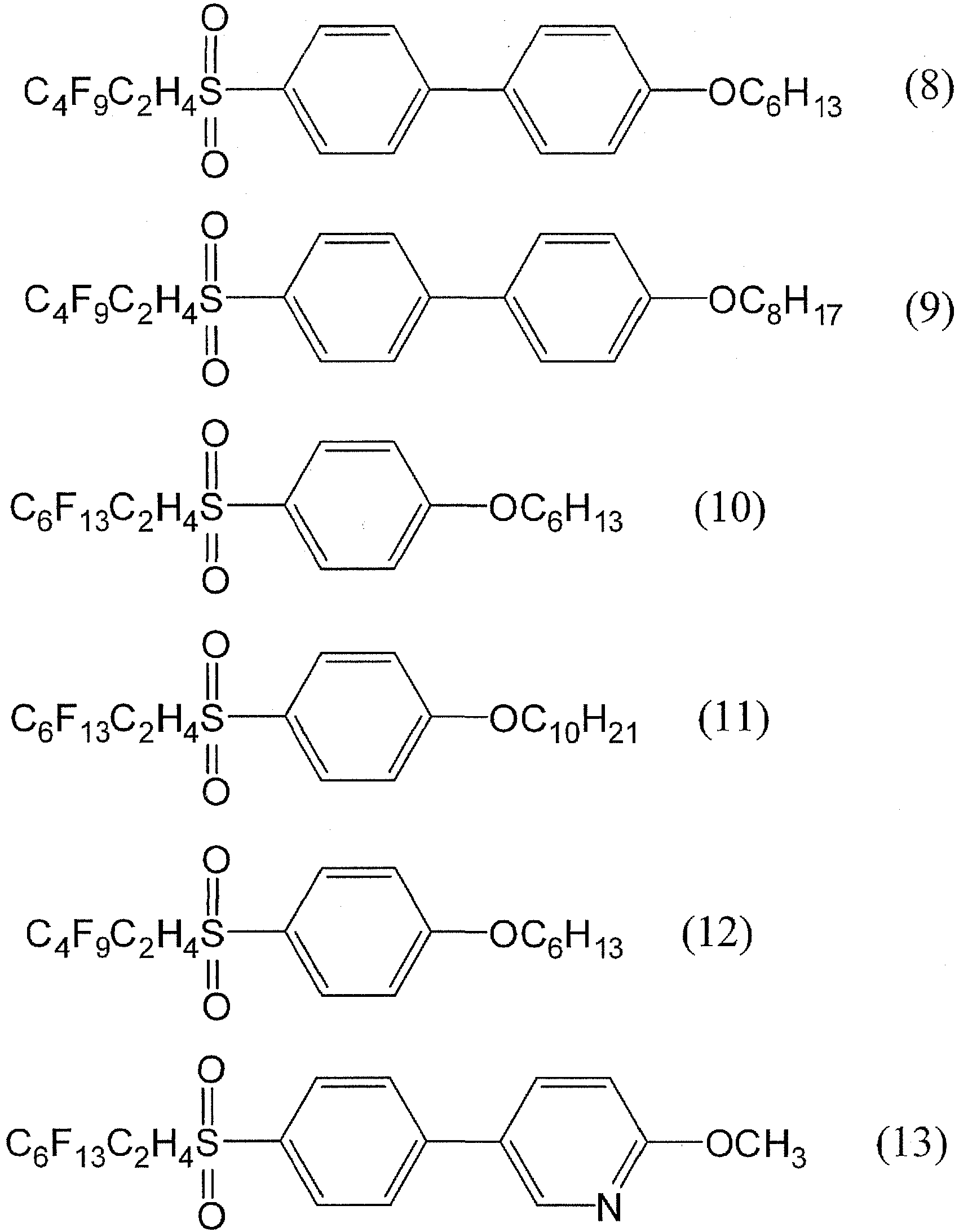
- The compound represented by the above formula (3) (referred to as the compound (3); the same applies hereinafter) was synthesized as follows.
- A compound (a) was prepared according to the following scheme. Specifically, 4.88 g (4.82 × 10⁻² mol) of triethylamine was added to a 100-mL dry tetrahydrofuran (dry THF) solution of 15.04 g (3.17 × 10⁻² mol) of 2-(perfluorohexyl)ethyl iodide and 5.97 g (3.16 × 10⁻² mol) of p-bromothiophenol in a 200-mL round-bottomed flask, and the solution was refluxed in an oil bath at 84°C for 20 hours. After the temperature of the solution was returned to room temperature, since a solid was observed in the solution, the solid was removed by suction filtration.
- After the filtrate was transferred to a 300-mL separating funnel, cyclopentyl methyl ether was added, and an organic phase was washed twice with water, and anhydrous magnesium sulfate was added to the organic phase to dry the organic phase. The anhydrous magnesium sulfate was removed by filtration. An obtained filtrate was concentrated under reduced pressure, and a residue was recrystallized with ethanol. As a result, 12.36 g of a compound (a) was obtained (yield: 73%, melting point: 39 to 41°C). The structure of the compound (a) was identified by 1H-NMR.

- Then, a compound (b) was obtained according to the following scheme. Specifically, 2.75 g (2.83 × 10⁻² mol) of a 35% hydrogen peroxide solution was added to a 50-mL glacial acetic acid solution of 5.01 g (9.36 × 10⁻³ mol) of the compound (a) in a 300-mL round-bottomed flask, and stirred in an oil bath at 70°C for 89 hours. After the temperature of the solution was returned to room temperature, 5 mL of a 20% sodium hydrogensulfite aqueous solution was added to reduce unreacted hydrogen peroxide. At this time, although a solid already deposited in the solution, when 90 mL of water was added, a solid further deposited. After suction filtration, the solid was washed with water. As a result, 4.74 g of a compound (b) was obtained (yield: 89%, melting point: 127 to 129°C). The structure of the compound (b) was identified by 1H-NMR.

- Then, a compound (f), that is, the compound (3), was obtained according to the following scheme. Specifically, 0.60 g (3.95 × 10⁻³ mol) of 4-methoxyphenyl borate, 2.24 g (3.95 × 10⁻³ mol) of the compound (b), 30 mL of a 2M sodium carbonate aqueous solution, and 40 ml of 1,4-dioxane (an amount added until the solid was dissolved) were added in a 100-mL round-bottomed flask. After 0.13 g (5.80 × 10⁻⁴ mol) of palladium diacetate and 0.63 g (2.36 × 10⁻³ mol) of triphenylphosphine were added thereto, a Dimroth tube was attached to the round-bottomed flask, and the mixture was vigorously stirred in a N2 atmosphere at 95°C for 2.5 hours. After the mixture was cooled to room temperature, 50 mL of water was added to the mixture, which was then stirred at room temperature for 2.5 hours. After the mixture was transferred to a 300-mL separating funnel, 80 mL of ethyl acetate an organic solvent was added, and a water phase was removed. The water phase was extracted twice with 50 mL of ethyl acetate. These organic phases were combined, and washed once with 120 mL of a saturated sodium hydrogencarbonate aqueous solution, and twice with saturated brine. After the organic phase was transferred to a 200-mL conical flask, 0.2 g of active carbon was added to the organic phase, which was then stirred at room temperature for 30 min. Sodium sulfate was further added and stirred at room temperature for 1 hour.
- Celite was spread to a depth of 1 cm in a Nutsche, and a solid was removed by suction filtration using the Nutsche. After a filtrate was transferred to a 200-mL round-bottomed flask, the filtrate was concentrated under reduced pressure to obtain a solid (c) (the amount of the solid (c): 2.18 g). 20 mL of petroleum ether and 30 mL of methanol were added to the solid (c), but since the solid was not completely dissolved, the mixture was suction-filtrated to make a filtrate and a solid (d) (the amount of the solid (d): 1.24 g). The filtrate was concentrated under reduced pressure to make a solid (e) (the amount of the solid (e): 0.78 g). As a result of the measurement of 1H-NMR spectra of the solids (d) and (e), the main component of the solid (d) was found to be a target material. Since black microcrystals were observed in the solution when the solid (d) was dissolved in chloroform, the solution was taken by a glass injection syringe, and the microcrystals were removed through a cylinder filter (pore diameter: 0.45 µm, diameter: 13 mm). The solution passed through the filter was concentrated under reduced pressure, and the recrystallization was carried out with chloroform. In order to raise the yield, the filtrate after the recrystallization was concentrated under reduced pressure, and the recrystallization was twice carried out with chloroform and with ethanol. As a result of the recrystallizations of 3 times in total, 0.87 g of a compound (f) was obtained (yield: 37%, melting point: 187 to 189°C). The structure of the obtained compound (f) was identified by 1H-NMR (CDCl3) and 19F-NMR (CDCl3). The results were as follows.
1H-NMR(CDCl3) 2.63 (2H, m), 3.36 (2H, m), 3.88 (3H, s), 7.03 (2H, d, J=8.5 Hz), 7.58 (2H, d, J=8.5 Hz), 7.77 (2H, d, J=8.5 Hz) 7.97 (2H, d, J=8.5 Hz) ppm 19F-NMR(CDCl3) -126.60 (2F, m), -123.60 (2F, m), -123.34 (2F, m), -122.35 (2F, m), - 114.02 (2F, m), -81.25 (3F, m) ppm
- In addition, the compound represented by the above formula (4) (referred to as the compound (4); the same applies hereinafter) was synthesized as follows. The compound (5), the compound (6), the compound (7), the compound (8), and the compound (9) were also synthesized according to the synthesis method of the compound (4).
- First, a compound (a) was obtained according to the following scheme. Specifically, 11.34 g (60 mmol) of p-bromothiophenol was charged in a 200-mL round-bottomed flask in a nitrogen atmosphere, and 70 mL of DME was added thereto. 29.86 g (63 mmol) of 2-(perfluorohexyl)ethyl iodide and 12.42 g (90 mmol) of K2CO3 were further charged, and the mixture was heated at 50°C and stirred for 3 hours. After the temperature of the mixture was returned to room temperature, a solid remaining in the mixture was removed by suction filtration. A filtrate after the removal of the solid was concentrated under reduced pressure. A high-viscosity oily material was obtained by the concentration, and then, the oily material was vacuum-dried at 50°C, and the remaining solvent and unreacted materials were distilled out. As a result, 32.82 g of a compound (a) was obtained. The structure of the compound (a) was identified by 1H-NMR (CDCl3).


- Then, a compound (b) was obtained according to the following scheme. Specifically, 26 mL (300 mmol) of a 35% hydrogen peroxide solution was added to a 100-mL glacial acetic acid solution of 32.82 g of the compound (a) in a 200-mL round-bottomed flask under a nitrogen atmosphere, and the mixture was stirred in an oil bath at 70°C for 2 hours. After water was added thereto, a white solid produced was filtered by suction filtration; water was added to wash the solid twice; and hexane was further added to once wash the solid. The solid was further dried under reduced pressure at 90°C to obtain 26.34 g of a compound (b) (yield: 75%). The structure of the compound (b) was identified by 1H-NMR (CDCl3).
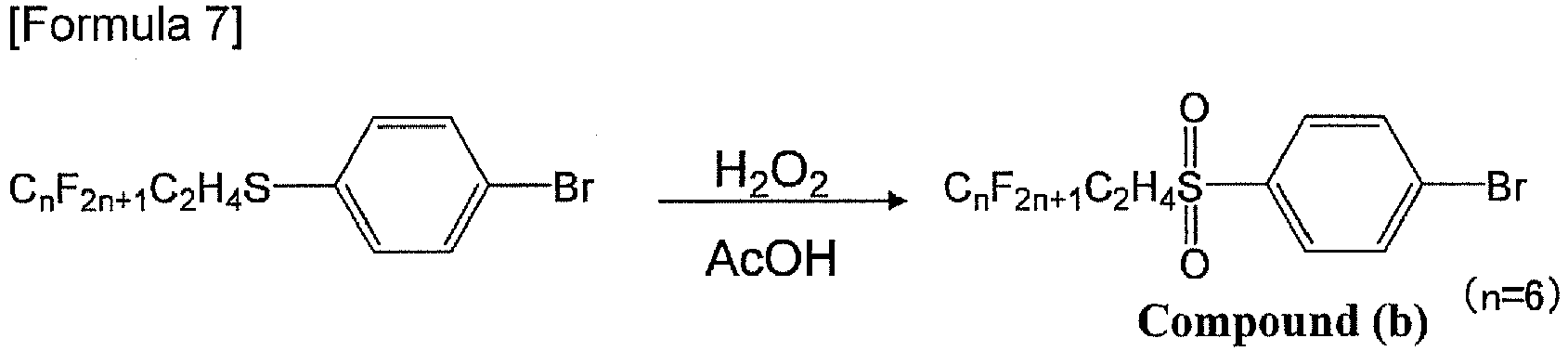
- Then, a compound (j) was obtained according to the following scheme. Specifically, 4.4 g (20 mmol) of a compound (i) shown below and 70 mL of 3-pentanone were charged in a 200-mL round-bottomed flask in a nitrogen atmosphere, and stirred at room temperature, and thereafter 4.13 g (25 mmol) of C6H13Br and 4.14 g (30 mmol) of K2CO3 were further added thereto, and refluxed in an oil bath at 120°C for 11 hours. After the temperature of the mixture was returned to room temperature, a solid remaining therein was removed by suction filtration. A filtrate after the removal of the solid was concentrated under reduced pressure to thereby obtain a brown oily material, and then, the oily material was vacuum-dried at 80°C to quantitatively obtain 6.87 g of a solid compound (j). The structure of the compound (j) was identified by 1H-NMR (CDCl3).

- Then, a compound (k), that is, the compound (4), was obtained according to the following scheme. Specifically, 2.0 g (6.58 mmol) of the compound (j), 3.7 g (6.58 mmol) of the compound (b), 60 ml of 1,4-dioxane, 0.295 g (1.31 mmol) of palladium diacetate, 1.18 g (4.5 mmol) of triphenylphosphine, and a 2M sodium carbonate aqueous solution (in which 7 g of sodium carbonate was dissolved in 30 mL of water) were charged in a 200-mL round-bottomed flask. Then, a Dimroth tube was attached to the round-bottomed flask, and the mixture was heated and held at 95°C for 120 min in a nitrogen atmosphere. Thereafter, the mixture was cooled to room temperature, and the separation into an upper phase (gelatinous) and a lower phase (liquid) was made sure of; and ethanol was added thereto in order to azeotropically boil water, and the solvent was thereafter distilled out by an evaporator. After ethyl acetate was added to the round-bottomed flask after the solvent had been distilled out, and the content was heated at 70°C to be dissolved, the ethyl acetate was filtered under the heating state. Then, a vessel containing an obtained filtrate was cooled to room temperature for the filtrate to be again gelatinized. Then, the obtained gelatinous material was washed three times with hexane until the supernatant solution became transparent. A solid obtained by filtering the washed gelatinous material was dried at 70°C under reduced pressure to obtain 2.38 g of a compound (k) (a white solid).

- The structure of the obtained compound (k), that is, the compound (4), was identified by 1H-NMR (CDCl3) and 19F-NMR (CDCl3). The results were as follows. 1H-NMR(CDCl3) 0.92 (3H, m), 1.36 (6H, m), 1.81 (2H, m), 2.65 (2H, m), 3.35 (2H, m), 4.02 (2H, m), 7.01 (2H, d, J=8.0 Hz), 7.56 (2H, d, J=8.0 Hz), 7.77 (2H, d, J=8.0Hz), 7.95 (2H, d, J=8.0 Hz) ppm
19F-NMR(CDCl3) -126.62 (2F, m), -123.60 (2F, m), -123.35 (2F, m), -122.36 (2F, m), - 114.01 (2F, m), -81.25 (3F, m) ppm - The structures of the compound (5), the compound (6), the compound (7), the compound (8), and the compound (9), also were similarly identified by 1H-NMR (CDCl3) and 19F-NMR (CDCl3). The results were as follows.
- [Compound (5)]
1H-NMR(CDCl3) 0.90 (3H, m), 1.31 (10H, m), 1.83 (2H, m), 2.67 (2H, m), 3.37 (2H, m), 4.03 (2H, m), 7.01 (2H, d, J=8.0 Hz), 7.58 (2H, d, J=8.0 Hz), 7.78 (2H, d, J=8.0 Hz), 7.97 (2H, d, J=8.0 Hz) ppm
19F-NMR(CDCl3) -126.62 (2F, m), -123.60 (2F, m), -123.34 (2F, m), -122.36 (2F, m), - 114.01 (2F, m), -81.25 (3F, m) ppm - [Compound (6)]
1H-NMR(CDCl3) 0.91 (3H, m), 1.42 (2H, m), 1.81 (2H, m), 2.65 (2H, m), 3.35 (2H, m), 4.03 (2H,m), 7.01 (2H, d, J=8.0 Hz), 7.57 (2H, d, J=8.0 Hz), 7.78 (2H, d, J=8.0 Hz), 7.97 (2H, d, J=8.0 Hz) ppm
19F-NMR(CDCl3) -126.62 (2F, m), -123.60 (2F, m), -123.34 (2F, m), -122.37 (2F, m), - 114.02 (2F, m), -81.25 (3F, m) ppm - [Compound (7)]
1H-NMR(CDCl3) 0.90 (3H, m), 1.82 (2H, m), 2.65 (2H, m), 3.34 (2H, m), 4.02 (2H,m), 7.00 (2H, d, J=8.0 Hz), 7.56 (2H, d, J=8.0 Hz), 7.76 (2H, d, J=8.0 Hz), 7.96 (2H, d, J=8.0 Hz) ppm
19F-NMR(CDCl3) -126.62 (2F, m), -123.60 (2F, m), -123.34 (2F, m), -122.36 (2F, m), - 114.02 (2F, m), -81.25 (3F, m) ppm - [Compound (8)]
1H-NMR(CDCl3) 0.92 (3H, m), 1.35 (6H, m), 1.80 (2H, m), 2.63 (2H, m), 3.35 (2H, m), 4.02 (2H, m), 7.01 (2H, d, J=8.0 Hz), 7.56 (2H, d, J=8.0 Hz), 7.77 (2H, d, J=8.0 Hz), 7.95 (2H, d, J=8.0 Hz) ppm
19F-NMR(CDCl3) -126.62 (2F, m), -124.50 (2F, m), -114.21 (2F, m), -81.45 (3F, m) ppm - [Compound (9)]
1H-NMR(CDCl3) 0.89 (3H, m), 1.35 (10H, m), 1.81 (2H, m), 2.65 (2H, m), 3.35 (2H, m), 4.01 (2H, m), 7.01 (2H, d, J=8.0 Hz), 7.56 (2H, d, J=8.0 Hz), 7.77 (2H, d, J=8.0 Hz), 7.95 (2H, d, J=8.0 Hz) ppm
19F-NMR(CDCl3) -126.50 (2F, m), -124.56 (2F, m), -124.24 (2F, m), -81.46 (3F, m) ppm - In addition, the compound (10) and the compounds (11) and (12) were synthesized according to the synthesis methods described in
WO 2009/78268 - [Compound (10)]
1H-NMR(CDCl3) 0.91 (3H, m), 1.36 (6H, m), 1.82 (2H, m), 2.57 (2H, m), 3.29 (2H, m), 4.04 (2H, m), 7.04 (2H, d, J=8.0 Hz), 7.83 (2H, d, J=8.0 Hz) ppm 19F-NMR(CDCl3) -126.59 (2F, m), -123.61 (2F, m), -123.32 (2F, m), -122.35 (2F, m), - 114.00 (2F, m), -81.26 (3F, m) ppm - [Compound (11)]
1H-NMR(CDCl3) 0.88 (3H, m), 1.27 (14H, m), 1.81 (2H, m), 2.57 (2H, m), 3.29 (2H, m), 4.04 (2H, m), 7.03 (2H, d, J=8.0 Hz), 7.83 (2H, d, J=8.0 Hz) ppm 19F-NMR(CDCl3) -126.61 (2F, m), -123.63 (2F, m), -123.33 (2F, m), -122.36 (2F, m), - 114.00 (2F, m), -81.24 (3F, m) ppm - [Compound (12)]
1H-NMR(CDCl3) 0.91 (3H, m), 1.35 (6H, m), 1.81 (2H, m), 2.57 (2H, m), 3.29 (2H, m), 4.04 (2H, m), 7.03 (2H, d, J=12.0 Hz), 7.83 (2H, d, J=8.0 Hz) ppm 19F-NMR(CDCl3) -126.49 (2F, m), -124.59 (2F, m), -114.24 (2F, m), -81.48 (3F, m) ppm - The compound (13) was synthesized as in the following scheme. Specifically, 1.21 g (0.0021 mol, the compound (b)) of 1-bromo-4-[(3,3,4,4,5,5,6,6,7,7,8,8,8-tridecafluorooctyl)sulfonyl]benzene, 0.5 g (0.0021 mol) of 2-methoxy-5-(4,4,5,5-tetramethyl-1,3,2-dioxaborolan-2-yl)pyridine, 40 mL of a 2M sodium carbonate aqueous solution, and 40 mL of 1,4-dioxane were added to a 100-mL round-bottomed flask in a nitrogen atmosphere. Triphenylphosphine (0.34 g, 0.0013 mol) and palladium acetate (0.0754 g, 0.00034 mol) were further added thereto, and the mixture was vigorously stirred at 95°C for 2.5 hours. After the flask atmosphere was returned to the air atmosphere, 50 mL of water was added thereto at room temperature, and stirred for 30 min to cool the interior.
After the completion of the reaction, a solid was observed in the flask, and ethyl acetate was added to dissolve the solid. The content was transferred to a separating funnel; after a water phase was removed, an organic phase was washed three times with 1 M hydrochloric acid, and washed once with water and with brine each. Magnesium sulfate was added thereto to dry the organic phase, and magnesium sulfate was removed by filtration. A filtrate was concentrated by an evaporator, and purified by silica gel column chromatography; and the recrystallization was carried out with ethanol to obtain 0.64 g of a solid (yield: 51%).
- The structure of the obtained compound (13) was identified by IR (KBr) and 1H-NMR (CDCl3). The results were as follows.
IR (KBr) v=1138.0, 1151.5, 1197.8, 1209.4, 1234.4, 1294.2, 1485.2, 1606.7 cm-1 1H-NMR (CDCl3) 2.24 (2H, m), 3.36 (2H, m), 4.01 (3H, s), 6.88 (1H, d, J=8.5 Hz), 7.76 (2H, d, J=8.5 Hz), 7.83 (1H, dd, J=8.5 Hz, 2.5 Hz), 8.00 (2H,d, J=8.5 Hz), 8.45 (1H, d, J=2.5 Hz) ppm -
[Table 1] Example 1 Gelling agent type (3) Nonaqueous solvents Ethanol 5% Propylene carbonate 0.8% γ-butyrolactone 1.0% -
[Table 2] Example 2 Gelling agent type (4) Nonaqueous solvents Ethyl methyl carbonate 0.8% Propylene carbonate 0.5% γ-butyrolactone 0.5% Acetonitrile 0.5% N-methylpyrrolidone 0.5% 3-Pentanone 0.5% N,N-dimethylacetamide 0.6% Ethyl acetate 0.6% 1,4-Dioxane 0.5% Tetrahydrofuran 0.5% Ethanol 1.0% -
[Table 3] Ex. 3 Ex. 4 Ex. 5 Ex. 6 Ex. 7 Ex. 8 Comp. Ex. 1 Comp. Ex. 2 Comp. Ex. 3 Gelling agent type (4) (5) (6) (7) (8) (9) (10) (11) (12) Nonaqueous solvents Ethanol 1% 1% 1% 1.5% 3% 1% 5% 3% 5% Acetonitrile 0.5% 1% 1% 1% 1% 1% Not gelatinzed 3% Not gelatinized γ-butyrolactone 0.5% 1% 0.7% 1% 0.7% 0.7% 3% 3% Not gelatinized NMP 0.5% 0.5 % 0.5% 1.5% 1.0 % 1.0% Not gelatinized 3% Not gelatinized -
[Table 4] Ex. 3 Ex. 4 Ex. 5 Ex. 6 Ex. 7 Ex. 8 Comp. Ex. 1 Comp. Ex. 2 Comp. Ex. 3 Gelling agent type (4) (5) (6) (7) (8) (9) (10) (11) (12) Nonaqueous solvents Ethanol A A A B B A C C C Acetonitrile A A A A A A C A C γ-butyrolactone A A A A A A A A C NMP A A A A A A C A C -
[Table 5] Example 9 Example 10 Example 11 Gelling agent type (3) (4) (13) lonic liquids Bmim TFSI 1.2% 0.9% 1.7% Emim TFSI 1.2% 0.7% 1.8% P13 TFSI 1.3% 0.8% 1.8% TMPA TFSI 1.9% 1.0% 1.7% DEME TFSI 1.3% 0.9% 1.6% Bmim TFSI=1-butyl-3-methyl-imidazolium bis(trifluoromethanesulfonyl)imide
Emim TFSI=1-ethyl-3-methyl-imidazolium bis(trifluoromethanesulfonyl)imide P13 TFSI= N-methyl-N-propylpyrrolidinium ammonium bis(trifluoromethanesulfonyl)imide
TMPA TFSI= N,N,N-trimethyl-N-propylammonium bis(trifluoromethanesulfonyl)imide DEME TFSI= N,N-diethyl-N-(2-methoxyethyl)ammonium bis(trifluoromethanesulfonyl)imide - Lithium cobaltate (LiCoO2) as a positive electrode active substance, acetylene black as an electroconductive aid, and a polyvinylidene difluoride (PVdF) as a binder were mixed in a mass ratio of 89.5 : 4.5 : 6.0. The obtained mixture was further mixed with N-methyl-2-pyrrolidone to prepare a slurry solution. The slurry solution was applied on an aluminum foil of 20 µm in thickness and 200 mm in width; after the solvent was dried and removed, the applied slurry was rolled by a roll press, and further vacuum-dried at 150°C for 10 hours, and punched out into a rectangular shape of 50 mm × 30 mm to obtain a positive electrode. The slurry solution was prepared while with respect to the mixture of the obtained electrode after the vacuum-drying, the solvent amount was regulated so that: the weight basis for one surface became 24.8 g/cm2 ± 3%; the thickness for the one surface, 82.6 µm ± 3%; the density, 3.0 g/cm3 ± 3%; and the coating width, 150 mm to the width of 200 mm of the aluminum foil.
- A graphite carbon powder (trade name: "MCMB25-28", made by Osaka Gas Chemical Co., Ltd.) as a negative electrode active substance, acetylene black as an electroconductive aid, and a polyvinylidene difluoride (PVdF) as a binder were mixed in a mass ratio of 93.0 : 2.0 : 5.0. The obtained mixture was further mixed with N-methyl-2-pyrrolidone to prepare a slurry solution. The slurry solution was applied on an aluminum foil of 14 µm in thickness and 200 mm in width; after the solvent was dried and removed, the applied slurry was rolled by a roll press, and further vacuum-dried at 150°C for 10 hours, and punched out into 52 mm × 32 mm to obtain a negative electrode. The slurry solution was prepared while with respect to the mixture of the obtained electrode after the vacuum-drying, the solvent amount was regulated so that: the weight basis for one surface became 11.8 g/cm2 ± 3%; the thickness for the one surface, 84.6 µm ± 3%; the density, 1.4 g/cm3 ± 3%; and the coating width, 150 mm to the width of 200 mm of the aluminum foil.
- 5 parts by mass of the compound (4) was mixed in 100 parts by mass of dimethyl carbonate, and dissolved therein at 85°C to obtain a dimethyl carbonate solution (α). The solution (α) was applied on the positive electrode under heating so that the positive electrode active substance and the compound (4) became 4 : 1 in mass ratio. After the application, the dimethyl carbonate was distilled out by continuing heating from the rear surface of the electrode, to cast-coat the compound (4) on the positive electrode.
Similarly, the solution (α) was applied on the negative electrode with the solution (α) in a heated state so that the negative electrode substance and the compound (4) became 2 : 1 in mass ratio; and the dimethyl carbonate was distilled out by further continuing heating to cast-coat the compound (4) on the negative electrode. - Two sheets of laminate film (no drawing processing, thickness: 120 µm, 68 mm × 48 mm) obtained by laminating an aluminum layer and a resin layer were overlapped with the aluminum layers outward, and three sides were sealed to fabricate a laminate cell outer package. Then, a polyethylene microporous membrane (membrane thickness: 20 µm, 53 mm × 33 mm) as a separator was prepared; and a laminate obtained by stacking alternately the positive electrode and the negative electrode coated with the compound (4) as described above through the separator in plural numbers was arranged in the laminate cell outer package. Then, an electrolyte solution was injected in the cell outer package to immerse the laminate in the electrolyte solution. The electrolyte solution used was one in which 1 M of LiPF6 was dissolved in a mixed solution of ethylene carbonate and methyl ethyl carbonate of 1 : 2 in volume ratio. The injection of the electrolyte solution was carried out by repeating reducing the pressure to 100 mmHg and increasing the pressure to the atmospheric pressure until the bubble generation vanishes. Under a reduced pressure environment of 100 mmHg, the remaining one side of the laminate cell outer package was sealed to thereby obtain a lithium ion secondary battery.
For the obtained lithium ion secondary battery, "(iii) Test of lithium deposition of a lithium ion secondary battery" was carried out. The result is shown in Table 6. - Batteries were assembled as in Example 12, except for altering the presence and absence of coating of the compound (4) on the each electrode, and "(iii) Test of lithium deposition of a lithium ion secondary battery" was carried out. The evaluation results are shown in Table 6.
-
[Table 6] Example 12 Example 13 Example 14 Comparative Example4 Coating of compound (4) Positive electrode present present absent absent Negative electrode present absent present absent Deposition B B B c - 5.3 parts by mass of the compound (13) was added to 100 parts by mass of P13 TFSI being an ionic liquid, and heated to 80°C to dissolve the mixture, and the solution was cooled to room temperature to prepare an evaluation sample. The sample was subjected to "(iv) Test of the carbon dioxide absorption capacity". The evaluation result is shown in Table 7.
-
[Table 7] Example 15 Pressure of Carbon dioxide (MPaG) sorbed amount of carbon dioxide (mL/g) 0.2 3.5 0.4 6.9 0.6 10.5 0.8 13.8 - The fluoroalkane derivative, the gelling agent and the gelatinous composition according to the present invention can be used to solidify liquid substances in various types of industrial fields (for example, coating, cosmetic, pharmaceutical and medical, spilled petroleum-treating, electronic and optical, and environmental fields).
Claims (9)
- A fluoroalkane derivative represented by the following general formula (1):
R-SO2-Ar-O-R1 (1)
wherein Ar denotes a substituted or nonsubstituted divalent aromatic group having 8 to 30 atoms of the nucleus(es), R1 denotes a saturated or unsaturated monovalent hydrocarbon group having 1 to 20 carbon atoms, and R denotes a saturated or unsaturated monovalent hydrocarbon group having a perfluoroalkyl group and having 2 to 22 carbon atoms. - The fluoroalkane derivative according to claim 1, wherein the R is a group represented by the following general formula (2):
CmF2m+1CpH2p- (2)
wherein m denotes a natural number of 2 to 16, and p denotes an integer of 0 to 6. - The fluoroalkane derivative according to claim 1 or 2, wherein the Ar is a condensed ring having one or more aromatic hydrocarbon rings, or a group having a plurality of aromatic rings bonded to each other by a single bond(s), one or more of the aromatic rings being an aromatic hydrocarbon ring.
- The fluoroalkane derivative according to any one of claims 1 to 3, wherein the Ar is a biphenylene group.
- A gelling agent comprising a fluoroalkane derivative according to any one of claims 1 to 4.
- A gelatinous composition comprising a gelling agent according to claim 5 and an organic solvent.
- An electrode for an electrochemical device, comprising a fluoroalkane derivative according to any one of claims 1 to 4.
- An electrolyte solution for a dye-sensitized solar battery, comprising a fluoroalkane derivative according to any one of claims 1 to 4.
- A carbon dioxide-sorbing composition comprising a fluoroalkane derivative according to any one of claims 1 to 4, and an ionic liquid.
Applications Claiming Priority (2)
| Application Number | Priority Date | Filing Date | Title |
|---|---|---|---|
| JP2010029396 | 2010-02-12 | ||
| PCT/JP2011/052908 WO2011099572A1 (en) | 2010-02-12 | 2011-02-10 | Fluoroalkane derivative, gelling agent and gel composition |
Publications (3)
| Publication Number | Publication Date |
|---|---|
| EP2535328A1 true EP2535328A1 (en) | 2012-12-19 |
| EP2535328A4 EP2535328A4 (en) | 2013-04-17 |
| EP2535328B1 EP2535328B1 (en) | 2016-08-24 |
Family
ID=44367842
Family Applications (1)
| Application Number | Title | Priority Date | Filing Date |
|---|---|---|---|
| EP11742315.2A Not-in-force EP2535328B1 (en) | 2010-02-12 | 2011-02-10 | Fluoroalkane derivative, gelling agent and gel composition |
Country Status (5)
| Country | Link |
|---|---|
| EP (1) | EP2535328B1 (en) |
| JP (1) | JP5827014B2 (en) |
| KR (1) | KR101413775B1 (en) |
| CN (1) | CN102725266B (en) |
| WO (1) | WO2011099572A1 (en) |
Families Citing this family (10)
| Publication number | Priority date | Publication date | Assignee | Title |
|---|---|---|---|---|
| JP5457429B2 (en) | 2009-02-18 | 2014-04-02 | 旭化成イーマテリアルズ株式会社 | Electrolyte for lithium ion secondary battery and lithium ion secondary battery |
| CN102449842B (en) | 2009-06-10 | 2015-03-04 | 旭化成电子材料株式会社 | Electrolytic solution and lithium ion secondary battery utilizing same |
| JP5618287B2 (en) * | 2010-05-31 | 2014-11-05 | 国立大学法人山口大学 | Gelling agent and gel |
| JP5889030B2 (en) * | 2011-02-14 | 2016-03-22 | 旭化成イーマテリアルズ株式会社 | Method for producing polycyclic aromatic compound |
| JP5837843B2 (en) * | 2012-02-14 | 2015-12-24 | 旭化成株式会社 | Method for producing polycyclic aromatic compound having halogen atom |
| JP2014024777A (en) * | 2012-07-25 | 2014-02-06 | Asahi Kasei Corp | Method for producing polycyclic aromatic compound having halogen atom |
| JP6443915B2 (en) * | 2014-09-22 | 2018-12-26 | 国立大学法人山口大学 | Fluoroalkane derivative, gelling agent, liquid crystalline compound and gel composition |
| CN104677771B (en) * | 2015-03-26 | 2019-01-04 | 成都理工大学 | A method of shale porosity is determined based on magnetic suspension gravimetric method |
| JP6996840B2 (en) * | 2016-10-19 | 2022-02-03 | トヨタ自動車株式会社 | Negative electrode manufacturing method |
| CN110172014A (en) * | 2019-06-25 | 2019-08-27 | 江西科技师范大学 | A kind of gelling agent of fluid organic material, preparation method and applications |
Family Cites Families (8)
| Publication number | Priority date | Publication date | Assignee | Title |
|---|---|---|---|---|
| US5120876A (en) * | 1989-11-29 | 1992-06-09 | E. I. Du Pont De Nemours And Company | Fluorinated sulfones/ketones for nonlinear optics |
| WO1995027692A1 (en) * | 1994-04-08 | 1995-10-19 | Smithkline Beecham Corporation | Subtituted biphenyl tnf inhibitors |
| JPH08231942A (en) * | 1995-02-24 | 1996-09-10 | Nisshin Oil Mills Ltd:The | Gelling or solidifying agent for organic liquid |
| US6242654B1 (en) * | 1998-12-22 | 2001-06-05 | Mitsui Chemicals, Inc. | Preparation process of fluorine substituted aromatic compound |
| KR101198452B1 (en) * | 2003-08-25 | 2012-11-06 | 메르크 파텐트 게엠베하 | Mesogenic compounds, medium for electro-optical displays and electro-optical display |
| EP2221295B1 (en) * | 2007-12-17 | 2014-01-01 | National University Corporation Yamaguchi University | Gelling agent containing fluoroalkyl derivative |
| JP5457429B2 (en) * | 2009-02-18 | 2014-04-02 | 旭化成イーマテリアルズ株式会社 | Electrolyte for lithium ion secondary battery and lithium ion secondary battery |
| CN102449842B (en) * | 2009-06-10 | 2015-03-04 | 旭化成电子材料株式会社 | Electrolytic solution and lithium ion secondary battery utilizing same |
-
2011
- 2011-02-10 JP JP2011027706A patent/JP5827014B2/en not_active Expired - Fee Related
- 2011-02-10 CN CN201180007546.4A patent/CN102725266B/en not_active Expired - Fee Related
- 2011-02-10 EP EP11742315.2A patent/EP2535328B1/en not_active Not-in-force
- 2011-02-10 KR KR1020127012482A patent/KR101413775B1/en not_active Expired - Fee Related
- 2011-02-10 WO PCT/JP2011/052908 patent/WO2011099572A1/en not_active Ceased
Non-Patent Citations (3)
| Title |
|---|
| DATABASE CA [Online] CHEMICAL ABSTRACTS SERVICE, COLUMBUS, OHIO, US; 1991, TAM, WILSON ET AL: "Donor- and acceptor-substituted organic and organometallic compounds. Second-order nonlinear optical properties", XP002692142, retrieved from STN Database accession no. 1991:502156 & TAM, WILSON ET AL: "Donor- and acceptor-substituted organic and organometallic compounds. Second-order nonlinear optical properties", ACS SYMPOSIUM SERIES , 455(MATER. NONLINEAR OPT.), 158-69 CODEN: ACSMC8; ISSN: 0097-6156, 1991, * |
| LAP-TAK A. CHENG ET AL: "Quadratic hyperpolarizabilities of fluorinated sulfonyl and carbonyl aromatics: optimization of nonlinearity and transparency trade-off", PROCEEDINGS OF SPIE, vol. 1337, 1 December 1990 (1990-12-01), pages 203-214, XP055053380, ISSN: 0277-786X, DOI: 10.1117/12.22969 * |
| See also references of WO2011099572A1 * |
Also Published As
| Publication number | Publication date |
|---|---|
| JP5827014B2 (en) | 2015-12-02 |
| EP2535328B1 (en) | 2016-08-24 |
| KR101413775B1 (en) | 2014-06-30 |
| JP2011184436A (en) | 2011-09-22 |
| CN102725266A (en) | 2012-10-10 |
| KR20120068038A (en) | 2012-06-26 |
| WO2011099572A1 (en) | 2011-08-18 |
| EP2535328A4 (en) | 2013-04-17 |
| CN102725266B (en) | 2014-10-01 |
Similar Documents
| Publication | Publication Date | Title |
|---|---|---|
| EP2535328B1 (en) | Fluoroalkane derivative, gelling agent and gel composition | |
| US8399136B2 (en) | Electrolyte solution for lithium ion secondary battery, lithium ion secondary battery, fluoroalkane derivative and gelling agent | |
| US20150288031A1 (en) | Functionalized ionic liquid electrolytes for lithium ion batteries | |
| AU2017240747B2 (en) | Modified ionic liquids containing phosphorus | |
| KR102669779B1 (en) | Ionic liquids with silane functional groups | |
| US10840531B2 (en) | Two-electron redox active molecules with high capacity and energy density for energy storage applications | |
| US8795904B2 (en) | Nonaqueous electrolyte solvents and additives | |
| JPWO2006106655A1 (en) | Electrolyte | |
| WO1995026056A1 (en) | Ionic conducting material having good anticorrosive properties | |
| WO2014144845A2 (en) | Methods of enhancing electrochemical double layer capacitor (edlc) performance and edlc devices formed therefrom | |
| US20040222401A1 (en) | Electrochemically stable onium salts and electrolytes containing such for electrochemical capacitors | |
| KR102118480B1 (en) | Electrolyte salt and electrolyte for electricity storage device, and electricity storage device | |
| CN105655637A (en) | Lithium ion battery ion liquid and preparation method, and lithium ion battery electrolyte | |
| JP2015191851A (en) | Nonaqueous electrolyte and power storage device including the same | |
| JP2015530972A (en) | Carbonyl fluoride compound having triple bond, method for producing the same, and use thereof | |
| US20140199585A1 (en) | Low Symmetry Molecules And Phosphonium Salts, Methods Of Making And Devices Formed There From | |
| JP4710902B2 (en) | Electrolyte | |
| JP4820535B2 (en) | New imidazolium compounds | |
| Ghorai et al. | Polymer-based ionic liquids in lithium batteries | |
| JP2014005261A (en) | Cyano borate compound and electrolyte using the same | |
| US20150263543A1 (en) | Methods Of Enhancing Electrochemical Double Layer Capacitor (EDLC) Performance And EDLC Devices Formed Therefrom | |
| JP2003338320A (en) | Electrolyte for electrochemical device, its electrolytic solution or solid electrolyte, and battery | |
| WO2015151977A1 (en) | Zwitterionic compound and ion conductor | |
| Downing | The Characterization and Incorporation of the Novel Ionic Liquid 1-Ethyl-3-Methylimidazolium Mesyl Urea Into a Poly (Ethylene) Glycol-Based Polymer Electrolyte | |
| JP4478790B2 (en) | Room temperature molten salt and electrochemical device |
Legal Events
| Date | Code | Title | Description |
|---|---|---|---|
| PUAI | Public reference made under article 153(3) epc to a published international application that has entered the european phase |
Free format text: ORIGINAL CODE: 0009012 |
|
| 17P | Request for examination filed |
Effective date: 20120801 |
|
| AK | Designated contracting states |
Kind code of ref document: A1 Designated state(s): AL AT BE BG CH CY CZ DE DK EE ES FI FR GB GR HR HU IE IS IT LI LT LU LV MC MK MT NL NO PL PT RO RS SE SI SK SM TR |
|
| RIC1 | Information provided on ipc code assigned before grant |
Ipc: C09K 3/00 20060101ALI20130304BHEP Ipc: C07D 213/64 20060101ALI20130304BHEP Ipc: H01M 10/052 20100101ALI20130304BHEP Ipc: H01M 4/137 20100101ALI20130304BHEP Ipc: H01M 10/0565 20100101ALI20130304BHEP Ipc: H01M 4/133 20100101ALI20130304BHEP Ipc: H01M 4/13 20100101ALI20130304BHEP Ipc: H01M 4/131 20100101ALI20130304BHEP Ipc: C07C 317/22 20060101AFI20130304BHEP Ipc: H01M 14/00 20060101ALI20130304BHEP Ipc: H01M 8/06 20060101ALI20130304BHEP |
|
| A4 | Supplementary search report drawn up and despatched |
Effective date: 20130318 |
|
| DAX | Request for extension of the european patent (deleted) | ||
| 17Q | First examination report despatched |
Effective date: 20130515 |
|
| GRAP | Despatch of communication of intention to grant a patent |
Free format text: ORIGINAL CODE: EPIDOSNIGR1 |
|
| RIC1 | Information provided on ipc code assigned before grant |
Ipc: C09K 3/00 20060101ALI20160217BHEP Ipc: C07C 317/22 20060101AFI20160217BHEP Ipc: H01M 10/0565 20100101ALI20160217BHEP Ipc: C07D 213/64 20060101ALI20160217BHEP Ipc: H01M 8/06 20060101ALI20160217BHEP Ipc: H01M 4/13 20100101ALI20160217BHEP Ipc: H01G 11/50 20130101ALI20160217BHEP Ipc: H01M 4/133 20100101ALI20160217BHEP Ipc: H01M 8/0668 20160101ALI20160217BHEP Ipc: H01G 9/20 20060101ALI20160217BHEP Ipc: H01M 10/052 20100101ALI20160217BHEP Ipc: H01M 4/131 20100101ALI20160217BHEP Ipc: H01M 4/137 20100101ALI20160217BHEP Ipc: H01M 14/00 20060101ALI20160217BHEP |
|
| INTG | Intention to grant announced |
Effective date: 20160316 |
|
| GRAS | Grant fee paid |
Free format text: ORIGINAL CODE: EPIDOSNIGR3 |
|
| GRAA | (expected) grant |
Free format text: ORIGINAL CODE: 0009210 |
|
| AK | Designated contracting states |
Kind code of ref document: B1 Designated state(s): AL AT BE BG CH CY CZ DE DK EE ES FI FR GB GR HR HU IE IS IT LI LT LU LV MC MK MT NL NO PL PT RO RS SE SI SK SM TR |
|
| REG | Reference to a national code |
Ref country code: GB Ref legal event code: FG4D |
|
| REG | Reference to a national code |
Ref country code: CH Ref legal event code: EP |
|
| REG | Reference to a national code |
Ref country code: AT Ref legal event code: REF Ref document number: 822944 Country of ref document: AT Kind code of ref document: T Effective date: 20160915 |
|
| REG | Reference to a national code |
Ref country code: IE Ref legal event code: FG4D |
|
| REG | Reference to a national code |
Ref country code: DE Ref legal event code: R096 Ref document number: 602011029619 Country of ref document: DE |
|
| REG | Reference to a national code |
Ref country code: LT Ref legal event code: MG4D |
|
| REG | Reference to a national code |
Ref country code: NL Ref legal event code: MP Effective date: 20160824 |
|
| REG | Reference to a national code |
Ref country code: AT Ref legal event code: MK05 Ref document number: 822944 Country of ref document: AT Kind code of ref document: T Effective date: 20160824 |
|
| PG25 | Lapsed in a contracting state [announced via postgrant information from national office to epo] |
Ref country code: LT Free format text: LAPSE BECAUSE OF FAILURE TO SUBMIT A TRANSLATION OF THE DESCRIPTION OR TO PAY THE FEE WITHIN THE PRESCRIBED TIME-LIMIT Effective date: 20160824 Ref country code: HR Free format text: LAPSE BECAUSE OF FAILURE TO SUBMIT A TRANSLATION OF THE DESCRIPTION OR TO PAY THE FEE WITHIN THE PRESCRIBED TIME-LIMIT Effective date: 20160824 Ref country code: FI Free format text: LAPSE BECAUSE OF FAILURE TO SUBMIT A TRANSLATION OF THE DESCRIPTION OR TO PAY THE FEE WITHIN THE PRESCRIBED TIME-LIMIT Effective date: 20160824 Ref country code: RS Free format text: LAPSE BECAUSE OF FAILURE TO SUBMIT A TRANSLATION OF THE DESCRIPTION OR TO PAY THE FEE WITHIN THE PRESCRIBED TIME-LIMIT Effective date: 20160824 Ref country code: NL Free format text: LAPSE BECAUSE OF FAILURE TO SUBMIT A TRANSLATION OF THE DESCRIPTION OR TO PAY THE FEE WITHIN THE PRESCRIBED TIME-LIMIT Effective date: 20160824 Ref country code: NO Free format text: LAPSE BECAUSE OF FAILURE TO SUBMIT A TRANSLATION OF THE DESCRIPTION OR TO PAY THE FEE WITHIN THE PRESCRIBED TIME-LIMIT Effective date: 20161124 Ref country code: IT Free format text: LAPSE BECAUSE OF FAILURE TO SUBMIT A TRANSLATION OF THE DESCRIPTION OR TO PAY THE FEE WITHIN THE PRESCRIBED TIME-LIMIT Effective date: 20160824 |
|
| REG | Reference to a national code |
Ref country code: DE Ref legal event code: R082 Ref document number: 602011029619 Country of ref document: DE Representative=s name: DOMPATENT VON KREISLER SELTING WERNER - PARTNE, DE Ref country code: DE Ref legal event code: R081 Ref document number: 602011029619 Country of ref document: DE Owner name: YAMAGUCHI UNIVERSITY, JP Free format text: FORMER OWNERS: ASAHI KASEI E-MATERIALS CORPORATION, TOKYO, JP; YAMAGUCHI UNIVERSITY, YAMAGUCHI, JP Ref country code: DE Ref legal event code: R081 Ref document number: 602011029619 Country of ref document: DE Owner name: ASAHI KASEI KABUSHIKI KAISHA, JP Free format text: FORMER OWNERS: ASAHI KASEI E-MATERIALS CORPORATION, TOKYO, JP; YAMAGUCHI UNIVERSITY, YAMAGUCHI, JP |
|
| PG25 | Lapsed in a contracting state [announced via postgrant information from national office to epo] |
Ref country code: PT Free format text: LAPSE BECAUSE OF FAILURE TO SUBMIT A TRANSLATION OF THE DESCRIPTION OR TO PAY THE FEE WITHIN THE PRESCRIBED TIME-LIMIT Effective date: 20161226 Ref country code: SE Free format text: LAPSE BECAUSE OF FAILURE TO SUBMIT A TRANSLATION OF THE DESCRIPTION OR TO PAY THE FEE WITHIN THE PRESCRIBED TIME-LIMIT Effective date: 20160824 Ref country code: GR Free format text: LAPSE BECAUSE OF FAILURE TO SUBMIT A TRANSLATION OF THE DESCRIPTION OR TO PAY THE FEE WITHIN THE PRESCRIBED TIME-LIMIT Effective date: 20161125 Ref country code: ES Free format text: LAPSE BECAUSE OF FAILURE TO SUBMIT A TRANSLATION OF THE DESCRIPTION OR TO PAY THE FEE WITHIN THE PRESCRIBED TIME-LIMIT Effective date: 20160824 Ref country code: AT Free format text: LAPSE BECAUSE OF FAILURE TO SUBMIT A TRANSLATION OF THE DESCRIPTION OR TO PAY THE FEE WITHIN THE PRESCRIBED TIME-LIMIT Effective date: 20160824 Ref country code: LV Free format text: LAPSE BECAUSE OF FAILURE TO SUBMIT A TRANSLATION OF THE DESCRIPTION OR TO PAY THE FEE WITHIN THE PRESCRIBED TIME-LIMIT Effective date: 20160824 |
|
| PG25 | Lapsed in a contracting state [announced via postgrant information from national office to epo] |
Ref country code: EE Free format text: LAPSE BECAUSE OF FAILURE TO SUBMIT A TRANSLATION OF THE DESCRIPTION OR TO PAY THE FEE WITHIN THE PRESCRIBED TIME-LIMIT Effective date: 20160824 Ref country code: RO Free format text: LAPSE BECAUSE OF FAILURE TO SUBMIT A TRANSLATION OF THE DESCRIPTION OR TO PAY THE FEE WITHIN THE PRESCRIBED TIME-LIMIT Effective date: 20160824 |
|
| REG | Reference to a national code |
Ref country code: DE Ref legal event code: R097 Ref document number: 602011029619 Country of ref document: DE |
|
| PG25 | Lapsed in a contracting state [announced via postgrant information from national office to epo] |
Ref country code: BG Free format text: LAPSE BECAUSE OF FAILURE TO SUBMIT A TRANSLATION OF THE DESCRIPTION OR TO PAY THE FEE WITHIN THE PRESCRIBED TIME-LIMIT Effective date: 20161124 Ref country code: SK Free format text: LAPSE BECAUSE OF FAILURE TO SUBMIT A TRANSLATION OF THE DESCRIPTION OR TO PAY THE FEE WITHIN THE PRESCRIBED TIME-LIMIT Effective date: 20160824 Ref country code: BE Free format text: LAPSE BECAUSE OF FAILURE TO SUBMIT A TRANSLATION OF THE DESCRIPTION OR TO PAY THE FEE WITHIN THE PRESCRIBED TIME-LIMIT Effective date: 20160824 Ref country code: PL Free format text: LAPSE BECAUSE OF FAILURE TO SUBMIT A TRANSLATION OF THE DESCRIPTION OR TO PAY THE FEE WITHIN THE PRESCRIBED TIME-LIMIT Effective date: 20160824 Ref country code: CZ Free format text: LAPSE BECAUSE OF FAILURE TO SUBMIT A TRANSLATION OF THE DESCRIPTION OR TO PAY THE FEE WITHIN THE PRESCRIBED TIME-LIMIT Effective date: 20160824 Ref country code: DK Free format text: LAPSE BECAUSE OF FAILURE TO SUBMIT A TRANSLATION OF THE DESCRIPTION OR TO PAY THE FEE WITHIN THE PRESCRIBED TIME-LIMIT Effective date: 20160824 Ref country code: SM Free format text: LAPSE BECAUSE OF FAILURE TO SUBMIT A TRANSLATION OF THE DESCRIPTION OR TO PAY THE FEE WITHIN THE PRESCRIBED TIME-LIMIT Effective date: 20160824 |
|
| PLBE | No opposition filed within time limit |
Free format text: ORIGINAL CODE: 0009261 |
|
| STAA | Information on the status of an ep patent application or granted ep patent |
Free format text: STATUS: NO OPPOSITION FILED WITHIN TIME LIMIT |
|
| 26N | No opposition filed |
Effective date: 20170526 |
|
| PG25 | Lapsed in a contracting state [announced via postgrant information from national office to epo] |
Ref country code: SI Free format text: LAPSE BECAUSE OF FAILURE TO SUBMIT A TRANSLATION OF THE DESCRIPTION OR TO PAY THE FEE WITHIN THE PRESCRIBED TIME-LIMIT Effective date: 20160824 |
|
| PG25 | Lapsed in a contracting state [announced via postgrant information from national office to epo] |
Ref country code: MC Free format text: LAPSE BECAUSE OF FAILURE TO SUBMIT A TRANSLATION OF THE DESCRIPTION OR TO PAY THE FEE WITHIN THE PRESCRIBED TIME-LIMIT Effective date: 20160824 |
|
| REG | Reference to a national code |
Ref country code: CH Ref legal event code: PL |
|
| GBPC | Gb: european patent ceased through non-payment of renewal fee |
Effective date: 20170210 |
|
| PG25 | Lapsed in a contracting state [announced via postgrant information from national office to epo] |
Ref country code: CH Free format text: LAPSE BECAUSE OF NON-PAYMENT OF DUE FEES Effective date: 20170228 Ref country code: LI Free format text: LAPSE BECAUSE OF NON-PAYMENT OF DUE FEES Effective date: 20170228 |
|
| REG | Reference to a national code |
Ref country code: IE Ref legal event code: MM4A |
|
| REG | Reference to a national code |
Ref country code: FR Ref legal event code: ST Effective date: 20171031 |
|
| PG25 | Lapsed in a contracting state [announced via postgrant information from national office to epo] |
Ref country code: LU Free format text: LAPSE BECAUSE OF NON-PAYMENT OF DUE FEES Effective date: 20170210 |
|
| PG25 | Lapsed in a contracting state [announced via postgrant information from national office to epo] |
Ref country code: FR Free format text: LAPSE BECAUSE OF NON-PAYMENT OF DUE FEES Effective date: 20170228 |
|
| PG25 | Lapsed in a contracting state [announced via postgrant information from national office to epo] |
Ref country code: GB Free format text: LAPSE BECAUSE OF NON-PAYMENT OF DUE FEES Effective date: 20170210 Ref country code: IE Free format text: LAPSE BECAUSE OF NON-PAYMENT OF DUE FEES Effective date: 20170210 |
|
| PG25 | Lapsed in a contracting state [announced via postgrant information from national office to epo] |
Ref country code: MT Free format text: LAPSE BECAUSE OF NON-PAYMENT OF DUE FEES Effective date: 20170210 |
|
| PG25 | Lapsed in a contracting state [announced via postgrant information from national office to epo] |
Ref country code: AL Free format text: LAPSE BECAUSE OF FAILURE TO SUBMIT A TRANSLATION OF THE DESCRIPTION OR TO PAY THE FEE WITHIN THE PRESCRIBED TIME-LIMIT Effective date: 20160824 |
|
| PG25 | Lapsed in a contracting state [announced via postgrant information from national office to epo] |
Ref country code: HU Free format text: LAPSE BECAUSE OF FAILURE TO SUBMIT A TRANSLATION OF THE DESCRIPTION OR TO PAY THE FEE WITHIN THE PRESCRIBED TIME-LIMIT; INVALID AB INITIO Effective date: 20110210 |
|
| PG25 | Lapsed in a contracting state [announced via postgrant information from national office to epo] |
Ref country code: CY Free format text: LAPSE BECAUSE OF NON-PAYMENT OF DUE FEES Effective date: 20160824 |
|
| PG25 | Lapsed in a contracting state [announced via postgrant information from national office to epo] |
Ref country code: MK Free format text: LAPSE BECAUSE OF FAILURE TO SUBMIT A TRANSLATION OF THE DESCRIPTION OR TO PAY THE FEE WITHIN THE PRESCRIBED TIME-LIMIT Effective date: 20160824 |
|
| REG | Reference to a national code |
Ref country code: DE Ref legal event code: R082 Ref document number: 602011029619 Country of ref document: DE Representative=s name: DOMPATENT VON KREISLER SELTING WERNER - PARTNE, DE Ref country code: DE Ref legal event code: R081 Ref document number: 602011029619 Country of ref document: DE Owner name: YAMAGUCHI UNIVERSITY, JP Free format text: FORMER OWNERS: ASAHI KASEI KABUSHIKI KAISHA, TOKYO, JP; YAMAGUCHI UNIVERSITY, YAMAGUCHI, JP |
|
| PG25 | Lapsed in a contracting state [announced via postgrant information from national office to epo] |
Ref country code: TR Free format text: LAPSE BECAUSE OF FAILURE TO SUBMIT A TRANSLATION OF THE DESCRIPTION OR TO PAY THE FEE WITHIN THE PRESCRIBED TIME-LIMIT Effective date: 20160824 |
|
| PG25 | Lapsed in a contracting state [announced via postgrant information from national office to epo] |
Ref country code: IS Free format text: LAPSE BECAUSE OF FAILURE TO SUBMIT A TRANSLATION OF THE DESCRIPTION OR TO PAY THE FEE WITHIN THE PRESCRIBED TIME-LIMIT Effective date: 20161224 |
|
| PGFP | Annual fee paid to national office [announced via postgrant information from national office to epo] |
Ref country code: DE Payment date: 20220214 Year of fee payment: 12 |
|
| REG | Reference to a national code |
Ref country code: DE Ref legal event code: R119 Ref document number: 602011029619 Country of ref document: DE |
|
| PG25 | Lapsed in a contracting state [announced via postgrant information from national office to epo] |
Ref country code: DE Free format text: LAPSE BECAUSE OF NON-PAYMENT OF DUE FEES Effective date: 20230901 |