EP2534273B1 - Aluminium-copper alloy for casting - Google Patents
Aluminium-copper alloy for casting Download PDFInfo
- Publication number
- EP2534273B1 EP2534273B1 EP11709774.1A EP11709774A EP2534273B1 EP 2534273 B1 EP2534273 B1 EP 2534273B1 EP 11709774 A EP11709774 A EP 11709774A EP 2534273 B1 EP2534273 B1 EP 2534273B1
- Authority
- EP
- European Patent Office
- Prior art keywords
- alloy
- particles
- titanium
- aluminium
- casting
- Prior art date
- Legal status (The legal status is an assumption and is not a legal conclusion. Google has not performed a legal analysis and makes no representation as to the accuracy of the status listed.)
- Active
Links
Images




Classifications
-
- C—CHEMISTRY; METALLURGY
- C22—METALLURGY; FERROUS OR NON-FERROUS ALLOYS; TREATMENT OF ALLOYS OR NON-FERROUS METALS
- C22C—ALLOYS
- C22C1/00—Making non-ferrous alloys
- C22C1/10—Alloys containing non-metals
- C22C1/1036—Alloys containing non-metals starting from a melt
- C22C1/1047—Alloys containing non-metals starting from a melt by mixing and casting liquid metal matrix composites
- C22C1/1052—Alloys containing non-metals starting from a melt by mixing and casting liquid metal matrix composites by mixing and casting metal matrix composites with reaction
-
- C—CHEMISTRY; METALLURGY
- C22—METALLURGY; FERROUS OR NON-FERROUS ALLOYS; TREATMENT OF ALLOYS OR NON-FERROUS METALS
- C22C—ALLOYS
- C22C21/00—Alloys based on aluminium
- C22C21/12—Alloys based on aluminium with copper as the next major constituent
-
- B—PERFORMING OPERATIONS; TRANSPORTING
- B22—CASTING; POWDER METALLURGY
- B22D—CASTING OF METALS; CASTING OF OTHER SUBSTANCES BY THE SAME PROCESSES OR DEVICES
- B22D25/00—Special casting characterised by the nature of the product
-
- B—PERFORMING OPERATIONS; TRANSPORTING
- B22—CASTING; POWDER METALLURGY
- B22D—CASTING OF METALS; CASTING OF OTHER SUBSTANCES BY THE SAME PROCESSES OR DEVICES
- B22D27/00—Treating the metal in the mould while it is molten or ductile ; Pressure or vacuum casting
- B22D27/04—Influencing the temperature of the metal, e.g. by heating or cooling the mould
-
- C—CHEMISTRY; METALLURGY
- C22—METALLURGY; FERROUS OR NON-FERROUS ALLOYS; TREATMENT OF ALLOYS OR NON-FERROUS METALS
- C22C—ALLOYS
- C22C1/00—Making non-ferrous alloys
- C22C1/10—Alloys containing non-metals
-
- C—CHEMISTRY; METALLURGY
- C22—METALLURGY; FERROUS OR NON-FERROUS ALLOYS; TREATMENT OF ALLOYS OR NON-FERROUS METALS
- C22C—ALLOYS
- C22C21/00—Alloys based on aluminium
-
- C—CHEMISTRY; METALLURGY
- C22—METALLURGY; FERROUS OR NON-FERROUS ALLOYS; TREATMENT OF ALLOYS OR NON-FERROUS METALS
- C22C—ALLOYS
- C22C21/00—Alloys based on aluminium
- C22C21/12—Alloys based on aluminium with copper as the next major constituent
- C22C21/14—Alloys based on aluminium with copper as the next major constituent with silicon
-
- C—CHEMISTRY; METALLURGY
- C22—METALLURGY; FERROUS OR NON-FERROUS ALLOYS; TREATMENT OF ALLOYS OR NON-FERROUS METALS
- C22C—ALLOYS
- C22C21/00—Alloys based on aluminium
- C22C21/12—Alloys based on aluminium with copper as the next major constituent
- C22C21/16—Alloys based on aluminium with copper as the next major constituent with magnesium
-
- C—CHEMISTRY; METALLURGY
- C22—METALLURGY; FERROUS OR NON-FERROUS ALLOYS; TREATMENT OF ALLOYS OR NON-FERROUS METALS
- C22C—ALLOYS
- C22C21/00—Alloys based on aluminium
- C22C21/12—Alloys based on aluminium with copper as the next major constituent
- C22C21/18—Alloys based on aluminium with copper as the next major constituent with zinc
Definitions
- This invention relates to aluminium-copper alloys for casting. Aluminium-copper alloys have a potentially higher strength than other cast aluminium alloy systems such as aluminium-silicon alloys. However, the use of aluminium-copper alloys for high performance applications has been limited due to their relatively poor castability compared to aluminium-silicon alloys.
- UK patent application 2334966A discloses an aluminium-copper alloy in which substantially insoluble particles, preferably of titanium diboride or possibly of other materials such as silicon carbide, aluminium oxide, zirconium diboride, boron carbide, or boron nitride, occupy interdendritic regions of the alloy when it is cast. It would be expected that such particles, which normally are hard and brittle, would result in an unacceptable reduction in the ductility of the cast alloy, but in fact research has shown that good ductility is maintained, as the particles change the solidification characteristics of the alloy, eliminating macro-scale compositional inhomogeneity and reducing shrinkage porosity.
- the TiB 2 particles fill the interdendritic spaces as aluminium dendrites nucleate and begin to grow, and the presence of the TiB 2 particles restricts the movement of the remaining liquid metal through the interdendritic channels. This promotes a move towards mass feeding, which reduces the occurrence of both internal and surface connected shrinkage porosity.
- TiB 2 is a known grain refiner, the grain size remains very large (e.g. circa 1 mm). This unrefined grain structure can result in issues with hot tearing, particularly in sand castings, and can also lead to the formation of shrinkage porosity in large slow-cooled castings such as those produced by investment casting or sand casting.
- JP 11199960 discloses an aluminium alloy suitable for making engine cylinder head castings, which may contain titanium.
- the alloy is an aluminium-silicon alloy: such alloys fundamentally have much greater fluidity and castability than alloys containing little or no silicon, and do not suffer from the same level of hot tearing or shrinkage porosity as the latter alloys.
- an aluminium-copper alloy for casting comprising: Cu 3.0 - 6.0 wt%; Mg 0.0 - 1.5 wt%; Ag 0.0 - 1.5 wt%; Mn 0.0 - 0.8 wt%; Fe 0.0 - 1.5 wt%; Si 0.0 - 1.5 wt%; Zn 0.0 - 4.0 wt%; Sb 0.0 - 0.5 wt%; Zr 0.0 - 0.5 wt%; Co 0.0 - 0.5 wt%; Free titanium > 0.15 - 1.0 wt%; Insoluble particles 0.5-20 wt%; and Al and inevitable impurities Balance, wherein the insoluble particles occupy the interdendritic regions of the alloy and comprise titanium diboride particles, and wherein the aluminium copper alloy comprises greater than 0.15 wt% free titanium, to result in a refinement of the grain structure in the cast alloy.
- the insoluble particles may have a particle size of 0.5 ⁇ m or greater. It may be up to 25 ⁇ m. Preferably, the particle size may be up to 15 ⁇ m, or up to 5 ⁇ m.
- the insoluble particles may be present in the range 0.5% to 10%, or 1.5% to 9%, or 3% to 9%, or 4% to 9%.
- the insoluble particles may be of a size which is at least in the region of an order of magnitude smaller than the dendrite arm spacing/grain size of the solid alloy and occupy the interdendritic/intergranular regions of the alloy.
- the particles comprise titanium diboride particles.
- the alloy may comprise 0.5% - 10% titanium diboride particles.
- the alloy may comprise 3% - 7% titanium diboride particles.
- the alloy may comprise 4% titanium diboride particles.
- the alloy may comprise 7% titanium diboride particles.
- Dispersed interdendritic porosity is also a characteristic of these alloys due to problems of feeding solidification shrinkage through the dendrite interstices. This type of porosity also causes a reduction in the mechanical properties of the material i.e. tensile strength and elongation and fatigue life.
- the addition of finely divided substantially insoluble particles changes the solidification characteristics of the alloy and they are not applied as a direct hardening mechanism for the alloy.
- the further addition of titanium at varying levels results in a significant reduction in grain size and further alters these solidification mechanisms, in the manner described hereafter.
- a method of making a casting comprising the step of melting an aluminium copper alloy according to the first aspect and introducing the resultant alloy into a mould.
- An alloy comprising*: Cu 4.35% Mg 0.42% Ag 0.70% Mn 0.01% Fe 0.01% Si 0.07% Zn 0.01% Ti 0.02% TiB 2 4.80%
- alloy A (not in accordance with the invention) was cast in a conventional manner.
- the alloy was cast into a resin bonded sand mould; the mould configuration is detailed in figure 1 .
- the test piece was poured directly from the crucible at a temperature of 850 deg C and the resultant casting was allowed to solidify in air.
- the resultant casting, figure 2 was sectioned as described in figure 3 and surface A, marked on figure 3 , was ground utilising silicon carbide grinding paper 120-1200 grit and polished using diamond compound and colloidal silica.
- the resultant surface was then etched using Kellers reagent and imaged using an optical macroscope and microscope.
- alloy B (not in accordance with the invention) and Cu 4.42% Mg 0.26% Ag 0.78% Mn 0.01% Fe 0.01% Si 0.04% Zn 0.01% Ti 0.44% TiB 2 4.58%
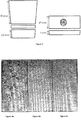
- these alloys contained between 1-9 % titanium diboride particles. These particles had a size lying in the range 0.5-15 microns. In the above example the grain size of the alloy was found to lie between 40 and 200 ⁇ m and the titanium diboride particle size lay in the range 0.5-15 ⁇ m; thus the particles were approximately an order of magnitude smaller than the grain size. When the three castings are compared on both a macro scale and a micro scale the relative reduction in grain size with increasing titanium level is clearly observed.
- Figure 4a shows, on a macro scale, the grain structure in the casting of alloy A.
- Figure 4b shows, on the same scale, the grain structure of the casting of alloy B, and
- Figure 4c shows the grain structure in the casting of alloy C. The relative reduction in grain size with increasing titanium level is clearly visible.
- Figures 5a, 5b and 5c illustrate the grain structure achieved in the three alloys, on a microscale.
- Alloy A, containing 0.02%* titanium exhibits an relatively equiaxed coarse grained dendritic structure, see figure 5a .
- Alloy B containing 0.15%* titanium exhibits a grain refined structure with some primary dendrite arms still visible, see figure 5b .
- Alloy C (according to the invention) containing 0.44%* titanium exhibits a fully grain refined homogenous structure, see figure 5c .
- This effect of increasing titanium weight % has an effect on the solidification mechanisms and solidified structure of the alloy. These altered solidification mechanisms occur due to the interaction of enhanced grain refinement (a result of activated TiB2 and or TiAl 3 ), and inactive 'pushed' TiB2 particles. This interaction results in a vastly reduced tendency for the alloy to hot-tear, a minimised cooling-rate effect on grain size and consequently more consistent mechanical properties across sections of varying thickness, improved surface finish, and, it also allows for a significant reduction in the level of feed metal required to yield a sound casting.
- the addition of hypoperitectic levels of titanium to the melt essentially activates the TiB 2 particles present in the alloy. Rather than the TiB 2 particles solely being utilised to affect liquid metal flow they serve the dual purpose of refining the grain structure of the alloy while also influencing the liquid metal flow and feeding mechanisms. Where TiB 2 is added purely as a grain refiner the addition level is as low as 0.004wt % and even at these levels, the efficiency of nucleation is 1-2%. In an alloy not according to the invention, the TiB 2 levels may be higher, thus there is a vast quantity of TiB 2 particles that remain inactive and these particles are pushed by the growing grains to the intergranular regions during solidification. This particle pushing coupled with the grain refinement observed from the addition of hypoperitectic levels of titanium results in significant benefits, as follows:
- the alloy becomes hyperperitectic with regard to the titanium content. Above this level TiAl 3 particles can form in the aluminium melt.
- the addition of hyperperitectic levels of titanium to the alloy results in a further unexpected decrease in grain size and further extremely important alterations to material solidification behaviour.
- the addition of hyperperitectic levels of titanium to an alloy already containing 4-5 wt% TiB 2 would be expected to have little further effect on grain refinement, but in accordance with the invention it was found that not only did the combined effects of both TiB 2 and the TiAl 3 reduce grain size it also had a significant effect on the solidification and feeding mechanisms, with resultant improvements in castability.
- TiAl 3 has been shown to be a more potent grain refiner than TiB 2 , thus in the liquid metal prior to solidification there is a vast number of TiAl 3 particles suspended along with TiB 2 particles.
- the TiAl 3 particles rapidly nucleate a very large number of aluminium grains, grain growth is inhibited by the TiB 2 particles as they are pushed to the grain boundaries.
- TiB 2 not every TiAl 3 particle will nucleate a grain, however unlike TiB 2 the TiAl 3 particles are engulfed by the advancing growth front rather than pushed, this is critical in maintaining alloy ductility.
- TiAl 3 in the melt results in a further reduction in grain size when compared to the hypoperitectic titanium addition and allows extremely fine grains to be formed at high cooling rates.
- it enables the formation of highly grain refined structures even in slow cooled sections.
- the grain refinement is still a function of cooling rate but the high level of grain refinement means that even at slow cooling rates the grain size is fine enough to allow for mass feeding to occur.
- hyperperitectic titanium not only can the gains observed previously in the hypoperitectic alloy be carried over to both sand and investment casting techniques, they actually facilitate further savings in terms of feed metal, resulting in increases in material yield and increases in material and energy efficiency.
- FIG. 5a illustrates the micro-structure of the alloy at very low wt% free titanium although the structure is equiaxed and shows some evidence of grain refinement the level of refinement is very low.
- Figure 6b shows the hypoperitectic micro-structure with up to 0.15 wt% of free titanium.
- TiB 2 can be observed in the centre of the aluminium grains and there are no aluminide particles present indicating that the alloy is below the peritectic threshold.
- Figure 6c shows that from 0.15 wt% titanium up to 1.0 wt% titanium, TiAL 3 can be observed in the centre of the aluminium grains indicating that the titanium level is above the peritectic threshold and the aluminides are now acting as nucleating particles.
- FIGs 7a and 7b respectively illustrate, in figure 7a , an exceptionally fine-grain structure which can be achieved when the cooling rate is extremely high, while figure 7b illustrates a coarser grain structure when the cooling rate is lower; these alloys contain hyperperitectic levels of titanium.
- the amount of free titanium necessary to refine the grain structure in the cast alloy and facilitate the move to mass feeding is related to the cooling rate of a casting made from the alloy.
- conventional sand casting and investment casting require titanium levels above the peritectic threshold due to the inherently low cooling rates.
- higher cooling rate casting processes such as die casting and heavily chilled sand casting can be grain refined using hypoperitectic levels of free titanium.
- the magnification of the mass feeding phenomenon observed in the hyperperitectic titanium range allows for significant reductions in feed metal required to yield a sound casting.
- Typical aluminium alloys require large reservoirs of liquid metal to supply the solidifying and contracting casting; if an area is isolated from a supply of liquid metal, porosity forms to compensate for the volumetric change as the casting solidifies and contracts. If the structure is mass feeding and the casting becomes a coherent structure at a much earlier stage in the solidification process and if, throughout solidification, there is no interdendritic movement of liquid metal then there is very little likelihood of shrinkage porosity arising.
Landscapes
- Chemical & Material Sciences (AREA)
- Mechanical Engineering (AREA)
- Engineering & Computer Science (AREA)
- Materials Engineering (AREA)
- Metallurgy (AREA)
- Organic Chemistry (AREA)
- Composite Materials (AREA)
- Chemical Kinetics & Catalysis (AREA)
- Powder Metallurgy (AREA)
- Manufacture Of Alloys Or Alloy Compounds (AREA)
- Conductive Materials (AREA)
- Mold Materials And Core Materials (AREA)
- Manufacture Of Metal Powder And Suspensions Thereof (AREA)
- Superconductors And Manufacturing Methods Therefor (AREA)
- Manufacture And Refinement Of Metals (AREA)
Description
- This invention relates to aluminium-copper alloys for casting. Aluminium-copper alloys have a potentially higher strength than other cast aluminium alloy systems such as aluminium-silicon alloys. However, the use of aluminium-copper alloys for high performance applications has been limited due to their relatively poor castability compared to aluminium-silicon alloys.
-
UK patent application 2334966A -
JP 11199960 - In accordance with a first aspect of the invention, an aluminium-copper alloy for casting, comprising:
Cu 3.0 - 6.0 wt%; Mg 0.0 - 1.5 wt%; Ag 0.0 - 1.5 wt%; Mn 0.0 - 0.8 wt%; Fe 0.0 - 1.5 wt%; Si 0.0 - 1.5 wt%; Zn 0.0 - 4.0 wt%; Sb 0.0 - 0.5 wt%; Zr 0.0 - 0.5 wt%; Co 0.0 - 0.5 wt%; Free titanium > 0.15 - 1.0 wt%; Insoluble particles 0.5-20 wt%; and Al and inevitable impurities Balance, - The insoluble particles may have a particle size of 0.5 µm or greater. It may be up to 25 µm. Preferably, the particle size may be up to 15 µm, or up to 5 µm.
- The insoluble particles may be present in the range 0.5% to 10%, or 1.5% to 9%, or 3% to 9%, or 4% to 9%.
- The insoluble particles may be of a size which is at least in the region of an order of magnitude smaller than the dendrite arm spacing/grain size of the solid alloy and occupy the interdendritic/intergranular regions of the alloy.
- The particles comprise titanium diboride particles.
- The alloy may comprise 0.5% - 10% titanium diboride particles.
- The alloy may comprise 3% - 7% titanium diboride particles.
- The alloy may comprise 4% titanium diboride particles.
- The alloy may comprise 7% titanium diboride particles.
- Two of the major aspects that have been identified as factors which lead to variability of mechanical properties and structural integrity in aluminium-copper based alloys, are the segregation of alloying elements and the formation of interdendritic porosity particularly that which is surface connected.
- Research on cast aluminium copper alloys has indicated that a significant factor contributing to the variability of the material properties of such alloys is the flow of solute rich material through the interstices between the dendrite arms created during solidification.
- In order to prevent or reduce these phenomena occurring, additions of finely divided substantially insoluble particles have been made in accordance with the invention. It would normally be expected that the addition of such particles, which are normally hard and brittle, would result in an unacceptable reduction in the ductility of the alloy. However the research carried out has shown that good ductility is maintained as will be seen from the example set out below.
- Dispersed interdendritic porosity is also a characteristic of these alloys due to problems of feeding solidification shrinkage through the dendrite interstices. This type of porosity also causes a reduction in the mechanical properties of the material i.e. tensile strength and elongation and fatigue life.
- It will be appreciated that, in the present invention, the addition of finely divided substantially insoluble particles changes the solidification characteristics of the alloy and they are not applied as a direct hardening mechanism for the alloy. The further addition of titanium at varying levels results in a significant reduction in grain size and further alters these solidification mechanisms, in the manner described hereafter.
- According to another aspect of this invention, we provide a method of making a casting comprising the step of melting an aluminium copper alloy according to the first aspect and introducing the resultant alloy into a mould.
- The invention will now be described by way of example with reference to the accompanying drawings, wherein;
-
Figure 1 is a diagrammatic view of the test-piece casting mould. -
Figure 2 is a diagrammatic view of the resultant casting. -
Figure 3 is a schematic of the resultant casting when sectioned for microscopic examination. -
Figure 4a, b, c are macroscopic images showing the reduction in grain size with increasing titanium levels 0.02 wt%*, 0.15 wt%*, 0.44 wt%*. -
Figure 5a, b, c are optical microscope image showing the alteration in microstructure with increasing titanium weight % 0.02 wt%*, 0.15 wt%*, 0.44 wt%*, respectively -
Figure 6a, b, c respectively illustrate, on an enlarged scale, the micro structure of alloys with increasing amounts of titanium. -
Figure 7a, b illustrate the effect on micro structure achieved by controlling the cooling rate of castings. - Note* All quoted weight percentages in this section are measured figures and so are subject to standard error. Compositional analysis was performed by inductively coupled plasma optical emission spectroscopy and is subject to a standard error of ±2% on the achieved figure
- An alloy comprising*:
Cu 4.35% Mg 0.42% Ag 0.70% Mn 0.01% Fe 0.01% Si 0.07% Zn 0.01% Ti 0.02% TiB2 4.80% - Denoted alloy A (not in accordance with the invention) was cast in a conventional manner.
- The alloy was cast into a resin bonded sand mould; the mould configuration is detailed in
figure 1 . The test piece was poured directly from the crucible at a temperature of 850 deg C and the resultant casting was allowed to solidify in air. The resultant casting,figure 2 , was sectioned as described infigure 3 and surface A, marked onfigure 3 , was ground utilising silicon carbide grinding paper 120-1200 grit and polished using diamond compound and colloidal silica. The resultant surface was then etched using Kellers reagent and imaged using an optical macroscope and microscope. - Alloys of similar composition comprising*
Cu 4.29% Mg 0.49% Ag 0.75% Mn 0.0% Fe 0.01% Si 0.05% Zn 0.01% Ti 0.15% TiB2 4.89% - Denoted alloy B (not in accordance with the invention) and
Cu 4.42% Mg 0.26% Ag 0.78% Mn 0.01% Fe 0.01% Si 0.04% Zn 0.01% Ti 0.44% TiB2 4.58% - Denoted alloy C (in accordance with the invention) were made in a similar manner.
- As can be seen from the above compositions, these alloys contained between 1-9 % titanium diboride particles. These particles had a size lying in the range 0.5-15 microns. In the above example the grain size of the alloy was found to lie between 40 and 200 µm and the titanium diboride particle size lay in the range 0.5-15 µm; thus the particles were approximately an order of magnitude smaller than the grain size. When the three castings are compared on both a macro scale and a micro scale the relative reduction in grain size with increasing titanium level is clearly observed.
-
Figure 4a shows, on a macro scale, the grain structure in the casting of alloy A.Figure 4b shows, on the same scale, the grain structure of the casting of alloy B, andFigure 4c shows the grain structure in the casting of alloy C. The relative reduction in grain size with increasing titanium level is clearly visible.Figures 5a, 5b and 5c illustrate the grain structure achieved in the three alloys, on a microscale. - Alloy A, containing 0.02%* titanium exhibits an relatively equiaxed coarse grained dendritic structure, see
figure 5a . - Alloy B containing 0.15%* titanium exhibits a grain refined structure with some primary dendrite arms still visible, see
figure 5b . - Alloy C (according to the invention) containing 0.44%* titanium exhibits a fully grain refined homogenous structure, see
figure 5c . - This effect of increasing titanium weight % has an effect on the solidification mechanisms and solidified structure of the alloy. These altered solidification mechanisms occur due to the interaction of enhanced grain refinement (a result of activated TiB2 and or TiAl3), and inactive 'pushed' TiB2 particles. This interaction results in a vastly reduced tendency for the alloy to hot-tear, a minimised cooling-rate effect on grain size and consequently more consistent mechanical properties across sections of varying thickness, improved surface finish, and, it also allows for a significant reduction in the level of feed metal required to yield a sound casting.
- The addition of free titanium affects the alloy in two ways, depending on the quantity of titanium added.
- Firstly, additions of titanium below 0.15 wt% are in the hypoperitectic region; this means that below this level TiAl3 particles will not form in the aluminium melt. However grain nucleation theory suggests that at hypoperitectic levels an atomically thin layer, similar in structure to TiAl3 forms on the surface of TiB2 particles, and this facilitates the nucleation of α-aluminium. It is by this mechanism that the addition of TiB2 to aluminium melts results in grain refinement, as the TiB2 particles act as heterogeneous nucleation sites for α-aluminium grains. The efficiency of these particles is thought to be in the region of 1-2% thus only a relatively small number of particles actually initiate a grain; the remaining particles are pushed to the grain boundaries by the growing aluminium grains.
- Thus, in an alloy not according to the invention, the addition of hypoperitectic levels of titanium to the melt essentially activates the TiB2 particles present in the alloy. Rather than the TiB2 particles solely being utilised to affect liquid metal flow they serve the dual purpose of refining the grain structure of the alloy while also influencing the liquid metal flow and feeding mechanisms. Where TiB2 is added purely as a grain refiner the addition level is as low as 0.004wt % and even at these levels, the efficiency of nucleation is 1-2%. In an alloy not according to the invention, the TiB2 levels may be higher, thus there is a vast quantity of TiB2 particles that remain inactive and these particles are pushed by the growing grains to the intergranular regions during solidification. This particle pushing coupled with the grain refinement observed from the addition of hypoperitectic levels of titanium results in significant benefits, as follows:
- A finer grain size results in smaller more uniform individual cell units and on solidification this facilitates the move to mass feeding observed in the alloy. Aluminium alloys contract on solidification; this is normally facilitated by liquid metal flow through the interdendritic regions, and areas which cannot be fed by liquid metal on contraction form voids known as shrinkage pores. The mass feeding principle works on the basis that due to the presence of the TiB2 particles in the interdendritic regions there is enough resistance to liquid metal flow that the alloy is forced to feed by bulk movement of the liquid/solid/particle agglomeration. This can only occur over a sustained period if the distribution of the particles is very homogenous which can only be guaranteed if the grain size is small and uniform.
- This dual use of the TiB2 particles as both a grain refiner and solidification/feeding modifier significantly improves the resistance to shrinkage porosity and hot tearing and also gives a more homogenous as cast structure
- The homogenous distribution of TiB2 particles throughout the solidified structure also allows for more consistent mechanical properties and the retention of elongation. A fine grain structure allows the TiB2 to be widely and evenly distributed throughout the solidified structure, if this was not the case then the TiB2 particles would cluster together and as a brittle ceramic would facilitate crack growth through the alloy reducing ductility significantly.
- The change from dendritic feeding to mass feeding has very important implications in terms of component running system design and feeding. One of the greatest issues with previously known aluminium - copper alloys is that in order to get a sound casting the casting must be fed with a large amount of liquid feed metal, and as a consequence material yields are very low. This impacts heavily on the cost effectiveness of the alloy, with large quantities of virgin metal being melted to yield relatively small components. The move to mass feeding allows for large reductions in feeding requirements which improves efficiency in terms of material usage and energy input per casting.
- However at this concentration of titanium grain refinement was found to be highly cooling rate dependent. Grain coarsening can occur in slow-cooled regions with the cellular structure becoming more globular and dendrite-like, this can negatively affect the alloy making it more susceptible to issues such as hot tearing and also negating the reduced feed metal requirements. Hence an alloy not according to the invention with this Ti range is most suitable for rapidly cooled systems; for example die casting.
- Above 0.15 wt% free titanium the alloy becomes hyperperitectic with regard to the titanium content. Above this level TiAl3 particles can form in the aluminium melt. The addition of hyperperitectic levels of titanium to the alloy results in a further unexpected decrease in grain size and further extremely important alterations to material solidification behaviour. Typically the addition of hyperperitectic levels of titanium to an alloy already containing 4-5 wt% TiB2 would be expected to have little further effect on grain refinement, but in accordance with the invention it was found that not only did the combined effects of both TiB2 and the TiAl3 reduce grain size it also had a significant effect on the solidification and feeding mechanisms, with resultant improvements in castability.
- The addition of titanium in this hyperperitectic region allows for the formation of TiAl3 particles, which form in the aluminium melt well above the liquidus. TiAl3 has been shown to be a more potent grain refiner than TiB2, thus in the liquid metal prior to solidification there is a vast number of TiAl3 particles suspended along with TiB2 particles. On solidification the TiAl3 particles rapidly nucleate a very large number of aluminium grains, grain growth is inhibited by the TiB2 particles as they are pushed to the grain boundaries. As with TiB2 not every TiAl3 particle will nucleate a grain, however unlike TiB2 the TiAl3 particles are engulfed by the advancing growth front rather than pushed, this is critical in maintaining alloy ductility. The formation of TiAl3 in the melt results in a further reduction in grain size when compared to the hypoperitectic titanium addition and allows extremely fine grains to be formed at high cooling rates. However more importantly it enables the formation of highly grain refined structures even in slow cooled sections. The grain refinement is still a function of cooling rate but the high level of grain refinement means that even at slow cooling rates the grain size is fine enough to allow for mass feeding to occur. Thus, with the addition of hyperperitectic titanium not only can the gains observed previously in the hypoperitectic alloy be carried over to both sand and investment casting techniques, they actually facilitate further savings in terms of feed metal, resulting in increases in material yield and increases in material and energy efficiency.
- The above effects on grain structure are illustrated in
figures 5a, b and c , and also infigure 6. Figure 6a illustrates the micro-structure of the alloy at very low wt% free titanium although the structure is equiaxed and shows some evidence of grain refinement the level of refinement is very low.Figure 6b shows the hypoperitectic micro-structure with up to 0.15 wt% of free titanium. Infigure 6b TiB2 can be observed in the centre of the aluminium grains and there are no aluminide particles present indicating that the alloy is below the peritectic threshold.Figure 6c shows that from 0.15 wt% titanium up to 1.0 wt% titanium, TiAL3 can be observed in the centre of the aluminium grains indicating that the titanium level is above the peritectic threshold and the aluminides are now acting as nucleating particles. - The addition of titanium allows for a wide range of as-cast grain sizes dependent on cooling rate.
Figures 7a and 7b respectively illustrate, infigure 7a , an exceptionally fine-grain structure which can be achieved when the cooling rate is extremely high, whilefigure 7b illustrates a coarser grain structure when the cooling rate is lower; these alloys contain hyperperitectic levels of titanium. - In general, as explained above the amount of free titanium necessary to refine the grain structure in the cast alloy and facilitate the move to mass feeding is related to the cooling rate of a casting made from the alloy. In general, for castings of comparable size to one another, conventional sand casting and investment casting require titanium levels above the peritectic threshold due to the inherently low cooling rates. However higher cooling rate casting processes such as die casting and heavily chilled sand casting can be grain refined using hypoperitectic levels of free titanium.
- The magnification of the mass feeding phenomenon observed in the hyperperitectic titanium range allows for significant reductions in feed metal required to yield a sound casting. Typical aluminium alloys require large reservoirs of liquid metal to supply the solidifying and contracting casting; if an area is isolated from a supply of liquid metal, porosity forms to compensate for the volumetric change as the casting solidifies and contracts. If the structure is mass feeding and the casting becomes a coherent structure at a much earlier stage in the solidification process and if, throughout solidification, there is no interdendritic movement of liquid metal then there is very little likelihood of shrinkage porosity arising.
- The practical result of this in the manufacture of casting is that the yield of a casting or castings from a given quantity of metal is greatly improved, i.e. the number of given components which can be cast from a particular quantity of metal is increased. This results in cost and energy savings, both in production of the castings and in post-casting processing of components.
- In addition, the reduction in grain size and the transformation from a dendritic to a cellular structure results in a reduction of both surface-related and, critically, internal, shrinkage porosity. This directly affects the fatigue performance of components cast from the alloy, as porosity is one of the most detrimental factors to fatigue life. Pores act as initiation points in fatigue-loaded specimens, and also affect crack propagation and final failure, by acting as stress concentrators and by reducing the load-bearing area.
- In this specification:
- All compositions are expressed in percentage by weight: In the phrase "insoluble particles", by "insoluble" we mean particles which are at least substantially insoluble in the alloy; by "particles" we mean particles of metal, or of inter-metallic compound or of ceramic material.
- When used in this specification and claims, the terms "comprises" and "comprising" and variations thereof mean that the specified features, steps or integers are included. The terms are not to be interpreted to exclude the presence of other features, steps or components.
Claims (8)
- An aluminium-copper alloy for casting, comprising:
Cu 3.0 - 6.0 wt%; Mg 0.0 - 1.5 wt%; Ag 0.0 - 1.5 wt%; Mn 0.0 - 0.8 wt%; Fe 0.0 - 1.5 wt%; Si 0.0 - 1.5 wt%; Zn 0.0 - 4.0 wt%; Sb 0.0 - 0.5 wt%; Zr 0.0 - 0.5 wt%; Co 0.0 - 0.5 wt%; Free titanium > 0.15 - 1.0 wt%; Insoluble particles 0.5-20 wt%; and Al and inevitable impurities Balance, - An alloy according to claim 1, wherein the insoluble particles have a particle size which lies in the range 0.5 to 25 µm.
- An alloy according to claim 2 wherein the particle size lies in the range 0.5 to 15 µm.
- An alloy according to claim 3 wherein the particle size lies in the range 0.5 to 5 µm.
- An alloy according to any preceding claim comprising 3 wt% - 7 wt% titanium diboride particles.
- An alloy according to claim 5 comprising 4 wt% titanium diboride particles.
- An alloy according to claim 5 comprising 7 wt% titanium diboride particles.
- A method of making a casting, comprising melting an aluminium copper alloy according to any one of the preceding claims and introducing the resulting alloy into a mould.
Priority Applications (2)
| Application Number | Priority Date | Filing Date | Title |
|---|---|---|---|
| PL11709774T PL2534273T3 (en) | 2010-02-10 | 2011-02-10 | Aluminium-copper alloy for casting |
| EP14184765.7A EP2837702A1 (en) | 2010-02-10 | 2011-02-10 | Aluminium-copper alloy for casting |
Applications Claiming Priority (2)
| Application Number | Priority Date | Filing Date | Title |
|---|---|---|---|
| GB1002236.6A GB2477744B (en) | 2010-02-10 | 2010-02-10 | Aluminium-copper alloy for casting |
| PCT/GB2011/050240 WO2011098813A2 (en) | 2010-02-10 | 2011-02-10 | Aluminium-copper alloy for casting |
Related Child Applications (1)
| Application Number | Title | Priority Date | Filing Date |
|---|---|---|---|
| EP14184765.7A Division EP2837702A1 (en) | 2010-02-10 | 2011-02-10 | Aluminium-copper alloy for casting |
Publications (2)
| Publication Number | Publication Date |
|---|---|
| EP2534273A2 EP2534273A2 (en) | 2012-12-19 |
| EP2534273B1 true EP2534273B1 (en) | 2014-10-01 |
Family
ID=42110503
Family Applications (2)
| Application Number | Title | Priority Date | Filing Date |
|---|---|---|---|
| EP11709774.1A Active EP2534273B1 (en) | 2010-02-10 | 2011-02-10 | Aluminium-copper alloy for casting |
| EP14184765.7A Withdrawn EP2837702A1 (en) | 2010-02-10 | 2011-02-10 | Aluminium-copper alloy for casting |
Family Applications After (1)
| Application Number | Title | Priority Date | Filing Date |
|---|---|---|---|
| EP14184765.7A Withdrawn EP2837702A1 (en) | 2010-02-10 | 2011-02-10 | Aluminium-copper alloy for casting |
Country Status (17)
| Country | Link |
|---|---|
| US (1) | US9033025B2 (en) |
| EP (2) | EP2534273B1 (en) |
| JP (1) | JP5810471B2 (en) |
| KR (1) | KR101738495B1 (en) |
| CN (1) | CN102834535B (en) |
| BR (1) | BR112012020160B1 (en) |
| CA (1) | CA2825253C (en) |
| DK (1) | DK2534273T3 (en) |
| ES (1) | ES2526297T3 (en) |
| GB (1) | GB2477744B (en) |
| IL (1) | IL221338A (en) |
| MX (1) | MX2012009353A (en) |
| PL (1) | PL2534273T3 (en) |
| RU (1) | RU2556247C2 (en) |
| TW (1) | TWI502075B (en) |
| WO (1) | WO2011098813A2 (en) |
| ZA (1) | ZA201206817B (en) |
Families Citing this family (23)
| Publication number | Priority date | Publication date | Assignee | Title |
|---|---|---|---|---|
| US20170268088A1 (en) | 2014-02-21 | 2017-09-21 | Terves Inc. | High Conductivity Magnesium Alloy |
| US10758974B2 (en) | 2014-02-21 | 2020-09-01 | Terves, Llc | Self-actuating device for centralizing an object |
| US11167343B2 (en) | 2014-02-21 | 2021-11-09 | Terves, Llc | Galvanically-active in situ formed particles for controlled rate dissolving tools |
| CA2936816A1 (en) | 2014-02-21 | 2015-08-27 | Terves, Inc. | Manufacture of controlled rate dissolving materials |
| US10150713B2 (en) | 2014-02-21 | 2018-12-11 | Terves, Inc. | Fluid activated disintegrating metal system |
| US10689740B2 (en) | 2014-04-18 | 2020-06-23 | Terves, LLCq | Galvanically-active in situ formed particles for controlled rate dissolving tools |
| CN110004339B (en) | 2014-04-18 | 2021-11-26 | 特维斯股份有限公司 | Electrochemically active in situ formed particles for controlled rate dissolution tool |
| US9943918B2 (en) | 2014-05-16 | 2018-04-17 | Powdermet, Inc. | Heterogeneous composite bodies with isolated cermet regions formed by high temperature, rapid consolidation |
| KR101637735B1 (en) * | 2014-11-19 | 2016-07-08 | 현대자동차주식회사 | Aluminum alloy having excellent formability and elasticity, and method for producing the same |
| CN104611617B (en) * | 2014-11-20 | 2016-08-24 | 中国航空工业集团公司北京航空材料研究院 | A kind of liquid forging Al-Cu-Zn aluminium alloy and preparation method thereof |
| CN104894444A (en) * | 2015-06-09 | 2015-09-09 | 苏州德翔装饰工程有限公司 | Aluminum alloy material for decoration and preparation method of aluminum alloy material |
| CN105112748A (en) * | 2015-09-08 | 2015-12-02 | 苏州慧驰轻合金精密成型科技有限公司 | High-strength cast aluminum and preparing method thereof |
| CA3012511A1 (en) | 2017-07-27 | 2019-01-27 | Terves Inc. | Degradable metal matrix composite |
| EP3880856A4 (en) * | 2018-11-16 | 2022-08-03 | Arconic Technologies LLC | 2XXX ALUMINUM ALLOYS |
| DE102019128675B3 (en) * | 2019-10-23 | 2021-03-11 | Volkswagen Aktiengesellschaft | Aluminum alloy, its use, as well as cylinder head |
| US20210121949A1 (en) * | 2019-10-25 | 2021-04-29 | Goodrich Corporation | Shape memory alloy particle toughening of cast or additive manufactured al-cu-mg-ag-tib2 |
| CN111020300B (en) * | 2019-12-05 | 2021-09-10 | 江苏大学 | Preparation method of thermal cracking resistant binary nanoparticle reinforced aluminum matrix composite |
| DE102020108781A1 (en) * | 2020-03-30 | 2021-09-30 | AM Metals GmbH | High-strength aluminum alloys for structural applications that can be processed using additive manufacturing |
| US20220170138A1 (en) * | 2020-12-02 | 2022-06-02 | GM Global Technology Operations LLC | Aluminum alloy for casting and additive manufacturing of engine components for high temperature applications |
| CN114855039B (en) * | 2021-02-03 | 2023-06-23 | 中国石油化工股份有限公司 | Al-Cu-Mg-Ag alloy and preparation method and application thereof |
| CN113073242B (en) * | 2021-03-26 | 2022-05-03 | 鹰潭市林兴建材有限公司 | Production method of aluminum alloy material with good conductivity |
| CN113943879B (en) * | 2021-07-07 | 2023-05-16 | 上海大学 | High-strength high-toughness Al-Cu- (Al-Ti-Nb-B) alloy and preparation method thereof |
| CN115007796B (en) * | 2022-05-30 | 2024-07-02 | 中信戴卡股份有限公司 | Riser tube coating for casting aluminum alloy and application method thereof |
Family Cites Families (21)
| Publication number | Priority date | Publication date | Assignee | Title |
|---|---|---|---|---|
| US3475166A (en) * | 1969-01-15 | 1969-10-28 | Electronic Specialty Co | Aluminum base alloy |
| SE349331B (en) | 1970-04-28 | 1972-09-25 | Svenska Aluminiumkompaniet Ab | |
| JPS59219444A (en) * | 1983-05-24 | 1984-12-10 | Toyota Motor Corp | Dispersion strengthened aluminum alloy |
| US4786467A (en) * | 1983-06-06 | 1988-11-22 | Dural Aluminum Composites Corp. | Process for preparation of composite materials containing nonmetallic particles in a metallic matrix, and composite materials made thereby |
| US5462712A (en) | 1988-08-18 | 1995-10-31 | Martin Marietta Corporation | High strength Al-Cu-Li-Zn-Mg alloys |
| US4943490A (en) * | 1989-08-07 | 1990-07-24 | Dural Aluminum Composites Corp. | Cast composite material having a matrix containing a stable oxide-forming element |
| JPH04120237A (en) | 1990-09-07 | 1992-04-21 | Furukawa Alum Co Ltd | Aluminum base high damping material and its manufacture |
| CA2030928A1 (en) * | 1990-11-27 | 1992-05-28 | David James Lloyd | Method of preparing improved eutectic or hyper-eutectic alloys and composites based thereon |
| GB2259308A (en) | 1991-09-09 | 1993-03-10 | London Scandinavian Metall | Metal matrix alloys |
| US5376192A (en) * | 1992-08-28 | 1994-12-27 | Reynolds Metals Company | High strength, high toughness aluminum-copper-magnesium-type aluminum alloy |
| HUP9801980A3 (en) * | 1995-03-31 | 1999-03-29 | Merck Patent Gmbh | Process and apparatus for producing ceramic reinforced al-alloy metal-matrix composit and ceramic reinforced al-alloy metal-matrix composit and flux for producing ceramic reinforced al-alloy metal-matrix composit |
| JPH09296245A (en) | 1996-04-30 | 1997-11-18 | Kyushu Mitsui Alum Kogyo Kk | Aluminum alloy for casting |
| EP0861911A4 (en) * | 1996-09-03 | 1999-09-08 | Toyota Motor Co Ltd | Alloy having excellent resistance against thermal fatigue, aluminum alloy having excellent resistance against thermal fatigue, and aluminum alloy member having excellent resistance against thermal fatigue |
| JP4132293B2 (en) * | 1997-10-15 | 2008-08-13 | 株式会社豊田中央研究所 | Aluminum alloy with excellent fatigue resistance |
| GB9804599D0 (en) * | 1998-03-05 | 1998-04-29 | Aeromet International Plc | Cast aluminium-copper alloy |
| US7547366B2 (en) * | 2004-07-15 | 2009-06-16 | Alcoa Inc. | 2000 Series alloys with enhanced damage tolerance performance for aerospace applications |
| US20080060723A1 (en) * | 2006-09-11 | 2008-03-13 | Gm Global Technology Operations, Inc. | Aluminum alloy for engine components |
| NO20065767L (en) * | 2006-12-13 | 2008-06-16 | Hydro Aluminium As | Aluminum stop alloy, method of manufacture, as well as stopped part for internal combustion engine. |
| CN100999796A (en) * | 2007-01-11 | 2007-07-18 | 上海交通大学 | In-situ particle strengthening heat resisting aluminium base composite material |
| US20080299001A1 (en) * | 2007-05-31 | 2008-12-04 | Alcan International Limited | Aluminum alloy formulations for reduced hot tear susceptibility |
| US8980021B2 (en) * | 2008-04-02 | 2015-03-17 | GM Global Technology Operations LLC | Metal treatment to eliminate hot tear defects in low silicon aluminum alloys |
-
2010
- 2010-02-10 GB GB1002236.6A patent/GB2477744B/en active Active
-
2011
- 2011-02-10 KR KR1020127023680A patent/KR101738495B1/en active Active
- 2011-02-10 CN CN201180018366.6A patent/CN102834535B/en active Active
- 2011-02-10 JP JP2012552470A patent/JP5810471B2/en active Active
- 2011-02-10 CA CA2825253A patent/CA2825253C/en active Active
- 2011-02-10 BR BR112012020160-3A patent/BR112012020160B1/en active IP Right Grant
- 2011-02-10 MX MX2012009353A patent/MX2012009353A/en active IP Right Grant
- 2011-02-10 US US13/578,215 patent/US9033025B2/en active Active
- 2011-02-10 EP EP11709774.1A patent/EP2534273B1/en active Active
- 2011-02-10 EP EP14184765.7A patent/EP2837702A1/en not_active Withdrawn
- 2011-02-10 PL PL11709774T patent/PL2534273T3/en unknown
- 2011-02-10 ES ES11709774.1T patent/ES2526297T3/en active Active
- 2011-02-10 WO PCT/GB2011/050240 patent/WO2011098813A2/en not_active Ceased
- 2011-02-10 DK DK11709774.1T patent/DK2534273T3/en active
- 2011-02-10 RU RU2012138290/02A patent/RU2556247C2/en active
- 2011-02-10 TW TW100104393A patent/TWI502075B/en active
-
2012
- 2012-08-07 IL IL221338A patent/IL221338A/en active IP Right Grant
- 2012-09-07 ZA ZA2012/06817A patent/ZA201206817B/en unknown
Also Published As
| Publication number | Publication date |
|---|---|
| TWI502075B (en) | 2015-10-01 |
| US9033025B2 (en) | 2015-05-19 |
| EP2837702A1 (en) | 2015-02-18 |
| BR112012020160A2 (en) | 2017-10-10 |
| JP2013519789A (en) | 2013-05-30 |
| JP5810471B2 (en) | 2015-11-11 |
| KR101738495B1 (en) | 2017-06-08 |
| KR20120136360A (en) | 2012-12-18 |
| GB2477744B (en) | 2014-06-04 |
| PL2534273T3 (en) | 2015-03-31 |
| CN102834535A (en) | 2012-12-19 |
| TW201142045A (en) | 2011-12-01 |
| BR112012020160B1 (en) | 2018-07-17 |
| IL221338A (en) | 2015-11-30 |
| WO2011098813A3 (en) | 2012-06-07 |
| US20130068411A1 (en) | 2013-03-21 |
| WO2011098813A4 (en) | 2012-09-13 |
| RU2556247C2 (en) | 2015-07-10 |
| GB2477744A (en) | 2011-08-17 |
| CA2825253C (en) | 2019-08-20 |
| CA2825253A1 (en) | 2011-08-18 |
| IL221338A0 (en) | 2012-10-31 |
| DK2534273T3 (en) | 2015-01-05 |
| RU2012138290A (en) | 2014-03-20 |
| CN102834535B (en) | 2015-12-09 |
| WO2011098813A2 (en) | 2011-08-18 |
| ZA201206817B (en) | 2013-05-29 |
| ES2526297T3 (en) | 2015-01-09 |
| MX2012009353A (en) | 2013-02-15 |
| EP2534273A2 (en) | 2012-12-19 |
| GB201002236D0 (en) | 2010-03-31 |
Similar Documents
| Publication | Publication Date | Title |
|---|---|---|
| CA2825253C (en) | Aluminium-copper alloy for casting | |
| CN114457263B (en) | High-strength high-toughness high-heat-conductivity die-casting aluminum alloy and manufacturing method thereof | |
| Soltani et al. | The effect of Ti on mechanical properties of extruded in-situ Al-15 pct Mg2Si composite | |
| JP7152977B2 (en) | aluminum alloy | |
| EP2415889B1 (en) | Al-mg-si-type aluminum alloy for casting which has excellent bearing force, and casted member comprising same | |
| CN107937764B (en) | Liquid die forging high-strength and high-toughness aluminum alloy and liquid die forging method thereof | |
| CN102869799A (en) | Aluminium die casting alloy | |
| Zhu et al. | Design of non-heat treatable high pressure die casting Al alloys: a review | |
| CN116000498B (en) | Preparation method of Al-Mg-Mn-Zn-Zr welding wire alloy cast ingot for high Jiang Ronghan | |
| JP2009108409A (en) | Al-Mg TYPE ALUMINUM ALLOY FOR FORGING, WITH EXCELLENT TOUGHNESS, AND CAST MEMBER COMPOSED THEREOF | |
| CN108048710A (en) | A kind of high tough aluminium alloy of extrusion casint and its extrusion casting method | |
| JPWO2003023080A1 (en) | Aluminum alloy for casting, aluminum alloy casting, and method for manufacturing aluminum alloy casting | |
| Su et al. | Simultaneous improvement of mechanical and castability properties of Al-Cu-Mn based alloys by Ca/Ni micro-alloying | |
| CN101368237B (en) | A kind of preparation method of silicon particle reinforced zinc-based composite material | |
| CN107075613A (en) | grain refiner for magnesium alloy | |
| KR970001410B1 (en) | Cast aluminum alloy | |
| JP3492681B2 (en) | Method for producing improved hypereutectic alloy and composite material based thereon | |
| CN115652156A (en) | Novel Mg-Gd-Li-Y-Al alloy and preparation method thereof | |
| Lim | Evaluation of Al-5Ti-1B and Al-10Sr in LM6 sand castings | |
| JP2025534295A (en) | Cast Aluminum Alloy | |
| Ramli et al. | Microstructure and mechanical properties of Al-Si cast alloy grain refined with Ti-B-Sr-Sc-Mg | |
| Hemanth | Development, mechanical properties, and fracture toughness of chilled Pb/Sb/Sn/As alloy-Al2SiO5 (kaolinite) metal matrix composites | |
| Kummari et al. | Grain refinement of Al-3.5 FeNb-1.5 C master alloy on pure Al and Al-9.8 Si-3.4 Cu alloy | |
| Chen et al. | Study on the Effect of Al-Ti-B-RE refiner on the refining effect of A356 aluminum alloy after different melt treatments | |
| Raj et al. | of ZA-27 Alloy |
Legal Events
| Date | Code | Title | Description |
|---|---|---|---|
| PUAI | Public reference made under article 153(3) epc to a published international application that has entered the european phase |
Free format text: ORIGINAL CODE: 0009012 |
|
| 17P | Request for examination filed |
Effective date: 20120910 |
|
| AK | Designated contracting states |
Kind code of ref document: A2 Designated state(s): AL AT BE BG CH CY CZ DE DK EE ES FI FR GB GR HR HU IE IS IT LI LT LU LV MC MK MT NL NO PL PT RO RS SE SI SK SM TR |
|
| DAX | Request for extension of the european patent (deleted) | ||
| 17Q | First examination report despatched |
Effective date: 20130814 |
|
| GRAP | Despatch of communication of intention to grant a patent |
Free format text: ORIGINAL CODE: EPIDOSNIGR1 |
|
| TPAC | Observations filed by third parties |
Free format text: ORIGINAL CODE: EPIDOSNTIPA |
|
| INTG | Intention to grant announced |
Effective date: 20140422 |
|
| TPAC | Observations filed by third parties |
Free format text: ORIGINAL CODE: EPIDOSNTIPA |
|
| GRAP | Despatch of communication of intention to grant a patent |
Free format text: ORIGINAL CODE: EPIDOSNIGR1 |
|
| GRAS | Grant fee paid |
Free format text: ORIGINAL CODE: EPIDOSNIGR3 |
|
| GRAA | (expected) grant |
Free format text: ORIGINAL CODE: 0009210 |
|
| INTG | Intention to grant announced |
Effective date: 20140811 |
|
| AK | Designated contracting states |
Kind code of ref document: B1 Designated state(s): AL AT BE BG CH CY CZ DE DK EE ES FI FR GB GR HR HU IE IS IT LI LT LU LV MC MK MT NL NO PL PT RO RS SE SI SK SM TR |
|
| REG | Reference to a national code |
Ref country code: GB Ref legal event code: FG4D |
|
| REG | Reference to a national code |
Ref country code: AT Ref legal event code: REF Ref document number: 689603 Country of ref document: AT Kind code of ref document: T Effective date: 20141015 Ref country code: CH Ref legal event code: EP |
|
| REG | Reference to a national code |
Ref country code: IE Ref legal event code: FG4D |
|
| REG | Reference to a national code |
Ref country code: DE Ref legal event code: R096 Ref document number: 602011010256 Country of ref document: DE Effective date: 20141113 |
|
| REG | Reference to a national code |
Ref country code: RO Ref legal event code: EPE |
|
| REG | Reference to a national code |
Ref country code: CH Ref legal event code: NV Representative=s name: E. BLUM AND CO. AG PATENT- UND MARKENANWAELTE , CH |
|
| REG | Reference to a national code |
Ref country code: DK Ref legal event code: T3 Effective date: 20141219 |
|
| REG | Reference to a national code |
Ref country code: ES Ref legal event code: FG2A Ref document number: 2526297 Country of ref document: ES Kind code of ref document: T3 Effective date: 20150109 |
|
| REG | Reference to a national code |
Ref country code: SE Ref legal event code: TRGR |
|
| REG | Reference to a national code |
Ref country code: NO Ref legal event code: T2 Effective date: 20141001 |
|
| REG | Reference to a national code |
Ref country code: NL Ref legal event code: T3 |
|
| REG | Reference to a national code |
Ref country code: SK Ref legal event code: T3 Ref document number: E 17683 Country of ref document: SK |
|
| REG | Reference to a national code |
Ref country code: LT Ref legal event code: MG4D |
|
| REG | Reference to a national code |
Ref country code: PL Ref legal event code: T3 |
|
| PG25 | Lapsed in a contracting state [announced via postgrant information from national office to epo] |
Ref country code: IS Free format text: LAPSE BECAUSE OF FAILURE TO SUBMIT A TRANSLATION OF THE DESCRIPTION OR TO PAY THE FEE WITHIN THE PRESCRIBED TIME-LIMIT Effective date: 20150201 Ref country code: PT Free format text: LAPSE BECAUSE OF FAILURE TO SUBMIT A TRANSLATION OF THE DESCRIPTION OR TO PAY THE FEE WITHIN THE PRESCRIBED TIME-LIMIT Effective date: 20150202 Ref country code: LT Free format text: LAPSE BECAUSE OF FAILURE TO SUBMIT A TRANSLATION OF THE DESCRIPTION OR TO PAY THE FEE WITHIN THE PRESCRIBED TIME-LIMIT Effective date: 20141001 |
|
| PG25 | Lapsed in a contracting state [announced via postgrant information from national office to epo] |
Ref country code: GR Free format text: LAPSE BECAUSE OF FAILURE TO SUBMIT A TRANSLATION OF THE DESCRIPTION OR TO PAY THE FEE WITHIN THE PRESCRIBED TIME-LIMIT Effective date: 20150102 Ref country code: HR Free format text: LAPSE BECAUSE OF FAILURE TO SUBMIT A TRANSLATION OF THE DESCRIPTION OR TO PAY THE FEE WITHIN THE PRESCRIBED TIME-LIMIT Effective date: 20141001 Ref country code: CY Free format text: LAPSE BECAUSE OF FAILURE TO SUBMIT A TRANSLATION OF THE DESCRIPTION OR TO PAY THE FEE WITHIN THE PRESCRIBED TIME-LIMIT Effective date: 20141001 Ref country code: LV Free format text: LAPSE BECAUSE OF FAILURE TO SUBMIT A TRANSLATION OF THE DESCRIPTION OR TO PAY THE FEE WITHIN THE PRESCRIBED TIME-LIMIT Effective date: 20141001 Ref country code: RS Free format text: LAPSE BECAUSE OF FAILURE TO SUBMIT A TRANSLATION OF THE DESCRIPTION OR TO PAY THE FEE WITHIN THE PRESCRIBED TIME-LIMIT Effective date: 20141001 |
|
| REG | Reference to a national code |
Ref country code: DE Ref legal event code: R097 Ref document number: 602011010256 Country of ref document: DE |
|
| REG | Reference to a national code |
Ref country code: HU Ref legal event code: AG4A Ref document number: E023305 Country of ref document: HU |
|
| PG25 | Lapsed in a contracting state [announced via postgrant information from national office to epo] |
Ref country code: EE Free format text: LAPSE BECAUSE OF FAILURE TO SUBMIT A TRANSLATION OF THE DESCRIPTION OR TO PAY THE FEE WITHIN THE PRESCRIBED TIME-LIMIT Effective date: 20141001 |
|
| PLBE | No opposition filed within time limit |
Free format text: ORIGINAL CODE: 0009261 |
|
| STAA | Information on the status of an ep patent application or granted ep patent |
Free format text: STATUS: NO OPPOSITION FILED WITHIN TIME LIMIT |
|
| 26N | No opposition filed |
Effective date: 20150702 |
|
| PG25 | Lapsed in a contracting state [announced via postgrant information from national office to epo] |
Ref country code: LU Free format text: LAPSE BECAUSE OF FAILURE TO SUBMIT A TRANSLATION OF THE DESCRIPTION OR TO PAY THE FEE WITHIN THE PRESCRIBED TIME-LIMIT Effective date: 20150210 |
|
| PG25 | Lapsed in a contracting state [announced via postgrant information from national office to epo] |
Ref country code: MC Free format text: LAPSE BECAUSE OF FAILURE TO SUBMIT A TRANSLATION OF THE DESCRIPTION OR TO PAY THE FEE WITHIN THE PRESCRIBED TIME-LIMIT Effective date: 20141001 |
|
| REG | Reference to a national code |
Ref country code: FR Ref legal event code: PLFP Year of fee payment: 6 |
|
| PG25 | Lapsed in a contracting state [announced via postgrant information from national office to epo] |
Ref country code: SI Free format text: LAPSE BECAUSE OF FAILURE TO SUBMIT A TRANSLATION OF THE DESCRIPTION OR TO PAY THE FEE WITHIN THE PRESCRIBED TIME-LIMIT Effective date: 20141001 |
|
| PG25 | Lapsed in a contracting state [announced via postgrant information from national office to epo] |
Ref country code: MT Free format text: LAPSE BECAUSE OF FAILURE TO SUBMIT A TRANSLATION OF THE DESCRIPTION OR TO PAY THE FEE WITHIN THE PRESCRIBED TIME-LIMIT Effective date: 20141001 |
|
| REG | Reference to a national code |
Ref country code: FR Ref legal event code: PLFP Year of fee payment: 7 |
|
| PG25 | Lapsed in a contracting state [announced via postgrant information from national office to epo] |
Ref country code: BG Free format text: LAPSE BECAUSE OF FAILURE TO SUBMIT A TRANSLATION OF THE DESCRIPTION OR TO PAY THE FEE WITHIN THE PRESCRIBED TIME-LIMIT Effective date: 20141001 Ref country code: SM Free format text: LAPSE BECAUSE OF FAILURE TO SUBMIT A TRANSLATION OF THE DESCRIPTION OR TO PAY THE FEE WITHIN THE PRESCRIBED TIME-LIMIT Effective date: 20141001 |
|
| REG | Reference to a national code |
Ref country code: FR Ref legal event code: PLFP Year of fee payment: 8 |
|
| PG25 | Lapsed in a contracting state [announced via postgrant information from national office to epo] |
Ref country code: MK Free format text: LAPSE BECAUSE OF FAILURE TO SUBMIT A TRANSLATION OF THE DESCRIPTION OR TO PAY THE FEE WITHIN THE PRESCRIBED TIME-LIMIT Effective date: 20141001 |
|
| PG25 | Lapsed in a contracting state [announced via postgrant information from national office to epo] |
Ref country code: AL Free format text: LAPSE BECAUSE OF FAILURE TO SUBMIT A TRANSLATION OF THE DESCRIPTION OR TO PAY THE FEE WITHIN THE PRESCRIBED TIME-LIMIT Effective date: 20141001 |
|
| REG | Reference to a national code |
Ref country code: CH Ref legal event code: PUE Owner name: ALUMINIUM MATERIALS TECHNOLOGIES LIMITED, GB Free format text: FORMER OWNER: AEROMET INTERNATIONAL PLC, GB |
|
| REG | Reference to a national code |
Ref country code: DE Ref legal event code: R081 Ref document number: 602011010256 Country of ref document: DE Owner name: ECKART GMBH, DE Free format text: FORMER OWNER: AEROMET INTERNATIONAL PLC, LONDON, GB Ref country code: DE Ref legal event code: R082 Ref document number: 602011010256 Country of ref document: DE Representative=s name: BOEHMERT & BOEHMERT ANWALTSPARTNERSCHAFT MBB -, DE Ref country code: DE Ref legal event code: R081 Ref document number: 602011010256 Country of ref document: DE Owner name: ALUMINIUM MATERIALS TECHNOLOGIES LIMITED, GB Free format text: FORMER OWNER: AEROMET INTERNATIONAL PLC, LONDON, GB |
|
| REG | Reference to a national code |
Ref country code: NL Ref legal event code: PD Owner name: ALUMINIUM MATERIALS TECHNOLOGIES LIMITED; GB Free format text: DETAILS ASSIGNMENT: CHANGE OF OWNER(S), CHANGE OF LEGAL ENTITY; FORMER OWNER NAME: AEROMET INTERNATIONAL PLC Effective date: 20200702 |
|
| REG | Reference to a national code |
Ref country code: ES Ref legal event code: PC2A Owner name: ALUMINIUM MATERILAS TECHNOLOGIES LIMITED Effective date: 20200717 |
|
| REG | Reference to a national code |
Ref country code: HU Ref legal event code: FH1C Free format text: FORMER REPRESENTATIVE(S): SZENTPETERI ZSOLT, SBGK SZABADALMI UEGYVIVOEI IRODA, HU Representative=s name: SBGK SZABADALMI UEGYVIVOEI IRODA, HU Ref country code: HU Ref legal event code: GB9C Owner name: ALUMINIUM MATERIALS TECHNOLOGIES LIMITED, GB Free format text: FORMER OWNER(S): AEROMET INTERNATIONAL PLC, GB |
|
| REG | Reference to a national code |
Ref country code: GB Ref legal event code: 732E Free format text: REGISTERED BETWEEN 20200709 AND 20200715 |
|
| REG | Reference to a national code |
Ref country code: FI Ref legal event code: PCE Owner name: ALUMINIUM MATERIALS TECHNOLOGIES LIMITED |
|
| REG | Reference to a national code |
Ref country code: NO Ref legal event code: CHAD Owner name: ALUMINIUM MATERIALS TECHNOLOGIES LIMITED, GB |
|
| REG | Reference to a national code |
Ref country code: BE Ref legal event code: HC Owner name: AEROMET INTERNATIONAL LIMITED; GB Free format text: DETAILS ASSIGNMENT: CHANGE OF OWNER(S), CHANGEMENT DE NOM DU PROPRIETAIRE; FORMER OWNER NAME: AEROMET INTERNATIONAL PLC Effective date: 20200805 Ref country code: BE Ref legal event code: PD Owner name: ALUMINIUM MATERIALS TECHNOLOGIES LIMITED; GB Free format text: DETAILS ASSIGNMENT: CHANGE OF OWNER(S), CESSION; FORMER OWNER NAME: AEROMET INTERNATIONAL LIMITED Effective date: 20200805 |
|
| REG | Reference to a national code |
Ref country code: SK Ref legal event code: PC4A Ref document number: E 17683 Country of ref document: SK Owner name: ALUMINIUM MATERIALS TECHNOLOGIES LIMITED, WORC, GB Free format text: FORMER OWNER: AEROMET INTERNATIONAL LIMITED, WORCESTER, GB Effective date: 20200825 Ref country code: SK Ref legal event code: TC4A Ref document number: E 17683 Country of ref document: SK Owner name: AEROMET INTERNATIONAL LIMITED, WORCESTER, GB Effective date: 20200825 |
|
| REG | Reference to a national code |
Ref country code: AT Ref legal event code: PC Ref document number: 689603 Country of ref document: AT Kind code of ref document: T Owner name: ALUMINIUM MATERIALS TECHNOLOGIES LIMITED, GB Effective date: 20200907 |
|
| REG | Reference to a national code |
Ref country code: NO Ref legal event code: CREP Representative=s name: BRYN AARFLOT AS, STORTINGSGATA 8, 0161 OSLO, NORGE Ref country code: NO Ref legal event code: CHAD Owner name: ECKART GMBH, DE |
|
| REG | Reference to a national code |
Ref country code: FI Ref legal event code: PCE Owner name: ECKART GMBH |
|
| REG | Reference to a national code |
Ref country code: SK Ref legal event code: PC4A Ref document number: E 17683 Country of ref document: SK Owner name: ECKART GMBH, HARTENSTEIN, DE Free format text: FORMER OWNER: ALUMINIUM MATERIALS TECHNOLOGIES LIMITED, WORCESTER, GB Effective date: 20220912 |
|
| REG | Reference to a national code |
Ref country code: BE Ref legal event code: PD Owner name: ECKART GMBH; DE Free format text: DETAILS ASSIGNMENT: CHANGE OF OWNER(S), ASSIGNMENT; FORMER OWNER NAME: ALUMINIUM MATERIALS TECHNOLOGIES LIMITED Effective date: 20220914 |
|
| REG | Reference to a national code |
Ref country code: AT Ref legal event code: PC Ref document number: 689603 Country of ref document: AT Kind code of ref document: T Owner name: ECKART GMBH, DE Effective date: 20221007 |
|
| REG | Reference to a national code |
Ref country code: GB Ref legal event code: 732E Free format text: REGISTERED BETWEEN 20230202 AND 20230208 |
|
| REG | Reference to a national code |
Ref country code: ES Ref legal event code: PC2A Owner name: ECKART GMBH Effective date: 20230306 |
|
| REG | Reference to a national code |
Ref country code: NL Ref legal event code: PD Owner name: ECKART GMBH; DE Free format text: DETAILS ASSIGNMENT: CHANGE OF OWNER(S), ASSIGNMENT; FORMER OWNER NAME: ALUMINIUM MATERIALS TECHNOLOGIES LIMITED Effective date: 20230310 |
|
| REG | Reference to a national code |
Ref country code: HU Ref legal event code: GB9C Owner name: ECKART GMBH, DE Free format text: FORMER OWNER(S): AEROMET INTERNATIONAL PLC, GB; ALUMINIUM MATERIALS TECHNOLOGIES LIMITED, GB Ref country code: HU Ref legal event code: FH1C Free format text: FORMER REPRESENTATIVE(S): SZENTPETERI ZSOLT, SBGK SZABADALMI UEGYVIVOEI IRODA, HU Representative=s name: SBGK SZABADALMI UEGYVIVOEI IRODA, HU |
|
| P01 | Opt-out of the competence of the unified patent court (upc) registered |
Effective date: 20230904 |
|
| REG | Reference to a national code |
Ref country code: DE Ref legal event code: R081 Ref document number: 602011010256 Country of ref document: DE Owner name: ECKART GMBH, DE Free format text: FORMER OWNER: ALUMINIUM MATERIALS TECHNOLOGIES LIMITED, WORCESTER, GB |
|
| PGFP | Annual fee paid to national office [announced via postgrant information from national office to epo] |
Ref country code: ES Payment date: 20250318 Year of fee payment: 15 |
|
| PGFP | Annual fee paid to national office [announced via postgrant information from national office to epo] |
Ref country code: PL Payment date: 20250204 Year of fee payment: 15 |
|
| REG | Reference to a national code |
Ref country code: CH Ref legal event code: U11 Free format text: ST27 STATUS EVENT CODE: U-0-0-U10-U11 (AS PROVIDED BY THE NATIONAL OFFICE) Effective date: 20260301 |
|
| PGFP | Annual fee paid to national office [announced via postgrant information from national office to epo] |
Ref country code: NL Payment date: 20260218 Year of fee payment: 16 |
|
| PGFP | Annual fee paid to national office [announced via postgrant information from national office to epo] |
Ref country code: HU Payment date: 20260220 Year of fee payment: 16 |
|
| PGFP | Annual fee paid to national office [announced via postgrant information from national office to epo] |
Ref country code: SE Payment date: 20260218 Year of fee payment: 16 |
|
| PGFP | Annual fee paid to national office [announced via postgrant information from national office to epo] |
Ref country code: GB Payment date: 20260219 Year of fee payment: 16 |
|
| PGFP | Annual fee paid to national office [announced via postgrant information from national office to epo] |
Ref country code: DE Payment date: 20260218 Year of fee payment: 16 Ref country code: NO Payment date: 20260220 Year of fee payment: 16 Ref country code: DK Payment date: 20260220 Year of fee payment: 16 Ref country code: IE Payment date: 20260218 Year of fee payment: 16 |
|
| PGFP | Annual fee paid to national office [announced via postgrant information from national office to epo] |
Ref country code: AT Payment date: 20260219 Year of fee payment: 16 |
|
| PGFP | Annual fee paid to national office [announced via postgrant information from national office to epo] |
Ref country code: FI Payment date: 20260226 Year of fee payment: 16 Ref country code: RO Payment date: 20260203 Year of fee payment: 16 Ref country code: BE Payment date: 20260218 Year of fee payment: 16 Ref country code: IT Payment date: 20260224 Year of fee payment: 16 |
|
| PGFP | Annual fee paid to national office [announced via postgrant information from national office to epo] |
Ref country code: FR Payment date: 20260218 Year of fee payment: 16 |
|
| PGFP | Annual fee paid to national office [announced via postgrant information from national office to epo] |
Ref country code: TR Payment date: 20260204 Year of fee payment: 16 |
|
| PGFP | Annual fee paid to national office [announced via postgrant information from national office to epo] |
Ref country code: CH Payment date: 20260301 Year of fee payment: 16 Ref country code: CZ Payment date: 20260202 Year of fee payment: 16 |
|
| PGFP | Annual fee paid to national office [announced via postgrant information from national office to epo] |
Ref country code: SK Payment date: 20260204 Year of fee payment: 16 |