EP2529503B1 - Quantumsschlüsselverteilungsverfahren und -vorrichtung - Google Patents
Quantumsschlüsselverteilungsverfahren und -vorrichtung Download PDFInfo
- Publication number
- EP2529503B1 EP2529503B1 EP11737715.0A EP11737715A EP2529503B1 EP 2529503 B1 EP2529503 B1 EP 2529503B1 EP 11737715 A EP11737715 A EP 11737715A EP 2529503 B1 EP2529503 B1 EP 2529503B1
- Authority
- EP
- European Patent Office
- Prior art keywords
- signal
- qkd
- clock signal
- transmission
- gps
- Prior art date
- Legal status (The legal status is an assumption and is not a legal conclusion. Google has not performed a legal analysis and makes no representation as to the accuracy of the status listed.)
- Not-in-force
Links
- 238000000034 method Methods 0.000 title claims description 15
- 230000005540 biological transmission Effects 0.000 claims description 41
- 230000001360 synchronised effect Effects 0.000 claims description 6
- 206010027339 Menstruation irregular Diseases 0.000 claims description 3
- 239000013078 crystal Substances 0.000 claims description 3
- 230000010287 polarization Effects 0.000 description 19
- 238000012937 correction Methods 0.000 description 11
- 238000005259 measurement Methods 0.000 description 10
- 238000012545 processing Methods 0.000 description 9
- 238000010586 diagram Methods 0.000 description 6
- 238000004891 communication Methods 0.000 description 5
- 230000001419 dependent effect Effects 0.000 description 4
- 230000003287 optical effect Effects 0.000 description 4
- 230000008569 process Effects 0.000 description 4
- 230000003321 amplification Effects 0.000 description 2
- 230000008901 benefit Effects 0.000 description 2
- 230000003111 delayed effect Effects 0.000 description 2
- 239000000835 fiber Substances 0.000 description 2
- 238000003199 nucleic acid amplification method Methods 0.000 description 2
- 230000009471 action Effects 0.000 description 1
- 238000013075 data extraction Methods 0.000 description 1
- 238000001514 detection method Methods 0.000 description 1
- 239000010931 gold Substances 0.000 description 1
- 229910052737 gold Inorganic materials 0.000 description 1
- 230000036541 health Effects 0.000 description 1
- 230000007257 malfunction Effects 0.000 description 1
- 238000012986 modification Methods 0.000 description 1
- 230000004048 modification Effects 0.000 description 1
- 239000010453 quartz Substances 0.000 description 1
- 230000001105 regulatory effect Effects 0.000 description 1
- 230000003252 repetitive effect Effects 0.000 description 1
- VYPSYNLAJGMNEJ-UHFFFAOYSA-N silicon dioxide Inorganic materials O=[Si]=O VYPSYNLAJGMNEJ-UHFFFAOYSA-N 0.000 description 1
- 238000001228 spectrum Methods 0.000 description 1
- 230000007480 spreading Effects 0.000 description 1
- 238000012546 transfer Methods 0.000 description 1
Images



Classifications
-
- H—ELECTRICITY
- H04—ELECTRIC COMMUNICATION TECHNIQUE
- H04L—TRANSMISSION OF DIGITAL INFORMATION, e.g. TELEGRAPHIC COMMUNICATION
- H04L9/00—Cryptographic mechanisms or cryptographic arrangements for secret or secure communications; Network security protocols
- H04L9/08—Key distribution or management, e.g. generation, sharing or updating, of cryptographic keys or passwords
- H04L9/0816—Key establishment, i.e. cryptographic processes or cryptographic protocols whereby a shared secret becomes available to two or more parties, for subsequent use
- H04L9/0852—Quantum cryptography
-
- H—ELECTRICITY
- H04—ELECTRIC COMMUNICATION TECHNIQUE
- H04B—TRANSMISSION
- H04B10/00—Transmission systems employing electromagnetic waves other than radio-waves, e.g. infrared, visible or ultraviolet light, or employing corpuscular radiation, e.g. quantum communication
- H04B10/70—Photonic quantum communication
-
- H—ELECTRICITY
- H04—ELECTRIC COMMUNICATION TECHNIQUE
- H04L—TRANSMISSION OF DIGITAL INFORMATION, e.g. TELEGRAPHIC COMMUNICATION
- H04L9/00—Cryptographic mechanisms or cryptographic arrangements for secret or secure communications; Network security protocols
- H04L9/12—Transmitting and receiving encryption devices synchronised or initially set up in a particular manner
Definitions
- QKD Quantum key distribution
- QKD methods typically involve QKD transmitting apparatus 10 (see Figure 1 of the accompanying drawings) using a QKD transmitter 12 to send a random data set provided by random source 11, over a quantum signal channel 5 to a QKD receiver 22 of QKD receiving apparatus 20.
- the QKD transmitting and receiving apparatus 10, 20 then respectively process the data transmitted and received via the quantum signal channel in respective processing sub-systems 13, 23 thereby to derive a common subset m of the random data set.
- This processing is done with the aid of messages exchanged between the processing sub-systems 13, 23 via an insecure classical communication channel 6 established between classical channel transceivers 14 and 24 of the transmitting and receiving apparatus 10, 20 respectively.
- the quantum signal channel 5 is a noisy channel
- the processing of the data received over that channel includes an error correction phase that relies on messages exchanged over the classical channel 6.
- the quantum signal is embodied as a stream of randomly polarized photons sent from the transmitting apparatus to the receiving apparatus either through a fiber-optic cable or free space; such systems typically operate according to the BB84 quantum coding scheme (see for example C.H. Bennett and G. Brassard “Quantum Cryptography: Public Key Distribution and Coin Tossing", Proceedings of IEEE International Conference on Computers Systems and Signal Processing, Bangalore, India, December 1984, pp 175-179 ).
- the QKD transmitter 12 provides the optical components for selectively polarizing photons
- the QKD receiver 22 provides the optical components for receiving photons and detecting their polarization.
- these optical components establish two pairs of orthogonal polarization axes, the two pairs of polarization axes being offset by 45° relative to each other.
- these two pairs of polarization axes are referred to as vertical/horizontal and diagonal/anti-diagonal respectively.
- the QKD transmitter 12 of Figure 2 comprises an array of light emitting diodes (LEDs) 15A-D in front of each of which is a respective polarizing filter 16A-16D.
- Filter 16A polarizes photons emitted from LED 15A vertically
- filter 16B polarizes photons emitted from LED 15B horizontally
- filter 16C polarizes photons emitted from LED 16C diagonally
- filter 16D polarizes photons emitted from LED 16D anti-diagonally.
- each photon in the stream of photons coming away from the filters 16A-D is polarized in one of four directions, these directions corresponding to two pairs of orthogonal polarization axes at 45° to each other.
- a fibre optic light guide 17 conveys the polarized photons out through a lens via a narrow band pass frequency filter 18 (for restricting the emitted photons to a narrow frequency range, typically plus or minus 1nm), and a spatial filter 19 (for restricting the emitted photons to a narrow frequency range and for obfuscating the characteristics of the particular LED that fired).
- An attenuation arrangement is also provided is to reduce the number of photons emitted; the attenuation arrangement may simply be an attenuating filter placed near the other filters or may take the form of individual power control circuits for regulating the power fed to each LED 15A to 15D when pulsed.
- the number of photons emitted each time a LED is pulsed at normal levels would, for example, be of the order of one million; with the attenuation arrangement in place, the average emission rate is 1 photon per 10 pulses. Importantly this means that more than one photon is rarely emitted per pulse.
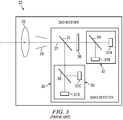
- the Figure 3 QKD receiver 22 comprises a lens 25, a quad-detector arrangement 30, and a fibre optic light guide 26 for conveying photons received through the lens 25 to the quad-detector arrangement 30.
- the quad-detector arrangement 30 comprises a beam splitter 31, a half-wave plate 36 for rotating the polarization of photons by 45°, a first paired-detector unit 32, and a second paired-detector unit 33.
- the first paired-detector unit 32 comprises a polarization-dependent beam splitter 34 and detectors 37A, 37B; the presence of the beam splitter 34 causes the polarizations detected by the detectors 37A and 37B to be mutually orthogonal.
- the second paired-detector unit 33 comprises a polarization-dependent beam splitter 35 and detectors 37C, 37D; the presence of the beam splitter 35 causes the polarizations detected by the detectors 37C and 37D to be mutually orthogonal.
- the polarization rotation effected by half-wave plate 36 causes the polarizations detected by the detectors 37A, 37B to be at 45° to those detected by the detectors 37C, 37D; more specifically, the paired detector unit 33 is arranged to detect horizontal/vertical polarizations whereas the paired detector unit 33 is arranged to detect diagonal/anti-diagonal polarizations.
- the beam splitter 31 is depicted in Figure 3 as half-silvered mirror but can be of other forms such as diffraction gratings.
- the polarization-dependent beam splitters 34, 35 are, for example, birefringent beam splitters.
- Operation of the apparatus of Figures 1 to 3 in accordance with the BB84 protocol is generally as follows with the QKD transmitting apparatus 10 and QKD receiving apparatus 20 being conventionally referred to as 'Alice' and 'Bob' respectively.
- Each pair of bits consists of a data bit and a basis bit, the latter indicating the pair of polarization axes to be used for sending the data bit, be it vertical/horizontal or diagonal/anti-diagonal.
- a horizontally or diagonally polarized photon indicates a binary 1
- a vertically or anti-diagonally polarized photon indicates a binary 0.
- the data bit of each pair is thus sent by Alice over the quantum signal channel 5 encoded according to the pair of polarization directions indicated by the basis bit of the same pair.
- Bob sends Alice, via the classical channel 6, partial reception data comprising the time slots in which a signal was received, and the basis (i.e. pair of polarization directions) thereof, but not the data bit values determined as received.
- Alice determines a subset m of its transmitted data as the data bit values transmitted for the time slots for which Bob received the quantum signal and used the correct basis for determining the received bit value.
- Alice also sends Bob, via the classical channel 6, information identifying the time slots holding the data bit values of m.
- Bob determines the data bit values making up the received data.
- the next phase of operation is error correction of the received data by an error correction process involving messages passed over the classical channel 6; after error correction, Bob's received data should match the data m held by Alice and this can be confirmed by exchanging checksums over the classical channel 6.
- the QKD system transmits information by the use of polarized photons or by phase encoding photons.
- Alice creates a stream of encoded photons and Bob has to detect them. It is usual for these photons to be emitted at a fixed time interval. For example every 100ns, a photon is emitted by Alice. Bob knows this fact and can therefore make measurements at the appropriate time.
- a synchronised clock between Alice and Bob can be provided by way of a clock signal sent from Alice to Bob, which can be in the form of a regular light pulse (carrying no information) for example. Such a pulse can be sent at regular intervals, thus enabling Bob to maintain synchronisation with Alice, and determine a rate at which bits are transmitted.
- L regular light pulse
- first, second, etc. may be used herein to describe various elements, these elements should not be limited by these terms. These terms are only used to distinguish one element from another. For example, a first item could be termed a second item, and, similarly, a second item could be termed a first item, without departing from the scope of the present invention.
- FIG 4 is a schematic representation of a QKD system according to an embodiment.
- QKD transmission (100) and reception apparatus (200) comprise clock modules 170 operable to provide a global clock signal for use in apparatus 100, 200.
- the clock signals from modules 170 provide respective clock pulses which tick at the same rate and at the same time.
- such synchronized clocks are made available using GPS (global positioning system).
- both the transmission apparatus 100 and reception apparatus 200 comprise GPS receiver modules operable to receive a GPS signal - the receiver modules (not specifically shown in figure 4 ) can be integrated within the clock modules 170, or provided separately, and will generally comprise an integrated antenna, although it will be appreciated that other alternatives are possible, such as for example the provision of an external (to the respective apparatus) GPS module and/or external antenna.
- GPS satellites continually transmit messages which include data in the form of a GPS signal comprising:
- a GPS receiver module uses accurate timing information in order to (amongst other things) determine its position relative to the satellite constellation.
- This constellation generally consists of 24 satellites each orbiting the earth in 12 hour time periods, such that any user has always a line of sight to 5-10 satellites.
- Each satellite transmits a continuous pseudorandom noise (PN) sequence with a chip rate of 1023 KHz, and a repetition period of 1023 chips.
- PN pseudorandom noise
- Each satellite has its own particular PRN sequence, which has good correlation properties and is orthogonal to the PRN sequences of the other satellites.
- each transmitted GPS signal is a direct sequence spread spectrum signal.
- the signal available for commercial use is that associated with Standard Positioning Service and utilizes a direct sequence bi-phase spreading signal with a 1.023 MHz spread rate placed upon a carrier at 1575.42 MHz (the so-called L1 frequency).
- Each satellite transmits a unique pseudo-random noise code (also referred to as the 'Gold' code) which identifies the particular satellite, and allows signals simultaneously transmitted from several satellites to be simultaneously received by a receiver, with little interference from one another.
- the pseudo-random noise (PN) code sequence length is 1023 chips, corresponding to a 1 millisecond time period. One cycle of 1023 chips is called a PN frame.
- each received GPS signal in C/A (coarse acquisition) mode is constructed from the high rate 1023 kHz repetitive PN pattern of 1023 chips.
- the pseudo random pattern may still be tracked, or otherwise used, to provide ambiguous system timing by processing many PN frames (e.g., 1000 repetitions over 1 second).
- the data message includes positioning data (the almanac and ephemeris), clock timing data and time of week (TOW) data.
- a GPS processor of a receiver module locks onto a specific visible satellite signal using known correlation techniques often performed by a correlator, to correlate between the received signals and a known replica of the transmitted signal from the satellite. After lock has been achieved, positioning and time data (ephemeris and TOW) can be demodulated from the carrier signal.
- the correlation and data extraction sequence described above can be repeated for other satellite codes if desired in order to obtain, for example, the earth position of the receiver in 3 dimensions.
- the provision of using the time signal from one or more GPS satellites is a one-way time transfer. That is to say, one end (the satellite(s)) transmits its current time over a communication channel to one or more receivers. The receivers decode the message and report the time. Accordingly, a time value received from one or more GPS satellites can be used in transmission apparatus 100 and receiving apparatus 200. It will be appreciated that, for each GPS signal received, the time value encoded in that signal will represent the time that the signal was transmitted by the satellite. This time does not need to be corrected upon reception, or be used to adjust a local clock. Providing both receiving and transmission apparatus receive the same signal, any difference between the encoded time value and 'real time' will not impact the system's ability to use the times to synchronize.
- the transmitter and receiver are located relatively near to one another (such as within 1km for example), it is very unlikely that they will receive signals from different satellites (thereby providing different times), although, even in this remote case, the rate of the received clock signals will be the same, and so provision can be made to compensate for a difference in 'base' time in the apparatus (such as by using the ephemeris and almanac data to decode which satellite signal is being used by respective parts of the system for example).
- an offset to a derived clock signal from a GPS signal can be used. More specifically, according to an embodiment, a clock signal derived from a GPS signal - that is to say, a clock signal derived from the regular carrier frequency of a GPS signal - can be shifted by a predefined amount known only to the QKD transmission and reception apparatus. The shift can be of the order of 1-2ns for example, although it will be appreciated that other values can be used.
- the derived clock signal can be shifted by the time shift value using processor 130, 230 in order to provide a modified clock signal for the system.
- an initial time shift value which can be used to bootstrap the system, can be agreed upon (before a QKD session is initiated) in a secure environment for example.
- the time shift value can then be changed periodically as required (although this is not necessary), such as after each session for example, or after a predetermined period of time.
- a new time shift value can be derived from the shared secret from a previous session for example. This has the advantage that no information needs to be sent between sub-systems because both Alice and Bob have the same value. Further, it will be appreciated that this process cannot be influenced by Alice or Bob.
- a time shift value can be chosen by Alice and sent to Bob.
- the chosen value can be xor'ed with a one-time pad secret taken from the shared secret data generated in the previous session. The result is transmitted to Bob who can xor this data with the same one-time pad secret to reveal the value chosen by Alice.
- a time shift value chosen by Alice can be encrypted using an encryption scheme such as AES for example, which scheme uses data from the shared secret to perform the encryption.
- the corresponding encrypted value can be decrypted by Bob using the same one-time pad data to reveal the chosen value for a session.
- Other alternatives for providing a shared time shift value are possible as will be appreciated by those skilled in the art.
- FIG. 5 is a functional block diagram of a GPS receiver module 500 operable for use in an embodiment.
- GPS receiver 500 typically includes the following: an antenna 501 for receiving one or more GPS signals from a GPS transmitter; an RF block 503 for receiving the GPS data and converting it to digital data; a CPU 505 for processing the data; ROM 507 to store any necessary firmware for processing the data; RAM 509 used by the CPU for data processing; and a universal asynchronous receiver/transmitter module (UART) 511 for example to transmit data, such as to processor 130, 230 in the system of figure 4 .
- Receiver module 500 can be integral to clock module 170, or can be separate and functionally linked thereto. Other alternatives are possible as will be appreciated by those skilled in the art.
- an accurate (but modified/shifted) clock signal which is shared between the transmission and reception apparatus of the system i.e. global, allows the transmission and reception timings between sub-systems to be synchronised - that is to say, not only can timings be synchronised, but the start point can also be synchronised in order to ensure that there is no significant 'drift' between the timing schedules of the transmitter and receiver. Accordingly, in order for the receiver 220 to 'know' when to open the detectors in order to take a measurement according to the timing schedule, there has to be a base time that both the transmission system and the reception system know beforehand.
- a simple handshake protocol between the transmission and reception portions of the system can be used in order to provide a reference (base) time that is used as the point from which all measurements for timings can be taken.
- the receiving system 200 can send a message to the transmission system 100 using classical channel 60 which indicates that it is operable to begin reception of a quantum signal over quantum channel 50.
- transmission apparatus 100 can signal apparatus 100 that transmission will begin at a given time, such as 2 seconds from the time the transmission is sent for example.
- figure 6 is a flow chart depicting a handshake protocol according to an embodiment.
- receiving apparatus 200 signals transmission system 100 using the classical channel.
- the data sent at step 601 is sufficient to indicate that the receiving system 200 is prepared to accept an incoming quantum signal via receiver 220. This occurs at time t0.
- transmission system 100 receives the signal from receiving system 200, and returns data (step 603) at time t0+1 indicating that transmission will begin at time t0+2. No further communication under the handshake is necessary, and transmission can begin at t0+2 (step 604).
- the timings given above are arbitrary, and not intended to be limiting. It will be appreciated by those skilled in the art that all that is required is a basic protocol between sub-systems of the apparatus which alerts the transmission apparatus to the fact that the receiving apparatus is primed and ready to receive a signal (over the quantum channel at least), and which provides the receiving apparatus with a time at which transmission will begin so that the receiving apparatus has an initial time from which to calibrate the opening of detection windows for measurements to be taken.
- time t0+2 will be the time stamp from which timings for the transmission system 100 and receiving system 200 are determined. Accordingly t0+2 can correspond base time plus 2 time units, whatever they may be according to a desired level of granularity for time taking into account the chip rate of the GPS signal.
- a QKD transmission system such as described with reference to figure 4 can further comprise crystal oscillator (XO) clocks, such as quartz clocks for example, at both receiver and transmitter ends.
- XO crystal oscillator
- a received GPS signal can be used to correct any drift in a clock signal derived from the XO clocks in the conventional manner which will be familiar to those skilled in the art. If a correction in the clock signal from the XO clock exceeds a predefined amount, it may be possible that the GPS signal is being spoofed. Accordingly, any correction of a XO clock in excess of a predefined value can provide an indication that either there is a malfunction, or that an eavesdropper is trying to shift the time using a fake GPS signal in order to try to take control of the system.
- a session can be aborted.
- a clock signal from the XO clock can be used if a GPS signal is lost by the system, i.e. if a GPS receiver is unable to maintain a lock.
- a random subset of measurements are destructively selected at receiving apparatus 200, such as 10% for example, and the times and the values (both data and basis) are transmitted over the classical channel to apparatus 100.
- the subset is compared with a reference list and an estimate of the error rate is thereby computed at the transmission apparatus - if too many of the received values that were measured in the correct basis are wrong, then the session can be aborted. For example, if it is determined that more than 5% of the values are wrong, the session can be scrapped - other alternatives are clearly feasible.
- Measurement times and basis values (but not data values) for all received measurements are sent to the transmission apparatus 100 so that it can be determined which values are present and correct at receiver 200 - all other measurements are disregarded. Note that no information about the data value is being transmitted by the receiver 200.
- the legitimate photon number can be transmitted, i.e. the 3'rd photon was transmitted at 10.07ns, the 4'th photon was transmitted at 13.44 ns, the 5'th photon was transmitted at 17.93ns and so on for example.
- the system can convert 3'rd to mean 10.07ns, but an eavesdropper cannot. Referring to measurement 3 for example does not tell the eavesdropper when that transmission took place.
- Error correction can now be performed.
- a Cascade-like algorithm or a randomized LDPC (low density parity check) algorithm can be used.
- a suitable LDPC scheme for performing error correction is described in, for example, Applicant's co-pending UK Patent Application with Publication No. 2455283 .
- a suitable Cascade scheme for performing error correction is described in, for example, G. Brassard and L. Salvail. Secret-key reconciliation by public discussion, Eurocrypt, pages 410-423, 1993 .
- the transmission apparatus 100 and reception apparatus 200 end up with a shared random secret (after the error correction scheme). It is possible that an eavesdropper can determine some information about this shared secret. This might be because some photons were sent as multi-photons (which can be - and were - captured), or it might be because Cascade is used during which transmission and reception apparatus share parity information over the classical channel (which an eavesdropper can intercept). Other alternatives are possible as will be appreciated. According to an embodiment, the operational parameters of the run can be measured, and a theoretical upper limit to the amount of information that an eavesdropper could have obtained can therefore be computed. Having computed this, that number of bits from the shared secret are deleted.
- a hash operation is performed on the shared secret by the system that reduces it in size by the amount that an eavesdropper has potentially obtained. This process is known as Privacy Amplification.
- a 2-universal hash function can be used.
- a scheme such as MGF1 (P1363 standard) is acceptable.
Landscapes
- Engineering & Computer Science (AREA)
- Physics & Mathematics (AREA)
- Computer Networks & Wireless Communication (AREA)
- Signal Processing (AREA)
- Electromagnetism (AREA)
- Computer Security & Cryptography (AREA)
- Theoretical Computer Science (AREA)
- Optics & Photonics (AREA)
- Position Fixing By Use Of Radio Waves (AREA)
Claims (7)
- QKD-Übertragungsvorrichtung (100), Folgendes umfassend:ein GPS-Empfängermodul (500), das betriebsfähig ist, ein GPS-Signal zu empfangen;einen Prozessor (130), der betriebsfähig ist, das GPS-Signal zu verwenden, um ein Taktsignal zum Übertragen eines QKD-Signals an eine QKD-Empfangsvorrichtung abzuleiten; und dadurch gekennzeichnet, dassdas abgeleitete Taktsignal durch den Prozessor (130) um einen vorgegebenen Zeitwert verschoben wird, um ein modifiziertes Taktsignal bereitzustellen, wobei der vorgegebene Zeitwert nur der QKD-Übertragungs- und -Empfangsvorrichtung bekannt ist.
- QKD-Übertragungsvorrichtung nach Anspruch 1, ferner eine Quarzoszillator-(XO-)Uhr umfassend, die betriebsfähig ist, ein XO-Taktsignal bereitzustellen, wobei das XO-Taktsignal durch das von dem GPS-Signal abgeleitete Taktsignal aufrechterhalten wird.
- QKD-Empfangsvorrichtung (200), die betriebsfähig ist, ein QKD-Signal von der Übertragungsvorrichtung (100) nach Anspruch 1 zu empfangen, Folgendes umfassend: einen GPS-Empfänger (500), der betriebsfähig ist, ein GPS-Signal zu empfangen; einen Prozessor (230), der betriebsfähig ist, das GPS-Signal zum Ableiten eines Taktsignals zum Empfangen des QKD-Signals zu verwenden; und dadurch gekennzeichnet, dass das abgeleitete Taktsignal durch den Prozessor (230) um einen vorgegebenen Zeitwert verschoben wird, um ein modifiziertes Taktsignal bereitzustellen, wobei der vorgegebene Zeitwert nur der Übertragungs- und Empfangsvorrichtung bekannt ist.
- QKD-Übertragungssystem, umfassend eine Übertragungsvorrichtung (100) nach Anspruch 1 und eine Empfangsvorrichtung (200) nach Anspruch 3, wobei jede Folgendes umfasst: einen GPS-Empfänger (500), der betriebsfähig ist, ein GPS-Signal zu empfangen, und einen Prozessor (130, 230), der betriebsfähig ist, ein Taktsignal zur Verwendung im System von dem empfangenen GPS-Signal abzuleiten, wo das Taktsignal unter Verwendung der Prozessoren (130, 230) um einen vorgegebenen Zeitwert verschoben wird, um ein modifiziertes Taktsignal für das System bereitzustellen, wobei der vorgegebene Zeitwert nur der Übertragungs- und Empfangsvorrichtung bekannt ist.
- QKD-Übertragungsverfahren, Folgendes umfassend:
Bereitstellen eines globalen, synchronisierten Taktsignals für ein QKD-System, wobei das Taktsignal von einem durch das System empfangene GPS-Signal abgeleitet ist; und gekennzeichnet durch Verschieben des Taktsignals um einen vorgegebenen Zeitwert, um ein modifiziertes Taktsignal für das System bereitzustellen, wobei der vorgegebene Zeitwert nur einer QKD-Übertragungs- und -Empfangsvorrichtung des Systems bekannt ist; und Verwenden des modifizierten Taktsignals, um ein Quantensignal für das System von der Übertragungsvorrichtung an die Empfangsvorrichtung zu übertragen. - Verfahren nach Anspruch 5, ferner umfassend das Verwenden des modifizierten Taktsignals, um einen Taktimpuls von wenigstens einer lokalen Quarzoszillatoruhr des Systems aufrechtzuerhalten.
- Verfahren nach Anspruch 5, wobei das Quantensignal eine regelmäßige oder unregelmäßige Periode aufweist.
Applications Claiming Priority (2)
| Application Number | Priority Date | Filing Date | Title |
|---|---|---|---|
| GBGB1001421.5A GB201001421D0 (en) | 2010-01-29 | 2010-01-29 | Quantum key distribution method and apparatus |
| PCT/US2011/022893 WO2011094520A2 (en) | 2010-01-29 | 2011-01-28 | Quantum key distribution method and apparatus |
Publications (3)
| Publication Number | Publication Date |
|---|---|
| EP2529503A2 EP2529503A2 (de) | 2012-12-05 |
| EP2529503A4 EP2529503A4 (de) | 2014-07-23 |
| EP2529503B1 true EP2529503B1 (de) | 2018-09-12 |
Family
ID=42084129
Family Applications (1)
| Application Number | Title | Priority Date | Filing Date |
|---|---|---|---|
| EP11737715.0A Not-in-force EP2529503B1 (de) | 2010-01-29 | 2011-01-28 | Quantumsschlüsselverteilungsverfahren und -vorrichtung |
Country Status (4)
| Country | Link |
|---|---|
| US (1) | US8654980B2 (de) |
| EP (1) | EP2529503B1 (de) |
| GB (1) | GB201001421D0 (de) |
| WO (1) | WO2011094520A2 (de) |
Families Citing this family (16)
| Publication number | Priority date | Publication date | Assignee | Title |
|---|---|---|---|---|
| US8483394B2 (en) | 2010-06-15 | 2013-07-09 | Los Alamos National Security, Llc | Secure multi-party communication with quantum key distribution managed by trusted authority |
| TW201201556A (en) * | 2010-06-29 | 2012-01-01 | Chunghwa Telecom Co Ltd | Construction structure of quantum encryption service network |
| US9219605B2 (en) | 2011-02-02 | 2015-12-22 | Nokia Technologies Oy | Quantum key distribution |
| WO2013048672A1 (en) | 2011-09-30 | 2013-04-04 | Los Alamos National Security, Llc | Great circle solution to polarization-based quantum communication (qc) in optical fiber |
| US20150188701A1 (en) * | 2012-08-24 | 2015-07-02 | Los Alamos National Security, Llc | Scalable software architecture for quantum cryptographic key management |
| JP5804007B2 (ja) * | 2013-09-03 | 2015-11-04 | カシオ計算機株式会社 | 動画生成システム、動画生成方法及びプログラム |
| EP3018840B1 (de) * | 2014-11-10 | 2019-10-02 | Université de Genève | Vorrichtung und Verfahren für kontinuierliche QKD-Quantenübertragungskanalsynchronisation und -ausrichtung |
| US10341015B1 (en) | 2015-10-19 | 2019-07-02 | National Technology & Engineering Solutions Of Sandia, Llc | Secure fiber optic seals enabled by quantum optical communication concepts |
| US9906311B1 (en) | 2016-03-23 | 2018-02-27 | National Technology & Engineering Solutions Of Sandia, Llc | Transceivers and receivers for quantum key distribution and methods pertaining thereto |
| US10341096B1 (en) | 2016-10-10 | 2019-07-02 | National Technology & Engineering Solutions Of Sandia, Llc | Transceivers and receivers for discrete-variable quantum key distribution |
| US10447472B2 (en) | 2017-02-21 | 2019-10-15 | Bank Of America Corporation | Block computing for information silo |
| US10454892B2 (en) * | 2017-02-21 | 2019-10-22 | Bank Of America Corporation | Determining security features for external quantum-level computing processing |
| CN111327365B (zh) * | 2020-03-05 | 2021-07-09 | 中国科学技术大学 | 基于非周期同步光的星地量子密钥分发同步方法与装置 |
| CN114665919B (zh) * | 2020-12-22 | 2024-12-10 | 广东国科量子通信网络有限公司 | 基于真随机数的直接序列扩频通信方法及系统 |
| EP4627757A1 (de) | 2022-11-30 | 2025-10-08 | Fraunhofer-Gesellschaft zur Förderung der angewandten Forschung e.V. | Vorrichtung und verfahren zur synchronisation von quantenschlüsselverteilungssystemen |
| US20250337503A1 (en) * | 2024-04-28 | 2025-10-30 | Q-Net LLC | Quantum transceiver antenna and method for construction |
Family Cites Families (15)
| Publication number | Priority date | Publication date | Assignee | Title |
|---|---|---|---|---|
| EP0717896B1 (de) * | 1993-09-09 | 1999-01-07 | BRITISH TELECOMMUNICATIONS public limited company | System und verfahren zur schlüsselverteilung unter verwendung von quanten-kryptographie |
| US5515438A (en) | 1993-11-24 | 1996-05-07 | International Business Machines Corporation | Quantum key distribution using non-orthogonal macroscopic signals |
| US5999285A (en) | 1997-05-23 | 1999-12-07 | The United States Of America As Represented By The Secretary Of The Army | Positive-operator-valued-measure receiver for quantum cryptography |
| US6895091B1 (en) * | 2000-07-07 | 2005-05-17 | Verizon Corporate Services Group Inc. | Systems and methods for encryption key archival and auditing in a quantum-cryptographic communications network |
| US7006635B2 (en) * | 2000-08-31 | 2006-02-28 | The United States Of America As Represented By The Secretary Of The Navy | Method and apparatus for clock synchronization using quantum mechanical non-locality effects |
| AU2003259762A1 (en) * | 2002-08-10 | 2004-02-25 | Routt, Thomas J | Methods for transmitting data across quantum interfaces and quantum gates using same |
| US20050190921A1 (en) * | 2002-10-15 | 2005-09-01 | Bbnt Solutions Llc | Systems and methods for framing quantum cryptographic links |
| JP4632652B2 (ja) * | 2003-10-10 | 2011-02-16 | 日本電気株式会社 | 量子暗号鍵配布システム及びそれに用いる同期方法 |
| US7831048B2 (en) | 2003-12-17 | 2010-11-09 | General Dynamics Advanced Information Systems, Inc. | Secure quantum key distribution using entangled photons |
| US8054976B2 (en) | 2005-06-16 | 2011-11-08 | Keith Alexander Harrison | Quantum key distribution apparatus and method |
| GB2439771A (en) * | 2006-07-05 | 2008-01-09 | Qinetiq Ltd | Clock controlled gating in quantum cryptography apparatus |
| US7881473B2 (en) | 2007-05-25 | 2011-02-01 | The Boeing Company | Quantum key distribution system and method |
| GB2455283A (en) | 2007-10-31 | 2009-06-10 | Hewlett Packard Development Co | Error correction in data communication apparatus using toroidal-web Tanner graph |
| US8194858B2 (en) * | 2009-02-19 | 2012-06-05 | Physical Optics Corporation | Chaotic cipher system and method for secure communication |
| US8483394B2 (en) * | 2010-06-15 | 2013-07-09 | Los Alamos National Security, Llc | Secure multi-party communication with quantum key distribution managed by trusted authority |
-
2010
- 2010-01-29 GB GBGB1001421.5A patent/GB201001421D0/en not_active Ceased
-
2011
- 2011-01-28 EP EP11737715.0A patent/EP2529503B1/de not_active Not-in-force
- 2011-01-28 US US13/387,361 patent/US8654980B2/en not_active Expired - Fee Related
- 2011-01-28 WO PCT/US2011/022893 patent/WO2011094520A2/en not_active Ceased
Non-Patent Citations (1)
| Title |
|---|
| None * |
Also Published As
| Publication number | Publication date |
|---|---|
| EP2529503A2 (de) | 2012-12-05 |
| US20120177200A1 (en) | 2012-07-12 |
| WO2011094520A3 (en) | 2011-11-24 |
| US8654980B2 (en) | 2014-02-18 |
| WO2011094520A2 (en) | 2011-08-04 |
| EP2529503A4 (de) | 2014-07-23 |
| GB201001421D0 (en) | 2010-03-17 |
Similar Documents
| Publication | Publication Date | Title |
|---|---|---|
| EP2529503B1 (de) | Quantumsschlüsselverteilungsverfahren und -vorrichtung | |
| US20130163759A1 (en) | Quantum key distribution method and apparatus | |
| US11175634B2 (en) | Robust and resilient timing architecture for critical infrastructure | |
| US6748083B2 (en) | Method and apparatus for free-space quantum key distribution in daylight | |
| Schmitt-Manderbach et al. | Experimental demonstration of free-space decoy-state quantum key distribution over 144 km | |
| Liu et al. | Experimental unconditionally secure bit commitment | |
| US7721955B2 (en) | Secure transaction method and transaction terminal for use in implementing such method | |
| US7864958B2 (en) | Quantum key distribution method and apparatus | |
| JP6916899B2 (ja) | 無線航法認証のための方法およびシステム | |
| WO2021171248A1 (en) | A method for quantum key distribution, a method for transmitting an optical signal, a method for receiving an optical signal, and a receiver of an optical signal for quantum key distribution | |
| Hu et al. | Decoy-state quantum key distribution over a long-distance high-loss air-water channel | |
| EP2119093A2 (de) | Quantenkryptographisches schlüsselverteilungsnetzwerk auf grossem massstab | |
| WO2013048671A1 (en) | Polarization tracking system for free-space optical communication, including quantum communication | |
| US8693685B2 (en) | Quantum cryptography apparatus | |
| GB2430123A (en) | A quantum communication system | |
| Weier et al. | Free space quantum key distribution: Towards a real life application | |
| JP2009065299A (ja) | 量子暗号通信装置及び方法 | |
| KR20170133245A (ko) | 코드 기반 양자 암호 키 분배 방법, 장치 및 시스템 | |
| Hughes et al. | Quantum cryptography for secure satellite communications | |
| Hughes et al. | Free-space quantum cryptography in daylight | |
| Hughes et al. | Practical quantum cryptography for secure free-space communications | |
| Fürst et al. | Free-space quantum key distribution over 144 km | |
| Handsteiner et al. | Quantum key distribution at space scale | |
| Caparra | Authentication and integrity protection at data and physical layer for critical infrastructures | |
| Ali et al. | How is quantum cryptography used for secure financial transactions |
Legal Events
| Date | Code | Title | Description |
|---|---|---|---|
| PUAI | Public reference made under article 153(3) epc to a published international application that has entered the european phase |
Free format text: ORIGINAL CODE: 0009012 |
|
| 17P | Request for examination filed |
Effective date: 20120127 |
|
| AK | Designated contracting states |
Kind code of ref document: A2 Designated state(s): AL AT BE BG CH CY CZ DE DK EE ES FI FR GB GR HR HU IE IS IT LI LT LU LV MC MK MT NL NO PL PT RO RS SE SI SK SM TR |
|
| DAX | Request for extension of the european patent (deleted) | ||
| A4 | Supplementary search report drawn up and despatched |
Effective date: 20140624 |
|
| RIC1 | Information provided on ipc code assigned before grant |
Ipc: H04L 9/08 20060101AFI20140716BHEP Ipc: H04L 7/027 20060101ALI20140716BHEP |
|
| RAP1 | Party data changed (applicant data changed or rights of an application transferred) |
Owner name: HEWLETT PACKARD ENTERPRISE DEVELOPMENT L.P. |
|
| GRAP | Despatch of communication of intention to grant a patent |
Free format text: ORIGINAL CODE: EPIDOSNIGR1 |
|
| STAA | Information on the status of an ep patent application or granted ep patent |
Free format text: STATUS: GRANT OF PATENT IS INTENDED |
|
| RIC1 | Information provided on ipc code assigned before grant |
Ipc: H04L 9/08 20060101AFI20180424BHEP Ipc: H04L 7/027 20060101ALI20180424BHEP Ipc: H04L 9/12 20060101ALI20180424BHEP |
|
| INTG | Intention to grant announced |
Effective date: 20180515 |
|
| GRAS | Grant fee paid |
Free format text: ORIGINAL CODE: EPIDOSNIGR3 |
|
| GRAA | (expected) grant |
Free format text: ORIGINAL CODE: 0009210 |
|
| STAA | Information on the status of an ep patent application or granted ep patent |
Free format text: STATUS: THE PATENT HAS BEEN GRANTED |
|
| AK | Designated contracting states |
Kind code of ref document: B1 Designated state(s): AL AT BE BG CH CY CZ DE DK EE ES FI FR GB GR HR HU IE IS IT LI LT LU LV MC MK MT NL NO PL PT RO RS SE SI SK SM TR |
|
| REG | Reference to a national code |
Ref country code: GB Ref legal event code: FG4D |
|
| REG | Reference to a national code |
Ref country code: CH Ref legal event code: EP |
|
| REG | Reference to a national code |
Ref country code: IE Ref legal event code: FG4D |
|
| REG | Reference to a national code |
Ref country code: DE Ref legal event code: R096 Ref document number: 602011051975 Country of ref document: DE |
|
| REG | Reference to a national code |
Ref country code: AT Ref legal event code: REF Ref document number: 1041863 Country of ref document: AT Kind code of ref document: T Effective date: 20181015 |
|
| REG | Reference to a national code |
Ref country code: NL Ref legal event code: MP Effective date: 20180912 |
|
| REG | Reference to a national code |
Ref country code: LT Ref legal event code: MG4D |
|
| PG25 | Lapsed in a contracting state [announced via postgrant information from national office to epo] |
Ref country code: NO Free format text: LAPSE BECAUSE OF FAILURE TO SUBMIT A TRANSLATION OF THE DESCRIPTION OR TO PAY THE FEE WITHIN THE PRESCRIBED TIME-LIMIT Effective date: 20181212 Ref country code: BG Free format text: LAPSE BECAUSE OF FAILURE TO SUBMIT A TRANSLATION OF THE DESCRIPTION OR TO PAY THE FEE WITHIN THE PRESCRIBED TIME-LIMIT Effective date: 20181212 Ref country code: RS Free format text: LAPSE BECAUSE OF FAILURE TO SUBMIT A TRANSLATION OF THE DESCRIPTION OR TO PAY THE FEE WITHIN THE PRESCRIBED TIME-LIMIT Effective date: 20180912 Ref country code: GR Free format text: LAPSE BECAUSE OF FAILURE TO SUBMIT A TRANSLATION OF THE DESCRIPTION OR TO PAY THE FEE WITHIN THE PRESCRIBED TIME-LIMIT Effective date: 20181213 Ref country code: LT Free format text: LAPSE BECAUSE OF FAILURE TO SUBMIT A TRANSLATION OF THE DESCRIPTION OR TO PAY THE FEE WITHIN THE PRESCRIBED TIME-LIMIT Effective date: 20180912 Ref country code: FI Free format text: LAPSE BECAUSE OF FAILURE TO SUBMIT A TRANSLATION OF THE DESCRIPTION OR TO PAY THE FEE WITHIN THE PRESCRIBED TIME-LIMIT Effective date: 20180912 Ref country code: SE Free format text: LAPSE BECAUSE OF FAILURE TO SUBMIT A TRANSLATION OF THE DESCRIPTION OR TO PAY THE FEE WITHIN THE PRESCRIBED TIME-LIMIT Effective date: 20180912 |
|
| PG25 | Lapsed in a contracting state [announced via postgrant information from national office to epo] |
Ref country code: LV Free format text: LAPSE BECAUSE OF FAILURE TO SUBMIT A TRANSLATION OF THE DESCRIPTION OR TO PAY THE FEE WITHIN THE PRESCRIBED TIME-LIMIT Effective date: 20180912 Ref country code: AL Free format text: LAPSE BECAUSE OF FAILURE TO SUBMIT A TRANSLATION OF THE DESCRIPTION OR TO PAY THE FEE WITHIN THE PRESCRIBED TIME-LIMIT Effective date: 20180912 Ref country code: HR Free format text: LAPSE BECAUSE OF FAILURE TO SUBMIT A TRANSLATION OF THE DESCRIPTION OR TO PAY THE FEE WITHIN THE PRESCRIBED TIME-LIMIT Effective date: 20180912 |
|
| REG | Reference to a national code |
Ref country code: AT Ref legal event code: MK05 Ref document number: 1041863 Country of ref document: AT Kind code of ref document: T Effective date: 20180912 |
|
| PG25 | Lapsed in a contracting state [announced via postgrant information from national office to epo] |
Ref country code: EE Free format text: LAPSE BECAUSE OF FAILURE TO SUBMIT A TRANSLATION OF THE DESCRIPTION OR TO PAY THE FEE WITHIN THE PRESCRIBED TIME-LIMIT Effective date: 20180912 Ref country code: PL Free format text: LAPSE BECAUSE OF FAILURE TO SUBMIT A TRANSLATION OF THE DESCRIPTION OR TO PAY THE FEE WITHIN THE PRESCRIBED TIME-LIMIT Effective date: 20180912 Ref country code: IS Free format text: LAPSE BECAUSE OF FAILURE TO SUBMIT A TRANSLATION OF THE DESCRIPTION OR TO PAY THE FEE WITHIN THE PRESCRIBED TIME-LIMIT Effective date: 20190112 Ref country code: ES Free format text: LAPSE BECAUSE OF FAILURE TO SUBMIT A TRANSLATION OF THE DESCRIPTION OR TO PAY THE FEE WITHIN THE PRESCRIBED TIME-LIMIT Effective date: 20180912 Ref country code: AT Free format text: LAPSE BECAUSE OF FAILURE TO SUBMIT A TRANSLATION OF THE DESCRIPTION OR TO PAY THE FEE WITHIN THE PRESCRIBED TIME-LIMIT Effective date: 20180912 Ref country code: RO Free format text: LAPSE BECAUSE OF FAILURE TO SUBMIT A TRANSLATION OF THE DESCRIPTION OR TO PAY THE FEE WITHIN THE PRESCRIBED TIME-LIMIT Effective date: 20180912 Ref country code: IT Free format text: LAPSE BECAUSE OF FAILURE TO SUBMIT A TRANSLATION OF THE DESCRIPTION OR TO PAY THE FEE WITHIN THE PRESCRIBED TIME-LIMIT Effective date: 20180912 Ref country code: NL Free format text: LAPSE BECAUSE OF FAILURE TO SUBMIT A TRANSLATION OF THE DESCRIPTION OR TO PAY THE FEE WITHIN THE PRESCRIBED TIME-LIMIT Effective date: 20180912 Ref country code: CZ Free format text: LAPSE BECAUSE OF FAILURE TO SUBMIT A TRANSLATION OF THE DESCRIPTION OR TO PAY THE FEE WITHIN THE PRESCRIBED TIME-LIMIT Effective date: 20180912 |
|
| PGFP | Annual fee paid to national office [announced via postgrant information from national office to epo] |
Ref country code: DE Payment date: 20181218 Year of fee payment: 9 |
|
| PG25 | Lapsed in a contracting state [announced via postgrant information from national office to epo] |
Ref country code: SM Free format text: LAPSE BECAUSE OF FAILURE TO SUBMIT A TRANSLATION OF THE DESCRIPTION OR TO PAY THE FEE WITHIN THE PRESCRIBED TIME-LIMIT Effective date: 20180912 Ref country code: PT Free format text: LAPSE BECAUSE OF FAILURE TO SUBMIT A TRANSLATION OF THE DESCRIPTION OR TO PAY THE FEE WITHIN THE PRESCRIBED TIME-LIMIT Effective date: 20190112 Ref country code: SK Free format text: LAPSE BECAUSE OF FAILURE TO SUBMIT A TRANSLATION OF THE DESCRIPTION OR TO PAY THE FEE WITHIN THE PRESCRIBED TIME-LIMIT Effective date: 20180912 |
|
| REG | Reference to a national code |
Ref country code: DE Ref legal event code: R097 Ref document number: 602011051975 Country of ref document: DE |
|
| PLBE | No opposition filed within time limit |
Free format text: ORIGINAL CODE: 0009261 |
|
| STAA | Information on the status of an ep patent application or granted ep patent |
Free format text: STATUS: NO OPPOSITION FILED WITHIN TIME LIMIT |
|
| PG25 | Lapsed in a contracting state [announced via postgrant information from national office to epo] |
Ref country code: DK Free format text: LAPSE BECAUSE OF FAILURE TO SUBMIT A TRANSLATION OF THE DESCRIPTION OR TO PAY THE FEE WITHIN THE PRESCRIBED TIME-LIMIT Effective date: 20180912 |
|
| 26N | No opposition filed |
Effective date: 20190613 |
|
| PG25 | Lapsed in a contracting state [announced via postgrant information from national office to epo] |
Ref country code: MC Free format text: LAPSE BECAUSE OF FAILURE TO SUBMIT A TRANSLATION OF THE DESCRIPTION OR TO PAY THE FEE WITHIN THE PRESCRIBED TIME-LIMIT Effective date: 20180912 Ref country code: SI Free format text: LAPSE BECAUSE OF FAILURE TO SUBMIT A TRANSLATION OF THE DESCRIPTION OR TO PAY THE FEE WITHIN THE PRESCRIBED TIME-LIMIT Effective date: 20180912 |
|
| REG | Reference to a national code |
Ref country code: CH Ref legal event code: PL |
|
| GBPC | Gb: european patent ceased through non-payment of renewal fee |
Effective date: 20190128 |
|
| PG25 | Lapsed in a contracting state [announced via postgrant information from national office to epo] |
Ref country code: LU Free format text: LAPSE BECAUSE OF NON-PAYMENT OF DUE FEES Effective date: 20190128 |
|
| REG | Reference to a national code |
Ref country code: BE Ref legal event code: MM Effective date: 20190131 |
|
| REG | Reference to a national code |
Ref country code: IE Ref legal event code: MM4A |
|
| PG25 | Lapsed in a contracting state [announced via postgrant information from national office to epo] |
Ref country code: FR Free format text: LAPSE BECAUSE OF NON-PAYMENT OF DUE FEES Effective date: 20190131 |
|
| PG25 | Lapsed in a contracting state [announced via postgrant information from national office to epo] |
Ref country code: BE Free format text: LAPSE BECAUSE OF NON-PAYMENT OF DUE FEES Effective date: 20190131 |
|
| PG25 | Lapsed in a contracting state [announced via postgrant information from national office to epo] |
Ref country code: CH Free format text: LAPSE BECAUSE OF NON-PAYMENT OF DUE FEES Effective date: 20190131 Ref country code: GB Free format text: LAPSE BECAUSE OF NON-PAYMENT OF DUE FEES Effective date: 20190128 Ref country code: LI Free format text: LAPSE BECAUSE OF NON-PAYMENT OF DUE FEES Effective date: 20190131 |
|
| PG25 | Lapsed in a contracting state [announced via postgrant information from national office to epo] |
Ref country code: IE Free format text: LAPSE BECAUSE OF NON-PAYMENT OF DUE FEES Effective date: 20190128 |
|
| PG25 | Lapsed in a contracting state [announced via postgrant information from national office to epo] |
Ref country code: TR Free format text: LAPSE BECAUSE OF FAILURE TO SUBMIT A TRANSLATION OF THE DESCRIPTION OR TO PAY THE FEE WITHIN THE PRESCRIBED TIME-LIMIT Effective date: 20180912 |
|
| PG25 | Lapsed in a contracting state [announced via postgrant information from national office to epo] |
Ref country code: MT Free format text: LAPSE BECAUSE OF NON-PAYMENT OF DUE FEES Effective date: 20190128 |
|
| REG | Reference to a national code |
Ref country code: DE Ref legal event code: R119 Ref document number: 602011051975 Country of ref document: DE |
|
| PG25 | Lapsed in a contracting state [announced via postgrant information from national office to epo] |
Ref country code: DE Free format text: LAPSE BECAUSE OF NON-PAYMENT OF DUE FEES Effective date: 20200801 |
|
| PG25 | Lapsed in a contracting state [announced via postgrant information from national office to epo] |
Ref country code: CY Free format text: LAPSE BECAUSE OF FAILURE TO SUBMIT A TRANSLATION OF THE DESCRIPTION OR TO PAY THE FEE WITHIN THE PRESCRIBED TIME-LIMIT Effective date: 20180912 |
|
| PG25 | Lapsed in a contracting state [announced via postgrant information from national office to epo] |
Ref country code: HU Free format text: LAPSE BECAUSE OF FAILURE TO SUBMIT A TRANSLATION OF THE DESCRIPTION OR TO PAY THE FEE WITHIN THE PRESCRIBED TIME-LIMIT; INVALID AB INITIO Effective date: 20110128 |
|
| PG25 | Lapsed in a contracting state [announced via postgrant information from national office to epo] |
Ref country code: MK Free format text: LAPSE BECAUSE OF FAILURE TO SUBMIT A TRANSLATION OF THE DESCRIPTION OR TO PAY THE FEE WITHIN THE PRESCRIBED TIME-LIMIT Effective date: 20180912 |