EP2528136A1 - Battery fixing system for fixing at least one vehicle battery - Google Patents
Battery fixing system for fixing at least one vehicle battery Download PDFInfo
- Publication number
- EP2528136A1 EP2528136A1 EP11167865A EP11167865A EP2528136A1 EP 2528136 A1 EP2528136 A1 EP 2528136A1 EP 11167865 A EP11167865 A EP 11167865A EP 11167865 A EP11167865 A EP 11167865A EP 2528136 A1 EP2528136 A1 EP 2528136A1
- Authority
- EP
- European Patent Office
- Prior art keywords
- battery
- belt
- casing
- batteries
- bar
- Prior art date
- Legal status (The legal status is an assumption and is not a legal conclusion. Google has not performed a legal analysis and makes no representation as to the accuracy of the status listed.)
- Granted
Links
Images


Classifications
-
- H—ELECTRICITY
- H01—ELECTRIC ELEMENTS
- H01M—PROCESSES OR MEANS, e.g. BATTERIES, FOR THE DIRECT CONVERSION OF CHEMICAL ENERGY INTO ELECTRICAL ENERGY
- H01M10/00—Secondary cells; Manufacture thereof
- H01M10/04—Construction or manufacture in general
- H01M10/0481—Compression means other than compression means for stacks of electrodes and separators
-
- B—PERFORMING OPERATIONS; TRANSPORTING
- B60—VEHICLES IN GENERAL
- B60L—PROPULSION OF ELECTRICALLY-PROPELLED VEHICLES; SUPPLYING ELECTRIC POWER FOR AUXILIARY EQUIPMENT OF ELECTRICALLY-PROPELLED VEHICLES; ELECTRODYNAMIC BRAKE SYSTEMS FOR VEHICLES IN GENERAL; MAGNETIC SUSPENSION OR LEVITATION FOR VEHICLES; MONITORING OPERATING VARIABLES OF ELECTRICALLY-PROPELLED VEHICLES; ELECTRIC SAFETY DEVICES FOR ELECTRICALLY-PROPELLED VEHICLES
- B60L50/00—Electric propulsion with power supplied within the vehicle
- B60L50/50—Electric propulsion with power supplied within the vehicle using propulsion power supplied by batteries or fuel cells
- B60L50/60—Electric propulsion with power supplied within the vehicle using propulsion power supplied by batteries or fuel cells using power supplied by batteries
- B60L50/64—Constructional details of batteries specially adapted for electric vehicles
-
- H—ELECTRICITY
- H01—ELECTRIC ELEMENTS
- H01M—PROCESSES OR MEANS, e.g. BATTERIES, FOR THE DIRECT CONVERSION OF CHEMICAL ENERGY INTO ELECTRICAL ENERGY
- H01M50/00—Constructional details or processes of manufacture of the non-active parts of electrochemical cells other than fuel cells, e.g. hybrid cells
- H01M50/20—Mountings; Secondary casings or frames; Racks, modules or packs; Suspension devices; Shock absorbers; Transport or carrying devices; Holders
- H01M50/249—Mountings; Secondary casings or frames; Racks, modules or packs; Suspension devices; Shock absorbers; Transport or carrying devices; Holders specially adapted for aircraft or vehicles, e.g. cars or trains
-
- H—ELECTRICITY
- H01—ELECTRIC ELEMENTS
- H01M—PROCESSES OR MEANS, e.g. BATTERIES, FOR THE DIRECT CONVERSION OF CHEMICAL ENERGY INTO ELECTRICAL ENERGY
- H01M50/00—Constructional details or processes of manufacture of the non-active parts of electrochemical cells other than fuel cells, e.g. hybrid cells
- H01M50/20—Mountings; Secondary casings or frames; Racks, modules or packs; Suspension devices; Shock absorbers; Transport or carrying devices; Holders
- H01M50/256—Carrying devices, e.g. belts
-
- H—ELECTRICITY
- H01—ELECTRIC ELEMENTS
- H01M—PROCESSES OR MEANS, e.g. BATTERIES, FOR THE DIRECT CONVERSION OF CHEMICAL ENERGY INTO ELECTRICAL ENERGY
- H01M50/00—Constructional details or processes of manufacture of the non-active parts of electrochemical cells other than fuel cells, e.g. hybrid cells
- H01M50/20—Mountings; Secondary casings or frames; Racks, modules or packs; Suspension devices; Shock absorbers; Transport or carrying devices; Holders
- H01M50/262—Mountings; Secondary casings or frames; Racks, modules or packs; Suspension devices; Shock absorbers; Transport or carrying devices; Holders with fastening means, e.g. locks
- H01M50/264—Mountings; Secondary casings or frames; Racks, modules or packs; Suspension devices; Shock absorbers; Transport or carrying devices; Holders with fastening means, e.g. locks for cells or batteries, e.g. straps, tie rods or peripheral frames
-
- Y—GENERAL TAGGING OF NEW TECHNOLOGICAL DEVELOPMENTS; GENERAL TAGGING OF CROSS-SECTIONAL TECHNOLOGIES SPANNING OVER SEVERAL SECTIONS OF THE IPC; TECHNICAL SUBJECTS COVERED BY FORMER USPC CROSS-REFERENCE ART COLLECTIONS [XRACs] AND DIGESTS
- Y02—TECHNOLOGIES OR APPLICATIONS FOR MITIGATION OR ADAPTATION AGAINST CLIMATE CHANGE
- Y02E—REDUCTION OF GREENHOUSE GAS [GHG] EMISSIONS, RELATED TO ENERGY GENERATION, TRANSMISSION OR DISTRIBUTION
- Y02E60/00—Enabling technologies; Technologies with a potential or indirect contribution to GHG emissions mitigation
- Y02E60/10—Energy storage using batteries
-
- Y—GENERAL TAGGING OF NEW TECHNOLOGICAL DEVELOPMENTS; GENERAL TAGGING OF CROSS-SECTIONAL TECHNOLOGIES SPANNING OVER SEVERAL SECTIONS OF THE IPC; TECHNICAL SUBJECTS COVERED BY FORMER USPC CROSS-REFERENCE ART COLLECTIONS [XRACs] AND DIGESTS
- Y02—TECHNOLOGIES OR APPLICATIONS FOR MITIGATION OR ADAPTATION AGAINST CLIMATE CHANGE
- Y02P—CLIMATE CHANGE MITIGATION TECHNOLOGIES IN THE PRODUCTION OR PROCESSING OF GOODS
- Y02P70/00—Climate change mitigation technologies in the production process for final industrial or consumer products
- Y02P70/50—Manufacturing or production processes characterised by the final manufactured product
-
- Y—GENERAL TAGGING OF NEW TECHNOLOGICAL DEVELOPMENTS; GENERAL TAGGING OF CROSS-SECTIONAL TECHNOLOGIES SPANNING OVER SEVERAL SECTIONS OF THE IPC; TECHNICAL SUBJECTS COVERED BY FORMER USPC CROSS-REFERENCE ART COLLECTIONS [XRACs] AND DIGESTS
- Y02—TECHNOLOGIES OR APPLICATIONS FOR MITIGATION OR ADAPTATION AGAINST CLIMATE CHANGE
- Y02T—CLIMATE CHANGE MITIGATION TECHNOLOGIES RELATED TO TRANSPORTATION
- Y02T10/00—Road transport of goods or passengers
- Y02T10/60—Other road transportation technologies with climate change mitigation effect
- Y02T10/70—Energy storage systems for electromobility, e.g. batteries
Definitions
- the present invention relates to a battery fixing system for fixing at least one vehicle battery in a trough-shaped casing of a vehicle.
- the batteries of vehicles are fixed by suitable clamping or tensioning means within respective battery seats that allow to exchange a battery with a comparably low effort.
- the battery seat is formed by a trough-shaped casing made of a plastic material comprising a bottom and drawn-up walls, that enclose the batteries laterally.
- the battery fixing system provides at least one belt that is tensioned elastically over the top of the battery to be fixed. On one side of the battery, the belt is fixed to the casing. On the opposite side, the belt is tensioned downwards by a belt tensioning device such that the battery is pressed against the bottom of the casing. This tension is kept during the vehicle operation and also resists stronger vibrations. This is an advantage over rigid fixing devices like clamps or the like that can loosen with time under the influence of vibrations and have to be re-tensioned from time to time.
- the belt tensioning device comprises a horizontal bar that extends over the at least one belt in a traverse direction.
- the bar is pressed down by the tension of a mechanic spring to exert a pulling force on the belt.
- the battery fixing system is provided for fixing a plurality of vehicle batteries in a trough-like casing of a vehicle, wherein the batteries are arranged next to each other with a gap between at least two adjacent batteries.
- the ends of the belt are fixed to opposed sides of the casing, and the belt tensioning device is arranged within the gap between two adjacent batteries, wherein the at least one belt is guided as a pulling loop around the bar.
- the at least one belt runs over the top of the batteries, it is pulled into the gap between the adjacent batteries by the belt tensioning device to create the tension for holding the batteries.
- the belt loop is formed by guiding the belt around the horizontal bar, pushing down the bar towards the bottom of the casing by means of the tension of the spring.
- the belt tensioning device comprises at least one shaft protruding vertically within the gap and extending through the bar, the bar being slidable on the shaft in a vertical direction.
- two shafts can be used to guide the bar with a sufficient mechanical stability but to keep it slidable in the vertical direction.
- the spring is an elastically compressible torsion spring that is wound around the shaft and lies between the bar and an extended upper end of the shaft.
- the shaft comprises a bolt that is screwed into a support fixed to the casing or into the bottom of the casing.
- This support can be, for example, a traverse profile extending in the lower portion of the gap parallel to the bar, the shafts protruding from this profile.
- the bolt can lie within a sleeve that defines how far the bolt is screwed into the support or the bottom of the casing so that the sleeve defines the length of the shaft.
- the belt is guided on top of the at least one battery by at least one guiding element.
- this guiding element comprises a rigid rail that extends on the top side of the battery from one edge to another.
- This rail provides that the pressure exerted by the at least one belt is distributed uniformly over the whole width of the battery.
- the guiding element can provide a smooth sliding of the belt over the top of the battery without an excessive mechanical resistance. Particularly it can be avoided that the belt is getting caught at edges or obstacles on the top side of the battery. It is also possible to form the rail such that it extends slightly over the lateral edges of the battery to reduce pressure and friction at these areas.
- the present invention relates to a battery assembly in a vehicle, comprising a trough-shaped casing with a bottom and a wall drawn-up from the bottom, two vehicle batteries arranged within the casing with a gap there between, and a battery fixing system according to one of the preceding claims, comprising a pair of parallel belts, the ends of these belts be fixed to opposed sides of the wall of the casing, said belts extending over the top sides of the batteries and being pulled down in pulling loops by the bar of the belt tensioning device in the gap between the batteries.
- the battery fixing system 10 of Fig. 1 is provided to fix two vehicle batteries 12,14 in a vehicle (not shown), especially in a commercial vehicle.
- the vehicle batteries 12,14 are block shaped and they are arranged in a trough-shaped casing 16 that is a plastic member formed by deep drawing.
- said casing comprises a bottom 18 and a drawn-up wall 19 enclosing the batteries 12,14.
- the bottom 18 comprises two bottom portions 20,22 stepped towards each other in a vertical direction.
- the battery 12 on the left side of Fig. 1 is supported, while the higher bottom portion 22 supports the right battery 14.
- the batteries 12,14 are arranged next to each other such as to form a gap 24 between them.
- the batteries 12,14 are held by tensioned belts, only one of these belts 26 being shown in the view of Fig. 1 .
- This belt 26 runs over the top side of the batteries 12,14 and is fixed to the wall 19 of the casing 16 with its opposed ends 28,30.
- the belt 26 is drawn downwards by a belt tensioning device designated by reference number 32.
- This belt tensioning device 32 pulls the belt 26 downwards in form of a pulling loop 34, pulling with an elastic tensioning force, as will be further explained in the following.
- This elastic tension provides a sufficient pressure to keep down the batteries 12,14 within the casing 16 and to press them against the bottom 18.
- the belt tensioning device 32 comprises a horizontal bar 36 with a lower cross-section in form of a segment of a circle.
- the bar 36 is further provided with vertical bores extending perpendicular to the horizontal longitudinal axis of the bar 36.
- shafts 38 are arranged that stand vertical with respect to the bottom 18 of the casing 16.
- the shafts 38 are mounted on traverse profiles 40 that are shown in Fig. 1 and 3 in a cross-section and that extend between opposed portions of the wall 19 of the casing 16. Details of the bar 36 and the shaft 38 can be taken from Fig. 3 , being a section along the main longitudinal axis of the shaft 38. In its central portion, the shaft 38 comprises a bolt 42.
- the bolt 42 is screwed with its lower end into a female thread of the traverse profile 40. Alternatively, it can also be screwed into a welding nut on the traverse profile 40. With its radial extended upper head 46, the bolt 42 presses a circular thrust washer 48 downwards onto the upper end of a sleeve 44 surrounding the bolt 42 so that the sleeve 44 is clamped between the thrust washer 48 and the upper side of the lateral profile 40 when the bolt 42 is tightened.
- a torsion spring 50 is wound that extends in the vertical direction between the thrust washer 48 and the bar 36.
- the bore 52 through which the shaft 38 extends comprises a radial extension 54 on the upper side of the bar 36.
- the bottom side of the thrust washer 48 forms a stopping surface for the upper end of the torsion spring 50.
- the torsion spring 50 is elastically compressible. Such a compression can be achieved by shifting the bar 36 onto the shaft 38 upwards against the resistance of the torsion spring 50.
- the belt 26 is guided around the bottom side of the bar 36 to form the pulling loop 34.
- the tensioning force of the at least one belt 26 is defined by the height of the shaft 38 and by the length of the tensioned torsion spring 50. It is obvious from Fig. 1 that the length of the belt 26 is to choose such that in the fixing position of the batteries 12,14, the torsion spring 50 is compressed partially but not completely so that the pulling loop 34 is kept under an elastic tension but a further compression of the spring 50 is still possible. In this situation the belt 26 is kept under an elastic tension to press the batteries 12,14 downwards against the bottom 18 of the casing 16.
- Fig. 1 further shows guiding elements 56,58 for the belt 26 that lie on the upper surfaces of the batteries 12,14 and extend over the whole width of the respective battery 12,14.
- These guiding elements 56,58 are rails that extend over the upper sides of the batteries 12,14 from one lateral edge to another. These rails are also shown in Fig. 5.
- the rails 56,58 provide a relatively uniform distribution of the pressure exerted downwards by the belt 26 over the whole surface of the respective battery 12,14. Moreover, it is prevented that the belt 26 runs directly over the upper lateral edges of the batteries 12,14 and is damaged by this interference.
- the ends of the rails 56,58 are also rounded to improve the sliding of the belts 26 over the ends.
- both batteries 12,14 are fixed by two parallel belts 26 in the casing 16. These belts 26 are pulled down elastically into the gap 24 by the common bar 36 of the belt tensioning device 32, as described above.
- the bar 36 is supported slidable in the vertical direction on two shafts 38 of the kind described above, the shafts 38 being arranged outside the pathways of the belts 26.
- the batteries 12,14 are fixed by the belt tensioning device 32 under elastic tension, it is impossible to release the battery fixing system 10 according to the present invention by strong and continuing vibrations as they occur in the vehicle operation. Consequently the batteries 12,14 are fixed in a reliable fashion. A release of the battery fixing system 10 is possible by releasing the tension of the springs 50, screwing out the bolts 42 and taking out a bar 36. Then the belts 26 can put aside, and the batteries 12,14 can be taken out.
Landscapes
- Engineering & Computer Science (AREA)
- Chemical & Material Sciences (AREA)
- General Chemical & Material Sciences (AREA)
- Electrochemistry (AREA)
- Chemical Kinetics & Catalysis (AREA)
- Sustainable Energy (AREA)
- Mechanical Engineering (AREA)
- Aviation & Aerospace Engineering (AREA)
- Transportation (AREA)
- Power Engineering (AREA)
- Life Sciences & Earth Sciences (AREA)
- Sustainable Development (AREA)
- Manufacturing & Machinery (AREA)
- Battery Mounting, Suspending (AREA)
- Arrangement Or Mounting Of Propulsion Units For Vehicles (AREA)
Abstract
Description
- The present invention relates to a battery fixing system for fixing at least one vehicle battery in a trough-shaped casing of a vehicle.
- Usually the batteries of vehicles are fixed by suitable clamping or tensioning means within respective battery seats that allow to exchange a battery with a comparably low effort. In one embodiment the battery seat is formed by a trough-shaped casing made of a plastic material comprising a bottom and drawn-up walls, that enclose the batteries laterally.
- With commercial vehicles like motor trucks there is the problem that the common battery supports tend to loosen under the influence of strong vibrations, as they usually appear in the operation of such vehicles. However, a release of the batteries is to avoid under any circumstances for safety reasons. Until now there is no construction to fix the battery that resists the extreme operation conditions of a commercial vehicle over a long time period without the necessity to be controlled with respect to its correct securing function.
- This problem arises especially when not only one but a plurality of batteries are to be fixed in a casing of the above kind. Typically two of such vehicle batteries are arranged next to each other within the casing. In this situation the additional problem arises to design the battery fixing system as simple as possible so that each of the batteries can be taken out after releasing the fixation. Moreover, the known fixing systems are bound to certain battery sizes and cannot be adapted to the dimensions of the batteries to be fixed. These dimensions can also change, depending on temperature.
- It is therefore an object of the present invention to provide a battery fixing system of the above kind that is resistible against vibrations and compensates tolerances of the batteries or other parts of the system as well as temperature dependent size changes of the battery, allowing a reliable fixing of the battery within the casing over a long operation period. Moreover, this system shall be easy to handle, allowing a simple release of the fixation and a take out of the battery (or one battery selected out of a set of batteries).
- This object is achieved by a battery fixing system comprising the features of claim 1.
- The battery fixing system according to the present invention provides at least one belt that is tensioned elastically over the top of the battery to be fixed. On one side of the battery, the belt is fixed to the casing. On the opposite side, the belt is tensioned downwards by a belt tensioning device such that the battery is pressed against the bottom of the casing. This tension is kept during the vehicle operation and also resists stronger vibrations. This is an advantage over rigid fixing devices like clamps or the like that can loosen with time under the influence of vibrations and have to be re-tensioned from time to time.
- The belt tensioning device comprises a horizontal bar that extends over the at least one belt in a traverse direction. The bar is pressed down by the tension of a mechanic spring to exert a pulling force on the belt. For releasing the tension the bar must be lifted against the force of the spring. According to a preferred embodiment of the present invention, the battery fixing system is provided for fixing a plurality of vehicle batteries in a trough-like casing of a vehicle, wherein the batteries are arranged next to each other with a gap between at least two adjacent batteries. According to this embodiment, the ends of the belt are fixed to opposed sides of the casing, and the belt tensioning device is arranged within the gap between two adjacent batteries, wherein the at least one belt is guided as a pulling loop around the bar.
- Whereas the at least one belt runs over the top of the batteries, it is pulled into the gap between the adjacent batteries by the belt tensioning device to create the tension for holding the batteries. For this purpose the belt loop is formed by guiding the belt around the horizontal bar, pushing down the bar towards the bottom of the casing by means of the tension of the spring.
- According to another preferred embodiment of the present invention, the belt tensioning device comprises at least one shaft protruding vertically within the gap and extending through the bar, the bar being slidable on the shaft in a vertical direction. In this case two shafts can be used to guide the bar with a sufficient mechanical stability but to keep it slidable in the vertical direction.
- Preferably the spring is an elastically compressible torsion spring that is wound around the shaft and lies between the bar and an extended upper end of the shaft.
- More preferably the shaft comprises a bolt that is screwed into a support fixed to the casing or into the bottom of the casing. This support can be, for example, a traverse profile extending in the lower portion of the gap parallel to the bar, the shafts protruding from this profile. The bolt can lie within a sleeve that defines how far the bolt is screwed into the support or the bottom of the casing so that the sleeve defines the length of the shaft.
- More preferably the belt is guided on top of the at least one battery by at least one guiding element.
- Preferably this guiding element comprises a rigid rail that extends on the top side of the battery from one edge to another. This rail provides that the pressure exerted by the at least one belt is distributed uniformly over the whole width of the battery. Moreover, the guiding element can provide a smooth sliding of the belt over the top of the battery without an excessive mechanical resistance. Particularly it can be avoided that the belt is getting caught at edges or obstacles on the top side of the battery. It is also possible to form the rail such that it extends slightly over the lateral edges of the battery to reduce pressure and friction at these areas.
- According to another aspect, the present invention relates to a battery assembly in a vehicle, comprising a trough-shaped casing with a bottom and a wall drawn-up from the bottom, two vehicle batteries arranged within the casing with a gap there between, and a battery fixing system according to one of the preceding claims, comprising a pair of parallel belts, the ends of these belts be fixed to opposed sides of the wall of the casing, said belts extending over the top sides of the batteries and being pulled down in pulling loops by the bar of the belt tensioning device in the gap between the batteries.
- These and other aspects of the invention will be apparent from and illucidated with reference to a preferred embodiment described hereinafter.
- Fig. 1
- is a lateral section of one embodiment of a battery fixing system according to the present invention;
- Fig. 2
- is a detailed view of the battery fixing system of claim 1 according to a section along the plane B-B in
Fig. 4 ; - Fig. 3
- is a view of a part of the battery fixing system of
Fig. 2 according to a section along plane A-A inFig. 4 ; and - Fig. 4
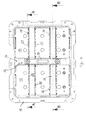
- is a top view of the embodiment of the battery fixing system according to the present invention as shown in
Fig. 1 to 3 . - The
battery fixing system 10 ofFig. 1 is provided to fix twovehicle batteries vehicle batteries shaped casing 16 that is a plastic member formed by deep drawing. In particular said casing comprises a bottom 18 and a drawn-upwall 19 enclosing thebatteries bottom portions lower bottom portion 20, thebattery 12 on the left side ofFig. 1 is supported, while thehigher bottom portion 22 supports theright battery 14. Thebatteries gap 24 between them. - In the
casing 16, thebatteries belts 26 being shown in the view ofFig. 1 . Thisbelt 26 runs over the top side of thebatteries wall 19 of thecasing 16 with itsopposed ends gap 24 between thebatteries belt 26 is drawn downwards by a belt tensioning device designated byreference number 32. Thisbelt tensioning device 32 pulls thebelt 26 downwards in form of apulling loop 34, pulling with an elastic tensioning force, as will be further explained in the following. This elastic tension provides a sufficient pressure to keep down thebatteries casing 16 and to press them against the bottom 18. - Details of the
belt tensioning device 32 are shown inFig. 2 . Thebelt tensioning device 32 comprises ahorizontal bar 36 with a lower cross-section in form of a segment of a circle. Thebar 36 is further provided with vertical bores extending perpendicular to the horizontal longitudinal axis of thebar 36. Within these bores,shafts 38 are arranged that stand vertical with respect to the bottom 18 of thecasing 16. Theshafts 38 are mounted ontraverse profiles 40 that are shown inFig. 1 and3 in a cross-section and that extend between opposed portions of thewall 19 of thecasing 16. Details of thebar 36 and theshaft 38 can be taken fromFig. 3 , being a section along the main longitudinal axis of theshaft 38. In its central portion, theshaft 38 comprises abolt 42. Thebolt 42 is screwed with its lower end into a female thread of thetraverse profile 40. Alternatively, it can also be screwed into a welding nut on thetraverse profile 40. With its radial extended upper head 46, thebolt 42 presses acircular thrust washer 48 downwards onto the upper end of a sleeve 44 surrounding thebolt 42 so that the sleeve 44 is clamped between thethrust washer 48 and the upper side of thelateral profile 40 when thebolt 42 is tightened. - Around the shaft 38 a
torsion spring 50 is wound that extends in the vertical direction between thethrust washer 48 and thebar 36. To receive the lower end of thetorsion spring 50, thebore 52 through which theshaft 38 extends comprises aradial extension 54 on the upper side of thebar 36. The bottom side of thethrust washer 48 forms a stopping surface for the upper end of thetorsion spring 50. - The
torsion spring 50 is elastically compressible. Such a compression can be achieved by shifting thebar 36 onto theshaft 38 upwards against the resistance of thetorsion spring 50. - As shown in
Fig. 1 and2 , thebelt 26 is guided around the bottom side of thebar 36 to form the pullingloop 34. By the pressure of thetorsion spring 50, thebelt 26 is pulled downwards at both sides of thegap 24 by means of the elastic force of thespring 50. The tensioning force of the at least onebelt 26 is defined by the height of theshaft 38 and by the length of the tensionedtorsion spring 50. It is obvious fromFig. 1 that the length of thebelt 26 is to choose such that in the fixing position of thebatteries torsion spring 50 is compressed partially but not completely so that the pullingloop 34 is kept under an elastic tension but a further compression of thespring 50 is still possible. In this situation thebelt 26 is kept under an elastic tension to press thebatteries casing 16. -
Fig. 1 furthershows guiding elements belt 26 that lie on the upper surfaces of thebatteries respective battery elements batteries rails lateral fillets belts 26 are arranged. They prevent a lateral sliding of thebelts 26. Therails belt 26 over the whole surface of therespective battery belt 26 runs directly over the upper lateral edges of thebatteries rails belts 26 over the ends. - It can be taken from
Fig. 4 that bothbatteries parallel belts 26 in thecasing 16. Thesebelts 26 are pulled down elastically into thegap 24 by thecommon bar 36 of thebelt tensioning device 32, as described above. For this purpose thebar 36 is supported slidable in the vertical direction on twoshafts 38 of the kind described above, theshafts 38 being arranged outside the pathways of thebelts 26. - Because the
batteries belt tensioning device 32 under elastic tension, it is impossible to release thebattery fixing system 10 according to the present invention by strong and continuing vibrations as they occur in the vehicle operation. Consequently thebatteries battery fixing system 10 is possible by releasing the tension of thesprings 50, screwing out thebolts 42 and taking out abar 36. Then thebelts 26 can put aside, and thebatteries
Claims (8)
- Battery fixing system (10) for fixing at least one vehicle battery (12,14) in a trough-shaped casing (16) of a vehicle, characterized by at least one belt (26) that is fixed at the casing (16) at one side of the battery (12,14) and extends over the top of the battery (12,14) to the other side, and a belt tensioning device (32) being provided at the other side of the battery (12,14) to tension the belt (26) downwards, said belt tensioning device (32) comprising a horizontal bar (36) extending over the belt (26) in a traverse direction, and a spring (50) for biasing the bar (36) elastically downwards.
- Battery fixing system according to claim 1 for fixing a plurality of vehicle batteries (12,14) in a trough-shaped casing (16) of a vehicle, said batteries (12,14) being arranged next to each other with at least one gap (24) between two adjacent batteries (12,14), characterized in that the ends of the at least one belt (26) are fixed to opposite sides of the casing (16), and the belt tensioning device (32) is arranged within the gap (24) between two adjacent batteries (12,14), wherein the belt (26) is guided around the bar (36) as a pulling loop (34).
- Battery fixing system according to claim 1 or 2, characterized in that the belt tensioning device (32) comprises at least one shaft (38) protruding vertically within the gap (24) and extending through the bar (36) so that the bar (36) is slidable on the shaft (38) in a vertical direction.
- Battery fixing system according to claim 3, characterized in that the spring (50) is an elastically compressible torsion spring that is wound around on the shaft (38) and arranged between the bar (36) and an extended upper end of the shaft (38).
- Battery fixing system according to claim 3 or 4, characterized in that the shaft (38) comprises a bolt (42) that is screwed into a support that is fixed to the casing (16) or into the bottom of the casing (16).
- Battery fixing system according to one of the preceding claims, characterized in that the belt (26) is guided by a guiding element on top of the at least one battery.
- Battery fixing system according to claim 6, characterized in that said guiding element comprises a rigid rail (56,58) extending completely over the top surface of the battery (12,14) from one edge to another.
- Battery assembly in a vehicle, comprising a trough-shaped casing (16) with a bottom (18) and a wall (19) drawn-up from the bottom (18), two vehicle batteries (12,14) arranged within the casing (16) with a gap (24) therebetween, and a battery fixing system (10) according to one of the preceding claims, comprising a pair of parallel belts (26), the ends (28,30) of these belts (26) be fixed to opposed sides of the wall (19) of the casing (16), said belts (26) extending over the top sides of the batteries (12,14) and being pulled down in pulling loops (34) by the bar (36) of the belt tensioning device (32) in the gap (24) between the batteries (12,14).
Priority Applications (5)
| Application Number | Priority Date | Filing Date | Title |
|---|---|---|---|
| EP11167865.2A EP2528136B1 (en) | 2011-05-27 | 2011-05-27 | Battery fixing system for fixing at least one vehicle battery |
| ES11167865.2T ES2505542T3 (en) | 2011-05-27 | 2011-05-27 | Battery fixing system to fix at least one vehicle battery |
| BR112013030252-6A BR112013030252B1 (en) | 2011-05-27 | 2012-05-25 | BATTERY FIXING SYSTEM TO FIX AT LEAST ONE VEHICLE BATTERY |
| AU2012264917A AU2012264917B2 (en) | 2011-05-27 | 2012-05-25 | Battery fixing system for fixing at least one vehicle battery |
| PCT/EP2012/059842 WO2012163832A1 (en) | 2011-05-27 | 2012-05-25 | Battery fixing system for fixing at least one vehicle battery |
Applications Claiming Priority (1)
| Application Number | Priority Date | Filing Date | Title |
|---|---|---|---|
| EP11167865.2A EP2528136B1 (en) | 2011-05-27 | 2011-05-27 | Battery fixing system for fixing at least one vehicle battery |
Publications (2)
| Publication Number | Publication Date |
|---|---|
| EP2528136A1 true EP2528136A1 (en) | 2012-11-28 |
| EP2528136B1 EP2528136B1 (en) | 2014-07-02 |
Family
ID=44351737
Family Applications (1)
| Application Number | Title | Priority Date | Filing Date |
|---|---|---|---|
| EP11167865.2A Active EP2528136B1 (en) | 2011-05-27 | 2011-05-27 | Battery fixing system for fixing at least one vehicle battery |
Country Status (5)
| Country | Link |
|---|---|
| EP (1) | EP2528136B1 (en) |
| AU (1) | AU2012264917B2 (en) |
| BR (1) | BR112013030252B1 (en) |
| ES (1) | ES2505542T3 (en) |
| WO (1) | WO2012163832A1 (en) |
Cited By (2)
| Publication number | Priority date | Publication date | Assignee | Title |
|---|---|---|---|---|
| US20160365551A1 (en) * | 2015-06-12 | 2016-12-15 | Ford Global Technologies, Llc | Battery cell retention assembly and method |
| FR3129774A1 (en) * | 2021-11-29 | 2023-06-02 | Commissariat à l'Energie Atomique et aux Energies Alternatives | Contenting device and method for electrochemical accumulator module with contention plates |
Families Citing this family (2)
| Publication number | Priority date | Publication date | Assignee | Title |
|---|---|---|---|---|
| DE102013215436A1 (en) | 2013-08-06 | 2015-03-05 | Bayerische Motoren Werke Aktiengesellschaft | Device for receiving at least one energy module for a motor vehicle |
| DE102019211159A1 (en) * | 2019-07-26 | 2021-01-28 | Mahle International Gmbh | Battery case |
Citations (3)
| Publication number | Priority date | Publication date | Assignee | Title |
|---|---|---|---|---|
| US5004081A (en) * | 1989-12-20 | 1991-04-02 | Caterpillar Inc. | Battery restraint system |
| JP2003323874A (en) * | 2002-05-07 | 2003-11-14 | Fuji Heavy Ind Ltd | Plate-type battery assembly structure |
| US20060087279A1 (en) * | 2004-10-26 | 2006-04-27 | Chen Yung C | Battery container for an electric vehicle |
Family Cites Families (2)
| Publication number | Priority date | Publication date | Assignee | Title |
|---|---|---|---|---|
| DE2809896C2 (en) * | 1978-03-08 | 1983-01-13 | Daimler-Benz Ag, 7000 Stuttgart | Holder for at least one accumulator in a motor vehicle |
| JP2002205555A (en) * | 2001-01-12 | 2002-07-23 | Suzuki Motor Corp | Vehicle battery fixing structure |
-
2011
- 2011-05-27 ES ES11167865.2T patent/ES2505542T3/en active Active
- 2011-05-27 EP EP11167865.2A patent/EP2528136B1/en active Active
-
2012
- 2012-05-25 WO PCT/EP2012/059842 patent/WO2012163832A1/en not_active Ceased
- 2012-05-25 AU AU2012264917A patent/AU2012264917B2/en active Active
- 2012-05-25 BR BR112013030252-6A patent/BR112013030252B1/en active IP Right Grant
Patent Citations (3)
| Publication number | Priority date | Publication date | Assignee | Title |
|---|---|---|---|---|
| US5004081A (en) * | 1989-12-20 | 1991-04-02 | Caterpillar Inc. | Battery restraint system |
| JP2003323874A (en) * | 2002-05-07 | 2003-11-14 | Fuji Heavy Ind Ltd | Plate-type battery assembly structure |
| US20060087279A1 (en) * | 2004-10-26 | 2006-04-27 | Chen Yung C | Battery container for an electric vehicle |
Cited By (4)
| Publication number | Priority date | Publication date | Assignee | Title |
|---|---|---|---|---|
| US20160365551A1 (en) * | 2015-06-12 | 2016-12-15 | Ford Global Technologies, Llc | Battery cell retention assembly and method |
| US10910613B2 (en) | 2015-06-12 | 2021-02-02 | Ford Global Technologies, Llc | Battery cell retention assembly and method |
| FR3129774A1 (en) * | 2021-11-29 | 2023-06-02 | Commissariat à l'Energie Atomique et aux Energies Alternatives | Contenting device and method for electrochemical accumulator module with contention plates |
| EP4187665A3 (en) * | 2021-11-29 | 2024-02-21 | Commissariat à l'énergie atomique et aux énergies alternatives | Retention device and method for electrochemical accumulator module with retention plates |
Also Published As
| Publication number | Publication date |
|---|---|
| ES2505542T3 (en) | 2014-10-10 |
| BR112013030252B1 (en) | 2021-07-13 |
| BR112013030252A2 (en) | 2016-12-06 |
| EP2528136B1 (en) | 2014-07-02 |
| AU2012264917A1 (en) | 2014-01-16 |
| AU2012264917B2 (en) | 2017-05-11 |
| WO2012163832A1 (en) | 2012-12-06 |
Similar Documents
| Publication | Publication Date | Title |
|---|---|---|
| EP2528136B1 (en) | Battery fixing system for fixing at least one vehicle battery | |
| US9546000B2 (en) | Fixing structure for fixing a seat of a vehicle | |
| EP2157275B1 (en) | Device for tensioning a rail-guided roller screen | |
| CN111971204B (en) | Top shelf feet, top shelf beams and systems including them | |
| US9523174B2 (en) | System for fastening a rail on a subsurface | |
| US8414236B2 (en) | Adjustable cargo securing system | |
| KR101511714B1 (en) | Wire rack for flat plate loading of the wire tensioning device | |
| JP2020508630A (en) | Switch cabinet mounting plate assembly | |
| US9835234B2 (en) | Traction means tensioner, vibration welding device having a traction means tensioner as well as production method for a traction means tensioner | |
| CN118867542A (en) | A driving control system and an unlocking device | |
| WO2013064149A1 (en) | Means for strapping a load on a transport platform | |
| KR101577049B1 (en) | Improved crane rail clip | |
| KR20140059113A (en) | Drive of a seat adjusting device for motor vehicles | |
| JP3205555U (en) | Belt tension tension device | |
| KR101971321B1 (en) | Chain guide | |
| EP1867562A1 (en) | Fastener for a fender and a supporting rod of cycles | |
| US2970850A (en) | Vehicle tie-down device | |
| US20120148364A1 (en) | Channel and anchor assembly for securing cargo | |
| EP2135763A1 (en) | Tensioning apparatus for a drawing cable | |
| KR102429482B1 (en) | Automatic belt device for vehicle | |
| CN105452720B (en) | Tensioning apparatus for motorcycle chain | |
| DK2915696T3 (en) | Detachable universal belt reel for vehicles | |
| KR20150002743A (en) | Fitting arangement for fitting a drive package for a vehicle | |
| EP1893445B1 (en) | Load carrier foot for fastening of a load carrier | |
| KR101341220B1 (en) | Clamp for fixing loaded cargo |
Legal Events
| Date | Code | Title | Description |
|---|---|---|---|
| PUAI | Public reference made under article 153(3) epc to a published international application that has entered the european phase |
Free format text: ORIGINAL CODE: 0009012 |
|
| AK | Designated contracting states |
Kind code of ref document: A1 Designated state(s): AL AT BE BG CH CY CZ DE DK EE ES FI FR GB GR HR HU IE IS IT LI LT LU LV MC MK MT NL NO PL PT RO RS SE SI SK SM TR |
|
| AX | Request for extension of the european patent |
Extension state: BA ME |
|
| 17P | Request for examination filed |
Effective date: 20130528 |
|
| RBV | Designated contracting states (corrected) |
Designated state(s): AL AT BE BG CH CY CZ DE DK EE ES FI FR GB GR HR HU IE IS IT LI LT LU LV MC MK MT NL NO PL PT RO RS SE SI SK SM TR |
|
| 17Q | First examination report despatched |
Effective date: 20130704 |
|
| RIC1 | Information provided on ipc code assigned before grant |
Ipc: H01M 2/10 20060101AFI20131128BHEP Ipc: H01M 10/04 20060101ALI20131128BHEP |
|
| GRAP | Despatch of communication of intention to grant a patent |
Free format text: ORIGINAL CODE: EPIDOSNIGR1 |
|
| INTG | Intention to grant announced |
Effective date: 20140128 |
|
| GRAS | Grant fee paid |
Free format text: ORIGINAL CODE: EPIDOSNIGR3 |
|
| GRAA | (expected) grant |
Free format text: ORIGINAL CODE: 0009210 |
|
| AK | Designated contracting states |
Kind code of ref document: B1 Designated state(s): AL AT BE BG CH CY CZ DE DK EE ES FI FR GB GR HR HU IE IS IT LI LT LU LV MC MK MT NL NO PL PT RO RS SE SI SK SM TR |
|
| REG | Reference to a national code |
Ref country code: GB Ref legal event code: FG4D |
|
| REG | Reference to a national code |
Ref country code: CH Ref legal event code: EP |
|
| REG | Reference to a national code |
Ref country code: IE Ref legal event code: FG4D |
|
| REG | Reference to a national code |
Ref country code: DE Ref legal event code: R096 Ref document number: 602011008064 Country of ref document: DE Effective date: 20140814 |
|
| REG | Reference to a national code |
Ref country code: SE Ref legal event code: TRGR |
|
| REG | Reference to a national code |
Ref country code: ES Ref legal event code: FG2A Ref document number: 2505542 Country of ref document: ES Kind code of ref document: T3 Effective date: 20141010 |
|
| REG | Reference to a national code |
Ref country code: NL Ref legal event code: T3 |
|
| REG | Reference to a national code |
Ref country code: LT Ref legal event code: MG4D |
|
| REG | Reference to a national code |
Ref country code: AT Ref legal event code: REF Ref document number: 703752 Country of ref document: AT Kind code of ref document: T Effective date: 20150115 |
|
| PG25 | Lapsed in a contracting state [announced via postgrant information from national office to epo] |
Ref country code: BG Free format text: LAPSE BECAUSE OF FAILURE TO SUBMIT A TRANSLATION OF THE DESCRIPTION OR TO PAY THE FEE WITHIN THE PRESCRIBED TIME-LIMIT Effective date: 20141002 Ref country code: LT Free format text: LAPSE BECAUSE OF FAILURE TO SUBMIT A TRANSLATION OF THE DESCRIPTION OR TO PAY THE FEE WITHIN THE PRESCRIBED TIME-LIMIT Effective date: 20140702 Ref country code: PT Free format text: LAPSE BECAUSE OF FAILURE TO SUBMIT A TRANSLATION OF THE DESCRIPTION OR TO PAY THE FEE WITHIN THE PRESCRIBED TIME-LIMIT Effective date: 20141103 Ref country code: CZ Free format text: LAPSE BECAUSE OF FAILURE TO SUBMIT A TRANSLATION OF THE DESCRIPTION OR TO PAY THE FEE WITHIN THE PRESCRIBED TIME-LIMIT Effective date: 20140702 Ref country code: FI Free format text: LAPSE BECAUSE OF FAILURE TO SUBMIT A TRANSLATION OF THE DESCRIPTION OR TO PAY THE FEE WITHIN THE PRESCRIBED TIME-LIMIT Effective date: 20140702 Ref country code: GR Free format text: LAPSE BECAUSE OF FAILURE TO SUBMIT A TRANSLATION OF THE DESCRIPTION OR TO PAY THE FEE WITHIN THE PRESCRIBED TIME-LIMIT Effective date: 20141003 Ref country code: NO Free format text: LAPSE BECAUSE OF FAILURE TO SUBMIT A TRANSLATION OF THE DESCRIPTION OR TO PAY THE FEE WITHIN THE PRESCRIBED TIME-LIMIT Effective date: 20141002 |
|
| PG25 | Lapsed in a contracting state [announced via postgrant information from national office to epo] |
Ref country code: LV Free format text: LAPSE BECAUSE OF FAILURE TO SUBMIT A TRANSLATION OF THE DESCRIPTION OR TO PAY THE FEE WITHIN THE PRESCRIBED TIME-LIMIT Effective date: 20140702 Ref country code: RS Free format text: LAPSE BECAUSE OF FAILURE TO SUBMIT A TRANSLATION OF THE DESCRIPTION OR TO PAY THE FEE WITHIN THE PRESCRIBED TIME-LIMIT Effective date: 20140702 Ref country code: CY Free format text: LAPSE BECAUSE OF FAILURE TO SUBMIT A TRANSLATION OF THE DESCRIPTION OR TO PAY THE FEE WITHIN THE PRESCRIBED TIME-LIMIT Effective date: 20140702 Ref country code: IS Free format text: LAPSE BECAUSE OF FAILURE TO SUBMIT A TRANSLATION OF THE DESCRIPTION OR TO PAY THE FEE WITHIN THE PRESCRIBED TIME-LIMIT Effective date: 20141102 Ref country code: HR Free format text: LAPSE BECAUSE OF FAILURE TO SUBMIT A TRANSLATION OF THE DESCRIPTION OR TO PAY THE FEE WITHIN THE PRESCRIBED TIME-LIMIT Effective date: 20140702 Ref country code: PL Free format text: LAPSE BECAUSE OF FAILURE TO SUBMIT A TRANSLATION OF THE DESCRIPTION OR TO PAY THE FEE WITHIN THE PRESCRIBED TIME-LIMIT Effective date: 20140702 |
|
| REG | Reference to a national code |
Ref country code: AT Ref legal event code: MK05 Ref document number: 703752 Country of ref document: AT Kind code of ref document: T Effective date: 20140702 |
|
| REG | Reference to a national code |
Ref country code: DE Ref legal event code: R097 Ref document number: 602011008064 Country of ref document: DE |
|
| PG25 | Lapsed in a contracting state [announced via postgrant information from national office to epo] |
Ref country code: EE Free format text: LAPSE BECAUSE OF FAILURE TO SUBMIT A TRANSLATION OF THE DESCRIPTION OR TO PAY THE FEE WITHIN THE PRESCRIBED TIME-LIMIT Effective date: 20140702 Ref country code: SK Free format text: LAPSE BECAUSE OF FAILURE TO SUBMIT A TRANSLATION OF THE DESCRIPTION OR TO PAY THE FEE WITHIN THE PRESCRIBED TIME-LIMIT Effective date: 20140702 Ref country code: DK Free format text: LAPSE BECAUSE OF FAILURE TO SUBMIT A TRANSLATION OF THE DESCRIPTION OR TO PAY THE FEE WITHIN THE PRESCRIBED TIME-LIMIT Effective date: 20140702 Ref country code: RO Free format text: LAPSE BECAUSE OF FAILURE TO SUBMIT A TRANSLATION OF THE DESCRIPTION OR TO PAY THE FEE WITHIN THE PRESCRIBED TIME-LIMIT Effective date: 20140702 |
|
| PLBE | No opposition filed within time limit |
Free format text: ORIGINAL CODE: 0009261 |
|
| STAA | Information on the status of an ep patent application or granted ep patent |
Free format text: STATUS: NO OPPOSITION FILED WITHIN TIME LIMIT |
|
| PG25 | Lapsed in a contracting state [announced via postgrant information from national office to epo] |
Ref country code: AT Free format text: LAPSE BECAUSE OF FAILURE TO SUBMIT A TRANSLATION OF THE DESCRIPTION OR TO PAY THE FEE WITHIN THE PRESCRIBED TIME-LIMIT Effective date: 20140702 |
|
| 26N | No opposition filed |
Effective date: 20150407 |
|
| PG25 | Lapsed in a contracting state [announced via postgrant information from national office to epo] |
Ref country code: SI Free format text: LAPSE BECAUSE OF FAILURE TO SUBMIT A TRANSLATION OF THE DESCRIPTION OR TO PAY THE FEE WITHIN THE PRESCRIBED TIME-LIMIT Effective date: 20140702 |
|
| REG | Reference to a national code |
Ref country code: CH Ref legal event code: PL |
|
| PG25 | Lapsed in a contracting state [announced via postgrant information from national office to epo] |
Ref country code: CH Free format text: LAPSE BECAUSE OF NON-PAYMENT OF DUE FEES Effective date: 20150531 Ref country code: MC Free format text: LAPSE BECAUSE OF FAILURE TO SUBMIT A TRANSLATION OF THE DESCRIPTION OR TO PAY THE FEE WITHIN THE PRESCRIBED TIME-LIMIT Effective date: 20140702 Ref country code: LU Free format text: LAPSE BECAUSE OF FAILURE TO SUBMIT A TRANSLATION OF THE DESCRIPTION OR TO PAY THE FEE WITHIN THE PRESCRIBED TIME-LIMIT Effective date: 20150527 Ref country code: LI Free format text: LAPSE BECAUSE OF NON-PAYMENT OF DUE FEES Effective date: 20150531 |
|
| REG | Reference to a national code |
Ref country code: IE Ref legal event code: MM4A |
|
| REG | Reference to a national code |
Ref country code: FR Ref legal event code: PLFP Year of fee payment: 6 |
|
| PG25 | Lapsed in a contracting state [announced via postgrant information from national office to epo] |
Ref country code: IE Free format text: LAPSE BECAUSE OF NON-PAYMENT OF DUE FEES Effective date: 20150527 |
|
| REG | Reference to a national code |
Ref country code: DE Ref legal event code: R082 Ref document number: 602011008064 Country of ref document: DE Representative=s name: SCHWABE SANDMAIR MARX PATENTANWAELTE RECHTSANW, DE Ref country code: DE Ref legal event code: R082 Ref document number: 602011008064 Country of ref document: DE Representative=s name: SSM SANDMAIR PATENTANWAELTE RECHTSANWALT PARTN, DE |
|
| PG25 | Lapsed in a contracting state [announced via postgrant information from national office to epo] |
Ref country code: BE Free format text: LAPSE BECAUSE OF FAILURE TO SUBMIT A TRANSLATION OF THE DESCRIPTION OR TO PAY THE FEE WITHIN THE PRESCRIBED TIME-LIMIT Effective date: 20140702 |
|
| PG25 | Lapsed in a contracting state [announced via postgrant information from national office to epo] |
Ref country code: MT Free format text: LAPSE BECAUSE OF FAILURE TO SUBMIT A TRANSLATION OF THE DESCRIPTION OR TO PAY THE FEE WITHIN THE PRESCRIBED TIME-LIMIT Effective date: 20140702 |
|
| REG | Reference to a national code |
Ref country code: FR Ref legal event code: PLFP Year of fee payment: 7 |
|
| PG25 | Lapsed in a contracting state [announced via postgrant information from national office to epo] |
Ref country code: HU Free format text: LAPSE BECAUSE OF FAILURE TO SUBMIT A TRANSLATION OF THE DESCRIPTION OR TO PAY THE FEE WITHIN THE PRESCRIBED TIME-LIMIT; INVALID AB INITIO Effective date: 20110527 Ref country code: SM Free format text: LAPSE BECAUSE OF FAILURE TO SUBMIT A TRANSLATION OF THE DESCRIPTION OR TO PAY THE FEE WITHIN THE PRESCRIBED TIME-LIMIT Effective date: 20140702 |
|
| PG25 | Lapsed in a contracting state [announced via postgrant information from national office to epo] |
Ref country code: TR Free format text: LAPSE BECAUSE OF FAILURE TO SUBMIT A TRANSLATION OF THE DESCRIPTION OR TO PAY THE FEE WITHIN THE PRESCRIBED TIME-LIMIT Effective date: 20140702 |
|
| REG | Reference to a national code |
Ref country code: FR Ref legal event code: PLFP Year of fee payment: 8 |
|
| PG25 | Lapsed in a contracting state [announced via postgrant information from national office to epo] |
Ref country code: MK Free format text: LAPSE BECAUSE OF FAILURE TO SUBMIT A TRANSLATION OF THE DESCRIPTION OR TO PAY THE FEE WITHIN THE PRESCRIBED TIME-LIMIT Effective date: 20140702 |
|
| PG25 | Lapsed in a contracting state [announced via postgrant information from national office to epo] |
Ref country code: AL Free format text: LAPSE BECAUSE OF FAILURE TO SUBMIT A TRANSLATION OF THE DESCRIPTION OR TO PAY THE FEE WITHIN THE PRESCRIBED TIME-LIMIT Effective date: 20140702 |
|
| REG | Reference to a national code |
Ref country code: DE Ref legal event code: R079 Ref document number: 602011008064 Country of ref document: DE Free format text: PREVIOUS MAIN CLASS: H01M0002100000 Ipc: H01M0050200000 |
|
| P01 | Opt-out of the competence of the unified patent court (upc) registered |
Effective date: 20230522 |
|
| PGFP | Annual fee paid to national office [announced via postgrant information from national office to epo] |
Ref country code: SE Payment date: 20250228 Year of fee payment: 15 |
|
| PGFP | Annual fee paid to national office [announced via postgrant information from national office to epo] |
Ref country code: NL Payment date: 20250526 Year of fee payment: 15 |
|
| PGFP | Annual fee paid to national office [announced via postgrant information from national office to epo] |
Ref country code: DE Payment date: 20250528 Year of fee payment: 15 |
|
| PGFP | Annual fee paid to national office [announced via postgrant information from national office to epo] |
Ref country code: ES Payment date: 20250611 Year of fee payment: 15 |
|
| PGFP | Annual fee paid to national office [announced via postgrant information from national office to epo] |
Ref country code: IT Payment date: 20250512 Year of fee payment: 15 |
|
| PGFP | Annual fee paid to national office [announced via postgrant information from national office to epo] |
Ref country code: FR Payment date: 20250526 Year of fee payment: 15 |
|
| PGFP | Annual fee paid to national office [announced via postgrant information from national office to epo] |
Ref country code: GB Payment date: 20260304 Year of fee payment: 16 |