EP2523069A2 - Systems and methods for providing feedback by tracking user gaze and gestures - Google Patents
Systems and methods for providing feedback by tracking user gaze and gestures Download PDFInfo
- Publication number
- EP2523069A2 EP2523069A2 EP12163589A EP12163589A EP2523069A2 EP 2523069 A2 EP2523069 A2 EP 2523069A2 EP 12163589 A EP12163589 A EP 12163589A EP 12163589 A EP12163589 A EP 12163589A EP 2523069 A2 EP2523069 A2 EP 2523069A2
- Authority
- EP
- European Patent Office
- Prior art keywords
- data
- gaze
- user
- user interface
- gesture
- Prior art date
- Legal status (The legal status is an assumption and is not a legal conclusion. Google has not performed a legal analysis and makes no representation as to the accuracy of the status listed.)
- Ceased
Links
Images


Classifications
-
- G—PHYSICS
- G06—COMPUTING OR CALCULATING; COUNTING
- G06F—ELECTRIC DIGITAL DATA PROCESSING
- G06F3/00—Input arrangements for transferring data to be processed into a form capable of being handled by the computer; Output arrangements for transferring data from processing unit to output unit, e.g. interface arrangements
- G06F3/01—Input arrangements or combined input and output arrangements for interaction between user and computer
- G06F3/011—Arrangements for interaction with the human body, e.g. for user immersion in virtual reality
- G06F3/013—Eye tracking input arrangements
-
- G—PHYSICS
- G06—COMPUTING OR CALCULATING; COUNTING
- G06F—ELECTRIC DIGITAL DATA PROCESSING
- G06F3/00—Input arrangements for transferring data to be processed into a form capable of being handled by the computer; Output arrangements for transferring data from processing unit to output unit, e.g. interface arrangements
- G06F3/01—Input arrangements or combined input and output arrangements for interaction between user and computer
- G06F3/017—Gesture based interaction, e.g. based on a set of recognized hand gestures
Definitions
- the subject invention relates to providing feedback based on a user's interaction with a user interface generated by a computer system based on multiple user inputs, such as, for example, tracked user gaze and tracked user gestures.
- the capabilities of portable or home video game consoles, portable or desktop personal computers, set-top boxes, audio or video consumer devices, personal digital assistants, mobile telephones, media servers, and personal audio and/or video players and records, and other types are increasing.
- the devices have enormous information processing capabilities, high quality audio and video inputs and outputs, large amounts of memory, and may also include wired and/or wireless networking capabilities.
- These computing devices typically require a separate control device, such as a mouse or game controller, to interact with the computing device's user interface.
- Users typically use a cursor or other selection tool displayed in the user interface to select objects by pushing buttons on the control device. Users also use the control device to modify and control those selected objects (e.g., by pressing additional buttons on the control device or moving the control device). Training is usually required to teach the user how movements of this control device map to the remote user interface objects. Even after the training, the user sometimes still finds the movements to be awkward.
- the KINECT device sold by MICROSOFT was introduced, which allows users to control and interact with a computer game console without the need to use a game controller.
- the user interacts with the user interface using gestures and spoken commands via the KINECT device.
- the KINECT device includes a video camera, a depth sensor and a microphone to track the user's gestures and spoken commands.
- the video camera and depth sensor are used together to create a 3-D model of the user.
- the KINECT device however only recognizes limited types of gestures (users can point to control a cursor but the KINECT device doesn't allow a user to click the cursor requiring the user to hover over a selection for several seconds to make a selection).
- a computer system includes a processor configured to receive gaze data, receive gesture data, determine a location of a user interface corresponding to the gaze data and correlate the gesture data to a modification of the user interface; and memory coupled to the processor and configured to store the gaze data and gesture data.
- the gesture data may be hand gesture data.
- the gaze data may include a plurality of images of an eye of a user interacting the user interface.
- the gaze data may include reflections of light.
- the light may be infrared illumination.
- the gesture data may include a plurality of images of the body of a user interacting with the user interface.
- the gesture data may also include depth information.
- a system includes a display to display a user interface that includes an object; a gaze sensor to capture eye gaze data; a gesture sensor to capture user gesture data; and a computing device coupled to the gaze sensor, the gesture sensor and the display, wherein the computing device is configured to provide the user interface to the display, determine if the user is viewing the object based on the gaze data, correlate the gesture data to a command corresponding to the object, and modify the display of the user interface that includes the object based on the command.
- the command may be a movement of the object.
- the gaze data may include eye gaze data eye gaze position and at least one of eye position, distance from the gaze sensor to the eye, pupil size, and a timestamp.
- the gaze sensor may include a video camera and a light source.
- the gesture sensor may include a video camera and a depth sensor.
- the gesture sensor may include at least one gyroscope and at least one accelerometer.
- a method includes displaying a user interface on a display; receiving gaze data for a user interacting with the user interface; determining whether the gaze of the user is directed at an object displayed in the user interface based on the gaze data; receiving gesture data corresponding to a gesture of the user; correlating the gesture data to an intended interaction of the user with the object; and modifying the display of the object in the user interface based on the correlated interaction.
- the gaze data may include eye gaze data eye gaze position and at least one of eye position, distance from the gaze sensor to the eye, pupil size, and a timestamp.
- the gesture data may be correlated to an intended interaction of the user before determining whether the gaze of the user is directed at the object.
- Modifying the display of the object may include moving the relative position of the object in the user interface.
- the gesture data may include information corresponding to a hand gesture.
- a computer-readable storage media having computer executable instructions stored thereon which cause a computer system to carry out the above method when executed.
- Figure 1 is a schematic diagram illustrating providing user feedback based on gaze and hand gesture tracking according to one embodiment of the invention
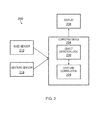
- Figure 2 is a block diagram illustrating a system for providing user feedback based on gaze and hand gesture tracking according to one embodiment of the invention
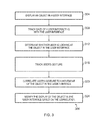
- Figure 3 is a flow diagram illustrating a process for providing user feedback based on gaze and hand gesture tracking according to one embodiment of the invention
- Figure 4 is a block diagram illustrating a system for providing user feedback based on tracking a primary user input and a secondary user input according to one embodiment of the invention
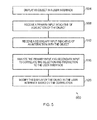
- Figure 5 is a flow diagram illustrating a process for providing user feedback based on tracking a primary user input and a secondary user input according to one embodiment of the invention
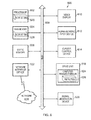
- Figure 6 is a block diagram illustrating an exemplary computing device according to one embodiment of the invention.
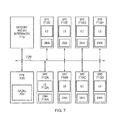
- Figure 7 is a block diagram illustrating additional hardware that may be used to process instructions according to one embodiment of the invention.
- Embodiments of the invention relate to user interface technology that provides feedback to the user based on the user's gaze and a secondary user input, such as a hand gesture.
- a camera-based tracking system tracks the gaze direction of a user to detect which object displayed in the user interface is being viewed.
- the tracking system also recognizes hand or other body gestures to control the action or motion of that object, using, for example, a separate camera and/or sensor.
- Exemplary gesture input can be used to simulate a mental or magical force that can pull, push, position or otherwise move or control the selected object.
- the user's interaction simulates a feeling in the user that their mind is controlling the object in the user interface - similar to telekinetic power, which users have seen simulated in movies (e.g., the Force in Star Wars).
- Embodiments of the present invention also relate to an apparatus or system for performing the operations herein.
- This apparatus or system may be specifically constructed for the required purposes, or it may comprise a general purpose computer selectively activated or reconfigured by a computer program stored in the computer.
- the apparatus or system performing the operations described herein is a game console (e.g., a SONY PLAYSTATION, a NINTENDO WII, a MICROSOFT XBOX, etc.).
- a computer program may be stored in a computer readable storage medium, which is described in further detail with reference to Figure 6 .
- FIG. 1 schematically illustrates user interface technology that provides feedback based on gaze tracking and gesture input according to one embodiment of the invention.
- the user 104 is schematically illustrated with the user's eye 108 and hand 112.
- the user 104 views a display 116 which displays a user interface 120 (e.g., a video game, an Internet browser window, word processing application window, etc.).
- the display 116 includes a computing device or is coupled to a computing device, such as a video game console or computer.
- the display 116 may be wired or wirelessly connected over the Internet to a computing device such as a server or other computer system.
- the computing device provides the user interface 120 to the display 116.
- a camera 124 is shown positioned over the display 116 with the lens of the camera 124 pointed generally in the direction of the user 104.
- the camera 124 uses infrared illumination to track the user's gaze 128 (i.e., direction at which the user's eye 108 is directed relative to the display 116).
- the computing device analyzes the input from the at least one camera with infrared illumination to determine the area of the display 132 where the user is looking, and then determines the specific object 140 that the user is looking at.
- the camera 124 may include a processor that determines the user's gaze 128.
- the same camera 124 or separate camera may be used to track hand gestures (i.e., movements made by the user's hand 112 in the direction of arrow 136).
- hand gestures i.e., movements made by the user's hand 112 in the direction of arrow 136.
- the camera alone may be used, a camera in combination with a near-infrared sensor, or a camera in combination with another depth sensor may be used to track hand gestures.
- a controller or inertial sensor may alternatively be used to track the user's hand gestures.
- the hand gesture may be a flick of an inertial sensor (or other controller or sensor that includes an accelerometer).
- the computing device then correlates the input from the gesture camera (or other gesture tracking device) to a movement of the object 144 or a command relating to the object 144 displayed in the user interface 120 (i.e., movement of the object 140 in the direction of arrow 144).
- the gesture sensor may include a processor that determines the user's gesture.
- the eye gaze is used to select the object 140 displayed in the user interface, and the hand gesture or body movement 136 is used to control or move the object 144. It will be appreciated that these steps may order in any order (i.e., control or movement 144 may be determined before the object is selected or vice versa).
- the hand gesture may launch a spell at a character on the user interface based on the character that the user is looking at.
- Another exemplary hand gesture may be a trigger (e.g. shooting action) in a shooting game.
- the gaze and gestures may also be used to select virtual buttons by simulating the action of pressing a button (e.g., pointing a finger and moving the finger forward while the user's gaze is focused on the button).
- the gaze and user gesture may be used to zoom in or out of a particular portion of the user interface (e.g., zoom in to a particular portion of a map).
- a forward flick of a pointing hand could start an interaction with the object being watched by the user as detected by the gaze tracker.
- a beckoning gesture may be used to make the object the user is looking at move closer to the user in the user interface; similarly, a waving gesture could make the object recede.
- Gaze tracking is advantageous because, to the user, it feels like a natural or even unconscious way to indicate an intent to interact with an object displayed in the user interface.
- Hand gestures are advantageous because the power of hand movement can be used to affect the power of the action on the screen, and hand gestures are a natural to way to interact with the selected objects to communicate a desired motion or to directly control motion.
- a foot gesture i.e., movement of the user's foot
- facial gestures i.e., movement of the user's head or movement of certain features of the user's face
- a foot gesture such as swinging the user's foot, may be used to simulate kicking a ball in a video soccer game.
- a user may simulate a shot on goal (similar to a shot on goal in a real soccer game) by changing their gaze just prior to kicking the ball to trick the goalie - the ball is kicked in the direction of the user's gaze - and (hopefully) score a goal.
- a shot on goal similar to a shot on goal in a real soccer game
- Figure 2 illustrates a system 200 for providing user feedback based on gaze and gesture tracking according to one embodiment of the invention.
- the system 200 includes a computing device 204 coupled to a display 208.
- the system 200 also includes a gaze sensor 212 and a gesture sensor 216 coupled to the computing device 204.
- the computing device 204 processes data received by the gaze sensor 212 and the gesture sensor 216.
- the gaze sensor 212 tracks the user's eye.
- the gaze sensor 212 may include a light source, such as near infrared illumination diodes, to illuminate the eye, and, in particular, the retina, causing visible reflections and a camera that captures an image of the eye showing the reflections.
- the image is then analyzed by the computing device 204 to identify the reflection of the light, and calculate the gaze direction.
- the gaze sensor 212 itself may analyze the data to calculate the gaze direction.
- the gaze sensor 212 is the camera and light source and is positioned near the display, such as the TOBII X60 and X120 eye trackers.
- the gaze sensor 212 is integrated into the display 208 (i.e., the camera and light source are included in the display housing), such as the TOBII T60, T120 or T60 XL eye trackers.
- the gaze sensor 212 are glasses worn by the user that include the camera and light source, such as the TOBII GLASSES eye tracker. It will be appreciated that these are merely exemplary and other sensors and devices for tracking gaze may be used. In addition, it will be appreciated that multiple cameras and light sources may be used to determine the user's gaze.
- the gesture sensor 216 may be an optical sensor to track a movement of a user interacting with an object displayed in the display 208.
- the gesture sensor 216 is also positioned near the display 208 (e.g., on top of the display, below the display, etc.). In one embodiment, the same sensor is used to record images for gaze tracking and gesture tracking.
- the gesture sensor 216 may be used to monitor the user's body, such as the user's hand, foot, arm, leg, face, etc.).
- the gesture sensor 216 measures the positions of an object (i.e., the user) in two-dimensional or three-dimensional space relative to the sensor.
- Positional data e.g., images
- a reference frame is a coordinate system in which an object's position, orientation and/or other properties may be measured.
- the gesture sensor 216 may be a standard or 3-D video camera.
- the gesture sensor 216 may capture depth information (e.g., distance between the sensor and the user) directly or indirectly. Pre-configured information may be required to determine the depth information when a standard video camera. Alternatively, a separate sensor may be used to determine the depth information. It will be appreciated that multiple cameras and/or depth may be used to determine the user's gestures.
- the gesture sensor 216 is the KINECT device or is similar to the KINECT device.
- the gesture sensor 216 may be used to monitor a controller or inertial sensor held by, or otherwise connected to, the user.
- the inertial sensor may include one or more gyroscopes and one or more accelerometers to detect changes in orientation (e.g., pitch, roll and twist) and acceleration(s) that are used to calculate gestures.
- the sensors 212, 216 may be connected with the computing device 204 through wired and/or wireless connections.
- Exemplary wired connections include connections made via an IEEE 1394 (firewire) cable, an Ethernet cable, a universal serial bus (USB) cable, etc.
- Exemplary wireless connections include wireless fidelity (WIFI) connections, BLUETOOTH connections, ZIGBEE connections, and the like.
- the sensors 212, 216 provide the data to the computing device 204 continuously and in real-time. It will be appreciated that the sensors 212, 216 may provide additional information such as timestamp data and the like that can also be used during an analysis of the data.
- Exemplary output data of the gaze sensor 212 includes eye gaze position, eye position, distance from sensor 212 to eye, pupil size, timestamp for each data point and the like.
- the gaze sensor 212 simply provides the captured image data (e.g., the video feed that includes the near-infrared illumination reflections).
- Exemplary output of the gesture sensor 216 includes relevant joint positions, body positions, distance from sensor 216 to user, time stamp for each data point and the like.
- the gaze sensor 216 simply provides the captured image data and/or captured depth sensor data.
- the computing device 204 may be a gaming system (e.g., a game console), a personal computer, a game kiosk, a television that includes a computer processor, or other computing system.
- the computing device 204 may execute programs corresponding to games or other applications that can cause the computing device 204 to display a user interface that includes at least one object on the display 208.
- the computing device 204 also executes programs that determine a user's response to the user interface using data received from the sensors 212, 216 and responds to the user input (e.g., by changing the user interface displayed on the display 208) based on the received data.
- the computing device 204 may include memory to store the data received from the sensors 212, 216.
- the computing device 204 includes object detection logic 220 and gesture correlation logic 224.
- a ray cast analysis is performed by the object detection logic 220 to determine the gaze position on the screen.
- a 3-D ray intersection analysis may be performed. It will be appreciated that other algorithms may be used to calculate the object that the user is looking at.
- the dwell time i.e., the amount of time the user is gazing at a particular object
- the dwell time is used to select an object. In other words, the user must be gazing at the object displayed in the user interface for a predetermined amount of time before the object is selected. For example, the user must look at the object for at least three seconds before the object is selected.
- the dwell time may be any time or range of times between about 100 milli-seconds and about 30 seconds.
- the gesture correlation logic 224 identifies the user gesture or calculates the user gesture (e.g., by comparing the user's position in captured images at different points in time or detecting changes in the user's position). In some embodiments, the user gesture data will be provided to the gesture correlation logic 224. The gesture correlation logic 224 then correlates the user gesture to a change in the user interface (i.e., movement of the object displayed in the user interface). The user's body may mapped to a skeletal model. An amount and direction of an axial rotation of a particular joint may be used to determine a corresponding amount and direction of an axial rotation of a model of a character (i.e., selected object) displayed in the user interface.
- the gesture data may be rasterized and projected onto the object or user interface based on the gaze data.
- force vectors for each pixel of the object are calculated based on the gesture data.
- pixel-level information in the camera image e.g., motion of pixels
- a look-up table stored in memory of the computing device 204 may be used to correlate gestures to commands (e.g., moving hand up and down moves the object up and down in a video game, moving hand up and down scrolls a web page up and down in an Internet browser application, etc.).
- the computing device 204 is calibrated prior to tracking the user input received from the sensors 212, 216.
- characteristics of the user's eyes and body may need to be measured to perform data processing algorithms.
- characteristics of the user's eye may be measured to generate a physiological eye model (e.g., including pupil size and position, cornea size, etc.), and characteristics of the user's body may be measured to generate a physiological body model (e.g., location of joints, user size, etc.).
- Figure 3 illustrates a process 300 for providing user feedback based on gaze and gesture tracking according to one embodiment of the invention. It will be appreciated that the process 300 described below is merely exemplary and may include a fewer or greater number of steps, and that the order of at least some of the steps may vary from that described below. In one embodiment, the process 300 is performed by the computing device 204.
- the process 300 begins by displaying an object in a user interface (block 304).
- the process 300 continues by tracking the gaze of a user interacting with the user interface (block 308) and determining whether the user is looking at the object in the user interface (block 312).
- the process 300 continues by tracking the user's gesture (block 316) and correlating the user's gesture to a movement of the object in the user interface (block 320).
- the process 300 continues by modifying the display of the object in the user interface based on the correlation (block 324).
- the user's gesture may be tracked prior to tracking the user's gaze.
- the user's gesture and gaze may be tracked prior to the analysis (e.g., determination of object selected and correlation of gesture to control of the object).
- Figure 4 illustrates a system 400 for providing user feedback based on a primary user input and a secondary user input according to one embodiment of the invention.
- the system 400 includes a computing device 404 that is coupled to a display 408 and provides a user interface to be displayed on the display 408.
- the system 400 also includes a primary sensor 412 and a secondary sensor 416 that are coupled to the computing device 404.
- the primary sensor 412 and secondary sensor 416 may be coupled to the computing device 404 via wired and/or wireless connections.
- the computing device 404 may include detection logic 420 to determine an object in the user interface that is selected by the user and correlation logic 424 to correlate an intended action or command of the user to the user interface.
- the primary input is gaze
- the primary sensor 412 is a gaze tracking sensor as described above with reference to, for example, Figure 2 .
- the secondary input is gesture
- the secondary sensor 416 is a gesture sensor as described above with reference to, for example, Figure 2 .
- the secondary input is a voice command.
- the secondary sensor 416 is a microphone.
- users can gaze at the character that they want to speak with (i.e., primary input), and then interact with the character by speaking to the character (i.e., secondary input).
- the secondary input is voice data; and, if motion is being simulated, the secondary input is gesture data.
- the secondary input may be brainwaves and/or user emotions.
- the secondary sensor 416 may be a sensor (or plurality of sensors) that measures and produces graphs of brainwaves, such as electroencephalogram (EEG).
- EEG electroencephalogram
- several pairs of electrodes or other sensors may be provided on the user's head using a headset, such as, for example, the Emotiv EPOC headset.
- the headset may also be used to detect facial expressions.
- the brainwaves and/or facial expressions data collected may be correlated into object actions such as lifting and dropping an object, moving an object, rotating an object and the like, into emotions such as excitement, tension, boredom, immersion, mediation and frustration, and into character actions, such as winking, laughing, crossing eyes, appearing shocked, smiling, getting angry, smirking, grimacing and the like.
- object actions such as lifting and dropping an object, moving an object, rotating an object and the like
- emotions such as excitement, tension, boredom, immersion, mediation and frustration
- character actions such as winking, laughing, crossing eyes, appearing shocked, smiling, getting angry, smirking, grimacing and the like.
- a user may gaze at an object that the user wants to move, and the user may use his brainwaves to move the object.
- a user may gaze at a character, and control the user's facial expressions, emotions and/or actions using the headset sensor system.
- gaze tracking may be used with various combinations of gesture input, voice input, brainwave input and emotion input. For example, gaze tracking may be used with each of gesture input, voice input, brainwave input and emotion input. In another example, gaze tracking may be used with voice input, brainwave input and emotion input. In another example, gaze tracking may be used with voice input and brainwave input.
- the computing device 404 is similar to the computing device 204 described above with reference to Figure 2 . It will be appreciated, however, that in embodiments in which the secondary input is not gesture data (e.g., the secondary input is a voice command), the correlation logic 424 correlates the secondary input to a command or movement related to the user interface displayed in the display 408. For example, received voice data may be analyzed to determine a user command (e.g., "scroll down”, “scroll up”, “zoom in”, “zoom out”, “cast spell”, etc.), and then modify the user interface based on the command (e.g., by scrolling down, scrolling up, zooming in, zooming out, casting the spell, etc.).
- a user command e.g., "scroll down”, “scroll up”, “zoom in”, “zoom out”, “cast spell”, etc.
- Figure 5 illustrates a process for providing user feedback based on tracking a primary user input and a secondary user input according to one embodiment of the invention. It will be appreciated that the process 500 described below is merely exemplary and may include a fewer or greater number of steps, and that the order of at least some of the steps may vary from that described below. In one embodiment, the process 300 is performed by the computing device 404.
- the process 500 begins by displaying an object in a user interface (block 504).
- the process 500 continues by receiving a primary input indicative of a selection of the object (block 508) and receiving a secondary input indicative of an interaction with the object (block 512).
- the process 500 continues by analyzing the primary input and secondary input to correlate the selection and interaction to the user interface (block 516). The process 500 continues by modifying the display of the object in the user interface based on the correlation (block 520).
- Figure 6 shows a diagrammatic representation of machine in the exemplary form of a computer system 600 within which a set of instructions, for causing the machine to perform any one or more of the methodologies discussed herein, may be executed.
- the machine operates as a standalone device or may be connected (e.g., networked) to other machines.
- the machine may operate in the capacity of a server or a client machine in server-client network environment, or as a peer machine in a peer-to-peer (or distributed) network environment.
- the machine may be a personal computer (PC), a tablet PC, a set-top box (STB), a Personal Digital Assistant (PDA), a cellular telephone, a web appliance, a network router, switch or bridge, a video console or any machine capable of executing a set of instructions (sequential or otherwise) that specify actions to be taken by that machine.
- PC personal computer
- PDA Personal Digital Assistant
- STB set-top box
- WPA Personal Digital Assistant
- a cellular telephone a web appliance
- network router a network router, switch or bridge
- video console any machine capable of executing a set of instructions (sequential or otherwise) that specify actions to be taken by that machine.
- the term "machine” shall also be taken to include any collection of machines that individually or jointly execute a set (or multiple sets) of instructions to perform any one or more of the methodologies discussed herein.
- the computer system 600 is a SONY PLAYSTATION entertainment device.
- the exemplary computer system 600 includes a processor 602 (e.g., a central processing unit (CPU), a graphics processing unit (GPU) or both), a main memory 604 (e.g., read only memory (ROM), flash memory, dynamic random access memory (DRAM) such as synchronous DRAM (SDRAM) or Rambus DRAM (RDRAM), etc.) and a static memory 606 (e.g., flash memory, static random access memory (SRAM), etc.), which communicate with each other via a bus 608.
- the processor 602 is a Cell processor
- the memory may include a RAMBUS dynamic random access memory (XDRAM) unit.
- the computer system 600 may further include a video display unit 610 (e.g., a liquid crystal display (LCD) or a cathode ray tube (CRT)). Alternatively, the computer system 600 may be connected to a separate video display unit 610.
- the computer system 600 also includes an alphanumeric input device 612 (e.g., a keyboard), a cursor control device 614 (e.g., a mouse or game controller and/or gaze and gesture sensors, etc.), a disk drive unit 616, a signal generation device 620 (e.g., a speaker, the gaze and gesture sensors, etc.) and a network interface device 622.
- a video display unit 610 e.g., a liquid crystal display (LCD) or a cathode ray tube (CRT)
- the computer system 600 may be connected to a separate video display unit 610.
- the computer system 600 also includes an alphanumeric input device 612 (e.g., a keyboard), a cursor control
- the computer system 616 includes a BLU-RAY DISK BD-ROM optical disk reader for reading from a disk and a removable slot-in hard disk drive (HDD) accessible through the bus 608.
- the bus may also connect to one or more Universal Serial Bus (USB) 2.0 ports, a gigabit Ethernet port, an IEEE 802.11b/g wireless network (WiFi) port, and/or a BLUETOOTH wireless link port.
- USB Universal Serial Bus
- WiFi wireless network
- the disk drive unit 616 includes a computer-readable medium 624 on which is stored one or more sets of instructions (e.g., software 626) embodying any one or more of the methodologies or functions described herein.
- the software 626 may also reside, completely or at least partially, within the main memory 604 and/or within the processor 602 during execution thereof by the computer system 600, the main memory 604 and the processor 602 also constituting computer-readable media.
- the software 626 may further be transmitted or received over a network 628 via the network interface device 622.
- While the computer-readable medium 624 is shown in an exemplary embodiment to be a single medium, the term “computer-readable medium” should be taken to include a single medium or multiple media (e.g., a centralized or distributed database, and/or associated caches and servers) that store the one or more sets of instructions.
- the term “computer-readable medium” shall also be taken to include any tangible medium that is capable of storing, encoding or carrying a set of instructions for execution by the machine and that cause the machine to perform any one or more of the methodologies of the present invention.
- the term “computer-readable storage medium” shall accordingly be taken to include, but not be limited to, solid-state memories, and optical and magnetic media.
- computing device is illustrated and discussed herein as having various modules which perform particular functions and interact with one another. It should be understood that these modules are merely segregated based on their function for the sake of description and represent computer hardware and/or executable software code which is stored on a computer-readable medium for execution on appropriate computing hardware. The various functions of the different modules and units can be combined or segregated as hardware and/or software stored on a computer-readable medium as above as modules in any manner, and can be used separately or in combination.
- Figure 7 illustrates additional hardware that may be used to process instructions, in accordance with one embodiment of the present invention.
- Figure 7 illustrates the components of a cell processor 700, which may correspond to the processor 602 of Figure 6 , in accordance with one embodiment of the present invention.
- the cell processor 700 of Figure 7 has an architecture comprising four basic components: external input and output structures comprising a memory controller 760 and a dual bus interface controller 770A, B; a main processor referred to as the Power Processing Element 750; eight co-processors referred to as Synergistic Processing Elements (SPEs) 710A-H; and a circular data bus connecting the above components referred to as the Element Interconnect Bus 780.
- the total floating point performance of the Cell processor is 218 GFLOPS, compared with the 6.2 GFLOPs of the Playstation 2 device's Emotion Engine.
- the Power Processing Element (PPE) 750 is based upon a two-way simultaneous multithreading Power 1470 compliant PowerPC core (PPU) 755 running with an internal clock of 3.2 GHz. It comprises a 512 kB level 2 (L2) cache and a 32 kB level 1 (L1) cache.
- the PPE 750 is capable of eight single position operations per clock cycle, translating to 25.6 GFLOPs at 3.2 GHz.
- the primary role of the PPE 750 is to act as a controller for the Synergistic Processing Elements 710A-H, which handle most of the computational workload. In operation the PPE 750 maintains a job queue, scheduling jobs for the Synergistic Processing Elements 710A-H and monitoring their progress. Consequently each Synergistic Processing Element 710A-H runs a kernel whose role is to fetch a job, execute it and synchronize it with the PPE 750.
- Each Synergistic Processing Element (SPE) 710A-H comprises a respective Synergistic Processing Unit (SPU) 720A-H, and a respective Memory Flow Controller (MFC) 740A-H comprising in turn a respective Dynamic Memory Access Controller (DMAC) 742A-H, a respective Memory Management Unit (MMU) 744AH and a bus interface (not shown).
- SPU 720A-H is a RISC processor clocked at 3.2 GHz and comprising 256 kB local RAM 730A-H, expandable in principle to 4 GB.
- Each SPE gives a theoretical 25.6 GFLOPS of single precision performance.
- An SPU can operate on 4 single precision floating point members, 4 32-bit numbers, 8 16-bit integers, or 16 8-bit integers in a single clock cycle. In the same clock cycle it can also perform a memory operation.
- the SPU 720A-H does not directly access the system memory XDRAM 1426; the 64-bit addresses formed by the SPU 720A-H are passed to the MFC 740A-H which instructs its DMA controller 742A-H to access memory via the Element Interconnect Bus 780 and the memory controller 760.
- the Element Interconnect Bus (EIB) 780 is a logically circular communication bus internal to the Cell processor 700 which connects the above processor elements, namely the PPE 750, the memory controller 760, the dual bus interface 770A,B and the 8 SPEs 710A-H, totaling 12 participants. Participants can simultaneously read and write to the bus at a rate of 8 bytes per clock cycle. As noted previously, each SPE 710A-H comprises a DMAC 742A-H for scheduling longer read or write sequences.
- the EIB comprises four channels, two each in clockwise and anticlockwise directions. Consequently for twelve participants, the longest step-wise dataflow between any two participants is six steps in the appropriate direction.
- the theoretical peak instantaneous EIB bandwidth for 12 slots is therefore 96B per clock, in the event of full utilization through arbitration between participants. This equates to a theoretical peak bandwidth of 307.2 GB/s (gigabytes per second) at a clock rate of 3.2GHz.
- the memory controller 760 comprises an XDRAM interface 762, developed by Rambus Incorporated.
- the memory controller interfaces with the Rambus XDRAM with a theoretical peak bandwidth of 25.6 GB/s.
- the dual bus interface 770A,B comprises a Rambus FlexIO® system interface 772A,B.
- the interface is organized into 12 channels each being 8 bits wide, with five paths being inbound and seven outbound. This provides a theoretical peak bandwidth of 62.4 GB/s (36.4 GB/s outbound, 26 GB/s inbound) between the Cell processor and an I/O Bridge via controller 770A and a Reality Simulator graphics unit via controller 770B.
Landscapes
- Engineering & Computer Science (AREA)
- General Engineering & Computer Science (AREA)
- Theoretical Computer Science (AREA)
- Human Computer Interaction (AREA)
- Physics & Mathematics (AREA)
- General Physics & Mathematics (AREA)
- User Interface Of Digital Computer (AREA)
- Position Input By Displaying (AREA)
- Image Analysis (AREA)
Abstract
Description
- The subject invention relates to providing feedback based on a user's interaction with a user interface generated by a computer system based on multiple user inputs, such as, for example, tracked user gaze and tracked user gestures.
- The capabilities of portable or home video game consoles, portable or desktop personal computers, set-top boxes, audio or video consumer devices, personal digital assistants, mobile telephones, media servers, and personal audio and/or video players and records, and other types are increasing. The devices have enormous information processing capabilities, high quality audio and video inputs and outputs, large amounts of memory, and may also include wired and/or wireless networking capabilities.
- These computing devices typically require a separate control device, such as a mouse or game controller, to interact with the computing device's user interface. Users typically use a cursor or other selection tool displayed in the user interface to select objects by pushing buttons on the control device. Users also use the control device to modify and control those selected objects (e.g., by pressing additional buttons on the control device or moving the control device). Training is usually required to teach the user how movements of this control device map to the remote user interface objects. Even after the training, the user sometimes still finds the movements to be awkward.
- Recently, the KINECT device sold by MICROSOFT was introduced, which allows users to control and interact with a computer game console without the need to use a game controller. The user interacts with the user interface using gestures and spoken commands via the KINECT device. Specifically, the KINECT device includes a video camera, a depth sensor and a microphone to track the user's gestures and spoken commands. The video camera and depth sensor are used together to create a 3-D model of the user. The KINECT device however only recognizes limited types of gestures (users can point to control a cursor but the KINECT device doesn't allow a user to click the cursor requiring the user to hover over a selection for several seconds to make a selection).
- The following summary of the invention is included in order to provide a basic understanding of some aspects and features of the invention. This summary is not an extensive overview of the invention and as such it is not intended to particularly identify key or critical elements of the invention or to delineate the scope of the invention. Its sole purpose is to present some concepts of the invention in a simplified form as a prelude to the more detailed description that is presented below.
- According to an aspect of the invention, a computer system is disclosed that includes a processor configured to receive gaze data, receive gesture data, determine a location of a user interface corresponding to the gaze data and correlate the gesture data to a modification of the user interface; and memory coupled to the processor and configured to store the gaze data and gesture data.
- The gesture data may be hand gesture data.
- The gaze data may include a plurality of images of an eye of a user interacting the user interface. The gaze data may include reflections of light. The light may be infrared illumination.
- The gesture data may include a plurality of images of the body of a user interacting with the user interface. The gesture data may also include depth information.
- According to a further aspect of the invention, a system is disclosed that includes a display to display a user interface that includes an object; a gaze sensor to capture eye gaze data; a gesture sensor to capture user gesture data; and a computing device coupled to the gaze sensor, the gesture sensor and the display, wherein the computing device is configured to provide the user interface to the display, determine if the user is viewing the object based on the gaze data, correlate the gesture data to a command corresponding to the object, and modify the display of the user interface that includes the object based on the command.
- The command may be a movement of the object.
- The gaze data may include eye gaze data eye gaze position and at least one of eye position, distance from the gaze sensor to the eye, pupil size, and a timestamp.
- The gaze sensor may include a video camera and a light source. The gesture sensor may include a video camera and a depth sensor. The gesture sensor may include at least one gyroscope and at least one accelerometer.
- According to another aspect of the invention, a method is disclosed that includes displaying a user interface on a display; receiving gaze data for a user interacting with the user interface; determining whether the gaze of the user is directed at an object displayed in the user interface based on the gaze data; receiving gesture data corresponding to a gesture of the user; correlating the gesture data to an intended interaction of the user with the object; and modifying the display of the object in the user interface based on the correlated interaction.
- The gaze data may include eye gaze data eye gaze position and at least one of eye position, distance from the gaze sensor to the eye, pupil size, and a timestamp.
- The gesture data may be correlated to an intended interaction of the user before determining whether the gaze of the user is directed at the object.
- Modifying the display of the object may include moving the relative position of the object in the user interface.
- The gesture data may include information corresponding to a hand gesture.
- According to yet another aspect of the invention, a computer-readable storage media is disclosed having computer executable instructions stored thereon which cause a computer system to carry out the above method when executed.
- The accompanying drawings, which are incorporated in and constitute a part of this specification, exemplify the embodiments of the present invention and, together with the description, serve to explain and illustrate principles of the invention. The drawings are intended to illustrate major features of the exemplary embodiments in a diagrammatic manner. The drawings are not intended to depict every feature of actual embodiments nor relative dimensions of the depicted elements, and are not drawn to scale.
-
Figure 1 is a schematic diagram illustrating providing user feedback based on gaze and hand gesture tracking according to one embodiment of the invention; -
Figure 2 is a block diagram illustrating a system for providing user feedback based on gaze and hand gesture tracking according to one embodiment of the invention; -
Figure 3 is a flow diagram illustrating a process for providing user feedback based on gaze and hand gesture tracking according to one embodiment of the invention; -
Figure 4 is a block diagram illustrating a system for providing user feedback based on tracking a primary user input and a secondary user input according to one embodiment of the invention; -
Figure 5 is a flow diagram illustrating a process for providing user feedback based on tracking a primary user input and a secondary user input according to one embodiment of the invention; -
Figure 6 is a block diagram illustrating an exemplary computing device according to one embodiment of the invention; and -
Figure 7 is a block diagram illustrating additional hardware that may be used to process instructions according to one embodiment of the invention. - Embodiments of the invention relate to user interface technology that provides feedback to the user based on the user's gaze and a secondary user input, such as a hand gesture. In one embodiment, a camera-based tracking system tracks the gaze direction of a user to detect which object displayed in the user interface is being viewed. The tracking system also recognizes hand or other body gestures to control the action or motion of that object, using, for example, a separate camera and/or sensor. Exemplary gesture input can be used to simulate a mental or magical force that can pull, push, position or otherwise move or control the selected object. The user's interaction simulates a feeling in the user that their mind is controlling the object in the user interface - similar to telekinetic power, which users have seen simulated in movies (e.g., the Force in Star Wars).
- In the following description, numerous details are set forth. It will be apparent, however, to one skilled in the art, that embodiments of the invention may be practiced without these specific details. In some instances, well-known structures and devices are shown in block diagram form, rather than in detail, in able to avoid obscuring embodiments of the invention.
- Some portions of the detailed description which follows are presented in terms of algorithms and symbolic representations of operations on data bits within a computer memory. These algorithmic descriptions and representations are the means used by those skilled in the data processing arts to most effectively convey the substance of their work to others skilled in the art. An algorithm, as disclosed herein and generally, is conceived to be a self-consistent sequence of steps leading to a desired result. The steps are those requiring physical manipulations of physical quantities. Usually, though not necessarily, these quantities take the form of electrical or magnetic signals capable of being stored, transferred, combined, compared and otherwise manipulated. It has proven convenient at times, principally for reasons of common usage, to refer to these signals as bits, values, elements, symbols, characters, terms, numbers, or the like.
- It should be borne in mind, however, that all of these and similar terms are to be associated with the appropriate physical quantities and are merely convenient labels applied to these quantities. Unless specifically stated otherwise as apparent from the following discussion, it is appreciated that throughout the description, discussions utilizing terms such as "processing", "computing", "converting", "determining", "correlating" or the like, refer to the actions and processes of a computer system, or similar electronic computing device, that manipulates and transforms data represented as physical (e.g., electronic) quantities within the computer system's registers and memories into other data similarly represented as physical quantities within the computer system memories or registers or other such information storage devices.
- Embodiments of the present invention also relate to an apparatus or system for performing the operations herein. This apparatus or system may be specifically constructed for the required purposes, or it may comprise a general purpose computer selectively activated or reconfigured by a computer program stored in the computer. In one embodiment, the apparatus or system performing the operations described herein is a game console (e.g., a SONY PLAYSTATION, a NINTENDO WII, a MICROSOFT XBOX, etc.). A computer program may be stored in a computer readable storage medium, which is described in further detail with reference to
Figure 6 . -
Figure 1 schematically illustrates user interface technology that provides feedback based on gaze tracking and gesture input according to one embodiment of the invention. InFigure 1 , theuser 104 is schematically illustrated with the user'seye 108 andhand 112. Theuser 104 views adisplay 116 which displays a user interface 120 (e.g., a video game, an Internet browser window, word processing application window, etc.). Thedisplay 116 includes a computing device or is coupled to a computing device, such as a video game console or computer. In yet another embodiment, thedisplay 116 may be wired or wirelessly connected over the Internet to a computing device such as a server or other computer system. The computing device provides theuser interface 120 to thedisplay 116. - In
Figure 1 , acamera 124 is shown positioned over thedisplay 116 with the lens of thecamera 124 pointed generally in the direction of theuser 104. In one embodiment, thecamera 124 uses infrared illumination to track the user's gaze 128 (i.e., direction at which the user'seye 108 is directed relative to the display 116). The computing device analyzes the input from the at least one camera with infrared illumination to determine the area of thedisplay 132 where the user is looking, and then determines thespecific object 140 that the user is looking at. Alternatively, thecamera 124 may include a processor that determines the user'sgaze 128. - The
same camera 124 or separate camera (not shown inFigure 1 ) may be used to track hand gestures (i.e., movements made by the user'shand 112 in the direction of arrow 136). In embodiments in which a separate camera is used, the camera alone may be used, a camera in combination with a near-infrared sensor, or a camera in combination with another depth sensor may be used to track hand gestures. It will be appreciated that a controller or inertial sensor may alternatively be used to track the user's hand gestures. For example, the hand gesture may be a flick of an inertial sensor (or other controller or sensor that includes an accelerometer). The computing device then correlates the input from the gesture camera (or other gesture tracking device) to a movement of theobject 144 or a command relating to theobject 144 displayed in the user interface 120 (i.e., movement of theobject 140 in the direction of arrow 144). Alternatively, the gesture sensor may include a processor that determines the user's gesture. - In use, the eye gaze is used to select the
object 140 displayed in the user interface, and the hand gesture orbody movement 136 is used to control or move theobject 144. It will be appreciated that these steps may order in any order (i.e., control ormovement 144 may be determined before the object is selected or vice versa). - It will be appreciated that there are many different applications for user interface technology that provides user feedback based on the combination of eye gaze tracking and hand gesture tracking. For example, the hand gesture may launch a spell at a character on the user interface based on the character that the user is looking at. Another exemplary hand gesture may be a trigger (e.g. shooting action) in a shooting game. The gaze and gestures may also be used to select virtual buttons by simulating the action of pressing a button (e.g., pointing a finger and moving the finger forward while the user's gaze is focused on the button). In another example, the gaze and user gesture may be used to zoom in or out of a particular portion of the user interface (e.g., zoom in to a particular portion of a map). In still another example, a forward flick of a pointing hand could start an interaction with the object being watched by the user as detected by the gaze tracker. In yet another example, a beckoning gesture may be used to make the object the user is looking at move closer to the user in the user interface; similarly, a waving gesture could make the object recede.
- Gaze tracking is advantageous because, to the user, it feels like a natural or even unconscious way to indicate an intent to interact with an object displayed in the user interface. Hand gestures are advantageous because the power of hand movement can be used to affect the power of the action on the screen, and hand gestures are a natural to way to interact with the selected objects to communicate a desired motion or to directly control motion.
- Although the invention has been described with reference to
Figure 1 as tracking hand gestures, it will be appreciated that other user gestures, such as foot gestures (i.e., movement of the user's foot) or facial gestures (i.e., movement of the user's head or movement of certain features of the user's face) may be used to interact with the user interface. For example, a foot gesture, such as swinging the user's foot, may be used to simulate kicking a ball in a video soccer game. In particular, a user may simulate a shot on goal (similar to a shot on goal in a real soccer game) by changing their gaze just prior to kicking the ball to trick the goalie - the ball is kicked in the direction of the user's gaze - and (hopefully) score a goal. -
Figure 2 illustrates asystem 200 for providing user feedback based on gaze and gesture tracking according to one embodiment of the invention. Thesystem 200 includes acomputing device 204 coupled to adisplay 208. Thesystem 200 also includes agaze sensor 212 and agesture sensor 216 coupled to thecomputing device 204. Thecomputing device 204 processes data received by thegaze sensor 212 and thegesture sensor 216. - The
gaze sensor 212 tracks the user's eye. Thegaze sensor 212 may include a light source, such as near infrared illumination diodes, to illuminate the eye, and, in particular, the retina, causing visible reflections and a camera that captures an image of the eye showing the reflections. The image is then analyzed by thecomputing device 204 to identify the reflection of the light, and calculate the gaze direction. Alternatively, thegaze sensor 212 itself may analyze the data to calculate the gaze direction. - In one embodiment, the
gaze sensor 212 is the camera and light source and is positioned near the display, such as the TOBII X60 and X120 eye trackers. In another embodiment, thegaze sensor 212 is integrated into the display 208 (i.e., the camera and light source are included in the display housing), such as the TOBII T60, T120 or T60 XL eye trackers. In yet another embodiment, thegaze sensor 212 are glasses worn by the user that include the camera and light source, such as the TOBII GLASSES eye tracker. It will be appreciated that these are merely exemplary and other sensors and devices for tracking gaze may be used. In addition, it will be appreciated that multiple cameras and light sources may be used to determine the user's gaze. - The
gesture sensor 216 may be an optical sensor to track a movement of a user interacting with an object displayed in thedisplay 208. Thegesture sensor 216 is also positioned near the display 208 (e.g., on top of the display, below the display, etc.). In one embodiment, the same sensor is used to record images for gaze tracking and gesture tracking. Thegesture sensor 216 may be used to monitor the user's body, such as the user's hand, foot, arm, leg, face, etc.). - The
gesture sensor 216 measures the positions of an object (i.e., the user) in two-dimensional or three-dimensional space relative to the sensor. Positional data (e.g., images) taken by thesensor 216 may be in a reference frame that are defined by an image plane and a vector normal to the image plane. A reference frame is a coordinate system in which an object's position, orientation and/or other properties may be measured. - The
gesture sensor 216 may be a standard or 3-D video camera. Thegesture sensor 216 may capture depth information (e.g., distance between the sensor and the user) directly or indirectly. Pre-configured information may be required to determine the depth information when a standard video camera. Alternatively, a separate sensor may be used to determine the depth information. It will be appreciated that multiple cameras and/or depth may be used to determine the user's gestures. In one particular embodiment, thegesture sensor 216 is the KINECT device or is similar to the KINECT device. - In an alternative embodiment, the
gesture sensor 216 may be used to monitor a controller or inertial sensor held by, or otherwise connected to, the user. The inertial sensor may include one or more gyroscopes and one or more accelerometers to detect changes in orientation (e.g., pitch, roll and twist) and acceleration(s) that are used to calculate gestures. - The
sensors computing device 204 through wired and/or wireless connections. Exemplary wired connections include connections made via an IEEE 1394 (firewire) cable, an Ethernet cable, a universal serial bus (USB) cable, etc. Exemplary wireless connections include wireless fidelity (WIFI) connections, BLUETOOTH connections, ZIGBEE connections, and the like. - The
sensors computing device 204 continuously and in real-time. It will be appreciated that thesensors gaze sensor 212 includes eye gaze position, eye position, distance fromsensor 212 to eye, pupil size, timestamp for each data point and the like. Alternatively, thegaze sensor 212 simply provides the captured image data (e.g., the video feed that includes the near-infrared illumination reflections). Exemplary output of thegesture sensor 216 includes relevant joint positions, body positions, distance fromsensor 216 to user, time stamp for each data point and the like. Alternatively, thegaze sensor 216 simply provides the captured image data and/or captured depth sensor data. - The
computing device 204 may be a gaming system (e.g., a game console), a personal computer, a game kiosk, a television that includes a computer processor, or other computing system. Thecomputing device 204 may execute programs corresponding to games or other applications that can cause thecomputing device 204 to display a user interface that includes at least one object on thedisplay 208. Thecomputing device 204 also executes programs that determine a user's response to the user interface using data received from thesensors computing device 204 may include memory to store the data received from thesensors - In one embodiment, the
computing device 204 includesobject detection logic 220 andgesture correlation logic 224. In one embodiment, a ray cast analysis is performed by theobject detection logic 220 to determine the gaze position on the screen. In particular, a 3-D ray intersection analysis may be performed. It will be appreciated that other algorithms may be used to calculate the object that the user is looking at. In one embodiment, the dwell time (i.e., the amount of time the user is gazing at a particular object) is used to select an object. In other words, the user must be gazing at the object displayed in the user interface for a predetermined amount of time before the object is selected. For example, the user must look at the object for at least three seconds before the object is selected. It will be appreciated that the dwell time may be any time or range of times between about 100 milli-seconds and about 30 seconds. - In one embodiment, the
gesture correlation logic 224 identifies the user gesture or calculates the user gesture (e.g., by comparing the user's position in captured images at different points in time or detecting changes in the user's position). In some embodiments, the user gesture data will be provided to thegesture correlation logic 224. Thegesture correlation logic 224 then correlates the user gesture to a change in the user interface (i.e., movement of the object displayed in the user interface). The user's body may mapped to a skeletal model. An amount and direction of an axial rotation of a particular joint may be used to determine a corresponding amount and direction of an axial rotation of a model of a character (i.e., selected object) displayed in the user interface. For example, the gesture data may be rasterized and projected onto the object or user interface based on the gaze data. In one embodiment, force vectors for each pixel of the object are calculated based on the gesture data. In other words, pixel-level information in the camera image (e.g., motion of pixels) may be captured and then that pixel-level data may be used to move an object in the display. In one embodiment, a look-up table stored in memory of thecomputing device 204 may be used to correlate gestures to commands (e.g., moving hand up and down moves the object up and down in a video game, moving hand up and down scrolls a web page up and down in an Internet browser application, etc.). - In one embodiment, the
computing device 204 is calibrated prior to tracking the user input received from thesensors -
Figure 3 illustrates aprocess 300 for providing user feedback based on gaze and gesture tracking according to one embodiment of the invention. It will be appreciated that theprocess 300 described below is merely exemplary and may include a fewer or greater number of steps, and that the order of at least some of the steps may vary from that described below. In one embodiment, theprocess 300 is performed by thecomputing device 204. - The
process 300 begins by displaying an object in a user interface (block 304). - The
process 300 continues by tracking the gaze of a user interacting with the user interface (block 308) and determining whether the user is looking at the object in the user interface (block 312). - The
process 300 continues by tracking the user's gesture (block 316) and correlating the user's gesture to a movement of the object in the user interface (block 320). - The
process 300 continues by modifying the display of the object in the user interface based on the correlation (block 324). - It will be appreciated that in alternative embodiments, the user's gesture may be tracked prior to tracking the user's gaze. In yet another alternative embodiment, the user's gesture and gaze may be tracked prior to the analysis (e.g., determination of object selected and correlation of gesture to control of the object).
-
Figure 4 illustrates asystem 400 for providing user feedback based on a primary user input and a secondary user input according to one embodiment of the invention. As shown inFigure 4 , thesystem 400 includes acomputing device 404 that is coupled to adisplay 408 and provides a user interface to be displayed on thedisplay 408. Thesystem 400 also includes aprimary sensor 412 and asecondary sensor 416 that are coupled to thecomputing device 404. As described above, theprimary sensor 412 andsecondary sensor 416 may be coupled to thecomputing device 404 via wired and/or wireless connections. Thecomputing device 404 may includedetection logic 420 to determine an object in the user interface that is selected by the user andcorrelation logic 424 to correlate an intended action or command of the user to the user interface. - In one embodiment, the primary input is gaze, and the
primary sensor 412 is a gaze tracking sensor as described above with reference to, for example,Figure 2 . In one embodiment, the secondary input is gesture, and thesecondary sensor 416 is a gesture sensor as described above with reference to, for example,Figure 2 . - In another embodiment, the secondary input is a voice command. In this example, the
secondary sensor 416 is a microphone. For example, users can gaze at the character that they want to speak with (i.e., primary input), and then interact with the character by speaking to the character (i.e., secondary input). - In general, if communication is being simulated, the secondary input is voice data; and, if motion is being simulated, the secondary input is gesture data.
- In yet another embodiment, the secondary input may be brainwaves and/or user emotions. In this example, the
secondary sensor 416 may be a sensor (or plurality of sensors) that measures and produces graphs of brainwaves, such as electroencephalogram (EEG). For example, several pairs of electrodes or other sensors may be provided on the user's head using a headset, such as, for example, the Emotiv EPOC headset. The headset may also be used to detect facial expressions. The brainwaves and/or facial expressions data collected may be correlated into object actions such as lifting and dropping an object, moving an object, rotating an object and the like, into emotions such as excitement, tension, boredom, immersion, mediation and frustration, and into character actions, such as winking, laughing, crossing eyes, appearing shocked, smiling, getting angry, smirking, grimacing and the like. For example, a user may gaze at an object that the user wants to move, and the user may use his brainwaves to move the object. In another example, a user may gaze at a character, and control the user's facial expressions, emotions and/or actions using the headset sensor system. - It will be appreciated that gaze tracking may be used with various combinations of gesture input, voice input, brainwave input and emotion input. For example, gaze tracking may be used with each of gesture input, voice input, brainwave input and emotion input. In another example, gaze tracking may be used with voice input, brainwave input and emotion input. In another example, gaze tracking may be used with voice input and brainwave input.
- The
computing device 404 is similar to thecomputing device 204 described above with reference toFigure 2 . It will be appreciated, however, that in embodiments in which the secondary input is not gesture data (e.g., the secondary input is a voice command), thecorrelation logic 424 correlates the secondary input to a command or movement related to the user interface displayed in thedisplay 408. For example, received voice data may be analyzed to determine a user command (e.g., "scroll down", "scroll up", "zoom in", "zoom out", "cast spell", etc.), and then modify the user interface based on the command (e.g., by scrolling down, scrolling up, zooming in, zooming out, casting the spell, etc.). -
Figure 5 illustrates a process for providing user feedback based on tracking a primary user input and a secondary user input according to one embodiment of the invention. It will be appreciated that theprocess 500 described below is merely exemplary and may include a fewer or greater number of steps, and that the order of at least some of the steps may vary from that described below. In one embodiment, theprocess 300 is performed by thecomputing device 404. - The
process 500 begins by displaying an object in a user interface (block 504). - The
process 500 continues by receiving a primary input indicative of a selection of the object (block 508) and receiving a secondary input indicative of an interaction with the object (block 512). - The
process 500 continues by analyzing the primary input and secondary input to correlate the selection and interaction to the user interface (block 516). Theprocess 500 continues by modifying the display of the object in the user interface based on the correlation (block 520). -
Figure 6 shows a diagrammatic representation of machine in the exemplary form of acomputer system 600 within which a set of instructions, for causing the machine to perform any one or more of the methodologies discussed herein, may be executed. In alternative embodiments, the machine operates as a standalone device or may be connected (e.g., networked) to other machines. In a networked deployment, the machine may operate in the capacity of a server or a client machine in server-client network environment, or as a peer machine in a peer-to-peer (or distributed) network environment. The machine may be a personal computer (PC), a tablet PC, a set-top box (STB), a Personal Digital Assistant (PDA), a cellular telephone, a web appliance, a network router, switch or bridge, a video console or any machine capable of executing a set of instructions (sequential or otherwise) that specify actions to be taken by that machine. Further, while only a single machine is illustrated, the term "machine" shall also be taken to include any collection of machines that individually or jointly execute a set (or multiple sets) of instructions to perform any one or more of the methodologies discussed herein. In one particular embodiment, thecomputer system 600 is a SONY PLAYSTATION entertainment device. - The
exemplary computer system 600 includes a processor 602 (e.g., a central processing unit (CPU), a graphics processing unit (GPU) or both), a main memory 604 (e.g., read only memory (ROM), flash memory, dynamic random access memory (DRAM) such as synchronous DRAM (SDRAM) or Rambus DRAM (RDRAM), etc.) and a static memory 606 (e.g., flash memory, static random access memory (SRAM), etc.), which communicate with each other via abus 608. In one particular embodiment, theprocessor 602 is a Cell processor, and the memory may include a RAMBUS dynamic random access memory (XDRAM) unit. - The
computer system 600 may further include a video display unit 610 (e.g., a liquid crystal display (LCD) or a cathode ray tube (CRT)). Alternatively, thecomputer system 600 may be connected to a separatevideo display unit 610. Thecomputer system 600 also includes an alphanumeric input device 612 (e.g., a keyboard), a cursor control device 614 (e.g., a mouse or game controller and/or gaze and gesture sensors, etc.), adisk drive unit 616, a signal generation device 620 (e.g., a speaker, the gaze and gesture sensors, etc.) and anetwork interface device 622. In one particular embodiment, thecomputer system 616 includes a BLU-RAY DISK BD-ROM optical disk reader for reading from a disk and a removable slot-in hard disk drive (HDD) accessible through thebus 608. The bus may also connect to one or more Universal Serial Bus (USB) 2.0 ports, a gigabit Ethernet port, an IEEE 802.11b/g wireless network (WiFi) port, and/or a BLUETOOTH wireless link port. - The
disk drive unit 616 includes a computer-readable medium 624 on which is stored one or more sets of instructions (e.g., software 626) embodying any one or more of the methodologies or functions described herein. Thesoftware 626 may also reside, completely or at least partially, within themain memory 604 and/or within theprocessor 602 during execution thereof by thecomputer system 600, themain memory 604 and theprocessor 602 also constituting computer-readable media. Thesoftware 626 may further be transmitted or received over anetwork 628 via thenetwork interface device 622. - While the computer-
readable medium 624 is shown in an exemplary embodiment to be a single medium, the term "computer-readable medium" should be taken to include a single medium or multiple media (e.g., a centralized or distributed database, and/or associated caches and servers) that store the one or more sets of instructions. The term "computer-readable medium" shall also be taken to include any tangible medium that is capable of storing, encoding or carrying a set of instructions for execution by the machine and that cause the machine to perform any one or more of the methodologies of the present invention. The term "computer-readable storage medium" shall accordingly be taken to include, but not be limited to, solid-state memories, and optical and magnetic media. - It should be noted that the computing device is illustrated and discussed herein as having various modules which perform particular functions and interact with one another. It should be understood that these modules are merely segregated based on their function for the sake of description and represent computer hardware and/or executable software code which is stored on a computer-readable medium for execution on appropriate computing hardware. The various functions of the different modules and units can be combined or segregated as hardware and/or software stored on a computer-readable medium as above as modules in any manner, and can be used separately or in combination.
-
Figure 7 illustrates additional hardware that may be used to process instructions, in accordance with one embodiment of the present invention.Figure 7 illustrates the components of a cell processor 700, which may correspond to theprocessor 602 ofFigure 6 , in accordance with one embodiment of the present invention. The cell processor 700 ofFigure 7 has an architecture comprising four basic components: external input and output structures comprising a memory controller 760 and a dual bus interface controller 770A, B; a main processor referred to as the Power Processing Element 750; eight co-processors referred to as Synergistic Processing Elements (SPEs) 710A-H; and a circular data bus connecting the above components referred to as the Element Interconnect Bus 780. The total floating point performance of the Cell processor is 218 GFLOPS, compared with the 6.2 GFLOPs of the Playstation 2 device's Emotion Engine. - The Power Processing Element (PPE) 750 is based upon a two-way simultaneous multithreading Power 1470 compliant PowerPC core (PPU) 755 running with an internal clock of 3.2 GHz. It comprises a 512 kB level 2 (L2) cache and a 32 kB level 1 (L1) cache. The PPE 750 is capable of eight single position operations per clock cycle, translating to 25.6 GFLOPs at 3.2 GHz. The primary role of the PPE 750 is to act as a controller for the
Synergistic Processing Elements 710A-H, which handle most of the computational workload. In operation the PPE 750 maintains a job queue, scheduling jobs for theSynergistic Processing Elements 710A-H and monitoring their progress. Consequently eachSynergistic Processing Element 710A-H runs a kernel whose role is to fetch a job, execute it and synchronize it with the PPE 750. - Each Synergistic Processing Element (SPE) 710A-H comprises a respective Synergistic Processing Unit (SPU) 720A-H, and a respective Memory Flow Controller (MFC) 740A-H comprising in turn a respective Dynamic Memory Access Controller (DMAC) 742A-H, a respective Memory Management Unit (MMU) 744AH and a bus interface (not shown). Each SPU 720A-H is a RISC processor clocked at 3.2 GHz and comprising 256 kB local RAM 730A-H, expandable in principle to 4 GB. Each SPE gives a theoretical 25.6 GFLOPS of single precision performance. An SPU can operate on 4 single precision floating point members, 4 32-bit numbers, 8 16-bit integers, or 16 8-bit integers in a single clock cycle. In the same clock cycle it can also perform a memory operation. The SPU 720A-H does not directly access the system memory XDRAM 1426; the 64-bit addresses formed by the SPU 720A-H are passed to the MFC 740A-H which instructs its DMA controller 742A-H to access memory via the Element Interconnect Bus 780 and the memory controller 760.
- The Element Interconnect Bus (EIB) 780 is a logically circular communication bus internal to the Cell processor 700 which connects the above processor elements, namely the PPE 750, the memory controller 760, the dual bus interface 770A,B and the 8
SPEs 710A-H, totaling 12 participants. Participants can simultaneously read and write to the bus at a rate of 8 bytes per clock cycle. As noted previously, eachSPE 710A-H comprises a DMAC 742A-H for scheduling longer read or write sequences. The EIB comprises four channels, two each in clockwise and anticlockwise directions. Consequently for twelve participants, the longest step-wise dataflow between any two participants is six steps in the appropriate direction. The theoretical peak instantaneous EIB bandwidth for 12 slots is therefore 96B per clock, in the event of full utilization through arbitration between participants. This equates to a theoretical peak bandwidth of 307.2 GB/s (gigabytes per second) at a clock rate of 3.2GHz. - The memory controller 760 comprises an XDRAM interface 762, developed by Rambus Incorporated. The memory controller interfaces with the Rambus XDRAM with a theoretical peak bandwidth of 25.6 GB/s.
- The dual bus interface 770A,B comprises a Rambus FlexIO® system interface 772A,B. The interface is organized into 12 channels each being 8 bits wide, with five paths being inbound and seven outbound. This provides a theoretical peak bandwidth of 62.4 GB/s (36.4 GB/s outbound, 26 GB/s inbound) between the Cell processor and an I/O Bridge via controller 770A and a Reality Simulator graphics unit via controller 770B.
- It should be understood that processes and techniques described herein are not inherently related to any particular apparatus and may be implemented by any suitable combination of components. Further, various types of general purpose devices may be used in accordance with the teachings described herein. It may also prove advantageous to construct specialized apparatus to perform the method steps described herein. The present invention has been described in relation to particular examples, which are intended in all respects to be illustrative rather than restrictive. Those skilled in the art will appreciate that many different combinations of hardware, software, and firmware will be suitable for practicing the present invention. The computer devices can be PCs, handsets, servers, PDAs or any other device or combination of devices which can carry out the disclosed functions in response to computer readable instructions recorded on media. The phrase "computer system", as used herein, therefore refers to any such device or combination of such devices.
- Moreover, other implementations of the invention will be apparent to those skilled in the art from consideration of the specification and practice of the invention disclosed herein. Various aspects and/or components of the described embodiments may be used singly or in any combination. It is intended that the specification and examples be considered as exemplary only, with a true scope and spirit of the invention being indicated by the following claims.
Claims (35)
- A computer system comprising:a processor configured to receive gaze data, receive gesture data, determine a location of a user interface corresponding to the gaze data and correlate the gesture data to a modification of the user interface; andmemory coupled to the processor and configured to store the gaze data and gesture data.
- The computer system of claim 1, wherein the gesture data comprises hand gesture data.
- The computer system of claim 1, wherein the gaze data comprises a plurality of images of an eye of a user interacting the user interface.
- The computer system of claim 3, wherein the gaze data comprises reflections of light.
- The computer system of claim 4, wherein the light comprises infrared illumination.
- The computer system of claim 1, wherein the gesture data comprises a plurality of images of the body of a user interacting with the user interface.
- The computer system of claim 6, wherein the gesture data further comprises depth information.
- A system comprising:a display to display a user interface that includes an object;a gaze sensor to capture eye gaze data;a gesture sensor to capture user gesture data; anda computing device coupled to the gaze sensor, the gesture sensor and the display, wherein the computing device is configured to provide the user interface to the display, determine if the user is viewing the object based on the gaze data, correlate the gesture data to a command corresponding to the object, and modify the display of the user interface that includes the object based on the command.
- The system of claim 8, wherein the command comprises a movement of the object.
- The system of claim 8, wherein the gaze data comprises eye gaze data eye gaze position and at least one of eye position, distance from the gaze sensor to the eye, pupil size, and a timestamp.
- The system of claim 8, wherein the gaze sensor comprises a video camera and a light source.
- The system of claim 8, wherein the gesture sensor comprises a video camera and a depth sensor.
- The system of claim 8, wherein the gesture sensor comprises at least one gyroscope and at least one accelerometer.
- A method comprising:displaying a user interface on a display;receiving gaze data for a user interacting with the user interface;determining whether the gaze of the user is directed at an object displayed in the user interface based on the gaze data;receiving gesture data corresponding to a gesture of the user;correlating the gesture data to an intended interaction of the user with the object; andmodifying the display of the object in the user interface based on the correlated interaction.
- The method of claim 14, wherein the gaze data comprises eye gaze data eye gaze position and at least one of eye position, distance from the gaze sensor to the eye, pupil size, and a timestamp.
- The method of claim 14, wherein the gesture data is correlated to an intended interaction of the user before determining whether the gaze of the user is directed at the object.
- The method of claim 14, wherein modifying the display of the object comprises moving the relative position of the object in the user interface.
- The method of claim 14, wherein the gesture data comprises information corresponding to a hand gesture.
- A computer-readable storage media having computer executable instructions stored thereon which cause a computer system to carry out a method when executed, the method comprising:displaying a user interface on a display;receiving gaze data for a user interacting with the user interface;determining whether the gaze of the user is directed at an object displayed in the user interface based on the gaze data;receiving gesture data corresponding to a gesture of the user;correlating the gesture data to an intended interaction of the user with the object; andmodifying the display of the object in the user interface based on the correlated interaction.
- The computer-readable storage media of claim 19, wherein the gesture data is correlated to an intended interaction of the user before determining whether the gaze of the user is directed at the object.
- The computer-readable storage media of claim 19, wherein modifying the display of the object comprises moving the relative position of the object in the user interface.
- A computer system comprising:a processor configured to receive gaze data, receive at least one of brainwave data and emotion data, determine a location of a user interface corresponding to the gaze data and correlate the at least one of brainwave data and emotion data to a modification of the user interface; andmemory coupled to the processor and configured to store the gaze data and at least one of brainwave data and emotion data.
- The computer system of claim 22, wherein the gaze data comprises a plurality of images of an eye of a user interacting the user interface.
- The computer system of claim 22, wherein the processor is further configured to receive voice data, and the processor is further configured to correlate the at least one of brainwave data and emotion data and the voice data to a modification of the user interface, and wherein the memory is further configured to store the voice data.
- A system comprising:a display to display a user interface that includes an object;a gaze sensor to capture eye gaze data;a headset comprising a plurality of sensors to capture at least one of brainwave data and emotion data; anda computing device coupled to the gaze sensor, the headset and the display, wherein the computing device is configured to provide the user interface to the display, determine if the user is viewing the object based on the gaze data, correlate the at least one of brainwave data and emotion data to a command corresponding to the object, and modify the display of the user interface that includes the object based on the command.
- The system of claim 25, wherein the command comprises a movement of the object.
- The system of claim 25, wherein the gaze data comprises eye gaze data eye gaze position and at least one of eye position, distance from the gaze sensor to the eye, pupil size, and a timestamp.
- The system of claim 25, wherein the gaze sensor comprises a video camera and a light source.
- A method comprising:displaying a user interface on a display;receiving gaze data for a user interacting with the user interface;determining whether the gaze of the user is directed at an object displayed in the user interface based on the gaze data;receiving at least one of brainwave data and emotion data;correlating the at least one of brainwave data and emotion data to an intended interaction of the user with the object; andmodifying the display of the object in the user interface based on the correlated interaction.
- The method of claim 29, wherein the gaze data comprises eye gaze data eye gaze position and at least one of eye position, distance from the gaze sensor to the eye, pupil size, and a timestamp.
- The method of claim 29, wherein modifying the display of the object comprises moving the relative position of the object in the user interface.
- The method of claim 29, wherein the object is a character, and wherein modifying the display of the object comprises changing a facial expression of the character.
- A computer-readable storage media having computer executable instructions stored thereon which cause a computer system to carry out a method when executed, the method comprising:displaying a user interface on a display;receiving gaze data for a user interacting with the user interface;determining whether the gaze of the user is directed at an object displayed in the user interface based on the gaze data;receiving at least one of brainwave data and emotion data;correlating the at least one of brainwave data and emotion data to an intended interaction of the user with the object; andmodifying the display of the object in the user interface based on the correlated interaction.
- The computer-readable storage media of claim 33, wherein modifying the display of the object comprises moving the relative position of the object in the user interface.
- The computer-readable storage media of claim 33, wherein the object is a character, and wherein modifying the display of the object comprises changing a facial expression of the character.
Applications Claiming Priority (1)
| Application Number | Priority Date | Filing Date | Title |
|---|---|---|---|
| US13/083,349 US20120257035A1 (en) | 2011-04-08 | 2011-04-08 | Systems and methods for providing feedback by tracking user gaze and gestures |
Publications (2)
| Publication Number | Publication Date |
|---|---|
| EP2523069A2 true EP2523069A2 (en) | 2012-11-14 |
| EP2523069A3 EP2523069A3 (en) | 2013-03-13 |
Family
ID=46022057
Family Applications (1)
| Application Number | Title | Priority Date | Filing Date |
|---|---|---|---|
| EP12163589A Ceased EP2523069A3 (en) | 2011-04-08 | 2012-04-10 | Systems and methods for providing feedback by tracking user gaze and gestures |
Country Status (4)
| Country | Link |
|---|---|
| US (1) | US20120257035A1 (en) |
| EP (1) | EP2523069A3 (en) |
| JP (1) | JP6002424B2 (en) |
| CN (1) | CN102749990A (en) |
Cited By (9)
| Publication number | Priority date | Publication date | Assignee | Title |
|---|---|---|---|---|
| GB2504492A (en) * | 2012-07-30 | 2014-02-05 | John Haddon | Gaze detection and physical input for cursor symbol |
| CN103713741A (en) * | 2014-01-08 | 2014-04-09 | 北京航空航天大学 | Method for controlling display wall through gestures on basis of Kinect |
| WO2015086919A2 (en) | 2013-12-11 | 2015-06-18 | Dav | Control device with sensory feedback |
| WO2016043835A1 (en) * | 2014-09-19 | 2016-03-24 | Intel Corporation | Facilitating dynamic eye torsion-based eye tracking on computing devices |
| EP3361352A1 (en) | 2017-02-08 | 2018-08-15 | Alpine Electronics, Inc. | Graphical user interface system and method, particularly for use in a vehicle |
| EP3261055A4 (en) * | 2015-02-20 | 2018-10-24 | Sony Corporation | Information processing device, information processing method, and program |
| US11373650B2 (en) | 2017-10-17 | 2022-06-28 | Sony Corporation | Information processing device and information processing method |
| US12014299B2 (en) | 2020-08-26 | 2024-06-18 | International Business Machines Corporation | Hyper-detection of user activity |
| US12105869B2 (en) | 2018-08-24 | 2024-10-01 | Sony Corporation | Information processing apparatus and information processing method |
Families Citing this family (231)
| Publication number | Priority date | Publication date | Assignee | Title |
|---|---|---|---|---|
| US8942428B2 (en) | 2009-05-01 | 2015-01-27 | Microsoft Corporation | Isolate extraneous motions |
| US8744121B2 (en) | 2009-05-29 | 2014-06-03 | Microsoft Corporation | Device for identifying and tracking multiple humans over time |
| US10332176B2 (en) | 2014-08-28 | 2019-06-25 | Ebay Inc. | Methods and systems for virtual fitting rooms or hybrid stores |
| US8639020B1 (en) | 2010-06-16 | 2014-01-28 | Intel Corporation | Method and system for modeling subjects from a depth map |
| US10895917B2 (en) | 2011-03-12 | 2021-01-19 | Uday Parshionikar | Multipurpose controllers and methods |
| JP2012247936A (en) * | 2011-05-26 | 2012-12-13 | Sony Corp | Information processor, display control method and program |
| JP5757166B2 (en) * | 2011-06-09 | 2015-07-29 | ソニー株式会社 | Sound control apparatus, program, and control method |
| US20120320080A1 (en) * | 2011-06-14 | 2012-12-20 | Microsoft Corporation | Motion based virtual object navigation |
| JP6074170B2 (en) | 2011-06-23 | 2017-02-01 | インテル・コーポレーション | Short range motion tracking system and method |
| US11048333B2 (en) | 2011-06-23 | 2021-06-29 | Intel Corporation | System and method for close-range movement tracking |
| WO2013022222A2 (en) * | 2011-08-05 | 2013-02-14 | Samsung Electronics Co., Ltd. | Method for controlling electronic apparatus based on motion recognition, and electronic apparatus applying the same |
| EP3754997B1 (en) | 2011-08-05 | 2023-08-30 | Samsung Electronics Co., Ltd. | Method for controlling electronic apparatus based on voice recognition and motion recognition, and electronic apparatus applying the same |
| US9015084B2 (en) | 2011-10-20 | 2015-04-21 | Gil Thieberger | Estimating affective response to a token instance of interest |
| JP5539945B2 (en) * | 2011-11-01 | 2014-07-02 | 株式会社コナミデジタルエンタテインメント | GAME DEVICE AND PROGRAM |
| TW201322058A (en) * | 2011-11-16 | 2013-06-01 | Chunghwa Picture Tubes Ltd | Gesture recognition system and method |
| KR101760804B1 (en) * | 2011-11-23 | 2017-07-24 | 인텔 코포레이션 | Gesture input with multiple views, displays and physics |
| US8638344B2 (en) * | 2012-03-09 | 2014-01-28 | International Business Machines Corporation | Automatically modifying presentation of mobile-device content |
| US9304646B2 (en) * | 2012-03-20 | 2016-04-05 | A9.Com, Inc. | Multi-user content interactions |
| US9367124B2 (en) * | 2012-03-20 | 2016-06-14 | A9.Com, Inc. | Multi-application content interactions |
| US9213420B2 (en) | 2012-03-20 | 2015-12-15 | A9.Com, Inc. | Structured lighting based content interactions |
| US9373025B2 (en) * | 2012-03-20 | 2016-06-21 | A9.Com, Inc. | Structured lighting-based content interactions in multiple environments |
| US9477303B2 (en) | 2012-04-09 | 2016-10-25 | Intel Corporation | System and method for combining three-dimensional tracking with a three-dimensional display for a user interface |
| JP2014029656A (en) * | 2012-06-27 | 2014-02-13 | Soka Univ | Image processor and image processing method |
| US9898742B2 (en) * | 2012-08-03 | 2018-02-20 | Ebay Inc. | Virtual dressing room |
| US20140046922A1 (en) * | 2012-08-08 | 2014-02-13 | Microsoft Corporation | Search user interface using outward physical expressions |
| US9201500B2 (en) * | 2012-09-28 | 2015-12-01 | Intel Corporation | Multi-modal touch screen emulator |
| WO2014068582A1 (en) * | 2012-10-31 | 2014-05-08 | Nokia Corporation | A method, apparatus and computer program for enabling a user input command to be performed |
| US10146316B2 (en) * | 2012-10-31 | 2018-12-04 | Nokia Technologies Oy | Method and apparatus for disambiguating a plurality of targets |
| US9684372B2 (en) * | 2012-11-07 | 2017-06-20 | Samsung Electronics Co., Ltd. | System and method for human computer interaction |
| CN108845668B (en) * | 2012-11-07 | 2022-06-03 | 北京三星通信技术研究有限公司 | Man-machine interaction system and method |
| US11270498B2 (en) | 2012-11-12 | 2022-03-08 | Sony Interactive Entertainment Inc. | Real world acoustic and lighting modeling for improved immersion in virtual reality and augmented reality environments |
| CN102945078A (en) * | 2012-11-13 | 2013-02-27 | 深圳先进技术研究院 | Human-computer interaction equipment and human-computer interaction method |
| CN103118227A (en) * | 2012-11-16 | 2013-05-22 | 佳都新太科技股份有限公司 | Method, device and system of pan tilt zoom (PTZ) control of video camera based on kinect |
| KR20140073730A (en) * | 2012-12-06 | 2014-06-17 | 엘지전자 주식회사 | Mobile terminal and method for controlling mobile terminal |
| TWI488070B (en) * | 2012-12-07 | 2015-06-11 | Pixart Imaging Inc | Electronic apparatus controlling method and electronic apparatus utilizing the electronic apparatus controlling method |
| CN103870164A (en) * | 2012-12-17 | 2014-06-18 | 联想(北京)有限公司 | Processing method and electronic device |
| CN107390862A (en) * | 2012-12-18 | 2017-11-24 | 原相科技股份有限公司 | Electronic apparatus control method and electronic installation |
| US9996150B2 (en) | 2012-12-19 | 2018-06-12 | Qualcomm Incorporated | Enabling augmented reality using eye gaze tracking |
| CN103252088B (en) * | 2012-12-25 | 2015-10-28 | 上海绿岸网络科技股份有限公司 | Outdoor scene scanning game interactive system |
| WO2014106219A1 (en) * | 2012-12-31 | 2014-07-03 | Burachas Giedrius Tomas | User centric interface for interaction with visual display that recognizes user intentions |
| US10884577B2 (en) * | 2013-01-15 | 2021-01-05 | Poow Innovation Ltd. | Identification of dynamic icons based on eye movement |
| CN103092349A (en) * | 2013-01-23 | 2013-05-08 | 宁凯 | Panoramic experience method based on Kinect somatosensory equipment |
| DE102013001327B4 (en) * | 2013-01-26 | 2017-12-14 | Audi Ag | Method and display system for viewing direction-dependent scaling of a representation |
| CN103970260B (en) | 2013-01-31 | 2017-06-06 | 华为技术有限公司 | A kind of non-contact gesture control method and electric terminal equipment |
| US20140258942A1 (en) * | 2013-03-05 | 2014-09-11 | Intel Corporation | Interaction of multiple perceptual sensing inputs |
| US10365716B2 (en) | 2013-03-15 | 2019-07-30 | Interaxon Inc. | Wearable computing apparatus and method |
| US20140282272A1 (en) * | 2013-03-15 | 2014-09-18 | Qualcomm Incorporated | Interactive Inputs for a Background Task |
| US10195058B2 (en) * | 2013-05-13 | 2019-02-05 | The Johns Hopkins University | Hybrid augmented reality multimodal operation neural integration environment |
| US9607612B2 (en) | 2013-05-20 | 2017-03-28 | Intel Corporation | Natural human-computer interaction for virtual personal assistant systems |
| EP3001289A4 (en) * | 2013-05-23 | 2017-01-18 | Pioneer Corporation | Display controller |
| US9383819B2 (en) * | 2013-06-03 | 2016-07-05 | Daqri, Llc | Manipulation of virtual object in augmented reality via intent |
| US9354702B2 (en) * | 2013-06-03 | 2016-05-31 | Daqri, Llc | Manipulation of virtual object in augmented reality via thought |
| US9916287B2 (en) * | 2013-06-17 | 2018-03-13 | Tencent Technology (Shenzhen) Company Limited | Method, device and system for zooming font in web page file, and storage medium |
| US10884493B2 (en) | 2013-06-20 | 2021-01-05 | Uday Parshionikar | Gesture based user interfaces, apparatuses and systems using eye tracking, head tracking, hand tracking, facial expressions and other user actions |
| US10025378B2 (en) | 2013-06-25 | 2018-07-17 | Microsoft Technology Licensing, Llc | Selecting user interface elements via position signal |
| CN103399629B (en) * | 2013-06-29 | 2017-09-19 | 华为技术有限公司 | The method and apparatus for obtaining gesture screen display coordinate |
| EP3018629B1 (en) * | 2013-07-01 | 2024-09-04 | Pioneer Corporation | Imaging system |
| US20160139762A1 (en) * | 2013-07-01 | 2016-05-19 | Inuitive Ltd. | Aligning gaze and pointing directions |
| CN105518569A (en) | 2013-08-21 | 2016-04-20 | 汤姆逊许可公司 | Video display with pan function controlled by viewing direction |
| EP2843507A1 (en) * | 2013-08-26 | 2015-03-04 | Thomson Licensing | Display method through a head mounted device |
| JP2015056141A (en) * | 2013-09-13 | 2015-03-23 | ソニー株式会社 | Information processing apparatus and information processing method |
| US10025489B2 (en) * | 2013-09-16 | 2018-07-17 | Microsoft Technology Licensing, Llc | Detecting primary hover point for multi-hover point device |
| US9480397B2 (en) | 2013-09-24 | 2016-11-01 | Sony Interactive Entertainment Inc. | Gaze tracking variations using visible lights or dots |
| US9781360B2 (en) | 2013-09-24 | 2017-10-03 | Sony Interactive Entertainment Inc. | Gaze tracking variations using selective illumination |
| EP3048949B1 (en) | 2013-09-24 | 2019-11-20 | Sony Interactive Entertainment Inc. | Gaze tracking variations using dynamic lighting position |
| US10048761B2 (en) * | 2013-09-30 | 2018-08-14 | Qualcomm Incorporated | Classification of gesture detection systems through use of known and yet to be worn sensors |
| US9400553B2 (en) | 2013-10-11 | 2016-07-26 | Microsoft Technology Licensing, Llc | User interface programmatic scaling |
| US10152136B2 (en) * | 2013-10-16 | 2018-12-11 | Leap Motion, Inc. | Velocity field interaction for free space gesture interface and control |
| KR102192704B1 (en) | 2013-10-22 | 2020-12-17 | 엘지전자 주식회사 | image outputting device |
| US10168873B1 (en) | 2013-10-29 | 2019-01-01 | Leap Motion, Inc. | Virtual interactions for machine control |
| US9996797B1 (en) | 2013-10-31 | 2018-06-12 | Leap Motion, Inc. | Interactions with virtual objects for machine control |
| WO2015064165A1 (en) * | 2013-11-01 | 2015-05-07 | ソニー株式会社 | Information processing device, information processing method, and program |
| CN103559809B (en) * | 2013-11-06 | 2017-02-08 | 常州文武信息科技有限公司 | Computer-based on-site interaction demonstration system |
| KR102157338B1 (en) * | 2013-11-12 | 2020-09-17 | 삼성전자주식회사 | Apparatas and method for conducting a multi sensor function in an electronic device |
| CN103838372A (en) * | 2013-11-22 | 2014-06-04 | 北京智谷睿拓技术服务有限公司 | Intelligent function start/stop method and system for intelligent glasses |
| EP3077888A4 (en) * | 2013-12-02 | 2017-07-19 | Intel Corporation | Optimizing the visual quality of media content based on user perception of the media content |
| US9740296B2 (en) | 2013-12-16 | 2017-08-22 | Leap Motion, Inc. | User-defined virtual interaction space and manipulation of virtual cameras in the interaction space |
| DE102013226244B4 (en) * | 2013-12-17 | 2026-05-07 | Siemens Healthineers Ag | Medical device control |
| CN103706106B (en) * | 2013-12-30 | 2015-12-30 | 南京大学 | A kind of self adaptation continuous action training method based on Kinect |
| CN104750401B (en) | 2013-12-30 | 2018-03-13 | 华为技术有限公司 | A kind of touch control method, relevant apparatus and terminal device |
| US9201578B2 (en) * | 2014-01-23 | 2015-12-01 | Microsoft Technology Licensing, Llc | Gaze swipe selection |
| US9311718B2 (en) * | 2014-01-23 | 2016-04-12 | Microsoft Technology Licensing, Llc | Automated content scrolling |
| CN104801042A (en) * | 2014-01-23 | 2015-07-29 | 鈊象电子股份有限公司 | Method for switching game pictures according to hand waving range of player |
| WO2015116640A1 (en) * | 2014-01-29 | 2015-08-06 | Shazly Tarek A | Eye and head tracking device |
| KR101533319B1 (en) * | 2014-02-22 | 2015-07-03 | 주식회사 브이터치 | Remote control apparatus and method using camera centric virtual touch |
| KR101571848B1 (en) * | 2014-03-06 | 2015-11-25 | 국방과학연구소 | Hybrid type interface apparatus based on ElectronEncephaloGraph and Eye tracking and Control method thereof |
| CN104978043B (en) * | 2014-04-04 | 2021-07-09 | 北京三星通信技术研究有限公司 | Keyboard for terminal device, input method for terminal device, and terminal device |
| US9575508B2 (en) | 2014-04-21 | 2017-02-21 | Apple Inc. | Impact and contactless gesture inputs for docking stations |
| US10416759B2 (en) * | 2014-05-13 | 2019-09-17 | Lenovo (Singapore) Pte. Ltd. | Eye tracking laser pointer |
| CN104013401B (en) * | 2014-06-05 | 2016-06-15 | 燕山大学 | A kind of human body electroencephalogram's signal and action behavior signal synchronous collection system and method |
| CN106575151A (en) * | 2014-06-17 | 2017-04-19 | 奥斯特豪特集团有限公司 | External User Interface for Head-Worn Computing |
| US12158987B2 (en) * | 2014-06-20 | 2024-12-03 | Perceptive Devices Llc | Gesture based user interfaces, apparatuses and systems using eye tracking, head tracking, hand tracking, facial expressions and other user actions |
| US10529009B2 (en) | 2014-06-25 | 2020-01-07 | Ebay Inc. | Digital avatars in online marketplaces |
| US9846522B2 (en) | 2014-07-23 | 2017-12-19 | Microsoft Technology Licensing, Llc | Alignable user interface |
| US10653962B2 (en) | 2014-08-01 | 2020-05-19 | Ebay Inc. | Generating and utilizing digital avatar data for online marketplaces |
| CN106796443A (en) * | 2014-08-07 | 2017-05-31 | Fove股份有限公司 | The location determining method of the fixation point in three-dimensional |
| US9746984B2 (en) * | 2014-08-19 | 2017-08-29 | Sony Interactive Entertainment Inc. | Systems and methods for providing feedback to a user while interacting with content |
| US10366447B2 (en) | 2014-08-30 | 2019-07-30 | Ebay Inc. | Providing a virtual shopping environment for an item |
| JP6252409B2 (en) * | 2014-09-02 | 2017-12-27 | ソニー株式会社 | Information processing apparatus, information processing method, and program |
| WO2016037331A1 (en) * | 2014-09-10 | 2016-03-17 | 周谆 | Gesture-based method and system for controlling virtual dice container |
| CN104253944B (en) * | 2014-09-11 | 2018-05-01 | 陈飞 | Voice command based on sight connection assigns apparatus and method |
| CN104317392B (en) * | 2014-09-25 | 2018-02-27 | 联想(北京)有限公司 | A kind of information control method and electronic equipment |
| US10649635B2 (en) | 2014-09-26 | 2020-05-12 | Lenovo (Singapore) Pte. Ltd. | Multi-modal fusion engine |
| KR102337682B1 (en) * | 2014-10-01 | 2021-12-09 | 삼성전자주식회사 | Display apparatus and Method for controlling thereof |
| US20160096073A1 (en) * | 2014-10-07 | 2016-04-07 | Umm Al-Qura University | Game-based method and system for physical rehabilitation |
| US11107091B2 (en) | 2014-10-15 | 2021-08-31 | Toshiba Global Commerce Solutions | Gesture based in-store product feedback system |
| KR101619635B1 (en) | 2014-11-06 | 2016-05-10 | 현대자동차주식회사 | Apparatus for selceting menu using eye tracking |
| KR102302721B1 (en) * | 2014-11-24 | 2021-09-15 | 삼성전자주식회사 | Electronic apparatus for executing plurality of applications and method for controlling thereof |
| KR101619661B1 (en) * | 2014-12-08 | 2016-05-10 | 현대자동차주식회사 | Detection method of face direction of driver |
| US10088971B2 (en) | 2014-12-10 | 2018-10-02 | Microsoft Technology Licensing, Llc | Natural user interface camera calibration |
| CN104898276A (en) * | 2014-12-26 | 2015-09-09 | 成都理想境界科技有限公司 | Head-mounted display device |
| CN104606882B (en) * | 2014-12-31 | 2018-01-16 | 南宁九金娃娃动漫有限公司 | A kind of somatic sensation television game interactive approach and system |
| WO2016123364A2 (en) * | 2015-01-28 | 2016-08-04 | Nextvr Inc. | Zoom related methods and apparatus |
| US10429923B1 (en) | 2015-02-13 | 2019-10-01 | Ultrahaptics IP Two Limited | Interaction engine for creating a realistic experience in virtual reality/augmented reality environments |
| US9696795B2 (en) | 2015-02-13 | 2017-07-04 | Leap Motion, Inc. | Systems and methods of creating a realistic grab experience in virtual reality/augmented reality environments |
| US9959658B2 (en) | 2015-02-26 | 2018-05-01 | Rovi Guides, Inc. | Methods and systems for generating holographic animations |
| US9851790B2 (en) * | 2015-02-27 | 2017-12-26 | Lenovo (Singapore) Pte. Ltd. | Gaze based notification reponse |
| CN104699247B (en) * | 2015-03-18 | 2017-12-12 | 北京七鑫易维信息技术有限公司 | A kind of virtual reality interactive system and method based on machine vision |
| CN104707331B (en) * | 2015-03-31 | 2018-08-07 | 北京奇艺世纪科技有限公司 | A kind of game body-sensing production method and device |
| CN104850227B (en) * | 2015-05-05 | 2018-09-28 | 北京嘀嘀无限科技发展有限公司 | Method, equipment and the system of information processing |
| US10043281B2 (en) | 2015-06-14 | 2018-08-07 | Sony Interactive Entertainment Inc. | Apparatus and method for estimating eye gaze location |
| CN106293039B (en) | 2015-06-17 | 2019-04-12 | 北京智谷睿拓技术服务有限公司 | The exchange method and user equipment of equipment room |
| CN106293040B (en) | 2015-06-17 | 2019-04-16 | 北京智谷睿拓技术服务有限公司 | The exchange method and near-eye equipment of equipment room |
| CN106325468B (en) | 2015-06-17 | 2019-09-10 | 北京智谷睿拓技术服务有限公司 | The exchange method and user equipment of equipment room |
| US9898865B2 (en) | 2015-06-22 | 2018-02-20 | Microsoft Technology Licensing, Llc | System and method for spawning drawing surfaces |
| JP2017016198A (en) | 2015-06-26 | 2017-01-19 | ソニー株式会社 | Information processing apparatus, information processing method, and program |
| CN105068248A (en) * | 2015-08-03 | 2015-11-18 | 众景视界(北京)科技有限公司 | Head-mounted holographic intelligent glasses |
| CN105068646B (en) * | 2015-08-05 | 2017-11-10 | 广东欧珀移动通信有限公司 | The control method and system of terminal |
| US9829976B2 (en) * | 2015-08-07 | 2017-11-28 | Tobii Ab | Gaze direction mapping |
| CN106708251A (en) * | 2015-08-12 | 2017-05-24 | 天津电眼科技有限公司 | Eyeball tracking technology-based intelligent glasses control method |
| US10607413B1 (en) | 2015-09-08 | 2020-03-31 | Ultrahaptics IP Two Limited | Systems and methods of rerendering image hands to create a realistic grab experience in virtual reality/augmented reality environments |
| WO2017054196A1 (en) | 2015-09-30 | 2017-04-06 | 华为技术有限公司 | Method and mobile device for activating eye tracking function |
| JP2017068569A (en) | 2015-09-30 | 2017-04-06 | ソニー株式会社 | Information processing apparatus, information processing method, and program |
| US10466780B1 (en) * | 2015-10-26 | 2019-11-05 | Pillantas | Systems and methods for eye tracking calibration, eye vergence gestures for interface control, and visual aids therefor |
| CN108292168B (en) | 2015-11-26 | 2021-04-06 | 日商可乐普拉股份有限公司 | Method and medium for indicating motion of object in virtual space |
| JP6664512B2 (en) * | 2015-12-17 | 2020-03-13 | ルキシド ラブズ インコーポレイテッド | Calibration method of eyebrain interface system, slave device and host device in system |
| CN105654466B (en) * | 2015-12-21 | 2018-06-29 | 大连新锐天地传媒有限公司 | Globe pose detection method and device |
| KR101812605B1 (en) * | 2016-01-07 | 2017-12-29 | 한국원자력연구원 | Apparatus and method for user input display using gesture |
| CN105528084A (en) | 2016-01-21 | 2016-04-27 | 京东方科技集团股份有限公司 | Display control device, display control method thereof and display control system |
| CN108882894A (en) | 2016-02-08 | 2018-11-23 | 纽洛斯公司 | Systems and methods for detecting invisible human emotion in a retail environment |
| US20180217671A1 (en) * | 2016-02-23 | 2018-08-02 | Sony Corporation | Remote control apparatus, remote control method, remote control system, and program |
| US9864431B2 (en) | 2016-05-11 | 2018-01-09 | Microsoft Technology Licensing, Llc | Changing an application state using neurological data |
| US10203751B2 (en) | 2016-05-11 | 2019-02-12 | Microsoft Technology Licensing, Llc | Continuous motion controls operable using neurological data |
| US10339659B2 (en) * | 2016-06-13 | 2019-07-02 | International Business Machines Corporation | System, method, and recording medium for workforce performance management |
| US10990169B2 (en) | 2016-06-28 | 2021-04-27 | Rec Room Inc. | Systems and methods for assisting virtual gestures based on viewing frustum |
| US10678327B2 (en) * | 2016-08-01 | 2020-06-09 | Microsoft Technology Licensing, Llc | Split control focus during a sustained user interaction |
| CN106205250A (en) * | 2016-09-06 | 2016-12-07 | 广州视源电子科技股份有限公司 | Teaching system and teaching method |
| KR102024314B1 (en) * | 2016-09-09 | 2019-09-23 | 주식회사 토비스 | a method and apparatus for space touch |
| KR20210113448A (en) * | 2016-09-23 | 2021-09-15 | 애플 인크. | Systems and methods for relative representation of spatial objects and disambiguation in an interface |
| US20180235505A1 (en) * | 2017-02-17 | 2018-08-23 | Sangmyung University Industry-Academy Cooperation Foundation | Method and system for inference of eeg spectrum in brain by non-contact measurement of pupillary variation |
| DE102017205458A1 (en) * | 2017-03-30 | 2018-10-04 | Robert Bosch Gmbh | System and a method for detecting eyes and hands, in particular for a motor vehicle |
| US10880086B2 (en) * | 2017-05-02 | 2020-12-29 | PracticalVR Inc. | Systems and methods for authenticating a user on an augmented, mixed and/or virtual reality platform to deploy experiences |
| US12230029B2 (en) * | 2017-05-10 | 2025-02-18 | Humane, Inc. | Wearable multimedia device and cloud computing platform with laser projection system |
| US10924651B2 (en) | 2017-05-10 | 2021-02-16 | Humane, Inc. | Wearable multimedia device and cloud computing platform with application ecosystem |
| US11221823B2 (en) | 2017-05-22 | 2022-01-11 | Samsung Electronics Co., Ltd. | System and method for context-based interaction for electronic devices |
| CN107122009A (en) * | 2017-05-23 | 2017-09-01 | 北京小鸟看看科技有限公司 | It is a kind of to realize mobile terminal and wear method that display device is interacted, wear display device, back splint and system |
| CN107105369A (en) | 2017-06-29 | 2017-08-29 | 京东方科技集团股份有限公司 | Sound orients switching device and display system |
| JP6851482B2 (en) * | 2017-07-21 | 2021-03-31 | 三菱電機株式会社 | Operation support device and operation support method |
| KR101923656B1 (en) | 2017-08-09 | 2018-11-29 | 계명대학교 산학협력단 | Virtual reality control system that induces activation of mirror nervous system and its control method |
| CN111629653B (en) | 2017-08-23 | 2024-06-21 | 神经股份有限公司 | Brain-computer interface featuring high-speed eye tracking |
| US10437328B2 (en) * | 2017-09-27 | 2019-10-08 | Igt | Gaze detection using secondary input |
| CN114924651A (en) * | 2017-09-29 | 2022-08-19 | 苹果公司 | Gaze-Based User Interaction |
| CA3079625C (en) | 2017-10-24 | 2023-12-12 | Nuralogix Corporation | System and method for camera-based stress determination |
| KR102871382B1 (en) * | 2017-11-13 | 2025-10-16 | 뉴레이블 인크. | Adaptive brain-computer interface for high-speed, accurate, and intuitive user interaction. |
| CN111712192B (en) | 2018-01-18 | 2024-07-02 | 神经股份有限公司 | Brain-computer interface with adaptation to high-speed, accurate and intuitive user interactions |
| KR102582745B1 (en) * | 2018-02-08 | 2023-09-25 | 라인플러스 주식회사 | Method and system for providing a chat room in three-dimensional form and non-transitory computer-readable recording medium |
| CN108509029B (en) * | 2018-03-09 | 2021-07-02 | 苏州佳世达电通有限公司 | Non-contact input method and non-contact input system |
| US11875012B2 (en) | 2018-05-25 | 2024-01-16 | Ultrahaptics IP Two Limited | Throwable interface for augmented reality and virtual reality environments |
| WO2019238209A1 (en) * | 2018-06-11 | 2019-12-19 | Brainlab Ag | Gesture control of medical displays |
| EP3814829A4 (en) * | 2018-06-27 | 2022-03-23 | Sentiar, Inc. | GAZER-BASED INTERFACE FOR AUGMENTED REALITY ENVIRONMENT |
| JP7457453B2 (en) | 2018-07-27 | 2024-03-28 | 株式会社栗本鐵工所 | Virtual object tactile presentation device and program |
| CN109189222B (en) * | 2018-08-28 | 2022-01-11 | 广东工业大学 | Man-machine interaction method and device based on pupil diameter change detection |
| US11048375B2 (en) * | 2018-09-18 | 2021-06-29 | Alibaba Group Holding Limited | Multimodal 3D object interaction system |
| US11714543B2 (en) * | 2018-10-01 | 2023-08-01 | T1V, Inc. | Simultaneous gesture and touch control on a display |
| US20200142495A1 (en) * | 2018-11-05 | 2020-05-07 | Eyesight Mobile Technologies Ltd. | Gesture recognition control device |
| CN109758760B (en) * | 2018-12-06 | 2020-02-07 | 网易(杭州)网络有限公司 | Shooting control method and device in football game, computer equipment and storage medium |
| US11183185B2 (en) * | 2019-01-09 | 2021-11-23 | Microsoft Technology Licensing, Llc | Time-based visual targeting for voice commands |
| KR102280218B1 (en) * | 2019-01-21 | 2021-07-21 | 공주대학교 산학협력단 | Virtual model house production system |
| KR102736661B1 (en) | 2019-01-23 | 2024-12-02 | 삼성전자주식회사 | Method for controlling device and electronic device thereof |
| KR102168968B1 (en) * | 2019-01-28 | 2020-10-22 | 주식회사 룩시드랩스 | Apparatus and method for generating highlight video using biological data |
| CN113383295B (en) * | 2019-02-01 | 2025-04-25 | 苹果公司 | Biofeedback method for conditioning digital content to stimulate a larger pupil radius response |
| CN111514584B (en) * | 2019-02-01 | 2022-07-26 | 北京市商汤科技开发有限公司 | Game control method and device, game terminal and storage medium |
| CN109871127A (en) * | 2019-02-15 | 2019-06-11 | 合肥京东方光电科技有限公司 | Display equipment and display information processing method based on human-computer interaction |
| CN109835260B (en) * | 2019-03-07 | 2023-02-03 | 百度在线网络技术(北京)有限公司 | Vehicle information display method, device, terminal and storage medium |
| CN110162178A (en) * | 2019-05-22 | 2019-08-23 | 努比亚技术有限公司 | Illustrate the methods of exhibiting, wearable device and storage medium of information |
| KR20210061638A (en) * | 2019-11-20 | 2021-05-28 | 삼성전자주식회사 | Electronic apparatus and method for controlling thereof |
| US20220065021A1 (en) * | 2020-08-28 | 2022-03-03 | Haven Innovation, Inc. | Cooking and warming oven with no-touch movement of cabinet door |
| US12032803B2 (en) | 2020-09-23 | 2024-07-09 | Apple Inc. | Devices, methods, and graphical user interfaces for interacting with three-dimensional environments |
| AU2021349381B2 (en) | 2020-09-25 | 2024-02-22 | Apple Inc. | Methods for interacting with virtual controls and/or an affordance for moving virtual objects in virtual environments |
| EP4697149A3 (en) | 2020-09-25 | 2026-03-11 | Apple Inc. | Methods for adjusting and/or controlling immersion associated with user interfaces |
| US11562528B2 (en) | 2020-09-25 | 2023-01-24 | Apple Inc. | Devices, methods, and graphical user interfaces for interacting with three-dimensional environments |
| CN117032450B (en) | 2020-09-25 | 2024-11-08 | 苹果公司 | Method for manipulating objects in an environment |
| KR102831914B1 (en) * | 2020-10-20 | 2025-07-09 | 삼성전자주식회사 | Electronic apparatus and controlling method thereof |
| CN116670627A (en) | 2020-12-31 | 2023-08-29 | 苹果公司 | Methods for Grouping User Interfaces in Environments |
| US11954242B2 (en) | 2021-01-04 | 2024-04-09 | Apple Inc. | Devices, methods, and graphical user interfaces for interacting with three-dimensional environments |
| KR20260047292A (en) * | 2021-01-20 | 2026-04-07 | 애플 인크. | Methods for interacting with objects in an environment |
| US20220244791A1 (en) * | 2021-01-24 | 2022-08-04 | Chian Chiu Li | Systems And Methods for Gesture Input |
| US11995230B2 (en) | 2021-02-11 | 2024-05-28 | Apple Inc. | Methods for presenting and sharing content in an environment |
| US11762458B2 (en) * | 2021-02-15 | 2023-09-19 | Sony Group Corporation | Media display device control based on eye gaze |
| JP7713533B2 (en) | 2021-04-13 | 2025-07-25 | アップル インコーポレイテッド | Methods for providing an immersive experience within an environment |
| US12002128B2 (en) | 2021-07-19 | 2024-06-04 | Advanced Micro Devices, Inc. | Content feedback based on region of view |
| EP4388397A1 (en) | 2021-09-25 | 2024-06-26 | Apple Inc. | Devices, methods, and graphical user interfaces for presenting virtual objects in virtual environments |
| US11695897B2 (en) | 2021-09-27 | 2023-07-04 | Advanced Micro Devices, Inc. | Correcting engagement of a user in a video conference |
| US11995233B2 (en) * | 2021-10-21 | 2024-05-28 | Sony Interactive Entertainment LLC | Biometric feedback captured during viewing of displayed content |
| CN116107419A (en) * | 2021-11-10 | 2023-05-12 | 华为技术有限公司 | A method for interacting with an electronic device and the electronic device |
| US12456271B1 (en) | 2021-11-19 | 2025-10-28 | Apple Inc. | System and method of three-dimensional object cleanup and text annotation |
| CN119556830A (en) | 2022-01-12 | 2025-03-04 | 苹果公司 | Methods for displaying, selecting, and moving objects and containers in the environment |
| JP7843357B2 (en) | 2022-01-19 | 2026-04-09 | アップル インコーポレイテッド | Methods for displaying and repositioning objects within an environment |
| US12272005B2 (en) | 2022-02-28 | 2025-04-08 | Apple Inc. | System and method of three-dimensional immersive applications in multi-user communication sessions |
| US12541280B2 (en) | 2022-02-28 | 2026-02-03 | Apple Inc. | System and method of three-dimensional placement and refinement in multi-user communication sessions |
| US12321666B2 (en) | 2022-04-04 | 2025-06-03 | Apple Inc. | Methods for quick message response and dictation in a three-dimensional environment |
| EP4511722A1 (en) | 2022-04-20 | 2025-02-26 | Apple Inc. | Obstructed objects in a three-dimensional environment |
| WO2023205457A1 (en) | 2022-04-21 | 2023-10-26 | Apple Inc. | Representations of messages in a three-dimensional environment |
| US12394167B1 (en) | 2022-06-30 | 2025-08-19 | Apple Inc. | Window resizing and virtual object rearrangement in 3D environments |
| US12062146B2 (en) | 2022-07-28 | 2024-08-13 | Snap Inc. | Virtual wardrobe AR experience |
| US12112011B2 (en) | 2022-09-16 | 2024-10-08 | Apple Inc. | System and method of application-based three-dimensional refinement in multi-user communication sessions |
| US12148078B2 (en) | 2022-09-16 | 2024-11-19 | Apple Inc. | System and method of spatial groups in multi-user communication sessions |
| US12099653B2 (en) | 2022-09-22 | 2024-09-24 | Apple Inc. | User interface response based on gaze-holding event assessment |
| US12405704B1 (en) | 2022-09-23 | 2025-09-02 | Apple Inc. | Interpreting user movement as direct touch user interface interactions |
| CN120266083A (en) | 2022-09-24 | 2025-07-04 | 苹果公司 | Methods for attention-based interaction with user interfaces |
| KR20250075620A (en) | 2022-09-24 | 2025-05-28 | 애플 인크. | Methods for controlling and interacting with a three-dimensional environment. |
| US12524956B2 (en) | 2022-09-24 | 2026-01-13 | Apple Inc. | Methods for time of day adjustments for environments and environment presentation during communication sessions |
| US12481357B2 (en) | 2022-09-24 | 2025-11-25 | Apple Inc. | Devices, methods, for interacting with graphical user interfaces |
| CN121165940A (en) | 2023-01-30 | 2025-12-19 | 苹果公司 | Devices, methods, and graphical user interfaces for displaying multiple sets of controls in response to gaze and/or gesture input |
| US12108012B2 (en) | 2023-02-27 | 2024-10-01 | Apple Inc. | System and method of managing spatial states and display modes in multi-user communication sessions |
| US12443286B2 (en) | 2023-06-02 | 2025-10-14 | Apple Inc. | Input recognition based on distinguishing direct and indirect user interactions |
| US12118200B1 (en) | 2023-06-02 | 2024-10-15 | Apple Inc. | Fuzzy hit testing |
| US12099695B1 (en) | 2023-06-04 | 2024-09-24 | Apple Inc. | Systems and methods of managing spatial groups in multi-user communication sessions |
| CN121187445A (en) | 2023-06-04 | 2025-12-23 | 苹果公司 | Methods for managing overlapping windows and applying visual effects |
| WO2025164971A1 (en) * | 2024-01-31 | 2025-08-07 | 삼성전자주식회사 | Wearable device and method for moving virtual object to obtain information about gaze positions |
| US20250378645A1 (en) | 2024-06-09 | 2025-12-11 | Apple Inc. | Methods of interacting with content in a virtual environment |
Citations (1)
| Publication number | Priority date | Publication date | Assignee | Title |
|---|---|---|---|---|
| WO2010147600A2 (en) * | 2009-06-19 | 2010-12-23 | Hewlett-Packard Development Company, L, P. | Qualified command |
Family Cites Families (33)
| Publication number | Priority date | Publication date | Assignee | Title |
|---|---|---|---|---|
| JPH0981309A (en) * | 1995-09-13 | 1997-03-28 | Toshiba Corp | Input device |
| US6176782B1 (en) * | 1997-12-22 | 2001-01-23 | Philips Electronics North America Corp. | Motion-based command generation technology |
| JPH09311759A (en) * | 1996-05-22 | 1997-12-02 | Hitachi Ltd | Gesture recognition method and device |
| US6118888A (en) * | 1997-02-28 | 2000-09-12 | Kabushiki Kaisha Toshiba | Multi-modal interface apparatus and method |
| JP2000163196A (en) * | 1998-09-25 | 2000-06-16 | Sanyo Electric Co Ltd | Gesture recognizing device and instruction recognizing device having gesture recognizing function |
| US7028269B1 (en) * | 2000-01-20 | 2006-04-11 | Koninklijke Philips Electronics N.V. | Multi-modal video target acquisition and re-direction system and method |
| JP2004185437A (en) * | 2002-12-04 | 2004-07-02 | Nippon Hoso Kyokai <Nhk> | Physical information reflecting chat program, physical information reflecting chat server, physical information reflecting chat client and physical information reflecting chat method |
| US7665041B2 (en) * | 2003-03-25 | 2010-02-16 | Microsoft Corporation | Architecture for controlling a computer using hand gestures |
| US9274598B2 (en) * | 2003-08-25 | 2016-03-01 | International Business Machines Corporation | System and method for selecting and activating a target object using a combination of eye gaze and key presses |
| JP2005091571A (en) * | 2003-09-16 | 2005-04-07 | Fuji Photo Film Co Ltd | Display controller and display system |
| JP2005267279A (en) * | 2004-03-18 | 2005-09-29 | Fuji Xerox Co Ltd | Information processing system and information processing method, and computer program |
| JP2006023953A (en) * | 2004-07-07 | 2006-01-26 | Fuji Photo Film Co Ltd | Information display system |
| JP2006277192A (en) * | 2005-03-29 | 2006-10-12 | Advanced Telecommunication Research Institute International | Video display system |
| SE529599C2 (en) * | 2006-02-01 | 2007-10-02 | Tobii Technology Ab | Computer system has data processor that generates feedback data based on absolute position of user's gaze point with respect to display during initial phase, and based on image data during phase subsequent to initial phase |
| US8793620B2 (en) * | 2011-04-21 | 2014-07-29 | Sony Computer Entertainment Inc. | Gaze-assisted computer interface |
| WO2007105792A1 (en) * | 2006-03-15 | 2007-09-20 | Omron Corporation | Monitor and monitoring method, controller and control method, and program |
| US9606621B2 (en) * | 2006-07-28 | 2017-03-28 | Philips Lighting Holding B.V. | Gaze interaction for information display of gazed items |
| US8159519B2 (en) * | 2007-05-31 | 2012-04-17 | Eastman Kodak Company | Personal controls for personal video communications |
| JP4982430B2 (en) * | 2008-05-27 | 2012-07-25 | 株式会社エヌ・ティ・ティ・ドコモ | Character input device and character input method |
| JP2009294735A (en) * | 2008-06-03 | 2009-12-17 | Nobunori Sano | Interest survey device |
| US8010313B2 (en) * | 2008-06-27 | 2011-08-30 | Movea Sa | Hand held pointing device with roll compensation |
| JP5218016B2 (en) * | 2008-12-18 | 2013-06-26 | セイコーエプソン株式会社 | Input device and data processing system |
| CN101515199B (en) * | 2009-03-24 | 2011-01-05 | 北京理工大学 | A Character Input Device Based on Gaze Tracking and P300 EEG Potential |
| KR101596890B1 (en) * | 2009-07-29 | 2016-03-07 | 삼성전자주식회사 | Apparatus and method for searching digital objects using user's gaze information |
| US9507418B2 (en) * | 2010-01-21 | 2016-11-29 | Tobii Ab | Eye tracker based contextual action |
| EP3527121B1 (en) * | 2011-02-09 | 2023-08-23 | Apple Inc. | Gesture detection in a 3d mapping environment |
| US8881051B2 (en) * | 2011-07-05 | 2014-11-04 | Primesense Ltd | Zoom-based gesture user interface |
| US9218063B2 (en) * | 2011-08-24 | 2015-12-22 | Apple Inc. | Sessionless pointing user interface |
| US10013053B2 (en) * | 2012-01-04 | 2018-07-03 | Tobii Ab | System for gaze interaction |
| AU2013239179B2 (en) * | 2012-03-26 | 2015-08-20 | Apple Inc. | Enhanced virtual touchpad and touchscreen |
| US9389420B2 (en) * | 2012-06-14 | 2016-07-12 | Qualcomm Incorporated | User interface interaction for transparent head-mounted displays |
| KR101984590B1 (en) * | 2012-11-14 | 2019-05-31 | 엘지전자 주식회사 | Display device and controlling method thereof |
| US9607046B2 (en) * | 2012-12-14 | 2017-03-28 | Microsoft Technology Licensing, Llc | Probability-based state modification for query dialogues |
-
2011
- 2011-04-08 US US13/083,349 patent/US20120257035A1/en not_active Abandoned
-
2012
- 2012-04-06 JP JP2012087150A patent/JP6002424B2/en active Active
- 2012-04-09 CN CN2012101010849A patent/CN102749990A/en active Pending
- 2012-04-10 EP EP12163589A patent/EP2523069A3/en not_active Ceased
Patent Citations (1)
| Publication number | Priority date | Publication date | Assignee | Title |
|---|---|---|---|---|
| WO2010147600A2 (en) * | 2009-06-19 | 2010-12-23 | Hewlett-Packard Development Company, L, P. | Qualified command |
Cited By (13)
| Publication number | Priority date | Publication date | Assignee | Title |
|---|---|---|---|---|
| GB2504492A (en) * | 2012-07-30 | 2014-02-05 | John Haddon | Gaze detection and physical input for cursor symbol |
| US10572022B2 (en) | 2013-12-11 | 2020-02-25 | Dav | Control device with sensory feedback |
| WO2015086919A2 (en) | 2013-12-11 | 2015-06-18 | Dav | Control device with sensory feedback |
| CN103713741A (en) * | 2014-01-08 | 2014-04-09 | 北京航空航天大学 | Method for controlling display wall through gestures on basis of Kinect |
| CN103713741B (en) * | 2014-01-08 | 2016-06-29 | 北京航空航天大学 | A kind of method controlling display wall based on Kinect gesture |
| WO2016043835A1 (en) * | 2014-09-19 | 2016-03-24 | Intel Corporation | Facilitating dynamic eye torsion-based eye tracking on computing devices |
| US9798383B2 (en) | 2014-09-19 | 2017-10-24 | Intel Corporation | Facilitating dynamic eye torsion-based eye tracking on computing devices |
| EP3261055A4 (en) * | 2015-02-20 | 2018-10-24 | Sony Corporation | Information processing device, information processing method, and program |
| US10180717B2 (en) | 2015-02-20 | 2019-01-15 | Sony Corporation | Information processing device, information processing method, and program |
| EP3361352A1 (en) | 2017-02-08 | 2018-08-15 | Alpine Electronics, Inc. | Graphical user interface system and method, particularly for use in a vehicle |
| US11373650B2 (en) | 2017-10-17 | 2022-06-28 | Sony Corporation | Information processing device and information processing method |
| US12105869B2 (en) | 2018-08-24 | 2024-10-01 | Sony Corporation | Information processing apparatus and information processing method |
| US12014299B2 (en) | 2020-08-26 | 2024-06-18 | International Business Machines Corporation | Hyper-detection of user activity |
Also Published As
| Publication number | Publication date |
|---|---|
| US20120257035A1 (en) | 2012-10-11 |
| JP6002424B2 (en) | 2016-10-05 |
| CN102749990A (en) | 2012-10-24 |
| EP2523069A3 (en) | 2013-03-13 |
| JP2012221498A (en) | 2012-11-12 |
Similar Documents
| Publication | Publication Date | Title |
|---|---|---|
| EP2523069A2 (en) | Systems and methods for providing feedback by tracking user gaze and gestures | |
| JP6982215B2 (en) | Rendering virtual hand poses based on detected manual input | |
| JP7531568B2 (en) | Eye tracking with prediction and latest updates to the GPU for fast foveated rendering in HMD environments | |
| US11833430B2 (en) | Menu placement dictated by user ability and modes of feedback | |
| CN106575159B (en) | glove interface object | |
| JP5739872B2 (en) | Method and system for applying model tracking to motion capture | |
| CN105393191B (en) | Adaptive event identification | |
| US10481689B1 (en) | Motion capture glove | |
| US10545339B2 (en) | Information processing method and information processing system | |
| JP2019522849A (en) | Direction interface object | |
| US12594496B2 (en) | Translation of sign language in a virtual environment | |
| EP4140555A1 (en) | Aiming display automation for head mounted display applications | |
| CN119923284A (en) | User emotion detection during game play to identify user impairments to provide automatic generation or modification of in-game effects | |
| CN112837339B (en) | Trajectory drawing method and device based on motion capture technology | |
| Fan et al. | TangiAR: Markerless Tangible Input for Immersive Augmented Reality with Everyday Objects | |
| Tseng | Development of a low-cost 3D interactive VR system using SBS 3D display, VR headset and finger posture motion tracking | |
| Bharatula et al. | GestureFlow: A Novel Hand Gesture Control System for Interactive Gaming | |
| Reddy et al. | IIMR: A Framework for Intangible Mid-Air Interactions in a Mixed Reality Environment | |
| CN118477317A (en) | Game running method, storage medium and electronic device | |
| GB2621868A (en) | An image processing method, device and computer program | |
| CN117133045A (en) | Gesture recognition methods, devices, equipment and media | |
| CN121349298A (en) | Eye-tracking interaction methods, devices, electronic devices and storage media | |
| Azeredo et al. | Development of a Virtual Input Device Using Stereoscopic Computer Vision to Control a Vehicle in a Racing Game | |
| Sherstyuk et al. | Video-Based Head Tracking for High-Performance Games. |
Legal Events
| Date | Code | Title | Description |
|---|---|---|---|
| PUAI | Public reference made under article 153(3) epc to a published international application that has entered the european phase |
Free format text: ORIGINAL CODE: 0009012 |
|
| 17P | Request for examination filed |
Effective date: 20120410 |
|
| AK | Designated contracting states |
Kind code of ref document: A2 Designated state(s): AL AT BE BG CH CY CZ DE DK EE ES FI FR GB GR HR HU IE IS IT LI LT LU LV MC MK MT NL NO PL PT RO RS SE SI SK SM TR |
|
| AX | Request for extension of the european patent |
Extension state: BA ME |
|
| PUAL | Search report despatched |
Free format text: ORIGINAL CODE: 0009013 |
|
| RIC1 | Information provided on ipc code assigned before grant |
Ipc: G06F 3/038 20130101ALI20130125BHEP Ipc: G06F 3/01 20060101AFI20130125BHEP |
|
| AK | Designated contracting states |
Kind code of ref document: A3 Designated state(s): AL AT BE BG CH CY CZ DE DK EE ES FI FR GB GR HR HU IE IS IT LI LT LU LV MC MK MT NL NO PL PT RO RS SE SI SK SM TR |
|
| AX | Request for extension of the european patent |
Extension state: BA ME |
|
| RIC1 | Information provided on ipc code assigned before grant |
Ipc: G06F 3/038 20130101ALI20130206BHEP Ipc: G06F 3/01 20060101AFI20130206BHEP |
|
| RAP1 | Party data changed (applicant data changed or rights of an application transferred) |
Owner name: SONY INTERACTIVE ENTERTAINMENT INC. |
|
| RAP1 | Party data changed (applicant data changed or rights of an application transferred) |
Owner name: SONY INTERACTIVE ENTERTAINMENT INC. |
|
| STAA | Information on the status of an ep patent application or granted ep patent |
Free format text: STATUS: EXAMINATION IS IN PROGRESS |
|
| 17Q | First examination report despatched |
Effective date: 20180216 |
|
| STAA | Information on the status of an ep patent application or granted ep patent |
Free format text: STATUS: THE APPLICATION HAS BEEN REFUSED |
|
| 18R | Application refused |
Effective date: 20200213 |