EP2518066A1 - Novel anti-platelet agent - Google Patents
Novel anti-platelet agent Download PDFInfo
- Publication number
- EP2518066A1 EP2518066A1 EP10837682A EP10837682A EP2518066A1 EP 2518066 A1 EP2518066 A1 EP 2518066A1 EP 10837682 A EP10837682 A EP 10837682A EP 10837682 A EP10837682 A EP 10837682A EP 2518066 A1 EP2518066 A1 EP 2518066A1
- Authority
- EP
- European Patent Office
- Prior art keywords
- trifluoromethyl
- methoxypyridin
- imidazo
- optionally substituted
- pyridine
- Prior art date
- Legal status (The legal status is an assumption and is not a legal conclusion. Google has not performed a legal analysis and makes no representation as to the accuracy of the status listed.)
- Granted
Links
- 0 *C1=N**C=C1 Chemical compound *C1=N**C=C1 0.000 description 2
- ZALIFCYHCOQAGW-UHFFFAOYSA-N CN(C)c1ccc(-c2nc(cc(C(F)(F)F)cc3)c3[n]2-c([nH]2)ccc2OC)nc1 Chemical compound CN(C)c1ccc(-c2nc(cc(C(F)(F)F)cc3)c3[n]2-c([nH]2)ccc2OC)nc1 ZALIFCYHCOQAGW-UHFFFAOYSA-N 0.000 description 1
- PIHRGFZFVAXCQL-UHFFFAOYSA-N COC(CC1)CN1c(cc1)cnc1-c([n]1-c(cc2)cnc2OC)nc2c1ncc(C(F)(F)F)c2 Chemical compound COC(CC1)CN1c(cc1)cnc1-c([n]1-c(cc2)cnc2OC)nc2c1ncc(C(F)(F)F)c2 PIHRGFZFVAXCQL-UHFFFAOYSA-N 0.000 description 1
- WCCJYKCUDWWQKA-UHFFFAOYSA-N COc(cc1)cc(nc2-c3ccccn3)c1[n]2-c(cn1)ccc1OC Chemical compound COc(cc1)cc(nc2-c3ccccn3)c1[n]2-c(cn1)ccc1OC WCCJYKCUDWWQKA-UHFFFAOYSA-N 0.000 description 1
- UCGMMYZXXAATEY-UHFFFAOYSA-N COc(nc1)ccc1-[n]1c(-c(nc2)ccc2N(CC2)CC2O)nc2c1ncc(C(F)(F)F)c2 Chemical compound COc(nc1)ccc1-[n]1c(-c(nc2)ccc2N(CC2)CC2O)nc2c1ncc(C(F)(F)F)c2 UCGMMYZXXAATEY-UHFFFAOYSA-N 0.000 description 1
- YTXBQNRHFINISC-UHFFFAOYSA-N COc(nc1)ccc1-[n]1c(-c2ccccn2)nc2c1cccc2C(F)(F)F Chemical compound COc(nc1)ccc1-[n]1c(-c2ccccn2)nc2c1cccc2C(F)(F)F YTXBQNRHFINISC-UHFFFAOYSA-N 0.000 description 1
- CUEMXJWALRPUPJ-UHFFFAOYSA-N COc(nc1)ccc1-[n]1c(-c2ccccn2)nc2c1nccc2 Chemical compound COc(nc1)ccc1-[n]1c(-c2ccccn2)nc2c1nccc2 CUEMXJWALRPUPJ-UHFFFAOYSA-N 0.000 description 1
- IGGFFZHYTNDQOP-UHFFFAOYSA-N COc(nc1)ccc1Nc(ncc(C(F)(F)F)c1)c1N Chemical compound COc(nc1)ccc1Nc(ncc(C(F)(F)F)c1)c1N IGGFFZHYTNDQOP-UHFFFAOYSA-N 0.000 description 1
- ZDEMYZHIMCUYJM-UHFFFAOYSA-N COc(nc1)ccc1Nc(ncc(C(F)(F)F)c1)c1[N+]([O-])=O Chemical compound COc(nc1)ccc1Nc(ncc(C(F)(F)F)c1)c1[N+]([O-])=O ZDEMYZHIMCUYJM-UHFFFAOYSA-N 0.000 description 1
- ZNKFHKRMCOXMGW-UHFFFAOYSA-N COc(nc1)cnc1-[n]1c(-c2ncc(C#N)nc2)nc2c1ncc(C(F)(F)F)c2 Chemical compound COc(nc1)cnc1-[n]1c(-c2ncc(C#N)nc2)nc2c1ncc(C(F)(F)F)c2 ZNKFHKRMCOXMGW-UHFFFAOYSA-N 0.000 description 1
- HMIVZOOZGOJTLG-UHFFFAOYSA-N COc1ccc(-[n]2c(-c(nc3)ccc3C#N)nc3c2ccc(OC(F)(F)F)c3)nn1 Chemical compound COc1ccc(-[n]2c(-c(nc3)ccc3C#N)nc3c2ccc(OC(F)(F)F)c3)nn1 HMIVZOOZGOJTLG-UHFFFAOYSA-N 0.000 description 1
- DZHLEJBGMAJBQP-UHFFFAOYSA-N COc1ccc(-[n]2c(-c(nc3)ccc3N3CCCC3)nc3c2ccc(C(F)(F)F)c3)nn1 Chemical compound COc1ccc(-[n]2c(-c(nc3)ccc3N3CCCC3)nc3c2ccc(C(F)(F)F)c3)nn1 DZHLEJBGMAJBQP-UHFFFAOYSA-N 0.000 description 1
- ZQKSGRFWQLYQLA-UHFFFAOYSA-N COc1ccc(-[n]2c(-c(nccc3)c3F)nc3c2ccc(C(F)(F)F)c3)nn1 Chemical compound COc1ccc(-[n]2c(-c(nccc3)c3F)nc3c2ccc(C(F)(F)F)c3)nn1 ZQKSGRFWQLYQLA-UHFFFAOYSA-N 0.000 description 1
- FAYCEIQGFBEHQI-UHFFFAOYSA-N COc1ccc(-[n]2c(-c3ccc(CO)cn3)nc3c2ccc(C(F)(F)F)c3)nn1 Chemical compound COc1ccc(-[n]2c(-c3ccc(CO)cn3)nc3c2ccc(C(F)(F)F)c3)nn1 FAYCEIQGFBEHQI-UHFFFAOYSA-N 0.000 description 1
- OAAIICBRPHNUOH-UHFFFAOYSA-N COc1ccc(-[n]2c(-c3ccccn3)nc3c2ncc(C(F)(F)F)c3)nn1 Chemical compound COc1ccc(-[n]2c(-c3ccccn3)nc3c2ncc(C(F)(F)F)c3)nn1 OAAIICBRPHNUOH-UHFFFAOYSA-N 0.000 description 1
- NCSNNYSCSNUIIT-UHFFFAOYSA-N COc1ccc(-[n]2c(-c3ncc(C#N)nc3)nc3c2ccc(C(F)(F)F)c3)nn1 Chemical compound COc1ccc(-[n]2c(-c3ncc(C#N)nc3)nc3c2ccc(C(F)(F)F)c3)nn1 NCSNNYSCSNUIIT-UHFFFAOYSA-N 0.000 description 1
- SYBBJIIEOZSNCD-UHFFFAOYSA-N COc1ccc(-[n]2c(-c3ncccn3)nc3c2ccc(C(F)(F)F)c3)nn1 Chemical compound COc1ccc(-[n]2c(-c3ncccn3)nc3c2ccc(C(F)(F)F)c3)nn1 SYBBJIIEOZSNCD-UHFFFAOYSA-N 0.000 description 1
- BKTZZGVRFOJTIM-UHFFFAOYSA-N C[n](cc1)nc1-c1nc(cc(cc2)OC(F)(F)F)c2[n]1-c(nn1)ccc1OC Chemical compound C[n](cc1)nc1-c1nc(cc(cc2)OC(F)(F)F)c2[n]1-c(nn1)ccc1OC BKTZZGVRFOJTIM-UHFFFAOYSA-N 0.000 description 1
- MGVFWXWNUWUURK-UHFFFAOYSA-N C[n]1nnc(-c([n]2-c(nc3)cnc3OC)nc3c2ncc(C(F)(F)F)c3)c1 Chemical compound C[n]1nnc(-c([n]2-c(nc3)cnc3OC)nc3c2ncc(C(F)(F)F)c3)c1 MGVFWXWNUWUURK-UHFFFAOYSA-N 0.000 description 1
- ONEFTRIDCKSDKF-UHFFFAOYSA-N Cc(nc1)ccc1-[n]1c(-c(nc2)ccc2F)nc2c1ncc(C(F)(F)F)c2 Chemical compound Cc(nc1)ccc1-[n]1c(-c(nc2)ccc2F)nc2c1ncc(C(F)(F)F)c2 ONEFTRIDCKSDKF-UHFFFAOYSA-N 0.000 description 1
- HLWLDJTWJTZFGS-UHFFFAOYSA-N Cc1nc(-c2nc(cc(C(F)(F)F)cc3)c3[n]2-c(nn2)ccc2OC)ccc1 Chemical compound Cc1nc(-c2nc(cc(C(F)(F)F)cc3)c3[n]2-c(nn2)ccc2OC)ccc1 HLWLDJTWJTZFGS-UHFFFAOYSA-N 0.000 description 1
- DRPIKFKCAJGTJF-UHFFFAOYSA-N [O-][N+](c1cc(C(F)(F)F)cnc1Cl)=O Chemical compound [O-][N+](c1cc(C(F)(F)F)cnc1Cl)=O DRPIKFKCAJGTJF-UHFFFAOYSA-N 0.000 description 1
Classifications
-
- C—CHEMISTRY; METALLURGY
- C07—ORGANIC CHEMISTRY
- C07D—HETEROCYCLIC COMPOUNDS
- C07D471/00—Heterocyclic compounds containing nitrogen atoms as the only ring hetero atoms in the condensed system, at least one ring being a six-membered ring with one nitrogen atom, not provided for by groups C07D451/00 - C07D463/00
- C07D471/02—Heterocyclic compounds containing nitrogen atoms as the only ring hetero atoms in the condensed system, at least one ring being a six-membered ring with one nitrogen atom, not provided for by groups C07D451/00 - C07D463/00 in which the condensed system contains two hetero rings
- C07D471/04—Ortho-condensed systems
-
- C—CHEMISTRY; METALLURGY
- C07—ORGANIC CHEMISTRY
- C07D—HETEROCYCLIC COMPOUNDS
- C07D239/00—Heterocyclic compounds containing 1,3-diazine or hydrogenated 1,3-diazine rings
- C07D239/70—Heterocyclic compounds containing 1,3-diazine or hydrogenated 1,3-diazine rings condensed with carbocyclic rings or ring systems
-
- A—HUMAN NECESSITIES
- A61—MEDICAL OR VETERINARY SCIENCE; HYGIENE
- A61K—PREPARATIONS FOR MEDICAL, DENTAL OR TOILETRY PURPOSES
- A61K31/00—Medicinal preparations containing organic active ingredients
- A61K31/33—Heterocyclic compounds
- A61K31/395—Heterocyclic compounds having nitrogen as a ring hetero atom, e.g. guanethidine or rifamycins
- A61K31/435—Heterocyclic compounds having nitrogen as a ring hetero atom, e.g. guanethidine or rifamycins having six-membered rings with one nitrogen as the only ring hetero atom
- A61K31/44—Non condensed pyridines; Hydrogenated derivatives thereof
- A61K31/4427—Non condensed pyridines; Hydrogenated derivatives thereof containing further heterocyclic ring systems
- A61K31/4439—Non condensed pyridines; Hydrogenated derivatives thereof containing further heterocyclic ring systems containing a five-membered ring with nitrogen as a ring hetero atom, e.g. omeprazole
-
- A—HUMAN NECESSITIES
- A61—MEDICAL OR VETERINARY SCIENCE; HYGIENE
- A61K—PREPARATIONS FOR MEDICAL, DENTAL OR TOILETRY PURPOSES
- A61K31/00—Medicinal preparations containing organic active ingredients
- A61K31/33—Heterocyclic compounds
- A61K31/395—Heterocyclic compounds having nitrogen as a ring hetero atom, e.g. guanethidine or rifamycins
- A61K31/435—Heterocyclic compounds having nitrogen as a ring hetero atom, e.g. guanethidine or rifamycins having six-membered rings with one nitrogen as the only ring hetero atom
- A61K31/44—Non condensed pyridines; Hydrogenated derivatives thereof
- A61K31/4427—Non condensed pyridines; Hydrogenated derivatives thereof containing further heterocyclic ring systems
- A61K31/444—Non condensed pyridines; Hydrogenated derivatives thereof containing further heterocyclic ring systems containing a six-membered ring with nitrogen as a ring heteroatom, e.g. amrinone
-
- A—HUMAN NECESSITIES
- A61—MEDICAL OR VETERINARY SCIENCE; HYGIENE
- A61K—PREPARATIONS FOR MEDICAL, DENTAL OR TOILETRY PURPOSES
- A61K31/00—Medicinal preparations containing organic active ingredients
- A61K31/33—Heterocyclic compounds
- A61K31/395—Heterocyclic compounds having nitrogen as a ring hetero atom, e.g. guanethidine or rifamycins
- A61K31/435—Heterocyclic compounds having nitrogen as a ring hetero atom, e.g. guanethidine or rifamycins having six-membered rings with one nitrogen as the only ring hetero atom
- A61K31/44—Non condensed pyridines; Hydrogenated derivatives thereof
- A61K31/445—Non condensed piperidines, e.g. piperocaine
- A61K31/4523—Non condensed piperidines, e.g. piperocaine containing further heterocyclic ring systems
- A61K31/4545—Non condensed piperidines, e.g. piperocaine containing further heterocyclic ring systems containing a six-membered ring with nitrogen as a ring hetero atom, e.g. pipamperone, anabasine
-
- A—HUMAN NECESSITIES
- A61—MEDICAL OR VETERINARY SCIENCE; HYGIENE
- A61K—PREPARATIONS FOR MEDICAL, DENTAL OR TOILETRY PURPOSES
- A61K31/00—Medicinal preparations containing organic active ingredients
- A61K31/33—Heterocyclic compounds
- A61K31/395—Heterocyclic compounds having nitrogen as a ring hetero atom, e.g. guanethidine or rifamycins
- A61K31/495—Heterocyclic compounds having nitrogen as a ring hetero atom, e.g. guanethidine or rifamycins having six-membered rings with two or more nitrogen atoms as the only ring heteroatoms, e.g. piperazine or tetrazines
- A61K31/496—Non-condensed piperazines containing further heterocyclic rings, e.g. rifampin, thiothixene or sparfloxacin
-
- A—HUMAN NECESSITIES
- A61—MEDICAL OR VETERINARY SCIENCE; HYGIENE
- A61K—PREPARATIONS FOR MEDICAL, DENTAL OR TOILETRY PURPOSES
- A61K31/00—Medicinal preparations containing organic active ingredients
- A61K31/33—Heterocyclic compounds
- A61K31/395—Heterocyclic compounds having nitrogen as a ring hetero atom, e.g. guanethidine or rifamycins
- A61K31/495—Heterocyclic compounds having nitrogen as a ring hetero atom, e.g. guanethidine or rifamycins having six-membered rings with two or more nitrogen atoms as the only ring heteroatoms, e.g. piperazine or tetrazines
- A61K31/4965—Non-condensed pyrazines
- A61K31/497—Non-condensed pyrazines containing further heterocyclic rings
-
- A—HUMAN NECESSITIES
- A61—MEDICAL OR VETERINARY SCIENCE; HYGIENE
- A61K—PREPARATIONS FOR MEDICAL, DENTAL OR TOILETRY PURPOSES
- A61K31/00—Medicinal preparations containing organic active ingredients
- A61K31/33—Heterocyclic compounds
- A61K31/395—Heterocyclic compounds having nitrogen as a ring hetero atom, e.g. guanethidine or rifamycins
- A61K31/495—Heterocyclic compounds having nitrogen as a ring hetero atom, e.g. guanethidine or rifamycins having six-membered rings with two or more nitrogen atoms as the only ring heteroatoms, e.g. piperazine or tetrazines
- A61K31/50—Pyridazines; Hydrogenated pyridazines
- A61K31/501—Pyridazines; Hydrogenated pyridazines not condensed and containing further heterocyclic rings
-
- A—HUMAN NECESSITIES
- A61—MEDICAL OR VETERINARY SCIENCE; HYGIENE
- A61K—PREPARATIONS FOR MEDICAL, DENTAL OR TOILETRY PURPOSES
- A61K31/00—Medicinal preparations containing organic active ingredients
- A61K31/33—Heterocyclic compounds
- A61K31/395—Heterocyclic compounds having nitrogen as a ring hetero atom, e.g. guanethidine or rifamycins
- A61K31/495—Heterocyclic compounds having nitrogen as a ring hetero atom, e.g. guanethidine or rifamycins having six-membered rings with two or more nitrogen atoms as the only ring heteroatoms, e.g. piperazine or tetrazines
- A61K31/50—Pyridazines; Hydrogenated pyridazines
- A61K31/5025—Pyridazines; Hydrogenated pyridazines ortho- or peri-condensed with heterocyclic ring systems
-
- A—HUMAN NECESSITIES
- A61—MEDICAL OR VETERINARY SCIENCE; HYGIENE
- A61K—PREPARATIONS FOR MEDICAL, DENTAL OR TOILETRY PURPOSES
- A61K31/00—Medicinal preparations containing organic active ingredients
- A61K31/33—Heterocyclic compounds
- A61K31/395—Heterocyclic compounds having nitrogen as a ring hetero atom, e.g. guanethidine or rifamycins
- A61K31/495—Heterocyclic compounds having nitrogen as a ring hetero atom, e.g. guanethidine or rifamycins having six-membered rings with two or more nitrogen atoms as the only ring heteroatoms, e.g. piperazine or tetrazines
- A61K31/505—Pyrimidines; Hydrogenated pyrimidines, e.g. trimethoprim
- A61K31/506—Pyrimidines; Hydrogenated pyrimidines, e.g. trimethoprim not condensed and containing further heterocyclic rings
-
- A—HUMAN NECESSITIES
- A61—MEDICAL OR VETERINARY SCIENCE; HYGIENE
- A61K—PREPARATIONS FOR MEDICAL, DENTAL OR TOILETRY PURPOSES
- A61K31/00—Medicinal preparations containing organic active ingredients
- A61K31/33—Heterocyclic compounds
- A61K31/395—Heterocyclic compounds having nitrogen as a ring hetero atom, e.g. guanethidine or rifamycins
- A61K31/535—Heterocyclic compounds having nitrogen as a ring hetero atom, e.g. guanethidine or rifamycins having six-membered rings with at least one nitrogen and one oxygen as the ring hetero atoms, e.g. 1,2-oxazines
- A61K31/5375—1,4-Oxazines, e.g. morpholine
- A61K31/5377—1,4-Oxazines, e.g. morpholine not condensed and containing further heterocyclic rings, e.g. timolol
-
- A—HUMAN NECESSITIES
- A61—MEDICAL OR VETERINARY SCIENCE; HYGIENE
- A61P—SPECIFIC THERAPEUTIC ACTIVITY OF CHEMICAL COMPOUNDS OR MEDICINAL PREPARATIONS
- A61P25/00—Drugs for disorders of the nervous system
-
- A—HUMAN NECESSITIES
- A61—MEDICAL OR VETERINARY SCIENCE; HYGIENE
- A61P—SPECIFIC THERAPEUTIC ACTIVITY OF CHEMICAL COMPOUNDS OR MEDICINAL PREPARATIONS
- A61P7/00—Drugs for disorders of the blood or the extracellular fluid
- A61P7/02—Antithrombotic agents; Anticoagulants; Platelet aggregation inhibitors
-
- A—HUMAN NECESSITIES
- A61—MEDICAL OR VETERINARY SCIENCE; HYGIENE
- A61P—SPECIFIC THERAPEUTIC ACTIVITY OF CHEMICAL COMPOUNDS OR MEDICINAL PREPARATIONS
- A61P9/00—Drugs for disorders of the cardiovascular system
-
- A—HUMAN NECESSITIES
- A61—MEDICAL OR VETERINARY SCIENCE; HYGIENE
- A61P—SPECIFIC THERAPEUTIC ACTIVITY OF CHEMICAL COMPOUNDS OR MEDICINAL PREPARATIONS
- A61P9/00—Drugs for disorders of the cardiovascular system
- A61P9/08—Vasodilators for multiple indications
-
- A—HUMAN NECESSITIES
- A61—MEDICAL OR VETERINARY SCIENCE; HYGIENE
- A61P—SPECIFIC THERAPEUTIC ACTIVITY OF CHEMICAL COMPOUNDS OR MEDICINAL PREPARATIONS
- A61P9/00—Drugs for disorders of the cardiovascular system
- A61P9/10—Drugs for disorders of the cardiovascular system for treating ischaemic or atherosclerotic diseases, e.g. antianginal drugs, coronary vasodilators, drugs for myocardial infarction, retinopathy, cerebrovascula insufficiency, renal arteriosclerosis
-
- C—CHEMISTRY; METALLURGY
- C07—ORGANIC CHEMISTRY
- C07D—HETEROCYCLIC COMPOUNDS
- C07D239/00—Heterocyclic compounds containing 1,3-diazine or hydrogenated 1,3-diazine rings
-
- C—CHEMISTRY; METALLURGY
- C07—ORGANIC CHEMISTRY
- C07D—HETEROCYCLIC COMPOUNDS
- C07D401/00—Heterocyclic compounds containing two or more hetero rings, having nitrogen atoms as the only ring hetero atoms, at least one ring being a six-membered ring with only one nitrogen atom
- C07D401/02—Heterocyclic compounds containing two or more hetero rings, having nitrogen atoms as the only ring hetero atoms, at least one ring being a six-membered ring with only one nitrogen atom containing two hetero rings
- C07D401/04—Heterocyclic compounds containing two or more hetero rings, having nitrogen atoms as the only ring hetero atoms, at least one ring being a six-membered ring with only one nitrogen atom containing two hetero rings directly linked by a ring-member-to-ring-member bond
-
- C—CHEMISTRY; METALLURGY
- C07—ORGANIC CHEMISTRY
- C07D—HETEROCYCLIC COMPOUNDS
- C07D401/00—Heterocyclic compounds containing two or more hetero rings, having nitrogen atoms as the only ring hetero atoms, at least one ring being a six-membered ring with only one nitrogen atom
- C07D401/14—Heterocyclic compounds containing two or more hetero rings, having nitrogen atoms as the only ring hetero atoms, at least one ring being a six-membered ring with only one nitrogen atom containing three or more hetero rings
-
- C—CHEMISTRY; METALLURGY
- C07—ORGANIC CHEMISTRY
- C07D—HETEROCYCLIC COMPOUNDS
- C07D403/00—Heterocyclic compounds containing two or more hetero rings, having nitrogen atoms as the only ring hetero atoms, not provided for by group C07D401/00
- C07D403/14—Heterocyclic compounds containing two or more hetero rings, having nitrogen atoms as the only ring hetero atoms, not provided for by group C07D401/00 containing three or more hetero rings
-
- C—CHEMISTRY; METALLURGY
- C07—ORGANIC CHEMISTRY
- C07D—HETEROCYCLIC COMPOUNDS
- C07D405/00—Heterocyclic compounds containing both one or more hetero rings having oxygen atoms as the only ring hetero atoms, and one or more rings having nitrogen as the only ring hetero atom
- C07D405/02—Heterocyclic compounds containing both one or more hetero rings having oxygen atoms as the only ring hetero atoms, and one or more rings having nitrogen as the only ring hetero atom containing two hetero rings
- C07D405/04—Heterocyclic compounds containing both one or more hetero rings having oxygen atoms as the only ring hetero atoms, and one or more rings having nitrogen as the only ring hetero atom containing two hetero rings directly linked by a ring-member-to-ring-member bond
-
- C—CHEMISTRY; METALLURGY
- C07—ORGANIC CHEMISTRY
- C07D—HETEROCYCLIC COMPOUNDS
- C07D405/00—Heterocyclic compounds containing both one or more hetero rings having oxygen atoms as the only ring hetero atoms, and one or more rings having nitrogen as the only ring hetero atom
- C07D405/14—Heterocyclic compounds containing both one or more hetero rings having oxygen atoms as the only ring hetero atoms, and one or more rings having nitrogen as the only ring hetero atom containing three or more hetero rings
-
- C—CHEMISTRY; METALLURGY
- C07—ORGANIC CHEMISTRY
- C07D—HETEROCYCLIC COMPOUNDS
- C07D413/00—Heterocyclic compounds containing two or more hetero rings, at least one ring having nitrogen and oxygen atoms as the only ring hetero atoms
- C07D413/14—Heterocyclic compounds containing two or more hetero rings, at least one ring having nitrogen and oxygen atoms as the only ring hetero atoms containing three or more hetero rings
-
- C—CHEMISTRY; METALLURGY
- C07—ORGANIC CHEMISTRY
- C07D—HETEROCYCLIC COMPOUNDS
- C07D417/00—Heterocyclic compounds containing two or more hetero rings, at least one ring having nitrogen and sulfur atoms as the only ring hetero atoms, not provided for by group C07D415/00
- C07D417/14—Heterocyclic compounds containing two or more hetero rings, at least one ring having nitrogen and sulfur atoms as the only ring hetero atoms, not provided for by group C07D415/00 containing three or more hetero rings
-
- C—CHEMISTRY; METALLURGY
- C07—ORGANIC CHEMISTRY
- C07D—HETEROCYCLIC COMPOUNDS
- C07D487/00—Heterocyclic compounds containing nitrogen atoms as the only ring hetero atoms in the condensed system, not provided for by groups C07D451/00 - C07D477/00
- C07D487/02—Heterocyclic compounds containing nitrogen atoms as the only ring hetero atoms in the condensed system, not provided for by groups C07D451/00 - C07D477/00 in which the condensed system contains two hetero rings
- C07D487/04—Ortho-condensed systems
Definitions
- the present invention relates to a novel antiplatelet agent and a novel compound constituting an active ingredient thereof.
- Glycoprotein Ib (hereafter, GPIb) and glycoprotein VI (hereafter, GPVI) exist on a platelet membrane and play important roles each as a von Willebrand factor (hereafter, vWF) receptor and a collagen receptor in case of forming pathologic thrombus as can be found in a region of arteriosclerosis (non-patent document 1).
- vWF von Willebrand factor
- Collagen is exposed by vascular endothelium damage in case of plaque rupture at the arteriosclerosis region, and a high shearing stress is caused by angiostenosis.
- the vWF tends to be solid-phased on the exposed collagen, and the platelet accumulates and sticks on the arteriosclerosis region by being connected with the vWF on the solid-phased collagen via the GPI. Thereafter, the GPVI on the platelet combines with the collagen, and the platelet is activated and accumulated to induce pathologic thrombus causing ischemic heart disease such as myocardial infarction, ischemic stroke, peripheral arterial obstruction (non-patent document 2).
- ischemic heart disease such as myocardial infarction, ischemic stroke, peripheral arterial obstruction (non-patent document 2).
- Haemostasis as a defence mechanism of organisms is formed via activation of the platelet by a tissue factor or a soluble agonist (thromboxane A2 (TXA2), adenosine 2 phosphate (ADP), etc.) released from the extravascular damaged-region.
- TXA2 tissue factor or a soluble agonist
- ADP adenosine 2 phosphate
- Heterocyclic compounds such as benzimidazole derivatives are disclosed in patent documents 1-13, and in a non-patent document 8. However, these compounds have not been reported to provide an antiplatelet function, and their characteristics are different from those of the compounds of the present invention. Heterocyclic compounds which have a platelet aggregation inhibitory action are disclosed in the document 14. However, their characteristics are different from those of the compounds of the present invention.
- the present inventions relate to a novel antiplatelet agent and a novel compound constituting an active ingredient thereof.
- the inventors of the present invention have made an intensive study to solve the problem mentioned above, and have found that a specified heterocyclic derivative can solve the problem, thus resulting in completion of the present invention.
- the present invention relates to a following compound or a pharmaceutically acceptable salt thereof, and/or a use thereof.
- the present invention includes the following embodiments.
- Alkyl of the "alkyl” and “alkylthio” is exemplified by C 1 - 6 , preferably C 1-4 linear or branched alkyls, in particular, methyl, ethyl, propyl, isopropyl, butyl, isobutyl, 1-methylproplyl, pentyl or hexyl.
- alkoxy is exemplified by a C 1-6 , preferably C 1-4 linear or branched alkoxy, in particular, methoxy, ethoxy, propoxy, isopropoxy, butoxy, iso-butoxy, tert-butoxy, pentyloxy or hexyloxy,
- halogen is exemplified by fluorine, chlorine, bromine or iodine.
- alkanoyl is exemplified by a C 1-6 , preferably C 1-4 linear or branched alkanoyl, in particular, formyl, acetyl, propionyl, butyryl, pentanoyl or hexanoyl.
- alkenyl is exemplified by a C 2-6 , preferably C 2-4 linear or branched alkenyl, in particular, vinyl, allyl, 1-methyl-2-propenyl, 3-butenyl, 2-pentenyl or 3-hexenyl.
- Cycloalkyl in the "cycloalkyl” and “cycloalkylcarbonyl” is exemplified by a C 3-8 , preferably C 3-6 cycloalkyl, in particular cyclopropyl, cyclobutyl, cyclopentyl or cyclohexyl.
- Aryl in the "aryl”, “aryloxy” and “arylcarbonyl” is exemplified by a C 6-14 monocyclic, bicyclic or tricyclic aryl, preferably C 6-10 monocyclic or bicyclic aryl. In particular, it is exemplified by phenyl, naphthyl, phenanthryl or anthryl.
- heterocyclic group is exemplified by an aliphatic heterocyclic group and a heteroaryl containing for example, 1-4 heteroatom(s) selected from nitrogen atom, oxygen atom and sulfur atom, in which optionally, a part or all of 3-12 members may be, as a whole, saturated.
- aliphatic heterocyclic group is exemplified by an aliphatic heteromonocyclic group or a heterobicyclic group.
- the "aliphatic heteromonocyclic group” is exemplified by an aliphatic heterocyclic group containing 1-4 heteroatom(s) selected from nitrogen atom, oxygen atom and sulfur atom, in which as a whole, a part or all of 3-12 members, preferably 4-7 members are saturated.
- heterobicyclic group is exemplified by a heterobicyclic group containing 1-4 heteroatom(s) selected from, for example, nitrogen atom, oxygen atom and sulfur atom, in which as a whole, a part or all of 7-12 members are saturated.
- heteroaryl is a 5 to 10-membered aromatic cyclic group which has at least one heteroatom (nitrogen, oxygen or sulfur, etc.) and carbon, and includes a 5 to 6-membered monocyclic group, a 8 to 10-membered bicyclic group formed by condensation of the same or different monocyclic heteroaromatic rings, and a 8 to 10-membered bicyclic group formed by condensation of a monocyclic heteroaromatic ring and benzene.
- Substituents of the "optionally substituted alkyl", “optionally substituted alkoxy” and “optionally substituted alkylthio" in R 1a -R 1d are exemplified by an aryl, a halogen, a cycloalkyl, hydroxyl, an alkoxy, and an amino optionally substituted by 1 or 2 alkyl, and further preferably by a cycloalkyl and a halogen, and particularly preferably by a halogen. These substituents may be 1 or plural (e.g., 1-3), and may be the same or different.
- R 1a -R 1e is, preferably the same or different, and is an alkyl substituted by a halogen, an alkoxy optionally substituted by a halogen or a cycloalkyl, an alkylthio optionally substituted by a halogen or a cycloalkyl, an alkenyl, a cycloalkyl, a halogen, cyano, hydroxyl, and an amino optionally substituted by 1 or 2 alkyl, etc.
- R 1b and R 1e are further preferably exemplified by an alkyl substituted by a halogen, and an alkoxy substituted by a halogen, in particular, 2,2,2-trifluoroethoxy, 1-trifluoromethyl-ethoxy, difluoromethoxy, trifluoromethoxy, difluoromethyl, and trifluoromethyl.
- 2,2,2-trifluoroethoxy 1-trifluoromethyl-ethoxy
- difluoromethoxy difluoromethoxy
- trifluoromethoxy difluoromethyl
- trifluoromethyl are recited as specifically preferable examples.
- R 1c and R 1f are selected preferably from hydrogen, methyl, methoxy, hydroxyl, cyano, and a chlorine atom, and particularly preferably from hydrogen.
- R 1a and R 1d are, preferably, hydrogen.
- Aryl of the "optionally substituted aryl" in R 2 is, preferably phenyl or naphthyl, and particularly preferably phenyl.
- the "optionally substituted heteroaryl" in R 2 or the “optionally substituted heteroaryl” in R 21 is exemplified by, preferably, a 5 to 6-membered heteroaryl, and particularly preferably, a 6-membered heteroaryl.
- pyrolyl imidazolyl, pyrazolyl, thiazolyl, isoxazolyl, oxazolyl, triazolyl, pyrazinyl, pyridazinyl, pyrimidyl, pyridyl, quinolyl, preferably, pyrazolyl, thiazolyl, isoxazolyl, oxazolyl, pyrazinyl, pyridazinyl, pyrimidyl and pyridyl, and particularly preferably, pyridyl and pyrazinyl.
- Substituents of "optionally substituted heteroaryl” and “optionally substituted aryl” in R 2 , and “optionally substituted heteroaryl” in R 21 are the same or different, and exemplified by, preferably, an optionally-substituted alkyl; an optionally-substituted alkoxy; an optionally-substituted alkylthio; an alkenyl; a halogen; cyano; a carbamoyl optionally-substituted by 1 or 2 alkyl; an amino optionally-substituted by 1 or 2 alkyl; hydroxyl; nitro; and an optionally-substituted aliphatic heteromonocyclic group, and further preferably, an alkyl, an alkoxy, a halogen, cyano, carbamoyl and nitro, and particularly preferably, cyano and a halogen.
- they are the same or different, and are methyl, ethyl, vinyl, propenyl, methoxy, methylthio, a fluorine atom, a chlorine atom, a bromine atom, pyrrolidinyl, hydroxypyrrolidinyl, dimethylaminopyrrolidinyl, methoxy-pyrrolidinyl, oxopyrrolidinyl, methoxymethyl-pyrrolidinyl, morpholyl, piperidinyl, methylpiperazinyl, methoxyazetidil, amino, methylamino, dimethylamino, hydroxyl, hydroxymethyl, cyano, nitro and carbamoyl.
- substituents may be one or in plural (e.g., 1-3), and the same or different.
- R 2 and R 21 are 6-membered monocyclic heteroaryl
- the substituents thereof are preferably the same or different, and are an alkyl, an alkoxy, a halogen, cyano, a carbamoyl and nitro, and particularly preferably, fluorine and cyano.
- These substituents may be 1 or in plural (e.g., 1-3), and the same or different.
- R 2 and R 21 are 5-memebered monocyclic heteroaryl, their substituents are the same or different and preferably exemplified by an alkyl.
- substituents of the "optionally substituted heteroaryl” and “optionally substituted aryl” in R 2 and the substituents of the "optionally substituted alkyl", “optionally substituted alkoxy” and “optionally substituted alkylthio” in the substituents of the "optionally substituted heteroaryl” in R 21 are, for example, an alkoxy; a halogen; hydroxyl; an amino optionally-substituted by 1 or 2 alkyl, and preferably, an alkoxy; a halogen; hydroxyl; an amino optionally-substituted by 1 or 2 alkyl.
- substituents may be 1 or plural (e.g., 1-3), and the same or different.
- Substituents in the "optionally substituted aliphatic heteromonocyclic group" which is a substituent of the "optionally substituted heteroaryl” and “optionally substituted aryl” in R 2 and “optionally substituted heteroaryl” in R 21 , are exemplified by, an alkyl optionally substituted by hydroxyl or an alkoxy; an alkoxy; an amino optionally-substituted by 1 or 2 alkyl; and oxo.
- the "optionally substituted aliphatic heteromonocyclic group" as a substituent of the "optionally substituted heteroaryl” and the “optionally substituted aryl” in R 2 and of the “optionally substituted heteroaryl” in R 21 are exemplified by, in particular, pyrrolidyl, morpholinyl, piperidyl or piperazyl.
- R 2 and R 21 are groups represented by the formula: wherein R 4 is an alkyl, an alkoxy, a halogen, cyano, a carbamoyl or nitro.
- R 4 is, particularly preferably, fluorine or cyano.
- Aryl of the "optionally substituted aryl" in R 3 is, preferably, phenyl or naphthyl, in particular preferably, phenyl.
- Heteroaryl of the "optionally substituted heteroaryl" in R 3 is exemplified by, preferably, a monocyclic heteroaryl, in particular preferably, a 6-membered heteroaryl.
- indole, pyridyl, pyrazinyl, pyrimidyl and pyridazinyl are recited, and preferably, pyridyl, pyrazinyl, pyrimidyl and pyridazinyl are recited.
- Heteroaryl of the "optionally substituted 6-membered heteroaryl" in R 31 is exemplified, in particular, by pyridyl, pyrazinyl, pyrimidyl and pyridazinyl, and preferably, by pyridyl, pyrazinyl and pyridazinyl, and especially, by pyridyl and pyridazinyl.
- Substituents of the "optionally substituted heteroaryl” and “optionally substituted aryl” in R 3 and of the "optionally substituted 6-membered heteroaryl” in R 31 are exemplified, preferably, by an alkyl; an alkoxy; an alkylthio; a cycloalkyl; an amino optionally-substituted by 1 or 2 alkyl; an aliphatic heteromonocycle; and a halogen, in particular preferably, by an alkyl; an alkoxy; a halogen; and an amino optionally substituted by 1 or 2 alkyl.
- substituent may be 1 or plural (e.g., 1-3), and may be the same or different.
- a substituting position of the substituents of the "optionally substituted heteroaryl” and “optionally substituted aryl” in R 3 and of the "optionally substituted 6-membered heteroaryl” in R 31 is, preferably, in para-position toward a benzimidazole ring or an imidazopyridine ring.
- R 3 or R 31 is a group represented by the formula: wherein X b is N or CH, and R 5 is an alkyl; an alkoxy; an amino optionally substituted by 1 or 2 alkyl; and a halogen.
- Examples of the compounds represented by formulae I and II, or pharmaceutically acceptable salts thereof are the compounds recited in the Examples or pharmaceutically acceptable salts thereof, and preferably selected from 1-(6-methoxypyridazin-3-yl)-2-pyridin-2-yl-5-(trifluoromethyl)-1H-benzimidazole (Example 1); 2-(6-fluoropyridin-2-yl)-1-(6-methoxypyridazin-3-yl)-5-(trifluoromethyl)-1H-benzimidazole (Example 2); 1-(6-methoxypyridazin-3-yl)-2-pyridin-2-yl-5-(trifluoromethoxy)-1H-benzimidazole (Example 3); 2-(5-fluoropyridin-2-yl)-3-(6-methoxypyridin-3-yl)-6-(trifluoromethyl)-3H-imidazo[4,5-b]pyridine (Example 4
- salts of said compounds represented by the formulae I and II salts of acid adducts or base adducts can be used.
- the kind of the salts is not limited specifically as far as the salts are physiologically acceptable.
- the pharmaceutically acceptable salts are, when the compound has a basic group, exemplified by salts of an inorganic acid such as hydrochloride, sulfate, phosphate or hydrobromide, or salts of an organic acid such as acetate, fumarate, oxalate, citrate, methanesulfonate, benzenesulfonate, tosylate or maleate.
- salts of an alkali metal such as sodium or potassium, or salts or an alkaline earth metal such as calcium are exemplified as said salts.
- the compounds of the formulae I and II or the salts thereof include optically active compounds
- they can be separated into an individual optical isomer by the usual method of optical resolution.
- the compounds of the formulae I and II or the optical active salts thereof can be synthesized by utilizing an optically-pure starting material or a compound having a known steric configuration.
- One or more than two kinds of the compounds of the present invention represented by the formulae I and II or the salt thereof may be administered as it is to patients, but preferably, may be administered in well-known forms of preparation by adding active ingredients and pharmacologically and pharmaceutically acceptable additives.
- the compound of the present invention can be administered to human or animals by appropriate administration routes after prepared in an appropriate dosage form (powders, injections, tablets, capsules or topycal external preparations) together with appropriate usual diluents and other additives, via appropriate routes of administration depending on its dosage form (e.g., intravenous administration, oral administration, cutaneous administration or topical administration).
- pharmacologically and pharmaceutically acceptable additives can be used excipients, disintegrating agents, binders, lubricating agents, coating agents, pigments, diluents, bases and isotonizing agents.
- preparations appropriate for oral administration are tablets, capsules, powders, fine granules, granules, liquids or syrups, and examples of preparations appropriate for non-oral administration are injections, drops or suppositories.
- additives such as excipients, disintegrating agents, binding agents, lubricating agents, coating agents or bases can be used.
- other ingredients appropriate for treating the target individuals and the compound of the present invention may be used together.
- An administration route of the medicine of the present invention is not limited specifically, but the route of orally or non-orally administration can be adopted.
- the dose is determined depending on the individuals' age, weight, general health status, sex, diet, administration time, administration method, excretory time, combination of medicines, condition of disease under treatment at the time, and by consideration of these or other factors.
- the compounds of the present invention or the optical isomers thereof or pharmaceutically acceptable salts thereof are low in toxicity and can be used safely.
- the dose per day differs depending on status and weight of the individuals, kinds of the compounds, routes of administration, etc., and, for example, in case of non-oral, about 0.1-1000 mg/man/day, preferably about 500 mg/man/day are desirably administered via subcutaneously, intravenously, intramuscularly, or rectally, and in case of oral, about 0.1-1000 mg/man/day, preferablyl about 500 mg/man/day are desirably administered.
- the compound of the present invention depresses platelet aggregation induced by GPIb and GPVI. Since the GPIb and the GPVI work selectively when pathologic thrombus is formed induced by plaque rupture at an arteriosclerosis region, they do not accentuate bleeding risk and exert strong antithrombotic action.
- the compound of the present invention is potent in the inhibitory activity of the platelet aggregation induced either by ristocetin via the GPIb or by collagen via GPVI, compared to the inhibitory activity of the platelet aggregation caused by ADP. Therefore, the compound of the present invention can be an antiplatelet agent which does not accentuate the bleeding risk.
- the compound of the present invention is potent in the inhibitory activity of the platelet aggregation induced either by ristocetin via the GPIb or by collagen via GPVI, compared to the inhibitory activity of the platelet aggregation caused by ADP. Therefore, the compound of the present invention can be the antiplatelet agent which is expected to have high platelet-aggregation inhibitory action in high-speed condition of blood flow at the angiostenosis region by arteriosclerosis, etc. (at a time of pathologic thrombus formation: "high-shearing stress state"), compared to low-speed condition of the blood flow at the wounded region (at time of hemostasis formation: "low-shearing stress state").
- the compound of the present invention has the antiplatelet function, and by the function, the compound can be a medicine for preventing, reducing and/or treating diseases relating to the function, for example, ischemic stroke, acute coronary syndrome, microvascular dysfunction, peripheral arterial disease, arteriosclerosis obliterans, ischemic heart disease, thrombotic microangiopathy (including thrombotic thrombocytopenic purpura and hemolytic uremia syndrome), and unstable or stable angina.
- diseases relating to the function for example, ischemic stroke, acute coronary syndrome, microvascular dysfunction, peripheral arterial disease, arteriosclerosis obliterans, ischemic heart disease, thrombotic microangiopathy (including thrombotic thrombocytopenic purpura and hemolytic uremia syndrome), and unstable or stable angina.
- the compounds of the formulae Ia-Ie and the synthetic intermediates thereof can be produced by the following methods.
- the compounds of the formulae IIa-IIe can be also produced similarly to the compounds of the formulae Ia-Ie.
- LG means a leaving group, for example, a halogen, and other symbols mean the same meanings as described above.
- a compound (2) can be produced by reacting the compounds (1) and (5), in the presence or absence of catalyst, in appropriate solvents or without solvent. In the absence of catalyst, the reaction proceeds suitably in the presence or absence of a base.
- a base alkali metal salts such as potassium carbonate, or organic bases such as triethylamine or diisopropylethylamine can be suitably used.
- the present reaction proceeds suitably at temperatures of, especially, 0°C-150°C.
- solvents non-solvent or any solvents which do not affect the reaction can be used, for example, DMF, DMAC or DMSO can be suitably used.
- the catalysts and processes described in " Angewandte Chem. Int. Ed., 34, 6338(2008 ), Angewandte Chem. Int. Ed., 48, 6954(2009 )", etc. can be suitably used.
- the compound (3) can be produced by reducing a nitro group in the compound (2) in usual manner (hydrogenation process using Pd catalysts and reduction process using metal catalysts such as zinc or iron). And, the process using hydrazine monohydrate and iron (III) chloride described in " Tetrahedron Letter, 36, 2411(1995 )" can be also suitably used.
- a solvent any solvent which does not affect the reaction can be applied, and an alcoholic solvent such as, methanol, ethanol or isopropanol can be recited.
- the present reaction can be added with an active carbon, and proceeds suitably at the reaction temperature of 60°C-100°C.
- the compound (4) can be produced by reacting the compound (3), the carboxylic acid (6) and an amidizing reagent, in an appropriate solvent, or without solvent.
- the present reaction suitably proceeds at -20°C to 100°C, especially, 0°C to a room temperature.
- a solvent any solvent which does not affect the reaction can be used, and for example, methylene dichloride, chloroform, THF, DMF or DMAC can be suitably used.
- an amidizing reagent a combination of EDCI, HOBt and triethylamine, or a combination of HATU or DEPC and triethylamine or diisopropylethylamine can be recited.
- the compound [Ia] can be produced by treating the compound (4) with an acid in an appropriate solvent.
- the reaction proceeds suitably at temperatures of 60°C-150°C.
- the present reaction proceeds suitably, especially at 80°C-120°C.
- solvents any solvents which do not affect the reaction can be used, and for example, acetic acid, toluene, xylene or dioxane can be suitably used.
- acids hydrochloric acid, sulfuric acid, p-toluene sulfonic acid and acetic acid can be suitably used.
- the reaction can be accelerated by irradiating microwave.
- LG is a leaving group, such as a halogen, and other symbols are the same as described above.
- the compound (2) can be produced by reacting the compound (7) and the compound (8) in an appropriate solvent, or without a solvent.
- the present reaction proceeds suitably by adding an appropriate base, for example, an alkaline metal salt such as potassium carbonate, an alkaline earth metal salt such as cesium carbonate, or an organic base such as triethylamine and pyridine.
- an appropriate base for example, an alkaline metal salt such as potassium carbonate, an alkaline earth metal salt such as cesium carbonate, or an organic base such as triethylamine and pyridine.
- an appropriate base for example, an alkaline metal salt such as potassium carbonate, an alkaline earth metal salt such as cesium carbonate, or an organic base such as triethylamine and pyridine.
- an appropriate base for example, an alkaline metal salt such as potassium carbonate, an alkaline earth metal salt such as cesium carbonate, or an organic base such as triethylamine and pyridine.
- a solvent any solvents which do not affect
- the compound (9) can be produced by reacting the compound (3) with aldehyde (10) in an appropriate solvent or without solvent.
- a solvent any solvent which does not affect the reaction can be used, and for example, methylene dichloride, toluene and xylene can be suitably used.
- the present reaction proceeds suitably at 60°C-150°C. Appropriate acids can be added to the present reaction.
- the compound (9) obtained can be used in the next reaction step without further purification.
- the compound [Ia] can be produced by reacting the compound (9) in an appropriate solvent, in the co-presence of an acid and an oxidizing agent.
- acids for example, acetic acid, trifluoroacetic acid and p-toluenesulfonic acid are recited, and as an oxidizing agent, for example, sodium hydrosulfite (Na 2 S 2 O 4 ), iodine and hydrogen peroxide are recited.
- an oxidizing agent for example, sodium hydrosulfite (Na 2 S 2 O 4 ), iodine and hydrogen peroxide are recited.
- solvents any solvents which do not affect the reaction can be used, and for example, DMF, DMAC and an alcoholic solvent such as ethanol can be suitably used.
- the present reaction proceeds suitably at 60°C-150°C.
- the present production method can be conducted without isolating the intermediate from the compound (3) as described in " Synthesis., 1, 47 (2005 )".
- LG 1 is a halogen
- LG 2 is, -B(OH) 2 , -B(OR) 2 , or - SnR 3
- R is an alkyl, and each other symbol is the same as that described above.
- the compound (11) can be produced by reacting the compound (3) and trialkyl orthoformate in an appropriate solvent, or without solvent.
- solvents any solvent which do not affect the reaction can be used, and for example, methylene dichloride, toluene, xylene and acetic acid can be suitably used.
- the present reaction proceeds suitably also by adding an acid, for example, acetic acid, trifluoroacetic acid or p-toluenesulfonic acid.
- the present reaction proceeds suitably at 0°C-100°C.
- the compound (12) can be produced by reacting the compound (11) with a halogenizing reagent in the presence or absence of a base, in an appropriate solvent.
- a base for example, organometallic reagent such as n-butyl lithium is recited, and as the halogenizing reagent, for example, carbon tetrabromide and N-bromosuccinimide are recited.
- the base is used in the present reaction, any solvents which do not affect the reaction can be used, and for example, THF, hexane and toluene can be suitably used.
- the reaction proceeds suitably at the reaction temperature of -78°C to room temperature.
- the solvent such as dioxane, THF, DMF or carbon tetrachloride can be suitably used.
- the reaction proceeds suitably at reaction temperatures from room temperature to 150°C.
- the compound [Ia] can be produced by reacting the compound (12) and the compound (13) in an appropriate solvent, in the presence of a Pd catalyst as described in " Journal of Organometallic Chemistry., 576, 147 (1999 )".
- a Pd catalyst as described in " Journal of Organometallic Chemistry., 576, 147 (1999 )".
- the Pd catalyst zero-valent palladium such as tetrakis-triphenylphosphine palladium (0) or tris(dibenzylidene acetone)dipalladium (0)
- bivalent palladium such as acetic acid palladium (II) and chloro-bistriphenylphosphine palladium (II) are recited.
- an appropriate ligand can be added, and 2,2'-bis(diphenylphosphino)-1,1'-binaphthyl, 2-dicyclohexyl-phosphino-2',4',6'-triisopropylbiphenyl, 2-dicyclohexyl-phosphino-2'-(N,N-dimethylamino)biphenyl, etc. are recited.
- any solvents which do not affect the reaction can be used, and in case of LG 2 is -SnR 3 , such solvents as toluene, THF, dioxane are recited, and in case of LG 2 is -B(OH) 2 or -B(OR) 2 , such solvents as toluene, THF, dioxane, dimethoxyethane or water, or a mixed solution thereof are recited.
- the reaction proceeds suitably by adding a base, and such bases as sodium carbonate, potassium phosphate and sodium t-butoxide are recited.
- the present reaction proceeds suitably at reaction temperatures of 60°C-160°C.
- R is an alkyl group such as a methyl group or an ethyl group, and each other symbol is the same as described above, and LGs may be the same or different.
- the compound (16) can be obtained by the SONOGASHIRA reaction between the compound (14) and the acetylene derivative (15) using the palladium (0) and copper catalyst.
- the palladium catalyst tetrakis-triphenylphosphine palladium (0), dichloro ditriphenylphosphino palladium (0), etc. can be suitably used.
- the solvent is not limited as far as it does not affect the reaction, and, THF, toluene, benzene, triethylamine, diethylamine, or a mixed solvent thereof can be properly used.
- the present reaction proceeds suitably by adding an appropriate base, for example, triethylamine, diisopropylethylamine or diethylamine.
- the reaction proceeds suitably at reaction temperatures from room temperature to 120°C. It is preferable that, among two LGs in the compound (14), the LG which does not connect to the carbon adjacent to X has higher reactivity.
- the compound (16) can be also produced by converting an optionally protected hydroxy group into the leaving group by usual manner, after the present step has been conducted by using the compound having an optionally protected hydroxy group as the LG connecting to the carbon adjacent to X.
- the compound (17) can be obtained from the compound (16) by the desilylation reaction described in "Greene's Protecting Group in Organic Synthesis".
- Greene's Protecting Group in Organic Synthesis Preferably is recited the method of mixing with tetrabutylammonium fluoride, preferably in an appropriate solvent.
- the reaction proceeds suitably at reaction temperatures from 0°C to room temperature.
- the compound (19) can be obtained by the SONOGASHIRA reaction using the compound (17) or the acetylene derivative (18) and the palladium (0) and copper catalyst.
- the palladium catalysts tetrakis-triphenylphosphine palladium (0), ditriphenylphosphine palladium (II) dichloride, etc. are preferable.
- the present step proceeds in a solvent, or without solvent, and the solvent is not limited specially, as far as it does not affect the reaction.
- THF, toluene, benzene, triethylamine, diethylamine, or the mixed solvent thereof can be properly used.
- the reaction proceeds suitable at the reaction temperatures from room temperature to 120°C.
- the compound (21) can be produced by reacting the compound (19) and the amine (20) in an appropriate solvent or without solvent.
- the present reaction proceeds suitably by adding an appropriate base, for example, an alkali metal salt or an alkaline-earth metal salt such as potassium carbonate and cesium carbonate, or an organic base such as triethylamine or pyridine. Any solvents which do not affect the reaction can be used, and for example, DMSO, DMF and THF are recited.
- the N-arylation reaction catalyzed by the transition metal catalyst such as palladium or cupper can be suitably used as described in " Angewandte Chem. Int. Ed., 34, 6338(2008 )", or " Angewandte Chem. Int. Ed., 48, 6954 (2009 )".
- the compound (21) obtained can be also utilized as it is to the next reaction step without isolation.
- the compound (Ib) can be produced by adding an appropriate base such as potassium-t-botoxide or potassium hydride to the compound (21) in an appropriate solvent, or without solvent. Any solvent which does not affect the reaction can be used, and for example, toluene, DMF, THF, acetonitrile and N-methylpyrrolidone are recited. The method using palladium as described in " Tetrahedron Lett., 1988, 29, 1799 ", or the method using cupper as described in “ J. Org. Chem., 1963, 28, 2163 " can also be suitably used.
- the compound (Ib) can also be produced in an one-pot reaction from the compound (14), the acetylene derivative (18) and the amine (20) by using such a method as described in " Org. Lett., 2005, 7, 439 ".
- the compound (24) can be produced by reacting the compound (22), the amine (23) and an amidizing reagent, in an appropriate solvent, or without solvent.
- the present reaction proceeds suitably from -20°C to 100°C, especially, from 0°C to room temperature. Any solvent which does not affect the reaction can be used, and for example, methylene dichloride, chloroform, THF, DMF, DMAC, etc. can be suitably used.
- an amidizing reagent a combination of EDCI, HOBt and triethylamine, or a combination of HATU or and triethylamine or diisopropylethylamine may be recited.
- the compound (25) can be produced by combining the compound (24) with thionyl chloride, phosphorus oxychloride, phosphorus pentachloride, etc. in an appropriate solvent, or without solvent.
- the present reaction proceeds suitably at 60°C-150°C.
- the compound (Ic) can be produced by the cross-coupling reaction of the compound (25) with an organic boron compound, an organic zinc compound. Any solvent which does not affect the reaction can be used, and dioxane, 1,2-dimethoxyethane, THF, DMF, toluene, or a mixture thereof can be properly used.
- the reaction proceeds suitably at 60°C-120°C.
- the 0-valent or 2-valent palladium or nickel compound described in " Palladium Reagent, Catalysts, Innovations in Organic synthesis (New York: wiley, 1995 )", etc. can be use in a catalytic amount or a stoichiometric amount.
- the legands described in " Acc. Chem. Res. 2008, 41, 1461 .” can be suitably used.
- the present reaction can be accelerated by irradiation of microwave.
- the compound (27) can be produced by reacting the compound (26) and the amine (23) in an appropriate solvent, or without solvent.
- the present reaction proceeds suitably from room temperature to 150°C. Any solvent which does not affect the reaction can be used, and benzene, toluene, xylene, or a mixture thereof can be properly used.
- an appropriate acid may be added, and the compound (27) obtained can be used, as it is, to the next reaction step without isolation.
- the compound (28) can be produced by reacting the compound (27) and triethyl phosphite, in an appropriate solvent, or without solvent.
- the present reaction proceeds suitably, especially at 150°C.
- the compound (25) can be obtained by mixing the compound (28) with a usual halogenizing reagent (such as, chlorine, bromine, iodine, N-chlorosuccinimide or N-bromosuccinimide, N-iodosuccinimide or a halonium salt) in a solvent, or without solvent.
- a usual halogenizing reagent such as, chlorine, bromine, iodine, N-chlorosuccinimide or N-bromosuccinimide, N-iodosuccinimide or a halonium salt
- a solvent such as methylene dichloride, chloroform, ethyl acetate, diethyl ether, THF, 1,4-dioxane, acetonitrile, DMF, or a mixture solvent thereof can be properly used.
- the reaction temperatures are preferably from 0°C to 150°C.
- a suitable acid such as acetic acid, triflu
- the compound (Ic) can be synthesized by using a cross-coupling reaction of the compound (25) with an organic boron compound, an organic zinc compound, an organic silicon compound, an organic tin compound. Any solvent which does not affect the reaction can be used, and dioxane, 1,2-dimethoxyethane, THF, DMF, toluene, or a mixture thereof can be properly used.
- the reaction proceeds suitably at reaction temperatures of 60°C-120°C.
- As a metal zero valent or 2-valent palladium or nickel compounds described in " Palladium Reagent, Catalysts, Innovations in Organic synthesis(New York: wiley, 1995 )", etc.
- the compound (31) can be obtained by the coupling reaction of the compound (29) with the compound (30) using a metal catalyst (for example, " J. Am. Chem. Soc. 2002, 124, 12557-12565 “, “ J. Am. Chem. Soc. 2001, 123, 7996-8002 ", etc.).
- a metal catalyst for example, " J. Am. Chem. Soc. 2002, 124, 12557-12565 ", “ J. Am. Chem. Soc. 2001, 123, 7996-8002 ", etc.
- a solvent for example, dioxane, 1,2-dimethoxyethane, THF, DMF, toluene, or a mixed solvent thereof.
- the reaction temperatures at 0°C-150°C are desirable.
- the compound (31) can be also synthesized using the Claisen condensation or the Friedel-Crafts reaction, etc.
- the compound (32) can be obtained by mixing the compound (31) with the usual halogenizing reagent (chlorine, bromine, iodine, N-chlorosuccinimide, N-bromosuccinimide or N-iodosuccinimide, a halonium salt, etc.) in a solvent or without solvent.
- the solvent is not specifically limited unless it affects the reaction, and, for example, methylene dichloride, chloroform, ethyl acetate, diethyl ether, THF, 1,4-dioxane, acetonitrile, DMF, or a mixed solvent thereof can be properly used.
- the reaction temperatures at 0°C-120°C are desirable.
- a suitable acid acetic acid, trifluoroacetic acid, hydrochloric acid, etc.
- a base which does not affect the reaction (sodium hydride, triethylamine, diisopropylethylamine, lithium hexamethyldisilazide, sodium hexamethyldisilazide, an organolithium compound, etc.).
- the compound (Id) can be obtained by mixing the compound (32) and the compound (33) in a solvent or without solvent.
- the solvent is not specifically limited as far as it does not affect the reaction, and, for example, methanol, ethanol, methylene dichloride, chloroform, ethyl acetate, THF, DMF, toluene, pyridine, or a mixed solvent thereof can be properly used.
- the reaction temperatures at 50°C-150°C are desirable.
- a proper base sodium hydride, sodium bicarbonate, potassium carbonate, cesium carbonate, triethylamine, pyridine, etc.
- the compound (35) can be obtained by mixing the compound (33) and the compound (34) in a solvent or without solvent.
- the solvent is not specifically limited as far as it does not affect the reaction, and, for example, methanol, ethanol, methylene dichloride, chloroform, ethyl acetate, THF, DMF, toluene, pyridine, or a mixed solvent thereof can be properly utilized.
- the reaction temperatures at 0°C-150°C are desirable.
- a suitable base potassium carbonate, cesium carbonate, triethylamine, pyridine, etc.
- the compound (36) can be obtained by mixing the compound (35) and the usual halogenizing reagent (for example, chlorine, bromine, iodine, N-chlorosuccinimide, N-bromosuccinimide, N-iodosuccinimide or a halonium salt), in a solvent or without solvent.
- halogenizing reagent for example, chlorine, bromine, iodine, N-chlorosuccinimide, N-bromosuccinimide, N-iodosuccinimide or a halonium salt
- a solvent or without solvent for example, methylene dichloride, chloroform, ethyl acetate, diethyl ether, THF, 1,4-dioxane, acetonitrile, DMF, or a mixed solvent thereof can be properly used.
- the reaction temperatures at 0°C-150°C are desirable.
- a suitable acid such as acetic acid, trifluoro
- the compound (Id) can be synthesized by the cross-coupling reaction of the compound (36) with an organic boron compound, an organic zinc compound, an organic silicon compound, or an organic tin compound.
- the solvent is not specifically limited as far as it does not affect the reaction, and, for example, dioxane, 1,2-dimethoxyethane, THF, DMF, toluene, or a mixed solvent thereof may be properly used.
- the reaction proceeds suitably at 60°C-120°C.
- As a metal zero valent or 2-valent palladium or nickel compounds described in " Palladium Reagent, Catalysts, Innovations in Organic synthesis(New York: wiley, 1995 )", etc.
- the compound (38) can be obtained by reacting the compound (37) and malondialdehyde or the binamidinium salt described in " J. Org. Chem. 2000, 65, 4571-4574 ".
- the solvent is not specifically limited as far as it does not affect the reaction, and, for example, methylene dichloride, chloroform, acetonitrile, diethyl ether, THF, 1,4-dioxane, DMF, toluene, or a mixed solvent thereof can be properly used.
- the reaction temperatures at 0°C-80°C are desirable.
- a suitable acid acetic acid, trifluoroacetic acid, hydrochloric acid, etc.
- a suitable base sodium methoxide, potassium t-botoxide, triethylamine, etc.
- the compound (39) can be obtained by mixing the compound (38) with the usual halogenizing reagent (chlorine, bromine, iodine, N-chlorosuccinimide or N-bromosuccinimide, N-iodosuccinimide, or a halonium salt), etc. in a solvent or without solvent.
- halogenizing reagent chlorine, bromine, iodine, N-chlorosuccinimide or N-bromosuccinimide, N-iodosuccinimide, or a halonium salt
- a solvent or without solvent for example, methylene dichloride, chloroform, ethyl acetate, diethyl ether, THF, 1,4-dioxane, acetonitrile, DMF, or a mixed solvent thereof can be properly used.
- the reaction temperatures at 0°C-150°C are desirable.
- a suitable acid such as acetic acid, trifluor
- the compound (I e1 ) can be synthesized by a cross-coupling reaction of the compound (39) with an organic boron compound, an organic zinc compound, an organic silicon compound, an organic tin compound, etc.
- the solvent is not specifically limited as far as it does not affect the reaction, and, for example, dioxane, 1,2-dimethoxyethane, THF, DMF, toluene, or a mixed solvent thereof can be properly used.
- the reaction proceeds suitably at temperatures of 60°C-120°C.
- As a metal zero valent or 2-valent palladium or nickel compounds described in " Palladium Reagent, Catalysts, Innovations in Organic synthesis (New York: wiley, 1995 )", etc.
- Z - represents a counter anion such as halide, and other symbol is the same as described above.
- the compound (I e2 ) can be obtained by mixing the compound (31) and the compound (40) in a solvent or without solvent.
- the solvent is not specifically limited as far as it does not affect the reaction, and, methanol, ethanol, etc. can be properly used.
- the reaction temperatures of 0°C-150°C are desirable.
- a suitable base triethylamine, pyridine, 1,8-diazabicyclo[5.4.0] undec-7-ene, etc.).
- the functional groups contained in the compounds of the present invention, their synthetic intermediates, or their starting compounds can be converted by the usual methods described in "Comprehensive Organic Transformations: A guide to Functional Group Preparations, Fiesers' Reagents for Organic Synthesis", etc., for example, by the following methods.
- the reaction can be conducted by protecting these functional groups with the usual protecting groups as described in "Greene's Protecting Group in Organic Synthesis", then, after reaction, the targeted compound can be obtained by removing said protecting groups.
- the protecting groups for the hydroxyl group are exemplified by tetrahydropyranyl, TMS and an aryl
- the protecting groups for the amino are exemplified by Boc or benzyloxycarbonyl
- the protecting groups for carboxy are exemplified by an alkyl such as methyl, ethyl and benzyl
- the protecting groups for the imidazolyl group are exemplified by a trityl group
- the substituents for the pyrolyl group are exemplified by SEM.
- the amino is optionally protected firstly, then, (i) it is reacted with an alkyl halogenide in the presence of a base (sodium hydride, triethylamine, sodium carbonate, potassium carbonate, etc.), or (ii) alcohol is treated by the MITSUNOBU reaction using an alkylazodicarboxylate and triphenylphosphine, then optionally via deprotection, the compound having the amino optionally mono- or di-substituted by alkyls can be obtained.
- a base sodium hydride, triethylamine, sodium carbonate, potassium carbonate, etc.
- alcohol is treated by the MITSUNOBU reaction using an alkylazodicarboxylate and triphenylphosphine, then optionally via deprotection, the compound having the amino optionally mono- or di-substituted by alkyls can be obtained.
- the compounds of the present invention their synthetic intermediates or their starting compounds have a double bond
- they can be converted into the compounds having a corresponding single bond by a catalytic reduction of the double bond by using a transition metal catalyst (platinum, palladium, rhodium, ruthenium, nickel, etc.).
- a transition metal catalyst platinum, palladium, rhodium, ruthenium, nickel, etc.
- the compounds of the present invention, their synthetic intermediates or their starting compounds have a halogen
- they can be converted into the compounds having hydroxyl, amino, an amino optionally substituted by 1 or 2 alkyl, an alkyl, an alkenyl or an aryl group by the reaction using a transition metal catalyst such as Pd.
- the halogen can be converted into hydroxyl by a similar method, for example, as described in " J. Am. Chem. Soc., 128, 10694(2006 )", into an amino optionally substituted with 1 or 2 alkyl by a similar method as described in “ Tetrahedron, 58, 2041(2002 )", into an alkenyl group by a similar method as described in " J. Org. Chem., 71, 9681(2006 )", and into an aryl group by a similar method as described in " Journal of Organometallic Chemistry.,576, 147(1999 )”.
- the compounds having difluoroalkoxy can be obtained by reacting them with chlorodifluoro methane or sodium chlorodifluoroacetic acid, and also the compounds having a trifluoromethoxy group can be obtained by using methods described in " Bull. Chem. Soc. Jpn. 2000, 73, 471-484 " and " J. Org. Chem., 1979, 44, 2907 “.
- the compounds of the present invention and each of their synthetic intermediates thus obtained can be purified using the usual chemical processes such as extraction, crystallization, re-crystallization, and various chromatography.
- the compounds of the present invention can be converted into the pharmaceutically acceptable salts thereof by using the usual methods, and these salts can be purified by the usual chemical processes such as re-crystallization.
- the compounds of the present invention include a mixture of stereo-isomers, or a pure or substantially pure form of each stereoisomer.
- the compounds of the present invention may exist in an enantiomer or a diastereomer, or a mixture thereof.
- the compounds of the present invention include their isomers, or the mixtures thereof.
- stereo-isomers cis- and trans-isomers
- the compounds of the present invention include an unsaturated bonding such as carbonyl, tautomers can exist.
- the compound 4 (0.88 g) was dissolved in acetic acid (10 ml) and was heated to 80°C. After the solution was stirred all day and all night, it was kept standing to cool to room temperature, and then, the solvent was distilled off in vacuo. Chloroform was added to the residue, and the solution was dried with an aqueous solution saturated with sodium bicarbonate. After the organic layer was filtrated and concentrated, the residue was purified by the silica gel column chromatography, and the compound 5 (0.82 g) was obtained. MS m/z 381/383 [M+H] +, APCI (+)
- Example 18 MS : 370 [M+H]+ APCI
- Example 19 MS: 371 [M+H]+ APCI
- Example 20 MS : 449/451 [M+H] + APCI
- Example 21 MS: 389 [M+H]+ APCI
- Example 22 MS: 347 [M+H]+ APCI
- Example 23 MS: 303 [M+H]+ APCI
- Example 30 MS: 361 [M+H]+ APCI Example 31 MS: 373 [M+H]+ APCI Example 32 MS: 402 [M+H]+ APCI Example 33 MS: 371 [M+H]+ APCI Example 34 MS: 317 [M+H]+ APCI Example 35 MS: 450/452 [M+H] + APCI
- Example 42 MS : 373 [M+H] + APCI
- Example 43 MS : 373 [M+H] + APCI
- Example 44 MS: 372 [M+H] + APCI
- Example 45 MS: 372 [M+H]+ APCI
- Example 46 MS: 386 [M+H] + APCI
- Example 47 MS: 321 [M+H] + APCI
- Example 60 MS : 373 [M+H]+ APCI
- Example 61 MS : 373 [M+H]+ APCI
- Example 62 MS: 390 [M+H]+ APCI
- Example 63 MS : 412 [M+H] + APCI
- Example 64 MS: 387 [M+H]+ APCI
- Example 65 MS: 356 [M+H]+ APCI
- Example 66 MS: 386 [M+H] + APCI
- Example 67 MS: 388 [M+H]+ APCI
- Example 68 MS: 376/378 [M+H] + APCI
- Example 69 MS: 401 [M+H]+ APCI
- Example 70 MS: 396 [M+H]+ APCI
- Example 71 MS: 406 [M+H]+ APCI
- Example 72 MS: 376 [M+H] + APCI
- Example 73 MS : 375 [M+H] + APCI
- Example 74 MS: 387 [M+H]+ APCI
- Example 75 MS: 450/452 [M+H] + APCI
- Example 76 MS: 415 [M+H]+ APCI
- Example 77 MS: 402 [M+H]+ APCI
- Example 84 MS : 441 [M+H] + APCI
- Example 85 MS: 415 [M+H] + APCI
- Example 86 MS: 455 [M+H] + APCI
- Example 87 MS: 418 [M+H]+ APCI
- Example 88 MS: 362 [M+H]+ APCI
- Example 89 MS: 378 [M+H]+ APCI
- Example 90 MS: 387 [M+H]+ APCI
- Example 91 MS: 390 [M+H]+ APCI
- Example 92 MS: 407/409 [M+H]+ APCI
- Example 93 MS: 390 [M+H]+ APCI
- Example 94 MS : 3 92 [M+H] + APCI
- Example 95 MS: 406/408 [M+H] + APCI
- Example 96 MS: 361 [M+H]+ APCI
- Example 97 MS : 397 [M+H] + APCI
- Example 98 MS : 441 [M+H] + APCI
- Example 99 MS: 398 [M+H] + APCI
- Example 100 MS: 455 [M+H]+ APCI
- Example 101 MS : 471 [M+H] + APCI
- Example 102 MS: 457 [M+H] + APCI
- Example 103 MS: 484 [M+H] + APCI
- Example 104 MS: 457 [M+H]+ APCI
- Example 105 MS: 470 [M+H]+ APCI
- Example 106 MS: 457 [M+H]+ APCI
- Example 107 MS: 362 [M+H]+ APCI
- Example 108 MS: 376 [M+H]+ APCI
- Example 109 MS: 378 [M+H]+ APCI
- Example 110 MS: 392 [M+H]+ APCI
- Example 111 MS : 413 [M+H] + APCI
- Example 112 MS : 378 [M+H] + APCI
- Example 113 MS: 423/425 [M+H] + APCI
- Example 114 MS: 391 [M+H]+ APCI
- Example 115 MS: 414 [M+H] + APCI
- Example 116 MS: 485 [M+H] + APCI
- Example 117 MS: 362 [M+H] + APCI
- Example 118 MS: 356 [M+H]+ APCI
- Example 119 MS: 360 [M+H] + APCI
- Example 120 MS: 367 [M+H] + APCI
- Example 121 MS: 376/378 [M+H] + APCI
- Example 122 MS: 376 [M+H] + APCI
- Example 123 MS: 411 [M+H]+ APCI
- Example 124 MS: 371 [M+H] + APCI
- Example 125 MS: 373 [M+H] + APCI
- Example 126 MS: 376 [M+H] + APCI
- Example 127 MS: 390 [M+H] + APCI
- Example 128 MS: 374 [M+H] + APCI
- Example 129 MS: 346 [M+H] + APCI
- Example 130 MS: 381 [M+H] + APCI
- Example 131 MS: 370 [M+H]+ APCI
- Example 132 MS : 388 [M+H] + APCI
- Example 133 MS: 395 [M+H]+ APCI
- Example 134 MS: 382 [M+H]+ APCI
- Example 135 MS: 384 [M+H]+ APCI
- Example 136 MS : 360 [M+H] + APCI
- Example 137 MS : 402 [M+H] + APCI
- Example 138 MS: 415 [M+H]+ APCI
- Example 139 MS: 376 [M+H]+ APCI
- Example 140 MS: 357 [M+H]+ APCI
- Example 141 MS : 372 [M+H] + APCI
- Example 142 MS: 371 [M+H]+ APCI
- the compound 1 (50.0 mg) was dissolved in DMF(2 ml) and H 2 O(0.2ml), and sodium chlorodifluoroacetate (47.7 mg) and potassium carbonate (26.0 mg) were added thereto, and the mixture was heated to 100°C. After the mixture was stirred for 5 h, sodium chlorodifluoroacetate (95.4 mg) and potassium carbonate (26.0 mg) were added thereto, and the mixture was stirred at 100°C for 5 h. After the mixture was kept standing to cool to room temperature, water and ethyl acetate were added thereto. After the organic layer was separated, it was washed with a saturated saline and dried with anhydrous sodium sulfate. After the organic layer was filtrated and concentrated, the residue was purified by the silica gel column chromatography, and the compound 2 (14.1 mg) was obtained. MS m/z 370 [M+H] +, APCI (+)
- Example 160 MS: 376 [M+H]+ APCI
- Example 161 MS: 372 [M+H] + APCI
- Example 162 MS: 375 [M+H] + APCI
- Example 163 MS: 376 [M+H]+ APCI
- Example 164 MS: 377 [M+H] + APCI
- Example 165 MS: 376 [M+H] + APCI
- Example 172 MS: 390 [M+H]+ APCI
- Example 173 MS: 362 [M+H] + APCI
- Example 174 MS: 376 [M+H]+ APCI
- Example 175 MS: 402 [M+H]+ APCI
- Example 176 MS: 416 [M+H]+ APCI
- Example 177 MS: 406 [M+H]+ APCI
- Example 178 MS: 388 [M+H]+ APCI
- Tridibenzylidene acetone dipalladium (1.22 g) and a 1,4-dioxane (30 ml) solution of tri-t-butylphosphine (0.50 ml) were added thereto, and at room temperature, a 1,4-dioxane (30 ml) solution of 5-bromo-2-methoxypyridine (5 g) was added thereto and the reaction mixture was stirred at 90°C for 3 h. After the the mixture was filtrated with Celite, the residue was purified by the silica gel column chromatography, and the compound 2 (3.66 g) was obtained.
- N 1 -(6-methoxypyridin-3-yl)-4-(trifluoromethyl)benzene-1,2-diamine 4-Fluoro-3-nitrobenzenetrifluoride (5.00 g) was dissolved in DMSO (25 ml), and thereto was added 5-amino-2-methoxypyridine (2.97 g), then followed by heating to 100°C. After the reaction mixture was stirred for 4 h, it was kept standing to cool to 0°C, and thereto were added water (75 ml) and an aqueous solution saturated sodium bicarbonate (25 ml). A precipitated solid was collected by filtration, and the compound 2 (7.11 g) was obtained.
- N 1 -(6-methoxypyridazin-3-yl)-4-(trifluoromethyl)benzene-1,2-diamine 4-Bromo-3-nitrobenzotrifluoride (47.9 g) was dissolved in 1,2-dimethoxyethane (100 ml), and thereto were added 3-amino-6-methoxypyridazine (33.3 g), tris(dibenzylidene acetone) dipalladium (0) (8.10 g), 2-dicyclohexylphosphino-2',4',6'-triisopropylbiphenyl (6.97 g) and potassium phosphate (67.6 g), and followed by heating to 110°C.
- a crude product (25.3 g) of the compound 3 was obtained by filtrating and collecting precipitates.
- the filtrate was also concentrated, and after the similar procedure above, a crude product (8.91 g) of the compound 3 was obtained.
- the obtained crude products were collected and dissolved in ethanol (250 ml) by heating. After the solution was kept standing to cool to room temperature, the compound 3(29.3 g) was obtained by filtrating and collecting precipitates.
- 2-nitro-4-(trifluoromethoxy)-iodobenzene 2.0 g
- 3-amino-6-methoxypyridazine 1.88 g
- N,N'-dimethylethylenediamine 106 mg
- potassium phosphate 2.55 g
- copper iodide 114 mg
- 2-Chloro-3-nitro-5-(trifluoromethyl)pyridine 500 mg was dissolved in 1,2-dimethoxyethane (7.4 ml), and thereto were added 5-methoxypyrazine-2-amine (414 mg), tris(dibenzylidene acetone) dipalladium (0) (101 mg), potassium phosphate (843 mg) and 2-dicyclohexylphosphino-2'-(N,N-dimethylamino)biphenyl (87 mg), and the mixture was heated to 100°C.
- N 2 -[6-(methoxyamino)pyridin-3-yl]-5-(trifluoromethyl)pyridin-2,3-diamine 2-N-methylamino-5-nitropyridine (474 mg) was suspended in methanol (15.5 ml), and thereto were added active carbon (185 mg), iron (III) chloride (100 mg) and hydrazine monohydrate (0.75 ml), then, the mixture was refluxed for 4 h under heating. After the mixture was kept standing to cool to room temperature, an insoluble material was filtrated and washed well with methanol. After the filtrate was concentrated, to the residue were added ethyl acetate, chloroform, water, sodium chloride and potassium carbonate, the organic layer was separated.
- a blood of a guinea pig was sampled by using a 1/10 volume of a 3.8% sodium citrate as a platelet aggregation inhibitor, and a platelet rich plasma (PRP) was separated by centrifuging the blood sample at 1100 rpm for 10 min. After fractionating the PRP in the upper layer, the lower layer was centrifuged at 3000 rpm for 10 min to fractionate the platelet poor plasma (PPP). To 100 ⁇ L of PRP, a 1 ⁇ L solution of each compound was added, and after still standing at 37°C for 1 min, the mixture was stirred at 37°C for 1 min by a stirrer.
- PRP platelet rich plasma
- the platelet aggregation ability was measured by using the mCM hematolaser 313M (L-M-S Inc.,). Based on the assumption that a light transmittance of PPP corresponds to a 100% coagulation value, an aggregation rate at each concentration of the compound was determined, then, an IC 50 value was calculated therefrom.
- the specified heterocyclic derivatives of the present invention exhibit an antiplatelet action, and may be effective medicines for preventing or treating diseases related to the action.
Landscapes
- Chemical & Material Sciences (AREA)
- Organic Chemistry (AREA)
- Health & Medical Sciences (AREA)
- Life Sciences & Earth Sciences (AREA)
- General Health & Medical Sciences (AREA)
- Veterinary Medicine (AREA)
- Public Health (AREA)
- Animal Behavior & Ethology (AREA)
- Pharmacology & Pharmacy (AREA)
- Medicinal Chemistry (AREA)
- Epidemiology (AREA)
- Bioinformatics & Cheminformatics (AREA)
- Engineering & Computer Science (AREA)
- General Chemical & Material Sciences (AREA)
- Nuclear Medicine, Radiotherapy & Molecular Imaging (AREA)
- Chemical Kinetics & Catalysis (AREA)
- Cardiology (AREA)
- Heart & Thoracic Surgery (AREA)
- Vascular Medicine (AREA)
- Diabetes (AREA)
- Hematology (AREA)
- Urology & Nephrology (AREA)
- Biomedical Technology (AREA)
- Neurology (AREA)
- Neurosurgery (AREA)
- Pharmaceuticals Containing Other Organic And Inorganic Compounds (AREA)
- Nitrogen Condensed Heterocyclic Rings (AREA)
- Plural Heterocyclic Compounds (AREA)
Abstract
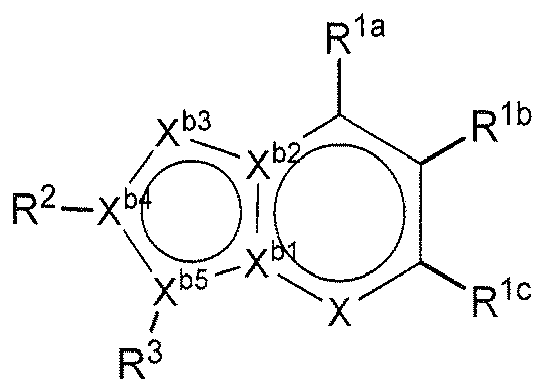
X is N, or CR1d,
Xb1-Xb5 are the same or different, and are nitrogen or carbon,
R1a-R1d are the same or different, and are hydrogen, an optionally substituted aklyl, an optionally substituted alkoxy, an optionally substituted akylthio, an alkenyl, a cycloalkyl, a halogen, cyano, or hydroxyl or optionally substituted by 1 or 2 alkylamino,
R2 is an optionally substituted aryl or an optionally substituted heteroaryl,
R3 is an optionally substituted aryl or an optionally substituted heteroaryl, or
pharmaceutically acceptable salt thereof as an active ingredient.
Description
- The present invention relates to a novel antiplatelet agent and a novel compound constituting an active ingredient thereof.
- Glycoprotein Ib (hereafter, GPIb) and glycoprotein VI (hereafter, GPVI) exist on a platelet membrane and play important roles each as a von Willebrand factor (hereafter, vWF) receptor and a collagen receptor in case of forming pathologic thrombus as can be found in a region of arteriosclerosis (non-patent document 1). Collagen is exposed by vascular endothelium damage in case of plaque rupture at the arteriosclerosis region, and a high shearing stress is caused by angiostenosis. The vWF tends to be solid-phased on the exposed collagen, and the platelet accumulates and sticks on the arteriosclerosis region by being connected with the vWF on the solid-phased collagen via the GPI. Thereafter, the GPVI on the platelet combines with the collagen, and the platelet is activated and accumulated to induce pathologic thrombus causing ischemic heart disease such as myocardial infarction, ischemic stroke, peripheral arterial obstruction (non-patent document 2). Haemostasis as a defence mechanism of organisms is formed via activation of the platelet by a tissue factor or a soluble agonist (thromboxane A2 (TXA2), adenosine 2 phosphate (ADP), etc.) released from the extravascular damaged-region. Since aspirin and clopidogrel, as existing medicines, have great influences on the hemostasis mechanism and inhibit the functions of TAXA2 and ADP, they enhance the antithrombotic function as well as the hemorrhagic function (non patent document 3). According to the results of the ATT (Antithrombotic Trialists' Collaboration) which was obtained by the methanalysis of the Randomized Controlled Trial (RCT) of the preventing effect by the existing antiplatelet agent (single administration of aspirin, ticlopidine, etc.), therapeutic reduction effect of the cardiovascular event by the existing antiplatelet agent is at most 25%, and the degree of satisfaction is not high (non patent document 4). Clinical study of the combined therapy was conducted by using conventional antiplatelet agents (CURE, MATCH, CHARISMA) aiming at a higher therapeutic effect, but it was shown that a risk for bleeding also increases (non patent documents: 5-7).
- Heterocyclic compounds such as benzimidazole derivatives are disclosed in patent documents 1-13, and in a non-patent document 8. However, these compounds have not been reported to provide an antiplatelet function, and their characteristics are different from those of the compounds of the present invention. Heterocyclic compounds which have a platelet aggregation inhibitory action are disclosed in the document 14. However, their characteristics are different from those of the compounds of the present invention.
- The preparation process of benzimidazole derivatives are disclosed in non-patent document 8.
-
- [Patent document 1]
WO 1997/031365 - [Patent document 2]
WO 2001/002400 - [Patent document 3]
US 20090227538 A - [Patent document 4]
US 20050054631 A - [Patent document 5]
US 2006/044509 A - [Patent document 6]
US 20040176390 A - [Patent document 7]
WO 2010/070237 A - [Patent document 8]
US 20050222197 A - [Patent document 9]
US 20100029657 A - [Patent document 10]
US 20060148805 A - [Patent document 11]
US 20090232780 A - [Patent document 12]
US 20080132501 A - [Patent document 13]
US 20060223849 A - [Patent document 14]
US 20060128685 A -
- [Non patent documents 1] Nature Rev. Drug Discov., 2, 1-15 (2003)
- [Non patent documents 2] Thromb. Haemost., 97. 435-443 (2007)
- [Non patent documents 3] Platelet and Thrombosis-Basic and Clinic - Edited by Yasuo Ikeda
- [Non patent documents 4] Br. Med. J, 324, 71-86 (2002)
- [Non patent documents 5] N. Eng. J. Med., 345,494-502(2001)
- [Non patent documents 6] Lancet, 364, 331-337 (2004)
- [Non patent documents 7] N. Eng. J. Med., 354, 1706-1717 (2006)
- [Non patent documents 8] Synthesis, 1, 47 (2005)
- The present inventions relate to a novel antiplatelet agent and a novel compound constituting an active ingredient thereof.
- The inventors of the present invention have made an intensive study to solve the problem mentioned above, and have found that a specified heterocyclic derivative can solve the problem, thus resulting in completion of the present invention.
- The present invention relates to a following compound or a pharmaceutically acceptable salt thereof, and/or a use thereof.
- The present invention includes the following embodiments.
- (1) An antiplatelet agent comprising a compound of formula I:

X is N, or CR1d,
Xb1-Xb5 are the same or different, and are nitrogen or carbon,
R1a-R1d are the same or different, and are hydrogen, an optionally substituted aklyl, an optionally substituted alkoxy, an optionally substituted akylthio, an alkenyl, a cycloalkyl, a halogen, cyano, hydroxyl, or an amino optionally substituted by 1 or 2 alkyl,
R2 is an optionally substituted aryl, or an optionally substituted heteroaryl,
R3 is an optionally substituted aryl, or an optionally substituted heteroaryl,
provided
at least three of Xb1-Xb5 are carbon,
when Xb1 is nitrogen, Xb2, Xb4 and Xb5 are carbon,
when Xb2 is nitrogen, Xb1 and Xb4 are carbon, and
when Xb4 is nitrogen, Xb5 is carbon
or a pharmaceutically acceptable salt thereof as an active ingredient. - (2) The antiplatelet agent according to (1), wherein Xb3 is nitrogen.
- (3) The antiplatelet agent according to (2), wherein Xb4 is carbon.
- (4) The antiplatelet agent according to (2) or (3), wherein Xb2 is carbon.
- (5) The antiplatelet agent according to (1) comprising a compound of formula Ia:

a pharmaceutically acceptable salt thereof as an active ingredient. - (6) The antiplatelet agent according to (1) comprising a compound of formula Ib:

a pharmaceutically acceptable salt thereof as an active ingredient: - (7) The antiplatelet agent according to (1) comprising a compound of formula Ic:

a pharmaceutically acceptable salt thereof as an active ingredient. - (8) The antiplatelet agent according to (1) comprising a compound of formula Id:

a pharmaceutically acceptable salt thereof as an active ingredient. - (9) The antiplatelet agent according to (1) comprising a compound of formula Ie:

-
- (10) The antiplatelet agent according to any one of (1)-(9) wherein R1b is an optionally substituted alkyl, an optionally substituted alkoxy, an optionally substituted alkylthio, an alkenyl, a cycloalkyl, a halogen, cyano, or an amino optionally substituted by 1 or 2 alkyl.
-
- (11) The antiplatelet agent according to any one of (1) - (10) wherein R1a and R1d are hydrogen.
-
- (12) The antiplatelet agent according to any one of (1) - (11) wherein X is N.
- (13) The antiplatelet agent according to any one of (1)-(12) wherein substituents of the "optionally substituted aryl" or "optionally substituted heteroaryl" in R2 are the same or different 1-3 groups selected from an optionally substituted alkyl; an optionally substituted alkoxy; an optionally substituted alkylthio; an alkenyl; a halogen; cyano; a carbamoyl optionally substituted by 1 or 2 alkyl; an amino optionally substituted by 1 or 2 alkyl; hydroxyl; an alkanoyl; a cycloalkylcarbonyl; an arylcarbonyl; nitro; an optionally substituted aliphatic heteromonocyclic group; an aryl and a heteroaryl.
-
- (14) The antiplatelet agent according to any one of (1)-(13) wherein substituents of the "optionally substituted aryl" or "optionally substituted heteroaryl" in R3 are the same or different 1-3 groups selected from an optionally substituted alkyl; an optionally substituted alkoxy; an optionally substituted alkylthio; a cycloalkyl; an amino optionally substituted by 1 or 2 alkyl; an aliphatic heteromonocycle and a halogen.
-
- (15) The antiplatelet agent according to any one of (1)-(14) wherein R2 is an optionally substituted heteroary.
-
- (16) The antiplatelet agent according to any one of (1)-(15) wherein R3 is an optionally substituted heteroaryl.
-
- (17) A compound of formula II:

Xa is N or CH,
Xc1-Xc5 are the same or different, and are nitrogen or carbon,
R1e is an alkyl optionally substituted by an aryl or a halogen; an alkoxy optionally substituted by an aryl, a halogen or a cycloalkyl; an alkylthio optionally substituted by an aryl, a halogen or a cycloalkyl; an alkenyl; cyano; a cycloalkyl; a halogen; or an amino optionally substituted by 1 or 2 alkyl,
R1f is hydrogen, an alkyl, an alkoxy, hydroxyl, cyano or a halogen,
R21 is an optionally substituted heteroaryl,
R31 is an optionally substituted 6-membered heteroaryl, and
at least three of Xc1-Xc5 are carbon,
provided
when Xc1 is nitrogen, Xc2, Xc4 and Xc5 are carbon,
when Xc2 is nitrogen, Xc1 and Xc4 are carbon,
when Xc4 is nitrogen, Xc5 is carbon, and
when Xc1 and Xc3 are nitrogen, R1e is an alkyl substituted by a halogen or an alkoxy substituted by a halogen,
or a pharmaceutically acceptable salt thereof. - (18) The compound according to (17) wherein Xc3 is nitrogen or a pharmaceutically acceptable salt thereof.
- (19) The compound according to (18) wherein Xc4 is carbon, or a pharmaceutically acceptable salt thereof.
- (20) The compound according to (18) or (19) wherein Xc2 is carbon, or a pharmaceutically acceptable salt thereof.
- (21) The compound according to (17) wherein the compound is represented by the formula IIa:

a pharmaceutically acceptable salt thereof. - (22) The compound according to (17) wherein the compound is represented by formula IIb:

a pharmaceutically acceptable salt thereof. - (23) The compound according to (17) wherein the compound is represented by formula IIc:

a pharmaceutically acceptable salt thereof. - (24) The compound according to (17) wherein the compound is represented by formula IId:
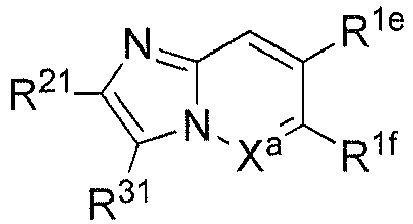
a pharmaceutically acceptable salt thereof - (25) The compound according to (17) wherein the compound is represented by formula IIe:

-
- (26) The compound according to any one of (17)-(25) wherein the substituents of the "optionally substituted heteroaryl" in R21 are the same or different 1-3 groups selected from an optionally substituted alkyl; an optionally substituted alkoxy; an optionally substituted alkylthio; an alkenyl; a halogen; cyano; a carbamoyl optionally substituted by 1 or 2 alkyl; an amino optionally substituted by 1 or 2 alkyl; hydroxyl; an alkanoyl; a cycloalkylcarbonyl; an arylcarbonyl; nitro; an optionally substituted aliphatic heteromonocyclic group; an aryl; and a heteroaryl, and
the substituents of the "optionally substituted 6-membered heteroaryl" in R31 are the same or different 1-3 groups selected from an optionally substituted alkyl; an optionally substituted alkoxy; an optionally substituted alkylthio; a cycloalkyl; an amino optionally substituted by 1 or 2 alkyl; an aliphatic heteromonocycle; and a halogen, or
a pharmaceutically acceptable salt thereof. -
- (27) The compound according to any one of (17)-(26) wherein R1e is an alkyl substituted by a halogen or an alkoxy substituted by a halogen, or pharmaceutically acceptable salt thereof.
-
- (28) The compound according to any one of (17)-(27) wherein R1e is trifluoromethyl or trifluoromethoxy, or pharmaceutically acceptable salt thereof.
-
- (29) The compound according to any one of (17)-(28) wherein R1f is hydrogen or pharmaceutically acceptable salt thereof.
-
- (30) The compound according to any one of (17)-(29) wherein the substituents of the "optionally substituted heteroaryl" in R21 are the same or different 1-3 groups selected from an optionally substituted alkyl; an optionally substituted alkoxy; a halogen; cyano; a carbamoyl optionally substituted by 1 or 2 alkyl; an amino optionally substituted by 1 or 2 alkyl; hydroxyl; nitro; and an optionally substituted aliphatic heteromonocyclic group, or
a pharmaceutically acceptable salt thereof. -
- (31) The compound according to any one of (17)-(30) wherein substituents of the "optionally substituted heteroaryl" in R21 are the same or different 1-3 groups selected from an alkyl, an alkoxy, a halogen, cyano, a carbamoyl optionally substituted by 1 or 2 alkyl, or nitro, or
pharmaceutically acceptable salt thereof. -
- (32) The compound according to any one of (17)-(31) wherein substituents of the "optionally substituted heteroaryl" in R21 are 1-3 groups selected from an alkyl, a halogen, and cyano, or a pharmaceutically acceptable salt thereof.
-
- (33) The compound according to any one of (17)-(32), wherein substituents of the "optionally substituted 6-membered heteroaryl" in R31 are 1-3 groups selected from an alkyl, an alkoxy, a halogen, and an amino optionally substituted by 1 or 2 alkyl, or a pharmaceutically acceptable salt thereof.
-
- (34) The compound according to any one of (17)-(33) wherein Xa is N, or a pharmaceutically acceptable salt thereof.
-
- (35) An antiplatelet agent comprising the compound according to any one of (17)-(34) or a pharmaceutically acceptable salt thereof as an active ingredient.
-
- (36) A medicine for prevention or treatment of ischemic stroke, acute coronary syndrome, microvascular dysfunction, peripheral arterial disease, arteriosclerosis obliterans, ischemic heart disease, thrombotic microangiopathy, or unstable or stable angina, comprising a compound which is an active ingredient of an antiplatelet agent according to any one of (1) - (16) or a compound according to any one of (17)-(34) or a pharmaceutically acceptable salt thereof.
- (37) A method of preventing platelet aggregation comprising administrating an effective amount of a compound which is an active ingredient of an antiplatelet agent according to any one of (1)-(16) or a compound according to any one of (17)-(34) or a pharmaceutically acceptable salt thereof.
- (38) A method of preventing or treating ischemic stroke, acute coronary syndrome, microvascular dysfunction, peripheral arterial disease, arteriosclerosis obliterans, ischemic heart disease, thrombotic microangiopathy, or unstable or stable angina, comprising administrating an effective amount of a compound which is an active ingredient of an antiplatelet agent according to any one of (1)-(16) or a compound according to any one of (17)-(34) or a pharmaceutically acceptable salt thereof.
- (39) The compound for use in preventing platelet aggregation, which is an active ingredient of an antiplatelet agent according to any one of (1)-(16) or a compound according to any one of (17)-(34) or a pharmaceutically acceptable salt thereof.
- (40) The compound for use in preventing or treating ischemic stroke, acute coronary syndrome, microvascular dysfunction, peripheral arterial disease, arteriosclerosis obliterans, ischemic heart disease, thrombotic microangiopathy, or unstable or stable angina, which is an active ingredient of an antiplatelet agent according to any one of (1)-(16) or a compound according to any one of (17)-(34) or a pharmaceutically acceptable salt thereof.
- (41) The use of the compound which is an active ingredient of an antiplatelet agent according to any one of (1)-(16) or a compound according to any one of (17)-(34) or a pharmaceutically acceptable salt thereof, for the manufacture of an antiplatelet agent.
- (42) A use of the compound which is an active ingredient of an antiplatelet agent according to any one of (1)-(16) or a compound according to any one of (17)-(34) or a pharmaceutically acceptable salt thereof, for the manufacture of a medicament for preventing or treating ischemic stroke, acute coronary syndrome, microvascular dysfunction, peripheral arterial disease, arteriosclerosis obliterans, ischemic heart disease, thrombotic microangiopathy, or unstable or stable angina.
- In the followings are explained the groups represented by each term and each symbol used herein. Alkyl of the "alkyl" and "alkylthio" is exemplified by C1-6, preferably C1-4 linear or branched alkyls, in particular, methyl, ethyl, propyl, isopropyl, butyl, isobutyl, 1-methylproplyl, pentyl or hexyl.
- The "alkoxy" is exemplified by a C1-6, preferably C1-4 linear or branched alkoxy, in particular, methoxy, ethoxy, propoxy, isopropoxy, butoxy, iso-butoxy, tert-butoxy, pentyloxy or hexyloxy,
- The "halogen" is exemplified by fluorine, chlorine, bromine or iodine.
- The "alkanoyl" is exemplified by a C1-6, preferably C1-4 linear or branched alkanoyl, in particular, formyl, acetyl, propionyl, butyryl, pentanoyl or hexanoyl.
- The "alkenyl" is exemplified by a C2-6, preferably C2-4 linear or branched alkenyl, in particular, vinyl, allyl, 1-methyl-2-propenyl, 3-butenyl, 2-pentenyl or 3-hexenyl.
- Cycloalkyl in the "cycloalkyl" and "cycloalkylcarbonyl" is exemplified by a C3-8, preferably C3-6 cycloalkyl, in particular cyclopropyl, cyclobutyl, cyclopentyl or cyclohexyl.
- Aryl in the "aryl", "aryloxy" and "arylcarbonyl" is exemplified by a C6-14 monocyclic, bicyclic or tricyclic aryl, preferably C6-10 monocyclic or bicyclic aryl. In particular, it is exemplified by phenyl, naphthyl, phenanthryl or anthryl.
- The "heterocyclic group" is exemplified by an aliphatic heterocyclic group and a heteroaryl containing for example, 1-4 heteroatom(s) selected from nitrogen atom, oxygen atom and sulfur atom, in which optionally, a part or all of 3-12 members may be, as a whole, saturated.
- The "aliphatic heterocyclic group" is exemplified by an aliphatic heteromonocyclic group or a heterobicyclic group.
- The "aliphatic heteromonocyclic group" is exemplified by an aliphatic heterocyclic group containing 1-4 heteroatom(s) selected from nitrogen atom, oxygen atom and sulfur atom, in which as a whole, a part or all of 3-12 members, preferably 4-7 members are saturated.
- The "heterobicyclic group" is exemplified by a heterobicyclic group containing 1-4 heteroatom(s) selected from, for example, nitrogen atom, oxygen atom and sulfur atom, in which as a whole, a part or all of 7-12 members are saturated.
- The "heteroaryl" is a 5 to 10-membered aromatic cyclic group which has at least one heteroatom (nitrogen, oxygen or sulfur, etc.) and carbon, and includes a 5 to 6-membered monocyclic group, a 8 to 10-membered bicyclic group formed by condensation of the same or different monocyclic heteroaromatic rings, and a 8 to 10-membered bicyclic group formed by condensation of a monocyclic heteroaromatic ring and benzene.
- In the followings are explained preferable embodiments.
Substituents of the "optionally substituted alkyl", "optionally substituted alkoxy" and "optionally substituted alkylthio" in R1a-R1d are exemplified by an aryl, a halogen, a cycloalkyl, hydroxyl, an alkoxy, and an amino optionally substituted by 1 or 2 alkyl, and further preferably by a cycloalkyl and a halogen, and particularly preferably by a halogen. These substituents may be 1 or plural (e.g., 1-3), and may be the same or different. - R1a-R1e is, preferably the same or different, and is an alkyl substituted by a halogen, an alkoxy optionally substituted by a halogen or a cycloalkyl, an alkylthio optionally substituted by a halogen or a cycloalkyl, an alkenyl, a cycloalkyl, a halogen, cyano, hydroxyl, and an amino optionally substituted by 1 or 2 alkyl, etc. In particular, specific examples are difluoromethyl, trifluoromethyl, methoxy, ethoxy, propoxy, isopropoxy, difluoromethoxy, trifluoromethoxy, cyclopropylmethoxy, vinyl, a fluorine atom, a chlorine atom, a bromine atom, cyclopropyl, ethyl and cyano.
- R1b and R1e are further preferably exemplified by an alkyl substituted by a halogen, and an alkoxy substituted by a halogen, in particular, 2,2,2-trifluoroethoxy, 1-trifluoromethyl-ethoxy, difluoromethoxy, trifluoromethoxy, difluoromethyl, and trifluoromethyl. Among them, trifluoromethyl and trifluoromethoxy are recited as specifically preferable examples.
- R1c and R1f are selected preferably from hydrogen, methyl, methoxy, hydroxyl, cyano, and a chlorine atom, and particularly preferably from hydrogen.
- R1a and R1d are, preferably, hydrogen.
- Aryl of the "optionally substituted aryl" in R2 is, preferably phenyl or naphthyl, and particularly preferably phenyl.
- The "optionally substituted heteroaryl" in R2 or the "optionally substituted heteroaryl" in R21 is exemplified by, preferably, a 5 to 6-membered heteroaryl, and particularly preferably, a 6-membered heteroaryl. In particular are recited pyrolyl, imidazolyl, pyrazolyl, thiazolyl, isoxazolyl, oxazolyl, triazolyl, pyrazinyl, pyridazinyl, pyrimidyl, pyridyl, quinolyl, preferably, pyrazolyl, thiazolyl, isoxazolyl, oxazolyl, pyrazinyl, pyridazinyl, pyrimidyl and pyridyl, and particularly preferably, pyridyl and pyrazinyl.
- Substituents of "optionally substituted heteroaryl" and "optionally substituted aryl" in R2, and "optionally substituted heteroaryl" in R21 are the same or different, and exemplified by, preferably, an optionally-substituted alkyl; an optionally-substituted alkoxy; an optionally-substituted alkylthio; an alkenyl; a halogen; cyano; a carbamoyl optionally-substituted by 1 or 2 alkyl; an amino optionally-substituted by 1 or 2 alkyl; hydroxyl; nitro; and an optionally-substituted aliphatic heteromonocyclic group, and further preferably, an alkyl, an alkoxy, a halogen, cyano, carbamoyl and nitro, and particularly preferably, cyano and a halogen. In particular, they are the same or different, and are methyl, ethyl, vinyl, propenyl, methoxy, methylthio, a fluorine atom, a chlorine atom, a bromine atom, pyrrolidinyl, hydroxypyrrolidinyl, dimethylaminopyrrolidinyl, methoxy-pyrrolidinyl, oxopyrrolidinyl, methoxymethyl-pyrrolidinyl, morpholyl, piperidinyl, methylpiperazinyl, methoxyazetidil, amino, methylamino, dimethylamino, hydroxyl, hydroxymethyl, cyano, nitro and carbamoyl. These substituents may be one or in plural (e.g., 1-3), and the same or different.
- When the "optionally substituted heteroaryl" in R2 and R21 is a 6-membered monocyclic heteroaryl, the substituents thereof are preferably the same or different, and are an alkyl, an alkoxy, a halogen, cyano, a carbamoyl and nitro, and particularly preferably, fluorine and cyano. These substituents may be 1 or in plural (e.g., 1-3), and the same or different.
- When the "optionally substituted heteroaryl" in R2 and R21 is a 5-memebered monocyclic heteroaryl, their substituents are the same or different and preferably exemplified by an alkyl.
- The substituents of the "optionally substituted heteroaryl" and "optionally substituted aryl" in R2, and the substituents of the "optionally substituted alkyl", "optionally substituted alkoxy" and "optionally substituted alkylthio" in the substituents of the "optionally substituted heteroaryl" in R21 are, for example, an alkoxy; a halogen; hydroxyl; an amino optionally-substituted by 1 or 2 alkyl, and preferably, an alkoxy; a halogen; hydroxyl; an amino optionally-substituted by 1 or 2 alkyl. These substituents may be 1 or plural (e.g., 1-3), and the same or different.
- Substituents in the "optionally substituted aliphatic heteromonocyclic group", which is a substituent of the "optionally substituted heteroaryl" and "optionally substituted aryl" in R2 and "optionally substituted heteroaryl" in R21, are exemplified by, an alkyl optionally substituted by hydroxyl or an alkoxy; an alkoxy; an amino optionally-substituted by 1 or 2 alkyl; and oxo.
- The "optionally substituted aliphatic heteromonocyclic group" as a substituent of the "optionally substituted heteroaryl" and the "optionally substituted aryl" in R2 and of the "optionally substituted heteroaryl" in R21 are exemplified by, in particular, pyrrolidyl, morpholinyl, piperidyl or piperazyl.
- A preferable example of R2 and R21 is a group represented by the formula:

- R4 is, particularly preferably, fluorine or cyano.
- Aryl of the "optionally substituted aryl" in R3 is, preferably, phenyl or naphthyl, in particular preferably, phenyl.
- Heteroaryl of the "optionally substituted heteroaryl" in R3 is exemplified by, preferably, a monocyclic heteroaryl, in particular preferably, a 6-membered heteroaryl. In particular, indole, pyridyl, pyrazinyl, pyrimidyl and pyridazinyl are recited, and preferably, pyridyl, pyrazinyl, pyrimidyl and pyridazinyl are recited.
- Heteroaryl of the "optionally substituted 6-membered heteroaryl" in R31 is exemplified, in particular, by pyridyl, pyrazinyl, pyrimidyl and pyridazinyl, and preferably, by pyridyl, pyrazinyl and pyridazinyl, and especially, by pyridyl and pyridazinyl.
- Substituents of "optionally substituted alkyl", "optionally substituted alkoxy" and "optionally substituted alkylthio" which are substituents of "optionally substituted heteroaryl" and "optionally substituted aryl" in R3 and of "optionally substituted 6-membered heteroaryl" in R31 are exemplified, by a halogen; hydroxyl; an amino optionally substituted by 1 or 2 alkyl, and these substituents may be 1 or plural (e.g., 1-3), and the same or different.
- Substituents of the "optionally substituted heteroaryl" and "optionally substituted aryl" in R3 and of the "optionally substituted 6-membered heteroaryl" in R31 are exemplified, preferably, by an alkyl; an alkoxy; an alkylthio; a cycloalkyl; an amino optionally-substituted by 1 or 2 alkyl; an aliphatic heteromonocycle; and a halogen, in particular preferably, by an alkyl; an alkoxy; a halogen; and an amino optionally substituted by 1 or 2 alkyl. In particular are recited methyl, ethyl, methoxy, ethoxy, methylthio, methylamino, dimethylamino, pyrrolidinyl, cyclopropyl, a fluorine atom, and a chlorine atom, and preferably, methyl, ethyl, methoxy, methylamino, and dimethylamino. These substituent may be 1 or plural (e.g., 1-3), and may be the same or different.
- A substituting position of the substituents of the "optionally substituted heteroaryl" and "optionally substituted aryl" in R3 and of the "optionally substituted 6-membered heteroaryl" in R31 is, preferably, in para-position toward a benzimidazole ring or an imidazopyridine ring.
- A preferable example of R3 or R31 is a group represented by the formula:

- Examples of the compounds represented by formulae I and II, or pharmaceutically acceptable salts thereof are the compounds recited in the Examples or pharmaceutically acceptable salts thereof, and preferably selected from
1-(6-methoxypyridazin-3-yl)-2-pyridin-2-yl-5-(trifluoromethyl)-1H-benzimidazole (Example 1);
2-(6-fluoropyridin-2-yl)-1-(6-methoxypyridazin-3-yl)-5-(trifluoromethyl)-1H-benzimidazole (Example 2);
1-(6-methoxypyridazin-3-yl)-2-pyridin-2-yl-5-(trifluoromethoxy)-1H-benzimidazole (Example 3);
2-(5-fluoropyridin-2-yl)-3-(6-methoxypyridin-3-yl)-6-(trifluoromethyl)-3H-imidazo[4,5-b]pyridine (Example 4);
N-methyl-5-[2-pyridin-2-yl-6-(trifluoromethyl)-3H-imidazo[4,5-b]pyridin-3-yl]pyridin-2-amine (Example 5);
N,N-dimethyl-5-[2-pyridin-2-yl-6-(trifluoromethyl)-3H-imidazo[4,5-b]pyridin-3-yl]pyridin-2-amine (Example 6);
6-[1-(6-methoxypyridazin-3-yl)-5-(trifluoromethyl)-1H-benzimidazole-2-yl]nicotinonitrile (Example 7);
5-[3-(6-methoxypyridin-3-yl)-6-(trifluoromethyl)-3H-imidazo[4,5-b]pyridin-2-yl]pyrazine-2-carbonitrile (Example 8);
2-(6-methoxypyridazin-3-yl)-1-(6-methoxypyridin-3-yl)-5-(trifluoromethyl)-1H-benzimidazole (Example 9);
3-(6-methoxypyridin-3-yl)-2-(1H-pyrrol-2-yl)-6-(trifluoromethyl)-3H-imidazo[4,5-b]pyridine (Example 10);
2-(1H-imidazol-4-yl)-3-(6-methoxypyridin-3-yl)-6-(trifluoromethyl)-3H-imidazo[4,5-b]pyridine (Example 11);
1,2-dipyridin-2-yl-5-(trifluoromethyl)-1H-benzimidazole (Example 12);
3-(6-methoxypyridin-3-yl)-2-pyridin-2-yl-6-(trifluoromethyl)-3H-imidazo[4,5-b]pyridine (Example 13);
1-(6-methoxypyridin-3-yl)-2-pyridin-2-yl-5-(trifluoromethyl)-1H-benzimidazole (Example 14);
1-(6-methoxypyridazin-3-yl)-2-(2-methyl-1H-pyrazol-4-yl)-5-(trifluoromethyl)-1H-benzimidazole (Example 15);
5-ethyl-1-(6-methoxypyridin-3-yl)-2-pyridin-2-yl-1H-benzimidazole (Example 17);
1-(6-methoxypyridin-3-yl)-2-phenyl-5-(trifluoromethyl)-1H-benzimidazole (Example 18);
2-(5-bromopyridin-2-yl)-1-(6-methoxypyridin-3-yl)-5-(trifluoromethyl)-1H-benzimidazole (Example 20);
2-(5-fluoropyridin-2-yl)-1-(6-methoxypyridin-3-yl)-5-(trifluoromethyl)-1H-benzimidazole (Example 21);
1,2-bis(6-methoxypyridin-3-yl)-5-(trifluoromethyl)-1H-benzimidazole (Example 24);
5-cyclopropyl-1-(6-methoxypyridin-3-yl)-2-pyridin-2-yl-1H-benzimidazole (Example 27);
5-(cyclopropylmethoxy)-1-(6-methoxypyridin-3-yl)-2-pyridin-2-yl-1H-benzimidazole (Example 31);
2-(5-bromopyridin-2-yl)-1-(6-methoxypyridazin-3-yl)-5-(trifluoromethyl)-1H-benzimidazole (Example 35);
2-(5-chloropyridin-2-yl)-1-(6-methoxypyridin-3-yl)-5-(trifluoromethyl)-1H-benzimidazole (Example 36);
1-(6-methoxypyridin-3-yl)-2-pyridin-2-yl-5-(trifluoromethoxy)-1H-benzimidazole (Example 40);
1-(6-methoxypyridazin-3-yl)-2-(1-methyl-1H-pyrazol-3-yl)-5-(trifluoromethyl)-1H-benzimidazole (Example 52);
1-(6-methoxypyridazin-3-yl)-2-(5-nitropyridin-2-yl)-5-(trifluoromethyl)-1H-benzimidazole (Example 53);
1-(6-methoxypyridazin-3-yl)-2-(1,3-thiazol-2-yl)-5-(trifluoromethyl)-1H-benzimidazole (Example 54);
6-chloro-1-(6-methoxypyridin-3-yl)-2-pyridin-2-yl-5-(trifluoromethyl)-1H-benzimidazole (Example 55);
2-(5-ethylpyridin-2-yl)-1-(6-methoxypyridazin-3-yl)-5-(trifluoromethyl)-1H-benzimidazole (Example 56);
1-(6-methoxypyridazin-3-yl)-2-(4-methylpyridin-2-yl)-5-(trifluoromethyl)-1H-benzimidazole (Example 58);
2-(5-fluoropyridin-2-yl)-1-(6-methoxypyridazin-3-yl)-5-(trifluoromethyl)-1H-benzimidazole (Example 62);
1-[6-(methylthio)pyridazin-3-yl]-2-pyridin-2-yl-5-(trifluoromethyl)-1H-benzimidazole (Example 67);
2-(5-fluoropyridin-2-yl)-1-(6-methoxypyridazin-3-yl)-5-(trifluoromethoxy)-1H-benzimidazole (Example 71);
2-(5-methylisoxazol-3-yl)-1-(6-methoxypyridazin-3-yl)-5-(trifluoromethyl)-1H-benzimidazole (Example 72);
3-(6-methoxypyridin-3-yl)-2-(1-methyl-1H-pyrazol-3-yl)-6-(trifluoromethyl)-3H-imidazo[4,5-b]pyridine (Example 73);
2-(4-bromopyridin-2-yl)-1-(6-methoxypyridazin-3-yl)-5-(trifluoromethyl)-1H-benzimidazole (Example 75);
2-[1-(6-methoxypyridazin-3-yl)-5-(trifluoromethyl)-1H-benzimidazole-2-yl]nicotinonitrile (Example 81);
1-(6-methoxypyridazin-3-yl)-2-(1,3-oxazol-4-yl)-5-(trifluoromethyl)-1H-benzimidazole (Example 88);
1-(6-methoxypyridazin-3-yl)-2-(1,3-thiazol-4-yl)-5-(trifluoromethyl)-1H-benzimidazole (Example 89);
1-(6-methoxypyridazin-3-yl)-2-(5-methylpyrazine-2-yl)-5-(trifluoromethyl)-1H-benzimidazole (Example 90);
1-(6-methoxypyridazin-3-yl)-2-(2-methyl-1,3-thiazol-4-yl)-5-(trifluoromethyl)-1H-benzimidazole (Example 94);
3-(6-methoxypyridin-3-yl)-2-(1,3-oxazol-4-yl)-6-(trifluoromethyl)-3H-imidazo[4,5-b]pyridine (Example 107) ;
3-(6-methoxypyridin-3-yl)-2-(5-methylisoxazol-3-yl)-6-(trifluoromethyl)-3H-imidazo[4,5-b]pyridine (Example 108);
3-(6-methoxypyridin-3-yl)-2-(1,3-thiazol-4-yl)-6-(trifluoromethyl)-3H-imidazo[4,5-b]pyridine (Example 109);
3-(6-methoxypyridin-3-yl)-2-(2-methyl-1,3-thiazol-4-yl)-6-(trifluoromethyl)-3H-imidazo[4,5-b]pyridine (Example 110);
3-(6-methylpyridin-3-yl)-2-pyridin-2-yl-6-(trifluoromethyl)-3H-imidazo[4,5-b]pyridine (Example 118);
3-(6-methoxypyridin-3-yl)-2-(2-methyl-1,3-oxazol-4-yl)-6-(trifluoromethyl)-3H-imidazo[4,5-b]pyridine (Example 122);
3-(5-methoxypyrazine-2-yl)-2-pyridin-2-yl-6-(trifluoromethyl)-3H-imidazo[4,5-b]pyridine (Example 125);
3-(6-methoxypyridin-3-yl)-2-(5-methyl-1,3-oxazol-4-yl)-6-(trifluoromethyl)-3H-imidazo[4,5-b]pyridine (Example 126) ;
6-[3-(6-methylpyridin-3-yl)-6-(trifluoromethyl)-3H-imidazo[4,5-b]pyridin-2-yl]nicotinonitrile (Example 130);
1-(6-methoxypyridazin-3-yl)-2-(2-methyl-1,3-oxazol-4-yl)-5-(trifluoromethyl)-1H-benzimidazole (Example 139);
2-(5-fluoropyridin-2-yl)-3-(5-methoxypyrazine-2-yl)-6-(trifluoromethyl)-3H-imidazo[4,5-b]pyridine (Example 144); - 6-isopropoxy-3-(6-methoxypyridin-3-yl)-2-pyridin-2-yl-3H-imidazo[4,5-b]pyridine (Example 145);
6-(difluoromethoxy)-3-(6-methoxypyridin-3-yl)-2-pyridin-2-yl-3H-imidazo[4,5-b]pyridine (Example 146);
3-(6-methoxypyridin-3-yl)-2-pyridin-2-yl-6-(trifluoromethoxy)-3H-imidazo[4,5-b]pyridine (Example 147);
3-(5-methoxypyrazine-2-yl)-2-(1,3-thiazol-4-yl)-6-(trifluoromethyl)-3H-imidazo[4,5-b]pyridine (Example 148);
5-[2-(5-fluoropyridin-2-yl)-6-(trifluoromethyl)-3H-imidazo[4,5-b]pyridin-3-yl]-N-methylpyridin-2-amine (Example 149);
6-{3-[6-(methylamino)pyridin-3-yl]-6-(trifluoromethyl)-3H-imidazo[4,5-b]pyridin-2-yl]nicotinonitrile (Example 150);
3-(5-methoxypyrazine-2-yl)-2-(1,3-oxazol-4-yl)-6-(trifluoromethyl)-3H-imidazo[4,5-b]pyridine (Example 151);
3-(5-methoxypyrazine-2-yl)-2-(2-methyl-1,3-oxazol-4-yl)-(trifluoromethyl)-3H-imidazo[4,5-b]pyridine (Example 152);
3-(5-methoxypyrazine-2-yl)-2-(1-methyl-1H-pyrazol-3-yl)-6-(trifluoromethyl)-3H-imidazo[4,5-b]pyridine (Example 153);
3-(5-methoxypyrazine-2-yl)-2-(5-methylisoxazol-3-yl)-6-(trifluoromethyl)-3H-imidazo[4,5-b]pyridine (Example 154);
1-(6-methoxypyridazin-3-yl)-2-(1,3-oxazol-4-yl)-5-(trifluoromethoxy)-1H-benzimidazole (Example 155);
1-(6-methoxypyridazin-3-yl)-2-(1-methyl-1H-pyrazol-3-yl)-5-(trifluoromethoxy)-1H-benzimidazole (Example 156);
5-[3-(5-methoxypyridazin-2-yl)-6-(trifluoromethyl)-3H-imidazo[4,5-b]pyridin-2-yl]pyrazine-2-carbonitrile (Example 157);
1-(6-methoxypyridazin-3-yl)-2-(2-methyl-1,3-oxazol-4-yl)-5-(trifluoromethoxy)-1H-benzimidazole (Example 158);
2-(5-chloropyridin-2-yl)-3-(6-methoxypyridin-3-yl)-6-(trifluoromethyl)-3H-imidazo[4,5-b]pyridine (Example 159);
3-(6-methoxypyridin-3-yl)-2-(1-methyl-1H-1,2,3-triazol-4-yl)-6-(trifluoromethyl)-3H-imidazo[4,5-b]pyridine (Example 160);
1-(5-methoxypyrazine-2-yl)-2-pyridin-2-yl-5-(trifluoromethyl)-1H-benzimidazole (Example 161);
3-(6-methoxypyridin-3-yl)-2-(1-methyl-1H-pyrazol-3-yl)-6-(trifluoromethyl)-3H-imidazo[4,5-b]pyridine (Example 162);
1-(6-methoxypyridazin-3-yl)-2-(1-methyl-1H-1,2,3-triazol-4-yl)-5-(trifluoromethyl)-1H-benzimidazole (Example 163);
3-(5-methoxypyrazine-2-yl)-2-(1-methyl-1H-1,2,3-triazol-4-yl)-6-(trifluoromethyl)-3H-imidazo[4,5-b]pyridine (Example 164);
3-(5-methoxypyrazine-2-yl)-2-(1-methyl-1H-pyrazol-4-yl)-6-(trifluoromethyl)-3H-imidazo[4,5-b]pyridine (Example 165);
1-(6-methoxypyridazin-3-yl)-2-(1-methyl-1H-pyrazol-4-yl)-5-(trifluoromethoxy)-1H-benzimidazole (Example 166);
1-(6-methoxypyridazin-3-yl)-2-(1-methyl-1H-1,2,3-triazol-4-yl)-5-(trifluoromethoxy)-1H-benzimidazole (Example 167) ;
1-(6-methoxypyridazin-3-yl)-2-(5-methylisoxazol-3-yl)-5-(trifluoromethoxy)-1H-benzimidazole (Example 168);
3-(5-methoxypyrazine-2-yl)-2-(1-methyl-1H-imidazol-4-yl)-6-(trifluoromethyl)-3H-imidazo[4,5-b]pyridine (Example 169);
6-ethoxy-3-(6-methoxypyridin-3-yl)-2-pyridin-2-yl-3H-imidazo[4,5-b]pyridine (Example 170);
6-(cyclopropylmethoxy)-3-(6-methoxypyridin-3-yl)-2-pyridin-2-yl-3H-imidazo[4,5-b]pyridine (Example 171);
2-(2-ethyl-1,3-oxazol-4-yl)-3-(6-methoxypyridin-3-yl)-6-(trifluoromethyl)-3H-imidazo[4,5-b]pyridine (Example 172);
3-(6-methoxypyridin-3-yl)-6-propoxy-2-pyridin-2-yl-3H-imidazo[4,5-b]pyridine (Example 173);
6-isobuthoxy-3-(6-methoxypyridin-3-yl)-2-pyridin-2-yl-3H-imidazo[4,5-b]pyridine (Example 174);
3-(6-methoxypyridin-3-yl)-2-pyridin-2-yl-6-(2,2,2-trifluoroethoxy)-3H-imidazo[4,5-b]pyridine (Example 175);
3-(6-methoxypyridin-3-yl)-2-pyridin-2-yl-6-(2,2,2-trifluoro-1-methylethoxy)-3H-imidazo[4,5-b]pyridine (Example 176);
2-(5-fluoropyridin-2-yl)-3-(6-methoxypyridin-3-yl)-6-(trifluoromethoxy)-3H-imidazo[4,5-b]pyridine (Example 177) ;
6-(difluoromethoxy-2-(5-fluoropyridin-2-yl)-3-(6-methoxypyridin-3-yl)-3H-imidazo[4,5-b]pyridine (Example 178);
3-(6-methoxypyridin-3-yl)-2-pyridin-2-yl-7-(trifluoromethyl)imidazo[1,2-b]pyridazine (Example 179);
3-(6-methoxypyridin-3-yl)-2-pyridin-2-yl-6-(trifluoromethyl)pyrazolo[1,5-a]pyrimidine (Example 180);
2-(5-fluoropyridin-2-yl)-3-(6-methoxypyridin-3-yl)-7-(trifluoromethyl)imidazo[1,2-b]pyridazine (Example 181);
1-(6-methoxypyridin-3-yl)-2-pyridin-2-yl-5-(trifluoromethyl)-1H-indole (Example 182);
1-(6-methoxypyridin-3-yl)-2-pyridin-2-yl-5-(trifluoromethyl)-1H-pyrrolo[2,3-b]pyridine (Example 183);
2-(5-fluoropyridin-2-yl)-1-(6-methoxypyridin-3-yl)-5-(trifluoromethyl)-1H-pyrrolo[2,3-b]pyridine (Example 184);
2-(5-fluoropyridin-2-yl)-3-(6-methoxypyridin-3-yl)-6-(trifluoromethyl)-2H-indazole (Example 185);
3-(6-methoxypyridin-3-yl)-2-pyridin-2-yl-6-(trifluoromethyl)-2H-pyrazolo[4,3-b]pyridine (Example 186);
1-(5-methoxypyrazine-2-yl)-2-pyridin-2-yl-5-(trifluoromethyl)-1H-pyrrolo[2,3-b]pyridine (Example 187);
3-(6-methoxypyridin-3-yl)-2-pyridin-2-yl-6-(trifluoromethyl)-2H-indazole (Example 188);
3-(6-methoxypyridin-3-yl)-2-pyridin-2-yl-7-(trifluoromethyl)imidazo[1,2-a]pyridine (Example 190);
2-(5-fluoropyridin-2-yl)-3-(6-methoxypyridin-3-yl)-7-(trifluoromethyl)imidazo[1,2-a]pyridine (Example 191); and
2-(5-fluoropyridin-2-yl)-3-(6-methoxypyridin-3-yl)-6-(trifluoromethyl)pyrazolo[1,5-a]pyrimidine (Example 192) or pharmaceutically acceptable salts thereof. - As the salts of said compounds represented by the formulae I and II, salts of acid adducts or base adducts can be used. The kind of the salts is not limited specifically as far as the salts are physiologically acceptable.
- The pharmaceutically acceptable salts are, when the compound has a basic group, exemplified by salts of an inorganic acid such as hydrochloride, sulfate, phosphate or hydrobromide, or salts of an organic acid such as acetate, fumarate, oxalate, citrate, methanesulfonate, benzenesulfonate, tosylate or maleate. When the compound has an acidic group, salts of an alkali metal such as sodium or potassium, or salts or an alkaline earth metal such as calcium are exemplified as said salts.
- When the compounds of the formulae I and II or the salts thereof include optically active compounds, they can be separated into an individual optical isomer by the usual method of optical resolution. Alternatively, the compounds of the formulae I and II or the optical active salts thereof can be synthesized by utilizing an optically-pure starting material or a compound having a known steric configuration.
- One or more than two kinds of the compounds of the present invention represented by the formulae I and II or the salt thereof may be administered as it is to patients, but preferably, may be administered in well-known forms of preparation by adding active ingredients and pharmacologically and pharmaceutically acceptable additives.
- The compound of the present invention can be administered to human or animals by appropriate administration routes after prepared in an appropriate dosage form (powders, injections, tablets, capsules or topycal external preparations) together with appropriate usual diluents and other additives, via appropriate routes of administration depending on its dosage form (e.g., intravenous administration, oral administration, cutaneous administration or topical administration).
- As pharmacologically and pharmaceutically acceptable additives, can be used excipients, disintegrating agents, binders, lubricating agents, coating agents, pigments, diluents, bases and isotonizing agents.
- Examples of preparations appropriate for oral administration are tablets, capsules, powders, fine granules, granules, liquids or syrups, and examples of preparations appropriate for non-oral administration are injections, drops or suppositories.
- In the preparations appropriate for the oral administration, additives such as excipients, disintegrating agents, binding agents, lubricating agents, coating agents or bases can be used. And, when the compound of the present invention is administered to patients of therapeutic target, other ingredients appropriate for treating the target individuals and the compound of the present invention may be used together.
- An administration route of the medicine of the present invention is not limited specifically, but the route of orally or non-orally administration can be adopted. The dose is determined depending on the individuals' age, weight, general health status, sex, diet, administration time, administration method, excretory time, combination of medicines, condition of disease under treatment at the time, and by consideration of these or other factors. The compounds of the present invention or the optical isomers thereof or pharmaceutically acceptable salts thereof are low in toxicity and can be used safely. The dose per day differs depending on status and weight of the individuals, kinds of the compounds, routes of administration, etc., and, for example, in case of non-oral, about 0.1-1000 mg/man/day, preferably about 500 mg/man/day are desirably administered via subcutaneously, intravenously, intramuscularly, or rectally, and in case of oral, about 0.1-1000 mg/man/day, preferablyl about 500 mg/man/day are desirably administered.
- The compound of the present invention depresses platelet aggregation induced by GPIb and GPVI. Since the GPIb and the GPVI work selectively when pathologic thrombus is formed induced by plaque rupture at an arteriosclerosis region, they do not accentuate bleeding risk and exert strong antithrombotic action.
- The compound of the present invention is potent in the inhibitory activity of the platelet aggregation induced either by ristocetin via the GPIb or by collagen via GPVI, compared to the inhibitory activity of the platelet aggregation caused by ADP. Therefore, the compound of the present invention can be an antiplatelet agent which does not accentuate the bleeding risk.
- The compound of the present invention is potent in the inhibitory activity of the platelet aggregation induced either by ristocetin via the GPIb or by collagen via GPVI, compared to the inhibitory activity of the platelet aggregation caused by ADP. Therefore, the compound of the present invention can be the antiplatelet agent which is expected to have high platelet-aggregation inhibitory action in high-speed condition of blood flow at the angiostenosis region by arteriosclerosis, etc. (at a time of pathologic thrombus formation: "high-shearing stress state"), compared to low-speed condition of the blood flow at the wounded region (at time of hemostasis formation: "low-shearing stress state").
- The compound of the present invention has the antiplatelet function, and by the function, the compound can be a medicine for preventing, reducing and/or treating diseases relating to the function, for example, ischemic stroke, acute coronary syndrome, microvascular dysfunction, peripheral arterial disease, arteriosclerosis obliterans, ischemic heart disease, thrombotic microangiopathy (including thrombotic thrombocytopenic purpura and hemolytic uremia syndrome), and unstable or stable angina.
- The compounds of the formulae Ia-Ie and the synthetic intermediates thereof can be produced by the following methods. The compounds of the formulae IIa-IIe can be also produced similarly to the compounds of the formulae Ia-Ie.
- Unless otherwise recited in the producing methods, examples, and comparative examples, the following symbols indicate the following meanings:
APCI: atmospheric pressure chemical ionization
Ac: acetyl
Boc: t-butoxycarbonyl
Bu: butyl
DEPC: diethylcyanophosphorate
DMAC: dimethylacetamide
DMF: dimethylformamide
DMSO: dimethylsulfoxide
EDCI: 1-ethyl-3-(3-dimethylaminopropyl)carbodiimide
ESI: electrospray ionization
Et: ethyl
HATU: O-(7-azabenzotriazol-1-yl)-N,N,N',N',-tetramethyl-uroniumhexafluorophosphate
HOBu: 1-hydroxydibenzotriazole
Me: methyl
SEM: 2-(trimethylsilyl)ethoxymethyl
THF: tetrahydrofuran
TMS: trimethylsilyl -

- A compound (2) can be produced by reacting the compounds (1) and (5), in the presence or absence of catalyst, in appropriate solvents or without solvent.
In the absence of catalyst, the reaction proceeds suitably in the presence or absence of a base. As the base, alkali metal salts such as potassium carbonate, or organic bases such as triethylamine or diisopropylethylamine can be suitably used. The present reaction proceeds suitably at temperatures of, especially, 0°C-150°C. As solvents, non-solvent or any solvents which do not affect the reaction can be used, for example, DMF, DMAC or DMSO can be suitably used. In the presence of catalysts, the catalysts and processes described in "Angewandte Chem. Int. Ed., 34, 6338(2008), Angewandte Chem. Int. Ed., 48, 6954(2009)", etc. can be suitably used. - The compound (3) can be produced by reducing a nitro group in the compound (2) in usual manner (hydrogenation process using Pd catalysts and reduction process using metal catalysts such as zinc or iron). And, the process using hydrazine monohydrate and iron (III) chloride described in "Tetrahedron Letter, 36, 2411(1995)" can be also suitably used. AS a solvent, any solvent which does not affect the reaction can be applied, and an alcoholic solvent such as, methanol, ethanol or isopropanol can be recited. The present reaction can be added with an active carbon, and proceeds suitably at the reaction temperature of 60°C-100°C.
- The compound (4) can be produced by reacting the compound (3), the carboxylic acid (6) and an amidizing reagent, in an appropriate solvent, or without solvent. The present reaction suitably proceeds at -20°C to 100°C, especially, 0°C to a room temperature. As a solvent, any solvent which does not affect the reaction can be used, and for example, methylene dichloride, chloroform, THF, DMF or DMAC can be suitably used. As an amidizing reagent, a combination of EDCI, HOBt and triethylamine, or a combination of HATU or DEPC and triethylamine or diisopropylethylamine can be recited.
- The compound [Ia] can be produced by treating the compound (4) with an acid in an appropriate solvent. The reaction proceeds suitably at temperatures of 60°C-150°C. The present reaction proceeds suitably, especially at 80°C-120°C. As solvents, any solvents which do not affect the reaction can be used, and for example, acetic acid, toluene, xylene or dioxane can be suitably used. As acids, hydrochloric acid, sulfuric acid, p-toluene sulfonic acid and acetic acid can be suitably used. Also, the reaction can be accelerated by irradiating microwave.
-

- The compound (2) can be produced by reacting the compound (7) and the compound (8) in an appropriate solvent, or without a solvent. The present reaction proceeds suitably by adding an appropriate base, for example, an alkaline metal salt such as potassium carbonate, an alkaline earth metal salt such as cesium carbonate, or an organic base such as triethylamine and pyridine. As a solvent, any solvents which do not affect the reaction can be used, and for example, DMSO, DMF, and THF can be suitably used. And also can be suitably used the N-arylation reaction using a transition metal catalysts such as palladium and copper described in "Angewandte Chem. Int. Ed., 34, 6338(2008), or Angewandte Chem. Int. Ed., 48, 6954(2009)".
-

- The compound (9) can be produced by reacting the compound (3) with aldehyde (10) in an appropriate solvent or without solvent. As a solvent, any solvent which does not affect the reaction can be used, and for example, methylene dichloride, toluene and xylene can be suitably used. The present reaction proceeds suitably at 60°C-150°C. Appropriate acids can be added to the present reaction.
The compound (9) obtained can be used in the next reaction step without further purification. - The compound [Ia] can be produced by reacting the compound (9) in an appropriate solvent, in the co-presence of an acid and an oxidizing agent. As acids, for example, acetic acid, trifluoroacetic acid and p-toluenesulfonic acid are recited, and as an oxidizing agent, for example, sodium hydrosulfite (Na2S2O4), iodine and hydrogen peroxide are recited. As solvents, any solvents which do not affect the reaction can be used, and for example, DMF, DMAC and an alcoholic solvent such as ethanol can be suitably used. The present reaction proceeds suitably at 60°C-150°C.
The present production method can be conducted without isolating the intermediate from the compound (3) as described in "Synthesis., 1, 47 (2005)". -
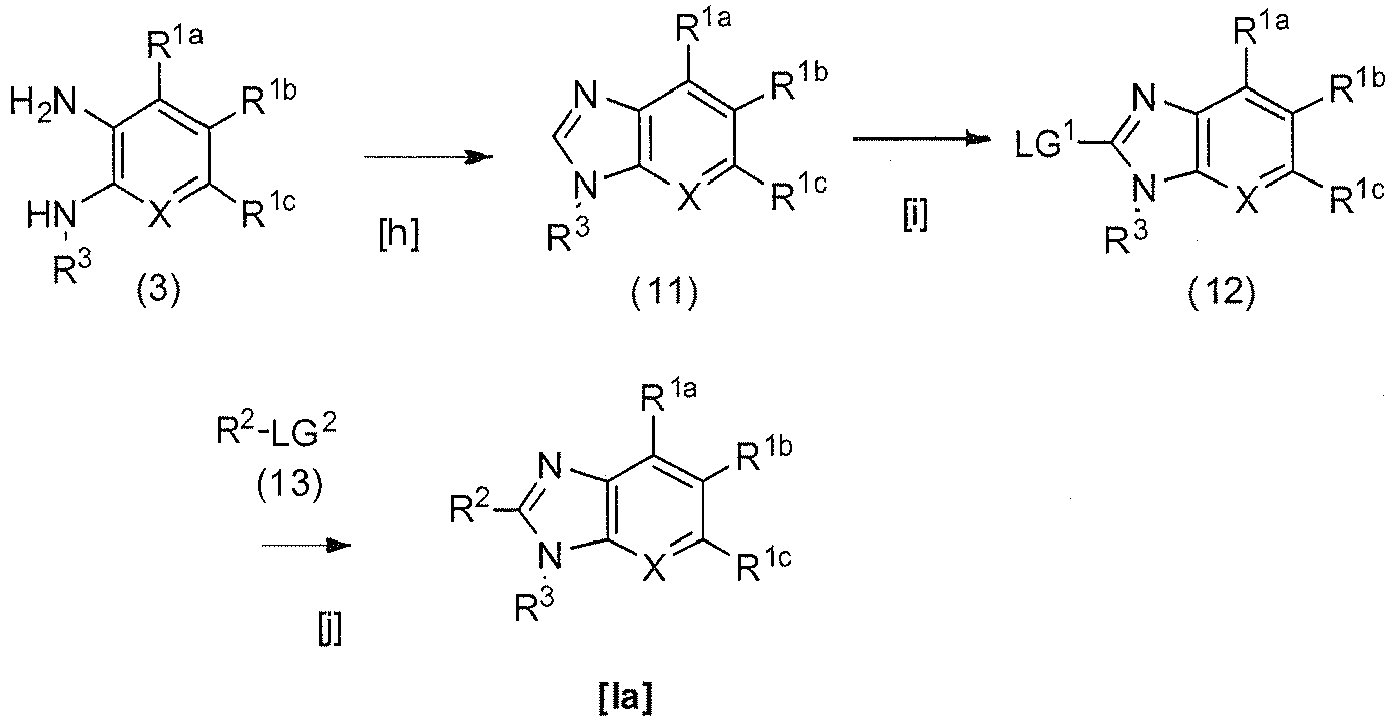
- The compound (11) can be produced by reacting the compound (3) and trialkyl orthoformate in an appropriate solvent, or without solvent. As solvents, any solvent which do not affect the reaction can be used, and for example, methylene dichloride, toluene, xylene and acetic acid can be suitably used. The present reaction proceeds suitably also by adding an acid, for example, acetic acid, trifluoroacetic acid or p-toluenesulfonic acid. The present reaction proceeds suitably at 0°C-100°C.
- The compound (12) can be produced by reacting the compound (11) with a halogenizing reagent in the presence or absence of a base, in an appropriate solvent. As the base, for example, organometallic reagent such as n-butyl lithium is recited, and as the halogenizing reagent, for example, carbon tetrabromide and N-bromosuccinimide are recited. When the base is used in the present reaction, any solvents which do not affect the reaction can be used, and for example, THF, hexane and toluene can be suitably used. The reaction proceeds suitably at the reaction temperature of -78°C to room temperature. And, in the absence of the base, the solvent such as dioxane, THF, DMF or carbon tetrachloride can be suitably used. The reaction proceeds suitably at reaction temperatures from room temperature to 150°C.
- The compound [Ia] can be produced by reacting the compound (12) and the compound (13) in an appropriate solvent, in the presence of a Pd catalyst as described in "Journal of Organometallic Chemistry., 576, 147 (1999)". As the Pd catalyst, zero-valent palladium such as tetrakis-triphenylphosphine palladium (0) or tris(dibenzylidene acetone)dipalladium (0), and bivalent palladium such as acetic acid palladium (II) and chloro-bistriphenylphosphine palladium (II) are recited. Also an appropriate ligand can be added, and 2,2'-bis(diphenylphosphino)-1,1'-binaphthyl, 2-dicyclohexyl-phosphino-2',4',6'-triisopropylbiphenyl, 2-dicyclohexyl-phosphino-2'-(N,N-dimethylamino)biphenyl, etc. are recited. As solvents, any solvents which do not affect the reaction can be used, and in case of LG2 is -SnR3, such solvents as toluene, THF, dioxane are recited, and in case of LG2 is -B(OH)2 or -B(OR)2, such solvents as toluene, THF, dioxane, dimethoxyethane or water, or a mixed solution thereof are recited. In case of LG2 is - B(OH)2 or -B(OR)2, the reaction proceeds suitably by adding a base, and such bases as sodium carbonate, potassium phosphate and sodium t-butoxide are recited. The present reaction proceeds suitably at reaction temperatures of 60°C-160°C.
-

- The compound (16) can be obtained by the SONOGASHIRA reaction between the compound (14) and the acetylene derivative (15) using the palladium (0) and copper catalyst. As the palladium catalyst, tetrakis-triphenylphosphine palladium (0), dichloro ditriphenylphosphino palladium (0), etc. can be suitably used. The solvent is not limited as far as it does not affect the reaction, and, THF, toluene, benzene, triethylamine, diethylamine, or a mixed solvent thereof can be properly used. The present reaction proceeds suitably by adding an appropriate base, for example, triethylamine, diisopropylethylamine or diethylamine. The reaction proceeds suitably at reaction temperatures from room temperature to 120°C. It is preferable that, among two LGs in the compound (14), the LG which does not connect to the carbon adjacent to X has higher reactivity. The compound (16) can be also produced by converting an optionally protected hydroxy group into the leaving group by usual manner, after the present step has been conducted by using the compound having an optionally protected hydroxy group as the LG connecting to the carbon adjacent to X.
- The compound (17) can be obtained from the compound (16) by the desilylation reaction described in "Greene's Protecting Group in Organic Synthesis". Preferably is recited the method of mixing with tetrabutylammonium fluoride, preferably in an appropriate solvent. The reaction proceeds suitably at reaction temperatures from 0°C to room temperature.
- The compound (19) can be obtained by the SONOGASHIRA reaction using the compound (17) or the acetylene derivative (18) and the palladium (0) and copper catalyst. As the palladium catalysts, tetrakis-triphenylphosphine palladium (0), ditriphenylphosphine palladium (II) dichloride, etc. are preferable. The present step proceeds in a solvent, or without solvent, and the solvent is not limited specially, as far as it does not affect the reaction. For example, THF, toluene, benzene, triethylamine, diethylamine, or the mixed solvent thereof can be properly used. The reaction proceeds suitable at the reaction temperatures from room temperature to 120°C.
- The compound (21) can be produced by reacting the compound (19) and the amine (20) in an appropriate solvent or without solvent. The present reaction proceeds suitably by adding an appropriate base, for example, an alkali metal salt or an alkaline-earth metal salt such as potassium carbonate and cesium carbonate, or an organic base such as triethylamine or pyridine. Any solvents which do not affect the reaction can be used, and for example, DMSO, DMF and THF are recited. More preferably, the N-arylation reaction catalyzed by the transition metal catalyst such as palladium or cupper can be suitably used as described in "Angewandte Chem. Int. Ed., 34, 6338(2008)", or "Angewandte Chem. Int. Ed., 48, 6954 (2009)". The compound (21) obtained can be also utilized as it is to the next reaction step without isolation.
- The compound (Ib) can be produced by adding an appropriate base such as potassium-t-botoxide or potassium hydride to the compound (21) in an appropriate solvent, or without solvent. Any solvent which does not affect the reaction can be used, and for example, toluene, DMF, THF, acetonitrile and N-methylpyrrolidone are recited. The method using palladium as described in "Tetrahedron Lett., 1988, 29, 1799", or the method using cupper as described in "J. Org. Chem., 1963, 28, 2163" can also be suitably used.
The compound (Ib) can also be produced in an one-pot reaction from the compound (14), the acetylene derivative (18) and the amine (20) by using such a method as described in "Org. Lett., 2005, 7, 439". -

- The compound (24) can be produced by reacting the compound (22), the amine (23) and an amidizing reagent, in an appropriate solvent, or without solvent. The present reaction proceeds suitably from -20°C to 100°C, especially, from 0°C to room temperature. Any solvent which does not affect the reaction can be used, and for example, methylene dichloride, chloroform, THF, DMF, DMAC, etc. can be suitably used. As an amidizing reagent, a combination of EDCI, HOBt and triethylamine, or a combination of HATU or and triethylamine or diisopropylethylamine may be recited.
- The compound (25) can be produced by combining the compound (24) with thionyl chloride, phosphorus oxychloride, phosphorus pentachloride, etc. in an appropriate solvent, or without solvent. The present reaction proceeds suitably at 60°C-150°C.
- The compound (Ic) can be produced by the cross-coupling reaction of the compound (25) with an organic boron compound, an organic zinc compound. Any solvent which does not affect the reaction can be used, and dioxane, 1,2-dimethoxyethane, THF, DMF, toluene, or a mixture thereof can be properly used. The reaction proceeds suitably at 60°C-120°C. As a metal, the 0-valent or 2-valent palladium or nickel compound described in "Palladium Reagent, Catalysts, Innovations in Organic synthesis (New York: wiley, 1995)", etc. can be use in a catalytic amount or a stoichiometric amount. Also the legands described in "Acc. Chem. Res. 2008, 41, 1461." can be suitably used. Also, the present reaction can be accelerated by irradiation of microwave.
-

- The compound (27) can be produced by reacting the compound (26) and the amine (23) in an appropriate solvent, or without solvent. The present reaction proceeds suitably from room temperature to 150°C. Any solvent which does not affect the reaction can be used, and benzene, toluene, xylene, or a mixture thereof can be properly used. In the present reaction, an appropriate acid may be added, and the compound (27) obtained can be used, as it is, to the next reaction step without isolation.
- The compound (28) can be produced by reacting the compound (27) and triethyl phosphite, in an appropriate solvent, or without solvent. The present reaction proceeds suitably, especially at 150°C.
- The compound (25) can be obtained by mixing the compound (28) with a usual halogenizing reagent (such as, chlorine, bromine, iodine, N-chlorosuccinimide or N-bromosuccinimide, N-iodosuccinimide or a halonium salt) in a solvent, or without solvent. For example, the solvent such as methylene dichloride, chloroform, ethyl acetate, diethyl ether, THF, 1,4-dioxane, acetonitrile, DMF, or a mixture solvent thereof can be properly used. The reaction temperatures are preferably from 0°C to 150°C. To the present reaction may be added a suitable acid such acetic acid, trifluoroacetic acid, hydrochloric acid, or a radical initiator such as 2,2'-azobis(2-methylpropionitrile) or benzoyl peroxide.
- The compound (Ic) can be synthesized by using a cross-coupling reaction of the compound (25) with an organic boron compound, an organic zinc compound, an organic silicon compound, an organic tin compound. Any solvent which does not affect the reaction can be used, and dioxane, 1,2-dimethoxyethane, THF, DMF, toluene, or a mixture thereof can be properly used. The reaction proceeds suitably at reaction temperatures of 60°C-120°C. As a metal, zero valent or 2-valent palladium or nickel compounds described in "Palladium Reagent, Catalysts, Innovations in Organic synthesis(New York: wiley, 1995)", etc. can be used in a catalytic amount or in a stoichiometric amount. Also, such ligands as described in "Acc. Chem. Res. 2008, 41, 1461." can be suitably used. The present reaction is also accelerated by irradiation of microwave.
-

- The compound (31) can be obtained by the coupling reaction of the compound (29) with the compound (30) using a metal catalyst (for example, "J. Am. Chem. Soc. 2002, 124, 12557-12565", "J. Am. Chem. Soc. 2001, 123, 7996-8002", etc.). There is no limitation in a solvent, and any solvent which does not affect the reaction can be properly used, for example, dioxane, 1,2-dimethoxyethane, THF, DMF, toluene, or a mixed solvent thereof. The reaction temperatures at 0°C-150°C are desirable. The compound (31) can be also synthesized using the Claisen condensation or the Friedel-Crafts reaction, etc.
- The compound (32) can be obtained by mixing the compound (31) with the usual halogenizing reagent (chlorine, bromine, iodine, N-chlorosuccinimide, N-bromosuccinimide or N-iodosuccinimide, a halonium salt, etc.) in a solvent or without solvent. The solvent is not specifically limited unless it affects the reaction, and, for example, methylene dichloride, chloroform, ethyl acetate, diethyl ether, THF, 1,4-dioxane, acetonitrile, DMF, or a mixed solvent thereof can be properly used. The reaction temperatures at 0°C-120°C are desirable. To the present reaction, may be added a suitable acid (acetic acid, trifluoroacetic acid, hydrochloric acid, etc.) or a base which does not affect the reaction (sodium hydride, triethylamine, diisopropylethylamine, lithium hexamethyldisilazide, sodium hexamethyldisilazide, an organolithium compound, etc.).
- The compound (Id) can be obtained by mixing the compound (32) and the compound (33) in a solvent or without solvent. The solvent is not specifically limited as far as it does not affect the reaction, and, for example, methanol, ethanol, methylene dichloride, chloroform, ethyl acetate, THF, DMF, toluene, pyridine, or a mixed solvent thereof can be properly used. The reaction temperatures at 50°C-150°C are desirable. To the present reaction may be added a proper base (sodium hydride, sodium bicarbonate, potassium carbonate, cesium carbonate, triethylamine, pyridine, etc.).
-

- The compound (35) can be obtained by mixing the compound (33) and the compound (34) in a solvent or without solvent. The solvent is not specifically limited as far as it does not affect the reaction, and, for example, methanol, ethanol, methylene dichloride, chloroform, ethyl acetate, THF, DMF, toluene, pyridine, or a mixed solvent thereof can be properly utilized. The reaction temperatures at 0°C-150°C are desirable. To the present reaction may be added a suitable base (potassium carbonate, cesium carbonate, triethylamine, pyridine, etc.).
- The compound (36) can be obtained by mixing the compound (35) and the usual halogenizing reagent (for example, chlorine, bromine, iodine, N-chlorosuccinimide, N-bromosuccinimide, N-iodosuccinimide or a halonium salt), in a solvent or without solvent. For example, methylene dichloride, chloroform, ethyl acetate, diethyl ether, THF, 1,4-dioxane, acetonitrile, DMF, or a mixed solvent thereof can be properly used. The reaction temperatures at 0°C-150°C are desirable. To the present reaction may be added a suitable acid such as acetic acid, trifluoroacetic acid or hydrochloric acid, or a radical initiator such as 2,2'-azobis(2-methylpropionitrile) or benzoyl peroxide.
- The compound (Id) can be synthesized by the cross-coupling reaction of the compound (36) with an organic boron compound, an organic zinc compound, an organic silicon compound, or an organic tin compound. The solvent is not specifically limited as far as it does not affect the reaction, and, for example, dioxane, 1,2-dimethoxyethane, THF, DMF, toluene, or a mixed solvent thereof may be properly used. The reaction proceeds suitably at 60°C-120°C. As a metal, zero valent or 2-valent palladium or nickel compounds described in "Palladium Reagent, Catalysts, Innovations in Organic synthesis(New York: wiley, 1995)", etc. can be used in a catalytic amount or in a stoichiometric amount. Also, such ligands as described in "Acc. Chem. Res. 2008, 41, 1461." can be suitably used. The present reaction is also accelerated by irradiation of microwave.
-

- The compound (38) can be obtained by reacting the compound (37) and malondialdehyde or the binamidinium salt described in "J. Org. Chem. 2000, 65, 4571-4574". The solvent is not specifically limited as far as it does not affect the reaction, and, for example, methylene dichloride, chloroform, acetonitrile, diethyl ether, THF, 1,4-dioxane, DMF, toluene, or a mixed solvent thereof can be properly used. The reaction temperatures at 0°C-80°C are desirable. To the present reaction, a suitable acid (acetic acid, trifluoroacetic acid, hydrochloric acid, etc.) and a suitable base (sodium methoxide, potassium t-botoxide, triethylamine, etc.) may be added as far as they do not affect the reaction.
- The compound (39) can be obtained by mixing the compound (38) with the usual halogenizing reagent (chlorine, bromine, iodine, N-chlorosuccinimide or N-bromosuccinimide, N-iodosuccinimide, or a halonium salt), etc. in a solvent or without solvent. For example, methylene dichloride, chloroform, ethyl acetate, diethyl ether, THF, 1,4-dioxane, acetonitrile, DMF, or a mixed solvent thereof can be properly used. The reaction temperatures at 0°C-150°C are desirable. To the present reaction may be added a suitable acid such as acetic acid, trifluoroacetic acid and hydrochloric acid, or a radical initiator such as 2,2'-azobis(2-methylpropionitrile) and benzoyl peroxide.
- The compound (Ie1) can be synthesized by a cross-coupling reaction of the compound (39) with an organic boron compound, an organic zinc compound, an organic silicon compound, an organic tin compound, etc. The solvent is not specifically limited as far as it does not affect the reaction, and, for example, dioxane, 1,2-dimethoxyethane, THF, DMF, toluene, or a mixed solvent thereof can be properly used. The reaction proceeds suitably at temperatures of 60°C-120°C. As a metal, zero valent or 2-valent palladium or nickel compounds described in "Palladium Reagent, Catalysts, Innovations in Organic synthesis (New York: wiley, 1995)", etc. can be used in a catalytic amount or in a stoichiometric amount. Also, such ligands as described in "Acc. Chem. Res. 2008, 41, 1461." can be suitably used. The present reaction is also accelerated by irradiation of microwave.
-

- The compound (Ie2) can be obtained by mixing the compound (31) and the compound (40) in a solvent or without solvent. The solvent is not specifically limited as far as it does not affect the reaction, and, methanol, ethanol, etc. can be properly used. The reaction temperatures of 0°C-150°C are desirable. To the present reaction may be added a suitable base (triethylamine, pyridine, 1,8-diazabicyclo[5.4.0] undec-7-ene, etc.).
- The functional groups contained in the compounds of the present invention, their synthetic intermediates, or their starting compounds can be converted by the usual methods described in "Comprehensive Organic Transformations: A guide to Functional Group Preparations, Fiesers' Reagents for Organic Synthesis", etc., for example, by the following methods.
- (1) When the compounds of the present invention, their synthetic intermediates, or their starting compounds have functional groups (hydroxyl, amino, carboxy, etc.), the reaction can be conducted by protecting these functional groups with the usual protecting groups as described in "Greene's Protecting Group in Organic Synthesis", then, after reaction, the targeted compound can be obtained by removing said protecting groups. In this case, the protecting groups for the hydroxyl group are exemplified by tetrahydropyranyl, TMS and an aryl, the protecting groups for the amino are exemplified by Boc or benzyloxycarbonyl, the protecting groups for carboxy are exemplified by an alkyl such as methyl, ethyl and benzyl, the protecting groups for the imidazolyl group are exemplified by a trityl group, and the substituents for the pyrolyl group are exemplified by SEM.
- (2) When the compounds of the present invention, their synthetic intermediates or their starting compounds have an amino functional group, the amino is optionally protected firstly, then, (i) it is reacted with an alkyl halogenide in the presence of a base (sodium hydride, triethylamine, sodium carbonate, potassium carbonate, etc.), or (ii) alcohol is treated by the MITSUNOBU reaction using an alkylazodicarboxylate and triphenylphosphine, then optionally via deprotection, the compound having the amino optionally mono- or di-substituted by alkyls can be obtained.
- (3) When the compounds of the present invention, their synthetic intermediates or their starting compounds have hydroxyl, (i) the hydroxyl is reacted with an alkyl halide in the presence of a base (sodium hydride, triethylamine, sodium carbonate, potassium carbonate, etc.), or (ii) alcohol is treated by the MITSUNOBU reaction using an alkylazodicarboxylate and triphenylphosphine, then, the compounds having an alkoxy group optionally substituted by an alkyl can be obtained.
- (4) When the compounds of the present invention, their synthetic intermediates or their starting compounds have amino, they can be converted to the compounds having a corresponding amido group by converting the amino into the corresponding amido by using acyl halide.
- (5) When the compounds of the present invention, their synthetic intermediates or their starting compounds have a double bond, they can be converted into the compounds having a corresponding single bond by a catalytic reduction of the double bond by using a transition metal catalyst (platinum, palladium, rhodium, ruthenium, nickel, etc.).
- (6) When the compounds of the present invention, their synthetic intermediates or their starting compounds have an ester group, they can be converted into the corresponding carboxy compounds by hydrolyzing the ester group with alkali (sodium hydroxide, potassium hydroxide, etc.).
- (7) When the compounds of the present invention, their synthetic intermediates or their starting compounds have a carbamoyl, the corresponding nitrile compounds can be obtained by reacting the carbamoyl with trifluoroacetic acid anhydride.
- (8) When the compounds of the present invention, their synthetic intermediates or their starting compounds have hydroxyl, the hydroxy group can be converted to the corresponding halogen by treating it with a halogenizing agent. And, when the compounds of the present invention, their synthetic intermediates or their starting compounds have a halogen, the corresponding compounds having an alkoxy can be obtained by converting the halogen into the corresponding an alkoxy by treating with alcohol.
- (9) When the compounds of the present invention, their synthetic intermediates or their starting compounds have ester, they can be converted into the corresponding hydroxy compounds by reducing the ester using a reducing agent (a metal reducing agent such as lithium aluminum hydride, sodium borohydride, lithium borohydride, and diborane).
- (10) When the compounds of the present invention, their synthetic intermediates or their starting compounds have hydroxyl, they can be converted into the compounds having aldehyde, ketone or carboxy by oxidizing them by an oxidizing agent.
- (11) When the compounds of the present invention, their synthetic intermediates or their starting compounds have carbonyl or aldehyde, they can be converted into the compounds having an optionally mono- or di-substituted aminomethyl by carrying out the reductive amination reaction in the presence of an amine compound and a reducing agent (sodium borohydride, sodium cyanoborohydride, etc.).
- (12) When the compounds of the present invention, their synthetic intermediates or their starting compounds have aldehyde, they can be converted into the compounds having a corresponding oxime by reacting them with hydroxyl amine or O-alkylhydroxyl amine in alcohol (methanol, ethanol, etc.), in the presence of a base (sodium bicarbonate, etc.).
- (13) When the compounds of the present invention, their synthetic intermediates or their starting compounds have a halogen, they can be converted into the compounds having a corresponding cyano group by treating them with a cyanizing agent.
- (14) When the compounds of the present invention, their synthetic intermediates or their starting compounds have a halogen, they can be converted into the compounds having hydroxyl, amino, an amino optionally substituted by 1 or 2 alkyl, an alkyl, an alkenyl or an aryl group by the reaction using a transition metal catalyst such as Pd. The halogen can be converted into hydroxyl by a similar method, for example, as described in "J. Am. Chem. Soc., 128, 10694(2006)", into an amino optionally substituted with 1 or 2 alkyl by a similar method as described in "Tetrahedron, 58, 2041(2002)", into an alkenyl group by a similar method as described in "J. Org. Chem., 71, 9681(2006)", and into an aryl group by a similar method as described in "Journal of Organometallic Chemistry.,576, 147(1999)".
- (15) When the compounds of the present invention, their synthetic intermediates or their starting compounds have a cyano group, they can be converted into the compounds having an aldehyde group by using a reducing agent (diisobutylaluminum hydride, etc.).
- (16) When the compounds of the present invention, their synthetic intermediates or their starting compounds have a vinyl group, they can be converted into the compounds having a formyl group by the ozone oxidation or the osmium oxidation and successively by the iodic acid oxidation.
- (17) When the compounds of the present invention, their synthetic intermediates or their starting compounds have 2-halogenopyridine, 2-halogenopyrazine, 2-halogenopyridazine or 2-halogenopyrimidine, they can be converted into the compounds having an alkoxy, an alkylthio, amino or an amino optionally substituted by 1 or 2 alkyl, cyano or a fluoro group by reacting them with a nucleophile.
- (18) When the compounds of the present invention, their synthetic intermediates or their starting compounds have a phenolic hydroxy group, the compounds having difluoroalkoxy can be obtained by reacting them with chlorodifluoro methane or sodium chlorodifluoroacetic acid, and also the compounds having a trifluoromethoxy group can be obtained by using methods described in "Bull. Chem. Soc. Jpn. 2000, 73, 471-484" and "J. Org. Chem., 1979, 44, 2907".
- The compounds of the present invention and each of their synthetic intermediates thus obtained can be purified using the usual chemical processes such as extraction, crystallization, re-crystallization, and various chromatography.
- The compounds of the present invention can be converted into the pharmaceutically acceptable salts thereof by using the usual methods, and these salts can be purified by the usual chemical processes such as re-crystallization.
- The compounds of the present invention include a mixture of stereo-isomers, or a pure or substantially pure form of each stereoisomer. For example, when the compounds of the present invention have one or more asymmetric centers on either of carbon, the compounds of the present invention may exist in an enantiomer or a diastereomer, or a mixture thereof. The compounds of the present invention include their isomers, or the mixtures thereof. And, when the compounds of the present invention include a double bond, stereo-isomers (cis- and trans-isomers) can exist, and when the compounds of the present invention include an unsaturated bonding such as carbonyl, tautomers can exist.
- The present invention is further explained by the following Examples, but the scope of the present invention is not limited by these Examples.
- 1-(6-methoxypyridazin-3-yl)-2-pyridin-2-yl-5-(trifluoromethyl)-1H-benzimidazole

MS m/z 372 [M+H] +, APCI(+) - 2-(6-fluoropyridin-2-yl)-1-(6-methoxypyridazin-3-yl)-5-(trifluoromethyl)-1H-benzimidazole

MS m/z 408 [M+H] +, APCI (+)
The compound 2 (100 mg) was dissolved in a mixed solvent of xylene/acetic acid (4:1, 2 ml), and heated to 170°C by irradiation of microwave. After the reaction solution was stirred for 1 h and kept standing to cool to room temperature, the solvent was evaporated in vacuo. The residue was purified by the silica gel column chromatography affording the compound 3 (78.9 mg).
MS m/z 390 [M+H] +, APCI (+) - 1-(6-methoxypyridazin-3-yl)-2-pyridin-2-yl-5-(trifluoromethoxy)-1H-benzimidazole

MS m/z 406 [M+H] +, APCI(+)
The compound 2 (14.0 mg) was dissolved in acetic acid (1 ml), and the solution was heated to 100°C. After the solution was stirred for 2 days and kept standing to cool to room temperature, the solvent was evaporated in vacuo. The evaporated residue was purified by the silica gel column chromatography affording the compound 3 (15.0 mg).
MS m/z 388 [M+H] +, APCI(+) - 2-(5-fluoropyridin-2-yl)-3-(6-methoxypyridin-3-yl)-6-(trifluoromethyl)-3H-imidazo[4,5-b]pyridine

MS m/z 408 [M+H] +, APCI (+)
The acetic acid (6 ml) solution of the compound 2 (0.55 g) was heated to 100°C. After the solution was stirred for 2 days, it was cooled to room temperature, and the solvent was evaporated in vacuo. To the evaporated residue was added ethyl acetate, and the organic layer was washed with an aqueous solution saturated with sodium bicarbonate. After the organic layer was filtrated and evaporated, the residue was purified by the silica gel column chromatography, and the compound 3 (0.39 g) was obtained.
MS m/z 390 [M+H] +, APCI (+) - N-methyl-5-[2-pyridin-2-yl-6-(trifluoromethyl)-3H-imidazo[4,5-b]pyridin-3-yl]pyridin-2-amine

MS m/z 389 [M+H] +, APCI(+)
The compound 2 (126 mg) was diluted in acetic acid (3.2 ml), and the solution was heated to 100°C. After the solution was stirred all day and all night, chloroform, water and potassium carbonate were added, and the organic layer was separated. After the organic layer was concentrated, the concentrated residue was purified by the silica gel column chromatography, and the compound 3 (59 mg) was obtained.
MS m/z 371[M+H]+, APCI(+) - N,N-dimethyl-5-[2-pyridin-2-yl-6-(trifluoromethyl)-3H-imidazo[4,5-b]pyridin-3-yl]pyridin-2-amine
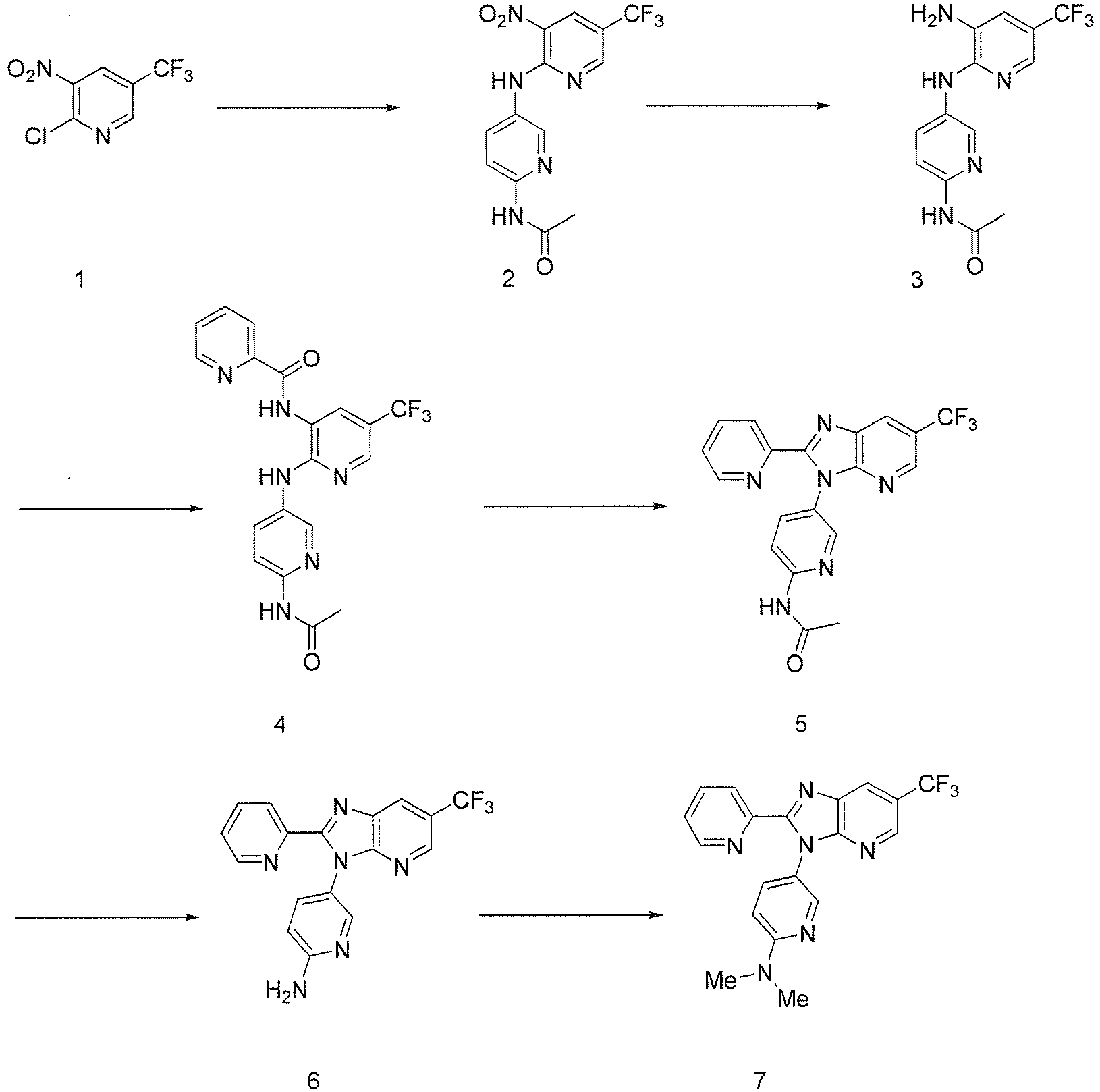
MS m/z 312 [M+H] +, APCI(+)
The compound 3 (1.14 g) was dissolved in methylene dichloride (18 ml), and picolinic acid (471 mg), EDCI-HCl(1.05 g) and HOBt-H2O (921 mg) was added thereto. After the solution was stirred all day and all night, methylene dichloride, water and potassium carbonate were added thereto, and then, the organic layer was separated. After the organic layer was concentrated, the concentrated residue was purified by the silica gel column chromatography, and the compound 4 (1.12 g) was obtained.
MS m/z 417 [M+H] +, APCI(+)
After the compound 4 (1.12 g) was dissolved in acetic acid (24.3 ml), the solution was heated to 100°C. After stirring the solution for 4 h, chloroform, water and potassium carbonate were added thereto, and then, the organic layer was separated. After the organic layer was concentrated, the residue was purified by the silica gel column chromatography, and the compound 5 (687 mg) was obtained.
MS m/z 399 [M+H] +, APCI(+)
The compound 5 (200 mg) was dissolved in THF (2.5 ml), 2N sodium hydroxide aqueous solution (1.0 ml) was added thereto, and after the solution was stirred at 50°C all day and all night, further 2N sodium hydroxide aqueous solution (4.0 ml) was added thereto, and the solution was stirred at 70°C all day and all night. To the reaction solution, were added chloroform and water, and then, the organic layer was separated. After the organic layer was concentrated, the residue was purified by the silica gel column chromatography, and the compound 6 (148 mg) was obtained.
MS m/z 357[M+H]+, APCI(+)
After the compound 6(123 mg) was dissolved in acetonitrile (3 ml), an aqueous 37% formaldehyde solution (3.5 ml), cyano sodium borohydride (71.3 mg) and acetic acid (60 mg) were added thereto. After the solution was stirred for 3 h, chloroform, water and potassium carbonate were added thereto, and then, the organic layer was separated. After the organic layer was concentrated, the residue was purified by the silica gel column chromatography, and the compound 7 (31 mg) was obtained. MS m/z 385[M+H]+, APCI(+) - 6-[1-(6-methoxypyridazin-3-yl)-5-(trifluoromethyl)-1H-benzimidazole-2-yl]nicotinonitrile

MS m/z 448 [M+H] +, APCI (+)
The compound 2 (5.50 g) was dissolved in acetic acid (50 ml), and was heated to 105°C. After the solution was stirred for 1 day and kept standing to cool to room temperature, the solvent was evaporated in vacuo. To the residue was added ethyl acetate, and after the solution was washed with an aqueous solution saturated with sodium bicarbonate and a saturated saline, the solution was dried with anhydrous sodium sulfate. After the solution was filtrated and concentrated, the residue was purified by the silica gel column chromatography, and the crude product 3 was obtained. To the obtained crude product 3 was added diethyl ether, and the precipitated product was filtrated affording the compound 3 (1.76 g).
MS m/z 430 [M+H] +, APCI (+)
The compound 3 (429 mg) was suspended in a 7N ammonia-methanol solution (5 ml), and the solution was heated to 80°C. After the solution was stirred for 3 days and kept standing to cool to room temperature, the solvent was evaporated in vacuo. The residue was purified by the silica gel column chromatography, and the compound 4 (285 mg) was obtained.
MS m/z 415 [M+H] +, APCI (+)
The compound 4 (20.2 mg) was dissolved in THF (1 ml),and at 0°C, pyridine (12 µl) and trifluoroacetic acid anhydride (17 µl) were added thereto. After the mixture was stirred at 0°C for 1 h, water was added thereto, and then, the mixture was extracted with ethyl acetate. The organic layer was washed with a 1N-hydrochloric acid aqueous solution and then with a saturated saline, followed by drying with anhydrous sodium sulfate. After the solution was filtrated and concentrated, the residue was purified by the silica gel column chromatography, and the compound 5 (17.4 mg) was obtained.
MS m/z 397 [M+H] +, APCI (+) - 5-[3-(6-methoxypyridin-3-yl)-6-(trifluoromethyl)-3H-imidazo[4,5-b]pyridin-2-yl]pyrazine-2-carbonitrile

MS m/z 425/427 [M+H] +, APCI(+)
The compound 2 (548 mg) was dissolved in acetic acid (13 ml), and the solution was heated to 100°C. After the solution was stirred for 4 h, chloroform, water and potassium carbonate were added thereto, and then, the organic layer was separated. After the organic layer was concentrated, the residue was purified by the silica gel column chromatography, and the compound 3 (427 mg) was obtained.
MS m/z 407/409 [M+H] +, APCI(+)
After the compound 3 (150 mg) was dissolved in DMAC (3.7 ml), zinc cyanide (52 mg) and tetrakis(triphenylphosphine) palladium (0) (85 mg) were added thereto, and then, the reaction temperature was raised to 170°C by irradiation of microwave. After the solution was stirred for 20 min and kept standing to cool to room temperature, water was added thereto and the mixture was extracted with ethyl acetate. The organic layer was washed with a saturated saline and dried with magnesium sulfate. After the organic layer was filtrated and concentrated, the residue was purified by the silica gel column chromatography, and the compound 5 (71 mg) was obtained.
MS m/z 398 [M+H] +, APCI(+) - 2-(6-methoxypyridazin-3-yl)-1(6-methoxypyridin-3-yl)-5-(trifluaromethyl)-1H-benzimidazole

MS m/z 424/426 [M+H] +, APCI (+)
After the compound 2 (24 mg) was dissolved in methanol (0.6 ml), a sodium methoxide methanol solution (0.2 ml) was added thereto, and the mixture was stirred at room temperature. After the mixture was stirred for 2 h, water was added thereto, and the mixture was extracted with ethyl acetate. The organic layer was washed with a saturated saline, and was dried with anhydrous sodium sulfate. After the organic layer was filtrated and concentrated, the residue was purified by the silica gel column chromatography, and the compound 3 (7.2 mg) was obtained.
MS m/z 420 [M+H] +, APCI (+)
The compound 3(50.1 mg) was dissolved in acetic acid (1 ml), and heated at 100° . After the solution was stirred all day and all night, the solvent was evaporated in vacuo, and to the residue were added a saturated aqueous sodium bicarbonate solution and ethyl acetate. After the organic layer was separated, it was washed sequentially with water and a saturated saline, and was dried with anhydrous sodium sulfate. After the organic layer was filtrated and concentrated, the residue was purified by the silica gel column chromatography, and the compound 4 (44.4 mg) was obtained.
MS m/z 402 [M+H] +, APCI(+) - 3-(6-methoxypyridin-3-yl)-2-(1H-pyrrol-2-yl)-6-(trifluoromethyl)-3H-imidazo[4,5-b]pyridine

MS m/z 508 [M+H] +, APCI(+)
The compound 2 (265 mg) was dissolved in acetic acid (2.7 ml), and the solution was heated to 100°C. After the solution was stirred all day and all night, the solvent was evaporated in vacuo, and the residue was purified by the silica gel column chromatography, and the compound 3 (236 mg) was obtained.
MS m/z 490 [M+H] +, APCI(+)
After the compound 3 (235 mg) was dissolved in THF (5 ml), tetra-N-butylammonium fluoride (1 mol/L, 720µl) was added thereto, and the solution was refluxed for 2 days under heating. After the solution was kept standing to cool to room temperature, an aqueous solution of saturated sodium bicarbonate was added thereto, and the mixture was extracted with ethyl acetate. After the organic layer was washed sequentially with water and a saturated saline, the organic layer was dried with anhydrous sodium sulfate. After the organic layer was filtrated and concentrated, the residue was purified by the silica gel column chromatography, and the compound 4 (121 mg) was obtained. MS m/z 360[M+H]+, APCI(+) - 2-(1H-Imidazol-4-yl)-3-(6-methoxypyridin-3-yl)-6-(trifluoromethyl) -3H-imidazo [4, 5-b] pyridine

MS m/z 621 [M+H] +, ESI
The compound 2 (315 mg) was dissolved in acetic acid (4.5 ml), and the solution was heated to 100°C. After the solution was stirred for 2 days and kept standing to cool to room temperature, the solvent was evaporated in vacuo. The evaporated residue was dissolved in methylene dichloride (1 ml), and at 0°C, trifluoroacetic acid (1 ml) was added thereto. After the solution was stirred at room temperature for 8 h, the solvent was evaporated in vacuo. The residue was purified by the silica gel column chromatography, and the compound 3 (175 mg) was obtained. MS m/z 361[M+H]+, APCI(+) - 1,2-Dipyridin-2-yl-5-(trifluoromethyl)-1H-benzimidazole

MS m/z 284 [M+H]+, APCI(+)
The compound 2 (1.22 g) was dissolved in methanol (12 ml), and iron (III) chloride (69.9 mg), hydrazine monohydrate (1.08 g) and active carbon (120 mg) were added thereto, and then, the mixture was refluxed for 2 h under heating. After the mixture was kept standing to cool to room temperature, the insoluble material was filtrated. After the filtrate was concentrated, to the concentrated residue was added chloroform and the obtained solution was dried with anhydrous sodium sulfate. After the solution was filtrated and concentrated, the concentrated residue was purified by the silica gel column chromatography, and the compound 3 (0.89 g) was obtained.
MS m/z 254 [M+H] +, APCI(+)
The compound 3 (120 mg) was dissolved in DMF (1.2 ml), and picolinic acid (61.8 mg), HATU (255 mg) and diisopropylethylamine (117 µl) were added thereto. After the solution was stirred for 2 days, water was added thereto and extracted with ethyl acetate. The organic layer was washed sequentially with an aqueous solution saturated with sodium bicarbonate, water and saturated saline, and then, the organic layer was dried with anhydrous sodium sulfate. After the organic layer was filtrated and concentrated, the concentrated residue was purified by the silica gel column chromatography, and the compound 4 (165 mg) was obtained.
MS m/z 359 [M+H] +, APCI (+)
The compound 4 (160 mg) was dissolved in acetic acid (1.5 ml) and heated to 100°C. After the solution was stirred for 10 h and was kept standing to cool to room temperature, and the solvent was evaporated in vacuo. The evaporated residue was dissolved in ethyl acetate, and after the organic layer was washed sequentially with an aqueous sodium bicarbonate solution and a saturated saline, the organic layer was dried with anhydrous sodium sulfate. After the organic layer was filtrated and concentrated, the concentrated residue was purified by the silica gel column chromatography, and the compound 5 (104 mg) was obtained.
MS m/z 341 [M+H] +, APCI(+) - 3-(6-methoxypyridin-3-yl)-2-pyridin-2-yl-6-(trifluoromethyl)-3H-imidazo[4,5-b]pyridine

MS m/z 374 [M+H] +, APCI(+)
After the compound 2 (57.0 mg) was dissolved in DMF(1.5 ml), and was added acetic acid (0.2 ml) thereto, the solution was heated to 80°C. After the solution was stirred for 4 h and allowed to cool to room temperature, the solvent was evaporated in vacuo. To the evaporated residue was added an aqueous solution saturated with sodium bicarbonate, and the solution was extracted with ethyl acetate. After the organic layer was concentrated, the residue was purified by the silica gel column chromatography, and the compound 3 (38.0 mg) was obtained.
MS m/z 372 [M+H] +, APCI(+) - 1-(6-methoxypyridin-3-yl)-2-pyridin-2-yl-5-(trifluoromethyl)-1H-benzimidazole

MS m/z 371 [M+H] +, APCI (+) - 1-(6-methoxypyridazin-3-yl)-2-(1-methyl-1H-pyrazol-4-yl)-5-(trifluoromethyl)-1H-benzimidazole

MS m/z 295 [M+H] +, APCI(+)
The compound 2 (500 mg) was dissolved in dioxane (10 ml), and N-bromosuccinimide (696 mg) was added thereto, and the solution was heated to 100°C. After the solution was stirred for 30 min, the solvent was evaporated in vacuo. The evaporated residue was purified by the silica gel column chromatography, and the compound 3 (223 mg) was obtained.
MS m/z 373/375 [M+H] +, APCI(+)
Under an argon atmosphere, to a DMF (4 ml) solution of the compound 3 (200 mg) were added 1-methyl-4-(4,4,5,5-tetramethyl-1,3,2-dioxaboran-2-yl)-1-pyrazole (185 mg), potassium phosphate (142 mg) and tetrakis (triphenylphosphine) palladium (0) (51.3 mg), and then, the mixture solution was heated to 100°C. After the solution was stirred for 7 h and kept standing to cool to room temperature, an insoluble material was filtrated. To the filtrate was added a saturated saline, and the solution was extracted with ethyl acetate. After the organic layer was concentrated, the residue was purified by the silica gel column chromatography, and the compound 4 (135 mg) was obtained.
MS m/z 375 [M+H] +, APCI(+) - 5-bromo-1-(6-methoxypyridin-3-yl)-2-pyridin-2-yl-1H-benzimidazole

MS m/z 324/326 [M+H] +, APCI(+)
To a methanol (15 ml) solution of the compound 2 (1 g), were added active carbon (121 mg), iron (III) chloride (24.3 mg) and hydrazine monohydrate (0.75 ml), and the mixture was refluxed under heating for 2 h. After the mixture was kept standing to cool to room temperature, an insoluble material was filtrated. After the filtrate was concentrated, n-heptane was added to the residue, and the crude product (0.93 g) of the compound 3 was obtained as a precipitate by filtration. To a pyridine (16 ml) solution of the obtained crude product (0.93 g) of the compound 3, picolinic acid chloride-hydrochloride (1.13 g) was added and stirred at room temperature for 2 h. After the solvent was distilled off in vacuo, to the residue was added an aqueous solution saturated with sodium bicarbonate, and the solution was extracted with chloroform. The organic layer was washed with a saturated saline and dried with anhydrous sodium sulfate. After the organic layer was filtrated and concentrated, the residue was purified by the silica gel column chromatography, and the compound 4 (0.88 g) was obtained. The compound 4 (0.88 g) was dissolved in acetic acid (10 ml) and was heated to 80°C. After the solution was stirred all day and all night, it was kept standing to cool to room temperature, and then, the solvent was distilled off in vacuo. Chloroform was added to the residue, and the solution was dried with an aqueous solution saturated with sodium bicarbonate. After the organic layer was filtrated and concentrated, the residue was purified by the silica gel column chromatography, and the compound 5 (0.82 g) was obtained.
MS m/z 381/383 [M+H] +, APCI (+) - 5-ethyl-1-(6-methoxypyridin-3-yl)-2-pyridin-2-yl-1H-benzimidazole

MS m/z 329 [M+H] +, APCI(+)
To a THF (2 ml) solution of the compound 2 (32.5 mg), a 10% palladium-carbon (3 mg) was added, and under a hydrogen atmosphere, the solution was stirred at room temperature for 3 h. After an insoluble material was filtrated, the filtrate was concentrated, and the residue was purified by the silica gel column chromatography, and the compound 3 (31.4 mg) was obtained.
MS m/z 331 [M+H] +, APCI (+) - The following compounds were produced according to the Production Methods 1-5 and the above Examples.
-
[Table 1-1] Example 18 
MS : 370 [M+H]+ APCI Example 19 
MS: 371 [M+H]+ APCI Example 20 
MS : 449/451 [M+H] + APCI Example 21 
MS: 389 [M+H]+ APCI Example 22 
MS: 347 [M+H]+ APCI Example 23 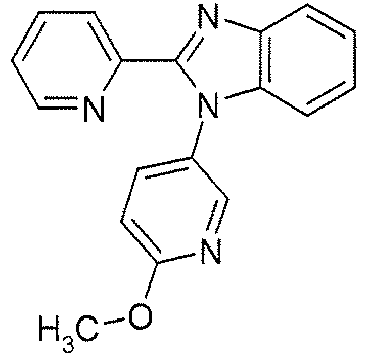
MS: 303 [M+H]+ APCI -
[Table 1-2] Example 24 
MS: 401 [M+H]+ APCI Example 25 
MS: 405/407 [M+H] + APCI Example 26 
MS: 329 [M+H]+ APCI Example 27 
MS: 343 [M+H]+ APCI Example 28 
MS: 333 [M+H] + APCI Example 29 
MS: 361 [M+H]+ APCI -
[Table 1-3] Example 30 
MS: 361 [M+H]+ APCI Example 31 
MS: 373 [M+H]+ APCI Example 32 
MS: 402 [M+H]+ APCI Example 33 
MS: 371 [M+H]+ APCI Example 34 
MS: 317 [M+H]+ APCI Example 35 
MS: 450/452 [M+H] + APCI -
[Table 1-4] Example 36 
MS: 405/407 [M+H] + APCI Example 37 
MS: 371 [M+H]+ APCI Example 38 
MS : 372 [M+H] + APCI Example 39 
MS: 403 [M+H] + APCI Example 40 
MS: 387 [M+H] + APCI Example 41 
MS: 369 [M+H] + APCI -
[Table 1-5] Example 42 
MS : 373 [M+H] + APCI Example 43 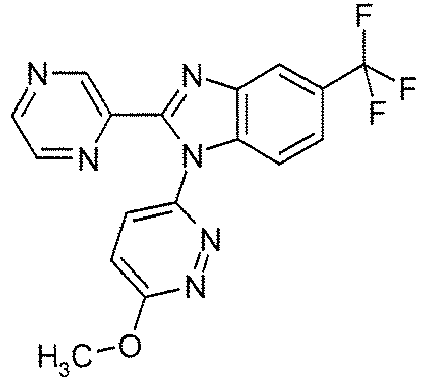
MS : 373 [M+H] + APCI Example 44 
MS: 372 [M+H] + APCI Example 45 
MS: 372 [M+H]+ APCI Example 46 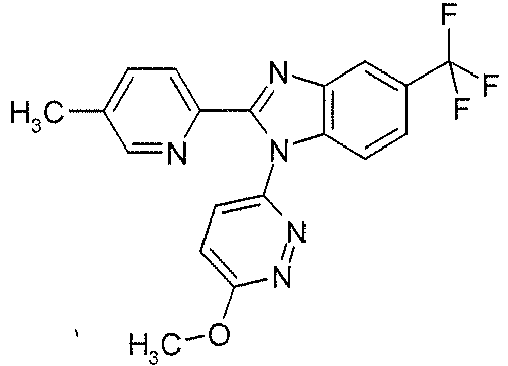
MS : 386 [M+H] + APCI Example 47 
MS: 321 [M+H] + APCI -
[Table 1-6] Example 48 
MS: 337/339 [M+H] + APCI Example 49 
MS: 304 [M+H] + APCI Example 50 
MS : 353 [M+H] + APCI Example 51 
MS: 386 [M+H] + APCI Example 52 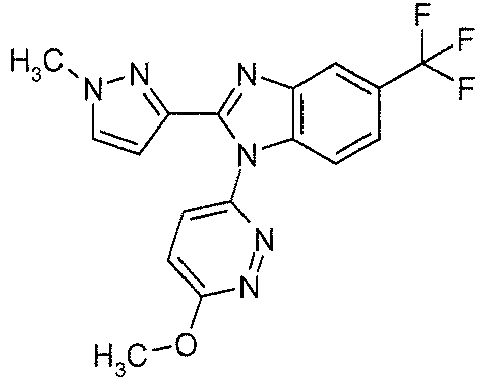
MS: 375 [M+H] + APCI Example 53 
MS : 417 [M+H] + APCI -
[Table 1-7] Example 54 
MS: 378 [M+H]+ APCI Example 55 
MS : 405/407 [M+H] + APCI Example 56 
MS: 400 [M+H] + APCI Example 57 
MS: 386 [M+H]+ APCI Example 58 
MS: 386 [M+H]+ APCI Example 59 
MS : 398 [M+H] + APCI -
[Table 1-8] Example 60 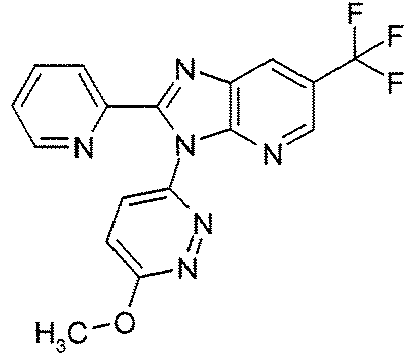
MS : 373 [M+H]+ APCI Example 61 
MS : 373 [M+H]+ APCI Example 62 
MS: 390 [M+H]+ APCI Example 63 
MS : 412 [M+H] + APCI Example 64 
MS: 387 [M+H]+ APCI Example 65 
MS: 356 [M+H]+ APCI -
[Table 1-9] Example 66 
MS: 386 [M+H] + APCI Example 67 
MS: 388 [M+H]+ APCI Example 68 
MS: 376/378 [M+H] + APCI Example 69 
MS: 401 [M+H]+ APCI Example 70 
MS: 396 [M+H]+ APCI Example 71 
MS: 406 [M+H]+ APCI -
[Table 1-10] Example 72 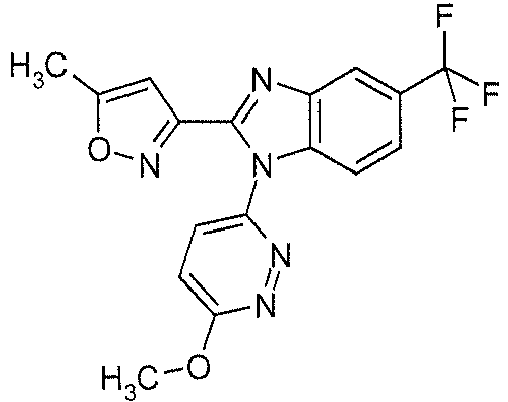
MS: 376 [M+H] + APCI Example 73 
MS : 375 [M+H] + APCI Example 74 
MS: 387 [M+H]+ APCI Example 75 
MS: 450/452 [M+H] + APCI Example 76 
MS: 415 [M+H]+ APCI Example 77 
MS: 402 [M+H]+ APCI -
[Table 1-11] Example 78 
MS : 422 [M+H] + APCI Example 79 
MS : 402 [M+H] + APCI Example 80 
MS: 388 [M+H] + APCI Example 81 
MS: 397 [M+H] + APCI Example 82 
MS: 401 [M+H] + APCI Example 83 
MS: 371 [M+H]+ APCI -
[Table 1-12] Example 84 
MS : 441 [M+H] + APCI Example 85 
MS: 415 [M+H] + APCI Example 86 
MS : 455 [M+H] + APCI Example 87 
MS: 418 [M+H]+ APCI Example 88 
MS: 362 [M+H]+ APCI Example 89 
MS: 378 [M+H]+ APCI -
[Table 1-13] Example 90 
MS: 387 [M+H]+ APCI Example 91 
MS: 390 [M+H]+ APCI Example 92 
MS: 407/409 [M+H]+ APCI Example 93 
MS: 390 [M+H]+ APCI Example 94 
MS : 3 92 [M+H] + APCI Example 95 
MS: 406/408 [M+H] + APCI -
[Table 1-14] Example 96 
MS: 361 [M+H]+ APCI Example 97 
MS : 397 [M+H] + APCI Example 98 
MS : 441 [M+H] + APCI Example 99 
MS: 398 [M+H] + APCI Example 100 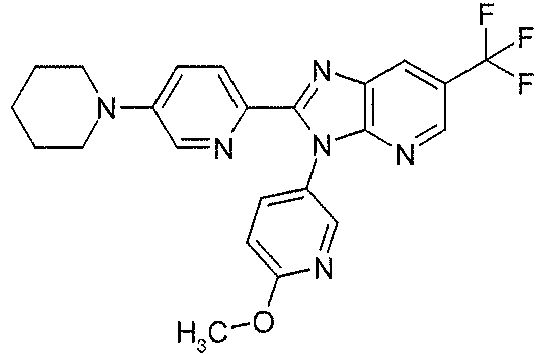
MS: 455 [M+H]+ APCI Example 101 
MS : 471 [M+H] + APCI -
[Table 1-15] Example 102 
MS: 457 [M+H] + APCI Example 103 
MS: 484 [M+H] + APCI Example 104 
MS: 457 [M+H]+ APCI Example 105 
MS: 470 [M+H]+ APCI Example 106 
MS: 457 [M+H]+ APCI Example 107 
MS: 362 [M+H]+ APCI -
[Table 1-16] Example 108 
MS: 376 [M+H]+ APCI Example 109 
MS: 378 [M+H]+ APCI Example 110 
MS: 392 [M+H]+ APCI Example 111 
MS : 413 [M+H] + APCI Example 112 
MS : 378 [M+H] + APCI Example 113 
MS: 423/425 [M+H] + APCI -
[Table 1-17] Example 114 
MS: 391 [M+H]+ APCI Example 115 
MS : 414 [M+H] + APCI Example 116 
MS: 485 [M+H] + APCI Example 117 
MS: 362 [M+H] + APCI Example 118 
MS: 356 [M+H]+ APCI Example 119 
MS: 360 [M+H] + APCI -
[Table 1-18] Example 120 
MS: 367 [M+H] + APCI Example 121 
MS: 376/378 [M+H] + APCI Example 122 
MS: 376 [M+H] + APCI Example 123 
MS: 411 [M+H]+ APCI Example 124 
MS: 371 [M+H] + APCI Example 125 
MS: 373 [M+H] + APCI -
[Table 1-19] Example 126 
MS: 376 [M+H] + APCI Example 127 
MS: 390 [M+H] + APCI Example 128 
MS : 374 [M+H] + APCI Example 129 
MS: 346 [M+H] + APCI Example 130 
MS: 381 [M+H] + APCI Example 131 
MS: 370 [M+H]+ APCI -
[Table 1-20] Example 132 
MS : 388 [M+H] + APCI Example 133 
MS: 395 [M+H]+ APCI Example 134 
MS: 382 [M+H]+ APCI Example 135 
MS: 384 [M+H]+ APCI Example 136 
MS : 360 [M+H] + APCI Example 137 
MS : 402 [M+H] + APCI -
[Table 1-21] Example 138 
MS: 415 [M+H]+ APCI Example 139 
MS: 376 [M+H]+ APCI Example 140 
MS: 357 [M+H]+ APCI Example 141 
MS : 372 [M+H] + APCI Example 142 
MS: 371 [M+H]+ APCI -
[Table 1-22] Example 143 
MS: 361 [M+H]+ APCI Example 144 
MS : 391 [M+H] + APCI - 6-isopropoxy-3-(6-methoxypyridin-3-yl)-2-pyridin-2-yl-3H-imidazo[4,5-b]pyridine

MS m/z 320 [M+H] +, APCI(+) - After the compound 2 (40 mg) was dissolved in DMF(2 ml), sodium hydride (10 mg) was added thereto at 0°C, and the mixture solution was stirred for 30 min. 2-Bromopropane (0.023 ml) was added thereto at 0°C, and the reaction temperature was raised to room temperature. After the reaction mixture was stirred for 3 days, water was added thereto, and the mixture was extracted with ethyl acetate. After the organic layer was washed with a saturated saline, the organic layer was dried with anhydrous sodium sulfate. After the organic layer was filtrated and concentrated, the concentrated residue was purified by the silica gel column chromatography, and the compound 3 (32 mg) was obtained.
MS m/z 362 [M+H] +, APCI(+) -

-

MS m/z 410 [M+H] +, APCI(+)
To a methylene dichloride (0.5 ml) solution of 1,3-dibromo-5,5-dimethylhydantoin (148 mg) was added hydrogen fluoride-pyridine complex (a 65% solution: 386 µl) at - 78°C, and the mixture was stirred vigorously. After 5 min, a methylene dichloride (0.5 ml) solution of the compound 2 (55 mg) was added thereto, and the mixture was stirred at 0°C for 2 h. After the mixture was diluted with chloroform, an aqueous solution saturated with sodium bicarbonate was added thereto for stopping the reaction. After the organic layer was dried with anhydrous sodium sulfate, the organic layer was filtrated. After the filtrate was concentrated, the residue was purified by the silica gel column chromatography, and the compound 3 (16 mg) was obtained.
MS m/z 388 [M+H] +, APCI (+) -
[Table 2-1] Example 148 
MS: 379 [M+H] + APCI Example 149 
MS: 389 [M+H] + ESI Example 150 
MS: 396 [M+H] + ESI Example 151 
MS : 363 [M+H] + ESI Example 152 
MS: 377 [M+H] + ESI Example 153 
MS: 376 [M+H]+ ESI -
[Table 2-2] Example 154 
MS: 377 [M+H]+ ESI Example 155 
MS: 378 [M+H]+ ESI Example 156 
MS: 391 [M+H]+ ESI Example 157 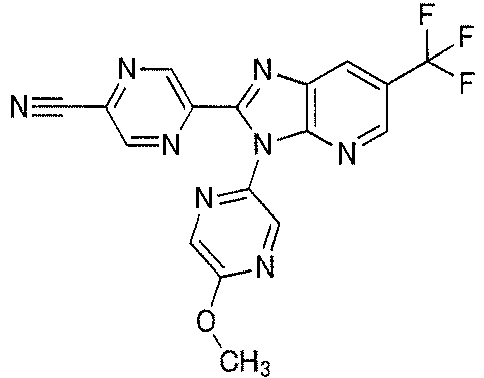
MS: 399 [M+H]+ APCI Example 158 
MS: 392 [M+H]+ APCI Example 159 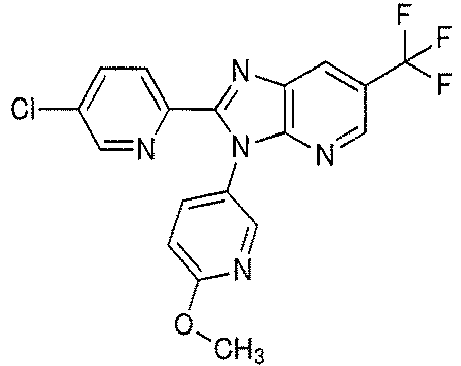
MS: 406/408 [M+H] + APCI -
[Table 2-3] Example 160 
MS: 376 [M+H]+ APCI Example 161 
MS: 372 [M+H] + APCI Example 162 
MS: 375 [M+H] + APCI Example 163 
MS: 376 [M+H]+ APCI Example 164 
MS: 377 [M+H] + APCI Example 165 
MS: 376 [M+H] + APCI -
[Table 2-4] Example 166 
MS : 391 [M+H]+ APCI Example 167 
MS : 392 [M+H]+ APCI Example 168 
MS: 392 [M+H]+ APCI Example 169 
MS : 376 [M+H] + APCI Example 170 
MS: 348 [M+H]+ APCI Example 171 
MS : 374 [M+H] + APCI -
[Table 2-5] Example 172 
MS: 390 [M+H]+ APCI Example 173 
MS: 362 [M+H] + APCI Example 174 
MS: 376 [M+H]+ APCI Example 175 
MS: 402 [M+H]+ APCI Example 176 
MS: 416 [M+H]+ APCI Example 177 
MS: 406 [M+H]+ APCI Example 178 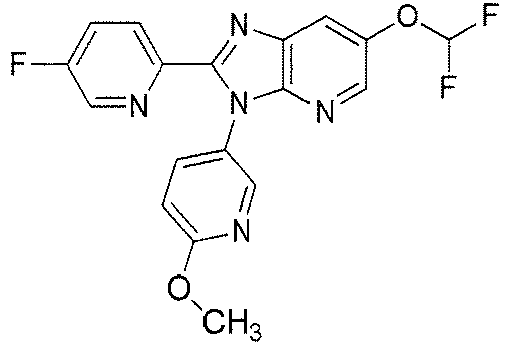
MS: 388 [M+H]+ APCI - 3-(6-methoxypyridin-3-yl)-2-pyridin-2-yl-7-(trifluoromethyl)imidazo[1,2-b]pyridazine

MS m/z 229 [M+H] +, APCI(+)
To an acetic acid (30 ml) solution of the compound 2 (1 g) was added bromine (0.34 ml), and the reaction solution was stirred at 50°C for 3 h. After the reaction solution was concentrated, the residue was washed with an aqueous solution saturated with sodium bicarbonate and extracted with ethyl acetate. After the organic layer was washed with a saturated saline, the organic layer was dried with anhydrous sodium sulfate. After the organic layer was filtrated and concentrated, the residue was purified by the silica gel column chromatography affording the compound 3(0.14 g).
MS m/z 307/309 [M+H] +, APCI (+)
The compound 3 (26 mg) and the compound 6 (14 mg) were dissolved in DMF (1 ml) followed by the addition of sodium bicarbonate (7 mg) thereto, and the mixed solution was stirred at 80°C for 20 h. After the solution was diluted with ethyl acetate, the solution was washed sequentially with water and a saturated saline. After the organic layer was dried with anhydrous sodium sulfate, the organic layer was filtrated. After the organic layer was concentrated, the residue was purified by the silica gel column chromatography affording the compound 4 (2.6 mg).
MS m/z 372[M+H]+, APCI(+) - 3-(6-methoxypyridin-3-yl)-2-pyridin-2-yl-6-(trifluoromethyl)pyrazolo[1,5-a]pyrimidine
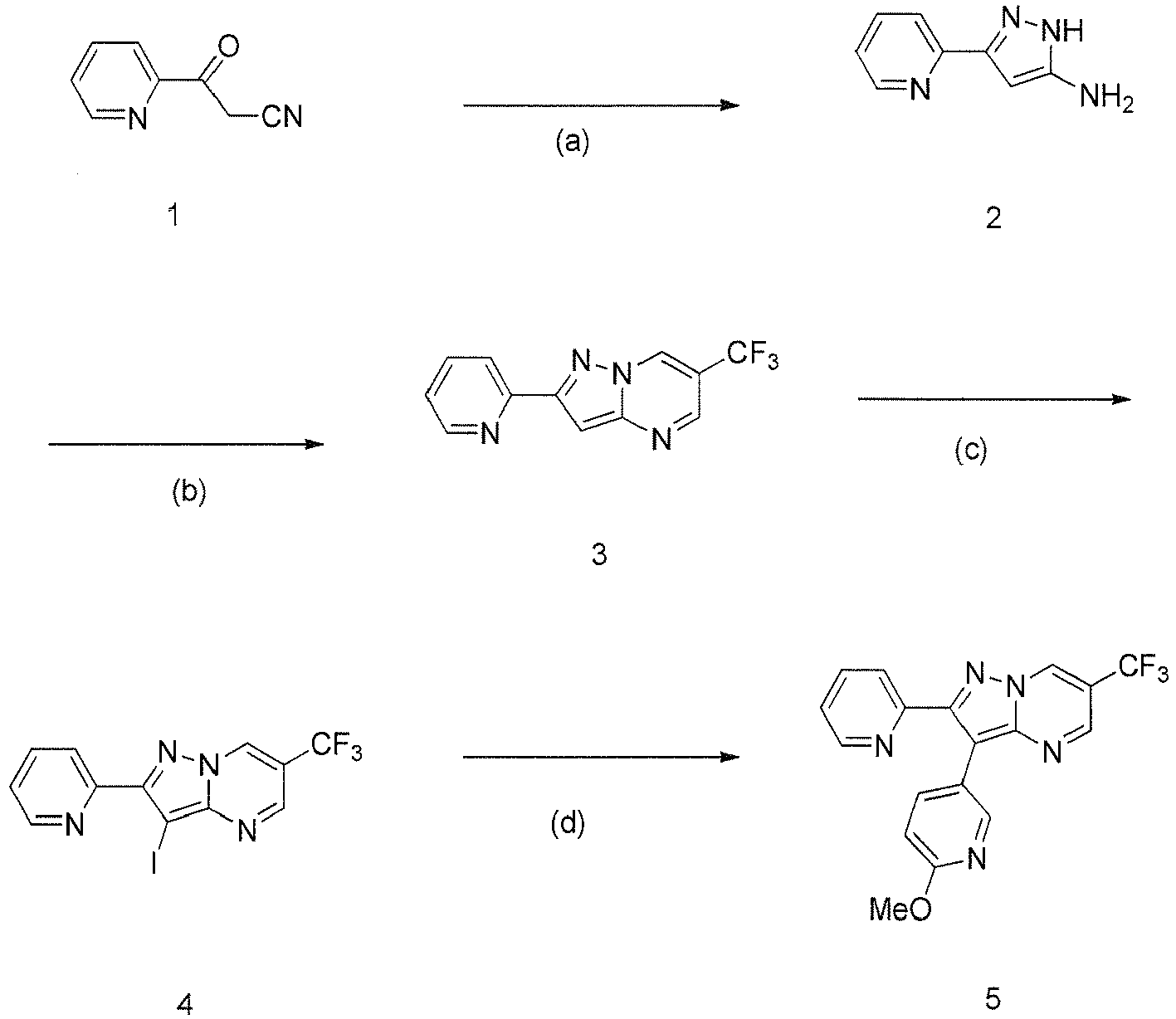
MS m/z 161 [M+H] +, APCI(+)
DMF was heated to 50°C, and 3,3,3-trifluoropropionic acid (1.5 ml) was added thereto and the solution was stirred. The mixture was heated to 70°C, and phosphorus oxychloride (2.60 ml) was added thereto by drops for 1 h. After the mixture was stirred for 3 h, the reaction solution was concentrated i vacuo. The residue was dissolved in acetonitrile (6 ml), and at 0°C, the compound 2 (300 mg) and sodium methoxide (546 mg) were added slowly. After the reaction solution was stirred at room temperature for 2 h, an insoluble material was filtrated and diluted by ethyl acetate. The organic layer was washed sequentially with water and with a saturated saline. The organic layer was dried with anhydrous sodium sulfate and filtrated The filtrate was concentrated, and the residue was purified by the silica gel column chromatography affording the compound 3 (125mg) was obtained.
MS m/z 265 [M+H] +, APCI (+)
The compound 3 (122.5mg) was dissolved in acetonitrile, and N-iodosuccinimide (522 mg) was added in small portions, followed by stirring at 50°C for 3 h. After the reaction solution was diluted by ethyl acetate, the solution was washed sequentially with water and with a saturated saline. The organic layer was dried with anhydrous sodium sulfate and then filtrated. The filtrate was concentrated, and the residue was purified by the silica gel column chromatography affording the compound 4 (131.6 mg).
MS m/z 391 [M+H] +, APCI(+)
Under an argon atmosphere, the compound 4 (130.5 mg) was dissolved in 1,2-dimethoxyethane (2.6 ml), and to the solution were added 2-methoxy-5-pyridine boronic acid (73.4 mg), a palladium chloride 1,1'-ferrocene bisdiphenylphosphino ferrocene complex (23.4 mg) and potassium carbonate (88.4 mg), and the reaction mixture was stirred at 90°C for 20 h.
After an insoluble material was filtrated by Celite, the filtrate was concentrated. The residue was purified by the silica gel column chromatography affording the compound 5 (34.4 mg).
MS m/z 372 [M+H] +, APCI(+) - 2-(5-fluoropyridin-2-yl)-3-(6-methoxypyridin-3-yl)-7-(trifluoromethyl)imidazo[1,2-b]pyridazine
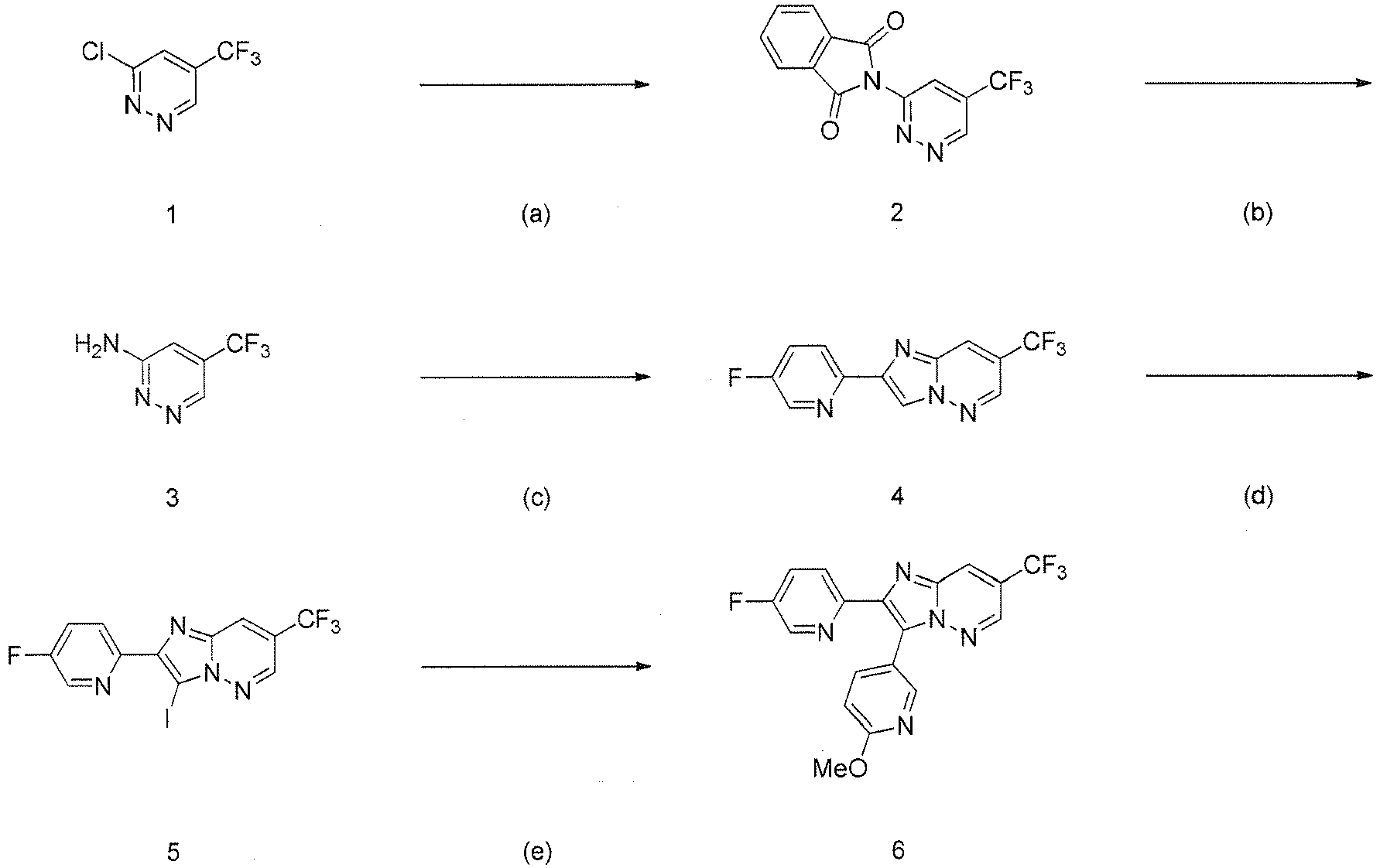
MS m/z 164 [M+H]+, APCI(+)
The compound 3 (270 mg) and 2-bromo-1-(5-fluoro-pyridin-2-yl)-ethanone hydrobromate (990 mg) was dissolved in a mixed solvent of toluene (5 ml) and ethanol (1 ml), and sodium bicarbonate (1.39 g) was added thereto, and the mixed solution was refluxed for 20 h under heating. After the reaction solution was concentrated, the residue was diluted by ethyl acetate and washed sequentially with water and with a saturated saline. After the organic layer was dried with anhydrous sodium sulfate, the organic layer was filtrated. The filtrate was concentrated, and the residue was purified by the silica gel column chromatography affording the compound 4 (95.1 mg)
MS m/z 283 [M+H] +, APCI (+)
To an acetonitrile (2 ml) solution of the compound 4 (92.2 mg), N-iodosuccinimide (221 mg) was added, and the solution was stirred at room temperature for 20 h. Acetonitrile (2 ml), N-iodosuccinimide (221 mg) amd acetic acid (1 drop) were added thereto, and the mixture was stirred at 50°C for 4 h. The reaction mixture was diluted by ethyl acetate, and washed sequentially with water and with a saturated saline. The organic layer was dried with anhydrous sodium sulfate, and filtrated. The filtrate was concentrated, and the residue was purified by the silica gel column chromatography affording the compound 5 (122 mg).
MS m/z 409 [M+H] +, APCI (+)
Under an argon atmosphere, to a 1,2-dimethoxyethane (2.4 ml) solution of the compound 5 (119.3 mg) were added 2-methoxy-5-pyridineboronic acid (67.1 mg), tetrakis-triphenylphosphine palladium (33 8 mg), and an aqueous solution of sodium hydroxide (5 mol/l, 117 µl) , and the mixture solution was stirred at 90°C for 3h. After the reaction solution was filtrated by Celite, the solution was concentrated in vacuo. The residue was purified by the silica gel column chromatography affording the compound 6 (89.1 mg).
MS m/z 390 [M+H] +, APCI(+) - 1-(6-methoxypyridin-3-yl)-2-pyridin-2-yl-5-(trifluoromethyl)-1H-indole

MS m/z 370 [M+H] +, APCI(+) - 1-(6-methoxypyridin-3-yl)-2-pyridin-2-yl-5-(trifluoromethyl)-1H-pyrrolo[2,3-b]pyridine

MS m/z 283/285 [M+H] +, APCI (+)
A mixture of the compound 2(40.0 mg), 3-amino-6-methoxypyridine (21.2 mg), acetic acid palladium (II) (1.6 mg), potassium-t-butoxide (47.8 mg), 1,3-bis(2,6-diisopropylphenyl)-imidazolium chloride (3.0 mg) and toluene(1 ml) was heated to 100°C. After 7 h, the reaction mixture was kept standing to cool to room temperature, and ethyl acetate and water were added thereto. After an insoluble material was filtrated, the organic layer was separated. The organic layer was washed with a saturated saline and dried with anhydrous sodium sulfate. After the organic layer was filtrated and concentrated, the residue was purified by the silica gel column chromatography affording the compound 3 (11.3 mg) was obtained.
MS m/z 370 [M+H] +, APCI (+) - 2-(5-fluoropyridin-2-yl)-1-(6-methoxypyridin-3-yl)--5-(trifluoromethyl)-1H-pyrrolo[2,3-b]pyridine

MS m/z 301 [M+H] +, APCI (+)
A mixture of compound 4(77.8 mg), 3-amino-6-methoxypyridine (38.6 mg), acetic acid palladium (II) (2.9 mg), potassium-t-butoxide (87.2 mg), 1,3-bis(2,6-diisopropylphenyl)-imidazolium chloride (5.5mg) and toluene (1 ml) was heated to 100°C. After the reaction mixture was stirred for 6 h, it was kept standing to cool to room temperature, and thereto were added ethyl acetate and water. After the organic layer was separated, it was washed with a saturated saline and dried with anhydrous sodium sulfate. After the organic layer was filtrated and concentrated, the residue was purified by the silica gel column chromatography affording the compound 5 (37.6 mg).
MS m/z 389 [M+H] +, APCI (+) - 2-(5-fluoropyridin-2-yl)-3-(6-methoxypyridin-3-yl)-6-(trifluoromethyl)-2H-indazole

MS m/z 282 [M+H] +, APCI (+)
The compound 2 (116 mg) was dissolved in acetic acid (1 ml), and thereto was added bromine (21 µl), and followed by heating to 50°C. After the mixture solution was stirred for 1 h, thereto were added acetic acid(2 ml) and bromine(42 µl), and followed by heating to 80°C. After the reaction mixture was stirred all day and all night, thereto were added ethyl acetate, water and an aqueous solution saturated with sodium bicarbonate. The organic layer was separated, and then, the organic layer was washed sequentially with water and with a saturated saline, and successively dried with anhydrous sodium sulfate. After the organic layer was filtrated and concentrated, the residue was purified by the silica gel column chromatography affording the compound 3 (118 mg).
MS m/z 360/362 [M+H] +, APCI(+)
The compound 3 (114 mg) was dissolved in 1,4-dioxane (2 ml), and thereto were added 2-methoxy-5-pyridineboronic acid (72.8 mg), a palladium chloride 1,1'-ferrocene bisdiphenylphosphino ferrocene complex (11.6 mg) and potassium phosphate (101 mg), and followed by heating to 100°C. After the reaction mixture was stirred for 4 h, it was kept standing to cool to room temperature, and thereto were added ethyl acetate and water. After an insoluble material was filtrated, the organic layer was separated. The organic layer was washed with a saturated saline, and dried with anhydrous sodium sulfate. After the organic layer was filtrated and concentrated, the residue was purified by the silica gel column chromatography affording the compound 4 (108 mg).
MS m/z 389 [M+H] +, APCI(+) - 3-(6-methoxypyridin-3-yl)-2-pyridin-2-yl-6-(trifluoromethyl)-2H-pyrazolo[4,3-b]pyridine

MS m/z 309 [M+H] +, APCI (+)
The compound 2 (50.0 mg) was dissolved in thionyl chloride (1 ml), and the solution was refluxed for 7 h under heating. After the solution was kept standing to cool to room temperature, the solvent was distilled off in vacuo. To the residue were added ethyl acetate and an aqueous solution saturated sodium bicarbonate, then the organic layer was separated. The organic layer was washed with a saturated saline and dried with sodium sulfate. After the organic layer was filtrated and concentrated, the residue was purified by the silica gel column chromatography affording the compound 3 (11.2 mg)
MS m/z 299/301 [M+H] +, APCI (+)
The compound 3 (28.5 mg) was dissolved in 1,4-dioxane (1 ml), and thereto were added 2-methoxy-5-pyridineboronic acid (21.9 mg), a palladium chloride 1,1'-ferrocene bisdiphenylphosphino ferrocene complex (7.0 mg) and potassium phosphate (30.4 mg), and followed by heating to 100°C. After the mixture solution was stirred all day and all night, it was kept standing to cool to room temperature, and thereto were added ethyl acetate and water. After the organic layer was separated, the organic layer was washed with a saturated saline and dried with sodium sulfate. After the organic layer was filtrated and concentrated, the residue was purified by the silica gel column chromatography affording the compound 4 (20.5 mg).
MS m/z 389 [M+H] +, APCI (+) -
[Table 3] Example 187 
MS: 372 [M+H] + APCI Example 188 
MS : 371 [M+H] + APCI Example 189 
MS: 390 [M+H]+ APCI Example 190 
MS : 371 [M+H]+ APCI Example 191 
MS: 389 [M+H] + APCI Example 192 
MS: 390 [M+H] + APCI - In the followings are explained specifically the synthetic intermediates of the compounds of the present invention. However, the scope of the present invention is not limited to the following Reference Examples.
- N1-(6-methoxypyridin-3-yl)-4-(trifluoromethyl)benzene-1,2-diamine
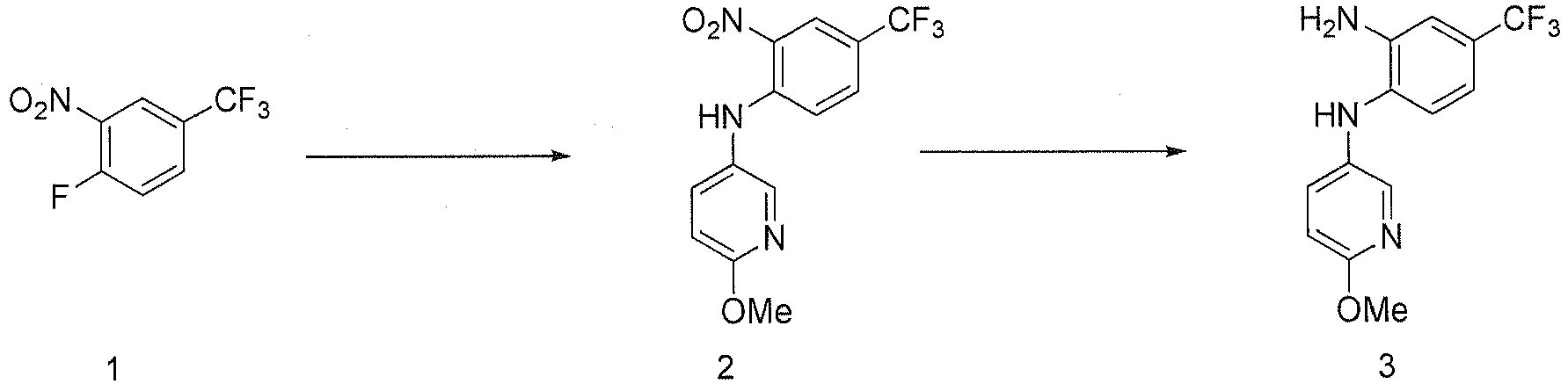
MS m/z 284 [M+H] +, APCI(+) - N1-(6-methoxypyridazin-3-yl)-4-(trifluoromethyl)benzene-1,2-diamine

MS m/z 315 [M+H]+, APCI(+)
The compound 2 (40.0 g) was suspended in methanol (400 ml), and thereto were added iron (III) chloride (2.06 g), hydrazine monohydrate (39.7 g) and active carbon (4 g), then the reaction mixture was heated to 80°C. After the mixture was stirred for 2 h, it was kept standing to cool to room temperature, then, an insoluble material was filtrated and washed well with a chloroform: methanol=10: 1 solution. After the filtrate was concentrated, chloroform (500 ml) was added thereto, and the solution was stirred all day and all night. A crude product (25.3 g) of the compound 3 was obtained by filtrating and collecting precipitates. The filtrate was also concentrated, and after the similar procedure above, a crude product (8.91 g) of the compound 3 was obtained. The obtained crude products were collected and dissolved in ethanol (250 ml) by heating. After the solution was kept standing to cool to room temperature, the compound 3(29.3 g) was obtained by filtrating and collecting precipitates.
MS m/z 285 [M+H]+, APCI(+) - N1-(6-methoxypyridazin-3-yl)-(trifluoromethoxy)benzene-1,2-diamine

MS m/z 331 [M+H] +, APCI (+)
The compound 2 (0.899 g) was dissolved in methanol (14 ml), and thereto were added iron (III) chloride (88 mg), hydrazine monohydrate (681 mg) and active carbon (160 mg), then, the solution was refluxed for 2 h under heating. The solution was kept standing to cool to room temperature, and an insoluble material was filtrated. After the filtrate was concentrated, to the residue were added ethyl acetate, chloroform and water, then, the organic layer was separated. After the organic layer was concentrated, the residue was purified by the silica gel column chromatography affording the compound 3 (0.714 g). MS m/z 301 [M+H] +, APCI(+) - N2-(6-methoxypyridin-3-yl)-5-(trifluoromethyl)pyridin-2,3-diamine

MS m/z 315 [M+H] +, APCI(+)
The compound 2 (11.5 g) was suspended in methanol (120 ml), and thereto were added iron (III) chloride (1.19 g), hydrazine monohydrate (9.16 g) and active carbon (1 g), and the mixture was heated to 100°C. After the mixture was stirred for 3 h, it was kept standing to cool to room temperature, and an insoluble material was filtrated and washed well with methanol. After the filtrate was concentrated, the residue was dissolved in ethyl acetate, washed sequentially with water and a saturated saline, and dried with anhydrous sodium sulfate. After the organic layer was filtrated and concentrated, ethyl acetate and n-heptane were added to the residue, and the compound 3 (10.9 g) was obtained by filtrating and collecting precipitates.
MS m/z 285 [M+H] +, APCI(+) - N2-(5-methoxypyrazine-2-yl)-5-(trifluoromethyl)pyridin-2,3-diamine

MS m/z 316 [M+H] +, APCI (+)
The compound 2 (502 mg) was suspended in methanol(16 ml), and thereto were added active carbon (100 mg), iron (III) chloride (52 mg) and hydrazine monohydrate (0.39 mL), and the mixture was refluxed for 3 h under heating. After the mixture was kept standing to cool to room temperature, an insoluble material was filtrated and washed well with methanol. After the filtrate was concentrated, to the residue were added ethyl acetate, chloroform and water, then, the organic layer was separated. After the organic layer was concentrated, the residue was purified by the silica gel column chromatography affording the compound 3 (350 mg).
MS m/z 286 [M+H] +, APCI(+) - N2-[6-(methoxyamino)pyridin-3-yl]-5-(trifluoromethyl)pyridin-2,3-diamine

MS m/z 314 [M+H] +, APCI (+)
The compound 3 (483 mg) was dissolved in methanol (15 ml), and thereto were added active carbon (100 mg), iron (III) chloride (50 mg) and hydrazine monohydrate (0.37 ml), and the mixture was refluxed for 3 h under heating. After the mixture was kept standing to cool to room temperature, an insoluble material was filtrated and washed well with methanol. After the filtrate was concentrated, to the residue were added ethyl acetate, chloroform and water, and the organic layer was separated. After the organic layer was concentrated, the residue was purified by the silica gel column chromatography affording the compound 4 (173 mg).
MS m/z 284 [M+H] +, APCI (+) - A blood of a guinea pig was sampled by using a 1/10 volume of a 3.8% sodium citrate as a platelet aggregation inhibitor, and a platelet rich plasma (PRP) was separated by centrifuging the blood sample at 1100 rpm for 10 min. After fractionating the PRP in the upper layer, the lower layer was centrifuged at 3000 rpm for 10 min to fractionate the platelet poor plasma (PPP). To 100µL of PRP, a 1µL solution of each compound was added, and after still standing at 37°C for 1 min, the mixture was stirred at 37°C for 1 min by a stirrer. Then, 11µL of collagen, ristocetin, or ADP was added thereto to induce the platelet aggregation. The platelet aggregation ability was measured by using the mCM hematolaser 313M (L-M-S Inc.,). Based on the assumption that a light transmittance of PPP corresponds to a 100% coagulation value, an aggregation rate at each concentration of the compound was determined, then, an IC50 value was calculated therefrom.
-


-


-


- The specified heterocyclic derivatives of the present invention exhibit an antiplatelet action, and may be effective medicines for preventing or treating diseases related to the action.
Claims (20)
- An antiplatelet agent comprising a compound of formula I:

X is N, or CR1d,
Xb1-Xb5 are the same or different, and are nitrogen or carbon,
R1a-R1d are the same or different, and are hydrogen, an optionally substituted aklyl, an optionally substituted alkoxy, an optionally substituted akylthio, an alkenyl, a cycloalkyl, a halogen, cyano, hydroxyl, or an amino optionally substituted by 1 or 2 alkyl,
R2 is an optionally substituted aryl, or an optionally substituted heteroary,
R3 is an optionally substituted aryl, or an optionally substituted heteroaryl,
provided
at least three of Xb1-Xb5 are carbon,
when Xb1 is nitrogen, Xb2, Xb4 and Xb5 are carbon,
when Xb2 is nitrogen, Xb1 and Xb4 are carbon and
when Xb4 is nitrogen, Xb5 is carbon, or
a pharmaceutically acceptable salt thereof as an active ingredient. - A compound of formula II:

Xa is N, or CH,
Xc1-Xc5 are the same or different, and are nitrogen or carbon,
R1e is an alkyl optionally substituted by an aryl or a halogen; an alkoxy optionally substituted by an aryl, a halogen or a cycloalkyl; an alkylthio optionally substituted by an aryl, a halogen or a cycloalkyl; an alkenyl; cyano; a cycloalkyl; a halogen; or an amino optionally substituted by 1 or 2 alkyl,
R1f is hydrogen, an alkyl, an alkoxy, hydroxyl, cyano or a halogen,
R21 is an optionally substituted heteroaryl,
R31 is an optionally substituted 6-membered heteroaryl, provided
at least three of Xc1-Xc5 are carbon,
when Xc1 is nitrogen, Xc2, Xc4 and Xc5 are carbon,
when Xc2 is nitrogen, Xc1 and Xc4 are carbon,
when Xc4 is nitrogen, Xc5 is carbon, and
when Xc1 and Xc3 are nitrogen, R1e is an alkyl substituted by a halogen or an alkoxy substituted by a halogen,
or a pharmaceutically acceptable salt thereof. - The compound according to claim 2 wherein Xc3 is nitrogen, or the pharmaceutically acceptable salt thereof.
- The compound according to claim 3 wherein Xc4 is carbon, or the pharmaceutically acceptable salt thereof.
- The compound according to claim 3 or 4 wherein Xc2 is carbon, or the pharmaceutically acceptable salt thereof.
- The compound according to claim 2, wherein the compound is represented by formula IIa:

- The compound according to any one of claims 2 to 6,
wherein the substituents of the "optionally substituted heteroaryl" in R21 are the same or different 1-3 groups selected from an optionally substituted alkyl; an optionally substituted alkoxy; an optionally substituted alkylthio; an alkenyl; a halogen; cyano; a carbamoyl optionally substituted by 1 or 2 alkyl; an amino optionally substituted by 1 or 2 alkyl; hydroxyl; an alkanoyl; a cycloalkylcarbonyl; an arylcarbonyl; nitro;
an optionally substituted aliphatic heteromonocyclic group; an aryl; or a heteroaryl, and
the substituents of the "optionally substituted 6-membered heteroaryl" in R31 are the same or different 1-3 groups selected from an optionally substituted alkyl; an optionally substituted alkoxy; an optionally substituted alkylthio; a cycloalkyl; an amino optionally substituted by 1 or 2 alkyl; an aliphatic heteromonocycle; or a halogen, or the pharmaceutically acceptable salt thereof. - The compound according to any one of claims 2 to 7, wherein R1e is an alkyl substituted by a halogen or an alkoxy substituted by a halogen, or the pharmaceutically acceptable salt thereof.
- The compound according to any one of claims 2 to 7, wherein R1e is trifluoromethyl or trifluoromethoxy, or the pharmaceutically acceptable salt thereof.
- The compound according to any one of claims 2 to 9, wherein R1f is hydrogen, or the pharmaceutically acceptable salt thereof.
- The compound according to any one of claims 2 to 10, wherein the substituents of the "optionally substituted heteroaryl" in R21 are the same or different 1-3 groups selected from an optionally substituted alkyl; an optionally substituted alkoxy; a halogen; cyano; a carbamoyl optionally substituted by 1 or 2 alkyl; an amino optionally substituted by 1 or 2 alkyl; hydroxyl; nitro; or an optionally substituted aliphatic heteromonocyclic group, or the pharmaceutically acceptable salt thereof.
- The compound according to claim 11, wherein substituents of the "optionally substituted heteroaryl" in R21 are the same or different 1-3 groups selected from an alkyl, an alkoxy, a halogen, cyano, a carbamoyl optionally substituted by 1 or 2 alkyl, or nitro, or the pharmaceutically acceptable salt thereof.
- The compound according to claim 11, wherein substituents of the "optionally substituted heteroaryl" in R21 are 1-3 groups selected from an alkyl, a halogen, or cyano. or a pharmaceutically acceptable salt thereof.
- The compound according to in any one of claims 2 to 13, wherein the substituents of the "optionally substituted 6-membered heteroaryl s" in R31 are 1-3 groups selected from an alkyl, an alkoxy, a halogen, and an amino optionally substituted by 1 or 2 alkyl, or the pharmaceutically acceptable salt thereof.
- The compound according to any one of claims 2 to 14, wherein Xa is N, or the pharmaceutically acceptable salt thereof.
- The compound selected from
1-(6-methoxypyridazin-3-yl)-2-pyridin-2-yl-5-(trifluoromethyl)-1H-benzimidazole;
2-(6-fluoropyridin-2-yl)-1-(6-methoxypyridazin-3-yl)-5-(trifluoromethyl)-1H-benzimidazole;
1-(6-methoxypyridazin-3-yl)-2-pyridin-2-yl-5-(trifluoromethoxy)-1H-benzimidazole;
2-(5-fluoropyridin-2-yl)-3-(6-methoxypyridin-3-yl)-6-(trifluoromethyl)-3H-imidazo[4,5-b]pyridine;
N-methyl-5-[2-pyridin-2-yl-6-(trifluoromethyl)-3H-imidazo[4,5-b]pyridin-3-yl]pyridin-2-amine;
N,N-dimethyl-5-[2-pyridin-2-yl-6-(trifluoromethyl)-3H-imidazo[4,5-b]pyridin-3-yl]pyridin-2-amine;
6-[1-(6-methoxypyridazin-3-yl)-5-(trifluoromethyl)-1H-benzimidazole-2-yl]nicotinonitrile;
5-[3-(6-methoxypyridin-3-yl)-6-(trifluoromethyl)-3H-imidazo[4,5-b]pyridin-2-yl]pyrazine-2-carbonitrile;
2-(6-methoxypyridazin-3-yl)-1-(6-methoxypyridin-3-yl)-5-(trifluoromethyl)-1H-benzimidazole;
3-(6-methoxypyridin-3-yl)-2-(1H-pyrrol-2-yl)-6-(trifluoromethyl)-3H-imidazo[4,5-b]pyridine;
2-(1H-imidazol-4-yl)-3-(6-methoxypyridin-3-yl)-6-(trifluoromethyl)-3H-imidazo[4,5-b]pyridine;
1,2-dipyridin-2-yl-5-(trifluoromethyl)-1H-benzimidazole;
3-(6-methoxypyridin-3-yl)-2-pyridin-2-yl-6-(trifluoromethyl)-3H-imidazo[4;5-b]pyridine;
1-(6-methoxypyridin-3-yl)-2-pyridin-2-yl-5-(trifluoromethyl)-1H-benzimidazole;
1-(6-methoxypyridazin-3-yl)-2-(1-methyl-1H-pyrazol-4-yl)-5-(trifluoromethyl)-1H-benzimidazole;
5-ethyl-1-(6-methoxypyridin-3-yl)-2-pyridin-2-yl-1H-benzimidazole;
1-(6-methoxypyridin-3-yl)-2-phenyl-5-(trifluoromethyl)-1H-benzimidazole;
2-(5-bromopyridin-2-yl)-1-(6-methoxypyridin-3-yl)-5-(trifluoromethyl)-1H-benzimidazole;
2-(5-fluoropyridin-2-yl)-1-(6-methoxypyridin-3-yl)-5-(trifluoromethyl)-1H-benzimidazole;
1,2-bis(6-methoxypyridin-3-yl)-5-(trifluoromethyl)-1H-benzimidazole;
5-cyclopropyl-1-(6-methoxypyridin-3-yl)-2-pyridin-2-yl-1H-benzimidazole;
5-(cyclopropylmethoxy)-1-(6-methoxypyridin-3-yl)-2-pyridin-2-yl-1H-benzimidazole;
2-(5-bromopyridin-2-yl)-1-(6-methoxypyridazin-3-yl)-5-(trifluoromethyl)-1H-benzimidazole;
2-(5-chloropyridin-2-yl)-1-(6-methoxypyridin-3-yl)-5-(trifluoromethyl)-1H-benzimidazole;
1-(6-methoxypyridin-3-yl)-2-pyridin-2-yl-5-(trifluoromethoxy)-1H-benzimidazole;
1-(6-methoxypyridazin-3-yl)-2-(1-methyl-1H-pyrazol-3-yl)-5-(trifluoromethyl)-1H-benzimidazole;
1-(6-methoxypyridazin-3-yl)-2-(5-nitropyridin-2-yl)-5-(trifluoromethyl)-1H-benzimidazole;
1-(6-methoxypyridazin-3-yl)-2-(1,3-thiazol-2-yl)-5-(trifluoromethyl)-1H-benzimidazole;
6-chloro-1-(6-methoxypyridin-3-yl)-2-pyridin-2-yl-5-(trifluoromethyl)-1H-benzimidazole;
2-(5-ethylpyridin-2-yl)-1-(6-methoxypyridazin-3-yl)-5-(trifluoromethyl)-1H-benzimidazole;
1-(6-methoxypyridazin-3-yl)-2-(4-methylpyridin-2-yl)-5-(trifluoromethyl)-1H-benzimidazole;
2-(5-fluoropyridin-2-yl)-1-(6-methoxypyridazin-3-yl)-5-(trifluoromethyl)-1H-benzimidazole;
1-[6-(methylthio)pyridazin-3-yl]-2-pyridin-2-yl-5-(trifluoromethyl)-1H-benzimidazole;
2-(5-fluoropyridin-2-yl)-1-(6-methoxypyridazin-3-yl)-5-(trifluoromethoxy)-1H-benzimidazole;
2-(5-methylisoxazol-3-yl)-1-(6-methoxypyridazin-3-yl)-5-(trifluoromethyl)-1H-benzimidazole;
3-(6-methoxypyridin-3-yl)-2-(1-methyl-1H-pyrazol-3-yl)-6-(trifluoromethyl)-3H-imidazo[4,5-b]pyridine;
2-(4-bromopyridin-2-yl)-1-(6-methoxypyridazin-3-yl)-5-(trifluoromethyl)-1H-benzimidazole;
2-[1-(6-methoxypyridazin-3-yl)-5-(trifluoromethyl)-1H-benzimidazole-2-yl]nicotinonitrile;
1-(6-methoxypyridazin-3-yl)-2-(1,3-oxazol-4-yl)-5-(trifluoromethyl)-1H-benzimidazole;
1-(6-methoxypyridazin-3-yl)-2-(1,3-thiazol-4-yl)-5-(trifluoromethyl)-1H-benzimidazole;
1-(6-methoxypyridazin-3-yl)-2-(5-methylpyrazine-2-yl)-5-(trifluoromethyl)-1H-benzimidazole;
1-(6-methoxypyridazin-3-yl)-2-(2-methyl-1,3-thiazol-4-yl)-5-(trifluoromethyl)-1H-benzimidazole;
3-(6-methoxypyridin-3-yl)-2-(1,3-oxazol-4-yl)-6-(trifluoromethyl)-3H-imidazo[4,5-b]pyridine;
3-(6-methoxypyridin-3-yl)-2-(5-methylisoxazol-3-yl)-6-(trifluoromethyl)-3H-imidazo[4,5-b]pyridine;
3-(6-methoxypyridin-3-yl)-2-(1,3-thiazol-4-yl)-6-(trifluoromethyl)-3H-imidazo[4,5-b]pyridine;
3-(6-methoxypyridin-3-yl)-2-(2-methyl-1,3-thiazol-4-yl)-6-(trifluoromethyl)-3H-imidazo[4,5-b]pyridine;
3-(6-methylpyridin-3-yl)-2-pyridin-2-yl-6-(trifluoromethyl)-3H-imidazo[4,5-b]pyridine;
3-(6-methoxypyridin-3-yl)-2-(2-methyl-1,3-oxazol-4-yl)-6-(trifluoromethyl)-3H-imidazo[4,5-b]pyridine;
3-(5-methoxypyrazine-2-yl)-2-pyridin-2-yl-6-(trifluoromethyl)-3H-imidazo[4,5-b]pyridine;
3-(6-methoxypyridin-3-yl)-2-(5-methyl-1,3-oxazol-4-yl)-6-(trifluoromethyl)-3H-imidazo[4,5-b]pyridine;
6-[3-(6-methylpyridin-3-yl)-6-(trifluoromethyl)-3H-imidazo[4,5-b]pyridin-2-yl]nicotinonitrile;
1-(6-methoxypyridazin-3-yl)-2-(2-methyl-1,3-oxazol-4-yl)-5-(trifluoromethyl)-1H-benzimidazole;
2-(5-fluoropyridin-2-yl)-3-(5-methoxypyrazine-2-yl)-6-(trifluoromethyl)-3H-imidazo[4,5-b]pyridine;
6-isopropoxy-3-(6-methoxypyridin-3-yl)-2-pyridin-2-yl-3H-imidazo[4,5-b]pyridine;
6-(difluoromethoxy)-3-(6-methoxypyridin-3-yl)-2-pyridin-2-yl-3H-imidazo[4,5-b]pyridine;
3-(6-methoxypyridin-3-yl)-2-pyridin-2-yl-6-(trifluoromethoxy)-3H-imidazo[4,5-b]pyridine;
3-(5-methoxypyrazine-2-yl)-2-(1,3-thiazol-4-yl)-6-(trifluoromethyl)-3H-imidazo[4,5-b]pyridine;
5-[2-(5-fluoropyridin-2-yl)-6-(trifluoromethyl)-3H-imidazo[4,5-b]pyridin-3-yl]-N-methylpyridin-2-amine;
6-{3-[6-(methylamino)pyridin-3-yl]-6-(trifluoromethyl)-3H-imidazo[4,5-b]pyridin-2-yl]nicotinonitrile;
3-(5-methoxypyrazine-2-yl)-2-(1,3-oxazol-4-yl)-6-(trifluoromethyl)-3H-imidazo[4,5-b]pyridine;
3-(5-methoxypyrazine-2-yl)-2-(2-methyl-1,3-oxazol-4-yl)-(trifluoromethyl)-3H-imidazo[4,5-b]pyridine;
3-(5-methoxypyrazine-2-yl)-2-(1-methyl-1H-pyrazol-3-yl)-6-(trifluoromethyl)-3H-imidazo[4,5-b]pyridine;
3-(5-methoxypyrazine-2-yl)-2-(5-methylisoxazol-3-yl)-6-(trifluoromethyl)-3H-imidazo[4,5-b]pyridine;
1-(6-methoxypyridazin-3-yl)-2-(1,3-oxazol-4-yl)-5-(trifluoromethoxy)-1H-benzimidazole;
1-(6-methoxypyridazin-3-yl)-2-(1-methyl-1H-pyrazol-3-yl)-5-(trifluoromethoxy)-1H-benzimidazole;
5-[3-(5-methoxypyridazin-2-yl)-6-(trifluoromethyl)-3H-imidazo[4,5-b]pyridin-2-yl]pyrazine-2-carbonitrile;
1-(6-methoxypyridazin-3-yl)-2-(2-methyl-1,3-oxazol-4-yl)-5-(trifluoromethoxy)-1H-benzimidazole;
2-(5-chloropyridin-2-yl)-3-(6-methoxypyridin-3-yl)-6-(trifluoromethyl)-3H-imidazo[4,5-b]pyridine;
3-(6-methoxypyridin-3-yl)-2-(1-methyl-1H-1,2,3-triazol-4-yl)-6-(trifluoromethyl)-3H-imidazo[4,5-b]pyridine;
1-(5-methoxypyrazine-2-yl)-2-pyridin-2-yl-5-(trifluoromethyl)-1H-benzimidazole;
3-(6-methoxypyridin-3-yl)-2-(1-methyl-1H-pyrazol-3-yl)-6-(trifluoromethyl)-3H-imidazo[4,5-b]pyridine;
1-(6-methoxypyridazin-3-yl)-2-(1-methyl-1H-1,2,3-triazol-4-yl)-5-(trifluoromethyl)-1H-benzimidazole;
3-(5-methoxypyrazine-2-yl)-2-(1-methyl-1H-1,2,3-triazol-4-yl)-6-(trifluoromethyl)-3H-imidazo[4,5-b]pyridine;
3-(5-methoxypyrazine-2-yl)-2-(1-methyl-1H-pyrazol-4-yl)-6-(trifluoromethyl)-3H-imidazo[4,5-b]pyridine;
1-(6-methoxypyridazin-3-yl)-2-(1-methyl-1H-pyrazol-4-yl)-5-(trifluoromethoxy)-1H-benzimidazole;
1-(6-methoxypyridazin-3-yl)-2-(1-methyl-1H-1,2,3-triazol-4-yl)-5-(trifluoromethoxy)-1H-benzimidazole;
1-(6-methoxypyridazin-3-yl)-2-(5-methylisoxazol-3-yl)-5-(trifluoromethoxy)-1H-benzimidazole;
3-(5-methoxypyrazine-2-yl)-2-(1-methyl-1H-imidazol-4-yl)-6-(trifluoromethyl)-3H-imidazo[4,5-b]pyridine;
6-ethoxy-3-(6-methoxypyridin-3-yl)-2-pyridin-2-yl-3H-imidazo[4,5-b]pyridine;
6-(cyclopropylmethoxy)-3-(6-methoxypyridin-3-yl)-2-pyridin-2-yl-3H-imidazo[4,5-b]pyridine;
2-(2-ethyl-1,3-oxazol-4-yl)-3-(6-methoxypyridin-3-yl)-6-(trifluoromethyl)-3H-imidazo[4,5-b]pyridine;
3-(6-methoxypyridin-3-yl)-6-propoxy-2-pyridin-2-yl-3H-imidazo[4,5-b]pyridine;
6-isobuthoxy-3-(6-methoxypyridin-3-yl)-2-pyridin-2-yl-3H-imidazo[4,5-b]pyridine;
3-(6-methoxypyridin-3-yl)-2-pyridin-2-yl-6-(2,2,2-trifluoroethoxy)-3H-imidazo[4,5-b]pyridine;
3-(6-methoxypyridin-3-yl)-2-pyridin-2-yl-6-(2,2,2-trifluoro-1-methylethoxy)-3H-imidazo[4,5-b]pyridine;
2-(5-fluoropyridin-2-yl)-3-(6-methoxypyridin-3-yl)-6-(trifluoromethoxy)-3H-imidazo[4,5-b]pyridine;
6-(difluoromethoxy-2-(5-fluoropyridin-2-yl)-3-(6-methoxypyridin-3-yl)-3H-imidazo[4,5-b]pyridine;
3-(6-methoxypyridin-3-yl)-2-pyridin-2-yl-7-(trifluoromethyl)imidazo[1,2-b]pyridazine;
3-(6-methoxypyridin-3-yl)-2-pyridin-2-yl-6-(trifluoromethyl)pyrazolo[1,5-a]pyrimidine;
2-(5-fluoropyridin-2-yl)-3-(6-methoxypyridin-3-yl)-7-(trifluoromethyl)imidazo[1,2-b]pyridazine;
1-(6-methoxypyridin-3-yl)-2-pyridin-2-yl-5-(trifluoromethyl)-1H-indole;
1-(6-methoxypyridin-3-yl)-2-pyridin-2-yl-5-(trifluoromethyl)-1H-pyrrolo[2,3-b]pyridine;
2-(5-fluoropyridin-2-yl)-1-(6-methoxypyridin-3-yl)-5-(trifluoromethyl)-1H-pyrrolo[2,3-b]pyridine;
2-(5-fluoropyridin-2-yl)-3-(6-methoxypyridin-3-yl)-6-(trifluoromethyl)-2H-indazole;
3-(6-methoxypyridin-3-yl)-2-pyridin-2-yl-6-(trifluoromethyl)-2H-pyrazolo[4,3-b]pyridine;
1-(5-methoxypyrazine-2-yl)-2-pyridin-2-yl-5-(trifluoromethyl)-1H-pyrrolo[2,3-b]pyridine;
3-(6-methoxypyridin-3-yl)-2-pyridin-2-yl-6-(trifluoromethyl)-2H-indazole;
3-(6-methoxypyridin-3-yl)-2-pyridin-2-yl-7-(trifluoromethyl)imidazo[1,2-a]pyridine;
2-(5-fluoropyridin-2-yl)-3-(6-methoxypyridin-3-yl)-7-(trifluoromethyl)imidazo[1,2-a]pyridine;, and
2-(5-fluoropyridin-2-yl)-3-(6-methoxypyridin-3-yl)-6-(trifluoromethyl)pyrazolo[1,5-a]pyrimidine, or
a pharmaceutically acceptable salt thereof. - An antiplatelet agent comprising a compound according to any one of claims 2 to 16 or a pharmaceutically acceptable salt thereof as an active ingredient.
- A medicine for prevention or treatment of ischemic stroke, acute coronary syndrome, microvascular dysfunction, peripheral arterial disease, arteriosclerosis obliterans, ischemic heart disease, thrombotic microangiopathy, or unstable or stable angina, comprising a compound which is a active ingredient of an antiplatelet agent according to claim 1 or a compound according to any one of claims 2 to 16, or a pharmaceutically acceptable salt thereof as an active ingredient.
- A method for preventing platelet aggregation comprising administrating an effective amount of a compound which is an active ingredient of an antiplatelet agent according to claim 1 or a compound according to any one of claims 2 to 16, or a pharmaceutically acceptable salt thereof.
- A method for preventing or treating ischemic stroke, acute coronary syndrome, microvascular dysfunction, peripheral arterial disease, arteriosclerosis obliterans, ischemic heart disease, thrombotic microangiopathy, or unstable or stable angina, comprising administrating an effective amount of a compound which is an active ingredient of an antiplatelet agent according to claim 1 or a compound according to any one of claims 2 to 16, or a pharmaceutically acceptable salt thereof.
Applications Claiming Priority (2)
| Application Number | Priority Date | Filing Date | Title |
|---|---|---|---|
| JP2009287946 | 2009-12-18 | ||
| PCT/JP2010/072743 WO2011074658A1 (en) | 2009-12-18 | 2010-12-17 | Novel anti-platelet agent |
Publications (3)
| Publication Number | Publication Date |
|---|---|
| EP2518066A1 true EP2518066A1 (en) | 2012-10-31 |
| EP2518066A4 EP2518066A4 (en) | 2013-07-03 |
| EP2518066B1 EP2518066B1 (en) | 2016-05-18 |
Family
ID=44167408
Family Applications (1)
| Application Number | Title | Priority Date | Filing Date |
|---|---|---|---|
| EP10837682.3A Not-in-force EP2518066B1 (en) | 2009-12-18 | 2010-12-17 | Novel anti-platelet agent |
Country Status (14)
| Country | Link |
|---|---|
| US (2) | US8703760B2 (en) |
| EP (1) | EP2518066B1 (en) |
| JP (2) | JP5543980B2 (en) |
| KR (2) | KR101692126B1 (en) |
| CN (1) | CN102781930B (en) |
| AU (1) | AU2010331175B2 (en) |
| BR (1) | BR112012014858A2 (en) |
| CA (1) | CA2782601C (en) |
| ES (1) | ES2574253T3 (en) |
| MX (2) | MX2012006994A (en) |
| PH (2) | PH12012501162A1 (en) |
| RU (1) | RU2570426C2 (en) |
| TW (2) | TWI450894B (en) |
| WO (1) | WO2011074658A1 (en) |
Cited By (5)
| Publication number | Priority date | Publication date | Assignee | Title |
|---|---|---|---|---|
| WO2013163279A1 (en) * | 2012-04-26 | 2013-10-31 | Bristol-Myers Squibb Company | Imidazothiadiazole and imidazopyrazine derivatives as protease activated receptor 4 (par4) inhibitors for treating platelet aggregation |
| WO2013163241A1 (en) * | 2012-04-26 | 2013-10-31 | Bristol-Myers Squibb Company | Imidazothiadiazole and imidazopyridazine derivatives as protease activated receptor 4 (par4) inhibitors for treating platelet aggregation |
| WO2013163244A1 (en) * | 2012-04-26 | 2013-10-31 | Bristol-Myers Squibb Company | Imidazothiadiazole derivatives as protease activated receptor 4 (par4) inhibitors for treating platelet aggregation |
| US9598419B1 (en) | 2014-06-24 | 2017-03-21 | Universite De Montreal | Imidazotriazine and imidazodiazine compounds |
| US9617279B1 (en) | 2014-06-24 | 2017-04-11 | Bristol-Myers Squibb Company | Imidazooxadiazole compounds |
Families Citing this family (36)
| Publication number | Priority date | Publication date | Assignee | Title |
|---|---|---|---|---|
| DE19846237A1 (en) * | 1998-10-07 | 2000-04-13 | Fraunhofer Ges Forschung | Process for the production of a microtransponder |
| JP5959330B2 (en) * | 2011-06-17 | 2016-08-02 | 田辺三菱製薬株式会社 | New antiplatelet drugs |
| EP3033079B1 (en) | 2013-08-12 | 2018-10-31 | Pharmacyclics LLC | Methods for the treatment of her2 amplified cancer |
| BR112017021408B1 (en) | 2015-04-08 | 2022-05-17 | Bayer Cropscience Aktiengesellschaft | Condensed bicyclic heterocycle derivatives, method for controlling animal pests, and agrochemical formulation |
| CN108137548A (en) | 2015-08-07 | 2018-06-08 | 拜耳作物科学股份公司 | 2-(hetero)aryl substituted fused heterocyclic derivatives as pesticides |
| US10550116B2 (en) | 2015-10-26 | 2020-02-04 | Bayer Cropscience Aktiengesellschaft | Fused bicyclic heterocycle derivatives as pesticides |
| WO2017093180A1 (en) | 2015-12-01 | 2017-06-08 | Bayer Cropscience Aktiengesellschaft | Condensed bicyclic heterocycle derivatives as pest control agents |
| WO2017144341A1 (en) | 2016-02-23 | 2017-08-31 | Bayer Cropscience Aktiengesellschaft | Condensed bicyclic heterocycle derivatives as pest control agents |
| WO2017174414A1 (en) | 2016-04-05 | 2017-10-12 | Bayer Cropscience Aktiengesellschaft | Naphthaline-derivatives as pest control agents |
| EP3241830A1 (en) | 2016-05-04 | 2017-11-08 | Bayer CropScience Aktiengesellschaft | Condensed bicyclic heterocyclic derivatives as pesticides |
| MX2019000793A (en) | 2016-07-19 | 2019-06-20 | Bayer Cropscience Ag | Condensed bicyclic heterocycle derivatives as pest control agents. |
| EP3497102B1 (en) | 2016-08-15 | 2022-12-07 | Bayer CropScience Aktiengesellschaft | Condensed bicyclic heterocycle derivatives as pesticides |
| SG11201901747VA (en) | 2016-08-31 | 2019-03-28 | Agios Pharmaceuticals Inc | Inhibitors of cellular metabolic processes |
| EP3515921B1 (en) | 2016-09-19 | 2021-10-27 | Bayer CropScience Aktiengesellschaft | Pyrazolo[1,5-a]pyridine derivatives and their use as pesticides |
| WO2018065288A1 (en) | 2016-10-07 | 2018-04-12 | Bayer Cropscience Aktiengesellschaft | 2-[2-phenyl-1-(sulfonyl-methyl)-vinyl]-imidazo-[4,5-b] pyridine derivatives and related compounds as pesticides in plant protection |
| JP2020011901A (en) * | 2016-10-20 | 2020-01-23 | 協和キリン株式会社 | Method for producing pyrrolidine compound |
| UY37556A (en) | 2017-01-10 | 2018-07-31 | Bayer Ag | HETEROCYCLIC DERIVATIVES AS PESTICIDES |
| AU2018208422B2 (en) | 2017-01-10 | 2021-11-11 | Bayer Aktiengesellschaft | Heterocyclene derivatives as pest control agents |
| WO2018138050A1 (en) | 2017-01-26 | 2018-08-02 | Bayer Aktiengesellschaft | Condensed bicyclic heterocyclene derivatives as pest control agents |
| US20200128830A1 (en) | 2017-04-24 | 2020-04-30 | Bayer Aktiengesellschaft | Fused bicyclic heterocycle derivatives as pesticides |
| JP7051379B2 (en) * | 2017-11-15 | 2022-04-11 | 芝浦メカトロニクス株式会社 | Film forming equipment and embedding processing equipment |
| EP3305786A3 (en) | 2018-01-22 | 2018-07-25 | Bayer CropScience Aktiengesellschaft | Condensed bicyclic heterocycle derivatives as pesticides |
| CN111741958A (en) | 2018-02-21 | 2020-10-02 | 拜耳公司 | Fused Bicyclic Heterocyclic Derivatives as Pest Control Agents |
| WO2019219689A1 (en) | 2018-05-18 | 2019-11-21 | Syngenta Participations Ag | Pesticidally active heterocyclic derivatives with sulfoximine containing substituents |
| WO2019229088A1 (en) | 2018-05-30 | 2019-12-05 | Syngenta Participations Ag | Pesticidally active heterocyclic derivatives with sulfur containing substituents |
| WO2019229089A1 (en) | 2018-05-31 | 2019-12-05 | Syngenta Participations Ag | Pesticidally active heterocyclic derivatives with sulfur containing substituents |
| CN112262140B (en) | 2018-06-06 | 2024-05-28 | 先正达农作物保护股份公司 | Pesticide-inactivating heterocyclic derivatives having sulfoximine-containing substituents |
| PT3860998T (en) | 2018-10-05 | 2024-04-02 | Annapurna Bio Inc | Compounds and compositions for treating conditions associated with apj receptor activity |
| TW202035404A (en) | 2018-10-24 | 2020-10-01 | 瑞士商先正達農作物保護公司 | Pesticidally active heterocyclic derivatives with sulfoximine containing substituents |
| JP7535532B2 (en) | 2019-02-26 | 2024-08-16 | バイエル・アクチエンゲゼルシヤフト | Fused bicyclic heterocyclic derivatives as pest control agents. |
| CN113710669A (en) | 2019-02-26 | 2021-11-26 | 拜耳公司 | Fused bicyclic heterocyclic derivatives as pesticides |
| CA3159628A1 (en) * | 2019-11-05 | 2021-05-14 | Dermira, Inc. | Mrgprx2 antagonists and uses thereof |
| CA3159766A1 (en) | 2019-11-05 | 2021-05-14 | Dermira, Inc. | Mrgprx2 antagonists for the treatment of inflammatory disorders |
| WO2021219810A1 (en) | 2020-04-30 | 2021-11-04 | Syngenta Crop Protection Ag | Pesticidally active heterocyclic derivatives with sulfur containing substituents |
| CN114380818B (en) * | 2020-10-16 | 2026-04-10 | 四川科伦博泰生物医药股份有限公司 | Pyrazolopyridine compounds, their pharmaceutical compositions, preparation methods and uses |
| EP4622643A1 (en) * | 2022-11-22 | 2025-10-01 | Maze Therapeutics, Inc. | Inhibitors of solute carrier family 6a member 19 (slc6a19) and methods of use thereof |
Family Cites Families (52)
| Publication number | Priority date | Publication date | Assignee | Title |
|---|---|---|---|---|
| JPS5279353A (en) * | 1975-12-26 | 1977-07-04 | Hitachi Ltd | Refrigerating cycle |
| US4329459A (en) | 1980-05-05 | 1982-05-11 | The Upjohn Company | Tetrahydrobenzopyran derivatives |
| GB8421386D0 (en) * | 1984-08-23 | 1984-09-26 | Fujisawa Pharmaceutical Co | Imidazo-heterocyclic compounds |
| JPS61218589A (en) * | 1985-03-26 | 1986-09-29 | Eisai Co Ltd | Imidazo(1,2-a)pyridinylpyridine derivative |
| EP0226641B1 (en) | 1985-05-25 | 1989-10-18 | Yoshitomi Pharmaceutical Industries, Ltd. | Oxodiazine compounds |
| JPS63500031A (en) * | 1985-05-25 | 1988-01-07 | ウェルファイド株式会社 | Oxodiazine compounds |
| JPS625181A (en) * | 1985-07-01 | 1987-01-12 | Matsushita Electric Ind Co Ltd | Promotion of deterioration in synthetic rubber |
| GB8901423D0 (en) * | 1989-01-23 | 1989-03-15 | Fujisawa Pharmaceutical Co | Pyrazolopyridine compound and processes for preparation thereof |
| GB8904174D0 (en) | 1989-02-23 | 1989-04-05 | British Bio Technology | Compounds |
| AU8205991A (en) | 1990-06-12 | 1992-01-07 | Smithkline Beecham Corporation | Inhibition of 5-lipoxygenase and cyclooxygenase pathway mediated diseases |
| RU2059603C1 (en) | 1991-05-09 | 1996-05-10 | Хоффманн-Ля Рош АГ | Derivatives of &&&-substituted arylacetic acids and pharmaceutical composition |
| EP0512352B1 (en) | 1991-05-09 | 1996-03-27 | F. Hoffmann-La Roche Ag | Substituted carboxylic acid derivatives |
| DE4129603A1 (en) | 1991-09-06 | 1993-03-11 | Thomae Gmbh Dr K | CONDENSED 5-LOW HETEROCYCLES, METHOD FOR THE PRODUCTION THEREOF, AND MEDICAMENTS CONTAINING THESE COMPOUNDS |
| GB9225141D0 (en) * | 1992-12-01 | 1993-01-20 | Smithkline Beecham Corp | Chemical compounds |
| JPH09216883A (en) * | 1996-02-09 | 1997-08-19 | Fujisawa Pharmaceut Co Ltd | Pyrazolopyridine compound and medicine containing the same compound |
| DE19606411C2 (en) | 1996-02-21 | 2000-05-11 | Krohne Messtechnik Kg | Muffler for ultrasonic waves |
| AU2139097A (en) | 1996-03-01 | 1997-09-16 | Eli Lilly And Company | Methods of treating or preventing sleep apnea |
| US6030992A (en) | 1997-02-26 | 2000-02-29 | Eli Lilly And Company | Methods of treating or preventing sleep apnea |
| DE60022366T2 (en) | 1999-07-02 | 2006-06-14 | Eisai Co Ltd | CONDENSED IMIDAZOLE DERIVATIVES AND MEDICAMENTS AGAINST DIABETES MELLITUS |
| JP2002193947A (en) * | 2000-12-26 | 2002-07-10 | Taisho Pharmaceut Co Ltd | Benzimidazole derivatives |
| WO2002078625A2 (en) * | 2001-03-28 | 2002-10-10 | Pharmacia Corporation | Therapeutic combinations for cardiovascular and inflammatory indications |
| CA2450555A1 (en) | 2001-06-25 | 2003-01-03 | Merck & Co., Inc. | (pyrimidyl)(phenyl)substituted fused heteroaryl p38 inhibiting and pkg kinase inhibiting compounds |
| AUPR916301A0 (en) * | 2001-11-29 | 2001-12-20 | Fujisawa Pharmaceutical Co., Ltd. | Pyrazolopyridine compound and pharmaceutical use thereof |
| IL164263A0 (en) * | 2002-04-12 | 2005-12-18 | Pfizer | Use of ep4 receptor ligands on the treatment of il-6 involved diseases |
| US20040002524A1 (en) * | 2002-06-24 | 2004-01-01 | Richard Chesworth | Benzimidazole compounds and their use as estrogen agonists/antagonists |
| AU2003260345A1 (en) * | 2002-07-31 | 2004-02-23 | Smithkline Beecham Corporation | 2-phenylpyridin-4-yl derivatives as alk5 inhibitors |
| GB0217783D0 (en) * | 2002-07-31 | 2002-09-11 | Glaxo Group Ltd | Compounds |
| DE10238002A1 (en) * | 2002-08-20 | 2004-03-04 | Merck Patent Gmbh | benzimidazole derivatives |
| UA80296C2 (en) | 2002-09-06 | 2007-09-10 | Biogen Inc | Imidazolopyridines and methods of making and using the same |
| EP1543001B1 (en) | 2002-09-17 | 2007-08-15 | Eli Lilly And Company | Pyrazolopyridine derivatives as tgf beta signal transduction inhibitors for the treatment of cancer |
| DE10304185B4 (en) | 2003-01-28 | 2010-12-30 | Carl Zeiss Vision Gmbh | Apparatus and method for adjusting a position of a spectacle lens relative to the position of a pupil |
| PL377848A1 (en) | 2003-02-07 | 2006-02-20 | Daiichi Pharmaceutical Co., Ltd. | Pyrazole derivative |
| PA8595001A1 (en) | 2003-03-04 | 2004-09-28 | Pfizer Prod Inc | NEW CONDENSED HETEROAROMATIC COMPOUNDS THAT ARE INHIBITORS OF THE TRANSFORMING GROWTH FACTOR (TGF) |
| JP2006524638A (en) * | 2003-04-30 | 2006-11-02 | メルク フロスト カナダ リミテツド | 8- (3-Biaryl) phenylquinoline phosphodiesterase-4 inhibitors |
| CN1816530A (en) | 2003-07-01 | 2006-08-09 | 麦克公司 | Ophthalmic composition for the treatment of ocular hypertension |
| JP2007504238A (en) | 2003-09-04 | 2007-03-01 | アベンティス・ファーマスーティカルズ・インコーポレイテツド | Substituted indoles as inhibitors of poly (ADP-ribose) polymerase (PARP) |
| WO2005108370A1 (en) | 2004-04-16 | 2005-11-17 | Ajinomoto Co., Inc. | Benzene compounds |
| AU2005271737A1 (en) | 2004-08-03 | 2006-02-16 | Wyeth | Indazoles useful in treating cardiovascular diseases |
| AU2005295734A1 (en) | 2004-10-15 | 2006-04-27 | Biogen Idec Ma Inc. | Methods of treating vascular injuries |
| ATE464904T1 (en) | 2005-02-18 | 2010-05-15 | Solvay Pharm Gmbh | PHARMACEUTICAL COMPOSITIONS CONTAINING NEP INHIBITORS, INHIBITORS OF THE ENDOGENE ENDOTHELIN PRODUCING SYSTEM AND DIURETICS |
| MX2007011234A (en) | 2005-03-14 | 2007-11-12 | Transtech Pharma Inc | Benzazole derivatives, compositions, and methods of use as b-secretase inhibitors. |
| EP1783114A1 (en) | 2005-11-03 | 2007-05-09 | Novartis AG | N-(hetero)aryl indole derivatives as pesticides |
| WO2007111904A2 (en) | 2006-03-22 | 2007-10-04 | Vertex Pharmaceuticals Incorporated | C-met protein kinase inhibitors for the treatment of proliferative disorders |
| WO2008064830A1 (en) | 2006-11-27 | 2008-06-05 | Ucb Pharma, S.A. | Bicyclic and heterobicyclic derivatives, processes for preparing them and their pharmaceutical uses |
| EP2091329A4 (en) | 2006-12-05 | 2011-02-23 | Univ Nat Chiao Tung | INDAZOLE COMPOUNDS |
| BRPI0822237A2 (en) | 2007-12-21 | 2015-06-30 | Wyeth Llc | Imidazo [1,2-a] pyridine compounds |
| CN101990433B (en) | 2008-02-07 | 2014-11-05 | 马萨诸塞眼科耳科诊所 | Compounds that enhance atoh-1 expression |
| US20100029657A1 (en) | 2008-02-29 | 2010-02-04 | Wyeth | Bridged, Bicyclic Heterocyclic or Spiro Bicyclic Heterocyclic Derivatives of Pyrazolo[1, 5-A]Pyrimidines, Methods for Preparation and Uses Thereof |
| JP5279353B2 (en) | 2008-06-09 | 2013-09-04 | 東京応化工業株式会社 | Photosensitive resin composition, photosensitive resin laminate, and pattern forming method |
| US8332535B2 (en) | 2008-07-09 | 2012-12-11 | International Business Machines Corporation | System and method for providing privacy and limited exposure services for location based services |
| EP2358202B1 (en) | 2008-11-03 | 2016-06-15 | Merck Sharp & Dohme Corp. | Benzimidazole and aza-benzimidazole carboxamides |
| FR2940285A1 (en) | 2008-12-19 | 2010-06-25 | Sanofi Aventis | 6-CYCLOAMINO-2-THIENYL-3- (PYRIDIN-4-YL) IMIDAZO-1,2-B! -PYRIDAZINE AND 6-CYCLOAMINO-2-FURANYL-3- (PYRIDIN-4-YL) IMIDAZO-1 DERIVATIVES , 2-B! -PYRIDAZINE, THEIR PREPARATION AND THEIR THERAPEUTIC APPLICATION |
-
2010
- 2010-12-17 ES ES10837682.3T patent/ES2574253T3/en active Active
- 2010-12-17 CA CA2782601A patent/CA2782601C/en not_active Expired - Fee Related
- 2010-12-17 BR BR112012014858A patent/BR112012014858A2/en not_active IP Right Cessation
- 2010-12-17 TW TW099144423A patent/TWI450894B/en not_active IP Right Cessation
- 2010-12-17 TW TW103125640A patent/TWI504600B/en not_active IP Right Cessation
- 2010-12-17 AU AU2010331175A patent/AU2010331175B2/en not_active Ceased
- 2010-12-17 PH PH1/2012/501162A patent/PH12012501162A1/en unknown
- 2010-12-17 CN CN201080064349.1A patent/CN102781930B/en not_active Expired - Fee Related
- 2010-12-17 RU RU2012130436/04A patent/RU2570426C2/en not_active IP Right Cessation
- 2010-12-17 MX MX2012006994A patent/MX2012006994A/en active IP Right Grant
- 2010-12-17 KR KR1020147014138A patent/KR101692126B1/en not_active Expired - Fee Related
- 2010-12-17 US US13/516,952 patent/US8703760B2/en active Active
- 2010-12-17 EP EP10837682.3A patent/EP2518066B1/en not_active Not-in-force
- 2010-12-17 WO PCT/JP2010/072743 patent/WO2011074658A1/en not_active Ceased
- 2010-12-17 KR KR1020127018716A patent/KR101552760B1/en not_active Expired - Fee Related
- 2010-12-17 JP JP2011546176A patent/JP5543980B2/en not_active Expired - Fee Related
-
2012
- 2012-06-15 MX MX2014013415A patent/MX344669B/en unknown
-
2014
- 2014-02-25 US US14/189,140 patent/US9533983B2/en not_active Expired - Fee Related
- 2014-05-09 JP JP2014098001A patent/JP5795402B2/en not_active Expired - Fee Related
- 2014-07-28 PH PH12014501708A patent/PH12014501708A1/en unknown
Cited By (14)
| Publication number | Priority date | Publication date | Assignee | Title |
|---|---|---|---|---|
| US9688695B2 (en) | 2012-04-26 | 2017-06-27 | Bristol-Myers Squibb Company | Imidazothiadiazole and imidazopyrazine derivatives as protease activated receptor 4 (PAR4) inhibitors for treating platelet aggregation |
| US10428077B2 (en) | 2012-04-26 | 2019-10-01 | Bristol-Myers Squibb Company | Imidazothiadiazole and imidazopyrazine derivatives as protease activated receptor4 (PAR4) inhibitors for treating platelet aggregation |
| WO2013163244A1 (en) * | 2012-04-26 | 2013-10-31 | Bristol-Myers Squibb Company | Imidazothiadiazole derivatives as protease activated receptor 4 (par4) inhibitors for treating platelet aggregation |
| US9518064B2 (en) | 2012-04-26 | 2016-12-13 | Bristol-Myers Squibb Company | Imidazothiadiazole and imidazopyridazine derivatives as protease activated receptor 4 (PAR4) inhibitors for treating platelet aggregation |
| US12084452B2 (en) | 2012-04-26 | 2024-09-10 | Bristol-Myers Squibb Company | Imidazothiadiazole and imidazopyrazine derivatives as protease activated receptor 4 (PAR4) inhibitors for treating platelet aggregation |
| EP3243826A1 (en) * | 2012-04-26 | 2017-11-15 | Bristol-Myers Squibb Company | Imidazothiadiazole and imidazopyrazine derivatives as protease activated receptor 4 (par4) inhibitors for treating platelet aggregation |
| US9862730B2 (en) | 2012-04-26 | 2018-01-09 | Bristol-Myers Squibb Company | Imidazothiadiazole derivatives as protease activated receptor 4 (PAR4) inhibitors for treating platelet aggregation |
| US10822343B2 (en) | 2012-04-26 | 2020-11-03 | Bristol-Myers Squibb Company | Imidazothiadiazole and imidazopyrazine derivatives as protease activated receptor4 (PAR4) inhibitors for treating platelet aggregation |
| WO2013163241A1 (en) * | 2012-04-26 | 2013-10-31 | Bristol-Myers Squibb Company | Imidazothiadiazole and imidazopyridazine derivatives as protease activated receptor 4 (par4) inhibitors for treating platelet aggregation |
| US10047103B2 (en) | 2012-04-26 | 2018-08-14 | Bristol-Myers Squibb Company | Imidazothiadiazole and imidazopyrazine derivatives as protease activated receptor 4 (PAR4) inhibitors for treating platelet aggregation |
| WO2013163279A1 (en) * | 2012-04-26 | 2013-10-31 | Bristol-Myers Squibb Company | Imidazothiadiazole and imidazopyrazine derivatives as protease activated receptor 4 (par4) inhibitors for treating platelet aggregation |
| EP3632919A1 (en) * | 2012-04-26 | 2020-04-08 | Bristol-Myers Squibb Company | Imidazothiadiazole and imidazopyrazine derivatives as protease activated receptor 4 (par4) inhibitors for treating platelet aggregation |
| US9617279B1 (en) | 2014-06-24 | 2017-04-11 | Bristol-Myers Squibb Company | Imidazooxadiazole compounds |
| US9598419B1 (en) | 2014-06-24 | 2017-03-21 | Universite De Montreal | Imidazotriazine and imidazodiazine compounds |
Also Published As
Similar Documents
| Publication | Publication Date | Title |
|---|---|---|
| EP2518066B1 (en) | Novel anti-platelet agent | |
| JP7401482B2 (en) | Colony stimulating factor-1 receptor (CSF-1R) inhibitor | |
| TW202309025A (en) | Parp1 inhibitors and uses thereof | |
| JP5883501B2 (en) | Aldosterone synthase inhibitor | |
| WO2018177403A1 (en) | 1h-imidazo[4,5-h]quinazoline compound as protein kinase inhibitor | |
| AU2021202973A1 (en) | Isoindolinone inhibitors of the MDM2-p53 interaction having anticancer activity | |
| KR20120035158A (en) | 1,2,4-triazolo[4,3-a]pyridine derivatives and their use as positive allosteric modulators of mglur2 receptors | |
| KR20130062951A (en) | Nitrogen-containing heterocyclic compound having kynurenine production inhibitory activity | |
| JP2017095366A (en) | Novel biaryl amide derivative | |
| TW201018682A (en) | Heterocyclic biaryl derivative, and pde inhibitor comprising same as active ingredient | |
| JP2023520211A (en) | Amide compounds and uses thereof | |
| EP4141003A1 (en) | Pyrazolo[1,5-a]pyridine derivative, preparation method therefor, and composition and use thereof | |
| TW201020233A (en) | Isoquinoline derivative, and pde inhibitor comprising same as active ingredient | |
| JP5959330B2 (en) | New antiplatelet drugs | |
| CN113166109A (en) | Aminopyridine compound and preparation method and application thereof | |
| EP4562002A1 (en) | Substituted bicyclic heteroaryl sulfonamide derivatives for the treatment of cancer | |
| WO2011070299A1 (en) | Tri-substituted 9h-beta-carboline (or 9h-pyrido[3,4-b]indole) derivatives, preparation of same and therapeutic use thereof | |
| AU2014268182A1 (en) | Novel anti-platelet agent | |
| CN121627671A (en) | Compounds targeting Polθ with vinylsulfonyl substitution and their applications | |
| IL301273A (en) | Heteroaromatic compounds and uses thereof | |
| HK1249502B (en) | Pyrido(3,4-d) pyrimidine derivative and pharmaceutically acceptable salt thereof |
Legal Events
| Date | Code | Title | Description |
|---|---|---|---|
| PUAI | Public reference made under article 153(3) epc to a published international application that has entered the european phase |
Free format text: ORIGINAL CODE: 0009012 |
|
| 17P | Request for examination filed |
Effective date: 20120716 |
|
| AK | Designated contracting states |
Kind code of ref document: A1 Designated state(s): AL AT BE BG CH CY CZ DE DK EE ES FI FR GB GR HR HU IE IS IT LI LT LU LV MC MK MT NL NO PL PT RO RS SE SI SK SM TR |
|
| DAX | Request for extension of the european patent (deleted) | ||
| A4 | Supplementary search report drawn up and despatched |
Effective date: 20130531 |
|
| RIC1 | Information provided on ipc code assigned before grant |
Ipc: A61P 9/00 20060101ALI20130524BHEP Ipc: A61P 9/08 20060101ALI20130524BHEP Ipc: A61P 9/10 20060101ALI20130524BHEP Ipc: C07D 417/14 20060101ALI20130524BHEP Ipc: A61P 7/02 20060101ALI20130524BHEP Ipc: A61K 31/501 20060101ALI20130524BHEP Ipc: C07D 401/14 20060101ALI20130524BHEP Ipc: A61K 31/5377 20060101ALI20130524BHEP Ipc: A61K 31/4439 20060101ALI20130524BHEP Ipc: C07D 401/04 20060101AFI20130524BHEP Ipc: A61K 31/497 20060101ALI20130524BHEP Ipc: C07D 487/04 20060101ALI20130524BHEP Ipc: A61K 31/444 20060101ALI20130524BHEP Ipc: C07D 471/04 20060101ALI20130524BHEP Ipc: A61K 31/496 20060101ALI20130524BHEP Ipc: A61K 31/4545 20060101ALI20130524BHEP Ipc: A61K 31/506 20060101ALI20130524BHEP Ipc: C07D 403/14 20060101ALI20130524BHEP Ipc: C07D 405/04 20060101ALI20130524BHEP Ipc: C07D 405/14 20060101ALI20130524BHEP Ipc: C07D 413/14 20060101ALI20130524BHEP |
|
| 17Q | First examination report despatched |
Effective date: 20150409 |
|
| RAP1 | Party data changed (applicant data changed or rights of an application transferred) |
Owner name: MITSUBISHI TANABE PHARMA CORPORATION |
|
| GRAP | Despatch of communication of intention to grant a patent |
Free format text: ORIGINAL CODE: EPIDOSNIGR1 |
|
| INTG | Intention to grant announced |
Effective date: 20160105 |
|
| GRAS | Grant fee paid |
Free format text: ORIGINAL CODE: EPIDOSNIGR3 |
|
| GRAA | (expected) grant |
Free format text: ORIGINAL CODE: 0009210 |
|
| AK | Designated contracting states |
Kind code of ref document: B1 Designated state(s): AL AT BE BG CH CY CZ DE DK EE ES FI FR GB GR HR HU IE IS IT LI LT LU LV MC MK MT NL NO PL PT RO RS SE SI SK SM TR |
|
| REG | Reference to a national code |
Ref country code: GB Ref legal event code: FG4D |
|
| REG | Reference to a national code |
Ref country code: CH Ref legal event code: EP |
|
| REG | Reference to a national code |
Ref country code: IE Ref legal event code: FG4D Ref country code: AT Ref legal event code: REF Ref document number: 800343 Country of ref document: AT Kind code of ref document: T Effective date: 20160615 |
|
| REG | Reference to a national code |
Ref country code: ES Ref legal event code: FG2A Ref document number: 2574253 Country of ref document: ES Kind code of ref document: T3 Effective date: 20160616 |
|
| REG | Reference to a national code |
Ref country code: DE Ref legal event code: R096 Ref document number: 602010033542 Country of ref document: DE |
|
| REG | Reference to a national code |
Ref country code: NL Ref legal event code: MP Effective date: 20160518 |
|
| REG | Reference to a national code |
Ref country code: LT Ref legal event code: MG4D |
|
| PG25 | Lapsed in a contracting state [announced via postgrant information from national office to epo] |
Ref country code: NO Free format text: LAPSE BECAUSE OF FAILURE TO SUBMIT A TRANSLATION OF THE DESCRIPTION OR TO PAY THE FEE WITHIN THE PRESCRIBED TIME-LIMIT Effective date: 20160818 Ref country code: FI Free format text: LAPSE BECAUSE OF FAILURE TO SUBMIT A TRANSLATION OF THE DESCRIPTION OR TO PAY THE FEE WITHIN THE PRESCRIBED TIME-LIMIT Effective date: 20160518 Ref country code: NL Free format text: LAPSE BECAUSE OF FAILURE TO SUBMIT A TRANSLATION OF THE DESCRIPTION OR TO PAY THE FEE WITHIN THE PRESCRIBED TIME-LIMIT Effective date: 20160518 Ref country code: LT Free format text: LAPSE BECAUSE OF FAILURE TO SUBMIT A TRANSLATION OF THE DESCRIPTION OR TO PAY THE FEE WITHIN THE PRESCRIBED TIME-LIMIT Effective date: 20160518 |
|
| REG | Reference to a national code |
Ref country code: AT Ref legal event code: MK05 Ref document number: 800343 Country of ref document: AT Kind code of ref document: T Effective date: 20160518 |
|
| REG | Reference to a national code |
Ref country code: FR Ref legal event code: PLFP Year of fee payment: 7 |
|
| PG25 | Lapsed in a contracting state [announced via postgrant information from national office to epo] |
Ref country code: LV Free format text: LAPSE BECAUSE OF FAILURE TO SUBMIT A TRANSLATION OF THE DESCRIPTION OR TO PAY THE FEE WITHIN THE PRESCRIBED TIME-LIMIT Effective date: 20160518 Ref country code: RS Free format text: LAPSE BECAUSE OF FAILURE TO SUBMIT A TRANSLATION OF THE DESCRIPTION OR TO PAY THE FEE WITHIN THE PRESCRIBED TIME-LIMIT Effective date: 20160518 Ref country code: PT Free format text: LAPSE BECAUSE OF FAILURE TO SUBMIT A TRANSLATION OF THE DESCRIPTION OR TO PAY THE FEE WITHIN THE PRESCRIBED TIME-LIMIT Effective date: 20160919 Ref country code: GR Free format text: LAPSE BECAUSE OF FAILURE TO SUBMIT A TRANSLATION OF THE DESCRIPTION OR TO PAY THE FEE WITHIN THE PRESCRIBED TIME-LIMIT Effective date: 20160819 Ref country code: HR Free format text: LAPSE BECAUSE OF FAILURE TO SUBMIT A TRANSLATION OF THE DESCRIPTION OR TO PAY THE FEE WITHIN THE PRESCRIBED TIME-LIMIT Effective date: 20160518 Ref country code: SE Free format text: LAPSE BECAUSE OF FAILURE TO SUBMIT A TRANSLATION OF THE DESCRIPTION OR TO PAY THE FEE WITHIN THE PRESCRIBED TIME-LIMIT Effective date: 20160518 |
|
| PG25 | Lapsed in a contracting state [announced via postgrant information from national office to epo] |
Ref country code: CZ Free format text: LAPSE BECAUSE OF FAILURE TO SUBMIT A TRANSLATION OF THE DESCRIPTION OR TO PAY THE FEE WITHIN THE PRESCRIBED TIME-LIMIT Effective date: 20160518 Ref country code: SK Free format text: LAPSE BECAUSE OF FAILURE TO SUBMIT A TRANSLATION OF THE DESCRIPTION OR TO PAY THE FEE WITHIN THE PRESCRIBED TIME-LIMIT Effective date: 20160518 Ref country code: RO Free format text: LAPSE BECAUSE OF FAILURE TO SUBMIT A TRANSLATION OF THE DESCRIPTION OR TO PAY THE FEE WITHIN THE PRESCRIBED TIME-LIMIT Effective date: 20160518 Ref country code: DK Free format text: LAPSE BECAUSE OF FAILURE TO SUBMIT A TRANSLATION OF THE DESCRIPTION OR TO PAY THE FEE WITHIN THE PRESCRIBED TIME-LIMIT Effective date: 20160518 Ref country code: EE Free format text: LAPSE BECAUSE OF FAILURE TO SUBMIT A TRANSLATION OF THE DESCRIPTION OR TO PAY THE FEE WITHIN THE PRESCRIBED TIME-LIMIT Effective date: 20160518 |
|
| REG | Reference to a national code |
Ref country code: DE Ref legal event code: R097 Ref document number: 602010033542 Country of ref document: DE |
|
| PG25 | Lapsed in a contracting state [announced via postgrant information from national office to epo] |
Ref country code: AT Free format text: LAPSE BECAUSE OF FAILURE TO SUBMIT A TRANSLATION OF THE DESCRIPTION OR TO PAY THE FEE WITHIN THE PRESCRIBED TIME-LIMIT Effective date: 20160518 Ref country code: BE Free format text: LAPSE BECAUSE OF FAILURE TO SUBMIT A TRANSLATION OF THE DESCRIPTION OR TO PAY THE FEE WITHIN THE PRESCRIBED TIME-LIMIT Effective date: 20160518 Ref country code: SM Free format text: LAPSE BECAUSE OF FAILURE TO SUBMIT A TRANSLATION OF THE DESCRIPTION OR TO PAY THE FEE WITHIN THE PRESCRIBED TIME-LIMIT Effective date: 20160518 Ref country code: PL Free format text: LAPSE BECAUSE OF FAILURE TO SUBMIT A TRANSLATION OF THE DESCRIPTION OR TO PAY THE FEE WITHIN THE PRESCRIBED TIME-LIMIT Effective date: 20160518 |
|
| PLBE | No opposition filed within time limit |
Free format text: ORIGINAL CODE: 0009261 |
|
| STAA | Information on the status of an ep patent application or granted ep patent |
Free format text: STATUS: NO OPPOSITION FILED WITHIN TIME LIMIT |
|
| 26N | No opposition filed |
Effective date: 20170221 |
|
| PG25 | Lapsed in a contracting state [announced via postgrant information from national office to epo] |
Ref country code: SI Free format text: LAPSE BECAUSE OF FAILURE TO SUBMIT A TRANSLATION OF THE DESCRIPTION OR TO PAY THE FEE WITHIN THE PRESCRIBED TIME-LIMIT Effective date: 20160518 |
|
| PG25 | Lapsed in a contracting state [announced via postgrant information from national office to epo] |
Ref country code: MC Free format text: LAPSE BECAUSE OF FAILURE TO SUBMIT A TRANSLATION OF THE DESCRIPTION OR TO PAY THE FEE WITHIN THE PRESCRIBED TIME-LIMIT Effective date: 20160518 |
|
| REG | Reference to a national code |
Ref country code: CH Ref legal event code: PL |
|
| REG | Reference to a national code |
Ref country code: IE Ref legal event code: MM4A |
|
| PG25 | Lapsed in a contracting state [announced via postgrant information from national office to epo] |
Ref country code: LI Free format text: LAPSE BECAUSE OF NON-PAYMENT OF DUE FEES Effective date: 20161231 Ref country code: CH Free format text: LAPSE BECAUSE OF NON-PAYMENT OF DUE FEES Effective date: 20161231 Ref country code: LU Free format text: LAPSE BECAUSE OF NON-PAYMENT OF DUE FEES Effective date: 20161217 |
|
| REG | Reference to a national code |
Ref country code: FR Ref legal event code: PLFP Year of fee payment: 8 |
|
| PG25 | Lapsed in a contracting state [announced via postgrant information from national office to epo] |
Ref country code: IE Free format text: LAPSE BECAUSE OF NON-PAYMENT OF DUE FEES Effective date: 20161217 |
|
| PG25 | Lapsed in a contracting state [announced via postgrant information from national office to epo] |
Ref country code: CY Free format text: LAPSE BECAUSE OF FAILURE TO SUBMIT A TRANSLATION OF THE DESCRIPTION OR TO PAY THE FEE WITHIN THE PRESCRIBED TIME-LIMIT Effective date: 20160518 Ref country code: HU Free format text: LAPSE BECAUSE OF FAILURE TO SUBMIT A TRANSLATION OF THE DESCRIPTION OR TO PAY THE FEE WITHIN THE PRESCRIBED TIME-LIMIT; INVALID AB INITIO Effective date: 20101217 |
|
| PG25 | Lapsed in a contracting state [announced via postgrant information from national office to epo] |
Ref country code: MK Free format text: LAPSE BECAUSE OF FAILURE TO SUBMIT A TRANSLATION OF THE DESCRIPTION OR TO PAY THE FEE WITHIN THE PRESCRIBED TIME-LIMIT Effective date: 20160518 Ref country code: IS Free format text: LAPSE BECAUSE OF FAILURE TO SUBMIT A TRANSLATION OF THE DESCRIPTION OR TO PAY THE FEE WITHIN THE PRESCRIBED TIME-LIMIT Effective date: 20160518 Ref country code: TR Free format text: LAPSE BECAUSE OF FAILURE TO SUBMIT A TRANSLATION OF THE DESCRIPTION OR TO PAY THE FEE WITHIN THE PRESCRIBED TIME-LIMIT Effective date: 20160518 |
|
| PG25 | Lapsed in a contracting state [announced via postgrant information from national office to epo] |
Ref country code: BG Free format text: LAPSE BECAUSE OF FAILURE TO SUBMIT A TRANSLATION OF THE DESCRIPTION OR TO PAY THE FEE WITHIN THE PRESCRIBED TIME-LIMIT Effective date: 20160518 |
|
| PG25 | Lapsed in a contracting state [announced via postgrant information from national office to epo] |
Ref country code: MT Free format text: LAPSE BECAUSE OF NON-PAYMENT OF DUE FEES Effective date: 20161217 |
|
| PG25 | Lapsed in a contracting state [announced via postgrant information from national office to epo] |
Ref country code: AL Free format text: LAPSE BECAUSE OF FAILURE TO SUBMIT A TRANSLATION OF THE DESCRIPTION OR TO PAY THE FEE WITHIN THE PRESCRIBED TIME-LIMIT Effective date: 20160518 |
|
| PGFP | Annual fee paid to national office [announced via postgrant information from national office to epo] |
Ref country code: GB Payment date: 20211028 Year of fee payment: 12 Ref country code: FR Payment date: 20211109 Year of fee payment: 12 Ref country code: DE Payment date: 20211102 Year of fee payment: 12 |
|
| PGFP | Annual fee paid to national office [announced via postgrant information from national office to epo] |
Ref country code: IT Payment date: 20211110 Year of fee payment: 12 |
|
| PGFP | Annual fee paid to national office [announced via postgrant information from national office to epo] |
Ref country code: ES Payment date: 20220104 Year of fee payment: 12 |
|
| REG | Reference to a national code |
Ref country code: DE Ref legal event code: R119 Ref document number: 602010033542 Country of ref document: DE |
|
| GBPC | Gb: european patent ceased through non-payment of renewal fee |
Effective date: 20221217 |
|
| PG25 | Lapsed in a contracting state [announced via postgrant information from national office to epo] |
Ref country code: GB Free format text: LAPSE BECAUSE OF NON-PAYMENT OF DUE FEES Effective date: 20221217 Ref country code: DE Free format text: LAPSE BECAUSE OF NON-PAYMENT OF DUE FEES Effective date: 20230701 |
|
| PG25 | Lapsed in a contracting state [announced via postgrant information from national office to epo] |
Ref country code: FR Free format text: LAPSE BECAUSE OF NON-PAYMENT OF DUE FEES Effective date: 20221231 |
|
| REG | Reference to a national code |
Ref country code: ES Ref legal event code: FD2A Effective date: 20240129 |
|
| PG25 | Lapsed in a contracting state [announced via postgrant information from national office to epo] |
Ref country code: IT Free format text: LAPSE BECAUSE OF NON-PAYMENT OF DUE FEES Effective date: 20221217 |
|
| PG25 | Lapsed in a contracting state [announced via postgrant information from national office to epo] |
Ref country code: ES Free format text: LAPSE BECAUSE OF NON-PAYMENT OF DUE FEES Effective date: 20221218 |
|
| PG25 | Lapsed in a contracting state [announced via postgrant information from national office to epo] |
Ref country code: ES Free format text: LAPSE BECAUSE OF NON-PAYMENT OF DUE FEES Effective date: 20221218 |