EP2514749A1 - Oxadiazole derivative having endothelial lipase inhibitory activity - Google Patents
Oxadiazole derivative having endothelial lipase inhibitory activity Download PDFInfo
- Publication number
- EP2514749A1 EP2514749A1 EP10837586A EP10837586A EP2514749A1 EP 2514749 A1 EP2514749 A1 EP 2514749A1 EP 10837586 A EP10837586 A EP 10837586A EP 10837586 A EP10837586 A EP 10837586A EP 2514749 A1 EP2514749 A1 EP 2514749A1
- Authority
- EP
- European Patent Office
- Prior art keywords
- substituted
- unsubstituted
- compound
- alkyl
- solvate
- Prior art date
- Legal status (The legal status is an assumption and is not a legal conclusion. Google has not performed a legal analysis and makes no representation as to the accuracy of the status listed.)
- Granted
Links
- 0 CC(C)(*)c1nnc(*)[o]1 Chemical compound CC(C)(*)c1nnc(*)[o]1 0.000 description 6
- MKGFNOKGLDEUDK-UHFFFAOYSA-N C#CCNC(Cc([s]c1c2)nc1ccc2-c1ccccc1)=O Chemical compound C#CCNC(Cc([s]c1c2)nc1ccc2-c1ccccc1)=O MKGFNOKGLDEUDK-UHFFFAOYSA-N 0.000 description 1
- NXPHQZRQAYONAN-UHFFFAOYSA-N C(c([s]c1c2)nc1ccc2-c1ccccc1)[n]1nccc1 Chemical compound C(c([s]c1c2)nc1ccc2-c1ccccc1)[n]1nccc1 NXPHQZRQAYONAN-UHFFFAOYSA-N 0.000 description 1
- WAKUWKMJYFQDAZ-UHFFFAOYSA-N C(c1nc(cccc2)c2[o]1)c([s]c1c2)nc1ccc2-c1ccccc1 Chemical compound C(c1nc(cccc2)c2[o]1)c([s]c1c2)nc1ccc2-c1ccccc1 WAKUWKMJYFQDAZ-UHFFFAOYSA-N 0.000 description 1
- XDTWKLAAYMNDAG-UHFFFAOYSA-N CC(NCc1nnc(Cc2nc(ccc(-c3ccccc3)c3)c3[s]2)[o]1)=O Chemical compound CC(NCc1nnc(Cc2nc(ccc(-c3ccccc3)c3)c3[s]2)[o]1)=O XDTWKLAAYMNDAG-UHFFFAOYSA-N 0.000 description 1
- NREJGJCFVLULIS-UHFFFAOYSA-N CC(c1nc(-c2ccc3nc(Cc4nnc(CC(NC5(CC5)C#N)=O)[o]4)[s]c3c2)c[s]1)F Chemical compound CC(c1nc(-c2ccc3nc(Cc4nnc(CC(NC5(CC5)C#N)=O)[o]4)[s]c3c2)c[s]1)F NREJGJCFVLULIS-UHFFFAOYSA-N 0.000 description 1
- NVAWXHHAUKDRRH-UHFFFAOYSA-N CCCCCC(CN(C=O)O)c1nnc(Cc2nc3ccccc3[nH]2)[o]1 Chemical compound CCCCCC(CN(C=O)O)c1nnc(Cc2nc3ccccc3[nH]2)[o]1 NVAWXHHAUKDRRH-UHFFFAOYSA-N 0.000 description 1
- CDOBKVDHIJWVAP-UHFFFAOYSA-N CCOC(Cc(cc1)ncc1-c1ccccc1)=O Chemical compound CCOC(Cc(cc1)ncc1-c1ccccc1)=O CDOBKVDHIJWVAP-UHFFFAOYSA-N 0.000 description 1
- JJYOQUIEVXNZGK-UHFFFAOYSA-N CC[NH+](C(Cc([s]c1c2)nc1ccc2-c1ccccc1)=O)[O-] Chemical compound CC[NH+](C(Cc([s]c1c2)nc1ccc2-c1ccccc1)=O)[O-] JJYOQUIEVXNZGK-UHFFFAOYSA-N 0.000 description 1
- YDQBAYVSZPFSBU-UHFFFAOYSA-N CC[n]1ncc(-c(cc2)cc3c2[s]c(Cc2nnc(CC(O)=O)[o]2)n3)c1 Chemical compound CC[n]1ncc(-c(cc2)cc3c2[s]c(Cc2nnc(CC(O)=O)[o]2)n3)c1 YDQBAYVSZPFSBU-UHFFFAOYSA-N 0.000 description 1
- YMBOBEYLCCGSEC-UHFFFAOYSA-N CCc1cnc(-c(cc2)cc3c2nc(Cc2nnc(CC(NC4(CC4)C#N)=O)[o]2)[s]3)nc1 Chemical compound CCc1cnc(-c(cc2)cc3c2nc(Cc2nnc(CC(NC4(CC4)C#N)=O)[o]2)[s]3)nc1 YMBOBEYLCCGSEC-UHFFFAOYSA-N 0.000 description 1
- IPILNVBFVLAFDE-UHFFFAOYSA-N COCC1(CC1)NC(Cc1nnc(Cc2nc(ccc(-c3ccccc3)c3)c3[s]2)[o]1)=O Chemical compound COCC1(CC1)NC(Cc1nnc(Cc2nc(ccc(-c3ccccc3)c3)c3[s]2)[o]1)=O IPILNVBFVLAFDE-UHFFFAOYSA-N 0.000 description 1
- YWAAEHINLGIJPA-UHFFFAOYSA-N CSc1ccccc1-c1ccc2nc(Cc3nnc(CC(NC4(CC4)C#N)=O)[o]3)[s]c2c1 Chemical compound CSc1ccccc1-c1ccc2nc(Cc3nnc(CC(NC4(CC4)C#N)=O)[o]3)[s]c2c1 YWAAEHINLGIJPA-UHFFFAOYSA-N 0.000 description 1
- UPEHGJWOJPPSTD-UHFFFAOYSA-N C[n]1nccc1-c1ccc2[s]c(Cc3nnc(CC(NC4(CC4)C#N)=O)[o]3)nc2c1 Chemical compound C[n]1nccc1-c1ccc2[s]c(Cc3nnc(CC(NC4(CC4)C#N)=O)[o]3)nc2c1 UPEHGJWOJPPSTD-UHFFFAOYSA-N 0.000 description 1
- OFKWIQJLYCKDNY-UHFFFAOYSA-N Cc(cc1)ncc1Br Chemical compound Cc(cc1)ncc1Br OFKWIQJLYCKDNY-UHFFFAOYSA-N 0.000 description 1
- LAJINLRACMDIJM-UHFFFAOYSA-N Cc1cnc(Cc([s]c2c3)nc2ccc3-c2ccccc2)[o]1 Chemical compound Cc1cnc(Cc([s]c2c3)nc2ccc3-c2ccccc2)[o]1 LAJINLRACMDIJM-UHFFFAOYSA-N 0.000 description 1
- LPAKDJAJYNLCFL-UHFFFAOYSA-N N#CC1(CC1)NC(Cc1nnc(Cc([s]c2c3)nc2cc(Cl)c3-c2ccccc2)[o]1)=O Chemical compound N#CC1(CC1)NC(Cc1nnc(Cc([s]c2c3)nc2cc(Cl)c3-c2ccccc2)[o]1)=O LPAKDJAJYNLCFL-UHFFFAOYSA-N 0.000 description 1
- YDRAPBZFUNFGSP-UHFFFAOYSA-N N#CC1(CC1)NC(Cc1nnc(Cc([s]c2c3)nc2ccc3-c(cccc2F)c2F)[o]1)=O Chemical compound N#CC1(CC1)NC(Cc1nnc(Cc([s]c2c3)nc2ccc3-c(cccc2F)c2F)[o]1)=O YDRAPBZFUNFGSP-UHFFFAOYSA-N 0.000 description 1
- QCKYLYRJOVADLP-UHFFFAOYSA-N N#CC1(CC1)NC(Cc1nnc(Cc([s]c2c3)nc2ccc3-c2c[s]cc2)[o]1)=O Chemical compound N#CC1(CC1)NC(Cc1nnc(Cc([s]c2c3)nc2ccc3-c2c[s]cc2)[o]1)=O QCKYLYRJOVADLP-UHFFFAOYSA-N 0.000 description 1
- LGTMSHHHYIUSIX-UHFFFAOYSA-N N#CC1(CC1)NC(Cc1nnc(Cc([s]c2c3)nc2ccc3-c2ccc(CO)cc2)[o]1)=O Chemical compound N#CC1(CC1)NC(Cc1nnc(Cc([s]c2c3)nc2ccc3-c2ccc(CO)cc2)[o]1)=O LGTMSHHHYIUSIX-UHFFFAOYSA-N 0.000 description 1
- BZGXKVDPTSMMEK-UHFFFAOYSA-N N#CC1(CC1)NC(Cc1nnc(Cc([s]c2c3)nc2ccc3C(N2CCCC2)=O)[o]1)=O Chemical compound N#CC1(CC1)NC(Cc1nnc(Cc([s]c2c3)nc2ccc3C(N2CCCC2)=O)[o]1)=O BZGXKVDPTSMMEK-UHFFFAOYSA-N 0.000 description 1
- ZCQMZJFGTSNBSG-UHFFFAOYSA-N N#CC1(CC1)NC(Cc1nnc(Cc([s]c2c3)nc2ccc3C2=CCCC(OC(F)(F)F)=C2)[o]1)=O Chemical compound N#CC1(CC1)NC(Cc1nnc(Cc([s]c2c3)nc2ccc3C2=CCCC(OC(F)(F)F)=C2)[o]1)=O ZCQMZJFGTSNBSG-UHFFFAOYSA-N 0.000 description 1
- OBDGLUFCKUCTHP-UHFFFAOYSA-N N#CC1(CC1)NC(Cc1nnc(Cc([s]c2ccc3)nc2c3-c2ccccc2)[o]1)=O Chemical compound N#CC1(CC1)NC(Cc1nnc(Cc([s]c2ccc3)nc2c3-c2ccccc2)[o]1)=O OBDGLUFCKUCTHP-UHFFFAOYSA-N 0.000 description 1
- BVTGHPWIXFAVNS-UHFFFAOYSA-N N#CC1(CC1)NC(Cc1nnc(Cc2nc(c(F)cc(-c3cc(F)ccc3)c3)c3[s]2)[o]1)=O Chemical compound N#CC1(CC1)NC(Cc1nnc(Cc2nc(c(F)cc(-c3cc(F)ccc3)c3)c3[s]2)[o]1)=O BVTGHPWIXFAVNS-UHFFFAOYSA-N 0.000 description 1
- WWVSMDNITWLYEG-UHFFFAOYSA-N N#CC1(CC1)NC(Cc1nnc(Cc2nc(ccc(-c3cc(F)cc(F)c3)c3)c3[s]2)[o]1)=O Chemical compound N#CC1(CC1)NC(Cc1nnc(Cc2nc(ccc(-c3cc(F)cc(F)c3)c3)c3[s]2)[o]1)=O WWVSMDNITWLYEG-UHFFFAOYSA-N 0.000 description 1
- JTOQKBDATWRVAW-UHFFFAOYSA-N N#CC1(CC1)NC(Cc1nnc(Cc2nc(ccc(-c3cnc[s]3)c3)c3[s]2)[o]1)=O Chemical compound N#CC1(CC1)NC(Cc1nnc(Cc2nc(ccc(-c3cnc[s]3)c3)c3[s]2)[o]1)=O JTOQKBDATWRVAW-UHFFFAOYSA-N 0.000 description 1
- OVCYHFUUDMABMM-UHFFFAOYSA-N N#CC1(CC1)NC(Cc1nnc(Cc2nc3cc(-c4cc(C(F)(F)F)ccc4)ccc3[s]2)[o]1)=O Chemical compound N#CC1(CC1)NC(Cc1nnc(Cc2nc3cc(-c4cc(C(F)(F)F)ccc4)ccc3[s]2)[o]1)=O OVCYHFUUDMABMM-UHFFFAOYSA-N 0.000 description 1
- PJDLRTSPUSDYJO-UHFFFAOYSA-N N#CC1(CC1)NC(Cc1nnc(Cc2nc3cc(Br)ccc3[s]2)[o]1)=O Chemical compound N#CC1(CC1)NC(Cc1nnc(Cc2nc3cc(Br)ccc3[s]2)[o]1)=O PJDLRTSPUSDYJO-UHFFFAOYSA-N 0.000 description 1
- DOBPGPRZIUEELM-UHFFFAOYSA-N N#CC1(CC1)NC1OC1Cc1nnc(Cc([s]c2c3)nc2ccc3F)[o]1 Chemical compound N#CC1(CC1)NC1OC1Cc1nnc(Cc([s]c2c3)nc2ccc3F)[o]1 DOBPGPRZIUEELM-UHFFFAOYSA-N 0.000 description 1
- SYKULPACTOMJQE-UHFFFAOYSA-N N#CC1(CCC1)NC(Cc1nnc(Cc([s]c2c3)nc2ccc3-c2cncnc2)[o]1)=O Chemical compound N#CC1(CCC1)NC(Cc1nnc(Cc([s]c2c3)nc2ccc3-c2cncnc2)[o]1)=O SYKULPACTOMJQE-UHFFFAOYSA-N 0.000 description 1
- UPILNFQJDGJCCC-UHFFFAOYSA-N N#CC1(CCC1)NC(Cc1nnc(Cc2nc(ccc(-c3ccccc3)c3)c3[s]2)[o]1)=O Chemical compound N#CC1(CCC1)NC(Cc1nnc(Cc2nc(ccc(-c3ccccc3)c3)c3[s]2)[o]1)=O UPILNFQJDGJCCC-UHFFFAOYSA-N 0.000 description 1
- CPEYSLDZHYRUBG-UHFFFAOYSA-N N#CCNC(CCc1nnc(Cc([s]c2c3)nc2ccc3-c2ccccc2)[o]1)=O Chemical compound N#CCNC(CCc1nnc(Cc([s]c2c3)nc2ccc3-c2ccccc2)[o]1)=O CPEYSLDZHYRUBG-UHFFFAOYSA-N 0.000 description 1
- WRZWWEMONJRZES-UHFFFAOYSA-N N#CCNC(Cc1nnc(Cc([s]c2c3)nc2ccc3-c2ccc[o]2)[o]1)=O Chemical compound N#CCNC(Cc1nnc(Cc([s]c2c3)nc2ccc3-c2ccc[o]2)[o]1)=O WRZWWEMONJRZES-UHFFFAOYSA-N 0.000 description 1
- AVCBAYBNFGTOEA-UHFFFAOYSA-N N#CCNC(Cc1nnc(Cc2cc(cc(cc3)-c4ccccc4)c3[nH]2)[o]1)=O Chemical compound N#CCNC(Cc1nnc(Cc2cc(cc(cc3)-c4ccccc4)c3[nH]2)[o]1)=O AVCBAYBNFGTOEA-UHFFFAOYSA-N 0.000 description 1
- CQGOFISLNULZEU-UHFFFAOYSA-N N#CCNC(Cc1nnc(Cc2nc(-c3ccccc3)c(-c3ccccc3)[s]2)[o]1)=O Chemical compound N#CCNC(Cc1nnc(Cc2nc(-c3ccccc3)c(-c3ccccc3)[s]2)[o]1)=O CQGOFISLNULZEU-UHFFFAOYSA-N 0.000 description 1
- RTCRPBLMCLLVKB-UHFFFAOYSA-N N#CCNC(Cc1nnc(Cc2nc3cccc(-c4ccccc4)c3[s]2)[o]1)=O Chemical compound N#CCNC(Cc1nnc(Cc2nc3cccc(-c4ccccc4)c3[s]2)[o]1)=O RTCRPBLMCLLVKB-UHFFFAOYSA-N 0.000 description 1
- VLAUMYRJYWXCET-UHFFFAOYSA-N NC1(CC1)c1nnc(CC2Sc3cc(-c4ccccc4)ccc3N2)[o]1 Chemical compound NC1(CC1)c1nnc(CC2Sc3cc(-c4ccccc4)ccc3N2)[o]1 VLAUMYRJYWXCET-UHFFFAOYSA-N 0.000 description 1
- NFWBHNHDMAHSFT-UHFFFAOYSA-N O=C(C1CC1)NCCc1nnc(Cc([s]c2c3)nc2ccc3-c2ccccc2)[o]1 Chemical compound O=C(C1CC1)NCCc1nnc(Cc([s]c2c3)nc2ccc3-c2ccccc2)[o]1 NFWBHNHDMAHSFT-UHFFFAOYSA-N 0.000 description 1
- TWMKXZNSCAVFRW-UHFFFAOYSA-N O=C(Cc1nnc(Cc([s]c2c3)nc2ccc3-c2ccccc2)[o]1)NC(CCO1)C1=O Chemical compound O=C(Cc1nnc(Cc([s]c2c3)nc2ccc3-c2ccccc2)[o]1)NC(CCO1)C1=O TWMKXZNSCAVFRW-UHFFFAOYSA-N 0.000 description 1
- FKHPKZRUSKEHGA-IAXKEJLGSA-N O=C(Cc1nnc(Cc([s]c2c3)nc2ccc3-c2ccccc2)[o]1)N[C@@H](C1)C1c1ccccc1 Chemical compound O=C(Cc1nnc(Cc([s]c2c3)nc2ccc3-c2ccccc2)[o]1)N[C@@H](C1)C1c1ccccc1 FKHPKZRUSKEHGA-IAXKEJLGSA-N 0.000 description 1
- DEFASWWDXMJQCY-UHFFFAOYSA-N O=C(Cc1nnc(Cc([s]c2c3)nc2ccc3-c2ccccc2)[o]1)Nc1nnc[s]1 Chemical compound O=C(Cc1nnc(Cc([s]c2c3)nc2ccc3-c2ccccc2)[o]1)Nc1nnc[s]1 DEFASWWDXMJQCY-UHFFFAOYSA-N 0.000 description 1
- HNVCJQUFWYXLQR-UHFFFAOYSA-N O=S(C1CC1)(NCCc1nnc(Cc([s]c2c3)nc2ccc3-c2ccccc2)[o]1)=O Chemical compound O=S(C1CC1)(NCCc1nnc(Cc([s]c2c3)nc2ccc3-c2ccccc2)[o]1)=O HNVCJQUFWYXLQR-UHFFFAOYSA-N 0.000 description 1
- BEYUXQLZZJENNW-UHFFFAOYSA-N OC(CNC(Cc1nnc(Cc2nc(ccc(-c3ccccc3)c3)c3[s]2)[o]1)=O)=O Chemical compound OC(CNC(Cc1nnc(Cc2nc(ccc(-c3ccccc3)c3)c3[s]2)[o]1)=O)=O BEYUXQLZZJENNW-UHFFFAOYSA-N 0.000 description 1
- IVQKLRXGQIJXOF-UHFFFAOYSA-N OC(Cc1nnc(Cc([s]c2c3)nc2cc(Cl)c3-c2ccccc2)[o]1)=O Chemical compound OC(Cc1nnc(Cc([s]c2c3)nc2cc(Cl)c3-c2ccccc2)[o]1)=O IVQKLRXGQIJXOF-UHFFFAOYSA-N 0.000 description 1
- LPUBUQGLDCJQAA-UHFFFAOYSA-N OC(Cc1nnc(Cc([s]c2c3)nc2ccc3-c2ccc[o]2)[o]1)=O Chemical compound OC(Cc1nnc(Cc([s]c2c3)nc2ccc3-c2ccc[o]2)[o]1)=O LPUBUQGLDCJQAA-UHFFFAOYSA-N 0.000 description 1
- FHEDXJDATWITNG-UHFFFAOYSA-N OC(Cc1nnc(Cc([s]c2c3)nc2ccc3Oc(cc2)ccc2F)[o]1)=O Chemical compound OC(Cc1nnc(Cc([s]c2c3)nc2ccc3Oc(cc2)ccc2F)[o]1)=O FHEDXJDATWITNG-UHFFFAOYSA-N 0.000 description 1
- ADONKWSNEXWPNU-UHFFFAOYSA-N OC(Cc1nnc(Cc([s]c2c3)nc2cnc3-c2ccccc2)[o]1)=O Chemical compound OC(Cc1nnc(Cc([s]c2c3)nc2cnc3-c2ccccc2)[o]1)=O ADONKWSNEXWPNU-UHFFFAOYSA-N 0.000 description 1
- MIRWXNZHLOPMAZ-UHFFFAOYSA-N OC(Cc1nnc(Cc([s]c2c3F)nc2ccc3Br)[o]1)=O Chemical compound OC(Cc1nnc(Cc([s]c2c3F)nc2ccc3Br)[o]1)=O MIRWXNZHLOPMAZ-UHFFFAOYSA-N 0.000 description 1
- NCGVYJWARWOORE-UHFFFAOYSA-N OC(Cc1nnc(Cc2nc(ccc(-c3cc(F)cc(F)c3)c3)c3[s]2)[o]1)=O Chemical compound OC(Cc1nnc(Cc2nc(ccc(-c3cc(F)cc(F)c3)c3)c3[s]2)[o]1)=O NCGVYJWARWOORE-UHFFFAOYSA-N 0.000 description 1
- DOLZDKJCWPDMPU-UHFFFAOYSA-N OC(Cc1nnc(Cc2nc(ccc(-c3cccc(C(F)(F)F)c3)c3)c3[s]2)[o]1)=O Chemical compound OC(Cc1nnc(Cc2nc(ccc(-c3cccc(C(F)(F)F)c3)c3)c3[s]2)[o]1)=O DOLZDKJCWPDMPU-UHFFFAOYSA-N 0.000 description 1
- LDVSVSTYURQHNO-UHFFFAOYSA-N OC(Cc1nnc(Cc2nc3cc(-c4cc(C(F)(F)F)ccc4)ccc3[s]2)[o]1)=O Chemical compound OC(Cc1nnc(Cc2nc3cc(-c4cc(C(F)(F)F)ccc4)ccc3[s]2)[o]1)=O LDVSVSTYURQHNO-UHFFFAOYSA-N 0.000 description 1
- CJKLFXSNEOUOIU-UHFFFAOYSA-N OC(Cc1nnc(Cc2nc3cccc(-c4ccccc4)c3[s]2)[o]1)=O Chemical compound OC(Cc1nnc(Cc2nc3cccc(-c4ccccc4)c3[s]2)[o]1)=O CJKLFXSNEOUOIU-UHFFFAOYSA-N 0.000 description 1
- XPHFQRIXLGPOMO-UHFFFAOYSA-N OC(c(cc1)ccc1NC(Cc1nnc(Cc([s]c2c3)nc2ccc3-c2ccccc2)[o]1)=O)=O Chemical compound OC(c(cc1)ccc1NC(Cc1nnc(Cc([s]c2c3)nc2ccc3-c2ccccc2)[o]1)=O)=O XPHFQRIXLGPOMO-UHFFFAOYSA-N 0.000 description 1
- NCJCVENGGFKSGR-UHFFFAOYSA-N OCC1(CC1)NC(Cc1nnc(Cc2nc3cc(Cl)ccc3[s]2)[o]1)=O Chemical compound OCC1(CC1)NC(Cc1nnc(Cc2nc3cc(Cl)ccc3[s]2)[o]1)=O NCJCVENGGFKSGR-UHFFFAOYSA-N 0.000 description 1
Classifications
-
- A—HUMAN NECESSITIES
- A61—MEDICAL OR VETERINARY SCIENCE; HYGIENE
- A61K—PREPARATIONS FOR MEDICAL, DENTAL OR TOILETRY PURPOSES
- A61K31/00—Medicinal preparations containing organic active ingredients
- A61K31/33—Heterocyclic compounds
- A61K31/395—Heterocyclic compounds having nitrogen as a ring hetero atom, e.g. guanethidine or rifamycins
- A61K31/41—Heterocyclic compounds having nitrogen as a ring hetero atom, e.g. guanethidine or rifamycins having five-membered rings with two or more ring hetero atoms, at least one of which being nitrogen, e.g. tetrazole
- A61K31/42—Oxazoles
- A61K31/423—Oxazoles condensed with carbocyclic rings
-
- A—HUMAN NECESSITIES
- A61—MEDICAL OR VETERINARY SCIENCE; HYGIENE
- A61K—PREPARATIONS FOR MEDICAL, DENTAL OR TOILETRY PURPOSES
- A61K31/00—Medicinal preparations containing organic active ingredients
- A61K31/33—Heterocyclic compounds
- A61K31/395—Heterocyclic compounds having nitrogen as a ring hetero atom, e.g. guanethidine or rifamycins
- A61K31/41—Heterocyclic compounds having nitrogen as a ring hetero atom, e.g. guanethidine or rifamycins having five-membered rings with two or more ring hetero atoms, at least one of which being nitrogen, e.g. tetrazole
- A61K31/4245—Oxadiazoles
-
- A—HUMAN NECESSITIES
- A61—MEDICAL OR VETERINARY SCIENCE; HYGIENE
- A61K—PREPARATIONS FOR MEDICAL, DENTAL OR TOILETRY PURPOSES
- A61K31/00—Medicinal preparations containing organic active ingredients
- A61K31/33—Heterocyclic compounds
- A61K31/395—Heterocyclic compounds having nitrogen as a ring hetero atom, e.g. guanethidine or rifamycins
- A61K31/41—Heterocyclic compounds having nitrogen as a ring hetero atom, e.g. guanethidine or rifamycins having five-membered rings with two or more ring hetero atoms, at least one of which being nitrogen, e.g. tetrazole
- A61K31/425—Thiazoles
- A61K31/428—Thiazoles condensed with carbocyclic rings
-
- A—HUMAN NECESSITIES
- A61—MEDICAL OR VETERINARY SCIENCE; HYGIENE
- A61K—PREPARATIONS FOR MEDICAL, DENTAL OR TOILETRY PURPOSES
- A61K31/00—Medicinal preparations containing organic active ingredients
- A61K31/33—Heterocyclic compounds
- A61K31/395—Heterocyclic compounds having nitrogen as a ring hetero atom, e.g. guanethidine or rifamycins
- A61K31/41—Heterocyclic compounds having nitrogen as a ring hetero atom, e.g. guanethidine or rifamycins having five-membered rings with two or more ring hetero atoms, at least one of which being nitrogen, e.g. tetrazole
- A61K31/433—Thidiazoles
-
- A—HUMAN NECESSITIES
- A61—MEDICAL OR VETERINARY SCIENCE; HYGIENE
- A61K—PREPARATIONS FOR MEDICAL, DENTAL OR TOILETRY PURPOSES
- A61K31/00—Medicinal preparations containing organic active ingredients
- A61K31/33—Heterocyclic compounds
- A61K31/395—Heterocyclic compounds having nitrogen as a ring hetero atom, e.g. guanethidine or rifamycins
- A61K31/435—Heterocyclic compounds having nitrogen as a ring hetero atom, e.g. guanethidine or rifamycins having six-membered rings with one nitrogen as the only ring hetero atom
- A61K31/4353—Heterocyclic compounds having nitrogen as a ring hetero atom, e.g. guanethidine or rifamycins having six-membered rings with one nitrogen as the only ring hetero atom ortho- or peri-condensed with heterocyclic ring systems
- A61K31/437—Heterocyclic compounds having nitrogen as a ring hetero atom, e.g. guanethidine or rifamycins having six-membered rings with one nitrogen as the only ring hetero atom ortho- or peri-condensed with heterocyclic ring systems the heterocyclic ring system containing a five-membered ring having nitrogen as a ring hetero atom, e.g. indolizine, beta-carboline
-
- A—HUMAN NECESSITIES
- A61—MEDICAL OR VETERINARY SCIENCE; HYGIENE
- A61K—PREPARATIONS FOR MEDICAL, DENTAL OR TOILETRY PURPOSES
- A61K31/00—Medicinal preparations containing organic active ingredients
- A61K31/33—Heterocyclic compounds
- A61K31/395—Heterocyclic compounds having nitrogen as a ring hetero atom, e.g. guanethidine or rifamycins
- A61K31/435—Heterocyclic compounds having nitrogen as a ring hetero atom, e.g. guanethidine or rifamycins having six-membered rings with one nitrogen as the only ring hetero atom
- A61K31/44—Non condensed pyridines; Hydrogenated derivatives thereof
- A61K31/4427—Non condensed pyridines; Hydrogenated derivatives thereof containing further heterocyclic ring systems
- A61K31/4439—Non condensed pyridines; Hydrogenated derivatives thereof containing further heterocyclic ring systems containing a five-membered ring with nitrogen as a ring hetero atom, e.g. omeprazole
-
- A—HUMAN NECESSITIES
- A61—MEDICAL OR VETERINARY SCIENCE; HYGIENE
- A61K—PREPARATIONS FOR MEDICAL, DENTAL OR TOILETRY PURPOSES
- A61K31/00—Medicinal preparations containing organic active ingredients
- A61K31/33—Heterocyclic compounds
- A61K31/395—Heterocyclic compounds having nitrogen as a ring hetero atom, e.g. guanethidine or rifamycins
- A61K31/435—Heterocyclic compounds having nitrogen as a ring hetero atom, e.g. guanethidine or rifamycins having six-membered rings with one nitrogen as the only ring hetero atom
- A61K31/44—Non condensed pyridines; Hydrogenated derivatives thereof
- A61K31/445—Non condensed piperidines, e.g. piperocaine
- A61K31/4523—Non condensed piperidines, e.g. piperocaine containing further heterocyclic ring systems
- A61K31/454—Non condensed piperidines, e.g. piperocaine containing further heterocyclic ring systems containing a five-membered ring with nitrogen as a ring hetero atom, e.g. pimozide, domperidone
-
- A—HUMAN NECESSITIES
- A61—MEDICAL OR VETERINARY SCIENCE; HYGIENE
- A61K—PREPARATIONS FOR MEDICAL, DENTAL OR TOILETRY PURPOSES
- A61K31/00—Medicinal preparations containing organic active ingredients
- A61K31/33—Heterocyclic compounds
- A61K31/395—Heterocyclic compounds having nitrogen as a ring hetero atom, e.g. guanethidine or rifamycins
- A61K31/535—Heterocyclic compounds having nitrogen as a ring hetero atom, e.g. guanethidine or rifamycins having six-membered rings with at least one nitrogen and one oxygen as the ring hetero atoms, e.g. 1,2-oxazines
- A61K31/5375—1,4-Oxazines, e.g. morpholine
- A61K31/5377—1,4-Oxazines, e.g. morpholine not condensed and containing further heterocyclic rings, e.g. timolol
-
- A—HUMAN NECESSITIES
- A61—MEDICAL OR VETERINARY SCIENCE; HYGIENE
- A61P—SPECIFIC THERAPEUTIC ACTIVITY OF CHEMICAL COMPOUNDS OR MEDICINAL PREPARATIONS
- A61P3/00—Drugs for disorders of the metabolism
-
- A—HUMAN NECESSITIES
- A61—MEDICAL OR VETERINARY SCIENCE; HYGIENE
- A61P—SPECIFIC THERAPEUTIC ACTIVITY OF CHEMICAL COMPOUNDS OR MEDICINAL PREPARATIONS
- A61P3/00—Drugs for disorders of the metabolism
- A61P3/04—Anorexiants; Antiobesity agents
-
- A—HUMAN NECESSITIES
- A61—MEDICAL OR VETERINARY SCIENCE; HYGIENE
- A61P—SPECIFIC THERAPEUTIC ACTIVITY OF CHEMICAL COMPOUNDS OR MEDICINAL PREPARATIONS
- A61P3/00—Drugs for disorders of the metabolism
- A61P3/06—Antihyperlipidemics
-
- A—HUMAN NECESSITIES
- A61—MEDICAL OR VETERINARY SCIENCE; HYGIENE
- A61P—SPECIFIC THERAPEUTIC ACTIVITY OF CHEMICAL COMPOUNDS OR MEDICINAL PREPARATIONS
- A61P3/00—Drugs for disorders of the metabolism
- A61P3/08—Drugs for disorders of the metabolism for glucose homeostasis
- A61P3/10—Drugs for disorders of the metabolism for glucose homeostasis for hyperglycaemia, e.g. antidiabetics
-
- A—HUMAN NECESSITIES
- A61—MEDICAL OR VETERINARY SCIENCE; HYGIENE
- A61P—SPECIFIC THERAPEUTIC ACTIVITY OF CHEMICAL COMPOUNDS OR MEDICINAL PREPARATIONS
- A61P43/00—Drugs for specific purposes, not provided for in groups A61P1/00-A61P41/00
-
- A—HUMAN NECESSITIES
- A61—MEDICAL OR VETERINARY SCIENCE; HYGIENE
- A61P—SPECIFIC THERAPEUTIC ACTIVITY OF CHEMICAL COMPOUNDS OR MEDICINAL PREPARATIONS
- A61P9/00—Drugs for disorders of the cardiovascular system
- A61P9/10—Drugs for disorders of the cardiovascular system for treating ischaemic or atherosclerotic diseases, e.g. antianginal drugs, coronary vasodilators, drugs for myocardial infarction, retinopathy, cerebrovascula insufficiency, renal arteriosclerosis
-
- C—CHEMISTRY; METALLURGY
- C07—ORGANIC CHEMISTRY
- C07D—HETEROCYCLIC COMPOUNDS
- C07D413/00—Heterocyclic compounds containing two or more hetero rings, at least one ring having nitrogen and oxygen atoms as the only ring hetero atoms
- C07D413/02—Heterocyclic compounds containing two or more hetero rings, at least one ring having nitrogen and oxygen atoms as the only ring hetero atoms containing two hetero rings
- C07D413/06—Heterocyclic compounds containing two or more hetero rings, at least one ring having nitrogen and oxygen atoms as the only ring hetero atoms containing two hetero rings linked by a carbon chain containing only aliphatic carbon atoms
-
- C—CHEMISTRY; METALLURGY
- C07—ORGANIC CHEMISTRY
- C07D—HETEROCYCLIC COMPOUNDS
- C07D417/00—Heterocyclic compounds containing two or more hetero rings, at least one ring having nitrogen and sulfur atoms as the only ring hetero atoms, not provided for by group C07D415/00
- C07D417/02—Heterocyclic compounds containing two or more hetero rings, at least one ring having nitrogen and sulfur atoms as the only ring hetero atoms, not provided for by group C07D415/00 containing two hetero rings
- C07D417/06—Heterocyclic compounds containing two or more hetero rings, at least one ring having nitrogen and sulfur atoms as the only ring hetero atoms, not provided for by group C07D415/00 containing two hetero rings linked by a carbon chain containing only aliphatic carbon atoms
-
- C—CHEMISTRY; METALLURGY
- C07—ORGANIC CHEMISTRY
- C07D—HETEROCYCLIC COMPOUNDS
- C07D417/00—Heterocyclic compounds containing two or more hetero rings, at least one ring having nitrogen and sulfur atoms as the only ring hetero atoms, not provided for by group C07D415/00
- C07D417/14—Heterocyclic compounds containing two or more hetero rings, at least one ring having nitrogen and sulfur atoms as the only ring hetero atoms, not provided for by group C07D415/00 containing three or more hetero rings
-
- C—CHEMISTRY; METALLURGY
- C07—ORGANIC CHEMISTRY
- C07D—HETEROCYCLIC COMPOUNDS
- C07D513/00—Heterocyclic compounds containing in the condensed system at least one hetero ring having nitrogen and sulfur atoms as the only ring hetero atoms, not provided for in groups C07D463/00, C07D477/00 or C07D499/00 - C07D507/00
- C07D513/02—Heterocyclic compounds containing in the condensed system at least one hetero ring having nitrogen and sulfur atoms as the only ring hetero atoms, not provided for in groups C07D463/00, C07D477/00 or C07D499/00 - C07D507/00 in which the condensed system contains two hetero rings
- C07D513/04—Ortho-condensed systems
Definitions
- the present invention relates to a pharmaceutically useful compound having inhibitory activity on endthelial lipase (hereinafter, referred to as EL).
- Endothelial lipase is a Triglyceride Lipase family on a par with Lipoprotein Lipase (LPL) and Hepatic Lipase (HL).
- LPL Lipoprotein Lipase
- HL Hepatic Lipase
- Plasma HDLc levels have been accepted as an inverse correlate of coronary artery disease (CAD) risk.
- CAD coronary artery disease
- HDLc is supposed to have an anti-atherosclerotic effect through acceleration of reverse cholesterol transport accompanied with anti-oxidizing and anti-inflammatory effects.
- Low HDLc levels are accepted as one of the risk factors of CAD.
- an EL inhibitor serves as a therapeutic agent for CAD through its effect of increasing HDLc levels.
- an increase of HDLc levels and a decrease of atherosclerotic lesion area have been reported in EL-deficient atherogenic mice (Non-Patent Document 2).
- Patent Document 1, 2 and 3 disclose various compounds having an inhibitory activity on hepatic lipase and/or endothelial lipase, but oxadiazole derivative such as the present compound has not been disclosed.
- Patent Document 4 discloses a compound having inhibitory activity on triglyceride lipase, lipoprotein lipase, hepatic lipase, pancreatic lipase or endothelial lipase, but oxadiazole derivative such as the present compound has not been disclosed.
- Patent Document 5 to 15 disclose various compounds having inhibitory activity on EL, but oxadiazole derivative such as the present compound has not been disclosed.
- Patent Document 16 discloses an oxadiazole derivative having inhibitory activity on PDF (peptide deformylase). For example, the following compound is disclosed. But patent document 16 does not describe any inhibitory activity on EL and the increasing activity of HDLc.
- the present invention provides a useful endothelial lipase inhibitor.
- the present inventors have intensively studied to synthesize the excellent compounds having inhibitory activity on endothelial lipase.
- the present invention includes:
- compositions comprising the present compound are very useful as medicaments, especially, as medicaments for treatment and/or prevention of lipid metabolism abnormality, hyperlipidemia, arteriosclerosis, atherosclerosis, hypercholesterolemia, hypertriglyceridemia, diabetes, obesity and/or syndrome X.
- the present compound selectively inhibits endothelial lipase, and has high selectivity to Hepatic Lipase (HL) and Lipoprotein Lipase (LPL).
- the present compound has an efficiency as a medicament.
- the efficiency as a medicament includes high metabolic stability, a weak drug-metabolizing enzyme induction, a weak inhibition of drug metabolizing enzyme that metabolizes other drug, a high oral absorption, a low clearance, a long half-life period enough to exhibit drug efficacy and so on.
- Halogen includes fluorine, chlorine, bromine or iodine.
- Alkyl means a C1 to C10 straight or branched alkyl group, and example includes methyl, ethyl, n-propyl, isopropyl, n-butyl, isobutyl, sec-butyl, tert-butyl, n-pentyl, isopentyl, neopentyl, n-hexyl, isohexyl, n-heptyl, n-octyl, n-nonyl, n-decyl or the like.
- Preferable is C1 to C6 or C1 to C4 alkyl, and example includes methyl, ethyl, n-propyl, isopropyl, n-butyl, isobutyl, sec-butyl, tert-butyl, n-pentyl, isopentyl, neopentyl, n-hexyl or isohexyl.
- Alkenyl means C2 to C8 straight or branched alkenyl having one or more double bond(s) in the above “alkyl”, and example includes vinyl, 1-propenyl, 2-propenyl, 1-butenyl, 2-butenyl, 3-butenyl, 1,3-butadienyl, 3-methyl-2-butenyl or the like.
- Alkynyl means C2 to C8 straight or branched alkynyl having one or more triple bond(s) in the above “alkyl”, and example includes ethynyl, propinyl, butynyl or the like. Furthermore, “Alkynyl” may have a double bond.
- Cycloalkyl means a C3 to C15 cyclic saturated hydrocarbon group, and example includes cyclopropyl, cyclobutyl, cyclopentyl, cyclohexyl, cycloheptyl, cyclooctyl, bridged cyclic hydrocarbon group, spiro hydrocarbon group or the like. Preferable is cyclopropyl, cyclobutyl, cyclopentyl, cyclohexyl or bridged cyclic hydrocarbon group.
- “Bridged cyclic hydrocarbon group” includes a group which is derived by excluding one hydrogen from a C5 to C8 aliphatic cycle which consists of two or more rings that share two or more atoms.
- Example includes bicyclo[2.1.0]pentyl, bicyclo[2.2.1]heptyl, bicyclo[2.2.2]octyl, bicyclo[3.2.1]octyl, tricyclo[2.2.1.0]heptyl or the like.
- Spiro hydrocarbon group includes a group which is derived by excluding one hydrogen from a cycle which consists of two hydrocarbon rings that share one carbon atom.
- Example includes spiro[3.4]octyl or the like.
- Cycloalkenyl means C3 to C10 cyclic unsaturated aliphatic hydrocarbon group, and example includes cyclopropenyl (e.g.: 1-cyclopropenyl), cyclobutenyl (e.g.: 1-cyclobutenyl), cyclopentenyl (e.g.: 1-cyclopenten-1-yl, 2-cyclopenten-1-yl or 3-cyclopenten-1-yl), cyclohexenyl (e.g.: 1-cyclohexen-1-yl, 2-cyclohexen-1-yl or 3-cyclohexen-1-yl), cycloheptenyl (e.g.: 1- cycloheptenyl), cyclooctenyl (e.g.: 1-cyclooctenyl) or the like.
- cyclopropenyl e.g.: 1-cyclopropenyl
- cyclobutenyl e.g.: 1-cyclobutenyl
- Cycloalkenyl also includes bridged cyclic hydrocarbon group and spiro hydrocarbon group which have an unsaturated bond in the ring.
- Aryl means a monocyclic aromatic hydrocarbon group (e.g.: phenyl) and a polycyclic aromatic hydrocarbon group (e.g.: 1-naphthyl, 2-naphthyl, 1-anthryl, 2-anthryl, 9-anthryl, 1-phenanthryl, 2-phenanthryl, 3-phenanthryl, 4-phenanthryl or 9-phenanthryl).
- phenyl or naphthyl (1-naphthyl or 2-naphthyl).
- Heteroaryl means a monocyclic aromatic heterocyclic group or a fused aromatic heterocyclic group.
- the monocyclic aromatic heterocyclic group means a group derived from a 5- to 8-membered aromatic ring which may contain 1 to 4 oxygen , sulfur and/or nitrogen atom(s) in the ring, and may have a bond at a substitutable arbitrary position.
- the fused aromatic heterocyclic group means a group in which a 5- to 8-membered aromatic ring optionally containing 1 to 4 oxygen, sulfur and/or nitrogen atom(s) in the ring is fused with 1 to 4 of 5- to 8-membered aromatic carbocycle(s) or other 5- to 8-membered aromatic heterocycle(s), and which may have a bond at a substitutable arbitrary position.
- Example of the "heteroaryl” includes furyl (e.g.: 2-furyl or 3-furyl), thienyl (e.g.: 2-thienyl or 3-thienyl), pyrrolyl (e.g.: 1-pyrrolyl, 2-pyrrolyl or 3-pyrrolyl), imidazolyl (e.g.: 1-imidazolyl, 2-imidazolyl or 4-imidazolyl), pyrazolyl (e.g.: 1-pyrazolyl, 3-pyrazolyl or 4-pyrazolyl), triazolyl (e.g.: 1,2,4-triazole-1-yl, 1,2,4-triazole-3-yl or 1,2,4-triazole-4-yl), tetrazolyl (e.g.: 1-tetrazolyl, 2-tetrazolyl or 5-tetrazolyl), oxazolyl (e.g.: 2-oxazolyl, 4-oxazolyl or 5-ox
- Heterocyclyl means a nonaromatic heterocyclic group which contains at least one nitrogen, oxygen or sulfur atom(s) in the ring, and may have a bond at a substitutable arbitrary position. Moreover, the nonaromatic heterocyclic group can be bridged with a C1 to C4 alkyl chain, or can be fused with cycloalkane (5- to 6-membered ring is preferable) or benzene ring. "Nonaromatic heterocyclic group” can be saturated or unsaturated as long as it is non-aromatic. Preferable is a 5- to 8-membered ring.
- Example includes 1-pyrrolinyl, 2-pyrrolinyl, 3-pyrrolinyl, 1-pyrrolidinyl, 2-pyrrolidinyl, 3-pyrrolidinyl, 1-imidazolinyl, 2-imidazolinyl, 4-imidazolinyl, 1-imidazolidinyl, 2-imidazolidinyl, 4-imidazolidinyl, 1-pyrazolinyl, 3-pyrazolinyl, 4- pyrazolinyl, 1-pyrazolidinyl, 3-pyrazolidinyl, 4-pyrazolidinyl, piperidino, 2-piperidinyl, 3-piperidinyl, 4-piperidinyl, 1-piperadinyl, 2-piperadinyl, 2-morpholinyl, 3-morpholinyl, morpholino, tetrahydropyranyl or the like.
- Acyl means formyl, substituted or unsubstituted alkylcarbonyl, substituted or unsubstituted alkenylcarbonyl, substituted or unsubstituted cycloalkylcarbonyl, substituted or unsubstituted cycloalkenylcarbonyl, substituted or unsubstituted arylcarbonyl, substituted or unsubstituted heteroarylcarbonyl or substituted or unsubstituted heterocyclylcarbonyl.
- alkyl part of "alkylcarbonyl”, the alkenyl part of “alkenylcarbonyl”, the cycloalkyl part of “cycloalkylcarbonyl”, the cycloalkenyl part of "cycloalkenylcarbonyl", the aryl part of “arylcarbonyl”, the heteroaryl part of “heteroarylcarbonyl” and the heterocyclyl part of "heterocyclylcarbonyl” respectively mean the above “alkyl", the above “alkenyl”, the above “cycloalkyl”, the above “cycloalkenyl”, the above “aryl”, the above “heteroaryl” and the above “heterocyclyl".
- alkyl part of "alkyloxycarbonyl", “alkyloxy”, “alkylthio” and “alkylsulfonyl” means the above “alkyl”.
- the cycloalkyl part of "cycloalkyloxy”, “cycloalkylthio” and “cycloalkylsulfonyl” means the above "cycloalkyl”.
- the cycloalkenyl part of "cycloalkenyloxy”, “cycloalkenylthio” and “cycloalkenylsulfonyl” means the above "cycloalkenyl”.
- the aryl part of "aryloxy”, “arylthio” and “arylsulfonyl” means the above "aryl”.
- heteroaryl part of “heteroaryloxy”, “heteroarylthio” and “heteroarylsulfonyl” means the above "heteroaryl”.
- heterocyclyl part of “heterocyclyloxy”, “heterocyclylthio” and “heterocyclylsulfonyl” means the above "heterocyclyl.”
- Aromatic carbocycle means a monocyclic aromatic carbocycle (e.g.: benzene ring) or a fused aromatic carbocycle.
- fused aromatic carbocycle example includes C10 to C14 fused aromatic carbocycle or the like.
- Nonaromatic carbocycle means a 5 to 10 membered nonaromatic carbocycle which may have a saturated or an unsaturated bond partially and may be fused with aryl or heteroaryl.
- Aromatic hetero ring means a aromatic ring which contains one or more heteroatom(s) selected from the group consisting of nitrogen atom, sulfur atom and oxygen atom other than the carbon atom in the ring.
- the ring includes a monocycle or a fused ring.
- aromatic hetero ring example includes a ring derived from the above “heteroaryl”, and especially a 6-membered ring is preferable.
- An example includes pyridine, pyridazine, pyrimidine, pyrazine or the like.
- Nonaromatic hetero ring means a nonaromatic ring which contains one or more heteroatom(s) selected from the group consisting of nitrogen atom, sulfur atom and oxygen atom other than the carbon atom in the ring.
- the ring means a 5 to 10 membered ring which may have a saturated or an unsaturated bond partially and may be fused with aryl or aromatic hetero ring.
- Nonrogen-containing hetero ring means a ring which contains at least one nitrogen atom in the ring, and moreover may nitrogen, sulfur and/or oxygen atom(s).
- the ring includes a monocycle or a fused ring, and may include an aromatic hetero ring or a nonaromatic hetero ring.
- substituted or unsubstituted alkenyl e.g.: methyl, ethyl, isopropyl, tert-butyl, CF 3 , CH 2 OH, CH 2 CH 2 OH, CH 2 COOCH 3 , CH 2 NH 2 , CH 2 CN or benzyl
- substituted or unsubstituted alkenyl an example of a substituent of substituted alkenyl includes halogen, hydroxy, carboxy, nitro, cyano, alkyl, alkenyl, alkynyl, aryl, heteroaryl, cycloalkyl, cycloalkenyl or heterocyclyl.
- substituted or unsubstituted alkynyl e.g.: vinyl
- substituted or unsubstituted alkynyl an example of a substituent of substituted alkynyl includes halogen, hydroxy, carboxy, nitro, cyano, alkyl, alkenyl, alkynyl, aryl, heteroaryl, cycloalkyl, cycloalkenyl or heterocyclyl.
- substituted or unsubstituted aryl an example of a substituent of substituted aryl includes halogen, hydroxy, carboxy, nitro, cyano, amino, substituted or unsubstituted alkyl (an example of a substituent of substituted alkyl includes halogen.), alkenyl, alkynyl, aryl, heteroaryl, cycloalkyl, cycloalkenyl, heterocyclyl, substituted or unsubstituted alkyloxy (an example of a substituent of substituted alkyloxy includes heterocyclyl, amino, dimethylamino or alkyloxycarbonylamino.), cycloalkyloxy, substituted or unsubstituted heterocyclyloxy (an example of a substituent of substituted heterocyclyloxy includes alkyl, alkyloxycarbonyl or acyl.), alkylheterocyclyloxy, alkyloxy, alkyloxy, alkyloxycarbonyl or
- substituted or unsubstituted cycloalkyl e.g.: phenyl or naphthyl
- substituted or unsubstituted cycloalkyl an example of a substituent of substituted cycloalkyl includes halogen, hydroxy, carboxy, nitro, cyano, substituted or unsubstituted alkyl (an example of a substituent of substituted alkyl includes alkyloxy.), alkenyl, alkynyl, substituted or unsubstituted aryl (an example of a substituent of substituted aryl includes halogen.), cycloalkyl, cycloalkenyl, heteroaryl, heterocyclyl, alkyloxycarbonyl or CH 2 OH.
- cyclopropyl or cyclobutyl substituted or unsubstituted cycloalkenyl
- substituted or unsubstituted cycloalkenyl an example of a substituent of substituted cycloalkenyl includes halogen, hydroxy, carboxy, nitro, cyano, alkyl, alkenyl, alkynyl, aryl, heteroaryl, cycloalkyl, cycloalkenyl or heterocyclyl.
- substituted alkyloxy includes dimethylamino.
- substituted or unsubstituted heterocyclyl e.g.: tetrazolyl, indolyl or pyrazolyl
- substituted or unsubstituted heterocyclyl an example of a substituent of substituted heterocyclyl includes halogen, hydroxy, carboxy, nitro, cyano, alkyl, alkenyl, alkynyl, aryl, heteroaryl, cycloalkyl, cycloalkenyl, heterocyclyl or alkylsulfonyl.
- substituted or unsubstituted alkyloxy e.g.: pyrrolidinyl, morpholinyl, piperazinyl or piperidyl
- substituted or unsubstituted alkyloxy an example of a substituent of substituted alkyloxy includes halogen, hydroxy, carboxy, nitro, cyano, alkyl, alkenyl, alkynyl, aryl, heteroaryl, cycloalkyl, cycloalkenyl or heterocyclyl.
- substituted or unsubstituted aryloxy e.g.: methoxy, ethoxy, propoxy, OCF 3 or butoxy
- substituted or unsubstituted aryloxy an example of a substituent of substituted aryloxy includes halogen, hydroxy, carboxy, nitro, cyano, alkyl, alkenyl, alkynyl, aryl, heteroaryl, cycloalkyl, cycloalkenyl or heterocyclyl.
- substituted or unsubstituted silyloxy substituted or unsubstituted amino
- substituted or unsubstituted amino e.g.: alkylamino (e.g.: methylamino, ethylamino or dimethylamino), acylamino (e.g.: acetylamino or benzoylamino), arylalkylamino (e.g.: benzylamino or tritylamino), hydroxyamino, alkyloxycarbonylamino, alkylsulfonylamino, carbamoylamino, heterocyclylcarbonylamino, arylsulfonylamino, heteroarylsulfonylamino), substituted or unsubstituted carbamoyl (an example of a substituent of substituted carbamoyl includes hydroxy, cyano, alkyl, alkenyl, alkynyl, aryl,
- alkylcarbamoyl e.g.: methylcarbamoyl, ethylcarbamoyl, dimethylcarbamoyl, phenylethylcarbamoyl, dimethylaminoethylcarbamoyl, isopropylcarbamoyl or hydroxyethylcarbamoyl
- alkylsulfonylcarbamoyl heteroarylalkylcarbamoyl or substituted or unsubstituted alkyloxycarbamoyl
- substituted or unsubstituted carbamoyloxy an example of a substituent of substituted carbamoyloxy includes halogen, alkyl, alkenyl, alkynyl, aryl, heteroaryl, cycloalkyl, cycloalkenyl or heterocyclyl.
- substituted or unsubstituted acyl an example of a substituent of substituted carb
- alkylcarbonyl e.g.: alkylcarbonyl, arylcarbonyl, heteroarylcarbonyl, heterocyclylcarbonyl, formyl or acetyl
- substituted or unsubstituted alkylsulfonyl an example of a substituent of substituted alkylsulfonyl includes halogen, hydroxy, carboxy, nitro, cyano, alkyl, alkenyl, alkynyl, aryl, heteroaryl, cycloalkyl, cycloalkenyl or heterocyclyl.
- substituted or unsubstituted arylsulfonyl e.g.: methanesulfonyl or ethanesulfonyl
- substituted or unsubstituted arylsulfonyl an example of a substituent of substituted arylsulfonyl includes halogen, hydroxy, carboxy, nitro, cyano, alkyl, alkenyl, alkynyl, aryl, heteroaryl, cycloalkyl, cycloalkenyl or heterocyclyl.
- substituted or unsubstituted heteroarylsulfonyl an example of a substituent of substituted heteroarylsulfonyl includes halogen, hydroxy, carboxy, nitro, cyano, alkyl, alkenyl, alkynyl, aryl, heteroaryl, cycloalkyl, cycloalkenyl or heterocyclyl.
- substituted or unsubstituted aryloxycarbonyl e.g.: methoxycarbonyl, ethoxycarbonyl or tert-butoxycarbonyl
- substituted or unsubstituted aryloxycarbonyl an example of a substituent of substituted aryloxycarbonyl includes halogen, hydroxy, carboxy, nitro, cyano, alkyl, alkenyl, alkynyl, aryl, heteroaryl, cycloalkyl, cycloalkenyl or heterocyclyl.
- substituted or unsubstituted heteroaryloxycarbonyl an example of a substituent of substituted heteroaryloxycarbonyl includes halogen, hydroxy, carboxy, nitro, cyano, alkyl, alkenyl, alkynyl, aryl, heteroaryl, cycloalkyl, cycloalkenyl or heterocyclyl.
- Example of a substituent of "substituted carbamoyl", “substituted amino” or “substituted carbamoyloxy” includes hydroxy, substituted or unsubstituted alkyl (an example of a substituent of substituted alkyl includes halogen, hydroxy, carboxy, nitro, cyano, alkyl, substituted or unsubstituted aryl (an example of a substituent of substituted aryl includes carboxy, cyano or alkyloxycarbonyl.), substituted or unsubstituted heteroaryl (an example of a substituent of substituted heteroaryl includes carboxy or alkyloxycarbonyl.), substituted or unsubstituted cycloalkyl (an example of a substituent of substituted cycloalkyl includes CH 2 OH.), dimethylamino, alkyloxy, alkyloxycarbonyl, substituted or unsubstituted carbamoyl (an example of a substitu
- substituted or unsubstituted alkynyl e.g.: vinyl
- substituted or unsubstituted alkynyl an example of a substituent of substituted alkynyl includes halogen, hydroxy, carboxy, nitro, cyano, alkyl, alkenyl, alkynyl, aryl, heteroaryl, cycloalkyl, cycloalkenyl or heterocyclyl.
- substituted or unsubstituted aryl an example of a substituent of substituted aryl includes halogen, hydroxy, carboxy, nitro, cyano, substituted or unsubstituted alkyl (an example of a substituent of substituted alkyl includes heterocyclylalkyl.), alkenyl, alkynyl, aryl, heteroaryl, cycloalkyl, cycloalkenyl, heterocyclyl, substituted or unsubstituted alkyloxy (an example of a substituent of substituted alkyloxy includes heterocyclyl, amino, dimethylamino, alkyloxycarbonylamino, N(CH 3 )(COOC(CH 3 ) 3 ) or NHCH 3 .), cycloalkyloxy, substituted or unsubstituted heterocyclyloxy (an example of a substituent of substituted heterocyclyloxy includes alkyl, alkyl, alkyl, alkyl, alkyl,
- cyclopropenyl substituted or unsubstituted heterocyclyl
- substituted heterocyclyl an example of a substituent of substituted heterocyclyl includes halogen, hydroxy, carboxy, nitro, cyano, alkyl, alkenyl, alkynyl, aryl, heteroaryl, cycloalkyl, cycloalkenyl, heterocyclyl or alkylsulfonyl.
- alkyloxy, aryloxy, heteroaryloxy, cycloalkyloxy, heterocyclyloxy, substituted or unsubstituted acyl an example of a substituent of substituted acyl includes hydroxy, cyano or alkyloxy.
- substituted or unsubstituted alkyloxycarbonyl an example of a substituent of substituted alkyloxycarbonyl includes alkyl.
- alkyl part of "alkyloxycarbonyl", “alkyloxycarbonylamino", “alkylamino", “arylalkylamino”, “alkylaminoalkyl", “alkyloxycarbonylamino", “alkylsulfonylamino", "alkyloxy", “alkylsulfonyl", “alkylcarbamoyl", “alkylsulfonylcarbamoyl", “heteroarylalkylcarbamoyl", "substituted or unsubstituted alkyloxycarbamoyl", "alkylcarbonyl", “alkylsulfinyl", “arylalkyloxy", “alkylheterocyclyloxy” and “alkylthio" means the above "alkyl”.
- alkenyl part of "alkenyloxy” means the above “alkenyl”.
- aryl part of "arylalkylamino”, “arylsulfonylamino”, “arylcarbonyl” , “aryloxycarbonyl”, “arylsulfinyl”, “arylalkyloxy” and “arylsulfonyl” means the above "aryl”.
- heteroaryl part of “heteroarylalkylcarbamoyl”, “heteroarylsulfonylamino”, “heteroarylcarbonyl”, “heteroaryloxycarbonyl”, “heteroarylsulfonyl” and “heteroarylsulfinyl” means the above “heteroaryl”.
- heterocyclyl part of "heterocyclylcarbonyl”, “heterocyclylcarbonylamino”, “heterocyclyloxycarbonyl” , “heterocyclylsulfonyl”, “alkylheterocyclyloxy”, “heterocyclylamino” and “heterocyclylsulfinyl” means the above “heterocyclyl.”
- the cycloalkyl part of "cycloalkylsulfonyl” and “cycloalkylsulfinyl” means the above “cycloalkyl”.
- Ring A means aromatic carbocycle, nonaromatic carbocycle, aromatic hetero ring or nonaromatic hetero ring which is fused with the adjacent 5 membered ring.
- Ring A in the formula (I) means aromatic carbocycle or aromatic hetero ring which is fused with the adjacent 5 membered ring.
- Ring A includes not only a monocycle but also a fused ring (2 to 3 fused ring), and especially a monocycle is preferable.
- a substitutable arbitrary position in Ring A is substituted with R 1 (including hydrogen), and (a) substitutable arbitrary position(s) other than the position which is substituted with R 1 may be substituted with 0 to 3 of R x .
- R 1 has the same meaning as the above.
- a substitutable arbitrary position in Ring A may be substituted with R 1 .
- the following rings are included:
- Z is -NR 5 -, -O- or -S-.
- Preferable is -O- or -S- and more preferable is -S-.
- R 5 is hydrogen, substituted or unsubstituted alkyl, substituted or unsubstituted alkenyl, substituted or unsubstituted alkynyl, substituted or unsubstituted aryl, substituted or unsubstituted heteroaryl, substituted or unsubstituted cycloalkyl, substituted or unsubstituted cycloalkenyl, substituted or unsubstituted heterocyclyl, substituted or unsubstituted alkyloxycarbonyl or substituted or unsubstituted acyl.
- Preferable is hydrogen, substituted or unsubstituted alkyl, substituted or unsubstituted aryl or substituted or unsubstituted cycloalkyl.
- R 1 is hydrogen, halogen, hydroxy, cyano, nitro, carboxy, substituted or unsubstituted alkyl, substituted or unsubstituted alkenyl, substituted or unsubstituted alkynyl, substituted or unsubstituted aryl, substituted or unsubstituted heteroaryl, substituted or unsubstituted cycloalkyl, substituted or unsubstituted cycloalkenyl, substituted or unsubstituted heterocyclyl, substituted or unsubstituted alkyloxy, substituted or unsubstituted aryloxy, substituted or unsubstituted heteroaryloxy, substituted or unsubstituted cycloalkyloxy, substituted or unsubstituted cycloalkenyloxy, substituted or unsubstituted heterocyclyloxy, substituted or unsubstituted alkylthio, substituted or unsubstituted
- Preferable is hydrogen, halogen, cyano, substituted or unsubstituted alkyl, substituted or unsubstituted aryl, substituted or unsubstituted heteroaryl, substituted or unsubstituted cycloalkyl, substituted or unsubstituted cycloalkenyl, substituted or unsubstituted heterocyclyl, substituted or unsubstituted aryloxy, substituted or unsubstituted heteroaryloxy, substituted or unsubstituted cycloalkyloxy, substituted or unsubstituted cycloalkenyloxy, substituted or unsubstituted heterocyclyloxy, substituted or unsubstituted arylthio, substituted or unsubstituted heteroarylthio, substituted or unsubstituted cycloalkylthio, substituted or unsubstituted cycloalkenylthio, substituted or unsubstituted
- More preferable is hydrogen, halogen, cyano, substituted or unsubstituted alkyl, substituted or unsubstituted aryl, substituted or unsubstituted heteroaryl, substituted or unsubstituted aryloxy, substituted or unsubstituted heteroaryloxy, substituted or unsubstituted alkylsulfonyl, substituted or unsubstituted arylsulfonyl, substituted or unsubstituted heteroarylsulfonyl, substituted or unsubstituted cycloalkylsulfonyl, substituted or unsubstituted cycloalkenylsulfonyl, substituted or unsubstituted heterocyclylsulfonyl or substituted or unsubstituted amino.
- R 2 and R 3 are each independently hydrogen, halogen, hydroxy, cyano, nitro, carboxy, substituted or unsubstituted alkyl or substituted or unsubstituted alkyloxy, R 2 and R 3 taken together with the adjacent carbon atom to which they are attached may form oxo.
- Preferable is hydrogen.
- R 4 is a group represented by the formula: -(CR 6 R 7 )n-R 8 .
- R 6 and R 7 are each independently hydrogen, halogen, hydroxy, carboxy, substituted or unsubstituted alkyl or substituted or unsubstituted alkyloxy, R 6 and R 7 taken together with the adjacent carbon atom to which they are attached may form a substituted or unsubstituted ring. Preferable is hydrogen.
- a ring formed by taking together R 6 and R 7 with the adjacent carbon atom to which they are attached means a 3- to 15-membered saturated or unsaturated hydrocarbon ring or a 3- to 15-membered saturated or unsaturated hetero ring containing 1 to 4 oxygen, sulfur, and/or nitrogen atom(s) in said hydrocarbon ring.
- nonaromatic ring Preferable is nonaromatic ring, and an example includes cyclopropane, cyclobutane, cyclopentane, cyclohexane, cycloheptane, cyclooctane, cyclopropene, cyclobutene, cyclopentene, cyclohexene, cycloheptene, a saturated or unsaturated hetero ring containing 1 to 4 oxygen, sulfur, and/or nitrogen atom(s) in the above hydrocarbon ring.
- the following rings are included:
- n is an integer of 0 to 3. Preferable is 1 or 2. More preferable is 1.
- R 8 is carboxy, cyano, substituted or unsubstituted alkyl, substituted or unsubstituted acyl, with the proviso that n is not 0 when R 8 is substituted or unsubstituted acyl, substituted or unsubstituted alkyloxycarbonyl, substituted or unsubstituted alkylsulfonyl, substituted or unsubstituted carbamoyl, substituted or unsubstituted amino, substituted or unsubstituted carbamoyloxy or substituted or unsubstituted alkyloxy.
- R 9 is hydrogen, substituted or unsubstituted alkyl, substituted or unsubstituted aryl, substituted or unsubstituted heteroaryl, substituted or unsubstituted cycloalkyl, substituted or unsubstituted cycloalkenyl or substituted or unsubstituted heterocyclyl.
- Preferable is hydrogen, substituted or unsubstituted alkyl, substituted or unsubstituted aryl, substituted or unsubstituted heteroaryl, substituted or unsubstituted cycloalkyl or substituted or unsubstituted heterocyclyl.
- R 10 and R 11 are each independently hydrogen, halogen, hydroxy, cyano, nitro, carboxy, substituted or unsubstituted alkyl, substituted or unsubstituted alkenyl, substituted or unsubstituted alkynyl, substituted or unsubstituted aryl, substituted or unsubstituted heteroaryl, substituted or unsubstituted cycloalkyl, substituted or unsubstituted cycloalkenyl, substituted or unsubstituted heterocyclyl or substituted or unsubstituted alkyloxy, R 10 and R 11 taken together with the adjacent carbon atom to which they are attached may form a substituted or unsubstituted ring.
- Preferable is hydrogen or substituted or unsubstituted alkyl, or R 10 and R 11 taken together with the adjacent carbon atom to which they are attached may form a substituted or unsubstituted ring.
- a ring formed by taking together R 10 and R 11 with the adjacent carbon atom to which they are attached means a 3- to 15-membered saturated or unsaturated hydrocarbon ring or a 3- to 15-membered saturated or unsaturated hetero ring containing 1 to 4 oxygen, sulfur, and/or nitrogen atom(s) in said hydrocarbon ring.
- nonaromatic ring Preferable is nonaromatic ring, and an example includes cyclopropane, cyclobutane, cyclopentane, cyclohexane, cycloheptane, cyclooctane, cyclopropene, cyclobutene, cyclopentene, cyclohexene, cycloheptene, a saturated or unsaturated hetero ring containing 1 to 4 oxygen, sulfur, and/or nitrogen atom(s) in the above hydrocarbon ring.
- cyclopropane Preferable is cyclopropane.
- R 12 is cyano, carboxy, substituted or unsubstituted alkyl, substituted or unsubstituted alkenyl, substituted or unsubstituted alkynyl, substituted or unsubstituted aryl, substituted or unsubstituted heteroaryl, substituted or unsubstituted cycloalkyl, substituted or unsubstituted cycloalkenyl, substituted or unsubstituted heterocyclyl, substituted or unsubstituted acyl, substituted or unsubstituted carbamoyl or substituted or unsubstituted alkyloxycarbonyl.
- cyano carboxy, substituted or unsubstituted alkyl, substituted or unsubstituted aryl, substituted or unsubstituted heteroaryl, substituted or unsubstituted cycloalkyl or substituted or unsubstituted heterocyclyl.
- R x is halogen, hydroxy, cyano, nitro, carboxy, substituted or unsubstituted alkyl, substituted or unsubstituted alkenyl, substituted or unsubstituted alkynyl, substituted or unsubstituted aryl, substituted or unsubstituted heteroaryl, substituted or unsubstituted cycloalkyl, substituted or unsubstituted cycloalkenyl, substituted or unsubstituted heterocyclyl, substituted or unsubstituted alkyloxy, substituted or unsubstituted aryloxy, substituted or unsubstituted heteroaryloxy, substituted or unsubstituted cycloalkyloxy, substituted or unsubstituted cycloalkenyloxy, substituted or unsubstituted heterocyclyloxy, substituted or unsubstituted alkylthio, substituted or unsubstituted ary
- halogen cyano
- substituted or unsubstituted alkynyl substituted or unsubstituted aryl, substituted or unsubstituted heteroaryl, substituted or unsubstituted heterocyclyl, substituted or unsubstituted alkyloxy, substituted or unsubstituted aryloxy, substituted or unsubstituted alkylsulfonyl, substituted or unsubstituted arylsulfonyl, substituted or unsubstituted carbamoyl or substituted or unsubstituted amino.
- More preferable is halogen, cyano, substituted or unsubstituted aryl, substituted or unsubstituted heteroaryl, substituted or unsubstituted alkyloxy, substituted or unsubstituted aryloxy or substituted or unsubstituted alkylsulfonyl.
- n is an integer of 0 to 3. Preferable is an integer of 0 to 2.
- Ring B in the formula (III) is nitrogen-containing hetero ring in which at least the one atom neighboring to the carbon atom binding to a group represented by the formula: , wherein R 2 , R 3 and R 4 in the above formula have the same meaning as the above, is nitrogen atom.
- Ring B includes not only a monocycle but also a fused ring (2 to 3 fused ring), and especially a monocycle or a bicycle is preferable.
- Ring B may include a heteroatom other than the nitrogen atom shown in the above formula (III) and the constituent atom of the Ring B includes carbon atom, oxygen atom, nitrogen atom or sulfur atom.
- the bond constructing the Ring B includes a single bond or a double bond.
- Ring B may be substituted with a substituent other than a group represented by the formula: , wherein R 2 , R 3 and R 4 have the same meaning as the above.
- R 2 , R 3 and R 4 have the same meaning as the above.
- a substitutable arbitrary position may be substituted with a substituent other than a group represented by the formula:
- Ring B preferable is a group represented by the formula: , wherein Ring A, R x , m, R 1 , Z, R 1a , R 1b , Z 1 and Z 2 have the same meaning as the above.
- (a) substituent(s) on Ring B includes halogen, hydroxy, cyano, nitro, carboxy, substituted or unsubstituted alkyl, substituted or unsubstituted alkenyl, substituted or unsubstituted alkynyl, substituted or unsubstituted aryl, substituted or unsubstituted heteroaryl, substituted or unsubstituted cycloalkyl, substituted or unsubstituted cycloalkenyl, substituted or unsubstituted heterocyclyl, substituted or unsubstituted alkyloxy, substituted or unsubstituted aryloxy, substituted or unsubstituted heteroaryloxy, substituted or unsubstituted cycloalkyloxy, substituted or unsubstituted cycloalkenyloxy, substituted or unsubstituted heterocyclyloxy, substituted or unsubstituted cycloalkyloxy, substitute
- R 1a and R 1b are each independently hydrogen, halogen, hydroxy, cyano, nitro, carboxy, substituted or unsubstituted alkyl, substituted or unsubstituted alkenyl, substituted or unsubstituted alkynyl, substituted or unsubstituted aryl, substituted or unsubstituted heteroaryl, substituted or unsubstituted cycloalkyl, substituted or unsubstituted cycloalkenyl, substituted or unsubstituted heterocyclyl, substituted or unsubstituted alkyloxy, substituted or unsubstituted aryloxy, substituted or unsubstituted heteroaryloxy, substituted or unsubstituted cycloalkyloxy, substituted or unsubstituted cycloalkenyloxy, substituted or unsubstituted heterocyclyloxy, substituted or unsubstituted alkylthio, substituted or
- a ring formed by taking together R 10 and R 11 with the adjacent carbon atom to which they are attached means a 3- to 15-membered saturated or unsaturated hydrocarbon ring or a 3- to 15-membered saturated or unsaturated hetero ring containing 1 to 4 oxygen, sulfur, and/or nitrogen atom(s) in said hydrocarbon ring.
- Preferable is aromatic ring.
- the following rings are exemplified.
- substituent(s) of "a ring formed by taking together R 1a and R 1b with the adjacent carbon atom to which they are attached” includes halogen, hydroxy, cyano, nitro, carboxy, substituted or unsubstituted alkyl, substituted or unsubstituted alkenyl, substituted or unsubstituted alkynyl, substituted or unsubstituted aryl, substituted or unsubstituted heteroaryl, substituted or unsubstituted cycloalkyl, substituted or unsubstituted cycloalkenyl, substituted or unsubstituted heterocyclyl, substituted or unsubstituted alkyloxy, substituted or unsubstituted aryloxy, substituted or unsubstituted heteroaryloxy, substituted or unsubstituted cycloalkyloxy, substituted or unsubstituted cycloalkenyloxy, substituted or unsubsti
- One or more hydrogen, carbon or other atoms of the compound of formula (I), (II) and (III) of the present invention can be replaced by an isotope of the hydrogen, carbon or other atoms.
- compounds of formula (I) include all radiolabeled forms of compounds of formula (I).
- the "radiolabeled,” “radiolabeled form” and the like of the compound of formula (I) are encompassed by the present invention and useful as a research and/or diagnostic tool in metabolism pharmacokinetic studies and in binding assays.
- isotopes that can be incorporated into the compound of formula (I) of the present invention include isotopes of hydrogen, carbon, nitrogen, oxygen, phosphorous, sulfur, fluorine and chlorine, such as 2 H, 3 H, 13 C, 14 C, 15 N, 18 O, 17 O, 31 P, 32 P, 35 S, 18 F and 36 Cl, respectively.
- Radiolabeled compounds of the present invention can be prepared by methods known in the art.
- tritiated compounds of formula (I) can be prepared by introducing tritium into the particular compound of formula (I), for example, by catalytic dehalogenation with tritium.
- This method may include reacting a suitably halogen-substituted precursor of a compound of formula (I) with tritium gas in the presence of a suitable catalyst such as Pd/C, in the presence or absence of a base.
- a suitable catalyst such as Pd/C
- Other suitable methods for preparing tritiated compounds can be found in Isotopes in the Physical and Biomedical Sciences, Vol. 1, Labeled Compounds (Part A), Chapter 6 (1987 ).
- 14 C-labeled compounds can be prepared by employing starting materials having a 14 C carbon.
- a pharmaceutically acceptable salt of the present compound the following salts can be included.
- a basic salt example includes alkali metal salt such as sodium salt or potassium salt; alkaline earth metal salt such as calcium salt or strontium salt; metal salt such as beryllium salt, magnesium salt, zinc salt or transition metal salt; ammonium salt; aliphatic amine salt such as trimethylamine salt, triethylamine salt, dicyclohexylamine salt, ethanolamine salt, diethanolamine salt, triethanolamine salt, procaine salt, meglumine salt, diethanolamine salt or ethylenediamine salt; aralkylamine salt such as N,N-dibenzylethylenediamine salt or benethamine salt; heterocyclic aromatic amine salt such as pyridine salt, picoline salt, quinoline salt, or isoquinoline salt; quaternary ammonium salt such as tetramethylammonium salt, tetraethylammonium salt, benzyltrimethylammonium salt,
- an acidic salt examples includes inorganic acid salt such as hydrochloride, sulfate, nitrate, phosphate, carbonate, hydrogencarbonate, or perchlorate; organic acid salt such as acetate, propionate, lactate, maleate, fumarate, tartrate, malate, citrate or ascorbate; sulfonate such as methanesulfonate, isethionate, benzenesulfonate or p-toluenesulfonate; acidic amino acid salt such as aspartate or glutamate or the like.
- inorganic acid salt such as hydrochloride, sulfate, nitrate, phosphate, carbonate, hydrogencarbonate, or perchlorate
- organic acid salt such as acetate, propionate, lactate, maleate, fumarate, tartrate, malate, citrate or ascorbate
- sulfonate such as methanesulfonate, isethionate, benz
- solvate means a solvate of a compound of the present invention or a pharmaceutically acceptable salt thereof, and example includes alcohol (e.g., ethanol) solvate, hydrate or the like.
- alcohol e.g., ethanol
- hydrate includes monohydrate, dihydrate or the like.
- inhibitor means that the present compound inhibits work of EL.
- pharmaceutically acceptable means being not harmful for prevention or treatment.
- a general method for producing the present compound is exemplified below. Also extraction, purification and the like may be conducted in a procedure performed in usual organic chemical experiment.
- the compound represented by the Formula (I-1) can be synthesized by the following method. wherein each symbol in the above scheme has the same meaning as the above, and as to the compound represented by the Formula (I'-1), a known compound can be used, or a compound derived from a known compound by a usual method can be used. ak is C1 to C3 alkyl and Hal is halogen.
- Step 1 is a process for preparing the compound represented by the Formula (I'-2) which comprises reacting the compound represented by the Formula (I'-1) with the compound represented by the Formula: CHR 2 R 3 -COO-ak.
- a solvent includes N,N-dimethylformamide, dimethylsulfoxide, aromatic hydrocarbons (e.g., toluene, benzene, xylene or the like), saturated hydrocarbons (e.g., cyclohexane, hexane or the like), halogenated hydrocarbons (e.g., dichloromethane, chloroform, 1,2-dichloroethane or the like), ethers (e.g., tetrahydrofuran, diethylether, dioxane, 1,2-dimethoxyethane or the like), esters (e.g., methyl acetate, ethyl acetate or the like), ketones (e.g., acetone, methyle
- aromatic hydrocarbons e.g., toluene, benzene, xylene or the like
- ethers e.g., tetrahydrofuran, diethylether, dioxane, 1,2-dimethoxyethane or the like
- aromatic hydrocarbons e.g., toluene, benzene, xylene or the like
- ethers e.g., tetrahydrofuran, diethylether, dioxane, 1,2-dimethoxyethane or the like
- example includes metal hydrides (e.g., sodium hydride or the like), metal hydroxides (e.g., sodium hydroxide, potassium hydroxide, lithium hydroxide, barium hydroxide or the like), metal carbonates (e.g., sodium carbonate, calcium carbonate, cesium carbonate or the like), metal alkoxides (e.g., sodium methoxide, sodium ethoxide, potassium t-butoxide or the like), sodium hydrogen carbonate, metal sodium, metal amide, organic amines (e.g., triethylamine, diisopropylethylamine, DBU, 2,6-lutidine or the like), pyridine, alkyl lithiums (n-BuLi, sec-BuLi, tert-BuLi or the like) or the like.
- metal hydrides e.g., sodium hydride or the like
- metal hydroxides e.g., sodium hydroxide, potassium hydroxide, lithium hydroxide, barium hydro
- metal sodium or metal amide can be used.
- the reactioin can be performed at -78 to 30°C for 0.5 to 12 hours.
- a compound represented by the Formula:CHR 2 R 3 -COO-ak example includes butyl acetate, ethyl acetate or methyl acetate.
- Step 2 is a process for preparing the compound represented by the Formula (I'-3) which comprises reacting the compound represented by the Formula (I'-2) with the compound represented by the Formula: R 1 -B(OH) 2 in the presence of a palladium catalyst.
- a solvent a solvent described in Step 1 can be used.
- aromatic hydrocarbons e.g., toluene, benzene, xylene or the like
- ethers e.g., tetrahydrofuran, diethylether, dioxane, 1,2-dimethoxyethane or the like
- the reactioin can be performed under the conditions which do not use a solvent by using microwave.
- a base described in Step 1 can be used.
- metal carbonates e.g., sodium carbonate, calcium carbonate, cesium carbonate or the like
- organic amines e.g., triethylamine, diisopropylethylamine, DBU, 2,6-lutidine or the like
- metal carbonates e.g., sodium carbonate, calcium carbonate, cesium carbonate or the like
- organic amines e.g., triethylamine, diisopropylethylamine, DBU, 2,6-lutidine or the like
- the reactioin can be performed in the presence of palladium catalyst (e.g., Pd(PPh 3 ) 4 , PdCl 2 , Pd(OAc) 2 , Pd(dba) 2 or the like) and phosphine ligand (e.g., PPh 3 , BINAP or the like) at a temperature at which a solvent being used is refluxed, for 0.5 to 12 hours.
- the reaction can be performed at 80 to 200°C for 5 minutes to 1 hour by using microwave. This reaction can be performed in a solvent described above or without any solvent.
- a compound represented by the Formula: R 1 -B(OH) 2 example includes phenyl boronic acid or the like.
- Step 3 is a process for preparing the compound represented by the Formula (I'-4) which comprises reacting the compound represented by the Formula (I'-3) with hydrazine.
- a solvent a solvent described in Step 1 can be used.
- N,N-dimethylformamide, alcohols (e.g., methanol, ethanol, t-butanol or the like) or N-methyl-2-pyrrolidone can be used.
- the reaction can be performed at a temperature at which a solvent being used is refluxed, for 0.5 to 12 hours.
- the reaction can be performed at 80 to 200°C for 5 minutes to 1 hour by using microwave. This reaction can be performed in a solvent described in Step 1 or without any solvent.
- Step 4 is a process for preparing the compound represented by the Formula (I'-5) which comprises reacting the compound represented by the Formula (I'-4) with the compound represented by the Formula: HOOC-R 4 .
- This reaction can be performed with the reaction condition known as the condition used for the condensation reaction of carboxylic acid and amine.
- a condensing agent such as N, N'-dicyclohexylcarbodiimide (DCC), 1-ethyl-3-(3-dimethylaminopropyl) carbodiimide (WSCD) or the like can be used.
- 1-Hydroxybenzotriazole (HOBt), 3,4-dihydro-3-hydroxy-4-oxo- 1,2,3-benzotriazine (HOOBt), N-hydroxysuccinimide (HOSu) or the like can be used as an additive.
- a solvent a solvent described in Step 1 can be used.
- anhydrous dimethylformamide, N,N-dimethylformamide, dimethylsulfoxide or N-methyl-2-pyrrolidone can be used.
- the reaction can be performed at room temperature or a temperature at which a solvent being used is refluxed, for 0.5 to 24 hours.
- the reaction can be performed at 80 to 200°C for 5 minutes to 1 hour by using microwave.
- This reaction can be performed in a solvent described in Step 1 or without any solvent.
- a compound represented by the Formula: HOOC-R 4 example includes 3-tert-butoxy-3-oxopropanoic acid, 4-tert-butoxy-4-oxobutanoic acid, 2-(tert-butoxycarbonylamino) acetic acid or the like.
- Step 5 is a process for preparing the compound represented by the Formula (I-1) which comprises dehydrating the compound represented by the Formula (I'-5).
- a solvent a solvent described in Step 1 can be used.
- halogenated hydrocarbons e.g., dichloromethane, chloroform, 1,2-dichloroethane or the like
- ethers e.g., tetrahydrofuran, diethylether, dioxane, 1,2-dimethoxyethane or the like
- ethers e.g., tetrahydrofuran, diethylether, dioxane, 1,2-dimethoxyethane or the like
- burgess reagent TsCl and organic amines, MsCl and organic amines, PPh 3 and CBr 4 , PPh 3 and C 2 Cl 6 or the like can be used.
- the reaction can be performed at room temperature or a temperature at which a solvent being used is refluxed, for 0.5 to 24 hours.
- the reaction can be performed at 80 to 200°C for 5 minutes to 1 hour by using microwave. This reaction can be performed in a solvent described in Step 1 or without any solvent.
- the compound represented by the Formula (II-1) can be synthesized by the same scheme as described above. wherein each symbol in the above scheme has the same meaning as the above, and as to the compound represented by the Formula (II'-1), a known compound can be used, or a compound derived from a known compound by a usual method can be used. ak is C1 to C3 alkyl and Hal is halogen.
- the compound represented by the Formula (III-1) can be synthesized by the same scheme as described above. wherein each symbol in the above scheme has the same meaning as the above, and as to the compound represented by the Formula (III'-1), a known compound can be used, or a compound derived from a known compound by a usual method can be used. ak is C1 to C3 alkyl and Hal is halogen. As to the compound represented by the Formula (III'-1), a commercially available compound can be used. The compound represented by the Formula (III'-1) can be synthesized by the organic synthesis reaction known well.
- the compound represented by the Formula (III'-1) which has such a substituent on Ring B can be used, instead such a substituent can be introduced to Ring B in the middle of Step 1 to 5, or such a substituent can be introduced after preparing the compound represented by the Formula (III-1).
- the compound represented by the Formula (I'-2) can be synthesized by the following method. wherein each symbol in the above scheme has the same meaning as the above, and as to the compound represented by the Formula (I'-6), a known compound can be used, or a compound derived from a known compound by a usual method can be used. ak is C1 to C3 alkyl and Hal is halogen.
- Step 6 is a process for preparing the compound represented by the Formula (I'-2) which comprises reacting the compound represented by the Formula (I'-6) with the compound represented by the Formula: (ak-O) 2 CO.
- a solvent a solvent described in Step 1 can be used.
- ethers e.g., tetrahydrofuran, diethylether, dioxane or the like
- a base a base described in Step 1 can be used.
- metal amide or alkyl lithiums n-BuLi, sec-BuLi or tert-BuLi
- the reactioin can be performed at -78 to 30°C for 0.5 to 24 hours.
- a compound represented by the Formula: (ak-O) 2 CO example includes diethyl carbonate or the like.
- the compound represented by the Formula (II'-2) can be synthesized by the same scheme as described above. wherein each symbol in the above scheme has the same meaning as the above, and as to the compound represented by the Formula (II'-6), a known compound can be used, or a compound derived from a known compound by a usual method can be used. ak is C1 to C3 alkyl and Hal is halogen.
- the compound represented by the Formula (III'-2) can be synthesized by the same scheme as described above. wherein each symbol in the above scheme has the same meaning as the above, and as to the compound represented by the Formula (III'-6), a known compound can be used, or a compound derived from a known compound by a usual method can be used. ak is C1 to C3 alkyl.
- the compound represented by the Formula (I'-1), wherein Z is S can be synthesized by the following method. wherein each symbol in the above scheme has the same meaning as the above, and as to the compound represented by the Formula (I'-7), a known compound can be used, or a compound derived from a known compound by a usual method can be used.
- Hal is halogen.
- Step 7 is a process for preparing the compound represented by the Formula (I'-8) which comprises reacting the compound represented by the Formula (I'-7) with potassium thiocyanate.
- a solvent a solvent described in Step 1 can be used.
- halogenated hydrocarbons e.g., dichloromethane, chloroform, 1,2-dichloroethane or the like
- acetic acid or water can be used.
- an oxidant bromine or iodine can be used.
- the reaction can be performed at -20 to 50°C for 0.5 to 48 hours.
- Step 8 is a process for preparing the compound represented by the Formula (I'-1-S) which comprises halogenating the compound represented by the Formula (I'-8).
- a solvent a solvent described in Step 1 can be used.
- nitriles e.g., acetonitrile or the like
- a halogenating agent copper chloride (II) or copper bromide (II) can be used.
- the reaction can be performed at -20 to 90°C for 0.5 to 48 hours.
- the compound represented by the Formula (II'-1) can be synthesized by the same scheme as described above. wherein each symbol in the above scheme has the same meaning as the above, and as to the compound represented by the Formula (II'-7), a known compound can be used, or a compound derived from a known compound by a usual method can be used.
- Hal is halogen.
- the compound represented by the Formula (I'-1), wherein Z is S and Ring A is aromatic heterocycle can be synthesized by the following method.
- Ring A 1 is aromatic heterocycle and the other symbols in the above scheme have the same meanings as the above, and as to the compound represented by the Formula (I'-9), a known compound can be used, or a compound derived from a known compound by a usual method can be used.
- Hal is halogen and LG is a leaving group. LG is, for example, an acetyl group, a benzoyl group or the like.
- a solvent a solvent described in Step 1 can be used.
- aromatic hydrocarbons e.g., toluene, benzene, xylene or the like
- ethers e.g., tetrahydrofuran, diethylether, dioxane, 1,2-dimethoxyethane or the like
- esters e.g., methyl acetate, ethyl acetate or the like
- ketones e.g., acetone, methylethylketone or the like
- Step 10 is a process for converting the compound represented by the Formula (I'-10) into the compound represented by the Formula (I'-11).
- a solvent a solvent described in Step 1 can be used.
- aromatic hydrocarbons e.g., toluene, benzene, xylene or the like
- ethers e.g., tetrahydrofuran, diethylether, dioxane, 1,2-dimethoxyethane or the like
- alcohols e.g., methanol, ethanol, t-butanol or the like
- a base a base described in Step 1 can be used.
- metal hydroxides e.g., sodium hydroxide, potassium hydroxide, lithium hydroxide, barium hydroxide or the like
- metal alkoxides e.g., sodium methoxide, sodium ethoxide, potassium t-butoxide or the like
- the reaction can be performed at room temperature or a temperature at which a solvent being used is refluxed, for 0.5 to 24 hours.
- Step 11 is a process for converting the compound represented by the Formula (I'-11) into the compound represented by the Formula (I'-8-SA 1 ).
- a solvent a solvent described in Step 1 can be used.
- N,N-dimethylformamide, dimethylsulfoxide, aromatic hydrocarbons (e.g., toluene, benzene, xylene or the like) or ethers (e.g., tetrahydrofuran, diethylether, dioxane, 1,2-dimethoxyethane or the like) can be used.
- a base a base described in Step 1 can be used as a base.
- metal hydrides e.g., sodium hydride or the like
- metal alkoxides e.g., sodium methoxide, sodium ethoxide, potassium t-butoxide or the like
- metal sodium or metal amide can be used.
- the reaction can be performed at room temperature or a temperature at which a solvent being used is refluxed, for 0.5 to 24 hours.
- Step 12 is a process for preparing the compound represented by the Formula (I'-1- SA 1 ) which comprises halogenating the compound represented by the Formula (I'-8-SA 1 ).
- the reaction can be performed under the same conditions as the above Step 8.
- the compound represented by the Formula (II'-1) can be synthesized by the following method. wherein each symbol in the above scheme has the same meaning as the above, and as to the compound represented by the Formula (II'-9), a known compound can be used, or a compound derived from a known compound by a usual method can be used.
- Hal is halogen and LG is a leaving group. LG is, for example, an acetyl group, a benzoyl group or the like.
- the reaction can be performed under the same conditions as the above Step 9.
- Step 14 is a process for converting the compound represented by the Formula (II'-10) into the compound represented by the Formula (II'-11).
- the reaction can be performed under the same conditions as the above Step 10.
- Step 15 is a process for converting the compound represented by the Formula (II'-11) into the compound represented by the Formula (II'-8).
- a solvent a solvent described in Step 1 can be used.
- halogenated hydrocarbons e.g., dichloromethane, chloroform, 1,2-dichloroethane or the like
- acetic acid or water can be used.
- an oxidant bromine or iodine can be used.
- the reaction can be performed at -20 to 50°C for 0.5 to 48 hours.
- Step 16 is a process for preparing the compound represented by the Formula (II'-1) which comprises halogenating the compound represented by the Formula (II'-8).
- the reaction can be performed under the same conditions as the above Step 8.
- the compound represented by the Formula (I'-14) can be synthesized by the following method. wherein each symbol in the above scheme has the same meaning as the above, and as to the compound represented by the Formula (I'-12), a known compound can be used, or a compound derived from a known compound by a usual method can be used.
- Hal is halogen and LG is a leaving group. LG is, for example, halogen, - OMs, -OTs, -OTf, -ONs or the like.
- Ms methanesulfonyl group
- Ts para-toluenesulfonyl group
- Tf trifluoromethanesulfonyl group
- Ns ortho-nitrobenzenesulfonyl group
- Step 17 is a process for preparing the compound represented by the Formula (I'-13) which comprises reacting the compound represented by the Formula (I'-12) with a boronic acid ester in the presence of a palladium catalyst.
- a solvent a solvent described in Step 1 can be used.
- N,N-dimethylformamide, dimethylacetoamide, aromatic hydrocarbons (e.g., toluene, benzene, xylene or the like) or ethers (e.g., tetrahydrofuran, diethylether, dioxane, 1,2-dimethoxyethane or the like) can be used.
- a base a base described in Step 1 can be used.
- metal acetate such as potassium acetate
- the reactioin can be performed in the presence of palladium catalyst (e.g., Pd(PPh 3 ) 4 , PdCl 2 , Pd(OAc) 2 , Pd(dba) 2 , PdCl 2 (dppf) CH 2 Cl 2 or the like) and phosphine ligand (e.g., PPh 3 , BINAP or the like) at 0 to 120°C for 0.5 to 48 hours.
- the reaction can be performed at 80 to 200°C for 5 minutes to 1 hour by using microwave. This reaction can be performed in a solvent described above.
- a boronic acid ester example includes Bis(pinacolato) diboron or the like.
- Step 18 is a process for preparing the compound represented by the Formula (I'-14) which comprises reacting the compound represented by the Formula (I'-13) with the compound represented by the Formula: R 1 -LG in the presence of a palladium catalyst.
- a solvent a solvent described in Step 1 can be used.
- aromatic hydrocarbons e.g., toluene, benzene, xylene or the like
- ethers e.g., tetrahydrofuran, diethylether, dioxane, 1,2-dimethoxyethane or the like
- a base a base described in Step 1 can be used.
- metal carbonates e.g., sodium carbonate, calcium carbonate, cesium carbonate or the like
- organic amines e.g., triethylamine, diisopropylethylamine, DBU, 2,6-lutidine or the like
- the reaction can be performed in the presence of palladium catalyst (e.g., Pd(PPh 3 ) 4 , PdCl 2 , Pd(OAc) 2 , Pd(dba) 2 , PdCl 2 (dppf) CH 2 Cl 2 or the like) and phosphine ligand (e.g., PPh 3 , BINAP or the like) at 0 to 120°C for 0.5 to 48 hours.
- the reaction can be performed at 80 to 200°C for 5 minutes to 1 hour by using microwave.
- This reaction can be performed in a solvent described above.
- R 1 -LG example includes 2-bromopyridine or the like.
- the compound represented by the Formula (II'-14) can be synthesized by the same scheme as described above. wherein each symbol in the above scheme has the same meaning as the above, and as to the compound represented by the Formula (II'-12), a known compound can be used, or a compound derived from a known compound by a usual method can be used.
- Hal is halogen and LG is a leaving group. LG is, for example, halogen, - OMs, -OTs, -OTf, -ONs or the like.
- Ms methanesulfonyl group
- Ts para-toluenesulfonyl group
- Tf trifluoromethanesulfonyl group
- Ns ortho-nitrobenzenesulfonyl group
- the present compound has excellent inhibitory activity on endothelial lipase. Therefore, it can be used for treatment or prevention of a disease concerning endothelial lipase, especially, disease such as lipid metabolism abnormality, hyperlipidemia, diabetes, obesity, arteriosclerosis, atherosclerosis and/or syndrome X. It is particularly useful in treatment or prevention of hyperlipidemia, arteriosclerosis or lipid metabolism abnormality.
- a compound used in the present invention can be orally or parenterally administered.
- the compound used in the present invention can be used in any dose form including normal formulations, for example, solid formulations such as a tablet, powder, granule, capsule or the like; aqueous formulations; oleaginous suspensions; or liquid formulations such as syrup or elixir.
- the compound used in the present invention can be used as an aqueous or oleaginous suspension for injection or nasal solution.
- a conventional excipient, binder, lubricant, aqueous solvent, oleaginous solvent, emulsifying agent, suspending agent, preservative, stabilizer and the like can be optionally used.
- a formulation of the compound used in the present invention can be produced by combining (e.g., mixing) a therapeutically effective amount of the compound used in the present invention with a pharmaceutically acceptable carrier or diluent.
- Formulation of the compound used in the present invention can be produced by a known method using a well-known easily available ingredient.
- a dose of the compound used in the present invention is different depending on an administration method, an age, a weight and the condition of a patient, and a kind of a disease and, in the case of oral administration, usually about 0.05 mg to 3000 mg, preferably about 0.1 mg to 1000 mg per a day for adult person may be administered, if necessary, in divided doses.
- parenteral administration about 0.01 mg to 1000 mg, preferably about 0.05 mg to 500 mg per a day for adult person may be administered. In administration, it can be used together with other therapeutic agents.
- Shim-pack XR-ODS 50Lx3.0 (made by Shimazu) was used for measurement.
- a three minute linear gradient was run from 10:90-100:0 of acetonitrile/water(0.1% formic acid) with 1.6ml/min of flow rate, and acetonitrile was passed for 30 seconds.
- the terms used in the Examples are as follows.
- NaHMDS sodium bis(trimethylsilyl)amide
- THF tetrahydrofuran
- WSCD 1-ethyl-3-(3-dimethylamino propyl)carbodiimide
- HOBt 1-hydroxybenzotriazole Boc: t-butoxycarbonyl group
- HATU O-(7-azabenzotriazole-1-yl)-N,N,N',N'-tetramethyluronium hexafluoro phosphate Et 3
- N triethylamine
- DIBAL diisobutyl aluminium hydride
- DMAP 4-dimethylaminopyridine
- NBS N-bromosuccinimide
- LHMDS lithium bis(trimethylsilyl) amide
- TBAB tetrabutylammonium bromide
- PdCl 2 (dppf)CH 2 Cl 2 :
- I-1-57 (CDCl3) ⁇ .
- I-2-23 (CDCl3) ⁇ : 0.53-0.57 (m, 2H), 0.77-0.82 (m, 2H), 2.72-2.79 (m, 1H), 3.84 (s, 2H) 4 74 (s 2H).
- A-8 (DMSO-d6) ⁇ 2.50 (s, 3H), 4.09 (s, 2H), 5 02 (s, 2H), 6.92-6 94 (m, 1H), 7.48 (d, J 3 3 Hz, 1H), 7.85-7 89 (m, 2H).
- A-38 (DMSO-d6) ⁇ : 4.09 (s, 2H), 5.04 (s, 2H), 7.83 (s, 1H), 7.84 (d, J 0.9 Hz, 1H).
- A-55 (DMSO-d6) ⁇ : 4.10 (s, 2H), 5.03 (s, 2H), 7.40 (t, J 8.70 Hz, 2H), 7.91-8.04 (m, 4H), 8 30 (s, 1 H), 9.02 (s, 1H).
- the compounds shown below were prepared and inhibitory activity on endothelial lipase (EL) was examined.
- the compounds shown below can be synthesized by appropriately combine of the above general synthesis methods, the above examples, reference examples, known technique and the like.
- the present compound selectively inhibits endothelial lipase as shown in Test Example 1, and has high selectivity for hepatic lipase (HL) and lipoprotein lipase (LPL). Selectivity was analyzed by the following tests.
- LPL lipoprotein lipase
- VLDL very low-density lipoprotein
- Test Example 2 and 3 indicated that the present compound inhibited the endothelial lipase selectively and had high selectivity for hepatic Lipase (HL) and lipoprotein lipase (LPL).
- HL hepatic Lipase
- LPL lipoprotein lipase
- Serum HDL cholesterol elevating effect can be examined as follows.
- the C57BL/6J mice at 8-25-weeks old were divided into 5-9 animals per group and administered test compound (20-200 mg/kg/day) orally.
- test compound 20-200 mg/kg/day
- 0.5% methyl cellulose solution (10mL/kg) of the vehicle was administered orally.
- the blood was collected from tail vein before and 24-hour after the administration of compound, and serum HDL cholesterol concentration was measured with [koresutesuto] N HDL (Daiiti chemical Ltd.).
- the animals were separated into groups so that the mean value of weight and serum HDL cholesterol level become almost equal between each examination groups.
- the efficacy of the test compound was shown as the rate of changes compared to the values before administration (the HDL cholesterol elevating rate; % Initial), and significant differences against the values of control groups were evaluated.
- the CYP3A4 fluorescent MBI test is a test of investigating enhancement of CYP3A4 inhibition of a compound by a metabolism reaction, and the test was performed using, as CYP3A4 enzyme expressed in Escherichia coli and employing, as an index, a reaction in which 7-benzyloxytrifluoromethylchmarin (7-BFC) is debenzylated by the CYP3A4 enzyme to produce a metabolite, 7-hydroxytrifluoromethylchmarin (HFC) emitting fluorescent light.
- 7-BFC 7-benzyloxytrifluoromethylchmarin
- reaction conditions were as follows: substrate, 5.6 ⁇ mol/L 7-BFC; pre-reaction time, 0 or 30 minutes; reaction time, 15 minutes; reaction temperature, 25°C (room temperature); CYP3A4 content (enzyme expressed in Escherichia coli ), at pre-reaction 62.5 pmol/mL, at reaction 6.25 pmol/mL (at 10-fold dilution); test drug concentration, 0.625, 1.25, 2.5, 5, 10, 20 ⁇ mol/L (six points).
- NADPH was added to a remaining preincubation solution to initiate a preincubation (with preincubation) and, after a predetermined time of a preincubation, a part was transferred to another plate so that it was 1/10 diluted with a substrate and a K-Pi buffer to initiate a reaction as an index.
- acetonitrile/0.5 mol/L Tris (trishydroxyaminomethane) 4/1 was added to stop the reaction.
- CYP1A2 7-ethoxyresorufin O-deethylation
- CYP2C9 mephenytoin 4'-hydroxylation
- CYP2D6 dextromethorphan O-demethylation
- CYP3A4 terfenedine hydroxylation
- reaction conditions were as follows: substrate, 0.5 ⁇ mol/L ethoxyresorufin (CYP1A2), 100 ⁇ mol/L tolbutamide (CYP2C9), 50 ⁇ mol/L S-mephenitoin (CYP2C19), 5 ⁇ mol/L dextromethorphan (CYP2D6), 1 ⁇ mol/L terfenedine (CYP3A4); reaction time, 15 minutes; reaction temperature, 37°C; enzyme, pooled human hepatic microsome 0.2 mg protein/mL; test drug concentration, 1, 5, 10, 20 ⁇ mol/L (four points).
- resorufin CYP1A2 metabolite
- CYP1A2 metabolite resorufin in the supernatant was quantified by a fluorescent multilabel counter and tributamide hydroxide (CYP2C9 metabolite), mephenytoin 4' hydroxide (CYP2C19 metabolite), dextromethorphan (CYP2D6 metabolite), and terfenadine alcohol (CYP3A4 metabolite) were quantified by LC/MS/MS.
- Each 20 ⁇ L of freeze-stored Salmonella typhimurium (TA98 and TA100 strain) was inoculated in 10 mL of liquid nutrient medium (2.5% Oxoid nutrient broth No.2), and the cultures were incubated at 37°C under shaking for 10 hours.
- DMSO solution of the test substance (eight dose levels from maximum dose 50 mg/mL at 2-fold ratio); DMSO as negative control; 50 ⁇ g/mL of 4-nitroquinoline-1-oxide DMSO solution as positive control for TA98 without metabolic activation system; 0.25 ⁇ g/mL of 2-(2-furyl)-3-(5-nitro-2-furyl)acrylamide DMSO solution as positive control for TA100 without metabolic activation system; 40 ⁇ g/mL of 2-aminoanthracene DMSO solution as positive control for TA98 with metabolic activation system; or 20 ⁇ g/mL of 2-aminoanthracene DMSO solution of the test substance (eight dose levels from maximum dose 50 mg/mL at 2-fold ratio); DMSO as negative control; 50 ⁇ g/mL of 4-nitroquinoline-1-oxide DMSO solution as positive control for TA98 without metabolic activation system; 0.25 ⁇ g/mL of 2-(2-furyl)-3-(5-nitro-2
- a well containing the bacteria which has obtained the ability of proliferation by mutation in the gene coding amino acid (histidine) synthetase, turns the color from purple to yellow due to pH change.
- the number of the yellow wells among the 48 total wells per dose was counted, and evaluate the mutagenicity by comparing with the negative control group. (-) means that mutagenicity is negative and (+) means positive.
- the solubility of a compound was determined under a condition in which 1% DMSO was added. 10 mM compound solution was prepared using DMSO, and then 6 ⁇ L of the compound solution was added to 594 ⁇ L of artificial intestinal juice in pH 6.8 (to 250 mL of 0.2 mol/L potassium dihydrogen phosphate reagent solution was added 118 mL of 0.2 mol/L NaOH reagent solution and water to provide a final volume of 1000 mL). After standing at 25 degrees Celsius for 16 hours, the mixed solution was filtrated with suction. The filtrate was diluted twice with methanol/water (1/1), and then a concentration in the filtration was measured with HPLC or LC/MS/MS by the absolute calibration method.
- a test compound was reacted for a constant time, a remaining rate was calculated by comparing a reacted sample and an unreacted sample, thereby, a degree of metabolism in liver was assessed.
- a reaction was performed (oxidative reaction) at 37°C for 0 minute or 30 minutes in the presence of 1 mmol/L NADPH in 0.2 mL of a buffer (50 mmol/L Tris-HCl pH 7.4, 150 mmol/L potassium chloride, 10 mmol/L magnesium chloride) containing 0.5 mg protein/mL of human liver microsomes.
- test compound in the supernatant was quantified by LC/MS/MS, and a remaining amount of the test compound after the reaction was calculated, letting a compound amount at 0 minute reaction time to be 100%.
- Hydrolysis reaction was performed in the absence of NADPH and glucuronidation reaction was performed in the presence of 5 mM UDP-glucuronic acid in place of NADPH, followed by similar operations.
- I Kr delayed rectifier K+ current
- hERG human ether- ⁇ -go-go related gene
- test substances are put into appropriate containers.
- 200 ⁇ L of JP-1 fluid sodium chloride 2.0 g, hydrochloric acid 7.0 mL and water to reach 1000 mL
- 200 ⁇ L of JP-2 fluid phosphate buffer (pH 6.8) 500 mL and water 500 mL
- 200 ⁇ L of 20 mmol/L TCA (sodium taurocholate)/JP-2 fluid TCA 1.08 g and water to reach 100 mL.
- TCA sodium taurocholate
- the mixtures are filtered, and 100 ⁇ L of methanol is added to each of the filtrate (100 ⁇ L) so that the filtrates are two-fold diluted.
- the dilution ratio may be changed if necessary.
- the dilutions are observed for bubbles and precipitates, and then the containers are sealed and shaken. Quantification is performed by HPLC with an absolute calibration method.
- a hard gelatin capsule is prepared by using the following ingredients: Dose (mg/capsule) Active ingredient 250 Starch (dry) 200 Magnesium stearate 10 Total 460 mg
- a tablet is prepared by using the following ingredients: Dose (mg/tablet) Active ingredient 250 Cellulose (microcrystal) 400 Silicon dioxide (fumed) 10 Stearic acid 5 Total 665 mg The ingredients are mixed, and compressed to form tables each weighing 665 mg.
- An aerosol solution containing the following ingredients is prepared: Weight Active ingredient 0.25 Ethanol 25.75 Propellant 22 (chlorodifluoromethane) 74.00 Total 100.00
- the active ingredient and ethanol are mixed, and the mixture is added to part of propellant 22, cooled to -30°C, and transferred to a packing machine. Then, a necessary amount is supplied to a stainless steel container, and diluted with the remaining propellant. A bubble unit is attached to the container.
- a tablet containing 60 mg of the active ingredient is prepared in the following manner: Active ingredient 60 mg Starch 45 mg Microcrystalline cellulose 35 mg Polyvinylpyrrolidone (10% solution in water) 4 mg Sodium carboxymethyl starch 4.5 mg Magnesium stearate 0.5 mg Talc 1 mg Total 150 mg
- the active ingredient, starch, and cellulose are passed through a No.45 mesh U.S. sieve and mixed thoroughly.
- An aqueous solution containing polyvinylpyrrolidone is mixed with obtained powder and then the mixture is passed through a No.14 mesh U.S. sieve.
- Granules obtained in this manner are dried at 50°C and passed through a No.18 mesh U.S. sieve.
- the sodium carboxymethyl starch, magnesium stearate and talc that are passed through a No.60 mesh U.S. sieve in advance, are added to the granules, mixed, and then compressed by a tableting machine to obtain tablets each weighing 150 mg.
- a capsule containing 80 mg of the active ingredient is prepared in the following manner: Active ingredient 80 mg Starch 59 mg Microcrystalline cellulose 59 mg Magnesium stearate 2 mg Total 200 mg The active ingredient, starch, cellulose, and magnesium stearate are mixed, and passed through a No.45 mesh U.S. sieve, and filled into a hard gelatin capsule in 200 mg quantities.
- Suppository containing 225 mg of the active ingredient is prepared in the following manner: Active ingredient 225 mg Saturated fatty acid glyceride 2000 mg Total 2225 mg The active ingredient is passed through a No.60 mesh U.S. sieve, and suspended in saturated fatty acid glyceride that is melted by heating least necessarily in advance. Then, the resultant mixture is put into an apparent 2g mold, and cooled.
- a suspension containing 50 mg of the active ingredient is prepared in the following manner: Active ingredient 50 mg Sodium carboxymethyl cellulose 50 mg Syrup 1.25 mL Benzoic acid solution 0.10 mL Flavor q.v. Pigment q.v. Purified water to total 5 mL The active ingredient is passed through a No.45 mesh U.S. sieve, and mixed with sodium carboxymethyl cellulose and syrup to form a smooth paste. The benzoic acid solution and the flavor diluted with part of water are added, and stirred. Then a sufficient amount of water is added to achieve required volume.
- An intravenous formulation is prepared in the following manner: Active ingredient 100 mg Saturated fatty acid glyceride 1000 mL The solution of the above ingredients is intravenously administered to a patient usually at a speed of 1 mL per minute.
- the compounds according to the present invention show inhibitory activity on endothelial lipase. Therefore, the compounds according to the present invention are very useful as therapeutic agents for lipid metabolism abnormality, hyperlipidemia or arteriosclerosis.
Landscapes
- Health & Medical Sciences (AREA)
- Chemical & Material Sciences (AREA)
- Organic Chemistry (AREA)
- Animal Behavior & Ethology (AREA)
- Public Health (AREA)
- Veterinary Medicine (AREA)
- Life Sciences & Earth Sciences (AREA)
- General Health & Medical Sciences (AREA)
- Medicinal Chemistry (AREA)
- Pharmacology & Pharmacy (AREA)
- Epidemiology (AREA)
- Bioinformatics & Cheminformatics (AREA)
- Engineering & Computer Science (AREA)
- General Chemical & Material Sciences (AREA)
- Nuclear Medicine, Radiotherapy & Molecular Imaging (AREA)
- Chemical Kinetics & Catalysis (AREA)
- Diabetes (AREA)
- Obesity (AREA)
- Hematology (AREA)
- Cardiology (AREA)
- Urology & Nephrology (AREA)
- Vascular Medicine (AREA)
- Emergency Medicine (AREA)
- Heart & Thoracic Surgery (AREA)
- Endocrinology (AREA)
- Child & Adolescent Psychology (AREA)
- Pharmaceuticals Containing Other Organic And Inorganic Compounds (AREA)
- Nitrogen Condensed Heterocyclic Rings (AREA)
- Plural Heterocyclic Compounds (AREA)
- Heterocyclic Carbon Compounds Containing A Hetero Ring Having Oxygen Or Sulfur (AREA)
- Nitrogen And Oxygen Or Sulfur-Condensed Heterocyclic Ring Systems (AREA)
- Heterocyclic Carbon Compounds Containing A Hetero Ring Having Nitrogen And Oxygen As The Only Ring Hetero Atoms (AREA)
Abstract

wherein
Ring A is aromatic carbocycle or aromatic heterocycle,
Z is -NR5-, -O- or -S-,
R5 is hydrogen, substituted or unsubstituted alkyl, substituted or unsubstituted alkenyl, substituted or unsubstituted alkynyl, substituted or unsubstituted aryl or the like,
R1 is hydrogen, halogen, hydroxy, cyano, nitro, carboxy, substituted or unsubstituted alkyl, substituted or unsubstituted alkenyl or the like,
R2 and R3 are each independently hydrogen, halogen, hydroxy or the like,
R4 is a group represented by the formula: -(CR6R7)n-R8,
wherein R6 and R7 are each independently hydrogen, halogen, hydroxy or the like, n is an integer of 0 to 3, R8 is carboxy, cyano, substituted or unsubstituted alkyl or the like,
Rx is halogen, hydroxy, cyano, nitro, carboxy, substituted or unsubstituted alkyl, substituted or unsubstituted alkenyl or the like,
m is an integer of 0 to 3.
Description
- The present invention relates to a pharmaceutically useful compound having inhibitory activity on endthelial lipase (hereinafter, referred to as EL).
- Endothelial lipase(EL) is a Triglyceride Lipase family on a par with Lipoprotein Lipase (LPL) and Hepatic Lipase (HL). Studies in the knockout mouse and transgenic mouse have indicated that EL is associated with HDLc metabolism by the strong phospholipase activity, and EL is accepted as a factor which regulates plasma HDLc levels (Non-Patent Document 1).
Plasma HDLc levels have been accepted as an inverse correlate of coronary artery disease (CAD) risk. HDLc is supposed to have an anti-atherosclerotic effect through acceleration of reverse cholesterol transport accompanied with anti-oxidizing and anti-inflammatory effects. Low HDLc levels are accepted as one of the risk factors of CAD.
Therefore, an EL inhibitor serves as a therapeutic agent for CAD through its effect of increasing HDLc levels. Actually, an increase of HDLc levels and a decrease of atherosclerotic lesion area have been reported in EL-deficient atherogenic mice (Non-Patent Document 2).
These facts suggest the possibility of a selective inhibitor of EL as a therapeutic agent for dyslipideamia and atherosclerosis. - Patent Document 1, 2 and 3 disclose various compounds having an inhibitory activity on hepatic lipase and/or endothelial lipase, but oxadiazole derivative such as the present compound has not been disclosed.
Patent Document 4 discloses a compound having inhibitory activity on triglyceride lipase, lipoprotein lipase, hepatic lipase, pancreatic lipase or endothelial lipase, but oxadiazole derivative such as the present compound has not been disclosed.
Patent Document 5 to 15 disclose various compounds having inhibitory activity on EL, but oxadiazole derivative such as the present compound has not been disclosed.
Patent Document 16 discloses an oxadiazole derivative having inhibitory activity on PDF (peptide deformylase). For example, the following compound is disclosed.
-
- [Patent Document 1]
WO2004/093872 - [Patent Document 2]
WO2004/094393 - [Patent Document 3]
WO2004/094394 - [Patent Document 4]
WO2006/053250 - [Patent Document 5]
WO2007/042178 - [Patent Document 6]
WO2007/045392 - [Patent Document 7]
WO2007/045393 - [Patent Document 8]
WO2007/110216 - [Patent Document 9]
WO2007/110215 - [Patent Document 10]
WO2007/131231 - [Patent Document 11]
WO2007/131232 - [Patent Document 12]
WO2007/131233 - [Patent Document 13]
WO2006/1113 - [Patent Document 14]
WO2009/123164 - [Patent Document 15]
WO2009/133834 - [Patent Document 16]
JP2006-514693 -
- [Non-patent Document 1] TCM, Vol.14, No.5, 2004, p.202-206
- [Non-patent Document 2] The Journal of Biological Chemistry Vol.279, No.43, Issue of October 22, 45085-45092, 2004
- The present invention provides a useful endothelial lipase inhibitor.
- The present inventors have intensively studied to synthesize the excellent compounds having inhibitory activity on endothelial lipase.
The present invention includes: - (1) A compound represented by the formula (I):

wherein
Ring A is aromatic carbocycle or aromatic heterocycle,
Z is -NR5-, -O- or -S-,
R5 is hydrogen, substituted or unsubstituted alkyl, substituted or unsubstituted alkenyl, substituted or unsubstituted alkynyl, substituted or unsubstituted aryl, substituted or unsubstituted heteroaryl, substituted or unsubstituted cycloalkyl, substituted or unsubstituted cycloalkenyl, substituted or unsubstituted heterocyclyl, substituted or unsubstituted alkyloxycarbonyl or substituted or unsubstituted acyl,
R1 is hydrogen, halogen, hydroxy, cyano, nitro, carboxy, substituted or unsubstituted alkyl, substituted or unsubstituted alkenyl, substituted or unsubstituted alkynyl, substituted or unsubstituted aryl, substituted or unsubstituted heteroaryl, substituted or unsubstituted cycloalkyl, substituted or unsubstituted cycloalkenyl, substituted or unsubstituted heterocyclyl, substituted or unsubstituted alkyloxy, substituted or unsubstituted aryloxy, substituted or unsubstituted heteroaryloxy, substituted or unsubstituted cycloalkyloxy, substituted or unsubstituted cycloalkenyloxy, substituted or unsubstituted heterocyclyloxy, substituted or unsubstituted alkylthio, substituted or unsubstituted arylthio, substituted or unsubstituted heteroarylthio, substituted or unsubstituted cycloalkylthio, substituted or unsubstituted cycloalkenylthio, substituted or unsubstituted heterocyclylthio, substituted or unsubstituted alkylsulfonyl, substituted or unsubstituted arylsulfonyl, substituted or unsubstituted heteroarylsulfonyl, substituted or unsubstituted cycloalkylsulfonyl, substituted or unsubstituted cycloalkenylsulfonyl, substituted or unsubstituted heterocyclylsulfonyl, substituted or unsubstituted acyl, substituted or unsubstituted carbamoyl or substituted or unsubstituted amino,
R2 and R3 are each independently hydrogen, halogen, hydroxy, cyano, nitro, carboxy, substituted or unsubstituted alkyl or substituted or unsubstituted alkyloxy,
R2 and R3 taken together may form oxo,
R4 is a group represented by the formula: -(CR6R7)n-R8,
wherein R6 and R7 are each independently hydrogen, halogen, hydroxy, carboxy, substituted or unsubstituted alkyl or substituted or unsubstituted alkyloxy, R6 and R7 taken together with the adjacent carbon atom to which they are attached may form a substituted or unsubstituted ring, n is an integer of 0 to 3, R8 is carboxy, cyano, substituted or unsubstituted alkyl, substituted or unsubstituted acyl, with the proviso that n is not 0 when R8 is substituted or unsubstituted acyl, substituted or unsubstituted alkyloxycarbonyl, substituted or unsubstituted alkylsulfonyl, substituted or unsubstituted carbamoyl, substituted or unsubstituted amino, substituted or unsubstituted carbamoyloxy or substituted or unsubstituted alkyloxy,
Rx is halogen, hydroxy, cyano, nitro, carboxy, substituted or unsubstituted alkyl, substituted or unsubstituted alkenyl, substituted or unsubstituted alkynyl, substituted or unsubstituted aryl, substituted or unsubstituted heteroaryl, substituted or unsubstituted cycloalkyl, substituted or unsubstituted cycloalkenyl, substituted or unsubstituted heterocyclyl, substituted or unsubstituted alkyloxy, substituted or unsubstituted aryloxy, substituted or unsubstituted heteroaryloxy, substituted or unsubstituted cycloalkyloxy, substituted or unsubstituted cycloalkenyloxy, substituted or unsubstituted heterocyclyloxy, substituted or unsubstituted alkylthio, substituted or unsubstituted arylthio, substituted or unsubstituted heteroarylthio, substituted or unsubstituted cycloalkylthio, substituted or unsubstituted cycloalkenylthio, substituted or unsubstituted heterocyclylthio, substituted or unsubstituted alkylsulfonyl, substituted or unsubstituted arylsulfonyl, substituted or unsubstituted heteroarylsulfonyl, substituted or unsubstituted cycloalkylsulfonyl, substituted or unsubstituted cycloalkenylsulfonyl, substituted or unsubstituted heterocyclylsulfonyl, substituted or unsubstituted acyl, substituted or unsubstituted carbamoyl or substituted or unsubstituted amino,
m is an integer of 0 to 3,
with the proviso that the compounds wherein Z is -NR5-, n is 0 and R8 is substituted or unsubstituted amino and the compound shown as follows are excluded:
- (2) The compound according to the above (1), its pharmaceutically acceptable salt, or a solvate thereof, wherein Z is -O- or -S-,
- (3) The compound according to the above (2), its pharmaceutically acceptable salt, or a solvate thereof, wherein Z is -S-,
- (4) The compound according to any one of the above (1) to (3), its pharmaceutically acceptable salt, or a solvate thereof, wherein Ring A is aromatic carbocycle,
- (5) The compound according to any one of the above (1) to (4), its pharmaceutically acceptable salt, or a solvate thereof, wherein Ring A is benzene ring,
- (6) The compound according to the above (1), its pharmaceutically acceptable salt, or a solvate thereof, wherein the compound represented by the formula (I) is a compound represented by the formula (II):

- (7) The compound according to any one of the above (1) to (6), its pharmaceutically acceptable salt, or a solvate thereof, wherein R1 is halogen, cyano, substituted or unsubstituted alkyl, substituted or unsubstituted aryl, substituted or unsubstituted heteroaryl, substituted or unsubstituted cycloalkyl, substituted or unsubstituted cycloalkenyl, substituted or unsubstituted heterocyclyl, substituted or unsubstituted aryloxy, substituted or unsubstituted heteroaryloxy, substituted or unsubstituted cycloalkyloxy, substituted or unsubstituted cycloalkenyloxy, substituted or unsubstituted heterocyclyloxy, substituted or unsubstituted arylthio, substituted or unsubstituted heteroarylthio, substituted or unsubstituted cycloalkylthio, substituted or unsubstituted cycloalkenylthio, substituted or unsubstituted heterocyclylthio, substituted or unsubstituted alkylsulfonyl, substituted or unsubstituted arylsulfonyl, substituted or unsubstituted heteroarylsulfonyl, substituted or unsubstituted cycloalkylsulfonyl, substituted or unsubstituted cycloalkenylsulfonyl, substituted or unsubstituted heterocyclylsulfonyl, substituted or unsubstituted acyl or substituted or unsubstituted amino,
- (8) The compound according to any one of the above (1) to (7), its pharmaceutically acceptable salt, or a solvate thereof, wherein R1 is halogen, cyano, substituted or unsubstituted alkyl, substituted or unsubstituted aryl, substituted or unsubstituted heteroaryl, substituted or unsubstituted alkylsulfonyl, substituted or unsubstituted arylsulfonyl, substituted or unsubstituted heteroarylsulfonyl, substituted or unsubstituted cycloalkylsulfonyl, substituted or unsubstituted cycloalkenylsulfonyl or substituted or unsubstituted heterocyclylsulfonyl,
- (9) The compound according to any one of the above (1) to (8), its pharmaceutically acceptable salt, or a solvate thereof, wherein R1 is substituted or unsubstituted aryl,
- (10) The compound according to any one of the above (1) to (9), its pharmaceutically acceptable salt, or a solvate thereof, wherein R8 is carboxy, cyano, substituted or unsubstituted alkyloxycarbonyl, substituted or unsubstituted alkylsulfonyl, substituted or unsubstituted carbamoyl, substituted or unsubstituted amino or substituted or unsubstituted carbamoyloxy,
- (11) The compound according to the above (10), its pharmaceutically acceptable salt, or a solvate thereof, wherein R8 is carboxy, cyano, substituted or unsubstituted carbamoyl or substituted or unsubstituted amino,
- (12) The compound according to the above (11), its pharmaceutically acceptable salt, or a solvate thereof, wherein R8 is substituted or unsubstituted carbamoyl,
- (13) The compound according to the above (12), its pharmaceutically acceptable salt, or a solvate thereof, wherein R8 is a group represented by the formula: -(C=O)-NR9-(CR10R11)-R12, wherein R9 is hydrogen, substituted or unsubstituted alkyl, substituted or unsubstituted aryl, substituted or unsubstituted heteroaryl, substituted or unsubstituted cycloalkyl, substituted or unsubstituted cycloalkenyl or substituted or unsubstituted heterocyclyl,
R10 and R11 are each independently hydrogen, halogen, hydroxy, cyano, nitro, carboxy, substituted or unsubstituted alkyl, substituted or unsubstituted alkenyl, substituted or unsubstituted alkynyl, substituted or unsubstituted aryl, substituted or unsubstituted heteroaryl, substituted or unsubstituted cycloalkyl, substituted or unsubstituted cycloalkenyl, substituted or unsubstituted heterocyclyl or substituted or unsubstituted alkyloxy, R10 and R11 taken together with the adjacent carbon atom to which they are attached may form a substituted or unsubstituted ring,
R12 is cyano, carboxy, substituted or unsubstituted alkyl, substituted or unsubstituted alkenyl, substituted or unsubstituted alkynyl, substituted or unsubstituted aryl, substituted or unsubstituted heteroaryl, substituted or unsubstituted cycloalkyl, substituted or unsubstituted cycloalkenyl, substituted or unsubstituted heterocyclyl, substituted or unsubstituted acyl, substituted or unsubstituted carbamoyl or substituted or unsubstituted alkyloxycarbonyl, - (14) The compound according to any one of the above (1) to (13), its pharmaceutically acceptable salt, or a solvate thereof, wherein n is 1,
- (15) The compound according to any one of the above (1) to (14), its pharmaceutically acceptable salt, or a solvate thereof, wherein R2 and R3 are hydrogen,
- (15-1) The compound according to any one of the above (1) to (15), its pharmaceutically acceptable salt, or a solvate thereof, wherein m is 0 and Ring A is benzene ring,
- (15-2) The compound according to any one of the above (1) to (3), (7) to (15), its pharmaceutically acceptable salt, or a solvate thereof, wherein Ring A is aromatic heterocycle other than pyridine,
- (16) A compound represented by the formula (III):

wherein
Ring B is substituted or unsubstituted nitrogen-containing hetero ring,
R2 and R3 are each independently hydrogen, halogen, hydroxy, cyano, nitro, carboxy, substituted or unsubstituted alkyl or substituted or unsubstituted alkyloxy,
R2 and R3 taken together may form oxo,
R4 is a group represented by the formula: -(CR6R7)n-R8,
wherein R6 and R7 are each independently hydrogen, halogen, hydroxy, carboxy, substituted or unsubstituted alkyl or substituted or unsubstituted alkyloxy, R6 and R7 taken together with the adjacent carbon atom to which they are attached may form a substituted or unsubstituted ring, n is an integer of 0 to 3, R8 is carboxy, cyano, substituted or unsubstituted alkyl, substituted or unsubstituted acyl, with the proviso that n is not 0 when R8 is substituted or unsubstituted acyl, substituted or unsubstituted alkyloxycarbonyl, substituted or unsubstituted alkylsulfonyl, substituted or unsubstituted carbamoyl, substituted or unsubstituted amino, substituted or unsubstituted carbamoyloxy or substituted or unsubstituted alkyloxy,
with the proviso that the compounds wherein Ring B is substituted or unsubstituted benzimidazole, n is 0 and R8 is substituted or unsubstituted amino and the compound shown as follows are excluded:
- (17) The compound according to the above (16), its pharmaceutically acceptable salt, or a solvate thereof, wherein Ring B is a group represented by the formula:

Ring A is aromatic carbocycle, non-aromatic carbocycle, aromatic heterocycle or non-aromatic heterocycle,
Z is -NR5-, -O- or -S-,
R5 is hydrogen, substituted or unsubstituted alkyl, substituted or unsubstituted alkenyl, substituted or unsubstituted alkynyl, substituted or unsubstituted aryl, substituted or unsubstituted heteroaryl, substituted or unsubstituted cycloalkyl, substituted or unsubstituted cycloalkenyl, substituted or unsubstituted heterocyclyl, substituted or unsubstituted alkyloxycarbonyl or substituted or unsubstituted acyl,
R1 is hydrogen, halogen, hydroxy, cyano, nitro, carboxy, substituted or unsubstituted alkyl, substituted or unsubstituted alkenyl, substituted or unsubstituted alkynyl, substituted or unsubstituted aryl, substituted or unsubstituted heteroaryl, substituted or unsubstituted cycloalkyl, substituted or unsubstituted cycloalkenyl, substituted or unsubstituted heterocyclyl, substituted or unsubstituted alkyloxy, substituted or unsubstituted aryloxy, substituted or unsubstituted heteroaryloxy, substituted or unsubstituted cycloalkyloxy, substituted or unsubstituted cycloalkenyloxy, substituted or unsubstituted heterocyclyloxy, substituted or unsubstituted alkylthio, substituted or unsubstituted arylthio, substituted or unsubstituted heteroarylthio, substituted or unsubstituted cycloalkylthio, substituted or unsubstituted cycloalkenylthio, substituted or unsubstituted heterocyclylthio, substituted or unsubstituted alkylsulfonyl, substituted or unsubstituted arylsulfonyl, substituted or unsubstituted heteroarylsulfonyl, substituted or unsubstituted cycloalkylsulfonyl, substituted or unsubstituted cycloalkenylsulfonyl, substituted or unsubstituted heterocyclylsulfonyl, substituted or unsubstituted acyl, substituted or unsubstituted carbamoyl or substituted or unsubstituted amino,
Rx is halogen, hydroxy, cyano, nitro, carboxy, substituted or unsubstituted alkyl, substituted or unsubstituted alkenyl, substituted or unsubstituted alkynyl, substituted or unsubstituted aryl, substituted or unsubstituted heteroaryl, substituted or unsubstituted cycloalkyl, substituted or unsubstituted cycloalkenyl, substituted or unsubstituted heterocyclyl, substituted or unsubstituted alkyloxy, substituted or unsubstituted aryloxy, substituted or unsubstituted heteroaryloxy, substituted or unsubstituted cycloalkyloxy, substituted or unsubstituted cycloalkenyloxy, substituted or unsubstituted heterocyclyloxy, substituted or unsubstituted alkylthio, substituted or unsubstituted arylthio, substituted or unsubstituted heteroarylthio, substituted or unsubstituted cycloalkylthio, substituted or unsubstituted cycloalkenylthio, substituted or unsubstituted heterocyclylthio, substituted or unsubstituted alkylsulfonyl, substituted or unsubstituted arylsulfonyl, substituted or unsubstituted heteroarylsulfonyl, substituted or unsubstituted cycloalkylsulfonyl, substituted or unsubstituted cycloalkenylsulfonyl, substituted or unsubstituted heterocyclylsulfonyl, substituted or unsubstituted acyl, substituted or unsubstituted carbamoyl or substituted or unsubstituted amino,
m is an integer of 0 to 3,
R1a and R1b are each independently hydrogen, halogen, hydroxy, cyano, nitro, carboxy, substituted or unsubstituted alkyl, substituted or unsubstituted alkenyl, substituted or unsubstituted alkynyl, substituted or unsubstituted aryl, substituted or unsubstituted heteroaryl, substituted or unsubstituted cycloalkyl, substituted or unsubstituted cycloalkenyl, substituted or unsubstituted heterocyclyl, substituted or unsubstituted alkyloxy, substituted or unsubstituted aryloxy, substituted or unsubstituted heteroaryloxy, substituted or unsubstituted cycloalkyloxy, substituted or unsubstituted cycloalkenyloxy, substituted or unsubstituted heterocyclyloxy, substituted or unsubstituted alkylthio, substituted or unsubstituted arylthio, substituted or unsubstituted heteroarylthio, substituted or unsubstituted cycloalkylthio, substituted or unsubstituted cycloalkenylthio, substituted or unsubstituted heterocyclylthio, substituted or unsubstituted alkylsulfonyl, substituted or unsubstituted arylsulfonyl, substituted or unsubstituted heteroarylsulfonyl, substituted or unsubstituted cycloalkylsulfonyl, substituted or unsubstituted cycloalkenylsulfonyl, substituted or unsubstituted heterocyclylsulfonyl, substituted or unsubstituted acyl, substituted or unsubstituted carbamoyl or substituted or unsubstituted amino,
R1a and R1b taken together with the adjacent carbon atom to which they are attached may form a substituted or unsubstituted ring,
Z1 is =CR1- or =N-,
Z2 is -CR1= or -N=, - (18) The compound according to the above (17), its pharmaceutically acceptable salt, or a solvate thereof, wherein R1a and R1b taken together with the adjacent carbon atom to which they are attached form a substituted or unsubstituted ring,
- (19) A pharmaceutical composition comprising the compound according to any one of the above (1) to (18), its pharmaceutically acceptable salt, or a solvate thereof,
- (20) A pharmaceutical composition comprising the compound according to any one of the above (1) to (18), its pharmaceutically acceptable salt, or a solvate thereof, which has an inhibitory activity on endothelial lipase.
Further, the present invention includes: - (21) The pharmaceutical composition according to the above (19) for treating and/or preventing lipid metabolism abnormality,
- (22) The pharmaceutical composition according to the above (19) for treating and/or preventing hyperlipidemia,
- (23) The pharmaceutical composition according to the above (19) for treating and/or preventing arteriosclerosis,
- (24) A method for preventing or treating lipid metabolism abnormality, comprising administering the compound according to any one of the above (1) to (18), its pharmaceutically acceptable salt, or a solvate thereof,
- (25) A method for preventing or treating hyperlipidemia, comprising administering the compound according to any one of the above (1) to (18), its pharmaceutically acceptable salt, or a solvate thereof,
- (26) A method for preventing or treating arteriosclerosis, comprising administering the compound according to any one of the above (1) to (18), its pharmaceutically acceptable salt, or a solvate thereof,
- (27) A use of the compound according to any one of the above (1) to (18), its pharmaceutically acceptable salt, or a solvate thereof for manufacturing a medicament of treatment and/or prevention of lipid metabolism abnormality,
- (28) A use of the compound according to any one of the above (1) to (18), its pharmaceutically acceptable salt, or a solvate thereof for manufacturing a medicament of treatment and/or prevention of hyperlipidemia,
- (29) A use of the compound according to any one of the above (1) to (18), its pharmaceutically acceptable salt, or a solvate thereof for manufacturing a medicament of treatment and/or prevention of arteriosclerosis,
- (30) The compound according to any one of the above (1) to (18), its pharmaceutically acceptable salt, or a solvate thereof for the treatment and/or prevention of lipid metabolism abnormality,
- (31) The compound according to any one of the above (1) to (18), its pharmaceutically acceptable salt, or a solvate thereof for the treatment and/or prevention of hyperlipidemia,
- (32) The compound according to any one of the above (1) to (18), its pharmaceutically acceptable salt, or a solvate thereof for the treatment and/or prevention of arteriosclerosis.
- (1A) A compound represented by the formula (I):

wherein
Ring A is aromatic carbocycle or aromatic heterocycle,
Z is -NR5-, -O- or -S-,
R5 is hydrogen, substituted or unsubstituted alkyl, substituted or unsubstituted alkenyl, substituted or unsubstituted alkynyl, substituted or unsubstituted aryl, substituted or unsubstituted heteroaryl, substituted or unsubstituted cycloalkyl, substituted or unsubstituted cycloalkenyl, substituted or unsubstituted heterocyclyl, substituted or unsubstituted alkyloxycarbonyl or substituted or unsubstituted acyl,
R1 is hydrogen, halogen, hydroxy, cyano, nitro, carboxy, substituted or unsubstituted alkyl, substituted or unsubstituted alkenyl, substituted or unsubstituted alkynyl, substituted or unsubstituted aryl, substituted or unsubstituted heteroaryl, substituted or unsubstituted cycloalkyl, substituted or unsubstituted cycloalkenyl, substituted or unsubstituted heterocyclyl, substituted or unsubstituted alkyloxy, substituted or unsubstituted aryloxy, substituted or unsubstituted heteroaryloxy, substituted or unsubstituted cycloalkyloxy, substituted or unsubstituted cycloalkenyloxy, substituted or unsubstituted heterocyclyloxy, substituted or unsubstituted alkylthio, substituted or unsubstituted arylthio, substituted or unsubstituted heteroarylthio, substituted or unsubstituted cycloalkylthio, substituted or unsubstituted cycloalkenylthio, substituted or unsubstituted heterocyclylthio, substituted or unsubstituted alkylsulfonyl, substituted or unsubstituted arylsulfonyl, substituted or unsubstituted heteroarylsulfonyl, substituted or unsubstituted cycloalkylsulfonyl, substituted or unsubstituted cycloalkenylsulfonyl, substituted or unsubstituted heterocyclylsulfonyl, substituted or unsubstituted acyl, substituted or unsubstituted carbamoyl or substituted or unsubstituted amino,
R2 and R3 are each independently hydrogen, halogen, hydroxy, cyano, nitro, carboxy, substituted or unsubstituted alkyl or substituted or unsubstituted alkyloxy,
R2 and R3 taken together with the adjacent carbon atom to which they are attached may form oxo,
R4 is a group represented by the formula: -(CR6R7)n-R8,
wherein R6 and R7 are each independently hydrogen, halogen, hydroxy, carboxy, substituted or unsubstituted alkyl or substituted or unsubstituted alkyloxy, R6 and R7 taken together with the adjacent carbon atom to which they are attached may form a substituted or unsubstituted ring, n is an integer of 0 to 3, R8 is carboxy, cyano, substituted or unsubstituted alkyl, substituted or unsubstituted acyl, with the proviso that n is not 0 when R8 is substituted or unsubstituted acyl, substituted or unsubstituted alkyloxycarbonyl, substituted or unsubstituted alkylsulfonyl, substituted or unsubstituted carbamoyl, substituted or unsubstituted amino, substituted or unsubstituted carbamoyloxy or substituted or unsubstituted alkyloxy,
Rx is halogen, hydroxy, cyano, nitro, carboxy, substituted or unsubstituted alkyl, substituted or unsubstituted alkenyl, substituted or unsubstituted alkynyl, substituted or unsubstituted aryl, substituted or unsubstituted heteroaryl, substituted or unsubstituted cycloalkyl, substituted or unsubstituted cycloalkenyl, substituted or unsubstituted heterocyclyl, substituted or unsubstituted alkyloxy, substituted or unsubstituted aryloxy, substituted or unsubstituted heteroaryloxy, substituted or unsubstituted cycloalkyloxy, substituted or unsubstituted cycloalkenyloxy, substituted or unsubstituted heterocyclyloxy, substituted or unsubstituted alkylthio, substituted or unsubstituted arylthio, substituted or unsubstituted heteroarylthio, substituted or unsubstituted cycloalkylthio, substituted or unsubstituted cycloalkenylthio, substituted or unsubstituted heterocyclylthio, substituted or unsubstituted alkylsulfonyl, substituted or unsubstituted arylsulfonyl, substituted or unsubstituted heteroarylsulfonyl, substituted or unsubstituted cycloalkylsulfonyl, substituted or unsubstituted cycloalkenylsulfonyl, substituted or unsubstituted heterocyclylsulfonyl, substituted or unsubstituted acyl, substituted or unsubstituted carbamoyl or substituted or unsubstituted amino,
m is an integer of 0 to 3,
with the proviso that
the compounds wherein Z is -NR5-, n is 0 and R8 is substituted or unsubstituted amino,
the compounds wherein a group represented by the formula:

and the compound shown as follows are excluded:
- (2A) The compound according to the above (1A), its pharmaceutically acceptable salt, or a solvate thereof, wherein Z is -O- or -S-,
- (3A) The compound according to the above (2A), its pharmaceutically acceptable salt, or a solvate thereof, wherein Z is -S-,
- (4A) The compound according to any one of the above (1A) to (3A), its pharmaceutically acceptable salt, or a solvate thereof, wherein Ring A is aromatic carbocycle,
- (5A) The compound according to any one of the above (1A) to (4A), its pharmaceutically acceptable salt, or a solvate thereof, wherein Ring A is benzene ring,
- (6A) The compound according to the above (1A), its pharmaceutically acceptable salt, or a solvate thereof, wherein the compound represented by the formula (I) is a compound represented by the formula (II):

- (7A) The compound according to any one of the above (1A) to (6A), its pharmaceutically acceptable salt, or a solvate thereof, wherein R1 is halogen, cyano, substituted or unsubstituted alkyl, substituted or unsubstituted aryl, substituted or unsubstituted heteroaryl, substituted or unsubstituted cycloalkyl, substituted or unsubstituted cycloalkenyl, substituted or unsubstituted heterocyclyl, substituted or unsubstituted aryloxy, substituted or unsubstituted heteroaryloxy, substituted or unsubstituted cycloalkyloxy, substituted or unsubstituted cycloalkenyloxy, substituted or unsubstituted heterocyclyloxy, substituted or unsubstituted arylthio, substituted or unsubstituted heteroarylthio, substituted or unsubstituted cycloalkylthio, substituted or unsubstituted cycloalkenylthio, substituted or unsubstituted heterocyclylthio, substituted or unsubstituted alkylsulfonyl, substituted or unsubstituted arylsulfonyl, substituted or unsubstituted heteroarylsulfonyl, substituted or unsubstituted cycloalkylsulfonyl, substituted or unsubstituted cycloalkenylsulfonyl, substituted or unsubstituted heterocyclylsulfonyl, substituted or unsubstituted acyl or substituted or unsubstituted amino,
- (8A) The compound according to any one of the above (1A) to (7A), its pharmaceutically acceptable salt, or a solvate thereof, wherein R1 is halogen, cyano, substituted or unsubstituted alkyl, substituted or unsubstituted aryl, substituted or unsubstituted heteroaryl, substituted or unsubstituted alkylsulfonyl, substituted or unsubstituted arylsulfonyl, substituted or unsubstituted heteroarylsulfonyl, substituted or unsubstituted cycloalkylsulfonyl, substituted or unsubstituted cycloalkenylsulfonyl or substituted or unsubstituted heterocyclylsulfonyl,
- (9A) The compound according to any one of the above (1A) to (8A), its pharmaceutically acceptable salt, or a solvate thereof, wherein R1 is substituted or unsubstituted aryl,
- (10A) The compound according to any one of the above (1A) to (9A), its pharmaceutically acceptable salt, or a solvate thereof, wherein R8 is carboxy, cyano, substituted or unsubstituted alkyloxycarbonyl, substituted or unsubstituted alkylsulfonyl, substituted or unsubstituted carbamoyl, substituted or unsubstituted amino or substituted or unsubstituted carbamoyloxy,
- (11A) The compound according to the above (10A), its pharmaceutically acceptable salt, or a solvate thereof, wherein R8 is carboxy, cyano, substituted or unsubstituted carbamoyl or substituted or unsubstituted amino,
- (12A) The compound according to the above (11A), its pharmaceutically acceptable salt, or a solvate thereof, wherein R8 is substituted or unsubstituted carbamoyl,
- (13A) The compound according to the above (12A), its pharmaceutically acceptable salt, or a solvate thereof, wherein R8 is a group represented by the formula: -(C=O)-NR9-(CR10R11)-R12, wherein R9 is hydrogen, substituted or unsubstituted alkyl, substituted or unsubstituted aryl, substituted or unsubstituted heteroaryl, substituted or unsubstituted cycloalkyl, substituted or unsubstituted cycloalkenyl or substituted or unsubstituted heterocyclyl,
R10 and R11 are each independently hydrogen, halogen, hydroxy, cyano, nitro, carboxy, substituted or unsubstituted alkyl, substituted or unsubstituted alkenyl, substituted or unsubstituted alkynyl, substituted or unsubstituted aryl, substituted or unsubstituted heteroaryl, substituted or unsubstituted cycloalkyl, substituted or unsubstituted cycloalkenyl, substituted or unsubstituted heterocyclyl or substituted or unsubstituted alkyloxy, R10 and R11 taken together with the adjacent carbon atom to which they are attached may form a substituted or unsubstituted ring,
R12 is cyano, carboxy, substituted or unsubstituted alkyl, substituted or unsubstituted alkenyl, substituted or unsubstituted alkynyl, substituted or unsubstituted aryl, substituted or unsubstituted heteroaryl, substituted or unsubstituted cycloalkyl, substituted or unsubstituted cycloalkenyl, substituted or unsubstituted heterocyclyl, substituted or unsubstituted acyl, substituted or unsubstituted carbamoyl or substituted or unsubstituted alkyloxycarbonyl, - (14A) The compound according to any one of the above (1A) to (13A), its pharmaceutically acceptable salt, or a solvate thereof, wherein n is 1,
- (15A) The compound according to any one of the above (1A) to (14A), its pharmaceutically acceptable salt, or a solvate thereof, wherein R2 and R3 are hydrogen,
- (16A) A compound represented by the formula (III):

wherein
Ring B is substituted or unsubstituted nitrogen-containing hetero ring,
R2 and R3 are each independently hydrogen, halogen, hydroxy, cyano, nitro, carboxy, substituted or unsubstituted alkyl or substituted or unsubstituted alkyloxy,
R2 and R3 taken together with the adjacent carbon atom to which they are attached may form oxo,
R4 is a group represented by the formula: -(CR6R7)n-R8,
wherein R6 and R7 are each independently hydrogen, halogen, hydroxy, carboxy, substituted or unsubstituted alkyl or substituted or unsubstituted alkyloxy, R6 and R7 taken together with the adjacent carbon atom to which they are attached may form a substituted or unsubstituted ring, n is an integer of 0 to 3, R8 is carboxy, cyano, substituted or unsubstituted alkyl, substituted or unsubstituted acyl, with the proviso that n is not 0 when R8 is substituted or unsubstituted acyl, substituted or unsubstituted alkyloxycarbonyl, substituted or unsubstituted alkylsulfonyl, substituted or unsubstituted carbamoyl, substituted or unsubstituted amino, substituted or unsubstituted carbamoyloxy or substituted or unsubstituted alkyloxy,
with the proviso that the compounds wherein Ring B is substituted or unsubstituted benzimidazole, n is 0 and R8 is substituted or unsubstituted amino,
the compounds wherein a group represented by the formula:

the compound shown as follows are excluded:
- (1 7A) The compound according to the above (16A), its pharmaceutically acceptable salt, or a solvate thereof, wherein Ring B is a group represented by the formula:

Ring A is aromatic carbocycle, non-aromatic carbocycle, aromatic heterocycle or non-aromatic heterocycle,
Z is -NR5-, -O- or -S-,
R5 is hydrogen, substituted or unsubstituted alkyl, substituted or unsubstituted alkenyl, substituted or unsubstituted alkynyl, substituted or unsubstituted aryl, substituted or unsubstituted heteroaryl, substituted or unsubstituted cycloalkyl, substituted or unsubstituted cycloalkenyl, substituted or unsubstituted heterocyclyl, substituted or unsubstituted alkyloxycarbonyl or substituted or unsubstituted acyl,
R1 is hydrogen, halogen, hydroxy, cyano, nitro, carboxy, substituted or unsubstituted alkyl, substituted or unsubstituted alkenyl, substituted or unsubstituted alkynyl, substituted or unsubstituted aryl, substituted or unsubstituted heteroaryl, substituted or unsubstituted cycloalkyl, substituted or unsubstituted cycloalkenyl, substituted or unsubstituted heterocyclyl, substituted or unsubstituted alkyloxy, substituted or unsubstituted aryloxy, substituted or unsubstituted heteroaryloxy, substituted or unsubstituted cycloalkyloxy, substituted or unsubstituted cycloalkenyloxy, substituted or unsubstituted heterocyclyloxy, substituted or unsubstituted alkylthio, substituted or unsubstituted arylthio, substituted or unsubstituted heteroarylthio, substituted or unsubstituted cycloalkylthio, substituted or unsubstituted cycloalkenylthio, substituted or unsubstituted heterocyclylthio, substituted or unsubstituted alkylsulfonyl, substituted or unsubstituted arylsulfonyl, substituted or unsubstituted heteroarylsulfonyl, substituted or unsubstituted cycloalkylsulfonyl, substituted or unsubstituted cycloalkenylsulfonyl, substituted or unsubstituted heterocyclylsulfonyl, substituted or unsubstituted acyl, substituted or unsubstituted carbamoyl or substituted or unsubstituted amino,
Rx is halogen, hydroxy, cyano, nitro, carboxy, substituted or unsubstituted alkyl, substituted or unsubstituted alkenyl, substituted or unsubstituted alkynyl, substituted or unsubstituted aryl, substituted or unsubstituted heteroaryl, substituted or unsubstituted cycloalkyl, substituted or unsubstituted cycloalkenyl, substituted or unsubstituted heterocyclyl, substituted or unsubstituted alkyloxy, substituted or unsubstituted aryloxy, substituted or unsubstituted heteroaryloxy, substituted or unsubstituted cycloalkyloxy, substituted or unsubstituted cycloalkenyloxy, substituted or unsubstituted heterocyclyloxy, substituted or unsubstituted alkylthio, substituted or unsubstituted arylthio, substituted or unsubstituted heteroarylthio, substituted or unsubstituted cycloalkylthio, substituted or unsubstituted cycloalkenylthio, substituted or unsubstituted heterocyclylthio, substituted or unsubstituted alkylsulfonyl, substituted or unsubstituted arylsulfonyl, substituted or unsubstituted heteroarylsulfonyl, substituted or unsubstituted cycloalkylsulfonyl, substituted or unsubstituted cycloalkenylsulfonyl, substituted or unsubstituted heterocyclylsulfonyl, substituted or unsubstituted acyl, substituted or unsubstituted carbamoyl or substituted or unsubstituted amino,
m is an integer of 0 to 3,
R1a and R1b are each independently hydrogen, halogen, hydroxy, cyano, nitro, carboxy, substituted or unsubstituted alkyl, substituted or unsubstituted alkenyl, substituted or unsubstituted alkynyl, substituted or unsubstituted aryl, substituted or unsubstituted heteroaryl, substituted or unsubstituted cycloalkyl, substituted or unsubstituted cycloalkenyl, substituted or unsubstituted heterocyclyl, substituted or unsubstituted alkyloxy, substituted or unsubstituted aryloxy, substituted or unsubstituted heteroaryloxy, substituted or unsubstituted cycloalkyloxy, substituted or unsubstituted cycloalkenyloxy, substituted or unsubstituted heterocyclyloxy, substituted or unsubstituted alkylthio, substituted or unsubstituted arylthio, substituted or unsubstituted heteroarylthio, substituted or unsubstituted cycloalkylthio, substituted or unsubstituted cycloalkenylthio, substituted or unsubstituted heterocyclylthio, substituted or unsubstituted alkylsulfonyl, substituted or unsubstituted arylsulfonyl, substituted or unsubstituted heteroarylsulfonyl, substituted or unsubstituted cycloalkylsulfonyl, substituted or unsubstituted cycloalkenylsulfonyl, substituted or unsubstituted heterocyclylsulfonyl, substituted or unsubstituted acyl, substituted or unsubstituted carbamoyl or substituted or unsubstituted amino, R1a and R1b taken together with the adjacent carbon atom to which they are attached may form a substituted or unsubstituted ring,
Z1 is =CR1- or =N-,
Z2 is -CR1= or -N=, - (18A) The compound according to the above (17A), its pharmaceutically acceptable salt, or a solvate thereof, wherein R1a and R1b taken together with the adjacent carbon atom to which they are attached form a substituted or unsubstituted ring,
- (19A) A pharmaceutical composition comprising the compound according to any one of the above (1A) to (18A), its pharmaceutically acceptable salt, or a solvate thereof,
- (20A) A pharmaceutical composition comprising the compound according to any one of the above (1A) to (18A), its pharmaceutically acceptable salt, or a solvate thereof, which has an inhibitory activity on endothelial lipase.
Further, the present invention includes: - (21A) The pharmaceutical composition according to the above (19A) for treating and/or preventing lipid metabolism abnormality,
- (22A) The pharmaceutical composition according to the above (19A) for treating and/or preventing hyperlipidemia,
- (23A) The pharmaceutical composition according to the above (19A) for treating and/or preventing arteriosclerosis,
- (24A) A method for preventing or treating lipid metabolism abnormality, comprising administering the compound according to any one of the above (1A) to (18A), its pharmaceutically acceptable salt, or a solvate thereof,
- (25A) A method for preventing or treating hyperlipidemia, comprising administering the compound according to any one of the above (1A) to (18A), its pharmaceutically acceptable salt, or a solvate thereof,
- (26A) A method for preventing or treating arteriosclerosis, comprising administering the compound according to any one of the above (1A) to (18A), its pharmaceutically acceptable salt, or a solvate thereof,
- (27A) A use of the compound according to any one of the above (1A) to (18A), its pharmaceutically acceptable salt, or a solvate thereof for manufacturing a medicament of treatment and/or prevention of lipid metabolism abnormality,
- (28A) A use of the compound according to any one of the above (1A) to (18A), its pharmaceutically acceptable salt, or a solvate thereof for manufacturing a medicament of treatment and/or prevention of hyperlipidemia,
- (29A) A use of the compound according to any one of the above (1A) to (18A), its pharmaceutically acceptable salt, or a solvate thereof for manufacturing a medicament of treatment and/or prevention of arteriosclerosis,
- (30A) The compound according to any one of the above (1A) to (18A), its pharmaceutically acceptable salt, or a solvate thereof for the treatment and/or prevention of lipid metabolism abnormality,
- (31A) The compound according to any one of the above (1A) to (18A), its pharmaceutically acceptable salt, or a solvate thereof for the treatment and/or prevention of hyperlipidemia,
- (32A) The compound according to any one of the above (1A) to (18A), its pharmaceutically acceptable salt, or a solvate thereof for the treatment and/or prevention of arteriosclerosis.
- Since the present compound has an inhibitory activity on endothelial lipase, pharmaceutical compositions comprising the present compound are very useful as medicaments, especially, as medicaments for treatment and/or prevention of lipid metabolism abnormality, hyperlipidemia, arteriosclerosis, atherosclerosis, hypercholesterolemia, hypertriglyceridemia, diabetes, obesity and/or syndrome X.
Moreover, the present compound selectively inhibits endothelial lipase, and has high selectivity to Hepatic Lipase (HL) and Lipoprotein Lipase (LPL). Furthermore, the present compound has an efficiency as a medicament. Here, the efficiency as a medicament includes high metabolic stability, a weak drug-metabolizing enzyme induction, a weak inhibition of drug metabolizing enzyme that metabolizes other drug, a high oral absorption, a low clearance, a long half-life period enough to exhibit drug efficacy and so on. - In the following, meanings of terms used in the present specification will be explained. Each term has the same meaning when used alone or in combination with other term in this description.
- "Halogen" includes fluorine, chlorine, bromine or iodine.
- "Alkyl" means a C1 to C10 straight or branched alkyl group, and example includes methyl, ethyl, n-propyl, isopropyl, n-butyl, isobutyl, sec-butyl, tert-butyl, n-pentyl, isopentyl, neopentyl, n-hexyl, isohexyl, n-heptyl, n-octyl, n-nonyl, n-decyl or the like. Preferable is C1 to C6 or C1 to C4 alkyl, and example includes methyl, ethyl, n-propyl, isopropyl, n-butyl, isobutyl, sec-butyl, tert-butyl, n-pentyl, isopentyl, neopentyl, n-hexyl or isohexyl.
- "Alkenyl" means C2 to C8 straight or branched alkenyl having one or more double bond(s) in the above "alkyl", and example includes vinyl, 1-propenyl, 2-propenyl, 1-butenyl, 2-butenyl, 3-butenyl, 1,3-butadienyl, 3-methyl-2-butenyl or the like.
- "Alkynyl" means C2 to C8 straight or branched alkynyl having one or more triple bond(s) in the above "alkyl", and example includes ethynyl, propinyl, butynyl or the like. Furthermore, "Alkynyl" may have a double bond.
- "Cycloalkyl" means a C3 to C15 cyclic saturated hydrocarbon group, and example includes cyclopropyl, cyclobutyl, cyclopentyl, cyclohexyl, cycloheptyl, cyclooctyl, bridged cyclic hydrocarbon group, spiro hydrocarbon group or the like. Preferable is cyclopropyl, cyclobutyl, cyclopentyl, cyclohexyl or bridged cyclic hydrocarbon group.
- "Bridged cyclic hydrocarbon group" includes a group which is derived by excluding one hydrogen from a C5 to C8 aliphatic cycle which consists of two or more rings that share two or more atoms. Example includes bicyclo[2.1.0]pentyl, bicyclo[2.2.1]heptyl, bicyclo[2.2.2]octyl, bicyclo[3.2.1]octyl, tricyclo[2.2.1.0]heptyl or the like.
- "Spiro hydrocarbon group" includes a group which is derived by excluding one hydrogen from a cycle which consists of two hydrocarbon rings that share one carbon atom. Example includes spiro[3.4]octyl or the like.
- "Cycloalkenyl" means C3 to C10 cyclic unsaturated aliphatic hydrocarbon group, and example includes cyclopropenyl (e.g.: 1-cyclopropenyl), cyclobutenyl (e.g.: 1-cyclobutenyl), cyclopentenyl (e.g.: 1-cyclopenten-1-yl, 2-cyclopenten-1-yl or 3-cyclopenten-1-yl), cyclohexenyl (e.g.: 1-cyclohexen-1-yl, 2-cyclohexen-1-yl or 3-cyclohexen-1-yl), cycloheptenyl (e.g.: 1- cycloheptenyl), cyclooctenyl (e.g.: 1-cyclooctenyl) or the like. Preferable is cyclopropenyl, cyclobutenyl, cyclopentenyl or cyclohexenyl. Cycloalkenyl also includes bridged cyclic hydrocarbon group and spiro hydrocarbon group which have an unsaturated bond in the ring.
- "Aryl" means a monocyclic aromatic hydrocarbon group (e.g.: phenyl) and a polycyclic aromatic hydrocarbon group (e.g.: 1-naphthyl, 2-naphthyl, 1-anthryl, 2-anthryl, 9-anthryl, 1-phenanthryl, 2-phenanthryl, 3-phenanthryl, 4-phenanthryl or 9-phenanthryl). Preferable is phenyl or naphthyl (1-naphthyl or 2-naphthyl).
- "Heteroaryl" means a monocyclic aromatic heterocyclic group or a fused aromatic heterocyclic group. The monocyclic aromatic heterocyclic group means a group derived from a 5- to 8-membered aromatic ring which may contain 1 to 4 oxygen , sulfur and/or nitrogen atom(s) in the ring, and may have a bond at a substitutable arbitrary position.
The fused aromatic heterocyclic group means a group in which a 5- to 8-membered aromatic ring optionally containing 1 to 4 oxygen, sulfur and/or nitrogen atom(s) in the ring is fused with 1 to 4 of 5- to 8-membered aromatic carbocycle(s) or other 5- to 8-membered aromatic heterocycle(s), and which may have a bond at a substitutable arbitrary position. - Example of the "heteroaryl" includes furyl (e.g.: 2-furyl or 3-furyl), thienyl (e.g.: 2-thienyl or 3-thienyl), pyrrolyl (e.g.: 1-pyrrolyl, 2-pyrrolyl or 3-pyrrolyl), imidazolyl (e.g.: 1-imidazolyl, 2-imidazolyl or 4-imidazolyl), pyrazolyl (e.g.: 1-pyrazolyl, 3-pyrazolyl or 4-pyrazolyl), triazolyl (e.g.: 1,2,4-triazole-1-yl, 1,2,4-triazole-3-yl or 1,2,4-triazole-4-yl), tetrazolyl (e.g.: 1-tetrazolyl, 2-tetrazolyl or 5-tetrazolyl), oxazolyl (e.g.: 2-oxazolyl, 4-oxazolyl or 5-oxazolyl), isoxazolyl (e.g.: 3-isoxazolyl, 4-isoxazolyl or 5-isoxazolyl), thiazolyl (e.g.: 2-thiazolyl, 4-thiazolyl or 5-thiazolyl), thiadiazolyl, isothiazolyl (e.g.: 3-isothiazolyl, 4-isothiazolyl or 5-isothiazolyl), pyridyl (e.g.: 2-pyridyl, 3-pyridyl or 4-pyridyl), pyridazinyl (e.g.: 3-pyridazinyl or 4-pyridazinyl), pyrimidinyl (e.g.: 2- pyrimidinyl, 4- pyrimidinyl or 5-pyrimidinyl), furazanyl (e.g.: 3- furazanyl), pyrazinyl (e.g.: 2-pyrazinyl), oxadiazolyl (e.g.: 1,3,4-oxadiazole-2-yl), benzofuryl (e.g.: 2-benzo[b]furyl, 3-benzo[b]furyl, 4-benzo[b]furyl, 5-benzo[b]furyl, 6-benzo[b]furyl or 7-benzo[b]furyl), benzothienyl (e.g.: 2-benzo[b]thienyl, 3-benzo[b]thienyl, 4-benzo[b]thienyl, 5-benzo[b]thienyl, 6-benzo[b]thienyl or 7-benzo[b]thienyl), benzimidazolyl (e.g.: 1-benzimidazolyl, 2-benzimidazolyl, 4-benzimidazolyl or 5-benzimidazolyl), dibenzofuryl, benzoxazolyl, benzothiazolyl, quinoxalinyl (e.g.: 2-quinoxalinyl, 5-quinoxalinyl or 6-quinoxalinyl), cinnolinyl (e.g.: 3-cinnolinyl, 4-cinnolinyl, 5-cinnolinyl, 6-cinnolinyl, 7-cinnolinyl or 8-cinnolinyl), quinazolinyl (e.g.: 2-quinazolinyl, 4-quinazolinyl, 5-quinazolinyl, 6-quinazolinyl, 7-quinazolinyl or 8-quinazolinyl), quinolyl (e.g.: 2-quinolyl, 3-quinolyl, 4-quinolyl, 5-quinolyl, 6-quinolyl, 7-quinolyl or 8-quinolyl), phthalazinyl (e.g.: 1-phthalazinyl, 5-phthalazinyl or 6-phthalazinyl), isoquinolyl (e.g.: 1-isoquinolyl, 3-isoquinolyl, 4-isoquinolyl, 5-isoquinolyl, 6-isoquinolyl, 7-isoquinolyl or 8-isoquinolyl), puryl, pteridinyl (e.g.: 2-pteridinyl, 4-pteridinyl, 6-pteridinyl or 7-pteridinyl), carbazolyl, phenanthridinyl, acridinyl (e.g.: 1-acridinyl, 2-acridinyl, 3-acridinyl, 4-acridinyl or 9-acridinyl), indolyl (e.g.: 1-indolyl, 2-indolyl, 3-indolyl, 4-indolyl, 5-indolyl, 6-indolyl or 7-indolyl), isoindolyl, phenadinyl (e.g.: 1-phenadinyl or 2-phenadinyl), phenothiadinyl (e.g.: 1-phenothiadinyl, 2-phenothiadinyl, 3-phenothiadinyl or 4-phenothiadinyl) or the like.
- "Heterocyclyl" means a nonaromatic heterocyclic group which contains at least one nitrogen, oxygen or sulfur atom(s) in the ring, and may have a bond at a substitutable arbitrary position. Moreover, the nonaromatic heterocyclic group can be bridged with a C1 to C4 alkyl chain, or can be fused with cycloalkane (5- to 6-membered ring is preferable) or benzene ring. "Nonaromatic heterocyclic group" can be saturated or unsaturated as long as it is non-aromatic. Preferable is a 5- to 8-membered ring. Example includes 1-pyrrolinyl, 2-pyrrolinyl, 3-pyrrolinyl, 1-pyrrolidinyl, 2-pyrrolidinyl, 3-pyrrolidinyl, 1-imidazolinyl, 2-imidazolinyl, 4-imidazolinyl, 1-imidazolidinyl, 2-imidazolidinyl, 4-imidazolidinyl, 1-pyrazolinyl, 3-pyrazolinyl, 4- pyrazolinyl, 1-pyrazolidinyl, 3-pyrazolidinyl, 4-pyrazolidinyl, piperidino, 2-piperidinyl, 3-piperidinyl, 4-piperidinyl, 1-piperadinyl, 2-piperadinyl, 2-morpholinyl, 3-morpholinyl, morpholino, tetrahydropyranyl or the like.
- "Acyl" means formyl, substituted or unsubstituted alkylcarbonyl, substituted or unsubstituted alkenylcarbonyl, substituted or unsubstituted cycloalkylcarbonyl, substituted or unsubstituted cycloalkenylcarbonyl, substituted or unsubstituted arylcarbonyl, substituted or unsubstituted heteroarylcarbonyl or substituted or unsubstituted heterocyclylcarbonyl.
The alkyl part of "alkylcarbonyl", the alkenyl part of "alkenylcarbonyl", the cycloalkyl part of "cycloalkylcarbonyl", the cycloalkenyl part of "cycloalkenylcarbonyl", the aryl part of "arylcarbonyl", the heteroaryl part of "heteroarylcarbonyl" and the heterocyclyl part of "heterocyclylcarbonyl" respectively mean the above "alkyl", the above "alkenyl", the above "cycloalkyl", the above "cycloalkenyl", the above "aryl", the above "heteroaryl" and the above "heterocyclyl". - The alkyl part of "alkyloxycarbonyl", "alkyloxy", "alkylthio" and "alkylsulfonyl" means the above "alkyl".
The cycloalkyl part of "cycloalkyloxy", "cycloalkylthio" and "cycloalkylsulfonyl" means the above "cycloalkyl".
The cycloalkenyl part of "cycloalkenyloxy", "cycloalkenylthio" and "cycloalkenylsulfonyl" means the above "cycloalkenyl".
The aryl part of "aryloxy", "arylthio" and "arylsulfonyl" means the above "aryl".
The heteroaryl part of "heteroaryloxy", "heteroarylthio" and "heteroarylsulfonyl" means the above "heteroaryl".
The heterocyclyl part of "heterocyclyloxy", "heterocyclylthio" and "heterocyclylsulfonyl" means the above "heterocyclyl." - "Aromatic carbocycle" means a monocyclic aromatic carbocycle (e.g.: benzene ring) or a fused aromatic carbocycle. Herein, as the "fused aromatic carbocycle", example includes C10 to C14 fused aromatic carbocycle or the like. An example includes naphthalene, phenanthrene, anthracene or the like.
- "Nonaromatic carbocycle" means a 5 to 10 membered nonaromatic carbocycle which may have a saturated or an unsaturated bond partially and may be fused with aryl or heteroaryl.
- "Aromatic hetero ring" means a aromatic ring which contains one or more heteroatom(s) selected from the group consisting of nitrogen atom, sulfur atom and oxygen atom other than the carbon atom in the ring. The ring includes a monocycle or a fused ring.
As the "aromatic hetero ring", example includes a ring derived from the above "heteroaryl", and especially a 6-membered ring is preferable. An example includes pyridine, pyridazine, pyrimidine, pyrazine or the like. - "Nonaromatic hetero ring" means a nonaromatic ring which contains one or more heteroatom(s) selected from the group consisting of nitrogen atom, sulfur atom and oxygen atom other than the carbon atom in the ring. The ring means a 5 to 10 membered ring which may have a saturated or an unsaturated bond partially and may be fused with aryl or aromatic hetero ring.
- "Nitrogen-containing hetero ring" means a ring which contains at least one nitrogen atom in the ring, and moreover may nitrogen, sulfur and/or oxygen atom(s). The ring includes a monocycle or a fused ring, and may include an aromatic hetero ring or a nonaromatic hetero ring.
- "Substituted alkyl", "substituted alkenyl", "substituted alkynyl", "substituted aryl", "substituted heteroaryl", "substituted cycloalkyl", "substituted cycloalkenyl", "substituted heterocyclyl", "substituted alkyloxycarbonyl", "substituted acyl", "substituted alkyloxy", "substituted aryloxy", "substituted heteroaryloxy", "substituted cycloalkyloxy", "substituted cycloalkenyloxy", "substituted heterocyclyloxy", "substituted alkylthio", "substituted arylthio", "substituted heteroarylthio", "substituted cycloalkylthio", "substituted cycloalkenylthio", "substituted heterocyclylthio", "substituted alkylsulfonyl", "substituted arylsulfonyl", "substituted heteroarylsulfonyl", "substituted cycloalkylsulfonyl", "substituted cycloalkenylsulfonyl", "substituted heterocyclylsulfonyl", "substituted carbamoyl", "substituted carbamoyloxy", "substituted alkylcarbonyl", "substituted alkenylcarbonyl", "substituted cycloalkylcarbonyl", "substituted cycloalkenylcarbonyl", "substituted arylcarbonyl", "substituted heteroarylcarbonyl", "substituted heterocyclylcarbonyl", "a ring formed by taking together R6 and R7 with the adjacent carbon atom to which they are attached" or "a ring formed by taking together R10 and R11 with the adjacent carbon atom to which they are attached" may be substituted with 1 to 4 substituent(s) selected from a group consisting of, for example,
halogen, hydroxy, carboxy, nitro, cyano,
substituted or unsubstituted alkyl (an example of a substituent of substituted alkyl includes halogen, hydroxy, carboxy, nitro, cyano, alkyl, alkenyl, alkynyl, substituted or unsubstituted aryl (an example of a substituent of substituted aryl includes carboxy, cyano or alkyloxycarbonyl.), substituted or unsubstituted heteroaryl (an example of a substituent of substituted heteroaryl includes carboxy or alkyloxycarbonyl.), substituted or unsubstituted cycloalkyl (an example of a substituent of substituted cycloalkyl includes CH2OH.), cycloalkenyl, heterocyclyl, alkyloxy, alkyloxycarbonyl, alkyloxycarbonylamino, substituted or unsubstituted carbamoyl (an example of a substituent of substituted carbamoyl includes alkyl, CH2CN, CH2CH2N(CHa)2, CH2CH2CH2N(CHa)2, CH2OH, CH2CH2OH, CH2CH2CH2OH), dimethylamino, substituted or unsubstituted acyl (an example of a substituent of substituted acyl includes alkyl.). e.g.: methyl, ethyl, isopropyl, tert-butyl, CF3, CH2OH, CH2 CH2OH, CH2COOCH3, CH2NH2, CH2CN or benzyl),
substituted or unsubstituted alkenyl (an example of a substituent of substituted alkenyl includes halogen, hydroxy, carboxy, nitro, cyano, alkyl, alkenyl, alkynyl, aryl, heteroaryl, cycloalkyl, cycloalkenyl or heterocyclyl. e.g.: vinyl),
substituted or unsubstituted alkynyl (an example of a substituent of substituted alkynyl includes halogen, hydroxy, carboxy, nitro, cyano, alkyl, alkenyl, alkynyl, aryl, heteroaryl, cycloalkyl, cycloalkenyl or heterocyclyl. e.g.: ethynyl),
substituted or unsubstituted aryl (an example of a substituent of substituted aryl includes halogen, hydroxy, carboxy, nitro, cyano, amino, substituted or unsubstituted alkyl (an example of a substituent of substituted alkyl includes halogen.), alkenyl, alkynyl, aryl, heteroaryl, cycloalkyl, cycloalkenyl, heterocyclyl, substituted or unsubstituted alkyloxy (an example of a substituent of substituted alkyloxy includes heterocyclyl, amino, dimethylamino or alkyloxycarbonylamino.), cycloalkyloxy, substituted or unsubstituted heterocyclyloxy (an example of a substituent of substituted heterocyclyloxy includes alkyl, alkyloxycarbonyl or acyl.), alkylheterocyclyloxy, alkyloxycarbonyl, carbamoyl, alkyloxycarbonylamino or substituted or unsubstituted heterocyclylamino (an example of a substituent of substituted heterocyclylamino includes alkyl.). e.g.: phenyl or naphthyl),
substituted or unsubstituted cycloalkyl (an example of a substituent of substituted cycloalkyl includes halogen, hydroxy, carboxy, nitro, cyano, substituted or unsubstituted alkyl (an example of a substituent of substituted alkyl includes alkyloxy.), alkenyl, alkynyl, substituted or unsubstituted aryl (an example of a substituent of substituted aryl includes halogen.), cycloalkyl, cycloalkenyl, heteroaryl, heterocyclyl, alkyloxycarbonyl or CH2OH. e.g.: cyclopropyl or cyclobutyl),
substituted or unsubstituted cycloalkenyl (an example of a substituent of substituted cycloalkenyl includes halogen, hydroxy, carboxy, nitro, cyano, alkyl, alkenyl, alkynyl, aryl, heteroaryl, cycloalkyl, cycloalkenyl or heterocyclyl. e.g.: cyclopropenyl),
substituted or unsubstituted heteroaryl (an example of a substituent of substituted heteroaryl includes halogen, hydroxy, carboxy, nitro, cyano, alkyl, alkenyl, alkynyl, aryl, heteroaryl, cycloalkyl, cycloalkenyl, heterocyclyl or substituted or unsubstituted alkyloxy (an example of a substituent of substituted alkyloxy includes dimethylamino.). e.g.: tetrazolyl, indolyl or pyrazolyl),
substituted or unsubstituted heterocyclyl (an example of a substituent of substituted heterocyclyl includes halogen, hydroxy, carboxy, nitro, cyano, alkyl, alkenyl, alkynyl, aryl, heteroaryl, cycloalkyl, cycloalkenyl, heterocyclyl or alkylsulfonyl. e.g.: pyrrolidinyl, morpholinyl, piperazinyl or piperidyl),
substituted or unsubstituted alkyloxy (an example of a substituent of substituted alkyloxy includes halogen, hydroxy, carboxy, nitro, cyano, alkyl, alkenyl, alkynyl, aryl, heteroaryl, cycloalkyl, cycloalkenyl or heterocyclyl. e.g.: methoxy, ethoxy, propoxy, OCF3 or butoxy),
substituted or unsubstituted aryloxy (an example of a substituent of substituted aryloxy includes halogen, hydroxy, carboxy, nitro, cyano, alkyl, alkenyl, alkynyl, aryl, heteroaryl, cycloalkyl, cycloalkenyl or heterocyclyl. e.g.: phenyloxy),
substituted or unsubstituted silyloxy,
substituted or unsubstituted amino (e.g.: alkylamino (e.g.: methylamino, ethylamino or dimethylamino), acylamino (e.g.: acetylamino or benzoylamino), arylalkylamino (e.g.: benzylamino or tritylamino), hydroxyamino, alkyloxycarbonylamino, alkylsulfonylamino, carbamoylamino, heterocyclylcarbonylamino, arylsulfonylamino, heteroarylsulfonylamino),
substituted or unsubstituted carbamoyl (an example of a substituent of substituted carbamoyl includes hydroxy, cyano, alkyl, alkenyl, alkynyl, aryl, heteroaryl, cycloalkyl, cycloalkenyl, heterocyclyl, alkyloxy or alkylsulfonyl. e.g.: alkylcarbamoyl (e.g.: methylcarbamoyl, ethylcarbamoyl, dimethylcarbamoyl, phenylethylcarbamoyl, dimethylaminoethylcarbamoyl, isopropylcarbamoyl or hydroxyethylcarbamoyl), alkylsulfonylcarbamoyl, heteroarylalkylcarbamoyl or substituted or unsubstituted alkyloxycarbamoyl),
substituted or unsubstituted carbamoyloxy (an example of a substituent of substituted carbamoyloxy includes halogen, alkyl, alkenyl, alkynyl, aryl, heteroaryl, cycloalkyl, cycloalkenyl or heterocyclyl.),
substituted or unsubstituted acyl (an example of a substituent of substituted acyl includes halogen, hydroxy, carboxy, nitro, cyano, alkyl, alkenyl, alkynyl, aryl, heteroaryl, cycloalkyl, cycloalkenyl or heterocyclyl. e.g.: alkylcarbonyl, arylcarbonyl, heteroarylcarbonyl, heterocyclylcarbonyl, formyl or acetyl),
substituted or unsubstituted alkylsulfonyl (an example of a substituent of substituted alkylsulfonyl includes halogen, hydroxy, carboxy, nitro, cyano, alkyl, alkenyl, alkynyl, aryl, heteroaryl, cycloalkyl, cycloalkenyl or heterocyclyl. e.g.: methanesulfonyl or ethanesulfonyl),
substituted or unsubstituted arylsulfonyl (an example of a substituent of substituted arylsulfonyl includes halogen, hydroxy, carboxy, nitro, cyano, alkyl, alkenyl, alkynyl, aryl, heteroaryl, cycloalkyl, cycloalkenyl or heterocyclyl.),
substituted or unsubstituted heteroarylsulfonyl (an example of a substituent of substituted heteroarylsulfonyl includes halogen, hydroxy, carboxy, nitro, cyano, alkyl, alkenyl, alkynyl, aryl, heteroaryl, cycloalkyl, cycloalkenyl or heterocyclyl.),
substituted or unsubstituted cycloalkylsulfonyl (an example of a substituent of substituted cycloalkylsulfonyl includes halogen, hydroxy, carboxy, nitro, cyano, alkyl, alkenyl, alkynyl, aryl, heteroaryl, cycloalkyl, cycloalkenyl or heterocyclyl.),
substituted or unsubstituted heterocyclylsulfonyl (an example of a substituent of substituted heterocyclylsulfonyl includes halogen, hydroxy, carboxy, nitro, cyano, alkyl, alkenyl, alkynyl, aryl, heteroaryl, cycloalkyl, cycloalkenyl or heterocyclyl.),
substituted or unsubstituted sulfamoyl (an example of a substituent of substituted sulfamoyl includes alkyl, alkenyl, alkynyl, aryl, heteroaryl, cycloalkyl, cycloalkenyl or heterocyclyl.),
substituted or unsubstituted alkyloxycarbonyl (an example of a substituent of substituted alkyloxycarbonyl includes halogen, hydroxy, carboxy, nitro, cyano, alkyl, alkenyl, alkynyl, aryl, heteroaryl, cycloalkyl, cycloalkenyl or heterocyclyl. e.g.: methoxycarbonyl, ethoxycarbonyl or tert-butoxycarbonyl),
substituted or unsubstituted aryloxycarbonyl (an example of a substituent of substituted aryloxycarbonyl includes halogen, hydroxy, carboxy, nitro, cyano, alkyl, alkenyl, alkynyl, aryl, heteroaryl, cycloalkyl, cycloalkenyl or heterocyclyl.),
substituted or unsubstituted heteroaryloxycarbonyl (an example of a substituent of substituted heteroaryloxycarbonyl includes halogen, hydroxy, carboxy, nitro, cyano, alkyl, alkenyl, alkynyl, aryl, heteroaryl, cycloalkyl, cycloalkenyl or heterocyclyl.),
substituted or unsubstituted heterocyclyloxycarbonyl (an example of a substituent of substituted heterocyclyloxycarbonyl includes halogen, hydroxy, carboxy, nitro, cyano, alkyl, alkenyl, alkynyl, aryl, heteroaryl, cycloalkyl, cycloalkenyl or heterocyclyl.),
alkylsulfinyl,
cycloalkylsulfinyl,
arylsulfinyl,
heteroarylsulfinyl,
heterocyclylsulfinyl,
nitroso,
alkenyloxy (e.g.: vinyloxy or allyloxy),
arylalkyloxy (e.g.: benzyloxy),
azide,
isocyano,
isocyanato,
thiocyanato,
isothiocyanato,
mercapto,
alkylthio (e.g.: methylthio),
formyloxy,
haloformyl,
oxalo,
thioformyl,
thiocarboxy,
dithiocarboxy,
thiocarbamoyl,
sulfino,
sulfo,
sulfoamino,
hydrazino,
ureide,
amidino,
guanidino,
phthalimide,
oxo and the like. - Example of a substituent of "substituted carbamoyl", "substituted amino" or "substituted carbamoyloxy" includes hydroxy,
substituted or unsubstituted alkyl (an example of a substituent of substituted alkyl includes halogen, hydroxy, carboxy, nitro, cyano, alkyl, substituted or unsubstituted aryl (an example of a substituent of substituted aryl includes carboxy, cyano or alkyloxycarbonyl.), substituted or unsubstituted heteroaryl (an example of a substituent of substituted heteroaryl includes carboxy or alkyloxycarbonyl.), substituted or unsubstituted cycloalkyl (an example of a substituent of substituted cycloalkyl includes CH2OH.), dimethylamino, alkyloxy, alkyloxycarbonyl, substituted or unsubstituted carbamoyl (an example of a substituent of substituted carbamoyl includes alkyl, CH2CN, CH2CH2N(CH3)2, CH2CH2CH2N(CH3)2, CH2OH, CH2CH2OH, CH2CH2CH2OH), substituted or unsubstituted acyl (an example of a substituent of substituted acyl includes alkyl.).),
substituted or unsubstituted alkenyl (an example of a substituent of substituted alkenyl includes halogen, hydroxy, carboxy, nitro, cyano, alkyl, alkenyl, alkynyl, aryl, heteroaryl, cycloalkyl, cycloalkenyl or heterocyclyl. e.g.: vinyl),
substituted or unsubstituted alkynyl (an example of a substituent of substituted alkynyl includes halogen, hydroxy, carboxy, nitro, cyano, alkyl, alkenyl, alkynyl, aryl, heteroaryl, cycloalkyl, cycloalkenyl or heterocyclyl. e.g.: ethynyl),
substituted or unsubstituted aryl (an example of a substituent of substituted aryl includes halogen, hydroxy, carboxy, nitro, cyano, substituted or unsubstituted alkyl (an example of a substituent of substituted alkyl includes heterocyclylalkyl.), alkenyl, alkynyl, aryl, heteroaryl, cycloalkyl, cycloalkenyl, heterocyclyl, substituted or unsubstituted alkyloxy (an example of a substituent of substituted alkyloxy includes heterocyclyl, amino, dimethylamino, alkyloxycarbonylamino, N(CH3)(COOC(CH3)3) or NHCH3.), cycloalkyloxy, substituted or unsubstituted heterocyclyloxy (an example of a substituent of substituted heterocyclyloxy includes alkyl, alkyloxycarbonyl or acyl.), alkyloxycarbonyl, alkylheterocyclyloxy, carbamoyl, alkyloxycarbonylamino, amino or substituted or unsubstituted heterocyclylamino (an example of a substituent of substituted heterocyclylamino includes alkyl.).),
substituted or unsubstituted heteroaryl (an example of a substituent of substituted heteroaryl includes halogen, hydroxy, carboxy, nitro, cyano, alkyl, alkenyl, alkynyl, aryl, heteroaryl, cycloalkyl, cycloalkenyl, heterocyclyl or substituted or unsubstituted alkyloxy (an example of a substituent of substituted alkyloxy includes dimethylamino.).),
substituted or unsubstituted cycloalkyl (an example of a substituent of substituted cycloalkyl includes halogen, hydroxy, carboxy, nitro, cyano, substituted or unsubstituted alkyl (an example of a substituent of substituted alkyl includes alkyloxy.), alkenyl, alkynyl, substituted or unsubstituted aryl (an example of a substituent of substituted aryl includes halogen.), heteroaryl, cycloalkyl, cycloalkenyl, heterocyclyl, CH2OH, alkyloxycarbonyl.),
substituted or unsubstituted cycloalkenyl (an example of a substituent of substituted cycloalkenyl includes halogen, hydroxy, carboxy, nitro, cyano, alkyl, alkenyl, alkynyl, aryl, heteroaryl, cycloalkyl, cycloalkenyl or heterocyclyl. e.g.: cyclopropenyl),
substituted or unsubstituted heterocyclyl (an example of a substituent of substituted heterocyclyl includes halogen, hydroxy, carboxy, nitro, cyano, alkyl, alkenyl, alkynyl, aryl, heteroaryl, cycloalkyl, cycloalkenyl, heterocyclyl or alkylsulfonyl.),
alkyloxy,
aryloxy,
heteroaryloxy,
cycloalkyloxy,
heterocyclyloxy,
substituted or unsubstituted acyl (an example of a substituent of substituted acyl includes hydroxy, cyano or alkyloxy.),
substituted or unsubstituted alkyloxycarbonyl (an example of a substituent of substituted alkyloxycarbonyl includes alkyl.),
aryloxycarbonyl,
heteroaryloxycarbonyl,
cycloalkyloxycarbonyl,
heterocyclyloxycarbonyl,
substituted or unsubstituted sulfamoyl (an example of a substituent of substituted sulfamoyl includes substituted or unsubstituted alkyl (an example of a substituent of substituted alkyl includes carboxy or dimethylamino.) or alkyloxycarbonyl.),
substituted or unsubstituted alkylsulfonyl (an example of a substituent of substituted alkylsulfonyl includes halogen or aryl.),
substituted or unsubstituted arylsulfonyl (an example of a substituent of substituted arylsulfonyl includes halogen or alkyloxy.),
heteroarylsulfonyl,
cycloalkylsulfonyl,
heterocyclylsulfonyl,
substituted or unsubstituted carbamoyl (an example of a substituent of substituted carbamoyl includes alkyl.),
alkylsulfinyl,
arylsulfinyl,
heteroarylsulfinyl,
cycloalkylsulfinyl,
heterocyclylsulfinyl,
amino or the like. - The alkyl part of "alkyloxycarbonyl", "alkyloxycarbonylamino", "alkylamino", "arylalkylamino", "alkylaminoalkyl", "alkyloxycarbonylamino", "alkylsulfonylamino", "alkyloxy", "alkylsulfonyl", "alkylcarbamoyl", "alkylsulfonylcarbamoyl", "heteroarylalkylcarbamoyl", "substituted or unsubstituted alkyloxycarbamoyl", "alkylcarbonyl", "alkylsulfinyl", "arylalkyloxy", "alkylheterocyclyloxy" and "alkylthio" means the above "alkyl".
The alkenyl part of "alkenyloxy" means the above "alkenyl".
The aryl part of "arylalkylamino", "arylsulfonylamino", "arylcarbonyl" , "aryloxycarbonyl", "arylsulfinyl", "arylalkyloxy" and "arylsulfonyl" means the above "aryl".
The heteroaryl part of "heteroarylalkylcarbamoyl", "heteroarylsulfonylamino", "heteroarylcarbonyl", "heteroaryloxycarbonyl", "heteroarylsulfonyl" and "heteroarylsulfinyl" means the above "heteroaryl".
The heterocyclyl part of "heterocyclylcarbonyl", "heterocyclylcarbonylamino", "heterocyclyloxycarbonyl" , "heterocyclylsulfonyl", "alkylheterocyclyloxy", "heterocyclylamino" and "heterocyclylsulfinyl" means the above "heterocyclyl."
The cycloalkyl part of "cycloalkylsulfonyl" and "cycloalkylsulfinyl" means the above "cycloalkyl". - Among the present compounds, the following embodiments are preferable.
Ring A means aromatic carbocycle, nonaromatic carbocycle, aromatic hetero ring or nonaromatic hetero ring which is fused with the adjacent 5 membered ring. - Ring A in the formula (I) means aromatic carbocycle or aromatic hetero ring which is fused with the adjacent 5 membered ring. Ring A includes not only a monocycle but also a fused ring (2 to 3 fused ring), and especially a monocycle is preferable. A substitutable arbitrary position in Ring A is substituted with R1 (including hydrogen), and (a) substitutable arbitrary position(s) other than the position which is substituted with R1 may be substituted with 0 to 3 of Rx.
As the Ring A, for example, the following rings are included. In the following rings, a substitutable arbitrary position other than the position which is substituted with R1 (including hydrogen) may be substituted with 0 to 3 of Rx.

Preferably, the following rings are included:
- Z is -NR5-, -O- or -S-. Preferable is -O- or -S- and more preferable is -S-.
- R5 is hydrogen, substituted or unsubstituted alkyl, substituted or unsubstituted alkenyl, substituted or unsubstituted alkynyl, substituted or unsubstituted aryl, substituted or unsubstituted heteroaryl, substituted or unsubstituted cycloalkyl, substituted or unsubstituted cycloalkenyl, substituted or unsubstituted heterocyclyl, substituted or unsubstituted alkyloxycarbonyl or substituted or unsubstituted acyl.
Preferable is hydrogen, substituted or unsubstituted alkyl, substituted or unsubstituted aryl or substituted or unsubstituted cycloalkyl. - R1 is hydrogen, halogen, hydroxy, cyano, nitro, carboxy, substituted or unsubstituted alkyl, substituted or unsubstituted alkenyl, substituted or unsubstituted alkynyl, substituted or unsubstituted aryl, substituted or unsubstituted heteroaryl, substituted or unsubstituted cycloalkyl, substituted or unsubstituted cycloalkenyl, substituted or unsubstituted heterocyclyl, substituted or unsubstituted alkyloxy, substituted or unsubstituted aryloxy, substituted or unsubstituted heteroaryloxy, substituted or unsubstituted cycloalkyloxy, substituted or unsubstituted cycloalkenyloxy, substituted or unsubstituted heterocyclyloxy, substituted or unsubstituted alkylthio, substituted or unsubstituted arylthio, substituted or unsubstituted heteroarylthio, substituted or unsubstituted cycloalkylthio, substituted or unsubstituted cycloalkenylthio, substituted or unsubstituted heterocyclylthio, substituted or unsubstituted alkylsulfonyl, substituted or unsubstituted arylsulfonyl, substituted or unsubstituted heteroarylsulfonyl, substituted or unsubstituted cycloalkylsulfonyl, substituted or unsubstituted cycloalkenylsulfonyl, substituted or unsubstituted heterocyclylsulfonyl, substituted or unsubstituted acyl, substituted or unsubstituted carbamoyl or substituted or unsubstituted amino.
Preferable is hydrogen, halogen, cyano, substituted or unsubstituted alkyl, substituted or unsubstituted aryl, substituted or unsubstituted heteroaryl, substituted or unsubstituted cycloalkyl, substituted or unsubstituted cycloalkenyl, substituted or unsubstituted heterocyclyl, substituted or unsubstituted aryloxy, substituted or unsubstituted heteroaryloxy, substituted or unsubstituted cycloalkyloxy, substituted or unsubstituted cycloalkenyloxy, substituted or unsubstituted heterocyclyloxy, substituted or unsubstituted arylthio, substituted or unsubstituted heteroarylthio, substituted or unsubstituted cycloalkylthio, substituted or unsubstituted cycloalkenylthio, substituted or unsubstituted heterocyclylthio, substituted or unsubstituted alkylsulfonyl, substituted or unsubstituted arylsulfonyl, substituted or unsubstituted heteroarylsulfonyl, substituted or unsubstituted cycloalkylsulfonyl, substituted or unsubstituted cycloalkenylsulfonyl, substituted or unsubstituted heterocyclylsulfonyl, substituted or unsubstituted acyl or substituted or unsubstituted amino.
More preferable is hydrogen, halogen, cyano, substituted or unsubstituted alkyl, substituted or unsubstituted aryl, substituted or unsubstituted heteroaryl, substituted or unsubstituted aryloxy, substituted or unsubstituted heteroaryloxy, substituted or unsubstituted alkylsulfonyl, substituted or unsubstituted arylsulfonyl, substituted or unsubstituted heteroarylsulfonyl, substituted or unsubstituted cycloalkylsulfonyl, substituted or unsubstituted cycloalkenylsulfonyl, substituted or unsubstituted heterocyclylsulfonyl or substituted or unsubstituted amino. - R2 and R3 are each independently hydrogen, halogen, hydroxy, cyano, nitro, carboxy, substituted or unsubstituted alkyl or substituted or unsubstituted alkyloxy, R2 and R3 taken together with the adjacent carbon atom to which they are attached may form oxo.
Preferable is hydrogen. - R4 is a group represented by the formula: -(CR6R7)n-R8.
- R6 and R7 are each independently hydrogen, halogen, hydroxy, carboxy, substituted or unsubstituted alkyl or substituted or unsubstituted alkyloxy, R6 and R7 taken together with the adjacent carbon atom to which they are attached may form a substituted or unsubstituted ring.
Preferable is hydrogen. - "A ring formed by taking together R6 and R7 with the adjacent carbon atom to which they are attached" means a 3- to 15-membered saturated or unsaturated hydrocarbon ring or a 3- to 15-membered saturated or unsaturated hetero ring containing 1 to 4 oxygen, sulfur, and/or nitrogen atom(s) in said hydrocarbon ring. Preferable is nonaromatic ring, and an example includes cyclopropane, cyclobutane, cyclopentane, cyclohexane, cycloheptane, cyclooctane, cyclopropene, cyclobutene, cyclopentene, cyclohexene, cycloheptene, a saturated or unsaturated hetero ring containing 1 to 4 oxygen, sulfur, and/or nitrogen atom(s) in the above hydrocarbon ring.
Preferably, the following rings are included:
- n is an integer of 0 to 3. Preferable is 1 or 2. More preferable is 1.
- R8 is carboxy, cyano, substituted or unsubstituted alkyl, substituted or unsubstituted acyl, with the proviso that n is not 0 when R8 is substituted or unsubstituted acyl, substituted or unsubstituted alkyloxycarbonyl, substituted or unsubstituted alkylsulfonyl, substituted or unsubstituted carbamoyl, substituted or unsubstituted amino, substituted or unsubstituted carbamoyloxy or substituted or unsubstituted alkyloxy.
Preferable is carboxy, cyano, substituted or unsubstituted carbamoyl or substituted or unsubstituted amino.
More preferable is a group represented by the formula: -(C=O)-NR9-(CR10R11)-R12. - R9 is hydrogen, substituted or unsubstituted alkyl, substituted or unsubstituted aryl, substituted or unsubstituted heteroaryl, substituted or unsubstituted cycloalkyl, substituted or unsubstituted cycloalkenyl or substituted or unsubstituted heterocyclyl.
Preferable is hydrogen, substituted or unsubstituted alkyl, substituted or unsubstituted aryl, substituted or unsubstituted heteroaryl, substituted or unsubstituted cycloalkyl or substituted or unsubstituted heterocyclyl. - R10 and R11 are each independently hydrogen, halogen, hydroxy, cyano, nitro, carboxy, substituted or unsubstituted alkyl, substituted or unsubstituted alkenyl, substituted or unsubstituted alkynyl, substituted or unsubstituted aryl, substituted or unsubstituted heteroaryl, substituted or unsubstituted cycloalkyl, substituted or unsubstituted cycloalkenyl, substituted or unsubstituted heterocyclyl or substituted or unsubstituted alkyloxy, R10 and R11 taken together with the adjacent carbon atom to which they are attached may form a substituted or unsubstituted ring.
Preferable is hydrogen or substituted or unsubstituted alkyl, or R10 and R11 taken together with the adjacent carbon atom to which they are attached may form a substituted or unsubstituted ring. - "A ring formed by taking together R10 and R11 with the adjacent carbon atom to which they are attached" means a 3- to 15-membered saturated or unsaturated hydrocarbon ring or a 3- to 15-membered saturated or unsaturated hetero ring containing 1 to 4 oxygen, sulfur, and/or nitrogen atom(s) in said hydrocarbon ring. Preferable is nonaromatic ring, and an example includes cyclopropane, cyclobutane, cyclopentane, cyclohexane, cycloheptane, cyclooctane, cyclopropene, cyclobutene, cyclopentene, cyclohexene, cycloheptene, a saturated or unsaturated hetero ring containing 1 to 4 oxygen, sulfur, and/or nitrogen atom(s) in the above hydrocarbon ring.
Preferable is cyclopropane. - R12 is cyano, carboxy, substituted or unsubstituted alkyl, substituted or unsubstituted alkenyl, substituted or unsubstituted alkynyl, substituted or unsubstituted aryl, substituted or unsubstituted heteroaryl, substituted or unsubstituted cycloalkyl, substituted or unsubstituted cycloalkenyl, substituted or unsubstituted heterocyclyl, substituted or unsubstituted acyl, substituted or unsubstituted carbamoyl or substituted or unsubstituted alkyloxycarbonyl.
Preferable is cyano, carboxy, substituted or unsubstituted alkyl, substituted or unsubstituted aryl, substituted or unsubstituted heteroaryl, substituted or unsubstituted cycloalkyl or substituted or unsubstituted heterocyclyl. - Rx is halogen, hydroxy, cyano, nitro, carboxy, substituted or unsubstituted alkyl, substituted or unsubstituted alkenyl, substituted or unsubstituted alkynyl, substituted or unsubstituted aryl, substituted or unsubstituted heteroaryl, substituted or unsubstituted cycloalkyl, substituted or unsubstituted cycloalkenyl, substituted or unsubstituted heterocyclyl, substituted or unsubstituted alkyloxy, substituted or unsubstituted aryloxy, substituted or unsubstituted heteroaryloxy, substituted or unsubstituted cycloalkyloxy, substituted or unsubstituted cycloalkenyloxy, substituted or unsubstituted heterocyclyloxy, substituted or unsubstituted alkylthio, substituted or unsubstituted arylthio, substituted or unsubstituted heteroarylthio, substituted or unsubstituted cycloalkylthio, substituted or unsubstituted cycloalkenylthio, substituted or unsubstituted heterocyclylthio, substituted or unsubstituted alkylsulfonyl, substituted or unsubstituted arylsulfonyl, substituted or unsubstituted heteroarylsulfonyl, substituted or unsubstituted cycloalkylsulfonyl, substituted or unsubstituted cycloalkenylsulfonyl, substituted or unsubstituted heterocyclylsulfonyl, substituted or unsubstituted acyl, substituted or unsubstituted carbamoyl or substituted or unsubstituted amino.
Preferable is halogen, cyano, substituted or unsubstituted alkynyl, substituted or unsubstituted aryl, substituted or unsubstituted heteroaryl, substituted or unsubstituted heterocyclyl, substituted or unsubstituted alkyloxy, substituted or unsubstituted aryloxy, substituted or unsubstituted alkylsulfonyl, substituted or unsubstituted arylsulfonyl, substituted or unsubstituted carbamoyl or substituted or unsubstituted amino.
More preferable is halogen, cyano, substituted or unsubstituted aryl, substituted or unsubstituted heteroaryl, substituted or unsubstituted alkyloxy, substituted or unsubstituted aryloxy or substituted or unsubstituted alkylsulfonyl. - m is an integer of 0 to 3. Preferable is an integer of 0 to 2.
- Ring B in the formula (III) is nitrogen-containing hetero ring in which at least the one atom neighboring to the carbon atom binding to a group represented by the formula:

Ring B includes not only a monocycle but also a fused ring (2 to 3 fused ring), and especially a monocycle or a bicycle is preferable. Ring B may include a heteroatom other than the nitrogen atom shown in the above formula (III) and the constituent atom of the Ring B includes carbon atom, oxygen atom, nitrogen atom or sulfur atom. The bond constructing the Ring B includes a single bond or a double bond.
Ring B may be substituted with a substituent other than a group represented by the formula:
As the Ring B, for example, the following rings are included.


- An example of (a) substituent(s) on Ring B, other than the group represented by the formula:

- Z1 is =CR1- or =N-.
- Z2 is -CR1= or -N=.
- R1a and R1b are each independently hydrogen, halogen, hydroxy, cyano, nitro, carboxy, substituted or unsubstituted alkyl, substituted or unsubstituted alkenyl, substituted or unsubstituted alkynyl, substituted or unsubstituted aryl, substituted or unsubstituted heteroaryl, substituted or unsubstituted cycloalkyl, substituted or unsubstituted cycloalkenyl, substituted or unsubstituted heterocyclyl, substituted or unsubstituted alkyloxy, substituted or unsubstituted aryloxy, substituted or unsubstituted heteroaryloxy, substituted or unsubstituted cycloalkyloxy, substituted or unsubstituted cycloalkenyloxy, substituted or unsubstituted heterocyclyloxy, substituted or unsubstituted alkylthio, substituted or unsubstituted arylthio, substituted or unsubstituted heteroarylthio, substituted or unsubstituted cycloalkylthio, substituted or unsubstituted cycloalkenylthio, substituted or unsubstituted heterocyclylthio, substituted or unsubstituted alkylsulfonyl, substituted or unsubstituted arylsulfonyl, substituted or unsubstituted heteroarylsulfonyl, substituted or unsubstituted cycloalkylsulfonyl, substituted or unsubstituted cycloalkenylsulfonyl, substituted or unsubstituted heterocyclylsulfonyl, substituted or unsubstituted acyl, substituted or unsubstituted carbamoyl or substituted or unsubstituted amino, or R1a and R1b taken together with the adjacent carbon atom to which they are attached may form a substituted or unsubstituted ring.
- "A ring formed by taking together R10 and R11 with the adjacent carbon atom to which they are attached" means a 3- to 15-membered saturated or unsaturated hydrocarbon ring or a 3- to 15-membered saturated or unsaturated hetero ring containing 1 to 4 oxygen, sulfur, and/or nitrogen atom(s) in said hydrocarbon ring. Preferable is aromatic ring.
For example, the following rings are exemplified.


- An example of (a) substituent(s) of "a ring formed by taking together R1a and R1b with the adjacent carbon atom to which they are attached" includes halogen, hydroxy, cyano, nitro, carboxy, substituted or unsubstituted alkyl, substituted or unsubstituted alkenyl, substituted or unsubstituted alkynyl, substituted or unsubstituted aryl, substituted or unsubstituted heteroaryl, substituted or unsubstituted cycloalkyl, substituted or unsubstituted cycloalkenyl, substituted or unsubstituted heterocyclyl, substituted or unsubstituted alkyloxy, substituted or unsubstituted aryloxy, substituted or unsubstituted heteroaryloxy, substituted or unsubstituted cycloalkyloxy, substituted or unsubstituted cycloalkenyloxy, substituted or unsubstituted heterocyclyloxy, substituted or unsubstituted alkylthio, substituted or unsubstituted arylthio, substituted or unsubstituted heteroarylthio, substituted or unsubstituted cycloalkylthio, substituted or unsubstituted cycloalkenylthio, substituted or unsubstituted heterocyclylthio, substituted or unsubstituted alkylsulfonyl, substituted or unsubstituted arylsulfonyl, substituted or unsubstituted heteroarylsulfonyl, substituted or unsubstituted cycloalkylsulfonyl, substituted or unsubstituted cycloalkenylsulfonyl, substituted or unsubstituted heterocyclylsulfonyl, substituted or unsubstituted acyl, substituted or unsubstituted carbamoyl, substituted or unsubstituted amino or the like.
In the above Ring, a substitutable arbitrary position may be substituted with 1 to 4 of the above substituent(s). - One or more hydrogen, carbon or other atoms of the compound of formula (I), (II) and (III) of the present invention can be replaced by an isotope of the hydrogen, carbon or other atoms.
For example, compounds of formula (I) include all radiolabeled forms of compounds of formula (I). The "radiolabeled," "radiolabeled form" and the like of the compound of formula (I) are encompassed by the present invention and useful as a research and/or diagnostic tool in metabolism pharmacokinetic studies and in binding assays.
Examples of isotopes that can be incorporated into the compound of formula (I) of the present invention include isotopes of hydrogen, carbon, nitrogen, oxygen, phosphorous, sulfur, fluorine and chlorine, such as 2H, 3H, 13C, 14C, 15N, 18O, 17O, 31P, 32P, 35S, 18F and 36Cl, respectively. Radiolabeled compounds of the present invention can be prepared by methods known in the art. For example, tritiated compounds of formula (I) can be prepared by introducing tritium into the particular compound of formula (I), for example, by catalytic dehalogenation with tritium. This method may include reacting a suitably halogen-substituted precursor of a compound of formula (I) with tritium gas in the presence of a suitable catalyst such as Pd/C, in the presence or absence of a base. Other suitable methods for preparing tritiated compounds can be found in Isotopes in the Physical and Biomedical Sciences, Vol. 1, Labeled Compounds (Part A), Chapter 6 (1987). 14C-labeled compounds can be prepared by employing starting materials having a 14C carbon. - As a pharmaceutically acceptable salt of the present compound, the following salts can be included.
As a basic salt, example includes alkali metal salt such as sodium salt or potassium salt; alkaline earth metal salt such as calcium salt or strontium salt; metal salt such as beryllium salt, magnesium salt, zinc salt or transition metal salt; ammonium salt; aliphatic amine salt such as trimethylamine salt, triethylamine salt, dicyclohexylamine salt, ethanolamine salt, diethanolamine salt, triethanolamine salt, procaine salt, meglumine salt, diethanolamine salt or ethylenediamine salt; aralkylamine salt such as N,N-dibenzylethylenediamine salt or benethamine salt; heterocyclic aromatic amine salt such as pyridine salt, picoline salt, quinoline salt, or isoquinoline salt; quaternary ammonium salt such as tetramethylammonium salt, tetraethylammonium salt, benzyltrimethylammonium salt, benzyltriethylammonium salt, benzyltributylammonium salt, methyltrioctylammonium salt, or tetrabutylammonium salt; basic amino acid salt such as arginine salt or lysine salt or the like.
As an acidic salt, example includes inorganic acid salt such as hydrochloride, sulfate, nitrate, phosphate, carbonate, hydrogencarbonate, or perchlorate; organic acid salt such as acetate, propionate, lactate, maleate, fumarate, tartrate, malate, citrate or ascorbate; sulfonate such as methanesulfonate, isethionate, benzenesulfonate or p-toluenesulfonate; acidic amino acid salt such as aspartate or glutamate or the like. - The term "solvate" means a solvate of a compound of the present invention or a pharmaceutically acceptable salt thereof, and example includes alcohol (e.g., ethanol) solvate, hydrate or the like. Example of hydrate includes monohydrate, dihydrate or the like.
- The term "inhibition", as used herein, means that the present compound inhibits work of EL.
The term "pharmaceutically acceptable", as used herein, means being not harmful for prevention or treatment. - A general method for producing the present compound is exemplified below. Also extraction, purification and the like may be conducted in a procedure performed in usual organic chemical experiment.
- The compound represented by the Formula (I-1) can be synthesized by the following method.

- Step 1 is a process for preparing the compound represented by the Formula (I'-2) which comprises reacting the compound represented by the Formula (I'-1) with the compound represented by the Formula: CHR2R3-COO-ak.
As a solvent, example includes N,N-dimethylformamide, dimethylsulfoxide, aromatic hydrocarbons (e.g., toluene, benzene, xylene or the like), saturated hydrocarbons (e.g., cyclohexane, hexane or the like), halogenated hydrocarbons (e.g., dichloromethane, chloroform, 1,2-dichloroethane or the like), ethers (e.g., tetrahydrofuran, diethylether, dioxane, 1,2-dimethoxyethane or the like), esters (e.g., methyl acetate, ethyl acetate or the like), ketones (e.g., acetone, methylethylketone or the like), nitriles (e.g., acetonitrile or the like), alcohols (e.g., methanol, ethanol, t-butanol or the like), water, a mixed solvent thereof or the like.
Preferably, aromatic hydrocarbons (e.g., toluene, benzene, xylene or the like) or ethers (e.g., tetrahydrofuran, diethylether, dioxane, 1,2-dimethoxyethane or the like) can be used.
As a base, example includes metal hydrides (e.g., sodium hydride or the like), metal hydroxides (e.g., sodium hydroxide, potassium hydroxide, lithium hydroxide, barium hydroxide or the like), metal carbonates (e.g., sodium carbonate, calcium carbonate, cesium carbonate or the like), metal alkoxides (e.g., sodium methoxide, sodium ethoxide, potassium t-butoxide or the like), sodium hydrogen carbonate, metal sodium, metal amide, organic amines (e.g., triethylamine, diisopropylethylamine, DBU, 2,6-lutidine or the like), pyridine, alkyl lithiums (n-BuLi, sec-BuLi, tert-BuLi or the like) or the like.
Preferably, metal sodium or metal amide can be used.
The reactioin can be performed at -78 to 30°C for 0.5 to 12 hours.
As a compound represented by the Formula:CHR2R3-COO-ak, example includes butyl acetate, ethyl acetate or methyl acetate. - Step 2 is a process for preparing the compound represented by the Formula (I'-3) which comprises reacting the compound represented by the Formula (I'-2) with the compound represented by the Formula: R1-B(OH)2 in the presence of a palladium catalyst.
As a solvent, a solvent described in Step 1 can be used. Preferably, aromatic hydrocarbons (e.g., toluene, benzene, xylene or the like) or ethers (e.g., tetrahydrofuran, diethylether, dioxane, 1,2-dimethoxyethane or the like) can be used. The reactioin can be performed under the conditions which do not use a solvent by using microwave.
As a base, a base described in Step 1 can be used. Preferably, metal carbonates (e.g., sodium carbonate, calcium carbonate, cesium carbonate or the like) or organic amines (e.g., triethylamine, diisopropylethylamine, DBU, 2,6-lutidine or the like) can be used.
The reactioin can be performed in the presence of palladium catalyst (e.g., Pd(PPh3)4, PdCl2, Pd(OAc)2, Pd(dba)2 or the like) and phosphine ligand (e.g., PPh3, BINAP or the like) at a temperature at which a solvent being used is refluxed, for 0.5 to 12 hours. The reaction can be performed at 80 to 200°C for 5 minutes to 1 hour by using microwave. This reaction can be performed in a solvent described above or without any solvent.
As a compound represented by the Formula: R1-B(OH)2, example includes phenyl boronic acid or the like. - Step 3 is a process for preparing the compound represented by the Formula (I'-4) which comprises reacting the compound represented by the Formula (I'-3) with hydrazine.
As a solvent, a solvent described in Step 1 can be used. Preferably, N,N-dimethylformamide, alcohols (e.g., methanol, ethanol, t-butanol or the like) or N-methyl-2-pyrrolidone can be used.
The reaction can be performed at a temperature at which a solvent being used is refluxed, for 0.5 to 12 hours.
The reaction can be performed at 80 to 200°C for 5 minutes to 1 hour by using microwave. This reaction can be performed in a solvent described in Step 1 or without any solvent. - Step 4 is a process for preparing the compound represented by the Formula (I'-5) which comprises reacting the compound represented by the Formula (I'-4) with the compound represented by the Formula: HOOC-R4.
This reaction can be performed with the reaction condition known as the condition used for the condensation reaction of carboxylic acid and amine. For example, a condensing agent such as N, N'-dicyclohexylcarbodiimide (DCC), 1-ethyl-3-(3-dimethylaminopropyl) carbodiimide (WSCD) or the like can be used. 1-Hydroxybenzotriazole (HOBt), 3,4-dihydro-3-hydroxy-4-oxo- 1,2,3-benzotriazine (HOOBt), N-hydroxysuccinimide (HOSu) or the like can be used as an additive.
As a solvent, a solvent described in Step 1 can be used. Preferably, anhydrous dimethylformamide, N,N-dimethylformamide, dimethylsulfoxide or N-methyl-2-pyrrolidone can be used.
The reaction can be performed at room temperature or a temperature at which a solvent being used is refluxed, for 0.5 to 24 hours.
The reaction can be performed at 80 to 200°C for 5 minutes to 1 hour by using microwave. This reaction can be performed in a solvent described in Step 1 or without any solvent.
As a compound represented by the Formula: HOOC-R4, example includes 3-tert-butoxy-3-oxopropanoic acid, 4-tert-butoxy-4-oxobutanoic acid, 2-(tert-butoxycarbonylamino) acetic acid or the like. - Step 5 is a process for preparing the compound represented by the Formula (I-1) which comprises dehydrating the compound represented by the Formula (I'-5).
As a solvent, a solvent described in Step 1 can be used. Preferably, halogenated hydrocarbons (e.g., dichloromethane, chloroform, 1,2-dichloroethane or the like) or ethers (e.g., tetrahydrofuran, diethylether, dioxane, 1,2-dimethoxyethane or the like) can be used.
As a dehydrating agent, burgess reagent, TsCl and organic amines, MsCl and organic amines, PPh3 and CBr4, PPh3 and C2Cl6 or the like can be used.
The reaction can be performed at room temperature or a temperature at which a solvent being used is refluxed, for 0.5 to 24 hours.
The reaction can be performed at 80 to 200°C for 5 minutes to 1 hour by using microwave. This reaction can be performed in a solvent described in Step 1 or without any solvent. - The compound represented by the Formula (II-1) can be synthesized by the same scheme as described above.

- The compound represented by the Formula (III-1) can be synthesized by the same scheme as described above.

As to the compound represented by the Formula (III'-1), a commercially available compound can be used. The compound represented by the Formula (III'-1) can be synthesized by the organic synthesis reaction known well. For preparing a final compound which has a substituent on Ring B, the compound represented by the Formula (III'-1) which has such a substituent on Ring B can be used, instead such a substituent can be introduced to Ring B in the middle of Step 1 to 5, or such a substituent can be introduced after preparing the compound represented by the Formula (III-1). - The compound represented by the Formula (I'-2) can be synthesized by the following method.

- Step 6 is a process for preparing the compound represented by the Formula (I'-2) which comprises reacting the compound represented by the Formula (I'-6) with the compound represented by the Formula: (ak-O)2CO.
As a solvent, a solvent described in Step 1 can be used. Preferably, ethers (e.g., tetrahydrofuran, diethylether, dioxane or the like) can be used.
As a base, a base described in Step 1 can be used. Preferably, metal amide or alkyl lithiums (n-BuLi, sec-BuLi or tert-BuLi) can be used.
The reactioin can be performed at -78 to 30°C for 0.5 to 24 hours.
As a compound represented by the Formula: (ak-O)2CO, example includes diethyl carbonate or the like. - The compound represented by the Formula (II'-2) can be synthesized by the same scheme as described above.

- The compound represented by the Formula (III'-2) can be synthesized by the same scheme as described above.

- The compound represented by the Formula (I'-1), wherein Z is S can be synthesized by the following method.

- Step 7 is a process for preparing the compound represented by the Formula (I'-8) which comprises reacting the compound represented by the Formula (I'-7) with potassium thiocyanate.
As a solvent, a solvent described in Step 1 can be used. Preferably, halogenated hydrocarbons (e.g., dichloromethane, chloroform, 1,2-dichloroethane or the like), acetic acid or water can be used.
As an oxidant, bromine or iodine can be used.
The reaction can be performed at -20 to 50°C for 0.5 to 48 hours. - Step 8 is a process for preparing the compound represented by the Formula (I'-1-S) which comprises halogenating the compound represented by the Formula (I'-8).
As a solvent, a solvent described in Step 1 can be used. Preferably, nitriles (e.g., acetonitrile or the like) can be used.
As a halogenating agent, copper chloride (II) or copper bromide (II) can be used.
The reaction can be performed at -20 to 90°C for 0.5 to 48 hours. - The compound represented by the Formula (II'-1) can be synthesized by the same scheme as described above.

- The compound represented by the Formula (I'-1), wherein Z is S and Ring A is aromatic heterocycle can be synthesized by the following method.

- Step 9 is a process for preparing the compound represented by the Formula (I'-10) which comprises reacting the compound represented by the Formula (I'-9) with the compound represented by the Formula: S=C=N-LG.
As a solvent, a solvent described in Step 1 can be used. Preferably, aromatic hydrocarbons (e.g., toluene, benzene, xylene or the like), ethers (e.g., tetrahydrofuran, diethylether, dioxane, 1,2-dimethoxyethane or the like), esters (e.g., methyl acetate, ethyl acetate or the like) or ketones (e.g., acetone, methylethylketone or the like) can be used.
The reaction can be performed at room temperature or a temperature at which a solvent being used is refluxed, for 0.5 to 24 hours.
As a compound represented by the Formula: S=C=N-LG, example includes benzoyl isothiocyanate or the like. - Step 10 is a process for converting the compound represented by the Formula (I'-10) into the compound represented by the Formula (I'-11).
As a solvent, a solvent described in Step 1 can be used. Preferably, aromatic hydrocarbons (e.g., toluene, benzene, xylene or the like), ethers (e.g., tetrahydrofuran, diethylether, dioxane, 1,2-dimethoxyethane or the like) or alcohols (e.g., methanol, ethanol, t-butanol or the like) can be used.
As a base, a base described in Step 1 can be used. Preferably, metal hydroxides (e.g., sodium hydroxide, potassium hydroxide, lithium hydroxide, barium hydroxide or the like) or metal alkoxides (e.g., sodium methoxide, sodium ethoxide, potassium t-butoxide or the like) can be used.
The reaction can be performed at room temperature or a temperature at which a solvent being used is refluxed, for 0.5 to 24 hours. - Step 11 is a process for converting the compound represented by the Formula (I'-11) into the compound represented by the Formula (I'-8-SA1).
As a solvent, a solvent described in Step 1 can be used. Preferably, N,N-dimethylformamide, dimethylsulfoxide, aromatic hydrocarbons (e.g., toluene, benzene, xylene or the like) or ethers (e.g., tetrahydrofuran, diethylether, dioxane, 1,2-dimethoxyethane or the like) can be used.
As a base, a base described in Step 1 can be used. Preferably, metal hydrides (e.g., sodium hydride or the like), metal alkoxides (e.g., sodium methoxide, sodium ethoxide, potassium t-butoxide or the like), metal sodium or metal amide can be used.
The reaction can be performed at room temperature or a temperature at which a solvent being used is refluxed, for 0.5 to 24 hours. - Step 12 is a process for preparing the compound represented by the Formula (I'-1- SA1) which comprises halogenating the compound represented by the Formula (I'-8-SA1). The reaction can be performed under the same conditions as the above Step 8.
- The compound represented by the Formula (II'-1) can be synthesized by the following method.

- Step 13 is a process for preparing the compound represented by the Formula (II'-10) which comprises reacting the compound represented by the Formula (II'-9) with the compound represented by the Formula: S=C=N-LG.
The reaction can be performed under the same conditions as the above Step 9. - Step 14 is a process for converting the compound represented by the Formula (II'-10) into the compound represented by the Formula (II'-11).
The reaction can be performed under the same conditions as the above Step 10. - Step 15 is a process for converting the compound represented by the Formula (II'-11) into the compound represented by the Formula (II'-8).
As a solvent, a solvent described in Step 1 can be used. Preferably, halogenated hydrocarbons (e.g., dichloromethane, chloroform, 1,2-dichloroethane or the like), acetic acid or water can be used.
As an oxidant, bromine or iodine can be used.
The reaction can be performed at -20 to 50°C for 0.5 to 48 hours. - Step 16 is a process for preparing the compound represented by the Formula (II'-1) which comprises halogenating the compound represented by the Formula (II'-8).
The reaction can be performed under the same conditions as the above Step 8. - The compound represented by the Formula (I'-14) can be synthesized by the following method.

- Step 17 is a process for preparing the compound represented by the Formula (I'-13) which comprises reacting the compound represented by the Formula (I'-12) with a boronic acid ester in the presence of a palladium catalyst.
As a solvent, a solvent described in Step 1 can be used. Preferably, N,N-dimethylformamide, dimethylacetoamide, aromatic hydrocarbons (e.g., toluene, benzene, xylene or the like) or ethers (e.g., tetrahydrofuran, diethylether, dioxane, 1,2-dimethoxyethane or the like) can be used.
As a base, a base described in Step 1 can be used. Preferably, metal acetate, such as potassium acetate can be used.
The reactioin can be performed in the presence of palladium catalyst (e.g., Pd(PPh3)4, PdCl2, Pd(OAc)2, Pd(dba)2, PdCl2(dppf) CH2Cl2 or the like) and phosphine ligand (e.g., PPh3, BINAP or the like) at 0 to 120°C for 0.5 to 48 hours.
The reaction can be performed at 80 to 200°C for 5 minutes to 1 hour by using microwave. This reaction can be performed in a solvent described above.
As a boronic acid ester, example includes Bis(pinacolato) diboron or the like. - Step 18 is a process for preparing the compound represented by the Formula (I'-14) which comprises reacting the compound represented by the Formula (I'-13) with the compound represented by the Formula: R1-LG in the presence of a palladium catalyst..
As a solvent, a solvent described in Step 1 can be used. Preferably, aromatic hydrocarbons (e.g., toluene, benzene, xylene or the like) or ethers (e.g., tetrahydrofuran, diethylether, dioxane, 1,2-dimethoxyethane or the like) can be used.
As a base, a base described in Step 1 can be used. Preferably, metal carbonates (e.g., sodium carbonate, calcium carbonate, cesium carbonate or the like) or organic amines (e.g., triethylamine, diisopropylethylamine, DBU, 2,6-lutidine or the like) can be used.
The reaction can be performed in the presence of palladium catalyst (e.g., Pd(PPh3)4, PdCl2, Pd(OAc)2, Pd(dba)2, PdCl2(dppf) CH2Cl2 or the like) and phosphine ligand (e.g., PPh3, BINAP or the like) at 0 to 120°C for 0.5 to 48 hours.
The reaction can be performed at 80 to 200°C for 5 minutes to 1 hour by using microwave. This reaction can be performed in a solvent described above.
As a compound represented by the Formula: R1-LG, example includes 2-bromopyridine or the like. - The compound represented by the Formula (II'-14) can be synthesized by the same scheme as described above.

- Various substituents in the present compound can be introduced by referring to (1) Alan R.Katriszly et al., Comprehensive Heterocyclic Chemistry (2) Alan R.Katriszly et al., Comprehensive Heterocyclic Chemistry II (3) RODD'S CHEMISTRY OF CARBON COMPOUNDS VOLUME IV HETEROCYCLIC COMPOUNDS or the like.
- The present compound has excellent inhibitory activity on endothelial lipase. Therefore, it can be used for treatment or prevention of a disease concerning endothelial lipase, especially, disease such as lipid metabolism abnormality, hyperlipidemia, diabetes, obesity, arteriosclerosis, atherosclerosis and/or syndrome X. It is particularly useful in treatment or prevention of hyperlipidemia, arteriosclerosis or lipid metabolism abnormality.
- A compound used in the present invention can be orally or parenterally administered. When administered orally, the compound used in the present invention can be used in any dose form including normal formulations, for example, solid formulations such as a tablet, powder, granule, capsule or the like; aqueous formulations; oleaginous suspensions; or liquid formulations such as syrup or elixir. When administered parenterally, the compound used in the present invention can be used as an aqueous or oleaginous suspension for injection or nasal solution. In preparation of such formulations, a conventional excipient, binder, lubricant, aqueous solvent, oleaginous solvent, emulsifying agent, suspending agent, preservative, stabilizer and the like can be optionally used. Especially, using in a form of an oral formulation is preferred.
A formulation of the compound used in the present invention can be produced by combining (e.g., mixing) a therapeutically effective amount of the compound used in the present invention with a pharmaceutically acceptable carrier or diluent. Formulation of the compound used in the present invention can be produced by a known method using a well-known easily available ingredient.
A dose of the compound used in the present invention is different depending on an administration method, an age, a weight and the condition of a patient, and a kind of a disease and, in the case of oral administration, usually about 0.05 mg to 3000 mg, preferably about 0.1 mg to 1000 mg per a day for adult person may be administered, if necessary, in divided doses. In addition, in the case of parenteral administration, about 0.01 mg to 1000 mg, preferably about 0.05 mg to 500 mg per a day for adult person may be administered. In administration, it can be used together with other therapeutic agents. - The present invention is further explained by the following Examples, which are not intended to limit the scope of the present invention.
The NMR spectrum or LC/MS data of the present compound and its intermediate was described below.
NMR analysis was measured by 300MHz or 400MHz using CDCl3 or dimethylsulfoxide (DMSO).
LC/MS was measured under the following condition. - Shim-pack XR-ODS 50Lx3.0 (made by Shimazu) was used for measurement. A three minute linear gradient was run from 10:90-100:0 of acetonitrile/water(0.1% formic acid) with 1.6ml/min of flow rate, and acetonitrile was passed for 30 seconds.
The terms used in the Examples are as follows.
NaHMDS: sodium bis(trimethylsilyl)amide
THF: tetrahydrofuran
WSCD: 1-ethyl-3-(3-dimethylamino propyl)carbodiimide
HOBt: 1-hydroxybenzotriazole
Boc: t-butoxycarbonyl group
HATU: O-(7-azabenzotriazole-1-yl)-N,N,N',N'-tetramethyluronium hexafluoro phosphate
Et3N: triethylamine
DIBAL: diisobutyl aluminium hydride
DMAP: 4-dimethylaminopyridine
NBS: N-bromosuccinimide
LHMDS: lithium bis(trimethylsilyl) amide
TBAB: tetrabutylammonium bromide
PdCl2(dppf)CH2Cl2: -

To the reaction solution were added 1M hydrochloric acid and ethyl acetate, then the mixture was extracted with ethyl acetate . The organic layer was washed with brine, dried over magnesium sulfate. The solvent was removed under reduced pressure. The residue was washed with a mixed solvent of hexane and diisopropyl ether to give Compound 2 (27.1 g, 90 %) as a yellow solid. Compound 2 ; 1H-NMR (CDCl3) δ: 1.31 (t, J = 7.2, 3.0Hz, 3H), 4.15 (s, 2H), 4.26 (q, J = 7.2 Hz, 2H), 7.57 (dd, J = 8.7, 1.8Hz, 1H), 7.86 (d, J = 9.0Hz, 1H), 8.01 (d, J = 1.8Hz, 1H) -

Compound 3 ; 1H-NMR (CDCl3) δ: 1.31(t, J = 6.9 Hz, 3H), 4.19 (s, 2H), 4.27 (q, J =7.2 Hz, 2H), 7.38 (t, J = 7.5Hz, 1H), 7.48 (t, J = 7.2Hz, 2H), 7.63-7.73 (m, 3H), 8.06 (m, 2H)
To a solution of Compound 3 (9.8 g, 33 mmol) in anhydrous N-methylpyrrolidone (100 mL) was added hydrazine hydrate (7.99 mL, 165mmol), then the reaction mixture was stirred at 95 °C for 7 hours. The reaction mixture was cooled to room temperature. To the reaction mixture was added water, then the insoluble residue was collected by filtration and washed with ethyl acetate / hexane.
The obtained product was dried under reduced pressure to give Compound 4 (4.0 g, 33%) as a yellows solid.
Compound 4 ; 1H-NMR (DMSO-d6) δ: 4.00 (s, 2H), 4.37 (s, 2H), 7.39 (t, J = 7.6 Hz, 1H), 7.50 (t, J = 7.6 Hz, 2H), 7.74-7.80 (m, 3H), 8.00 (d, J = 8.4 Hz, 1H), 8.38(s, 1H)
To a solution of Compound 4 (4.5 g, 16 mmol) in anhydrous dimethylformamide (45 ml) were successively added 3-tert-butoxy-3-oxopropanoic acid (3.34 g, 20.83mmol), WSCD-HCl (6.14 g, 32.0 mmol) and HOBt (2.81 g, 20.83mmol) under nitrogen atmosphere at room temperature , then the reaction mixture was stirred for 14 hours. To the reaction solution were added 0.1M hydrochloric acid and ethyl acetate, then the reaction solution was extracted with ethyl acetate. The organic layer was washed with brine and dried over sodium sulfate. To the residue was added ethyl acetate / hexane, then the insoluble residue was collected by filtration to give Compound 5 (3.2 g, 47%).
Compound 5 ; 1H-NMR (DMSO-d6) δ: 1.41 (s, 9H), 3.21 (s, 2H), 4.15 (s, 2H), 7.39 (t, J = 6.9 Hz, 1H), 7.50 (t, J = 7.5 Hz, 2H), 7.74-7.82 (m, 3H), 8.02 (d, J = 8.4 Hz, 1H), 8.39(s, 1H), 10.41 (br s, 1H).
To a solution of Compound 5 (3.2 mg, 7.4mmol) in anhydrous dimethoxyethane (150 ml) was added Burgess reagent (2.65 g, 11.10mmol), then the reaction mixture was stirred at 90 °C for 1 hour. The solvent was removed under reduced pressure. To the residue were added water and ethyl acetate, then the mixture was extracted with ethyl acetate. The organic layer was washed with brine and dried over sodium sulfate. The solvent was removed under reduced pressure, then the obtained residue was purified by column chromatography to give Compound (I-1-1) (1.77 g, 59%). Compound (I-1-1) ; 1H-NMR (CDCl3) δ: 1.42 (s, 9H), 3.88 (s, 2H), 4.76 (s, 2H), 7.38 (t, J = 7.2 Hz, 1H), 7.45 (t, J = 7.8 Hz, 2H), 7.61-7.64 (m, 2H), 7.72 (d, J = 8.4 Hz, 1H), 8.04-8.08 (m, 2H)
To a solution of Compound (I-1-1) (1.76 g, 4.32mmol) in dichloromethane (20mL) was added trifluoroacetic acid (10mL), then the reaction mixture was stirred at room temperature for 3 hours. The solvent was removed under reduced pressure. To the obtained residue was added ethyl acetate, then the insoluble residue was collected by filtration. The insoluble residue was washed with n-hexane, then dried under reduced pressure to give Compound (I-1-2) (1.38 g, 91%).
Compound (I-1-2) ; 1H-NMR (DMSO-d6) δ: 4.08 (s, 2H), 4.97 (s, 2H), 7.40 (t, J = 7.5 Hz, 1H), 7.50 (t, J = 7.2 Hz, 2H), 7.76 (d, J = 7.2 Hz, 2H), 7.83 (d, J = 9.3 Hz, 1H), 8.38(s, 1H), 8.05 (d, J = 8.4Hz, 1H), 8.43 (s, 1H)
To a solution of Compound (I-1-2) (1.33 g, 3.79mmol) in dimethylformamide were successively added 2-aminoacetonitrile hydrochloride (0.525 g, 5.68mmol), HATU (2.159 g, 5.68mmol) and Et3N (1.049mL, 7.57mmol) with ice-cooling, then the reaction mixture was stirred at room temperature for 3 hours. To the reaction solution were added 0.1M hydrochloric acid and ethyl acetate, then the reaction solution was extracted with ethyl acetate. The organic layer was washed with brine and dried over sodium sulfate. The solvent was removed under reduced pressure. The obtained residue was purified by column chromatography to give Compound (I-1-3) (1.23 g, 83%) as a yellow solid.
Compound (I-1-3) ; 1H-NMR (CDCl3) δ: 3.97 (s, 2H), 4.24 (d, J = 5.6 Hz, 2H), 4.76 (s, 2H), 7.39 (t, J = 7.4 Hz, 1H), 7.48 (t, J = 7.4 Hz, 2H), 7.63 (d, J = 7.1 Hz, 2H), 7.74 (dd, J = 8.6, 1.5 Hz, 1H), 8.02-8.07 (m, 3H). -

Compound 6 ; 1H-NMR (DMSO-d6) δ: 1.42 (s, 9H), 3.59 (d, J = 6.4Hz, 2H), 4.11 (s, 2H), 7.01 (br-s, 1H), 7.39 (t, J = 7.6 Hz, 1H), 7.50 (t, J = 7.6 Hz, 2H), 7.73-7.81 (m, 3H), 8.01 (d, J = 8.8 Hz, 1H), 8.38(s, 1H), 10.19 (br s, 1H).
To a solution of Compound 6 (540 mg, 1.23mmol) in anhydrous dimethoxyethane (15 ml) was added Burgess reagent (730 mg, 3.1mmol), then the reaction mixture was stirred at 110 °C for 30 minutes under microwave irradiation. The solvent was removed under reduced pressure. To the residue were added water and ethyl acetate, then the mixture was extracted with ethyl acetate. The organic layer was washed with brine and dried over sodium sulfate. The solvent was removed under reduced pressure, then the obtained residue was purified by column chromatography to give Compound (I-1-4) (241 mg, 47%).
Compound (I-1-4) ; 1H-NMR (CDCl3) δ: 1.44 (s, 9H), 4.56 (d, J = 5.1 Hz, 2H), 4.74 (s, 2H), 5.10 (br s, 1H), 7.39 (t, J = 7.1 Hz, 1H), 7.47 (t, J = 7.6 Hz, 2H), 7.63 (d, J = 7.6 Hz, 2H), 7.72 (d, J = 9.1 Hz, 1H), 8.05-8.07 (m, 2H).
To a solution of Compound (I-1-4) (220 mg, 0.521mmol) in dichloromethane (2mL) was added trifluoroacetic acid (1mL), then the reaction mixture was stirred at room temperature for 4 hours. The solvent was removed under reduced pressure. To the obtained residue was added ethyl acetate, then the insoluble residue was collected by filtration. The insoluble residue was washed with ethyl acetate / n-hexane, then dried under reduced pressure to give Compound (I-1-5) (185 mg, 99%). Compound (I-1-5) ; 1H-NMR (DMSO-d6) δ: 4.44 (s, 2H), 5.02 (s, 2H), 7.41 (t, J = 7.4 Hz, 1H), 7.51 (t, J = 7.6 Hz, 2H), 7.75 (d, J = 7.1 Hz, 2H), 7.83 (dd, J = 8.4, 1.8 Hz, 1H), 8.04 (d, J = 8.6 Hz, 1H), 8.45 (d, J = 1.5 Hz, 1H), 8.79 (br s, 3H).
To a solution of Compound (I-1-5) (50 mg, 0.139mmol) in dichloromethane (2mL) were successively added cyclopropanesulfonyl chloride (0.017mL, 0.167mmol) and Et3N (0.058mL, 0.418mmol) with ice-cooling, then the reaction mixture was stirred at room temperature for 24 hours. To the reaction solution were added 0.1M hydrochloric acid and ethyl acetate, then the reaction solution was extracted with ethyl acetate. The organic layer was washed with brine and dried over sodium sulfate. The solvent was removed under reduced pressure. The obtained residue was purified by column chromatography to give Compound (I-1-6) (16 mg, 27%) as a yellow solid.
Compound (I-1-6) ; 1H-NMR (DMSO-d6) δ: 0.83-0.87 (m, 4H), 4.47 (s, 2H), 4.98 (s, 2H), 7.40 (t, J = 7.4 Hz, 1H), 7.49-7.52 (m, 2H), 7.76 (d, J = 7.6 Hz, 2H), 7.83 (dd, J = 8.6, 2.0 Hz, 1H), 8.01-8.04 (m, 2H), 8.44 (d, J = 2.0 Hz, 1H) -

Compound 7 ; 1H-NMR (CDCl3) δ: 1.42 (s, 9H), 2.53 (t, J = 4.8Hz, 2H), 3.46 (q, J = 5.6Hz, 2H), 4.13 (s, 2H), 5.32 (br-s, 1H), 7.37 (m, 1H), 7.46 (t, J = 8.4 Hz, 2H), 7.59-7.70 (m, 3H), 8.01-8.06 (m, 2H), 8.81 (br-s, 1H)
To a solution of Compound 7 (758 mg, 1.67mmol) in anhydrous dimethoxyethane (15 ml) was added Burgess reagent (795 mg, 3.3mmol) , then the reaction mixture was stirred at 110 °C for 10 minutes under microwave irradiation. The solvent was removed under reduced pressure. To the residue were added water and ethyl acetate, then the mixture was extracted with ethyl acetate. The organic layer was washed with brine and dried over sodium sulfate. The solvent was removed under reduced pressure, then the obtained residue was purified by column chromatography to give Compound 8 (417 mg, 57%).
Compound 8 ; 1H-NMR (DMSO-d6) δ: 1.34 (s, 9H), 2.96 (t, J = 6.59 Hz, 2H), 3.30 (dt, J = 6.59, 5.58 Hz, 2H), 4.90 (s, 2H), 6.97 (d, J = 5.58 Hz, 1H), 7.37-7.53 (m, 3H), 7.75 (d, J = 7.60 Hz, 2H), 7.82 (dd, J = 8.36, 1.77 Hz, 1H), 8.05 (d, J = 8.36 Hz, 1H), 8.43 (d, J = 1.77 Hz, 1H).
To a solution of Compound 8 (380 mg, 0.871mmol) in dichloromethane (4mL) was added trifluoroacetic acid (2mL) , then the reaction mixture was stirred at room temperature for 4 hours. The solvent was removed under reduced pressure. To the obtained residue were added ethyl acetate and 2N hydrochloric acid / ethyl acetate solution, then the insoluble residue was collected by filtration. The insoluble residue was washed with ethyl acetate / n-hexane to give Compound 9 (185 mg, 57%). Compound 9 ; 1H-NMR (DMSO-d6) δ: 3.22 (s, 4H), 4.94 (s, 2H), 7.41 (t, J = 7.4 Hz, 3H), 7.51 (t, J = 7.9 Hz, 3H), 7.76 (d, J = 7.6 Hz, 2H), 7.83 (dd, J = 8.6, 2.0 Hz, 1H), 7.99 (br s, 3H), 8.05 (d, J = 8.6 Hz, 1H), 8.45 (d, J = 2.0 Hz, 1H).
To a solution of Compound 9 (120 mg, 0.32mmol) in anhydrous dimethylformamide (2 ml) were successively added cyclopropanecarboxylic acid (42 mg, 0.48mmol), WSCD HCl (93 mg, 0.48mmol), HOBt (65 mg, 0.48mmol) and Et3N (0.134mL, 0.965mmol) at room temperature, then the reaction mixture was stirred for 2 hours. To the reaction solution were added 10% aqueous citric acid and ethyl acetate, then the reaction solution was extracted with ethyl acetate. The organic layer was washed with brine and dried over sodium sulfate. The solvent was removed under reduced pressure. The obtained residue was purified by column chromatography to give Compound (I-1-7) (50 mg, 38%) as a yellow solid. Compound (I-1-7) ; 1H-NMR (DMSO-d6) δ: 0.58-0.66 (m, 4H), 1.47-1.50 (m, 1H), 2.99 (t, J = 6.59 Hz, 2H), 3.44 (dt, J = 6.59, 5.58 Hz, 2H), 4.91 (s, 2H), 7.37-7.54 (m, 3H), 7.75 (d, J = 7.10 Hz, 2H), 7.83 (dd, J = 8.62, 1.52 Hz, 1H), 8.05 (d, J = 8.62 Hz, 2H), 8.25 (t, J = 5.58 Hz, 1H), 8.43 (d, J = 1.52 Hz, 1H). -

Compound 11 ; 1H-NMR (CDCl3) δ: 1.27 (t, J = 7.5Hz, 3H), 4.02 (s, 2H), 4.21 (q, J = 6.9Hz, 2H), 7.46 (d, J = 8.7Hz, 1H), 7.77 (d, J = 7.5Hz, 1H), 7.91-7.97 (m, 2H), 8.05 (d, J = 8.7Hz, 1H)
To a solution of Compound 11 (1.41 g, 4.79 mmol) in ethanol (20 mL) was added hydrazine hydrate (0.84 g, 16.8 mmol), then the reaction mixture was refluxed for 5 hours. The reaction mixture was cooled to room temperature, then the obtained crystal was collected by filtration to give Compound 12 (1.2 g, 89%). Compound 12 ; 1H-NMR (DMSO-d6) δ: 3.76 (s, 2H), 4.28 (s, 2H), 7.57 (d, J = 8.4Hz, 1H), 7.85-7.91 (m, 2H), 8.25-8.31 (m, 2H), 9.36 (br-s, 1H)
To a solution of Compound 12 (1.1 g, 3.93mmol) in anhydrous dimethylformamide (12 ml) were successively added 3-tert-butoxy-3-oxopropanoic acid (0.76 g, 4.71 mmol), WSCD HCl (0.90 g, 4.71 mmol), HOBt (0.11 g, 0.79 mmol) and triethylamine (1.36 ml, 9.82mmol) under nitrogen atmosphere at room temperature , then the reaction mixture was stirred for 14 hours. To the reaction solution was added 1N hydrochloric acid, then the reaction solution was extracted with ethyl acetate. The extraction was washed with brine and dried over sodium sulfate. The solvent was removed under reduced pressure. The residue was crystallized with diethylether, then the obtained crystal was collected by filtration to give Compound 13 (1.2 g, 72%).
Compound 13 ; 1H-NMR (DMSO-d6) δ: 1.40 (s, 9H), 3.17 (s, 2H), 3.88 (s, 2H), 7.60 (d, J = 8.4Hz, 1H), 7.85-7.90 (m, 2H), 8.26 (s, 1H), 8.31 (d, J =8.4Hz, 1H), 10.26 (br-s, 1H)
To a solution of Compound 13 (1 g, 2.37 mmol) in anhydrous dichloromethane (40mL) were successively added carbon tetrabromide (864 mg, 2.6 mmol), triphenylphosphine (1.37 g, 5.2 mmol) and triethylamine (0.36 ml, 2.6 mmol) with ice-cooling, then the reaction mixture was stirred at 3 °C for 1 hour. To the reaction solution was added aqueous sodium bicarbonate, then the reaction solution was extracted with ethyl acetate. The extraction was washed with brine and dried over sodium sulfate. The solvent was removed under reduced pressure. The obtained residue was purified by column chromatography to give Compound (III-1-1) (623 mg, 65%).
Compound (III-1-1) ; LC/MS Rt= 2.16min, MS : 405.75 (ES+), method : C -

Compound 15; LC/MS Rt=0.82min, MS:170.10 (ES+), method:C
To a solution of Compound 15 (970 mg, 5.79 mmol) in anhydrous THF (20 mL) was added dropwise lithium hexamethyldisilazide (1M, tetrahydrofuran solution) (13 mL, 13 mmol) under nitrogen atmosphere at - 60 °C. The resulting solution was stirred below - 60 °C for 30 minutes. To the reaction solution was added diethyl carbonate (787 mg, 6.66 mmol), then the reaction solution was stirred at room temperature overnight. To the reaction solution were added water and ethyl acetate, then the reaction solution was extracted with ethyl acetate. The organic layer was washed with brine and dried over sodium sulfate. The solvent was removed under reduced pressure, then the obtained residue was purified by column chromatography to give Compound 16 (681 mg, 49%).
Compound 16 ; 1H-NMR (CDCl3) δ: 1.29 (t, J = 6.9Hz, 3H), 3.89 (s, 2H), 4.21 (q, J = 7.2Hz, 2H), 7.35-7.60 (m, 6H), 7.86 (d, J = 9.0Hz, 1H), 8.79 (br-s, 1H)
The present compounds can be synthesized from Compound 16 according to Examples 1-5. -

Compound 18 ; 1H-NMR (DMSO-d6) δ: 1.51 (d, J = 7.1 Hz, 3H), 4.55 (dq, J = 7.0, 7.0 Hz, 1H), 7.12 (d, J = 9.1 Hz, 1H), 7.35 (t, J = 7.4 Hz, 1H), 7.46 (t, J = 7.9 Hz, 2H), 7.67 (t, J = 4.3 Hz, 2H), 7.93 (dd, J = 8.9, 2.3 Hz, 1H), 8.34 (d, J = 2.0 Hz, 1H), 8.39 (d, J = 7.1 Hz, 1H).
To a solution of Compound 18 (4.35 g, 15.19 mmol) in ethanol (64 mL) was added SnCl2 dihydrate (10.29 g, 45.6 mmol), then the reaction mixture was stirred at 90 °C for 5 hours. To the reaction solution was added 1N hydrochloric acid, then the reaction solution was extracted with ethyl acetate. The extraction was washed with brine and dried over sodium sulfate. The solvent was removed under reduced pressure. The obtained residue was purified by column chromatography to give Compound 19 (3.62 g, 38%).
Compound 19; LC/MS Rt=1.69min, MS:238.70 (MS+), method:C
To a aqueous solution of 2N sodium hydroxide (13.13 ml, 26.3 mmol) were added Compound 19 (1.39 g, 5.83 mmol) and 3% hydrogen peroxide solution (13.23 ml, 11.67 mmol), then the reaction mixture was stirred at 100 °C for 20 minutes. To the reaction solution was added acetic acid (1.668 ml, 29.2 mmol), then the obtained crystal was collected by filtration to give Compound 20 (1.31 g, 95%). Compound 20 ; 1H-NMR (DMSO-d6) δ: 2.42 (s, 3H), 7.43 (t, J = 7.4 Hz, 1H), 7.49-7.54 (m, 3H), 7.57 (dd, J = 8.6, 2.0 Hz, 1H), 7.68 (d, J = 7.6 Hz, 2H), 7.77 (d, J = 8.1 Hz, 1H).
To a Compound 20 (1.31 g, 5.54 mmol) was added phosphorous oxychloride (3.50 ml, 37.7 mmol), then the reaction mixture was stirred at 95 °C for 1 hour. The solvent was removed under reduced pressure. To the residue was added 2N aqueous sodium hydroxide solution (40 ml), then the resulting mixture was extracted with chloroform. The extraction was washed with brine and dried over sodium sulfate. The solvent was removed under reduced pressure to give Compound 21 (1.48 g, quant).
Compound 21 ; 1H-NMR (CDCl3) δ: 2.86 (s, 3H), 7.43 (t, J = 7.4 Hz, 1H), 7.52 (t, J = 7.4 Hz, 2H), 7.73 (d, J = 7.1 Hz, 2H), 8.02 (dd, J = 8.6, 2.0 Hz, 1H), 8.08 (d, J = 8.6 Hz, 1H), 8.19 (d, J=2.0 Hz, 1H).
To a solution of Compound 21 (1.48 g, 5.81 mmol) in ethanol (30 ml) were added triethylamine (0.805 ml, 5.81 mmol) and palladium carbon (309 mg, 2.91 mmol), then the reaction mixture was stirred under H2 atomospher for 4 hours. After the completion of the reaction, palladium carbon was removed, then the solvent was removed under reduced pressure. The obtained residue was purified by column chromatography to give Compound 22 (805 mg, 63%).
Compound 22 ; 1H-NMR (CDCl3) δ: 2.80 (s, 3H), 7.43 (t, J = 7.4 Hz, 1H), 7.52 (t, J = 7.4 Hz, 2H), 7.76 (d, J = 7.1 Hz, 2H), 8.02 (dd, J = 8.6, 2.0 Hz, 1H), 8.08 (d, J = 8.6 Hz, 1H), 8.28 (d, J = 1.5 Hz, 1H), 8.77 (s, 1H).
The present compounds can be synthesized from Compound 22 according to Examples 1-6. -

Compound 24 ; 1H-NMR (CDCl3) δ: 2.63 (s, 3H), 7.42 (dd, J = 8.62, 2.03 Hz, 1H), 7.51 (d, J = 8.62 Hz, 1H), 7.64 (d, J = 2.03 Hz, 1H).
To a solution of Compound 24 (480 mg, 2.264 mmol) in 1,4-dioxane (7 mL) were added TETRAKIS(TRIPHENYLPHOSPHINE) PALLADIUM (0) (183 mg, 0.158 mmol), PHENYLBORONIC ACID (414 mg, 3.40 mmol) and 2M aqueous potassium phosphate solution (3.4 ml, 6.8 mmol) under nitrogen atmosphere at room temperature, then the reaction mixture was stirred at 150 °C for 40 minutes under microwave irradiation. To the reaction solution was added 1N hydrochloric acid, then the reaction solution was extracted with ethyl acetate. The extraction was washed with brine and dried over sodium sulfate. The solvent was removed under reduced pressure. The obtained residue was purified by column chromatography to give Compound 25 (385 mg, 81%).
Compound 25 ; 1H-NMR (DMSO-d6) δ: 2.64 (s, 3H), 7.38 (dd, J = 8.4, 2.0 Hz, 1H), 7.47-7.51 (m, 2H), 7.64 (d, J = 2.0 Hz, 1H), 7.77-7.75 (m, 3H), 7.96 (s, 1H)
To a solution of Compound 25 (380 mg, 1.82 mmol) in anhydrous THF (4 mL) was added dropwise lithium hexamethyldisilazide (1M, tetrahydrofuran solution) (3.81 ml, 3.81 mmol) under nitrogen atmosphere at - 60 °C. The resulting solution was stirred below - 60 °C for 30 minutes. To the reaction solution was added diethyl carbonate (0.24 mL, 1.99 mmol), then the reaction solution was stirred for 30 minutes with ice-cooling. To the reaction solution was added water, then the reaction solution was extracted with ethyl acetate. The extraction was washed with brine and dried over sodium sulfate. The solvent was removed under reduced pressure. The obtained residue was purified by column chromatography to give Compound 26 (316 mg, 62%).
Compound 26 ; 1H-NMR (DMSO-d6) δ: 1.22 (t, J = 8.0Hz, 3H), 4.18 (q, J = 4.4Hz, 2H), 4.24 (s, 2H), 7.39 (dd, J = 8.4, 2.0 Hz, 1H), 7.49 (t, J = 8.4 Hz, 2H), 7.66-7.82 (m, 4H), 8.03 (s, 1H)
The present compounds can be synthesized from Compound 26 according to Examples 1-7. -

Compound 28 ; 1H-NMR (CDCl3) δ: 1.31 (t, J = 7.1Hz, 3H), 4.05 (s, 2H), 4.27 (q, J = 7.2Hz, 2H), 7.38 (t, J = 7.6Hz, 1H), 7.48 (t, J = 8.4 Hz, 2H), 7.58-7.63 (m, 3H), 7.92 (s, 1H)
The present compounds can be synthesized from Compound 28 according to Examples 1-8. -

Compound 30 ; 1H-NMR (CDCl3) δ: 1.29 (t, J = 7.1Hz, 3H), 3.86 (s, 2H), 4.21 (q, J = 7.2Hz, 2H), 7.21 (d, J = 12Hz, 1H), 7.45 (d, J = 9.6Hz, 1H), 7.58 (s, 1H), 8.22 (s, 1H)
The present compounds can be synthesized from Compound 30 according to Examples 1-9. -

Compound 32 ; 1H-NMR (CDCl3) δ: 1.74 (s, 9H), 4.84 (d, J = 7.2 Hz, 2H), 6.64 (s, 1H), 7.35 (t, J = 7.5Hz, 1H), 7.46 (t, J = 7.5Hz, 2H), 7.53-7.67 (m, 3H), 7.73 (s, 1H), 8.04 (d, J = 8.7 Hz, 1H)
To a solution of Compound 32 (3.08 g, 8.43 mmol) in anhydrous dichloromethane (38 ml) were successively added mesyl chloride (20.26 ml, 21.07 mmol), triethylamine (1.28 ml, 9.20mmol) and DMAP (140 mg, 1.15mmol) under nitrogen atmosphere at room temperature, then the reaction mixture was stirred for 3 hours. To the reaction solution was added 1N hydrochloric acid, then the reaction solution was extracted with chloroform. The extraction was washed with brine and dried over sodium sulfate. The solvent was removed under reduced pressure to give Compound 33 (2.0 g, quant).
To a solution of Compound 33 (2.0 g, 5.85 mmol) in anhydrous dichloromethane (40 mL) was added tetraethylammonium cyanide (2.29 g, 14.63 mmol) under nitrogen atmosphere, then the reaction mixture was refluxed for 2 hours. To the reaction solution was added water, then the reaction solution was extracted with chloroform. The extraction was washed with brine and dried over sodium sulfate. The solvent was removed under reduced pressure to give Compound 34 (940 mg, 48%). Compound 34 ; 1H-NMR (DMSO-d6) δ: 1.67 (s, 9H), 4.39 (s, 2H), 6.87 (s, 1H), 7.36 (t, J = 7.5Hz, 1H), 7.48 (t, J = 8.1Hz, 2H), 7.63-7.72 (m, 3H), 7.91 (s, 1H), 8.15 (d, J = 8.7Hz, 1H)
In a mixed solvent of methanol (8 mL) and 1,4-dioxane (8 mL) was dissolved Compound 34 (800 mg, 2.407 mmol). To the obtained mixture was added 5N aqueous sodium hydroxide solution (9.5 ml, 48.2 mmol), then the reaction mixture was refluxed for 4 hours. To the reaction solution was added 1N hydrochloric acid, then the reaction solution was extracted with ethyl acetate. The extraction was washed with brine and dried over magnesium sulfate. The solvent was removed under reduced pressure to give Compound 35 (580 mg, 96%).
Compound 35 ; 1H-NMR (CDCl3) δ: 3.76 (s, 2H), 6.33 (s, 1H), 7.25-7.47 (m, 5H), 7.65 (d, J = 7.75 Hz, 2H), 7.72 (s, 1H), 12.52 (s, 1H)
The present compounds can be synthesized from Compound 35 according to Examples 1-10. -

To a solution of Compound 37 (1.62 g, 6.86 mmol) in ethanol (40 mL) was added 4N hydrochloric acid (ethyl acetate solution) (17.16 ml, 68.6 mmol), then the reaction mixture was refluxed for 2 hours. The part of the solvent was removed under reduced pressure. To the reaction solution was added 10 % aqueous sodium bicarbonate solution, then the reaction solution was extracted with ethyl acetate. The extraction was washed respectively with water and brine, then dried over magnesium sulfate. The solvent was removed under reduced pressure, then the obtained residue was purified by column chromatography to give Compound 38 (1.92 g, 99%).
Compound 38 ; 1H-NMR (CDCl3) δ: 1.33 (t, J = 7.2Hz, 3H), 4.06 (s, 2H), 4.27 (q, J = 7.2Hz, 2H), 7.35 (d, J = 6.3 Hz, 2H), 10.42 (brs, 1H)
The present compounds can be synthesized from Compound 38 according to Examples 1-11. -

Compound 40 ; 1H-NMR (CDCl3) δ: 1.37 (s, 12H), 1.41 (s, 9H), 3.88 (s, 2H), 4.75 (s, 2H), 7.90 (dd, J = 8.11, 1.01 Hz, 1H), 7.99 (d, J = 8.11 Hz, 1H), 8.34 (s, 1H).
To a solution of Compound 40 (1.26 g, 2.75 mmol) in anhydrous tetrahydrofuran (12 ml) were added PdCl2(dppf) CH2Cl2 (41.4 mg, 0.057 mmol), 2-bromopyridine (0.54 ml, 5.51 mmol), cesium carbonate (2.7 g, 8.26 mmol) and water (4ml) under nitrogen atmosphere at room temperature, then the reaction mixture was stirred at 120 °C for 20 minutes under microwave irradiation. To the reaction solution were added 10 % aqueous sodium bicarbonate solution and ethyl acetate, then the reaction solution was extracted with ethyl acetate. The extraction was washed with brine, then dried over sodium sulfate. The solvent was removed under reduced pressure. The obtained residue was purified by column chromatography to give Compound 41 (349 mg, 31%).
Compound 41 ; 1H-NMR (CDCl3) δ: 1.42 (s, 9H), 3.89 (s, 2H), 4.76 (s, 2H), 7.26-7.30 (m, 1H), 7.77-7.82 (m, 2H), 8.06-8.13 (m, 2H), 8.57 (d, J = 1.01 Hz, 1H), 8.70-8.74 (m, 1H).
To a solution of Compound 41 (349 mg, 0.854 mmol) in dichloromethane (4mL) was added trifluoroacetic acid (2mL), then the reaction mixture was stirred at room temperature for 2 hours. The solvent was removed under reduced pressure to give Compound 42 (301 mg, quant.) as a crude product.
Compound 42 ; 1H-NMR (DMSO-d6) δ: 4.09 (s, 2H), 4.99 (s, 2H), 7.48-7.51 (m, 1H), 8.04 (td, J = 7.73, 1.86 Hz, 1H), 8.10 (d, J=8.62 Hz, 1H), 8.14 (d, J = 8.11 Hz, 1H), 8.25 (dd, J = 8.62, 1.52 Hz, 1H), 8.75 (d, J = 5.07 Hz, 1H), 8.85 (d, J = 1.52 Hz, 1H).
To a solution of Compound 42 (301 mg, 0.854 mmol) in dimethylformamide (4 ml) were successively added 1-aminocyclopropanecarbonitrile hydrochloride (304 mg, 2.56 mmol), triethylamine (0.8 mL, 6.7mmol) and HATU (812 mg, 2.14 mmol) under nitrogen atmosphere, then the reaction mixture was stirred at room temperature for 2 hours. To the reaction solution was added 10 % aqueous sodium bicarbonate solution, then the reaction solution was extracted with ethyl acetate. The extraction was washed with brine, then dried over sodium sulfate. The solvent was removed under reduced pressure. The obtained residue was purified by column chromatography to give Compound (I-3-1) (220 mg, 62%) as a white solid. Compound (I-3-1) ; 1H-NMR (DMSO-d6) δ: 1.14 (dd, J = 8.36, 5.32 Hz, 2H), 1.49 (dd, J = 8.11, 5.58 Hz, 2H), 3.91 (s, 2H), 4.97 (s, 2H), 7.37-7.40 (m, 1H), 7.93 (td, J = 7.73, 1.69 Hz, 1H), 8.07 (dd, J = 8.62, 2.03 Hz, 2H), 8.27 (dd, J = 8.62, 2.03 Hz, 1H), 8.70 (d, J = 4.56 Hz, 1H), 8.85 (d, J = 1.52 Hz, 1H), 9.23 (s, 1H). -

Method C: Rt=1.81min, 207.65 (ES+)
To a solution of Compound (G-2) (78 g, 375 mmol) in anhydrous dichloromethane (250mL) was added acetic anhydride (53.2 ml, 563 mmol) at room temperature, then the reaction mixture was stirred for 1 hour. After the completion of the reaction, the insoluble residue was collected by filtration to give Compound (G-3) (85.3 g, 91%).
Compound (G-3);
1H-NMR (DMSO-d6) δ: 2.10 (s, 3H), 7.48 (t, J = 7.2 Hz, 1H), 7.72 (t, J = 7.2 Hz, 1H), 10.32 (s, 1H).
To a solution of Compound (G-3) (80.32 g, 321 mmol) in anhydrous toluene (400 mL) was added Lawesson's reagent (78 g, 193 mmol) at room temperature, then the reaction mixture was refluxed for 1 hour. After confirming the disappearance of the starting material, to the reaction mixture was added cesium carbonate (314 g, 964 mmol), then the reaction mixture was refluxed for 1 hour. To the reaction solution was added water, then the reaction solution was extracted with ethyl acetate. The extraction was washed with brine and dried over sodium sulfate. The solvent was removed under reduced pressure. The obtained residue was purified by column chromatography to give Compound (G-4) (69.7 g, 88%) as an oil.
Compound (G-4);
1H-NMR (DMSO-d6) δ: 2.85 (s, 3H), 7.73-7.81 (m, 2H).
To a solution of Compound (G-4) (60.9 g, 247 mmol) in anhydrous THF (600 mL) was added dropwise lithium hexamethyldisilazide (1M, tetrahydrofuran solution) (544 ml, 544 mmol) under nitrogen atmosphere at - 60 °C. The resulting solution was stirred below - 60 °C for 30 minutes. To the reaction solution was added diethyl carbonate (36 ml, 297 mmol), then the reaction solution was stirred at room temperature for 3 hours. After the completion of the reaction, to the reaction solution was added 1N hydrochloric acid. The reaction solution was extracted with ethyl acetate. The organic layer was washed respectively with saturated sodium bicarbonate solution and brine, then dried over sodium sulfate. The solvent was removed under reduced pressure. The obtained residue was purified by column chromatography to give Compound (G-5) (71.4 g, 91%).
Compound (G-5);
1H-NMR (DMSO-d6) δ: 1.23 (t, J = 7.2Hz, 3H), 4.19 (q, J = 7.2Hz, 2H), 4.41 (s, 2H), 7.81 (d, J = 1.5Hz, 1H), 7.83 (s, 1H).
To a solution of Compound (G-5) (68.34 g, 215 mmol) in ethanol (700 mL) was added hydrazine hydrate (31.3 ml, 644 mmol), then the reaction mixture was refluxed for 4 hours. The reaction mixture was cooled to room temperature. The obtained crystal was collected by filtration to give Compound (G-6) (60.6 g, 93%). Compound (G-6);
1H-NMR (DMSO-d6) δ: 4.06 (s, 2H), 4.40 (br-s, 2H), 7.78 (d, J = 0.9Hz, 1H), 7.79 (d, J = 0.9Hz, 1H), 9.51 (br-s, 1H).
To a solution of Compound (G-6) (60.6 g, 199 mmol) in anhydrous dimethylformamide (500 ml) were successively added 3-tert-butoxy-3-oxopropanoic acid (46.1 ml, 299 mmol), WSCD HCl (57.3 g, 299mmol), HOBt (13.5 g, 100 mmol) and triethylamine (55.3 ml, 399mmol) under nitrogen atmosphere at room temperature, then the reaction mixture was stirred for 3 hours. To the reaction solution was added water, then the reaction solution was extracted with ethyl acetate. The extraction was washed with brine and dried over sodium sulfate. The solvent was removed under reduced pressure. The obtained residue was crystallized with diisopropyl ether, then the obtained crystal was collected by filtration to give Compound (G-7) (80.6 g, 91%).
Compound (G-7);
1H-NMR (DMSO-d6) δ: 1.40 (s, 9H), 3.21 (s, 2H), 4.22 (s, 2H), 7.80-7.82 (m, 2H), 10.42 (br-s, 2H).
To a solution of Compound (G-7) (6.72 g, 15.1 mmol) in anhydrous 1,4-dioxane (60 ml) was added Burgess reagent (7.2 g, 30.2 mmol), then the reaction mixture was stirred at 90 °C for 2 hours. The solvent was removed under reduced pressure. To the residue was added water, then the reaction solution was extracted with ethyl acetate. The extraction was washed with brine and dried over sodium sulfate. The solvent was removed under reduced pressure. The obtained residue was purified by column chromatography to give Compound (G-8) (3.62 g, 56%).
Compound (G-8);
1H-NMR (DMSO-d6) δ: 1.35 (s, 9H), 4.09 (s, 2H), 5.04 (s, 2H), 7.80-7.87 (m, 2H).
To a solution of Compound (G-8) (450 mg, 1.051 mmol) in anhydrous 1,4-dioxane (4 mL) were added TETRAKIS(TRIPHENYLPHOSPHINE) PALLADIUM (0) (72.9 mg, 0.063 mmol), PHENYLBORONIC ACID (192 mg, 1.58 mmol) and 2M aqueous sodium carbonate solution (790 µl, 1.58 mmol) under nitrogen atmosphere at room temperature, then the reaction mixture was stirred at 120 °C for 30 minutes under microwave irradiation. To the reaction mixture were added 1M hydrochloric acid and ethyl acetate, then the reaction mixture was extracted with ethyl acetate. The extraction was washed with brine and dried over sodium sulfate. The solvent was removed under reduced pressure. The obtained residue was purified by column chromatography to give Compound (G-9) (471 mg, quant.) as an oil. Compound (G-9);
1H-NMR (DMSO-d6) δ: 1.36 (s, 9H), 4.10 (s, 2H), 5.05 (s, 2H), 7.30-7.56 (m, 3H), 7.63-7.93 (m, 4H).
To a solution of Compound (G-9) (455 mg, 1.07 mmol) in dichloromethane (5mL) was added trifluoroacetic acid (2mL), then the reaction mixture was stirred at room temperature for 2 hours. The solvent was removed under reduced pressure. The obtained crystal was washed with hexan to give Compound (A-1) (230 mg, 58%). Compound (A-1);
1H-NMR (DMSO-d6) δ: 4.09 (s, 2H), 5.04 (s, 2H), 7.42-7.55 (m, 3H), 7.63-7.73 (m, 3H), 7.96 (d, J = 7.8 Hz, 1H).
To a solution of Compound (A-1) (90 mg, 0.24mmol) in dimethylformamide (3 ml) were successively added 1-aminocyclopropanecarbonitrile hydrochloride (38 mg, 0.32mmol), WSCD HCl (70 mg, 0.37mmol), HOBt (9.9 mg, 0.07mmol) and Et3N (0.084mL, 0.61 mmol) under nitrogen atmosphere, then the reaction mixture was stirred at room temperature for 16 hours. To the reaction solution was added 10 % aqueous sodium bicarbonate solution, then the reaction solution was extracted with ethyl acetate. The extraction was washed with brine and dried over sodium sulfate. The solvent was removed under reduced pressure. The obtained residue was purified by column chromatography to give Compound (A-2) (73 mg, 69%). Compound (A-2);
1H-NMR (DMSO-d6) δ: 1.14 (dd, J = 8.4, 5.3 Hz, 2H), 1.49 (dd, J = 8.4, 5.3 Hz, 2H), 3.92 (s, 2H), 5.04 (s, 2H), 7.42-7.56 (m, 3H), 7.62-7.73 (m, 2H), 7.96 (d, J = 8.4 Hz, 1H), 9.24 (s, 1H). -

Compound (G-11);
1H-NMR (CDCl3) δ: 1.32 (t, J =7.2 Hz, 3H), 4.06 (s, 3H), 4.22 (s, 2H), 4.25 (q, J = 7.2Hz, 2H), 7.04 (s, 1H), 7.63 (s, 1H)
To a solution of Compound (G-11) (5.0 g, 15.1mmol) in ethanol (20 mL) was added hydrazine hydrate (2.27 g, 45.4mmol), then the reaction mixture was refluxed for 4 hours. The reaction solution was cooled to room temperature. The obtained crystal was collected by filtration to give Compound (G-12) (4.5 g, 93%). Compound (G-12);
1H-NMR (DMSO-d6) δ: 3.95 (s, 5H), 4.36 (s, 2H), 7.18 (s, 1H), 7.88 (s, 1H), 9.46 (br-s, 1H)
To a solution of Compound (G-12) (4.5 g, 14.2mmol) in anhydrous dimethylformamide (10 ml) were successively added 3-tert-butoxy-3-oxopropanoic acid (2.96 g, 18.5mmol), WSCD-HCl (3.55 g, 18.5mmol), HOBt (580 mg, 4.27mmol) and triethylamine (2.96 ml, 21.4mmol) under nitrogen atmosphere at room temperature, then the reaction mixture was stirred for 3 hours. To the reaction solution was added water, then the reaction solution was extracted with ethyl acetate. The extraction was washed with brine and dried over sodium sulfate. The solvent was removed under reduced pressure. The obtained crystal was collected by filtration to give Compound (G-13) (6.0 g, 92%).
Compound (G-13);
Method C: Rt=1.81min ,459.85 (ES+)
To a solution of Compound (G-13) (1.1 g, 2.4mmol) in anhydrous dichloromethane (20mL) were successively added carbon tetrabromide (880 mg, 2.64mmol), triphenylphosphine (1.37 g, 5.28 mmol) and triethylamine (0.37 ml, 2.64 mmol) with ice-cooling, then the reaction mixture was stirred at 3 °C for 1 hour. To the reaction solution was added aqueous sodium bicarbonate solution, then the reaction solution was extracted with ethyl acetate. The extraction was washed with brine and dried over sodium sulfate. The solvent was removed under reduced pressure. The obtained residue was purified by column chromatography to give Compound (G-14) (360 mg, 34%).
Compound (G-14);
1H-NMR (CDCl3) δ: 1.42 (s, 9H), 3.87 (s, 2H), 4.04 (s, 3H), 4.75 (s, 2H), 7.04 (s, 1H), 7.59 (s, 1H)
To a solution of Compound (G-14) (180 mg, 0.41mmol) in anhydrous tetrahydrofuran (4 mL) were added TETRAKIS(TRIPHENYLPHOSPHINE) PALLADIUM (0) (47 mg, 0.041mmol), PHENYLBORONIC ACID (65 mg, 0.53mmol) and 2M aqueous sodium carbonate solution (510 µl, 1.02mmol) under nitrogen atmosphere at room temperature, then the reaction mixture was stirred at 120 °C for 30 minutes under microwave irradiation. To the reaction solution were added 1M hydrochloric acid and ethyl acetate, then the reaction solution was extracted with ethyl acetate. The extraction was washed with brine and dried over sodium sulfate. The solvent was removed under reduced pressure. The obtained residue was purified by column chromatography to give Compound (A-3) (152 mg, 85%) as an oil. Compound (A-3);
1H-NMR (CDCl3) δ: 1.42 (s, 9H), 3.87 (s, 2H), 4.11 (s, 3H), 4.79 (s, 2H), 7.13 (s, 1H), 7.37-7.52 (m, 3H), 7.60-7.65 (m, 3H)
To a solution of Compound (A-3) (150 mg, 0.34mmol) in dichloromethane (2mL) was added trifluoroacetic acid (1mL), then the reaction mixture was stirred at room temperature for 2 hours. The solvent was removed under reduced pressure. The obtained crystal was washed with hexane to give Compound (A-4) (106 mg, 81%). Compound (A-4);
1H-NMR (DMSO-d6) δ: 4.03 (s, 3H), 4.08 (s, 2H), 4.92 (s, 2H), 7.30 (s, 1H), 7.41 (d, J = 7.2Hz, 1H), 7.50 (t, J = 7.5Hz, 2H), 7.78 (d, J = 7.2 Hz, 2H), 7.95 (s, 1H)
To a solution of Compound (A-4) (95 mg, 0.25mmol) in dimethylformamide (3 ml) were successively added 1-aminocyclopropanecarbonitrile hydrochloride (38 mg, 0.32mmol), HATU (123 mg, 0.37mmol) and Et3N (0.084mL, 0.62mmol) under nitrogen atmosphere, then the reaction mixture was stirred at room temperature for 4 hours. To the reaction solution was added 10 % aqueous sodium bicarbonate solution, the reaction mixture was extracted with ethyl acetate. The extraction was washed with brine and dried over sodium sulfate. The solvent was removed under reduced pressure. The obtained residue was purified by column chromatography to give Compound (A-5) (63 mg, 57%).
Compound (A-5);
1H-NMR (DMSO-d6) δ: 1.14 (dd, J = 8.4, 5.3 Hz, 2H), 1.48 (dd, J = 8.4, 5.3 Hz, 2H), 3.91 (s, 2H), 4.04 (s, 3H), 4.92 (s, 2H), 7.30 (s, 1H), 7.40 (t, J = 7.2Hz, 1H), 7.50 (t, J = 8.1Hz, 2H), 7.78 (d, J = 7.2 Hz, 2H), 7.95 (s, 1H), 9.23 (s, 1H). - The compounds shown below were prepared in accordance with the above examples. The data of NMR or LC/MS were shown for each compounds.
-
[Table 1] No. Structure NMR(δ) I-1-8 
(CDCl3) δ: 2.55 (s, 3H), 4.72 (s, 2H), 7.39 (t, J = 7.4 Hz, 1H), 7.47 (t, J = 7.6 Hz, 2H), 7.63 (d, J = 7.1 Hz, 2H), 7.73 (dd, J = 8.6, 1.5 Hz, 1H), 8.06-8.09 (m, 2H). I-1-9 
(DMSO-d6) δ ·2.73 (t, J = 7.1 Hz, 2H), 306(t, J = 7.1 Hz, 2H), 4.92 (s, 2H), 7 40 (t, J = 7.4 Hz, 1H), 7.50 (t, J = 7.6 Hz, 2H), 7.75 (d, J = 7.1 Hz, 2H), 7.82 (dd, J = 8.4, 1.8 Hz, 1H), 8.05 (d, J = 8.6 Hz, 1H), 8.43 (d, J = 20 Hz, 1H), 12.39 (br s, 1H) I-1-10 
(DMSO-d6) δ : 1.33 (t, J = 7.1 Hz, 3H), 4.42 (q, J = 7.1 Hz, 2H), 5.10 (s, 2H), 7.40 (t, J = 7.4 Hz, 1H), 7.50 (t, J = 7 6 Hz, 2H), 7.76 (d, J = 7.6 Hz, 2H), 7.83 (dd, J = 8.4, 1.8 Hz, 1H), 8.05 (d, J = 8.6 Hz, 1H), 845 (d, J = 1.5 Hz, 1 H). I-1-11 
(DMSO-d6) δ: 3.83 (s, 2H), 4.94 (s, 2H), 7.26 (br s, 1 H), 7 40 (t, J = 7.4 Hz, 1H), 7.50 (t, J = 7.9 Hz, 2H), 7.71-7 77 (m, 3H), 783 (t, J = 5.1 Hz, 1H). 8.05 (d, J = 8.1 Hz, 1H), 8.44 (s, 1H). I-1-12 
(DMSO-d6) δ: 4.42 (d, J = 6.1 Hz, 2H), 4.93 (s, 2H), 5.73 (s, 2H), 6.60 (t, J = 6.1 Hz, 1H), 7.40 (t, J = 7.4 Hz, 1H), 7.50 (t, J = 7.6 Hz, 2H), 7.75 (d, J = 7.6 Hz, 2H), 7.82 (dd, J = 8.6, 1.5 Hz, 1H), 8.05 (d, J =8.6 Hz, 1H), 8.43 (d, J =1.5 Hz, 1H) -
[Table 2] No. Structure NMR(δ) I-1-13 
(DMSO-d6) δ: 3.74 (s, 2H), 4.94 (s, 2H), 7.40 (t, J = 7 4 Hz, 1H), 7.50 (t, J = 7 6 Hz, 2H), 7.76 (d, J = 7.1 Hz, 2H), 7.83 (dd, J = 8.6, 1 5 Hz, 1H), 8.05 (d, J = 8.1 Hz, 1H), 8.43 (d, J = 1.5 Hz, 1H), 9.08 (s, 1 H), 10.83 (s, 1H). I-1-14 
(DMSO-d6) δ: 3.76 (br s, 2H), 3.95 (s, 2H), 4.94 (s, 2H), 7.40 (t, J = 7.4 Hz, 1H), 7.50 (t, J = 7.9 Hz, 2H), 7.76 (t, J = 4.3 Hz, 2H), 7.82 (dd, J = 8.6, 1.5 Hz, 1H), 8.05 (d, J = 8.1 Hz, 1H), 8.43 (d, J = 1.0 Hz, 1H), 8.55 (br s, 1H). I-1-15 
(DMSO-d6) δ: 5 06 (s, 2H), 7.40-7.51 (m, 3H), 7 75-7.84 (m, 3H), 8.04-8.07 (m, 1H), 8.26 (br s, 1H), 8.45 (br s, 1H), 8.67 (br s, 1H). I-1-16 
(CDCl3) δ: 3.17 (s, 3H), 3 49 (s, 3H), 4.81 (s, 2H), 7.38 (t, J = 7.4 Hz, 1H), 7.47 (t, J = 7.6 Hz, 2H), 7 63 (d, J = 7.1 Hz, 2H), 7 72 (dd, J = 8.6, 1.5 Hz, 1H), 8 04-8.07 (m, 2H) I-1-17 
(CDCl3) δ: 2.79 (t, J = 7.4 Hz, 2H), 3.20 (t, J = 7.1 Hz, 2H), 4.72 (s, 2H), 5.34 (br s, 1H), 5.71 (br s, 1 H), 7.39 (t, J = 7.4 Hz, 1 H), 7.47 (t, J = 7.6 Hz, 2H), 7.63 (d, J = 7 1 Hz, 2H), 7 73 (dd, J = 8 4, 1.8 Hz, 1H), 8.05-8.07 (m, 2H) -
[Table 3] No. Structure NMR(δ) I-1-18 
(CDCl3) δ: 2.99 (s, 3H), 3.11 (s, 3H), 4.00 (s, 2H), 4.75 (s, 2H), 7.38 (t, J = 7.4 Hz, 1H), 7.47 (t, J = 7.6 Hz, 2H), 7.63 (d, J = 8.1 Hz, 2H), 7.72 (dd, J = 8.6, 2.0 Hz, 1H), 8.04-8.07 (m, 2H). I-1-19 
(DMSO-d6) δ: 1 87 (s, 3H), 4.49 (d, J = 5.6 Hz, 2H), 4.94 (s, 2H), 7.40 (t, J = 7.4 Hz, 1 H), 7 50 (t, J = 7.6 Hz, 2H), 7.75 (d, J = 7.1 Hz, 2H), 7.83 (dd, J = 8.6, 1.5 Hz, 1H), 8.05 (d, J = 8.6 Hz, 1 H), 8.43 (d, J = 2.0 Hz, 1 H), 8.61 (t, J = 5.8 Hz, 1H) I-1-20 
(CDCl3) δ : 1.31 (s, 9H), 1 72 (s, 6H), 4.74 (s, 2H), 5 00 (br s, 1H), 7.38 (t, J = 7.4Hz, 1H), 7.47(t,J=76 Hz, 2H), 7.63 (d, J = 7.1 Hz, 2H), 7.72 (d, J = 8.1 Hz, 1H), 8.04-8.06 (m, 2H) I-1-21 
(DMSO-d6) δ: 1 70 (s, 6H), 5.02 (s, 2H), 7.41 (t, J = 74 Hz, 1H), 7.51 (t, J = 7.9 Hz, 2H), 7.75 (d, J = 7 1 Hz, 2H), 7.83 (dd, J = 8.6, 1.5 Hz, 1H), 8.04 (d, J = 86 Hz, 1H), 8.45 (d, J = 1.5 Hz, 1H), 9.05 (br s, 3H). I-1-22 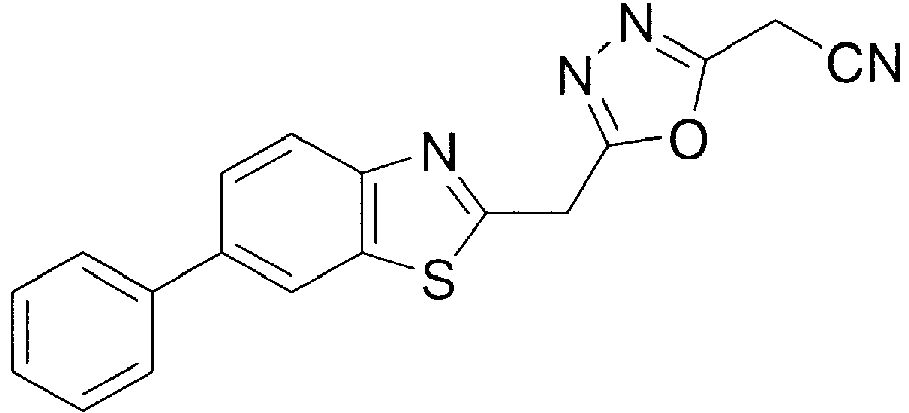
(CDCl3) δ: 4.07 (s, 2H), 4.78 (s, 2H), 7.39 (t, J = 7.4 Hz, 1H), 7.48 (t, J = 7.4 Hz, 2H), 7.63 (d, J = 7.6Hz, 2H), 7.74 (dd, J = 8 6, 1 5 Hz, 1H), 8.06-8.08 (m, 2H) -
[Table 4] No. Structure NMR(δ) I-1-23 
(CDCl3) δ: 3.06 (s, 3H), 4.63 (d, J = 6.1 Hz, 2H), 4.76 (s, 2H), 5.07 (t, J = 5.8 Hz 1 H). 7.39 (t. J = 6.8 Hz. 1 H), 7.48 (t, J = 7.9 Hz, 2H), 7.63 (dd, J = 7.1, 1.0 Hz, 2H), 7.73 (dd, J = 8.6, 2.0 Hz, 1H), 8.03-8.07 (m, 2H). I-1-24 
(DMSO-d6) δ: 4.43 (s, 2H), 4.84 (s, 2H), 7.40 (t, J = 7.4 Hz, 1H), 7.51 (t, J = 7.9 Hz, 2H), 7.57 (dd, J = 8 1, 4.6 Hz, 1H), 7 76 (d, J = 8 1 Hz, 2H), 7.84 (d, J = 8.6 Hz, 1H), 8.05 (d, J = 8.6 Hz, 1H), 8.13 (d, J = 8.1 Hz, 1H), 8.45 (s, 1H), 8.77 (d, J = 4.6 Hz, 1H), 8.92-8.92 (m, 2H). I-1-25 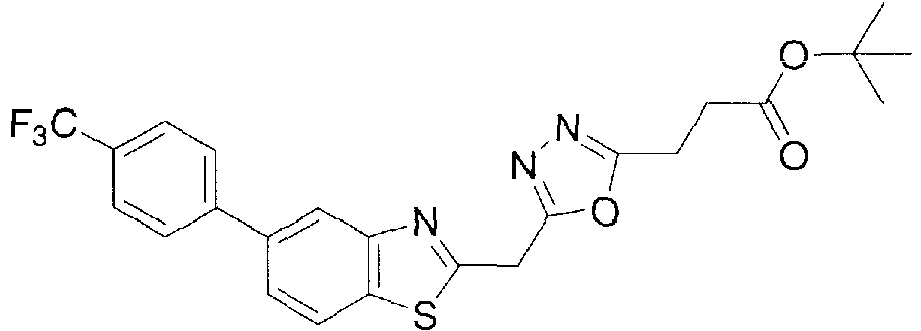
(CDCl3) δ: 1.42 (s, 9H), 2.77 (t, J = 7.4 Hz, 2H), 3.13 (t, J = 74 Hz, 2H) 4.73 (s, 2H), 7 66 (d, J = 8.1 Hz, 1H), 7.72-7.78 (m, 4H), 7 96 (d, J = 8 6 Hz, 1H), 8.24 (s, 1H) I-1-26 
(DMSO-d6) δ 2.72 (t, J = 6.8 Hz, 2H), 3.05 (t, J = 7.1 Hz, 2H), 4.94 (s, 2H), 7.85 (d, J = 8.1 Hz, 3H), 8 02 (d, J = 8.1 Hz, 2H), 8.25 (d, J = 8.6 Hz, 1 H), 8.36 (s, 1H). I-1-27 
(CDCl3) δ: 2.93 (t, J = 7 6 Hz, 2H), 3.25 (t, J = 7.6 Hz, 2H), 4.75 (s, 2H), 7.39 (t, J = 7.1Hz, 1H), 7.48 (t, J = 7.4 Hz, 2H), 7 63 (d, J = 8 1 Hz, 2H), 7 73 (dd, J = 8 6, 1.5 Hz, 1H), 8 05-8.08 (m, 2H) -
[Table 5] No. Structure NMR(δ) I-1-28 
(CDCl3) δ: 4 08 (s, 2H), 4.80 (s, 2H), 7.67 (dd, J = 8.4, 1 8 Hz, 1H), 7.74-7.77 (m, 4H), 7.98 (d, J = 8.6 Hz, 1H), 8.25 (d, J = 1.5 Hz, 1H), I-1-29 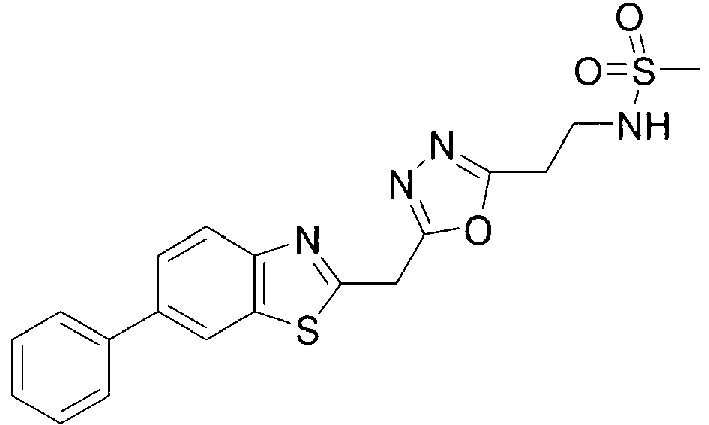
(CDCl3) δ: 2 98 (s, 3H), 3.15 (t, J = 6.1 Hz, 2H), 3.66 (q, J = 6.3 Hz, 2H), 4.74 (s, 2H), 5.20 (t, J =6.1 Hz, 1H), 7.39 (t, J = 7.4 Hz, 1H), 7.48 (t, J = 7.9 Hz, 2H), 7.63 (d, J = 7.1 Hz, 2H), 7.73 (dd, J = 8.6, 1.5 Hz, 1H), 8.06-8.08 (m, 2H) I-1-30 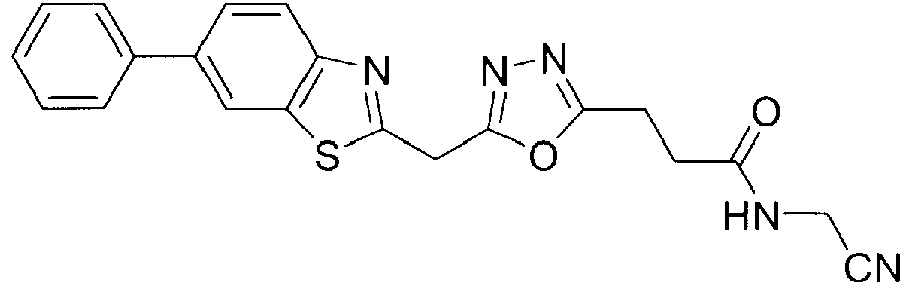
(DMSO-d6) δ: 2 67 (t, J = 7.1 Hz, 2H), 3 09 (t, J = 7.1 Hz, 2H), 4.13 (d, J = 5.6 Hz, 2H), 4.91 (s, 2H), 7 40 (t, J = 7.4 Hz, 1H), 7.50 (t, J = 7.6 Hz, 2H), 7.76 (d, J = 8.1 Hz, 2H), 7 83 (d, J = 86 Hz, 1H), 8.05 (d, J = 8.6 Hz, 1H), 8.43 (s, 1H), 8.73 (t, J = 5.3 Hz, 1H). I-1-31 
(CDCl3) δ: 2.55 (br s, 1H), 3 51 (q, J = 4.8 Hz, 2H), 3 77 (t, J = 48 Hz, 2H), 3.93 (s, 2H), 4.77 (s, 2H), 7 41 (t, J = 6 8 Hz, 1 H), 7.50 (t, J = 7 9 Hz, 2H), 7 65 (d, J = 8 1 Hz, 2H), 7.75 (dd, J = 8.6, 1.5 Hz, 1H), 8.07-8.09 (m, 2H). 1-1-32 
(CDCl3) δ: 1.42 (s, 9H), 3.88 (s, 2H), 4.72 (s, 2H), 7.60 (dd, J = 8 6, 2.0 Hz, 1H), 7.86 (d, J = 86Hz, 1H),8.01 (d, J = 1.5 Hz, 1H). -
[Table 6] No. Structure NMR(δ) I-1-33 
(DMSO-d6) δ: 3.99 (s, 2H), 4.19 (d, J = 5.6 Hz, 2H), 4.97 (s, 2H), 7.21-7.26 (m, 1H), 7.51-7.63 (m, 3H), 7.87 (dd, J = 8.6, 1.5 Hz, 1H), 8.06 (d, J = 8.6 Hz, 1 H), 8.50 (d, J = 2.0 Hz, 1 H), 9.03 (t, J = 5.3 Hz, 1 H). I-1-34 
(DMSO-d6) δ: 4 08 (s, 2H), 4.98 (s, 2H), 7.23 (t, J = 7 9 Hz, 1H), 7.52-7.63 (m, 3H), 7 87 (dd, J = 8.6, 2.0 Hz, 1H), 8.05 (d, J = 8.6 Hz, 1H), 8.50 (d, J = 1.5 Hz, 1H), 13.10 (br s, 1 H). I-1-35 
(CDCl3) δ: 1.42 (s, 9H), 3.89 (s, 2H), 4.75 (s, 2H), 7.16 (t, J = 8.6 Hz, 2H), 7.57-7.60 (m, 2H), 7 66 (dd, J = 8.6, 1.5 Hz, 1H), 8.01 (d, J = 10 Hz, 1H), 8.05 (d, J = 8.6 Hz, 1H) I-1-36 
(CDCl3) δ. 1 43 (s, 9H), 3 89 (s, 2H), 4 77 (s, 2H), 7 71-7.74 (m, 5H), 8.07-8 11 (m, 2H) I-1-37 
(DMSO-d6) δ· 3 99 (s, 2H), 4.19 (d, J = 5.6 Hz, 2H), 4.96 (s, 2H), 7.33 (t, J = 8.9 Hz, 2H), 7.78-7.82 (m, 3H), 8 04 (d, J = 8 6 Hz, 1H), 842 (d, J = 15 Hz, 1H), 9 03 (t, J = 5.3 Hz, 1H). -
[Table 7] No. Structure NMR(δ) I-1-38 
(DMSO-d6) δ: 3.99 (s, 2H), 4.20 (d, J = 5.6 Hz, 2H), 4.98 (s, 2H), 7.86 (d, J = 8 6 Hz, 2H), 7.90 (dd, J = 8.4, 1.8 Hz, 1H), 7.99 (d, J = 8.1 Hz, 2H), 8.10 (d, J = 8.1 Hz, 1H), 8.54 (d, J = 2.0 Hz, 1H), 9.03 (t, J = 5.3 Hz, 1H). I-1-39 
(DMSO-d6) δ: 4.08 (s, 2H), 4.99 (s, 2H), 7.84-7.89 (m, 3H), 7.99 (d, J = 8.1 Hz, 2H), 8.10 (d, J = 8.6 Hz, 1H), 8.55 (d, J = 1.5 Hz, 1H), 13.11 (br s, 1 H). I-1-40 
(CDCl3) δ 1.45 (s, 9H), 3.14 (s, 3H), 3.92 (s, 2H), 4.79 (s, 2H), 7.69-7.78 (m, 2H), 7.93-7 99 (m, 2H), 8 11-8.15 (m, 2H), 8.23 (t, J = 1.8 Hz, 1H). I-1-41 
(CDCl3) δ: 3.12 (s, 3H), 3.97 (s, 2H), 4.25 (d, J = 5.6 Hz, 2H), 4.78 (s, 2H), 7.67-7.76 (m, 2H), 7.91-7.97 (m, 3H), 8.09-8.13 (m, 2H), 8 21 (s, 1H) I-1-42 
(CDCl3) δ· 1.30 (dd, J = 8.4, 5 8 Hz, 2H), 1.60 (dd, J = 8.6, 6.1 Hz, 2H), 3 12 (s, 3H), 3.92 (s, 2H), 4.77 (s, 2H), 7.67-7.77 (m, 2H), 7 91-7.98 (m, 3H), 8.09-8 13 (m, 2H), 8 21 (s, 1H). -
[Table 8] No. Structure NMR(δ) I-1-43 
(DMSO-d6) δ: 4.00 (s, 2H), 4.20 (d, J = 5.1 Hz, 2H), 4.88 (s, 2H), 7.38 (t, J = 7.4Hz, 1H), 7.48 (t, J= 7.6 Hz, 2H), 7.70-7.73 (m, 3H), 7.82 (d, J = 8.6 Hz, 3H), 7.82 (d, J = 8.6 Hz, 1H),8.01 (d, J = 1.5 Hz, 1 H), 9.03 (t, J = 5.3 Hz, 1H). 1-1-44 
(DMSO-d6) δ: 1.14 (dd, J = 8.4, 5.8 Hz, 2H), 1.49 (dd, J = 8.4, 5.3 Hz, 2H), 3.91 (s, 2H), 4.96 (s, 2H), 7.31-7.35 (m, 2H), 7.78-7.82 (m, 3H), 8.04 (d, J = 8.6 Hz, 1H), 8.42 (d, J = 2.0 Hz, 1H), 9.23 (s, 1H). I-1-45 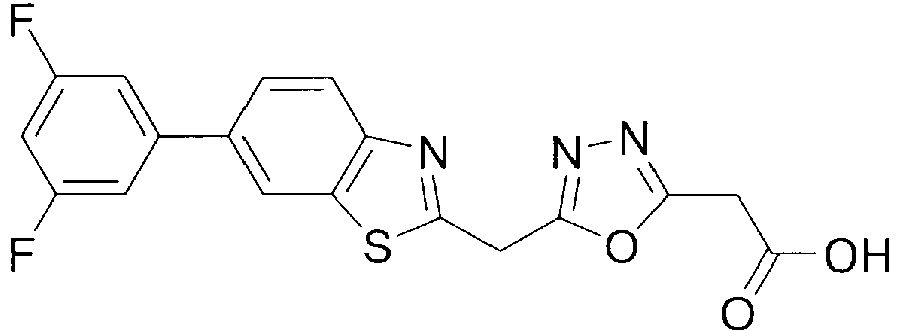
(DMSO-d6) δ· 4.08 (s, 2H), 4.98 (s, 2H), 7.27 (tt, J = 9.1, 2.2 Hz, 1H), 7.53-7.57 (m, 2H), 7.91 (dd, J = 8.6. 2.0 Hz, 1H), 8.06 (d, J = 8.6 Hz, 1H), 8.55 (d, J = 1.5 Hz, 1H). I-1-46 
(DMSO-d6) δ· 3.99 (s, 2H), 4.19 (d, J = 5 6 Hz, 2H), 4 97 (s, 2H), 7 27 (tt, J = 9 1, 2.1 Hz, 1H), 7.55 (d, J = 7.1 Hz, 2H), 7.91 (dd, J = 86, 2.0 Hz, 1 H), 8 06 (d, J = 8.6 Hz, 1H), 8.54 (d, J = 15 H z, 1H), 9.02 (t, J = 5 3 Hz, 1H) I-1-47 
(DMSO-d6) δ 1.14 (dd, J = 8.4, 5.8 Hz, 2H), 1.49 (dd, J = 8 4, 5.3 Hz, 2H), 3.91 (s, 2H), 4 98 (s, 2H), 7.24-7 30 (m, 1H), 7.53-7 57 (m, 2H), 7 91 (dd, J = 8.6, 2.0 Hz, 1H), 8.06 (d, J = 8.6 Hz, 1H), 8.55 (d, J = 1.5 Hz, 1H), 9.23 (s, 1H). -
[Table 9] No. Structure NMR(δ) I-1-48 
(DMSO-d6) δ: 4.08 (s, 2H), 4.98 (s, 2H), 7.73-7.78 (m, 2H), 7.92 (dd, J = 8.6, 15 Hz, 1H), 8.07-8.10 (m, 3H), 8.57 (d, J = 1.0 Hz, 1H), 13.12 (br s, 1H). I-1-49 
(DMSO-d6) δ: 1.14 (dd, J = 8.1, 5.6 Hz, 2H), 1.49 (dd, J = 8.4, 53 Hz, 2H), 3.91 (s, 2H), 4.98 (s, 2H), 7.72-7 78 (m, 2H), 7.92 (dd, J = 8 6, 2.0 Hz, 1H), 8.07-8.10 (m, 3H), 8.57 (d, J = 2.0 Hz, 1H), 9.23 (s, 1H). I-1-50 
(DMSO-d6) δ· 3.14 (q, J = 5 9 Hz, 2H), 3.41 (q, J = 5 7 Hz, 2H), 3.87 (s, 2H), 4 70 (t, J = 5.6 Hz, 1H), 4.96 (s, 2H), 7.72-7.78 (m, 2H), 7.92 (dd, J = 8.6, 2.0 Hz, 1H), 8.07-8.10 (m, 3H), 830 (t, J = 56 Hz, 1H), 8.57 (d, J = 15 Hz, 1H). I-1-51 
(DMSO-d6) δ: 4.02 (,s, 2H),4.20(d,J=57Hz, 2H), 5.00 (s, 2H), 7.41-7.45 (m, 1H), 748-7.53 (m, 2H), 7 75-7 80 (m, 2H), 7 94 (s, 1H), 8.44 (s, 1H), 9.03 (t, J = 54Hz, 1H). I-1-52 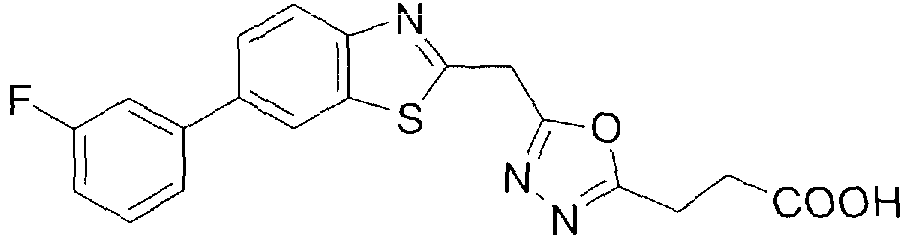
(DMSO-d6) δ· 2 73 (t, J = 70 Hz, 2H), 3.06 (t, J = 7.0 Hz 2H), 4 93 (s, 2H) 7 23 (m, 1H), 7.54 (dd, J =14.3, 7 6 Hz, 1H), 7.62 (d, J =8.1 Hz, 2H), 7.87 (dd, J = 8.6, 20 Hz, 1H), 8.06 (d, J = 8.6 Hz, 1H), 8.49 (d, J =2.0 Hz, 1H) -
[Table 10] No. Structure NMR(δ) I-1-53 
(DMSO-d6) δ: 2.74 (t, J = 7.1 Hz, 2H), 3.06 (t, J = 7.1 Hz, 2H), 4 94 (s, 2H), 7.83-7.93 (m, 3H), 7.99 (d, J = 8.2Hz, 2H), 8.10 (d, J=8.6 Hz, 1H), 8.54 (d, J=1.7 Hz, 1H) I-1-54 
(DMSO-d6) δ: 1 96 (s, 6H), 3.97 (s, 2H), 4.18 (d, J = 4.7 Hz, 2H), 7.40 (t, J = 72 Hz, 1H), 7.50 (t, J = 7.6 Hz, 2H), 7.75 (d, J = 7.1 Hz, 2H), 7.83 (dd, J = 8.5, 18 Hz, 1H), 8.07 (d, J = 8.5 Hz, 1H), 8.43 (d, J = 1.8 Hz, 1H), 9.00 (m, 1H). I-1-55 
(COCl3) δ: 1.74 (s, 6H), 3.92 (s, 2H), 4 76 (s, 2H), 7.39 (t, J = 7.4 Hz, 1H), 7.48 (t, J = 7.6Hz, 2H), 7.62-7.64 (m, 2H), 7.73 (dd, J = 8.6, 1.5 Hz, 1H), 7.79 (s, 1H), 8.05-8 07 (m, 2H). I-1-56 
(DMSO-d6) δ: 3 99 (s, 2H), 4.19 (d, J=5.6Hz, 2H), 4.97 (s, 2H), 7.73-7.78 (m, 2H), 7.92 (dd, J = 8.4, 1 8 Hz, 1H), 8.08 (t, J = 4.1 Hz, 3H), 8.57 (d, J = 1.5 Hz, 1H), 9.03 (t, J = 5.3 Hz, 1H ). I-1-57 
(CDCl3) δ. 1.42 (s, 9H), 3.89 (s, 2H), 4 76 (s, 2H), 7 16-7.25 (m, 2H), 7.33-7.39 (m, 1H), 7.48 (td, J = 7 7, 17 Hz, 1H), 7.67 (dt, J = 8.4, 1 6 Hz, 1H), 8.04-8.08 (m, 2H) -
[Table 11] No. Structure NMR(δ) I-1-58 
(DMSO-d6) δ: 3 99 (s, 2H), 4.19 (d, J = 5.6 Hz, 2H), 4.97 (s, 2H), 7.33-7.38 (m, 2H), 7.44-7.49 (m, 1H), 7.61 (td, J = 8.0, 1.7 Hz, 1H), 7.69 (d, J = 8.6 Hz, 1H), 8.07 (d, J = 8.6 Hz, 1H), 8.32 (s, 1H), 9.02 (t, J = 5.3 Hz, 1H). I-1-59 
(CDCl3) δ: 2.06-2.25 (m, 2H), 2.36-2.44 (m, 2H), 2.77-2.86 (m, 2H), 3.93 (s, 2H), 4.76 (s, 2H), 7.39 (t, J = 7.4 Hz, 1H), 7.48 (t, J = 7.4 Hz, 2H), 7.63 (d, J = 7.6 Hz, 2H), 7.74 (dd, J = 8.6, 2.0 Hz, 1H), 8.02-8.07 (m, 3H) I-1-60 
(DMSO-d6) δ 3.84 (s, 3H), 3.99 (s, 2H), 4.20 (d, J = 5 58 H z, 2H), 4.92 (s, 2H), 7 35 (m, 1H), 7.43 (m, 2H), 7 51 (m, 2H), 7.67 (s, 1H), 7 99 (s, 1H), 9 02 (t, J = 5 32 Hz, 1H). I-1-61 
(DMSO-d6) δ 1 14 (dd, J = 8.6, 5 6 Hz, 2H), 1.49 (dd, J = 8 4, 5.3 Hz, 2H), 3.91 (s, 2H), 4.97 (s, 2H), 7.32-7.38 (m, 2H), 7 44-7.49 (m, 1H), 7.61 (td, J = 8.0, 1.9 Hz, 1H), 7.70 (dd, J = 8.6, 1.5 Hz, 1H), 8.07 (d, J = 8.6 Hz, 1H), 8.32 (s, 1H), 9.23 (s, 1H) I-1-62 
(DMSO-d6) δ: 3 32 (s, 3H), 3.98 (s, 1H), 4.19 (d, J = 5.6 Hz, 2H), 4 85 (s, 2H), 7.00 (t, J = 7 4 Hz, 1H), 7.04-7.13 (m, 3H), 7.31 (t, J = 7.9 Hz, 2H), 7 66 (d, J = 2 5 Hz, 1H), 7.81 (d, J = 9 1 Hz, 1H), 9.01 (t, J = 5.6 Hz, 1H) -
[Table 12] No. Structure NMR(δ) I-1-63 
(DMSO-d6) δ: 4 00(s, 2H), 4.20 (d, J=5.4Hz, 2H), 5.00 (s, 2H), 7.38-7.44 (m, 1H), 7.48-7.53 (m, 2H), 7.71-7.80 (m, 3H), 8 30(d, J = 1.5Hz, 1 H), 9.03 (t, J = 5.4Hz, 1H). I-1-64 
(DMSO-d6) δ: 1 14 (dd, J = 8.40, 5 70 Hz, 2H), 1 49 (dd, J = 8.40, 5.54 Hz, 2H), 3.91 (s, 2H), 5.00 (s,2H), 7.39-7.54 (m, 3H), 7 72-7.81 (m, 3H), 8.23 (d, J = 1.5 Hz, 1H), 9.23 (s, 1H). I-1-65 
(DMSO-d6) δ: 3 99 (s, 2H), 4.20 (d, J = 5.58 Hz, 2H), 4.99 (s, 2H), 7.55-7.43 (m, 5H), 8.19 (s, 1H), 8.21 (s, 1H), 9 03 (t, J = 5.58 Hz, 1H). I-1-66 
(DMSO-d6) δ: 4 09 (s, 1H), 5.03 (s, 2H), 7.23-7.29 (m, 1H), 7.51-7.59 (m, 1H), 7 64-7 69 (m, 2H), 8 06 (s, 1H), 8.50 (s, 1H), 13 16 (s, 1 H) I-1-67 
(DMSO-d6) δ: 1 14 (dd, J = 8 70, 5 70 Hz, 2H), 1 49 (dd J = 8 70 5 70 Hz 2H) 3.92 (s, 2H), 5.00 (s, 2H), 7 23-7 29 (m, 1H), 7.51-7 58 (m, 1H), 7.64-7.69 (m, 2H), 8.01 (s, 1H), 8.50 (s, 1H), 9.23 (s, 1H) -
[Table 13] No. Structure NMR(δ) I-1-68 
(DMSO-d6) δ: 4.03 (s, 2H), 4.20 (d, J = 5.4 Hz, 2H), 5.02 (s, 2H), 7.24-7.29 (m, 1H), 7.51-7 59 (m, 1H), 7.64-7.69 (m, 2H). 8.01 (t, J = 1.2Hz, 1H), 8.45 (t, J = 1.2Hz, 1 H), 9.02 (t, J = 1.2 Hz, 1H). I-1-69 
(DMSO-d6) δ : 3.98 (s, 2H), 4.19 (d, J = 5 6 Hz, 2H), 4.97 (s, 2H), 7.32 (t, J = 8.9 Hz, 2H), 7.52-7.55 (m, 2H), 7.98 (s, 1H), 8.42 (s, 1H), 9.02 (t, J = 5.3 Hz, 1H). I-1-70 
(DMSO-d6) δ 1.13 (dd, J = 8.1, 5.6 Hz, 2H), 1.49 (dd, J = 8.4, 5.3 Hz, 2H), 3.90 (s, 2H), 4.98 (s, 2H), 7.32 (t, J = 8 9 Hz, 2H), 7.52-7.56 (m, 2H), 7 98 (s, 1H), 8.42 (s, 1H), 9.23 (s, 1H) I-1-71 
(DMSO-d6) δ: 1 34 (s, 9H), 4.07 (s, 2H), 4.98 (s, 2H), 7.64 (dd, J = 8 6, 2.0 Hz, 1H), 8.11 (d, J = 8.6 Hz, 1H), 8.20 (d, J = 2.0 Hz, 1H). I-1-72 
(DMSO-d6) δ: 1 14 (dd, J = 8 11, 5.58 Hz, 2H), 1.49 (dd, J = 8.11, 5.58 Hz, 2H), 3.91 (s, 2H), 5.00 (s, 2H), 7 36-7.27 (m, 3H), 7.54 (m, 1H), 8 23 (s, 1H), 8.24 (s, 1H), 9 24 (s, 1H) -
[Table 14] No. Structure NMR(δ) I-1-73 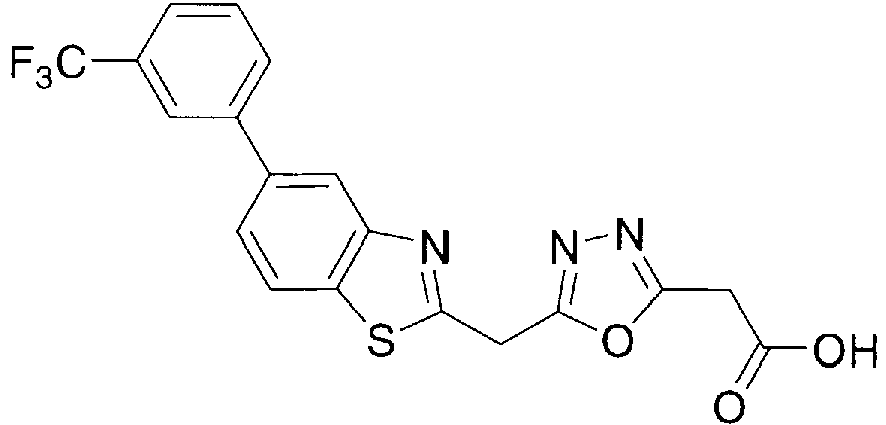
(DMSO-d6) δ: 4.08 (s, 2H), 4.99 (s, 2H), 7.72-7.78 (m, 2H), 7.87 (dd, J = 8.4, 1.8 Hz, 1H), 8.09-8.12 (m, 2H), 8.24 (d, J = 8.6 Hz, 1H), 8.37 (d, J = 1.5 Hz, 1H). I-1-74 
(DMSO-d6) δ: 1.14 (dd, J = 8.4, 5.3 Hz, 2H), 1.49 (dd, J = 81, 5.6 Hz, 2H), 3.91 (s, 2H), 4.98 (s, 2H), 7.72-7.78 (m, 2H), 7.87 (dd, J = 8.6, 1.5 Hz, 1H), 8.09-8 12 (m, 2H), 8.24 (d, J = 8 6 Hz, 1H), 837 (d, J = 1.5Hz, 1H), 9.24 (s, 1H). I-1-75 
(DMSO-d6) δ: 4.08 (s, 2H), 4.99 (s, 2H), 7.51-7.43 (m, 5H), 8.20 (s, 1H), 8.21 (s, 1 H), 13.11 (s, 1H). I-1-76 
(DMSO-d6) δ 1.14 (2.0H, dd, J = 8.11, 5 58 Hz), 1 49 (2.0H, dd, J = 8 11, 5.58 Hz), 3.91 (2.0H, s), 4.99 (2.0H, s), 7.52-7.43 (5.0H, m), 8.20 (1 0H, s), 8.21 (1.0H, s), 9 23 (1.0H, s) I-1-77 
(DMSO-d6) δ:1.14 (dd, J = 8 70, 5.70 Hz, 2H), 1.49 (dd, J = 8.70, 5.70 Hz, 2H), 3.92 (s, 2H), 5.00 (2H, s), 7.34 (2H, t, J = 9.0Hz), 7 73 (1H, d, J = 10.80 Hz), 7.81 -7.86 (2H, m), 8.29 (1H, s), 9.23 (1H, s). -
[Table 15] No. Structure NMR(δ) retention time Mass method I-1-78 
1.85 435.05 (ES+) C I-1-79 
(DMSO-d6) δ: 4.18 (s, 2H), 4.76 (s, 2H), 6,54 (s, 1H), 7.37-7.49 (m, 3H), 7.61 (d, J = 7.8 Hz, 2H), 7 70 (d, J = 9 0Hz 1H), 8.03-8.06 (m, 2H) I-1-80 
(DMSO-d6) δ 3.97 (s, 2H), 4.18 (d, J = 5.6 Hz, 2H), 5 02 (s, 2H), 7.47 (t, J = 8 6 Hz, 2H), 8.01-8.10 (m, 3H), 8.17 (d, J = 9.1 Hz, 1 H), 8 92 (d, J = 2.0 Hz, 1H), 9.01 (t, J = 5.6 Hz, 1H). I-1-81 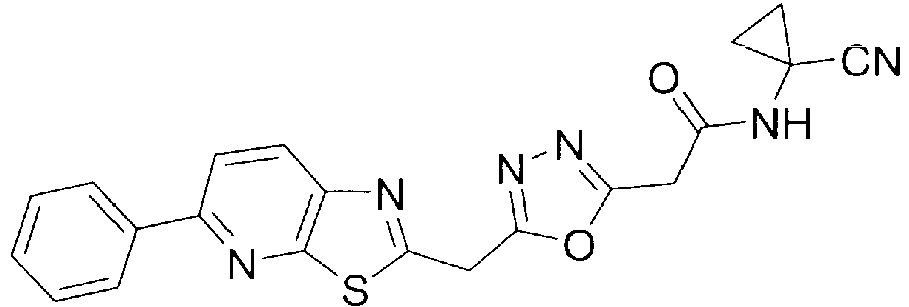
(DMSO-d6) δ: 1.14 (dd, J = 8.40, 5.70 Hz, 2H), 1.49 (dd, =8.40, 5.54 Hz, 2H), 3.92 (s, 2H), 5.01 (s,2H), 7.49-7.56 (m, 3H), 8.16-8.19 (m, 3H), 8.45 (d, J = 8.7 Hz, 1H), 9.24 (brs, 1H). I-1-82 
(CDCl3) δ 3 55 (t, J = 4.8 Hz, 2H), 3.63-3 71 (m, 6H), 4 01 (s, 2H), 4 75 (s, 2H), 7 37-7.41 (m, 1H), 7 47 (t, J = 7 6 Hz. 2H). 7.63 (t, J = 4 1 Hz, 2H), 7 72 (dd, J = 8.6, 2 0 Hz, 1H), 8 04-8 07 (m, 2H) -
[Table 16] No. Structure NMR(δ) I-1-83 
1H-NMR (DMSO-d6) δ: 4 13 (s, 2H), 4 97 (s, 2H), 7 08 (t, J = 7.4 Hz, 1H), 7 32 (t, J = 8.1 Hz, 2H), 7.40 (t, J = 7.4 Hz, 1H), 7 50 (t, J = 7.9 Hz, 2H), 7 56 (d, J = 7 6 Hz, 2H), 7 76 (d, J = 7 1 Hz, 2H), 7 83 (dd, J = 8 6, 2.0 Hz, 1H), 8 05 (d, J = 8 6 Hz, 1H), 8 43 (d, J = 1 5 Hz, 1H), 1039 (s, 1H). I-1-84 
1H-NMR (CDCl3) δ 0.96-1.02 (m, 2H), 1 13-1.21 (m, 2H), 2.43 (tt, J = 8.11, 3 63 Hz, 1H), 3 15 (t, J = 6 08 Hz, 2H), 3.68 (dt, J = 6 08, 6.34 Hz, 2H), 4.73 (s, 2H), 5.22 (t, J = 6 34 Hz, 1H), 7 33-7 52 (m, 3H), 7 63 (d, J = 7.10 Hz, 2H), 7 73 (dd, J = 8.62. 1.52 Hz, 1H), 8 05-8 09 (m, 2H) I-1-85 
(DMSO-d6) δ 4 32 (d, J = 6 1 Hz, 2H), 4.95 (s, 2H), 6.77 (br s, 2H), 7 38-7 44 (m, 2H), 7 48-7 52 (m, 2H), 7.76 (d, J = 7 1 Hz, 2H), 7.83 (dd, J = 86, 20Hz, 1H), 8.05 (d, J = 8.6 Hz, 1H), 8.44 (d, J=15 Hz, 1H) I-1-86 
1H-NMR (DMSO-d6) δ: 1 53-1 64 (m, 2H), 1.84-1 92 (m, 3H), 2.09-2.18 (m, 3H), 2 16 (s, 3H), 2 55-2.63 (m, 3H), 4 08 (s, 2H), 4 22-4 31 (m, 1H), 4 97 (s, 2H), 6 89 (d, J = 9 1 Hz, 2H), 7 37-7 46 (m, 3H), 7 50 (t, J = 7.6 Hz, 2H), 7 76 (d, J = 7 1 Hz, 2H), 7 82 (dd, J = 8 6, 1.5 Hz, 1H) 8.04 (d, J = 8 6 Hz, 1H), 8 43 (d, J = 1 5 Hz, 1H), 10 24 (s, 1H) I-1-87 
1 H-NMR (DMSO-d6) δ 1 01-1.05 (m, 2H), 1 32-1 39 (m, 2H), 3 56 (s, 3H), 3 86 (s, 2H), 4 95 (s, 2H), 7 40 (t, J = 7 4 Hz, 1H), 7 50 (t, J = 7 6 Hz, 2H), 7 76 (d, J = 7 1 Hz, 2H), 7.83 (dd, J = 8 6, 2 0 Hz, 1H), 8.05 (d, J=8.6Hz, 1H), 8.44 (d, J = 1 5 Hz, 1H), 8 94 (s, 1H) -
[Table 17] No. Structure NMR(δ) I-1-88 
(CDCl3) δ : 2.79 (s, 6H), 4.52 (d, J = 3.5 Hz, 2H), 4.78 (s, 2H), 4.92 (br s, 1H), 7.41 (t, J = 7.4 Hz, 1H), 7.48-7.52 (m, 2H), 7.64-7.67 (m, 2H), 7 76 (dd, J = 8.4, 1.8 Hz, 1H), 8.06-8.10 (m, 2H). I-1-89 
1H-NMR (DMSO-d6) δ: 1.37-1.48 (m, 2H), 1 85-1.92 (m, 2H), 2.52-2.62 (m, 2H), 2.91-2.98 (m, 2H), 3.35-3.42 (m, 1H), 4.08 (s, 2H), 4.27-4.36 (m, 1H), 4.97 (s, 2H), 6.89 (d, J = 9 1 Hz 2H). 7 37-7.46 (m. 3H), 7.50 (t, J = 7.6 Hz, 2H), 7.76 (d, J = 7.1 Hz, 2H), 7.83 (dd, J = 8.6, 1.5 Hz, 1H), 8.05 (d, J = 8.6 Hz, 1H), 8.44 (d, J = 1.5 Hz, 1H), 10.25 (s, 1H). -
[Table 18] No. Structure NMR(δ) I-2-1 
(DMSO-d6) δ: 1.34 (s, 9H), 4.07 (s, 2H), 4.98 (s, 2H), 7.64 (dd, J = 8.6, 2 0 Hz, 1 H), 8.11 (d, J = 8.6 Hz, 1 H), 8.20 (d, J = 2.0 Hz, 1H). I-2-2 
(COCl3) δ: 1.43 (s, 9H), 3 89 (s, 2H), 4 77 (s, 2H), 7.59-7.66 (m, 3H), 7 82-7.97 (m, 3H), 8.24 (d, J = 1.5 Hz, 1H). I-2-3 
(DMSO-d6) δ: 1.14 (dd, J = 8.11, 5.58 Hz, 2H), 1.49 (dd, J = 8.11, 5.58 Hz, 2H), 3.91 (s, 2H), 5.00 (s, 2H), 7.27-7 36 (m, 3H), 7.54 (brs, 1H), 8.23 (s, 1H), 8.24 (s, 1H), 9 24 (s, 1H). I-2-4 
(DMSO-d6) δ: 4.08 (s, 2H), 4.99 (s, 2H), 7.72-7.78 (m, 2H), 7.87 (dd, J = 84, 1.8 Hz, 1H), 8.09-8.12 (m, 2H), 8.24 (d, J = 8.6 Hz, 1H), 8.37 (d, J = 1.5 Hz, 1H). I-2-5 
(DMSO-d6) δ: 1.14 (dd, J = 8.4, 5 3 Hz, 2H), 1.49 (dd, J = 8.1, 5.6 Hz, 2H), 3.91 (s, 2H), 4.98 (s, 2H), 7 72-7.78 (m, 2H), 7 87 (dd, J = 8.6, 1.5 Hz, 1H), 8.09-8 12 (m, 2H), 8.24 (d, J = 8 6 Hz, 1H), 8.37 (d, J = 1.5 Hz, 1H), 9.24 (s, 1H). -
[Table 19] No. Structure NMR(δ) I-2-6 
(DMSO-d6) δ: 4 08 (s, 2H), 4.99 (s, 2H), 7.41-7.53 (m, 5H), 8.20 (s, 1H), 8.21 (s, 1H), 13.11 (br s, 1H). I-2-7 
(DMSO-d6) δ: 1.14 (dd, J = 8.11, 5.58 Hz, 2H), 1.49 (dd, J = 8.11, 5.58 Hz, 2H), 3.91 (s, 2H), 4.99 (s, 2H), 7.43-7 52 (m, 5H), 8.20 (s, 1 H), 8.21 (s, 1H), 9.23 (s, 1H). I-2-8 
I-2-9 
(DMSO-d6) δ: 1.14 (dd, J = 8.70, 5.70 Hz, 2H), 1.49 (dd, J = 8.70, 5.70 Hz, 2H), 3.92 (s, 2H), 5.00 (s, 2H), 7.34 (t, J = 9 0Hz, 2H), 7.72-7.86 (m, 3H), 8.29 (s, 1H), 8.29(s, 1H), 9.23 (s, 1H). I-2-10 
-
[Table 20] No. Structure NMR(δ) I-2-11 
(DMSO-d6) δ: 3.14 (s, 1 H), 3.90 (s, 2H), 4.95 (s, 2H), 7.40 (t, J = 7.5Hz, 1 H), 7.46-7.53 (m, 2H), 7.74-7.84 (m, 3H), 8.05 (d, J = 8.4Hz, 2H), 8.43 (s, 1H), 8.75 (br-s, 1H) I-2-12 
(DMSO-d6) δ: 1.14 (dd, J = 8 70, 5.70 Hz, 2H), 1 49 (dd, J = 8.70, 5 70 Hz, 2H), 3.92 (s, 2H), 5.02 (s, 2H), 7.26 (t, J = 8.70 Hz, 1H), 7.51-7 72 (m, 3H), 7.81 (d, J = 14.1 Hz, 1 H), 8.38(s, 1H), 9.23 (s, 1H) I-2-13 
(CDCl3) δ: 1.96 (s, 3H), 3.05 (t, J = 6.1 Hz, 2H), 3.74 (q, J = 6 1 Hz, 2H), 4.73 (s, 2H), 6.22 (s, 1H), 7.39 (t, J = 7.4 Hz, 1H), 7.46-7.49 (m, 2H), 7.62-7.64 (m, 2H), 7.73 (dd, J = 8 6, 1.5 Hz, 1H), 8.05-8 08 (m, 2H) I-2-14 
(DMSO-d6) δ: 1.14 (dd, J = 8.1, 5 6 Hz, 2H), 1.49 (dd, J = 8.4, 5.3 Hz, 2H), 3.91 (s, 2H), 4.98 (s, 2H), 7.71 (t, J = 7.9 Hz, 1H), 7.86 (d, J = 8.1 Hz, 1H), 7.92 (dd, J = 8.6, 2.0 Hz, 1H), 8.08 (d, J = 8.6 Hz, 1H), 8.12 (d, J = 8.1 Hz, 1H), 8.26 (s, 1H), 8.55 (d, J = 1.5 Hz, 1H), 9.23 (s, 1H). I-2-15 
(CDCl3) δ: 1.47 (s, 9H), 3.16 (t, J = 6.3 Hz, 2H), 3.67 (q, J = 6.4 Hz, 2H), 4.74 (s, 2H), 5.80 (t, J = 6.3 Hz, 1H), 7.37-7.49 (m, 3H), 7.62-7.67 (m, 3H), 7.73 (dd, J = 8.4, 1.8 Hz, 1H), 8.06-8.09 (m, 2H). -
[Table 21] No. Structure NMR(δ) I-2-16 
(DMSO-d6) δ: 3.08 (t, J = 6.8Hz, 2H), 3.29 (q, J = 6.8Hz, 2H), 4.91 (s, 2H), 6.63 (s, 2H), 6.75 (t, J = 6.0Hz, 1H), 7.40 (t, J = 7.6Hz, 1H), 7.48-7.54 (m, 2H), 7.75 (d, J = 8.0Hz, 2H), 7.83 (d, J = 8.0Hz, 1 H), 8.05 (d, J = 8.0Hz, 1H), 8.43 (s, 1H) I-2-17 
(DMSO-d6) δ: 4.18 (s, 2H), 4.76 (s, 3H), 6.54 (s, 1H), 7.38 (t, J = 6.9Hz, 1H), 7.42-7.50 (m, 2H), 7.60-7.72 (m, 3H), 8.03-8.06 (m, 2H) I-2-18 
(DMSO-d6) δ: 3.60 (s, 3H), 3.77 (s, 2H), 4.98 (s, 2H), 7.82-7.93 (m, 3H), 7.99 (d, J = 8.11 Hz, 2H), 8.09 (d, J = 8.62 Hz, 1H), 8.55 (d, J = 1.52 Hz, 1H), 11.48 (s, 1H). I-2-19 
(CDCl3) δ: 3.73 (s, 3H), 4.63 (d, J = 6.1 Hz, 2H), 4.74 (s, 2H), 5.31 (br s, 1H), 7.39 (t, J = 7.4 Hz, 1H), 7.46-7.49 (m, 2H), 7.63 (d, J = 7.1 Hz, 2H), 7.73 (dd, J = 8.6, 1.5 Hz, 1H), 8.05-8.08 (m, 2H). I-2-20 
(DMSO-d6) δ: 3.75 (s, 2H), 4.57 (d, J = 5.6 Hz, 2H), 4.95 (s, 2H), 7.40 (t, J = 7.4 Hz, 1H), 7.48-7.52 (m, 2H), 7.74-7.77 (m, 2H), 7.83 (dd, J = 8.6, 1.5 Hz, 1H), 8.05 (d, J = 8.6 Hz, 1H), 8.43 (d, J = 2.0 Hz, 1H), 9.03 (t, J = 5.6 Hz, 1H). -
[Table 22] No. Structure NMR(δ) I-2-21 
(CDCl3) δ: 4.21 (s, 2H), 4.73 (s, 2H), 4.76 (d, J = 6.1 Hz, 2H), 7 29 (br s, 1H), 7.37-7.41 (m, 1H), 7.45-7.50 (m, 2H), 7.61-7.64 (m, 2H), 7.72 (dd, J = 8.6, 1.5 Hz, 1H), 8.04-8.07 (m, 2H). I-2-22 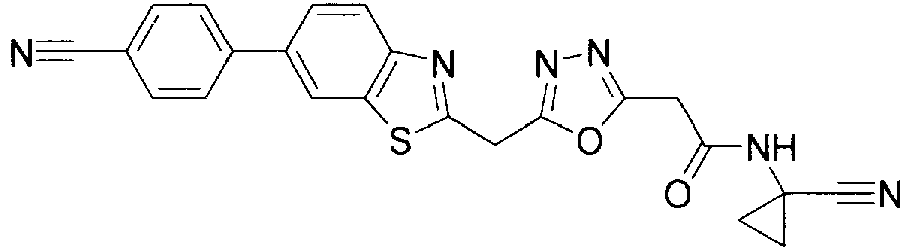
(DMSO-d6) δ: 1 14 (dd, J = 8.4, 5 3 Hz, 2H), 1.49 (dd, J = 8.4, 5.3 Hz, 2H), 3.91 (s, 2H), 4.98 (s, 2H), 7.90-7.98 (m, 5H), 8.10 (d, J = 8.6 Hz, 1H), 8.57 (d, J = 1.5 Hz, 1 H), 9.24 (s, 1 H). I-2-23 
(CDCl3) δ: 0.53-0.57 (m, 2H), 0.77-0.82 (m, 2H), 2.72-2.79 (m, 1H), 3.84 (s, 2H) 4 74 (s 2H). 7.03 (br s, 1H), 7.39 (t, J = 7 4 Hz, 1H), 7.46-7.50 (m, 2H), 7.62-7.65 (m, 2H), 7.73 (dd, J = 8 6, 2.0 Hz, 1H), 8.05-8.08 (m, 2H) I-2-24 
(DMSO-d6) δ: 3.99 (s, 2H), 4.19 (d, J = 5.6 Hz, 2H), 4.96 (s, 2H), 7.32 (t, J =8.9 Hz, 2H), 7.76 (d, J = 8.6 Hz, 1H), 7 81-7.84 (m, 2H), 8.19 (d, J = 8.1 Hz, 1H), 8.24-8.26 (m, 1H), 9.03 (t, J = 5.3 Hz, 1H). I-2-25 
(DMSO-d6) δ : 3 99 (s, 2H), 4.20 (d, J = 5.58 Hz, 2H), 4.95 (s, 2H), 7.29 (m, 1H), 7.37-7.43 (m, 4H), 7.64 (d, J = 7 10 Hz, 2H), 7.76 (dd, J = 8.62, 1.52 Hz, 1H), 8.10 (d, J = 8.62 Hz, 1H), 8.19 (d, J = 1.52 Hz, 1H), 9.03 (t, J = 5.32 Hz, 1H). -
[Table 23] No. Structure NMR(δ) I-2-26 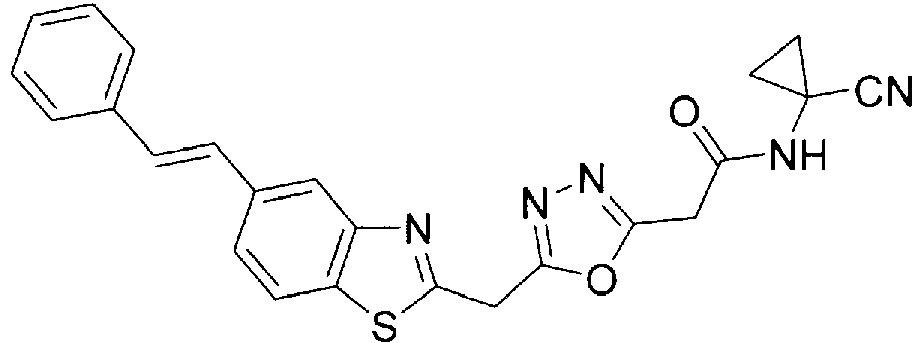
(DMSO-d6) δ : 1 14 (dd, J = 8.36, 5.32 Hz, 2H), 1.49 (dd, J = 8.11, 5.58 Hz, 2H), 3.91 (s, 2H), 4.95 (s, 2H), 7.29 (m, 1H), 7.36-7.43 (m, 4H), 7.64 (d, J = 7.60 Hz, 2H), 7.76 (dd, J = 8.36, 1.27 Hz, 1H), 8 10 (d, J = 8.11 H, 1H), 8.19 (d, J = 1 01 Hz, 1H), 924 (s, 1H). I-2-27 
(CDCl3) δ: 3.09 (t, J = 5.83 Hz, 2H), 3.54 (dt, J = 5.83, 6.08 Hz, 2H), 4.72 (s, 2H), 5.77 (t, J = 6.08 Hz, 1H), 7.39 (m, 1H), 7.43-7.51 (m, 3H), 7.61-7.66 (m, 2H), 7.73 (m, 1H), 8.05-8 10 (m, 2H), 8.15 (m, 1H), 8.80 (d, J = 4.56 Hz, 1H), 9.09 (s, 1H). I-2-28 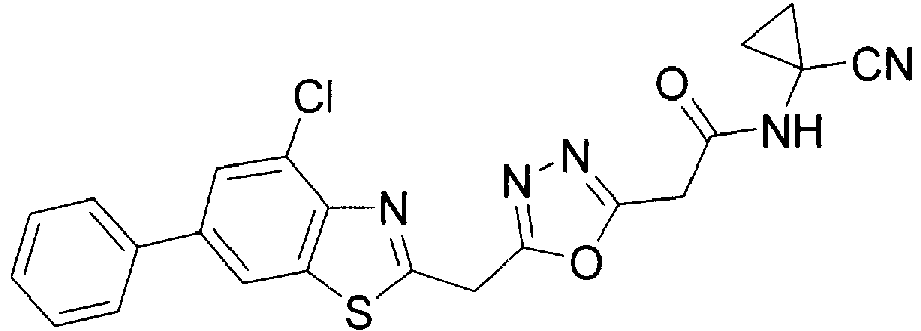
(DMSO-d6) δ: 1 14 (dd, J = 8.70, 5.70 Hz, 2H), 1.49 (dd, J = 8 70, 5.70 Hz, 2H), 3.92 (s, 2H), 5.02 (s, 2H), 7.40-7.52 (m, 3H), 7.78 (d, J = 6.60 Hz, 1H), 8.45 (d, J = 1.50 Hz, 1H), 9.24 (s, 1H). I-2-29 
(DMSO-d6) δ: 1.14 (dd, J = 8.4, 5.3 Hz, 2H), 1.49 (dd, J = 8.4, 5.3 Hz, 2H), 391 (s, 2H), 4.97 (s, 2H), 732 (t, J = 8.9 Hz, 2H), 7.76 (dd, J = 8.4, 1.8 Hz, 1H), 7 79-7.85 (m, 2H), 8.19 (d, J = 8.1 Hz, 1H), 8.25 (d, J = 1.5 Hz, 1H), 9.24 (s, 1H). I-2-30 
(DMSO-d6) δ 1 14 (dd, J = 8.4, 5 3 Hz, 2H), 1.49 (dd, J = 8.4, 5.3 Hz, 2H), 3.81 (s, 3H), 3.91 (s, 2H), 4.94 (s, 2H), 7 05-7.07 (m, 2H), 7.69-7.71 (m, 2H), 7 78 (dd, J = 8.6, 2.0 Hz, 1H), 8.01 (d, J = 8.1 Hz, 1H), 8.37 (d, J = 1.5 Hz, 1H), 9.23 (s, 1H). -
[Table 24] No. Structure NMR(δ) I-2-31 
(DMSO-d6) δ: 1.82 (s, 6H), 5.01 (s, 2H), 7.40 (t, J = 7.4 Hz, 1H), 7 48-7.52 (m, 2H), 7.75-7.77 (m, 2H), 7.83 (dd, J = 8.4, 1.8 Hz, 1H), 8.05 (d, J = 8.1 Hz, 1H), 8.45 (d, J = 2.0 Hz, 1H). I-2-32 
(DMSO-d6) δ: 328 (s, 3H), 3 86 (s, 2H), 4.53 (d, J = 6.1 Hz, 2H), 4.94 (s, 2H), 7.40 (t, J = 7.4 Hz, 1H), 7.50 (t, J = 7.6 Hz, 2H), 7.76 (d, J = 7.1 Hz, 2H), 7.82 (dd, J = 8.4, 1 8 Hz, 1H), 8.04 (d, J = 8.6 Hz, 1H), 8.43 (d, J = 1.5 Hz, 1H), 8.57 (t, J = 5.8 Hz, 1H). I-2-33 
(DMSO-d6) δ: 0.58-0.66 (m, 4H), 1.48 (m, 1H), 2.99 (t, J = 6.59 Hz, 2H), 3.44 (dt, J = 6.59, 5.58 Hz, 2H), 4.91 (s, 2H), 7 40 (t, J = 7.35 Hz, 1H), 7 50 (dd, J = 7.35, 7 10 Hz, 2H), 7.75 (d, J = 7.10 Hz, 2H), 7 83 (dd, J = 8.36, 1.77 Hz, 1H), 8.05 (d, J = 8.36 Hz, 1H), 8.25 (t, J = 5.58 Hz, 1H), 8.43 (d, J = 1.77 Hz, 1H). I-2-34 
(DMSO-d6) δ: 1.14 (dd, J = 8.4, 5.3 Hz, 2H), 1.49 (dd, J = 8.1, 5.6 Hz, 2H), 3.91 (s, 2H), 4.96 (s, 2H), 7 38-7.43 (m, 1H), 7.50 (t, J = 7.6 Hz, 2H), 7.76 (d, J = 7 1 Hz, 2H), 7 83 (dd, J = 8.6, 2 0 Hz, 1H), 8.05 (d, J = 8.6 Hz, 1 H), 8.44 (d, J = 1.5 Hz, 1H), 924 (s, 1H). I-2-35 
(DMSO-d6) δ 4.17 (s, 2H), 4.98 (s, 2H), 7 25 (s, 1H), 7.38-7.43 (m, 1H), 7.50 (t, J = 7.6 Hz, 2H), 7.62 (d, J = 8.6 Hz, 2H), 7.76 (d, J = 7.1 Hz, 2H), 7.81-7.88 (m, 4H), 8.05 (d, J = 8 1 Hz, 1H), 8.44 (d, J = 2.0 Hz, 1H), 10.61 (s, 1H) -
[Table 25] No. Structure NMR(δ) I-2-36 
(DMSO-d6) δ: 1.14 (dd, J = 8.36, 5.32 Hz, 2H), 1.49 (dd, J = 8.36, 5.32 Hz, 2H), 3.91 (s, 2H), 4.97 (s, 2H), 7.40 (t, J = 7.35 Hz, 1H), 7.50 (dd, J = 7.35, 6 59 Hz, 2H), 7.75-7.81 (m, 3H). 8.19 (d, J = 8.62 Hz, 1H), 8.25 (d, J = 1.52 Hz, 1H), 9.24 (s, 1H). I-2-37 
I-2-38 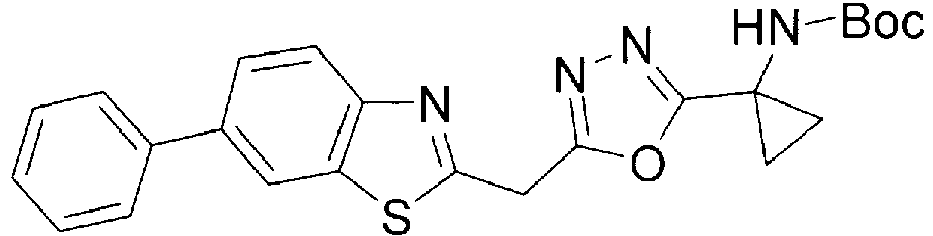
(DMSO-d6) δ: 1.22-1 43 (m, 13H), 4.89 (s, 2H), 7.40 (t, J = 7.35 Hz, 1H), 7.50 (dd, J = 7.60, 7 35 Hz, 2H), 7 75 (d, J = 7.60 Hz, 2H), 7 82 (dd, J = 8.62, 2.03 Hz, 1 H), 7 96 (s, 1H), 8.04 (d, J = 8 62 Hz, 1 H), 8.42 (d, J = 2.03 Hz, 1 H). I-2-39 
(DMSO-d6) δ: 1.04-1 18 (m, 4H), 2.72 (s, 2H), 4.88 (s, 2H), 7 40 (t, J = 7.35 Hz, 1 H), 7.50 (dd, J = 7.35, 7.10 Hz, 2H), 7.75 (d, J = 7.10 Hz. 2H), 7.82 (dd, J = 8.62, 1.52 Hz, 1 H), 8 05 (d, J = 8.62 Hz, 1H), 8.43 (d, J = 1.52 Hz, 1 H). I-2-40 
(DMSO-d6) δ: 1.43-1.54 (m, 4H), 2 97 (s, 3H), 4 93 (s, 2H), 7.40 (t, J = 7.35 Hz, 1 H), 7.50 (dd, J = 7.35, 7.60 Hz, 2H), 7.76 (d, J = 7.60 Hz, 2H), 7.82 (dd, J = 8.62, 1.52 Hz, 1 H), 8.04 (d, J = 8.62 Hz, 1 H), 8 44 (d, J = 1.52 Hz, 1 H), 8.61 (s, 1 H). -
[Table 26] No. Structure NMR(δ) I-2-41 
(DMSO-d6) δ: 3.15 (s, 1 H), 3.91 (s, 4H), 5.00 (s, 2H), 7.40-7.54 (m, 3H), 7.78 (d, J = 8.40 Hz, 1H). 7.94 (s, 1H), 8.44 (s, 1 H), 8.76 (brs, 1H). I-2-42 
(DMSO-d6) δ: 0.67-069 (m, 4H), 1.56-1.62 (m, 1H), 4 53 (d, J = 5.6 Hz, 2H), 4.95 (s, 2H), 7.40 (t, J = 7 4 Hz, 1 H), 7.48-7.52 (m, 2H), 7.75-7.77 (m, 2H), 7.83 (dd, J = 8.6, 1.5 Hz, 1 H), 8.05 (d, J = 8.6 Hz, 1 H), 8.44 (d, J = 2.0 Hz 1H), 8 82 (t, J = 5.8 Hz, 1H). I-2-43 
(DMSO-d6) δ: 1.40 (s, 9H), 4.41 (d, J = 5.6 Hz, 2H), 4 95 (s, 2H), 7.38-7.42 (m, 1H), 7.48-7.52 (m, 2H), 7.74-7.77 (m, 2H) 7.83 (dd, J = 8.6, 15 Hz, 1H), 8.05 (d, J = 86 Hz, 1H), 8.44-8.48 (m, 2H), 11.05 (s, 1 H) I-2-44 
(DMSO-d6) δ: 0.83-0.87 (m. 4H). 4.47 (s, 2H), 4.98 (s, 2H), 7.40 (t, J = 7.4 Hz, 1H). 7 49-7 52 (m, 2H), 7.76 (d, J = 7.6 Hz, 2H), 7.83 (dd, J = 8.6, 2.0 Hz, 1H), 8 01-8 04 (m, 2H), 8 44 (d, J = 2 0 Hz, 1 H). I-2-45 
(DMSO-d6) δ: 1.03 (d, J = 6.6 Hz, 3H), 3.21-3.29 (m, 1H), 3 33-3.38 (m, 1H), 3.69-3.79 (m, 1H), 3.85 (s, 2H), 472 (t, J = 56 Hz, 1H), 4.94 (s, 2H), 7.38-7.43 (m, 1 H). 7.50 (t, J = 7.6 Hz, 2H), 7 73-7.78 (m, 2H), 7.83 (dd, J = 8.6, 2.0 Hz, 1H), 8.05 (d, J = 86Hz, 1H),811 (d,J=7.6Hz, 1H), 8.44 (d, J = 2.0 Hz, 1H). -
[Table 27] No. Structure NMR( δ ) I-2-46 
(DMSO-d6) δ: 012-0.17 (m, 2H), 0.36-0.42 (m, 2H), 0.82-0.93 (m, 1H), 2.95 (t, J = 6.3 Hz, 2H), 3.86 (s, 2H), 4 94 (s, 2H), 7 38-7.43 (m, 1H), 7.50 (t, J = 7.6 Hz, 2H), 7 74-7.77 (m, 2H), 7.83 (dd, J = 8.4, 1 8 Hz, 1H), 8.05 (d, J = 8.6 Hz. 1H), 8 37 (t, J = 5.1 Hz, 1H) 8.43 (d, J = 1.5 Hz. 1H) I-2-47 
(DMSO-d6) δ 1.05 (d, J = 6 6 Hz, 6H), 3.76-3 85 (m, 1H), 3.81 (s, 2H), 4.94 (s, 2H), 7.38-7.43 (m, 1H), 7 50 (t, J = 7.6 Hz, 2H), 7.76 (d, J = 7.6 Hz, 2H), 7.83 (d, J = 8.6 Hz, 1H), 8.04 (d, J = 8.1 Hz, 1H), 8.18 (d, J = 7.1 Hz, 1H), 8.44 (s, 1H). I-2-48 
(DMSO-d6) δ 4 00 (s, 2H), 4 33 (d, J = 5 6 Hz, 2H), 4 96 (s, 2H), 7.26 (d. J = 5 6 Hz, 2H), 7.38-7.43 (m, 1 H), 7.50 (t, J = 7 6 Hz, 2H), 7.74-7 78 (m, 2H), 7 83 (dd, J = 8 6, 2.0 Hz, 1 H), 8.05 (d, J = 8 1 Hz, 1H), 8.44 (d, J = 1.5 Hz, 1H), 8.46-8 49 (m, 2H), 890 (t, J = 58 Hz, 1H) I-2-49 
(DMSO-d6) δ: 1 31-1.40 (m, 2H), 1.42-1 54 (m, 2H), 1 55-1 66 (m. 2H) 1 73-1 83 (m, 2H), 3 81 (s, 2H), 3.91-4.01 (m, 1 H), 4 94 (s, 2H), 7.38-7 43 (m, 1H), 7 50 (t, J = 7 6 Hz, 2H), 7 73-7 78 (m, 2H), 7.83 (dd, J = 8.6, 2.0 Hz, 1H), 8 05 (d, J = 8.6 Hz, 1 H), 8 26 (d, J = 7.1 Hz, 1 H), 8 44 (d, J = 15 Hz, 1H) I-2-50 
(DMSO-d6) δ. 3.73 (s, 3H), 4 08 (s, 2H), 4 96 (s, 2H), 6 39 (d, J = 2 0 Hz, 1H), 7.38-7.42 (m, 1H), 7.50 (t, J = 7 6 Hz, 2H), 7 55 (d, J = 2.0 Hz, 1H), 7 76 (d, J 7.1 Hz, 2H), 7 82 (dd, J = 8 4, 1.8 Hz, 1H), 8.05 (d, J = 8.6 Hz, 1H), 8.43 (d, J = 1.5Hz, 1H), 10.82 (s, 1H) -
[Table 28] No. Structure NMR(δ) I-2-51 
(DMSO-d6) δ· 3 13 (t, J = 6.08 Hz, 2H), 3.74 (t, J = 6.08 Hz, 2H), 3 93 (d, J = 5 58 Hz, 2H), 4.93 (s, 2H), 5.06 (dd, J = 10.39, 1.52 Hz, 1H), 5.17 (dd, J = 17.24, 1 52 Hz, 1 H), 5 78 (m, 1H), 7.40 (t, J = 7 10 Hz, 1H), 7.50 (dd, J = 7.10, 7 10 Hz, 2H), 7 75 (d, J = 7.10 Hz, 2H), 7.83 (dd, J = 8 62, 1.52 Hz, 1 H), 8 04 (d, J = 8.62 Hz, 1H), 8.43 (d,J = 1.52 Hz, 1H) I-2-52 
(DMSO-d6) δ 4.06 (s, 2H), 4.91 (s, 2H), 7 10-7.15 (m, 2H). 7.18 - 7.28 (m, 3H), 7.73 (d, J = 2.53 Hz, 1 H), 7.97 (d, J = 8 62 Hz, 1H) I-2-53 
(OMSO-d6) δ. 1 13 (dd, J = 8 36, 5.32 Hz, 2H), 1 49 (dd, J = 8 11, 5 58 Hz, 2H), 3 90 (s, 2H), 4 90 (s, 2H), 7 09-7 16 (m, 2H), 7 19-7 29 (m, 3H), 7.73 (d, J = 2 53 Hz, 1 H), 7.97 (d, J = 8 62 Hz, 1H), 9.23 (s, 1 H). I-2-54 
(DMSO-d6) δ: 3.98 (s. 2H), 4.19 (d, J = 5.58 Hz, 2H), 4.90 (s, 2H), 7 09-7 15 (m, 2H), 7 19-7 29 (m, 3H), 7 73 (d, J = 2 53 Hz, 1 H), 7.97 (d, J = 9 12 Hz, 1 H), 9.02 (t, J = 5.32 Hz, 1H) I-2-55 
(DMSO-d6) δ: 2.99 (t, J = 6.08 Hz, 2H), 3.76 (dt, J = 6.08, 5.58 Hz, 2H), 4.90-4.95 (m, 3H), 7.40 (t, J = 7.35 Hz, 1H), 7.50 (dd, J = 7.35, 7.60 Hz, 2H), 7.76 (d, J = 7.60 Hz, 2H), 7.83 (dd, J = 8.36, 1.77 Hz, 1H), 8 05 (d, J = 8 36 Hz, 1H), 8.43 (d, J = 1.77 Hz, 1H) -
[Table 29] No. Structure NMR(δ) I-2-56 
(DMSO-d6) δ. 2.61 (d, J = 4.6 Hz, 3H), 3.84 (s, 2H), 4.94 (s, 2H), 7.38-7.42 (m, 1H), 7.50 (t, J = 7 6 Hz, 2H), 7.73-7.78 (m, 2H), 7.83 (dd, J = 8.6, 1 5 Hz, 1 H), 8.05 (d, J = 8.1 Hz, 1H). 8.18-8.24 (m, 1H), 8.44 (d, J = 2 0 Hz, 1H). I-2-57 
(DMSO-d6) δ 3.90-4.00 (m, 2H), 4 00 (s, 2H), 4.95 (s, 2H), 7.38-7.42 (m, 1H), 7.50 (t, J = 7.6 Hz, 2H), 7.76 (d, J = 71 Hz, 2H), 7 83 (dd, J = 8.4, 1.8 Hz, 1 H), 8.05 (d, J = 8 6 Hz, 1 H), 8.44 (d, J = 2.0 Hz, 1H). 8.99 (t. J = 6 1 Hz. 1H). I-2-58 
(DMSO-d6) δ· 1 31-1 41 (m, 2H), 1.65-1 71 (m, 2H), 3.68-3 81 (m, 3H), 3.84 (s, 2H), 4.94 (s, 2H), 7.38-7 42 (m, 1 H), 7 50 (t, J = 7.6 Hz, 2H), 7.73-7.78 (m, 2H), 7.83 (dd, J = 8.6, 2.0 Hz, 1H), 8.04 (d, J = 8 6 Hz,. 1H), 8.31 (d, J = 7 6 Hz, 1 H), 8.44 (d, J = 2.0 Hz,. 1 H). I-2-59 
(DMSO-d6) δ: 0.49-0 53 (m, 2H), 0.58-0.61 (m, 2H), 1.25 (s, 3H), 3.75 (s, 2H), 4.94 (s, 2H), 7 38-7.42 (m, 1 H), 7 50 (t, J = 7 6 Hz, 2H), 7.73-7.78 (m, 2H), 7.83 (dd, J = 8.6, 2 0 Hz, 1H), 8.04 (d, J = 8.6 Hz, 1H), 8.44 (d, J = 1.5Hz, 1H), 8.49 (s, 1H) I-2-60 
(DMSO-d6) δ· 2.12 (s, 6H), 2 27 (t, J = 6.6 Hz, 2H), 3 15 (q, J = 6.3 Hz, 2H), 3 87 (s, 2H), 4.94 (s, 2H), 7 39-7 41 (m, 1H), 7.50 (t, J = 76 Hz, 2H), 7.75 (d, J = 7.6 Hz. 2H), 7.83 (dd, J = 8 6, 1 5 Hz, 1 H), 8.05 (d, J = 8.1 Hz, 1H), 8 22 (t, J = 5.3 Hz, 1H), 8.44 (d, J = 1.5 Hz, 1H). -
[Table 30] No. Structure NMR(δ) I-2-61 
(DMSO-d6) δ 3.21-3.26 (m, 2H), 3 23 (s, 3H), 3.32-3.37 (m, 2H), 3 88 (s, 2H), 4.94 (s, 2H). 7.38-7 42 (m, 1H), 7 50 (t, J = 7.6 Hz, 2H), 7 76 (d, J = 7.6 Hz, 2H), 7 83 (dd, J = 8.6, 2.0 Hz, 1H), 8.05 (d. J = 8 6 Hz, 1H), 8.39 (t, J = 53 Hz, 1H), 8.44 (d, J = 1.5 Hz, 1H) I-2-62 
(DMSO-d6) δ 1 10-1 23 (m, 5H), 1.70-1.83 (m, 5H), 3.32-3.39 (m, 1H), 3.40-3.47 (m, 1H), 3 81 (s, 2H), 4.51 (d, J = 41 Hz, 1H), 4.94 (s, 2H), 7 39-7.41 (m, 1H), 7.50 (t, J = 7 6 Hz, 2H), 7 73-7 78 (m, 2H), 7.83 (dd, J = 8.4, 1 8 Hz, 1H), 8.04 (d, J = 8.6 Hz, 1H), 8.15 (d, J = 76 Hz, 1H), 8.43 (d, J = 2.0 Hz, 1H) I-2-63 
(DMSO-d6) δ: 207-219 (m, 1H), 2.38-2.46 (m, 1H), 3.96 (d, J = 2 0 Hz, 2H), 4.16-4.24 (m, 1H), 4.30-4.37 (m, 1H), 4.56-4.64 (m, 1H), 4 96 (s, 2H), 7 38-7.42 (m, 1H), 7.50 (t, J = 7 6 Hz, 2H), 7 76 (d, J = 7.1 Hz, 2H), 7 83 (dd, J = 8.4, 1.8 Hz, 1H), 8.05 (d, J = 86 Hz, 1H), 8.44 (d, J = 1 5 Hz, 1H), 8.84 (d, J = 8.1 Hz, 1H) I-2-64 
(DMSO-d6) δ: 4 05 (s, 2H), 4 97 (s, 2H), 6 67-6 72 (m, 2H), 7 31-7 35 (m, 2H), 7.37-7.43 (m, 1H), 7.50 (t, J = 7 6 Hz, 2H), 7.73-7 78 (m, 2H), 7 83 (dd, J = 8.6, 2.0 Hz, 1 H), 8 05 (d, J = 8 1 Hz, 1H), 8 43 (d, J = 1.5 Hz, 1H), 9 24 (s, 1 H), 10.13 (s, 1H) I-2-65 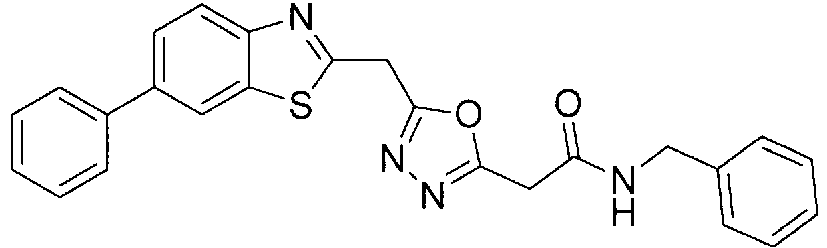
(DMSO-d6) δ 3 94 (s, 2H), 4.29 (d, J = 6.1 Hz, 2H), 4.95 (s, 2H), 7.20-7.32 (m, 5H), 7 38-7 42 (m, 1H), 7 50 (t, J = 76 Hz, 2H), 7 76 (d, J = 7.1 Hz, 2H), 7 83 (dd, J = 8 6, 2 0 Hz, 1H), 8.05 (d, J = 8.6 Hz, 1H), 8 44 (d, J = 2.0 Hz, 1H), 8.79 (t, J = 5 8 Hz, 1H) -
[Table 31] No. Structure NMR( δ ) I-2-66 
(DMSO-d6) δ 3 91 (s, 2H), 4.28 (d, J = 5 6 Hz, 2H), 4 95 (s, 2H), 6.26 (d, J = 2 5 Hz, 1 H), 6 37 (dd, J = 3 3, 1.8 Hz, 1H), 7.38-7 42 (m, 1H), 7.50 (t, J = 7.6 Hz, 2H), 7 57 (d, J = 1 0 Hz, 1H), 7.76 (d, J = 7.1 Hz, 2H), 7 83 (dd, J = 8 4, 1 8 Hz, 1H), 8.05 (d, J = 8 6 Hz, 1H), 8.44 (d, J = 15 Hz, 1H), 8.77 (t, J = 5.3Hz, 1H). I-2-67 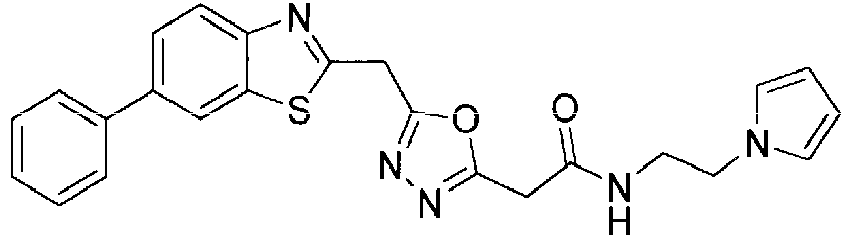
(DMSO-d6) δ· 3 35 (q, J = 5 6 Hz, 2H), 3.86 (s, 2H), 3 93 (t, J = 6.1 Hz, 2H), 4.94 (s, 2H), 5.96 (t, J = 23 Hz, 2H), 6 71 (t, J = 2.3 Hz, 2H), 7 38-7 42 (m, 1H), 7.50 (t, J = 7.6 Hz, 2H), 7 73-7 78 (m, 2H), 7 82 (dd, J = 8.6, 2.0 Hz, 1H), 8 05 (d, J = 8 6 Hz, 1H), 8.44 (d, J = 1 5 Hz, 2H) I-2-68 
(DMSO-d6) δ: 4 18 (s, 2H), 4.98 (s, 2H), 7 36 (dd, J = 8.6, 4.6 Hz, 1H), 7.38-7 42 (m, 1 H), 7 50 (t, J = 7 6 Hz, 2H), 7.76 (d, J = 7.6 Hz, 2H), 7 83 (dd, J = 84, 1 8 Hz, 1H), 7.98-8 02 (m, 1H), 8.05 (d, J = 8.1 Hz, 1H), 8.29 (dd, J = 46, 1 5 Hz, 1H), 8.44 (d, J = 1 5 Hz, 1H), 8.71 (d, J = 25 Hz, 1H), 10 63 (s, 1H) I-2-69 
(DMSO-d6) δ. 4.29 (s, 2H), 4.98 (s, 2H), 7 38-7 42 (m, 1 H), 7.50 (t, J = 7.6 Hz, 2H), 7.73-7.78 (m, 2H), 7 83 (dd, J = 8 6, 1.5 Hz, 1 H), 7.97-8.02 (m, 1H), 8.05 (d, J = 8.6 Hz, 1 H), 8 44 (d, J = 1 5 Hz, 1 H), 8 68 (d, J = 6 1 Hz, 1H), 891 (s, 1H), 11.34 (s, 1H). I-2-70 
(DMSO-d6) δ 1.10-1 17 (m, 4H), 3.89 (s, 2H), 4 95 (s, 2H), 7 00-7 07 (m, 2H), 7 15-7.20 (m, 2H), 7 38-7.42 (m, 1 H), 7.50 (t, J = 7 6 Hz, 2H), 7.73-7.78 (m, 2H), 7.83 (dd, J = 8 6, 2.0 Hz, 1 H), 8.04 (d, J = 8 6 Hz, 1H), 8 43 (d, J = 2.0 Hz, 1 H), 9.03 (s, 1 H). -
[Table 32] No. Structure NMR(δ) I-2-71 
(DMSO-d6) δ: 1.15-1.27 (m, 4H), 3.94 (s, 2H), 4.95 (s, 2H), 7.25 (dd, J = 7.9, 4.8 Hz, 1H), 7.38-7.42 (m, 1H), 7.50 (t, J = 7.9 Hz, 3H), 7.76 (d, J = 7.6 Hz, 2H), 7.83 (dd, J = 8.6, 20 Hz, 1H), 8.05 (d, J = 8.6 Hz, 1 H), 8.35 (dd, J = 4.8, 1.3 Hz, 1H), 8 42 (dd, J = 9.9, 1.8 Hz, 2H), 9.10 (s, 1H). I-2-72 
(COCl3) δ: 1.44 (s, 6H), 2.97 (s, 3H), 3.44 (d, J = 7.1 Hz, 2H), 4.74 (s, 2H), 5.32 (t, J = 6.8 Hz, 1 H), 7.26 (s, 3H), 7.37-7.41 (m, 1H), 7.46-7.50 (m, 2H), 7.64 (d, J = 8.1 Hz, 2H), 7 73 (d, J = 8.6 Hz, 1 H), 8.06-8.09 (m, 2H). I-2-73 
(DMSO-d6) δ: 0.59-0.61 (m, 4H), 1.30 (s, 6H), 1.52-1.59 (m, 1 H), 4.88 (s, 2H), 7.40 (t, J = 7.4 Hz, 1 H), 7.48-7.52 (m, 2H), 7.74-7.77 (m, 2H), 7.83 (dd, J = 8.6, 2.0 Hz, 1 H), 8.05 (d, J = 8.6 Hz, 1H ), 8.11 (t, J = 6.1 Hz, 1H), 8 43 (d, J = 2.0 Hz, 1H). I-2-74 
(CDC13) δ: 1.45 (s, 6H), 3.56 (s, 2H), 4.75 (s, 2H), 6.43 (br s, 1H), 7.39 (t, J = 7.4 Hz, 1H), 7.46-7.50 (m, 2H), 7 62-7.64 (m, 2H), 7.74 (dd, J = 8.4, 1.8 Hz, 1H), 8.05-8.07 (m, 2H). I-2-75 
(CDCl3) δ: 4.72 (s, 2H), 4.77 (s, 2H), 7 37-7 41 (m, 1H), 7.45-7.49 (m, 2H), 7.61-7.63 (m, 2H), 7.73 (dd, J = 8.4, 1 8 Hz, 1H), 8.02-8.06 (m, 2H). -
[Table 33] No. Structure NMR(δ) I-2-76 
(DMSO-d6) δ: 2.98 (t, J = 6.60 Hz, 2H), 3 27 (t, J = 6.60 Hz, 2H), 5.01 (s, 2H), 7.40-7.54 (m, 3H), 7.78 (d, J = 6.60 Hz, 2H), 7.94 (d, J = 1.80 Hz, 1H), 8.44 (d, J = 1.80 Hz, 1H). I-2-77 
1H-NMR (DMSO-d6) δ. 0.38-0 43 (m, 2H), 0.59-2.65 (m, 2H), 2.55-2.67 (m, 1H), 3.80 (s, 2H), 5.0 (s, 2H), 7.40-7.54 (m, 3H), 7.78 (d, J = 6.90 Hz, 2H), 7.94 (d, J = 1.50 Hz, 1H), 8.36 (brs, 1H), 8.45 (d, J = 1.50 Hz, 1H). I-2-78 
(DMSO-d6) δ: 3.18 (t, J = 6 08 Hz, 2H), 4.26 (t, J = 6 08 Hz, 2H), 4.93 (s, 2H), 6 56 (br s, 2H), 7 40 (t, J = 7 35 Hz, 1H), 7.50 (dd, J = 7.35, 7 60 Hz, 2H), 7.76 (d, J = 7 60 Hz, 2H), 7.82 (dd, J = 8 62. 1.52 Hz, 1 H), 8.05 (d, J = 8.62 Hz, 1H), 8.43 (d, J = 1.52 Hz, 1H) I-2-79 
(CDCl3) δ: 3.46 (s, 3H), 4.66 (s, 2H), 4.77 (s, 2H), 7.39 (t, J = 7.35 Hz, 1H), 7.47 (dd, J = 7 60, 7 35 Hz, 2H), 7.63 (d, J = 7 60 Hz, 2H), 7.73 (dd, J = 8.62, 1.52 Hz, 1H), 8.04-8.09 (m, 2H). I-2-80 
2009-7312-028-01 1H-NMR (DMSO-d6) δ: 3 81 (s, 3H), 3.99 (s, 2H), 4.20 (d, J = 5.6 Hz, 2H), 4.94 (s, 2H), 7.05-7.07 (m, 2H), 7.68-7.71 (m, 2H), 7.78 (dd, J = 86, 2.0 Hz, 1H), 8.01 (d, J = 8.6 Hz, 1 H), 8 37 (d, J = 2.0 Hz, 1H), 9.03 (t, J = 5.3 Hz, 1H). -
[Table 34] No. Structure NMR(δ) I-2-81 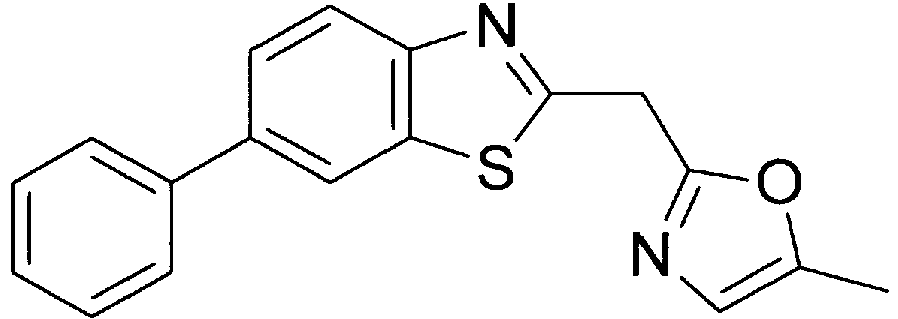
(CDCl3) δ·2.31 (s, 3H), 4.60 (s, 2H), 6.73 (d, J = 1.0 Hz, 1H), 7.38 (t, J = 7.4 Hz, 1H), 7.44-7.49 (m, 2H), 7.61-7.64 (m, 2H), 7.70 (dd, J = 86, 2.0 Hz, 1H), 8.04-8.08 (m, 2H). I-2-82 
(DMSO-d6) δ = 0.33 (d, J = 6.30 Hz, 4H), 3 11 (d, J = 5.40 Hz, 2H), 3 24 (d, J = 5.70 Hz, 2H), 3.89 (s, 2H), 5.00 (s, 2H), 7.40-7.54 (m, 3H), 7.78 (d, J = 7.50 Hz, 1H), 7.94 (d, J = 1.20 Hz, 1H), 8.26 (brs, 1H), 8.44 (d, J = 1.20 Hz, 1H) I-2-83 
(DMSO-d6) δ: 4.64 (d, J = 6 08 Hz, 2H), 4.97 (s, 2H), 5.91 (t, J = 6.08 Hz, 1H), 7.40 (t, J = 7.35 Hz, 1H). 7.50 (dd, J = 7.60, 7.35 Hz 2H), 7.76 (d, J = 7 60 Hz, 2H), 7.83 (dd, J = 8.62, 1.52 Hz, 1H), 8.05 (d, J = 8.62 Hz, 1H), 8.44 (d, J = 1.52 Hz, 1H). I-2-84 
(DMSO-d6) δ: 1.72-1.82 (m, 1H), 2.34-2.43 (m, 1H), 2.75-2 83 (m, 1H), 2.87-2.96 (m, 1H), 3.91 (d, J = 2.5 Hz, 2H), 4.97 (s, 2H), 5.25 (q, J = 7.8 Hz, 1 H), 7.10-7 15 (m, 1H), 7 17-7.26 (m, 3H), 7.38-7 42 (m, 1H), 7.50 (t, J = 7.6 Hz, 2H), 7 73-7 78 (m, 2H), 7 83 (dd, J = 8.4, 1.8 Hz, 1 H), 8 05 (d, J = 8.6 Hz, 1H), 8.45 (d, J = 1.5 Hz, 1H), 8 69 (d, J = 8.1 Hz, 1H) -
[Table 35] No. Structure NMR(δ) I-2-85 
(DMSO-d6) δ: 1.63-1 74 (m, 1H), 1 74-1.85 (m, 1H), 1.85-1 95 (m, 2H), 2.81 (q, J = 6.3Hz, 2H), 3.92 (d, J J = 3.5 Hz, 2H), 4.96 (s, 3H), 7.13(dd,J=7.6,4.6Hz, 1H), 7.38-7.43 (m, 1H), 7.48-7 55 (m, 3H), 7.76 (d, J = 7 1 Hz, 2H), 7 83 (dd, J = 8.4, 1.8 Hz, 1H), 8.05 (d, J = 8.1 Hz, 1H), 8 35 (dd, J = 3.5, 1 8 Hz, 1H), 8.45 (d, J = 1.5 Hz, 1H), 8.74 (d, J = 8.6 Hz, 1H). I-2-86 
(DMSO-d6) δ: 1.15 (t, J = 7.1 Hz, 2H), 1 91-1.98 (m, 1H), 2.78-2.85 (m, 1H), 3.85 (s, 2H), 4.95 (s, 2H), 7.08 (d, J = 7.1 Hz, 2H), 7.11-717 (m, 1H), 7.21-7 26 (m, 2H), 7 38-7.42 (m, 1H), 750 (t, J = 7.6Hz, 2H), 7 75 (d, J = 7.6 Hz, 2H), 7 82 (dd, J = 8.6, 1.5 Hz, 1H), 8 05 (d, J = 8.6 Hz, 1H), 8 43 (d, J = 2.0 Hz, 1H), 8 63 (d, J = 4.1 Hz, 1H) I-2-87 
(DMSO-d6) δ: 1.40-1 55 (m, 6H), 1.86-1.92 (m, 2H), 2.14 (s, 3H), 3.01 (s, 2H), 3.78-3.88 (m, 1H), 3.79 (s, 2H), 4.93 (s, 2H), 7 38-7.43 (m, 1H), 7.50 (t, J = 7.6 Hz, 2H), 7.76 (d, J = 7.1 Hz, 2H), 7.83 (dd, J = 8 6, 2.0 Hz, 1H), 8.05 (d, J = 8.6 Hz, 1H), 8.13 (d, J = 8.1 Hz, 1H), 8.44 (d, J = 2.0 Hz, 1H) I-2-88 
(DMSO-d6) δ: 1.57 (s, 6H), 1.87 (d, J = 25 Hz, 6H), 1.96 (s, 3H), 3.57-3 63 (m, 1H), 3 79 (s, 2H), 4 94 (s, 2H), 7.38-7.42 (m, 1H), 7.50 (t, J = 7 9 Hz, 2H), 7.73-7 85 (m, 4H), 8.04 (d, J = 8.6Hz, 1H), 8.43 (d, J = 1.5 Hz, 1H). -
[Table 36] No. Structure NMR(δ) I-2-89 
(DMSO-d6) δ 1 19 (t, J = 7.4 Hz, 3H), 1.32-1.43 (m, 2H), 1 75-1.83 (m, 2H), 2.87-2.95 (m, 2H), 3.01 n1 (q, J = 7.3 Hz, 2H), 3.46-3 54 (m, 2H), 3 65-3 74 (m, 1H), 3.85 (s, 2H), 4.94 (s, 2H), 7.38-7 43 (m, 1H), 7.50 (t, J = 7 6 Hz, 2H), 7.76 (d, J = 71 Hz, 2H), 7.83 (dd, J = 8 6, 2 0 Hz, 1H), 8.05 (d, J = 8.6 Hz, 1H), 8.35 (d, J = 7.6 Hz, 1H), 844 (d, J = 15 Hz, 1H) I-2-90 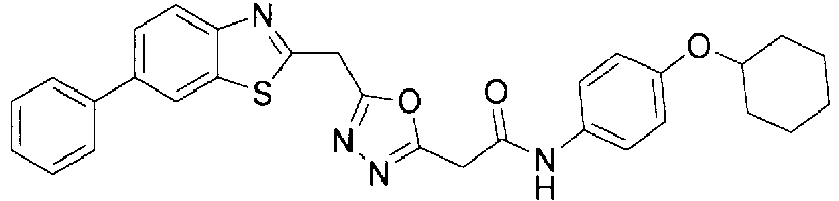
(DMSO-d6) δ 1 20-1.44 (m, 5H), 1.47-1 55 (m, 1H), 1 65-1 72 (m, 2H), 1.85-1 92 (m, 2H), 4 08 (s, 2H), 4 21-4.28 (m, 1H), 4 97 (s, 2H), 6 87 (d, J = 9 1 Hz, 2H), 7 38-7 45 (m, 3H), 7.50 (t, J = 7.6 Hz, 2H), 7.76 (d, J = 7.6 Hz, 2H), 7 83 (dd, J = 8 6, 2.0 Hz, 1H), 8.05 (d, J = 8.6 Hz, 1H), 8.43 (d, J = 1.5 Hz, 1 H), 10 23 (s, 1H). I-2-91 
(DMSO-d6) δ 1 40 (s, 9H), 1 42-1 53 (m, 2H), 1 82-1.91 (m, 2H), 3.10-3 19 (m, 2H), 3 60-3 67 (m, 2H) 4.08 (s 2H) 4 43-4 50 (m, 1H), 4.97 (s, 2H), 6 92 (d, J = 9.1 Hz, 2H), 7 38-7 53 (m, 5H), 7 76 (d, J = 7 1 Hz, 2H), 7 83 (dd, J = 8 6, 1.5 Hz, 1H), 8 05 (d, J = 8 6 Hz, 1H), 8.43 (d, J = 2.0 Hz, 1H), 10.26 (s, 1H). I-2-92 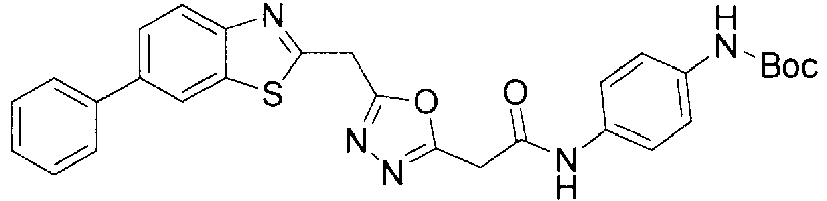
(DMSO-d6) (δ · 1.46 (s, 9H), 4.09 (s, 2H), 4.97 (s, 2H), 7 35-7.45 (m, 5H), 7 50 (t, J = 7.6 Hz, 2H), 7.76 (d, J = 7.1 Hz, 2H), 7.82 (dd, J = 8.6, 1 5 Hz, 1H), 8.04 (d, J = 86 Hz, 1H), 8.43 (d, J = 1.5 Hz, 1H), 9.28 (s, 1H), 10 28 (s, 1H) I-2-93 
(DMSO-d6) δ 1 53 (s, 9H), 4.18 (s, 2H), 4.98 (s, 2H), 7 38-7.43 (m, 1H), 7 50 (t, J = 7.6 Hz, 2H), 7 67 (d, J = 8.6 Hz, 2H), 7.76 (d, J = 7.1 Hz, 2H), 7 81-7 88 (m, 3H), 8.04 (d, J = 8.6 Hz, 1H), 8.44 (d, J = 1.5 Hz, 1H), 10 72 (s, 1 H). -
[Table 37] No. Structure NMR(δ) I-2-94 
(DMSO-d6) δ 4.19 (s, 2H), 4.98 (s, 2H), 7.38-7 43 (m, 1H), 7.50 (t, J = 7.6 Hz, 2H), 7 68 (d, J = 9.1 Hz, 2H), 7.76 (d, J = 7 6 Hz, 2H), 7 83 (dd, J = 8.6, 2.0 Hz, 1H), 7.91 (d, J = 8.6 Hz, 2H), 8.05 (d, J = 8.6 Hz, 1H), 8.44 (d, J = 1 5 Hz, 1H), 10.71 (s, 1H), 12.77 (s, 1H) I-2-95 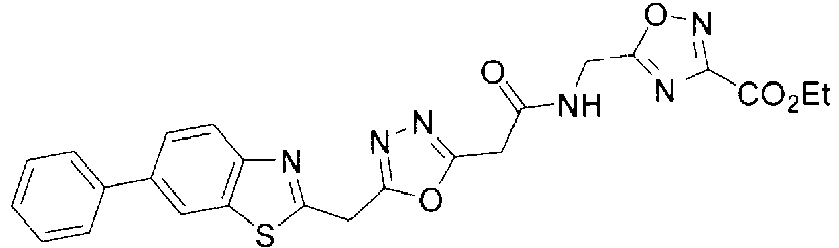
(DMSO-d6) δ · 1 31 (t, J = 7.10 Hz, 3H), 4.03 (s, 2H), 4.39 (q, J = 7 10 Hz, 2H), 4 70 (d, J = 6.08 Hz, 2H), 4.95 (s, 2H), 7.40 (t, J = 7.35 Hz, 1H), 7.50 (dd, J = 7 35, 7 10 Hz, 2H), 7 76 (d, J = 7 10 Hz, 2H), 7.82 (dd, J = 8.36, 2.03 Hz, 1H), 8.05 (d, J = 8.36 Hz, 1H), 8.43 (d, J = 2.03 Hz, 1H), 9.23 (t, J = 6.08 Hz, 1H) I-2-96 
(DMSO-d6) δ · 1.53 (s, 9H), 3 99 (s, 2H), 4.50 (d, J = 5.58 Hz, 2H), 4 95 (s, 2H), 6 68 (s, 1H), 7 40 (t, J = 7 35 Hz, 1H), 7.50 (dd, J = 7.10, 7 35 Hz, 2H), 7.75 (d. J = 7.10 Hz, 2H), 7.82 (dd, J = 8.62, 1.52 Hz, 1H), 8.04 (d, J = 8 62 Hz, 1H), 8.43 (d, J = 1.52 Hz, 1H), 9.01 (t, J = 5.58 Hz, 1H). I-2-97 
(CDCl3) δ: 2.66 (d, J = 5.6 Hz, 3H), 4.54 (d, J = 6.6 Hz, 2H), 4 78 (s, 2H), 4 85 (q, J = 5.6 Hz, 1H), 5.06 (t, J = 6.3 Hz, 1H), 7.42 (t, J = 7.4 Hz, 1 H), 7.48-7 52 (m, 2H), 7 64-7 66 (m, 2H), 7.75 (dd, J = 8.6, 2.0 Hz, 1H), 8.05-8.09 (m, 2H) I-2-98 
(CDCl3) δ . 3.09 (s, 3H), 4 66 (d, J = 6.6 Hz, 2H), 4.78 (s, 2H), 5.16 (t, J = 6.1 Hz, 1 H), 7 09-7 13 (m, 1H), 7 34-7 37 (m, 1H), 7 41-7 49 (m, 2H), 7.73 (dd, J = 8 6, 1.5 Hz, 1H), 8.06-8.09 (m, 2H) -
[Table 38] No. Structure NMR(δ) retention time Mass method I-2-99 
(DMSO-d6) δ 1.40 (s, 9H), 4 41 (d, J = 5 6 Hz, 2H), 4.96 (s, 2H), 7.21-7.26 (m, 1H), 7.51-7 57 (m, 1H), 7.61-7 64 (m, 2H), 7 87 (dd, J = 8.6, 2.0 Hz, 1H), 8.05 (d, J = 8.6 Hz, 1H), 8.50 (d, J = 1.5 Hz, 2H), 11.05 (s, 1H) I-2-100 
(DMSO-d6) δ 4.32 (d, J = 5 6 Hz, 2H), 4.96 (s, 2H), 6 77 (s, 2H), 7 21-7 26 (m, 1H), 7.43 (t, J = 6.1 Hz, 1H), 7.54 (dd, J = 14 4, 7 9 Hz, 1H), 7 61-7 64 (m, 2H), 7.87 (dd, J = 8.4, 1 8 Hz, 1H), 8.06 (d, J = 8.6 Hz, 1H), 8.50 (d, J = 2.0 Hz, 1H). I-2-101 
1 68 43215 C I-2-102 
(DMSO-d6) δ 3.99 (s,2H),4.20(s,2H),4.92(s ,2H),5 37(s,2H),7 30-7.38(m,5H), 7 74(d,J=9.0Hz, 1H),7.94(d,J =9.0Hz,1H),8 01 (s,1H),8 32( s,1H),8 37(s,1H),9 03(s,1H) I-2-103 
(DMSO-d6) δ 1 12-1.24(m,2H),1.47-1 50(m,2H),3 90(s,2H),,4 91 ( s,2H),5.37(s,2H),7.28-7.38(m,5H), 7 74(d,J=9 0Hz,1H),7.94(d,J =9.0Hz,1H),8.01(s,1H),8.32( s,1H),8 37(s,1H),9 23(s,1H) -
[Table 39] No. Structure NMR(δ) I-2-104 
(DMSO-d6) δ 1.76-2.18(m,4H)2.78(s,3H),,3.16-3 38(m,4H),4.08(s,2H),4.54( bs,1H),4.95(s,2H)6.97(d,J=9 0Hz,2H),7.49(d,J=9.0Hz,2H ),7.68(d,J=6.0Hz,1H),7 92(d, J=6.0Hz,1H),8.42(s,1H),10 2 7(s,1H) I-2-105 
(DMSO-d6) δ : 3.98 (s, 2H), 4.19 (d, J = 5.58 Hz, 2H), 4.96 (s, 2H), 7 63 (dd, J = 8.62, 1.77 Hz, 1H), 8.10 (d, J = 8.62 Hz, 1H), 8.22 (d, J = 1.77 Hz, 1H), 9.01 (t, J = 5.58 Hz, 1H). I-2-106 
(DMSO-d6) δ : 1.13 (dd, J = 8.36, 5.83 Hz, 2H), 1 48 (dd, J = 8.36, 5 83 Hz, 2H), 3 90 (s, 2H), 4 96 (s, 2H), 7.64 (dd, J = 8.62, 1.52 Hz, 1H), 8.10 (d, J = 8.62 Hz, 1H), 8 22 (d, J = 1.52 Hz, 1H), 9 22 (s, 1H). I-2-107 
(DMSO-d6) δ: 2.65 (t, J = 6 6Hz, 2H), 3.33 (t, J = 6 6Hz, 2H), 3.91 (s, 2H), 4 94 (s, 2H), 7.40 (t, J = 6.9Hz, 1H), 7.46-7 53 (m, 2H), 7 73-7.85 (m, 3H), 8.05 (d, J = 8.7Hz, 1 H), 8 43 (s, 1H), 8.68 (br-s, 1H) I-2-108 
(DMSO-d6) δ : 3.13 (s, 3H), 4.34 (s, 2H), 4.41 (s, 2H), 4.97 (s, 2H), 7.40 (t, J = 6.9Hz, 1H), 7.46-7.53 (m, 2H), 7.73-7.85 (m, 3H), 8.05 (d, J = 8.4Hz, 1H), 8.43 (s, 1H) -
[Table 40] No. Structure NMR(δ) I-2-109 
(DMSO-d6) δ: 4.98 (s, 2H), 5:49 (s, 2H), 6.54 (t, J = 6.8 Hz, 1H), 7.40 (t, J = 7.4 Hz, 1H), 7.48-7 52 (m, 2H), 7 74-7.77 (m, 2H), 7.83 (dd, J = 8.6, 2.0 Hz, 1H), 8.04 (d, J = 8.6 Hz, 1 H), 8 23-8.28 (m, 2H), 843 (d, J = 1.5 Hz, 1H). I-2-110 
(CDCl3) δ : 2.97 (s, 3H), 3.01 (s, 3H), 4.70 (s, 2H), 4.76 (s, 2H), 7.37-7 41 (m, 1H), 7.46-7.50 (m, 2H), 7.62-7.64 (m, 2H), 7.73 (dd, J = 8.6, 2.0 Hz, 1H), 8.04 (d, J = 8.1 Hz, 1H), 8.07 (d, J = 1.5 Hz, 1H). I-2-111 
(CDCl3) δ : 2.97 (s, 3H), 4 68 (s, 2H), 4.76 (s, 2H), 525 (s, 2H), 739 (t, J = 7.4 Hz, 1H), 7 46-7.50 (m, 2H), 7.62-7.64 (m, 2H), 7.73 (dd, J = 8 6, 1.5 Hz, 1H), 8.03 (d, J = 8.6 Hz, 1H), 8.07 (d, J = 1.5 Hz, 1.H). I-2-112 
(DMSO-d6) δ : 4.02 (s, 2H), 4.91 (s, 2H), 4.96 (s, 2H), 6.50 (d, J = 8 1 Hz, 2H), 7.18 (d, J = 8.6 Hz, 2H), 7.38-7.43 (m, 1H), 7.50 (t, J = 7.6 Hz, 2H), 7.76 (d, J = 8.1 Hz, 2H), 7.83 (d, J = 8.1 Hz, 1H), 8.05 (d, J = 8.6 Hz, 1H), 8 43 (s, 1H), 9.96 (s, 1H). I-2-113 
(DMSO-d6) δ : 4.10 (s, 2H), 4.97 (s, 2H), 6.47 (dd, J = 7.9, 2 3 Hz, 1H), 6 93 (d, J = 7.6 Hz, 1H), 7.08 (t, J = 8.1 Hz, 1H), 7.13 (s, 1H), 7.37-7.43 (m, 1H), 7.50 (t, J = 7.6 Hz, 2H), 7.76 (d, J = 7.6 Hz, 2H), 7.82 (dd, J = 8.4, 1.8 Hz, 1H), 8.05 (d, J = 8.1 Hz, 1H), 8.43 (d, J = 1.5 Hz, 1H), 9.40 (s, 1H), 10 25 (s, 1H). -
[Table 41] No. Structure NMR(δ) I-2-114 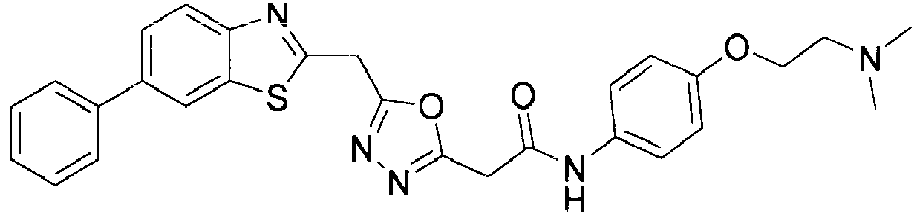
(DMSO-d6) δ : 2.20 (s, 6H), 2 59 (t, J = 5.8 Hz, 2H), 3.99 (t, J = 5.8 Hz, 2H), 4.08 (s, 2H), 4.97 (s, 2H), 6.86-6.91 (m, 2H), 7.37-7.47 (m, 3H), 7.50 (t, J = 7.6 Hz, 2H), 7.73-7.78 (m, 2H), 7.82 (dd, J = 8.6, 2 0 Hz, 1H), 8.04 (d, J = 8.6 Hz, 1H), 8.43 (d, J = 1 5 Hz, 1H), 10.23 (s, 1H). I-2-115 
(DMSO-d6) δ : 1.76-1 85 (m, 2H), 2.13 (s, 6H), 2.33 (t, J = 7.4 Hz, 2H), 3.94 (t, J = 6 3 Hz, 2H), 4.08 (s, 2H), 4.97 (s, 2H), 6 87 (d, J = 9.1 Hz, 2H), 7.37-7 46 (m, 3H), 7.50 (t, J = 7.6 Hz, 2H), 7 73-7 78 (m, 2H), 7.82 (dd, J = 8.4, 1.8 Hz, 1H), 8.04 (d, J = 8.6 Hz, 1H), 8.43 (d, J = 1.5 Hz, 1H), 10 23 (s, 1H). I-2-116 
(DMSO-d6) δ : 1.40-1.51 (m, 1H), 1.52-1 62 (m, 1H), 1.80-1.97 (m, 2H), 2.00 (s, 3H), 3 15-3 24 (m, 1H), 3.38 (q, J = 7.1 Hz, 1H), 3 61-3.69 (m, 1H), 3.78-3.86 (m, 1H), 4.08 (s, 2H), 4 48-4.56 (m, 1H), 4.96 (s, 2H), 6 93 (d, J = 9.1 Hz, 2H), 7 37-7.53 (m, 5H), 7.76 (d, J = 7.1 Hz, 2H), 7 83 (dd, J = 8.6, 2 0 Hz, 1H), 8.04 (d, J = 8.6 Hz, 1H), 8.43 (d, J = 1.5 Hz, 1H), 10 25 (s, 1H). I-2-117 
(DMSO-d6) δ : 1.29-1.40 (m, 2H), 1.80-1 88 (m, 2H), 1.98 (t, J = 10.9 Hz, 2H), 2.15 (s, 3H), 2.66-2.74 (m, 2H), 3.05-3.15 (m, 1H), 4.02 (s, 2H), 4.96 (s, 2H), 5.26 (d, J = 8.1 Hz, 1H), 6.51 (d, J = 9 1 Hz, 2H), 7.22 (d, J = 8.6 Hz, 2H), 7.38-7.43 (m, 1H), 7.50 (t, J = 7.6 Hz, 2H), 7.75 (d, J = 7.1 Hz, 2H), 7.82 (dd, J = 8.6, 2.0 Hz, 1H), 8.04 (d, J = 8.6 Hz, 1H), 8.43 (d, J = 2.0 Hz, 1H), 9.96 (s, 1H). -
[Table 42] No. Structure NMR (δ) I-2-118 
(DMSO-d6) δ · 1 15-1.26 (m, 3H), 1.81-1.88 (m, 2H), 2 52-2.59 (m, 2H), 2.93-2 99 (m, 2H), 3.15-3.27 (m, 1H), 4 02 (s, 2H), 4.96 (s, 2H), 5 29 (d, J = 8.1 Hz, 1H), 6 51 (d, J = 8.6 Hz, 2H), 7 22 (d, J = 9.1 Hz, 2H), 7.38-7.42 (m, 1H), 750 (t, J = 7.6Hz, 2H), 7.73-7.78 (m, 2H), 7.82 (dd, J = 8.6, 1.5 Hz, 1 H), 8.04 (d, J = 8.6 Hz, 1H), 8.43 (d, J = 1.5 Hz, 1H), 9.96 (s, 1H). I-2-119 
(DMSO-d6) δ : 1.14 (dd, J = 8.36, 5.32 Hz, 2H), 1.49 (dd, J = 8.36, 5.32 Hz, 2H), 3 91 (s, 2H), 4.97 (s, 2H), 7.20-7 26 (m, 1H), 7.50-7.65 (m, 3H), 7.87 (dd, J = 8.62, 1.52 Hz, 1H), 8.06 (d, J = 8.62 Hz, 1H), 8.49 (d, J = 1 52 Hz, 1H), 9.23 (s, 1H). I-2-120 
(DMSO-d6) δ 1.18 (s, 9H), 2.93 (t, J = 6.59 Hz, 2H), 3 35 (dt, J = 6.59, 6.08 Hz, 2H), 4.91 (s, 2H), 5.75 (s, 1H), 5.82 (t, J = 6.08 Hz, 1H), 7.40 (t, J = 7.35 Hz, 1H), 7.50 (dd, J = 7.10, 7.35 Hz, 2H), 7.75 (d, J = 7.10 Hz, 2H), 7.82 (dd, J = 8.62, 1.52 Hz, 1H), 8.05 (d, J = 8 62 Hz, 1H), 8.42 (d, J = 1.52 Hz, 1H). I-2-121 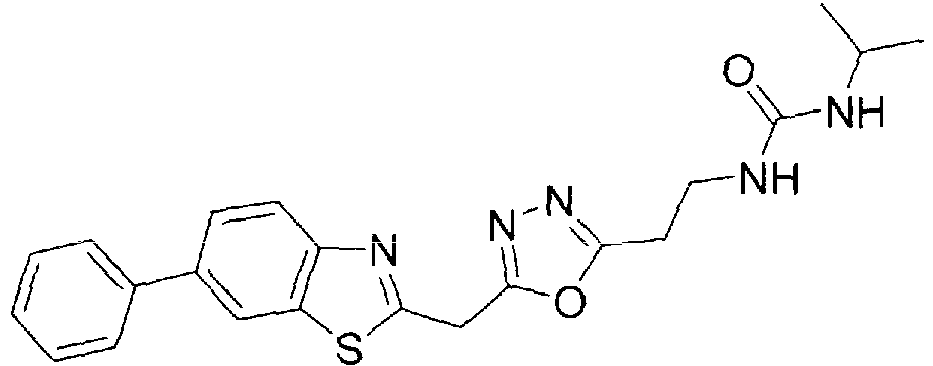
(DMSO-d6) δ : 0 99 (d, J = 6.59 Hz, 6H), 2 95 (t, J = 6.59 Hz, 2H), 3 37 (dt, J = 6.59, 5.83 Hz, 2H), 3.62 (m, 1H), 4.91 (s, 2H), 5.80 (d, J = 7.60 Hz, 1H), 5 88 (t, J = 5.83 Hz, 1H), 7.40 (t, J = 7.35 Hz, 1H), 7.50 (dd, J = 7.60, 7 35 Hz, 2H), 7.75 (d, J = 7.60 Hz, 2H), 7.82 (dd, J = 8.62, 1.52 Hz, 1H), 8.05 (d, J = 8.62 Hz, 1H), 8 42 (d, J = 1.52 Hz, 1H). -
[Table 43] No. Structure NMR(δ) I-2-122 
(DMSO-d6) δ 4.00(s,2H),4.37(s,2H),4.96(s ,2H),,7.37-7 80(m,9H),7.83(d,J=6 0Hz, 1H),8.05(d,J=6.0Hz,1H),8.44 (s,1H),8.89(s,1H) I-2-123 
(DMSO-d6) δ 2.84-3.01(m,2H),3.58-3 77(m,2H),4.35(s,2H),4.65-4 78(m,2H),4.96(s,2H),7.37-7.78(m8H),7.83(d,J=6.0Hz,1 H),8.02(d,J=6.0Hz,1H),8.43( s,1H) I-2-124 
(DMSO-d6) δ 4.19(s,2H),4.98(s,2H),,7.37-7.86(m, 10H),8.04(m,1H),8.4 4(s,1H),10.78(s,1H) I-2-125 
(DMSO-d6) δ 4.25(s,2H),4 98(s,2H),,7.34-7.78(m,10H),8.05(d,J=6.0Hz ,1H),8.43(s,1H),10.65(s,1H) I-2-126 
(DMSO-d6) δ 4.04(s,2H),4.96(s,2H),6.16(b s,1H),7.36-7.55(m,8H),7.73-7.84(m,3H),8 04-8.07(m,1H),8.43(s,1H),9.63( s,1H) -
[Table 44] No. Structure NMR(δ) I-2-127 
(DMSO-d6) δ: 2.95 (t, J = 6 59 Hz, 2H), 3.36 (dt, J = 6.59, 5.58 Hz, 2H), 4.91 (s, 2H), 5.51 (s, 2H), 6.12 (t, J = 5.58 Hz, 1H), 7.40 (t, J = 7.35 Hz, 1H), 7.50 (dd, J = 7.60, 7 35 Hz, 2H), 7.75 (d, J = 7.60 Hz, 2H), 7.82 (dd, J = 8.62, 1.52 Hz, 1H), 8.05 (d, J = 8.62 Hz, 1H), 8.43 (d, J = 1.52 Hz, 1H) I-2-128 
(CDCl3) (δ 3.16 (t, J = 5.58 Hz, 2H), 3.81 (t, J = 5 58 Hz, 2H), 4 74 (s, 2H), 6 43 (brs, 1H), 7 39 (t, J = 7 35 Hz, 1H), 7 48 (dd, J = 7.60, 7 35 Hz, 2H), 7.63 (d, J = 7.60 Hz, 2H), 7.73 (dd, J = 8.62, 2.03 Hz, 1H), 8 04-8 09 (m, 2H). I-2-129 
(DMSO-d6) δ 3.01 (t, J = 6 84 Hz, 2H), 3 24-3.32 (m, 2H), 4.34 (s, 2H), 4 91 (s, 2H), 7.31-7 43 (m, 7H), 7.50 (dd, J = 7.10, 7 35 Hz, 2H), 7.75 (d, J = 7.10 Hz, 2H), 7.82 (dd, J = 8.36, 1 52 Hz, 1H), 8.05 (d, J = 8 62 Hz, 1H), 8.43 (d, J = 1.52 Hz, 1H) I-2-130 
(CDCl3) δ 3.05 (t, J = 6 08 Hz, 2H), 3 48 (dt, J = 6 08, 6 84 Hz, 2H), 4 71 (s, 2H), 5 51 (t, J = 6 84 Hz, 1H), 7.15-7 21 (m, 2H), 7.39 (t, J = 7.35 Hz, 1H), 747 (dd, J = 7.60, 7 35 Hz, 2H), 7.63 (d, J = 7.60 Hz, 2H), 7 73 (dd, J = 8.62, 2 03 Hz, 1H), 7.85-7.91 (m, 2H), 8.05-8 09 (m, 2H) I-2-131 
(DMSO-d6) δ 1.72-2 23(m,4H)2 82(s,3H),,3.00-3 38(m,4H),4.08(s,2H),4.54( s,1H),4.95(s,2H)6.90-7.03(m,,2H),7.45-7.55(m,4H),7.98(d,J=6.0Hz, 1H),8.12(d,J=6.0Hz,1H),10.2 8(s,1H) -
[Table 45] No. Structure NMR(δ) I-2-132 
(DMSO-d6) δ 3 99(s,2H),4.18-4 22(m,2H),4 94(s,2H)7.46-7.57(m,2H),7.98(d,J=6.0Hz, 1H),8.14(d,J=6.0Hz,1H),9.03 (s,1H) I-2-133 
(DMSO-d6) δ : 4.97 (s, 2H), 7.40 (t, J = 7.35 Hz, 1H), 7.47-7.57 (m, 4H), 7 65 (t, J = 7.10 Hz, 1H), 7.76 (d, J = 7.10 Hz, 2H), 7.83 (dd, J = 8.62, 2.03 Hz, 1H), 7.99 (d, J = 7.60 Hz, 2H), 8.06 (d, J = 8.62 Hz, 1H),845(d,J=1.52Hz, 1H), 12.01 (s, 1H). I-2-134 
(CDCl3) δ: 4.06 (q, J = 9.0 Hz, 2H), 4.68 (d, J = 5 1 Hz, 2H), 4.75 (s, 2H), 5.52 (br s, 1H), 7.39 (t, J = 7.4 Hz, 1H), 7.46-7.49 (m, 2H), 7.62-7 64 (m, 2H), 7.73 (dd, J = 8.6, 1.5 Hz, 1H), 8.04-8.07 (m, 2H). I-2-135 
(DMSO-d6) δ : 4.32 (s, 2H), 4.82 (s, 2H), 7.40 (t, J = 7.4 Hz, 1H), 7.49-7.62 (m, 5H), 7.74-7.77 (m, 4H), 7.83 (dd, J = 8.6, 2.0 Hz, 1H), 8.05 (d, J = 8 6 Hz, 1H), 8.45 (d, J = 2 0 Hz, 1H), 8.60 (br s, 1H). I-2-136 
(DMSO-d6) δ:0.55-057 (m, 2H), 0.63-0.67 (m, 2H), 3.39 (d, J = 5.7Hz, 2H), 3.80 (s, 2H), 4.71 (br-s, 1H), 4.94 (s, 2H), 7 39 (m, 1H), 7 47-7.53 (m, 3H), 7 73-7.84 (m, 3H), 8.05 (d, J = 8.7Hz, 1H), 8.43 (s, 1H), 8.55 (s, 1H) -
[Table 46] No. Structure NMR(δ) I-2-137 
(DMSO-d6) δ 1.38(s,9H),3.76(d,J=6.0Hz,2 H),3.94(s,2H),4.94(s,2H),7.3 8-7.42(m,1H),7.50(t,J=6.0Hz,2 H),7.75(d,J=6.0Hz,2H),7.83( d,J=6.0Hz,1H),8.05(d,J=6.0 Hz,1H),8.43(s,1H),8.64(t,J= 6.0Hz,1H) I-2-138 
(CDCl3) δ: 3 14 (t J = 6.08 Hz, 2H), 3.71 (dt, J = 6.08, 5 07 Hz, 2H), 3.85 (q, J = 9.12 Hz, 2H), 4 73 (s, 2H), 5.80 (t, J = 5.07 Hz, 1H), 7.39 (t, J = 7.35 Hz, 1H), 7.47 (dd, J = 7.35, 7.60 Hz, 2H), 7.63 (d, J = 7.60 Hz, 2H), 7.73 (dd, J = 8 62, 2.03 Hz, 1H), 8.04-8.09 (m, 2H) I-2-139 
(CDCl3) δ : 1.10 (t, J = 7.4 Hz, 3H), 3.01-3 08 (m, 2H), 4.51 (d, J = 6.6 Hz, 2H), 4.84 (t. J=5.6Hz,1H), 4.76 (s, 2H), 4.92 (t, J = 5.6 Hz, 1H), 7.07-7.10 (m, 1H), 7.32-7.34 (m, 1H), 7.39-7.47 (m, 2H), 7.71 (dd, J = 8.4, 1.8 Hz, 1H), 8.06-8.08 (m, 2H). I-2-140 
(CDCl3) δ : 3 83 (s, 3H), 4 44 (d, J = 6.1 Hz, 2H), 462 (s, 2H), 5.14 (t, J = 6.3 Hz, 1H), 6.88-6.91 (m, 2H), 7 39 (t, J = 7.1 Hz, 1H), 7.46-7.50 (m, 2H), 7 63 (d, J = 7.6 Hz. 2H), 7.72-7 78 (m, 3H), 8.04-8.07 (m, 2H). I-2-141 
(DMSO-d6) δ 3.79(d,J=6.0Hz,2H),3.97(s,2 H),4.14(d,J=6.0Hz,2H),4.95( s,2H),7.35-7.44(m,1H),7.50(t,J=6.0Hz,2 H),7.76(d,J=6.0Hz,2H),7.83( d,J=6.0Hz,1H),805(d,J=6.0 Hz,1H),8.44(s,1H),8.66(t,J= 6.0Hz,1H) -
[Table 47] No. Structure NMR(δ) I-2-142 
(DMSO-d6) δ 2 78(s,6H),3.11 (t,J=3.0Hz,2 H),3.2-3.36(m,2H),3 76(d,J=3.0Hz, 2H),3.98(s,2H),4.95(s,2H),7 35-7.44(m,1H), 7.51(t,J=6.0H z,2 H),7 76(d,J=6.0Hz,2H),7.83( d,J=6.0Hz,1H),8 05(d,J=6 0 Hz,1H)8.16(t,J=3.0Hz,1H),8 44(s,1H),8.60(t,J=60Hz,1H) I-2-143 
(DMSO-d6) δ 1.68-1 80(m,2H),2.70(s,6H),2.89-2 95(m,2H),3.10-3 26(m,2H),3 71 (d,J=3.0Hz, 2H),3 97(s,2H),4.95(s,2H),7 33-7 42(m,1H),7.51(t,J=6.0Hz,2 H),7.76(d,J=6.0Hz,2H),7.83( d,J=6.0Hz,1H),8.05(d,J=6.0 Hz,1H)8.06(t,J=3.0Hz,1H),8. 44(s,1H),8.62(t,J=6.0Hz,1H) I-2-144 
(DMSO-d6) δ: 1.40 (s, 9H), 1.44-1.53(m,2H), 1.84-1 91 (m,2H), 3.12-3.19 (m, 2H), 3.60-3 69 (m, 2H), 4.07 (s, 2H), 4.47 (m, 1H), 4 97 (s, 2H), 6.93 (d, J = 8 62 Hz, 2H), 7 44 (d, J = 8 62 Hz, 2H), 7 64 (d, J = 8.62 Hz, 1H), 8.10 (d, J = 8.62 Hz, 1H), 8.22 (s, 1 H). 10.24 (s, 1H) I-2-145 
(DMSO-d6) δ 1.37-1 47 (m, 2H), 1.84-1.92 (m, 2H) 2.51-2.60 (m, 2H), 2.90-2 98 (m, 2H), 4.06 (s, 2 H), 4.28-4.35 (m, 1H), 4.97 (s. 2H), 6 89 (d, J = 8.62 Hz, 2H), 7 43 (d, J = 9.12 Hz, 2H), 7 63 (d, J = 9.12 Hz, 1H),8.10(d,J=8.62Hz, 1H), 8 22 (s, 1H), 10.22 (s, 1H). I-2-146 
(DMSO-d6) δ: 1.13 (dd, J = 8.11, 5.58 Hz, 2H), 1 48 (dd, J = 8.11, 5.58 Hz, 2H), 3 90 (s, 2H), 4 93 (s, 2H), 7.39 (m, 1H), 7 99-8.07 (m, 2H), 9.22 (s, 1H). -
[Table 48] No. Structure NMR(δ) I-2-147 
(DMSO-d6) δ:3.98 (s, 2H), 4.19 (d, J=5.58 Hz, 2H), 4.93 (s, 2H), 7.39 (ddd, J = 9.12, 3.04, 9.12 Hz, 1H), 7.98-8.06 (m, 2H), 9.02 (t, J=5.32 Hz, 1 H) I-2-148 
(DMSO-d6) δ · 1.57-1 67 (m, 2H), 1 86-1.95 (m, 2H), 2.16-2.29 (m, 5H), 2 60-2 72 (m, 2H), 4.07 (s, 2H), 4 30 (m, 1 H), 4.94 (s, 2H), 6 90 (d, J = 9.12 Hz, 2H), 7 36-7.47 (m, 3H), 7 97-8 06 (m, 2H), 10 23 (s, 1H) I-2-149 
(DMSO-d6) δ 2 82(s,6H),2.94(s,3H),3.23-3.38(m,2H),3.60-3.70(m,2H),4.01 (s,4H),4 94( s,2H),7 37-7.44(m,1H), 7.51 (t, J=6.0Hz, 2 H),7 76(d, J=6.0Hz, 2H), 7 83( d,J=60Hz,1H), 8.05(d,J=6.0 Hz,1H), 8.44(s, 1H),9.06(bs, 1 H) I-2-150 
(DMSO-d6) δ 3.14(q,J=30Hz,2H).3 30-3.40(m,2H),3 72(d,J=3 0Hz, 2H), 3 96(s, 2H),4.94(s, 2H),7. 37-7.44(m,1H), 750(t, J=6.0 Hz,2 H),7 76(d,J=6.0Hz,2H),7 83( d,J=6.0Hz,1 H),7 94(bs,1 H),8 .05(d,J=6 0Hz,1H),8 43(s,1 H ), 8.54(bs, 1H) I-2-151 
(DMSO-d6) δ 1.55(dd,J=6 0,6 0Hz,2H),3 1 2(q,J=6 0Hz, 2H), 3.30-3.40(m,2H),3 70(d, J=3.0Hz, 2H),3.96(s,2H),4 95(s,2H),7. 35-7.44(m,1 H),7.50(t,J=6.0Hz,2 H),7.75(d,J=6 0Hz,2H), 7 82( d,J=6.0Hz,1H),7 91 (bs,1 H),8 .05(d,J=6 0Hz, H),8.43(s,1 H ),8.56(bs,1 H) -
[Table 49] No. Structure NMR(δ) I-2-152 
(DMSO-d6) δ 2.81(s,3H)2.81-3.04(m,4H),3.70-4.25(m,4H),4.00(s,4H),4.94( s,2H),7.35-7.45(m,1 H),7.51 (t, J=6.0Hz,2 H),7.76(d,J=6.0Hz,2H),7.83( d, J=6.0Hz.1H),8.05(d, J=60 0 Hz,1H),8.43(s, 1H),8.51 (bs,1 H), 9.62(bs,1H) I-2-153 
(DMSO-d6) δ : 1.77-1 85 (m, 2H), 2.13 (s, 6H), 2.33 (t, J = 7.1 Hz, 2H), 3.94 (t, J = 6.3 Hz, 2H), 4.07 (s, 2H), 4.97 (s, 2H), 6.85-6.89 (m, 2H), 7 41-7.47 (m, 2H), 7.64 (dd, J = 8 6, 2.0 Hz, 1H), 8.10 (d, J = 8 6 Hz, 1H), 8.21 (d, J = 2 0 Hz, 1H), 10.22 (s, 1 H). I-2-154 
(DMSO-d6) δ : 1.53-1.63 (m, 2H), 1.92-1 99 (m, 2H), 2.72-2 80 (m, 2H), 3.01-3.08 (m, 2H), 4.12 (s, 2H), 4.38-4 45 (m, 1 H), 4.97 (s, 2H), 6.69 (dd, J = 8.1, 2.0 Hz, 1H), 7.02-7.06 (m, 1H), 7.21 (t, J = 8 1 Hz, 1H), 7.31 (s, 1H), 7.38-7.43 (m, 1H), 7.50 (t, J =7.6 Hz, 2H), 7.75 (d, J =7.1 Hz, 2H), 7.83 (dd, J =8.6, 2.0 Hz, 1H), 8.04 (d, J = 8 6 Hz, 1H), 8.43 (d, J = 1 5 Hz, 1H), 10.39 (s, 1 H). I-2-155 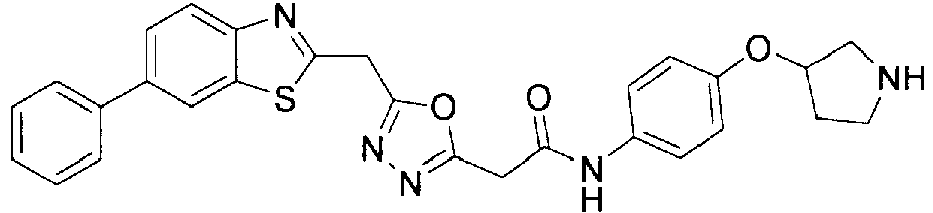
(DMSO-d6) δ: 1.66-1.75 (m, 1 H), 1.92-2 01 (m, 1 H), 2.70-2.90 (m, 2H), 3.01 (dd, J=12.2,5.6Hz, 1H),3.17 (d, J=3.5Hz, 1H), 410(s, 2H), 4.74-4.80 (m, 1 H), 4.96 (s, 2H), 6.84 (d, J = 9.1 Hz, 2H), 7.37-7.53 (m, 6H), 7.76 (d, J = 7.1 Hz, 2H), 7.78-7.84 (m, 1H), 8.05 (d, J = 8.6 Hz, 1H), 8.43 (s, 1H), 10.40 (s, 1H). -
[Table 50] No. Structure NMR(δ) I-2-156 
(DMSO-d6) δ: 1.74-1.82 (m, 2H), 2.70 (t, J = 6 8 Hz, 2H), 3.17 (s, 2H), 3.98 (t, J = 6.3 Hz, 2H), 4.11 (s, 2H), 4.96 (s, 2H), 6.87 (d, J = 8.6 Hz, 2H), 7.37-7.43 (m, 1 H), 7.45-7.53 (m, 4H), 7.76 (d, J = 8 1 Hz, 2H), 7 83 (d, J = 8.6 Hz, 1H), 8 05 (d, J = 8.6 Hz, 1H), 8 44 (s, 1H), 10.45 (s, 1H) I-2-157 
(DMSO-d6) δ · 1 14 (dd, J = 8.1, 5.6 Hz, 2H), 1.49 (dd, J = 8.1, 5.6 Hz, 2H), 3.88 (s, 3H), 3.91 (s, 2H), 4.92 (s, 2H), 7.73 (dd, J = 8 4, 1 8 Hz, 1 H), 7 92-7 96 (m, 2H), 8 21 (s, 1 H), 8.3 (s, 1H), 9.24 (s, 1H). I-2-158 
(DMSO-d6) δ: 4.48 (s, 2H), 4.93 (s, 2H), 7.40 (t, J = 7 4 Hz, 1H), 7.50 (t, J = 7 6 Hz, 2H), 7.76 (d, J = 7 6 Hz, 2H), 7 83 (dd, J = 8.4, 1 8 Hz, 1 H), 8.06 (d, J = 8 1 Hz, 1H), 8.44 (d, J = 1 5 Hz, 1H), 8.75 (s, 1 H), 9.02 (s, 1 H) I-2-159 
(DMSO-d6) δ : 3.62 (s, 3H), 4.42 (d, J = 5.6 Hz, 2H), 4.94 (s, 2H), 7.40 (t, J = 7.4 Hz, 1H), 7.48-7.52 (m, 2H), 7 74-7 77 (m, 2H), 7.83(dd, J=86, 2.0Hz, 1 H), 8.05 (d, J = 8.6 Hz, 1H), 8.44(d, J=1.5Hz, 1H), 8 64 (s, 1 H), 11 40 (s, 1H). (CDCl3) δ:2 27 (s, 6H), I-2-160 
2.40 (t, J = 5.1 Hz, 2H), 3.24 (t, J = 5.3 Hz, 2H), 4.52 (s, 2H), 4.76 (s, 2H), 7.37-7.41 (m, 1H), 7.46-7.50 (m, 2H), 7.62-7.64 (m, 2H), 7.73 (dd, J = 8.4, 1.8 Hz, 1H), 8.03-8.07 (m, 2H). -
[Table 51] No. Structure NMR(δ) I-2-161 
(DMSO-d6) δ: 2.40 (t, J = 7.4 Hz, 2H), 3.01-3.03 (br m, 2H), 4 28 (d, J = 6.1 Hz, 2H), 4.96 (s, 2H), 7.09 (s, 1H), 7.40 (t, J = 7.4 Hz, 1H), 7.48-7.52 (m, 2H), 7.75-7.83 (m, 4H), 8.05 (d, J=86 Hz, 1H), 843(d, J = 1 5 Hz, 1 H). I-2-162 
(DMSO-d6) δ: 1.13 (dd, J = 8 11, 5.58 Hz, 2H), 1.48 (dd, J = 8 11, 5.58 Hz, 2H), 3 90 (s, 2H), 5.02 (s, 2H), 7.80 (d, J = 8 62 Hz, 1 H), 8.34-8 42 (m, 2H), 9.23 (s, 1H) I-2-163 
(DMSO-d6) δ : 1.13 (dd, J = 8 11, 5.58 Hz, 2H), 1.49 (dd, J = 8 11, 5.58 Hz, 2H), 3 90 (s, 2H), 4.97 (s, 2H), 7 53 (dd, J = 8 62, 1 52 Hz, 1 H), 8.09 (d, J = 1 52 Hz, 1 H), 8.16 (d, J = 8 62 Hz, 1H), 9.23 (s, 1H) I-2-164 
(DMSO-d6) δ 1 37 (s, 9H), 1.76-1.83 (m, 2H), 3.06 (q, J = 6.4 Hz, 2H), 3.92 (t, J = 6.3 Hz, 2H), 4.08 (s, 2H), 4.97 (s, 2H), 6.86 (d, J = 8 6 Hz, 3H), 7.37-7 53 (m, 5H), 7.76 (d, J = 7.1 Hz, 2H), 7.83 (dd, J = 8.6, 2 0 Hz, 1 H), 8.05 (d, J=8.6Hz, 1H),843(d, J = 1 5 Hz, 1H), 10.23 (s, 1 H) I-2-165 
(DMSO-d6) δ : 1 47-1.55 (m, 2H), 1.64-1 72 (m, 2H), 2.10 (s, 6H), 2.22 (t, J = 7 4 Hz, 2H), 3.92 (t, J = 6 6 Hz, 2H), 4.08 (s, 2H), 4 97 (s, 2H), 6.87 (d, J = 9.1 Hz, 2H), 7.38-7.46 (m, 3H), 7.50 (t, J = 7.6 Hz, 2H), 7.76 (d, J = 7.6 Hz, 2H), 7.83 (d, J = 8.6 Hz, 1H), 8.04 (d, J = 8 6 Hz, 1H), 8.43 (s, 1H), 10.23 (s, 1H). -
[Table 52] No. Structure NMR(δ) I-2-166 
δ : 1.64-1.69 (m, 4H), 1.81-1.88 (m, 2H), 2.39-2.43 (m, 4H), 2.47-2.52 (m, 2H), 3.95 (t, J = 6 3 Hz, 2H), 4.08 (s, 2H), 4.97 (s, 2H), 6.87 (d, J = 8.6 Hz, 2H), 7.37-7 47 (m, 3H), 7.50 (t, J = 7.6 Hz, 2H), 7.76 (d, J = 7.6 Hz, 2H), 7.83 (d, J = 8 6 Hz, 1H), 8.04 (d, J = 8.6 Hz, 1H), 8.43 (s, 1H), 10.23 (s, 1H), I-2-167 
(DMSO-d6) δ : 3.99 (s, 2H), 4.19 (d, J = 5 58 Hz, 2H), 5.02 (s, 2H), 7.80 (d, J = 8.11 Hz, 1H), 8.34-8.42 (m, 2H), 9.02 (t, J = 5.58 Hz, 1H). I-2-168 
(DMSO-d6) δ: 3.98 (s, 2H), 4.19 (d, J = 5 58 Hz, 2H), 4.96 (s, 2H), 7.52 (dd, J = 8.62, 1.52 Hz, 1H), 8.09 (d, J=1.52 Hz, 1H), 8 16 (d, J = 8.62 Hz, 1H), 9 02 (t, J = 5.58 Hz, 1H). I-2-169 
(DMSO-d6) δ: 1.14 (dd, J = 8.70, 5.70 Hz, 2H), 1.49 (dd, J=8.70, 5.70 Hz, 2H), 3.92 (s, 2H), 5.02 (s, 2H), 7.40-7.52 (m, 3H), 7.78 (d, J = 6.60 Hz, 1H), 8.45 (d, J = 1.50 Hz, 1H), 9.24 (s, 1 H). I-2-170 
(DMSO-d6) δ: 1.14 (dd, J = 8.70, 5.70 Hz, 2H), 1 49 (dd, J = 8.70, 5 70 Hz, 2H), 3.92 (s, 2H), 5.05 (s, 2H), 7.94 (d, J = 8.40 Hz, 1H), 8.17 (d, J = 8.40 Hz, 1H), 8.76 (d, J = 1.80 Hz, 1H), 9 24 ( s, 1 H). -
[Table 53] No. Structure NMR(δ) I-2-171 
1H-NMR (DMSO-d6) δ : 3.28 (s, 3H), 3.99 (s, 2H), 4.19 (d, J = 5.6 Hz, 2H), 5.04 (s, 2H), 8.03 (dd, J = 8.6, 1.5 Hz, 1H), 8.21 (d, J = 8 6 Hz, 1 H), 8 81 (d, J = 2.0 Hz, 1H), 9.02 (t, J = 5.6 Hz, 1 H). I-2-172 
1 H-NMR (DMSO-d6) δ : 2 96 (s, 3H), 4.47 (d, J = 6.1 Hz, 2H), 4.98 (s, 2H), 7.33 (t, J = 8 9 Hz, 2H), 7.76-7.83 (m, 3H), 7 95 (t, J = 5 8 Hz, 1 H), 8 03 (d, J = 8.6 Hz, 1 H), 8.40-8.44 (m, 1H) I-2-173 
(CDCl3) δ : 1 43 (s, 9H), 1 94-2 02 (m, 2H), 2.87 (s, 3H), 3.39 (t, J = 6.8 Hz, 2H), 3.94 (t, J = 5.8 Hz, 2H), 4 02 (s, 2H), 4.77 (s, 2H), 6 84 (d, J = 8.6 Hz, 2H), 7 37-7.50 (m, 5H), 7.63 (d, J = 7.6 Hz, 2H), 7.73 (d, J = 8.6 Hz, 1H), 8.04-8 07 (m, 2H), 8.81 (s, 1H). I-2-174 
(DMSO-d6) δ 1.78-1.85 (m, 2H), 2.29 (s, 3H), 2.60 (t, J = 6 8 Hz, 2H), 3.96 (t, J = 6.6 Hz, 2H), 4.08 (s, 2H), 4 97 (s, 2H), 6.87 (d, J = 9.1 Hz, 2H), 7.37-7.47 (m, 3H), 7.50 (t, J = 7 6 Hz, 2H), 7.76 (d, J = 7.6 Hz, 2H), 7.83 (dd, J = 8 4, 1 8 Hz, 1 H), 8 04 (d, J = 8.1 Hz, 1 H), 8 43 (d, J = 1.5 Hz, 1H), 10.24 (s, 1H) I-2-175 
(DMSO-d6) δ : 0 37-0.43 (m, 2H), 0.58-0.66 (m, 2H), 2.62 (m, 1H), 3.78 (s, 2H), 4.95 (s, 2H), 7.53 (dd, J = 8.62, 2.03 Hz, I H), 8.09 (d, J = 2.03 Hz, 1H), 8.17 (d, J = 8 62 Hz, 1H), 8.35 (d, J = 3.55 Hz, 1H). -
[Table 54] No. Structure NMR(δ) I-2-176 
(DMSO-d6) δ:4.35 (d, J = 4.06 Hz, 2H), 5.08 (s, 2H), 7.40 (t, J = 7.35 Hz, 1H), 7.51 (dd, J=7.60, 7.35 Hz, 2H), 7.76 (d, J =7.60 Hz, 2H), 7.83 (dd, J=8.11, 1.52 Hz, 1H), 8 06 (d, J = 8 11 Hz, 1H), 8.45 (d, J = 1.52 Hz, 1H), 10.04 (t, J = 4.06 Hz, 1H). I-2-177 
(DMSO-d6) δ : 2.80 (t, J = 6.34 Hz, 2H), 3 52 (dt, J = 6.34, 5.83 Hz, 2H), 5.07 (s, 2H), 7 40 (t, J = 7 35 Hz, 1H), 7.50 (dd, J = 7 60, 7 35 Hz, 2H), 7 76 (d, J = 7 60 Hz, 2H), 7 83 (dd, J = 8.11, 1.52 Hz, 1H), 8.06 (d, J = 8 11 Hz, 1 H), 8.45 (d, J = 1.52 Hz, 1H), 9.63 (t, J = 5 83 Hz, 1H). I-2-178 
(DMSO-d6) δ ,3.99 (s, 2H), 4.19 (d,J = 6.0Hz, 2H), 4.30 (s, 1H), 4.96 (s, 2H), 7.59 (d, J=60Hz, 1H), 7.97(d, J=6 0Hz, 1H), 8.31 (s, 1H) 9 04(t, J=6 0Hz, 1 H) I-2-179 
(DMSO-d6) δ, 1.05-1.16 (m, 2H), 1 40-1 55 (m, 2H), 3.91 (s, 2H), 4.30 (s, 1H), 4.96 (s, 2H), 7.59 (d, J = 6.0Hz, 1 H), 7.97 (d, J = 6 0Hz, 1 H), 8.31 (s, 1H), 9 25 (s, 1 H) I-2-180 
(DMSO-d6) δ 2.05-2.09(m,2H),2.76(s,6H),3 10-3 18(m,2H),4 07(t,J=3.0Hz,, 2H),4.11 (s, 2H), 4.97(s, 2H),7. 14(t, J=6.0 Hz,1 H),7.22-7.24(m,1H), 7.39-7.56(m,4H), 7.76(d,J=6 0Hz,2H),7.83(d,J =6.0Hz,1H), 8 05(d,J=9.0Hz, 1H),8.44(s, 1H),10.44(s,1 H) -
[Table 55] No. Structure NMR(δ) I-2-181 
(DMSO-d6) δ 2.00-2 10(m,2H),2.74(s,6H),3 10-3.15(m,2H),4.12(s,2H)4 14(t, J=30Hz, 2H), 4 97(s,2H),7.24 (t, J=9 0Hz, H),7 39-7.52(m,3H),7.72-7.77(m, 3H, 7 83(dd, J=3.0,6 0Hz,1H) 7.90(d, J=3.0Hz,1H), 8 04(d,J=9 0Hz, 1H),8.44(d J =3.0Hz,1 H),10.54(s,1 1H) I-2-182 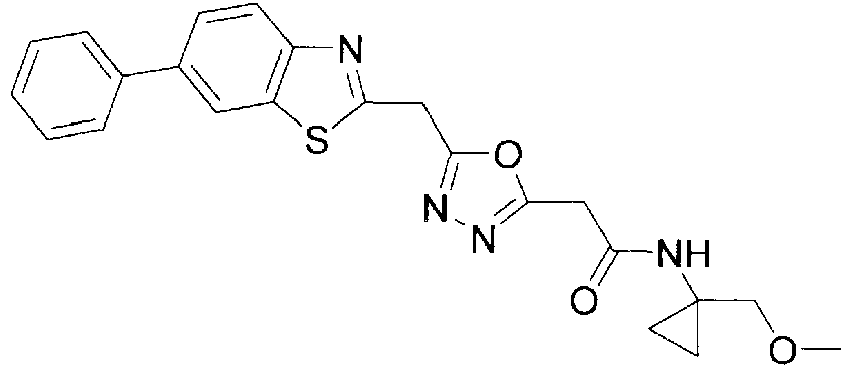
(DMSO-d6) δ:0.60-0 63(m,2H),0.66-0 69(m,2H),3.21(s,3H),3.79( s,2H),4.94(s,2H),7 38-7 42(m,1 H),7.52(t,J=6 0Hz,2 H),7.76(d,J=6.0Hz,2H),7 83( dd,J=3.0,6 0Hz, 1H),8 05(d,J =6.0Hz,1 H),8.44(d,J=3 0Hz, 1 H),8 59(s,1 H) I-2-183 
(DMSO-d6) δ:0.3 00-3 12(m,2H),3 23-3 43(m,2H)3 56-3 66(m,2H),3 93-3 96(m,2H),4 16(s,2H),4 32( s,2H),4 97(s,2H),7 17-7 25(m,1 H),7 39-7.53(m,4H),7 76(d,6Hz,2H),7 82(dd,J=3 0,6 0Hz,1 H),7 90 (bs,1 H),8 05(d,J=6 0Hz,1 H), 8 44(d,J=3 0Hz,1 H),9 75(bs, 1 H),10 57(s,1 H) I-2-184 
(DMSO-d6) δ : 0.28-0 38 (m, 4H), 3.11 (d, J = 5 58 Hz, 2H), 3.24 (d, J = 5 58 Hz, 2H), 3.87 (s, 2H), 4 46 (t, J = 5 58 Hz, 1 H), 4 95 (s, 2H), 7 52 (dd, J = 8.62, 2 03 Hz, 1H), 8 09 (d, J = 2 03 Hz, 1H), 8.16 (d, J = 8 62 Hz, 1H), 8.24 (t, J = 5 58 Hz, 1 H). I-2-185 
(DMSO-d6) δ : 0.55 (dd, J = 6 59, 4.56 Hz, 2H), 0 66 (dd, J = 6 59, 4.56 Hz, 2H), 3 39 (d, J = 5.83 Hz, 2H), 3 79 (s, 2H), 4 69 (t, J = 5 83 Hz, 1H), 4 94 (s, 2H), 7 53 (dd, J = 8 62, 203 Hz, 1 H), 8.09 (d, J = 2 03 Hz, 1H), 8.16 (d, J=8.62 Hz, 1 H), 8.53 (s, 1 H). -
[Table 56] No. Structure NMR(δ) I-2-186 
1H-NMR (CDCl3) δ · 4.61 (d, J = 6.6 Hz, 2H), 4.75 (s, 2H), 5.17 (s, 2H), 5.26 (t, J = 6.3Hz, 1H), 7.16 (t, J= 8.9 Hz, 2H), 7.54-7.61 (m, 2H), 7.67 (dd, J = 8.6, 2.0 Hz, 1H), 7.99-8 05 (m, 2H). I-2-187 
1H-NMR (DMSO-d6) δ : 1 40 (s, 9H), 4.41 (d, J = 5 6 Hz, 2H), 4.95 (s, 2H), 733(t,J=8.6Hz,2H), 7.78-7 83 (m, 3H), 8 04 (d, J = 8.6 Hz, 1 H), 8.42 (s, 1H), 8.48 (s, 1H), 11.04 (s, 1H). 1H). I-2-188 
(DMSO-d6) δ · 1 54 (s, 9H), 3.95 (s, 2H), 4.35 (d, J = 6.08 Hz, 2H), 4 96 (s, 2H), 7.39-7 55 (m, 3H), 7.75-7.82 (m, 2H), 8.08 (d, J = 2.03 Hz, 1H), 8 16 (d, J = 8.62 Hz, 1 H), 8 86 (t, J = 6.08 Hz, 1 H). I-2-189 
(DMSO-d6) δ · 3.95 (s, 2.0H), 4.36 (d, J = 5.58 Hz, 2 0H), 4.95 (s, 2.0H), 7.43 (t, J = 7.60 Hz, 1.0H), 7 47-7 55 (m, 2.0H), 7.80-7.88 (m, 2.0H), 8 08 (d, J = 2.03 Hz, 1.0H), 8.16 (d, J = 8.62 Hz, 1.0H), 8.86 (t, J = 5.83 Hz, 1.0H), 12.96 (s, 10H) I-2-190 
(DMSO-d6) δ: 1 53 (s, 9H), 3.98 (s, 2H), 4.50 (d, J = 6.08 Hz, 2H), 4.95 (s, 2H), 6.67 (s, 1 H), 7.52 (dd, J = 8.62, 2.03 Hz, 1H), 8.08 (d, J=2.03Hz, 1H),816(d, J = 8.62 Hz, 1 H), 9.00 (t, J = 6.08 Hz, 1H). -
[Table 57] No. Structure NMR(δ) I-2-191 
(DMSO-d6) δ: 3.98 (s, 2H), 4.50 (d, J = 5.58 Hz, 2H), 4.95 (s, 2H), 6 69 (s, 1H), 7.52 (dd, J = 8.62, 2.03 Hz, 1H), 8.09 (d, J = 2.03 Hz, 1H), 8 16 (d, J = 8.62 Hz, 1 H), 9 00 (t, J = 5 58 Hz, 1 H). I-2-192 
(DMSO-d6) δ : 1 78-1 84 (m, 2H), 2.13 (s, 6H), 2 32 (t, J = 7.1 Hz, 2H), 4.12 (s, 2H), 4.21 (t, J = 6.6 Hz, 2H), 4.97 (s, 2H), 6 78 (d, J = 9.1 Hz, 1 H), 7.37-7.43 (m, 1H), 7.50 (t, J = 7.6 Hz, 2H), 7.76 (d, J = 7.1 Hz, 2H), 7 84 (td, J = 8.7, 2 2 Hz, 2H), 8.04 (d, J = 8 1 Hz, 1 H), 8.30 (d, J = 2 5 Hz, 1 H), 8.43 (d, J = 1 5 Hz, 1H), 10.41 (s, 1 H). I-2-193 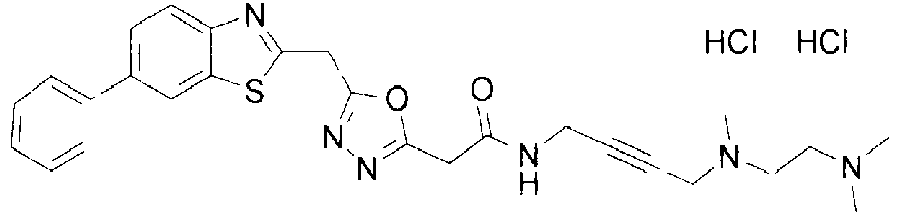
(DMSO-d6) δ 2.81-2 85 (m, 10H), 3 52 (br s, 4H), 3 96 (s, 3H), 4.16 (s, 2H), 4 95 (s, 2H), 7.38-7.43 (m, 1 H), 7.51 (t, J = 7.6 Hz, 2H), 7 74-7 78 (m, 2H), 7 83 (dd, J = 8 4, 1.8 Hz, 1 H), 8 05 (d, J = 8.6 Hz, 1 H), 8 44 (d, J = 2.0 Hz, 1 H), 8 98 (t, J = 5 3 Hz, 1H). I-2-194 
1 H-NMR (DMSO-d6) δ : 3 06 (s, 3H), 3.35 (t, J = 7 9 Hz, 2H), 3 61 (t, J = 7.6 Hz, 2H), 4.94 (s, 2H), 7 40 (t, J = 7.4 Hz, 1 H), 7.50 (t, J = 7.6 Hz, 2H), 7.75 (d, J = 7.6 Hz, 2H), 7.83 (dd, J = 8.6, 2 0 Hz, 1 H), 8.05 (d, J = 8.6 Hz, 1 H), 8.43 (d, J = 1.5 Hz, 1 H) I-2-195 
(DMSO-d6) δ : 3.99 (s, 2H), 4 19 (d, J = 5.40 Hz, 2H), 5 02 (s, 2H), 7.93 (dd,J = 6.90, 1 80 Hz, 1H,), 7 16 (d, J = 8.40 Hz, 1 H), 8.74 (s, 1H), 9.02 ( brs, 1H). -
[Table 58] No. Structure NMR(δ) retention time Mass method I-2-196 
1H-NMR (DMSO-d6) δ 3 99 (s, 2H), 4 19 (d, J = 5 6 Hz, 2H), 4.98 (s, 2H), 7 39 (t, J = 7 9 Hz, 1 H), 7 78 (d, J = 7 1 Hz, 1 H), 8 14 (d, J = 8.1 Hz, 1 H), 9 03 (t, J = 5 6 Hz, 1 H) I-2-197 
1H-NMR (DMSO-d6) δ 3 98 (s, 2H), 4 19 (d, J = 5 6 Hz, 2H), 4.94 (s, 2H), 7 40 (t, J = 7 4 Hz, 1 H), 7 49 (t, J = 7 6 Hz, 2H), 7 55 (t, J = 7 9 Hz, 1 H), 7.62 (d, J = 7 1 Hz. 1H). 7 80 (d, J = 7 6 Hz, 2H), 8 11 (d, J = 7 1 Hz, 1 H), 9.01 (t, J = 5 1 Hz, 1 H) I-2-198 
(DMSO-d6) δ 1 14 (dd, J = 8 70, 5 70Hz, 2H), 1 49 (dd, J = 8 70, 5 70Hz, 2H), 3 32 (s, 3H), 4 98 (s, 2H), 6 49 (d, J = 1 BHz, 1 H), 7 50 (d, J = 1 8Hz, 1 H), 7 67 (d, J = 7 2Hz, 1 H), 8 08 (d, J = 8 7Hz, 1 H). 8 33 (s, 1 H), 9 24 ( s, 1 H) I-2-199 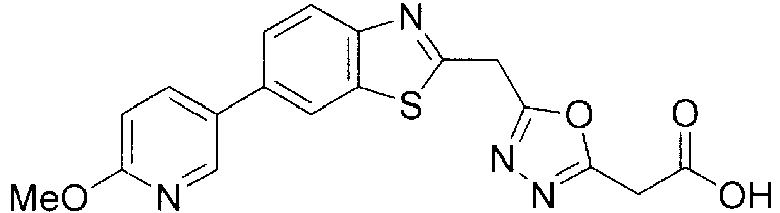
1 54 38295 (MS+) C I-2-200 
(DMSO-d6) δ 1 14(dd, J = 8 70, 5 70Hz, 2H), 1 49 (dd, J = 8 70, 5 70Hz, 2H), 3 32 (s, 3H), 4 96 (s, 2H), 6 49 (d, J = 1 BHz, 1 H), 7 50 (d, J = 18Hz, 1 H), 767 (d, J = 7 2Hz, 1 H), 8 08 (d, J = 8 7Hz, 1 H), 8.33 (s, 1H), 924 ( s, 1H) -
[Table 59] No. Structure NMR(δ) I-2-201 
1 H-NMR (DMSO-d6) δ: 4.00 (s, 2H), 4.20 (d, J = 5.1 Hz, 2H), 4.88 (s, 2H), 7.38 (t, J = 7.4 Hz, 1H), 7.48 (t ,J=7.6Hz,2H), 7.70-7.73 (m, 3H), 7.82 (d, J = 8.6 Hz, 1H), 8.01 (d, J = 1.5 Hz, 1 H), 9.03 (t, J = 5.3 Hz, 1 H) I-2-202 
1H-NMR (DMSO-d6) δ : 1.14 (dd, J = 8.11, 5.58 Hz, 2H), 1.49 (dd, J = 8.11, 5 58 Hz, 2H), 3.92 (s, 2H), 4.88 (s, 2H), 7.39 (t, J = 7.10 Hz, 1 H), 7.46-7.52 (m, 2H), 7.69-7.77 (m, 3H), 7.81 (d, J = 8.62 Hz, 1H), 8.05 (d, J = 1.01 Hz, 1H), 924 (s, 1H). I-2-203 
1H-NMR (DMSO-d6) δ: 4.00 (s, 2H), 4.20 (d, J = 5.58 Hz, 2H), 4.88 (s, 2H), 7.39 (m, 1 H), 7.46-7.52 (m, 2H), 7.68-7.76 (m, 3H), 7.81 (d, J = 8.62 Hz, 1H), 8.04 (d, J = 1.01 Hz, 1 H), 9.03 (t, J=5.58 Hz, 1 H) I-2-204 
1H-NMR (DMSO-d6) δ : 3.95 (s, 2H), 4.19 (d, J = 5.4Hz, 2H), 4.66 (s, 2H), 7.43(m, 1H), 7.50-7.60 (m, 3H), 7.84 (d, J = 7 2Hz, 2H), 8.00-8 12 (m, 2H), 8.29(s, 1H), 8.45(d, J = 8.4Hz, 1H), 9.00(br-s, 1H) I-2-205 
1H-NMR (DMSO-d6) δ : 3.95 (s, 2H), 4 18 (d, J = 5.7Hz, 2H), 4.63 (s, 2H), 7 61 (d, J = 8 4Hz, 1 H), 7.88 (s, 2H), 8.29 (s, 1 H), 8.37 (d, J=8.7Hz, 1H), 8.99 (br-s, 1H) -
[Table 60] No. Structure NMR(δ) I-2-206 
1H-NMR (DMSO-d6) δ : 3.96 (s, 2H), 4.18 (d, J = 5.6 Hz, 2H), 4 77 (s, 2H), 7.84-7.89 (m, 2H), 8.01-8.06 (m, 1 H), 8.09-8.15 (m, 1 H), 8.96-9.03 (m, 2H). I-2-207 
1H-NMR (DMSO-d6) δ:3.99(s, 2H), 4.19(d, J = 5.7Hz, 1H), 4.84(s, 2H), 7.29-7.42(m, 10H), 9 03(br-s, 1H). I-2-208 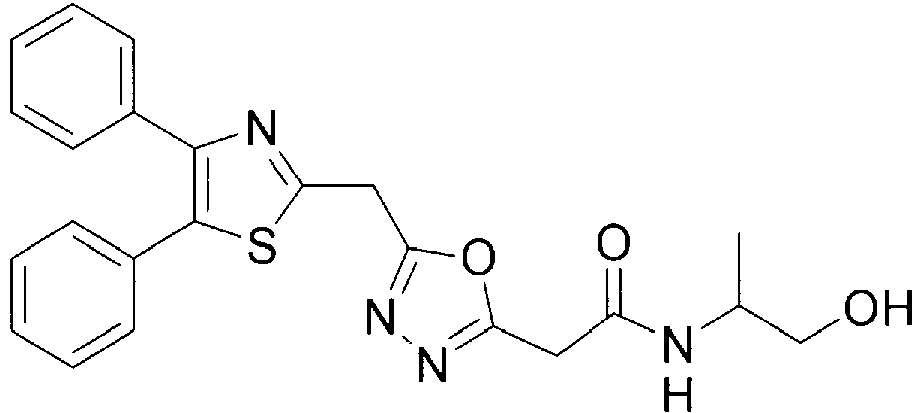
1H-NMR (DMSO-d6) δ · 1.16(d, J = 6.9Hz, 3H), 2.72(m, 1H), 3.49(m, 1 H), 3.62(br-s, 1H), 3.87(s, 2H), 4.09(m, 1H), 4 65(s, 2H), 6.98(br-s, 1H), 7.25-7.33(m, 8H), 7 46-7.49(m, 2H). I-2-209 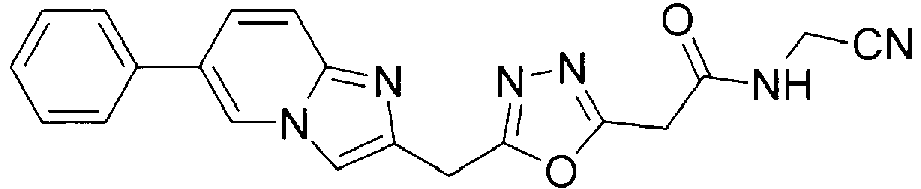
1H-NMR (DMSO-d6) δ · 3.94 (s, 2H), 4.19 (d, J = 5.58 Hz, 2H), 4.40 (s, 2H), 7.40 (t, J = 7 35 Hz, 1 H), 7.47-7.53 (m, 2H), 7.56-7.61 (m, 2H), 7.68-7.72 (m, 2H), 7.92 (s, 1 H), 8.89 (s, 1 H), 8.99 (t, J=5 58 Hz, 1H). I-2-210 
1H-NMR (DMSO-d6) δ: 1.13(dd, J=811,5.58Hz, 2H), 1.48 (dd, J=8 11, 5.58 Hz, 2H), 3.86 (s, 2H), 4.40 (s, 2H), 7.40 (t, J = 7.35 Hz, 1H), 7.47-7 53 (m, 2H), 7 56-7 61 (m, 2H), 7 67-7.72 (m, 2H), 7.92 (s, 1 H), 8.89 (m, 1H), 9.20 (s, 1 H) -
[Table 61] No. Structure NMR(δ) I-2-211 
1H-NMR (DMSO-d6) δ : 3 98 (s, 2H), 4.19 (d, J = 5 6 Hz, 2H), 4 79 (s, 2H), 7.37 (t, J = 7.4 Hz, 1H), 7.45 (t, J = 7.6 Hz, 2H), 7 65 (d, J = 7.1 Hz, 2H), 8 14 (s, 1 H), 9.01 (t, J = 5.3 Hz, 1 H). I-2-212 
1H-NMR (DMSO-d6) δ · 3 97 (s, 2H), 4.19 (d, J = 5 58 Hz, 2H), 4.83 (s, 2H), 7.77-7.86 (m, 2H), 8.14 (d, J = 1.52 Hz, 1 H), 9.01 (t, J = 5.58 Hz, 1H). I-2-213 
1H-NMR (DMSO-d6) δ 3.97 (s, 2H), 4.17 (d, J = 5 58 Hz, 2H), 4.88 (s, 2H), 7.4 1 (t, J=7.35 Hz, 1H), 7.48-7 54 (m, 2H), 7 69-7 74 (m, 2H), 7.86 (d, J = 8 62 Hz, 1 H), 7.99 (dd, J = 8.62, 2 03 Hz, 1 H), 8 13 (d, J = 1.52 Hz, 1 H), 9.00 (t, J = 5 58 Hz, 1 H). I-2-214 
1H-NMR (DMSO-d6) δ: 1.10 (dd, J = 8.62, 5.58 Hz, 2H), 1.46 (dd, J = 8.62, 5.58 Hz, 2H), 3.89 (s, 2H), 4 89 (s, 2H), 7.41 (t, J = 7 35 Hz, 1 H), 7 48-7.54 (m, 2H), 7.69-7 75 (m, 2H), 7.86 (d, J = 8.62 Hz, 1 H), 8 00 (dd, J = 8.87, 1 77 Hz, 1H), 8.13 (d, J = 1.77 Hz, 1H), 9 20 (s, 1 H). I-2-215 
1H-NMR (DMSO-d6) δ · 397 (s, 2H), 4.19 (d, J = 5.6 Hz, 2H), 4.78 (s, 2H), 747 (t, J = 7 4 Hz, 1 H), 7 56 (t, J = 7.6 Hz, 2H), 7 91 (d, J = 7 1 Hz, 2H), 8 11 (d, J=9.1 Hz,1H), 822(dd, J=91, 2.0Hz, 1 H), 8.37 (d, J = 2 0 Hz, 1 H), 9.00 (t, J=5 1 Hz, 1H), 9.04 (s, 1 H) -
[Table 62] No. Structure NMR(δ) I-2-216 
1H-NMR (DMSO-d6) δ : 3.95 (s, 2H), 4.19 (d, J = 5.4 Hz, 2H), 4.49 (s, 2H), 7.41-7.53 (m, 4H), 7.72 (d, J=7.2Hz,2H),810(d,J= 8.7Hz, 1H), 8.81(s, 1H), 9.00 (br-s, 1H). I-2-217 
(DMSO-d6) δ: 1 12 (dd, J = 8.70, 5.70Hz, 2H), 1.48 (dd, J = 8.70, 5.70Hz, 2H), 3.87 (s, 2H), 4.66 (s, 2H), 7.43 (t, J = 6.9Hz, 1 H), 7.50-7 60 (m, 3H), 7.84 (d, J = 4.2Hz, 2H), 8.02 (d, J = 8.4Hz, 1 H), 8.09 (d, J = 2.4Hz, 1H), 8.29 (s, 1H), 8 45 (d, J = 8.4Hz, 1H), 9.21 (s, 1H). I-2-218 
(DMSO-d6) δ : 4.09 (s, 2H), 4.89 (s, 2H), 757 (dd, J = 8.4, 1.8Hz, 1H), 7.69 (d, J = 8.7Hz, 1H) I-2-219 
(DMSO-d6) δ : 3.96 (s, 2H), 4.19 (d, J = 5 4Hz, 2H), 4.59 (s, 2H), 7.31 (t, J = 9.3Hz, 1 H) 7.49 (dd, J = 19.2, 9.0Hz, 1 H), 7.73 (d, J = 22.2Hz, 1H), 9.01 (t, J = 5.5Hz, 1 H), 12.73 (d, J = 17 7Hz, 1H). -
[Table 63] No. Structure NMR(δ) retention time Mass method I-3-2 
2.47 40800 (MS+) C I-3-3 
1.56 421 30 (M+) C I-3-4 
(DMSO-d6) δ: 1.14 (dd, J = 8.36, 5.32 Hz, 2H), 1.49 (dd, J = 8.36, 5.32 Hz, 2H), 3.88 (s, 3H), 3.90 (s, 2H), 4.93 (s, 2H), 7.68 (dd, J = 8.36, 1.52 Hz, 1H), 7 98 (s, 1 H), 8 06 (d, J = 8.36 Hz, 1H), 818 (d, J=1 52 Hz, 1H), 8 24 (s, 1H), 9 22 (s, 1H) I-3-5 
(DMSO-d6) δ: 1.14 (dd, J = 8.36, 5.58 Hz, 2H), 1 48 (dd, J = 8 36, 5.58 Hz, 2H), 3.90 (m, 5H), 4.98 (s, 2H), 6 50 (d, J = 2.03 Hz, 1H), 7.50 (d, J = 2.03 Hz, 1H), 7.62 (dd, J = 8.36, 1.52 Hz, 1H), 814 (d, J=1.52 Hz, 1 H), 8.23 (d, J 8.36 Hz, 1 H), 9.22 (s, 1 H). I-3-6 
(DMSO-d6) δ: 0 55 (dd, J = 6.6, 4.6 Hz, 2H), 0.66 (dd, J = 6.6, 4.6 Hz, 2H), 3.39 (d, J = 5.6 Hz, 2H), 3.79 (s, 2H), 4.69 (t, J = 5.8 Hz, 1H), 4.93 (s, 2H), 7.33 (t, J = 8.9 Hz, 2H), 7 77-7.83 (m, 3H), 8 04 (d, J = 8.6 Hz, 1H), 8.42 (d, J = 1.5 Hz, 1H), 8.53 (s, 1H) 1 76 439.05 (MS+) C -
[Table 64] No. Structure NMR(δ) retention time Mass method I-3-7 
(DMSO-d6) δ : 0 56 (dd, J = 6.8, 4 9 Hz, 2H), 0.67 (dd, J = 6 8, 4.9 Hz, 2H), 3.39 (d, J = 6.1 Hz, 2H), 3.79 (s, 2H), 4.69 (t, J = 5.8 Hz, 1H), 4.95 (s, 2H), 7.31-7.39 (m, 2H), 7.44-7.49 (m, 1H), 7.61 (td, J = 7.9, 1.8 Hz, 1H), 7.69 (dt, J = 8.6, 1.8 Hz, 1H), 8.07 (d, J = 86 Hz, 1H), 8.32 (s, 1H), 8.53 (s, 1H). 1 72 439.05 (MS+) C I-3-8 
(DMSO-d6) δ: 3.88 (s, 3H), 3.98 (s, 2H), 4.19 (d, J = 5.58 Hz, 2H), 4.92 (s, 2H), 7.68 (dd, J = 8.11, 152 Hz, 1 H), 7.98 (s, 1 H), 8 06 (d, J = 8.11 Hz, 1 H), 8.18 (d, J = 1.52 Hz, 1H), 8.24 (s, 1H), 9.01 (t, J = 5.58 Hz, 1H). I-3-9 
(DMSO-d6) δ 1 31 (s, 9H). 4.07 (s. 2H), 4 96 (s, 2H), 7.21-7 27 (m, 1H), 750-7.59 (m, 2H), 7 60-7.70 (m, 3H), 8 15 (d, J = 8 1 Hz, 1H). I-3-10 
(DMSO-d6) δ: 1 14 (dd, J = 8.4, 5.3 Hz, 2H), 1 49 (dd, J = 8.4, 5 3 Hz, 2H), 3.91 (s, 2H), 4.94 (s, 2H), 7.41-7 64 (m, 5H), 7.80 (d, J=6.9Hz,2H),8.12(d,J = 8 1 Hz, 1H), 9.23 (s, 1H). I-3-11 
DMSO-d6) δ: 0 54 (dd, J = 8.4, 5 3 Hz, 2H), 0.66 (dd, J = 8 4, 5.3 Hz, 2H), 3 38 (d, J = 6.0 Hz, 2H), 3.79 (s, 2H), 4 92 (s, 2H), 7.37-7.64 (m, 5H), 7.79 (s, 1H), 7.81 (d, J = 1.5 Hz, 1H), 8.12 (dd, J = 8.1, 1.5 Hz, 1H), 8.54 (s, 1H) -
[Table 65] No. Structure NMR(δ) retention time Mass method I-3-12 
(DMSO-d6) δ: 4.081 (s, 2H), 4.95 (s, 2H), 7.41-7.64 (m, 5H), 7.79 (s, 1H), 7.81 (d, J = 1 5 Hz, 1H), 8.12 (dd, J = 8.1, 1.5 Hz, 1H).. I-3-13 
(DMSO-d6) δ: 4.081 (s, 2H), 4.95 (s, 2H), 7.41-7.64 (m, 5H), 779 (s, 1H), 7.81 (d, J = 1.5 Hz, 1H), 8.12 (dd, J=8.1, 1.5 Hz, 1H). I-3-14 
(DMSO-d6) δ: 3.95 (s, 2H), 4.18 (d, J = 5.6 Hz, 2H), 4.57 (s, 2H), 7.40-7.54 (m, 4H), 7.81 (d, J = 7.1 Hz, 2H), 7.87 (s, 1H), 8.24 (d, J = 8.1 Hz, 1H), 900 (t, J = 56 Hz, 1H) 1.77 389.90 (MS+) C I-3-15 
(DMSO-d6) δ: 1.13 (dd, J = 81, 5 6 Hz, 2H), 1.48 (dd, J = 8.4, 5.3 Hz, 2H), 3.87 (s, 2H), 4.57 (s, 2H), 7.40-7.54 (m, 4H), 7.81 (d, J = 71 Hz, 2H), 787 (s, 1H), 824 (d, J = 8.1Hz, 1H), 9.21 (s, 1H). 1 84 416.10 (MS+) C I-3-16 
(DMSO-d6) δ : 4 09 (s, 2H), 4.96 (s, 2H), 7.31 (t,J = 9.0 Hz, 2H), 755 (t, J = 7.8 Hz, 1 H), 7.63 (d, J = 6.3 Hz, 1H), 7.83-7 89 (m, 2H), 8.11 (t, J=7.8Hz, 1H). -
[Table 66] No. Structure NMR(δ) retention time Mass method I-3-17 
(DMSO-d6) δ: 4.07 (s, 2H), 4.96 (s, 2H), 7.21-7.27 (m, 1H), 750-7.59 (m, 2H), 7.60-7.70 (m, 3H), 8.15 (d, J = 8.1 Hz, 1H). I-3-18 
(DMSO-d6) δ: 3.99 (s, 2H), 4.19 (d, J = 5.7 Hz, 2H), 4.94 (s, 2H), 7.32 (t, J = 8.7 Hz, 2H), 7.52-7.64 (m, 2H), 7.86 (dd, J = 8.7, 5.7 Hz, 2H), 8.12 (d, J = 7.8 Hz, 1H), 9 02 (t, J = 5.3 Hz, 1H) I-3-19 
(DMSO-d6) δ 3.92 (s, 3H), 3 99 (s, 2H), 4.19 (d, J = 5.7 Hz, 2H), 4.95 (s, 2H), 6.94 (d, J = 8.7 Hz, 1H), 7.55 (t, J = 7.8 Hz, 1H), 7.66 (d, J = 6 3 Hz, 1H), 8..1 (d, J = 6.6 Hz, 1H), 8.14 (dd, J=8.7, 2.4 Hz, 1H). 8.63 (d, J = 2 1Hz, 1H), 9.03 (t, J = 5.3 Hz, 1H). I-3-20 
(DMSO-d6) δ. 1.16 (dd, J = 8 1, 5 6 Hz, 2H), 1.50 (dd, J=8.1, 5.6Hz, 2H), 4.10 (s, 2H), 7.45 (t, J = 7.4 Hz, 1H), 7.54 (t, J = 7.6 Hz, 2H), 7.80 (d, J = 7.1 Hz, 2H), 8.01 (dd, J=8.6. 2.0 Hz, 1H), 8.28 (d, J = 8.6 Hz, 1H), 8.68 (d, J = 1.5 Hz, 1 H), 9 30 (s, 1H). 2.27 451.90 (MS+) C I-3-21 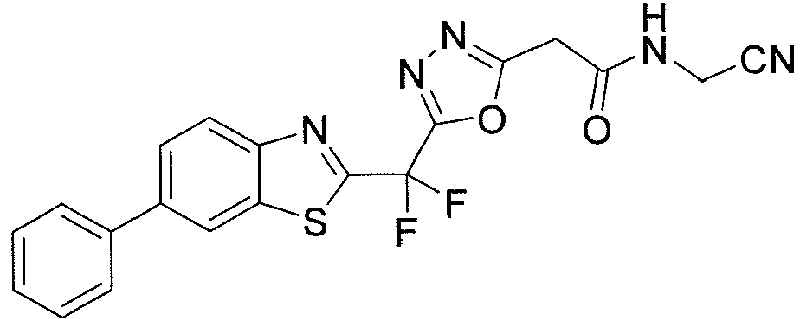
(DMSO-d6) δ: 418 (s, 2H), 4 22 (d, J = 5.6 Hz, 2H), 7.45 (t, J = 7.1 Hz, 1H), 7.54 (dd, J 10.4, 48 Hz, 2H), 7.80 (d, J = 7.1 Hz, 2H), 8.00 (dd, J = 8.9, 1.8 Hz, 1H), 8.28 (d, J = 8.6 Hz, 1H), 8.68 (d, J = 1.5 Hz, 1H), 9.10 (t, J = 5.6 Hz, 1H). 219 425 90 (MS+) C -
[Table 67] No. Structure NMR(δ) retention time Mass method I-3-22 
(DMSO-d6) δ: 1.14 (dd, J = 8.4, 5 3 Hz, 2H), 1.49 (dd, J=8.4, 53Hz, 2H), 3.91 (s, 2H), 3.92 (s, 3H), 4.96 (s, 2H), 6.95 (d, J = 8.7 Hz, 1H), 7.55 (t, J = 7 2 Hz, 1H), 7.66 (d, J = 7.5 Hz, 1H), 8.11-819 (m, 2H), 8.63 (s, 1H), 9.22 (s, 1H). I-3-23 
1.65 406.95 (M+) C I-3-24 
(CDCl3) δ : 3.87 (s, 9H), 4.72 (s, 2H), 7.39 (t, J=74 Hz, 1H), 7.47 (t, J = 7 6 Hz, 2H), 7.63 (d, J = 7.1 Hz, 2H), 7.73 (dd, J = 8 6, 1.5 Hz, 1H), 8.06-8.09 (m, 2H). I-3-25 
(DMSO-d6) δ 3.98 (s, 2H), 418 (d, J = 5.6 Hz, 2H), 4 95 (s, 2H), 7.48 (t, J = 9.9 Hz, 1H), 7.54-7.59 (m, 3H), 7.66 (t, J = 7.9 Hz, 1H), 7.71 (m, 2H), 8.01 (d, J = 7 1 Hz, 1H), 9.02 (t, J = 56Hz,1H). 176 3901 (MS+) C I-3-26 
(DMSO-d6) δ : 1.12 (dd, J = 8.1, 5.6 Hz, 2H), 1.47 (dd, J = 8.4, 5.3 Hz, 2H), 3.90 (s, 2H), 4 95 (s, 2H), 7.48 (t, J = 7.4 Hz, 1H), 7.54-7.59 (m, 3H), 7.66 (t, J = 7.9 Hz, 1H), 7 69-7.73 (m, 2H), 801 (dd, J = 8.1, 1.0 Hz, 1H), 9.22 (s, 1H). 183 415.90 (MS+) C -
[Table 68] No. Structure NMR(δ) retention time Mass method I-3-27 
(DMSO-d6) δ: 0.53 (dd, J = 6.8, 4.8 Hz, 2H), 0 65 (dd, J = 6.8, 4.8 Hz, 2H), 3.38 (d, J = 6 1 Hz, 2H), 3.78 (s, 2H), 4.69 (t, J = 5.8 Hz, 1H), 4.93 (s, 2H), 7.48 (t, J = 7.1 Hz, 1H), 7.53-7.59 (m, 3H), 7.66 (t, J = 7.9 Hz, 1H), 7.68-7 73 (m, 2H), 8.01 (dd, J = 8.1, 1.0 Hz, 1H), 8.53 (s, 1H). 1.7 420.95 (MS+) C I-3-28 
1.76 351 80 (MS+) C I-3-29 
2 06 41600 (M+) C I-3-30 
(CDCl3) δ: 3.89 (br-s, 2H), 4.56 (br-s, 2H), 4.75 (m, 2H), 4.91 (br-s, 2H), 5.05 (m, 1H), 7.38-7.74 (m, 7H), 8.06 (br-s 2H). I-3-31 
(DMSO-d6) δ: 1.13 (dd, J = 8 4, 5.8 Hz, 2H), 1.21 (t, J = 7 1 Hz, 3H), 1.48 (dd, J = 84, 53 Hz, 2H), 2.53-2.60 (m, 2H), 3.62 (t, J = 5.3 Hz, 2H), 3.90 (s, 2H), 4.02-4.14 (m, 4H), 4.92 (s, 2H), 6.28-6.30 (m, 1H), 7.63 (dd, J = 8.6, 1.5 Hz, 1H), 7 93 (d, J = 8.6 Hz, 1H), 817 (d, J = 1.5 Hz, 1H), 9.23 (s, 1H). 1.73 493.00 (MS+) C -
[Table 69] No. Structure NMR(δ) retention time Mass method I-3-32 
(DMSQ-d6) δ 0.55 (dd, J = 6.6, 5.1 Hz, 2H), 0.66 (dd, J = 6.6, 4.6 Hz, 2H), 1.21 (t, J = 7.1 Hz, 3H), 2.53-2.59 (m, 2H), 3.39 (d, J = 6.1 Hz, 2H), 3.61 (t, J = 5.3 Hz, 2H), 3.78 (s, 2H), 4.04-4.13 (m, 4H), 4.70 (t, J = 5.8 Hz, 1H), 4.90 (s, 2H), 6.27-6 30 (m, 1H), 7.63 (dd, J = 8.6, 1.5 Hz, 1H), 7.93 (d, J = 8.6 Hz, 1H), 8.16 (d, J = 1.5 Hz, 1H), 8.53 (s, 1H). 1.53 498.05 (MS+) C I-3-33 
(DMSO-d6) δ: 1.13 (dd, J = 8.1, 5.6 Hz, 2H), 1 48 (dd, J = 81, 5.6 Hz, 2H), 2 64-2 72 (m, 2H), 2.95 (s, 3H), 3 41 (t, J = 5 8 Hz, 2H), 387-3.93 (m, 4H), 4.93 (s, 2H), 6.31-6.34 (m, 1H), 7.66 (dd, J = 8.6, 2.0 Hz, 1H), 7.94 (d, J = 8.6 Hz, 1H), 8.19 (d, J = 1 5 Hz, 1H), 9.23 (s, 1H) 1.41 499.00 (MS+) C I-3-34 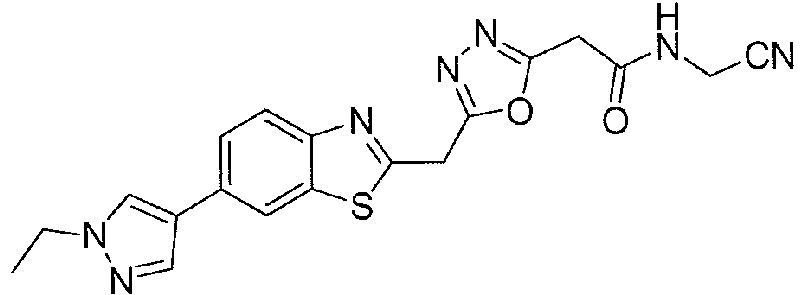
(DMSO-d6) δ: 1.47 (t, J = 6.3 Hz, 3H), 3.99 (s, 2H), 4.13-4.21 (m, 4H), 4.92 (s, 2H), 7 74 (d, J = 6.6 Hz, 1H), 7 91-7 96 (m, 2H), 729 (d, J = 8.1 Hz, 2H), 9.02 (t, J = 53 Hz, 1H). I-3-35 
(DMSO-d6) δ: 1 45 (s, 3H), 1.47 (s, 3H), 3.99 (s, 2H), 4.19 (d, J = 5.4 Hz, 2H), 4.51 (m, 1H), 4.91 (s, 2H), 7.74 (d, J = 6.6 Hz, 1H), 7.93 (d, J = 8.1 Hz, 2H), 8.32 (s, 2H), 9.02 (t, J = 5.3 Hz, 1H). -
[Table 70] No. Structure NMR(δ) retention time Mass method I-3-36 
(DMSO-d6) δ · 1 14 (dd, J = 8.4, 5 3 Hz, 2H), 1 44 (s, 3H), 1.47 (s, 3H), 1.49 (dd, J = 8.4, 5.3 Hz, 2H), 3 91 (s, 2H), 4.51 (m, 1H), 492 (s, 2H), 7.75 (d J = 8.4 Hz, 1H), 7.94 (d, J = 8.7 Hz, 2H), 8.32 (s, 2H), 9.23 (s, 1H). I-3-37 
1 86 403.95 (M+) C I-3-38 
(DMSO-d6) δ: 1.14(dd, J = 8.3, 5.5 Hz, 2H), 1.49 (dd, J = 8.3, 55Hz, 2H), 3.91 (s, 2H), 4.95 (s, 2H), 7.18 (dd, J = 5 0, 3.5 Hz, 1H), 7.58-7 63 (m, 2H), 7.82 (dd, J = 8 5, 1.9 Hz, 1H), 8.00 (d, J = 8 2 Hz, 1H), 8.45 (d, J = 1 5 Hz, 1H), 9.24 (s, 1H). 1 78 421 90 (MS+) C I-3-39 
1 89 38380 (MS+) C I-3-40 
118 398.90 (MS+) C -
[Table 71] No. Structure NMR(δ) retention time Mass method I-3-41 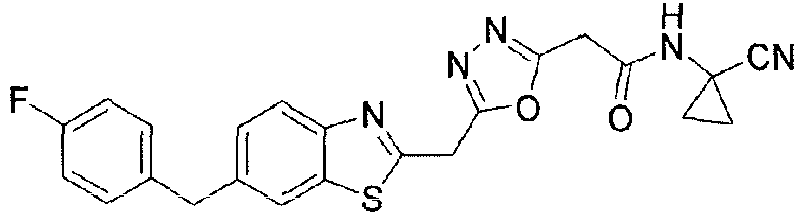
(DMSO-d6) δ: 1.13 (dd, J = 8.1, 5.6 Hz, 2H), 1 48 (dd, J = 8.1, 5.6 Hz, 2H), 3.89 (s, 2H), 4.08 (s, 2H), 4 90 (s, 2H), 709-7.13 (m, 2H), 7.26-7.32 (m, 2H), 7.38 (dd, J = 8.6, 1.5 Hz, 1H), 7.89 (d, J = 8.6 Hz, 1H), 7.96 (d, J = 1.0 Hz, 1H), 9.22 (s, 1H). 198 447.95 (MS+) C I-3-42 
(DMSO-d6) δ: 1.14 (dd, J = 8.3, 5.5 Hz, 2H), 1.49 (dd, J = 8.3, 5.5 Hz, 2H), 3.91 (s, 2H), 4 95 (s, 2H), 6.65 (dd, J = 3.3, 1.9 Hz, 1H), 7.06 (d, J = 3 4 Hz, 1H), 7.81 (d, J = 1.5 Hz, 1H), 7.87 (dd, J = 8.6, 1.4 Hz, 1H), 8.01 (d, J = 8.9 Hz, 1H), 8.45 (d, J = 1.3 Hz, 1H), 9 24 (s, 1H). 171 405 90 (MS+) C I-3-43 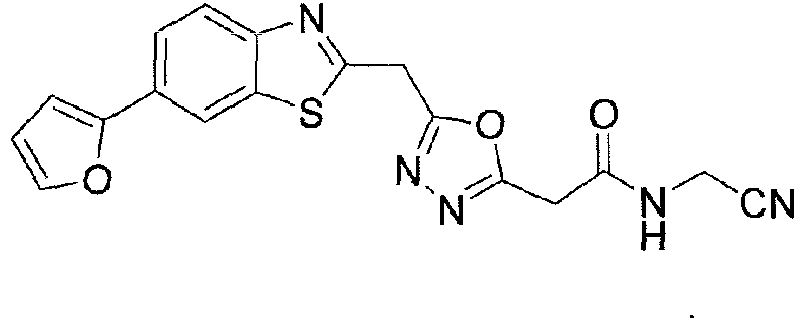
(DMSO-d6) δ: 3 99 (s, 2H), 4.19 (d, J = 5.6 Hz, 2H), 4.94 (s, 2H), 6.64 (dd, J = 3.3, 1.8 Hz, 1H)), 706 (d, J = 3.0 Hz, 1H), 7 81 (d, J = 10 Hz, 1H), 7 87 (dd, J = 8.6, 2 0 Hz, 1H), 8.00 (d, J = 8.6 Hz, 1H), 8.44 (d, J = 1.5 Hz, 1H), 9.03 (t, J = 5.3 Hz, 1H). 1 63 38000 (MS+) C I-3-44 
(DMSO-d6) δ 3.99 (s, 2H), 4.19 (d, J = 5.6 Hz, 2H), 4.94 (s, 2H), 7.18 (dd, J = 5.1, 4.1 Hz, 1H)), 7.59-7.63 (m, 2H), 782 (dd, J = 8.4, 18 Hz, 1H), 799 (d, J = 8 6 Hz, 1H), 8.44 (d, J = 2.0 Hz, 1H), 9.03 (t, J = 5.3 Hz, 1H). 1 74 395.80 (MS+) C I-3-45 
(DMSO-d6) δ. 1 59 (d, J = 7.2Hz, 3H), 3.94-3.97 (m, 5H), 4.73 (s, 2H), 4.92 (m, 1H), 7 59 (d, J = 6.9Hz, 1H), 7.67 (s, 1H), 7.805 (s, 1H), 7 94-7 99 (m, 3H) -
[Table 72] No. Structure NMR(δ) retention time Mass method I-3-46 
(DMSO-d6) δ: 388 (s, 3H), 4.07 (s, 2H), 4.92 (s, 2H), 7.72 (d, J = 8.4Hz, 2H), 7.92-7.96 (m, 2H), 8 21 (s, 1H), 8.29(s, 2H) I-3-47 
(CDCl3) δ : 1.44 (s, 9H), 3.90 (s, 2H), 4.78 (s, 2H), 7.71 (d, J = 9.0 Hz, 1H), 8.09 (s, 1H), 8.16 (d, J = 8 7 Hz, 1H), 9.02 (s, 2H), 9.25 (s, 1H) I-3-48 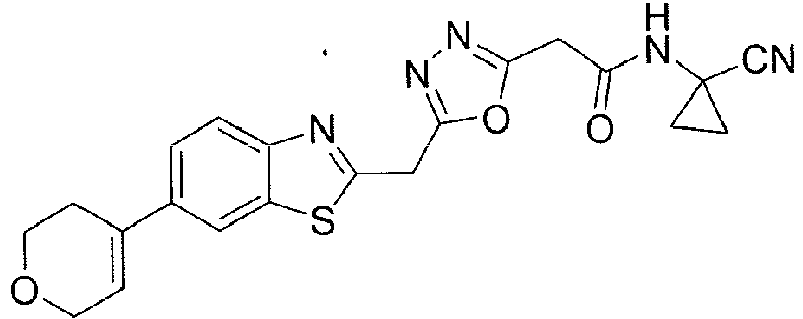
(DMSO-d6) δ: 1.13 (dd, J = 8 36, 5.32 Hz, 2H), 1.48 (dd, J = 8.36, 5.32 Hz, 2H), 3.85 (t, J = 5.58 Hz, 2H), 3.90 (s, 2H), 4 26 (q, J = 2.70 Hz, 2H), 4 92 (s, 2H), 6.37-640 (m, 1H), 7.65 J = 8.62, 152 Hz, 1H), 7.93 (d, J = 8.62 Hz, 1H), 8.17 (d, J = 2.03 Hz, 1H), 9.23 (s, 1H). 1.49 422 00 (MS+) C 1-3-49 
(DMSO-d6) δ: 3.91 (s, 3H), 4.02 (s, 2H), 4.18 (d, J = 5.4 Hz, 2H), 4.99 (s, 2H), 7.44 (t, J = 96 Hz, 1H), 7.78 (d, J = 2.3 Hz, 1H), 7 92 (d, J = 7.5Hz, 1H), 8 17 (s, 1 H), 8.44 (s, 1H), 9 02 (t, J = 5.3 Hz, 1H). I-3-50 
(DMSO-d6) δ: 1.14 (dd, J = 8.4, 5.3 Hz, 2H), 1.49 (dd, J = 8.4, 5.3 Hz, 2H), 3.92 (s, 3H), 3.93 (s, 2H), 5.00 (s, 2H), 7.44 (t J = 8.1 Hz, 1H), 7.78 (d, J = 8.1 Hz, 1H), 8.16 (s, 1H), 8.44 (s, 1H) 924 (s, 1H). -
[Table 73] No. Structure NMR(δ) retention time Mass method I-3-51 
(DMSO-d6) δ · 1.42 (t, J = 7.2 Hz, 3H), 4.08 (s, 2H), 4.15 (q, J = 7 2 Hz, 2H), 4.94 (s, 2H), 7.73 (dd, J = 3.1, 1.5 Hz, 1H),7.93 (s, 1H), 7.95 (d, J = 6 9 Hz, 1H), 8.28 (s, 1H), 8.31 (d, J = 1.5Hz, 1H) I-3-52 
DMSO-d6) δ: 1.14 (dd, J = 8.4, 5.3 Hz, 2H), 1.42 (t, J = 7.2 Hz, 3H),1.49 (dd, J = 8.4, 5.3 Hz, 2H), 3 91 (s, 2H), 8.17(q J=7.2Hz, 1H), 4.91 (s, 2H), 7.73 (dd, J = 8.1, 1.5 Hz, 1H), 7.93 (s, 1H), 7 95 (d, J = 6.9 Hz, 1H), 8.28 (s, 1H), 8.31 (d, J =1.5Hz, 1H).. I-3-53 
243 449 07 (MS+) C I-3-54 
2.56 449.07 (MS+) C I-3-55 
2.43 449.07 (MS+) C -
[Table 74] No. Structure retention time Mass method I-3-56 
2.58 455.03 (MS+) C I-3-57 
1.92 445.12 (MS+) C I-3-58 
2.34 429.13 (MS+) C I-3-59 
2.4 429.13 (MS+) C I-3-60 
2.37 429.13 (MS+) C -
[Table 75] No. Structure retention time Mass method I-3-61 
2.62 483.10 (MS+) C I-3-62 
2.64 499.09 (MS+) C I-3-63 
2.07 434.12 (MS+) C I-3-64 
2.27 446.06 (MS+) C I-3-65 
1.38 416.11 (MS+) C -
[Table 76] No. Structure retention time Mass method I-3-66 
2.14 488.13 (MS+) C I-3-67 
2.03 508.10 (MS+) C I-3-68 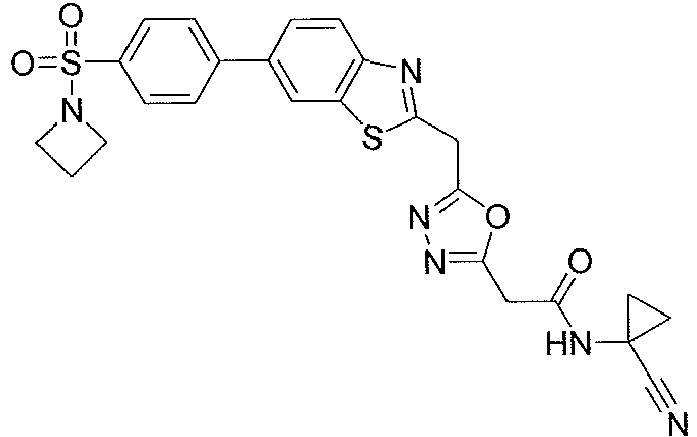
2.21 534.11 (MS+) C I-3-69 
2.16 465.10 (MS+) C I-3-70 
2.16 452.07 (MS+) C -
[Table 77] No. Structure NMR(δ) retention time Mass method I-3-71 
2.53 51410 (MS+) C I-3-72 
1.14 408 25 (MS+) C I-3-73 
(CDCl3) δ. 174 (s, 6H), 3 91 (s, 2H), 3.97 (s, 3H), 4 73 (s, 2H), 7.61 (d, J = 8.62 Hz, 1H), 7.67 (s, 1H), 781 (s, 2H), 7.94-7.99 (m, 1H) I-3-74 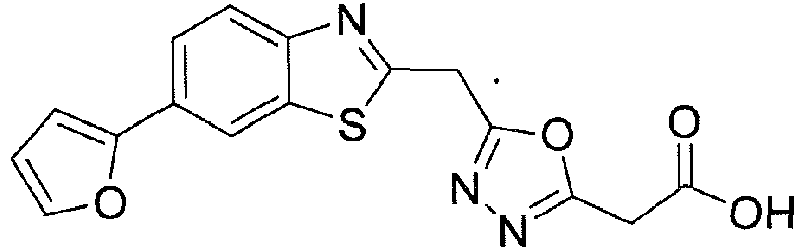
1.59 341 75 (MS+) C I-3-75 
1.7 357.80 (MS+) C -
[Table 78] No. Structure NMR(δ) retention time Mass method I-3-76 
1.87 409.90 (MS+) C I-3-77 
119 369 85 (MS+) C I-3-78 
1.92 41490 (MS+) C I-3-79 
1.24 358.80 (MS+) C I-3-80 
(DMSO-d6) δ: 1.14(dd, J = 8.36, 5.32 Hz, 2H), 1.49 (dd, J = 8 36, 5 32 Hz, 2H), 3.91 (s, 2H), 4.96 (s, 2H), 7.86 (dd, J = 8.62, 152 Hz, 1H), 8.03 (d, J = 8.62 Hz, 1H), 8.40 (s, 1H), 8.50 (d, J = 152 Hz, 1H), 9.13 (s, 1H) 9.23 (s, 1H). 1.36 422.85 (MS+) C -
[Table 79] No. Structure NMR(δ) retention time Mass method I-3-81 
1.91 371.95 (MS+) C -3-82 
(DMSO-d6) δ: 1.14 (dd, J = 8.1, 5.6 Hz, 2H), 1.48 (dd, J = 8.1, 5.6 Hz, 2H), 2.34 (s, 3H), 3 80 (s, 3H), 3 90 (s, 2H), 4 92 (s, 2H), 7 57 (dd, J = 8 4, 1.8 Hz, 1H), 7 96 (d, J = 8.1 Hz, 2H), 7 97 (s, 1H), 8.13 (d, J = 1 5 Hz, 1H), 9.23 (s, 1H). 1.29 433.90 (MS+) C I-3-83 
(DMSO-d6) δ: 1.14 (dd, J = 8.1, 5.6 Hz, 2H), 1.48 (dd, J=8.1, 5.6 Hz, 2H), 2.41 (s, 3H), 3.80 (s, 3H), 3 90 (s, 2H), 4.93 (s, 2H), 7 55 (dd, J = 8 6, 1.5 Hz, 1 H), 7.65 (s, 1 H), 798 (d, J = 86 Hz, 1H), 812 (d, J = 1.5 Hz, 1 H), 9 23 (s, 1H). 1 34 433.95 (MS+) C I-3-84 
DMSO-d6) δ: 3.78 (s, 3H), 4.04 (s, 2H), 4.96 (s, 2H), 7.37-7.42 (m, 1H), 7.50 (t, J = 6.9 Hz, 1H), 7.75-7 84 (m, 2H), 8.03 (d, J = 84 Hz, 1H), 8.29 (d, J = 15 Hz, 1H), 10.40 (s 1 H). I-3-85 
(DMSO-d6) δ: 1.13-1 15 (m, 2H), 1.47-1.50 (m, 2H), 3 91 (s, 2H), 4.99 (s, 2H), 7 98 (d, J = 8.7 Hz, 1H), 8.14 (d, J = 8.7 Hz, 1H), 8.62 (s, 1H), 9.19-9.25 (m, 4H) -
[Table 80] No. Structure NMR(δ) retention time Mass method I-3-86 
(DMSO-d6) δ:2.01-2.29 (m, 2H), 2.41(m, 2H), 2.81 (m, 2H), 3.94 (s, 2H), 4 79 (s, 2H), 7 72 (d, J = 8.36 Hz, 1 H), 8.00 (br-s, 1 H), 8.09 (s, 2H), 8.16 (d, J = 8.1 Hz, 1H), 9.02 (s, 2H), 9.25 (s, 1 H) I-3-87 
(DMSO-d6) δ: 1.14 (dd, J = 8.36, 532 Hz, 2H), 1.49 (dd, J = 8.36, 5.32 Hz, 2H), 3.91 (s, 2H), 4.94 (s, 2H), 7.65 (dd, J = 507, 1 52 Hz, 1 H), 7.69 (dd, J = 5.07, 304 Hz, 1 H), 7.90 (dd, J = 8.62, 1.52 Hz, 1H), 7.97-8.01 (m, 2H), 8 48 (d, J = 1 52 Hz, 1 H), 9.23 (s, 1 H). 182 42185 (MS+) C I-3-88 
(DMSO-d6) δ 1.43 (s, 9H), 3 65 (s, 3H), 3.89 (s, 2H), 4.74 (s, 2H), 7.51-7.65 (m, 2H), 7.65 (d, J = 7 5 Hz, 1 H), 7.88 (s, 1 H), 804 (d, J = 8.4 Hz, 1H) I-3-89 
2.52 49909 (M+) C I-3-90 
192 508.10 (M+) C -
[Table 81] No. Structure NMR(δ) retention time Mass method I-3-91 
(DMSO-d6) δ: 1.14 (dd, J = 8.36, 5.83 Hz, 2H), 1.49 (dd, J = 8.36, 5.32 Hz, 2H), 3 91 (s, 2H), 4 94 (s, 2H), 6 19 (d, J = 53.23 Hz, 2H), 7.80 (dd, J = 8.36, 1.77 Hz, 1 H), 7.99 (d, J = 8 11 Hz, 1 H), 8.23 (s, 1 H), 8 40 (d, J = 1.52 Hz, 1 H), 8 58 (s, 1 H), 9.23 (s, 1 H). 1 32 43815 (MS+) C I-3-92 
1H-NMR (DMSO-d6) δ: 1.14 (dd, J = 8.36, 5 32 Hz, 2H), 1.49 (dd, J = 8.36, 5.32 Hz, 2H), 3.91 (s, 2H), 4.99 (s, 2H), 7.79-7.82 (m, 2H), 7.97 (dd, J = 8.62, 2.03 Hz, 1H), 8.11 (d, J = 8 62 Hz, 1H), 8.63 (d, J = 152 Hz, 1H), 8.66-8.69 (m, 2H), 9.24 (s, 1H). 0.76 416.90 (MS+) C I-3-93 
(DMSO-d6) δ: 1.14 (dd, J = 8.1, 5.6 Hz, 2H), 1.49 (dd, J 27 8 1, 5.6 Hz, 2H), 3.92 (s, 2H), 4.98 (s, 2H), 7.36-7.44 (m, 2H), 7.88 (d, J = 7 1 Hz, 1 H), 7 93-7.98 (m, 2H), 8 01 (d, J = 7 6 Hz, 1 H), 8.06 (d, J = 8 6 Hz, 1 H), 8.58 (d, J = 2 0 Hz, 1 H), 9.24 (s, 1H) 2.19 471.90 (MS+) C I-3-94 
(DMSO-d6) δ: 1.14 (dd, J = 8.1, 5.6 Hz, 2H), 1 49 (dd, J = 8.1, 5.6 Hz, 2H), 3 92 (s, 2H), 5.00 (s, 2H), 8.12 (d, J = 8.6 Hz, 1H), 8 31 (dd, J = 8.6, 2.0 Hz, 1 H), 8.65 (d, J = 2.5 Hz, 1 H), 8 76 (dd, J = 2.5, 1.5 Hz, 1H), 894 (d, J=1.5Hz, 1H), 9 24 (s, 1 H), 9.36 (d, J = 1.0 Hz, 1H). 1.28 417.90 (MS+) C -
[Table 82] No. Structure NMR(δ) retention time Mass method I-3-95 
(DMSO-d6) δ: 1.12 (dd, J = 8.36, 5.32 Hz, 2H), 1.47 (dd, J = 8.11, 5.58 Hz, 2H), 3.89 (s, 2H), 420 (s, 2H), 4.90 (s, 2H), 7.43 (dd, J = 8.36, 177 Hz, 1H), 7.50-7 61 (m, 3H), 7.65 (s, 1H), 7 91 (d, J = 8.11 H z, I H), 8.02 (d, J = 1.01 Hz, 1 H), 9.23 (s, 1 H). 2.16 498.00 (MS+) C I-3-96 
(DMSO-d6) δ: 1.14 (m, 2H), 1.49 (m, 2H), 3.91 (s, 2H), 4.98 (s, 2H), 7 84 (d, J =33Hz, 1H), 797 (d, J= 3.3 Hz, 1H), 8.08-8.11 (m, 2H), 8.77 (s, 1H), 9.23 (s, 1H). I-3-97 
(DMSO-d6) δ: 1.14 (m, 2H), 1.49 (m, 2H), 3.91 (s, 2H), 4.99 (s, 2H), 7.63 (t, J = 7.8 Hz, 1H), 7.70-7.72 (m, 3H), 7.84 (t, J = 78Hz, 1 H), 7.99 (d, J = 7.5 Hz, 1 H), 8 13 (d, J = 7.8 Hz, 1 H), 8 37 (s, 1 H), 9.23 (s, 1 H) I-3-98 
(DMSO-d6) δ : 388 (s, 3H), 4.08 (s, 2H), 4.98 (s, 2H), 7.88 (d,J = 15 Hz, 1H), 7.99 (s, 1 H), 828-830 (m, 2H) I-3-99 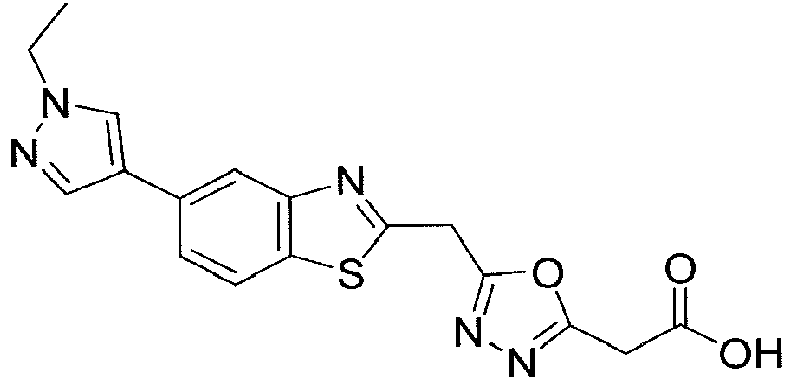
(DMSO-d6) δ 1.42 (t, J = 7.2 Hz, 3H), 4.08 (s, 2H), 4 15 (q, J = 7.2 Hz, 2H), 4.94 (s, 2H), 7 69 (dd, J = 8.1, 1.5 Hz, 1H), 7.99 (s, 1H), 8 05 (d, J = 6.9 Hz, 1H), 8.19 (d, J = 4,0 Hz, 1H), 8.31 (s, 1H) -
[Table 83] No. Structure NMR(δ) retention time Mass method I-3-100 
(DMSO-d6) δ 1.14 (dd, J = 8.4, 5.3 Hz, 2H), 1.49 (dd, J = 8.4, 5.3 Hz, 2H), 3 88 (s, 3H), 3.91 (s, 2H), 4 97 (s, 2H), 7.78 (d ,J = 1 5 Hz, 1H), 7.99 (s, 1 H), 8.28-8 30 (m, 2H), 9.23 (s, 1H). I-3-101 
(DMSO-d6) δ: 1.14 (dd, J = 8.4, 5.3 Hz, 2H), 1 42 (t, J = 7.2 Hz, 3H),1.49 (dd, J = 8.4, 5.3 Hz, 2H), 3.91 (s, 2H), 7.69 (dd, J = 8.1, 1 50 Hz, 1 H), 7.99 (s, 1 H), 8 05 (d, J = 6.9 Hz, 1H), 8.19 (d, J = 4.0 Hz, 1 H), 8.31 (s, 1 H), 9.23 (s, 1 H). I-3-102 
(DMSO-d6) δ: 3.87 (s, 3H), 3 99 (s, 2H), 4.19 (d, J = 5.4 Hz, 2H), 4.97 (s, 2H), 7 88 (d, J = 1.5 Hz, 1 H), 7 99 (d, J = 1.5 Hz, 1 H), 8 27-8.30 (m, 2H), 9.02 (t, J = 5.3 Hz, 1 H). I-3-103 
(DMSO-d6) δ: 1.15 (m, 2H), 1.49 (m, 2H), 3.91 (s, 2H), 4.97 (s, 2H), 7.25 (s, J = 7.5Hz, 1 H), 7.80-7.85 (m, 2H), 8.05 (d, J = 9.3 Hz, 1 H), 8.25 (d, J = 10 2 Hz, 1 H), 8.83 (s, 1H), 9.24 (s, 1 H) I-3-104 
(DMSO-d6) δ 1.14 (dd, J = 8.1, 5.6 Hz, 2H), 1.49 (dd, J = 8 1, 5.6 Hz, 2H), 2.38 (s, 3 H), 3.91 (s, 2H), 4 96 (s, 2H), 723-7.28 (m, 2H), 7.35-7.45 (m, 2H), 7 50 (dd, J = 8.4, 1.8 Hz, 1H), 8.02 (d, J = 8.1 Hz, 1 H), 8.10 (d, J = 1.5 Hz, 1 H), 9 23 (s, 1 H). 1.96 461 95 (MS+) C -
[Table 84] No. Structure NMR(δ) retention time Mass method I-3-105 
(DMSO-d6) δ: 1.14 (dd, J = 8.1, 5.6 Hz, 2H), 1.49 (dd, J = 8.1, 5.6 Hz, 2H), 3.78 (s, 3H), 3.91 (s, 2H), 4.95 (s, 2H), 7.06 (t, J = 7.4 Hz, 1H), 7.15 (d, J = 8 1 Hz, 1 H), 7.34-7.41 (m, 2H), 7.61 (dd, J = 8 4, 1.8 Hz, 1 H), 7.99 (d, J = 8.6 Hz, 1 H), 8.18 (d, J = 1.5 Hz, 1 H), 9.23 (s, 1 H). 1.87 446 20 (MS+) C I-3-7 06 
(DMSO-d6) δ 1 14 (dd, J = 8 1, 5.6 Hz, 2H), 1.49 (dd, J = 8.1, 5.6 Hz, 2H), 3.91 (s, 2H), 4.97 (s, 2H), 7.24 (td, J = 8.4, 2.0 Hz, 1 H), 7.37-7.46 (m, 1H), 7.64-7.70 (m, 2H), 8 07 (d, J = 8.1 Hz, 1 H), 8 30 (s, 1 H), 9 23 (s, 1 H) 1 93 452.15 (MS+) C I-3-107 
(DMSO-d6) δ: 1.14 (dd, J = 8.1, 5.6 Hz, 2H), 1 49 (dd, J = 8 1, 5.6 Hz, 2H), 3 91 (s, 2H), 4 99 (s, 2H), 7.32-7 37 (m, 1 H), 7.42-7.53 (m, 2H), 7.72 (dt, J = 8.6, 1.8 Hz, 1 H), 8.09 (d, J = 8.1 Hz, 1 H), 8 36 (s, 1 H), 9.24 (s, 1H). 1.91 451.95 (MS+) C I-3-108 
1 25 386 C I-3-109 
(DMSO-d6) δ 1.14 (dd, J = 8.4, 5 2 Hz, 2H), 1.49 (dd, J = 8.4, 5.3 Hz, 2H), 2.50 (s, 3H), 3.88 (s, 3H), 3 91 (s, 2H), 4.90 (s, 2H), 7.61 (s, 1 H), 7.95 (s, 1 H), 8.17 (s, 1 H), 8.29 (s, 1 H), 9.23 (s, 1 H). -
[Table 85] No. Structure NMR(δ) retention time Mass method I-3-110 
(DMSO-d6) δ: 1.14 (dd, J = 8.36, 5.83 Hz, 2H), 1.48 (dd, J = 8.36, 5.32 Hz, 2H), 1.95-2.01 (m, 4H), 3.23-3.30 (m, 4H), 3.89 (s, 2H), 4.83 (s, 2H), 6.78 (dd, J = 8.87, 2.28 Hz, 1H), 7.01 (d, J = 2.03 Hz, 1H), 7.80 (d, J = 8 62 Hz, 1H), 9 22 (s, 1 H). 1.74 409.00 (MS+) C I-3-111 
(DMSO-d6) δ : 1 14 (dd, J = 8.4, 5 8 Hz, 2H), 1.48 (dd, J = 8.4, 5.3 Hz, 2H), 3.91 (s, 2H), 4.98 (s, 2H), 6.72 (dd, J = 7.8 Hz, 1H), 8 01-8.14 (m, 3H), 8 22 (d, J = 8 4Hz, 1H), 8 85 (s, 1 H), 9.23 (s, 1H) I-3-112 
(DMSO-d6) δ1.14 (dd, J = 8 4, 5.8 Hz, 2H), 1.48 (dd, J = 8.4, 5.3 Hz, 2H), 3 91 (s. 2H). 4.98 (s. 2H). 8.11 (d, J = 9.0Hz, 1H), 8.49 (d, J = 8.7Hz, 1H), 9.03 (s, 3H), 908(s. 1H), 9.23 (s, 1H) I-3-113 
1 28 34180 (MS+) C I-3-114 
(DMSO-d6) δ : 1.14 (dd, J = 8.36, 5.83 Hz, 2H), 1.49 (dd, J = 8.36, 5 32 Hz, 2H), 3.91 (s, 2H), 4.96 (s, 2H), 6.59 (dd, J = 2.53, 2.03 Hz, 1H), 7.80 (d, J = 1.52 Hz, 1 H), 8.03 (dd, J = 8.87, 2.28 Hz, 1H), 8.08 (d, J = 8.62 Hz, 1H), 8.57 (d, J = 2 53 Hz, 1H), 8.60 (d, J = 2.03 Hz, 1H), 9.23 (s, 1H). 1.4 405.95 (MS+) C -
[Table 86] No. Structure NMR(δ) retention time Mass method I-3-115 
1 55 370.90 (MS+) C I-3-116 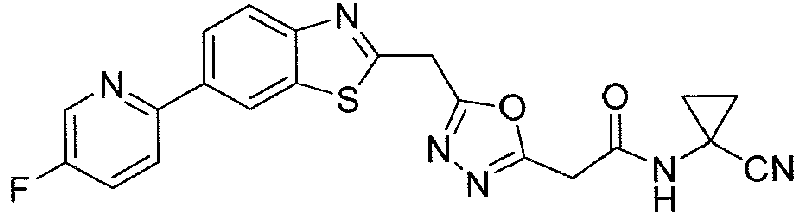
(DMSO-d6) δ: 1 14 (dd, J = 8.4, 5.6 Hz, 2H), 1 49 (dd, J = 8.4, 56Hz, 2H), 3.91 (s, 2H), 4.97 (s, 2H), 7.88 (td, J = 8 7, 2.9 Hz, 1 H), 8.07 (d, J = 8.6 Hz, 1 H), 8.15 (dd, J = 8 9, 4 3 Hz, 1H), 8.23 (dd, J = 8.6, 1 5 Hz, 1H), 8.69 (d, J = 3.0 Hz, 1 H), 8.81 (d, J = 1.5 Hz, 1 H), 9.23 (s, 1 H). 1.61 434.95 (MS+) C I-3-117 
(DMSO-d6) δ : 1.12 (dd, J = 8.62, 5.58 Hz, 2H), 1.47 (dd, J = 8.11, 5.58 Hz, 2H), 1.64 (d, J = 7.60 Hz, 3H), 3 88 (s, 2H), 4.32 (q, J = 7 44 Hz, 1H), 4.89 (s, 2H), 7 14-7.20 (m, 1 H), 7.25-7 31 (m, 4H), 7.39 (dd, J = 8.36, 1.77 Hz, 1H), 7.87 (d, J = 8.62 Hz, 1H), 8.03 (d, J = 2.03 Hz, 1H), 9.23 (s, 1H) 2.06 44395 (MS+) C I-3-118 
(DMSO-d6) δ 1.14 (dd, J = 8.11, 5.58 Hz, 2H), 1 49 (dd, J = 8.11, 5 58 Hz, 2H), 2.41 (s, 3H), 3.91 (s, 2H), 4.97 (s, 2H), 7.22 (d, J = 5.07 Hz, 1 H), 7 93 (s, 1H), 8.06 (d, J = 8 11 Hz, 1H), 8.26 (dd, J = 8 62, 2.03 Hz, 1H), 8.55 (d, J = 5 07 Hz, 1H), 8.84 (d, J = 1 52 Hz, 1H), 9.24 (s, 1H) (DMSO-d6) δ 1.14 (dd, J 1.05 430.95 (MS+) C I-3-119 
= 8 4, 5.8 Hz, 2H), 1.48 (dd, J = 8.4, 5.3 Hz, 2H), 3 91 (s, 2H), 4 93 (s, 2H), 6.86 (s, 1 H), 7.40 (s, 1H), 7.74 (d, J =7.5 Hz, 2H), 7.96 (d, J =7.5 Hz, 2H), 8 34 (s, 1H), 9.23 (s, 1H) -
[Table 87] No. Structure NMR(δ) retention time Mass method I-3-120 
(DMSO-d6) δ: 1.14 (dd, J = 8.1, 5.6 Hz, 2H), 1.49 (dd, J = 8.1, 5.6 Hz, 2H), 2.47 (s, 6H), 3.91 (s, 2H), 4.94 (s, 2H), 7.04 (t, J = 7.6 Hz, 1 H), 7.10 (d, J = 8.1 Hz, 1 H), 7.23 (dd, J = 7 6, 1.5 Hz, 1H), 7.30 (td, J = 8.1, 2.0 Hz, 1 H), 7 71 (dd, J = 8 4 1.8 Hz, 1H), 8.00 (d, J = 8,6 Hz, 1H), 821 (d, J 1.5 Hz, 1H), 9.23 (s, 1 H) 1.46 45900 (MS+) C I-3-121 
(DMSO-d6) δ : 2.79 (s. 3H), 3.91 (s, 2H), 4.74 (s, 2H), 7.40 (s, 1H), 7.96-8 04 (m, 3H), 8 48 (s, 1H), I-3-122 
(DMSO-d6) δ: 1.14 (dd, J = 8.11, 5.55 Hz, 2H), 1.49 (dd, J = 8.11, 5.58 Hz, 2H), 3.89 (s, 3H), 3.91 (s, 2H), 4.96 (s, 2H), 7.52 (dd, J = 8.62, 3.04 Hz, 1H), 8 03 (d, J = 8.62 Hz, 2H), 8.20 (dd, J = 8.62, 2.03 Hz, 1 H), 8 41 (d, J = 3 04 Hz, 1H), 8.76 (d, J = 1 52 Hz, 1H), 9 23 (s, 1 H). 1.44 44700 (MS+) C I-3-123 
(DMSO-d6) δ 1.14 (dd, J = 8 36, 5.32 Hz, 2H), 1.49 (dd, J = 8.11, 5 58 Hz, 2H), 2 57 (s, 3H), 3.91 (s, 2H), 4.98 (s, 2H), 7 36 (d J = 5.07 Hz, 1H), 8.08 (d, J = 8.62 Hz, 1 H), 8.55 (dd, J = 8.87, 1.77 Hz, 1H), 8 78 (d, J = 5.07 Hz, 1H), 912 (d, J = 1 52 Hz, 1 H), 9.23 (s, 1 H). 1.54 431 95 (MS+) C -
[Table 88] No. Structure NMR(δ) retention time Mass method I-3-124 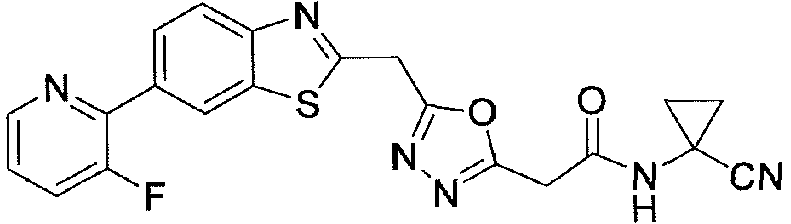
(DMSO-d6) δ : 1.14 (dd, J = 8.1, 5.6 Hz, 2H), 1 49 (dd, J = 8.1, 5.6 Hz, 2H), 3.91 (s, 2H), 4 99 (s, 2H), 7.50-7.55 (m, 1 H), 7.89 (ddd, J = 11.7, 8.4, 1.3 Hz, 1H), 8.06-8.13 (m, 2H), 8.58-8.60 (m, 1 H), 8.68 (s, 1H), 9.23 (s, 1 H). 1 51 434.95 (MS+) C I-3-125 
(DMSO-d6) δ: 3 91 (s, 3H), 4 08 (s, 2H), 4.95 (s, 2H), 7.89 (d, J = 12.0 Hz, 1 H), 7.95 (s, 1 H), 8.18 (d, J = 2.7 Hz. 1 H), 8 45 (d, J = 7.0 Hz, 1 H). I-3-126 
(DMSO-d6) δ: 4.08 (s, 2H), 5.00 (s, 2H), 7.13 (dd, J = 9.6, 1.50 Hz, 1 H), 8 29 (d, J = 2.5 Hz, 1 H). I-3-127 
(DMSO-d6) δ. 3.91 (s, 2H), 4 95 (s, 2H), 7.89 (d, J = 12.0 Hz, 1H), 7.95 (s, 1H), 8 18 (d, J = 2 7 Hz, 1H), 8.45 (d, J = 7.0 Hz, 1H) I-3-128 
(DMSO-d6) δ. 1.14 (dd, J = 8.4, 5 3 Hz, 2H), 1.49 (dd, J = 8.4, 5.3 Hz, 2H), 3 91 (s, 2H), 4 95 (s, 2H), 7 89 (d, J = 12.0 Hz, 1H), 7.95 (s, 1H), 8 18 (d, J = 2 7 Hz, 1H), 8.45 (d, J = 7.0 Hz, 1H), 9.24 (s, 1H) -
[Table 89] No. Structure NMR(δ) retention time Mass method I-3-129 
(DMSO-d6) δ: 1.14 (dd, J = 8 36, 5.83 Hz, 2H), 1.26 (t, J = 7.60 Hz, 3H), 1.48 (dd, J = 8.11, 5.58 Hz, 2H), 2 69 (q, J = 7.60 Hz, 2H), 3.91 (s, 2H), 4 98 (s, 2H), 8.08 (d, J = 8.62 Hz, 1H), 8.53 (dd, J = 8.62, 2 03 Hz, 1 H), 8.83 (s, 2H), 9 10 (d, J = 2.03 Hz, 1 H), 9.23 (s, 1 H). 1 73 446 00 (MS+) C I-3-130 
1.74 35785 (MS+) C I-3-131 
(DMSO-d6) δ. 1.14 (dd, J = 8 36, 5 83 Hz, 2H), 1.49 (dd, J = 8 11, 5.58 Hz, 2H), 2 35 (s, 3H), 3.91 (s, 2H), 4.96 (s, 2H), 7 74 (dd, J = 8.62, 2.53 Hz, 1H), 7.97 (d, J = 8.11 Hz, 1H), 8.05 (d, J = 8.62 Hz, 1H), 8 24 (dd, J = 8.62, 2.03 Hz, 1H), 8.54 (d, J = 2.03 Hz, 1H), 8.82 (d, J = 1.52 Hz, 1H), 9.23 (5, CH) 1 23 43095 (MS+) C I-3-132 
(DMSO-d6) δ 114 (dd, J = 8.36, 5.83 Hz, 2H), 1 48 (dd, J = 8 36, 5.32 Hz, 2H), 1.95-2.01 (m, 4H), 3 24-3.30 (m, 4H), 3.89 (s, 2H), 4.77 (s, 2H), 6 77 (dd, J = 8.87, 2.28 Hz, 1 H), 7.08 (d, J = 2.53 Hz, 1H), 7.73 (d, J = 9.12 Hz, 1 H), 9 22 (s, 1 H). 1 77 409.00 (MS+) C I-3-133 
(DMSO-d6) δ 1.14 (dd, J = 8.4, 5.3 Hz, 2H), 1 49 (dd, J = 8 4, 5.3 Hz, 2H), 3 92 (s, 2H), 5.00 (s, 2H), 7.14 (dd, J = 102, 1.80 Hz, 1H), 8.29 (dd, J = 1.8, 0.60 Hz, 1H), 9 24 (s, 1H). -
[Table 90] No. Structure NMR(δ) retention time Mass method I-3-134 
(DMSO-d6) δ : 1.14 (dd, J = 8 4, 5.3 Hz, 2H), 1.49 (dd, J = 8 4, 5 3 Hz, 2H),3 88 (s, 3H), 3.91 (s, 2H), 500 (s, 2H), 7 65 (dd, J = 12.0, 1.5 Hz, 1H), 7.99 (s, 1 H), 8.15 (d, J = 1.2 Hz, 1H), 8 25 (s, 1 H). 9.24 (s, 1 H). I-3-135 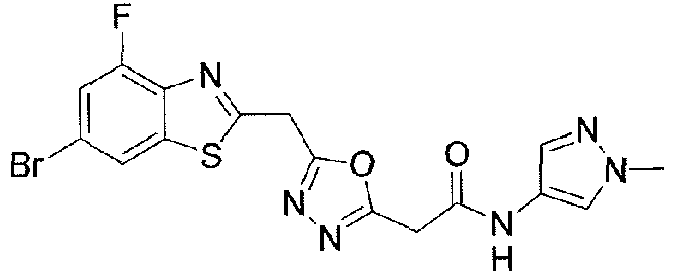
(DMSO-d6) δ. 3 78 (s, 2H), 5.00 (s, 2H), 7.40 (d, J = 0.9 Hz, 1 H), 7.72 (dd, J = 102, 1.4 Hz, 1H). 7.84 (s, 1 H), 8 29 (dd, J = 1 8, 0.9 Hz, 1H), 10.34 (brs, 1H) I-3-136 
(DMSO-d6) δ. 2.50 (s, 3H), 4.08 (s, 2H), 4.98 (s, 2H), 6.87 (d, J = 2.4 Hz, 1 H), 7.46 (d, J = 3.6 Hz, 1 H), 7.65 (dd, J = 12.0, 1.8 Hz, 1H), 8.17 (d, J = 1.5 Hz, 1H). I-3-137 
(DMSO-d6) δ: 2.50 (s, 3H), 4.08 (s, 2H), 4 98 (s, 2H), 6.92 (d, J = 2.4 Hz, 1 H), 7.43 (d, J = 3.6 Hz, 1H), 794 (d, J = ic'..0 HZ, 1H), 8.50 (d, J=75 Hz, 1H). I-3-138 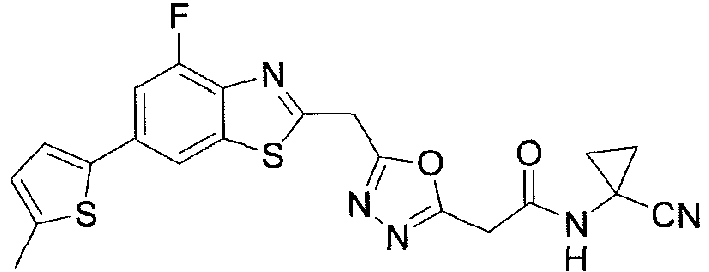
(DMSO-d6) δ 1 14 (dd, J = 8.4, 5.3 Hz, 2H), 1 49 (dd, J = 8.4, 5.3 Hz, 2H), 2.50 (s, 3H), 3 91 (s, 2H), 4.97 (s, 2H), 6.87 (d, J = 2.4 Hz, 1 H), 7 46 (d, J = 3 6 Hz, 1H), 7.65 (dd, J = 12.0, 1.80 Hz, 1H), 8.17 (d, J = 1.5 Hz, 1H), 9.24 (s, 1H) -
[Table 91] No. Structure NMR(δ) retention time Mass method I-3-139 
(DMSO-d6) δ: 1.14 (dd, J = 8.4, 5.3 Hz, 2H), 1 49 (dd, J = 8.4, 5.3 Hz, 2H), 2.50 s, 3H), 3.91 (s, 2H), 4.97 s, 2H), 6.92 (d, J = 2.4 Hz, 1H), 7.43 (d, J = 3 6 Hz, 1H), 7.94 (d, J = 12 0 Hz, 1H), 8 50 (d, J = 7.5 Hz, 1H), 9.24 (s, 1 H). I-3-140 
(DMSO-d6) δ: 1.13 (dd, J = 8 36, 5.32 Hz, 2H), 1 48 (dd, J = 8 36, 5.32 Hz, 2H), 1.77-1.93 (m, 4H), 3 42 (t, J = 6.34 Hz, 2H), 3.50 (t, J = 6.84 Hz, 2H), 3.90 (s, 2H), 4.97 (s, 2H), 7.65 (dd, J = 8.36, 1.77 Hz, 1H), 8.01 (d, J = 8.11 Hz, 1H), 8.31 (d, J = 1.52 Hz, 1H), 923 (s, 1H). 1.17 437.00 (MS+) C I-3-141 
213 38585 (MS+) C I-3-142 
(DMSO-d6) δ: 1.14 (dd, J = 8 11, 5 58 Hz, 2H), 1.28 (t, J = 7.60 Hz, 3H), 1 48 (dd, J = 8 11, 5.58 Hz, 2H), 2.85 (q, J = 7.44 Hz, 2H), 3 90 (s, 2H), 4.93 (s, 2H), 6.89 (d, J = 3.55 Hz, 1 H), 741 (d, J = 3.55 Hz, 1H), 7.75 (dd, J = 8.62, 2 03 Hz, 1H), 7.96 (d, J = 8.62 Hz, 1H), 8.35 (d, J = 2.03 Hz, 1H), 9.23 (s, 1H) 219 449 95 (MS+) C I-3-143 
(DMSO-d6) δ 409 (s, 2H), 5.00 (s, 2H), 7 91 (m, 1 H), 8.13 (d, J = 8 7 Hz, 1 H), 8.24-8.42 (m, 3H), 8 92 (s, 1 H) -
[Table 92] No. Structure NMR(δ) retention time Mass method I-3-144 
(DMSO-d6) δ 1.14 (dd, J = 8.36, 5.32 Hz, 2H), 1.49 (dd, J = 8 11, 5.58 Hz, 2H), 3.91 (s, 2H), 4.99 (s, 2H), 7.89 (d, J = 7.8 Hz, 1 H), 8.13 (d, J = 8.7 Hz. 1H), 8 1-8 39 (m 3H) 8.91 (s. 1H), 9.23 (s, 1 H) I-3-145 
(DMSO-d6) δ: 1.14 (dd, J = 8.36, 5.32 Hz, 2H), 1.49 (dd, J = 8.11, 5.58 Hz, 2H), 3.91 (s, 2H), 4.99 (s, 2H), 7 49 (t, J = 4.82 Hz, 1 H), 8 10 (d, J = 8.62 Hz, 1 H), 8 56 (dd, J = 8.62. 1.52 Hz. 1 H), 8.95 (d, J = 5.07 Hz, 2H), 9.14 (d, J = 1.52 Hz, 1H), 9.23 (s, 1H). 1.38 41790 (MS+) C I-3-146 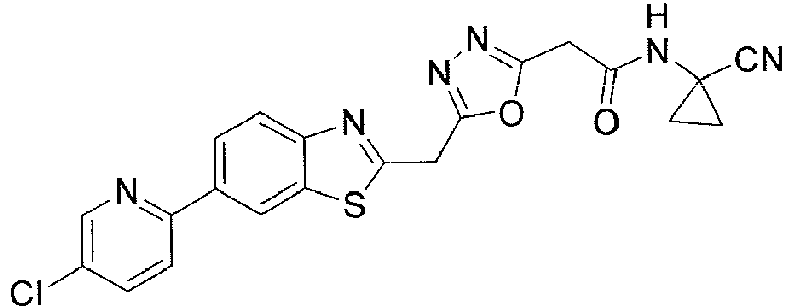
(DMSO-d6) δ. 1 14 (dd, J = 8.36, 5 32 Hz, 2H), 1.49 (dd, J = 8.36, 5.32 Hz, 2H), 391 (s, 2H), 4.98 (s, 2H), 8.04-8.09 (m, 2H), 8.13 (d, J = 8 62 Hz, 1 H), 8.25 (dd, J = 8.62, 1 52 Hz, 1 H), 8.74 (d, J = 2.53 Hz, 1H), 8.86 (d, J = 2 03 Hz, 1 H), 9.23 (s, 1 H). 1.84 450.90 (S+) C I-3-147 
1.77 386.85 (MS+) C -
[Table 93] No. Structure NMR(δ) retention time Mass method I-3-148 
(DMSO-d6) δ: 1.14 (dd, J = 8.11, 5.58 Hz, 2H), 1.45 (d, J = 6 08 Hz, 3H), 1.48 (dd, J = 8.36, 5.32 Hz, 2H), 3.91 (s, 2H), 491-4.99 (m, 3H), 5.63 (d, J = 3.55 Hz, 1 H), 6.95 (d, J = 3.55 Hz, 1H), 7.42 (d, J = 3.55 Hz, 1H), 7.77 (dd, J = 8.62, 2.03 Hz, 1 H), 7.97 (d, J = 8.62 Hz, 1H), 8.38 (d, J = 1.52 Hz, 1 H), 9.30 (s, 1 H). 1.53 46595 (MS+) C I-3-149 
(DMSO-d6) δ 1 14 (dd, J = 8.36, 5.32 Hz, 2H), 1.48 (dd, J = 8.11, 5 58 Hz, 2H), 3.91 (s, 2H), 4.65 (d, J = 5 58 Hz, 2H), 4 94 (s, 2H), 5.54 (t, J = 5.83 Hz, 1H), 6 99 (d, J = 3.55 Hz, 1H), 7.44 (d, J = 3 55 Hz, 1 H), 7 78 (dd, J = 8.62, 2.03 Hz, 1H), 7 97 (d, J = 8 62 Hz, 1 H), 8.39 (d, J = 1 52 Hz, 1 H), 9 26 (s, 1 H). 1 39 451.90 (MS+) C I-3-150 
(DMSO-d6) δ: 4.08 (s, 2H), 4 98 (s, 2H), 7 44-7.62 (m, 5H), 7.96 (d,J=11.7 Hz, 1 H), 8 31 (d, J = 7.5 Hz, 1 H). I-3-151 
(DMSO-d6) δ : 1.14 (dd, J = 8.4, 5.3 Hz, 2H), 1.49 (dd, J=8.4,5.3Hz,2H),3.91 (s, 2H), 4 97 (s, 2H), 7.44-7.62 (m, 5H), 7 96 (d, J = 11.7 Hz, 1 H), 8.31 (d, J = 7.2 Hz, 1H), 9 24 (s, 1H). I-3-1 52 
(DMSO-d6) δ : 0.94 (t, J = 7.2H), 1 71-1.76 (m, 2H), 3 88 (s, 3H), 3.97 (s, 2H), 4 92 (s, 2H), 7.72 (d, J = 87 Hz, 1H), 7.91-7.95 (m, 2H), 8 21 (s, 3H), 8.29 (s, 1 H), 9.09 (br-s, 1 H) -
[Table 94] No. Structure NMR(δ) retention time Mass method I-3-153 
(DMSO-d6) δ. 1 14 (dd, J = 8 6, 5 6 Hz, 2H), 1.49 (dd, J=8.4,5.3Hz,2H),391 (s, 2H), 5.00 (s, 2H), 8.12 (d, J = 8 6 Hz, 1 H), 8.30 (d, J = 8.6 Hz, 1H), 8 34 (dd, J = 8.6, 2.0 Hz, 1H), 8.44 (dd, J = 8.6, 2 0 Hz, 1H), 8.98 (d, J = 1.5 Hz, 1H), 9 13 (d, J = 1 5 Hz, 1H), 9.23 (s, 1 H). 1.51 441.95 (MS+) C I-3-154 
(DMSO-d6) δ : 1.14 (dd, J = 8 11, 5.58 Hz, 2H), 1.49 (dd, J = 8.11, 5.58 Hz, 2H), 2.34 (s, 3H), 3.91 (s, 2H), 4.98 (s, 2H), 8.08 (d, J = 9.12 Hz, 1 H), 8.53 (d, J = 8.62 Hz, 1H), 8.79 (s, 2H), 9.10 (s, 1H), 9.24 (s, 1H). 1 53 431.95 (MS+) C I-3-155 
2.08 391.85 (MS+) C I-3-156 
1.57 399.85 (MS+) C I-3-157 
(DMSO-d6) δ: 1.14 (dd, J = 8.36, 5 32 Hz, 2H), 1.49 (dd, J = 8.36, 5 32 Hz, 2H), 2 56 (s, 3H), 3.91 (s, 2H), 4.97 (s, 2H), 7.74 (d, J = 4 06 Hz, 1 H), 7.92 (dd, J = 8.36, 1.77 Hz, 1 H), 7 99 (d, J = 4.06 Hz, 1 H), 8.04 (d, J = 8.62 Hz, 1 H), 8 60 (d, J = 2.03 Hz, 1 H), 9.24 (s, 1 N). 1 65 463.95 (MS+) C -
[Table 95] No. Structure NMR(δ) retention time Mass method I-3-158 
(DMSO-d6) δ : 1.14 (dd, J = 8.1, 5.6 Hz, 2H), 1.49 (dd, J = 8. 1, 5 Hz. 2H), 3.92 (s, 2H), 4.99 (s, 2H), 8.03 (dd, J = 7 6, 1.0 Hz, 1 H), 8.12 (d, J = 8 6 Hz, 1 H), 819 (t, J = 7.9 Hz, 1H), 8.27 (dd, J = 8 6, 1.5 Hz, 1 H), 8.42 (d, J = 8 1 Hz, 1 H), 8.92 (d, J = 2 0 Hz, 1 H), 9.24 (s, 1 H). 157 442 20 (S+) C I-3-159 
(DMSO-d6) δ 4.00 (s, 2H), 4.20 (d, J = 5.6 Hz, 2H), 5.04 (s, 2H), 7.45 (t, J = 7.4 Hz, 1 H)). 7 53 (t, J = 7.4 Hz, 2H), 8.16 (d, J = 7.6 Hz, 2H), 8.79 (s, 1 H), 9 03 (t, J = 5.6 Hz, 1H), 9.31 (d, J = 1.0 Hz, 1 H). 1.44 391 15 (MS+) C I-3-160 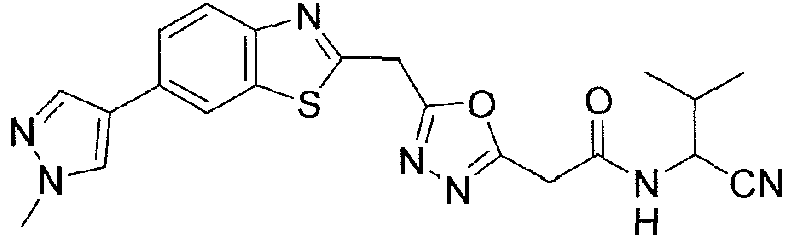
(CDCl3) δ: 1 07-1.14 (m, 6H), 2 11 (m, 1 H), 3.95 (s, 2H), 3.97 (s, 3H), 4 73 (s, 2H), 4 78 (m, 1 H), 7.60 (d, J = 7.8 Hz, 1 H), 7 67 (s, 1 H), 7.81 (s, 1 H), 7.93-7 99 (m, 3H). I-3-161 
(DMSO-d6) δ: 1.14 (dd, J = 8.36, 5 32 Hz, 2H), 1 48 (dd, J = 8.11, 5.58 Hz, 2H), 3 91 (s, 2H), 4 95 (s, 2H), 5.47-5.57 (m, 1 H), 7.23 (d, J = 4.06 Hz, 1 H), 7 38 (br s, 1 H), 7.52 (d, J = 4.06 Hz, 1 H), 7.81 (dd, J = 8.62, 1.52 Hz, 1H), 7.99 (d, J = 8.62 Hz, 1 H), 8.45 (d, J = 1.52 Hz, 1H), 9.29 (s, 1H). 1 71 52025 (MS+) C -
[Table 96] No. Structure NMR(δ) retention time Mass method I-3-162 
(DMSO-d6) δ: 1.14 (dd, J = 8.1, 5.6 Hz, 2H), 1.49 (dd, J=8.1,56Hz,2H),3.69 (s, 3H), 3.91 (s, 2H), 4.94 (s, 2H), 6.09 (dd, J = 3 6, 2 5 Hz, 1 H), 6.26 (dd, J = 3.6,2.0Hz,1H),6.88(dd,J 3.6 2.0 Hz, 1H 1H), 3.68 (dd, J = 2.5, 2.0 Hz, 1H), 7.59 (dd, J = 8.6, 2.0 Hz, 1 H), 7.98 (d, J = 8.6 Hz, 1 H), 8.18 (d, J = 1.5 Hz, 1 H), 9.23 (s, 1H). 1.71 419.10in 419.10 J.IU (MS+) C I-3-163 
(DMSO-d6) δ: 1.14 (dd, J = 8 36, 5.32 Hz, 2H), 1.49 (dd, J = 8 11, 5 58 Hz, 2H), 3.91 (s, 2H), 4.94 (s, 2H), 6.82 (dd, J = 4 06, 2.03 Hz, 1 H), 7.33 (t, J = 4.06 Hz, 1 H), 7.75 (dd, J = 8 62, 2.03 Hz, 1H), 7.99 (d, J = 8.62 Hz, 1H), 8.37 (d, J = 2.03 Hz, 1H), 9.23 (s, 1H). 1.97 439 90 (MS+) C I-3-164 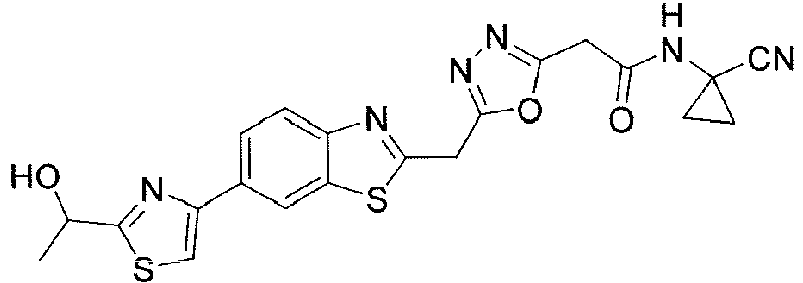
(DMSO-d6) 114 (dd, J = 8.62, 5 58 Hz, 2H), 1.49 (dd, J = 8 36, 5.32 Hz, 2H), 1 52 (d, J = 6.59 Hz, 3H), 3.91 (s, 2H), 4 95 (s, 2H), 5.02 (dq, J = 6.59, 5 07 Hz, 1H), 6.19 (d, J = 5 07 Hz, 1 H), 8.01 (d, J = 8.62 Hz, 1H), 8.10 (s, 1H), 8.10 (dd, J= 8.62 1.52 Hz 1H), 867 (d, J = 1.52 Hz, 1 H), 9.24 (s, 1H). 1 37 466.95 (MS+) C I-3-165 
(DMSO-d6) δ: 1.14 (dd, J = 8.36, 5.83 Hz, 2H), 1.49 (dd, J = 8.11, 5 58 Hz, 2H), 1.79 (dd, J = 24 33, 6.08 Hz, 3H), 3 31 (s, 2H 4.96 (s, 2H), 6 10 (dq, J= 47.53, 6.42 Hz, 1H), 8.04 (d, J = 8.62 Hz, 1H). 8.13 (dd, J = 8.36, 1.77 Hz, 1 H), 8.31 (s, 1 H), 8.72 (d, J = 1.52 Hz, 1 H), 9.24 (s, 1 H). 1 83 468 95 (MS+) C -
[Table 97] No. Structure NMR(δ) retention time Mass method I-3-166 
(DMSO-d6) δ: 1.14 (dd, J = 8 36, 5 83 Hz, 2H), 1.49 (dd, J = 8.36, 5.83 Hz, 2H), 1.59 (s, 6H), 3.91 (s, 2H), 4.95 (s, 2H), 6.05 (s, 1H), 8 01 (d, J = 8.62 Hz, 1H), 8.05 (s, 1 H), 8. 10 (d.d = 8.62, 1.52 Hz, 1 H), 8 66 (d, J = 1.52 Hz, 1H), 9 24 (s, 1H). 1.5 480.95 (MS+) C I-3-167 
1.43 391 85 (MS+) I-3-168 
(DMSO-d6) δ : 1 14 (dd, J = 8 4, 5 3 Hz, 2H), 1.48 (dd, J=8.4,5.3Hz,2H),391 (s 2H). 4.95 (s. 2H). 7 67-8.06 (m, 3H), 8.36 (s, 1H), 8.47 (s, 1H), 8.81 (s, 1H), 9.24 (s, 1 H). I-3-169 
(DMSO-d6) δ: 1.14 (dd, J = 8.1, 5.6 Hz, 2H), 1.49 (dd, J = 8. 1 , 5.6 Hz, 2H), 3 9 1 (s, 2H), 4 96 (s, 2H), 7 30 (dd, J = 6.8, 5.3 Hz, 1H), 7.66 (d, J = 4.1 Hz, 1H), 7.83-7.92 (m, 3H), 7.97 (d, J = 8.1 Hz, 1H), 8.02 (d, J = 8 1 Hz, 1H), 8.52 (d, J = 2.0 Hz, 1H), 8 55 (d, J = 4.6 Hz, 1H), 9 23 (s, 1H) 1 84 499 05 (MS+) C -
[Table 9S] No. Structure NMR(δ) retention time Mass method I-3-170 
(DMSO-d6) 6: 1.14 (dd, J = 8.1, 5.6 Hz, 2H), 1.49 (dd, J = 8.1, 5.6 Hz, 2H), 3.91 (s, 2H), 4.95 (s, 2H), 7.34 (t, J = 7.4 Hz, 1H), 7.45 (t, J=76Hz,2H),759(d,J J = 3 6 Hz, 1H), 7.65 (d, J = 3.6 Hz, 1H), 7 71 (d, J = 7.1 Hz, 2H), 7.86 (dd, J = 8.6, 1.5 Hz, 1H), 8.01 (d, J = 8.6 Hz, 1H), 8.49 (d, J = 1.5 Hz, 1H), 9 23 (s, 1H) 23 498 05 (MS+) C -
[Table 99] No. Structure NMR(δ) retention time Mass method A-6 
(DMSO-d6) δ: 3.92 (s, 3H), 4.09 (s, 2H), 5.00 (s, 2H), 7.84-7.91 (m, 2H), 7.98 (s, 1H), 8.25 (d, J = 2.1 Hz, 1H). A-7 
(DMSO-d6) δ: 1.14 (dd, J = 8.4, 5.3 Hz, 2H), 149 (dd, J=8.4,53Hz,2H),2.51 (s,3H), 3.92 (s, 4H), 5.00 (s, 2H), 7 84-7.91 (m, 2H), 7 98 (s, 1H), 8 25 (d, J = 2.1 Hz, 1H), 9.24 (s, 1H). A-8 
(DMSO-d6) δ 2.50 (s, 3H), 4.09 (s, 2H), 5 02 (s, 2H), 6.92-6 94 (m, 1H), 7.48 (d, J = 3 3 Hz, 1H), 7.85-7 89 (m, 2H).. A-9 
(DMSO-d6) δ: 1.14 (dd, J = 8.4, 5.3 Hz, 2H), 1 49 (dd, J = 8.4, 5.3 Hz, 2H), 2 50 (s, 3H), 3.92 (s, 2H), 5 00 (s, 2H), 6.91-6.93 (m, 1H), 7.48 (d, J = 3.6 Hz, 1H), 7.85-7.89 (m, 2H), 9 24 (s, 1H). A-10 
(DMSO-d6) δ : 1.14 (dd, J = 8 1, 5 6 Hz, 2H), 1.49 (dd, J = 8 1, 5.6 Hz, 2H), 3.92 (s, 2H), 5.04 (s, 2H), 7.45 (t, J = 7.4 Hz, 1H), 7.53 (t, J = 7.4 Hz, 2H), 8.16 (d, J = 7.1 Hz, 2H), 8 79 (s, 1H), 9.24 (s, 1H), 9.31 (s, 1H). 1.54 417.20 (MS+) C -
[Table 100] No. Structure NMR(δ) retention time Mass method A-11 
1 43 352.85 (MS+) C A-12 
(DMSO-d6) δ : 4.09 (s, 2H), 5.03 (s, 2H), 7.57-7.61 (m, 2H), 7.66-7 73 (m, 3H), 7.60 (d, J = 8.4 Hz, 1H) A-13 
(DMSO-d6) δ: 1.14 (dd, J = 8 4, 5.3 Hz, 2H), 1.49 (dd, J = 8.4, 5 3 Hz, 2H), 3 92 (s, 2H), 5.04 (s, 2H), 7 57-7.61 (m, 2H), 7.66-7.73 (m, 3H), 7.95 (d, J = 8 4 Hz, 1H), 9.24 (s, 1H). A-14 
(DMSO-d6) δ: 1.15 (dd, J = 8 2, 5 6 Hz, 2H), 1.49 (dd, J=8.2,5.6Hz,2H),3.91 (s, 2H), 4.97 (s, 2H), 6.90 (s, 1H), 7.73 (s, 1H), 8 03 (d, J = 9 OHz, 1H), 8.35 (d, J = 8.7 Hz, 1H), 9.24 (s, 1H). A-15 
(DMSO-d6) 8: 1.14 (dd, J = 8.2, 5 6 Hz, 2H), 1.49 (dd, J = 8.2, 5 6 Hz, 2H), 3 92 (s, 2H), 5.02 (s, 2H), 7.59 (d, J = 8.7 Hz, 1H), 8 18-8.23 (s, 3H), 8.47 (d, J = 8 4 Hz, 1H).9.24(s, 1H). -
[Table 101] No. Structure NMR(δ) retention time Mass method A-16 
(DMSO-d6) 6 : 1.14 (dd, J = 8.36, 5 32 Hz, 2H), 1 49 (dd, J = 8.36, 5.32 Hz, 2H), 3.92 (s, 2H), 5.03 (s, 2H), 7.53-7.65 (m, 3H), 7.71-7.76 (m, 2H), 7 97 (d, J = 8.40 Hz, 1H), 9.24 (s, 1H). A-17 
(DMSO-d6) δ: 1.14 (dd, J = 8.11, 5.58 Hz, 2H), 1.49 (dd, J = 8.11, 5.58 Hz, 2H), 3.92 (s, 2H), 5 02 (s, 2H), 7.44-7.54 (m, 5H), 7.60 (d, J = 8.11 Hz, 1H), 8.05 (d, J = 8.11 Hz, 1H), 9.24 (s, 1H). 2.06 449.9 (MS+) C A-18 
2.01 38590 (MS+) C A-19 
(DMSO-d6) δ : 1.15 (dd, J = 8.2, 5.6 Hz, 2H), 1.49 (dd, J=8.2,5.6Hz,2H),3.91 (s, 2H), 3.92 (s, 3H), 4.96 (s, 2H), 7 85 (d, J = 8 7 Hz, 1H), 8.01 (s, 1H), 8.33 (d, J = 9.0 Hz, 1H), 8.42 (s, 1H), 9.24 (s, 1H). A-20 
(DMSO-d6) δ 3 92 (s, 3H), 4.09 (s, 2H), 4.99 (s, 2H), 7.78 (d, J = 8 62 Hz, 1 H), 7.93-7.99 (m, 2H), 8.28 (s, 1 H). 1 37 389.90 (MS+) C -
[Table 102] No. Structure NMR((δ) retention time Mass method A-21 
(DMSO-d6) δ 1.14 (dd, J = 8.11, 5.58 Hz, 2H), 1.49 (dd, J = 8 36, 5.32 Hz, 2H), 3.91 (s, 2H), 3.92 (s, 3H), 4 99 (s, 2H), 7.78 (d, J = 8.11 Hz, 1 H), 7.94 (s, 1 H), 7 97 (d, J = 8.62 Hz, 1 H), 8.28 (s, 1H).9.24(s. 1H). 1.46 453.90 (MS+) C A-22 
(CDCl3) δ: 1.39 (s, 9H), 3.86 (s, 2H), 3.97 (s, 3H), 4.09 (s, 3H), 4.76 (s, 2H), 6.99 (s, 1 H), 7.51 (s, 1 H), 7.67 (s, 1 H), 7.80 (s, 1 H). A-23 
(DMSO-d6) δ 3.89 (s, 3H), 3 99 (s, 3H), 4 07 (s, 2H), 4 88 (s, 2H), 7.24 (s, 1 H), 7.83 (s, 1 H), 7.97 (s, 1 H), 8.25 (s, 1 H) A-24 
(CDCl3) δ 1 29 (dd, J = 8.4, 5 8 Hz, 2H), 1.59 (dd, J = 8 4, 5.8 Hz, 2H), 2.54 (s, 3H), 3.92 (s, 2H), 4.74 (s, 2H), 6.79 (dd, J = 3.6, 1.0 Hz, 1 H), 7.42 (d, J = 3.6 Hz, 1 H), 7.96 (s, 1 H), 8.06 (s, 1 H), 9.19 (s, 1 H). 1.72 437.00 (MS+) C A-25 
(DMSO-d6) δ 1.14 (dd, J = 8.4, 5 3 Hz, 2H), 1.48 (dd, J=8.4,5.3Hz,2H),3.88 (s, 3H), 3.91 (s, 2H), 3.99 (s, 3H), 4.88 (s, 2H), 7.24 (s, 1H), 7 83 (s, 1 H), 7.97 (s, 1H), 8 25 (s, 1H), 9.23 (s, 1H). -
[Table 103] No. Structure NMR(δ) retention time Mass method A-26 
(DMSO-d6) δ: 1 42 (t, J = 7.2 Hz, 3H), 4.09 (s, 2H), 4.20 (s, 2H), 4.21 (q, J = 7.2 Hz, 2H), 5.00 (s, 2H), 7.84-7.92 (m, 2H), 7.99 (d, J = 2 1 Hz, 1 H), 8 28 (d, J = 1 8 Hz, 1 H). A-27 
(DMSO-d6) δ: 1.14 (dd, J = 8.4, 5.3 Hz, 2H), 1.42 (t, J = 7.2 Hz, 3H), 1.49 (dd, J = 8 4, 5.3 Hz, 2H), 3.92 (s, 2H), 4 21 (q, J = 7 2 Hz, 2H), 5 00 (s, 2H), 7.84-7 92 (m, 2H), 7 99 (d, J = 1 50 Hz, 1 H), 8.30 (d, J = 1.5 Hz, 1 H), 9.24 (s, 1H). A-28 
(DMSO-d6) δ : 4.09 (s, 2H), 5.03 (s, 2H), 7.27 (dd, J = 3.9, 0.9 Hz, 1 H), 7.60 (d, J = 4.2 Hz, 1 H), 7.92-7.97 (m, 2H). A-29 
(DMSO-d6) δ: 1.14 (dd, J = 8.4, 5.3 Hz, 2H), 1.49 (dd, J = 8.4, 5.3 Hz, 2H), 3.92 (s, 2H), 5.03 (s, 2H), 727 (dd, J = 3 9, 1 2 Hz, I H), 7.60 (d, J = 3 9 Hz, 1 H), 7.90-7.98 (m, 2H), 9 24 (s, 1 H). A-30 
1.88 424.90 (M+) C -
[Table 104] No. Structure NMR(δ) retention time Mass method A-31 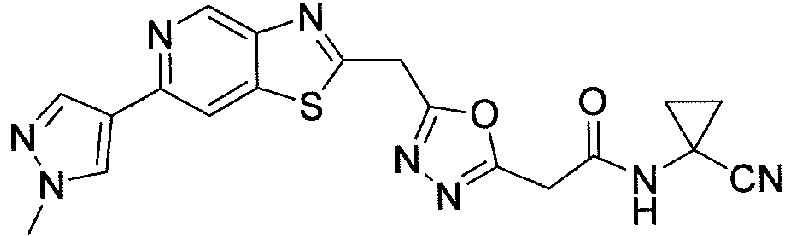
(CDCl3) δ: 1.29 (dd, J = 8.1, 6.1 Hz, 2H), 1.59 (dd, J = 8.1, 6.1 Hz, 2H), 3.92 (s, 2H), 3.98 (s, 3H), 4 75 (s, 2H), 7.95 (s, 1 H), 7.98 (s, 1H), 7.98-8.00 (m, 2H), 9.21 (d, J = 1.0 Hz, 1 H) 097 420.95 (MS+) C A-32 
(DMSO-d6) δ 1 14 (dd, J = 8.11, 5.58 Hz, 2H), 1 49 (dd, J = 8 11, 5.58 Hz, 2H), 3.92 (s, 2H), 5.02 (s, 2H), 7.27 (d, J = 4.06 Hz, 1 H), 7.45 (d, J = 4.06 Hz, 1 H), 7.83 (d, J = 8.11 Hz, 1 H), 8.04 (d, J = 8.62 Hz, 1 H), 9.24 (s, 1H). 2.32 489.85 &491.8 0 (MS+) C A-33 
(DMSO-d6) 8: 4.00 (s, 2H), 4.20 (d, J = 5.4 Hz, 2H), 5.02 (s, 2H), 7.43-7.55 (m, 3H), 7 63-7.70 (m, 3H), 7.96 (d, J = 7 4 Hz, I H ), 9 04 (t, J = 2.1 Hz, 1 H). A-34 
(DMSO-d6) δ : 2 50 (s, 3H). 4.09 (s, 2H), 5.00 (s, 2H), 7 84-7.96 (m, 2H), 8.1 (d, J = 1.8 Hz, 2H) A-35 
(DMSO-d6) δ 4 10 (s, 2H), 5.07 (s, 2H), 7.41-7.51 (m, 1H), 7.91-7.99 (m, 3H), 811 (t, J = 8 4 Hz, 1 H), 8.77 (d, J = 4.0 Hz, 1 H) -
[Table 105] No. Structure NMR(δ) retention time Mass method A-36 
(DMSO-d6) δ: 1.14 (dd, J = 8.1, 5.6 Hz, 2H), 1.49 (dd, J=8.1,5.6Hz,2H),2.50 (s, 3H), 3.92 (s, 2H), 5.00 (s, 2H), 7.85-7.96 (m, 2H), 8.04 (s, 1 H), 8.30 (s, 1 H), 9.24 (s, 1 H). A-37 
(DMSO-d6) δ : 1.14 (dd, J = 8.1, 5.6 Hz, 2H), 1.49 (dd, J = 8,1, 5.6 Hz, 2H), 3.92 (s, 2H), 5.06 (s, 2H), 7.43-7 48 (m, 1 H), 7.89-7.99 (m, 3H), 8.11 1 (L, J = 7.0 Hz, 1H), 8 75-8.78 (m, 1H H), 9.24 (s, 1 H). A-38 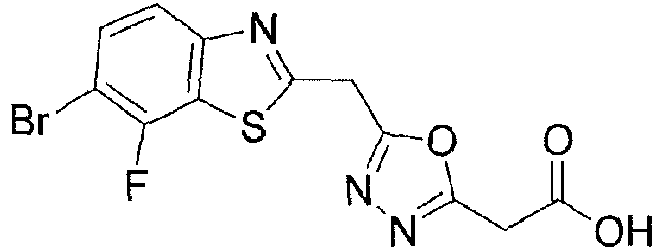
(DMSO-d6) δ: 4.09 (s, 2H), 5.04 (s, 2H), 7.83 (s, 1H), 7.84 (d, J = 0.9 Hz, 1H). A-39 
(DMSO-d6) 8: 1.14 (dd, J = 8.4, 5.3 Hz, 2H), 1.49 (dd, J = 8 1, 5.6 Hz, 2H), 3.92 (s, 2H), 5.03 (s, 2H), 7.84 (s, 1H), 7.85 (d, J= 1.2 Hz, 1H), 9.24 (s, 1H). A-40 
(DMSO-d6) δ : 1.14 (dd, J = 8.36, 5.32 Hz, 2H), 1.49 (dd, J = 8 11, 5.58 Hz, 2H), 3.92 (s, 2H), 5.03 (s, 2H), 7.24 (t, J = 4.06 Hz, 1 H), 7.70 (d, J = 4.06 Hz, 1 H), 7.75 (d, J = 5.07 Hz, 1 H), 7.89-7 99 (m, 0H), 9 24 (s, 1H) 1.91 438.10 (MS+) C -
[Table 106] No. Structure NMR(δ) retention time Mass method A-41 
(DMSO-d6) δ: 1.14 (dd, J = 8 36, 5.32 Hz, 2H), 1.49 (dd, J = 8 36, 5 32 Hz, 2H), 3.92 (s, 2H), 5.03 (s, 2H), 6.89-6.92 (m, 1H), 7.43 (t, J = 3.80 Hz, 1H), 7.89-7.94 (m, 2H), 9.24 (s, 1 H). 2 05 457.9 C A-42 
(DMSO-d6) δ: 1.14 (dd, J = 8.4, 5.3 Hz, 2H), 1.49 (dd, J = 8.4, 5.3 Hz, 2H), 3.92 (s, 2H), 5 05 (s, 2H), 7 36-7 45 (m, 2H), 7.52-7.68 (m, 3H), 7.98 (d, J = 8.4 Hz, 1 H), 9.24 (s, 1 H). A-43 
1.85 387.95 (MS+) C A-44 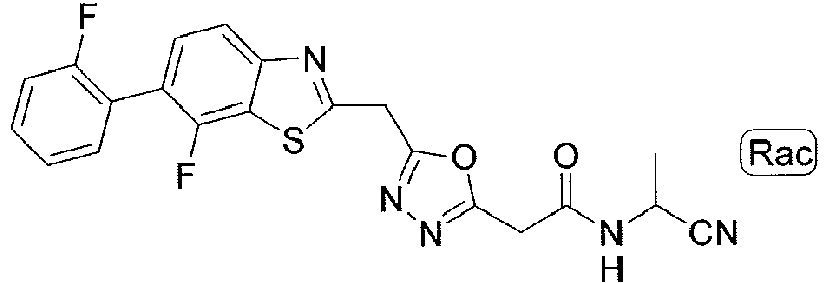
1.92 440.25 (S+) C A-45 
(DMSO-d6) δ : 1.14 (dd, J = 8.4, 5.3 Hz, 2H), 1.49 (dd, J = 8.4, 5.3 Hz, 2H), 3 92 (s, 2H), 5.07 (s, 2H), 8.03 (d, J = 8.7 Hz, 1 H), 8.13-8.19 (m. 2H), 8.38-8.41 (m, 1 H), 9.16 (s, 1 H), 9 24 (s, 1H) -
[Table 107] No. Structure NMR(δ) retention time Mass method A-46 
(DMSO-d6) δ: 4.10 (s, 2H), 5.09 (s, 2H), 8.02-8.14 (m, 2H), , 8.71 (s, 1H), 8.85 (s, 1H), 9.15 (s, 1H). A-47 
(DMSO-d6) δ: 1.14 (dd, J = 8.4, 5.3 Hz, 2H), 1.49 (dd, J = 8.4, 5.3 Hz, 2H), 3.93 (s, 2H), 5.08 (s, 2H), 8.03 (d, J = 8.4 Hz, 1H), 8.12 (t, J = 8.1 Hz, 2H), 8.71 (d, J = 2.7 Hz, 1H), 8.85 (t, J = 2 4 Hz, 1H), 9.15 (dd, J = 2.7, 1 5 Hz, 1H), 9 24 (s, 1H) A-48 
(DMSO-d6) δ: 1.15 (dd, J = 8 4, 5 3 Hz, 2H), 1.49 (dd, J = 8.4, 5.3 Hz, 2H), 3 92 (s, 2H), 5 01 (s, 2H), 7 36 (t, J = 9.0Hz, 2H), 8 14-8.27 (m, 3H), 8.46 (d, J = 9.0 Hz, 1H), 9.26 (s, 1H). A-49 
1.71 435.25 (MS+) C A-50 
(DMSO-d6) δ : 1.14 (dd, J = 8.4, 5.3 Hz, 2H), 1.49 (dd, J = 8.4, 5.3 Hz, 2H), 3.93 (s, 2H), 5.06 (s, 2H), 7.87-7.99 (m, 3H), 8.06 (t, J = 7.5 Hz, 1H), 8.77 (d, J = 2.7 Hz, 1H), 9.24 (s, 1 H). -
[Table 108] No. Structure NMR(δ) retention time Mass method A-51 
(DMSO-d6) δ: 1.14 (dd, J = 8 4, 5.3 Hz, 2H), 1.49 (dd, J = 8.4, 5.3 Hz, 2H), 2.63 (s, 3H), 3.93 (s, 2H), 5.10 (s, 2H), 7 21-7.28 (m, 1H), 7.90 (t, J = 7.8 Hz, 1H), 8.07 (d, J = 8.4 Hz,1H), 9.15 (s, 1H), 9.24 (s, 1H). A-52 
1.74 388.85 (MS+) C A-53 
(DMSO-d6) δ: 1.15 (dd, J = 8.4, 5 3 Hz, 2H), 1.49 (dd, J = 8.4, 5.3 Hz, 2H), 3.92 (s, 2H), 5.03 (s, 9H) 7.27 (m, 1H), 7 46 (m, 1H), 7.96 (d, J = 7.2Hz, 1H), 8.06 (m, 1H), 8.49 (d, J = 8.7Hz, 1H), 9.24 (s, 1H) A-54 
(DMSO-d6) δ: 1 14 (dd, J = 8.4, 5.3 Hz, 2H), 1.49 (dd, J = 8.4, 5.3 Hz, 2H), 3.92 (s, 2H), 5.07 (s, 2H), 7.54 (t, J = 5.1 Hz, 1H), 8.00 (d, J = 9.0 Hz, 1H), 8 24 (t, J = 8.1 Hz, 1H), 8.99 (d, J = 4 5 Hz, 2H), 9 24 (s, 1H). A-55 
(DMSO-d6) δ: 4.10 (s, 2H), 5.03 (s, 2H), 7.40 (t, J = 8.70 Hz, 2H), 7.91-8.04 (m, 4H), 8 30 (s, 1 H), 9.02 (s, 1H). -
[Table 109] No. Structure NMR(δ) retention time Mass method A-56 
(DMSO-d6) δ:4.10 (s, 2H), 5.08 (s, 2H), 7.54 (t, J = 5.1 Hz, 1H), 7.99 (d, J = 9.0 Hz, 1H), 8.24 (t, J = 8 1 Hz, 1H), 8.99 (d, J = 4.5 Hz, 2H) A-57 
(DMSO-d6) δ : 4.10 (s, 2H), 5 03 (s, 2H), 7 40 (t, J = 8.70 Hz, 2H), 7.91-8 04 (m, 4H), 8.30 (s, 1H), 902 (s, 1H). A-58 
1.79 45300 (M+) C A-59 
1.99 469.08 (M+) C A-60 
1.42 463 11 (M+) C -
[Table 110] No. Structure retention time Mass method A-61 
2.06 447.12 (M+) C A-62 
1.9 439.06 (M+) C A-63 
2.07 501.09 (M+) C A-64 
2.2 501.09 (M+) C A-65 
2.23 501.09 (M+) C -
[Table 111] No. Structure retention time Mass method A-66 
2.29 517.08 (M+) C A-67 
2.26 517.08 (M+) C A-68 
1.77 458.10 (M+) C A-69 
2.05 469.08 (M+) C A-70 
1.96 469.08 (M+) C -
[Table 112] No. Structure retention time Mass method A-71 
1.54 526.09 (M+) C A-72 
1.78 458.10 (M+) C A-73 
2.07 469.08 (M+) C A-74 
1.97 469.08 (M+) C A-75 
1.64 506.12 (M+) C -
[Table 113] No. Structure NMR(δ) retention time Mass method A-76 
1.73 540. 11 C A-77 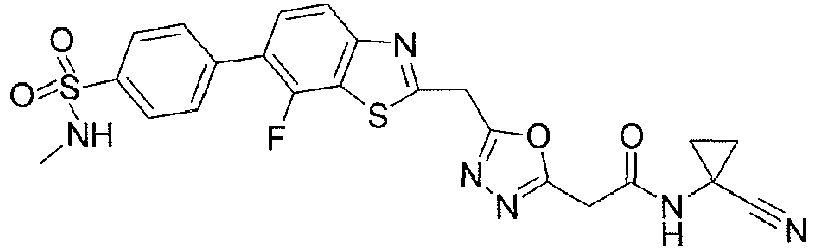
1.52 526.09 (M+) C A-78 
A-79 
(DMSO-d6) δ: 1.14 (dd, J = 8.36, 5.32 Hz, 2H), 1.49 (dd, J = 8.11, 5.58 Hz, 2H), 3.92 (s, 2H), 5 04 (s, 2H), 7.47 (ddd, J = 7.35, 4.82, 1 01 Hz, 1H), 7 74-7.81 (m, 2H), 7 96 (td, J = 7.73, 1.69 Hz, 1H), 8.08 (d, J = 8.11 Hz, 1H), 8 74 (d, J = 5.07 Hz, 1H), 9.23 (s, 1H). 1.43 450 90 (MS+) C A-80 
(DMSO-d6) δ: 1.14 (dd, J = 8.11, 5.58 Hz, 2H), 1.49 (dd, J = 8.11, 5.58 Hz, 2H), 3.91 (s, 2H), 5 02 (s, 2H), 6.89 (dd, J = 4.31, 2.28 Hz, 1H), 7.27 (t, J = 3.80 Hz, 1H), 7.80 (d, J = 8.62 Hz, 1H), 8.03 (d, J = 8.11 Hz, 1H), 9.23 (s, 1 H). 2.16 473.85 (MS+) C -
[Table 114] No. Structure NMR(δ) retention time Mass method A-81 
(DMSO-d6) δ: 1.15 (dd, J = 8.1, 5.6 Hz, 2H), 1.49 (dd, J=8.1, 5.6 Hz, 2H), 3.92 (s, 2H), 5.04 (s, 2H), 7.32 (dd, J = 6.6, 5 1 Hz, 1H), 7 74 (d, J = 3.6 Hz, 1H), 7.85-8.04 (m, 5H), 8.57 (d, J = 4.1 Hz, 1H), 9.24 (s, 1H). 1.96 517 05 (MS+) C A-82 
(DMSO-d6) δ: 1.14 (dd, J = 8.36, 5.32 Hz, 2H), 1.43 (t, J = 7.35 Hz, 3H), 1 49 (dd, J = 8.36, 5.32 Hz, 2H), 3 91 (s, 2H), 4.21 (q, J = 7.27 Hz, 2H), 4 98 (s, 2H), 7.79 (d, J = 8.62 Hz, 1H), 7 93-7 99 (m, 2H), 8 32 (s, 1H), 9.23 (s, 1H) 1 59 467 90 (MS+) C A-83 
15 403.85 (MS+) C A-84 
(DMSO-ds) δ: 1.15 (dd, J = 8.36, 5.83 Hz, 2H), 1.49 (dd, J = 8.11, 5 58 Hz, 2H), 3.92 (s, 2H), 5.05 (s, 2H), 7 59 (t, J = 4.82 Hz, 1H), 7 99 (d, J = 8.11 Hz, 1H), 8.10 (d, J = 8.62 Hz, 1H), 9 01 (d, J = 5.07 Hz, 2H), 9.24 (s, 1H). 1.33 451.85 (MS+) C A-85 
(DMSO-d6) δ: 1.14 (dd, J = 8 4,5 3 Hz, 2H), 1.49 (dd, J = 8.4, 5.2 Hz, 2H), 3.92 (s, 2H), 5.07 (s, 2H), 8 02 (d, J = 90Hz, 1H), 8.10-8.19 (m, 2H), 8.46 (dd, J = 8.7, 2.1 Hz, 1H), 9 20 (d, J = 2.1 Hz, 1H), 9.24 (s, 1H) [Table 115] No. Structure NMR(δ) retention time Mass method A-86 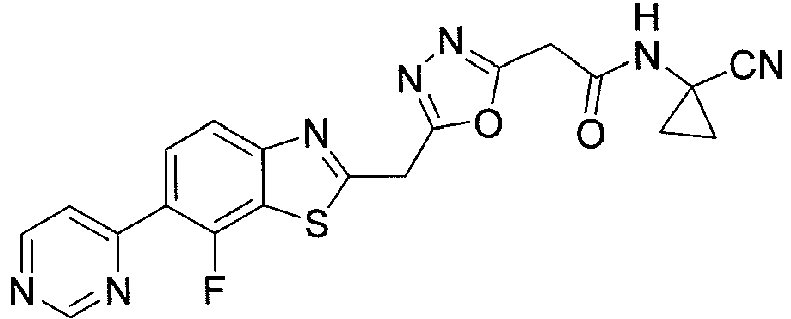
(DMSO-d6) δ: 1.14 (dd, J = 8.4, 5.3 Hz, 2H), 1.49 (dd, J = 8.4, 5.3 Hz, 2H), 3.92 (s, 2H), 5.07 (s, 2H), 8.02-8 05 (m, 2H), 8.23 (t, J = 7 8 Hz, 1H), 8.95 (d, J = 5.4 Hz, 1H), 9 24 (s, 1H), 9.36 (s, 1H) A-87 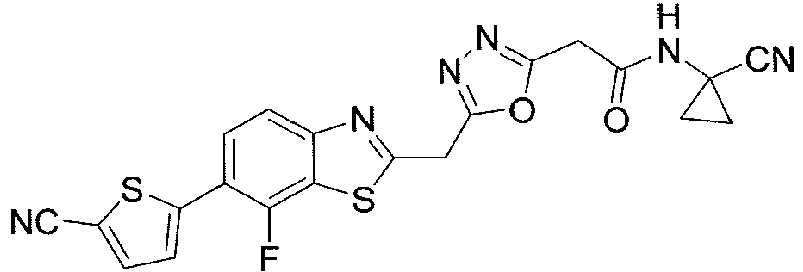
(DMSO-d6) δ: 1.14 (dd, J = 8 4, 5 3 Hz, 2H), 1.49 (dd, J = 8 4, 5.3 Hz, 2H), 3.92 (s, 2H), 5 06 (s, 2H), 7.87 (d, J = 3.9 Hz, 1H), 7 97 (d, J = 8.4 Hz, 1H), 8.05-811 (m, 2H), 9 24 (s, 1H). A-88 
(DMSO-d6) δ: 1.15 (dd, J = 8.4, 5.3 Hz, 2H), 1.49 (dd, J = 8.4, 5.3Hz, 2H), 392 (s, 2H), 5.03 (s, 2H), 7 36 (t, J=7.6Hz, 1H), 7.46 (t, J = 7.6 Hz, 2H), 7.64 (dd, J = 3.8, 1.3 Hz, 1H), 7.72-7.75 (m, 3H), 7.93 (d, J = 8.6 Hz, 1H), 7.98-8.02 (m, 1H), 9 24 (s, 1H). 2.4 51625 (MS+) C A-89 
(DMSO-d6) δ 4.09 (s, 2H), 5.04 (s, 2H), 7.96 (d, J =8.62 Hz, 1H), 8.19 (t, J = 2.03 Hz, 1H), 8.31 (t, J = 8.11 Hz, 1H), 9 30 (d, J = 2 03 Hz, 1H) 1.46 377.05 (MS+) C A-90 
(DMSO-d6) δ: 1.15 (dd, J = 8.4, 5.3 Hz, 2H), 1.49 (dd, J = 8.4, 5.3 Hz, 2H), 3.92 (s, 2H), 5.02 (s, 2H), 7.71-8 11 (m, 3H), 8.38 (s, 1H), 8.77 (s, 1H), 9.24 (s, 1H) -
[Table 116] No. Structure NMR(δ) retention time Mass method A-91 
(DMSO-d6) δ: 1.14 (dd, J = 8.36, 5.83 Hz, 2H), 1.49 (dd, J = 8.36, 5.32 Hz, 2H), 3.92 (s, 2H), 5.04 (s, 2H), 7.96 (d, J = 8.62 Hz, 1H), 8.19 (t, J = 2.03 Hz, 1H), 8.31 (t, J = 8.11 Hz, 1H), 9.23 (s, 1H), 9.30 (d, J = 1.52 Hz, 1H), 1 59 440 85 (MS+) C - The compounds shown below were prepared and inhibitory activity on endothelial lipase (EL) was examined. The compounds shown below can be synthesized by appropriately combine of the above general synthesis methods, the above examples, reference examples, known technique and the like.
-
[Table 117] No. Structure NMR(δ) S-49 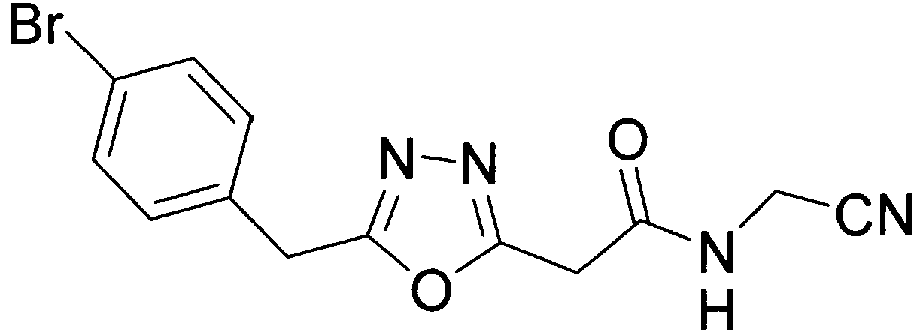
1H-NMR (DMSO-d6) δ: 3.93 (s, 2H), 4.19 (d, J = 3.9Hz, 2H), 4.27 (s, 2H), 7.28 (d, J = 8.4Hz, 2H), 7.55 (d, J = 8 1 Hz, 2H), 9.00 (br-s, 1H). S-50 
1H-NMR (DMSO-d6) δ: 3.93 (s, 2H), 4.19 (s, 2H), 4.32 (s, 2H), 7.32-7.49 (m, 5H), 7.63-7.66 (m, 4H), 9.00 (br-s, 1H). S-51 
1H-NMR (DMSO-d6) δ: 3 95 (s, 2H), 4.19 (d, J = 5 4Hz, 2H), 4.56 (s, 2H), 7.26(m, 1H), 6.37 (s, 1H), 7 37-7.45(m, 4H), 7.63(d, J = 7.2Hz, 2H), 7.73 (s, 1H), 9.02(t, J = 3.0 Hz, 1H), 11.26 (s, 1H). S-52 
1H-NMR (DMSO-d6) δ: 3.97 (s, 2H), 4.20 (d, J =3.0Hz, 2H), 4.68 (s, 2H), 7.35-7.50(m, 4H), 7.68(dd, J = 6.0, 3.0Hz, 1H), 7.74(d, J=6.0Hz, 2H), 7.88(d, J=6.0Hz, 1H), 8.25(s, 1H), 9.02(t, J=3.0Hz, 1H) S-53 
1H-NMR (DMSO-d6) δ: 3.93 (s, 2H), 4.17 (d, J = 5.58 Hz, 2H), 4.44 (s, 2H), 7.51 (dd, J = 8.36, 1 77 Hz, 1H), 7.64 (dd, J = 8.36, 1.77 Hz, 1H), 7.84-7.93 (m, 3H), 8.20 (d, J = 2.03 Hz, 1H), 8.98 (t, J = 5.58 Hz, 1H). -
[Table 118] No. Structure NMR(δ) S-54 
1H-NMR (DMSO-d6) δ: 1.11 (dd, J = 8.36, 5.32 Hz, 2H), 1 47 (dd, J = 8.36, 5.32 Hz, 2H), 3.85 (s, 2H), 4.44 (s, 2H), 7.51 (dd, J = 8.62, 1.52 Hz, 1H), 7.64 (dd, J = 8.62, 2.03 Hz, 1H), 7.84-7 94 (m, 3H), 8.20 (d, J = 2.03 Hz, 1H), 9.18 (s, 1H). S-55 
1H-NMR (DMSO-d6) δ: 3.94 (s, 2H), 4.18 (d, J = 5.58 Hz, 2H), 4.46 (s, 2H), 7.40 (t, J = 7.35 Hz, 1H), 7.45-7.55 (m, 3H), 7 80-7.88 (m, 4H), 7.96-8 01 (m, 2H), 8.22 (br s, 1H), 8.99 (t, J = 5.32 Hz, 1H). S-56 
1H-NMR (DMSO-d6) δ 1 12 (dd, J=8.11, 5.58 Hz, 2H), 1 47 (dd, J = 8.11, 5.58 Hz, 2H), 3.86 (s, 2H), 4.46 (s, 2H), 7.40 (t, J = 7.35 Hz, 1H), 7.45-7.55 (m, 3H), 7.80-7.89 (m, 4H), 7.96-8.01 (m, 2H), 8.22 (br s, 1H), 9.19 (s, 1H). S-57 
1H-NMR (DMSO-d6) δ: 3.94 (s, 2H), 4.18 (d, J = 5.58 Hz, 2H), 4.44 (s, 2H), 7.50 (dd, J = 8.36, 1.77 Hz, 1H), 7.56-7.61 (m, 3H), 8.02-8.12 (m, 4H), 8.99 (t, J = 5.58 Hz, 1H). S-58 
1H-NMR (DMSO-d6) δ : 1.13 (dd, J = 8.36, 5.32 Hz, 2H), 1.48 (dd, J = 8.36, 5 32 Hz, 2H), 3.86 (s, 2H), 4.45 (s, 2H), 7.50 (dd, J = 8.62, 1.52 Hz, 1H), 7.57-7.61 (m, 3H), 8.02-8.12 (m, 4H), 9.20 (s, 1H) -
[Table 119] No. Structure NMR(δ) S-59 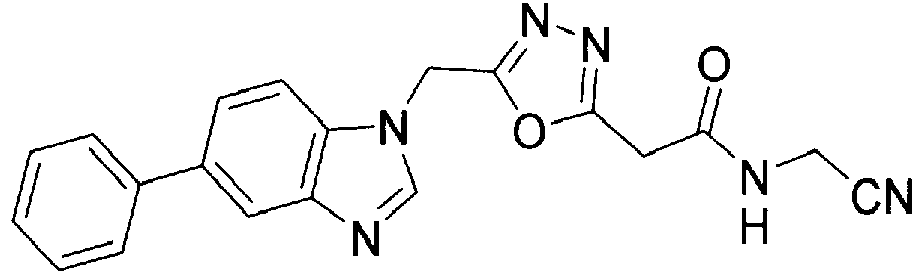
1H-NMR (DMSO-d6) δ: 3.96 (s, 2H), 4.18 (d, J = 5.58 Hz, 2H), 5.95 (s, 2H), 7.34 (t, J = 7.35 Hz, 1H), 7.43-7.49 (m, 2H), 7.58-7.73 (m, 4H), 7.94 (d, J = 1.01 Hz, 1H), 8.41 (s, 1H), 9.00 (t, J = 5.58 Hz, 1H). S-60 
1H-NMR (DMSO-d6) δ: 1.10 (dd, J = 8.11, 5.58 Hz, 2H), 1.47 (dd, J = 8.11, 5.58 Hz, 2H), 3.87 (s, 2H), 5.95 (s, 2H), 7.34 (t, J = 7.35 Hz, 1H), 7.43-7.49 (m, 2H), 7.58-7.72 (m, 4H), 7.94 (d, J = 1.01 Hz, 1H), 8.40 (s, 1H), 9.19 (s, 1H). S-25 
S-28 
1H-NMR (DMSO-d6) δ: 3.94 (m, 2H), 4.09 (s, 2H), 7.39 (t, J = 7.1Hz, 1H), 7.49 (t, J = 8.4 Hz, 2H), 7.74-7.80-7.64 (m, 3H), 8 01 (d, J = 8.4 Hz, 1H), 8.38 (s, 1H), 8.82 (s, 1H). S-30 
1H-NMR (CDCl3) δ: 2 30(s, 3H), 4 58 (s, 2H), 6.10 (s, 1H), 7.38 (t, J = 8.0Hz, 1H), 7.47 (t, J = 7 6Hz, 2H), 7.63 (d, J = 8 4Hz, 2H), 7.72 (d, J = 8.0Hz, 1 H), 8.06(d, J = 8.6Hz, 2H). -
[Table 120] No. Structure NMR(δ) S-32 
1 H-NMR (CDCl3) δ : 4.87 (s, 2H), 7.38 (t, J = 7.6Hz, 1H), 7.44-7.49 (m, 3H), 7.70(d, J = 2.0Hz, 3H), 7 72 (d, J = 2.0Hz, 1H), 8.05(d, J = 2.0Hz, 2H), 9.15(s, 1H) S-34 
1H-NMR (CDCl3) δ: 3.66 (s, 3H), 4.63 (s, 2H), 6.88 (d, J = 1.0 Hz, 1H), 7.05 (s, 1H), 7.37 (t, J = 7.4 Hz, 1H), 7.46 (t, J = 7.4 Hz, 2H), 7.62 (d, J = 7.1 Hz, 2H), 7.69 (dd, J = 8 4, 1.8 Hz, 1H), 8.00-8 03 (m, 2H) S-36 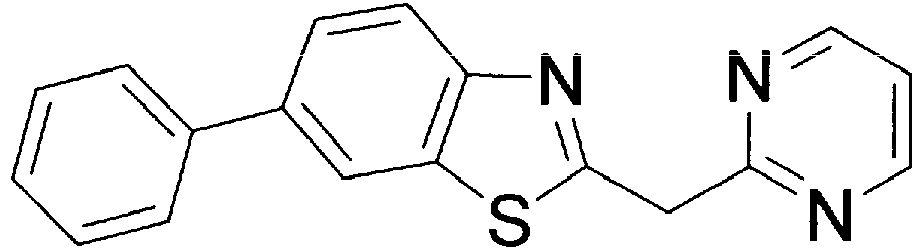
1H-NMR (DMSO-d6) δ : 4.80 (s, 2H), 7.39 (t, J = 6.8 Hz, 1H), 7.45-7.52 (m, 3H), 7.73-7.80 (m, 3H), 8.01 (d, J = 8.6 Hz, 1H), 8.37 (s, 1H), 8.83 (d, J = 5.1 Hz, 2H). S-40 
1 H-NMR (DMSO-d6) δ: 2.60 (t, J = 6.3 Hz, 2H), 2.89 (t, J = 7.1 Hz, 2H), 6.13 (s, 2H), 7.40 (t, J = 7.4 Hz, 1H), 7.50 (t, J = 7.6 Hz, 2H), 7.74 (d, J = 7.6 Hz, 2H), 7.84 (dd, J = 8.6, 1.5 Hz, 1H), 8.06-8.09 (m, 2H), 8.41 (d, J = 1.0 Hz, 1H) S-41 
1H-NMR (CDCl3) δ : 2.69 (t, J = 7.1 Hz, 2H), 308 (t, J = 7.1 Hz, 2H), 5.28 (br s, 1H), 5.73 (br s, 1H), 5.93 (s, 2H), 7.39 (t, J = 7.4 Hz, 1H), 7.47 (t, J = 7.6 Hz, 2H), 7.61-7.64 (m, 3H), 7.75 (dd, J = 8.6, 1.5 Hz, 1H), 8.04-8.10 (m, 2H). -
[Table 121] No. Structure NMR(δ) S-42 
1H-NMR (CDCl3) δ: 5.81 (s, 2H), 7.39 (t, J = 7.6 Hz, 1H), 7.47 (t, J=7.6Hz, 2H), 7 63 (d, J = 6.8Hz, 2H), 7.74 (dd, J = 8.8, 1 6 Hz, 1 H), 8.05-8.10 (m, 3H), 8.34 (s, 1H). S-43 
1H-NMR (CDCl3) δ: 5.76 (s, 2H), 6.37 (t, J = 2.0 Hz, 1H), 7.37 (t, J = 7.4 Hz, 1H), 7.46 (t, J = 7.9 Hz, 2H), 7.63 (dd, J = 8.9, 7.9 Hz, 4H), 7.71 (dd, J = 8.4, 1 8 Hz, 1H), 8.02 (s, 1H), 8 07 (d, J = 8.1 Hz, 1H). S-44 
1H-NMR (CDCl3) δ: 2.47 (s, 3H), 4.63 (s, 2H), 7.38 (t, J = 7.1 Hz, 1H), 7 46 (t, J = 7.6 Hz, 2H), 7.62 (d, J = 7.6 Hz, 2H), 7.70 (dd, J = 8.4, 1.8 Hz, 1H), 8.04-8.06 (m, 2H). S-46 
1H-NMR (DMSO-d6) δ: 5.15 (s, 2H), 7.35-7.68 (m, 6H), 7.76 (d, J = 7.10 Hz, 2H), 7.83 (dd, J = 8 62, 2.03 Hz, 1H), 8.00-8.08 (m, 3H), 8 46 (d, J = 2.03 Hz, 1H). S-47 
1H-NMR (DMSO-d6) δ: 5.01 (s, 2H), 7.37-7.44 (m, 3H), 7.50 (t, J = 7.60 Hz, 2H), 7.71-7 78 (m, 4H), 7.82 (dd, J = 8.62, 2 03 Hz, 1H), 8.05 (d, J = 8.62 Hz, 1H), 8 43 (d, J = 2.03 Hz, 1H). -
[Table 122] No. Structure NMR(δ) S-48 
1H-NMR (DMSO-d6) δ: 5.12 (s, 2H), 7.38-7.55 (m, 5H), 7.71-7.77 (m, 2H), 7.82 (dd, J = 8.62, 1.52 Hz, 1H), 8.01 (d, J = 8 11 Hz, 1H), 8.04-8.13 (m, 2H), 8.41 (d, J = 1.52 Hz, 1H). -
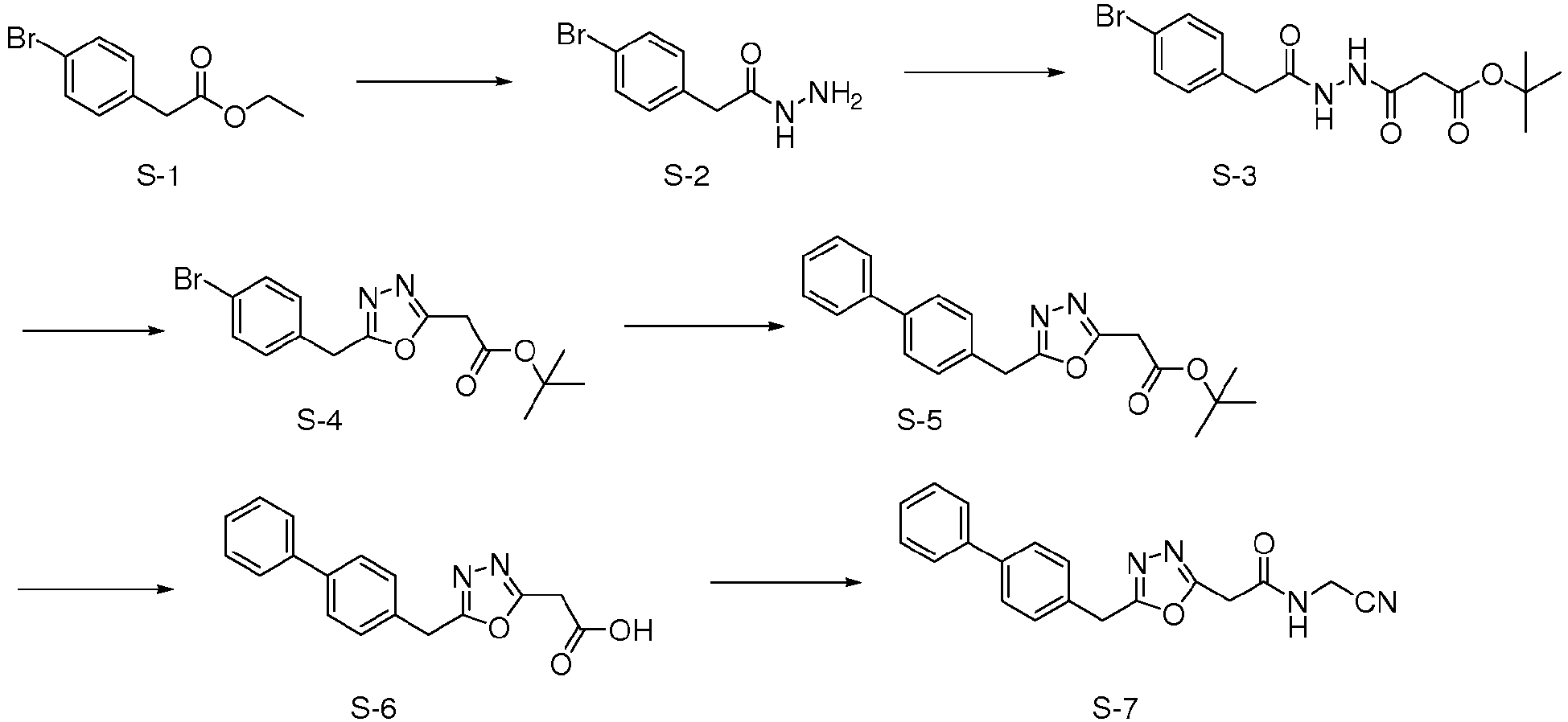
Compound (S-2);1H-NMR (DMSO-d6) δ: 4.21 (d, J = 3.9Hz, 2H), 7.21 (d, J = 8.1Hz, 2H), 7.48 (dd, J = 6.3, 1.8Hz, 2H), 9.21 (br-s, 1H)
To a solution of Compound (S-2) (1.2 g, 5.24mmol) in anhydrous dimethylformamide (10 ml) were successively added 3-tert-butoxy-3-oxopropanoic acid (1 g, 6.29 mmol), WSCD HCl (1.31 g, 6.81 mmol) and HOBt (0.21 g, 1.57 mmol) under nitrogen atmosphere at room temperature , then the reaction mixture was stirred for 14 hours. To the reaction solution was added 1N hydrochloric acid, then the reaction solution was extracted with ethyl acetate. The extraction was washed with brine and dried over sodium sulfate. To the residue was added ethyl acetate / hexane, then the insoluble residue was collected by filtration to give Compound (S-3) (1.68 g, 86%).
Compound (S-3);1 H-NMR (DMSO-d6) δ: 1.40 (s, 9H), 3.17 (s, 2H), 3.46 (s, 2H), 7.25 (d, J = 8.4Hz, 2H), 7.51 (d, J = 8.4Hz, 2H), 10.19 (br-s, 2H)
To a solution of Compound (S-3) (1 g, 2.69 mmol) in anhydrous dimethoxyethane (10 ml) was added Burgess reagent (963 mg, 4.0 mmol), then the reaction mixture was stirred at 90 °C for 2 hour. The solvent was removed under reduced pressure. To the residue was added water, then the mixture was extracted with ethyl acetate. The extraction was washed with brine and dried over sodium sulfate. The solvent was removed under reduced pressure. The obtained residue was purified by column chromatography to give Compound (S-4) (671 mg, 71%). Compound (S-4);1H-NMR (CDCl3) δ: 1.40 (s, 9H), 3.82 (s, 2H), 4.16 (s, 2H), 7.18 (d, J = 8.4Hz, 2H), 7.47 (d, J = 8.4Hz, 2H)
To a solution of Compound (S-4) (400 mg, 1.13 mmol) in anhydrous 1,4-dioxane (200 ml) were added TETRAKIS(TRIPHENYLPHOSPHINE) PALLADIUM (0) (41.4 mg, 0.057 mmol), PHENYLBORONIC ACID (180 mg, 1.47 mmol) and 2M aqueous potassium carbonate solution (850 µl, 1.7 mmol) under nitrogen atmosphere at room temperature, then the reaction mixture was stirred at 120 °C for 15 minutes under microwave irradiation. To the reaction solution were added hydrochloric acid and ethyl acetate, then the reaction solution was extracted with ethyl acetate. The extraction was washed with brine and dried over sodium sulfate. The solvent was removed under reduced pressure. The obtained residue was purified by column chromatography to give Compound (S-5) (302 mg, 76%).
Compound (S-5);1H-NMR (CDCl3) δ: 1.40 (s, 9H), 3.85 (s, 2H), 4.26 (s, 2H), 7.35-7.48 (m, 5H), 7.57 (d, J = 7.8Hz, 4H)
To a solution of Compound (S-5) (290 mg, 0.83 mmol) in dichloromethane (1.5mL)) was added trifluoroacetic acid (1mL), then the reaction mixture was stirred at room temperature for 2 hours. The solvent was removed under reduced pressure. The obtained crystal was washed with hexane to give Compound (S-6) (173 mg, 71%). Compound (S-6);1H-NMR (DMSO-d6) δ: 4.03 (s, 2H), 4.32 (s, 2H), 7.35-7.49 (m, 5H), 7.65 (d, J = 8.1Hz, 4H)
To a solution of Compound (S-6) (70 mg, 0.24mmol) in dimethylformamide (3 ml) were successively added 2-aminoacetonitrile hydrochloride (33 mg, 0.36 mmol), WSCD HCl (59.3 mg, 0.31 mmol), HOBt (6.4 mg, 0.048 mmol) and Et3N (0.1 mL, 0.71 mmol) under nitrogen atmosphere, then the reaction mixture was stirred at room temperature for 2 hours. To the reaction solution was added 1N hydrochloric acid, then the reaction solution was extracted with ethyl acetate. The extraction was washed with brine and dried over sodium sulfate. The solvent was removed under reduced pressure. The obtained residue was purified by column chromatography to give Compound (S-7) (58 mg, 73%).
Compound (S-7);1H-NMR (DMSO-d6) δ: 3.94 (s, 2H), 4.19 (s, 2H), 4.32 (s, 2H), 7.35-7.49 (m, 5H), 7.65 (d, J = 8.1Hz, 4H), 9.00(br-s, 1H) -

Compound (S-9);1 H-NMR (DMSO-d6) δ: 3.91 (s, 3H),7.42 (t, J = 7.6Hz, 1H), 7.51 (t, J = 8.0 Hz, 2H), 8.11 (d, J = 8.0Hz, 1H), 8.24 (s, 1H), 8.40 (s, 1H)
To a solution of Lithium Aluminum Hydride (2.33 g, 61.5 mmol) in anhydrous tetrahydrofuran (60 mL) was added a solution of Compound (S-9) (13.8 g, 51.2mmol) in anhydrous tetrahydrofuran (70 mL) under nitrogen atmosphere with ice-cooling, then the reaction mixture was stirred at 5 °C for 1 hour. To the reaction solution was added water, then the reaction solution was extracted with ethyl acetate. The extraction was washed with brine and dried over sodium sulfate. The solvent was removed under reduced pressure. The obtained residue was purified by column chromatography to give Compound (S-10) (14.5 g, quant).
Compound (S-10);1 H-NMR (DMSO-d6) δ: 4.76 (dd, J = 5.58, 1.01 Hz, 2H), 5.67 (t, J = 5.83 Hz, 1H), 7.29 (s, 1H), 7.37 (t, J = 7.35 Hz, 1H), 7.48 (dd, J = 7.60, 7.35 Hz, 2H), 7.65 (dd, J = 8.11, 1.52 Hz, 1H), 7.75 (d, J = 7.60 Hz, 2H), 7.84 (d, J = 8.11 Hz, 1H), 8.23 (d, J = 1.52 Hz, 1H).
To a solution of Compound (S-10) (10.5 g, 43.7 mmol) in anhydrous toluene (100 mL) was added thionyl chloride (3.83 ml, 52.4mmol) under nitrogen atmosphere, then the reaction mixture was stirred at 55 °C for 24 hours. The solvent was removed under reduced pressure. To the residue was added chloroform, then the obtained crystal was collected by filtration to give Compound (S-11) (14.5 g, quant). Compound (S-11); 1 H-NMR (DMSO-d6) δ: 5.17 (s, 2H), 7.38 (t, J = 7.35 Hz, 1H), 7.46-7.56 (m, 3H), 7.68-7.78 (m, 3H), 7.91 (d, J = 8.62 Hz, 1H), 8.29 (d, J = 1.01 Hz, 1H).
To a solution of Compound (S-11) (5 g, 19.32 mmol) in anhydrous dimethylformamide (50 mL) was added potassium cyanide (1.887 g, 29.0 mmol), then the reaction mixture was stirred at 80 °C for 4 hours To the reaction solution were added 10 % aqueous sodium bicarbonate solution and ethyl acetate, then the reaction solution was extracted with ethyl acetate. The organic layer was washed with brine and dried over sodium sulfate. The solvent was removed under reduced pressure. The obtained residue was purified by column chromatography to give Compound (S-12) (3.4 g, 71%).
To a solution of Compound (S-12) (2 g, 8.02 mmol) in acetic acid (15 mL) was added concentrated hydrochloric acid (15 ml, 494 mmol), then the reaction mixture was stirred at 90 °C for 6 hours. The insoluble residue was collected by filtration, then the reaction solution was extracted with diethylether. The organic layer was washed with brine and dried over sodium sulfate. The solvent was removed under reduced pressure to give Compound (S-13) (2.3 g, quant). -

Compound (S-15);1 H-NMR (DMSO-d6) δ: 3.92 (s, 3H), 7.59-7.64 (m, 3H), 8.09-8.16 (m, 4H), 8.83 (s, 1H)
To a solution of Lithium Aluminum Hydride (0.264 g, 6.95 mmol) in anhydrous tetrahydrofuran (10 mL) was added a solution of Compound (S-15) (1.56 g, 5.79 mmol) in anhydrous tetrahydrofuran (25 mL) under nitrogen atmosphere, then the reaction mixture was stirred at 2 °C for 2 hours. To the reaction solution was added water, then the reaction solution was extracted with ethyl acetate. The extraction was washed with brine and dried over sodium sulfate. The solvent was removed under reduced pressure. The obtained residue was purified by column chromatography to give Compound (S-16) (1.29 g, 92%).
Compound (S-16);1 H-NMR (CDCl3) δ: 1.89 (t, J = 4Hz, 1H), 4.84 (d, J = 8Hz, 3H), 7.46-7.50 (m, 4H), 7.93 (s, 1H), 8.03-8.11 (m, 3H)
To a solution of Compound (S-16) (10.5 g, 43.7 mmol) in anhydrous 1,4-dioxane (15 mL) were added ZINC CHLORIDE (210 mg, 0.16 mmol) and thionyl chloride (0.76 ml, 10.4 mmol) under nitrogen atmosphere, then the reaction mixture was stirred at 40 °C for 10 minutes. The part of the solvent was removed under reduced pressure. To the residue was added aqueous sodium bicarbonate solution, then the mixture was extracted with dichloromethane. The extraction was washed with brine, then dried over sodium sulfate. The solvent was removed under reduced pressure. The obtained crystal was collected by filtration to give Compound (S-17) (1.25 g, 93%). Compound (S-17);1 H-NMR (DMSO-d6) δ: 4.94 (s, 2H), 7.57-7.64 (m, 4H), 8.06-8.13 (m, 3H), 8.24(d, J = 4Hz, 1H)
To a solution of Compound (S-17) (1.2 g, 4.62 mmol) in acetonitrile (20 mL) were added sodium cyanide (0.294 g, 6.01 mmol) and water (2 ml), then the reaction mixture was refluxed for 4 hours. The part of the solvent was removed under reduced pressure. To the residue was added water, then the mixture was stirred. The obtained crystal was collected by filtration to give Compound (S-18) (1.15 g, 99%).
Compound (S-18);1 H-NMR (DMSO-d6) δ: 4.22 (s, 2H), 7.50-7.62 (m, 4H), 8.05-8.18 (m, 4H).
To a solution of Compound (S-18) (1.07 g, 4.27 mmol) in acetic acid (10 mL) was added concentrated sulfuric acid (4.75 ml, 85 mmol), then the reaction mixture was refluxed for 6 hours. After the completion of the reaction, to the reaction solution was added water (50 ml). The reaction solution was stirred for 30 minutes, then the obtained crystal was collected by filtration to give Compound (S-19) (1.03 g, 89%).
Compound (S-19);1 H-NMR (CDCl3) δ: 3.80 (s, 2H), 7.41 (dd, J = 8.36, 1.77 Hz, 1H), 7.49-7.51 (m, 3H), 7.84 (d, J = 1.01 Hz, 1H), 8.01-8.10 (m, 3H). -

Compound (S-21);1 H-NMR (CDCl3) δ: 4.73 (s, 2H), 7.51-7.59 (m, 2H), 7.68-7.81 (m, 3H), 8.00 (d, J = 2.03 Hz, 1H).
To a solution of Compound (S-21) (3.35 g, 13.11 mmol) in acetonitrile (40 mL) were added sodium cyanide (850 mg, 17.34 mmol) and water (4 ml), then the reaction mixture was refluxed for 5 hours. To the reaction solution was added 10 % aqueous sodium bicarbonate solution, then the reaction solution was extracted with ethyl acetate. The extraction was washed respectively with 10 % aqueous sodium bicarbonate solution and brine, then dried over magnesium sulfate. The solvent was removed under reduced pressure. The obtained residue was purified by column chromatography to give Compound (S-22) (3.1 g, 96%).
Compound (S-22);1 H-NMR (CDCl3) δ: 3.90 (s, 2H), 7.41 (dd, J = 8.62, 1.52 Hz, 1H), 7.59 (dd, J = 8.87, 1.77 Hz, 1H), 7.70 (d, J = 8.62 Hz, 1H), 7.75-7.82 (m, 2H), 8.01 (d, J = 1.52 Hz, 1H).
To a mixed solution of Compound (S-22) (3 g, 12.19 mmol) in acetic acid (30ml)) and water (15ml) was added concentrated sulfuric acid (13.54 ml, 244 mmol), then the reaction mixture was refluxed for 3 hours. The reaction solution was cooled to room temperature. To the reaction solution was added water, then the reaction solution was stirred. The obtained crystal was collected by filtration to give Compound (S-23) (3.2 g, 99%).
Compound (S-23);1 H-NMR (DMSO-d6) δ: 3.75 (s, 2H), 7.48 (dd, J = 8.36, 1.77 Hz, 1H), 7.62 (dd, J = 8.62, 2.03 Hz, 1H), 7.80-7.88 (m, 3H), 8.18 (d, J = 2.03 Hz, 1H), 12.41 (brs, 1H). -

Compound (S-24);1 H-NMR (CDCl3) δ: 2.77(s, 3H), 4.88 (s, 2H), 7.60 (d, J =8.0 Hz, 1H), 7.87 (d, J = 8.8Hz, 1H), 8.00 (s, 1H)
To a solution of Compound (S-24) (100 mg, 0.307 mmol) in 1,4-dioxane (1.2 ml) were added PHENYLBORONIC ACID (44.8 mg, 0.37mmol), TETRAKIS(TRIPHENYLPHOSPHINE) PALLADIUM (0) (35.4 mg, 0.031 mmol) and NaHCO3 (64.4 mg, 0.77 mmol), then the reaction mixture was stirred at 140 °C for 10 minutes under microwave irradiation. To the reaction solution were added water and ethyl acetate, then the reaction solution was extracted with ethyl acetate. The organic layer was washed with brine and dried over sodium sulfate. The solvent was removed under reduced pressure. The obtained residue was purified by column chromatography to give Compound (S-25) (52 mg, 53%) as a yellow solid. -
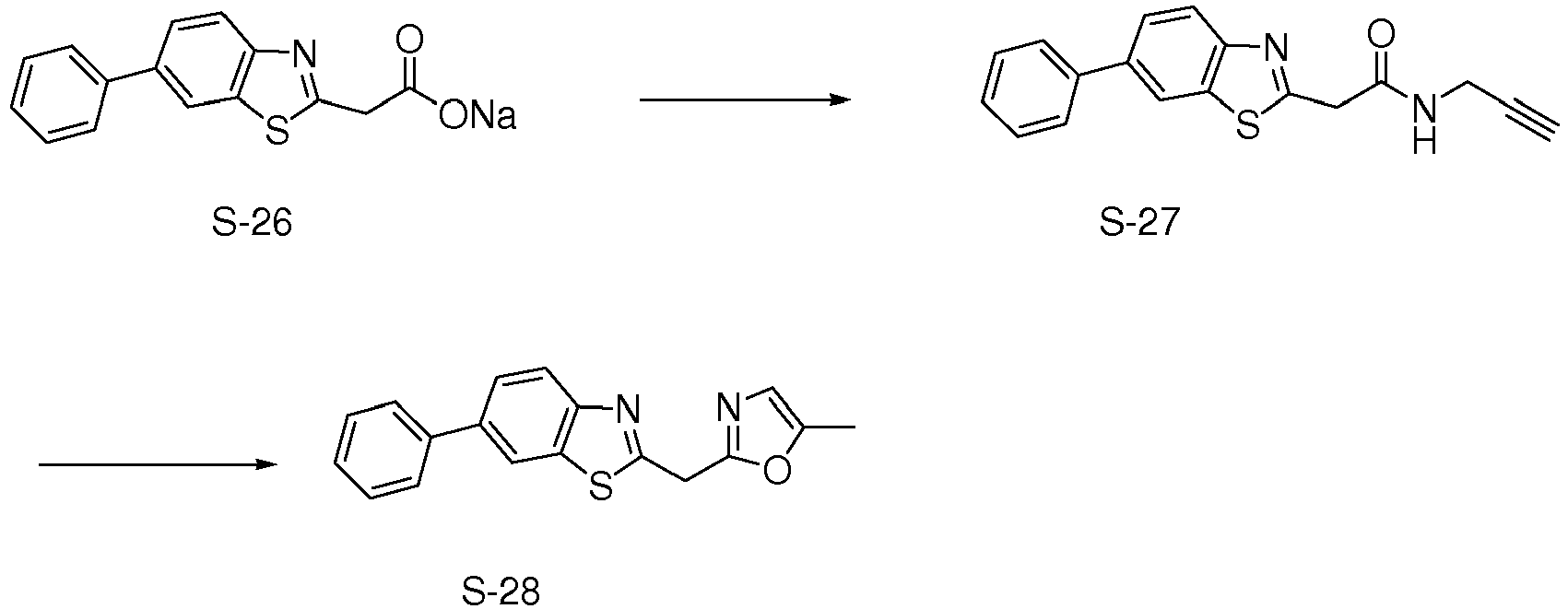
Compound (S-27);1H-NMR (DMSO-d6) δ: 2.31 (s, 3H), 4.60 (s, 2H), 6.73 (s, 1H), 7.37 (t, J = 7.1 Hz, 1H), 7.47 (t, J = 7.5 Hz, 2H), 7.63 (t, J = 7.6 Hz, 2H), 7.70 (d, J = 8.0 Hz, 1H), 8.04-8.08(m, 2H).
To a solution of Compound (S-27) (50 mg, 0.163 mmol) in anhydrous acetonitrile (2 mL) was added gold(III) chloride (4.95 mg, 0.016 mmol), then the reaction mixture was stirred at 70 °C for 3 hours. The reaction solution was cooled to room temperature. To the reaction solution were added 0.1N hydrochloric acid and ethyl acetate, then the reaction solution was extracted with ethyl acetate. The organic layer was washed with brine and dried over sodium sulfate. The solvent was removed under reduced pressure. The obtained residue was purified by column chromatography to give Compound (S-28) (17 mg, 34%).
Compound (S-28);1H-NMR (DMSO-d6) δ: 3.94 (m, 2H), 4.09 (s, 2H), 7.39 (t, J = 7.1 Hz, 1H), 7.49 (t, J = 8.4 Hz, 2H), 7.74-7.80-7.64 (m, 3H), 8.01 (d, J = 8.4 Hz, 1H), 8.38 (s, 1H), 8.82 (s, 1H). -

Compound (S-29);1H-NMR (CDCl3) δ: 2.30(s, 3H), 4.54 (s, 2H), 6.09 (s, 1H), 7.59 (d, J = 8.0Hz, 1H), 7.86 (d, J = 9.2Hz, 1H), 7.99(s, 1H)
To a solution of Compound (S-29) (220 mg, 0.72 mmol) in anhydrous 1,4-dioxane (2 ml) were added PHENYLBORONIC ACID (108 mg, 0.89mmol), TETRAKIS(TRIPHENYLPHOSPHINE) PALLADIUM (0) (82 mg, 0.071 mmol) and Na 2CO3 (189 mg, 1.78 mmol), then the reaction mixture was stirred at 120 °C for 15 minutes under microwave irradiation. To the reaction solution were added 0.1N hydrochloric acid and ethyl acetate, then the reaction solution was extracted with ethyl acetate. The organic layer was washed with brine and dried over sodium sulfate. The solvent was removed under reduced pressure. The obtained residue was purified by column chromatography to give Compound (S-30) (70 mg, 32%) as a yellow oil.
Compound (S-30);1H-NMR (CDCl3) δ: 2.30(s, 3H), 4.58 (s, 2H), 6.10 (s, 1H), 7.38 (t, J = 8.0Hz, 1H), 7.47 (t, J = 7.6Hz, 2H), 7.63 (d, J = 8.4Hz, 2H), 7.72 (d, J = 8.0Hz, 1H), 8.06(d, J = 8.6Hz, 2H). -

To a solution of Compound (S-31) (94 mg, 0.31 mmol) in 1,4-dioxane (1.2 ml) were added PHENYLBORONIC ACID (44.9 mg, 0.368 mmol), TETRAKIS(TRIPHENYLPHOSPHINE) PALLADIUM (0) (35.5 mg, 0.031 mmol) and NaHCO3 (64.4 mg, 0.77 mmol), then the reaction mixture was stirred at 140 °C for 10 minutes under microwave irradiation. To the reaction solution were added water and ethyl acetate, then the reaction solution was extracted with ethyl acetate. The organic layer was washed with brine and dried over sodium sulfate. The solvent was removed under reduced pressure. The obtained residue was purified by column chromatography to give Compound (S-32) (47 mg, 51%) as a yellow oil. Compound (S-32);1H-NMR (CDCl3) δ: 4.87 (s, 2H), 7.38 (t, J = 7.6Hz, 1H), 7.44-7.49 (m, 3H), 7.70(d, J = 2.0Hz, 3H), 7.72 (d, J = 2.0Hz, 1H), 8.05(d, J = 2.0Hz, 2H), 9.15(s, 1H) -

To a solution of Compound (S-33) (100 mg, 0.32 mmol) in 1,4-dioxane (1.2 ml) were added PHENYLBORONIC ACID (47.5 mg, 0.389 mmol), TETRAKIS(TRIPHENYLPHOSPHINE) PALLADIUM (0) (37.5 mg, 0.032 mmol) and NaHCO3 (68.1 mg, 0.81 mmol), then the reaction mixture was stirred at 140 °C for 10 minutes under microwave irradiation. To the reaction solution were added water and ethyl acetate, then the reaction solution was extracted with ethyl acetate. The organic layer was washed with brine and dried over sodium sulfate. The solvent was removed under reduced pressure. The obtained residue was purified by column chromatography to give Compound (S-34) (49 mg, 49%) as a yellow solid. Compound (S-34);1H-NMR (CDCl3) δ: 3.66 (s, 3H), 4.63 (s, 2H), 6.88 (d, J = 1.0 Hz, 1H), 7.05 (s, 1H), 7.37 (t, J = 7.4 Hz, 1H), 7.46 (t, J = 7.4 Hz, 2H), 7.62 (d, J = 7.1 Hz, 2H), 7.69 (dd, J = 8.4, 1.8 Hz, 1H), 8.00-8.03 (m, 2H). -

Compound (S-35);1H-NMR (CDCl3) δ: 4.82 (s, 2H), 7.25 (m, 1H), 7.57 (dd, J = 8.0, 1.6Hz, 1H), 7.89 (d, J = 8.6Hz, 1H), 7.99(s, 1H), 8.77 (d, J =5.2Hz, 1H)
To a solution of Compound (S-35) (100 mg, 0.33 mmol) in 1,4-dioxane (1.2 ml) were added PHENYLBORONIC ACID (47.8 mg, 0.392 mmol), TETRAKIS(TRIPHENYLPHOSPHINE) PALLADIUM (0) (47.8 mg, 0.039 mmol) and sodium hydrogen carbonate (68.3 mg, 0.82 mmol), then the reaction mixture was stirred at 140 °C for 20 minutes under microwave irradiation. To the reaction solution were added water and ethyl acetate, then the reaction solution was extracted with ethyl acetate. The organic layer was washed with brine and dried over sodium sulfate. The solvent was removed under reduced pressure. The obtained residue was purified by column chromatography to give Compound (S-36) (45 mg, 45%) as a yellow solid.
Compound (S-36);1H-NMR (DMSO-d6) δ: 4.80 (s, 2H), 7.39 (t, J = 6.8 Hz, 1H), 7.45-7.52 (m, 3H), 7.73-7.80 (m, 3H), 8.01 (d, J = 8.6 Hz, 1H), 8.37 (s, 1H), 8.83 (d, J = 5.1 Hz, 2H). -

Compound (S-38);1H-NMR (CDCl3) δ: 4.83 (s, 2H), 7.39 (t , J =7.6Hz, 1H), 7.48 (t , J = 8.0Hz, 2H), 7.64 (d, J = 7.2Hz, 2H), 7.74 (d, J = 8.0Hz, 1.6Hz, 1H), 8.06-8.09 (m, 2H)
To a solution of Compound (S-38) (186 mg, 0.611 mmol) in anhydrous N-methylpyrrolidone (3 mL) were added TBAB (19.71 mg, 0.061 mmol) and sodium azide (79 mg, 1.223 mmol) under nitrogen atmosphere, then the reaction mixture was stirred at room temperature for 2 hours. To the reaction solution were added water and ethyl acetate, then the reaction solution was extracted with ethyl acetate. The organic layer was washed with brine and dried over magnesium sulfate. The solvent was removed under reduced pressure. The obtained residue was purified by column chromatography to give Compound (S-39) (158 mg, 97%) as a yellow solid. Compound (S-39);1H-NMR (CDCl3) δ: 4.81 (s, 2H), 7.39 (t , J = 8.4Hz, 1H), 7.49 (t , J = 8.0Hz, 2H), 7.65 (d, J = 4.8Hz, 2H), 7.74 (d, J = 4Hz, 1H), 8.06-8.10 (m, 2H)
To a t-butanol (3 ml) and water (3 ml) was suspended Compound (S-39) (83 mg, 0.312 mmol). To the reaction mixture were added pent-4-ynoic acid (30.6 mg, 0.312 mmol), sodium(R)-2-((S)-1, 2-dihydroxyethyl)-4-hydroxy-5-oxo-2,5-dihydrofuran-3-olate (18.52 mg, 0.093 mmol) and copper (II) sulfate pentahydrate (11.67 mg, 0.047 mmol) at room temperature, then the reaction mixture was stirred for 15 hours. To the reaction solution were added water and ethyl acetate, then the reaction solution was extracted with ethyl acetate. The extraction was washed with brine and dried over magnesium sulfate. The solvent was removed under reduced pressure. The obtained crystal was washed with a mixed solvent of ethyl acetate and n-hexane to give Compound (S-40) (84 mg, 74%).
Compound (S-40);1H-NMR (DMSO-d6) δ: 2.60 (t, J = 6.3 Hz, 2H), 2.89 (t, J = 7.1 Hz, 2H), 6.13 (s, 2H), 7.40 (t, J = 7.4 Hz, 1H), 7.50 (t, J = 7.6 Hz, 2H), 7.74 (d, J = 7.6 Hz, 2H), 7.84 (dd, J = 8.6, 1.5 Hz, 1H), 8.06-8.09 (m, 2H), 8.41 (d, J = 1.0 Hz, 1H)
To a solution of Compound (S-40) (53 mg, 0.145 mmol) in anhydrous tetrahydrofuran (2 mL) was added CDI (35.4 mg, 0.218 mmol) under nitrogen atmosphere, then the reaction mixture was stirred at room temperature for 2 hours. To the reaction solution was added aqueous ammonia, then the reaction solution was stirred for 1 hour. To the reaction solution was added water, then the obtained crystal was washed with ethyl acetate to give Compound (S-41) (48 mg, 91%) as a yellow solid.
Compound (S-41);1H-NMR (CDCl3) δ: 2.69 (t, J = 7.1 Hz, 2H), 3.08 (t, J = 7.1 Hz, 2H), 5.28 (br s, 1H), 5.73 (br s, 1H), 5.93 (s, 2H), 7.39 (t, J = 7.4 Hz, 1H), 7.47 (t, J = 7.6 Hz, 2H), 7.61-7.64 (m, 3H), 7.75 (dd, J = 8.6, 1.5 Hz, 1H), 8.04-8.10 (m, 2H). -

Compound (S-42);1H-NMR (CDCl3) δ: 5.81 (s, 2H), 7.39 (t, J = 7.6 Hz, 1H), 7.47 (t, J = 7.6 Hz, 2H), 7.63 (d, J = 6.8Hz, 2H), 7.74 (dd, J = 8.8, 1.6 Hz, 1H), 8.05-8.10 (m, 3H), 8.34 (s, 1H). -

Compound (S-43);1H-NMR (CDCl3) δ: 5.76 (s, 2H), 6.37 (t, J = 2.0 Hz, 1H), 7.37 (t, J = 7.4 Hz, 1H), 7.46 (t, J = 7.9 Hz, 2H), 7.63 (dd, J = 8.9, 7.9 Hz, 4H), 7.71 (dd, J = 8.4, 1.8 Hz, 1H), 8.02 (s, 1H), 8.07 (d, J = 8.1 Hz, 1H). -

Compound (S-44);1H-NMR (CDCl3) δ: 2.47 (s, 3H), 4.63 (s, 2H), 7.38 (t, J = 7.1 Hz, 1H), 7.46 (t, J = 7.6 Hz, 2H), 7.62 (d, J = 7.6 Hz, 2H), 7.70 (dd, J = 8.4, 1.8 Hz, 1H), 8.04-8.06 (m, 2H). -
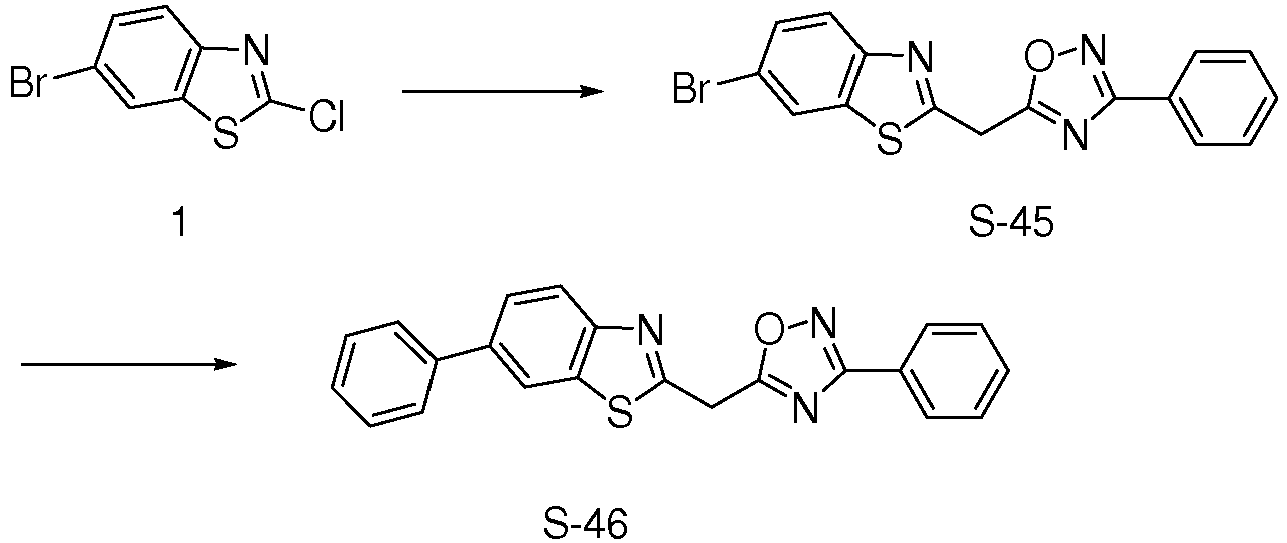
Compound (S-45);1 H-NMR (DMSO-d6) δ: 5.13 (s, 2H), 7.55-7.62 (m, 3H), 7.68 (dd, J = 8.62, 2.03 Hz, 1H), 7.94 (d, J = 8.62 Hz, 1H), 8.01 (dd, J = 7.86, 1.77 Hz, 2H), 8.44 (d, J = 2.03 Hz, 1H).
To a solution of Compound (S-45) (150 mg, 0.403 mmol) in 1,4-dioxane (1.5 ml) were added PHENYLBORONIC ACID (54.0 mg, 0.443 mmol), TETRAKIS(TRIPHENYLPHOSPHINE) PALLADIUM (0) (32.6 mg, 0.028 mmol) and 3N aqueous potassium carbonate solution (0.40 mL, 1.21 mmol), then the reaction mixture was stirred at 120 °C for 25 minutes under microwave irradiation. To the reaction solution were added water and ethyl acetate, then the reaction solution was extracted with ethyl acetate. The organic layer was washed respectively with 10 % aqueous sodium bicarbonate solution and brine and dried over magnesium sulfate. The solvent was removed under reduced pressure. The obtained residue was purified by column chromatography to give Compound (S-46) (31 mg, 21%) as a yellow solid.
Compound (S-46);1 H-NMR (DMSO-d6) δ: 5.15 (s, 2H), 7.35-7.68 (m, 6H), 7.76 (d, J = 7.10 Hz, 2H), 7.83 (dd, J = 8.62, 2.03 Hz, 1H), 8.00-8.08 (m, 3H), 8.46 (d, J = 2.03 Hz, 1H). -

Compound (S-47);1 H-NMR (DMSO-d6) δ: 5.01 (s, 2H), 7.37-7.44 (m, 3H), 7.50 (t, J = 7.60 Hz, 2H), 7.71-7.78 (m, 4H), 7.82 (dd, J = 8.62, 2.03 Hz, 1H), 8.05 (d, J = 8.62 Hz, 1H), 8.43 (d, J = 2.03 Hz, 1H). -

Compound (S-48);1 H-NMR (DMSO-d6) δ: 5.12 (s, 2H), 7.38-7.55 (m, 5H), 7.71-7.77 (m, 2H), 7.82 (dd, J = 8.62, 1.52 Hz, 1H), 8.01 (d, J = 8.11 Hz, 1H), 8.04-8.13 (m, 2H), 8.41 (d, J = 1.52 Hz, 1H). - After the present compound dissolved in DMSO was added to become 0.5% DMSO to the reaction buffer consisting of 20mM tris hydrochloric acid (pH7.4), bovine serum albumin (0.5%), calcium chloride (4mM), sodium chloride (150mM) and human HDL (2mg/ml), the EL enzyme was added (total volume was 20µl).
After 4-hour reaction at 37°C, non-esterified fatty acid (NEFA) generated from HDL by EL was measured with a commercially available assay kit and the amount of NEFA was used as an index of enzyme activity. Considering the enzyme activity without the inhibitor as a control value, the inhibition rate of each concentration of the present compound was calculated, and 50% inhibitory concentration (IC50 value) was calculated from an inhibition curve. - The result of Test Example 1 is shown below.
Compound (I-1-3): IC50=0.026 µM
Compound (I-1-9): IC50=0.26 µM
Compound (I-1-2): IC50=0.12 µM
Compound (I-1-23): IC50=0.073 µM
Compound (I-1-27): IC50=0.085 µM
Compound (I-1-31): IC50=0.083 µM
Compound (I-1-43): IC50=0.39 µM
Compound (I-1-82): IC50=0.052 µM
Compound (I-1-7): IC50=0.019 µM
Compound (I-1-85): IC50=0.006 µM
Compound (I-1-83): IC50=0.005 µM
Compound (I-2-196): IC50=0.036 µM
Compound (I-2-197): IC50=0.012 µM
Compound (I-2-198): IC50=0.015 µM
Compound (I-2-204): IC50=0.19 µM
Compound (I-2-215): IC50=2.5 µM
Compound (I-2-216): IC50=23 µM
Compound (I-3-1): IC50=0.011 µM
Compound (I-3-4): IC50=0.004 µM
Compound (I-3-6): IC50=0.052 µM
Compound (I-3-11): IC50=0.009 µM
Compound (I-3-12): IC50=0.078 µM
Compound (I-3-21): IC50=0.25 µM
Compound (I-3-23): IC50=0.4 µM
Compound (I-3-30): IC50=0.046 µM
Compound (I-3-37): IC50=0.002 µM
Compound (I-3-41): IC50=0.014 µM
Compound (I-3-48): IC50=0.008 µM
Compound (I-3-56): IC50=0.004 µM
Compound (I-3-93): IC50=0.028 µM
Compound (I-3-112): IC50=0.044 µM
Compound (I-3-145): IC50=0.069 µM
Compound (I-3-146): IC50=0.027 µM
Compound (I-3-163): IC50=0.009 µM
Compound (A-2): IC50=0.013 µM
Compound (A-5): IC50=0.008 µM
Compound (A-9): IC50=0.011 µM
Compound (A-10): IC50=0.008 µM
Compound (A-13): IC50=0.022 µM
Compound (A-14): IC50=0.16 µM
Compound (A-17): IC50=0.041 µM
Compound (A-19): IC50=0.11 µM
Compound (A-21): IC50=0.065 µM
Compound (A-25): IC50=0.042 µM
Compound (A-29): IC50=0.014 µM - The present compound selectively inhibits endothelial lipase as shown in Test Example 1, and has high selectivity for hepatic lipase (HL) and lipoprotein lipase (LPL). Selectivity was analyzed by the following tests.
- After an inhibitor dissolved in DMSO was added to become 0.5% DMSO to the reaction buffer consisting of 20mM tris hydrochloric acid (pH7.4), bovine serum albumin (0.5%), calcium chloride (4mM), sodium chloride (150mM) and human VLDL (0.5mg/ml), the HL enzyme was added (total volume was 20µl).
After 4-hour reaction at 37°C, non-esterified fatty acid (NEFA) generated from VLDL by HL was measured with a commercially available assay kit and the amount of NEFA was used as an index of enzyme activity. Considering the enzyme activity without the inhibitor as a control value, the inhibition rate of each concentration of an inhibitor was calculated, and 50% inhibitory concentration (IC50 value) was calculated from an inhibition curve. - After an inhibitor dissolved in DMSO was added to become 0.5% DMSO to the reaction buffer consisting of 20mM tris hydrochloric acid (pH7.4), bovine serum albumin (0.5%), calcium chloride (4mM), sodium chloride (150mM) and human VLDL(0.5mg/ml), the LPL enzyme was added (total volume was 20µl).
After 4-hour reaction at 37°C, non-esterified fatty acid (NEFA) generated from HDL by LPL was measured with a commercially available assay kit and the amount of NEFA was used as an index of enzyme activity. Considering the enzyme activity without the inhibitor as a control value, the inhibition rate of each concentration of an inhibitor was calculated, and 50% inhibitory concentration (IC50 value) was calculated from an inhibition curve. - The results of Test Example 2 and 3 indicated that the present compound inhibited the endothelial lipase selectively and had high selectivity for hepatic Lipase (HL) and lipoprotein lipase (LPL).
- Serum HDL cholesterol elevating effect can be examined as follows.
- The C57BL/6J mice at 8-25-weeks old were divided into 5-9 animals per group and administered test compound (20-200 mg/kg/day) orally. To the control group, 0.5% methyl cellulose solution (10mL/kg) of the vehicle was administered orally. The blood was collected from tail vein before and 24-hour after the administration of compound, and serum HDL cholesterol concentration was measured with [koresutesuto] N HDL (Daiiti chemical Ltd.). The animals were separated into groups so that the mean value of weight and serum HDL cholesterol level become almost equal between each examination groups. The efficacy of the test compound was shown as the rate of changes compared to the values before administration (the HDL cholesterol elevating rate; % Initial), and significant differences against the values of control groups were evaluated.
- Usefulness for medicaments was analyzed by the following examinations etc.
- The CYP3A4 fluorescent MBI test is a test of investigating enhancement of CYP3A4 inhibition of a compound by a metabolism reaction, and the test was performed using, as CYP3A4 enzyme expressed in Escherichia coli and employing, as an index, a reaction in which 7-benzyloxytrifluoromethylchmarin (7-BFC) is debenzylated by the CYP3A4 enzyme to produce a metabolite, 7-hydroxytrifluoromethylchmarin (HFC) emitting fluorescent light.
- The reaction conditions were as follows: substrate, 5.6 µmol/L 7-BFC; pre-reaction time, 0 or 30 minutes; reaction time, 15 minutes; reaction temperature, 25°C (room temperature); CYP3A4 content (enzyme expressed in Escherichia coli), at pre-reaction 62.5 pmol/mL, at reaction 6.25 pmol/mL (at 10-fold dilution); test drug concentration, 0.625, 1.25, 2.5, 5, 10, 20 µmol/L (six points).
- An enzyme in a K-Pi buffer (pH 7.4) and a test drug solution as a pre-reaction solution were added to a 96-well plate at the composition of the pre-reaction, a part of it was transferred to another 96-well plate so that it was 1/10 diluted with a substrate and a K-Pi buffer, NADPH as a co-factor was added to initiate a reaction as an index (without preincubation) and, after a predetermined time of a reaction, acetonitrile/0.5 mol/L Tris (trishydroxyaminomethane) = 4/1 was added to stop the reaction. In addition, NADPH was added to a remaining preincubation solution to initiate a preincubation (with preincubation) and, after a predetermined time of a preincubation, a part was transferred to another plate so that it was 1/10 diluted with a substrate and a K-Pi buffer to initiate a reaction as an index. After a predetermined time of a reaction, acetonitrile/0.5 mol/L Tris (trishydroxyaminomethane) = 4/1 was added to stop the reaction. For the plate on which each index reaction had been performed, a fluorescent value of 7-HFC which is a metabolite was measured with a fluorescent plate reader. (Ex = 420 nm, Em = 535 nm).
- Addition of only DMSO which is a solvent dissolving a drug to a reaction system was adopted as a control (100%), remaining activity (%) was calculated at each concentration of a test drug added as the solution,and IC50 was calculated by reverse-presumption by a logistic model using a concentration and an inhibition rate. When a difference between IC50 values is 5 µM or more, this was defined as (+) and, when the difference is 3 µM or less, this was defined as (-).
- Using commercially available pooled human hepatic microsome, and employing, as markers, 7-ethoxyresorufin O-deethylation (CYP1A2), tolbutamide methyl-hydroxylation (CYP2C9), mephenytoin 4'-hydroxylation (CYP2C19), dextromethorphan O-demethylation (CYP2D6), and terfenedine hydroxylation (CYP3A4) as typical substrate metabolism reactions of human main five CYP enzyme forms (CYP1A2, 2C9, 2C19, 2D6, 3A4), an inhibitory degree of each metabolite production amount by a test compound was assessed
- The reaction conditions were as follows: substrate, 0.5 µmol/L ethoxyresorufin (CYP1A2), 100 µmol/L tolbutamide (CYP2C9), 50 µmol/L S-mephenitoin (CYP2C19), 5 µmol/L dextromethorphan (CYP2D6), 1 µmol/L terfenedine (CYP3A4); reaction time, 15 minutes; reaction temperature, 37°C; enzyme, pooled human hepatic microsome 0.2 mg protein/mL; test drug concentration, 1, 5, 10, 20 µmol/L (four points).
- Each five kinds of substrates, human hepatic microsome, or a test drug in 50 mM Hepes buffer as a reaction solution was added to a 96-well plate at the composition as described above, NADPH,as a cofactor was added to initiate metabolism reactions as markers and, after the incubation at 37°C for 15 minutes, a methanol/acetonitrile = 1/1 (v/v) solution was added to stop the reaction. After the centrifugation at 3000 rpm for 15 minutes, resorufin (CYP1A2 metabolite) in the supernatant was quantified by a fluorescent multilabel counter and tributamide hydroxide (CYP2C9 metabolite), mephenytoin 4' hydroxide (CYP2C19 metabolite), dextromethorphan (CYP2D6 metabolite), and terfenadine alcohol (CYP3A4 metabolite) were quantified by LC/MS/MS.
- Addition of only DMSO being a solvent dissolving a drug to a reaction system was adopted as a control (100%), remaining activity (%) was calculated at each concentration of a test drug added as the solution and IC50 was calculated by reverse presumption by a logistic model using a concentration and an inhibition rate.
- Each 20 µL of freeze-stored Salmonella typhimurium (TA98 and TA100 strain) was inoculated in 10 mL of liquid nutrient medium (2.5% Oxoid nutrient broth No.2), and the cultures were incubated at 37°C under shaking for 10 hours. 9 mL of TA98 culture was centrifuged (2000 x g, 10 minutes) to remove medium, and the bacteria was suspended in 9 mL of Micro F buffer (K2HPO4: 3.5 g/L, KH2PO4: 1 g/L, (NH4)2SO4: 1 g/L, trisodium citrate dihydrate: 0.25 g/L, MgSO4 · 7H2O: 0.1 g/L), and the suspension was added to 110 mL of Exposure medium (Micro F buffer containing Biotin: 8 µg/mL, histidine: 0.2 µg/mL, glucose: 8 mg/mL). 3.16 mL of TA100 culture was added to 120 mL of Exposure medium to prepare the test bacterial solution. 588 µL of the test bacterial solution (or mixed solution of 498 µl of the test bacterial solution and 90 µL of the S9 mix in the case with metabolic activation system) was mixed with each 12 µL of the following solution: DMSO solution of the test substance (eight dose levels from maximum dose 50 mg/mL at 2-fold ratio); DMSO as negative control; 50 µg/mL of 4-nitroquinoline-1-oxide DMSO solution as positive control for TA98 without metabolic activation system; 0.25 µg/mL of 2-(2-furyl)-3-(5-nitro-2-furyl)acrylamide DMSO solution as positive control for TA100 without metabolic activation system; 40 µg/mL of 2-aminoanthracene DMSO solution as positive control for TA98 with metabolic activation system; or 20 µg/mL of 2-aminoanthracene DMSO solution as positive control for TA100 with metabolic activation system. 12 µL of the solution and 588 µL of the test bacterial solution (a mixed solution of 498 µl of the test bacterial solution and 90 µL of S9 mix with metabolic activation condition) were mixed and incubated at 37°C under shaking for 90 minutes. 460 µL of the bacterial solution exposed to the test substance was mixed with 2300 µL of Indicator medium (Micro F buffer containing biotin: 8 µg/mL, histidine: 0.2 µg/mL, glucose: 8 mg/mL, Bromo Cresol Purple: 37.5 µg/mL), each 50 µL was dispensed into 48 wells per dose in the microwell plates, and was subjected to stationary cultivation at 37°C for 3 days. A well containing the bacteria, which has obtained the ability of proliferation by mutation in the gene coding amino acid (histidine) synthetase, turns the color from purple to yellow due to pH change. The number of the yellow wells among the 48 total wells per dose was counted, and evaluate the mutagenicity by comparing with the negative control group. (-) means that mutagenicity is negative and (+) means positive.
- The solubility of a compound was determined under a condition in which 1% DMSO was added. 10 mM compound solution was prepared using DMSO, and then 6 µL of the compound solution was added to 594 µL of artificial intestinal juice in pH 6.8 (to 250 mL of 0.2 mol/L potassium dihydrogen phosphate reagent solution was added 118 mL of 0.2 mol/L NaOH reagent solution and water to provide a final volume of 1000 mL). After standing at 25 degrees Celsius for 16 hours, the mixed solution was filtrated with suction. The filtrate was diluted twice with methanol/water (1/1), and then a concentration in the filtration was measured with HPLC or LC/MS/MS by the absolute calibration method.
- Using commercially available pooled human hepatic microsomes, a test compound was reacted for a constant time, a remaining rate was calculated by comparing a reacted sample and an unreacted sample, thereby, a degree of metabolism in liver was assessed.
- A reaction was performed (oxidative reaction) at 37°C for 0 minute or 30 minutes in the presence of 1 mmol/L NADPH in 0.2 mL of a buffer (50 mmol/L Tris-HCl pH 7.4, 150 mmol/L potassium chloride, 10 mmol/L magnesium chloride) containing 0.5 mg protein/mL of human liver microsomes. After the reaction, 50 µL of the reaction solution was added to 100 µL of a methanol/acetonitrile = 1/1 (v/v), mixed and centrifuged at 3000 rpm for 15 minutes. The test compound in the supernatant was quantified by LC/MS/MS, and a remaining amount of the test compound after the reaction was calculated, letting a compound amount at 0 minute reaction time to be 100%. Hydrolysis reaction was performed in the absence of NADPH and glucuronidation reaction was performed in the presence of 5 mM UDP-glucuronic acid in place of NADPH, followed by similar operations.
- For the purpose of assessing risk of an electrocardiogram QT interval prolongation, effects on delayed rectifier K+ current (IKr), which plays an important role in the ventricular repolarization process, was studied using HEK293 cells expressing human ether-α-go-go related gene (hERG) channel.
After a cell was retained at a membrane potential of -80 mV by whole cell patch clamp method using an automated patch clamp system (PatchXpress 7000A, Axon Instruments Inc.), IKr induced by depolarization pulse stimulation at +40 mV for 2 seconds and, further, repolarization pulse stimulation at -50 mV for 2 seconds was recorded. After the generated current was stabilized, extracellular solution (NaCl: 135 mmol/L, KCl: 5.4 mmol/L, NaH2PO4: 0.3 mmol/L, CaCl2·2H2O: 1.8 mmol/L, MgCl2·6H2O: 1 mmol/L, glucose: 10 mmol/L, HEPES (4-(2-hydroxyethyl)-1-piperazine ethanesulfonic acid): 10 mmol/L, pH=7.4) in which the test compound had been dissolved at an objective concentration was applied to the cell under the room temperature condition for 10 minutes. From the recording IKr, an absolute value of the tail peak current was measured based on the current value at the resting membrane potential using an analysis software (DataXpress ver.1, Molecular Devices Corporation). Further, the % inhibition relative to the tail peak current before application of the test substance was calculated, and compared with the vehicle-applied group (0.1% dimethyl sulfoxide solution) to assess influence of the test substance on IKr. - Appropriate amounts of the test substances are put into appropriate containers. To the respective containers are added 200 µL of JP-1 fluid (sodium chloride 2.0 g, hydrochloric acid 7.0 mL and water to reach 1000 mL), 200 µL of JP-2 fluid (phosphate buffer (pH 6.8) 500 mL and water 500 mL), and 200 µL of 20 mmol/L TCA (sodium taurocholate)/JP-2 fluid (TCA 1.08 g and water to reach 100 mL). In the case that the test compound is dissolved after the addition of the test fluid, the bulk powder is added as appropriate. The containers are sealed, and shaken for 1 hour at 37°C. The mixtures are filtered, and 100 µL of methanol is added to each of the filtrate (100 µL) so that the filtrates are two-fold diluted. The dilution ratio may be changed if necessary. The dilutions are observed for bubbles and precipitates, and then the containers are sealed and shaken. Quantification is performed by HPLC with an absolute calibration method.
- Materials and methods for studies on oral absorption
- (1) Animals: mice or rats
- (2) Animal husbandry:
- Mice and rats had free access to solid food and sterilized bottled tap water.
- (3) Setting of Dose and group compositions:
- orally or intravenously administered at a predetermined dose; Group compositions were as shown below (Dose depends on the compound)
- Oral: 1 to 30 mg/kg (n=2 to 3)
- Intravenous: 0.5 to 10 mg/kg (n=2 to 3)
- (4) Preparation for dosing formulation:
- for oral administration, in a solution or a suspension state; for intravenous administration, in a solubilized state
- (5) Dosing procedure:
- In oral administration study, the test suspension was dosed to the stomach of rats by using a gavage tube In intravenous administration study, the test solution was dosed to rats via tail vein using a syringe with a needle.
- (6) Evaluation items:
- Blood was collected at each time point, and plasma concentration of the test substance was determined by a LC/MS/MS system.
- (7) Data analysis:
- Regarding the transition of the plasma concentration, area under the plasma concentration-time curve (AUC) was calculated by means of WinNonlin® program, respectively. Bioavailability (BA) was calculated by using AUC values in oral administration study and in intravenous administration study.
- A hard gelatin capsule is prepared by using the following ingredients:
Dose (mg/capsule) Active ingredient 250 Starch (dry) 200 Magnesium stearate 10 Total 460 mg - A tablet is prepared by using the following ingredients:
Dose (mg/tablet) Active ingredient 250 Cellulose (microcrystal) 400 Silicon dioxide (fumed) 10 Stearic acid 5 Total 665 mg - An aerosol solution containing the following ingredients is prepared:
Weight Active ingredient 0.25 Ethanol 25.75 Propellant 22 (chlorodifluoromethane) 74.00 Total 100.00 - A tablet containing 60 mg of the active ingredient is prepared in the following manner:
Active ingredient 60 mg Starch 45 mg Microcrystalline cellulose 35 mg Polyvinylpyrrolidone (10% solution in water) 4 mg Sodium carboxymethyl starch 4.5 mg Magnesium stearate 0.5 mg Talc 1 mg Total 150 mg - A capsule containing 80 mg of the active ingredient is prepared in the following manner:
Active ingredient 80 mg Starch 59 mg Microcrystalline cellulose 59 mg Magnesium stearate 2 mg Total 200 mg - Suppository containing 225 mg of the active ingredient is prepared in the following manner:
Active ingredient 225 mg Saturated fatty acid glyceride 2000 mg Total 2225 mg - A suspension containing 50 mg of the active ingredient is prepared in the following manner:
Active ingredient 50 mg Sodium carboxymethyl cellulose 50 mg Syrup 1.25 mL Benzoic acid solution 0.10 mL Flavor q.v. Pigment q.v. Purified water to total 5 mL - An intravenous formulation is prepared in the following manner:
Active ingredient 100 mg Saturated fatty acid glyceride 1000 mL - As is apparent from the above test examples, the compounds according to the present invention show inhibitory activity on endothelial lipase. Therefore, the compounds according to the present invention are very useful as therapeutic agents for lipid metabolism abnormality, hyperlipidemia or arteriosclerosis.
Claims (20)
- A compound represented by the formula (I):

wherein
Ring A is aromatic carbocycle or aromatic heterocycle,
Z is -NR5-, -O- or -S-,
R5 is hydrogen, substituted or unsubstituted alkyl, substituted or unsubstituted alkenyl, substituted or unsubstituted alkynyl, substituted or unsubstituted aryl, substituted or unsubstituted heteroaryl, substituted or unsubstituted cycloalkyl, substituted or unsubstituted cycloalkenyl, substituted or unsubstituted heterocyclyl, substituted or unsubstituted alkyloxycarbonyl or substituted or unsubstituted acyl,
R1 is hydrogen, halogen, hydroxy, cyano, nitro, carboxy, substituted or unsubstituted alkyl, substituted or unsubstituted alkenyl, substituted or unsubstituted alkynyl, substituted or unsubstituted aryl, substituted or unsubstituted heteroaryl, substituted or unsubstituted cycloalkyl, substituted or unsubstituted cycloalkenyl, substituted or unsubstituted heterocyclyl, substituted or unsubstituted alkyloxy, substituted or unsubstituted aryloxy, substituted or unsubstituted heteroaryloxy, substituted or unsubstituted cycloalkyloxy, substituted or unsubstituted cycloalkenyloxy, substituted or unsubstituted heterocyclyloxy, substituted or unsubstituted alkylthio, substituted or unsubstituted arylthio, substituted or unsubstituted heteroarylthio, substituted or unsubstituted cycloalkylthio, substituted or unsubstituted cycloalkenylthio, substituted or unsubstituted heterocyclylthio, substituted or unsubstituted alkylsulfonyl, substituted or unsubstituted arylsulfonyl, substituted or unsubstituted heteroarylsulfonyl, substituted or unsubstituted cycloalkylsulfonyl, substituted or unsubstituted cycloalkenylsulfonyl, substituted or unsubstituted heterocyclylsulfonyl, substituted or unsubstituted acyl, substituted or unsubstituted carbamoyl or substituted or unsubstituted amino,
R2 and R3 are each independently hydrogen, halogen, hydroxy, cyano, nitro, carboxy, substituted or unsubstituted alkyl or substituted or unsubstituted alkyloxy,
R2 and R3 taken together may form oxo,
R4 is a group represented by the formula: -(CR6R7)n-R8,
wherein R6 and R7 are each independently hydrogen, halogen, hydroxy, carboxy, substituted or unsubstituted alkyl or substituted or unsubstituted alkyloxy, R6 and R7 taken together with the adjacent carbon atom to which they are attached may form a substituted or unsubstituted ring, n is an integer of 0 to 3, R8 is carboxy, cyano, substituted or unsubstituted alkyl, substituted or unsubstituted acyl, with the proviso that n is not 0 when R8 is substituted or unsubstituted acyl, substituted or unsubstituted alkyloxycarbonyl, substituted or unsubstituted alkylsulfonyl, substituted or unsubstituted carbamoyl, substituted or unsubstituted amino, substituted or unsubstituted carbamoyloxy or substituted or unsubstituted alkyloxy,
Rx is halogen, hydroxy, cyano, nitro, carboxy, substituted or unsubstituted alkyl, substituted or unsubstituted alkenyl, substituted or unsubstituted alkynyl, substituted or unsubstituted aryl, substituted or unsubstituted heteroaryl, substituted or unsubstituted cycloalkyl, substituted or unsubstituted cycloalkenyl, substituted or unsubstituted heterocyclyl, substituted or unsubstituted alkyloxy, substituted or unsubstituted aryloxy, substituted or unsubstituted heteroaryloxy, substituted or unsubstituted cycloalkyloxy, substituted or unsubstituted cycloalkenyloxy, substituted or unsubstituted heterocyclyloxy, substituted or unsubstituted alkylthio, substituted or unsubstituted arylthio, substituted or unsubstituted heteroarylthio, substituted or unsubstituted cycloalkylthio, substituted or unsubstituted cycloalkenylthio, substituted or unsubstituted heterocyclylthio, substituted or unsubstituted alkylsulfonyl, substituted or unsubstituted arylsulfonyl, substituted or unsubstituted heteroarylsulfonyl, substituted or unsubstituted cycloalkylsulfonyl, substituted or unsubstituted cycloalkenylsulfonyl, substituted or unsubstituted heterocyclylsulfonyl, substituted or unsubstituted acyl, substituted or unsubstituted carbamoyl or substituted or unsubstituted amino,
m is an integer of 0 to 3,
with the proviso that the compounds wherein Z is -NR5-, n is 0 and R8 is substituted or unsubstituted amino and the compound shown as follows are excluded:
- The compound according to claim 1, its pharmaceutically acceptable salt, or a solvate thereof, wherein Z is -O- or -S-.
- The compound according to claim 2, its pharmaceutically acceptable salt, or a solvate thereof, wherein Z is -S-.
- The compound according to any one of claims 1 to 3, its pharmaceutically acceptable salt, or a solvate thereof, wherein Ring A is aromatic carbocycle.
- The compound according to any one of claims 1 to 4, its pharmaceutically acceptable salt, or a solvate thereof, wherein Ring A is benzene ring.
- The compound according to claim 1, its pharmaceutically acceptable salt, or a solvate thereof, wherein the compound represented by the formula (I) is a compound represented by the formula (II):

- The compound according to any one of claims 1 to 6, its pharmaceutically acceptable salt, or a solvate thereof, wherein R1 is hydrogen, halogen, cyano, substituted or unsubstituted alkyl, substituted or unsubstituted aryl, substituted or unsubstituted heteroaryl, substituted or unsubstituted cycloalkyl, substituted or unsubstituted cycloalkenyl, substituted or unsubstituted heterocyclyl, substituted or unsubstituted aryloxy, substituted or unsubstituted heteroaryloxy, substituted or unsubstituted cycloalkyloxy, substituted or unsubstituted cycloalkenyloxy, substituted or unsubstituted heterocyclyloxy, substituted or unsubstituted arylthio, substituted or unsubstituted heteroarylthio, substituted or unsubstituted cycloalkylthio, substituted or unsubstituted cycloalkenylthio, substituted or unsubstituted heterocyclylthio, substituted or unsubstituted alkylsulfonyl, substituted or unsubstituted arylsulfonyl, substituted or unsubstituted heteroarylsulfonyl, substituted or unsubstituted cycloalkylsulfonyl, substituted or unsubstituted cycloalkenylsulfonyl, substituted or unsubstituted heterocyclylsulfonyl, substituted or unsubstituted acyl or substituted or unsubstituted amino.
- The compound according to any one of claims 1 to 7, its pharmaceutically acceptable salt, or a solvate thereof, wherein R1 is hydrogen, halogen, cyano, substituted or unsubstituted alkyl, substituted or unsubstituted aryl, substituted or unsubstituted heteroaryl, substituted or unsubstituted aryloxy, substituted or unsubstituted heteroaryloxy, substituted or unsubstituted alkylsulfonyl, substituted or unsubstituted arylsulfonyl, substituted or unsubstituted heteroarylsulfonyl, substituted or unsubstituted cycloalkylsulfonyl, substituted or unsubstituted cycloalkenylsulfonyl, substituted or unsubstituted heterocyclylsulfonyl or substituted or unsubstituted amino.
- The compound according to any one of claims 1 to 8, its pharmaceutically acceptable salt, or a solvate thereof, wherein R1 is substituted or unsubstituted aryl.
- The compound according to any one of claims 1 to 9, its pharmaceutically acceptable salt, or a solvate thereof, wherein R8 is carboxy, cyano, substituted or unsubstituted alkyloxycarbonyl, substituted or unsubstituted alkylsulfonyl, substituted or unsubstituted carbamoyl, substituted or unsubstituted amino or substituted or unsubstituted carbamoyloxy.
- The compound according to claim 10, its pharmaceutically acceptable salt, or a solvate thereof, wherein R8 is carboxy, cyano, substituted or unsubstituted carbamoyl or substituted or unsubstituted amino.
- The compound according to claim 11, its pharmaceutically acceptable salt, or a solvate thereof, wherein R8 is substituted or unsubstituted carbamoyl.
- The compound according to claim 12, its pharmaceutically acceptable salt, or a solvate thereof, wherein R8 is a group represented by the formula: -(C=O)-NR9-(CR10R11)-R12, wherein R9 is hydrogen, substituted or unsubstituted alkyl, substituted or unsubstituted aryl, substituted or unsubstituted heteroaryl, substituted or unsubstituted cycloalkyl, substituted or unsubstituted cycloalkenyl or substituted or unsubstituted heterocyclyl,
R10 and R11 are each independently hydrogen, halogen, hydroxy, cyano, nitro, carboxy, substituted or unsubstituted alkyl, substituted or unsubstituted alkenyl, substituted or unsubstituted alkynyl, substituted or unsubstituted aryl, substituted or unsubstituted heteroaryl, substituted or unsubstituted cycloalkyl, substituted or unsubstituted cycloalkenyl, substituted or unsubstituted heterocyclyl or substituted or unsubstituted alkyloxy, R10 and R11 taken together with the adjacent carbon atom to which they are attached may form a substituted or unsubstituted ring,
R12 is cyano, carboxy, substituted or unsubstituted alkyl, substituted or unsubstituted alkenyl, substituted or unsubstituted alkynyl, substituted or unsubstituted aryl, substituted or unsubstituted heteroaryl, substituted or unsubstituted cycloalkyl, substituted or unsubstituted cycloalkenyl, substituted or unsubstituted heterocyclyl, substituted or unsubstituted acyl, substituted or unsubstituted carbamoyl or substituted or unsubstituted alkyloxycarbonyl. - The compound according to any one of claims 1 to 13, its pharmaceutically acceptable salt, or a solvate thereof, wherein n is 1.
- The compound according to any one of claims 1 to 14, its pharmaceutically acceptable salt, or a solvate thereof, wherein R2 and R3 are hydrogen.
- A compound represented by the formula (III):

wherein
Ring B is substituted or unsubstituted nitrogen-containing hetero ring,
R2 and R3 are each independently hydrogen, halogen, hydroxy, cyano, nitro, carboxy, substituted or unsubstituted alkyl or substituted or unsubstituted alkyloxy,
R2 and R3 taken together may form oxo,
R4 is a group represented by the formula: -(CR6R7)n-R8,
wherein R6 and R7 are each independently hydrogen, halogen, hydroxy, carboxy, substituted or unsubstituted alkyl or substituted or unsubstituted alkyloxy, R6 and R7 taken together with the adjacent carbon atom to which they are attached may form a substituted or unsubstituted ring, n is an integer of 0 to 3, R8 is carboxy, cyano, substituted or unsubstituted alkyl, substituted or unsubstituted acyl, with the proviso that n is not 0 when R8 is substituted or unsubstituted acyl, substituted or unsubstituted alkyloxycarbonyl, substituted or unsubstituted alkylsulfonyl, substituted or unsubstituted carbamoyl, substituted or unsubstituted amino, substituted or unsubstituted carbamoyloxy or substituted or unsubstituted alkyloxy,
with the proviso that the compounds wherein Ring B is substituted or unsubstituted benzimidazole, n is 0 and R8 is substituted or unsubstituted amino and the compound shown as follows are excluded:
- The compound according to claim 16, its pharmaceutically acceptable salt, or a solvate thereof, wherein Ring B is a group represented by the formula:

Ring A is aromatic carbocycle, non-aromatic carbocycle, aromatic heterocycle or non-aromatic heterocycle,
Z is -NR5-, -O- or -S-,
R5 is hydrogen, substituted or unsubstituted alkyl, substituted or unsubstituted alkenyl, substituted or unsubstituted alkynyl, substituted or unsubstituted aryl, substituted or unsubstituted heteroaryl, substituted or unsubstituted cycloalkyl, substituted or unsubstituted cycloalkenyl, substituted or unsubstituted heterocyclyl, substituted or unsubstituted alkyloxycarbonyl or substituted or unsubstituted acyl,
R1 is hydrogen, halogen, hydroxy, cyano, nitro, carboxy, substituted or unsubstituted alkyl, substituted or unsubstituted alkenyl, substituted or unsubstituted alkynyl, substituted or unsubstituted aryl, substituted or unsubstituted heteroaryl, substituted or unsubstituted cycloalkyl, substituted or unsubstituted cycloalkenyl, substituted or unsubstituted heterocyclyl, substituted or unsubstituted alkyloxy, substituted or unsubstituted aryloxy, substituted or unsubstituted heteroaryloxy, substituted or unsubstituted cycloalkyloxy, substituted or unsubstituted cycloalkenyloxy, substituted or unsubstituted heterocyclyloxy, substituted or unsubstituted alkylthio, substituted or unsubstituted arylthio, substituted or unsubstituted heteroarylthio, substituted or unsubstituted cycloalkylthio, substituted or unsubstituted cycloalkenylthio, substituted or unsubstituted heterocyclylthio, substituted or unsubstituted alkylsulfonyl, substituted or unsubstituted arylsulfonyl, substituted or unsubstituted heteroarylsulfonyl, substituted or unsubstituted cycloalkylsulfonyl, substituted or unsubstituted cycloalkenylsulfonyl, substituted or unsubstituted heterocyclylsulfonyl, substituted or unsubstituted acyl, substituted or unsubstituted carbamoyl or substituted or unsubstituted amino,
Rx is halogen, hydroxy, cyano, nitro, carboxy, substituted or unsubstituted alkyl, substituted or unsubstituted alkenyl, substituted or unsubstituted alkynyl, substituted or unsubstituted aryl, substituted or unsubstituted heteroaryl, substituted or unsubstituted cycloalkyl, substituted or unsubstituted cycloalkenyl, substituted or unsubstituted heterocyclyl, substituted or unsubstituted alkyloxy, substituted or unsubstituted aryloxy, substituted or unsubstituted heteroaryloxy, substituted or unsubstituted cycloalkyloxy, substituted or unsubstituted cycloalkenyloxy, substituted or unsubstituted heterocyclyloxy, substituted or unsubstituted alkylthio, substituted or unsubstituted arylthio, substituted or unsubstituted heteroarylthio, substituted or unsubstituted cycloalkylthio, substituted or unsubstituted cycloalkenylthio, substituted or unsubstituted heterocyclylthio, substituted or unsubstituted alkylsulfonyl, substituted or unsubstituted arylsulfonyl, substituted or unsubstituted heteroarylsulfonyl, substituted or unsubstituted cycloalkylsulfonyl, substituted or unsubstituted cycloalkenylsulfonyl, substituted or unsubstituted heterocyclylsulfonyl, substituted or unsubstituted acyl, substituted or unsubstituted carbamoyl or substituted or unsubstituted amino,
m is an integer of 0 to 3,
R1a and R1b are each independently hydrogen, halogen, hydroxy, cyano, nitro, carboxy, substituted or unsubstituted alkyl, substituted or unsubstituted alkenyl, substituted or unsubstituted alkynyl, substituted or unsubstituted aryl, substituted or unsubstituted heteroaryl, substituted or unsubstituted cycloalkyl, substituted or unsubstituted cycloalkenyl, substituted or unsubstituted heterocyclyl, substituted or unsubstituted alkyloxy, substituted or unsubstituted aryloxy, substituted or unsubstituted heteroaryloxy, substituted or unsubstituted cycloalkyloxy, substituted or unsubstituted cycloalkenyloxy, substituted or unsubstituted heterocyclyloxy, substituted or unsubstituted alkylthio, substituted or unsubstituted arylthio, substituted or unsubstituted heteroarylthio, substituted or unsubstituted cycloalkylthio, substituted or unsubstituted cycloalkenylthio, substituted or unsubstituted heterocyclylthio, substituted or unsubstituted alkylsulfonyl, substituted or unsubstituted arylsulfonyl, substituted or unsubstituted heteroarylsulfonyl, substituted or unsubstituted cycloalkylsulfonyl, substituted or unsubstituted cycloalkenylsulfonyl, substituted or unsubstituted heterocyclylsulfonyl, substituted or unsubstituted acyl, substituted or unsubstituted carbamoyl or substituted or unsubstituted amino,
R1a and R1b taken together with the adjacent carbon atom to which they are attached may form a substituted or unsubstituted ring,
Z1 is =CR1- or =N-,
Z2 is -CR1= or -N=. - The compound according to claim 17, its pharmaceutically acceptable salt, or a solvate thereof, wherein R1a and R1b taken together with the adjacent carbon atom to which they are attached form a substituted or unsubstituted ring.
- A pharmaceutical composition comprising the compound according to any one of claims 1 to 18, its pharmaceutically acceptable salt, or a solvate thereof.
- A pharmaceutical composition comprising the compound according to any one of claims 1 to 18, its pharmaceutically acceptable salt, or a solvate thereof, which has an inhibitory activity on endothelial lipase.
Applications Claiming Priority (3)
| Application Number | Priority Date | Filing Date | Title |
|---|---|---|---|
| JP2009283965 | 2009-12-15 | ||
| JP2010098009 | 2010-04-21 | ||
| PCT/JP2010/072440 WO2011074560A1 (en) | 2009-12-15 | 2010-12-14 | Oxadiazole derivative having endothelial lipase inhibitory activity |
Publications (3)
| Publication Number | Publication Date |
|---|---|
| EP2514749A1 true EP2514749A1 (en) | 2012-10-24 |
| EP2514749A4 EP2514749A4 (en) | 2013-04-17 |
| EP2514749B1 EP2514749B1 (en) | 2015-02-25 |
Family
ID=44167313
Family Applications (1)
| Application Number | Title | Priority Date | Filing Date |
|---|---|---|---|
| EP10837586.6A Not-in-force EP2514749B1 (en) | 2009-12-15 | 2010-12-14 | Oxadiazole derivative having endothelial lipase inhibitory activity |
Country Status (9)
| Country | Link |
|---|---|
| US (2) | US8754113B2 (en) |
| EP (1) | EP2514749B1 (en) |
| JP (1) | JP5791150B2 (en) |
| KR (1) | KR20120123325A (en) |
| CN (1) | CN102753545A (en) |
| CA (1) | CA2784710A1 (en) |
| RU (1) | RU2012127701A (en) |
| TW (1) | TW201125865A (en) |
| WO (1) | WO2011074560A1 (en) |
Cited By (1)
| Publication number | Priority date | Publication date | Assignee | Title |
|---|---|---|---|---|
| WO2017019828A1 (en) * | 2015-07-30 | 2017-02-02 | Bristol-Myers Squibb Company | Aryl substituted bicyclic heteroaryl compounds |
Families Citing this family (14)
| Publication number | Priority date | Publication date | Assignee | Title |
|---|---|---|---|---|
| ES2616238T3 (en) | 2010-10-06 | 2017-06-12 | Glaxosmithkline Llc, Corporation Service Company | Benzimidazole derivatives as PI3 kinase inhibitors |
| TW201305152A (en) * | 2010-12-14 | 2013-02-01 | Shionogi & Co | Benzothiazole and azabenzothiazole derivative having inhibitory activity on endothelial lipase |
| WO2012173099A1 (en) * | 2011-06-14 | 2012-12-20 | 塩野義製薬株式会社 | Endothelial-lipase-inhibiting amino derivative |
| AU2012318580A1 (en) * | 2011-10-04 | 2014-05-22 | Gilead Calistoga Llc | Novel quinoxaline inhibitors of PI3K |
| AR092854A1 (en) | 2012-07-09 | 2015-05-06 | Bristol Myers Squibb Co | BENZOTIAZOLES CONTAINING SULFONYL AS INHIBITORS OF ENDOTELIAL LIPASE |
| US9139578B2 (en) | 2012-07-09 | 2015-09-22 | Bristol-Myers Squibb Company | Amide or urea containing benzothiazole inhibitors of endothelial lipase |
| WO2014015088A1 (en) | 2012-07-19 | 2014-01-23 | Bristol-Myers Squibb Company | Amide, urea or sulfone amide linked benzothiazole inhibitors of endothelial lipase |
| EP2895483A1 (en) * | 2012-09-11 | 2015-07-22 | Bristol-Myers Squibb Company | Ketone linked benzothiazole inhibitors of endothelial lipase |
| US10173991B2 (en) | 2014-01-07 | 2019-01-08 | Bristol-Myers Squibb Company | Sulfone amide linked benzothiazole inhibitors of endothelial lipase |
| AR104259A1 (en) | 2015-04-15 | 2017-07-05 | Celgene Quanticel Res Inc | BROMODOMINUM INHIBITORS |
| JP6782710B2 (en) * | 2015-04-24 | 2020-11-11 | ザ・チルドレンズ・メデイカル・センター・コーポレーシヨン | Compounds for treating Rac-GTPase-mediated disorders |
| CN105503771A (en) * | 2016-02-15 | 2016-04-20 | 尹强 | Synthesis method of medical intermediate fused ring thiazole compound |
| WO2017214005A1 (en) | 2016-06-06 | 2017-12-14 | Bristol-Myers Squibb Company | 2-(benzothiazol-2-yl)-2-cyano-acetamide derivatives and their use as endothelial lipase inhibitors |
| PE20260123A1 (en) * | 2023-05-09 | 2026-01-16 | Amgen Inc | 5,6-CONDENSED AND 6,6-CONDENSED BICYCLIC ALCOHOLS AND ETHERS AND COMPOSITIONS FOR USE AS 15-PROSTAGLANDIN DEHYDROGENASE MODULATORS |
Family Cites Families (37)
| Publication number | Priority date | Publication date | Assignee | Title |
|---|---|---|---|---|
| AU5020400A (en) * | 1999-05-20 | 2000-12-12 | E.I. Du Pont De Nemours And Company | Heteroaryloxypyrimidine insecticides and acaricides |
| US6933304B2 (en) * | 2000-06-15 | 2005-08-23 | Pharmacia Corporation | Heteroarylalkanoic acids as integrin receptor antagonists |
| GB0230045D0 (en) * | 2002-12-23 | 2003-01-29 | Glaxo Group Ltd | Compounds |
| EP1585518B9 (en) | 2002-12-18 | 2012-08-08 | GlaxoSmithKline LLC | Peptide deformylase inhibitors |
| ATE442139T1 (en) | 2003-03-31 | 2009-09-15 | Lilly Co Eli | 3-OXO-1,3-DIHYDRO-INDAZOLE-2-CARBONIC ACID AMIDE DERIVATIVES AS PHOSPHOLIPASE INHIBITORS |
| WO2004094393A1 (en) | 2003-04-01 | 2004-11-04 | Eli Lilly And Company | Phospholipase inhibitors |
| US7595403B2 (en) | 2003-04-01 | 2009-09-29 | Eli Lilly And Company | Benzisothiazol-3-one-carboxylic acid amides as phospholipase inhibitors |
| US7319108B2 (en) * | 2004-01-25 | 2008-01-15 | Sanofi-Aventis Deutschland Gmbh | Aryl-substituted heterocycles, process for their preparation and their use as medicaments |
| KR20070086076A (en) | 2004-11-12 | 2007-08-27 | 트러스티즈 오브 터프츠 칼리지 | Lipase inhibitors |
| AU2006206654A1 (en) * | 2005-01-19 | 2006-07-27 | Merck & Co., Inc. | Tertiary carbinamines having substituted heterocycles, which are active as inhibitors of beta-secretase, for the treatment of Alzheimer's disease |
| CN101106989A (en) * | 2005-01-19 | 2008-01-16 | 默克公司 | Tertiary carbon amines with substituted heterocycles as potent inhibitors of beta-secretase for the treatment of Alzheimer's disease |
| WO2006110215A2 (en) | 2005-02-18 | 2006-10-19 | Blue Marlin Llc | Method and imager for determining the point of impact on a putter face |
| DE102005018389A1 (en) | 2005-04-20 | 2006-10-26 | Sanofi-Aventis Deutschland Gmbh | Azole derivatives as inhibitors of lipases and phospholipases |
| US8017635B2 (en) | 2005-06-02 | 2011-09-13 | Fmc Corporation | Phenylalkyl substituted heteroaryl derivatives |
| DE102005026762A1 (en) | 2005-06-09 | 2006-12-21 | Sanofi-Aventis Deutschland Gmbh | Azolopyridin-2-one derivatives as inhibitors of lipases and phospholipases |
| DE102005026809A1 (en) | 2005-06-09 | 2006-12-14 | Sanofi-Aventis Deutschland Gmbh | Benzothiazol-2-one derivatives as inhibitors of lipases and phospholipases |
| DE102005026808A1 (en) | 2005-06-09 | 2006-12-14 | Sanofi-Aventis Deutschland Gmbh | Benzooxazol-2-one derivatives as inhibitors of lipases and phospholipases |
| ATE477255T1 (en) * | 2005-10-11 | 2010-08-15 | Hoffmann La Roche | IMIDAZOBENZDIAZEPINE DERIVATIVES |
| DE102005048897A1 (en) | 2005-10-12 | 2007-04-19 | Sanofi-Aventis Deutschland Gmbh | Diacylindazole derivatives as inhibitors of lipases and phospholipases |
| DE102005049954A1 (en) | 2005-10-19 | 2007-05-31 | Sanofi-Aventis Deutschland Gmbh | Triazolopyridine derivatives as inhibitors of lipases and phospholipases |
| DE102005049953A1 (en) | 2005-10-19 | 2007-04-26 | Sanofi-Aventis Deutschland Gmbh | Carbamoylbenzotriazole derivatives as inhibitors of lipases and phospholipases |
| ZA200807451B (en) | 2006-03-16 | 2010-01-27 | Astellas Pharma Inc | A triazole derivative or salt thereof |
| DE102006014688A1 (en) | 2006-03-28 | 2007-10-04 | Sanofi-Aventis | Azolopyridin-3-one derivatives as inhibitors of lipases and phospholipases |
| DE102006014685A1 (en) | 2006-03-28 | 2007-10-04 | Sanofi-Aventis | Imidazo-pyridin-2-one derivatives as inhibitors of lipases and phospholiphases |
| WO2007131233A2 (en) | 2006-05-05 | 2007-11-15 | Google Inc. | Browser image manipulation |
| EP2023936A4 (en) | 2006-05-05 | 2010-11-24 | Isis Pharmaceuticals Inc | COMPOSITIONS AND ITS USES WITH REGARD TO PTPR-ALPHA |
| US20070270864A1 (en) | 2006-05-05 | 2007-11-22 | Gurtowski James P | Intramedullary transillumination apparatus, surgical kit and method for accurate placement of locking screws in long bone intramedullary rodding |
| US20100029710A1 (en) * | 2006-12-21 | 2010-02-04 | Pfizer Products Inc. | COMPOUNDS HAVING BOTH ANGIOTENSIN II RECEPTOR ANTAGONISM AND PPARy ACTIVATING ACTIVITIES |
| CN101600715A (en) * | 2006-12-21 | 2009-12-09 | 辉瑞产品公司 | Compounds with Angiotensin II Receptor Antagonism and PPARγ Activation Activity |
| EP2166846B1 (en) * | 2007-06-20 | 2012-10-17 | Merck Sharp & Dohme Corp. | Inhibitors of janus kinases |
| WO2009123164A1 (en) | 2008-04-02 | 2009-10-08 | 塩野義製薬株式会社 | Heterocyclic derivative having inhibitory activity on endothelial lipase |
| WO2009133834A1 (en) | 2008-04-28 | 2009-11-05 | 塩野義製薬株式会社 | Keto-amide derivative having inhibitory activity on endothelial lipase |
| US20100041663A1 (en) * | 2008-07-18 | 2010-02-18 | Novartis Ag | Organic Compounds as Smo Inhibitors |
| EP2351744B1 (en) | 2008-10-17 | 2015-01-07 | Shionogi & Co., Ltd. | Acetic acid amide derivative having inhibitory activity on vascular endothelial lipase |
| US8299103B2 (en) * | 2009-06-15 | 2012-10-30 | Boehringer Ingelheim International Gmbh | Compounds which selectively modulate the CB2 receptor |
| EP2480544A1 (en) | 2009-09-22 | 2012-08-01 | Boehringer Ingelheim International GmbH | Compounds which selectively modulate the cb2 receptor |
| TW201305152A (en) | 2010-12-14 | 2013-02-01 | Shionogi & Co | Benzothiazole and azabenzothiazole derivative having inhibitory activity on endothelial lipase |
-
2010
- 2010-12-14 CA CA2784710A patent/CA2784710A1/en not_active Abandoned
- 2010-12-14 CN CN2010800639585A patent/CN102753545A/en active Pending
- 2010-12-14 WO PCT/JP2010/072440 patent/WO2011074560A1/en not_active Ceased
- 2010-12-14 US US13/516,441 patent/US8754113B2/en active Active
- 2010-12-14 EP EP10837586.6A patent/EP2514749B1/en not_active Not-in-force
- 2010-12-14 RU RU2012127701/04A patent/RU2012127701A/en not_active Application Discontinuation
- 2010-12-14 KR KR1020127018238A patent/KR20120123325A/en not_active Withdrawn
- 2010-12-14 JP JP2011546124A patent/JP5791150B2/en not_active Expired - Fee Related
- 2010-12-15 TW TW099143878A patent/TW201125865A/en unknown
-
2014
- 2014-04-29 US US14/264,857 patent/US20140323722A1/en not_active Abandoned
Cited By (3)
| Publication number | Priority date | Publication date | Assignee | Title |
|---|---|---|---|---|
| WO2017019828A1 (en) * | 2015-07-30 | 2017-02-02 | Bristol-Myers Squibb Company | Aryl substituted bicyclic heteroaryl compounds |
| JP2018525371A (en) * | 2015-07-30 | 2018-09-06 | ブリストル−マイヤーズ スクイブ カンパニーBristol−Myers Squibb Company | Aryl-substituted bicyclic heteroaryl compounds |
| US10517870B2 (en) | 2015-07-30 | 2019-12-31 | Bristol-Myers Squibb Company | Aryl substituted bicycle heteroaryl compounds |
Also Published As
| Publication number | Publication date |
|---|---|
| TW201125865A (en) | 2011-08-01 |
| EP2514749A4 (en) | 2013-04-17 |
| JPWO2011074560A1 (en) | 2013-04-25 |
| CA2784710A1 (en) | 2011-06-23 |
| CN102753545A (en) | 2012-10-24 |
| US20140323722A1 (en) | 2014-10-30 |
| US20120253040A1 (en) | 2012-10-04 |
| JP5791150B2 (en) | 2015-10-07 |
| WO2011074560A1 (en) | 2011-06-23 |
| RU2012127701A (en) | 2014-01-27 |
| US8754113B2 (en) | 2014-06-17 |
| KR20120123325A (en) | 2012-11-08 |
| EP2514749B1 (en) | 2015-02-25 |
Similar Documents
| Publication | Publication Date | Title |
|---|---|---|
| EP2514749B1 (en) | Oxadiazole derivative having endothelial lipase inhibitory activity | |
| EP2351744B1 (en) | Acetic acid amide derivative having inhibitory activity on vascular endothelial lipase | |
| RU2635662C2 (en) | Imidzol derivative condensed heterocycle having active ampk effect | |
| RU2700703C2 (en) | Heterocyclic derivative having activating ampk activity | |
| US10478425B2 (en) | 5-phenylazaindole derivative having AMPK-activating activity | |
| WO2017188288A1 (en) | 5-substituted azabenzimidazole derivative having ampk activation action | |
| JPWO2017200068A1 (en) | 5-Substituted benzimidazole and 5-substituted azabenzimidazole derivatives having AMPK activation activity | |
| WO2014069426A1 (en) | Benzimidazole having ampk activating effect and azabenzimidazole derivative | |
| EP2963013A1 (en) | Indole and azaindole derivatives each having ampk-activating activity | |
| US9980948B2 (en) | Azaindole derivative having AMPK-activating activity | |
| CA2770278A1 (en) | Pyrazoline dione derivatives as nadph oxidase inhibitors | |
| WO2012081563A1 (en) | Benzothiazole and azabenzothiazole derivative having endothelial lipase inhibitory activity | |
| WO2012173099A1 (en) | Endothelial-lipase-inhibiting amino derivative | |
| JP2013014548A (en) | Acylsulfonamide derivative |
Legal Events
| Date | Code | Title | Description |
|---|---|---|---|
| PUAI | Public reference made under article 153(3) epc to a published international application that has entered the european phase |
Free format text: ORIGINAL CODE: 0009012 |
|
| 17P | Request for examination filed |
Effective date: 20120627 |
|
| AK | Designated contracting states |
Kind code of ref document: A1 Designated state(s): AL AT BE BG CH CY CZ DE DK EE ES FI FR GB GR HR HU IE IS IT LI LT LU LV MC MK MT NL NO PL PT RO RS SE SI SK SM TR |
|
| DAX | Request for extension of the european patent (deleted) | ||
| RIC1 | Information provided on ipc code assigned before grant |
Ipc: A61K 31/5377 20060101ALI20130301BHEP Ipc: C07D 417/14 20060101ALI20130301BHEP Ipc: A61P 3/06 20060101ALI20130301BHEP Ipc: C07D 513/04 20060101ALI20130301BHEP Ipc: C07D 417/06 20060101ALI20130301BHEP Ipc: A61K 31/437 20060101ALI20130301BHEP Ipc: A61P 43/00 20060101ALI20130301BHEP Ipc: A61K 31/4439 20060101ALI20130301BHEP Ipc: A61K 31/4245 20060101ALI20130301BHEP Ipc: A61P 9/10 20060101ALI20130301BHEP Ipc: A61K 31/428 20060101ALI20130301BHEP Ipc: A61K 31/433 20060101ALI20130301BHEP Ipc: C07D 413/06 20060101AFI20130301BHEP Ipc: A61K 31/454 20060101ALI20130301BHEP Ipc: A61P 3/04 20060101ALI20130301BHEP Ipc: A61P 3/10 20060101ALI20130301BHEP |
|
| A4 | Supplementary search report drawn up and despatched |
Effective date: 20130314 |
|
| 17Q | First examination report despatched |
Effective date: 20140115 |
|
| GRAP | Despatch of communication of intention to grant a patent |
Free format text: ORIGINAL CODE: EPIDOSNIGR1 |
|
| INTG | Intention to grant announced |
Effective date: 20140915 |
|
| GRAS | Grant fee paid |
Free format text: ORIGINAL CODE: EPIDOSNIGR3 |
|
| GRAA | (expected) grant |
Free format text: ORIGINAL CODE: 0009210 |
|
| AK | Designated contracting states |
Kind code of ref document: B1 Designated state(s): AL AT BE BG CH CY CZ DE DK EE ES FI FR GB GR HR HU IE IS IT LI LT LU LV MC MK MT NL NO PL PT RO RS SE SI SK SM TR |
|
| REG | Reference to a national code |
Ref country code: GB Ref legal event code: FG4D |
|
| REG | Reference to a national code |
Ref country code: CH Ref legal event code: EP |
|
| REG | Reference to a national code |
Ref country code: IE Ref legal event code: FG4D |
|
| REG | Reference to a national code |
Ref country code: DE Ref legal event code: R096 Ref document number: 602010022718 Country of ref document: DE Effective date: 20150409 |
|
| REG | Reference to a national code |
Ref country code: AT Ref legal event code: REF Ref document number: 711876 Country of ref document: AT Kind code of ref document: T Effective date: 20150415 |
|
| REG | Reference to a national code |
Ref country code: NL Ref legal event code: VDEP Effective date: 20150225 |
|
| REG | Reference to a national code |
Ref country code: AT Ref legal event code: MK05 Ref document number: 711876 Country of ref document: AT Kind code of ref document: T Effective date: 20150225 |
|
| REG | Reference to a national code |
Ref country code: LT Ref legal event code: MG4D |
|
| PG25 | Lapsed in a contracting state [announced via postgrant information from national office to epo] |
Ref country code: FI Free format text: LAPSE BECAUSE OF FAILURE TO SUBMIT A TRANSLATION OF THE DESCRIPTION OR TO PAY THE FEE WITHIN THE PRESCRIBED TIME-LIMIT Effective date: 20150225 Ref country code: HR Free format text: LAPSE BECAUSE OF FAILURE TO SUBMIT A TRANSLATION OF THE DESCRIPTION OR TO PAY THE FEE WITHIN THE PRESCRIBED TIME-LIMIT Effective date: 20150225 Ref country code: ES Free format text: LAPSE BECAUSE OF FAILURE TO SUBMIT A TRANSLATION OF THE DESCRIPTION OR TO PAY THE FEE WITHIN THE PRESCRIBED TIME-LIMIT Effective date: 20150225 Ref country code: SE Free format text: LAPSE BECAUSE OF FAILURE TO SUBMIT A TRANSLATION OF THE DESCRIPTION OR TO PAY THE FEE WITHIN THE PRESCRIBED TIME-LIMIT Effective date: 20150225 Ref country code: NO Free format text: LAPSE BECAUSE OF FAILURE TO SUBMIT A TRANSLATION OF THE DESCRIPTION OR TO PAY THE FEE WITHIN THE PRESCRIBED TIME-LIMIT Effective date: 20150525 Ref country code: LT Free format text: LAPSE BECAUSE OF FAILURE TO SUBMIT A TRANSLATION OF THE DESCRIPTION OR TO PAY THE FEE WITHIN THE PRESCRIBED TIME-LIMIT Effective date: 20150225 |
|
| PG25 | Lapsed in a contracting state [announced via postgrant information from national office to epo] |
Ref country code: GR Free format text: LAPSE BECAUSE OF FAILURE TO SUBMIT A TRANSLATION OF THE DESCRIPTION OR TO PAY THE FEE WITHIN THE PRESCRIBED TIME-LIMIT Effective date: 20150526 Ref country code: IS Free format text: LAPSE BECAUSE OF FAILURE TO SUBMIT A TRANSLATION OF THE DESCRIPTION OR TO PAY THE FEE WITHIN THE PRESCRIBED TIME-LIMIT Effective date: 20150625 Ref country code: AT Free format text: LAPSE BECAUSE OF FAILURE TO SUBMIT A TRANSLATION OF THE DESCRIPTION OR TO PAY THE FEE WITHIN THE PRESCRIBED TIME-LIMIT Effective date: 20150225 Ref country code: LV Free format text: LAPSE BECAUSE OF FAILURE TO SUBMIT A TRANSLATION OF THE DESCRIPTION OR TO PAY THE FEE WITHIN THE PRESCRIBED TIME-LIMIT Effective date: 20150225 Ref country code: RS Free format text: LAPSE BECAUSE OF FAILURE TO SUBMIT A TRANSLATION OF THE DESCRIPTION OR TO PAY THE FEE WITHIN THE PRESCRIBED TIME-LIMIT Effective date: 20150225 |
|
| PG25 | Lapsed in a contracting state [announced via postgrant information from national office to epo] |
Ref country code: NL Free format text: LAPSE BECAUSE OF FAILURE TO SUBMIT A TRANSLATION OF THE DESCRIPTION OR TO PAY THE FEE WITHIN THE PRESCRIBED TIME-LIMIT Effective date: 20150225 |
|
| PG25 | Lapsed in a contracting state [announced via postgrant information from national office to epo] |
Ref country code: DK Free format text: LAPSE BECAUSE OF FAILURE TO SUBMIT A TRANSLATION OF THE DESCRIPTION OR TO PAY THE FEE WITHIN THE PRESCRIBED TIME-LIMIT Effective date: 20150225 Ref country code: SK Free format text: LAPSE BECAUSE OF FAILURE TO SUBMIT A TRANSLATION OF THE DESCRIPTION OR TO PAY THE FEE WITHIN THE PRESCRIBED TIME-LIMIT Effective date: 20150225 Ref country code: EE Free format text: LAPSE BECAUSE OF FAILURE TO SUBMIT A TRANSLATION OF THE DESCRIPTION OR TO PAY THE FEE WITHIN THE PRESCRIBED TIME-LIMIT Effective date: 20150225 Ref country code: CZ Free format text: LAPSE BECAUSE OF FAILURE TO SUBMIT A TRANSLATION OF THE DESCRIPTION OR TO PAY THE FEE WITHIN THE PRESCRIBED TIME-LIMIT Effective date: 20150225 Ref country code: RO Free format text: LAPSE BECAUSE OF FAILURE TO SUBMIT A TRANSLATION OF THE DESCRIPTION OR TO PAY THE FEE WITHIN THE PRESCRIBED TIME-LIMIT Effective date: 20150225 |
|
| REG | Reference to a national code |
Ref country code: FR Ref legal event code: PLFP Year of fee payment: 6 |
|
| REG | Reference to a national code |
Ref country code: DE Ref legal event code: R097 Ref document number: 602010022718 Country of ref document: DE |
|
| PG25 | Lapsed in a contracting state [announced via postgrant information from national office to epo] |
Ref country code: PL Free format text: LAPSE BECAUSE OF FAILURE TO SUBMIT A TRANSLATION OF THE DESCRIPTION OR TO PAY THE FEE WITHIN THE PRESCRIBED TIME-LIMIT Effective date: 20150225 |
|
| PG25 | Lapsed in a contracting state [announced via postgrant information from national office to epo] |
Ref country code: IT Free format text: LAPSE BECAUSE OF FAILURE TO SUBMIT A TRANSLATION OF THE DESCRIPTION OR TO PAY THE FEE WITHIN THE PRESCRIBED TIME-LIMIT Effective date: 20150225 |
|
| PLBE | No opposition filed within time limit |
Free format text: ORIGINAL CODE: 0009261 |
|
| STAA | Information on the status of an ep patent application or granted ep patent |
Free format text: STATUS: NO OPPOSITION FILED WITHIN TIME LIMIT |
|
| 26N | No opposition filed |
Effective date: 20151126 |
|
| PG25 | Lapsed in a contracting state [announced via postgrant information from national office to epo] |
Ref country code: SI Free format text: LAPSE BECAUSE OF FAILURE TO SUBMIT A TRANSLATION OF THE DESCRIPTION OR TO PAY THE FEE WITHIN THE PRESCRIBED TIME-LIMIT Effective date: 20150225 |
|
| PG25 | Lapsed in a contracting state [announced via postgrant information from national office to epo] |
Ref country code: BE Free format text: LAPSE BECAUSE OF FAILURE TO SUBMIT A TRANSLATION OF THE DESCRIPTION OR TO PAY THE FEE WITHIN THE PRESCRIBED TIME-LIMIT Effective date: 20150225 |
|
| PG25 | Lapsed in a contracting state [announced via postgrant information from national office to epo] |
Ref country code: MC Free format text: LAPSE BECAUSE OF FAILURE TO SUBMIT A TRANSLATION OF THE DESCRIPTION OR TO PAY THE FEE WITHIN THE PRESCRIBED TIME-LIMIT Effective date: 20150225 Ref country code: LU Free format text: LAPSE BECAUSE OF FAILURE TO SUBMIT A TRANSLATION OF THE DESCRIPTION OR TO PAY THE FEE WITHIN THE PRESCRIBED TIME-LIMIT Effective date: 20151214 |
|
| REG | Reference to a national code |
Ref country code: CH Ref legal event code: PL |
|
| REG | Reference to a national code |
Ref country code: IE Ref legal event code: MM4A |
|
| PG25 | Lapsed in a contracting state [announced via postgrant information from national office to epo] |
Ref country code: LI Free format text: LAPSE BECAUSE OF NON-PAYMENT OF DUE FEES Effective date: 20151231 Ref country code: CH Free format text: LAPSE BECAUSE OF NON-PAYMENT OF DUE FEES Effective date: 20151231 Ref country code: IE Free format text: LAPSE BECAUSE OF NON-PAYMENT OF DUE FEES Effective date: 20151214 |
|
| REG | Reference to a national code |
Ref country code: FR Ref legal event code: PLFP Year of fee payment: 7 |
|
| PG25 | Lapsed in a contracting state [announced via postgrant information from national office to epo] |
Ref country code: SM Free format text: LAPSE BECAUSE OF FAILURE TO SUBMIT A TRANSLATION OF THE DESCRIPTION OR TO PAY THE FEE WITHIN THE PRESCRIBED TIME-LIMIT Effective date: 20150225 Ref country code: HU Free format text: LAPSE BECAUSE OF FAILURE TO SUBMIT A TRANSLATION OF THE DESCRIPTION OR TO PAY THE FEE WITHIN THE PRESCRIBED TIME-LIMIT; INVALID AB INITIO Effective date: 20101214 Ref country code: BG Free format text: LAPSE BECAUSE OF FAILURE TO SUBMIT A TRANSLATION OF THE DESCRIPTION OR TO PAY THE FEE WITHIN THE PRESCRIBED TIME-LIMIT Effective date: 20150225 |
|
| PG25 | Lapsed in a contracting state [announced via postgrant information from national office to epo] |
Ref country code: CY Free format text: LAPSE BECAUSE OF FAILURE TO SUBMIT A TRANSLATION OF THE DESCRIPTION OR TO PAY THE FEE WITHIN THE PRESCRIBED TIME-LIMIT Effective date: 20150225 |
|
| PG25 | Lapsed in a contracting state [announced via postgrant information from national office to epo] |
Ref country code: MT Free format text: LAPSE BECAUSE OF FAILURE TO SUBMIT A TRANSLATION OF THE DESCRIPTION OR TO PAY THE FEE WITHIN THE PRESCRIBED TIME-LIMIT Effective date: 20150225 |
|
| REG | Reference to a national code |
Ref country code: FR Ref legal event code: PLFP Year of fee payment: 8 |
|
| PG25 | Lapsed in a contracting state [announced via postgrant information from national office to epo] |
Ref country code: PT Free format text: LAPSE BECAUSE OF FAILURE TO SUBMIT A TRANSLATION OF THE DESCRIPTION OR TO PAY THE FEE WITHIN THE PRESCRIBED TIME-LIMIT Effective date: 20150225 Ref country code: TR Free format text: LAPSE BECAUSE OF FAILURE TO SUBMIT A TRANSLATION OF THE DESCRIPTION OR TO PAY THE FEE WITHIN THE PRESCRIBED TIME-LIMIT Effective date: 20150225 Ref country code: MK Free format text: LAPSE BECAUSE OF FAILURE TO SUBMIT A TRANSLATION OF THE DESCRIPTION OR TO PAY THE FEE WITHIN THE PRESCRIBED TIME-LIMIT Effective date: 20150225 |
|
| PG25 | Lapsed in a contracting state [announced via postgrant information from national office to epo] |
Ref country code: AL Free format text: LAPSE BECAUSE OF FAILURE TO SUBMIT A TRANSLATION OF THE DESCRIPTION OR TO PAY THE FEE WITHIN THE PRESCRIBED TIME-LIMIT Effective date: 20150225 |
|
| PGFP | Annual fee paid to national office [announced via postgrant information from national office to epo] |
Ref country code: GB Payment date: 20221020 Year of fee payment: 13 |
|
| PGFP | Annual fee paid to national office [announced via postgrant information from national office to epo] |
Ref country code: FR Payment date: 20231226 Year of fee payment: 14 |
|
| PGFP | Annual fee paid to national office [announced via postgrant information from national office to epo] |
Ref country code: DE Payment date: 20231227 Year of fee payment: 14 |
|
| GBPC | Gb: european patent ceased through non-payment of renewal fee |
Effective date: 20231214 |
|
| PG25 | Lapsed in a contracting state [announced via postgrant information from national office to epo] |
Ref country code: GB Free format text: LAPSE BECAUSE OF NON-PAYMENT OF DUE FEES Effective date: 20231214 |
|
| PG25 | Lapsed in a contracting state [announced via postgrant information from national office to epo] |
Ref country code: GB Free format text: LAPSE BECAUSE OF NON-PAYMENT OF DUE FEES Effective date: 20231214 |
|
| REG | Reference to a national code |
Ref country code: DE Ref legal event code: R119 Ref document number: 602010022718 Country of ref document: DE |
|
| PG25 | Lapsed in a contracting state [announced via postgrant information from national office to epo] |
Ref country code: DE Free format text: LAPSE BECAUSE OF NON-PAYMENT OF DUE FEES Effective date: 20250701 |
|
| PG25 | Lapsed in a contracting state [announced via postgrant information from national office to epo] |
Ref country code: FR Free format text: LAPSE BECAUSE OF NON-PAYMENT OF DUE FEES Effective date: 20241231 |