EP2511307A1 - Photochromic material - Google Patents
Photochromic material Download PDFInfo
- Publication number
- EP2511307A1 EP2511307A1 EP10835864A EP10835864A EP2511307A1 EP 2511307 A1 EP2511307 A1 EP 2511307A1 EP 10835864 A EP10835864 A EP 10835864A EP 10835864 A EP10835864 A EP 10835864A EP 2511307 A1 EP2511307 A1 EP 2511307A1
- Authority
- EP
- European Patent Office
- Prior art keywords
- photochromic molecule
- photochromic
- copolymer
- positions
- para
- Prior art date
- Legal status (The legal status is an assumption and is not a legal conclusion. Google has not performed a legal analysis and makes no representation as to the accuracy of the status listed.)
- Granted
Links
- 239000000463 material Substances 0.000 title claims abstract description 23
- 238000006243 chemical reaction Methods 0.000 claims abstract description 39
- 229920000642 polymer Polymers 0.000 claims abstract description 31
- 229920001577 copolymer Polymers 0.000 claims abstract description 26
- 150000001875 compounds Chemical class 0.000 claims abstract description 21
- 238000000034 method Methods 0.000 claims abstract description 16
- 230000000379 polymerizing effect Effects 0.000 claims abstract description 10
- 206010034972 Photosensitivity reaction Diseases 0.000 claims abstract description 4
- 230000036211 photosensitivity Effects 0.000 claims abstract description 4
- 229920001519 homopolymer Polymers 0.000 claims description 39
- 125000000956 methoxy group Chemical group [H]C([H])([H])O* 0.000 claims description 30
- 125000004435 hydrogen atom Chemical group [H]* 0.000 claims description 27
- 229910052739 hydrogen Inorganic materials 0.000 claims description 16
- 239000001257 hydrogen Substances 0.000 claims description 16
- 239000003504 photosensitizing agent Substances 0.000 claims description 10
- 125000003545 alkoxy group Chemical group 0.000 claims description 9
- 230000003247 decreasing effect Effects 0.000 claims description 9
- 230000002165 photosensitisation Effects 0.000 claims description 7
- 125000002496 methyl group Chemical group [H]C([H])([H])* 0.000 claims description 6
- 229920005604 random copolymer Polymers 0.000 claims description 6
- UFHFLCQGNIYNRP-UHFFFAOYSA-N Hydrogen Chemical compound [H][H] UFHFLCQGNIYNRP-UHFFFAOYSA-N 0.000 claims description 5
- 229920001400 block copolymer Polymers 0.000 claims description 5
- -1 (meth)acrylic acid compound Chemical class 0.000 abstract description 6
- 235000019646 color tone Nutrition 0.000 abstract 1
- YMWUJEATGCHHMB-UHFFFAOYSA-N Dichloromethane Chemical compound ClCCl YMWUJEATGCHHMB-UHFFFAOYSA-N 0.000 description 51
- HEDRZPFGACZZDS-MICDWDOJSA-N Trichloro(2H)methane Chemical compound [2H]C(Cl)(Cl)Cl HEDRZPFGACZZDS-MICDWDOJSA-N 0.000 description 28
- 239000000178 monomer Substances 0.000 description 19
- 238000010521 absorption reaction Methods 0.000 description 18
- 239000000243 solution Substances 0.000 description 18
- 238000001644 13C nuclear magnetic resonance spectroscopy Methods 0.000 description 16
- 238000005160 1H NMR spectroscopy Methods 0.000 description 16
- 238000005259 measurement Methods 0.000 description 16
- 230000001052 transient effect Effects 0.000 description 13
- QTBSBXVTEAMEQO-UHFFFAOYSA-N Acetic acid Chemical compound CC(O)=O QTBSBXVTEAMEQO-UHFFFAOYSA-N 0.000 description 12
- UHOVQNZJYSORNB-UHFFFAOYSA-N Benzene Chemical compound C1=CC=CC=C1 UHOVQNZJYSORNB-UHFFFAOYSA-N 0.000 description 12
- XEKOWRVHYACXOJ-UHFFFAOYSA-N Ethyl acetate Chemical compound CCOC(C)=O XEKOWRVHYACXOJ-UHFFFAOYSA-N 0.000 description 12
- OKKJLVBELUTLKV-UHFFFAOYSA-N Methanol Chemical compound OC OKKJLVBELUTLKV-UHFFFAOYSA-N 0.000 description 9
- 230000005284 excitation Effects 0.000 description 9
- 239000010410 layer Substances 0.000 description 9
- 238000006116 polymerization reaction Methods 0.000 description 9
- HAEQAUJYNHQVHV-UHFFFAOYSA-N 3-[4-(aminomethyl)-6-(trifluoromethyl)pyridin-2-yl]oxy-N-phenylbenzamide Chemical compound NCC1=CC(=NC(=C1)C(F)(F)F)OC=1C=C(C(=O)NC2=CC=CC=C2)C=CC=1 HAEQAUJYNHQVHV-UHFFFAOYSA-N 0.000 description 8
- 238000000862 absorption spectrum Methods 0.000 description 8
- 239000000047 product Substances 0.000 description 8
- 125000000524 functional group Chemical group 0.000 description 7
- 239000007787 solid Substances 0.000 description 7
- WSNKEJIFARPOSQ-UHFFFAOYSA-N 3-[4-(aminomethyl)-6-(trifluoromethyl)pyridin-2-yl]oxy-N-(1-benzothiophen-2-ylmethyl)benzamide Chemical compound NCC1=CC(=NC(=C1)C(F)(F)F)OC=1C=C(C(=O)NCC2=CC3=C(S2)C=CC=C3)C=CC=1 WSNKEJIFARPOSQ-UHFFFAOYSA-N 0.000 description 6
- KWYUFKZDYYNOTN-UHFFFAOYSA-M Potassium hydroxide Chemical compound [OH-].[K+] KWYUFKZDYYNOTN-UHFFFAOYSA-M 0.000 description 6
- 239000003708 ampul Substances 0.000 description 6
- 238000007710 freezing Methods 0.000 description 6
- 230000008014 freezing Effects 0.000 description 6
- VLKZOEOYAKHREP-UHFFFAOYSA-N n-Hexane Chemical compound CCCCCC VLKZOEOYAKHREP-UHFFFAOYSA-N 0.000 description 6
- 238000010898 silica gel chromatography Methods 0.000 description 6
- 125000001424 substituent group Chemical group 0.000 description 6
- VVQNEPGJFQJSBK-UHFFFAOYSA-N Methyl methacrylate Chemical compound COC(=O)C(C)=C VVQNEPGJFQJSBK-UHFFFAOYSA-N 0.000 description 5
- 239000012295 chemical reaction liquid Substances 0.000 description 5
- 238000001914 filtration Methods 0.000 description 5
- 125000002883 imidazolyl group Chemical group 0.000 description 5
- 150000003254 radicals Chemical class 0.000 description 5
- 238000004611 spectroscopical analysis Methods 0.000 description 5
- XLYOFNOQVPJJNP-UHFFFAOYSA-N water Substances O XLYOFNOQVPJJNP-UHFFFAOYSA-N 0.000 description 5
- WYGWHHGCAGTUCH-UHFFFAOYSA-N 2-[(2-cyano-4-methylpentan-2-yl)diazenyl]-2,4-dimethylpentanenitrile Chemical compound CC(C)CC(C)(C#N)N=NC(C)(C#N)CC(C)C WYGWHHGCAGTUCH-UHFFFAOYSA-N 0.000 description 4
- USFZMSVCRYTOJT-UHFFFAOYSA-N Ammonium acetate Chemical compound N.CC(O)=O USFZMSVCRYTOJT-UHFFFAOYSA-N 0.000 description 4
- 239000005695 Ammonium acetate Substances 0.000 description 4
- VHUUQVKOLVNVRT-UHFFFAOYSA-N Ammonium hydroxide Chemical compound [NH4+].[OH-] VHUUQVKOLVNVRT-UHFFFAOYSA-N 0.000 description 4
- HEDRZPFGACZZDS-UHFFFAOYSA-N Chloroform Chemical compound ClC(Cl)Cl HEDRZPFGACZZDS-UHFFFAOYSA-N 0.000 description 4
- IAZDPXIOMUYVGZ-WFGJKAKNSA-N Dimethyl sulfoxide Chemical compound [2H]C([2H])([2H])S(=O)C([2H])([2H])[2H] IAZDPXIOMUYVGZ-WFGJKAKNSA-N 0.000 description 4
- PPBRXRYQALVLMV-UHFFFAOYSA-N Styrene Chemical compound C=CC1=CC=CC=C1 PPBRXRYQALVLMV-UHFFFAOYSA-N 0.000 description 4
- QGZKDVFQNNGYKY-UHFFFAOYSA-N ammonia Natural products N QGZKDVFQNNGYKY-UHFFFAOYSA-N 0.000 description 4
- 235000019257 ammonium acetate Nutrition 0.000 description 4
- 229940043376 ammonium acetate Drugs 0.000 description 4
- 230000000694 effects Effects 0.000 description 4
- 238000002156 mixing Methods 0.000 description 4
- NWVVVBRKAWDGAB-UHFFFAOYSA-N p-methoxyphenol Chemical compound COC1=CC=C(O)C=C1 NWVVVBRKAWDGAB-UHFFFAOYSA-N 0.000 description 4
- 238000003756 stirring Methods 0.000 description 4
- NIXOWILDQLNWCW-UHFFFAOYSA-N 2-Propenoic acid Natural products OC(=O)C=C NIXOWILDQLNWCW-UHFFFAOYSA-N 0.000 description 3
- VTNULXUEOJMRKZ-UHFFFAOYSA-N 3-[4-(aminomethyl)-6-(trifluoromethyl)pyridin-2-yl]oxy-N-(2H-tetrazol-5-ylmethyl)benzamide Chemical compound N=1NN=NC=1CNC(C1=CC(=CC=C1)OC1=NC(=CC(=C1)CN)C(F)(F)F)=O VTNULXUEOJMRKZ-UHFFFAOYSA-N 0.000 description 3
- GDSLUYKCPYECNN-UHFFFAOYSA-N 3-[4-(aminomethyl)-6-(trifluoromethyl)pyridin-2-yl]oxy-N-[(4-fluorophenyl)methyl]benzamide Chemical compound NCC1=CC(=NC(=C1)C(F)(F)F)OC=1C=C(C(=O)NCC2=CC=C(C=C2)F)C=CC=1 GDSLUYKCPYECNN-UHFFFAOYSA-N 0.000 description 3
- ZMCQQCBOZIGNRV-UHFFFAOYSA-N 3-[4-(aminomethyl)-6-(trifluoromethyl)pyridin-2-yl]oxy-N-[2-(1,2,4-triazol-1-yl)ethyl]benzamide Chemical compound NCC1=CC(OC2=CC=CC(=C2)C(=O)NCCN2C=NC=N2)=NC(=C1)C(F)(F)F ZMCQQCBOZIGNRV-UHFFFAOYSA-N 0.000 description 3
- 0 CC1C(*(N=C2c3ccccc3)N=C2c2ccccc2)=C(CC2)C=CC1CCC(C1)C=CC2=C1c1nc(-c(cc2)ccc2OC)c(-c(cc2)ccc2O)[n]1 Chemical compound CC1C(*(N=C2c3ccccc3)N=C2c2ccccc2)=C(CC2)C=CC1CCC(C1)C=CC2=C1c1nc(-c(cc2)ccc2OC)c(-c(cc2)ccc2O)[n]1 0.000 description 3
- HEMHJVSKTPXQMS-UHFFFAOYSA-M Sodium hydroxide Chemical compound [OH-].[Na+] HEMHJVSKTPXQMS-UHFFFAOYSA-M 0.000 description 3
- YXFVVABEGXRONW-UHFFFAOYSA-N Toluene Chemical compound CC1=CC=CC=C1 YXFVVABEGXRONW-UHFFFAOYSA-N 0.000 description 3
- ZMANZCXQSJIPKH-UHFFFAOYSA-N Triethylamine Chemical compound CCN(CC)CC ZMANZCXQSJIPKH-UHFFFAOYSA-N 0.000 description 3
- REAYFGLASQTHKB-UHFFFAOYSA-N [2-[3-(1H-pyrazol-4-yl)phenoxy]-6-(trifluoromethyl)pyridin-4-yl]methanamine Chemical compound N1N=CC(=C1)C=1C=C(OC2=NC(=CC(=C2)CN)C(F)(F)F)C=CC=1 REAYFGLASQTHKB-UHFFFAOYSA-N 0.000 description 3
- SAHIZENKTPRYSN-UHFFFAOYSA-N [2-[3-(phenoxymethyl)phenoxy]-6-(trifluoromethyl)pyridin-4-yl]methanamine Chemical compound O(C1=CC=CC=C1)CC=1C=C(OC2=NC(=CC(=C2)CN)C(F)(F)F)C=CC=1 SAHIZENKTPRYSN-UHFFFAOYSA-N 0.000 description 3
- YKKPYMXANSSQCA-UHFFFAOYSA-N [3-[4-(aminomethyl)-6-(trifluoromethyl)pyridin-2-yl]oxyphenyl]-(3-pyrazol-1-ylazetidin-1-yl)methanone Chemical compound N1(N=CC=C1)C1CN(C1)C(=O)C1=CC(=CC=C1)OC1=NC(=CC(=C1)CN)C(F)(F)F YKKPYMXANSSQCA-UHFFFAOYSA-N 0.000 description 3
- 125000003282 alkyl amino group Chemical group 0.000 description 3
- 230000015572 biosynthetic process Effects 0.000 description 3
- 238000004040 coloring Methods 0.000 description 3
- 238000009792 diffusion process Methods 0.000 description 3
- 230000003287 optical effect Effects 0.000 description 3
- NLKNQRATVPKPDG-UHFFFAOYSA-M potassium iodide Chemical compound [K+].[I-] NLKNQRATVPKPDG-UHFFFAOYSA-M 0.000 description 3
- 239000010453 quartz Substances 0.000 description 3
- 238000001226 reprecipitation Methods 0.000 description 3
- 230000035945 sensitivity Effects 0.000 description 3
- VYPSYNLAJGMNEJ-UHFFFAOYSA-N silicon dioxide Inorganic materials O=[Si]=O VYPSYNLAJGMNEJ-UHFFFAOYSA-N 0.000 description 3
- 238000006467 substitution reaction Methods 0.000 description 3
- 238000003786 synthesis reaction Methods 0.000 description 3
- OOLUVSIJOMLOCB-UHFFFAOYSA-N 1633-22-3 Chemical compound C1CC(C=C2)=CC=C2CCC2=CC=C1C=C2 OOLUVSIJOMLOCB-UHFFFAOYSA-N 0.000 description 2
- MZSAMHOCTRNOIZ-UHFFFAOYSA-N 3-[4-(aminomethyl)-6-(trifluoromethyl)pyridin-2-yl]oxy-N-phenylaniline Chemical compound NCC1=CC(=NC(=C1)C(F)(F)F)OC=1C=C(NC2=CC=CC=C2)C=CC=1 MZSAMHOCTRNOIZ-UHFFFAOYSA-N 0.000 description 2
- KWOLFJPFCHCOCG-UHFFFAOYSA-N Acetophenone Chemical compound CC(=O)C1=CC=CC=C1 KWOLFJPFCHCOCG-UHFFFAOYSA-N 0.000 description 2
- NLHHRLWOUZZQLW-UHFFFAOYSA-N Acrylonitrile Chemical compound C=CC#N NLHHRLWOUZZQLW-UHFFFAOYSA-N 0.000 description 2
- IJGRMHOSHXDMSA-UHFFFAOYSA-N Atomic nitrogen Chemical compound N#N IJGRMHOSHXDMSA-UHFFFAOYSA-N 0.000 description 2
- KAKZBPTYRLMSJV-UHFFFAOYSA-N Butadiene Chemical compound C=CC=C KAKZBPTYRLMSJV-UHFFFAOYSA-N 0.000 description 2
- VEXZGXHMUGYJMC-UHFFFAOYSA-N Hydrochloric acid Chemical compound Cl VEXZGXHMUGYJMC-UHFFFAOYSA-N 0.000 description 2
- CERQOIWHTDAKMF-UHFFFAOYSA-N Methacrylic acid Chemical compound CC(=C)C(O)=O CERQOIWHTDAKMF-UHFFFAOYSA-N 0.000 description 2
- UFWIBTONFRDIAS-UHFFFAOYSA-N Naphthalene Chemical compound C1=CC=CC2=CC=CC=C21 UFWIBTONFRDIAS-UHFFFAOYSA-N 0.000 description 2
- 206010034960 Photophobia Diseases 0.000 description 2
- XTXRWKRVRITETP-UHFFFAOYSA-N Vinyl acetate Chemical compound CC(=O)OC=C XTXRWKRVRITETP-UHFFFAOYSA-N 0.000 description 2
- 125000005396 acrylic acid ester group Chemical group 0.000 description 2
- MWPLVEDNUUSJAV-UHFFFAOYSA-N anthracene Chemical compound C1=CC=CC2=CC3=CC=CC=C3C=C21 MWPLVEDNUUSJAV-UHFFFAOYSA-N 0.000 description 2
- 239000007864 aqueous solution Substances 0.000 description 2
- HUMNYLRZRPPJDN-UHFFFAOYSA-N benzaldehyde Chemical compound O=CC1=CC=CC=C1 HUMNYLRZRPPJDN-UHFFFAOYSA-N 0.000 description 2
- 125000001797 benzyl group Chemical group [H]C1=C([H])C([H])=C(C([H])=C1[H])C([H])([H])* 0.000 description 2
- WDECIBYCCFPHNR-UHFFFAOYSA-N chrysene Chemical compound C1=CC=CC2=CC=C3C4=CC=CC=C4C=CC3=C21 WDECIBYCCFPHNR-UHFFFAOYSA-N 0.000 description 2
- 239000003086 colorant Substances 0.000 description 2
- VPUGDVKSAQVFFS-UHFFFAOYSA-N coronene Chemical compound C1=C(C2=C34)C=CC3=CC=C(C=C3)C4=C4C3=CC=C(C=C3)C4=C2C3=C1 VPUGDVKSAQVFFS-UHFFFAOYSA-N 0.000 description 2
- 239000006059 cover glass Substances 0.000 description 2
- ZUOUZKKEUPVFJK-UHFFFAOYSA-N diphenyl Chemical compound C1=CC=CC=C1C1=CC=CC=C1 ZUOUZKKEUPVFJK-UHFFFAOYSA-N 0.000 description 2
- 239000000975 dye Substances 0.000 description 2
- 238000010438 heat treatment Methods 0.000 description 2
- 208000013469 light sensitivity Diseases 0.000 description 2
- 239000007788 liquid Substances 0.000 description 2
- 125000005397 methacrylic acid ester group Chemical group 0.000 description 2
- 239000012044 organic layer Substances 0.000 description 2
- YNPNZTXNASCQKK-UHFFFAOYSA-N phenanthrene Chemical compound C1=CC=C2C3=CC=CC=C3C=CC2=C1 YNPNZTXNASCQKK-UHFFFAOYSA-N 0.000 description 2
- 239000003505 polymerization initiator Substances 0.000 description 2
- BWHMMNNQKKPAPP-UHFFFAOYSA-L potassium carbonate Chemical compound [K+].[K+].[O-]C([O-])=O BWHMMNNQKKPAPP-UHFFFAOYSA-L 0.000 description 2
- BBEAQIROQSPTKN-UHFFFAOYSA-N pyrene Chemical compound C1=CC=C2C=CC3=CC=CC4=CC=C1C2=C43 BBEAQIROQSPTKN-UHFFFAOYSA-N 0.000 description 2
- 239000002904 solvent Substances 0.000 description 2
- 239000000126 substance Substances 0.000 description 2
- JNELGWHKGNBSMD-UHFFFAOYSA-N xanthone Chemical compound C1=CC=C2C(=O)C3=CC=CC=C3OC2=C1 JNELGWHKGNBSMD-UHFFFAOYSA-N 0.000 description 2
- MAOBFOXLCJIFLV-UHFFFAOYSA-N (2-aminophenyl)-phenylmethanone Chemical compound NC1=CC=CC=C1C(=O)C1=CC=CC=C1 MAOBFOXLCJIFLV-UHFFFAOYSA-N 0.000 description 1
- CSUUDNFYSFENAE-UHFFFAOYSA-N (2-methoxyphenyl)-phenylmethanone Chemical compound COC1=CC=CC=C1C(=O)C1=CC=CC=C1 CSUUDNFYSFENAE-UHFFFAOYSA-N 0.000 description 1
- RNIPJYFZGXJSDD-UHFFFAOYSA-N 2,4,5-triphenyl-1h-imidazole Chemical group C1=CC=CC=C1C1=NC(C=2C=CC=CC=2)=C(C=2C=CC=CC=2)N1 RNIPJYFZGXJSDD-UHFFFAOYSA-N 0.000 description 1
- SMZOUWXMTYCWNB-UHFFFAOYSA-N 2-(2-methoxy-5-methylphenyl)ethanamine Chemical compound COC1=CC=C(C)C=C1CCN SMZOUWXMTYCWNB-UHFFFAOYSA-N 0.000 description 1
- PFHOSZAOXCYAGJ-UHFFFAOYSA-N 2-[(2-cyano-4-methoxy-4-methylpentan-2-yl)diazenyl]-4-methoxy-2,4-dimethylpentanenitrile Chemical compound COC(C)(C)CC(C)(C#N)N=NC(C)(C#N)CC(C)(C)OC PFHOSZAOXCYAGJ-UHFFFAOYSA-N 0.000 description 1
- JNTPTNNCGDAGEJ-UHFFFAOYSA-N 6-chlorohexan-1-ol Chemical compound OCCCCCCCl JNTPTNNCGDAGEJ-UHFFFAOYSA-N 0.000 description 1
- HRPVXLWXLXDGHG-UHFFFAOYSA-N Acrylamide Chemical compound NC(=O)C=C HRPVXLWXLXDGHG-UHFFFAOYSA-N 0.000 description 1
- CTMHWPIWNRWQEG-UHFFFAOYSA-N CC1=CCCCC1 Chemical compound CC1=CCCCC1 CTMHWPIWNRWQEG-UHFFFAOYSA-N 0.000 description 1
- ZNZYKNKBJPZETN-WELNAUFTSA-N Dialdehyde 11678 Chemical compound N1C2=CC=CC=C2C2=C1[C@H](C[C@H](/C(=C/O)C(=O)OC)[C@@H](C=C)C=O)NCC2 ZNZYKNKBJPZETN-WELNAUFTSA-N 0.000 description 1
- 239000004593 Epoxy Substances 0.000 description 1
- QIGBRXMKCJKVMJ-UHFFFAOYSA-N Hydroquinone Chemical compound OC1=CC=C(O)C=C1 QIGBRXMKCJKVMJ-UHFFFAOYSA-N 0.000 description 1
- GOOHAUXETOMSMM-UHFFFAOYSA-N Propylene oxide Chemical compound CC1CO1 GOOHAUXETOMSMM-UHFFFAOYSA-N 0.000 description 1
- SLGBZMMZGDRARJ-UHFFFAOYSA-N Triphenylene Natural products C1=CC=C2C3=CC=CC=C3C3=CC=CC=C3C2=C1 SLGBZMMZGDRARJ-UHFFFAOYSA-N 0.000 description 1
- BZHJMEDXRYGGRV-UHFFFAOYSA-N Vinyl chloride Chemical compound ClC=C BZHJMEDXRYGGRV-UHFFFAOYSA-N 0.000 description 1
- RVWADWOERKNWRY-UHFFFAOYSA-N [2-(dimethylamino)phenyl]-phenylmethanone Chemical compound CN(C)C1=CC=CC=C1C(=O)C1=CC=CC=C1 RVWADWOERKNWRY-UHFFFAOYSA-N 0.000 description 1
- YQYBUJYBXOVWQW-UHFFFAOYSA-N [3-[4-(aminomethyl)-6-(trifluoromethyl)pyridin-2-yl]oxyphenyl]-(3,4-dihydro-1H-isoquinolin-2-yl)methanone Chemical compound NCC1=CC(=NC(=C1)C(F)(F)F)OC=1C=C(C=CC=1)C(=O)N1CC2=CC=CC=C2CC1 YQYBUJYBXOVWQW-UHFFFAOYSA-N 0.000 description 1
- 125000000217 alkyl group Chemical group 0.000 description 1
- 125000003277 amino group Chemical group 0.000 description 1
- PYKYMHQGRFAEBM-UHFFFAOYSA-N anthraquinone Natural products CCC(=O)c1c(O)c2C(=O)C3C(C=CC=C3O)C(=O)c2cc1CC(=O)OC PYKYMHQGRFAEBM-UHFFFAOYSA-N 0.000 description 1
- 150000004056 anthraquinones Chemical class 0.000 description 1
- RJGDLRCDCYRQOQ-UHFFFAOYSA-N anthrone Chemical compound C1=CC=C2C(=O)C3=CC=CC=C3CC2=C1 RJGDLRCDCYRQOQ-UHFFFAOYSA-N 0.000 description 1
- RWCCWEUUXYIKHB-UHFFFAOYSA-N benzophenone Chemical compound C=1C=CC=CC=1C(=O)C1=CC=CC=C1 RWCCWEUUXYIKHB-UHFFFAOYSA-N 0.000 description 1
- 239000012965 benzophenone Substances 0.000 description 1
- 239000004305 biphenyl Substances 0.000 description 1
- 235000010290 biphenyl Nutrition 0.000 description 1
- 125000004106 butoxy group Chemical group [*]OC([H])([H])C([H])([H])C(C([H])([H])[H])([H])[H] 0.000 description 1
- FFSAXUULYPJSKH-UHFFFAOYSA-N butyrophenone Chemical compound CCCC(=O)C1=CC=CC=C1 FFSAXUULYPJSKH-UHFFFAOYSA-N 0.000 description 1
- 239000011248 coating agent Substances 0.000 description 1
- 238000001816 cooling Methods 0.000 description 1
- 238000007334 copolymerization reaction Methods 0.000 description 1
- 125000004093 cyano group Chemical group *C#N 0.000 description 1
- 230000003111 delayed effect Effects 0.000 description 1
- 150000001988 diarylethenes Chemical class 0.000 description 1
- 125000004915 dibutylamino group Chemical group C(CCC)N(CCCC)* 0.000 description 1
- 125000001664 diethylamino group Chemical group [H]C([H])([H])C([H])([H])N(*)C([H])([H])C([H])([H])[H] 0.000 description 1
- 125000002147 dimethylamino group Chemical group [H]C([H])([H])N(*)C([H])([H])[H] 0.000 description 1
- 125000004914 dipropylamino group Chemical group C(CC)N(CCC)* 0.000 description 1
- 239000012769 display material Substances 0.000 description 1
- 125000001301 ethoxy group Chemical group [H]C([H])([H])C([H])([H])O* 0.000 description 1
- 238000000605 extraction Methods 0.000 description 1
- 230000004438 eyesight Effects 0.000 description 1
- 239000000706 filtrate Substances 0.000 description 1
- GVEPBJHOBDJJJI-UHFFFAOYSA-N fluoranthrene Natural products C1=CC(C2=CC=CC=C22)=C3C2=CC=CC3=C1 GVEPBJHOBDJJJI-UHFFFAOYSA-N 0.000 description 1
- RMBPEFMHABBEKP-UHFFFAOYSA-N fluorene Chemical compound C1=CC=C2C3=C[CH]C=CC3=CC2=C1 RMBPEFMHABBEKP-UHFFFAOYSA-N 0.000 description 1
- 239000011521 glass Substances 0.000 description 1
- 229910052736 halogen Inorganic materials 0.000 description 1
- 150000002367 halogens Chemical class 0.000 description 1
- 125000003707 hexyloxy group Chemical group [H]C([H])([H])C([H])([H])C([H])([H])C([H])([H])C([H])([H])C([H])([H])O* 0.000 description 1
- 125000002887 hydroxy group Chemical group [H]O* 0.000 description 1
- 239000000976 ink Substances 0.000 description 1
- 230000031700 light absorption Effects 0.000 description 1
- FQPSGWSUVKBHSU-UHFFFAOYSA-N methacrylamide Chemical compound CC(=C)C(N)=O FQPSGWSUVKBHSU-UHFFFAOYSA-N 0.000 description 1
- VHRYZQNGTZXDNX-UHFFFAOYSA-N methacryloyl chloride Chemical compound CC(=C)C(Cl)=O VHRYZQNGTZXDNX-UHFFFAOYSA-N 0.000 description 1
- 125000000449 nitro group Chemical group [O-][N+](*)=O 0.000 description 1
- 229910052757 nitrogen Inorganic materials 0.000 description 1
- NIHNNTQXNPWCJQ-UHFFFAOYSA-N o-biphenylenemethane Natural products C1=CC=C2CC3=CC=CC=C3C2=C1 NIHNNTQXNPWCJQ-UHFFFAOYSA-N 0.000 description 1
- QNGNSVIICDLXHT-UHFFFAOYSA-N para-ethylbenzaldehyde Natural products CCC1=CC=C(C=O)C=C1 QNGNSVIICDLXHT-UHFFFAOYSA-N 0.000 description 1
- 125000004115 pentoxy group Chemical group [*]OC([H])([H])C([H])([H])C([H])([H])C(C([H])([H])[H])([H])[H] 0.000 description 1
- 229910000027 potassium carbonate Inorganic materials 0.000 description 1
- KRIOVPPHQSLHCZ-UHFFFAOYSA-N propiophenone Chemical compound CCC(=O)C1=CC=CC=C1 KRIOVPPHQSLHCZ-UHFFFAOYSA-N 0.000 description 1
- 125000002572 propoxy group Chemical group [*]OC([H])([H])C(C([H])([H])[H])([H])[H] 0.000 description 1
- AOJFQRQNPXYVLM-UHFFFAOYSA-N pyridin-1-ium;chloride Chemical compound [Cl-].C1=CC=[NH+]C=C1 AOJFQRQNPXYVLM-UHFFFAOYSA-N 0.000 description 1
- 238000010526 radical polymerization reaction Methods 0.000 description 1
- 230000035484 reaction time Effects 0.000 description 1
- 238000000926 separation method Methods 0.000 description 1
- 238000001228 spectrum Methods 0.000 description 1
- 239000000758 substrate Substances 0.000 description 1
- 238000001308 synthesis method Methods 0.000 description 1
- YRHRIQCWCFGUEQ-UHFFFAOYSA-N thioxanthen-9-one Chemical compound C1=CC=C2C(=O)C3=CC=CC=C3SC2=C1 YRHRIQCWCFGUEQ-UHFFFAOYSA-N 0.000 description 1
- 125000005580 triphenylene group Chemical group 0.000 description 1
Images


Classifications
-
- G—PHYSICS
- G03—PHOTOGRAPHY; CINEMATOGRAPHY; ANALOGOUS TECHNIQUES USING WAVES OTHER THAN OPTICAL WAVES; ELECTROGRAPHY; HOLOGRAPHY
- G03C—PHOTOSENSITIVE MATERIALS FOR PHOTOGRAPHIC PURPOSES; PHOTOGRAPHIC PROCESSES, e.g. CINE, X-RAY, COLOUR, STEREO-PHOTOGRAPHIC PROCESSES; AUXILIARY PROCESSES IN PHOTOGRAPHY
- G03C1/00—Photosensitive materials
- G03C1/72—Photosensitive compositions not covered by the groups G03C1/005 - G03C1/705
- G03C1/73—Photosensitive compositions not covered by the groups G03C1/005 - G03C1/705 containing organic compounds
-
- C—CHEMISTRY; METALLURGY
- C08—ORGANIC MACROMOLECULAR COMPOUNDS; THEIR PREPARATION OR CHEMICAL WORKING-UP; COMPOSITIONS BASED THEREON
- C08F—MACROMOLECULAR COMPOUNDS OBTAINED BY REACTIONS ONLY INVOLVING CARBON-TO-CARBON UNSATURATED BONDS
- C08F20/00—Homopolymers and copolymers of compounds having one or more unsaturated aliphatic radicals, each having only one carbon-to-carbon double bond, and only one being terminated by only one carboxyl radical or a salt, anhydride, ester, amide, imide or nitrile thereof
- C08F20/02—Monocarboxylic acids having less than ten carbon atoms, Derivatives thereof
-
- C—CHEMISTRY; METALLURGY
- C08—ORGANIC MACROMOLECULAR COMPOUNDS; THEIR PREPARATION OR CHEMICAL WORKING-UP; COMPOSITIONS BASED THEREON
- C08F—MACROMOLECULAR COMPOUNDS OBTAINED BY REACTIONS ONLY INVOLVING CARBON-TO-CARBON UNSATURATED BONDS
- C08F20/00—Homopolymers and copolymers of compounds having one or more unsaturated aliphatic radicals, each having only one carbon-to-carbon double bond, and only one being terminated by only one carboxyl radical or a salt, anhydride, ester, amide, imide or nitrile thereof
- C08F20/02—Monocarboxylic acids having less than ten carbon atoms, Derivatives thereof
- C08F20/10—Esters
- C08F20/34—Esters containing nitrogen, e.g. N,N-dimethylaminoethyl (meth)acrylate
-
- C—CHEMISTRY; METALLURGY
- C08—ORGANIC MACROMOLECULAR COMPOUNDS; THEIR PREPARATION OR CHEMICAL WORKING-UP; COMPOSITIONS BASED THEREON
- C08F—MACROMOLECULAR COMPOUNDS OBTAINED BY REACTIONS ONLY INVOLVING CARBON-TO-CARBON UNSATURATED BONDS
- C08F20/00—Homopolymers and copolymers of compounds having one or more unsaturated aliphatic radicals, each having only one carbon-to-carbon double bond, and only one being terminated by only one carboxyl radical or a salt, anhydride, ester, amide, imide or nitrile thereof
- C08F20/02—Monocarboxylic acids having less than ten carbon atoms, Derivatives thereof
- C08F20/10—Esters
- C08F20/34—Esters containing nitrogen, e.g. N,N-dimethylaminoethyl (meth)acrylate
- C08F20/36—Esters containing nitrogen, e.g. N,N-dimethylaminoethyl (meth)acrylate containing oxygen in addition to the carboxy oxygen, e.g. 2-N-morpholinoethyl (meth)acrylate or 2-isocyanatoethyl (meth)acrylate
-
- C—CHEMISTRY; METALLURGY
- C09—DYES; PAINTS; POLISHES; NATURAL RESINS; ADHESIVES; COMPOSITIONS NOT OTHERWISE PROVIDED FOR; APPLICATIONS OF MATERIALS NOT OTHERWISE PROVIDED FOR
- C09K—MATERIALS FOR MISCELLANEOUS APPLICATIONS, NOT PROVIDED FOR ELSEWHERE
- C09K9/00—Tenebrescent materials, i.e. materials for which the range of wavelengths for energy absorption is changed as a result of excitation by some form of energy
- C09K9/02—Organic tenebrescent materials
Definitions
- the present invention relates to a light-modulating dye that is used in, for example, optical materials including sunglasses and optical modulators, materials for devices such as recording materials and displays, and printing materials such as inks and coating agents which enable switching of display/non-display and coloring/decoloring.
- optical materials including sunglasses and optical modulators
- materials for devices such as recording materials and displays
- printing materials such as inks and coating agents which enable switching of display/non-display and coloring/decoloring.
- Photochromic materials that show photochromism in which coloring/decoloring occurs by a photoreaction have been used mainly for light-modulating dyes for sunglasses, and the like. Furthermore, studies are proceeding with recording materials such as optical disks and display materials such as holograms.
- Non-Patent Literature 1 first generation HABI
- Non-Patent Literature 2 second generation HABI
- the inventors have developed radical diffusion-inhibited photochromic molecules whose decoloring reactions are extremely quick and the half-lives of colored bodies are short times in increments of milliseconds.
- the present invention has been made in view of the above-mentioned, and provides a method for decreasing a decoloration reaction velocity, a method for improving sensitivity against excitation light, and a method for controlling a color tone aiming at developing a photochromic material having practical reaction velocity and coloration concentration, and also provides photochromic materials prepared by these methods.
- the present inventors first proceeded intensive studies on a method for controlling the photoresponse velocity of a high-speed photoresponsive photochromic molecule.
- a photochromic molecule represented by the general formula (I) becomes a colored body when the two imidazole rings become imidazolyl radicals and those radicals are in an approximately parallel state, and becomes a decolored body when the two imidazolyl radicals bind and one of the imidazole rings has a steric configuration so that it is approximately vertical to other ring. Therefore, they have reached a concept that the decoloration reaction velocity can be decreased by binding at least either one of the imidazole rings to a polymer main chain so that the imidazole ring becomes difficult to be returned to the vertical state.
- a photochromic molecule homopolymer 1-1 having the following structure was synthesized by polymerizing the photochromic molecule represented by the general formula (I). As shown in Fig. 1 , since this polymer has a longer half-life of a colored body than that of the monomer, it is understood that the decoloration reaction velocity was decreased effectively.
- the ultraviolet-visible absorption of the decolored body is more increased at the longer wavelength side than that in the case when all are hydrogens.
- a homopolymer synthesized by polymerizing this photochromic molecule wherein R 4 to R 7 are methoxy groups which generates a colored body with fine sensitivity even by irradiation of visible light is a material having an effect of decreasing the decoloration reaction velocity by polymerization and an effect of fine visible light sensitivity in combination.
- a colored body of a copolymer of a photochromic molecule wherein all of R 4 to R 7 are hydrogens and a photochromic molecule wherein all of R 4 to R 7 are methoxy groups in the general formula (I) has an absorption spectrum that is a simple sum of the absorption spectra of the colored bodies of the respective molecules. Therefore, it was found that the colored body has a color of the sum of the two photochromic molecule colored bodies after irradiation of excitation light, and the color of the colored body of the photochromic molecule wherein all of R 4 to R 7 are hydrogens which has a fast decoloring velocity first goes out, and the color then changes gradually over time. It was found from this fact that it is possible to control the color tone of the colored body by changing the mixing ratio of molecules having colored bodies having different colors ( Fig. 6 and Fig. 7 ).
- a film was prepared on a glass substrate by using a polymer of the photochromic molecule, and it was found as the result thereof that the absorption spectrum of a colored body is approximately identical with the spectrum of the polymer in a solvent and the color tone of the colored body can also be controlled even in a film state ( Fig. 8 ).
- the polymer including a photochromic molecule of the present invention By using the polymer including a photochromic molecule of the present invention, it becomes possible to decrease the decoloration reaction velocity of or control the color tone of a high-speed photochromic molecule, thereby a light-modulating material having an improved coloration concentration and a controlled color tone can be provided.
- the present invention is characterized in that a polymer or oligomer is synthesized by polymerizing a photochromic molecule monomer represented by the general formula (I).
- this copolymer may be a block copolymer or a random copolymer.
- the photochromic monomer molecule represented by the general formula (I) will be explained.
- the photochromic molecule of the present invention is a derivative of a hexaarylbisimidazole (HABI), and has a backbone in which the triphenylimidazole groups are dimerized by the binding of the 2-positions of the imidazole groups at the paracyclophane.
- HABI hexaarylbisimidazole
- R 1 and R 2 each independently represents hydrogen or a methyl group.
- R 3 to R 8 are each independently hydrogen or various substituents. In the case when R 3 and R 8 are not hydrogens but substituents, the positions of substitution thereof are preferably the para-positions. In the case when R 4 to R 7 are not hydrogens but substituents, the positions of substitution thereof are preferably the para-positions, and in the case when two substituents are bound to one ring, the positions of substitution thereof are preferably the meta- and para-positions.
- an alkoxy group, an amino group, an alkylamino group, an alkyl group, a hydroxyl group, a halogen, a cyano group or a nitro group, and the like can be exemplified.
- molecules having an alkoxy group or an alkylamino group are preferable for increasing a coloration concentration in the sunlight since the decolored bodies thereof also absorb the visible light region efficiently and the photochromic molecules themselves have small decoloration reaction velocities.
- Preferable alkoxy groups may include a methoxy group, an ethoxy group, a propoxy group, a butoxy group, a pentyloxy group and a hexyloxy group.
- Preferable alkylamino groups may include a dimethylamino group, a diethylamino group, a dipropylamino group and a dibutylamino group.
- n is preferably 2 to 20, more preferably 4 to 20, and specifically preferably 6 to 20.
- m is preferably 2 to 20, more preferably 4 to 20, and specifically preferably 6 to 20.
- Various general compounds can be used as a polymerization initiator for radical polymerization, but a reaction under a high temperature is not preferable for preventing the damage of the photochromic molecule. From this viewpoint, it is preferable to use 2,2'-azobis(2,4-dimethylvaleronitrile), 2,2'-azobis(4-methoxy-2,4-dimethylvaleronitrile) and the like, but the polymerization initiator is not limited to these exemplified compounds.
- the radical polymerizable monomer to be copolymerized may include compounds having a group such as acrylic acid, methacrylic acid, acrylic acid esters, methacrylic acid esters, styrene, acrylonitrile, vinyl acetate and the like.
- the photosensitizing compound may be a photosensitizing compound having a polymerizable group, and may include the compound represented by the general formula (II), and the like.
- Specific examples may include benzyl, methoxybenzyl, benzophenone, methoxybenzophenone, aminobenzophenone, dimethylaminobenzophenone, xanthone, thioxanthone, acetophenone, butyrophenone, propiophenone, anthrone, fluorene, triphenylene, anthraquinone, pyrene, naphthalene, anthracene, phenanthrene, chrysene, coronene, biphenyl, benzaldehyde and the like.
- the polymerizable functional group is not specifically limited as long as it causes a polymerization reaction, examples may include groups such as acrylic acid, methacrylic acid, acrylic acid esters, methacrylic acid esters, styrene, alkylstyrenes, acrylonitrile, acrylamide, methacrylamide, vinyl acetate, butadiene, epoxy, propylene oxide and vinyl chloride.
- the solvent used for the polymerization of the photochromic molecule according to the present invention may include THF, toluene and the like.
- the polymerization temperature is preferably 30 to 150°C, more preferably 30 to 100°C, and specifically preferably 30 to 60°C
- the reaction time is, although it differs depending on the reaction temperature and the required molecular weight, preferably 2 hours to 1 week, more preferably 1 to 5 days, and specifically preferably 2 to 4 days.
- the photochromic material according to the present invention can provide decoloration reaction velocities suitable for various applications by controlling the too high decoloration reaction velocity that the photochromic molecule monomer represented by the general formula (I) has, by polymerizing the monomer to give a polymer or oligomer as mentioned above.
- the decoloration reaction velocity can be controlled to be low by polymerizing a photochromic molecule (monomer) ; however, it is difficult to unambiguously define the relationship between the polymerization degree and decoloration reaction velocity by a specific numerical value since the relationship also depends on the structure of the photochromic molecule (monomer).
- the polymer is not necessarily a homopolymer of the photochromic molecule, and other polymerizable monomer such as methyl methacrylate and photosensitizers having a polymerizable group and the photochromic molecule may be copolymerized.
- the amount of absorption of light is increased more and the photosensitivity is improved more by copolymerization with the photosensitizer than the case of the photochromic molecule alone.
- the ultraviolet-visible absorption is also increased at the longer wavelength side as shown in Fig. 4 , thereby the visible light sensitivity can be increased.
- Polymers of other photochromic molecules can also be synthesized in a similar manner by suitably selecting the starting substance.
- 0.5 mg of the homopolymer 1-1 synthesized as above was weighed and dissolved in 10 mL of dichloromethane. This solution was put into a tetrahedral quartz cell, and the transient absorption of the polymer was measured by time-resolved spectroscopy. As the result thereof, as shown in Fig. 1 , it was found that the polymer had a longer half-life of the colored body than that in the state of a monomer, and thus the reaction velocity from the colored body to a decolored body was successively retarded in an efficient manner.
- the transient absorption of the colored body of the film of the photochromic polymer was measured by time-resolved spectroscopy.
- the film was irradiated with excitation light at a wavelength of 355 nm (third harmonic of Nd-YAG laser), and the absorption at 400 nm was detected.
- a component developing a color was present even at 800 millisecond after the irradiation of excitation light, and thus the reaction velocity from the colored body to a decolored body was successively retarded in an efficient manner.
- the precipitated solid was collected by filtration to give 33.3 mg of a copolymer of the photochromic molecule (homopolymer 1-10), the photosensitizing compound (compound 1-7) and methyl methacrylate.
- the weight average molecular weight was measured by GPC and found to be 19,500.
- a film of the photochromic polymer was prepared in a similar manner to that in Test 2 on the homopolymer of Example 1, and a transient absorption measurement was conducted. As the result thereof, as shown in Fig. 10 , a component developing a color was present even at 800 millisecond after the irradiation of excitation light also in the film of the copolymer as in the result of the homopolymer, and thus the reaction velocity from the colored body to a decolored body was successively retarded in an efficient manner.
- the transient absorption of the colored body of the film of the photochromic polymer was measured by time-resolved spectroscopy.
- the film was irradiated with excitation light at a wavelength of 355 nm (third harmonic of Nd-YAG laser), and the absorption at 400 nm was detected.
- a component developing a color was present even at 800 millisecond after the irradiation of excitation light, and thus the reaction velocity from the colored body to a decolored body was successively retarded in an efficient manner.
- a method for decreasing the decoloration reaction velocity of a photochromic molecule by polymerizing the photochromic molecule has been shown.
- the decoloration reaction velocity of a photochromic molecule in which a colored body is not accumulated since the decoloration reaction velocity is too fast and thus the coloration concentration is low can be decreased, and it becomes possible to provide a photochromic molecule material that provides fine coloring.
Landscapes
- Chemical & Material Sciences (AREA)
- Organic Chemistry (AREA)
- Polymers & Plastics (AREA)
- Health & Medical Sciences (AREA)
- Chemical Kinetics & Catalysis (AREA)
- Medicinal Chemistry (AREA)
- Materials Engineering (AREA)
- Engineering & Computer Science (AREA)
- Physics & Mathematics (AREA)
- General Physics & Mathematics (AREA)
- Non-Silver Salt Photosensitive Materials And Non-Silver Salt Photography (AREA)
- Optics & Photonics (AREA)
- Addition Polymer Or Copolymer, Post-Treatments, Or Chemical Modifications (AREA)
Abstract
Description
- The present invention relates to a light-modulating dye that is used in, for example, optical materials including sunglasses and optical modulators, materials for devices such as recording materials and displays, and printing materials such as inks and coating agents which enable switching of display/non-display and coloring/decoloring.
- Photochromic materials that show photochromism in which coloring/decoloring occurs by a photoreaction have been used mainly for light-modulating dyes for sunglasses, and the like. Furthermore, studies are proceeding with recording materials such as optical disks and display materials such as holograms.
- In light-modulating materials for sunglasses, spiropyran-based compounds, naphtopyran-based compounds, fulgide-based compounds, diarylethene-based compounds and the like have been used, but there were disadvantages that they have low decoloration reaction velocities at a room temperature, for example, the color remains for a while after moving from outside to inside, the color does not go out even one enters a tunnel while driving and restoration of the eyesight in front is delayed, and the like.
- Under such situation, as shown in Non-Patent Literature 1 (first generation HABI) and Non-Patent Literature 2 (second generation HABI), the inventors have developed radical diffusion-inhibited photochromic molecules whose decoloring reactions are extremely quick and the half-lives of colored bodies are short times in increments of milliseconds.
-
- Non-Patent Literature 1: Journal of Physical Organic Chemistry 20, pp 857-863 (2007)
- Non-Patent Literature 2: Journal of American Chemical Society 131 (12), pp 4227-4229 (2009)
- It is expected that, in the case when a light-modulating material for sunglasses is prepared by using the radical diffusion-inhibited photochromic molecules, the above-mentioned disadvantages can be overcame since the decoloration reaction velocity is high. However, since the above-mentioned molecules have too higher decoloration reaction velocities than those of photochromic molecules that have been put into practical use until now, a method for controlling the reaction velocities and coloration concentrations thereof to suitable ones was required so as to broaden the practical uses thereof.
- As an example of the problem of the above-mentioned radical diffusion-inhibited photochromic molecules, a problem that, when they are used as light-modulating materials for sunglasses, even the light-modulating materials are irradiated with excitation light to form colored bodies, the colored bodies do not accumulate since the time required for returning to decolored bodies is extremely short as in increments of milliseconds, and thus the coloration concentrations are low (difficult to be colored) is exemplified. Therefore, a method for decreasing the reaction velocity from a colored body to a decolored body is necessary so as to improve the coloration concentration or to attain a desired coloration concentration.
- The present invention has been made in view of the above-mentioned, and provides a method for decreasing a decoloration reaction velocity, a method for improving sensitivity against excitation light, and a method for controlling a color tone aiming at developing a photochromic material having practical reaction velocity and coloration concentration, and also provides photochromic materials prepared by these methods.
- In order to solve the above-mentioned problem, the present inventors first proceeded intensive studies on a method for controlling the photoresponse velocity of a high-speed photoresponsive photochromic molecule.
- It is considered that a photochromic molecule represented by the general formula (I) becomes a colored body when the two imidazole rings become imidazolyl radicals and those radicals are in an approximately parallel state, and becomes a decolored body when the two imidazolyl radicals bind and one of the imidazole rings has a steric configuration so that it is approximately vertical to other ring. Therefore, they have reached a concept that the decoloration reaction velocity can be decreased by binding at least either one of the imidazole rings to a polymer main chain so that the imidazole ring becomes difficult to be returned to the vertical state.
- Based on the above-mentioned conjecture, they have found polymerization of a photochromic molecule having a polymerizable functional group represented by the general formula (I) to form a polymer or oligomer.
-

- A photochromic molecule homopolymer 1-1 having the following structure was synthesized by polymerizing the photochromic molecule represented by the general formula (I). As shown in
Fig. 1 , since this polymer has a longer half-life of a colored body than that of the monomer, it is understood that the decoloration reaction velocity was decreased effectively. -
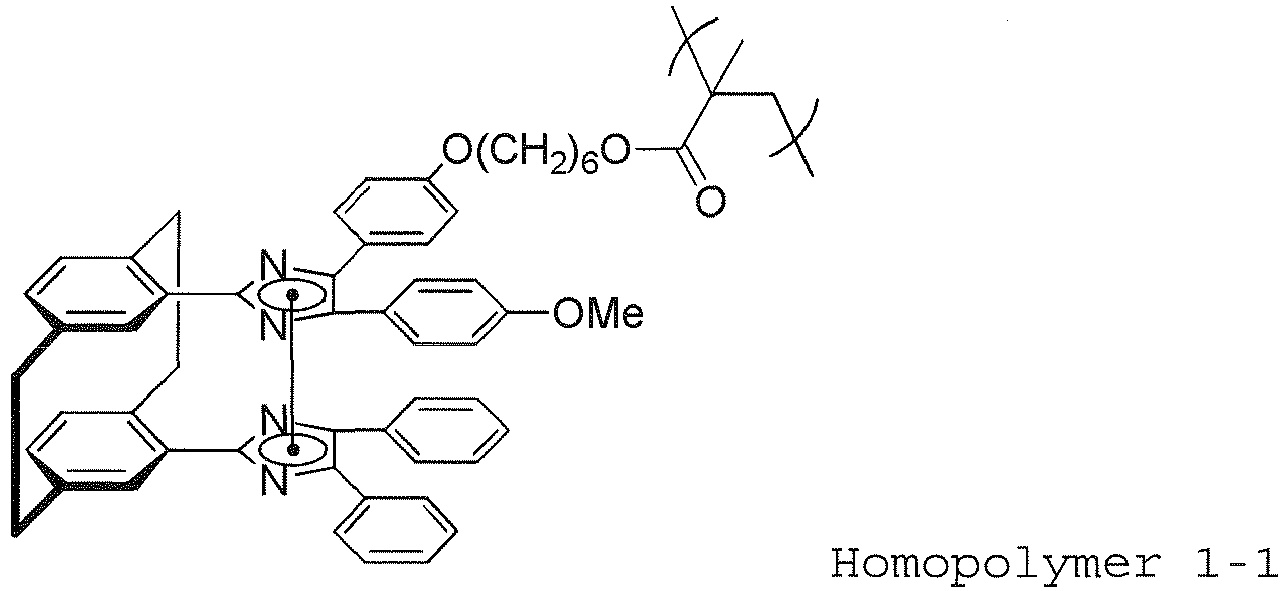
- Furthermore, it was also found that the half-life can be extended and an effect of decreasing the decoloration reaction velocity can be obtained as in the above-mentioned homopolymer, as shown in
Fig. 2 , by polymerizing the photochromic molecule having a polymerizable functional group represented by the general formula (I) and methyl methacrylate or a photosensitizer having a polymerizable functional group as represented by the general formula (II). -

- Furthermore, they have done intensive studies aiming at improving the sensitivity against excitation light, and found that the ultraviolet-visible absorption of the photochromic molecule of the decolored body is increased at the longer wavelength side by introducing an electron-donating functional group into any or all of R4 to R7 of the photochromic molecule represented by the general formula (I), and thus it became possible to obtain a photochromic molecule that can generate a colored body efficiently even by irradiation of visible light.
- As shown in
Fig. 3 , for example, in the case when all of R4 to R7 are methoxy groups, the ultraviolet-visible absorption of the decolored body is more increased at the longer wavelength side than that in the case when all are hydrogens. - Furthermore, as shown in
Figs. 4 and5 , it was found that a homopolymer synthesized by polymerizing this photochromic molecule wherein R4 to R7 are methoxy groups which generates a colored body with fine sensitivity even by irradiation of visible light is a material having an effect of decreasing the decoloration reaction velocity by polymerization and an effect of fine visible light sensitivity in combination. - Furthermore, a colored body of a copolymer of a photochromic molecule wherein all of R4 to R7 are hydrogens and a photochromic molecule wherein all of R4 to R7 are methoxy groups in the general formula (I) has an absorption spectrum that is a simple sum of the absorption spectra of the colored bodies of the respective molecules. Therefore, it was found that the colored body has a color of the sum of the two photochromic molecule colored bodies after irradiation of excitation light, and the color of the colored body of the photochromic molecule wherein all of R4 to R7 are hydrogens which has a fast decoloring velocity first goes out, and the color then changes gradually over time. It was found from this fact that it is possible to control the color tone of the colored body by changing the mixing ratio of molecules having colored bodies having different colors (
Fig. 6 andFig. 7 ). - A film was prepared on a glass substrate by using a polymer of the photochromic molecule, and it was found as the result thereof that the absorption spectrum of a colored body is approximately identical with the spectrum of the polymer in a solvent and the color tone of the colored body can also be controlled even in a film state (
Fig. 8 ). - By using the polymer including a photochromic molecule of the present invention, it becomes possible to decrease the decoloration reaction velocity of or control the color tone of a high-speed photochromic molecule, thereby a light-modulating material having an improved coloration concentration and a controlled color tone can be provided.
-
-
Fig. 1 shows the comparison of the colored body half-lives between a monomer and homopolymer 1-1 by transient absorption measurements. -
Fig. 2 shows the comparison of the results of the transient absorption measurements between the homopolymer and copolymers. -
Fig. 3 shows the comparison of the ultraviolet-visible absorption spectra between the decolored bodies of a photochromic molecule wherein R4 to R7 are hydrogens and of a photochromic molecule wherein R4 to R7 are methoxy groups. -
Fig. 4 shows the comparison of the ultraviolet-visible absorption spectra between the homopolymer of the photochromic molecule wherein R4 to R7 are hydrogens and the homopolymer of the photochromic molecule wherein R4 to R7 are methoxy groups. -
Fig. 5 shows the comparison of the transient absorption measurements between the homopolymer of the photochromic molecule wherein R4 to R7 are methoxy groups and the monomer of the photochromic molecule wherein R4 to R7 are methoxy groups. -
Fig. 6 shows the absorption spectrum of the colored body of the copolymer of the photochromic molecule wherein R4 to R7 are hydrogens and the photochromic molecule wherein R4 to R7 are methoxy groups. -
Fig. 7 shows the transient absorption measurement of the colored body of the copolymer of the photochromic molecule wherein R4 to R7 are hydrogens and the photochromic molecule wherein R4 to R7 are methoxy groups, which is compared with those of the homopolymer of the photochromic molecule wherein R4 to R7 are methoxy groups and of the homopolymer of the photochromic molecule wherein R4 to R7 are hydrogens. -
Fig. 8 shows the comparison of the colored body absorption spectra between the film prepared with the homopolymer of the photochromic molecule wherein R4 to R7 are hydrogens and the film prepared with the homopolymer of the photochromic molecule wherein R4 to R7 are methoxy groups. -
Fig. 9 shows the result of the transient absorption measurement of the film of the homopolymer 1-1. -
Fig. 10 shows the transient absorption measurement of the film of the copolymer of the compound 1-10, compound 1-7 and methyl methacrylate. -
Fig. 11 shows the result of the transient absorption measurement of the film of the homopolymer 1-2. -
Fig. 12 shows the comparison of the ultraviolet-visible absorption spectra between the homopolymer and copolymer. - The present invention is characterized in that a polymer or oligomer is synthesized by polymerizing a photochromic molecule monomer represented by the general formula (I).
-

- Furthermore, in the present invention, it is also possible to synthesize a homopolymer by polymerizing a photochromic molecule monomer, and to synthesize a copolymer by mixing a photochromic molecule with other polymerizable monomer or a photosensitizing compound having a polymerizable group as represented by the general formula (II). This copolymer may be a block copolymer or a random copolymer.
-

- The photochromic monomer molecule represented by the general formula (I) will be explained. The photochromic molecule of the present invention is a derivative of a hexaarylbisimidazole (HABI), and has a backbone in which the triphenylimidazole groups are dimerized by the binding of the 2-positions of the imidazole groups at the paracyclophane.
- The substituents R1 to R8 in the general formula (I) and general formula (II) will be explained. R1 and R2 each independently represents hydrogen or a methyl group. R3 to R8 are each independently hydrogen or various substituents. In the case when R3 and R8 are not hydrogens but substituents, the positions of substitution thereof are preferably the para-positions. In the case when R4 to R7 are not hydrogens but substituents, the positions of substitution thereof are preferably the para-positions, and in the case when two substituents are bound to one ring, the positions of substitution thereof are preferably the meta- and para-positions.
- As the substituents, an alkoxy group, an amino group, an alkylamino group, an alkyl group, a hydroxyl group, a halogen, a cyano group or a nitro group, and the like can be exemplified. Among these, molecules having an alkoxy group or an alkylamino group are preferable for increasing a coloration concentration in the sunlight since the decolored bodies thereof also absorb the visible light region efficiently and the photochromic molecules themselves have small decoloration reaction velocities.
- Preferable alkoxy groups may include a methoxy group, an ethoxy group, a propoxy group, a butoxy group, a pentyloxy group and a hexyloxy group. Preferable alkylamino groups may include a dimethylamino group, a diethylamino group, a dipropylamino group and a dibutylamino group.
- n and m indicate natural numbers, and it is preferable, but is not limited to, that n=6 or more and m=6 or more so as to increase the polymerization degree of the photochromic molecule. Specifically, n is preferably 2 to 20, more preferably 4 to 20, and specifically preferably 6 to 20. Furthermore, m is preferably 2 to 20, more preferably 4 to 20, and specifically preferably 6 to 20.
- Various general compounds can be used as a polymerization initiator for radical polymerization, but a reaction under a high temperature is not preferable for preventing the damage of the photochromic molecule. From this viewpoint, it is preferable to use 2,2'-azobis(2,4-dimethylvaleronitrile), 2,2'-azobis(4-methoxy-2,4-dimethylvaleronitrile) and the like, but the polymerization initiator is not limited to these exemplified compounds.
- The radical polymerizable monomer to be copolymerized may include compounds having a group such as acrylic acid, methacrylic acid, acrylic acid esters, methacrylic acid esters, styrene, acrylonitrile, vinyl acetate and the like.
- Furthermore, the photosensitizing compound may be a photosensitizing compound having a polymerizable group, and may include the compound represented by the general formula (II), and the like. Specific examples may include benzyl, methoxybenzyl, benzophenone, methoxybenzophenone, aminobenzophenone, dimethylaminobenzophenone, xanthone, thioxanthone, acetophenone, butyrophenone, propiophenone, anthrone, fluorene, triphenylene, anthraquinone, pyrene, naphthalene, anthracene, phenanthrene, chrysene, coronene, biphenyl, benzaldehyde and the like.
- In addition, in the present invention, it is necessary to introduce a functional group for polymerization in each compound so as to synthesize a polymer. Although the polymerizable functional group is not specifically limited as long as it causes a polymerization reaction, examples may include groups such as acrylic acid, methacrylic acid, acrylic acid esters, methacrylic acid esters, styrene, alkylstyrenes, acrylonitrile, acrylamide, methacrylamide, vinyl acetate, butadiene, epoxy, propylene oxide and vinyl chloride.
- The solvent used for the polymerization of the photochromic molecule according to the present invention may include THF, toluene and the like. Furthermore, as the conditions for polymerization, the polymerization temperature is preferably 30 to 150°C, more preferably 30 to 100°C, and specifically preferably 30 to 60°C, and the reaction time is, although it differs depending on the reaction temperature and the required molecular weight, preferably 2 hours to 1 week, more preferably 1 to 5 days, and specifically preferably 2 to 4 days.
- The photochromic material according to the present invention can provide decoloration reaction velocities suitable for various applications by controlling the too high decoloration reaction velocity that the photochromic molecule monomer represented by the general formula (I) has, by polymerizing the monomer to give a polymer or oligomer as mentioned above.
- Specifically, the decoloration reaction velocity can be controlled to be low by polymerizing a photochromic molecule (monomer) ; however, it is difficult to unambiguously define the relationship between the polymerization degree and decoloration reaction velocity by a specific numerical value since the relationship also depends on the structure of the photochromic molecule (monomer). Furthermore, in order to decrease the decoloration reaction velocity, the polymer is not necessarily a homopolymer of the photochromic molecule, and other polymerizable monomer such as methyl methacrylate and photosensitizers having a polymerizable group and the photochromic molecule may be copolymerized.
- Furthermore, as shown in
Fig. 12 , the amount of absorption of light is increased more and the photosensitivity is improved more by copolymerization with the photosensitizer than the case of the photochromic molecule alone. By introducing an electron-donating functional group into the photochromic molecule, the ultraviolet-visible absorption is also increased at the longer wavelength side as shown inFig. 4 , thereby the visible light sensitivity can be increased. - Furthermore, as shown in
Fig. 6 andFig. 7 , it is possible to control the color tone of the colored body by changing the mixing ratio of two or more photochromic molecules having colored bodies with different colors. However, it is difficult to unambiguously define a specific mixing ratio since it depends on the structures of the photochromic molecules (monomers). - An example of a method for the synthesis of a photochromic molecule monomer represented by the general formula (I) is shown below.
- First, 0.96 g of compound 1-4 (paracyclophane dialdehyde) was obtained by referring to a known synthesis method (such as
Chemische Berichte 120, 1825-1828 (1987 -

- Next, 6.0 g of 4,4'-dimethoxybenzyl and 13.3 g of pyridinium chloride were reacted by heating to 180°C and stirring for 3 hours. This reaction liquid was separated by water and ethyl acetate, and the ethyl acetate layer was separated. This ethyl acetate layer was concentrated, and extraction was conducted by adding dichloromethane. The solid that remained unsolved was removed by filtration. An aqueous NaOH solution (10% by weight) was added to the filtrate to separate the liquid. The aqueous layer was neutralized by adding hydrochloric acid (35%), and the precipitated solid was collected by filtration to give 1.2 g of compound 1-5.
-

- Next, 1.00 g of the compound 1-5, 0.755 g of potassium carbonate and 0.013 g of potassium iodide were dissolved and suspended in 14 mL of DMF, 0.8 mL of 6-chloro-1-hexanol was added, and heating was conducted at 80°C for 1.5 hours. The reaction solution was separated by water and ethyl acetate, and the organic layer was separated, concentrated, and dissolved by adding dichloromethane. The precipitated solid was collected by adding hexane thereto, thereby 1.3 g of compound 1-6 was obtained.
-

- The measurement results of 1H-NMR and 13C-NMR of the compound 1-6 are shown below.
1H-NMR (500MHz, CDCl3) δ: 7.95-7.92 (m, 4H), 6.97-6.94 (m, 4H), 4.04 (t, J=6.5Hz, 2H), 3.88 (s, 3H), 3.66 (t, J=6.5Hz, 2H), 1.84-1.81 (m, 2H), 1.62-1.59 (m, 2H), 1.52-1.44 (m, 4H), 1.32 (s, 1H).
13C-NMR (125MHz, CDCl3) δ: 193.88, 193.83, 165.19, 164.79, 132.71, 126.70, 126.46, 115.06, 114.62, 68.65, 63.17, 55.97, 32.96, 29.33, 26.13, 25.84. - Next, a container containing 1.0 g of the compound 1-6 and 6.1 mg of parahydroxyphenol was purged with nitrogen, 6 mL of dichloromethane was added thereto, and ice-cooling was conducted. Thereafter 0.86 mL of triethylamine and 0.52 mL of methacryloyl chloride were added, and a reaction was conducted at a room temperature for 3 hours. Liquid separation was conducted by adding water to the reaction liquid to separate the organic layer, hexane was added, and the precipitated solid was collected to give 1.0 g of compound 1-7.
-

- The measurement results of 1H-NMR and 13C-NMR of the compound 1-7 are shown below.
1H-NMR (500MHz, CDCl3) δ: 7.96-7.92 (m, 4H), 6.98-6.94 (m, 4H), 6.09 (s, 1H), 5.55 (s ,1H), 4.16 (t, J=7.0Hz, 2H), 4.04 (t, J=7.0Hz, 2H), 3.89 (s, 3H), 1.94 (s, 3H), 1.84-1.73 (m, 2H), 1.57-1.39 (m, 4H).
13C-NMR (125MHz, CDCl3) δ: 193.87, 193.82, 167.85, 165.18, 164.75, 136.82, 132.71, 126.69, 126.48, 125.57, 115.04, 114.62, 68.58, 64.90, 55.96, 29.25, 28.87, 26.08, 25.99, 18.66. - Next, 0.5 g of the compound 1-4, 0.40 g of benzyl and 2.19 g of ammonium acetate were dissolved in 8 mL of acetic acid and heated at 100°C for 5 hours. The reaction solution was neutralized with aqueous ammonia, and the product was extracted with dichloromethane. The dichloromethane layer was concentrated, and the product was separated by silica gel column chromatography to give 0.38 g of compound 1-8.
-

- The measurement results of 1H-NMR and 13C-NMR of the compound 1-8 are shown below.
1H-NMR (500MHz, DMSO-d6) δ: 12.14 (s, 1H), 9.55 (s, 1H), 7.58 (d, J=7.5Hz, 2H), 7.51 (d, J=7.0Hz, 2H), 7.47 (dd, J=7.5Hz, 2H), 7.40 (t, J=7.0Hz, 1H), 7.31 (dd, J=7.0Hz, 2H), 7.16 (t, J=7.0Hz, 1H), 7.10 (s, 1H), 6.96 (s, 1H), 6.84 (d, J=7.5Hz, 1H), 6.71 (d, J=8.0Hz, 1H), 6.66 (d, J=7.5Hz, 2H), 4.49-4.45 (m, 1H), 3.95-3.92 (m, 1H), 3.15-2.97 (m, 6H).
13C-NMR (125MHz, CDCl3) δ: 190.45, 145.29, 140.38, 140.17, 138.52, 138.15, 138.10, 136.78, 136.57, 136.10, 135.37, 133.24, 132.84, 131.44, 131.10, 130.85, 129.20, 128.61, 128.30, 127.93, 127.14, 53.76, 35.28, 35.24, 35.09, 31.82. - Next, 0.35g of the compound 1-8, 0.35 g of the compound 1-7, 51.3 mg of paramethoxyphenol and 0.95 g of ammonium acetate were dissolved in 6.5 mL of acetic acid, and the solution was heated at 80°C for 5 days, neutralized with aqueous ammonia and extracted with dichloromethane. The dichloromethane layer was concentrated, and the product was separated by silica gel column chromatography to give 0.54 g of compound 1-9.
-

- The measurement results of 1H-NMR and 13C-NMR of the compound 1-9 are shown below.
1H-NMR (500MHz, CDCl3) δ: 9.06 (br, 2H), 7.39-7.30 (br, 3H), 7.14-6.98 (m, 12H), 6.73-6.61 (m, 9H), 6.10 (s, 1H), 5.55 (s, 1H), 4.23-4.15 (m, 4H), 3.91-3.88 (m, 4H), 3.76 (s, 3H), 3.20-3.12 (m, 6H), 1.94 (s, 3H), 1.85-1.71 (m, 4H), 1.54-1.43 (m, 4H).
13C-NMR (125MHz, CDCl3) δ: 167.49, 146.21, 145.51, 139.66, 137.51, 136.65, 136.28, 133.27, 132.95, 130.46, 128.88, 128.08, 125.39, 67.81, 64.81, 55.29, 35.31, 35.13, 29.36, 28.72, 25.96, 18.48. - Next, 0.49 g of the compound 1-9 was dissolved in 90 mL of benzene and stirred. 65 mL of an aqueous solution in which 3.28 g of potassium hydroxide and 9.63 g of potassium ferricyanide were dissolved was added dropwise thereto. The benzene layer was washed with water, and the product was separated by silica gel column chromatography to give 0.3 g of compound 1-10.
-

- The measurement results of 1H-NMR and 13C-NMR of the compound 1-10 are shown below.
1H-NMR (500MHz, CDCl3) δ: 7.47 (br, 1H), 7.31-7.03 (m, 15H), 6.92 (br, 1H), 6.82 (dd, J=9.0Hz, 2H), 6.71 (dd, J=9.5Hz, 2H), 6.64-6.61 (m, 2H), 6.48 (d, J=7.5Hz, 1H), 6.42 (d, J=8.0Hz, 1H), 6.09 (br, 1H), 5.54 (br, 1H), 4.54-4.51 (m, 1H), 4.18-4.15 (m, 2H), 4.00-3.93 (m, 2H), 3.84-3.80 (m, 3H), 3.33-2.94 (m, 7H), 1.94 (m, 3H), 1.83-1.70 (m, 4H), 1.55-1.42 (m, 4H). 13C-NMR (125MHz, CDCl3) δ: 167.95, 164.69, 147.42, 141.21, 138.34, 137.48, 136.84, 136.34, 134.98, 134.76, 133.78, 133.19, 132.82, 132.56, 132.05, 131.81, 128.52, 128.39, 128.29, 128.09, 127.19, 126.37, 125.57, 114.06, 113.71, 113.62, 113.26, 111.91, 68.17, 64.92, 55.68, 55.61, 35.65, 35.57, 34.78, 34.46, 29.42, 28.89, 26.14, 18.67. - Next, an example of a method for the synthesis of a polymer by using the photochromic molecule monomer synthesized as above is shown below.
- 60 mg of the compound 1-10 and 0.26 mg of 2,2'-azobis(2,4-dimethylvaleronitrile) were dissolved in 200 µL of THF and put in a freezing ampule, freezing deaeration was conducted ten times, and the ampule was sealed. This solution was warmed to 40°C and reacted for 3 days under stirring. Thereafter the reaction liquid was dissolved in dichloromethane and purified by reprecipitation by adding dropwise the solution to methanol. The precipitated solid was collected by filtration to give 33.2 mg of a polymer of the photochromic molecule (homopolymer 1-1). The weight average molecular weight was measured by GPC and found to be 28,400.
-

- Polymers of other photochromic molecules can also be synthesized in a similar manner by suitably selecting the starting substance.
- 0.5 mg of the homopolymer 1-1 synthesized as above was weighed and dissolved in 10 mL of dichloromethane. This solution was put into a tetrahedral quartz cell, and the transient absorption of the polymer was measured by time-resolved spectroscopy. As the result thereof, as shown in
Fig. 1 , it was found that the polymer had a longer half-life of the colored body than that in the state of a monomer, and thus the reaction velocity from the colored body to a decolored body was successively retarded in an efficient manner. - 2.5 mg of the homopolymer 1-1 synthesized as above was weighed and dissolved in 50 µL of chloroform. 10 µL of this solution was put on a cover glass and casted by spin coat to prepare a film of the photochromic polymer.
- The transient absorption of the colored body of the film of the photochromic polymer (homopolymer 1-1) was measured by time-resolved spectroscopy. The film was irradiated with excitation light at a wavelength of 355 nm (third harmonic of Nd-YAG laser), and the absorption at 400 nm was detected. As the result thereof, as shown in
Fig. 9 , a component developing a color was present even at 800 millisecond after the irradiation of excitation light, and thus the reaction velocity from the colored body to a decolored body was successively retarded in an efficient manner. - 40 mg of the compound 1-10, 4 mg of the compound 1-7, 3.74 mg of methyl methacrylate and 0.7 mg of 2,2'-azobis(2,4-dimethylvaleronitrile) were dissolved in 267 µL of THF and put in a freezing ampule, freezing deaeration was conducted ten times, and the ampule was sealed. This solution was warmed to 40°C and reacted for 3 days under stirring. Thereafter the reaction liquid was dissolved in dichloromethane, and purified by reprecipitation by adding dropwise the solution to methanol. The precipitated solid was collected by filtration to give 33.3 mg of a copolymer of the photochromic molecule (homopolymer 1-10), the photosensitizing compound (compound 1-7) and methyl methacrylate. The weight average molecular weight was measured by GPC and found to be 19,500.
- 0.5 mg of the random copolymer of the photochromic molecule (compound 1-10) and the photosensitizing compound (compound 1-7) synthesized as above was weighed and dissolved in 10 mL of dichloromethane. This solution was put into a tetrahedral quartz cell, and the transient absorption of the polymer was measured by time-resolved spectroscopy. As the result thereof, as shown in
Fig. 2 , it was found that the copolymer also had a similar colored body half-life to that of the homopolymer 1-1, and thus the decoloration reaction velocity was retarded successively in a more efficient manner than that in the polymer. - A film of the photochromic polymer was prepared in a similar manner to that in Test 2 on the homopolymer of Example 1, and a transient absorption measurement was conducted. As the result thereof, as shown in
Fig. 10 , a component developing a color was present even at 800 millisecond after the irradiation of excitation light also in the film of the copolymer as in the result of the homopolymer, and thus the reaction velocity from the colored body to a decolored body was successively retarded in an efficient manner. - First, 0.5 g of the compound 1-4, 0.63 g of the compound 1-11 and 2.19 g of ammonium acetate were dissolved in 8 mL of acetic acid, and heated at 100°C for 5 hours. The reaction solution was neutralized with aqueous ammonia, and the product was extracted with dichloromethane. The dichloromethane layer was concentrated, and the product was separated by silica gel column chromatography to give 0.48 g of compound 1-12.
-

- The measurement results of 1H-NMR and 13C-NMR of the compound 1-12 are shown below.
1H-NMR (500MHz, CDCl3) δ: 9.82 (s, 1H), 9.19 (s, 1H), 7.32-7.26 (m, 2H), 7.13-7.12 (m, 1H), 7.09-7.08 (m, 2H), 6.89-6.83 (m, 2H), 6.79-6.77 (m, 1H), 6.69-6.68 (m, 2H), 6.63-6.61 (m, 2H), 4.27-4.25 (m, 1H), 4.02-4.00 (m, 1H), 3.90 (s, 6H), 3.88 (s, 6H), 3.13-3.03 (m, 6H).
13C-NMR(125MHz,CDCl3) δ: 190.44, 149.24, 149.12, 148.96, 148.28, 144.73, 144.27, 140.38, 140.12, 138.23, 138.06, 137.87, 136.74, 136.47, 136.10, 132.86, 132.67, 131.23, 130.88, 128.45, 127.51, 124.19, 121.18, 120.24, 112.21, 111.63, 111.43, 111.33, 56.25, 56.22, 56.02, 35.33, 35.20, 35.06, 31.58. - Next, 0.46 g of the compound 1-12, 0.35 g of the compound 1-7, 51.3 mg of paramethoxyphenol and 0.95 g of ammonium acetate were dissolved in 6.5 mL of acetic acid, and the solution was heated at 80°C for 5 days, neutralized with aqueous ammonia and extracted with dichloromethane. The dichloromethane layer was concentrated, and the product was separated by silica gel column chromatography to give 0.65 g of compound 1-13.
-
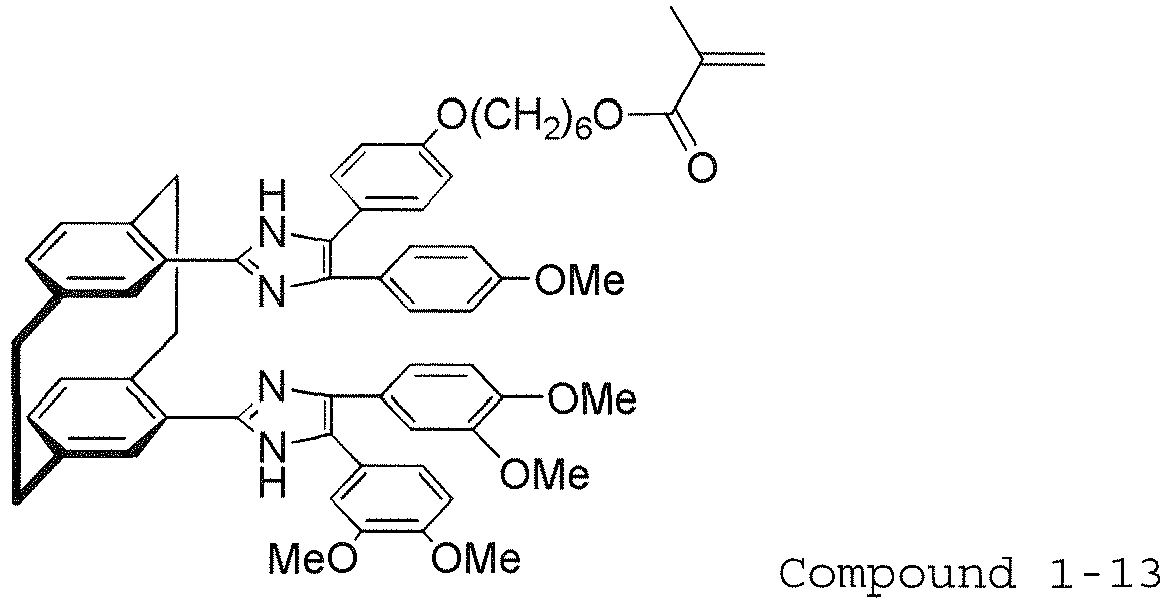
- The measurement results of 1H-NMR and 13C-NMR of the compound 1-13 are shown below.
1H-NMR (500MHz, DMSO-d6) δ: 11.47-11.42 (m, 2H), 7.13-7.08 (m, 4H), 7.01-6.98 (m, 1H), 6.92-6.86 (m, 3H), 6.78-6.76 (m, 3H), 6.69-6.51 (m, 9H), 6.02 (br, 1H), 5.66 (br, 1H), 4.61-4.45 (m, 2H), 4.11 (t, J=6.0Hz, 2H), 3.89-3.79 (m, 2H), 3.75-3.58 (m, 15H), 3.13-3.01 (m, 6H), 1.88 (s, 3H), 1.76-1.65 (m, 4H), 1.50-1.35 (m, 4H).
13C-NMR (125MHz, CDCl3) δ: 167.88, 148.91, 148.03, 145.93, 145.78, 139.94, 136.85, 136.63, 136.42, 133.54, 133.13, 130.71, 129.59, 128.67, 126.85, 125.86, 125.58, 123.91, 120.73, 120.34, 114.74, 114.19, 113.58, 111.72, 111.33, 111.17, 68.30, 68.02, 64.98, 56.10, 55.95, 55.45, 35.75, 35.58, 35.04, 34.57, 30.66, 29.55, 28.93, 26.19, 25.95, 18.68. - Next, 0.56 g of the compound 1-13 was dissolved in 100 mL of benzene and stirred. 70 mL of an aqueous solution in which 3.61 g of potassium hydroxide and 10.6 g of potassium ferricyanide were dissolved was added dropwise thereto. The benzene layer was washed with water, and the product was separated by silica gel column chromatography to give 0.52 g of compound 1-14.
-

- The measurement results of 1H-NMR and 13C-NMR of the compound 1-14 are shown below.
1H-NMR (500MHz, CDCl3) δ: 7.30-6.42 (m, 22H), 6.10 (br, 1H), 5.55 (br, 1H), 4.61-4.45 (m, 1H), 4.17-4.12 (m, 2H), 3.99-3.89 (m, 2H), 3.91-3.55 (m, 15H), 3.35-2.90 (m, 7H), 1.94 (m, 3H), 1.85-1.62 (m, 4H), 1.50-1.35 (m, 4H).
13C-NMR (125MHz, CDCl3) δ: 167.86, 151.85, 141.74, 136.83, 136.49, 136.36, 136.12, 132.44, 132.23, 131.07, 131.00, 130.90, 129.51, 129.16, 128.83, 128.59, 128.55, 126.92, 126.44, 125.93, 125.85, 125.59, 115.08, 114.98, 114.81, 114.66, 114.37, 64.95, 64.90, 55.63, 55.59, 54.51, 35.41, 35.03, 34.85, 34.56, 33.17, 31.92, 30.66, 29.45, 29.39, 28.91, 28.87, 26.17, 26.08, 26.06, 22.98, 21.52, 18.67, 14.45. - Next, an example of a method for the synthesis of a polymer by using the photochromic molecule monomer synthesized as above is shown below.
- 60 mg of the compound 1-14 and 0.23 mg of 2,2'-azobis(2,4-dimethylvaleronitrile) were dissolved in 200 µL of THF and put in a freezing ampule, freezing deaeration was conducted ten times, and the ampule was sealed. This solution was warmed to 40°C and reacted for 3 days under stirring. Thereafter the reaction liquid was dissolved in dichloromethane, and purified by reprecipitation by adding dropwise the solution to methanol. The precipitated solid was collected by filtration to give 22.3 mg of a polymer of the photochromic molecule (homopolymer 1-2). The weight average molecular weight was measured by GPC, and consequently found to be 9,500.
-

- 0.5 mg of the homopolymer 1-2 synthesized as above was weighed and dissolved in 10 mL of dichloromethane. This solution was put into a tetrahedral quartz cell, and the transient absorption of the polymer was measured by time-resolved spectroscopy. As the result thereof, as shown in
Fig. 5 , it was found that the polymer had a longer half-life of the colored body than that in the state of a monomer, and thus the reaction velocity from the colored body to a decolored body was successively retarded in an efficient manner. - 2.5 mg of the homopolymer 1-2 synthesized as above was weighed and dissolved in 50 µL of chloroform. 10 µL of this solution was put on a cover glass and casted by spin coat to prepare a film of the photochromic polymer.
- The transient absorption of the colored body of the film of the photochromic polymer (homopolymer 1-2) was measured by time-resolved spectroscopy. The film was irradiated with excitation light at a wavelength of 355 nm (third harmonic of Nd-YAG laser), and the absorption at 400 nm was detected. As the result thereof, as shown in
Fig. 11 , a component developing a color was present even at 800 millisecond after the irradiation of excitation light, and thus the reaction velocity from the colored body to a decolored body was successively retarded in an efficient manner. - A method for decreasing the decoloration reaction velocity of a photochromic molecule by polymerizing the photochromic molecule has been shown. By using this method, the decoloration reaction velocity of a photochromic molecule in which a colored body is not accumulated since the decoloration reaction velocity is too fast and thus the coloration concentration is low can be decreased, and it becomes possible to provide a photochromic molecule material that provides fine coloring.
Claims (20)
- A homopolymer of a photochromic molecule represented by the following general formula (III):

- A block or random copolymer of a photochromic molecule represented by the following general formula (IV):

- A block or random copolymer of a photochromic molecule represented by the following general formula (V):


- A block or random copolymer of a photochromic molecule represented by the following general formula (VI):


- A block or random copolymer of a photochromic molecule represented by the following general formula (VII):


- The homopolymer of a photochromic molecule according to claim 1, wherein R3 to R7 are each independently hydrogen or a methoxy group.
- The homopolymer of a photochromic molecule according to claim 6, wherein R3 is a methoxy group and is bound to the para-position, and R4 to R7 are all hydrogens.
- The homopolymer of a photochromic molecule according to claim 6, wherein R3 is a methoxy group and is bound to the para-position, and R4 to R7 are all methoxy groups and are bound to the meta-positions and para-positions.
- The copolymer of a photochromic molecule according to claim 2, wherein R3 to R7 are each independently hydrogen or a methoxy group.
- The copolymer of a photochromic molecule according to claim 9, wherein R3 is a methoxy group and is bound to the para-position, and R4 to R7 are all hydrogens.
- The copolymer of a photochromic molecule according to claim 9, wherein R3 is a methoxy group and is bound to the para-position, and R4 to R7 are all methoxy groups and are bound to the meta-positions and para-positions.
- The copolymer of a photochromic molecule according to claim 3, wherein R3 to R8 are each independently hydrogen or a methoxy group.
- The copolymer of a photochromic molecule according to claim 12, wherein R3 and R8 are methoxy groups and are bound to the para-positions, and R4 to R7 are all hydrogens.
- The copolymer of a photochromic molecule according to claim 12, wherein R3 and R8 are methoxy groups and are bound to the para-positions, and R4 to R7 are all methoxy groups and are bound to the meta-positions and para-positions.
- The copolymer of a photochromic molecule according to claim 4, wherein R3 to R8 are each independently hydrogen or a methoxy group.
- The copolymer of a photochromic molecule according to claim 15, wherein R3 and R8 are methoxy groups and are bound to the para-positions, and R4 to R7 are all hydrogens.
- The copolymer of a photochromic molecule according to claim 15, wherein R3 and R8 are methoxy groups and are bound to the para-positions, and R4 to R7 are all methoxy groups and are bound to the meta-positions and para-positions.
- The copolymer of a photochromic molecule according to claim 5, wherein R3 and R9 are methoxy groups and are bound to the para-positions, R4 to R7 are all hydrogens; and R10 to R13 are methoxy groups and are bound to the meta-positions and para-positions.
- A method for decreasing the decoloration reaction rate of a photochromic material, comprising polymerizing a photochromic molecule to form the polymer according to any of claims 1 to 18.
- A method for controlling the photosensitivity and color tone of a photochromic material, by changing the component ratio of the photochromic molecule having the structure A and the photochromic molecule having the structure A2 in the copolymer of photochromic molecules according to claim 5 or 18.
Applications Claiming Priority (2)
| Application Number | Priority Date | Filing Date | Title |
|---|---|---|---|
| JP2009281966A JP5674305B2 (en) | 2009-12-11 | 2009-12-11 | Photochromic material |
| PCT/JP2010/071345 WO2011070942A1 (en) | 2009-12-11 | 2010-11-30 | Photochromic material |
Publications (3)
| Publication Number | Publication Date |
|---|---|
| EP2511307A1 true EP2511307A1 (en) | 2012-10-17 |
| EP2511307A4 EP2511307A4 (en) | 2013-09-04 |
| EP2511307B1 EP2511307B1 (en) | 2014-07-23 |
Family
ID=44145487
Family Applications (1)
| Application Number | Title | Priority Date | Filing Date |
|---|---|---|---|
| EP10835864.9A Not-in-force EP2511307B1 (en) | 2009-12-11 | 2010-11-30 | Photochromic material |
Country Status (7)
| Country | Link |
|---|---|
| US (1) | US9040647B2 (en) |
| EP (1) | EP2511307B1 (en) |
| JP (1) | JP5674305B2 (en) |
| KR (1) | KR20120129886A (en) |
| CN (1) | CN102652143B (en) |
| AU (1) | AU2010329226B2 (en) |
| WO (1) | WO2011070942A1 (en) |
Families Citing this family (6)
| Publication number | Priority date | Publication date | Assignee | Title |
|---|---|---|---|---|
| WO2011049108A1 (en) | 2009-10-21 | 2011-04-28 | 三菱瓦斯化学株式会社 | Functional sheet and lens using same |
| AU2011274914B2 (en) | 2010-07-09 | 2013-07-18 | Mitsubishi Gas Chemical Company, Inc. | Photochromic material |
| JP6489461B2 (en) * | 2014-03-28 | 2019-03-27 | 関東化學株式会社 | Pentaarylbiimidazole compound and method for producing the compound |
| CN104687695A (en) * | 2015-03-12 | 2015-06-10 | 周士志 | Luggage having photosensitive effect |
| JP7472438B2 (en) * | 2019-06-20 | 2024-04-23 | Dic株式会社 | Imidazole Compounds |
| CN113667256B (en) * | 2021-08-30 | 2023-03-03 | 湖北高碳光电科技有限公司 | Photochromic materials for head-mounted optical displays, their preparation and use |
Family Cites Families (6)
| Publication number | Priority date | Publication date | Assignee | Title |
|---|---|---|---|---|
| JPH05105730A (en) * | 1991-10-16 | 1993-04-27 | Fuji Xerox Co Ltd | Photochromic liquid crystal copolymer |
| JPH0762021A (en) * | 1993-08-25 | 1995-03-07 | Bio Toopu:Kk | Photochromic and solvatochromic polymers which are the reaction products of spironaphthoxazine derivatives and glycidyl methacrylate copolymers |
| JP3151089B2 (en) * | 1993-09-16 | 2001-04-03 | 株式会社トクヤマ | Photochromic compounds |
| JP4803334B2 (en) * | 2001-05-09 | 2011-10-26 | 学校法人東京電機大学 | Fluorinated alcohol solution |
| JP4087207B2 (en) * | 2002-10-02 | 2008-05-21 | 京セラケミカル株式会社 | Optical transmission line forming material, optical transmission line and optical transmission line manufacturing method |
| KR20110095917A (en) * | 2008-11-28 | 2011-08-25 | 간토 가가꾸 가부시키가이샤 | Crosslinked hexaarylbisimidazole novel compounds and derivatives thereof, methods for preparing the compounds and precursor compounds used in the methods |
-
2009
- 2009-12-11 JP JP2009281966A patent/JP5674305B2/en not_active Expired - Fee Related
-
2010
- 2010-11-30 AU AU2010329226A patent/AU2010329226B2/en not_active Ceased
- 2010-11-30 KR KR1020127017749A patent/KR20120129886A/en not_active Abandoned
- 2010-11-30 EP EP10835864.9A patent/EP2511307B1/en not_active Not-in-force
- 2010-11-30 US US13/514,620 patent/US9040647B2/en not_active Expired - Fee Related
- 2010-11-30 WO PCT/JP2010/071345 patent/WO2011070942A1/en not_active Ceased
- 2010-11-30 CN CN201080055566.4A patent/CN102652143B/en not_active Expired - Fee Related
Non-Patent Citations (2)
| Title |
|---|
| No further relevant documents disclosed * |
| See also references of WO2011070942A1 * |
Also Published As
| Publication number | Publication date |
|---|---|
| CN102652143A (en) | 2012-08-29 |
| AU2010329226B2 (en) | 2014-05-22 |
| US9040647B2 (en) | 2015-05-26 |
| WO2011070942A1 (en) | 2011-06-16 |
| US20120245317A1 (en) | 2012-09-27 |
| JP2011122089A (en) | 2011-06-23 |
| EP2511307A4 (en) | 2013-09-04 |
| AU2010329226A8 (en) | 2012-07-19 |
| KR20120129886A (en) | 2012-11-28 |
| JP5674305B2 (en) | 2015-02-25 |
| EP2511307B1 (en) | 2014-07-23 |
| AU2010329226A1 (en) | 2012-07-12 |
| CN102652143B (en) | 2014-10-29 |
Similar Documents
| Publication | Publication Date | Title |
|---|---|---|
| EP2511307B1 (en) | Photochromic material | |
| CN102344817B (en) | Composition for liquid crystal alignment layer and liquid crystal alignment layer | |
| CN105567260B (en) | Functionalized photoreactive compounds | |
| Tunc et al. | Thioxanthone-ethylcarbazole as a soluble visible light photoinitiator for free radical and free radical promoted cationic polymerizations | |
| KR101819528B1 (en) | Polymer for use in a liquid-crystal alignment layer | |
| EP2397468A1 (en) | Novel crosslinked hexaaryl bisimidazole compound and derivative thereof, method for producing the compound and precursor compound to be used in the production method | |
| US8773745B2 (en) | Electrochromic material | |
| Senkum et al. | Cationic Bottlebrush Polymers from Quaternary Ammonium Macromonomers by Grafting‐Through Ring‐Opening Metathesis Polymerization | |
| Altomare et al. | Synthesis and polymerization of amphiphilic methacrylates containing permanent dipole azobenzene chromophores | |
| JP2010105940A (en) | Polymerizable compound, polymerizable liquid crystal compound, polymerizable liquid crystal composition, liquid crystalline polymer and optically anisotropic form | |
| Boiko et al. | Liquid crystalline side-chain triblock copolymers consisting of a nematic central subblock edged by photochromic azobenzene-containing fragments: their synthesis, structure and photooptical behaviour | |
| Wakizono et al. | FRET function of polymeric ionic liquid film containing rhodamine moieties for exhibiting emissions by excitation at wide wavelength areas | |
| CA2567629A1 (en) | Polymerisable naphthopyrane derivatives and polymer materials obtained from these derivatives | |
| Truong et al. | Organic photocatalysts based on dithieno [3, 2-b: 2′, 3′-d] pyrrole for photoinduced metal-free atom transfer radical polymerization | |
| WO2015029596A1 (en) | Method for producing polarizing film | |
| JP2006282990A (en) | Thermoplastic resin composition, method for producing the same, and optical actuator material | |
| CN116217808A (en) | Polymeric photochromic materials and uses thereof | |
| Kidder‐Wolff et al. | Proximal Photocleavage: Controlling Polymer Solubility through Pathway Dependent Wavelength‐Orthogonal Photoreactions | |
| US9834723B2 (en) | Pentaarylbiimidazole compound and production method for said compound | |
| JPH0598252A (en) | Photochromic and polymeric photochromic materials having polymerizable substituents | |
| JPH0560837B2 (en) | ||
| Oh et al. | Synthesis and properties of photoresponsive polyacetylene derivatives with an azobenzene mesogenic moiety in the side group | |
| JPH0242084A (en) | Monomer having photochromic property | |
| Hirai et al. | Synthesis and photochromic behavior of methylmethacrylate copolymers having anils as pendant | |
| JP2007131707A (en) | Copolymer containing azo functional group |
Legal Events
| Date | Code | Title | Description |
|---|---|---|---|
| PUAI | Public reference made under article 153(3) epc to a published international application that has entered the european phase |
Free format text: ORIGINAL CODE: 0009012 |
|
| 17P | Request for examination filed |
Effective date: 20120705 |
|
| AK | Designated contracting states |
Kind code of ref document: A1 Designated state(s): AL AT BE BG CH CY CZ DE DK EE ES FI FR GB GR HR HU IE IS IT LI LT LU LV MC MK MT NL NO PL PT RO RS SE SI SK SM TR |
|
| DAX | Request for extension of the european patent (deleted) | ||
| A4 | Supplementary search report drawn up and despatched |
Effective date: 20130807 |
|
| RIC1 | Information provided on ipc code assigned before grant |
Ipc: C09K 9/02 20060101ALI20130801BHEP Ipc: C08F 20/36 20060101AFI20130801BHEP Ipc: G02B 5/23 20060101ALI20130801BHEP Ipc: G03C 1/73 20060101ALI20130801BHEP |
|
| GRAP | Despatch of communication of intention to grant a patent |
Free format text: ORIGINAL CODE: EPIDOSNIGR1 |
|
| INTG | Intention to grant announced |
Effective date: 20140124 |
|
| GRAS | Grant fee paid |
Free format text: ORIGINAL CODE: EPIDOSNIGR3 |
|
| GRAA | (expected) grant |
Free format text: ORIGINAL CODE: 0009210 |
|
| AK | Designated contracting states |
Kind code of ref document: B1 Designated state(s): AL AT BE BG CH CY CZ DE DK EE ES FI FR GB GR HR HU IE IS IT LI LT LU LV MC MK MT NL NO PL PT RO RS SE SI SK SM TR |
|
| REG | Reference to a national code |
Ref country code: GB Ref legal event code: FG4D |
|
| REG | Reference to a national code |
Ref country code: CH Ref legal event code: EP |
|
| REG | Reference to a national code |
Ref country code: IE Ref legal event code: FG4D |
|
| REG | Reference to a national code |
Ref country code: AT Ref legal event code: REF Ref document number: 678848 Country of ref document: AT Kind code of ref document: T Effective date: 20140815 |
|
| REG | Reference to a national code |
Ref country code: DE Ref legal event code: R096 Ref document number: 602010017808 Country of ref document: DE Effective date: 20140904 |
|
| REG | Reference to a national code |
Ref country code: AT Ref legal event code: MK05 Ref document number: 678848 Country of ref document: AT Kind code of ref document: T Effective date: 20140723 |
|
| REG | Reference to a national code |
Ref country code: NL Ref legal event code: VDEP Effective date: 20140723 |
|
| REG | Reference to a national code |
Ref country code: LT Ref legal event code: MG4D |
|
| PG25 | Lapsed in a contracting state [announced via postgrant information from national office to epo] |
Ref country code: BG Free format text: LAPSE BECAUSE OF FAILURE TO SUBMIT A TRANSLATION OF THE DESCRIPTION OR TO PAY THE FEE WITHIN THE PRESCRIBED TIME-LIMIT Effective date: 20141023 Ref country code: NO Free format text: LAPSE BECAUSE OF FAILURE TO SUBMIT A TRANSLATION OF THE DESCRIPTION OR TO PAY THE FEE WITHIN THE PRESCRIBED TIME-LIMIT Effective date: 20141023 Ref country code: GR Free format text: LAPSE BECAUSE OF FAILURE TO SUBMIT A TRANSLATION OF THE DESCRIPTION OR TO PAY THE FEE WITHIN THE PRESCRIBED TIME-LIMIT Effective date: 20141024 Ref country code: LT Free format text: LAPSE BECAUSE OF FAILURE TO SUBMIT A TRANSLATION OF THE DESCRIPTION OR TO PAY THE FEE WITHIN THE PRESCRIBED TIME-LIMIT Effective date: 20140723 Ref country code: ES Free format text: LAPSE BECAUSE OF FAILURE TO SUBMIT A TRANSLATION OF THE DESCRIPTION OR TO PAY THE FEE WITHIN THE PRESCRIBED TIME-LIMIT Effective date: 20140723 Ref country code: SE Free format text: LAPSE BECAUSE OF FAILURE TO SUBMIT A TRANSLATION OF THE DESCRIPTION OR TO PAY THE FEE WITHIN THE PRESCRIBED TIME-LIMIT Effective date: 20140723 Ref country code: PT Free format text: LAPSE BECAUSE OF FAILURE TO SUBMIT A TRANSLATION OF THE DESCRIPTION OR TO PAY THE FEE WITHIN THE PRESCRIBED TIME-LIMIT Effective date: 20141124 Ref country code: FI Free format text: LAPSE BECAUSE OF FAILURE TO SUBMIT A TRANSLATION OF THE DESCRIPTION OR TO PAY THE FEE WITHIN THE PRESCRIBED TIME-LIMIT Effective date: 20140723 |
|
| PG25 | Lapsed in a contracting state [announced via postgrant information from national office to epo] |
Ref country code: RS Free format text: LAPSE BECAUSE OF FAILURE TO SUBMIT A TRANSLATION OF THE DESCRIPTION OR TO PAY THE FEE WITHIN THE PRESCRIBED TIME-LIMIT Effective date: 20140723 Ref country code: PL Free format text: LAPSE BECAUSE OF FAILURE TO SUBMIT A TRANSLATION OF THE DESCRIPTION OR TO PAY THE FEE WITHIN THE PRESCRIBED TIME-LIMIT Effective date: 20140723 Ref country code: HR Free format text: LAPSE BECAUSE OF FAILURE TO SUBMIT A TRANSLATION OF THE DESCRIPTION OR TO PAY THE FEE WITHIN THE PRESCRIBED TIME-LIMIT Effective date: 20140723 Ref country code: CY Free format text: LAPSE BECAUSE OF FAILURE TO SUBMIT A TRANSLATION OF THE DESCRIPTION OR TO PAY THE FEE WITHIN THE PRESCRIBED TIME-LIMIT Effective date: 20140723 Ref country code: NL Free format text: LAPSE BECAUSE OF FAILURE TO SUBMIT A TRANSLATION OF THE DESCRIPTION OR TO PAY THE FEE WITHIN THE PRESCRIBED TIME-LIMIT Effective date: 20140723 Ref country code: LV Free format text: LAPSE BECAUSE OF FAILURE TO SUBMIT A TRANSLATION OF THE DESCRIPTION OR TO PAY THE FEE WITHIN THE PRESCRIBED TIME-LIMIT Effective date: 20140723 Ref country code: AT Free format text: LAPSE BECAUSE OF FAILURE TO SUBMIT A TRANSLATION OF THE DESCRIPTION OR TO PAY THE FEE WITHIN THE PRESCRIBED TIME-LIMIT Effective date: 20140723 Ref country code: IS Free format text: LAPSE BECAUSE OF FAILURE TO SUBMIT A TRANSLATION OF THE DESCRIPTION OR TO PAY THE FEE WITHIN THE PRESCRIBED TIME-LIMIT Effective date: 20141123 |
|
| REG | Reference to a national code |
Ref country code: DE Ref legal event code: R097 Ref document number: 602010017808 Country of ref document: DE |
|
| PG25 | Lapsed in a contracting state [announced via postgrant information from national office to epo] |
Ref country code: SK Free format text: LAPSE BECAUSE OF FAILURE TO SUBMIT A TRANSLATION OF THE DESCRIPTION OR TO PAY THE FEE WITHIN THE PRESCRIBED TIME-LIMIT Effective date: 20140723 Ref country code: RO Free format text: LAPSE BECAUSE OF FAILURE TO SUBMIT A TRANSLATION OF THE DESCRIPTION OR TO PAY THE FEE WITHIN THE PRESCRIBED TIME-LIMIT Effective date: 20140723 Ref country code: CZ Free format text: LAPSE BECAUSE OF FAILURE TO SUBMIT A TRANSLATION OF THE DESCRIPTION OR TO PAY THE FEE WITHIN THE PRESCRIBED TIME-LIMIT Effective date: 20140723 Ref country code: DK Free format text: LAPSE BECAUSE OF FAILURE TO SUBMIT A TRANSLATION OF THE DESCRIPTION OR TO PAY THE FEE WITHIN THE PRESCRIBED TIME-LIMIT Effective date: 20140723 Ref country code: IT Free format text: LAPSE BECAUSE OF FAILURE TO SUBMIT A TRANSLATION OF THE DESCRIPTION OR TO PAY THE FEE WITHIN THE PRESCRIBED TIME-LIMIT Effective date: 20140723 Ref country code: EE Free format text: LAPSE BECAUSE OF FAILURE TO SUBMIT A TRANSLATION OF THE DESCRIPTION OR TO PAY THE FEE WITHIN THE PRESCRIBED TIME-LIMIT Effective date: 20140723 |
|
| PLBE | No opposition filed within time limit |
Free format text: ORIGINAL CODE: 0009261 |
|
| STAA | Information on the status of an ep patent application or granted ep patent |
Free format text: STATUS: NO OPPOSITION FILED WITHIN TIME LIMIT |
|
| PG25 | Lapsed in a contracting state [announced via postgrant information from national office to epo] |
Ref country code: LU Free format text: LAPSE BECAUSE OF FAILURE TO SUBMIT A TRANSLATION OF THE DESCRIPTION OR TO PAY THE FEE WITHIN THE PRESCRIBED TIME-LIMIT Effective date: 20141130 Ref country code: BE Free format text: LAPSE BECAUSE OF NON-PAYMENT OF DUE FEES Effective date: 20141130 Ref country code: MC Free format text: LAPSE BECAUSE OF FAILURE TO SUBMIT A TRANSLATION OF THE DESCRIPTION OR TO PAY THE FEE WITHIN THE PRESCRIBED TIME-LIMIT Effective date: 20140723 |
|
| REG | Reference to a national code |
Ref country code: CH Ref legal event code: PL |
|
| 26N | No opposition filed |
Effective date: 20150424 |
|
| PG25 | Lapsed in a contracting state [announced via postgrant information from national office to epo] |
Ref country code: LI Free format text: LAPSE BECAUSE OF NON-PAYMENT OF DUE FEES Effective date: 20141130 Ref country code: CH Free format text: LAPSE BECAUSE OF NON-PAYMENT OF DUE FEES Effective date: 20141130 |
|
| REG | Reference to a national code |
Ref country code: IE Ref legal event code: MM4A |
|
| REG | Reference to a national code |
Ref country code: FR Ref legal event code: PLFP Year of fee payment: 6 |
|
| PG25 | Lapsed in a contracting state [announced via postgrant information from national office to epo] |
Ref country code: IE Free format text: LAPSE BECAUSE OF NON-PAYMENT OF DUE FEES Effective date: 20141130 |
|
| PG25 | Lapsed in a contracting state [announced via postgrant information from national office to epo] |
Ref country code: SI Free format text: LAPSE BECAUSE OF FAILURE TO SUBMIT A TRANSLATION OF THE DESCRIPTION OR TO PAY THE FEE WITHIN THE PRESCRIBED TIME-LIMIT Effective date: 20140723 |
|
| PGFP | Annual fee paid to national office [announced via postgrant information from national office to epo] |
Ref country code: GB Payment date: 20151125 Year of fee payment: 6 Ref country code: DE Payment date: 20151125 Year of fee payment: 6 |
|
| PGFP | Annual fee paid to national office [announced via postgrant information from national office to epo] |
Ref country code: FR Payment date: 20151008 Year of fee payment: 6 |
|
| PG25 | Lapsed in a contracting state [announced via postgrant information from national office to epo] |
Ref country code: SM Free format text: LAPSE BECAUSE OF FAILURE TO SUBMIT A TRANSLATION OF THE DESCRIPTION OR TO PAY THE FEE WITHIN THE PRESCRIBED TIME-LIMIT Effective date: 20140723 |
|
| PG25 | Lapsed in a contracting state [announced via postgrant information from national office to epo] |
Ref country code: HU Free format text: LAPSE BECAUSE OF FAILURE TO SUBMIT A TRANSLATION OF THE DESCRIPTION OR TO PAY THE FEE WITHIN THE PRESCRIBED TIME-LIMIT; INVALID AB INITIO Effective date: 20101130 Ref country code: BE Free format text: LAPSE BECAUSE OF FAILURE TO SUBMIT A TRANSLATION OF THE DESCRIPTION OR TO PAY THE FEE WITHIN THE PRESCRIBED TIME-LIMIT Effective date: 20140723 Ref country code: MT Free format text: LAPSE BECAUSE OF FAILURE TO SUBMIT A TRANSLATION OF THE DESCRIPTION OR TO PAY THE FEE WITHIN THE PRESCRIBED TIME-LIMIT Effective date: 20140723 Ref country code: TR Free format text: LAPSE BECAUSE OF FAILURE TO SUBMIT A TRANSLATION OF THE DESCRIPTION OR TO PAY THE FEE WITHIN THE PRESCRIBED TIME-LIMIT Effective date: 20140723 |
|
| REG | Reference to a national code |
Ref country code: DE Ref legal event code: R119 Ref document number: 602010017808 Country of ref document: DE |
|
| GBPC | Gb: european patent ceased through non-payment of renewal fee |
Effective date: 20161130 |
|
| REG | Reference to a national code |
Ref country code: FR Ref legal event code: ST Effective date: 20170731 |
|
| PG25 | Lapsed in a contracting state [announced via postgrant information from national office to epo] |
Ref country code: FR Free format text: LAPSE BECAUSE OF NON-PAYMENT OF DUE FEES Effective date: 20161130 |
|
| PG25 | Lapsed in a contracting state [announced via postgrant information from national office to epo] |
Ref country code: GB Free format text: LAPSE BECAUSE OF NON-PAYMENT OF DUE FEES Effective date: 20161130 Ref country code: DE Free format text: LAPSE BECAUSE OF NON-PAYMENT OF DUE FEES Effective date: 20170601 |
|
| PG25 | Lapsed in a contracting state [announced via postgrant information from national office to epo] |
Ref country code: MK Free format text: LAPSE BECAUSE OF FAILURE TO SUBMIT A TRANSLATION OF THE DESCRIPTION OR TO PAY THE FEE WITHIN THE PRESCRIBED TIME-LIMIT Effective date: 20140723 |
|
| PG25 | Lapsed in a contracting state [announced via postgrant information from national office to epo] |
Ref country code: AL Free format text: LAPSE BECAUSE OF FAILURE TO SUBMIT A TRANSLATION OF THE DESCRIPTION OR TO PAY THE FEE WITHIN THE PRESCRIBED TIME-LIMIT Effective date: 20140723 |