EP2505601A1 - Five-membered cyclocarbonate polysiloxane compound and process for preparation of same - Google Patents
Five-membered cyclocarbonate polysiloxane compound and process for preparation of same Download PDFInfo
- Publication number
- EP2505601A1 EP2505601A1 EP10832976A EP10832976A EP2505601A1 EP 2505601 A1 EP2505601 A1 EP 2505601A1 EP 10832976 A EP10832976 A EP 10832976A EP 10832976 A EP10832976 A EP 10832976A EP 2505601 A1 EP2505601 A1 EP 2505601A1
- Authority
- EP
- European Patent Office
- Prior art keywords
- polysiloxane compound
- cyclic carbonate
- membered cyclic
- epoxy
- carbon dioxide
- Prior art date
- Legal status (The legal status is an assumption and is not a legal conclusion. Google has not performed a legal analysis and makes no representation as to the accuracy of the status listed.)
- Withdrawn
Links
- 0 C**(C)(C)[N+](N*C)[O-] Chemical compound C**(C)(C)[N+](N*C)[O-] 0.000 description 3
- NRFMZKXHPJBQBW-UHFFFAOYSA-N CC1C2OC2CCC1 Chemical compound CC1C2OC2CCC1 NRFMZKXHPJBQBW-UHFFFAOYSA-N 0.000 description 1
Images


Classifications
-
- C—CHEMISTRY; METALLURGY
- C08—ORGANIC MACROMOLECULAR COMPOUNDS; THEIR PREPARATION OR CHEMICAL WORKING-UP; COMPOSITIONS BASED THEREON
- C08G—MACROMOLECULAR COMPOUNDS OBTAINED OTHERWISE THAN BY REACTIONS ONLY INVOLVING UNSATURATED CARBON-TO-CARBON BONDS
- C08G77/00—Macromolecular compounds obtained by reactions forming a linkage containing silicon with or without sulfur, nitrogen, oxygen or carbon in the main chain of the macromolecule
- C08G77/42—Block-or graft-polymers containing polysiloxane sequences
- C08G77/452—Block-or graft-polymers containing polysiloxane sequences containing nitrogen-containing sequences
- C08G77/458—Block-or graft-polymers containing polysiloxane sequences containing nitrogen-containing sequences containing polyurethane sequences
-
- C—CHEMISTRY; METALLURGY
- C07—ORGANIC CHEMISTRY
- C07F—ACYCLIC, CARBOCYCLIC OR HETEROCYCLIC COMPOUNDS CONTAINING ELEMENTS OTHER THAN CARBON, HYDROGEN, HALOGEN, OXYGEN, NITROGEN, SULFUR, SELENIUM OR TELLURIUM
- C07F7/00—Compounds containing elements of Groups 4 or 14 of the Periodic Table
- C07F7/02—Silicon compounds
- C07F7/08—Compounds having one or more C—Si linkages
-
- C—CHEMISTRY; METALLURGY
- C07—ORGANIC CHEMISTRY
- C07F—ACYCLIC, CARBOCYCLIC OR HETEROCYCLIC COMPOUNDS CONTAINING ELEMENTS OTHER THAN CARBON, HYDROGEN, HALOGEN, OXYGEN, NITROGEN, SULFUR, SELENIUM OR TELLURIUM
- C07F7/00—Compounds containing elements of Groups 4 or 14 of the Periodic Table
- C07F7/02—Silicon compounds
- C07F7/08—Compounds having one or more C—Si linkages
- C07F7/0834—Compounds having one or more O-Si linkage
- C07F7/0838—Compounds with one or more Si-O-Si sequences
-
- C—CHEMISTRY; METALLURGY
- C08—ORGANIC MACROMOLECULAR COMPOUNDS; THEIR PREPARATION OR CHEMICAL WORKING-UP; COMPOSITIONS BASED THEREON
- C08G—MACROMOLECULAR COMPOUNDS OBTAINED OTHERWISE THAN BY REACTIONS ONLY INVOLVING UNSATURATED CARBON-TO-CARBON BONDS
- C08G77/00—Macromolecular compounds obtained by reactions forming a linkage containing silicon with or without sulfur, nitrogen, oxygen or carbon in the main chain of the macromolecule
- C08G77/04—Polysiloxanes
- C08G77/06—Preparatory processes
-
- C—CHEMISTRY; METALLURGY
- C08—ORGANIC MACROMOLECULAR COMPOUNDS; THEIR PREPARATION OR CHEMICAL WORKING-UP; COMPOSITIONS BASED THEREON
- C08G—MACROMOLECULAR COMPOUNDS OBTAINED OTHERWISE THAN BY REACTIONS ONLY INVOLVING UNSATURATED CARBON-TO-CARBON BONDS
- C08G77/00—Macromolecular compounds obtained by reactions forming a linkage containing silicon with or without sulfur, nitrogen, oxygen or carbon in the main chain of the macromolecule
- C08G77/04—Polysiloxanes
- C08G77/38—Polysiloxanes modified by chemical after-treatment
-
- C—CHEMISTRY; METALLURGY
- C08—ORGANIC MACROMOLECULAR COMPOUNDS; THEIR PREPARATION OR CHEMICAL WORKING-UP; COMPOSITIONS BASED THEREON
- C08G—MACROMOLECULAR COMPOUNDS OBTAINED OTHERWISE THAN BY REACTIONS ONLY INVOLVING UNSATURATED CARBON-TO-CARBON BONDS
- C08G77/00—Macromolecular compounds obtained by reactions forming a linkage containing silicon with or without sulfur, nitrogen, oxygen or carbon in the main chain of the macromolecule
- C08G77/42—Block-or graft-polymers containing polysiloxane sequences
- C08G77/448—Block-or graft-polymers containing polysiloxane sequences containing polycarbonate sequences
-
- C—CHEMISTRY; METALLURGY
- C09—DYES; PAINTS; POLISHES; NATURAL RESINS; ADHESIVES; COMPOSITIONS NOT OTHERWISE PROVIDED FOR; APPLICATIONS OF MATERIALS NOT OTHERWISE PROVIDED FOR
- C09D—COATING COMPOSITIONS, e.g. PAINTS, VARNISHES OR LACQUERS; FILLING PASTES; CHEMICAL PAINT OR INK REMOVERS; INKS; CORRECTING FLUIDS; WOODSTAINS; PASTES OR SOLIDS FOR COLOURING OR PRINTING; USE OF MATERIALS THEREFOR
- C09D183/00—Coating compositions based on macromolecular compounds obtained by reactions forming in the main chain of the macromolecule a linkage containing silicon, with or without sulfur, nitrogen, oxygen, or carbon only; Coating compositions based on derivatives of such polymers
- C09D183/10—Block or graft copolymers containing polysiloxane sequences
-
- C—CHEMISTRY; METALLURGY
- C08—ORGANIC MACROMOLECULAR COMPOUNDS; THEIR PREPARATION OR CHEMICAL WORKING-UP; COMPOSITIONS BASED THEREON
- C08G—MACROMOLECULAR COMPOUNDS OBTAINED OTHERWISE THAN BY REACTIONS ONLY INVOLVING UNSATURATED CARBON-TO-CARBON BONDS
- C08G77/00—Macromolecular compounds obtained by reactions forming a linkage containing silicon with or without sulfur, nitrogen, oxygen or carbon in the main chain of the macromolecule
- C08G77/04—Polysiloxanes
- C08G77/14—Polysiloxanes containing silicon bound to oxygen-containing groups
Definitions
- This invention relates to a novel 5-membered cyclic carbonate polysiloxane compound and its production process. More specifically, the present invention is concerned with a novel 5-membered cyclic carbonate polysiloxane compound, which is excellent in lubricity, abrasion resistance, chemical resistance, non-tackiness, antistatic properties and heat resistance, is also superb in carbon dioxide reduction effect from the viewpoint of the global environment, and is useful as a raw material for film and mold forming materials, sealants, various coating materials and various binders, and also with a process for producing the 5-membered cyclic carbonate polysiloxane compound.
- Non-patent Documents 1 and 2 Five-membered cyclic carbonate compounds, which make use of carbon dioxide as a raw material, are known for some time as reported in Non-patent Documents 1 and 2. Under the current situation, however, the development of their applications has not moved ahead, because high-molecular compounds synthesized from the above-described, conventionally-known compounds as starting materials are evidently inferior in characteristics to fossil-based, high-molecular compounds (see Patent Documents 1 and 2). However, the global warming phenomenon which can be considered to be attributable to the ever-increasing emission of carbon dioxide in recent years has become a worldwide problem, and a reduction in carbon dioxide emissions has arisen as a critical issue for the entire world. The change to renewable resources such as biomass and methane has also become a worldwide trend from the viewpoint of the problem of exhaustible fossil resources (petroleum).
- polyhydroxy polyurethane resins which are obtainable by using 5-membered cyclic carbonate compounds that make use of carbon dioxide as a raw material, for industrial applications in much the same way as conventional fossil-based high-molecular compounds (plastics), the polyhydroxy polyurethane resins, however, need to be provided with improved performance and a new additional value.
- An object of the present invention is, therefore, to provide a technology that can realize such a desire.
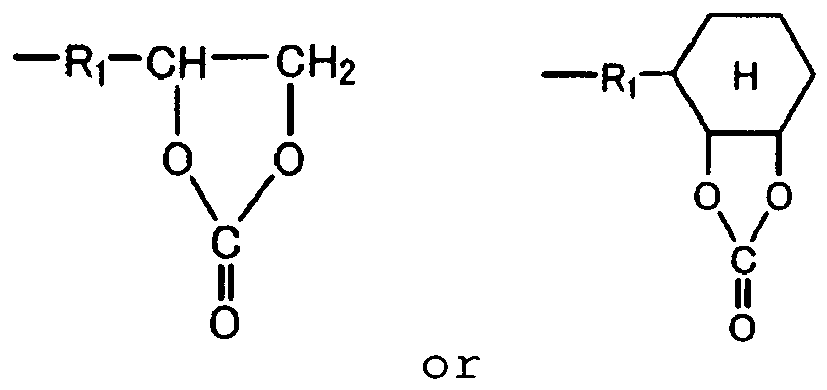
- the present invention provides a 5-membered cyclic carbonate polysiloxane compound represented by the following formula (1): wherein A means in which R 1 means an alkylene group which has from 1 to 12 carbon atoms and may be linked via an element of O, S or N and/or -(C 2 H 4 O) b -, R 2 means a direct bond or an alkylene group having from 2 to 20 carbon atoms, R 2 may be linked to an alicyclic group or aromatic group, b stands for a number of from 1 to 300, and a stands for a number of from 1 to 300.
- A means in which R 1 means an alkylene group which has from 1 to 12 carbon atoms and may be linked via an element of O, S or N and/or -(C 2 H 4 O) b -
- R 2 means a direct bond or an alkylene group having from 2 to 20 carbon atoms
- R 2 may be linked to an alicyclic group or aromatic group
- b stands for a number of from
- the present invention also provides a process for producing the above-described 5-membered cyclic carbonate polysiloxane compound, which comprises reacting an epoxy-modified polysiloxane compound represented by the following formula (2) with carbon dioxide: wherein A means in which R 1 means an alkylene group which has from 1 to 12 carbon atoms and may be linked via an element of O, S or N and/or -(C 2 H 4 O) b -, R 2 means a direct bond or an alkylene group having from 2 to 20 carbon atoms, R 2 may be linked to an alicyclic group or aromatic group, b stands for a number of from 1 to 300, and a stands for a number of from 1 to 300.
- a polysiloxane-modified polyhydroxy polyurethane resin obtainable from the 5-membered cyclic carbonate polysiloxane compound according to the present invention is excellent in lubricity, abrasion resistance, chemical resistance, non-tackiness, antistatic properties, heat resistance and the like.
- the use of the 5-membered cyclic carbonate polysiloxane compound according to the present invention makes it possible to provide a variety of environment-responsive products which can contribute to a reduction in greenhouse gas through the incorporation of carbon dioxide and is suited from the viewpoint of the protection of the global environment.
- the 5-membered cyclic carbonate polysiloxane compound of the present invention represented by the formula (1) can be produced, for example, by reacting an epoxy-modified polysiloxane compound represented by the formula (2) with carbon dioxide as shown by the below-described "Equation-A". Described more specifically, it can be obtained by reacting the epoxy-modified polysiloxane compound with carbon dioxide in the presence or absence of an organic solvent, in the presence of a catalyst, at a temperature of from 40°C to 150°C, under normal pressure or slightly elevated pressure, for from 10 to 20 hours.
- epoxy-modified polysiloxane compound which is represented by the formula (2) and is useful in the present invention, include such specific compounds as will be described below.
- epoxy-modified polysiloxane compounds are preferred compounds for use in the present invention, and the present invention shall not be limited to these exemplified compounds. Not only above-exemplified compounds but also other similar epoxy-modified polysiloxane compounds are available on the market these days. Accordingly, those readily available on the market can all be used in the present invention.
- the 5-membered cyclic carbonate polysiloxane compound according to the present invention can be obtained through the reaction between the specific epoxy-modified polysiloxane compound and carbon dioxide.
- catalysts usable in this reaction base catalysts and Lewis acid catalysts can be mentioned.
- the base catalysts include tertiary amines such as triethylamine and tributylamine; cyclic amines such as diazabicycloundecene, diazabicyclooctane and pyridine; alkali metal salts such as lithium chloride, lithium bromide, lithium fluoride and sodium chloride; alkaline earth metal salts such as calcium chloride; quaternary ammonium salts such as tetrabutyl ammonium chloride, tetraethyl ammonium bromide and benzyl trimethyl ammonium chloride; carbonate salts such as potassium carbonate and sodium carbonate; metal acetates such as zinc acetate, lead acetate, copper acetate and iron acetate; metal oxides such as calcium oxide, magnesium oxide and zinc oxide; phosphonium salts such as tetrabutyl phosphonium chloride; and the like.
- alkali metal salts such as lithium chloride, lithium bromide, lithium
- the Lewis acid catalysts include tin compounds such as tetrabutyltin, dibutyltin dilaurate, dibutyltin diacetate and dibutyltin octoate.
- the amount of the above-described catalyst may be from 0.1 to 100 parts by mass, preferably from 0.3 to 20 parts by mass per 50 parts by mass of the epoxy-modified polysiloxane compound. If the above-described catalyst is used in an amount of smaller than 0.1 parts by mass, the catalyst will be unable to fully exhibit its effects as a catalyst. If the above-described catalyst is used in an amount of greater than 100 parts by weight, on the other hand, the resin to be obtained finally will be lowered in various performance. In such a case that the residual catalyst would induce a serious reduction in performance, however, the reaction mixture may be washed with purified water to remove the residual catalyst.
- Organic solvents usable in the reaction between the epoxy-modified polysiloxane compound and carbon dioxide include, for example, dimethylformamide, dimethyl sulfoxide, dimethylacetamide, N-methylpyrrolidone, N-ethylpyrrolidone, tetrahydrofuran, and the like. These organic solvents may also be used as mixed systems with other poor solvents, for example, methyl ethyl ketone, xylene, toluene, tetrahydrofuran, diethyl ether, cylohexanone, and the like.
- a polysiloxane-modified polyhydroxy polyurethane can be obtained by reacting the 5-membered cyclic carbonate polysiloxane compound of the present invention, which has been obtained as described above, with a polyamine as shown by the below-described "Equation-B".
- the reaction between the 5-membered cyclic carbonate polysiloxane compound and the polyamine can be conducted in the presence of an organic solvent at a temperature of from 20°C to 150°C.
- a diamine is preferred.
- diamines which have conventionally been used in the production of polyurethane resins are all usable.
- Illustrative are aliphatic diamines such as methylenediamine, ethylenediamine, trimethylenediamine, 1,3-diaminopropane, hexamethylenediamine and octamethylenediamine; aromatic diamines such as phenylenediamine, 3,3'-dichloro-4,4'-diaminodiphenylmethane, 4,4'-methylenebis(phenylamine), 4,4'-diaminodiphenyl ether, 4,4'-diaminodiphenylsulfone, meta-xylylenediamine and para-xylylenediamine; alicyclic diamines such as 1,4-cyclohexanediamine, 4,4'-diamin
- the 5-membered cyclic carbonate polysiloxane compound according to the present invention can also be applied as an additive to epoxy resins useful, for example, as paints and sealants, in addition to its use as a raw material for the production of the above-described polysiloxane-modified polyhydroxy polyurethane. Owing to the formation of urethane bonds upon curing of the 5-membered cyclic carbonate polysiloxane compound and the polyamine, it is possible to lessen the occurrence of cracks due to volume shrinkage, said occurrence being a defect of the epoxy resins.
- the polysiloxane segments in the resin orient in a surface of the coating so that the coating is provided with heat resistance, lubricity and non-tackiness all of which are characteristics of polysiloxane segments.
- the 5-membered cyclic carbonate polysiloxane compound according to the present invention can also provide, owing to the incorporation of carbon dioxide from the viewpoint of a reduction in greenhouse gas, high-molecular products responsive to the protection of the environment to such extent that cannot be realized with conventional products.
- the 5-membered cyclic carbonate polysiloxane compound according to the present invention can be used as a raw material for a polysiloxane-modified polyhydroxy polyurethane resin.
- the resulting polysiloxane-modified polyhydroxy polyurethane resin is very useful as a raw material for various molding materials, synthetic leather and artificial leather materials, fiber coating materials, surface treatment materials, thermal recording media, strippable materials, paints, and a binder for printing inks; and, when added in epoxy resins, as a raw material for various paints, adhesives, composite materials and sealants.
- n-hexane 100 parts was added to the resultant reaction mixture to dilute it.
- the diluted reaction mixture was then washed in a separatory funnel three times with purified water (80 parts each time) to eliminate N-methylpyrrolidone and sodium iodide.
- the resulting n-hexane solution was dried with magnesium sulfate, and was then concentrated to obtain, as a colorless clear liquid, a 5-membered cyclic carbonate polysiloxane compound (1-A) (92 parts, yield: 89.7%).
- Polymerization Examples 1 to 3 (Production of polysiloxane-modified polyhydroxy polyurethane resins) Reaction vessels which were each equipped with a stirrer, thermometer, gas inlet tube and reflux condenser were purged with nitrogen. To the reaction vessels, the 5-membered cyclic carbonate polysiloxane compounds obtained in Examples 1 to 3 were added respectively. To each reaction vessel, N-methylpyrrolidone was added further to adjust a solid content to 35%, followed by stirring into a homogeneous solution. The corresponding amine compound described in Table 1 was then added in the predetermined amount. The resulting mixture was stirred at a temperature of 90°C for 10 hours so that a reaction was conducted until the amine compound was no longer detected. The three kinds of polysiloxane-modified polyhydroxy polyurethane resins obtained as described above had properties as shown in Table 1.
- a reaction vessel equipped with a stirrer, thermometer, gas inlet tube and reflux condenser was purged with nitrogen.
- the 5-membered cyclic carbonate compound obtained in Comparative Example 1 was added.
- N-methylpyrrolidone was added further to adjust a solid content to 35%, followed by stirring into a homogeneous solution.
- Hexamethylenediamine was then added in a predetermined amount.
- the resulting mixture was stirred at a temperature of 90°C for 10 hours so that a reaction was conducted until the amine compound was no longer detected.
- the resultant polyhydroxy polyurethane resin had properties as shown in Table 1.
- a resin obtainable, as an application example of the present invention, from the novel 5-membered cyclic carbonate polysiloxane compound is excellent in lubricity, abrasion resistance, chemical resistance, non-tackiness, antistatic properties and heat resistance.
- the use of this resin can, therefore, be expected to provide a variety of products, such as film and molding materials, sealants, various coating materials and various binders, which are excellent in carbon dioxide reduction effect and are useful from the viewpoint of protection of the global environment.
Landscapes
- Chemical & Material Sciences (AREA)
- Organic Chemistry (AREA)
- Chemical Kinetics & Catalysis (AREA)
- Health & Medical Sciences (AREA)
- Medicinal Chemistry (AREA)
- Polymers & Plastics (AREA)
- General Chemical & Material Sciences (AREA)
- Life Sciences & Earth Sciences (AREA)
- Engineering & Computer Science (AREA)
- Materials Engineering (AREA)
- Wood Science & Technology (AREA)
- Silicon Polymers (AREA)
- Polyurethanes Or Polyureas (AREA)
- Polyesters Or Polycarbonates (AREA)
Abstract
Description
- This invention relates to a novel 5-membered cyclic carbonate polysiloxane compound and its production process. More specifically, the present invention is concerned with a novel 5-membered cyclic carbonate polysiloxane compound, which is excellent in lubricity, abrasion resistance, chemical resistance, non-tackiness, antistatic properties and heat resistance, is also superb in carbon dioxide reduction effect from the viewpoint of the global environment, and is useful as a raw material for film and mold forming materials, sealants, various coating materials and various binders, and also with a process for producing the 5-membered cyclic carbonate polysiloxane compound.
- Five-membered cyclic carbonate compounds, which make use of carbon dioxide as a raw material, are known for some time as reported in Non-patent Documents 1 and 2. Under the current situation, however, the development of their applications has not moved ahead, because high-molecular compounds synthesized from the above-described, conventionally-known compounds as starting materials are evidently inferior in characteristics to fossil-based, high-molecular compounds (see Patent Documents 1 and 2).
However, the global warming phenomenon which can be considered to be attributable to the ever-increasing emission of carbon dioxide in recent years has become a worldwide problem, and a reduction in carbon dioxide emissions has arisen as a critical issue for the entire world. The change to renewable resources such as biomass and methane has also become a worldwide trend from the viewpoint of the problem of exhaustible fossil resources (petroleum). - Under such a background as described above, 5-membered cyclic carbonate compounds are drawing a fresh look again. Carbon dioxide, which is a raw material for these compounds, is a readily-available and sustainable carbon resource, and moreover, plastics that make use of carbon dioxide as a replacement for fossil resources can be considered to be effective means for resolving problems such as global warming and resource depletion.
-
- Patent Document 1:
US-A-3,072,613 - Patent Document 2:
JP-A-2000-319504 -
- Non-patent Document 1: N. Kihara, N. Hara, T. Endo, J. Org. Chem., 58, 6198 (1993)
- Non-patent Document 2: N. Kihara, T. Endo, J. Polymer Sci., Part A Polymer Chem., 31(11), 2765 (1993)
- To use, for example, polyhydroxy polyurethane resins, which are obtainable by using 5-membered cyclic carbonate compounds that make use of carbon dioxide as a raw material, for industrial applications in much the same way as conventional fossil-based high-molecular compounds (plastics), the polyhydroxy polyurethane resins, however, need to be provided with improved performance and a new additional value. Described specifically, from the viewpoint of making further contributions to the protection of the global environment, there is an outstanding desire in the above-described case to develop compounds which make use of carbon dioxide as a raw material and enable to obtain polyhydroxy polyurethane resins improved in performance indispensable for industrial applications, such as still higher heat resistance, chemical resistance, abrasion resistance, and so on. An object of the present invention is, therefore, to provide a technology that can realize such a desire.
- The above-described object can be achieved by the present invention to be described hereinafter. Specifically, the present invention provides a 5-membered cyclic carbonate polysiloxane compound represented by the following formula (1):


- The present invention also provides a process for producing the above-described 5-membered cyclic carbonate polysiloxane compound, which comprises reacting an epoxy-modified polysiloxane compound represented by the following formula (2) with carbon dioxide:


- A polysiloxane-modified polyhydroxy polyurethane resin obtainable from the 5-membered cyclic carbonate polysiloxane compound according to the present invention is excellent in lubricity, abrasion resistance, chemical resistance, non-tackiness, antistatic properties, heat resistance and the like. Moreover, the use of the 5-membered cyclic carbonate polysiloxane compound according to the present invention makes it possible to provide a variety of environment-responsive products which can contribute to a reduction in greenhouse gas through the incorporation of carbon dioxide and is suited from the viewpoint of the protection of the global environment.
-
-
FIG. 1 is an infrared absorption spectrum of an epoxy-modified polysiloxane. -
FIG. 2 is an infrared absorption spectrum of a 5-membered cyclic carbonate polysiloxane. -
FIG. 3 shows a GPC elution curve of the 5-membered cyclic carbonate polysiloxane (mobile phase: THF, column: "TSK-GEL GMHXL+G2000HXL+G3000HXL", detector: IR detector) - The present invention will next be described in further detail based on preferred embodiments.
The 5-membered cyclic carbonate polysiloxane compound of the present invention represented by the formula (1) can be produced, for example, by reacting an epoxy-modified polysiloxane compound represented by the formula (2) with carbon dioxide as shown by the below-described "Equation-A". Described more specifically, it can be obtained by reacting the epoxy-modified polysiloxane compound with carbon dioxide in the presence or absence of an organic solvent, in the presence of a catalyst, at a temperature of from 40°C to 150°C, under normal pressure or slightly elevated pressure, for from 10 to 20 hours. -


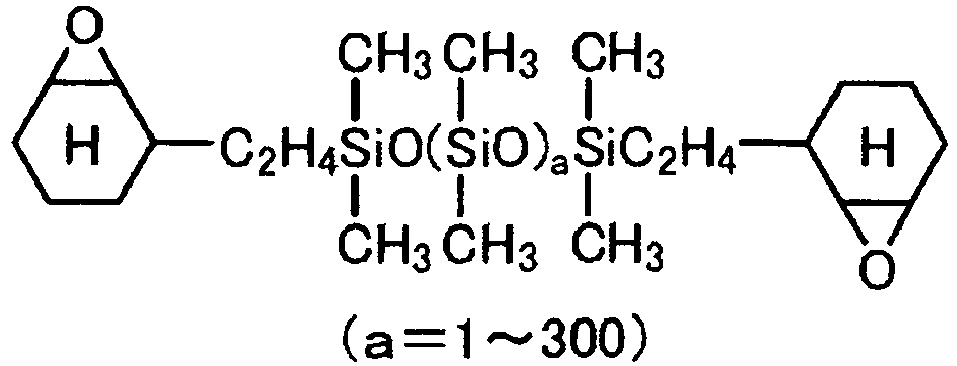
- Usable examples of the epoxy-modified polysiloxane compound, which is represented by the formula (2) and is useful in the present invention, include such specific compounds as will be described below.

-

-

-
-

- The above-listed epoxy-modified polysiloxane compounds are preferred compounds for use in the present invention, and the present invention shall not be limited to these exemplified compounds. Not only above-exemplified compounds but also other similar epoxy-modified polysiloxane compounds are available on the market these days. Accordingly, those readily available on the market can all be used in the present invention.
- As described above, the 5-membered cyclic carbonate polysiloxane compound according to the present invention can be obtained through the reaction between the specific epoxy-modified polysiloxane compound and carbon dioxide. As catalysts usable in this reaction, base catalysts and Lewis acid catalysts can be mentioned.
- The base catalysts include tertiary amines such as triethylamine and tributylamine; cyclic amines such as diazabicycloundecene, diazabicyclooctane and pyridine; alkali metal salts such as lithium chloride, lithium bromide, lithium fluoride and sodium chloride; alkaline earth metal salts such as calcium chloride; quaternary ammonium salts such as tetrabutyl ammonium chloride, tetraethyl ammonium bromide and benzyl trimethyl ammonium chloride; carbonate salts such as potassium carbonate and sodium carbonate; metal acetates such as zinc acetate, lead acetate, copper acetate and iron acetate; metal oxides such as calcium oxide, magnesium oxide and zinc oxide; phosphonium salts such as tetrabutyl phosphonium chloride; and the like.
- The Lewis acid catalysts include tin compounds such as tetrabutyltin, dibutyltin dilaurate, dibutyltin diacetate and dibutyltin octoate.
- The amount of the above-described catalyst may be from 0.1 to 100 parts by mass, preferably from 0.3 to 20 parts by mass per 50 parts by mass of the epoxy-modified polysiloxane compound. If the above-described catalyst is used in an amount of smaller than 0.1 parts by mass, the catalyst will be unable to fully exhibit its effects as a catalyst. If the above-described catalyst is used in an amount of greater than 100 parts by weight, on the other hand, the resin to be obtained finally will be lowered in various performance. In such a case that the residual catalyst would induce a serious reduction in performance, however, the reaction mixture may be washed with purified water to remove the residual catalyst.
- Organic solvents usable in the reaction between the epoxy-modified polysiloxane compound and carbon dioxide include, for example, dimethylformamide, dimethyl sulfoxide, dimethylacetamide, N-methylpyrrolidone, N-ethylpyrrolidone, tetrahydrofuran, and the like. These organic solvents may also be used as mixed systems with other poor solvents, for example, methyl ethyl ketone, xylene, toluene, tetrahydrofuran, diethyl ether, cylohexanone, and the like.
- A polysiloxane-modified polyhydroxy polyurethane can be obtained by reacting the 5-membered cyclic carbonate polysiloxane compound of the present invention, which has been obtained as described above, with a polyamine as shown by the below-described "Equation-B". The reaction between the 5-membered cyclic carbonate polysiloxane compound and the polyamine can be conducted in the presence of an organic solvent at a temperature of from 20°C to 150°C.

- As the polyamine for use in the above-described reaction, a diamine is preferred. No particular limitation is imposed on the diamine, and diamines which have conventionally been used in the production of polyurethane resins are all usable. Illustrative are aliphatic diamines such as methylenediamine, ethylenediamine, trimethylenediamine, 1,3-diaminopropane, hexamethylenediamine and octamethylenediamine; aromatic diamines such as phenylenediamine, 3,3'-dichloro-4,4'-diaminodiphenylmethane, 4,4'-methylenebis(phenylamine), 4,4'-diaminodiphenyl ether, 4,4'-diaminodiphenylsulfone, meta-xylylenediamine and para-xylylenediamine; alicyclic diamines such as 1,4-cyclohexanediamine, 4,4'-diaminocyclohexylmethane, 1,4'-diaminomethylcyclohexane and isophorone diamine; alkanoldiamines such as monoethanoldiamine, ethylaminoethanolamine and hydroxyethylaminopropylamine; and the like. Other diamines are also available on the market these days. These diamine compounds readily available on the market can all be used in the present invention.
- The 5-membered cyclic carbonate polysiloxane compound according to the present invention can also be applied as an additive to epoxy resins useful, for example, as paints and sealants, in addition to its use as a raw material for the production of the above-described polysiloxane-modified polyhydroxy polyurethane. Owing to the formation of urethane bonds upon curing of the 5-membered cyclic carbonate polysiloxane compound and the polyamine, it is possible to lessen the occurrence of cracks due to volume shrinkage, said occurrence being a defect of the epoxy resins.
- In a coating formed from a resin that has been obtained using as a starting raw material the 5-membered cyclic carbonate polysiloxane compound according to the present invention, the polysiloxane segments in the resin orient in a surface of the coating so that the coating is provided with heat resistance, lubricity and non-tackiness all of which are characteristics of polysiloxane segments. Further, the 5-membered cyclic carbonate polysiloxane compound according to the present invention can also provide, owing to the incorporation of carbon dioxide from the viewpoint of a reduction in greenhouse gas, high-molecular products responsive to the protection of the environment to such extent that cannot be realized with conventional products.
- As has been described above, the 5-membered cyclic carbonate polysiloxane compound according to the present invention can be used as a raw material for a polysiloxane-modified polyhydroxy polyurethane resin. The resulting polysiloxane-modified polyhydroxy polyurethane resin is very useful as a raw material for various molding materials, synthetic leather and artificial leather materials, fiber coating materials, surface treatment materials, thermal recording media, strippable materials, paints, and a binder for printing inks; and, when added in epoxy resins, as a raw material for various paints, adhesives, composite materials and sealants.
- The present invention will next be described in further detail based on specific production examples, examples and comparative examples, although the present invention shall not be limited to these examples. It is to be noted that the terms "parts" and "%" in the following examples are on a mass basis unless otherwise specifically indicated.
- To a reaction vessel equipped with a stirrer, thermometer, gas inlet tube and reflux condenser, a divalent epoxy-modified polysiloxane represented the below-described formula (A) ("X-22-163", product of Shin-Etsu Chemical Co., Ltd.; epoxy equivalent: 198 g/mol [
FIG. 1 ]; 100 parts), N-methylpyrrolidone (100 parts) and sodium iodide (1.2 parts) were added, followed by stirring into a homogeneous solution. Subsequently, the solution was stirred under heating at 80°C for 30 hours while bubbling carbon dioxide at a rate of 0.5 L/min. - After completion of the reaction, n-hexane (100 parts) was added to the resultant reaction mixture to dilute it. The diluted reaction mixture was then washed in a separatory funnel three times with purified water (80 parts each time) to eliminate N-methylpyrrolidone and sodium iodide. The resulting n-hexane solution was dried with magnesium sulfate, and was then concentrated to obtain, as a colorless clear liquid, a 5-membered cyclic carbonate polysiloxane compound (1-A) (92 parts, yield: 89.7%).
- In an infrared absorption spectrum ("FT-720", manufactured by Horiba, Ltd.) of the thus-obtained reaction product, there was observed around 1,800 cm-1 an absorption which is attributable to the carbonyl groups in the cyclic carbonate groups and is not found on the raw material [
FIG. 2 ]. The number average molecular weight of the reaction product was 2,450 (polystyrene equivalent; "GPC-8220", manufactured by Tosoh Corporation) [FIG. 3 ]. In the thus-obtained 5-membered cyclic carbonate polysiloxane compound (1-A), carbon dioxide was fixed as much as 18.1%. -

- By conducting a reaction as in Example 1 except that a divalent epoxy-modified polysiloxane represented by the below-described formula (B) ("KF-105", product of Shin-Etsu Chemical Co., Ltd.; epoxy equivalent: 485 g/mol) was used in place of the divalent epoxy-modified polysiloxane (A), a 5-membered cyclic carbonate polysiloxane compound (1-B) (99 parts, yield: 91%) was obtained as a colorless clear liquid.
The reaction product was identified by infrared absorption spectroscopy, GPC and NMR. In the thus-obtained 5-membered cyclic carbonate polysiloxane compound (1-B), carbon dioxide was fixed as much as 8.3%. -

- By conducting a reaction as in Example 1 except that a divalent epoxy-modified polysiloxane represented by the below-described formula (C) ("X-22-169AS", product of Shin-Etsu Chemical Co., Ltd.; epoxy equivalent: 533 g/mol) was used in place of the divalent epoxy-modified polysiloxane (A), a 5-membered cyclic carbonate polysiloxane compound (1-C) (71 parts, yield: 68%) was obtained as a colorless clear liquid. The reaction product was identified by infrared absorption spectroscopy, GPC and NMR. In the thus-obtained 5-membered cyclic carbonate polysiloxane compound (1-C), carbon dioxide was fixed as much as 7.6%.
-

- By conducting a reaction as in Example 1 except that a divalent epoxy compound represented by the below-described formula (D) ("EPICOAT 828", product of Japan Epoxy Resin Co. , Ltd. ; epoxy equivalent: 187 g/mol) was used in place of the divalent epoxy-modified polysiloxane (A), a 5-membered cyclic carbonate compound (1-D) (118 parts, yield: 95%) was obtained as a white powder. The reaction product was identified by infrared absorption spectroscopy, GPC and NMR. In the thus-obtained 5-membered cyclic carbonate compound (1-D), carbon dioxide was fixed as much as 19%.
-

- Polymerization Examples 1 to 3 (Production of polysiloxane-modified polyhydroxy polyurethane resins)
Reaction vessels which were each equipped with a stirrer, thermometer, gas inlet tube and reflux condenser were purged with nitrogen. To the reaction vessels, the 5-membered cyclic carbonate polysiloxane compounds obtained in Examples 1 to 3 were added respectively. To each reaction vessel, N-methylpyrrolidone was added further to adjust a solid content to 35%, followed by stirring into a homogeneous solution. The corresponding amine compound described in Table 1 was then added in the predetermined amount. The resulting mixture was stirred at a temperature of 90°C for 10 hours so that a reaction was conducted until the amine compound was no longer detected. The three kinds of polysiloxane-modified polyhydroxy polyurethane resins obtained as described above had properties as shown in Table 1. - A reaction vessel equipped with a stirrer, thermometer, gas inlet tube and reflux condenser was purged with nitrogen. To the reaction vessel, the 5-membered cyclic carbonate compound obtained in Comparative Example 1 was added. To the reaction vessel, N-methylpyrrolidone was added further to adjust a solid content to 35%, followed by stirring into a homogeneous solution. Hexamethylenediamine was then added in a predetermined amount. The resulting mixture was stirred at a temperature of 90°C for 10 hours so that a reaction was conducted until the amine compound was no longer detected. The resultant polyhydroxy polyurethane resin had properties as shown in Table 1.
-
Table 1 Polymerization Example 1 Polymerization Example 2 Polymerization Example 3 Comp. Polymerization Example 1 Carbonate compound (i) 1-A 1-B 1-C 1-D Amine compound (ii) HMDA1) BAPP2) XDA3) HMDA1) Molar ratio (i/ii) 1.0 1.0 1.0 1.0 Solution viscosity (35% conc., MPa·s) 1.5 1.8 1.1 1.3 Number average molecular weight 38,000 43,000 31,000 35,000 Hydroxyl number (mgKOH/g) 175 83 76 215 Polysiloxane content (%) 32 57 62 0 Breaking strength (20°C, MPa) 32.1 23.8 35.2 21.1 Breaking extension (20°C, %) 15 83 50 15 Surface resistance (20°C×46%RH, Ω) 5.6×10¹² 2.8×10¹³ 8.2×10¹³ 7.6×10¹⁰ Fixed amount of carbon dioxide (%)4) 14.5 6.9 6.8 15.2 1) Hexamethylenediamine
2) Bis-aminopropylpiperazine
3) Xylylenediamine
4) Calculated value - A resin obtainable, as an application example of the present invention, from the novel 5-membered cyclic carbonate polysiloxane compound is excellent in lubricity, abrasion resistance, chemical resistance, non-tackiness, antistatic properties and heat resistance. The use of this resin can, therefore, be expected to provide a variety of products, such as film and molding materials, sealants, various coating materials and various binders, which are excellent in carbon dioxide reduction effect and are useful from the viewpoint of protection of the global environment.
Claims (2)
- A 5-membered cyclic carbonate polysiloxane compound represented by the following formula (1):

- A process for producing the 5-membered cyclic carbonate polysiloxane compound according to claim 1, which comprises reacting an epoxy-modified polysiloxane compound represented by the following formula (2) with carbon dioxide:


Applications Claiming Priority (3)
| Application Number | Priority Date | Filing Date | Title |
|---|---|---|---|
| JP2009267052 | 2009-11-25 | ||
| JP2010081907A JP2011132208A (en) | 2009-11-25 | 2010-03-31 | Five-membered cyclocarbonate polysiloxane compound, and method for producing the same |
| PCT/JP2010/067679 WO2011065129A1 (en) | 2009-11-25 | 2010-10-07 | Five-membered cyclocarbonate polysiloxane compound and process for preparation of same |
Publications (2)
| Publication Number | Publication Date |
|---|---|
| EP2505601A1 true EP2505601A1 (en) | 2012-10-03 |
| EP2505601A4 EP2505601A4 (en) | 2014-04-02 |
Family
ID=44066234
Family Applications (1)
| Application Number | Title | Priority Date | Filing Date |
|---|---|---|---|
| EP10832976.4A Withdrawn EP2505601A4 (en) | 2009-11-25 | 2010-10-07 | Five-membered cyclocarbonate polysiloxane compound and process for preparation of same |
Country Status (7)
| Country | Link |
|---|---|
| US (1) | US8975420B2 (en) |
| EP (1) | EP2505601A4 (en) |
| JP (1) | JP2011132208A (en) |
| KR (2) | KR20140119810A (en) |
| CN (1) | CN102666662A (en) |
| RU (1) | RU2522906C2 (en) |
| WO (1) | WO2011065129A1 (en) |
Families Citing this family (14)
| Publication number | Priority date | Publication date | Assignee | Title |
|---|---|---|---|---|
| JP2011132208A (en) | 2009-11-25 | 2011-07-07 | Dainichiseika Color & Chem Mfg Co Ltd | Five-membered cyclocarbonate polysiloxane compound, and method for producing the same |
| CN102666655B (en) | 2009-11-25 | 2014-07-09 | 大日精化工业株式会社 | Polysiloxane-modified polyhydroxyurethane resin, its production method, and its application |
| EP2505600B1 (en) | 2009-11-26 | 2018-08-22 | Dainichiseika Color & Chemicals Mfg. Co., Ltd. | Polysiloxane-modified polyhydroxy polyurethane resin, method for producing same, heat-sensitive recording material using the resin, imitation leather, thermoplastic polyolefin resin skin material, material for weather strip, and weather strip |
| WO2011162237A1 (en) | 2010-06-24 | 2011-12-29 | 大日精化工業株式会社 | Self-crosslinkable polyhydroxy polyurethane resin, resinaceous material that contains the resin, process for production of the resin, and imitation leather, surfacing material and weatherstrip material, using the resin |
| JP5953644B2 (en) * | 2010-08-19 | 2016-07-20 | 日立化成株式会社 | Polyhydroxyurethane compound and method for producing the same, curable resin composition, photosensitive element, method for forming resist pattern, and method for producing printed wiring board |
| JP5637559B2 (en) * | 2010-12-22 | 2014-12-10 | 大日精化工業株式会社 | imitation leather |
| JP5679739B2 (en) * | 2010-08-26 | 2015-03-04 | 大日精化工業株式会社 | Self-crosslinking polysiloxane-modified polyhydroxypolyurethane resin and process for producing the same |
| US10000609B2 (en) | 2010-08-26 | 2018-06-19 | Dainichiseika Color & Chemicals Mfg. Co., Ltd. | Self-crosslinking polysiloxane-modified polyhydroxy polyurethane resin, resin material containing same, method for producing same, artificial leather comprising same, and thermoplastic polyolefin skin material comprising same |
| WO2012137726A1 (en) | 2011-04-04 | 2012-10-11 | 大日精化工業株式会社 | Self-crosslinkable polysiloxane-modified polyhydroxy polyurethane resin, process for producing said resin, resin material comprising said resin, and artificial leather produced utilizing said resin |
| JP5653849B2 (en) * | 2011-06-22 | 2015-01-14 | 大日精化工業株式会社 | Reversible thermosensitive recording material |
| JP5876372B2 (en) * | 2012-05-08 | 2016-03-02 | 大日精化工業株式会社 | Reactive polysiloxane compound and method for producing the same |
| US11401379B2 (en) * | 2016-09-05 | 2022-08-02 | Merz+Benteli Ag | Oraganocarbonate-modified prepolymer, its use as a reactant for the preparation of isocyanate-free and isothiocyanate-free alkoxysilane polymers, and compositions thereof |
| JP6958511B2 (en) * | 2018-08-17 | 2021-11-02 | 信越化学工業株式会社 | Organopolysiloxane compound, a method for producing the same, an antistatic agent containing the same, and a curable composition. |
| JP6955129B2 (en) * | 2019-03-28 | 2021-10-27 | 大日精化工業株式会社 | Paint composition and paint film |
Family Cites Families (52)
| Publication number | Priority date | Publication date | Assignee | Title |
|---|---|---|---|---|
| US3072613A (en) | 1957-08-20 | 1963-01-08 | Union Carbide Corp | Multiple cyclic carbonate polymers |
| FR2300767A1 (en) * | 1975-02-11 | 1976-09-10 | Rhone Poulenc Ind | Polyethylene silicon cpds. for polymer synthesis - by reacting two short chain polyethylenic silicon cpds. with coupling agent (BE300376) |
| US4395527A (en) | 1978-05-17 | 1983-07-26 | M & T Chemicals Inc. | Siloxane-containing polymers |
| JPS5813359B2 (en) | 1978-07-03 | 1983-03-12 | 富士化学紙工業株式会社 | Thermal transfer material |
| JPS564408A (en) | 1979-06-26 | 1981-01-17 | Meitoo Kk | Waterproof* antiseptic and vermicidal method of wood |
| US4499149A (en) | 1980-12-15 | 1985-02-12 | M&T Chemicals Inc. | Siloxane-containing polymers |
| US4480009A (en) | 1980-12-15 | 1984-10-30 | M&T Chemicals Inc. | Siloxane-containing polymers |
| JPS61227087A (en) | 1985-04-01 | 1986-10-09 | Dainichi Seika Kogyo Kk | Thermal recording material |
| JPS62202786A (en) | 1986-03-04 | 1987-09-07 | Dainichi Color & Chem Mfg Co Ltd | Thermal recording material |
| DE3723782A1 (en) * | 1987-07-16 | 1989-01-26 | Dainippon Ink & Chemicals | METHOD FOR PRODUCING CYCLOCARBONATE COMPOUNDS |
| US4883854A (en) | 1988-09-30 | 1989-11-28 | Medtronic, Inc. | Hydroxyl functional monomers |
| JPH02102096A (en) | 1988-10-12 | 1990-04-13 | Dainichiseika Color & Chem Mfg Co Ltd | heat sensitive recording material |
| JP2630894B2 (en) | 1992-07-03 | 1997-07-16 | 信越化学工業株式会社 | Coating composition for weatherstrip |
| JP3013014B2 (en) | 1993-02-24 | 2000-02-28 | 西川ゴム工業株式会社 | Weather strip |
| JPH08109349A (en) | 1994-10-12 | 1996-04-30 | Yokohama Rubber Co Ltd:The | Coating agent for glass run for motor car |
| JP3461605B2 (en) | 1994-12-19 | 2003-10-27 | 鬼怒川ゴム工業株式会社 | Coating composition for surface treatment of polymer elastics |
| DE19505892C1 (en) * | 1995-02-21 | 1996-03-14 | Goldschmidt Ag Th | Cyclic carbonate gp.-contg. polysiloxane prodn. |
| US5686547A (en) * | 1996-03-14 | 1997-11-11 | General Electric Company | Carbonate and hydroxy carbamate functionalized silicones |
| JPH09278982A (en) | 1996-04-15 | 1997-10-28 | Dainippon Ink & Chem Inc | Curable resin composition and coating film forming method using the same |
| JPH11140182A (en) | 1997-11-05 | 1999-05-25 | Nof Corp | Reactive resin |
| US6120905A (en) | 1998-06-15 | 2000-09-19 | Eurotech, Ltd. | Hybrid nonisocyanate polyurethane network polymers and composites formed therefrom |
| JP3840347B2 (en) | 1999-05-11 | 2006-11-01 | 財団法人化学技術戦略推進機構 | Method for producing a novel polyhydroxyurethane |
| DE19959949A1 (en) | 1999-12-13 | 2001-06-21 | Bayer Ag | Hydrophobization with carboxyl-containing polysiloxanes |
| EP1143063B1 (en) | 2000-03-31 | 2008-09-17 | Dainichiseika Color & Chemicals Mfg. Co. Ltd. | Artificial leather |
| KR100749304B1 (en) * | 2000-08-28 | 2007-08-14 | 디시이 아프릴리스, 인코포레이티드 | Holographic recording medium containing multifunctional epoxy monomer capable of carrying out cationic polymerization |
| JP2002114936A (en) | 2000-10-05 | 2002-04-16 | Kinugawa Rubber Ind Co Ltd | Primer composition, and weatherstrip coated therewith |
| JP2004051901A (en) | 2002-07-23 | 2004-02-19 | Fujikura Kasei Co Ltd | Matte coating composition, coating film and coated product using the same |
| EP1506975A1 (en) | 2003-08-13 | 2005-02-16 | Vantico GmbH | Nanocomposites based on polyurethane or polyurethane-epoxy hybrid resins prepared avoiding isocyanates |
| JP2005154580A (en) | 2003-11-26 | 2005-06-16 | Mitsui Chemicals Inc | Self-emulsifying aqueous polyurethane resin and its application |
| JP4417777B2 (en) | 2004-05-25 | 2010-02-17 | 大日精化工業株式会社 | Fake leather-like sheet |
| JP2006176615A (en) | 2004-12-22 | 2006-07-06 | Seikoh Chem Co Ltd | Coating agent for polyolefin-based resin molded article and molded article coated therewith |
| JP2006307015A (en) | 2005-04-28 | 2006-11-09 | Toyota Motor Corp | Scratch-resistant resin composition, method for producing scratch-resistant resin composition, and molded article |
| US20060276599A1 (en) | 2005-06-05 | 2006-12-07 | Dewitt Julie A | Weatherstrip coating |
| JP4650627B2 (en) | 2005-09-14 | 2011-03-16 | 信越化学工業株式会社 | Cyclic carbonate-modified siloxane, method for producing the same, non-aqueous electrolyte, secondary battery, and capacitor |
| US7368174B2 (en) | 2005-12-14 | 2008-05-06 | Lord Corporation | Aqueous dispersion coating composition having noise and/or friction abatement properties |
| JP2007270373A (en) | 2006-03-31 | 2007-10-18 | Nisshinbo Ind Inc | Artificial leather-like sheet and method for producing the same |
| US20080234626A1 (en) | 2006-04-26 | 2008-09-25 | Chelak Todd M | Multi-stage microporation device |
| JP2007297544A (en) | 2006-05-01 | 2007-11-15 | Dai Ichi Kogyo Seiyaku Co Ltd | Method for producing polyhydroxyurethane and aqueous dispersion of polyhydroxyurethane |
| JP2008056772A (en) | 2006-08-30 | 2008-03-13 | Seikoh Chem Co Ltd | Aqueous coating agent for ethylene-propylene rubber |
| DE102007023869A1 (en) | 2007-05-21 | 2008-12-18 | Momentive Performance Materials Gmbh & Co. Kg | New polycarbonate and / or polyurethane polyorganosiloxane compounds |
| DE102007032666A1 (en) | 2007-07-13 | 2009-01-22 | Bayer Materialscience Ag | Allophanate and silane-containing polyisocyanates |
| JP5090319B2 (en) | 2007-11-22 | 2012-12-05 | 東レコーテックス株式会社 | Synthetic leather consisting of plant-derived components |
| JP2009155407A (en) | 2007-12-26 | 2009-07-16 | Konishi Co Ltd | Curable resin composition and adhesive composition |
| DE102008013584A1 (en) | 2008-03-11 | 2009-09-17 | Momentive Performance Materials Gmbh | New polycarbonate-polyorganosiloxane and / or polyurethane-polyorganosiloxane compounds |
| JP5249657B2 (en) | 2008-07-10 | 2013-07-31 | 大日精化工業株式会社 | Thermosensitive recording material, polyurethane and method for producing the same |
| CN102666655B (en) | 2009-11-25 | 2014-07-09 | 大日精化工业株式会社 | Polysiloxane-modified polyhydroxyurethane resin, its production method, and its application |
| JP2011132208A (en) | 2009-11-25 | 2011-07-07 | Dainichiseika Color & Chem Mfg Co Ltd | Five-membered cyclocarbonate polysiloxane compound, and method for producing the same |
| JP5705511B2 (en) | 2009-11-26 | 2015-04-22 | 大日精化工業株式会社 | Polysiloxane-modified polyhydroxypolyurethane resin, resin-containing composition and resin production method |
| EP2505600B1 (en) | 2009-11-26 | 2018-08-22 | Dainichiseika Color & Chemicals Mfg. Co., Ltd. | Polysiloxane-modified polyhydroxy polyurethane resin, method for producing same, heat-sensitive recording material using the resin, imitation leather, thermoplastic polyolefin resin skin material, material for weather strip, and weather strip |
| WO2011162237A1 (en) | 2010-06-24 | 2011-12-29 | 大日精化工業株式会社 | Self-crosslinkable polyhydroxy polyurethane resin, resinaceous material that contains the resin, process for production of the resin, and imitation leather, surfacing material and weatherstrip material, using the resin |
| US10000609B2 (en) | 2010-08-26 | 2018-06-19 | Dainichiseika Color & Chemicals Mfg. Co., Ltd. | Self-crosslinking polysiloxane-modified polyhydroxy polyurethane resin, resin material containing same, method for producing same, artificial leather comprising same, and thermoplastic polyolefin skin material comprising same |
| WO2012137726A1 (en) | 2011-04-04 | 2012-10-11 | 大日精化工業株式会社 | Self-crosslinkable polysiloxane-modified polyhydroxy polyurethane resin, process for producing said resin, resin material comprising said resin, and artificial leather produced utilizing said resin |
-
2010
- 2010-03-31 JP JP2010081907A patent/JP2011132208A/en active Pending
- 2010-10-07 KR KR1020147024777A patent/KR20140119810A/en not_active Ceased
- 2010-10-07 EP EP10832976.4A patent/EP2505601A4/en not_active Withdrawn
- 2010-10-07 CN CN201080053575XA patent/CN102666662A/en active Pending
- 2010-10-07 US US13/503,936 patent/US8975420B2/en active Active
- 2010-10-07 RU RU2012120612/04A patent/RU2522906C2/en active
- 2010-10-07 WO PCT/JP2010/067679 patent/WO2011065129A1/en not_active Ceased
- 2010-10-07 KR KR1020127016028A patent/KR20120109512A/en not_active Ceased
Also Published As
| Publication number | Publication date |
|---|---|
| WO2011065129A1 (en) | 2011-06-03 |
| KR20140119810A (en) | 2014-10-10 |
| CN102666662A (en) | 2012-09-12 |
| US20120232289A1 (en) | 2012-09-13 |
| KR20120109512A (en) | 2012-10-08 |
| EP2505601A4 (en) | 2014-04-02 |
| RU2522906C2 (en) | 2014-07-20 |
| RU2012120612A (en) | 2014-01-20 |
| US8975420B2 (en) | 2015-03-10 |
| JP2011132208A (en) | 2011-07-07 |
Similar Documents
| Publication | Publication Date | Title |
|---|---|---|
| US8975420B2 (en) | Five-membered cyclocarbonate polysiloxane compound and process for preparation of same | |
| CN107614557B (en) | Manufacturing method, water-dispersed composition, liquid composite, resin combination and the resin cured matter of poly- carbodiimide composition, poly- carbodiimide composition | |
| Figovsky et al. | Recent advances in the development of non-isocyanate polyurethanes based on cyclic carbonates | |
| JP6698095B2 (en) | Method for synthesizing polyoxazolidinone compound having high stability | |
| JP6341888B2 (en) | Polyhydroxyurethane resin and method for producing the same | |
| CN113563588A (en) | Hydroxyl-terminated siloxane, silicon polyurethane containing same and preparation method thereof | |
| Figovsky et al. | Progress in elaboration of nonisocyanate polyurethanes based on cyclic carbonates | |
| JP2012111796A (en) | Method for producing thermoplastic polyhydroxyurethane | |
| US20200165373A1 (en) | Curable organic polymer comprising at least one acylurea unit, its preparation and use | |
| TW202313771A (en) | Carbonate-containing epoxy resin, preparation method thereof, epoxy curable product prepared thereby and a method for degrading epoxy curable product | |
| CN110894399A (en) | Two-component polyurethane waterproof coating and preparation method thereof | |
| CN1319588A (en) | Fluorodiol and application thereof | |
| US20120202945A1 (en) | Polyurethanes and use thereof | |
| JPH0348690A (en) | Adhesion promotor | |
| JP5679739B2 (en) | Self-crosslinking polysiloxane-modified polyhydroxypolyurethane resin and process for producing the same | |
| CN102665402B (en) | Etheramines containing flexible and rigid segments and their use as intermediates for polymer synthesis | |
| JP7066664B2 (en) | Method for manufacturing polyhydroxyurethane resin and polyhydroxyurethane resin | |
| JP5596435B2 (en) | Self-crosslinking polyhydroxypolyurethane resin and process for producing the same | |
| JP5521213B2 (en) | Chlorinated polyether copolymer and process for producing the same | |
| JP6621722B2 (en) | Polyhydroxyurethane urea resin and method for producing polyhydroxyurethane urea resin | |
| TWI838046B (en) | Carbonate-containing epoxy resin, preparation method thereof, epoxy curable product prepared thereby and method for degrading epoxy curable product | |
| TWI866665B (en) | Carbonate-containing aromatic amine compound, preparation method thereof, epoxy curable product and poly(carbonate imine) vitirmer prepared thereby and degrading method thereof | |
| CN114736366B (en) | Hindered amine-terminated polyether, preparation method of hindered amine-terminated polyether and preparation method of slow-reaction polyurea | |
| TWI807144B (en) | A high stress thermal plastic polyurethane, its preparing formulation and making process | |
| JP5637564B2 (en) | Self-crosslinking polysiloxane-modified polyhydroxypolyurethane resin, method for producing the resin, and resin material containing the resin |
Legal Events
| Date | Code | Title | Description |
|---|---|---|---|
| PUAI | Public reference made under article 153(3) epc to a published international application that has entered the european phase |
Free format text: ORIGINAL CODE: 0009012 |
|
| 17P | Request for examination filed |
Effective date: 20120420 |
|
| AK | Designated contracting states |
Kind code of ref document: A1 Designated state(s): AL AT BE BG CH CY CZ DE DK EE ES FI FR GB GR HR HU IE IS IT LI LT LU LV MC MK MT NL NO PL PT RO RS SE SI SK SM TR |
|
| DAX | Request for extension of the european patent (deleted) | ||
| A4 | Supplementary search report drawn up and despatched |
Effective date: 20140303 |
|
| RIC1 | Information provided on ipc code assigned before grant |
Ipc: C08G 77/38 20060101AFI20140225BHEP Ipc: C07F 7/08 20060101ALI20140225BHEP |
|
| 17Q | First examination report despatched |
Effective date: 20151021 |
|
| STAA | Information on the status of an ep patent application or granted ep patent |
Free format text: STATUS: THE APPLICATION IS DEEMED TO BE WITHDRAWN |
|
| 18D | Application deemed to be withdrawn |
Effective date: 20160301 |