EP2503579B1 - Apparatus, and associated method, for applying a finish to a keypad - Google Patents
Apparatus, and associated method, for applying a finish to a keypad Download PDFInfo
- Publication number
- EP2503579B1 EP2503579B1 EP20110159890 EP11159890A EP2503579B1 EP 2503579 B1 EP2503579 B1 EP 2503579B1 EP 20110159890 EP20110159890 EP 20110159890 EP 11159890 A EP11159890 A EP 11159890A EP 2503579 B1 EP2503579 B1 EP 2503579B1
- Authority
- EP
- European Patent Office
- Prior art keywords
- membrane
- keys
- key
- keypad
- carrier
- Prior art date
- Legal status (The legal status is an assumption and is not a legal conclusion. Google has not performed a legal analysis and makes no representation as to the accuracy of the status listed.)
- Active
Links
Images

Classifications
-
- H—ELECTRICITY
- H01—ELECTRIC ELEMENTS
- H01H—ELECTRIC SWITCHES; RELAYS; SELECTORS; EMERGENCY PROTECTIVE DEVICES
- H01H13/00—Switches having rectilinearly-movable operating part or parts adapted for pushing or pulling in one direction only, e.g. push-button switch
- H01H13/70—Switches having rectilinearly-movable operating part or parts adapted for pushing or pulling in one direction only, e.g. push-button switch having a plurality of operating members associated with different sets of contacts, e.g. keyboard
- H01H13/88—Processes specially adapted for manufacture of rectilinearly movable switches having a plurality of operating members associated with different sets of contacts, e.g. keyboards
-
- H—ELECTRICITY
- H01—ELECTRIC ELEMENTS
- H01H—ELECTRIC SWITCHES; RELAYS; SELECTORS; EMERGENCY PROTECTIVE DEVICES
- H01H2229/00—Manufacturing
- H01H2229/002—Screen printing
-
- H—ELECTRICITY
- H01—ELECTRIC ELEMENTS
- H01H—ELECTRIC SWITCHES; RELAYS; SELECTORS; EMERGENCY PROTECTIVE DEVICES
- H01H2229/00—Manufacturing
- H01H2229/038—Folding of flexible printed circuit
-
- H—ELECTRICITY
- H01—ELECTRIC ELEMENTS
- H01H—ELECTRIC SWITCHES; RELAYS; SELECTORS; EMERGENCY PROTECTIVE DEVICES
- H01H2231/00—Applications
- H01H2231/022—Telephone handset
Definitions
- the present disclosure relates generally to a manner by which to provide a keypad assembly that includes a finish, such as a decoration or painting, applied to interstitial portions of the keys of the keypad assembly. More particularly, the present disclosure relates to a method by which to apply the finish to the keys including the interstitial portions and to provide a keypad assembly to which the finish has been applied.
- a finish such as a decoration or painting
- Keypad assemblies of small dimensions having keys positioned close to one another, are provided with painting, decoration, or other finish applied at desired locations of the keys.
- Electronic devices such as portable communication devices, typically include a user interface that provides a user with the capability to interact with the device.
- the user interface typically includes one or more input actuators, such as a key or a button, that is utilized by a user to provide input commands, instructions, and information utilized during operation of the device.
- a wireless device operable in a radio communication system is exemplary of an electronic device that includes a user interface to provide a user with input actuation keys to input information, control instructions, and input commands utilized pursuant to operation of the wireless device.
- a wireless device typically includes a telephonic keypad that at least includes input keys associated with each of the ten numeric dialing digits and also a "asterisk" and "number” key.
- the user interface of a wireless device typically further includes one or more additional keys used for additional purposes.
- some wireless devices include a keypad that includes alphabetical characters, such as keypads that are arranged in QWERTY configuration.
- An exemplary radio communication system is a cellular communication system.
- Cellular communication systems have been deployed throughout the world, and wireless devices, sometimes referred to as mobile stations, are used to communicate in a cellular communication system.
- Other wireless networks are analogously deployed and are regularly utilized.
- Early-generation, cellular communication systems generally provided primarily for voice communication services and only limited data communication services.
- the keypads of wireless devices constructed for use in such early-generation communication systems generally provided user interfaces consisting of numeric input keys.
- Newer-generation devices operable in newer-generation systems, are generally capable of being utilized for data-intensive communication services, such as messaging services and other communication services in which data is communicated by, and with, the wireless device.
- the wireless device When the wireless device is capable of use pursuant to a service that utilizes communication of textual data, the wireless device often times includes a QWERTY keypad.
- circuitry of the wireless devices and also of other electronic devices, to be significantly reduced in physical dimensions, i.e., miniaturized.
- the physical dimensions of the resultant device that is, a device that incorporates the circuitry of the reduced dimensions can correspondingly be reduced.
- the housing in which the circuitry of the device is positioned can be reduced, facilitating hand carriage of the device.
- a user interface typically supported at the housing of the electronic device is constrained in dimensions by the dimensions of the housing. As the size of the housing decreases, the size of the user interface correspondingly must decrease.
- WO 2010/049420 A1 discloses a method for the manufacture of a keyboard module.
- the reduced physical dimensions permitted of the user interface poses various manufacturing challenges to the manufacture and assembly of the user interfaces for such devices of reduced dimensions.
- the sizes of the keys of a keypad that typically forms a user-interface input of an electronic device must be of reduced dimensions.
- Both numeric, QWERTY, and other alphanumeric keypads, and the respective keys thereof must generally be of reduced dimensions.
- the keys of the keypads are placed in the closer proximity with one another. Positioning of the keys of the keypad in closer proximity to one another reduces the manufacturing tolerances permitted of the components of the keypads. Additionally, by placing the keys of the keypad in closer proximity to one another, application of a finish, such as a decoration or painting, is more difficult during assembly of the keypads.
- a keypad of small dimensions, upon which a finish, such as a painting or decoration is applied, and an associated method for applying the finish to the keys of the keypad is therefore needed.
- Figure 1 illustrates a keypad assembly of an implementation of the present disclosure.
- Figure 2 illustrates a side, elevational view of a portion of the keypad assembly shown in Figure 1 .
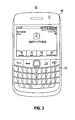
- Figure 3 illustrates a representation of a wireless device that includes the keypad assembly as a portion thereof.
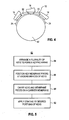
- Figure 4 illustrates a representation of the keypad assembly shown in Figures 1-2 in a convex carrier configuration upon a cylindrical fixture.
- Figure 5 illustrates a method flow diagram representative of the method of operation of an implementation of the present disclosure.
- the present disclosure accordingly, advantageously provides an apparatus, and an associated method, for a keypad assembly that includes a finish, such as a decoration or a painting, that is applied, e.g., to interstitial portions of keys of the keypad assembly.
- a finish such as a decoration or a painting
- a manner is provided by which to provide keys of a keypad with painting, decoration, or other finish at desired portions of the keys, including interstitial portions of the keys.
- a keypad having a painting, decoration, or other finish applied to interstitial portions of the keys of the keypad is also provided.
- a keypad of small dimensions having keys positioned close to one another, is able to be decorated or painted in a desired manner including a finish applied to an interstitial portion of a key of a keypad, if desired.
- a keypad in another aspect of the present disclosure, includes a plurality of keys that are arranged in a manner that defines an array of keys, i.e., a keypad array.
- the keypad array comprises, for instance, a numeric keypad array or, e.g., a QWERTY keypad array.
- membrane pieces of a membrane are positioned between undersurfaces of the keys of the keypad array positioned, e.g., between adjacent keys of the keypad array.
- a carrier membrane is provided.
- the carrier membrane is formed of a flexible material, such as a flexible thermoplastic material and is of dimensions to carry the keys that are arranged in the keypad array and also the key membrane pieces thereon.
- the keys and the key membrane pieces are, e.g., affixed in position upon the carrier membrane or are formed integral therewith.
- the carrier membrane is permitting of a bending flex motion to permit flexing of the carrier membrane between a horizontal, substantially planar position, and a convex configuration, i.e., a convex carrier configuration, in which the keys of the keypad array and the key membrane pieces are flexed together with the carrier membrane such that the keys and the key member pieces exhibit increased angular offsets relative to one another.
- a finish such as painting or a decoration, is applied to selected portions of the keys of the keypad array.
- the finish is applied to any desired portion of a key of the keypad array that is visible to a user of an electronic device to which the keypad assembly is associated.
- the desired finish is applied to the keys of the keypad array at the desired portions of the keys of the array, including at interstitial portions of the keys, irrespective of the spacing between the adjacent keys of the key pad array when the carrier membrane, upon which the keypad array is carried, is in a substantially planar, or flat, position.
- the carrier membrane, with the keypad array and key membrane pieces carried thereon is positioned in the convex carrier configuration by wrapping the carrier membrane about a cylindrical fixture.
- the cylindrical fixture comprises, for instance, a spindle or other convex-surfaced piece capable of supporting or providing for positioning of the carrier membrane thereon.
- the carrier membrane, and the keys and key membrane pieces carried thereon are removed from the cylindrical fixture, and the key pad assembly is assembled to form part of the wireless, or other electronic, device pursuant to an assembly process.
- a keypad assembly is therefore provided that is permitted to be of small physical dimensions while also permitting a finish to be applied upon a desired portion of one or more keys of the key pad assembly including at an interstitial portion of a key of the keypad array.
- a keypad assembly and an associated method, is provided.
- a plurality of keys are arranged a keypad array.
- a group of key membrane pieces are provided.
- a key membrane piece of the group is positioned between under surfaces of adjacent keys of the keypad array into which the plurality of keys is arranged.
- a carrier membrane is configured to carry the plurality of keys and the group of key membrane pieces thereon. The carrier membrane is permitting of a bending flex motion to position the carrier membrane into a convex carrier configuration at which the keys and the key member pieces exhibit increased angular offsets relative to one another.
- a keypad assembly 10 constructed pursuant to an implementation of the present disclosure provides for input of information, control commands, and instructions to an electronic device (not shown in Figure 1 ).
- the keypad assembly includes a plurality of keys 14 that are arranged in rows and columns to form an array of keys, i.e., a keypad array.
- the keys define a QWERTY keypad with alphabetical characters arranged in QWERTY style, of which individual ones of the keys are actuated by a user to enter a character associated with the individual key.
- the keys 14 are comprised of a thermoplastic material and are configured in the form of upstanding buttons that extend above a face surface of the keypad assembly. Individual ones of the keys are separated by separation distances 18.
- the separation distance 18 differs in the horizontal and vertical directions. That is to say, in one implementation, the separation distances between keys adjacent to one another in a vertical direction are different than the separation distances that separate keys adjacent to one another in a horizontal direction. And, in another implementation, separation distances between adjacent keys are row and/or column dependent.
- membrane pieces 22 are positioned to extend between under surface portions (hidden from view in Figure 1 ) that support the keys 14 in the arrayed configuration.
- the membrane pieces 22, in one implementation, are connected together and define a pattern, which, in turn, defines the array by controlling the positioning of the keys 14.
- the keypad assembly further includes a carrier membrane 24.
- the carrier membrane is positioned beneath the key membrane pieces 22 and the keys 14. Edge portions of the carrier membrane are illustrated in the Figure 1 . The edge portions extend beyond the key membrane pieces thereby to permit carriage of the key membrane pieces together with the keys when arranged in the array configuration.
- the carrier membrane is comprised of a flexible material that is permitting of a bending flex motion responsive to application of bending forces applied thereto,
- the key membrane pieces 22 and the keys 14, when carried upon the carrier membrane, as shown, are moved together with movement of the carrier membrane when the bending flex forces are applied to bend the carrier membrane into a convex carrier configuration.
- the bending of the carrier membrane into the convex carrier configuration causes the keys 14 carried upon the carrier membrane to be reoriented, to be repositioned relative to one another.
- the keys, and the key member pieces extending between undersurfaces of adjacent ones of the keys are caused to exhibit altered angular offsets relative to one another.
- the keypad 10 further includes a finish 26 applied portions of one or more of the keys 14.
- the finish comprises, for instance, painting applied to the key or decoration applied to the key.
- the finish 24 pursuant to an implementation of the present disclosure, is applied at any desired portion of the key that might be visible to a user of the keypad assembly during normal operation. Due to the small separation distances separating adjacent keys 14 of the keypad array, the application of the finish to interstitial portions of the adjacent keys is carried out by first applying the bending flex forces to the carrier member, and the key and key membrane pieces carried thereon to position the carrier membrane in the convex carrier configuration. Once positioned in the convex carrier configuration, the finish is applied, and the carrier membrane is permitted to return to a non-flexed position.
- the reorientation of the keys responsive to the bending movement of the carrier membrane into the altered angular offsets relative to one another opens areas of the keys or application of the finish that otherwise would not be accessible. Interstitial portions of the keys, for instance, which otherwise would not be accessible to apply the finish thereto are amenable for application of the finish when the carrier membrane is positioned in the convex carrier configuration.
- Figure 2 again illustrates the keypad assembly 10.
- the view shown in Figure 2 again illustrates the keys 14, the key membrane pieces 22 positioned between undersurfaces 28 of adjacent ones of the keys, and the carrier membrane 22.
- the keys 14 are shown to be seated at locations defined by the key membrane pieces 22, and the positioning of the keys 14 define the separation distances 18 that separate the adjacent ones of the keys 14.
- the carrier membrane 24 is again shown to carry the keys 14 and key membrane pieces 22 and also to be of dimensions to extend beyond the keypad array formed of the keys 14 positioned at the locations defined by the key membrane pieces 22.
- the arrows 34 represent bending flex forces that are applied to the carrier membrane to position the carrier membrane in the convex carrier configuration to alter the angular offsets of the keys 14 relative to one another.
- the keys 14 are upstanding and parallel to one another.
- the application of the bending flex forces to the carrier membrane causes flexing motion of the membrane to cause the keys to be reoriented to be offset from one another to make the interstitial portions of the keys amendable for application of a finish thereto.
- the carrier membrane once the desired finish is applied to the keys, is returned to the position, as shown in Figure 2 , upon termination of application of the forces 34 or, alternately, by application of forces reverse to those of arrows 34.
- FIG 3 illustrates a wireless device 42 that includes the keypad assembly 10 as a portion thereof.
- the keypad assembly 10 includes a finish applied to the keys 14 at any desired portions thereof visible to a viewer or user of the wireless device.
- the keypad assembly 10 is here supported at a housing 46 of the wireless device, positioned below, as shown, a display element 48.
- the display element 48 and the keyboard assembly together form the user interface of the wireless device.
- a user of the wireless device enters information, commands, and operational control instructions by way of the keypad assembly 10.
- the user actuates individual keys 14 of the keypad assembly to enter the information, commands, or instructions.
- circuitry housed within the housing 46 causes operation of the wireless device in conformity with the entered instructions or commands or causes communication of the entered information, as appropriate.
- Figure 4 again illustrates the keypad assembly 10, again illustrating the key 14, key membrane pieces 22, and carrier membrane 24.
- the keypad assembly is positioned at, or supported on, a cylindrical fixture 62.
- the carrier membrane is comprised of a flexible material, the membrane is positionable to be supported or otherwise positioned at the fixture.
- the keys and key membrane pieces are reoriented relative to one another to alter the relative angular offsets between the elements and to expose the interstitial portions of the keys and key membrane pieces for application of the finish material thereon.
- the keypad assembly is removed from the fixture 62, and the keypad assembly is available for assembly as part of an electronic device, such as the wireless device 42 shown in Figure 3 .
- the positioning of the keypad assembly at a cylindrical fixture, or the like, is readily carried out, such as by an automated process during assembly operations. Because the positioning of the carrier membrane in the convex carrier configuration positions even interstitial portions of the keys of the keypad assembly to permit application of a finish thereto, almost any desired finish, pattern, decoration, or painting is able to be applied to any portion of the keys or key membrane that are noticeable by a viewer positioned above the keypad assembly.
- Figure 5 illustrates a method 82 of an implementation of the present disclosure. The method facilitates formation of a keypad assembly.
- a plurality of keys are arranged to form a keypad array.
- key membrane pieces are positioned between undersurfaces of adjacent keys of the keypad array.
- the keypad array and the key membrane pieces are carried on a carrier membrane.
- the carrier membrane is permitting of a bending flex motion into a convex carrier configuration at which the keypad array and the key membrane pieces, carried on the carrier membrane, exhibit increased angular offsets relative to one another.
- a coating is applied to a desired portion of one or more keys of the keypad array.
- a manner is provided by which to apply a finish to any desired portion of a key of a keypad array.
- the manner is amendable for automated assembly operations in which the keypad assembly is created and a finish is applied thereto.
Landscapes
- Input From Keyboards Or The Like (AREA)
- Telephone Set Structure (AREA)
Description
- The present disclosure relates generally to a manner by which to provide a keypad assembly that includes a finish, such as a decoration or painting, applied to interstitial portions of the keys of the keypad assembly. More particularly, the present disclosure relates to a method by which to apply the finish to the keys including the interstitial portions and to provide a keypad assembly to which the finish has been applied.
- Keypad assemblies of small dimensions, having keys positioned close to one another, are provided with painting, decoration, or other finish applied at desired locations of the keys.
- Electronic devices, such as portable communication devices, typically include a user interface that provides a user with the capability to interact with the device. The user interface, for instance, typically includes one or more input actuators, such as a key or a button, that is utilized by a user to provide input commands, instructions, and information utilized during operation of the device.
- A wireless device operable in a radio communication system is exemplary of an electronic device that includes a user interface to provide a user with input actuation keys to input information, control instructions, and input commands utilized pursuant to operation of the wireless device.
- A wireless device typically includes a telephonic keypad that at least includes input keys associated with each of the ten numeric dialing digits and also a "asterisk" and "number" key. The user interface of a wireless device typically further includes one or more additional keys used for additional purposes. And, some wireless devices include a keypad that includes alphabetical characters, such as keypads that are arranged in QWERTY configuration.
- An exemplary radio communication system is a cellular communication system. Cellular communication systems have been deployed throughout the world, and wireless devices, sometimes referred to as mobile stations, are used to communicate in a cellular communication system. Other wireless networks are analogously deployed and are regularly utilized.
- Early-generation, cellular communication systems generally provided primarily for voice communication services and only limited data communication services. The keypads of wireless devices constructed for use in such early-generation communication systems generally provided user interfaces consisting of numeric input keys. Newer-generation devices, operable in newer-generation systems, are generally capable of being utilized for data-intensive communication services, such as messaging services and other communication services in which data is communicated by, and with, the wireless device. When the wireless device is capable of use pursuant to a service that utilizes communication of textual data, the wireless device often times includes a QWERTY keypad.
- Advancements in technologies have permitted the circuitry of the wireless devices, and also of other electronic devices, to be significantly reduced in physical dimensions, i.e., miniaturized. The physical dimensions of the resultant device, that is, a device that incorporates the circuitry of the reduced dimensions can correspondingly be reduced. The housing in which the circuitry of the device is positioned can be reduced, facilitating hand carriage of the device.
- Concomitant with the decrease in the physical dimensions of electronic devices has been a decrease in the physical dimensions of the associated user interfaces for the devices. A user interface, typically supported at the housing of the electronic device is constrained in dimensions by the dimensions of the housing. As the size of the housing decreases, the size of the user interface correspondingly must decrease.
-
WO 2010/049420 A1 discloses a method for the manufacture of a keyboard module. - The reduced physical dimensions permitted of the user interface poses various manufacturing challenges to the manufacture and assembly of the user interfaces for such devices of reduced dimensions.
- For instance, due to the increased dimensional constraints imposed upon the user interfaces, not only are the sizes of the user interfaces reduced, but, further, the component parts of the user interfaces are also reduced. For example, the sizes of the keys of a keypad that typically forms a user-interface input of an electronic device must be of reduced dimensions. Both numeric, QWERTY, and other alphanumeric keypads, and the respective keys thereof, must generally be of reduced dimensions. And, the keys of the keypads are placed in the closer proximity with one another. Positioning of the keys of the keypad in closer proximity to one another reduces the manufacturing tolerances permitted of the components of the keypads. Additionally, by placing the keys of the keypad in closer proximity to one another, application of a finish, such as a decoration or painting, is more difficult during assembly of the keypads.
- A keypad, of small dimensions, upon which a finish, such as a painting or decoration is applied, and an associated method for applying the finish to the keys of the keypad is therefore needed.
- It is in light of this background information related to user interfaces for electronic, and other, devices that the significant improvements of the present disclosure have evolved.
-
Figure 1 illustrates a keypad assembly of an implementation of the present disclosure. -
Figure 2 illustrates a side, elevational view of a portion of the keypad assembly shown inFigure 1 . -
Figure 3 illustrates a representation of a wireless device that includes the keypad assembly as a portion thereof. -
Figure 4 illustrates a representation of the keypad assembly shown inFigures 1-2 in a convex carrier configuration upon a cylindrical fixture. -
Figure 5 illustrates a method flow diagram representative of the method of operation of an implementation of the present disclosure. - The present disclosure, accordingly, advantageously provides an apparatus, and an associated method, for a keypad assembly that includes a finish, such as a decoration or a painting, that is applied, e.g., to interstitial portions of keys of the keypad assembly.
- Through operation of an implementation of the present disclosure, a manner is provided by which to provide keys of a keypad with painting, decoration, or other finish at desired portions of the keys, including interstitial portions of the keys. A keypad having a painting, decoration, or other finish applied to interstitial portions of the keys of the keypad is also provided.
- In one aspect of the present disclosure, a keypad of small dimensions, having keys positioned close to one another, is able to be decorated or painted in a desired manner including a finish applied to an interstitial portion of a key of a keypad, if desired.
- In another aspect of the present disclosure, a keypad is provided that includes a plurality of keys that are arranged in a manner that defines an array of keys, i.e., a keypad array. The keypad array comprises, for instance, a numeric keypad array or, e.g., a QWERTY keypad array.
- In another aspect of the present disclosure, membrane pieces of a membrane are positioned between undersurfaces of the keys of the keypad array positioned, e.g., between adjacent keys of the keypad array.
- In another aspect of the present disclosure, a carrier membrane is provided. The carrier membrane is formed of a flexible material, such as a flexible thermoplastic material and is of dimensions to carry the keys that are arranged in the keypad array and also the key membrane pieces thereon. The keys and the key membrane pieces are, e.g., affixed in position upon the carrier membrane or are formed integral therewith.
- In another aspect of the present disclosure, the carrier membrane, with the plurality of keys and key membrane pieces carried thereon, is permitting of a bending flex motion to permit flexing of the carrier membrane between a horizontal, substantially planar position, and a convex configuration, i.e., a convex carrier configuration, in which the keys of the keypad array and the key membrane pieces are flexed together with the carrier membrane such that the keys and the key member pieces exhibit increased angular offsets relative to one another.
- In another aspect of the present disclosure, a finish, such as painting or a decoration, is applied to selected portions of the keys of the keypad array. The finish is applied to any desired portion of a key of the keypad array that is visible to a user of an electronic device to which the keypad assembly is associated. The desired finish is applied to the keys of the keypad array at the desired portions of the keys of the array, including at interstitial portions of the keys, irrespective of the spacing between the adjacent keys of the key pad array when the carrier membrane, upon which the keypad array is carried, is in a substantially planar, or flat, position.
- In another aspect of the present disclosure, the carrier membrane, with the keypad array and key membrane pieces carried thereon is positioned in the convex carrier configuration by wrapping the carrier membrane about a cylindrical fixture. The cylindrical fixture comprises, for instance, a spindle or other convex-surfaced piece capable of supporting or providing for positioning of the carrier membrane thereon. When the carrier membrane is wrapped about the cylindrical fixture, the corresponding flexing imparted to the keys of the keypad array, which causes adjacent keys to be of increased angular offsets relative to each other, places interstitial portions of the keys in position to permit application of a finish thereto. The positioning of the carrier membrane in the convex carrier configuration thereby opens the interstitial portions of the keys to permit even and accurate application of the finish upon the interstitial portions of the keys. Once the finish has been applied to the desired portions of the keys of the keypad array, the carrier membrane, and the keys and key membrane pieces carried thereon, are removed from the cylindrical fixture, and the key pad assembly is assembled to form part of the wireless, or other electronic, device pursuant to an assembly process.
- A keypad assembly is therefore provided that is permitted to be of small physical dimensions while also permitting a finish to be applied upon a desired portion of one or more keys of the key pad assembly including at an interstitial portion of a key of the keypad array.
- In these and further aspects, a keypad assembly, and an associated method, is provided. A plurality of keys are arranged a keypad array. A group of key membrane pieces are provided. A key membrane piece of the group is positioned between under surfaces of adjacent keys of the keypad array into which the plurality of keys is arranged. A carrier membrane is configured to carry the plurality of keys and the group of key membrane pieces thereon. The carrier membrane is permitting of a bending flex motion to position the carrier membrane into a convex carrier configuration at which the keys and the key member pieces exhibit increased angular offsets relative to one another.
- Turning first to
Figure 1 , akeypad assembly 10 constructed pursuant to an implementation of the present disclosure provides for input of information, control commands, and instructions to an electronic device (not shown inFigure 1 ). The keypad assembly includes a plurality ofkeys 14 that are arranged in rows and columns to form an array of keys, i.e., a keypad array. Here, the keys define a QWERTY keypad with alphabetical characters arranged in QWERTY style, of which individual ones of the keys are actuated by a user to enter a character associated with the individual key. In the exemplary implementation, thekeys 14 are comprised of a thermoplastic material and are configured in the form of upstanding buttons that extend above a face surface of the keypad assembly. Individual ones of the keys are separated by separation distances 18. In one implementation, theseparation distance 18 differs in the horizontal and vertical directions. That is to say, in one implementation, the separation distances between keys adjacent to one another in a vertical direction are different than the separation distances that separate keys adjacent to one another in a horizontal direction. And, in another implementation, separation distances between adjacent keys are row and/or column dependent. - In the exemplary implementation,
membrane pieces 22 are positioned to extend between under surface portions (hidden from view inFigure 1 ) that support thekeys 14 in the arrayed configuration. Themembrane pieces 22, in one implementation, are connected together and define a pattern, which, in turn, defines the array by controlling the positioning of thekeys 14. - The keypad assembly further includes a
carrier membrane 24. The carrier membrane is positioned beneath thekey membrane pieces 22 and thekeys 14. Edge portions of the carrier membrane are illustrated in theFigure 1 . The edge portions extend beyond the key membrane pieces thereby to permit carriage of the key membrane pieces together with the keys when arranged in the array configuration. - The carrier membrane is comprised of a flexible material that is permitting of a bending flex motion responsive to application of bending forces applied thereto, The
key membrane pieces 22 and thekeys 14, when carried upon the carrier membrane, as shown, are moved together with movement of the carrier membrane when the bending flex forces are applied to bend the carrier membrane into a convex carrier configuration. When the bending flex forces are applied, the bending of the carrier membrane into the convex carrier configuration causes thekeys 14 carried upon the carrier membrane to be reoriented, to be repositioned relative to one another. The keys, and the key member pieces extending between undersurfaces of adjacent ones of the keys are caused to exhibit altered angular offsets relative to one another. And, when the carrier membrane is returned to a non-flexed position, either through termination of application of the bending flex forces or application of bending flex forces in a reverse direction, i.e., to return the carrier membrane to a substantially planar configuration, such as that shown inFigure 1 , the keys and key member pieces are again reoriented relative to one another. - The
keypad 10 further includes afinish 26 applied portions of one or more of thekeys 14. The finish comprises, for instance, painting applied to the key or decoration applied to the key. Thefinish 24 pursuant to an implementation of the present disclosure, is applied at any desired portion of the key that might be visible to a user of the keypad assembly during normal operation. Due to the small separation distances separatingadjacent keys 14 of the keypad array, the application of the finish to interstitial portions of the adjacent keys is carried out by first applying the bending flex forces to the carrier member, and the key and key membrane pieces carried thereon to position the carrier membrane in the convex carrier configuration. Once positioned in the convex carrier configuration, the finish is applied, and the carrier membrane is permitted to return to a non-flexed position. The reorientation of the keys responsive to the bending movement of the carrier membrane into the altered angular offsets relative to one another opens areas of the keys or application of the finish that otherwise would not be accessible. Interstitial portions of the keys, for instance, which otherwise would not be accessible to apply the finish thereto are amenable for application of the finish when the carrier membrane is positioned in the convex carrier configuration. -
Figure 2 again illustrates thekeypad assembly 10. The view shown inFigure 2 again illustrates thekeys 14, thekey membrane pieces 22 positioned between undersurfaces 28 of adjacent ones of the keys, and thecarrier membrane 22. Thekeys 14 are shown to be seated at locations defined by thekey membrane pieces 22, and the positioning of thekeys 14 define the separation distances 18 that separate the adjacent ones of thekeys 14. - The
carrier membrane 24 is again shown to carry thekeys 14 andkey membrane pieces 22 and also to be of dimensions to extend beyond the keypad array formed of thekeys 14 positioned at the locations defined by thekey membrane pieces 22. - The
arrows 34 represent bending flex forces that are applied to the carrier membrane to position the carrier membrane in the convex carrier configuration to alter the angular offsets of thekeys 14 relative to one another. For example, in the illustration ofFigure 2 , thekeys 14 are upstanding and parallel to one another. The application of the bending flex forces to the carrier membrane causes flexing motion of the membrane to cause the keys to be reoriented to be offset from one another to make the interstitial portions of the keys amendable for application of a finish thereto. The carrier membrane, once the desired finish is applied to the keys, is returned to the position, as shown inFigure 2 , upon termination of application of theforces 34 or, alternately, by application of forces reverse to those ofarrows 34. -
Figure 3 illustrates awireless device 42 that includes thekeypad assembly 10 as a portion thereof. Thekeypad assembly 10 includes a finish applied to thekeys 14 at any desired portions thereof visible to a viewer or user of the wireless device. Thekeypad assembly 10 is here supported at ahousing 46 of the wireless device, positioned below, as shown, a display element 48. The display element 48 and the keyboard assembly together form the user interface of the wireless device. - In operation, a user of the wireless device enters information, commands, and operational control instructions by way of the
keypad assembly 10. The user actuatesindividual keys 14 of the keypad assembly to enter the information, commands, or instructions. And, circuitry (not shown) housed within thehousing 46 causes operation of the wireless device in conformity with the entered instructions or commands or causes communication of the entered information, as appropriate. -
Figure 4 again illustrates thekeypad assembly 10, again illustrating the key 14,key membrane pieces 22, andcarrier membrane 24. Here, the keypad assembly is positioned at, or supported on, acylindrical fixture 62. Because the carrier membrane is comprised of a flexible material, the membrane is positionable to be supported or otherwise positioned at the fixture. When positioned at the fixture, the keys and key membrane pieces are reoriented relative to one another to alter the relative angular offsets between the elements and to expose the interstitial portions of the keys and key membrane pieces for application of the finish material thereon. - Once applied, the keypad assembly is removed from the
fixture 62, and the keypad assembly is available for assembly as part of an electronic device, such as thewireless device 42 shown inFigure 3 . The positioning of the keypad assembly at a cylindrical fixture, or the like, is readily carried out, such as by an automated process during assembly operations. Because the positioning of the carrier membrane in the convex carrier configuration positions even interstitial portions of the keys of the keypad assembly to permit application of a finish thereto, almost any desired finish, pattern, decoration, or painting is able to be applied to any portion of the keys or key membrane that are noticeable by a viewer positioned above the keypad assembly. -
Figure 5 illustrates amethod 82 of an implementation of the present disclosure. The method facilitates formation of a keypad assembly. - First, and as indicated by the
block 84, a plurality of keys are arranged to form a keypad array. Then, and as indicated by theblock 86, key membrane pieces are positioned between undersurfaces of adjacent keys of the keypad array. - Then, and as indicated by the block 88, the keypad array and the key membrane pieces are carried on a carrier membrane. The carrier membrane is permitting of a bending flex motion into a convex carrier configuration at which the keypad array and the key membrane pieces, carried on the carrier membrane, exhibit increased angular offsets relative to one another. And, as indicated by the
block 92, a coating is applied to a desired portion of one or more keys of the keypad array. - Thereby, a manner is provided by which to apply a finish to any desired portion of a key of a keypad array. The manner is amendable for automated assembly operations in which the keypad assembly is created and a finish is applied thereto.
- Presently preferred implementations of the disclosure and many of improvements and advantages thereof have been described with a degree of particularity. The description is of preferred examples of implementing the disclosure, and the description of examples is not necessarily intended to limit the scope of the disclosure. The scope of the disclosure is defined by the following claims.
Claims (14)
- A method (82) for facilitating formation of a keypad assembly (10), the method comprising:arranging (84) a plurality of keys (14) to form a keypad array;positioning (86) key membrane pieces (22) between undersurfaces of adjacent keys of the keypad array;carrying (88) the keypad array and key membrane pieces on a carrier membrane (24), the carrier membrane permitting of a bending flex motion (34) into a convex carrier configuration at which the keypad array and the key membrane pieces, carried on the carrier membrane, exhibit increased angular offsets relative to one another; characterised bybending the carrier membrane and the keypad array and key membrane pieces carried thereon in the bending flex motion into the convex carrier configuration; and applying (92) a finish (26) to at least an interstitial portion of a key of the keypad array.
- The method (82) of claim 1 wherein the bending the carrier membrane (24) comprises wrapping the carrier membrane about a cylindrical fixture (62).
- The method (82) of claim 1 wherein said applying (92) the finish (26) comprises applying a coating to at least an interstitial portion of a key (14) of the keypad array.
- The method (82) of claim 1 wherein said applying (92) the finish (26) comprises painting at least an interstitial portion of a key (14) of the keypad array.
- The method (82) of claim 1 wherein the bending flex motion (34) permitted of the carrier membrane (24) comprises motion to position the carrier membrane in the convex carrier configuration at which interstitial portions of keys (14) of the keypad array are positioned to receive application of the finish.
- The method (82) of claim 1 wherein the positioning (86) key membrane pieces (22) between the undersurfaces comprises positioning the key membrane pieces at light-blocking positions.
- A keypad assembly (10) obtained by the method (82) of claim 1 comprising:a plurality of keys (14) arranged in a keypad array;a group of key membrane pieces (22), a key membrane piece of the group positioned between undersurfaces of adjacent keys of the keypad array into which the plurality of keys is arranged; anda carrier membrane (24) configured to carry the plurality of keys and the group of key membrane pieces thereon, the carrier membrane permitting of a bending flex motion (34) into a convex carrier configuration at which the keys and the key membrane pieces exhibit altered angular offsets relative to one another,wherein a finish is applied to at least an interstitial portion of a key of the keypad array.
- The keypad assembly (10) of claim 7 wherein the finish comprises a decoration.
- The keypad assembly (10) of claim 7 wherein the finish comprises paint.
- The keypad assembly (10) of claim 7, wherein the key membrane pieces (22) of the group of key membrane pieces are permitting of the bending flex motion (34) together with the bending flex motion of the carrier membrane (24).
- The keypad assembly (10) of claim 7 wherein the key membrane pieces (22) of the group of key membrane pieces and the carrier membrane (34) are integrally formed.
- The keypad assembly (10) of claim 11 wherein the plurality of keys (14) are further integrally formed with the key membrane pieces (22) of the group of key membrane pieces and the carrier member (24).
- The keypad assembly (10) of claim 7 wherein the bending flex motion (34) permitted of the carrier membrane (24) comprises motion to position the carrier membrane at the convex carrier configuration at which interstitial portions of the keys (14) of the plurality are positioned to receive application of the finish.
- The keypad assembly (10) of claim 7, wherein the convex carrier configuration into which the carrier membrane (24) is positionable comprises a cylindrical-fixture-seatable configuration (62).
Priority Applications (2)
| Application Number | Priority Date | Filing Date | Title |
|---|---|---|---|
| EP20110159890 EP2503579B1 (en) | 2011-03-25 | 2011-03-25 | Apparatus, and associated method, for applying a finish to a keypad |
| CA 2769372 CA2769372A1 (en) | 2011-03-25 | 2012-02-24 | Apparatus, and associated method, for applying a finish to a keypad |
Applications Claiming Priority (1)
| Application Number | Priority Date | Filing Date | Title |
|---|---|---|---|
| EP20110159890 EP2503579B1 (en) | 2011-03-25 | 2011-03-25 | Apparatus, and associated method, for applying a finish to a keypad |
Publications (2)
| Publication Number | Publication Date |
|---|---|
| EP2503579A1 EP2503579A1 (en) | 2012-09-26 |
| EP2503579B1 true EP2503579B1 (en) | 2013-06-26 |
Family
ID=44280753
Family Applications (1)
| Application Number | Title | Priority Date | Filing Date |
|---|---|---|---|
| EP20110159890 Active EP2503579B1 (en) | 2011-03-25 | 2011-03-25 | Apparatus, and associated method, for applying a finish to a keypad |
Country Status (2)
| Country | Link |
|---|---|
| EP (1) | EP2503579B1 (en) |
| CA (1) | CA2769372A1 (en) |
Family Cites Families (2)
| Publication number | Priority date | Publication date | Assignee | Title |
|---|---|---|---|---|
| JPS60131209A (en) * | 1983-12-20 | 1985-07-12 | Toray Silicone Co Ltd | Manufacturing method for printed molded products |
| DE102008053351B3 (en) * | 2008-10-27 | 2010-08-05 | Gigaset Communications Gmbh | Control panel for a keyboard module, keyboard module and method of making the same |
-
2011
- 2011-03-25 EP EP20110159890 patent/EP2503579B1/en active Active
-
2012
- 2012-02-24 CA CA 2769372 patent/CA2769372A1/en not_active Abandoned
Also Published As
| Publication number | Publication date |
|---|---|
| EP2503579A1 (en) | 2012-09-26 |
| CA2769372A1 (en) | 2012-09-25 |
Similar Documents
| Publication | Publication Date | Title |
|---|---|---|
| US6824321B2 (en) | Keypad assembly | |
| CN101324817B (en) | Input device and method of manufacturing module unit for input device | |
| US20110073454A1 (en) | key assembly for an electronic device having a multi-character keycap | |
| US8022324B2 (en) | Method of manufacturing a keypad structure having a transparent keycap and keypad structure having a transparent keycap | |
| US8115120B2 (en) | Electrical switch with multiple switching channels | |
| US20080055253A1 (en) | Handheld mobile communication device with flexible keys | |
| US8598476B2 (en) | Apparatus, and associated method, for applying a finish to a keypad | |
| EP2503579A1 (en) | Apparatus, and associated method, for applying a finish to a keypad | |
| KR20000059919A (en) | Method for inputing letters korean character in radio communication terminal | |
| US20100245133A1 (en) | Key sheet | |
| US20110262698A1 (en) | Control panel, keyboard module and method for the manufacture thereof | |
| CN101248501B (en) | Thin key sheet and method for manufacturing same | |
| EP2402968B1 (en) | Deflection Web for a Keypad Assembly | |
| EP2302879B1 (en) | A key assembly for an electronic device having a multi-character keycap | |
| EP2518593B1 (en) | Keypad having a curved shape | |
| KR100538112B1 (en) | Button plate and personal portable device using a plastic sheet | |
| US20070221490A1 (en) | Keyboard and method for applying in-mold decoration technology to manufacture the keyboard with more key height and less key spacing | |
| AU9520098A (en) | Keypad having keys arranged in clock manner | |
| JP2002329437A (en) | Shape-formed film for push-button switch and cover member for push-button switch and manufacturing method of these | |
| EP2328164B1 (en) | A Key Assembly for an Electronic Device Having A Connected Keycap | |
| EP2487880B1 (en) | Electronic mobile device having a keypad assembly with a film overlay | |
| KR20180010639A (en) | Method of forming fingerprint sensor decoration and structure of fingerprint sensor decoration | |
| JP2002015639A (en) | Member for push-button switch | |
| JP2004193124A (en) | Portable input device | |
| EP2490105A1 (en) | Keypad having a metal grid for use with a portable electronic device |
Legal Events
| Date | Code | Title | Description |
|---|---|---|---|
| PUAI | Public reference made under article 153(3) epc to a published international application that has entered the european phase |
Free format text: ORIGINAL CODE: 0009012 |
|
| 17P | Request for examination filed |
Effective date: 20110325 |
|
| AK | Designated contracting states |
Kind code of ref document: A1 Designated state(s): AL AT BE BG CH CY CZ DE DK EE ES FI FR GB GR HR HU IE IS IT LI LT LU LV MC MK MT NL NO PL PT RO RS SE SI SK SM TR |
|
| AX | Request for extension of the european patent |
Extension state: BA ME |
|
| GRAP | Despatch of communication of intention to grant a patent |
Free format text: ORIGINAL CODE: EPIDOSNIGR1 |
|
| GRAS | Grant fee paid |
Free format text: ORIGINAL CODE: EPIDOSNIGR3 |
|
| GRAA | (expected) grant |
Free format text: ORIGINAL CODE: 0009210 |
|
| AK | Designated contracting states |
Kind code of ref document: B1 Designated state(s): AL AT BE BG CH CY CZ DE DK EE ES FI FR GB GR HR HU IE IS IT LI LT LU LV MC MK MT NL NO PL PT RO RS SE SI SK SM TR |
|
| REG | Reference to a national code |
Ref country code: GB Ref legal event code: FG4D |
|
| REG | Reference to a national code |
Ref country code: CH Ref legal event code: EP |
|
| REG | Reference to a national code |
Ref country code: AT Ref legal event code: REF Ref document number: 619022 Country of ref document: AT Kind code of ref document: T Effective date: 20130715 |
|
| REG | Reference to a national code |
Ref country code: IE Ref legal event code: FG4D |
|
| REG | Reference to a national code |
Ref country code: CH Ref legal event code: PFA Owner name: BLACKBERRY LIMITED, CA Free format text: FORMER OWNER: RESEARCH IN MOTION LIMITED, CA |
|
| REG | Reference to a national code |
Ref country code: DE Ref legal event code: R096 Ref document number: 602011002109 Country of ref document: DE Effective date: 20130829 |
|
| RAP2 | Party data changed (patent owner data changed or rights of a patent transferred) |
Owner name: BLACKBERRY LIMITED |
|
| REG | Reference to a national code |
Ref country code: NL Ref legal event code: TD Effective date: 20131002 |
|
| REG | Reference to a national code |
Ref country code: NL Ref legal event code: T3 |
|
| PG25 | Lapsed in a contracting state [announced via postgrant information from national office to epo] |
Ref country code: SI Free format text: LAPSE BECAUSE OF FAILURE TO SUBMIT A TRANSLATION OF THE DESCRIPTION OR TO PAY THE FEE WITHIN THE PRESCRIBED TIME-LIMIT Effective date: 20130626 Ref country code: GR Free format text: LAPSE BECAUSE OF FAILURE TO SUBMIT A TRANSLATION OF THE DESCRIPTION OR TO PAY THE FEE WITHIN THE PRESCRIBED TIME-LIMIT Effective date: 20130927 Ref country code: NO Free format text: LAPSE BECAUSE OF FAILURE TO SUBMIT A TRANSLATION OF THE DESCRIPTION OR TO PAY THE FEE WITHIN THE PRESCRIBED TIME-LIMIT Effective date: 20130926 Ref country code: SE Free format text: LAPSE BECAUSE OF FAILURE TO SUBMIT A TRANSLATION OF THE DESCRIPTION OR TO PAY THE FEE WITHIN THE PRESCRIBED TIME-LIMIT Effective date: 20130626 Ref country code: FI Free format text: LAPSE BECAUSE OF FAILURE TO SUBMIT A TRANSLATION OF THE DESCRIPTION OR TO PAY THE FEE WITHIN THE PRESCRIBED TIME-LIMIT Effective date: 20130626 Ref country code: LT Free format text: LAPSE BECAUSE OF FAILURE TO SUBMIT A TRANSLATION OF THE DESCRIPTION OR TO PAY THE FEE WITHIN THE PRESCRIBED TIME-LIMIT Effective date: 20130626 |
|
| REG | Reference to a national code |
Ref country code: CH Ref legal event code: PCOW Free format text: NEW ADDRESS: 2200 UNIVERSITY AVENUE EAST, WATERLOO, ON N2K 0A7 (CA) Ref country code: AT Ref legal event code: MK05 Ref document number: 619022 Country of ref document: AT Kind code of ref document: T Effective date: 20130626 |
|
| REG | Reference to a national code |
Ref country code: LT Ref legal event code: MG4D |
|
| RAP2 | Party data changed (patent owner data changed or rights of a patent transferred) |
Owner name: BLACKBERRY LIMITED |
|
| PG25 | Lapsed in a contracting state [announced via postgrant information from national office to epo] |
Ref country code: BG Free format text: LAPSE BECAUSE OF FAILURE TO SUBMIT A TRANSLATION OF THE DESCRIPTION OR TO PAY THE FEE WITHIN THE PRESCRIBED TIME-LIMIT Effective date: 20130926 Ref country code: RS Free format text: LAPSE BECAUSE OF FAILURE TO SUBMIT A TRANSLATION OF THE DESCRIPTION OR TO PAY THE FEE WITHIN THE PRESCRIBED TIME-LIMIT Effective date: 20130626 Ref country code: HR Free format text: LAPSE BECAUSE OF FAILURE TO SUBMIT A TRANSLATION OF THE DESCRIPTION OR TO PAY THE FEE WITHIN THE PRESCRIBED TIME-LIMIT Effective date: 20130626 |
|
| PG25 | Lapsed in a contracting state [announced via postgrant information from national office to epo] |
Ref country code: LV Free format text: LAPSE BECAUSE OF FAILURE TO SUBMIT A TRANSLATION OF THE DESCRIPTION OR TO PAY THE FEE WITHIN THE PRESCRIBED TIME-LIMIT Effective date: 20130626 |
|
| PG25 | Lapsed in a contracting state [announced via postgrant information from national office to epo] |
Ref country code: SK Free format text: LAPSE BECAUSE OF FAILURE TO SUBMIT A TRANSLATION OF THE DESCRIPTION OR TO PAY THE FEE WITHIN THE PRESCRIBED TIME-LIMIT Effective date: 20130626 Ref country code: IS Free format text: LAPSE BECAUSE OF FAILURE TO SUBMIT A TRANSLATION OF THE DESCRIPTION OR TO PAY THE FEE WITHIN THE PRESCRIBED TIME-LIMIT Effective date: 20131026 Ref country code: PT Free format text: LAPSE BECAUSE OF FAILURE TO SUBMIT A TRANSLATION OF THE DESCRIPTION OR TO PAY THE FEE WITHIN THE PRESCRIBED TIME-LIMIT Effective date: 20131028 Ref country code: EE Free format text: LAPSE BECAUSE OF FAILURE TO SUBMIT A TRANSLATION OF THE DESCRIPTION OR TO PAY THE FEE WITHIN THE PRESCRIBED TIME-LIMIT Effective date: 20130626 Ref country code: CY Free format text: LAPSE BECAUSE OF FAILURE TO SUBMIT A TRANSLATION OF THE DESCRIPTION OR TO PAY THE FEE WITHIN THE PRESCRIBED TIME-LIMIT Effective date: 20130911 Ref country code: CZ Free format text: LAPSE BECAUSE OF FAILURE TO SUBMIT A TRANSLATION OF THE DESCRIPTION OR TO PAY THE FEE WITHIN THE PRESCRIBED TIME-LIMIT Effective date: 20130626 Ref country code: AT Free format text: LAPSE BECAUSE OF FAILURE TO SUBMIT A TRANSLATION OF THE DESCRIPTION OR TO PAY THE FEE WITHIN THE PRESCRIBED TIME-LIMIT Effective date: 20130626 Ref country code: BE Free format text: LAPSE BECAUSE OF FAILURE TO SUBMIT A TRANSLATION OF THE DESCRIPTION OR TO PAY THE FEE WITHIN THE PRESCRIBED TIME-LIMIT Effective date: 20130626 |
|
| PG25 | Lapsed in a contracting state [announced via postgrant information from national office to epo] |
Ref country code: PL Free format text: LAPSE BECAUSE OF FAILURE TO SUBMIT A TRANSLATION OF THE DESCRIPTION OR TO PAY THE FEE WITHIN THE PRESCRIBED TIME-LIMIT Effective date: 20130626 Ref country code: ES Free format text: LAPSE BECAUSE OF FAILURE TO SUBMIT A TRANSLATION OF THE DESCRIPTION OR TO PAY THE FEE WITHIN THE PRESCRIBED TIME-LIMIT Effective date: 20131007 Ref country code: RO Free format text: LAPSE BECAUSE OF FAILURE TO SUBMIT A TRANSLATION OF THE DESCRIPTION OR TO PAY THE FEE WITHIN THE PRESCRIBED TIME-LIMIT Effective date: 20130626 |
|
| PG25 | Lapsed in a contracting state [announced via postgrant information from national office to epo] |
Ref country code: CY Free format text: LAPSE BECAUSE OF FAILURE TO SUBMIT A TRANSLATION OF THE DESCRIPTION OR TO PAY THE FEE WITHIN THE PRESCRIBED TIME-LIMIT Effective date: 20130626 |
|
| PG25 | Lapsed in a contracting state [announced via postgrant information from national office to epo] |
Ref country code: DK Free format text: LAPSE BECAUSE OF FAILURE TO SUBMIT A TRANSLATION OF THE DESCRIPTION OR TO PAY THE FEE WITHIN THE PRESCRIBED TIME-LIMIT Effective date: 20130626 |
|
| PLBE | No opposition filed within time limit |
Free format text: ORIGINAL CODE: 0009261 |
|
| STAA | Information on the status of an ep patent application or granted ep patent |
Free format text: STATUS: NO OPPOSITION FILED WITHIN TIME LIMIT |
|
| PG25 | Lapsed in a contracting state [announced via postgrant information from national office to epo] |
Ref country code: IT Free format text: LAPSE BECAUSE OF FAILURE TO SUBMIT A TRANSLATION OF THE DESCRIPTION OR TO PAY THE FEE WITHIN THE PRESCRIBED TIME-LIMIT Effective date: 20130626 |
|
| 26N | No opposition filed |
Effective date: 20140327 |
|
| REG | Reference to a national code |
Ref country code: DE Ref legal event code: R097 Ref document number: 602011002109 Country of ref document: DE Effective date: 20140327 |
|
| REG | Reference to a national code |
Ref country code: DE Ref legal event code: R082 Ref document number: 602011002109 Country of ref document: DE Representative=s name: MERH-IP MATIAS ERNY REICHL HOFFMANN, DE |
|
| PG25 | Lapsed in a contracting state [announced via postgrant information from national office to epo] |
Ref country code: LU Free format text: LAPSE BECAUSE OF FAILURE TO SUBMIT A TRANSLATION OF THE DESCRIPTION OR TO PAY THE FEE WITHIN THE PRESCRIBED TIME-LIMIT Effective date: 20140325 |
|
| REG | Reference to a national code |
Ref country code: CH Ref legal event code: PL |
|
| REG | Reference to a national code |
Ref country code: DE Ref legal event code: R082 Ref document number: 602011002109 Country of ref document: DE Representative=s name: MERH-IP MATIAS ERNY REICHL HOFFMANN, DE Effective date: 20140925 Ref country code: DE Ref legal event code: R081 Ref document number: 602011002109 Country of ref document: DE Owner name: BLACKBERRY LIMITED, WATERLOO, CA Free format text: FORMER OWNER: RESEARCH IN MOTION LTD., WATERLOO, ONTARIO, CA Effective date: 20140925 Ref country code: DE Ref legal event code: R082 Ref document number: 602011002109 Country of ref document: DE Representative=s name: MERH-IP MATIAS ERNY REICHL HOFFMANN PATENTANWA, DE Effective date: 20140925 |
|
| REG | Reference to a national code |
Ref country code: IE Ref legal event code: MM4A |
|
| PG25 | Lapsed in a contracting state [announced via postgrant information from national office to epo] |
Ref country code: CH Free format text: LAPSE BECAUSE OF NON-PAYMENT OF DUE FEES Effective date: 20140331 Ref country code: LI Free format text: LAPSE BECAUSE OF NON-PAYMENT OF DUE FEES Effective date: 20140331 Ref country code: IE Free format text: LAPSE BECAUSE OF NON-PAYMENT OF DUE FEES Effective date: 20140325 |
|
| PG25 | Lapsed in a contracting state [announced via postgrant information from national office to epo] |
Ref country code: MT Free format text: LAPSE BECAUSE OF FAILURE TO SUBMIT A TRANSLATION OF THE DESCRIPTION OR TO PAY THE FEE WITHIN THE PRESCRIBED TIME-LIMIT Effective date: 20130626 |
|
| REG | Reference to a national code |
Ref country code: FR Ref legal event code: PLFP Year of fee payment: 6 |
|
| PG25 | Lapsed in a contracting state [announced via postgrant information from national office to epo] |
Ref country code: SM Free format text: LAPSE BECAUSE OF FAILURE TO SUBMIT A TRANSLATION OF THE DESCRIPTION OR TO PAY THE FEE WITHIN THE PRESCRIBED TIME-LIMIT Effective date: 20130626 |
|
| PG25 | Lapsed in a contracting state [announced via postgrant information from national office to epo] |
Ref country code: MC Free format text: LAPSE BECAUSE OF FAILURE TO SUBMIT A TRANSLATION OF THE DESCRIPTION OR TO PAY THE FEE WITHIN THE PRESCRIBED TIME-LIMIT Effective date: 20130626 |
|
| PG25 | Lapsed in a contracting state [announced via postgrant information from national office to epo] |
Ref country code: HU Free format text: LAPSE BECAUSE OF FAILURE TO SUBMIT A TRANSLATION OF THE DESCRIPTION OR TO PAY THE FEE WITHIN THE PRESCRIBED TIME-LIMIT; INVALID AB INITIO Effective date: 20110325 Ref country code: TR Free format text: LAPSE BECAUSE OF FAILURE TO SUBMIT A TRANSLATION OF THE DESCRIPTION OR TO PAY THE FEE WITHIN THE PRESCRIBED TIME-LIMIT Effective date: 20130626 |
|
| REG | Reference to a national code |
Ref country code: FR Ref legal event code: PLFP Year of fee payment: 7 |
|
| REG | Reference to a national code |
Ref country code: FR Ref legal event code: PLFP Year of fee payment: 8 |
|
| PG25 | Lapsed in a contracting state [announced via postgrant information from national office to epo] |
Ref country code: MK Free format text: LAPSE BECAUSE OF FAILURE TO SUBMIT A TRANSLATION OF THE DESCRIPTION OR TO PAY THE FEE WITHIN THE PRESCRIBED TIME-LIMIT Effective date: 20130626 |
|
| PG25 | Lapsed in a contracting state [announced via postgrant information from national office to epo] |
Ref country code: AL Free format text: LAPSE BECAUSE OF FAILURE TO SUBMIT A TRANSLATION OF THE DESCRIPTION OR TO PAY THE FEE WITHIN THE PRESCRIBED TIME-LIMIT Effective date: 20130626 |
|
| REG | Reference to a national code |
Ref country code: DE Ref legal event code: R082 Ref document number: 602011002109 Country of ref document: DE Ref country code: DE Ref legal event code: R081 Ref document number: 602011002109 Country of ref document: DE Owner name: MALIKIE INNOVATIONS LTD., IE Free format text: FORMER OWNER: BLACKBERRY LIMITED, WATERLOO, ONTARIO, CA |
|
| PGFP | Annual fee paid to national office [announced via postgrant information from national office to epo] |
Ref country code: GB Payment date: 20260319 Year of fee payment: 16 |
|
| PGFP | Annual fee paid to national office [announced via postgrant information from national office to epo] |
Ref country code: DE Payment date: 20260320 Year of fee payment: 16 |
|
| PGFP | Annual fee paid to national office [announced via postgrant information from national office to epo] |
Ref country code: NL Payment date: 20260323 Year of fee payment: 16 |
|
| PGFP | Annual fee paid to national office [announced via postgrant information from national office to epo] |
Ref country code: FR Payment date: 20260323 Year of fee payment: 16 |