EP2502611A1 - Medication pay-out device - Google Patents
Medication pay-out device Download PDFInfo
- Publication number
- EP2502611A1 EP2502611A1 EP10831496A EP10831496A EP2502611A1 EP 2502611 A1 EP2502611 A1 EP 2502611A1 EP 10831496 A EP10831496 A EP 10831496A EP 10831496 A EP10831496 A EP 10831496A EP 2502611 A1 EP2502611 A1 EP 2502611A1
- Authority
- EP
- European Patent Office
- Prior art keywords
- medication
- monitoring platform
- solid medications
- solid
- medications
- Prior art date
- Legal status (The legal status is an assumption and is not a legal conclusion. Google has not performed a legal analysis and makes no representation as to the accuracy of the status listed.)
- Withdrawn
Links
- 229940079593 drug Drugs 0.000 title claims abstract description 334
- 239000003814 drug Substances 0.000 title claims abstract description 334
- 239000007787 solid Substances 0.000 claims abstract description 158
- 238000002483 medication Methods 0.000 claims abstract description 152
- 238000012544 monitoring process Methods 0.000 claims abstract description 126
- 238000003860 storage Methods 0.000 claims abstract description 40
- 238000003384 imaging method Methods 0.000 claims abstract description 35
- 238000002360 preparation method Methods 0.000 claims abstract description 30
- 238000012545 processing Methods 0.000 claims description 28
- 238000007599 discharging Methods 0.000 claims 1
- 238000000034 method Methods 0.000 description 39
- 230000008569 process Effects 0.000 description 36
- 230000007480 spreading Effects 0.000 description 14
- 238000003892 spreading Methods 0.000 description 14
- 230000007246 mechanism Effects 0.000 description 12
- 238000010276 construction Methods 0.000 description 9
- 238000012937 correction Methods 0.000 description 6
- 239000011218 binary composite Substances 0.000 description 5
- 230000008602 contraction Effects 0.000 description 4
- 238000002372 labelling Methods 0.000 description 4
- 238000012546 transfer Methods 0.000 description 4
- 238000000605 extraction Methods 0.000 description 3
- 230000005484 gravity Effects 0.000 description 3
- 238000005286 illumination Methods 0.000 description 3
- 238000004873 anchoring Methods 0.000 description 2
- 238000004364 calculation method Methods 0.000 description 2
- 230000006835 compression Effects 0.000 description 2
- 238000007906 compression Methods 0.000 description 2
- 238000001514 detection method Methods 0.000 description 2
- 230000006866 deterioration Effects 0.000 description 2
- 238000010191 image analysis Methods 0.000 description 2
- 238000005096 rolling process Methods 0.000 description 2
- 230000009471 action Effects 0.000 description 1
- 238000007792 addition Methods 0.000 description 1
- 238000005452 bending Methods 0.000 description 1
- 230000008859 change Effects 0.000 description 1
- 239000003086 colorant Substances 0.000 description 1
- 238000004040 coloring Methods 0.000 description 1
- 238000005520 cutting process Methods 0.000 description 1
- 238000010586 diagram Methods 0.000 description 1
- 235000012489 doughnuts Nutrition 0.000 description 1
- 239000000428 dust Substances 0.000 description 1
- 230000000694 effects Effects 0.000 description 1
- 238000005516 engineering process Methods 0.000 description 1
- 239000003365 glass fiber Substances 0.000 description 1
- 238000012423 maintenance Methods 0.000 description 1
- 239000000463 material Substances 0.000 description 1
- 239000011159 matrix material Substances 0.000 description 1
- 239000002184 metal Substances 0.000 description 1
- RSMUVYRMZCOLBH-UHFFFAOYSA-N metsulfuron methyl Chemical compound COC(=O)C1=CC=CC=C1S(=O)(=O)NC(=O)NC1=NC(C)=NC(OC)=N1 RSMUVYRMZCOLBH-UHFFFAOYSA-N 0.000 description 1
- 238000012986 modification Methods 0.000 description 1
- 230000004048 modification Effects 0.000 description 1
- 230000002093 peripheral effect Effects 0.000 description 1
- 238000006467 substitution reaction Methods 0.000 description 1
Images






Classifications
-
- G—PHYSICS
- G07—CHECKING-DEVICES
- G07F—COIN-FREED OR LIKE APPARATUS
- G07F17/00—Coin-freed apparatus for hiring articles; Coin-freed facilities or services
- G07F17/0092—Coin-freed apparatus for hiring articles; Coin-freed facilities or services for assembling and dispensing of pharmaceutical articles
-
- A—HUMAN NECESSITIES
- A61—MEDICAL OR VETERINARY SCIENCE; HYGIENE
- A61J—CONTAINERS SPECIALLY ADAPTED FOR MEDICAL OR PHARMACEUTICAL PURPOSES; DEVICES OR METHODS SPECIALLY ADAPTED FOR BRINGING PHARMACEUTICAL PRODUCTS INTO PARTICULAR PHYSICAL OR ADMINISTERING FORMS; DEVICES FOR ADMINISTERING FOOD OR MEDICINES ORALLY; BABY COMFORTERS; DEVICES FOR RECEIVING SPITTLE
- A61J7/00—Devices for administering medicines orally, e.g. spoons; Pill counting devices; Arrangements for time indication or reminder for taking medicine
- A61J7/02—Pill counting devices
-
- B—PERFORMING OPERATIONS; TRANSPORTING
- B65—CONVEYING; PACKING; STORING; HANDLING THIN OR FILAMENTARY MATERIAL
- B65B—MACHINES, APPARATUS OR DEVICES FOR, OR METHODS OF, PACKAGING ARTICLES OR MATERIALS; UNPACKING
- B65B57/00—Automatic control, checking, warning, or safety devices
- B65B57/20—Applications of counting devices for controlling the feed of articles
-
- G—PHYSICS
- G07—CHECKING-DEVICES
- G07F—COIN-FREED OR LIKE APPARATUS
- G07F11/00—Coin-freed apparatus for dispensing, or the like, discrete articles
- G07F11/02—Coin-freed apparatus for dispensing, or the like, discrete articles from non-movable magazines
- G07F11/44—Coin-freed apparatus for dispensing, or the like, discrete articles from non-movable magazines in which magazines the articles are stored in bulk
-
- B—PERFORMING OPERATIONS; TRANSPORTING
- B65—CONVEYING; PACKING; STORING; HANDLING THIN OR FILAMENTARY MATERIAL
- B65B—MACHINES, APPARATUS OR DEVICES FOR, OR METHODS OF, PACKAGING ARTICLES OR MATERIALS; UNPACKING
- B65B5/00—Packaging individual articles in containers or receptacles, e.g. bags, sacks, boxes, cartons, cans, jars
- B65B5/10—Filling containers or receptacles progressively or in stages by introducing successive articles, or layers of articles
- B65B5/101—Filling containers or receptacles progressively or in stages by introducing successive articles, or layers of articles by gravity
- B65B5/103—Filling containers or receptacles progressively or in stages by introducing successive articles, or layers of articles by gravity for packaging pills or tablets
Definitions
- the present invention relates to a medication dispensing device that can dispense and individually wrap solid medications to be suitable for a prescription, and more particularly to a medication dispensing device that can monitor the quantity of solid medications prepared for dispensing.
- a medication dispensing device as disclosed in patent document below was proposed in the prior art.
- the medication dispensing device as disclosed in the patent document below is adapted to be capable of individually wrapping and supplying granulated or capsulated solid medications one package dose at a time with an individual wrapping paper.
- the medication dispensing device related to the patent document below is configured to be capable of imaging solid medications in a state in which the solid medications are wrapped with an individual wrapping paper, and monitoring the quantity of the solid medications based on an image obtained thereby.
- solid medications are imaged in the state in which they are separately wrapped with an individual wrapping paper.
- plural solid medications are apt to be imaged in a state that they overlap and in contact with each other in the individual wrapping paper. Due to this, with the prior art technology, there is a problem in that unless an image processing is conducted by an image recognition means, plural solid medications may be erroneously recognized as a single mass, which may highly possibly result in incorrect determination of the quantity of the solid medications.
- counting is based on the image of the solid medications imaged outside the individual wrapping paper, which causes the individual wrapping paper to be interposed and causes characters or the like printed on the individual wrapping paper to be reflected in the image, so that the precision of the image may be deteriorated to such an extent that precision in counting may also be deteriorated.
- the object of the present invention is to provide a medication dispensing device that can properly monitor the quantity of solid medications without making a counting mistake due to overlap or contact among the solid medications or the existence of an individual wrapping paper.
- a medication dispensing device in accordance with the present invention has been made to solve the above-mentioned problems, and includes: a medication supply means that can supply medications to be suitable for a prescription; a medication preparation means having a storage section that can store and discharge the solid medications supplied from the medication supply means one package dose at a time; and a counting means that can count the quantity of the solid medications discharged from the storage section.
- the counting means includes: a medication monitoring platform on which the solid medications discharged from the storage section is laid; an vibration means that can vibrate the medication monitoring platform horizontally; an imaging means that can image the solid medications on the medication monitoring platform that has been vibrated; and an image recognizing and processing means that can count the number of the solid medications on the basis of an image obtained by the imaging means.
- the inventive medication dispensing device is preferably configured to perform quantity monitoring by comparing the quantity of the solid medications counted by the image recognizing and processing means with the quantity of the solid medications based on prescription data and to be dispensed as one package dose from a tablet separate-wrapping device.
- the inventive medication dispensing device preferably employs an vibration means that can reciprocate the medication monitoring platform horizontally to vibrate the medication monitoring platform, as the vibration means.
- the inventive medication dispensing device may be configured in such a manner that the imaging means can image the solid medications discharged as one package dose to the medication monitoring platform a plural number of times while the medication monitoring platform is vibrating.
- the inventive medication dispensing device may be configured to count the quantity of solid medications by the image recognizing and processing means for each of the plural images obtained by imaging the solid medications related to the same prescription, and the largest one among the quantities of the solid medications obtained as a result of counting is recognized as the quantity of the solid medications related to a corresponding prescription.
- the inventive medication dispensing device preferably includes: a plurality of grooves which are formed on the bottom of the medication monitoring platform by protrusions and/or recesses extending in a direction following the vibration direction of the medication monitoring platform and are arranged in a direction crossing the vibration direction.
- the inventive medication dispensing device may be configured in such a manner that the medication monitoring platform is installed at a position adjacent to an inner or outer periphery of the medication preparation means, and that the medication preparation means is provided with a plurality of storage sections installed side by side in the circumferential direction thereof, and is configured to move each of the storage sections to a position facing the medication monitoring platform so that the solid medication can be discharged from each of the storage sections to the medication monitoring platform.
- the medication dispensing device is configured to directly image solid medications discharged from the storage sections of the medication preparation means to the medication monitoring platform rather than imaging the solid medication outside an individual wrapping paper as in the prior art, there is not caused deterioration in an image or in precision of counting due to the interposition of the individual wrapping paper or characters printed on the individual wrapping paper reflected in the image.
- the medication dispensing device because the solid medications are compressed when they are discharged from the medication preparation means, and spread on the medication monitoring platform, it is more difficult for the medications to overlap or in contact with each other as compared to the case in which the medications are imaged in the wrapped state.
- the medication dispensing device is configured to be capable of vibrating the medication monitoring platform horizontally by the vibration means. Therefore, it interacts with difference in rolling easiness or rolling method due to a difference in shape or center of gravity between individual solid medications, so that the individual solid medications are scattered and rolled to be widely spread on the medication monitoring platform.
- the inventive medication dispensing device since the solid medications are imaged by the imaging means in the state in which the medication monitoring platform is vibrated, overlap or contact among the solid medications cannot occur in an image obtained for counting. Therefore, the inventive medication dispensing device makes it possible to count the number of the solid medications correctly on the basis of the image obtained by the imaging means.
- the inventive medication dispensing device it is possible to monitor the quantity of solid medications by comparing the quantity of solid medications counted by the image recognizing and processing means and the quantity of solid medications based on prescription data and to be dispensed as one package dose from the tablet separate-wrapping means.
- the inventive medication dispensing device when an vibration means configured to reciprocate the medication monitoring platform horizontally is employed, solid medications are facilitated to be smoothly spread on the medication monitoring platform under the influence of a difference in shape and center of gravity between the individual solid medications, a difference in inertia applied to the solid medications and the like. Therefore, it is possible to prevent the occurrence of a counting mistake due to overlap among the solid medications by configuring the medication monitoring platform to be reciprocated horizontally by the vibrating means.
- the imaging means is adapted to image solid medications dispensed as one package dose to the medication monitoring platform a plural number of times while the medication monitoring platform is being vibrated, and the largest one among the quantities of the solid medications counted by the image recognizing and processing means on the basis of the plural images obtained thereby is adapted to be recognized as the quantity of the solid medications related to a corresponding prescription, it is possible to more reliably prevent the occurrence of a counting mistake.
- the inventive medication dispensing device if a plurality of grooves formed on the bottom of the medication monitoring platform by protrusions and/or recesses extending in a direction following the vibration direction of the medication monitoring platform are arranged in a direction crossing the vibration direction, solid medications can be guided by the grooves to be smoothly spread on the medication monitoring platform. Therefore, if grooves formed by protrusions or recesses as described above are provided, it is possible to more reliably prevent a counting mistake of solid medications.
- each of the above-mentioned grooves in the present invention (the length in a groove in the direction crossing the vibration direction) can be properly set so that an interval suitable for guiding the solid medications can be provided, and can be set with reference to, for example, a size of an ordinary solid medication used in prescription.
- the inventive medication dispensing device employs a plurality of storage sections arranged side by side in the circumferential direction as the medication preparation means, and provides the medication monitoring platform at a position adjacent to the outer or inner periphery of the medication preparation means.
- the inventive medication dispensing device is configured to move each of the storage sections to a position facing the medication monitoring platform, so that the solid medications can be discharged from each of the storage sections to the medication monitoring platform. Therefore, in the inventive dispensing device, it is needless to provide the medication monitoring platform at each of the storage sections, which makes it possible to provide a compact construction even though the medication monitoring platform is provided.
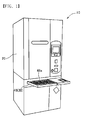
- the medication dispensing device 10 dispenses solid medications by wrapping the solid medications with an individual wrapping paper for each prescription.
- the medication dispensing device 10 has a rectangular parallelepiped main body 20.
- the medication dispensing device 10 includes a medication supply means 30, a medication preparation means 50, a medication counting means 60, and a medication wrapping means 80 within the main body 20.
- the medication supply means 30 is provided to store solid medications, and to properly discharge and supply the solid medications to the medication wrapping means 80 in accordance with a prescription.
- the medication supply means 30 includes a supply unit 32.
- the supply unit 32 functions to store and discharge the solid medications toward the medication preparation means 50 in accordance with a prescription.
- the medication preparation means 50 functions to collect the solid medications supplied from the supply unit 32 one package dose at a time, and to sequentially discharge the solid medications toward the medication wrapping means 80.
- the supply unit 32 includes a feeder type supply unit 36 and a manual spreader type supply unit 38 as a means for supplying the solid medications.
- the supply unit 32 includes a standby hopper 40, a collection hopper 42, and a manual spreading hopper 44.
- the feeder type supply unit 36 includes a plurality of cassette type medication feeders 46, so that the solid medications, which have been classified and prepared in advance in each of the medication feeders 46, can be discharged in accordance with a prescription.
- the standby hopper 40 is located below the feeder type supply unit 36.
- the standby hopper 40 may collect solid medications dispensed from each of the medication feeders 46 one package dose at a time, and then may discharge the solid medications at once.
- the solid medications discharged from the standby hopper 40 are supplied to the medication preparation means 50 one package dose at a time through the collection hopper 42 provided below the standby hopper 40.
- the spreader type supply unit 38 is prepared separately from the feeder type supply unit 36, in which like the feeder type supply unit 36, the spreader type supply unit 38 can supply the solid medications toward the medication preparation means 50.
- the manual spreader type supply unit 38 includes a manual spreading unit 48.
- the manual spreading unit 48 is always housed in the main body 20. However, as shown in FIG. 1 , the manual spreading unit 48 is adapted to be capable of being removed from the front side of the main body 20 to be used as desired. As shown in FIG. 1 , the manual spreading unit 48 is formed by installing a plurality of reception compartments (cells) 48a in a matrix form, each of which can receive solid medications one package dose at a time.
- the manual spreading unit 48 can supply the solid medications to the medication preparation means 50 one package dose at a time by opening the reception compartments 48a one by one.
- the manual spreading unit 48 is in a state in which the solid medications can be refilled in each of the reception compartments 48a when it is removed as shown in FIG. 1 .
- the manual spreading hopper 44 is positioned below the manual spreading unit 48, and the solid medications prepared in each of the reception compartments 48a can be supplied to the medication preparation means 50 through the manual spreading hopper 44 installed below the manual spreading unit 48.
- the medication preparation means 50 is arranged below the above-mentioned supply unit 32.
- the medication preparation means 50 can store the solid medications received from the medication supply means 30 through the above-mentioned collection hopper 42 or the manual spreading hopper 44 one package dose at a time, and can supply the solid medications toward the medication wrapping means 80.
- the medication preparation means 50 has a principal part configured by a section forming body 52, and also includes a driving source 53, a driving mechanism (not shown), a shutter opening/closing mechanism 54 and the like.
- the section forming body 52, the driving source 53 and the like of the medication preparation means 50 are received within a space between horizontally arranged top and bottom plates 51a and 51b (see FIG.
- inlet ports 51c and 51d are formed in the top plate 51a.
- An outlet port (not shown) is formed in the bottom plate 51b.
- the collection hopper 42 and the manual spreading hopper 44 of the medication supply means 30 as described above are connected to the inlet ports 51c and 51d, respectively.
- a supply hopper 58 is provided below the outlet port formed in the bottom plate 51b, so that the solid medications discharged from the outlet port can be supplied to the medication wrapping means 80.
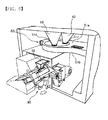
- the section forming body 52 has a substantially disk-shaped appearance, and is formed with plural (in the example of FIG. 3 , six) storage sections 55 at predetermined intervals along the circumference thereof.
- the section forming body 52 is adapted to be rotatable about the central axis 52a thereof by receiving power from a driving source 53 through a driving mechanism (not shown).
- the storage section 55 is adapted to feed solid medications, which are supplied from the medication supply means 30, through the inlet ports 51c and 51d formed in the top plate 51a.
- the section forming body 52 is horizontally installed at a position spaced slightly above the bottom plate 51b. The size of the gap formed between the section forming body 52 and the bottom plate 51b is determined to allow a dispensing means 68 of the medication counting means 60 to move back and forth.
- the dispensing means 65 of the medication counting means 60 will be described in detail below.
- each of the storage sections 55 is configured by a region surrounded on three sides by a bottom surface 55a inclined downward as extending from the center to the outside of the section forming body 52, and side surfaces 55b and 55c, in which a part corresponding to an opening 55d on the outer peripheral of the section forming body 52 is closed by a shutter 56.
- FIG. 3 does not show shutters 56 for other storage sections 55 except for the storage section 55 adjacent to an image recognizing and processing means 70 in FIG. 3
- the other storage sections 55 except the storage section 55 adjacent to the medication counting means 60 are also provided with the shutters 56, respectively.
- the shutter 56 is formed by fastening a shutter plate 56a to a support shaft 56b extending between the side surfaces 55b and 55c to be capable of being opened/closed.
- the shutter plate 56a is normally pressed in such a manner that the shutter 56 is flush with the outer periphery of the section forming body 52.
- the opening 55d is closed by the shutter plate 56a, so that solid medications can be prevented from being discharged from the storage section 55.
- the shutter plate 56a can be rotated about the support shaft 56b by pushing and rotating a lever 56c attached to a tip end of the support shaft 56b to open the opening 55d so as to allow the solid medications to be in a dischargeable state.
- a shutter opening/closing mechanism 54 is provided so as to allow the shutter plate 56a to be in the opened state by pushing and rotating the lever 56c provided for manipulating the shutter 56.
- the shutter opening/closing mechanism 54 includes a motor 54a having a rotation axle installed to protrude substantially horizontally, and a cam 54b attached to the rotation axle.
- the shutter opening/closing mechanism 54 is installed adjacent to a monitoring platform 62 or an vibration means 64, etc of the medication counting means 60, which will be described in detail below.
- the shutter opening/closing mechanism 54 When the shutter 56 (a storage section 55) arrives at a position facing the monitoring platform 62, the shutter opening/closing mechanism 54 operates the motor 54a to allow the cam 54b to come into contact with the lever 56c of the shutter 56 and to push and rotate the lever 56c of the shutter 56. Therefore, the individual storage sections 55 can be sequentially moved to the position facing the monitoring platform 62 by rotating the section forming body 52 about the central axis 52a, and at the same time, the shutter opening/closing mechanism 54 is operated to open the shutter plate 56a, so that the solid medications received in the individual storage sections 55 can be discharged toward the monitoring platform 62.
- the medication counting means 60 is provided to count and monitor the quantity of the solid medications prepared one package dose at a time in each of the storage sections 55 in the medication preparation means 50.
- the medication counting means 60 includes a monitoring platform 62, an vibration means 64, an imaging means 66, and a dispensing means 68.
- the medication counting means 60 further includes an image recognizing and processing means 70 in addition to the above-mentioned components.
- the monitoring platform 62 is provided at a position adj acent to the outer periphery of the section forming body 52 of the medication preparation means 50.
- the monitoring platform 62 is a table on which solid medications are discharged from each of the storage sections 55 of the section forming body 52, and is configured by a light-transmitting panel.
- the monitoring platform 62 can make the solid medications vibration as it reciprocates toward and away from the section forming body 52 in accordance with the operation of the vibration means 64.
- Protrusions 62a each of which extends in a string shape, are formed at predetermined intervals on the monitoring platform 62 in a direction intersecting (crossing substantially at right angles) the vibration direction of the monitoring platform 62.
- a recess 62b extending in the vibration direction of the monitoring platform 62 is formed between each two adjacent protrusions 62a and 62a.
- the width of the recess 62b i.e. the interval between adjacent protrusions 62a is determined to allow a solid medication with an ordinary size used in the medication dispensing device 10 to be introduced between the protrusions 62a and 62a.
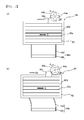
- the vibration means 64 includes a cam 64a (not shown in FIGs. 3 and 4 ), a motor 64b, an abutment member 64c, and a compression member 64d.
- the cam 64a is formed as a plate cam with a concavo-convex outer periphery, and adapted to be capable of being rotated by receiving power from the motor 64b installed at a side (at the inner side in FIG. 3 ) of the monitoring platform 62.
- the abutment member 64c is positioned on a side wall of the monitoring platform 62, and fixed to protrude from the monitoring platform 62 toward a side of the cam 64a.
- the compression member 64d has a leaf spring 64e and an anchoring part 64f, and is installed opposite (at the front side in FIG. 3 ) to the cam 64a and the motor 64b across the monitoring platform 62.
- the leaf spring 64e has a base end anchored to the anchoring part 64f, and a tip end anchored to the side wall of the monitoring platform 62.
- the leaf spring 64e is adapted to be bent when the monitoring platform 62 is moved toward the section forming body 52(in the direction indicated by arrow S1 in FIG. 5 ), and in the opposite direction (in the direction indicated by arrow S2 in FIG. 5 ), the leaf spring 64e is adapted to compress and push the monitoring platform 62 to return the monitoring platform 62 to its original position.
- glass fiber is preferably used as the material of the leaf spring 64e.
- the cam 64a When the motor 64b is operated, the cam 64a is rotated in the direction indicated by arrow R in FIG. 5 (in the clockwise direction). As a result, the surrounding surface of the abutment member 64c anchored to the monitoring platform 62 and the concave parts of the cam 64a are intermittently engaged with each other. While any of the convex parts of the cam 64a are abutting against the abutment member 64c, the monitoring platform 62 is compressed against the compressive force applied by the leaf spring 64e, and moved toward the section forming body 52 (in the direction indicated by arrow S1).
- the cam 64a and the abutment 64c intermittently repeat the engagement action, which causes the monitoring platform 62 to reciprocate in the directions indicated by arrow S (directions indicated by arrows S 1 and S2), so that the solid medications will be made to vibrate.
- the imaging means 66 includes a camera 66a, a mirror 66b and an illumination (not shown).
- the camera 66a may be formed by a conventionally well-known CCD (Charge Coupled Device) camera or the like.
- the camera 66a is fixed at a position laterally located in relation to the monitoring platform 62 and above the monitoring platform 62.
- the mirror 66b is arranged above the monitoring platform 62 so that the entirety of the monitoring platform 62 can be reflected in the mirror 66b.
- the illumination (not shown) has a light source configured by an LED, a fluorescent lamp or the like, and is adapted to emit light toward the mirror 66b from the lower side of the monitoring platform 62 toward the mirror 66b positioned above the monitoring platform 62.
- the imaging means 66 can image the entirety of the monitoring platform 62 using transmitted light illuminated through the mirror 66b.
- the camera 66a is electrically connected to the image recognizing and processing means 70, and is adapted to be capable of transferring image data photographed by the camera 66a to the image recognizing and processing means 70.
- the imaging means 66 is adapted to be capable of continuously imaging solid medications existing on the monitoring platform 62 multiple times in a state in which the monitoring platform 62 is vibrated.
- the dispensing means 68 is provided to brush off and discharge the solid medications laid on the monitoring platform 62 to a discharge port (not shown) installed below the section forming body 52.
- the dispensing means 68 includes a power source 68a, a power transfer mechanism 68b, a sliding movement body 68c, and guide frames 68d.
- the power source 68a may be configured by a conventionally well-known motor or the like.
- the power transfer mechanism 68b may be configured by a conventionally well-known link mechanism or the like, and adapted to transfer power produced by the power source 68a to the sliding movement body 68c so as to linearly reciprocate the sliding movement body 68c.
- the sliding movement body 68c is formed by a rectangular sheet metal having a length substantially equal to that of the monitoring platform 62. Upon receiving the power through the power transfer mechanism 68b, the sliding movement body 68c is guided by the guide frames 68d arranged along the opposite sides thereof in such a manner that the sliding movement body 68c can be reciprocated toward and away from the section forming body 52 on the monitoring platform 62.
- the sliding movement body 68c is normally positioned out of the monitoring platform 62, and prevents the solid medications from falling off the monitoring platform 62.
- the sliding movement body 68c is slid on the monitoring platform 62 as indicated by arrow T in FIG. 3 to push the solid medications existing on the monitoring platform 62 to the lower side of the section forming body 52 so that the solid medication can be discharged through the discharge port (not shown).
- the image recognizing and processing means 70 can count the quantity of the solid medications by analyzing images photographed by the imaging means 66.
- the image recognizing and processing means 70 may be configured by a conventionally well-known personal computer or the like. As shown in the flowchart of FIG. 8 , the image recognizing and processing means 70 can count the number of the solid medications reflected in the images after passing through various processes from an image acquisition process related to step 1 to a counting process related to step 11.
- imaging by the imaging means 66 is conducted a plural number of times (ten times in the present embodiment) while the monitoring platform 62 is being vibrated as the vibration means 64 is operated as described above.
- the image recognizing and processing means 70 repeats processes associated with steps 1 to 11 (hereinafter, the processes may be referred to as a "counting process") in relation to the plural images (in the present embodiment, ten images) acquired by the imaging means 66, and conducts counting of the solid medications based on each of the images. In addition, on the basis of the results obtained thereby, the image recognizing and processing means 70 can finally determine the number of the solid medications in step 13.
- the control flow shifts into the position correction process of step 2.
- the position correction process the deviations between the positions of the monitoring platform 62 contained in the images acquired in step 1 and the position (reference position) of the monitoring platform 62 prior to being vibrated are detected, and the position information of the acquired images is corrected on the basis of the detection results.
- a counting error of solid medications caused by positional deviations can be prevented in the following processes.
- step 2 When step 2 is completed, the process shifts into the concentration correction process of step 3.
- the concentration correction process is performed in consideration of the fact that as the brightness of the illumination 66c may be deteriorated or unstable due to the life or a minute change of an LED, the brightness of the images acquired by imaging may be possibly unstable.
- the concentration correction process the brightness of the same region in photographed images are compared and calculated with reference to the brightness at a predetermined time point, and correction is performed as desired.
- the images concentration-corrected in the step 3 are mask-processed in the mask-processing process of step 4.
- the mask-processing process is a process for deleting unnecessary regions from the concentration-corrected images using a mask image, in which the mask image is prepared by coloring an unnecessary part as black in an image previously obtained by imaging the monitoring platform 62.
- the mask-processing is conducted by overlapping the above-mentioned mask image on each of the concentration-corrected images acquired in step 3, and deleting the part overlapped with the black region of the mask image while not processing the part overlapped with white region.
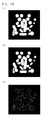
- An image (a mask-processed image) obtained in step 4 is as shown in FIG. 9b , and further processed in a background removal process of step 5.
- an image (a background-removed image) as shown in FIG. 9c is obtained by extracting only an image of solid medications from the mask-processed image.
- Both of the transparent solid medications reflected with a low concentration and the solid medications reflected with a high concentration in the background-removed image as shown in FIG. 9c are sometimes expressed as black in a simple binary image.
- the central part of a transparent solid medication is sometimes expressed as white in a simple binary image as shown in FIG. 9d , which may possibly cause a problem in the following processing.
- image processing is further performed in the binarization process so as to acquire an image (binary composite image) in which parts corresponding to solid medications are entirely expressed as black.
- a binary difference image (see FIG. 9e ) is further acquired by binarizing the background-removed image using two concentration values (in the present embodiment, concentration values 150 and 250) as thresholds.
- a binary composite image (see FIG. 9f ) is acquired by extracting the black region surrounded by white from the binary difference image, and composing the black region with the above-mentioned simple binary image. If a binary composite image is acquired thereby, the process proceeds to a reversing process of step 7. In the reversing process, the black and white colors in the binary composite image are reversed for labeling processing to be subsequently performed. As such, a reverse image as shown in FIG. 10a is acquired.
- step 8 a task for removing noise (foreign matter) contained in the image or separating one or more parts in which the solid medications are shown as being connected with each other is performed by cutting the parts expressed as white in the reverse image along the peripheries thereof.
- step 8 is completed, a contraction image as shown in FIG. 10b is obtained, and the process proceeds to a labeling process of step 9.
- individual features are extracted for each of the parts expressed as white in the contraction image. Specifically, features, such as positions, sizes, areas and centers of the white parts, are extracted.
- step 9 If labeling is performed in step 9, the process proceeds to a contour extraction process of step 10.
- contours forming peripheries of the solid medications and gaps among the solid medications are extracted on the basis of information obtained in step 9. Thereby, a contour image as shown in FIG. 10c is obtained. Then, the process proceeds to a count process shown in step 11.
- the number (X) in the case of FIG. 11a is determined as three (3) through the calculation based on Equation 2 below.
- the numbers (X) in the case of FIGs. 11b and 11c are determined as three and four in accordance with Equation 3 and Equation 4, respectively.
- 4 + 6 / 2 - 2 - 1 4 E / A
- step 13 the largest number among the counted numbers obtained by repeating steps 1 to 11 plural times is determined as the number of the solid medications in step 13.
- the medication dispensing device 10 of the present embodiment can monitor whether a correct quantity of solid medications are dispensed by comparing the quantity of solid medications of one package dose (hereinafter, the quantity is also referred to as a "count value") determined by counting of the medication counting means 60 with the quantity of solid medications of one package dose based on prescription data sent to the medication dispensing device 10 as prescription information (hereinafter, the quantity is also referred to as a "set value").
- the quantity is also referred to as a "set value"
- monitoring can be conducted in accordance with a method set forth below.
- N for example, N > 2
- n images for example, n > 5
- counting is conducted for each of the photographed images
- the medication dispensing device 10 of the present embodiment operates the discharge means 68, so that solid medications laid on the monitoring platform 62 are dispensed to the bottom side of the section forming body 52 by the sliding movement body 68c. Thereafter, the solid medications are fed from the discharge port (not shown) to the medication wrapping means 80 through the discharge hopper 58.
- the medication separate-wrapping device 80 is installed below the medication preparation means 50.
- the medication separate-wrapping device 80 may be removed as indicated by an arrow in FIG. 6 for maintenance and administration, in which the medication separate-wrapping device 80 is typically positioned directly under the medication preparation means 50.
- the medication separate-wrapping device 80 can dispense the solid medications supplied through the discharge hopper 58 one package dose at a time to the outside of the main body 20.
- the medication dispensing device 10 of the present embodiment is configured to directly image solid medications discharged to the monitoring platform 62 from the storage section 55 of the medication preparation means 50 without an individual wrapping paper or the like. For this reason, in the medication dispensing device 10, there is not caused deterioration in counting precision that is caused when an individual wrapping paper or characters or the like printed on the individual wrapping paper is reflected in the image.
- the solid medications are pressed when they are discharged from the medication preparation means 50, and spread on the monitoring platform 62.
- the monitoring platform 62 is vibrated horizontally by the vibration means 64 when the medications are imaged, which causes individual solid medications to be widely spread on the monitoring platform 62. Therefore, there is a small possibility of imaging the medications in the overlapped or contacted state, which makes it possible to count the number of the solid medications correctly.
- the vibration means 64 reciprocates the monitoring platform 62 horizontally to afford vibration to the solid medications, it is easy for the solid medications to be smoothly spread on the monitoring platform 62 under the influence of differences in center of gravity between of the individual solid medications, inertia applied to the solid medications and the like.
- the solid medications are guided by the protrusions 62a to reciprocate on the monitoring platform 62, and are easily separated from each other by the protrusions 62a as boundaries. Therefore, with the above-mentioned construction, it is possible to restrain the occurrence of faulty counting due to the overlap of solid medications.
- the vibration means 64 vibrates in the direction toward and away from the section forming body 52, i.e. in the direction following the dispensing direction of solid medications dispensed from the storage section 55, and the grooves 62b are formed by the protrusions 62a extending in the corresponding direction
- the present invention is not limited to this. Specifically, it is sufficient if the vibration means 64 vibrates horizontally.
- the vibration means may reciprocate in a direction crossing the dispensing direction to make the solid medications vibrate.
- the protrusions 62a may extend likewise in relation to the dispensing direction.
- the protrusions 62a may be formed in proper shapes or forms.
- each of the protrusions 62a by providing bumps arranged side by side in a row rather than extending in series.
- the protrusions 62a may be formed by providing the bumps in a dot shape or a net shape on the whole or a part of the monitoring platform 62.
- the medication dispensing device 10 is configured to image solid medications dispensed one package dose at a time to the monitoring platform 62 plural times by the imaging means 66, and to conduct image analysis for each of the plural images (ten images in the above-mentioned embodiment) obtained by imaging the solid medications to determine the quantity of the solid medications.
- the largest one among the quantities determined from the plural images is recognized as the quantity of the solid medications associated with the corresponding prescription. As a result, it is possible to more reliably prevent the occurrence of faulty counting caused by misrecognizing plural medications as a single mass.
- the present invention is not limited to this. Specifically, it is possible to conduct imaging only once under the circumstance of vibrating the monitoring platform 62, and to analyze the image obtained thereby to determine the number of solid medications. In addition, it is also possible to determine the number of solid medications using only some of the images photographed under the circumference of vibrating the monitoring platform 62.
- the medication dispensing device 10 it is possible to sequentially rotate the disk-shaped section forming body 52 about the central axis 52a to move each of the storage sections 55 to a position adjacent to the monitoring platform 62, so that the solid medications received in each of the storage sections 55 can be discharged to the monitoring platform 62. Therefore, with the construction of the medication dispensing device 10, it is needless to install the monitoring platform 62 at each of the storage sections 55, which makes it possible to make the construction of the device compact. Although it was exemplified in the above-mentioned embodiment that the monitoring platform 62 is positioned adjacent to the outer periphery of the section forming body 52, the present invention is not limited to this.
- the section forming body 52 is formed in a donut shape, it is possible to install the monitoring platform 62 at the central space, i.e. a position adjacent to the inner periphery of the section forming body 52, so that solid medications can be dispensed to the monitoring platform 62 from each of the storage sections 55.
- each of the storage sections 55 can be moved to the position adjacent to the monitoring platform 62 as the section forming body 52 is rotated, the present invention is not limited to this.
- a camera 66a forming the imaging means 66 is installed at a position adjacent to the monitoring platform 62, and the image of the monitoring platform 62 reflected in the mirror 66b is adapted to be capable of being photographed by the camera 66a
- the present invention is not limited to this, and it is possible to make the camera 66a photograph the solid medications on the monitoring platform 62 without the mirror 66b.
- the height of the medication dispensing device 10 may be possibly increased, it is possible to simplify the construction of the device because the mirror 66b may not be installed.
Landscapes
- Physics & Mathematics (AREA)
- General Physics & Mathematics (AREA)
- Health & Medical Sciences (AREA)
- Life Sciences & Earth Sciences (AREA)
- Animal Behavior & Ethology (AREA)
- General Health & Medical Sciences (AREA)
- Public Health (AREA)
- Veterinary Medicine (AREA)
- Engineering & Computer Science (AREA)
- Mechanical Engineering (AREA)
- Medical Preparation Storing Or Oral Administration Devices (AREA)
Abstract
Description
- The present invention relates to a medication dispensing device that can dispense and individually wrap solid medications to be suitable for a prescription, and more particularly to a medication dispensing device that can monitor the quantity of solid medications prepared for dispensing.
- A medication dispensing device as disclosed in patent document below was proposed in the prior art. The medication dispensing device as disclosed in the patent document below is adapted to be capable of individually wrapping and supplying granulated or capsulated solid medications one package dose at a time with an individual wrapping paper. In addition, the medication dispensing device related to the patent document below is configured to be capable of imaging solid medications in a state in which the solid medications are wrapped with an individual wrapping paper, and monitoring the quantity of the solid medications based on an image obtained thereby.
- Japanese Patent Laid-open Publication
H7-200770 - As described above, in the medication dispensing device related to the patent document, solid medications are imaged in the state in which they are separately wrapped with an individual wrapping paper. As a result, plural solid medications are apt to be imaged in a state that they overlap and in contact with each other in the individual wrapping paper. Due to this, with the prior art technology, there is a problem in that unless an image processing is conducted by an image recognition means, plural solid medications may be erroneously recognized as a single mass, which may highly possibly result in incorrect determination of the quantity of the solid medications. Furthermore, in the prior art, counting is based on the image of the solid medications imaged outside the individual wrapping paper, which causes the individual wrapping paper to be interposed and causes characters or the like printed on the individual wrapping paper to be reflected in the image, so that the precision of the image may be deteriorated to such an extent that precision in counting may also be deteriorated.
- Therefore, the object of the present invention is to provide a medication dispensing device that can properly monitor the quantity of solid medications without making a counting mistake due to overlap or contact among the solid medications or the existence of an individual wrapping paper.
- A medication dispensing device in accordance with the present invention has been made to solve the above-mentioned problems, and includes: a medication supply means that can supply medications to be suitable for a prescription; a medication preparation means having a storage section that can store and discharge the solid medications supplied from the medication supply means one package dose at a time; and a counting means that can count the quantity of the solid medications discharged from the storage section. In the inventive medication dispensing device, the counting means includes: a medication monitoring platform on which the solid medications discharged from the storage section is laid; an vibration means that can vibrate the medication monitoring platform horizontally; an imaging means that can image the solid medications on the medication monitoring platform that has been vibrated; and an image recognizing and processing means that can count the number of the solid medications on the basis of an image obtained by the imaging means. In addition, the inventive medication dispensing device is preferably configured to perform quantity monitoring by comparing the quantity of the solid medications counted by the image recognizing and processing means with the quantity of the solid medications based on prescription data and to be dispensed as one package dose from a tablet separate-wrapping device.
- The inventive medication dispensing device preferably employs an vibration means that can reciprocate the medication monitoring platform horizontally to vibrate the medication monitoring platform, as the vibration means. In addition, the inventive medication dispensing device may be configured in such a manner that the imaging means can image the solid medications discharged as one package dose to the medication monitoring platform a plural number of times while the medication monitoring platform is vibrating. In such a case, the inventive medication dispensing device may be configured to count the quantity of solid medications by the image recognizing and processing means for each of the plural images obtained by imaging the solid medications related to the same prescription, and the largest one among the quantities of the solid medications obtained as a result of counting is recognized as the quantity of the solid medications related to a corresponding prescription.
- The inventive medication dispensing device preferably includes: a plurality of grooves which are formed on the bottom of the medication monitoring platform by protrusions and/or recesses extending in a direction following the vibration direction of the medication monitoring platform and are arranged in a direction crossing the vibration direction. In addition, the inventive medication dispensing device may be configured in such a manner that the medication monitoring platform is installed at a position adjacent to an inner or outer periphery of the medication preparation means, and that the medication preparation means is provided with a plurality of storage sections installed side by side in the circumferential direction thereof, and is configured to move each of the storage sections to a position facing the medication monitoring platform so that the solid medication can be discharged from each of the storage sections to the medication monitoring platform.
- Since the medication dispensing device is configured to directly image solid medications discharged from the storage sections of the medication preparation means to the medication monitoring platform rather than imaging the solid medication outside an individual wrapping paper as in the prior art, there is not caused deterioration in an image or in precision of counting due to the interposition of the individual wrapping paper or characters printed on the individual wrapping paper reflected in the image.
- In the medication dispensing device, because the solid medications are compressed when they are discharged from the medication preparation means, and spread on the medication monitoring platform, it is more difficult for the medications to overlap or in contact with each other as compared to the case in which the medications are imaged in the wrapped state. In addition, the medication dispensing device is configured to be capable of vibrating the medication monitoring platform horizontally by the vibration means. Therefore, it interacts with difference in rolling easiness or rolling method due to a difference in shape or center of gravity between individual solid medications, so that the individual solid medications are scattered and rolled to be widely spread on the medication monitoring platform. In the inventive medication dispensing device, since the solid medications are imaged by the imaging means in the state in which the medication monitoring platform is vibrated, overlap or contact among the solid medications cannot occur in an image obtained for counting. Therefore, the inventive medication dispensing device makes it possible to count the number of the solid medications correctly on the basis of the image obtained by the imaging means.
- In addition, in the inventive medication dispensing device, it is possible to monitor the quantity of solid medications by comparing the quantity of solid medications counted by the image recognizing and processing means and the quantity of solid medications based on prescription data and to be dispensed as one package dose from the tablet separate-wrapping means.
- In the inventive medication dispensing device, when an vibration means configured to reciprocate the medication monitoring platform horizontally is employed, solid medications are facilitated to be smoothly spread on the medication monitoring platform under the influence of a difference in shape and center of gravity between the individual solid medications, a difference in inertia applied to the solid medications and the like. Therefore, it is possible to prevent the occurrence of a counting mistake due to overlap among the solid medications by configuring the medication monitoring platform to be reciprocated horizontally by the vibrating means.
- Here, it is believed that when the medication monitoring platform is vibrated as described above, solid medications overlapping or in contact with each other are gradually moved away from each other under the influence of the vibration, so that the solid medications are positioned in a state in which they can be counted as individually separated ones. Therefore, as in the inventive medication dispensing device, if the imaging means is adapted to image solid medications dispensed as one package dose to the medication monitoring platform a plural number of times while the medication monitoring platform is being vibrated, and the largest one among the quantities of the solid medications counted by the image recognizing and processing means on the basis of the plural images obtained thereby is adapted to be recognized as the quantity of the solid medications related to a corresponding prescription, it is possible to more reliably prevent the occurrence of a counting mistake.
- In addition, as in the inventive medication dispensing device, if a plurality of grooves formed on the bottom of the medication monitoring platform by protrusions and/or recesses extending in a direction following the vibration direction of the medication monitoring platform are arranged in a direction crossing the vibration direction, solid medications can be guided by the grooves to be smoothly spread on the medication monitoring platform. Therefore, if grooves formed by protrusions or recesses as described above are provided, it is possible to more reliably prevent a counting mistake of solid medications.
- In addition, the width of each of the above-mentioned grooves in the present invention (the length in a groove in the direction crossing the vibration direction) can be properly set so that an interval suitable for guiding the solid medications can be provided, and can be set with reference to, for example, a size of an ordinary solid medication used in prescription.
- The inventive medication dispensing device employs a plurality of storage sections arranged side by side in the circumferential direction as the medication preparation means, and provides the medication monitoring platform at a position adjacent to the outer or inner periphery of the medication preparation means. In addition, the inventive medication dispensing device is configured to move each of the storage sections to a position facing the medication monitoring platform, so that the solid medications can be discharged from each of the storage sections to the medication monitoring platform. Therefore, in the inventive dispensing device, it is needless to provide the medication monitoring platform at each of the storage sections, which makes it possible to provide a compact construction even though the medication monitoring platform is provided.
-
- FIG. 1
- is a perspective view showing an external appearance of a medication dispensing device in accordance with an embodiment of the present invention;
- FIG. 2
- is an illustrative view schematically showing the internal construction of the medication dispensing device of
FIG. 1 ; - FIG. 3
- is a perspective view showing the constructions of a medication preparation means and a medication counting means;
- FIG. 4
- is a perspective view showing a main part of
FIG. 3 in an enlarged scale; - FIGs. 5a and 5b
- are illustrative views schematically showing the operating state of a vibration means;
- FIG. 6
- is a perspective view showing a medication preparation means and a medication wrapping means;
- FIG. 7
- is a block diagram showing a construction of a medication counting means;
- FIG. 8
- is a flowchart of an operation when solid medications are counted by the medication counting means;
- FIG. 9
- shows images obtained at individual processes when solid medications are counted by the medication counting means, in which
FIG. 9a shows a concentration-corrected image,FIG. 9b shows a mask-processed image,FIG. 9c is a background-removed image,FIG. 9d is a simple binary image,FIG. 9e is a binary difference image, andFIG. 9f shows a binary composite image; - FIG. 10
- shows images obtained at individual processes when the solid medications are counted by the medication counting means, in which
FIG. 10a shows a reverse image,FIG. 10b shows a contraction image, andFIG. 10c shows a contour image; and - FIGs. 11a to 11c
- are illustrative views showing examples of contour images obtained when solid medications are counted by the medication counting means, respectively.
- Hereinafter, a
medication dispensing device 10 in accordance with an embodiment of the present invention will be described with reference to the accompanying drawings. Themedication dispensing device 10 dispenses solid medications by wrapping the solid medications with an individual wrapping paper for each prescription. As shown inFIG. 1 , themedication dispensing device 10 has a rectangular parallelepipedmain body 20. As shown inFIG. 2 , themedication dispensing device 10 includes a medication supply means 30, a medication preparation means 50, a medication counting means 60, and a medication wrapping means 80 within themain body 20. - The medication supply means 30 is provided to store solid medications, and to properly discharge and supply the solid medications to the medication wrapping means 80 in accordance with a prescription. The medication supply means 30 includes a
supply unit 32. Thesupply unit 32 functions to store and discharge the solid medications toward the medication preparation means 50 in accordance with a prescription. In addition, the medication preparation means 50 functions to collect the solid medications supplied from thesupply unit 32 one package dose at a time, and to sequentially discharge the solid medications toward the medication wrapping means 80. - Specifically, as shown in
FIG. 2 , thesupply unit 32 includes a feedertype supply unit 36 and a manual spreadertype supply unit 38 as a means for supplying the solid medications. In addition to these, thesupply unit 32 includes astandby hopper 40, acollection hopper 42, and a manual spreadinghopper 44. The feedertype supply unit 36 includes a plurality of cassettetype medication feeders 46, so that the solid medications, which have been classified and prepared in advance in each of themedication feeders 46, can be discharged in accordance with a prescription. Thestandby hopper 40 is located below the feedertype supply unit 36. Thestandby hopper 40 may collect solid medications dispensed from each of themedication feeders 46 one package dose at a time, and then may discharge the solid medications at once. The solid medications discharged from thestandby hopper 40 are supplied to the medication preparation means 50 one package dose at a time through thecollection hopper 42 provided below thestandby hopper 40. - In addition, the spreader
type supply unit 38 is prepared separately from the feedertype supply unit 36, in which like the feedertype supply unit 36, the spreadertype supply unit 38 can supply the solid medications toward the medication preparation means 50. The manual spreadertype supply unit 38 includes a manual spreadingunit 48. The manual spreadingunit 48 is always housed in themain body 20. However, as shown inFIG. 1 , the manual spreadingunit 48 is adapted to be capable of being removed from the front side of themain body 20 to be used as desired. As shown inFIG. 1 , the manual spreadingunit 48 is formed by installing a plurality of reception compartments (cells) 48a in a matrix form, each of which can receive solid medications one package dose at a time. The manual spreadingunit 48 can supply the solid medications to the medication preparation means 50 one package dose at a time by opening the reception compartments 48a one by one. The manual spreadingunit 48 is in a state in which the solid medications can be refilled in each of the reception compartments 48a when it is removed as shown inFIG. 1 . In addition, when the manual spreadingunit 48 is received in the main body of themedication dispensing device 10, the manual spreadinghopper 44 is positioned below the manual spreadingunit 48, and the solid medications prepared in each of the reception compartments 48a can be supplied to the medication preparation means 50 through the manual spreadinghopper 44 installed below the manual spreadingunit 48. - As shown in
FIG. 2 , the medication preparation means 50 is arranged below the above-mentionedsupply unit 32. The medication preparation means 50 can store the solid medications received from the medication supply means 30 through the above-mentionedcollection hopper 42 or the manual spreadinghopper 44 one package dose at a time, and can supply the solid medications toward the medication wrapping means 80. Specifically, as shown inFIG. 3 , the medication preparation means 50 has a principal part configured by asection forming body 52, and also includes a drivingsource 53, a driving mechanism (not shown), a shutter opening/closing mechanism 54 and the like. Thesection forming body 52, the drivingsource 53 and the like of the medication preparation means 50 are received within a space between horizontally arranged top andbottom plates FIG. 6 ). As shown inFIG. 6 ,inlet ports top plate 51a. An outlet port (not shown) is formed in thebottom plate 51b. Thecollection hopper 42 and the manual spreadinghopper 44 of the medication supply means 30 as described above are connected to theinlet ports supply hopper 58 is provided below the outlet port formed in thebottom plate 51b, so that the solid medications discharged from the outlet port can be supplied to the medication wrapping means 80. - As shown in
FIG. 3 , thesection forming body 52 has a substantially disk-shaped appearance, and is formed with plural (in the example ofFIG. 3 , six)storage sections 55 at predetermined intervals along the circumference thereof. Thesection forming body 52 is adapted to be rotatable about thecentral axis 52a thereof by receiving power from a drivingsource 53 through a driving mechanism (not shown). Thestorage section 55 is adapted to feed solid medications, which are supplied from the medication supply means 30, through theinlet ports top plate 51a. In addition, thesection forming body 52 is horizontally installed at a position spaced slightly above thebottom plate 51b. The size of the gap formed between thesection forming body 52 and thebottom plate 51b is determined to allow a dispensing means 68 of the medication counting means 60 to move back and forth. The dispensing means 65 of the medication counting means 60 will be described in detail below. - As shown in
FIGs. 3 and4 , each of thestorage sections 55 is configured by a region surrounded on three sides by abottom surface 55a inclined downward as extending from the center to the outside of thesection forming body 52, and side surfaces 55b and 55c, in which a part corresponding to anopening 55d on the outer peripheral of thesection forming body 52 is closed by ashutter 56. AlthoughFIG. 3 does not showshutters 56 forother storage sections 55 except for thestorage section 55 adjacent to an image recognizing and processing means 70 inFIG. 3 , theother storage sections 55 except thestorage section 55 adjacent to the medication counting means 60 are also provided with theshutters 56, respectively. - The
shutter 56 is formed by fastening ashutter plate 56a to asupport shaft 56b extending between the side surfaces 55b and 55c to be capable of being opened/closed. Theshutter plate 56a is normally pressed in such a manner that theshutter 56 is flush with the outer periphery of thesection forming body 52. As a result, theopening 55d is closed by theshutter plate 56a, so that solid medications can be prevented from being discharged from thestorage section 55. In addition, theshutter plate 56a can be rotated about thesupport shaft 56b by pushing and rotating alever 56c attached to a tip end of thesupport shaft 56b to open theopening 55d so as to allow the solid medications to be in a dischargeable state. - A shutter opening/
closing mechanism 54 is provided so as to allow theshutter plate 56a to be in the opened state by pushing and rotating thelever 56c provided for manipulating theshutter 56. As shown inFIG. 4 , the shutter opening/closing mechanism 54 includes amotor 54a having a rotation axle installed to protrude substantially horizontally, and acam 54b attached to the rotation axle. The shutter opening/closing mechanism 54 is installed adjacent to amonitoring platform 62 or an vibration means 64, etc of the medication counting means 60, which will be described in detail below. When the shutter 56 (a storage section 55) arrives at a position facing themonitoring platform 62, the shutter opening/closing mechanism 54 operates themotor 54a to allow thecam 54b to come into contact with thelever 56c of theshutter 56 and to push and rotate thelever 56c of theshutter 56. Therefore, theindividual storage sections 55 can be sequentially moved to the position facing themonitoring platform 62 by rotating thesection forming body 52 about thecentral axis 52a, and at the same time, the shutter opening/closing mechanism 54 is operated to open theshutter plate 56a, so that the solid medications received in theindividual storage sections 55 can be discharged toward themonitoring platform 62. - The medication counting means 60 is provided to count and monitor the quantity of the solid medications prepared one package dose at a time in each of the
storage sections 55 in the medication preparation means 50. As shown inFIGs. 3 and4 , the medication counting means 60 includes amonitoring platform 62, an vibration means 64, an imaging means 66, and a dispensing means 68. As shown inFIG. 7 , the medication counting means 60 further includes an image recognizing and processing means 70 in addition to the above-mentioned components. Themonitoring platform 62 is provided at a position adj acent to the outer periphery of thesection forming body 52 of the medication preparation means 50. Themonitoring platform 62 is a table on which solid medications are discharged from each of thestorage sections 55 of thesection forming body 52, and is configured by a light-transmitting panel. - As indicated by arrow S in
FIGs. 3 and4 , themonitoring platform 62 can make the solid medications vibration as it reciprocates toward and away from thesection forming body 52 in accordance with the operation of the vibration means 64.Protrusions 62a, each of which extends in a string shape, are formed at predetermined intervals on themonitoring platform 62 in a direction intersecting (crossing substantially at right angles) the vibration direction of themonitoring platform 62. As a result, arecess 62b extending in the vibration direction of themonitoring platform 62 is formed between each twoadjacent protrusions recess 62b, i.e. the interval betweenadjacent protrusions 62a is determined to allow a solid medication with an ordinary size used in themedication dispensing device 10 to be introduced between theprotrusions - As shown in
FIG. 5 , the vibration means 64 includes acam 64a (not shown inFIGs. 3 and4 ), amotor 64b, anabutment member 64c, and acompression member 64d. Thecam 64a is formed as a plate cam with a concavo-convex outer periphery, and adapted to be capable of being rotated by receiving power from themotor 64b installed at a side (at the inner side inFIG. 3 ) of themonitoring platform 62. Theabutment member 64c is positioned on a side wall of themonitoring platform 62, and fixed to protrude from themonitoring platform 62 toward a side of thecam 64a. In addition, thecompression member 64d has aleaf spring 64e and an anchoringpart 64f, and is installed opposite (at the front side inFIG. 3 ) to thecam 64a and themotor 64b across themonitoring platform 62. Theleaf spring 64e has a base end anchored to the anchoringpart 64f, and a tip end anchored to the side wall of themonitoring platform 62. Theleaf spring 64e is adapted to be bent when themonitoring platform 62 is moved toward the section forming body 52(in the direction indicated by arrow S1 inFIG. 5 ), and in the opposite direction (in the direction indicated by arrow S2 inFIG. 5 ), theleaf spring 64e is adapted to compress and push themonitoring platform 62 to return themonitoring platform 62 to its original position. In order for theleaf spring 64e to exhibit the bending and compressing functions more efficiently, glass fiber is preferably used as the material of theleaf spring 64e. - When the
motor 64b is operated, thecam 64a is rotated in the direction indicated by arrow R inFIG. 5 (in the clockwise direction). As a result, the surrounding surface of theabutment member 64c anchored to themonitoring platform 62 and the concave parts of thecam 64a are intermittently engaged with each other. While any of the convex parts of thecam 64a are abutting against theabutment member 64c, themonitoring platform 62 is compressed against the compressive force applied by theleaf spring 64e, and moved toward the section forming body 52 (in the direction indicated by arrow S1). Meanwhile, if thecam 64a is further rotated, the compressive force applied to theabutment member 64c by thecam 64a is released, and themonitoring platform 62 is moved away from the section forming body 52 (in the direction indicated by arrow S2) under the influence of the compressive force of theleaf spring 64e to such an extent that one of the concave parts of thecam 64a is engaged with theabutment member 64c. As such, thecam 64a and theabutment 64c intermittently repeat the engagement action, which causes themonitoring platform 62 to reciprocate in the directions indicated by arrow S (directions indicated byarrows S 1 and S2), so that the solid medications will be made to vibrate. - The imaging means 66 includes a
camera 66a, amirror 66b and an illumination (not shown). Thecamera 66a may be formed by a conventionally well-known CCD (Charge Coupled Device) camera or the like. Thecamera 66a is fixed at a position laterally located in relation to themonitoring platform 62 and above themonitoring platform 62. Themirror 66b is arranged above themonitoring platform 62 so that the entirety of themonitoring platform 62 can be reflected in themirror 66b. In addition, the illumination (not shown) has a light source configured by an LED, a fluorescent lamp or the like, and is adapted to emit light toward themirror 66b from the lower side of themonitoring platform 62 toward themirror 66b positioned above themonitoring platform 62. Therefore, the imaging means 66 can image the entirety of themonitoring platform 62 using transmitted light illuminated through themirror 66b. Thecamera 66a is electrically connected to the image recognizing and processing means 70, and is adapted to be capable of transferring image data photographed by thecamera 66a to the image recognizing and processing means 70. The imaging means 66 is adapted to be capable of continuously imaging solid medications existing on themonitoring platform 62 multiple times in a state in which themonitoring platform 62 is vibrated. - The dispensing means 68 is provided to brush off and discharge the solid medications laid on the
monitoring platform 62 to a discharge port (not shown) installed below thesection forming body 52. The dispensing means 68 includes apower source 68a, apower transfer mechanism 68b, a slidingmovement body 68c, and guideframes 68d. Thepower source 68a may be configured by a conventionally well-known motor or the like. In addition, thepower transfer mechanism 68b may be configured by a conventionally well-known link mechanism or the like, and adapted to transfer power produced by thepower source 68a to the slidingmovement body 68c so as to linearly reciprocate the slidingmovement body 68c. - The sliding
movement body 68c is formed by a rectangular sheet metal having a length substantially equal to that of themonitoring platform 62. Upon receiving the power through thepower transfer mechanism 68b, the slidingmovement body 68c is guided by the guide frames 68d arranged along the opposite sides thereof in such a manner that the slidingmovement body 68c can be reciprocated toward and away from thesection forming body 52 on themonitoring platform 62. The slidingmovement body 68c is normally positioned out of themonitoring platform 62, and prevents the solid medications from falling off themonitoring platform 62. In addition, the slidingmovement body 68c is slid on themonitoring platform 62 as indicated by arrow T inFIG. 3 to push the solid medications existing on themonitoring platform 62 to the lower side of thesection forming body 52 so that the solid medication can be discharged through the discharge port (not shown). - The image recognizing and processing means 70 can count the quantity of the solid medications by analyzing images photographed by the imaging means 66. The image recognizing and processing means 70 may be configured by a conventionally well-known personal computer or the like. As shown in the flowchart of
FIG. 8 , the image recognizing and processing means 70 can count the number of the solid medications reflected in the images after passing through various processes from an image acquisition process related tostep 1 to a counting process related to step 11. In the present embodiment, imaging by the imaging means 66 is conducted a plural number of times (ten times in the present embodiment) while themonitoring platform 62 is being vibrated as the vibration means 64 is operated as described above. The image recognizing and processing means 70 repeats processes associated withsteps 1 to 11 (hereinafter, the processes may be referred to as a "counting process") in relation to the plural images (in the present embodiment, ten images) acquired by the imaging means 66, and conducts counting of the solid medications based on each of the images. In addition, on the basis of the results obtained thereby, the image recognizing and processing means 70 can finally determine the number of the solid medications in step 13. - More specifically, when the counting of the solid medications is conducted by the image recognizing and processing means 70, images photographed by the imaging means 66 are firstly acquired in the image acquisition process of
step 1. Then, the control flow shifts into the position correction process ofstep 2. In the position correction process, the deviations between the positions of themonitoring platform 62 contained in the images acquired instep 1 and the position (reference position) of themonitoring platform 62 prior to being vibrated are detected, and the position information of the acquired images is corrected on the basis of the detection results. As such, a counting error of solid medications caused by positional deviations can be prevented in the following processes. - When
step 2 is completed, the process shifts into the concentration correction process ofstep 3. The concentration correction process is performed in consideration of the fact that as the brightness of the illumination 66c may be deteriorated or unstable due to the life or a minute change of an LED, the brightness of the images acquired by imaging may be possibly unstable. In the concentration correction process, the brightness of the same region in photographed images are compared and calculated with reference to the brightness at a predetermined time point, and correction is performed as desired. - The images concentration-corrected in the step 3 (see
FIG. 9a ) are mask-processed in the mask-processing process of step 4. The mask-processing process is a process for deleting unnecessary regions from the concentration-corrected images using a mask image, in which the mask image is prepared by coloring an unnecessary part as black in an image previously obtained by imaging themonitoring platform 62. The mask-processing is conducted by overlapping the above-mentioned mask image on each of the concentration-corrected images acquired instep 3, and deleting the part overlapped with the black region of the mask image while not processing the part overlapped with white region. An image (a mask-processed image) obtained in step 4 is as shown inFIG. 9b , and further processed in a background removal process ofstep 5. In the background removal process, an image (a background-removed image) as shown inFIG. 9c is obtained by extracting only an image of solid medications from the mask-processed image. - If background-removed images are obtained in
step 5, the background-removed images are binarized in a binarization process ofstep 6. In the binarization process, a simple binary image as shown inFIG. 9d is obtained by simply binarizing a background-removed image using a predetermined concentration value (in the present embodiment, the concentration value = 250) as a threshold. Both of the transparent solid medications reflected with a low concentration and the solid medications reflected with a high concentration in the background-removed image as shown inFIG. 9c are sometimes expressed as black in a simple binary image. Herein, the central part of a transparent solid medication is sometimes expressed as white in a simple binary image as shown inFIG. 9d , which may possibly cause a problem in the following processing. - Therefore, in order to solve this problem, image processing is further performed in the binarization process so as to acquire an image (binary composite image) in which parts corresponding to solid medications are entirely expressed as black. Specifically, in addition to the above-mentioned simple binary image, a binary difference image (see
FIG. 9e ) is further acquired by binarizing the background-removed image using two concentration values (in the present embodiment, concentration values 150 and 250) as thresholds. Thereafter, a binary composite image (seeFIG. 9f ) is acquired by extracting the black region surrounded by white from the binary difference image, and composing the black region with the above-mentioned simple binary image. If a binary composite image is acquired thereby, the process proceeds to a reversing process ofstep 7. In the reversing process, the black and white colors in the binary composite image are reversed for labeling processing to be subsequently performed. As such, a reverse image as shown inFIG. 10a is acquired. - If the reverse image is acquired in
step 7, the step proceeds to a contraction processing process ofstep 8. Instep 8, a task for removing noise (foreign matter) contained in the image or separating one or more parts in which the solid medications are shown as being connected with each other is performed by cutting the parts expressed as white in the reverse image along the peripheries thereof. Whenstep 8 is completed, a contraction image as shown inFIG. 10b is obtained, and the process proceeds to a labeling process ofstep 9. In the labeling process, individual features are extracted for each of the parts expressed as white in the contraction image. Specifically, features, such as positions, sizes, areas and centers of the white parts, are extracted. - If labeling is performed in
step 9, the process proceeds to a contour extraction process ofstep 10. In the contour extraction process, contours forming peripheries of the solid medications and gaps among the solid medications are extracted on the basis of information obtained instep 9. Thereby, a contour image as shown inFIG. 10c is obtained. Then, the process proceeds to a count process shown instep 11. - In
step 11, detection of a constricted part in which solid medications are overlapped and calculation of the number of the solid medications are performed on the basis of coordinate information obtained in the contour extraction process ofstep 9. Specifically, the number (X) of the solid medications is determined in accordance withEquation 1 as follows:
- Specifically, for example, the number (X) in the case of
FIG. 11a is determined as three (3) through the calculation based onEquation 2 below. In addition, the numbers (X) in the case ofFIGs. 11b and 11c are determined as three and four in accordance withEquation 3 and Equation 4, respectively.


- The counting process of
steps 1 to 11 is performed for all images (in the present embodiment, ten images) imaged while themonitoring platform 62 is being vibrated by the vibration means 64. If it is identified that a series of the above-mentioned processings are performed for all of the images in step 12, the process proceeds to step 13. In step 13, the largest number among the counted numbers obtained by repeatingsteps 1 to 11 plural times is determined as the number of the solid medications in step 13. - The
medication dispensing device 10 of the present embodiment can monitor whether a correct quantity of solid medications are dispensed by comparing the quantity of solid medications of one package dose (hereinafter, the quantity is also referred to as a "count value") determined by counting of the medication counting means 60 with the quantity of solid medications of one package dose based on prescription data sent to themedication dispensing device 10 as prescription information (hereinafter, the quantity is also referred to as a "set value"). Specifically, for example, in step 13 or the like of the above-mentioned control flow, monitoring can be conducted in accordance with a method set forth below. - Assuming the number of images picked up by the
camera 66a of the imaging means 66 is n, and the quantity of solid medications (set value) per each prescription based on prescription data is N, standards of judgment can be established as shown in Table 1.
- Specifically, assuming that the set value is N (for example, N > 2), n images (for example, n > 5) are photographed by the imaging means 66 while the
monitoring platform 62 is being vibrated for counting the solid medications, and counting is conducted for each of the photographed images, it is possible to determine whether the count values obtained by counting are correct or not using each of the conditions (a) to (e) as standards of determination. - (a) When it is determined that the count value is larger than a set value (N + α (α < 2)), and the number of times of determination is not less than n/2 times (refer to items A-1, B-1, C-1 and D-1 in Table 1), it is determined as being erroneous (indicated by mark "x" in Table 1).
- (b) When it is determined that the count value is smaller than a set value (N - α (α < 2)), and the number oftimes of determination is not less than n/2 times (refer to items A-3, B-3, C-3 and D-3), it is determined as being erroneous (indicated by mark "x" in Table 1).
- (c) When it is determined that all the count values are equal to the set value (N) (refer to item A-2 in Table 1), it is determined as being normal (indicated by mark "ο" in Table 1).
- (d) When it is determined that the count value obtained by counting n-1 times, i.e. the count value obtained by all the countings except one counting is equal to the set value, N (refer to item B-2 in Table 1), it is determined as being normal (indicated by mark "o" in Table 1).
- (e) When it is determined that the count value obtained by counting n-2 times, i.e. the count value obtained by all the countings except two countings is equal to the set value, N (refer to item C-3 in Table 1), it is determined as being pseudo-normal (indicated by mark "Δ" in Table 1).
- In addition, it is possible to enhance monitoring precision by adding separate standards of determination, presuming different factors: for example, in the case (e) above, the two countings that obtained count values different from the set value, N, resulted from a count error influenced by dust, light or the like.
- As a result of monitoring in accordance with the above-mentioned monitoring method, when it is determined that a prescription judged as being erroneous is included, it is possible to inform of the monitoring result in such a manner that an operator can easily understand the monitoring result, by forming an empty package following the final package among the packages dispensed by the number of packages needed for the corresponding prescription, and then adding a pack, on which an instruction to be reidentified is printed, to the empty package, or by displaying a symbol or instruction, etc for calling attention to a warning on a screen provided on the main body of the
medication dispensing device 10 or at a side of a separately installed prescription monitor screen. In addition, when a prescription containing an indication for calling attention to the warning is displayed, it is possible to allow clicking or touching of the prescription on the screen, which enables a user to identify more specifically the position in an order of a package in which an error has occurred. - When the counting of the solid medications is completed by the medication counting means 60, the
medication dispensing device 10 of the present embodiment operates the discharge means 68, so that solid medications laid on themonitoring platform 62 are dispensed to the bottom side of thesection forming body 52 by the slidingmovement body 68c. Thereafter, the solid medications are fed from the discharge port (not shown) to the medication wrapping means 80 through thedischarge hopper 58. - As shown in
FIGs. 2 and6 , the medication separate-wrappingdevice 80 is installed below the medication preparation means 50. The medication separate-wrappingdevice 80 may be removed as indicated by an arrow inFIG. 6 for maintenance and administration, in which the medication separate-wrappingdevice 80 is typically positioned directly under the medication preparation means 50. The medication separate-wrappingdevice 80 can dispense the solid medications supplied through thedischarge hopper 58 one package dose at a time to the outside of themain body 20. - As described above, the
medication dispensing device 10 of the present embodiment is configured to directly image solid medications discharged to themonitoring platform 62 from thestorage section 55 of the medication preparation means 50 without an individual wrapping paper or the like. For this reason, in themedication dispensing device 10, there is not caused deterioration in counting precision that is caused when an individual wrapping paper or characters or the like printed on the individual wrapping paper is reflected in the image. In addition, in themedication dispensing device 10, the solid medications are pressed when they are discharged from the medication preparation means 50, and spread on themonitoring platform 62. In addition, in themedication dispensing device 10, themonitoring platform 62 is vibrated horizontally by the vibration means 64 when the medications are imaged, which causes individual solid medications to be widely spread on themonitoring platform 62. Therefore, there is a small possibility of imaging the medications in the overlapped or contacted state, which makes it possible to count the number of the solid medications correctly. - As described above, because the vibration means 64 reciprocates the
monitoring platform 62 horizontally to afford vibration to the solid medications, it is easy for the solid medications to be smoothly spread on themonitoring platform 62 under the influence of differences in center of gravity between of the individual solid medications, inertia applied to the solid medications and the like. In addition, because there are providedgrooves 62b on themonitoring platform 62 which are formed bylinear protrusions 62a extending in the vibration direction, the solid medications are guided by theprotrusions 62a to reciprocate on themonitoring platform 62, and are easily separated from each other by theprotrusions 62a as boundaries. Therefore, with the above-mentioned construction, it is possible to restrain the occurrence of faulty counting due to the overlap of solid medications. - Although it was exemplified in the above-mentioned embodiment that the vibration means 64 vibrates in the direction toward and away from the
section forming body 52, i.e. in the direction following the dispensing direction of solid medications dispensed from thestorage section 55, and thegrooves 62b are formed by theprotrusions 62a extending in the corresponding direction, the present invention is not limited to this. Specifically, it is sufficient if the vibration means 64 vibrates horizontally. For example, the vibration means may reciprocate in a direction crossing the dispensing direction to make the solid medications vibrate. In addition, theprotrusions 62a may extend likewise in relation to the dispensing direction. In addition, theprotrusions 62a may be formed in proper shapes or forms. For example, it is possible to form each of theprotrusions 62a by providing bumps arranged side by side in a row rather than extending in series. In addition, theprotrusions 62a may be formed by providing the bumps in a dot shape or a net shape on the whole or a part of themonitoring platform 62. - As shown in the flowchart of
FIG. 8 , themedication dispensing device 10 is configured to image solid medications dispensed one package dose at a time to themonitoring platform 62 plural times by the imaging means 66, and to conduct image analysis for each of the plural images (ten images in the above-mentioned embodiment) obtained by imaging the solid medications to determine the quantity of the solid medications. The largest one among the quantities determined from the plural images is recognized as the quantity of the solid medications associated with the corresponding prescription. As a result, it is possible to more reliably prevent the occurrence of faulty counting caused by misrecognizing plural medications as a single mass. - Although it was exemplified in the above-mentioned embodiment that the solid medications dispensed to the
monitoring platform 62 are imaged plural times under the circumstance of vibrating themonitoring platform 62, and image analysis is conducted for each of the plural images, the present invention is not limited to this. Specifically, it is possible to conduct imaging only once under the circumstance of vibrating themonitoring platform 62, and to analyze the image obtained thereby to determine the number of solid medications. In addition, it is also possible to determine the number of solid medications using only some of the images photographed under the circumference of vibrating themonitoring platform 62. - In the
medication dispensing device 10, it is possible to sequentially rotate the disk-shapedsection forming body 52 about thecentral axis 52a to move each of thestorage sections 55 to a position adjacent to themonitoring platform 62, so that the solid medications received in each of thestorage sections 55 can be discharged to themonitoring platform 62. Therefore, with the construction of themedication dispensing device 10, it is needless to install themonitoring platform 62 at each of thestorage sections 55, which makes it possible to make the construction of the device compact. Although it was exemplified in the above-mentioned embodiment that themonitoring platform 62 is positioned adjacent to the outer periphery of thesection forming body 52, the present invention is not limited to this. Specifically, for example, if thesection forming body 52 is formed in a donut shape, it is possible to install themonitoring platform 62 at the central space, i.e. a position adjacent to the inner periphery of thesection forming body 52, so that solid medications can be dispensed to themonitoring platform 62 from each of thestorage sections 55. In addition, although it was exemplified in the above-mentioned embodiment that each of thestorage sections 55 can be moved to the position adjacent to themonitoring platform 62 as thesection forming body 52 is rotated, the present invention is not limited to this. For example, it is possible to configure themonitoring platform 62 to be relatively movable along thesection forming body 52. - Although it was exemplified in the above-mentioned embodiment that a
camera 66a forming the imaging means 66 is installed at a position adjacent to themonitoring platform 62, and the image of themonitoring platform 62 reflected in themirror 66b is adapted to be capable of being photographed by thecamera 66a, the present invention is not limited to this, and it is possible to make thecamera 66a photograph the solid medications on themonitoring platform 62 without themirror 66b. With this construction, although the height of themedication dispensing device 10 may be possibly increased, it is possible to simplify the construction of the device because themirror 66b may not be installed. - Although a preferred embodiment of the present invention has been described for illustrative purposes, those skilled in the art will appreciate that various modifications, additions and substitutions are possible, without departing from the scope and spirit of the invention as disclosed in the accompanying claims.
Claims (6)
- A medication dispensing device comprising:a medication supply means configured to be capable of supplying medications to be suitable for a prescription;a medication preparation means having a storage section configured to be capable of storing and discharging solid medications supplied from the medication supply means one package dose at a time; anda counting means configured to be capable of counting a quantity of the solid medications discharged from the storage section,wherein the counting means comprises:a medication monitoring platform on which the solid medications discharged from the storage section are laid;an vibration means that can vibrate the medication monitoring platform horizontally;an imaging means configured to be capable of imaging the solid medications on the medication monitoring platform that has been vibrated; andan image recognizing and processing means configured to be capable of counting the number of the solid medications on the basis of images obtained by the imaging means.
- The medication dispensing device as claimed in claim 1, wherein quantity monitoring is performed by comparing the quantity of the solid medications counted by the image recognizing and processing means with the quantity of the solid medications based on prescription data and to be dispensed as one package dose from a tablet separate- wrapping device.
- The medication dispensing device as claimed in claim 1 or 2, wherein the vibration means can reciprocate the medication monitoring platform horizontally to vibrate the medication monitoring platform.
- The medication dispensing device as claimed in any of claims 1 to 3, wherein the imaging means can image the solid medications discharged as one package dose to the medication monitoring platform plural times while the medication monitoring platform is vibrating, and
the image recognizing and processing means can count the quantity of solid medications for each of the plural images obtained by imaging the solid medications related to the same prescription, and the largest one among the quantities of the solid medications obtained as a result of counting is recognized as the quantity of the solid medications related to a corresponding prescription. - The medication dispensing device as claimed in any of claims 1 to 4, wherein a plurality of grooves formed by protrusions and/or recesses extending in a direction following the vibration direction of the medication monitoring platform are formed on the bottom of the medication monitoring platform in a direction crossing the vibration direction.
- The medication dispensing device as claimed in any of claims 1 to 5, wherein the medication monitoring platform is installed at a position adj acent to an inner or outer periphery of the medication preparation means, and
the medication preparation means is provided with a plurality of storage sections installed side by side in the circumferential direction thereof, and is configured to move each of the storage sections to a position facing the medication monitoring platform so that the solid medication can be discharged from each of the storage sections to the medication monitoring platform.
Applications Claiming Priority (2)
| Application Number | Priority Date | Filing Date | Title |
|---|---|---|---|
| JP2009261660A JP4755714B2 (en) | 2009-11-17 | 2009-11-17 | Drug dispensing device |
| PCT/JP2010/070001 WO2011062101A1 (en) | 2009-11-17 | 2010-11-10 | Medication pay-out device |
Publications (2)
| Publication Number | Publication Date |
|---|---|
| EP2502611A1 true EP2502611A1 (en) | 2012-09-26 |
| EP2502611A4 EP2502611A4 (en) | 2015-07-29 |
Family
ID=44059580
Family Applications (1)
| Application Number | Title | Priority Date | Filing Date |
|---|---|---|---|
| EP10831496.4A Withdrawn EP2502611A4 (en) | 2009-11-17 | 2010-11-10 | Medication pay-out device |
Country Status (6)
| Country | Link |
|---|---|
| US (1) | US9299212B2 (en) |
| EP (1) | EP2502611A4 (en) |
| JP (1) | JP4755714B2 (en) |
| KR (1) | KR101829675B1 (en) |
| CN (1) | CN102802588B (en) |
| WO (1) | WO2011062101A1 (en) |
Cited By (3)
| Publication number | Priority date | Publication date | Assignee | Title |
|---|---|---|---|---|
| CN105307622A (en) * | 2013-06-21 | 2016-02-03 | 富士胶片株式会社 | Packeted drug inspection device and method |
| EP3165214A4 (en) * | 2014-07-01 | 2018-01-10 | Yuyama Mfg. Co., Ltd. | Drug dispensing device |
| EP3199139A4 (en) * | 2014-09-25 | 2018-05-30 | Yuyama Mfg. Co., Ltd. | Inspection assistance system and tablet packaging device |
Families Citing this family (34)
| Publication number | Priority date | Publication date | Assignee | Title |
|---|---|---|---|---|
| US20130170732A1 (en) * | 2011-08-08 | 2013-07-04 | Makoto Gotou | Medicine pack inspecting system |
| CN104066415B (en) * | 2012-01-11 | 2017-05-24 | 松下健康医疗控股株式会社 | Drug supply device, and drug inspection method in drug supply device |
| US9150119B2 (en) | 2013-03-15 | 2015-10-06 | Aesynt Incorporated | Apparatuses, systems, and methods for anticipating and delivering medications from a central pharmacy to a patient using a track based transport system |
| US20140108028A1 (en) | 2012-10-12 | 2014-04-17 | Mckesson Automation Inc. | Apparatuses, systems, and methods for anticipating and delivering medications from a central pharmacy to a patient in a healthcare facility |
| JP2014117348A (en) * | 2012-12-13 | 2014-06-30 | Tosho Inc | Mirror reflection type ptp image auditing device |
| KR102583628B1 (en) | 2013-01-18 | 2023-09-27 | 가부시키가이샤 유야마 세이사쿠쇼 | Drug delivery device, drug delivery method, drug delivery program, and recording medium |
| KR101443888B1 (en) * | 2013-02-08 | 2014-09-23 | 주식회사 인포피아 | Automatic tablet dispensing apparatus |
| US9311451B2 (en) * | 2013-02-18 | 2016-04-12 | Lck Co., Ltd. | Medication dispensing apparatus for preventing medication dispensing error |
| KR101459272B1 (en) * | 2013-02-18 | 2014-11-07 | 주식회사 인포피아 | Medicine checking apparatus based on image processing |
| JP6369456B2 (en) * | 2013-02-20 | 2018-08-08 | 株式会社湯山製作所 | Drug inspection device and drug packaging system |
| JP6077947B2 (en) * | 2013-06-19 | 2017-02-08 | 富士フイルム株式会社 | Drug information acquisition apparatus and method |
| KR102054683B1 (en) * | 2013-10-02 | 2019-12-11 | (주)제이브이엠 | Medicine dispensing apparatus and medicine packing apparatus including the same |
| CN105279849B (en) * | 2013-10-21 | 2017-12-15 | 殷逢宝 | A kind of automatic vending machine goods driving control system and its control method |
| JP6167053B2 (en) * | 2014-02-28 | 2017-07-19 | 富士フイルム株式会社 | Inspection device, inspection method, and program for causing computer to execute inspection method |
| KR102464180B1 (en) * | 2014-09-25 | 2022-11-07 | 가부시키가이샤 유야마 세이사쿠쇼 | Medicine inspection assistance device |
| US9809334B2 (en) * | 2015-01-20 | 2017-11-07 | Mark A. Kramme | Vending machine |
| KR102602951B1 (en) * | 2015-06-29 | 2023-11-16 | 가부시키가이샤 유야마 세이사쿠쇼 | drug dispensing device |
| JP6761622B2 (en) * | 2015-07-02 | 2020-09-30 | 株式会社タカゾノテクノロジー | Drug packaging equipment and drug supply equipment |
| JP6614828B2 (en) * | 2015-07-02 | 2019-12-04 | 株式会社タカゾノテクノロジー | Drug packaging device and drug supply device |
| WO2017217366A1 (en) | 2016-06-17 | 2017-12-21 | 株式会社湯山製作所 | Inspection assistance system and drug dispenser |
| CA2933860C (en) * | 2016-06-23 | 2017-08-29 | Matthieu Grosfils | Systems and equipment for monitoring the contents of one or several compartment(s) in a medication distributor, fabrication method for the systems and equipment and corresponding methods for use |
| JPWO2018021323A1 (en) * | 2016-07-29 | 2019-05-09 | 株式会社湯山製作所 | Drug dispenser |
| ES2966157T3 (en) * | 2016-08-05 | 2024-04-18 | Yuyama Mfg Co Ltd | Medication dispensing apparatus |
| JP6766513B2 (en) * | 2016-08-08 | 2020-10-14 | 株式会社湯山製作所 | Drug delivery support system, collation control program |
| NL1042664B1 (en) * | 2017-11-30 | 2019-06-07 | Langemaat Willem | DEVICE FOR UNSTACKING AND SPREADING MEDICATION PACKED IN PACKS |
| WO2019172173A1 (en) | 2018-03-05 | 2019-09-12 | 株式会社湯山製作所 | Medication dispensing device, control method, and control program |
| EP3777813B1 (en) * | 2018-03-26 | 2023-11-15 | FUJIFILM Toyama Chemical Co., Ltd. | Medicine assessment device and method of detecting boundary recess |
| KR102690192B1 (en) * | 2018-04-04 | 2024-07-30 | 알엑스세이프 엘엘씨 | Automatic packaging machine for pharmaceuticals and its operating method |
| KR102162359B1 (en) * | 2019-08-19 | 2020-10-06 | (주)제이브이엠 | Automatic packing apparatus for tablets |
| CA3172545A1 (en) | 2020-03-02 | 2021-09-10 | Rxsafe Llc | Pharmaceutical counting and packaging device |
| JP7474546B2 (en) * | 2020-11-17 | 2024-04-25 | メディリティ インク | IMAGE ANALYSIS SERVER, OBJECT COUNTING METHOD USING IMAGE ANALYSIS SERVER, AND OBJECT COUNTING SYSTEM |
| CN113129520B (en) * | 2021-04-14 | 2022-02-11 | 青岛看见未来医学科技有限公司 | Tablet subpackaging machine capable of intelligently checking single dose |
| US12036185B2 (en) | 2021-07-19 | 2024-07-16 | Optum, Inc. | System and method to count pills |
| TWI843690B (en) * | 2023-11-23 | 2024-05-21 | 南臺學校財團法人南臺科技大學 | Device for recovery of medical needles |
Family Cites Families (23)
| Publication number | Priority date | Publication date | Assignee | Title |
|---|---|---|---|---|
| JP3438925B2 (en) | 1993-12-28 | 2003-08-18 | 三洋電機株式会社 | Tablet inspection system |
| US5522512A (en) * | 1994-05-09 | 1996-06-04 | Merck & Co., Inc. | System and method for automatically feeding, inspecting and diverting tablets for continuous filling of tablet containers |
| US5463839A (en) * | 1994-08-04 | 1995-11-07 | The Lakso Company | Apparatus for packaging a predetermined quantity of objects and a counting device therefor |
| JP3524606B2 (en) * | 1994-12-28 | 2004-05-10 | 三洋電機株式会社 | Solid preparation filling device |
| JPH08322912A (en) * | 1995-05-30 | 1996-12-10 | Sanyo Electric Co Ltd | Tablet inspection system |
| US6324253B1 (en) * | 1998-08-26 | 2001-11-27 | Yuyama Mfg. Co., Ltd. | Tablet inspection apparatus |
| JPH11309198A (en) | 1999-03-23 | 1999-11-09 | Yuyama Seisakusho:Kk | Medicine wrapping machine |
| JP2000276583A (en) | 1999-03-26 | 2000-10-06 | Takazono Sangyo Kk | Device and method for inspecting medicine |
| JP3778743B2 (en) * | 1999-11-09 | 2006-05-24 | 三洋電機株式会社 | Solid formulation filling equipment |
| US6574580B2 (en) * | 2000-02-11 | 2003-06-03 | Scriptpro Llc | Pharmacy pill counting vision system |
| US7582872B2 (en) * | 2002-10-11 | 2009-09-01 | Malvern Instruments Incorporated | Volumetric spectral imaging |
| JP4300809B2 (en) * | 2003-01-28 | 2009-07-22 | パナソニック電工株式会社 | Inspection apparatus and inspection method for granular object |
| NL1022679C1 (en) * | 2003-02-14 | 2004-08-17 | Dijkstra Vereenigde Bedrijven | Inspection device for loose objects, such as tablets. |
| JP4401234B2 (en) | 2004-03-31 | 2010-01-20 | 株式会社湯山製作所 | Drug feeder and drug feeder control method |
| US7570786B2 (en) * | 2004-08-30 | 2009-08-04 | Antoun Ateya | Automatic digital object counting and verification system and associated method |
| US7080755B2 (en) * | 2004-09-13 | 2006-07-25 | Michael Handfield | Smart tray for dispensing medicaments |
| WO2006090671A1 (en) * | 2005-02-23 | 2006-08-31 | Matsushita Electric Works, Ltd. | Method of inspecting granular material and inspection device for conducting that method |
| NL1032492C2 (en) * | 2006-09-14 | 2008-03-17 | Dijkstra Vereenigde Bedrijven | Inspection device. |
| JP5012806B2 (en) * | 2006-09-20 | 2012-08-29 | 株式会社湯山製作所 | Drug packaging device |
| EP2003074B1 (en) * | 2007-06-15 | 2009-08-12 | UHLMANN PAC-SYSTEME GmbH & Co. KG | Device for conveying and sorting pills |
| CN101678960B (en) * | 2007-06-19 | 2011-11-02 | 快力胶囊股份有限公司 | Vibration feeder, carrier and visual inspection apparatus |
| US20100076595A1 (en) * | 2008-06-12 | 2010-03-25 | Nguyen Michael R | Smart pill dispenser |
| US8146331B2 (en) * | 2009-01-15 | 2012-04-03 | Sabrie Soloman | Automated packaging, inspection, verification, and counting apparatus |
-
2009
- 2009-11-17 JP JP2009261660A patent/JP4755714B2/en active Active
-
2010
- 2010-11-10 KR KR1020127010062A patent/KR101829675B1/en active Active
- 2010-11-10 EP EP10831496.4A patent/EP2502611A4/en not_active Withdrawn
- 2010-11-10 CN CN201080051710.7A patent/CN102802588B/en active Active
- 2010-11-10 WO PCT/JP2010/070001 patent/WO2011062101A1/en not_active Ceased
- 2010-11-10 US US13/505,497 patent/US9299212B2/en active Active
Non-Patent Citations (1)
| Title |
|---|
| See references of WO2011062101A1 * |
Cited By (6)
| Publication number | Priority date | Publication date | Assignee | Title |
|---|---|---|---|---|
| CN105307622A (en) * | 2013-06-21 | 2016-02-03 | 富士胶片株式会社 | Packeted drug inspection device and method |
| EP3011946A4 (en) * | 2013-06-21 | 2016-06-29 | Fujifilm Corp | DEVICE AND METHOD FOR INSPECTING PACKAGED MEDICINES |
| US9904992B2 (en) | 2013-06-21 | 2018-02-27 | Fujifilm Corporation | Packeted drug inspection device and method |
| CN105307622B (en) * | 2013-06-21 | 2019-03-26 | 富士胶片株式会社 | Subpackage drug inspection device and method |
| EP3165214A4 (en) * | 2014-07-01 | 2018-01-10 | Yuyama Mfg. Co., Ltd. | Drug dispensing device |
| EP3199139A4 (en) * | 2014-09-25 | 2018-05-30 | Yuyama Mfg. Co., Ltd. | Inspection assistance system and tablet packaging device |
Also Published As
| Publication number | Publication date |
|---|---|
| CN102802588B (en) | 2014-06-25 |
| CN102802588A (en) | 2012-11-28 |
| KR20120104522A (en) | 2012-09-21 |
| US9299212B2 (en) | 2016-03-29 |
| KR101829675B1 (en) | 2018-02-19 |
| JP4755714B2 (en) | 2011-08-24 |
| JP2011104077A (en) | 2011-06-02 |
| WO2011062101A1 (en) | 2011-05-26 |
| EP2502611A4 (en) | 2015-07-29 |
| US20120216485A1 (en) | 2012-08-30 |
Similar Documents
| Publication | Publication Date | Title |
|---|---|---|
| EP2502611A1 (en) | Medication pay-out device | |
| JP7255722B2 (en) | Drug inspection support device | |
| US12230025B2 (en) | Verification system for a pharmacy packaging system | |
| US9776755B2 (en) | Drug supply device and drug inspection method in drug supply device | |
| CN103596540B (en) | Drug inspection device | |
| KR20150123790A (en) | Medicine inspection device and system for individually packaging medicine | |
| US20250131551A1 (en) | Method and apparatus for inspecting, counting and dispensing items | |
| KR101459272B1 (en) | Medicine checking apparatus based on image processing | |
| US12344417B2 (en) | Automatic packager for medical products | |
| JP7684464B2 (en) | Drug inspection device and drug inspection method | |
| JP7746074B2 (en) | Drug inspection device and drug inspection method | |
| US12134494B2 (en) | Verification system for a pharmacy packaging system | |
| GB2497158A (en) | Method and apparatus for dispensing items |
Legal Events
| Date | Code | Title | Description |
|---|---|---|---|
| PUAI | Public reference made under article 153(3) epc to a published international application that has entered the european phase |
Free format text: ORIGINAL CODE: 0009012 |
|
| 17P | Request for examination filed |
Effective date: 20120613 |
|
| AK | Designated contracting states |
Kind code of ref document: A1 Designated state(s): AL AT BE BG CH CY CZ DE DK EE ES FI FR GB GR HR HU IE IS IT LI LT LU LV MC MK MT NL NO PL PT RO RS SE SI SK SM TR |
|
| DAX | Request for extension of the european patent (deleted) | ||
| RA4 | Supplementary search report drawn up and despatched (corrected) |
Effective date: 20150630 |
|
| RIC1 | Information provided on ipc code assigned before grant |
Ipc: A61J 7/02 20060101AFI20150624BHEP Ipc: G07F 11/44 20060101ALI20150624BHEP Ipc: B65B 5/10 20060101ALI20150624BHEP |
|
| 17Q | First examination report despatched |
Effective date: 20161012 |
|
| GRAP | Despatch of communication of intention to grant a patent |
Free format text: ORIGINAL CODE: EPIDOSNIGR1 |
|
| INTG | Intention to grant announced |
Effective date: 20181129 |
|
| STAA | Information on the status of an ep patent application or granted ep patent |
Free format text: STATUS: THE APPLICATION HAS BEEN WITHDRAWN |
|
| 18W | Application withdrawn |
Effective date: 20190219 |