EP2501717B1 - Verstärkter malaria-msp-1-untereinheiten-impfstoff - Google Patents
Verstärkter malaria-msp-1-untereinheiten-impfstoff Download PDFInfo
- Publication number
- EP2501717B1 EP2501717B1 EP10831909.6A EP10831909A EP2501717B1 EP 2501717 B1 EP2501717 B1 EP 2501717B1 EP 10831909 A EP10831909 A EP 10831909A EP 2501717 B1 EP2501717 B1 EP 2501717B1
- Authority
- EP
- European Patent Office
- Prior art keywords
- msp
- terminal
- region
- recombinant
- construct
- Prior art date
- Legal status (The legal status is an assumption and is not a legal conclusion. Google has not performed a legal analysis and makes no representation as to the accuracy of the status listed.)
- Not-in-force
Links
Images






Classifications
-
- A—HUMAN NECESSITIES
- A61—MEDICAL OR VETERINARY SCIENCE; HYGIENE
- A61K—PREPARATIONS FOR MEDICAL, DENTAL OR TOILETRY PURPOSES
- A61K39/00—Medicinal preparations containing antigens or antibodies
- A61K39/002—Protozoa antigens
- A61K39/015—Hemosporidia antigens, e.g. Plasmodium antigens
-
- A—HUMAN NECESSITIES
- A61—MEDICAL OR VETERINARY SCIENCE; HYGIENE
- A61P—SPECIFIC THERAPEUTIC ACTIVITY OF CHEMICAL COMPOUNDS OR MEDICINAL PREPARATIONS
- A61P33/00—Antiparasitic agents
- A61P33/02—Antiprotozoals, e.g. for leishmaniasis, trichomoniasis, toxoplasmosis
- A61P33/06—Antimalarials
-
- A—HUMAN NECESSITIES
- A61—MEDICAL OR VETERINARY SCIENCE; HYGIENE
- A61P—SPECIFIC THERAPEUTIC ACTIVITY OF CHEMICAL COMPOUNDS OR MEDICINAL PREPARATIONS
- A61P37/00—Drugs for immunological or allergic disorders
- A61P37/02—Immunomodulators
- A61P37/04—Immunostimulants
-
- C—CHEMISTRY; METALLURGY
- C07—ORGANIC CHEMISTRY
- C07K—PEPTIDES
- C07K14/00—Peptides having more than 20 amino acids; Gastrins; Somatostatins; Melanotropins; Derivatives thereof
- C07K14/435—Peptides having more than 20 amino acids; Gastrins; Somatostatins; Melanotropins; Derivatives thereof from animals; from humans
- C07K14/44—Peptides having more than 20 amino acids; Gastrins; Somatostatins; Melanotropins; Derivatives thereof from animals; from humans from protozoa
- C07K14/445—Plasmodium
-
- C—CHEMISTRY; METALLURGY
- C12—BIOCHEMISTRY; BEER; SPIRITS; WINE; VINEGAR; MICROBIOLOGY; ENZYMOLOGY; MUTATION OR GENETIC ENGINEERING
- C12N—MICROORGANISMS OR ENZYMES; COMPOSITIONS THEREOF; PROPAGATING, PRESERVING, OR MAINTAINING MICROORGANISMS; MUTATION OR GENETIC ENGINEERING; CULTURE MEDIA
- C12N15/00—Mutation or genetic engineering; DNA or RNA concerning genetic engineering, vectors, e.g. plasmids, or their isolation, preparation or purification; Use of hosts therefor
- C12N15/09—Recombinant DNA-technology
- C12N15/11—DNA or RNA fragments; Modified forms thereof; Non-coding nucleic acids having a biological activity
-
- A—HUMAN NECESSITIES
- A61—MEDICAL OR VETERINARY SCIENCE; HYGIENE
- A61K—PREPARATIONS FOR MEDICAL, DENTAL OR TOILETRY PURPOSES
- A61K39/00—Medicinal preparations containing antigens or antibodies
- A61K2039/555—Medicinal preparations containing antigens or antibodies characterised by a specific combination antigen/adjuvant
- A61K2039/55511—Organic adjuvants
- A61K2039/55566—Emulsions, e.g. Freund's adjuvant, MF59
-
- C—CHEMISTRY; METALLURGY
- C07—ORGANIC CHEMISTRY
- C07K—PEPTIDES
- C07K2319/00—Fusion polypeptide
-
- C—CHEMISTRY; METALLURGY
- C12—BIOCHEMISTRY; BEER; SPIRITS; WINE; VINEGAR; MICROBIOLOGY; ENZYMOLOGY; MUTATION OR GENETIC ENGINEERING
- C12N—MICROORGANISMS OR ENZYMES; COMPOSITIONS THEREOF; PROPAGATING, PRESERVING, OR MAINTAINING MICROORGANISMS; MUTATION OR GENETIC ENGINEERING; CULTURE MEDIA
- C12N2799/00—Uses of viruses
- C12N2799/02—Uses of viruses as vector
- C12N2799/021—Uses of viruses as vector for the expression of a heterologous nucleic acid
- C12N2799/026—Uses of viruses as vector for the expression of a heterologous nucleic acid where the vector is derived from a baculovirus
-
- Y—GENERAL TAGGING OF NEW TECHNOLOGICAL DEVELOPMENTS; GENERAL TAGGING OF CROSS-SECTIONAL TECHNOLOGIES SPANNING OVER SEVERAL SECTIONS OF THE IPC; TECHNICAL SUBJECTS COVERED BY FORMER USPC CROSS-REFERENCE ART COLLECTIONS [XRACs] AND DIGESTS
- Y02—TECHNOLOGIES OR APPLICATIONS FOR MITIGATION OR ADAPTATION AGAINST CLIMATE CHANGE
- Y02A—TECHNOLOGIES FOR ADAPTATION TO CLIMATE CHANGE
- Y02A50/00—TECHNOLOGIES FOR ADAPTATION TO CLIMATE CHANGE in human health protection, e.g. against extreme weather
- Y02A50/30—Against vector-borne diseases, e.g. mosquito-borne, fly-borne, tick-borne or waterborne diseases whose impact is exacerbated by climate change
Definitions
- the invention relates to recombinant subunit proteins that have been designed to be used as vaccines to protect against malaria.
- the recombinant subunit proteins are derived from the C-terminal region of the merozoite surface protein 1 ("MSP-1") of Plasmodium falciparum and are further modified to enhance their immunogenic potential.
- MSP-1 merozoite surface protein 1
- the core of the MSP-1 C-terminal region is p19.
- the p19 core region contains epitopes that are the target of parasite growth inhibiting antibodies; however, the p19 core region by itself is poorly immunogenic.
- the p33 region of MSP-1 that immediately precedes the p19 core region has been demonstrated to contain T-cell epitopes.
- T-cell epitopes can enhance antibody responses directed towards the p19 core region.
- the functionally and the utility of these potential T-cell epitopes in the context of recombinant proteins capable of eliciting enhanced and consistent immune response has yet to be fully demonstrated.
- the immunogenic potential of the p19 core region has been enhanced by the selective addition of segments derived from the p33 region of MSP-1. These selected segments have been linked to the p19 core region to produce novel proteins with enhanced immunogenic potential. These novel proteins are not found in nature.
- the recombinant subunit proteins with enhanced immunogenic potential are produced in a cellular production system and, after purification, are formulated as a vaccine to produce an appropriate immune response.
- the enhanced recombinant subunit proteins are shown to induce strong parasite growth inhibition antibodies in comparison to other MSP-1 C-terminal subunits which produce inconsistent or reduced parasite growth inhibition antibodies.
- the enhanced subunit proteins have the potential to be used as vaccines in humans to protect against malaria.
- Plasmodium falciparum is the primary species that causes disease in humans.
- parasites herein means Plasmodium species unless otherwise specified.
- the life cycle of malaria parasites is complex.
- the parasite undergoes numerous developmental and morphological changes during the many stages of its life cycle.
- the cycle begins when an infected mosquito inoculates its host with sporozoites.
- the sporozoites quickly penetrate hepatocytes where they then develop into liver schizonts.
- merozoites Upon maturation, merozoites are released into the blood stream.
- the merozoites then invade erythrocytes where they multiply asexually until the infected cells burst, resulting in the release of additional merozoites that subsequently invade additional erythrocytes.
- the multiplication of the merozoites and the lysis of erythrocytes are associated with the clinical symptoms of malaria.
- the life cycle is divided into three stages, pre-erythrocytic, asexual erythrocytic, and sexual stage.
- the three stages are often referred to as sporozoite or liver stage (pre-erythrocytic), blood stage (asexual erythrocytic), and transmission blocking (sexual stage).
- MSP-1 major merozoite surface protein 1
- the native MSP-1 protein has a molecular weight of approximately 195 kD. It is a membrane anchored molecule that is prominently displayed on the surface of merozoites. It is processed into four major fragments, which are referred to by their relative molecular weights, p83, p28, p38 and p42 (Hall et al, 1984, Lyon et al, 1986 and Holder et al 1987). The function of all of the fragments is not known.
- the MSP-1 C-terminal p42 fragment and its p19 processed fragment have been identified as leading subunit vaccine candidates derived from the MSP-1 protein.
- the sequence of the p19 core region (shown as bold and italics in Figure 1 ) is highly conserved among different P. falciparum strains.
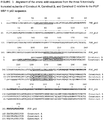
- Figure 2 provides an alignment of the amino acid sequences of the MSP-1 p42 proteins from the three P. falciparum strains, FUP, 3D7 and FVO.
- the p33 region is conserved between the FUP and 3D7 strains, however, the p33 of the FVO strain is rather divergent from the other two P. falciparum strains.
- the p19 core region is highly conserved among the three strains and also contains 6 disulfide bridges that result in a highly folded structure that represents two epidermal growth factor-like domains (Blackman et al, 1991). Both polyclonal and monoclonal antibodies directed at the p19 core region have been shown to inhibit parasite development in vitro (Blackman et al, 1990, Chang et al, 1992, Chappel and Holder, 1993).
- the MSP-1 p42 fragment is composed of the p33 and p19 fragments.
- the p19 core region of MSP-1 which is anchored on the surface of the merozoite is a required element of the merozoite during erythrocyte invasion, where as the p33 fragment is released into the blood plasma upon binding of the merozoite to the erythrocyte.
- the p19 fragment is the target of parasite growth inhibition antibodies in vitro. The role of the p33 fragment is not clear.
- T cell epitopes have been identified within the p33 region (Udhayakumar et al, 1995; Lee et al, 2001; Malhotra et al, 2008), and it has been suggested that p33 plays an indirect role in eliciting protective immunity by providing T helper epitopes that are lacking in p19 (Tian et al, 1996; Lee et al, 2001). Clinical studies have shown that memory T cell responses are elicited by MSP1-42 vaccination and these responses are localized to the MSP1-33 fragment (Huaman et al, 2008). Nevertheless, the ability of T cell epitopes to enhance an antibody response specific for p19 has not been demonstrated in the context to a recombinant subunit protein and active immunization.
- the first involves identifying the relevant immunogenic segments of the MSP-1 C-terminal region in regards to eliciting specific protective antibody responses.
- Specific protective antibodies are those which are capable of inhibiting parasite growth in vitro.
- the second area of investigation involves the identification of irrelevant immunogenic segments that result in responses that distract from eliciting the appropriate specific responses desired.
- the third area of investigation involves the evaluation of linking discontinuous sequences from the MSP-1 C-terminal region in such a manner as to produce recombinant subunit protein products that have enhanced immunogenic potential as vaccine candidates.
- MSP-1 C-terminal subunit proteins are defined as any recombinant protein which contains the MSP-1 p19 core region plus additional sequences from the MSP-1 p33 region regardless of whether or not the p33 sequences are contiguous as in nature or non-contiguous as to create novel proteins.
- the enhanced immunogenic properties refer to the ability to induce consistent and specific antibodies that are capable of parasite growth inhibition in vitro and providing protection against disease caused by malaria. Furthermore, in order to fully realize the potential of enhancing sequences it is also important to remove sequences that suppress the immunogenic potential of those sequences which have enhancing properties.
- the technical problems to be solved are: (1) identification of sequences containing putative T cell epitopes in the p33 region that when combined with p19 core region results in an enhanced immune response ("enhancing sequences”), (2) identification and removal of sequences in the p33 regions that suppress the immunogenic potential of p19 epitopes, (“suppressing sequences”) and (3) demonstrate the ability to produce recombinant subunit protein products based on the linking of discontinuous enhancing sequences from the p33 region with the p19 core region in such a manner that the products can be efficiently expressed in a cell based system.
- Recombinant subunit proteins produced in this manner have the potential to overcome the issues seen with previous p42 based vaccines and to consistently induce specific anti-merozoite antibodies that provide protective immunity against malaria in animal models and humans. Therefore, the overall technical problem to be solved is: the design, construction, and expression of novel recombinant subunit proteins based on sequences derived from the MSP-1 C-terminal region that result in enhanced immunogenicity and improved protective efficacy.
- the present invention relates to the embodiments characterized in the claims. Thus, it relates to the following items.
- the invention provides recombinant subunit proteins that have enhanced immunogenic properties that make them suitable as vaccines to protect against malaria in animal models and humans.
- the recombinant subunit proteins are comprised of the MSP-1 C-terminal p19 core region of the protein and selected segments from the MSP-1 C-terminal p33 region. The addition of the selected p33 segments results in enhanced immunogenic properties. Specifically the enhanced immunogenic potential is in the ability to elicit consistent and protective antibody responses. These enhanced antibody responses have the potential to inhibit parasite growth in vitro and in vivo provide protection against disease caused by malaria parasites.
- the recombinant subunit proteins of the invention are expressed from transformed insect cells that contain integrated copies of the appropriate expression cassettes within the genome of the cells.
- the insect cell expression system provides high yields of recombinant subunit proteins with native-like conformation.
- the recombinant subunit proteins are secreted from the transformed insect cells and represent novel forms of the malaria MSP-1 C-terminal region that are not found in nature.
- the recombinant subunit proteins are novel derivatives that have been created to provide improved immunogenic potential to protect against disease caused by malaria parasites.
- the antibodies that result from vaccination with the recombinant subunit proteins that have enhanced immunogenic potential are capable of inhibiting parasite growth in vitro.
- the invention also provides methods for utilizing the recombinant subunit proteins described as vaccines to elicit the production of antibodies capable of conferring protection against malaria in mammalian hosts.
- the invention provides malaria MSP-1 C-terminal recombinant subunit proteins that comprise the p19 core region and selected segments of the p33 region. These recombinant subunit proteins are produced and secreted from a stable insect cell lines that have been transformed with the appropriate expression plasmid. Immunization of animals with the recombinant subunit proteins of the invention is effective in inducing a consistent antibody response. Specifically, these antibody responses are capable of inhibiting the growth of Plasmodium falciparum.
- the combination of the selected p33 segments with the p19 core is critical for the induction of a specific and consistent immune response that results in antibodies that are capable of inhibiting parasite growth and ultimately providing protection from malaria.
- the recombinant malaria MSP-1 C-terminal subunit proteins described herein are demonstrated to be capable of eliciting enhanced and consistent immune responses relative to MSP-1 p42 recombinant proteins which represent the form found in nature. More preferably, the enhanced recombinant MSP-1 C-terminal subunit proteins are capable of eliciting a consistent parasite inhibitory antibody response.
- all immunized subjects have in vitro growth inhibitory antibody titers greater than 50%. More preferably all immunized subjects have in vitro growth inhibitory antibody titers greater than 60%. Even more preferably immunized subjects have in vitro growth inhibitory antibody titers greater than 70%. Even more preferably immunized subjects have in vitro growth inhibitory antibody titers greater than 80%.
- "enhancing" sequences are selected from the MSP-1 p33 region and linked to the p19 core region to create novel MSP-1 C-terminal recombinant subunit proteins.
- "suppressing" sequences have also been removed from the MSP-1 p33 region to further enhance the immunogenic potential of the novel MSP-1 C-terminal recombinant subunit proteins.
- the selected segments from the p33 region that are linked to the p19 core region of MSP-1 contain T-cell helper epitopes. These T-cell helper epitopes are responsible for directing the enhanced immune response toward the p19 core region which in of itself is poorly immunogenic. More preferably the selected p33 segments do not contain sequences and or epitopes that inhibit or suppress the ability to elicit enhanced antibody responses in the form of inhibitory antibodies directed against the p19 core region. Therefore, the resultant recombinant proteins differ from the native p33 region in that only the segment(s) that provide benefit are retained and those that have a negative impact have been removed.
- the recombinant malaria MSP-1 C-terminal subunit proteins comprise the p19 core of MSP-1 and selected p33 segments which are linked in such a manner that the recombinant proteins can be expressed as a secreted product in cell based expression system.
- the secreted recombinant subunit proteins are then purified and used to as immunogens.
- the purified proteins result in enhanced immune responses when used to immunize animals.
- MSP-1 C-terminal subunits proteins are expressed using Drosophila S2 cells as host cells.
- MSP-1 C-terminal subunits proteins refer to As disclosed herein, “MSP-1 C-terminal subunits proteins” refer to any recombinant protein which contains the MSP-1 p19 core region plus additional sequences from the MSP-1 p33 region regardless of whether or not the p33 sequences are contiguous as in nature or non-contiguous as to create novel proteins.
- MSP-1 C-terminal subunit proteins can be derived from any strain of Plasmodium falciparum.
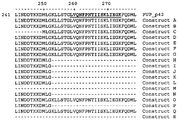
- Figure 4 discloses the segments of p33 sequences utilized in all of the "MSP-1 C-terminal subunit proteins" referred to in this application.
- subunit proteins comprising MSP-1 C-terminal p19 core region and segments derived form the MSP-1 C-terminal p33 region were expressed and secreted from stably transformed Drosophila S2 cells by operably linking the coding sequences of such proteins to functional secretion signals and placing them under the control of a promoter demonstrated to be functional in Drosophila cells utilizing standard recombinant DNA methods.
- the recombinant MSP-1 C-terminal subunit proteins described herein represent three different strains derived from of the species Plasmodium falciparum.
- the MSP-1 C-terminal subunits as disclosed herein are all related as they all contain the MSP-1 C-terminal p19 core region as depicted in Figure 5 .
- the p33 sequences vary in each construct, all constructs are designed to direct and enhance the potency and the specificity of the immune response to the p19 core region.
- the enhanced quality of the antibody response to the p19 core region is associated with an increased ability to provide protection against disease that results from malaria infection.
- the MSP-1 C-terminal subunit proteins as disclosed herein are expressed and secreted from selected S2 cell lines as described are first purified by immunoaffinity chromatography methods.
- the anti-MSP-1 monoclonal antibody 5.2 (Chang et al, 1992) ("5.2 antibody” or "MAb 5.2") is utilized for the purification.
- the 5.2 antibody is chemically conjugated to the appropriate column matrix by standard methods recommended by the manufacturer (NHS-Sepharose, Pharmacia, Piscataway, NJ) to prepare suitable columns.
- the MSP-1 C-terminal subunits are derived from the portion of the P. falciparum merozoite surface protein referred to as p42; in the FUP and 3D7 strains, p42 comprises amino acids Ala 1333 to Ser 1705 , of MSP-1.
- the MSP-1 C-terminal subunit proteins, as described herein, are recombinantly produced and secreted from stably transformed insect cells.
- the MSP-1 C-terminal subunits may contain the entire p42 region of MSP-1 or portions thereof.
- MSP-1 C-terminal subunits contain the MSP-1 p10 core region linked to MSP-1 p33 sequences that are either contiguous or non-contiguous relative to the native p42, but all MSP-1, but all MSP-1 C-terminal subunit proteins area t least 28 amino acids shorter in length than the native p42 of the FUP and 3D7 strains.
- the MSP-1 C-terminal subunits can be are derived from any of the three allelic types of P. falciparum; such as: K, MAD20, and Wellcome, as well as allelic types of P. vivax, P. malariae and P. ovale.
- the secretion of the MSP-1 C-terminal subunit proteins is directed by a functional secretion signal capable of directing the expressed product through the insect cell secretion pathway and into the culture medium.
- a functional secretion signal capable of directing the expressed product through the insect cell secretion pathway and into the culture medium.
- the secretion of MSP-1 C-terminal subunit proteins is demonstrated utilizing the tPA pre/pro secretion leader and a synthetic secretion signal.
- MSP-1 C-terminal subunits described in this application Surprisingly, and in contrast to previously described reports of MSP-1 p19 and MSP-1 p42 recombinant subunits where it is thought that very high antibody titers are a key indicator of parasite growth activity, the ability of several of the recombinant MSP-1 C-terminal subunits described in this application to elicit significant parasite growth inhibition activity is not dependent on the need to generate high titer antibody responses. It was found for several of the MSP-1 C-terminal subunit proteins that elicited moderate antibody titer also resulted in significant parasite growth inhibition activity. Thus, the MSP-1 C-terminal proteins described are novel in that they are functionally different relative to MSP-1 based recombinant proteins previously described in theie ability to elicit significant parasite growth inhibition activity.
- the present invention thus concerns and provides recombinant subunit proteins that can be used in vaccine formulations as a means for preventing or attenuating infection by Plasmodium species.
- the recombinant subunit proteins described may be used in combination with adjuvants as a means to provide protection against disease caused by malaria infection.
- the examples below demonstrate the ability to select and remove sequences from the MSP-1 p33 region and link the selected sequences to the MSP-1 p19 core region so as to produce novel recombinant subunit proteins that have enhanced immunogenic potential as vaccine candidates.
- the expression and secretion of the novel MSP-1 C-terminal subunit proteins is also demonstrated utilizing stably transformed insect cells.
- the purification of the expressed subunit proteins is also demonstrated. Examples are provided that demonstrate the enhanced immunogenic properties of the novel MSP-1 C-terminal subunit proteins.
- the results presented below demonstrate that the selection and demonstration of enhanced immunogenic potential results in highly variable results that can vary from a loss of a specific immune response to highly focused immune responses.
- T cell epitopes identified in these studies were not determined to directly provide T-cell helper function, it is suggested that they may be responsible for focusing the antibody response to the important parasite growth inhibiting epitopes of p19. While these results support the theory of T-cell helper functions in the p33 region, there is no data on the expression of recombinant subunits that are designed to enhance the ability to elicit parasite growth inhibitory antibodies or protective responses in animal models.
- the next epitope that was identified is positioned 72 amino acids preceding the start of the p19 sequence, AHVKITKLSDLKAID, and is referred to as C72.
- a third T-cell epitope was identified based on further analysis of MHC class II epitopes in the p33 region with the computer program TEPITOPE ( Sturniolo T. et al, Nat. Biotechnology (1999) 17:555-561 ; Singh,H. and Raghava,G.P.S.(2001) Bioinformatics, 17(12), 1236-37 ).
- This epitope is positioned 22 amino acids preceding the start of the p19 sequence, LVQNFPNTIISKLIEGK, and is referred to as p33-7
- Table 1 below list potential MHC class II T-cell epitopes in the p33 region of MSP-1 p42 of P. falciparum. These epitopes are predicted by computer algorithms or are based on published reports as described above. Table 1. Potential T-cell epitopes in the p33 region of MSP-1 p42 Peptide Amino Acid Sequence Position of peptide in p42 Peptide Length CT LKPLAGVYRSLKKQIEK 23-38 17 CT-2 VIYLKPLAGVYRSLKKQIE 19-37 19 p33-2 FNLNLNDILNSRLK 43-56 14 p33-3 LMQFKHISSNEYIIEDS 69-85 17 p33-4 FLPFLTNIETLYNNLVNKID 170-189 20 p33-5 LYNNLVNKIDDYLINLKAKIND 180-201 22 p33-6 YLINLKAKIND 191-201 11 C72 AHVKITKLSDLKAID 209-223 15 p33-7 LVQNFPNTI
- the first group of MSP-1 C-terminal subunit proteins is based on N-terminal truncations of the p33 region of the MSP-1 p42 protein in an effort to define regions of p33 that could enhance the ability to elicit parasite growth inhibitory antibodies in animal models.
- the truncation points were guided by the location of the various potential T-cell epitopes present in Table 1.
- the portions of p33 retained were maintained together with the p19 region in contiguous manner as in the native p42 as exemplified in Figure 3 .
- a total of eight constructs were made based on the N-terminal truncations, Constructs A, B, C, D, E, F, G, and Q.
- the pMttbns expression vector contains the following elements: the Drosophila metallothionein promoter (Mtn), the human tissue plasminogen activator (tPA) signal sequence, and the SV40 early polyadenylation signal (Culp et al, 1991).
- the pCoHygro plasmid is also utilized as selectable marker that confers hygromycin resistance (Van de Straten, 1989).
- the hygromycin gene is under the transcriptional control of the Drosophila COPIA transposable element long terminal repeat promoter.
- the pMttbns vector was modified by deleting a 15 base pair BamHI fragment which contained an extraneous Xho I site. This modified vector, referred to as pMtt ⁇ Xho, allows for directional cloning of inserts utilizing unique Bgl II and Xho I sites.
- the expression of Constructs D, E, F, G, and Q was accomplished using the Drosophila expression plasmid pHBI-20D which is a derivative of the plasmid pHBI-10.
- the details of the pHBI-10 plasmid are provided in PCT Application WO/2008/134068 .
- the pHBI-20D expression vector contains the following elements: synthetic metal responsive proximal promoter, synthetic core promoter and 5'UTR, synthetic secretion signal, and an optimized 3'UTR.
- the hygromycin encoding gene is also incorporated into the pHBI-20D expression plasmid downstream of the expression cassette.
- the pHBI-20D expression plasmid is designed to allow directional cloning of the gene of interest into unique Bam HI and Xho I sites.
- PCR amplified fragments were prepared and cloned into the expression vector pMtt ⁇ Xho.
- Genomic DNA was prepared from cultured P . falciparum parasites of the three strains, FUP, NF54 (clone 3D7) and FVO utilizing the DNeasy Tissue Kit from Qiagen (Valencia, CA).
- the full MSP-1 p42 and the MSP-1 C-terminal fragments for Constructs A, B, C, D, E, F, G and Q were generated by PCR amplification with oligonucleotide primers.
- the amplified MSP-1 p42 PCR fragment contains the sequence encoding amino acids Ala 1333 to Ser 1705 of MSP-1 for the FUP (Genbank accession number M37213). All of the N-terminal truncations were amplified from the full length MSP-1 p42 construct.
- the oligonucleotide primers used for amplification also encoded for appropriate restriction sites and stop codons.
- Construct B varies for the other N-terminally truncated subunits which all have contiguous sequences derived from p42 in that the CT epitope described in example 1 is fused to the N-terminus of Construct A.
- PCR amplification was accomplished by use of the high fidelity Pfx polymerase (Invitrogen, Carlsbad, CA).
- the resultant PCR amplified fragments were digested with appropriate restriction enzymes and inserted into the pMtt ⁇ Xho vector digested with Bgl II and Xho I or into the pHBI-20D vector digested with Bam HI and Xho I.
- the junctions and full inserts of all constructs were sequenced to verify that the various components that have been introduced are correct and that the proper reading frame has been maintained.
- Drosophila melanogaster S2 cells (“ Drosophila S2 cells” or simply “S2 cells” Schneider, 1972) obtained from ATCC were utilized. Cells are adapted to growth in Excell 420 medium and all procedures and culturing are in this medium. Cells are passed between days 5 and 7 and are typically seeded at a density of 1x10 6 cells/mL and incubated at 26°C. All expression plasmids containing the coding sequences for the MSP-1 C-terminal subunit proteins were transformed into S2 cells by means of the calcium phosphate method.
- the cells were co-transformed with the pCoHygro plasmids for selection with hygromycin B at a ratio of 10 ⁇ g of expression plasmid to 0.5 ⁇ g of pCoHygro.
- the pHBI-20D plasmids were used the cells were transformed with only 10 ⁇ g the expression plasmid as the hygromycin gene is incorporated into this plasmid. Following transformation, cells resistant to hygromycin, 0.3 mg/mL, were selected. Once stable cells lines were selected, they were evaluated for expression of the appropriate products.
- Immunoaffinity chromatography (IAC) methods were utilized as a rapid means to purify expressed MSP-1 C-terminal subunit proteins for preliminary antigenic and immunogenic studies.
- the MSP-1 conformationally sensitive mAb 5.2 was used to prepare p42-specific IAC columns (Siddiqui et al 1987 and Chang et al 1992). Sufficient quantities of the mAb 5.2 were produced in a Cell Pharm 1000 hollow fiber bioreactor according to the manufacturer's recommendations (Unisyn, Hopkinton, MA).
- the mAb 5.2 hybridoma cell line was obtained from ATCC and grown in RPMI 1640 (Cambrex, Hopkins, MA).
- the medium was supplemented with FBS at 10% for growth in flask and 5% for growth in the hollow fiber bioreactor.
- the bioreactor was run for 25 days and resulted in a total yield of 57 mg.
- a two mL bed volume column was made by coupling 10 mg of affinity purified MAb 5.2 per mL of column matrix (activated N-hydroxy-succinimide-HiTrap, Pharmacia, Piscataway, NJ).
- the IAC column was perfused with 200 mL of clarified culture medium at a rate of 1 mL per minute. Following washing with 10 mM phosphate buffer, pH 7.2, the antigen was eluted with 100 mM glycine pH 2.5.
- the eluted product was neutralized with 1 M Tris, pH 7.5 (final concentration 0.2 M), and NaCl was added to a final concentration of 150 mM.
- the sample was then buffer exchanged into phosphate buffered saline ("PBS") and concentrated by membrane ultrafiltration using a Centricon 30 (Millipore, Bedford, MA).
- PBS phosphate buffered saline
- the N-terminal constructs are shown in Figures 4 , 5 and 6 . As seen in Figure 6 , the N-terminal truncation constructs are referred to as Group 1. Group 1 constructs are defined as any construct which retains a single continuous portion of the C-terminus of p33 immediately preceding p19 as in the native p42 sequence. The Group 1 constructs with the N-terminal truncations represent MSP-1 C-terminal subunits that are novel in that these subunits are not found in nature due to cellular processing.
- mice were immunized intra-peritoneally three times at a 4 week interval with the purified subunit proteins at a 10 ⁇ g dose. Mice were bled three weeks after each dose. The sera were then assessed for anti-p19 and anti-p42 titers by ELISA. New Zealand White rabbits were immunized four times at a 4 week interval by the intramuscular route with a 50 ⁇ g dose. Rabbits were bled two weeks after the first three doses and at three and four weeks after the fourth dose. The sera were then assessed for anti-p42 titers by ELISA.
- the sera from rabbits were also tested in an in vitro assay for parasite growth acitivity ( Hui et al., Exp.Parasitol, (1987) 64:519-522 ). Briefly, to assay for parasite growth inhibition activity, the serum sample is added to culture medium to give a final concentration of 30% and incubated with infected human erythrocytes that are adjusted to an initial parasitemia of 0.5%. P. falciparum 3D7 parasites that are adapted to growth in human serum are utilized in the assay. Cultures are then incubated for 72 hours, and the parasitemia of Giemsa-stained thin smears of the cultured erythrocytes are determined by microscopy. The percent inhibition is calculated by subtracting the parasitemia in test samples from the parasitemia in control serum samples (pre-bleeds from the same animal) and dividing by the parasitemia in control serum sample and then multiplying by 100.
- results obtained when MSP-1 p42 formulated with Freund's Complete Adjuvant (FCA) is used to immunize rabbits is presented in Table 2.
- FCA Freund's Complete Adjuvant
- Table 2 An example of the results obtained when MSP-1 p42 formulated with Freund's Complete Adjuvant (FCA) is used to immunize rabbits is presented in Table 2.
- the results from the MSP-1 p42 immunized rabbits demonstrate that the p42 vaccine formulation has the potential to elicit appropriate immune response, high ELISA titers and parasite growth inhibition titers greater than 50%. These results can only be obtained with strong adjuvants such as FCA.
- FCA is not suitable for use in humans and so these results do not describe a formulation that is a potential vaccine for humans.
- Use of other adjuvants that have potential for use in humans results in inconsistent parasite growth inhibition antibodies, despite good overall antibody titers upon immunization.
- Construct C failed to generate any appreciable inhibition antibodies (only results greater than 50% are considered to be significant based on the variability of the assay).
- the results from Construct C were totally unexpected. Prior to this result a key working premise was that consistent and high overall antibody titers were a prerequisite for the generation of specific inhibitory antibodies. Furthermore, the results from Construct C strongly suggested that there are p33 sequences that can suppress the generation of anti-p19 antibodies that are capable of parasite growth inhibition.
- Constructs A, B and C demonstrate that MSP-1 C-terminal constructs made based on the prediction of potential T-cell epitopes alone is not enough to ensure that enhanced immune responses specific for the p19 region will be generated.
- Construct C demonstrated that at least one of the predicted epitopes, p33-7, can greatly suppress the specific antibody response desired.
- predicting the appropriate nature of the constructs that have enhancing immune potential requires considerable experimentation to sort out which sequences may be enhancing and which may be suppressing.
- MSP-1 C-terminal subunit proteins were made based on combinations of discontinuous segments from the p33 region of the MSP-1 p42 protein in an effort to link together enhancing sequences while excluding suppressing or extraneous sequences in regards to the ability to elicit parasite growth inhibitory antibodies in animal models.
- Group 1 constructs the selection of p33 segments was in part guided by the location of the various potential T-cell epitopes presented in Table 1.
- Three different groups of constructs containing non-continuous segments were made, Group 2, Group 3 and Group 4. In addition to selecting fragments with known T cell epitopes there were two additional design criteria for Group 2 constructs.
- the Group 2 constructs are based on discontinuous segments of p33, the resultant constructs in which the p33 sequences are linked to p19 are novel in that the combined sequences are not found in nature.
- a total of seven Group 2 constructs were made. Six constructs were based on the linkage of various combinations of p33 segments with the p19 region, and the exclusion of the Construct C region, Constructs I, J, K, L, M, and P.
- One construct, H was based only on the exclusion of the Construct C region.
- Group 3 constructs were based on linking either all of the conserved fragments of the p33 region, Construct N, or linking all of the non-conserved fragments, Construct O. Both of these constructs were made by synthetic methods. Group 4 contains only one Construct, R. Based on preliminary data, selected fragmentst from constructs I, K, and L where selected and combined.
- the pHBI-20D Drosophila expression plasmid described in Example 1 was used for all Groups 2, 3 and 4 constructs.
- a pHBI-20D-p19 base plasmid was first constructed.
- the pHBI-20D-p19 base plasmid contains the full p19 sequence which is immediately preceded by sequence that encodes Gly-Gly-Thr-Gly-Gly-Gly linker.
- the sequence contains a unique Kpn I restriction site that was utilized to link the p33 sequences in frame with the p19 sequence.
- the Bam HI site which is the typical cloning site at the end of the secretion signal sequence in pHBI-20D was also modified to a Nhe I site to allow for multiple cloning events of the various p33 sequences that were combined.
- Expression constructs were made by directly cloning PCR amplified fragments, or subcloning fragments from shuttle vectors containing fragments that were chemically synthesized, into the expression vector pHBI-20D-p19.
- the p19 region was also include in the synthesis. Therefore, there are no linker sequences for Group 4 constructs between the p33 fragments or the p33 and p19 region.
- the synthetic fragments were cloned directly into pHBI-20D with appropriate restriction enzymes.
- Oligonucleotide primers and synthetic sequences were designed based on the FUP sequence (Genbank accession number M37213). In addition to the MSP-1 specific sequences, the oligonucleotide primers encoded for appropriate restriction sites. For the linked segments the 5' end of the fragments were designed with a Spe I site (compatible with Nhe I) and the 3' end of the fragments were designed with a Kpn I site to correspond with the cloning sites in pHBI-20-p19. When two p33 fragments were combined they were linked by designing Bam HI sites at the appropriate ends to allow for linkage. The PCR amplification, cloning, and transformation of S2 cells were accomplished as described in Example 2. The expressed subunit proteins were purified by IAC methods as described in Example 2.
- Group 2 constructs are defined as any construct which has one ore more discontinuous segments of p33 linked to the p19 region.
- the resultant constructs in which the p33 sequences are linked to p19 are novel in that the combined sequences are not found in nature.
- Table X Percent responders for groups of mice immunized with Group 1, 2 and 3 MSP-1 C-terminal subunit proteins based on reactivity in a p19 specific ELISA. Construct A B C D E F H I J K L M N P p42 p19 % Responders 54 62 22 82 80 100 100 80 62 100 82 42 80 80 100 18
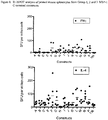
- mice were on the basis of cytokine production from primed mouse splenocytes using the ELISPOT method.
- the immunization of mice was conducted as described in Example 3. Following the immunization course, a portion of mice from each group were sacrificed 7 days after the final dose and their spleens were removed. Splenocytes were cultured and used for cytokine analysis using the ELISPOT method. The cultured splenocytes for each immunized group was stimulated with the same purified preparation of antigen that was used for the immunization. Following antigen stimulation the cells were analyzed for the production of interferon-gama and interlukin-4. The results of this analysis are presented in Figure 8 .
Landscapes
- Health & Medical Sciences (AREA)
- Life Sciences & Earth Sciences (AREA)
- Chemical & Material Sciences (AREA)
- Tropical Medicine & Parasitology (AREA)
- Organic Chemistry (AREA)
- General Health & Medical Sciences (AREA)
- Medicinal Chemistry (AREA)
- Genetics & Genomics (AREA)
- Immunology (AREA)
- Veterinary Medicine (AREA)
- Molecular Biology (AREA)
- Pharmacology & Pharmacy (AREA)
- Zoology (AREA)
- Engineering & Computer Science (AREA)
- Public Health (AREA)
- Animal Behavior & Ethology (AREA)
- Biophysics (AREA)
- Biochemistry (AREA)
- Microbiology (AREA)
- Epidemiology (AREA)
- Biomedical Technology (AREA)
- Toxicology (AREA)
- Mycology (AREA)
- Bioinformatics & Cheminformatics (AREA)
- Proteomics, Peptides & Aminoacids (AREA)
- Gastroenterology & Hepatology (AREA)
- Chemical Kinetics & Catalysis (AREA)
- General Chemical & Material Sciences (AREA)
- Nuclear Medicine, Radiotherapy & Molecular Imaging (AREA)
- Biotechnology (AREA)
- General Engineering & Computer Science (AREA)
- Wood Science & Technology (AREA)
- Physics & Mathematics (AREA)
- Plant Pathology (AREA)
- Peptides Or Proteins (AREA)
- Medicines Containing Antibodies Or Antigens For Use As Internal Diagnostic Agents (AREA)
- Micro-Organisms Or Cultivation Processes Thereof (AREA)
- Preparation Of Compounds By Using Micro-Organisms (AREA)
Claims (7)
- C-terminale rekombinante MSP-1-Proteinuntereinheit mit verstärkten immunogenen Eigenschaften, umfassend:die p19-Kernregion des MSP1-Proteins von Plasmodium falciparum der C-terminalen Region, mit der ein Abschnitt der p33-Region funktionell verknüpft ist, wobei der Abschnitt der p33-Region die Aminosäuresequenz LVQNFPNTIISKLIEGK nicht umfasst, wobei alle Tiere, die mit dem Protein immunisiert sind, eine immunologische Reaktion hervorrufen, die zu einer hemmenden Aktivität auf das Parasitenwachstum von mehr als 50% führt und wobei der verknüpfte Abschnitt der p33-Region SEQ ID NO:8 oder SEQ ID NO:14 ist.
- Rekombinante Proteinuntereinheit nach Anspruch 1, wobei das Protein in einem Kultursystem von eukaryotischen Zellen exprimiert wird.
- Rekombinante Proteinuntereinheit nach Anspruch 2, wobei das Zellkultur-Expressionssystem Insektenzellen verwendet.
- Rekombinante Proteinuntereinheit nach Anspruch 3, wobei die Insektenzellen Drosophila S2-Zellen sind.
- Impfstoffformulierungen, die C-terminale MSP-1-Proteinuntereinheiten nach einem der Ansprüche 1 bis 4 umfassen.
- Impfstoffformulierungen, die C-terminale MSP-1-Proteinuntereinheiten nach einem der Ansprüche 1 bis 4 umfassen, zur Verwendung beim Hervorrufen eines Schutzes gegen Malariainfektion.
- Impfstoffformulierungen nach Anspruch 5 oder 6, wobei der Abschnitt des p33-Regionabschnitts der C-terminalen MSP-1-Proteinuntereinheit SEQ ID NO:8 oder SEQ ID NO:14 ist.
Applications Claiming Priority (2)
| Application Number | Priority Date | Filing Date | Title |
|---|---|---|---|
| US28167909P | 2009-11-18 | 2009-11-18 | |
| PCT/US2010/003017 WO2011062637A1 (en) | 2009-11-18 | 2010-11-18 | Enhanced malaria msp-1 subunit vaccine |
Publications (3)
| Publication Number | Publication Date |
|---|---|
| EP2501717A1 EP2501717A1 (de) | 2012-09-26 |
| EP2501717A4 EP2501717A4 (de) | 2013-05-22 |
| EP2501717B1 true EP2501717B1 (de) | 2017-04-12 |
Family
ID=44059895
Family Applications (1)
| Application Number | Title | Priority Date | Filing Date |
|---|---|---|---|
| EP10831909.6A Not-in-force EP2501717B1 (de) | 2009-11-18 | 2010-11-18 | Verstärkter malaria-msp-1-untereinheiten-impfstoff |
Country Status (8)
| Country | Link |
|---|---|
| US (1) | US20120231029A1 (de) |
| EP (1) | EP2501717B1 (de) |
| JP (1) | JP2013511521A (de) |
| KR (1) | KR20120095979A (de) |
| CN (1) | CN102648209B (de) |
| AU (1) | AU2010322418A1 (de) |
| BR (1) | BR112012011985A2 (de) |
| WO (1) | WO2011062637A1 (de) |
Families Citing this family (1)
| Publication number | Priority date | Publication date | Assignee | Title |
|---|---|---|---|---|
| EP3667322A1 (de) * | 2018-12-14 | 2020-06-17 | Euroimmun Medizinische Labordiagnostika AG | Serologische detektion von plasmodium-antikörpern |
Family Cites Families (4)
| Publication number | Priority date | Publication date | Assignee | Title |
|---|---|---|---|---|
| US7078043B2 (en) * | 1999-04-20 | 2006-07-18 | Medical Research Council | Malaria vaccine |
| GB0314114D0 (en) * | 2003-06-18 | 2003-07-23 | Medical Res Council | Screening assay |
| US20080213318A1 (en) * | 2005-07-05 | 2008-09-04 | Hawaii Biotech, Inc. | Malaria MSP-1 C-terminal enhanced subunit vaccine |
| US8030471B2 (en) * | 2008-03-06 | 2011-10-04 | Abbott Laboratories | Plasmodium malariae and Plasmodium ovale genes and uses thereof |
-
2010
- 2010-11-18 EP EP10831909.6A patent/EP2501717B1/de not_active Not-in-force
- 2010-11-18 US US13/510,923 patent/US20120231029A1/en not_active Abandoned
- 2010-11-18 AU AU2010322418A patent/AU2010322418A1/en not_active Abandoned
- 2010-11-18 CN CN201080052479.3A patent/CN102648209B/zh not_active Expired - Fee Related
- 2010-11-18 WO PCT/US2010/003017 patent/WO2011062637A1/en not_active Ceased
- 2010-11-18 KR KR1020127015485A patent/KR20120095979A/ko not_active Ceased
- 2010-11-18 BR BR112012011985A patent/BR112012011985A2/pt not_active Application Discontinuation
- 2010-11-18 JP JP2012539877A patent/JP2013511521A/ja not_active Ceased
Non-Patent Citations (1)
| Title |
|---|
| None * |
Also Published As
| Publication number | Publication date |
|---|---|
| CN102648209A (zh) | 2012-08-22 |
| AU2010322418A1 (en) | 2012-06-07 |
| EP2501717A4 (de) | 2013-05-22 |
| CN102648209B (zh) | 2018-04-27 |
| KR20120095979A (ko) | 2012-08-29 |
| WO2011062637A1 (en) | 2011-05-26 |
| EP2501717A1 (de) | 2012-09-26 |
| JP2013511521A (ja) | 2013-04-04 |
| BR112012011985A2 (pt) | 2017-11-14 |
| US20120231029A1 (en) | 2012-09-13 |
Similar Documents
| Publication | Publication Date | Title |
|---|---|---|
| Bargieri et al. | New malaria vaccine candidates based on the Plasmodium vivax Merozoite Surface Protein-1 and the TLR-5 agonist Salmonella Typhimurium FliC flagellin | |
| Renia et al. | Immunization with a recombinant C-terminal fragment of Plasmodium yoelii merozoite surface protein 1 protects mice against homologous but not heterologous P. yoelii sporozoite challenge | |
| EP2988776B1 (de) | Neuartige impfstoffe gegen apicomplexa-krankheitserreger | |
| AU2011326338B2 (en) | Treatment and prevention of malaria | |
| US20070003562A1 (en) | GLURP-MSP3 fusion protein, immunogenic compositions and malarial vaccines containing it | |
| Blagborough et al. | Transmission blocking potency and immunogenicity of a plant-produced Pvs25-based subunit vaccine against Plasmodium vivax | |
| JP4573773B2 (ja) | マラリア・ワクチン | |
| US9884101B2 (en) | Treatment and prevention of malaria | |
| Zhang et al. | Evaluation of three Pichia pastoris-expressed Plasmodium falciparum merozoite proteins as a combination vaccine against infection with blood-stage parasites | |
| JP2000506381A (ja) | マラリア原虫msp―1のc末端断片を含む組換えタンパク質 | |
| US9120868B2 (en) | Recombinantly expressed Plasmodium CelTOS antigen and methods of use thereof | |
| Soares et al. | Immunogenic properties of the Plasmodium vivax vaccine candidate MSP119 expressed as a secreted non-glycosylated polypeptide from Pichia pastoris | |
| US20120231029A1 (en) | Enhanced malaria msp-1 subunit vaccine | |
| Cao et al. | Pfs230 Domains 7–10 encoded by DNA vaccines induce potent complement-independent transmission-blocking antibody against Plasmodium falciparum | |
| US6855316B1 (en) | Baculovirus produced Plasmodium falciparum vaccine | |
| EP2409987B1 (de) | Ribosomaler P Protein Komplex von Plasmodium falciparum als Antigen in Impfstoffen gegen Malaria | |
| US20080213318A1 (en) | Malaria MSP-1 C-terminal enhanced subunit vaccine | |
| US20150147349A1 (en) | Conformation-Stabilized TRAP Antigens | |
| Tachibanaa et al. | ACCEPTED M | |
| US20110171266A1 (en) | Malaria vaccine | |
| Boes et al. | LLLLGGG GGGGGGG GGG LLL GGGGGG | |
| Semenya | Merozoite invasion of erythrocytes: Revealing functional characteristics of the Plasmodium knowlesi Normocyte Binding Proteins | |
| Saul | Malaria Transmission-Blocking Vaccines |
Legal Events
| Date | Code | Title | Description |
|---|---|---|---|
| PUAI | Public reference made under article 153(3) epc to a published international application that has entered the european phase |
Free format text: ORIGINAL CODE: 0009012 |
|
| 17P | Request for examination filed |
Effective date: 20120618 |
|
| AK | Designated contracting states |
Kind code of ref document: A1 Designated state(s): AL AT BE BG CH CY CZ DE DK EE ES FI FR GB GR HR HU IE IS IT LI LT LU LV MC MK MT NL NO PL PT RO RS SE SI SK SM TR |
|
| DAX | Request for extension of the european patent (deleted) | ||
| RIC1 | Information provided on ipc code assigned before grant |
Ipc: C07K 14/00 20060101AFI20130408BHEP Ipc: A61K 39/002 20060101ALI20130408BHEP |
|
| A4 | Supplementary search report drawn up and despatched |
Effective date: 20130423 |
|
| RIC1 | Information provided on ipc code assigned before grant |
Ipc: A61K 39/002 20060101ALI20130415BHEP Ipc: C07K 14/00 20060101AFI20130415BHEP |
|
| 17Q | First examination report despatched |
Effective date: 20150116 |
|
| GRAP | Despatch of communication of intention to grant a patent |
Free format text: ORIGINAL CODE: EPIDOSNIGR1 |
|
| INTG | Intention to grant announced |
Effective date: 20161021 |
|
| GRAS | Grant fee paid |
Free format text: ORIGINAL CODE: EPIDOSNIGR3 |
|
| GRAA | (expected) grant |
Free format text: ORIGINAL CODE: 0009210 |
|
| AK | Designated contracting states |
Kind code of ref document: B1 Designated state(s): AL AT BE BG CH CY CZ DE DK EE ES FI FR GB GR HR HU IE IS IT LI LT LU LV MC MK MT NL NO PL PT RO RS SE SI SK SM TR |
|
| REG | Reference to a national code |
Ref country code: GB Ref legal event code: FG4D |
|
| REG | Reference to a national code |
Ref country code: CH Ref legal event code: EP |
|
| REG | Reference to a national code |
Ref country code: NL Ref legal event code: FP |
|
| REG | Reference to a national code |
Ref country code: IE Ref legal event code: FG4D |
|
| REG | Reference to a national code |
Ref country code: AT Ref legal event code: REF Ref document number: 883765 Country of ref document: AT Kind code of ref document: T Effective date: 20170515 |
|
| REG | Reference to a national code |
Ref country code: DE Ref legal event code: R096 Ref document number: 602010041564 Country of ref document: DE |
|
| REG | Reference to a national code |
Ref country code: DE Ref legal event code: R082 Ref document number: 602010041564 Country of ref document: DE Representative=s name: VOSSIUS & PARTNER PATENTANWAELTE RECHTSANWAELT, DE Ref country code: DE Ref legal event code: R081 Ref document number: 602010041564 Country of ref document: DE Owner name: UNIVERSITY OF HAWAII, HONOLULU, US Free format text: FORMER OWNERS: HAWAII BIOTECH, INC., AIEA, HAWAII, US; UNIVERSITY OF HAWAII, HONOLULU, HAWAII, US Ref country code: DE Ref legal event code: R081 Ref document number: 602010041564 Country of ref document: DE Owner name: HAWAII BIOTECH, INC., HONOLULU, US Free format text: FORMER OWNERS: HAWAII BIOTECH, INC., AIEA, HAWAII, US; UNIVERSITY OF HAWAII, HONOLULU, HAWAII, US |
|
| RAP2 | Party data changed (patent owner data changed or rights of a patent transferred) |
Owner name: HAWAII BIOTECH, INC. Owner name: UNIVERSITY OF HAWAII |
|
| REG | Reference to a national code |
Ref country code: CH Ref legal event code: NV Representative=s name: VOSSIUS AND PARTNER PATENTANWAELTE RECHTSANWAE, CH |
|
| REG | Reference to a national code |
Ref country code: LT Ref legal event code: MG4D |
|
| REG | Reference to a national code |
Ref country code: AT Ref legal event code: MK05 Ref document number: 883765 Country of ref document: AT Kind code of ref document: T Effective date: 20170412 |
|
| REG | Reference to a national code |
Ref country code: FR Ref legal event code: PLFP Year of fee payment: 8 |
|
| PG25 | Lapsed in a contracting state [announced via postgrant information from national office to epo] |
Ref country code: FI Free format text: LAPSE BECAUSE OF FAILURE TO SUBMIT A TRANSLATION OF THE DESCRIPTION OR TO PAY THE FEE WITHIN THE PRESCRIBED TIME-LIMIT Effective date: 20170412 Ref country code: ES Free format text: LAPSE BECAUSE OF FAILURE TO SUBMIT A TRANSLATION OF THE DESCRIPTION OR TO PAY THE FEE WITHIN THE PRESCRIBED TIME-LIMIT Effective date: 20170412 Ref country code: GR Free format text: LAPSE BECAUSE OF FAILURE TO SUBMIT A TRANSLATION OF THE DESCRIPTION OR TO PAY THE FEE WITHIN THE PRESCRIBED TIME-LIMIT Effective date: 20170713 Ref country code: LT Free format text: LAPSE BECAUSE OF FAILURE TO SUBMIT A TRANSLATION OF THE DESCRIPTION OR TO PAY THE FEE WITHIN THE PRESCRIBED TIME-LIMIT Effective date: 20170412 Ref country code: HR Free format text: LAPSE BECAUSE OF FAILURE TO SUBMIT A TRANSLATION OF THE DESCRIPTION OR TO PAY THE FEE WITHIN THE PRESCRIBED TIME-LIMIT Effective date: 20170412 Ref country code: AT Free format text: LAPSE BECAUSE OF FAILURE TO SUBMIT A TRANSLATION OF THE DESCRIPTION OR TO PAY THE FEE WITHIN THE PRESCRIBED TIME-LIMIT Effective date: 20170412 Ref country code: NO Free format text: LAPSE BECAUSE OF FAILURE TO SUBMIT A TRANSLATION OF THE DESCRIPTION OR TO PAY THE FEE WITHIN THE PRESCRIBED TIME-LIMIT Effective date: 20170712 |
|
| PG25 | Lapsed in a contracting state [announced via postgrant information from national office to epo] |
Ref country code: IS Free format text: LAPSE BECAUSE OF FAILURE TO SUBMIT A TRANSLATION OF THE DESCRIPTION OR TO PAY THE FEE WITHIN THE PRESCRIBED TIME-LIMIT Effective date: 20170812 Ref country code: SE Free format text: LAPSE BECAUSE OF FAILURE TO SUBMIT A TRANSLATION OF THE DESCRIPTION OR TO PAY THE FEE WITHIN THE PRESCRIBED TIME-LIMIT Effective date: 20170412 Ref country code: BG Free format text: LAPSE BECAUSE OF FAILURE TO SUBMIT A TRANSLATION OF THE DESCRIPTION OR TO PAY THE FEE WITHIN THE PRESCRIBED TIME-LIMIT Effective date: 20170712 Ref country code: RS Free format text: LAPSE BECAUSE OF FAILURE TO SUBMIT A TRANSLATION OF THE DESCRIPTION OR TO PAY THE FEE WITHIN THE PRESCRIBED TIME-LIMIT Effective date: 20170412 Ref country code: LV Free format text: LAPSE BECAUSE OF FAILURE TO SUBMIT A TRANSLATION OF THE DESCRIPTION OR TO PAY THE FEE WITHIN THE PRESCRIBED TIME-LIMIT Effective date: 20170412 Ref country code: PL Free format text: LAPSE BECAUSE OF FAILURE TO SUBMIT A TRANSLATION OF THE DESCRIPTION OR TO PAY THE FEE WITHIN THE PRESCRIBED TIME-LIMIT Effective date: 20170412 |
|
| REG | Reference to a national code |
Ref country code: DE Ref legal event code: R097 Ref document number: 602010041564 Country of ref document: DE |
|
| PG25 | Lapsed in a contracting state [announced via postgrant information from national office to epo] |
Ref country code: SK Free format text: LAPSE BECAUSE OF FAILURE TO SUBMIT A TRANSLATION OF THE DESCRIPTION OR TO PAY THE FEE WITHIN THE PRESCRIBED TIME-LIMIT Effective date: 20170412 Ref country code: RO Free format text: LAPSE BECAUSE OF FAILURE TO SUBMIT A TRANSLATION OF THE DESCRIPTION OR TO PAY THE FEE WITHIN THE PRESCRIBED TIME-LIMIT Effective date: 20170412 Ref country code: EE Free format text: LAPSE BECAUSE OF FAILURE TO SUBMIT A TRANSLATION OF THE DESCRIPTION OR TO PAY THE FEE WITHIN THE PRESCRIBED TIME-LIMIT Effective date: 20170412 Ref country code: CZ Free format text: LAPSE BECAUSE OF FAILURE TO SUBMIT A TRANSLATION OF THE DESCRIPTION OR TO PAY THE FEE WITHIN THE PRESCRIBED TIME-LIMIT Effective date: 20170412 Ref country code: DK Free format text: LAPSE BECAUSE OF FAILURE TO SUBMIT A TRANSLATION OF THE DESCRIPTION OR TO PAY THE FEE WITHIN THE PRESCRIBED TIME-LIMIT Effective date: 20170412 |
|
| PLBE | No opposition filed within time limit |
Free format text: ORIGINAL CODE: 0009261 |
|
| STAA | Information on the status of an ep patent application or granted ep patent |
Free format text: STATUS: NO OPPOSITION FILED WITHIN TIME LIMIT |
|
| PG25 | Lapsed in a contracting state [announced via postgrant information from national office to epo] |
Ref country code: SM Free format text: LAPSE BECAUSE OF FAILURE TO SUBMIT A TRANSLATION OF THE DESCRIPTION OR TO PAY THE FEE WITHIN THE PRESCRIBED TIME-LIMIT Effective date: 20170412 Ref country code: IT Free format text: LAPSE BECAUSE OF FAILURE TO SUBMIT A TRANSLATION OF THE DESCRIPTION OR TO PAY THE FEE WITHIN THE PRESCRIBED TIME-LIMIT Effective date: 20170412 |
|
| REG | Reference to a national code |
Ref country code: FR Ref legal event code: CA Effective date: 20180131 |
|
| 26N | No opposition filed |
Effective date: 20180115 |
|
| PG25 | Lapsed in a contracting state [announced via postgrant information from national office to epo] |
Ref country code: SI Free format text: LAPSE BECAUSE OF FAILURE TO SUBMIT A TRANSLATION OF THE DESCRIPTION OR TO PAY THE FEE WITHIN THE PRESCRIBED TIME-LIMIT Effective date: 20170412 |
|
| PG25 | Lapsed in a contracting state [announced via postgrant information from national office to epo] |
Ref country code: MC Free format text: LAPSE BECAUSE OF FAILURE TO SUBMIT A TRANSLATION OF THE DESCRIPTION OR TO PAY THE FEE WITHIN THE PRESCRIBED TIME-LIMIT Effective date: 20170412 |
|
| PG25 | Lapsed in a contracting state [announced via postgrant information from national office to epo] |
Ref country code: LU Free format text: LAPSE BECAUSE OF NON-PAYMENT OF DUE FEES Effective date: 20171118 |
|
| REG | Reference to a national code |
Ref country code: BE Ref legal event code: MM Effective date: 20171130 |
|
| REG | Reference to a national code |
Ref country code: IE Ref legal event code: MM4A |
|
| PG25 | Lapsed in a contracting state [announced via postgrant information from national office to epo] |
Ref country code: MT Free format text: LAPSE BECAUSE OF NON-PAYMENT OF DUE FEES Effective date: 20171118 |
|
| REG | Reference to a national code |
Ref country code: FR Ref legal event code: PLFP Year of fee payment: 9 |
|
| PG25 | Lapsed in a contracting state [announced via postgrant information from national office to epo] |
Ref country code: IE Free format text: LAPSE BECAUSE OF NON-PAYMENT OF DUE FEES Effective date: 20171118 |
|
| PG25 | Lapsed in a contracting state [announced via postgrant information from national office to epo] |
Ref country code: BE Free format text: LAPSE BECAUSE OF NON-PAYMENT OF DUE FEES Effective date: 20171130 |
|
| PG25 | Lapsed in a contracting state [announced via postgrant information from national office to epo] |
Ref country code: HU Free format text: LAPSE BECAUSE OF FAILURE TO SUBMIT A TRANSLATION OF THE DESCRIPTION OR TO PAY THE FEE WITHIN THE PRESCRIBED TIME-LIMIT; INVALID AB INITIO Effective date: 20101118 |
|
| PG25 | Lapsed in a contracting state [announced via postgrant information from national office to epo] |
Ref country code: CY Free format text: LAPSE BECAUSE OF NON-PAYMENT OF DUE FEES Effective date: 20170412 |
|
| PG25 | Lapsed in a contracting state [announced via postgrant information from national office to epo] |
Ref country code: MK Free format text: LAPSE BECAUSE OF FAILURE TO SUBMIT A TRANSLATION OF THE DESCRIPTION OR TO PAY THE FEE WITHIN THE PRESCRIBED TIME-LIMIT Effective date: 20170412 |
|
| PGFP | Annual fee paid to national office [announced via postgrant information from national office to epo] |
Ref country code: DE Payment date: 20191017 Year of fee payment: 10 Ref country code: NL Payment date: 20191030 Year of fee payment: 10 |
|
| PGFP | Annual fee paid to national office [announced via postgrant information from national office to epo] |
Ref country code: FR Payment date: 20191029 Year of fee payment: 10 |
|
| PG25 | Lapsed in a contracting state [announced via postgrant information from national office to epo] |
Ref country code: TR Free format text: LAPSE BECAUSE OF FAILURE TO SUBMIT A TRANSLATION OF THE DESCRIPTION OR TO PAY THE FEE WITHIN THE PRESCRIBED TIME-LIMIT Effective date: 20170412 |
|
| PGFP | Annual fee paid to national office [announced via postgrant information from national office to epo] |
Ref country code: CH Payment date: 20191028 Year of fee payment: 10 |
|
| PGFP | Annual fee paid to national office [announced via postgrant information from national office to epo] |
Ref country code: GB Payment date: 20191029 Year of fee payment: 10 |
|
| PG25 | Lapsed in a contracting state [announced via postgrant information from national office to epo] |
Ref country code: PT Free format text: LAPSE BECAUSE OF FAILURE TO SUBMIT A TRANSLATION OF THE DESCRIPTION OR TO PAY THE FEE WITHIN THE PRESCRIBED TIME-LIMIT Effective date: 20170412 |
|
| PG25 | Lapsed in a contracting state [announced via postgrant information from national office to epo] |
Ref country code: AL Free format text: LAPSE BECAUSE OF FAILURE TO SUBMIT A TRANSLATION OF THE DESCRIPTION OR TO PAY THE FEE WITHIN THE PRESCRIBED TIME-LIMIT Effective date: 20170412 |
|
| REG | Reference to a national code |
Ref country code: DE Ref legal event code: R119 Ref document number: 602010041564 Country of ref document: DE |
|
| REG | Reference to a national code |
Ref country code: CH Ref legal event code: PL |
|
| REG | Reference to a national code |
Ref country code: NL Ref legal event code: MM Effective date: 20201201 |
|
| GBPC | Gb: european patent ceased through non-payment of renewal fee |
Effective date: 20201118 |
|
| PG25 | Lapsed in a contracting state [announced via postgrant information from national office to epo] |
Ref country code: NL Free format text: LAPSE BECAUSE OF NON-PAYMENT OF DUE FEES Effective date: 20201201 Ref country code: CH Free format text: LAPSE BECAUSE OF NON-PAYMENT OF DUE FEES Effective date: 20201130 Ref country code: LI Free format text: LAPSE BECAUSE OF NON-PAYMENT OF DUE FEES Effective date: 20201130 |
|
| PG25 | Lapsed in a contracting state [announced via postgrant information from national office to epo] |
Ref country code: FR Free format text: LAPSE BECAUSE OF NON-PAYMENT OF DUE FEES Effective date: 20201130 |
|
| PG25 | Lapsed in a contracting state [announced via postgrant information from national office to epo] |
Ref country code: GB Free format text: LAPSE BECAUSE OF NON-PAYMENT OF DUE FEES Effective date: 20201118 Ref country code: DE Free format text: LAPSE BECAUSE OF NON-PAYMENT OF DUE FEES Effective date: 20210601 |