EP2497718A2 - Cover panel for an expandable container to provide headspace control in a food can - Google Patents
Cover panel for an expandable container to provide headspace control in a food can Download PDFInfo
- Publication number
- EP2497718A2 EP2497718A2 EP11165378A EP11165378A EP2497718A2 EP 2497718 A2 EP2497718 A2 EP 2497718A2 EP 11165378 A EP11165378 A EP 11165378A EP 11165378 A EP11165378 A EP 11165378A EP 2497718 A2 EP2497718 A2 EP 2497718A2
- Authority
- EP
- European Patent Office
- Prior art keywords
- lid
- cover panel
- central portion
- flat web
- panel
- Prior art date
- Legal status (The legal status is an assumption and is not a legal conclusion. Google has not performed a legal analysis and makes no representation as to the accuracy of the status listed.)
- Granted
Links
- 238000007789 sealing Methods 0.000 claims abstract description 32
- 238000000034 method Methods 0.000 claims abstract description 22
- 230000008569 process Effects 0.000 claims abstract description 21
- 230000001954 sterilising effect Effects 0.000 claims abstract description 21
- 238000004659 sterilization and disinfection Methods 0.000 claims abstract description 20
- 238000009928 pasteurization Methods 0.000 claims abstract description 13
- 238000001816 cooling Methods 0.000 claims abstract description 9
- 238000004826 seaming Methods 0.000 claims description 20
- 239000000463 material Substances 0.000 claims description 12
- 230000008859 change Effects 0.000 claims description 7
- 238000007669 thermal treatment Methods 0.000 claims description 6
- 230000007704 transition Effects 0.000 claims description 5
- 230000009467 reduction Effects 0.000 claims description 3
- 238000007493 shaping process Methods 0.000 claims description 3
- 230000000694 effects Effects 0.000 claims description 2
- 230000006698 induction Effects 0.000 claims description 2
- 238000005336 cracking Methods 0.000 claims 1
- 230000001627 detrimental effect Effects 0.000 claims 1
- 230000006641 stabilisation Effects 0.000 abstract 1
- 238000011105 stabilization Methods 0.000 abstract 1
- 229910052782 aluminium Inorganic materials 0.000 description 5
- XAGFODPZIPBFFR-UHFFFAOYSA-N aluminium Chemical compound [Al] XAGFODPZIPBFFR-UHFFFAOYSA-N 0.000 description 5
- 238000004519 manufacturing process Methods 0.000 description 4
- 229910052751 metal Inorganic materials 0.000 description 4
- 239000002184 metal Substances 0.000 description 4
- 239000002966 varnish Substances 0.000 description 4
- 229910000831 Steel Inorganic materials 0.000 description 3
- 230000008901 benefit Effects 0.000 description 3
- 239000011888 foil Substances 0.000 description 3
- 229920000642 polymer Polymers 0.000 description 3
- 239000010959 steel Substances 0.000 description 3
- 239000011324 bead Substances 0.000 description 2
- 230000005489 elastic deformation Effects 0.000 description 2
- 238000003475 lamination Methods 0.000 description 2
- 238000012545 processing Methods 0.000 description 2
- 230000000087 stabilizing effect Effects 0.000 description 2
- 230000009471 action Effects 0.000 description 1
- 239000011248 coating agent Substances 0.000 description 1
- 238000000576 coating method Methods 0.000 description 1
- 238000005520 cutting process Methods 0.000 description 1
- 238000013461 design Methods 0.000 description 1
- 238000011156 evaluation Methods 0.000 description 1
- 238000001125 extrusion Methods 0.000 description 1
- 238000010438 heat treatment Methods 0.000 description 1
- 238000002347 injection Methods 0.000 description 1
- 239000007924 injection Substances 0.000 description 1
- 239000007788 liquid Substances 0.000 description 1
- 239000012528 membrane Substances 0.000 description 1
- 239000002905 metal composite material Substances 0.000 description 1
- 239000000523 sample Substances 0.000 description 1
- 238000012360 testing method Methods 0.000 description 1
Images


Classifications
-
- B—PERFORMING OPERATIONS; TRANSPORTING
- B65—CONVEYING; PACKING; STORING; HANDLING THIN OR FILAMENTARY MATERIAL
- B65D—CONTAINERS FOR STORAGE OR TRANSPORT OF ARTICLES OR MATERIALS, e.g. BAGS, BARRELS, BOTTLES, BOXES, CANS, CARTONS, CRATES, DRUMS, JARS, TANKS, HOPPERS, FORWARDING CONTAINERS; ACCESSORIES, CLOSURES, OR FITTINGS THEREFOR; PACKAGING ELEMENTS; PACKAGES
- B65D17/00—Rigid or semi-rigid containers specially constructed to be opened by cutting or piercing, or by tearing of frangible members or portions
- B65D17/50—Non-integral frangible members applied to, or inserted in, preformed openings, e.g. tearable strips or plastic plugs
- B65D17/501—Flexible tape or foil-like material
- B65D17/502—Flexible tape or foil-like material applied to the external part of the container wall only
-
- B—PERFORMING OPERATIONS; TRANSPORTING
- B29—WORKING OF PLASTICS; WORKING OF SUBSTANCES IN A PLASTIC STATE IN GENERAL
- B29C—SHAPING OR JOINING OF PLASTICS; SHAPING OF MATERIAL IN A PLASTIC STATE, NOT OTHERWISE PROVIDED FOR; AFTER-TREATMENT OF THE SHAPED PRODUCTS, e.g. REPAIRING
- B29C51/00—Shaping by thermoforming, i.e. shaping sheets or sheet like preforms after heating, e.g. shaping sheets in matched moulds or by deep-drawing; Apparatus therefor
- B29C51/002—Shaping by thermoforming, i.e. shaping sheets or sheet like preforms after heating, e.g. shaping sheets in matched moulds or by deep-drawing; Apparatus therefor characterised by the choice of material
-
- B—PERFORMING OPERATIONS; TRANSPORTING
- B29—WORKING OF PLASTICS; WORKING OF SUBSTANCES IN A PLASTIC STATE IN GENERAL
- B29C—SHAPING OR JOINING OF PLASTICS; SHAPING OF MATERIAL IN A PLASTIC STATE, NOT OTHERWISE PROVIDED FOR; AFTER-TREATMENT OF THE SHAPED PRODUCTS, e.g. REPAIRING
- B29C51/00—Shaping by thermoforming, i.e. shaping sheets or sheet like preforms after heating, e.g. shaping sheets in matched moulds or by deep-drawing; Apparatus therefor
- B29C51/08—Deep drawing or matched-mould forming, i.e. using mechanical means only
-
- B—PERFORMING OPERATIONS; TRANSPORTING
- B29—WORKING OF PLASTICS; WORKING OF SUBSTANCES IN A PLASTIC STATE IN GENERAL
- B29C—SHAPING OR JOINING OF PLASTICS; SHAPING OF MATERIAL IN A PLASTIC STATE, NOT OTHERWISE PROVIDED FOR; AFTER-TREATMENT OF THE SHAPED PRODUCTS, e.g. REPAIRING
- B29C51/00—Shaping by thermoforming, i.e. shaping sheets or sheet like preforms after heating, e.g. shaping sheets in matched moulds or by deep-drawing; Apparatus therefor
- B29C51/14—Shaping by thermoforming, i.e. shaping sheets or sheet like preforms after heating, e.g. shaping sheets in matched moulds or by deep-drawing; Apparatus therefor using multilayered preforms or sheets
-
- B—PERFORMING OPERATIONS; TRANSPORTING
- B29—WORKING OF PLASTICS; WORKING OF SUBSTANCES IN A PLASTIC STATE IN GENERAL
- B29C—SHAPING OR JOINING OF PLASTICS; SHAPING OF MATERIAL IN A PLASTIC STATE, NOT OTHERWISE PROVIDED FOR; AFTER-TREATMENT OF THE SHAPED PRODUCTS, e.g. REPAIRING
- B29C65/00—Joining or sealing of preformed parts, e.g. welding of plastics materials; Apparatus therefor
- B29C65/02—Joining or sealing of preformed parts, e.g. welding of plastics materials; Apparatus therefor by heating, with or without pressure
- B29C65/14—Joining or sealing of preformed parts, e.g. welding of plastics materials; Apparatus therefor by heating, with or without pressure using wave energy, i.e. electromagnetic radiation, or particle radiation
-
- B—PERFORMING OPERATIONS; TRANSPORTING
- B29—WORKING OF PLASTICS; WORKING OF SUBSTANCES IN A PLASTIC STATE IN GENERAL
- B29C—SHAPING OR JOINING OF PLASTICS; SHAPING OF MATERIAL IN A PLASTIC STATE, NOT OTHERWISE PROVIDED FOR; AFTER-TREATMENT OF THE SHAPED PRODUCTS, e.g. REPAIRING
- B29C69/00—Combinations of shaping techniques not provided for in a single one of main groups B29C39/00 - B29C67/00, e.g. associations of moulding and joining techniques; Apparatus therefore
-
- B—PERFORMING OPERATIONS; TRANSPORTING
- B65—CONVEYING; PACKING; STORING; HANDLING THIN OR FILAMENTARY MATERIAL
- B65D—CONTAINERS FOR STORAGE OR TRANSPORT OF ARTICLES OR MATERIALS, e.g. BAGS, BARRELS, BOTTLES, BOXES, CANS, CARTONS, CRATES, DRUMS, JARS, TANKS, HOPPERS, FORWARDING CONTAINERS; ACCESSORIES, CLOSURES, OR FITTINGS THEREFOR; PACKAGING ELEMENTS; PACKAGES
- B65D53/00—Sealing or packing elements; Sealings formed by liquid or plastics material
- B65D53/02—Collars or rings
-
- B—PERFORMING OPERATIONS; TRANSPORTING
- B65—CONVEYING; PACKING; STORING; HANDLING THIN OR FILAMENTARY MATERIAL
- B65D—CONTAINERS FOR STORAGE OR TRANSPORT OF ARTICLES OR MATERIALS, e.g. BAGS, BARRELS, BOTTLES, BOXES, CANS, CARTONS, CRATES, DRUMS, JARS, TANKS, HOPPERS, FORWARDING CONTAINERS; ACCESSORIES, CLOSURES, OR FITTINGS THEREFOR; PACKAGING ELEMENTS; PACKAGES
- B65D79/00—Kinds or details of packages, not otherwise provided for
- B65D79/005—Packages having deformable parts for indicating or neutralizing internal pressure-variations by other means than venting
- B65D79/0087—Packages having deformable parts for indicating or neutralizing internal pressure-variations by other means than venting the deformable part being located in a closure, e.g. in caps or lids
-
- B—PERFORMING OPERATIONS; TRANSPORTING
- B29—WORKING OF PLASTICS; WORKING OF SUBSTANCES IN A PLASTIC STATE IN GENERAL
- B29K—INDEXING SCHEME ASSOCIATED WITH SUBCLASSES B29B, B29C OR B29D, RELATING TO MOULDING MATERIALS OR TO MATERIALS FOR MOULDS, REINFORCEMENTS, FILLERS OR PREFORMED PARTS, e.g. INSERTS
- B29K2105/00—Condition, form or state of moulded material or of the material to be shaped
- B29K2105/25—Solid
- B29K2105/253—Preform
- B29K2105/256—Sheets, plates, blanks or films
-
- B—PERFORMING OPERATIONS; TRANSPORTING
- B29—WORKING OF PLASTICS; WORKING OF SUBSTANCES IN A PLASTIC STATE IN GENERAL
- B29L—INDEXING SCHEME ASSOCIATED WITH SUBCLASS B29C, RELATING TO PARTICULAR ARTICLES
- B29L2031/00—Other particular articles
- B29L2031/712—Containers; Packaging elements or accessories, Packages
-
- B—PERFORMING OPERATIONS; TRANSPORTING
- B65—CONVEYING; PACKING; STORING; HANDLING THIN OR FILAMENTARY MATERIAL
- B65D—CONTAINERS FOR STORAGE OR TRANSPORT OF ARTICLES OR MATERIALS, e.g. BAGS, BARRELS, BOTTLES, BOXES, CANS, CARTONS, CRATES, DRUMS, JARS, TANKS, HOPPERS, FORWARDING CONTAINERS; ACCESSORIES, CLOSURES, OR FITTINGS THEREFOR; PACKAGING ELEMENTS; PACKAGES
- B65D2517/00—Containers specially constructed to be opened by cutting, piercing or tearing of wall portions, e.g. preserving cans or tins
- B65D2517/50—Non-integral frangible members applied to, or inserted in, a preformed opening
- B65D2517/504—Details of preformed openings
- B65D2517/5043—Details of preformed openings provided with a flange
- B65D2517/5051—Up-turned flange, i.e. extending away from container
- B65D2517/5054—Up-turned flange, i.e. extending away from container rolled or folded back, e.g. to avoid sharp edges
-
- Y—GENERAL TAGGING OF NEW TECHNOLOGICAL DEVELOPMENTS; GENERAL TAGGING OF CROSS-SECTIONAL TECHNOLOGIES SPANNING OVER SEVERAL SECTIONS OF THE IPC; TECHNICAL SUBJECTS COVERED BY FORMER USPC CROSS-REFERENCE ART COLLECTIONS [XRACs] AND DIGESTS
- Y10—TECHNICAL SUBJECTS COVERED BY FORMER USPC
- Y10T—TECHNICAL SUBJECTS COVERED BY FORMER US CLASSIFICATION
- Y10T29/00—Metal working
- Y10T29/49—Method of mechanical manufacture
- Y10T29/49826—Assembling or joining
- Y10T29/49908—Joining by deforming
-
- Y—GENERAL TAGGING OF NEW TECHNOLOGICAL DEVELOPMENTS; GENERAL TAGGING OF CROSS-SECTIONAL TECHNOLOGIES SPANNING OVER SEVERAL SECTIONS OF THE IPC; TECHNICAL SUBJECTS COVERED BY FORMER USPC CROSS-REFERENCE ART COLLECTIONS [XRACs] AND DIGESTS
- Y10—TECHNICAL SUBJECTS COVERED BY FORMER USPC
- Y10T—TECHNICAL SUBJECTS COVERED BY FORMER US CLASSIFICATION
- Y10T29/00—Metal working
- Y10T29/49—Method of mechanical manufacture
- Y10T29/49826—Assembling or joining
- Y10T29/49908—Joining by deforming
- Y10T29/49915—Overedge assembling of seated part
-
- Y—GENERAL TAGGING OF NEW TECHNOLOGICAL DEVELOPMENTS; GENERAL TAGGING OF CROSS-SECTIONAL TECHNOLOGIES SPANNING OVER SEVERAL SECTIONS OF THE IPC; TECHNICAL SUBJECTS COVERED BY FORMER USPC CROSS-REFERENCE ART COLLECTIONS [XRACs] AND DIGESTS
- Y10—TECHNICAL SUBJECTS COVERED BY FORMER USPC
- Y10T—TECHNICAL SUBJECTS COVERED BY FORMER US CLASSIFICATION
- Y10T29/00—Metal working
- Y10T29/49—Method of mechanical manufacture
- Y10T29/49826—Assembling or joining
- Y10T29/49908—Joining by deforming
- Y10T29/49915—Overedge assembling of seated part
- Y10T29/49922—Overedge assembling of seated part by bending over projecting prongs
-
- Y—GENERAL TAGGING OF NEW TECHNOLOGICAL DEVELOPMENTS; GENERAL TAGGING OF CROSS-SECTIONAL TECHNOLOGIES SPANNING OVER SEVERAL SECTIONS OF THE IPC; TECHNICAL SUBJECTS COVERED BY FORMER USPC CROSS-REFERENCE ART COLLECTIONS [XRACs] AND DIGESTS
- Y10—TECHNICAL SUBJECTS COVERED BY FORMER USPC
- Y10T—TECHNICAL SUBJECTS COVERED BY FORMER US CLASSIFICATION
- Y10T29/00—Metal working
- Y10T29/49—Method of mechanical manufacture
- Y10T29/49826—Assembling or joining
- Y10T29/49908—Joining by deforming
- Y10T29/49936—Surface interlocking
Definitions
- the invention relates to cover panels for lids for cans for receiving foodstuff, which are subject to a thermal treatment above 50°C in the form of sterilization or at least pasteurization. Methods for the production of the lids (claim 20) and for securing the leak tightness of the sealing (claim 8) are also covered.
- Lids are concerned having an annular ring for seaming to the can body, the lid can be firmly and tightly connected with the can body rim and is in particular made from metal, and a "lid diaphragm" (diaphragm or panel) in the form of a cover surface which is affixed to the annular ring (for seaming to the can body) in such a way that, for the opening of the can, the panel can be pulled off from the seamable annular ring or may be peeled off from it by means of pulling.
- This relates on the one hand to peeling foils and, on the other hand, also to foils which are to be torn at the edge or are to be further torn.
- the lid surface would not form a smooth, fine-looking surface after cooling of the cans, which impairs acceptance by the customers and results in illegibility of any type of inscriptions or bar codes by scanners.
- WO 2005/005277 A1 discloses a lid that has a lid ring and a central panel which includes at least one concentric bead.
- the lid ring has an inclined flat web that is tilted axially upwards.
- this slanted seal that is called bonding panel in said document, the diaphragm as central foil is sealed.
- This diaphragm is deflectable outwards and gives the container an increase in volume, when subject to a pressure differential, as is the case during thermal processing.
- this beaded profile is deflected and serves for a generally domed shape after thermal treatment, page 2, bottom paragraph, page 3, first paragraph.
- the pre-stretching therefore concerns said at least one concentric bead (beaded profile) in the diaphragm, and pressure control takes place (page 4, second paragraph).
- the invention comprises steps for "ensuring" the tightness of the can closures during sterilization in a continuous autoclave in the sense of a securing or providing of tightness on the can closures that work with an "annular ring" (for seaming to the can body).
- the invention is not limited to lids for cans of a circular shape, but can also be applied with the same effect and the same advantages to cans of other circumferential or cross-sectional shapes such as oval, rectangular, rectangular with rounded corners or square shapes of cans (can bodies).
- the "dome-shaped or bowl-shaped preforming" of the cover panel allows - after filling with food or foodstuff and upon closing of each can with the lid - to substantially reduce the headspace in the can.
- the curved shape with its centre may project substantially downwards beyond that area of the annular ring that is placed innermost of a can body inside. If, under the internal pressure formed during the thermal treatment in the interior of the can, the dome-shaped or bowl-shaped cover panel portion changes, in particular abruptly (suddenly) changes, to a bulging position that is mirror-inverted to the original position, now towards the outside (claim 1), resulting in a substantial enlargement of the headspace and thus a reduction of the pressure in the can formed during thermal treatment.
- This change function is supported by a stiffening of the cover panel at least in the central portion by the preformation of this portion.
- a plane material is used for this purpose, which itself or a layer thereof will get harder due to the preferred deep-drawing process.
- a certain shape keeping hardness or stability results from this (claim 2) as a tightening.
- Said stability is distributed across the entire panel surface, radially within the annular ring.
- the panel surface is named plane or "areal oriented" as the surface has a lateral extension but on a curved panel, that is plane, but not flat.
- the smooth dome or bowl shape (preformed bulging) of the lid of the can that is ready for sale is very fine-looking and does not encounter any problems as regards acceptance by customers.
- the process is for producing a lid closure for cans containing foodstuff (claim 20).
- the lid provides tightness during sterilization or pasteurization in a continuous autoclave. Said cans being closed with a can closure as lid.
- the can closure is produced from an annular ring (adapted for seaming to the can body, a so called "Deckelring") and a lid panel having an outer ring band. The band is sealingly placed onto an inner flat web.
- a central area of the lid panel Prior to attaching the lid to the filled can a central area of the lid panel is reshaped by preferably deep drawing to a smooth bowl shape or a dome shape with a plane surface, this as "original shape”.
- An outer ring band limits the central area (surrounds it in case of a circular lid).
- a material of this central area is solidified or hardened by the deep drawing process (step), this to such an extent that under an increased pressure in a headspace of the can during the can's passage through an autoclave station, the central area changes to an axially outwardly bulging shape that is mirror-inverted.
- the inversion is with respect to the "original shape”.
- the central area automatically returns to the "original shape”. This is at least substantially the same (claim 1).
- the suggested cover panel permits a sterilization or pasteurization of the filled cans at the pertinent high temperatures and differential pressures in continuous autoclaves readily and without any risks, i.e. without any measure for generating a counter-pressure that additionally acts from the outside (other than the steam pressure).
- the steam pressure vapor pressure
- the steam pressure is regularly present, higher than atmospheric pressure, but not high enough to support forces on the outer surface of the lid.
- the dimensions of the preformed shape (of the central portion) can be adjusted to the diameter and the volume of the cans.
- the inclination of the flat web of the annular ring for seaming to the can body to which the outer ring band of the panel is affixed is adjusted in such a way with respect to a horizontal plane that an imaginary extension of the surface of the flat web extends at best tangentially to the dome- or inverted-bowl shaped central portion that bulges outwardly under pressure (claim 5).
- the change of shape occurs preferably on an inner pressure level of 0.15 MPa (claim 4).
- the inclination of the web is directed upwards; this is "outwards axially" when the can body is taken as a reference, that is closed by the lid panel and the lid ring.
- a preferred lid is adapted for closing a can with a diameter of 83 mm (claims 7, 10).
- the depth of the preformed lid panel is between 5 mm and 6 mm, approx. 5,6 mm, the lowermost point of it being about 3 mm below the lowermost points of the annular ring for seaming to the can body.
- the bulging corresponds to a sphere segment in the case of a circular cross-section of the lid.
- the angle of the flat web is preferably between 22° and 25° with respect to the horizontal (claim 6). Here, peeling forces are practically completely avoided (claim 5).
- the smooth/plane bowl/dome surface of the preformed lid panel is not disturbed by or interfered with any undulations or grooves (claim 10).
- the filled can with the lid can be at least pasteurized, in particular even sterilized, in practically any of the known continuous autoclaves without additional counter-pressure means.
- the food in kept therein for a long time, resulting from thermal treatment
- the production process of the lid closure is the subject matter of claims 20.
- the preformation (preforming) of the panel in the central area takes place in the same fashion.
- the processes permit the use of already used machines, in particular during a sealing on a plane flat web with subsequent inclined deformation of the web upwards/outwards (claim 22).
- the panel surface may be applied onto the already inclined flat web or the - still plane - flat web which is to be inclined after heat sealing.
- a lid 1 has an outer annular ring 2 suitable for seaming to a can body and a lid panel 3.
- the annular ring 2 (for seaming to the can body, in short: “lid ring”, seaming ring or “annular ring”) is e.g. made of sheet metal. It comprises an outer rim portion 4 as a “flared flange” for firm and liquid tight connection with a rim 24 of an opening of the can body, cf. Fig. 3 .
- the flange 4 is connected through a core wall 5 with the flat web 6 projecting generally radially inwards.
- the flat web 6 that extends all around is axially outwardly inclined or tilted at an angle larger than zero with respect to a horizontal plane that extends perpendicular to a vertical axis 8 of the lid 1.
- the radially inner edge of the flat web 6 is axially bent towards the inside and is designed in a sterile fashion, in particular by means of a curling 7. It may also be replaced with a relatively blunt inner edge.
- the lid shapes and the "annular ring" for seaming to the can body are accordingly adapted (seen in the horizontal direction).
- the lid panel 3 comprises an outer continuous ring band 3a which at least partially covers the flat web 6 of the annular ring from the outside, if the panel 3 is tightly connected with the annular ring 2 in a fastening strip 13, e.g. by means of contact sealing or induction sealing (pressure sealing, ultrasonic sealing, laser sealing).
- This ring band 3a limits the central portion 3b (provides its outer limit), a transition portion 3c between the two being within the area of the curling 7 after connection of the panel with the annular ring.
- the central cover portion 3b of the lid panel is preformed by a deep-drawing process. This process can be implemented prior to or after the connection of cover panel 3 and annular ring 2 in the fastening strip 13.
- the stabilizing reshaping only covers the central portion. It is implemented across the entire surface of the panel.
- the preforming converts the central portion 3b into a dome or bowl shape in the axially inwards direction, the edge of the bowl is in the transition portion 3c to the outer ring band 3a and the lowermost centre 3d of the panel is clearly, in particular at least a few millimeters below a horizontal plane 18 that passes through the lowermost points of the annular ring 2 according to Fig. 2 . This also corresponds to the plane E2 of Fig. 3 in the example.
- the panel itself comprises a material that is stiffened or hardened by the deep-drawing process such as aluminum or the like, or contains at least such a layer. Due to this, the preformed central portion 3b is provided with an inner shape (or dimensional) stability. This is of advantage for the entire appearance of the finished, closed and thermally treated can package.
- the preformed central portion will change, in particular change abruptly, from its "die sunk", undulation-free dome/bowl shape to a practically mirror-inverted shape that is axially outwardly bulging (sphere shaped in the case of round cans) as it is outlined in a dash-dotted fashion at 3b' in Fig. 1 and Fig. 3 .
- the dilatability of the central portion 3b is accordingly practically zero so that even in the case of high pressures formed in the can during (thermal) treatment in a continuous autoclave, the outwardly bulging shape of the central portion can be determined in advance (by means of a computing).
- Figure 6 is a can with domed panel (pre shaped membrane) under internal pressure and cross section in Figure 6a of the convex shaped panel.
- Figures 6 and 6a show the two-dimensional representation of a can with a domed panel under internal over-pressure.
- the two-dimensional model of the pre-shaped domed panel shows its convex shape under internal over-pressure P.
- the parameters which indicate the geometry are given in the figures.
- D is the diameter of the inner radius of the sealed zone, which is different from the can diameter
- h is the dome deflection
- y and z are the axes indicators
- ⁇ is the angle of the dome with the y-axes.
- Figure 7 is a convex shaped domed panel in 3-D coordinate system having x, y and z; ⁇ , ⁇ (Theta) and p (rho).
- Figure 7a displays a force F on a randomly chosen small part (segment) of the domed panel and a part cross-section of it.
- the tensile stress in the domed panel can be calculated rather straight forward with Figure 7a using the force known from the multiplication of the pressure and the surface segment.
- the force has to be divided over the length of the side (I) and the thickness (e) of the domed panel.
- the radius of curvature of the domed panel can be expressed in can dimension parameters.
- the sealed zone can be "bended up” in such a way that the sealed zone is slanted upwards (axially outward, or upwards) and parallel to the domed panel. In this situation there is only a shear stress in the sealed zone and no longer a peel stress.
- the depth 10a of the bowl shape and the depth 10b of the bulging are practically equal.
- the volume in the depth portion (defined by 10a) is equal to the volume in the depth portion (defined by 10b).
- the depths/distances of the centers of the deformed lid panel represent the volume formed vis-à-vis the central plane 15 or E3.
- the headspace H of the can is reduced by the dome/bowl volume (between 15 and 3b) and, upon heating during sterilization, the volume of the headspace is enlarged by the total volume 12 (from depths 10a and 10b).
- the stability as to shape/form, i.e. the avoided permanent deformation (as a missing plastic deformation or - at most - a residual elastic deformation by means of the modulus of elasticity) of the central portion 3b contributes to the fact that, upon the cooling of the finished sterilized can, this preformed portion 3b practically exactly re-adopts the original dome/bowl shape.
- this preformed portion 3b practically exactly re-adopts the original dome/bowl shape.
- no undulations are contained in the panel.
- the bowls or domes are smooth (also called bulged, but with a plane surface in the bulging).
- the central portion retains its area (in an envelope) permits the advance calculation of the measure of its bulging in the case of the pressures to be expected as a maximum during sterilization so that the angle of inclination 11 of the flat web 6 of the annular ring 2 for seaming to the can body can be adjusted to this right from the beginning.
- the angle 11 is rather selected larger with preference so that that - in the case of the maximum internal pressures formed in the continuous autoclaves - practically exclusively shear forces and no peeling forces are active as resultant forces in the ring band 3a of the panel 3 that is affixed to the flat web.
- the angle 11 is set to more than 20°.
- the radius or the transverse dimension (in the case of a deviation from the circular shape) of the central portion is shown as 9.
- Reference 16 in Figure 2 emphasizes that the portion 3b in its bowl shape projects down to clearly below the plane 18 which passes through the lowermost portions (or points) of the annular ring 2.
- the dimensions of the preforming and that of the angle of inclination depend upon the volume and the radial dimensions of the can and thus also on the size of the lid. The smaller the radius of the bulging in a pressure-loaded condition is, the smaller is the mechanical stress in the lid panel.
- a suitable material of the lid panel 3 is a thin metal, preferably an aluminum, which is used for the body diameter of 83 mm.
- Other diameters may be used in the following manner, in a range of diameters between substantially 50 mm and 100 mm (for Europe), in particular with especially customary diameters: 73 mm, 99 mm, 65 mm, 83 mm; similar for containers (bodies) made of steel sheet.
- the can body may be made of aluminum or steel sheet that are covered with a varnish.
- the annular ring 2 is preferably made from an aluminum covered with varnish, the outer varnish layer being a hot sealable sealing layer, which is sealingly connected with the annular ring in the sealing portion 13.
- the ring material may also be plastic material or a plastic/metal composite, e.g. produced by means of an injection process with or without an insert or with a previous inserting of the lid panel in the shaped opening for the ring.
- Annular rings made of steel can likewise be used.
- ring 2 may also be laminated or extruded with polymers. The lamination of the ring is done prior to the cutting out and the shaping of the annular ring.
- the lid panel that is connected with the annular ring (for seaming to the can body) preferably comprises several layers:
- the extruded polymer layer is a co-extruded layer of a tie layer and a peel layer. Other extrusions and laminations can likewise be used.
- the lid panel 3 was reshaped (deep-drawn) to a convex shape in the central area 3b as it is shown in Fig. 1 at 3b .
- the convex shape 3b has a radius of 110 mm.
- the lid layer was sealingly affixed to an initially horizontal flat strip, in a connection area 13 which is at first not upwardly inclined.
- the flat strip 6 of the ring 2, which supports the connection area was then upwardly deformed in order to obtain the inclination position of the angle 11 of about 24°, measured with respect to a horizontal plane 18/E2. This applies to the diameter of 83 mm of can and ring.
- the sealing of the ring band 3a of the lid panel 3 can be achieved more easily with a horizontal flat web 6 than with an already inclined flat web. Consequently, the lid panel 3 may still not have any preforming shape of its own, but will only be provided with a corresponding preformed shape after the sealing in the connection area 13 as sealing strip.
- the central area 3b is preformed to a bowl shape by means of the reshaping and stiffened or hardened, in order to admit hardly any elastic deformation, but to be capable of changing to a practically mirror-inverted, outwardly bulged bowl/dome shape in the case of an inner excess pressure.
- the central area is lowered that much below the plane 18 that there are several millimeters between the lowermost point of the initial bowl shape 3b and this plane (in the preformed state).
- the inwardly bulged bowl/dome shape had - as represented above - a maximum deflection as the depth 10a after the upwardly directed inclination of the flat web 6 which depth was between 5 mm and 6 mm, with a mean value of about 5.6 mm within a probe of a plurality of tests.
- FIG. 3 elucidates again the important advantages of the lid that is capable of expansion.
- the lid 23 is shown in its position after firmly and tightly fixed to a can body 20, which is filled with the foodstuff 21 and then closed.
- a symbolic filling height is outlined at 22 or the level E1, above which the headspace H filled with air or vapor is located.
- the axis of the can is designated 25.
- the annular ring (for seaming to the can body) and the can body rim are connected with each other in customary fashion by means of a double seam 24a at the end 24 of the container (represented in a seamed fashion on the lefthand side, and in a placed fashion on the right-hand side in Fig. 3 ).
- the connection area between the flat web of the annular ring and the ring band of the lid panel is designated 26.
- the central portion 27a is deep-drawn in a dome/bowl-shaped fashion. Its depth 30 is represented exaggerated in order to display that it clearly reaches below the lowermost portion (plane E2) of the annular ring for seaming to the can body.
- the bowl volume defined by its depth 30 reduces the headspace H by the same volume, whereas the volume allocated to the double arrow 31 and limited by the central portion in its concave dome/bowl and convex bulging shapes outlines the volume enlargement of the headspace H with maximum pressure load ⁇ P during thermal sterilization.
- the broken line extension 28 of the flat web makes it clear that the angle of the flat web is larger than the angle 11 of the tangent to the bulging 27b.
- a lid for a can with a diameter of 83 mm is assumed as a further practical example.
- the dome/bowl depth 10a/30 of the preformed lid panel is between 5 mm and 6 mm, about 5.6 mm, the lowermost point 30d of the bowl being about 3 mm below the lowermost points of the annular ring.
- the bulging corresponds to a sphere portion - in the case of a circular cross-section of the lid as is shown by Figures 4 and 5 .
- the angle 11 is between 22° and 25°. Here, peeling forces are practically completely avoided.
- Figure 4 additionally shows a tab to pulling off the panel 3 (having sealed ring band 3b and central panel 3a).
- the smooth/plane dome/bowl surface is not disturbed by any undulations or grooves.
- the can may be at least pasteurized, in particular sterilized with the lid in practically each of the known continuous autoclaves without counter-pressure means.
Landscapes
- Engineering & Computer Science (AREA)
- Mechanical Engineering (AREA)
- Physics & Mathematics (AREA)
- Health & Medical Sciences (AREA)
- Electromagnetism (AREA)
- Toxicology (AREA)
- Closures For Containers (AREA)
- Rigid Containers With Two Or More Constituent Elements (AREA)
- Containers Having Bodies Formed In One Piece (AREA)
- Packages (AREA)
- Closing Of Containers (AREA)
- Food Preservation Except Freezing, Refrigeration, And Drying (AREA)
Abstract
Description
- The invention relates to cover panels for lids for cans for receiving foodstuff, which are subject to a thermal treatment above 50°C in the form of sterilization or at least pasteurization. Methods for the production of the lids (claim 20) and for securing the leak tightness of the sealing (claim 8) are also covered.
- Lids are concerned having an annular ring for seaming to the can body, the lid can be firmly and tightly connected with the can body rim and is in particular made from metal, and a "lid diaphragm" (diaphragm or panel) in the form of a cover surface which is affixed to the annular ring (for seaming to the can body) in such a way that, for the opening of the can, the panel can be pulled off from the seamable annular ring or may be peeled off from it by means of pulling. This relates on the one hand to peeling foils and, on the other hand, also to foils which are to be torn at the edge or are to be further torn.
- One design of such a lid cover is known from
US-A 4,211,338 (Bublitz ). Difficulties arise at high temperatures, at any rate above 50°C, as they are - as a rule - present in sterilization or pasteurization processes in continuous autoclaves (retorts). The lid will leak or the lid diaphragm even begins to detach itself from the annular ring under the action of a difference in pressure which acts upon the lid, or can be damaged in such a way that this would result in a later leakage at the sealing line. - Consequently, these cans are mostly sterilized in such autoclaves (batch retort stations) which are equipped with means for generating an outer air or vapor pressure in order to apply a sufficient counter-pressure onto an outer surface of the lid, opposing the internal pressure in the closed can, due to which the lid, in particular the lid diaphragm, will be protected against too high differences in pressure ΔP.
- It is not possible (or it requires great effort) to equip "continuous autoclaves" with such counter-pressure means that are suitable for continuous passage.
- Continuous autoclaves (for a pasteurization or a sterilization process) with a counter-pressure due to a vapour atmosphere certainly generate a low permanent counter-pressure on the lid surface of up to 1.6 bar (0.16 MPa), but they are not sufficient for stabilizing customary "peel lids" without damage.
- In addition to this, the lid surface would not form a smooth, fine-looking surface after cooling of the cans, which impairs acceptance by the customers and results in illegibility of any type of inscriptions or bar codes by scanners.
-
WO 2005/005277 A1 (Crown ) discloses a lid that has a lid ring and a central panel which includes at least one concentric bead. The lid ring has an inclined flat web that is tilted axially upwards. Onto this slanted seal, that is called bonding panel in said document, the diaphragm as central foil is sealed. This diaphragm is deflectable outwards and gives the container an increase in volume, when subject to a pressure differential, as is the case during thermal processing. As said diaphragm has stretch introduced prior to processing (by the provision of said beaded profile), this beaded profile is deflected and serves for a generally domed shape after thermal treatment,page 2, bottom paragraph,page 3, first paragraph. The pre-stretching therefore concerns said at least one concentric bead (beaded profile) in the diaphragm, and pressure control takes place (page 4, second paragraph). - It is an object of the invention, to suggest a peelable cover panel for a lid of peel type which allows a safe sterilization of filled and closed cans in continuous autoclaves (high temperature prevailing there and a resultant high pressure in the can) avoiding risk of breaking, breaking up or detaching said plane (surface oriented) cover panel on or from the seamable annular ring. After the cooling of the can, the lid should also have an acceptable appearance.
- These objects are achieved according to claim 1 (cover panel) or claim 20 concerning the production process of the lid.
- The invention comprises steps for "ensuring" the tightness of the can closures during sterilization in a continuous autoclave in the sense of a securing or providing of tightness on the can closures that work with an "annular ring" (for seaming to the can body).
- A production process for the can closing is separately claimed (claim25).
- The invention is not limited to lids for cans of a circular shape, but can also be applied with the same effect and the same advantages to cans of other circumferential or cross-sectional shapes such as oval, rectangular, rectangular with rounded corners or square shapes of cans (can bodies).
- The "dome-shaped or bowl-shaped preforming" of the cover panel allows - after filling with food or foodstuff and upon closing of each can with the lid - to substantially reduce the headspace in the can. The curved shape with its centre may project substantially downwards beyond that area of the annular ring that is placed innermost of a can body inside. If, under the internal pressure formed during the thermal treatment in the interior of the can, the dome-shaped or bowl-shaped cover panel portion changes, in particular abruptly (suddenly) changes, to a bulging position that is mirror-inverted to the original position, now towards the outside (claim 1), resulting in a substantial enlargement of the headspace and thus a reduction of the pressure in the can formed during thermal treatment.
- This change function is supported by a stiffening of the cover panel at least in the central portion by the preformation of this portion. A plane material is used for this purpose, which itself or a layer thereof will get harder due to the preferred deep-drawing process. Thus, a certain shape keeping hardness or stability results from this (claim 2) as a tightening. Said stability is distributed across the entire panel surface, radially within the annular ring. The panel surface is named plane or "areal oriented" as the surface has a lateral extension but on a curved panel, that is plane, but not flat.
- This stability achieves that practically the same, but reversed or inverted panel shape is obtained upon outwards directed bulging. It corresponds to the inverted original dome shape without increasing the surface area, without plastic preformation, in particular without a "stretching" of the panel. After the temperature is reduced, the central portion of the cover panel is again returned to its preformed original shape upon cooling, which it adopts without any further help (due to the vacuum formed in the inner space and "under the cover panel").
- The smooth dome or bowl shape (preformed bulging) of the lid of the can that is ready for sale is very fine-looking and does not encounter any problems as regards acceptance by customers.
- The process is for producing a lid closure for cans containing foodstuff (claim 20). The lid provides tightness during sterilization or pasteurization in a continuous autoclave. Said cans being closed with a can closure as lid. The can closure is produced from an annular ring (adapted for seaming to the can body, a so called "Deckelring") and a lid panel having an outer ring band. The band is sealingly placed onto an inner flat web. Prior to attaching the lid to the filled can a central area of the lid panel is reshaped by preferably deep drawing to a smooth bowl shape or a dome shape with a plane surface, this as "original shape". An outer ring band limits the central area (surrounds it in case of a circular lid). A material of this central area is solidified or hardened by the deep drawing process (step), this to such an extent that under an increased pressure in a headspace of the can during the can's passage through an autoclave station, the central area changes to an axially outwardly bulging shape that is mirror-inverted. The inversion is with respect to the "original shape". During a subsequent cooling of the closed can, the central area automatically returns to the "original shape". This is at least substantially the same (claim 1).
- The suggested cover panel permits a sterilization or pasteurization of the filled cans at the pertinent high temperatures and differential pressures in continuous autoclaves readily and without any risks, i.e. without any measure for generating a counter-pressure that additionally acts from the outside (other than the steam pressure). The steam pressure (vapor pressure) is regularly present, higher than atmospheric pressure, but not high enough to support forces on the outer surface of the lid.
- The dimensions of the preformed shape (of the central portion) can be adjusted to the diameter and the volume of the cans. Likewise, the inclination of the flat web of the annular ring for seaming to the can body to which the outer ring band of the panel is affixed is adjusted in such a way with respect to a horizontal plane that an imaginary extension of the surface of the flat web extends at best tangentially to the dome- or inverted-bowl shaped central portion that bulges outwardly under pressure (claim 5). The change of shape occurs preferably on an inner pressure level of 0.15 MPa (claim 4).
- The inclination of the web is directed upwards; this is "outwards axially" when the can body is taken as a reference, that is closed by the lid panel and the lid ring.
- A preferred lid is adapted for closing a can with a diameter of 83 mm (
claims 7, 10). The depth of the preformed lid panel is between 5 mm and 6 mm, approx. 5,6 mm, the lowermost point of it being about 3 mm below the lowermost points of the annular ring for seaming to the can body. The bulging corresponds to a sphere segment in the case of a circular cross-section of the lid. The angle of the flat web is preferably between 22° and 25° with respect to the horizontal (claim 6). Here, peeling forces are practically completely avoided (claim 5). - The smooth/plane bowl/dome surface of the preformed lid panel is not disturbed by or interfered with any undulations or grooves (claim 10).
- The filled can with the lid can be at least pasteurized, in particular even sterilized, in practically any of the known continuous autoclaves without additional counter-pressure means. The food in kept therein for a long time, resulting from thermal treatment
- The production process of the lid closure is the subject matter of
claims 20. The preformation (preforming) of the panel in the central area takes place in the same fashion. The processes permit the use of already used machines, in particular during a sealing on a plane flat web with subsequent inclined deformation of the web upwards/outwards (claim 22). The panel surface may be applied onto the already inclined flat web or the - still plane - flat web which is to be inclined after heat sealing. - The invention is explained in greater detail in the following, using schematic drawings and embodiments serving as examples.
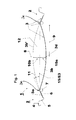
- Fig. 1
- shows a section through a lid according to one example of the invention.
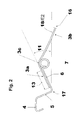
- Fig. 2
- shows the transition area between annular ring for seaming to the can body and lid diaphragm on a larger scale.
- Fig. 3
- shows a schematic sectional representation of a concrete example of a can with a predetermined diameter.
- Fig. 4
- shows a representation of a concrete example of a preformed lid panel.
- Fig. 5
- shows a lateral view of a representation of the concrete example.
- Fig. 6
- 2D sphere shape of a panel on a can body in theoretical evaluation (no annular ring displayed).
- Fig. 6a
- is a 2D sketch of
Figure 6 . - Fig. 7
- shows the 3D model of
Figure 6a . - Fig. 7a
- is a 3D representation for explanation of force and tensile stress.
- As can be seen from
Figure 1 , alid 1 has an outerannular ring 2 suitable for seaming to a can body and alid panel 3. - The annular ring 2 (for seaming to the can body, in short: "lid ring", seaming ring or "annular ring") is e.g. made of sheet metal. It comprises an
outer rim portion 4 as a "flared flange" for firm and liquid tight connection with arim 24 of an opening of the can body, cf.Fig. 3 . Theflange 4 is connected through acore wall 5 with theflat web 6 projecting generally radially inwards. Theflat web 6 that extends all around is axially outwardly inclined or tilted at an angle larger than zero with respect to a horizontal plane that extends perpendicular to avertical axis 8 of thelid 1. The radially inner edge of theflat web 6 is axially bent towards the inside and is designed in a sterile fashion, in particular by means of acurling 7. It may also be replaced with a relatively blunt inner edge. In the case of other can shapes, the lid shapes and the "annular ring" for seaming to the can body are accordingly adapted (seen in the horizontal direction). - The
lid panel 3 comprises an outercontinuous ring band 3a which at least partially covers theflat web 6 of the annular ring from the outside, if thepanel 3 is tightly connected with theannular ring 2 in afastening strip 13, e.g. by means of contact sealing or induction sealing (pressure sealing, ultrasonic sealing, laser sealing). Thisring band 3a limits thecentral portion 3b (provides its outer limit), atransition portion 3c between the two being within the area of thecurling 7 after connection of the panel with the annular ring. - The
central cover portion 3b of the lid panel is preformed by a deep-drawing process. This process can be implemented prior to or after the connection ofcover panel 3 andannular ring 2 in thefastening strip 13. The stabilizing reshaping only covers the central portion. It is implemented across the entire surface of the panel. - The preforming converts the
central portion 3b into a dome or bowl shape in the axially inwards direction, the edge of the bowl is in thetransition portion 3c to theouter ring band 3a and thelowermost centre 3d of the panel is clearly, in particular at least a few millimeters below ahorizontal plane 18 that passes through the lowermost points of theannular ring 2 according toFig. 2 . This also corresponds to the plane E2 ofFig. 3 in the example. - It is advantageous if, as is preferred, the panel itself comprises a material that is stiffened or hardened by the deep-drawing process such as aluminum or the like, or contains at least such a layer. Due to this, the preformed
central portion 3b is provided with an inner shape (or dimensional) stability. This is of advantage for the entire appearance of the finished, closed and thermally treated can package. - During sterilization, if temperature and consequently pressure are generated in the interior of the filled can that was closed with the lid (cf. also
Fig. 3 ), the preformed central portion will change, in particular change abruptly, from its "die sunk", undulation-free dome/bowl shape to a practically mirror-inverted shape that is axially outwardly bulging (sphere shaped in the case of round cans) as it is outlined in a dash-dotted fashion at 3b' inFig. 1 andFig. 3 . - Due to the stiffening or hardening of material of the cover panel achieved during the preforming, the dilatability of the
central portion 3b is accordingly practically zero so that even in the case of high pressures formed in the can during (thermal) treatment in a continuous autoclave, the outwardly bulging shape of the central portion can be determined in advance (by means of a computing). -
Figure 6 is a can with domed panel (pre shaped membrane) under internal pressure and cross section inFigure 6a of the convex shaped panel.Figures 6 and 6a show the two-dimensional representation of a can with a domed panel under internal over-pressure. The two-dimensional model of the pre-shaped domed panel shows its convex shape under internal over-pressure P. The parameters which indicate the geometry are given in the figures. - D is the diameter of the inner radius of the sealed zone, which is different from the can diameter, h is the dome deflection, y and z are the axes indicators, α is the angle of the dome with the y-axes. The volume increase, the angle and the radius of the convex dome can be calculated with the following equations:


-
Figure 7 is a convex shaped domed panel in 3-D coordinate system having x, y and z; ϕ, Θ (Theta) and p (rho).Figure 7a displays a force F on a randomly chosen small part (segment) of the domed panel and a part cross-section of it. - The tensile stress in the domed panel can be calculated rather straight forward with
Figure 7a using the force known from the multiplication of the pressure and the surface segment. The force has to be divided over the length of the side (I) and the thickness (e) of the domed panel.

- The tensile stresses on all sides are therefore given by

- The radius of curvature of the domed panel can be expressed in can dimension parameters. The tensile stress in the domed panel is

- In this equation ...
P is the pressure [N/mm2]
p is the radius of the convex shaped domed panel
e is the domed panel thickness
h is the deflection of the domed panel
D is the inner radius of the sealed zone. - The sealed zone can be "bended up" in such a way that the sealed zone is slanted upwards (axially outward, or upwards) and parallel to the domed panel. In this situation there is only a shear stress in the sealed zone and no longer a peel stress. The following relation between the tensile stress in the panel and the shear stress in the sealed zone applies

- In this case the shear stress can be calculated by

- As outlined in
Figure 1 , thedepth 10a of the bowl shape and thedepth 10b of the bulging are practically equal. Referred to theplane 15, the volume in the depth portion (defined by 10a) is equal to the volume in the depth portion (defined by 10b). The depths/distances of the centers of the deformed lid panel represent the volume formed vis-à-vis thecentral plane 15 or E3. Upon the closing of a can body with thelid 1, the headspace H of the can is reduced by the dome/bowl volume (between 15 and 3b) and, upon heating during sterilization, the volume of the headspace is enlarged by the total volume 12 (fromdepths - Both contribute to a clear reduction of the maximally occurring pressure and secure the closed cans against damage upon their passage through the autoclave. Pressures of less than 1 bar (0.1 MPa) can be achieved, which, without the preforming of the panel would be clearly above this value, e.g. at 1.5 bar (0.15 MPa). This amount of the achieved lowering of the pressure depends in general on the temperature of the foodstuff filled in. At hot filling of food the differential pressure that occurs as a maximum on the panel is lower than the differential pressure when using cold filling such as for pet food as "foodstuff".
- The stability as to shape/form, i.e. the avoided permanent deformation (as a missing plastic deformation or - at most - a residual elastic deformation by means of the modulus of elasticity) of the
central portion 3b contributes to the fact that, upon the cooling of the finished sterilized can, this preformedportion 3b practically exactly re-adopts the original dome/bowl shape. In both conditions or positions or according topanel shape - The fact that the central portion retains its area (in an envelope) permits the advance calculation of the measure of its bulging in the case of the pressures to be expected as a maximum during sterilization so that the angle of
inclination 11 of theflat web 6 of theannular ring 2 for seaming to the can body can be adjusted to this right from the beginning. By no means is the angle smaller than the angle of a tangent at the bulging of thecentral portion 3b (next to the slanted web). Theangle 11 is rather selected larger with preference so that that - in the case of the maximum internal pressures formed in the continuous autoclaves - practically exclusively shear forces and no peeling forces are active as resultant forces in thering band 3a of thepanel 3 that is affixed to the flat web. - The
angle 11 is set to more than 20°. The radius or the transverse dimension (in the case of a deviation from the circular shape) of the central portion is shown as 9.Reference 16 inFigure 2 emphasizes that theportion 3b in its bowl shape projects down to clearly below theplane 18 which passes through the lowermost portions (or points) of theannular ring 2. - The dimensions of the preforming and that of the angle of inclination depend upon the volume and the radial dimensions of the can and thus also on the size of the lid. The smaller the radius of the bulging in a pressure-loaded condition is, the smaller is the mechanical stress in the lid panel.
- A suitable material of the
lid panel 3 is a thin metal, preferably an aluminum, which is used for the body diameter of 83 mm. Other diameters may be used in the following manner, in a range of diameters between substantially 50 mm and 100 mm (for Europe), in particular with especially customary diameters: 73 mm, 99 mm, 65 mm, 83 mm; similar for containers (bodies) made of steel sheet. - The can body may be made of aluminum or steel sheet that are covered with a varnish.
- The
annular ring 2 is preferably made from an aluminum covered with varnish, the outer varnish layer being a hot sealable sealing layer, which is sealingly connected with the annular ring in the sealingportion 13. Instead of metal the ring material may also be plastic material or a plastic/metal composite, e.g. produced by means of an injection process with or without an insert or with a previous inserting of the lid panel in the shaped opening for the ring. Annular rings made of steel can likewise be used. - Instead of the hot sealable layer on the ring,
ring 2 may also be laminated or extruded with polymers. The lamination of the ring is done prior to the cutting out and the shaping of the annular ring. - In a preferred embodiment the lid panel that is connected with the annular ring (for seaming to the can body) preferably comprises several layers:
- coating varnish layer
- print layer
- aluminum layer (about 70 µm, in the range of 30 µm to 100 µm)
- extruded polymer layer (material with approx. 12 g/m2 to 30 g/m2)
- The extruded polymer layer is a co-extruded layer of a tie layer and a peel layer. Other extrusions and laminations can likewise be used.
- The
lid panel 3 was reshaped (deep-drawn) to a convex shape in thecentral area 3b as it is shown inFig. 1 at 3b . In the example, theconvex shape 3b has a radius of 110 mm. The lid layer was sealingly affixed to an initially horizontal flat strip, in aconnection area 13 which is at first not upwardly inclined. Theflat strip 6 of thering 2, which supports the connection area was then upwardly deformed in order to obtain the inclination position of theangle 11 of about 24°, measured with respect to ahorizontal plane 18/E2. This applies to the diameter of 83 mm of can and ring. - The sealing of the
ring band 3a of thelid panel 3 can be achieved more easily with a horizontalflat web 6 than with an already inclined flat web. Consequently, thelid panel 3 may still not have any preforming shape of its own, but will only be provided with a corresponding preformed shape after the sealing in theconnection area 13 as sealing strip. Here, thecentral area 3b is preformed to a bowl shape by means of the reshaping and stiffened or hardened, in order to admit hardly any elastic deformation, but to be capable of changing to a practically mirror-inverted, outwardly bulged bowl/dome shape in the case of an inner excess pressure. The central area is lowered that much below theplane 18 that there are several millimeters between the lowermost point of theinitial bowl shape 3b and this plane (in the preformed state). - After the reshaping of the
central area 3b an upwardly directed reshaping of the flat strip 6 (or the web) can be carried out. This obtains its inclination of more than 20° in this connection. - In a preferred embodiment that is not depicted these two re-shapings, that of the bowl-shaped bulging of the lid panel with a hardening, stiffening character and that of providing an inclination of an annular part the annular ring for seaming to the body, may also be carried out practically at the same time.
- In the example there was a sealing
strip 13 as the connection area of the still not preformedlid panel 3 on the initially horizontally orientedflat strip 6 of the ring, which was produced by implementing a sealing with the following parametersϑ = 190°C temperature P = 150 kg Pressure t = 300 msec Sealing time. - The inwardly bulged bowl/dome shape had - as represented above - a maximum deflection as the
depth 10a after the upwardly directed inclination of theflat web 6 which depth was between 5 mm and 6 mm, with a mean value of about 5.6 mm within a probe of a plurality of tests. -
Figure 3 elucidates again the important advantages of the lid that is capable of expansion. - The
lid 23 is shown in its position after firmly and tightly fixed to acan body 20, which is filled with thefoodstuff 21 and then closed. A symbolic filling height is outlined at 22 or the level E1, above which the headspace H filled with air or vapor is located. The axis of the can is designated 25. The annular ring (for seaming to the can body) and the can body rim are connected with each other in customary fashion by means of adouble seam 24a at theend 24 of the container (represented in a seamed fashion on the lefthand side, and in a placed fashion on the right-hand side inFig. 3 ). The connection area between the flat web of the annular ring and the ring band of the lid panel is designated 26. Thecentral portion 27a is deep-drawn in a dome/bowl-shaped fashion. Itsdepth 30 is represented exaggerated in order to display that it clearly reaches below the lowermost portion (plane E2) of the annular ring for seaming to the can body. The bowl volume defined by itsdepth 30 reduces the headspace H by the same volume, whereas the volume allocated to thedouble arrow 31 and limited by the central portion in its concave dome/bowl and convex bulging shapes outlines the volume enlargement of the headspace H with maximum pressure load ΔP during thermal sterilization. Thebroken line extension 28 of the flat web makes it clear that the angle of the flat web is larger than theangle 11 of the tangent to the bulging 27b. - A lid for a can with a diameter of 83 mm is assumed as a further practical example. The dome/
bowl depth 10a/30 of the preformed lid panel is between 5 mm and 6 mm, about 5.6 mm, thelowermost point 30d of the bowl being about 3 mm below the lowermost points of the annular ring. The bulging corresponds to a sphere portion - in the case of a circular cross-section of the lid as is shown byFigures 4 and5 . Theangle 11 is between 22° and 25°. Here, peeling forces are practically completely avoided. - The reference symbols in
Figures 4 and5 are consistent with the ones used before.Figure 4 additionally shows a tab to pulling off the panel 3 (having sealedring band 3b andcentral panel 3a). - The smooth/plane dome/bowl surface is not disturbed by any undulations or grooves. The can may be at least pasteurized, in particular sterilized with the lid in practically each of the known continuous autoclaves without counter-pressure means.
Claims (27)
- Cover panel for sealing to an annular ring to provide a lid to close a can body and allow a thermally treating pasteurization or sterilization process of the closed can in a continuous autoclave,- the cover panel (3) having a radially outer ring band (3a) for sealingly affixing to a flat web (6) and a remaining central portion (3b) that is surrounded by the ring band, the central portion being preformed- axially towards an interior (of the can) - in a bowl-shaped fashion and is for this reason stabilized in a manner- - so that the bowl-shaped cover panel (3), during an increase in pressure during at least the pasteurization, changes from the preformed bowl-shape as first position (3b) to a second position (3b') that is bowl-shaped axially outwards, and is still able to return to the first position (3b), at least substantially during or after cooling.
- Cover panel of claim 1, sealed to an annular ring to provide a lid, said lid (1) having the annular ring (2) for seaming to a can body edge portion and a plane or surface oriented cover panel (3;3a,3b) disposed sealingly (13) on the annular ring to the ring (2), wherein the annular ring comprises the flat web (6) that extends towards a vertical central axis (8) of the lid and is inclined at an angle (11) with respect to a horizontal plane (15), the inclination is oriented upwards or axially outward of the can body.
- Cover panel of claim 2, wherein the annular ring comprises the flat web (6) that is inclined upwards or outwards with respect to a horizontal plane (15) at an angle (11) of more than 10°, to which inclined web the cover panel (3) is seal ingly affixed by virtue of the radially outer ring band (3a), wherein the lid panel comprises a material that can be hardened or stiffened by a deep-drawing deformation or comprises a layer of such a material, and wherein a central portion (3b) surrounded by the ring band (3a) has a first shape continuously bulged due to the deep-drawing process providing only such shape keeping hardness or stability, to enable this central portion (3b)- to change into an outwardly shaped bulging (3b') under an inner pressure occurring during the temperature treatment inside the closed can, and- upon reduction of said pressure to return this portion (3b) to the first shape of continuous bulging.
- Cover panel according to claim 1 or 2, in which - when referred to a horizontal plane (15) assumed to pass through a transition area (3c) between the outer ring band (3a) and the inner central portion (3b) - a first distance (10b) of a center of the central portion (3b) from the horizontal plane (15) in said outwardly bulged position of the central portion is substantially the same as a second distance (10a) in said bowl-shaped shape (3b).
- Cover panel according to any of the preceding claims, in which an axial distance (10a,10b) is dimensioned in such a way that, due to the shape change of the central portion (3b) from the first position to the second position upon increase in pressure of preferably 1.5 bar (0.15 MPa), an increase in volume of a headspace caused in the closed can (1) limits a maximum pressure to a value not being detrimental to the lid during one of sterilization and pasteurization of the closed can in a continuous autoclave.
- Cover panel according claim 2, wherein the angle of inclination (11) of the flat web (6) is coordinated with the distance (10a,10b) of the center of the central portion (3b) from a horizontal plane (15, E3), which central portion is preformed in the first position bowl-shape in such a way that, at the maximum pressure building up during the thermal treatment in the sealing connection zone between the flat web (6) of the annular ring (2) and the outer ring band (3a) of the panel (3) at least no substantial peeling forces are acting on the outer ring band.
- Cover panel according to any of the preceding claims 2 to 6, wherein the angle of inclination (11) of the flat web (6) is one of greater than10°, larger than 20°, smaller than 30° or both.
- Cover panel according to any of the preceding claims adapted for and suitable for a can with a diameter of about 83 mm, wherein an axial distance (10a) of the centre of the preformed central portion (3b), preformed in a bowl- or dome-shape, from a horizontal reference plane (15) as "the horizontal" is between 5 mm and 6 mm, in particular about 5.6 mm.
- Cover panel of claim 2, the lid having a central portion (3b) of the lid panel (3) that is bounded by the outer ring band (3a) and deformed in a bowl-shaped fashion by preferably deep-drawing and, when doing so, having the central portion axially lowered, whereby the central portion is located several millimeters below a lowermost portion (17) of the annular ring (2).
- Cover panel of claim 1 for providing tightness of a can closure during one of a sterilization and pasteurization of a can in a continuous autoclave, said can containing foodstuff and being closed with a lid (1) that has an annular ring (2) seamed to the can body and a lid panel (3), which is affixed with an outer ring band (3a) thereof on an inner flat web (6) that is outwardly inclined (11) with respect to a horizontal plane (15),- wherein, prior to a seaming of the lid (1) to the filled can, a central portion (3b) of the lid panel (3) that is bounded by the outer ring band (3a) is re-shaped to an undulation-free or corrugation-free dome shape using preferably deep-drawing, the dome shape pronounced in a way that for a can with a diameter of about 83 mm, a centre of the central portion (3b) reaches an axial distance (10a) of between 5 mm and 6 mm from the horizontal plane (15,E3) assumed to extend through a transition portion (3c) between the outer ring band (3a) and the central portion (3b).
- Cover panel of claim 2, wherein the radial flat web (6) of the annular seaming ring (2) is imparted an inclination at an angle (11), which is coordinated to an axial depth (10a, 10b) of two layers (27a, 27b; 3b, 3b') of the central portion in such a way that applying a maximal pressure during the passage of the filled and closed can through the continuous autoclave, this pressure provides no peeling effect in the sealing portion (13) of the ring band (3a) on the flat web (6) of the annular ring (2).
- Cover panel of claim 1, wherein the central portion (3b) of the lid panel (3) is deep drawn prior to or after sealing the lid panel to the flat web (6) of the annular ring (2).
- Cover panel of claim 2, wherein the ring band (3a) is attached to the flat web (6) by hot sealing, in particular using an induction process.
- Cover panel of any of the prior claims, wherein the cover panel is adapted to control the pressure in a headspace (H) of a closed can body to not exceed substantially 1 bar (0.1 MPa), and this up to a sterilization temperature during sterilization.
- Cover panel of claim 2, wherein the inclination angle (11) is between substantially 22° and 25°.
- Cover panel of claim 1, wherein an inner tensile stress of the central portion (3b) is reduced by deep drawing said portion, in order to create a reduced stress or load of the fastening place (13) between ring band (3a) and inclined flat web (6) at a pressure load with a surface pressure on the central portion (3b) during the passage through an autoclave or retort station.
- Cover panel of claim 1, wherein the central portion is brought into the first position shape by deep-drawing, determined by an inner space of the annular ring, radially further inside than the flat web and reaching - exposed to thermally caused surface pressure - a deflection (10b) which subjects the central portion within its material and likewise the fastening place (13) on the flat web (6) to tensile stress, said tensile stress being below a stress limit of the central portion, thus avoiding a plastic deformation, in particular avoiding tearing or cracking.
- Cover panel of claim 2, wherein a stress in a sealing area (13) as a fastening place connecting outer ring band (3a) and inclined web (6), depends on the load or tensile stress of the central portion having a given thickness and a given differential pressure on the central portion (3b).
- Cover panel of claim 1 or 18, wherein a stress on the central portion (3b) upon application of surface pressure is subject to a change by selecting another width of a sealing area (13) implemented as a sealing to the flat web (6).
- A process for producing a lid closure for cans containing foodstuff, the lid providing tightness during sterilization or pasteurization in a continuous autoclave, said cans being closed with a can closure as lid (1), wherein(i) the can closure is produced from an annular ring (2) adapted for seaming to the can body and a lid panel (3; 3a, 3b) having an outer ring band (3a), sealingly affixed onto an inner flat web (6),(ii) a central area (3b) of the lid panel (3), limited by an outer ring band (3a), is reshaped by preferably deep drawing to a smooth bowl shape or a dome shape with a plane surface, as original shape, a material of this central area (3b) thereby solidified or hardened to such an extent that- under an increased pressure in a headspace (H) of the can during a passage thereof through an autoclave station, the central area changes to an axially outwardly bulged shape that is mirror-inverted with respect to the original shape and, during a subsequent cooling of the can, the central area automatically returns substantially to the original shape thereof.
- The process according to claim 20, wherein the central area (3b) of the lid panel (3) is reshaped prior to attaching the lid (1) to the filled can, preferably after a sealing of the outer ring band (3a) to the flat web (6) of the annular ring (2) or prior to a sealing to the flat web (6) of the annular ring (2).
- The process according to claim 20 or 21, wherein the flat web (6) of the annular ring (2) is upwardly re-shaped after sealing of the lid panel (3) to the flat web (6) of the annular ring (2), the flat web still being plane at a time of sealing.
- The process according to claim 22 or 21, wherein the reshaping, preferably by deep drawing of the lid panel and an upwards re-shaping of the flat web (6) take place substantially at the same time or the sealing takes place to an already inclined flat web (6).
- The process of claim 20, wherein the angle of inclination (11) of the flat web (6) is one of larger than 20°, smaller than 30° or both.
- A process of closing cans containing foodstuff that are tight during sterilization or pasteurization and such temperatures or differential pressures (ΔP) in a continuous autoclave,(a) wherein cans are closed with can closures (1) and each closure (1) comprises a seamable annular ring (2) and a lid panel (3), the panel being affixed onto a flat web (6) by means of an outer ring band (3a) which - beforehand or thereafter - is deformed with respect to a horizontal plane (15) in an axially outwardly and upwardly inclined angle (11) in order to form an inclined flat web (6);(b) wherein each central area (3b) of each lid panel (3) is limited by the outer ring band (3a) and deformed into a dome shape by reshaping, and a central area thereof is axially lowered to a lowermost point (30d) of the central area being several millimeters below a lowermost area (17) of said annular ring (2);for substantially reducing a headspace (H) in each filled can upon placement of the closure (1) on the can body.
- Process of claim 25, wherein the continuous autoclave having at least no substantial counter-pressure upon sterilizing the closed cans, preferably the counter-pressure in the continuous autoclave being below 1.6 bar (0.16 MPa).
- Cover panel of claim 1, the continuous autoclave having no or only little counter-pressure atmosphere from an outside of the closed can.
Applications Claiming Priority (2)
| Application Number | Priority Date | Filing Date | Title |
|---|---|---|---|
| DE102006005058A DE102006005058A1 (en) | 2006-02-03 | 2006-02-03 | Expandable lid for a food can |
| EP07712146A EP1981767B1 (en) | 2006-02-03 | 2007-02-02 | Expandable container having lid for providing headspace control of a food can |
Related Parent Applications (2)
| Application Number | Title | Priority Date | Filing Date |
|---|---|---|---|
| EP07712146.5 Division | 2007-02-02 | ||
| EP07712146A Division EP1981767B1 (en) | 2006-02-03 | 2007-02-02 | Expandable container having lid for providing headspace control of a food can |
Publications (3)
| Publication Number | Publication Date |
|---|---|
| EP2497718A2 true EP2497718A2 (en) | 2012-09-12 |
| EP2497718A3 EP2497718A3 (en) | 2012-11-07 |
| EP2497718B1 EP2497718B1 (en) | 2015-06-10 |
Family
ID=38007036
Family Applications (2)
| Application Number | Title | Priority Date | Filing Date |
|---|---|---|---|
| EP07712146A Active EP1981767B1 (en) | 2006-02-03 | 2007-02-02 | Expandable container having lid for providing headspace control of a food can |
| EP11165378.8A Not-in-force EP2497718B1 (en) | 2006-02-03 | 2007-02-02 | Process for producing a lid closure for a food can |
Family Applications Before (1)
| Application Number | Title | Priority Date | Filing Date |
|---|---|---|---|
| EP07712146A Active EP1981767B1 (en) | 2006-02-03 | 2007-02-02 | Expandable container having lid for providing headspace control of a food can |
Country Status (26)
| Country | Link |
|---|---|
| US (2) | US9617056B2 (en) |
| EP (2) | EP1981767B1 (en) |
| JP (2) | JP5410096B2 (en) |
| KR (1) | KR101354338B1 (en) |
| CN (1) | CN101378968B (en) |
| AT (1) | ATE508959T1 (en) |
| AU (2) | AU2007211425B2 (en) |
| BR (1) | BRPI0707675B1 (en) |
| CA (1) | CA2640281C (en) |
| DE (1) | DE102006005058A1 (en) |
| DK (2) | DK2497718T3 (en) |
| EA (1) | EA012404B1 (en) |
| EG (1) | EG25575A (en) |
| ES (2) | ES2544708T3 (en) |
| IL (1) | IL193199A0 (en) |
| MA (1) | MA30206B1 (en) |
| MX (1) | MX2008010006A (en) |
| MY (1) | MY151909A (en) |
| NO (1) | NO20083775L (en) |
| NZ (1) | NZ570076A (en) |
| PL (1) | PL1981767T3 (en) |
| PT (1) | PT1981767E (en) |
| TN (1) | TNSN08317A1 (en) |
| UA (1) | UA95273C2 (en) |
| WO (1) | WO2007088212A1 (en) |
| ZA (1) | ZA200806640B (en) |
Families Citing this family (17)
| Publication number | Priority date | Publication date | Assignee | Title |
|---|---|---|---|---|
| DE102006005058A1 (en) * | 2006-02-03 | 2007-08-16 | IMPRESS Metal Packaging S.A., Crosmières | Expandable lid for a food can |
| EP1964784B1 (en) * | 2007-02-28 | 2010-04-14 | Impress Group B.V. | Can having an easy opening panel, an easy opening panel, and panel therefore |
| ATE491645T1 (en) | 2007-10-25 | 2011-01-15 | Impress Group Bv | METHOD FOR FORMING A LID AND COVER |
| EP2055641A1 (en) | 2007-10-29 | 2009-05-06 | Impress Metal Packaging S.A. | Lid ring for allowing flange tilting and method for preparing and forming a lid |
| US20110226771A1 (en) * | 2010-03-17 | 2011-09-22 | Silgan Containers Llc | Container assembly with strainer |
| AT510271B1 (en) * | 2010-10-15 | 2012-03-15 | Xolution Gmbh | METHOD FOR PRODUCING FILLED AND RECYCLABLE PRESSURE TANKS |
| ES2585329T3 (en) * | 2010-11-29 | 2016-10-05 | Crown Packaging Technology, Inc. | Closing |
| CH705595A1 (en) * | 2011-10-05 | 2013-04-15 | Soudronic Ag | Manufacturing method for tear-open lids, involves providing lid ring blank, which has beading and flange adjoined to beading flank, where flange with cutting edge borders opening of lid ring blank |
| MX2014013235A (en) | 2012-05-01 | 2015-07-14 | Berry Plastics Corp | Retortable package. |
| US9145251B2 (en) | 2012-10-26 | 2015-09-29 | Berry Plastics Corporation | Package |
| SE1350234A1 (en) * | 2013-02-28 | 2014-08-29 | Scania Cv Ab | Container with expansion element |
| ES2615331B1 (en) * | 2015-12-03 | 2018-03-13 | Mecánica Y Tecnología Alimentaria, S.L. | Lid for containers of hot dosed product and device for manufacturing |
| DE102017005873A1 (en) * | 2017-06-22 | 2018-12-27 | Bundesrepublik Deutschland, vertreten durch das Bundesministerium der Verteidigung, vertreten durch das Bundesamt für Ausrüstung, Informationstechnik und Nutzung der Bundeswehr | Tank with pressure equalization |
| ES2985206T3 (en) * | 2017-12-07 | 2024-11-04 | Nippon Steel Corp | Heat-sealed lid and can |
| US12030702B2 (en) * | 2019-02-07 | 2024-07-09 | Nippon Steel Corporation | Can lid made of resin laminate steel sheet for resin-metal composite container, can bottom made of resin laminate steel sheet for resin-metal composite container, and resin-metal composite container |
| MX2021015307A (en) * | 2019-06-10 | 2022-01-18 | Amcor Rigid Packaging Usa Llc | CONTAINER CLOSURE WITH FLEXIBLE MEMBRANE. |
| CN113525812A (en) * | 2021-06-08 | 2021-10-22 | 中建材智能自动化研究院有限公司 | Food filling method and production line thereof |
Citations (2)
| Publication number | Priority date | Publication date | Assignee | Title |
|---|---|---|---|---|
| US4211338A (en) | 1979-05-08 | 1980-07-08 | Reynolds Metals Company | Container closure structure |
| WO2005005277A1 (en) | 2003-07-01 | 2005-01-20 | Crown Packaging Technology Inc | Closure |
Family Cites Families (68)
| Publication number | Priority date | Publication date | Assignee | Title |
|---|---|---|---|---|
| US549130A (en) * | 1895-11-05 | Laundry apparatus | ||
| BE532675A (en) | ||||
| DE262652C (en) | ||||
| US1162520A (en) * | 1915-04-06 | 1915-11-30 | American Can Co | Art of canning. |
| GB214968A (en) | 1923-04-28 | 1924-07-31 | Arthur Cecil Collett | Improvements in sealing tin boxes having usable lids |
| GB454429A (en) | 1934-12-14 | 1936-09-29 | Roman Blace Bukolt | Improvements in closing means for jars and like containers |
| US2971671A (en) * | 1956-10-31 | 1961-02-14 | Pabst Brewing Co | Container |
| US3369689A (en) * | 1964-09-11 | 1968-02-20 | American Can Co | Easy-open container closure |
| CH475136A (en) | 1968-07-11 | 1969-07-15 | Albis Pack Ag | Can with a detachable sealing membrane |
| US3628689A (en) * | 1969-11-24 | 1971-12-21 | Container Corp | Reclosable end structure for container body |
| US3789785A (en) * | 1969-12-09 | 1974-02-05 | Carnaud & Forges | Sterilisation of tins |
| FR2137293B1 (en) | 1971-05-18 | 1974-03-22 | Carnaud & Forges | |
| US3894652A (en) * | 1972-03-21 | 1975-07-15 | Fraze Ermal C | Easy-open can end construction |
| DE2258462A1 (en) | 1972-11-27 | 1974-06-12 | Battelle Memorial Institute | TIGHTLY SEALED STORAGE PACKAGE FOR FINELY GRINDED BODIES |
| CH593180A5 (en) | 1976-02-11 | 1977-11-30 | Sandherr Max Ag | |
| GB1577739A (en) * | 1976-04-09 | 1980-10-29 | Metal Box Co Ltd | Containers |
| CH598063A5 (en) * | 1976-05-07 | 1978-04-28 | Sandherr Max Ag | |
| US4125632A (en) * | 1976-11-22 | 1978-11-14 | American Can Company | Container |
| US4129085A (en) * | 1977-03-07 | 1978-12-12 | Klein Gerald B | Gated can end with shear offset defining gate and method for manufacture of the same |
| JPS5428638U (en) * | 1977-07-29 | 1979-02-24 | ||
| CH629983A5 (en) | 1978-06-06 | 1982-05-28 | Alusuisse | METHOD FOR PRODUCING LID RINGS FOR CAN CAN. |
| DE2830614A1 (en) | 1978-07-12 | 1980-01-24 | Monfalconesi E Passero & C S R | Paint can prodn. method - using cylindrical rolled plate with flanged reinforced lid edge |
| AU524167B2 (en) | 1978-11-24 | 1982-09-02 | Monfalconesi E Passero & C S R | Sheetmetal containers |
| SE429036B (en) | 1979-12-17 | 1983-08-08 | Haustrup Plastic As | CONTAINER WITH A CLOSING PART |
| DE3105911A1 (en) | 1981-02-18 | 1982-11-04 | Hamba-Maschinenfabrik Hans A.Müller GmbH & Co KG, 5600 Wuppertal | Sealing head for hot-melt adhesive-coated lid films on foodstuff containers |
| US4542029A (en) * | 1981-06-19 | 1985-09-17 | American Can Company | Hot filled container |
| CH654542A5 (en) | 1982-04-05 | 1986-02-28 | Sandherr Packungen Ag | LOCKING LID FOR STERILIZABLE CAN. |
| JPS58154163U (en) * | 1982-04-08 | 1983-10-15 | 昭和アルミニウム株式会社 | Lid for container for filling heated substances |
| JPS58192257U (en) * | 1982-06-16 | 1983-12-21 | 三陽紙器株式会社 | Aluminum cap for packaging containers |
| JPS5984734A (en) * | 1982-10-26 | 1984-05-16 | 日本製罐株式会社 | Can and its manufacture |
| JPS5978246U (en) * | 1982-11-15 | 1984-05-26 | 喜多 義夫 | Sealing lid made of thin metal plate |
| US4680917A (en) * | 1984-08-17 | 1987-07-21 | International Paper Company | Process for providing filled containers |
| KR910002152B1 (en) | 1986-09-30 | 1991-04-06 | 이데미쓰세끼유가가꾸 가부시끼가이샤 | Easy-opening packaging container and its lead |
| CH674829A5 (en) * | 1987-12-14 | 1990-07-31 | Alcan Rorschach Ag | |
| DE8802824U1 (en) | 1988-03-03 | 1989-07-06 | Müller, Wolfgang, 2105 Seevetal | Containers for transporting, storing and heating food |
| JPH01308770A (en) | 1988-05-30 | 1989-12-13 | Kiyouhou Giken:Kk | Hermetically packaging container |
| GB2237259B (en) | 1989-07-10 | 1993-12-08 | Metal Box Plc | Container closure |
| IT217195Z2 (en) | 1989-09-26 | 1991-11-12 | Socama Eng | CONTAINER FOR CONSERVATION AND CONSUMING OF PRE-PACKED FOOD |
| ATE126492T1 (en) | 1989-12-18 | 1995-09-15 | Polystar Packaging Inc | CONTAINER CLOSURE AND METHOD FOR PRODUCING IT. |
| DE4106110A1 (en) | 1990-05-23 | 1991-11-28 | Zuechner Blechwaren | Metal container sealable rim |
| DE9005868U1 (en) | 1990-05-23 | 1991-01-24 | Blechwarenfabriken Züchner GmbH & Co, 3370 Seesen | Metal packaging with sealable profile edge |
| US5016769A (en) * | 1990-07-09 | 1991-05-21 | Continental White Cap, Inc. | Closure with high energy button |
| JP2862646B2 (en) | 1990-07-13 | 1999-03-03 | 住友ベークライト株式会社 | Easy-open sealing lid |
| US5069355A (en) * | 1991-01-23 | 1991-12-03 | Sonoco Products Company | Easy-opening composite closure for hermetic sealing of a packaging container by double seaming |
| US5125632A (en) * | 1991-01-29 | 1992-06-30 | John A. Blatt | Rotary actuated workpiece holder |
| GB9109820D0 (en) * | 1991-05-07 | 1991-06-26 | Courtaulds Coatings Holdings | Lid for a pail |
| DE4126027A1 (en) | 1991-08-06 | 1993-02-11 | Alcan Gmbh | Microwave oven food-heating container - consists of metal foil or plastics bottom part, top part with microwave reflecting or absorbent surface, and plate with holes |
| DE4140198A1 (en) | 1991-12-03 | 1993-06-09 | Elpro Ag Berlin - Industrieelektronik Und Anlagenbau -, O-1140 Berlin, De | DC power supply and protection system for local transport network - has controlled semiconductor switching and auxiliary back-up supply to minimise disconnection of healthy routes when one route is faulty. |
| DE4140098C2 (en) | 1991-12-05 | 1997-05-22 | 4 P Nicolaus Kempten Gmbh | Sealable lid |
| DE9203953U1 (en) | 1992-03-24 | 1992-07-23 | Alcan Rorschach Ag, Rorschach | Lids for cans or similar containers |
| DE4332306A1 (en) * | 1993-09-23 | 1995-03-30 | Rasselstein Ag | Method for the production of an easy-to-open can lid from sheet metal |
| GB2289663A (en) * | 1994-05-21 | 1995-11-29 | Metal Box Plc | Containers and lids bonded thereto |
| US5804237A (en) | 1995-10-16 | 1998-09-08 | George B. Diamond | Method of and package for sterilized edible material |
| DE29609130U1 (en) * | 1996-05-21 | 1997-09-18 | Rasselstein Hoesch GmbH, 56564 Neuwied | Easy to open can lid |
| US5752614A (en) * | 1996-11-19 | 1998-05-19 | Sonoco Products Company | Easy-opening closure for hermetic sealing a retortable container |
| DE19822739C1 (en) | 1998-05-20 | 1999-11-11 | Alcan Gmbh | Method and device for measuring the thickness of an intermediate layer |
| AT4942U1 (en) | 1999-03-19 | 2002-01-25 | Oesterreichische Blechwarenfab | SHEET IN TIN |
| EP1214246B1 (en) | 1999-09-10 | 2003-04-16 | Societe Des Produits Nestle S.A. | Method for producing a sealed container for oven cooked products or similar |
| US6702538B1 (en) | 2000-02-15 | 2004-03-09 | Crown Cork & Seal Technologies Corporation | Method and apparatus for forming a can end with minimal warpage |
| DE10022553C1 (en) | 2000-05-10 | 2001-07-05 | Rasselstein Hoesch Gmbh | Method for producing ring part from sheet metal for can lid involves forming flat plate part with hot-sealable coating on inside into cylindrical tube |
| US6817819B2 (en) * | 2001-11-27 | 2004-11-16 | Omnitech International, Inc. | Easy-open container end |
| US7055713B2 (en) | 2002-11-12 | 2006-06-06 | Sonoco Development, Inc. | Easy-opening closure for retortable container |
| DE10338445B4 (en) * | 2003-08-19 | 2007-02-08 | IMPRESS Metal Packaging S.A., Crosmières | Cover ring with inclined flat bar |
| US20050145630A1 (en) | 2004-01-05 | 2005-07-07 | Sonoco Development, Inc. | Easily openable closure for a retortable container having a metal end to which a membrane is sealed |
| EP1559655A1 (en) * | 2004-01-29 | 2005-08-03 | Impress Group B.V. | Container and method for producing such a container |
| EP1777165A1 (en) | 2005-10-20 | 2007-04-25 | Alcan Technology & Management Ltd. | Can end comprising a cover ring portion and a sealing diaphragm |
| DE102006005058A1 (en) * | 2006-02-03 | 2007-08-16 | IMPRESS Metal Packaging S.A., Crosmières | Expandable lid for a food can |
| ITUD20120085A1 (en) * | 2012-05-11 | 2013-11-12 | Illycaffe S P A Con Unico Socio | CONTAINER FOR FOOD, IN PARTICULAR COFFEE, PROCEDURE FOR ITS PRODUCTION AND PACKAGING |
-
2006
- 2006-02-03 DE DE102006005058A patent/DE102006005058A1/en not_active Withdrawn
-
2007
- 2007-02-02 NZ NZ570076A patent/NZ570076A/en not_active IP Right Cessation
- 2007-02-02 KR KR1020087019167A patent/KR101354338B1/en not_active Expired - Fee Related
- 2007-02-02 CN CN2007800041226A patent/CN101378968B/en not_active Expired - Fee Related
- 2007-02-02 JP JP2008552826A patent/JP5410096B2/en not_active Expired - Fee Related
- 2007-02-02 EP EP07712146A patent/EP1981767B1/en active Active
- 2007-02-02 ES ES11165378.8T patent/ES2544708T3/en active Active
- 2007-02-02 PT PT07712146T patent/PT1981767E/en unknown
- 2007-02-02 CA CA2640281A patent/CA2640281C/en active Active
- 2007-02-02 WO PCT/EP2007/051053 patent/WO2007088212A1/en not_active Ceased
- 2007-02-02 DK DK11165378.8T patent/DK2497718T3/en active
- 2007-02-02 BR BRPI0707675-4A patent/BRPI0707675B1/en not_active IP Right Cessation
- 2007-02-02 UA UAA200809988A patent/UA95273C2/en unknown
- 2007-02-02 AT AT07712146T patent/ATE508959T1/en active
- 2007-02-02 EP EP11165378.8A patent/EP2497718B1/en not_active Not-in-force
- 2007-02-02 MY MYPI20082908 patent/MY151909A/en unknown
- 2007-02-02 US US12/162,923 patent/US9617056B2/en not_active Expired - Fee Related
- 2007-02-02 MX MX2008010006A patent/MX2008010006A/en active IP Right Grant
- 2007-02-02 DK DK07712146.5T patent/DK1981767T3/en active
- 2007-02-02 ES ES07712146T patent/ES2366387T3/en active Active
- 2007-02-02 EA EA200870225A patent/EA012404B1/en not_active IP Right Cessation
- 2007-02-02 PL PL07712146T patent/PL1981767T3/en unknown
- 2007-02-02 AU AU2007211425A patent/AU2007211425B2/en not_active Ceased
-
2008
- 2008-07-28 EG EG2008071269A patent/EG25575A/en active
- 2008-07-29 MA MA31147A patent/MA30206B1/en unknown
- 2008-07-30 ZA ZA200806640A patent/ZA200806640B/en unknown
- 2008-07-31 IL IL193199A patent/IL193199A0/en unknown
- 2008-08-01 TN TNP2008000317A patent/TNSN08317A1/en unknown
- 2008-09-01 NO NO20083775A patent/NO20083775L/en not_active Application Discontinuation
-
2013
- 2013-04-02 JP JP2013077201A patent/JP2013173568A/en active Pending
- 2013-07-18 AU AU2013207614A patent/AU2013207614A1/en not_active Abandoned
-
2016
- 2016-07-01 US US15/200,828 patent/US10017313B2/en not_active Expired - Fee Related
Patent Citations (2)
| Publication number | Priority date | Publication date | Assignee | Title |
|---|---|---|---|---|
| US4211338A (en) | 1979-05-08 | 1980-07-08 | Reynolds Metals Company | Container closure structure |
| WO2005005277A1 (en) | 2003-07-01 | 2005-01-20 | Crown Packaging Technology Inc | Closure |
Also Published As
Similar Documents
| Publication | Publication Date | Title |
|---|---|---|
| EP1981767B1 (en) | Expandable container having lid for providing headspace control of a food can | |
| KR101386770B1 (en) | Can end for a can and such can | |
| CA1249779A (en) | Methods for closing containers | |
| AU631266B2 (en) | Containers | |
| US11130607B2 (en) | Bottle can, bottle can with cap, and method for manufacturing bottle can | |
| US20080017646A1 (en) | open ended container closure including a flexible membrane and a rigid cap | |
| EP0390816B1 (en) | Plastic closures for containers and cans and methods of and apparatus for producing such closures | |
| US9950831B2 (en) | Can end and related method | |
| EP2760744B1 (en) | Process for closing metal cans | |
| EP0132468B1 (en) | Container body |
Legal Events
| Date | Code | Title | Description |
|---|---|---|---|
| PUAI | Public reference made under article 153(3) epc to a published international application that has entered the european phase |
Free format text: ORIGINAL CODE: 0009012 |
|
| AC | Divisional application: reference to earlier application |
Ref document number: 1981767 Country of ref document: EP Kind code of ref document: P |
|
| AK | Designated contracting states |
Kind code of ref document: A2 Designated state(s): AT BE BG CH CY CZ DE DK EE ES FI FR GB GR HU IE IS IT LI LT LU LV MC NL PL PT RO SE SI SK TR |
|
| AX | Request for extension of the european patent |
Extension state: AL BA HR MK RS |
|
| PUAL | Search report despatched |
Free format text: ORIGINAL CODE: 0009013 |
|
| AK | Designated contracting states |
Kind code of ref document: A3 Designated state(s): AT BE BG CH CY CZ DE DK EE ES FI FR GB GR HU IE IS IT LI LT LU LV MC NL PL PT RO SE SI SK TR |
|
| AX | Request for extension of the european patent |
Extension state: AL BA HR MK RS |
|
| RIC1 | Information provided on ipc code assigned before grant |
Ipc: B65D 17/50 20060101AFI20120928BHEP Ipc: B65D 79/00 20060101ALI20120928BHEP |
|
| 17P | Request for examination filed |
Effective date: 20130410 |
|
| 17Q | First examination report despatched |
Effective date: 20131004 |
|
| GRAP | Despatch of communication of intention to grant a patent |
Free format text: ORIGINAL CODE: EPIDOSNIGR1 |
|
| INTG | Intention to grant announced |
Effective date: 20150330 |
|
| GRAS | Grant fee paid |
Free format text: ORIGINAL CODE: EPIDOSNIGR3 |
|
| GRAA | (expected) grant |
Free format text: ORIGINAL CODE: 0009210 |
|
| AC | Divisional application: reference to earlier application |
Ref document number: 1981767 Country of ref document: EP Kind code of ref document: P |
|
| AK | Designated contracting states |
Kind code of ref document: B1 Designated state(s): AT BE BG CH CY CZ DE DK EE ES FI FR GB GR HU IE IS IT LI LT LU LV MC NL PL PT RO SE SI SK TR |
|
| REG | Reference to a national code |
Ref country code: GB Ref legal event code: FG4D |
|
| REG | Reference to a national code |
Ref country code: CH Ref legal event code: EP |
|
| REG | Reference to a national code |
Ref country code: AT Ref legal event code: REF Ref document number: 730801 Country of ref document: AT Kind code of ref document: T Effective date: 20150715 |
|
| REG | Reference to a national code |
Ref country code: DE Ref legal event code: R096 Ref document number: 602007041774 Country of ref document: DE |
|
| REG | Reference to a national code |
Ref country code: IE Ref legal event code: FG4D |
|
| REG | Reference to a national code |
Ref country code: RO Ref legal event code: EPE |
|
| REG | Reference to a national code |
Ref country code: ES Ref legal event code: FG2A Ref document number: 2544708 Country of ref document: ES Kind code of ref document: T3 Effective date: 20150903 |
|
| REG | Reference to a national code |
Ref country code: DK Ref legal event code: T3 Effective date: 20150901 |
|
| REG | Reference to a national code |
Ref country code: NL Ref legal event code: FP |
|
| PG25 | Lapsed in a contracting state [announced via postgrant information from national office to epo] |
Ref country code: FI Free format text: LAPSE BECAUSE OF FAILURE TO SUBMIT A TRANSLATION OF THE DESCRIPTION OR TO PAY THE FEE WITHIN THE PRESCRIBED TIME-LIMIT Effective date: 20150610 Ref country code: LT Free format text: LAPSE BECAUSE OF FAILURE TO SUBMIT A TRANSLATION OF THE DESCRIPTION OR TO PAY THE FEE WITHIN THE PRESCRIBED TIME-LIMIT Effective date: 20150610 |
|
| REG | Reference to a national code |
Ref country code: AT Ref legal event code: MK05 Ref document number: 730801 Country of ref document: AT Kind code of ref document: T Effective date: 20150610 |
|
| PG25 | Lapsed in a contracting state [announced via postgrant information from national office to epo] |
Ref country code: LV Free format text: LAPSE BECAUSE OF FAILURE TO SUBMIT A TRANSLATION OF THE DESCRIPTION OR TO PAY THE FEE WITHIN THE PRESCRIBED TIME-LIMIT Effective date: 20150610 Ref country code: GR Free format text: LAPSE BECAUSE OF FAILURE TO SUBMIT A TRANSLATION OF THE DESCRIPTION OR TO PAY THE FEE WITHIN THE PRESCRIBED TIME-LIMIT Effective date: 20150911 Ref country code: BG Free format text: LAPSE BECAUSE OF FAILURE TO SUBMIT A TRANSLATION OF THE DESCRIPTION OR TO PAY THE FEE WITHIN THE PRESCRIBED TIME-LIMIT Effective date: 20150910 |
|
| PG25 | Lapsed in a contracting state [announced via postgrant information from national office to epo] |
Ref country code: EE Free format text: LAPSE BECAUSE OF FAILURE TO SUBMIT A TRANSLATION OF THE DESCRIPTION OR TO PAY THE FEE WITHIN THE PRESCRIBED TIME-LIMIT Effective date: 20150610 |
|
| REG | Reference to a national code |
Ref country code: FR Ref legal event code: PLFP Year of fee payment: 10 |
|
| PG25 | Lapsed in a contracting state [announced via postgrant information from national office to epo] |
Ref country code: AT Free format text: LAPSE BECAUSE OF FAILURE TO SUBMIT A TRANSLATION OF THE DESCRIPTION OR TO PAY THE FEE WITHIN THE PRESCRIBED TIME-LIMIT Effective date: 20150610 Ref country code: PL Free format text: LAPSE BECAUSE OF FAILURE TO SUBMIT A TRANSLATION OF THE DESCRIPTION OR TO PAY THE FEE WITHIN THE PRESCRIBED TIME-LIMIT Effective date: 20150610 Ref country code: SK Free format text: LAPSE BECAUSE OF FAILURE TO SUBMIT A TRANSLATION OF THE DESCRIPTION OR TO PAY THE FEE WITHIN THE PRESCRIBED TIME-LIMIT Effective date: 20150610 Ref country code: PT Free format text: LAPSE BECAUSE OF FAILURE TO SUBMIT A TRANSLATION OF THE DESCRIPTION OR TO PAY THE FEE WITHIN THE PRESCRIBED TIME-LIMIT Effective date: 20151012 Ref country code: CZ Free format text: LAPSE BECAUSE OF FAILURE TO SUBMIT A TRANSLATION OF THE DESCRIPTION OR TO PAY THE FEE WITHIN THE PRESCRIBED TIME-LIMIT Effective date: 20150610 Ref country code: IS Free format text: LAPSE BECAUSE OF FAILURE TO SUBMIT A TRANSLATION OF THE DESCRIPTION OR TO PAY THE FEE WITHIN THE PRESCRIBED TIME-LIMIT Effective date: 20151010 |
|
| REG | Reference to a national code |
Ref country code: DE Ref legal event code: R097 Ref document number: 602007041774 Country of ref document: DE |
|
| PLBE | No opposition filed within time limit |
Free format text: ORIGINAL CODE: 0009261 |
|
| STAA | Information on the status of an ep patent application or granted ep patent |
Free format text: STATUS: NO OPPOSITION FILED WITHIN TIME LIMIT |
|
| 26N | No opposition filed |
Effective date: 20160311 |
|
| PG25 | Lapsed in a contracting state [announced via postgrant information from national office to epo] |
Ref country code: SI Free format text: LAPSE BECAUSE OF FAILURE TO SUBMIT A TRANSLATION OF THE DESCRIPTION OR TO PAY THE FEE WITHIN THE PRESCRIBED TIME-LIMIT Effective date: 20150610 Ref country code: BE Free format text: LAPSE BECAUSE OF NON-PAYMENT OF DUE FEES Effective date: 20160229 |
|
| PG25 | Lapsed in a contracting state [announced via postgrant information from national office to epo] |
Ref country code: MC Free format text: LAPSE BECAUSE OF FAILURE TO SUBMIT A TRANSLATION OF THE DESCRIPTION OR TO PAY THE FEE WITHIN THE PRESCRIBED TIME-LIMIT Effective date: 20150610 Ref country code: LU Free format text: LAPSE BECAUSE OF FAILURE TO SUBMIT A TRANSLATION OF THE DESCRIPTION OR TO PAY THE FEE WITHIN THE PRESCRIBED TIME-LIMIT Effective date: 20160202 |
|
| REG | Reference to a national code |
Ref country code: CH Ref legal event code: PL |
|
| PG25 | Lapsed in a contracting state [announced via postgrant information from national office to epo] |
Ref country code: CH Free format text: LAPSE BECAUSE OF NON-PAYMENT OF DUE FEES Effective date: 20160229 Ref country code: LI Free format text: LAPSE BECAUSE OF NON-PAYMENT OF DUE FEES Effective date: 20160229 |
|
| REG | Reference to a national code |
Ref country code: IE Ref legal event code: MM4A |
|
| PG25 | Lapsed in a contracting state [announced via postgrant information from national office to epo] |
Ref country code: BE Free format text: LAPSE BECAUSE OF FAILURE TO SUBMIT A TRANSLATION OF THE DESCRIPTION OR TO PAY THE FEE WITHIN THE PRESCRIBED TIME-LIMIT Effective date: 20150610 |
|
| REG | Reference to a national code |
Ref country code: FR Ref legal event code: PLFP Year of fee payment: 11 |
|
| PG25 | Lapsed in a contracting state [announced via postgrant information from national office to epo] |
Ref country code: IE Free format text: LAPSE BECAUSE OF NON-PAYMENT OF DUE FEES Effective date: 20160202 |
|
| PG25 | Lapsed in a contracting state [announced via postgrant information from national office to epo] |
Ref country code: SE Free format text: LAPSE BECAUSE OF FAILURE TO SUBMIT A TRANSLATION OF THE DESCRIPTION OR TO PAY THE FEE WITHIN THE PRESCRIBED TIME-LIMIT Effective date: 20150610 |
|
| REG | Reference to a national code |
Ref country code: FR Ref legal event code: PLFP Year of fee payment: 12 |
|
| PGFP | Annual fee paid to national office [announced via postgrant information from national office to epo] |
Ref country code: NL Payment date: 20180221 Year of fee payment: 12 |
|
| PGFP | Annual fee paid to national office [announced via postgrant information from national office to epo] |
Ref country code: DK Payment date: 20180221 Year of fee payment: 12 Ref country code: GB Payment date: 20180221 Year of fee payment: 12 Ref country code: ES Payment date: 20180322 Year of fee payment: 12 Ref country code: RO Payment date: 20180205 Year of fee payment: 12 |
|
| PG25 | Lapsed in a contracting state [announced via postgrant information from national office to epo] |
Ref country code: CY Free format text: LAPSE BECAUSE OF FAILURE TO SUBMIT A TRANSLATION OF THE DESCRIPTION OR TO PAY THE FEE WITHIN THE PRESCRIBED TIME-LIMIT Effective date: 20150610 Ref country code: HU Free format text: LAPSE BECAUSE OF FAILURE TO SUBMIT A TRANSLATION OF THE DESCRIPTION OR TO PAY THE FEE WITHIN THE PRESCRIBED TIME-LIMIT; INVALID AB INITIO Effective date: 20070202 |
|
| PGFP | Annual fee paid to national office [announced via postgrant information from national office to epo] |
Ref country code: IT Payment date: 20180221 Year of fee payment: 12 Ref country code: FR Payment date: 20180220 Year of fee payment: 12 |
|
| PG25 | Lapsed in a contracting state [announced via postgrant information from national office to epo] |
Ref country code: TR Free format text: LAPSE BECAUSE OF FAILURE TO SUBMIT A TRANSLATION OF THE DESCRIPTION OR TO PAY THE FEE WITHIN THE PRESCRIBED TIME-LIMIT Effective date: 20150610 |
|
| PGFP | Annual fee paid to national office [announced via postgrant information from national office to epo] |
Ref country code: DE Payment date: 20180426 Year of fee payment: 12 |
|
| REG | Reference to a national code |
Ref country code: DE Ref legal event code: R119 Ref document number: 602007041774 Country of ref document: DE |
|
| REG | Reference to a national code |
Ref country code: DK Ref legal event code: EBP Effective date: 20190228 |
|
| REG | Reference to a national code |
Ref country code: NL Ref legal event code: MM Effective date: 20190301 |
|
| GBPC | Gb: european patent ceased through non-payment of renewal fee |
Effective date: 20190202 |
|
| PG25 | Lapsed in a contracting state [announced via postgrant information from national office to epo] |
Ref country code: RO Free format text: LAPSE BECAUSE OF NON-PAYMENT OF DUE FEES Effective date: 20190202 |
|
| PG25 | Lapsed in a contracting state [announced via postgrant information from national office to epo] |
Ref country code: NL Free format text: LAPSE BECAUSE OF NON-PAYMENT OF DUE FEES Effective date: 20190301 Ref country code: GB Free format text: LAPSE BECAUSE OF NON-PAYMENT OF DUE FEES Effective date: 20190202 Ref country code: DK Free format text: LAPSE BECAUSE OF NON-PAYMENT OF DUE FEES Effective date: 20190228 Ref country code: DE Free format text: LAPSE BECAUSE OF NON-PAYMENT OF DUE FEES Effective date: 20190903 |
|
| PG25 | Lapsed in a contracting state [announced via postgrant information from national office to epo] |
Ref country code: FR Free format text: LAPSE BECAUSE OF NON-PAYMENT OF DUE FEES Effective date: 20190228 Ref country code: IT Free format text: LAPSE BECAUSE OF NON-PAYMENT OF DUE FEES Effective date: 20190202 |
|
| REG | Reference to a national code |
Ref country code: ES Ref legal event code: FD2A Effective date: 20200327 |
|
| PG25 | Lapsed in a contracting state [announced via postgrant information from national office to epo] |
Ref country code: ES Free format text: LAPSE BECAUSE OF NON-PAYMENT OF DUE FEES Effective date: 20190203 |