EP2490279A1 - Aromatic polymer ion exchange membrane and its complex membrane and its application for acidic electrolyte flow energy storage battery - Google Patents
Aromatic polymer ion exchange membrane and its complex membrane and its application for acidic electrolyte flow energy storage battery Download PDFInfo
- Publication number
- EP2490279A1 EP2490279A1 EP10823010A EP10823010A EP2490279A1 EP 2490279 A1 EP2490279 A1 EP 2490279A1 EP 10823010 A EP10823010 A EP 10823010A EP 10823010 A EP10823010 A EP 10823010A EP 2490279 A1 EP2490279 A1 EP 2490279A1
- Authority
- EP
- European Patent Office
- Prior art keywords
- membrane
- polymer
- acid
- ion exchange
- flow battery
- Prior art date
- Legal status (The legal status is an assumption and is not a legal conclusion. Google has not performed a legal analysis and makes no representation as to the accuracy of the status listed.)
- Granted
Links
- DXSMIKOYCZKICS-UHFFFAOYSA-N CC(CC1)=CC=C1OC1=CC=C(C)CC1 Chemical compound CC(CC1)=CC=C1OC1=CC=C(C)CC1 DXSMIKOYCZKICS-UHFFFAOYSA-N 0.000 description 1
- FNFQEWXYCLVGBP-UHFFFAOYSA-N CC(CC1)=CC=C1Oc(cc1)ccc1OC1=CC=C(C)CC1 Chemical compound CC(CC1)=CC=C1Oc(cc1)ccc1OC1=CC=C(C)CC1 FNFQEWXYCLVGBP-UHFFFAOYSA-N 0.000 description 1
Images




Classifications
-
- H—ELECTRICITY
- H01—ELECTRIC ELEMENTS
- H01M—PROCESSES OR MEANS, e.g. BATTERIES, FOR THE DIRECT CONVERSION OF CHEMICAL ENERGY INTO ELECTRICAL ENERGY
- H01M8/00—Fuel cells; Manufacture thereof
- H01M8/10—Fuel cells with solid electrolytes
- H01M8/1016—Fuel cells with solid electrolytes characterised by the electrolyte material
- H01M8/1018—Polymeric electrolyte materials
- H01M8/102—Polymeric electrolyte materials characterised by the chemical structure of the main chain of the ion-conducting polymer
- H01M8/103—Polymeric electrolyte materials characterised by the chemical structure of the main chain of the ion-conducting polymer having nitrogen, e.g. sulfonated polybenzimidazoles [S-PBI], polybenzimidazoles with phosphoric acid, sulfonated polyamides [S-PA] or sulfonated polyphosphazenes [S-PPh]
-
- C—CHEMISTRY; METALLURGY
- C08—ORGANIC MACROMOLECULAR COMPOUNDS; THEIR PREPARATION OR CHEMICAL WORKING-UP; COMPOSITIONS BASED THEREON
- C08G—MACROMOLECULAR COMPOUNDS OBTAINED OTHERWISE THAN BY REACTIONS ONLY INVOLVING UNSATURATED CARBON-TO-CARBON BONDS
- C08G73/00—Macromolecular compounds obtained by reactions forming a linkage containing nitrogen with or without oxygen or carbon in the main chain of the macromolecule, not provided for in groups C08G12/00 - C08G71/00
- C08G73/06—Polycondensates having nitrogen-containing heterocyclic rings in the main chain of the macromolecule
- C08G73/18—Polybenzimidazoles
-
- H—ELECTRICITY
- H01—ELECTRIC ELEMENTS
- H01M—PROCESSES OR MEANS, e.g. BATTERIES, FOR THE DIRECT CONVERSION OF CHEMICAL ENERGY INTO ELECTRICAL ENERGY
- H01M8/00—Fuel cells; Manufacture thereof
- H01M8/10—Fuel cells with solid electrolytes
- H01M8/1016—Fuel cells with solid electrolytes characterised by the electrolyte material
- H01M8/1018—Polymeric electrolyte materials
- H01M8/102—Polymeric electrolyte materials characterised by the chemical structure of the main chain of the ion-conducting polymer
- H01M8/1027—Polymeric electrolyte materials characterised by the chemical structure of the main chain of the ion-conducting polymer having carbon, oxygen and other atoms, e.g. sulfonated polyethersulfones [S-PES]
-
- H—ELECTRICITY
- H01—ELECTRIC ELEMENTS
- H01M—PROCESSES OR MEANS, e.g. BATTERIES, FOR THE DIRECT CONVERSION OF CHEMICAL ENERGY INTO ELECTRICAL ENERGY
- H01M8/00—Fuel cells; Manufacture thereof
- H01M8/10—Fuel cells with solid electrolytes
- H01M8/1016—Fuel cells with solid electrolytes characterised by the electrolyte material
- H01M8/1018—Polymeric electrolyte materials
- H01M8/102—Polymeric electrolyte materials characterised by the chemical structure of the main chain of the ion-conducting polymer
- H01M8/1032—Polymeric electrolyte materials characterised by the chemical structure of the main chain of the ion-conducting polymer having sulfur, e.g. sulfonated-polyethersulfones [S-PES]
-
- H—ELECTRICITY
- H01—ELECTRIC ELEMENTS
- H01M—PROCESSES OR MEANS, e.g. BATTERIES, FOR THE DIRECT CONVERSION OF CHEMICAL ENERGY INTO ELECTRICAL ENERGY
- H01M8/00—Fuel cells; Manufacture thereof
- H01M8/10—Fuel cells with solid electrolytes
- H01M8/1016—Fuel cells with solid electrolytes characterised by the electrolyte material
- H01M8/1018—Polymeric electrolyte materials
- H01M8/1041—Polymer electrolyte composites, mixtures or blends
- H01M8/1046—Mixtures of at least one polymer and at least one additive
- H01M8/1048—Ion-conducting additives, e.g. ion-conducting particles, heteropolyacids, metal phosphate or polybenzimidazole with phosphoric acid
-
- H—ELECTRICITY
- H01—ELECTRIC ELEMENTS
- H01M—PROCESSES OR MEANS, e.g. BATTERIES, FOR THE DIRECT CONVERSION OF CHEMICAL ENERGY INTO ELECTRICAL ENERGY
- H01M8/00—Fuel cells; Manufacture thereof
- H01M8/10—Fuel cells with solid electrolytes
- H01M8/1016—Fuel cells with solid electrolytes characterised by the electrolyte material
- H01M8/1018—Polymeric electrolyte materials
- H01M8/1041—Polymer electrolyte composites, mixtures or blends
- H01M8/1046—Mixtures of at least one polymer and at least one additive
- H01M8/1051—Non-ion-conducting additives, e.g. stabilisers, SiO2 or ZrO2
-
- H—ELECTRICITY
- H01—ELECTRIC ELEMENTS
- H01M—PROCESSES OR MEANS, e.g. BATTERIES, FOR THE DIRECT CONVERSION OF CHEMICAL ENERGY INTO ELECTRICAL ENERGY
- H01M8/00—Fuel cells; Manufacture thereof
- H01M8/18—Regenerative fuel cells, e.g. redox flow batteries or secondary fuel cells
- H01M8/184—Regeneration by electrochemical means
- H01M8/188—Regeneration by electrochemical means by recharging of redox couples containing fluids; Redox flow type batteries
-
- Y—GENERAL TAGGING OF NEW TECHNOLOGICAL DEVELOPMENTS; GENERAL TAGGING OF CROSS-SECTIONAL TECHNOLOGIES SPANNING OVER SEVERAL SECTIONS OF THE IPC; TECHNICAL SUBJECTS COVERED BY FORMER USPC CROSS-REFERENCE ART COLLECTIONS [XRACs] AND DIGESTS
- Y02—TECHNOLOGIES OR APPLICATIONS FOR MITIGATION OR ADAPTATION AGAINST CLIMATE CHANGE
- Y02E—REDUCTION OF GREENHOUSE GAS [GHG] EMISSIONS, RELATED TO ENERGY GENERATION, TRANSMISSION OR DISTRIBUTION
- Y02E60/00—Enabling technologies; Technologies with a potential or indirect contribution to GHG emissions mitigation
- Y02E60/30—Hydrogen technology
- Y02E60/50—Fuel cells
Definitions
- a polymer ion exchange membrane for acidic electrolyte flow battery is nitrogen heterocycles aromatic polymer, especially polybenzimidazole type polymer.
- a nitrogen heterocycles in the membrane interact with acid in the electrolyte to form donor-receptor proton transport network, so as to keep the proton transport performance of the membrane.
- the preparation condition for the membrane is mild, and the process is simplicity. The preparation method is suitable for mass production.
- the membrane is used in acidic electrolyte flow battery, especially in vanadium flow energy storage battery.
- the membrane has excellent mechanical stability and thermostability. In vanadium redox flow battery, the membrane has excellent proton conduct performance and excellent resistance to the permeation of vanadium ions.
- the invention relates to membrane in an acidic electrolyte flow battery. More specifically, the invention is related to an aromatic polymer ion exchange membrane and its composite membrane and its application in acidic electrolyte flow batteries.
- Flow batteries with an acidic electrolyte is a new technology in electrochemical energy storage.
- the advantages include high conversion efficiency, flexible system design, large storage capacity, flexibility in site selection, deep discharge, safe and environmentally friendly, and low maintenance cost, etc. It is one of the preferred technologies for the large scale and high efficiency energy storage.
- the vanadium redox flow battery (VRB) since the vanadium redox flow battery (VRB) has the advantages of high security, strong stability, high efficiency, long operating life (above 15 years) and low cost, etc., it has been considered as the most promising and representative among flow energy storage batteries.
- the ion exchange membrane is the key component in a flow battery. It separates the positive and negative electrolytes, while serves as the conduit for transporting ions between the positive and the negative electrolyte. Therefore, the ion exchange membrane is required to have a high ionic conductivity, ion selectivity and good chemical stability.
- Skyllas-kazacos et al. deem that except that the comprehensive property of some perfluorosulfonic polymers is stable enough, other membranes (such as Selemion CMV, CMS, AMV, DMV, ASS and DSV etc.) are not stable enough in acid vanadium solution ( J. Appl Electrochem, 2004, 34 (2): 137 ).
- the present invention relates to a class of aromatic polymer ion exchange membrane and its composite membranes in the acid electrolyte flow battery applications, particularly their applications in VRBs.
- This type of polymer has aromatic nitrogen heterocycles that can interact with acid and form a donor - acceptor mesh structure.
- the network structure can transport protons and to maintain the ionic conductivity of the membrane.
- This type of membrane materials has excellent thermal stability, chemical stability and good ionic conductivity. It can be used in many applications, particularly suitable for use as ion-exchange membrane in the acid electrolyte flow battery.
- the present invention discloses nitrogen heterocyles aromatic polymers that are aromatic polymers containing nitrogen heterocycles, including one or more homopolymers or copolymers of benzimidazole, vinyl imidazole, pyridine, vinyl pyridine, pyrazole, pyrimidine, thiazole, benzothiazole, oxazole, benzoxazole, oxadiazole, quinoline, quinoxaline, thiadiazole, and purine.
- the following are the structures of some of the polymers: wherein n is a positive integer, 10 ⁇ n ⁇ 200, R 1 is one of the following structures.
- R 2 is chosen from hydrogen, saturated C1-C4 alkyl groups, or C2-C4 alkenyl groups.
- the above-described aromatic polymers containing nitrogen heterocycles in this invention include both homopolymers and copolymers.
- the present invention uses polybenzimidazole (PBI) as an example and explain its structure in details.
- Said homopolymer of PBI has the following structural formula:
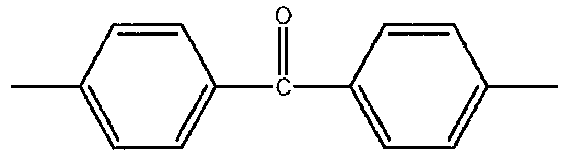
- Said homopolymer of PBI is poly(aryl ether benzimidazoles), whose structural formula is as follows: wherein R 1 is one of the following: wherein R 2 represents one of the following:
- the above-described copolymer of PBI is an ion exchange membrane of PBI containing pyridine groups, whose structural formula is as follows:
- the weight average molecular weight of this type of polymer is between 5,000 to 800,000.
- R 1 represents one of the followings:
- R 2 represents one of the followings:
- R 3 and R 4 are selected from hydrogen, C 1 -C 4 alkyl groups, or C 2 -C 4 alkenyl groups, R 3 and R 4 can be the same or different.
- the copolymer disclosed in this invention can be random copoloymers or block copolymers.
- the copolymer disclosed herein can also be copolymers of nitrogen heterocycles, such as the copolymer of poly-oxadiazole and PBI, or the copolymer of poly-triazole and PBI, etc, but not limited to the following structures: wherein n is a positive integer, 10 ⁇ n ⁇ 200, R1 represents one of the followings: R 2 is selected from hydrogen, C 1 -C 4 alkyl groups, or C 2 -C 4 alkenyl groups.
- the nitrogenous heterocyclic aromatic polymers disclosed in this invention are obtainable by nucleophilic polycondensation reaction [ Progress in Polymer Science 34 (2009) 449-477 ].
- the ion-exchange membranes are obtained using above-described polymer by solution casting. Its method of preparation can be found in the relevant patents or in the literature. Appropriate solvents are selected for various polymers according to their solubility. Dissolving the polymer to form a polymer solution then casting the solution directly on a glass plate or other flat-panel, drying and evaporation at a certain temperature to obtain an aromatic polymer ion exchange membrane. Immersing the aromatic polymer ion exchange membrane in an strong acid solution with a concentration of 0.1-25mol / L, soaking time 0.05-1000h, the solution temperature at 5-100 ° C, the thickness of aromatic polymer ion exchange membrane is 0.1 to 200 microns. After acid doping, each repeating unit in the polymer comprises one or more acid molecules.
- n is a positive integer, 10 ⁇ n ⁇ 200
- R represents one of the followings: wherein R 1 and R 2 respectively are selected from hydrogen, C 1 -C 4 alkyl groups, or C 2 -C 4 alkenyl groups, R 1 and R 2 can be the same or different.
- the organic-inorganic composite membrane is obtainable by common solution casting wherein the inorganic particles can be obtained by direct blending or by in situ sol-gel method, but not limited to these two methods.
- the organic-inorganic composite membrane also contains another class of polymer that comprises sulfonic acid, such as one or more among perfluorinated sulfonic acid polymer, sulfonated polysulfone, sulfonated polypropylene, sulfonated poly (ether sulfone), sulfonated poly (ether sulfone), sulfonated poly aryl sulfone, sulfonated polyphenylene ether, sulfonated polyether ether ketone, sulfonated poly (aryl ether ketone).
- sulfonic acid such as one or more among perfluorinated sulfonic acid polymer, sulfonated polysulfone, sulfonated polypropylene, sulfonated poly (ether sulfone), sulfonated poly (ether sulfone), sulfonated poly aryl sulfone,
- the sulfonated polymer accounts for 0.1 to 50% of the aromatic polymer, which is used in preparing organic-inorganic ion exchange membrane. Immersing the ion exchange membrane in a strong acid solution having a concentration of 0.1-25mol / L, soaking for 0.05-1000h, solution temperature of 5-100 ° C, and the thickness of the aromatic polymer ion exchange membrane is 0.1 to 200 microns. After acid doping, each repeating unit in the polymer has one or more acid molecules.
- the unique feature of this composite membrane is that it utilizes the interaction between the sulfonic groups and nitrogen heterocycles, effectively avoiding the permeation of ions and therefore improving the selectivity of the membrane particles.
- Dupont's National 115 membrane was used to assemble an VBR.
- Activated carbon felt was the electrode and graphite plates were used as bipolar plates.
- the active area of the membrane was 9 cm 2 , the current density was 80 mA/cm 2 .
- Vanadium concentration in the electrolyte was 1.50 mol/L, H 2 SO 4 concentration was 3mol/L.
- the coulombic efficiency of the flow battery was 94.8% and the voltage efficiency was 88.9%.
- the energy efficiency was 84.5%.
- n represents the structural unit amounts of polymer, 10 ⁇ n ⁇ 200.
- n is the degree of polymerization, 10 ⁇ n ⁇ 200.
- the IR spetrum of PBI is shown in Fig. 3 , which confirms the chemical structure of the polymer.
- Fig. 4 represents the stress-strain curve.
- the yield strength and Young's modulus of the membrane are 121.9 MPa and 3.5 GPa, respectively.
- the PBI membrane was assembled in a VRB single cell with carbon felt electrodes and graphite current collectors.
- concentrations of vanadium ions and H 2 SO 4 in the electrolyte solution were 1.5 M and 3 M, respectively.
- the active area of the membrane was 9 cm 2 and the testing current density was 80 mA cm -2 .
- the CE, VE and EE were 99.2%, 80.6% and 80.2%, respectively.
- the discharge time is close to the charge time, and the smooth discharge curve indicates that cell voltage drops slowly and continuously during discharge, suggesting low vanadium permeation rate of the membrane.
- n is the degree of polymerization, 10 ⁇ n ⁇ 200.
- n is the degree of polymerization, 10 ⁇ n ⁇ 200.
- n is the degree of polymerization, 10 ⁇ n ⁇ 200.
- the polymer resin was washed with deionized water to remove the residual alkali.
- the polymer resin was then dried and dissolved in DMSO to form 4 wt.% solution.
- the solution was cast on a glass substrate and passed through a coating knife. After heating at 80 °C for 20 hours, the membrane was peeled from the glass substrate. The dried membrane was soaked in 4M H 2 SO 4 solution for 5 hours at room temperature.
- the obtained PBI ion exchange membrane contained 20 wt% pyridine and had a thickness of about 35 ⁇ m and a weight average molecular weight of about 60,000.
- Fig. 6 The IR spectrum of PBI is shown in Fig. 6 , which confirms the chemical structure of the polymer.
- Fig. 7 represents the stress-strain curve.
- the yield strength and Young's modulus of the membrane are 90 MPa and 3 GPa, respectively, indicating good mechanical properties.
- the PBI membrane was assembled in a VRB single cell with carbon felt electrodes and graphite current collectors.
- the concentrations of vanadium ions and H 2 SO 4 in the electrolyte solution were 1.5 M and 3 M, respectively.
- the efficient area of the membrane was 9 cm 2 and the testing current density was 80 mA cm -2 .
- the CE, VE and EE were 99.3%, 86.2% and 85.6%, respectively.
- the discharge time is close to the charge time, and the smooth discharge curve indicates that cell voltage drops slowly and continuously during discharge, suggesting low vanadium permeation rate of the membrane.
- the proton conductance of the as-prepared PBI is greatly enhanced, which is attributed to the existence of pyridine groups.
- VE of the VRB single cell is improved by 5% in comparison with polymer ion exchange membrane without pyridine in Example 2
- Example 8 Same as in Example 8 except that the polymer was a PBI copolymer having a structure as follows:
- HS Hydrazide Sulfate
- PPA Hydrazide Sulfate
- the polymer was dissolved in N-methyl-2-pyrrolidone (NMP) to form 5 wt.% solution.
- NMP N-methyl-2-pyrrolidone
- the solution was cast on a glass substrate and passed through a coating knife. After heated at 80 °C for 20 hours, the membrane was peeled up from the substrate. The dried membrane was soaked in 4M H 2 SO 4 solution for 5 hours at room temperature.
- the ion exchange membrane of poly (4,4'-diphenylether-1,3,4-oxadiazole) (POD-DPE) thus obtained had a thickness of about 25 ⁇ m.
- the 1 H NMR spetrum of POD-DPE is shown in Fig. 9 , which confirms the chemical structure of the polymer.
- Fig. 10 represents the TGA curve, indicating that the membrane possesses good thermal stability.
- the POD-DPE membrane was assembled in a VRB single cell with carbon felt electrodes and graphite current collectors.
- the concentrations of vanadium ions and H 2 SO 4 in the electrolyte solution were 1.5 M and 3 M, respectively.
- the active area of the membrane was 6 cm 2 and the testing current density was 50 mA cm -2 .
- the CE, VE and EE were 97.9%, 83.6% and 81.9%, respectively.
- the discharge time is close to the charge time, and the smooth discharge curve indicates that the cell voltage drops slowly and continuously during discharge, suggesting low vanadium permeation rate of the membrane.
- the proton conductivity of the as-prepared POD-DPE is relatively low.
- n is the degree of polymerization, 10 ⁇ n ⁇ 200.
- Example 10 Same as in Example 10 except that the polymer was polyvinyl imidazole.
- 0.2 g SiO 2 nano particles were dissolved in 20 ml DMSO and poured into a 250 ml conical flask. 1 ml Tween 80 was added in the solution, followed by stirring for 1 hour to obtain a transparent solution. 2 g PBI resin, with the structure described in Example 2, was added in the solution and kept stirring at 50-100 °C until the solution turned clear. The solution was cast on a glass substrate and passed through a coating knife. After heating at 80 °C for 20 hours, the membrane was peeled from the substrate. The dried composite membrane was soaked in 4M H 2 SO 4 solution for 5 hours at room temperature. The obtained a composite ion exchange membrane had a thickness of about 35 ⁇ m
- the composite membrane was assembled in a VRB single cell with carbon felt electrodes and graphite current collectors.
- the concentrations of vanadium ions and H 2 SO 4 in the electrolyte solution were 1.5 M and 3 M, respectively.
- the active area of the membrane was 9 cm 2 and the testing current density was 80 mA cm -2 .
- the CE, VE and EE were 99.3%, 83.6% and 84.2%, respectively.
- the discharge time is close to the charge time, and the smooth discharge curve indicates that the cell voltage drops slowly and continuously during discharge, suggesting low vanadium permeation rate of the membrane.
- the as-prepared composite membrane with 10 wt.% SiO 2 exhibits higher VE and EE.
- Example 13 Same as in Example 13 except that the inorganic particles were TiO 2 .
- Example 14 Same as in Example 14 except that the inorganic particles were ZrO 2 .
- PBI was dissolved in DMAc to form a 10 wt.% polymer solution, followed by blending it with Nafion ® resin of Na + form. The blends solution was evaporated at 60 °C to obtain a polymer membrane.
- the polymer membrane was heated at 160 °C in vacuum oven for 3 hours. The heat-treated membrane was peeled off and soaked in deionized water for 100 hours to remove impurities. Then the membrane was soaked in 5M H 2 SO 4 solution for 48 hours at room temperature.
- Example 16 Same as in Example 16 except that the sulfonated resin used was poly(aromatic ether ketone).
- Example 17 Same as in Example 17 except that the sulfonated resin was sulfonated poly(aromatic ether sulfone). Same as in Example 17 except that the sulfonated resin was sulfonated poly(phenylene oxide).
- Example 16 Same as in Example 16 except that the sulfonated resin was poly(propylene).
- the structural feature of the ion exchange membrane of this invention lies in the aromatic polymer with nitrogen heterocycles, especially polybenzimidazole type polymer.
- the nitrogen heterocycles in the structure interact with acid in the electrolyte to form donor-receptor proton transport network, so as to maintain the proton transport performance of the membrane.
- the preparation condition for such ion exchange membranes is mild and the process is simple.
- the preparation method is suitable for mass production.
- the invention in particular relates to the application of such membranes in acidic electrolyte flow battery, especially in VRB.
- the prepared membrane has excellent mechanical stability and thermostability. In VRB, the membrane has excellent proton conduction and excellent resistance to the permeation of vanadium ions.
Landscapes
- Chemical & Material Sciences (AREA)
- Chemical Kinetics & Catalysis (AREA)
- General Chemical & Material Sciences (AREA)
- Sustainable Development (AREA)
- Electrochemistry (AREA)
- Sustainable Energy (AREA)
- Life Sciences & Earth Sciences (AREA)
- Engineering & Computer Science (AREA)
- Manufacturing & Machinery (AREA)
- Crystallography & Structural Chemistry (AREA)
- Composite Materials (AREA)
- Medicinal Chemistry (AREA)
- Organic Chemistry (AREA)
- Polymers & Plastics (AREA)
- Health & Medical Sciences (AREA)
- Fuel Cell (AREA)
- Manufacture Of Macromolecular Shaped Articles (AREA)
- Polyoxymethylene Polymers And Polymers With Carbon-To-Carbon Bonds (AREA)
Abstract
Description
- A polymer ion exchange membrane for acidic electrolyte flow battery. The membrane is nitrogen heterocycles aromatic polymer, especially polybenzimidazole type polymer. A nitrogen heterocycles in the membrane interact with acid in the electrolyte to form donor-receptor proton transport network, so as to keep the proton transport performance of the membrane. The preparation condition for the membrane is mild, and the process is simplicity. The preparation method is suitable for mass production. The membrane is used in acidic electrolyte flow battery, especially in vanadium flow energy storage battery. The membrane has excellent mechanical stability and thermostability. In vanadium redox flow battery, the membrane has excellent proton conduct performance and excellent resistance to the permeation of vanadium ions.
- The invention relates to membrane in an acidic electrolyte flow battery. More specifically, the invention is related to an aromatic polymer ion exchange membrane and its composite membrane and its application in acidic electrolyte flow batteries.
- Flow batteries with an acidic electrolyte is a new technology in electrochemical energy storage. The advantages include high conversion efficiency, flexible system design, large storage capacity, flexibility in site selection, deep discharge, safe and environmentally friendly, and low maintenance cost, etc. It is one of the preferred technologies for the large scale and high efficiency energy storage. In particular, since the vanadium redox flow battery (VRB) has the advantages of high security, strong stability, high efficiency, long operating life (above 15 years) and low cost, etc., it has been considered as the most promising and representative among flow energy storage batteries.
- The ion exchange membrane is the key component in a flow battery. It separates the positive and negative electrolytes, while serves as the conduit for transporting ions between the positive and the negative electrolyte. Therefore, the ion exchange membrane is required to have a high ionic conductivity, ion selectivity and good chemical stability. After evaluating some commercial membranes, Skyllas-kazacos et al. deem that except that the comprehensive property of some perfluorosulfonic polymers is stable enough, other membranes (such as Selemion CMV, CMS, AMV, DMV, ASS and DSV etc.) are not stable enough in acid vanadium solution (J. Appl Electrochem, 2004, 34 (2): 137). However, studies found that even though the commercial perfluorosulfonic polymer possesses high mechanical strength and chemical stability, the permeation rate of vanadium ions when used in VRB is high. There is also obvious water migration between the anode and cathode during charge-discharge cycles. Moreover, the complex production technology, severe preparation conditions and high cost in making perfluorosulfonic polymers have severely limited the application and commercialization of VRB. Since the aromatic polymer ion exchange membrane with nitrogen heterocycles has excellent mechanical stability, thermostability and chemical stability, it has received wide-spread attention in different fields.
- The present invention relates to a class of aromatic polymer ion exchange membrane and its composite membranes in the acid electrolyte flow battery applications, particularly their applications in VRBs. This type of polymer has aromatic nitrogen heterocycles that can interact with acid and form a donor - acceptor mesh structure. The network structure can transport protons and to maintain the ionic conductivity of the membrane. This type of membrane materials has excellent thermal stability, chemical stability and good ionic conductivity. It can be used in many applications, particularly suitable for use as ion-exchange membrane in the acid electrolyte flow battery.
- The present invention discloses nitrogen heterocyles aromatic polymers that are aromatic polymers containing nitrogen heterocycles, including one or more homopolymers or copolymers of benzimidazole, vinyl imidazole, pyridine, vinyl pyridine, pyrazole, pyrimidine, thiazole, benzothiazole, oxazole, benzoxazole, oxadiazole, quinoline, quinoxaline, thiadiazole, and purine. The following are the structures of some of the polymers:


The above-described aromatic polymers containing nitrogen heterocycles in this invention include both homopolymers and copolymers. The present invention uses polybenzimidazole (PBI) as an example and explain its structure in details. - Said homopolymer of PBI has the following structural formula:

- Said copolymer of PBI has the following structural formula:


m and n are molar fractions of corresponding units, 0<n≤0.8, 0.2≤m<1, m+n=1. - Said homopolymer of PBI is poly(aryl ether benzimidazoles), whose structural formula is as follows:
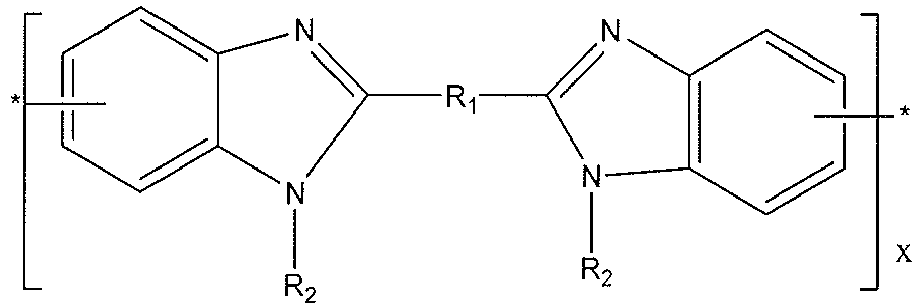


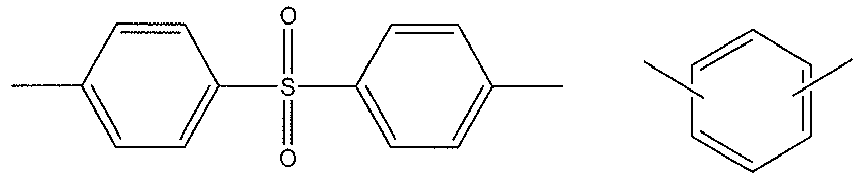

- The above-described copolymer of PBI is an ion exchange membrane of PBI containing pyridine groups, whose structural formula is as follows:

Wherein R1 represents one of the followings:


- In addition, the copolymer disclosed in this invention can be random copoloymers or block copolymers. Furthermore, the copolymer disclosed herein can also be copolymers of nitrogen heterocycles, such as the copolymer of poly-oxadiazole and PBI, or the copolymer of poly-triazole and PBI, etc, but not limited to the following structures:


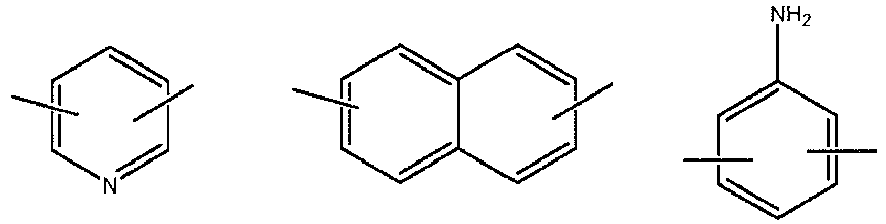


- The nitrogenous heterocyclic aromatic polymers disclosed in this invention are obtainable by nucleophilic polycondensation reaction [Progress in Polymer Science 34 (2009) 449-477].
- The ion-exchange membranes are obtained using above-described polymer by solution casting. Its method of preparation can be found in the relevant patents or in the literature. Appropriate solvents are selected for various polymers according to their solubility. Dissolving the polymer to form a polymer solution then casting the solution directly on a glass plate or other flat-panel, drying and evaporation at a certain temperature to obtain an aromatic polymer ion exchange membrane. Immersing the aromatic polymer ion exchange membrane in an strong acid solution with a concentration of 0.1-25mol / L, soaking time 0.05-1000h, the solution temperature at 5-100 ° C, the thickness of aromatic polymer ion exchange membrane is 0.1 to 200 microns. After acid doping, each repeating unit in the polymer comprises one or more acid molecules.
- Said organic-inorganic composite ion exchange membrane, wherein the organic phase is a PBI type polymer, whose structural formula is as follows:


- The organic-inorganic composite membrane is obtainable by common solution casting wherein the inorganic particles can be obtained by direct blending or by in situ sol-gel method, but not limited to these two methods.
- In addition to having a polymer containing nitrogen heterocycles, the organic-inorganic composite membrane also contains another class of polymer that comprises sulfonic acid, such as one or more among perfluorinated sulfonic acid polymer, sulfonated polysulfone, sulfonated polypropylene, sulfonated poly (ether sulfone), sulfonated poly (ether sulfone), sulfonated poly aryl sulfone, sulfonated polyphenylene ether, sulfonated polyether ether ketone, sulfonated poly (aryl ether ketone). The sulfonated polymer accounts for 0.1 to 50% of the aromatic polymer, which is used in preparing organic-inorganic ion exchange membrane. Immersing the ion exchange membrane in a strong acid solution having a concentration of 0.1-25mol / L, soaking for 0.05-1000h, solution temperature of 5-100 ° C, and the thickness of the aromatic polymer ion exchange membrane is 0.1 to 200 microns. After acid doping, each repeating unit in the polymer has one or more acid molecules. The unique feature of this composite membrane is that it utilizes the interaction between the sulfonic groups and nitrogen heterocycles, effectively avoiding the permeation of ions and therefore improving the selectivity of the membrane particles.
- The beneficial effects of the present invention include:
- 1) The present invention discloses using aromatic polymer membrane as the ion exchange membrane in the acidic electrolyte flow battery. The membrane uses acidic electrolyte as a conductive medium, acid and nitrogen heterocycles in the polymer form the structure of the receptor, and directional hopping mechanism (Grotthuss hopping mechanism) to conduct protons (see Scheme 1). It has very low water migration and very high ion selective permeability in the proton transfer process, which greatly reduces the uneven distribution of the positive and negative electrolyte and the self-discharge phenomenon, effectively extending the life of the electrolyte. The ion exchange membrane material prepared according to this invention can be easily made into membranes.
- 2) The ion exchange membrane prepared according to this invention has excellent thermal stability, mechanical stability and oxidation stability.
- 3) The membrane used in this invention has good structural stability, low cost, suitable for long and stable application in acidic electrolyte flow battery and large-scale commercial development.
- 4) The ion-exchange membrane prepared according to this invention has excellent ion conductivity.
- 5) The ion-exchange membrane prepared according to this invention has a good ion-selectivity and can avoid cross-contamination between the positive and negative electrolyte in acid flow battery.
- 6) The organic-inorganic composite ion-exchange membrane prepared according to this invention can effectively improve the ionic conductivity, and to maintain high ion selectivity.
- 7) The organic-organic composite ion-exchange membrane prepared according to this invention can effectively improve the mechanical and chemical stability of the membrane.
-
-
FIG 1 is a graph illustrating the mechanism of proton transportation in aromatic polymers containing nitrogen heterocycles. -
FIG 2 is the charge-discharge performance plot of the VRB having the ion exchange membrane prepared in Example 1. -
FIG 3 is the IR spectrum of polymer prepared in Example 2. -
FIG 4 is the stress-strain curve of polymer prepared in Example 2. -
FIG 5 is the charge-discharge performance plot of the VRB having ion exchange membrane prepared in Example 2. -
FIG 6 is the IR spectrum of polymer prepared in Example 6. -
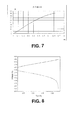
FIG 7 is the stress-strain curve of polymer prepared in Example 6. -
FIG 8 is the charge-discharge performance plot of the VRB having the ion exchange membrane prepared in Example 6. -
FIG 9 is the 1H-NMR spectrum of polymer prepared in Example 10. -
FIG 10 is the TGA plot of polymer prepared in Example 10. -
FIG 11 is the charge-discharge performance plot of the VRB having ion exchange membrane prepared in Example 10. -
FIG 12 is the charge-discharge performance plot of the VRB having ion exchange membrane prepared in Example 13. - The following embodiments further illustrate this invention and do not limit scope the invention.
- Dupont's
Nation 115 membrane was used to assemble an VBR. Activated carbon felt was the electrode and graphite plates were used as bipolar plates. The active area of the membrane was 9 cm2, the current density was 80 mA/cm2. Vanadium concentration in the electrolyte was 1.50 mol/L, H2SO4 concentration was 3mol/L. The coulombic efficiency of the flow battery was 94.8% and the voltage efficiency was 88.9%. The energy efficiency was 84.5%. - 1g PBI (Mw=~50,000) with the following structure was dissolved in N,N-dimethylacetamide (DMAc) to form 5 wt.% polymer solution. The solution was cast on a glass substrate and passed through a coating knife. After heated at 80 °C for 20 hours, the membrane was peeled from the glass substrate. The dried membrane was soaked in 4M H2SO4 solution for 5 hours at room temperature. The membrane was assembled in a VRB single cell with carbon felt electrodes and graphite current collectors. The concentrations of vanadium ions and H2SO4 in the electrolyte solution were 1.5 M and 3 M, respectively. The active area of the membrane was 9 cm2 and the testing current density was 80 mA cm-2. The coulombic efficiency (CE), voltage efficiency (VE) and energy efficiency (EE) were 99.34%, 82.17% and 81.6%, respectively. As shown in
Fig. 2 , the discharge time is close to the charge time, and the smooth discharge curve indicates that cell voltage drops slowly and continuously during discharge. Compared withcommercial Nafion 115, the as-prepared PBI membrane shares similar EE and higher CE (5% higher). The result indicates that PBI membrane has very low vanadium permeation rate, which prevents the cross-mixing of different vanadium ions efficiently and improves its CE .
- 3.4 g P2O5 was dissolved in 34 g phosphoric acid. The solution was poured into a 500 mL three-neck round-bottom flask and kept stirring as temperature increased. After the solution became transparent, 6
mmol 3,3',4,4'-biphenyltetramine and 6 mmol 4,4'-dicarboxydiphenyl ether (DPE) were added into the solution. The temperature of the solution was increased to 200 °C. After 20 hours, the polymer solution was cooled and poured into 5 wt.% NaOH aqueous solution. In the alkali solution, the polymer was precipitated and the acid was neutralized for 24 hours. Afterward, the polymer resin was washed with deionized water to remove the residual alkali. The polymer resin was then dried and dissolved in DMSO to form 4 wt.% solution. The solution was cast on a glass substrate and passed through a coating knife. After heating at 80 °C for 20 hours, the membrane was peeled from the substrate. The dried membrane was soaked in 4M H2SO4 solution for 5 hours at room temperature. The obtained ion exchange membrane had a thickness of about 35µm. The chemical structure of the as-prepared polymer PBI is illustrated as follow:
The IR spetrum of PBI is shown inFig. 3 , which confirms the chemical structure of the polymer.
Fig. 4 represents the stress-strain curve. The yield strength and Young's modulus of the membrane are 121.9 MPa and 3.5 GPa, respectively. Compared to the polymer in Example 1, the as-prepared PBI has a higher weight average molecular weight (Mw=~120,000) and a high chemical stability. Due to the introduction of ether groups into the polymer, this kind of polymer is readily dissolvable and machinable. - The PBI membrane was assembled in a VRB single cell with carbon felt electrodes and graphite current collectors. The concentrations of vanadium ions and H2SO4 in the electrolyte solution were 1.5 M and 3 M, respectively. The active area of the membrane was 9 cm2 and the testing current density was 80 mA cm-2. The CE, VE and EE were 99.2%, 80.6% and 80.2%, respectively. As shown in
Fig. 5 , the discharge time is close to the charge time, and the smooth discharge curve indicates that cell voltage drops slowly and continuously during discharge, suggesting low vanadium permeation rate of the membrane. - Same as in Example 2 except that: 1) The polymer was the following and its weight average molecular weight was about 50,000; 2) The solvent used in the polymerization reaction is methansulfonic acid; and 3) cast solution was heated at 140 °C to form the membrane.

- Same as in Example 3 except that the chemical structure of the PBI polymer was as follows, the weight average molecular weight was 70000, the polymer solution was in methansulfonic acid, and the evaporation temperature was 140 °C:

- Same as in Example 3 except that the chemical structure of the PBI polymer was as follows, the weight average molecular weight was 40000, the polymer solution was in methansulfonic acid, and the evaporation temperature was 140 °C:

- 3.4 g P2O5 was dissolved in 34 g phosphoric acid (PPA). The solution was poured into a 500 mL three-neck round-bottom flask and kept stirring as temperature increased. After the solution became transparent, 6
mmol 3,3',4,4'-biphenyltetramine, 1.2 mmol 2,6-pyridine dicarboxylic acid and 4.8 mmol 4,4'-oxybisbenzoic acid were added into the solution. The temperature of the solution was increased to 200 °C. After 20 hours, the polymer solution was cooled and poured into 5 wt.% NaOH aqueous solution. In the alkali solution, the polymer was precipitated and the acid was neutralized for 24 hours. Afterward, the polymer resin was washed with deionized water to remove the residual alkali. The polymer resin was then dried and dissolved in DMSO to form 4 wt.% solution. The solution was cast on a glass substrate and passed through a coating knife. After heating at 80 °C for 20 hours, the membrane was peeled from the glass substrate. The dried membrane was soaked in 4M H2SO4 solution for 5 hours at room temperature. The obtained PBI ion exchange membrane contained 20 wt% pyridine and had a thickness of about 35µm and a weight average molecular weight of about 60,000. - The IR spectrum of PBI is shown in
Fig. 6 , which confirms the chemical structure of the polymer.Fig. 7 represents the stress-strain curve. The yield strength and Young's modulus of the membrane are 90 MPa and 3 GPa, respectively, indicating good mechanical properties.
(0<n≤0.8, 0.2≤m<1, m+n=1) - The PBI membrane was assembled in a VRB single cell with carbon felt electrodes and graphite current collectors. The concentrations of vanadium ions and H2SO4 in the electrolyte solution were 1.5 M and 3 M, respectively. The efficient area of the membrane was 9 cm2 and the testing current density was 80 mA cm-2. The CE, VE and EE were 99.3%, 86.2% and 85.6%, respectively. As shown in
Fig. 8 , the discharge time is close to the charge time, and the smooth discharge curve indicates that cell voltage drops slowly and continuously during discharge, suggesting low vanadium permeation rate of the membrane. Compared with Examples 1 and 2, the proton conductance of the as-prepared PBI is greatly enhanced, which is attributed to the existence of pyridine groups. As a result, VE of the VRB single cell is improved by 5% in comparison with polymer ion exchange membrane without pyridine in Example 2 - Same as in Example 6 except that the chemical structure of the polymer was as follows:

(0<n≤0.8, 0.2≤m<1, m+n=1) - Same as in Example 7 except that the polymer was a PBI copolymer having a structure as follows:

(0<n≤0.8, 0.2≤m<1, m+n=1) - Same as in Example 8 except that the polymer was a PBI copolymer having a structure as follows:

(0<n≤0.8, 0.2≤m<1, m+n=1) - Hydrazide Sulfate (HS) was dissolved in PPA at a molar ratio of 1:10. The solution was poured into a 500 mL three-neck round-bottom flask and heated to 160 °C. DPE was then added in the solution (molar ratio nHS:nDPE=1:1.2). The polymerization reaction proceeded for 4 hours. After cooling, the polymer solution was poured into 5 wt.% NaOH aqueous solution. In the alkali solution, the polymer precipitated and the acid was neutralized for 24 hours. The obtained polymer resin was washed with deionized water to remove the residual alkali. The polymer resin was filtered and dried. The average molecular weight of the polymer obtained was about 100,000. The polymer was dissolved in N-methyl-2-pyrrolidone (NMP) to form 5 wt.% solution. The solution was cast on a glass substrate and passed through a coating knife. After heated at 80 °C for 20 hours, the membrane was peeled up from the substrate. The dried membrane was soaked in 4M H2SO4 solution for 5 hours at room temperature. The ion exchange membrane of poly (4,4'-diphenylether-1,3,4-oxadiazole) (POD-DPE) thus obtained had a thickness of about 25µm. The 1H NMR spetrum of POD-DPE is shown in
Fig. 9 , which confirms the chemical structure of the polymer.Fig. 10 represents the TGA curve, indicating that the membrane possesses good thermal stability. - The POD-DPE membrane was assembled in a VRB single cell with carbon felt electrodes and graphite current collectors. The concentrations of vanadium ions and H2SO4 in the electrolyte solution were 1.5 M and 3 M, respectively. The active area of the membrane was 6 cm2 and the testing current density was 50 mA cm-2. The CE, VE and EE were 97.9%, 83.6% and 81.9%, respectively. As shown in
Fig. 11 , the discharge time is close to the charge time, and the smooth discharge curve indicates that the cell voltage drops slowly and continuously during discharge, suggesting low vanadium permeation rate of the membrane. Compared to PBI, the proton conductivity of the as-prepared POD-DPE is relatively low.
- Same as in Example 10 except that the polymer was polyvinyl imidazole.
- Same as in Example 11 except that the polymer was the copolymer of poly-oxadizole and PBI.

(0<n≤0.8, 0.2≤m<1, m+n=1) - 0.2 g SiO2 nano particles were dissolved in 20 ml DMSO and poured into a 250 ml conical flask. 1
ml Tween 80 was added in the solution, followed by stirring for 1 hour to obtain a transparent solution. 2 g PBI resin, with the structure described in Example 2, was added in the solution and kept stirring at 50-100 °C until the solution turned clear. The solution was cast on a glass substrate and passed through a coating knife. After heating at 80 °C for 20 hours, the membrane was peeled from the substrate. The dried composite membrane was soaked in 4M H2SO4 solution for 5 hours at room temperature. The obtained a composite ion exchange membrane had a thickness of about 35µm - The composite membrane was assembled in a VRB single cell with carbon felt electrodes and graphite current collectors. The concentrations of vanadium ions and H2SO4 in the electrolyte solution were 1.5 M and 3 M, respectively. The active area of the membrane was 9 cm2 and the testing current density was 80 mA cm-2. The CE, VE and EE were 99.3%, 83.6% and 84.2%, respectively. As shown in
Fig. 12 , the discharge time is close to the charge time, and the smooth discharge curve indicates that the cell voltage drops slowly and continuously during discharge, suggesting low vanadium permeation rate of the membrane. Compared to Example 2, the as-prepared composite membrane with 10 wt.% SiO2 exhibits higher VE and EE. The swelling ratios of the pure PBI membrane and the composite membrane in 3M H2SO4 solution were 29.85% and 40.19%, respectively. This result suggests that the existence of SiO2 effectively enhances the amount of absorbed acid in the membrane and subsequently lowers the ohmic resistance of the membrane in VRB. - Same as in Example 13 except that the inorganic particles were TiO2.
- Same as in Example 14 except that the inorganic particles were ZrO2.
- PBI was dissolved in DMAc to form a 10 wt.% polymer solution, followed by blending it with Nafion® resin of Na+ form. The blends solution was evaporated at 60 °C to obtain a polymer membrane. The polymer membrane was heated at 160 °C in vacuum oven for 3 hours. The heat-treated membrane was peeled off and soaked in deionized water for 100 hours to remove impurities. Then the membrane was soaked in 5M H2SO4 solution for 48 hours at room temperature.
- Same as in Example 16 except that the sulfonated resin used was poly(aromatic ether ketone).
- Same as in Example 17 except that the sulfonated resin was sulfonated poly(aromatic ether sulfone). Same as in Example 17 except that the sulfonated resin was sulfonated poly(phenylene oxide).
- Same as in Example 16 except that the sulfonated resin was poly(propylene).
- The structural feature of the ion exchange membrane of this invention lies in the aromatic polymer with nitrogen heterocycles, especially polybenzimidazole type polymer. The nitrogen heterocycles in the structure interact with acid in the electrolyte to form donor-receptor proton transport network, so as to maintain the proton transport performance of the membrane. The preparation condition for such ion exchange membranes is mild and the process is simple. The preparation method is suitable for mass production. The invention in particular relates to the application of such membranes in acidic electrolyte flow battery, especially in VRB. The prepared membrane has excellent mechanical stability and thermostability. In VRB, the membrane has excellent proton conduction and excellent resistance to the permeation of vanadium ions.
Claims (10)
- The application of aromatic polymers ion exchange membranes in redox flow battery.
- The aromatic polymers according to claim 1 are aromatic basic polymers, comprising basic groups which can be complexed with strong acid and further be used as ion exchange membranes for redox flow battery. The polymers mainly include polybenzimidazole (PBI), poly(pyridine), poly(pyrimidine), polyimidazoles, polybenzthiazoles, polybenzoxazoles (POD), polyoxadiazoles, polyquinoxalines and polytetrazapyrenes.
- The aromatic basic polymers according to claim 1 can be polybenzimidazole homopolymer with following structure:



- The ion exchange membrane wherein can be PBI homopolymer according to claim 3. The structure is as following:


- According to the claim 3, the PBI copolymer can be the polymers with pyridine functional groups. The structure is as following:


- According to the claim 1, the resulted membrane should be immersed in strong acid like HCl, HNO3, phosphoric acid and sulfuric acid for 0.05 to 1000 hours at 5-100 °C. The concentration range of the acid is between 0.1-25mol/L.
- According to the claim 1, the composite membrane can be inorganic-organic blend membranes. The inorganic phase can be SiO2, TiO2, ZrO2, ZrPO3 nanoparticles or their blend. The content of the nanoparticles is in the range of 0.1∼40 wt%. Wherein the thickness of the composite membranes is in the range of 0.1∼200 micrometer. Subsequently, the as-prepared membrane is treated via the method described in claim 6.
- According claim 7, two phases were included in the composite membranes (inorganic and organic), the weight ratio between inorganic and organic phase is in the range of 2:100 to 30 :100. The organic phase can be polybenzimidazole with following structure.


- According to claim 1, the composite membranes can be blended with sulfonated aromatic polymers, like sulfonated polyaryl ether ketone, polyether sulfone, polyimide etc.. The weight ratio of sulfonated polymers is in the range of 0.1-50%. The thickness of the membrane is in the range of 0.1-200 micro. The membranes are treated with 0.1-25 mol/L strong acid solutions. The acid can be phosphoric acid, chloride acid and sulfuric acid etc.. Subsequently, the as-prepared membrane is treated via the method described in claim 6.
- According to claim 1, the membranes can be applied in liquid redox flow battery with acid medium, like all vanadium redox flow battery, Fe/Cr redox flow battery, Zn/Br redox flow battery etc..
Applications Claiming Priority (2)
| Application Number | Priority Date | Filing Date | Title |
|---|---|---|---|
| CN200910187902XA CN102044648B (en) | 2009-10-16 | 2009-10-16 | Polyaryl ether benzimidazole ion exchange membrane and its preparation and all-vanadium redox flow battery |
| PCT/CN2010/074501 WO2011044778A1 (en) | 2009-10-16 | 2010-06-25 | Aromatic polymer ion exchange membrane and its complex membrane and its application for acidic electrolyte flow energy storage battery |
Publications (3)
| Publication Number | Publication Date |
|---|---|
| EP2490279A1 true EP2490279A1 (en) | 2012-08-22 |
| EP2490279A4 EP2490279A4 (en) | 2014-04-30 |
| EP2490279B1 EP2490279B1 (en) | 2017-08-02 |
Family
ID=43875810
Family Applications (1)
| Application Number | Title | Priority Date | Filing Date |
|---|---|---|---|
| EP10823010.3A Active EP2490279B1 (en) | 2009-10-16 | 2010-06-25 | Aromatic polymer ion exchange membrane and its complex membrane and its application for acidic electrolyte flow energy storage battery |
Country Status (5)
| Country | Link |
|---|---|
| US (1) | US9276282B2 (en) |
| EP (1) | EP2490279B1 (en) |
| JP (1) | JP5451892B2 (en) |
| CN (1) | CN102044648B (en) |
| WO (1) | WO2011044778A1 (en) |
Cited By (2)
| Publication number | Priority date | Publication date | Assignee | Title |
|---|---|---|---|---|
| CN105990594A (en) * | 2015-02-12 | 2016-10-05 | 张华民 | Preparation method for electrolyte used for acidic flow battery |
| EP4516845A4 (en) * | 2022-04-27 | 2026-04-29 | Asahi Chemical Ind | Ion exchange membrane, membrane electrode arrangement, cell for redox flow batteries and redox flow battery |
Families Citing this family (59)
| Publication number | Priority date | Publication date | Assignee | Title |
|---|---|---|---|---|
| US8785023B2 (en) | 2008-07-07 | 2014-07-22 | Enervault Corparation | Cascade redox flow battery systems |
| US7820321B2 (en) | 2008-07-07 | 2010-10-26 | Enervault Corporation | Redox flow battery system for distributed energy storage |
| US8980484B2 (en) | 2011-03-29 | 2015-03-17 | Enervault Corporation | Monitoring electrolyte concentrations in redox flow battery systems |
| US8916281B2 (en) | 2011-03-29 | 2014-12-23 | Enervault Corporation | Rebalancing electrolytes in redox flow battery systems |
| US9559374B2 (en) | 2012-07-27 | 2017-01-31 | Lockheed Martin Advanced Energy Storage, Llc | Electrochemical energy storage systems and methods featuring large negative half-cell potentials |
| US8753761B2 (en) | 2012-07-27 | 2014-06-17 | Sun Catalytix Corporation | Aqueous redox flow batteries comprising metal ligand coordination compounds |
| US9865893B2 (en) | 2012-07-27 | 2018-01-09 | Lockheed Martin Advanced Energy Storage, Llc | Electrochemical energy storage systems and methods featuring optimal membrane systems |
| US9768463B2 (en) | 2012-07-27 | 2017-09-19 | Lockheed Martin Advanced Energy Storage, Llc | Aqueous redox flow batteries comprising metal ligand coordination compounds |
| US9382274B2 (en) | 2012-07-27 | 2016-07-05 | Lockheed Martin Advanced Energy Storage, Llc | Aqueous redox flow batteries featuring improved cell design characteristics |
| US8691413B2 (en) | 2012-07-27 | 2014-04-08 | Sun Catalytix Corporation | Aqueous redox flow batteries featuring improved cell design characteristics |
| US9692077B2 (en) | 2012-07-27 | 2017-06-27 | Lockheed Martin Advanced Energy Storage, Llc | Aqueous redox flow batteries comprising matched ionomer membranes |
| US10164284B2 (en) | 2012-07-27 | 2018-12-25 | Lockheed Martin Energy, Llc | Aqueous redox flow batteries featuring improved cell design characteristics |
| US9899694B2 (en) | 2012-07-27 | 2018-02-20 | Lockheed Martin Advanced Energy Storage, Llc | Electrochemical energy storage systems and methods featuring high open circuit potential |
| CN103682211B (en) * | 2012-09-06 | 2016-09-14 | 中国科学院大连化学物理研究所 | The application in liquid flow energy storage battery of a kind of porous septum |
| WO2014084138A1 (en) * | 2012-11-27 | 2014-06-05 | 東レ株式会社 | Polymer electrolyte composition, and polymer electrolyte membrane, membrane electrode complex and solid polymer-type fuel cell each produced using same |
| JP2016501438A (en) * | 2012-12-17 | 2016-01-18 | イー・アイ・デュポン・ドウ・ヌムール・アンド・カンパニーE.I.Du Pont De Nemours And Company | Flow battery with separator membrane containing ionomer |
| WO2015119272A1 (en) * | 2014-02-07 | 2015-08-13 | 東洋紡株式会社 | Ion-exchange membrane for redox battery, complex, and redox battery |
| US20160036060A1 (en) * | 2014-07-30 | 2016-02-04 | Concurrent Technologies Corporation | Composite electrode for flow battery |
| RU2573836C1 (en) * | 2014-10-21 | 2016-01-27 | ЭлДжи КЕМ, ЛТД. | Method of reducing membrane permeability with respect to vanadium ions and membrane made using said method |
| CA2968110C (en) | 2014-11-18 | 2023-10-10 | Rensselaer Polytechnic Institute | Novel polymers and methods for their manufacture |
| US11236196B2 (en) | 2014-11-18 | 2022-02-01 | Rensselaer Polytechnic Institute | Polymers and methods for their manufacture |
| EP3224266B1 (en) | 2014-11-26 | 2021-03-03 | Lockheed Martin Energy, LLC | Metal complexes of substituted catecholates and redox flow batteries containing the same |
| US10253051B2 (en) | 2015-03-16 | 2019-04-09 | Lockheed Martin Energy, Llc | Preparation of titanium catecholate complexes in aqueous solution using titanium tetrachloride or titanium oxychloride |
| US10644342B2 (en) | 2016-03-03 | 2020-05-05 | Lockheed Martin Energy, Llc | Coordination complexes containing monosulfonated catecholate ligands and methods for producing the same |
| US10316047B2 (en) | 2016-03-03 | 2019-06-11 | Lockheed Martin Energy, Llc | Processes for forming coordination complexes containing monosulfonated catecholate ligands |
| US20170279130A1 (en) | 2016-03-24 | 2017-09-28 | United Technologies Corporation | Separator layer for flow battery |
| US9938308B2 (en) | 2016-04-07 | 2018-04-10 | Lockheed Martin Energy, Llc | Coordination compounds having redox non-innocent ligands and flow batteries containing the same |
| US10377687B2 (en) | 2016-07-26 | 2019-08-13 | Lockheed Martin Energy, Llc | Processes for forming titanium catechol complexes |
| US10343964B2 (en) | 2016-07-26 | 2019-07-09 | Lockheed Martin Energy, Llc | Processes for forming titanium catechol complexes |
| US10065977B2 (en) | 2016-10-19 | 2018-09-04 | Lockheed Martin Advanced Energy Storage, Llc | Concerted processes for forming 1,2,4-trihydroxybenzene from hydroquinone |
| US10930937B2 (en) | 2016-11-23 | 2021-02-23 | Lockheed Martin Energy, Llc | Flow batteries incorporating active materials containing doubly bridged aromatic groups |
| US10497958B2 (en) | 2016-12-14 | 2019-12-03 | Lockheed Martin Energy, Llc | Coordinatively unsaturated titanium catecholate complexes and processes associated therewith |
| WO2018119020A1 (en) | 2016-12-20 | 2018-06-28 | Rensselaer Polytechnic Institute | Proton exchange membrane material and methods of making the same |
| US10741864B2 (en) | 2016-12-30 | 2020-08-11 | Lockheed Martin Energy, Llc | Aqueous methods for forming titanium catecholate complexes and associated compositions |
| US10320023B2 (en) | 2017-02-16 | 2019-06-11 | Lockheed Martin Energy, Llc | Neat methods for forming titanium catecholate complexes and associated compositions |
| US12191522B2 (en) * | 2017-03-06 | 2025-01-07 | Council Of Scientific And Industrial Research | Porous polybenzimidazole as separator for lithium ion batteries |
| US20200223997A1 (en) * | 2017-07-06 | 2020-07-16 | Rensselaer Polytechnic Institute | Ionic functionalization of aromatic polymers for ion exchange membranes |
| US20200238272A1 (en) | 2017-07-06 | 2020-07-30 | Rensselaer Polytechnic Institute | Ionic functionalization of aromatic polymers for ion exchange membranes |
| EP3784369A4 (en) | 2018-04-24 | 2022-04-13 | Rensselaer Polytechnic Institute | CROSS-LINKING AROMATIC POLYMERS FOR ANION EXCHANGE MEMBRANES |
| US11056698B2 (en) | 2018-08-02 | 2021-07-06 | Raytheon Technologies Corporation | Redox flow battery with electrolyte balancing and compatibility enabling features |
| JP7523808B2 (en) | 2018-09-14 | 2024-07-29 | ユニバーシティー オブ サウス カロライナ | Method for forming a redox flow battery membrane |
| WO2020060857A1 (en) | 2018-09-14 | 2020-03-26 | University Of South Carolina | New method for producing pbi films without organic solvents |
| WO2020056268A2 (en) | 2018-09-14 | 2020-03-19 | University Of South Carolina | Low permeability polybenzimidazole (pbi) membranes for redox flow batteries |
| CN113366680B (en) | 2018-11-26 | 2024-06-07 | 伦斯勒理工学院 | Phosphate anion-quaternary ammonium ion pair coordinated polymer membranes |
| US11342573B2 (en) | 2019-01-11 | 2022-05-24 | Advent Technologies Inc. | Ion-imbibed membranes based on proton conducting aromatic polyether type copolymers and their application in redox flow batteries |
| IT201900013734A1 (en) | 2019-08-01 | 2021-02-01 | Eni Spa | ION EXCHANGE MEMBRANE WITH HINGE STRUCTURE. |
| JP6931447B1 (en) * | 2019-09-27 | 2021-09-08 | ニダイキ株式会社 | Redox flow battery diaphragm and method for manufacturing the diaphragm |
| BR112022010144A2 (en) | 2019-11-25 | 2022-09-06 | Twelve Benefit Corp | MEMBRANE ELECTRODE SET FOR COX REDUCTION |
| US11777124B2 (en) | 2020-03-06 | 2023-10-03 | University Of South Carolina | Proton-conducting PBI membrane processing with enhanced performance and durability |
| US11465139B2 (en) | 2020-03-20 | 2022-10-11 | Rensselaer Polytechnic Institute | Thermally stable hydrocarbon-based anion exchange membrane and ionomers |
| US11271226B1 (en) | 2020-12-11 | 2022-03-08 | Raytheon Technologies Corporation | Redox flow battery with improved efficiency |
| CN113948746B (en) * | 2021-10-12 | 2024-07-26 | 南京工业大学 | Metal organic framework film with organic layer and application thereof |
| CN114188585B (en) * | 2021-11-26 | 2024-02-09 | 大连理工大学 | Preparation method of ion exchange membrane containing hydrophilic ion screening micropores |
| CN114276572B (en) * | 2021-12-07 | 2023-05-23 | 常州大学 | Polyether-ether-ketone-based difunctional ion exchange membrane for all-vanadium redox flow battery and preparation method thereof |
| CN116264300B (en) * | 2021-12-13 | 2026-03-20 | 中国科学院大连化学物理研究所 | A cadmium-bromine-manganese single-liquid flow battery |
| CN115548362A (en) * | 2022-10-10 | 2022-12-30 | 香港科技大学 | Nanocomposite film for flow battery and preparation method thereof |
| CN115627072B (en) * | 2022-11-01 | 2023-10-10 | 河北科技大学 | Preparation and application of polybenzimidazole/sulfonated polyarylene isatin composite proton exchange membrane |
| CN118240252B (en) * | 2024-05-23 | 2024-08-06 | 蓝固(湖州)新能源科技有限公司 | Polymer all-solid electrolyte membrane and preparation method and application thereof |
| CN119192639B (en) * | 2024-09-18 | 2025-11-11 | 安徽海螺洁能科技有限公司 | Preparation and application of composite ion conducting membrane |
Family Cites Families (24)
| Publication number | Priority date | Publication date | Assignee | Title |
|---|---|---|---|---|
| US3708439A (en) * | 1971-09-28 | 1973-01-02 | Upjohn Co | Polybenzimidazoles |
| WO1996035239A1 (en) * | 1995-05-03 | 1996-11-07 | Unisearch Limited | High energy density vanadium electrolyte solutions, methods of preparation thereof and all-vanadium redox cells and batteries containing high energy vanadium electrolyte solutions |
| US5599639A (en) * | 1995-08-31 | 1997-02-04 | Hoechst Celanese Corporation | Acid-modified polybenzimidazole fuel cell elements |
| JPH09223513A (en) * | 1996-02-19 | 1997-08-26 | Kashimakita Kyodo Hatsuden Kk | Liquid circulation battery |
| JP3729296B2 (en) * | 1996-12-10 | 2005-12-21 | 株式会社トクヤマ | Membrane for vanadium redox flow battery |
| JP3218291B2 (en) | 1998-12-14 | 2001-10-15 | 住友電気工業株式会社 | Battery diaphragm |
| JP2000281819A (en) * | 1999-01-27 | 2000-10-10 | Aventis Res & Technol Gmbh & Co Kg | Production of cross-linked polymer membrane and fuel cell |
| DE10021106A1 (en) * | 2000-05-02 | 2001-11-08 | Univ Stuttgart | Polymeric membranes |
| US20020127474A1 (en) * | 2001-01-09 | 2002-09-12 | E.C.R.-Electro-Chemical Research Ltd. | Proton-selective conducting membranes |
| CN1292015C (en) * | 2002-10-08 | 2006-12-27 | 东洋纺织株式会社 | Poly(arylene ether) compound containing sulfonic acid group, composition containing same, and preparation method thereof |
| EP1465277A1 (en) * | 2003-03-19 | 2004-10-06 | HONDA MOTOR CO., Ltd. | Solid polymer electrolyte and protonconducting membrane |
| WO2005090480A1 (en) | 2004-03-23 | 2005-09-29 | Mitsubishi Gas Chemical Co., Inc. | Solid polyelectrolyte, solid-polymer gel film, solid polyelectrolyte film, and fuel cell |
| WO2005111103A1 (en) * | 2004-05-13 | 2005-11-24 | Mitsubishi Gas Chemical Co., Inc. | Solid polymer electrolyte membrane and fuel cell |
| WO2006025351A1 (en) | 2004-09-03 | 2006-03-09 | Toray Industries, Inc. | Polyelectrolyte material, polyelectrolyte component, membrane electrode composite body, and polyelectrolyte type fuel cell |
| CN100365858C (en) * | 2005-04-05 | 2008-01-30 | 新源动力股份有限公司 | Composite proton exchange membrane for high-temperature fuel cell and preparation method thereof |
| EP1905117B1 (en) * | 2005-06-20 | 2019-07-24 | NewSouth Innovations Pty Limited | Improved perfluorinated membranes and improved electrolytes for redox cells and batteries |
| KR100717790B1 (en) * | 2005-07-29 | 2007-05-11 | 삼성에스디아이 주식회사 | Membrane-electrode assembly for fuel cell and fuel cell system comprising same. |
| CN1312788C (en) * | 2005-09-30 | 2007-04-25 | 清华大学 | Proton exchange composite membrane for all vanadium redox flow battery and its preparing method |
| CN100336866C (en) | 2005-11-10 | 2007-09-12 | 上海交通大学 | Modified polyphenyl ether proton exchange membrane material and its preparation method |
| GB0608079D0 (en) | 2006-04-25 | 2006-05-31 | Acal Energy Ltd | Fuel cells |
| JP2008027627A (en) | 2006-07-18 | 2008-02-07 | Kansai Electric Power Co Inc:The | Membrane for redox flow battery |
| CN101148537A (en) | 2007-02-08 | 2008-03-26 | 上海交通大学 | A modified polyphenylene ether composite proton exchange membrane material dispersed with nano-scale zirconium salt |
| DE102007056423A1 (en) | 2007-11-23 | 2009-06-04 | Süd-Chemie AG | Production and use of new polyanilines for water treatment |
| JP2010086935A (en) * | 2008-09-03 | 2010-04-15 | Sharp Corp | Redox flow battery |
-
2009
- 2009-10-16 CN CN200910187902XA patent/CN102044648B/en active Active
-
2010
- 2010-06-25 WO PCT/CN2010/074501 patent/WO2011044778A1/en not_active Ceased
- 2010-06-25 EP EP10823010.3A patent/EP2490279B1/en active Active
- 2010-06-25 US US13/395,991 patent/US9276282B2/en active Active
- 2010-06-25 JP JP2012533463A patent/JP5451892B2/en active Active
Cited By (2)
| Publication number | Priority date | Publication date | Assignee | Title |
|---|---|---|---|---|
| CN105990594A (en) * | 2015-02-12 | 2016-10-05 | 张华民 | Preparation method for electrolyte used for acidic flow battery |
| EP4516845A4 (en) * | 2022-04-27 | 2026-04-29 | Asahi Chemical Ind | Ion exchange membrane, membrane electrode arrangement, cell for redox flow batteries and redox flow battery |
Also Published As
| Publication number | Publication date |
|---|---|
| CN102044648B (en) | 2013-04-10 |
| US9276282B2 (en) | 2016-03-01 |
| JP2013507742A (en) | 2013-03-04 |
| WO2011044778A1 (en) | 2011-04-21 |
| EP2490279A4 (en) | 2014-04-30 |
| CN102044648A (en) | 2011-05-04 |
| JP5451892B2 (en) | 2014-03-26 |
| EP2490279B1 (en) | 2017-08-02 |
| US20120196188A1 (en) | 2012-08-02 |
Similar Documents
| Publication | Publication Date | Title |
|---|---|---|
| EP2490279B1 (en) | Aromatic polymer ion exchange membrane and its complex membrane and its application for acidic electrolyte flow energy storage battery | |
| Park et al. | Chemically durable polymer electrolytes for solid-state alkaline water electrolysis | |
| Zhang et al. | Anion exchange membranes from brominated poly (aryl ether ketone) containing 3, 5-dimethyl phthalazinone moieties for vanadium redox flow batteries | |
| US9975995B2 (en) | Ion conducting polymer comprising partially branched block copolymer and use thereof | |
| CN102299351B (en) | Polybenzimidazole polymer ion exchange membrane and its preparation and application | |
| CN110224166A (en) | A kind of phosphate-doped cross-linking type polybenzimidazoles high temperature proton exchange film and preparation method thereof | |
| CN104151587A (en) | Preparation of novel covalent cross-linking polybenzimidazole proton exchange membrane | |
| US10483576B2 (en) | Polymer electrolyte membrane | |
| CN110661021A (en) | A kind of preparation method of high temperature proton exchange membrane for fuel cell | |
| CN105085913B (en) | A kind of preparation method of the sulfonated polyimide proton conductive membrane containing branched structure | |
| CN110041552A (en) | Compound high temperature proton exchange film and preparation method thereof based on sulfonation aryl oxide type polybenzimidazoles Yu sulfonation polysilsesquioxane | |
| CN106558666A (en) | A kind of flow battery is with porous ion conductive membranes and its prepares and application | |
| CN108649256A (en) | The preparation method and application of sulfonate polybenzimidazole proton exchange membrane | |
| CN107913600A (en) | There is compound forward osmosis membrane of proton exchange and preparation method thereof and purposes | |
| CN118119649A (en) | Proton exchange membrane for electrochemical reactions | |
| CN103319741B (en) | Preparation method of sulfonated polyimide/titanium dioxide composite proton conductive membrane | |
| CN107207424B (en) | Compound containing aromatic ring and polyelectrolyte membrane using same | |
| CN107383404A (en) | A kind of preparation method of fluorine-containing branched sulphonated polyimides proton conductive membrane | |
| CN102146162A (en) | Preparation method and application of polybenzimidazole binder | |
| CN116154205A (en) | Application of Side Chain Functionalized Polybenzimidazole Porous Membrane in Bromine-Based Flow Batteries | |
| CN108028407A (en) | Ionic conductor and its manufacture method and amberplex, membrane electrode assembly and fuel cell comprising the electric conductor | |
| CN107207427A (en) | Compound containing aromatic ring, polymer containing same, and polyelectrolyte membrane using same | |
| CN114276572B (en) | Polyether-ether-ketone-based difunctional ion exchange membrane for all-vanadium redox flow battery and preparation method thereof | |
| EP3228643B1 (en) | Polymer and polymer electrolyte membrane comprising same | |
| CN107546399B (en) | Ion exchange membrane with main chain separated from ion exchange group and preparation and application thereof |
Legal Events
| Date | Code | Title | Description |
|---|---|---|---|
| PUAI | Public reference made under article 153(3) epc to a published international application that has entered the european phase |
Free format text: ORIGINAL CODE: 0009012 |
|
| 17P | Request for examination filed |
Effective date: 20120330 |
|
| AK | Designated contracting states |
Kind code of ref document: A1 Designated state(s): AL AT BE BG CH CY CZ DE DK EE ES FI FR GB GR HR HU IE IS IT LI LT LU LV MC MK MT NL NO PL PT RO SE SI SK SM TR |
|
| DAX | Request for extension of the european patent (deleted) | ||
| A4 | Supplementary search report drawn up and despatched |
Effective date: 20140327 |
|
| RIC1 | Information provided on ipc code assigned before grant |
Ipc: C08G 73/18 20060101ALI20140321BHEP Ipc: H01M 8/10 20060101AFI20140321BHEP Ipc: H01M 8/18 20060101ALI20140321BHEP |
|
| REG | Reference to a national code |
Ref country code: DE Ref legal event code: R079 Ref document number: 602010044146 Country of ref document: DE Free format text: PREVIOUS MAIN CLASS: H01M0002140000 Ipc: H01M0008180000 |
|
| GRAP | Despatch of communication of intention to grant a patent |
Free format text: ORIGINAL CODE: EPIDOSNIGR1 |
|
| RIC1 | Information provided on ipc code assigned before grant |
Ipc: H01M 8/18 20060101AFI20170203BHEP Ipc: H01M 8/103 20160101ALI20170203BHEP Ipc: H01M 8/1048 20160101ALI20170203BHEP Ipc: C08G 73/18 20060101ALI20170203BHEP |
|
| RIC1 | Information provided on ipc code assigned before grant |
Ipc: H01M 8/18 20060101AFI20170215BHEP Ipc: H01M 8/103 20160101ALI20170215BHEP Ipc: H01M 8/1032 20160101ALI20170215BHEP Ipc: C08G 73/18 20060101ALI20170215BHEP Ipc: H01M 8/1027 20160101ALI20170215BHEP Ipc: H01M 8/1048 20160101ALI20170215BHEP Ipc: H01M 8/1051 20160101ALI20170215BHEP |
|
| INTG | Intention to grant announced |
Effective date: 20170306 |
|
| GRAS | Grant fee paid |
Free format text: ORIGINAL CODE: EPIDOSNIGR3 |
|
| GRAJ | Information related to disapproval of communication of intention to grant by the applicant or resumption of examination proceedings by the epo deleted |
Free format text: ORIGINAL CODE: EPIDOSDIGR1 |
|
| GRAL | Information related to payment of fee for publishing/printing deleted |
Free format text: ORIGINAL CODE: EPIDOSDIGR3 |
|
| GRAR | Information related to intention to grant a patent recorded |
Free format text: ORIGINAL CODE: EPIDOSNIGR71 |
|
| GRAA | (expected) grant |
Free format text: ORIGINAL CODE: 0009210 |
|
| INTC | Intention to grant announced (deleted) | ||
| INTG | Intention to grant announced |
Effective date: 20170620 |
|
| AK | Designated contracting states |
Kind code of ref document: B1 Designated state(s): AL AT BE BG CH CY CZ DE DK EE ES FI FR GB GR HR HU IE IS IT LI LT LU LV MC MK MT NL NO PL PT RO SE SI SK SM TR |
|
| REG | Reference to a national code |
Ref country code: GB Ref legal event code: FG4D |
|
| REG | Reference to a national code |
Ref country code: CH Ref legal event code: EP Ref country code: AT Ref legal event code: REF Ref document number: 915398 Country of ref document: AT Kind code of ref document: T Effective date: 20170815 |
|
| REG | Reference to a national code |
Ref country code: IE Ref legal event code: FG4D |
|
| REG | Reference to a national code |
Ref country code: DE Ref legal event code: R096 Ref document number: 602010044146 Country of ref document: DE |
|
| REG | Reference to a national code |
Ref country code: NL Ref legal event code: MP Effective date: 20170802 |
|
| REG | Reference to a national code |
Ref country code: AT Ref legal event code: MK05 Ref document number: 915398 Country of ref document: AT Kind code of ref document: T Effective date: 20170802 |
|
| REG | Reference to a national code |
Ref country code: LT Ref legal event code: MG4D |
|
| PG25 | Lapsed in a contracting state [announced via postgrant information from national office to epo] |
Ref country code: FI Free format text: LAPSE BECAUSE OF FAILURE TO SUBMIT A TRANSLATION OF THE DESCRIPTION OR TO PAY THE FEE WITHIN THE PRESCRIBED TIME-LIMIT Effective date: 20170802 Ref country code: LT Free format text: LAPSE BECAUSE OF FAILURE TO SUBMIT A TRANSLATION OF THE DESCRIPTION OR TO PAY THE FEE WITHIN THE PRESCRIBED TIME-LIMIT Effective date: 20170802 Ref country code: NO Free format text: LAPSE BECAUSE OF FAILURE TO SUBMIT A TRANSLATION OF THE DESCRIPTION OR TO PAY THE FEE WITHIN THE PRESCRIBED TIME-LIMIT Effective date: 20171102 Ref country code: SE Free format text: LAPSE BECAUSE OF FAILURE TO SUBMIT A TRANSLATION OF THE DESCRIPTION OR TO PAY THE FEE WITHIN THE PRESCRIBED TIME-LIMIT Effective date: 20170802 Ref country code: NL Free format text: LAPSE BECAUSE OF FAILURE TO SUBMIT A TRANSLATION OF THE DESCRIPTION OR TO PAY THE FEE WITHIN THE PRESCRIBED TIME-LIMIT Effective date: 20170802 Ref country code: AT Free format text: LAPSE BECAUSE OF FAILURE TO SUBMIT A TRANSLATION OF THE DESCRIPTION OR TO PAY THE FEE WITHIN THE PRESCRIBED TIME-LIMIT Effective date: 20170802 Ref country code: HR Free format text: LAPSE BECAUSE OF FAILURE TO SUBMIT A TRANSLATION OF THE DESCRIPTION OR TO PAY THE FEE WITHIN THE PRESCRIBED TIME-LIMIT Effective date: 20170802 |
|
| PG25 | Lapsed in a contracting state [announced via postgrant information from national office to epo] |
Ref country code: PL Free format text: LAPSE BECAUSE OF FAILURE TO SUBMIT A TRANSLATION OF THE DESCRIPTION OR TO PAY THE FEE WITHIN THE PRESCRIBED TIME-LIMIT Effective date: 20170802 Ref country code: ES Free format text: LAPSE BECAUSE OF FAILURE TO SUBMIT A TRANSLATION OF THE DESCRIPTION OR TO PAY THE FEE WITHIN THE PRESCRIBED TIME-LIMIT Effective date: 20170802 Ref country code: LV Free format text: LAPSE BECAUSE OF FAILURE TO SUBMIT A TRANSLATION OF THE DESCRIPTION OR TO PAY THE FEE WITHIN THE PRESCRIBED TIME-LIMIT Effective date: 20170802 Ref country code: IS Free format text: LAPSE BECAUSE OF FAILURE TO SUBMIT A TRANSLATION OF THE DESCRIPTION OR TO PAY THE FEE WITHIN THE PRESCRIBED TIME-LIMIT Effective date: 20171202 Ref country code: BG Free format text: LAPSE BECAUSE OF FAILURE TO SUBMIT A TRANSLATION OF THE DESCRIPTION OR TO PAY THE FEE WITHIN THE PRESCRIBED TIME-LIMIT Effective date: 20171102 Ref country code: GR Free format text: LAPSE BECAUSE OF FAILURE TO SUBMIT A TRANSLATION OF THE DESCRIPTION OR TO PAY THE FEE WITHIN THE PRESCRIBED TIME-LIMIT Effective date: 20171103 |
|
| PG25 | Lapsed in a contracting state [announced via postgrant information from national office to epo] |
Ref country code: CZ Free format text: LAPSE BECAUSE OF FAILURE TO SUBMIT A TRANSLATION OF THE DESCRIPTION OR TO PAY THE FEE WITHIN THE PRESCRIBED TIME-LIMIT Effective date: 20170802 Ref country code: DK Free format text: LAPSE BECAUSE OF FAILURE TO SUBMIT A TRANSLATION OF THE DESCRIPTION OR TO PAY THE FEE WITHIN THE PRESCRIBED TIME-LIMIT Effective date: 20170802 Ref country code: RO Free format text: LAPSE BECAUSE OF FAILURE TO SUBMIT A TRANSLATION OF THE DESCRIPTION OR TO PAY THE FEE WITHIN THE PRESCRIBED TIME-LIMIT Effective date: 20170802 |
|
| REG | Reference to a national code |
Ref country code: DE Ref legal event code: R097 Ref document number: 602010044146 Country of ref document: DE |
|
| REG | Reference to a national code |
Ref country code: FR Ref legal event code: PLFP Year of fee payment: 9 |
|
| PG25 | Lapsed in a contracting state [announced via postgrant information from national office to epo] |
Ref country code: IT Free format text: LAPSE BECAUSE OF FAILURE TO SUBMIT A TRANSLATION OF THE DESCRIPTION OR TO PAY THE FEE WITHIN THE PRESCRIBED TIME-LIMIT Effective date: 20170802 Ref country code: EE Free format text: LAPSE BECAUSE OF FAILURE TO SUBMIT A TRANSLATION OF THE DESCRIPTION OR TO PAY THE FEE WITHIN THE PRESCRIBED TIME-LIMIT Effective date: 20170802 Ref country code: SK Free format text: LAPSE BECAUSE OF FAILURE TO SUBMIT A TRANSLATION OF THE DESCRIPTION OR TO PAY THE FEE WITHIN THE PRESCRIBED TIME-LIMIT Effective date: 20170802 Ref country code: SM Free format text: LAPSE BECAUSE OF FAILURE TO SUBMIT A TRANSLATION OF THE DESCRIPTION OR TO PAY THE FEE WITHIN THE PRESCRIBED TIME-LIMIT Effective date: 20170802 |
|
| PLBE | No opposition filed within time limit |
Free format text: ORIGINAL CODE: 0009261 |
|
| STAA | Information on the status of an ep patent application or granted ep patent |
Free format text: STATUS: NO OPPOSITION FILED WITHIN TIME LIMIT |
|
| 26N | No opposition filed |
Effective date: 20180503 |
|
| PG25 | Lapsed in a contracting state [announced via postgrant information from national office to epo] |
Ref country code: SI Free format text: LAPSE BECAUSE OF FAILURE TO SUBMIT A TRANSLATION OF THE DESCRIPTION OR TO PAY THE FEE WITHIN THE PRESCRIBED TIME-LIMIT Effective date: 20170802 |
|
| REG | Reference to a national code |
Ref country code: CH Ref legal event code: PL |
|
| REG | Reference to a national code |
Ref country code: BE Ref legal event code: MM Effective date: 20180630 |
|
| REG | Reference to a national code |
Ref country code: IE Ref legal event code: MM4A |
|
| PG25 | Lapsed in a contracting state [announced via postgrant information from national office to epo] |
Ref country code: MC Free format text: LAPSE BECAUSE OF FAILURE TO SUBMIT A TRANSLATION OF THE DESCRIPTION OR TO PAY THE FEE WITHIN THE PRESCRIBED TIME-LIMIT Effective date: 20170802 Ref country code: LU Free format text: LAPSE BECAUSE OF NON-PAYMENT OF DUE FEES Effective date: 20180625 |
|
| PG25 | Lapsed in a contracting state [announced via postgrant information from national office to epo] |
Ref country code: LI Free format text: LAPSE BECAUSE OF NON-PAYMENT OF DUE FEES Effective date: 20180630 Ref country code: IE Free format text: LAPSE BECAUSE OF NON-PAYMENT OF DUE FEES Effective date: 20180625 Ref country code: CH Free format text: LAPSE BECAUSE OF NON-PAYMENT OF DUE FEES Effective date: 20180630 |
|
| PG25 | Lapsed in a contracting state [announced via postgrant information from national office to epo] |
Ref country code: BE Free format text: LAPSE BECAUSE OF NON-PAYMENT OF DUE FEES Effective date: 20180630 |
|
| PG25 | Lapsed in a contracting state [announced via postgrant information from national office to epo] |
Ref country code: MT Free format text: LAPSE BECAUSE OF NON-PAYMENT OF DUE FEES Effective date: 20180625 |
|
| PG25 | Lapsed in a contracting state [announced via postgrant information from national office to epo] |
Ref country code: TR Free format text: LAPSE BECAUSE OF FAILURE TO SUBMIT A TRANSLATION OF THE DESCRIPTION OR TO PAY THE FEE WITHIN THE PRESCRIBED TIME-LIMIT Effective date: 20170802 |
|
| PG25 | Lapsed in a contracting state [announced via postgrant information from national office to epo] |
Ref country code: HU Free format text: LAPSE BECAUSE OF FAILURE TO SUBMIT A TRANSLATION OF THE DESCRIPTION OR TO PAY THE FEE WITHIN THE PRESCRIBED TIME-LIMIT; INVALID AB INITIO Effective date: 20100625 Ref country code: PT Free format text: LAPSE BECAUSE OF FAILURE TO SUBMIT A TRANSLATION OF THE DESCRIPTION OR TO PAY THE FEE WITHIN THE PRESCRIBED TIME-LIMIT Effective date: 20170802 |
|
| PG25 | Lapsed in a contracting state [announced via postgrant information from national office to epo] |
Ref country code: MK Free format text: LAPSE BECAUSE OF NON-PAYMENT OF DUE FEES Effective date: 20170802 Ref country code: CY Free format text: LAPSE BECAUSE OF FAILURE TO SUBMIT A TRANSLATION OF THE DESCRIPTION OR TO PAY THE FEE WITHIN THE PRESCRIBED TIME-LIMIT Effective date: 20170802 |
|
| PG25 | Lapsed in a contracting state [announced via postgrant information from national office to epo] |
Ref country code: AL Free format text: LAPSE BECAUSE OF FAILURE TO SUBMIT A TRANSLATION OF THE DESCRIPTION OR TO PAY THE FEE WITHIN THE PRESCRIBED TIME-LIMIT Effective date: 20170802 |
|
| PGFP | Annual fee paid to national office [announced via postgrant information from national office to epo] |
Ref country code: DE Payment date: 20250523 Year of fee payment: 16 |
|
| PGFP | Annual fee paid to national office [announced via postgrant information from national office to epo] |
Ref country code: GB Payment date: 20250523 Year of fee payment: 16 |
|
| PGFP | Annual fee paid to national office [announced via postgrant information from national office to epo] |
Ref country code: FR Payment date: 20250523 Year of fee payment: 16 |