EP2490275A1 - Verfahren zur Herstellung eines supraleitfähigen elektrischen Leiters - Google Patents
Verfahren zur Herstellung eines supraleitfähigen elektrischen Leiters Download PDFInfo
- Publication number
- EP2490275A1 EP2490275A1 EP11305159A EP11305159A EP2490275A1 EP 2490275 A1 EP2490275 A1 EP 2490275A1 EP 11305159 A EP11305159 A EP 11305159A EP 11305159 A EP11305159 A EP 11305159A EP 2490275 A1 EP2490275 A1 EP 2490275A1
- Authority
- EP
- European Patent Office
- Prior art keywords
- band
- strip
- bscco
- thickness
- htsc
- Prior art date
- Legal status (The legal status is an assumption and is not a legal conclusion. Google has not performed a legal analysis and makes no representation as to the accuracy of the status listed.)
- Granted
Links
- 239000004020 conductor Substances 0.000 title claims description 15
- 238000004519 manufacturing process Methods 0.000 title claims description 13
- 239000000463 material Substances 0.000 claims abstract description 21
- BQCADISMDOOEFD-UHFFFAOYSA-N Silver Chemical compound [Ag] BQCADISMDOOEFD-UHFFFAOYSA-N 0.000 claims abstract description 10
- 229910052709 silver Inorganic materials 0.000 claims abstract description 10
- 239000004332 silver Substances 0.000 claims abstract description 10
- 229910001316 Ag alloy Inorganic materials 0.000 claims abstract description 7
- 230000007547 defect Effects 0.000 claims abstract description 7
- HVEACNMWIFZQPS-UHFFFAOYSA-N [Cu]=O.[Ba].[Sr].[Bi] Chemical compound [Cu]=O.[Ba].[Sr].[Bi] HVEACNMWIFZQPS-UHFFFAOYSA-N 0.000 claims abstract description 3
- 238000000034 method Methods 0.000 claims description 14
- 229910021521 yttrium barium copper oxide Inorganic materials 0.000 claims description 8
- BTGZYWWSOPEHMM-UHFFFAOYSA-N [O].[Cu].[Y].[Ba] Chemical compound [O].[Cu].[Y].[Ba] BTGZYWWSOPEHMM-UHFFFAOYSA-N 0.000 claims description 2
- IJGRMHOSHXDMSA-UHFFFAOYSA-N Atomic nitrogen Chemical compound N#N IJGRMHOSHXDMSA-UHFFFAOYSA-N 0.000 description 2
- 229910000881 Cu alloy Inorganic materials 0.000 description 2
- 229910010293 ceramic material Inorganic materials 0.000 description 2
- 230000006641 stabilisation Effects 0.000 description 2
- 238000011105 stabilization Methods 0.000 description 2
- 239000010935 stainless steel Substances 0.000 description 2
- 239000005751 Copper oxide Substances 0.000 description 1
- UFHFLCQGNIYNRP-UHFFFAOYSA-N Hydrogen Chemical compound [H][H] UFHFLCQGNIYNRP-UHFFFAOYSA-N 0.000 description 1
- OSOKRZIXBNTTJX-UHFFFAOYSA-N [O].[Ca].[Cu].[Sr].[Bi] Chemical compound [O].[Ca].[Cu].[Sr].[Bi] OSOKRZIXBNTTJX-UHFFFAOYSA-N 0.000 description 1
- 239000011248 coating agent Substances 0.000 description 1
- 238000000576 coating method Methods 0.000 description 1
- 239000002131 composite material Substances 0.000 description 1
- 238000007796 conventional method Methods 0.000 description 1
- 239000002826 coolant Substances 0.000 description 1
- 238000001816 cooling Methods 0.000 description 1
- 229910000431 copper oxide Inorganic materials 0.000 description 1
- 229960004643 cupric oxide Drugs 0.000 description 1
- 238000001514 detection method Methods 0.000 description 1
- 239000001307 helium Substances 0.000 description 1
- 229910052734 helium Inorganic materials 0.000 description 1
- SWQJXJOGLNCZEY-UHFFFAOYSA-N helium atom Chemical compound [He] SWQJXJOGLNCZEY-UHFFFAOYSA-N 0.000 description 1
- 239000001257 hydrogen Substances 0.000 description 1
- 229910052739 hydrogen Inorganic materials 0.000 description 1
- 238000003475 lamination Methods 0.000 description 1
- 239000000203 mixture Substances 0.000 description 1
- 229910052754 neon Inorganic materials 0.000 description 1
- GKAOGPIIYCISHV-UHFFFAOYSA-N neon atom Chemical compound [Ne] GKAOGPIIYCISHV-UHFFFAOYSA-N 0.000 description 1
- 229910052757 nitrogen Inorganic materials 0.000 description 1
- 230000000087 stabilizing effect Effects 0.000 description 1
- 229910001220 stainless steel Inorganic materials 0.000 description 1
- 229910001256 stainless steel alloy Inorganic materials 0.000 description 1
- 239000000126 substance Substances 0.000 description 1
- 239000002887 superconductor Substances 0.000 description 1
- 230000008719 thickening Effects 0.000 description 1
Images
Classifications
-
- H—ELECTRICITY
- H10—SEMICONDUCTOR DEVICES; ELECTRIC SOLID-STATE DEVICES NOT OTHERWISE PROVIDED FOR
- H10N—ELECTRIC SOLID-STATE DEVICES NOT OTHERWISE PROVIDED FOR
- H10N60/00—Superconducting devices
- H10N60/80—Constructional details
-
- H—ELECTRICITY
- H01—ELECTRIC ELEMENTS
- H01B—CABLES; CONDUCTORS; INSULATORS; SELECTION OF MATERIALS FOR THEIR CONDUCTIVE, INSULATING OR DIELECTRIC PROPERTIES
- H01B13/00—Apparatus or processes specially adapted for manufacturing conductors or cables
-
- H—ELECTRICITY
- H01—ELECTRIC ELEMENTS
- H01B—CABLES; CONDUCTORS; INSULATORS; SELECTION OF MATERIALS FOR THEIR CONDUCTIVE, INSULATING OR DIELECTRIC PROPERTIES
- H01B12/00—Superconductive or hyperconductive conductors, cables, or transmission lines
-
- H—ELECTRICITY
- H10—SEMICONDUCTOR DEVICES; ELECTRIC SOLID-STATE DEVICES NOT OTHERWISE PROVIDED FOR
- H10N—ELECTRIC SOLID-STATE DEVICES NOT OTHERWISE PROVIDED FOR
- H10N60/00—Superconducting devices
- H10N60/01—Manufacture or treatment
- H10N60/0268—Manufacture or treatment of devices comprising copper oxide
- H10N60/0801—Manufacture or treatment of filaments or composite wires
Definitions
- the invention relates to a method for producing a superconductive electrical conductor based on bismuth-strontium-barium-copper-oxide (BSCCO), with which initially a number of prefabricated BSCCO filaments in a common, tubular closed envelope made of silver or is introduced from a silver alloy, with which then the sheathed with the filament casing is deformed into a ribbon, with which then the thickness of the strip is reduced to a predetermined value, with which the current carrying capacity of the strip during manufacture in a continuous flow is measured and with which areas with reduced current carrying capacity during the current production are at least marked as fault locations.
- BSCCO bismuth-strontium-barium-copper-oxide
- High-temperature superconductors consist of a composite material containing ceramic material.
- ceramic materials include, for example, BSCCO (bismuth-strontium-calcium-copper-oxide) as 1st generation material or ReBCO (rare-earth-barium-copper-oxide), especially YBCO (yttrium-barium-copper-oxide) 2nd generation materials.
- BSCCO bismuth-strontium-calcium-copper-oxide
- ReBCO rare-earth-barium-copper-oxide
- YBCO yttrium-barium-copper-oxide 2nd generation materials.
- the electrical DC resistance of such superconductive conductor is zero with sufficient cooling, as long as a certain current is not exceeded.
- Sufficiently low temperatures to bring such a material into the superconductive state are for example between 67 K and 90 K.
- Suitable coolants are, for example, nitrogen, helium, neon and hydrogen or mixtures of these substances.
- Superconductive conductors based on BSCCO can be produced relatively easily with the initially known, basically known method.
- filaments made of silver tubes are produced which are filled with BSCCO, of which a larger number are introduced into a common silver sheath.
- the filament-filled envelope becomes a ribbon formed and the thickness of the tape is finally reduced so far that results in a conventional technique to be processed conductor. Its thickness is about 0.25 mm.
- inner conductor filled with filaments shell can be applied on both sides of the same in addition, for example, made of stainless steel or a copper alloy layer, whereby the thickness of the band is increased to about 0.45 mm.
- a conductor consisting of such a BSCCO band has the advantage in both embodiments that damage of the same in a superconducting cable does not result in complete failure of the same because there are a large number of filaments of which only a part is usually damaged and because the silver also represents an effective replacement conductor due to its high electrical conductivity. Nevertheless, the BSCCO band must be error-free as an electrical conductor in the delivery condition. For this purpose, its current carrying capacity is continuously measured during manufacture. The detected defects are marked in a known technique and cut out of the tape. The ends of the resulting strip sections are then superimposed and firmly connected. As a result, the strip is double-layered at the joints, with a thickness of a joint of approximately 0.5 mm or 0.9 mm. This complicates the further processing of the BSCCO tape as a conductor in a cable, because the joints not only a disturbing thickening, but also affect the flexibility of the conductor.
- the invention has the object of developing the initially described method so that the required current carrying capacity of the BSCCO band can be adjusted at fault locations in a simpler manner.
- strip strips are adhesively applied, which consist of a band-shaped support which is coated with a high-temperature superconducting material (HTSC material), and about have the same width as the BSCCO tape and a maximum thickness of 0.1 mm, with the HTSC material facing the tape.
- HTSC material high-temperature superconducting material
- the BSCCO band does not need to be separated upon detection of a fault, thereby greatly simplifying its manufacture.
- the required current carrying capacity of an electrical conductor produced from the corresponding band is ensured by the applied to detected defects, HTS material having strips.
- Such a strip with HTSC material can already be applied during the production of the BSCCO tape, but also in a subsequent operation. If the tape is left without a stabilizing coating, the strip of HTSC material can be applied so that the HTSL material is applied directly to the tape.
- Such strips of HTSL material are known and available on the market. They have a maximum thickness of 0.1 mm and are advantageously used with a thickness of 0.05 mm.
- the BSCCO tape will then have a thickness of 0.3 mm if the strip is applied only on one side of a 0.25 mm thick tape. It thus contributes only marginally, so that the further processing of the BSCCO band as a conductor of a superconducting cable is not hindered.
- the BSCCO tape can be produced by the method according to the invention so that the sheath remains of silver or of a silver alloy without further lamination. But it can also be used to stabilize the BSCCO band on both sides, for example, made of stainless steel or copper alloy layer applied to the same. The current carrying capacity of the BSCCO band can then be on non-laminated but also be measured on the laminated product.
- the strip having at least one HTSC material is applied to the stabilization serving layer at a defect location.
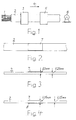
- the method is explained below for the manufacture and the "repair" of a BSCCO tape having an uncoated silver or silver alloy shell.
- a plurality of prefabricated BSCCO filaments 1 are introduced into a common shell of silver or of a silver alloy.
- the envelope is then formed with the enclosed filaments 1 to a BSCCO band 2 - hereinafter referred to as "Band 2".
- the tape 2 is reduced in a device 3 so far in its dimensions until it has a thickness of about 0.25 mm.
- the band 2 passes behind the device 3, a measuring device 5, in which its current carrying capacity is measured. Defects where the current carrying capacity is less than a specified value are marked.
- the band 2 can finally be wound onto a coil 6 indicated only schematically.
- Strips 7 are applied to the detected in the measuring device 5 fault points with reduced current carrying capacity on the belt 2, which consist of a preferably coated with YBCO carrier.
- the strips 7 are advantageously 0.05 mm thick. They are so applied to the band 2 and firmly connected to the same, that the YBCO rests directly or directly on the same.
- the corresponding "repair point" has a thickness of 0.3 mm when the band 2 has a thickness of 0.25 mm.
- An error location of the band 2 can according to Fig. 4 also be "repaired" by the fact that next to the strip 7 on the other side thereof a strip 8 is applied with YBCO. Even then, the thickness of the "repair” is not significantly or disturbingly increased. It is 0.35 mm.
- the above-described repair of the belt 2 can also be done independently of the current production at a later date.
Landscapes
- Engineering & Computer Science (AREA)
- Manufacturing & Machinery (AREA)
- Superconductors And Manufacturing Methods Therefor (AREA)
- Inorganic Compounds Of Heavy Metals (AREA)
Abstract
Description
- Die Erfindung bezieht sich auf ein Verfahren zur Herstellung eines supraleitfähigen elektrischen Leiters auf Basis von Wismut-Strontium-Barium-Kupfer-Oxid (BSCCO), mit welchem zunächst eine Anzahl von vorgefertigten BSCCO-Filamenten in eine gemeinsame, rohrförmig geschlossene Hülle aus Silber bzw. aus einer Silberlegierung eingebracht wird, mit welchem danach die mit den Filamenten bestückte Hülle zu einem Band verformt wird, mit welchem anschließend die Dicke des Bandes auf einen vorgegebenen Wert reduziert wird, mit welchem die Stromtragfähigkeit des Bandes während der Fertigung im kontinuierlichen Durchlauf gemessen wird und mit welchem Bereiche mit verminderter Stromtragfähigkeit während der laufenden Fertigung zumindest als Fehlerstellen markiert werden.
- Heute im Einsatz befindliche supraleitfähige Leiter werden auch als HochtemperaturSupraleiter (HTSL) bezeichnet. Sie bestehen aus einem Verbundwerkstoff, der keramisches Material enthält. Derartige keramische Materialien sind beispielsweise BSCCO (Wismut-Strontium-Kalzium-Kupfer-Oxid) als Material der 1. Generation oder ReBCO (Rare-earth-Barium-Kupfer-Oxid), insbesondere YBCO (Yttrium-Barium-Kupfer-Oxid), als Materialien der 2. Generation. Der elektrische Gleichstromwiderstand solcher supraleitfähiger Leiter ist bei ausreichender Kühlung Null, solange eine bestimmte Stromstärke nicht überschritten wird. Ausreichend niedrige Temperaturen, um ein derartiges Material in den supraleitfähigen Zustand zu bringen, liegen beispielsweise zwischen 67 K und 90 K. Geeignete Kühlmittel sind beispielsweise Stickstoff, Helium, Neon und Wasserstoff oder Gemische dieser Stoffe.
- Supraleitfähige Leiter auf der Basis von BSCCO lassen sich mit dem eingangs geschilderten, grundsätzlich bekannten Verfahren relativ einfach herstellen. Es werden dazu beispielsweise aus Silberröhrchen bestehende Filamente hergestellt, die mit BSCCO gefüllt sind, von denen eine größere Anzahl in eine gemeinsame Hülle aus Silber eingebracht wird. Die mit Filamenten gefüllte Hülle wird zu einem Band geformt und die Dicke des Bandes wird abschließend so weit reduziert, daß sich ein in üblicher Technik zu verarbeitender Leiter ergibt. Seine Dicke liegt etwa bei 0,25 mm. Zur mechanischen Stabilisierung einer solchen dann als Innenleiter bezeichneten, mit Filamenten gefüllten Hülle kann auf beiden Seiten desselben zusätzlich eine beispielsweise aus Edelstahl oder aus einer Kupferlegierung bestehende Schicht aufgebracht werden, wodurch die Dicke des Bandes auf etwa 0,45 mm erhöht wird. Ein aus einem solchen BSCCO-Band bestehender Leiter hat in beiden Ausführungsformen den Vorteil, daß eine Beschädigung desselben in einem supraleitfähigen Kabel nicht zu einem vollständigen Ausfall desselben führt, weil eine große Anzahl von Filamenten vorhanden ist, von denen in der Regel nur ein Teil beschädigt wird, und weil das Silber aufgrund seiner hohen elektrischen Leitfähigkeit zusätzlich einen wirksamen Ersatzleiter darstellt. Trotzdem muß das BSCCO-Band im Auslieferungszustand aber als elektrischer Leiter fehlerfrei sein. Dazu wird während der Herstellung seine Stromtragfähigkeit kontinuierlich gemessen. Dabei festgestellte Fehlerstellen werden in bekannter Technik markiert und aus dem Band herausgeschnitten. Die Enden der dadurch entstehenden Bandabschnitte werden danach übereinander gelegt und fest miteinander verbunden. Das Band liegt dadurch an den Verbindungsstellen doppellagig vor, mit einer Dicke einer Verbindungsstelle von etwa 0,5 mm bzw. 0,9 mm. Dadurch wird die Weiterverarbeitung des BSCCO-Bandes als Leiter in einem Kabel erschwert, weil die Verbindungsstellen nicht nur eine störende Verdickung darstellen, sondern auch die Biegbarkeit des Leiters beeinträchtigen.
- Der Erfindung liegt die Aufgabe zugrunde, das eingangs geschilderte Verfahren so weiterzubilden, daß die erforderliche Stromtragfähigkeit des BSCCO-Bandes an Fehlerstellen auf einfachere Art und Weise eingestellt werden kann.
- Diese Aufgabe wird gemäß der Erfindung dadurch gelöst, daß im Bereich von Fehlerstellen zumindest auf einer Seite des Bandes Streifen festhaftend aufgebracht werden, die aus einem bandförmigen Träger bestehen, der mit einem hochtemperatur-supraleitfähigen Material (HTSL-Material) beschichtet ist, und die etwa die gleiche Breite wie das BSCCO-Band sowie eine maximale Dicke von 0,1 mm haben, wobei das HTSL-Material dem Band zugewandt ist.
- Bei Einsatz dieses Verfahrens braucht das BSCCO-Band bei Feststellung eines Fehlers nicht aufgetrennt zu werden zu werden, wodurch seine Fertigung wesentlich vereinfacht wird. Die erforderliche Stromtragfähigkeit eines aus dem entsprechenden Band hergestellten elektrischen Leiters wird durch die an festgestellten Fehlerstellen aufgebrachten, HTSL-Material aufweisenden Streifen sichergestellt. Ein solcher Streifen mit HTSL-Material kann bereits während der Herstellung des BSCCO-Bandes, aber auch in einem folgenden Arbeitsgang aufgebracht werden. Wenn das Band ohne stabilisierende Beschichtung bleibt, kann der Streifen aus HTSL-Material so angebracht werden, daß das HTSL-Material direkt am Band anliegt. Derartige Streifen mit HTSL-Material sind bekannt und auf dem Markt erhältlich. Sie haben eine maximale Dicke von 0,1 mm und werden mit Vorteil mit einer Dicke von 0,05 mm eingesetzt. An der mit diesem Verfahren "reparierten" Fehlerstelle hat das BSCCO-Band dann eine Dicke von 0,3 mm, wenn der Streifen nur auf einer Seite eines 0,25 mm dicken Bandes aufgebracht wird. Sie trägt damit nur unwesentlich auf, so daß die Weiterverarbeitung des BSCCO-Bandes als Leiter eines supraleitfähigen Kabels nicht behindert wird.
- Als HTSL-Material für den Streifen wird mit Vorteil YBCO eingesetzt.
- Das Verfahren nach der Erfindung wird anhand der Zeichnungen in Ausführungsbeispielen erläutert.
- Es zeigen:
-
Fig. 1 in schematischer Darstellung eine Anordnung zur Herstellung eines BSCCO-Bandes. -
Fig. 2 eine Draufsicht auf ein BSCCO-Band. -
Fig. 3 eine Seitenansicht des Bandes nachFig. 2 . -
Fig. 4 eine gegenüberFig. 3 ergänzte Ausführungsform des Bandes. - Entsprechend den weiter oben gegebenen Erläuterungen kann das BSCCO-Band mit dem Verfahren nach der Erfindung so hergestellt werden, daß die Hülle aus Silber bzw. aus einer Silberlegierung ohne weitere Laminierung bleibt. Es kann aber auch zur Stabilisierung des BSCCO-Bandes beidseitig eine beispielsweise aus Edelstahl oder aus einer Kupferlegierung bestehende Schicht auf dasselbe aufgebracht werden. Die Stromtragfähigkeit des BSCCO-Bandes kann dann am nicht laminierten aber auch am laminierten Produkt gemessen werden. Bei einem im obigen Sinne laminierten BSCCO-Band wird der mindestens eine HTSL-Material aufweisende Streifen an einer Fehlerstelle auf die der Stabilisierung dienende Schicht aufgebracht. Stellvertretend für alle möglichen Ausführungsformen wird das Verfahren im folgenden für die Herstellung und die "Reparatur" eines BSCCO-Bandes erläutert, das eine nicht beschichtete Hülle aus Silber bzw. aus einer Silberlegierung hat.
- Mit einer Anordnung nach
Fig. 1 wird eine Vielzahl von vorgefertigten BSCCO-Filamenten 1 in eine gemeinsame Hülle aus Silber bzw. aus einer Silberlegierung eingebracht. Die Hülle wird anschließend mit den umschlossenen Filamenten 1 zu einem BSCCO-Band 2 geformt - im folgenden kurz "Band 2" genannt. Das Band 2 wird in einer Einrichtung 3 so weit in seinen Abmessungen reduziert, bis es eine Dicke von etwa 0,25 mm hat. Während der Fertigung wird es mit kontinuierlichem Vorschub in Richtung des Pfeiles 4 bewegt. Das Band 2 durchläuft hinter der Einrichtung 3 eine Meßeinrichtung 5, in welcher seine Stromtragfähigkeit gemessen wird. Fehlerstellen, an denen die Stromtragfähigkeit kleiner als ein vorgegebener Wert ist, werden markiert. Das Band 2 kann abschließend auf eine nur schematisch angedeutete Spule 6 aufgewickelt werden. - Während der Fertigung des Bandes 2 können gemäß
Fig. 3 Streifen 7 auf in der Meßeinrichtung 5 festgestellten Fehlerstellen mit verminderter Stromtragfähigkeit auf das Band 2 aufgebracht werden, die aus einem vorzugsweise mit YBCO beschichteten Träger bestehen. Die Streifen 7 sind mit Vorteil 0,05 mm dick. Sie werden so auf das Band 2 aufgebracht und fest mit demselben verbunden, daß das YBCO direkt bzw. unmittelbar auf demselben aufliegt. Die entsprechende "Reparaturstelle" hat eine Dicke von 0,3 mm, wenn das Band 2 eine Dicke von 0,25 mm hat. - Eine Fehlerstelle des Bandes 2 kann gemäß
Fig. 4 auch dadurch "repariert" werden, daß neben dem Streifen 7 auch auf der anderen Seite desselben ein Streifen 8 mit YBCO aufgebracht wird. Auch dann ist die Dicke der "Reparaturstelle" nicht wesentlich bzw. störend vergrößert. Sie liegt bei 0,35 mm. - Die im Vorangehenden beschriebene Reparatur des Bandes 2 kann auch unabhängig von der laufenden Fertigung zu einem späteren Zeitpunkt erfolgen.
Claims (6)
- Verfahren zur Herstellung eines supraleitfähigen elektrischen Leiters auf Basis von Wismut-Strontium-Barium-Kupfer-Oxid (BSCCO), mit welchem zunächst eine Anzahl von vorgefertigten BSCCO-Filamenten in eine gemeinsame, rohrförmig geschlossene Hülle aus Silber bzw. aus einer Silberlegierung eingebracht wird, mit welchem danach die mit den Filamenten bestückte Hülle zu einem Band verformt wird, mit welchem anschließend die Dicke des Bandes auf einen vorgegebenen Wert reduziert wird, mit welchem die Stromtragfähigkeit des Bandes während der Fertigung im kontinuierlichen Durchlauf gemessen wird und mit welchem Bereiche mit verminderter Stromtragfähigkeit während der laufenden Fertigung zumindest als Fehlerstellen markiert werden, dadurch gekennzeichnet, daß im Bereich von Fehlerstellen zumindest auf einer Seite des Bandes (2) Streifen (7) festhaftend aufgebracht werden, die aus einem bandförmigen Träger bestehen, der mit einem hochtemperatur-supraleitfähigen Material (HTSL-Material) beschichtet ist, und die etwa die gleiche Breite wie das Band (2) sowie eine maximale Dicke von 0,1 mm haben, wobei das HTSL-Material dem Band (2) zugewandt ist.
- Verfahren nach Anspruch 1, dadurch gekennzeichnet, daß Streifen (7) aus HTSL-Material mit einer Dicke von 0,05 mm verwendet werden.
- Verfahren nach Anspruch 1 oder 2, dadurch gekennzeichnet, daß Streifen (7) aus HTSL-Material direkt auf die Hülle aus Silber bzw. aus einer Silberlegierung aufgebracht werden.
- Verfahren nach Anspruch 1 oder 2, dadurch gekennzeichnet, daß an einer Fehlerstelle auf beiden Seiten des Bandes (2) je ein Streifen (7,8) mit HTSL-Material angebracht wird.
- Verfahren nach einem der Ansprüche 1 bis 4, dadurch gekennzeichnet, daß der bzw. die Streifen (7,8) mit HTSL-Material während der laufenden Fertigung angebracht wird bzw. werden.
- Verfahren nach einem der Ansprüche 1 bis 5, dadurch gekennzeichnet, daß als HTSL-Material Yttrium-Barium-Kupfer-Oxid (YBCO) verwendet wird.
Priority Applications (3)
| Application Number | Priority Date | Filing Date | Title |
|---|---|---|---|
| EP11305159.3A EP2490275B1 (de) | 2011-02-16 | 2011-02-16 | Verfahren zur Herstellung eines supraleitfähigen elektrischen Leiters |
| JP2012026110A JP5770653B2 (ja) | 2011-02-16 | 2012-02-09 | 超伝導電気導体の製造方法 |
| KR1020120015024A KR101805745B1 (ko) | 2011-02-16 | 2012-02-14 | 초전도성 전도체 제조방법 |
Applications Claiming Priority (1)
| Application Number | Priority Date | Filing Date | Title |
|---|---|---|---|
| EP11305159.3A EP2490275B1 (de) | 2011-02-16 | 2011-02-16 | Verfahren zur Herstellung eines supraleitfähigen elektrischen Leiters |
Publications (2)
| Publication Number | Publication Date |
|---|---|
| EP2490275A1 true EP2490275A1 (de) | 2012-08-22 |
| EP2490275B1 EP2490275B1 (de) | 2014-04-02 |
Family
ID=44148664
Family Applications (1)
| Application Number | Title | Priority Date | Filing Date |
|---|---|---|---|
| EP11305159.3A Not-in-force EP2490275B1 (de) | 2011-02-16 | 2011-02-16 | Verfahren zur Herstellung eines supraleitfähigen elektrischen Leiters |
Country Status (3)
| Country | Link |
|---|---|
| EP (1) | EP2490275B1 (de) |
| JP (1) | JP5770653B2 (de) |
| KR (1) | KR101805745B1 (de) |
Cited By (4)
| Publication number | Priority date | Publication date | Assignee | Title |
|---|---|---|---|---|
| US9508469B2 (en) | 2013-03-13 | 2016-11-29 | Furukawa Electric Co., Ltd. | Peelable superconductive conductor, production method of peelable superconductive conductor, and repair method for superconducting wire |
| CN108344913A (zh) * | 2018-03-16 | 2018-07-31 | 西安聚能超导磁体科技有限公司 | 一种高温超导带材在不同磁场方向下的载流能力测试装置 |
| EP2689477B1 (de) * | 2011-03-21 | 2019-06-19 | American Superconductor Corporation | Verminderung der auswirkung von defekten bei hochtemperatur-supraleitenden drähten |
| CN114864176A (zh) * | 2022-05-18 | 2022-08-05 | 华北电力大学 | 一种一代二代超导带材复合的高热稳定性高温超导导体 |
Families Citing this family (1)
| Publication number | Priority date | Publication date | Assignee | Title |
|---|---|---|---|---|
| TWI488994B (zh) * | 2014-04-17 | 2015-06-21 | Ind Tech Res Inst | 超導薄膜的缺陷修補方法、鍍膜方法與以此方法製作的超導薄膜 |
Citations (2)
| Publication number | Priority date | Publication date | Assignee | Title |
|---|---|---|---|---|
| JPH05294630A (ja) * | 1992-02-21 | 1993-11-09 | Ngk Insulators Ltd | Bi系超電導欠陥補修用組成物及びそれを用いるBi系超電導欠陥補修方法 |
| JP2009187743A (ja) * | 2008-02-05 | 2009-08-20 | Chubu Electric Power Co Inc | 超電導テープ線材及び欠陥部の補修方法 |
Family Cites Families (3)
| Publication number | Priority date | Publication date | Assignee | Title |
|---|---|---|---|---|
| JP2003294630A (ja) | 2001-06-28 | 2003-10-15 | Fuji Photo Film Co Ltd | 生化学解析用データの生成方法および装置 |
| JP2007287772A (ja) * | 2006-04-13 | 2007-11-01 | Sumitomo Electric Ind Ltd | 超電導コイルの品質保証構造 |
| AU2007275572B2 (en) * | 2006-07-21 | 2014-03-06 | American Superconductor Corporation | High-current, compact flexible conductors containing high temperature superconducting tapes |
-
2011
- 2011-02-16 EP EP11305159.3A patent/EP2490275B1/de not_active Not-in-force
-
2012
- 2012-02-09 JP JP2012026110A patent/JP5770653B2/ja not_active Expired - Fee Related
- 2012-02-14 KR KR1020120015024A patent/KR101805745B1/ko not_active Expired - Fee Related
Patent Citations (2)
| Publication number | Priority date | Publication date | Assignee | Title |
|---|---|---|---|---|
| JPH05294630A (ja) * | 1992-02-21 | 1993-11-09 | Ngk Insulators Ltd | Bi系超電導欠陥補修用組成物及びそれを用いるBi系超電導欠陥補修方法 |
| JP2009187743A (ja) * | 2008-02-05 | 2009-08-20 | Chubu Electric Power Co Inc | 超電導テープ線材及び欠陥部の補修方法 |
Cited By (4)
| Publication number | Priority date | Publication date | Assignee | Title |
|---|---|---|---|---|
| EP2689477B1 (de) * | 2011-03-21 | 2019-06-19 | American Superconductor Corporation | Verminderung der auswirkung von defekten bei hochtemperatur-supraleitenden drähten |
| US9508469B2 (en) | 2013-03-13 | 2016-11-29 | Furukawa Electric Co., Ltd. | Peelable superconductive conductor, production method of peelable superconductive conductor, and repair method for superconducting wire |
| CN108344913A (zh) * | 2018-03-16 | 2018-07-31 | 西安聚能超导磁体科技有限公司 | 一种高温超导带材在不同磁场方向下的载流能力测试装置 |
| CN114864176A (zh) * | 2022-05-18 | 2022-08-05 | 华北电力大学 | 一种一代二代超导带材复合的高热稳定性高温超导导体 |
Also Published As
| Publication number | Publication date |
|---|---|
| KR20120094436A (ko) | 2012-08-24 |
| KR101805745B1 (ko) | 2017-12-07 |
| JP2012169272A (ja) | 2012-09-06 |
| EP2490275B1 (de) | 2014-04-02 |
| JP5770653B2 (ja) | 2015-08-26 |
Similar Documents
| Publication | Publication Date | Title |
|---|---|---|
| EP2471115B1 (de) | Multifilamentleiter und verfahren zu dessen herstellung | |
| EP2017856B1 (de) | Supraleitfähiges elektrisches Kabel | |
| EP1256159B1 (de) | Volltransponierter hoch-t c?-verbundsupraleiter sowie vorrichtung zu dessen herstellung und dessen verwendung | |
| DE69924898T2 (de) | Resistiver Fehlerstrombegrenzer | |
| DE102011118465B4 (de) | Supraleitende Spule | |
| DE112016003022T5 (de) | Supraleitender Draht | |
| EP2387043A1 (de) | Übertragungssystem mit einem supraleitfähigen Kabel | |
| EP2228806B1 (de) | Anordnung zur Strombegrenzung | |
| EP2490275B1 (de) | Verfahren zur Herstellung eines supraleitfähigen elektrischen Leiters | |
| DE2654924A1 (de) | Supraleitendes verbundkabel | |
| DE102012217990A1 (de) | Supraleitende Spuleneinrichtung und Herstellungsverfahren | |
| EP2418747A1 (de) | Anordnung zum elektrisch leitenden Verbinden von zwei elektrischen Einheiten | |
| EP2234122B1 (de) | Supraleitfähiges elektrisches Kabel | |
| EP2770514B1 (de) | Verfahren zum Kühlen eines supraleitfähigen Kabels | |
| EP2317526B1 (de) | System mit mindestens einem supraleitfähigen Kabel | |
| EP1887584A1 (de) | System mit einem supraleitfähigen Kabel | |
| DE102014211316A1 (de) | Elektrische Spuleneinrichtung mit wenigstens zwei Teilspulen und Herstellungsverfahren dazu | |
| EP2339593A1 (de) | Supraleitfähiges Kabelsystem | |
| DE202019003381U1 (de) | Muffe für ein supraleitfähiges Kabel und supraleitfähiges Kabel mit Anschluss für eine Zwischenkühlung | |
| EP2442376A1 (de) | Verfahren zur Herstellung eines supraleitfähigen elektrischen Leiters und supraleitfähiger Leiter | |
| WO2013045229A1 (de) | Bandförmiger hochtemperatur-supraleiter und verfahren zur herstellung eines bandförmigen hochtemperatur-supraleiters | |
| EP2209129A1 (de) | Anordnung zur Strombegrenzung | |
| WO2023174855A1 (de) | Hermetisch dichter hochtemperatursupraleitender bandleiter | |
| EP2337102A1 (de) | Verfahren zur Herstellung eines supraleitfähigen elektrischen Leiters und supraleitfähiger Leiter | |
| EP2816695B1 (de) | Verfahren zur Herstellung eines supraleitfähigen Kabels |
Legal Events
| Date | Code | Title | Description |
|---|---|---|---|
| PUAI | Public reference made under article 153(3) epc to a published international application that has entered the european phase |
Free format text: ORIGINAL CODE: 0009012 |
|
| 17P | Request for examination filed |
Effective date: 20110801 |
|
| AK | Designated contracting states |
Kind code of ref document: A1 Designated state(s): AL AT BE BG CH CY CZ DE DK EE ES FI FR GB GR HR HU IE IS IT LI LT LU LV MC MK MT NL NO PL PT RO RS SE SI SK SM TR |
|
| AX | Request for extension of the european patent |
Extension state: BA ME |
|
| GRAP | Despatch of communication of intention to grant a patent |
Free format text: ORIGINAL CODE: EPIDOSNIGR1 |
|
| RIC1 | Information provided on ipc code assigned before grant |
Ipc: H01L 39/24 20060101AFI20130919BHEP |
|
| INTG | Intention to grant announced |
Effective date: 20131011 |
|
| GRAS | Grant fee paid |
Free format text: ORIGINAL CODE: EPIDOSNIGR3 |
|
| GRAA | (expected) grant |
Free format text: ORIGINAL CODE: 0009210 |
|
| AK | Designated contracting states |
Kind code of ref document: B1 Designated state(s): AL AT BE BG CH CY CZ DE DK EE ES FI FR GB GR HR HU IE IS IT LI LT LU LV MC MK MT NL NO PL PT RO RS SE SI SK SM TR |
|
| REG | Reference to a national code |
Ref country code: GB Ref legal event code: FG4D Free format text: NOT ENGLISH |
|
| REG | Reference to a national code |
Ref country code: CH Ref legal event code: EP Ref country code: AT Ref legal event code: REF Ref document number: 660595 Country of ref document: AT Kind code of ref document: T Effective date: 20140415 |
|
| REG | Reference to a national code |
Ref country code: IE Ref legal event code: FG4D Free format text: LANGUAGE OF EP DOCUMENT: GERMAN |
|
| REG | Reference to a national code |
Ref country code: DE Ref legal event code: R096 Ref document number: 502011002592 Country of ref document: DE Effective date: 20140515 |
|
| REG | Reference to a national code |
Ref country code: NL Ref legal event code: VDEP Effective date: 20140402 |
|
| REG | Reference to a national code |
Ref country code: LT Ref legal event code: MG4D |
|
| PG25 | Lapsed in a contracting state [announced via postgrant information from national office to epo] |
Ref country code: BG Free format text: LAPSE BECAUSE OF FAILURE TO SUBMIT A TRANSLATION OF THE DESCRIPTION OR TO PAY THE FEE WITHIN THE PRESCRIBED TIME-LIMIT Effective date: 20140702 Ref country code: NO Free format text: LAPSE BECAUSE OF FAILURE TO SUBMIT A TRANSLATION OF THE DESCRIPTION OR TO PAY THE FEE WITHIN THE PRESCRIBED TIME-LIMIT Effective date: 20140702 Ref country code: CZ Free format text: LAPSE BECAUSE OF FAILURE TO SUBMIT A TRANSLATION OF THE DESCRIPTION OR TO PAY THE FEE WITHIN THE PRESCRIBED TIME-LIMIT Effective date: 20140402 Ref country code: LT Free format text: LAPSE BECAUSE OF FAILURE TO SUBMIT A TRANSLATION OF THE DESCRIPTION OR TO PAY THE FEE WITHIN THE PRESCRIBED TIME-LIMIT Effective date: 20140402 Ref country code: IS Free format text: LAPSE BECAUSE OF FAILURE TO SUBMIT A TRANSLATION OF THE DESCRIPTION OR TO PAY THE FEE WITHIN THE PRESCRIBED TIME-LIMIT Effective date: 20140802 Ref country code: CY Free format text: LAPSE BECAUSE OF FAILURE TO SUBMIT A TRANSLATION OF THE DESCRIPTION OR TO PAY THE FEE WITHIN THE PRESCRIBED TIME-LIMIT Effective date: 20140402 Ref country code: FI Free format text: LAPSE BECAUSE OF FAILURE TO SUBMIT A TRANSLATION OF THE DESCRIPTION OR TO PAY THE FEE WITHIN THE PRESCRIBED TIME-LIMIT Effective date: 20140402 Ref country code: GR Free format text: LAPSE BECAUSE OF FAILURE TO SUBMIT A TRANSLATION OF THE DESCRIPTION OR TO PAY THE FEE WITHIN THE PRESCRIBED TIME-LIMIT Effective date: 20140703 Ref country code: NL Free format text: LAPSE BECAUSE OF FAILURE TO SUBMIT A TRANSLATION OF THE DESCRIPTION OR TO PAY THE FEE WITHIN THE PRESCRIBED TIME-LIMIT Effective date: 20140402 |
|
| PG25 | Lapsed in a contracting state [announced via postgrant information from national office to epo] |
Ref country code: PL Free format text: LAPSE BECAUSE OF FAILURE TO SUBMIT A TRANSLATION OF THE DESCRIPTION OR TO PAY THE FEE WITHIN THE PRESCRIBED TIME-LIMIT Effective date: 20140402 Ref country code: LV Free format text: LAPSE BECAUSE OF FAILURE TO SUBMIT A TRANSLATION OF THE DESCRIPTION OR TO PAY THE FEE WITHIN THE PRESCRIBED TIME-LIMIT Effective date: 20140402 Ref country code: SE Free format text: LAPSE BECAUSE OF FAILURE TO SUBMIT A TRANSLATION OF THE DESCRIPTION OR TO PAY THE FEE WITHIN THE PRESCRIBED TIME-LIMIT Effective date: 20140402 Ref country code: HR Free format text: LAPSE BECAUSE OF FAILURE TO SUBMIT A TRANSLATION OF THE DESCRIPTION OR TO PAY THE FEE WITHIN THE PRESCRIBED TIME-LIMIT Effective date: 20140402 Ref country code: ES Free format text: LAPSE BECAUSE OF FAILURE TO SUBMIT A TRANSLATION OF THE DESCRIPTION OR TO PAY THE FEE WITHIN THE PRESCRIBED TIME-LIMIT Effective date: 20140402 Ref country code: RS Free format text: LAPSE BECAUSE OF FAILURE TO SUBMIT A TRANSLATION OF THE DESCRIPTION OR TO PAY THE FEE WITHIN THE PRESCRIBED TIME-LIMIT Effective date: 20140402 |
|
| PG25 | Lapsed in a contracting state [announced via postgrant information from national office to epo] |
Ref country code: PT Free format text: LAPSE BECAUSE OF FAILURE TO SUBMIT A TRANSLATION OF THE DESCRIPTION OR TO PAY THE FEE WITHIN THE PRESCRIBED TIME-LIMIT Effective date: 20140804 |
|
| REG | Reference to a national code |
Ref country code: DE Ref legal event code: R097 Ref document number: 502011002592 Country of ref document: DE |
|
| PG25 | Lapsed in a contracting state [announced via postgrant information from national office to epo] |
Ref country code: EE Free format text: LAPSE BECAUSE OF FAILURE TO SUBMIT A TRANSLATION OF THE DESCRIPTION OR TO PAY THE FEE WITHIN THE PRESCRIBED TIME-LIMIT Effective date: 20140402 Ref country code: DK Free format text: LAPSE BECAUSE OF FAILURE TO SUBMIT A TRANSLATION OF THE DESCRIPTION OR TO PAY THE FEE WITHIN THE PRESCRIBED TIME-LIMIT Effective date: 20140402 Ref country code: RO Free format text: LAPSE BECAUSE OF FAILURE TO SUBMIT A TRANSLATION OF THE DESCRIPTION OR TO PAY THE FEE WITHIN THE PRESCRIBED TIME-LIMIT Effective date: 20140402 Ref country code: SK Free format text: LAPSE BECAUSE OF FAILURE TO SUBMIT A TRANSLATION OF THE DESCRIPTION OR TO PAY THE FEE WITHIN THE PRESCRIBED TIME-LIMIT Effective date: 20140402 |
|
| PLBE | No opposition filed within time limit |
Free format text: ORIGINAL CODE: 0009261 |
|
| STAA | Information on the status of an ep patent application or granted ep patent |
Free format text: STATUS: NO OPPOSITION FILED WITHIN TIME LIMIT |
|
| 26N | No opposition filed |
Effective date: 20150106 |
|
| REG | Reference to a national code |
Ref country code: DE Ref legal event code: R097 Ref document number: 502011002592 Country of ref document: DE Effective date: 20150106 |
|
| PG25 | Lapsed in a contracting state [announced via postgrant information from national office to epo] |
Ref country code: RS Free format text: LAPSE BECAUSE OF FAILURE TO SUBMIT A TRANSLATION OF THE DESCRIPTION OR TO PAY THE FEE WITHIN THE PRESCRIBED TIME-LIMIT Effective date: 20141119 |
|
| PG25 | Lapsed in a contracting state [announced via postgrant information from national office to epo] |
Ref country code: BE Free format text: LAPSE BECAUSE OF NON-PAYMENT OF DUE FEES Effective date: 20150228 |
|
| PG25 | Lapsed in a contracting state [announced via postgrant information from national office to epo] |
Ref country code: SI Free format text: LAPSE BECAUSE OF FAILURE TO SUBMIT A TRANSLATION OF THE DESCRIPTION OR TO PAY THE FEE WITHIN THE PRESCRIBED TIME-LIMIT Effective date: 20140402 |
|
| PG25 | Lapsed in a contracting state [announced via postgrant information from national office to epo] |
Ref country code: LU Free format text: LAPSE BECAUSE OF FAILURE TO SUBMIT A TRANSLATION OF THE DESCRIPTION OR TO PAY THE FEE WITHIN THE PRESCRIBED TIME-LIMIT Effective date: 20150216 |
|
| REG | Reference to a national code |
Ref country code: CH Ref legal event code: PL |
|
| GBPC | Gb: european patent ceased through non-payment of renewal fee |
Effective date: 20150216 |
|
| PG25 | Lapsed in a contracting state [announced via postgrant information from national office to epo] |
Ref country code: MC Free format text: LAPSE BECAUSE OF FAILURE TO SUBMIT A TRANSLATION OF THE DESCRIPTION OR TO PAY THE FEE WITHIN THE PRESCRIBED TIME-LIMIT Effective date: 20140402 Ref country code: CH Free format text: LAPSE BECAUSE OF NON-PAYMENT OF DUE FEES Effective date: 20150228 Ref country code: LI Free format text: LAPSE BECAUSE OF NON-PAYMENT OF DUE FEES Effective date: 20150228 |
|
| REG | Reference to a national code |
Ref country code: IE Ref legal event code: MM4A |
|
| PG25 | Lapsed in a contracting state [announced via postgrant information from national office to epo] |
Ref country code: GB Free format text: LAPSE BECAUSE OF NON-PAYMENT OF DUE FEES Effective date: 20150216 Ref country code: IE Free format text: LAPSE BECAUSE OF NON-PAYMENT OF DUE FEES Effective date: 20150216 |
|
| REG | Reference to a national code |
Ref country code: FR Ref legal event code: PLFP Year of fee payment: 6 |
|
| PG25 | Lapsed in a contracting state [announced via postgrant information from national office to epo] |
Ref country code: MT Free format text: LAPSE BECAUSE OF FAILURE TO SUBMIT A TRANSLATION OF THE DESCRIPTION OR TO PAY THE FEE WITHIN THE PRESCRIBED TIME-LIMIT Effective date: 20140402 |
|
| REG | Reference to a national code |
Ref country code: FR Ref legal event code: PLFP Year of fee payment: 7 |
|
| REG | Reference to a national code |
Ref country code: AT Ref legal event code: MM01 Ref document number: 660595 Country of ref document: AT Kind code of ref document: T Effective date: 20160216 |
|
| PG25 | Lapsed in a contracting state [announced via postgrant information from national office to epo] |
Ref country code: HU Free format text: LAPSE BECAUSE OF FAILURE TO SUBMIT A TRANSLATION OF THE DESCRIPTION OR TO PAY THE FEE WITHIN THE PRESCRIBED TIME-LIMIT; INVALID AB INITIO Effective date: 20110216 Ref country code: SM Free format text: LAPSE BECAUSE OF FAILURE TO SUBMIT A TRANSLATION OF THE DESCRIPTION OR TO PAY THE FEE WITHIN THE PRESCRIBED TIME-LIMIT Effective date: 20140402 Ref country code: AT Free format text: LAPSE BECAUSE OF NON-PAYMENT OF DUE FEES Effective date: 20160216 |
|
| PG25 | Lapsed in a contracting state [announced via postgrant information from national office to epo] |
Ref country code: TR Free format text: LAPSE BECAUSE OF FAILURE TO SUBMIT A TRANSLATION OF THE DESCRIPTION OR TO PAY THE FEE WITHIN THE PRESCRIBED TIME-LIMIT Effective date: 20140402 |
|
| REG | Reference to a national code |
Ref country code: FR Ref legal event code: PLFP Year of fee payment: 8 |
|
| PG25 | Lapsed in a contracting state [announced via postgrant information from national office to epo] |
Ref country code: MK Free format text: LAPSE BECAUSE OF FAILURE TO SUBMIT A TRANSLATION OF THE DESCRIPTION OR TO PAY THE FEE WITHIN THE PRESCRIBED TIME-LIMIT Effective date: 20140402 |
|
| PG25 | Lapsed in a contracting state [announced via postgrant information from national office to epo] |
Ref country code: AL Free format text: LAPSE BECAUSE OF FAILURE TO SUBMIT A TRANSLATION OF THE DESCRIPTION OR TO PAY THE FEE WITHIN THE PRESCRIBED TIME-LIMIT Effective date: 20140402 |
|
| PGFP | Annual fee paid to national office [announced via postgrant information from national office to epo] |
Ref country code: DE Payment date: 20220217 Year of fee payment: 12 |
|
| PGFP | Annual fee paid to national office [announced via postgrant information from national office to epo] |
Ref country code: IT Payment date: 20220218 Year of fee payment: 12 Ref country code: FR Payment date: 20220216 Year of fee payment: 12 |
|
| REG | Reference to a national code |
Ref country code: DE Ref legal event code: R079 Ref document number: 502011002592 Country of ref document: DE Free format text: PREVIOUS MAIN CLASS: H01L0039240000 Ipc: H10N0060010000 |
|
| REG | Reference to a national code |
Ref country code: DE Ref legal event code: R119 Ref document number: 502011002592 Country of ref document: DE |
|
| PG25 | Lapsed in a contracting state [announced via postgrant information from national office to epo] |
Ref country code: IT Free format text: LAPSE BECAUSE OF NON-PAYMENT OF DUE FEES Effective date: 20230216 Ref country code: FR Free format text: LAPSE BECAUSE OF NON-PAYMENT OF DUE FEES Effective date: 20230228 Ref country code: DE Free format text: LAPSE BECAUSE OF NON-PAYMENT OF DUE FEES Effective date: 20230901 |