EP2489760A1 - Method for producing resin-coated metal plate - Google Patents
Method for producing resin-coated metal plate Download PDFInfo
- Publication number
- EP2489760A1 EP2489760A1 EP09850377A EP09850377A EP2489760A1 EP 2489760 A1 EP2489760 A1 EP 2489760A1 EP 09850377 A EP09850377 A EP 09850377A EP 09850377 A EP09850377 A EP 09850377A EP 2489760 A1 EP2489760 A1 EP 2489760A1
- Authority
- EP
- European Patent Office
- Prior art keywords
- resin
- silane coupling
- coupling agent
- tin
- temperature
- Prior art date
- Legal status (The legal status is an assumption and is not a legal conclusion. Google has not performed a legal analysis and makes no representation as to the accuracy of the status listed.)
- Granted
Links
Images



Classifications
-
- C—CHEMISTRY; METALLURGY
- C23—COATING METALLIC MATERIAL; COATING MATERIAL WITH METALLIC MATERIAL; CHEMICAL SURFACE TREATMENT; DIFFUSION TREATMENT OF METALLIC MATERIAL; COATING BY VACUUM EVAPORATION, BY SPUTTERING, BY ION IMPLANTATION OR BY CHEMICAL VAPOUR DEPOSITION, IN GENERAL; INHIBITING CORROSION OF METALLIC MATERIAL OR INCRUSTATION IN GENERAL
- C23C—COATING METALLIC MATERIAL; COATING MATERIAL WITH METALLIC MATERIAL; SURFACE TREATMENT OF METALLIC MATERIAL BY DIFFUSION INTO THE SURFACE, BY CHEMICAL CONVERSION OR SUBSTITUTION; COATING BY VACUUM EVAPORATION, BY SPUTTERING, BY ION IMPLANTATION OR BY CHEMICAL VAPOUR DEPOSITION, IN GENERAL
- C23C28/00—Coating for obtaining at least two superposed coatings either by methods not provided for in a single one of groups C23C2/00 - C23C26/00 or by combinations of methods provided for in subclasses C23C and C25C or C25D
-
- B—PERFORMING OPERATIONS; TRANSPORTING
- B29—WORKING OF PLASTICS; WORKING OF SUBSTANCES IN A PLASTIC STATE IN GENERAL
- B29C—SHAPING OR JOINING OF PLASTICS; SHAPING OF MATERIAL IN A PLASTIC STATE, NOT OTHERWISE PROVIDED FOR; AFTER-TREATMENT OF THE SHAPED PRODUCTS, e.g. REPAIRING
- B29C48/00—Extrusion moulding, i.e. expressing the moulding material through a die or nozzle which imparts the desired form; Apparatus therefor
- B29C48/03—Extrusion moulding, i.e. expressing the moulding material through a die or nozzle which imparts the desired form; Apparatus therefor characterised by the shape of the extruded material at extrusion
- B29C48/07—Flat, e.g. panels
-
- B—PERFORMING OPERATIONS; TRANSPORTING
- B29—WORKING OF PLASTICS; WORKING OF SUBSTANCES IN A PLASTIC STATE IN GENERAL
- B29C—SHAPING OR JOINING OF PLASTICS; SHAPING OF MATERIAL IN A PLASTIC STATE, NOT OTHERWISE PROVIDED FOR; AFTER-TREATMENT OF THE SHAPED PRODUCTS, e.g. REPAIRING
- B29C65/00—Joining or sealing of preformed parts, e.g. welding of plastics materials; Apparatus therefor
- B29C65/48—Joining or sealing of preformed parts, e.g. welding of plastics materials; Apparatus therefor using adhesives, i.e. using supplementary joining material; solvent bonding
-
- B—PERFORMING OPERATIONS; TRANSPORTING
- B29—WORKING OF PLASTICS; WORKING OF SUBSTANCES IN A PLASTIC STATE IN GENERAL
- B29C—SHAPING OR JOINING OF PLASTICS; SHAPING OF MATERIAL IN A PLASTIC STATE, NOT OTHERWISE PROVIDED FOR; AFTER-TREATMENT OF THE SHAPED PRODUCTS, e.g. REPAIRING
- B29C66/00—General aspects of processes or apparatus for joining preformed parts
- B29C66/70—General aspects of processes or apparatus for joining preformed parts characterised by the composition, physical properties or the structure of the material of the parts to be joined; Joining with non-plastics material
- B29C66/72—General aspects of processes or apparatus for joining preformed parts characterised by the composition, physical properties or the structure of the material of the parts to be joined; Joining with non-plastics material characterised by the structure of the material of the parts to be joined
- B29C66/723—General aspects of processes or apparatus for joining preformed parts characterised by the composition, physical properties or the structure of the material of the parts to be joined; Joining with non-plastics material characterised by the structure of the material of the parts to be joined being multi-layered
- B29C66/7232—General aspects of processes or apparatus for joining preformed parts characterised by the composition, physical properties or the structure of the material of the parts to be joined; Joining with non-plastics material characterised by the structure of the material of the parts to be joined being multi-layered comprising a non-plastics layer
- B29C66/72321—General aspects of processes or apparatus for joining preformed parts characterised by the composition, physical properties or the structure of the material of the parts to be joined; Joining with non-plastics material characterised by the structure of the material of the parts to be joined being multi-layered comprising a non-plastics layer consisting of metals or their alloys
-
- B—PERFORMING OPERATIONS; TRANSPORTING
- B29—WORKING OF PLASTICS; WORKING OF SUBSTANCES IN A PLASTIC STATE IN GENERAL
- B29C—SHAPING OR JOINING OF PLASTICS; SHAPING OF MATERIAL IN A PLASTIC STATE, NOT OTHERWISE PROVIDED FOR; AFTER-TREATMENT OF THE SHAPED PRODUCTS, e.g. REPAIRING
- B29C66/00—General aspects of processes or apparatus for joining preformed parts
- B29C66/90—Measuring or controlling the joining process
- B29C66/91—Measuring or controlling the joining process by measuring or controlling the temperature, the heat or the thermal flux
- B29C66/914—Measuring or controlling the joining process by measuring or controlling the temperature, the heat or the thermal flux by controlling or regulating the temperature, the heat or the thermal flux
- B29C66/9141—Measuring or controlling the joining process by measuring or controlling the temperature, the heat or the thermal flux by controlling or regulating the temperature, the heat or the thermal flux by controlling or regulating the temperature
- B29C66/91411—Measuring or controlling the joining process by measuring or controlling the temperature, the heat or the thermal flux by controlling or regulating the temperature, the heat or the thermal flux by controlling or regulating the temperature of the parts to be joined, e.g. the joining process taking the temperature of the parts to be joined into account
-
- B—PERFORMING OPERATIONS; TRANSPORTING
- B29—WORKING OF PLASTICS; WORKING OF SUBSTANCES IN A PLASTIC STATE IN GENERAL
- B29C—SHAPING OR JOINING OF PLASTICS; SHAPING OF MATERIAL IN A PLASTIC STATE, NOT OTHERWISE PROVIDED FOR; AFTER-TREATMENT OF THE SHAPED PRODUCTS, e.g. REPAIRING
- B29C66/00—General aspects of processes or apparatus for joining preformed parts
- B29C66/90—Measuring or controlling the joining process
- B29C66/91—Measuring or controlling the joining process by measuring or controlling the temperature, the heat or the thermal flux
- B29C66/914—Measuring or controlling the joining process by measuring or controlling the temperature, the heat or the thermal flux by controlling or regulating the temperature, the heat or the thermal flux
- B29C66/9141—Measuring or controlling the joining process by measuring or controlling the temperature, the heat or the thermal flux by controlling or regulating the temperature, the heat or the thermal flux by controlling or regulating the temperature
- B29C66/91441—Measuring or controlling the joining process by measuring or controlling the temperature, the heat or the thermal flux by controlling or regulating the temperature, the heat or the thermal flux by controlling or regulating the temperature the temperature being non-constant over time
- B29C66/91443—Measuring or controlling the joining process by measuring or controlling the temperature, the heat or the thermal flux by controlling or regulating the temperature, the heat or the thermal flux by controlling or regulating the temperature the temperature being non-constant over time following a temperature-time profile
-
- B—PERFORMING OPERATIONS; TRANSPORTING
- B29—WORKING OF PLASTICS; WORKING OF SUBSTANCES IN A PLASTIC STATE IN GENERAL
- B29C—SHAPING OR JOINING OF PLASTICS; SHAPING OF MATERIAL IN A PLASTIC STATE, NOT OTHERWISE PROVIDED FOR; AFTER-TREATMENT OF THE SHAPED PRODUCTS, e.g. REPAIRING
- B29C66/00—General aspects of processes or apparatus for joining preformed parts
- B29C66/90—Measuring or controlling the joining process
- B29C66/91—Measuring or controlling the joining process by measuring or controlling the temperature, the heat or the thermal flux
- B29C66/919—Measuring or controlling the joining process by measuring or controlling the temperature, the heat or the thermal flux characterised by specific temperature, heat or thermal flux values or ranges
- B29C66/9192—Measuring or controlling the joining process by measuring or controlling the temperature, the heat or the thermal flux characterised by specific temperature, heat or thermal flux values or ranges in explicit relation to another variable, e.g. temperature diagrams
- B29C66/91921—Measuring or controlling the joining process by measuring or controlling the temperature, the heat or the thermal flux characterised by specific temperature, heat or thermal flux values or ranges in explicit relation to another variable, e.g. temperature diagrams in explicit relation to another temperature, e.g. to the softening temperature or softening point, to the thermal degradation temperature or to the ambient temperature
-
- B—PERFORMING OPERATIONS; TRANSPORTING
- B29—WORKING OF PLASTICS; WORKING OF SUBSTANCES IN A PLASTIC STATE IN GENERAL
- B29C—SHAPING OR JOINING OF PLASTICS; SHAPING OF MATERIAL IN A PLASTIC STATE, NOT OTHERWISE PROVIDED FOR; AFTER-TREATMENT OF THE SHAPED PRODUCTS, e.g. REPAIRING
- B29C66/00—General aspects of processes or apparatus for joining preformed parts
- B29C66/90—Measuring or controlling the joining process
- B29C66/91—Measuring or controlling the joining process by measuring or controlling the temperature, the heat or the thermal flux
- B29C66/919—Measuring or controlling the joining process by measuring or controlling the temperature, the heat or the thermal flux characterised by specific temperature, heat or thermal flux values or ranges
- B29C66/9192—Measuring or controlling the joining process by measuring or controlling the temperature, the heat or the thermal flux characterised by specific temperature, heat or thermal flux values or ranges in explicit relation to another variable, e.g. temperature diagrams
- B29C66/91921—Measuring or controlling the joining process by measuring or controlling the temperature, the heat or the thermal flux characterised by specific temperature, heat or thermal flux values or ranges in explicit relation to another variable, e.g. temperature diagrams in explicit relation to another temperature, e.g. to the softening temperature or softening point, to the thermal degradation temperature or to the ambient temperature
- B29C66/91931—Measuring or controlling the joining process by measuring or controlling the temperature, the heat or the thermal flux characterised by specific temperature, heat or thermal flux values or ranges in explicit relation to another variable, e.g. temperature diagrams in explicit relation to another temperature, e.g. to the softening temperature or softening point, to the thermal degradation temperature or to the ambient temperature in explicit relation to the fusion temperature or melting point of the material of one of the parts to be joined
-
- B—PERFORMING OPERATIONS; TRANSPORTING
- B29—WORKING OF PLASTICS; WORKING OF SUBSTANCES IN A PLASTIC STATE IN GENERAL
- B29C—SHAPING OR JOINING OF PLASTICS; SHAPING OF MATERIAL IN A PLASTIC STATE, NOT OTHERWISE PROVIDED FOR; AFTER-TREATMENT OF THE SHAPED PRODUCTS, e.g. REPAIRING
- B29C66/00—General aspects of processes or apparatus for joining preformed parts
- B29C66/90—Measuring or controlling the joining process
- B29C66/91—Measuring or controlling the joining process by measuring or controlling the temperature, the heat or the thermal flux
- B29C66/919—Measuring or controlling the joining process by measuring or controlling the temperature, the heat or the thermal flux characterised by specific temperature, heat or thermal flux values or ranges
- B29C66/9192—Measuring or controlling the joining process by measuring or controlling the temperature, the heat or the thermal flux characterised by specific temperature, heat or thermal flux values or ranges in explicit relation to another variable, e.g. temperature diagrams
- B29C66/91921—Measuring or controlling the joining process by measuring or controlling the temperature, the heat or the thermal flux characterised by specific temperature, heat or thermal flux values or ranges in explicit relation to another variable, e.g. temperature diagrams in explicit relation to another temperature, e.g. to the softening temperature or softening point, to the thermal degradation temperature or to the ambient temperature
- B29C66/91931—Measuring or controlling the joining process by measuring or controlling the temperature, the heat or the thermal flux characterised by specific temperature, heat or thermal flux values or ranges in explicit relation to another variable, e.g. temperature diagrams in explicit relation to another temperature, e.g. to the softening temperature or softening point, to the thermal degradation temperature or to the ambient temperature in explicit relation to the fusion temperature or melting point of the material of one of the parts to be joined
- B29C66/91933—Measuring or controlling the joining process by measuring or controlling the temperature, the heat or the thermal flux characterised by specific temperature, heat or thermal flux values or ranges in explicit relation to another variable, e.g. temperature diagrams in explicit relation to another temperature, e.g. to the softening temperature or softening point, to the thermal degradation temperature or to the ambient temperature in explicit relation to the fusion temperature or melting point of the material of one of the parts to be joined higher than said fusion temperature
-
- B—PERFORMING OPERATIONS; TRANSPORTING
- B29—WORKING OF PLASTICS; WORKING OF SUBSTANCES IN A PLASTIC STATE IN GENERAL
- B29C—SHAPING OR JOINING OF PLASTICS; SHAPING OF MATERIAL IN A PLASTIC STATE, NOT OTHERWISE PROVIDED FOR; AFTER-TREATMENT OF THE SHAPED PRODUCTS, e.g. REPAIRING
- B29C66/00—General aspects of processes or apparatus for joining preformed parts
- B29C66/90—Measuring or controlling the joining process
- B29C66/91—Measuring or controlling the joining process by measuring or controlling the temperature, the heat or the thermal flux
- B29C66/919—Measuring or controlling the joining process by measuring or controlling the temperature, the heat or the thermal flux characterised by specific temperature, heat or thermal flux values or ranges
- B29C66/9192—Measuring or controlling the joining process by measuring or controlling the temperature, the heat or the thermal flux characterised by specific temperature, heat or thermal flux values or ranges in explicit relation to another variable, e.g. temperature diagrams
- B29C66/91921—Measuring or controlling the joining process by measuring or controlling the temperature, the heat or the thermal flux characterised by specific temperature, heat or thermal flux values or ranges in explicit relation to another variable, e.g. temperature diagrams in explicit relation to another temperature, e.g. to the softening temperature or softening point, to the thermal degradation temperature or to the ambient temperature
- B29C66/91931—Measuring or controlling the joining process by measuring or controlling the temperature, the heat or the thermal flux characterised by specific temperature, heat or thermal flux values or ranges in explicit relation to another variable, e.g. temperature diagrams in explicit relation to another temperature, e.g. to the softening temperature or softening point, to the thermal degradation temperature or to the ambient temperature in explicit relation to the fusion temperature or melting point of the material of one of the parts to be joined
- B29C66/91935—Measuring or controlling the joining process by measuring or controlling the temperature, the heat or the thermal flux characterised by specific temperature, heat or thermal flux values or ranges in explicit relation to another variable, e.g. temperature diagrams in explicit relation to another temperature, e.g. to the softening temperature or softening point, to the thermal degradation temperature or to the ambient temperature in explicit relation to the fusion temperature or melting point of the material of one of the parts to be joined lower than said fusion temperature
-
- B—PERFORMING OPERATIONS; TRANSPORTING
- B29—WORKING OF PLASTICS; WORKING OF SUBSTANCES IN A PLASTIC STATE IN GENERAL
- B29C—SHAPING OR JOINING OF PLASTICS; SHAPING OF MATERIAL IN A PLASTIC STATE, NOT OTHERWISE PROVIDED FOR; AFTER-TREATMENT OF THE SHAPED PRODUCTS, e.g. REPAIRING
- B29C66/00—General aspects of processes or apparatus for joining preformed parts
- B29C66/90—Measuring or controlling the joining process
- B29C66/91—Measuring or controlling the joining process by measuring or controlling the temperature, the heat or the thermal flux
- B29C66/919—Measuring or controlling the joining process by measuring or controlling the temperature, the heat or the thermal flux characterised by specific temperature, heat or thermal flux values or ranges
- B29C66/9192—Measuring or controlling the joining process by measuring or controlling the temperature, the heat or the thermal flux characterised by specific temperature, heat or thermal flux values or ranges in explicit relation to another variable, e.g. temperature diagrams
- B29C66/91951—Measuring or controlling the joining process by measuring or controlling the temperature, the heat or the thermal flux characterised by specific temperature, heat or thermal flux values or ranges in explicit relation to another variable, e.g. temperature diagrams in explicit relation to time, e.g. temperature-time diagrams
-
- B—PERFORMING OPERATIONS; TRANSPORTING
- B32—LAYERED PRODUCTS
- B32B—LAYERED PRODUCTS, i.e. PRODUCTS BUILT-UP OF STRATA OF FLAT OR NON-FLAT, e.g. CELLULAR OR HONEYCOMB, FORM
- B32B15/00—Layered products comprising a layer of metal
- B32B15/04—Layered products comprising a layer of metal comprising metal as the main or only constituent of a layer, which is next to another layer of the same or of a different material
- B32B15/08—Layered products comprising a layer of metal comprising metal as the main or only constituent of a layer, which is next to another layer of the same or of a different material of synthetic resin
-
- B—PERFORMING OPERATIONS; TRANSPORTING
- B32—LAYERED PRODUCTS
- B32B—LAYERED PRODUCTS, i.e. PRODUCTS BUILT-UP OF STRATA OF FLAT OR NON-FLAT, e.g. CELLULAR OR HONEYCOMB, FORM
- B32B37/00—Methods or apparatus for laminating, e.g. by curing or by ultrasonic bonding
- B32B37/06—Methods or apparatus for laminating, e.g. by curing or by ultrasonic bonding characterised by the heating method
-
- C—CHEMISTRY; METALLURGY
- C09—DYES; PAINTS; POLISHES; NATURAL RESINS; ADHESIVES; COMPOSITIONS NOT OTHERWISE PROVIDED FOR; APPLICATIONS OF MATERIALS NOT OTHERWISE PROVIDED FOR
- C09D—COATING COMPOSITIONS, e.g. PAINTS, VARNISHES OR LACQUERS; FILLING PASTES; CHEMICAL PAINT OR INK REMOVERS; INKS; CORRECTING FLUIDS; WOODSTAINS; PASTES OR SOLIDS FOR COLOURING OR PRINTING; USE OF MATERIALS THEREFOR
- C09D183/00—Coating compositions based on macromolecular compounds obtained by reactions forming in the main chain of the macromolecule a linkage containing silicon, with or without sulfur, nitrogen, oxygen, or carbon only; Coating compositions based on derivatives of such polymers
- C09D183/04—Polysiloxanes
-
- B—PERFORMING OPERATIONS; TRANSPORTING
- B29—WORKING OF PLASTICS; WORKING OF SUBSTANCES IN A PLASTIC STATE IN GENERAL
- B29C—SHAPING OR JOINING OF PLASTICS; SHAPING OF MATERIAL IN A PLASTIC STATE, NOT OTHERWISE PROVIDED FOR; AFTER-TREATMENT OF THE SHAPED PRODUCTS, e.g. REPAIRING
- B29C65/00—Joining or sealing of preformed parts, e.g. welding of plastics materials; Apparatus therefor
- B29C65/02—Joining or sealing of preformed parts, e.g. welding of plastics materials; Apparatus therefor by heating, with or without pressure
- B29C65/44—Joining a heated non plastics element to a plastics element
-
- B—PERFORMING OPERATIONS; TRANSPORTING
- B29—WORKING OF PLASTICS; WORKING OF SUBSTANCES IN A PLASTIC STATE IN GENERAL
- B29C—SHAPING OR JOINING OF PLASTICS; SHAPING OF MATERIAL IN A PLASTIC STATE, NOT OTHERWISE PROVIDED FOR; AFTER-TREATMENT OF THE SHAPED PRODUCTS, e.g. REPAIRING
- B29C65/00—Joining or sealing of preformed parts, e.g. welding of plastics materials; Apparatus therefor
- B29C65/02—Joining or sealing of preformed parts, e.g. welding of plastics materials; Apparatus therefor by heating, with or without pressure
- B29C65/44—Joining a heated non plastics element to a plastics element
- B29C65/46—Joining a heated non plastics element to a plastics element heated by induction
-
- B—PERFORMING OPERATIONS; TRANSPORTING
- B29—WORKING OF PLASTICS; WORKING OF SUBSTANCES IN A PLASTIC STATE IN GENERAL
- B29C—SHAPING OR JOINING OF PLASTICS; SHAPING OF MATERIAL IN A PLASTIC STATE, NOT OTHERWISE PROVIDED FOR; AFTER-TREATMENT OF THE SHAPED PRODUCTS, e.g. REPAIRING
- B29C65/00—Joining or sealing of preformed parts, e.g. welding of plastics materials; Apparatus therefor
- B29C65/48—Joining or sealing of preformed parts, e.g. welding of plastics materials; Apparatus therefor using adhesives, i.e. using supplementary joining material; solvent bonding
- B29C65/52—Joining or sealing of preformed parts, e.g. welding of plastics materials; Apparatus therefor using adhesives, i.e. using supplementary joining material; solvent bonding characterised by the way of applying the adhesive
-
- B—PERFORMING OPERATIONS; TRANSPORTING
- B29—WORKING OF PLASTICS; WORKING OF SUBSTANCES IN A PLASTIC STATE IN GENERAL
- B29C—SHAPING OR JOINING OF PLASTICS; SHAPING OF MATERIAL IN A PLASTIC STATE, NOT OTHERWISE PROVIDED FOR; AFTER-TREATMENT OF THE SHAPED PRODUCTS, e.g. REPAIRING
- B29C65/00—Joining or sealing of preformed parts, e.g. welding of plastics materials; Apparatus therefor
- B29C65/82—Testing the joint
- B29C65/8207—Testing the joint by mechanical methods
- B29C65/8215—Tensile tests
-
- B—PERFORMING OPERATIONS; TRANSPORTING
- B29—WORKING OF PLASTICS; WORKING OF SUBSTANCES IN A PLASTIC STATE IN GENERAL
- B29C—SHAPING OR JOINING OF PLASTICS; SHAPING OF MATERIAL IN A PLASTIC STATE, NOT OTHERWISE PROVIDED FOR; AFTER-TREATMENT OF THE SHAPED PRODUCTS, e.g. REPAIRING
- B29C65/00—Joining or sealing of preformed parts, e.g. welding of plastics materials; Apparatus therefor
- B29C65/82—Testing the joint
- B29C65/8207—Testing the joint by mechanical methods
- B29C65/8223—Peel tests
-
- B—PERFORMING OPERATIONS; TRANSPORTING
- B29—WORKING OF PLASTICS; WORKING OF SUBSTANCES IN A PLASTIC STATE IN GENERAL
- B29C—SHAPING OR JOINING OF PLASTICS; SHAPING OF MATERIAL IN A PLASTIC STATE, NOT OTHERWISE PROVIDED FOR; AFTER-TREATMENT OF THE SHAPED PRODUCTS, e.g. REPAIRING
- B29C66/00—General aspects of processes or apparatus for joining preformed parts
- B29C66/01—General aspects dealing with the joint area or with the area to be joined
- B29C66/02—Preparation of the material, in the area to be joined, prior to joining or welding
- B29C66/026—Chemical pre-treatments
-
- B—PERFORMING OPERATIONS; TRANSPORTING
- B29—WORKING OF PLASTICS; WORKING OF SUBSTANCES IN A PLASTIC STATE IN GENERAL
- B29C—SHAPING OR JOINING OF PLASTICS; SHAPING OF MATERIAL IN A PLASTIC STATE, NOT OTHERWISE PROVIDED FOR; AFTER-TREATMENT OF THE SHAPED PRODUCTS, e.g. REPAIRING
- B29C66/00—General aspects of processes or apparatus for joining preformed parts
- B29C66/40—General aspects of joining substantially flat articles, e.g. plates, sheets or web-like materials; Making flat seams in tubular or hollow articles; Joining single elements to substantially flat surfaces
- B29C66/41—Joining substantially flat articles ; Making flat seams in tubular or hollow articles
- B29C66/45—Joining of substantially the whole surface of the articles
-
- B—PERFORMING OPERATIONS; TRANSPORTING
- B29—WORKING OF PLASTICS; WORKING OF SUBSTANCES IN A PLASTIC STATE IN GENERAL
- B29C—SHAPING OR JOINING OF PLASTICS; SHAPING OF MATERIAL IN A PLASTIC STATE, NOT OTHERWISE PROVIDED FOR; AFTER-TREATMENT OF THE SHAPED PRODUCTS, e.g. REPAIRING
- B29C66/00—General aspects of processes or apparatus for joining preformed parts
- B29C66/70—General aspects of processes or apparatus for joining preformed parts characterised by the composition, physical properties or the structure of the material of the parts to be joined; Joining with non-plastics material
- B29C66/71—General aspects of processes or apparatus for joining preformed parts characterised by the composition, physical properties or the structure of the material of the parts to be joined; Joining with non-plastics material characterised by the composition of the plastics material of the parts to be joined
-
- B—PERFORMING OPERATIONS; TRANSPORTING
- B29—WORKING OF PLASTICS; WORKING OF SUBSTANCES IN A PLASTIC STATE IN GENERAL
- B29C—SHAPING OR JOINING OF PLASTICS; SHAPING OF MATERIAL IN A PLASTIC STATE, NOT OTHERWISE PROVIDED FOR; AFTER-TREATMENT OF THE SHAPED PRODUCTS, e.g. REPAIRING
- B29C66/00—General aspects of processes or apparatus for joining preformed parts
- B29C66/70—General aspects of processes or apparatus for joining preformed parts characterised by the composition, physical properties or the structure of the material of the parts to be joined; Joining with non-plastics material
- B29C66/74—Joining plastics material to non-plastics material
- B29C66/742—Joining plastics material to non-plastics material to metals or their alloys
- B29C66/7426—Tin or alloys of tin
-
- B—PERFORMING OPERATIONS; TRANSPORTING
- B29—WORKING OF PLASTICS; WORKING OF SUBSTANCES IN A PLASTIC STATE IN GENERAL
- B29C—SHAPING OR JOINING OF PLASTICS; SHAPING OF MATERIAL IN A PLASTIC STATE, NOT OTHERWISE PROVIDED FOR; AFTER-TREATMENT OF THE SHAPED PRODUCTS, e.g. REPAIRING
- B29C66/00—General aspects of processes or apparatus for joining preformed parts
- B29C66/90—Measuring or controlling the joining process
- B29C66/91—Measuring or controlling the joining process by measuring or controlling the temperature, the heat or the thermal flux
- B29C66/914—Measuring or controlling the joining process by measuring or controlling the temperature, the heat or the thermal flux by controlling or regulating the temperature, the heat or the thermal flux
- B29C66/9161—Measuring or controlling the joining process by measuring or controlling the temperature, the heat or the thermal flux by controlling or regulating the temperature, the heat or the thermal flux by controlling or regulating the heat or the thermal flux, i.e. the heat flux
- B29C66/91651—Measuring or controlling the joining process by measuring or controlling the temperature, the heat or the thermal flux by controlling or regulating the temperature, the heat or the thermal flux by controlling or regulating the heat or the thermal flux, i.e. the heat flux by controlling or regulating the heat generated by Joule heating or induction heating
- B29C66/91655—Measuring or controlling the joining process by measuring or controlling the temperature, the heat or the thermal flux by controlling or regulating the temperature, the heat or the thermal flux by controlling or regulating the heat or the thermal flux, i.e. the heat flux by controlling or regulating the heat generated by Joule heating or induction heating by controlling or regulating the current intensity
-
- B—PERFORMING OPERATIONS; TRANSPORTING
- B32—LAYERED PRODUCTS
- B32B—LAYERED PRODUCTS, i.e. PRODUCTS BUILT-UP OF STRATA OF FLAT OR NON-FLAT, e.g. CELLULAR OR HONEYCOMB, FORM
- B32B2255/00—Coating on the layer surface
- B32B2255/06—Coating on the layer surface on metal layer
-
- B—PERFORMING OPERATIONS; TRANSPORTING
- B32—LAYERED PRODUCTS
- B32B—LAYERED PRODUCTS, i.e. PRODUCTS BUILT-UP OF STRATA OF FLAT OR NON-FLAT, e.g. CELLULAR OR HONEYCOMB, FORM
- B32B2255/00—Coating on the layer surface
- B32B2255/20—Inorganic coating
- B32B2255/205—Metallic coating
-
- B—PERFORMING OPERATIONS; TRANSPORTING
- B32—LAYERED PRODUCTS
- B32B—LAYERED PRODUCTS, i.e. PRODUCTS BUILT-UP OF STRATA OF FLAT OR NON-FLAT, e.g. CELLULAR OR HONEYCOMB, FORM
- B32B2255/00—Coating on the layer surface
- B32B2255/28—Multiple coating on one surface
-
- B—PERFORMING OPERATIONS; TRANSPORTING
- B32—LAYERED PRODUCTS
- B32B—LAYERED PRODUCTS, i.e. PRODUCTS BUILT-UP OF STRATA OF FLAT OR NON-FLAT, e.g. CELLULAR OR HONEYCOMB, FORM
- B32B2311/00—Metals, their alloys or their compounds
-
- B—PERFORMING OPERATIONS; TRANSPORTING
- B32—LAYERED PRODUCTS
- B32B—LAYERED PRODUCTS, i.e. PRODUCTS BUILT-UP OF STRATA OF FLAT OR NON-FLAT, e.g. CELLULAR OR HONEYCOMB, FORM
- B32B2311/00—Metals, their alloys or their compounds
- B32B2311/16—Tin
-
- G—PHYSICS
- G01—MEASURING; TESTING
- G01N—INVESTIGATING OR ANALYSING MATERIALS BY DETERMINING THEIR CHEMICAL OR PHYSICAL PROPERTIES
- G01N19/00—Investigating materials by mechanical methods
- G01N19/04—Measuring adhesive force between materials, e.g. of sealing tape, of coating
-
- G—PHYSICS
- G01—MEASURING; TESTING
- G01N—INVESTIGATING OR ANALYSING MATERIALS BY DETERMINING THEIR CHEMICAL OR PHYSICAL PROPERTIES
- G01N2203/00—Investigating strength properties of solid materials by application of mechanical stress
- G01N2203/0058—Kind of property studied
- G01N2203/0091—Peeling or tearing
Definitions
- the present invention relates to a method for manufacturing a resin-coated metal sheet having excellent working adhesiveness.
- a can where a top plate is seamed to a can body which is an integral body formed of a can barrel portion and a can bottom portion by working.
- the can body is formed by making a steel sheet covered with a resin subjected to rigorous working such as drawing, further stretching after drawing, further ironing after drawing or working in which both stretching and ironing are further performed after drawing.
- rigorous working such as drawing, further stretching after drawing, further ironing after drawing or working in which both stretching and ironing are further performed after drawing.
- Such a can body is, to prevent peeling or breaking of a coated resin during the rigorous forming working and after such forming working, required to have excellent adhesiveness of a resin to the steel sheet.
- chromate treated steel sheet such as a tin free steel having a surface on which a chromate film having excellent working adhesiveness is formed is covered with an organic resin.
- patent document 1 describes a resin-coated tin-plated steel sheet which is formed such that a silane coupling agent coating layer is formed on a tin-plating layer of a non-reflow tin plated sheet steel or a reflow tin plated sheet steel, and an organic resin film is laminated to the silane coupling agent coating layer.
- such a change in shape can be prevented by performing a control such that the excessive elevation of a heating temperature is preventednot to cause the collapse of the shape of the tin-plating layer and the resin layer and the resin layer is softened or melted so that the adhesiveness is enhanced.
- the control may be performed such that, for example, with respect to the high frequency heating, an output of an oscillator of a high frequency heating device is controlled by controlling a high frequency current, a DC current or a DC voltage thus changing a maximum heating temperature and a heating time.
- the step can be realized in such a manner that, for example, in heating the whole steel sheet by high frequency heating, an output of an oscillator of a high frequency heating device is controlled by controlling a high frequency current or a DC current thus changing a maximum heating temperature and a heating time whereby a temperature of a portion to be melted is elevated and the elevation of the temperature in other portions is suppressed to a predetermined temperature or below.
- a silane coupling agent is applied to a tin-plating layer by coating, and a resin film is laminated to the silane coupling agent coating layer by thermal bonding and, thereafter, heat treatment is applied to the metal sheet and hence, it is possible to provide a resin-coated metal sheet which exhibits excellent working adhesiveness compared to the prior art.
- a cold-rolled steel sheet having a sheet thickness of 0.15 to 0.3mm which is produced such that a normal hot-rolled sheet made of aluminum-killed steel is subjected to cold rolling, is annealed and, thereafter, is subjected to temper rolling, a cold-rolled steel sheet whose strength is increased by further applying cold rolling to the steel sheet after annealing or the like is used.
- the cold-rolled steel sheet is subjected to electrolytic degreasing and pickling and, thereafter, a tin-plating layer is formed on the steel sheet thus manufacturing a tin-plated steel sheet.
- a tin-plated steel sheet which is produced in such a manner that tin plating is applied to a steel sheet using a known Ferrostan tin plating bath, a halogen tin plating bath or a sulfuric-acid tin plating bath, the steel sheet is heated to a melting temperature of tin or above and, thereafter, the steel sheet is quenched (reflow treatment) thus forming a Sn-Fe alloy layer between the steel sheet and a tin-plating layer, a tin-plated steel sheet which is produced without applying heat melting treatment to the tin-plating layer (no-reflow treatment) or the like can be used.
- an island-like tin-plated steel sheet where an island-like tin layer is formed or the like can be also used.
- the island-like tin-plated steel sheet is produced by a method where nickel plating is applied to a cold-rolled steel sheet and, thereafter, tin plating is applied to nickel plating, the steel sheet is heated to a melting temperature of tin or above, and the steel sheet is quenched.
- the island-like tin-plated steel sheet can be also produced by a method where nickel plating is applied to a cold-rolled steel sheet and, thereafter, the steel sheet is heated after nickel plating so as to diffuse Ni in steel thus forming a Ni-Fe alloy layer and tin plating is applied to the Ni-Fe alloy layer, the steel sheet is heated to a melting temperature of tin or above, and the steel sheet is quenched.
- a coating weight of tin on a tin-plated steel sheet is preferably set to a value which falls within a range of 0.5 to 13 g/m 2 from viewpoints of corrosion resistance and economic efficiency.
- the coating weight of tin is less than 0.5 g/m 2 , corrosion resistance becomes insufficient. Accordingly, the coating weight of less than 0.5 g/m 2 is not preferable.
- the coating weight of tin of at least 0.5 g/m 2 or more is necessary.
- a silane coupling agent is applied to the tin-plating layer formed in the above-mentioned manner by coating, and the silane coupling agent is dried.
- a silane coupling agent various kinds of silane coupling agents such as a vinyl-based silane coupling agent, an acryl-based silane coupling agent, an epoxy-based silane coupling agent, an amino-based silane coupling agent, a mercapto-based silane coupling agent and a chlorophyll-based silane coupling agent can be used.
- a water-soluble coupling agent is preferably used.
- the silane coupling agent exhibits excellent preservation stability, and it is also a prerequisite that the silane coupling agent has no toxicity in view of a fact that a resin-coated metal sheet is used for manufacturing food cans and beverage cans.
- an amino-based silane coupling agent aminopropyltrimethoxy silane, aminopropylmethyldiethoxy silane, aminopropyl triethoxy silane, phenylaminopropyl trimethoxy silane or the like can be used.
- silane coupling agent KBM-903, KBM603, KBE903 all of which are made by Shinetsu Chemical Industries are named. These silane coupling agents exhibit excellent water solubility and preservation stability and the use of these silane coupling agents is authorized by FDA (abbreviation of Food and Drug Administration). 5 to 200g/L of aqueous solution of a silane coupling agent is applied to the above-mentioned tin-plated steel sheet by coating, and the silane coupling agent was dried. As a coating method and a drying method, known methods can be used.
- an immersion method, a roll coating method, a method where a surplus amount of silane coupling agent is squeezed using a squeezing rolls after immersion, a spraying method, a electrolytic processing method or the like can be named.
- a drying method a drying method where a coated silane coupling agent is dried by an electric oven at a temperature of 100°C for 5 minutes can be named.
- the resin-coated metal sheet of the present invention can be obtained by laminating an organic resin film which constitutes a resin layer to one surface or both surfaces of the tin-plated steel sheet obtained in the above-mentionedmanner in such a manner that the organic resin film is brought into contact with the silane coupling agent coated layer.
- the organic resin film may preferably be formed using a thermoplastic resin having excellent workability even after heating.
- the organic resin film may be a single-layered resin film made of: a polyester resin such as polyethylene terephthalate, polybutylene terephthalate, polyethylenenaphthalate, ethylene terephthalate ethylene isophthalate copolymer or butylene terephthalate butylene isophthalate copolymer; a resin which is formed by mixing two or more kinds of these polyester resins; polyethylene, polypropylene, ethylene propylene copolymer or these resins modified with a malaic acid; a polyolefin resin such as ethylene vinyl acetate copolymer or ethylene acrylic acid copolymer; a polyamide resin such as 6-nylon, 6, 6-nylon or 6, 10-nylon; polycarbonate; polymethylpentene; or a mixture of the above-mentioned polyester resin and ionomer, a multi-layered resin film which is made of two or more kinds of resins selected from the above-mentioned resins or the like.
- a polyester resin
- a thickness of the resin film is preferably set to a value which falls within a range of 10 to 100 ⁇ m from viewpoints of easiness of a film laminating operation, the adhesive strength of the resin film of a formed body (can or the like) after performing the forming working of the resin coated metal sheet, corrosion resistance and economic efficiency.
- the resin film is formed such that resinpellets are melted by heating, and a melted body is extruded from a T die of an extruder thus forming a film having a desired thickness. Then, as a resin layer, the resin film is formed on a silane coupling agent coating layer which is applied to the tin-plating layer of the tin-plated steel sheet by coating.
- a thermal bonding method is named.
- a resin film is brought into contact with a tin-plated steel sheet which is heated to a temperature which falls within a predetermined temperature range, and the tin-plated steel sheet and the resin film are sandwiched and pressurized by a pair of pressurizing rollers and hence, the tin-plated steel sheet and the resin film are brought into pressure contact with each other.
- the resin film can be thermally bonded at a temperature extremely lower than a melting temperature of tin.
- an interface region between the tin-plating layer and the silane coupling agent coating layer, the silane coupling agent coating layer, and an interface region between the silane coupling agent coating layer and the resin layer are heated to a temperature which falls within a range from "a temperature 10°C below a melting point of a resin” to "a temperature 100°C above the melting point of the resin".
- post-heating treatment is applied to the material to be treated.
- a post-heating temperature is more preferably set to a value which falls within a range from "a temperature 30°C above a melting point" of a coated resin film to "a temperature 60°C above the melting point" of the coated resin film.
- the interface region is not sufficiently softened so that adhesiveness of the coated resin film is not enhanced, and an adhesiveness effect of the silane coupling agent which can be acquired by heating cannot be sufficiently acquired.
- the heating temperature is "a temperature 100°C above the melting point of the coated resin” or above, a temperature of a bulk layer of the resin layer is excessively elevated so that air bubbles are liable to be generated in the resin layer. Accordingly, such a heating temperature is not preferable.
- the above-mentioned post-heating is performed such that the temperature of the interface region falls within the above-mentioned temperature range while preventing the generation of air bubbles in the resin layer and hence, the resin layer and the tin-plating layer are softened or melted only in the interface regions thus enhancing the adhesiveness of the resin layer and the tin-plating layer.
- treatment is preferably applied to the material to be treated using a device shown in Fig. 1 as follows.
- a high frequency coil is wound orthogonal to the advancing direction of the resin coated metal sheet which is passed after resin coating, and treatment is applied to the metal sheet in a heat cycle shown in Fig. 2 where the metal sheet is heated to a predetermined temperature and, then, the metal sheet which passes through the high frequency coil is cooled with air and is cooled with water to an ambient temperature.
- Acoatingweight of the silane coupling agent is preferably set to a value which falls within a range of 0.5 to 30mg/m 2 in terms of a Si coating weight.
- the Si coating weight is less than 0.5 mg/m 2 , the working adhesiveness of the coated resin which is laminated to the silane coupling agent coating layer is not enhanced so that advantageous effects of the present invention cannot be acquired.
- the Si coating weight exceeds 30 mg/m 2 , the further enhancement of the working adhesiveness of the coated resin is not recognized and the further applying of the silane coupling agent is unnecessary also from a viewpoint of a cost.
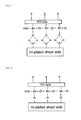
- the resin coated metal sheet is heated to "a temperature 10°C below a melting point of the coated resin" or above. Due to such heating, as shown in Fig. 4 , a dehydration-condensation reaction of the silane coupling agent progresses sufficiently and hence, a bonding force between Sn and the film is strengthened thus remarkably enhancing the adhesiveness of the film.
- a dehydration-condensation reaction of the silane coupling agent progresses sufficiently and hence, a bonding force between Sn and the film is strengthened thus remarkably enhancing the adhesiveness of the film.
- the heating temperature is set to "a temperature 10°C below a melting point of the coated resin" or above.
- a heating rate of the resin coated metal sheet it is preferable to perform the temperature elevation within a crystallization temperature region of the resin film (120°C to 180°C) in a time as short as possible from a viewpoint of preventing the crystallization of the resin film.
- a treatment means which exhibits a high heating rate such as high-frequency induction heating or electrical heating.
- the heating rate of the resin coated steel sheet is desirably set to 5°C/sec or more.
- the heating rate is below 5°C/sec, a passing time of the resin-coated steel sheet within the crystallization temperature region is prolonged so that the crystallization of the resin filmprogresses. Accordingly, the heating rate of below 5°C/sec is not preferable.
- Fig. 5 is a graph showing the relationship between a silane coupling agent coating weight (axis of abscissas) and S peel strength (axis of ordinate). As shown in Fig. 5 , even when the silane coupling agent is applied to the metal sheet by coating, film adhesiveness is not enhanced remarkably under a condition "no post-heating” or under a condition "oven heating (the temperature of the film being elevated to 260°C at 2°C/sec: low speed heating)",.
- a resin coated metal sheet where a metal sheet is coated with a resin by the treatment method is formed into a shallow drawn cup.
- Fig. 6 shows a result of the investigation of a size of a cup delamination width of such a cup in relation to a silane coupling agent coating weight. Even when the silane coupling agent is applied to the metal sheet by coating, delamination is hardly eliminated under a condition "no post-heating” or under a condition "oven heating (the temperature of the film being elevated to 260°C at 2°C/sec: low speed heating)".
- the cup delamination width is decreased.
- the coating weight of the silane coupling agent is preferably set to a value which falls within a range of 0.5 to 30mg/m 2 in terms of Si coating weight, and is more preferably set to a value which falls within a range of 0.5 to 6mg/m 2 .
- the cup delamination width is a value obtained by measuring the delamination of the cup as follows. That is, a distal end of the cup is photographed in an enlarged manner using a stereomicroscope, and a delamination width is measured by observing an end portion of the cup on a photograph.
- a fluorescent X-ray method or the like can be used for measuring the Si coating weight.
- the resin coated metal sheet after post-heating it is preferable to make the resin coated metal sheet pass the above-mentioned crystallization temperature region of the resin (120°C to 180°C) within a short time. That is, it is desirable that the resin is cooled at a rate of 30°C/sec or more in the crystallization temperature region after post-heating. It is thought that when the cooling rate is less than 30°C/sec, a passing time of the resin coated metal sheet within the crystallization temperature region is prolonged so that the crystallization of the resinfilm progresses. Accordingly, the cooling rate of less than 30°C/sec is not preferable. In such a cooling operation, it is preferable that a water cooling means such as spraying or dipping is adopted as a cooling means.
- the low carbon cold rolled steel sheet indicated in a column "sheet thickness" in Table 1 is subjected to electrolytic degreasing in an alkali aqueous solution and washing with water. Then, the steel sheet is subjected to sulfuric acid pickling and washing with water. Thereafter, a tin-plating layer is formed on the steel sheet under conditions shown in Table 1 using a Ferrostan tinplating bath. Then, reflow processing is applied to the steel sheet. Next, an aqueous solution of a silane coupling agent is applied to each tin-plating layer by coating and is dried thus forming silane coupling agent coating layers having Si coating weights indicated in the examples and the comparison examples shown in Table 1 respectively.
- a clear non-stretched film having a thickness of 28 ⁇ m which is made of transparent ethylene terephthalate ethylene isophthalate copolymer (PETI) is laminated, while on the other surface of the tin-plated steel sheet (a surface which constitutes an outer surface side of the can), a white non-stretched film which is made of a white material formed by adding 20 mass% of titanium based white pigment to the same ethylene terephthalate ethylene isophthalate copolymer is laminated under conditions shown in Table.
- PETI transparent ethylene terephthalate ethylene isophthalate copolymer
- Ihf indicates a high frequency current before the output transformation
- IdcL indicates a DC current which is obtained by converting an AC current to the DC current using a rectifier
- Vdc indicates a DC voltage which is obtained by converting a power source voltage to a DC voltage respectively.
- MAX sheet temperature in the conditions for treating a material to be treated in Table 1 indicates a maximum value of a sheet temperature during heating.
- sheet heating rate indicates a heating rate from a room temperature to a maximum sheet temperature, and is obtained by dividing the elevated temperature by time required for such elevation of temperature. That is, “sheet heating rate” indicates a value of an amount of temperature elevation per 1 second.
- cooling rate indicates a cooling rate from a maximum sheet temperature to a room temperature, and is obtained by dividing the lowered temperature by time required for such lowering of temperature. That is, “cooling rate” indicates a value of an amount of temperature lowering per 1 second.
- the working adhesiveness of the coated resin with respect to the tin-plated steel sheet is evaluated by adopting S peel strength which indicates peeling strength.
- S peel strength is adopted as an evaluation method which accurately reflects adhesiveness (working adhesiveness) during working and after working when rigorous forming working where the steel sheet is formed into a can body by further applying both stretching and ironing after drawing is applied to the steel sheet.
- S peel strength is strength by which working adhesive strength is evaluated based on peeling strength of a resin film of a specimen which is cut out from a side wall of a cup formed by applying drawing to a resin-coated metal sheet.
- a specific measuring method of Speel strength is explained hereinafter.
- a blank having a diameter of 154mm is punched out from a resin-coatedmetal sheet, and drawing of a first stage is applied to the blank at a drawing ratio of 1.64 thus forming a drawn cup having a diameter of 96mm and a height of 42mm.
- a side wall portion of the drawn cup having a size of 30mm in the cup height direction and 120mm in the cup circumferential direction is cut out from the cup, the cut-out side wall portion is bent back to a planar shape and, thereafter, a T-shaped specimen 71 having a size shown in Fig. 7 which is a plan view is punched out from the cut-out side wall portion by a press mold. Then, as shown in Fig.
- a cut 72 is formed in a coated resin on a surface of a one-side (right) end portion 71a of the specimen 71 ona side (aback-side surface in the drawing) opposite to an adhesive strength measuring surface (a viewer's side surface in the drawing) using a cutter knife such that the cut 72 reaches a surface of the tin-plated steel sheet.
- a score 73 is formed in the surface opposite to the adhesive strength measuring surface (the surface in which the cut 72 is formed) using a score forming die set and, thereafter, the score portion is folded and only the tin-plated steel sheet is cut.
- the coated resin is not cut on the adhesive strength measuring surface, and the coated resin remains on both sides of tin-plated steel sheets separated by cutting in a connected state.
- one end portion 71a is inserted into a specimen insertion portion 74a of a specimen holder 74, thus fixing the specimen 71 in the specimen holder 74 and, thereafter, an upper portion 74b of the specimen holder 74 and the other end portion 71b of the specimen 71 are pulled from each other while being clamped by both chuck portions of a tensile tester, and the coated resin is forcibly peeled off from the tin-plated steel sheet, and tensile strength is measured, this value is set as S peel strength, and the working adhesive strength is evaluated.
- the S peel strength measured as described above is preferably set to 0.6kg/15mm or more when a specimen has a width of 15mm.
- the S peel strength is less than 0.6kg/15mm, it is impossible to acquire the stable and favorable working adhesiveness in rigorous forming working such as can making working where both stretching and ironing are performed after drawing.
- specimens for measuring S peel strength are prepared from resin coated metal sheets of the examples 1 to 12 and the comparison examples 1 to 3 shown in Table 1 in the following manner.
- a blank having a diameter of 151mm is punched out and, thereafter, in such a manner that a surface of the blank which is coated with a transparent resin film forms a cup inner surface side (in such a manner that a surface coated with a resin film containing white pigment forms an outer surface of the can), first-stage drawing is applied to the blank with a drawing ratio of 1.64 thus forming a drawing 1st cup, a B/M can and a Fi can, wherein the transparent resin film coated surface becomes a measuring surface.
- S peel strengths of these specimens are measured using a tensile tester.
- the presence or the non-presence of the delamination (peeling of film) at a cup distal end is observed with respect to the 1st cup and the B/M can.
- retort scratch delamination evaluation is made with respect to the Fi can by checking the presence of scratches on an outer-surface white side and an inner-surface clear side with naked eyes.
- the 1st cup is a cup which is manufactured by drawing a sheet
- the B/M can is a can having a small can diameter and a large side wall height which is formed by further drawing and ironing the 1st cup
- the Fi can is a can which is manufactured by further trimming, flanging and necking the B/M can.
- the result of the above-mentioned evaluation is shown in Table 2.
- the cups of the examples 1 to 12 exhibit the inner-surface S peel strength of 0.7Kg/15mm or more with respect to all of the 1st cup, the B/M can and the Fi can so that these cups are excellent in the working adhesiveness of the resin film at the time of rigorous can forming working. Further, no delamination is observed at the distal end of the cup with respect to the 1st cup and the B/M can, and retort scratch delamination is not also observed with respect to the Fi can.
- the resin coated metal sheet of the present invention which is manufactured by laminating a resin film to a tin-plated steel sheet provided with a silane coupling agent coating layer and, thereafter, by applying post-heating treatment to the steel sheet exhibits excellent working adhesiveness of the resin film to the tin-plated steel sheet compared to a resin coated metal sheet which is manufactured by laminating a resin film to which post-heating treatment is not applied to a tin-plated steel sheet provided with a silane coupling agent coating layer. Accordingly, the resin coated metal sheet of the present invention has extremely high industrial applicability.
Landscapes
- Engineering & Computer Science (AREA)
- Physics & Mathematics (AREA)
- Mechanical Engineering (AREA)
- Thermal Sciences (AREA)
- Chemical & Material Sciences (AREA)
- High Energy & Nuclear Physics (AREA)
- Plasma & Fusion (AREA)
- Materials Engineering (AREA)
- Organic Chemistry (AREA)
- Chemical Kinetics & Catalysis (AREA)
- Wood Science & Technology (AREA)
- Life Sciences & Earth Sciences (AREA)
- Metallurgy (AREA)
- Laminated Bodies (AREA)
- Other Surface Treatments For Metallic Materials (AREA)
- Application Of Or Painting With Fluid Materials (AREA)
Abstract
Description
- The present invention relates to a method for manufacturing a resin-coated metal sheet having excellent working adhesiveness.
- Recently, there has been manufactured a can where a top plate is seamed to a can body which is an integral body formed of a can barrel portion and a can bottom portion by working. The can body is formed by making a steel sheet covered with a resin subjected to rigorous working such as drawing, further stretching after drawing, further ironing after drawing or working in which both stretching and ironing are further performed after drawing.
Such a can body is, to prevent peeling or breaking of a coated resin during the rigorous forming working and after such forming working, required to have excellent adhesiveness of a resin to the steel sheet.
Accordingly, as a raw material for such a can body, there has been used a resin coated chromate treated steel sheet where chromate treated steel sheet such as a tin free steel having a surface on which a chromate film having excellent working adhesiveness is formed is covered with an organic resin. - However, in the can body manufactured using the resin coated chromate treated steel sheet, when a minute hole or crack which is formed in the resin layer and reaches the surface of the steel sheet, due to the insufficient corrosion resistance of the chromate treated steel sheet, there exists a drawback that, the corrosion of the steel sheet is liable to rapidly progress particularly when the content filled in the can body has a lot of acidity.
In view of the above, to cope with such a drawback, an attempt has been made to use a resin-coated tin-plated steel sheet which is manufactured by applying a resin to a tin-plated steel sheet which exhibits excellent corrosion resistance even when the content of the can contains a lot of acidity. However, the adhesiveness of a resin to a tin-plating layer is insufficient, particularly, the film working adhesiveness at the time of can body working is insufficient and hence, there has been a demand for the development of a material having excellent film working adhesiveness even when the material is subjected to the above-mentioned rigorous working. - To overcome the above-mentioned drawbacks,
patent document 1 describes a resin-coated tin-plated steel sheet which is formed such that a silane coupling agent coating layer is formed on a tin-plating layer of a non-reflow tin plated sheet steel or a reflow tin plated sheet steel, and an organic resin film is laminated to the silane coupling agent coating layer. -
- Patent document 1:
JP-A-2002-285354 - However, when the resin-coated tin-plated steel sheet described in
patent document 1 is formed into a can body by working by the additional use of both stretching and ironing after drawing, there is a case where a resin peels off at an upper portion of the can body in the midst of forming working thus giving rise to a drawback in film working adhesiveness at the time of performing can body working.
It is an object of the present invention to overcome the above-mentioned drawbacks and to provide a method for manufacturing a resin-coated tin-plated metal sheet having excellent film working adhesiveness even at the time of rigorous forming working. -
- (1) A method for manufacturing a resin-coated metal sheet according to the present invention is characterized by including the steps of:
- forming a tin-plating layer on at least one surface of ametal sheet; applying a silane coupling agent to the tin-plating layer by coating;
- forming a resin layer on the silane coupling agent coating layer; and
- melting a resin surface of the resin layer on a side where the resin surface is in contact with the silane coupling agent by heating the metal sheet.
- With respect to a condition under which the tin-plating layer and the resin layer do not cause a change in shape, such a change in shape can be prevented by performing a control such that the excessive elevation of a heating temperature is preventednot to cause the collapse of the shape of the tin-plating layer and the resin layer and the resin layer is softened or melted so that the adhesiveness is enhanced. The control may be performed such that, for example, with respect to the high frequency heating, an output of an oscillator of a high frequency heating device is controlled by controlling a high frequency current, a DC current or a DC voltage thus changing a maximum heating temperature and a heating time.
- (2) Further, a method for manufacturing a resin-coated metal sheet according to the present invention is characterized by including the steps of:
- forming a tin-plating layer on at least one surface of a metal sheet;
- applying a silane coupling agent to the tin-plating layer by coating;
- forming a resin layer on the silane coupling agent coating layer; and
- heating at least an interface region between the tin-plating layer and the silane coupling agent coating layer, the silane coupling agent coating layer, and an interface region between the silane coupling agent coating layer and the resin layer at a temperature which falls within a range from a
temperature 10°C below a melting point of a resin to a temperature 100°C above the melting point of the resin.
- With respect to the step "heating at least an interface region between the tin-plating layer and the silane coupling agent coating layer, the silane coupling agent coating layer, and an interface region between the silane coupling agent coating layer and the resin layer at a temperature which falls within a range from a
temperature 10°C below a melting point of a resin to a temperature 100°C above the melting point of the resin", the step can be realized in such a manner that, for example, in heating the whole steel sheet by high frequency heating, an output of an oscillator of a high frequency heating device is controlled by controlling a high frequency current or a DC current thus changing a maximum heating temperature and a heating time whereby a temperature of a portion to be melted is elevated and the elevation of the temperature in other portions is suppressed to a predetermined temperature or below. - (3) The method for manufacturing a resin-coated metal sheet according to the present invention is, in the above-mentioned (1) or (2), characterized in that a heating temperature of the metal sheet is set to a temperature which falls within a range from a
temperature 30°C above a melting point of a resin to a temperature 60°C above the melting point of the resin. - (4) The method for manufacturing a resin-coated metal sheet according to the present invention is, in any one of the above-mentioned (1) to (3), characterized in that the heating of the metal sheet is performed by high frequency heating.
- (5) The method for manufacturing a resin-coated metal sheet according to the present invention is, in any one of the above-mentioned (1) to (4), characterized in that with respect to a temperature of the resin at the time of heating the metal sheet, the heating is performed at a rate of 5°C/sec or more in a crystallization temperature region of the resin.
- (6) The method for manufacturing a resin-coated metal sheet according to the present invention is, in any one of the above-mentioned (1) to (5), characterized in that after heating the metal sheet, the resin is cooled at a rate of 30°C/sec or more in the crystallization temperature region of the resin.
- (7) The method for manufacturing a resin-coated metal sheet according to the present invention is, in any one of the above-mentioned (1) to (6), characterized in that a tin coating weight of the tin-plating layer is set to a value which falls within a range of 0.5 to 13g/m2.
- (8) The method for manufacturing a resin-coated metal sheet according to the present invention is, in any one of the above-mentioned (1) to (7), characterized in that the silane coupling agent is a water-soluble amino-based silane coupling agent, and a Si coating weight is set to a value which falls within a range of 0.5 to 30mg/m2.
- In the method for manufacturing a resin-coatedmetal sheet according to the present invention, a silane coupling agent is applied to a tin-plating layer by coating, and a resin film is laminated to the silane coupling agent coating layer by thermal bonding and, thereafter, heat treatment is applied to the metal sheet and hence, it is possible to provide a resin-coated metal sheet which exhibits excellent working adhesiveness compared to the prior art.
- Amode for carrying out the present invention is explained in detail hereinafter.
- With respect to a metal sheet used as a resin-coated metal sheet of the present invention, depending on usage, a cold-rolled steel sheet having a sheet thickness of 0.15 to 0.3mm which is produced such that a normal hot-rolled sheet made of aluminum-killed steel is subjected to cold rolling, is annealed and, thereafter, is subjected to temper rolling, a cold-rolled steel sheet whose strength is increased by further applying cold rolling to the steel sheet after annealing or the like is used.
The cold-rolled steel sheet is subjected to electrolytic degreasing and pickling and, thereafter, a tin-plating layer is formed on the steel sheet thus manufacturing a tin-plated steel sheet.
As the tin-plated steel sheet, a tin-plated steel sheet which is produced in such a manner that tin plating is applied to a steel sheet using a known Ferrostan tin plating bath, a halogen tin plating bath or a sulfuric-acid tin plating bath, the steel sheet is heated to a melting temperature of tin or above and, thereafter, the steel sheet is quenched (reflow treatment) thus forming a Sn-Fe alloy layer between the steel sheet and a tin-plating layer, a tin-plated steel sheet which is produced without applying heat melting treatment to the tin-plating layer (no-reflow treatment) or the like can be used.
Further, as the tin-plated steel sheet, an island-like tin-plated steel sheet where an island-like tin layer is formed or the like can be also used. The island-like tin-plated steel sheet is produced by a method where nickel plating is applied to a cold-rolled steel sheet and, thereafter, tin plating is applied to nickel plating, the steel sheet is heated to a melting temperature of tin or above, and the steel sheet is quenched. The island-like tin-plated steel sheet can be also produced by a method where nickel plating is applied to a cold-rolled steel sheet and, thereafter, the steel sheet is heated after nickel plating so as to diffuse Ni in steel thus forming a Ni-Fe alloy layer and tin plating is applied to the Ni-Fe alloy layer, the steel sheet is heated to a melting temperature of tin or above, and the steel sheet is quenched. - A coating weight of tin on a tin-plated steel sheet is preferably set to a value which falls within a range of 0.5 to 13 g/m2 from viewpoints of corrosion resistance and economic efficiency. When the coating weight of tin is less than 0.5 g/m2, corrosion resistance becomes insufficient. Accordingly, the coating weight of less than 0.5 g/m2 is not preferable.
Particularly, when reflow treatment is applied, entire plated tin is transformed into a Fe-Sn alloy so that not only corrosion resistance but also workability are remarkably deteriorated. Accordingly, the coating weight of tin of at least 0.5 g/m2 or more is necessary.
On the other hand, when the coating weight exceeds 13 g/m2, a corrosion resistance effect which beverage cans and food cans are required to possess is saturated, and uneven melting of tin, edge sagging of tin or the like occurs at the time of performing reflow so that a surface state of the tin-plated sheet is deteriorated. - Next, a silane coupling agent is applied to the tin-plating layer formed in the above-mentioned manner by coating, and the silane coupling agent is dried.
As a silane coupling agent, various kinds of silane coupling agents such as a vinyl-based silane coupling agent, an acryl-based silane coupling agent, an epoxy-based silane coupling agent, an amino-based silane coupling agent, a mercapto-based silane coupling agent and a chlorophyll-based silane coupling agent can be used. However, from a viewpoint of easiness of handling and the preservation of environment, a water-soluble coupling agent is preferably used.
It is also important that the silane coupling agent exhibits excellent preservation stability, and it is also a prerequisite that the silane coupling agent has no toxicity in view of a fact that a resin-coated metal sheet is used for manufacturing food cans and beverage cans.
To determine these factors in a comprehensive manner, it is most preferable to use an amino-based silane coupling agent.
As the amino-based silane coupling agent, aminopropyltrimethoxy silane, aminopropylmethyldiethoxy silane, aminopropyl triethoxy silane, phenylaminopropyl trimethoxy silane or the like can be used. As an example of the amino-based silane coupling agent, KBM-903, KBM603, KBE903 all of which are made by Shinetsu Chemical Industries are named. These silane coupling agents exhibit excellent water solubility and preservation stability and the use of these silane coupling agents is authorized by FDA (abbreviation of Food and Drug Administration).
5 to 200g/L of aqueous solution of a silane coupling agent is applied to the above-mentioned tin-plated steel sheet by coating, and the silane coupling agent was dried.
As a coating method and a drying method, known methods can be used. For example, as the coating method, an immersion method, a roll coating method, a method where a surplus amount of silane coupling agent is squeezed using a squeezing rolls after immersion, a spraying method, a electrolytic processing method or the like can be named. As the drying method, a drying methodwhere a coated silane coupling agent is dried by an electric oven at a temperature of 100°C for 5 minutes can be named. - The resin-coated metal sheet of the present invention can be obtained by laminating an organic resin film which constitutes a resin layer to one surface or both surfaces of the tin-plated steel sheet obtained in the above-mentionedmanner in such a manner that the organic resin film is brought into contact with the silane coupling agent coated layer.
The organic resin film may preferably be formed using a thermoplastic resin having excellent workability even after heating. That is, the organic resin filmmay be a single-layered resin film made of: a polyester resin such as polyethylene terephthalate, polybutylene terephthalate, polyethylenenaphthalate, ethylene terephthalate ethylene isophthalate copolymer or butylene terephthalate butylene isophthalate copolymer; a resin which is formed by mixing two or more kinds of these polyester resins; polyethylene, polypropylene, ethylene propylene copolymer or these resins modified with a malaic acid; a polyolefin resin such as ethylene vinyl acetate copolymer or ethylene acrylic acid copolymer; a polyamide resin such as 6-nylon, 6, 6-nylon or 6, 10-nylon; polycarbonate; polymethylpentene; or a mixture of the above-mentioned polyester resin and ionomer, a multi-layered resin film which is made of two or more kinds of resins selected from the above-mentioned resins or the like.
A thickness of the resin film is preferably set to a value which falls within a range of 10 to 100µm from viewpoints of easiness of a film laminating operation, the adhesive strength of the resin film of a formed body (can or the like) after performing the forming working of the resin coated metal sheet, corrosion resistance and economic efficiency. - The resin film is formed such that resinpellets are melted by heating, and a melted body is extruded from a T die of an extruder thus forming a film having a desired thickness. Then, as a resin layer, the resin film is formed on a silane coupling agent coating layer which is applied to the tin-plating layer of the tin-plated steel sheet by coating.
As a method for forming the resin layer, for example, a thermal bonding method is named. In this method, a resin film is brought into contact with a tin-plated steel sheet which is heated to a temperature which falls within a predetermined temperature range, and the tin-plated steel sheet and the resin film are sandwiched and pressurized by a pair of pressurizing rollers and hence, the tin-plated steel sheet and the resin film are brought into pressure contact with each other.
According to such a method, by using a resin film formed as film without applying stretching to the resin film, the resin film can be thermally bonded at a temperature extremely lower than a melting temperature of tin. - According to the present invention, after forming the resin layer as described above, an interface region between the tin-plating layer and the silane coupling agent coating layer, the silane coupling agent coating layer, and an interface region between the silane coupling agent coating layer and the resin layer are heated to a temperature which falls within a range from "a
temperature 10°C below a melting point of a resin" to "a temperature 100°C above the melting point of the resin". As treatment of a material to be treated, post-heating treatment is applied to the material to be treated.
A post-heating temperature is more preferably set to a value which falls within a range from "atemperature 30°C above a melting point" of a coated resin film to "a temperature 60°C above the melting point" of the coated resin film.
When the heated temperature of the coated resin film is below "atemperature 10°C below a melting point of the coated resin", the interface region is not sufficiently softened so that adhesiveness of the coated resin film is not enhanced, and an adhesiveness effect of the silane coupling agent which can be acquired by heating cannot be sufficiently acquired.
On the other hand, when the heating temperature is "a temperature 100°C above the melting point of the coated resin" or above, a temperature of a bulk layer of the resin layer is excessively elevated so that air bubbles are liable to be generated in the resin layer. Accordingly, such a heating temperature is not preferable.
The above-mentioned post-heating is performed such that the temperature of the interface region falls within the above-mentioned temperature range while preventing the generation of air bubbles in the resin layer and hence, the resin layer and the tin-plating layer are softened or melted only in the interface regions thus enhancing the adhesiveness of the resin layer and the tin-plating layer. - As a specific means, treatment is preferably applied to the material to be treated using a device shown in
Fig. 1 as follows. A high frequency coil is wound orthogonal to the advancing direction of the resin coated metal sheet which is passed after resin coating, and treatment is applied to the metal sheet in a heat cycle shown inFig. 2 where the metal sheet is heated to a predetermined temperature and, then, the metal sheet which passes through the high frequency coil is cooled with air and is cooled with water to an ambient temperature. - Next, an effect which a silane coupling agent exerts on the adhesiveness of the film at the time of applying post-heat treatment is explained in detail in conjunction with
Fig. 3 and Fig. 4 .
In a state where silane coupling agent treatment is applied to a tin-plated steel sheet and resin is applied to steel sheet by coating, as shown inFig. 3 , a large number of OH groups remain in an interface between the tin-plated steel sheet and the coated resin film so that adhesiveness of the resin is weak. - Acoatingweight of the silane coupling agent is preferably set to a value which falls within a range of 0.5 to 30mg/m2 in terms of a Si coating weight.
When the Si coating weight is less than 0.5 mg/m2, the working adhesiveness of the coated resin which is laminated to the silane coupling agent coating layer is not enhanced so that advantageous effects of the present invention cannot be acquired.
On the other hand, even when the Si coating weight exceeds 30 mg/m2, the further enhancement of the working adhesiveness of the coated resin is not recognized and the further applying of the silane coupling agent is unnecessary also from a viewpoint of a cost. - Then, the resin coated metal sheet is heated to "a
temperature 10°C below a melting point of the coated resin" or above. Due to such heating, as shown inFig. 4 , a dehydration-condensation reaction of the silane coupling agent progresses sufficiently and hence, a bonding force between Sn and the film is strengthened thus remarkably enhancing the adhesiveness of the film.
As can be understood from a DSC (differential scanning calorimetry) curve or the like, softening of the resin layer starts at a temperature approximately 10°C below a nominal melting point so that the effect of this treatment is recognized also at thetemperature 10°C lower than the melting point of the resin. Accordingly, in the present invention, the heating temperature is set to "atemperature 10°C below a melting point of the coated resin" or above. - With respect to a heating rate of the resin coated metal sheet, it is preferable to perform the temperature elevation within a crystallization temperature region of the resin film (120°C to 180°C) in a time as short as possible from a viewpoint of preventing the crystallization of the resin film. In this respect, it is preferable to adopt a treatment means which exhibits a high heating rate such as high-frequency induction heating or electrical heating.
However, when the resin film is held within the crystallization temperature region after the resin film is applied to the metal sheet by coating, the crystallization of the resin film progresses thus giving rise to a drawback such as the generation of delamination at the time of can body working. Accordingly, the heating rate of the resin coated steel sheet is desirably set to 5°C/sec or more.
It is thought that when the heating rate is below 5°C/sec, a passing time of the resin-coated steel sheet within the crystallization temperature region is prolonged so that the crystallization of the resin filmprogresses. Accordingly, the heating rate of below 5°C/sec is not preferable. - The determination of a coating weight of a silane coupling agent is described hereinafter.
Next, the adhesive strength of the resin layer which is applied to the metal sheet by the above-mentioned treatment method is explained.
Fig. 5 is a graph showing the relationship between a silane coupling agent coating weight (axis of abscissas) and S peel strength (axis of ordinate).
As shown inFig. 5 , even when the silane coupling agent is applied to the metal sheet by coating, film adhesiveness is not enhanced remarkably under a condition "no post-heating" or under a condition "oven heating (the temperature of the film being elevated to 260°C at 2°C/sec: low speed heating)",.
On the other hand, under a condition "high-frequency induction heating (the temperature of the film being elevated to 260°C at 100°C/sec: high speed heating)", along with the increase of a coating weight of the silane coupling agent, the S peel strength is increased, and when the Si coating weight is 6 mg/m2, the film adhesiveness (S peel strength) becomes maximum. The adhesiveness of the film is enhanced even under a condition that the silane coupling agent coating weight is 30 mg/m2 in terms of Si coating weight compared to a case where the silane coupling agent is not applied. However, it is thought that when the Si coatingweight exceeds 30 mg/m2, cohesive failure occurs in the silane layer and hence, the adhesiveness of the film is lowered. - Next, a resin coated metal sheet where a metal sheet is coated with a resin by the treatment method is formed into a shallow drawn cup.
Fig. 6 shows a result of the investigation of a size of a cup delamination width of such a cup in relation to a silane coupling agent coating weight.
Even when the silane coupling agent is applied to the metal sheet by coating, delamination is hardly eliminated under a condition "no post-heating" or under a condition "oven heating (the temperature of the film being elevated to 260°C at 2°C/sec: low speed heating)".
On the other hand, on a condition "high-frequency induction heating (the temperature of the film being elevated to 260°C at 100°C/sec: high speed heating)", along with the increase of a coating weight of the silane coupling agent, the cup delamination width is decreased. When the silane coupling agent coating weight exceeds 0.5 mg/m2 in terms of Si coating weight, delamination is almost eliminated.
Accordingly, the coating weight of the silane coupling agent is preferably set to a value which falls within a range of 0.5 to 30mg/m2 in terms of Si coating weight, and is more preferably set to a value which falls within a range of 0.5 to 6mg/m2.
Here, the cup delamination width is a value obtained by measuring the delamination of the cup as follows. That is, a distal end of the cup is photographed in an enlarged manner using a stereomicroscope, and a delamination width is measured by observing an end portion of the cup on a photograph.
A fluorescent X-ray method or the like can be used for measuring the Si coating weight. - Further, in a method for cooling the resin coated metal sheet after post-heating, it is preferable to make the resin coated metal sheet pass the above-mentioned crystallization temperature region of the resin (120°C to 180°C) within a short time.
That is, it is desirable that the resin is cooled at a rate of 30°C/sec or more in the crystallization temperature region after post-heating.
It is thought that when the cooling rate is less than 30°C/sec, a passing time of the resin coated metal sheet within the crystallization temperature region is prolonged so that the crystallization of the resinfilm progresses. Accordingly, the cooling rate of less than 30°C/sec is not preferable.
In such a cooling operation, it is preferable that a water cooling means such as spraying or dipping is adopted as a cooling means. - Hereinafter, the present invention is specifically explained in conjunction with examples 1 to 12 and comparison examples 1 to 3.
- The low carbon cold rolled steel sheet indicated in a column "sheet thickness" in Table 1 is subjected to electrolytic degreasing in an alkali aqueous solution and washing with water. Then, the steel sheet is subjected to sulfuric acid pickling and washing with water. Thereafter, a tin-plating layer is formed on the steel sheet under conditions shown in Table 1 using a Ferrostan tinplating bath. Then, reflow processing is applied to the steel sheet.
Next, an aqueous solution of a silane coupling agent is applied to each tin-plating layer by coating and is dried thus forming silane coupling agent coating layers having Si coating weights indicated in the examples and the comparison examples shown in Table 1 respectively. - On one surface of the tin-plated steel sheet (a surface which constitutes an inner surface side of a can) shown in the examples 1 to 12 and the comparison examples 1 to 3, a clear non-stretched film having a thickness of 28µm which is made of transparent ethylene terephthalate ethylene isophthalate copolymer (PETI) is laminated, while on the other surface of the tin-plated steel sheet (a surface which constitutes an outer surface side of the can), a white non-stretched film which is made of a white material formed by adding 20 mass% of titanium based white pigment to the same ethylene terephthalate ethylene isophthalate copolymer is laminated under conditions shown in Table.
After the lamination of the resin films to the respective surfaces of the tin-plated steel sheet, the steel sheet is immediately cooled.
Then, after the lamination of the resin film is finished, post-heating treatment is applied under conditions for treating a material to be treated indicated in Table 1 thus producing a resin coated metal sheet.
Here, among high frequency induction heating setting conditions indicated in Table 1, Ihf indicates a high frequency current before the output transformation, IdcL indicates a DC current which is obtained by converting an AC current to the DC current using a rectifier, and Vdc indicates a DC voltage which is obtained by converting a power source voltage to a DC voltage respectively.
In theembodiment 1,
Ihf, IdcL and Vdc are respectively set as follows.
Ihf = 38.5 [A]
Idcl = 10.7 [A]
Vdc = 280 [V]
Out of these values, a heating temperature can be elevated by increasing Ihf and IdcL. - Further, "MAX sheet temperature" in the conditions for treating a material to be treated in Table 1 indicates a maximum value of a sheet temperature during heating.
"sheet heating rate" in Table 1 indicates a heating rate from a room temperature to a maximum sheet temperature, and is obtained by dividing the elevated temperature by time required for such elevation of temperature. That is, "sheet heating rate" indicates a value of an amount of temperature elevation per 1 second.
"cooling rate" in Table 1 indicates a cooling rate from a maximum sheet temperature to a room temperature, and is obtained by dividing the lowered temperature by time required for such lowering of temperature. That is, "cooling rate" indicates a value of an amount of temperature lowering per 1 second. - The working adhesiveness of the coated resin with respect to the tin-plated steel sheet is evaluated by adopting S peel strength which indicates peeling strength.
Conventionally, adhesiveness of a coated resin is evaluated by measuring T peel strength in a state of a flat plate before working. However, it is considered that this measurement does not always accurately reflect working adhesiveness. Accordingly, in the present invention, S peel strength is adopted as an evaluation method which accurately reflects adhesiveness (working adhesiveness) during working and after working when rigorous forming working where the steel sheet is formed into a can body by further applying both stretching and ironing after drawing is applied to the steel sheet.
S peel strength is strength by which working adhesive strength is evaluated based on peeling strength of a resin film of a specimen which is cut out from a side wall of a cup formed by applying drawing to a resin-coated metal sheet. - A specific measuring method of Speel strength is explained hereinafter.
A blank having a diameter of 154mm is punched out from a resin-coatedmetal sheet, and drawing of a first stage is applied to the blank at a drawing ratio of 1.64 thus forming a drawn cup having a diameter of 96mm and a height of 42mm.
A side wall portion of the drawn cup having a size of 30mm in the cup height direction and 120mm in the cup circumferential direction is cut out from the cup, the cut-out side wall portion is bent back to a planar shape and, thereafter, a T-shapedspecimen 71 having a size shown inFig. 7 which is a plan view is punched out from the cut-out side wall portion by a press mold.
Then, as shown inFig. 8 , acut 72 is formed in a coated resin on a surface of a one-side (right)end portion 71a of thespecimen 71 ona side (aback-side surface in the drawing) opposite to an adhesive strength measuring surface (a viewer's side surface in the drawing) using a cutter knife such that thecut 72 reaches a surface of the tin-plated steel sheet.
Further, as shown inFig. 9 and Fig. 10 , ascore 73 is formed in the surface opposite to the adhesive strength measuring surface (the surface in which thecut 72 is formed) using a score forming die set and, thereafter, the score portion is folded and only the tin-plated steel sheet is cut.
Here, the coated resin is not cut on the adhesive strength measuring surface, and the coated resin remains on both sides of tin-plated steel sheets separated by cutting in a connected state.
Next, as shown inFig. 11 , oneend portion 71a is inserted into aspecimen insertion portion 74a of aspecimen holder 74, thus fixing thespecimen 71 in thespecimen holder 74 and, thereafter, anupper portion 74b of thespecimen holder 74 and theother end portion 71b of thespecimen 71 are pulled from each other while being clamped by both chuck portions of a tensile tester, and the coated resin is forcibly peeled off from the tin-plated steel sheet, and tensile strength is measured, this value is set as S peel strength, and the working adhesive strength is evaluated. - The S peel strength measured as described above is preferably set to 0.6kg/15mm or more when a specimen has a width of 15mm. When the S peel strength is less than 0.6kg/15mm, it is impossible to acquire the stable and favorable working adhesiveness in rigorous forming working such as can making working where both stretching and ironing are performed after drawing.
- In this embodiment, specimens for measuring S peel strength are prepared from resin coated metal sheets of the examples 1 to 12 and the comparison examples 1 to 3 shown in Table 1 in the following manner. A blank having a diameter of 151mm is punched out and, thereafter, in such a manner that a surface of the blank which is coated with a transparent resin film forms a cup inner surface side (in such a manner that a surface coated with a resin film containing white pigment forms an outer surface of the can), first-stage drawing is applied to the blank with a drawing ratio of 1.64 thus forming a drawing 1st cup, a B/M can and a Fi can, wherein the transparent resin film coated surface becomes a measuring surface.
Next, S peel strengths of these specimens are measured using a tensile tester.
Further, the presence or the non-presence of the delamination (peeling of film) at a cup distal end is observed with respect to the 1st cup and the B/M can. Still further, retort scratch delamination evaluation is made with respect to the Fi can by checking the presence of scratches on an outer-surface white side and an inner-surface clear side with naked eyes.
Here, the 1st cup is a cup which is manufactured by drawing a sheet, the B/M can is a can having a small can diameter and a large side wall height which is formed by further drawing and ironing the 1st cup, and the Fi can is a can which is manufactured by further trimming, flanging and necking the B/M can. - The result of the above-mentioned evaluation is shown in Table 2.
The cups of the examples 1 to 12 exhibit the inner-surface S peel strength of 0.7Kg/15mm or more with respect to all of the 1st cup, the B/M can and the Fi can so that these cups are excellent in the working adhesiveness of the resin film at the time of rigorous can forming working.
Further, no delamination is observed at the distal end of the cup with respect to the 1st cup and the B/M can, and retort scratch delamination is not also observed with respect to the Fi can.
To the contrary, with respect to the cup of the comparison examples 1 to 3, when the forming working is applied to the 1st cup, the adhesiveness between the resin film at the distal end portion of the cup and the tin-plated steel sheet becomes defective so that the delamination occurs at the distal end portion of the cup.
In the comparison examples 1, 2, breaking of the barrel portion occurs at the time of performing B/M can working and hence, it is found that the comparison examples 1, 2 are not suitable as a raw material for can body working.
In Tables, the expression of an upward arrow means that a value described in one column is equal to a value in another column above one column. -
[Table 1] heating method high frequency induction heating setting condition specification of material to be treated conditions on treating material to be treated No Ihf IdcL Vdc material plating silane coupling agent coating weight sheet thickness laminated film melting point of laminated film MAX sheet temperature sheet heating rate cooling rate embodiment 1 high-frequency induction heating 38.5A 10.7A 280V low carbon steel sheet tin plating (Sn=2.8g/m2) S=5mg/m2 0.20mm 28m/16m non-stretched PET 220°C 240°C 5°C/sec 100°C/sec 2 ↑ 43.2A 13.2A ↑ ↑ ↑ ↑ ↑ ↑ ↑ 280°C 140°C/sec ↑ 3 ↑ 46 5A 15.2A ↑ ↑ ↑ ↑ ↑ ↑ ↑ 320°C 160°C/sec ↑ 4 ↑ 43.2A 13.2A ↑ ↑ ↑ ↑ ↑ ↑ ↑ 280°C 140°C/sec 30°C/sec 5 ↑ ↑ ↑ ↑ ↑ tin plating (Sn-0.7g/m2) ↑ ↑ ↑ ↑ ↑ ↑ 100°C/sec 6 ↑ ↑ ↑ ↑ ↑ tin plating (Sn=4.0g/m2) ↑ ↑ ↑ ↑ ↑ ↑ ↑ 7 ↑ ↑ ↑ ↑ ↑ ↑ 0.5mg/m2 ↑ ↑ ↑ ↑ ↑ ↑ 8 ↑ ↑ ↑ ↑ ↑ ↑ 30mg/m2 ↑ ↑ ↑ ↑ ↑ ↑ 9 ↑ 28A 7A 280V ↑ tin plating (Sn=2.8g/m2) 5mg/m2 ↑ ↑ ↑ 180°C 120°C/sec ↑ 10 ↑ 43.2A 13.2A ↑ ↑ ↑ 0.5mg/m2 ↑ ↑ ↑ 260°C 140°C/sec ↑ 11 ↑ ↑ ↑ ↑ ↑ ↑ 5mg/m2 ↑ ↑ ↑ ↑ ↑ 30°C/sec 12 electric oven heating - - - ↑ ↑ ↑ ↑ ↑ ↑ ↑ 2°C/sec ↑ comparison example I high-frequency induction heating 50A 16A ↑ ↑ ↑ ↑ ↑ ↑ ↑ 350°C 175°C/sec 100°C/sec 2 ↑ 43.2A 13.2A ↑ ↑ tin plating (Sn=15g/m2) ↑ ↑ ↑ ↑ 260°C 140°C 2°C/sec 3 no post-heating - - - ↑ tin plating (Sn=2.8g/m2) ↑ ↑ ↑ - - - - In Table, symbol - means that a condition or a value described in one column is equal to a condition or a value in another column above one column. -
[Table 2] 1st cup B/M can Fi can comprehensive evaluation retort scratch delamination evaluation No inner-surface S peel strength cup distal end delamination inner-surface S peel strength cup distal end delamination inner-surface S peel strength outer surface white side inner surface clear surface embodiment 1 0.6Kg/15mm good 0.9Kg/15mm good 2Kg/15mm good good excellent 2 1.4 good 1.2 good ↑ good good excellent 3 1.2 good 1 good ↑ good good excellent 4 1.2 good 1 ood ↑ good good excellent 5 1 good 0.8 good ↑ good good excellent 6 0.8 good 0.9 good 30mg/m2 good good excellent 7 0.7 good 0.8 good 5mg/m2 good good excellent 8 1.3 good 0.8 good 0.5mg/m2 good good excellent 9 0.7 good 0.7 good 5mg/m2 good good good 10 0.8 good 0.7 good ↑ good good good 11 0.7 good 0.6 good ↑ good good good 12 0.8 good 0.7 good ↑ good good good comparison example 1 1.3 fair barrel broken - - - - bad 2 0.5 bad barrel broken - - - - bad 3 0.1 bad 0.7 bad 1.3Kg/15mm bad bad bad - The resin coated metal sheet of the present invention which is manufactured by laminating a resin film to a tin-plated steel sheet provided with a silane coupling agent coating layer and, thereafter, by applying post-heating treatment to the steel sheet exhibits excellent working adhesiveness of the resin film to the tin-plated steel sheet compared to a resin coated metal sheet which is manufactured by laminating a resin film to which post-heating treatment is not applied to a tin-plated steel sheet provided with a silane coupling agent coating layer. Accordingly, the resin coated metal sheet of the present invention has extremely high industrial applicability.
-
-
Fig. 1 is a schematic perspective view showing a means which applies post-heating to a resin coated metal sheet which is passed after resin coating in such a manner that a high frequency coil is wound around the resin coated metal sheet orthogonal to the advancing direction of the metal sheet. -
Fig. 2 is a graph showing a heating cycle of the post-heating. -
Fig. 3 is an explanatory view showing a state where silane coupling agent treatment is applied to a tin-plated steel sheet and, thereafter, a resin is applied to a silane coupling agent coated layer. -
Fig. 4 is an explanatory view showing a state, after the state shown inFig. 3 is obtained, heating treatment at "melting point of a coated resin -10°C" or above is applied to the resin coated metal sheet so that a dehydration-condensation reaction of a silane coupling agent sufficiently progresses whereby a bonding force between a tin-plated sheet and a film is strengthened thus remarkably enhancing the adhesiveness of the film. -
Fig. 5 is a graph showing the relationship between a silane coupling agent coating weight (axis of abscissas) and S peel strength (axis of ordinate). -
Fig. 6 is a graph showing a result of the investigation of a size of a cup delamination width of a shallow drawn cup formed of a resin coated metal sheet after post-heating in relation to a silane coupling agent coating weight. -
Fig. 7 is a plan view showing a shape of a specimen for measuring S peel strength. -
Fig. 8 is a plan view showing a state where a cut is formed in a surface of a coating resin of a specimen for measuring S peel strength. -
Fig. 9 is a plan view showing a state where a score is formed in a specimen for measuring S peel strength. -
Fig. 10 is a cross-sectional view of a part of the specimen for measuring S peel strength showing a shape of a portion in which the score is formed. -
Fig. 11 is a schematic perspective view showing a state where S peel strength is measured by putting a specimen for measuring S peel strength in a specimen holder. -
- 71: specimen
- 71a: one end portion of specimen
- 71b: the other end portion of specimen
- 72: cut
- 73: score
- 74: specimen holder
- 74a: specimen insertion portion
- 74b: specimen holder upper portion
Claims (8)
- A method for manufacturing a resin-coated metal sheet comprising the steps of:forming a tin-plating layer on at least one surface of a metal sheet;applying a silane coupling agent to the tin-plating layer by coating;forming a resin layer on the silane coupling agent coating layer; andmelting a resin surface of the resin layer on a side where the resin surface is in contact with the silane coupling agent by heating the metal sheet.
- A method for manufacturing a resin-coated metal sheet comprising the steps of:forming a tin-plating layer on at least one surface of a metal sheet;applying a silane coupling agent to the tin-plating layer by coating;forming a resin layer on the silane coupling agent coating layer; andheating at least an interface region between the tin-plating layer and the silane coupling agent coating layer, the silane coupling agent coating layer, and an interface region between the silane coupling agent coating layer and the resin layer at a temperature which falls within a range from a temperature 10°C below a melting point of a resin to a temperature 100°C above the melting point of the resin.
- The method for manufacturing a res in-coated metal sheet according to claim 1 or 2, wherein a heating temperature of the metal sheet is set to a temperature which falls within a range from a temperature 30°C above a melting point of a resin to a temperature 60°C above the melting point of the resin.
- The method for manufacturing a resin-coatedmetal sheet according to any one of claims 1 to 3, wherein the heating of the metal sheet is performed by high frequency heating.
- The method for manufacturing a resin-coatedmetal sheet according to any one of claims 1 to 4, wherein with respect to a temperature of the resin at the time of heating the metal sheet, the heating is performed at a rate of 5°C/sec or more in a crystallization temperature region of the resin.
- The method formanufacturinga resin-coatedmetal sheet according to any one of claims 1 to 5, wherein after heating the metal sheet, the resin is cooled at a rate of 30°C/sec or more in the crystallization temperature region of the resin.
- The method for manufacturing a resin-coatedmetal sheet according to any one of claims 1 to 6, wherein a tin coating weight of the tin-plating layer is set to a value which falls within a range of 0.5 to 13g/m2.
- The method formanufacturinga resin-coatedmetal sheet according to any one of claims 1 to 7, wherein the silane coupling agent is a water-soluble amino-based silane coupling agent, and
a Si coating weight is set to a value which falls within a range of 0.5 to 30mg/m2.
Applications Claiming Priority (1)
| Application Number | Priority Date | Filing Date | Title |
|---|---|---|---|
| PCT/JP2009/005347 WO2011045833A1 (en) | 2009-10-14 | 2009-10-14 | Method for producing resin-coated metal plate |
Publications (3)
| Publication Number | Publication Date |
|---|---|
| EP2489760A1 true EP2489760A1 (en) | 2012-08-22 |
| EP2489760A4 EP2489760A4 (en) | 2013-07-24 |
| EP2489760B1 EP2489760B1 (en) | 2017-06-14 |
Family
ID=43875894
Family Applications (1)
| Application Number | Title | Priority Date | Filing Date |
|---|---|---|---|
| EP09850377.4A Not-in-force EP2489760B1 (en) | 2009-10-14 | 2009-10-14 | Method for producing resin-coated metal plate |
Country Status (3)
| Country | Link |
|---|---|
| EP (1) | EP2489760B1 (en) |
| CN (1) | CN102686778B (en) |
| WO (1) | WO2011045833A1 (en) |
Cited By (2)
| Publication number | Priority date | Publication date | Assignee | Title |
|---|---|---|---|---|
| WO2014019891A1 (en) * | 2012-07-31 | 2014-02-06 | Henkel Ag & Co. Kgaa | Adhesion method using thin adhesive layers |
| US10533077B2 (en) | 2014-01-31 | 2020-01-14 | Henkel Ag & Co. Kgaa | Method for bonding using adhesive layers with the aid of a laser |
Families Citing this family (2)
| Publication number | Priority date | Publication date | Assignee | Title |
|---|---|---|---|---|
| DE102017113430A1 (en) * | 2017-06-19 | 2018-12-20 | Deutsches Zentrum für Luft- und Raumfahrt e.V. | Method and device for checking a joining surface |
| CN111304706A (en) * | 2020-03-13 | 2020-06-19 | 葛家玉 | Chromium-free tin plate and surface treatment method thereof |
Family Cites Families (6)
| Publication number | Priority date | Publication date | Assignee | Title |
|---|---|---|---|---|
| JPS5892520A (en) * | 1981-11-30 | 1983-06-01 | Toyo Kohan Co Ltd | Preparation of resin film covered metal plate |
| JP4285924B2 (en) | 2001-03-23 | 2009-06-24 | 東洋製罐株式会社 | A can body comprising a resin-coated Sn-plated steel sheet obtained by coating a Sn-coated steel sheet with a resin film, and a method for producing the same |
| JP2003127273A (en) * | 2001-10-19 | 2003-05-08 | Kobe Steel Ltd | Laminated metal plate, method for producing the same, and molded article using the same |
| JP3655592B2 (en) * | 2002-02-07 | 2005-06-02 | 東洋鋼鈑株式会社 | Manufacturing method of Sn-plated steel sheet, Sn-plated steel sheet, resin-coated Sn-plated steel sheet obtained by coating a Sn-coated steel sheet with a resin film, and a can using the same |
| JP4019751B2 (en) * | 2002-03-08 | 2007-12-12 | 東洋製罐株式会社 | Press-formed can made of pre-coated steel plate |
| WO2003104528A1 (en) * | 2002-06-05 | 2003-12-18 | Jfeスチール株式会社 | Tin-plated steel plate and method for production thereof |
-
2009
- 2009-10-14 CN CN200980161925.1A patent/CN102686778B/en not_active Expired - Fee Related
- 2009-10-14 WO PCT/JP2009/005347 patent/WO2011045833A1/en not_active Ceased
- 2009-10-14 EP EP09850377.4A patent/EP2489760B1/en not_active Not-in-force
Cited By (4)
| Publication number | Priority date | Publication date | Assignee | Title |
|---|---|---|---|---|
| WO2014019891A1 (en) * | 2012-07-31 | 2014-02-06 | Henkel Ag & Co. Kgaa | Adhesion method using thin adhesive layers |
| EP3323846A1 (en) * | 2012-07-31 | 2018-05-23 | Henkel AG & Co. KGaA | Method of bonding with thin adhesive layers |
| US10934458B2 (en) | 2012-07-31 | 2021-03-02 | Henkel Ag & Co. Kgaa | Adhesion method using thin adhesive layers |
| US10533077B2 (en) | 2014-01-31 | 2020-01-14 | Henkel Ag & Co. Kgaa | Method for bonding using adhesive layers with the aid of a laser |
Also Published As
| Publication number | Publication date |
|---|---|
| WO2011045833A1 (en) | 2011-04-21 |
| EP2489760B1 (en) | 2017-06-14 |
| EP2489760A4 (en) | 2013-07-24 |
| CN102686778B (en) | 2015-07-01 |
| CN102686778A (en) | 2012-09-19 |
Similar Documents
| Publication | Publication Date | Title |
|---|---|---|
| CN101652503B (en) | Plated steel sheet for can and process for producing the same | |
| US9637826B2 (en) | Steel sheet for containers and manufacturing method for same | |
| CN103097583A (en) | Steel plate for containers and manufacturing method for same | |
| EP2489760B1 (en) | Method for producing resin-coated metal plate | |
| EP3439869A1 (en) | Process for producing a polymer-coated metal strip and a polymer-coated metal strip produced thereby | |
| TWI608933B (en) | RESIN-COATED Sn-PLATED STEEL SHEET, THE MANUFACTURING METHOD AND THE MANUFACTURING FACILITY THEREOF | |
| CN108698376B (en) | Film-laminated metal sheet excellent in retort adhesion and method for producing the same | |
| JP4626532B2 (en) | Surface-treated steel sheet and method for producing the same, resin-coated steel sheet, can and can lid | |
| CN115190922B (en) | Method for manufacturing laminated tin-plated steel, laminated tin-plated steel produced thereby, and its uses | |
| EP2497845A1 (en) | Method for producing surface-treated steel sheet | |
| JP2003231989A (en) | METHOD FOR MANUFACTURING Sn-PLATED STEEL SHEET, Sn-PLATED STEEL SHEET, RESIN-COATED Sn-PLATED STEEL SHEET PROVIDED WITH RESIN COATING ON Sn-PLATED STEEL SHEET, AND CAN USING IT | |
| JP5078155B2 (en) | Method for producing resin-coated metal sheet | |
| JP5398024B2 (en) | Resin coated steel sheet | |
| JP5772845B2 (en) | Manufacturing method of surface-treated steel sheet | |
| JP4872315B2 (en) | Surface-treated steel sheet and method for producing the same, resin-coated steel sheet, can and can lid | |
| CN107075710A (en) | Surface treated steel plate, its manufacture method and resin-coated surface treated steel plate | |
| JP2004345214A (en) | RESIN-COATED Sn PLATED STEEL SHEET, CAN USING THIS STEEL SHEET AND METHOD FOR MANUFACTURING RESIN-COATED Sn PLATED STEEL SHEET | |
| WO2005110739A1 (en) | Sn-PLATED STEEL SHEET COATED WITH RESIN, CAN USING THE SAME, AND METHOD FOR PRODUCING Sn-PLATED STEEL SHEET COATED WITH RESIN |
Legal Events
| Date | Code | Title | Description |
|---|---|---|---|
| PUAI | Public reference made under article 153(3) epc to a published international application that has entered the european phase |
Free format text: ORIGINAL CODE: 0009012 |
|
| 17P | Request for examination filed |
Effective date: 20120430 |
|
| AK | Designated contracting states |
Kind code of ref document: A1 Designated state(s): AT BE BG CH CY CZ DE DK EE ES FI FR GB GR HR HU IE IS IT LI LT LU LV MC MK MT NL NO PL PT RO SE SI SK SM TR |
|
| DAX | Request for extension of the european patent (deleted) | ||
| A4 | Supplementary search report drawn up and despatched |
Effective date: 20130626 |
|
| RIC1 | Information provided on ipc code assigned before grant |
Ipc: B32B 37/06 20060101ALI20130620BHEP Ipc: B29L 9/00 20060101ALI20130620BHEP Ipc: B29C 65/46 20060101ALI20130620BHEP Ipc: C23C 28/00 20060101AFI20130620BHEP Ipc: B32B 15/08 20060101ALI20130620BHEP |
|
| GRAP | Despatch of communication of intention to grant a patent |
Free format text: ORIGINAL CODE: EPIDOSNIGR1 |
|
| INTG | Intention to grant announced |
Effective date: 20170105 |
|
| GRAS | Grant fee paid |
Free format text: ORIGINAL CODE: EPIDOSNIGR3 |
|
| GRAA | (expected) grant |
Free format text: ORIGINAL CODE: 0009210 |
|
| AK | Designated contracting states |
Kind code of ref document: B1 Designated state(s): AT BE BG CH CY CZ DE DK EE ES FI FR GB GR HR HU IE IS IT LI LT LU LV MC MK MT NL NO PL PT RO SE SI SK SM TR |
|
| REG | Reference to a national code |
Ref country code: GB Ref legal event code: FG4D |
|
| REG | Reference to a national code |
Ref country code: CH Ref legal event code: EP Ref country code: AT Ref legal event code: REF Ref document number: 901028 Country of ref document: AT Kind code of ref document: T Effective date: 20170615 |
|
| REG | Reference to a national code |
Ref country code: IE Ref legal event code: FG4D |
|
| REG | Reference to a national code |
Ref country code: DE Ref legal event code: R096 Ref document number: 602009046667 Country of ref document: DE |
|
| REG | Reference to a national code |
Ref country code: NL Ref legal event code: MP Effective date: 20170614 |
|
| REG | Reference to a national code |
Ref country code: FR Ref legal event code: PLFP Year of fee payment: 9 |
|
| REG | Reference to a national code |
Ref country code: LT Ref legal event code: MG4D |
|
| PG25 | Lapsed in a contracting state [announced via postgrant information from national office to epo] |
Ref country code: HR Free format text: LAPSE BECAUSE OF FAILURE TO SUBMIT A TRANSLATION OF THE DESCRIPTION OR TO PAY THE FEE WITHIN THE PRESCRIBED TIME-LIMIT Effective date: 20170614 Ref country code: FI Free format text: LAPSE BECAUSE OF FAILURE TO SUBMIT A TRANSLATION OF THE DESCRIPTION OR TO PAY THE FEE WITHIN THE PRESCRIBED TIME-LIMIT Effective date: 20170614 Ref country code: LT Free format text: LAPSE BECAUSE OF FAILURE TO SUBMIT A TRANSLATION OF THE DESCRIPTION OR TO PAY THE FEE WITHIN THE PRESCRIBED TIME-LIMIT Effective date: 20170614 Ref country code: NO Free format text: LAPSE BECAUSE OF FAILURE TO SUBMIT A TRANSLATION OF THE DESCRIPTION OR TO PAY THE FEE WITHIN THE PRESCRIBED TIME-LIMIT Effective date: 20170914 Ref country code: GR Free format text: LAPSE BECAUSE OF FAILURE TO SUBMIT A TRANSLATION OF THE DESCRIPTION OR TO PAY THE FEE WITHIN THE PRESCRIBED TIME-LIMIT Effective date: 20170915 Ref country code: ES Free format text: LAPSE BECAUSE OF FAILURE TO SUBMIT A TRANSLATION OF THE DESCRIPTION OR TO PAY THE FEE WITHIN THE PRESCRIBED TIME-LIMIT Effective date: 20170614 |
|
| REG | Reference to a national code |
Ref country code: AT Ref legal event code: MK05 Ref document number: 901028 Country of ref document: AT Kind code of ref document: T Effective date: 20170614 |
|
| PG25 | Lapsed in a contracting state [announced via postgrant information from national office to epo] |
Ref country code: SE Free format text: LAPSE BECAUSE OF FAILURE TO SUBMIT A TRANSLATION OF THE DESCRIPTION OR TO PAY THE FEE WITHIN THE PRESCRIBED TIME-LIMIT Effective date: 20170614 Ref country code: BG Free format text: LAPSE BECAUSE OF FAILURE TO SUBMIT A TRANSLATION OF THE DESCRIPTION OR TO PAY THE FEE WITHIN THE PRESCRIBED TIME-LIMIT Effective date: 20170914 Ref country code: LV Free format text: LAPSE BECAUSE OF FAILURE TO SUBMIT A TRANSLATION OF THE DESCRIPTION OR TO PAY THE FEE WITHIN THE PRESCRIBED TIME-LIMIT Effective date: 20170614 Ref country code: NL Free format text: LAPSE BECAUSE OF FAILURE TO SUBMIT A TRANSLATION OF THE DESCRIPTION OR TO PAY THE FEE WITHIN THE PRESCRIBED TIME-LIMIT Effective date: 20170614 |
|
| PG25 | Lapsed in a contracting state [announced via postgrant information from national office to epo] |
Ref country code: EE Free format text: LAPSE BECAUSE OF FAILURE TO SUBMIT A TRANSLATION OF THE DESCRIPTION OR TO PAY THE FEE WITHIN THE PRESCRIBED TIME-LIMIT Effective date: 20170614 Ref country code: SK Free format text: LAPSE BECAUSE OF FAILURE TO SUBMIT A TRANSLATION OF THE DESCRIPTION OR TO PAY THE FEE WITHIN THE PRESCRIBED TIME-LIMIT Effective date: 20170614 Ref country code: AT Free format text: LAPSE BECAUSE OF FAILURE TO SUBMIT A TRANSLATION OF THE DESCRIPTION OR TO PAY THE FEE WITHIN THE PRESCRIBED TIME-LIMIT Effective date: 20170614 Ref country code: CZ Free format text: LAPSE BECAUSE OF FAILURE TO SUBMIT A TRANSLATION OF THE DESCRIPTION OR TO PAY THE FEE WITHIN THE PRESCRIBED TIME-LIMIT Effective date: 20170614 Ref country code: RO Free format text: LAPSE BECAUSE OF FAILURE TO SUBMIT A TRANSLATION OF THE DESCRIPTION OR TO PAY THE FEE WITHIN THE PRESCRIBED TIME-LIMIT Effective date: 20170614 |
|
| PG25 | Lapsed in a contracting state [announced via postgrant information from national office to epo] |
Ref country code: IS Free format text: LAPSE BECAUSE OF FAILURE TO SUBMIT A TRANSLATION OF THE DESCRIPTION OR TO PAY THE FEE WITHIN THE PRESCRIBED TIME-LIMIT Effective date: 20171014 Ref country code: PL Free format text: LAPSE BECAUSE OF FAILURE TO SUBMIT A TRANSLATION OF THE DESCRIPTION OR TO PAY THE FEE WITHIN THE PRESCRIBED TIME-LIMIT Effective date: 20170614 Ref country code: IT Free format text: LAPSE BECAUSE OF FAILURE TO SUBMIT A TRANSLATION OF THE DESCRIPTION OR TO PAY THE FEE WITHIN THE PRESCRIBED TIME-LIMIT Effective date: 20170614 Ref country code: SM Free format text: LAPSE BECAUSE OF FAILURE TO SUBMIT A TRANSLATION OF THE DESCRIPTION OR TO PAY THE FEE WITHIN THE PRESCRIBED TIME-LIMIT Effective date: 20170614 |
|
| REG | Reference to a national code |
Ref country code: DE Ref legal event code: R097 Ref document number: 602009046667 Country of ref document: DE |
|
| PLBE | No opposition filed within time limit |
Free format text: ORIGINAL CODE: 0009261 |
|
| STAA | Information on the status of an ep patent application or granted ep patent |
Free format text: STATUS: NO OPPOSITION FILED WITHIN TIME LIMIT |
|
| PG25 | Lapsed in a contracting state [announced via postgrant information from national office to epo] |
Ref country code: DK Free format text: LAPSE BECAUSE OF FAILURE TO SUBMIT A TRANSLATION OF THE DESCRIPTION OR TO PAY THE FEE WITHIN THE PRESCRIBED TIME-LIMIT Effective date: 20170614 |
|
| 26N | No opposition filed |
Effective date: 20180315 |
|
| PG25 | Lapsed in a contracting state [announced via postgrant information from national office to epo] |
Ref country code: MC Free format text: LAPSE BECAUSE OF FAILURE TO SUBMIT A TRANSLATION OF THE DESCRIPTION OR TO PAY THE FEE WITHIN THE PRESCRIBED TIME-LIMIT Effective date: 20170614 |
|
| REG | Reference to a national code |
Ref country code: CH Ref legal event code: PL |
|
| GBPC | Gb: european patent ceased through non-payment of renewal fee |
Effective date: 20171014 |
|
| REG | Reference to a national code |
Ref country code: IE Ref legal event code: MM4A |
|
| PG25 | Lapsed in a contracting state [announced via postgrant information from national office to epo] |
Ref country code: CH Free format text: LAPSE BECAUSE OF NON-PAYMENT OF DUE FEES Effective date: 20171031 Ref country code: GB Free format text: LAPSE BECAUSE OF NON-PAYMENT OF DUE FEES Effective date: 20171014 Ref country code: LU Free format text: LAPSE BECAUSE OF NON-PAYMENT OF DUE FEES Effective date: 20171014 Ref country code: LI Free format text: LAPSE BECAUSE OF NON-PAYMENT OF DUE FEES Effective date: 20171031 |
|
| REG | Reference to a national code |
Ref country code: BE Ref legal event code: MM Effective date: 20171031 |
|
| PG25 | Lapsed in a contracting state [announced via postgrant information from national office to epo] |
Ref country code: SI Free format text: LAPSE BECAUSE OF FAILURE TO SUBMIT A TRANSLATION OF THE DESCRIPTION OR TO PAY THE FEE WITHIN THE PRESCRIBED TIME-LIMIT Effective date: 20170614 Ref country code: BE Free format text: LAPSE BECAUSE OF NON-PAYMENT OF DUE FEES Effective date: 20171031 |
|
| PG25 | Lapsed in a contracting state [announced via postgrant information from national office to epo] |
Ref country code: MT Free format text: LAPSE BECAUSE OF NON-PAYMENT OF DUE FEES Effective date: 20171014 |
|
| REG | Reference to a national code |
Ref country code: FR Ref legal event code: PLFP Year of fee payment: 10 |
|
| PG25 | Lapsed in a contracting state [announced via postgrant information from national office to epo] |
Ref country code: IE Free format text: LAPSE BECAUSE OF NON-PAYMENT OF DUE FEES Effective date: 20171014 |
|
| PG25 | Lapsed in a contracting state [announced via postgrant information from national office to epo] |
Ref country code: HU Free format text: LAPSE BECAUSE OF FAILURE TO SUBMIT A TRANSLATION OF THE DESCRIPTION OR TO PAY THE FEE WITHIN THE PRESCRIBED TIME-LIMIT; INVALID AB INITIO Effective date: 20091014 |
|
| PG25 | Lapsed in a contracting state [announced via postgrant information from national office to epo] |
Ref country code: CY Free format text: LAPSE BECAUSE OF NON-PAYMENT OF DUE FEES Effective date: 20170614 |
|
| PG25 | Lapsed in a contracting state [announced via postgrant information from national office to epo] |
Ref country code: MK Free format text: LAPSE BECAUSE OF FAILURE TO SUBMIT A TRANSLATION OF THE DESCRIPTION OR TO PAY THE FEE WITHIN THE PRESCRIBED TIME-LIMIT Effective date: 20170614 |
|
| PG25 | Lapsed in a contracting state [announced via postgrant information from national office to epo] |
Ref country code: PT Free format text: LAPSE BECAUSE OF FAILURE TO SUBMIT A TRANSLATION OF THE DESCRIPTION OR TO PAY THE FEE WITHIN THE PRESCRIBED TIME-LIMIT Effective date: 20170614 |
|
| REG | Reference to a national code |
Ref country code: DE Ref legal event code: R082 Ref document number: 602009046667 Country of ref document: DE |
|
| PGFP | Annual fee paid to national office [announced via postgrant information from national office to epo] |
Ref country code: TR Payment date: 20211007 Year of fee payment: 13 Ref country code: DE Payment date: 20211020 Year of fee payment: 13 |
|
| PGFP | Annual fee paid to national office [announced via postgrant information from national office to epo] |
Ref country code: FR Payment date: 20211022 Year of fee payment: 13 |
|
| REG | Reference to a national code |
Ref country code: DE Ref legal event code: R119 Ref document number: 602009046667 Country of ref document: DE |
|
| PG25 | Lapsed in a contracting state [announced via postgrant information from national office to epo] |
Ref country code: FR Free format text: LAPSE BECAUSE OF NON-PAYMENT OF DUE FEES Effective date: 20221031 Ref country code: DE Free format text: LAPSE BECAUSE OF NON-PAYMENT OF DUE FEES Effective date: 20230503 |
|
| PG25 | Lapsed in a contracting state [announced via postgrant information from national office to epo] |
Ref country code: TR Free format text: LAPSE BECAUSE OF NON-PAYMENT OF DUE FEES Effective date: 20221014 |