EP2489136B1 - Method and apparatus for uplink multi-carrier transmit diversity - Google Patents
Method and apparatus for uplink multi-carrier transmit diversity Download PDFInfo
- Publication number
- EP2489136B1 EP2489136B1 EP10775934.2A EP10775934A EP2489136B1 EP 2489136 B1 EP2489136 B1 EP 2489136B1 EP 10775934 A EP10775934 A EP 10775934A EP 2489136 B1 EP2489136 B1 EP 2489136B1
- Authority
- EP
- European Patent Office
- Prior art keywords
- carrier
- antenna
- carrier frequency
- quality metrics
- assessed
- Prior art date
- Legal status (The legal status is an assumption and is not a legal conclusion. Google has not performed a legal analysis and makes no representation as to the accuracy of the status listed.)
- Not-in-force
Links
Images
Classifications
-
- H—ELECTRICITY
- H04—ELECTRIC COMMUNICATION TECHNIQUE
- H04B—TRANSMISSION
- H04B7/00—Radio transmission systems, i.e. using radiation field
- H04B7/02—Diversity systems; Multi-antenna system, i.e. transmission or reception using multiple antennas
- H04B7/04—Diversity systems; Multi-antenna system, i.e. transmission or reception using multiple antennas using two or more spaced independent antennas
- H04B7/06—Diversity systems; Multi-antenna system, i.e. transmission or reception using multiple antennas using two or more spaced independent antennas at the transmitting station
- H04B7/0613—Diversity systems; Multi-antenna system, i.e. transmission or reception using multiple antennas using two or more spaced independent antennas at the transmitting station using simultaneous transmission
- H04B7/068—Diversity systems; Multi-antenna system, i.e. transmission or reception using multiple antennas using two or more spaced independent antennas at the transmitting station using simultaneous transmission using space frequency diversity
-
- H—ELECTRICITY
- H04—ELECTRIC COMMUNICATION TECHNIQUE
- H04B—TRANSMISSION
- H04B7/00—Radio transmission systems, i.e. using radiation field
- H04B7/02—Diversity systems; Multi-antenna system, i.e. transmission or reception using multiple antennas
- H04B7/04—Diversity systems; Multi-antenna system, i.e. transmission or reception using multiple antennas using two or more spaced independent antennas
- H04B7/06—Diversity systems; Multi-antenna system, i.e. transmission or reception using multiple antennas using two or more spaced independent antennas at the transmitting station
- H04B7/0602—Diversity systems; Multi-antenna system, i.e. transmission or reception using multiple antennas using two or more spaced independent antennas at the transmitting station using antenna switching
- H04B7/0608—Antenna selection according to transmission parameters
- H04B7/061—Antenna selection according to transmission parameters using feedback from receiving side
-
- H—ELECTRICITY
- H04—ELECTRIC COMMUNICATION TECHNIQUE
- H04B—TRANSMISSION
- H04B7/00—Radio transmission systems, i.e. using radiation field
- H04B7/02—Diversity systems; Multi-antenna system, i.e. transmission or reception using multiple antennas
- H04B7/04—Diversity systems; Multi-antenna system, i.e. transmission or reception using multiple antennas using two or more spaced independent antennas
- H04B7/06—Diversity systems; Multi-antenna system, i.e. transmission or reception using multiple antennas using two or more spaced independent antennas at the transmitting station
- H04B7/0613—Diversity systems; Multi-antenna system, i.e. transmission or reception using multiple antennas using two or more spaced independent antennas at the transmitting station using simultaneous transmission
- H04B7/0615—Diversity systems; Multi-antenna system, i.e. transmission or reception using multiple antennas using two or more spaced independent antennas at the transmitting station using simultaneous transmission of weighted versions of same signal
- H04B7/0619—Diversity systems; Multi-antenna system, i.e. transmission or reception using multiple antennas using two or more spaced independent antennas at the transmitting station using simultaneous transmission of weighted versions of same signal using feedback from receiving side
- H04B7/0621—Feedback content
-
- H—ELECTRICITY
- H04—ELECTRIC COMMUNICATION TECHNIQUE
- H04B—TRANSMISSION
- H04B7/00—Radio transmission systems, i.e. using radiation field
- H04B7/02—Diversity systems; Multi-antenna system, i.e. transmission or reception using multiple antennas
- H04B7/04—Diversity systems; Multi-antenna system, i.e. transmission or reception using multiple antennas using two or more spaced independent antennas
- H04B7/06—Diversity systems; Multi-antenna system, i.e. transmission or reception using multiple antennas using two or more spaced independent antennas at the transmitting station
- H04B7/0613—Diversity systems; Multi-antenna system, i.e. transmission or reception using multiple antennas using two or more spaced independent antennas at the transmitting station using simultaneous transmission
- H04B7/0615—Diversity systems; Multi-antenna system, i.e. transmission or reception using multiple antennas using two or more spaced independent antennas at the transmitting station using simultaneous transmission of weighted versions of same signal
- H04B7/0619—Diversity systems; Multi-antenna system, i.e. transmission or reception using multiple antennas using two or more spaced independent antennas at the transmitting station using simultaneous transmission of weighted versions of same signal using feedback from receiving side
- H04B7/0621—Feedback content
- H04B7/0634—Antenna weights or vector/matrix coefficients
-
- H—ELECTRICITY
- H04—ELECTRIC COMMUNICATION TECHNIQUE
- H04B—TRANSMISSION
- H04B7/00—Radio transmission systems, i.e. using radiation field
- H04B7/02—Diversity systems; Multi-antenna system, i.e. transmission or reception using multiple antennas
- H04B7/04—Diversity systems; Multi-antenna system, i.e. transmission or reception using multiple antennas using two or more spaced independent antennas
- H04B7/06—Diversity systems; Multi-antenna system, i.e. transmission or reception using multiple antennas using two or more spaced independent antennas at the transmitting station
- H04B7/0686—Hybrid systems, i.e. switching and simultaneous transmission
- H04B7/0691—Hybrid systems, i.e. switching and simultaneous transmission using subgroups of transmit antennas
-
- H—ELECTRICITY
- H04—ELECTRIC COMMUNICATION TECHNIQUE
- H04L—TRANSMISSION OF DIGITAL INFORMATION, e.g. TELEGRAPHIC COMMUNICATION
- H04L27/00—Modulated-carrier systems
- H04L27/26—Systems using multi-frequency codes
- H04L27/2601—Multicarrier modulation systems
- H04L27/2626—Arrangements specific to the transmitter only
-
- H—ELECTRICITY
- H04—ELECTRIC COMMUNICATION TECHNIQUE
- H04L—TRANSMISSION OF DIGITAL INFORMATION, e.g. TELEGRAPHIC COMMUNICATION
- H04L5/00—Arrangements affording multiple use of the transmission path
- H04L5/003—Arrangements for allocating sub-channels of the transmission path
Definitions
- the present invention relates generally to wireless communications, and in particular to a method and apparatus for antenna selection in uplink multi-carrier transmit diversity when signals modulated onto two or more carrier frequencies are jointly transmitted on one of a plurality of available antennas.
- 3GPP The 3 rd Generation Partnership Project
- HPSA High Speed Packet Access
- 3GPP has introduced multi-carrier operation for the uplink in HSPA. Release 9 of the standard allows for the transmission of two signals, each modulated onto adjacent 5-Mhz uplink carrier frequencies (referred to herein as "carriers") in parallel from the same User Equipment (UE) towards a serving base station (Node-B or eNode-B).
- Carriers Multi-carrier uplink has the potential to substantially increase both user throughput and system throughput.
- the two-carrier specification is known as Dual-Cell High Speed Uplink Packet Access (DC-HSUPA) operation.
- DC-HSUPA Dual-Cell High Speed Uplink Packet Access
- the carriers are adjacent in the same frequency band, it is technically feasible to transmit signal modulated onto both carriers using a single multi-carrier power amplifier (PA) with twice the bandwidth, which may provide a more economical solution than two parallel, single-carrier PAs.
- PA multi-carrier power amplifier
- the two carriers operate independently from each other; for example each carrier has its own mechanisms for power control, serving grants, E-TFC selection and HARQ retransmissions.
- uplink transmit diversity in the context of High-Speed Uplink Packet Access (HSUPA) is being evaluated (see, e.g., 3GPP Tdoc RP-090987, 3GPP Work Item Description: Uplink Tx Diversity for HSPA).
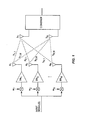
- uplink transmit diversity is to adapt the weights w i so that the user and network performance is maximized.
- the antenna weights w i may be associated with different constraints. Within 3GPP two classes are considered: beam forming and switched antenna diversity.
- Beam forming is a technique whereby, at any given point in time, the UE may transmit from more than one antenna simultaneously.
- the name beam forming is derived from the technique of controlling the phase and amplitude of signals transmitted from different antennas to create a pattern of constructive and destructive interference in the wavefront, effectively altering the gain in desired spatial directions. Because differentiated signals are transmitted from different antennas, beam forming generally requires a separate PA to drive each antenna.
- switched antenna diversity the UE at any given point in time transmits from only one of the antennas.
- w i 0
- w j 0 for all j ⁇ i.
- Switched antenna diversity can be considered as a special case of beam forming, where the weight of one antenna is 1 (i.e., switched on) and all others are 0 (i.e., switched off).
- decisions of the use of Tx diversity and the selection of the antenna weights can be taken by the network or the UE.
- the Node-B may provide explicit feedback to the UE stating whether Tx diversity should be applied, and if so which weights the UE should use when transmitting the signal. This case requires feedback, and may require the introduction of a new feedback channel.
- the UE autonomously decides whether Tx diversity should be applied. To decide this, the UE may monitor existing indicators and measurements of channel quality, such as the number of required HARQ retransmissions, the downlink channel quality indicator (CQI), or the UE transmission power headroom (UPH) measurement. For example, if the CQI and/or the UPH become low, the UE may conclude that it is in a bad coverage area and that it is likely to be beneficial to activate Tx diversity.
- CQI downlink channel quality indicator
- UPH UE transmission power headroom
- the UE may autonomously decide the antenna weights w i .
- the UE may monitor existing feedback channels, including those that are transmitted for other purposes, such as the Fractional-Dedicated Physical Control Channel (F-DPCH). For example, if the UE receives a large number of consecutive Transmission Power Control (TPC) UP commands on F-DPCH from the serving cell, the UE may conclude that it is likely to be beneficial to switch to the other Tx antenna by changing the antenna weights w i .
- TPC Transmission Power Control
- the term effective channel incorporates the effects of the transmit antenna(s), transmit antenna weights, and the receiving antenna(s), as well as the wireless channel between transmitting and receiving antennas.
- the antenna weights w i are changed abruptly (e.g., if a UE transmitting on antenna 1 switches wholly or significantly to transmitting on antenna 2, then w 1 ,w 2 will change from (nearly) 1,0 to 0,1. Consequently, the effective channel as perceived by the receiving Node-B may change abruptly.
- the power discontinuity occurs at the Node-B whenever the effective channel between UE and Node-B changes. This discontinuity will be a combined effect of the facts that the wireless channels between the transmit antennas and receive antenna(s) are different, and that the antenna gains of the two transmit antennas are different.
- An antenna switch (or rapid change in the antenna weights) also results in a transient period until the inner-loop power control (ILPC) and outer-loop power control (OLPC) have settled. If the Node-B was aware that the power discontinuity was caused by an abrupt change in antenna weights, it could adjust its behavior thereafter; for example, by freezing the OLPC.
- ILPC inner-loop power control
- OLPC outer-loop power control
- Multi-carrier operation introduces additional difficulties in Tx diversity decisions.
- Tx diversity algorithms One basis for Tx diversity algorithms is available channel quality information, such as TPC UP/DOWN commands transmitted over F-DPCH from the serving Node-B.
- uplink Tx diversity is combined with uplink multi-carrier operation (e.g., DC-HSUPA) it is not at all clear how to adapt the single-carrier Tx diversity UE algorithm to multi-carrier operation.
- uplink multi-carrier operation e.g., DC-HSUPA
- One or more embodiments of the present invention provide a method and apparatus for selecting one of a plurality of antennas, on a UE implementing Tx diversity in a multi-carrier wireless communication system, for the joint transmission of two or more uplink signals each modulated onto a different carrier frequency, such as when the carriers share a power amplifier as defined by the independent claims.
- the method and apparatus select an antenna based on channel conditions associated with the carriers, even when prior art Tx diversity methods provide conflicting antenna selection indications.
- One embodiment relates to a method of antenna selection by UE implementing Tx diversity in a MC-HSUPA wireless communication network, the UE operative to transmit two or more uplink signals using one antenna, each signal modulated onto a different carrier frequency.
- a preferred antenna is associated with each carrier frequency based on feedback received for that carrier when transmitting a signal using a particular antenna.
- the channel conditions associated with each carrier frequency are assessed.
- One or more carrier frequencies are selected based on the channel conditions, and the preferred antenna associated with the selected carrier frequency is selected for transmission.
- Another embodiment relates to UE implementing Tx diversity in a MC-HSUPA wireless communication network, the UE operative to transmit two or more uplink signals using one antenna, each signal modulated onto a different carrier frequency.
- the UE includes at least one transmission power amplifier; two or more antennas; and a switching function operative to direct the output of the power amplifier alternatively to one of the antennas.
- the UE also includes a receiver operative to receive at least channel condition feedback from the network; and an antenna selection function operative to control the switching function to select an antenna for the transmission of two or more signals on different carrier frequencies.
- the antenna selection function is further operative to associate a preferred antenna with each carrier frequency based on feedback received for that carrier when transmitting a signal using a particular antenna; assess the channel conditions associated with each carrier frequency; select one or more carrier frequencies based on the channel conditions; and select the preferred antenna associated with the selected carrier frequency.
- a scheduled grant is transmitted over the absolute grant channel (E-AGCH), and represents the maximum allowed power ratio between the E-DCH Dedicated Physical Data Control Channel (E-DPDCH) and Dedicated Physical Control Cannel (DPCCH) (see 3GPP TS 25.321).
- the scheduled grant may be increased or decreased by either the serving Node-B or a non-serving Node-B by relative grants, which are transmitted on the relative grant channel (E-RGCH).
- the UE's grant level is maintained internally in the UE as a serving grant.
- the serving grant is adjusted per received relative grants, and is reset to the scheduled grant when a scheduled grant is received over the E-AGCH.
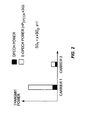
- Figure 2 depicts a case in which the Node-B scheduler has given a high grant on one (or a subset) of the uplink carrier frequencies, and a low grant on the other carrier frequencies.
- This may be advantageous because it allows the UEs to use carriers with favorable characteristics, and to coordinate the usage between UEs so that intra-cell interference is minimized.
- the UE may be unmotivated to perform a change of transmit antenna based on the TPC commands associated with the carrier(s) having a low grant.
- Tx diversity can be directly counterproductive if it means that the carrier on which the UE spends the majority of its power experiences worse channel conditions after switching antennas.
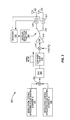
- Such a situation may arise in a UE transceiver architecture such as that depicted in Figure 3 , wherein signals modulated onto two or more carrier frequencies share a power amplifier, and the UE implements uplink Tx diversity.
- signals are modulated onto different carrier frequencies in processing blocks 302 (carrier 1) and 304 (carrier 2).
- the processing blocks 302, 304 perform modulation, coding, spreading pulse shaping, and the like, at the respective carrier frequencies.
- the modulated signals from the processing blocks 302, 304 are combined at adder 306.
- the combined signals is converted to analog form in Digital to Analog Converter 308, and low pass filtered at filter 310.
- the combined signal spans 10 MHz (assuming carrier 1 and carrier 2 are adjacent carrier frequencies, each having a bandwidth of 5 MHz).
- the combined signal is then upconverted at mixer 312, and amplified by a shared power amplifier 314.
- a switching function 316 switches the PA 314 output to the transmitter input one of two duplexers 317, 318, each attached to an antenna 320, 322, respectively, for transmission to a serving Node-B.
- the switching function 316 is controlled by an antenna selection function 324.
- the antenna selection function 324 implements Tx diversity by considering channel conditions associated with each carrier frequency, as indicated by feedback, or channel quality metrics, received by a receiver circuit 326, which is connected to the receiver output of duplexers 316, 318.
- Figure 3 depicts two carrier frequencies sharing one PA 314 and two antennas 320, 322, those of skill in the art will readily recognize that embodiments of the present invention are applicable to Tx diversity in multi-carriers UEs having more than two uplink carrier frequencies, and/or more than two antennas 320, 322, wherein at least two carrier frequencies share one PA 314.
- the antenna selection function 324 may be implemented in dedicated hardware, such as an Application Specific Integrated Circuit (ASIC); in programmable logic such as an Field Programmable Gate Array (FPGA) with appropriate firmware; as one or more software modules executing on a processor or Digital Signal Processor (DSP); or as any combination of these, as desired or required for any particular implementation.
- ASIC Application Specific Integrated Circuit
- FPGA Field Programmable Gate Array
- DSP Digital Signal Processor
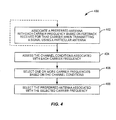
- Figure 4 depicts a method 400 of selecting one antenna 320, 322 from a plurality of available antennas 320, 322 in a UE 300 implementing Tx diversity, wherein two or more signals, each modulated onto a different carrier frequency, are transmitted on the same antenna 320, 322 (for example where the carriers share a PA 314, as depicted in Fig. 3 ).
- the feedback may, for example, comprise TPC commands indicating how well a carrier is received by the network when transmitted from different antennas 320, 322.
- the association of a preferred antenna with each carrier is a dynamic one, and may change during UE 300 operation, based on the carrier feedback, as indicated by the dashed-line loopback path in Figure 4 .
- Carriers may initially be assigned a preferred antenna 320, 322, randomly or according to a predetermined pattern.
- each carrier operates independently from other carriers. Accordingly, each carrier has its own mechanisms for power control, serving grants, E-TFC selection, HARQ retransmissions, and the like.
- the antenna selection function 324 monitors channel quality metrics for each carrier received by the receiver 326, and assesses channel conditions associated with each carrier frequency (block 404).
- the antenna selection function 324 selects one or more carrier frequencies based on the channel conditions associated with each carrier (block 406).
- the step of selecting one or more carrier frequencies may be preformed in several ways, according to different embodiments of the present invention.
- the preferred antenna 320, 322 associated with a selected carrier frequency is then selected for joint transmission of the multi-carrier signals (block 408).
- the antenna selection function 324 selects an antenna 320, 322 for joint transmission of two or more signals modulated onto different carrier frequencies based on the single carrier that experiences the best channel conditions, as indicated by channel quality metrics received by the receiver 326.
- the selection could be based on the TPC commands received on the F-DPCH corresponding to the carrier with the highest serving grant.
- the rationale for this choice is that the user throughput will depend largely on the carrier with the highest grant. Ensuring a favorable propagation condition for this carrier will additionally result in less interference being generated by the UE 300 (at a given rate).
- This antenna selection algorithm is compatible with a scheduling strategy of granting each UE 300 a significant grant on only one of its carriers - a scheduling strategy appropriate for certain scenarios, such as when there are many users in the cell served by the serving Node-B. In this case, the conditions on the carrier with the significant grant should be more important than the conditions on other carriers.
- Channel quality metrics indicative of channel conditions of the different carriers may include serving grants, as discussed above, or alternatively the scheduled grant issued by the serving Node-B, or as yet another alternative, the total transmit power that the UE 300 utilizes on each respective carrier.
- the antenna selection function 324 selects an antenna 320, 322 for joint transmission of two or more signals modulated onto different carrier frequencies based on a weighted judgment of the conditions on all active carriers sharing the same PA 314.
- the selection could be based on weighted TPC commands, where the weight associated with the TPC commands for a specific carrier is determined by carrier-specific properties reflecting the individual carrier conditions.
- each carrier's TPC commands may be weighted with the ratio of the serving grant for that specific carrier to the sum of all active carriers' serving grants.
- the weights could be based on the scheduled grants or the total transmit power that the UE 300 utilizes on the respective carriers to be transmitted using the same PA 314.
- the antenna selection function 324 selects an antenna 320, 322 for joint transmission of two or more signals modulated onto different carrier frequencies based on the carrier(s) that have a channel quality metric that exceed a threshold at a point in time or over a specific time period.
- the threshold is an absolute threshold. An example of this embodiment is using the serving grant as a channel quality metric, and considering for antenna selection a carrier i for which SG i >threshold.
- the threshold is a relative threshold.
- An example of this embodiment again using the serving grant as a channel quality metric, is to consider a carrier i for which SG i /max j ⁇ i (SG j )>threshold, where SG j refer to the serving grant associated with carrier j . That is, the ratio of the serving grant of carrier i to the maximum value of the serving grants of carriers j to be transmitted using the same PA 314, other than carrier i.
- channel quality metrics such as scheduled grant or total transmit power may be considered in lieu of serving grant.
- one carrier may be selected according to either previously described embodiment (i.e ., selecting the carrier with the best channel conditions, or forming a weighted judgment of channel conditions of the carriers that pass the threshold).
- the threshold could be carrier specific. That is, the network may specify different thresholds (absolute or relative) for different carrier frequencies. These may, for example, be configured by a Radio Network Controller (RNC), and communicated to the UE 300 via L3 signaling.
- RNC Radio Network Controller
- the network may effectively force the selection of an antenna associated with a predetermined carrier frequency by the values of the thresholds. For example, the so-called primary uplink frequency in the DC-HSUPA concept (which carries both non-scheduled and scheduled traffic) could be favored over the secondary uplink frequency (which only carries scheduled traffic).
- the rules for selecting, weighting, or thresholding carriers may, in different embodiments, be considered a UE 300 implementation aspect; predefined in an industry technical standard; determined by the serving Node-B and transmitted to the U E 300 through L1/L2 signaling; or configured by a serving RNC or other network node, and communicated to the UE 300 through L3 signaling (i.e., using Radio Resource Control, or RRC, signaling).
- RRC Radio Resource Control
- Embodiments of the present invention provide a means for selecting an antenna 320, 322 for joint transmission of two or more signals modulated onto different carrier frequencies, even when the channel quality metrics associated with the carriers are conflicting - e.g., one carrier's channel conditions indicate one antenna and another carrier's channel conditions indicate a different antenna.
- Embodiments described herein help to secure robust, high performance operation on the carriers that experience the best operating conditions with respect to radio propagation, traffic load, interference, and the like. Furthermore, by reducing the amount of unnecessary antenna switch decisions and related transients in the uplink signal, the overall reception performance is also improved.
Landscapes
- Engineering & Computer Science (AREA)
- Computer Networks & Wireless Communication (AREA)
- Signal Processing (AREA)
- Physics & Mathematics (AREA)
- Mathematical Physics (AREA)
- Radio Transmission System (AREA)
- Mobile Radio Communication Systems (AREA)
Applications Claiming Priority (2)
| Application Number | Priority Date | Filing Date | Title |
|---|---|---|---|
| US25076809P | 2009-10-12 | 2009-10-12 | |
| PCT/SE2010/051097 WO2011046498A1 (en) | 2009-10-12 | 2010-10-12 | Method and apparatus for uplink multi-carrier transmit diversity |
Publications (2)
| Publication Number | Publication Date |
|---|---|
| EP2489136A1 EP2489136A1 (en) | 2012-08-22 |
| EP2489136B1 true EP2489136B1 (en) | 2014-01-29 |
Family
ID=43446997
Family Applications (1)
| Application Number | Title | Priority Date | Filing Date |
|---|---|---|---|
| EP10775934.2A Not-in-force EP2489136B1 (en) | 2009-10-12 | 2010-10-12 | Method and apparatus for uplink multi-carrier transmit diversity |
Country Status (7)
| Country | Link |
|---|---|
| US (1) | US9584208B2 (enExample) |
| EP (1) | EP2489136B1 (enExample) |
| JP (1) | JP5689124B2 (enExample) |
| CN (1) | CN102714529B (enExample) |
| MX (1) | MX2012002569A (enExample) |
| PH (1) | PH12012500293A1 (enExample) |
| WO (1) | WO2011046498A1 (enExample) |
Families Citing this family (22)
| Publication number | Priority date | Publication date | Assignee | Title |
|---|---|---|---|---|
| US8625475B2 (en) * | 2007-09-24 | 2014-01-07 | Qualcomm Incorporated | Responding to an interactive multicast message within a wireless communication system |
| US8457056B2 (en) * | 2009-02-09 | 2013-06-04 | Qualcomm Incorporated | Non-scheduled grants in multi-carrier enhanced uplink |
| KR20110047128A (ko) * | 2009-10-29 | 2011-05-06 | 엘지전자 주식회사 | 복수의 상향링크 주파수들을 이용하는 무선 통신 시스템에서 단말의 동작 방법 |
| US10110288B2 (en) * | 2009-11-04 | 2018-10-23 | Atc Technologies, Llc | Frequency division duplex (FDD) return link transmit diversity systems, methods and devices using forward link side information |
| KR20120115295A (ko) * | 2009-12-01 | 2012-10-17 | 스파이더클라우드 와이어리스, 인크. | 고속상향패킷접속 스케줄링을 위한 방법, 시스템 및 장치 |
| CN106788903A (zh) * | 2010-01-15 | 2017-05-31 | 中兴通讯股份有限公司 | 一种传输ue支持多载波能力的方法和系统 |
| US8891387B2 (en) * | 2010-05-03 | 2014-11-18 | Qualcomm Incorporated | UE based conditional enabling of ULTD |
| US8660057B2 (en) * | 2010-08-26 | 2014-02-25 | Golba, Llc | Method and system for distributed communication |
| WO2012054412A1 (en) * | 2010-10-19 | 2012-04-26 | Mediatek Singapore Pte. Ltd. | A method and system for supporting incompatible channelization of a wireless communications system |
| EP2705710B1 (en) * | 2011-05-03 | 2020-05-20 | Telefonaktiebolaget LM Ericsson (publ) | Methods and network nodes in a telecommunication system |
| CN102843776B (zh) | 2011-06-20 | 2017-03-22 | 中兴通讯股份有限公司 | 多载波终端调度方法、信道质量信息发送方法及系统 |
| JP5868546B2 (ja) * | 2013-03-25 | 2016-02-24 | 株式会社日立製作所 | 無線通信システム、昇降機制御・監視システム、および、変電設備制御・監視システム |
| US9893715B2 (en) * | 2013-12-09 | 2018-02-13 | Shure Acquisition Holdings, Inc. | Adaptive self-tunable antenna system and method |
| CN104079328B (zh) * | 2014-06-19 | 2017-08-11 | 广州杰赛科技股份有限公司 | Wlan天线组合方法和系统 |
| TWI591892B (zh) * | 2015-08-18 | 2017-07-11 | 啟碁科技股份有限公司 | 無線通訊裝置及其改善特定吸收比率值的方法 |
| US9935676B2 (en) | 2015-08-21 | 2018-04-03 | Qualcomm Incorporated | Opportunistic antenna switch diversity (ASDIV) in carrier aggregation |
| FR3049809B1 (fr) * | 2016-03-29 | 2018-04-20 | Sagemcom Energy & Telecom Sas | Procede de gestion de l'allocation de frequences porteuses |
| KR102021191B1 (ko) | 2016-10-21 | 2019-09-11 | 아서스테크 컴퓨터 인코포레이션 | 무선 통신 시스템에서 빔 동작을 위한 전력 헤드룸 보고 방법 및 장치 |
| WO2020225695A1 (en) * | 2019-05-03 | 2020-11-12 | Lenovo (Singapore) Pte. Ltd. | Method and apparatus for verification of dual carrier dynamic power sharing |
| CN112449426B (zh) | 2019-09-04 | 2022-12-06 | 维沃移动通信有限公司 | 上行传输的方法和终端 |
| EP4243298A1 (en) * | 2022-03-10 | 2023-09-13 | Samsung Electronics Co., Ltd. | Apparatus for antenna switching in wireless communication system and operating method thereof |
| US20250385716A1 (en) * | 2024-06-13 | 2025-12-18 | Qualcomm Incorporated | Switching antennas for supplementary uplink |
Family Cites Families (17)
| Publication number | Priority date | Publication date | Assignee | Title |
|---|---|---|---|---|
| US5628052A (en) * | 1994-09-12 | 1997-05-06 | Lucent Technologies Inc. | Wireless communication system using distributed switched antennas |
| US6243565B1 (en) | 1996-06-18 | 2001-06-05 | Telefonaktiebolaget Lm Ericsson (Publ) | Method and apparatus for transmitting communication signals using frequency and polarization diversity |
| EP1156609A1 (en) * | 2000-05-15 | 2001-11-21 | TELEFONAKTIEBOLAGET LM ERICSSON (publ) | Transmission quality measurement in a communication network |
| BR0210131A (pt) * | 2001-05-31 | 2004-06-08 | Magnolia Broadband Inc | Dispositivo de comunicação com antena inteligente usando um sinal de indicação de qualidade |
| KR100915750B1 (ko) | 2002-07-16 | 2009-09-04 | 파나소닉 주식회사 | 통신 방법 및 그것을 이용한 송신 장치와 수신장치 |
| US7551902B2 (en) | 2004-12-28 | 2009-06-23 | Nokia Corporation | Method and apparatus to increase the diversity order for a multi-carrier FDM system |
| CN101116290A (zh) * | 2005-02-07 | 2008-01-30 | 艾利森电话股份有限公司 | 用于处理电信网络中的不可靠调度许可的方法和布置 |
| US7616704B2 (en) * | 2005-03-08 | 2009-11-10 | Intel Corporation | Broadband multicarrier transmitter with subchannel frequency diversity for transmitting a plurality of spatial streams |
| CN101606339B (zh) * | 2006-01-13 | 2013-10-16 | Lg电子株式会社 | 使用基于反馈信息的天线选择实现发射分集和空间复用的方法和装置 |
| JP4684124B2 (ja) * | 2006-02-16 | 2011-05-18 | 富士通株式会社 | 移動局装置及び同装置における送信電力制御方法 |
| KR101138175B1 (ko) | 2006-11-03 | 2012-04-25 | 모토로라 모빌리티, 인크. | 무선 통신 시스템에서의 원격 유닛의 스케줄링 |
| US20080195748A1 (en) * | 2007-02-09 | 2008-08-14 | Melodeo Inc. | Data delivery |
| JP4563415B2 (ja) | 2007-02-14 | 2010-10-13 | 株式会社エヌ・ティ・ティ・ドコモ | 移動通信システムで使用される基地局装置、ユーザ装置及び方法 |
| HUE045919T2 (hu) * | 2007-03-19 | 2020-01-28 | Optis Wireless Technology Llc | Rádiós hordozó specifikus CQI jelentés |
| JP5026207B2 (ja) | 2007-09-27 | 2012-09-12 | 株式会社エヌ・ティ・ティ・ドコモ | 基地局装置及びユーザ装置並びに通信制御方法 |
| JP4989513B2 (ja) * | 2008-02-22 | 2012-08-01 | 株式会社エヌ・ティ・ティ・ドコモ | 無線通信システム、無線通信方法及び基地局 |
| US8427984B2 (en) * | 2009-01-12 | 2013-04-23 | Sparkmotion Inc. | Method and system for antenna switching |
-
2010
- 2010-10-12 WO PCT/SE2010/051097 patent/WO2011046498A1/en not_active Ceased
- 2010-10-12 CN CN201080045995.3A patent/CN102714529B/zh not_active Expired - Fee Related
- 2010-10-12 MX MX2012002569A patent/MX2012002569A/es active IP Right Grant
- 2010-10-12 PH PH1/2012/500293A patent/PH12012500293A1/en unknown
- 2010-10-12 JP JP2012533118A patent/JP5689124B2/ja not_active Expired - Fee Related
- 2010-10-12 US US13/256,586 patent/US9584208B2/en not_active Expired - Fee Related
- 2010-10-12 EP EP10775934.2A patent/EP2489136B1/en not_active Not-in-force
Also Published As
| Publication number | Publication date |
|---|---|
| US20120002630A1 (en) | 2012-01-05 |
| JP2013507825A (ja) | 2013-03-04 |
| CN102714529A (zh) | 2012-10-03 |
| PH12012500293A1 (en) | 2018-02-07 |
| US9584208B2 (en) | 2017-02-28 |
| CN102714529B (zh) | 2015-06-03 |
| WO2011046498A1 (en) | 2011-04-21 |
| JP5689124B2 (ja) | 2015-03-25 |
| MX2012002569A (es) | 2012-04-10 |
| EP2489136A1 (en) | 2012-08-22 |
Similar Documents
| Publication | Publication Date | Title |
|---|---|---|
| EP2489136B1 (en) | Method and apparatus for uplink multi-carrier transmit diversity | |
| EP2526633B1 (en) | Methods and devices for uplink transmit diversity | |
| EP2724480B1 (en) | Selecting uplink multi-antenna transmission to enhance coverage | |
| US9226301B2 (en) | System and method to shorten the time taken to improve inter-cell interference mitigation performance using adaptive fractional frequency reuse | |
| EP2739080B1 (en) | Wireless communication terminal device, wireless communication base station device and wireless communication method | |
| KR101377680B1 (ko) | 멀티 캐리어 무선 단말기를 위한 전력 스케일링 방법 및 장치 | |
| EP2165430B1 (en) | Setting maximum power at a mobile communication system base station having multiple antennas | |
| EP2880905B1 (en) | Availability of modes of communication | |
| EP2890038A1 (en) | Radio base station apparatus, mobile terminal apparatus and radio communication method | |
| US20140050089A1 (en) | Intra-Frequency Load Balancing Method and Apparatus Thereof | |
| KR20120105558A (ko) | 업링크 안테나 전송 다이버시티를 실행하기 위한 방법 및 장치 | |
| CN101657979A (zh) | 基站装置、用户装置以及通信控制方法 | |
| US11742922B2 (en) | Communication device with antenna panels and method thereof | |
| US9369997B2 (en) | Methods and arrangements for coordinating uplink transmit diversity mode adaptation | |
| EP2890190B1 (en) | Wireless communication system, base station apparatus, mobile station apparatus, and communication method | |
| US8983485B2 (en) | Base station apparatus, mobile terminal apparatus and scheduling method | |
| US20110286399A1 (en) | Device and method for controlling uplink data transmission |
Legal Events
| Date | Code | Title | Description |
|---|---|---|---|
| PUAI | Public reference made under article 153(3) epc to a published international application that has entered the european phase |
Free format text: ORIGINAL CODE: 0009012 |
|
| 17P | Request for examination filed |
Effective date: 20120209 |
|
| AK | Designated contracting states |
Kind code of ref document: A1 Designated state(s): AL AT BE BG CH CY CZ DE DK EE ES FI FR GB GR HR HU IE IS IT LI LT LU LV MC MK MT NL NO PL PT RO RS SE SI SK SM TR |
|
| DAX | Request for extension of the european patent (deleted) | ||
| GRAP | Despatch of communication of intention to grant a patent |
Free format text: ORIGINAL CODE: EPIDOSNIGR1 |
|
| RIC1 | Information provided on ipc code assigned before grant |
Ipc: H04L 5/00 20060101ALI20130924BHEP Ipc: H04B 7/06 20060101AFI20130924BHEP Ipc: H04L 27/26 20060101ALI20130924BHEP |
|
| INTG | Intention to grant announced |
Effective date: 20131028 |
|
| GRAS | Grant fee paid |
Free format text: ORIGINAL CODE: EPIDOSNIGR3 |
|
| GRAA | (expected) grant |
Free format text: ORIGINAL CODE: 0009210 |
|
| AK | Designated contracting states |
Kind code of ref document: B1 Designated state(s): AL AT BE BG CH CY CZ DE DK EE ES FI FR GB GR HR HU IE IS IT LI LT LU LV MC MK MT NL NO PL PT RO RS SE SI SK SM TR |
|
| REG | Reference to a national code |
Ref country code: GB Ref legal event code: FG4D |
|
| REG | Reference to a national code |
Ref country code: CH Ref legal event code: EP |
|
| REG | Reference to a national code |
Ref country code: AT Ref legal event code: REF Ref document number: 651686 Country of ref document: AT Kind code of ref document: T Effective date: 20140215 |
|
| REG | Reference to a national code |
Ref country code: IE Ref legal event code: FG4D |
|
| REG | Reference to a national code |
Ref country code: DE Ref legal event code: R096 Ref document number: 602010013438 Country of ref document: DE Effective date: 20140313 |
|
| REG | Reference to a national code |
Ref country code: AT Ref legal event code: MK05 Ref document number: 651686 Country of ref document: AT Kind code of ref document: T Effective date: 20140129 |
|
| REG | Reference to a national code |
Ref country code: NL Ref legal event code: VDEP Effective date: 20140129 |
|
| REG | Reference to a national code |
Ref country code: LT Ref legal event code: MG4D |
|
| PG25 | Lapsed in a contracting state [announced via postgrant information from national office to epo] |
Ref country code: LT Free format text: LAPSE BECAUSE OF FAILURE TO SUBMIT A TRANSLATION OF THE DESCRIPTION OR TO PAY THE FEE WITHIN THE PRESCRIBED TIME-LIMIT Effective date: 20140129 Ref country code: NO Free format text: LAPSE BECAUSE OF FAILURE TO SUBMIT A TRANSLATION OF THE DESCRIPTION OR TO PAY THE FEE WITHIN THE PRESCRIBED TIME-LIMIT Effective date: 20140429 Ref country code: IS Free format text: LAPSE BECAUSE OF FAILURE TO SUBMIT A TRANSLATION OF THE DESCRIPTION OR TO PAY THE FEE WITHIN THE PRESCRIBED TIME-LIMIT Effective date: 20140529 |
|
| PG25 | Lapsed in a contracting state [announced via postgrant information from national office to epo] |
Ref country code: AT Free format text: LAPSE BECAUSE OF FAILURE TO SUBMIT A TRANSLATION OF THE DESCRIPTION OR TO PAY THE FEE WITHIN THE PRESCRIBED TIME-LIMIT Effective date: 20140129 Ref country code: NL Free format text: LAPSE BECAUSE OF FAILURE TO SUBMIT A TRANSLATION OF THE DESCRIPTION OR TO PAY THE FEE WITHIN THE PRESCRIBED TIME-LIMIT Effective date: 20140129 Ref country code: CY Free format text: LAPSE BECAUSE OF FAILURE TO SUBMIT A TRANSLATION OF THE DESCRIPTION OR TO PAY THE FEE WITHIN THE PRESCRIBED TIME-LIMIT Effective date: 20140129 Ref country code: FI Free format text: LAPSE BECAUSE OF FAILURE TO SUBMIT A TRANSLATION OF THE DESCRIPTION OR TO PAY THE FEE WITHIN THE PRESCRIBED TIME-LIMIT Effective date: 20140129 Ref country code: ES Free format text: LAPSE BECAUSE OF FAILURE TO SUBMIT A TRANSLATION OF THE DESCRIPTION OR TO PAY THE FEE WITHIN THE PRESCRIBED TIME-LIMIT Effective date: 20140129 Ref country code: PT Free format text: LAPSE BECAUSE OF FAILURE TO SUBMIT A TRANSLATION OF THE DESCRIPTION OR TO PAY THE FEE WITHIN THE PRESCRIBED TIME-LIMIT Effective date: 20140529 Ref country code: SE Free format text: LAPSE BECAUSE OF FAILURE TO SUBMIT A TRANSLATION OF THE DESCRIPTION OR TO PAY THE FEE WITHIN THE PRESCRIBED TIME-LIMIT Effective date: 20140129 |
|
| PG25 | Lapsed in a contracting state [announced via postgrant information from national office to epo] |
Ref country code: LV Free format text: LAPSE BECAUSE OF FAILURE TO SUBMIT A TRANSLATION OF THE DESCRIPTION OR TO PAY THE FEE WITHIN THE PRESCRIBED TIME-LIMIT Effective date: 20140129 Ref country code: BE Free format text: LAPSE BECAUSE OF FAILURE TO SUBMIT A TRANSLATION OF THE DESCRIPTION OR TO PAY THE FEE WITHIN THE PRESCRIBED TIME-LIMIT Effective date: 20140129 Ref country code: HR Free format text: LAPSE BECAUSE OF FAILURE TO SUBMIT A TRANSLATION OF THE DESCRIPTION OR TO PAY THE FEE WITHIN THE PRESCRIBED TIME-LIMIT Effective date: 20140129 Ref country code: RS Free format text: LAPSE BECAUSE OF FAILURE TO SUBMIT A TRANSLATION OF THE DESCRIPTION OR TO PAY THE FEE WITHIN THE PRESCRIBED TIME-LIMIT Effective date: 20140129 |
|
| REG | Reference to a national code |
Ref country code: DE Ref legal event code: R097 Ref document number: 602010013438 Country of ref document: DE |
|
| PG25 | Lapsed in a contracting state [announced via postgrant information from national office to epo] |
Ref country code: CZ Free format text: LAPSE BECAUSE OF FAILURE TO SUBMIT A TRANSLATION OF THE DESCRIPTION OR TO PAY THE FEE WITHIN THE PRESCRIBED TIME-LIMIT Effective date: 20140129 Ref country code: EE Free format text: LAPSE BECAUSE OF FAILURE TO SUBMIT A TRANSLATION OF THE DESCRIPTION OR TO PAY THE FEE WITHIN THE PRESCRIBED TIME-LIMIT Effective date: 20140129 Ref country code: RO Free format text: LAPSE BECAUSE OF FAILURE TO SUBMIT A TRANSLATION OF THE DESCRIPTION OR TO PAY THE FEE WITHIN THE PRESCRIBED TIME-LIMIT Effective date: 20140129 Ref country code: DK Free format text: LAPSE BECAUSE OF FAILURE TO SUBMIT A TRANSLATION OF THE DESCRIPTION OR TO PAY THE FEE WITHIN THE PRESCRIBED TIME-LIMIT Effective date: 20140129 |
|
| PG25 | Lapsed in a contracting state [announced via postgrant information from national office to epo] |
Ref country code: SK Free format text: LAPSE BECAUSE OF FAILURE TO SUBMIT A TRANSLATION OF THE DESCRIPTION OR TO PAY THE FEE WITHIN THE PRESCRIBED TIME-LIMIT Effective date: 20140129 Ref country code: PL Free format text: LAPSE BECAUSE OF FAILURE TO SUBMIT A TRANSLATION OF THE DESCRIPTION OR TO PAY THE FEE WITHIN THE PRESCRIBED TIME-LIMIT Effective date: 20140129 |
|
| PLBE | No opposition filed within time limit |
Free format text: ORIGINAL CODE: 0009261 |
|
| STAA | Information on the status of an ep patent application or granted ep patent |
Free format text: STATUS: NO OPPOSITION FILED WITHIN TIME LIMIT |
|
| 26N | No opposition filed |
Effective date: 20141030 |
|
| REG | Reference to a national code |
Ref country code: DE Ref legal event code: R097 Ref document number: 602010013438 Country of ref document: DE Effective date: 20141030 |
|
| PG25 | Lapsed in a contracting state [announced via postgrant information from national office to epo] |
Ref country code: MC Free format text: LAPSE BECAUSE OF FAILURE TO SUBMIT A TRANSLATION OF THE DESCRIPTION OR TO PAY THE FEE WITHIN THE PRESCRIBED TIME-LIMIT Effective date: 20140129 Ref country code: LU Free format text: LAPSE BECAUSE OF FAILURE TO SUBMIT A TRANSLATION OF THE DESCRIPTION OR TO PAY THE FEE WITHIN THE PRESCRIBED TIME-LIMIT Effective date: 20141012 Ref country code: SI Free format text: LAPSE BECAUSE OF FAILURE TO SUBMIT A TRANSLATION OF THE DESCRIPTION OR TO PAY THE FEE WITHIN THE PRESCRIBED TIME-LIMIT Effective date: 20140129 |
|
| REG | Reference to a national code |
Ref country code: CH Ref legal event code: PL |
|
| REG | Reference to a national code |
Ref country code: IE Ref legal event code: MM4A |
|
| PG25 | Lapsed in a contracting state [announced via postgrant information from national office to epo] |
Ref country code: CH Free format text: LAPSE BECAUSE OF NON-PAYMENT OF DUE FEES Effective date: 20141031 Ref country code: LI Free format text: LAPSE BECAUSE OF NON-PAYMENT OF DUE FEES Effective date: 20141031 |
|
| REG | Reference to a national code |
Ref country code: FR Ref legal event code: ST Effective date: 20150630 |
|
| PG25 | Lapsed in a contracting state [announced via postgrant information from national office to epo] |
Ref country code: FR Free format text: LAPSE BECAUSE OF NON-PAYMENT OF DUE FEES Effective date: 20141031 |
|
| PG25 | Lapsed in a contracting state [announced via postgrant information from national office to epo] |
Ref country code: IE Free format text: LAPSE BECAUSE OF NON-PAYMENT OF DUE FEES Effective date: 20141012 |
|
| PG25 | Lapsed in a contracting state [announced via postgrant information from national office to epo] |
Ref country code: SM Free format text: LAPSE BECAUSE OF FAILURE TO SUBMIT A TRANSLATION OF THE DESCRIPTION OR TO PAY THE FEE WITHIN THE PRESCRIBED TIME-LIMIT Effective date: 20140129 |
|
| PG25 | Lapsed in a contracting state [announced via postgrant information from national office to epo] |
Ref country code: GR Free format text: LAPSE BECAUSE OF FAILURE TO SUBMIT A TRANSLATION OF THE DESCRIPTION OR TO PAY THE FEE WITHIN THE PRESCRIBED TIME-LIMIT Effective date: 20140430 Ref country code: BG Free format text: LAPSE BECAUSE OF FAILURE TO SUBMIT A TRANSLATION OF THE DESCRIPTION OR TO PAY THE FEE WITHIN THE PRESCRIBED TIME-LIMIT Effective date: 20140129 |
|
| PG25 | Lapsed in a contracting state [announced via postgrant information from national office to epo] |
Ref country code: MT Free format text: LAPSE BECAUSE OF FAILURE TO SUBMIT A TRANSLATION OF THE DESCRIPTION OR TO PAY THE FEE WITHIN THE PRESCRIBED TIME-LIMIT Effective date: 20140129 Ref country code: HU Free format text: LAPSE BECAUSE OF FAILURE TO SUBMIT A TRANSLATION OF THE DESCRIPTION OR TO PAY THE FEE WITHIN THE PRESCRIBED TIME-LIMIT; INVALID AB INITIO Effective date: 20101012 Ref country code: TR Free format text: LAPSE BECAUSE OF FAILURE TO SUBMIT A TRANSLATION OF THE DESCRIPTION OR TO PAY THE FEE WITHIN THE PRESCRIBED TIME-LIMIT Effective date: 20140129 |
|
| PG25 | Lapsed in a contracting state [announced via postgrant information from national office to epo] |
Ref country code: MK Free format text: LAPSE BECAUSE OF FAILURE TO SUBMIT A TRANSLATION OF THE DESCRIPTION OR TO PAY THE FEE WITHIN THE PRESCRIBED TIME-LIMIT Effective date: 20140129 |
|
| PG25 | Lapsed in a contracting state [announced via postgrant information from national office to epo] |
Ref country code: AL Free format text: LAPSE BECAUSE OF FAILURE TO SUBMIT A TRANSLATION OF THE DESCRIPTION OR TO PAY THE FEE WITHIN THE PRESCRIBED TIME-LIMIT Effective date: 20140129 |
|
| PGFP | Annual fee paid to national office [announced via postgrant information from national office to epo] |
Ref country code: DE Payment date: 20181029 Year of fee payment: 9 |
|
| PGFP | Annual fee paid to national office [announced via postgrant information from national office to epo] |
Ref country code: GB Payment date: 20181029 Year of fee payment: 9 Ref country code: IT Payment date: 20181023 Year of fee payment: 9 |
|
| REG | Reference to a national code |
Ref country code: DE Ref legal event code: R119 Ref document number: 602010013438 Country of ref document: DE |
|
| PG25 | Lapsed in a contracting state [announced via postgrant information from national office to epo] |
Ref country code: DE Free format text: LAPSE BECAUSE OF NON-PAYMENT OF DUE FEES Effective date: 20200501 |
|
| GBPC | Gb: european patent ceased through non-payment of renewal fee |
Effective date: 20191012 |
|
| PG25 | Lapsed in a contracting state [announced via postgrant information from national office to epo] |
Ref country code: IT Free format text: LAPSE BECAUSE OF NON-PAYMENT OF DUE FEES Effective date: 20191012 Ref country code: GB Free format text: LAPSE BECAUSE OF NON-PAYMENT OF DUE FEES Effective date: 20191012 |