EP2487178A1 - Pyrazolothiazole compound - Google Patents
Pyrazolothiazole compound Download PDFInfo
- Publication number
- EP2487178A1 EP2487178A1 EP10822051A EP10822051A EP2487178A1 EP 2487178 A1 EP2487178 A1 EP 2487178A1 EP 10822051 A EP10822051 A EP 10822051A EP 10822051 A EP10822051 A EP 10822051A EP 2487178 A1 EP2487178 A1 EP 2487178A1
- Authority
- EP
- European Patent Office
- Prior art keywords
- group
- mmol
- mixture
- compound
- solvent
- Prior art date
- Legal status (The legal status is an assumption and is not a legal conclusion. Google has not performed a legal analysis and makes no representation as to the accuracy of the status listed.)
- Withdrawn
Links
- -1 Pyrazolothiazole compound Chemical class 0.000 title claims description 102
- 150000001875 compounds Chemical class 0.000 claims abstract description 401
- 125000004169 (C1-C6) alkyl group Chemical group 0.000 claims abstract description 60
- 150000003839 salts Chemical class 0.000 claims abstract description 46
- 125000004191 (C1-C6) alkoxy group Chemical group 0.000 claims abstract description 30
- 125000004435 hydrogen atom Chemical group [H]* 0.000 claims abstract description 29
- 125000005913 (C3-C6) cycloalkyl group Chemical group 0.000 claims abstract description 27
- 229910052757 nitrogen Inorganic materials 0.000 claims abstract description 24
- 125000005843 halogen group Chemical group 0.000 claims abstract description 23
- 125000003161 (C1-C6) alkylene group Chemical group 0.000 claims abstract description 7
- 125000006700 (C1-C6) alkylthio group Chemical group 0.000 claims abstract description 7
- 125000003178 carboxy group Chemical group [H]OC(*)=O 0.000 claims abstract description 7
- 125000002485 formyl group Chemical group [H]C(*)=O 0.000 claims abstract description 7
- 125000000000 cycloalkoxy group Chemical group 0.000 claims abstract description 6
- 125000004093 cyano group Chemical group *C#N 0.000 claims abstract description 5
- 125000004433 nitrogen atom Chemical group N* 0.000 claims abstract description 5
- 125000004738 (C1-C6) alkyl sulfinyl group Chemical group 0.000 claims abstract description 4
- 125000006615 aromatic heterocyclic group Chemical group 0.000 claims abstract description 3
- 125000001072 heteroaryl group Chemical group 0.000 claims abstract description 3
- 125000001424 substituent group Chemical group 0.000 claims description 55
- 108091005471 CRHR1 Proteins 0.000 claims description 33
- LFAJIBQRSUUNSW-UHFFFAOYSA-N (4-Hydroxy-3,5-dimethoxybenzyl)-methylaether Natural products COCC1=CC(OC)=C(O)C(OC)=C1 LFAJIBQRSUUNSW-UHFFFAOYSA-N 0.000 claims description 30
- 239000003795 chemical substances by application Substances 0.000 claims description 29
- 239000002464 receptor antagonist Substances 0.000 claims description 24
- 229940044551 receptor antagonist Drugs 0.000 claims description 24
- 208000019901 Anxiety disease Diseases 0.000 claims description 21
- 125000002496 methyl group Chemical group [H]C([H])([H])* 0.000 claims description 21
- 230000036506 anxiety Effects 0.000 claims description 20
- 208000002551 irritable bowel syndrome Diseases 0.000 claims description 15
- 125000000956 methoxy group Chemical group [H]C([H])([H])O* 0.000 claims description 15
- 206010012289 Dementia Diseases 0.000 claims description 14
- 206010054089 Depressive symptom Diseases 0.000 claims description 13
- 125000001495 ethyl group Chemical group [H]C([H])([H])C([H])([H])* 0.000 claims description 13
- 208000007271 Substance Withdrawal Syndrome Diseases 0.000 claims description 11
- 208000019116 sleep disease Diseases 0.000 claims description 11
- 208000020685 sleep-wake disease Diseases 0.000 claims description 11
- 208000024891 symptom Diseases 0.000 claims description 11
- 208000007848 Alcoholism Diseases 0.000 claims description 10
- 206010010904 Convulsion Diseases 0.000 claims description 10
- 208000013738 Sleep Initiation and Maintenance disease Diseases 0.000 claims description 10
- 201000007930 alcohol dependence Diseases 0.000 claims description 10
- 208000029650 alcohol withdrawal Diseases 0.000 claims description 10
- 206010013663 drug dependence Diseases 0.000 claims description 10
- 231100000318 excitotoxic Toxicity 0.000 claims description 10
- 230000003492 excitotoxic effect Effects 0.000 claims description 10
- 230000007160 gastrointestinal dysfunction Effects 0.000 claims description 10
- 206010022437 insomnia Diseases 0.000 claims description 10
- 208000011117 substance-related disease Diseases 0.000 claims description 10
- 125000001412 tetrahydropyranyl group Chemical group 0.000 claims description 10
- 206010020772 Hypertension Diseases 0.000 claims description 9
- 230000036461 convulsion Effects 0.000 claims description 9
- 206010015037 epilepsy Diseases 0.000 claims description 9
- 201000001119 neuropathy Diseases 0.000 claims description 9
- 230000007823 neuropathy Effects 0.000 claims description 9
- 208000033808 peripheral neuropathy Diseases 0.000 claims description 9
- 230000000069 prophylactic effect Effects 0.000 claims description 9
- 208000000103 Anorexia Nervosa Diseases 0.000 claims description 8
- 206010008190 Cerebrovascular accident Diseases 0.000 claims description 8
- 208000030814 Eating disease Diseases 0.000 claims description 8
- 208000019454 Feeding and Eating disease Diseases 0.000 claims description 8
- 208000033463 Ischaemic neuropathy Diseases 0.000 claims description 8
- 206010054048 Postoperative ileus Diseases 0.000 claims description 8
- 208000006011 Stroke Diseases 0.000 claims description 8
- 239000004480 active ingredient Substances 0.000 claims description 8
- 235000014632 disordered eating Nutrition 0.000 claims description 8
- 208000020925 Bipolar disease Diseases 0.000 claims description 7
- 201000000980 schizophrenia Diseases 0.000 claims description 7
- 230000001225 therapeutic effect Effects 0.000 claims description 7
- BAVYZALUXZFZLV-UHFFFAOYSA-N Methylamine Chemical compound NC BAVYZALUXZFZLV-UHFFFAOYSA-N 0.000 claims description 6
- 125000003545 alkoxy group Chemical group 0.000 claims description 6
- 125000001559 cyclopropyl group Chemical group [H]C1([H])C([H])([H])C1([H])* 0.000 claims description 6
- 125000001570 methylene group Chemical group [H]C([H])([*:1])[*:2] 0.000 claims description 6
- 125000006173 tetrahydropyranylmethyl group Chemical group 0.000 claims description 6
- 125000001301 ethoxy group Chemical group [H]C([H])([H])C([H])([H])O* 0.000 claims description 5
- 125000002816 methylsulfanyl group Chemical group [H]C([H])([H])S[*] 0.000 claims description 5
- 239000008194 pharmaceutical composition Substances 0.000 claims description 5
- 125000003718 tetrahydrofuranyl group Chemical group 0.000 claims description 5
- 125000000217 alkyl group Chemical group 0.000 claims description 4
- 125000005043 dihydropyranyl group Chemical group O1C(CCC=C1)* 0.000 claims description 4
- 125000000532 dioxanyl group Chemical group 0.000 claims description 4
- 125000002887 hydroxy group Chemical group [H]O* 0.000 claims description 4
- 125000004076 pyridyl group Chemical group 0.000 claims description 4
- 125000006216 methylsulfinyl group Chemical group [H]C([H])([H])S(*)=O 0.000 claims description 3
- JSLAUXCCGLTBDJ-UHFFFAOYSA-N n-(cyclopropylmethyl)-3-[2,6-dimethoxy-4-(methoxymethyl)phenyl]-6-methyl-n-(oxan-4-ylmethyl)pyrazolo[5,1-b][1,3]thiazol-7-amine Chemical compound COC1=CC(COC)=CC(OC)=C1C(N1N=C2C)=CSC1=C2N(CC1CCOCC1)CC1CC1 JSLAUXCCGLTBDJ-UHFFFAOYSA-N 0.000 claims description 3
- 125000002147 dimethylamino group Chemical group [H]C([H])([H])N(*)C([H])([H])[H] 0.000 claims description 2
- 125000005883 dithianyl group Chemical group 0.000 claims description 2
- 125000004029 hydroxymethyl group Chemical group [H]OC([H])([H])* 0.000 claims description 2
- 125000000714 pyrimidinyl group Chemical group 0.000 claims description 2
- 125000005958 tetrahydrothienyl group Chemical group 0.000 claims description 2
- 125000000335 thiazolyl group Chemical group 0.000 claims description 2
- 108010056643 Corticotropin-Releasing Hormone Receptors Proteins 0.000 abstract description 15
- 230000008485 antagonism Effects 0.000 abstract description 11
- XEKOWRVHYACXOJ-UHFFFAOYSA-N Ethyl acetate Chemical compound CCOC(C)=O XEKOWRVHYACXOJ-UHFFFAOYSA-N 0.000 description 498
- HEDRZPFGACZZDS-MICDWDOJSA-N Trichloro(2H)methane Chemical compound [2H]C(Cl)(Cl)Cl HEDRZPFGACZZDS-MICDWDOJSA-N 0.000 description 377
- 239000002904 solvent Substances 0.000 description 360
- 239000000203 mixture Substances 0.000 description 359
- IMNFDUFMRHMDMM-UHFFFAOYSA-N N-Heptane Chemical compound CCCCCCC IMNFDUFMRHMDMM-UHFFFAOYSA-N 0.000 description 284
- 238000006243 chemical reaction Methods 0.000 description 228
- 238000005160 1H NMR spectroscopy Methods 0.000 description 189
- YMWUJEATGCHHMB-UHFFFAOYSA-N Dichloromethane Chemical compound ClCCl YMWUJEATGCHHMB-UHFFFAOYSA-N 0.000 description 135
- 230000002829 reductive effect Effects 0.000 description 135
- 239000003153 chemical reaction reagent Substances 0.000 description 116
- 238000004519 manufacturing process Methods 0.000 description 114
- WYURNTSHIVDZCO-UHFFFAOYSA-N Tetrahydrofuran Chemical compound C1CCOC1 WYURNTSHIVDZCO-UHFFFAOYSA-N 0.000 description 111
- 239000007858 starting material Substances 0.000 description 111
- ZMXDDKWLCZADIW-UHFFFAOYSA-N N,N-Dimethylformamide Chemical compound CN(C)C=O ZMXDDKWLCZADIW-UHFFFAOYSA-N 0.000 description 98
- 239000011541 reaction mixture Substances 0.000 description 98
- LFQSCWFLJHTTHZ-UHFFFAOYSA-N Ethanol Chemical compound CCO LFQSCWFLJHTTHZ-UHFFFAOYSA-N 0.000 description 91
- CSNNHWWHGAXBCP-UHFFFAOYSA-L Magnesium sulfate Chemical compound [Mg+2].[O-][S+2]([O-])([O-])[O-] CSNNHWWHGAXBCP-UHFFFAOYSA-L 0.000 description 91
- 239000000243 solution Substances 0.000 description 87
- ZMANZCXQSJIPKH-UHFFFAOYSA-N Triethylamine Chemical compound CCN(CC)CC ZMANZCXQSJIPKH-UHFFFAOYSA-N 0.000 description 86
- XLYOFNOQVPJJNP-UHFFFAOYSA-N water Substances O XLYOFNOQVPJJNP-UHFFFAOYSA-N 0.000 description 84
- 239000012044 organic layer Substances 0.000 description 82
- HEMHJVSKTPXQMS-UHFFFAOYSA-M Sodium hydroxide Chemical compound [OH-].[Na+] HEMHJVSKTPXQMS-UHFFFAOYSA-M 0.000 description 81
- RTZKZFJDLAIYFH-UHFFFAOYSA-N Diethyl ether Chemical compound CCOCC RTZKZFJDLAIYFH-UHFFFAOYSA-N 0.000 description 77
- YXFVVABEGXRONW-UHFFFAOYSA-N Toluene Chemical compound CC1=CC=CC=C1 YXFVVABEGXRONW-UHFFFAOYSA-N 0.000 description 66
- VEXZGXHMUGYJMC-UHFFFAOYSA-N Hydrochloric acid Chemical compound Cl VEXZGXHMUGYJMC-UHFFFAOYSA-N 0.000 description 65
- 238000000034 method Methods 0.000 description 62
- 239000000706 filtrate Substances 0.000 description 59
- 238000010898 silica gel chromatography Methods 0.000 description 59
- 239000002585 base Substances 0.000 description 53
- OKKJLVBELUTLKV-UHFFFAOYSA-N Methanol Chemical compound OC OKKJLVBELUTLKV-UHFFFAOYSA-N 0.000 description 51
- 239000007864 aqueous solution Substances 0.000 description 50
- 239000012267 brine Substances 0.000 description 46
- HPALAKNZSZLMCH-UHFFFAOYSA-M sodium;chloride;hydrate Chemical compound O.[Na+].[Cl-] HPALAKNZSZLMCH-UHFFFAOYSA-M 0.000 description 46
- 239000007787 solid Substances 0.000 description 43
- YLQBMQCUIZJEEH-UHFFFAOYSA-N tetrahydrofuran Natural products C=1C=COC=1 YLQBMQCUIZJEEH-UHFFFAOYSA-N 0.000 description 42
- UIIMBOGNXHQVGW-UHFFFAOYSA-M Sodium bicarbonate Chemical compound [Na+].OC([O-])=O UIIMBOGNXHQVGW-UHFFFAOYSA-M 0.000 description 40
- 238000003756 stirring Methods 0.000 description 40
- KWYUFKZDYYNOTN-UHFFFAOYSA-M Potassium hydroxide Chemical compound [OH-].[K+] KWYUFKZDYYNOTN-UHFFFAOYSA-M 0.000 description 39
- 238000010992 reflux Methods 0.000 description 38
- XKRFYHLGVUSROY-UHFFFAOYSA-N Argon Chemical compound [Ar] XKRFYHLGVUSROY-UHFFFAOYSA-N 0.000 description 36
- IJGRMHOSHXDMSA-UHFFFAOYSA-N Atomic nitrogen Chemical compound N#N IJGRMHOSHXDMSA-UHFFFAOYSA-N 0.000 description 36
- XTHFKEDIFFGKHM-UHFFFAOYSA-N Dimethoxyethane Chemical compound COCCOC XTHFKEDIFFGKHM-UHFFFAOYSA-N 0.000 description 36
- UHOVQNZJYSORNB-UHFFFAOYSA-N Benzene Chemical compound C1=CC=CC=C1 UHOVQNZJYSORNB-UHFFFAOYSA-N 0.000 description 35
- 239000012046 mixed solvent Substances 0.000 description 35
- BWHMMNNQKKPAPP-UHFFFAOYSA-L potassium carbonate Chemical compound [K+].[K+].[O-]C([O-])=O BWHMMNNQKKPAPP-UHFFFAOYSA-L 0.000 description 34
- RYHBNJHYFVUHQT-UHFFFAOYSA-N 1,4-Dioxane Chemical compound C1COCCO1 RYHBNJHYFVUHQT-UHFFFAOYSA-N 0.000 description 32
- IAZDPXIOMUYVGZ-UHFFFAOYSA-N Dimethylsulphoxide Chemical compound CS(C)=O IAZDPXIOMUYVGZ-UHFFFAOYSA-N 0.000 description 31
- QTBSBXVTEAMEQO-UHFFFAOYSA-N Acetic acid Chemical compound CC(O)=O QTBSBXVTEAMEQO-UHFFFAOYSA-N 0.000 description 30
- NLXLAEXVIDQMFP-UHFFFAOYSA-N Ammonia chloride Chemical compound [NH4+].[Cl-] NLXLAEXVIDQMFP-UHFFFAOYSA-N 0.000 description 30
- 238000001816 cooling Methods 0.000 description 30
- VLKZOEOYAKHREP-UHFFFAOYSA-N n-Hexane Chemical compound CCCCCC VLKZOEOYAKHREP-UHFFFAOYSA-N 0.000 description 30
- 230000035484 reaction time Effects 0.000 description 30
- MZRVEZGGRBJDDB-UHFFFAOYSA-N N-Butyllithium Chemical compound [Li]CCCC MZRVEZGGRBJDDB-UHFFFAOYSA-N 0.000 description 28
- CDBYLPFSWZWCQE-UHFFFAOYSA-L Sodium Carbonate Chemical compound [Na+].[Na+].[O-]C([O-])=O CDBYLPFSWZWCQE-UHFFFAOYSA-L 0.000 description 28
- 229920006395 saturated elastomer Polymers 0.000 description 25
- WMFOQBRAJBCJND-UHFFFAOYSA-M Lithium hydroxide Chemical compound [Li+].[OH-] WMFOQBRAJBCJND-UHFFFAOYSA-M 0.000 description 24
- 238000012360 testing method Methods 0.000 description 24
- VYPSYNLAJGMNEJ-UHFFFAOYSA-N Silicium dioxide Chemical compound O=[Si]=O VYPSYNLAJGMNEJ-UHFFFAOYSA-N 0.000 description 23
- 239000002253 acid Substances 0.000 description 22
- 239000012298 atmosphere Substances 0.000 description 21
- JGFZNNIVVJXRND-UHFFFAOYSA-N N,N-Diisopropylethylamine (DIPEA) Chemical compound CCN(C(C)C)C(C)C JGFZNNIVVJXRND-UHFFFAOYSA-N 0.000 description 20
- 239000004210 ether based solvent Substances 0.000 description 20
- 235000017557 sodium bicarbonate Nutrition 0.000 description 20
- 229910000030 sodium bicarbonate Inorganic materials 0.000 description 20
- WEVYAHXRMPXWCK-UHFFFAOYSA-N Acetonitrile Chemical compound CC#N WEVYAHXRMPXWCK-UHFFFAOYSA-N 0.000 description 18
- JUJWROOIHBZHMG-UHFFFAOYSA-N Pyridine Chemical compound C1=CC=NC=C1 JUJWROOIHBZHMG-UHFFFAOYSA-N 0.000 description 18
- 229910052786 argon Inorganic materials 0.000 description 18
- RAXXELZNTBOGNW-UHFFFAOYSA-N imidazole Natural products C1=CNC=N1 RAXXELZNTBOGNW-UHFFFAOYSA-N 0.000 description 18
- 239000011261 inert gas Substances 0.000 description 18
- 229910000027 potassium carbonate Inorganic materials 0.000 description 17
- 235000011181 potassium carbonates Nutrition 0.000 description 17
- 230000035882 stress Effects 0.000 description 17
- BZLVMXJERCGZMT-UHFFFAOYSA-N Methyl tert-butyl ether Chemical compound COC(C)(C)C BZLVMXJERCGZMT-UHFFFAOYSA-N 0.000 description 16
- 150000001408 amides Chemical class 0.000 description 16
- 239000002609 medium Substances 0.000 description 16
- 239000000126 substance Substances 0.000 description 16
- WFDIJRYMOXRFFG-UHFFFAOYSA-N Acetic anhydride Chemical compound CC(=O)OC(C)=O WFDIJRYMOXRFFG-UHFFFAOYSA-N 0.000 description 15
- QGJOPFRUJISHPQ-UHFFFAOYSA-N Carbon disulfide Chemical compound S=C=S QGJOPFRUJISHPQ-UHFFFAOYSA-N 0.000 description 15
- KDLHZDBZIXYQEI-UHFFFAOYSA-N Palladium Chemical compound [Pd] KDLHZDBZIXYQEI-UHFFFAOYSA-N 0.000 description 15
- QAOWNCQODCNURD-UHFFFAOYSA-N Sulfuric acid Chemical compound OS(O)(=O)=O QAOWNCQODCNURD-UHFFFAOYSA-N 0.000 description 15
- 235000019270 ammonium chloride Nutrition 0.000 description 15
- FJDQFPXHSGXQBY-UHFFFAOYSA-L caesium carbonate Chemical compound [Cs+].[Cs+].[O-]C([O-])=O FJDQFPXHSGXQBY-UHFFFAOYSA-L 0.000 description 15
- 229910000024 caesium carbonate Inorganic materials 0.000 description 15
- HEDRZPFGACZZDS-UHFFFAOYSA-N Chloroform Chemical compound ClC(Cl)Cl HEDRZPFGACZZDS-UHFFFAOYSA-N 0.000 description 14
- DTQVDTLACAAQTR-UHFFFAOYSA-N Trifluoroacetic acid Chemical compound OC(=O)C(F)(F)F DTQVDTLACAAQTR-UHFFFAOYSA-N 0.000 description 14
- 239000003814 drug Substances 0.000 description 14
- 229910052943 magnesium sulfate Inorganic materials 0.000 description 14
- 235000019341 magnesium sulphate Nutrition 0.000 description 14
- 229910000029 sodium carbonate Inorganic materials 0.000 description 14
- 235000017550 sodium carbonate Nutrition 0.000 description 14
- KEAYESYHFKHZAL-UHFFFAOYSA-N Sodium Chemical compound [Na] KEAYESYHFKHZAL-UHFFFAOYSA-N 0.000 description 13
- DKGAVHZHDRPRBM-UHFFFAOYSA-N Tert-Butanol Chemical compound CC(C)(C)O DKGAVHZHDRPRBM-UHFFFAOYSA-N 0.000 description 13
- 239000005456 alcohol based solvent Substances 0.000 description 13
- 125000003277 amino group Chemical group 0.000 description 13
- 239000003054 catalyst Substances 0.000 description 13
- 239000012312 sodium hydride Substances 0.000 description 13
- 229910000104 sodium hydride Inorganic materials 0.000 description 13
- SECXISVLQFMRJM-UHFFFAOYSA-N N-Methylpyrrolidone Chemical compound CN1CCCC1=O SECXISVLQFMRJM-UHFFFAOYSA-N 0.000 description 12
- 230000027455 binding Effects 0.000 description 12
- LPXPTNMVRIOKMN-UHFFFAOYSA-M sodium nitrite Chemical compound [Na+].[O-]N=O LPXPTNMVRIOKMN-UHFFFAOYSA-M 0.000 description 12
- DYHSDKLCOJIUFX-UHFFFAOYSA-N tert-butoxycarbonyl anhydride Chemical compound CC(C)(C)OC(=O)OC(=O)OC(C)(C)C DYHSDKLCOJIUFX-UHFFFAOYSA-N 0.000 description 12
- ZAFNJMIOTHYJRJ-UHFFFAOYSA-N Diisopropyl ether Chemical compound CC(C)OC(C)C ZAFNJMIOTHYJRJ-UHFFFAOYSA-N 0.000 description 11
- 125000002924 primary amino group Chemical group [H]N([H])* 0.000 description 11
- 150000004945 aromatic hydrocarbons Chemical class 0.000 description 10
- 210000004556 brain Anatomy 0.000 description 10
- 210000004027 cell Anatomy 0.000 description 10
- 239000003638 chemical reducing agent Substances 0.000 description 10
- 238000001914 filtration Methods 0.000 description 10
- 238000011160 research Methods 0.000 description 10
- 125000000999 tert-butyl group Chemical group [H]C([H])([H])C(*)(C([H])([H])[H])C([H])([H])[H] 0.000 description 10
- DURPTKYDGMDSBL-UHFFFAOYSA-N 1-butoxybutane Chemical compound CCCCOCCCC DURPTKYDGMDSBL-UHFFFAOYSA-N 0.000 description 9
- NXFFJDQHYLNEJK-UHFFFAOYSA-N 2-[4-[(4-chlorophenyl)methyl]-7-fluoro-5-methylsulfonyl-2,3-dihydro-1h-cyclopenta[b]indol-3-yl]acetic acid Chemical compound C1=2C(S(=O)(=O)C)=CC(F)=CC=2C=2CCC(CC(O)=O)C=2N1CC1=CC=C(Cl)C=C1 NXFFJDQHYLNEJK-UHFFFAOYSA-N 0.000 description 9
- CSCPPACGZOOCGX-UHFFFAOYSA-N Acetone Chemical compound CC(C)=O CSCPPACGZOOCGX-UHFFFAOYSA-N 0.000 description 9
- KFZMGEQAYNKOFK-UHFFFAOYSA-N Isopropanol Chemical compound CC(C)O KFZMGEQAYNKOFK-UHFFFAOYSA-N 0.000 description 9
- BOTLEXFFFSMRLQ-UHFFFAOYSA-N cyclopentyloxycyclopentane Chemical compound C1CCCC1OC1CCCC1 BOTLEXFFFSMRLQ-UHFFFAOYSA-N 0.000 description 9
- XGZVUEUWXADBQD-UHFFFAOYSA-L lithium carbonate Chemical compound [Li+].[Li+].[O-]C([O-])=O XGZVUEUWXADBQD-UHFFFAOYSA-L 0.000 description 9
- 229910052808 lithium carbonate Inorganic materials 0.000 description 9
- SKTCDJAMAYNROS-UHFFFAOYSA-N methoxycyclopentane Chemical compound COC1CCCC1 SKTCDJAMAYNROS-UHFFFAOYSA-N 0.000 description 9
- MXQOYLRVSVOCQT-UHFFFAOYSA-N palladium;tritert-butylphosphane Chemical compound [Pd].CC(C)(C)P(C(C)(C)C)C(C)(C)C.CC(C)(C)P(C(C)(C)C)C(C)(C)C MXQOYLRVSVOCQT-UHFFFAOYSA-N 0.000 description 9
- 125000006239 protecting group Chemical group 0.000 description 9
- UMJSCPRVCHMLSP-UHFFFAOYSA-N pyridine Natural products COC1=CC=CN=C1 UMJSCPRVCHMLSP-UHFFFAOYSA-N 0.000 description 9
- 239000000741 silica gel Substances 0.000 description 9
- 229910002027 silica gel Inorganic materials 0.000 description 9
- 239000000055 Corticotropin-Releasing Hormone Substances 0.000 description 8
- CTQNGGLPUBDAKN-UHFFFAOYSA-N O-Xylene Chemical compound CC1=CC=CC=C1C CTQNGGLPUBDAKN-UHFFFAOYSA-N 0.000 description 8
- CSJLBAMHHLJAAS-UHFFFAOYSA-N diethylaminosulfur trifluoride Chemical compound CCN(CC)S(F)(F)F CSJLBAMHHLJAAS-UHFFFAOYSA-N 0.000 description 8
- 208000037265 diseases, disorders, signs and symptoms Diseases 0.000 description 8
- 229940079593 drug Drugs 0.000 description 8
- 239000010410 layer Substances 0.000 description 8
- NFHFRUOZVGFOOS-UHFFFAOYSA-N palladium;triphenylphosphane Chemical compound [Pd].C1=CC=CC=C1P(C=1C=CC=CC=1)C1=CC=CC=C1.C1=CC=CC=C1P(C=1C=CC=CC=1)C1=CC=CC=C1.C1=CC=CC=C1P(C=1C=CC=CC=1)C1=CC=CC=C1.C1=CC=CC=C1P(C=1C=CC=CC=1)C1=CC=CC=C1 NFHFRUOZVGFOOS-UHFFFAOYSA-N 0.000 description 8
- 239000011736 potassium bicarbonate Substances 0.000 description 8
- 235000015497 potassium bicarbonate Nutrition 0.000 description 8
- 229910000028 potassium bicarbonate Inorganic materials 0.000 description 8
- TYJJADVDDVDEDZ-UHFFFAOYSA-M potassium hydrogencarbonate Chemical compound [K+].OC([O-])=O TYJJADVDDVDEDZ-UHFFFAOYSA-M 0.000 description 8
- 229940086066 potassium hydrogencarbonate Drugs 0.000 description 8
- 239000008096 xylene Substances 0.000 description 8
- 102100021752 Corticoliberin Human genes 0.000 description 7
- 239000012359 Methanesulfonyl chloride Substances 0.000 description 7
- 241000699670 Mus sp. Species 0.000 description 7
- 241000700159 Rattus Species 0.000 description 7
- 230000002378 acidificating effect Effects 0.000 description 7
- 201000010099 disease Diseases 0.000 description 7
- 230000007062 hydrolysis Effects 0.000 description 7
- 238000006460 hydrolysis reaction Methods 0.000 description 7
- 150000007529 inorganic bases Chemical class 0.000 description 7
- 239000012528 membrane Substances 0.000 description 7
- QARBMVPHQWIHKH-UHFFFAOYSA-N methanesulfonyl chloride Chemical compound CS(Cl)(=O)=O QARBMVPHQWIHKH-UHFFFAOYSA-N 0.000 description 7
- 239000007800 oxidant agent Substances 0.000 description 7
- 229910052763 palladium Inorganic materials 0.000 description 7
- VHYFNPMBLIVWCW-UHFFFAOYSA-N 4-Dimethylaminopyridine Chemical compound CN(C)C1=CC=NC=C1 VHYFNPMBLIVWCW-UHFFFAOYSA-N 0.000 description 6
- UFHFLCQGNIYNRP-UHFFFAOYSA-N Hydrogen Chemical compound [H][H] UFHFLCQGNIYNRP-UHFFFAOYSA-N 0.000 description 6
- HCHKCACWOHOZIP-UHFFFAOYSA-N Zinc Chemical compound [Zn] HCHKCACWOHOZIP-UHFFFAOYSA-N 0.000 description 6
- 210000000170 cell membrane Anatomy 0.000 description 6
- 239000001257 hydrogen Substances 0.000 description 6
- 229910052739 hydrogen Inorganic materials 0.000 description 6
- INQOMBQAUSQDDS-UHFFFAOYSA-N iodomethane Chemical compound IC INQOMBQAUSQDDS-UHFFFAOYSA-N 0.000 description 6
- 239000007788 liquid Substances 0.000 description 6
- 150000007530 organic bases Chemical class 0.000 description 6
- LXNAVEXFUKBNMK-UHFFFAOYSA-N palladium(II) acetate Substances [Pd].CC(O)=O.CC(O)=O LXNAVEXFUKBNMK-UHFFFAOYSA-N 0.000 description 6
- YJVFFLUZDVXJQI-UHFFFAOYSA-L palladium(ii) acetate Chemical compound [Pd+2].CC([O-])=O.CC([O-])=O YJVFFLUZDVXJQI-UHFFFAOYSA-L 0.000 description 6
- XHXFXVLFKHQFAL-UHFFFAOYSA-N phosphoryl trichloride Chemical compound ClP(Cl)(Cl)=O XHXFXVLFKHQFAL-UHFFFAOYSA-N 0.000 description 6
- 239000000843 powder Substances 0.000 description 6
- 230000009467 reduction Effects 0.000 description 6
- 238000006722 reduction reaction Methods 0.000 description 6
- FVAUCKIRQBBSSJ-UHFFFAOYSA-M sodium iodide Chemical compound [Na+].[I-] FVAUCKIRQBBSSJ-UHFFFAOYSA-M 0.000 description 6
- 235000010288 sodium nitrite Nutrition 0.000 description 6
- WRECIMRULFAWHA-UHFFFAOYSA-N trimethyl borate Chemical compound COB(OC)OC WRECIMRULFAWHA-UHFFFAOYSA-N 0.000 description 6
- RIOQSEWOXXDEQQ-UHFFFAOYSA-N triphenylphosphine Chemical compound C1=CC=CC=C1P(C=1C=CC=CC=1)C1=CC=CC=C1 RIOQSEWOXXDEQQ-UHFFFAOYSA-N 0.000 description 6
- FUSRDACVJSHHNA-UHFFFAOYSA-N 3-oxabicyclo[3.1.0]hexan-6-ylmethanol Chemical compound C1OCC2C(CO)C21 FUSRDACVJSHHNA-UHFFFAOYSA-N 0.000 description 5
- WKBOTKDWSSQWDR-UHFFFAOYSA-N Bromine atom Chemical group [Br] WKBOTKDWSSQWDR-UHFFFAOYSA-N 0.000 description 5
- IAZDPXIOMUYVGZ-WFGJKAKNSA-N Dimethyl sulfoxide Chemical group [2H]C([2H])([2H])S(=O)C([2H])([2H])[2H] IAZDPXIOMUYVGZ-WFGJKAKNSA-N 0.000 description 5
- 229910002651 NO3 Inorganic materials 0.000 description 5
- NHNBFGGVMKEFGY-UHFFFAOYSA-N Nitrate Chemical compound [O-][N+]([O-])=O NHNBFGGVMKEFGY-UHFFFAOYSA-N 0.000 description 5
- VMHLLURERBWHNL-UHFFFAOYSA-M Sodium acetate Chemical compound [Na+].CC([O-])=O VMHLLURERBWHNL-UHFFFAOYSA-M 0.000 description 5
- OKJPEAGHQZHRQV-UHFFFAOYSA-N Triiodomethane Natural products IC(I)I OKJPEAGHQZHRQV-UHFFFAOYSA-N 0.000 description 5
- 239000000654 additive Substances 0.000 description 5
- 230000006399 behavior Effects 0.000 description 5
- 150000001732 carboxylic acid derivatives Chemical class 0.000 description 5
- 238000004587 chromatography analysis Methods 0.000 description 5
- 239000012230 colorless oil Substances 0.000 description 5
- 108010050742 corticotropin releasing hormone (9-41) Proteins 0.000 description 5
- KVBKAPANDHPRDG-UHFFFAOYSA-N dibromotetrafluoroethane Chemical compound FC(F)(Br)C(F)(F)Br KVBKAPANDHPRDG-UHFFFAOYSA-N 0.000 description 5
- 230000000694 effects Effects 0.000 description 5
- 238000002474 experimental method Methods 0.000 description 5
- 150000008282 halocarbons Chemical class 0.000 description 5
- UKVIEHSSVKSQBA-UHFFFAOYSA-N methane;palladium Chemical compound C.[Pd] UKVIEHSSVKSQBA-UHFFFAOYSA-N 0.000 description 5
- 230000000144 pharmacologic effect Effects 0.000 description 5
- 125000001997 phenyl group Chemical group [H]C1=C([H])C([H])=C(*)C([H])=C1[H] 0.000 description 5
- 239000002244 precipitate Substances 0.000 description 5
- 239000001632 sodium acetate Substances 0.000 description 5
- 235000017281 sodium acetate Nutrition 0.000 description 5
- 239000012321 sodium triacetoxyborohydride Substances 0.000 description 5
- 150000003462 sulfoxides Chemical class 0.000 description 5
- 239000004094 surface-active agent Substances 0.000 description 5
- 239000000725 suspension Substances 0.000 description 5
- MMSLSKDMIZOHRX-WYDAWZGFSA-N α-helical crf(9-41) Chemical compound OC(=O)C[C@H](N)C(=O)N[C@@H](CC(C)C)C(=O)N[C@@H]([C@@H](C)O)C(=O)N[C@@H](CC(C)C)C(=O)N[C@@H](CCC(O)=O)C(=O)N[C@@H](CC(C)C)C(=O)N[C@@H](CC(C)C)C(=O)N[C@@H](CCCNC(N)=N)C(=O)N[C@@H](CCC(O)=O)C(=O)N[C@@H](CCSC)C(=O)N[C@@H](CC(C)C)C(=O)N[C@@H](CCC(O)=O)C(=O)N[C@@H](CCSC)C(=O)N[C@@H](CCC(O)=O)C(=O)N[C@@H](CCCCN)C(=O)N[C@@H](C)C(=O)N[C@@H](CCC(O)=O)C(=O)N[C@@H](CCCCN)C(=O)N[C@@H](CCC(O)=O)C(=O)N[C@@H](C)C(=O)N[C@@H](CCC(O)=O)C(=O)N[C@@H](CCC(N)=O)C(=O)N[C@@H](C)C(=O)N[C@@H](C)C(=O)N[C@@H](CC(C)C)C(=O)N[C@@H](CC(N)=O)C(=O)N[C@@H](CCCNC(N)=N)C(=O)N[C@@H](CC(C)C)C(=O)N[C@@H](CC(C)C)C(=O)N[C@@H](CC(C)C)C(=O)N[C@@H](CCC(O)=O)C(=O)N[C@@H](CCC(O)=O)C(=O)N[C@@H](C)C(N)=O MMSLSKDMIZOHRX-WYDAWZGFSA-N 0.000 description 5
- CYPYTURSJDMMMP-WVCUSYJESA-N (1e,4e)-1,5-diphenylpenta-1,4-dien-3-one;palladium Chemical compound [Pd].[Pd].C=1C=CC=CC=1\C=C\C(=O)\C=C\C1=CC=CC=C1.C=1C=CC=CC=1\C=C\C(=O)\C=C\C1=CC=CC=C1.C=1C=CC=CC=1\C=C\C(=O)\C=C\C1=CC=CC=C1 CYPYTURSJDMMMP-WVCUSYJESA-N 0.000 description 4
- YYROPELSRYBVMQ-UHFFFAOYSA-N 4-toluenesulfonyl chloride Chemical compound CC1=CC=C(S(Cl)(=O)=O)C=C1 YYROPELSRYBVMQ-UHFFFAOYSA-N 0.000 description 4
- QTBSBXVTEAMEQO-UHFFFAOYSA-M Acetate Chemical compound CC([O-])=O QTBSBXVTEAMEQO-UHFFFAOYSA-M 0.000 description 4
- 208000024827 Alzheimer disease Diseases 0.000 description 4
- LRHPLDYGYMQRHN-UHFFFAOYSA-N N-Butanol Chemical compound CCCCO LRHPLDYGYMQRHN-UHFFFAOYSA-N 0.000 description 4
- NBIIXXVUZAFLBC-UHFFFAOYSA-N Phosphoric acid Chemical compound OP(O)(O)=O NBIIXXVUZAFLBC-UHFFFAOYSA-N 0.000 description 4
- 239000003655 absorption accelerator Substances 0.000 description 4
- NIXOWILDQLNWCW-UHFFFAOYSA-N acrylic acid group Chemical group C(C=C)(=O)O NIXOWILDQLNWCW-UHFFFAOYSA-N 0.000 description 4
- 150000001338 aliphatic hydrocarbons Chemical class 0.000 description 4
- CHKQALUEEULCPZ-UHFFFAOYSA-N amino 2,4,6-trimethylbenzenesulfonate Chemical compound CC1=CC(C)=C(S(=O)(=O)ON)C(C)=C1 CHKQALUEEULCPZ-UHFFFAOYSA-N 0.000 description 4
- 239000004599 antimicrobial Substances 0.000 description 4
- 239000003963 antioxidant agent Substances 0.000 description 4
- 235000006708 antioxidants Nutrition 0.000 description 4
- 230000000949 anxiolytic effect Effects 0.000 description 4
- GDTBXPJZTBHREO-UHFFFAOYSA-N bromine Substances BrBr GDTBXPJZTBHREO-UHFFFAOYSA-N 0.000 description 4
- 229910052794 bromium Inorganic materials 0.000 description 4
- 239000000872 buffer Substances 0.000 description 4
- 125000000484 butyl group Chemical group [H]C([*])([H])C([H])([H])C([H])([H])C([H])([H])[H] 0.000 description 4
- 238000004440 column chromatography Methods 0.000 description 4
- 239000012043 crude product Substances 0.000 description 4
- 239000013078 crystal Substances 0.000 description 4
- 238000010511 deprotection reaction Methods 0.000 description 4
- MKRTXPORKIRPDG-UHFFFAOYSA-N diphenylphosphoryl azide Chemical compound C=1C=CC=CC=1P(=O)(N=[N+]=[N-])C1=CC=CC=C1 MKRTXPORKIRPDG-UHFFFAOYSA-N 0.000 description 4
- 239000003995 emulsifying agent Substances 0.000 description 4
- 239000005457 ice water Substances 0.000 description 4
- 239000007924 injection Substances 0.000 description 4
- 238000002347 injection Methods 0.000 description 4
- 239000012280 lithium aluminium hydride Substances 0.000 description 4
- NUJOXMJBOLGQSY-UHFFFAOYSA-N manganese dioxide Chemical compound O=[Mn]=O NUJOXMJBOLGQSY-UHFFFAOYSA-N 0.000 description 4
- AUHZEENZYGFFBQ-UHFFFAOYSA-N mesitylene Substances CC1=CC(C)=CC(C)=C1 AUHZEENZYGFFBQ-UHFFFAOYSA-N 0.000 description 4
- 125000001827 mesitylenyl group Chemical group [H]C1=C(C(*)=C(C([H])=C1C([H])([H])[H])C([H])([H])[H])C([H])([H])[H] 0.000 description 4
- 239000003960 organic solvent Substances 0.000 description 4
- CTSLXHKWHWQRSH-UHFFFAOYSA-N oxalyl chloride Chemical compound ClC(=O)C(Cl)=O CTSLXHKWHWQRSH-UHFFFAOYSA-N 0.000 description 4
- 238000007254 oxidation reaction Methods 0.000 description 4
- LPNYRYFBWFDTMA-UHFFFAOYSA-N potassium tert-butoxide Chemical compound [K+].CC(C)(C)[O-] LPNYRYFBWFDTMA-UHFFFAOYSA-N 0.000 description 4
- WGYKZJWCGVVSQN-UHFFFAOYSA-N propylamine Chemical compound CCCN WGYKZJWCGVVSQN-UHFFFAOYSA-N 0.000 description 4
- 238000001953 recrystallisation Methods 0.000 description 4
- MFRIHAYPQRLWNB-UHFFFAOYSA-N sodium tert-butoxide Chemical compound [Na+].CC(C)(C)[O-] MFRIHAYPQRLWNB-UHFFFAOYSA-N 0.000 description 4
- 239000003381 stabilizer Substances 0.000 description 4
- 238000000967 suction filtration Methods 0.000 description 4
- 239000000375 suspending agent Substances 0.000 description 4
- VZGDMQKNWNREIO-UHFFFAOYSA-N tetrachloromethane Chemical compound ClC(Cl)(Cl)Cl VZGDMQKNWNREIO-UHFFFAOYSA-N 0.000 description 4
- XJDNKRIXUMDJCW-UHFFFAOYSA-J titanium tetrachloride Chemical compound Cl[Ti](Cl)(Cl)Cl XJDNKRIXUMDJCW-UHFFFAOYSA-J 0.000 description 4
- 239000012049 topical pharmaceutical composition Substances 0.000 description 4
- BWHDROKFUHTORW-UHFFFAOYSA-N tritert-butylphosphane Chemical compound CC(C)(C)P(C(C)(C)C)C(C)(C)C BWHDROKFUHTORW-UHFFFAOYSA-N 0.000 description 4
- 238000010792 warming Methods 0.000 description 4
- CXNIUSPIQKWYAI-UHFFFAOYSA-N xantphos Chemical compound C=12OC3=C(P(C=4C=CC=CC=4)C=4C=CC=CC=4)C=CC=C3C(C)(C)C2=CC=CC=1P(C=1C=CC=CC=1)C1=CC=CC=C1 CXNIUSPIQKWYAI-UHFFFAOYSA-N 0.000 description 4
- NWZSZGALRFJKBT-KNIFDHDWSA-N (2s)-2,6-diaminohexanoic acid;(2s)-2-hydroxybutanedioic acid Chemical compound OC(=O)[C@@H](O)CC(O)=O.NCCCC[C@H](N)C(O)=O NWZSZGALRFJKBT-KNIFDHDWSA-N 0.000 description 3
- TYICCDYGCBAFCB-UHFFFAOYSA-N (4-bromo-3,5-dimethoxyphenyl)methanol Chemical compound COC1=CC(CO)=CC(OC)=C1Br TYICCDYGCBAFCB-UHFFFAOYSA-N 0.000 description 3
- WSLDOOZREJYCGB-UHFFFAOYSA-N 1,2-Dichloroethane Chemical compound ClCCCl WSLDOOZREJYCGB-UHFFFAOYSA-N 0.000 description 3
- GMDSZRPICQHFHK-UHFFFAOYSA-N 2-bromo-5-(chloromethyl)-1,3-dimethoxybenzene Chemical compound COC1=CC(CCl)=CC(OC)=C1Br GMDSZRPICQHFHK-UHFFFAOYSA-N 0.000 description 3
- FHBBBGYOVFMVIB-UHFFFAOYSA-N 3-(phenylmethoxymethyl)cyclobutan-1-one Chemical compound C1C(=O)CC1COCC1=CC=CC=C1 FHBBBGYOVFMVIB-UHFFFAOYSA-N 0.000 description 3
- QBUNOHOMHXDNDH-UHFFFAOYSA-N 3-[2,6-dimethoxy-4-(methoxymethyl)phenyl]-6-methoxy-n-[(1-methoxycyclopropyl)methyl]-n-(2-methylpropyl)pyrazolo[5,1-b][1,3]thiazol-7-amine Chemical compound COC1=CC(COC)=CC(OC)=C1C(N1N=C2OC)=CSC1=C2N(CC(C)C)CC1(OC)CC1 QBUNOHOMHXDNDH-UHFFFAOYSA-N 0.000 description 3
- NUTLAAMTINRXFM-UHFFFAOYSA-N 3-[2,6-dimethoxy-4-(methoxymethyl)phenyl]-6-methoxy-n-propylpyrazolo[5,1-b][1,3]thiazol-7-amine Chemical compound C=1SC2=C(NCCC)C(OC)=NN2C=1C1=C(OC)C=C(COC)C=C1OC NUTLAAMTINRXFM-UHFFFAOYSA-N 0.000 description 3
- OYEVYFCAHRCJHJ-UHFFFAOYSA-N 3-[2,6-dimethoxy-4-(methoxymethyl)phenyl]-n-(3-fluoropropyl)-6-methoxy-n-(oxan-4-yl)pyrazolo[5,1-b][1,3]thiazol-7-amine Chemical compound COC1=CC(COC)=CC(OC)=C1C(N1N=C2OC)=CSC1=C2N(CCCF)C1CCOCC1 OYEVYFCAHRCJHJ-UHFFFAOYSA-N 0.000 description 3
- PFKXFTLRUSBFKP-UHFFFAOYSA-N 3-[4-(2-fluoroethoxy)-2,6-dimethoxyphenyl]-6-methoxy-n-(oxan-4-yl)-n-propylpyrazolo[5,1-b][1,3]thiazol-7-amine Chemical compound COC1=NN2C(C=3C(=CC(OCCF)=CC=3OC)OC)=CSC2=C1N(CCC)C1CCOCC1 PFKXFTLRUSBFKP-UHFFFAOYSA-N 0.000 description 3
- NHQDETIJWKXCTC-UHFFFAOYSA-N 3-chloroperbenzoic acid Chemical compound OOC(=O)C1=CC=CC(Cl)=C1 NHQDETIJWKXCTC-UHFFFAOYSA-N 0.000 description 3
- HCNKYBNHDIUTPL-UHFFFAOYSA-N 3-oxabicyclo[3.1.0]hexane-6-carbaldehyde Chemical compound C1OCC2C(C=O)C21 HCNKYBNHDIUTPL-UHFFFAOYSA-N 0.000 description 3
- KNADXBVKFAUMCR-UHFFFAOYSA-N 5-chloro-N4-(cyclopropylmethyl)-2-methyl-N4-propyl-N6-(2,4,6-trichlorophenyl)pyrimidine-4,6-diamine Chemical compound N=1C(C)=NC(NC=2C(=CC(Cl)=CC=2Cl)Cl)=C(Cl)C=1N(CCC)CC1CC1 KNADXBVKFAUMCR-UHFFFAOYSA-N 0.000 description 3
- JQBVPFHMSKBUIR-UHFFFAOYSA-N 6-bromo-3-[2,6-dimethoxy-4-(methoxymethyl)phenyl]pyrazolo[5,1-b][1,3]thiazole Chemical compound COC1=CC(COC)=CC(OC)=C1C1=CSC2=CC(Br)=NN12 JQBVPFHMSKBUIR-UHFFFAOYSA-N 0.000 description 3
- KXDHJXZQYSOELW-UHFFFAOYSA-M Carbamate Chemical compound NC([O-])=O KXDHJXZQYSOELW-UHFFFAOYSA-M 0.000 description 3
- ONIBWKKTOPOVIA-BYPYZUCNSA-N L-Proline Chemical compound OC(=O)[C@@H]1CCCN1 ONIBWKKTOPOVIA-BYPYZUCNSA-N 0.000 description 3
- 229930182821 L-proline Natural products 0.000 description 3
- DNIAPMSPPWPWGF-UHFFFAOYSA-N Propylene glycol Chemical compound CC(O)CO DNIAPMSPPWPWGF-UHFFFAOYSA-N 0.000 description 3
- 206010039966 Senile dementia Diseases 0.000 description 3
- 229920002472 Starch Polymers 0.000 description 3
- 241000534944 Thia Species 0.000 description 3
- 235000010724 Wisteria floribunda Nutrition 0.000 description 3
- 239000013543 active substance Substances 0.000 description 3
- 238000005576 amination reaction Methods 0.000 description 3
- 229940024606 amino acid Drugs 0.000 description 3
- 150000001540 azides Chemical class 0.000 description 3
- 239000011230 binding agent Substances 0.000 description 3
- 239000006172 buffering agent Substances 0.000 description 3
- 229910052801 chlorine Chemical group 0.000 description 3
- GBRBMTNGQBKBQE-UHFFFAOYSA-L copper;diiodide Chemical compound I[Cu]I GBRBMTNGQBKBQE-UHFFFAOYSA-L 0.000 description 3
- 125000003963 dichloro group Chemical group Cl* 0.000 description 3
- 238000004821 distillation Methods 0.000 description 3
- HZZRIIPYFPIKHR-UHFFFAOYSA-N ethyl 2-hydrazinylacetate;hydron;chloride Chemical compound Cl.CCOC(=O)CNN HZZRIIPYFPIKHR-UHFFFAOYSA-N 0.000 description 3
- XAESUVRCRNJFDR-UHFFFAOYSA-N ethyl 3-oxabicyclo[3.1.0]hexane-6-carboxylate Chemical compound C1OCC2C(C(=O)OCC)C21 XAESUVRCRNJFDR-UHFFFAOYSA-N 0.000 description 3
- KZHDPPSWURYDEL-UHFFFAOYSA-N ethyl 6-oxo-5h-pyrazolo[5,1-b][1,3]thiazole-7-carboxylate Chemical compound S1C=CN2NC(=O)C(C(=O)OCC)=C21 KZHDPPSWURYDEL-UHFFFAOYSA-N 0.000 description 3
- DEFVIWRASFVYLL-UHFFFAOYSA-N ethylene glycol bis(2-aminoethyl)tetraacetic acid Chemical compound OC(=O)CN(CC(O)=O)CCOCCOCCN(CC(O)=O)CC(O)=O DEFVIWRASFVYLL-UHFFFAOYSA-N 0.000 description 3
- 238000009472 formulation Methods 0.000 description 3
- IKDUDTNKRLTJSI-UHFFFAOYSA-N hydrazine monohydrate Substances O.NN IKDUDTNKRLTJSI-UHFFFAOYSA-N 0.000 description 3
- 125000004184 methoxymethyl group Chemical group [H]C([H])([H])OC([H])([H])* 0.000 description 3
- 239000004533 oil dispersion Substances 0.000 description 3
- 239000002245 particle Substances 0.000 description 3
- 239000000546 pharmaceutical excipient Substances 0.000 description 3
- 239000011148 porous material Substances 0.000 description 3
- 230000008569 process Effects 0.000 description 3
- 229960002429 proline Drugs 0.000 description 3
- 102000004169 proteins and genes Human genes 0.000 description 3
- 108090000623 proteins and genes Proteins 0.000 description 3
- GEYSRRWIBLWTRK-UHFFFAOYSA-N pyrazolo[5,1-b][1,3]thiazole Chemical group S1C=CN2N=CC=C21 GEYSRRWIBLWTRK-UHFFFAOYSA-N 0.000 description 3
- 238000006268 reductive amination reaction Methods 0.000 description 3
- 229910052979 sodium sulfide Inorganic materials 0.000 description 3
- GRVFOGOEDUUMBP-UHFFFAOYSA-N sodium sulfide (anhydrous) Chemical compound [Na+].[Na+].[S-2] GRVFOGOEDUUMBP-UHFFFAOYSA-N 0.000 description 3
- LYPGDCWPTHTUDO-UHFFFAOYSA-M sodium;methanesulfinate Chemical compound [Na+].CS([O-])=O LYPGDCWPTHTUDO-UHFFFAOYSA-M 0.000 description 3
- 239000008107 starch Substances 0.000 description 3
- 235000019698 starch Nutrition 0.000 description 3
- 239000006228 supernatant Substances 0.000 description 3
- OAQDRHYEFXUOJZ-UHFFFAOYSA-N tert-butyl n-(3-bromo-6-methoxypyrazolo[5,1-b][1,3]thiazol-7-yl)carbamate Chemical compound BrC1=CSC2=C(NC(=O)OC(C)(C)C)C(OC)=NN21 OAQDRHYEFXUOJZ-UHFFFAOYSA-N 0.000 description 3
- INKPFYZTWOERQA-UHFFFAOYSA-N tert-butyl n-(6-methoxypyrazolo[5,1-b][1,3]thiazol-7-yl)carbamate Chemical compound C1=CSC2=C(NC(=O)OC(C)(C)C)C(OC)=NN21 INKPFYZTWOERQA-UHFFFAOYSA-N 0.000 description 3
- YOCFQDGWAZVZOY-UHFFFAOYSA-N tert-butyl n-[3-(4-hydroxy-2,6-dimethoxyphenyl)-6-methoxypyrazolo[5,1-b][1,3]thiazol-7-yl]carbamate Chemical compound C=1SC2=C(NC(=O)OC(C)(C)C)C(OC)=NN2C=1C1=C(OC)C=C(O)C=C1OC YOCFQDGWAZVZOY-UHFFFAOYSA-N 0.000 description 3
- 125000005931 tert-butyloxycarbonyl group Chemical group [H]C([H])([H])C(OC(*)=O)(C([H])([H])[H])C([H])([H])[H] 0.000 description 3
- JRYNJNMMPPXVST-UHFFFAOYSA-N (3-chloro-4-iodo-5-methoxyphenyl)methanol Chemical compound COC1=CC(CO)=CC(Cl)=C1I JRYNJNMMPPXVST-UHFFFAOYSA-N 0.000 description 2
- HILNBNGLDIFMAH-UHFFFAOYSA-N 1,3-dioxan-5-ylmethanol Chemical compound OCC1COCOC1 HILNBNGLDIFMAH-UHFFFAOYSA-N 0.000 description 2
- RFFZVSJQUUVSLU-UHFFFAOYSA-N 1-(2,6-dimethylpyrazolo[5,1-b][1,3]thiazol-7-yl)ethanone Chemical compound C1=C(C)SC2=C(C(=O)C)C(C)=NN21 RFFZVSJQUUVSLU-UHFFFAOYSA-N 0.000 description 2
- NFAFYRMVZKHWBN-UHFFFAOYSA-N 1-(4-bromo-3,5-dimethoxyphenyl)ethanol Chemical compound COC1=CC(C(C)O)=CC(OC)=C1Br NFAFYRMVZKHWBN-UHFFFAOYSA-N 0.000 description 2
- CISBELWDKWZAOI-UHFFFAOYSA-N 1-(6-methylpyrazolo[5,1-b][1,3]thiazol-7-yl)ethanone Chemical compound C1=CSC2=C(C(=O)C)C(C)=NN21 CISBELWDKWZAOI-UHFFFAOYSA-N 0.000 description 2
- YTDGCPYVHVWPJR-UHFFFAOYSA-N 1-[[[3-[2,6-dimethoxy-4-(methoxymethyl)phenyl]-6-methoxypyrazolo[5,1-b][1,3]thiazol-7-yl]amino]methyl]cyclopropan-1-ol Chemical compound COC1=CC(COC)=CC(OC)=C1C(N1N=C2OC)=CSC1=C2NCC1(O)CC1 YTDGCPYVHVWPJR-UHFFFAOYSA-N 0.000 description 2
- NZYVSIVYRXAPME-UHFFFAOYSA-N 1-chloro-2-iodo-3-methoxy-5-(methoxymethyl)benzene Chemical compound COCC1=CC(Cl)=C(I)C(OC)=C1 NZYVSIVYRXAPME-UHFFFAOYSA-N 0.000 description 2
- QVDGZUWWQSDVNH-UHFFFAOYSA-N 1-cyclopropyl-3,5-dimethoxybenzene Chemical compound COC1=CC(OC)=CC(C2CC2)=C1 QVDGZUWWQSDVNH-UHFFFAOYSA-N 0.000 description 2
- LMDZBCPBFSXMTL-UHFFFAOYSA-N 1-ethyl-3-(3-dimethylaminopropyl)carbodiimide Chemical compound CCN=C=NCCCN(C)C LMDZBCPBFSXMTL-UHFFFAOYSA-N 0.000 description 2
- WVUHHPQQQLBMOE-UHFFFAOYSA-N 2,5-Dimethyl-1,3-thiazole Chemical compound CC1=CN=C(C)S1 WVUHHPQQQLBMOE-UHFFFAOYSA-N 0.000 description 2
- ARGCQEVBJHPOGB-UHFFFAOYSA-N 2,5-dihydrofuran Chemical compound C1OCC=C1 ARGCQEVBJHPOGB-UHFFFAOYSA-N 0.000 description 2
- NFYHLKNNDKYBFL-UHFFFAOYSA-N 2,6-dimethylpyrazolo[5,1-b][1,3]thiazol-7-amine Chemical compound N1=C(C)C(N)=C2SC(C)=CN21 NFYHLKNNDKYBFL-UHFFFAOYSA-N 0.000 description 2
- PKZJLOCLABXVMC-UHFFFAOYSA-N 2-Methoxybenzaldehyde Chemical compound COC1=CC=CC=C1C=O PKZJLOCLABXVMC-UHFFFAOYSA-N 0.000 description 2
- WWSJZGAPAVMETJ-UHFFFAOYSA-N 2-[4-[2-(2,3-dihydro-1H-inden-2-ylamino)pyrimidin-5-yl]-3-ethoxypyrazol-1-yl]-1-(2,4,6,7-tetrahydrotriazolo[4,5-c]pyridin-5-yl)ethanone Chemical compound C1C(CC2=CC=CC=C12)NC1=NC=C(C=N1)C=1C(=NN(C=1)CC(=O)N1CC2=C(CC1)NN=N2)OCC WWSJZGAPAVMETJ-UHFFFAOYSA-N 0.000 description 2
- DXJOSGMHKYCYJW-UHFFFAOYSA-N 2-bromo-1,3-dimethoxy-5-(1-methoxyethyl)benzene Chemical compound COC(C)C1=CC(OC)=C(Br)C(OC)=C1 DXJOSGMHKYCYJW-UHFFFAOYSA-N 0.000 description 2
- RPGQIBZZOGMHIP-UHFFFAOYSA-N 2-bromo-1,3-dimethoxy-5-(propan-2-yloxymethyl)benzene Chemical compound COC1=CC(COC(C)C)=CC(OC)=C1Br RPGQIBZZOGMHIP-UHFFFAOYSA-N 0.000 description 2
- ZOBZGKPFRXSGOQ-UHFFFAOYSA-N 2-bromo-1-[2,6-dimethoxy-4-(methoxymethyl)phenyl]ethanone Chemical compound COCC1=CC(OC)=C(C(=O)CBr)C(OC)=C1 ZOBZGKPFRXSGOQ-UHFFFAOYSA-N 0.000 description 2
- OTXQJMYHJLBXAL-UHFFFAOYSA-N 2-bromo-5-(cyclobutyloxymethyl)-1,3-dimethoxybenzene Chemical compound COC1=C(Br)C(OC)=CC(COC2CCC2)=C1 OTXQJMYHJLBXAL-UHFFFAOYSA-N 0.000 description 2
- YTTFFPATQICAQN-UHFFFAOYSA-N 2-methoxypropan-1-ol Chemical compound COC(C)CO YTTFFPATQICAQN-UHFFFAOYSA-N 0.000 description 2
- VZWOXDYRBDIHMA-UHFFFAOYSA-N 2-methyl-1,3-thiazole Chemical compound CC1=NC=CS1 VZWOXDYRBDIHMA-UHFFFAOYSA-N 0.000 description 2
- WRMNZCZEMHIOCP-UHFFFAOYSA-N 2-phenylethanol Chemical compound OCCC1=CC=CC=C1 WRMNZCZEMHIOCP-UHFFFAOYSA-N 0.000 description 2
- PQNJSDAXWWLRJQ-UHFFFAOYSA-N 3-[2,6-dimethoxy-4-(methoxymethyl)phenyl]-6-methoxy-n-(3-oxabicyclo[3.1.0]hexan-6-ylmethyl)-n-propylpyrazolo[5,1-b][1,3]thiazol-7-amine Chemical compound C12COCC2C1CN(CCC)C(=C1SC=2)C(OC)=NN1C=2C1=C(OC)C=C(COC)C=C1OC PQNJSDAXWWLRJQ-UHFFFAOYSA-N 0.000 description 2
- VATTVEWDOYLATL-UHFFFAOYSA-N 3-[2,6-dimethoxy-4-(methoxymethyl)phenyl]-6-methylsulfonylpyrazolo[5,1-b][1,3]thiazole Chemical compound COC1=CC(COC)=CC(OC)=C1C1=CSC2=CC(S(C)(=O)=O)=NN12 VATTVEWDOYLATL-UHFFFAOYSA-N 0.000 description 2
- BMYNFMYTOJXKLE-UHFFFAOYSA-N 3-azaniumyl-2-hydroxypropanoate Chemical compound NCC(O)C(O)=O BMYNFMYTOJXKLE-UHFFFAOYSA-N 0.000 description 2
- KQKQQRHOZQCRPZ-UHFFFAOYSA-N 4-bromo-3,5-dimethoxybenzamide Chemical compound COC1=CC(C(N)=O)=CC(OC)=C1Br KQKQQRHOZQCRPZ-UHFFFAOYSA-N 0.000 description 2
- JNFZULSIYYVRJO-UHFFFAOYSA-N 4-bromo-3,5-dimethoxybenzoic acid Chemical compound COC1=CC(C(O)=O)=CC(OC)=C1Br JNFZULSIYYVRJO-UHFFFAOYSA-N 0.000 description 2
- LBFJBRPHKYKQSP-UHFFFAOYSA-N 4-bromo-3,5-dimethoxybenzonitrile Chemical compound COC1=CC(C#N)=CC(OC)=C1Br LBFJBRPHKYKQSP-UHFFFAOYSA-N 0.000 description 2
- GGHDPZYLAINXGB-UHFFFAOYSA-N 6-ethoxypyrazolo[5,1-b][1,3]thiazole Chemical compound S1C=CN2N=C(OCC)C=C21 GGHDPZYLAINXGB-UHFFFAOYSA-N 0.000 description 2
- JYLGKYNJJKCSDZ-UHFFFAOYSA-N 6-methoxypyrazolo[5,1-b][1,3]thiazole Chemical compound S1C=CN2N=C(OC)C=C21 JYLGKYNJJKCSDZ-UHFFFAOYSA-N 0.000 description 2
- XHQTVUQTVPNHRW-UHFFFAOYSA-N 6-methyl-7-[(2-methylpropan-2-yl)oxycarbonylamino]-2-methylsulfanylpyrazolo[5,1-b][1,3]thiazole-3-carboxylic acid Chemical compound CC1=NN2C(C(O)=O)=C(SC)SC2=C1NC(=O)OC(C)(C)C XHQTVUQTVPNHRW-UHFFFAOYSA-N 0.000 description 2
- YPBOBABUOKFUBX-UHFFFAOYSA-N 6-methylpyrazolo[5,1-b][1,3]thiazol-7-amine Chemical compound C1=CSC2=C(N)C(C)=NN21 YPBOBABUOKFUBX-UHFFFAOYSA-N 0.000 description 2
- 239000000275 Adrenocorticotropic Hormone Substances 0.000 description 2
- VHUUQVKOLVNVRT-UHFFFAOYSA-N Ammonium hydroxide Chemical compound [NH4+].[OH-] VHUUQVKOLVNVRT-UHFFFAOYSA-N 0.000 description 2
- 241000272517 Anseriformes Species 0.000 description 2
- CIWBSHSKHKDKBQ-JLAZNSOCSA-N Ascorbic acid Chemical compound OC[C@H](O)[C@H]1OC(=O)C(O)=C1O CIWBSHSKHKDKBQ-JLAZNSOCSA-N 0.000 description 2
- VTYYLEPIZMXCLO-UHFFFAOYSA-L Calcium carbonate Chemical compound [Ca+2].[O-]C([O-])=O VTYYLEPIZMXCLO-UHFFFAOYSA-L 0.000 description 2
- KXDHJXZQYSOELW-UHFFFAOYSA-N Carbamic acid Chemical group NC(O)=O KXDHJXZQYSOELW-UHFFFAOYSA-N 0.000 description 2
- XJUZRXYOEPSWMB-UHFFFAOYSA-N Chloromethyl methyl ether Chemical compound COCCl XJUZRXYOEPSWMB-UHFFFAOYSA-N 0.000 description 2
- KRKNYBCHXYNGOX-UHFFFAOYSA-K Citrate Chemical compound [O-]C(=O)CC(O)(CC([O-])=O)C([O-])=O KRKNYBCHXYNGOX-UHFFFAOYSA-K 0.000 description 2
- 102400000739 Corticotropin Human genes 0.000 description 2
- 101800000414 Corticotropin Proteins 0.000 description 2
- 102100038018 Corticotropin-releasing factor receptor 1 Human genes 0.000 description 2
- FBPFZTCFMRRESA-FSIIMWSLSA-N D-Glucitol Natural products OC[C@H](O)[C@H](O)[C@@H](O)[C@H](O)CO FBPFZTCFMRRESA-FSIIMWSLSA-N 0.000 description 2
- FBPFZTCFMRRESA-KVTDHHQDSA-N D-Mannitol Chemical compound OC[C@@H](O)[C@@H](O)[C@H](O)[C@H](O)CO FBPFZTCFMRRESA-KVTDHHQDSA-N 0.000 description 2
- FBPFZTCFMRRESA-JGWLITMVSA-N D-glucitol Chemical compound OC[C@H](O)[C@@H](O)[C@H](O)[C@H](O)CO FBPFZTCFMRRESA-JGWLITMVSA-N 0.000 description 2
- 229920001353 Dextrin Polymers 0.000 description 2
- 239000004375 Dextrin Substances 0.000 description 2
- 108010010803 Gelatin Proteins 0.000 description 2
- WQZGKKKJIJFFOK-GASJEMHNSA-N Glucose Natural products OC[C@H]1OC(O)[C@H](O)[C@@H](O)[C@@H]1O WQZGKKKJIJFFOK-GASJEMHNSA-N 0.000 description 2
- 101000878678 Homo sapiens Corticotropin-releasing factor receptor 1 Proteins 0.000 description 2
- MHAJPDPJQMAIIY-UHFFFAOYSA-N Hydrogen peroxide Chemical compound OO MHAJPDPJQMAIIY-UHFFFAOYSA-N 0.000 description 2
- 229920002153 Hydroxypropyl cellulose Polymers 0.000 description 2
- XEEYBQQBJWHFJM-UHFFFAOYSA-N Iron Chemical compound [Fe] XEEYBQQBJWHFJM-UHFFFAOYSA-N 0.000 description 2
- TWRXJAOTZQYOKJ-UHFFFAOYSA-L Magnesium chloride Chemical compound [Mg+2].[Cl-].[Cl-] TWRXJAOTZQYOKJ-UHFFFAOYSA-L 0.000 description 2
- 229930195725 Mannitol Natural products 0.000 description 2
- 208000005314 Multi-Infarct Dementia Diseases 0.000 description 2
- PCLIMKBDDGJMGD-UHFFFAOYSA-N N-bromosuccinimide Chemical compound BrN1C(=O)CCC1=O PCLIMKBDDGJMGD-UHFFFAOYSA-N 0.000 description 2
- JRNVZBWKYDBUCA-UHFFFAOYSA-N N-chlorosuccinimide Chemical compound ClN1C(=O)CCC1=O JRNVZBWKYDBUCA-UHFFFAOYSA-N 0.000 description 2
- ATHHXGZTWNVVOU-UHFFFAOYSA-N N-methylformamide Chemical compound CNC=O ATHHXGZTWNVVOU-UHFFFAOYSA-N 0.000 description 2
- DFPAKSUCGFBDDF-UHFFFAOYSA-N Nicotinamide Chemical compound NC(=O)C1=CC=CN=C1 DFPAKSUCGFBDDF-UHFFFAOYSA-N 0.000 description 2
- 229910019142 PO4 Inorganic materials 0.000 description 2
- OFBQJSOFQDEBGM-UHFFFAOYSA-N Pentane Chemical compound CCCCC OFBQJSOFQDEBGM-UHFFFAOYSA-N 0.000 description 2
- 239000002202 Polyethylene glycol Substances 0.000 description 2
- 239000004372 Polyvinyl alcohol Substances 0.000 description 2
- 101000948733 Saccharomyces cerevisiae (strain ATCC 204508 / S288c) Probable phospholipid translocase non-catalytic subunit CRF1 Proteins 0.000 description 2
- PXIPVTKHYLBLMZ-UHFFFAOYSA-N Sodium azide Chemical compound [Na+].[N-]=[N+]=[N-] PXIPVTKHYLBLMZ-UHFFFAOYSA-N 0.000 description 2
- FAPWRFPIFSIZLT-UHFFFAOYSA-M Sodium chloride Chemical compound [Na+].[Cl-] FAPWRFPIFSIZLT-UHFFFAOYSA-M 0.000 description 2
- QAOWNCQODCNURD-UHFFFAOYSA-L Sulfate Chemical compound [O-]S([O-])(=O)=O QAOWNCQODCNURD-UHFFFAOYSA-L 0.000 description 2
- 201000004810 Vascular dementia Diseases 0.000 description 2
- DPXJVFZANSGRMM-UHFFFAOYSA-N acetic acid;2,3,4,5,6-pentahydroxyhexanal;sodium Chemical compound [Na].CC(O)=O.OCC(O)C(O)C(O)C(O)C=O DPXJVFZANSGRMM-UHFFFAOYSA-N 0.000 description 2
- 230000009471 action Effects 0.000 description 2
- 150000001299 aldehydes Chemical group 0.000 description 2
- 229910000147 aluminium phosphate Inorganic materials 0.000 description 2
- DQPBABKTKYNPMH-UHFFFAOYSA-N amino hydrogen sulfate Chemical compound NOS(O)(=O)=O DQPBABKTKYNPMH-UHFFFAOYSA-N 0.000 description 2
- QGZKDVFQNNGYKY-UHFFFAOYSA-N ammonia Natural products N QGZKDVFQNNGYKY-UHFFFAOYSA-N 0.000 description 2
- RDOXTESZEPMUJZ-UHFFFAOYSA-N anisole Chemical compound COC1=CC=CC=C1 RDOXTESZEPMUJZ-UHFFFAOYSA-N 0.000 description 2
- IXPROWGEHNVJOY-UHFFFAOYSA-N antalarmin Chemical compound CC1=C(C)C=2C(N(CC)CCCC)=NC(C)=NC=2N1C1=C(C)C=C(C)C=C1C IXPROWGEHNVJOY-UHFFFAOYSA-N 0.000 description 2
- 230000000049 anti-anxiety effect Effects 0.000 description 2
- 239000002249 anxiolytic agent Substances 0.000 description 2
- 230000003542 behavioural effect Effects 0.000 description 2
- JFDZBHWFFUWGJE-UHFFFAOYSA-N benzenecarbonitrile Natural products N#CC1=CC=CC=C1 JFDZBHWFFUWGJE-UHFFFAOYSA-N 0.000 description 2
- SESFRYSPDFLNCH-UHFFFAOYSA-N benzyl benzoate Chemical compound C=1C=CC=CC=1C(=O)OCC1=CC=CC=C1 SESFRYSPDFLNCH-UHFFFAOYSA-N 0.000 description 2
- SIPUZPBQZHNSDW-UHFFFAOYSA-N bis(2-methylpropyl)aluminum Chemical compound CC(C)C[Al]CC(C)C SIPUZPBQZHNSDW-UHFFFAOYSA-N 0.000 description 2
- UORVGPXVDQYIDP-UHFFFAOYSA-N borane Chemical compound B UORVGPXVDQYIDP-UHFFFAOYSA-N 0.000 description 2
- XJHCXCQVJFPJIK-UHFFFAOYSA-M caesium fluoride Chemical compound [F-].[Cs+] XJHCXCQVJFPJIK-UHFFFAOYSA-M 0.000 description 2
- 238000004364 calculation method Methods 0.000 description 2
- 229910052799 carbon Inorganic materials 0.000 description 2
- 125000002057 carboxymethyl group Chemical group [H]OC(=O)C([H])([H])[*] 0.000 description 2
- 230000003197 catalytic effect Effects 0.000 description 2
- 229920002678 cellulose Polymers 0.000 description 2
- 239000001913 cellulose Substances 0.000 description 2
- 235000010980 cellulose Nutrition 0.000 description 2
- KFUIXDNQSMKKJQ-ZLFMSJRASA-N chembl439883 Chemical compound CC[C@H](C)[C@@H](C(O)=O)NC(=O)[C@H]([C@@H](C)O)NC(=O)[C@H](CC(O)=O)NC(=O)[C@H](CC(C)C)NC(=O)[C@H](CC(C)C)NC(=O)[C@H](CC(C)C)NC(=O)[C@H](CCCN=C(N)N)NC(=O)[C@H](CC(N)=O)NC(=O)[C@H](CC(N)=O)NC(=O)[C@H](C)NC(=O)[C@H](C)NC(=O)[C@H](CCC(N)=O)NC(=O)[C@H](CCC(N)=O)NC(=O)[C@H](CCCCN)NC(=O)[C@H](CCC(O)=O)NC(=O)[C@H](CCCCN)NC(=O)[C@H](CCC(O)=O)NC(=O)[C@H](CCC(N)=O)NC(=O)[C@H](CCCCN)NC(=O)[C@H](CCC(O)=O)NC(=O)[C@H]([C@@H](C)CC)NC(=O)[C@H](CCC(O)=O)NC(=O)[C@H]([C@@H](C)CC)NC(=O)[C@H](CCSC)NC(=O)[C@H](CCCCN)NC(=O)[C@H](CCCN=C(N)N)NC(=O)[C@H](CC(C)C)NC(=O)[C@H](CC(C)C)NC(=O)[C@H](CCC(O)=O)NC(=O)[C@H](CC(C)C)NC(=O)[C@H](CO)NC(=O)[C@H](CC(C)C)NC(=O)[C@H](CC(O)=O)NC(=O)[C@H]([C@@H](C)CC)NC(=O)[C@H](CO)NC(=O)[C@H]([C@@H](C)CC)NC(=O)[C@@H]1CCCN1C(=O)[C@H]1N(C(=O)CNC(=O)[C@H]2NC(=O)CC2)CCC1 KFUIXDNQSMKKJQ-ZLFMSJRASA-N 0.000 description 2
- 125000001309 chloro group Chemical group Cl* 0.000 description 2
- OSASVXMJTNOKOY-UHFFFAOYSA-N chlorobutanol Chemical compound CC(C)(O)C(Cl)(Cl)Cl OSASVXMJTNOKOY-UHFFFAOYSA-N 0.000 description 2
- 229940061627 chloromethyl methyl ether Drugs 0.000 description 2
- HVYWMOMLDIMFJA-DPAQBDIFSA-N cholesterol Chemical compound C1C=C2C[C@@H](O)CC[C@]2(C)[C@@H]2[C@@H]1[C@@H]1CC[C@H]([C@H](C)CCCC(C)C)[C@@]1(C)CC2 HVYWMOMLDIMFJA-DPAQBDIFSA-N 0.000 description 2
- ZPUCINDJVBIVPJ-LJISPDSOSA-N cocaine Chemical compound O([C@H]1C[C@@H]2CC[C@@H](N2C)[C@H]1C(=O)OC)C(=O)C1=CC=CC=C1 ZPUCINDJVBIVPJ-LJISPDSOSA-N 0.000 description 2
- 239000003086 colorant Substances 0.000 description 2
- 239000002299 complementary DNA Substances 0.000 description 2
- 230000021615 conjugation Effects 0.000 description 2
- IDLFZVILOHSSID-OVLDLUHVSA-N corticotropin Chemical compound C([C@@H](C(=O)N[C@@H](CO)C(=O)N[C@@H](CCSC)C(=O)N[C@@H](CCC(O)=O)C(=O)N[C@@H](CC=1NC=NC=1)C(=O)N[C@@H](CC=1C=CC=CC=1)C(=O)N[C@@H](CCCNC(N)=N)C(=O)N[C@@H](CC=1C2=CC=CC=C2NC=1)C(=O)NCC(=O)N[C@@H](CCCCN)C(=O)N1[C@@H](CCC1)C(=O)N[C@@H](C(C)C)C(=O)NCC(=O)N[C@@H](CCCCN)C(=O)N[C@@H](CCCCN)C(=O)N[C@@H](CCCNC(N)=N)C(=O)N[C@@H](CCCNC(N)=N)C(=O)N1[C@@H](CCC1)C(=O)N[C@@H](C(C)C)C(=O)N[C@@H](CCCCN)C(=O)N[C@@H](C(C)C)C(=O)N[C@@H](CC=1C=CC(O)=CC=1)C(=O)N1[C@@H](CCC1)C(=O)N[C@@H](CC(N)=O)C(=O)NCC(=O)N[C@@H](C)C(=O)N[C@@H](CCC(O)=O)C(=O)N[C@@H](CC(O)=O)C(=O)N[C@@H](CCC(O)=O)C(=O)N[C@@H](CO)C(=O)N[C@@H](C)C(=O)N[C@@H](CCC(O)=O)C(=O)N[C@@H](C)C(=O)N[C@@H](CC=1C=CC=CC=1)C(=O)N1[C@@H](CCC1)C(=O)N[C@@H](CC(C)C)C(=O)N[C@@H](CCC(O)=O)C(=O)N[C@@H](CC=1C=CC=CC=1)C(O)=O)NC(=O)[C@@H](N)CO)C1=CC=C(O)C=C1 IDLFZVILOHSSID-OVLDLUHVSA-N 0.000 description 2
- 229960000258 corticotropin Drugs 0.000 description 2
- 125000001995 cyclobutyl group Chemical group [H]C1([H])C([H])([H])C([H])(*)C1([H])[H] 0.000 description 2
- 235000019425 dextrin Nutrition 0.000 description 2
- 235000014113 dietary fatty acids Nutrition 0.000 description 2
- HQWPLXHWEZZGKY-UHFFFAOYSA-N diethylzinc Chemical compound CC[Zn]CC HQWPLXHWEZZGKY-UHFFFAOYSA-N 0.000 description 2
- IJKVHSBPTUYDLN-UHFFFAOYSA-N dihydroxy(oxo)silane Chemical compound O[Si](O)=O IJKVHSBPTUYDLN-UHFFFAOYSA-N 0.000 description 2
- AXAZMDOAUQTMOW-UHFFFAOYSA-N dimethylzinc Chemical compound C[Zn]C AXAZMDOAUQTMOW-UHFFFAOYSA-N 0.000 description 2
- USIUVYZYUHIAEV-UHFFFAOYSA-N diphenyl ether Chemical compound C=1C=CC=CC=1OC1=CC=CC=C1 USIUVYZYUHIAEV-UHFFFAOYSA-N 0.000 description 2
- GPAYUJZHTULNBE-UHFFFAOYSA-N diphenylphosphine Chemical compound C=1C=CC=CC=1PC1=CC=CC=C1 GPAYUJZHTULNBE-UHFFFAOYSA-N 0.000 description 2
- 238000010931 ester hydrolysis Methods 0.000 description 2
- DQYBDCGIPTYXML-UHFFFAOYSA-N ethoxyethane;hydrate Chemical compound O.CCOCC DQYBDCGIPTYXML-UHFFFAOYSA-N 0.000 description 2
- 125000005745 ethoxymethyl group Chemical group [H]C([H])([H])C([H])([H])OC([H])([H])* 0.000 description 2
- AORQAQWNIWSOSG-UHFFFAOYSA-N ethyl 2-(3-methyl-5-oxo-4h-pyrazol-1-yl)acetate Chemical compound CCOC(=O)CN1N=C(C)CC1=O AORQAQWNIWSOSG-UHFFFAOYSA-N 0.000 description 2
- NNCHLZCPHSGERF-UHFFFAOYSA-N ethyl 2-(5-chloro-4-formyl-3-methylpyrazol-1-yl)acetate Chemical compound CCOC(=O)CN1N=C(C)C(C=O)=C1Cl NNCHLZCPHSGERF-UHFFFAOYSA-N 0.000 description 2
- WYVOENCBEGFZDW-UHFFFAOYSA-N ethyl 3,5-dibromo-1-(methoxymethyl)pyrazole-4-carboxylate Chemical compound CCOC(=O)C=1C(Br)=NN(COC)C=1Br WYVOENCBEGFZDW-UHFFFAOYSA-N 0.000 description 2
- TUCQGGPBWUREHK-UHFFFAOYSA-N ethyl 3,5-dibromo-1h-pyrazole-4-carboxylate Chemical compound CCOC(=O)C=1C(Br)=NNC=1Br TUCQGGPBWUREHK-UHFFFAOYSA-N 0.000 description 2
- WLVFVZGXTSAUSU-UHFFFAOYSA-N ethyl 3-chloro-4-iodo-5-methoxybenzoate Chemical compound CCOC(=O)C1=CC(Cl)=C(I)C(OC)=C1 WLVFVZGXTSAUSU-UHFFFAOYSA-N 0.000 description 2
- DOPDILXOIGZJIR-UHFFFAOYSA-N ethyl 4-amino-3-chloro-5-methoxybenzoate Chemical compound CCOC(=O)C1=CC(Cl)=C(N)C(OC)=C1 DOPDILXOIGZJIR-UHFFFAOYSA-N 0.000 description 2
- DZXKUQHCFAKAJP-UHFFFAOYSA-N ethyl 4-amino-3-methoxybenzoate Chemical compound CCOC(=O)C1=CC=C(N)C(OC)=C1 DZXKUQHCFAKAJP-UHFFFAOYSA-N 0.000 description 2
- OYPAACQVFZSWSL-UHFFFAOYSA-N ethyl 6-ethoxypyrazolo[5,1-b][1,3]thiazole-7-carboxylate Chemical compound C1=CSC2=C(C(=O)OCC)C(OCC)=NN21 OYPAACQVFZSWSL-UHFFFAOYSA-N 0.000 description 2
- WVEHECGATIUMKR-UHFFFAOYSA-N ethyl 6-methoxypyrazolo[5,1-b][1,3]thiazole-7-carboxylate Chemical compound C1=CSC2=C(C(=O)OCC)C(OC)=NN21 WVEHECGATIUMKR-UHFFFAOYSA-N 0.000 description 2
- JDOUUYXGHUGMNK-UHFFFAOYSA-N ethyl 6-methyl-7-[(2-methylpropan-2-yl)oxycarbonylamino]-2-methylsulfanylpyrazolo[5,1-b][1,3]thiazole-3-carboxylate Chemical compound CC1=NN2C(C(=O)OCC)=C(SC)SC2=C1NC(=O)OC(C)(C)C JDOUUYXGHUGMNK-UHFFFAOYSA-N 0.000 description 2
- OTOBNSQAPKSQDM-UHFFFAOYSA-N ethyl 7-formyl-6-methyl-2-methylsulfanylpyrazolo[5,1-b][1,3]thiazole-3-carboxylate Chemical compound CC1=NN2C(C(=O)OCC)=C(SC)SC2=C1C=O OTOBNSQAPKSQDM-UHFFFAOYSA-N 0.000 description 2
- 239000013604 expression vector Substances 0.000 description 2
- 239000000194 fatty acid Substances 0.000 description 2
- 229930195729 fatty acid Natural products 0.000 description 2
- 229910052731 fluorine Inorganic materials 0.000 description 2
- 125000001153 fluoro group Chemical group F* 0.000 description 2
- 239000008273 gelatin Substances 0.000 description 2
- 229920000159 gelatin Polymers 0.000 description 2
- 229940014259 gelatin Drugs 0.000 description 2
- 235000019322 gelatine Nutrition 0.000 description 2
- 235000011852 gelatine desserts Nutrition 0.000 description 2
- 239000008103 glucose Substances 0.000 description 2
- 150000004820 halides Chemical class 0.000 description 2
- 238000010438 heat treatment Methods 0.000 description 2
- 235000010977 hydroxypropyl cellulose Nutrition 0.000 description 2
- 239000001863 hydroxypropyl cellulose Substances 0.000 description 2
- 229910001867 inorganic solvent Inorganic materials 0.000 description 2
- 239000003049 inorganic solvent Substances 0.000 description 2
- HVTICUPFWKNHNG-UHFFFAOYSA-N iodoethane Chemical compound CCI HVTICUPFWKNHNG-UHFFFAOYSA-N 0.000 description 2
- JEIPFZHSYJVQDO-UHFFFAOYSA-N iron(III) oxide Inorganic materials O=[Fe]O[Fe]=O JEIPFZHSYJVQDO-UHFFFAOYSA-N 0.000 description 2
- YOBAEOGBNPPUQV-UHFFFAOYSA-N iron;trihydrate Chemical compound O.O.O.[Fe].[Fe] YOBAEOGBNPPUQV-UHFFFAOYSA-N 0.000 description 2
- 125000000959 isobutyl group Chemical group [H]C([H])([H])C([H])(C([H])([H])[H])C([H])([H])* 0.000 description 2
- 125000001449 isopropyl group Chemical group [H]C([H])([H])C([H])(*)C([H])([H])[H] 0.000 description 2
- 150000002576 ketones Chemical class 0.000 description 2
- AMXOYNBUYSYVKV-UHFFFAOYSA-M lithium bromide Chemical compound [Li+].[Br-] AMXOYNBUYSYVKV-UHFFFAOYSA-M 0.000 description 2
- SIAPCJWMELPYOE-UHFFFAOYSA-N lithium hydride Chemical compound [LiH] SIAPCJWMELPYOE-UHFFFAOYSA-N 0.000 description 2
- 229910000103 lithium hydride Inorganic materials 0.000 description 2
- 239000000314 lubricant Substances 0.000 description 2
- HQKMJHAJHXVSDF-UHFFFAOYSA-L magnesium stearate Chemical compound [Mg+2].CCCCCCCCCCCCCCCCCC([O-])=O.CCCCCCCCCCCCCCCCCC([O-])=O HQKMJHAJHXVSDF-UHFFFAOYSA-L 0.000 description 2
- 239000000594 mannitol Substances 0.000 description 2
- 235000010355 mannitol Nutrition 0.000 description 2
- 230000004060 metabolic process Effects 0.000 description 2
- 229910052751 metal Inorganic materials 0.000 description 2
- 239000002184 metal Substances 0.000 description 2
- 229910052987 metal hydride Inorganic materials 0.000 description 2
- 150000004681 metal hydrides Chemical class 0.000 description 2
- 229920000609 methyl cellulose Polymers 0.000 description 2
- 239000001923 methylcellulose Substances 0.000 description 2
- 235000010981 methylcellulose Nutrition 0.000 description 2
- DVSDBMFJEQPWNO-UHFFFAOYSA-N methyllithium Chemical compound C[Li] DVSDBMFJEQPWNO-UHFFFAOYSA-N 0.000 description 2
- LXCFILQKKLGQFO-UHFFFAOYSA-N methylparaben Chemical compound COC(=O)C1=CC=C(O)C=C1 LXCFILQKKLGQFO-UHFFFAOYSA-N 0.000 description 2
- 239000011259 mixed solution Substances 0.000 description 2
- BQJCRHHNABKAKU-KBQPJGBKSA-N morphine Chemical compound O([C@H]1[C@H](C=C[C@H]23)O)C4=C5[C@@]12CCN(C)[C@@H]3CC5=CC=C4O BQJCRHHNABKAKU-KBQPJGBKSA-N 0.000 description 2
- XYWGZQCCCHMNRJ-UHFFFAOYSA-N n-(cyclobutylmethyl)-3-[2,6-dimethoxy-4-(methoxymethyl)phenyl]-6-methoxy-n-(3-oxabicyclo[3.1.0]hexan-6-ylmethyl)pyrazolo[5,1-b][1,3]thiazol-7-amine Chemical compound COC1=CC(COC)=CC(OC)=C1C(N1N=C2OC)=CSC1=C2N(CC1CCC1)CC1C2COCC21 XYWGZQCCCHMNRJ-UHFFFAOYSA-N 0.000 description 2
- GBVRFIREAVHHRN-UHFFFAOYSA-N n-(cyclopropylmethyl)-3-[2,6-dimethoxy-4-(methoxymethyl)phenyl]-6-methoxy-n-(3-oxabicyclo[3.1.0]hexan-6-ylmethyl)pyrazolo[5,1-b][1,3]thiazol-7-amine Chemical compound COC1=CC(COC)=CC(OC)=C1C(N1N=C2OC)=CSC1=C2N(CC1C2COCC21)CC1CC1 GBVRFIREAVHHRN-UHFFFAOYSA-N 0.000 description 2
- VSLNOZAGQOVKIK-UHFFFAOYSA-N n-(cyclopropylmethyl)-3-[2,6-dimethoxy-4-(methoxymethyl)phenyl]-n-(1,3-dioxan-5-ylmethyl)-6-methoxypyrazolo[5,1-b][1,3]thiazol-7-amine Chemical compound COC1=CC(COC)=CC(OC)=C1C(N1N=C2OC)=CSC1=C2N(CC1COCOC1)CC1CC1 VSLNOZAGQOVKIK-UHFFFAOYSA-N 0.000 description 2
- PCEGARMVPFXTSY-UHFFFAOYSA-N n-(cyclopropylmethyl)-3-[2,6-dimethoxy-4-(methoxymethyl)phenyl]-n-[(4-fluorooxan-4-yl)methyl]-6-methoxypyrazolo[5,1-b][1,3]thiazol-7-amine Chemical compound COC1=CC(COC)=CC(OC)=C1C(N1N=C2OC)=CSC1=C2N(CC1(F)CCOCC1)CC1CC1 PCEGARMVPFXTSY-UHFFFAOYSA-N 0.000 description 2
- PVJGTDPMYLLDAB-UHFFFAOYSA-N n-[3-[2,6-dimethoxy-4-(methoxymethyl)phenyl]-6-methoxypyrazolo[5,1-b][1,3]thiazol-7-yl]-1-hydroxycyclopropane-1-carboxamide Chemical compound COC1=CC(COC)=CC(OC)=C1C(N1N=C2OC)=CSC1=C2NC(=O)C1(O)CC1 PVJGTDPMYLLDAB-UHFFFAOYSA-N 0.000 description 2
- 125000004108 n-butyl group Chemical group [H]C([H])([H])C([H])([H])C([H])([H])C([H])([H])* 0.000 description 2
- 125000004123 n-propyl group Chemical group [H]C([H])([H])C([H])([H])C([H])([H])* 0.000 description 2
- 239000002858 neurotransmitter agent Substances 0.000 description 2
- 230000007935 neutral effect Effects 0.000 description 2
- 238000006386 neutralization reaction Methods 0.000 description 2
- 239000002674 ointment Substances 0.000 description 2
- 230000003287 optical effect Effects 0.000 description 2
- JMJRYTGVHCAYCT-UHFFFAOYSA-N oxan-4-one Chemical compound O=C1CCOCC1 JMJRYTGVHCAYCT-UHFFFAOYSA-N 0.000 description 2
- KJIFKLIQANRMOU-UHFFFAOYSA-N oxidanium;4-methylbenzenesulfonate Chemical compound O.CC1=CC=C(S(O)(=O)=O)C=C1 KJIFKLIQANRMOU-UHFFFAOYSA-N 0.000 description 2
- 230000003647 oxidation Effects 0.000 description 2
- 125000004430 oxygen atom Chemical group O* 0.000 description 2
- PIBWKRNGBLPSSY-UHFFFAOYSA-L palladium(II) chloride Chemical compound Cl[Pd]Cl PIBWKRNGBLPSSY-UHFFFAOYSA-L 0.000 description 2
- LIGACIXOYTUXAW-UHFFFAOYSA-N phenacyl bromide Chemical class BrCC(=O)C1=CC=CC=C1 LIGACIXOYTUXAW-UHFFFAOYSA-N 0.000 description 2
- NBIIXXVUZAFLBC-UHFFFAOYSA-K phosphate Chemical compound [O-]P([O-])([O-])=O NBIIXXVUZAFLBC-UHFFFAOYSA-K 0.000 description 2
- 239000010452 phosphate Substances 0.000 description 2
- 229920001223 polyethylene glycol Polymers 0.000 description 2
- 229920002451 polyvinyl alcohol Polymers 0.000 description 2
- 239000001267 polyvinylpyrrolidone Substances 0.000 description 2
- 229920000036 polyvinylpyrrolidone Polymers 0.000 description 2
- 235000013855 polyvinylpyrrolidone Nutrition 0.000 description 2
- NROKBHXJSPEDAR-UHFFFAOYSA-M potassium fluoride Chemical compound [F-].[K+] NROKBHXJSPEDAR-UHFFFAOYSA-M 0.000 description 2
- NTTOTNSKUYCDAV-UHFFFAOYSA-N potassium hydride Chemical compound [KH] NTTOTNSKUYCDAV-UHFFFAOYSA-N 0.000 description 2
- 229910000105 potassium hydride Inorganic materials 0.000 description 2
- 239000012286 potassium permanganate Substances 0.000 description 2
- 238000002360 preparation method Methods 0.000 description 2
- 125000004805 propylene group Chemical group [H]C([H])([H])C([H])([*:1])C([H])([H])[*:2] 0.000 description 2
- QELSKZZBTMNZEB-UHFFFAOYSA-N propylparaben Chemical compound CCCOC(=O)C1=CC=C(O)C=C1 QELSKZZBTMNZEB-UHFFFAOYSA-N 0.000 description 2
- OUEPYOJUMXBKJS-UHFFFAOYSA-N pyrazolo[5,1-b][1,3]thiazol-7-amine Chemical compound C1=CSC2=C(N)C=NN21 OUEPYOJUMXBKJS-UHFFFAOYSA-N 0.000 description 2
- 238000006462 rearrangement reaction Methods 0.000 description 2
- 108010086511 sauvagine Proteins 0.000 description 2
- 125000002914 sec-butyl group Chemical group [H]C([H])([H])C([H])([H])C([H])(*)C([H])([H])[H] 0.000 description 2
- 238000000926 separation method Methods 0.000 description 2
- NDVLTYZPCACLMA-UHFFFAOYSA-N silver oxide Chemical compound [O-2].[Ag+].[Ag+] NDVLTYZPCACLMA-UHFFFAOYSA-N 0.000 description 2
- SQGYOTSLMSWVJD-UHFFFAOYSA-N silver(1+) nitrate Chemical compound [Ag+].[O-]N(=O)=O SQGYOTSLMSWVJD-UHFFFAOYSA-N 0.000 description 2
- UKLNMMHNWFDKNT-UHFFFAOYSA-M sodium chlorite Chemical compound [Na+].[O-]Cl=O UKLNMMHNWFDKNT-UHFFFAOYSA-M 0.000 description 2
- 229960002218 sodium chlorite Drugs 0.000 description 2
- 235000009518 sodium iodide Nutrition 0.000 description 2
- JQWHASGSAFIOCM-UHFFFAOYSA-M sodium periodate Chemical compound [Na+].[O-]I(=O)(=O)=O JQWHASGSAFIOCM-UHFFFAOYSA-M 0.000 description 2
- AKHNMLFCWUSKQB-UHFFFAOYSA-L sodium thiosulfate Chemical compound [Na+].[Na+].[O-]S([O-])(=O)=S AKHNMLFCWUSKQB-UHFFFAOYSA-L 0.000 description 2
- 235000019345 sodium thiosulphate Nutrition 0.000 description 2
- 239000012453 solvate Substances 0.000 description 2
- 239000000600 sorbitol Substances 0.000 description 2
- 235000010356 sorbitol Nutrition 0.000 description 2
- 239000000454 talc Substances 0.000 description 2
- 229910052623 talc Inorganic materials 0.000 description 2
- 229940033134 talc Drugs 0.000 description 2
- LLZHMZYLQCVPLG-UHFFFAOYSA-N tert-butyl n-(2,6-dimethylpyrazolo[5,1-b][1,3]thiazol-7-yl)carbamate Chemical compound N1=C(C)C(NC(=O)OC(C)(C)C)=C2SC(C)=CN21 LLZHMZYLQCVPLG-UHFFFAOYSA-N 0.000 description 2
- VYLJBFGOANJLCI-UHFFFAOYSA-N tert-butyl n-(3-bromo-6-methyl-2-methylsulfanylpyrazolo[5,1-b][1,3]thiazol-7-yl)carbamate Chemical compound CC1=NN2C(Br)=C(SC)SC2=C1NC(=O)OC(C)(C)C VYLJBFGOANJLCI-UHFFFAOYSA-N 0.000 description 2
- GFSGHFNAZMUSHW-UHFFFAOYSA-N tert-butyl n-(6-methylpyrazolo[5,1-b][1,3]thiazol-7-yl)carbamate Chemical compound C1=CSC2=C(NC(=O)OC(C)(C)C)C(C)=NN21 GFSGHFNAZMUSHW-UHFFFAOYSA-N 0.000 description 2
- RVBPUFJCDPZFPT-UHFFFAOYSA-N tert-butyl n-[2-bromo-3-[2,6-dimethoxy-4-(methoxymethyl)phenyl]-6-methoxypyrazolo[5,1-b][1,3]thiazol-7-yl]carbamate Chemical compound COC1=CC(COC)=CC(OC)=C1C1=C(Br)SC2=C(NC(=O)OC(C)(C)C)C(OC)=NN12 RVBPUFJCDPZFPT-UHFFFAOYSA-N 0.000 description 2
- 238000010998 test method Methods 0.000 description 2
- FPGGTKZVZWFYPV-UHFFFAOYSA-M tetrabutylammonium fluoride Chemical compound [F-].CCCC[N+](CCCC)(CCCC)CCCC FPGGTKZVZWFYPV-UHFFFAOYSA-M 0.000 description 2
- 229940124597 therapeutic agent Drugs 0.000 description 2
- FYSNRJHAOHDILO-UHFFFAOYSA-N thionyl chloride Chemical compound ClS(Cl)=O FYSNRJHAOHDILO-UHFFFAOYSA-N 0.000 description 2
- VZCYOOQTPOCHFL-UHFFFAOYSA-N trans-butenedioic acid Natural products OC(=O)C=CC(O)=O VZCYOOQTPOCHFL-UHFFFAOYSA-N 0.000 description 2
- CSRZQMIRAZTJOY-UHFFFAOYSA-N trimethylsilyl iodide Chemical compound C[Si](C)(C)I CSRZQMIRAZTJOY-UHFFFAOYSA-N 0.000 description 2
- LWIHDJKSTIGBAC-UHFFFAOYSA-K tripotassium phosphate Chemical compound [K+].[K+].[K+].[O-]P([O-])([O-])=O LWIHDJKSTIGBAC-UHFFFAOYSA-K 0.000 description 2
- UGOMMVLRQDMAQQ-UHFFFAOYSA-N xphos Chemical group CC(C)C1=CC(C(C)C)=CC(C(C)C)=C1C1=CC=CC=C1P(C1CCCCC1)C1CCCCC1 UGOMMVLRQDMAQQ-UHFFFAOYSA-N 0.000 description 2
- GVJHHUAWPYXKBD-IEOSBIPESA-N α-tocopherol Chemical compound OC1=C(C)C(C)=C2O[C@@](CCC[C@H](C)CCC[C@H](C)CCCC(C)C)(C)CCC2=C1C GVJHHUAWPYXKBD-IEOSBIPESA-N 0.000 description 2
- NOOLISFMXDJSKH-UTLUCORTSA-N (+)-Neomenthol Chemical compound CC(C)[C@@H]1CC[C@@H](C)C[C@@H]1O NOOLISFMXDJSKH-UTLUCORTSA-N 0.000 description 1
- LNAZSHAWQACDHT-XIYTZBAFSA-N (2r,3r,4s,5r,6s)-4,5-dimethoxy-2-(methoxymethyl)-3-[(2s,3r,4s,5r,6r)-3,4,5-trimethoxy-6-(methoxymethyl)oxan-2-yl]oxy-6-[(2r,3r,4s,5r,6r)-4,5,6-trimethoxy-2-(methoxymethyl)oxan-3-yl]oxyoxane Chemical compound CO[C@@H]1[C@@H](OC)[C@H](OC)[C@@H](COC)O[C@H]1O[C@H]1[C@H](OC)[C@@H](OC)[C@H](O[C@H]2[C@@H]([C@@H](OC)[C@H](OC)O[C@@H]2COC)OC)O[C@@H]1COC LNAZSHAWQACDHT-XIYTZBAFSA-N 0.000 description 1
- MHEXUQLMLHENEN-UHFFFAOYSA-N (3,3-difluorocyclobutyl)methoxymethylbenzene Chemical compound C1C(F)(F)CC1COCC1=CC=CC=C1 MHEXUQLMLHENEN-UHFFFAOYSA-N 0.000 description 1
- LZBLCOBTBFHEJX-UHFFFAOYSA-N (4-cyano-2,6-dimethoxyphenyl)boronic acid Chemical compound COC1=CC(C#N)=CC(OC)=C1B(O)O LZBLCOBTBFHEJX-UHFFFAOYSA-N 0.000 description 1
- PWXGMABRWAWGQQ-UHFFFAOYSA-N (4-cyclopropyl-2,6-dimethoxyphenyl)boronic acid Chemical compound COC1=C(B(O)O)C(OC)=CC(C2CC2)=C1 PWXGMABRWAWGQQ-UHFFFAOYSA-N 0.000 description 1
- DSSYKIVIOFKYAU-XCBNKYQSSA-N (R)-camphor Chemical compound C1C[C@@]2(C)C(=O)C[C@@H]1C2(C)C DSSYKIVIOFKYAU-XCBNKYQSSA-N 0.000 description 1
- SCYULBFZEHDVBN-UHFFFAOYSA-N 1,1-Dichloroethane Chemical compound CC(Cl)Cl SCYULBFZEHDVBN-UHFFFAOYSA-N 0.000 description 1
- 125000004814 1,1-dimethylethylene group Chemical group [H]C([H])([H])C([*:1])(C([H])([H])[H])C([H])([H])[*:2] 0.000 description 1
- PAAZPARNPHGIKF-UHFFFAOYSA-N 1,2-dibromoethane Chemical compound BrCCBr PAAZPARNPHGIKF-UHFFFAOYSA-N 0.000 description 1
- ZXSQEZNORDWBGZ-UHFFFAOYSA-N 1,3-dihydropyrrolo[2,3-b]pyridin-2-one Chemical compound C1=CN=C2NC(=O)CC2=C1 ZXSQEZNORDWBGZ-UHFFFAOYSA-N 0.000 description 1
- VHRJKMKKRAOBTG-UHFFFAOYSA-N 1,3-thiazol-3-ium-3-amine Chemical class N[N+]=1C=CSC=1 VHRJKMKKRAOBTG-UHFFFAOYSA-N 0.000 description 1
- KZEVSDGEBAJOTK-UHFFFAOYSA-N 1-(2,4,6,7-tetrahydrotriazolo[4,5-c]pyridin-5-yl)-2-[5-[2-[[3-(trifluoromethoxy)phenyl]methylamino]pyrimidin-5-yl]-1,3,4-oxadiazol-2-yl]ethanone Chemical compound N1N=NC=2CN(CCC=21)C(CC=1OC(=NN=1)C=1C=NC(=NC=1)NCC1=CC(=CC=C1)OC(F)(F)F)=O KZEVSDGEBAJOTK-UHFFFAOYSA-N 0.000 description 1
- BIAAQBNMRITRDV-UHFFFAOYSA-N 1-(chloromethoxy)-2-methoxyethane Chemical compound COCCOCCl BIAAQBNMRITRDV-UHFFFAOYSA-N 0.000 description 1
- ASOKPJOREAFHNY-UHFFFAOYSA-N 1-Hydroxybenzotriazole Chemical compound C1=CC=C2N(O)N=NC2=C1 ASOKPJOREAFHNY-UHFFFAOYSA-N 0.000 description 1
- LLOBYAPCTKUWJB-UHFFFAOYSA-N 1-[2,6-dimethoxy-4-(methoxymethyl)phenyl]ethanone Chemical compound COCC1=CC(OC)=C(C(C)=O)C(OC)=C1 LLOBYAPCTKUWJB-UHFFFAOYSA-N 0.000 description 1
- KRWRFIMBWRVMKE-UHFFFAOYSA-N 1-bromo-3,5-dimethoxybenzene Chemical compound COC1=CC(Br)=CC(OC)=C1 KRWRFIMBWRVMKE-UHFFFAOYSA-N 0.000 description 1
- LVYJIIRJQDEGBR-UHFFFAOYSA-N 1-fluoro-2-iodoethane Chemical compound FCCI LVYJIIRJQDEGBR-UHFFFAOYSA-N 0.000 description 1
- VBICKXHEKHSIBG-UHFFFAOYSA-N 1-monostearoylglycerol Chemical compound CCCCCCCCCCCCCCCCCC(=O)OCC(O)CO VBICKXHEKHSIBG-UHFFFAOYSA-N 0.000 description 1
- IIZPXYDJLKNOIY-JXPKJXOSSA-N 1-palmitoyl-2-arachidonoyl-sn-glycero-3-phosphocholine Chemical compound CCCCCCCCCCCCCCCC(=O)OC[C@H](COP([O-])(=O)OCC[N+](C)(C)C)OC(=O)CCC\C=C/C\C=C/C\C=C/C\C=C/CCCCC IIZPXYDJLKNOIY-JXPKJXOSSA-N 0.000 description 1
- XYPISWUKQGWYGX-UHFFFAOYSA-N 2,2,2-trifluoroethaneperoxoic acid Chemical compound OOC(=O)C(F)(F)F XYPISWUKQGWYGX-UHFFFAOYSA-N 0.000 description 1
- LTMRRSWNXVJMBA-UHFFFAOYSA-L 2,2-diethylpropanedioate Chemical compound CCC(CC)(C([O-])=O)C([O-])=O LTMRRSWNXVJMBA-UHFFFAOYSA-L 0.000 description 1
- SFRDXVJWXWOTEW-UHFFFAOYSA-N 2-(hydroxymethyl)propane-1,3-diol Chemical compound OCC(CO)CO SFRDXVJWXWOTEW-UHFFFAOYSA-N 0.000 description 1
- NGNBDVOYPDDBFK-UHFFFAOYSA-N 2-[2,4-di(pentan-2-yl)phenoxy]acetyl chloride Chemical compound CCCC(C)C1=CC=C(OCC(Cl)=O)C(C(C)CCC)=C1 NGNBDVOYPDDBFK-UHFFFAOYSA-N 0.000 description 1
- VWVRASTUFJRTHW-UHFFFAOYSA-N 2-[3-(azetidin-3-yloxy)-4-[2-(2,3-dihydro-1H-inden-2-ylamino)pyrimidin-5-yl]pyrazol-1-yl]-1-(2,4,6,7-tetrahydrotriazolo[4,5-c]pyridin-5-yl)ethanone Chemical compound O=C(CN1C=C(C(OC2CNC2)=N1)C1=CN=C(NC2CC3=C(C2)C=CC=C3)N=C1)N1CCC2=C(C1)N=NN2 VWVRASTUFJRTHW-UHFFFAOYSA-N 0.000 description 1
- XXZCIYUJYUESMD-UHFFFAOYSA-N 2-[4-[2-(2,3-dihydro-1H-inden-2-ylamino)pyrimidin-5-yl]-3-(morpholin-4-ylmethyl)pyrazol-1-yl]-1-(2,4,6,7-tetrahydrotriazolo[4,5-c]pyridin-5-yl)ethanone Chemical compound C1C(CC2=CC=CC=C12)NC1=NC=C(C=N1)C=1C(=NN(C=1)CC(=O)N1CC2=C(CC1)NN=N2)CN1CCOCC1 XXZCIYUJYUESMD-UHFFFAOYSA-N 0.000 description 1
- LPZOCVVDSHQFST-UHFFFAOYSA-N 2-[4-[2-(2,3-dihydro-1H-inden-2-ylamino)pyrimidin-5-yl]-3-ethylpyrazol-1-yl]-1-(2,4,6,7-tetrahydrotriazolo[4,5-c]pyridin-5-yl)ethanone Chemical compound C1C(CC2=CC=CC=C12)NC1=NC=C(C=N1)C=1C(=NN(C=1)CC(=O)N1CC2=C(CC1)NN=N2)CC LPZOCVVDSHQFST-UHFFFAOYSA-N 0.000 description 1
- FYELSNVLZVIGTI-UHFFFAOYSA-N 2-[4-[2-(2,3-dihydro-1H-inden-2-ylamino)pyrimidin-5-yl]-5-ethylpyrazol-1-yl]-1-(2,4,6,7-tetrahydrotriazolo[4,5-c]pyridin-5-yl)ethanone Chemical compound C1C(CC2=CC=CC=C12)NC1=NC=C(C=N1)C=1C=NN(C=1CC)CC(=O)N1CC2=C(CC1)NN=N2 FYELSNVLZVIGTI-UHFFFAOYSA-N 0.000 description 1
- ZRPAUEVGEGEPFQ-UHFFFAOYSA-N 2-[4-[2-(2,3-dihydro-1H-inden-2-ylamino)pyrimidin-5-yl]pyrazol-1-yl]-1-(2,4,6,7-tetrahydrotriazolo[4,5-c]pyridin-5-yl)ethanone Chemical compound C1C(CC2=CC=CC=C12)NC1=NC=C(C=N1)C=1C=NN(C=1)CC(=O)N1CC2=C(CC1)NN=N2 ZRPAUEVGEGEPFQ-UHFFFAOYSA-N 0.000 description 1
- JVKRKMWZYMKVTQ-UHFFFAOYSA-N 2-[4-[2-(2,3-dihydro-1H-inden-2-ylamino)pyrimidin-5-yl]pyrazol-1-yl]-N-(2-oxo-3H-1,3-benzoxazol-6-yl)acetamide Chemical compound C1C(CC2=CC=CC=C12)NC1=NC=C(C=N1)C=1C=NN(C=1)CC(=O)NC1=CC2=C(NC(O2)=O)C=C1 JVKRKMWZYMKVTQ-UHFFFAOYSA-N 0.000 description 1
- YJLUBHOZZTYQIP-UHFFFAOYSA-N 2-[5-[2-(2,3-dihydro-1H-inden-2-ylamino)pyrimidin-5-yl]-1,3,4-oxadiazol-2-yl]-1-(2,4,6,7-tetrahydrotriazolo[4,5-c]pyridin-5-yl)ethanone Chemical compound C1C(CC2=CC=CC=C12)NC1=NC=C(C=N1)C1=NN=C(O1)CC(=O)N1CC2=C(CC1)NN=N2 YJLUBHOZZTYQIP-UHFFFAOYSA-N 0.000 description 1
- YGZFYDFBHIDIBH-UHFFFAOYSA-N 2-[bis(2-hydroxyethyl)amino]icosan-1-ol Chemical compound CCCCCCCCCCCCCCCCCCC(CO)N(CCO)CCO YGZFYDFBHIDIBH-UHFFFAOYSA-N 0.000 description 1
- QKNYBSVHEMOAJP-UHFFFAOYSA-N 2-amino-2-(hydroxymethyl)propane-1,3-diol;hydron;chloride Chemical compound Cl.OCC(N)(CO)CO QKNYBSVHEMOAJP-UHFFFAOYSA-N 0.000 description 1
- LILXDMFJXYAKMK-UHFFFAOYSA-N 2-bromo-1,1-diethoxyethane Chemical compound CCOC(CBr)OCC LILXDMFJXYAKMK-UHFFFAOYSA-N 0.000 description 1
- IMRWILPUOVGIMU-UHFFFAOYSA-N 2-bromopyridine Chemical compound BrC1=CC=CC=N1 IMRWILPUOVGIMU-UHFFFAOYSA-N 0.000 description 1
- LUNMJRJMSXZSLC-UHFFFAOYSA-N 2-cyclopropylethanol Chemical compound OCCC1CC1 LUNMJRJMSXZSLC-UHFFFAOYSA-N 0.000 description 1
- QGIVNHURAZETRF-UHFFFAOYSA-N 2-cyclopropylethyl methanesulfonate Chemical compound CS(=O)(=O)OCCC1CC1 QGIVNHURAZETRF-UHFFFAOYSA-N 0.000 description 1
- 125000004200 2-methoxyethyl group Chemical group [H]C([H])([H])OC([H])([H])C([H])([H])* 0.000 description 1
- IHRUWHJSVMOZTQ-UHFFFAOYSA-N 2-methoxypropyl 4-methylbenzenesulfonate Chemical compound COC(C)COS(=O)(=O)C1=CC=C(C)C=C1 IHRUWHJSVMOZTQ-UHFFFAOYSA-N 0.000 description 1
- 125000004398 2-methyl-2-butyl group Chemical group CC(C)(CC)* 0.000 description 1
- 125000004918 2-methyl-2-pentyl group Chemical group CC(C)(CCC)* 0.000 description 1
- 125000004922 2-methyl-3-pentyl group Chemical group CC(C)C(CC)* 0.000 description 1
- 125000004493 2-methylbut-1-yl group Chemical group CC(C*)CC 0.000 description 1
- HCGFUIQPSOCUHI-UHFFFAOYSA-N 2-propan-2-yloxyethanol Chemical compound CC(C)OCCO HCGFUIQPSOCUHI-UHFFFAOYSA-N 0.000 description 1
- YDKQNGZSQDGFRB-UHFFFAOYSA-N 2-propan-2-yloxyethyl methanesulfonate Chemical compound CC(C)OCCOS(C)(=O)=O YDKQNGZSQDGFRB-UHFFFAOYSA-N 0.000 description 1
- MIDXCONKKJTLDX-UHFFFAOYSA-N 3,5-dimethylcyclopentane-1,2-dione Chemical compound CC1CC(C)C(=O)C1=O MIDXCONKKJTLDX-UHFFFAOYSA-N 0.000 description 1
- NMFDKQXEHAINGW-UHFFFAOYSA-N 3-(2,6-dimethoxy-4-methylphenyl)-6-methoxy-n-(oxan-4-yl)-n-propylpyrazolo[5,1-b][1,3]thiazol-7-amine Chemical compound COC1=NN2C(C=3C(=CC(C)=CC=3OC)OC)=CSC2=C1N(CCC)C1CCOCC1 NMFDKQXEHAINGW-UHFFFAOYSA-N 0.000 description 1
- WBDHYYSVBIFTIS-UHFFFAOYSA-N 3-(4-chloro-2,6-dimethoxyphenyl)-n-(cyclopropylmethyl)-6-methoxy-n-(oxolan-3-ylmethyl)pyrazolo[5,1-b][1,3]thiazol-7-amine Chemical compound COC1=NN2C(C=3C(=CC(Cl)=CC=3OC)OC)=CSC2=C1N(CC1COCC1)CC1CC1 WBDHYYSVBIFTIS-UHFFFAOYSA-N 0.000 description 1
- UKZMWIWZJFQNOD-UHFFFAOYSA-N 3-(4-cyclopropyl-2,6-dimethoxyphenyl)-6-methoxy-n-(oxan-4-yl)-n-propylpyrazolo[5,1-b][1,3]thiazol-7-amine Chemical compound COC1=NN2C(C=3C(=CC(=CC=3OC)C3CC3)OC)=CSC2=C1N(CCC)C1CCOCC1 UKZMWIWZJFQNOD-UHFFFAOYSA-N 0.000 description 1
- PMJVMBJQLOIWET-UHFFFAOYSA-N 3-(4-ethoxy-2,6-dimethoxyphenyl)-6-methoxy-n-(oxan-4-yl)-n-propylpyrazolo[5,1-b][1,3]thiazol-7-amine Chemical compound COC1=NN2C(C=3C(=CC(OCC)=CC=3OC)OC)=CSC2=C1N(CCC)C1CCOCC1 PMJVMBJQLOIWET-UHFFFAOYSA-N 0.000 description 1
- AEDQNOLIADXSBB-UHFFFAOYSA-N 3-(dodecylazaniumyl)propanoate Chemical compound CCCCCCCCCCCCNCCC(O)=O AEDQNOLIADXSBB-UHFFFAOYSA-N 0.000 description 1
- NPBDXRSQLIOUGJ-UHFFFAOYSA-N 3-(hydroxymethyl)cyclobutan-1-one Chemical compound OCC1CC(=O)C1 NPBDXRSQLIOUGJ-UHFFFAOYSA-N 0.000 description 1
- ZRQDSGVFESNGPP-UHFFFAOYSA-N 3-[2,6-dimethoxy-4-(1-methoxyethyl)phenyl]-6-methoxy-n-(oxan-4-yl)-n-propylpyrazolo[5,1-b][1,3]thiazol-7-amine Chemical compound COC1=NN2C(C=3C(=CC(=CC=3OC)C(C)OC)OC)=CSC2=C1N(CCC)C1CCOCC1 ZRQDSGVFESNGPP-UHFFFAOYSA-N 0.000 description 1
- VTMOYCMBCZAWHK-UHFFFAOYSA-N 3-[2,6-dimethoxy-4-(methoxymethyl)phenyl]-6-ethoxy-n-(oxan-4-yl)-n-propylpyrazolo[5,1-b][1,3]thiazol-7-amine Chemical compound CCOC1=NN2C(C=3C(=CC(COC)=CC=3OC)OC)=CSC2=C1N(CCC)C1CCOCC1 VTMOYCMBCZAWHK-UHFFFAOYSA-N 0.000 description 1
- IADKRJVSWWNLES-UHFFFAOYSA-N 3-[2,6-dimethoxy-4-(methoxymethyl)phenyl]-6-ethoxy-n-(oxan-4-ylmethyl)-n-propylpyrazolo[5,1-b][1,3]thiazol-7-amine Chemical compound CCOC1=NN2C(C=3C(=CC(COC)=CC=3OC)OC)=CSC2=C1N(CCC)CC1CCOCC1 IADKRJVSWWNLES-UHFFFAOYSA-N 0.000 description 1
- BHQLEGHZASEABD-UHFFFAOYSA-N 3-[2,6-dimethoxy-4-(methoxymethyl)phenyl]-6-ethoxy-n-(oxolan-3-ylmethyl)-n-propylpyrazolo[5,1-b][1,3]thiazol-7-amine Chemical compound CCOC1=NN2C(C=3C(=CC(COC)=CC=3OC)OC)=CSC2=C1N(CCC)CC1CCOC1 BHQLEGHZASEABD-UHFFFAOYSA-N 0.000 description 1
- KYFCOMIYHKLMQT-UHFFFAOYSA-N 3-[2,6-dimethoxy-4-(methoxymethyl)phenyl]-6-methoxy-n,n-dipropylpyrazolo[5,1-b][1,3]thiazol-7-amine Chemical compound C=1SC2=C(N(CCC)CCC)C(OC)=NN2C=1C1=C(OC)C=C(COC)C=C1OC KYFCOMIYHKLMQT-UHFFFAOYSA-N 0.000 description 1
- XAUOURRXIZMXJD-UHFFFAOYSA-N 3-[2,6-dimethoxy-4-(methoxymethyl)phenyl]-6-methoxy-n-(2-methoxyethyl)-n-pentan-3-ylpyrazolo[5,1-b][1,3]thiazol-7-amine Chemical compound C=1SC2=C(N(CCOC)C(CC)CC)C(OC)=NN2C=1C1=C(OC)C=C(COC)C=C1OC XAUOURRXIZMXJD-UHFFFAOYSA-N 0.000 description 1
- VYRURYYCBBVQRN-UHFFFAOYSA-N 3-[2,6-dimethoxy-4-(methoxymethyl)phenyl]-6-methoxy-n-(oxepan-4-yl)-n-propylpyrazolo[5,1-b][1,3]thiazol-7-amine Chemical compound COC1=NN2C(C=3C(=CC(COC)=CC=3OC)OC)=CSC2=C1N(CCC)C1CCCOCC1 VYRURYYCBBVQRN-UHFFFAOYSA-N 0.000 description 1
- BEKKKBHJDOWLJO-UHFFFAOYSA-N 3-[2,6-dimethoxy-4-(methoxymethyl)phenyl]-6-methoxy-n-(oxolan-3-yl)-n-propylpyrazolo[5,1-b][1,3]thiazol-7-amine Chemical compound COC1=NN2C(C=3C(=CC(COC)=CC=3OC)OC)=CSC2=C1N(CCC)C1CCOC1 BEKKKBHJDOWLJO-UHFFFAOYSA-N 0.000 description 1
- WLOJZYKTDSDPSV-UHFFFAOYSA-N 3-[2,6-dimethoxy-4-(methoxymethyl)phenyl]-6-methoxy-n-propyl-n-(pyridin-4-ylmethyl)pyrazolo[5,1-b][1,3]thiazol-7-amine Chemical compound COC1=NN2C(C=3C(=CC(COC)=CC=3OC)OC)=CSC2=C1N(CCC)CC1=CC=NC=C1 WLOJZYKTDSDPSV-UHFFFAOYSA-N 0.000 description 1
- UNWGUNYTBTWIBI-UHFFFAOYSA-N 3-[2,6-dimethoxy-4-(methoxymethyl)phenyl]-6-methoxy-n-propyl-n-pyridin-2-ylpyrazolo[5,1-b][1,3]thiazol-7-amine Chemical compound C=1C=CC=NC=1N(CCC)C(=C1SC=2)C(OC)=NN1C=2C1=C(OC)C=C(COC)C=C1OC UNWGUNYTBTWIBI-UHFFFAOYSA-N 0.000 description 1
- SYPGXTUAVNHTND-UHFFFAOYSA-N 3-[2,6-dimethoxy-4-(methoxymethyl)phenyl]-6-methoxy-n-propyl-n-pyridin-4-ylpyrazolo[5,1-b][1,3]thiazol-7-amine Chemical compound C=1C=NC=CC=1N(CCC)C(=C1SC=2)C(OC)=NN1C=2C1=C(OC)C=C(COC)C=C1OC SYPGXTUAVNHTND-UHFFFAOYSA-N 0.000 description 1
- YLVFYDUIOZFWRG-UHFFFAOYSA-N 3-[2,6-dimethoxy-4-(methoxymethyl)phenyl]-6-methoxypyrazolo[5,1-b][1,3]thiazol-7-amine Chemical compound COC1=CC(COC)=CC(OC)=C1C1=CSC2=C(N)C(OC)=NN12 YLVFYDUIOZFWRG-UHFFFAOYSA-N 0.000 description 1
- CVVAFAMSQDOMCD-UHFFFAOYSA-N 3-[2,6-dimethoxy-4-(methoxymethyl)phenyl]-6-methyl-2-methylsulfanyl-n,n-dipropylpyrazolo[5,1-b][1,3]thiazol-7-amine Chemical compound CSC=1SC2=C(N(CCC)CCC)C(C)=NN2C=1C1=C(OC)C=C(COC)C=C1OC CVVAFAMSQDOMCD-UHFFFAOYSA-N 0.000 description 1
- JHHDJOAMHHQCTB-UHFFFAOYSA-N 3-[2,6-dimethoxy-4-(methoxymethyl)phenyl]-6-methyl-2-methylsulfinyl-n,n-dipropylpyrazolo[5,1-b][1,3]thiazol-7-amine Chemical compound CS(=O)C=1SC2=C(N(CCC)CCC)C(C)=NN2C=1C1=C(OC)C=C(COC)C=C1OC JHHDJOAMHHQCTB-UHFFFAOYSA-N 0.000 description 1
- FKMFZTHSVKLHRT-UHFFFAOYSA-N 3-[2,6-dimethoxy-4-(methoxymethyl)phenyl]-6-methylsulfanylpyrazolo[5,1-b][1,3]thiazole Chemical compound COC1=CC(COC)=CC(OC)=C1C1=CSC2=CC(SC)=NN12 FKMFZTHSVKLHRT-UHFFFAOYSA-N 0.000 description 1
- FAWAPPFMAIHFTL-UHFFFAOYSA-N 3-[2,6-dimethoxy-4-(methoxymethyl)phenyl]-n-(3-fluoropropyl)-6-methoxy-n-(pyridin-2-ylmethyl)pyrazolo[5,1-b][1,3]thiazol-7-amine Chemical compound COC1=CC(COC)=CC(OC)=C1C(N1N=C2OC)=CSC1=C2N(CCCF)CC1=CC=CC=N1 FAWAPPFMAIHFTL-UHFFFAOYSA-N 0.000 description 1
- SXHBMFDRCXYUBY-UHFFFAOYSA-N 3-[2,6-dimethoxy-4-(methoxymethyl)phenyl]-n-(3-fluoropropyl)-6-methoxy-n-(pyridin-3-ylmethyl)pyrazolo[5,1-b][1,3]thiazol-7-amine Chemical compound COC1=CC(COC)=CC(OC)=C1C(N1N=C2OC)=CSC1=C2N(CCCF)CC1=CC=CN=C1 SXHBMFDRCXYUBY-UHFFFAOYSA-N 0.000 description 1
- ZJQPLFWANVDYHR-UHFFFAOYSA-N 3-[2,6-dimethoxy-4-(methoxymethyl)phenyl]-n-(3-fluoropropyl)-6-methoxy-n-(pyridin-4-ylmethyl)pyrazolo[5,1-b][1,3]thiazol-7-amine Chemical compound COC1=CC(COC)=CC(OC)=C1C(N1N=C2OC)=CSC1=C2N(CCCF)CC1=CC=NC=C1 ZJQPLFWANVDYHR-UHFFFAOYSA-N 0.000 description 1
- AYIUUGNPOPNTIJ-UHFFFAOYSA-N 3-[2,6-dimethoxy-4-(propan-2-yloxymethyl)phenyl]-6-methoxy-n-(oxan-4-yl)-n-propylpyrazolo[5,1-b][1,3]thiazol-7-amine Chemical compound COC1=NN2C(C=3C(=CC(COC(C)C)=CC=3OC)OC)=CSC2=C1N(CCC)C1CCOCC1 AYIUUGNPOPNTIJ-UHFFFAOYSA-N 0.000 description 1
- TWKWJYZXJWQEAF-UHFFFAOYSA-N 3-[4-(ethoxymethyl)-2,6-dimethoxyphenyl]-6-methoxypyrazolo[5,1-b][1,3]thiazol-7-amine Chemical compound COC1=CC(COCC)=CC(OC)=C1C1=CSC2=C(N)C(OC)=NN12 TWKWJYZXJWQEAF-UHFFFAOYSA-N 0.000 description 1
- NRFRMONWFVMNCT-UHFFFAOYSA-N 3-[4-(ethoxymethyl)-2,6-dimethoxyphenyl]-n-(3-fluoropropyl)-6-methoxy-n-(oxan-4-yl)pyrazolo[5,1-b][1,3]thiazol-7-amine Chemical compound COC1=CC(COCC)=CC(OC)=C1C(N1N=C2OC)=CSC1=C2N(CCCF)C1CCOCC1 NRFRMONWFVMNCT-UHFFFAOYSA-N 0.000 description 1
- YGMYHHXHJRUZMJ-UHFFFAOYSA-N 3-[6-(dimethylamino)-4-methoxypyridin-3-yl]-6-methoxy-n-(oxan-4-yl)-n-propylpyrazolo[5,1-b][1,3]thiazol-7-amine Chemical compound COC1=NN2C(C=3C(=CC(=NC=3)N(C)C)OC)=CSC2=C1N(CCC)C1CCOCC1 YGMYHHXHJRUZMJ-UHFFFAOYSA-N 0.000 description 1
- XFPNPAVYRCCWOP-UHFFFAOYSA-N 3-[6-(dimethylamino)-4-methoxypyridin-3-yl]-6-methoxy-n-(oxolan-3-ylmethyl)-n-propylpyrazolo[5,1-b][1,3]thiazol-7-amine Chemical compound COC1=NN2C(C=3C(=CC(=NC=3)N(C)C)OC)=CSC2=C1N(CCC)CC1CCOC1 XFPNPAVYRCCWOP-UHFFFAOYSA-N 0.000 description 1
- YZFOJQXGIBLJBI-UHFFFAOYSA-N 3-[6-(dimethylamino)-4-methylpyridin-3-yl]-6-methoxy-n-(oxan-4-yl)-n-propylpyrazolo[5,1-b][1,3]thiazol-7-amine Chemical compound COC1=NN2C(C=3C(=CC(=NC=3)N(C)C)C)=CSC2=C1N(CCC)C1CCOCC1 YZFOJQXGIBLJBI-UHFFFAOYSA-N 0.000 description 1
- NYPYPOZNGOXYSU-UHFFFAOYSA-N 3-bromopyridine Chemical compound BrC1=CC=CN=C1 NYPYPOZNGOXYSU-UHFFFAOYSA-N 0.000 description 1
- XDPCNPCKDGQBAN-UHFFFAOYSA-N 3-hydroxytetrahydrofuran Chemical compound OC1CCOC1 XDPCNPCKDGQBAN-UHFFFAOYSA-N 0.000 description 1
- JSGVZVOGOQILFM-UHFFFAOYSA-N 3-methoxy-1-butanol Chemical compound COC(C)CCO JSGVZVOGOQILFM-UHFFFAOYSA-N 0.000 description 1
- YJYJAHMOLOESNY-UHFFFAOYSA-N 3-methoxybutyl methanesulfonate Chemical compound COC(C)CCOS(C)(=O)=O YJYJAHMOLOESNY-UHFFFAOYSA-N 0.000 description 1
- JDFDHBSESGTDAL-UHFFFAOYSA-N 3-methoxypropan-1-ol Chemical compound COCCCO JDFDHBSESGTDAL-UHFFFAOYSA-N 0.000 description 1
- FRQCAZXFZRBMRX-UHFFFAOYSA-N 3-methoxypropyl methanesulfonate Chemical compound COCCCOS(C)(=O)=O FRQCAZXFZRBMRX-UHFFFAOYSA-N 0.000 description 1
- 125000004917 3-methyl-2-butyl group Chemical group CC(C(C)*)C 0.000 description 1
- 125000004919 3-methyl-2-pentyl group Chemical group CC(C(C)*)CC 0.000 description 1
- 125000004921 3-methyl-3-pentyl group Chemical group CC(CC)(CC)* 0.000 description 1
- CBENWNWTWJLCSW-UHFFFAOYSA-N 3-phenylpyrazolo[5,1-b][1,3]thiazole Chemical class N12N=CC=C2SC=C1C1=CC=CC=C1 CBENWNWTWJLCSW-UHFFFAOYSA-N 0.000 description 1
- GBOCSVPVBRVTKA-UHFFFAOYSA-N 4,4-difluoropentyl methanesulfonate Chemical compound CC(F)(F)CCCOS(C)(=O)=O GBOCSVPVBRVTKA-UHFFFAOYSA-N 0.000 description 1
- HVMGNUMFICRRDP-UHFFFAOYSA-N 4-[7-[cyclopentyl(2-methoxyethyl)amino]-6-methoxypyrazolo[5,1-b][1,3]thiazol-3-yl]-3,5-dimethoxybenzonitrile Chemical compound COC1=NN2C(C=3C(=CC(=CC=3OC)C#N)OC)=CSC2=C1N(CCOC)C1CCCC1 HVMGNUMFICRRDP-UHFFFAOYSA-N 0.000 description 1
- YSMVYFPFWQMRFZ-UHFFFAOYSA-N 4-[7-[cyclopropylmethyl(3-oxabicyclo[3.1.0]hexan-6-ylmethyl)amino]-6-methoxypyrazolo[5,1-b][1,3]thiazol-3-yl]-3,5-dimethoxybenzonitrile Chemical compound COC1=NN2C(C=3C(=CC(=CC=3OC)C#N)OC)=CSC2=C1N(CC1C2COCC21)CC1CC1 YSMVYFPFWQMRFZ-UHFFFAOYSA-N 0.000 description 1
- ZZOLRZQGZRZBGC-UHFFFAOYSA-N 4-[[cyclopropylmethyl-[3-[2,6-dimethoxy-4-(methoxymethyl)phenyl]-6-methoxypyrazolo[5,1-b][1,3]thiazol-7-yl]amino]methyl]oxan-4-ol Chemical compound COC1=CC(COC)=CC(OC)=C1C(N1N=C2OC)=CSC1=C2N(CC1(O)CCOCC1)CC1CC1 ZZOLRZQGZRZBGC-UHFFFAOYSA-N 0.000 description 1
- JNFGLYJROFAOQP-UHFFFAOYSA-N 4-amino-3-methoxybenzoic acid Chemical compound COC1=CC(C(O)=O)=CC=C1N JNFGLYJROFAOQP-UHFFFAOYSA-N 0.000 description 1
- XGAFCCUNHIMIRV-UHFFFAOYSA-N 4-chloropyridine;hydron;chloride Chemical compound Cl.ClC1=CC=NC=C1 XGAFCCUNHIMIRV-UHFFFAOYSA-N 0.000 description 1
- 125000004920 4-methyl-2-pentyl group Chemical group CC(CC(C)*)C 0.000 description 1
- XTJNSWYWVNLORI-UHFFFAOYSA-N 5-(iodomethyl)-1,3-dioxane Chemical compound ICC1COCOC1 XTJNSWYWVNLORI-UHFFFAOYSA-N 0.000 description 1
- VHHWHDFVZGPKRT-UHFFFAOYSA-N 5h-pyrazolo[3,4-d][1,3]thiazole Chemical class N1=NC2=NCSC2=C1 VHHWHDFVZGPKRT-UHFFFAOYSA-N 0.000 description 1
- ZZWIJLHLDKNBMN-UHFFFAOYSA-N 6-bromo-3-[2,6-dimethoxy-4-(methoxymethyl)phenyl]pyrazolo[5,1-b][1,3]thiazole-7-carboxylic acid Chemical compound COC1=CC(COC)=CC(OC)=C1C1=CSC2=C(C(O)=O)C(Br)=NN12 ZZWIJLHLDKNBMN-UHFFFAOYSA-N 0.000 description 1
- SJPLHIYBHPTEEE-UHFFFAOYSA-N 6-methoxypyrazolo[5,1-b][1,3]thiazole-7-carboxylic acid Chemical compound C1=CSC2=C(C(O)=O)C(OC)=NN21 SJPLHIYBHPTEEE-UHFFFAOYSA-N 0.000 description 1
- ZCYVEMRRCGMTRW-UHFFFAOYSA-N 7553-56-2 Chemical group [I] ZCYVEMRRCGMTRW-UHFFFAOYSA-N 0.000 description 1
- 208000004998 Abdominal Pain Diseases 0.000 description 1
- 244000215068 Acacia senegal Species 0.000 description 1
- 229920001817 Agar Polymers 0.000 description 1
- PNEYBMLMFCGWSK-UHFFFAOYSA-N Alumina Chemical compound [O-2].[O-2].[O-2].[Al+3].[Al+3] PNEYBMLMFCGWSK-UHFFFAOYSA-N 0.000 description 1
- 102000013455 Amyloid beta-Peptides Human genes 0.000 description 1
- 108010090849 Amyloid beta-Peptides Proteins 0.000 description 1
- 241000416162 Astragalus gummifer Species 0.000 description 1
- BVKZGUZCCUSVTD-UHFFFAOYSA-M Bicarbonate Chemical compound OC([O-])=O BVKZGUZCCUSVTD-UHFFFAOYSA-M 0.000 description 1
- 108091003079 Bovine Serum Albumin Proteins 0.000 description 1
- 208000014644 Brain disease Diseases 0.000 description 1
- FAAYDPNDRCMVDP-UHFFFAOYSA-N CCCCCCC.CC1=CC(C)=CC(C)=C1 Chemical compound CCCCCCC.CC1=CC(C)=CC(C)=C1 FAAYDPNDRCMVDP-UHFFFAOYSA-N 0.000 description 1
- 108091005470 CRHR2 Proteins 0.000 description 1
- BVKZGUZCCUSVTD-UHFFFAOYSA-L Carbonate Chemical compound [O-]C([O-])=O BVKZGUZCCUSVTD-UHFFFAOYSA-L 0.000 description 1
- 229920002134 Carboxymethyl cellulose Polymers 0.000 description 1
- ZAMOUSCENKQFHK-UHFFFAOYSA-N Chlorine atom Chemical group [Cl] ZAMOUSCENKQFHK-UHFFFAOYSA-N 0.000 description 1
- 241000723346 Cinnamomum camphora Species 0.000 description 1
- 244000223760 Cinnamomum zeylanicum Species 0.000 description 1
- 229920002261 Corn starch Polymers 0.000 description 1
- 108010022152 Corticotropin-Releasing Hormone Proteins 0.000 description 1
- 229920000742 Cotton Polymers 0.000 description 1
- 229920002785 Croscarmellose sodium Polymers 0.000 description 1
- 238000006969 Curtius rearrangement reaction Methods 0.000 description 1
- NOOLISFMXDJSKH-UHFFFAOYSA-N DL-menthol Natural products CC(C)C1CCC(C)CC1O NOOLISFMXDJSKH-UHFFFAOYSA-N 0.000 description 1
- 239000004287 Dehydroacetic acid Substances 0.000 description 1
- FEWJPZIEWOKRBE-JCYAYHJZSA-N Dextrotartaric acid Chemical compound OC(=O)[C@H](O)[C@@H](O)C(O)=O FEWJPZIEWOKRBE-JCYAYHJZSA-N 0.000 description 1
- 208000032274 Encephalopathy Diseases 0.000 description 1
- 239000001856 Ethyl cellulose Substances 0.000 description 1
- ZZSNKZQZMQGXPY-UHFFFAOYSA-N Ethyl cellulose Chemical compound CCOCC1OC(OC)C(OCC)C(OCC)C1OC1C(O)C(O)C(OC)C(CO)O1 ZZSNKZQZMQGXPY-UHFFFAOYSA-N 0.000 description 1
- LYCAIKOWRPUZTN-UHFFFAOYSA-N Ethylene glycol Chemical compound OCCO LYCAIKOWRPUZTN-UHFFFAOYSA-N 0.000 description 1
- VZCYOOQTPOCHFL-OWOJBTEDSA-N Fumaric acid Chemical compound OC(=O)\C=C\C(O)=O VZCYOOQTPOCHFL-OWOJBTEDSA-N 0.000 description 1
- 102000004300 GABA-A Receptors Human genes 0.000 description 1
- 108090000839 GABA-A Receptors Proteins 0.000 description 1
- 208000011688 Generalised anxiety disease Diseases 0.000 description 1
- PEDCQBHIVMGVHV-UHFFFAOYSA-N Glycerol Natural products OCC(O)CO PEDCQBHIVMGVHV-UHFFFAOYSA-N 0.000 description 1
- 229920000084 Gum arabic Polymers 0.000 description 1
- GVGLGOZIDCSQPN-PVHGPHFFSA-N Heroin Chemical compound O([C@H]1[C@H](C=C[C@H]23)OC(C)=O)C4=C5[C@@]12CCN(C)[C@@H]3CC5=CC=C4OC(C)=O GVGLGOZIDCSQPN-PVHGPHFFSA-N 0.000 description 1
- 238000007167 Hofmann rearrangement reaction Methods 0.000 description 1
- 238000007241 Hunsdiecker-Borodin reaction Methods 0.000 description 1
- CPELXLSAUQHCOX-UHFFFAOYSA-N Hydrogen bromide Chemical compound Br CPELXLSAUQHCOX-UHFFFAOYSA-N 0.000 description 1
- 239000004354 Hydroxyethyl cellulose Substances 0.000 description 1
- 229920000663 Hydroxyethyl cellulose Polymers 0.000 description 1
- 206010020651 Hyperkinesia Diseases 0.000 description 1
- 208000000269 Hyperkinesis Diseases 0.000 description 1
- 206010062767 Hypophysitis Diseases 0.000 description 1
- DGAQECJNVWCQMB-PUAWFVPOSA-M Ilexoside XXIX Chemical compound C[C@@H]1CC[C@@]2(CC[C@@]3(C(=CC[C@H]4[C@]3(CC[C@@H]5[C@@]4(CC[C@@H](C5(C)C)OS(=O)(=O)[O-])C)C)[C@@H]2[C@]1(C)O)C)C(=O)O[C@H]6[C@@H]([C@H]([C@@H]([C@H](O6)CO)O)O)O.[Na+] DGAQECJNVWCQMB-PUAWFVPOSA-M 0.000 description 1
- AMIMRNSIRUDHCM-UHFFFAOYSA-N Isopropylaldehyde Chemical compound CC(C)C=O AMIMRNSIRUDHCM-UHFFFAOYSA-N 0.000 description 1
- CKLJMWTZIZZHCS-REOHCLBHSA-N L-aspartic acid Chemical compound OC(=O)[C@@H](N)CC(O)=O CKLJMWTZIZZHCS-REOHCLBHSA-N 0.000 description 1
- WHUUTDBJXJRKMK-VKHMYHEASA-N L-glutamic acid Chemical compound OC(=O)[C@@H](N)CCC(O)=O WHUUTDBJXJRKMK-VKHMYHEASA-N 0.000 description 1
- JVTAAEKCZFNVCJ-UHFFFAOYSA-M Lactate Chemical compound CC(O)C([O-])=O JVTAAEKCZFNVCJ-UHFFFAOYSA-M 0.000 description 1
- GUBGYTABKSRVRQ-QKKXKWKRSA-N Lactose Natural products OC[C@H]1O[C@@H](O[C@H]2[C@H](O)[C@@H](O)C(O)O[C@@H]2CO)[C@H](O)[C@@H](O)[C@H]1O GUBGYTABKSRVRQ-QKKXKWKRSA-N 0.000 description 1
- FYYHWMGAXLPEAU-UHFFFAOYSA-N Magnesium Chemical compound [Mg] FYYHWMGAXLPEAU-UHFFFAOYSA-N 0.000 description 1
- 238000000585 Mann–Whitney U test Methods 0.000 description 1
- 241001465754 Metazoa Species 0.000 description 1
- AFVFQIVMOAPDHO-UHFFFAOYSA-N Methanesulfonic acid Chemical compound CS(O)(=O)=O AFVFQIVMOAPDHO-UHFFFAOYSA-N 0.000 description 1
- 229920000881 Modified starch Polymers 0.000 description 1
- 241000699666 Mus <mouse, genus> Species 0.000 description 1
- 241000699660 Mus musculus Species 0.000 description 1
- HSHXDCVZWHOWCS-UHFFFAOYSA-N N'-hexadecylthiophene-2-carbohydrazide Chemical compound CCCCCCCCCCCCCCCCNNC(=O)c1cccs1 HSHXDCVZWHOWCS-UHFFFAOYSA-N 0.000 description 1
- KWYHDKDOAIKMQN-UHFFFAOYSA-N N,N,N',N'-tetramethylethylenediamine Chemical compound CN(C)CCN(C)C KWYHDKDOAIKMQN-UHFFFAOYSA-N 0.000 description 1
- 238000005481 NMR spectroscopy Methods 0.000 description 1
- 241001470257 Nagara Species 0.000 description 1
- 108090000189 Neuropeptides Proteins 0.000 description 1
- 102000003797 Neuropeptides Human genes 0.000 description 1
- 229910021586 Nickel(II) chloride Inorganic materials 0.000 description 1
- 208000021384 Obsessive-Compulsive disease Diseases 0.000 description 1
- 206010034912 Phobia Diseases 0.000 description 1
- ZLMJMSJWJFRBEC-UHFFFAOYSA-N Potassium Chemical compound [K] ZLMJMSJWJFRBEC-UHFFFAOYSA-N 0.000 description 1
- 229940124158 Protease/peptidase inhibitor Drugs 0.000 description 1
- WTKZEGDFNFYCGP-UHFFFAOYSA-N Pyrazole Chemical compound C=1C=NNC=1 WTKZEGDFNFYCGP-UHFFFAOYSA-N 0.000 description 1
- 238000006923 Schmidt rearrangement reaction Methods 0.000 description 1
- 229920001800 Shellac Polymers 0.000 description 1
- PMZURENOXWZQFD-UHFFFAOYSA-L Sodium Sulfate Chemical compound [Na+].[Na+].[O-]S([O-])(=O)=O PMZURENOXWZQFD-UHFFFAOYSA-L 0.000 description 1
- DBMJMQXJHONAFJ-UHFFFAOYSA-M Sodium laurylsulphate Chemical compound [Na+].CCCCCCCCCCCCOS([O-])(=O)=O DBMJMQXJHONAFJ-UHFFFAOYSA-M 0.000 description 1
- 229930006000 Sucrose Natural products 0.000 description 1
- LSNNMFCWUKXFEE-UHFFFAOYSA-N Sulfurous acid Chemical compound OS(O)=O LSNNMFCWUKXFEE-UHFFFAOYSA-N 0.000 description 1
- 244000299461 Theobroma cacao Species 0.000 description 1
- 235000009470 Theobroma cacao Nutrition 0.000 description 1
- 229910021626 Tin(II) chloride Inorganic materials 0.000 description 1
- GWEVSGVZZGPLCZ-UHFFFAOYSA-N Titan oxide Chemical compound O=[Ti]=O GWEVSGVZZGPLCZ-UHFFFAOYSA-N 0.000 description 1
- 229920001615 Tragacanth Polymers 0.000 description 1
- GSEJCLTVZPLZKY-UHFFFAOYSA-N Triethanolamine Chemical compound OCCN(CCO)CCO GSEJCLTVZPLZKY-UHFFFAOYSA-N 0.000 description 1
- 229910001115 Zinc-copper couple Inorganic materials 0.000 description 1
- NQGKMBFTGBIUJB-UHFFFAOYSA-N [2,6-dimethoxy-4-(1-methoxyethyl)phenyl]boronic acid Chemical compound COC(C)C1=CC(OC)=C(B(O)O)C(OC)=C1 NQGKMBFTGBIUJB-UHFFFAOYSA-N 0.000 description 1
- GFZCKMZOFKGBBV-UHFFFAOYSA-N [2,6-dimethoxy-4-(methoxymethyl)phenoxy]boronic acid Chemical compound COCC1=CC(OC)=C(OB(O)O)C(OC)=C1 GFZCKMZOFKGBBV-UHFFFAOYSA-N 0.000 description 1
- QABZBBZNXPKRRL-UHFFFAOYSA-N [2,6-dimethoxy-4-(propan-2-yloxymethyl)phenyl]boronic acid Chemical compound COC1=CC(COC(C)C)=CC(OC)=C1B(O)O QABZBBZNXPKRRL-UHFFFAOYSA-N 0.000 description 1
- PBLFQYISWJLEQN-UHFFFAOYSA-N [2-chloro-6-methoxy-4-(methoxymethyl)phenyl]boronic acid Chemical compound COCC1=CC(Cl)=C(B(O)O)C(OC)=C1 PBLFQYISWJLEQN-UHFFFAOYSA-N 0.000 description 1
- KTFRTYSRJWDFFY-UHFFFAOYSA-N [4-(cyclobutyloxymethyl)-2,6-dimethoxyphenyl]boronic acid Chemical compound COC1=C(B(O)O)C(OC)=CC(COC2CCC2)=C1 KTFRTYSRJWDFFY-UHFFFAOYSA-N 0.000 description 1
- ZHESJXZIZCMRJA-UHFFFAOYSA-N [4-(ethoxymethyl)-2,6-dimethoxyphenoxy]boronic acid Chemical compound CCOCC1=CC(OC)=C(OB(O)O)C(OC)=C1 ZHESJXZIZCMRJA-UHFFFAOYSA-N 0.000 description 1
- FVBJYLISRFEANM-UHFFFAOYSA-N [4-[tert-butyl(dimethyl)silyl]oxy-2,6-dimethoxyphenyl]boronic acid Chemical compound COC1=CC(O[Si](C)(C)C(C)(C)C)=CC(OC)=C1B(O)O FVBJYLISRFEANM-UHFFFAOYSA-N 0.000 description 1
- YKTSYUJCYHOUJP-UHFFFAOYSA-N [O--].[Al+3].[Al+3].[O-][Si]([O-])([O-])[O-] Chemical compound [O--].[Al+3].[Al+3].[O-][Si]([O-])([O-])[O-] YKTSYUJCYHOUJP-UHFFFAOYSA-N 0.000 description 1
- GOPYZMJAIPBUGX-UHFFFAOYSA-N [O-2].[O-2].[Mn+4] Chemical class [O-2].[O-2].[Mn+4] GOPYZMJAIPBUGX-UHFFFAOYSA-N 0.000 description 1
- WLLIXJBWWFGEHT-UHFFFAOYSA-N [tert-butyl(dimethyl)silyl] trifluoromethanesulfonate Chemical compound CC(C)(C)[Si](C)(C)OS(=O)(=O)C(F)(F)F WLLIXJBWWFGEHT-UHFFFAOYSA-N 0.000 description 1
- 235000010489 acacia gum Nutrition 0.000 description 1
- 239000000205 acacia gum Substances 0.000 description 1
- 125000002777 acetyl group Chemical group [H]C([H])([H])C(*)=O 0.000 description 1
- 150000008065 acid anhydrides Chemical class 0.000 description 1
- 150000007513 acids Chemical class 0.000 description 1
- 230000037328 acute stress Effects 0.000 description 1
- 239000008272 agar Substances 0.000 description 1
- 235000010419 agar Nutrition 0.000 description 1
- 125000001931 aliphatic group Chemical group 0.000 description 1
- 239000003513 alkali Substances 0.000 description 1
- 150000004703 alkoxides Chemical class 0.000 description 1
- 125000005278 alkyl sulfonyloxy group Chemical group 0.000 description 1
- OENHQHLEOONYIE-UKMVMLAPSA-N all-trans beta-carotene Natural products CC=1CCCC(C)(C)C=1/C=C/C(/C)=C/C=C/C(/C)=C/C=C/C=C(C)C=CC=C(C)C=CC1=C(C)CCCC1(C)C OENHQHLEOONYIE-UKMVMLAPSA-N 0.000 description 1
- 229940087168 alpha tocopherol Drugs 0.000 description 1
- VLSMHEGGTFMBBZ-UHFFFAOYSA-N alpha-Kainic acid Natural products CC(=C)C1CNC(C(O)=O)C1CC(O)=O VLSMHEGGTFMBBZ-UHFFFAOYSA-N 0.000 description 1
- 150000001412 amines Chemical class 0.000 description 1
- 150000001413 amino acids Chemical class 0.000 description 1
- 238000000540 analysis of variance Methods 0.000 description 1
- 230000003042 antagnostic effect Effects 0.000 description 1
- 230000001430 anti-depressive effect Effects 0.000 description 1
- 239000000935 antidepressant agent Substances 0.000 description 1
- 230000006400 anxiety behaviour Effects 0.000 description 1
- 125000003118 aryl group Chemical group 0.000 description 1
- 235000010323 ascorbic acid Nutrition 0.000 description 1
- 239000011668 ascorbic acid Substances 0.000 description 1
- 229960005070 ascorbic acid Drugs 0.000 description 1
- 229940009098 aspartate Drugs 0.000 description 1
- 210000000467 autonomic pathway Anatomy 0.000 description 1
- 239000011324 bead Substances 0.000 description 1
- WPYMKLBDIGXBTP-UHFFFAOYSA-N benzoic acid Chemical compound OC(=O)C1=CC=CC=C1 WPYMKLBDIGXBTP-UHFFFAOYSA-N 0.000 description 1
- 229960002903 benzyl benzoate Drugs 0.000 description 1
- WQZGKKKJIJFFOK-VFUOTHLCSA-N beta-D-glucose Chemical compound OC[C@H]1O[C@@H](O)[C@H](O)[C@@H](O)[C@@H]1O WQZGKKKJIJFFOK-VFUOTHLCSA-N 0.000 description 1
- 239000011648 beta-carotene Substances 0.000 description 1
- 235000013734 beta-carotene Nutrition 0.000 description 1
- TUPZEYHYWIEDIH-WAIFQNFQSA-N beta-carotene Natural products CC(=C/C=C/C=C(C)/C=C/C=C(C)/C=C/C1=C(C)CCCC1(C)C)C=CC=C(/C)C=CC2=CCCCC2(C)C TUPZEYHYWIEDIH-WAIFQNFQSA-N 0.000 description 1
- 229960002747 betacarotene Drugs 0.000 description 1
- 230000015572 biosynthetic process Effects 0.000 description 1
- OWMVSZAMULFTJU-UHFFFAOYSA-N bis-tris Chemical compound OCCN(CCO)C(CO)(CO)CO OWMVSZAMULFTJU-UHFFFAOYSA-N 0.000 description 1
- PXKLMJQFEQBVLD-UHFFFAOYSA-N bisphenol F Chemical compound C1=CC(O)=CC=C1CC1=CC=C(O)C=C1 PXKLMJQFEQBVLD-UHFFFAOYSA-N 0.000 description 1
- 230000037396 body weight Effects 0.000 description 1
- 229910000085 borane Inorganic materials 0.000 description 1
- QHXLIQMGIGEHJP-UHFFFAOYSA-N boron;2-methylpyridine Chemical group [B].CC1=CC=CC=N1 QHXLIQMGIGEHJP-UHFFFAOYSA-N 0.000 description 1
- MCQRPQCQMGVWIQ-UHFFFAOYSA-N boron;methylsulfanylmethane Chemical compound [B].CSC MCQRPQCQMGVWIQ-UHFFFAOYSA-N 0.000 description 1
- 229940098773 bovine serum albumin Drugs 0.000 description 1
- AEILLAXRDHDKDY-UHFFFAOYSA-N bromomethylcyclopropane Chemical compound BrCC1CC1 AEILLAXRDHDKDY-UHFFFAOYSA-N 0.000 description 1
- 230000003139 buffering effect Effects 0.000 description 1
- KMGBZBJJOKUPIA-UHFFFAOYSA-N butyl iodide Chemical compound CCCCI KMGBZBJJOKUPIA-UHFFFAOYSA-N 0.000 description 1
- 229940105847 calamine Drugs 0.000 description 1
- 229910000019 calcium carbonate Inorganic materials 0.000 description 1
- 235000010216 calcium carbonate Nutrition 0.000 description 1
- FNAQSUUGMSOBHW-UHFFFAOYSA-H calcium citrate Chemical compound [Ca+2].[Ca+2].[Ca+2].[O-]C(=O)CC(O)(CC([O-])=O)C([O-])=O.[O-]C(=O)CC(O)(CC([O-])=O)C([O-])=O FNAQSUUGMSOBHW-UHFFFAOYSA-H 0.000 description 1
- 239000001354 calcium citrate Substances 0.000 description 1
- FUFJGUQYACFECW-UHFFFAOYSA-L calcium hydrogenphosphate Chemical compound [Ca+2].OP([O-])([O-])=O FUFJGUQYACFECW-UHFFFAOYSA-L 0.000 description 1
- 239000000378 calcium silicate Substances 0.000 description 1
- 229910052918 calcium silicate Inorganic materials 0.000 description 1
- CJZGTCYPCWQAJB-UHFFFAOYSA-L calcium stearate Chemical compound [Ca+2].CCCCCCCCCCCCCCCCCC([O-])=O.CCCCCCCCCCCCCCCCCC([O-])=O CJZGTCYPCWQAJB-UHFFFAOYSA-L 0.000 description 1
- 239000008116 calcium stearate Substances 0.000 description 1
- 235000013539 calcium stearate Nutrition 0.000 description 1
- OYACROKNLOSFPA-UHFFFAOYSA-N calcium;dioxido(oxo)silane Chemical compound [Ca+2].[O-][Si]([O-])=O OYACROKNLOSFPA-UHFFFAOYSA-N 0.000 description 1
- 229960000846 camphor Drugs 0.000 description 1
- 229930008380 camphor Natural products 0.000 description 1
- 239000002775 capsule Substances 0.000 description 1
- 235000013736 caramel Nutrition 0.000 description 1
- 125000004432 carbon atom Chemical group C* 0.000 description 1
- QGJOPFRUJISHPQ-NJFSPNSNSA-N carbon disulfide-14c Chemical compound S=[14C]=S QGJOPFRUJISHPQ-NJFSPNSNSA-N 0.000 description 1
- 150000001728 carbonyl compounds Chemical class 0.000 description 1
- 235000010948 carboxy methyl cellulose Nutrition 0.000 description 1
- 239000001768 carboxy methyl cellulose Substances 0.000 description 1
- 229920003123 carboxymethyl cellulose sodium Polymers 0.000 description 1
- 239000008112 carboxymethyl-cellulose Substances 0.000 description 1
- 229940105329 carboxymethylcellulose Drugs 0.000 description 1
- 229940084030 carboxymethylcellulose calcium Drugs 0.000 description 1
- 229940063834 carboxymethylcellulose sodium Drugs 0.000 description 1
- 230000035568 catharsis Effects 0.000 description 1
- 238000005119 centrifugation Methods 0.000 description 1
- 210000001638 cerebellum Anatomy 0.000 description 1
- 210000003710 cerebral cortex Anatomy 0.000 description 1
- 239000000460 chlorine Chemical group 0.000 description 1
- 229960004926 chlorobutanol Drugs 0.000 description 1
- 235000012000 cholesterol Nutrition 0.000 description 1
- KRVSOGSZCMJSLX-UHFFFAOYSA-L chromic acid Substances O[Cr](O)(=O)=O KRVSOGSZCMJSLX-UHFFFAOYSA-L 0.000 description 1
- 235000017803 cinnamon Nutrition 0.000 description 1
- 239000013599 cloning vector Substances 0.000 description 1
- 229960003920 cocaine Drugs 0.000 description 1
- 239000008119 colloidal silica Substances 0.000 description 1
- 210000001072 colon Anatomy 0.000 description 1
- 238000004737 colorimetric analysis Methods 0.000 description 1
- 238000004891 communication Methods 0.000 description 1
- 238000007796 conventional method Methods 0.000 description 1
- TVZPLCNGKSPOJA-UHFFFAOYSA-N copper zinc Chemical compound [Cu].[Zn] TVZPLCNGKSPOJA-UHFFFAOYSA-N 0.000 description 1
- 239000008120 corn starch Substances 0.000 description 1
- 230000008878 coupling Effects 0.000 description 1
- 238000010168 coupling process Methods 0.000 description 1
- 238000005859 coupling reaction Methods 0.000 description 1
- 229960001681 croscarmellose sodium Drugs 0.000 description 1
- 235000010947 crosslinked sodium carboxy methyl cellulose Nutrition 0.000 description 1
- KTHXBEHDVMTNOH-UHFFFAOYSA-N cyclobutanol Chemical compound OC1CCC1 KTHXBEHDVMTNOH-UHFFFAOYSA-N 0.000 description 1
- 125000004850 cyclobutylmethyl group Chemical group C1(CCC1)C* 0.000 description 1
- 125000001352 cyclobutyloxy group Chemical group C1(CCC1)O* 0.000 description 1
- 125000000113 cyclohexyl group Chemical group [H]C1([H])C([H])([H])C([H])([H])C([H])(*)C([H])([H])C1([H])[H] 0.000 description 1
- 125000002933 cyclohexyloxy group Chemical group C1(CCCCC1)O* 0.000 description 1
- 125000001511 cyclopentyl group Chemical group [H]C1([H])C([H])([H])C([H])([H])C([H])(*)C1([H])[H] 0.000 description 1
- 125000001887 cyclopentyloxy group Chemical group C1(CCCC1)O* 0.000 description 1
- 125000004186 cyclopropylmethyl group Chemical group [H]C([H])(*)C1([H])C([H])([H])C1([H])[H] 0.000 description 1
- 125000000131 cyclopropyloxy group Chemical group C1(CC1)O* 0.000 description 1
- 125000004859 cyclopropyloxymethyl group Chemical group C1(CC1)OC* 0.000 description 1
- 235000019258 dehydroacetic acid Nutrition 0.000 description 1
- JEQRBTDTEKWZBW-UHFFFAOYSA-N dehydroacetic acid Chemical compound CC(=O)C1=C(O)OC(C)=CC1=O JEQRBTDTEKWZBW-UHFFFAOYSA-N 0.000 description 1
- 229940061632 dehydroacetic acid Drugs 0.000 description 1
- PGRHXDWITVMQBC-UHFFFAOYSA-N dehydroacetic acid Natural products CC(=O)C1C(=O)OC(C)=CC1=O PGRHXDWITVMQBC-UHFFFAOYSA-N 0.000 description 1
- 230000008021 deposition Effects 0.000 description 1
- 239000002274 desiccant Substances 0.000 description 1
- CDHICTNQMQYRSM-UHFFFAOYSA-N di(propan-2-yl)alumane Chemical compound CC(C)[AlH]C(C)C CDHICTNQMQYRSM-UHFFFAOYSA-N 0.000 description 1
- JAUGGEIKQIHSMF-UHFFFAOYSA-N dialuminum;dimagnesium;dioxido(oxo)silane;oxygen(2-);hydrate Chemical compound O.[O-2].[O-2].[Mg+2].[Mg+2].[Al+3].[Al+3].[O-][Si]([O-])=O.[O-][Si]([O-])=O.[O-][Si]([O-])=O JAUGGEIKQIHSMF-UHFFFAOYSA-N 0.000 description 1
- 229960002069 diamorphine Drugs 0.000 description 1
- 235000019700 dicalcium phosphate Nutrition 0.000 description 1
- DENRZWYUOJLTMF-UHFFFAOYSA-N diethyl sulfate Chemical compound CCOS(=O)(=O)OCC DENRZWYUOJLTMF-UHFFFAOYSA-N 0.000 description 1
- NZZFYRREKKOMAT-UHFFFAOYSA-N diiodomethane Chemical compound ICI NZZFYRREKKOMAT-UHFFFAOYSA-N 0.000 description 1
- 238000003113 dilution method Methods 0.000 description 1
- NKDDWNXOKDWJAK-UHFFFAOYSA-N dimethoxymethane Chemical compound COCOC NKDDWNXOKDWJAK-UHFFFAOYSA-N 0.000 description 1
- VAYGXNSJCAHWJZ-UHFFFAOYSA-N dimethyl sulfate Chemical compound COS(=O)(=O)OC VAYGXNSJCAHWJZ-UHFFFAOYSA-N 0.000 description 1
- WFPZPJSADLPSON-UHFFFAOYSA-N dinitrogen tetraoxide Chemical compound [O-][N+](=O)[N+]([O-])=O WFPZPJSADLPSON-UHFFFAOYSA-N 0.000 description 1
- 230000006806 disease prevention Effects 0.000 description 1
- 208000035475 disorder Diseases 0.000 description 1
- 239000002552 dosage form Substances 0.000 description 1
- 239000003221 ear drop Substances 0.000 description 1
- 229940047652 ear drops Drugs 0.000 description 1
- 230000007831 electrophysiology Effects 0.000 description 1
- 238000002001 electrophysiology Methods 0.000 description 1
- 238000010828 elution Methods 0.000 description 1
- 230000002255 enzymatic effect Effects 0.000 description 1
- PSLIMVZEAPALCD-UHFFFAOYSA-N ethanol;ethoxyethane Chemical compound CCO.CCOCC PSLIMVZEAPALCD-UHFFFAOYSA-N 0.000 description 1
- BEFDCLMNVWHSGT-UHFFFAOYSA-N ethenylcyclopentane Chemical compound C=CC1CCCC1 BEFDCLMNVWHSGT-UHFFFAOYSA-N 0.000 description 1
- KACZQOKEFKFNDB-UHFFFAOYSA-N ethyl 1h-pyrazole-4-carboxylate Chemical compound CCOC(=O)C=1C=NNC=1 KACZQOKEFKFNDB-UHFFFAOYSA-N 0.000 description 1
- MVPICKVDHDWCJQ-UHFFFAOYSA-N ethyl 3-pyrrolidin-1-ylpropanoate Chemical compound CCOC(=O)CCN1CCCC1 MVPICKVDHDWCJQ-UHFFFAOYSA-N 0.000 description 1
- JCDAAOIUVRHAJS-UHFFFAOYSA-N ethyl 6-bromo-3-[2,6-dimethoxy-4-(methoxymethyl)phenyl]pyrazolo[5,1-b][1,3]thiazole-7-carboxylate Chemical compound C=1SC2=C(C(=O)OCC)C(Br)=NN2C=1C1=C(OC)C=C(COC)C=C1OC JCDAAOIUVRHAJS-UHFFFAOYSA-N 0.000 description 1
- XYIBRDXRRQCHLP-UHFFFAOYSA-N ethyl acetoacetate Chemical compound CCOC(=O)CC(C)=O XYIBRDXRRQCHLP-UHFFFAOYSA-N 0.000 description 1
- 235000019325 ethyl cellulose Nutrition 0.000 description 1
- 229920001249 ethyl cellulose Polymers 0.000 description 1
- RIFGWPKJUGCATF-UHFFFAOYSA-N ethyl chloroformate Chemical compound CCOC(Cl)=O RIFGWPKJUGCATF-UHFFFAOYSA-N 0.000 description 1
- YVPJCJLMRRTDMQ-UHFFFAOYSA-N ethyl diazoacetate Chemical group CCOC(=O)C=[N+]=[N-] YVPJCJLMRRTDMQ-UHFFFAOYSA-N 0.000 description 1
- 125000000816 ethylene group Chemical group [H]C([H])([*:1])C([H])([H])[*:2] 0.000 description 1
- 125000004705 ethylthio group Chemical group C(C)S* 0.000 description 1
- 238000011156 evaluation Methods 0.000 description 1
- 238000000605 extraction Methods 0.000 description 1
- 239000003889 eye drop Substances 0.000 description 1
- 229940012356 eye drops Drugs 0.000 description 1
- FVTCRASFADXXNN-SCRDCRAPSA-N flavin mononucleotide Chemical compound OP(=O)(O)OC[C@@H](O)[C@@H](O)[C@@H](O)CN1C=2C=C(C)C(C)=CC=2N=C2C1=NC(=O)NC2=O FVTCRASFADXXNN-SCRDCRAPSA-N 0.000 description 1
- 230000037406 food intake Effects 0.000 description 1
- 235000012631 food intake Nutrition 0.000 description 1
- 239000012634 fragment Substances 0.000 description 1
- 230000006870 function Effects 0.000 description 1
- AWJWCTOOIBYHON-UHFFFAOYSA-N furo[3,4-b]pyrazine-5,7-dione Chemical compound C1=CN=C2C(=O)OC(=O)C2=N1 AWJWCTOOIBYHON-UHFFFAOYSA-N 0.000 description 1
- 238000004817 gas chromatography Methods 0.000 description 1
- 230000030136 gastric emptying Effects 0.000 description 1
- 210000001035 gastrointestinal tract Anatomy 0.000 description 1
- 239000000499 gel Substances 0.000 description 1
- 208000029364 generalized anxiety disease Diseases 0.000 description 1
- 229930195712 glutamate Natural products 0.000 description 1
- 235000011187 glycerol Nutrition 0.000 description 1
- 239000008187 granular material Substances 0.000 description 1
- 239000001963 growth medium Substances 0.000 description 1
- 229910052864 hemimorphite Inorganic materials 0.000 description 1
- 125000004836 hexamethylene group Chemical group [H]C([H])([*:2])C([H])([H])C([H])([H])C([H])([H])C([H])([H])C([H])([H])[*:1] 0.000 description 1
- 238000004128 high performance liquid chromatography Methods 0.000 description 1
- 230000000971 hippocampal effect Effects 0.000 description 1
- 150000004677 hydrates Chemical class 0.000 description 1
- 150000004678 hydrides Chemical class 0.000 description 1
- 229920001477 hydrophilic polymer Polymers 0.000 description 1
- RCBVKBFIWMOMHF-UHFFFAOYSA-L hydroxy-(hydroxy(dioxo)chromio)oxy-dioxochromium;pyridine Chemical compound C1=CC=NC=C1.C1=CC=NC=C1.O[Cr](=O)(=O)O[Cr](O)(=O)=O RCBVKBFIWMOMHF-UHFFFAOYSA-L 0.000 description 1
- 235000019447 hydroxyethyl cellulose Nutrition 0.000 description 1
- 229920003063 hydroxymethyl cellulose Polymers 0.000 description 1
- 229940031574 hydroxymethyl cellulose Drugs 0.000 description 1
- 235000010979 hydroxypropyl methyl cellulose Nutrition 0.000 description 1
- 239000001866 hydroxypropyl methyl cellulose Substances 0.000 description 1
- 229920003088 hydroxypropyl methyl cellulose Polymers 0.000 description 1
- 210000003016 hypothalamus Anatomy 0.000 description 1
- 238000005286 illumination Methods 0.000 description 1
- 230000005764 inhibitory process Effects 0.000 description 1
- 230000000968 intestinal effect Effects 0.000 description 1
- 238000007914 intraventricular administration Methods 0.000 description 1
- 229910052740 iodine Inorganic materials 0.000 description 1
- 229910052742 iron Inorganic materials 0.000 description 1
- 230000000302 ischemic effect Effects 0.000 description 1
- OWFXIOWLTKNBAP-UHFFFAOYSA-N isoamyl nitrite Chemical compound CC(C)CCON=O OWFXIOWLTKNBAP-UHFFFAOYSA-N 0.000 description 1
- 238000002955 isolation Methods 0.000 description 1
- 125000001972 isopentyl group Chemical group [H]C([H])([H])C([H])(C([H])([H])[H])C([H])([H])C([H])([H])* 0.000 description 1
- VLSMHEGGTFMBBZ-OOZYFLPDSA-N kainic acid Chemical compound CC(=C)[C@H]1CN[C@H](C(O)=O)[C@H]1CC(O)=O VLSMHEGGTFMBBZ-OOZYFLPDSA-N 0.000 description 1
- 229950006874 kainic acid Drugs 0.000 description 1
- 239000008101 lactose Substances 0.000 description 1
- 201000003723 learning disability Diseases 0.000 description 1
- 235000010445 lecithin Nutrition 0.000 description 1
- 239000000787 lecithin Substances 0.000 description 1
- 229940067606 lecithin Drugs 0.000 description 1
- 210000003715 limbic system Anatomy 0.000 description 1
- YNESATAKKCNGOF-UHFFFAOYSA-N lithium bis(trimethylsilyl)amide Chemical compound [Li+].C[Si](C)(C)[N-][Si](C)(C)C YNESATAKKCNGOF-UHFFFAOYSA-N 0.000 description 1
- UBJFKNSINUCEAL-UHFFFAOYSA-N lithium;2-methylpropane Chemical compound [Li+].C[C-](C)C UBJFKNSINUCEAL-UHFFFAOYSA-N 0.000 description 1
- WGOPGODQLGJZGL-UHFFFAOYSA-N lithium;butane Chemical compound [Li+].CC[CH-]C WGOPGODQLGJZGL-UHFFFAOYSA-N 0.000 description 1
- HTBVGZAVHBZXMS-UHFFFAOYSA-N lithium;tris[(2-methylpropan-2-yl)oxy]alumane Chemical compound [Li].[Al+3].CC(C)(C)[O-].CC(C)(C)[O-].CC(C)(C)[O-] HTBVGZAVHBZXMS-UHFFFAOYSA-N 0.000 description 1
- 239000006210 lotion Substances 0.000 description 1
- 229940031703 low substituted hydroxypropyl cellulose Drugs 0.000 description 1
- 239000007937 lozenge Substances 0.000 description 1
- 229960003511 macrogol Drugs 0.000 description 1
- 239000011777 magnesium Substances 0.000 description 1
- 229910052749 magnesium Inorganic materials 0.000 description 1
- 229910001629 magnesium chloride Inorganic materials 0.000 description 1
- 235000019359 magnesium stearate Nutrition 0.000 description 1
- VZCYOOQTPOCHFL-UPHRSURJSA-N maleic acid Chemical compound OC(=O)\C=C/C(O)=O VZCYOOQTPOCHFL-UPHRSURJSA-N 0.000 description 1
- 239000000463 material Substances 0.000 description 1
- 239000001525 mentha piperita l. herb oil Substances 0.000 description 1
- 229940041616 menthol Drugs 0.000 description 1
- 239000002207 metabolite Substances 0.000 description 1
- UZKWTJUDCOPSNM-UHFFFAOYSA-N methoxybenzene Substances CCCCOC=C UZKWTJUDCOPSNM-UHFFFAOYSA-N 0.000 description 1
- 239000004292 methyl p-hydroxybenzoate Substances 0.000 description 1
- 235000010270 methyl p-hydroxybenzoate Nutrition 0.000 description 1
- 229960002216 methylparaben Drugs 0.000 description 1
- 230000004048 modification Effects 0.000 description 1
- 238000012986 modification Methods 0.000 description 1
- 125000002950 monocyclic group Chemical group 0.000 description 1
- 229960005181 morphine Drugs 0.000 description 1
- 239000010413 mother solution Substances 0.000 description 1
- LNOPIUAQISRISI-UHFFFAOYSA-N n'-hydroxy-2-propan-2-ylsulfonylethanimidamide Chemical compound CC(C)S(=O)(=O)CC(N)=NO LNOPIUAQISRISI-UHFFFAOYSA-N 0.000 description 1
- AJBQFEWQINAQGD-UHFFFAOYSA-N n-(cyclobutylmethyl)-3-[2,6-dimethoxy-4-(methoxymethyl)phenyl]-6-ethoxy-n-(oxan-4-yl)pyrazolo[5,1-b][1,3]thiazol-7-amine Chemical compound CCOC1=NN2C(C=3C(=CC(COC)=CC=3OC)OC)=CSC2=C1N(C1CCOCC1)CC1CCC1 AJBQFEWQINAQGD-UHFFFAOYSA-N 0.000 description 1
- XRXYLLYZIHZSNN-UHFFFAOYSA-N n-(cyclobutylmethyl)-3-[2,6-dimethoxy-4-(methoxymethyl)phenyl]-6-methoxy-n-(2-methoxyethyl)pyrazolo[5,1-b][1,3]thiazol-7-amine Chemical compound COC1=NN2C(C=3C(=CC(COC)=CC=3OC)OC)=CSC2=C1N(CCOC)CC1CCC1 XRXYLLYZIHZSNN-UHFFFAOYSA-N 0.000 description 1
- FMTWCKDCZSIDKD-UHFFFAOYSA-N n-(cyclopropylmethyl)-3-(2,4-dimethoxyphenyl)-6-methoxy-n-(2-methoxyethyl)pyrazolo[5,1-b][1,3]thiazol-7-amine Chemical compound COC1=NN2C(C=3C(=CC(OC)=CC=3)OC)=CSC2=C1N(CCOC)CC1CC1 FMTWCKDCZSIDKD-UHFFFAOYSA-N 0.000 description 1
- OJKPQJPRNZSELB-UHFFFAOYSA-N n-(cyclopropylmethyl)-3-(2,6-dimethoxy-4-methylphenyl)-6-methoxy-n-(oxolan-3-ylmethyl)pyrazolo[5,1-b][1,3]thiazol-7-amine Chemical compound COC1=NN2C(C=3C(=CC(C)=CC=3OC)OC)=CSC2=C1N(CC1COCC1)CC1CC1 OJKPQJPRNZSELB-UHFFFAOYSA-N 0.000 description 1
- FYXWVFCPEATADW-UHFFFAOYSA-N n-(cyclopropylmethyl)-3-[2,6-dimethoxy-4-(methoxymethyl)phenyl]-2,6-dimethyl-n-(oxan-4-yl)pyrazolo[5,1-b][1,3]thiazol-7-amine Chemical compound COC1=CC(COC)=CC(OC)=C1C(N1N=C2C)=C(C)SC1=C2N(C1CCOCC1)CC1CC1 FYXWVFCPEATADW-UHFFFAOYSA-N 0.000 description 1
- STIRPLJDIDQVGJ-UHFFFAOYSA-N n-(cyclopropylmethyl)-3-[2,6-dimethoxy-4-(methoxymethyl)phenyl]-2,6-dimethyl-n-(oxan-4-ylmethyl)pyrazolo[5,1-b][1,3]thiazol-7-amine Chemical compound COC1=CC(COC)=CC(OC)=C1C(N1N=C2C)=C(C)SC1=C2N(CC1CCOCC1)CC1CC1 STIRPLJDIDQVGJ-UHFFFAOYSA-N 0.000 description 1
- MNKMKTZXHFRBMP-UHFFFAOYSA-N n-(cyclopropylmethyl)-3-[2,6-dimethoxy-4-(methoxymethyl)phenyl]-6-ethoxy-n-(oxan-4-yl)pyrazolo[5,1-b][1,3]thiazol-7-amine Chemical compound CCOC1=NN2C(C=3C(=CC(COC)=CC=3OC)OC)=CSC2=C1N(C1CCOCC1)CC1CC1 MNKMKTZXHFRBMP-UHFFFAOYSA-N 0.000 description 1
- HWMRMVOALJQFBS-UHFFFAOYSA-N n-(cyclopropylmethyl)-3-[2,6-dimethoxy-4-(methoxymethyl)phenyl]-6-methoxy-2-methyl-n-(oxolan-3-ylmethyl)pyrazolo[5,1-b][1,3]thiazol-7-amine Chemical compound COC1=CC(COC)=CC(OC)=C1C(N1N=C2OC)=C(C)SC1=C2N(CC1COCC1)CC1CC1 HWMRMVOALJQFBS-UHFFFAOYSA-N 0.000 description 1
- WJOOVOVTAZQCLO-UHFFFAOYSA-N n-(cyclopropylmethyl)-3-[2,6-dimethoxy-4-(methoxymethyl)phenyl]-6-methoxy-n-(2-propan-2-yloxyethyl)pyrazolo[5,1-b][1,3]thiazol-7-amine Chemical compound COC1=CC(COC)=CC(OC)=C1C(N1N=C2OC)=CSC1=C2N(CCOC(C)C)CC1CC1 WJOOVOVTAZQCLO-UHFFFAOYSA-N 0.000 description 1
- UEXDNFDFHUNMQK-UHFFFAOYSA-N n-(cyclopropylmethyl)-3-[2,6-dimethoxy-4-(methoxymethyl)phenyl]-6-methoxy-n-pyridin-3-ylpyrazolo[5,1-b][1,3]thiazol-7-amine Chemical compound COC1=CC(COC)=CC(OC)=C1C(N1N=C2OC)=CSC1=C2N(C=1C=NC=CC=1)CC1CC1 UEXDNFDFHUNMQK-UHFFFAOYSA-N 0.000 description 1
- ZECJXFJZPDYPPQ-UHFFFAOYSA-N n-(cyclopropylmethyl)-3-[2,6-dimethoxy-4-(methoxymethyl)phenyl]-n-(2-ethoxyethyl)-6-methoxypyrazolo[5,1-b][1,3]thiazol-7-amine Chemical compound COC1=NN2C(C=3C(=CC(COC)=CC=3OC)OC)=CSC2=C1N(CCOCC)CC1CC1 ZECJXFJZPDYPPQ-UHFFFAOYSA-N 0.000 description 1
- RXCOTSDFFSLRCM-UHFFFAOYSA-N n-(cyclopropylmethyl)-n-(3,6-dihydro-2h-pyran-4-ylmethyl)-3-[2,6-dimethoxy-4-(methoxymethyl)phenyl]-6-methoxypyrazolo[5,1-b][1,3]thiazol-7-amine Chemical compound COC1=CC(COC)=CC(OC)=C1C(N1N=C2OC)=CSC1=C2N(CC=1CCOCC=1)CC1CC1 RXCOTSDFFSLRCM-UHFFFAOYSA-N 0.000 description 1
- KTNMVFUDDHJRHP-UHFFFAOYSA-N n-[(3,3-difluorocyclobutyl)methyl]-3-[2,6-dimethoxy-4-(methoxymethyl)phenyl]-6-methoxy-n-(oxan-4-yl)pyrazolo[5,1-b][1,3]thiazol-7-amine Chemical compound COC1=CC(COC)=CC(OC)=C1C(N1N=C2OC)=CSC1=C2N(C1CCOCC1)CC1CC(F)(F)C1 KTNMVFUDDHJRHP-UHFFFAOYSA-N 0.000 description 1
- KFGAOFQUBFRAMM-UHFFFAOYSA-N n-[(3,3-difluorocyclobutyl)methyl]-3-[2,6-dimethoxy-4-(methoxymethyl)phenyl]-6-methoxy-n-(oxolan-3-ylmethyl)pyrazolo[5,1-b][1,3]thiazol-7-amine Chemical compound COC1=CC(COC)=CC(OC)=C1C(N1N=C2OC)=CSC1=C2N(CC1COCC1)CC1CC(F)(F)C1 KFGAOFQUBFRAMM-UHFFFAOYSA-N 0.000 description 1
- WBKJVKIORNBGJU-UHFFFAOYSA-N n-butyl-3-[2,6-dimethoxy-4-(methoxymethyl)phenyl]-6-ethoxy-n-(oxan-4-yl)pyrazolo[5,1-b][1,3]thiazol-7-amine Chemical compound CCOC1=NN2C(C=3C(=CC(COC)=CC=3OC)OC)=CSC2=C1N(CCCC)C1CCOCC1 WBKJVKIORNBGJU-UHFFFAOYSA-N 0.000 description 1
- OWNSKHJZFFLOAJ-UHFFFAOYSA-N n-butyl-3-[4-(ethoxymethyl)-2,6-dimethoxyphenyl]-6-methoxy-n-(2-methoxyethyl)pyrazolo[5,1-b][1,3]thiazol-7-amine Chemical compound C=1SC2=C(N(CCOC)CCCC)C(OC)=NN2C=1C1=C(OC)C=C(COCC)C=C1OC OWNSKHJZFFLOAJ-UHFFFAOYSA-N 0.000 description 1
- MZUNNCKBONSYRQ-UHFFFAOYSA-N n-cyclobutyl-3-[2,6-dimethoxy-4-(methoxymethyl)phenyl]-6-methoxy-n-(2-methoxyethyl)pyrazolo[5,1-b][1,3]thiazol-7-amine Chemical compound COC1=NN2C(C=3C(=CC(COC)=CC=3OC)OC)=CSC2=C1N(CCOC)C1CCC1 MZUNNCKBONSYRQ-UHFFFAOYSA-N 0.000 description 1
- HHMPHZBYBQVDLL-UHFFFAOYSA-N n-cyclobutyl-3-[2,6-dimethoxy-4-(methoxymethyl)phenyl]-6-methoxy-n-(oxolan-3-yl)pyrazolo[5,1-b][1,3]thiazol-7-amine Chemical compound COC1=CC(COC)=CC(OC)=C1C(N1N=C2OC)=CSC1=C2N(C1COCC1)C1CCC1 HHMPHZBYBQVDLL-UHFFFAOYSA-N 0.000 description 1
- IFHDMLBXNGHZNE-UHFFFAOYSA-N n-cyclobutyl-3-[2,6-dimethoxy-4-(methoxymethyl)phenyl]-n-ethyl-6-methoxypyrazolo[5,1-b][1,3]thiazol-7-amine Chemical compound COC1=NN2C(C=3C(=CC(COC)=CC=3OC)OC)=CSC2=C1N(CC)C1CCC1 IFHDMLBXNGHZNE-UHFFFAOYSA-N 0.000 description 1
- WOKAPKBVNSQNPE-UHFFFAOYSA-N n-cyclohexyl-3-[2,6-dimethoxy-4-(methoxymethyl)phenyl]-6-methoxy-n-(2-methoxyethyl)pyrazolo[5,1-b][1,3]thiazol-7-amine Chemical compound COC1=NN2C(C=3C(=CC(COC)=CC=3OC)OC)=CSC2=C1N(CCOC)C1CCCCC1 WOKAPKBVNSQNPE-UHFFFAOYSA-N 0.000 description 1
- NCWBJLHWWRFVQS-UHFFFAOYSA-N n-cyclopentyl-3-[2,6-dimethoxy-4-(methoxymethyl)phenyl]-n-ethyl-6-methoxypyrazolo[5,1-b][1,3]thiazol-7-amine Chemical compound COC1=NN2C(C=3C(=CC(COC)=CC=3OC)OC)=CSC2=C1N(CC)C1CCCC1 NCWBJLHWWRFVQS-UHFFFAOYSA-N 0.000 description 1
- DDSMCPASYQDKFS-UHFFFAOYSA-N n-ethyl-4-[4-(3-fluorophenyl)-3,6-dihydro-2h-pyridin-1-yl]-6-methyl-n-(2-methylsulfanyl-4-propan-2-ylphenyl)pyrimidin-2-amine Chemical compound C=1C=C(C(C)C)C=C(SC)C=1N(CC)C(N=1)=NC(C)=CC=1N(CC=1)CCC=1C1=CC=CC(F)=C1 DDSMCPASYQDKFS-UHFFFAOYSA-N 0.000 description 1
- 125000001280 n-hexyl group Chemical group C(CCCCC)* 0.000 description 1
- 125000000740 n-pentyl group Chemical group [H]C([H])([H])C([H])([H])C([H])([H])C([H])([H])C([H])([H])* 0.000 description 1
- PVWOIHVRPOBWPI-UHFFFAOYSA-N n-propyl iodide Chemical compound CCCI PVWOIHVRPOBWPI-UHFFFAOYSA-N 0.000 description 1
- DQCKKXVULJGBQN-XFWGSAIBSA-N naltrexone Chemical compound N1([C@@H]2CC3=CC=C(C=4O[C@@H]5[C@](C3=4)([C@]2(CCC5=O)O)CC1)O)CC1CC1 DQCKKXVULJGBQN-XFWGSAIBSA-N 0.000 description 1
- 229960003086 naltrexone Drugs 0.000 description 1
- 229940100662 nasal drops Drugs 0.000 description 1
- QMMRZOWCJAIUJA-UHFFFAOYSA-L nickel dichloride Chemical compound Cl[Ni]Cl QMMRZOWCJAIUJA-UHFFFAOYSA-L 0.000 description 1
- 235000005152 nicotinamide Nutrition 0.000 description 1
- 239000011570 nicotinamide Substances 0.000 description 1
- 229960003966 nicotinamide Drugs 0.000 description 1
- ZODDGFAZWTZOSI-UHFFFAOYSA-N nitric acid;sulfuric acid Chemical compound O[N+]([O-])=O.OS(O)(=O)=O ZODDGFAZWTZOSI-UHFFFAOYSA-N 0.000 description 1
- 150000002825 nitriles Chemical class 0.000 description 1
- 230000009871 nonspecific binding Effects 0.000 description 1
- QIQXTHQIDYTFRH-UHFFFAOYSA-N octadecanoic acid Chemical compound CCCCCCCCCCCCCCCCCC(O)=O QIQXTHQIDYTFRH-UHFFFAOYSA-N 0.000 description 1
- 210000000956 olfactory bulb Anatomy 0.000 description 1
- 125000002524 organometallic group Chemical group 0.000 description 1
- BHDLTOUYJMTTTM-UHFFFAOYSA-N oxan-3-ol Chemical compound OC1CCCOC1 BHDLTOUYJMTTTM-UHFFFAOYSA-N 0.000 description 1
- URUUZIAJVSGYRC-UHFFFAOYSA-N oxan-3-one Chemical compound O=C1CCCOC1 URUUZIAJVSGYRC-UHFFFAOYSA-N 0.000 description 1
- CXLGNJCMPWUZKM-UHFFFAOYSA-N oxane-4-carbaldehyde Chemical compound O=CC1CCOCC1 CXLGNJCMPWUZKM-UHFFFAOYSA-N 0.000 description 1
- AICOOMRHRUFYCM-ZRRPKQBOSA-N oxazine, 1 Chemical compound C([C@@H]1[C@H](C(C[C@]2(C)[C@@H]([C@H](C)N(C)C)[C@H](O)C[C@]21C)=O)CC1=CC2)C[C@H]1[C@@]1(C)[C@H]2N=C(C(C)C)OC1 AICOOMRHRUFYCM-ZRRPKQBOSA-N 0.000 description 1
- 230000001590 oxidative effect Effects 0.000 description 1
- WWCNXHYRAKUQDB-UHFFFAOYSA-N oxolan-3-yl 4-methylbenzenesulfonate Chemical compound C1=CC(C)=CC=C1S(=O)(=O)OC1COCC1 WWCNXHYRAKUQDB-UHFFFAOYSA-N 0.000 description 1
- 229910052760 oxygen Inorganic materials 0.000 description 1
- 208000019906 panic disease Diseases 0.000 description 1
- 239000004031 partial agonist Substances 0.000 description 1
- 235000010987 pectin Nutrition 0.000 description 1
- 239000001814 pectin Substances 0.000 description 1
- 229920001277 pectin Polymers 0.000 description 1
- 229960000292 pectin Drugs 0.000 description 1
- 125000004817 pentamethylene group Chemical group [H]C([H])([*:2])C([H])([H])C([H])([H])C([H])([H])C([H])([H])[*:1] 0.000 description 1
- 125000003538 pentan-3-yl group Chemical group [H]C([H])([H])C([H])([H])C([H])(*)C([H])([H])C([H])([H])[H] 0.000 description 1
- 235000019477 peppermint oil Nutrition 0.000 description 1
- 239000000137 peptide hydrolase inhibitor Substances 0.000 description 1
- WVDDGKGOMKODPV-ZQBYOMGUSA-N phenyl(114C)methanol Chemical compound O[14CH2]C1=CC=CC=C1 WVDDGKGOMKODPV-ZQBYOMGUSA-N 0.000 description 1
- 208000019899 phobic disease Diseases 0.000 description 1
- 230000026731 phosphorylation Effects 0.000 description 1
- 238000006366 phosphorylation reaction Methods 0.000 description 1
- 239000002504 physiological saline solution Substances 0.000 description 1
- 210000003635 pituitary gland Anatomy 0.000 description 1
- 239000002798 polar solvent Substances 0.000 description 1
- 235000010482 polyoxyethylene sorbitan monooleate Nutrition 0.000 description 1
- 239000000244 polyoxyethylene sorbitan monooleate Substances 0.000 description 1
- 229940068968 polysorbate 80 Drugs 0.000 description 1
- 229920000053 polysorbate 80 Polymers 0.000 description 1
- 235000019422 polyvinyl alcohol Nutrition 0.000 description 1
- 208000028173 post-traumatic stress disease Diseases 0.000 description 1
- 229960003975 potassium Drugs 0.000 description 1
- 239000011591 potassium Substances 0.000 description 1
- 229910052700 potassium Inorganic materials 0.000 description 1
- IUBQJLUDMLPAGT-UHFFFAOYSA-N potassium bis(trimethylsilyl)amide Chemical compound C[Si](C)(C)N([K])[Si](C)(C)C IUBQJLUDMLPAGT-UHFFFAOYSA-N 0.000 description 1
- 239000011698 potassium fluoride Substances 0.000 description 1
- 235000003270 potassium fluoride Nutrition 0.000 description 1
- VZOPRCCTKLAGPN-ZFJVMAEJSA-L potassium;sodium;(2r,3r)-2,3-dihydroxybutanedioate;tetrahydrate Chemical compound O.O.O.O.[Na+].[K+].[O-]C(=O)[C@H](O)[C@@H](O)C([O-])=O VZOPRCCTKLAGPN-ZFJVMAEJSA-L 0.000 description 1
- VZOPRCCTKLAGPN-UHFFFAOYSA-L potassium;sodium;2,3-dihydroxybutanedioate;tetrahydrate Chemical compound O.O.O.O.[Na+].[K+].[O-]C(=O)C(O)C(O)C([O-])=O VZOPRCCTKLAGPN-UHFFFAOYSA-L 0.000 description 1
- 229940124606 potential therapeutic agent Drugs 0.000 description 1
- 239000002243 precursor Substances 0.000 description 1
- 239000000651 prodrug Substances 0.000 description 1
- 229940002612 prodrug Drugs 0.000 description 1
- 239000000047 product Substances 0.000 description 1
- 230000002035 prolonged effect Effects 0.000 description 1
- HUGHWHMUUQNACD-UHFFFAOYSA-N prop-2-enoxymethylbenzene Chemical compound C=CCOCC1=CC=CC=C1 HUGHWHMUUQNACD-UHFFFAOYSA-N 0.000 description 1
- 125000001436 propyl group Chemical group [H]C([*])([H])C([H])([H])C([H])([H])[H] 0.000 description 1
- 239000004405 propyl p-hydroxybenzoate Substances 0.000 description 1
- 235000010232 propyl p-hydroxybenzoate Nutrition 0.000 description 1
- 229960003415 propylparaben Drugs 0.000 description 1
- 238000002731 protein assay Methods 0.000 description 1
- 238000000746 purification Methods 0.000 description 1
- 230000002285 radioactive effect Effects 0.000 description 1
- 239000002994 raw material Substances 0.000 description 1
- 102000005962 receptors Human genes 0.000 description 1
- 108020003175 receptors Proteins 0.000 description 1
- 230000003938 response to stress Effects 0.000 description 1
- 229950001574 riboflavin phosphate Drugs 0.000 description 1
- 230000035945 sensitivity Effects 0.000 description 1
- 239000004208 shellac Substances 0.000 description 1
- 229940113147 shellac Drugs 0.000 description 1
- ZLGIYFNHBLSMPS-ATJNOEHPSA-N shellac Chemical compound OCCCCCC(O)C(O)CCCCCCCC(O)=O.C1C23[C@H](C(O)=O)CCC2[C@](C)(CO)[C@@H]1C(C(O)=O)=C[C@@H]3O ZLGIYFNHBLSMPS-ATJNOEHPSA-N 0.000 description 1
- 235000013874 shellac Nutrition 0.000 description 1
- 239000000377 silicon dioxide Substances 0.000 description 1
- LKZMBDSASOBTPN-UHFFFAOYSA-L silver carbonate Substances [Ag].[O-]C([O-])=O LKZMBDSASOBTPN-UHFFFAOYSA-L 0.000 description 1
- 229910001958 silver carbonate Inorganic materials 0.000 description 1
- 229910001961 silver nitrate Inorganic materials 0.000 description 1
- 229910001923 silver oxide Inorganic materials 0.000 description 1
- 239000011734 sodium Substances 0.000 description 1
- 229910052708 sodium Inorganic materials 0.000 description 1
- WRIKHQLVHPKCJU-UHFFFAOYSA-N sodium bis(trimethylsilyl)amide Chemical compound C[Si](C)(C)N([Na])[Si](C)(C)C WRIKHQLVHPKCJU-UHFFFAOYSA-N 0.000 description 1
- 239000011780 sodium chloride Substances 0.000 description 1
- 239000001509 sodium citrate Substances 0.000 description 1
- NLJMYIDDQXHKNR-UHFFFAOYSA-K sodium citrate Chemical compound O.O.[Na+].[Na+].[Na+].[O-]C(=O)CC(O)(CC([O-])=O)C([O-])=O NLJMYIDDQXHKNR-UHFFFAOYSA-K 0.000 description 1
- 235000011083 sodium citrates Nutrition 0.000 description 1
- 235000019333 sodium laurylsulphate Nutrition 0.000 description 1
- 235000011006 sodium potassium tartrate Nutrition 0.000 description 1
- 229940045902 sodium stearyl fumarate Drugs 0.000 description 1
- GGCZERPQGJTIQP-UHFFFAOYSA-N sodium;9,10-dioxoanthracene-2-sulfonic acid Chemical compound [Na+].C1=CC=C2C(=O)C3=CC(S(=O)(=O)O)=CC=C3C(=O)C2=C1 GGCZERPQGJTIQP-UHFFFAOYSA-N 0.000 description 1
- 239000004334 sorbic acid Substances 0.000 description 1
- 235000010199 sorbic acid Nutrition 0.000 description 1
- 229940075582 sorbic acid Drugs 0.000 description 1
- VNFWTIYUKDMAOP-UHFFFAOYSA-N sphos Chemical group COC1=CC=CC(OC)=C1C1=CC=CC=C1P(C1CCCCC1)C1CCCCC1 VNFWTIYUKDMAOP-UHFFFAOYSA-N 0.000 description 1
- 235000011150 stannous chloride Nutrition 0.000 description 1
- KDYFGRWQOYBRFD-UHFFFAOYSA-L succinate(2-) Chemical compound [O-]C(=O)CCC([O-])=O KDYFGRWQOYBRFD-UHFFFAOYSA-L 0.000 description 1
- 239000005720 sucrose Substances 0.000 description 1
- 125000000475 sulfinyl group Chemical group [*:2]S([*:1])=O 0.000 description 1
- 229910052717 sulfur Inorganic materials 0.000 description 1
- 125000004434 sulfur atom Chemical group 0.000 description 1
- 239000000829 suppository Substances 0.000 description 1
- 238000001356 surgical procedure Methods 0.000 description 1
- 238000001308 synthesis method Methods 0.000 description 1
- 238000003786 synthesis reaction Methods 0.000 description 1
- 239000006188 syrup Substances 0.000 description 1
- 235000020357 syrup Nutrition 0.000 description 1
- 239000003826 tablet Substances 0.000 description 1
- 229940095064 tartrate Drugs 0.000 description 1
- ZJZNCNRDLATCKK-UHFFFAOYSA-N tert-butyl N-[3-[2,6-dimethoxy-4-(methoxymethyl)phenyl]-2-ethyl-6-(methoxymethyl)pyrazolo[5,1-b][1,3]thiazol-7-yl]carbamate Chemical compound CCc1sc2c(NC(=O)OC(C)(C)C)c(COC)nn2c1-c1c(OC)cc(COC)cc1OC ZJZNCNRDLATCKK-UHFFFAOYSA-N 0.000 description 1
- GGZWFTGYITYLEI-UHFFFAOYSA-N tert-butyl n-(3-bromo-2,6-dimethylpyrazolo[5,1-b][1,3]thiazol-7-yl)carbamate Chemical compound BrC1=C(C)SC2=C(NC(=O)OC(C)(C)C)C(C)=NN21 GGZWFTGYITYLEI-UHFFFAOYSA-N 0.000 description 1
- BYRBUMCEKDPNQJ-UHFFFAOYSA-N tert-butyl n-(3-bromo-6-ethoxypyrazolo[5,1-b][1,3]thiazol-7-yl)carbamate Chemical compound BrC1=CSC2=C(NC(=O)OC(C)(C)C)C(OCC)=NN21 BYRBUMCEKDPNQJ-UHFFFAOYSA-N 0.000 description 1
- ULHVKJPWJDYJBS-UHFFFAOYSA-N tert-butyl n-(3-bromo-6-methylpyrazolo[5,1-b][1,3]thiazol-7-yl)carbamate Chemical compound BrC1=CSC2=C(NC(=O)OC(C)(C)C)C(C)=NN21 ULHVKJPWJDYJBS-UHFFFAOYSA-N 0.000 description 1
- UEBFELGDBFDWJB-UHFFFAOYSA-N tert-butyl n-(6-ethoxypyrazolo[5,1-b][1,3]thiazol-7-yl)carbamate Chemical compound C1=CSC2=C(NC(=O)OC(C)(C)C)C(OCC)=NN21 UEBFELGDBFDWJB-UHFFFAOYSA-N 0.000 description 1
- AKOKJXIHEUAXRM-UHFFFAOYSA-N tert-butyl n-[3-[2,6-dimethoxy-4-(methoxymethyl)phenyl]-6-methylsulfanylpyrazolo[5,1-b][1,3]thiazol-7-yl]carbamate Chemical compound COC1=CC(COC)=CC(OC)=C1C1=CSC2=C(NC(=O)OC(C)(C)C)C(SC)=NN12 AKOKJXIHEUAXRM-UHFFFAOYSA-N 0.000 description 1
- 125000004192 tetrahydrofuran-2-yl group Chemical group [H]C1([H])OC([H])(*)C([H])([H])C1([H])[H] 0.000 description 1
- 125000000383 tetramethylene group Chemical group [H]C([H])([*:1])C([H])([H])C([H])([H])C([H])([H])[*:2] 0.000 description 1
- 238000004809 thin layer chromatography Methods 0.000 description 1
- AXZWODMDQAVCJE-UHFFFAOYSA-L tin(II) chloride (anhydrous) Chemical compound [Cl-].[Cl-].[Sn+2] AXZWODMDQAVCJE-UHFFFAOYSA-L 0.000 description 1
- 229960005196 titanium dioxide Drugs 0.000 description 1
- OGIDPMRJRNCKJF-UHFFFAOYSA-N titanium oxide Inorganic materials [Ti]=O OGIDPMRJRNCKJF-UHFFFAOYSA-N 0.000 description 1
- 229960000984 tocofersolan Drugs 0.000 description 1
- JOXIMZWYDAKGHI-UHFFFAOYSA-N toluene-4-sulfonic acid Chemical compound CC1=CC=C(S(O)(=O)=O)C=C1 JOXIMZWYDAKGHI-UHFFFAOYSA-N 0.000 description 1
- 235000010487 tragacanth Nutrition 0.000 description 1
- 239000000196 tragacanth Substances 0.000 description 1
- 229940116362 tragacanth Drugs 0.000 description 1
- 238000011830 transgenic mouse model Methods 0.000 description 1
- 235000013337 tricalcium citrate Nutrition 0.000 description 1
- PVFOMCVHYWHZJE-UHFFFAOYSA-N trichloroacetyl chloride Chemical compound ClC(=O)C(Cl)(Cl)Cl PVFOMCVHYWHZJE-UHFFFAOYSA-N 0.000 description 1
- PBIMIGNDTBRRPI-UHFFFAOYSA-N trifluoro borate Chemical compound FOB(OF)OF PBIMIGNDTBRRPI-UHFFFAOYSA-N 0.000 description 1
- 125000003258 trimethylene group Chemical group [H]C([H])([*:2])C([H])([H])C([H])([H])[*:1] 0.000 description 1
- SEDZOYHHAIAQIW-UHFFFAOYSA-N trimethylsilyl azide Chemical compound C[Si](C)(C)N=[N+]=[N-] SEDZOYHHAIAQIW-UHFFFAOYSA-N 0.000 description 1
- 229910000404 tripotassium phosphate Inorganic materials 0.000 description 1
- 235000019798 tripotassium phosphate Nutrition 0.000 description 1
- 238000005406 washing Methods 0.000 description 1
- 239000011701 zinc Substances 0.000 description 1
- 229910052725 zinc Inorganic materials 0.000 description 1
- 239000011787 zinc oxide Substances 0.000 description 1
- 235000014692 zinc oxide Nutrition 0.000 description 1
- CPYIZQLXMGRKSW-UHFFFAOYSA-N zinc;iron(3+);oxygen(2-) Chemical compound [O-2].[O-2].[O-2].[O-2].[Fe+3].[Fe+3].[Zn+2] CPYIZQLXMGRKSW-UHFFFAOYSA-N 0.000 description 1
- 239000002076 α-tocopherol Substances 0.000 description 1
- 235000004835 α-tocopherol Nutrition 0.000 description 1
- OENHQHLEOONYIE-JLTXGRSLSA-N β-Carotene Chemical compound CC=1CCCC(C)(C)C=1\C=C\C(\C)=C\C=C\C(\C)=C\C=C\C=C(/C)\C=C\C=C(/C)\C=C\C1=C(C)CCCC1(C)C OENHQHLEOONYIE-JLTXGRSLSA-N 0.000 description 1
Classifications
-
- C—CHEMISTRY; METALLURGY
- C07—ORGANIC CHEMISTRY
- C07D—HETEROCYCLIC COMPOUNDS
- C07D513/00—Heterocyclic compounds containing in the condensed system at least one hetero ring having nitrogen and sulfur atoms as the only ring hetero atoms, not provided for in groups C07D463/00, C07D477/00 or C07D499/00 - C07D507/00
- C07D513/02—Heterocyclic compounds containing in the condensed system at least one hetero ring having nitrogen and sulfur atoms as the only ring hetero atoms, not provided for in groups C07D463/00, C07D477/00 or C07D499/00 - C07D507/00 in which the condensed system contains two hetero rings
- C07D513/04—Ortho-condensed systems
-
- A—HUMAN NECESSITIES
- A61—MEDICAL OR VETERINARY SCIENCE; HYGIENE
- A61P—SPECIFIC THERAPEUTIC ACTIVITY OF CHEMICAL COMPOUNDS OR MEDICINAL PREPARATIONS
- A61P1/00—Drugs for disorders of the alimentary tract or the digestive system
-
- A—HUMAN NECESSITIES
- A61—MEDICAL OR VETERINARY SCIENCE; HYGIENE
- A61P—SPECIFIC THERAPEUTIC ACTIVITY OF CHEMICAL COMPOUNDS OR MEDICINAL PREPARATIONS
- A61P1/00—Drugs for disorders of the alimentary tract or the digestive system
- A61P1/04—Drugs for disorders of the alimentary tract or the digestive system for ulcers, gastritis or reflux esophagitis, e.g. antacids, inhibitors of acid secretion, mucosal protectants
-
- A—HUMAN NECESSITIES
- A61—MEDICAL OR VETERINARY SCIENCE; HYGIENE
- A61P—SPECIFIC THERAPEUTIC ACTIVITY OF CHEMICAL COMPOUNDS OR MEDICINAL PREPARATIONS
- A61P1/00—Drugs for disorders of the alimentary tract or the digestive system
- A61P1/14—Prodigestives, e.g. acids, enzymes, appetite stimulants, antidyspeptics, tonics, antiflatulents
-
- A—HUMAN NECESSITIES
- A61—MEDICAL OR VETERINARY SCIENCE; HYGIENE
- A61P—SPECIFIC THERAPEUTIC ACTIVITY OF CHEMICAL COMPOUNDS OR MEDICINAL PREPARATIONS
- A61P25/00—Drugs for disorders of the nervous system
-
- A—HUMAN NECESSITIES
- A61—MEDICAL OR VETERINARY SCIENCE; HYGIENE
- A61P—SPECIFIC THERAPEUTIC ACTIVITY OF CHEMICAL COMPOUNDS OR MEDICINAL PREPARATIONS
- A61P25/00—Drugs for disorders of the nervous system
- A61P25/02—Drugs for disorders of the nervous system for peripheral neuropathies
-
- A—HUMAN NECESSITIES
- A61—MEDICAL OR VETERINARY SCIENCE; HYGIENE
- A61P—SPECIFIC THERAPEUTIC ACTIVITY OF CHEMICAL COMPOUNDS OR MEDICINAL PREPARATIONS
- A61P25/00—Drugs for disorders of the nervous system
- A61P25/08—Antiepileptics; Anticonvulsants
-
- A—HUMAN NECESSITIES
- A61—MEDICAL OR VETERINARY SCIENCE; HYGIENE
- A61P—SPECIFIC THERAPEUTIC ACTIVITY OF CHEMICAL COMPOUNDS OR MEDICINAL PREPARATIONS
- A61P25/00—Drugs for disorders of the nervous system
- A61P25/18—Antipsychotics, i.e. neuroleptics; Drugs for mania or schizophrenia
-
- A—HUMAN NECESSITIES
- A61—MEDICAL OR VETERINARY SCIENCE; HYGIENE
- A61P—SPECIFIC THERAPEUTIC ACTIVITY OF CHEMICAL COMPOUNDS OR MEDICINAL PREPARATIONS
- A61P25/00—Drugs for disorders of the nervous system
- A61P25/20—Hypnotics; Sedatives
-
- A—HUMAN NECESSITIES
- A61—MEDICAL OR VETERINARY SCIENCE; HYGIENE
- A61P—SPECIFIC THERAPEUTIC ACTIVITY OF CHEMICAL COMPOUNDS OR MEDICINAL PREPARATIONS
- A61P25/00—Drugs for disorders of the nervous system
- A61P25/22—Anxiolytics
-
- A—HUMAN NECESSITIES
- A61—MEDICAL OR VETERINARY SCIENCE; HYGIENE
- A61P—SPECIFIC THERAPEUTIC ACTIVITY OF CHEMICAL COMPOUNDS OR MEDICINAL PREPARATIONS
- A61P25/00—Drugs for disorders of the nervous system
- A61P25/24—Antidepressants
-
- A—HUMAN NECESSITIES
- A61—MEDICAL OR VETERINARY SCIENCE; HYGIENE
- A61P—SPECIFIC THERAPEUTIC ACTIVITY OF CHEMICAL COMPOUNDS OR MEDICINAL PREPARATIONS
- A61P25/00—Drugs for disorders of the nervous system
- A61P25/28—Drugs for disorders of the nervous system for treating neurodegenerative disorders of the central nervous system, e.g. nootropic agents, cognition enhancers, drugs for treating Alzheimer's disease or other forms of dementia
-
- A—HUMAN NECESSITIES
- A61—MEDICAL OR VETERINARY SCIENCE; HYGIENE
- A61P—SPECIFIC THERAPEUTIC ACTIVITY OF CHEMICAL COMPOUNDS OR MEDICINAL PREPARATIONS
- A61P25/00—Drugs for disorders of the nervous system
- A61P25/30—Drugs for disorders of the nervous system for treating abuse or dependence
-
- A—HUMAN NECESSITIES
- A61—MEDICAL OR VETERINARY SCIENCE; HYGIENE
- A61P—SPECIFIC THERAPEUTIC ACTIVITY OF CHEMICAL COMPOUNDS OR MEDICINAL PREPARATIONS
- A61P25/00—Drugs for disorders of the nervous system
- A61P25/30—Drugs for disorders of the nervous system for treating abuse or dependence
- A61P25/32—Alcohol-abuse
-
- A—HUMAN NECESSITIES
- A61—MEDICAL OR VETERINARY SCIENCE; HYGIENE
- A61P—SPECIFIC THERAPEUTIC ACTIVITY OF CHEMICAL COMPOUNDS OR MEDICINAL PREPARATIONS
- A61P25/00—Drugs for disorders of the nervous system
- A61P25/30—Drugs for disorders of the nervous system for treating abuse or dependence
- A61P25/36—Opioid-abuse
-
- A—HUMAN NECESSITIES
- A61—MEDICAL OR VETERINARY SCIENCE; HYGIENE
- A61P—SPECIFIC THERAPEUTIC ACTIVITY OF CHEMICAL COMPOUNDS OR MEDICINAL PREPARATIONS
- A61P43/00—Drugs for specific purposes, not provided for in groups A61P1/00-A61P41/00
-
- A—HUMAN NECESSITIES
- A61—MEDICAL OR VETERINARY SCIENCE; HYGIENE
- A61P—SPECIFIC THERAPEUTIC ACTIVITY OF CHEMICAL COMPOUNDS OR MEDICINAL PREPARATIONS
- A61P9/00—Drugs for disorders of the cardiovascular system
-
- A—HUMAN NECESSITIES
- A61—MEDICAL OR VETERINARY SCIENCE; HYGIENE
- A61P—SPECIFIC THERAPEUTIC ACTIVITY OF CHEMICAL COMPOUNDS OR MEDICINAL PREPARATIONS
- A61P9/00—Drugs for disorders of the cardiovascular system
- A61P9/10—Drugs for disorders of the cardiovascular system for treating ischaemic or atherosclerotic diseases, e.g. antianginal drugs, coronary vasodilators, drugs for myocardial infarction, retinopathy, cerebrovascula insufficiency, renal arteriosclerosis
-
- A—HUMAN NECESSITIES
- A61—MEDICAL OR VETERINARY SCIENCE; HYGIENE
- A61P—SPECIFIC THERAPEUTIC ACTIVITY OF CHEMICAL COMPOUNDS OR MEDICINAL PREPARATIONS
- A61P9/00—Drugs for disorders of the cardiovascular system
- A61P9/12—Antihypertensives
Definitions
- the present invention relates to novel compounds having corticotropin-releasing factor (hereinafter, referred to as "CRF") receptor antagonistic activity, and pharmacologically acceptable salts thereof and to medical use of the same.
- CRF corticotropin-releasing factor
- CRF is a neuropeptide that consists of 41 amino acids and is produced and secreted in the hypothalamus and promotes release of adrenocorticotropic hormone (ACTH) under stress, and it also functions in the brain as a neurotransmitter or a neuromodulator, integrating electrophysiology, autonomic nerves, behavior, and the like, in response to stress.
- ACTH adrenocorticotropic hormone
- CRF1 receptor There are two subtypes in CRF receptors, CRF1 receptor and CRF2 receptor, and CRF1 receptor has been reported to be widely distributed in the cerebral cortex, cerebellum, olfactory bulb, pituitary gland, amygdaloid nucleus, and the like. Furthermore, many low molecular compounds having CRF receptor antagonism have been noted as potential therapeutic agents for a variety of diseases including depression, anxiety, stress-related disorders, and the like (see Non-patent Document 1).
- Disclosed compounds having CRF receptor antagonism include compounds having a 2,6-dimethoxy-4-methoxymethylphenyl group (see Patent Document 1), but compounds having a pyrazolo[5,1-b]thiazole skeleton according to the invention of the present application have been neither disclosed nor suggested.
- Patent Document 3 discloses the following compounds which have a pyrazolo[5,1-b]thiazole skeleton and have CRF receptor antagonism.
- R 1 is the formula -A 11 -A 12
- R 2 is tetrahydrofurylmethyl, tetrahydropyranylmethyl or tetrahydropyranyl
- a 11 is a single bond, methylene or 1,2-ethylene
- a 12 is C1-6 alkyl, C3-6 cycloalkyl or C3-6 cycloalkyl having methyl
- R 3 is methoxy, cyano, cyclobutyloxymethyl, methoxymethyl or ethoxymethyl
- R 4 is methoxy or chlorine.
- Patent Document 3 was published after the filing date of the earliest priority applications (Japanese patent application No. 2009-233989 and U.S. provisional application No. 61/249817; both were filed on October 8, 2009 ) of the present application.
- the present inventors have intensively studied and, as a result, have discovered novel compounds that are excellent CRF receptor antagonists with sufficient pharmacological activity, safety, and pharmacokinetics, and are useful as prophylactic agents or therapeutic agents for diseases such as depression, anxiety, and irritable bowel syndrome.
- the present invention relates to the following ⁇ 1> to ⁇ 19>.
- CRF receptor antagonists have been reported to be effective for a variety of diseases as mentioned below.
- the compounds or pharmacologically acceptable salts thereof according to the present invention have excellent CRF receptor antagonism, as shown in the activity data in the Pharmacological Test Examples described below.
- the compounds or pharmacologically acceptable salts thereof according to the present invention are useful for treatment or prevention of diseases associated with CRF and/or CRF receptors, and are particularly useful as therapeutic agents or prophylactic agents for depression, depressive symptoms, anxiety, irritable bowel syndrome, sleep disorder, insomnia, alcohol dependence, alcohol withdrawal symptoms, drug dependence, drug withdrawal symptoms, stress-related gastrointestinal dysfunction, anorexia nervosa, eating disorder, postoperative ileus, ischemic neuropathy, apoplexy, excitotoxic neuropathy, convulsion, epilepsy, hypertension, schizophrenia, bipolar disorder or dementia, etc.
- the structural formulae for compounds will show a certain isomer for convenience, but the present invention includes all isomers such as geometric isomers, optical isomers, stereoisomers, and tautomers generated by the compound structures, as well as their isomer mixtures, and the compounds may not be limited to the formulae that are shown for convenience and may be any of the isomers or mixtures including isomers in any arbitrary proportions.
- the compounds of the present invention may exist as optically active substances or racemic mixtures, but they are not limited to any of them, they may be racemic mixtures or optically active substances, and they may also be mixtures with the optically active substances in any arbitrary ratio.
- the present invention may include polymorphic crystals, but similarly include single substances of any crystal forms or a mixture thereof without any restrictions, as well as it may include amorphous forms, and the compounds of the present invention also include both anhydrate and solvate (especially, hydrate).
- the present invention further encompasses metabolites of compound (I) according to the present invention that are produced by metabolism (oxidation, reduction, hydrolysis, conjugation, and the like) in the living body.
- the present invention still further encompasses compounds that produce the compound (I) according to the present invention by metabolism (oxidation, reduction, hydrolysis, conjugation, and the like) in the living body (so-called prodrugs).
- halogen atom used in the present specification means a fluorine atom, a chlorine atom, a bromine atom or an iodine atom.
- halogen atom can include a fluorine atom, and a chlorine atom.
- C1-6 alkyl group used in the present specification means C1-6 straight- or branched-chain alkyl groups, and the specific examples thereof may include a methyl group, an ethyl group, a 1-propyl group (a n-propyl group), a 2-propyl group (an i-propyl group), a 2-methyl-1-propyl group (an i-butyl group), a 2-methyl-2-propyl group (a tert-butyl group), a 1-butyl group (an n-butyl group), a 2-butyl group (an s-butyl group), a 1-pentyl group, a 2-pentyl group, a 3-pentyl group, a 2-methyl-1-butyl group, a 3-methyl-1-butyl group, a 2-methyl-2-butyl group, a 3-methyl-2-butyl group, a 2,2-dimethyl-1-propyl group, a 1-hexyl group,
- C1-6 alkoxy group used in the present specification means an oxygen atom to which the above-defined “C1-6 alkyl group” is bonded, and specific examples thereof may include a methoxy group, an ethoxy group, a 2-propyloxy group, a 1-pentyloxy group, a 1-hexyloxy group, and the like.
- C1-6 alkylthio group used in the present specification means a sulfur atom to which the above-defined “C1-6 alkyl group” is bonded, and specific examples thereof may include a methylthio group, an ethylthio group, a 2-propylthio group, a 1-pentylthio group, a 1-hexylthio group, and the like.
- C1-6 alkyl sulfinyl group used in the present specification means a sulfinyl group to which the above-defined “C1-6 alkyl group” is bonded, and specific examples thereof may include a methylsulfinyl group, an ethylsulfinyl group, a 2-propylsulfinyl group, a 1-pentylsulfinyl group, a 1-hexylsulfinyl group, and the like.
- C1-6 alkylene group means a divalent group derived by further removing any one hydrogen atom from the above-defined "C1-6 alkyl group,” and specific examples thereof may include a methylene group, an ethylene group, a methylethylene group, a propylene group, an ethylethylene group, a 1,1-dimethylethylene group, a trimethylene group, a pentamethylene group, a hexamethylene group, and the like.
- C1-6 alkoxy C1-6 alkyl group used in the present specification means the above-defined “C1-6 alkyl group” to which the above-defined “C1-6 alkoxy group” is bonded, and specific examples thereof may include a methoxy methyl group, an ethoxymethyl group, a 2-methoxyethyl group, a (2-propyloxy)methyl group, a 6-hexyloxyhexyl group, and the like.
- C3-6 cycloalkyl group used in the present specification means a monocyclic saturated aliphatic hydrocarbon group having 3 to 6 carbon atoms, and specific examples thereof may include a cyclopropyl group, a cyclobutyl group, a cyclopentyl group, and a cyclohexyl group.
- C3-6 cycloalkyl C1-6 alkyl group used in the present specification means the above-defined “C1-6 alkyl group” to which the above-defined “C3-6 cycloalkyl group” is bonded, and specific examples thereof may include a cyclopropylmethyl group, a cyclobutylmethyl group, a 2-cyclopropylethyl group, and the like.
- C3-6 cycloalkoxy group used in the present specification means an oxygen atom to which the above-defined “C3-6 cycloalkyl group” is bonded, and specific examples thereof may include a cyclopropyloxy group, a cyclobutyloxy group, a cyclopentyloxy group, a cyclohexyloxy group, and the like.
- C3-6 cycloalkoxy C1-6 alkyl group used in the present specification means the above-defined “C1-6 alkyl group” to which the above-defined “C3-6 cycloalkoxy group” is bonded, and specific examples thereof may include a cyclopropyloxymethyl group, a cyclobutyloxymethyl group, 1-(cyclopropyloxy)ethyl group, a cyclohexyloxymethyl group, and the like.
- tetrahydropyranyl group used in the present specification may include a tetrahydropyran-4-yl group and a tetrahydropyran-3-yl group, and a preferable example is a tetrahydropyran-4-yl group.
- tetrahydropyranylmethyl group used in the present specification may include a (tetrahydropyran-4-yl)methyl group, a (tetrahydropyran-3-yl)methyl group, a (tetrahydropyran-2-yl)methyl group, and a preferable example is a (tetrahydropyran-4-yl)methyl group.
- tetrahydrofuryl group used in the present specification may include a tetrahydrofuran-3-yl group, and a tetrahydrofuran-2-yl group, and a preferable example is a tetrahydrofuran-3-yl group.
- tetrahydrofurylmethyl group used in the present specification may include a (tetrahydrofuran-3-yl)methyl group and a (tetrahydrofuran-2-yl)methyl group, and a preferable example is a (tetrahydrofuran-3-yl)methyl group.
- anxiety used in the present specification means not only anxiety in the strict sense, but also to conditions within the general concept of anxiety, such as generalized anxiety disorder, panic disorder, phobia, obsessive compulsive disorder and post-traumatic stress disorder, as well as diseases closely related to anxiety.
- dementia used in the present specification means not only dementia in the strict sense, but also conditions within the general concept of dementia, such as Alzheimer-type senile dementia, multi-infarct dementia and senile dementia, as well as diseases closely related to dementia.
- a “pharmacologically acceptable salt” used in the present specification is not particularly limited as long as it is formed with the compound of the present invention, and as specific examples thereof may include inorganic acid salts, organic acid salts, and acidic amino acid salts.
- a "pharmacologically acceptable salt” used in the present specification may form a salt with an appropriate ratio, and the number of the acid molecule to one molecule of the compound is not particularly limited in the formed salt, but preferably about 0.1 to about 5 molecules of the acid exists with respect to one molecule of the compound, more preferably approximately 0.5 to approximately 2 molecules of the acid exists with respect to one molecule of the compound, and further preferably about 0.5, about 1 or about 2 molecules of the acid exists with respect to one molecule of the compound.
- inorganic acid salts may include hydrochloride, hydrobromide, sulfate, nitrate, phosphate and the like; preferable examples of organic acid salts may include acetate, succinate, fumarate, maleate, tartrate, citrate, lactate, stearate, benzoate, methanesulfonate, p-toluenesulfonate and the like.
- acidic amino acid salts may include aspartate, glutamate and the like.
- the compounds represented by the formula (I) of the present invention can be produced by the following production methods.
- R 1 , R 2 , R 3 , R 4 , R 5 , R 6 , R 7 and X have the same definitions as above, respectively, P 1 is a protecting group of an amino group such as a tert-butoxycarbonyl group, and A is a halogen atom.
- R 2a , R 2b , and R 2c are substituents in which R 2a CH 2 ⁇ or R 2b R 2c CH ⁇ is R 2 .
- This step can be carried out according to the reaction conditions, operations after reaction, and purification method described in, for example, the below-mentioned Example 1.
- Compound a-1 can be obtained according to the below-mentioned Production Method B, C and the like.
- Compound a-2 can be prepared according to Production Method 10 and Production Method 11 described in WO2004/037822 .
- the reaction may be carried out in a stream or in an atmosphere of an inert gas such as nitrogen or argon.
- the solvent to be used in the reaction is not particularly limited as long as it dissolves the starting materials to some extent and does not inhibit the reaction, but examples of the solvents include alcohol solvents such as methanol and ethanol, ether solvents such as tetrahydrofuran, 1,2-dimethoxyethane, methyl-tert-butyl ether, cyclopentyl methyl ether, diethyl ether, diisopropyl ether, dibutyl ether, dicyclopentyl ether, and 1,2-dimethoxyethane, aromatic hydrocarbon solvents such as benzene, toluene, xylene and mesitylene, amide solvents such as N,N-dimethylformamide, aliphatic hydrocarbon solvents such as heptane and hexane, water, or mixture solvents thereof, and preferable solvents are alcohol solvents, aromatic hydrocarbon solvents, water or mixtures thereof, and more preferable solvents are a mixed solvent of ethanol and tol
- the base is not particularly limited and differs depending on the starting material and solvent to be used, and examples thereof may include inorganic bases such as lithium hydroxide, sodium hydroxide, potassium hydroxide, lithium carbonate, sodium carbonate, potassium carbonate, sodium hydrogencarbonate, potassium hydrogencarbonate, cesium carbonate, cesium fluoride and potassium fluoride, organic bases such as imidazole, pyridine, triethylamine and N,N-diisopropylethylamine, and preferable base is sodium carbonate.
- inorganic bases such as lithium hydroxide, sodium hydroxide, potassium hydroxide, lithium carbonate, sodium carbonate, potassium carbonate, sodium hydrogencarbonate, potassium hydrogencarbonate, cesium carbonate, cesium fluoride and potassium fluoride
- organic bases such as imidazole, pyridine, triethylamine and N,N-diisopropylethylamine, and preferable base is sodium carbonate.
- the palladium catalyst is not particularly limited as long as it does not inhibit the reaction, and differs depending on the starting material and solvent used, but preferable examples thereof may include tetrakis(triphenylphosphine)palladium(0), palladium(II) acetate/triphenylphosphine, palladium(II) acetate/2-dicyclohexylphosphino-2',4',6'-triisopropylbiphenyl, palladium(II) chloride, tris(dibenzylideneacetone)dipalladium(0)/tri-tert-butylphosphine and dichloro[1,1'-bis(diphenylphosphine)-ferrocene]pallaclium(0).
- the reaction temperature generally differs depending on the starting material, solvent, and other reagents to be used in the reaction, but it is preferably between 0°C and the reflux temperature of the solvent (the internal temperature of the reactor), and more preferably 60°C to 100°C.
- the reaction time also generally differs depending on the starting material, solvent, and other reagents to be used in the reaction, and on the reaction temperature, but it is preferably 1-48 hours and more preferably 1-6 hours at the above-mentioned temperature after addition of the reagent
- Compound a-2 may be used at 1 to 5 molar equivalents and preferably 1 to 3 molar equivalents with respect to Compound a-1 .
- the base can be used at 1 to 10 molar equivalents and preferably 2 to 5 molar equivalents with respect to Compound a-1 .
- the palladium catalyst may be used at 0.05 to 1 molar equivalents and preferably 0.05 to 0.1 molar equivalents with respect to Compound a-1 .
- the reaction may be carried out in a stream or in an atmosphere of an inert gas such as nitrogen and argon.
- the solvent to be used in the reaction is not particularly limited as long as it dissolves the starting materials to some degree and does not inhibit the reaction, but examples of the solvent may include nitrile solvents such as acetonitrile, ether solvents such as tetrahydrofuran, 1,2-dimethoxyethane, methyl-tert-butyl ether, cyclopentyl methyl ether, diethyl ether, diisopropyl ether, dibutyl ether and dicyclopentyl ether, aromatic hydrocarbon solvents such as benzene and toluene, amide solvents such as N,N-dimethylformamide, sulfoxide solvents such as dimethyl sulfoxide, aliphatic hydrocarbon solvents such as heptane and hexane, or mixture solvents thereof, among which N,N-dimethylformamide and dimethyl sulfoxide are preferred.
- nitrile solvents such as acetonitrile
- the base used is not particularly limited and differs depending on the starting material and solvent to be used, but examples of the base may include inorganic bases such as lithium hydroxide, sodium hydroxide, potassium hydroxide, lithium carbonate, sodium carbonate, potassium carbonate, sodium hydrogencarbonate, potassium hydrogencarbonate, cesium carbonate, potassium-tert-butoxide, organometallic bases such as butyllithium, methyllithium, lithium bis(trimethylsilyl)amide, sodium bis(trimethylsilyl)amide, and potassium bis(trimethylsilyl)amide, metal hydride bases such as lithium hydride, sodium hydride and potassium hydride, organic bases such as imidazole, pyridine, 4-dimethylaminopyridine, triethylamine, and N,N-diisopropylethylamine, and preferable base is sodium hydride.
- the base can be used at 1 to 3 molar equivalents and preferably 1 to 2 molar equivalents with respect to Compound a-3 .
- the reaction temperature generally differs depending on the starting material, solvent, and other reagents to be used in the reaction, but it is preferably between 0°C and the reflux temperature of the solvent (the internal temperature of the reactor), and more preferably room temperature.
- the reaction time generally differs depending on the starting material, solvent, and other reagents to be used in the reaction, and on the reaction temperature, but it is preferably 1-48 hours and more preferably 1-6 hours at the above-mentioned temperature after addition of the reagent.
- Compound a-4 may be used at 1 to 5 molar equivalents and preferably 1 to 2 molar equivalents with respect to Compound a-3 .
- the deprotection reaction of the protecting group of the amino group differs depending on the type of the protecting group and is not particularly limited, but the deprotection reaction can be carried out under acidic conditions if the protecting group is, for example, a carbamate protecting group such as a tert-butoxycarbonyl group.
- a solvent may be used or may not be used, and the solvent is not particularly limited as long as it dissolves the starting materials to some degree and does not inhibit the reaction, and examples of the solvent may include alcohol solvents such as methanol and ethanol, ether solvents such as tetrahydrofuran, 1,2-dimethoxyethane, methyl-tert-buiyl ether, cyclopentyl methyl ether, diethyl ether, diisopropyl ether, dibutyl ether, and dicyclopentyl ether, halogenated hydrocarbon solvents such as dichloromethane and chloroform, acetic acid, and the like, and they can be used alone or as mixed solvents.
- alcohol solvents such as methanol and ethanol
- ether solvents such as tetrahydrofuran, 1,2-dimethoxyethane, methyl-tert-buiyl ether, cyclopentyl methyl ether, diethyl ether, diiso
- Examples of acid may include trifluoroacetic acid, hydrochloric acid, sulfuric acid, and the like, among which trifluoroacetic acid is preferred.
- the acid can be used in a volume of 1 to 100 times with respect to Compound a-5 .
- the reaction temperature generally differs depending on the starting material, solvent, and other reagents to be used in the reaction, but it is preferably between 0°C and the reflux temperature of the solvent (the internal temperature of the reactor), and more preferably room temperature.
- the reaction time generally differs depending on the starting material, solvent, and other reagents to be used in the reaction, and on the reaction temperature, but it is preferably 0.1-12 hours and more preferably 0.5-2 hours at the above-mentioned temperature after addition of the reagent.
- the reaction may be carried out in a stream or in an atmosphere of an inert gas such as nitrogen or argon.
- the solvent to be used in the reaction is not particularly limited as long as it dissolves the starting materials to some extent and does not inhibit the reaction, and examples of the solvent include alcohol solvents such as methanol and ethanoL ether solvents such as tetrahydrofuran, 1,2-dimethoxyethane, methyl-tert-butyl ether, cyclopentyl methyl ether, diethyl ether, diisopropyl ether, dibutyl ether, and dicyclopentyl ether, and acetic acid, and the like, and these can be used alone or as mixed solvents.
- alcohol solvents such as methanol and ethanoL ether solvents such as tetrahydrofuran, 1,2-dimethoxyethane, methyl-tert-butyl ether, cyclopentyl methyl ether, diethyl ether, diisopropyl ether, dibutyl ether, and dicyclopentyl ether, and ace
- the reducing agent is not limited in the reaction and may be those commonly used in reductive amination reactions between carbonyl compounds and amine compounds, and examples of the reducing agent include borane and borohydride complex compounds, and the preferable reducing agent is ⁇ -picolineborane or sodium triacetoxyborohydride.
- the reducing agent may be used at 0.5 to 3 molar equivalents and preferably 1 to 2 molar equivalents with respect to Compound a-6 .
- the reaction temperature generally differs depending on the starting material, solvent, and other reagents to be used in the reaction, but it is preferably between 0°C and the reflux temperature of the solvent (the internal temperature of the reactor), and more preferably room temperature.
- the reaction time generally differs depending on the starting material, solvent, and other reagents to be used in the reaction, and on the reaction temperature, but it is preferably 1 to 48 hours and more preferably 1 to 6 hours at the above-mentioned temperature after addition of the reagent.
- Compound a-7 or Compound a-8 may be used at 1 to 5 molar equivalents and preferably 1 to 2 molar equivalents with respect to Compound a-6.
- R 1 , R 2 , R 3 , R 4 , R 5 , X, and P 1 have the same definitions as above, respectively, and A 1 is a leaving group such as a halogen atom, an alkylsulfonyloxy group and a toluenesulfonyloxy group, R 6a is a C1-6 alkyl group and R 7a is a C1-6 alkyl group.
- the reaction may be carried out in a stream or in an atmosphere of an inert gas such as nitrogen or argon.
- the solvent to be used in the reaction is not particularly limited as long as it dissolves the starting materials to some extent and does not inhibit the reaction, and examples include alcohol solvents such as methanol and ethanol, ether solvents such as tetrahydrofuran, 1,2-dimethoxyethane, methyl-tert-butyl ether, cyclopentyl methyl ether, diethyl ether, diisopropyl ether, dibutyl ether, dicyclopentyl ether, and 1,2-dimethoxyethane, aromatic hydrocarbon solvents such as benzene, toluene, xylene and mesitylene, amide solvents such as N,N-dimethylformamide, aliphatic hydrocarbon solvents such as heptane and hexane, and they are alone or as mixed solvents.
- Preferable solvents are the alcohol solvent or the aromatic hydrocarbon solvents or a mixed solvent thereof, and more preferable solvents are methanol or ethanol.
- the base is not particularly limited and differs depending on the starting material and solvent used, but examples include inorganic bases such as lithium carbonate, sodium carbonate, potassium carbonate, sodium hydrogencarbonate, potassium hydrogencarbonate, cesium carbonate, and potassium-tert-butoxide, organic bases such as imidazole, pyridine, 4-dimethylaminopyridine, triethylamine and N,N-diisopropylethylamine, among which triethylamine is preferred.
- the base can be used at 1 to 3 molar equivalents and preferably 1 to 1.5 molar equivalents with respect to Compound b-1 .
- the reaction temperature generally differs depending on the starting material, solvent, and other reagents to be used in the reaction, but it is preferably between 0°C and the reflux temperature of the solvent (the internal temperature of the reactor), and more preferably 100°C.
- the reaction time generally differs depending on the starting material, solvent, and other reagents to be used in the reaction, and on the reaction temperature, but it is preferably 1-24 hours and more preferably 1-5 hours at the above-mentioned temperature after addition of the reagent.
- the ethyl hydrazinoacetate monohydrochloride can be used at 0.9 to 5 molar equivalents and preferably 0.9 to 1.1 molar equivalents with respect to Compound b-1 .
- the reaction may be carried out in a stream or in an atmosphere of an inert gas such as nitrogen or argon.
- Phosphorus oxychloride may be used at 2 to 20 molar equivalents and preferably 5 to 10 molar equivalents with respect to Compound b-2 .
- the reaction temperature generally differs depending on the starting material, and other reagents to be used in the reaction, but it is preferably between 0°C and 150°C (the internal temperature of the reactor), and more preferably 100°C to 120°C.
- the reaction time generally differs depending on the starting material, and other reagents to be used in the reaction, and on the reaction temperature, but it is preferably 1-24 hours and more preferably 3-5 hours at the above-mentioned temperature after addition of the reagent.
- the reaction may be carried out in a stream or in an atmosphere of an inert gas such as nitrogen or argon.
- the solvent to be used in the reaction is not particularly limited as long as it dissolves the starting materials to some extent and does not inhibit the reaction, and examples include ether solvents such as 1.2-dimethoxyethane, methyl-tert-butyl ether, cyclopentyl methyl ether, diethyl ether, diisopropyl ether, dibutyl ether, dicyclopentyl ether, and 1,2-dimethoxyethane, aromatic hydrocarbon solvents such as benzene, toluene, xylene and mesitylene, amide solvents such as N,N-dimethylformamide, sulfoxide solvents such as dimethyl sulfoxide, and aliphatic hydrocarbon solvents such as heptane and hexane.
- the preferable solvent is dimethyl sulfoxide.
- the base is not particularly limited and differs depending on the starting material and solvent to be used, but examples of the base may include inorganic bases such as lithium hydroxide, sodium hydroxide, potassium hydroxide, lithium carbonate, sodium carbonate, potassium carbonate, sodium hydrogencarbonate, potassium hydrogencarbonate, and cesium carbonate, metal alkoxide base such as potassium-tert-butoxide, and organic bases such as imidazole, pyridine, 4-dimethylminopyridine, triethylamine, N,N-diisopropylethylamine, and the like, among which potassium hydroxide is preferred.
- the base can be used at 2 to 5 molar equivalents and preferably 3 molar equivalents with respect to Compound b-3 .
- the carbon disulfide can be used at 1 to 3 molar equivalents and preferably 1 to 2 molar equivalents with respect to Compound b-3 .
- Compound b-4 examples include dimethylsulfuric acid, diethylsulfuric acid, C1-6 alkyl halide, and the like. Compound b-4 can be used at 1 to 3 times equivalents and preferably 1 to 2 equivalents with respect to Compound b-3 .
- the reaction temperature generally differs depending on the starting material, solvent, and other reagents to be used in the reaction, but it is preferably between 0°C and the reflux temperature of the solvent (the internal temperature of the reactor), and more preferably room temperature.
- the reaction time generally differs depending on the starting material, solvent, and other reagents to be used in the reaction, and on the reaction temperature, but it is preferably 1-48 hours and more preferably 20-30 hours at the above-mentioned temperature after addition of the reagent.
- the reaction may be carried out in a stream or in an atmosphere of an inert gas such as nitrogen or argon.
- the solvent to be used in the reaction is not particularly limited as long as it dissolves the starting materials to some extent and does not inhibit the reaction, and preferable examples of such solvents include acetone, dichloromethane, n-hexane, toluene, xylene, acetonitrile, water, and the like, which can be used alone or as a mixture.
- the oxidizing agent to be used is not particularly limited and differs depending on the starting material and reagents, but preferable examples thereof include potassium permanganate, silver oxide, activated manganese dioxide, pyridinium dichromate, sodium chlorite, and the like, which can be used alone or as a mixture.
- the oxidizing agent may be used at 1 to 3 molar equivalents and preferably 1 to 2 molar equivalents with respect to Compound b-5 .
- the reaction temperature generally differs depending on the starting material, solvent, and other reagents to be used in the reaction, but it is preferably between -10°C and 200°C, and more preferably room temperature.
- the reaction time generally differs depending on the starting material, solvent, and other reagents to be used in the reaction, and on the reaction temperature, but it is preferably 0.5-48 hours and more preferably 0.5-1 hours at the above-mentioned temperature after addition of the reagent.
- the carboxylic acid obtained by the above-mentioned oxidization reaction and an azidating agent are heated in or without a solvent and in the presence or in the absence of a base and are subjected to a reaction with, for example, tert-butanol via acid azide to yield Compound b-6 that is protected by, for example, a carbamate group such as a tert-butoxycarbonyl (BOC).
- the reaction may be carried out in a stream or in an atmosphere of an inert gas such as nitrogen or argon.
- the solvent to be used in the reaction is not particularly limited as long as it dissolves the starting materials to some extent and does not inhibit the reaction, but preferable examples of such a solvent include benzene, toluene, xylene, diphenyl ether, tert-butanol, tetrahydrofuran, dioxane, acetonitrile, N,N-dimethylformamide, and the like, which can be used alone or as a mixture.
- the base to be used is not particularly limited and differs depending on the starting material and reagent, but preferable examples thereof include triethylamine, N,N-diisopropylethylamine, 4-dimethylaminopyridine, pyridine, and the like, which can be used alone or as a mixture.
- the base can be used at 1 to 3 molar equivalents and preferably 1 to 2 molar equivalents with respect to Compound b-5 .
- the reaction temperature generally differs depending on the starting material, solvent, and other reagents to be used in the reaction, but it is generally between -10°C and 250°C, and preferably 100°C and 200°C.
- the reaction time generally differs depending on the starting material, solvent, and other reagents to be used in the reaction, and on the reaction temperature, but it is preferably 1-24 hours and more preferably 1-10 hours at the above-mentioned temperature after addition of the reagent.
- the carboxylic acid may be induced to acid chloride or mixed acid anhydride and then subjected to reaction with an azidating agent (for example, sodium azide, trimethylsilyl azide, and the like) to yield the acid azide.
- an azidating agent for example, sodium azide, trimethylsilyl azide, and the like
- Compound b-6 may be obtained by Hofmann rearrangement or Schmidt rearrangement reaction. In this case, it is desirable that the azidation agent is used at 1 to 3 molar equivalents, the base is used at 1 to 5 molar equivalents, and tert-butanol is used at 1 to 50 molar equivalents or as a solvent with respect to Compound b-5 , respectively.
- the reaction may be carried out in a stream or in an atmosphere of an inert gas such as nitrogen or argon.
- the solvent to be used in the reaction is not particularly limited as long as it dissolves the starting materials to some extent and does not inhibit the reaction, but preferable examples of such solvents include methanol, ethanol, n-butanol, tert-butanol, tetrahydrofuran, dioxane, water, and the like, which can be used alone or as a mixture.
- the base is not particularly limited and differs depending on the starting material and solvent to be used, and examples thereof include lithium hydroxide, sodium hydroxide, potassium hydroxide, lithium carbonate, sodium carbonate, potassium carbonate, sodium hydrogencarbonate, potassium hydrogencarbonate, cesium carbonate, potassium-tert-butoxide, and the like.
- the base can be used at 1 to 10 molar equivalents with respect to Compound b-6 .
- the reaction temperature generally differs depending on the starting material, solvent, and other reagents to be used in the reaction, but it is preferably between 0°C and the reflux temperature of the solvent (the internal temperature of the reactor), and more preferably room temperature.
- the reaction time generally differs depending on the starting material, solvent, and other reagents to be used in the reaction, and on the reaction temperature, but it is preferably 1-24 hours and more preferably 1-3 hours at the above-mentioned temperature after addition of the reagent
- the reaction may be carried out in a stream or in an atmosphere of an inert gas such as nitrogen or argon.
- the base is not particularly limited and differs depending on the starting material and solvent to be used, but preferable examples of the base include lithium hydroxide, sodium hydroxide, potassium hydroxide, and the like.
- the base can be used at 1 to 2 molar equivalents with respect to Compound b-7 .
- the reaction temperature generally differs depending on the starting material, and other reagents to be used in the reaction, but it is preferably between 0°C and the reflux temperature of the solvent (the internal temperature of the reactor).
- the reaction time generally differs depending on the starting material, and other reagents to be used in the reaction, and on the reaction temperature, but it is preferably 1-12 hours at the above-mentioned temperature after addition of the reagent
- This step corresponds to step A-2 to step A-4 of Production Method A, and it can be carried out in the same conditions as those in the steps.
- the reaction may be carried out in a stream or in an atmosphere of an inert gas such as nitrogen or argon.
- an inert gas such as nitrogen or argon.
- the solvent to be used include dichloromethane, benzene, toluene, and the like.
- the oxidizing agent is not particularly limited and differs depending on the starting material and solvent to be used, and examples thereof include m-chloroperbenzoic acid, trifluoroperacetic acid, sodium periodate, dinitrogen tetraoxide, mixed acid of nitric acid-sulfuric acid, chromic acid, and the like.
- the oxidizing agent is desirably used at 1 to 2 molar equivalents with respect to Compound b-9 .
- the reaction temperature generally differs depending on the starting material, solvent, and other reagents to be used in the reaction, but it is preferably between 0°C and the reflux temperature of the solvent (the internal temperature of the reactor).
- the reaction time generally differs depending on the starting material, solvent, and other reagents to be used in the reaction, and on the reaction temperature, but it is preferably 10 minutes to 1 hour after addition of the reagent.
- the reaction may be carried out in a stream or in an atmosphere of an inert gas such as nitrogen or argon.
- the N-aminatian agent is not particularly limited and differs depending on the starting material and solvent to be used, but examples of the N-amination agent may include hydroxylamine-O-sulfonic acid, O-mesitylenesulfonyl hydroxylamine. In this case, the N-aminatian agent is preferably used at 1 to 2 molar equivalents with respect to Compound c-1.
- the solvent to be used in the N-amination reaction is not particularly limited as long as it dissolves the starting materials to some extent and does not inhibit the reaction, but preferable examples thereof may include toluene, xylene, anisole, 1,2-dimethoxyethane, tetrahydrofuran, dioxane, dichloromethane, and the like, which can be used alone or as a mixture.
- the reaction time generally differs depending on the starting material, solvent, and other reagents to be used in the reaction, and on the reaction temperature, but it is preferably 1 to 24 hours at the above-mentioned temperature after addition of the reagent
- the reaction with acetic anhydride is generally carried out in 5 to 20 times volume of acetic anhydride in the presence of 1 to 5 molar equivalents of sodium acetate with respect to Compound c-1 for 1 to 24 hours at the above-mentioned temperature.
- the solvent is not particularly limited as long as it dissolves the starting materials to some extent and does not inhibit the reaction, but preferable examples may include water, acetic acid, and the like, which may be used alone or as a mixture.
- the nitrosating agent is not particularly limited and differs depending on the starting material, solvent to be used, and the like, but preferable examples thereof include sodium nitrite, and the like. In this case, it is preferable that the nitrosating agent is used at 2 to 3 molar equivalents with respect to Compound c-2 .
- the acid to be used is not particularly limited and differs depending on the starting material, solvent to be used, and the like, but preferable examples thereof include acetic acid, hydrochloric acid, sulfuric acid, and the like.
- the nitrosating agent can be used at 1 to 5 molar equivalents with respect to Compound c-2 .
- the reaction temperature generally differs depending on the starting material, solvent, and other reagents to be used in the reaction, but it is generally between 0°C and room temperature.
- the reaction time generally differs depending on the starting material, solvent, and other reagents to be used in the reaction, and on the reaction temperature, but it is preferably 1 to 24 hours at the above-mentioned temperature after addition of the reagent.
- Compound c-3 can be reduced in the presence of 1 to 10 molar equivalents of zinc, iron, tin(II) chloride, and nickel(II) chloride as well as 1 to 20 molar equivalents of acid.
- the acid to be used is not particularly limited and differs depending on the starting material, solvent to be used, and the like, but preferable examples thereof include acetic acid, hydrochloric acid, sulfuric acid, ammonium chloride, and the like. It is preferable that the acid is used at 2 to 10 molar equivalents with respect to Compound c-3.
- the reduction can be carried out with hydrogen in the presence of a catalyst such as palladium-carbon. It is preferable that the catalyst is used at the weight ratio of 5 - 50% with respect to Compound c-3 .
- the solvent to be used is not particularly limited and differs depending on the starting material and solvent to be used, but preferable examples may include methanol, ethanol, n-butanol, water, and the like, which can be used alone or as a mixture.
- the reaction temperature generally differs depending on the starting material, solvent, and other reagents to be used in the reaction, but it is preferably between 0°C to room temperature.
- the reaction time generally differs depending on the starting material, solvent, and other reagents to be used in the reaction, and on the reaction temperature, but it is preferably 1-24 hours at the above-mentioned temperature after addition of the reagent.
- This step can be carried out by using a well-known introduction reaction of a amino-group protecting group, but specifically, this step can be carried out according to the method of Production Example 19-3 mentioned below.
- amino-group protecting reagent well-known reagents can be used, and examples thereof may include di-tert-butyl dicarbonate.
- the amino-group protecting reagent can be used at 1 to 1.5 molar equivalents with respect to Compound c-4 .
- the solvent to be used in the reaction is not particularly limited as long as it dissolves the starting materials to some extent and does not inhibit the reaction, but preferable examples of such a solvent include ether solvents such as tetrahydrofuran, diethyl ether, and 1,4-dioxane, halogenated hydrocarbon solvents such as dichloromethane, 1,2-dichloroethane, and chloroform, amide solvents such as N,N-dimethylformamide, and the like, among which the halogenated hydrocarbon solvent is preferred and dichloromethane is more preferred.
- ether solvents such as tetrahydrofuran, diethyl ether, and 1,4-dioxane
- halogenated hydrocarbon solvents such as dichloromethane, 1,2-dichloroethane, and chloroform
- amide solvents such as N,N-dimethylformamide, and the like, among which the halogenated hydrocarbon solvent is preferred and dichloromethane is
- the base is not particularly limited and differs depending on the starting material and solvent to be used and the like, but preferable examples thereof may include inorganic bases such as lithium hydroxide, sodium hydroxide, potassium hydroxide, lithium carbonate, sodium carbonate, potassium carbonate, sodium hydrogencarbonate, potassium hydrogencarbonate, cesium carbonate, organic bases such as imidazole, pyridine, triethylamine, and N,N-diisopropylethylamine, and the like, among which triethylamine is preferred. It can be used at 1 to 2 molar equivalents with respect to Compound c-4 .
- inorganic bases such as lithium hydroxide, sodium hydroxide, potassium hydroxide, lithium carbonate, sodium carbonate, potassium carbonate, sodium hydrogencarbonate, potassium hydrogencarbonate, cesium carbonate
- organic bases such as imidazole, pyridine, triethylamine, and N,N-diisopropylethylamine, and the like, among which triethylamine is
- the reaction temperature generally differs depending on the starting material, solvent, and other reagents to be used in the reaction, but it is preferably between 0°C and the reflux temperature of the solvent (the internal temperature of the reactor), and more preferably room temperature.
- the reaction time generally differs depending on the starting material, solvent, and other reagents to be used in the reaction, and on the reaction temperature, but it is preferably 1-48 hours and more preferably 12 hours at the above-mentioned temperature after addition of the reagent.
- the reaction may be carried out in a stream or in an atmosphere of an inert gas such as nitrogen or argon.
- the alkyllithium reagent is not particularly limited and differs depending on the starting material and solvent to be used, and the like, but examples of the reagent include n-butyllithium, sec-butyllithium, tert-butyllithium, and the like. In this case, it is preferable that the alkyllithium reagent is used at 1 to 2 molar equivalents with respect to Compound c-5 .
- the solvent to be used is not particularly limited as long as it dissolves the starting materials to some extent and does not inhibit the reaction, but preferable examples thereof include hexane, pentane, tetrahydrofuran, diethyl ether, and the like, which can be used alone or as a mixture.
- the brominating agent is not particularly limited and differs depending on the starting material, solvent to be used, and the like, but preferable examples thereof include bromine, N-bromosuccimmide, 1,2-dibromoethane, 1,2-dibromo-1,1,2,2-Wtrafluoroethane, and the like. In this case, it is preferable that the brominating agent is used at 1 to 3 molar equivalents with respect to Compound c-5 .
- the reaction temperature generally differs depending on the starting material, solvent, and other reagents to be used in the reaction, but it is preferably between -100°C and 40°C.
- the reaction time generally differs depending on the starting material, solvent, and other reagents to be used in the reaction, and on the reaction temperature, but it is preferably 1 to 24 hours at the above-mentioned temperature after addition of the reagent
- the compound c-1 can be prepared from the well-known compound or commercially available compound according to, for example, the method of Production Example 20-1.
- R 3 , R 4 , R 5 , X, and P 1 have the same definition as above, respectively,
- a 2 is a leaving group such as a halogen atom and a sulfonyloxy group
- R 6b is a C1-6 alkyl group
- R 7b is a C1-6 alkyl group
- R' and R" independently are a methyl group or an ethyl group.
- the solvent to be used in the reaction is not particularly limited as long as it dissolves the starting materials to some extent and does not inhibit the reaction, but examples of the solvents include ether solvents such as tetrahydrofuran and 1,4-dioxane, amide solvents such as N,N-dimethylformamide and N-methylpyrolidone, and the like, among which the amide solvents are preferable, and N,N-dimethylformamide is more preferable.
- the base is not particularly limited and differs depending on the starting material and solvent to be used, and desirable examples thereof include cesium carbonate, potassium carbonate, sodium carbonate, and the like.
- the base can be used at 2 to 10 molar equivalents and preferably 2 to 4 molar equivalents with respect to Compound d-1 .
- the reaction temperature generally differs depending on the starting material, solvent, and other reagents to be used in the reaction, but it is preferably between 0°C and the reflux temperature of the solvent (the internal temperature of the reactor), and more preferably room temperature to 80°C.
- the reaction time generally differs depending on the starting material, solvent, and other reagents to be used in the reaction, and on the reaction temperature, but it is preferably 1-24 hours and more preferably 2-10 hours at the above-mentioned temperature after addition of the reagent.
- Carbon disulfide can be used at 1 to 5 molar equivalents and preferably 1 to 3 molar equivalents with respect to Compound d-1 .
- Dialkoxyethyl halide can be used at 2 to 10 molar equivalents and preferably 2 to 4 molar equivalents with respect to Compound d-1 .
- the solvent to be used in the reaction is not particularly limited as long as it dissolves the starting materials to some extent and does not inhibit the reaction, and examples of the solvents include ether solvents such as tetrahydrofuran, and 1,4-dioxane, alcohol solvents such as ethanol and methanol, amide solvents such as N,N-dimethylformamide, N-methylpyrolidone, and the like, among which the alcohol solvents are preferable.
- ether solvents such as tetrahydrofuran, and 1,4-dioxane
- alcohol solvents such as ethanol and methanol
- amide solvents such as N,N-dimethylformamide, N-methylpyrolidone, and the like, among which the alcohol solvents are preferable.
- Hydrazine hydrate can be used at 1 to 5 molar equivalents and preferably 1 to 2 molar equivalents with respect to Compound d-2 .
- the reaction temperature generally differs depending on the starting material, solvent, and other reagents to be used in the reaction, but it is preferably between 0°C and the reflux temperature of the solvent (the internal temperature of the reactor), and more preferably room temperature.
- the reaction time generally differs depending on the starting material, solvent, and other reagents to be used in the reaction, and on the reaction temperature, but it is preferably 1-24 hours and more preferably 5-15 hours at the above-mentioned temperature after addition of the reagent
- the solvent to be used in the reaction is not particularly limited as long as it dissolves the starting materials to some extent and does not inhibit the reaction, and examples of the solvents include ether solvents such as tetrahydrofuran and 1,4-dioxane, amide solvents such as N,N-dimethylformamide and N-methylpyrolidone, aromatic hydrocarbon solvents such as benzene and toluene, halogenated hydrocarbon solvents such as dichloromethane, 1,2-dichloroethane and chloroform, and water or a mixture solvent thereof among which a mixture solvent of 1,4-dioxane and water is preferable.
- ether solvents such as tetrahydrofuran and 1,4-dioxane
- amide solvents such as N,N-dimethylformamide and N-methylpyrolidone
- aromatic hydrocarbon solvents such as benzene and toluene
- halogenated hydrocarbon solvents such as dichloromethane, 1,
- the acid to be used is not particularly limited and differs depending on the starting material and solvent to be used, but the desirable examples thereof include hydrochloric acid, trifluoroacetic acid, sulfuric acid, and the like, and more preferable acid is 1 to 5 times volume of 5N hydrochloric acid with respect to Compound d-3 .
- the reaction temperature generally differs depending on the starting material, solvent, and other reagents to be used in the reaction, but it is preferably between 0°C and the reflux temperature of the solvent (the internal temperature of the reactor), and more preferably room temperature to 80°C.
- the reaction time generally differs depending on the starting material, solvent, and other reagents to be used in the reaction, and on the reaction temperature, but it is preferably 1-24 hours and more preferably 2-10 hours at the above-mentioned temperature after addition of the reagent.
- the solvent to be used in the reaction is not particularly limited as long as it dissolves the starting materials to some extent and does not inhibit the reaction, but examples of the solvents include ether solvents such as tetrahydrofuran and 1,4-dioxane, amide solvents such as N,N-dimethylformamide and N-methylpyrolidone, and the like, among which amide solvents are preferable, and N,N-dimethylformamide is more preferable.
- the base is not particularly limited and differs depending on the starting material and solvent to be used, but desirable examples thereof include cesium carbonate, potassium carbonate, sodium carbonate, lithium carbonate, sodium hydride, and the like.
- the base can be used at 1 to 5 molar equivalents and preferably 1 to 3 molar equivalents with respect to Compound d-4 .
- the reaction temperature generally differs depending on the starting material, solvent, and other reagents to be used in the reaction, but it is preferably between 0°C and the reflux temperature of the solvent (the internal temperature of the reactor), and more preferably room temperature.
- the reaction time generally differs depending on the starting material, solvent, and other reagents to be used in the reaction, and on the reaction temperature, but it is preferably 0.5-12 hours and more preferably 1-2 hours at the above-mentioned temperature after addition of the reagent.
- Compound d-5 can be used at 1 to 5 molar equivalents and preferably 1 to 2 molar equivalents with respect to Compound d-4 .
- the solvent to be used in the reaction is not particularly limited as long as it dissolves the starting materials to some extent and does not inhibit the reaction, but examples of the solvents include ether solvents such as tetrahydrofuran and 1,4-dioxane, alcohol solvents such as methanol and ethanol, and the like, among which alcohol solvents are preferable and ethanol is more preferable.
- ether solvents such as tetrahydrofuran and 1,4-dioxane
- alcohol solvents such as methanol and ethanol, and the like, among which alcohol solvents are preferable and ethanol is more preferable.
- the reagent to be used in the hydrolysis may include a reagent that is used in usual ester hydrolysis, and is not particularly limited, but the preferable reagent is 1 to 10 times volume of 5N aqueous solution of sodium hydroxide, 5N aqueous solution of potassium hydroxide, or the like, with respect to Compound d-6 .
- the reaction temperature generally differs depending on the starting material, solvent, and other reagents to be used in the reaction, but it is preferably between 0°C and the reflux temperature of the solvent (the internal temperature of the reactor), and more preferably room temperature to 80°C.
- the reaction time generally differs depending on the starting material, solvent, and other reagents to be used in the reaction, and on the reaction temperature, but it is preferably 1-12 hours and more preferably 1-3 hours at the above-mentioned temperature after addition of the reagent.
- the solvent to be used in the reaction is not particularly limited as long as it dissolves the starting materials to some extent and does not inhibit the reaction, but examples of the solvents include ether solvents such as tetrahydrofuran and 1,4-dioxane, amide solvents such as N,N-dimethylformamide and N-methylpyrolidone, and the like, among which 1,4-dioxane is preferable.
- ether solvents such as tetrahydrofuran and 1,4-dioxane
- amide solvents such as N,N-dimethylformamide and N-methylpyrolidone, and the like, among which 1,4-dioxane is preferable.
- the reagent to be used in the decarbonation may include hydrochloric acid, sulfuric acid, phosphoric acid, hydrobromic acid, and the like, and preferably concentrated hydrochloric acid that is 3-10 times volume with respect to Compound d-7.
- the reaction temperature generally differs depending on the starting material, solvent, and other reagents to be used in the reaction, but it is preferably between 0°C and the reflux temperature of the solvent (the internal temperature of the reactor), and more preferably 40°C to 80°C.
- the reaction time generally differs depending on the starting material, solvent, and other reagents to be used in the reaction, and on the reaction temperature, but it is preferably 0.5-12 hours and more preferably 1-3 hours at the above-mentioned temperature after addition of the reagent.
- This step can be carried out in the same conditions as in step C-3.
- This step can be carried out in the same conditions as in step C-4.
- This step can be carried out in the same conditions as in step C-5.
- This step can be carried out in the same conditions as in step A-1.
- This step can be carried out in the same conditions as in step C-5.
- the reaction may be carried out in a stream or in an atmosphere of an inert gas such as nitrogen or argon.
- the solvent to be used in the reaction is not particularly limited as long as it dissolves the starting materials to some extent and does not inhibit the reaction, and examples of the solvents include 1,4-dioxane, tetrahydrofuran, 1,2-dimethoxyethane, methyl-tert-butyl ether, cyclopentyl methyl ether, diethyl ether, diisopropyl ether, dibutyl ether, dicyclopentyl ether, 1,2-dimethoxyethane, benzene, toluene, xylene, mesitylene heptane, hexane, and the like.
- the palladium catalyst is not particularly limited as long as it does not inhibit the reaction, and differs depending on the starting material and solvent used, but examples thereof include tetrakis(triphenylphosphine)palladium(0), palladium(II) acetate/triphenylphosphine, palladium(II) acetate/2-dicyclohexylphosphino-2',4',6'-triisopropylbiphenyl, palladium(II) chloride, bis(tri-tert-butylphosphine)palladium(0), bis-tris(dibenzylideneacctone)dipalladium(0)/tri-tert-butylphosphine, dichloro[1,1'-bis(diphenylphosphine)-ferrocene]palladium(0), and the like, among which bis(tri-tert-butylphosphine)palladium(0) is preferable. In this case, it is preferable that the pal
- the reaction temperature generally differs depending on the starting material, solvent, and other reagents to be used in the reaction, but it is preferably between 0°C and the reflux temperature of the solvent (the internal temperature of the reactor), and more preferably 60°C to 100°C.
- the reaction time generally differs depending on the starting material, solvent, and other reagents to be used in the reaction, and on the reaction temperature, but it is preferably 1-48 hours and more preferably 1-6 hours at the above-mentioned temperature after addition of the reagent.
- Prt is a protecting group such as a methoxymethyl group and a methoxyethoxymethyl group and R 7c is a C1-6 alkyl group
- R 1 , R 2 , R 3 , R 4 , R 5 , R 2a , R 2b , R 2c , R ' , and P 1 have the same definition as above, respectively.
- the reaction may be carried out in a stream or in an atmosphere of an inert gas such as nitrogen or argon.
- amino-group protecting reagent well-known reagents can be used, and examples thereof include chloromethyl methyl ether, methoxyethoxymethyl chloride, and the like.
- the solvent to be used in the reaction is not particularly limited as long as it dissolves the starting materials to some extent and does not inhibit the reaction, but examples of the solvents include ether solvents such as tetrahydrofuran, diethyl ether, and 1,4-dioxane, halogenated hydrocarbon solvents such as dichloromethane, 1,2-dichloroethane and chloroform, and the like, among which ether solvents are preferable and tetrahydrofuran is more preferable.
- ether solvents such as tetrahydrofuran, diethyl ether, and 1,4-dioxane
- halogenated hydrocarbon solvents such as dichloromethane, 1,2-dichloroethane and chloroform, and the like, among which ether solvents are preferable and tetrahydrofuran is more preferable.
- the base is not particularly limited and differs depending on the starting material and solvent to be used, and examples thereof may include inorganic bases such as lithium hydroxide, sodium hydroxide, potassium hydroxide, lithium carbonate, sodium carbonate, potassium carbonate, sodium hydrogencarbonate, potassium hydrogencarbonate, and cesium carbonate, organic bases such as imidazole, pyridine, triethylamine, and N,N-diisopropylethylamine, and metal hydride bases such as lithium hydride, sodium hydride, and potassium hydride, and the like, among which sodium hydride or N,N-diisopropylethylamine is preferable.
- the base can be used at 1 to 5 molar equivalents and preferably 1 to 3 molar equivalents with respect to Compound e-1.
- the reaction temperature generally differs depending on the starting material, solvent, and other reagents to be used in the reaction, but it is preferably between 0°C and the reflux temperature of the solvent (the internal temperature of the reactor), and more preferably room temperature.
- the reaction time generally differs depending on the starting material, solvent, and other reagents to be used in the reaction, and on the reaction temperature, but it is preferably 1-48 hours and more preferably 1-3 hours at the above-mentioned temperature after addition of the reagent.
- the reaction may be carried out in a stream or in an atmosphere of an inert gas such as nitrogen or argon.
- the solvent to be used in the reaction is not particularly limited as long as it dissolves the starting materials to some extent and does not inhibit the reaction, and examples of the solvents include ether solvents such as tetrahydrofuran, 1,2-dimethoxyethane, methyl-tert-butyl ether, cyclopentyl methyl ether, diethyl ether, diisopropyl ether, dibutyl ether, dicyclopentyl ether, and 1,2-dimethoxyethane, aromatic hydrocarbon solvents such as benzene, toluene, xylene and mesitylene, amide solvents such as N,N-dimethylformamide and sulfoxide solvents such as dimethyl sulfoxide, among which the amide solvents are preferable and N,N-methylformamide is more preferable.
- ether solvents such as tetrahydrofuran, 1,2-dimethoxyethane, methyl-tert-butyl ether, cycl
- reaction temperature is preferably between 50°C and the reflux temperature of the solvent (the internal temperature of the reactor), and more preferably 80 to 100°C.
- the reaction time is 1 to 24 hours and more preferably 1 to 5 hours.
- the phenacyl bromide derivative is used at 0.9 to 1.2 molar equivalents with respect to Compound e-2; and the reaction temperature is preferably between 10°C and 50°C and more preferably room temperature.
- the reaction time is 1 to 24 hours and more preferably 1 to 5 hours.
- the reaction may be carried out in a stream or in an atmosphere of an inert gas such as nitrogen or argon.
- the solvent to be used in the reaction is not particularly limited as long as it dissolves the starting materials to some extent and does not inhibit the reaction, and examples of the solvents include ether solvents such as tetrahydrofuran and 1,4-dioxane, alcohol solvents such as methanol, ethanol, and isopropanol, aromatic hydrocarbon solvents such as benzene and toluene, and the like, among which the alcohol solvents are preferable and isopropanol is more preferable.
- ether solvents such as tetrahydrofuran and 1,4-dioxane
- alcohol solvents such as methanol, ethanol, and isopropanol
- aromatic hydrocarbon solvents such as benzene and toluene, and the like, among which the alcohol solvents are preferable and isopropanol is more preferable.
- the acid to be used is not particularly limited and differs depending on the starting material and solvent to be used, but desirable examples thereof include hydrochloric acid, trifluoroacetic acid, and sulfuric acid, and more preferable example is concentrated hydrochloric acid or 5N hydrochloric acid, which is 5 to 10 times volume with respect to Compound e-3.
- the solvent to be used in the reaction is not particularly limited as long as it dissolves the starting materials to some extent and does not inhibit the reaction, and examples of the solvents include ether solvents such as tetrahydrofuran and 1,4-dioxane, alcohol solvents such as methanol and ethanol, among which the alcohol solvents are preferable and ethanol is more preferable.
- ether solvents such as tetrahydrofuran and 1,4-dioxane
- alcohol solvents such as methanol and ethanol, among which the alcohol solvents are preferable and ethanol is more preferable.
- reagents to be used in hydrolysis are not particularly limited and reagents to be used in usual ester hydrolysis can be used, and preferable reagents are 1 to 10 times volume of 5N aqueous solution of sodium hydroxide and 5N aqueous solution potassium hydroxide with respect to Compound e-4.
- the reaction time generally differs depending on the starting material, solvent, and other reagents to be used in the reaction, and on the reaction temperature, but it is preferably 1-12 hours and more preferably 1-3 hours at the above-mentioned temperature after addition of the reagent.
- the solvent to be used in the reaction is not particularly limited as long as it dissolves the starting materials to some extent and does not inhibit the reaction, but examples of the solvents include ether solvents such as tetrahydrofuran and 1,4-dioxane, amide solvents such as N,N-dimethylformamide and N-methylpyrolidone, and the like, among which 1,4-dioxane is preferable.
- ether solvents such as tetrahydrofuran and 1,4-dioxane
- amide solvents such as N,N-dimethylformamide and N-methylpyrolidone, and the like, among which 1,4-dioxane is preferable.
- the examples of the reagent to be used in decarbonation include acids such as hydrochloric acid, sulfuric acid, phosphoric acid, and hydrobromic acid, and preferable example is 3 to 10 times volume of concentrated hydrochloric acid with respect to Compound e-5.
- the reaction time generally differs depending on the starting material, solvent, and other reagents to be used in the reaction, and on the reaction temperature, but it is preferably 1-15 hours and more preferably 10-13 hours at the above-mentioned temperature after addition of the reagent.
- sodium methanesulphinate is used at 2 to 20 molar equivalents
- L-proline is used at 0.5 to 1 molar equivalents
- copper iodide is used at 0.5 to 1 molar equivalents, respectively, with respect to Compound e-6.
- the solvent to be used in the reaction is not particularly limited as long as it dissolves the starting materials to some extent and does not inhibit the reaction, but examples of the solvents include aromatic hydrocarbon solvents such as benzene and toluene, amide solvent such as N,N-dimethylformamide, and sulfoxide solvents such as dimethyl sulfoxide, among which the sulfoxide solvents are preferable and dimethyl sulfoxide is more preferable.
- the base to be used is not particularly limited and differs depending on the starting material and solvent to be used, but examples thereof may include inorganic bases such as lithium hydroxide, sodium hydroxide, potassium hydroxide, lithium carbonate, sodium carbonate, potassium carbonate, sodium hydrogencarbonate, potassium hydrogencarbonate, and cesium carbonate, and preferable base is sodium hydroxide.
- the base is used 1 to 2 molar equivalents to Compound e-6.
- the reaction temperature generally differs depending on the starting material, solvent, and other reagents to be used in the reaction, but it is preferably between 100°C and 150°C, and more preferably 140°C.
- the reaction time generally differs depending on the starting material, solvent, and other reagents to be used in the reaction, and on the reaction temperature, and it is preferably 1-5 hours and more preferably 3 hours at the above-mentioned temperature after addition of the reagent.
- the reaction may be carried out in a stream or in an atmosphere of an inert gas such as nitrogen or argon.
- the solvent to be used in the reaction is not particularly limited as long as it dissolves the starting materials to some extent and does not inhibit the reaction, but examples of the solvents include ether solvents such as tetrahydrofuran, 1,2-dimethoxy ethane, methyl-tert-butyl ether, cyclopentyl methyl ether, diethyl ether, diisopropyl ether, dibutyl ether, dicyclopentyl ether, and 1,2-dimethoxyethane, among which tetrahydrofuran, is preferable.
- ether solvents such as tetrahydrofuran, 1,2-dimethoxy ethane, methyl-tert-butyl ether, cyclopentyl methyl ether, diethyl ether, diisopropyl ether, dibutyl ether, dicyclopentyl ether, and 1,2-dimethoxyethane, among which tetrahydrofuran, is preferable.
- Titanium tetrachloride is preferably used at 4 to 20 molar equivalents with respect to Compound e-7, and the reducing agent as hydride is preferably used at 4 to 20 molar equivalents with respect to titanium tetrachloride.
- the reaction temperature generally differs depending on the starting material, solvent, and other reagents to be used in the reaction, but it is preferably -78°C to 50°C.
- Well-known introduction reaction of a protecting group of an amino group can be used, and this step can be carried out according to the method of the below-mentioned Production Example 23-9. This step can be carried out in the same conditions as in step C-4.
- This step can be carried out in the same conditions as in the step A-2 to step A-4.
- the reaction mixture is returned to room temperature or cooled on ice as desired, and appropriately neutralized with an acid, an alkali, an oxidizing agent or a reducing agent, followed by addition of water and an organic solvent such as acetic acid which is immiscible with water and does not react with the target compound.
- an organic solvent such as acetic acid which is immiscible with water and does not react with the target compound.
- the mixture is allowed to stand still and the layer containing the target compound is separated from the resulting two layers.
- a solvent that is immiscible with the obtained layer and does not react with the target compound is added, and then the layer containing the target compound is washed and separated.
- the layer When the layer is an organic layer, it may be dried with a desiccant such as anhydrous magnesium sulfate or anhydrous sodium sulfate, and the solvent is distilled off to yield the target compound.
- a desiccant such as anhydrous magnesium sulfate or anhydrous sodium sulfate
- the solvent is distilled off to yield the target compound.
- the layer When the layer is an aqueous layer, it is electrically desalted and then freeze-dried, and thereby the target compound can be obtained.
- the entire reaction mixture is a liquid, and if possible, it may be possible to collect the target compound simply by distilling off the components other than the target compound (for example, solvent, reagents, and the like) at ordinary pressure or under reduced pressure.
- the components other than the target compound for example, solvent, reagents, and the like
- the target compound When only the target compound precipitates as a solid, or when the entire reaction mixture is a liquid and only the target compound precipitates as a solid during the collecting process, the target compound are first collected by a filtration method, the collected target compound are washed with a suitable organic or inorganic solvent and dried appropriately to yield the target compound.
- the reagent or the catalyst when only the reagent or the catalyst is present as a solid, or when only the reagent or the catalyst precipitates as a solid during treatment of the reaction mixture, and the target compound is dissolved in a solution, the reagent or the catalyst is firstly removed by a filtration method, the removed reagent or catalyst is washed with a suitable organic or inorganic solvent, and the resultant washing solution is combined with the mother solution to yield a mixed solution, which is then treated in the same manner as in the case that the entire reaction mixture is a liquid, so that the target compound can be obtained.
- the reaction mixture may be used directly for subsequent steps without isolation of the target compound in the case where components other than the target compound contained in the reaction mixture will not inhibit the reaction in the subsequent steps.
- Purity of the target compound collected by the above-mentioned methods can be improved by appropriately carrying out recrystallization, various chromatography methods, or distillation.
- the collected target compound is a solid
- purity of the target compound can be usually improved by recrystallization.
- a simple solvent or a mixed solvent of a plurality of solvents which does not react with the target compound
- the target compound is dissolved in the simple solvent or the mixed solvent of a plurality of solvents, which does not react with the target compound, at room temperature or with heating.
- the obtained mixture is cooled with ice water or the like or allowed to stand at room temperature to allow the target compound to precipitate from the mixed solution.
- the collected target compound is a solid or liquid
- purity of the target compound can be improved by various chromatography methods.
- a weakly acidic silica gel such as silica gel 60 (70-230 mesh or 340-400 mesh) by Merck, Ltd. or BW-300 (300 mesh) by Fuji Silysia Chemical, Ltd. may be used.
- the target compound is basic, propylamine-coated silica gel (200-350 mesh) by Fuji Silysia Chemical, Ltd., or the like, may be used.
- the target compound is bipolar or requires elution with a highly polar solvent such as methanol, NAM-200H or NAM-300H by Nagara Science Co., Ltd. may be used.
- the target compound may be eluted in the simple solvent or the mixed solvent of a plurality of solvents, which does not react with the target compound, and the solvent is distilled off to yield the target compound with improved purity:
- the collected target compound is a liquid
- purity of the target compound can also be improved by distillation.
- the temperature and degree of reduced pressure are appropriately adjusted depending on the target compound, and the target compound can be obtained by an ordinary distillation method.
- various isomers for example, geometric isomers, optical isomers, rotational isomers, stereoisomers, tautomers, and the like
- obtained for compounds of the present invention can be purified and isolated using ordinary separation means such as, for example, recrystallization, a diastereomer salt method, enzymatic separation method, or various chromatography methods (for example, thin-layer chromatography, column chromatography, gas chromatography, etc.).
- the compound of the present invention When a compound of the present invention is used as a medicine, the compound of the present invention is usually used after it is mixed and formulated with appropriate additives. However, this does not negate the use of the compounds of the present invention in bulk forms as a medicine.
- excipients there may be mentioned excipients, binders, lubricants, disintegrators, coloring agents, taste correctives, emulsifiers, surfactants, dissolving aids, suspending agents, isotonizing agents, buffering agents, antiseptic agents, antioxidants, stabilizers, absorption accelerators and the like which are commonly used in medicines, and these may also be used in appropriate combinations as desired.
- excipients there may be mentioned lactose, white soft sugar, glucose, corn starch, mannitol, sorbitol, starch, pregelatinized starch, dextrin, crystalline cellulose, light silicic anhydride, aluminum silicate, calcium silicate, magnesium aluminometasilicate, calcium hydrogenphosphate and the like.
- binders there may be mentioned polyvinyl alcohol, methylcellulose, ethylcellulose, gum Arabic, tragacanth, gelatin, shellac, hydroxypropylmethylcellulose, hydroxypropylcellulose, carboxymethylcellulose sodium, polyvinylpyrrolidone, macrogol and the like.
- lubricants there may be mentioned magnesium stearate, calcium stearate, sodium stearyl fumarate, talc, polyethylene glycol, colloidal silica and the like.
- disintegrators there may be mentioned crystalline cellulose, agar, gelatin, calcium carbonate, sodium hydrogencarbonate, calcium citrate, dextrin, pectin, low-substituted hydroxypropylcellulose, carboxymethylcellulose, carboxymethylcellulose calcium, croscarmellose sodium, carboxymethyl starch, carboxymethyl starch sodium and the like.
- coloring agents there may be mentioned those approved for addition to pharmaceuticals, such as iron sesquioxide, yellow iron sesquioxide, calamine, caramel, ⁇ -carotene, titanium oxide, talc, riboflavin sodium phosphate, yellow aluminum lake and the like.
- taste correctives there may be mentioned cocoa powder, menthol, aromatic powders, peppermint oil, camphor, cinnamon powder and the like.
- emulsifying agents or surfactants there may be mentioned stearyl triethanolamine, sodium lauryl sulfate, lauryl aminopropionic acid, lecithin, glycerin monostearate, sucrose fatty acid esters, glycerin fatty acid esters and the like.
- dissolving aids there may be mentioned polyethylene glycol, propylene glycol, benzyl benzoate, ethanol, cholesterol, triethanolamine, sodium carbonate, sodium citrate, polysorbate 80, nicotinamide and the like.
- suspending agents there may be mentioned the aforementioned surfactants, as well as hydrophilic polymers such as polyvinyl alcohol, polyvinylpyrrolidone, methylcellulose, hydroxymethylcellulose, hydroxyethylcellulose and hydroxypropylcellulose.
- isotonizing agents there may be mentioned glucose, sodium chloride, mannitol, sorbitol and the like.
- buffering agents there may be mentioned phosphate, acetate, carbonate and citrate buffering solutions.
- antiseptic agents there may be mentioned methylparaben, propylparaben, chlorobutanol, benzyl alcohol, phenethyl alcohol, dehydroacetic acid, sorbic acid and the like.
- antioxidants there may be mentioned sulfite, ascorbic acid, ⁇ -tocopherol and the like.
- stabilizers there may be mentioned those commonly used in drugs.
- absorption accelerators there may also be mentioned those commonly used in medicines.
- oral forms such as tablets, powders, granules, capsules, syrups, lozenges and inhalants; topical formulations such as suppositories, ointments, eye salves, tapes, eye drops, nose drops, ear drops, poultices, lotions, and the like; or injections.
- topical formulations such as suppositories, ointments, eye salves, tapes, eye drops, nose drops, ear drops, poultices, lotions, and the like
- injections injections.
- the aforementioned oral forms may be formulated with appropriate combinations of the additives mentioned above. Their surfaces may also be coated if necessary.
- the aforementioned topical formulations may be formulated with appropriate combinations of the additives mentioned above, and especially excipients, binders, taste correctives, emulsifiers, surfactants, dissolving aids, suspending agents, isotonizing agents, antiseptic agents, antioxidants, stabilizers and absorption accelerators.
- Injections may also be formulated with appropriate combinations of the additives mentioned above, and especially emulsifiers, surfactants, dissolving aids, suspending agents, isotonizing agents, buffering agents, antiseptic agents, antioxidants, stabilizers and absorption accelerators.
- the dosage of a medicine according to the invention will differ depending on the severity of symptoms, patient age, gender and body weight, type of dosage form/salt, patient drug sensitivity and specific nature of the disease, but the dosage per day for adults will generally be 30 ⁇ g to 10 g (preferably 0.1 mg to 1 g) for oral administration, 30 ⁇ g to 20 g (preferably 100 ⁇ g to 10 g) for topical formulation and 30 ⁇ g to 1 g (preferably 100 ⁇ g to 1 g) for injection, either administered at a single time or divided into several dosages. These values are the actual administered amounts in the case of oral formulations and injections, and are the amounts actually absorbed by the body in the case of topical formulations.
- the compounds of the present invention may be produced by the processes described in the following Examples, and the effects of the compounds may be continued by the methods described in the following testing examples.
- these specific examples are merely illustrative and not intended to limit the present invention in any way, while various modifications may be implemented within the scope of the present invention.
- sica gel in “silica gel column chromatography” mentioned throughout the examples is Silica Gel 60 (70-230 mesh or 340-400 mesh) by Merck, Ltd., FLASH + Cartridge (KP-SIL, pore size: 60 ⁇ , particle size: 32-63 ⁇ m) by Biotage, or Cartridge (Hi-Flash, pore size: 60 ⁇ , particle size: 40 ⁇ m) by Yamazen.
- KP-SIL FLASH + Cartridge
- Hi-Flash pore size: 60 ⁇ , particle size: 40 ⁇ m
- the "(NH)silica gel” in "(NH)silica gel column chromatography” mentioned throughout the examples is propylamine-coated silica gel (200-350 mesh) by Fuji Silysia Chemical, Ltd., or Cartridge (Hi-Flash Amino, pore size: 60 ⁇ , particle size: 40 ⁇ m) by Yamazen.
- room temperature refers to a range from about 10°C to 35°C.
- the % denotes weight percent unless otherwise specified.
- Tetrahydrofuran-3-yl 4-methylbenzenesulfonate To a mixture of 3-hydroxytetrahydrofuran (7.00 g, 79.5 mmol) and pyridine (100 mL), was added p-toluenesulfonyl chloride (18.2 g, 95.4 mmol) while stirring at room temperature, and the resulting mixture was stirred for 8.5 hours. To the mixture, were added water and ethyl acetate. After thoroughly shaking the mixture, the organic layer was separated, and the organic layer was washed with brine and dried over anhydrous magnesium sulfate. The mixture was filtered, and then the solvent in the filtrate was distilled off under reduced pressure.
- 6-Methylpyrazolo[5,1-b][1,3]thiazole-7-amine A mixture of 1-(6-methylpyrazolo[5,1-b][1,3]thiazol-7-yl)ethanone (1.02 g, 5.66 mmol) and a 5N aqueous solution of hydrochloric acid (23.8 mL) was cooled to 0°C, and an aqueous (1.5 mL) solution of sodium nitrite (781 mg, 11.3 mmol) was added. This reaction mixture was stirred at 0°C for two hours, then, warmed to room temperature, and further stirred at room temperature over one day and night.
- a 5N aqueous solution of sodium hydroxide was added to the mixture so that the solution became basic, and a produced blue solid was filtered and washed with a small amount of water.
- the obtained blue solid was dissolved in a 2N aqueous solution of hydrochloric acid (22 mL), zinc powder (370 mg, 5.66 mmol) was added thereto, and the mixture was stirred at room temperature for 15 minutes.
- zinc powder 370 mg, 5.66 mmol
- the insoluble matters were filtered off and then a 5N aqueous solution of sodium hydroxide was added to the filtrate at 0°C for neutralization.
- tert-Butyl (3-bromo-6-methylpyrazolo[5,1-b][1,3]thiazol-7-yl)carbamate A tetrahydrofuran, (40 mL) solution of tert-butyl (6-methylpyrazolo[5,1-b][1,3]thiazol-7-yl)carbamate (1.20 g, 4.74 mmol) was cooled to -78°C, and n-butyllithium (1.57 M, 6.64 mL, 10.4 mmol) was added dropwise thereto, and the mixture was stirred for 30 minutes.
- tert-Butyl (3-bromo-2,6-dimethylpyrazolo[5,1-b][1,3]thiazol-7-yl)carbamate A tetrahydrofuran (10 mL) solution of tert-butyl (2,6-dimethylpyrazolo[5,1-b][1,3]thiazol-7-yl)carbamate (266 mg, 0.995 mmol) was cooled to -78°C, and n-butyllithium (2.64M, 0.829 mL, 2.19 mmol) was added dropwise and the mixture was stirred for 10 minutes.
- Bromoacetaldehyde diethyl acetal (290 mL, 1.87 mol) was added dropwise to the mixture at room temperature, and then sodium iodide (9.34 g, 62.4 mmol) was added and the mixture was stirred at 60°C for eight hours.
- sodium iodide (9.34 g, 62.4 mmol) was added and the mixture was stirred at 60°C for eight hours.
- To the mixture were added water and diethyl ether at room temperature. After thoroughly shaking the mixture, the organic layer was separated, the organic layer was washed with brine and dried over anhydrous magnesium sulfate. The mixture was filtered, and then the solvent in the filtrate was distilled off under reduced pressure.
- Ethyl 6-methoxypyrazolo[5,1-b][1,3]thiazole-7-carboxylate To a mixture of ethyl 6-oxo-5,6-dihydropyrazolo[5,1-b][1,3]thiazole-7-carboxylate (41.3 g, 195 mmol) and DMF (624 mL) were added cesium carbonate (127 g, 389 mmol) and iodomethane (24.2 mL, 389 mmol) while stirring at room temperature. After the mixture was stirred at room temperature for one hour, a mixed solvent of water and ethyl acetate/diethyl ether (1/1) was added.
- 6-Methoxypyrazolo[5,1-b][1,3]thiazole To a mixture of ethyl 6-methoxypyrazolo[5,1-b][1,3]thiazole-7-carboxylate (30.7 g, 136 mmol) and ethanol (407 mL) was added a 5N aqueous solution of sodium hydroxide (136 mL) while stirring at room temperature, and the mixture was stirred at 80°C for two hours. 5N hydrochloric acid was appropriately added while stirring on ice so that the mixture became substantially neutral. Ethanol in the mixture was distilled off under reduced pressure. A solid precipitated in the mixture was collected by filtration, and washed with water.
- 1,4-dioxane 400 mL
- concentrated hydrochloric acid 200 mL
- 1,4-Dioxane in the mixture was distilled off under reduced pressure.
- Sodium hydroxide was appropriately added while stirring on ice so that the mixture became weak acidic and then ethyl acetate was added.
- the organic layer was separated, and the organic layer was washed with brine and dried over anhydrous magnesium sulfate. The mixture was filtered, and then the solvent in the filtrate was distilled off under reduced pressure.
- tert-Butyl (3-bromo-6-methoxypyrazolo[5,1-b][1,3]thiazol-7-yl)carbamate To a mixture of tert-butyl (6-methoxypyrazolo[5,1-b][1,3]thiazol-7-yl)carbamate (16.5 g, 61.4 mmol) and THF (410 mL) was added n-butyllithium (2.77 M n-hexane solution: 62.1 mL, 172 mmol) while stirring at -78°C.
- 1,2-dibromotetrafluoroethane (10.2 mL, 86 mmol) was added, and the mixture was stirred for two hours while warming to room temperature.
- a saturated aqueous solution of ammonium chloride and ethyl acetate were added to the mixture, and then acetic acid was added so that the mixture became weakly acidic.
- the organic layer was separated and the organic layer was washed with brine and dried over anhydrous magnesium sulfate. The mixture was filtered, and then the solvent in the filtrate was distilled off under reduced pressure.
- 6-Ethoxypyrazolo[5,1-b][1,3]thiazole-7-carboxylic acid ethyl ester To a DMF (119 mL) solution of 6-oxo-5,6-dihydro-pyrazolo[5,1-b][1,3]thiazole-7-carboxylic acid ethyl ester (8.5 g, 40.2 mmol), cesium carbonate (26.1 g, 80.2 mmol) and iodoethane (8.3 mL, 80.2 mmol) were added while stirring at room temperature.
- 6-Ethoxy-pyrazolo[5,1-b][1,3]thiazole To an ethanol (88 mL) solution of 6-ethoxypyrazolo[5,1-b][1,3]thiazole-7-carboxylic acid ethyl ester (7.01 g, 29.2 mmol), was added a 5N aqueous solution of sodium hydroxide (29.2 mL) while stirring at room temperature, and the mixture was stirred at 80°C for two hours. The reaction mixture was returned to room temperature, and neutralized with 5N hydrochloric acid while stirring on ice, and ethanol in the reaction mixture was distilled off under reduced pressure. The precipitated solid was collected by filtration and washed with water.
- the obtained solid was suspended in 1,4-dioxane (80 mL), and concentrated hydrochloric acid (40 mL) was added to the suspension, which was stirred at 60°C for one hour.
- the reaction mixture was returned to room temperature, and 1,4-dioxane was distilled off under reduced pressure, and then neutralized with potassium carbonate while stirring on ice.
- the reaction mixture was extracted with ethyl acetate, washed with a saturated aqueous solution of sodium hydrogencarbonate and brine and dried over anhydrous magnesium sulfate, and the solvent was distilled off under reduced pressure to obtain 6 g (35.7 mmol) of the title compound.
- 6-Ethoxy-pyrazolo[5,1-b][1,3]thiazol-7-yl)-carbamic acid tert-butyl ester To a 5N hydrochloric acid (90 mL) solution of 6-ethoxy-pyrazolo[5,1-b][1,3]thiazole (4.91 g, 29.2 mmol) was added an aqueous (30 mL) solution of sodium nitrite (3.02 g, 43.8 mmol) while stirring on ice. The mixture was stirred at room temperature for 0.5 hours, and neutralized with a 5N aqueous solution of sodium hydroxide while stirring on ice, and the precipitated solid was collected by filtration and washed with water.
- the obtained solid was dissolved in ethanol (60 mL) - THF (90 mL), and 10% palladium carbon powder (4.97 g, 50% water wet) was added thereto, followed by catalytic hydrogen reduction under normal pressure at room temperature for five hours.
- the mixture was filtered with Celite, and the solvent was distilled off under reduced pressure.
- the obtained residue was dissolved in dichloromethane (150 mL), di-tert-butyl dicarbonate (8,06 g, 36.9 mmol) and triethylamine (5.94 mL, 42.6 mmol) were added while stirring at room temperature, and the mixture was stirred at room temperature for 25 hours.
- 6-Bromo-3-[2,6-dimethoxy-4-(methoxymethyl)phenyl]pyrazolo[5,1-b][1,3]thiazol e To a 1,4-dioxane (90.0 mL) solution of 6-bromo-3-[2,6-dimethoxy-4-(methoxymethyl)phenyl]pyrazolo[5,1-b][1,3]thiazole-7-carbo xylic acid (5.00 g, 11.7 mmol) was added concentrated hydrochloric acid (14.9 mL) and the mixture was heated to reflux for 13 hours.
- N-bromosuccinimide (12.0 g, 67.4 mmol) was added and the mixture was stirred for 1.5 hours.
- a saturated aqueous solution sodium hydrogencarbonate was added, and the reaction mixture was extracted with ethyl acetate, and dried over magnesium sulfate, and the solvent was distilled off under reduced pressure.
- 1,2-Dibromotetrafluoroethane (0.10 mL, 7.59 mmol) was added, and the mixture was warmed to room temperature. After the reaction was completed, a saturated aqueous solution of ammonium chloride was added while cooling on ice, and then, ethyl acetate was added. After thoroughly shaking the mixture, the organic layer was separated, the organic layer was washed with brine and dried over anhydrous magnesium sulfate. The mixture was filtered, and then the solvent in the filtrate was distilled off under reduced pressure.
- the temperature was made to be room temperature, and a 2N aqueous solution of hydrochloric acid (0.374 mL, 0.748 mmol) was added, and the mixture was stirred at 50°C for one hour.
- Water was added to the reaction mixture at room temperature, and the reaction mixture was extracted with ethyl acetate, and dried over anhydrous magnesium sulfate.
- the mixture was filtered, and then the solvent in the filtrate was distilled off under reduced pressure.
- reaction mixture was concentrated under reduced pressure, a saturated aqueous solution of sodium hydrogencarbonate was added to the residue, and the mixture was extracted with ethyl acetate.
- organic layer was concentrated under reduced pressure, and the residue was purified by medium pressure silica gel column chromatography (n-heptane/ethyl acetate: 10% then 50%) to obtain the title compound (101 mg, 0.212 mmol).
- Example 80 to Example 84 were synthesized according to the procedure similar to Example 79.
- Example 88 the compounds of Example 88 and Example 89 were synthesized according to the procedure similar to Example 87.
- the membrane fraction of human CRF1 high-expressing cells was used as the material for a CRF1 binding experiment.
- the CRFR1-expressing cells were prepared in the following manner.
- the full-length CRFR1 gene was obtained by PCR by using human brain cDNA library (QuickClone (TM), Clontech).
- the obtained DNA fragment was inserted into a cloning vector and the base sequence was confirmed.
- cDNA having the proper base sequence was linked to an expression vector (pcDNA3.1 (TM), Invitrogen).
- the CRFR1 expression vector was genetically introduced into HEK293 cell, and the resistant cells which proliferated in culture medium containing G418 (1 mg/ml) were cloned by the limiting dilution method.
- Out of the cloned cells cells having high binding capacity between the membrane fraction per unit protein and sauvagine were selected according to the following binding experiment, and the selected cells were used for the experiments.
- the cloned cells obtained in (1) were collected and suspended in ice-cooled membrane buffer (50 mM Tris-HCl, 5 mM MgCl 2 , 2 mM EGTA, 1 mM DTT, protease inhibitor cocktail (COMPLETETM, Roche Diagnostics) pH 7.3), and then the cells were disrupted with a Polytron (KINEMATICA) while cooling on ice (level 5, 10 seconds, 2-5 times, ice-cooling) and then centrifuged (2,000 rpm, 5 minutes, 4°C), followed by collecting the supernatant.
- ice-cooled membrane buffer 50 mM Tris-HCl, 5 mM MgCl 2 , 2 mM EGTA, 1 mM DTT, protease inhibitor cocktail (COMPLETETM, Roche Diagnostics) pH 7.3
- Membrane buffer was added to the precipitate, and the mixture was subjected to Polytron treatment (same conditions as mentioned above) and centrifuged (conditions as mentioned above), and the obtained supernatant was collected and combined with the previous supernatant. This was centrifuged (13,000 rpm (18,000 xg), 30 minutes, 4°C) to prepare cell membranes.
- the precipitated cell membranes were suspended in membrane buffer and disrupted with a Polytron (level 5, 10 seconds, 3-5 times, ice-cooling) to prepare a dispersed suspension.
- the protein assay was carried out. The following method (1) or (2) was carried out for use as the cell membrane fraction.
- a binding competition experiment with CRF was conducted by the SPA (GE Healthcare) method using a 96-well plate. Five ⁇ g of the cell membrane fraction protein, 1 mg of SPA beads and 100 pM 125 I-CRF (Perkin Elmer) were allowed to stand at room temperature for at least two hours in the presence of a test compound, and the radioactivity of each well after centrifugation (1,200 rpm (260 ⁇ g), five minutes, room temperature) was measured with a TopCount (registered trademark; Perkin Elmer).
- the radioactivity with addition of a 4,000-fold excess of non-radioactive sauvagine as the nonspecific binding was subtracted from each value, and the resulting value was expressed as a percentage (% of control), with 100% as the radioactivity without addition of the test compound (control).
- the IC 50 value was calculated from a binding inhibition curve in which the abscissa axis shows the test compound concentration and the ordinate axis shows % (% of control).
- the compounds of the present invention exhibit excellent binding capacity with respect to CRFR1.
- the light/dark box test in mice was carried out according to a modified method of Belzung C., Misslin R., and Vogel E. et al. (Reference; Behavioural effects of the benzodiazepine receptor partial agonist RO16-6028 in mice, Psychopharmacology, 97, 388-391, 1989 ).
- the test apparatus used in this test was a light/dark box including a covered black acrylic box (dark box; 15 ⁇ 10 ⁇ 20 cm), a white acrylic box with top opened (light box; 15 ⁇ 20 ⁇ 20 cm) and a black acrylic tunnel (10 ⁇ 7 ⁇ 4.5 cm) that connects the dark box and the light box and enables a mouse to freely move back and forth between the dark box and light box.
- the behavior of the mice was observed for 5 minutes after the start of the test.
- the time spent in the light box was measured as an index of the anxiolytic effect, with "spend in the light box” defined as the state in which all limbs of the mice were on the floor of the light box.
- the minimum dose which significantly prolonged the time spent in the light box in comparison with that of vehicle-treated group was determined as the minimum effective dose (MED).
- MED minimum effective dose
- the statistical significance between the vehicle-treated group and the test compound-treated groups was analyzed by one-way layout analysis of variance followed by Dunnett multiple comparison when multiple doses were set for the same test, and by the Mann-Whitney U test when only one dose was set
- the compounds of Examples 4, 11, 14, 42, 46, and 94 exhibited an excellent anxiolytic effects in the light/dark box test in mice, with statistically significant effects when the dose was 30 mg/kg (oral administration).
- the present invention can provide pharmaceutical compositions comprising pyrazolothiazole compounds or pharmacologically acceptable salts thereof, which exhibit CRF receptor antagonism.
- the compounds or pharmacologically acceptable thereof according to the present invention have excellent CRF receptor antagonism, and sufficient pharmacological activity, safety and pharmacokinetic properties as medicines.
- compositions of the present invention are useful for treatment or prevention of diseases associated with CRF and/or CRF receptors, and are particularly useful as therapeutic or prophylactic agents for depression, depressive symptoms, anxiety, irritable bowel syndrome, sleep disorder, insomnia, alcohol dependence, alcohol withdrawal symptoms, drug dependence, drug withdrawal symptoms, stress-related gastrointestinal dysfunction, anorexia nervosa, eating disorder, postoperative ileus, ischemic neuropathy, apoplexy, excitotoxic neuropathy, convulsion, epilepsy, hypertension, schizophrenia, bipolar disorder, dementia, or the like.
Landscapes
- Health & Medical Sciences (AREA)
- Chemical & Material Sciences (AREA)
- Organic Chemistry (AREA)
- Engineering & Computer Science (AREA)
- Bioinformatics & Cheminformatics (AREA)
- General Health & Medical Sciences (AREA)
- Life Sciences & Earth Sciences (AREA)
- General Chemical & Material Sciences (AREA)
- Medicinal Chemistry (AREA)
- Nuclear Medicine, Radiotherapy & Molecular Imaging (AREA)
- Chemical Kinetics & Catalysis (AREA)
- Pharmacology & Pharmacy (AREA)
- Veterinary Medicine (AREA)
- Animal Behavior & Ethology (AREA)
- Public Health (AREA)
- Biomedical Technology (AREA)
- Neurosurgery (AREA)
- Neurology (AREA)
- Psychiatry (AREA)
- Addiction (AREA)
- Cardiology (AREA)
- Heart & Thoracic Surgery (AREA)
- Pain & Pain Management (AREA)
- Hospice & Palliative Care (AREA)
- Vascular Medicine (AREA)
- Urology & Nephrology (AREA)
- Anesthesiology (AREA)
- Nutrition Science (AREA)
- Pharmaceuticals Containing Other Organic And Inorganic Compounds (AREA)
- Nitrogen And Oxygen Or Sulfur-Condensed Heterocyclic Ring Systems (AREA)
- Nitrogen Condensed Heterocyclic Rings (AREA)
Abstract
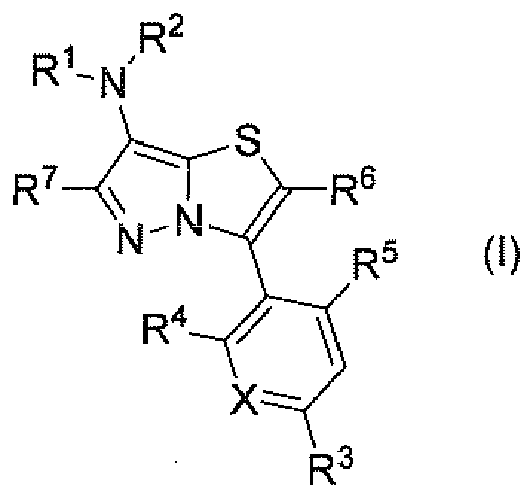
Description
- The present invention relates to novel compounds having corticotropin-releasing factor (hereinafter, referred to as "CRF") receptor antagonistic activity, and pharmacologically acceptable salts thereof and to medical use of the same.
- CRF is a neuropeptide that consists of 41 amino acids and is produced and secreted in the hypothalamus and promotes release of adrenocorticotropic hormone (ACTH) under stress, and it also functions in the brain as a neurotransmitter or a neuromodulator, integrating electrophysiology, autonomic nerves, behavior, and the like, in response to stress.
- There are two subtypes in CRF receptors, CRF1 receptor and CRF2 receptor, and CRF1 receptor has been reported to be widely distributed in the cerebral cortex, cerebellum, olfactory bulb, pituitary gland, amygdaloid nucleus, and the like.
Furthermore, many low molecular compounds having CRF receptor antagonism have been noted as potential therapeutic agents for a variety of diseases including depression, anxiety, stress-related disorders, and the like (see Non-patent Document 1). - Disclosed compounds having CRF receptor antagonism include compounds having a 2,6-dimethoxy-4-methoxymethylphenyl group (see Patent Document 1), but compounds having a pyrazolo[5,1-b]thiazole skeleton according to the invention of the present application have been neither disclosed nor suggested.
- As a compound having a pyrazolo[5,1-b]thiazole skeleton, the compound shown below has been disclosed but its use is for colorimetry (see Example 16 of Patent Document 2).

- Patent Document 3 (international filing date: October 22, 2009) discloses the following compounds which have a pyrazolo[5,1-b]thiazole skeleton and have CRF receptor antagonism.

Patent Document 3 was published after the filing date of the earliest priority applications (Japanese patent application No.2009-233989 U.S. provisional application No. 61/249817; both were filed on October 8, 2009 -
- [Patent document 1]
U.S. Patent Application Publication No. 2004/0224974 - [Patent document 2]
U.S. Patent No. 5,234,818 - [Patent document 3]
WO 2009/128383 - [Non-patent document 1] Drugs of the Future, 24:1089-1098 (1999)
- No 3-phenylpyrazolo[5,1-b]thiazole compounds having superior CRF receptor antagonism are known. Furthermore, although compounds having CRF receptor antagonism have been reported, they have not necessarily been sufficient in terms of having superior CRF receptor antagonism, and in terms of having sufficient pharmacological activity, safety and pharmacokinetic properties as medicines.
- In view of the above-mentioned current circumstances, the present inventors have intensively studied and, as a result, have discovered novel compounds that are excellent CRF receptor antagonists with sufficient pharmacological activity, safety, and pharmacokinetics, and are useful as prophylactic agents or therapeutic agents for diseases such as depression, anxiety, and irritable bowel syndrome.
-
- <1> A compound represented by the formula (I) or pharmacologically acceptable salt thereof:

R1 is -A1-A12;
A11 is a single bond or a C1-6 alkylene group;
A12 is (a) a hydrogen atom, (b) a C1-6 alkyl group optionally having 1 to 3 substituents selected from Substituent group A, or (c) a C3-6 cycloalkyl group optionally having 1 to 3 substituents selected from Substituent group A;
R2 is-A21-A222;
A21 is a single bond or a C1-6 alkylene group;
A22 is (a) a hydrogen atom, (b) a C1-6 alkyl group optionally having 1 to 3 substituents selected from Substituent group A, (c) a C3-6 cycloalkyl group optionally having 1 to 3 substituents selected from Substituent group A; (d) a non-aromatic heterocyclic group selected from a tetrahydropyranyl group, a dihydropyranyl group, a tetrahydrofuryl group, a dioxanyl group, a hexahydrooxepinyl group, an oxabicyclo[3.1.0]hexyl group, a tetrahydrothienyl group, a dithianyl group, and a hexahydrothiepinyl group, which optionally has 1 to 3 substituents selected from Substituent group A, or (e) a heteroaryl group selected from a pyridyl group, a pyrimidinyl group, and a thiazolyl group;
R3 is (a) a C1-6 alkyl group optionally having 1 to 3 substituents selected from Substituent group A, (b) a C3-6 cycloalkyl group, (c) a C1-6 alkoxy group optionally having 1 to 3 substituents selected from Substituent group A, (d) a C3-6 cycloalkoxy C1-6 alkyl group, (e) di-C1-6 alkyl amino group, (f) a halogen atom, (g) a cyano group, (h) a formyl group, or (i) a carboxyl group;
R4 is a hydrogen atom or a C1-6 alkoxy group;
R5 is a halogen atom, a C1-6 alkyl group, or a C1-6 alkoxy group;
R6 is a hydrogen atom, a C1-6 alkyl group, a C1-6 alkoxy group, a C1-6 alkylthio group; or a C1-6 alkyl sulfinyl group; and
R7 is a C1-6 alkyl group, a C1-6 alkoxy group, or a C1-6 alkylthio group;
with the proviso that R3 is (a) a C1-6 alkyl group optionally substituted with a hydroxyl group, (b) a C3-6 cycloalkyl group, (c) a C2-6 alkoxy group optionally having 1 to 3 substituents selected from Substituent group A, (d) a C3-6 alkoxy C1-6 alkyl group, (e) a C1-2 alkoxy C2-6 alkyl group, (f) a di-C1-6 alkyl amino group, (g) a halogen atom, (h) a formyl group or (i) a carboxyl group when X is CH, A12 is a C1-6 alkyl group, or a C3-6 cycloalkyl group optionally having a methyl group, R2 is a tetrahydrofurylmethyl group, a tetrahydropyranylmethyl group, or a tetrahydropyranyl group, R6 is a hydrogen atom, and R7 is a methoxy group; and
wherein the Substituent group A consists of a halogen atom, a hydroxyl group, a C1-6 alkyl group and a C1-6 alkoxy group. - <2> The compound or pharmacologically acceptable salt thereof according to <1>, wherein
X is a nitrogen atom or CH;
A11 is a single bond, a methylene group or a 1,2-ethylene group;
A12 is (a) a hydrogen atom, (b) a C1-6 alkyl group optionally having 1 to 3 substituents selected from Substituent group A, or (c) a C3-6 cycloalkyl group optionally having 1 to 3 substituents selected from Substituent group A;
A21 is a single bond, a methylene group, or a 1,2-ethylene group;
A22 represents (a) a hydrogen atom, (b) a C1-6 alkyl group optionally having 1 to 3 substituents selected from Substituent group A, (c) a C3-6 cycloalkyl group optionally having 1 to 3 substituents selected from Substituent group A; (d) a tetrahydropyranyl group optionally having 1 to 3 substituents selected from Substituent group A; (e) a dihydropyranyl group, (f) a tetrahydrofuryl group, (g) a dioxanyl group, (h) a hexahydrooxepinyl group, (i) an oxabicyclo[3.1.0]hexyl group, or (j) a pyridyl group;
R3 is (a) a methyl group, (b) an ethyl group, (c) a cyclopropyl group, (d) a C1-6 alkoxy group optionally substituted with 1 to 3 halogen atoms, (e) a C1-6 alkoxy methyl group, (f) a cyclobutoxymethyl group, (g) a dimethylamino group, (h) a halogen atom, (i) a cyano group, (j) hydroxymethyl group, (k) a formyl group, or (1) a carboxyl group;
R4 is a hydrogen atom or a methoxy group;
R5 is a halogen atom, a methyl group or a methoxy group;
R6 is a hydrogen atom, a methyl group or an ethyl group; and
R7 is a methoxy group. - <3> The compound or pharmacologically acceptable salt thereof according to <2>, wherein
X is CH;
R3 is (a) a methyl group, (b) an ethyl group, (c) a cyclopropyl group, (d) a C1-6 alkoxy group optionally substituted with 1 to 3 halogen atoms, (e) a C1-6 alkoxy methyl group, or (f) a cyclobutoxymethyl group. - <4> The compound or pharmacologically acceptable salt thereof according to <1>, wherein
X is CH;
R1 is a hydrogen atom, a C1-6 alkyl group, a C3-6 cycloalkyl group, or a C3-6 cycloalkyl methyl group;
R2 is a hydrogen atom, a C1-6 alkyl group, a tetrahydropyranyl group, a tetrahydropyranylmethyl group, or a tetrahydrofurylmethyl group;
R3 is a C1-6 alkoxy methyl group;
R4 is a methoxy group;
R5 is a methoxy group;
R6 is a hydrogen atom, a methyl group, a methylthio group, or a methylsulfinyl group; and
R7 is a methyl group, an ethyl group, an ethoxy group, or a methylthio group. - <5> The compound or pharmacologically acceptable salt thereof according to <4>, wherein R7 is a methyl group.
- <6> The compound or pharmacologically acceptable salt thereof according to <4>, wherein R7 is an ethoxy group.
- <7> A pharmaceutical composition comprising a compound or pharmacologically acceptable salt thereof according to <1> as an active ingredient.
- <8> The pharmaceutical composition according to <7>, which is a CRF1 receptor antagonist.
- <9> A therapeutic or prophylactic agent for depression, depressive symptoms, anxiety, irritable bowel syndrome, sleep disorder, insomnia, alcohol dependence, alcohol withdrawal symptoms, drug dependence, drug withdrawal symptoms, stress-related gastrointestinal dysfunction, anorexia nervosa, eating disorder, postoperative ileus, ischemic neuropathy, apoplexy, excitotoxic neuropathy, convulsion, epilepsy, hypertension, schizophrenia, bipolar disorder or dementia, comprising a compound or pharmacologically acceptable salt thereof according to <1> as an active ingredient.
- <10> A therapeutic or prophylactic agent for depression, depressive symptoms, anxiety, irritable bowel syndrome, sleep disorder, insomnia, alcohol dependence, alcohol withdrawal symptoms, drug dependence, drug withdrawal symptoms, stress-related gastrointestinal dysfunction, or dementia, comprising a compound or pharmacologically acceptable salt thereof according to <1> as an active ingredient.
- <11> A therapeutic or prophylactic agent for depression, depressive symptoms, anxiety, or irritable bowel syndrome, comprising a compound or pharmacologically acceptable salt thereof according to <1> as an active ingredient.
- <12> The compound or pharmacologically acceptable salt thereof according to <1>, wherein the compound is N-(cyclopropylmethyl)-3-[2,6-dimethoxy-4-(methoxymethyl)phenyl]-6-methyl-N-(tetrahydr o-2H-pyran-4-ylmethyl)pyrazolo[5,1-b][1,3]thiazole-7-amine:


N-butyl-3-[2,6-dimethoxy4-(methoxymethyl)phenyl]-6-(methylthio)-N--tetrahydro-2H-pyr an-4-yl)pyrazolo[5,1-b][1,3]thiazole-7-amine:
- <13> The compound or pharmacologically acceptable salt thereof according to <1>, wherein the compound is N-(cyclopropylmethyl)-3-[2,6-dimethoxy-4-(methoxymethyl)phenyl]-6-methyl-N-(tetrahydr o-2H-pyran-4-ylmethyl)pyrazolo[5,1-b][1,3]thiazole-7-amine:

- <14> The compound or pharmacologically acceptable salt thereof according to claim 1, wherein the compound is cyclopropylmethyl-[3-(2,6-dimethoxy-4-methoxymethyl-phenyl)-6-methoxy-pyrazolo[5,1-b ][1,3]thiazol-7-yl]-[1,3]dioxan-5-ylmethyl-amine:

- <15> The compound or pharmacologically acceptable salt thereof according to claim 1, wherein the compound is N-butyl-3-[2,6-dimethoxy-4-(methoxymethyl)phenyl]-6-(methylthio)-N-(tetrahydro-2H-pyr an-4-yl)pyrazolo[5,1-b][1,3]thiazole-7-amine:

- <16> A method for treating or preventing depression, depressive symptoms, anxiety, irritable bowel syndrome, sleep disorder, insomnia, alcohol dependence, alcohol withdrawal symptoms, drug dependence, drug withdrawal symptoms, stress-related gastrointestinal dysfunction, anorexia nervosa, eating disorder, postoperative ileus, ischemic neuropathy, apoplexy, excitotoxic neuropathy, convulsion, epilepsy, hypertension, schizophrenia, bipolar disorder or dementia, comprising administering a compound or pharmacologically acceptable salt thereof according to <1> to a patient.
- <17> Use of a compound or pharmacologically acceptable salt thereof according to <1> for the manufacture of a therapeutic or prophylactic agent for depression, depressive symptoms, anxiety, irritable bowel syndrome, sleep disorder, insomnia, alcohol dependence, alcohol withdrawal symptoms, drug dependence, drug withdrawal symptoms, stress-related gastrointestinal dysfunction, anorexia nervosa, eating disorder, postoperative ileus, ischemic neuropathy, apoplexy, excitotoxic neuropathy, convulsion, epilepsy, hypertension, schizophrenia, bipolar disorder or dementia.
- <18> A compound or pharmacologically acceptable salt thereof according to <1> for treating or preventing depression, depressive symptoms, anxiety, irritable bowel syndrome, sleep disorder, insomnia, alcohol dependence, alcohol withdrawal symptoms, drug dependence, drug withdrawal symptoms, stress-related gastrointestinal dysfunction, anorexia nervosa, eating disorder, postoperative ileus, ischemic neuropathy, apoplexy, excitotoxic neuropathy, convulsion, epilepsy, hypertension, schizophrenia, bipolar disorder or dementia.
- <19> Use of a compound or pharmacologically acceptable salt thereof according to <1> for treating or preventing depression, depressive symptoms, anxiety, irritable bowel syndrome, sleep disorder, insomnia, alcohol dependence, alcohol withdrawal symptoms, drug dependence, drug withdrawal symptoms, stress-related gastrointestinal dysfunction, anorexia nervosa, eating disorder, postoperative ileus, ischemic neuropathy, apoplexy, excitotoxic neuropathy, convulsion, epilepsy, hypertension, schizophrenia, bipolar disorder or dementia.
- CRF receptor antagonists have been reported to be effective for a variety of diseases as mentioned below.
- (1) Depression, Depressive Symptoms, Anxiety
CRF1 receptor antagonist R121919 is effective for ameliorating depression, depressive symptoms, anxiety, and the like (Journal of Psychiatric Research, 34:171-181 (2000)).
CRF1 receptor antagonist R121919 exhibits an anti-anxiety action in rats (European Journal of Neuroscience, 13:373-380 (2001)).
CRF1 receptor antagonist CP-154526 exhibits anti-depressant and anti-anxiety actions in rats. (European Journal of Pharmacology, 492:195-201 (2004)). - (2) Irritable Bowel Syndrome (IBS)
CRF1 receptor antagonist α-helical CRF (9-41) inhibits colon intestinal hyperkinesis in IBS patients and reduces abdominal pain and anxiety (Gut 2004; 53:958-964). - (3) Sleep Disorder, Insomnia
CRF1 receptor antagonist R121919 inhibits stress-related sleep disorder particularly in high-anxiety rats (Journal of Psychiatric Research, 36:197-208 (2002)). - (4) Alcohol Dependence, Alcohol Withdrawal Symptoms, Drug Dependence, Drug Withdrawal Symptoms
CRF1 receptor antagonist CP-154526 inhibits recurrence of stress-elicited alcohol-seeking behavior in rats (Psychopharmacology, 150:317-324 (2000)).
CRF1 receptor antagonist α-helical CRF (9-41) inhibits anxiety behavior in ethanol withdrawal rats (Brain Research, 605:25-32 (1993)).
CRF1 receptor antagonist CP-154526 inhibits recurrence of stress-elicited drug (heroin, cocaine)-seeking behavior in rats (Psychopharmacology, 137:184-190 (1998)).
Pretreatment of CRF1 receptor antagonist CP-154526 inhibits naltrexone-induced morphine withdrawal symptoms (Journal of Neurochemistry, 74: 199-208 (2000)). - (5) Stress-Related Gastrointestinal Dysfunction
CRF1 receptor antagonist NBI-27914 inhibits water avoidance stress-related rat catharsis (Brain Research, 893:29-35 (2001)). - (6) Anorexia Nervosa, Eating Disorder
CRF1 receptor antagonists α-helical CRF (9-41) and CRA1000 inhibit stress-related reduction in food intake (Brain Research, 823: 221-225 (1999)). - (7) Postoperative Ileus
CRF1 receptor antagonist CP-154526 recovers gastric emptying retardation after surgery (Gastroenterology, 125:654-659 (2003)). - (8) Dementia, Senile Dementia of Alzheimer type, Multi-infarct Dementia, Senile Dementia
CRF1 receptor antagonist CP-154526 inhibits learning disability following acute stress (Behavioural Brain Research, 138: 207-213 (2003)).
CRF1 receptor antagonist α-helical CRF (9-41) suppresses stress-related increase in intracerebral amyloid-β (Proceedings of the National Academy of Sciences of the United States of America, 104: 10673-10678 (2007)).
CRF1 receptor antagonist NBI27914 inhibits increased levels of Aβ and Aβ plaque deposition induced by stress in Tg2576 transgenic mice (Journal of Neurochemistry, 108: 165-175 (2009)).
CRF1 receptor antagonist antalarmin inhibits stress-induced hippocampal tau phosphorylation (Journal of Neuroscience, 27 (24): 6552-6562 (2007)). - (9) Ischemic Neuropathy, Apoplexy
CRF1 receptor antagonist α-helical CRF (9-41) inhibits ischemic and excitotoxic encephalopathy (Brain Research, 656: 405-408 (1994)). - (10) Excitotoxic Neuropathy
CRF1 receptor antagonist Asressin inhibits kainic acid-induced excitotoxic neuropathy (Brain Research, 744: 166-170 (1997)). - (11) Convulsion, Epilepsy
CRF1 receptor antagonist NBI27914 inhibits limbic system seizure (convulsion and epilepsy induced by CRF administration) (Brain Research, 770:89-95 (1997)). - (12) Hypertension
CRF1 receptor antagonist antalarmin inhibits hypertension induced by intraventricular administration of CRF (Brain Research, 881: 204-207 (2000)). - The compounds or pharmacologically acceptable salts thereof according to the present invention have excellent CRF receptor antagonism, as shown in the activity data in the Pharmacological Test Examples described below. Thus, based on the above-mentioned documents demonstrating a nexus between CRF receptor antagonism and effects of treating or preventing diseases, the compounds or pharmacologically acceptable salts thereof according to the present invention are useful for treatment or prevention of diseases associated with CRF and/or CRF receptors, and are particularly useful as therapeutic agents or prophylactic agents for depression, depressive symptoms, anxiety, irritable bowel syndrome, sleep disorder, insomnia, alcohol dependence, alcohol withdrawal symptoms, drug dependence, drug withdrawal symptoms, stress-related gastrointestinal dysfunction, anorexia nervosa, eating disorder, postoperative ileus, ischemic neuropathy, apoplexy, excitotoxic neuropathy, convulsion, epilepsy, hypertension, schizophrenia, bipolar disorder or dementia, etc.
- Hereinafter, the present invention is described in detail.
- In the present specification, the structural formulae for compounds will show a certain isomer for convenience, but the present invention includes all isomers such as geometric isomers, optical isomers, stereoisomers, and tautomers generated by the compound structures, as well as their isomer mixtures, and the compounds may not be limited to the formulae that are shown for convenience and may be any of the isomers or mixtures including isomers in any arbitrary proportions. Thus, for example, the compounds of the present invention may exist as optically active substances or racemic mixtures, but they are not limited to any of them, they may be racemic mixtures or optically active substances, and they may also be mixtures with the optically active substances in any arbitrary ratio.
- The present invention may include polymorphic crystals, but similarly include single substances of any crystal forms or a mixture thereof without any restrictions, as well as it may include amorphous forms, and the compounds of the present invention also include both anhydrate and solvate (especially, hydrate). The present invention further encompasses metabolites of compound (I) according to the present invention that are produced by metabolism (oxidation, reduction, hydrolysis, conjugation, and the like) in the living body. The present invention still further encompasses compounds that produce the compound (I) according to the present invention by metabolism (oxidation, reduction, hydrolysis, conjugation, and the like) in the living body (so-called prodrugs).
- Hereinafter, the meanings of the terms and symbols used throughout the present specification are described, and the present invention is described in detail.
- The term "halogen atom" used in the present specification means a fluorine atom, a chlorine atom, a bromine atom or an iodine atom. Preferable example of the "halogen atom" can include a fluorine atom, and a chlorine atom.
- The term "C1-6 alkyl group" used in the present specification means C1-6 straight- or branched-chain alkyl groups, and the specific examples thereof may include a methyl group, an ethyl group, a 1-propyl group (a n-propyl group), a 2-propyl group (an i-propyl group), a 2-methyl-1-propyl group (an i-butyl group), a 2-methyl-2-propyl group (a tert-butyl group), a 1-butyl group (an n-butyl group), a 2-butyl group (an s-butyl group), a 1-pentyl group, a 2-pentyl group, a 3-pentyl group, a 2-methyl-1-butyl group, a 3-methyl-1-butyl group, a 2-methyl-2-butyl group, a 3-methyl-2-butyl group, a 2,2-dimethyl-1-propyl group, a 1-hexyl group, a 2-hexyl group, a 3-hexyl group, a 2-methyl-1-pentyl group, a 3-methyl-1-pentyl group, a 4-methyl-1-pentyl group, a 2-methyl-2-pentyl group, a 3-methyl-2-pentyl group, a 4-methyl-2-pentyl group, a 2-methyl-3-pentyl group, a 3-methyl-3-pentyl group, a 2,3-dimethyl-1-butyl group, a 3,3-dimethyl-1-butyl group, a 2,2-dimethyl-1-butyl group, a 2-ethyl-1-butyl group, a 3,3-dimethyl-2-butyl group, a 2,3-dimethyl-2-butyl group, and the like.
- The term "C1-6 alkoxy group" used in the present specification means an oxygen atom to which the above-defined "C1-6 alkyl group" is bonded, and specific examples thereof may include a methoxy group, an ethoxy group, a 2-propyloxy group, a 1-pentyloxy group, a 1-hexyloxy group, and the like.
- The term "C1-6 alkylthio group" used in the present specification means a sulfur atom to which the above-defined "C1-6 alkyl group" is bonded, and specific examples thereof may include a methylthio group, an ethylthio group, a 2-propylthio group, a 1-pentylthio group, a 1-hexylthio group, and the like.
- The term "C1-6 alkyl sulfinyl group" used in the present specification means a sulfinyl group to which the above-defined "C1-6 alkyl group" is bonded, and specific examples thereof may include a methylsulfinyl group, an ethylsulfinyl group, a 2-propylsulfinyl group, a 1-pentylsulfinyl group, a 1-hexylsulfinyl group, and the like.
- The term "C1-6 alkylene group" means a divalent group derived by further removing any one hydrogen atom from the above-defined "C1-6 alkyl group," and specific examples thereof may include a methylene group, an ethylene group, a methylethylene group, a propylene group, an ethylethylene group, a 1,1-dimethylethylene group, a trimethylene group, a pentamethylene group, a hexamethylene group, and the like.
- The term "C1-6 alkoxy C1-6 alkyl group" used in the present specification means the above-defined "C1-6 alkyl group" to which the above-defined "C1-6 alkoxy group" is bonded, and specific examples thereof may include a methoxy methyl group, an ethoxymethyl group, a 2-methoxyethyl group, a (2-propyloxy)methyl group, a 6-hexyloxyhexyl group, and the like.
- The term "C3-6 cycloalkyl group" used in the present specification means a monocyclic saturated aliphatic hydrocarbon group having 3 to 6 carbon atoms, and specific examples thereof may include a cyclopropyl group, a cyclobutyl group, a cyclopentyl group, and a cyclohexyl group.
- The term "C3-6 cycloalkyl C1-6 alkyl group," used in the present specification means the above-defined "C1-6 alkyl group" to which the above-defined "C3-6 cycloalkyl group" is bonded, and specific examples thereof may include a cyclopropylmethyl group, a cyclobutylmethyl group, a 2-cyclopropylethyl group, and the like.
- The term "C3-6 cycloalkoxy group" used in the present specification means an oxygen atom to which the above-defined "C3-6 cycloalkyl group" is bonded, and specific examples thereof may include a cyclopropyloxy group, a cyclobutyloxy group, a cyclopentyloxy group, a cyclohexyloxy group, and the like.
- The term "C3-6 cycloalkoxy C1-6 alkyl group" used in the present specification means the above-defined "C1-6 alkyl group" to which the above-defined "C3-6 cycloalkoxy group" is bonded, and specific examples thereof may include a cyclopropyloxymethyl group, a cyclobutyloxymethyl group, 1-(cyclopropyloxy)ethyl group, a cyclohexyloxymethyl group, and the like.
- Specific examples of a "tetrahydropyranyl group" used in the present specification may include a tetrahydropyran-4-yl group and a tetrahydropyran-3-yl group, and a preferable example is a tetrahydropyran-4-yl group.
- Specific examples of a "tetrahydropyranylmethyl group" used in the present specification may include a (tetrahydropyran-4-yl)methyl group, a (tetrahydropyran-3-yl)methyl group, a (tetrahydropyran-2-yl)methyl group, and a preferable example is a (tetrahydropyran-4-yl)methyl group.
- Specific examples of a "tetrahydrofuryl group" used in the present specification may include a tetrahydrofuran-3-yl group, and a tetrahydrofuran-2-yl group, and a preferable example is a tetrahydrofuran-3-yl group.
- Specific examples of a "tetrahydrofurylmethyl group" used in the present specification may include a (tetrahydrofuran-3-yl)methyl group and a (tetrahydrofuran-2-yl)methyl group, and a preferable example is a (tetrahydrofuran-3-yl)methyl group.
- The term "anxiety" used in the present specification means not only anxiety in the strict sense, but also to conditions within the general concept of anxiety, such as generalized anxiety disorder, panic disorder, phobia, obsessive compulsive disorder and post-traumatic stress disorder, as well as diseases closely related to anxiety.
- The term "dementia" used in the present specification means not only dementia in the strict sense, but also conditions within the general concept of dementia, such as Alzheimer-type senile dementia, multi-infarct dementia and senile dementia, as well as diseases closely related to dementia.
- A "pharmacologically acceptable salt" used in the present specification is not particularly limited as long as it is formed with the compound of the present invention, and as specific examples thereof may include inorganic acid salts, organic acid salts, and acidic amino acid salts.
- A "pharmacologically acceptable salt" used in the present specification, unless otherwise specified, may form a salt with an appropriate ratio, and the number of the acid molecule to one molecule of the compound is not particularly limited in the formed salt, but preferably about 0.1 to about 5 molecules of the acid exists with respect to one molecule of the compound, more preferably approximately 0.5 to approximately 2 molecules of the acid exists with respect to one molecule of the compound, and further preferably about 0.5, about 1 or about 2 molecules of the acid exists with respect to one molecule of the compound.
- Preferable examples of inorganic acid salts may include hydrochloride, hydrobromide, sulfate, nitrate, phosphate and the like; preferable examples of organic acid salts may include acetate, succinate, fumarate, maleate, tartrate, citrate, lactate, stearate, benzoate, methanesulfonate, p-toluenesulfonate and the like.
- Preferable examples of acidic amino acid salts may include aspartate, glutamate and the like.
- Hereinafter, General Production Processes of compounds according to the present application are shown, but they are not intended to be limited to these processes. Furthermore, the raw material compounds and reagents used in the general production processes for compounds of the present invention may also form salts or solvates (especially hydrates).
- The compounds represented by the formula (I) of the present invention can be produced by the following production methods.
-

- This is a step of reacting a compound represented by the formula a-1 (hereinafter, also referred to as Compound a-1) and Compound a-2 in a solvent in the presence or in the absence of a base and in the presence of a palladium catalyst to yield Compound a-3.
- This step can be carried out according to the reaction conditions, operations after reaction, and purification method described in, for example, the below-mentioned Example 1.
Compound a-1 can be obtained according to the below-mentioned Production Method B, C and the like.
Compound a-2 can be prepared according to Production Method 10 and Production Method 11 described inWO2004/037822 .
The reaction may be carried out in a stream or in an atmosphere of an inert gas such as nitrogen or argon. - The solvent to be used in the reaction is not particularly limited as long as it dissolves the starting materials to some extent and does not inhibit the reaction, but examples of the solvents include alcohol solvents such as methanol and ethanol, ether solvents such as tetrahydrofuran, 1,2-dimethoxyethane, methyl-tert-butyl ether, cyclopentyl methyl ether, diethyl ether, diisopropyl ether, dibutyl ether, dicyclopentyl ether, and 1,2-dimethoxyethane, aromatic hydrocarbon solvents such as benzene, toluene, xylene and mesitylene, amide solvents such as N,N-dimethylformamide, aliphatic hydrocarbon solvents such as heptane and hexane, water, or mixture solvents thereof, and preferable solvents are alcohol solvents, aromatic hydrocarbon solvents, water or mixtures thereof, and more preferable solvents are a mixed solvent of ethanol and toluene, or a mixture solvent of 1,2-dimethoxymethane and water.
- The base is not particularly limited and differs depending on the starting material and solvent to be used, and examples thereof may include inorganic bases such as lithium hydroxide, sodium hydroxide, potassium hydroxide, lithium carbonate, sodium carbonate, potassium carbonate, sodium hydrogencarbonate, potassium hydrogencarbonate, cesium carbonate, cesium fluoride and potassium fluoride, organic bases such as imidazole, pyridine, triethylamine and N,N-diisopropylethylamine, and preferable base is sodium carbonate.
- The palladium catalyst is not particularly limited as long as it does not inhibit the reaction, and differs depending on the starting material and solvent used, but preferable examples thereof may include tetrakis(triphenylphosphine)palladium(0), palladium(II) acetate/triphenylphosphine, palladium(II) acetate/2-dicyclohexylphosphino-2',4',6'-triisopropylbiphenyl, palladium(II) chloride, tris(dibenzylideneacetone)dipalladium(0)/tri-tert-butylphosphine and dichloro[1,1'-bis(diphenylphosphine)-ferrocene]pallaclium(0).
- The reaction temperature generally differs depending on the starting material, solvent, and other reagents to be used in the reaction, but it is preferably between 0°C and the reflux temperature of the solvent (the internal temperature of the reactor), and more preferably 60°C to 100°C.
- The reaction time also generally differs depending on the starting material, solvent, and other reagents to be used in the reaction, and on the reaction temperature, but it is preferably 1-48 hours and more preferably 1-6 hours at the above-mentioned temperature after addition of the reagent
- Compound a-2 may be used at 1 to 5 molar equivalents and preferably 1 to 3 molar equivalents with respect to Compound a-1.
- The base can be used at 1 to 10 molar equivalents and preferably 2 to 5 molar equivalents with respect to Compound a-1.
- The palladium catalyst may be used at 0.05 to 1 molar equivalents and preferably 0.05 to 0.1 molar equivalents with respect to Compound a-1.
- This is a step of reacting Compound a-3 and Compound a-4 in a solvent in the presence of a base to yield Compound a-5.
The reaction may be carried out in a stream or in an atmosphere of an inert gas such as nitrogen and argon. - The solvent to be used in the reaction is not particularly limited as long as it dissolves the starting materials to some degree and does not inhibit the reaction, but examples of the solvent may include nitrile solvents such as acetonitrile, ether solvents such as tetrahydrofuran, 1,2-dimethoxyethane, methyl-tert-butyl ether, cyclopentyl methyl ether, diethyl ether, diisopropyl ether, dibutyl ether and dicyclopentyl ether, aromatic hydrocarbon solvents such as benzene and toluene, amide solvents such as N,N-dimethylformamide, sulfoxide solvents such as dimethyl sulfoxide, aliphatic hydrocarbon solvents such as heptane and hexane, or mixture solvents thereof, among which N,N-dimethylformamide and dimethyl sulfoxide are preferred.
- The base used is not particularly limited and differs depending on the starting material and solvent to be used, but examples of the base may include inorganic bases such as lithium hydroxide, sodium hydroxide, potassium hydroxide, lithium carbonate, sodium carbonate, potassium carbonate, sodium hydrogencarbonate, potassium hydrogencarbonate, cesium carbonate, potassium-tert-butoxide, organometallic bases such as butyllithium, methyllithium, lithium bis(trimethylsilyl)amide, sodium bis(trimethylsilyl)amide, and potassium bis(trimethylsilyl)amide, metal hydride bases such as lithium hydride, sodium hydride and potassium hydride, organic bases such as imidazole, pyridine, 4-dimethylaminopyridine, triethylamine, and N,N-diisopropylethylamine, and preferable base is sodium hydride. The base can be used at 1 to 3 molar equivalents and preferably 1 to 2 molar equivalents with respect to Compound a-3.
- The reaction temperature generally differs depending on the starting material, solvent, and other reagents to be used in the reaction, but it is preferably between 0°C and the reflux temperature of the solvent (the internal temperature of the reactor), and more preferably room temperature.
- The reaction time generally differs depending on the starting material, solvent, and other reagents to be used in the reaction, and on the reaction temperature, but it is preferably 1-48 hours and more preferably 1-6 hours at the above-mentioned temperature after addition of the reagent.
- Compound a-4 may be used at 1 to 5 molar equivalents and preferably 1 to 2 molar equivalents with respect to Compound a-3.
- This is a step of deprotecting the protecting group of an amino group of Compound a-5 to yield Compound a-6. The deprotection reaction of the protecting group of the amino group differs depending on the type of the protecting group and is not particularly limited, but the deprotection reaction can be carried out under acidic conditions if the protecting group is, for example, a carbamate protecting group such as a tert-butoxycarbonyl group.
- In the reaction, a solvent may be used or may not be used, and the solvent is not particularly limited as long as it dissolves the starting materials to some degree and does not inhibit the reaction, and examples of the solvent may include alcohol solvents such as methanol and ethanol, ether solvents such as tetrahydrofuran, 1,2-dimethoxyethane, methyl-tert-buiyl ether, cyclopentyl methyl ether, diethyl ether, diisopropyl ether, dibutyl ether, and dicyclopentyl ether, halogenated hydrocarbon solvents such as dichloromethane and chloroform, acetic acid, and the like, and they can be used alone or as mixed solvents.
- Examples of acid may include trifluoroacetic acid, hydrochloric acid, sulfuric acid, and the like, among which trifluoroacetic acid is preferred. The acid can be used in a volume of 1 to 100 times with respect to Compound a-5.
- The reaction temperature generally differs depending on the starting material, solvent, and other reagents to be used in the reaction, but it is preferably between 0°C and the reflux temperature of the solvent (the internal temperature of the reactor), and more preferably room temperature.
- The reaction time generally differs depending on the starting material, solvent, and other reagents to be used in the reaction, and on the reaction temperature, but it is preferably 0.1-12 hours and more preferably 0.5-2 hours at the above-mentioned temperature after addition of the reagent.
- This is a step of carrying out reductive amination reaction of Compound a-6 and Compound a-7 or a-8 that is aldehyde or ketone corresponding to R2 in the presence of a reducing agent to yield a compound (I).
The reaction may be carried out in a stream or in an atmosphere of an inert gas such as nitrogen or argon. - The solvent to be used in the reaction is not particularly limited as long as it dissolves the starting materials to some extent and does not inhibit the reaction, and examples of the solvent include alcohol solvents such as methanol and ethanoL ether solvents such as tetrahydrofuran, 1,2-dimethoxyethane, methyl-tert-butyl ether, cyclopentyl methyl ether, diethyl ether, diisopropyl ether, dibutyl ether, and dicyclopentyl ether, and acetic acid, and the like, and these can be used alone or as mixed solvents.
The reducing agent is not limited in the reaction and may be those commonly used in reductive amination reactions between carbonyl compounds and amine compounds, and examples of the reducing agent include borane and borohydride complex compounds, and the preferable reducing agent is α-picolineborane or sodium triacetoxyborohydride. The reducing agent may be used at 0.5 to 3 molar equivalents and preferably 1 to 2 molar equivalents with respect to Compound a-6. - The reaction temperature generally differs depending on the starting material, solvent, and other reagents to be used in the reaction, but it is preferably between 0°C and the reflux temperature of the solvent (the internal temperature of the reactor), and more preferably room temperature.
- The reaction time generally differs depending on the starting material, solvent, and other reagents to be used in the reaction, and on the reaction temperature, but it is preferably 1 to 48 hours and more preferably 1 to 6 hours at the above-mentioned temperature after addition of the reagent.
- Compound a-7 or Compound a-8 may be used at 1 to 5 molar equivalents and preferably 1 to 2 molar equivalents with respect to Compound a-6.
-

- This is a step of reacting Compound b-1 and ethyl hydrazinoacetate monohydrochloride in a solvent in the presence of a base to yield Compound b-2.
The reaction may be carried out in a stream or in an atmosphere of an inert gas such as nitrogen or argon. - The solvent to be used in the reaction is not particularly limited as long as it dissolves the starting materials to some extent and does not inhibit the reaction, and examples include alcohol solvents such as methanol and ethanol, ether solvents such as tetrahydrofuran, 1,2-dimethoxyethane, methyl-tert-butyl ether, cyclopentyl methyl ether, diethyl ether, diisopropyl ether, dibutyl ether, dicyclopentyl ether, and 1,2-dimethoxyethane, aromatic hydrocarbon solvents such as benzene, toluene, xylene and mesitylene, amide solvents such as N,N-dimethylformamide, aliphatic hydrocarbon solvents such as heptane and hexane, and they are alone or as mixed solvents. Preferable solvents are the alcohol solvent or the aromatic hydrocarbon solvents or a mixed solvent thereof, and more preferable solvents are methanol or ethanol.
- The base is not particularly limited and differs depending on the starting material and solvent used, but examples include inorganic bases such as lithium carbonate, sodium carbonate, potassium carbonate, sodium hydrogencarbonate, potassium hydrogencarbonate, cesium carbonate, and potassium-tert-butoxide, organic bases such as imidazole, pyridine, 4-dimethylaminopyridine, triethylamine and N,N-diisopropylethylamine, among which triethylamine is preferred. The base can be used at 1 to 3 molar equivalents and preferably 1 to 1.5 molar equivalents with respect to Compound b-1.
- The reaction temperature generally differs depending on the starting material, solvent, and other reagents to be used in the reaction, but it is preferably between 0°C and the reflux temperature of the solvent (the internal temperature of the reactor), and more preferably 100°C.
- The reaction time generally differs depending on the starting material, solvent, and other reagents to be used in the reaction, and on the reaction temperature, but it is preferably 1-24 hours and more preferably 1-5 hours at the above-mentioned temperature after addition of the reagent.
- The ethyl hydrazinoacetate monohydrochloride can be used at 0.9 to 5 molar equivalents and preferably 0.9 to 1.1 molar equivalents with respect to Compound b-1.
- This is a step of reacting phosphorus oxychloride in a N,N-dimethylformamide solvent to yield Compound b-3 from Compound b-2.
The reaction may be carried out in a stream or in an atmosphere of an inert gas such as nitrogen or argon. - Phosphorus oxychloride may be used at 2 to 20 molar equivalents and preferably 5 to 10 molar equivalents with respect to Compound b-2.
- The reaction temperature generally differs depending on the starting material, and other reagents to be used in the reaction, but it is preferably between 0°C and 150°C (the internal temperature of the reactor), and more preferably 100°C to 120°C.
- The reaction time generally differs depending on the starting material, and other reagents to be used in the reaction, and on the reaction temperature, but it is preferably 1-24 hours and more preferably 3-5 hours at the above-mentioned temperature after addition of the reagent.
- This is a step of reacting Compound b-3, carbon disulfide and Compound b-4 in a solvent in the presence of a base to yield Compound b-5.
The reaction may be carried out in a stream or in an atmosphere of an inert gas such as nitrogen or argon. - The solvent to be used in the reaction is not particularly limited as long as it dissolves the starting materials to some extent and does not inhibit the reaction, and examples include ether solvents such as 1.2-dimethoxyethane, methyl-tert-butyl ether, cyclopentyl methyl ether, diethyl ether, diisopropyl ether, dibutyl ether, dicyclopentyl ether, and 1,2-dimethoxyethane, aromatic hydrocarbon solvents such as benzene, toluene, xylene and mesitylene, amide solvents such as N,N-dimethylformamide, sulfoxide solvents such as dimethyl sulfoxide, and aliphatic hydrocarbon solvents such as heptane and hexane. The preferable solvent is dimethyl sulfoxide.
- The base is not particularly limited and differs depending on the starting material and solvent to be used, but examples of the base may include inorganic bases such as lithium hydroxide, sodium hydroxide, potassium hydroxide, lithium carbonate, sodium carbonate, potassium carbonate, sodium hydrogencarbonate, potassium hydrogencarbonate, and cesium carbonate, metal alkoxide base such as potassium-tert-butoxide, and organic bases such as imidazole, pyridine, 4-dimethylminopyridine, triethylamine, N,N-diisopropylethylamine, and the like, among which potassium hydroxide is preferred. The base can be used at 2 to 5 molar equivalents and preferably 3 molar equivalents with respect to Compound b-3.
- The carbon disulfide can be used at 1 to 3 molar equivalents and preferably 1 to 2 molar equivalents with respect to Compound b-3.
- Examples of Compound b-4 include dimethylsulfuric acid, diethylsulfuric acid, C1-6 alkyl halide, and the like. Compound b-4 can be used at 1 to 3 times equivalents and preferably 1 to 2 equivalents with respect to Compound b-3.
- The reaction temperature generally differs depending on the starting material, solvent, and other reagents to be used in the reaction, but it is preferably between 0°C and the reflux temperature of the solvent (the internal temperature of the reactor), and more preferably room temperature.
- The reaction time generally differs depending on the starting material, solvent, and other reagents to be used in the reaction, and on the reaction temperature, but it is preferably 1-48 hours and more preferably 20-30 hours at the above-mentioned temperature after addition of the reagent.
- This is a step of reacting Compound b-5 and an oxidizing agent to yield carboxylic acid and subjecting the resultant carboxylic acid to a rearrangement reaction such as Curtius rearrangement reaction in the presence of a base to yield Compound b-6.
- The reaction may be carried out in a stream or in an atmosphere of an inert gas such as nitrogen or argon.
- The solvent to be used in the reaction is not particularly limited as long as it dissolves the starting materials to some extent and does not inhibit the reaction, and preferable examples of such solvents include acetone, dichloromethane, n-hexane, toluene, xylene, acetonitrile, water, and the like, which can be used alone or as a mixture.
- The oxidizing agent to be used is not particularly limited and differs depending on the starting material and reagents, but preferable examples thereof include potassium permanganate, silver oxide, activated manganese dioxide, pyridinium dichromate, sodium chlorite, and the like, which can be used alone or as a mixture. The oxidizing agent may be used at 1 to 3 molar equivalents and preferably 1 to 2 molar equivalents with respect to Compound b-5.
- The reaction temperature generally differs depending on the starting material, solvent, and other reagents to be used in the reaction, but it is preferably between -10°C and 200°C, and more preferably room temperature.
- The reaction time generally differs depending on the starting material, solvent, and other reagents to be used in the reaction, and on the reaction temperature, but it is preferably 0.5-48 hours and more preferably 0.5-1 hours at the above-mentioned temperature after addition of the reagent.
- The carboxylic acid obtained by the above-mentioned oxidization reaction and an azidating agent (for example, diphenylphosphoryl azide (DPPA)) are heated in or without a solvent and in the presence or in the absence of a base and are subjected to a reaction with, for example, tert-butanol via acid azide to yield Compound b-6 that is protected by, for example, a carbamate group such as a tert-butoxycarbonyl (BOC).
The reaction may be carried out in a stream or in an atmosphere of an inert gas such as nitrogen or argon. - The solvent to be used in the reaction is not particularly limited as long as it dissolves the starting materials to some extent and does not inhibit the reaction, but preferable examples of such a solvent include benzene, toluene, xylene, diphenyl ether, tert-butanol, tetrahydrofuran, dioxane, acetonitrile, N,N-dimethylformamide, and the like, which can be used alone or as a mixture.
- The base to be used is not particularly limited and differs depending on the starting material and reagent, but preferable examples thereof include triethylamine, N,N-diisopropylethylamine, 4-dimethylaminopyridine, pyridine, and the like, which can be used alone or as a mixture. The base can be used at 1 to 3 molar equivalents and preferably 1 to 2 molar equivalents with respect to Compound b-5.
- The reaction temperature generally differs depending on the starting material, solvent, and other reagents to be used in the reaction, but it is generally between -10°C and 250°C, and preferably 100°C and 200°C.
- The reaction time generally differs depending on the starting material, solvent, and other reagents to be used in the reaction, and on the reaction temperature, but it is preferably 1-24 hours and more preferably 1-10 hours at the above-mentioned temperature after addition of the reagent.
- As an alternative method, for synthesis of the acid azide, the carboxylic acid may be induced to acid chloride or mixed acid anhydride and then subjected to reaction with an azidating agent (for example, sodium azide, trimethylsilyl azide, and the like) to yield the acid azide. As yet another alternative method, Compound b-6 may be obtained by Hofmann rearrangement or Schmidt rearrangement reaction. In this case, it is desirable that the azidation agent is used at 1 to 3 molar equivalents, the base is used at 1 to 5 molar equivalents, and tert-butanol is used at 1 to 50 molar equivalents or as a solvent with respect to Compound b-5, respectively.
- This is a step of subjecting Compound b-6 to hydrolysis in the presence of a base so to yield Compound b-7.
The reaction may be carried out in a stream or in an atmosphere of an inert gas such as nitrogen or argon. - The solvent to be used in the reaction is not particularly limited as long as it dissolves the starting materials to some extent and does not inhibit the reaction, but preferable examples of such solvents include methanol, ethanol, n-butanol, tert-butanol, tetrahydrofuran, dioxane, water, and the like, which can be used alone or as a mixture.
- The base is not particularly limited and differs depending on the starting material and solvent to be used, and examples thereof include lithium hydroxide, sodium hydroxide, potassium hydroxide, lithium carbonate, sodium carbonate, potassium carbonate, sodium hydrogencarbonate, potassium hydrogencarbonate, cesium carbonate, potassium-tert-butoxide, and the like. The base can be used at 1 to 10 molar equivalents with respect to Compound b-6.
- The reaction temperature generally differs depending on the starting material, solvent, and other reagents to be used in the reaction, but it is preferably between 0°C and the reflux temperature of the solvent (the internal temperature of the reactor), and more preferably room temperature.
- The reaction time generally differs depending on the starting material, solvent, and other reagents to be used in the reaction, and on the reaction temperature, but it is preferably 1-24 hours and more preferably 1-3 hours at the above-mentioned temperature after addition of the reagent
- This is a step of reacting Compound b-7 with silver nitrate in water as a solvent in the presence of a base to yield a silver salt of carboxylic acid, and bromine is allowed to act thereon in carbon tetrachloride, thus yielding Compound b-8 (Hunsdiecker reaction).
The reaction may be carried out in a stream or in an atmosphere of an inert gas such as nitrogen or argon. - The base is not particularly limited and differs depending on the starting material and solvent to be used, but preferable examples of the base include lithium hydroxide, sodium hydroxide, potassium hydroxide, and the like. The base can be used at 1 to 2 molar equivalents with respect to Compound b-7.
- The reaction temperature generally differs depending on the starting material, and other reagents to be used in the reaction, but it is preferably between 0°C and the reflux temperature of the solvent (the internal temperature of the reactor).
- The reaction time generally differs depending on the starting material, and other reagents to be used in the reaction, and on the reaction temperature, but it is preferably 1-12 hours at the above-mentioned temperature after addition of the reagent
- This step corresponds to step A-2 to step A-4 of Production Method A, and it can be carried out in the same conditions as those in the steps.
- This is a step of oxidizing Compound b-9 in a solvent with an oxidizing agent such as m-chloroperbenzoic acid to yield Compound b-10.
The reaction may be carried out in a stream or in an atmosphere of an inert gas such as nitrogen or argon.
Preferable examples of the solvent to be used include dichloromethane, benzene, toluene, and the like. - The oxidizing agent is not particularly limited and differs depending on the starting material and solvent to be used, and examples thereof include m-chloroperbenzoic acid, trifluoroperacetic acid, sodium periodate, dinitrogen tetraoxide, mixed acid of nitric acid-sulfuric acid, chromic acid, and the like. In this case, the oxidizing agent is desirably used at 1 to 2 molar equivalents with respect to Compound b-9.
- The reaction temperature generally differs depending on the starting material, solvent, and other reagents to be used in the reaction, but it is preferably between 0°C and the reflux temperature of the solvent (the internal temperature of the reactor).
- The reaction time generally differs depending on the starting material, solvent, and other reagents to be used in the reaction, and on the reaction temperature, but it is preferably 10 minutes to 1 hour after addition of the reagent.
-

- This is a step of reacting Compound c-1 and an N-amination agent (for example, hydroxylamine-O-sulfonic acid, O-mesitylenesulfonyl hydroxylamine) at 0°C to 40°C in a solvent, and isolating the resultant N-aminothiazolium salt by filtration and the like, and reacting it in acetic anhydride in the presence of sodium acetate at 0°C to 250°C, thus yielding Compound c-2.
The reaction may be carried out in a stream or in an atmosphere of an inert gas such as nitrogen or argon. - The N-aminatian agent is not particularly limited and differs depending on the starting material and solvent to be used, but examples of the N-amination agent may include hydroxylamine-O-sulfonic acid, O-mesitylenesulfonyl hydroxylamine. In this case, the N-aminatian agent is preferably used at 1 to 2 molar equivalents with respect to Compound c-1.
- The solvent to be used in the N-amination reaction is not particularly limited as long as it dissolves the starting materials to some extent and does not inhibit the reaction, but preferable examples thereof may include toluene, xylene, anisole, 1,2-dimethoxyethane, tetrahydrofuran, dioxane, dichloromethane, and the like, which can be used alone or as a mixture.
- The reaction time generally differs depending on the starting material, solvent, and other reagents to be used in the reaction, and on the reaction temperature, but it is preferably 1 to 24 hours at the above-mentioned temperature after addition of the reagent
- The reaction with acetic anhydride is generally carried out in 5 to 20 times volume of acetic anhydride in the presence of 1 to 5 molar equivalents of sodium acetate with respect to Compound c-1 for 1 to 24 hours at the above-mentioned temperature.
- This is a step of reacting Compound c-2 with a nitrosating agent in the presence of an acid to yield Compound c-3.
- The solvent is not particularly limited as long as it dissolves the starting materials to some extent and does not inhibit the reaction, but preferable examples may include water, acetic acid, and the like, which may be used alone or as a mixture.
- The nitrosating agent is not particularly limited and differs depending on the starting material, solvent to be used, and the like, but preferable examples thereof include sodium nitrite, and the like. In this case, it is preferable that the nitrosating agent is used at 2 to 3 molar equivalents with respect to Compound c-2.
- The acid to be used is not particularly limited and differs depending on the starting material, solvent to be used, and the like, but preferable examples thereof include acetic acid, hydrochloric acid, sulfuric acid, and the like. The nitrosating agent can be used at 1 to 5 molar equivalents with respect to Compound c-2.
- The reaction temperature generally differs depending on the starting material, solvent, and other reagents to be used in the reaction, but it is generally between 0°C and room temperature.
- The reaction time generally differs depending on the starting material, solvent, and other reagents to be used in the reaction, and on the reaction temperature, but it is preferably 1 to 24 hours at the above-mentioned temperature after addition of the reagent.
- This is a step of reducing Compound c-3 to yield Compound c-4. Compound c-3 can be reduced in the presence of 1 to 10 molar equivalents of zinc, iron, tin(II) chloride, and nickel(II) chloride as well as 1 to 20 molar equivalents of acid.
- The acid to be used is not particularly limited and differs depending on the starting material, solvent to be used, and the like, but preferable examples thereof include acetic acid, hydrochloric acid, sulfuric acid, ammonium chloride, and the like. It is preferable that the acid is used at 2 to 10 molar equivalents with respect to Compound c-3.
- The reduction can be carried out with hydrogen in the presence of a catalyst such as palladium-carbon. It is preferable that the catalyst is used at the weight ratio of 5 - 50% with respect to Compound c-3.
- The solvent to be used is not particularly limited and differs depending on the starting material and solvent to be used, but preferable examples may include methanol, ethanol, n-butanol, water, and the like, which can be used alone or as a mixture.
- The reaction temperature generally differs depending on the starting material, solvent, and other reagents to be used in the reaction, but it is preferably between 0°C to room temperature.
- The reaction time generally differs depending on the starting material, solvent, and other reagents to be used in the reaction, and on the reaction temperature, but it is preferably 1-24 hours at the above-mentioned temperature after addition of the reagent.
- This is a step of reacting Compound c-4 with an amino-group protecting reagent in a solvent in the presence or in the absence of a base to yield Compound c-5.
- This step can be carried out by using a well-known introduction reaction of a amino-group protecting group, but specifically, this step can be carried out according to the method of Production Example 19-3 mentioned below.
- As the amino-group protecting reagent, well-known reagents can be used, and examples thereof may include di-tert-butyl dicarbonate. The amino-group protecting reagent can be used at 1 to 1.5 molar equivalents with respect to Compound c-4.
- The solvent to be used in the reaction is not particularly limited as long as it dissolves the starting materials to some extent and does not inhibit the reaction, but preferable examples of such a solvent include ether solvents such as tetrahydrofuran, diethyl ether, and 1,4-dioxane, halogenated hydrocarbon solvents such as dichloromethane, 1,2-dichloroethane, and chloroform, amide solvents such as N,N-dimethylformamide, and the like, among which the halogenated hydrocarbon solvent is preferred and dichloromethane is more preferred.
- The base is not particularly limited and differs depending on the starting material and solvent to be used and the like, but preferable examples thereof may include inorganic bases such as lithium hydroxide, sodium hydroxide, potassium hydroxide, lithium carbonate, sodium carbonate, potassium carbonate, sodium hydrogencarbonate, potassium hydrogencarbonate, cesium carbonate, organic bases such as imidazole, pyridine, triethylamine, and N,N-diisopropylethylamine, and the like, among which triethylamine is preferred. It can be used at 1 to 2 molar equivalents with respect to Compound c-4.
- The reaction temperature generally differs depending on the starting material, solvent, and other reagents to be used in the reaction, but it is preferably between 0°C and the reflux temperature of the solvent (the internal temperature of the reactor), and more preferably room temperature.
- The reaction time generally differs depending on the starting material, solvent, and other reagents to be used in the reaction, and on the reaction temperature, but it is preferably 1-48 hours and more preferably 12 hours at the above-mentioned temperature after addition of the reagent.
- This is a step of reacting Compound c-5 with a brominating agent in a solvent in the presence of an alkyllithium reagent to yield Compound c-6.
The reaction may be carried out in a stream or in an atmosphere of an inert gas such as nitrogen or argon. - The alkyllithium reagent is not particularly limited and differs depending on the starting material and solvent to be used, and the like, but examples of the reagent include n-butyllithium, sec-butyllithium, tert-butyllithium, and the like. In this case, it is preferable that the alkyllithium reagent is used at 1 to 2 molar equivalents with respect to Compound c-5.
- The solvent to be used is not particularly limited as long as it dissolves the starting materials to some extent and does not inhibit the reaction, but preferable examples thereof include hexane, pentane, tetrahydrofuran, diethyl ether, and the like, which can be used alone or as a mixture.
- The brominating agent is not particularly limited and differs depending on the starting material, solvent to be used, and the like, but preferable examples thereof include bromine, N-bromosuccimmide, 1,2-dibromoethane, 1,2-dibromo-1,1,2,2-Wtrafluoroethane, and the like. In this case, it is preferable that the brominating agent is used at 1 to 3 molar equivalents with respect to Compound c-5.
- The reaction temperature generally differs depending on the starting material, solvent, and other reagents to be used in the reaction, but it is preferably between -100°C and 40°C.
- The reaction time generally differs depending on the starting material, solvent, and other reagents to be used in the reaction, and on the reaction temperature, but it is preferably 1 to 24 hours at the above-mentioned temperature after addition of the reagent
Note here that the compound c-1 can be prepared from the well-known compound or commercially available compound according to, for example, the method of Production Example 20-1. -

- This is a step of reacting Compound d-1, carbon disulfide, and dialkoxyethyl halide in a solvent in the presence of a base to yield Compound d-2, and, specifically, this step can be carried out according to the method of the below-mentioned Production Example 21-1.
- The solvent to be used in the reaction is not particularly limited as long as it dissolves the starting materials to some extent and does not inhibit the reaction, but examples of the solvents include ether solvents such as tetrahydrofuran and 1,4-dioxane, amide solvents such as N,N-dimethylformamide and N-methylpyrolidone, and the like, among which the amide solvents are preferable, and N,N-dimethylformamide is more preferable.
- The base is not particularly limited and differs depending on the starting material and solvent to be used, and desirable examples thereof include cesium carbonate, potassium carbonate, sodium carbonate, and the like. The base can be used at 2 to 10 molar equivalents and preferably 2 to 4 molar equivalents with respect to Compound d-1.
- The reaction temperature generally differs depending on the starting material, solvent, and other reagents to be used in the reaction, but it is preferably between 0°C and the reflux temperature of the solvent (the internal temperature of the reactor), and more preferably room temperature to 80°C.
- The reaction time generally differs depending on the starting material, solvent, and other reagents to be used in the reaction, and on the reaction temperature, but it is preferably 1-24 hours and more preferably 2-10 hours at the above-mentioned temperature after addition of the reagent.
- Carbon disulfide can be used at 1 to 5 molar equivalents and preferably 1 to 3 molar equivalents with respect to Compound d-1.
- Dialkoxyethyl halide can be used at 2 to 10 molar equivalents and preferably 2 to 4 molar equivalents with respect to Compound d-1.
- This is a step of reacting Compound d-2 and hydrazine hydrate in a solvent to yield Compound d-3, and, specifically, this step can be carried out according to the method of the below-mentioned Production Example 21-1.
- The solvent to be used in the reaction is not particularly limited as long as it dissolves the starting materials to some extent and does not inhibit the reaction, and examples of the solvents include ether solvents such as tetrahydrofuran, and 1,4-dioxane, alcohol solvents such as ethanol and methanol, amide solvents such as N,N-dimethylformamide, N-methylpyrolidone, and the like, among which the alcohol solvents are preferable.
- Hydrazine hydrate can be used at 1 to 5 molar equivalents and preferably 1 to 2 molar equivalents with respect to Compound d-2.
- The reaction temperature generally differs depending on the starting material, solvent, and other reagents to be used in the reaction, but it is preferably between 0°C and the reflux temperature of the solvent (the internal temperature of the reactor), and more preferably room temperature.
- The reaction time generally differs depending on the starting material, solvent, and other reagents to be used in the reaction, and on the reaction temperature, but it is preferably 1-24 hours and more preferably 5-15 hours at the above-mentioned temperature after addition of the reagent
- This is a step of treating Compound d-3 with an acid in a solvent to yield Compound d-4, and, specifically, this step can be carried out according to the method of the below-mentioned Production Example 21-1.
- The solvent to be used in the reaction is not particularly limited as long as it dissolves the starting materials to some extent and does not inhibit the reaction, and examples of the solvents include ether solvents such as tetrahydrofuran and 1,4-dioxane, amide solvents such as N,N-dimethylformamide and N-methylpyrolidone, aromatic hydrocarbon solvents such as benzene and toluene, halogenated hydrocarbon solvents such as dichloromethane, 1,2-dichloroethane and chloroform, and water or a mixture solvent thereof among which a mixture solvent of 1,4-dioxane and water is preferable.
- The acid to be used is not particularly limited and differs depending on the starting material and solvent to be used, but the desirable examples thereof include hydrochloric acid, trifluoroacetic acid, sulfuric acid, and the like, and more preferable acid is 1 to 5 times volume of 5N hydrochloric acid with respect to Compound d-3.
- The reaction temperature generally differs depending on the starting material, solvent, and other reagents to be used in the reaction, but it is preferably between 0°C and the reflux temperature of the solvent (the internal temperature of the reactor), and more preferably room temperature to 80°C.
- The reaction time generally differs depending on the starting material, solvent, and other reagents to be used in the reaction, and on the reaction temperature, but it is preferably 1-24 hours and more preferably 2-10 hours at the above-mentioned temperature after addition of the reagent.
- This is a step of reacting Compound d-4 and Compound d-5 in a solvent in the presence of a base to yield Compound d-6, and, specifically, this step can be carried out according to the method of the below-mentioned Production Example 21-2.
- The solvent to be used in the reaction is not particularly limited as long as it dissolves the starting materials to some extent and does not inhibit the reaction, but examples of the solvents include ether solvents such as tetrahydrofuran and 1,4-dioxane, amide solvents such as N,N-dimethylformamide and N-methylpyrolidone, and the like, among which amide solvents are preferable, and N,N-dimethylformamide is more preferable.
- The base is not particularly limited and differs depending on the starting material and solvent to be used, but desirable examples thereof include cesium carbonate, potassium carbonate, sodium carbonate, lithium carbonate, sodium hydride, and the like. The base can be used at 1 to 5 molar equivalents and preferably 1 to 3 molar equivalents with respect to Compound d-4.
- The reaction temperature generally differs depending on the starting material, solvent, and other reagents to be used in the reaction, but it is preferably between 0°C and the reflux temperature of the solvent (the internal temperature of the reactor), and more preferably room temperature.
- The reaction time generally differs depending on the starting material, solvent, and other reagents to be used in the reaction, and on the reaction temperature, but it is preferably 0.5-12 hours and more preferably 1-2 hours at the above-mentioned temperature after addition of the reagent.
- Compound d-5 can be used at 1 to 5 molar equivalents and preferably 1 to 2 molar equivalents with respect to Compound d-4.
- This is a step of subjecting Compound d-6 in a solvent to hydrolysis to yield Compound d-7, and, specifically, this step can be carried out according to the method of the below-mentioned Production Example 21-3.
- The solvent to be used in the reaction is not particularly limited as long as it dissolves the starting materials to some extent and does not inhibit the reaction, but examples of the solvents include ether solvents such as tetrahydrofuran and 1,4-dioxane, alcohol solvents such as methanol and ethanol, and the like, among which alcohol solvents are preferable and ethanol is more preferable.
- The reagent to be used in the hydrolysis may include a reagent that is used in usual ester hydrolysis, and is not particularly limited, but the preferable reagent is 1 to 10 times volume of 5N aqueous solution of sodium hydroxide, 5N aqueous solution of potassium hydroxide, or the like, with respect to Compound d-6.
- The reaction temperature generally differs depending on the starting material, solvent, and other reagents to be used in the reaction, but it is preferably between 0°C and the reflux temperature of the solvent (the internal temperature of the reactor), and more preferably room temperature to 80°C.
- The reaction time generally differs depending on the starting material, solvent, and other reagents to be used in the reaction, and on the reaction temperature, but it is preferably 1-12 hours and more preferably 1-3 hours at the above-mentioned temperature after addition of the reagent.
- This is a step of subjecting Compound d-7 to decarbonation in a solvent to yield Compound d-8, and, specifically, this step can be carried out according to the method of the below-mentioned Production Example 21-3.
- The solvent to be used in the reaction is not particularly limited as long as it dissolves the starting materials to some extent and does not inhibit the reaction, but examples of the solvents include ether solvents such as tetrahydrofuran and 1,4-dioxane, amide solvents such as N,N-dimethylformamide and N-methylpyrolidone, and the like, among which 1,4-dioxane is preferable.
- The reagent to be used in the decarbonation may include hydrochloric acid, sulfuric acid, phosphoric acid, hydrobromic acid, and the like, and preferably concentrated hydrochloric acid that is 3-10 times volume with respect to Compound d-7.
- The reaction temperature generally differs depending on the starting material, solvent, and other reagents to be used in the reaction, but it is preferably between 0°C and the reflux temperature of the solvent (the internal temperature of the reactor), and more preferably 40°C to 80°C.
- The reaction time generally differs depending on the starting material, solvent, and other reagents to be used in the reaction, and on the reaction temperature, but it is preferably 0.5-12 hours and more preferably 1-3 hours at the above-mentioned temperature after addition of the reagent.
- This is a step of nitrosating Compound d-8 in a solvent to yield Compound d-9, and, specifically, this step can be carried out according to the method of the below-mentioned Production Example 21-4. This step can be carried out in the same conditions as in step C-2.
- This is a step of reducing Compound d-9 with a metal (powder) to yield Compound d-10. This step can be carried out in the same conditions as in step C-3.
- This is a step of reacting Compound d-10 with an amino-group protecting reagent in a solvent in the presence or in the absence of a base to yield Compound d-11. This step can be carried out in the same conditions as in step C-4.
- This is a step of reacting Compound d-11 with a brominating agent in a solvent in the presence an alkyllithium reagent to yield Compound d-12. This step can be carried out in the same conditions as in step C-5.
- This is a step of reacting Compound d-12 with Compound a-2 in a solvent in the presence or in the absence of a base and in the presence of a palladium catalyst to yield Compound d-13. This step can be carried out in the same conditions as in step A-1.
- This is a step of reacting Compound d-13 with a brominating agent in a solvent in the presence an alkyllithium reagent to yield Compound d-14. This step can be carried out in the same conditions as in step C-5.
- This is a step of reacting Compound d-14 with Compound d-15 in a solvent in the presence a palladium catalyst to yield Compound d-16.
- The reaction may be carried out in a stream or in an atmosphere of an inert gas such as nitrogen or argon.
- The solvent to be used in the reaction is not particularly limited as long as it dissolves the starting materials to some extent and does not inhibit the reaction, and examples of the solvents include 1,4-dioxane, tetrahydrofuran, 1,2-dimethoxyethane, methyl-tert-butyl ether, cyclopentyl methyl ether, diethyl ether, diisopropyl ether, dibutyl ether, dicyclopentyl ether, 1,2-dimethoxyethane, benzene, toluene, xylene, mesitylene heptane, hexane, and the like.
- Compound d-15 is not particularly limited and differs depending on the starting material and solvent to be used, and examples thereof include dimethyl zinc, diethyl zinc, and the like. In this case, it is preferable that Compound d-15 is used at 1 to 3 molar equivalents with respect to Compound d-14.
- The palladium catalyst is not particularly limited as long as it does not inhibit the reaction, and differs depending on the starting material and solvent used, but examples thereof include tetrakis(triphenylphosphine)palladium(0), palladium(II) acetate/triphenylphosphine, palladium(II) acetate/2-dicyclohexylphosphino-2',4',6'-triisopropylbiphenyl, palladium(II) chloride, bis(tri-tert-butylphosphine)palladium(0), bis-tris(dibenzylideneacctone)dipalladium(0)/tri-tert-butylphosphine, dichloro[1,1'-bis(diphenylphosphine)-ferrocene]palladium(0), and the like, among which bis(tri-tert-butylphosphine)palladium(0) is preferable. In this case, it is preferable that the palladium catalyst can be used at 0.05 to 0.1 molar equivalents with respect to Compound d-14.
- The reaction temperature generally differs depending on the starting material, solvent, and other reagents to be used in the reaction, but it is preferably between 0°C and the reflux temperature of the solvent (the internal temperature of the reactor), and more preferably 60°C to 100°C.
- The reaction time generally differs depending on the starting material, solvent, and other reagents to be used in the reaction, and on the reaction temperature, but it is preferably 1-48 hours and more preferably 1-6 hours at the above-mentioned temperature after addition of the reagent.
-

- This is a step of reacting Compound e-1 with ain amino-group protecting reagent in a solvent in the presence or in the absence of a base to yield Compound e-2, and, specifically, this step can be carried out according to the method of the below-mentioned Production Example 23-2.
- The reaction may be carried out in a stream or in an atmosphere of an inert gas such as nitrogen or argon.
- As the amino-group protecting reagent, well-known reagents can be used, and examples thereof include chloromethyl methyl ether, methoxyethoxymethyl chloride, and the like.
- The solvent to be used in the reaction is not particularly limited as long as it dissolves the starting materials to some extent and does not inhibit the reaction, but examples of the solvents include ether solvents such as tetrahydrofuran, diethyl ether, and 1,4-dioxane, halogenated hydrocarbon solvents such as dichloromethane, 1,2-dichloroethane and chloroform, and the like, among which ether solvents are preferable and tetrahydrofuran is more preferable.
- The base is not particularly limited and differs depending on the starting material and solvent to be used, and examples thereof may include inorganic bases such as lithium hydroxide, sodium hydroxide, potassium hydroxide, lithium carbonate, sodium carbonate, potassium carbonate, sodium hydrogencarbonate, potassium hydrogencarbonate, and cesium carbonate, organic bases such as imidazole, pyridine, triethylamine, and N,N-diisopropylethylamine, and metal hydride bases such as lithium hydride, sodium hydride, and potassium hydride, and the like, among which sodium hydride or N,N-diisopropylethylamine is preferable. The base can be used at 1 to 5 molar equivalents and preferably 1 to 3 molar equivalents with respect to Compound e-1.
- The reaction temperature generally differs depending on the starting material, solvent, and other reagents to be used in the reaction, but it is preferably between 0°C and the reflux temperature of the solvent (the internal temperature of the reactor), and more preferably room temperature.
- The reaction time generally differs depending on the starting material, solvent, and other reagents to be used in the reaction, and on the reaction temperature, but it is preferably 1-48 hours and more preferably 1-3 hours at the above-mentioned temperature after addition of the reagent.
- This is a step of reacting Compound e-2 and sodium sulfide in a solvent, then adding a phenacyl bromide derivative into the reaction mixture to yield Compound e-3, and this step can be specifically carried out by the method according to the below mentioned Production Example 23-3.
- The reaction may be carried out in a stream or in an atmosphere of an inert gas such as nitrogen or argon.
- The solvent to be used in the reaction is not particularly limited as long as it dissolves the starting materials to some extent and does not inhibit the reaction, and examples of the solvents include ether solvents such as tetrahydrofuran, 1,2-dimethoxyethane, methyl-tert-butyl ether, cyclopentyl methyl ether, diethyl ether, diisopropyl ether, dibutyl ether, dicyclopentyl ether, and 1,2-dimethoxyethane, aromatic hydrocarbon solvents such as benzene, toluene, xylene and mesitylene, amide solvents such as N,N-dimethylformamide and sulfoxide solvents such as dimethyl sulfoxide, among which the amide solvents are preferable and N,N-methylformamide is more preferable.
- Sodium sulfide is used at 0.9 to 1.2 molar equivalents with respect to Compound e-2; the reaction temperature is preferably between 50°C and the reflux temperature of the solvent (the internal temperature of the reactor), and more preferably 80 to 100°C. The reaction time is 1 to 24 hours and more preferably 1 to 5 hours.
- The phenacyl bromide derivative is used at 0.9 to 1.2 molar equivalents with respect to Compound e-2; and the reaction temperature is preferably between 10°C and 50°C and more preferably room temperature. The reaction time is 1 to 24 hours and more preferably 1 to 5 hours.
- This is a step of treating Compound e-3 with an acid in a solvent to yield Compound e-4, and specifically, the step can be carried out by the method in the below-mentioned Production Example 23-4.
- The reaction may be carried out in a stream or in an atmosphere of an inert gas such as nitrogen or argon.
- The solvent to be used in the reaction is not particularly limited as long as it dissolves the starting materials to some extent and does not inhibit the reaction, and examples of the solvents include ether solvents such as tetrahydrofuran and 1,4-dioxane, alcohol solvents such as methanol, ethanol, and isopropanol, aromatic hydrocarbon solvents such as benzene and toluene, and the like, among which the alcohol solvents are preferable and isopropanol is more preferable.
- The acid to be used is not particularly limited and differs depending on the starting material and solvent to be used, but desirable examples thereof include hydrochloric acid, trifluoroacetic acid, and sulfuric acid, and more preferable example is concentrated hydrochloric acid or 5N hydrochloric acid, which is 5 to 10 times volume with respect to Compound e-3.
- The reaction temperature generally differs depending on the starting material, solvent, and other reagents to be used in the reaction, and it is preferably between 0°C and the reflux temperature of the solvent (the internal temperature of the reactor), and more preferably heat reflux temperature.
- This is a step of subjecting Compound e-4 to hydrolysis in a solvent to yield Compound e-5, and this step can be specifically carried out by the method in the below-mentioned Production Example 23-5.
- The solvent to be used in the reaction is not particularly limited as long as it dissolves the starting materials to some extent and does not inhibit the reaction, and examples of the solvents include ether solvents such as tetrahydrofuran and 1,4-dioxane, alcohol solvents such as methanol and ethanol, among which the alcohol solvents are preferable and ethanol is more preferable.
- As the reagents to be used in hydrolysis are not particularly limited and reagents to be used in usual ester hydrolysis can be used, and preferable reagents are 1 to 10 times volume of 5N aqueous solution of sodium hydroxide and 5N aqueous solution potassium hydroxide with respect to Compound e-4.
- The reaction temperature generally differs depending on the starting material, solvent, and other reagents to be used in the reaction, but it is preferably between 0°C and the reflux temperature of the solvent (the internal temperature of the reactor), and more preferably heat reflux temperature.
- The reaction time generally differs depending on the starting material, solvent, and other reagents to be used in the reaction, and on the reaction temperature, but it is preferably 1-12 hours and more preferably 1-3 hours at the above-mentioned temperature after addition of the reagent.
- This is a step of subjecting Compound e-5 to decarbonation in a solvent to yield Compound e-6, and this step can be specifically carried out by the method in the below-mentioned Production Example 23-6.
- The solvent to be used in the reaction is not particularly limited as long as it dissolves the starting materials to some extent and does not inhibit the reaction, but examples of the solvents include ether solvents such as tetrahydrofuran and 1,4-dioxane, amide solvents such as N,N-dimethylformamide and N-methylpyrolidone, and the like, among which 1,4-dioxane is preferable.
- The examples of the reagent to be used in decarbonation include acids such as hydrochloric acid, sulfuric acid, phosphoric acid, and hydrobromic acid, and preferable example is 3 to 10 times volume of concentrated hydrochloric acid with respect to Compound e-5.
- The reaction temperature generally differs depending on the starting material, solvent, and other reagents to be used in the reaction, but it is preferably between 0°C and the reflux temperature of the solvent (the internal temperature of the reactor), and more preferably heat reflux temperature.
- The reaction time generally differs depending on the starting material, solvent, and other reagents to be used in the reaction, and on the reaction temperature, but it is preferably 1-15 hours and more preferably 10-13 hours at the above-mentioned temperature after addition of the reagent.
- This is a step of reacting Compound e-6, sodium methanesulphinate, L-proline, and copper iodide in a solvent in the presence of a base by using Microwave Synthesizer to yield Compound e-7, and this step can be specifically carried out by the method in the below-mentioned Production Example 23-7.
- It is preferable that sodium methanesulphinate is used at 2 to 20 molar equivalents, L-proline is used at 0.5 to 1 molar equivalents, and copper iodide is used at 0.5 to 1 molar equivalents, respectively, with respect to Compound e-6.
- The solvent to be used in the reaction is not particularly limited as long as it dissolves the starting materials to some extent and does not inhibit the reaction, but examples of the solvents include aromatic hydrocarbon solvents such as benzene and toluene, amide solvent such as N,N-dimethylformamide, and sulfoxide solvents such as dimethyl sulfoxide, among which the sulfoxide solvents are preferable and dimethyl sulfoxide is more preferable.
- The base to be used is not particularly limited and differs depending on the starting material and solvent to be used, but examples thereof may include inorganic bases such as lithium hydroxide, sodium hydroxide, potassium hydroxide, lithium carbonate, sodium carbonate, potassium carbonate, sodium hydrogencarbonate, potassium hydrogencarbonate, and cesium carbonate, and preferable base is sodium hydroxide. Preferably, the base is used 1 to 2 molar equivalents to Compound e-6.
- The reaction temperature generally differs depending on the starting material, solvent, and other reagents to be used in the reaction, but it is preferably between 100°C and 150°C, and more preferably 140°C.
- The reaction time generally differs depending on the starting material, solvent, and other reagents to be used in the reaction, and on the reaction temperature, and it is preferably 1-5 hours and more preferably 3 hours at the above-mentioned temperature after addition of the reagent.
- This is a step of treating Compound e-7 with a reducing agent in a solvent in the presence of titanium tetrachloride to yield Compound e-8, and this step can be specifically carried out by the method in the below-mentioned Production Example 23-8.
- The reaction may be carried out in a stream or in an atmosphere of an inert gas such as nitrogen or argon.
- The solvent to be used in the reaction is not particularly limited as long as it dissolves the starting materials to some extent and does not inhibit the reaction, but examples of the solvents include ether solvents such as tetrahydrofuran, 1,2-dimethoxy ethane, methyl-tert-butyl ether, cyclopentyl methyl ether, diethyl ether, diisopropyl ether, dibutyl ether, dicyclopentyl ether, and 1,2-dimethoxyethane, among which tetrahydrofuran, is preferable.
- The reducing agent to be used is not particularly limited and differs depending on the starting material and solvent to be used, but examples thereof include lithium aluminum hydride, diisopropyl aluminum hydride, and lithium tri-tert-butoxy aluminum hydride, among which lithium aluminum hydride is preferable.
- Titanium tetrachloride is preferably used at 4 to 20 molar equivalents with respect to Compound e-7, and the reducing agent as hydride is preferably used at 4 to 20 molar equivalents with respect to titanium tetrachloride.
- The reaction temperature generally differs depending on the starting material, solvent, and other reagents to be used in the reaction, but it is preferably -78°C to 50°C.
- This is a step of nitrosating Compound e-8 in a solvent to yield Compound e-9, and, specifically, this step can be carried out according to the method of the below-mentioned Production Example 23-9. This step can be carried out in the same conditions as in step C-2.
- This is a step of reducing Compound e-9 to yield Compound e-10. This step can be carried out in the same conditions as in step C-3.
- This is a step of reacting Compound e-10 with an amino-group protecting reagent in a solvent in the presence or in the absence of a base to yield Compound e-11. Well-known introduction reaction of a protecting group of an amino group can be used, and this step can be carried out according to the method of the below-mentioned Production Example 23-9. This step can be carried out in the same conditions as in step C-4.
- This is a step of reacting Compound e-11 with a halogenated alkyl, Compound a-4, in a solvent in the presence of a base, subjecting a protecting group of an amino group to deprotection, and subjecting an aldehyde or ketone corresponding to R2, Compound a-7 or a-8, to a reductive amination reaction in the presence of a reducing agent to yield Compound e-12. This step can be carried out in the same conditions as in the step A-2 to step A-4.
- When the entire reaction mixture is a liquid, for example, the reaction mixture is returned to room temperature or cooled on ice as desired, and appropriately neutralized with an acid, an alkali, an oxidizing agent or a reducing agent, followed by addition of water and an organic solvent such as acetic acid which is immiscible with water and does not react with the target compound. After thoroughly shaking the mixture, the mixture is allowed to stand still and the layer containing the target compound is separated from the resulting two layers. Next, a solvent that is immiscible with the obtained layer and does not react with the target compound is added, and then the layer containing the target compound is washed and separated. When the layer is an organic layer, it may be dried with a desiccant such as anhydrous magnesium sulfate or anhydrous sodium sulfate, and the solvent is distilled off to yield the target compound. When the layer is an aqueous layer, it is electrically desalted and then freeze-dried, and thereby the target compound can be obtained.
- When the entire reaction mixture is a liquid, and if possible, it may be possible to collect the target compound simply by distilling off the components other than the target compound (for example, solvent, reagents, and the like) at ordinary pressure or under reduced pressure.
- When only the target compound precipitates as a solid, or when the entire reaction mixture is a liquid and only the target compound precipitates as a solid during the collecting process, the target compound are first collected by a filtration method, the collected target compound are washed with a suitable organic or inorganic solvent and dried appropriately to yield the target compound.
- Furthermore, when only the reagent or the catalyst is present as a solid, or when only the reagent or the catalyst precipitates as a solid during treatment of the reaction mixture, and the target compound is dissolved in a solution, the reagent or the catalyst is firstly removed by a filtration method, the removed reagent or catalyst is washed with a suitable organic or inorganic solvent, and the resultant washing solution is combined with the mother solution to yield a mixed solution, which is then treated in the same manner as in the case that the entire reaction mixture is a liquid, so that the target compound can be obtained.
- The reaction mixture may be used directly for subsequent steps without isolation of the target compound in the case where components other than the target compound contained in the reaction mixture will not inhibit the reaction in the subsequent steps.
- Purity of the target compound collected by the above-mentioned methods can be improved by appropriately carrying out recrystallization, various chromatography methods, or distillation.
- When the collected target compound is a solid, purity of the target compound can be usually improved by recrystallization. For recrystallization, a simple solvent or a mixed solvent of a plurality of solvents, which does not react with the target compound, can be used. Specifically, firstly, the target compound is dissolved in the simple solvent or the mixed solvent of a plurality of solvents, which does not react with the target compound, at room temperature or with heating. The obtained mixture is cooled with ice water or the like or allowed to stand at room temperature to allow the target compound to precipitate from the mixed solution.
- When the collected target compound is a solid or liquid, purity of the target compound can be improved by various chromatography methods. In general, a weakly acidic silica gel such as silica gel 60 (70-230 mesh or 340-400 mesh) by Merck, Ltd. or BW-300 (300 mesh) by Fuji Silysia Chemical, Ltd. may be used. If the target compound is basic, propylamine-coated silica gel (200-350 mesh) by Fuji Silysia Chemical, Ltd., or the like, may be used. If the target compound is bipolar or requires elution with a highly polar solvent such as methanol, NAM-200H or NAM-300H by Nagara Science Co., Ltd. may be used. By using these silica gels, the target compound may be eluted in the simple solvent or the mixed solvent of a plurality of solvents, which does not react with the target compound, and the solvent is distilled off to yield the target compound with improved purity:
- When the collected target compound is a liquid, purity of the target compound can also be improved by distillation. The temperature and degree of reduced pressure are appropriately adjusted depending on the target compound, and the target compound can be obtained by an ordinary distillation method.
- When a compound of the present invention is obtained in free form, it may be converted to an acceptable salt of the compound by an ordinary method.
- On the contrary, when a compound of the present invention is obtained as a salt, it can be converted into the free form of the compound by an ordinary method.
- Furthermore, various isomers (for example, geometric isomers, optical isomers, rotational isomers, stereoisomers, tautomers, and the like) obtained for compounds of the present invention can be purified and isolated using ordinary separation means such as, for example, recrystallization, a diastereomer salt method, enzymatic separation method, or various chromatography methods (for example, thin-layer chromatography, column chromatography, gas chromatography, etc.).
- When a compound of the present invention is used as a medicine, the compound of the present invention is usually used after it is mixed and formulated with appropriate additives. However, this does not negate the use of the compounds of the present invention in bulk forms as a medicine.
- As additives there may be mentioned excipients, binders, lubricants, disintegrators, coloring agents, taste correctives, emulsifiers, surfactants, dissolving aids, suspending agents, isotonizing agents, buffering agents, antiseptic agents, antioxidants, stabilizers, absorption accelerators and the like which are commonly used in medicines, and these may also be used in appropriate combinations as desired.
As examples of excipients there may be mentioned lactose, white soft sugar, glucose, corn starch, mannitol, sorbitol, starch, pregelatinized starch, dextrin, crystalline cellulose, light silicic anhydride, aluminum silicate, calcium silicate, magnesium aluminometasilicate, calcium hydrogenphosphate and the like.
As examples of binders there may be mentioned polyvinyl alcohol, methylcellulose, ethylcellulose, gum Arabic, tragacanth, gelatin, shellac, hydroxypropylmethylcellulose, hydroxypropylcellulose, carboxymethylcellulose sodium, polyvinylpyrrolidone, macrogol and the like.
As examples of lubricants there may be mentioned magnesium stearate, calcium stearate, sodium stearyl fumarate, talc, polyethylene glycol, colloidal silica and the like.
As examples of disintegrators there may be mentioned crystalline cellulose, agar, gelatin, calcium carbonate, sodium hydrogencarbonate, calcium citrate, dextrin, pectin, low-substituted hydroxypropylcellulose, carboxymethylcellulose, carboxymethylcellulose calcium, croscarmellose sodium, carboxymethyl starch, carboxymethyl starch sodium and the like.
As coloring agents there may be mentioned those approved for addition to pharmaceuticals, such as iron sesquioxide, yellow iron sesquioxide, calamine, caramel, β-carotene, titanium oxide, talc, riboflavin sodium phosphate, yellow aluminum lake and the like.
As taste correctives there may be mentioned cocoa powder, menthol, aromatic powders, peppermint oil, camphor, cinnamon powder and the like.
As emulsifying agents or surfactants there may be mentioned stearyl triethanolamine, sodium lauryl sulfate, lauryl aminopropionic acid, lecithin, glycerin monostearate, sucrose fatty acid esters, glycerin fatty acid esters and the like.
As dissolving aids there may be mentioned polyethylene glycol, propylene glycol, benzyl benzoate, ethanol, cholesterol, triethanolamine, sodium carbonate, sodium citrate, polysorbate 80, nicotinamide and the like.
As suspending agents there may be mentioned the aforementioned surfactants, as well as hydrophilic polymers such as polyvinyl alcohol, polyvinylpyrrolidone, methylcellulose, hydroxymethylcellulose, hydroxyethylcellulose and hydroxypropylcellulose.
As isotonizing agents there may be mentioned glucose, sodium chloride, mannitol, sorbitol and the like.
As buffering agents there may be mentioned phosphate, acetate, carbonate and citrate buffering solutions.
As antiseptic agents there may be mentioned methylparaben, propylparaben, chlorobutanol, benzyl alcohol, phenethyl alcohol, dehydroacetic acid, sorbic acid and the like.
As antioxidants there may be mentioned sulfite, ascorbic acid, α-tocopherol and the like.
As stabilizers there may be mentioned those commonly used in drugs.
As absorption accelerators there may also be mentioned those commonly used in medicines. - As formulations there may be mentioned oral forms such as tablets, powders, granules, capsules, syrups, lozenges and inhalants; topical formulations such as suppositories, ointments, eye salves, tapes, eye drops, nose drops, ear drops, poultices, lotions, and the like; or injections.
The aforementioned oral forms may be formulated with appropriate combinations of the additives mentioned above. Their surfaces may also be coated if necessary.
The aforementioned topical formulations may be formulated with appropriate combinations of the additives mentioned above, and especially excipients, binders, taste correctives, emulsifiers, surfactants, dissolving aids, suspending agents, isotonizing agents, antiseptic agents, antioxidants, stabilizers and absorption accelerators.
Injections may also be formulated with appropriate combinations of the additives mentioned above, and especially emulsifiers, surfactants, dissolving aids, suspending agents, isotonizing agents, buffering agents, antiseptic agents, antioxidants, stabilizers and absorption accelerators. - The dosage of a medicine according to the invention will differ depending on the severity of symptoms, patient age, gender and body weight, type of dosage form/salt, patient drug sensitivity and specific nature of the disease, but the dosage per day for adults will generally be 30 µg to 10 g (preferably 0.1 mg to 1 g) for oral administration, 30 µg to 20 g (preferably 100 µg to 10 g) for topical formulation and 30 µg to 1 g (preferably 100 µg to 1 g) for injection, either administered at a single time or divided into several dosages.
These values are the actual administered amounts in the case of oral formulations and injections, and are the amounts actually absorbed by the body in the case of topical formulations. - The compounds of the present invention may be produced by the processes described in the following Examples, and the effects of the compounds may be continued by the methods described in the following testing examples. However, these specific examples are merely illustrative and not intended to limit the present invention in any way, while various modifications may be implemented within the scope of the present invention.
- Compounds mentioned with reference to published documents were produced in the manner described in those documents.
- The symbols used in the present specification stand for the followings.
1H-NMR: proton nuclear magnetic resonance
δ: chemical shift
s: singlet
d: doublet
t: triplet
q: quartet
m: multiplet
dd: double doublet
br. s: broad singlet
sept: septet
J: coupling constant
Hz: Hertz
M:mol/L
n-: normal
s-: secondary
tert-: tertiary
N: normality
CDCl3: deuterio-chloroform
DMSO-d6: deuterio-dimethyl sulfoxide
DMF: N,N-dimethylformamide
DME: 1,2-dimethoxyethane
THF: tetrahydrofuran,
DMSO: dimethyl sulfoxide
NMP: N-methylpyrrolidinone
Me: a methyl group
Ac: an acetyl group
EGTA: Glycol ether diamine tetraacetic acid (O,O'-bis(2-ammoethyl)ethyleneglycol-N,N,N,N -tetraacetic acid)
BSA: Bovine serum albumin
"Under reduced pressure" means conditions with approximately 1 to 50 mmHg by using a vacuum pump, a water-jet pump, and the like. - Unless otherwise specified, the "silica gel" in "silica gel column chromatography" mentioned throughout the examples is Silica Gel 60 (70-230 mesh or 340-400 mesh) by Merck, Ltd., FLASH + Cartridge (KP-SIL, pore size: 60Å, particle size: 32-63 µm) by Biotage, or Cartridge (Hi-Flash, pore size: 60Å, particle size: 40 µm) by Yamazen.
- Also unless otherwise specified, the "(NH)silica gel" in "(NH)silica gel column chromatography" mentioned throughout the examples is propylamine-coated silica gel (200-350 mesh) by Fuji Silysia Chemical, Ltd., or Cartridge (Hi-Flash Amino, pore size: 60Å, particle size: 40 µm) by Yamazen.
- The term "room temperature" refers to a range from about 10°C to 35°C. The % denotes weight percent unless otherwise specified.
- Dihydro-2H-pyran-3(4H)-one

Brine and diethyl ether were added to the mixture, and after sufficient shaking, the organic layer was separated and the organic layer was washed with brine and dried over anhydrous magnesium sulfate. The mixture was then filtered, and the solvent in the filtrate was distilled off under reduced pressure to obtain the title compound (1.62 g, 16.2 mmol).
1H-NMR (CDCl3) δ: 2.07-2.14 (m, 2H), 2.54 (t, J = 6.8 Hz, 2H), 3.82-3.88 (m, 2H), 4.03 (s, 2H). - 2-Cyclopropylethyl methanesulfonate
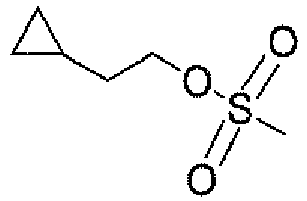
- Tetrahydrofuran-3-yl 4-methylbenzenesulfonate

1H-NMR (CDCl3) δ: 2.08-2.11 (m, 2H), 2.46 (s, 3H), 3.78-3.91 (m, 4H), 5.09-5.13 (m, 1H), 7.35 (d, J=8.0Hz, 2H), 7.78 (d, J=8.0Hz, 2H). - 3-Methoxypropyl methanesulfonate

- 2-Isopropoxyethyl methanesulfonate

1H-NMR (CDCl3) δ: 1.17 (d, J=6.4Hz, 6H), 3.06 (s, 3H), 3.61 (sept., J=6.4Hz, 1H), 3.77 (t, J=4.4Hz, 2H), 4.35 (t, J=4.4Hz, 2H). - 2-Methoxypropan-1-ol

1H-NMR (CDCl3) δ: 1.12 (d, J=6.0Hz, 3H), 3.38 (s, 3H), 3.41-3.49 (m, 2H), 3.55-3.63 (m, 1H). - 2-Methoxypropyl 4-methylbenzenesulfonate

1H-NMR (CDCl3) δ: 1.12 (d, J=6.0Hz, 3H), 2.45 (s, 3H), 3.29 (s, 3H), 3.49-3.59 (m, 1H), 3.95 (d, J=5.2Hz, 2H), 7.32-7.36 (m, 2H), 7.76-7.81 (m, 2H). - 3-Methoxybutyl methanesulfonate

1H-NMR (CDCl3) δ: 1.18 (d, J=6.0Hz, 3H), 1.80-1.92 (m, 2H), 3.00 (s, 3H), 3.33 (s, 3H), 3.43-3.52 (m, 1H), 4.26-4.42 (m, 2H). - 3-[(Benzyloxy)methyl]cyclobutanone

To a diethyl ether (100 mL) solution of allyl benzyl ether (11.1 g, 75.0 mmol), was added zinc copper couple (74.5 g, 33.0 mmol) while stirring at room temperature, a dimethoxyethane (100 mL) solution of trichloroacetyl chloride (43.6 mL, 375 mmol) was added dropwise, and the mixture was stirred at room temperature for six hours. The reaction mixture was poured into ice-cooled aqueous sodium hydrogencarbonate (500 mL), extracted with ethyl acetate, and dried over anhydrous magnesium sulfate. The mixture was filtered and then the solvent in the filtrate was distilled off under reduced pressure. The residue was purified by silica gel column chromatography (a mixed solvent of n-heptane and ethyl acetate: n-heptane/ethyl acetate = 15/1). The obtained dichloro product was dissolved in methanol (200 mL), ammonium chloride (20.0 g, 375 mmol) was added and zinc powder (30.0 g, 450 mmol) was added little by little while vigorously stirring. After the reaction was completed, the insoluble matters were filtered off with Celite, the filtrate was distilled off under reduced pressure. Water was added to the residue, which was extracted with ethyl acetate, and dried over anhydrous magnesium sulfate. The mixture was filtered, and the solvent in the filtrate was then distilled off under reduced pressure. The residue was purified by silica gel column chromatography (a mixed solvent of n-heptane and ethyl acetate: n-heptane/ethyl acetate = 15/1 then 12/1) to obtain the title compound (7.20 g, 37.9 mmol).
1H-NMR (CDCl3) δ: 2.64-2.76 (m, 1H), 2.84-2.94 (m, 2H), 3.09-3.19 (m, 2H), 3.60 (d, J=6.4Hz, 2H), 4.57 (s, 2H), 7.25-7.40 (m, 5H). - {[(3,3-(Difluorocyclobutyl)methoxy]methyl}benzene

1H-NMR (CDCl3) δ: 2.28-2.47 (m, 3H), 2.56-2.70 (m, 2H), 3.50 (d, J=6.0Hz, 2H), 4.53 (s, 2H), 7.25-7.40 (m, 5H). - (3,3-Difluorobutyl)methyl methanesulfonate

1H-NMR (CDCl3) δ: 2.36-2.49 (m, 2H), 2.52-2.64 (m, 1H), 2.67-2.80 (m, 2H), 3.05 (s, 3H), 4.27 (d, J=6.4Hz, 2H). - 3-(Hydroxymethyl)cyclobutanone

- 5-Hydroxymethyl-1,3-dioxane

1H-NMR (400MHz, CDCl3) δ: 1.55 (br.s, 1H), 1.92-2.00 (m, 1H), 3.75 (dd, J=4.8, 6.8Hz, 2H), 3.79 (dd, J=6.0, 11.6Hz, 2H), 4.01 (dd, J=4.0, 11.6Hz, 2H), 4.80 (d, J=6.4Hz, 1H), 4.86 (d, J=6.4Hz, 1H). - 5-Iodomethyl-1,3-dioxane

2003-238884 2003-183569
1H-NMR (400MHz, CDCl3) δ: 2.01-2.07 (m, 1H), 3.19 (d, J=7.2Hz, 2H), 3.69 (dd, J=6.4, 11.6Hz, 2H), 4.06 (dd, J=3.6, 11.6Hz, 2H), 4.75 (d, J=6.2Hz, 1H), 4.84 (d, J=6.2Hz, 1H). - 3-Oxa-bicyclo[3.1.0]hexane-6-carboxylic acid ethyl ester (diastereomer 1 and diastereomer 2)

(Diastereomer 1)
1H-NMR (CDCl3) δ: 1.27 (t, J=7.3Hz, 3H), 1.61 (t, J=3.6Hz, 1H), 2.16 (m, 2H), 3.75 (br.d, J=9.3Hz, 2H), 3.93 (d, J=8.5Hz, 2H), 4.13 (q, J=7.3Hz, 2H)
(Diastereomer 2)
1H-NMR (CDCl3) δ: 1.26 (t, J=7.5Hz, 3H), 1.72 (t, J=7.8Hz, 1H), 1.89 (br.d, J=7.8Hz, 2H), 3.73 (br.d, J=10.9Hz, 2H), 4.06 (d, J=10.9Hz, 2H), 4.14 (q, J=7.5Hz, 2H). - (3-Oxa-bicyclo[3.1.0]hex-6-yl)methanol diastereomer 1

1H-NMR (CDCl3) δ: 1.10 (dt, J=3.6Hz, 6.8Hz, 1H), 1.53-1.56 (m, 2H), 3.53 (d, J=6.8Hz, 2H), 3.70 (d, J=8.0Hz, 2H), 3.88 (d, J=8.4Hz, 2H) - (3-Oxa-bicyclo[3.1.0]hex-6-yl)methanol diastereomer 2

1H-NMR (CDCl3) δ: 1.23 (t, J=3.6Hz, 1H), 1.80 (d, J=3.6Hz, 2H), 3.79 (d, J=7.6Hz, 2H), 3.91 (m, 4H) - 3-Oxa-bicyclo[3.1.0]hexane-6-carbaldehyde diastereomer 1
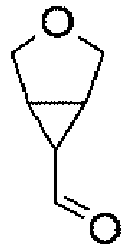
1H-NMR (CDCl3) δ: 1.94 (dt, J=3.2Hz, 4.4Hz, 1H), 2.30 (m, 2H), 3.80 (br.d, J=8.4Hz, 2H), 3.96 (d, J=8.8Hz, 2H), 9.42 (d, J=4.4Hz, 1H) - 3-Oxa-bicyclo[3.1.0]hexane-6-carbaldehyde diastereomer 2

1H-NMR (CDCl3) δ: 1.73 (dt, J=6.4Hz, 7.6Hz, 1H), 2.21 (m, 2H), 4.05 (d, J=8.8Hz, 2H), 4.24 (d, J=10.0Hz, 2H), 9.57 (d, J=7.6Hz, 1H) - 4-Bromo-3,5-dimethoxybenzamide

1H-NMR (CDCl3) δ: 3.95 (s, 6H), 7.00 (s, 2H). - 4-Bromo-3,5-dimethoxybenzonitrile

The obtained residue (solid) was washed with diethyl ether / n-heptane (1/1) to obtain the title compound (2.08 g, 8.59 mmol).
1H-NMR (CDCl3) δ: 3.93 (s, 6H), 6.82 (s, 2H). - (4-Cyano-2,6-dimethoxyphenyl)boronic acid

After thoroughly shaking the mixture, the organic layer was separated, and the organic layer was washed with brine and dried over anhydrous magnesium sulfate. The mixture was filtered, and then the solvent in the filtrate was distilled off under reduced pressure. The obtained residue (solid) was washed with n-heptane to obtain the title compound (1.43 g, 6.91 mmol).
1H-NMR(CDCl3) δ: 3.96(s, 6H), 6.89 (s, 2H), 7.01 (s, 2H). - Ethyl 4-amino-3-methoxybenzoate

After thoroughly shaking the mixture, the organic layer was separated, and the organic layer was washed with brine and dried over anhydrous magnesium sulfate. The mixture was filtered, and then the solvent in the filtrate was distilled off under reduced pressure to obtain the title compound (17.8 g, 91.2 mmol).
1H-NMR (CDCl3) δ: 1.37 (t, J=6.8Hz, 3H), 3.90 (s, 3H), 4.32 (q, J=6.8Hz, 2H), 6.66 (d, J=8.0Hz, 1H), 7.45 (d, J=1.6Hz, 1H), 7.54 (dd, J=1.6, 8.0Hz, 1H). - Ethyl 4-amino-3-chloro-5-methoxybenzoate

1H-NMR (CDCl3) δ: 1.37 (t, J=6.8Hz, 3H), 3.91 (s, 3H), 4.32 (q, J=6.8Hz, 2H), 4.58 (br.s, 2H), 7.36 (d, J=1.8Hz, 1H), 7.65 (d, J=1.8Hz, 1H). - Ethyl 3-chloro-4-iodo-5-methoxybenzoate

1H-NMR (CDCl3) δ: 1.40 (t, J=7.2Hz, 3H), 3.95 (s, 3H), 4.38 (q, J=7.2Hz, 2H), 7.30 (d, J=1.6Hz, 1H), 7.73 (d, J=1.6Hz, 1H). - (3-Chloro-4-iodo-5-methoxyphenyl)methanol

1H-NMR (CDCl3) δ: 3.90 (s, 3H), 4.66 (s, 2H), 6.72 (d, J=1.2Hz, 1H), 7.09 (br.s, 1H). - 1-Chloro-2-iodo-3-methoxy-5-(methoxymethyl)benzene

The residue was purified by silica gel column chromatography (a mixed solvent of n-heptane and ethyl acetate: n-heptane/ethyl acetate = 8/1 then 4/1) to obtain the title compound (13.2 g, 422 mmol).
1H-NMR (CDCl3) δ: 3.40 (s, 3H), 3.90 (s, 3H), 4.40 (s, 2H), 6.69 (s, 1H), 7.07 (s, 1H). - [2-Chloro-6-methoxy-4-(methoxymethyl)phenyl]boronic acid

After thoroughly shaking the mixture, the organic layer was separated, and the organic layer was washed with brine and dried over anhydrous magnesium sulfate. The mixture was filtered, and then the solvent in the filtrate was distilled off under reduced pressure. The obtained residue (solid) was washed with n-heptane to obtain the title compound (2.65 g, 11.5 mmol).
1H-NMR (CDCl3) δ: 3.42 (s, 3H), 3.92 (s, 3H), 4.44 (s, 2H), 6.23 (s, 2H), 6.86 (s, 1H), 7.00 (br.s, 1H). - (4-Bromo-3,5-dimethoxyphenyl)methanol

1H-NMR (CDCl3) δ: 1.80 (s, 1H), 3.91 (s, 6H), 4.68 (s, 2H), 6.60 (s, 2H). - 2-Bromo-5-(chloromethyl)-1,3-dimethoxybenzene

1H-NMR (CDCl3) δ: 3.92 (s, 6H), 4.55 (s, 2H), 6.60 (s, 2H). - 2-Bromo-5-[(cyclobutyloxy)methyl]-1,3-dimethoxybenzene

1H-NMR (CDCl3) δ: 1.43-1.60 (m, 1H), 1.65-1.80 (m, 1H), 1.92-2.08 (m, 2H), 2.15-2.28 (m, 2H), 3.90 (s, 6H), 3.96-4.07 (m, 1H), 4.38 (s, 2H), 6.56 (s, 2H). - {4-[(Cyclobutyloxy)methyl]-2,6-dimethoxyphenyl}boronic acid

1H-NMR(CDCl3) δ:1.45-1.60 (m, 1H), 1.67-1.80 (m, 1H), 1.94-2.08 (m, 2H), 2.18-2.30 (m, 2H), 3.92 (s, 6H), 3.96-4.07 (m, 1H), 4.41 (s, 2H), 6.61 (s, 2H), 7.18 (s, 2H). - 2-Bromo-5-(isopropoxymethyl)-1,3-dimethoxybenzene

1H-NMR (CDCl3) δ: 1.23 (d, J=8.4Hz, 6H), 3.63-3.74 (m, 1H), 3.91 (s, 6H), 4.48 (s, 2H), 6.58 (s, 2H). - [4-(Isopropoxymethyl)-2,6-dimethoxyphenyl]boronic acid
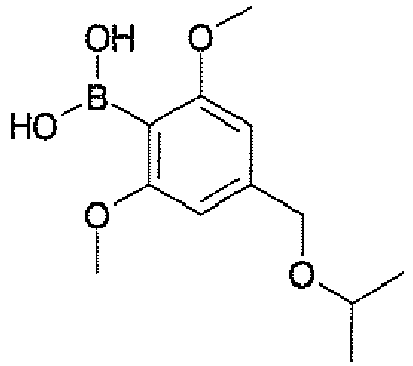
1H-NMR (CDCl3) δ: 1.24 (d, J=6.0Hz, 6H), 3.64-3.75 (m, 1H), 3.92 (s, 6H), 4.52 (s, 2H), 6.63 (s, 2H), 7.19 (s, 2H). - 1-(4-Bromo-3,5-dimethoxyphenyl)ethanol

1H-NMR (CDCl3) δ: 1.50 (d, J=6.4Hz, 3H), 1.86 (br.s, 1H), 3.91 (s, 6H), 4.85-4.91 (m, 1H), 6.60 (s, 2H). - 2-Bromo-1,3-dimethoxy-5-(1-methoxyethyl)benzene

1H-NMR (CDCl3) δ: 1.43 (d, J=6.4Hz, 3H), 3.25 (s, 3H), 3.90 (s, 6H), 4.22-4.28 (m, 1H), 6.53 (s,2H). - [2,6-Dimethoxy-4-(1-methoxyethyl)phenyl]boronic acid

1H-NMR (CDCl3) δ: 1.44 (d, J=6.4Hz, 3H), 3.27 (s, 3H), 3.92 (s, 6H), 4.28 (q, 6.4Hz, 1H), 6.58 (s, 2H), 7.18 (s, 2H). - 1-Cyclopropyl-3,5-dimethoxybenzene

1H-NMR(CDCl3) δ: 0.66-0.71 (m, 2H), 0.90-0.96 (m, 2H), 1.80-1.90 (m, 1H), 3.77 (s, 6H), 6.20-6.30 (m, 3H). - (4-Cyclopropyl-2,6-dimethoxyphenyl)boronic acid

1H-NMR (CDCl3) δ: 0.73-0.78 (m, 2H), 1.00-1.06 (m, 2H), 1.84-1.98 (m, 1H), 3.89 (s, 6H), 6.33 (s, 2H), 7.14 (s, 2H). - Ethyl (3-methyl-5-oxo-4,5-dihydro-1H-pyrazol-1-yl)acetate

1H-NMR (CDCl3) δ: 1.28 (t, J=7.2Hz, 3H), 2.12 (s, 3H), 3.26 (s, 2H), 4.22 (q, J=7.2Hz, 2H), 4.42 (s, 2H). - Ethyl (5-chloro-4-formyl-3-methyl-1H-pyrazol-1-yl)acetate
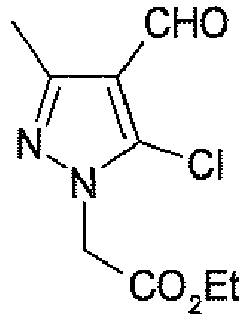
1H-NMR (CDCl3) δ: 1.30 (t, J=7,2Hz, 3H), 2.47 (s, 3H), 4.26 (q, J=7.2Hz, 2H), 4.88 (s, 2H), 9.88 (s, 1H). - Ethyl 7-formyl-6-methyl-2-(methylthio)pyrazolo[5,1-b][1,3]thiazole-3-carboxylate

- Ethyl 7-[(tert-butoxycarbonyl)amino]-6-methyl-2-(methylthio)pyrazolo[5,1-b][1,3]thiazole-3-carb oxylate

1H-NMR (CDCl3) δ: 1.45 (t, J=7.2Hz, 3H), 1.52 (s, 9H), 2.35 (s, 3H), 2.61 (s, 3H), 4.49 (q, J=7.2Hz, 2H), 6.09 (brs, 1H). - 7-[(tert-Butoxycarbonyl)amino]-6-methyl-2-(methylthio)pyrazolo[5,1-b][1,3]thiazole-3-carb oxylic acid

1H-NMR (CDCl3) δ:1.53 (s, 9H), 2.32 (s, 3H), 2.64 (s, 3H), 6.13 (br s, 1H). - tert-Butyl [3-bromo-6-methyl-2-(methylthio)pyrazolo[5,1-b][1,3]thiazol-7-yl]carbamate

1H-NMR. (CDCl3) δ: 1.53 (s, 9H), 2.35 (s, 3H), 2.45 (s, 3H), 6.08 (br.s, 1H). - 1-(6-Methylpyrazolo[5,1-b][1,3]thiazol-7-yl)ethanone

A mixture of the white solid (15.6 g, 49.6 mmol) obtained in the above-mentioned procedure, sodium acetate (6.1 g, 74.4 mmol) and acetic anhydride (125 mL) was heated to reflux at 130°C for five hours. The solvent in the reaction mixture was distilled off under reduced pressure, and water was added to the residue. After cooling to 0°C, a saturated aqueous solution of potassium carbonate was added, and a substance of interest was extracted with ethyl acetate. The organic layer was washed with brine and dried over anhydrous magnesium sulfate. The mixture was filtered to yield a filtrate, and then a solvent was distilled off under reduced pressure. To the residue, diisopropyl ether (40 mL) was added, and the obtained solid was filtered and dried to obtain 5.25 g (29.13 mmol) of the title compound.
1H-NMR (CDCl3) δ:2.51 (s, 3H), 2.65 (s, 3H), 7.00 (d, J=4.0Hz, 1H), 7.76 (d, J=4.0Hz, 1H). - 6-Methylpyrazolo[5,1-b][1,3]thiazole-7-amine

1H-NMR (CDCl3) δ: 2.34 (s, 3H), 2.72 (br.s, 2H), 6.65 (d, J=4.0Hz, 1H), 7.56 (d, J=4.0Hz, 1H). - tert-Butyl (6-methylpyrazolo[5,1-b][1,3]thiazol-7-yl)carbamate

1H-NMR (CDCl3) δ: 1.53 (s, 9H), 2.33 (s, 3H), 6.03 (br.s, 1H), 6.71 (d, J=4.0Hz, 1H), 7.59 (d, J=4.0Hz, 1H). - tert-Butyl (3-bromo-6-methylpyrazolo[5,1-b][1,3]thiazol-7-yl)carbamate

1H-NMR (CDCl3) δ: 1.52 (s, 9H), 2.37 (s, 3H), 6.07 (br.s, 2H), 6.68 (s, 1H). - 2,5-Dimethyl-1,3-thiazole

1H-NMR. (CDCl3) δ: 2.41 (s, 3H), 2.64 (s, 3H), 7.24 (s, 1H). - 1-(2,6-Dimethylpyrazolo[5,1-b][1,3]thiazol-7-yl)ethanone

A mixture of the crude compound (2.51 g, 7.63 mmol), sodium acetate (940 mg, 11.5 mmol) and acetic anhydride (19.5 mL) was heated at 130°C to reflux for five hours. The solvent in the reaction mixture was dialled off under reduced pressure, and then water was added to the residue. The mixture residue was cooled to 0°C, then, a saturated aqueous solution of potassium carbonate was added to the mixture, and a substance of interest was extracted with ethyl acetate. The organic layer was washed with brine and dried over anhydrous magnesium sulfate. The mixture was filtered to yield a nitrate, and then the solvent was distilled off under reduced pressure. The residue was purified by silica gel column chromatography (n-heptane/ethyl acetate: 211 then 1/1) to obtain the title compound (655 mg, 3.37 mmol).
1H-NMR (CDCl3) δ:2.48 (s, 6H), 2.62 (s, 3H), 7.46 (s, 1H). - 2,6-Dimethylpyrazolo[5,1-b][1,3]thiazole-7-amine

1H-NMR (CDCl3) δ: 2.30 (s, 3H), 2.37 (s, 3H), 7.27 (s, 1H). - tert-Butyl (2,6-dimethylpyrazolo[5,1-b][1,3]thiazol-7-yl)carbamate
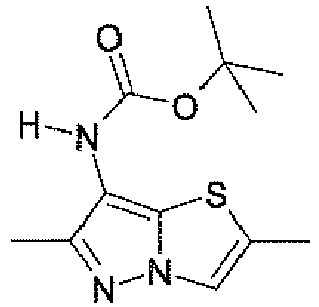
1H-NMR (CDCl3) δ:1.52 (s, 9H), 2.28 (s, 3H), 2.36 (s, 3H), 5.98 (br.s, 1H), 7.29 (s, 1H). - tert-Butyl (3-bromo-2,6-dimethylpyrazolo[5,1-b][1,3]thiazol-7-yl)carbamate

1H-NMR (CDCl3) δ: 1.52 (s, 9H), 2.34 (s, 6H), 6.04 (s,1H). - Ethyl 6-oxo-5,6-dihydropyrazolo[5,1-b][1,3]thiazole-7-carboxylate

After thoroughly shaking the mixture, the organic layer was separated, the organic layer was washed with brine and dried over anhydrous magnesium sulfate. The mixture was filtered, and then the solvent in the filtrate was distilled off under reduced pressure.
To a mixture of the obtained residue and ethanol (900 mL) was added hydrazine hydrate (60.7 mL, 1.25 mol) while stirring in a water bath, and the mixture was stirred at room temperature for 13 hours. The mixture was filtered, the solvent in the filtrate was distilled off under reduced pressure.
To the obtained residue, were added 1,4-dioxane (1 L) and 5N hydrochloric acid (200 mL) in this order, and the mixture was stirred at 60°C for four hours. After returning the mixture to room temperature, the solvent in the mixture was distilled off under reduced pressure. Water was added to the obtained residue, and the mixture was filtered, and the filtered residue and filtrate were obtained. The residue was further washed with water and dried under reduced pressure to obtain the title compound (42.5 g, 200 mmol).
To the above-mentioned obtained filtrate was added ethyl acetate. After thoroughly shaking the mixture, the organic layer was separated, and the organic layer was washed with brine and dried over anhydrous magnesium sulfate. The mixture was filtered, and then the solvent in the filtrate was distilled off under reduced pressure. To the obtained residue, diethyl ether was added, and precipitated solid was collected by filtration and dried under reduced pressure to further obtain the title compound (2.6 g, 12.3 mmol).
1H-NMR (CDCl3) δ: 1.41 (t, J=7.0Hz, 3H), 4.40 (q, J=7.0Hz, 2H), 6.89 (d, J=4.0Hz, 1H), 7.69 (d, J=4.4Hz, 1H). - Ethyl 6-methoxypyrazolo[5,1-b][1,3]thiazole-7-carboxylate

After thoroughly shaking the mixture, the organic layer was separated, and the organic layer was washed with brine and dried over anhydrous magnesium sulfate. The mixture was filtered, and then the solvent in the filtrate was distilled off under reduced pressure. The residue was purified by silica gel column chromatography (a mixed solvent of n-heptane and ethyl acetate: n-heptane/ethyl acetate = 9/1 then 1/2.3) to obtain the title compound (30.7 g, 136 mmol).
1H-NMR (CDCl3) δ: 1.39 (t, J=7.0Hz, 3H), 4.08 (s, 3H), 4.35 (q, J=7.0Hz, 2H), 6.87 (d, J=4.4Hz, 1H), 7.66 (d, J=4.4Hz, 1H). - 6-Methoxypyrazolo[5,1-b][1,3]thiazole
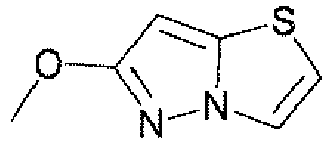
To the obtained residue, were added 1,4-dioxane (400 mL) and concentrated hydrochloric acid (200 mL) in this order and stirred at 60°C for 1.5 hours. 1,4-Dioxane in the mixture was distilled off under reduced pressure. Sodium hydroxide was appropriately added while stirring on ice so that the mixture became weak acidic and then ethyl acetate was added.
After thoroughly shaking the mixture, the organic layer was separated, and the organic layer was washed with brine and dried over anhydrous magnesium sulfate. The mixture was filtered, and then the solvent in the filtrate was distilled off under reduced pressure. The residue was purified by silica gel column chromatography (a mixed solvent of n-heptane and ethyl acetate: n-heptane/ethyl acetate = 1/0 then 2.3/1) to obtain the title compound (15.8 g, 103 mmol).
1H-NMR (CDCl3) δ: 3.95 (s, 3H), 5.81 (d, J=0.8Hz, 1H), 6.60 (d, J=4.0Hz, 1H), 7.58 (dd, J=0.8, 4.4Hz, 1H). - tert-Butyl (6-methoxypyrazolo[5,1-b][1,3]thiazol-7-yl)carbamate

To the obtained residue were added ethanol (200 mL), THF (300 mL) and 10% palladium-carbon (50% wet: 16 g) in this order, and the mixture was stirred in a normal-pressure hydrogen atmosphere at room temperature for five hours. The mixture was filtered with Celite, and the solvent in the obtained filtrate was distilled offunder reduced pressure.
To a mixture of the obtained residue and dichloromethane (425 mL), di-tert-butyl dicarbonate (24.1 g, 111 mmol) and triethylamine (17.8 mL, 128 mmol) were added while stirring at room temperature, and the mixture was stirred at room temperature for 11 hours. The solvent in the mixture was distilled off under reduced pressure, and the residue was purified by silica gel column chromatography (a mixed solvent of n-heptane and ethyl acetate: n-heptane/ethyl acetate = 2/1) to obtain the title compound (16.5 g, 61.4 mmol).
1H-NMR (CDCl3) δ: 1.51 (s, 9H), 3.98 (s, 3H), 6.12 (br.s, 1H), 6.54 (d, J=4.0Hz, 1H), 7.48 (d, J=4.4Hz, 1H). - Alternative synthesis method of tert-butyl (6-methoxypyrazolo[5,1-b][1,3]thiazol-7-yl)carbamate
To a mixture of 6-methoxypyrazolo[5,1-b]thiazole-7-carboxylic acid (300 mg, 1.51 mmol) and 1,4-dioxane (4 mL) were added triethylamine (0.215 mL, 1.54 mmol) and diphenylphosphoryl azide (0.325 mL, 1.51 mmol) while stirring at room temperature, and the resulting mixture was stirred and heated to reflux for three hours. After returning the mixture to room temperature, triethylamine (0.631 mL, 4.53 mmol) and tert-butanol (0.289 mL, 3.02 mmol) were added, and the resulting mixture was stirred and heated to reflux for three hours. After returning the mixture to room temperature, the solvent was distilled off under reduced pressure and the residue was purified by silica gel column chromatography (mixture solvent of n-heptane and ethyl acetate: n-heptane/ethyl acetate = 1/4) to obtain the title compound (144 mg, 0.535 mmol).
1H-NMR (CDCl3) δ: 1.51 (s, 9H), 3.98 (s, 3H), 6.1.2 (br.s, 1H), 6.54 (d, J=4.0Hz, 1H), 7.48 (d, J=4.4Hz, 1H) - tert-Butyl (3-bromo-6-methoxypyrazolo[5,1-b][1,3]thiazol-7-yl)carbamate

1H-NMR (CDCl3) δ: 1.51 (s, 9H), 4.04 (s, 3H), 6.16 (br.s, 1H), 6.50 (s, 1H). - 6-Ethoxypyrazolo[5,1-b][1,3]thiazole-7-carboxylic acid ethyl ester

1H-NMR (CDCl3) δ: 1.38 (t, J=7.0Hz, 3H), 1.49 (t, J=7.2Hz, 3H), 4.34 (q, J=7.0Hz, 2H), 4.41 (q, J=7.2Hz, 2H), 6.84 (d, J=4.0Hz, 1H), 7.64 (d, J=4.0Hz, 1H). - 6-Ethoxy-pyrazolo[5,1-b][1,3]thiazole

The obtained solid was suspended in 1,4-dioxane (80 mL), and concentrated hydrochloric acid (40 mL) was added to the suspension, which was stirred at 60°C for one hour. The reaction mixture was returned to room temperature, and 1,4-dioxane was distilled off under reduced pressure, and then neutralized with potassium carbonate while stirring on ice. The reaction mixture was extracted with ethyl acetate, washed with a saturated aqueous solution of sodium hydrogencarbonate and brine and dried over anhydrous magnesium sulfate, and the solvent was distilled off under reduced pressure to obtain 6 g (35.7 mmol) of the title compound.
1H-NMR (CDCl3) δ: 1.42 (t, J=7.0Hz, 3H), 4.26 (q, J=7.0Hz, 2H), 5.80 (s, 1H), 6.60 (d, J=4.4Hz, 1H), 7.59 (d, J=4.4Hz, 1H). - 6-Ethoxy-pyrazolo[5,1-b][1,3]thiazol-7-yl)-carbamic acid tert-butyl ester
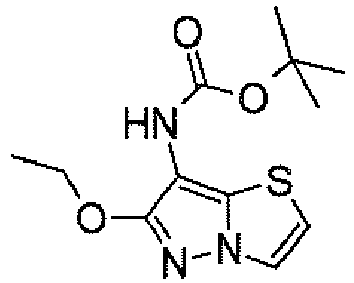
The obtained solid was dissolved in ethanol (60 mL) - THF (90 mL), and 10% palladium carbon powder (4.97 g, 50% water wet) was added thereto, followed by catalytic hydrogen reduction under normal pressure at room temperature for five hours. The mixture was filtered with Celite, and the solvent was distilled off under reduced pressure.
The obtained residue was dissolved in dichloromethane (150 mL), di-tert-butyl dicarbonate (8,06 g, 36.9 mmol) and triethylamine (5.94 mL, 42.6 mmol) were added while stirring at room temperature, and the mixture was stirred at room temperature for 25 hours. The solvent was distilled off from the reaction mixture under reduced pressure, and the residue was purified by medium pressure silica gel column chromatography to obtain the title compound (4.44 g, 15.7 mmol) from fraction of n-heptane: ethyl acetate = 3:2.
1H-NMR (CDCl3) δ: 1.42 (t, J=7.0Hz, 3H), 1.52 (s, 9H), 4.31 (q, J=7.0Hz, 2H), 6.14 (br.s, 1H), 6.52 (d, J=4.0Hz, 1H), 7.47 (d, J=3.2Hz, 1H). - (3-Bromo-6-ethoxy-pyrazolo[5,1-b][1,3]thiazol-7-yl)-carbamic acid tert-butyl ester

1H-NMR (CDCl3) δ: 1.42 (t, J=7.0Hz, 3H), 1.51 (s, 9H), 4.38 (q, J=7.0Hz, 2H), 6.19 (br.s, 1H), 6.49 (s, 1H). - Ethyl 3,5-dibromo-1H-pyrazole-4-carboxylate (Synthetic Communications, 38, 674-683, 2008)

- Ethyl 3,5-dibromo-1-(methoxymethyl)-1H-pyrazole-4-carboxylate

1H-NMR (400MHz, CDCl3) δ: 1.40 (t, J=7.2Hz, 3H), 3.41 (s, 3H), 4.37 (q, J=7.2Hz, 2H), 5.48 (s,2H). - Ethyl 3-bromo-5-({2-[2,6-dimethoxy-4-methoxymethyl)phenyl]-2-oxoethyl}thio)-1-(methoxymet hyl)-1H-pyrazole-4-carboxylate

1H-NMR (400MHz, CDCl3) δ: 1.40 (t, J=7.2Hz, 3H), 3.35 (s, 3H), 3.41 (s, 3H), 3.72 (s, 6H), 4.30 (s, 2H), 4.36 (q, J=7.2Hz, 2H), 4.42 (s, 2H), 5.60 (s, 2H), 6.48 (s, 2H). - Ethyl 6-bromo-3-[2,6-dimethoxy-4-(methoxymethyl)phenym]pyrazolo[5,1-b][1,3]thiazole-7-carbo xylate

1H-NMR (400MHz, CDCl3) δ: 1.41 (t, J=7.2Hz, 3H), 3.45 (s, 3H), 3.75 (s, 6H), 4.39 (q, J=7.2Hz, 2H), 4.49 (s, 2H), 6.63 (s, 2H), 6.90 (s,1H), - 6-Bromo-3-[2,6-dimethoxy-4-(methoxymethyl)phenyl]pyrazolo[5,1-b][1,3]thiazol e-7-carboxylic acid

1H-NMR (400MHz, DMSO-d6) δ: 3.38 (s, 3H), 3.71 (s, 6H), 4.50 (s, 2H), 6.77 (s, 2H), 7.45 (s, 1H), 13.0 (s, 1H). - 6-Bromo-3-[2,6-dimethoxy-4-(methoxymethyl)phenyl]pyrazolo[5,1-b][1,3]thiazol e
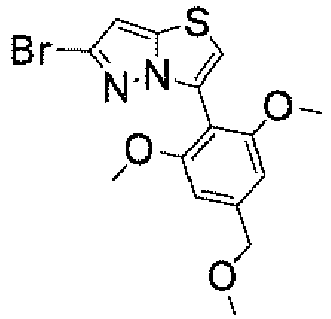
1H-NMR (400MHz, CDCl3) δ: 3.45 (s, 3H), 3.76 (s, 6H), 4.49 (s, 2H), 6.43 (s, 1H), 6.63 (s, 2H), 6.72 (s,1H). - 3-[2,6-Dimethoxy4-(methoxymethyl)phenyl]-6-(methylsulfonyl)pyrazolo[5,1-b][ 1,3]thiazole

1H-NMR. (400MHz, CDCl3) δ: 3.17 (s, 3H), 3.47 (s, 3H), 3.77 (s, 6H), 4.51 (s, 2H), 6.65 (s, 2H), 6.97 (s, 1H), 6.99 (s,1H). - 3-[2,6-Dimethoxy-4-(methoxymethyl)phenyl]-6-(methylthio)pyrazolo[5,1-b][1,3]t hiazole

1H-NMR (400MHz, CDCl3) δ: 2.49 (s, 3H), 3.45 (s, 3H), 3.76 (s, 6H), 4.49 (s, 2H), 6.36 (s, 1H), 6.63 (s,2H), 6.66 (s,1H). - tert-Butyl [3-[2,6-dimethoxy-4-(methoxymethyl)phenyl]-6-(methylthio)pyrazolo[5,1-b][1,3]thiazol-7-y 1]carbamate
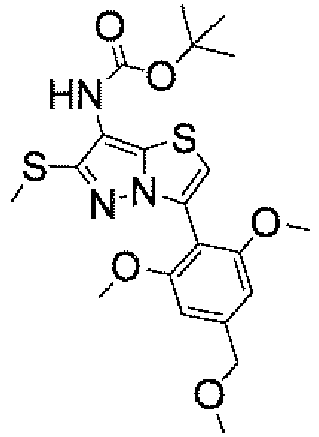
To an ethanol (2.50 mL) solution of the obtained residue, 50% palladium - carbon (30.0 mg, 0.282 mmol) was added, and the mixture was stirred at room temperature for one hour under a stream of hydrogen. After the reaction was completed, the reaction mixture was filtered with Celite, and the solvent was distilled off under reduced pressure.
To a dichloromethane (2.50 mL) solution of the obtained residue, triethylamine (11.0 µl, 0.080 mmol) and di-tert-butyl dicarbonate (13.9 mg, 0.064 mmol) were added, and the mixture was stirred at room temperature for 15 hours. After the reaction was completed, the solvent was distillled off under reduced pressure, and the residue was purified by silica gel column chromatography (n-heptane/ethyl acetate = 1/1) to obtain the title compound (23.0 mg, 0.049 mmol).
MS [M+H]+=466 - 2-Bromo-[2,6-dimethoxy-4-(methoxymethyl)phenyl]ethanone

1H-NMR (CDCl3) δ: 3.42 (s, 3H), 3.82 (s, 6H), 4.35 (s, 2H), 4.44 (s, 2H), 6.54 (s, 2H). - N-(Cyclopropylmethyl)-3-[2,6-dimethoxy-4-(methoxymethyl)phenyl]-6-methyl-2-(methylth io)-N-(tetrahydro-2H-pyran-4-ylmethyl) pyrazolo[5,1-b][1,3]thiazole-7-amine
(1a) tert-Butyl [3-[2,6-dimethoxy-4-(methoxymethyl)phenyl]-6-methyl-2-(methylthio)pyrazolo[5,1-b][1,3]t hiazol-7-yl]carbamate
WO2004/037822 , a 1M aqueous solution of sodium carbonate (2.06 mL, 2.06 mmol) and tetrakis(triphenylphosphine)palladium (119 mg, 0.10 mmol) in this order, and the mixture was heated to reflux at 110°C for three hours. Water was added to the reaction mixture and then ethyl acetate was added. After thoroughly shaking the mixture, the organic layer was separated, and the organic layer was stirred at 75°C for five hours. Chloroform was added to the reaction mixture, insoluble matters were filtered off, and then the solvent was distilled off under reduced pressure. The residue was purified by medium pressure silica gel column chromatography (n-heptane/ethyl acetate: 33% then 66%) to obtain 450.9 mg (0.94 mmol) of the title compound.
1H-NMR (CDCl3) δ: 1.54 (s, 9H), 2.25 (s, 3H), 2.31 (s, 3H), 3.46 (s, 3H), 3.73 (s, 6H), 4.50 (s, 2H), 6.01 (br.s, 1H), 6.63 (s, 2H). - N-(Cyclopropylmethyl)-3-[2,6-dimethoxy-4-(methoxymethyl)phenyl]-6-methyl-2-(methylth io)-N-(tetrahydro-2H-pyran4-ylmethyl)pyrazolo[5,1-b][1,3]thiazole-7-amine

To the obtained residue was added dichloromethane (5 mL) and then trifluoroacetic acid (2.2 mL) was added, and the mixture stirred at room temperature for one hour. The solvent in the reaction mixture was distilled off under reduced pressure. To the obtained residue was added THF (5 mL) and then tetrahydro-4H-pyran-4-carbaldehyde (153 µl, 1.34 mmol) and sodium triacetoxyborohydride (213 mg, 1.01 mmol) were added in this order, and the mixture was stirred at room temperature for 10 minutes. To the reaction mixture was added a saturated aqueous solution of sodium hydrogencarbonate and then ethyl acetate was added. After thoroughly shaking the mixture, the organic layer was separated, the organic layer was washed with brine and dried over anhydrous magnesium sulfate. The mixture was filtered to yield a filtrate, and the solvent in the filtrate was distilled off under reduced pressure. The residue was purified by silica gel column chromatography (a mixed solvent of n-heptane and ethyl acetate: n-heptane/ethyl acetate = 25% to 66%) to obtain 281.8 mg (0.53 mmol) of the title compound.
1H-NMR (CDCl3) δ: 0.02-0.05 (m, 2H), 0.40-0.44 (m, 2H), 0.81-0.90 (m, 1H), 1.23-1.33 (m, 2H), 1.50-1.62 (m, 1H), (1.71-1.78 (m, 2H), 2.32 (s, 3H),2.26 (s, 3H), 2.72 (d, J=6.4Hz, 2H), 2.86 (d, J=7.2Hz, 2H), 3.30-3.38 (m, 2H), 3.47 (s, 3H), 3.76 (s, 6H), 3.91-3.97 (m, 2H), 4.51 (s, 2H), 6.65 (s, 2H). - 3-[2,6-Dimethoxy-4-(methoxymethyl)phenyl-6-methyl-2-(methylthio)-N,N-dipropylpyrazol o[5,1-b][1,3]thiazole-7-amine

1H-NMR (CDCl3) δ: 0.89 (t, J=7.2Hz, 6H), 1.37-1.60 (m, 4H), 2.25 (s, 3H), 2.32 (s, 3H), 2.83 (t, J=7.2Hz, 4H),3.46 (s, 3H), 3.75 (s, 6H), 4,50 (s, 2H), 6.63 (s, 2H). - 3-[2,6-Dimethoxy-4-(methoxymethyl)phenyl]-6-methyl-2-(methylsulfinyl)-N,N-dipropylpyr azolo[5,1-b][1,3]thiazole-7-amine

1H-NMR (CDCl3) δ: 0.96 (t, J=7.6Hz, 6H), 2.10-2.33 (m, 4H), 3.51-3.61 (m, 4H), 2.33 (s, 3H), 2.35 (s, 3H), 3.46 (s, 3H), 3.74 (s, 6H), 4.50 (s, 2H), 6.63 (s, 2H). - N-(Cyclopropylmethyl)-3-[2,6-dimethoxy-4-(methoxymethyl)phenyl]-6-methyl-N-(tetrahyd ro-2H-pyran-4-ytmethyl)pyrazolo[5,1-b][1,3]thiazole-7-amine

1H-NMR (CDCl3) δ: 0.01-0.05 (m, 2H), 0.38-0.44 (m, 2H), 0.81-0.92 (m, 1H), 1.22-1.34 (m, 2H), 1.49-1.61 (m, 1H), 1.71-1.78 (m, 2H), 2.28 (s, 3H), 2.74 (d, J=6.8Hz, 2H), 2.88 (d, J=7.2Hz, 2H), 3.36 (br.dd, J=11.6, 10.4Hz, 2H), 3.45 (s, 3H), 3.76 (s, 6H), 3.93 (br.dd, J=11.2, 2.8Hz, 2H), 4.49 (s, 2H), 6.52 (s, 1H), 6.64 (s, 2H). - N-(Cyclopropylmethyl)-3-[2,6-dimethoxy-4-(methoxymethyl)phenyl]-2,6-dimethyl-N-(tetra hydro-2H-pyran-4-ylmethyl)pyrazolo[5,1-b][1,3]thiazole-7-amine

1H-NMR (CDCl3) δ: 0.01-0.04 (m, 2H), 0.38-0.43 (m, 2H), 0.80-0.90 (m, 1H), 1.22-1.34 (m, 2H), 1.48-1.62 (m, 1H), 1.74 (br d, J=13.2Hz, 2H), 2.14 (s, 3H), 2.25 (s, 3H), 2.71 (d, J=6.8Hz, 2H), 2.85 (d, J=7.2Hz, 2H), 3.32 (ddd, J=11.6, 11.6, 1.6Hz, 2H), 3.47 (s, 3H), 3.76 (s, 6H), 3.93 (br.dd, J=11.6, 4.4Hz, 2H), 4.49 (s, 2H), 6.64 (s, 2H). - N-(Cyclopropylmethyl)-3-[2,6-dimethoxy-4-(methoxymethyl)phenyl]-2,6-dimethyl-N-(tetra hydro-2H-pyran-4-yl)pyrazolo[5,1-b][1,3]thiazole-7-amine

1H-NMR (CDCl3) δ: 0.00-0.04 (m, 2H), 0.32-0.38 (m, 2H), 0.72-0.83 (m, 1H), 1.52-1.65 (m, 2H), 1.77-1.85 (m, 2H), 2.16 (s, 3H), 2.27 (s, 3H), 2.84 (d, J=6.8Hz, 2H), 3.05-3.15 (m, 1H), 3.40 (ddd, J=11.6, 11.6, 1.2Hz, 2H), 3.49 (s, 3H), 3.78 (s, 6H), 3.95-4.03 (m, 2H), 4.51 (s, 2H), 6.66 (s, 2H). - [3-(2,6-Dimethoxy4-methoxymethyl-phenyl)-6-methoxy-2-methyl-pyrazolo[5,1-b][1,3]thia zol-7-yl]-propyl-(tetrahydro-pyran-4-yl)-amine
(7a) tert-Butyl {2-bromo-3-[2,6-dimethoxy-4-(methoxymethyl)phenyl]-6-methoxypyrazolo[5,1-b][1,3]thia zol-7-yl}carbamate
After thoroughly shaking the mixture, the organic layer was separated, the organic layer was washed with brine and dried over anhydrous magnesium sulfate. The mixture was filtered, and then the solvent in the filtrate was distilled off under reduced pressure. The residue was purified by silica gel column chromatography (a mixed solvent of n-heptane and ethyl acetate: n-heptane/ethyl acetate = 1/1) to obtain the title compound (441 mg, 0.835 mmol).
1H-NMR (CDCl3) δ: 1.51 (s, 9H), 3.48 (s, 3H), 3.77 (s, 6H), 3.85 (s, 3H), 4.50 (s, 2H), 6.13 (br.s, 1H), 6.64 (s, 2H). - (7b) tert-Butyl {3-[2,6-dimethoxy-4-(methoxymethyl)phenyl]-6-methoxy-2-methoxypyrazolo[5,1-b][1,3]th iazol-7-yl}carbamate

1H-NMR (CDCl3) δ: 1.52 (s, 9H), 2.11 (s, 3H), 3.48 (s, 3H), 3.75 (s, 6H), 3.85 (s, 3H), 4.50 (s, 2H), 6.06 (br.s, 1H), 6.64 (s, 2H). - (7c) [3-(2,6-Dimethoxy-4-methoxynethyl-phenyl)-6-methoxy-2-methyl-pyrazolo[5,1-b][1,3]thia zol-7-yl]-propyl-tetrahydro-pyran-4-yl-amine

1H-NMR (CDCl3) δ: 0.87 (t, J=7.2Hz, 3H), 1.30-1.46 (m, 2H), 1.50-1.68 (m, 2H), 1.74-1.88 (m, 2H), 2.14 (s, 3H), 2.92 (t, J=7.6Hz, 2H), 2.96-3.10 (m, 1H), 3.37 (t, J=12.0Hz, 2H), 3.49 (s, 3H), 3.79 (s, 6H), 3.83 (s, 3H), 3.90-4.04 (m, 2H), 4.51 (s, 2H), 6.65 (s, 2H). - Cyclopropylmethyl-[3-(2,6-dimethoxy-4-methoxymethyl-phenyl)-6-methoxy-2-methyl-pyra zolo[5,1-b][1,3]thiazol-7-yl]-(tetrahydro-furan-3-ylmethyl)-amine

1H-NMR (CDCl3) δ: -0.01-0.10 (m, 2H), 0.35-0.46 (m, 2H), 0.83-0.97 (m, 1H), 1.56-1.71 (m, 1H), 1.90-2.04 (m, 1H), 2.14 (s, 3H), 2.27-2.40 (m, 1H), 2.79 (d, J=6.8Hz, 2H), 2.93 (dd, J=8.0,11.6Hz, 1H), 3.04 (dd, J=6.8, 11.6Hz, 1H), 3.48 (s, 3H), 3.55 (dd, J=6.4, 8.0Hz, 1H), 3.62-3.76 (m, 1H), 3.78 (s, 6H), 3.76-3.90 (m, 2H), 3.84 (s, 3H), 4.50 (s, 2H), 6.65 (s, 2H). - [3-(2,6-Dimethoxy-4-methoxymethyl-phenyl)-2-ethyl-6-methoxy-pyrazolo[5,1-b][1,3]thiaz ol-7-yl]-propyl-(tetrahydro-pyran-4-yl)-amine
- (9a) tert-Butyl {3-[2,6-dimethoxy-4-(methoxymethyl)phenyl]-2-ethyl-6-methoxymethylpyrazolo[5,1-b][1,3 ]thiazol-7-yl}carbamate

1H-NMR (CDCl3) δ: 1.16 (t, J=7.6Hz, 3H), 1.52 (s, 9H), 2.47 (q, J=7.6Hz, 2H), 3.48 (s, 3H), 3.74 (s, 6H), 3.84 (s, 3H), 4.49 (s, 2H), 6.07 (br.s, 1H), 6.63 (s, 2H). - (9b) [3-(2,6-Dimethoxy4-methoxymethyl-phenyl)-2-ethyl-6-methoxy-pyrazolo[5,1-b][1,3]thiaz ol-7-yl]-propyl-(tetrahydro-pyran-4-yl)amine

- [3-(2,6-Dimethoxy-4-methoxymethyl-phenyl)-6-methoxy-pyrazolo[5,1-b][1,3]thiazol-7-yl]-(3-fluoro-propyl)-(tetrahydro-pyran-4-yl)amine
(10a) tert-Butyl {3-[4-(ethoxymethyl)-2,6-dimethoxyphenyl]-6-methoxypyrazolo[5,1-b][1,3]thiazol-7-yl}car bamate
WO04/037822
After thoroughly shaking the mixture, the organic layer was separated, the organic layer was washed with brine and dried over anhydrous magnesium sulfate. The mixture was filtered, and then the solvent in the filtrate was distilled off under reduced pressure. The residue was purified by silica gel column chromatography (a mixed solvent of n-heptane and ethyl acetate: n-heptane/ethyl acetate = 2/1 then 1/1) to obtain the title compound (2.49 g, 5.37 mmol).
1H-NMR (CDCl3) δ: 1.29 (t, J=7.2Hz, 3H), 1.52 (s, 9H), 3.61 (q, J=7.2Hz, 2H), 3.75 (s, 6H), 3.87 (s, 3H), 4.53 (s, 2H), 6.09 (br.s, 1H), 6.42 (s, 1H), 6.64 (s, 2H). - (10b) [3-(2,6-Dimethoxy-4-methoxymethyl-phenyl)-6-methoxy-pyrazolo[5,1-b][1,3]thiazol-7-yl]-(3-fluoro-propyl)-(tetrahydro-pyran-4-yl)-amine

1H-NMR (CDCl3) δ: 1.50-1.90 (m, 6H), 2.99-3.12 (m, 1H), 3.13 (t, J=7.2Hz 2H), 3.37 (td, J=1.6, 11.6Hz, 2H), 3.47 (s, 3H), 3.79 (s, 6H), 3.85 (s, 3H), 3.92-4.04 (m, 2H), 4.46 (t, J=6.0Hz, 1H), 4.50 (s, 2H), 4.58 (t, J=6.0Hz, 1H), 6.43 (s, 1H), 6.65 (s, 2H). - Hereinafter, the compounds of Examples 11 to 75 were synthesized according to the procedure similar to Example 10.
- Cyclopropylmethyl-3[3-(2,6-dimethoxy-4-methoxymethyl-phenyl)-6-methoxy-py razolo[5,1-b][1,3]thiazol-7-yl]-[1,3]dioxan-5-ylmethyl-amine

- Butyl-[3-(2,6-dimethoxy-4-methoxymethyl-phenyl)-6-methoxy-pyrazolo[5,1-b][1,3]thiazol-7-yl)-[1,3]dioxan-5-y]methyl-amine
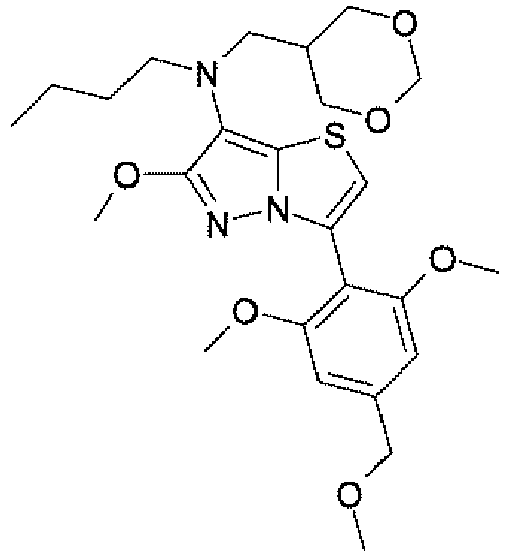
- N-(Cyclopropylmethyl)-3-[2,6-dimethoxy-4-(methoxymethyl)phenyl]-6-methoxy-N-(tetrah ydrofuran-3-yl)pyrazolo[5,1-b][1,3]thiazole-7-amine

- 3-[2,6-Dimethoxy-4-methoxymethylphenyl]-6-methoxy-N-propyl-N-(tetrahydrofuran-3-yl) pyrazolo[5,1-b][1,3]thiazole-7-amine

- [3-(6-Dimethylamino-4-methoxy-pyridin-3-yl)-6-methoxy-pyrazolo[5,1-b][1,3]thiazol-7-yl] -propyl-(tetrahydro-pyran-4-yl)amine

- [3-(6-Dimethylamino-4-methoxy-pyridin-3-yl)-6-methoxy-pyrazolo[5,1-b][1,3]thiazol-7-yl] -propyl-(tetrahydro-furan-3-ylmethyl)-amine

- 3-(2,6-Dimethoxy-4-methylphenyl)-6-methoxy-N-propyl-N-(tetrahydro-2H-pyran-4-yl)pyra zolo[5,1-b][1,3]thiazole-7-amine

- 3-[2,6-Dimethoxy-4-(1-methoxyethyl)phenyl]-6-methoxy-N-propyl-N-(tetrahydro-2H-pyra n-4-yl)pyrazolo[5,1-b][1,3]thiazole-7-amine
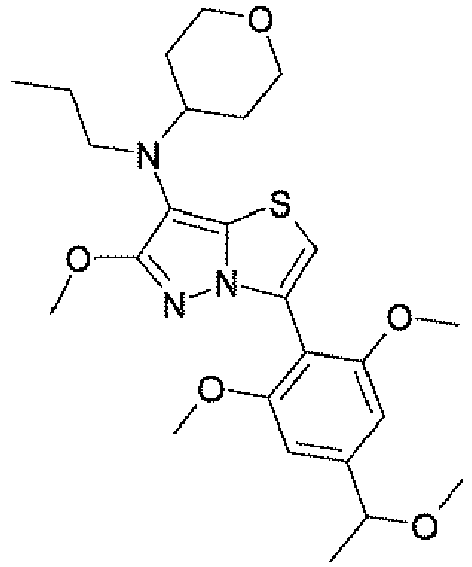
- N-(Cyclopropylmethyl)-3-[2,6-dimethoxy-4-(1-methoxyethyl)phenyl]-6-methoxy-N-(tetrah ydrofuran-3-ylmethyl)pyrazolo[5,1-b][1,3]thiazole-7-amine

- N-(Cyclopropylmethyl)-3-[6-(dimethylamino)-4-methylpyridin-3-yl]-6-methoxy-N-(tetrahy drofuran-3-ylmethyl)pyrazolo[5,1-b][1,3]thiazole-7-amine

- 3-[6-(Dimethylamino)-4-methyl-pyridin-3-yl]-6-methoxy-N-propyl-N-(tetrahydro-2H-pyran -4-yl)pyrazolo[5,1-b][1,3]thiazole-7-amine

- [3-(4-Ethy1-2,6-dimethoxyphenyl)-6-methoxypyrazolo[5,1-b][1,3]thiazol-7-yl]-propyl-(tetra hydro-pyran-4-yl)amine

- Cyclopropylmethyl-[3-(4-ethyl-2,6-dimethoxy-phenyl)-6-methoxy-pyrazolo[5,1-b][1,3]thiaz ol-7-yl]-(tetrahydro-furan-3-ylmethyl)amine

- 3-[2,6-Dimethoxy-4-(methoxymethyl)phenyl]-6-methoxy-N,N-dipropylpyrazolo[5,1-b][1,3] thiazole-7-amine

- N-(Cyclopropylmethyl)-3-(2,6-dimethoxy-4-methylphenyl)-6-methoxy-N-(tetrahydro-2H-p yran-4-yl)pyrazolo[5,1-b][1,3]thiazole-7-amine

- N-(Cyclopropylmethyl)-3-(2,6-dimethoxy-4-methylphenyl)-6-methoxy-N-(tetrahydrofuran-3-ylmethyl)pyrazolo[5,1-b][1,3]thiazole-7-amine

- N-(Cyclopropylmethyl)-3-[2,6-dimethoxy-4-(methoxymethyl)phenyl]-6-methoxy-N-(2-met hoxyethyl)pyrazolo[5,1-b][1,3]thiazole-7-amine

- N-Bulyl-3-[2,6-dimethoxy-4-(methoxymethyl)phenyl]-6-methoxy-N-(2-methoxyethyl)pyra zolo[5,1-b][1,3]thiazole-7-amine

- N-(Cyclobutylmethyl)-3-[2,6-dimethoxy-4-(methoxymethyl)phenyl]-6-methoxy-N-(tetrahy drofuran-3-yl)pyrazolo[5,1-b][1,3]thiazole-7-amine

- 3-(4-Chloro-2,6-dimethoxyphenyl)-N-(cyclopropylmethyl)-6-methoxy-N-(tetrahydrofuran-3 -ylmethyl)pyrazolo[5,1-b][1,3]thiazole-7-amine

- 3-(4-Chloro-2,6-dimethoxymethylphenyl)-6-methoxy-N-propyl-N-tetrahydro-2H-pyran-4-yl)pyrazolo[5,1-b][1,3]thiazole-7-amine

- N-(Cyclopropylmethyl)-3-[2-6-dimethoxy-4-(methoxymethyl)phenyl]-6-methoxy-N-(3-met hoxypropyl)pyrazolo[5,1-b][1,3]thiazole-7-amine
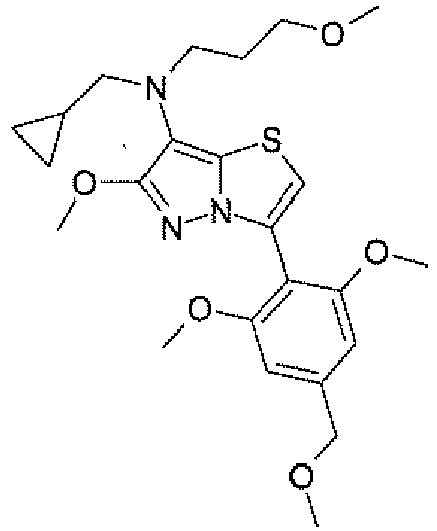
- 3-[2,6-Dimethoxy-4-(methoxymethyl)phenyl]-6-methoxy-N-(3-methoxypropyl)-N-(tetrahy dro-2H-pyran-4-yl)pyrazolo[5,1-b][1,3]thiazole-7-amine

- 3-[2,6-Dimethoxy-4-(methoxymethyl)phenyl]-6-methoxy-N-oxepan-4-yl-N-propylpyrazolo [5,1-b][1,3]thiazole-7-amine

- [3-(4-Ethoxymethyl-2,6-dimethoxy-phenyl)-6-methoxy-pyrazolo[5,1-b][1,3]thiazol-7-yl]-(3-fluoro-propyl)-(tetrahydro-pyran-4-yl)-amine

- [3-(4-Ethoxymethyl-2,6-dimethoxy-phenyl)-6-mathoxy-pyrazolo[5,1-b][1,3]thiazol-7-yl]-(4-fluoro-butyl)-(tetrahydro-pyran-4-yl)-amine

- N-[(3,3-Difluorocyclobutyl)methyl]-3-[2,6-dimethoxy-4-(methoxymethyl)phenyl]-6-methox y-N-(tetrahydrofuran-3-ylmethyl)pyrazolo[5,1-b][1,3]thiazole-7-amine

- N-[(3,3-Difluorocyclobutyl)methyl]-3-[2,6-dimethoxy-4-(methoxymethyl)phenyl]-6-methox y-N-(tetrahydro-2H-pyran-4-yl)pyrazolo[5,1-b][1,3]thiazole-7-amine

- 3-[2,6-Dimethoxy-4-(methoxymethyl)phenyl]-6-methoxy-N-(3-methoxypropyl)-N-propylp yrazolo[5,1-b][1,3]thiazole-7-amine
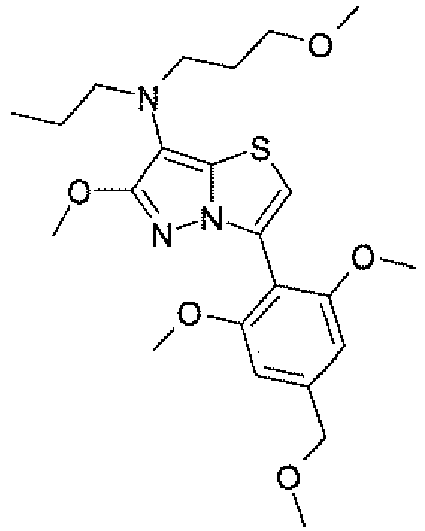
- N-(Cyclopropylmethyl)-3-[4-(ethoxymethyl)-2,6-dimethoxyphenyl]-6-methoxy-N-(2-metho xyethyl)pyrazolo[5,1-b][1,3]thiazole-7-amine

- N-Butyl-3-[4-(ethoxymethyl)-2,6-dimethoxyphenyl]-6-methoxy-N-(2-methoxyethyl)pyrazol o[5,1-b][1,3]thiazole-7-amine

- N-(Cyclopropylmethyl)-3-[4-(ethoxymethyl)-2,6-dimethoxyphenyl]-6-methoxy-N-(3-metho xypropyl)pyrazolo[5,1-b][1,3]thiazole-7-amine

- [3-(2,6-Dimethoxy-4-methoxymethylphenyl)-6-methoxy-pyrazolo[5,1-b][1,3]thiazol-7-yl]-i sobutyl-(tetrahydrofuran-3-yl)-amine

- 3-[2,6-Dimethoxy-4-(methoxymethyl)phenyl]-6-methoxy-N-propyl-N-(pyridin-4-ylmethyl) pyrazolo[5,1-b][1,3]thiazole-7-amine

- N-(Cyclopropylmethyl)-3-[2,6-dimethoxy-4-(methoxymethyl)phenyl]-N-(2-ethoxyethyl)-6-methoxypyrazolo[5,1-b][1,3]thiazole-7-amine

- 3-[4-(Ethoxymethyl)-2,6-dimethoxyphenyl]-6-methoxy-N-propyl-N-(tetrahydrofuran-3-yl)p yrazolo[5,1-b][1,3]thiazole-7-amine

- N-(Cyclobutylmethyl)-3-[4-(ethoxymethyl)-2,6-dimethoxyphenyl]-6-methoxy-N-(tetrahydr ofuran-3-yl)pyrazolo[5,1-b][1,3]thiazole-7-amine

- N-(Cyclobutylmethyl)-3-[2,6-dimethoxy-4-(methoxymethyl)phenyl]-6-methoxy-N-(2-meth oxyethyl)pyrazolo[5,1-b][1,3]thiazole-7-amine

- N-(Cyclopropylmethyl)-3-[2,6-dimethoxy-4-(methoxymethyl)phenyl]-N-(2-isopropoxyethyl )-6-methoxypyrazolo[5,1-b][1,3]thiazole-7-amine

- N-(Cyclopropylmethyl)-3-[2,6-dimethoxy-4-(methoxymethyl)phenyl]-6-methoxy-N-(3-met hoxybutyl)pyrazolo[5,1-b][1,3]thiazole-7-amine

- N-(Cyclopropylmethyl)-3-[2,6-dimethoxy-4-(methoxymethyl)phenyl]-6-methoxy-N-(2-met hoxypropyl)pyrazolo[5,1-b][1,3]thiazole-7-amine
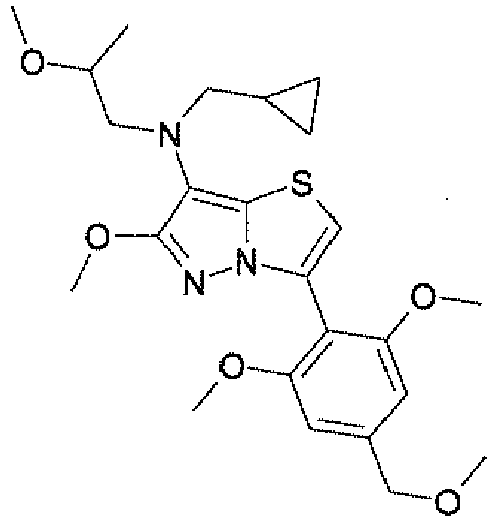
- 3-[2,6-Dimethoxy-4-(methoxymethyl)phenyl]-N-(1-ethylpropyl)-6-methoxy-N-(2-methoxy ethyl)pyrazolo[5,1-b][1,3]thiazole-7-amine

- N-Cyclopentyl-3-[2,6-dimethoxy-4-(methoxymethyl)phenyl]-6-methoxy-N-(2-methoxyethy 1)pyrazolo[5,1-b][1,3]thiazole-7-amine

- N-Cyclohexyl-3-[2,6-dimethoxy-4-(methoxymethyl)phenyl]-6-methoxy-N-(2-methoxyethyl )pyrazolo[5,1-b][1,3]thiazole-7-amine

- 3-[2,6-Dimethoxy-4-(methoxymethyl)phenyl]-N-isobutyl-6-methoxy-N-(2-methoxyethyl)p yrazolo[5,1-b][1,3]thiazole-7-amine

- N-Cyclobutyl-3-[2,6-dimethoxy-4-(methoxymethyl)phenyl]-6-methoxy-N-(2-methoxyethyl )pyrazolo[5,1-b][1,3]thiazole-7-amine

- N-(Cyclopropylmethyl)-6-methoxy-N-(2-methoxyethyl)-3-[2-methoxy-4-(methoxymethyl)p henyl]pyrazolo[5,1-b][1,3]thiazole-7-amine

- N-(Cyclopropylmethyl)-3-(2,4-dimethoxyphenyl)-6-methoxy-N-(2-methoxyethyl)pyrazolo[ 5,1-b][1,3]thiazole-7-amine

- N-Cyclobutyl-3-[2,6-dimethoxy-4-(methoxymethyl)phenyl]-N-ethyl-6-methoxypyrazolo[5, 1-b][1,3]thiazole-7-amine

- 3-(4-Cyclopropyl-2,6-dimethoxyphenyl)-N-(cyclopropylmethyl)-6-methoxy-N-(tetrahydrof uran-3-ylmethyl)pyrazolo[5,1-b][1,3]thiazole-7-amine

- 3-(4-Cyclopropyl-2,6-dimethoxyphenyl)-6-methoxy-N-propyl-N-(tetrahydro-2H-pyran-4-yl )pyrazolo[5,1-b][1,3]thiazole-7-amine
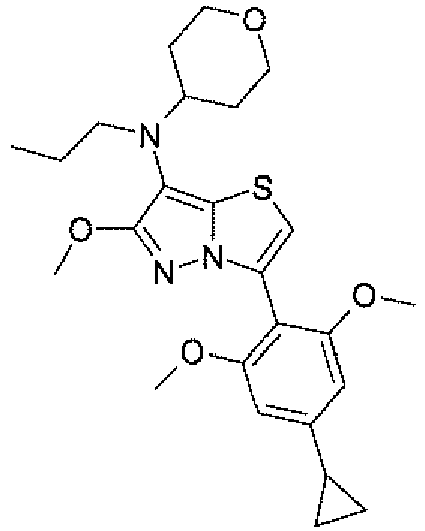
- N-Cyclobutyl-3-[2,6-dimethoxy-4-(methoxymethyl)phenyl]-6-methoxy-N-(3-methoxyprop yl)pyrazolo[5,1-b][1,3]thiazole-7-amine

- N-Cyclopentyl-3-[2,6-dimethoxy-4-(methoxymethyl)phenyl]-6-methoxy-N-(3-methoxypro pyl)pyrazolo[5,1-b][1,3]thiazole-7-amine

- 3-(4-Cyclopropyl-2,6-dimethoxyphenyl)-N-ethyl-6-methoxy-N-(tetrahydro-2H-pyran-4-yl)p yrazolo[5,1-b][1,3]thiazole-7-amine

- 3-[2,6-Dimethoxy-4-(methoxymethyl)phenyl]-6-methoxy-N-[3-(methoxymethyl)cyclobutyl ]-N-propylpynzolo[5,1-b][1,3]thiazole-7-amine

- N-Cyclopentyl-3-[2,6-dimethoxy4-(methoxymethyl)phenyl]-N-ethyl-6-methoxypyrazolo[5 ,1-b][1,3]thiazole-7-amine

- N-Cyclobutyl-3-[2,6-dimethoxy-4-(methoxymethyl)phenyl]-6-methoxy-N-(tetrahydrofuran-3-yl)pyrazolo[5,1-b][1,3]thiazole-7-amine

- [3-(4-Isopropoxymethyl-2,6-dimethoxyphenyl)-6-methoxy-pyrazolo[5,1-b][1,3]thiazol-7-yl] -propyl-(tetrahydro-pyran-4-yl)-amine

- N-Cyclopentyl-3-(4-cyclopropyl-2,6-dimethoxyphenyl)-6-melhoxy-N-(3-methoxypropyl)py razolo[5,1-b][1,3]thiazole-7-amine

- 3-[2,6-Dimethoxy-4-(methoxymethyl)phenyl]-N-(3-fluoropropyl)-6-methoxy-N-(pyridin-4-ylmethyl)-pyrazolo[5,1-b][1,3]thiazole-7-amine

- 3-[2,6-Dimethoxy-4-(methoxymethyl)phenyl]-N-(3-fluoropropyl)-6-methoxy-N-(pyridin-3-ylmethyl)-pyrazolo[5,1-b][1,3]thiazole-7-amine

- 3-[2,6-Dimethoxy-4-(methoxymethyl)phenyl]-N-(3-fluoropropyl)-6-methoxy-N-(pyridin-2-ylmethyl)-pyrazolo[5,1-b][1,3]thiazole-7-amine

- 3-[2-Chloro-6-methoxy-4-(methoxymethyl)phenyl]-N-cyclopentyl-6-methoxy-N-(3-methox ypropyl)pyrazolo[5,1-b][1,3]thiazole-7-amine

- 4-{7-[Cyclopentyl(2-methoxyethyl)amino]-6-methoxypyrazolo[5,1-b][1,3]thiazol-3-yl}-3,5-dimethoxybenzonitrile

- Butyl-[3-(4-isopropoxymethyl-2,6-dimethoxy-phenyl)-6-methoxy-pyrazolo[5,1-b][1,3]thiaz ol-7-yl]-(tetrahydro-pyran-4-yl)amine

- 3-[2,6-Dimethoxy-4-(methoxymethyl)phenyl]-N-isobutyl-6-methoxy-N-[(1-methoxycyclop ropyl)methyl]pyrazolo [5,1-b][1,3]thiazole-7-amine
(76a)
N-{3-[2,6-Dimethoxy-4-(methoxymethyl)phenyl]-6-methoxypyrazolo[5,1-b][1,3]thiazol-7-yl}-1-hydroxycyclopropanecarboxamide
1H-NMR (CDCl3) δ: 1.09-1.15 (m, 2H), 1.47-1.53 (m, 2H), 2.75 (s, 1), 3.46 (s, 3H), 3.76 (s, 6H), 3.90 (s, 3), 4.50 (s, 2H), 6.45 (s, 1H), 6.63 (s, 2H), 8.38 (s, 1H). - 1-[({3-[2,6-dimethoxy-4-(methoxymethyl)phenyl]-6-methoxypyrazolo[5,1-b][1,3]thiazol-7-yl}amino)methyl]cyclopropanol

1H-NMR (CDCl3) δ: 0.37-0.41 (m, 2H), 0.73-0.78 (m, 2H), 1.26 (t, J=7.2Hz, 1H), 3.10 (s, 2H), 3.47 (s, 3H), 3.77 (s, 6H), 3.90 (s, 3H), 4.50 (s, 2H), 6.42 (s, 1H), 6.64 (s, 2H). - 3-[2,6-Dimethoxy-4-(methoxymethyl)phenyl]-N-isobutyl-6-methoxy-N-[(1-methoxycyclop ropyl)methyl]pyrazolo[5,1-b][1,3]thiazole-7-amine

1H-NMR (CDCl3) δ: 0.37-0.42 (m, 2H), 0.63-0.67 (m, 2H), 0.93 (d, J=6.8Hz, 6H), 1.48-1.68 (m, 1H), 2.84 (d, J=7.2Hz, 2H), 3.15 (s, 2H), 3.30 (s, 3H), 3.46 (s, 3H), 3.77 (s, 6H), 3.86 (s, 3H), 4.50 (s, 2H), 6.40 (s, 1H), 6.64 (s, 2H). - 3-[4-(2-Fluoroethoxy)-2,6-dimethoxyphenyl]-6-methoxy-N-propyl-N-(tetrahydro-2H-pyran-4-yl)pyrazolo[5,1-b][1,3]thiazole-7-amine
(77a) tert-Butyl [3-(4-hydroxy-2,6-dimethoxyphenyl)-6-methoxypyrazolo[5,1-b][1,3]thiazol-7-yl]carbamate
1H-NMR (CDCl3) δ: 1.54 (s, 9H), 3.61 (s, 6H), 3.99 (s, 3H), 5.93 (s, 2H), 6.10 (br.s, 1H), 6.38 (s, 1H). - (77b) tert-Butyl {3-[4-(2-fluoroethoxy)-2,6-dimethoxyphenyl]-6-methoxypyrazolo[5,1-b][1,3]thiazol-7-yl}ca rbamate

1H-NMR (CDCl3) δ: 1.52 (s, 9H), 3.72 (s, 6H), 3.89 (s, 3H), 4.22-4.27 (m, 1H), 4.29-4.34 (m, 1H), 4.70-4.75 (m, 1H), 4.82-4.87 (m, 1H), 6.23 (s, 2H), 6.40 (s, 1H). - 3-[4-(2-Fluoroethoxy)-2,6-dimethoxyphenyl]-6-methoxy-N-propyl-N-(tetrahydro-2H-pyran-4-yl)pyrazolo[5,1-b][1,3]thiazole-7-amine

- 3-[4-Ethoxy-2,6-dimethoxyphenyl]-6-methoxy-N-propyl-N-(tetrahydro-2H-pyran-4-yl)pyra zolo[5,1-b][1,3]thiazole-7-amine

1H-NMR (CDCl3) δ: 0.87 (t, J=7.2Hz, 3H), 1.32-1.43 (m, 2H), 1.46 (t, J=7.0Hz, 3H), 1.53-1.66 (m, 2H), 1.78-1.87 (m, 2H), 2.90-2.97 (m, 2H), 3.00-3.10 (m, 1H), 3.33-3.43 (m, 2H), 3.76 (s, 6H), 3.87 (s, 3H), 3.94-4.02 (m, 2H), 4.10 (q, J=7.2Hz, 2H), 6.22 (s, 2H), 6.38 (s, 1H). - 3-[2,6-Dimethoxy-4-(methoxymethyl)phenyl]-6-ethoxy-N-propyl-N-(tetrahydro-2H-pyran-4-yl)pyrazolo[5,1-b][1,3]thiazole-7-amine

1H-NMR (CDCl3) δ: 0.88 (t, J=7.6Hz, 3H), 1.31 (t, J=7.2Hz, 3H), 1.34-1.44 (m, 2H), 1.54-1.68 (m, 2H),1.84 (br.d, J=12.4Hz, 2H), 2.95 (t, J=7.2Hz, 2H), 3.01-3.11 (m, 1H), 3.38 (t, J=7.6Hz, 2H), 3.47 (s, 3H), 3.78 (s, 6H), 3.94-4.03 (m, 2H), 4.22 (q, J=7.2Hz, 2H), 4.50 (s, 2H), 6.41 (s, 1H), 6.64 (s, 2H). - Hereinafter, the compounds of Example 80 to Example 84 were synthesized according to the procedure similar to Example 79.
- 3-[2,6-Dimethoxy-4-(methoxymethyl)phenyl]-6-ethoxy-N-propyl-N-(tetrahydro-2H-pyran-4-ylmethyl)pyrazolo[5,1-b][1,3]thiazole-7-amine

- N-(Cyclopropylmethyl)-3-[2,6-dimethoxy-4-(methoxymethyl)phenyl]-6-ethoxy-N-(tetrahyd ro-2H-pyran-4-yl)-pyrazolo[5,1-b][1,3]thiazole-7-amine

- N-Butyl-3-[2,6-dimethoxy-4-(methoxymethyl)phenyl]-6-ethoxy-N-(tetrahydro-2H-pyran-4-yl)-pyrazolo[5,1-b][1,3]thiazole-7-amine

- N-(Cyclobutylmethyl)-3-[2,6-dimethoxy-4-(methoxymethyl)phenyl]-6-ethoxy-N-(tetrahydr o-2H-pyran-4-yl)-pyrazolo[5,1-b][1,3]thiazole-7-amine
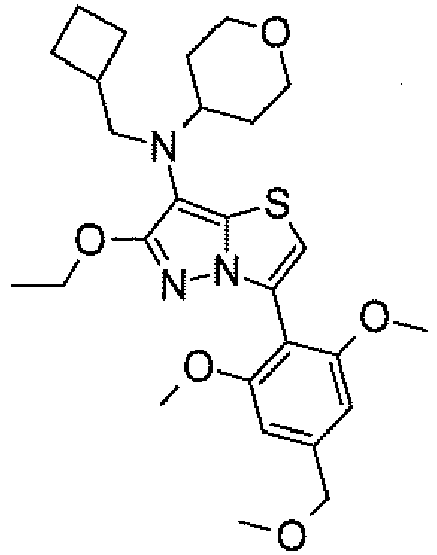
- 3-[2,6-Dimethoxy-4-(methoxymethyl)phenyl]-6-ethoxy-N-propyl-N-(tetrahydrofuran-3-ylm ethyl)pyrazolo[5,1-b][1,3]thiazole-7-amine

- 3-[2,6-Dimethoxy-4-(methoxymethyl)phenyl]-6-methoxy-N-propyl-N-pyridin-4-ylpyrazolo [5,1-b][1,3]thiazole-7-amine

1H-NMR (CDCl3) δ: 0.95 (t J=7.4Hz, 3H, 1.64-1.76 (m, 2H), 3.49 (s, 3H), 3.55 (t, J=7.8Hz, 2H), 3.83 (s, 6H), 3.86 (s, 3H), 4.52 (s, 2H), 6.50-6.56 (m, 2H), 6.54 (s, 1H), 6.68 (s, 2H), 8.18-8.24 (m,2H). - 3-[2,6-Dimethoxy-4-(methoxymethyl)phenyl]-6-methoxy-N-propyl-N-pyridin-2-ylpyrazolo [5,1-b][1,3]thiazole-7-amine

1H-NMR (CDCl3) δ: 0.93 (t, J=7.6Hz, 3H), 1.60-1.74 (m, 2H), 3.48 (s, 3H), 3.80-3.87 (m, 2H), 3.82 (s, 6H), 3.86 (s, 3H), 4.52 (s, 2H), 6.36 (d, J=8.8Hz, 1H), 6.52 (s, 1H), 6.54-6.60 (m, 1H), 6.68 (s, 2H), 7.34 (ddd, J=2.0, 6.8, 8.8Hz, 1H), 8.17-8.22 (m, 1H). - 3-[2,6-Dimethoxy-4-(methoxymethyl)phenyl]-6-methoxy-N-propyl-N-pyndin-3-ylpyrazolo [5,1-b][1,3]thiazole-7-amine

1H-NMR (CDCl3) δ: 0.95 (t, J=7.4Hz, 3H), 1.66-1.77 (m, 2H), 3.48 (s, 3H), 3.51-3.58 (m, 2H), 3.82 (s, 6H), 3.85 (s, 3H), 4.52 (s, 2H), 6.51 (s, 1H), 6.64 (s, 2H), 6.94 (ddd, J=1.2,3.2, 8.4Hz, 1H), 7.06-7.10 (m,1H), 7.97 (dd, J=1.2, 4.4Hz, 1H), 8.11 (d, J-2,4Hz, 1H). - 3-[2,6-Dimethoxy-4-(methoxymethyl)phenyl]-N-(3-fluoropropyl)-6-methoxy-N-p yridin-3-ylpyrazolo[5,1-b][1,3]thiazole-7-amine

- N-(Cyclopropylmethyl)-3-[2,6-dimethoxy-4-(methoxymethyl)phenyl]-6-methoxy-N-pyridin -3-ylpyrazolo[5,1-b][1,3]thiazole-7-amine

- 4-({Cyclopropylmethyl-[3-(2,6-dimethoxy-4-methoxymethyl-phenyl)-6-methoxy-pyrazolo[ 5,1-b][1,3]thiazol-7-yl-amino}-methyl-tetrahydro-pyran-4-ol

- Cyclopropylmethyl-[3-(2,6-dimethoxy-4-methoxymethyl-phenyl)-6-methoxy-pyrazolo[5,1-b][1,3]thiazol-7-yl]-(4-fluoro-tetrahydro-pyran-4-ylmethyl)-amine

- Cyclopropylmethyl-(3,6-dihydro-2H-pyran-4-ylmethyl)-[3-(2,6-dimethoxy-4-methoxymeth yl-phenyl)-6-methoxy-pyrazolo[5,1-b][1,3]thiazol-7-yl]-amine

1H-NMR (CDCl3) δ:0.01-0.08 (m, 2H), 0.34-0.44 (m, 2H), 0.84-0.96 (m, 1H), 1.60-1.92 (m, 4H), 2.87 (d, J=7.2Hz, 2H), 3.22 (d, J=20.4Hz, 2H), 3.47 (s, 3H), 3.78 (s, 6H), 3.64-3.83 (m, 4H), 3.87 (s, 3H), 4.50 (s, 2H), 6.41 (s, 1H), 6.64 (s, 2H).
1H-NMR (CDCl3) δ:0.01-0.10 (m, 2H), 0.36-0.44 (m, 2H, 0.83-0.98 (m,1H), 2.16-2.25 (m, 2H), 2.80 (d, J=6.8Hz, 2H), 3.47 (s, 3H), 3.59 (s, 2H), 3.74 (t, J=5.6Hz, 2H), 3.77 (s, 6H), 3.87 (s, 3H), 4.04-4.10 (m, 2H), 4.50 (s, 2H), 5.58-5.64 (m, 1H), 6.40 (s,1H), 6.64 (s, 2H). - Hereinafter, the compounds of Examples 93 to 101 were synthesized according to the procedure similar to Example 10 by using the compound of Production Example 11-4 or Production Example 11-5.
- 3-[2,6-Dimethoxy-4-(methoxymethyl)phenyl]-6-methoxy-N-[3-oxabicyclo[3,1.0] hex-6-ylmethyl]-N-propylpyrazolo[5,1-b][1,3]thiazole-7-amine (diastereomer 1)

- N-(Cyclopropylmethyl)-3-[2,6-dimethoxy-4-(methoxymethyl)phenyl]-6-methoxy-N-[3-oxa bicyclo[3.1.0]hex-6-ylmethyl]-pyrazolo[5,1-b][1,3]thiazole-7-amine (diastereomer 1)
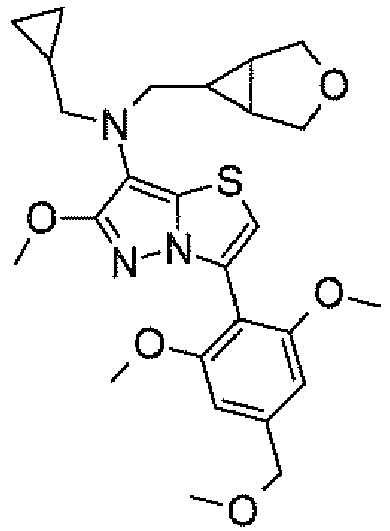
- 3-[2,6-Dimethoxy-4-(methoxymethyl)phenyl]-6-methoxy-N-[3-oxabicyclo[3.1.0]hex-6-ylm ethyl]-N-propylpyrazolo[5,1-b][1,3]thiazole-7-amine (diastereomer 2)

- N-(Cyclopropylmethyl)-3[2,6-dimethoxy-4-(methoxymethyl)phenyl]-6-methoxy-N-[3-oxa bicyclo[3.1.0]hex-6-ylmethyl]pyrazolo[5,1-b][1,3]thiazole-7-amine (diastereomer 2)

- 3-(4-Cyclopropyl-2,6-dimethoxyphenyl)-N-ethyl-6-methoxy-N-[3-oxabicyclo[3.1.0]hex-6-y lmethyl]pyrazolo[5,1-b][1,3]thiazole-7-amine (diastereomer 1)

- N-(Cyclobutylmethyl)-3-[2,6-dimethoxy-4-(methoxymethyl)phenyl]-6-methoxy-N-[3-oxabi cyclo[3.1.0]hex-6-ylmethyl]-pyrazolo[5,1-b][1,3]thiazole-7-amine (diastereomer 1)

- N-(Cyclobutylmethyl)-3-[2,6-dimethoxy-4-(methoxymethyl)phenyl]-6-methoxy-N-[3-oxabi cyclo[3.1.0]hex-6-ylmethyl]-pyrazolo[5,1-b][1,3]thiazole-7-amine (diastereomer 2)
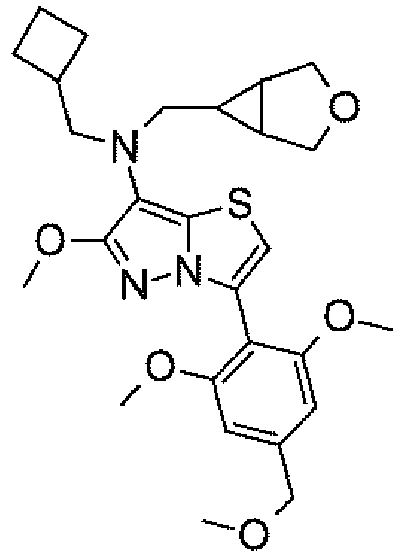
- 4-(7-{(Cyclopropylmethyl)[3-oxabicyclo[3.1.0]hex-6-ylmethyl]amino}-6-methoxypyrazolo[ 5,1-b][1,3]thiazol-3-yl)-3,5-dimethoxybenzonitrile (diastereomer 1)

- 3,5-Dimethoxy-4-{6-rnethoxy-7-[3-oxabicyclo[3.1.0]hex-6-ylmethyl](propyl)amino]pyrazol o[5,1-b][1,3]thiazol-3-yl}benzonitrile(diastereomer1)

- (4-{ 7-[Butyl(tetrahydro-2H-4-yl)amino]-6-methoxypyrazolo[5,1-b][1,3]thiazol-3-yl}-3,5-di methoxyphenyl)methanol

- (4-{7-[Butyl(tetrahydro-2H-4-yl)amino]-6-methoxypyrazolo[5,1-b][1,3]thiazol-3-yl}-3,5-di methoxybenzaldehyde

1H-NMR (CDCl3) δ: 0.87 (t, J=6.8Hz, 3H), 1.24-1.40 (m, 4H), 1.52-1.67 (m, 2H), 1.78-1.88 (m, 2H), 2.98 (t, J=7.2Hz, 2H), 3.00-3.12 (m, 1H), 3.38 (td, J=2.0, 12.0Hz, 2H), 3.85 (s, 3H), 3.88 (s, 6H), 3.94-4.03 (m, 2H), 6.52 (s, 1H), 7.18 (s, 2H), 10.0 (s, 1H). - 4-{7-(Butyl(tetrahydro-2H-4-yl)amino]-6-methoxypyrazolo[5,1-b][1,3]thiazol-3-yl}-3,5-dim ethoxybenzoic acid

1H-NMR. (CDCl3) δ: 0.83 (t, J=7.2Hz, 3H), 1.16-1.42 (m, 6H), 1.66-1.76 (m, 2H), 2.93 (1, J=6.8Hz, 2H), 2.94-3.06 (m, 1H), 3.18-3.44 (m, 2H), 3.72 (s, 3H), 3.78 (s, 6H), 3.78-3.88 (m, 2H), 6.88 (s, 1H), 7.31 (s, 2H). - 3-[4-(Ethoxymethyl)-2,6-dimethoxyphenyl]-6-methoxypyrazolo[5,1-b][1,3]thiazole-7-amin e

1H-NMR (CDCl3) δ: 1.26 (t, J=7.2Hz, 3H), 3.61 (q, J=7.2Hz, 2H), 3.74 (s, 6H), 3.86 (s, 3H), 4.56 (s, 2H), 6.52 (s, 1H), 6.73 (s, 2H). - N-Butyl-3-[2,6-dimethoxy-4-(methoxymethyl)phenyl]-6-(methylthio)-N-(tetrahydro-2H-pyr an-4-yl)pyrazolo[5,1-b][1,3]thiazole-7-amine

Dichloromethane (2 mL) was added to the obtained residue, and then trifluoroacetic acid (1 mL) was added, and the mixture was stirred at room temperature for one hour. The solvent in the reaction mixture was distilled off under reduced pressure. To the obtained residue, THF (2 mL) was added, and then, tetrahydro-4H-pyran-4-one (9.17 µl, 0.095 mmol), and sodium triacetoxyborohydride (20.1 mg, 0.095 mmol) were added in this order, and the mixture was stirred at room temperature for 4.5 hours. To the reaction mixture was added 5N aqueous sodium hydroxide to neutralize the mixture, and then ethyl acetate was added thereto. After thoroughly shaking the mixture, the organic layer was separated, the organic layer was washed with brine and dried over anhydrous magnesium sulfate, and the solvent was distilled off under reduced pressure. The residue was purified by silica gel column chromatography (n-heptane/ethyl acetate = 3/2) to obtain the title compound (1.70 mg, 0.0034 mmol).
1H-NMR (400MHz, CDCl3) 6: 0.87 (t, J=6.8Hz, 3H), 1.20-1.40 (m, 4H), 1.48-1.72 (m, 2H), 1.78-1.88 (m, 2H), 2.44 (s, 3H), 3.00 (t, J=6.4Hz, 2H), 3.06-3.18 (m, 1H), 3.37 (td, J=1.6, 11.6Hz, 2H), 3.47 (s, 3H), 3.78 (s, 6H), 3.94-4.04 (m, 2H), 4.48 (s, 2H), 6.60 (s, 1H), 6.64 (s, 2H).
MS [M+H]+506 - The binding capacities of the compounds of the present invention for CRF1 receptor (CRFR1) were evaluated. The test methods and results were as described below.
- The membrane fraction of human CRF1 high-expressing cells was used as the material for a CRF1 binding experiment. The CRFR1-expressing cells were prepared in the following manner. The full-length CRFR1 gene was obtained by PCR by using human brain cDNA library (QuickClone (TM), Clontech). The obtained DNA fragment was inserted into a cloning vector and the base sequence was confirmed. cDNA having the proper base sequence was linked to an expression vector (pcDNA3.1 (TM), Invitrogen). The CRFR1 expression vector was genetically introduced into HEK293 cell, and the resistant cells which proliferated in culture medium containing G418 (1 mg/ml) were cloned by the limiting dilution method. Out of the cloned cells, cells having high binding capacity between the membrane fraction per unit protein and sauvagine were selected according to the following binding experiment, and the selected cells were used for the experiments.
- The cloned cells obtained in (1) were collected and suspended in ice-cooled membrane buffer (50 mM Tris-HCl, 5 mM MgCl2, 2 mM EGTA, 1 mM DTT, protease inhibitor cocktail (COMPLETE™, Roche Diagnostics) pH 7.3), and then the cells were disrupted with a Polytron (KINEMATICA) while cooling on ice (level 5, 10 seconds, 2-5 times, ice-cooling) and then centrifuged (2,000 rpm, 5 minutes, 4°C), followed by collecting the supernatant. Membrane buffer was added to the precipitate, and the mixture was subjected to Polytron treatment (same conditions as mentioned above) and centrifuged (conditions as mentioned above), and the obtained supernatant was collected and combined with the previous supernatant. This was centrifuged (13,000 rpm (18,000 xg), 30 minutes, 4°C) to prepare cell membranes. The precipitated cell membranes were suspended in membrane buffer and disrupted with a Polytron (level 5, 10 seconds, 3-5 times, ice-cooling) to prepare a dispersed suspension. The protein assay was carried out.
The following method (1) or (2) was carried out for use as the cell membrane fraction. - (1) The above dispersed suspension was diluted with membrane buffer containing 0.1% BSA to a protein concentration of 200 µg/ml, for use as the cell membrane fraction.
- (2) The above dispersed suspension was freeze-preserved, and if necessary, thawed, re-dispersed and diluted for use as the cell membrane fraction.
- A binding competition experiment with CRF was conducted by the SPA (GE Healthcare) method using a 96-well plate. Five µg of the cell membrane fraction protein, 1 mg of SPA beads and 100 pM 125I-CRF (Perkin Elmer) were allowed to stand at room temperature for at least two hours in the presence of a test compound, and the radioactivity of each well after centrifugation (1,200 rpm (260 × g), five minutes, room temperature) was measured with a TopCount (registered trademark; Perkin Elmer).
- The radioactivity with addition of a 4,000-fold excess of non-radioactive sauvagine as the nonspecific binding was subtracted from each value, and the resulting value was expressed as a percentage (% of control), with 100% as the radioactivity without addition of the test compound (control). The IC50 value was calculated from a binding inhibition curve in which the abscissa axis shows the test compound concentration and the ordinate axis shows % (% of control).
- As shown in the following table, the compounds of the present invention exhibit excellent binding capacity with respect to CRFR1.
-
[Table 1] Compound No. (Example No.) CRF1 receptor binding capacity IC50(nM) Compound No. (Example No.) CRF1 receptor binding capacity IC50(nM) 1 93 53 18 2 39 54 20 3 297 55 19 4 46 56 31 5 76 59 24 7 94 60 33 8 51 61 39 9 116 62 73 11 92 63 61 12 71 64 61 13 56 66 26 14 51 67 52 16 132 68 77 17 56 69 48 19 52 70 61 22 64 71 58 23 44 72 75 24 26 73 66 25 43 74 52 26 33 75 74 27 48 76 37 28 40 79 76 29 45 81 89 30 49 82 63 31 74 83 47 32 57 84 51 34 130 86 33 35 89 87 36 37 95 88 53 39 57 89 52 40 32 91 61 41 25 92 47 42 35 93 45 43 45 94 45 44 53 95 80 45 48 96 62 46 26 97 80 47 32 98 88 48 25 100 89 49 59 101 99 50 87 103 101 51 36 106 83 - The light/dark box test in mice was carried out according to a modified method of Belzung C., Misslin R., and Vogel E. et al. (Reference; Behavioural effects of the benzodiazepine receptor partial agonist RO16-6028 in mice, Psychopharmacology, 97, 388-391, 1989). The test apparatus used in this test was a light/dark box including a covered black acrylic box (dark box; 15 × 10 × 20 cm), a white acrylic box with top opened (light box; 15 × 20 × 20 cm) and a black acrylic tunnel (10 × 7 × 4.5 cm) that connects the dark box and the light box and enables a mouse to freely move back and forth between the dark box and light box. In this test apparatus, however, a transparent acrylic plate was used for the front side (20 × 20 cm) and back side (20 × 20 cm) of the light box to allow observation of the behavior. After setting illumination so that the light intensity of the floor surface of the light box became 150 Lux, 5-week-old male Balb/c mice (purchased from Nihon Charles River) were introduced into the dark box and the test was started. In the test, the tested compound was suspended in 5% dimethyl sulfoxide, 5% Cremopor EL and 90% physiological saline and orally administered to the test animals one hour prior to the start of the test.
- The behavior of the mice was observed for 5 minutes after the start of the test. The time spent in the light box was measured as an index of the anxiolytic effect, with "spend in the light box" defined as the state in which all limbs of the mice were on the floor of the light box. The minimum dose which significantly prolonged the time spent in the light box in comparison with that of vehicle-treated group was determined as the minimum effective dose (MED). The statistical significance between the vehicle-treated group and the test compound-treated groups was analyzed by one-way layout analysis of variance followed by Dunnett multiple comparison when multiple doses were set for the same test, and by the Mann-Whitney U test when only one dose was set
- The compounds of Examples 4, 11, 14, 42, 46, and 94 exhibited an excellent anxiolytic effects in the light/dark box test in mice, with statistically significant effects when the dose was 30 mg/kg (oral administration).
-
[Table 2] Compound No. (Example No.) Effective Dose (mg/kg) 4 30 11 30 14 30 42 30 46 30 94 30 - The present invention can provide pharmaceutical compositions comprising pyrazolothiazole compounds or pharmacologically acceptable salts thereof, which exhibit CRF receptor antagonism. The compounds or pharmacologically acceptable thereof according to the present invention have excellent CRF receptor antagonism, and sufficient pharmacological activity, safety and pharmacokinetic properties as medicines.
- The pharmaceutical compositions of the present invention are useful for treatment or prevention of diseases associated with CRF and/or CRF receptors, and are particularly useful as therapeutic or prophylactic agents for depression, depressive symptoms, anxiety, irritable bowel syndrome, sleep disorder, insomnia, alcohol dependence, alcohol withdrawal symptoms, drug dependence, drug withdrawal symptoms, stress-related gastrointestinal dysfunction, anorexia nervosa, eating disorder, postoperative ileus, ischemic neuropathy, apoplexy, excitotoxic neuropathy, convulsion, epilepsy, hypertension, schizophrenia, bipolar disorder, dementia, or the like.
Claims (15)
- A compound represented by the formula (I) or pharmacologically acceptable salt thereof:
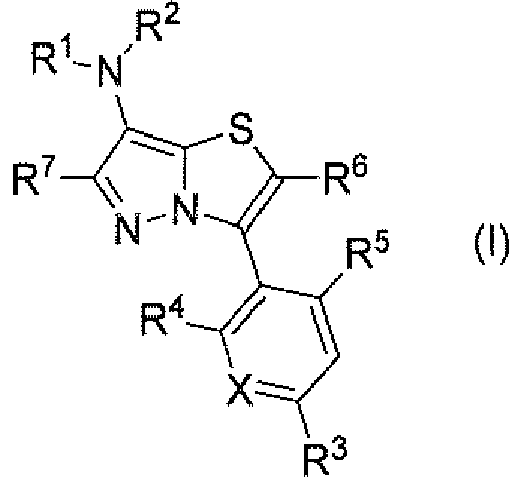
R1 is -A11-A12;
A11 is a single bond or a C1-6 alkylene group;
A12 is (a) a hydrogen atom, (b) a C1-6 alkyl group optionally having 1 to 3 substituents selected from Substituent group A, or (c) a C3-6 cycloalkyl group optionally having 1 to 3 substituents selected from Substituent group A;
R2 is -A21-A22;
A21 is a single bond or a C1-6 alkylene group;
A22 is (a) a hydrogen atom, (b) a C1-6 alkyl group optionally having 1 to 3 substituents selected from Substituent group A, (c) a C3-6 cycloalkyl group optionally having 1 to 3 substituents selected from Substituent group A; (d) a non-aromatic heterocyclic group selected from a tetrahydropyranyl group, a dihydropyranyl group, a tetrahydrofuryl group, a dioxanyl group, a hexahydrooxepinyl group, an oxabicyclo[3.1.0]hexyl group, a tetrahydrothienyl group, a dithianyl group, and a hexahydrothiepinyl group, which optionally has 1 to 3 substituents selected from Substituent group A, or (e) a heteroaryl group selected from a pyridyl group, a pyrimidinyl group, and a thiazolyl group;
R3 is (a) a C1-6 alkyl group optionally having 1 to 3 substituents selected from Substituent group A, (b) a C3-6 cycloalkyl group, (c) a C1-6 alkoxy group optionally having 1 to 3 substituents selected from Substituent group A, (d) a C3-6 cycloalkoxy C1-6 alkyl group, (e) di-C1-6 alkyl amino group, (f) a halogen atom, (g) a cyano group, (h) a formyl group, or (i) a carboxyl group;
R4 is a hydrogen atom or a C1-6 alkoxy group;
R5 is a halogen atom, a C1-6 alkyl group, or a C1-6 alkoxy group;
R6 is a hydrogen atom, a C1-6 alkyl group, a C1-6 alkoxy group, a C1-6 alkylthio group; or a C1-6 alkyl sulfinyl group; and
R7 is a C1-6 alkyl group, a C1-6 alkoxy group, or a C1-6 alkylthio group;
with the proviso that R3 is (a) a C1-6 alkyl group optionally substituted with a hydroxyl group, (b) a C3-6 cycloalkyl group, (c) a C2-6 alkoxy group optionally having 1 to 3 substituents selected from Substituent group A, (d) a C3-6 alkoxy C1-6 alkyl group, (e) a C1-2 alkoxy C2-6 alkyl group, (f) a di-C1-6 alkyl amino group, (g) a halogen atom, (h) a formyl group or (i) a carboxyl group when X is CH, A12 is a C1-6 alkyl group or a C3-6 cycloalkyl group optionally having a methyl group, R2 is a tetrahydrofurylmethyl group, a tetrahydropyranylmethyl group, or a tetrahydropyranyl group, R6 is a hydrogen atom, and R7 is a methoxy group; and
wherein the Substituent group A consists of a halogen atom, a hydroxyl group, a C1-6 alkyl group and a C1-6 alkoxy group. - The compound or pharmacologically acceptable salt thereof according to claim 1, wherein
X is a nitrogen atom or CH;
A11 is a single bond, a methylene group or a 1,2-ethylene group;
A12 is (a) a hydrogen atom, (b) a C1-6 alkyl group optionally having 1 to 3 substituents selected from Substituent group A, or (c) a C3-6 cycloalkyl group optionally having 1 to 3 substituents selected from Substituent group A;
A21 is a single bond, a methylene group, or a 1,2-ethylene group;
A22 represents (a) a hydrogen atom, (b) a C1-6 alkyl group optionally having 1 to 3 substituents selected from Substituent group A, (c) a C3-6 cycloalkyl group optionally having 1 to 3 substituents selected from Substituent group A; (d) a tetrahydropyranyl group optionally having 1 to 3 substituents selected from Substituent group A; (e) a dihydropyranyl group, (f) a tetrahydrofuryl group, (g) a dioxanyl group, (h) a hexahydrooxepinyl group, (i) an oxabicyclo[3.1.0]hexyl group, or (j) a pyridyl group;
R3 is (a) a methyl group, (b) an ethyl group, (c) a cyclopropyl group, (d) a C1-6 alkoxy group optionally substituted with 1 to 3 halogen atoms, (e) a C1-6 alkoxy methyl group, (f) a cyclobutoxymethyl group, (g) a dimethylamino group, (h) a halogen atom, (i) a cyano group, (j) hydroxymethyl group, (k) a formyl group, or (1) a carboxyl group;
R4 is a hydrogen atom or a methoxy group;
R5 is a halogen atom, a methyl group or a methoxy group;
R6 is a hydrogen atom, a methyl group or an ethyl group; and
R7 is a methoxy group. - The compound or pharmacologically acceptable salt thereof according to claim 2, wherein
X is CH;
R3 is (a) a methyl group, (b) an ethyl group, (c) a cyclopropyl group, (d) a C1-6 alkoxy group optionally substituted with 1 to 3 halogen atoms, (e) a C1-6 alkoxy methyl group, or (f) a cyclobutoxymethyl group. - The compound or pharmacologically acceptable salt thereof according to claim 1, wherein
X is CH;
R1 is a hydrogen atom, a C1-6 alkyl group, a C3-6 cycloalkyl group, or a C3-6 cycloalkyl methyl group;
R2 is a hydrogen atom, a C1-6 alkyl group, a tetrahydropyranyl group, a tetrahydropyranylmethyl group, or a tetrahydrofurylmethyl group;
R3 is a C1-6 alkoxy methyl group;
R4 is a methoxy group;
R5 is a methoxy group;
R6 is a hydrogen atom, a methyl group, a methylthio group, or a methylsulfinyl group; and
R7 is a methyl group, an ethyl group, an ethoxy group, or a methylthio group. - The compound or pharmacologically acceptable salt thereof according to claim 4, wherein R7 is a methyl group.
- The compound or pharmacologically acceptable salt thereof according to claim 4, wherein R7 is an ethoxy group.
- A pharmaceutical composition comprising a compound or pharmacologically acceptable salt thereof according to claim 1 as an active ingredient.
- The pharmaceutical composition according to claim 7, which is a CRF1 receptor antagonist.
- A therapeutic or prophylactic agent for depression, depressive symptoms, anxiety, irritable bowel syndrome, sleep disorder, insomnia, alcohol dependence, alcohol withdrawal symptoms, drug dependence, drug withdrawal symptoms, stress-related gastrointestinal dysfunction, anorexia nervosa, eating disorder, postoperative ileus, ischemic neuropathy, apoplexy, excitotoxic neuropathy, convulsion, epilepsy, hypertension, schizophrenia, bipolar disorder or dementia, comprising a compound or pharmacologically acceptable salt thereof according to claim 1 as an active ingredient
- A therapeutic or prophylactic agent for depression, depressive symptoms, anxiety, irritable bowel syndrome, sleep disorder, insomnia, alcohol dependence, alcohol withdrawal symptoms, drug dependence, drug withdrawal symptoms, stress-related gastrointestinal dysfunction, or dementia, comprising a compound or pharmacologically acceptable salt thereof according to claim 1 as an active ingredient.
- A therapeutic or prophylactic agent for depression, depressive symptoms, anxiety, or irritable bowel syndrome, comprising a compound or pharmacologically acceptable salt thereof according to claim 1 as an active ingredient
- The compound or pharmacologically acceptable salt thereof according to claim 1, wherein the compound is N-(cyclopropylmethyl)-3-[2,6-dimethoxy-4-(methoxymethyl)phenyl]-6-methyl-N-(tetrahydr o-2H-pyran-4-yhnethyl)pyrazolo[5,1-b][1,3]thiazole-7-amine:


- The compound or pharmacologically acceptable salt thereof according to claim 1, wherein the compound is N-(cyclopropylmethyl)-3-[2,6-dimethoxy-4-(methoxymethyl)phenyl]-6-methyl-N-(tetrahydr o-2H-pyran-4-ylmethyl)pyrazolo[5,1-b][1,3]thiazole-7-amine,

- The compound or pharmacologically acceptable salt thereof according to claim 1, wherein the compound is cyclopropylmethyl-[3-(2,6-dimethoxy-4-methoxymethyl-phenyl)-6-methoxy-pyrazolo[5,1-b ][1,3]thiazol-7-yl]-[1,3]dioxan-5-y]methyl-amine:

- The compound or pharmacologically acceptable salt thereof according to claim 1, wherein the compound is N-butyl-3-[2,6-dimethoxy-4-(methoxymethyl)phenyl]-6-(methylthio)-N-(tetrahydro-2H-pyr an-4-yl)pyrazolo[5,1-b][1,3]thiazole-7-amine:

Applications Claiming Priority (5)
| Application Number | Priority Date | Filing Date | Title |
|---|---|---|---|
| US24981709P | 2009-10-08 | 2009-10-08 | |
| JP2009233989 | 2009-10-08 | ||
| US35297010P | 2010-06-09 | 2010-06-09 | |
| JP2010132008 | 2010-06-09 | ||
| PCT/JP2010/067556 WO2011043381A1 (en) | 2009-10-08 | 2010-10-06 | Pyrazolothiazole compound |
Publications (2)
| Publication Number | Publication Date |
|---|---|
| EP2487178A1 true EP2487178A1 (en) | 2012-08-15 |
| EP2487178A4 EP2487178A4 (en) | 2013-07-24 |
Family
ID=43855334
Family Applications (1)
| Application Number | Title | Priority Date | Filing Date |
|---|---|---|---|
| EP10822051.8A Withdrawn EP2487178A4 (en) | 2009-10-08 | 2010-10-06 | Pyrazolothiazole compound |
Country Status (6)
| Country | Link |
|---|---|
| US (1) | US8530504B2 (en) |
| EP (1) | EP2487178A4 (en) |
| JP (1) | JPWO2011043381A1 (en) |
| AR (1) | AR078521A1 (en) |
| TW (1) | TW201127845A (en) |
| WO (1) | WO2011043381A1 (en) |
Families Citing this family (5)
| Publication number | Priority date | Publication date | Assignee | Title |
|---|---|---|---|---|
| JP6585625B2 (en) | 2014-01-21 | 2019-10-02 | ニューロクライン バイオサイエンシーズ,インコーポレイテッド | CRF1 receptor antagonist for the treatment of congenital adrenocortical hyperplasia |
| WO2018197401A1 (en) * | 2017-04-27 | 2018-11-01 | Bayer Animal Health Gmbh | New bicyclic pyrazole derivatives |
| MA54395A (en) | 2018-12-07 | 2022-03-16 | Neurocrine Biosciences Inc | CRF1 RECEPTOR ANTAGONIST, PHARMACEUTICAL FORMULATIONS AND CORRESPONDING SOLID FORM FOR THE TREATMENT OF CONGENITAL ADRENAL HYPERPLASIA |
| CN114502162B (en) | 2019-09-27 | 2025-03-28 | 纽罗克里生物科学有限公司 | CRF receptor antagonists and methods of use |
| CN113372317B (en) * | 2020-03-09 | 2023-09-22 | 南京药石科技股份有限公司 | An industrial production method of tetrahydro-2H-pyran-3-one |
Family Cites Families (74)
| Publication number | Priority date | Publication date | Assignee | Title |
|---|---|---|---|---|
| JPS5320360B2 (en) | 1973-05-30 | 1978-06-26 | ||
| EP0068378B1 (en) | 1981-06-26 | 1986-03-05 | Schering Corporation | Novel imidazo(1,2-a)pyridines and pyrazines, processes for their preparation and pharmaceutical compositions containing them |
| US4596872A (en) * | 1985-06-05 | 1986-06-24 | Schering A.G. | Imidazo[1,2-a]pyridines, and process for their preparation |
| FR2594438B1 (en) * | 1986-02-14 | 1990-01-26 | Labaz Sanofi Nv | INDOLIZINE DERIVATIVES, THEIR PREPARATION PROCESS AND THE COMPOSITIONS CONTAINING SAME |
| US5190862A (en) * | 1987-04-01 | 1993-03-02 | Boehringer Mannheim Gmbh | Chromogenic compounds and the use thereof as enzyme substrates |
| GB8713908D0 (en) | 1987-06-15 | 1987-07-22 | Fujisawa Pharmaceutical Co | Pyrazolopyridine compound |
| US5179103A (en) * | 1987-06-15 | 1993-01-12 | Fujisawa Pharmaceutical Company, Ltd. | Pharmaceutically useful pyrazolopyridines |
| US4925849A (en) * | 1987-06-15 | 1990-05-15 | Fujisawa Pharmaceutical Company, Ltd. | Pharmaceutically useful pyrazolopyridines |
| FR2619818B1 (en) * | 1987-09-01 | 1990-01-12 | Sanofi Sa | IMIDAZO (1,2-B) PYRIDAZINES, PROCESS FOR THEIR PREPARATION AND PHARMACEUTICAL COMPOSITIONS CONTAINING THEM |
| US5338743A (en) * | 1988-06-06 | 1994-08-16 | Fujisawa Pharmaceutical Co., Ltd. | New use of the adenosine antagonist |
| US5155114A (en) * | 1989-01-23 | 1992-10-13 | Fujisawa Pharmaceutical Company, Ltd. | Method of treatment using pyrazolopyridine compound |
| JPH03506033A (en) | 1988-07-19 | 1991-12-26 | イー・アイ・デユポン・ドウ・ヌムール・アンド・カンパニー | Substituted phenyltriazolopyrimidine herbicides |
| US5127936A (en) * | 1988-07-19 | 1992-07-07 | E. I. Du Pont De Nemours And Company | Substituted phenyltriazolopyrimidine herbicides |
| JPH085790B2 (en) | 1988-11-11 | 1996-01-24 | 杏林製薬株式会社 | Memory disorder improving drug |
| GB8901423D0 (en) | 1989-01-23 | 1989-03-15 | Fujisawa Pharmaceutical Co | Pyrazolopyridine compound and processes for preparation thereof |
| DE3942356A1 (en) * | 1989-12-21 | 1991-06-27 | Boehringer Mannheim Gmbh | USE OF 1-ARYLSEMICARBAZIDES FOR STABILIZING ENZYME SUBSTRATES, CORRESPONDING METHODS AND DIAGNOSTIC AGENT CONTAINING SUCH A STABILIZER |
| DE3942355A1 (en) * | 1989-12-21 | 1991-06-27 | Boehringer Mannheim Gmbh | N- AND O-SUBSTITUTED AMINOPHENOL DERIVATIVES, INTERMEDIATE PRODUCTS FOR THE PRODUCTION THEREOF, THEIR USE AS HYDROLASE SUBSTRATES, A CORRESPONDING DETERMINATION PROCEDURE AND A DIAGNOSTIC MEANS SUITABLE FOR THIS |
| DE3942357A1 (en) * | 1989-12-21 | 1991-06-27 | Boehringer Mannheim Gmbh | 3-AMINOPYRAZOLO-HETEROCYCLES, THEIR USES FOR THE DETERMINATION OF HYDROGEN PEROXIDE, HYDROGEN PEROXIDE-FORMING SYSTEMS, PEROXIDASE, PEROXIDATIALLY ACTIVE SUBSTANCES OR OF ELECTRONIC AROMATIC COMPOUNDS, CORRESPONDING PROCEDURES AND COMPOUNDS THEREOF |
| CA2060138A1 (en) | 1991-01-29 | 1992-07-30 | Youichi Shiokawa | New use of the adenosine antagonist |
| FR2687675B1 (en) * | 1992-01-31 | 1997-04-18 | Roussel Uclaf | NOVEL BICYCLIC PYRIDINE DERIVATIVES, PROCESS FOR THEIR PREPARATION, THE NEW INTERMEDIATES OBTAINED, THEIR APPLICATION AS MEDICAMENTS AND THE PHARMACEUTICAL COMPOSITIONS CONTAINING THEM. |
| ES2130269T3 (en) * | 1992-06-17 | 1999-07-01 | Upjohn Co | SUBSTITUTED OXIMES WITH USEFUL PIRIDINE, PIRROLIDINE AND AZEPINE AS AGENTS AGAINST ATHEROSCLEROSIS AND ANTI-HYPERCHOLESTEROLEMICS. |
| TW444018B (en) | 1992-12-17 | 2001-07-01 | Pfizer | Pyrazolopyrimidines |
| US5712303A (en) | 1992-12-17 | 1998-01-27 | Pfizer Inc. | Pyrazoles and pyrazolopyrimidines having CRF antagonistic activity |
| CA2150703C (en) | 1992-12-17 | 2002-01-08 | Pfizer Limited | Substituted pyrazoles |
| ES2128544T3 (en) | 1992-12-17 | 1999-05-16 | Pfizer | PYROLOPYRIMIDINES AS CRF ANTAGONISTS. |
| TW336932B (en) | 1992-12-17 | 1998-07-21 | Pfizer | Amino-substituted pyrazoles |
| FR2701708B1 (en) | 1993-02-19 | 1995-05-19 | Sanofi Elf | Polysubstituted 2-amido-4-phenylthiazole derivatives, process for their preparation, pharmaceutical composition and use of these derivatives for the preparation of a medicament. |
| DE4311460A1 (en) * | 1993-04-08 | 1994-10-13 | Boehringer Mannheim Gmbh | Method for the colorimetric determination of an analyte using benzyl alcohol dehydrogenase and a chromogenic redox indicator |
| JP3398152B2 (en) | 1993-10-12 | 2003-04-21 | ブリストル‐マイヤーズ・スクイブ・ファーマ・カンパニー | 1N-alkyl-N-arylpyrimidineamine and derivatives thereof |
| FR2714059B1 (en) | 1993-12-21 | 1996-03-08 | Sanofi Elf | Branched amino derivatives of thiazole, processes for their preparation and pharmaceutical compositions containing them. |
| EP0765327B1 (en) | 1994-06-16 | 1999-07-21 | Pfizer Inc. | Pyrazolo and pyrrolopyridines |
| EP0778277B1 (en) | 1995-12-08 | 2003-06-25 | Pfizer Inc. | Substituted heterocyclic derivatives as CRF antagonists |
| US6664261B2 (en) * | 1996-02-07 | 2003-12-16 | Neurocrine Biosciences, Inc. | Pyrazolopyrimidines as CRF receptor antagonists |
| PT882051E (en) | 1996-02-07 | 2002-04-29 | Janssen Pharmaceutica Nv | THYOPHENOPYRIMIDINES |
| WO1997029109A1 (en) | 1996-02-07 | 1997-08-14 | Janssen Pharmaceutica N.V. | Pyrazolopyrimidines as crf receptor antagonists |
| US6022978A (en) | 1996-06-11 | 2000-02-08 | Pfizer Inc. | Benzimidazole derivatives |
| US20010007867A1 (en) * | 1999-12-13 | 2001-07-12 | Yuhpyng L. Chen | Substituted 6,5-hetero-bicyclic derivatives |
| TR199900389T2 (en) | 1996-08-28 | 2000-06-21 | Pfizer Inc. | Substituted 6,5-hetero-bicyclic derivatives. |
| AU6279598A (en) | 1997-02-18 | 1998-09-08 | Neurocrine Biosciences, Inc. | Biazacyclic CRF antagonists |
| JP2002507996A (en) | 1997-07-03 | 2002-03-12 | デュポン ファーマシューティカルズ カンパニー | Imidazopyrimidines and imidazopyridines for treating neurological disorders |
| EP0937081A1 (en) | 1997-08-22 | 1999-08-25 | Du Pont Pharmaceuticals Company | NITROGEN SUBSTITUTED IMIDAZO 4,5-c]PYRAZOLES AS CORTICOTROPIN RELEASING HORMONE ANTAGONISTS |
| MY153569A (en) | 1998-01-20 | 2015-02-27 | Mitsubishi Tanabe Pharma Corp | Inhibitors of ?4 mediated cell adhesion |
| WO1999040090A1 (en) | 1998-02-04 | 1999-08-12 | Nissan Chemical Industries, Ltd. | Pyridine derivatives fused with azole and herbicide |
| US6365589B1 (en) | 1998-07-02 | 2002-04-02 | Bristol-Myers Squibb Pharma Company | Imidazo-pyridines, -pyridazines, and -triazines as corticotropin releasing factor antagonists |
| US6271380B1 (en) | 1998-12-30 | 2001-08-07 | Dupont Pharmaceuticals Company | 1H-imidazo[4,5-d]pyridazin-7-ones, 3H-imidazo-[4,5-c]pyridin-4-ones and corresponding thiones as corticotropin releasing factor (CRF) receptor ligands |
| AU4331500A (en) | 1999-04-06 | 2000-10-23 | Du Pont Pharmaceuticals Company | Pyrazolotriazines as crf antagonists |
| AU4203500A (en) | 1999-04-06 | 2000-10-23 | Du Pont Pharmaceuticals Company | Pyrazolopyrimidines as crf antagonists |
| JP3795305B2 (en) | 1999-07-19 | 2006-07-12 | 田辺製薬株式会社 | Pharmaceutical composition |
| PT1218383E (en) * | 1999-10-08 | 2009-01-29 | Gruenenthal Gmbh | Bicyclic imidazo-5-yl-amine derivatives |
| DK1218380T3 (en) * | 1999-10-08 | 2004-03-15 | Gruenenthal Gmbh | Bicyclic imidazo-3-yl amino derivatives substituted in the six-membered ring |
| SE9903760D0 (en) * | 1999-10-18 | 1999-10-18 | Astra Ab | New compounds |
| DE19948434A1 (en) * | 1999-10-08 | 2001-06-07 | Gruenenthal Gmbh | Substance library containing bicyclic imidazo-5-amines and / or bicyclic imidazo-3-amines |
| PT1218382E (en) * | 1999-10-08 | 2004-06-30 | Gruenenthal Gmbh | IMIDAZO-3-IL-AMINE BICYCLE DERIVATIVES |
| FR2801308B1 (en) * | 1999-11-19 | 2003-05-09 | Oreal | KERATINIC FIBER DYEING COMPOSITIONS CONTAINING 3-AMINO PYRAZOLO- [1, (- a] -PYRIDINES, DYEING PROCESS, NEWS 3-AMINO PYRAZOLO- [1,5-a] -PYRIDINES |
| CA2392992A1 (en) | 1999-12-17 | 2001-06-21 | Dupont Pharmaceuticals Company | Imidazopyrimidinyl and imidazopyridinyl derivatives |
| US6589952B2 (en) | 2000-07-14 | 2003-07-08 | Bristol-Myers Squibb Pharma Company | Imidazo[1,2-a]pyrazines for the treatment of neurological disorders |
| MY129000A (en) | 2000-08-31 | 2007-03-30 | Tanabe Seiyaku Co | INHIBITORS OF a4 MEDIATED CELL ADHESION |
| KR20040034594A (en) | 2001-01-26 | 2004-04-28 | 브리스톨-마이어스스퀴브컴파니 | Imidazolyl Derivatives as Corticotropin Releasing Factor Inhibitors |
| TWI312347B (en) * | 2001-02-08 | 2009-07-21 | Eisai R&D Man Co Ltd | Bicyclic nitrogen-containing condensed ring compounds |
| PL214231B1 (en) | 2001-04-27 | 2013-07-31 | Eisai R & D Man Co | Pyrazolo[1,5-a]pyridines and medicines containing the same |
| JP3939548B2 (en) | 2001-12-18 | 2007-07-04 | 三菱アルミニウム株式会社 | FINE COATING COMPOSITION, FIN, PROCESS FOR PRODUCING THE SAME, AND HEAT EXCHANGER |
| JP3939566B2 (en) | 2002-02-15 | 2007-07-04 | 三菱アルミニウム株式会社 | Fin coating composition, fin, method for producing the same, and heat exchanger |
| MY140707A (en) | 2002-02-28 | 2010-01-15 | Mitsubishi Tanabe Pharma Corp | Process for preparing a phenylalanine derivative and intermediates thereof |
| CA2478715A1 (en) | 2002-03-13 | 2003-09-25 | Pharmacia & Upjohn Company | Novel pyrazolo [1,5-a]pyridine derivatives and their use as neurotransmitter modulators |
| KR100984085B1 (en) | 2002-10-22 | 2010-09-30 | 에자이 알앤드디 매니지먼트 가부시키가이샤 | 7-phenylpyrazolopyridine compound |
| US7176216B2 (en) | 2002-10-22 | 2007-02-13 | Eisai Co., Ltd. | 7-phenylpyrazolopyridine compounds |
| EP1697369A1 (en) * | 2003-12-22 | 2006-09-06 | SB Pharmco Puerto Rico Inc | Crf receptor antagonists and methods relating thereto |
| JP2008503444A (en) | 2004-02-13 | 2008-02-07 | エスビー・ファルムコ・プエルト・リコ・インコーポレイテッド | CRF receptor antagonist, its preparation, its pharmaceutical composition and its use |
| GB0519957D0 (en) | 2005-09-30 | 2005-11-09 | Sb Pharmco Inc | Chemical compound |
| US8088779B2 (en) * | 2005-09-30 | 2012-01-03 | Smithkline Beecham (Cork) Limited | Pyrazolo [1,5-alpha] pyrimidinyl derivatives useful as corticotropin-releasing factor (CRF) receptor antagonists |
| JP2009233989A (en) | 2008-03-27 | 2009-10-15 | Toppan Cosmo Inc | Decorative material |
| SI2266990T1 (en) | 2008-04-15 | 2013-01-31 | Eisai R&D Management Co. Ltd. | 3-PHENYLPYRAZOLOS5,1-bCTHIAZOLE COMPOUND |
| US7994203B2 (en) | 2008-08-06 | 2011-08-09 | Novartis Ag | Organic compounds |
| TWI358017B (en) | 2009-12-17 | 2012-02-11 | Askey Computer Corp | Electronic device loading base |
-
2010
- 2010-10-04 AR ARP100103603A patent/AR078521A1/en unknown
- 2010-10-06 WO PCT/JP2010/067556 patent/WO2011043381A1/en not_active Ceased
- 2010-10-06 EP EP10822051.8A patent/EP2487178A4/en not_active Withdrawn
- 2010-10-06 JP JP2011535426A patent/JPWO2011043381A1/en not_active Withdrawn
- 2010-10-07 US US12/900,026 patent/US8530504B2/en not_active Expired - Fee Related
- 2010-10-07 TW TW099134232A patent/TW201127845A/en unknown
Non-Patent Citations (2)
| Title |
|---|
| No further relevant documents disclosed * |
| See also references of WO2011043381A1 * |
Also Published As
| Publication number | Publication date |
|---|---|
| JPWO2011043381A1 (en) | 2013-03-04 |
| TW201127845A (en) | 2011-08-16 |
| WO2011043381A1 (en) | 2011-04-14 |
| US8530504B2 (en) | 2013-09-10 |
| US20110086882A1 (en) | 2011-04-14 |
| AR078521A1 (en) | 2011-11-16 |
| EP2487178A4 (en) | 2013-07-24 |
Similar Documents
| Publication | Publication Date | Title |
|---|---|---|
| US7625925B2 (en) | Pyrazolo[1,5-a]pyridines and medicines containing the same | |
| EP3177624B1 (en) | Imidazopyridazine compounds | |
| BR112016011024B1 (en) | COMPOUND, PHARMACEUTICAL COMPOSITION AND USES OF THE SAME | |
| JP6322275B2 (en) | N- (2-cyanoheterocyclyl) pyrazolopyridone as Janus kinase inhibitor | |
| CA3015166C (en) | 6,7-dihydro-5h-pyrazolo[5,1-b][1,3]oxazine-2-carboxamide compounds | |
| US8530504B2 (en) | Pyrazolothiazole compound | |
| CA2721670C (en) | 3-phenylpyrazolo[5,1-b]thiazole compound | |
| AU2003275589B2 (en) | 7-phenyl pyrazolopyridine compounds | |
| EP2487177A1 (en) | Pyrazoloxazole compound | |
| HK1150310B (en) | 3-phenylpyrazolo[5,1-b]thiazole compound | |
| HK1151797B (en) | 3-phenylpyrazolo[5,1-b]thiazole compound |
Legal Events
| Date | Code | Title | Description |
|---|---|---|---|
| PUAI | Public reference made under article 153(3) epc to a published international application that has entered the european phase |
Free format text: ORIGINAL CODE: 0009012 |
|
| 17P | Request for examination filed |
Effective date: 20120328 |
|
| AK | Designated contracting states |
Kind code of ref document: A1 Designated state(s): AL AT BE BG CH CY CZ DE DK EE ES FI FR GB GR HR HU IE IS IT LI LT LU LV MC MK MT NL NO PL PT RO RS SE SI SK SM TR |
|
| DAX | Request for extension of the european patent (deleted) | ||
| A4 | Supplementary search report drawn up and despatched |
Effective date: 20130620 |
|
| RIC1 | Information provided on ipc code assigned before grant |
Ipc: A61P 25/30 20060101ALI20130614BHEP Ipc: A61P 25/24 20060101ALI20130614BHEP Ipc: A61P 43/00 20060101ALI20130614BHEP Ipc: A61P 25/32 20060101ALI20130614BHEP Ipc: A61P 1/04 20060101ALI20130614BHEP Ipc: A61P 25/22 20060101ALI20130614BHEP Ipc: A61P 25/08 20060101ALI20130614BHEP Ipc: C07D 513/04 20060101AFI20130614BHEP Ipc: A61P 25/20 20060101ALI20130614BHEP Ipc: A61P 9/10 20060101ALI20130614BHEP Ipc: A61P 25/28 20060101ALI20130614BHEP Ipc: A61P 9/12 20060101ALI20130614BHEP Ipc: A61P 1/00 20060101ALI20130614BHEP Ipc: A61K 31/4439 20060101ALI20130614BHEP Ipc: A61P 25/18 20060101ALI20130614BHEP Ipc: A61K 31/429 20060101ALI20130614BHEP |
|
| STAA | Information on the status of an ep patent application or granted ep patent |
Free format text: STATUS: THE APPLICATION IS DEEMED TO BE WITHDRAWN |
|
| 18D | Application deemed to be withdrawn |
Effective date: 20140121 |