EP2484047B1 - Verfahren zum manipulationsschutz von sensordaten und sensor hierzu - Google Patents
Verfahren zum manipulationsschutz von sensordaten und sensor hierzu Download PDFInfo
- Publication number
- EP2484047B1 EP2484047B1 EP10754456.1A EP10754456A EP2484047B1 EP 2484047 B1 EP2484047 B1 EP 2484047B1 EP 10754456 A EP10754456 A EP 10754456A EP 2484047 B1 EP2484047 B1 EP 2484047B1
- Authority
- EP
- European Patent Office
- Prior art keywords
- sensor
- cryptographic
- authentication message
- mac
- authentication
- Prior art date
- Legal status (The legal status is an assumption and is not a legal conclusion. Google has not performed a legal analysis and makes no representation as to the accuracy of the status listed.)
- Active
Links
Images

Classifications
-
- H—ELECTRICITY
- H04—ELECTRIC COMMUNICATION TECHNIQUE
- H04L—TRANSMISSION OF DIGITAL INFORMATION, e.g. TELEGRAPHIC COMMUNICATION
- H04L9/00—Cryptographic mechanisms or cryptographic arrangements for secret or secure communications; Network security protocols
- H04L9/32—Cryptographic mechanisms or cryptographic arrangements for secret or secure communications; Network security protocols including means for verifying the identity or authority of a user of the system or for message authentication, e.g. authorization, entity authentication, data integrity or data verification, non-repudiation, key authentication or verification of credentials
- H04L9/3271—Cryptographic mechanisms or cryptographic arrangements for secret or secure communications; Network security protocols including means for verifying the identity or authority of a user of the system or for message authentication, e.g. authorization, entity authentication, data integrity or data verification, non-repudiation, key authentication or verification of credentials using challenge-response
-
- H—ELECTRICITY
- H04—ELECTRIC COMMUNICATION TECHNIQUE
- H04L—TRANSMISSION OF DIGITAL INFORMATION, e.g. TELEGRAPHIC COMMUNICATION
- H04L67/00—Network arrangements or protocols for supporting network services or applications
- H04L67/01—Protocols
- H04L67/12—Protocols specially adapted for proprietary or special-purpose networking environments, e.g. medical networks, sensor networks, networks in vehicles or remote metering networks
-
- H—ELECTRICITY
- H04—ELECTRIC COMMUNICATION TECHNIQUE
- H04L—TRANSMISSION OF DIGITAL INFORMATION, e.g. TELEGRAPHIC COMMUNICATION
- H04L9/00—Cryptographic mechanisms or cryptographic arrangements for secret or secure communications; Network security protocols
-
- H—ELECTRICITY
- H04—ELECTRIC COMMUNICATION TECHNIQUE
- H04L—TRANSMISSION OF DIGITAL INFORMATION, e.g. TELEGRAPHIC COMMUNICATION
- H04L9/00—Cryptographic mechanisms or cryptographic arrangements for secret or secure communications; Network security protocols
- H04L9/12—Transmitting and receiving encryption devices synchronised or initially set up in a particular manner
-
- H—ELECTRICITY
- H04—ELECTRIC COMMUNICATION TECHNIQUE
- H04L—TRANSMISSION OF DIGITAL INFORMATION, e.g. TELEGRAPHIC COMMUNICATION
- H04L9/00—Cryptographic mechanisms or cryptographic arrangements for secret or secure communications; Network security protocols
- H04L9/32—Cryptographic mechanisms or cryptographic arrangements for secret or secure communications; Network security protocols including means for verifying the identity or authority of a user of the system or for message authentication, e.g. authorization, entity authentication, data integrity or data verification, non-repudiation, key authentication or verification of credentials
-
- H—ELECTRICITY
- H04—ELECTRIC COMMUNICATION TECHNIQUE
- H04L—TRANSMISSION OF DIGITAL INFORMATION, e.g. TELEGRAPHIC COMMUNICATION
- H04L9/00—Cryptographic mechanisms or cryptographic arrangements for secret or secure communications; Network security protocols
- H04L9/32—Cryptographic mechanisms or cryptographic arrangements for secret or secure communications; Network security protocols including means for verifying the identity or authority of a user of the system or for message authentication, e.g. authorization, entity authentication, data integrity or data verification, non-repudiation, key authentication or verification of credentials
- H04L9/3236—Cryptographic mechanisms or cryptographic arrangements for secret or secure communications; Network security protocols including means for verifying the identity or authority of a user of the system or for message authentication, e.g. authorization, entity authentication, data integrity or data verification, non-repudiation, key authentication or verification of credentials using cryptographic hash functions
- H04L9/3242—Cryptographic mechanisms or cryptographic arrangements for secret or secure communications; Network security protocols including means for verifying the identity or authority of a user of the system or for message authentication, e.g. authorization, entity authentication, data integrity or data verification, non-repudiation, key authentication or verification of credentials using cryptographic hash functions involving keyed hash functions, e.g. message authentication codes [MACs], CBC-MAC or HMAC
-
- H—ELECTRICITY
- H04—ELECTRIC COMMUNICATION TECHNIQUE
- H04L—TRANSMISSION OF DIGITAL INFORMATION, e.g. TELEGRAPHIC COMMUNICATION
- H04L9/00—Cryptographic mechanisms or cryptographic arrangements for secret or secure communications; Network security protocols
- H04L9/32—Cryptographic mechanisms or cryptographic arrangements for secret or secure communications; Network security protocols including means for verifying the identity or authority of a user of the system or for message authentication, e.g. authorization, entity authentication, data integrity or data verification, non-repudiation, key authentication or verification of credentials
- H04L9/3297—Cryptographic mechanisms or cryptographic arrangements for secret or secure communications; Network security protocols including means for verifying the identity or authority of a user of the system or for message authentication, e.g. authorization, entity authentication, data integrity or data verification, non-repudiation, key authentication or verification of credentials involving time stamps, e.g. generation of time stamps
-
- H—ELECTRICITY
- H04—ELECTRIC COMMUNICATION TECHNIQUE
- H04L—TRANSMISSION OF DIGITAL INFORMATION, e.g. TELEGRAPHIC COMMUNICATION
- H04L2209/00—Additional information or applications relating to cryptographic mechanisms or cryptographic arrangements for secret or secure communication H04L9/00
- H04L2209/08—Randomization, e.g. dummy operations or using noise
-
- H—ELECTRICITY
- H04—ELECTRIC COMMUNICATION TECHNIQUE
- H04L—TRANSMISSION OF DIGITAL INFORMATION, e.g. TELEGRAPHIC COMMUNICATION
- H04L2209/00—Additional information or applications relating to cryptographic mechanisms or cryptographic arrangements for secret or secure communication H04L9/00
- H04L2209/20—Manipulating the length of blocks of bits, e.g. padding or block truncation
-
- H—ELECTRICITY
- H04—ELECTRIC COMMUNICATION TECHNIQUE
- H04L—TRANSMISSION OF DIGITAL INFORMATION, e.g. TELEGRAPHIC COMMUNICATION
- H04L2209/00—Additional information or applications relating to cryptographic mechanisms or cryptographic arrangements for secret or secure communication H04L9/00
- H04L2209/80—Wireless
- H04L2209/805—Lightweight hardware, e.g. radio-frequency identification [RFID] or sensor
Definitions
- the present invention relates to a method for manipulation protection of sensor data and a sensor for this purpose.
- the method according to the invention makes it possible to achieve transaction authentication of sensor data, in which case even if a key, e.g. By side channel attacks, the tamper protection is not compromised. This results in even more robust manipulation protection for sensor data with minimal additional effort.
- the time-variant parameters are changed in each step of transaction authentication.
- This process corresponds to one Sequence counter and allows a particularly close cryptographic coupling of the process parts authentication and transaction authentication, and thus a further security gain.
- Particularly advantageous because it is particularly easy to implement, if the change of the time-variant parameters corresponds to a stepwise incrementation.
- a particular embodiment is based on the fact that a first part of the cryptographic authentication message, which is generated in the context of the authentication method by truncation from the cryptographic authentication message and transmitted from the sensor to the controller, and the second part of the cryptographic authentication message, which for the calculation the time variant parameter is used, do not overlap.
- time-variant parameters in each step of the transaction authentication are calculated from a difference between initial parameters obtained from the cryptographic authentication message and current parameters, wherein the current parameters emerge from the initial parameters by incremental incrementation.
- a challenge-response method is used as the authentication method, which is characterized by particularly high security. Also advantageous is the use of MAC methods for protecting the integrity of the sensor data, which likewise satisfy high security standards, with the extremely secure methods EMAC and OMAC being particularly expedient.
- time-variant parameters are designed either as timestamps, sequence counters or as random numbers.
- the basic idea here is the use of a Message Authentication Code (MAC) for integrity assurance, the use of symmetric cryptographic ChallengeResponse protocol for source authentication and the combination of these two parts to achieve transaction protection. Both individual protocols each have their own symmetric key (K mac or K auth ).
- MAC Message Authentication Code
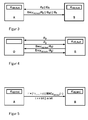
- FIG. 1 shows a schematic representation of a system for authentication of a sensor A in a control unit B by means of a challenge-response method.
- the control unit B sends a request, "Challenge” to the sensor B, which responds to the authentication with a response "Response”.
- a concrete method is schematically shown, which is part of a comprehensive security concept, which meets high security requirements and detect attacks of the types listed above and other security threats and violations cryptographically secure.
- this is a challenge-response method for authenticating the RDS sensor to the ECU.
- the aim of the authentication is to determine whether, at the time of authentication, the RDS has a valid authentication feature, that is knowledge of a cryptographic key, and to bind this feature firmly to its identity, for example a serial number (keywords Freshness, Liveliness of Key ).
- FIG. 2 shows a schematic representation of a system for integrity protection of the sensor data.
- the receiver of the data namely the control unit (ECU) B
- the transmitted data is continuously transmitted an integrity protection, preferably with time-variant parameters such as random numbers, sequence numbers (sequence counter) or time stamping provided.
- time-variant parameters are cryptographically checked after the processing of the print data and a manipulation of the RDS data is cryptographically reliably detected, that is, there are no additional latencies in the real-time data processing by the cryptography and manipulations can thus be detected.
- MAC Message Authentication Codes
- random numbers are inserted into the data to be protected by integrity protection. These random numbers are transmitted in plain text to the ECU and verified by MAC.
- the authentication should be done soon after a motor start, that is in the first few minutes. However, it is not necessary to put them right in the startup phase perform.
- integrity protection is used by default for each print package, either the MAC data should be ignored prior to authentication, which is inconvenient or used with the random numbers present on the RDS sensor. After successful authentication, the negotiated sequence counter is used.
- Authentication by challenge-response method (encryption of a challenge and identity); Integrity protection by means of message authentication codes based on the CBC mode together with appropriate padding and MAC strengthening, ie EMAC and CMAC; Prevention of replay attacks by adding random numbers and the pure user data; Secure cryptographic binding of both protocol parts by using part of the challenge as a sequence counter for integrity protection; For all mechanisms, only a single basic building block, a symmetric block cipher, is needed - as an implementation option concrete AES-128 or alternatively PRESENT is proposed; Furthermore, due to the connection of the two protocol parts only a random number generator is needed on the control unit.
- ID A and ID B are system-wide unique identities of the subscribers, such as 32-bit long serial numbers or type part numbers. The length of the serial numbers is cryptographically not significant. It is important that all participants in the overall system, ie not just an engine / vehicle, can be clearly identified. This plays a key role in key management, as described later.
- R A and R B be random numbers generated by A and B, respectively, whose expedient length will be specified later.
- ID A ID ' A ?
- ID A ID ' A ?
- the plain text ID A is of no immediate cryptographic meaning, they are not present in the ISO standard.
- the following section deals in detail with the integrity protection of the sensor data, the second step of the overall safety concept.
- Cryptographic techniques for data protection focus on the origin of data, that is, data origin authentication, integrity of sender, and integrity of data, that is, the fact that the data has not been modified.
- Other important aspects are the timeliness, the sequence of data and, if necessary, the intended recipient.
- Authentication codes are combinatorial objects whose probability of success for an attack can be explicitly calculated and independent of the computing power of the attacker. They are relatively infrequent nowadays, often requiring a new key for each transaction.
- Digital signatures are asymmetric methods that are slower than symmetric methods by a factor of 100 to 1000.
- each sensor / subscriber A has its own key pair pk A , sk A (public key, secret / private key).
- sk A public key, secret / private key
- GenSig with his private key sk A and sends the resulting signature s to B, ie A - > B : x .
- s GenSig SKA H x B: is VerSig pkA (x ', s)? Accept or Reject.
- Hashfunctions - HMAC The following is an explanation of Keyed Hashfunctions - HMAC.
- HMAC K x H K ⁇ opad ⁇ H K ⁇ ipad ⁇ x
- the two strings ipad, inner-padding, and opad, outer-padding, are default string constants. Unlike MACs based on block ciphers, the HMAC design does not have a variety of padding methods and optional processes.
- HMAC was considered as part of the sensor security, but is significantly more expensive than the solution finally proposed in the specific embodiment.
- Padding Method 3 was only in the 1999 version, see " ISO / IEC 9797-1, Information technology - Security techniques - Message Authentication Codes (MACS) Part 1: Mechanisms using a block cipher, ISO / IEC, 1999 "the standard for Message Authentication Codes added and was in previous versions, see” ISO / IPC 9797, Information technology - Security techniques - Data integrity mechanisms using a cryptographic check function employing block cipher algorithm, ISO / IEC, 1994 "not included. This padding technique also applies to hash functions.
- ISO / IEC 9797-1 Information technology - Security techniques - Message Authentication Codes (MACS) Part 1: Mechanisms using a block cipher, ISO / IEC, 1999 "the standard for Message Authentication Codes added and was in previous versions, see” ISO / IPC 9797, Information technology - Security techniques - Data integrity mechanisms using a cryptographic check function employing block cipher algorithm, ISO / IEC, 1994 "not included.
- the first padding method has worse safety properties than methods 2 and 3.
- this message text data already contains additional randomization data, which are used for repelling so-called replay attacks, more details are given below.
- the number of bits 2048 is divisible by the block length 128, that is, padding method 1 is equivalent to no padding.
- padding method 1 is equivalent to no padding.
- Padding Method 2 is strongly recommended, otherwise the procedure should really only be used for fixed length input. The proof of security for the procedure EMAC can be found in " E. Petrank and C.
- K or K AB, MAC1 the 128 bit MAC key
- K 1 , K 2 designate two 128 bit derived keys.
- , that is, the number of bits in the last block is the same, but x' t x t . Rather, the last block is modified by the XCBC construction.
- FIG. 5 shows a schematic representation for explaining one
- the integrity assurance MAC (first line) does not achieve any freshness.
- the authentication is used, here penultimate line and Entity Authentication called. It can be seen here that the best thing would be Transaction Authentication. However, this requires message authentication and correspondingly long time-variant parameters in each packet. So a MAC about the print data and a sufficiently long timestamp or a (synchronized) counter. Because the sensor has neither a clock nor a synchronous counter by default, the combination of line 3 (entity authentication, authentication) and line 1 (message authentication, integrity protection) was chosen.
- the control unit B sends, for example, a random number R B to the Sensor A.
- the sensor sends a random number R A to the controller.
- both protocols are cryptographically securely connected.
- An attacker does not benefit from the knowledge of the Isb (R B ) used as a sequence counter, since this is newly selected by the control unit with each authentication.
- the implementation of a random number generator is omitted on sensor side A, since all random numbers come from the control unit B.
- ECUs there are already deterministic RNGs today.
- a transaction authentication ie integrity of the sender, integrity of the Data as well as the freshness, either with a bidirectional communication protocol (Challenge-Response) or with a global, independent Time Stamp or Sequence Counter
- the claimant / prover in this case the sensor, must not be able to reset the counter or the clock. This can lead to denial of service attacks, as in the case of KeeLoq.
- the counter is accepted only in a certain validity window, the attacker manipulates the counter so that it is always invalid. As a result, the sensor is not accepted or must be newly trained. Immobilizers assume that the authenticating vehicle key itself is tamper resistant and thus can not generate unnatural counters.
- a so-called session splitting attack would be possible, an attack that leverages the entire security concept by exploiting the breach of one of the secret keys.
- the attacker may break the transaction (ie, the session): it computes the values for integrity protection for data it has chosen (as known by Kmac) and uses the original source to perform the challenge response Protocol to pass successfully.
- SCAs could be made more difficult by increasing the minimum allowable time between two sub-protocol flows. This results in a reduction of the possible sample rate during the attack and thus increases the time required for a successful attack. During an increase of this minimum period in the subprotocol integrity protection protocol narrow limits are set by the required data rate, a much higher value can be used in the authentication.
- the concept described below represents an effective and efficient measure against the break of the overall protocol in the event of successful session splitting attacks (eg SCA attacks) against a sub-protocol.
- SCA attacks session splitting attacks
- the two sub-protocols are proposed together
- Kmac eg by SCA, which can be more difficult to prevent here than in the other part protocol
- the proposed change preserves the positive characteristics of the original protocol in terms of resources and security.
- the basis of the proposed variant is the secure derivation of a secret value from the challenge and K auth . This value then serves as the initial value R a0 of the nonce (number only used once) R a , which enters into each MAC calculation.
- this initial value is formed directly from the challenge, a value known to the attacker.
- FIG. 6 respectively.
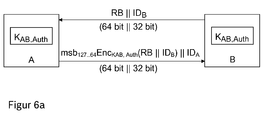
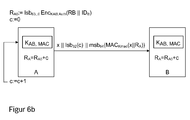
- FIGS. 6a and 6b , FIG. 1 is a schematic illustration for explaining an overall protocol of a connection of integrity protection and authentication for transaction security of the sensor data in the newly proposed variant.
- the communication of the sensor A with the control unit B is shown.
- the sensor data of the sensor A to the control unit B are designated by x.
- the sensor A and the control unit B have a common key K AB, Auth , eg a 128-bit AES key, for the authentication as well as a common key K AB, MAC , again a 128-bit AES key, for the message Authentication Code CMAC (in the alternative case of the Message Authentication Code EMAC it would be two keys K AB, MAC1 and K AB, MAC2 ).
- FIG. 6a shows first steps of the overall security concept, more precisely the description of a challenge-response method.
- the control unit B generates a cryptographically secure 64-bit random number R B and sends it concatenated with the identity ID B to the sensor A: B -> A: R B ⁇ ID B.
- the sensor A encrypts with a symmetric AES key K AB, Auth the received data packet (R B ⁇ ID B ). From the resulting result Enc KAB, Auth (R B II ID B ) of length 128 bit 64 msb (most significant bits) are taken and returned together with the identity ID A to the control unit B: A -> B: msb 127th ..64 [EnC K AB, Auth (R B ⁇ ID B )] ⁇ ID A.
- the control unit B in turn can start calculating msb 127 ... 64 [Enc K AB, Auth (R B ⁇ ID B )]. It then compares the received data, both msb 127 ... 64 [Enc K AB, Auth (R B ⁇ ID B )] and ID A. Only in the case that both values match, the protocol is continued, the sensor is authenticated to the controller. If only one value deviates, an "Authentication of sensor failed" error message will be generated.
- FIG. 6b shows the combination of authentication and integrity protection by deriving the initial value R a0 of the nonce (number only used once) R a from the challenge and K auth .
- R b is already encrypted in the sensor together with ID b in the sensor to calculate the authentication response.
- res: MSB 64 (Enc Kauth (Rb ⁇ IDb)); the last 8 bytes are kept secret by truncation.
- the initial R a (R a0 ) is now derived from Enc KAB, Auth (R B ⁇ ID B ), eg as LSB 64 (Enc K auth (R b ⁇ ID b ), so it will be the one in the challenge response truncated part of Enc K auth (R b ⁇ ID b ) (instead of a part of R b as in the DE-102009002396 ) was used as R a .
- the sensor stores eg as in FIG. 6b
- the 64 least significant bits (Isb) of Enc K AB, Auth (R B ⁇ ID B ) II ID A are shown as R A , and as the initial value R a0 of the Nonce R A.
- an already calculated part from the challenge-response method of the authentication for example the part which was not sent (response truncation / response truncation), is used as initial value R a0 .
- the sensor data are designated x as described.
- various options for calculating a message authentication code eg EMAC or CMAC, can be used, as above described.
- the sensor data x, concatenated with time-variant parameters, are sent together to the msb 64 of the message authentication code MAC KMac to the control unit, see FIG. 6b , In the original protocol, the time-variant parameters or the current nonce are transmitted unencrypted.
- the control unit B receives the sensor data x and processes these and / or passes them on. With the received data, the MAC value is now calculated on the controller side in turn and compared with the received MAC value. Since the control unit knows the output value for c, or R A , it can check whether the transmitted sequence counter c lies within a predetermined interval. If so, it accepts it and performs the above calculations. If not, then sensor A and controller B seem to have lost too many packets or synchronicity has been lost. Then a re-authentication should take place, eg for renegotiation of c, resp. R a . After the MAC calculation and comparison, c and R A are incremented by one.
- a first part of the cryptographic authentication message MSB 64 Enc KAB , Auth (RB ⁇ ID B ) was sent.
- the second and third parts LSB 64 correspond to Enc KAB , Auth (RB ⁇ ID B ).
- the second and third parts do not have to be identical. It may be advantageous if the first part does not interfere with the second and the third part overlaps or is at least not identical with them.
- the second and third parts can be identical, overlap, or represent separate parts of Enc KAB , Auth (RB ⁇ ID B ).
- the current parameter R a is calculated for each sensor data transaction, the time-variant parameters c correspond to the difference from the initial value R a0 for each sensor data transaction, ie in the example LSB 64 Enc KAB, Auth (RB
- R A is incremented by 1 in the embodiment presented above.
- Other increments or other changes according to defined rules are conceivable and may be advantageous.
- the preferred (cryptographic) methods for authentication and for integrity protection or for transaction authentication are also exemplary only and may be replaced by other alternative methods mentioned in the description or by comparable methods not mentioned above.
- the number R B was called random number in the presented concept. More generally, it can also be provided as a nonce (number only used once), eg in addition to a random number as a time stamp or sequence counter.
Landscapes
- Engineering & Computer Science (AREA)
- Computer Security & Cryptography (AREA)
- Computer Networks & Wireless Communication (AREA)
- Signal Processing (AREA)
- Power Engineering (AREA)
- Health & Medical Sciences (AREA)
- Computing Systems (AREA)
- General Health & Medical Sciences (AREA)
- Medical Informatics (AREA)
- Mobile Radio Communication Systems (AREA)
- Storage Device Security (AREA)
- Arrangements For Transmission Of Measured Signals (AREA)
Applications Claiming Priority (2)
| Application Number | Priority Date | Filing Date | Title |
|---|---|---|---|
| DE102009045133A DE102009045133A1 (de) | 2009-09-29 | 2009-09-29 | Verfahren zum Manipulationsschutz von Sensordaten und Sensor hierzu |
| PCT/EP2010/063168 WO2011039037A1 (de) | 2009-09-29 | 2010-09-08 | Verfahren zum manipulationsschutz von sensordaten und sensor hierzu |
Publications (2)
| Publication Number | Publication Date |
|---|---|
| EP2484047A1 EP2484047A1 (de) | 2012-08-08 |
| EP2484047B1 true EP2484047B1 (de) | 2016-03-23 |
Family
ID=43221947
Family Applications (1)
| Application Number | Title | Priority Date | Filing Date |
|---|---|---|---|
| EP10754456.1A Active EP2484047B1 (de) | 2009-09-29 | 2010-09-08 | Verfahren zum manipulationsschutz von sensordaten und sensor hierzu |
Country Status (7)
| Country | Link |
|---|---|
| US (1) | US9100193B2 (enExample) |
| EP (1) | EP2484047B1 (enExample) |
| JP (1) | JP5584767B2 (enExample) |
| CN (1) | CN102577228B (enExample) |
| DE (1) | DE102009045133A1 (enExample) |
| IN (1) | IN2012DN00473A (enExample) |
| WO (1) | WO2011039037A1 (enExample) |
Families Citing this family (45)
| Publication number | Priority date | Publication date | Assignee | Title |
|---|---|---|---|---|
| DE102009002396A1 (de) * | 2009-04-15 | 2010-10-21 | Robert Bosch Gmbh | Verfahren zum Manipulationsschutz eines Sensors und von Sensordaten des Sensors und einen Sensor hierzu |
| DE102013206202A1 (de) * | 2013-04-09 | 2014-10-30 | Robert Bosch Gmbh | Sensormodul und Verfahren zum Betreiben eines Sensorsmoduls |
| DE102013218212A1 (de) * | 2013-09-11 | 2015-03-12 | Robert Bosch Gmbh | Verfahren zum abgesicherten Übermitteln von Daten |
| JP6126980B2 (ja) | 2013-12-12 | 2017-05-10 | 日立オートモティブシステムズ株式会社 | ネットワーク装置およびネットワークシステム |
| JP2015122620A (ja) * | 2013-12-24 | 2015-07-02 | 富士通セミコンダクター株式会社 | 認証システム、認証方法、認証装置、及び、被認証装置 |
| JP6378365B2 (ja) | 2014-04-28 | 2018-08-22 | ローベルト ボッシュ ゲゼルシャフト ミット ベシュレンクテル ハフツング | ネットワークで秘密または鍵を生成する方法 |
| CN104079408B (zh) * | 2014-05-30 | 2018-01-19 | 国家电网公司 | 一种工业控制系统中增强通信安全性的方法 |
| DE102014212219A1 (de) | 2014-06-25 | 2015-12-31 | Robert Bosch Gmbh | Verfahren zur Authentifizierung und Anbindung eines Geräts an ein Netzwerk sowie hierzu eingerichteter Teilnehmer des Netzwerks |
| JP2016131311A (ja) * | 2015-01-14 | 2016-07-21 | 日本電信電話株式会社 | ユーザ端末、サーバ装置、通信システム、通信方法、プログラム |
| EP3056706A1 (en) | 2015-02-16 | 2016-08-17 | Honeywell International Inc. | An approach for aftertreatment system modeling and model identification |
| DE102015202935A1 (de) * | 2015-02-18 | 2016-08-18 | Robert Bosch Gmbh | Verfahren zum Manipulationsschutz |
| DE102015220038A1 (de) | 2015-05-22 | 2016-11-24 | Robert Bosch Gmbh | Verfahren zur Erzeugung eines Geheimnisses oder Schlüssels in einem Netzwerk |
| DE102015209496A1 (de) | 2015-05-22 | 2016-11-24 | Robert Bosch Gmbh | Verfahren zur Erzeugung eines Geheimnisses oder Schlüssels in einem Netzwerk |
| JP6361589B2 (ja) * | 2015-06-11 | 2018-07-25 | 株式会社デンソー | 通信システム |
| DE102015211451A1 (de) | 2015-06-22 | 2017-01-05 | Volkswagen Aktiengesellschaft | Verfahren zu einem Manipulationsschutz von über ein Bussystem zwischen Systemkomponenten zu übertragenden Nutzdatenpaketen |
| EP3125052B1 (en) | 2015-07-31 | 2020-09-02 | Garrett Transportation I Inc. | Quadratic program solver for mpc using variable ordering |
| US10272779B2 (en) | 2015-08-05 | 2019-04-30 | Garrett Transportation I Inc. | System and approach for dynamic vehicle speed optimization |
| DE102015220026A1 (de) | 2015-10-15 | 2017-04-20 | Robert Bosch Gmbh | Verfahren zur Erzeugung eines Geheimnisses für eine Einmalverschlüsselung in einem Netzwerk |
| DE102015220053A1 (de) | 2015-10-15 | 2017-04-20 | Robert Bosch Gmbh | Verfahren zur Generierung eines Schlüssels in einem Netzwerk und zu Aktivierung einer Absicherung einer Kommunikation in dem Netzwerk auf Basis des Schlüssels |
| DE102015220083A1 (de) | 2015-10-15 | 2017-04-20 | Robert Bosch Gmbh | Schaltungsanordnung zur Erzeugung eines Geheimnisses oder Schlüssels in einem Netzwerk |
| DE102015220048A1 (de) | 2015-10-15 | 2017-04-20 | Robert Bosch Gmbh | Verfahren zur Erzeugung eines Geheimnisses oder Schlüssels in einem Netzwerk |
| DE102015220024A1 (de) | 2015-10-15 | 2017-04-20 | Robert Bosch Gmbh | Verfahren zur Erzeugung eines Geheimnisses oder Schlüssels in einem Netzwerk |
| DE102015220057A1 (de) | 2015-10-15 | 2017-04-20 | Robert Bosch Gmbh | Schaltungsanordnung zur Erzeugung eines Geheimnisses oder Schlüssels in einem Netzwerk |
| DE102015220045A1 (de) | 2015-10-15 | 2017-04-20 | Robert Bosch Gmbh | Verfahren zur Erzeugung eines Geheimnisses oder Schlüssels in einem Netzwerk |
| DE102015220081A1 (de) | 2015-10-15 | 2017-04-20 | Robert Bosch Gmbh | Verfahren zur Erzeugung eines Schlüssels in einer Schaltungsanordnung |
| DE102015220055A1 (de) | 2015-10-15 | 2017-04-20 | Robert Bosch Gmbh | Verfahren zur Erzeugung eines Geheimnisses oder Schlüssels in einem Netzwerk |
| US10230756B2 (en) | 2015-11-25 | 2019-03-12 | International Business Machines Corporation | Resisting replay attacks efficiently in a permissioned and privacy-preserving blockchain network |
| DE102016103498A1 (de) * | 2016-02-26 | 2017-08-31 | Infineon Technologies Ag | Ein Verfahren zum Übermitteln von Daten von einem Sensorbauelement an eine elektronische Steuereinheit, ein Sensorbauelement und eine elektronische Steuereinheit |
| US10124750B2 (en) | 2016-04-26 | 2018-11-13 | Honeywell International Inc. | Vehicle security module system |
| US10728249B2 (en) | 2016-04-26 | 2020-07-28 | Garrett Transporation I Inc. | Approach for securing a vehicle access port |
| US10036338B2 (en) | 2016-04-26 | 2018-07-31 | Honeywell International Inc. | Condition-based powertrain control system |
| US10630481B2 (en) * | 2016-11-07 | 2020-04-21 | Ford Global Technologies, Llc | Controller area network message authentication |
| WO2018101918A1 (en) | 2016-11-29 | 2018-06-07 | Honeywell International Inc. | An inferential flow sensor |
| KR101966088B1 (ko) * | 2017-04-06 | 2019-04-05 | 상명대학교산학협력단 | Iot 응용에 최적화된 인증 암호 장치 및 방법 |
| JP6818623B2 (ja) * | 2017-04-27 | 2021-01-20 | 株式会社東芝 | 情報処理装置 |
| US20210165870A1 (en) * | 2017-08-04 | 2021-06-03 | Nidec Corporation | Authentication system, electronic apparatus used in authentication system, and authentication method |
| US11057213B2 (en) | 2017-10-13 | 2021-07-06 | Garrett Transportation I, Inc. | Authentication system for electronic control unit on a bus |
| GB201720946D0 (en) * | 2017-12-15 | 2018-01-31 | Nchain Holdings Ltd | Computer-implemented system and method |
| JP7119537B2 (ja) * | 2018-04-24 | 2022-08-17 | 日本電信電話株式会社 | 検知システムおよび検知方法 |
| CN108833346A (zh) * | 2018-05-04 | 2018-11-16 | 北京天元创新科技有限公司 | 一种工业控制系统安全通信方法和装置 |
| CN110351095B (zh) * | 2019-07-12 | 2022-06-07 | 四川虹美智能科技有限公司 | 一种控制多联式空调机组运行的方法和装置 |
| JP7325318B2 (ja) * | 2019-12-17 | 2023-08-14 | 株式会社日立製作所 | 証跡記録システム及びデータ検証方法 |
| CN111786797B (zh) * | 2020-07-03 | 2022-10-18 | 四川阵风科技有限公司 | 三方通信的时效性验证方法 |
| US12120225B2 (en) | 2020-09-25 | 2024-10-15 | Renesas Electronics Corporation | Secure key generation and management in open and secure processor environments |
| US20260222438A1 (en) * | 2025-01-27 | 2026-07-30 | GM Global Technology Operations LLC | Mitigating instances of delay attacks in a communication network |
Family Cites Families (12)
| Publication number | Priority date | Publication date | Assignee | Title |
|---|---|---|---|---|
| JP4198509B2 (ja) * | 2003-04-14 | 2008-12-17 | 日本電信電話株式会社 | 相互認証方法 |
| DE10318031A1 (de) * | 2003-04-19 | 2004-11-04 | Daimlerchrysler Ag | Verfahren zur Sicherstellung der Integrität und Authentizität von Flashware für Steuergeräte |
| JP4665465B2 (ja) * | 2004-09-07 | 2011-04-06 | パナソニック株式会社 | 通信装置、通信システム、通信方法 |
| CN101116281A (zh) | 2005-02-10 | 2008-01-30 | 国际商业机器公司 | 询问-应答签名和安全迪菲-海尔曼协议 |
| JP2006270348A (ja) * | 2005-03-23 | 2006-10-05 | Victor Co Of Japan Ltd | 相互認証及び鍵共有システム |
| CA2627136A1 (en) | 2005-11-04 | 2007-05-10 | Nec Corporation | Message authentication device, message authentication method, message authentication program and storage medium therefor |
| WO2007088288A1 (fr) | 2006-02-03 | 2007-08-09 | Advanced Track & Trace | Procede et dispositif d'authentification |
| JP4810289B2 (ja) * | 2006-04-17 | 2011-11-09 | ルネサスエレクトロニクス株式会社 | メッセージ認証子生成装置、メッセージ認証子検証装置、及びメッセージ認証システム |
| US20080263647A1 (en) | 2006-07-21 | 2008-10-23 | General Electric Company | System and Method For Providing Network Device Authentication |
| US8102999B2 (en) * | 2006-08-18 | 2012-01-24 | Medtronic, Inc. | Secure telemetric link |
| US7957533B2 (en) * | 2007-10-02 | 2011-06-07 | Alcatel-Lucent Usa Inc. | Method of establishing authentication keys and secure wireless communication |
| DE102009002396A1 (de) | 2009-04-15 | 2010-10-21 | Robert Bosch Gmbh | Verfahren zum Manipulationsschutz eines Sensors und von Sensordaten des Sensors und einen Sensor hierzu |
-
2009
- 2009-09-29 DE DE102009045133A patent/DE102009045133A1/de not_active Withdrawn
-
2010
- 2010-09-08 US US13/498,954 patent/US9100193B2/en active Active
- 2010-09-08 JP JP2012531314A patent/JP5584767B2/ja not_active Expired - Fee Related
- 2010-09-08 IN IN473DEN2012 patent/IN2012DN00473A/en unknown
- 2010-09-08 CN CN201080043299.9A patent/CN102577228B/zh not_active Expired - Fee Related
- 2010-09-08 WO PCT/EP2010/063168 patent/WO2011039037A1/de not_active Ceased
- 2010-09-08 EP EP10754456.1A patent/EP2484047B1/de active Active
Also Published As
| Publication number | Publication date |
|---|---|
| JP2013506369A (ja) | 2013-02-21 |
| JP5584767B2 (ja) | 2014-09-03 |
| US20120303973A1 (en) | 2012-11-29 |
| WO2011039037A1 (de) | 2011-04-07 |
| US9100193B2 (en) | 2015-08-04 |
| CN102577228B (zh) | 2015-01-07 |
| CN102577228A (zh) | 2012-07-11 |
| EP2484047A1 (de) | 2012-08-08 |
| IN2012DN00473A (enExample) | 2015-06-05 |
| DE102009045133A1 (de) | 2011-03-31 |
Similar Documents
| Publication | Publication Date | Title |
|---|---|---|
| DE102009045133A1 (de) | Verfahren zum Manipulationsschutz von Sensordaten und Sensor hierzu | |
| DE102009002396A1 (de) | Verfahren zum Manipulationsschutz eines Sensors und von Sensordaten des Sensors und einen Sensor hierzu | |
| DE102011120968B4 (de) | Erzeugen von sicheren Schlüsseln auf Anforderung | |
| DE102010002241B4 (de) | Vorrichtung und Verfahren zur effizienten einseitigen Authentifizierung | |
| DE69823834T2 (de) | Sicherheitsverfahren und -system für übertragungen in fernmeldenetzen | |
| DE102013206185A1 (de) | Verfahren zur Erkennung einer Manipulation eines Sensors und/oder von Sensordaten des Sensors | |
| DE102016210786A1 (de) | Komponente zur Anbindung an einen Datenbus und Verfahren zur Umsetzung einer kryptografischen Funktionalität in einer solchen Komponente | |
| US7715553B2 (en) | Encrypting a plaintext message with authentication | |
| EP1125395B1 (de) | Verfahren und anordnung zur authentifikation von einer ersten instanz und einer zweiten instanz | |
| DE102019113026A1 (de) | Automobile nonce-missbrauchs-widerstandsfähige authentifizierte verschlüsselung | |
| DE10136608B4 (de) | Verfahren und System zur Echtzeitaufzeichnung mit Sicherheitsmodul | |
| EP3304802B1 (de) | Verfahren zur sicherstellung der informationssicherheit von über einen datenbus übertragenen daten sowie datenbussystem | |
| DE102009000869A1 (de) | Verfahren und Vorrichtung zur manipulationssicheren Übertragung von Daten | |
| DE112012000971B4 (de) | Datenverschlüsselung | |
| EP3506144A1 (de) | Verfahren und system zum überprüfen einer integrität einer kommunikation | |
| EP1368929A2 (de) | Verfahren zur authentikation | |
| DE102015202935A1 (de) | Verfahren zum Manipulationsschutz | |
| EP3206154B1 (de) | Verfahren und vorrichtungen zum sicheren übermitteln von nutzdaten | |
| Alomair et al. | E-MACs: Toward more secure and more efficient constructions of secure channels | |
| DE102023115999A1 (de) | Verfahren, Vorrichtung, System und Computerprogrammprodukt zur PQ-sicheren Aktualisierung einer Datenverarbeitungseinheit | |
| DE102019216203A1 (de) | Auf Blockverschlüsselung basierender Proof-of-Work | |
| DE102021005213B4 (de) | Verfahren zur Verschlüsselung eines Klartextes | |
| DE102008010787B4 (de) | Verfahren zur Sicherung der Integrität von Daten | |
| DE102024137205A1 (de) | Verfahren zur Integritätssicherung von Nachrichten | |
| WO2009095143A1 (de) | Asymmetrisches kryptosystem |
Legal Events
| Date | Code | Title | Description |
|---|---|---|---|
| PUAI | Public reference made under article 153(3) epc to a published international application that has entered the european phase |
Free format text: ORIGINAL CODE: 0009012 |
|
| 17P | Request for examination filed |
Effective date: 20120502 |
|
| AK | Designated contracting states |
Kind code of ref document: A1 Designated state(s): AL AT BE BG CH CY CZ DE DK EE ES FI FR GB GR HR HU IE IS IT LI LT LU LV MC MK MT NL NO PL PT RO SE SI SK SM TR |
|
| DAX | Request for extension of the european patent (deleted) | ||
| GRAP | Despatch of communication of intention to grant a patent |
Free format text: ORIGINAL CODE: EPIDOSNIGR1 |
|
| INTG | Intention to grant announced |
Effective date: 20151002 |
|
| GRAS | Grant fee paid |
Free format text: ORIGINAL CODE: EPIDOSNIGR3 |
|
| GRAA | (expected) grant |
Free format text: ORIGINAL CODE: 0009210 |
|
| AK | Designated contracting states |
Kind code of ref document: B1 Designated state(s): AL AT BE BG CH CY CZ DE DK EE ES FI FR GB GR HR HU IE IS IT LI LT LU LV MC MK MT NL NO PL PT RO SE SI SK SM TR |
|
| REG | Reference to a national code |
Ref country code: GB Ref legal event code: FG4D Free format text: NOT ENGLISH |
|
| REG | Reference to a national code |
Ref country code: CH Ref legal event code: EP |
|
| REG | Reference to a national code |
Ref country code: AT Ref legal event code: REF Ref document number: 784081 Country of ref document: AT Kind code of ref document: T Effective date: 20160415 |
|
| REG | Reference to a national code |
Ref country code: IE Ref legal event code: FG4D Free format text: LANGUAGE OF EP DOCUMENT: GERMAN |
|
| REG | Reference to a national code |
Ref country code: DE Ref legal event code: R096 Ref document number: 502010011275 Country of ref document: DE |
|
| REG | Reference to a national code |
Ref country code: LT Ref legal event code: MG4D |
|
| REG | Reference to a national code |
Ref country code: NL Ref legal event code: MP Effective date: 20160323 |
|
| PG25 | Lapsed in a contracting state [announced via postgrant information from national office to epo] |
Ref country code: FI Free format text: LAPSE BECAUSE OF FAILURE TO SUBMIT A TRANSLATION OF THE DESCRIPTION OR TO PAY THE FEE WITHIN THE PRESCRIBED TIME-LIMIT Effective date: 20160323 Ref country code: HR Free format text: LAPSE BECAUSE OF FAILURE TO SUBMIT A TRANSLATION OF THE DESCRIPTION OR TO PAY THE FEE WITHIN THE PRESCRIBED TIME-LIMIT Effective date: 20160323 Ref country code: GR Free format text: LAPSE BECAUSE OF FAILURE TO SUBMIT A TRANSLATION OF THE DESCRIPTION OR TO PAY THE FEE WITHIN THE PRESCRIBED TIME-LIMIT Effective date: 20160624 Ref country code: NO Free format text: LAPSE BECAUSE OF FAILURE TO SUBMIT A TRANSLATION OF THE DESCRIPTION OR TO PAY THE FEE WITHIN THE PRESCRIBED TIME-LIMIT Effective date: 20160623 |
|
| PG25 | Lapsed in a contracting state [announced via postgrant information from national office to epo] |
Ref country code: LV Free format text: LAPSE BECAUSE OF FAILURE TO SUBMIT A TRANSLATION OF THE DESCRIPTION OR TO PAY THE FEE WITHIN THE PRESCRIBED TIME-LIMIT Effective date: 20160323 Ref country code: NL Free format text: LAPSE BECAUSE OF FAILURE TO SUBMIT A TRANSLATION OF THE DESCRIPTION OR TO PAY THE FEE WITHIN THE PRESCRIBED TIME-LIMIT Effective date: 20160323 Ref country code: SE Free format text: LAPSE BECAUSE OF FAILURE TO SUBMIT A TRANSLATION OF THE DESCRIPTION OR TO PAY THE FEE WITHIN THE PRESCRIBED TIME-LIMIT Effective date: 20160323 Ref country code: LT Free format text: LAPSE BECAUSE OF FAILURE TO SUBMIT A TRANSLATION OF THE DESCRIPTION OR TO PAY THE FEE WITHIN THE PRESCRIBED TIME-LIMIT Effective date: 20160323 |
|
| PG25 | Lapsed in a contracting state [announced via postgrant information from national office to epo] |
Ref country code: IS Free format text: LAPSE BECAUSE OF FAILURE TO SUBMIT A TRANSLATION OF THE DESCRIPTION OR TO PAY THE FEE WITHIN THE PRESCRIBED TIME-LIMIT Effective date: 20160723 Ref country code: PL Free format text: LAPSE BECAUSE OF FAILURE TO SUBMIT A TRANSLATION OF THE DESCRIPTION OR TO PAY THE FEE WITHIN THE PRESCRIBED TIME-LIMIT Effective date: 20160323 Ref country code: EE Free format text: LAPSE BECAUSE OF FAILURE TO SUBMIT A TRANSLATION OF THE DESCRIPTION OR TO PAY THE FEE WITHIN THE PRESCRIBED TIME-LIMIT Effective date: 20160323 |
|
| PG25 | Lapsed in a contracting state [announced via postgrant information from national office to epo] |
Ref country code: CZ Free format text: LAPSE BECAUSE OF FAILURE TO SUBMIT A TRANSLATION OF THE DESCRIPTION OR TO PAY THE FEE WITHIN THE PRESCRIBED TIME-LIMIT Effective date: 20160323 Ref country code: SM Free format text: LAPSE BECAUSE OF FAILURE TO SUBMIT A TRANSLATION OF THE DESCRIPTION OR TO PAY THE FEE WITHIN THE PRESCRIBED TIME-LIMIT Effective date: 20160323 Ref country code: SK Free format text: LAPSE BECAUSE OF FAILURE TO SUBMIT A TRANSLATION OF THE DESCRIPTION OR TO PAY THE FEE WITHIN THE PRESCRIBED TIME-LIMIT Effective date: 20160323 Ref country code: RO Free format text: LAPSE BECAUSE OF FAILURE TO SUBMIT A TRANSLATION OF THE DESCRIPTION OR TO PAY THE FEE WITHIN THE PRESCRIBED TIME-LIMIT Effective date: 20160323 Ref country code: ES Free format text: LAPSE BECAUSE OF FAILURE TO SUBMIT A TRANSLATION OF THE DESCRIPTION OR TO PAY THE FEE WITHIN THE PRESCRIBED TIME-LIMIT Effective date: 20160323 Ref country code: PT Free format text: LAPSE BECAUSE OF FAILURE TO SUBMIT A TRANSLATION OF THE DESCRIPTION OR TO PAY THE FEE WITHIN THE PRESCRIBED TIME-LIMIT Effective date: 20160725 |
|
| PG25 | Lapsed in a contracting state [announced via postgrant information from national office to epo] |
Ref country code: IT Free format text: LAPSE BECAUSE OF FAILURE TO SUBMIT A TRANSLATION OF THE DESCRIPTION OR TO PAY THE FEE WITHIN THE PRESCRIBED TIME-LIMIT Effective date: 20160323 |
|
| REG | Reference to a national code |
Ref country code: DE Ref legal event code: R097 Ref document number: 502010011275 Country of ref document: DE |
|
| PLBE | No opposition filed within time limit |
Free format text: ORIGINAL CODE: 0009261 |
|
| STAA | Information on the status of an ep patent application or granted ep patent |
Free format text: STATUS: NO OPPOSITION FILED WITHIN TIME LIMIT |
|
| PG25 | Lapsed in a contracting state [announced via postgrant information from national office to epo] |
Ref country code: DK Free format text: LAPSE BECAUSE OF FAILURE TO SUBMIT A TRANSLATION OF THE DESCRIPTION OR TO PAY THE FEE WITHIN THE PRESCRIBED TIME-LIMIT Effective date: 20160323 |
|
| PG25 | Lapsed in a contracting state [announced via postgrant information from national office to epo] |
Ref country code: BG Free format text: LAPSE BECAUSE OF FAILURE TO SUBMIT A TRANSLATION OF THE DESCRIPTION OR TO PAY THE FEE WITHIN THE PRESCRIBED TIME-LIMIT Effective date: 20160623 Ref country code: BE Free format text: LAPSE BECAUSE OF NON-PAYMENT OF DUE FEES Effective date: 20160930 |
|
| 26N | No opposition filed |
Effective date: 20170102 |
|
| PG25 | Lapsed in a contracting state [announced via postgrant information from national office to epo] |
Ref country code: MC Free format text: LAPSE BECAUSE OF FAILURE TO SUBMIT A TRANSLATION OF THE DESCRIPTION OR TO PAY THE FEE WITHIN THE PRESCRIBED TIME-LIMIT Effective date: 20160323 |
|
| REG | Reference to a national code |
Ref country code: CH Ref legal event code: PL |
|
| GBPC | Gb: european patent ceased through non-payment of renewal fee |
Effective date: 20160908 |
|
| PG25 | Lapsed in a contracting state [announced via postgrant information from national office to epo] |
Ref country code: SI Free format text: LAPSE BECAUSE OF FAILURE TO SUBMIT A TRANSLATION OF THE DESCRIPTION OR TO PAY THE FEE WITHIN THE PRESCRIBED TIME-LIMIT Effective date: 20160323 |
|
| REG | Reference to a national code |
Ref country code: IE Ref legal event code: MM4A |
|
| REG | Reference to a national code |
Ref country code: FR Ref legal event code: ST Effective date: 20170531 |
|
| PG25 | Lapsed in a contracting state [announced via postgrant information from national office to epo] |
Ref country code: IE Free format text: LAPSE BECAUSE OF NON-PAYMENT OF DUE FEES Effective date: 20160908 Ref country code: LI Free format text: LAPSE BECAUSE OF NON-PAYMENT OF DUE FEES Effective date: 20160930 Ref country code: CH Free format text: LAPSE BECAUSE OF NON-PAYMENT OF DUE FEES Effective date: 20160930 Ref country code: FR Free format text: LAPSE BECAUSE OF NON-PAYMENT OF DUE FEES Effective date: 20160930 Ref country code: GB Free format text: LAPSE BECAUSE OF NON-PAYMENT OF DUE FEES Effective date: 20160908 |
|
| PG25 | Lapsed in a contracting state [announced via postgrant information from national office to epo] |
Ref country code: LU Free format text: LAPSE BECAUSE OF NON-PAYMENT OF DUE FEES Effective date: 20160908 |
|
| REG | Reference to a national code |
Ref country code: AT Ref legal event code: MM01 Ref document number: 784081 Country of ref document: AT Kind code of ref document: T Effective date: 20160908 |
|
| REG | Reference to a national code |
Ref country code: BE Ref legal event code: MM Effective date: 20160930 |
|
| PG25 | Lapsed in a contracting state [announced via postgrant information from national office to epo] |
Ref country code: AT Free format text: LAPSE BECAUSE OF NON-PAYMENT OF DUE FEES Effective date: 20160908 |
|
| PG25 | Lapsed in a contracting state [announced via postgrant information from national office to epo] |
Ref country code: CY Free format text: LAPSE BECAUSE OF FAILURE TO SUBMIT A TRANSLATION OF THE DESCRIPTION OR TO PAY THE FEE WITHIN THE PRESCRIBED TIME-LIMIT Effective date: 20160323 Ref country code: HU Free format text: LAPSE BECAUSE OF FAILURE TO SUBMIT A TRANSLATION OF THE DESCRIPTION OR TO PAY THE FEE WITHIN THE PRESCRIBED TIME-LIMIT; INVALID AB INITIO Effective date: 20100908 |
|
| PG25 | Lapsed in a contracting state [announced via postgrant information from national office to epo] |
Ref country code: TR Free format text: LAPSE BECAUSE OF FAILURE TO SUBMIT A TRANSLATION OF THE DESCRIPTION OR TO PAY THE FEE WITHIN THE PRESCRIBED TIME-LIMIT Effective date: 20160323 Ref country code: MT Free format text: LAPSE BECAUSE OF FAILURE TO SUBMIT A TRANSLATION OF THE DESCRIPTION OR TO PAY THE FEE WITHIN THE PRESCRIBED TIME-LIMIT Effective date: 20160323 Ref country code: MK Free format text: LAPSE BECAUSE OF FAILURE TO SUBMIT A TRANSLATION OF THE DESCRIPTION OR TO PAY THE FEE WITHIN THE PRESCRIBED TIME-LIMIT Effective date: 20160323 |
|
| PG25 | Lapsed in a contracting state [announced via postgrant information from national office to epo] |
Ref country code: AL Free format text: LAPSE BECAUSE OF FAILURE TO SUBMIT A TRANSLATION OF THE DESCRIPTION OR TO PAY THE FEE WITHIN THE PRESCRIBED TIME-LIMIT Effective date: 20160323 |
|
| REG | Reference to a national code |
Ref country code: DE Ref legal event code: R084 Ref document number: 502010011275 Country of ref document: DE |
|
| PGFP | Annual fee paid to national office [announced via postgrant information from national office to epo] |
Ref country code: DE Payment date: 20251121 Year of fee payment: 16 |