EP2482853B1 - Transport cooperatif de principes actifs basiques par des molecules amphiphiles acides - Google Patents
Transport cooperatif de principes actifs basiques par des molecules amphiphiles acides Download PDFInfo
- Publication number
- EP2482853B1 EP2482853B1 EP10762659.0A EP10762659A EP2482853B1 EP 2482853 B1 EP2482853 B1 EP 2482853B1 EP 10762659 A EP10762659 A EP 10762659A EP 2482853 B1 EP2482853 B1 EP 2482853B1
- Authority
- EP
- European Patent Office
- Prior art keywords
- active ingredient
- amphiphilic
- transporter
- intermolecular association
- association complex
- Prior art date
- Legal status (The legal status is an assumption and is not a legal conclusion. Google has not performed a legal analysis and makes no representation as to the accuracy of the status listed.)
- Not-in-force
Links
- 239000002253 acid Substances 0.000 title description 15
- 239000004480 active ingredient Substances 0.000 claims description 61
- 239000000739 antihistaminic agent Substances 0.000 claims description 14
- GUGOEEXESWIERI-UHFFFAOYSA-N Terfenadine Chemical compound C1=CC(C(C)(C)C)=CC=C1C(O)CCCN1CCC(C(O)(C=2C=CC=CC=2)C=2C=CC=CC=2)CC1 GUGOEEXESWIERI-UHFFFAOYSA-N 0.000 claims description 12
- 230000001387 anti-histamine Effects 0.000 claims description 12
- 239000003814 drug Substances 0.000 claims description 9
- 239000000017 hydrogel Substances 0.000 claims description 8
- 238000000034 method Methods 0.000 claims description 7
- 239000008194 pharmaceutical composition Substances 0.000 claims description 7
- 230000009471 action Effects 0.000 claims description 4
- 239000012429 reaction media Substances 0.000 claims description 4
- 230000000699 topical effect Effects 0.000 claims description 4
- 239000000839 emulsion Substances 0.000 claims description 3
- 238000001914 filtration Methods 0.000 claims description 2
- 238000002156 mixing Methods 0.000 claims description 2
- 238000000926 separation method Methods 0.000 claims description 2
- PWWVAXIEGOYWEE-UHFFFAOYSA-N Isophenergan Chemical compound C1=CC=C2N(CC(C)N(C)C)C3=CC=CC=C3SC2=C1 PWWVAXIEGOYWEE-UHFFFAOYSA-N 0.000 description 24
- 229960003910 promethazine Drugs 0.000 description 24
- HOKDBMAJZXIPGC-UHFFFAOYSA-N Mequitazine Chemical compound C12=CC=CC=C2SC2=CC=CC=C2N1CC1C(CC2)CCN2C1 HOKDBMAJZXIPGC-UHFFFAOYSA-N 0.000 description 22
- 229960005042 mequitazine Drugs 0.000 description 22
- 239000000243 solution Substances 0.000 description 22
- 108010078791 Carrier Proteins Proteins 0.000 description 21
- 210000003491 skin Anatomy 0.000 description 21
- XLYOFNOQVPJJNP-UHFFFAOYSA-N water Chemical compound O XLYOFNOQVPJJNP-UHFFFAOYSA-N 0.000 description 19
- 229910001868 water Inorganic materials 0.000 description 18
- 239000000203 mixture Substances 0.000 description 17
- 230000015556 catabolic process Effects 0.000 description 14
- 238000006731 degradation reaction Methods 0.000 description 14
- 238000009472 formulation Methods 0.000 description 12
- 235000013343 vitamin Nutrition 0.000 description 12
- 210000000434 stratum corneum Anatomy 0.000 description 11
- BDAGIHXWWSANSR-UHFFFAOYSA-N Formic acid Chemical compound OC=O BDAGIHXWWSANSR-UHFFFAOYSA-N 0.000 description 10
- XXPDBLUZJRXNNZ-UHFFFAOYSA-N promethazine hydrochloride Chemical compound Cl.C1=CC=C2N(CC(C)N(C)C)C3=CC=CC=C3SC2=C1 XXPDBLUZJRXNNZ-UHFFFAOYSA-N 0.000 description 10
- 229960002244 promethazine hydrochloride Drugs 0.000 description 10
- 229940088594 vitamin Drugs 0.000 description 10
- 239000011782 vitamin Substances 0.000 description 10
- 229930003231 vitamin Natural products 0.000 description 10
- WEVYAHXRMPXWCK-UHFFFAOYSA-N Acetonitrile Chemical compound CC#N WEVYAHXRMPXWCK-UHFFFAOYSA-N 0.000 description 9
- VEXZGXHMUGYJMC-UHFFFAOYSA-N Hydrochloric acid Chemical compound Cl VEXZGXHMUGYJMC-UHFFFAOYSA-N 0.000 description 9
- 125000000217 alkyl group Chemical group 0.000 description 8
- 235000019253 formic acid Nutrition 0.000 description 8
- -1 alkyl methyl sulfoxides Chemical class 0.000 description 7
- 125000004432 carbon atom Chemical group C* 0.000 description 7
- 239000004094 surface-active agent Substances 0.000 description 7
- IAZDPXIOMUYVGZ-UHFFFAOYSA-N Dimethylsulphoxide Chemical compound CS(C)=O IAZDPXIOMUYVGZ-UHFFFAOYSA-N 0.000 description 6
- 229920000663 Hydroxyethyl cellulose Polymers 0.000 description 6
- 210000004027 cell Anatomy 0.000 description 6
- 238000009792 diffusion process Methods 0.000 description 6
- 235000019447 hydroxyethyl cellulose Nutrition 0.000 description 6
- 239000000693 micelle Substances 0.000 description 6
- 150000002772 monosaccharides Chemical class 0.000 description 6
- 230000035515 penetration Effects 0.000 description 6
- 238000002360 preparation method Methods 0.000 description 6
- 239000000935 antidepressant agent Substances 0.000 description 5
- 229940005513 antidepressants Drugs 0.000 description 5
- 239000002246 antineoplastic agent Substances 0.000 description 5
- 150000001720 carbohydrates Chemical class 0.000 description 5
- 239000000496 cardiotonic agent Substances 0.000 description 5
- 239000012634 fragment Substances 0.000 description 5
- 125000004435 hydrogen atom Chemical group [H]* 0.000 description 5
- 239000002858 neurotransmitter agent Substances 0.000 description 5
- 241000894007 species Species 0.000 description 5
- 238000002798 spectrophotometry method Methods 0.000 description 5
- KWTSXDURSIMDCE-QMMMGPOBSA-N (S)-amphetamine Chemical compound C[C@H](N)CC1=CC=CC=C1 KWTSXDURSIMDCE-QMMMGPOBSA-N 0.000 description 4
- ZRALSGWEFCBTJO-UHFFFAOYSA-N Guanidine Chemical compound NC(N)=N ZRALSGWEFCBTJO-UHFFFAOYSA-N 0.000 description 4
- 229940123925 Nicotinic receptor agonist Drugs 0.000 description 4
- 238000002835 absorbance Methods 0.000 description 4
- 238000004220 aggregation Methods 0.000 description 4
- 229940025084 amphetamine Drugs 0.000 description 4
- 230000003444 anaesthetic effect Effects 0.000 description 4
- 230000001430 anti-depressive effect Effects 0.000 description 4
- 230000002460 anti-migrenic effect Effects 0.000 description 4
- 239000007864 aqueous solution Substances 0.000 description 4
- 235000014633 carbohydrates Nutrition 0.000 description 4
- 150000001875 compounds Chemical class 0.000 description 4
- 238000004108 freeze drying Methods 0.000 description 4
- 150000004676 glycans Chemical class 0.000 description 4
- 238000004128 high performance liquid chromatography Methods 0.000 description 4
- 239000012456 homogeneous solution Substances 0.000 description 4
- 239000000181 nicotinic agonist Substances 0.000 description 4
- 230000008823 permeabilization Effects 0.000 description 4
- 229920001282 polysaccharide Polymers 0.000 description 4
- 239000005017 polysaccharide Substances 0.000 description 4
- 239000000843 powder Substances 0.000 description 4
- 230000005855 radiation Effects 0.000 description 4
- 239000011541 reaction mixture Substances 0.000 description 4
- 239000002904 solvent Substances 0.000 description 4
- 229910021642 ultra pure water Inorganic materials 0.000 description 4
- 239000012498 ultrapure water Substances 0.000 description 4
- 150000003722 vitamin derivatives Chemical class 0.000 description 4
- 125000004169 (C1-C6) alkyl group Chemical group 0.000 description 3
- LFQSCWFLJHTTHZ-UHFFFAOYSA-N Ethanol Chemical compound CCO LFQSCWFLJHTTHZ-UHFFFAOYSA-N 0.000 description 3
- WQZGKKKJIJFFOK-GASJEMHNSA-N Glucose Natural products OC[C@H]1OC(O)[C@H](O)[C@@H](O)[C@@H]1O WQZGKKKJIJFFOK-GASJEMHNSA-N 0.000 description 3
- OKKJLVBELUTLKV-UHFFFAOYSA-N Methanol Chemical compound OC OKKJLVBELUTLKV-UHFFFAOYSA-N 0.000 description 3
- 241000220317 Rosa Species 0.000 description 3
- 239000000654 additive Substances 0.000 description 3
- 125000003342 alkenyl group Chemical group 0.000 description 3
- 125000000304 alkynyl group Chemical group 0.000 description 3
- 238000004458 analytical method Methods 0.000 description 3
- 239000002220 antihypertensive agent Substances 0.000 description 3
- WQZGKKKJIJFFOK-VFUOTHLCSA-N beta-D-glucose Chemical compound OC[C@H]1O[C@@H](O)[C@H](O)[C@@H](O)[C@@H]1O WQZGKKKJIJFFOK-VFUOTHLCSA-N 0.000 description 3
- 239000003795 chemical substances by application Substances 0.000 description 3
- 229940079593 drug Drugs 0.000 description 3
- 230000000694 effects Effects 0.000 description 3
- 230000006870 function Effects 0.000 description 3
- 239000008103 glucose Substances 0.000 description 3
- 125000001183 hydrocarbyl group Chemical group 0.000 description 3
- 229910052739 hydrogen Inorganic materials 0.000 description 3
- 230000002209 hydrophobic effect Effects 0.000 description 3
- 230000003993 interaction Effects 0.000 description 3
- 150000002500 ions Chemical class 0.000 description 3
- 150000002632 lipids Chemical class 0.000 description 3
- 239000012528 membrane Substances 0.000 description 3
- 239000012071 phase Substances 0.000 description 3
- 235000015277 pork Nutrition 0.000 description 3
- 239000000126 substance Substances 0.000 description 3
- OSWFIVFLDKOXQC-UHFFFAOYSA-N 4-(3-methoxyphenyl)aniline Chemical compound COC1=CC=CC(C=2C=CC(N)=CC=2)=C1 OSWFIVFLDKOXQC-UHFFFAOYSA-N 0.000 description 2
- GUBGYTABKSRVRQ-XLOQQCSPSA-N Alpha-Lactose Chemical compound O[C@@H]1[C@@H](O)[C@@H](O)[C@@H](CO)O[C@H]1O[C@@H]1[C@@H](CO)O[C@H](O)[C@H](O)[C@H]1O GUBGYTABKSRVRQ-XLOQQCSPSA-N 0.000 description 2
- 108091003079 Bovine Serum Albumin Proteins 0.000 description 2
- 239000004215 Carbon black (E152) Substances 0.000 description 2
- RGHNJXZEOKUKBD-SQOUGZDYSA-N D-gluconic acid Chemical compound OC[C@@H](O)[C@@H](O)[C@H](O)[C@@H](O)C(O)=O RGHNJXZEOKUKBD-SQOUGZDYSA-N 0.000 description 2
- SRBFZHDQGSBBOR-IOVATXLUSA-N D-xylopyranose Chemical compound O[C@@H]1COC(O)[C@H](O)[C@H]1O SRBFZHDQGSBBOR-IOVATXLUSA-N 0.000 description 2
- 208000001953 Hypotension Diseases 0.000 description 2
- GUBGYTABKSRVRQ-QKKXKWKRSA-N Lactose Natural products OC[C@H]1O[C@@H](O[C@H]2[C@H](O)[C@@H](O)C(O)O[C@@H]2CO)[C@H](O)[C@@H](O)[C@H]1O GUBGYTABKSRVRQ-QKKXKWKRSA-N 0.000 description 2
- CHJJGSNFBQVOTG-UHFFFAOYSA-N N-methyl-guanidine Natural products CNC(N)=N CHJJGSNFBQVOTG-UHFFFAOYSA-N 0.000 description 2
- 229910019142 PO4 Inorganic materials 0.000 description 2
- QAOWNCQODCNURD-UHFFFAOYSA-L Sulfate Chemical compound [O-]S([O-])(=O)=O QAOWNCQODCNURD-UHFFFAOYSA-L 0.000 description 2
- 230000002378 acidificating effect Effects 0.000 description 2
- 150000007513 acids Chemical class 0.000 description 2
- 150000001299 aldehydes Chemical group 0.000 description 2
- WQZGKKKJIJFFOK-PHYPRBDBSA-N alpha-D-galactose Chemical compound OC[C@H]1O[C@H](O)[C@H](O)[C@@H](O)[C@H]1O WQZGKKKJIJFFOK-PHYPRBDBSA-N 0.000 description 2
- 150000001412 amines Chemical group 0.000 description 2
- 229940125715 antihistaminic agent Drugs 0.000 description 2
- 229940041181 antineoplastic drug Drugs 0.000 description 2
- PYMYPHUHKUWMLA-UHFFFAOYSA-N arabinose Natural products OCC(O)C(O)C(O)C=O PYMYPHUHKUWMLA-UHFFFAOYSA-N 0.000 description 2
- 150000004945 aromatic hydrocarbons Chemical class 0.000 description 2
- 230000000712 assembly Effects 0.000 description 2
- 238000000429 assembly Methods 0.000 description 2
- 230000004888 barrier function Effects 0.000 description 2
- SRBFZHDQGSBBOR-UHFFFAOYSA-N beta-D-Pyranose-Lyxose Natural products OC1COC(O)C(O)C1O SRBFZHDQGSBBOR-UHFFFAOYSA-N 0.000 description 2
- 230000000975 bioactive effect Effects 0.000 description 2
- 230000015572 biosynthetic process Effects 0.000 description 2
- 229940098773 bovine serum albumin Drugs 0.000 description 2
- 150000007942 carboxylates Chemical class 0.000 description 2
- 230000001186 cumulative effect Effects 0.000 description 2
- 125000000753 cycloalkyl group Chemical group 0.000 description 2
- 230000003111 delayed effect Effects 0.000 description 2
- OGQYPPBGSLZBEG-UHFFFAOYSA-N dimethyl(dioctadecyl)azanium Chemical compound CCCCCCCCCCCCCCCCCC[N+](C)(C)CCCCCCCCCCCCCCCCCC OGQYPPBGSLZBEG-UHFFFAOYSA-N 0.000 description 2
- SWSQBOPZIKWTGO-UHFFFAOYSA-N dimethylaminoamidine Natural products CN(C)C(N)=N SWSQBOPZIKWTGO-UHFFFAOYSA-N 0.000 description 2
- 230000009977 dual effect Effects 0.000 description 2
- 230000002500 effect on skin Effects 0.000 description 2
- 238000010828 elution Methods 0.000 description 2
- 238000000605 extraction Methods 0.000 description 2
- 125000001153 fluoro group Chemical group F* 0.000 description 2
- 229930182830 galactose Natural products 0.000 description 2
- 229930195733 hydrocarbon Natural products 0.000 description 2
- 150000002430 hydrocarbons Chemical class 0.000 description 2
- 208000021822 hypotensive Diseases 0.000 description 2
- 230000001077 hypotensive effect Effects 0.000 description 2
- 239000008101 lactose Substances 0.000 description 2
- 125000001280 n-hexyl group Chemical group C(CCCCC)* 0.000 description 2
- 230000035699 permeability Effects 0.000 description 2
- 125000001997 phenyl group Chemical group [H]C1=C([H])C([H])=C(*)C([H])=C1[H] 0.000 description 2
- NBIIXXVUZAFLBC-UHFFFAOYSA-K phosphate Chemical compound [O-]P([O-])([O-])=O NBIIXXVUZAFLBC-UHFFFAOYSA-K 0.000 description 2
- 239000010452 phosphate Substances 0.000 description 2
- ACVYVLVWPXVTIT-UHFFFAOYSA-M phosphinate Chemical compound [O-][PH2]=O ACVYVLVWPXVTIT-UHFFFAOYSA-M 0.000 description 2
- UEZVMMHDMIWARA-UHFFFAOYSA-M phosphonate Chemical compound [O-]P(=O)=O UEZVMMHDMIWARA-UHFFFAOYSA-M 0.000 description 2
- 238000001782 photodegradation Methods 0.000 description 2
- 229920006395 saturated elastomer Polymers 0.000 description 2
- 230000003381 solubilizing effect Effects 0.000 description 2
- BDHFUVZGWQCTTF-UHFFFAOYSA-M sulfonate Chemical compound [O-]S(=O)=O BDHFUVZGWQCTTF-UHFFFAOYSA-M 0.000 description 2
- WRIDQFICGBMAFQ-UHFFFAOYSA-N (E)-8-Octadecenoic acid Natural products CCCCCCCCCC=CCCCCCCC(O)=O WRIDQFICGBMAFQ-UHFFFAOYSA-N 0.000 description 1
- LQJBNNIYVWPHFW-UHFFFAOYSA-N 20:1omega9c fatty acid Natural products CCCCCCCCCCC=CCCCCCCCC(O)=O LQJBNNIYVWPHFW-UHFFFAOYSA-N 0.000 description 1
- UOQHWNPVNXSDDO-UHFFFAOYSA-N 3-bromoimidazo[1,2-a]pyridine-6-carbonitrile Chemical compound C1=CC(C#N)=CN2C(Br)=CN=C21 UOQHWNPVNXSDDO-UHFFFAOYSA-N 0.000 description 1
- HIQIXEFWDLTDED-UHFFFAOYSA-N 4-hydroxy-1-piperidin-4-ylpyrrolidin-2-one Chemical compound O=C1CC(O)CN1C1CCNCC1 HIQIXEFWDLTDED-UHFFFAOYSA-N 0.000 description 1
- QSBYPNXLFMSGKH-UHFFFAOYSA-N 9-Heptadecensaeure Natural products CCCCCCCC=CCCCCCCCC(O)=O QSBYPNXLFMSGKH-UHFFFAOYSA-N 0.000 description 1
- YTBSYETUWUMLBZ-UHFFFAOYSA-N D-Erythrose Natural products OCC(O)C(O)C=O YTBSYETUWUMLBZ-UHFFFAOYSA-N 0.000 description 1
- WQZGKKKJIJFFOK-CBPJZXOFSA-N D-Gulose Chemical compound OC[C@H]1OC(O)[C@H](O)[C@H](O)[C@H]1O WQZGKKKJIJFFOK-CBPJZXOFSA-N 0.000 description 1
- WQZGKKKJIJFFOK-WHZQZERISA-N D-aldose Chemical compound OC[C@H]1OC(O)[C@@H](O)[C@@H](O)[C@H]1O WQZGKKKJIJFFOK-WHZQZERISA-N 0.000 description 1
- WQZGKKKJIJFFOK-IVMDWMLBSA-N D-allopyranose Chemical compound OC[C@H]1OC(O)[C@H](O)[C@H](O)[C@@H]1O WQZGKKKJIJFFOK-IVMDWMLBSA-N 0.000 description 1
- YTBSYETUWUMLBZ-IUYQGCFVSA-N D-erythrose Chemical compound OC[C@@H](O)[C@@H](O)C=O YTBSYETUWUMLBZ-IUYQGCFVSA-N 0.000 description 1
- RGHNJXZEOKUKBD-UHFFFAOYSA-N D-gluconic acid Natural products OCC(O)C(O)C(O)C(O)C(O)=O RGHNJXZEOKUKBD-UHFFFAOYSA-N 0.000 description 1
- WQZGKKKJIJFFOK-QTVWNMPRSA-N D-mannopyranose Chemical compound OC[C@H]1OC(O)[C@@H](O)[C@@H](O)[C@@H]1O WQZGKKKJIJFFOK-QTVWNMPRSA-N 0.000 description 1
- HMFHBZSHGGEWLO-SOOFDHNKSA-N D-ribofuranose Chemical compound OC[C@H]1OC(O)[C@H](O)[C@@H]1O HMFHBZSHGGEWLO-SOOFDHNKSA-N 0.000 description 1
- YTBSYETUWUMLBZ-QWWZWVQMSA-N D-threose Chemical compound OC[C@@H](O)[C@H](O)C=O YTBSYETUWUMLBZ-QWWZWVQMSA-N 0.000 description 1
- 206010056474 Erythrosis Diseases 0.000 description 1
- 206010070840 Gastrointestinal tract irritation Diseases 0.000 description 1
- 101000610640 Homo sapiens U4/U6 small nuclear ribonucleoprotein Prp3 Proteins 0.000 description 1
- 102000011782 Keratins Human genes 0.000 description 1
- 108010076876 Keratins Proteins 0.000 description 1
- WQZGKKKJIJFFOK-VSOAQEOCSA-N L-altropyranose Chemical compound OC[C@@H]1OC(O)[C@H](O)[C@@H](O)[C@H]1O WQZGKKKJIJFFOK-VSOAQEOCSA-N 0.000 description 1
- 239000000232 Lipid Bilayer Substances 0.000 description 1
- 102000019315 Nicotinic acetylcholine receptors Human genes 0.000 description 1
- 108050006807 Nicotinic acetylcholine receptors Proteins 0.000 description 1
- ZQPPMHVWECSIRJ-UHFFFAOYSA-N Oleic acid Natural products CCCCCCCCC=CCCCCCCCC(O)=O ZQPPMHVWECSIRJ-UHFFFAOYSA-N 0.000 description 1
- 239000005642 Oleic acid Substances 0.000 description 1
- 206010034972 Photosensitivity reaction Diseases 0.000 description 1
- PYMYPHUHKUWMLA-LMVFSUKVSA-N Ribose Natural products OC[C@@H](O)[C@@H](O)[C@@H](O)C=O PYMYPHUHKUWMLA-LMVFSUKVSA-N 0.000 description 1
- 101001110823 Saccharomyces cerevisiae (strain ATCC 204508 / S288c) 60S ribosomal protein L6-A Proteins 0.000 description 1
- 101000712176 Saccharomyces cerevisiae (strain ATCC 204508 / S288c) 60S ribosomal protein L6-B Proteins 0.000 description 1
- FAPWRFPIFSIZLT-UHFFFAOYSA-M Sodium chloride Chemical compound [Na+].[Cl-] FAPWRFPIFSIZLT-UHFFFAOYSA-M 0.000 description 1
- 230000028654 Type IV pili-dependent aggregation Effects 0.000 description 1
- 102100040374 U4/U6 small nuclear ribonucleoprotein Prp3 Human genes 0.000 description 1
- 238000010521 absorption reaction Methods 0.000 description 1
- 230000000996 additive effect Effects 0.000 description 1
- 230000002776 aggregation Effects 0.000 description 1
- 150000001298 alcohols Chemical class 0.000 description 1
- HMFHBZSHGGEWLO-UHFFFAOYSA-N alpha-D-Furanose-Ribose Natural products OCC1OC(O)C(O)C1O HMFHBZSHGGEWLO-UHFFFAOYSA-N 0.000 description 1
- SRBFZHDQGSBBOR-STGXQOJASA-N alpha-D-lyxopyranose Chemical compound O[C@@H]1CO[C@H](O)[C@@H](O)[C@H]1O SRBFZHDQGSBBOR-STGXQOJASA-N 0.000 description 1
- 230000004075 alteration Effects 0.000 description 1
- 229940035674 anesthetics Drugs 0.000 description 1
- 125000000129 anionic group Chemical group 0.000 description 1
- 229940124433 antimigraine drug Drugs 0.000 description 1
- 239000003963 antioxidant agent Substances 0.000 description 1
- 239000008346 aqueous phase Substances 0.000 description 1
- PYMYPHUHKUWMLA-WDCZJNDASA-N arabinose Chemical compound OC[C@@H](O)[C@@H](O)[C@H](O)C=O PYMYPHUHKUWMLA-WDCZJNDASA-N 0.000 description 1
- 125000003118 aryl group Chemical group 0.000 description 1
- 238000003556 assay Methods 0.000 description 1
- 125000004429 atom Chemical group 0.000 description 1
- 230000008901 benefit Effects 0.000 description 1
- 229920002988 biodegradable polymer Polymers 0.000 description 1
- 239000004621 biodegradable polymer Substances 0.000 description 1
- 239000008280 blood Substances 0.000 description 1
- 210000004369 blood Anatomy 0.000 description 1
- 230000036765 blood level Effects 0.000 description 1
- 238000009835 boiling Methods 0.000 description 1
- 125000000484 butyl group Chemical group [H]C([*])([H])C([H])([H])C([H])([H])C([H])([H])[H] 0.000 description 1
- 238000011088 calibration curve Methods 0.000 description 1
- 150000001719 carbohydrate derivatives Chemical class 0.000 description 1
- 229910052799 carbon Inorganic materials 0.000 description 1
- 238000006243 chemical reaction Methods 0.000 description 1
- 238000004140 cleaning Methods 0.000 description 1
- 238000004040 coloring Methods 0.000 description 1
- 230000000295 complement effect Effects 0.000 description 1
- 239000000470 constituent Substances 0.000 description 1
- 210000000736 corneocyte Anatomy 0.000 description 1
- 239000002537 cosmetic Substances 0.000 description 1
- 125000004122 cyclic group Chemical group 0.000 description 1
- 125000000113 cyclohexyl group Chemical group [H]C1([H])C([H])([H])C([H])([H])C([H])(*)C([H])([H])C1([H])[H] 0.000 description 1
- 125000001511 cyclopentyl group Chemical group [H]C1([H])C([H])([H])C([H])([H])C([H])(*)C1([H])[H] 0.000 description 1
- 125000001559 cyclopropyl group Chemical group [H]C1([H])C([H])([H])C1([H])* 0.000 description 1
- 230000032798 delamination Effects 0.000 description 1
- 210000004207 dermis Anatomy 0.000 description 1
- 238000011161 development Methods 0.000 description 1
- 230000018109 developmental process Effects 0.000 description 1
- 150000002016 disaccharides Chemical class 0.000 description 1
- 210000005069 ears Anatomy 0.000 description 1
- 230000009881 electrostatic interaction Effects 0.000 description 1
- 239000003974 emollient agent Substances 0.000 description 1
- 210000002615 epidermis Anatomy 0.000 description 1
- 125000001495 ethyl group Chemical group [H]C([H])([H])C([H])([H])* 0.000 description 1
- 125000000524 functional group Chemical group 0.000 description 1
- 239000000499 gel Substances 0.000 description 1
- 239000003193 general anesthetic agent Substances 0.000 description 1
- 235000012208 gluconic acid Nutrition 0.000 description 1
- 239000000174 gluconic acid Substances 0.000 description 1
- MNQZXJOMYWMBOU-UHFFFAOYSA-N glyceraldehyde Chemical compound OCC(O)C=O MNQZXJOMYWMBOU-UHFFFAOYSA-N 0.000 description 1
- 238000010438 heat treatment Methods 0.000 description 1
- 125000004051 hexyl group Chemical group [H]C([H])([H])C([H])([H])C([H])([H])C([H])([H])C([H])([H])C([H])([H])* 0.000 description 1
- 150000003840 hydrochlorides Chemical class 0.000 description 1
- 150000002454 idoses Chemical class 0.000 description 1
- 210000000987 immune system Anatomy 0.000 description 1
- 238000010348 incorporation Methods 0.000 description 1
- 229940097275 indigo Drugs 0.000 description 1
- 230000001939 inductive effect Effects 0.000 description 1
- 238000009830 intercalation Methods 0.000 description 1
- 239000002563 ionic surfactant Substances 0.000 description 1
- 230000002427 irreversible effect Effects 0.000 description 1
- 125000000959 isobutyl group Chemical group [H]C([H])([H])C([H])(C([H])([H])[H])C([H])([H])* 0.000 description 1
- QXJSBBXBKPUZAA-UHFFFAOYSA-N isooleic acid Natural products CCCCCCCC=CCCCCCCCCC(O)=O QXJSBBXBKPUZAA-UHFFFAOYSA-N 0.000 description 1
- 125000001449 isopropyl group Chemical group [H]C([H])([H])C([H])(*)C([H])([H])[H] 0.000 description 1
- 230000003780 keratinization Effects 0.000 description 1
- 229940099563 lactobionic acid Drugs 0.000 description 1
- 230000007774 longterm Effects 0.000 description 1
- 238000005259 measurement Methods 0.000 description 1
- 230000007246 mechanism Effects 0.000 description 1
- 230000004060 metabolic process Effects 0.000 description 1
- 125000002496 methyl group Chemical group [H]C([H])([H])* 0.000 description 1
- 239000004005 microsphere Substances 0.000 description 1
- 238000012544 monitoring process Methods 0.000 description 1
- 125000001624 naphthyl group Chemical group 0.000 description 1
- ZQPPMHVWECSIRJ-KTKRTIGZSA-N oleic acid Chemical compound CCCCCCCC\C=C/CCCCCCCC(O)=O ZQPPMHVWECSIRJ-KTKRTIGZSA-N 0.000 description 1
- 210000000056 organ Anatomy 0.000 description 1
- 150000007524 organic acids Chemical class 0.000 description 1
- 230000008520 organization Effects 0.000 description 1
- 230000037361 pathway Effects 0.000 description 1
- 125000001147 pentyl group Chemical group C(CCCC)* 0.000 description 1
- 150000003904 phospholipids Chemical class 0.000 description 1
- 208000007578 phototoxic dermatitis Diseases 0.000 description 1
- 231100000018 phototoxicity Toxicity 0.000 description 1
- 229920005862 polyol Polymers 0.000 description 1
- 150000003077 polyols Chemical class 0.000 description 1
- 239000003755 preservative agent Substances 0.000 description 1
- 150000003141 primary amines Chemical class 0.000 description 1
- 230000008569 process Effects 0.000 description 1
- 125000001436 propyl group Chemical group [H]C([*])([H])C([H])([H])C([H])([H])[H] 0.000 description 1
- 102000004169 proteins and genes Human genes 0.000 description 1
- 108090000623 proteins and genes Proteins 0.000 description 1
- 239000010453 quartz Substances 0.000 description 1
- 229940044601 receptor agonist Drugs 0.000 description 1
- 239000000018 receptor agonist Substances 0.000 description 1
- 108020003175 receptors Proteins 0.000 description 1
- 102000005962 receptors Human genes 0.000 description 1
- 229930195734 saturated hydrocarbon Natural products 0.000 description 1
- 125000002914 sec-butyl group Chemical group [H]C([H])([H])C([H])([H])C([H])(*)C([H])([H])[H] 0.000 description 1
- 150000003335 secondary amines Chemical class 0.000 description 1
- 238000010008 shearing Methods 0.000 description 1
- VYPSYNLAJGMNEJ-UHFFFAOYSA-N silicon dioxide Inorganic materials O=[Si]=O VYPSYNLAJGMNEJ-UHFFFAOYSA-N 0.000 description 1
- 238000005063 solubilization Methods 0.000 description 1
- 230000007928 solubilization Effects 0.000 description 1
- 230000006641 stabilisation Effects 0.000 description 1
- 238000011105 stabilization Methods 0.000 description 1
- 239000000021 stimulant Substances 0.000 description 1
- 238000003860 storage Methods 0.000 description 1
- 230000036561 sun exposure Effects 0.000 description 1
- 125000000999 tert-butyl group Chemical group [H]C([H])([H])C(*)(C([H])([H])[H])C([H])([H])[H] 0.000 description 1
- 150000003512 tertiary amines Chemical group 0.000 description 1
- 238000012360 testing method Methods 0.000 description 1
- 229940124597 therapeutic agent Drugs 0.000 description 1
- 238000002560 therapeutic procedure Methods 0.000 description 1
- 238000000870 ultraviolet spectroscopy Methods 0.000 description 1
- 238000002211 ultraviolet spectrum Methods 0.000 description 1
- 239000003981 vehicle Substances 0.000 description 1
- 230000000007 visual effect Effects 0.000 description 1
- 238000005303 weighing Methods 0.000 description 1
- 229910052724 xenon Inorganic materials 0.000 description 1
- FHNFHKCVQCLJFQ-UHFFFAOYSA-N xenon atom Chemical compound [Xe] FHNFHKCVQCLJFQ-UHFFFAOYSA-N 0.000 description 1
Images
Classifications
-
- A—HUMAN NECESSITIES
- A61—MEDICAL OR VETERINARY SCIENCE; HYGIENE
- A61K—PREPARATIONS FOR MEDICAL, DENTAL OR TOILETRY PURPOSES
- A61K9/00—Medicinal preparations characterised by special physical form
- A61K9/0012—Galenical forms characterised by the site of application
- A61K9/0014—Skin, i.e. galenical aspects of topical compositions
-
- A—HUMAN NECESSITIES
- A61—MEDICAL OR VETERINARY SCIENCE; HYGIENE
- A61K—PREPARATIONS FOR MEDICAL, DENTAL OR TOILETRY PURPOSES
- A61K31/00—Medicinal preparations containing organic active ingredients
- A61K31/33—Heterocyclic compounds
- A61K31/395—Heterocyclic compounds having nitrogen as a ring hetero atom, e.g. guanethidine or rifamycins
- A61K31/54—Heterocyclic compounds having nitrogen as a ring hetero atom, e.g. guanethidine or rifamycins having six-membered rings with at least one nitrogen and one sulfur as the ring hetero atoms, e.g. sulthiame
- A61K31/5415—Heterocyclic compounds having nitrogen as a ring hetero atom, e.g. guanethidine or rifamycins having six-membered rings with at least one nitrogen and one sulfur as the ring hetero atoms, e.g. sulthiame ortho- or peri-condensed with carbocyclic ring systems, e.g. phenothiazine, chlorpromazine, piroxicam
-
- A—HUMAN NECESSITIES
- A61—MEDICAL OR VETERINARY SCIENCE; HYGIENE
- A61K—PREPARATIONS FOR MEDICAL, DENTAL OR TOILETRY PURPOSES
- A61K47/00—Medicinal preparations characterised by the non-active ingredients used, e.g. carriers or inert additives; Targeting or modifying agents chemically bound to the active ingredient
- A61K47/06—Organic compounds, e.g. natural or synthetic hydrocarbons, polyolefins, mineral oil, petrolatum or ozokerite
- A61K47/26—Carbohydrates, e.g. sugar alcohols, amino sugars, nucleic acids, mono-, di- or oligo-saccharides; Derivatives thereof, e.g. polysorbates, sorbitan fatty acid esters or glycyrrhizin
-
- A—HUMAN NECESSITIES
- A61—MEDICAL OR VETERINARY SCIENCE; HYGIENE
- A61K—PREPARATIONS FOR MEDICAL, DENTAL OR TOILETRY PURPOSES
- A61K47/00—Medicinal preparations characterised by the non-active ingredients used, e.g. carriers or inert additives; Targeting or modifying agents chemically bound to the active ingredient
- A61K47/50—Medicinal preparations characterised by the non-active ingredients used, e.g. carriers or inert additives; Targeting or modifying agents chemically bound to the active ingredient the non-active ingredient being chemically bound to the active ingredient, e.g. polymer-drug conjugates
- A61K47/51—Medicinal preparations characterised by the non-active ingredients used, e.g. carriers or inert additives; Targeting or modifying agents chemically bound to the active ingredient the non-active ingredient being chemically bound to the active ingredient, e.g. polymer-drug conjugates the non-active ingredient being a modifying agent
- A61K47/54—Medicinal preparations characterised by the non-active ingredients used, e.g. carriers or inert additives; Targeting or modifying agents chemically bound to the active ingredient the non-active ingredient being chemically bound to the active ingredient, e.g. polymer-drug conjugates the non-active ingredient being a modifying agent the modifying agent being an organic compound
- A61K47/541—Organic ions forming an ion pair complex with the pharmacologically or therapeutically active agent
-
- A—HUMAN NECESSITIES
- A61—MEDICAL OR VETERINARY SCIENCE; HYGIENE
- A61P—SPECIFIC THERAPEUTIC ACTIVITY OF CHEMICAL COMPOUNDS OR MEDICINAL PREPARATIONS
- A61P31/00—Antiinfectives, i.e. antibiotics, antiseptics, chemotherapeutics
- A61P31/04—Antibacterial agents
- A61P31/08—Antibacterial agents for leprosy
-
- A—HUMAN NECESSITIES
- A61—MEDICAL OR VETERINARY SCIENCE; HYGIENE
- A61P—SPECIFIC THERAPEUTIC ACTIVITY OF CHEMICAL COMPOUNDS OR MEDICINAL PREPARATIONS
- A61P37/00—Drugs for immunological or allergic disorders
- A61P37/08—Antiallergic agents
Definitions
- the present invention relates to an intermolecular catanionic association of a basic active ingredient and an acidic surfactant for protecting, solubilizing and conveying the active ingredient.
- the active ingredient may be encapsulated within a phospholipid vesicle or immobilized in microspheres of biodegradable polymer.
- the delivery of active ingredients through the skin has many advantages. Variable rates of absorption and metabolism associated with oral therapy are avoided, as well as possible gastrointestinal irritation. The delivery of the active ingredient transcutaneously also allows better control of blood levels.
- the stratum corneum consists of a dense and highly keratinized layer with an average thickness of 10-15 microns.
- the high degree of keratinization, as well as the compact assembly of the cells can constitute a virtually impermeable barrier to the passage of an active ingredient.
- Many additives can thus be used to increase the rate of penetration of the active ingredient through the skin.
- Most of the compounds are administered at the same time as the drug (in some cases the skin may be pretreated with a permeabilizer) so as to increase the permeability of the stratum corneum and thereby increase the penetration of the active ingredient through the skin.
- the permeability of many therapeutic agents can be improved by these permeabilizers.
- Permeabilization agents can be classified into different categories. Thus, solvents such as alcohols, alkyl methyl sulfoxides and polyols, increase the solubility thereby increasing the cutaneous passage. Some solvents such as dimethylsulfoxide (DMSO) or ethanol can extract the lipids and make the stratum corneum more permeable. Oleic acid and isopropyl myristate are typical examples of permeabilization agents that disrupt the stratum corneum by intercalating into the lipid structures. This emollient effect thus increases the diffusion coefficient of the active ingredient. Also, ionic surfactants or DMSO interact with the keratin of corneocytes, which deploys the structure of the protein and increases the diffusion coefficient.
- DMSO dimethylsulfoxide
- Oleic acid and isopropyl myristate are typical examples of permeabilization agents that disrupt the stratum corneum by intercalating into the lipid structures. This emollient effect thus increases the diffusion coefficient of the active ingredient.
- the present invention describes an original strategy that involves actively involving the active ingredient itself in its own transport, to protect, solubilize and convey to the site of action the drug.
- this invention has applications in formulation, as solubilization, protection, transport and transcutaneous diffusion of an active ingredient, the amphiphilic molecule can also act as a permeabilization agent for transcutaneous transport.
- These simplified and harmless formulations for the skin then make it possible to increase the concentration of active ingredient in the skin and to promote its passage through the stratum corneum.
- the invention thus proposes to associate a biocompatible acid amphiphilic transporter with an active ingredient comprising one or more basic functions.
- This intermolecular association leads to a new amphiphilic species corresponding to the formation of an acid / base pair bound by electrostatic interactions and stabilized by Van der Waals interactions between the hydrophobic parts of the two constituents.
- the amphiphilic complex thus formed by association may lead depending on its concentration in water and the nature of the active ingredient (volume, hydrophobicity) to a set of self-assembled structures such as micelles or vesicles.
- the objects thus formed can also be used for the self-transport of the active ingredient.
- the subject of the present invention is therefore an intermolecular association complex of an amphiphilic transporter and of an active principle, characterized in that the said complex is chosen from: Lac6P Glu6P Lac6M Glu6M
- intermolecular association complexes of an amphiphilic transporter and of an active ingredient according to the invention “complex”, "intermolecular association complex”, “Catanionic complex”, or "catanionic association”.
- carbohydrate is meant, in the sense of the present invention, a monosaccharide or a polysaccharide.
- the term "monosaccharide” means an aldose, that is to say a sugar bearing an aldehyde function (-CHO). This may include erythrose, threose, ribose, arabinose, xylose, lyxose, allose, altrose, glucose, mannose, gulose, idose, galactose, or talose, in a form D or L. It is in particular glucose.
- polysaccharide is meant, in the sense of the present invention, a sequence of at least two monosaccharide units as defined above. It may be in particular a disaccharide (sequence of two monosaccharide units), such as lactose.
- fragment of a carbohydrate is meant, in the sense of the present invention, the carbohydrate fragment lacking its aldehyde function.
- alkyl is meant, in the sense of the present invention, a saturated hydrocarbon chain, linear or branched.
- this alkyl chain represents the X chain, it will comprise 4 to 10, preferably 6, carbon atoms and will advantageously be linear.
- this alkyl chain represents a group R a or R b , it will have 1 to 6 carbon atoms and may be especially a methyl, ethyl, propyl, isopropyl, butyl, isobutyl, sec-butyl, tert-butyl, pentyl or hexyl.
- alkenyl is intended to mean a linear or branched hydrocarbon-based chain, preferably linear, comprising at least one double bond and comprising from 4 to 10, preferably 6, carbon atoms.
- alkynyl is intended to mean a linear or branched, preferably linear, hydrocarbon-based chain comprising at least one triple bond and comprising from 4 to 10, preferably 6, carbon atoms.
- unsaturated is meant, in the sense of the present invention, that the hydrocarbon chain may comprise one or more unsaturations.
- cyclic hydrocarbon chain is intended to mean a cyclic hydrocarbon group comprising one or more contiguous rings, in particular 1 or 2 rings.
- This chain may be saturated or unsaturated and will comprise from 3 to 20, preferably from 3 to 10, carbon atoms. It may be a cyclopropyl group, cyclopentyl or cyclohexyl.
- aromatic hydrocarbon chain means an aromatic group comprising from 6 to 20, preferably from 6 to 10, carbon atoms, and comprising one or more contiguous rings, for example a grouping. phenyl or naphthyl. Advantageously, it is phenyl.
- perfluorinated means that all the hydrogen atoms of the hydrocarbon chain have been replaced by fluorine atoms.
- catanionic complexes have the characteristic of self-assembling spontaneously in supramolecular assemblies, such as vesicles or micelles, which are thermodynamically stable, which makes it possible to encapsulate the active principle and thus to protect it, and to solubilize the together thanks to the hydrophilic group S.
- the transporter used in the catanionic association complex according to the invention is chosen from biocompatible amphiphilic molecules having one or more acid functions.
- amphiphilic transporter will be chosen from carbohydrate derivatives having one or more hydrophobic chains, as well as one or more acid functional groups capable of interacting electrostatically with the basic active principle.
- This amphiphilic transporter has the following general formula (II): with S, R, X and Y as defined above. It is then in an anionic form in the association complex.
- S may more particularly represent a fragment of a carbohydrate, such as a fragment of glucose or lactose.
- R will in particular represent a hydrogen atom or a C1-C6 alkyl chain, and preferably will represent a hydrogen atom.
- X will represent a C4 to C10, advantageously C5, C6, C7, C8 or C9, and even more advantageously C6, alkyl, alkenyl or alkynyl chain. More particularly, X may represent an alkyl chain, preferably linear, C4 to C10, advantageously C5, C6, C7, C8 or C9, and even more advantageously C6. X can therefore represent an n-hexyl chain.
- Y- will in particular represent a CO2- group.
- the carrier will therefore advantageously be chosen from sugar-chain and long-chain acidic surfactants, such as 1,7-glyconamidoheptanoic acids containing a residue derived from gluconic acid or lactobionic acid, which will be respectively designated Glu6 and Lac6.
- sugar-chain and long-chain acidic surfactants such as 1,7-glyconamidoheptanoic acids containing a residue derived from gluconic acid or lactobionic acid, which will be respectively designated Glu6 and Lac6.
- the active ingredient G may be in particular an antihistamine, such as promethazine or mequitazine.
- the subject of the present invention is also an intermolecular association complex of an amphiphilic transporter and of an active ingredient as defined previously for its use as a medicament, more particularly as an antihistamine, antidepressant, hypotensive agent, neurotransmitter, amphetamine, anesthetic, anti-migraine, cardiac stimulant, nicotinic receptor agonist, vitamin or pro-vitamin, or anticancer agent, and especially as an antihistamine.
- an intermolecular association complex of an amphiphilic transporter and an active ingredient as defined above for the preparation of a medicament more particularly an antihistamine, an antidepressant, hypotensive, neurotransmitter, amphetamine, anesthetic, anti-migraine, cardiac stimulant, nicotinic receptor agonist, vitamin or pro-vitamin, or an anticancer agent, and in particular an antihistamine.
- the present patent application also relates to a pharmaceutical composition
- a pharmaceutical composition comprising at least one intermolecular association complex of an amphiphilic transporter and an active ingredient as defined above.
- This pharmaceutical composition may be more particularly intended for topical or transcutaneous application. It may thus be a hydrogel or an emulsion.
- Glu6M a hydrogel or an emulsion.
- the subject of the present invention is also an intermolecular association complex of an amphiphilic transporter and of an active ingredient as defined previously for its use as a medicament, more particularly as an antihistamine, antidepressant, hypotensive agent, neurotransmitter, amphetamine, anesthetic, anti-migraine, cardiac stimulant, nicotinic receptor agonist, vitamin or pro-vitamin, or anticancer agent, and especially as an antihistamine.
- the invention also relates to the use of an intermolecular association complex of an amphiphilic transporter and of an active ingredient as defined above for the preparation of a medicament, more particularly an antihistamine, an antidepressant a hypotensive agent, a neurotransmitter, an amphetamine, anesthetic, an anti-migraine, a cardiac stimulant, a nicotinic receptor agonist, a vitamin or pro-vitamin, or an anti-cancer drug, including an antihistamine.
- an antihistamine an antidepressant a hypotensive agent
- a neurotransmitter an amphetamine, anesthetic, an anti-migraine, a cardiac stimulant, a nicotinic receptor agonist, a vitamin or pro-vitamin, or an anti-cancer drug, including an antihistamine.
- the present patent application also relates to a pharmaceutical composition
- a pharmaceutical composition comprising at least one intermolecular association complex of an amphiphilic transporter and an active ingredient as defined above.
- This pharmaceutical composition may be more particularly intended for topical or transcutaneous application. It may thus be a hydrogel or an emulsion.
- the subject of the present invention is also the use of an intermolecular association complex of an amphiphilic transporter and of an active ingredient as defined above, for protecting and / or for solubilizing and / or for transporting to its site of action the active ingredient G.
- the intermolecular association complex is formed by simply contacting the amphiphilic molecule in its acid form with the active ingredient in its basic form, in particular in water or in another solvent such as methanol.
- the association complex is thus obtained by an acid / base reaction between the acid form of the amphiphilic transporter and the basic form of the active ingredient.
- supramolecular structures such as vesicles or micelles, form spontaneously during the mixing of the carrier and the active ingredient in aqueous solution, which structures are thermodynamically stable.
- amphiphilic transporter and the active ingredient will in particular be mixed in stoichiometric proportions, that is to say that the same number of moles of the amphiphilic transporter and the active ingredient are mixed. Moreover, this mixture can be carried out by heating at a temperature between room temperature and the boiling point of the solvent at atmospheric pressure, and for a period of 1 to 72 hours.
- the intermolecular association complex thus obtained can then be separated from the reaction medium by filtration, and then optionally lyophilized.
- PI Polydispersity Index
- the association constitutes a new amphiphilic species that forms micelles in water from a CMC (Critical Micellar Concentration) of 3.3 ⁇ 10 -2 M.
- the association is a new amphiphilic species that forms micelles in water from a CMC of 1.10 -2 M.
- Example 5 Transcutaneous penetration study conducted on two associations made with promethazine and Lac6P.
- the hydrogels studied are prepared by adding to a 2% by weight aqueous gel of Natrosol®, the same volume of a vesicular aqueous solution (8 ⁇ 10 -4 M or 2% by mass of active ingredient) of Lac6P or an aqueous solution of Promethazine hydrochloride also at 2% by weight. We thus obtain a formulation with 1% by mass in Natrosol® as well as in active ingredient.
- the cutaneous penetration of the different formulas was evaluated on 1 cm 2 dynamically fluxed Franz diffusion cells.
- the study was conducted ex vivo on pork ear skin in a finite dose over a period of 24 hours.
- the skin is taken from pork ears provided by slaughterhouses in Montauban. After cleaning and shearing, the skin is removed from the outer surface of the ear and stored at -20 ° C.
- the pork ear skin is thawed the day before the study. It is then dermatomed at 500 microns using a dermatome to obtain a uniform thickness.
- the dermatomeal skin is cut into square samples of 1.5 cm side. These are placed on the diffusion cells, the dermis in contact with the receiving medium.
- the surface of the skin is thermostated at a temperature of 32 ° C by a stream of water heated to 37 ° C.
- the receiving medium is composed of a solution of 0.9% NaCl and BSA (bovine serum albumin) at 3%. It is infused regularly at a flow rate of 1.5 mL / hour.
- BSA bovine serum albumin
- test formulation is applied to the surface of a skin sample that separates the donor compartment from the receptor compartment from the diffusion cell. Substances are deposited by double weighing with a 1 mL syringe for viscous products. The study being carried out in finite dose, the quantity deposited is 5 mg of formulation. Each formulation is tested on two different cells while a cell is kept intact to serve as a blank.
- the formulation remains in contact with the skin for 24 hours and the receiving medium is taken at 2, 4, 8, 12, 18 and 24 hours for analysis. At the end of the study, the volumes collected are measured. The amount of antihistamine in the different fractions is determined by a high performance liquid chromatography (HPLC) assay.
- HPLC high performance liquid chromatography
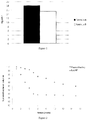
- the figure 1 thus shows that promethazine as a Lac6P catanionic complex diffuses well through the skin thus showing that this delivery system, which is likely to be less irritating, is suitable for topical application.
- the photostability of the active ingredient is an important criterion when dermal administration is considered. Indeed, the presence of a photoinstable substance (such as promethazine or mequitazine) in the epidermis, associated with sun exposure can result in loss of activity and cutaneous phototoxicity.
- a photoinstable substance such as promethazine or mequitazine
- the solutions were analyzed in quartz tanks for concentrations of 4.10 -2 M and 6.6 ⁇ 10 -5 M.
- promethazine The photodegradation of promethazine was monitored by HPLC on a Water 2695 chromatograph equipped with Millipore 510 pumps and an XBridge RP18 column (2.1 x 100 nm, 3.5 ⁇ m).
- Promethazine is detected by UV-visible spectrophotometry at a wavelength of 251 nm with a Water 2487 Dual ⁇ absorbance detector.
- the mobile phase is composed of a mixture of water acidified with 0.1% formic acid and acetonitrile 22/78.
- the elution is carried out in isocratic mode, with a flow rate of 0.35 ml.min -1 .
- the injected volumes are 10 ⁇ L. All samples were injected three times.
- the mobile phase consists of a mixture of water acidified with 0.1% formic acid and 20/70 acetonitrile.
- a calibration curve is carried out beforehand with the hydrochloride of promethazine for a range of concentrations between 10 -5 M and 5 ⁇ 10 -3 M.
- the photostability of the two antihistamines in the form of hydrochloride or bioactive catanionic association was thus studied under a UV-visible irradiation to devalue the influence of the auto-aggregation on the photochemical properties of the active principles.
- the different solutions initially have a zero absorbance in the visible range.
- the appearance of a band for the promethazine hydrochloride and mequitazine, as well as for the Lac6P catanionic association confirms the observed color changes.
- the null absorbance in the visible range for the Lac6M catanionic association reflects the absence of coloration observed after 2 months under UV radiation. The resulting results are reported in the table below.
- the degradation of the promethazine hydrochloride and the Lac6P catanionic association was quantified by high performance liquid chromatography (HPLC).
- HPLC high performance liquid chromatography
- the monitoring of the degradation is carried out by the determination of the amount of non-degraded active ingredient present in solution ( Figure 2 ).
- promethazine in the form of catanionic vesicles minimizes the degradation of the active ingredient during the first days of exposure (see Figure 2 ).
- the Lac6P combination and the promethazine hydrochloride respectively have a degradation rate of 3% and 13%.
- the kinetics of degradation is delayed by the self-organization of the ion pair.
- the incorporation of promethazine into the membrane of catanionic vesicles results in significant protection of the antihistamine during the first days of exposure.
Landscapes
- Health & Medical Sciences (AREA)
- Chemical & Material Sciences (AREA)
- Life Sciences & Earth Sciences (AREA)
- Pharmacology & Pharmacy (AREA)
- Veterinary Medicine (AREA)
- Public Health (AREA)
- General Health & Medical Sciences (AREA)
- Animal Behavior & Ethology (AREA)
- Medicinal Chemistry (AREA)
- Epidemiology (AREA)
- General Chemical & Material Sciences (AREA)
- Chemical Kinetics & Catalysis (AREA)
- Engineering & Computer Science (AREA)
- Dermatology (AREA)
- Oil, Petroleum & Natural Gas (AREA)
- Molecular Biology (AREA)
- Biochemistry (AREA)
- Bioinformatics & Cheminformatics (AREA)
- Organic Chemistry (AREA)
- Nuclear Medicine, Radiotherapy & Molecular Imaging (AREA)
- Communicable Diseases (AREA)
- Oncology (AREA)
- Pulmonology (AREA)
- Immunology (AREA)
- Medicinal Preparation (AREA)
- Acyclic And Carbocyclic Compounds In Medicinal Compositions (AREA)
- Organic Low-Molecular-Weight Compounds And Preparation Thereof (AREA)
- Pharmaceuticals Containing Other Organic And Inorganic Compounds (AREA)
Description
- La présente invention concerne une association catanionique intermoléculaire d'un principe actif basique et d'un tensioactif acide permettant de protéger, solubiliser et véhiculer le principe actif.
- L'article de BIZE C et Al. "Physicochemical studies of the supramolecular organization of catanionic bolaamphiphilic associations", Communicaciones presentadas a las jornadas de comitE espagnolde de la detergencia, Barcelona, ES, Vol. 38, 2008, pages 225-234 divulgue des complexes d'association intermoléculaire d'un transporteur amphiphile et d'un composé comprenant une fonction amine.
- Améliorer la stabilité d'un principe actif afin de réduire ses effets secondaires reste encore de nos jours un enjeu très important. Généralement, cette stabilisation se réalise à la fois lors du stockage du principe actif par l'utilisation de conservateurs et d'anti-oxydants, et lors de l'administration du principe actif par l'utilisation d'un véhicule permettant de solubiliser celui-ci et éventuellement de le protéger des dégradations dues au système immunitaire et de le véhiculer vers son site d'action.
- De nos jours, il existe de nombreuses techniques de vectorisation de principes actifs. Ces techniques utilisent différentes stratégies en fonction de la nature du principe actif (hydrophile ou lipophile), ainsi que de l'organe visé, de la dose administrée et de la durée d'administration. Par exemple, le principe actif pourra être encapsulé à l'intérieur d'une vésicule de phospholipides ou immobilisé dans des microsphères de polymère biodégradable.
- Par ailleurs, la délivrance de principes actifs au travers de la peau présente de nombreux avantages. Les vitesses variables d'absorption et de métabolisation liées à un traitement par voie orale sont évitées, ainsi que d'éventuelles irritations gastro-intestinales. La délivrance du principe actif par voie transcutanée permet également de mieux contrôler sa concentration sanguine.
- Toutefois, la peau présente une structure complexe et les molécules administrées par voie transcutanée ou topique doivent tout d'abord franchir une première barrière constituée par le stratum corneum avant d'atteindre le courant sanguin. Le stratum corneum est constitué d'une couche dense et hautement kératinisée d'une épaisseur moyenne de 10-15 microns. Le degré élevé de kératinisation, ainsi que l'assemblage compact des cellules peut constituer une barrière pratiquement imperméable au passage d'un principe actif.
- Pour la plupart des médicaments, la vitesse de perméabilisation au travers de la peau, sans adjonction d'additif perméabilisant, est extrêmement lente. L'efficacité de l'administration cutanée repose donc essentiellement sur le système de délivrance utilisé qui conditionne la stabilité du principe actif ainsi que sa biodisponibilité et sa biositribution cutanée. Les stratégies adoptées pour faire pénétrer une quantité suffisante de principe actif impliquent donc généralement l'utilisation de promoteurs de pénétration ou des formulations sophistiquées.
- De nombreux additifs peuvent ainsi être utilisés afin d'augmenter la vitesse de pénétration du principe actif au travers de la peau. La plupart des composés sont administrés en même temps que le médicament (dans certains cas la peau peut être prétraitée avec un agent de perméabilisation) de manière à augmenter la perméabilité du stratum corneum et ainsi accroître la pénétration du principe actif au travers de la peau. La perméabilité de beaucoup d'agents thérapeutiques peut être améliorée grâce à ces agents de perméabilisation.
- Plusieurs additifs sont capables de promouvoir le transport de principes actifs au travers de la peau selon différents mécanismes dont les plus importants sont les suivants :
- Extraction des lipides du stratum corneum
- Désorganisation de la structure de la bicouche lipidique
- Déplacement de l'eau liée
- Délamination du stratum corneum
- Désorganisation de la couche cornée
- Les agents de perméabilisation peuvent être classés dans différentes catégories. Ainsi, des solvants tels que des alcools, des alkyle méthyle sulfoxydes et des polyols, augmentent la solubilité ce qui accroît le passage cutané. Quelques solvants comme le diméthylsulfoxyde (DMSO) ou l'éthanol, pourront extraire les lipides et rendre le stratum corneum plus perméable. L'acide oléique et le myristate d'isopropyle sont des exemples types d'agents de perméabilisation qui désorganisent la couche cornée en s'intercalant dans les structures lipidiques. Cet effet émollient accroît ainsi le coefficient de diffusion du principe actif. Egalement, des tensioactifs ioniques ou le DMSO interagissent avec la kératine des cornéocytes, ce qui déploie la structure de la protéine et augmente le coefficient de diffusion.
- Cependant, la plupart de ces systèmes de délivrance présente l'inconvénient majeur d'induire des altérations irréversibles au niveau de la peau.
- La présente invention décrit une stratégie originale qui consiste à faire participer le principe actif lui-même de manière active à son propre transport, permettant de protéger, solubiliser et véhiculer jusqu'à son site d'action le médicament. Pour cela, nous proposons d'associer par simple interaction électrostatique acide/base, un principe actif basique avec une molécule amphiphile acide bio compatible, cette association pouvant être stabilisée en outre par des interactions de type hydrophobes entre le principe actif et la molécule amphiphile.
- En particulier, cette invention présente des applications en formulation, en tant que solubilisation, protection, transport et diffusion transcutanée d'un principe actif, la molécule amphiphile pouvant jouer également le rôle d'agent de perméabilisation pour un transport transcutané. Ces formulations simplifiées et inoffensives pour la peau permettent alors d'augmenter la concentration en principe actif au niveau de la peau et de favoriser son passage à travers le stratum corneum.
- L'invention propose ainsi d'associer un transporteur amphiphile acide biocompatible à un principe actif comportant une ou plusieurs fonctions basiques. Cette association intermoléculaire conduit à une nouvelle espèce amphiphile correspondant à la formation d'une paire acide/base liée par des interactions électrostatiques et stabilisée par des interactions de type Van der Waals entre les parties hydrophobes des deux constituants. Le complexe amphiphile ainsi formé par association, pourra conduire en fonction de sa concentration dans l'eau ainsi que de la nature du principe actif (volume, hydrophobie), à un ensemble de structures auto-assemblées telles que des micelles ou des vésicules. Les objets ainsi formées pourront également servir à l'auto-transport du principe actif.
- La présente invention a donc pour objet un complexe d'association intermoléculaire d'un transporteur amphiphile et d'un principe actif, caractérisé en ce que ledit complexe est choisi parmi :
Lac6P 
Glu6P 
Lac6M 
Glu6M 
- Il est également décrit un complexe d'association intermoléculaire d'un transporteur amphiphile et d'un principe actif de formule générales (I) suivante :

- S représente un fragment d'un glucide, tel qu'un monosaccharide ou un polysaccharide.
- R représente un atome d'hydrogène, une chaîne hydrocarbonée en C1-C20, avantageusement en C1-C10, saturée ou insaturée, linéaire, ramifiée, cyclique ou aromatique, éventuellement substituée par un ou plusieurs atomes de fluor, notamment perfluorée,
- X représente une chaîne alkyle, alcényle ou alcynyle en C4 à C10, de préférence linéaire,
- Y- représente un groupe carboxylate (-CO2 -), sulfate (-O-SO3 -), sulfonate(-SO3 -), phosphate (-O-P(O)(ORa)O-), phosphonate (-O-P(O)RbO-) ou phosphinate (-P(O)RbO-),
avec Ra représentant un groupe alkyle en C1 à C6 et Rb représentant un atome d'hydrogène ou un groupe alkyle en C1 à C6, et - G représente un principe actif comprenant au moins une fonction amine primaire, secondaire ou tertiaire ou guanidine (-NH-C(=NH)-NH2), notamment choisi dans le groupe comprenant les antihistaminiques, les antidépresseurs, les hypotenseurs, les neurotransmetteurs, les amphétamines, les anesthésiants, les antimigraineux, les stimulants cardiaques, les agonistes des récepteurs nicotiniques, les vitamines ou pro-vitamines, et les anticancéreux.
- Dans le cadre de la présente invention, les termes suivants seront utilisés indifféremment pour désigner les complexes d'association intermoléculaire d'un transporteur amphiphile et d'un principe actif selon l'invention : « complexe », « complexe d'association intermoléculaire », « complexe catanionique », ou encore « association catanionique ».
- Par « glucide », on entend, au sens de la présente invention, un monosaccharide ou un polysaccharide.
- Par « monosaccharide », on entend, au sens de la présente invention, un aldose, c'est-à-dire un sucre portant une fonction aldéhyde (-CHO). Il peut s'agir notamment de l'érythrose, du thréose, du ribose, de l'arabinose, du xylose, du lyxose, de l'allose, de l'altrose, du glucose, du mannose, du gulose, de l'idose, du galactose, ou du talose, sous une forme D ou L. Il s'agit en particulier du glucose.
- Par « polysaccharide », on entend, au sens de la présente invention, un enchaînement d'au moins deux motifs monosaccharide tel que défini ci-dessus. Il pourra s'agir en particulier d'un disaccharide (enchaînement de deux motifs monosaccharide), tel que le lactose.
- Par « fragment d'un glucide », on entend, au sens de la présente invention, le fragment du glucide dépourvu de sa fonction aldéhyde.
- Par « alkyle », on entend, au sens de la présente invention, une chaîne hydrocarbonée saturée, linéaire ou ramifiée.
- Lorsque cette chaîne alkyle représente la chaîne X, elle comportera 4 à 10, de préférence 6, atomes de carbone et sera avantageusement linéaire. A titre d'exemple, on peut citer une chaîne n-hexyle.
- Lorsque cette chaîne alkyle représente un groupe Ra ou Rb, elle comportera 1 à 6 atomes de carbone et pourra être notamment un groupe méthyle, éthyle, propyle, isopropyle, butyle, isobutyle, sec-butyle, tert-buteyle, pentyle ou encore hexyle.
- Par « alcényle », on entend, au sens de la présente invention, une chaîne hydrocarbonée, linéaire ou ramifiée, de préférence linéaire, comportant au moins une double liaison et comportant 4 à 10, de préférence 6, atomes de carbone.
- Par « alcynyle », on entend, au sens de la présente invention, une chaîne hydrocarbonée, linéaire ou ramifiée, de préférence linéaire, comportant au moins une triple liaison et comportant 4 à 10, de préférence 6, atomes de carbone.
- Par « insaturé », on entend, au sens de la présente invention, que la chaîne hydrocarbonée peut comporter une ou plusieurs insaturations.
- Par « insaturation », on entend, au sens de la présente invention, une liaison double ou triple entre deux atomes de carbone.
- Par « chaîne hydrocarbonée cyclique », on entend, au sens de la présente invention, un groupement hydrocarboné cyclique, comprenant un ou plusieurs cycles accolés, notamment 1 ou 2 cycles. Cette chaîne pourra être saturée ou insaturée et comprendra de 3 à 20, de préférence de 3 à 10, atomes de carbone. Il pourra s'agir d'un groupement cyclopropyle, cyclopentyle ou encore cyclohexyle.
- Par « chaîne hydrocarbonée aromatique », on entend, au sens de la présente invention, un groupement aromatique comportant de 6 à 20, de préférence de 6 à 10, atomes de carbone, et comprenant un ou plusieurs cycles accolés, comme par exemple un groupement phényle ou naphtyle. Avantageusement, il s'agit du phényle.
- Par « perfluoré », on entend, au sens de la présente invention, que tous les atomes d'hydrogène de la chaîne hydrocarbonée ont été remplacés par des atomes de fluor.
- Ces complexes catanioniques ont la particularité de s'auto-assembler spontanément en assemblages supramoléculaires, tels que des vésicules ou des micelles, qui sont stables thermodynamiquement, ce qui permet d'encapsuler le principe actif et donc de le protéger, et de solubiliser l'ensemble grâce au groupement S hydrophile.
- Le transporteur utilisé dans le complexe d'association catanionique selon l'invention est choisi parmi des molécules amphiphiles biocompatibles présentant une ou plusieurs fonctions acides.
- Selon la présente invention, le transporteur amphiphile sera choisi parmi les dérivés de glucide présentant une ou plusieurs chaînes hydrophobes, ainsi qu'une ou plusieurs fonctions acides susceptibles d'interagir de manière électrostatique avec le principe actif basique.
- Ce transporteur amphiphile répond à la formule générale (II) suivante :

- S pourra plus particulièrement représenter un fragment d'un glucide, tel qu'un fragment du glucose ou du lactose.
- R représentera notamment un atome d'hydrogène ou une chaîne alkyle en C1 à C6, et de préférence représentera un atome d'hydrogène.
- Avantageusement, X représentera une chaîne alkyle, alcényle ou alcynyle linéaire en C4 à C10, avantageusement en C5, C6, C7, C8 OU C9, et encore plus avantageusement en C6. Plus particulièrement, X pourra représenter une chaîne alkyle, de préférence linéaire, en C4 à C10, avantageusement en C5, C6, C7, C8 OU C9, et encore plus avantageusement en C6. X pourra donc représenter une chaîne n-hexyle.
- Y- représentera en particulier un groupement CO2-.
- Le transporteur sera donc avantageusement choisi parmi les tensioactifs acides à tête sucre et à longue chaîne, tels que les acides 1,7-glyconamidoheptanoïques comportant un résidu dérivé de l'acide gluconique ou de l'acide lactobionique que l'on dénommera respectivement Glu6 et Lac6.
- La formule générale des acides 1,7-glyconamidoheptanoïques Glu6 et Lac6 est la suivante :

- Ces dérivés sont préparés selon un art antérieur décrit dans
FR 2 727 110 - Le principe actif G pourra être notamment un antihistaminique, tel que la prométhazine ou la méquitazine.
- La présente invention a également pour objet un complexe d'association intermoléculaire d'un transporteur amphiphile et d'un principe actif tel que défini précédemment pour son utilisation en tant que médicament, plus particulièrement en tant qu'antihistaminique, antidépresseur, hypotenseur, neurotransmetteur, amphétamine, anesthésiant, antimigraineux, stimulant cardiaque, agoniste des récepteurs nicotiniques, vitamine ou pro-vitamine, ou anticancéreux, et notamment en tant qu'antihistaminique.
- Il est décrit l'utilisation d'un complexe d'association intermoléculaire d'un transporteur amphiphile et d'un principe actif tel que défini précédemment pour la préparation d'un médicament, plus particulièrement d'un antihistaminique, d'un antidépresseur, d'un hypotenseur, d'un neurotransmetteur, d'une amphétamine, d'un anesthésiant, d'un antimigraineux, d'un stimulant cardiaque, d'un agoniste des récepteurs nicotiniques, d'une vitamine ou pro-vitamine, ou d'un anticancéreux, et notamment d'un antihistaminique.
- La présente demande de brevet a également pour objet une composition pharmaceutique comprenant au moins un complexe d'association intermoléculaire d'un transporteur amphiphile et d'un principe actif tel que défini précédemment.
- Cette composition pharmaceutique pourra être plus particulièrement destinée à une application topique ou transcutanée. Il pourra ainsi s'agir d'un hydrogel ou d'une émulsion.
Glu6M 
- La présente invention a également pour objet un complexe d'association intermoléculaire d'un transporteur amphiphile et d'un principe actif tel que défini précédemment pour son utilisation en tant que médicament, plus particulièrement en tant qu'antihistaminique, antidépresseur, hypotenseur, neurotransmetteur, amphétamine, anesthésiant, antimigraineux, stimulant cardiaque, agoniste des récepteurs nicotiniques, vitamine ou pro-vitamine, ou anticancéreux, et notamment en tant qu'antihistaminique.
- L'invention concerne également l'utilisation d'un complexe d'association intermoléculaire d'un transporteur amphiphile et d'un principe actif tel que défini précédemment pour la préparation d'un médicament, plus particulièrement d'un antihistaminique, d'un antidépresseur, d'un hypotenseur, d'un neurotransmetteur, d'une amphétamine, d'un anesthésiant, d'un antimigraineux, d'un stimulant cardiaque, d'un agoniste des récepteurs nicotiniques, d'une vitamine ou pro-vitamine, ou d'un anticancéreux, et notamment d'un antihistaminique.
- La présente demande de brevet a également pour objet une composition pharmaceutique comprenant au moins un complexe d'association intermoléculaire d'un transporteur amphiphile et d'un principe actif tel que défini précédemment.
- Cette composition pharmaceutique pourra être plus particulièrement destinée à une application topique ou transcutanée. Il pourra ainsi s'agir d'un hydrogel ou d'une émulsion.
- La présente invention a également pour objet l'utilisation d'un complexe d'association intermoléculaire d'un transporteur amphiphile et d'un principe actif tel que défini ci-dessus, pour protéger et/ou pour solubiliser et/ou pour véhiculer vers son site d'action le principe actif G.
- La présente invention a également pour objet un procédé de préparation d'un complexe d'association intermoléculaire d'un transporteur amphiphile et d'un principe actif tel que défini précédemment, comprenant les étapes successives suivantes :
- mélange du transporteur amphiphile de formule (II) tel que défini précédemment et du principe actif G tel que défini ci-dessus, et
- séparation du milieu réactionnel du complexe d'association intermoléculaire du transporteur amphiphile et du principe actif ainsi obtenu.
- Ainsi, le complexe d'association intermoléculaire est formé par simple mise en contact de la molécule amphiphile sous sa forme acide avec le principe actif sous sa forme basique, notamment dans l'eau ou dans un autre solvant tel que le méthanol. Le complexe d'association est donc obtenu par une réaction acide/base entre la forme acide du transporteur amphiphile et la forme basique du principe actif.
- Par ailleurs, il est à noter que des structures supramoléculaires, telles que des vésicules ou des micelles, se forment spontanément lors du mélange du transporteur et du principe actif en solution aqueuse, structures qui sont stables thermodynamiquement.
- Le transporteur amphiphile et le principe actif seront notamment mélangés dans des proportions stoechiométriques, c'est-à-dire que l'on mélange le même nombre de moles du transporteur amphiphile et du principe actif. Par ailleurs, ce mélange peut être effectué en chauffant à une température comprise entre l'ambiante et la température d'ébullition du solvant à pression atmosphérique, et sur une durée de 1 à 72 heures.
- Le complexe d'association intermoléculaire ainsi obtenu pourra alors être séparé du milieu réactionnel par filtration, et ensuite éventuellement être lyophilisé.
- La présente invention sera mieux comprise à la lumière des exemples et figures non limitatifs qui suivent.
-
- La
Figure 1 représente les quantités cumulées de prométhazine qui ont diffusées à travers la peau de porc, au bout de 24h, pour une formulation A contenant de la prométhazine libre et une formulation B contenant l'association Lac6P. - La
Figure 2 représente le pourcentage de prométhazine non dégradée restant en solution, en fonction du temps, pour une solution contenant du chlorhydrate de prométhazine et une solution contenant une association Lac6P -

- A une solution de 320 mg (0,66 mmol) de tensioactif dérivé de sucre Lac6 dans 30 mL d'eau ultra pure, sont ajoutés 187 mg (0,66 mmol) de prométhazine. Le ballon est enveloppé de papier opaque noir, pour protéger la prométhazine, photosensible, de la lumière. Le mélange réactionnel est ensuite placé sous agitation à 25°C pendant 24h. On obtient alors une solution homogène qui, après lyophilisation, conduit de façon quantitative au produit, sous forme d'une poudre blanche.
- L'association constitue une nouvelle espèce amphiphile qui forme des vésicules dans l'eau dont le diamètre hydrodynamique moyen est de 290 nm (Indice de Polydispersité (IP) = 0,12) à partir d'une CAC (Concentration d'Agrégation Critique) de 3,3.10-2M.
-
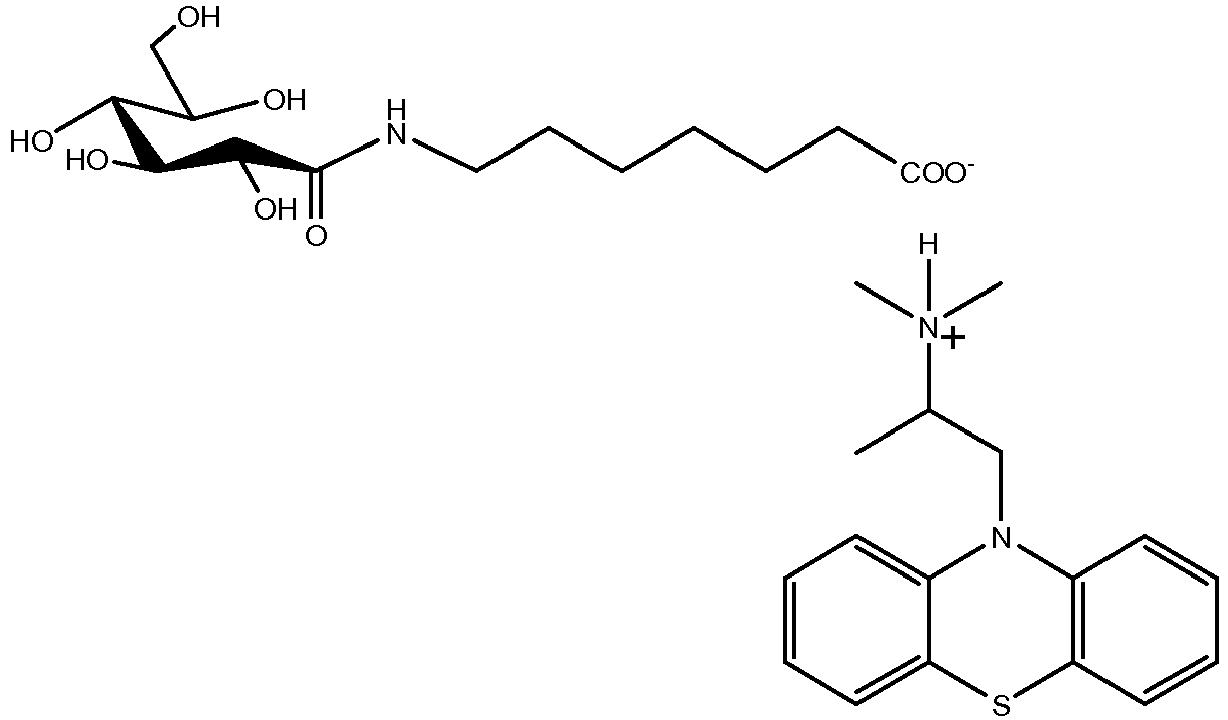
- A une solution de 213 mg (0,66 mmol) de tensioactif dérivé de sucre Glu6 dans 30mL d'eau ultra pure, sont ajoutés 187 mg (0,66 mmol) de prométhazine. Le ballon est enveloppé de papier opaque noir, pour protéger la prométhazine, photosensible, de la lumière. Le mélange réactionnel est ensuite placé sous agitation à 25°C pendant 24h. On obtient alors une solution homogène qui, après lyophilisation, conduit de façon quantitative au produit, sous forme d'une poudre blanche.
- L'association constitue une nouvelle espèce amphiphile qui forme des vésicules dans l'eau dont le diamètre hydrodynamique moyen est de 285 nm (IP = 0,10) à partir d'une CAC de 1,1.10-2M.
-

- A une solution de 320 mg (0,66 mmol) de tensioactif dérivé de sucre Lac6 dans 30mL d'eau ultra pure, sont ajoutés 214 mg (0,66 mmol) de méquitazine. Le ballon est enveloppé de papier opaque noir, pour protéger la méquitazine, photosensible, de la lumière. Le mélange réactionnel est ensuite placé sous agitation à 25°C pendant 24h. On obtient alors une solution homogène qui, après lyophilisation, conduit de façon quantitative au produit, sous forme d'une poudre blanche.
- L'association constitue une nouvelle espèce amphiphile qui forme des micelles dans l'eau à partir d'une CMC (Concentration Micellaire Critique) de 3,3.10-2M.
-

- A une solution de 213 mg (0,66 mmol) de tensioactif dérivé de sucre Glu6 dans 30mL d'eau ultra pure, sont ajoutés 214 mg (0,66 mmol) de méquitazine. Le ballon est enveloppé de papier opaque noir, pour protéger la méquitazine, photosensible, de la lumière. Le mélange réactionnel est ensuite placé sous agitation à 25°C pendant 24h. On obtient alors une solution homogène qui, après lyophilisation, conduit de façon quantitative au produit, sous forme d'une poudre blanche.
- L'association constitue une nouvelle espèce amphiphile qui forme des micelles dans l'eau à partir d'une CMC de 1,1.10-2M.
- Les hydrogels étudiés sont préparés en ajoutant à un gel aqueux à 2% massique de Natrosol®, le même volume d'une solution aqueuse vésiculaire (8.10-4M soit 2% massique en principe actif) de Lac6P ou d'une solution aqueuse de chlorhydrate de prométhazine également à 2% massique. Nous obtenons ainsi, une formulation à 1% massique en Natrosol® ainsi qu'en principe actif.
- Les différentes formules testées dans cette étude sont les suivantes :
- formule A : préparation de la prométhazine à 1% dans un hydrogel à 1% en Natrosol®, et
- formule B : préparation de l'association Lac6P à 1% dans un hydrogel à 1% en Natrosol®.
- La pénétration cutanée des différentes formules a été évaluée sur des cellules de diffusion de Franz à flux dynamique de 1 cm2. L'étude a été menée ex vivo sur de la peau d'oreille de porc en dose finie sur une durée de 24 heures.
- La peau est prélevée sur des oreilles de porc fournies par les abattoirs de Montauban. Après nettoyage et tonte des oreilles, la peau est prélevée sur la face externe de l'oreille et stockée à -20°C. Pour la préparation de la membrane, la peau d'oreille de porc est décongelée la veille de l'étude. Elle est ensuite dermatomée à 500 µm à l'aide d'un dermatome afin d'obtenir une épaisseur homogène. Enfin, la peau dermatomée est découpée en échantillons carrés de 1,5 cm de côté. Ces derniers sont placés sur les cellules de diffusion, le derme en contact avec le milieu récepteur. La surface de la peau est thermostatée à une température de 32°C par un flux d'eau chauffée à 37°C.
- Le milieu récepteur est composé d'une solution de NaCl à 0,9% et de BSA (albumine de sérum bovin) à 3%. Il est perfusé régulièrement à un flux de 1,5 mL/heure.
- La formulation à tester est appliquée à la surface d'un échantillon de peau qui sépare le compartiment donneur du compartiment récepteur de la cellule de diffusion. Les substances sont déposées par double pesée à l'aide d'une seringue de 1 mL pour les produits visqueux. L'étude étant réalisée en dose finie, la quantité déposée est de 5 mg de formulation. Chaque formulation est testée sur deux cellules différentes tandis qu'une cellule est conservée intacte pour servir de blanc.
- La formulation reste en contact avec la peau pendant 24 heures et le milieu récepteur est prélevé aux temps 2, 4, 8, 12, 18 et 24 heures pour être analysé. En fin d'étude, les volumes collectés sont mesurés. La quantité d'antihistaminique dans les différentes fractions est déterminée par un dosage par chromatographie liquide haute performance (HPLC).
- Cette étude a été réalisée à 25°C sur un chromatographe Water 2695, équipé de pompes Millipore 510, d'une colonne XBridge C18 (2,1 x 150 nm, 3,5 µm). Les principes actifs sont détectés par spectrophotométrie UV-visible, à une longueur d'onde de 251 nm, avec un appareil Water 2487 Dual λ absorbance detector. L'élution est réalisée en mode gradient, avec un débit de 0,35 mL.min-1. Les volumes injectés sont de 10 µL. Tous les échantillons ont été injectés trois fois.
- Les conditions opératoires du gradient retenu sont les suivantes :
- t0 : 94% H2O 0,1% HCOOH/ 6% acétontrile
- t0 à 15 min : gradient 50% H2O 0,1% HCOOH/ 50% acétontrile
- 15 min à 16 min : gradient 40% H2O 0,1% HCOOH/ 60% acétontrile
- Les quantités cumulées de prométhazine mesurées par HPLC au bout de 24 heures sont représentées sur la
Figure 1 . - La
figure 1 montre donc que la prométhazine sous forme de complexe catanionique Lac6P diffuse bien à travers la peau montrant ainsi que ce système de délivrance, vraisemblablement moins irritant est adaptée à une application topique. - La photostabilité du principe actif est un critère important lorsqu'une administration cutanée est envisagée. En effet, la présence d'une substance photoinstable (tel que la prométhazine ou la méquitazine) au sein de l'épiderme, associée à une exposition solaire peut se traduire par une perte d'activité et une phototoxicité cutanée.
- L'étude des propriétés photophysiques du chlorhydrate de prométhazine et de l'association Lac6P d'une part, et du chlorhydrate de méquitazine et de l'association Lac6M, d'autre part, a donc été menée par spectrophotométrie UV.
- Cette étude a été réalisée sur un spectrophotomètre à barrette de diode Hewlett-Packart 8452A, opérant pour des longueurs d'onde comprises entre 190 et 820 nm.
- Les solutions ont été analysées dans des cuves en quartz, pour des concentrations de 4.10-2 M et de 6,6.10-5 M.
- Le suivi de la photodégradation de la prométhazine a été réalisée par HPLC sur un chromatographe Water 2695, équipé de pompes Millipore 510, d'une colonne XBridge RP18 (2,1 x 100 nm, 3,5 µm). La prométhazine est détectée par spectrophotométrie UV-visible, à une longueur d'onde de 251 nm, avec un appareil Water 2487 Dual λ absorbance detector. La phase mobile est composée d'un mélange d'eau acidifiée à 0,1 % d'acide formique et d'acétonitrile 22/78. L'élution est réalisée en mode isocratique, avec un débit de 0,35 mL.min-1. Les volumes injectés sont de 10 µL. Tous les échantillons ont été injectés trois fois.
- Dans le cas de la méquitazine, la phase mobile est constituée d'un mélange d'eau acidifiée à 0,1 % d'acide formique et d'acétonitrile 20/70.
- Une courbe de calibration est réalisée au préalable avec le chlorhydrate de prométhazine pour une gamme de concentrations comprises entre 10-5 M et 5.10-3 M.
- La photostabilité des deux antihistaminiques sous forme de chlorhydrate ou d'association catanionique bioactive a donc été étudiée sous une irradiation UV-visible afin dévaluer l'influence de l'auto-agrégation sur les propriétés photochimiques des principes actifs.
- Pour réaliser cette étude, les différentes solutions (4.10-2 M) sont placées au bain marie à 25°C, sous lumière naturelle pendant plusieurs semaines. Ce mode d'irradiation, plus doux, a été préféré à l'utilisation d'une lampe au Xénon qui conduit à une dégradation trop rapide du principe actif et ne permet d'établir aucune comparaison.
- Toutefois, avant toute analyse, plusieurs observations visuelles peuvent être faites :
- La solution de chlorhydrate de prométhazine se colore en rose dès 24h d'exposition et vire au bleu-violet après quelques jours. Puis, un composé insoluble apparaît après une quinzaine de jours sous lumière naturelle.
- La solution vésiculaire de Lac6P vire au rose après environ une semaine d'exposition, puis au bleu-violet. Après une vingtaine de jours, on remarque également l'apparition d'un produit insoluble en phase aqueuse, comme dans le cas du chlorhydrate correspondant.
- La solution de chlorhydrate de méquitazine devient rose après une dizaine de jours d'exposition, puis n'évolue plus.
- La solution micellaire de Lac6M reste incolore et limpide pendant plusieurs mois.
- L'apparition tardive de la coloration rose de la solution de Lac6P semble donc indiquer que la dégradation de la prométhazine est légèrement retardée par l'auto-agrégation de la paire d'ions. En revanche, on a pu constater que la méquitazine se dégrade uniquement sous forme de chlorhydrate.
- Cependant, afin de mieux appréhender ce phénomène, la photodégradation des chlorhydrates et des associations Lac6P et Lac6M a été suivie par spectrophotométrie visible. Cette technique d'analyse est particulièrement adaptée à l'étude de ce phénomène car elle permet de rendre compte des variations de couleur.
- Ainsi, les différentes solutions présentent initialement une absorbance nulle dans le domaine du visible. Après 2 mois sous exposition naturelle, l'apparition d'une bande pour les chlorhydrates de prométhazine et de méquitazine, ainsi que pour l'association catanionique Lac6P confirme les changements de couleur observés. Il est important de noter qu'en spectrophotométrie visible, la couleur perçue est toujours complémentaire de la radiation absorbée. Par exemple, le chlorhydrate de méquitazine absorbe dans le vert (λ = 512 nm) et apparaît rose pourpre. L'absorbance nulle dans le domaine du visible pour l'association catanionique Lac6M traduit l'absence de coloration observée après 2 mois sous rayonnement UV. Les résultast obtenues sont reportés dans le tableau ci-dessous.
Chlorhydrate de prométhazine Chlorhydrate de méquitazine Lac6P Lac6M λmax (nm) 538 512 562 et 594 - couleur observée violet-indigo rose pourpre tons de bleu incolore - Ces mesures montrent que la dégradation de la prométhazine est affectée par l'auto-agrégation de la paire d'ions. L'apparition tardive de la coloration rose pour la solution de Lac6P semble indiquer une protection durant les premiers jours d'exposition. En outre, le chlorhydrate de prométhazine présente une bande à 538 nm tandis que l'association Lac6P est caractérisée par 2 bandes à 562 et 594 nm (voir tableau précédent). Ces différences semblent mettre en évidence un taux d'avancement différent de la dégradation des deux composés.
- Le confinement du principe actif au sein de la membrane des vésicules catanioniques semble donc modifier la dégradation de la prométhazine et de la méquitazine induite par les radiations UV, ces principes actifs se trouvant ainsi protégés.
- Cependant, l'absence de coloration ne permet pas de conclure sur l'absence de dégradation. L'association de la méquitazine avec le transporteur amphiphile peut effectivement modifier la voie de dégradation du principe actif.
- Afin d'affiner les résultats obtenus, la dégradation du chlorhydrate de prométhazine et de l'association catanionique Lac6P a été quantifiée par chromatographie liquide haute performance (HPLC). Le suivi de la dégradation est réalisé par le dosage de la quantité de principe actif non dégradé présente en solution (
Figure 2 ). - On observe ainsi que l'auto-association de la prométhazine sous forme de vésicules catanioniques minimise la dégradation du principe actif pendant les premiers jours d'exposition (voir
Figure 2 ). Après 5 jours sous lumière naturelle, l'association Lac6P et le chlorhydrate de prométhazine présentent respectivement un taux de dégradation de 3% et 13%. La cinétique de dégradation est donc retardée par l'auto-organisation de la paire d'ions. L'incorporation de la prométhazine au sein de la membrane des vésicules catanioniques se traduit par une protection significative de l'antihistaminique pendant les premiers jours d'exposition. - En outre, il a été observé que l'association catanionique Lac6M présente après 2 mois d'exposition un spectre UV similaire à celui du chlorhydrate de méquitazine non dégradé. Ce résultat conforte les observations réalisées en spectrophotométrie visible. L'association de la méquitazine avec le transporteur amphiphile Lac6 permet bien de protéger, sur le long terme, le principe actif vis-à-vis du rayonnement UV.
- L'ensemble de ces résultats met donc en évidence des différences entre la dégradation des principes actifs sous formes libres ou associées. Dans le cas de la prométhazine, la cinétique de dégradation est retardée par l'auto-agrégation qui permet une protection du principe actif pendant les premiers jours d'exposition, tandis que dans le cas de la méquitazine, la formation de micelles par l'association catanionique Lac6M se traduit par une protection importante de la méquitazine durant plusieurs mois.
- Ainsi, quel que soit le type d'agrégats formés par les assemblages catanioniques bioactifs en solution aqueuse, l'association entre le tensioactif dérivé de sucre et le principe actif assure la stabilité chimique de ce dernier. Ce phénomène de protection est particulièrement intéressant pour le développement de nouvelles formulations à visée dermo-cosmétique.
Claims (9)
- Complexe d'association intermoléculaire d'un transporteur amphiphile et d'un principe actif
Caractérisé en ce que ledit complexe est choisi parmi :Lac6P 
Glu6P 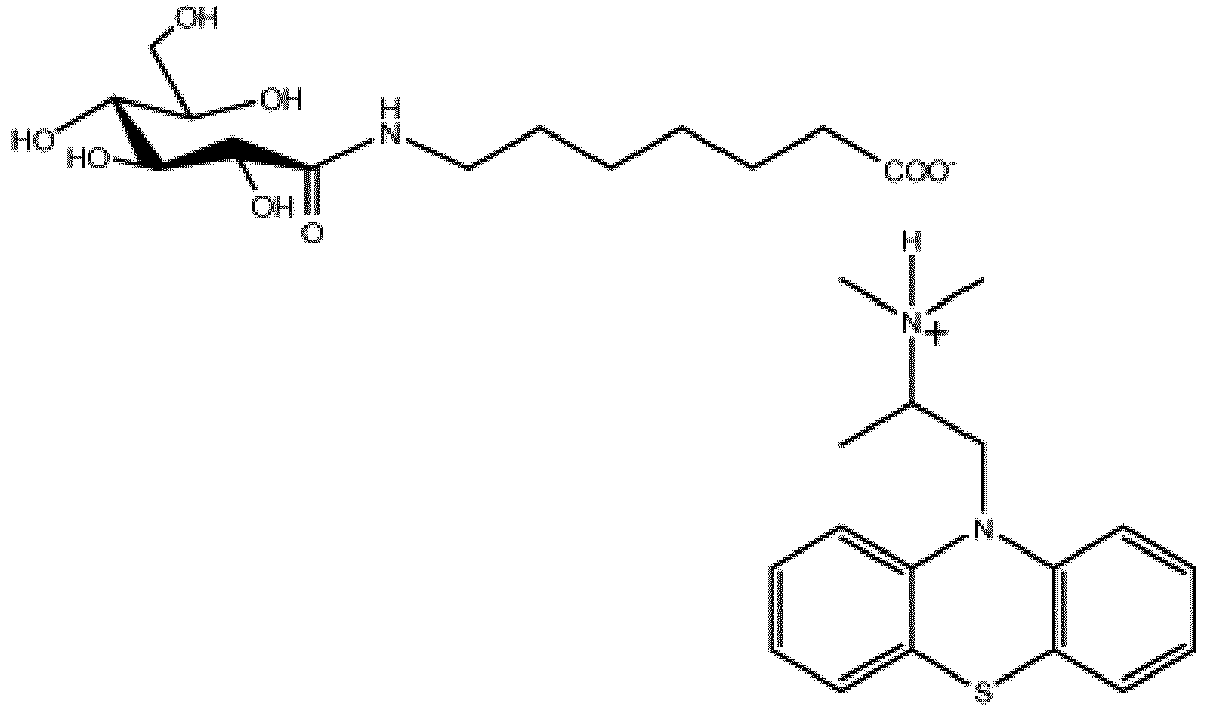
Lac6M 
Glu6M 
- Complexe d'association intermoléculaire d'un transporteur amphiphile et d'un principe actif selon la revendication 1, pour son utilisation en tant que médicament, et notamment en tant qu'antihistaminique.
- Composition pharmaceutique comprenant au moins un complexe d'association intermoléculaire d'un transporteur amphiphile et d'un principe actif selon la revendication 1.
- Composition pharmaceutique selon la revendication 3, caractérisée en ce qu'elle est destinée à une application topique ou transcutanée.
- Composition pharmaceutique selon la revendication 4, caractérisée en ce qu'il s'agit d'un hydrogel ou d'une émulsion.
- Utilisation d'un complexe d'association intermoléculaire d'un transporteur amphiphile et d'un principe actif selon la revendication 1, pour protéger et/ou pour solubiliser et/ou véhiculer vers son site d'action le principe actif tel que défini à la revendication 1.
- Procédé de préparation d'un complexe d'association intermoléculaire d'un transporteur amphiphile et d'un principe actif selon la revendication 1, comprenant les étapes successives suivantes :- mélange du transporteur amphiphile de formule (II) suivante :
 - séparation du milieu réactionnel du complexe d'association intermoléculaire du transporteur amphiphile et du principe actif ainsi obtenu.
 - Procédé selon la revendication 7, caractérisé en ce que le transporteur amphiphile et le principe actif sont mélangés dans des proportions essentiellement stoechiométriques.
- Procédé selon la revendication 7 ou 8, caractérisé en ce que le complexe d'association intermoléculaire du transporteur amphiphile et du principe actif est séparé du milieu réactionnel par filtration, et est ensuite éventuellement lyophilisé.
Applications Claiming Priority (2)
| Application Number | Priority Date | Filing Date | Title |
|---|---|---|---|
| FR0956893A FR2950902B1 (fr) | 2009-10-02 | 2009-10-02 | Transport cooperatif de principes actifs basiques par des molecules amphiphiles acides |
| PCT/EP2010/064756 WO2011039379A1 (fr) | 2009-10-02 | 2010-10-04 | Transport cooperatif de principes actifs basiques par des molecules amphiphiles acides |
Publications (2)
| Publication Number | Publication Date |
|---|---|
| EP2482853A1 EP2482853A1 (fr) | 2012-08-08 |
| EP2482853B1 true EP2482853B1 (fr) | 2018-11-14 |
Family
ID=42184153
Family Applications (1)
| Application Number | Title | Priority Date | Filing Date |
|---|---|---|---|
| EP10762659.0A Not-in-force EP2482853B1 (fr) | 2009-10-02 | 2010-10-04 | Transport cooperatif de principes actifs basiques par des molecules amphiphiles acides |
Country Status (7)
| Country | Link |
|---|---|
| US (1) | US8895518B2 (fr) |
| EP (1) | EP2482853B1 (fr) |
| JP (1) | JP5913105B2 (fr) |
| BR (1) | BR112012007301B8 (fr) |
| CA (1) | CA2776198C (fr) |
| FR (1) | FR2950902B1 (fr) |
| WO (1) | WO2011039379A1 (fr) |
Families Citing this family (2)
| Publication number | Priority date | Publication date | Assignee | Title |
|---|---|---|---|---|
| FR3019039B1 (fr) | 2014-03-28 | 2017-06-02 | Affichem | Composition cosmetique et/ou dermatologique pour la coloration de la peau |
| JP7285040B2 (ja) * | 2018-06-08 | 2023-06-01 | シオノギヘルスケア株式会社 | 光安定性を向上させた固形状組成物 |
Family Cites Families (1)
| Publication number | Priority date | Publication date | Assignee | Title |
|---|---|---|---|---|
| FR2727110B1 (fr) * | 1994-11-17 | 1997-01-17 | Stepan Europe | Composes amphiphiles mixtes |
-
2009
- 2009-10-02 FR FR0956893A patent/FR2950902B1/fr not_active Expired - Fee Related
-
2010
- 2010-10-04 EP EP10762659.0A patent/EP2482853B1/fr not_active Not-in-force
- 2010-10-04 US US13/499,197 patent/US8895518B2/en not_active Expired - Fee Related
- 2010-10-04 BR BR112012007301A patent/BR112012007301B8/pt not_active IP Right Cessation
- 2010-10-04 CA CA2776198A patent/CA2776198C/fr not_active Expired - Fee Related
- 2010-10-04 JP JP2012531455A patent/JP5913105B2/ja active Active
- 2010-10-04 WO PCT/EP2010/064756 patent/WO2011039379A1/fr not_active Ceased
Non-Patent Citations (1)
| Title |
|---|
| None * |
Also Published As
| Publication number | Publication date |
|---|---|
| BR112012007301B8 (pt) | 2021-05-25 |
| FR2950902B1 (fr) | 2012-03-30 |
| JP2013506642A (ja) | 2013-02-28 |
| US20120214756A1 (en) | 2012-08-23 |
| WO2011039379A1 (fr) | 2011-04-07 |
| CA2776198A1 (fr) | 2011-04-07 |
| BR112012007301A2 (pt) | 2016-04-19 |
| EP2482853A1 (fr) | 2012-08-08 |
| CA2776198C (fr) | 2018-08-28 |
| BR112012007301B1 (pt) | 2021-04-20 |
| FR2950902A1 (fr) | 2011-04-08 |
| JP5913105B2 (ja) | 2016-04-27 |
| US8895518B2 (en) | 2014-11-25 |
Similar Documents
| Publication | Publication Date | Title |
|---|---|---|
| EP1265617B1 (fr) | Nouvelles compositions estro-progestatives topiques a effet systemique | |
| BE1019434A3 (fr) | Stabilisation du sulforaphane. | |
| Campani et al. | Skin permeation and thermodynamic features of curcumin-loaded liposomes | |
| Todosijević et al. | Biocompatible microemulsions of a model NSAID for skin delivery: A decisive role of surfactants in skin penetration/irritation profiles and pharmacokinetic performance | |
| EP2854793B1 (fr) | Nanocapsules lipidiques comprenant un rétinoide, nanodispersion et composition les contenant, leur procédé de préparation et leur utilisation en dermatologie | |
| EP2374449A2 (fr) | Composition comprenant au moins une phase aqueuse et au moins une phase grasse comprenant de l'ivermectine | |
| KR20080092373A (ko) | 치료용 조성물 | |
| Aggarwal | Preparation of hydrogels of griseofulvin for dermal application | |
| EP0679392A1 (fr) | Nouvelle forme galénique pour l'administration transdermique | |
| KR101732844B1 (ko) | 국소 피부 전달용 항염증 지질 나노 전달체를 포함하는 피부염 치료 또는 예방용 조성물 | |
| CA2776198C (fr) | Transport cooperatif de principes actifs basiques par des molecules amphiphiles acides | |
| FR2907012A1 (fr) | Composition dermatologique comprenant des nanocapsules d'avermectine, son procede de preparation et son utilisation | |
| FR3006894A1 (fr) | Microparticules avec des cyclodextrines a double-niveaux d’encapsulation | |
| EP3700506B1 (fr) | Formulations topiques destinées au traitement d'affections dermatologiques comprenant la calvitie hippocratique | |
| FR3110427A1 (fr) | Conjugué terpenique de couplage | |
| CN117813117A (zh) | 一种芦可替尼组合物及其用途 | |
| KR20090115384A (ko) | pH 반응형 공중합체와 인지질로 구성된 이중 캡슐 및 이를 함유하는 화장료 조성물 | |
| Doppalapudi et al. | Fenoldopam mesylate for treating psoriasis: A new indication for an old drug | |
| JP2025510868A (ja) | ミラベグロン製剤 | |
| JP2025521574A (ja) | 炎症性皮膚疾患の治療に使用するための局所ベンゾイミダゾール製剤及び方法 | |
| EP4294370A1 (fr) | Composition hydrogel et ses utilisations dans la prévention et/ou le traitement des dommages cutanés causés par les rayonnements | |
| KR102462350B1 (ko) | 이데베논 또는 이의 약학적으로 허용가능한 염을 함유하는 지질 비드 및 이의 제조방법 | |
| EP1052995B1 (fr) | Composition pharmaceutique pour l'administration par voie nasale de thiocolchicoside | |
| EP3302421B1 (fr) | Compositions comprenant au moins un principe actif disperse et des microcapsules lipidiques | |
| PL214538B1 (pl) | Kompozycja liposomowa zawierajaca naproksen i sposób wytwarzania kompozycji liposomowej zawierajacej naproksen |
Legal Events
| Date | Code | Title | Description |
|---|---|---|---|
| PUAI | Public reference made under article 153(3) epc to a published international application that has entered the european phase |
Free format text: ORIGINAL CODE: 0009012 |
|
| 17P | Request for examination filed |
Effective date: 20120329 |
|
| AK | Designated contracting states |
Kind code of ref document: A1 Designated state(s): AL AT BE BG CH CY CZ DE DK EE ES FI FR GB GR HR HU IE IS IT LI LT LU LV MC MK MT NL NO PL PT RO RS SE SI SK SM TR |
|
| DAX | Request for extension of the european patent (deleted) | ||
| STAA | Information on the status of an ep patent application or granted ep patent |
Free format text: STATUS: EXAMINATION IS IN PROGRESS |
|
| 17Q | First examination report despatched |
Effective date: 20171018 |
|
| REG | Reference to a national code |
Ref country code: DE Ref legal event code: R079 Ref document number: 602010055111 Country of ref document: DE Free format text: PREVIOUS MAIN CLASS: A61K0047480000 Ipc: A61K0031541500 |
|
| GRAP | Despatch of communication of intention to grant a patent |
Free format text: ORIGINAL CODE: EPIDOSNIGR1 |
|
| STAA | Information on the status of an ep patent application or granted ep patent |
Free format text: STATUS: GRANT OF PATENT IS INTENDED |
|
| RIC1 | Information provided on ipc code assigned before grant |
Ipc: A61K 47/54 20170101ALI20180504BHEP Ipc: A61K 31/5415 20060101AFI20180504BHEP Ipc: A61K 47/26 20060101ALI20180504BHEP |
|
| INTG | Intention to grant announced |
Effective date: 20180530 |
|
| GRAS | Grant fee paid |
Free format text: ORIGINAL CODE: EPIDOSNIGR3 |
|
| GRAA | (expected) grant |
Free format text: ORIGINAL CODE: 0009210 |
|
| STAA | Information on the status of an ep patent application or granted ep patent |
Free format text: STATUS: THE PATENT HAS BEEN GRANTED |
|
| AK | Designated contracting states |
Kind code of ref document: B1 Designated state(s): AL AT BE BG CH CY CZ DE DK EE ES FI FR GB GR HR HU IE IS IT LI LT LU LV MC MK MT NL NO PL PT RO RS SE SI SK SM TR |
|
| REG | Reference to a national code |
Ref country code: GB Ref legal event code: FG4D Free format text: NOT ENGLISH |
|
| REG | Reference to a national code |
Ref country code: CH Ref legal event code: EP Ref country code: AT Ref legal event code: REF Ref document number: 1063988 Country of ref document: AT Kind code of ref document: T Effective date: 20181115 |
|
| REG | Reference to a national code |
Ref country code: DE Ref legal event code: R096 Ref document number: 602010055111 Country of ref document: DE |
|
| REG | Reference to a national code |
Ref country code: IE Ref legal event code: FG4D Free format text: LANGUAGE OF EP DOCUMENT: FRENCH |
|
| REG | Reference to a national code |
Ref country code: NL Ref legal event code: MP Effective date: 20181114 |
|
| REG | Reference to a national code |
Ref country code: LT Ref legal event code: MG4D |
|
| REG | Reference to a national code |
Ref country code: AT Ref legal event code: MK05 Ref document number: 1063988 Country of ref document: AT Kind code of ref document: T Effective date: 20181114 |
|
| PG25 | Lapsed in a contracting state [announced via postgrant information from national office to epo] |
Ref country code: ES Free format text: LAPSE BECAUSE OF FAILURE TO SUBMIT A TRANSLATION OF THE DESCRIPTION OR TO PAY THE FEE WITHIN THE PRESCRIBED TIME-LIMIT Effective date: 20181114 Ref country code: BG Free format text: LAPSE BECAUSE OF FAILURE TO SUBMIT A TRANSLATION OF THE DESCRIPTION OR TO PAY THE FEE WITHIN THE PRESCRIBED TIME-LIMIT Effective date: 20190214 Ref country code: NO Free format text: LAPSE BECAUSE OF FAILURE TO SUBMIT A TRANSLATION OF THE DESCRIPTION OR TO PAY THE FEE WITHIN THE PRESCRIBED TIME-LIMIT Effective date: 20190214 Ref country code: LT Free format text: LAPSE BECAUSE OF FAILURE TO SUBMIT A TRANSLATION OF THE DESCRIPTION OR TO PAY THE FEE WITHIN THE PRESCRIBED TIME-LIMIT Effective date: 20181114 Ref country code: IS Free format text: LAPSE BECAUSE OF FAILURE TO SUBMIT A TRANSLATION OF THE DESCRIPTION OR TO PAY THE FEE WITHIN THE PRESCRIBED TIME-LIMIT Effective date: 20190314 Ref country code: AT Free format text: LAPSE BECAUSE OF FAILURE TO SUBMIT A TRANSLATION OF THE DESCRIPTION OR TO PAY THE FEE WITHIN THE PRESCRIBED TIME-LIMIT Effective date: 20181114 Ref country code: HR Free format text: LAPSE BECAUSE OF FAILURE TO SUBMIT A TRANSLATION OF THE DESCRIPTION OR TO PAY THE FEE WITHIN THE PRESCRIBED TIME-LIMIT Effective date: 20181114 Ref country code: FI Free format text: LAPSE BECAUSE OF FAILURE TO SUBMIT A TRANSLATION OF THE DESCRIPTION OR TO PAY THE FEE WITHIN THE PRESCRIBED TIME-LIMIT Effective date: 20181114 Ref country code: LV Free format text: LAPSE BECAUSE OF FAILURE TO SUBMIT A TRANSLATION OF THE DESCRIPTION OR TO PAY THE FEE WITHIN THE PRESCRIBED TIME-LIMIT Effective date: 20181114 |
|
| PG25 | Lapsed in a contracting state [announced via postgrant information from national office to epo] |
Ref country code: RS Free format text: LAPSE BECAUSE OF FAILURE TO SUBMIT A TRANSLATION OF THE DESCRIPTION OR TO PAY THE FEE WITHIN THE PRESCRIBED TIME-LIMIT Effective date: 20181114 Ref country code: SE Free format text: LAPSE BECAUSE OF FAILURE TO SUBMIT A TRANSLATION OF THE DESCRIPTION OR TO PAY THE FEE WITHIN THE PRESCRIBED TIME-LIMIT Effective date: 20181114 Ref country code: AL Free format text: LAPSE BECAUSE OF FAILURE TO SUBMIT A TRANSLATION OF THE DESCRIPTION OR TO PAY THE FEE WITHIN THE PRESCRIBED TIME-LIMIT Effective date: 20181114 Ref country code: GR Free format text: LAPSE BECAUSE OF FAILURE TO SUBMIT A TRANSLATION OF THE DESCRIPTION OR TO PAY THE FEE WITHIN THE PRESCRIBED TIME-LIMIT Effective date: 20190215 Ref country code: PT Free format text: LAPSE BECAUSE OF FAILURE TO SUBMIT A TRANSLATION OF THE DESCRIPTION OR TO PAY THE FEE WITHIN THE PRESCRIBED TIME-LIMIT Effective date: 20190314 Ref country code: NL Free format text: LAPSE BECAUSE OF FAILURE TO SUBMIT A TRANSLATION OF THE DESCRIPTION OR TO PAY THE FEE WITHIN THE PRESCRIBED TIME-LIMIT Effective date: 20181114 |
|
| PG25 | Lapsed in a contracting state [announced via postgrant information from national office to epo] |
Ref country code: IT Free format text: LAPSE BECAUSE OF FAILURE TO SUBMIT A TRANSLATION OF THE DESCRIPTION OR TO PAY THE FEE WITHIN THE PRESCRIBED TIME-LIMIT Effective date: 20181114 Ref country code: DK Free format text: LAPSE BECAUSE OF FAILURE TO SUBMIT A TRANSLATION OF THE DESCRIPTION OR TO PAY THE FEE WITHIN THE PRESCRIBED TIME-LIMIT Effective date: 20181114 Ref country code: PL Free format text: LAPSE BECAUSE OF FAILURE TO SUBMIT A TRANSLATION OF THE DESCRIPTION OR TO PAY THE FEE WITHIN THE PRESCRIBED TIME-LIMIT Effective date: 20181114 Ref country code: CZ Free format text: LAPSE BECAUSE OF FAILURE TO SUBMIT A TRANSLATION OF THE DESCRIPTION OR TO PAY THE FEE WITHIN THE PRESCRIBED TIME-LIMIT Effective date: 20181114 |
|
| REG | Reference to a national code |
Ref country code: DE Ref legal event code: R097 Ref document number: 602010055111 Country of ref document: DE |
|
| PG25 | Lapsed in a contracting state [announced via postgrant information from national office to epo] |
Ref country code: EE Free format text: LAPSE BECAUSE OF FAILURE TO SUBMIT A TRANSLATION OF THE DESCRIPTION OR TO PAY THE FEE WITHIN THE PRESCRIBED TIME-LIMIT Effective date: 20181114 Ref country code: SM Free format text: LAPSE BECAUSE OF FAILURE TO SUBMIT A TRANSLATION OF THE DESCRIPTION OR TO PAY THE FEE WITHIN THE PRESCRIBED TIME-LIMIT Effective date: 20181114 Ref country code: RO Free format text: LAPSE BECAUSE OF FAILURE TO SUBMIT A TRANSLATION OF THE DESCRIPTION OR TO PAY THE FEE WITHIN THE PRESCRIBED TIME-LIMIT Effective date: 20181114 Ref country code: SK Free format text: LAPSE BECAUSE OF FAILURE TO SUBMIT A TRANSLATION OF THE DESCRIPTION OR TO PAY THE FEE WITHIN THE PRESCRIBED TIME-LIMIT Effective date: 20181114 |
|
| PLBE | No opposition filed within time limit |
Free format text: ORIGINAL CODE: 0009261 |
|
| STAA | Information on the status of an ep patent application or granted ep patent |
Free format text: STATUS: NO OPPOSITION FILED WITHIN TIME LIMIT |
|
| 26N | No opposition filed |
Effective date: 20190815 |
|
| PG25 | Lapsed in a contracting state [announced via postgrant information from national office to epo] |
Ref country code: SI Free format text: LAPSE BECAUSE OF FAILURE TO SUBMIT A TRANSLATION OF THE DESCRIPTION OR TO PAY THE FEE WITHIN THE PRESCRIBED TIME-LIMIT Effective date: 20181114 |
|
| PG25 | Lapsed in a contracting state [announced via postgrant information from national office to epo] |
Ref country code: TR Free format text: LAPSE BECAUSE OF FAILURE TO SUBMIT A TRANSLATION OF THE DESCRIPTION OR TO PAY THE FEE WITHIN THE PRESCRIBED TIME-LIMIT Effective date: 20181114 |
|
| PG25 | Lapsed in a contracting state [announced via postgrant information from national office to epo] |
Ref country code: MC Free format text: LAPSE BECAUSE OF FAILURE TO SUBMIT A TRANSLATION OF THE DESCRIPTION OR TO PAY THE FEE WITHIN THE PRESCRIBED TIME-LIMIT Effective date: 20181114 |
|
| REG | Reference to a national code |
Ref country code: CH Ref legal event code: PL |
|
| PG25 | Lapsed in a contracting state [announced via postgrant information from national office to epo] |
Ref country code: LI Free format text: LAPSE BECAUSE OF NON-PAYMENT OF DUE FEES Effective date: 20191031 Ref country code: LU Free format text: LAPSE BECAUSE OF NON-PAYMENT OF DUE FEES Effective date: 20191004 Ref country code: CH Free format text: LAPSE BECAUSE OF NON-PAYMENT OF DUE FEES Effective date: 20191031 |
|
| REG | Reference to a national code |
Ref country code: BE Ref legal event code: MM Effective date: 20191031 |
|
| PG25 | Lapsed in a contracting state [announced via postgrant information from national office to epo] |
Ref country code: BE Free format text: LAPSE BECAUSE OF NON-PAYMENT OF DUE FEES Effective date: 20191031 |
|
| PG25 | Lapsed in a contracting state [announced via postgrant information from national office to epo] |
Ref country code: IE Free format text: LAPSE BECAUSE OF NON-PAYMENT OF DUE FEES Effective date: 20191004 |
|
| PGFP | Annual fee paid to national office [announced via postgrant information from national office to epo] |
Ref country code: FR Payment date: 20200910 Year of fee payment: 11 |
|
| PGFP | Annual fee paid to national office [announced via postgrant information from national office to epo] |
Ref country code: DE Payment date: 20201009 Year of fee payment: 11 Ref country code: GB Payment date: 20201015 Year of fee payment: 11 |
|
| PG25 | Lapsed in a contracting state [announced via postgrant information from national office to epo] |
Ref country code: CY Free format text: LAPSE BECAUSE OF FAILURE TO SUBMIT A TRANSLATION OF THE DESCRIPTION OR TO PAY THE FEE WITHIN THE PRESCRIBED TIME-LIMIT Effective date: 20181114 |
|
| PG25 | Lapsed in a contracting state [announced via postgrant information from national office to epo] |
Ref country code: HU Free format text: LAPSE BECAUSE OF FAILURE TO SUBMIT A TRANSLATION OF THE DESCRIPTION OR TO PAY THE FEE WITHIN THE PRESCRIBED TIME-LIMIT; INVALID AB INITIO Effective date: 20101004 Ref country code: MT Free format text: LAPSE BECAUSE OF FAILURE TO SUBMIT A TRANSLATION OF THE DESCRIPTION OR TO PAY THE FEE WITHIN THE PRESCRIBED TIME-LIMIT Effective date: 20181114 |
|
| REG | Reference to a national code |
Ref country code: DE Ref legal event code: R119 Ref document number: 602010055111 Country of ref document: DE |
|
| GBPC | Gb: european patent ceased through non-payment of renewal fee |
Effective date: 20211004 |
|
| PG25 | Lapsed in a contracting state [announced via postgrant information from national office to epo] |
Ref country code: MK Free format text: LAPSE BECAUSE OF FAILURE TO SUBMIT A TRANSLATION OF THE DESCRIPTION OR TO PAY THE FEE WITHIN THE PRESCRIBED TIME-LIMIT Effective date: 20181114 |
|
| PG25 | Lapsed in a contracting state [announced via postgrant information from national office to epo] |
Ref country code: GB Free format text: LAPSE BECAUSE OF NON-PAYMENT OF DUE FEES Effective date: 20211004 Ref country code: DE Free format text: LAPSE BECAUSE OF NON-PAYMENT OF DUE FEES Effective date: 20220503 |
|
| PG25 | Lapsed in a contracting state [announced via postgrant information from national office to epo] |
Ref country code: FR Free format text: LAPSE BECAUSE OF NON-PAYMENT OF DUE FEES Effective date: 20211031 |