EP2482132A1 - Resist pattern forming process - Google Patents
Resist pattern forming process Download PDFInfo
- Publication number
- EP2482132A1 EP2482132A1 EP12153137A EP12153137A EP2482132A1 EP 2482132 A1 EP2482132 A1 EP 2482132A1 EP 12153137 A EP12153137 A EP 12153137A EP 12153137 A EP12153137 A EP 12153137A EP 2482132 A1 EP2482132 A1 EP 2482132A1
- Authority
- EP
- European Patent Office
- Prior art keywords
- group
- pattern
- resist
- acid
- compound
- Prior art date
- Legal status (The legal status is an assumption and is not a legal conclusion. Google has not performed a legal analysis and makes no representation as to the accuracy of the status listed.)
- Granted
Links
Classifications
-
- G—PHYSICS
- G03—PHOTOGRAPHY; CINEMATOGRAPHY; ANALOGOUS TECHNIQUES USING WAVES OTHER THAN OPTICAL WAVES; ELECTROGRAPHY; HOLOGRAPHY
- G03F—PHOTOMECHANICAL PRODUCTION OF TEXTURED OR PATTERNED SURFACES, e.g. FOR PRINTING, FOR PROCESSING OF SEMICONDUCTOR DEVICES; MATERIALS THEREFOR; ORIGINALS THEREFOR; APPARATUS SPECIALLY ADAPTED THEREFOR
- G03F7/00—Photomechanical, e.g. photolithographic, production of textured or patterned surfaces, e.g. printing surfaces; Materials therefor, e.g. comprising photoresists; Apparatus specially adapted therefor
- G03F7/0002—Lithographic processes using patterning methods other than those involving the exposure to radiation, e.g. by stamping
-
- G—PHYSICS
- G03—PHOTOGRAPHY; CINEMATOGRAPHY; ANALOGOUS TECHNIQUES USING WAVES OTHER THAN OPTICAL WAVES; ELECTROGRAPHY; HOLOGRAPHY
- G03F—PHOTOMECHANICAL PRODUCTION OF TEXTURED OR PATTERNED SURFACES, e.g. FOR PRINTING, FOR PROCESSING OF SEMICONDUCTOR DEVICES; MATERIALS THEREFOR; ORIGINALS THEREFOR; APPARATUS SPECIALLY ADAPTED THEREFOR
- G03F7/00—Photomechanical, e.g. photolithographic, production of textured or patterned surfaces, e.g. printing surfaces; Materials therefor, e.g. comprising photoresists; Apparatus specially adapted therefor
- G03F7/004—Photosensitive materials
- G03F7/0045—Photosensitive materials with organic non-macromolecular light-sensitive compounds not otherwise provided for, e.g. dissolution inhibitors
-
- G—PHYSICS
- G03—PHOTOGRAPHY; CINEMATOGRAPHY; ANALOGOUS TECHNIQUES USING WAVES OTHER THAN OPTICAL WAVES; ELECTROGRAPHY; HOLOGRAPHY
- G03F—PHOTOMECHANICAL PRODUCTION OF TEXTURED OR PATTERNED SURFACES, e.g. FOR PRINTING, FOR PROCESSING OF SEMICONDUCTOR DEVICES; MATERIALS THEREFOR; ORIGINALS THEREFOR; APPARATUS SPECIALLY ADAPTED THEREFOR
- G03F7/00—Photomechanical, e.g. photolithographic, production of textured or patterned surfaces, e.g. printing surfaces; Materials therefor, e.g. comprising photoresists; Apparatus specially adapted therefor
- G03F7/004—Photosensitive materials
- G03F7/0047—Photosensitive materials characterised by additives for obtaining a metallic or ceramic pattern, e.g. by firing
-
- G—PHYSICS
- G03—PHOTOGRAPHY; CINEMATOGRAPHY; ANALOGOUS TECHNIQUES USING WAVES OTHER THAN OPTICAL WAVES; ELECTROGRAPHY; HOLOGRAPHY
- G03F—PHOTOMECHANICAL PRODUCTION OF TEXTURED OR PATTERNED SURFACES, e.g. FOR PRINTING, FOR PROCESSING OF SEMICONDUCTOR DEVICES; MATERIALS THEREFOR; ORIGINALS THEREFOR; APPARATUS SPECIALLY ADAPTED THEREFOR
- G03F7/00—Photomechanical, e.g. photolithographic, production of textured or patterned surfaces, e.g. printing surfaces; Materials therefor, e.g. comprising photoresists; Apparatus specially adapted therefor
- G03F7/004—Photosensitive materials
- G03F7/039—Macromolecular compounds which are photodegradable, e.g. positive electron resists
- G03F7/0392—Macromolecular compounds which are photodegradable, e.g. positive electron resists the macromolecular compound being present in a chemically amplified positive photoresist composition
-
- G—PHYSICS
- G03—PHOTOGRAPHY; CINEMATOGRAPHY; ANALOGOUS TECHNIQUES USING WAVES OTHER THAN OPTICAL WAVES; ELECTROGRAPHY; HOLOGRAPHY
- G03F—PHOTOMECHANICAL PRODUCTION OF TEXTURED OR PATTERNED SURFACES, e.g. FOR PRINTING, FOR PROCESSING OF SEMICONDUCTOR DEVICES; MATERIALS THEREFOR; ORIGINALS THEREFOR; APPARATUS SPECIALLY ADAPTED THEREFOR
- G03F7/00—Photomechanical, e.g. photolithographic, production of textured or patterned surfaces, e.g. printing surfaces; Materials therefor, e.g. comprising photoresists; Apparatus specially adapted therefor
- G03F7/004—Photosensitive materials
- G03F7/039—Macromolecular compounds which are photodegradable, e.g. positive electron resists
- G03F7/0392—Macromolecular compounds which are photodegradable, e.g. positive electron resists the macromolecular compound being present in a chemically amplified positive photoresist composition
- G03F7/0397—Macromolecular compounds which are photodegradable, e.g. positive electron resists the macromolecular compound being present in a chemically amplified positive photoresist composition the macromolecular compound having an alicyclic moiety in a side chain
-
- G—PHYSICS
- G03—PHOTOGRAPHY; CINEMATOGRAPHY; ANALOGOUS TECHNIQUES USING WAVES OTHER THAN OPTICAL WAVES; ELECTROGRAPHY; HOLOGRAPHY
- G03F—PHOTOMECHANICAL PRODUCTION OF TEXTURED OR PATTERNED SURFACES, e.g. FOR PRINTING, FOR PROCESSING OF SEMICONDUCTOR DEVICES; MATERIALS THEREFOR; ORIGINALS THEREFOR; APPARATUS SPECIALLY ADAPTED THEREFOR
- G03F7/00—Photomechanical, e.g. photolithographic, production of textured or patterned surfaces, e.g. printing surfaces; Materials therefor, e.g. comprising photoresists; Apparatus specially adapted therefor
- G03F7/26—Processing photosensitive materials; Apparatus therefor
-
- G—PHYSICS
- G03—PHOTOGRAPHY; CINEMATOGRAPHY; ANALOGOUS TECHNIQUES USING WAVES OTHER THAN OPTICAL WAVES; ELECTROGRAPHY; HOLOGRAPHY
- G03F—PHOTOMECHANICAL PRODUCTION OF TEXTURED OR PATTERNED SURFACES, e.g. FOR PRINTING, FOR PROCESSING OF SEMICONDUCTOR DEVICES; MATERIALS THEREFOR; ORIGINALS THEREFOR; APPARATUS SPECIALLY ADAPTED THEREFOR
- G03F7/00—Photomechanical, e.g. photolithographic, production of textured or patterned surfaces, e.g. printing surfaces; Materials therefor, e.g. comprising photoresists; Apparatus specially adapted therefor
- G03F7/26—Processing photosensitive materials; Apparatus therefor
- G03F7/40—Treatment after imagewise removal, e.g. baking
Definitions
- This invention relates to a pattern forming process using a chemically amplified resist composition, and more particularly, to such a process including the steps of developing an exposed resist to form a resist pattern and correcting the profile of the resist pattern.
- the deep-UV lithography using KrF or ArF excimer laser light is currently utilized as the mainstream micropatterning technology. Since the deep-UV lithography using chemically amplified resist compositions is capable of processing to 0.2 ⁇ m or less, it has been industrially utilized to process a pattern with a feature size of less than 65 nm. With respect to the EB lithography, when it is combined with chemically amplified resist compositions, a practically acceptable sensitivity has been achieved despite the use of higher energy EB. The EB lithography is thus expected to have a finer processing ability. With respect to the EUV lithography, the use of chemically amplified resist compositions is believed essential for gaining a practically acceptable sensitivity.
- LER improvements are made by increasing both the quantities of acid generator and basic substance added. This approach alone still struggles to accommodate an attempt to form a fine pattern having a line width of less than 65 nm. Also, as the thickness of a resist film from which a resist pattern is formed is reduced to 150 nm or less, especially 100 nm or less, heterogeneous zones known as "micro-grains" are sometimes formed in the film. It is pointed out in JP-A 2010-243873 that the micro-grain is one of the causes for LER.
- JP-A 2005-19969 proposes a method of performing pattern correction after development by feeding a solvent gas to a resist pattern as developed for dissolving the resist surface.
- the development assembly must be equipped with a unit for feeding a solvent gas to the resist pattern and a unit for recovering the solvent gas.
- a method for performing pattern correction without addition of such units is by adding a minor amount of a high boiling solvent to a resist composition, forming a pattern therefrom, and heating the pattern for profile correction as disclosed in JP-A 2010-243873 .
- Patent Document 1 The LER improvement of Patent Document 1 is a method which is viable with a minor change of the existing resist composition. However, the result may vary with resist film depositing conditions and pattern forming conditions. It would be desirable to have an alternative.
- An object of the invention is to provide a resist pattern forming process using a chemically amplified resist composition which is adapted for the micropatterning photolithography, specifically lithography using KrF laser, ArF laser, F 2 laser, EUV, EB, or x-ray and which forms a pattern of a satisfactory profile while improving its LER.
- LER can be improved in a consistent manner by adding a softening accelerator to a resist composition, developing to form a pattern, and effecting heat treatment on the pattern.
- the invention provides a resist pattern forming process comprising the steps of:
- the softening accelerator is a compound having at least two 5 or 6-membered rings and a free-rotatable carbon chain of at least two carbon atoms.
- the softening accelerator is a compound having the general formula (1): wherein R 1 is such an acid labile group having 2 to 20 carbon atoms and optional oxygen atom that -COOR 1 is decomposed to generate carboxyl under the action of acid, X is each independently a carbonyl group (-CO-) or methylene group (-CH 2 -), Y is each independently a single bond or a C 1 -C 6 alkylene group, and n is an integer of 0 to 2.
- R 1 in formula (1) is an acetal group having the general formula (2): wherein the broken line denotes a valence bond, R 01 and R 02 are each independently hydrogen or a straight, branched or cyclic C 1 -C 10 alkyl group, or R 01 and R 02 may bond together to form a cyclic structure with the carbon atom to which they are attached, and Z is a monovalent C 1 -C 20 hydrocarbon group which may contain an oxygen atom.
- the softening accelerator has the general formula (3): wherein R 2 is a straight, branched or cyclic monovalent hydrocarbon group which may contain an oxygen atom and in which the sum of carbon and oxygen atoms is 1 to 15.
- the substrate is a photomask blank.
- Novel resist compositions containing the characteristic softening accelerator compounds are a further aspect herein.
- the resist pattern forming process is characterized in that a softening accelerator having a molecular weight of up to 800 is present in a resist pattern obtained after development.
- a softening accelerator having a molecular weight of up to 800 is present in a resist pattern obtained after development.
- the resist pattern as developed is subjected to thermal deformation to such an extent that the line width of the pattern may not undergo a change of at least 10%, whereby the resist pattern profile is corrected for minor asperities in a consistent manner.
- the process is successful in readily forming a resist pattern requiring a more strictly configured profile such as an OPC pattern.
- substantially insoluble means that a polymer is insoluble or difficultly soluble in an alkaline developer. This is well known in resist technology.
- the "thermal flow” process is known in the art.
- the resist pattern is heated above the thermal fluidization temperature of the resist polymer for changing the size of the pattern.
- the resist pattern forming processes proposed herein are distinguished from the thermal flow process in that a resist pattern as developed is heated to such an extent that the size of the resist pattern may not be substantially changed. That is, the line width of the pattern as developed may not undergo a change of at least 10%, preferably at least 5%. This moderate heating improves only LER without degrading or modifying the pattern profile.
- the inventors made investigations to achieve such an improvement via thermal deformation of a polymer.
- a photoresist composition based on polyhydroxystyrene for example, it is known that a polyhydroxystyrene having a greater dispersity has a lower thermal fluidization temperature. It is also known that if a resist polymer has a greater dispersity, resolution and pattern profile are degraded. Then the inventors attempted to adjust the thermal deformation temperature of a resist polymer designed for high resolution, by adding thereto a compound having appropriate interaction with the polymer and a lower molecular weight than the polymer as a softening accelerator.
- the softening accelerator used herein is a compound having an acidic functional group protected with an acid labile group and a molecular weight of up to 800, specifically, a compound having at least two 5 or 6-membered rings, i.e., at least two rings of 5 or 6 carbon atoms.
- a compound is preferably selected from those molecules having at least two phenol structures and protected with an acid labile group (known as ballast molecules) which are used in novolac resist compositions along with quinonediazide and those molecules used in chemically amplified resist compositions as dissolution inhibitor (DRI). Since these materials have a relatively high interaction with polymers due to their carbocyclic structure, they cause no substantial resolution degradation during resist pattern formation and allow for thermal deformation of the pattern in a moderate temperature range.
- the softening accelerator is preferably selected from aromatic structure-bearing compounds such as bisphenols, low molecular weight polyhydroxystyrenes with a molecular weight of up to 800, and bisphenol acid esters, which are protected with an acid labile group, and aromatic structure-free compounds such as sesquiterpenes, diterpenes, triterpenes and derivatives thereof having at least two rings and acid labile group-protected carboxylic acid.
- aromatic structure-bearing compounds such as bisphenols, low molecular weight polyhydroxystyrenes with a molecular weight of up to 800, and bisphenol acid esters, which are protected with an acid labile group
- aromatic structure-free compounds such as sesquiterpenes, diterpenes, triterpenes and derivatives thereof having at least two rings and acid labile group-protected carboxylic acid.
- derivatives having a free-rotatable carbon chain of at least two carbon atoms are effective for moderately reducing the thermal fluid
- the softening accelerator is a compound having the general formula (1): wherein R 1 is such an acid labile group having 2 to 20 carbon atoms and optional oxygen atom that -COOR 1 is decomposed to generate carboxyl under the action of acid, X is each independently a carbonyl group (-CO-) or methylene group (-CH 2 -), Y is each independently a single bond or a C 1 -C 6 alkylene group, and n is an integer of 0 to 2.
- the softening accelerator acid labile group such as R 1 in formula (1), is such that it (e.g. -COOR 1 ) is decomposed to carboxyl under acid action.
- it e.g. -COOR 1
- it contains 2 to 20 carbon atoms, optionally oxygen atom(s); it may contain multiple bond and/or hydroxyl, carbonyl, ester or ether moiety.
- oxygen atom(s) may contain multiple bond and/or hydroxyl, carbonyl, ester or ether moiety.
- the sum of carbon and oxygen atoms is 6 or more, benefits of further improved resolution and efficient coating are available. If the sum of carbon and oxygen atoms exceeds 20, deleterious effects such as excessive acid diffusion may occur, resulting in degraded resolution and less rectangular pattern.
- acid labile group examples include common groups such as methoxymethyl, 1-ethoxyethyl, t-butyl, and t-amyl.
- acid labile group in which the sum of carbon and oxygen atoms is 6 to 20 examples include the following structures, but are not limited thereto. Notably the broken line denotes a valence bond.
- X is each independently a carbonyl group (-CO-) or methylene group (-CH 2 -).
- Y is each independently a single bond or a C 1 -C 6 alkylene group, and preferably a single bond. Examples of Y include, but are not limited to, a single bond, methylene, ethylene, trimethylene, tetramethylene, pentamethylene, hexamethylene, propylene, ethylethylene, ethylidene, and isopropylidene.
- the acid labile group (R 1 ) is preferably an acetal group having the general formula (2): wherein R 01 and R 02 are each independently hydrogen or a straight, branched or cyclic C 1 -C 10 alkyl group, or R 01 and R 02 may bond together to form a cyclic structure with the carbon atom to which they are attached, and Z is a monovalent C 1 -C 20 hydrocarbon group which may contain an oxygen atom.
- R 01 and R 02 are each independently hydrogen or a straight, branched or cyclic C 1 -C 10 alkyl group, such as methyl, ethyl, propyl, or butyl.
- R 01 and R 02 may bond together to form a cyclic structure with the carbon atom to which they are attached, with exemplary rings including cyclopentane, cyclohexane, and cycloheptane. It is most preferred that neither R 01 nor R 02 be hydrogen, that is, the carbon to which R 01 and R 02 are attached be methine, because a resist composition is endowed with shelf stability.
- Z is a monovalent C 1 -C 20 hydrocarbon group which may contain an oxygen atom.
- Preferred aliphatic hydrocarbon groups include alkyl groups such as methyl, ethyl, propyl, butyl, pentyl, hexyl, heptyl, octyl, and structural isomers thereof, monocyclic alicyclic groups such as cyclopentyl, cyclohexyl, and cycloheptyl, polycyclic alicyclic groups such as adamantyl, norbornyl, norbornylmethyl, tricyclodecanyl, tetracyclododecanyl, tetracyclodecanylmethyl, and tetrahydrofurfuryl, and aromatic ring-containing hydrocarbon groups such as benzyl and phenethyl.
- the foregoing hydrocarbon groups may contain an oxygen atom to form an ether chain or a ring containing ether bond, or an este
- Examples of the acid-decomposable keto ester compound of steroid skeleton having formula (1) include, but are not limited to, the following compounds as well as examples of the compounds having formulae (1a) and (3) which will be illustrated later.
- the acid-decomposable keto ester compound of steroid skeleton having formula (1) to be added to the chemically amplified positive resist composition of the invention is an acid-decomposable keto ester compound of steroid skeleton having the general formula (1a): wherein R 1 is such an acid labile group having 6 to 20 carbon and oxygen atoms in total that -COOR 1 is decomposed to generate carboxyl under the action of acid.
- R 1 is as defined and illustrated above.
- Examples of the acid-decomposable keto ester compound of steroid skeleton having formula (1a) include, but are not limited to, the following compounds as well as examples of the compound having formula (3) which will be illustrated later.
- the acid-decomposable keto ester compound of steroid skeleton having formula (1) or (1a) to be added to the chemically amplified positive resist composition of the invention is an acid-decomposable keto ester compound of steroid skeleton having the general formula (3): wherein R 2 is a straight, branched or cyclic monovalent hydrocarbon group which may contain an oxygen atom and in which the sum of carbon and oxygen atoms is 1 to 15.
- the acid-decomposable keto ester compound of steroid skeleton having formula (3) is extraordinarily effective for improving the resolution and LER of a resist pattern obtained from development when added to a resist composition and forming a pattern profile with a high precision when the pattern forming process of the invention is applied.
- R 2 is a straight, branched or cyclic monovalent hydrocarbon group which may contain an oxygen atom and in which the sum of carbon and oxygen atoms is 1 to 15.
- oxygen may intervene in an alkylene chain or oxygen may be contained in the form of carbonyl group.
- R 2 examples include, but are not limited to, methyl, ethyl, propyl, isopropyl, butyl, isobutyl, s-butyl, t-butyl, pentyl, neopentyl, cyclopentyl, hexyl, cyclohexyl, 2-ethylhexyl, decyl, pentadecyl, adamantyl, norbornyl, norbornylmethyl, tricyclodecanyl, tetracyclododecanyl, tetracyclododecanylmethyl, benzyl, and tetrahydrofurfuryl.
- Examples of the acid-decomposable keto ester compound of steroid skeleton having formula (3) include, but are not limited to, the following compounds.
- keto ester compound of steroid skeleton having formula (1), (1a) or (3)
- the presence of steroid skeleton contributes to the exertion of inhibitory dissolution and etch resistance.
- keto group carbonyl group
- the keto group has an appropriate affinity to the acid generated by the acid generator and is believed to be effective for controlling acid diffusion. If the keto group is absent, and a methylene group or ester group is present instead, acid diffusion control becomes insufficient, often leading to a likelihood of degrading resolution as the feature size is reduced.
- a hydroxyl group is present instead of the keto group, it may lead to excessive hydrophilicity, less inhibitory dissolution, a drop of dissolution contrast, and degraded resolution.
- the presence of acid-decomposable group within the molecule is essential for a dissolution contrast.
- the acid-decomposable group contributes to resolution improvement in that under the action of the acid generated by the acid generator in the exposed area of resist film, the acid-decomposable group is decomposed to generate a carboxylic acid whereby the compound increases its solubility in alkaline developer.
- properties of the acid-decomposable keto ester compound of steroid skeleton having formula (1), (1a) or (3) including dissolution inhibition, dissolution contrast, decomposition reactivity, polarity, hydrophilicity, diffusion rate, solvent solubility, acid affinity, and base resin compatibility can be adjusted in accordance with a particular base resin, acid generator and lithography method used. Eventually the pattern profile and other performance factors of the resist composition can be adjusted optimum.
- the acid-decomposable keto ester compound of steroid skeleton having formula (1), (1a) or (3) may be used in different ways, for example, as a molecular resist based on this keto ester compound or as a dissolution inhibitor in combination with a polymer having an acid labile group which turns alkali soluble under the action of acid.
- the acid-decomposable keto ester compound of steroid skeleton having formula (3) can be prepared by selecting an optimum method in accordance with the structure of the compound. Suitable methods include, but are not limited to, O-alkylation reaction of dehydrocholic acid using a halide and addition reaction of dehydrocholic acid to a vinyl ether compound. These methods are described below in detail.
- the first method, O-alkylation reaction of dehydrocholic acid using a halide runs according to the following scheme.
- R 2 is as defined above, and X' is halogen.
- the halide (5) serves as the O-alkylating agent in the present reaction, wherein X' is halogen, with chlorine being most preferable from the industrial standpoint of shelf stability of the halide (5).
- the halide (5) is desirably used in an amount of 0.5 to 5 moles, more desirably 0.9 to 2 moles per mole of dehydrocholic acid (4). Reaction is desirably carried out in a solvent.
- Suitable reaction solvents include hydrocarbons such as hexane, heptane, benzene, toluene, and xylene; ethers such as diethyl ether, dibutyl ether, tetrahydrofuran, 1,4-dioxane, and diglyme; chlorinated solvents such as methylene chloride, chloroform and 1,2-dichloroethylene; aprotic polar solvents such as N,N-dimethylformamide, N,N-dimethylacetamide, dimethyl sulfoxide, and N-methylpyrrolidone; esters such as ethyl acetate and butyl acetate; ketones such as acetone and 2-butanone; nitriles such as acetonitrile; amines such as pyridine and triethylamine; alcohols such as isopropyl alcohol and t-butyl alcohol; and water.
- hydrocarbons such as hexane
- a suitable solvent or solvents may be selected and used alone or in admixture, depending on reaction conditions.
- the reaction temperature may be selected in the range from 0°C to the reflux temperature of the solvent, depending on the desired reaction rate. If desired, a base may be added to the reaction system.
- the base examples include amines such as pyridine, triethylamine, diisopropylethylamine, 4-dimethylaminopyridine, and imidazole; metal alkoxides such as sodium methoxide, sodium ethoxide, and potassium t-butoxide; carbonates such as sodium carbonate, potassium carbonate, and cesium carbonate; hydroxides such as sodium hydroxide, potassium hydroxide, and tetramethylammonium hydroxide; metal hydrides such as sodium hydride and potassium hydride; organometallics such as butyl lithium and ethyl magnesium bromide; and metal amides such as lithium diisopropyl amide.
- amines such as pyridine, triethylamine, diisopropylethylamine, 4-dimethylaminopyridine, and imidazole
- metal alkoxides such as sodium methoxide, sodium ethoxide, and potassium t-butoxide
- a suitable base or bases may be selected and used alone or in admixture, depending on reaction conditions.
- the base is desirably used in an amount of 0.1 to 10 moles, more desirably 0.9 to 5 moles per mole of dehydrocholic acid (4).
- a catalyst may be added to the reaction system.
- Suitable catalysts include iodides such as sodium iodide, lithium iodide, and tetrabutylammonium iodide, and bromides such as sodium bromide, lithium bromide, and tetrabutylammonium bromide.
- the catalyst is desirably used in an amount of 0.001 to 2 moles, more desirably 0.005 to 0.5 mole per mole of dehydrocholic acid (4).
- the reaction time is determined as appropriate by monitoring the reaction process by liquid chromatography (LC) or thin-layer chromatography (TLC) because it is desirable from the yield aspect to drive the reaction to completion.
- LC liquid chromatography
- TLC thin-layer chromatography
- reaction time is about 0.5 to about 24 hours.
- the desired compound (3) may be obtained from the reaction mixture by ordinary aqueous work-up. If necessary, the compound may be purified by standard techniques like chromatography and recrystallization. Alternatively, the aqueous work-up is omitted, and the reaction solution may be purified directly or after filtration of the salt resulting from reaction.
- the vinyl ether compound (6) is desirably used in an amount of 0.5 to 10 moles, more desirably 0.9 to 5 moles per mole of dehydrocholic acid (4).
- Reaction is desirably carried out in a solvent.
- Suitable reaction solvents include hydrocarbons such as hexane, heptane, benzene, toluene, and xylene; ethers such as diethyl ether, dibutyl ether, tetrahydrofuran, 1,4-dioxane, and diglyme; chlorinated solvents such as methylene chloride, chloroform and 1,2-dichloroethylene; aprotic polar solvents such as N,N-dimethylformamide, N,N-dimethylacetamide, dimethyl sulfoxide, and N-methylpyrrolidone; esters such as ethyl acetate and butyl acetate; ketones such as acetone and 2-butan
- a suitable solvent or solvents may be selected and used alone or in admixture, depending on reaction conditions.
- the reaction temperature may be selected in the range from 0°C to the reflux temperature of the solvent, depending on the desired reaction rate.
- an acid catalyst may be added to the reaction system.
- the acid catalyst examples include mineral acids such as sulfuric acid, hydrochloric acid, phosphoric acid and perchloric acid; Lewis acids such as boron trifluoride, boron trifluoride diethyl ether complex, dibutyltin oxide, aluminum chloride, zinc chloride, tetrachlorotitanium, and tetramethoxytitanium; sulfonic acids such as methanesulfonic acid and p-toluenesulfonic acid; salts such as potassium hydrogen sulfate, calcium chloride, magnesium chloride, and pyridinium p-toluenesulfonate; carboxylic acids such as oxalic acid and trifluoroacetic acid; and acidic resins such as cation exchange resins.
- mineral acids such as sulfuric acid, hydrochloric acid, phosphoric acid and perchloric acid
- Lewis acids such as boron trifluoride, boron trifluoride diethy
- a suitable catalyst or catalysts may be selected and used alone or in admixture, depending on reaction conditions.
- the catalyst is desirably used in an amount of 0.1 to 10 moles, more desirably 0.9 to 5 moles per mole of dehydrocholic acid (4).
- the reaction time is determined as appropriate by monitoring the reaction process by liquid chromatography (LC) or thin-layer chromatography (TLC) because it is desirable from the yield aspect to drive the reaction to completion. Usually the reaction time is about 0.5 to about 24 hours.
- the desired compound (3) may be obtained from the reaction mixture by ordinary aqueous work-up. If necessary, the compound may be purified by standard techniques like chromatography and recrystallization. Alternatively, the reaction solution may be directly purified in some cases, without the aqueous work-up.
- the softening accelerator may be used alone or in admixture of two or more.
- the amount of the softening accelerator used may be determined as appropriate, depending on the temperature of post-develop heat treatment of resist film as well.
- the softening accelerator is added to the resist composition in an amount of 2.5% to 20% by weight based on the total solids in the resist composition. If the amount of the softening accelerator is below the range, no LER improvement is achievable even by elevating the heating temperature. If the amount is excessive, problems arise that the pattern profile is exacerbated and the control of pattern size by heat treatment is difficult.
- a resist composition is used to form a resist film.
- the resist composition contains the softening accelerator defined above and other components such as are commonly used in well-known resist compositions.
- Polymers used as the base resin (A) include polyhydroxystyrene (PHS), and copolymers of hydroxystyrene with styrenes, (meth)acrylic acid esters or other polymerizable olefinic compounds, for KrF excimer laser resist uses; (meth)acrylic acid ester polymers, alternating copolymers of cycloolefin with maleic anhydride, similar alternating copolymers further containing vinyl ethers or (meth)acrylic acid esters, polynorbornene, and polymers obtained from ring-opening metathesis polymerization (ROMP) of cycloolefins, for ArF excimer laser resist use; and fluorinated forms of the foregoing polymers (for both KrF and ArF laser uses) and polymers resulting from ring-closure polymerization using fluorinated dienes for F 2 laser resist use.
- PHS polyhydroxystyrene
- the base polymer is not limited to these polymer systems.
- the base polymer has a weight average molecular weight (Mw) of 2,000 to 100,000 as measured by GPC versus polystyrene standards using tetrahydrofuran solvent. With Mw below 2,000, film formation and resolution may become poor. With Mw beyond 100,000, resolution may become poor or foreign matter may generate during pattern formation.
- the base polymers may be used alone or in admixture of two or more. In the case of positive resist compositions, it is a common practice to substitute acid labile groups for hydroxyl groups on phenol, carboxyl groups or fluorinated alkyl alcohols for reducing the rate of dissolution in unexposed regions.
- the preferred base resins include those resins described in USP 7,537,880 ( JP-A 2008-111103 , paragraphs [0072]-[0121]).
- Typical recurring units of which the base polymer is composed include recurring units of the following formula (R1) for the ArF lithography polymers and recurring units of the following formula (R2) for the KrF, EB and EUV lithography polymers.
- R 001 is hydrogen, methyl or CH 2 CO 2 R 003 .
- R 002 is hydrogen, methyl or CO 2 R 003 .
- R 003 is a straight, branched or cyclic C 1 -C 15 alkyl group, examples of which include methyl, ethyl, propyl, isopropyl, n-butyl, sec-butyl, tert-butyl, tert-amyl, n-pentyl, n-hexyl, cyclopentyl, cyclohexyl, ethylcyclopentyl, butylcyclopentyl, ethylcyclohexyl, butylcyclohexyl, adamantyl, ethyladamantyl, and butyladamantyl.
- R 004 is hydrogen or a monovalent hydrocarbon group of 1 to 15 carbon atoms having at least one group selected from among fluorinated substituent groups, carboxyl groups and hydroxyl groups. Examples include hydrogen, carboxyethyl, carboxybutyl, carboxycyclopentyl, carboxycyclohexyl, carboxynorbornyl, carboxyadamantyl, hydroxyethyl, hydroxybutyl, hydroxycyclopentyl, hydroxycyclohexyl, hydroxynorbornyl, hydroxyadamantyl, hydroxyhexafluoroisopropylcyclohexyl, and di(hydroxyhexafluoroisopropyl)cyclohexyl.
- At least one of R 005 to R 008 represents a monovalent hydrocarbon group of 1 to 15 carbon atoms having at least one group selected from among fluorinated substituent groups, carboxyl groups and hydroxyl groups while the remaining R's independently represent hydrogen or straight, branched or cyclic C 1 -C 15 alkyl groups.
- Examples of suitable monovalent C 1 -C 15 hydrocarbon groups having at least one group selected from among fluorinated substituent groups, carboxyl groups and hydroxyl groups include carboxy, carboxymethyl, carboxyethyl, carboxybutyl, hydroxymethyl, hydroxyethyl, hydroxybutyl, 2-carboxyethoxycarbonyl, 4-carboxybutoxycarbonyl, 2-hydroxyethoxycarbonyl, 4-hydroxybutoxycarbonyl, carboxycyclopentyloxycarbonyl, carboxycyclohexyloxycarbonyl, carboxynorbornyloxycarbonyl, carboxyadamantyloxycarbonyl, hydroxycyclopentyloxycarbonyl, hydroxycyclohexyloxycarbonyl, hydroxynorbornyloxycarbonyl, hydroxyadamantyloxycarbonyl, hydroxyhexafluoroisopropylcyclohexyloxycarbonyl, and di(hydroxyhexafluoroisopropyl)cyclohe
- R 005 to R 008 may bond together to form a ring with the carbon atom(s) to which they are attached, and in that event, at least one of R 005 to R 008 is a divalent hydrocarbon group of 1 to 15 carbon atoms having at least one group selected from fluorinated substituent groups, carboxyl groups and hydroxyl groups, while the remaining R's are independently single bonds or straight, branched or cyclic C 1 -C 15 alkylene groups.
- Suitable divalent C 1 -C 15 hydrocarbon groups having at least one group selected from fluorinated substituent groups, carboxyl groups and hydroxyl groups include those exemplified above as the monovalent hydrocarbon groups having at least one group selected from fluorinated substituent groups, carboxyl groups and hydroxyl groups, with one hydrogen atom eliminated therefrom.
- Suitable straight, branched or cyclic C 1 -C 15 alkylene groups are those groups exemplified for R 003 , with one hydrogen atom eliminated therefrom.
- R 009 is a monovalent hydrocarbon group of 3 to 15 carbon atoms containing a -CO 2 - partial structure.
- Examples include 2-oxooxolan-3-yl, 4,4-dimethyl-2-oxooxolan-3-yl, 4-methyl-2-oxooxan-4-yl, 2-oxo-1,3-dioxolan-4-ylmethyl, and 5-methyl-2-oxooxolan-5-yl.
- At least one of R 010 to R 013 is a monovalent hydrocarbon group of 2 to 15 carbon atoms containing a -CO 2 - partial structure, while the remaining R's are independently hydrogen atoms or straight, branched or cyclic C 1 -C 15 alkyl groups.
- Suitable monovalent C 2 -C 15 hydrocarbon groups containing a -CO 2 - partial structure include 2-oxooxolan-3-yloxycarbonyl, 4,4-dimethyl-2-oxooxolan-3-yloxycarbonyl, 4-methyl-2-oxooxan-4-yloxycarbonyl, 2-oxo-1,3-dioxolan-4-ylmethyloxycarbonyl, and 5-methyl-2-oxooxolan-5-yloxycarbonyl.
- Suitable straight, branched or cyclic C 1 -C 15 alkyl groups are as exemplified for R 003 .
- R 010 to R 013 may bond together to form a ring with the carbon atom(s) to which they are attached, and in that event, at least one of R 010 to R 013 is a divalent hydrocarbon group of 1 to 15 carbon atoms containing a -CO 2 - partial structure, while the remaining R's are independently single bonds or straight, branched or cyclic C 1 -C 15 alkylene groups.
- Suitable divalent C 1 -C 15 hydrocarbon groups containing a -CO 2 - partial structure include 1-oxo-2-oxapropane-1,3-diyl, 1,3-dioxo-2-oxapropane-1,3-diyl, 1-oxo-2-oxabutane-1,4-diyl, and 1,3-dioxo-2-oxabutane-1,4-diyl, as well as those exemplified as the monovalent hydrocarbon groups containing a -CO 2 -partial structure, with one hydrogen atom eliminated therefrom.
- Suitable straight, branched or cyclic C 1 -C 15 alkylene groups are those groups exemplified for R 003 , with one hydrogen atom eliminated therefrom.
- R 014 is a polycyclic hydrocarbon group having 7 to 15 carbon atoms or an alkyl group containing such a polycyclic hydrocarbon group. Examples include norbornyl, bicyclo[3.3.1]nonyl, tricyclo[5.2.1.0 2,6 ]decyl, adamantyl, ethyladamantyl, butyladamantyl, norbornylmethyl, and adamantylmethyl.
- R 015 is an acid labile group, examples of which will be described later.
- R 016 is hydrogen or methyl.
- R 017 is a straight, branched or cyclic C 1 -C 8 alkyl group.
- X is CH 2 or an oxygen atom.
- Letter k is 0 or 1.
- the acid labile group represented by R 015 may be selected from a variety of such groups, for example, groups of the following general formulae (L1) to (L4), tertiary alkyl groups of 4 to 20 carbon atoms, preferably 4 to 15 carbon atoms, trialkylsilyl groups in which each alkyl moiety has 1 to 6 carbon atoms, and oxoalkyl groups of 4 to 20 carbon atoms.
- R L01 and R L02 are hydrogen or straight, branched or cyclic alkyl groups of 1 to 18 carbon atoms, preferably 1 to 10 carbon atoms.
- Exemplary alkyl groups include methyl, ethyl, propyl, isopropyl, n-butyl, sec-butyl, tert-butyl, cyclopentyl, cyclohexyl, 2-ethylhexyl, n-octyl, and adamantyl.
- R L03 is a monovalent hydrocarbon group of 1 to 18 carbon atoms, preferably 1 to 10 carbon atoms, which may contain a hetero atom such as oxygen, examples of which include unsubstituted straight, branched or cyclic alkyl groups and substituted forms of such alkyl groups in which some hydrogen atoms are replaced by hydroxyl, alkoxy, oxo, amino, alkylamino or the like.
- Suitable straight, branched or cyclic alkyl groups are as exemplified for R L01 and R L02 and suitable substituted alkyl groups are shown below.
- a pair of R L01 and R L02 , R L01 and R L03 , or R L02 and R L03 may bond together to form a ring with the carbon and oxygen atoms to which they are attached.
- Each of participant R L01 , R L02 and R L03 is a straight or branched alkylene group of 1 to 18 carbon atoms, preferably 1 to 10 carbon atoms when they form a ring.
- R L04 is a tertiary alkyl group of 4 to 20 carbon atoms, preferably 4 to 15 carbon atoms, a trialkylsilyl group in which each alkyl moiety has 1 to 6 carbon atoms, an oxoalkyl group of 4 to 20 carbon atoms, or a group of formula (L1).
- tertiary alkyl groups are tert-butyl, tert-amyl, 1,1-diethylpropyl, 2-cyclopentylpropan-2-yl, 2-cyclohexylpropan-2-yl, 2-(bicyclo[2.2.1]heptan-2-yl)propan-2-yl, 2-(adamantan-1-yl)propan-2-yl, 1-ethylcyclopentyl, 1-butylcyclopentyl, 1-ethylcyclohexyl, 1-butylcyclohexyl, 1-ethyl-2-cyclopentenyl, 1-ethyl-2-cyclohexenyl, 2-methyl-2-adamantyl, and 2-ethyl-2-adamantyl.
- Exemplary trialkylsilyl groups include trimethylsilyl, triethylsilyl and dimethyl-tert-butylsilyl.
- Exemplary oxoalkyl groups are 3-oxocyclohexyl, 4-methyl-2-oxooxan-4-yl, and 5-methyl-2-oxooxolan-5-yl.
- Letter y is an integer of 0 to 6.
- R L05 is a substituted or unsubstituted, straight, branched or cyclic C 1 -C 10 alkyl group or a substituted or unsubstituted C 6 -C 20 aryl group.
- Examples of the optionally substituted alkyl group include straight, branched or cyclic alkyl groups such as methyl, ethyl, propyl, isopropyl, n-butyl, sec-butyl, tert-butyl, tert-amyl, n-pentyl, n-hexyl, cyclopentyl, cyclohexyl, and bicyclo[2.2.1]heptyl, substituted forms of such groups in which some hydrogen atoms are substituted by hydroxyl, alkoxy, carboxyl, alkoxycarbonyl, oxo, amino, alkylamino, cyano, mercapto, alkylthio, sulfo or other groups, and similar groups in which one or more methylene moiety is replaced by oxygen or sulfur atom.
- straight, branched or cyclic alkyl groups such as methyl, ethyl, propyl, isopropyl, n-but
- aryl groups examples include phenyl, methylphenyl, naphthyl, anthryl, phenanthryl, and pyrenyl.
- Letter m is equal to 0 or 1
- n is equal to 0, 1 2 or 3
- 2m+n is equal to 2 or 3.
- R L06 is a substituted or unsubstituted, straight, branched or cyclic C 1 -C 10 alkyl group or a substituted or unsubstituted C 6 -C 20 aryl group. Examples of these groups are the same as exemplified for R L05 .
- R L07 to R L16 independently represent hydrogen or monovalent C 1 -C 15 hydrocarbon groups.
- hydrocarbon groups are straight, branched or cyclic alkyl groups such as methyl, ethyl, propyl, isopropyl, n-butyl, sec-butyl, tert-butyl, tert-amyl, n-pentyl, n-hexyl, n-octyl, n-nonyl, n-decyl, cyclopentyl, cyclohexyl, cyclopentylmethyl, cyclopentylethyl, cyclopentylbutyl, cyclohexylmethyl, cyclohexylethyl and cyclohexylbutyl, and substituted forms of these groups in which some hydrogen atoms are replaced by hydroxyl, alkoxy, carboxyl, alkoxycarbonyl, oxo, amino, alkylamino, cyano, mercapto, alkylthio, sulfo or other
- R L07 to R L16 taken together, form a ring with the carbon atom to which they are attached (for example, a pair of R L07 and R L08 , R L07 and R L09 , R L08 and R L10 , R L09 and R L10 , R L11 and R L12 , R L13 and R L14 , or a similar pair form a ring).
- Each of R L07 to R L16 represents a divalent C 1 -C 15 hydrocarbon group when they form a ring, examples of which are the ones exemplified above for the monovalent hydrocarbon groups, with one hydrogen atom being eliminated.
- R L07 to R L16 which are attached to vicinal carbon atoms may bond together directly to form a double bond (for example, a pair of R L07 and R L09 , R L09 and R L15 , R L13 and R L15 , or a similar pair).
- the resist composition for use in the EUV lithography or in forming a photomask pattern should preferably have high etch resistance even in thin film form.
- Preferred in this context are polymers comprising units of hydroxystyrene derivatives, units of hydroxystyrene derivatives in which benzene ring is replaced by naphthalene or anthracene ring, units of (meth)acrylic acid hydroquinone ester derivatives, and units of hydroquinone ester derivatives in which benzene ring is replaced by naphthalene or anthracene ring.
- Incorporating units of indene or acenaphthylene derivatives may impart higher etch resistance.
- R p1 is hydrogen or methyl
- s is each independently 0 or 1
- t is each independently an integer of 0 to 2
- R p5 is each independently C 1 -C 6 alkyl
- B 1 is a single bond or a C 1 -C 10 alkylene group which may contain an ether bond at an intermediate of the chain
- a is an integer of 0 to 3
- b is an integer of 1 to 3.
- R p1 and R p5 are as defined above, u is 0 or 1, v is an integer of 0 to 2, B 2 is a single bond or a C 1 -C 10 alkylene group which may contain an ether bond at an intermediate of the chain, a is an integer of 0 to 3, b is 0 or 1, and c is an integer of 1 to 3.
- W is an acid labile group.
- W is hydrogen or an acid labile group, with at least one W being an acid labile group.
- R p6 and R p7 are each independently an optionally halo-substituted, C 1 -C 6 alkyl or primary or secondary alkoxy group, an optionally halo-substituted, C 2 -C 7 alkylcarbonyloxy group, a hydroxyl group, or an acid labile group-protected hydroxyl group.
- those recurring units having a phenolic hydroxyl group are preferably incorporated in an amount of 35 to 90 mol% of the entire recurring units of a polymer. Less than 35 mol% of these units may lead to a shortage of substrate adhesion whereas more than 90 mol% may lead to an excessive thickness loss of resist film in the unexposed region after development.
- those recurring units having an acid labile group-protected phenolic hydroxyl group or acid labile group-protected carboxyl group are preferably incorporated in an amount of 5 to 50 mol% of the entire recurring units.
- the polymer may contain recurring units derived from aromatic ring-free (meth)acrylic acid derivatives, for example, aromatic ring-free recurring units as included in (R2), preferably in an amount of up to 30 mol% of the entire recurring units. More than 30 mol% of these units may fail to provide etch resistance.
- the acid labile groups to be introduced into the base polymers may be selected from a variety of such groups, preferably from acetal groups of 2 to 30 carbon atoms and tertiary alkyl groups of 4 to 30 carbon atoms having the formulae (C1) and (C2), respectively.
- R 11 and R 12 each are hydrogen or a straight, branched or cyclic alkyl group of 1 to 20 carbon atoms, preferably 1 to 12 carbon atoms, which may contain a heteroatom such as oxygen, sulfur, nitrogen or fluorine
- R 13 , R 14 , R 15 and R 16 each are a straight, branched or cyclic alkyl group, aryl group or aralkyl group of 1 to 20 carbon atoms, preferably 1 to 12 carbon atoms, which may contain a heteroatom such as oxygen, sulfur, nitrogen or fluorine.
- a pair of R 11 and R 12 , a pair of R 11 and R 13 , a pair of R 12 and R 13 , a pair of R 14 and R 15 , a pair of R 14 and R 16 , or a pair of R 15 and R 16 , taken together, may form a non-aromatic ring of 3 to 20 carbon atoms, preferably 3 to 12 carbon atoms, with the carbon or oxygen atom to which they are attached.
- Illustrative examples of the acetal group of formula (C1) include, but are not limited to, methoxymethyl, ethoxymethyl, propoxymethyl, butoxymethyl, isopropoxymethyl, t-butoxymethyl, neopentyloxymethyl, (1-methylcyclohexyl)methoxymethyl, 2-adamantyloxymethyl, (1-adamantyl)methoxymethyl, phenethyloxymethyl, (2-methyl-2-norbornyl)methoxymethyl, 1-methoxyethyl, 1-methoxypropyl, 1-methoxybutyl, 1-ethoxyethyl, 1-ethoxypropyl, 1-ethoxybutyl, 1-propoxyethyl, 1-propoxypropyl, 1-propoxybutyl, 1-cyclopentyloxyethyl, 1-cyclohexyloxyethyl, 2-methoxyisopropyl, 2-ethoxyisopropyl, 1-phenoxyethyl, 1-
- Illustrative examples of the tertiary alkyl group of formula (C2) include, but are not limited to, t-butyl, t-pentyl, 1-ethyl-1-methylpropyl, 1,1-diethylpropyl, 1,1,2-trimethylpropyl, 1-adamantyl-1-methylethyl, 1-methyl-1-(2-norbornyl)ethyl, 1-methyl-1-(tetrahydrofuran-2-yl)ethyl, 1-methyl-1-(7-oxanorbornan-2-yl)ethyl, 1-methylcyclopentyl, 1-ethylcyclopentyl, 1-propylcyclopentyl, 1-cyclopentylcyclopentyl, 1-cyclohexylcyclopentyl, 1-(2-tetrahydrofuryl)cyclopentyl, 1-(7-oxanorbornan-2-yl)cyclopentyl, 1-methylcyclohexyl, 1-
- hydroxyl groups may be linked via acid labile groups of the following general formula (C3a) or (C3b) for crosslinkage between molecules or within a molecule.
- R 17 and R 18 each are hydrogen or a straight, branched or cyclic C 1 -C 8 alkyl group, or R 17 and R 18 , taken together, may form a ring with the carbon atom to which they are attached.
- Each of R 17 and R 18 is a straight or branched C 1 -C 8 alkylene group when they form a ring.
- R 19 is a straight, branched or cyclic C 1 -C 10 alkylene group.
- Letter "a” is an integer of 1 to 7
- "b" is 0 or an integer of 1 to 10.
- A is a (a+1)-valent aliphatic or alicyclic saturated hydrocarbon group, aromatic hydrocarbon group or heterocyclic group of 1 to 50 carbon atoms, which may have an intervening heteroatom and in which some hydrogen atoms may be replaced by hydroxyl, carboxyl or carbonyl radicals or fluorine atoms.
- B is -CO-O-, -NHCO-O- or -NHCONH-.
- An acid generator (B) is added to the resist composition which is used to form a resist film in the pattern forming process of the invention.
- Numerous acid generators are known in the art, for example, in Patent Documents 1 to 6, to be used in chemically amplified resist compositions. Generally, any of well-known compounds may be used herein. Sulfonium acid generators are preferred for the EB lithography and EUV lithography, and a number of such compounds are well known.
- the sulfonium acid generator may be provided as a polymer comprising recurring units having the sulfonium acid generator incorporated in the side chain thereof as disclosed in Patent Document 7. Preferred examples of the acid generator are illustrated below, but not limited thereto.
- the (photo)acid generator may be added in any desired amount as long as the objects of the invention are not compromised.
- An appropriate amount of the (photo)acid generator is 0.1 to 80 parts, and more preferably 1 to 40 parts by weight per 100 parts by weight of the base resin in the composition. Too high a proportion of the (photo)acid generator may give rise to problems of degraded resolution and foreign matter upon development and resist film peeling.
- the (photo)acid generator may be used alone or in admixture of two or more.
- the transmittance of the resist film can be controlled by using an (photo)acid generator having a low transmittance at the exposure wavelength and adjusting the amount thereof.
- a nitrogen-containing compound is used in the resist composition as basic component or quencher (C).
- the nitrogen-containing compound may be added alone or in admixture of two or more and is capable of suppressing the rate of diffusion when the acid generated by the acid generator diffuses within the resist film.
- the inclusion of the compound facilitates adjustment of resist sensitivity and holds down the rate of acid diffusion within the resist film, resulting in better resolution.
- it suppresses changes in sensitivity following exposure and reduces substrate and environment dependence, as well as improving the exposure latitude and the pattern profile.
- Suitable basic component or quencher include primary, secondary, and tertiary aliphatic amines, aromatic amines, heterocyclic amines, nitrogen-containing compounds with carboxyl group, nitrogen-containing compounds with hydroxyl group, N-oxides, amides, imides, carbamates, and ammonium salts.
- a number of nitrogen-containing compounds are already known as the basic component. Numerous examples are illustrated, for example, in Patent Document 5. Any suitable compound may be selected from many known nitrogen-containing compounds depending on a particular substrate, processing conditions, and properties available from a combination with other resist components.
- Suitable primary aliphatic amines include cetylamine and tetraethylenepentamine.
- Suitable secondary aliphatic amines include didecylamine and didodecylamine.
- Suitable tertiary aliphatic amines include trioctylamine, tridecylamine, tridodecylamine, and N,N-dicyclohexylmethylamine.
- aromatic and heterocyclic amines examples include aniline derivatives (e.g., N,N-bis(2-hydroxyethyl)-aniline and 2,6-diisopropylaniline), pyrrole derivatives, oxazole derivatives, thiazole derivatives, imidazole derivatives (e.g., 4-methyl-2-phenylimidazole and 2,4,5-triphenylimidazole), benzimidazole derivatives (e.g., benzimidazole, 2-methylbenzimidazole and 2-phenylbenzimidazole), pyrazole derivatives, furazan derivatives, pyrroline derivatives, pyrrolidine derivatives, imidazoline derivatives, imidazolidine derivatives, pyridine derivatives (e.g., dimethylaminopyridine and 2,6-di-t-butyl-4-methylpyridine), pyridazine derivatives, pyrimidine derivatives, pyrazine derivatives, pyrazo
- suitable nitrogen-containing compounds having carboxyl group include aminobenzoic acid derivatives (e.g., 4-dimethylaminobenzoic acid and 4-dibutylaminobenzoic acid) and amino acid derivatives.
- suitable nitrogen-containing compounds having hydroxyl group include triethanolamine, triisopropanolamine, 4-(2-hydroxyethyl)morpholine, and 3-quinuclidinol.
- Suitable N-oxides include tributylamine-N-oxide, N-methylmorpholine-N-oxide, and tris(2-methoxymethoxyethyl)amine-N-oxide.
- Suitable amide derivatives include 1-cyclohexylpyrrolidone and N-pivaloyl-2-phenylbenzimidazole.
- a typical imide derivative is phthalimide.
- Suitable carbamate derivatives include N-t-butoxycarbonyl-N,N-dicyclohexylamine, N-t-butoxycarbonylbenzimidazole, N-t-butoxycarbonyl-2-phenylbenzimidazole, N-benzyloxycarbonyl-2-phenylbenzimidazole and N-allyloxycarbonyl-2-phenylbenzimidazole.
- ammonium salts include triethylammonium camphorsulfonate, tetrabutylammonium acetate, tetrabutylammonium p-toluenesulfonate, tetrabutylammonium 2,4,6-triisopropylbenzenesulfonate, tetrabutylammonium camphorsulfonate, benzyltrimethylammonium camphorsulfonate, trimethyloctadecylammonium 2,4,6-triisopropylbenzenesulfonate, and 4-(2-cyclohexanecarboxyethyl)morpholinium camphorsulfonate.
- tris(2-methoxymethoxyethyl)amine tris ⁇ 2-(2-methoxyethoxy)ethyl ⁇ amine, tris ⁇ 2-(2-methoxyethoxymethoxy)ethyl ⁇ amine, tris ⁇ 2-(1-methoxyethoxy)ethyl ⁇ amine, tris(2-acetoxyethyl)amine, tris(2-propionyloxyethyl)amine, tris(2-benzoyloxyethyl)amine, N,N-bis(2-acetoxyethyl)-2-(methoxycarbonyl)ethylamine, N,N-bis(2-methoxyethyl)-2-(methoxycarbonyl)ethylamine, 1-[2-(methoxymethoxy)ethyl]-2-phenylbenzimidazole, 1-dodecylpiperidine, 1-[2-[(2-methoxyethoxy)methoxy]ethyl]pyrrolidine
- An appropriate amount of the nitrogen-containing compound is 0.01 to 20 parts, and more preferably 0.1 to 10 parts by weight per 100 parts by weight of the base resin. Less than 0.01 part of the nitrogen-containing compound may be ineffective whereas more than 20 parts may adversely affect sensitivity.
- the organic solvent (D) used herein may be any organic solvent in which the softening accelerator, base resin, acid generator, and other components are soluble.
- the organic solvent include ketones such as cyclopentanone, cyclohexanone, 4-methyl-2-pentanone, and methyl amyl ketone; alcohols such as 3-methoxybutanol, 3-methyl-3-methoxybutanol, 1-methoxy-2-propanol, 1-ethoxy-2-propanol, n-propanol, isopropyl alcohol, 1-butyl alcohol, 2-butyl alcohol, isobutyl alcohol, tert-butyl alcohol, 1-pentanol, 2-pentanol, 3-pentanol, tert-amyl alcohol, neopentyl alcohol, 2-methyl-1-butanol, 3-methyl-1-butanol, 3-methyl-3-pentanol, cyclopentanol, 1-hexanone, 2-butyl
- solvents may be used alone or in combinations of two or more.
- organic solvents it is recommended to use propylene glycol monomethyl ether, PGMEA, cyclohexanone, ⁇ -butyrolactone, ethyl lactate, and mixtures thereof because the base resin and acid generator are most soluble therein.
- An appropriate amount of the organic solvent used may be determined in accordance with the desired film thickness or the like and is preferably 200 to 15,000 parts, more preferably 400 to 8,000 parts by weight per 100 parts by weight of the base resin.
- a surfactant may be added to the resist composition.
- the surfactant used herein is not particularly limited, and may be selected from a wide range of well-known compounds. Reference may be made to US 20090274978 ( JP-A 2009-269953 , paragraphs [0142]-[0149]).
- the surfactants which can be added to resist compositions are generally divided into two groups: surfactants (F1) which are commonly used for facilitating coating operation and surfactants (F2) which are added in the immersion lithography using water in the absence of a resist protective film.
- surfactant (F1) examples include FC-4430 (3M-Sumitomo Co., Ltd.), and Surflon S-381, Surfynol E1004, KH-20 and KH-30 (all available from AGC Seimi Chemical Co., Ltd.), and partially fluorinated oxetane ring-opening polymerization polymers. These surfactants may be used alone or in admixture.
- the surfactant (F1) is preferably added in an amount of up to 2 parts, more preferably up to 1 part by weight per 100 parts by weight of the base resin.
- the surfactant (F2) segregates at the surface of a resist film as spin coated and functions to prevent or mitigate penetration of water into the resist film and leaching of resist components from the resist film during exposure under water immersion conditions.
- a surfactant (F2) may be selected from a variety of well-known compounds as long as they have the desired function. They are typically polymeric surfactants which do not dissolve in water, but in alkaline developer and exhibit high water repellency and improved water slip.
- surfactant (F2) is preferably used in an amount of 0.001 to 20 parts, more preferably 0.01 to 10 parts by weight per 100 parts by weight of the base resin.
- a resist film is first formed on a processable substrate by coating the resist composition onto the substrate and prebaking the coating.
- the coating and prebaking steps may be carried out by any well-known techniques.
- the thickness of the resist film may vary in the range of 10 to 2,000 nm depending on the intended application. Although a resist film having a thickness of not more than 150 nm, especially not more than 100 nm is generally difficult to form a pattern with reduced LER, the pattern forming process of the invention is advantageously applicable in this situation.
- spin coating and several other techniques are known. When it is desired to form a resist film having a thickness of about 150 nm or less, spin coating is most preferred for a uniform film thickness.
- the processable substrate is a semiconductor wafer
- spin coating conditions must be adjusted depending on the size of a wafer, the desired film thickness, the composition of resist, and the like.
- a resist film with high uniformity may be obtained by casting the resist composition on the wafer and spinning the wafer at 4,000 to 5,000 rpm for 40 seconds.
- the resist composition used herein may be prepared using 1,400 to 3,000 parts by weight of the solvent relative to 100 parts by weight of the base resin.
- the processable substrate is a photomask blank
- spin coating conditions must also be adjusted depending on the size of a blank, the desired film thickness, the composition of resist, and the like.
- a resist film having a thickness of about 100 nm is formed on a square blank of 15.2 cm by 15.2 cm
- a resist film with high uniformity may be obtained by casting the resist composition on the blank, and spinning the blank at 1,500 to 3,000 rpm for 2 seconds and then at 800 rpm or less for 30 seconds.
- the resist composition used herein may be prepared using 2,000 to 4,500 parts by weight of the solvent relative to 100 parts by weight of the base resin.
- prebaking may be carried out on a hot plate at 80 to 130°C for 1 to 10 minutes, preferably at 90 to 110°C for 3 to 5 minutes.
- prebaking may be carried out on a hot plate at 80 to 130°C for 4 to 20 minutes, preferably at 90 to 110°C for 8 to 12 minutes until an excess of the solvent remaining in the coating is removed.
- the exposure step includes placing a mask having the desired pattern above the resist film and irradiating high-energy radiation such as deep-UV, excimer laser or x-ray, or EB in a dose of 1 to 100 ⁇ C/cm 2 , preferably 10 to 100 ⁇ C/cm 2 .
- high-energy radiation such as deep-UV, excimer laser or x-ray, or EB
- Light exposure may be done by a conventional exposure process or in some cases, by an immersion lithography process of providing a liquid fill between the projection lens and the resist film.
- pattern exposure is typically carried out by beam irradiation.
- the high-energy radiation used herein is generally EB although a beam of other radiation as mentioned above may be equally applicable.
- the exposure step is typically followed by post-exposure baking (PEB) for causing the acid to diffuse to perform chemical amplification reaction.
- PEB post-exposure baking
- the processable substrate is a semiconductor wafer
- PEB may be carried out on a hot plate at 60 to 150°C for 0.1 to 5 minutes, preferably at 80 to 140°C for 0.5 to 3 minutes.
- PEB may be carried out on a hot plate at 60 to 150°C for 4 to 20 minutes, preferably at 80 to 140°C for 8 to 12 minutes.
- a developer which is typically an aqueous alkaline solution, such as a 0.1 to 5 wt%, and preferably 2 to 3 wt% aqueous solution of tetramethylammonium hydroxide (TMAH), this being done by a conventional method such as dip, puddle, or spray technique for a period of 0.1 to 3 minutes, and preferably 0.5 to 2 minutes.
- TMAH tetramethylammonium hydroxide
- heat treatment is carried out for provoking thermal deformation to the polymer for improving line edge roughness (LER).
- the heat treatment is at such a temperature that the line width in the minimum line width region of the resist pattern may not undergo a change of at least 10%, preferably at least 5%. Since thermal deformation is limited to such an extent that the pattern line width may not undergo a change of at least 10%, LER can be improved without a thickness loss of the resist film and noticeable degradation of the pattern profile. When thermal deformation is such that the pattern line width may not undergo a change of at least 5%, LER can be improved without substantial degradation of the pattern profile.
- the thermal deformation temperature is typically above the PEB temperature. If a polymer is heated at its heat deflection temperature, excessive mass transfer, especially acid diffusion takes place in the resist film, and as a result, the pattern profile obtained at the time of development is degraded. This inversely implies that optimum prebake and PEB temperatures are determined in the common practice of the resist pattern forming process.
- the temperature (°C) for provoking thermal deformation of the polymer after development in the inventive process is in a range which is higher than the optimum PEB temperature (°C), typically by at least 10 degrees, and which has a span of at least 10 degrees rather than being fixed at a point.
- PDHT post-develop heat treatment
- the processable substrate is a semiconductor wafer
- heat treatment may be carried out on a hot plate at 90 to 190°C for 0.2 to 10 minutes, preferably at 110 to 160°C for 0.5 to 5 minutes.
- heat treatment may be carried out at 90 to 190°C for 0.2 to 20 minutes, preferably at 110 to 160°C for 0.5 to 15 minutes. It is noted that optimum values of the PDHT conditions vary with the components and composition of the resist material.
- an experiment must be carried out before a certain resist composition and/or a processable substrate is first used.
- a model pattern for the target pattern is previously formed on a model substrate for the processable substrate.
- Heat treatment is carried out at several different temperatures above the PEB temperature, whereupon a line width change and a LER value are measured. LER improvement versus temperature is confirmed.
- the process of the invention is best suited to micro-pattern formation with, in particular, deep-UV having a wavelength of 250 to 120 nm or excimer laser, EUV, x-ray and EB.
- the base polymer (Polymer 1) and acid generator (PAG-1, PAG-2) have the structural formulae below.
- a chemically amplified positive resist composition was prepared according to the formulation shown in Table 1.
- the pattern forming process of the invention was carried out whereupon resolution and pattern profile were evaluated.
- the bottom row of Table 1 reports whether or not post-develop heat treatment (PDHT) was carried out.
- PDHT post-develop heat treatment
- Softening accelerator 1 is identified below. Table 1 Formulation (pbw) Examle Comparative Example 1 1 2 3 Polymer 1 80 80 80 80 PAG-1 6 6 6 6 PAG-2 2 2 2 2 2 Softening accelerator 1 10 10 - - Surfactant A 0.07 0.07 0.07 0.07 N-compound A 0.3 0.3 0.3 0.3 N-compound B 0.3 0.3 0.3 0.3 PGMEA 560 560 560 EL 1,300 1,300 1,300 1,300 1,300 PDHT yes no yes no yes no no
- the resist composition thus prepared was filtered through a nylon resin filter with a pore size of 0.04 ⁇ m and spin coated onto a mask blank of 152 mm squares having a chromium oxynitride film as the uppermost surface.
- the spin coating conditions included 1,000 rpm x 1 sec, 2,500 rpm x 1.5 sec, 800 rpm x 5 sec, 100 rpm x 30 sec, and 2,000 rpm x 30 sec.
- the coated mask blank was prebaked on a hot plate at 90°C for 10 minutes to form a resist film of 150 nm thick.
- the thickness of the resist film was measured by an optical film thickness measurement system Nanospec (Nanometrics Inc.). Measurement was made at 81 points in the plane of the blank substrate excluding a peripheral band extending 10 mm inward from the blank periphery. An average film thickness and a film thickness range were computed therefrom.
- the coated mask blanks were exposed to EB using an EB writer system EBM5000 (NuFlare Technology Inc., accelerating voltage 50 keV), then baked (PEB) at 110°C for 10 minutes, and developed with a 2.38 wt% tetramethylammonium hydroxide aqueous solution, thereby yielding positive patterns (Example 1 & Comparative Examples 1 to 3).
- the patterns as developed were further baked at 130°C for 10 minutes (Example 1 & Comparative Example 2).
- the resist patterns thus obtained were evaluated as follow.
- the optimum exposure dose (sensitivity, Eop) was defined as the dose ( ⁇ C/cm 2 ) which provided a 1:1 resolution at the top and bottom of a 200-nm 1:1 line-and-space pattern.
- the maximum resolution of the resist was defined as the minimum line width of a line-and-space pattern that could be resolved and separated at the optimum dose.
- LER was determined by measuring the roughness of a 100-nm line at 50 points along longitudinal 5 ⁇ m under SEM and computing a value of 3 ⁇ . A smaller value indicates better performance. A change of pattern size by PDHT was determined.
- Table 2 tabulates the results of resolution, cross sectional profile, LER, and pattern size change. Table 2 Resolution (nm) Cross-sectional profile LER (nm) Pattern size change (nm) Example 1 50 rectangular 2.5 1.5 Comparative Example 1 50 rectangular 4 - Comparative Example 2 50 rectangular 5 1.1 Comparative Example 3 50 rectangular 5 -
- Example 1 provides a LER improvement of 1.5 nm over Comparative Example 1 without PDHT.
- Comparative Examples 2 and 3 free of Softening accelerator 1 provide larger LER values than Comparative Example 1, demonstrating that the softening accelerator is effective for reducing LER.
- No improvement in LER is achieved when Comparative Example 2 free of Softening accelerator 1 is subjected to PDHT, indicating that Softening accelerator 1 having a low molecular weight is essential for LER improvement.
- Resist compositions (Tables 3 and 4) were prepared as in Example 1 except that Softening accelerators 2 to 7 were used instead of Softening accelerator 1. Softening accelerators 2 to 7 have the following formula.
- Pattern formation was the same as in Example 1 including the step of spin coating the resist solution onto a mask blank.
- Post-develop heat treatment (PDHT) was at 130°C for 10 minutes. Resolution and pattern profile were evaluated whether or not PDHT was carried out.
- Resist compositions of Table 7 were prepared. PGME was additionally used as the solvent to form a lower concentration solution in order to form a thinner resist film.
- Pattern formation was the same as in Example 1 including the step of spin coating the resist solution onto a mask blank. Because of a lower concentration, the thickness of a resist film was reduced to 90 nm under the same coating condictions. Resolution and pattern profile were evaluated.
- a pattern size change and LER were evaluated as a function of the PDHT temperature.
- Resist compositions of Example 1 and Comparative Example 2 (in Table 1) were prepared, for which a change of pattern size and LER were evaluated as well as a thickness loss of resist film pattern by PDHT.
- Pattern formation was the same as in Example 1 including the step of spin coating the resist solution onto a mask blank. A pattern with a line width of 50 nm was formed.
- the PDHT conditions included a temperature of 120°C, 130°C, 140°C, 150°C and 160°C and a time of 10 minutes at each temperature (Table 9).
- Example 1 The resist composition of Example 1 provided a LER of 4 nm when PDHT was omitted (see Comparative Example 1).
- Example 15 at a PDHT temperature of 120°C which was 10°C higher than the PEB temperature showed an improvement of LER without degradation of pattern profile although a reduction of LER was only 0.5 nm.
- Example 1 at a PDHT temperature of 130oC provided a LER improvement of 1.5 nm, while the film thickness loss was limited to 1 nm, and the pattern size change associated with the film loss was limited to 1.5 nm. It is evident that LER is improved without substantial degradation of pattern profile.
- the PDHT temperature was elevated to 140°C (Example 16)
- LER was improved although the film loss and pattern size change were increased.
- the percent pattern size change was within 5% of the given size and fully acceptable, and the pattern profile was kept rectangular.
- the 50-nm pattern experienced a size change of 3 nm, indicating a percent size change of more than 5%, and the pattern profile was somewhat rounded at the top. This profile, despite a rather undesirable change, is not yet degraded to the profile that is incompatible with subsequent etching of the processable substrate using the resist pattern.
- Comparative Example 12 When the PDHT temperature was elevated to 160°C (Comparative Example 12), the percent line width change exceeded 10%, and the pattern profile was rounded at the top. Even if the resist pattern resulting from development was estimated by taking into account such a line width increase, the resulting pattern was undesirable for subsequent etching. In Comparative Example 13 using the softening accelerator-free resist composition, LER is not improved at all at a PDHT temperature of 130°C; and at a PDHT temperature of 160°C, the LER improvement was insufficient and the resist pattern profile was degraded. It was found that the temperature span within which LER was improved without degrading the pattern profile was very narrow.
- Resist compositions of Table 11 were prepared and evaluated with respect to the PDHT temperature capable of LER improvement and a change of pattern size.
- Pattern formation was the same as in Example 1 including the step of spin coating the resist solution onto a mask blank. A pattern with a line width of 50 nm was formed.
- the PDHT conditions included a temperature of 120°C, 130°C, and 140°C and a time of 10 minutes at each temperature (Table 12).
- the PDHT temperature capable of LER improvement for Example 1 is 130°C
- the PDHT temperature lowers as the amount of Softening accelerator 1 is increased.
- the amount of Softening accelerator 1 added exceeds 20 wt% based on the total solids in the resist composition (Comparative Example 14)
- the pattern profile becomes wavy, indicating that an excess of softening accelerator exerts deleterious effects during the pattern formation.
- the amount of Softening accelerator 1 added is less than 2.5 wt% based on the total solids in the resist composition (Comparative Example 15)
- LER is not improved even at a PDHT temperature of 140°C, indicating that least effects are derived from the softening accelerator.
- the target compound was analyzed by infrared (IR) absorption spectroscopy and nuclear magnetic resonance spectroscopy ( 1 H-NMR), with the results shown below. Note that the compound is a mixture of two diastereomers in a ratio of 1:1.
Landscapes
- Physics & Mathematics (AREA)
- General Physics & Mathematics (AREA)
- Spectroscopy & Molecular Physics (AREA)
- Chemical & Material Sciences (AREA)
- Engineering & Computer Science (AREA)
- Ceramic Engineering (AREA)
- Materials For Photolithography (AREA)
- Photosensitive Polymer And Photoresist Processing (AREA)
- Exposure And Positioning Against Photoresist Photosensitive Materials (AREA)
- Steroid Compounds (AREA)
Abstract
Description
- This invention relates to a pattern forming process using a chemically amplified resist composition, and more particularly, to such a process including the steps of developing an exposed resist to form a resist pattern and correcting the profile of the resist pattern.
- While the pattern rule is made drastically finer in the recent drive for higher integration densities and operating speeds in LSI devices, the deep-UV lithography using KrF or ArF excimer laser light is currently utilized as the mainstream micropatterning technology. Since the deep-UV lithography using chemically amplified resist compositions is capable of processing to 0.2 μm or less, it has been industrially utilized to process a pattern with a feature size of less than 65 nm. With respect to the EB lithography, when it is combined with chemically amplified resist compositions, a practically acceptable sensitivity has been achieved despite the use of higher energy EB. The EB lithography is thus expected to have a finer processing ability. With respect to the EUV lithography, the use of chemically amplified resist compositions is believed essential for gaining a practically acceptable sensitivity.
- In the course of development of such chemically amplified positive resist compositions, addition of various resist components and modifications thereof have been proposed in order to overcome many problems including resolution, sensitivity, pattern profile, PED (post-exposure delay or a change of pattern profile with standing time following exposure), and substrate poisoning. In particular, a problem that the profile of a resist pattern as developed is roughened at the edge is known as "line edge roughness" (LER), with the continuing demand for improvement in this problem. In particular, the photomask for use in photolithography must be processed to a profile having an OPC (optical proximity correction) applied thereto in order to restrain degradation of the contrast of irradiated pattern profile by light diffraction. This requires the pattern profile during processing to be substantially reduced in LER.
- In the early stage, LER improvements are made by increasing both the quantities of acid generator and basic substance added. This approach alone still struggles to accommodate an attempt to form a fine pattern having a line width of less than 65 nm. Also, as the thickness of a resist film from which a resist pattern is formed is reduced to 150 nm or less, especially 100 nm or less, heterogeneous zones known as "micro-grains" are sometimes formed in the film. It is pointed out in
JP-A 2010-243873 - Methods for improving LER include pattern correction after development.
JP-A 2005-19969 JP-A 2010-243873 -
- Patent Document 1:
JP-A 2010-243873 EP 2239631 ,US 20100261123 ) - Patent Document 2:
JP-A 2005-19969 - Patent Document 3:
EP 2256551 orUS 20100304302 - Patent Document 4:
JP-A 2008-111103 USP 7537880 ) - Patent Document 5:
JP-A 2010-164933 - Patent Document 6:
JP-A 2009-269953 - Patent Document 7:
JP-A 2001-226430 - As the integration density of integrated circuits increases, there is a stronger demand for resist patterns with a higher accuracy. Further improvement in LER is one of important tasks.
- The LER improvement of Patent Document 1 is a method which is viable with a minor change of the existing resist composition. However, the result may vary with resist film depositing conditions and pattern forming conditions. It would be desirable to have an alternative.
- An object of the invention is to provide a resist pattern forming process using a chemically amplified resist composition which is adapted for the micropatterning photolithography, specifically lithography using KrF laser, ArF laser, F2 laser, EUV, EB, or x-ray and which forms a pattern of a satisfactory profile while improving its LER.
- The inventors have found that LER can be improved in a consistent manner by adding a softening accelerator to a resist composition, developing to form a pattern, and effecting heat treatment on the pattern.
- In one aspect, the invention provides a resist pattern forming process comprising the steps of:
- (i) coating a chemically amplified positive resist composition onto a processable substrate, the resist composition comprising (A) a base resin having an acidic functional group protected with an acid labile group, which is substantially alkali insoluble, but turns alkali soluble when the acid labile group is eliminated, (B) an acid generator, (C) a nitrogen-containing compound as a basic component, and (D) an organic solvent, and prebaking to remove an excess of the solvent and form a resist film,
- (ii) exposing the resist film imagewise to high-energy radiation,
- (iii) optionally baking and developing with a developer to form a resist pattern, and
- (iv) heating the developed pattern for pattern profile correction to such an extent that the line width of the developed pattern may not undergo a change of at least 10%,
- In a preferred embodiment, the softening accelerator is a compound having at least two 5 or 6-membered rings and a free-rotatable carbon chain of at least two carbon atoms.
- More preferably, the softening accelerator is a compound having the general formula (1):

- Preferably, R1 in formula (1) is an acetal group having the general formula (2):

- In a more preferred embodiment, the softening accelerator has the general formula (3):

- Typically the substrate is a photomask blank.
- Novel resist compositions containing the characteristic softening accelerator compounds are a further aspect herein.
- The resist pattern forming process is characterized in that a softening accelerator having a molecular weight of up to 800 is present in a resist pattern obtained after development. By heating in a practically appropriate temperature range, the resist pattern as developed is subjected to thermal deformation to such an extent that the line width of the pattern may not undergo a change of at least 10%, whereby the resist pattern profile is corrected for minor asperities in a consistent manner. The process is successful in readily forming a resist pattern requiring a more strictly configured profile such as an OPC pattern.
- The singular forms "a," "an" and "the" include plural referents unless the context clearly dictates otherwise. "Optional" or "optionally" means that the subsequently described event or circumstance may or may not occur, and that the description includes instances where the event occurs and instances where it does not. As used herein, the notation (Cn-Cm) means a group containing from n to m carbon atoms per group. The broken line depicted in a chemical formula denotes a valence bond.
- The abbreviations and acronyms have the following meaning.
- UV: ultraviolet radiation
- deep-UV: deep ultraviolet
- EUV: extreme ultraviolet
- EB: electron beam
- Mw: weight average molecular weight
- Mn: number average molecular weight
- Mw/Mn: molecular weight distribution or dispersity
- GPC: gel permeation chromatography
- PEB: post-exposure bake
- LER: line edge roughness
- As used herein, the term "substantially insoluble" means that a polymer is insoluble or difficultly soluble in an alkaline developer. This is well known in resist technology.
- As alluded to in Patent Document 1, the "thermal flow" process is known in the art. In an attempt to form a microscopic hole pattern which is difficult to form directly, for example, once a resist pattern which is larger than the desired pattern is formed, the resist pattern is heated above the thermal fluidization temperature of the resist polymer for changing the size of the pattern. The resist pattern forming processes proposed herein are distinguished from the thermal flow process in that a resist pattern as developed is heated to such an extent that the size of the resist pattern may not be substantially changed. That is, the line width of the pattern as developed may not undergo a change of at least 10%, preferably at least 5%. This moderate heating improves only LER without degrading or modifying the pattern profile.
- In order that the resist pattern forming process of the invention be implemented, it is necessary to ensure a sufficient resolution for the desired resist pattern and to induce consistent pattern deformation in an appropriate temperature range. If an attempt is made to induce thermal deformation only by heat without a choice of a material suitable for thermal deformation, it is difficult to improve LER without significant degradation of the pattern profile including pattern line width.
- In conjunction with the LER improvement by heating after pattern formation as described in Patent Document 1, the inventors made investigations to achieve such an improvement via thermal deformation of a polymer. In the case of a photoresist composition based on polyhydroxystyrene, for example, it is known that a polyhydroxystyrene having a greater dispersity has a lower thermal fluidization temperature. It is also known that if a resist polymer has a greater dispersity, resolution and pattern profile are degraded. Then the inventors attempted to adjust the thermal deformation temperature of a resist polymer designed for high resolution, by adding thereto a compound having appropriate interaction with the polymer and a lower molecular weight than the polymer as a softening accelerator. It has been found that the object is attained by adding a softening accelerator as defined below to a resist composition in an amount of 2.5% to 20% by weight based on the solids in the composition. By heating in a controllable temperature span after pattern formation, patterns can be fully or markedly improved in LER without detracting from high resolution.
- The softening accelerator used herein is a compound having an acidic functional group protected with an acid labile group and a molecular weight of up to 800, specifically, a compound having at least two 5 or 6-membered rings, i.e., at least two rings of 5 or 6 carbon atoms. Such a compound is preferably selected from those molecules having at least two phenol structures and protected with an acid labile group (known as ballast molecules) which are used in novolac resist compositions along with quinonediazide and those molecules used in chemically amplified resist compositions as dissolution inhibitor (DRI). Since these materials have a relatively high interaction with polymers due to their carbocyclic structure, they cause no substantial resolution degradation during resist pattern formation and allow for thermal deformation of the pattern in a moderate temperature range.
- The softening accelerator is preferably selected from aromatic structure-bearing compounds such as bisphenols, low molecular weight polyhydroxystyrenes with a molecular weight of up to 800, and bisphenol acid esters, which are protected with an acid labile group, and aromatic structure-free compounds such as sesquiterpenes, diterpenes, triterpenes and derivatives thereof having at least two rings and acid labile group-protected carboxylic acid. Inter alia, derivatives having a free-rotatable carbon chain of at least two carbon atoms are effective for moderately reducing the thermal fluidization temperature of resist polymers.
- More preferably the softening accelerator is a compound having the general formula (1):

- The softening accelerator acid labile group, such as R1 in formula (1), is such that it (e.g. -COOR1) is decomposed to carboxyl under acid action. Typically it contains 2 to 20 carbon atoms, optionally oxygen atom(s); it may contain multiple bond and/or hydroxyl, carbonyl, ester or ether moiety. When the sum of carbon and oxygen atoms is 6 or more, benefits of further improved resolution and efficient coating are available. If the sum of carbon and oxygen atoms exceeds 20, deleterious effects such as excessive acid diffusion may occur, resulting in degraded resolution and less rectangular pattern. Examples of acid labile group include common groups such as methoxymethyl, 1-ethoxyethyl, t-butyl, and t-amyl. Examples of the preferred acid labile group in which the sum of carbon and oxygen atoms is 6 to 20 include the following structures, but are not limited thereto. Notably the broken line denotes a valence bond.


- In formula (1), X is each independently a carbonyl group (-CO-) or methylene group (-CH2-). Preferably, two X's are both carbonyl (-CO-). Y is each independently a single bond or a C1-C6 alkylene group, and preferably a single bond. Examples of Y include, but are not limited to, a single bond, methylene, ethylene, trimethylene, tetramethylene, pentamethylene, hexamethylene, propylene, ethylethylene, ethylidene, and isopropylidene. The subscript n is an integer of 0 to 2, preferably n = 0 or 1, and most preferably n=0.
- Especially when compound of formula (1) is used as softening accelerator, the acid labile group (R1) is preferably an acetal group having the general formula (2):

- Notably some preferred examples of the acetal group are already shown in the above list of structural formulae. R01 and R02 are each independently hydrogen or a straight, branched or cyclic C1-C10 alkyl group, such as methyl, ethyl, propyl, or butyl. R01 and R02 may bond together to form a cyclic structure with the carbon atom to which they are attached, with exemplary rings including cyclopentane, cyclohexane, and cycloheptane. It is most preferred that neither R01 nor R02 be hydrogen, that is, the carbon to which R01 and R02 are attached be methine, because a resist composition is endowed with shelf stability.
- Z is a monovalent C1-C20 hydrocarbon group which may contain an oxygen atom. Preferred aliphatic hydrocarbon groups include alkyl groups such as methyl, ethyl, propyl, butyl, pentyl, hexyl, heptyl, octyl, and structural isomers thereof, monocyclic alicyclic groups such as cyclopentyl, cyclohexyl, and cycloheptyl, polycyclic alicyclic groups such as adamantyl, norbornyl, norbornylmethyl, tricyclodecanyl, tetracyclododecanyl, tetracyclodecanylmethyl, and tetrahydrofurfuryl, and aromatic ring-containing hydrocarbon groups such as benzyl and phenethyl. The foregoing hydrocarbon groups may contain an oxygen atom to form an ether chain or a ring containing ether bond, or an ester structure or a ring containing ester structure such as a lactone ring or the like.
- Examples of the acid-decomposable keto ester compound of steroid skeleton having formula (1) include, but are not limited to, the following compounds as well as examples of the compounds having formulae (1a) and (3) which will be illustrated later.

- Preferably the acid-decomposable keto ester compound of steroid skeleton having formula (1) to be added to the chemically amplified positive resist composition of the invention is an acid-decomposable keto ester compound of steroid skeleton having the general formula (1a):

- Examples of the acid-decomposable keto ester compound of steroid skeleton having formula (1a) include, but are not limited to, the following compounds as well as examples of the compound having formula (3) which will be illustrated later.

- More preferably the acid-decomposable keto ester compound of steroid skeleton having formula (1) or (1a) to be added to the chemically amplified positive resist composition of the invention is an acid-decomposable keto ester compound of steroid skeleton having the general formula (3):
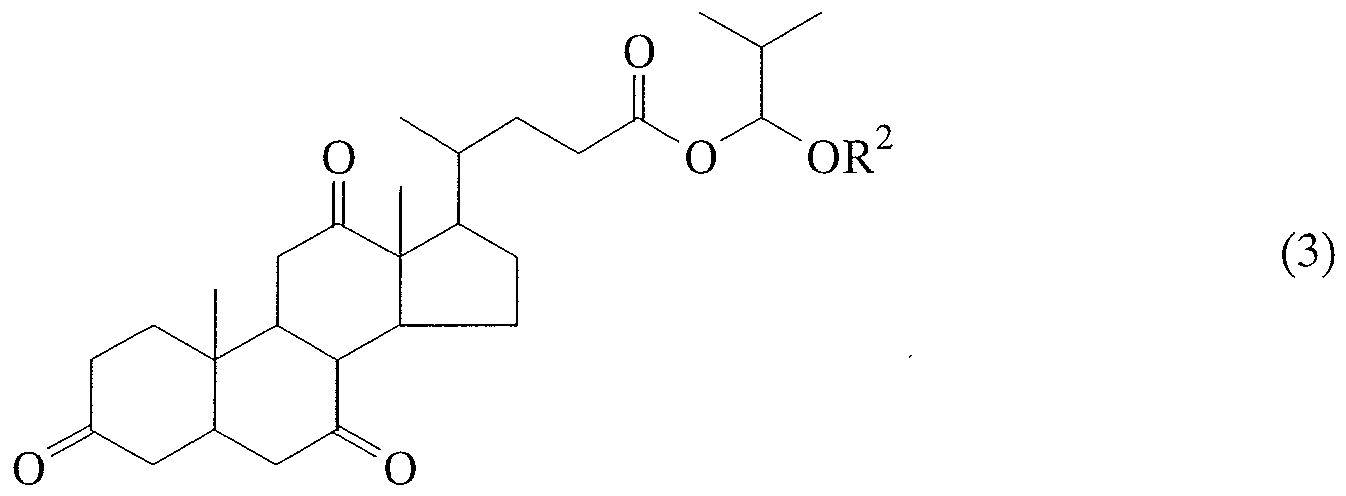
- In formula (3), R2 is a straight, branched or cyclic monovalent hydrocarbon group which may contain an oxygen atom and in which the sum of carbon and oxygen atoms is 1 to 15. Herein oxygen may intervene in an alkylene chain or oxygen may be contained in the form of carbonyl group. Examples of R2 include, but are not limited to, methyl, ethyl, propyl, isopropyl, butyl, isobutyl, s-butyl, t-butyl, pentyl, neopentyl, cyclopentyl, hexyl, cyclohexyl, 2-ethylhexyl, decyl, pentadecyl, adamantyl, norbornyl, norbornylmethyl, tricyclodecanyl, tetracyclododecanyl, tetracyclododecanylmethyl, benzyl, and tetrahydrofurfuryl.
- Examples of the acid-decomposable keto ester compound of steroid skeleton having formula (3) include, but are not limited to, the following compounds.

- With respect to the acid-decomposable keto ester compound of steroid skeleton having formula (1), (1a) or (3), it is believed that the presence of steroid skeleton contributes to the exertion of inhibitory dissolution and etch resistance. The presence of keto group (carbonyl group) imparts appropriate polarity and hydrophilicity to the molecule and provides affinity to and compatibility with the base resin, thus contributing to LER improvement. In addition, the keto group has an appropriate affinity to the acid generated by the acid generator and is believed to be effective for controlling acid diffusion. If the keto group is absent, and a methylene group or ester group is present instead, acid diffusion control becomes insufficient, often leading to a likelihood of degrading resolution as the feature size is reduced. If a hydroxyl group is present instead of the keto group, it may lead to excessive hydrophilicity, less inhibitory dissolution, a drop of dissolution contrast, and degraded resolution. The presence of acid-decomposable group within the molecule is essential for a dissolution contrast. The acid-decomposable group contributes to resolution improvement in that under the action of the acid generated by the acid generator in the exposed area of resist film, the acid-decomposable group is decomposed to generate a carboxylic acid whereby the compound increases its solubility in alkaline developer. By selecting appropriate ones for R1, R2, Y and n in formula (1), (1a) or (3) from their possible ranges, properties of the acid-decomposable keto ester compound of steroid skeleton having formula (1), (1a) or (3) including dissolution inhibition, dissolution contrast, decomposition reactivity, polarity, hydrophilicity, diffusion rate, solvent solubility, acid affinity, and base resin compatibility can be adjusted in accordance with a particular base resin, acid generator and lithography method used. Eventually the pattern profile and other performance factors of the resist composition can be adjusted optimum.
- The acid-decomposable keto ester compound of steroid skeleton having formula (1), (1a) or (3) may be used in different ways, for example, as a molecular resist based on this keto ester compound or as a dissolution inhibitor in combination with a polymer having an acid labile group which turns alkali soluble under the action of acid.
- The acid-decomposable keto ester compound of steroid skeleton having formula (3) can be prepared by selecting an optimum method in accordance with the structure of the compound. Suitable methods include, but are not limited to, O-alkylation reaction of dehydrocholic acid using a halide and addition reaction of dehydrocholic acid to a vinyl ether compound. These methods are described below in detail.
- The first method, O-alkylation reaction of dehydrocholic acid using a halide runs according to the following scheme.

- Herein R2 is as defined above, and X' is halogen.
- The halide (5) serves as the O-alkylating agent in the present reaction, wherein X' is halogen, with chlorine being most preferable from the industrial standpoint of shelf stability of the halide (5). The halide (5) is desirably used in an amount of 0.5 to 5 moles, more desirably 0.9 to 2 moles per mole of dehydrocholic acid (4). Reaction is desirably carried out in a solvent. Suitable reaction solvents include hydrocarbons such as hexane, heptane, benzene, toluene, and xylene; ethers such as diethyl ether, dibutyl ether, tetrahydrofuran, 1,4-dioxane, and diglyme; chlorinated solvents such as methylene chloride, chloroform and 1,2-dichloroethylene; aprotic polar solvents such as N,N-dimethylformamide, N,N-dimethylacetamide, dimethyl sulfoxide, and N-methylpyrrolidone; esters such as ethyl acetate and butyl acetate; ketones such as acetone and 2-butanone; nitriles such as acetonitrile; amines such as pyridine and triethylamine; alcohols such as isopropyl alcohol and t-butyl alcohol; and water. A suitable solvent or solvents may be selected and used alone or in admixture, depending on reaction conditions. The reaction temperature may be selected in the range from 0°C to the reflux temperature of the solvent, depending on the desired reaction rate. If desired, a base may be added to the reaction system. Examples of the base include amines such as pyridine, triethylamine, diisopropylethylamine, 4-dimethylaminopyridine, and imidazole; metal alkoxides such as sodium methoxide, sodium ethoxide, and potassium t-butoxide; carbonates such as sodium carbonate, potassium carbonate, and cesium carbonate; hydroxides such as sodium hydroxide, potassium hydroxide, and tetramethylammonium hydroxide; metal hydrides such as sodium hydride and potassium hydride; organometallics such as butyl lithium and ethyl magnesium bromide; and metal amides such as lithium diisopropyl amide. A suitable base or bases may be selected and used alone or in admixture, depending on reaction conditions. The base is desirably used in an amount of 0.1 to 10 moles, more desirably 0.9 to 5 moles per mole of dehydrocholic acid (4).
- If desired for accelerating the reaction rate, a catalyst may be added to the reaction system. Suitable catalysts include iodides such as sodium iodide, lithium iodide, and tetrabutylammonium iodide, and bromides such as sodium bromide, lithium bromide, and tetrabutylammonium bromide. When added, the catalyst is desirably used in an amount of 0.001 to 2 moles, more desirably 0.005 to 0.5 mole per mole of dehydrocholic acid (4). The reaction time is determined as appropriate by monitoring the reaction process by liquid chromatography (LC) or thin-layer chromatography (TLC) because it is desirable from the yield aspect to drive the reaction to completion. Usually the reaction time is about 0.5 to about 24 hours. The desired compound (3) may be obtained from the reaction mixture by ordinary aqueous work-up. If necessary, the compound may be purified by standard techniques like chromatography and recrystallization. Alternatively, the aqueous work-up is omitted, and the reaction solution may be purified directly or after filtration of the salt resulting from reaction.
- The second method, addition reaction of dehydrocholic acid to a vinyl ether compound runs according to the following scheme.

- The vinyl ether compound (6) is desirably used in an amount of 0.5 to 10 moles, more desirably 0.9 to 5 moles per mole of dehydrocholic acid (4). Reaction is desirably carried out in a solvent. Suitable reaction solvents include hydrocarbons such as hexane, heptane, benzene, toluene, and xylene; ethers such as diethyl ether, dibutyl ether, tetrahydrofuran, 1,4-dioxane, and diglyme; chlorinated solvents such as methylene chloride, chloroform and 1,2-dichloroethylene; aprotic polar solvents such as N,N-dimethylformamide, N,N-dimethylacetamide, dimethyl sulfoxide, and N-methylpyrrolidone; esters such as ethyl acetate and butyl acetate; ketones such as acetone and 2-butanone; and nitriles such as acetonitrile. A suitable solvent or solvents may be selected and used alone or in admixture, depending on reaction conditions. The reaction temperature may be selected in the range from 0°C to the reflux temperature of the solvent, depending on the desired reaction rate. If desired, an acid catalyst may be added to the reaction system. Examples of the acid catalyst include mineral acids such as sulfuric acid, hydrochloric acid, phosphoric acid and perchloric acid; Lewis acids such as boron trifluoride, boron trifluoride diethyl ether complex, dibutyltin oxide, aluminum chloride, zinc chloride, tetrachlorotitanium, and tetramethoxytitanium; sulfonic acids such as methanesulfonic acid and p-toluenesulfonic acid; salts such as potassium hydrogen sulfate, calcium chloride, magnesium chloride, and pyridinium p-toluenesulfonate; carboxylic acids such as oxalic acid and trifluoroacetic acid; and acidic resins such as cation exchange resins. A suitable catalyst or catalysts may be selected and used alone or in admixture, depending on reaction conditions. The catalyst is desirably used in an amount of 0.1 to 10 moles, more desirably 0.9 to 5 moles per mole of dehydrocholic acid (4).
- The reaction time is determined as appropriate by monitoring the reaction process by liquid chromatography (LC) or thin-layer chromatography (TLC) because it is desirable from the yield aspect to drive the reaction to completion. Usually the reaction time is about 0.5 to about 24 hours. The desired compound (3) may be obtained from the reaction mixture by ordinary aqueous work-up. If necessary, the compound may be purified by standard techniques like chromatography and recrystallization. Alternatively, the reaction solution may be directly purified in some cases, without the aqueous work-up.
- In preparing a resist composition, the softening accelerator may be used alone or in admixture of two or more. The amount of the softening accelerator used may be determined as appropriate, depending on the temperature of post-develop heat treatment of resist film as well. In order that a chemically amplified positive resist composition form a pattern with a satisfactory LER through heat treatment at a temperature of not higher than 150ºC which causes no damages to resist components, the softening accelerator is added to the resist composition in an amount of 2.5% to 20% by weight based on the total solids in the resist composition. If the amount of the softening accelerator is below the range, no LER improvement is achievable even by elevating the heating temperature. If the amount is excessive, problems arise that the pattern profile is exacerbated and the control of pattern size by heat treatment is difficult.
- In the pattern forming process, a resist composition is used to form a resist film. The resist composition contains the softening accelerator defined above and other components such as are commonly used in well-known resist compositions.
- Typically it is a chemically amplified positive resist composition comprising
- (A) a base resin having an acidic functional group protected with an acid labile group, which is substantially alkali insoluble, but turns alkali soluble when the acid labile group is eliminated,
- (B) an acid generator,
- (C) a nitrogen-containing compound as a basic component, and
- (D) an organic solvent.
- Polymers used as the base resin (A) include polyhydroxystyrene (PHS), and copolymers of hydroxystyrene with styrenes, (meth)acrylic acid esters or other polymerizable olefinic compounds, for KrF excimer laser resist uses; (meth)acrylic acid ester polymers, alternating copolymers of cycloolefin with maleic anhydride, similar alternating copolymers further containing vinyl ethers or (meth)acrylic acid esters, polynorbornene, and polymers obtained from ring-opening metathesis polymerization (ROMP) of cycloolefins, for ArF excimer laser resist use; and fluorinated forms of the foregoing polymers (for both KrF and ArF laser uses) and polymers resulting from ring-closure polymerization using fluorinated dienes for F2 laser resist use. Silicon-substituted forms of the foregoing polymers and polysilsesquioxane polymers are useful for the bilayer resists. The base polymer is not limited to these polymer systems. Preferably the base polymer has a weight average molecular weight (Mw) of 2,000 to 100,000 as measured by GPC versus polystyrene standards using tetrahydrofuran solvent. With Mw below 2,000, film formation and resolution may become poor. With Mw beyond 100,000, resolution may become poor or foreign matter may generate during pattern formation. The base polymers may be used alone or in admixture of two or more. In the case of positive resist compositions, it is a common practice to substitute acid labile groups for hydroxyl groups on phenol, carboxyl groups or fluorinated alkyl alcohols for reducing the rate of dissolution in unexposed regions.
- In the embodiment wherein the chemically amplified positive resist composition is used as the resist material for the ArF excimer laser lithography, the preferred base resins include those resins described in
USP 7,537,880 (JP-A 2008-111103 


- R002 is hydrogen, methyl or CO2R003.
- R003 is a straight, branched or cyclic C1-C15 alkyl group, examples of which include methyl, ethyl, propyl, isopropyl, n-butyl, sec-butyl, tert-butyl, tert-amyl, n-pentyl, n-hexyl, cyclopentyl, cyclohexyl, ethylcyclopentyl, butylcyclopentyl, ethylcyclohexyl, butylcyclohexyl, adamantyl, ethyladamantyl, and butyladamantyl.
- R004 is hydrogen or a monovalent hydrocarbon group of 1 to 15 carbon atoms having at least one group selected from among fluorinated substituent groups, carboxyl groups and hydroxyl groups. Examples include hydrogen, carboxyethyl, carboxybutyl, carboxycyclopentyl, carboxycyclohexyl, carboxynorbornyl, carboxyadamantyl, hydroxyethyl, hydroxybutyl, hydroxycyclopentyl, hydroxycyclohexyl, hydroxynorbornyl, hydroxyadamantyl, hydroxyhexafluoroisopropylcyclohexyl, and di(hydroxyhexafluoroisopropyl)cyclohexyl.
- At least one of R005 to R008 represents a monovalent hydrocarbon group of 1 to 15 carbon atoms having at least one group selected from among fluorinated substituent groups, carboxyl groups and hydroxyl groups while the remaining R's independently represent hydrogen or straight, branched or cyclic C1-C15 alkyl groups. Examples of suitable monovalent C1-C15 hydrocarbon groups having at least one group selected from among fluorinated substituent groups, carboxyl groups and hydroxyl groups include carboxy, carboxymethyl, carboxyethyl, carboxybutyl, hydroxymethyl, hydroxyethyl, hydroxybutyl, 2-carboxyethoxycarbonyl, 4-carboxybutoxycarbonyl, 2-hydroxyethoxycarbonyl, 4-hydroxybutoxycarbonyl, carboxycyclopentyloxycarbonyl, carboxycyclohexyloxycarbonyl, carboxynorbornyloxycarbonyl, carboxyadamantyloxycarbonyl, hydroxycyclopentyloxycarbonyl, hydroxycyclohexyloxycarbonyl, hydroxynorbornyloxycarbonyl, hydroxyadamantyloxycarbonyl, hydroxyhexafluoroisopropylcyclohexyloxycarbonyl, and di(hydroxyhexafluoroisopropyl)cyclohexyloxycarbonyl. Suitable straight, branched or cyclic C1-C15 alkyl groups are as exemplified for R003.
- Two of R005 to R008 (for example, a pair of R005 and R006, or R006 and R007) may bond together to form a ring with the carbon atom(s) to which they are attached, and in that event, at least one of R005 to R008 is a divalent hydrocarbon group of 1 to 15 carbon atoms having at least one group selected from fluorinated substituent groups, carboxyl groups and hydroxyl groups, while the remaining R's are independently single bonds or straight, branched or cyclic C1-C15 alkylene groups. Suitable divalent C1-C15 hydrocarbon groups having at least one group selected from fluorinated substituent groups, carboxyl groups and hydroxyl groups include those exemplified above as the monovalent hydrocarbon groups having at least one group selected from fluorinated substituent groups, carboxyl groups and hydroxyl groups, with one hydrogen atom eliminated therefrom. Suitable straight, branched or cyclic C1-C15 alkylene groups are those groups exemplified for R003, with one hydrogen atom eliminated therefrom.
- R009 is a monovalent hydrocarbon group of 3 to 15 carbon atoms containing a -CO2- partial structure. Examples include 2-oxooxolan-3-yl, 4,4-dimethyl-2-oxooxolan-3-yl, 4-methyl-2-oxooxan-4-yl, 2-oxo-1,3-dioxolan-4-ylmethyl, and 5-methyl-2-oxooxolan-5-yl.
- At least one of R010 to R013 is a monovalent hydrocarbon group of 2 to 15 carbon atoms containing a -CO2- partial structure, while the remaining R's are independently hydrogen atoms or straight, branched or cyclic C1-C15 alkyl groups. Illustrative examples of suitable monovalent C2-C15 hydrocarbon groups containing a -CO2- partial structure include 2-oxooxolan-3-yloxycarbonyl, 4,4-dimethyl-2-oxooxolan-3-yloxycarbonyl, 4-methyl-2-oxooxan-4-yloxycarbonyl, 2-oxo-1,3-dioxolan-4-ylmethyloxycarbonyl, and 5-methyl-2-oxooxolan-5-yloxycarbonyl. Suitable straight, branched or cyclic C1-C15 alkyl groups are as exemplified for R003.
- Two of R010 to R013 (for example, a pair of R010 and R011, or R011 and R012) may bond together to form a ring with the carbon atom(s) to which they are attached, and in that event, at least one of R010 to R013 is a divalent hydrocarbon group of 1 to 15 carbon atoms containing a -CO2- partial structure, while the remaining R's are independently single bonds or straight, branched or cyclic C1-C15 alkylene groups. Illustrative examples of suitable divalent C1-C15 hydrocarbon groups containing a -CO2- partial structure include 1-oxo-2-oxapropane-1,3-diyl, 1,3-dioxo-2-oxapropane-1,3-diyl, 1-oxo-2-oxabutane-1,4-diyl, and 1,3-dioxo-2-oxabutane-1,4-diyl, as well as those exemplified as the monovalent hydrocarbon groups containing a -CO2-partial structure, with one hydrogen atom eliminated therefrom. Suitable straight, branched or cyclic C1-C15 alkylene groups are those groups exemplified for R003, with one hydrogen atom eliminated therefrom.
- R014 is a polycyclic hydrocarbon group having 7 to 15 carbon atoms or an alkyl group containing such a polycyclic hydrocarbon group. Examples include norbornyl, bicyclo[3.3.1]nonyl, tricyclo[5.2.1.02,6]decyl, adamantyl, ethyladamantyl, butyladamantyl, norbornylmethyl, and adamantylmethyl.
- R015 is an acid labile group, examples of which will be described later.
- R016 is hydrogen or methyl.
- R017 is a straight, branched or cyclic C1-C8 alkyl group. X is CH2 or an oxygen atom. Letter k is 0 or 1.
- In formula (R1), letters a1', a2', a3', b1', b2', b3', c1', c2', c3', d1', d2', d3', and e' are numbers from 0 to less than 1, satisfying a1'+a2'+a3'+b1'+b2'+b3'+c1'+c2'+c3'+d1'+d2'+d3'+e' = 1. In formula (R2), letters f', g', h', i', and j' are numbers from 0 to less than 1, satisfying f'+g'+h'+i'+j' = 1; x', y' and z' are each an integer of 0 to 3, satisfying 1 ≤ x'+y'+z' ≤ 5 and 1 ≤ y'+z' ≤ 3.
- The acid labile group represented by R015 may be selected from a variety of such groups, for example, groups of the following general formulae (L1) to (L4), tertiary alkyl groups of 4 to 20 carbon atoms, preferably 4 to 15 carbon atoms, trialkylsilyl groups in which each alkyl moiety has 1 to 6 carbon atoms, and oxoalkyl groups of 4 to 20 carbon atoms.

- In these formulae, the broken line denotes a valence bond. In formula (L1) , RL01 and RL02 are hydrogen or straight, branched or cyclic alkyl groups of 1 to 18 carbon atoms, preferably 1 to 10 carbon atoms. Exemplary alkyl groups include methyl, ethyl, propyl, isopropyl, n-butyl, sec-butyl, tert-butyl, cyclopentyl, cyclohexyl, 2-ethylhexyl, n-octyl, and adamantyl. RL03 is a monovalent hydrocarbon group of 1 to 18 carbon atoms, preferably 1 to 10 carbon atoms, which may contain a hetero atom such as oxygen, examples of which include unsubstituted straight, branched or cyclic alkyl groups and substituted forms of such alkyl groups in which some hydrogen atoms are replaced by hydroxyl, alkoxy, oxo, amino, alkylamino or the like. Suitable straight, branched or cyclic alkyl groups are as exemplified for RL01 and RL02 and suitable substituted alkyl groups are shown below.


- A pair of RL01 and RL02, RL01 and RL03, or RL02 and RL03 may bond together to form a ring with the carbon and oxygen atoms to which they are attached. Each of participant RL01, RL02 and RL03 is a straight or branched alkylene group of 1 to 18 carbon atoms, preferably 1 to 10 carbon atoms when they form a ring.
- In formula (L2), RL04 is a tertiary alkyl group of 4 to 20 carbon atoms, preferably 4 to 15 carbon atoms, a trialkylsilyl group in which each alkyl moiety has 1 to 6 carbon atoms, an oxoalkyl group of 4 to 20 carbon atoms, or a group of formula (L1). Exemplary tertiary alkyl groups are tert-butyl, tert-amyl, 1,1-diethylpropyl, 2-cyclopentylpropan-2-yl, 2-cyclohexylpropan-2-yl, 2-(bicyclo[2.2.1]heptan-2-yl)propan-2-yl, 2-(adamantan-1-yl)propan-2-yl, 1-ethylcyclopentyl, 1-butylcyclopentyl, 1-ethylcyclohexyl, 1-butylcyclohexyl, 1-ethyl-2-cyclopentenyl, 1-ethyl-2-cyclohexenyl, 2-methyl-2-adamantyl, and 2-ethyl-2-adamantyl. Exemplary trialkylsilyl groups include trimethylsilyl, triethylsilyl and dimethyl-tert-butylsilyl. Exemplary oxoalkyl groups are 3-oxocyclohexyl, 4-methyl-2-oxooxan-4-yl, and 5-methyl-2-oxooxolan-5-yl. Letter y is an integer of 0 to 6.
- In formula (L3), RL05 is a substituted or unsubstituted, straight, branched or cyclic C1-C10 alkyl group or a substituted or unsubstituted C6-C20 aryl group. Examples of the optionally substituted alkyl group include straight, branched or cyclic alkyl groups such as methyl, ethyl, propyl, isopropyl, n-butyl, sec-butyl, tert-butyl, tert-amyl, n-pentyl, n-hexyl, cyclopentyl, cyclohexyl, and bicyclo[2.2.1]heptyl, substituted forms of such groups in which some hydrogen atoms are substituted by hydroxyl, alkoxy, carboxyl, alkoxycarbonyl, oxo, amino, alkylamino, cyano, mercapto, alkylthio, sulfo or other groups, and similar groups in which one or more methylene moiety is replaced by oxygen or sulfur atom. Examples of the optionally substituted aryl groups include phenyl, methylphenyl, naphthyl, anthryl, phenanthryl, and pyrenyl. Letter m is equal to 0 or 1, n is equal to 0, 1, 2 or 3, and 2m+n is equal to 2 or 3.
- In formula (L4), RL06 is a substituted or unsubstituted, straight, branched or cyclic C1-C10 alkyl group or a substituted or unsubstituted C6-C20 aryl group. Examples of these groups are the same as exemplified for RL05. RL07 to RL16 independently represent hydrogen or monovalent C1-C15 hydrocarbon groups. Exemplary hydrocarbon groups are straight, branched or cyclic alkyl groups such as methyl, ethyl, propyl, isopropyl, n-butyl, sec-butyl, tert-butyl, tert-amyl, n-pentyl, n-hexyl, n-octyl, n-nonyl, n-decyl, cyclopentyl, cyclohexyl, cyclopentylmethyl, cyclopentylethyl, cyclopentylbutyl, cyclohexylmethyl, cyclohexylethyl and cyclohexylbutyl, and substituted forms of these groups in which some hydrogen atoms are replaced by hydroxyl, alkoxy, carboxyl, alkoxycarbonyl, oxo, amino, alkylamino, cyano, mercapto, alkylthio, sulfo or other groups. Alternatively, two of RL07 to RL16, taken together, form a ring with the carbon atom to which they are attached (for example, a pair of RL07 and RL08, RL07 and RL09, RL08 and RL10, RL09 and RL10, RL11 and RL12, RL13 and RL14, or a similar pair form a ring). Each of RL07 to RL16 represents a divalent C1-C15 hydrocarbon group when they form a ring, examples of which are the ones exemplified above for the monovalent hydrocarbon groups, with one hydrogen atom being eliminated. Two of RL07 to RL16 which are attached to vicinal carbon atoms may bond together directly to form a double bond (for example, a pair of RL07 and RL09, RL09 and RL15, RL13 and RL15, or a similar pair).
- The resist composition for use in the EUV lithography or in forming a photomask pattern should preferably have high etch resistance even in thin film form. Preferred in this context are polymers comprising units of hydroxystyrene derivatives, units of hydroxystyrene derivatives in which benzene ring is replaced by naphthalene or anthracene ring, units of (meth)acrylic acid hydroquinone ester derivatives, and units of hydroquinone ester derivatives in which benzene ring is replaced by naphthalene or anthracene ring. Incorporating units of indene or acenaphthylene derivatives may impart higher etch resistance. Several preferred structures for the foregoing units are illustrated below.

- Herein Rp1 is hydrogen or methyl, s is each independently 0 or 1, t is each independently an integer of 0 to 2, Rp5 is each independently C1-C6 alkyl, B1 is a single bond or a C1-C10 alkylene group which may contain an ether bond at an intermediate of the chain, a is an integer of 0 to 3, and b is an integer of 1 to 3.

- Herein Rp1 and Rp5 are as defined above, u is 0 or 1, v is an integer of 0 to 2, B2 is a single bond or a C1-C10 alkylene group which may contain an ether bond at an intermediate of the chain, a is an integer of 0 to 3, b is 0 or 1, and c is an integer of 1 to 3. When c is 1, W is an acid labile group. When c is 2 or 3, W is hydrogen or an acid labile group, with at least one W being an acid labile group.

- Herein d is an integer of 0 to 4, Rp6 and Rp7 are each independently an optionally halo-substituted, C1-C6 alkyl or primary or secondary alkoxy group, an optionally halo-substituted, C2-C7 alkylcarbonyloxy group, a hydroxyl group, or an acid labile group-protected hydroxyl group.
- Of the aromatic ring-bearing recurring units illustrated above, those recurring units having a phenolic hydroxyl group are preferably incorporated in an amount of 35 to 90 mol% of the entire recurring units of a polymer. Less than 35 mol% of these units may lead to a shortage of substrate adhesion whereas more than 90 mol% may lead to an excessive thickness loss of resist film in the unexposed region after development. Those recurring units having an acid labile group-protected phenolic hydroxyl group or acid labile group-protected carboxyl group are preferably incorporated in an amount of 5 to 50 mol% of the entire recurring units. Less than 5 mol% of these units may lead to a loss of dissolution contrast whereas more than 50 mol% may detract from substrate adhesion. Those recurring units having neither an acidic group nor a protected acidic group are preferably incorporated in an amount of 0 to 35 mol% of the entire recurring units. More than 35 mol% of these units may detract from substrate adhesion. Besides the foregoing four recurring units, the polymer may contain recurring units derived from aromatic ring-free (meth)acrylic acid derivatives, for example, aromatic ring-free recurring units as included in (R2), preferably in an amount of up to 30 mol% of the entire recurring units. More than 30 mol% of these units may fail to provide etch resistance.
- The acid labile groups to be introduced into the base polymers may be selected from a variety of such groups, preferably from acetal groups of 2 to 30 carbon atoms and tertiary alkyl groups of 4 to 30 carbon atoms having the formulae (C1) and (C2), respectively.


- In formulae (C1) and (C2), R11 and R12 each are hydrogen or a straight, branched or cyclic alkyl group of 1 to 20 carbon atoms, preferably 1 to 12 carbon atoms, which may contain a heteroatom such as oxygen, sulfur, nitrogen or fluorine, R13, R14, R15 and R16 each are a straight, branched or cyclic alkyl group, aryl group or aralkyl group of 1 to 20 carbon atoms, preferably 1 to 12 carbon atoms, which may contain a heteroatom such as oxygen, sulfur, nitrogen or fluorine. A pair of R11 and R12, a pair of R11 and R13, a pair of R12 and R13, a pair of R14 and R15, a pair of R14 and R16, or a pair of R15 and R16, taken together, may form a non-aromatic ring of 3 to 20 carbon atoms, preferably 3 to 12 carbon atoms, with the carbon or oxygen atom to which they are attached.
- Illustrative examples of the acetal group of formula (C1) include, but are not limited to, methoxymethyl, ethoxymethyl, propoxymethyl, butoxymethyl, isopropoxymethyl, t-butoxymethyl, neopentyloxymethyl, (1-methylcyclohexyl)methoxymethyl, 2-adamantyloxymethyl, (1-adamantyl)methoxymethyl, phenethyloxymethyl, (2-methyl-2-norbornyl)methoxymethyl, 1-methoxyethyl, 1-methoxypropyl, 1-methoxybutyl, 1-ethoxyethyl, 1-ethoxypropyl, 1-ethoxybutyl, 1-propoxyethyl, 1-propoxypropyl, 1-propoxybutyl, 1-cyclopentyloxyethyl, 1-cyclohexyloxyethyl, 2-methoxyisopropyl, 2-ethoxyisopropyl, 1-phenoxyethyl, 1-benzyloxyethyl, 1-phenoxypropyl, 1-benzyloxypropyl, 1-adamantyloxyethyl, 1-adamantyloxypropyl, 2-tetrahydrofuryl, 2-tetrahydro-2H-pyranyl, 1-(2-cyclohexanecarbonyloxyethoxy)ethyl, 1-(2-cyclohexanecarbonyloxyethoxy)propyl, 1-[2-(1-adamantylcarbonyloxy)ethoxy]ethyl, and 1-[2-(1-adamantylcarbonyloxy)ethoxy]propyl.
- Illustrative examples of the tertiary alkyl group of formula (C2) include, but are not limited to, t-butyl, t-pentyl, 1-ethyl-1-methylpropyl, 1,1-diethylpropyl, 1,1,2-trimethylpropyl, 1-adamantyl-1-methylethyl, 1-methyl-1-(2-norbornyl)ethyl, 1-methyl-1-(tetrahydrofuran-2-yl)ethyl, 1-methyl-1-(7-oxanorbornan-2-yl)ethyl, 1-methylcyclopentyl, 1-ethylcyclopentyl, 1-propylcyclopentyl, 1-cyclopentylcyclopentyl, 1-cyclohexylcyclopentyl, 1-(2-tetrahydrofuryl)cyclopentyl, 1-(7-oxanorbornan-2-yl)cyclopentyl, 1-methylcyclohexyl, 1-ethylcyclohexyl, 1-cyclopentylcyclohexyl, 1-cyclohexylcyclohexyl, 2-methyl-2-norbornyl, 2-ethyl-2-norbornyl, 8-methyl-8-tricyclo[5.2.1.02,6]decyl, 8-ethyl-8-tricyclo[5.2.1.02,6]decyl, 3-methyl-3-tetracyclo[4.4.0.12,5.17,10]dodecyl, 3-ethyl-3-tetracyclo[4.4.0.12,5.17,10]dodecyl, 2-methyl-2-adamantyl, 2-ethyl-2-adamantyl, 1-methyl-3-oxo-1-cyclohexyl, 1-methyl-1-(tetrahydrofuran-2-yl)ethyl, 5-hydroxy-2-methyl-2-adamantyl, and 5-hydroxy-2-ethyl-2-adamantyl.
- In the base resin, some hydroxyl groups may be linked via acid labile groups of the following general formula (C3a) or (C3b) for crosslinkage between molecules or within a molecule.


- Herein, R17 and R18 each are hydrogen or a straight, branched or cyclic C1-C8 alkyl group, or R17 and R18, taken together, may form a ring with the carbon atom to which they are attached. Each of R17 and R18 is a straight or branched C1-C8 alkylene group when they form a ring. R19 is a straight, branched or cyclic C1-C10 alkylene group. Letter "a" is an integer of 1 to 7, and "b" is 0 or an integer of 1 to 10. "A" is a (a+1)-valent aliphatic or alicyclic saturated hydrocarbon group, aromatic hydrocarbon group or heterocyclic group of 1 to 50 carbon atoms, which may have an intervening heteroatom and in which some hydrogen atoms may be replaced by hydroxyl, carboxyl or carbonyl radicals or fluorine atoms. B is -CO-O-, -NHCO-O- or -NHCONH-.
- Illustrative examples of the crosslinking acetal linkages represented by formulae (C3a) and (C3b) are given below as (C3)-1 through (C3)-8, but not limited thereto.





- An acid generator (B) is added to the resist composition which is used to form a resist film in the pattern forming process of the invention. Numerous acid generators are known in the art, for example, in Patent Documents 1 to 6, to be used in chemically amplified resist compositions. Generally, any of well-known compounds may be used herein. Sulfonium acid generators are preferred for the EB lithography and EUV lithography, and a number of such compounds are well known. In an alternative embodiment, the sulfonium acid generator may be provided as a polymer comprising recurring units having the sulfonium acid generator incorporated in the side chain thereof as disclosed in Patent Document 7. Preferred examples of the acid generator are illustrated below, but not limited thereto.
- Below illustrated are preferred examples of the acid generator which is not incorporated in recurring units as part of a polymer.


- Below illustrated are preferred examples of the acid generator which is incorporated in recurring units as part of a polymer.


- In the resist composition, the (photo)acid generator may be added in any desired amount as long as the objects of the invention are not compromised. An appropriate amount of the (photo)acid generator is 0.1 to 80 parts, and more preferably 1 to 40 parts by weight per 100 parts by weight of the base resin in the composition. Too high a proportion of the (photo)acid generator may give rise to problems of degraded resolution and foreign matter upon development and resist film peeling. The (photo)acid generator may be used alone or in admixture of two or more. The transmittance of the resist film can be controlled by using an (photo)acid generator having a low transmittance at the exposure wavelength and adjusting the amount thereof.
- A nitrogen-containing compound is used in the resist composition as basic component or quencher (C). The nitrogen-containing compound may be added alone or in admixture of two or more and is capable of suppressing the rate of diffusion when the acid generated by the acid generator diffuses within the resist film. The inclusion of the compound facilitates adjustment of resist sensitivity and holds down the rate of acid diffusion within the resist film, resulting in better resolution. In addition, it suppresses changes in sensitivity following exposure and reduces substrate and environment dependence, as well as improving the exposure latitude and the pattern profile.
- Examples of suitable basic component or quencher include primary, secondary, and tertiary aliphatic amines, aromatic amines, heterocyclic amines, nitrogen-containing compounds with carboxyl group, nitrogen-containing compounds with hydroxyl group, N-oxides, amides, imides, carbamates, and ammonium salts.
- A number of nitrogen-containing compounds are already known as the basic component. Numerous examples are illustrated, for example, in Patent Document 5. Any suitable compound may be selected from many known nitrogen-containing compounds depending on a particular substrate, processing conditions, and properties available from a combination with other resist components.
- Examples of the nitrogen-containing compound used in the resist composition are given below, but not limited thereto. Suitable primary aliphatic amines include cetylamine and tetraethylenepentamine. Suitable secondary aliphatic amines include didecylamine and didodecylamine. Suitable tertiary aliphatic amines include trioctylamine, tridecylamine, tridodecylamine, and N,N-dicyclohexylmethylamine.
- Examples of suitable aromatic and heterocyclic amines include aniline derivatives (e.g., N,N-bis(2-hydroxyethyl)-aniline and 2,6-diisopropylaniline), pyrrole derivatives, oxazole derivatives, thiazole derivatives, imidazole derivatives (e.g., 4-methyl-2-phenylimidazole and 2,4,5-triphenylimidazole), benzimidazole derivatives (e.g., benzimidazole, 2-methylbenzimidazole and 2-phenylbenzimidazole), pyrazole derivatives, furazan derivatives, pyrroline derivatives, pyrrolidine derivatives, imidazoline derivatives, imidazolidine derivatives, pyridine derivatives (e.g., dimethylaminopyridine and 2,6-di-t-butyl-4-methylpyridine), pyridazine derivatives, pyrimidine derivatives, pyrazine derivatives, pyrazoline derivatives, pyrazolidine derivatives, piperidine derivatives, piperazine derivatives, morpholine derivatives, indole derivatives, isoindole derivatives, 1H-indazole derivatives, indoline derivatives, quinoline derivatives, isoquinoline derivatives, cinnoline derivatives, quinazoline derivatives, quinoxaline derivatives, phthalazine derivatives, purine derivatives, pteridine derivatives, carbazole derivatives, phenanthridine derivatives, acridine derivatives, phenazine derivatives, 1,10-phenanthroline derivatives, adenine derivatives, adenosine derivatives, guanine derivatives, guanosine derivatives, uracil derivatives, and uridine derivatives.
- Examples of suitable nitrogen-containing compounds having carboxyl group include aminobenzoic acid derivatives (e.g., 4-dimethylaminobenzoic acid and 4-dibutylaminobenzoic acid) and amino acid derivatives. Examples of suitable nitrogen-containing compounds having hydroxyl group include triethanolamine, triisopropanolamine, 4-(2-hydroxyethyl)morpholine, and 3-quinuclidinol. Suitable N-oxides include tributylamine-N-oxide, N-methylmorpholine-N-oxide, and tris(2-methoxymethoxyethyl)amine-N-oxide. Suitable amide derivatives include 1-cyclohexylpyrrolidone and N-pivaloyl-2-phenylbenzimidazole. A typical imide derivative is phthalimide. Suitable carbamate derivatives include N-t-butoxycarbonyl-N,N-dicyclohexylamine, N-t-butoxycarbonylbenzimidazole, N-t-butoxycarbonyl-2-phenylbenzimidazole, N-benzyloxycarbonyl-2-phenylbenzimidazole and N-allyloxycarbonyl-2-phenylbenzimidazole.
- Examples of suitable ammonium salts include triethylammonium camphorsulfonate, tetrabutylammonium acetate, tetrabutylammonium p-toluenesulfonate, tetrabutylammonium 2,4,6-triisopropylbenzenesulfonate, tetrabutylammonium camphorsulfonate, benzyltrimethylammonium camphorsulfonate, trimethyloctadecylammonium 2,4,6-triisopropylbenzenesulfonate, and 4-(2-cyclohexanecarboxyethyl)morpholinium camphorsulfonate.
- Also included are tris(2-methoxymethoxyethyl)amine, tris{2-(2-methoxyethoxy)ethyl}amine, tris{2-(2-methoxyethoxymethoxy)ethyl}amine, tris{2-(1-methoxyethoxy)ethyl}amine, tris(2-acetoxyethyl)amine, tris(2-propionyloxyethyl)amine, tris(2-benzoyloxyethyl)amine, N,N-bis(2-acetoxyethyl)-2-(methoxycarbonyl)ethylamine, N,N-bis(2-methoxyethyl)-2-(methoxycarbonyl)ethylamine, 1-[2-(methoxymethoxy)ethyl]-2-phenylbenzimidazole, 1-dodecylpiperidine, 1-[2-[(2-methoxyethoxy)methoxy]ethyl]pyrrolidine, 4-dodecylmorpholine, 1-[2-[(2-methoxyethoxy)methoxy]ethyl]piperidine, 4-[2-[(2-methoxyethoxy)methoxy]ethyl]morpholine, 4-[2-[2-(2-methoxyethoxy)ethoxy]ethyl]morpholine, 1-[2-[2-(2-methoxyethoxy)ethoxy]ethyl]benzimidazole, 4-[2-[2-[2-(2-methoxyethoxy)ethoxy]ethoxy]ethyl]morpholine, 2-(1-pyrolidinyl)ethyl acetate, 2-piperidinoethyl acetate, 2-morpholinoethyl acetate, 2-(1-imidazolyl)ethyl acetate, 2-(1-benzimidazolyl)ethyl acetate, 2-(2-phenyl-1-benzimidazolyl)ethyl acetate, 2-piperidinoethyl 2-(2-methoxyethoxy)acetate, 2-morpholinoethyl 2-(2-methoxyethoxy)acetate, 2-(1-benzimidazolyl)ethyl 2-(2-methoxyethoxy)acetate, 2-(2-phenyl-1-benzimidazolyl)ethyl 2-(2-methoxyethoxy)acetate, 2-(1-pyrolidinyl)ethyl 2-[2-(2-methoxyethoxy)ethoxy]acetate, 2-piperidinoethyl 2-[2-(2-methoxyethoxy)ethoxy]acetate, 2-morpholinoethyl 2-[2-(2-methoxyethoxy)ethoxy]acetate, 2-(1-benzimidazolyl)ethyl 2-[2-(2-methoxyethoxy)ethoxy]acetate, 2-morpholinoethyl hexanoate, 2-morpholinoethyl octanoate, 2-morpholinoethyl decanoate, 2-morpholinoethyl laurate, 2-morpholinoethyl myristate, 2-morpholinoethyl palmitate, 2-morpholinoethyl stearate, 2-morpholinoethyl behenate, 2-morpholinoethyl cholate, 2-morpholinoethyl tris(O-acetyl)cholate, 2-morpholinoethyl tris(O-formyl)cholate, 2-morpholinoethyl dehydrocholate, 2-morpholinoethyl cyclopentanecarboxylate, 2-morpholinoethyl cyclohexanecarboxylate, 2-morpholinoethyl 2-naphthalenecarboxylate, and 2-morpholinoethyl 7-oxanorbornane-2-carboxylate.
- An appropriate amount of the nitrogen-containing compound is 0.01 to 20 parts, and more preferably 0.1 to 10 parts by weight per 100 parts by weight of the base resin. Less than 0.01 part of the nitrogen-containing compound may be ineffective whereas more than 20 parts may adversely affect sensitivity.
- The organic solvent (D) used herein may be any organic solvent in which the softening accelerator, base resin, acid generator, and other components are soluble. Illustrative, non-limiting, examples of the organic solvent include ketones such as cyclopentanone, cyclohexanone, 4-methyl-2-pentanone, and methyl amyl ketone; alcohols such as 3-methoxybutanol, 3-methyl-3-methoxybutanol, 1-methoxy-2-propanol, 1-ethoxy-2-propanol, n-propanol, isopropyl alcohol, 1-butyl alcohol, 2-butyl alcohol, isobutyl alcohol, tert-butyl alcohol, 1-pentanol, 2-pentanol, 3-pentanol, tert-amyl alcohol, neopentyl alcohol, 2-methyl-1-butanol, 3-methyl-1-butanol, 3-methyl-3-pentanol, cyclopentanol, 1-hexanol, 2-hexanol, 3-hexanol, 2,3-dimethyl-2-butanol, 3,3-dimethyl-1-butanol, 3,3-dimethyl-2-butanol, 2-ethyl-1-butanol, 2-methyl-1-pentanol, 2-methyl-2-pentanol, 2-methyl-3-pentanol, 3-methyl-1-pentanol, 3-methyl-2-pentanol, 3-methyl-3-pentanol, 4-methyl-1-pentanol, 4-methyl-2-pentanol, 4-methyl-3-pentanol, and cyclohexanol; ethers such as propylene glycol monomethyl ether, ethylene glycol monomethyl ether, propylene glycol monoethyl ether, ethylene glycol monoethyl ether, propylene glycol dimethyl ether, diethylene glycol dimethyl ether, methyl cyclopentyl ether, methyl cyclohexyl ether, anisole, diisopropyl ether, diisobutyl ether, diisopentyl ether, di-n-pentyl ether, methyl cyclopentyl ether, methyl cyclohexyl ether, di-n-butyl ether, di-sec-butyl ether, diisopentyl ether, di-sec-pentyl ether, di-t-amyl ether, and di-n-hexyl ether; esters such as propylene glycol monomethyl ether acetate (PGMEA), propylene glycol monoethyl ether acetate, ethyl lactate, ethyl pyruvate, butyl acetate, methyl 3-methoxypropionate, ethyl 3-ethoxypropionate, tert-butyl acetate, tert-butyl propionate, and propylene glycol mono-tert-butyl ether acetate; lactones such as γ-butyrolactone; and carbonates such as ethylene carbonate and propylene carbonate. These solvents may be used alone or in combinations of two or more. Of the above organic solvents, it is recommended to use propylene glycol monomethyl ether, PGMEA, cyclohexanone, γ-butyrolactone, ethyl lactate, and mixtures thereof because the base resin and acid generator are most soluble therein.
- An appropriate amount of the organic solvent used may be determined in accordance with the desired film thickness or the like and is preferably 200 to 15,000 parts, more preferably 400 to 8,000 parts by weight per 100 parts by weight of the base resin.
- Optionally, a surfactant may be added to the resist composition. The surfactant used herein is not particularly limited, and may be selected from a wide range of well-known compounds. Reference may be made to
US 20090274978 (JP-A 2009-269953 - Preferred examples of surfactant (F1) include FC-4430 (3M-Sumitomo Co., Ltd.), and Surflon S-381, Surfynol E1004, KH-20 and KH-30 (all available from AGC Seimi Chemical Co., Ltd.), and partially fluorinated oxetane ring-opening polymerization polymers. These surfactants may be used alone or in admixture. The surfactant (F1) is preferably added in an amount of up to 2 parts, more preferably up to 1 part by weight per 100 parts by weight of the base resin.
- When formulated in resist material, the surfactant (F2) segregates at the surface of a resist film as spin coated and functions to prevent or mitigate penetration of water into the resist film and leaching of resist components from the resist film during exposure under water immersion conditions. A surfactant (F2) may be selected from a variety of well-known compounds as long as they have the desired function. They are typically polymeric surfactants which do not dissolve in water, but in alkaline developer and exhibit high water repellency and improved water slip. When added to the resist composition, surfactant (F2) is preferably used in an amount of 0.001 to 20 parts, more preferably 0.01 to 10 parts by weight per 100 parts by weight of the base resin.
- According to the pattern forming process of the invention, a resist film is first formed on a processable substrate by coating the resist composition onto the substrate and prebaking the coating. The coating and prebaking steps may be carried out by any well-known techniques. The thickness of the resist film may vary in the range of 10 to 2,000 nm depending on the intended application. Although a resist film having a thickness of not more than 150 nm, especially not more than 100 nm is generally difficult to form a pattern with reduced LER, the pattern forming process of the invention is advantageously applicable in this situation.
- For the coating step, spin coating and several other techniques are known. When it is desired to form a resist film having a thickness of about 150 nm or less, spin coating is most preferred for a uniform film thickness.
- In one embodiment wherein the processable substrate is a semiconductor wafer, spin coating conditions must be adjusted depending on the size of a wafer, the desired film thickness, the composition of resist, and the like. In an example where a resist film having a thickness of about 100 nm is formed on a 8-inch wafer, a resist film with high uniformity may be obtained by casting the resist composition on the wafer and spinning the wafer at 4,000 to 5,000 rpm for 40 seconds. The resist composition used herein may be prepared using 1,400 to 3,000 parts by weight of the solvent relative to 100 parts by weight of the base resin.
- In another embodiment wherein the processable substrate is a photomask blank, spin coating conditions must also be adjusted depending on the size of a blank, the desired film thickness, the composition of resist, and the like. In an example where a resist film having a thickness of about 100 nm is formed on a square blank of 15.2 cm by 15.2 cm, a resist film with high uniformity may be obtained by casting the resist composition on the blank, and spinning the blank at 1,500 to 3,000 rpm for 2 seconds and then at 800 rpm or less for 30 seconds. The resist composition used herein may be prepared using 2,000 to 4,500 parts by weight of the solvent relative to 100 parts by weight of the base resin.
- The resist coating is then prebaked in order to remove an excess of the solvent remaining in the coating. In the one embodiment wherein the processable substrate is a semiconductor wafer, prebaking may be carried out on a hot plate at 80 to 130°C for 1 to 10 minutes, preferably at 90 to 110°C for 3 to 5 minutes. In the other embodiment wherein the processable substrate is a photomask blank, prebaking may be carried out on a hot plate at 80 to 130°C for 4 to 20 minutes, preferably at 90 to 110°C for 8 to 12 minutes until an excess of the solvent remaining in the coating is removed.
- Next, the resist film is exposed imagewise for forming the desired pattern. In the case of semiconductor processing, the exposure step includes placing a mask having the desired pattern above the resist film and irradiating high-energy radiation such as deep-UV, excimer laser or x-ray, or EB in a dose of 1 to 100 μC/cm2, preferably 10 to 100 μC/cm2. Light exposure may be done by a conventional exposure process or in some cases, by an immersion lithography process of providing a liquid fill between the projection lens and the resist film. In the case of photomask blank processing, unlike the fabrication of a multiplicity of identical items, pattern exposure is typically carried out by beam irradiation. The high-energy radiation used herein is generally EB although a beam of other radiation as mentioned above may be equally applicable.
- The exposure step is typically followed by post-exposure baking (PEB) for causing the acid to diffuse to perform chemical amplification reaction. In the one embodiment wherein the processable substrate is a semiconductor wafer, PEB may be carried out on a hot plate at 60 to 150°C for 0.1 to 5 minutes, preferably at 80 to 140°C for 0.5 to 3 minutes. In the other embodiment wherein the processable substrate is a photomask blank, PEB may be carried out on a hot plate at 60 to 150°C for 4 to 20 minutes, preferably at 80 to 140°C for 8 to 12 minutes.
- Then development is carried out with a developer which is typically an aqueous alkaline solution, such as a 0.1 to 5 wt%, and preferably 2 to 3 wt% aqueous solution of tetramethylammonium hydroxide (TMAH), this being done by a conventional method such as dip, puddle, or spray technique for a period of 0.1 to 3 minutes, and preferably 0.5 to 2 minutes. In this way, the desired resist pattern is formed on the substrate.
- Following development, heat treatment is carried out for provoking thermal deformation to the polymer for improving line edge roughness (LER). The heat treatment is at such a temperature that the line width in the minimum line width region of the resist pattern may not undergo a change of at least 10%, preferably at least 5%. Since thermal deformation is limited to such an extent that the pattern line width may not undergo a change of at least 10%, LER can be improved without a thickness loss of the resist film and noticeable degradation of the pattern profile. When thermal deformation is such that the pattern line width may not undergo a change of at least 5%, LER can be improved without substantial degradation of the pattern profile.
- The thermal deformation temperature is typically above the PEB temperature. If a polymer is heated at its heat deflection temperature, excessive mass transfer, especially acid diffusion takes place in the resist film, and as a result, the pattern profile obtained at the time of development is degraded. This inversely implies that optimum prebake and PEB temperatures are determined in the common practice of the resist pattern forming process. The temperature (°C) for provoking thermal deformation of the polymer after development in the inventive process is in a range which is higher than the optimum PEB temperature (°C), typically by at least 10 degrees, and which has a span of at least 10 degrees rather than being fixed at a point.
- Described below are the conditions under which post-develop heat treatment (PDHT) is carried out according to the resist pattern forming process of the invention. In the one embodiment wherein the processable substrate is a semiconductor wafer, heat treatment may be carried out on a hot plate at 90 to 190°C for 0.2 to 10 minutes, preferably at 110 to 160°C for 0.5 to 5 minutes. In the other embodiment wherein the processable substrate is a photomask blank, heat treatment may be carried out at 90 to 190°C for 0.2 to 20 minutes, preferably at 110 to 160°C for 0.5 to 15 minutes. It is noted that optimum values of the PDHT conditions vary with the components and composition of the resist material. Thus, an experiment must be carried out before a certain resist composition and/or a processable substrate is first used. Specifically, a model pattern for the target pattern is previously formed on a model substrate for the processable substrate. Heat treatment is carried out at several different temperatures above the PEB temperature, whereupon a line width change and a LER value are measured. LER improvement versus temperature is confirmed.
- Of the various types of high-energy radiation that may be used, the process of the invention is best suited to micro-pattern formation with, in particular, deep-UV having a wavelength of 250 to 120 nm or excimer laser, EUV, x-ray and EB.
- Examples and Comparative Examples are given below by way of illustration and not by way of limitation. All parts are by weight (pbw). Post-develop heat treatment is often abbreviated as PDHT.
- Components of a resist composition used in the pattern forming process are described. The base polymer (Polymer 1) and acid generator (PAG-1, PAG-2) have the structural formulae below.
- Polymer 1 consists of hydroxystyrene (A), acenaphthylene (B), and 4-tricyclodecaneoxyisobutoxystyrene (C) in a compositional ratio of 80:10:10 (molar basis) as analyzed by 1H-NMR. It has Mw = 5,100 and Mw/Mn = 1.7 as determined by GPC versus polystyrene standards using tetrahydrofuran solvent.


- The solvents and nitrogen-containing compounds are identified below.
- Solvent A: propylene glycol monomethyl ether acetate (PGMEA)
- Solvent B: propylene glycol monomethyl ether (PGME)
- Solvent C: ethyl lactate (EL)
- N-compound A: tris(2-(methoxymethoxy)ethyl)amine
- N-compound B: tris(2-(methoxymethoxy)ethyl)amine oxide
- Surfactant A: PF-636 (Omnova Solutions Inc.)
- A chemically amplified positive resist composition was prepared according to the formulation shown in Table 1. The pattern forming process of the invention was carried out whereupon resolution and pattern profile were evaluated. The bottom row of Table 1 reports whether or not post-develop heat treatment (PDHT) was carried out.
- Softening accelerator 1 is identified below.
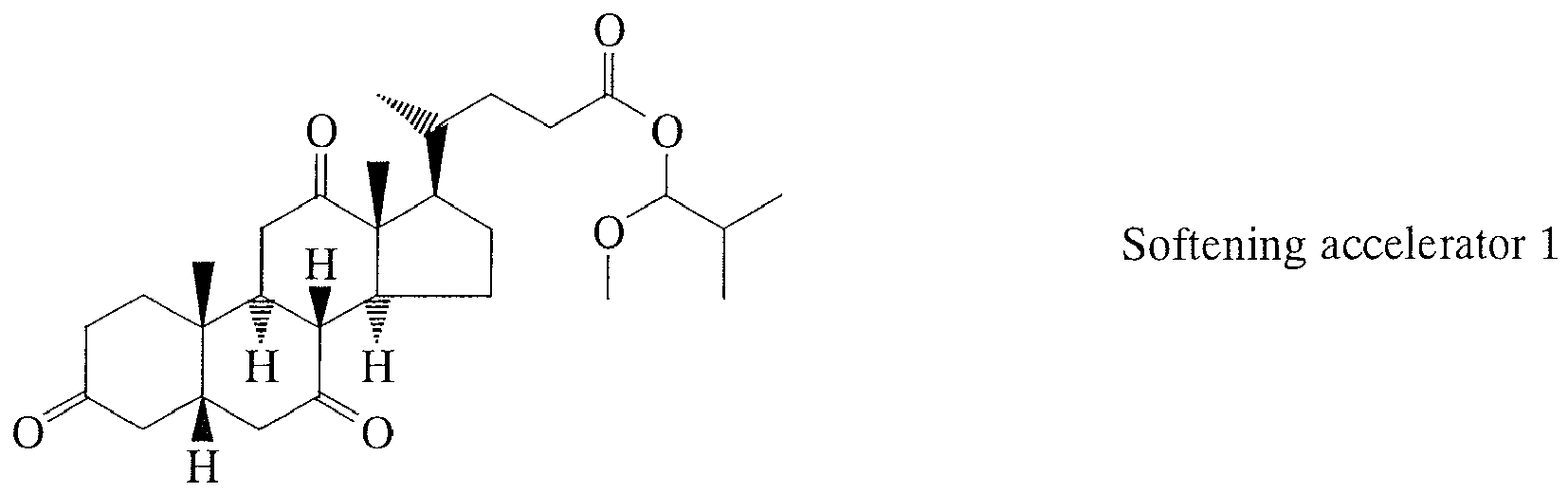
Table 1 Formulation (pbw) Examle Comparative Example 1 1 2 3 Polymer 1 80 80 80 80 PAG-1 6 6 6 6 PAG-2 2 2 2 2 Softening accelerator 1 10 10 - - Surfactant A 0.07 0.07 0.07 0.07 N-compound A 0.3 0.3 0.3 0.3 N-compound B 0.3 0.3 0.3 0.3 PGMEA 560 560 560 560 EL 1,300 1,300 1,300 1,300 PDHT yes no yes no - The resist composition thus prepared was filtered through a nylon resin filter with a pore size of 0.04 μm and spin coated onto a mask blank of 152 mm squares having a chromium oxynitride film as the uppermost surface. The spin coating conditions included 1,000 rpm x 1 sec, 2,500 rpm x 1.5 sec, 800 rpm x 5 sec, 100 rpm x 30 sec, and 2,000 rpm x 30 sec. The coated mask blank was prebaked on a hot plate at 90°C for 10 minutes to form a resist film of 150 nm thick.
- The thickness of the resist film was measured by an optical film thickness measurement system Nanospec (Nanometrics Inc.). Measurement was made at 81 points in the plane of the blank substrate excluding a peripheral band extending 10 mm inward from the blank periphery. An average film thickness and a film thickness range were computed therefrom.
- The coated mask blanks were exposed to EB using an EB writer system EBM5000 (NuFlare Technology Inc., accelerating voltage 50 keV), then baked (PEB) at 110°C for 10 minutes, and developed with a 2.38 wt% tetramethylammonium hydroxide aqueous solution, thereby yielding positive patterns (Example 1 & Comparative Examples 1 to 3). The patterns as developed were further baked at 130°C for 10 minutes (Example 1 & Comparative Example 2).
- The resist patterns thus obtained were evaluated as follow. The optimum exposure dose (sensitivity, Eop) was defined as the dose (μC/cm2) which provided a 1:1 resolution at the top and bottom of a 200-nm 1:1 line-and-space pattern. The maximum resolution of the resist was defined as the minimum line width of a line-and-space pattern that could be resolved and separated at the optimum dose. On observation in cross section of the resist pattern under SEM S-8840 (Hitachi, Ltd.), it was visually judged whether or not the pattern profile was rectangular.
- LER was determined by measuring the roughness of a 100-nm line at 50 points along longitudinal 5 μm under SEM and computing a value of 3σ. A smaller value indicates better performance. A change of pattern size by PDHT was determined.
- Table 2 tabulates the results of resolution, cross sectional profile, LER, and pattern size change.
Table 2 Resolution (nm) Cross-sectional profile LER (nm) Pattern size change (nm) Example 1 50 rectangular 2.5 1.5 Comparative Example 1 50 rectangular 4 - Comparative Example 2 50 rectangular 5 1.1 Comparative Example 3 50 rectangular 5 - - The data in Table 2 show that Example 1 provides a LER improvement of 1.5 nm over Comparative Example 1 without PDHT. Comparative Examples 2 and 3 free of Softening accelerator 1 provide larger LER values than Comparative Example 1, demonstrating that the softening accelerator is effective for reducing LER. No improvement in LER is achieved when Comparative Example 2 free of Softening accelerator 1 is subjected to PDHT, indicating that Softening accelerator 1 having a low molecular weight is essential for LER improvement.
- Resist compositions (Tables 3 and 4) were prepared as in Example 1 except that Softening accelerators 2 to 7 were used instead of Softening accelerator 1. Softening accelerators 2 to 7 have the following formula.

- Softening accelerator 2: R = 1-adamantyloxymethyl
- Softening accelerator 3: R = tert-butyl
- Softening accelerator 4: R = 1-ethylcyclopentyl
- Softening accelerator 5: R = 1-ethylcyclooctyl
- Softening accelerator 6: R = 4-tricyclodecanoxyethyl
- Softening accelerator 7: R = 4-tricyclodecanoxyisobutyl
- Pattern formation was the same as in Example 1 including the step of spin coating the resist solution onto a mask blank. Post-develop heat treatment (PDHT) was at 130°C for 10 minutes. Resolution and pattern profile were evaluated whether or not PDHT was carried out.
- The test results of resolution, cross-sectional profile, LER, and pattern size change are shown in Tables 5 and 6.
Table 3 Formulation (pbw) Example 2 3 4 5 6 7 Polymer 1 80 80 80 80 80 80 PAG-1 6 6 6 6 6 6 PAG-2 2 2 2 2 2 2 Softening accelerator 2 10 - - - - - Softening accelerator 3 - 10 - - - - Softening accelerator 4 - - 10 - - - Softening accelerator 5 - - - 10 - - Softening accelerator 6 - - - - 10 - Softening accelerator 7 - - - - - 10 PGMEA 560 560 560 560 560 560 EL 1,300 1,300 1,300 1,300 1,300 1,300 Surfactant A 0.07 0.07 0.07 0.07 0.07 0.07 N-compound A 0.3 0.3 0.3 0.3 0.3 0.3 N-compound B 0.3 0.3 0.3 0.3 0.3 0.3 PDHT yes yes yes yes yes yes Table 4 Formulation (pbw) Comparative Example 4 5 6 7 8 9 Polymer 1 80 80 80 80 80 80 PAG-1 6 6 6 6 6 6 PAG-2 2 2 2 2 2 2 Softening accelerator 2 10 - - - - - Softening accelerator 3 - 10 - - - - Softening accelerator 4 - - 10 - - - Softening accelerator 5 - - - 10 - - Softening accelerator 6 - - - - 10 - Softening accelerator 7 - - - - - 10 PGMEA 560 560 560 560 560 560 EL 1,300 1,300 1,300 1,300 1,300 1,300 Surfactant A 0.07 0.07 0.07 0.07 0.07 0.07 N-compound A 0.3 0.3 0.3 0.3 0.3 0.3 N-compound B 0.3 0.3 0.3 0.3 0.3 0.3 PDHT no no no no no no Table 5 Resolution (nm) Cross-sectional profile LER (nm) Pattern size change (nm) Example 2 50 rectangular 2.5 1.7 Example 3 50 rectangular 1.5 2.0 Example 4 50 rectangular 1.5 1.9 Example 5 50 rectangular 1.5 2.1 Example 6 50 rectangular 2.5 2.0 Example 7 50 rectangular 2.5 1.8 Table 6 Resolution (nm) Cross-sectional profile LER (nm) Pattern size change (nm) Comparative Example 4 50 rectangular 4 - Comparative Example 5 50 rectangular 3 - Comparative Example 6 50 rectangular 3 - Comparative Example 7 50 rectangular 3 - Comparative Example 8 50 rectangular 4 - Comparative Example 9 50 rectangular 4 - - Even when Softening accelerators 2 to 7 were used instead, satisfactory patterns comparable to Example 1 were obtained, that is, a LER improvement was achieved. Examples 2 to 7 all provide a LER improvement of 1.5 nm over Comparative Examples 4 to 9 without PDHT.
- Resist compositions of Table 7 were prepared. PGME was additionally used as the solvent to form a lower concentration solution in order to form a thinner resist film.
- Pattern formation was the same as in Example 1 including the step of spin coating the resist solution onto a mask blank. Because of a lower concentration, the thickness of a resist film was reduced to 90 nm under the same coating condictions. Resolution and pattern profile were evaluated.
- The test results of resolution, cross-sectional profile, LER, and pattern size change are shown in Table 8. Because of the reduced film thickness, a 40-nm pattern could be resolved without collapse.
Table 7 Formulation (pbw) Example Comparative Example 8 9 10 11 12 13 14 10 11 Polymer 1 80 80 80 80 80 80 80 80 80 PAG-1 6 6 6 6 6 6 6 6 6 PAG-2 2 2 2 2 2 2 2 2 2 Softening accelerator 1 10 - - - - - - 10 - Softening accelerator 2 - 10 - - - - - - - Softening accelerator 3 - - 10 - - - - - - Softening accelerator 4 - - - 10 - - - - - Softening accelerator 5 - - - - 10 - - - - Softening accelerator 6 - - - - - 10 - - - Softening accelerator 7 - - - - - - 10 - - PGMEA 980 980 980 980 980 980 980 980 980 EL 980 980 980 980 980 980 980 980 980 PGME 1,300 1,300 1,300 1,300 1,300 1,300 1,300 1,300 1,300 Surfactant A 0.07 0.07 0.07 0.07 0.07 0.07 0.07 0.07 0.07 N-compound A 0.3 0.3 0.3 0.3 0.3 0.3 0.3 0.3 0.3 N-compound B 0.3 0.3 0.3 0.3 0.3 0.3 0.3 0.3 0.3 PDHT yes yes yes yes yes yes yes no yes Table 8 Resolution (nm) Cross-sectional profile LER (nm) Pattern size change (nm) Example 8 40 rectangular 3.5 1.6 Example 9 40 rectangular 3.5 1.8 Example 10 40 rectangular 2.5 2.1 Example 11 40 rectangular 2.5 2.0 Example 12 40 rectangular 2.5 2.2 Example 13 40 rectangular 3.5 2.1 Example 14 40 rectangular 3.5 1.9 Comparative Example 10 40 rectangular 4.5 - Comparative Example 11 40 rectangular 6.0 1.2 - It is seen that the prior art resist composition (Comparative Example 11) suffered a problem that a reduced film thickness resulted in an increased LER. In contrast, the resist compositions having a low molecular weight softening accelerator added thereto were effective in forming a thin film of less than 100 nm, and through PDHT, they achieved improvements in LER over the LER value of 4.5 for Comparative Example 10 without PDHT.
- A pattern size change and LER were evaluated as a function of the PDHT temperature. Resist compositions of Example 1 and Comparative Example 2 (in Table 1) were prepared, for which a change of pattern size and LER were evaluated as well as a thickness loss of resist film pattern by PDHT.
- Pattern formation was the same as in Example 1 including the step of spin coating the resist solution onto a mask blank. A pattern with a line width of 50 nm was formed. The PDHT conditions included a temperature of 120°C, 130°C, 140°C, 150°C and 160°C and a time of 10 minutes at each temperature (Table 9).
- The test results of cross-sectional profile, LER, film thickness loss, and pattern size change are shown in Table 10.
Table 9 Example Comparative Example 1 15 16 17 12 13 Resist composition Example 1 Example 1 Example 1 Example 1 Example 1 Comparative Example 2 PDHT temperature 130° C 120° C 140°C 150°C 160°C 160°C Table 10 Cross-sectional profile LER (nm) Film loss (nm) Pattern size change (nm) Example 1 rectangular 2.5 1 1.5 Example 15 rectangular 3.5 1 1 Example 16 rectangular 2.4 1.5 2 Example 17 somewhat rounded top 2.2 2.5 3 Comparative Example 12 rounded top 1.3 5 6 Comparative Example 13 rounded top 4.5 5 6 - The resist composition of Example 1 provided a LER of 4 nm when PDHT was omitted (see Comparative Example 1). Example 15 at a PDHT temperature of 120°C which was 10°C higher than the PEB temperature showed an improvement of LER without degradation of pattern profile although a reduction of LER was only 0.5 nm. Example 1 at a PDHT temperature of 130ºC provided a LER improvement of 1.5 nm, while the film thickness loss was limited to 1 nm, and the pattern size change associated with the film loss was limited to 1.5 nm. It is evident that LER is improved without substantial degradation of pattern profile.
- When the PDHT temperature was elevated to 140°C (Example 16), LER was improved although the film loss and pattern size change were increased. The percent pattern size change was within 5% of the given size and fully acceptable, and the pattern profile was kept rectangular. When the PDHT temperature was elevated to 150°C (Example 17), the 50-nm pattern experienced a size change of 3 nm, indicating a percent size change of more than 5%, and the pattern profile was somewhat rounded at the top. This profile, despite a rather undesirable change, is not yet degraded to the profile that is incompatible with subsequent etching of the processable substrate using the resist pattern.
- When the PDHT temperature was elevated to 160°C (Comparative Example 12), the percent line width change exceeded 10%, and the pattern profile was rounded at the top. Even if the resist pattern resulting from development was estimated by taking into account such a line width increase, the resulting pattern was undesirable for subsequent etching. In Comparative Example 13 using the softening accelerator-free resist composition, LER is not improved at all at a PDHT temperature of 130°C; and at a PDHT temperature of 160°C, the LER improvement was insufficient and the resist pattern profile was degraded. It was found that the temperature span within which LER was improved without degrading the pattern profile was very narrow.
- A relation of an amount of the softening accelerator in the resist composition to the PDHT temperature capable of LER improvement was examined. Resist compositions of Table 11 were prepared and evaluated with respect to the PDHT temperature capable of LER improvement and a change of pattern size.
- Pattern formation was the same as in Example 1 including the step of spin coating the resist solution onto a mask blank. A pattern with a line width of 50 nm was formed. The PDHT conditions included a temperature of 120°C, 130°C, and 140°C and a time of 10 minutes at each temperature (Table 12).
- The test results of cross-sectional profile, LER, and pattern size change are shown in Table 12 along with the PDHT temperature capable of LER improvement.
Table 11 Formulation (pbw) Example Comparative Example 1 18 19 20 14 15 Polymer 1 80 80 80 80 80 80 PAG-1 6 6 6 6 6 6 PAG-2 2 2 2 2 2 2 PGMEA 560 560 560 560 560 560 EL 1,300 1,300 1,300 1,300 1,300 1,300 Softening accelerator 1 10 5 15 20 25 2 Surfactant A 0.07 0.07 0.07 0.07 0.07 0.07 N-compound A 0.3 0.3 0.3 0.3 0.3 0.3 N-compound B 0.3 0.3 0.3 0.3 0.3 0.3 Table 12 PDHT temperature (°C) Cross-sectional profile LER (nm) Pattern size change (nm) Example 1 130 rectangular 2.5 1.5 Example 18 140 rectangular 3.0 2 Example 19 130 rectangular 2.5 1.5 Example 20 120 rectangular 2.0 2.0 Comparative Example 14 120 wavy 2.5 3.0 Comparative Example 15 140 rectangular 4.0 2.0 - While the PDHT temperature capable of LER improvement for Example 1 is 130°C, the PDHT temperature lowers as the amount of Softening accelerator 1 is increased. However, when the amount of Softening accelerator 1 added exceeds 20 wt% based on the total solids in the resist composition (Comparative Example 14), the pattern profile becomes wavy, indicating that an excess of softening accelerator exerts deleterious effects during the pattern formation. Inversely, when the amount of Softening accelerator 1 added is less than 2.5 wt% based on the total solids in the resist composition (Comparative Example 15), LER is not improved even at a PDHT temperature of 140°C, indicating that least effects are derived from the softening accelerator.
- For reference, it is described how to synthesize acid-decomposable keto ester compounds of steroid skeleton. Me stands for methyl.
- Synthesis of 1-ethylcyclopentyloxycarbonylmethyl dehydrocholate (A-1)

- A mixture of 4.0 g of dehydrocholic acid (S-1), 2.9 g of 1-ethylcyclopentyl chloroacetate (S-2), 1.2 g of triethylamine, 0.2 g of sodium iodide, and 24 g of dimethylformamide was stirred at 80°C for 48 hours. The reaction mixture was diluted with methylene chloride, subjected to an ordinary aqueous workup, and purified by column chromatography, yielding 4.3 g of 1-ethylcyclopentyloxycarbonylmethyl dehydrocholate (A-1).
- Synthesis of 1-ethylcyclopentyl dehydrocholate (A-2)

- A mixture of 4.2 g of dehydrocholic acid chloride (S-3), 1.7 g of 1-ethylcyclopentanol (S-4), 0.1 g of 4-dimethylaminopyridine, and 16 g of pyridine was stirred at 60°C for 16 hours. The reaction mixture was diluted with methylene chloride, subjected to an ordinary aqueous workup, and purified by column chromatography, yielding 3.5 g of 1-ethylcyclopentyl dehydrocholate (A-2).
- Synthesis of 1-methoxy-2-methylpropyl dehydrocholate (A-3)

- At room temperature, 6.1 g of 1-chloro-2-methylpropyl methyl ether (S-5) was added dropwise to a mixture of 20.0 g of dehydrocholic acid (S-1), 6.0 g of triethylamine, and 100 g of tetrahydrofuran, followed by stirring for 1 hour. The reaction mixture was diluted with toluene. After an ordinary aqueous workup, the solvent was distilled off in vacuum. The resulting solid was washed with isopropyl ether and dried in vacuum, yielding 21.9 g of 1-methoxy-2-methylpropyl dehydrocholate (A-3).
- The target compound was analyzed by infrared (IR) absorption spectroscopy and nuclear magnetic resonance spectroscopy (1H-NMR), with the results shown below. Note that the compound is a mixture of two diastereomers in a ratio of 1:1.
- IR (D-ATR): v = 2964, 2931, 2872, 1740, 1720, 1705, 1470,
- 1426, 1384, 1314, 1299, 1277, 1250, 1220, 1170,
- 1138, 1120, 1097, 972, 946, 911 cm-1
- δ = 0.86 (3H, d, J=6.4 Hz), 0.88-0.92 (6H, m), 1.08 (3H, s), 1.22-1.42 (7H, m, inclusive of 1.40 (3H, s)), 1.55 (1H, dt, J=14.7, 4.1 Hz), 1.76-2.06 (9H, m), 2.09 (1H, dd, J=12.4, 5.5 Hz), 2.20 (1H, t, J=13.2 Hz), 2.23-2.52 (6H, m), 2.86 (1H, t, J=12.8 Hz), 2.96 (1H, dd, J=13.3, 5.5 Hz), 2.99 (1H, t, J=11.9 Hz), 3.32 (1.5H, s), 3.33 (1.5H, s), 5.52 (1H, d, J=5.0 Hz)
- Synthesis of 2-methyl-1-(tricyclo[5.2.1.02,6]decan-8-yloxy)-propyl dehydrocholate (A-4)

- Synthesis was carried out as in Reference Example 3 aside from using an equimolar amount of 1-chloro-2-methylpropyl tricyclο[5.2.1.02,6]decan-8-yl ether (S-6) instead of 1-chloro-2-methylpropyl methyl ether (S-5). There was obtained 2-methyl-1-(tricyclo[5.2.1.02,6]decan-8-yloxy)propyl dehydrocholate (A-4).
-
- (1) In respect of numerical ranges disclosed in the present description it will of course be understood that in the normal way the technical criterion for the upper limit is different from the technical criterion for the lower limit, i.e. the upper and lower limits are intrinsically distinct proposals.
- (2) For the avoidance of doubt it is confirmed that in the general description above, in the usual way the proposal of general preferences and options in respect of different features of the methods and compositions constitutes the proposal of general combinations of those general preferences and options for the different features, insofar as they are combinable and compatible and are put forward in the same context.
Claims (11)
- A resist pattern forming process comprising the steps of:(i) coating a chemically amplified positive resist composition onto a processable substrate, the resist composition comprising (A) a base resin having an acidic functional group protected with an acid labile group, which base resin turns alkali soluble for development when the acid labile group is eliminated, (B) an acid generator, (C) a nitrogen-containing basic compound, and (D) organic solvent,
and
prebaking to remove excess solvent and form a resist film,(ii) exposing the resist film imagewise to high-energy radiation,(iii) optionally baking and developing with a developer to form a resist pattern, and(iv) heating the developed pattern for pattern profile correction to such an extent that the line width change of the developed pattern is less than 10%,said resist composition further comprising (E) a softening accelerator having an acidic functional group protected with an acid labile group and a molecular weight of up to 800, in an amount of 2.5% to 20% by weight based on the total solids of the resist composition. - The process of claim 1 wherein said softening accelerator is a compound having at least two 5 or 6-membered rings and a free-rotatable carbon chain of at least two carbon atoms.
- The process of claim 1 or 2 wherein said softening accelerator is a compound having the general formula (1):

- The process of claim 3 wherein R1 in formula (1) is an acetal group having the general formula (2):

- The process of claim 3 wherein the softening accelerator has the general formula (3):

- A process of claim 1 in which the softening accelerator (E) is a compound with aromatic structure, or an aromatic structure-free compound having at least two rings.
- A process of claim 6 in which the softening accelerator (E) is selected from bisphenols, polyhydroxystyrenes and bisphenol acid esters protected with said acid labile group, or from sesquiterpenes, diterpenes, triterpenes and derivatives thereof having at least two rings and acid labile group-protected carboxylic acid group.
- A process of any one of the preceding claims in which the polymer for the base resin is selected from:polyhydroxystyrenes (PHS) and copolymers of hydroxystyrene with styrenes, (meth)acrylic acid esters or other polymerisable olefinic compounds;(meth)acrylic acid ester polymers, alternating copolymers of cycloolefin with maleic anhydride, such alternating copolymers further containing vinyl ethers or (meth)acrylic acid esters, polynorbornene, and polymers obtained from ring-opening metathesis polymerization (ROMP)of cycloolefins;fluorinated forms of the foregoing polymers;polymers resulting from ring-closure polymerisation using fluorinated dienes.
- A process of any one of the preceding claims in which the thickness of the resist film is not more than 150 nm.
- A process of any one of the preceding claims including said baking (PEB) of step (iii), and in which the pattern profile correction heating of step (iv) is at least 10°C higher than the temperature of said baking of step (iii).
- A process of any one of claims 1 to 10 wherein the processable substrate is a photomask blank.
Applications Claiming Priority (1)
| Application Number | Priority Date | Filing Date | Title |
|---|---|---|---|
| JP2011017840A JP5365646B2 (en) | 2011-01-31 | 2011-01-31 | Resist pattern forming method |
Publications (2)
| Publication Number | Publication Date |
|---|---|
| EP2482132A1 true EP2482132A1 (en) | 2012-08-01 |
| EP2482132B1 EP2482132B1 (en) | 2019-10-16 |
Family
ID=45655305
Family Applications (1)
| Application Number | Title | Priority Date | Filing Date |
|---|---|---|---|
| EP12153137.0A Active EP2482132B1 (en) | 2011-01-31 | 2012-01-30 | Resist pattern forming process |
Country Status (5)
| Country | Link |
|---|---|
| US (1) | US8685629B2 (en) |
| EP (1) | EP2482132B1 (en) |
| JP (1) | JP5365646B2 (en) |
| KR (1) | KR101720814B1 (en) |
| TW (1) | TWI514079B (en) |
Families Citing this family (3)
| Publication number | Priority date | Publication date | Assignee | Title |
|---|---|---|---|---|
| US9104107B1 (en) | 2013-04-03 | 2015-08-11 | Western Digital (Fremont), Llc | DUV photoresist process |
| KR102195700B1 (en) | 2013-12-04 | 2020-12-29 | 삼성디스플레이 주식회사 | Method for manufacturing pattern using chemically amplified resist |
| US9978563B2 (en) * | 2016-01-27 | 2018-05-22 | Tokyo Electron Limited | Plasma treatment method to meet line edge roughness and other integration objectives |
Citations (11)
| Publication number | Priority date | Publication date | Assignee | Title |
|---|---|---|---|---|
| JP2001226430A (en) | 2000-02-14 | 2001-08-21 | Japan Science & Technology Corp | Re-dissolvable acid crosslinkable polymer and photosensitive resin composition in which the polymer and a photoacid generator are combined |
| US20030171490A1 (en) * | 2002-03-04 | 2003-09-11 | Gregory Breyta | Polymer blend and associated methods of preparation and use |
| JP2005019969A (en) | 2003-06-06 | 2005-01-20 | Tokyo Electron Ltd | Method for improving surface roughness of substrate processing film and substrate processing apparatus |
| JP2008111103A (en) | 2006-10-04 | 2008-05-15 | Shin Etsu Chem Co Ltd | Polymer compound, resist material, and pattern forming method |
| US7537880B2 (en) | 2006-10-04 | 2009-05-26 | Shin-Etsu Chemical Co., Ltd. | Polymer, resist composition, and patterning process |
| US20090274978A1 (en) | 2008-05-01 | 2009-11-05 | Masaki Ohashi | Novel photoacid generator, resist composition, and patterning process |
| WO2010035908A1 (en) * | 2008-09-29 | 2010-04-01 | Fujifilm Corporation | Pattern forming method |
| JP2010164933A (en) | 2008-07-11 | 2010-07-29 | Shin-Etsu Chemical Co Ltd | Resist composition and patterning process |
| EP2239631A1 (en) | 2009-04-08 | 2010-10-13 | Shin-Etsu Chemical Co., Ltd. | Patterning process |
| EP2256551A1 (en) | 2009-05-29 | 2010-12-01 | Shin-Etsu Chemical Co., Ltd. | Chemically amplified resist compositon and pattern forming process |
| WO2011083872A1 (en) * | 2010-01-08 | 2011-07-14 | Fujifilm Corporation | Pattern forming method, actinic ray-sensitive or radiation-sensitive resin composition and resist film |
Family Cites Families (8)
| Publication number | Priority date | Publication date | Assignee | Title |
|---|---|---|---|---|
| EP1632992A4 (en) | 2003-06-06 | 2008-02-27 | Tokyo Electron Ltd | METHOD FOR IMPROVING THE SURFACE ROUGHNESS OF THE FILM OF A SUBSTRATE HAVING BEEN PROCESSED, AND APPARATUS FOR TREATING A SUBSTRATE |
| US7232641B2 (en) * | 2003-10-08 | 2007-06-19 | Shin-Etsu Chemical Co., Ltd. | Polymerizable compound, polymer, positive-resist composition, and patterning process using the same |
| JP2005202179A (en) * | 2004-01-16 | 2005-07-28 | Renesas Technology Corp | Method for manufacturing photomask |
| JP4695941B2 (en) * | 2005-08-19 | 2011-06-08 | 富士フイルム株式会社 | Positive resist composition for immersion exposure and pattern forming method using the same |
| JP5237173B2 (en) * | 2008-06-03 | 2013-07-17 | 信越化学工業株式会社 | Polymerizable compound, polymer compound, positive resist material and pattern forming method using the same |
| US8168367B2 (en) | 2008-07-11 | 2012-05-01 | Shin-Etsu Chemical Co., Ltd. | Resist composition and patterning process |
| JP4748331B2 (en) * | 2008-12-02 | 2011-08-17 | 信越化学工業株式会社 | Resist material and pattern forming method |
| JP5439139B2 (en) * | 2009-11-30 | 2014-03-12 | 東京応化工業株式会社 | Positive resist composition and resist pattern forming method |
-
2011
- 2011-01-31 JP JP2011017840A patent/JP5365646B2/en active Active
-
2012
- 2012-01-18 TW TW101102040A patent/TWI514079B/en active
- 2012-01-30 KR KR1020120008794A patent/KR101720814B1/en active Active
- 2012-01-30 EP EP12153137.0A patent/EP2482132B1/en active Active
- 2012-01-31 US US13/362,294 patent/US8685629B2/en active Active
Patent Citations (15)
| Publication number | Priority date | Publication date | Assignee | Title |
|---|---|---|---|---|
| JP2001226430A (en) | 2000-02-14 | 2001-08-21 | Japan Science & Technology Corp | Re-dissolvable acid crosslinkable polymer and photosensitive resin composition in which the polymer and a photoacid generator are combined |
| US20030171490A1 (en) * | 2002-03-04 | 2003-09-11 | Gregory Breyta | Polymer blend and associated methods of preparation and use |
| JP2005019969A (en) | 2003-06-06 | 2005-01-20 | Tokyo Electron Ltd | Method for improving surface roughness of substrate processing film and substrate processing apparatus |
| JP2008111103A (en) | 2006-10-04 | 2008-05-15 | Shin Etsu Chem Co Ltd | Polymer compound, resist material, and pattern forming method |
| US7537880B2 (en) | 2006-10-04 | 2009-05-26 | Shin-Etsu Chemical Co., Ltd. | Polymer, resist composition, and patterning process |
| JP2009269953A (en) | 2008-05-01 | 2009-11-19 | Shin Etsu Chem Co Ltd | New photoacid generator, resist material using the same, and pattern forming method |
| US20090274978A1 (en) | 2008-05-01 | 2009-11-05 | Masaki Ohashi | Novel photoacid generator, resist composition, and patterning process |
| JP2010164933A (en) | 2008-07-11 | 2010-07-29 | Shin-Etsu Chemical Co Ltd | Resist composition and patterning process |
| WO2010035908A1 (en) * | 2008-09-29 | 2010-04-01 | Fujifilm Corporation | Pattern forming method |
| EP2239631A1 (en) | 2009-04-08 | 2010-10-13 | Shin-Etsu Chemical Co., Ltd. | Patterning process |
| US20100261123A1 (en) | 2009-04-08 | 2010-10-14 | Shin-Etsu Chemical Co., Ltd. | Patterning process |
| JP2010243873A (en) | 2009-04-08 | 2010-10-28 | Shin-Etsu Chemical Co Ltd | Pattern formation method |
| EP2256551A1 (en) | 2009-05-29 | 2010-12-01 | Shin-Etsu Chemical Co., Ltd. | Chemically amplified resist compositon and pattern forming process |
| US20100304302A1 (en) | 2009-05-29 | 2010-12-02 | Keiichi Masunaga | Chemically amplified resist composition and pattern forming process |
| WO2011083872A1 (en) * | 2010-01-08 | 2011-07-14 | Fujifilm Corporation | Pattern forming method, actinic ray-sensitive or radiation-sensitive resin composition and resist film |
Also Published As
| Publication number | Publication date |
|---|---|
| EP2482132B1 (en) | 2019-10-16 |
| KR101720814B1 (en) | 2017-03-28 |
| US8685629B2 (en) | 2014-04-01 |
| KR20120088582A (en) | 2012-08-08 |
| TW201245884A (en) | 2012-11-16 |
| JP2012159585A (en) | 2012-08-23 |
| US20120196211A1 (en) | 2012-08-02 |
| JP5365646B2 (en) | 2013-12-11 |
| TWI514079B (en) | 2015-12-21 |
Similar Documents
| Publication | Publication Date | Title |
|---|---|---|
| EP2455811B1 (en) | Sulfonium salt-containing polymer, resist composition, patterning process, and sulfonium salt monomer and making method | |
| US8173354B2 (en) | Sulfonium salt, resist composition, and patterning process | |
| US8268528B2 (en) | Resist composition and patterning process | |
| US8313886B2 (en) | Resist composition and patterning process | |
| US8703384B2 (en) | Positive resist composition and patterning process | |
| KR102291481B1 (en) | Sulfonium compound, positive resist composition, and resist pattern forming process | |
| US9057949B2 (en) | Patterning process, resist composition, polymer, and polymerizable ester compound | |
| US7745098B2 (en) | Polymer compound, positive resist composition and method of forming resist pattern | |
| US9046772B2 (en) | Monomer, polymer, resist composition, and patterning process | |
| US9235122B2 (en) | Monomer, polymer, resist composition, and patterning process | |
| US8021824B2 (en) | Polymer compound, resist composition and method of forming resist pattern | |
| TW201339134A (en) | Polymerizable tertiary ester compound, polymer, resist composition, and patterning process | |
| US8628908B2 (en) | Chemically amplified resist composition and patterning process | |
| KR102719194B1 (en) | Chemically amplified positive resist composition and resist pattern forming process | |
| US8211616B2 (en) | Positive resist composition and method of forming resist pattern | |
| EP2482132B1 (en) | Resist pattern forming process | |
| US8426110B2 (en) | Chemically amplified positive resist composition, patterning process, and acid-decomposable keto ester compound |
Legal Events
| Date | Code | Title | Description |
|---|---|---|---|
| PUAI | Public reference made under article 153(3) epc to a published international application that has entered the european phase |
Free format text: ORIGINAL CODE: 0009012 |
|
| AK | Designated contracting states |
Kind code of ref document: A1 Designated state(s): AL AT BE BG CH CY CZ DE DK EE ES FI FR GB GR HR HU IE IS IT LI LT LU LV MC MK MT NL NO PL PT RO RS SE SI SK SM TR |
|
| AX | Request for extension of the european patent |
Extension state: BA ME |
|
| 17P | Request for examination filed |
Effective date: 20120910 |
|
| 17Q | First examination report despatched |
Effective date: 20150703 |
|
| REG | Reference to a national code |
Ref country code: DE Ref legal event code: R079 Ref document number: 602012064845 Country of ref document: DE Free format text: PREVIOUS MAIN CLASS: G03F0007004000 Ipc: G03F0007039000 |
|
| GRAP | Despatch of communication of intention to grant a patent |
Free format text: ORIGINAL CODE: EPIDOSNIGR1 |
|
| RIC1 | Information provided on ipc code assigned before grant |
Ipc: G03F 7/039 20060101AFI20190301BHEP |
|
| INTG | Intention to grant announced |
Effective date: 20190403 |
|
| GRAJ | Information related to disapproval of communication of intention to grant by the applicant or resumption of examination proceedings by the epo deleted |
Free format text: ORIGINAL CODE: EPIDOSDIGR1 |
|
| INTC | Intention to grant announced (deleted) | ||
| RBV | Designated contracting states (corrected) |
Designated state(s): DE FR IT |
|
| GRAR | Information related to intention to grant a patent recorded |
Free format text: ORIGINAL CODE: EPIDOSNIGR71 |
|
| GRAS | Grant fee paid |
Free format text: ORIGINAL CODE: EPIDOSNIGR3 |
|
| GRAA | (expected) grant |
Free format text: ORIGINAL CODE: 0009210 |
|
| AK | Designated contracting states |
Kind code of ref document: B1 Designated state(s): DE FR IT |
|
| INTG | Intention to grant announced |
Effective date: 20190906 |
|
| REG | Reference to a national code |
Ref country code: DE Ref legal event code: R096 Ref document number: 602012064845 Country of ref document: DE |
|
| REG | Reference to a national code |
Ref country code: DE Ref legal event code: R097 Ref document number: 602012064845 Country of ref document: DE |
|
| PLBE | No opposition filed within time limit |
Free format text: ORIGINAL CODE: 0009261 |
|
| STAA | Information on the status of an ep patent application or granted ep patent |
Free format text: STATUS: NO OPPOSITION FILED WITHIN TIME LIMIT |
|
| 26N | No opposition filed |
Effective date: 20200717 |
|
| PGFP | Annual fee paid to national office [announced via postgrant information from national office to epo] |
Ref country code: FR Payment date: 20251128 Year of fee payment: 15 |
|
| PGFP | Annual fee paid to national office [announced via postgrant information from national office to epo] |
Ref country code: DE Payment date: 20251203 Year of fee payment: 15 |
|
| PGFP | Annual fee paid to national office [announced via postgrant information from national office to epo] |
Ref country code: IT Payment date: 20251219 Year of fee payment: 15 |