EP2474376A1 - Hydrogen storage alloy and hydrogen storage unit using same - Google Patents
Hydrogen storage alloy and hydrogen storage unit using same Download PDFInfo
- Publication number
- EP2474376A1 EP2474376A1 EP09848992A EP09848992A EP2474376A1 EP 2474376 A1 EP2474376 A1 EP 2474376A1 EP 09848992 A EP09848992 A EP 09848992A EP 09848992 A EP09848992 A EP 09848992A EP 2474376 A1 EP2474376 A1 EP 2474376A1
- Authority
- EP
- European Patent Office
- Prior art keywords
- hydrogen
- hydrogen storage
- alloy
- storage unit
- magnesium
- Prior art date
- Legal status (The legal status is an assumption and is not a legal conclusion. Google has not performed a legal analysis and makes no representation as to the accuracy of the status listed.)
- Withdrawn
Links
Images



Classifications
-
- B—PERFORMING OPERATIONS; TRANSPORTING
- B22—CASTING; POWDER METALLURGY
- B22F—WORKING METALLIC POWDER; MANUFACTURE OF ARTICLES FROM METALLIC POWDER; MAKING METALLIC POWDER; APPARATUS OR DEVICES SPECIALLY ADAPTED FOR METALLIC POWDER
- B22F1/00—Metallic powder; Treatment of metallic powder, e.g. to facilitate working or to improve properties
-
- B—PERFORMING OPERATIONS; TRANSPORTING
- B22—CASTING; POWDER METALLURGY
- B22F—WORKING METALLIC POWDER; MANUFACTURE OF ARTICLES FROM METALLIC POWDER; MAKING METALLIC POWDER; APPARATUS OR DEVICES SPECIALLY ADAPTED FOR METALLIC POWDER
- B22F7/00—Manufacture of composite layers, workpieces, or articles, comprising metallic powder, by sintering the powder, with or without compacting wherein at least one part is obtained by sintering or compression
- B22F7/002—Manufacture of composite layers, workpieces, or articles, comprising metallic powder, by sintering the powder, with or without compacting wherein at least one part is obtained by sintering or compression of porous nature
-
- B—PERFORMING OPERATIONS; TRANSPORTING
- B22—CASTING; POWDER METALLURGY
- B22F—WORKING METALLIC POWDER; MANUFACTURE OF ARTICLES FROM METALLIC POWDER; MAKING METALLIC POWDER; APPARATUS OR DEVICES SPECIALLY ADAPTED FOR METALLIC POWDER
- B22F1/00—Metallic powder; Treatment of metallic powder, e.g. to facilitate working or to improve properties
- B22F1/16—Metallic particles coated with a non-metal
-
- B—PERFORMING OPERATIONS; TRANSPORTING
- B60—VEHICLES IN GENERAL
- B60L—PROPULSION OF ELECTRICALLY-PROPELLED VEHICLES; SUPPLYING ELECTRIC POWER FOR AUXILIARY EQUIPMENT OF ELECTRICALLY-PROPELLED VEHICLES; ELECTRODYNAMIC BRAKE SYSTEMS FOR VEHICLES IN GENERAL; MAGNETIC SUSPENSION OR LEVITATION FOR VEHICLES; MONITORING OPERATING VARIABLES OF ELECTRICALLY-PROPELLED VEHICLES; ELECTRIC SAFETY DEVICES FOR ELECTRICALLY-PROPELLED VEHICLES
- B60L50/00—Electric propulsion with power supplied within the vehicle
- B60L50/50—Electric propulsion with power supplied within the vehicle using propulsion power supplied by batteries or fuel cells
-
- C—CHEMISTRY; METALLURGY
- C01—INORGANIC CHEMISTRY
- C01B—NON-METALLIC ELEMENTS; COMPOUNDS THEREOF; METALLOIDS OR COMPOUNDS THEREOF NOT COVERED BY SUBCLASS C01C
- C01B3/00—Hydrogen; Gaseous mixtures containing hydrogen; Separation of hydrogen from mixtures containing it; Purification of hydrogen; Reversible storage of hydrogen
- C01B3/0005—Reversible storage of hydrogen, e.g. by hydrogen getters or electrodes
- C01B3/001—Reversible storage of hydrogen, e.g. by hydrogen getters or electrodes characterised by the uptaking media; Treatment thereof
- C01B3/0018—Inorganic elements or compounds, e.g. oxides, nitrides, borohydrides or zeolites; Solutions thereof
- C01B3/0026—Metals or metal hydrides
-
- C—CHEMISTRY; METALLURGY
- C01—INORGANIC CHEMISTRY
- C01B—NON-METALLIC ELEMENTS; COMPOUNDS THEREOF; METALLOIDS OR COMPOUNDS THEREOF NOT COVERED BY SUBCLASS C01C
- C01B3/00—Hydrogen; Gaseous mixtures containing hydrogen; Separation of hydrogen from mixtures containing it; Purification of hydrogen; Reversible storage of hydrogen
- C01B3/0005—Reversible storage of hydrogen, e.g. by hydrogen getters or electrodes
- C01B3/001—Reversible storage of hydrogen, e.g. by hydrogen getters or electrodes characterised by the uptaking media; Treatment thereof
- C01B3/0018—Inorganic elements or compounds, e.g. oxides, nitrides, borohydrides or zeolites; Solutions thereof
- C01B3/0031—Intermetallic compounds; Metal alloys
- C01B3/0042—Intermetallic compounds; Metal alloys only containing magnesium and nickel
-
- C—CHEMISTRY; METALLURGY
- C01—INORGANIC CHEMISTRY
- C01B—NON-METALLIC ELEMENTS; COMPOUNDS THEREOF; METALLOIDS OR COMPOUNDS THEREOF NOT COVERED BY SUBCLASS C01C
- C01B3/00—Hydrogen; Gaseous mixtures containing hydrogen; Separation of hydrogen from mixtures containing it; Purification of hydrogen; Reversible storage of hydrogen
- C01B3/0005—Reversible storage of hydrogen, e.g. by hydrogen getters or electrodes
- C01B3/001—Reversible storage of hydrogen, e.g. by hydrogen getters or electrodes characterised by the uptaking media; Treatment thereof
- C01B3/0078—Composite solid storage media, e.g. mixtures of polymers and metal hydrides, coated solid compounds or structurally heterogeneous solid compounds
-
- C—CHEMISTRY; METALLURGY
- C22—METALLURGY; FERROUS OR NON-FERROUS ALLOYS; TREATMENT OF ALLOYS OR NON-FERROUS METALS
- C22C—ALLOYS
- C22C47/00—Making alloys containing metallic or non-metallic fibres or filaments
- C22C47/02—Pretreatment of the fibres or filaments
- C22C47/06—Pretreatment of the fibres or filaments by forming the fibres or filaments into a preformed structure, e.g. using a temporary binder to form a mat-like element
-
- C—CHEMISTRY; METALLURGY
- C22—METALLURGY; FERROUS OR NON-FERROUS ALLOYS; TREATMENT OF ALLOYS OR NON-FERROUS METALS
- C22C—ALLOYS
- C22C49/00—Alloys containing metallic or non-metallic fibres or filaments
- C22C49/02—Alloys containing metallic or non-metallic fibres or filaments characterised by the matrix material
- C22C49/04—Light metals
-
- H—ELECTRICITY
- H01—ELECTRIC ELEMENTS
- H01M—PROCESSES OR MEANS, e.g. BATTERIES, FOR THE DIRECT CONVERSION OF CHEMICAL ENERGY INTO ELECTRICAL ENERGY
- H01M8/00—Fuel cells; Manufacture thereof
- H01M8/04—Auxiliary arrangements, e.g. for control of pressure or for circulation of fluids
-
- H—ELECTRICITY
- H01—ELECTRIC ELEMENTS
- H01M—PROCESSES OR MEANS, e.g. BATTERIES, FOR THE DIRECT CONVERSION OF CHEMICAL ENERGY INTO ELECTRICAL ENERGY
- H01M8/00—Fuel cells; Manufacture thereof
- H01M8/06—Combination of fuel cells with means for production of reactants or for treatment of residues
-
- B—PERFORMING OPERATIONS; TRANSPORTING
- B22—CASTING; POWDER METALLURGY
- B22F—WORKING METALLIC POWDER; MANUFACTURE OF ARTICLES FROM METALLIC POWDER; MAKING METALLIC POWDER; APPARATUS OR DEVICES SPECIALLY ADAPTED FOR METALLIC POWDER
- B22F1/00—Metallic powder; Treatment of metallic powder, e.g. to facilitate working or to improve properties
- B22F1/08—Metallic powder characterised by particles having an amorphous microstructure
-
- C—CHEMISTRY; METALLURGY
- C22—METALLURGY; FERROUS OR NON-FERROUS ALLOYS; TREATMENT OF ALLOYS OR NON-FERROUS METALS
- C22C—ALLOYS
- C22C2202/00—Physical properties
- C22C2202/04—Hydrogen absorbing
-
- Y—GENERAL TAGGING OF NEW TECHNOLOGICAL DEVELOPMENTS; GENERAL TAGGING OF CROSS-SECTIONAL TECHNOLOGIES SPANNING OVER SEVERAL SECTIONS OF THE IPC; TECHNICAL SUBJECTS COVERED BY FORMER USPC CROSS-REFERENCE ART COLLECTIONS [XRACs] AND DIGESTS
- Y02—TECHNOLOGIES OR APPLICATIONS FOR MITIGATION OR ADAPTATION AGAINST CLIMATE CHANGE
- Y02E—REDUCTION OF GREENHOUSE GAS [GHG] EMISSIONS, RELATED TO ENERGY GENERATION, TRANSMISSION OR DISTRIBUTION
- Y02E60/00—Enabling technologies; Technologies with a potential or indirect contribution to GHG emissions mitigation
- Y02E60/30—Hydrogen technology
- Y02E60/32—Hydrogen storage
-
- Y—GENERAL TAGGING OF NEW TECHNOLOGICAL DEVELOPMENTS; GENERAL TAGGING OF CROSS-SECTIONAL TECHNOLOGIES SPANNING OVER SEVERAL SECTIONS OF THE IPC; TECHNICAL SUBJECTS COVERED BY FORMER USPC CROSS-REFERENCE ART COLLECTIONS [XRACs] AND DIGESTS
- Y02—TECHNOLOGIES OR APPLICATIONS FOR MITIGATION OR ADAPTATION AGAINST CLIMATE CHANGE
- Y02E—REDUCTION OF GREENHOUSE GAS [GHG] EMISSIONS, RELATED TO ENERGY GENERATION, TRANSMISSION OR DISTRIBUTION
- Y02E60/00—Enabling technologies; Technologies with a potential or indirect contribution to GHG emissions mitigation
- Y02E60/30—Hydrogen technology
- Y02E60/50—Fuel cells
-
- Y—GENERAL TAGGING OF NEW TECHNOLOGICAL DEVELOPMENTS; GENERAL TAGGING OF CROSS-SECTIONAL TECHNOLOGIES SPANNING OVER SEVERAL SECTIONS OF THE IPC; TECHNICAL SUBJECTS COVERED BY FORMER USPC CROSS-REFERENCE ART COLLECTIONS [XRACs] AND DIGESTS
- Y10—TECHNICAL SUBJECTS COVERED BY FORMER USPC
- Y10T—TECHNICAL SUBJECTS COVERED BY FORMER US CLASSIFICATION
- Y10T428/00—Stock material or miscellaneous articles
- Y10T428/249921—Web or sheet containing structurally defined element or component
- Y10T428/249953—Composite having voids in a component [e.g., porous, cellular, etc.]
-
- Y—GENERAL TAGGING OF NEW TECHNOLOGICAL DEVELOPMENTS; GENERAL TAGGING OF CROSS-SECTIONAL TECHNOLOGIES SPANNING OVER SEVERAL SECTIONS OF THE IPC; TECHNICAL SUBJECTS COVERED BY FORMER USPC CROSS-REFERENCE ART COLLECTIONS [XRACs] AND DIGESTS
- Y10—TECHNICAL SUBJECTS COVERED BY FORMER USPC
- Y10T—TECHNICAL SUBJECTS COVERED BY FORMER US CLASSIFICATION
- Y10T428/00—Stock material or miscellaneous articles
- Y10T428/31504—Composite [nonstructural laminate]
- Y10T428/31678—Of metal
Definitions
- This invention relates to a hydrogen storage alloy capable of storing hydrogen and a hydrogen storage unit using the same.
- Fuel cells used in vehicles and others use gaseous hydrogen. Since gaseous hydrogen is very large in volume, compressed hydrogen gas is used. The volume thereof is however still large for practical use, leading to space problems. Liquid hydrogen is smaller in volume than gaseous hydrogen. Holding liquid hydrogen is however difficult and not suited for practical use. Thus, use of hydrogen in the solid state has been being studied and developed to provide reduced volume and enhanced ease of handling. Hydrogen is used in the solid state by being stored in alloys. Such alloys are called hydrogen storage alloys. Hydrogen storage alloys repeat absorbing and releasing hydrogen.
- Patent document 1 relates to hydrogen storage materials, the method of making the same, and a hydrogen generation device.
- the disclosed hydrogen storage materials comprise a bulk of a metal Mg (magnesium) with a surface crystalline region X having a short distance between nearest neighboring atoms compared with the other region of the Mg bulk, and have the ability such that 100 parts by weight of the hydrogen storage material can absorb and release 7 parts by weight or more of hydrogen at temperatures lower than or equal to 300°C.
- the hydrogen storage materials disclosed in patent document 1 however require heat and pressure for hydrogenation reaction combining the Mg bulk with hydrogen to form MgH 2 .
- the disclosed hydrogen storage alloys need thermal energy and pressure energy to absorb hydrogen. It is inconvenient to supply such energies each time hydrogenation reaction is required.
- Mg has a high ability to store hydrogen, which is an advantage, but its ability to cause hydrogen to diffuse in it in the solid state is low so that it takes time to absorb hydrogen.
- Mg's low ability to cause hydrogen to diffuse in it in the solid state, or in other words, hydrogen's slowly diffusing in the solid-state Mg means that even though hydrogen is absorbed in Mg in a surface region of a Mg alloy, the hydrogen absorbed is not passed on to Mg in an inner region thereof.
- Mg in the surface region of the Mg alloy combines with hydrogen to form MgH 2 , which functions as a barrier film preventing a further amount of hydrogen from being absorbed.
- Such slow diffusion of hydrogen in the solid-state Mg is also considered as a drawback.
- the present invention aims to provide a hydrogen storage alloy which can absorb hydrogen at room temperature and atmospheric pressure and can cause hydrogen to more quickly diffuse in it in the solid state, thereby reducing time taken for hydrogenation, and a hydrogen storage unit using the same.
- the invention recited in claim 1 is a hydrogen storage alloy comprising a hydrogen storage base formed of a mixture of magnesium and an alloy selected from a group consisting of a magnesium-nickel alloy, a magnesium-titanium alloy, a magnesium-niobium alloy, a magnesium-manganese alloy and a magnesium-cobalt alloy, and a catalytic layer covering a surface of the hydrogen storage base.
- the invention recited in claim 2 is a hydrogen storage alloy of the type recited in claim 1 wherein the catalytic layer is formed of Pd.
- the invention recited in claim 3 is a hydrogen storage unit comprising a hydrogen storage alloy recited in claim 1, and a porous body having a large number of holes allowing hydrogen molecules to pass through, said hydrogen storage alloy covering a surface of the porous body, inclusive of surfaces of the holes thereof.
- the invention recited in claim 4 is a hydrogen storage unit of the type recited in claim 3 wherein the catalytic layer is formed of Pd.
- the invention recited in claim 5 is a hydrogen storage unit of the type recited in claim 3 wherein the porous body is formed of an assembly of nanofibers.
- the invention recited in claim 6 is a hydrogen storage unit of the type recited in claim 5 wherein the individual nanofibers are randomly oriented in the assembly.
- the invention recited in claim 7 is a hydrogen storage unit of the type recited in claim 3 wherein the hydrogen storage base constituting the hydrogen storage alloy is a layer vapor-deposited on the surface of the porous body.
- the hydrogen storage alloy recited in claim 1 can exhibit both a high ability to store hydrogen and a high ability to cause hydrogen to diffuse in it in solid state, provided by Mg and an alloy (Mg 2 Ni is particularly desirable), respectively. Hydrogen stored in Mg in one region is passed on to Mg (or Mg 2 Ni) in another region by virtue of Mg 2 Ni, for example. Since this movement of hydrogen does-not require heat nor pressure, hydrogen can be absorbed at room temperature and atmospheric pressure.
- Pd catalyzes dissociation of molecular hydrogen into hydrogen atoms (H 2 ⁇ 2H). Hydrogen in the form of atoms is most quickly absorbed in Mg. Unlike Pt, Pd does not have the ability to catalyze ionization of hydrogen atoms. Thus, use of Pd as a catalyst allows hydrogen to stay in the form of atoms, which leads to quick absorption of hydrogen compared with when Pt is used as a catalyst.
- the hydrogen storage alloy covers the surface of a porous body having a large number of holes allowing hydrogen molecules to pass through, thereby providing a hydrogen storage layer with a large surface area, and thus, a large area of contact with hydrogen, leading to quick absorption of hydrogen.
- Pd catalyzes dissociation of molecular hydrogen into hydrogen atoms (H 2 ⁇ 2H). Hydrogen in the form of atoms is most quickly absorbed in Mg. Unlike Pt, Pd does not have the ability to catalyze ionization of hydrogen atoms. Thus, use of Pd as a catalyst allows hydrogen to stay in the form of atoms, which leads to quick absorption of hydrogen compared with when Pt is used as a catalyst.
- nanofibers tangled into an assembly provide a large number of spaces serving as holes allowing hydrogen to pass through.
- the porous body of this type is easy to form.
- nanofibers are formed into an assembly by simply tangling them, not by deliberately arranging them in a specific arrangement. Even the assembly formed this way provides holes allowing hydrogen to pass through, thereby enabling quick absorption of hydrogen.
- a layer of the hydrogen storage alloy is formed on the porous body by vapor deposition.
- the hydrogen storage unit of this type is easy to make and capable of quickly absorbing hydrogen.
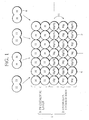
- FIG. 1 is a schematic diagram showing a hydrogen storage alloy according to the present invention.
- a hydrogen storage alloy 1 comprises a hydrogen storage base 2 and a catalytic layer 3.
- the hydrogen storage base 2 is a thin film of a mixture of a metal Mg 4 and an alloy (in the illustrated example, Mg 2 Ni 5).
- the ratio between Mg 4 and Mg 2 Ni 5 in the mixture is 0 to 10 (exclusive of 0) mol of Mg for 1 mol of Mg 2 Ni, more desirably 4 to 8 mol of Mg for 1 mol of Mg 2 Ni. It is particularly desirable that the mixture have composition represented by chemical formula Mg 6 Ni. Mg 4 and Mg 2 Ni 5 mixed this way experience chemical reactions shown below.
- hydrogen atoms H are passed on to Mg (or Mg 2 Ni) in an inner region.
- Mg or Mg 2 Ni
- the hydrogen storage base 2 be amorphous.
- the hydrogen storage base 2 being in the form of a thin film also contributes to quick absorption of hydrogen.
- the catalytic layer 3 is formed of Pd (palladium).
- the catalytic layer 3 is formed to cover the entire surface of the hydrogen storage base 2. Alternatively, the catalytic layer 3 may partly cover the surface of the hydrogen storage base 2.
- Pd catalyzes dissociation of molecular hydrogen into hydrogen atoms (H 2 ⁇ 2H). Hydrogen in the form of atoms is most quickly absorbed in Mg. Unlike Pt, Pd does not have the ability to catalyze ionization of hydrogen atoms. Thus, use of Pd as a catalyst allows hydrogen to stay in the form of atoms, which leads to quick absorption of hydrogen compared with when Pt is used as a catalyst.
- the catalytic layer 3 may be formed of a substance other than Pd (palladium), such as Pt (platinum), Nb (niobium) or ZrNi(zirconium nickel).
- FIG. 2 is a schematic diagram showing a hydrogen storage unit according to the present invention.
- the hydrogen storage unit 7 is in the form of an assembly of hydrogen storage fibers 8, namely nanofibers with a hydrogen storage alloy 1 (see FIG. 1 ) vapor-deposited thereon.
- a large number of hydrogen storage fibers 8 are tangled to intersect one another, thereby providing spaces 9 between one another.
- the individual nanofibers may be randomly oriented, but are tangled to provide spaces 9 having a size allowing hydrogen molecules to pass through.
- the hydrogen storage alloy 1 (see FIG. 1 ), vapor-deposited on such nanofibers, can provide a large surface area of the hydrogen storage base 2 (see FIG. 1 ), and thus, provide a large area of contact with hydrogen.
- the spaces 9 function as holes for hydrogen molecules to pass through, thereby allowing hydrogen to be absorbed not only in a surface region of the hydrogen storage unit 7 but also in an inner region of the hydrogen storage unit 7, thus enabling quick absorption of hydrogen.
- the hydrogen storage base 2 (see FIG. 1 ) can have a further increased surface area, and thus, a further increased area of contact with hydrogen, enabling quicker absorption of hydrogen.
- the hydrogen storage unit may be formed using other porous materials having holes allowing hydrogen to pass through.
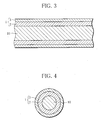
- FIG. 3 is a longitudinal cross-sectional view of a hydrogen storage fiber
- FIG. 4 a transverse cross-sectional view of the hydrogen storage fiber shown in FIG. 3 .
- a hydrogen storage fiber 8 comprises a nanofiber 10, a hydrogen storage base (hydrogen storage layer) 2 and a catalytic layer 3. More specifically, a layer of a hydrogen storage alloy 1 is vapor-deposited on the surface of the nanofiber 10. A large number of such hydrogen storage fibers 8 are tangled to intersect one another and form an assembly functioning as a hydrogen storage unit 7. When the nanofiber 10 has a smooth surface, the hydrogen storage alloy is uniformly vapor-deposited, as illustrated.
- the nanofibers can be produced by electrospinning or other processes.
- FIG. 5 is a longitudinal cross-sectional view of a hydrogen storage fiber of another type
- FIG. 6 a transverse cross-sectional view of the hydrogen storage fiber shown in FIG. 5 .
- a hydrogen storage alloy 1 is in the form of nanoparticles having a sphere-shaped hydrogen storage base of Mg and Mg 2 Ni (hydrogen storage core) 2 surround by a spherical catalyst layer 3 of Pd.
- the hydrogen storage cores 2 and the catalyst layer 3 form a colloid.
- the hydrogen storage fiber 8 is a nanofiber 10 with such nanoparticles of the hydrogen storage alloy adhering to its circumference.
- the hydrogen storage alloy 1 can be obtained in various forms by using appropriately-selected alloy 1-making processes.
- FIG. 7 is a graph showing how pressure varies with time when hydrogen is absorbed with a hydrogen storage unit according to the present invention.
- this test was conducted using an apparatus comprising a four-way tube containing a hydrogen storage unit, with its three ports, each fitted with a valve, being connected to a pressure gauge, a vacuum pump and a hydrogen canister, respectively.
- the four-way tube was depressurized with the vacuum pump until the pressure therein was stabilized (approximately 20Pa).
- the valve connected to the vacuum pump was closed and the valve connected to the hydrogen canister was opened.
- hydrogen was supplied so that the pressure in the four-way tube reached a desired value
- the valve connected to the hydrogen canister was closed and variation in pressure was monitored with the pressure gauge.
- the pressure dropped from 107190Pa to 320Pa.
- the hydrogen storage alloy used was Mg 2 Ni+Pd and the hydrogen supplied was 100%H 2 , which was supplied at the rate of 6 (ml/min).
Landscapes
- Chemical & Material Sciences (AREA)
- Engineering & Computer Science (AREA)
- Organic Chemistry (AREA)
- Chemical Kinetics & Catalysis (AREA)
- Mechanical Engineering (AREA)
- Inorganic Chemistry (AREA)
- Materials Engineering (AREA)
- Combustion & Propulsion (AREA)
- Life Sciences & Earth Sciences (AREA)
- Manufacturing & Machinery (AREA)
- Metallurgy (AREA)
- Sustainable Energy (AREA)
- Sustainable Development (AREA)
- Environmental & Geological Engineering (AREA)
- Composite Materials (AREA)
- Crystallography & Structural Chemistry (AREA)
- General Chemical & Material Sciences (AREA)
- Electrochemistry (AREA)
- General Life Sciences & Earth Sciences (AREA)
- Geology (AREA)
- Power Engineering (AREA)
- Transportation (AREA)
- Hydrogen, Water And Hydrids (AREA)
- Catalysts (AREA)
- Powder Metallurgy (AREA)
Abstract
Description
- This invention relates to a hydrogen storage alloy capable of storing hydrogen and a hydrogen storage unit using the same.
- Fuel cells used in vehicles and others use gaseous hydrogen. Since gaseous hydrogen is very large in volume, compressed hydrogen gas is used. The volume thereof is however still large for practical use, leading to space problems. Liquid hydrogen is smaller in volume than gaseous hydrogen. Holding liquid hydrogen is however difficult and not suited for practical use. Thus, use of hydrogen in the solid state has been being studied and developed to provide reduced volume and enhanced ease of handling. Hydrogen is used in the solid state by being stored in alloys. Such alloys are called hydrogen storage alloys. Hydrogen storage alloys repeat absorbing and releasing hydrogen.
- Hydrogen storage alloys of this type are disclosed in
patent document 1.Patent document 1 relates to hydrogen storage materials, the method of making the same, and a hydrogen generation device. The disclosed hydrogen storage materials comprise a bulk of a metal Mg (magnesium) with a surface crystalline region X having a short distance between nearest neighboring atoms compared with the other region of the Mg bulk, and have the ability such that 100 parts by weight of the hydrogen storage material can absorb and release 7 parts by weight or more of hydrogen at temperatures lower than or equal to 300°C. - The hydrogen storage materials disclosed in
patent document 1 however require heat and pressure for hydrogenation reaction combining the Mg bulk with hydrogen to form MgH2. In other words, the disclosed hydrogen storage alloys need thermal energy and pressure energy to absorb hydrogen. It is inconvenient to supply such energies each time hydrogenation reaction is required. - It is known to catalyze hydrogenation reaction using a catalyst such as Pd (palladium) or Pt (platinum). However, even with the use of such catalyst, hydrogenation reaction requires thermal energy and pressure energy. The need for energy for hydrogenation reaction combining hydrogen storage alloys with hydrogen is considered as a drawback.
- Further, Mg has a high ability to store hydrogen, which is an advantage, but its ability to cause hydrogen to diffuse in it in the solid state is low so that it takes time to absorb hydrogen. Mg's low ability to cause hydrogen to diffuse in it in the solid state, or in other words, hydrogen's slowly diffusing in the solid-state Mg means that even though hydrogen is absorbed in Mg in a surface region of a Mg alloy, the hydrogen absorbed is not passed on to Mg in an inner region thereof. Thus, only Mg in the surface region of the Mg alloy combines with hydrogen to form MgH2, which functions as a barrier film preventing a further amount of hydrogen from being absorbed. Such slow diffusion of hydrogen in the solid-state Mg is also considered as a drawback.
-
- Patent document 1: Japanese Patent Application Laid-open No.
2003-147473 - Considering the aforementioned prior art, the present invention aims to provide a hydrogen storage alloy which can absorb hydrogen at room temperature and atmospheric pressure and can cause hydrogen to more quickly diffuse in it in the solid state, thereby reducing time taken for hydrogenation, and a hydrogen storage unit using the same.
- In order to achieve this object, the invention recited in
claim 1 is a hydrogen storage alloy comprising a hydrogen storage base formed of a mixture of magnesium and an alloy selected from a group consisting of a magnesium-nickel alloy, a magnesium-titanium alloy, a magnesium-niobium alloy, a magnesium-manganese alloy and a magnesium-cobalt alloy, and a catalytic layer covering a surface of the hydrogen storage base. - The invention recited in
claim 2 is a hydrogen storage alloy of the type recited inclaim 1 wherein the catalytic layer is formed of Pd. - The invention recited in
claim 3 is a hydrogen storage unit comprising a hydrogen storage alloy recited inclaim 1, and a porous body having a large number of holes allowing hydrogen molecules to pass through, said hydrogen storage alloy covering a surface of the porous body, inclusive of surfaces of the holes thereof. - The invention recited in
claim 4 is a hydrogen storage unit of the type recited inclaim 3 wherein the catalytic layer is formed of Pd. - The invention recited in
claim 5 is a hydrogen storage unit of the type recited inclaim 3 wherein the porous body is formed of an assembly of nanofibers. - The invention recited in
claim 6 is a hydrogen storage unit of the type recited inclaim 5 wherein the individual nanofibers are randomly oriented in the assembly. - The invention recited in
claim 7 is a hydrogen storage unit of the type recited inclaim 3 wherein the hydrogen storage base constituting the hydrogen storage alloy is a layer vapor-deposited on the surface of the porous body. - The hydrogen storage alloy recited in
claim 1 can exhibit both a high ability to store hydrogen and a high ability to cause hydrogen to diffuse in it in solid state, provided by Mg and an alloy (Mg2Ni is particularly desirable), respectively. Hydrogen stored in Mg in one region is passed on to Mg (or Mg2Ni) in another region by virtue of Mg2Ni, for example. Since this movement of hydrogen does-not require heat nor pressure, hydrogen can be absorbed at room temperature and atmospheric pressure. - In the hydrogen storage alloy recited in
claim 2, Pd catalyzes dissociation of molecular hydrogen into hydrogen atoms (H2→2H). Hydrogen in the form of atoms is most quickly absorbed in Mg. Unlike Pt, Pd does not have the ability to catalyze ionization of hydrogen atoms. Thus, use of Pd as a catalyst allows hydrogen to stay in the form of atoms, which leads to quick absorption of hydrogen compared with when Pt is used as a catalyst. - In the hydrogen storage unit recited in
claim 3, the hydrogen storage alloy covers the surface of a porous body having a large number of holes allowing hydrogen molecules to pass through, thereby providing a hydrogen storage layer with a large surface area, and thus, a large area of contact with hydrogen, leading to quick absorption of hydrogen. - In the hydrogen storage unit recited in
claim 4, Pd catalyzes dissociation of molecular hydrogen into hydrogen atoms (H2→2H). Hydrogen in the form of atoms is most quickly absorbed in Mg. Unlike Pt, Pd does not have the ability to catalyze ionization of hydrogen atoms. Thus, use of Pd as a catalyst allows hydrogen to stay in the form of atoms, which leads to quick absorption of hydrogen compared with when Pt is used as a catalyst. - In the hydrogen storage unit recited in
claim 5, nanofibers tangled into an assembly provide a large number of spaces serving as holes allowing hydrogen to pass through. The porous body of this type is easy to form. - In the hydrogen storage unit recited in
claim 6, nanofibers are formed into an assembly by simply tangling them, not by deliberately arranging them in a specific arrangement. Even the assembly formed this way provides holes allowing hydrogen to pass through, thereby enabling quick absorption of hydrogen. - In the hydrogen storage unit recited in
claim 7, a layer of the hydrogen storage alloy is formed on the porous body by vapor deposition. The hydrogen storage unit of this type is easy to make and capable of quickly absorbing hydrogen. -
-
FIG. 1 is a schematic diagram showing a hydrogen storage alloy according to the present invention; -
FIG. 2 is a schematic diagram showing a hydrogen storage unit according to the present invention; -
FIG. 3 shows a longitudinal cross-sectional view of a hydrogen storage fiber; -
FIG. 4 is a transverse cross-sectional view of the hydrogen storage fiber shown inFIG. 3 ; -
FIG. 5 shows a longitudinal cross-sectional view of a hydrogen storage fiber of another type; -
FIG. 6 is a transverse cross-sectional view of the hydrogen storage fiber shown inFIG. 5 ; and -
FIG. 7 is a graph showing how pressure varies with time when hydrogen is absorbed with a hydrogen storage unit according to the present invention. -
FIG. 1 is a schematic diagram showing a hydrogen storage alloy according to the present invention. - As illustrated, a
hydrogen storage alloy 1 according to the present invention comprises ahydrogen storage base 2 and acatalytic layer 3. Thehydrogen storage base 2 is a thin film of a mixture of ametal Mg 4 and an alloy (in the illustrated example, Mg2Ni 5). The ratio betweenMg 4 and Mg2Ni 5 in the mixture is 0 to 10 (exclusive of 0) mol of Mg for 1 mol of Mg2Ni, more desirably 4 to 8 mol of Mg for 1 mol of Mg2Ni. It is particularly desirable that the mixture have composition represented by chemical formula Mg6Ni.Mg 4 and Mg2Ni 5 mixed this way experience chemical reactions shown below. As indicated by arrows in the illustration, hydrogen atoms H are passed on to Mg (or Mg2Ni) in an inner region. This means that hydrogen actively diffuses in the solid-state base 2, and thus, is quickly absorbed therein. It is desirable that thehydrogen storage base 2 be amorphous. Thehydrogen storage base 2 being in the form of a thin film also contributes to quick absorption of hydrogen.
Mg+H2→MgH2
Mg2Ni+4H2→Mg2NiH4
- Thus, by mixing
Mg 4 and Mg2Ni 5, a hydrogen storage alloy is obtained which exhibits both a high ability to store hydrogen and a high ability to cause hydrogen to diffuse in it in the solid state, provided byMg 4 and Mg2Ni 5, respectively. This movement of hydrogen does not require heat nor pressure, which means that hydrogen can be absorbed at room temperature and atmospheric pressure. - The
catalytic layer 3 is formed of Pd (palladium). Thecatalytic layer 3 is formed to cover the entire surface of thehydrogen storage base 2. Alternatively, thecatalytic layer 3 may partly cover the surface of thehydrogen storage base 2. Pd catalyzes dissociation of molecular hydrogen into hydrogen atoms (H2→2H). Hydrogen in the form of atoms is most quickly absorbed in Mg. Unlike Pt, Pd does not have the ability to catalyze ionization of hydrogen atoms. Thus, use of Pd as a catalyst allows hydrogen to stay in the form of atoms, which leads to quick absorption of hydrogen compared with when Pt is used as a catalyst. - When the above-described
hydrogen storage alloy 1 is used to store hydrogen,hydrogen 6 contained in gases contacts the Pdcatalytic layer 3 and is dissociated into hydrogen atoms. Then, the hydrogen atoms are absorbed inMg 4 and Mg2Ni 5 in a surface region of thehydrogen storage base 2. The hydrogen atoms thus absorbed is further absorbed inMg 4 and Mg2Ni 5 in an inner region of thehydrogen storage base 2, by virtue of Mg2Ni 5. - In place of the aforementioned Mg2Ni, other magnesium-nickel alloys, magnesium-titanium alloys, magnesium-niobium alloys, magnesium-manganese alloys, or magnesium-cobalt alloys may be used. The
catalytic layer 3 may be formed of a substance other than Pd (palladium), such as Pt (platinum), Nb (niobium) or ZrNi(zirconium nickel). -
FIG. 2 is a schematic diagram showing a hydrogen storage unit according to the present invention. - As illustrated, the
hydrogen storage unit 7 according to the present invention is in the form of an assembly ofhydrogen storage fibers 8, namely nanofibers with a hydrogen storage alloy 1 (seeFIG. 1 ) vapor-deposited thereon. A large number ofhydrogen storage fibers 8 are tangled to intersect one another, thereby providingspaces 9 between one another. The individual nanofibers may be randomly oriented, but are tangled to providespaces 9 having a size allowing hydrogen molecules to pass through. The hydrogen storage alloy 1 (seeFIG. 1 ), vapor-deposited on such nanofibers, can provide a large surface area of the hydrogen storage base 2 (seeFIG. 1 ), and thus, provide a large area of contact with hydrogen. Specifically, thespaces 9 function as holes for hydrogen molecules to pass through, thereby allowing hydrogen to be absorbed not only in a surface region of thehydrogen storage unit 7 but also in an inner region of thehydrogen storage unit 7, thus enabling quick absorption of hydrogen. - If nanofibers used have many holes in themselves, or in other words, they are porous nanofibers, for example, the hydrogen storage base 2 (see
FIG. 1 ) can have a further increased surface area, and thus, a further increased area of contact with hydrogen, enabling quicker absorption of hydrogen. The hydrogen storage unit may be formed using other porous materials having holes allowing hydrogen to pass through. -
FIG. 3 is a longitudinal cross-sectional view of a hydrogen storage fiber, andFIG. 4 a transverse cross-sectional view of the hydrogen storage fiber shown inFIG. 3 . - As illustrated, a
hydrogen storage fiber 8 comprises ananofiber 10, a hydrogen storage base (hydrogen storage layer) 2 and acatalytic layer 3. More specifically, a layer of ahydrogen storage alloy 1 is vapor-deposited on the surface of thenanofiber 10. A large number of suchhydrogen storage fibers 8 are tangled to intersect one another and form an assembly functioning as ahydrogen storage unit 7. When thenanofiber 10 has a smooth surface, the hydrogen storage alloy is uniformly vapor-deposited, as illustrated. The nanofibers can be produced by electrospinning or other processes. -
FIG. 5 is a longitudinal cross-sectional view of a hydrogen storage fiber of another type, andFIG. 6 a transverse cross-sectional view of the hydrogen storage fiber shown inFIG. 5 . - As illustrated, a
hydrogen storage alloy 1 is in the form of nanoparticles having a sphere-shaped hydrogen storage base of Mg and Mg2Ni (hydrogen storage core) 2 surround by aspherical catalyst layer 3 of Pd. Thehydrogen storage cores 2 and thecatalyst layer 3 form a colloid. Thehydrogen storage fiber 8 is ananofiber 10 with such nanoparticles of the hydrogen storage alloy adhering to its circumference. - As understand from the above, the
hydrogen storage alloy 1 can be obtained in various forms by using appropriately-selected alloy 1-making processes. -
FIG. 7 is a graph showing how pressure varies with time when hydrogen is absorbed with a hydrogen storage unit according to the present invention. - As seen in the graph, as hydrogen is supplied to an evacuated space, pressure in the space increases and hydrogen begins to be absorbed in the hydrogen storage alloy. At time T, supply of hydrogen is stopped, and the hydrogen storage alloy continues storing hydrogen. Then, the pressure steeply drops. This drop in pressure means drop in pressure of gaseous hydrogen supplied, and thus, hydrogen being absorbed. It is therefore confirmed that hydrogen is being absorbed quickly.
- Specifically, this test was conducted using an apparatus comprising a four-way tube containing a hydrogen storage unit, with its three ports, each fitted with a valve, being connected to a pressure gauge, a vacuum pump and a hydrogen canister, respectively. First, the four-way tube was depressurized with the vacuum pump until the pressure therein was stabilized (approximately 20Pa). Then the valve connected to the vacuum pump was closed and the valve connected to the hydrogen canister was opened. After hydrogen was supplied so that the pressure in the four-way tube reached a desired value, the valve connected to the hydrogen canister was closed and variation in pressure was monitored with the pressure gauge. In the test conducted, the pressure dropped from 107190Pa to 320Pa. The hydrogen storage alloy used was Mg2Ni+Pd and the hydrogen supplied was 100%H2, which was supplied at the rate of 6 (ml/min).
-
- 1:
- Hydrogen storage alloy
- 2:
- Hydrogen storage layer
- 3:
- Catalytic layer
- 4:
- Mg
- 5:
- Mg2Ni
- 6:
- Hydrogen
- 7:
- Hydrogen storage unit
- 8:
- Hydrogen storage fiber
- 9:
- Space
- 10:
- Nanofiber
Claims (7)
- A hydrogen storage alloy, comprising:a hydrogen storage base formed of a mixture of magnesium and an alloy selected from a group consisting of a magnesium-nickel alloy, a magnesium-titanium alloy, a magnesium-niobium alloy, a magnesium-manganese alloy and a magnesium-cobalt alloy, anda catalytic layer covering a surface of the hydrogen storage base.
- The hydrogen storage alloy according to claim 1, wherein the catalytic layer is formed of Pd.
- A hydrogen storage unit, comprising:a hydrogen storage alloy according to claim 1, anda porous body having a large number of holes allowing hydrogen molecules to pass through,said hydrogen storage alloy covering a surface of the porous body, inclusive of surfaces of the holes thereof.
- The hydrogen storage unit according to claim 3, wherein the catalytic layer is formed of Pd.
- The hydrogen storage unit according to claim 3, wherein the porous body is formed of an assembly of nanofibers.
- The hydrogen storage unit according to claim 5, wherein the individual nanofibers are randomly oriented in the assembly.
- The hydrogen storage unit according to claim 3, wherein the hydrogen storage base constituting the hydrogen storage alloy is a layer vapor-deposited on the surface of the porous body.
Applications Claiming Priority (1)
| Application Number | Priority Date | Filing Date | Title |
|---|---|---|---|
| PCT/JP2009/065504 WO2011027461A1 (en) | 2009-09-04 | 2009-09-04 | Hydrogen storage alloy and hydrogen storage unit using same |
Publications (2)
| Publication Number | Publication Date |
|---|---|
| EP2474376A1 true EP2474376A1 (en) | 2012-07-11 |
| EP2474376A4 EP2474376A4 (en) | 2013-08-14 |
Family
ID=43649023
Family Applications (1)
| Application Number | Title | Priority Date | Filing Date |
|---|---|---|---|
| EP20090848992 Withdrawn EP2474376A4 (en) | 2009-09-04 | 2009-09-04 | HYDROGEN STORAGE ALLOY AND HYDROGEN STORAGE UNIT USING THE SAME |
Country Status (7)
| Country | Link |
|---|---|
| US (1) | US8481151B2 (en) |
| EP (1) | EP2474376A4 (en) |
| JP (1) | JPWO2011027461A1 (en) |
| KR (1) | KR101604512B1 (en) |
| CN (1) | CN102596451B (en) |
| CA (1) | CA2771360A1 (en) |
| WO (1) | WO2011027461A1 (en) |
Families Citing this family (8)
| Publication number | Priority date | Publication date | Assignee | Title |
|---|---|---|---|---|
| US9045335B2 (en) * | 2010-08-18 | 2015-06-02 | The Governors Of The University Of Alberta | Kinetic stabilization of magnesium hydride |
| CN103972568A (en) * | 2014-04-03 | 2014-08-06 | 上海华篷防爆科技有限公司 | Hydrogen storage device made of ferrous alloy |
| CN103968239A (en) * | 2014-04-03 | 2014-08-06 | 上海华篷防爆科技有限公司 | Copper-base alloy hydrogen storage device |
| CN103968243A (en) * | 2014-04-03 | 2014-08-06 | 上海华篷防爆科技有限公司 | Hydrogen storage device made of iron-based porous metal composite material |
| CN103968238A (en) * | 2014-04-03 | 2014-08-06 | 上海华篷防爆科技有限公司 | Hydrogen storage device made of iron-base alloy composite material |
| CN103968244B (en) * | 2014-04-03 | 2016-09-14 | 上海华篷防爆科技有限公司 | Hydrogen-storing device prepared by a kind of Agcdo composite |
| US9533884B1 (en) | 2016-05-24 | 2017-01-03 | Kuwait Institute For Scientific Research | Composition for hydrogen storage |
| CN114411028B (en) * | 2022-01-21 | 2022-09-20 | 徐州工程学院 | Trace nickel composite layered magnesium composite material and preparation method and application thereof |
Family Cites Families (11)
| Publication number | Priority date | Publication date | Assignee | Title |
|---|---|---|---|---|
| JPH0784636B2 (en) * | 1986-09-12 | 1995-09-13 | マツダ株式会社 | Hydrogen storage alloy |
| JPS63177397A (en) | 1987-01-19 | 1988-07-21 | Mitsubishi Electric Corp | Semiconductor integrated circuit device |
| JPS63177397U (en) * | 1987-05-08 | 1988-11-17 | ||
| EP0815273B1 (en) * | 1995-02-02 | 2001-05-23 | Hydro-Quebec | NANOCRYSTALLINE Mg-BASED MATERIALS AND USE THEREOF FOR THE TRANSPORTATION AND STORAGE OF HYDROGEN |
| JP4456712B2 (en) * | 2000-02-04 | 2010-04-28 | 株式会社アルバック | Hydrogen gas storage material and storage method |
| JP2003147473A (en) | 2001-11-14 | 2003-05-21 | Matsushita Electric Ind Co Ltd | Hydrogen storage material, method for producing the same, and hydrogen generator |
| JP2004256860A (en) * | 2003-02-25 | 2004-09-16 | Tdk Corp | Hydrogen storage body |
| JP2004261675A (en) * | 2003-02-28 | 2004-09-24 | Furukawa Electric Co Ltd:The | Gas storage materials |
| US7211541B2 (en) * | 2003-12-11 | 2007-05-01 | Ovonic Hydrogen Systems Llc | Mg—Ni hydrogen storage composite having high storage capacity and excellent room temperature kinetics |
| JP4735485B2 (en) * | 2006-09-07 | 2011-07-27 | トヨタ自動車株式会社 | Method for producing hydrogen adsorption material |
| KR101022857B1 (en) * | 2008-01-16 | 2011-03-17 | 인하대학교 산학협력단 | Manufacturing Method of Transition Metal Plated Porous Carbon Nanofiber Composite for Hydrogen Storage |
-
2009
- 2009-09-04 CN CN200980162282.2A patent/CN102596451B/en active Active
- 2009-09-04 KR KR1020127004565A patent/KR101604512B1/en active Active
- 2009-09-04 CA CA 2771360 patent/CA2771360A1/en not_active Abandoned
- 2009-09-04 JP JP2011529751A patent/JPWO2011027461A1/en active Pending
- 2009-09-04 WO PCT/JP2009/065504 patent/WO2011027461A1/en not_active Ceased
- 2009-09-04 EP EP20090848992 patent/EP2474376A4/en not_active Withdrawn
- 2009-09-04 US US13/393,798 patent/US8481151B2/en active Active
Also Published As
| Publication number | Publication date |
|---|---|
| KR20120076423A (en) | 2012-07-09 |
| CA2771360A1 (en) | 2011-03-10 |
| EP2474376A4 (en) | 2013-08-14 |
| WO2011027461A1 (en) | 2011-03-10 |
| KR101604512B1 (en) | 2016-03-17 |
| US20120164432A1 (en) | 2012-06-28 |
| US8481151B2 (en) | 2013-07-09 |
| CN102596451A (en) | 2012-07-18 |
| CN102596451B (en) | 2015-01-07 |
| JPWO2011027461A1 (en) | 2013-01-31 |
Similar Documents
| Publication | Publication Date | Title |
|---|---|---|
| US8481151B2 (en) | Hydrogen storage alloy and hydrogen storage unit using same | |
| US8871671B2 (en) | Hydrogen storage unit | |
| Chen et al. | Synergy between metallic components of MoNi alloy for catalyzing highly efficient hydrogen storage of MgH2 | |
| Modi et al. | Room temperature metal hydrides for stationary and heat storage applications: a review | |
| US8172928B2 (en) | Fuel source for electrochemical cell | |
| Kobayashi et al. | Double enhancement of hydrogen storage capacity of Pd nanoparticles by 20 at% replacement with Ir; systematic control of hydrogen storage in Pd–M nanoparticles (M= Ir, Pt, Au) | |
| Wang et al. | Effect of catalytic Pd coating on the hydrogen storage performances of ZrCo alloy by electroless plating method | |
| EP2164626A1 (en) | Hydrogen storage in nanoporous inorganic networks | |
| US7985704B2 (en) | Method of regenerating absorbent | |
| Yamaura et al. | Effect of surface coating element on hydrogen permeability of melt-spun Ni40Nb20Ta5Zr30Co5 amorphous alloy | |
| JP4347129B2 (en) | Reaction tube and reaction plate for hydrogen production | |
| JP5898037B2 (en) | Holding member and hydrogen production apparatus | |
| JP2011143335A (en) | Hydrogen separation device and method for manufacturing hydrogen separation device | |
| US7736609B1 (en) | Hydrogen purification system | |
| EP4476165B1 (en) | Device for storing hydrogen in solid form | |
| CN201140984Y (en) | Multi-element material hydrogen storage device | |
| Balcerzak et al. | An insight into separating H 2 from natural gas/H 2 mixtures using Mg-based systems | |
| JP2004011003A (en) | Hydrogen storage material and hydrogen storage container using the same | |
| CN223582996U (en) | Hydrogen supply systems and hydrogen-using equipment with buffering function | |
| Oztek | Recovery of hydrogen and helium from their mixtures using metal hydrides | |
| Shih et al. | Hydrogen gas-rechargeable metal hydride electrode for Ni-MH battery | |
| Shan et al. | A micro-fabricated hydrogen storage module with sub-atmospheric activation and durability in air exposure | |
| CN119481175A (en) | Hydrogen supply system with buffer function and hydrogen using equipment | |
| Yang | The Art of Nanoconfinement of Borohydride & Designing of Catalysts for Catalytic Hydrogen Combustion | |
| Nowak et al. | Solid-State Hydrides |
Legal Events
| Date | Code | Title | Description |
|---|---|---|---|
| PUAI | Public reference made under article 153(3) epc to a published international application that has entered the european phase |
Free format text: ORIGINAL CODE: 0009012 |
|
| 17P | Request for examination filed |
Effective date: 20120228 |
|
| AK | Designated contracting states |
Kind code of ref document: A1 Designated state(s): AT BE BG CH CY CZ DE DK EE ES FI FR GB GR HR HU IE IS IT LI LT LU LV MC MK MT NL NO PL PT RO SE SI SK SM TR |
|
| DAX | Request for extension of the european patent (deleted) | ||
| A4 | Supplementary search report drawn up and despatched |
Effective date: 20130711 |
|
| RIC1 | Information provided on ipc code assigned before grant |
Ipc: B22F 1/02 20060101AFI20130705BHEP Ipc: C22C 49/04 20060101ALI20130705BHEP Ipc: C22C 47/06 20060101ALI20130705BHEP |
|
| 17Q | First examination report despatched |
Effective date: 20141124 |
|
| STAA | Information on the status of an ep patent application or granted ep patent |
Free format text: STATUS: THE APPLICATION IS DEEMED TO BE WITHDRAWN |
|
| 18D | Application deemed to be withdrawn |
Effective date: 20151118 |