EP2472086A1 - Automatic choke apparatus for carburetor - Google Patents
Automatic choke apparatus for carburetor Download PDFInfo
- Publication number
- EP2472086A1 EP2472086A1 EP11189745A EP11189745A EP2472086A1 EP 2472086 A1 EP2472086 A1 EP 2472086A1 EP 11189745 A EP11189745 A EP 11189745A EP 11189745 A EP11189745 A EP 11189745A EP 2472086 A1 EP2472086 A1 EP 2472086A1
- Authority
- EP
- European Patent Office
- Prior art keywords
- choke valve
- choke
- carburetor
- automatic
- valve
- Prior art date
- Legal status (The legal status is an assumption and is not a legal conclusion. Google has not performed a legal analysis and makes no representation as to the accuracy of the status listed.)
- Granted
Links
Images


Classifications
-
- F—MECHANICAL ENGINEERING; LIGHTING; HEATING; WEAPONS; BLASTING
- F02—COMBUSTION ENGINES; HOT-GAS OR COMBUSTION-PRODUCT ENGINE PLANTS
- F02M—SUPPLYING COMBUSTION ENGINES IN GENERAL WITH COMBUSTIBLE MIXTURES OR CONSTITUENTS THEREOF
- F02M1/00—Carburettors with means for facilitating engine's starting or its idling below operational temperatures
- F02M1/08—Carburettors with means for facilitating engine's starting or its idling below operational temperatures the means to facilitate starting or idling becoming operative or inoperative automatically
- F02M1/10—Carburettors with means for facilitating engine's starting or its idling below operational temperatures the means to facilitate starting or idling becoming operative or inoperative automatically dependent on engine temperature, e.g. having thermostat
-
- F—MECHANICAL ENGINEERING; LIGHTING; HEATING; WEAPONS; BLASTING
- F02—COMBUSTION ENGINES; HOT-GAS OR COMBUSTION-PRODUCT ENGINE PLANTS
- F02D—CONTROLLING COMBUSTION ENGINES
- F02D41/00—Electrical control of supply of combustible mixture or its constituents
- F02D41/02—Circuit arrangements for generating control signals
- F02D41/04—Introducing corrections for particular operating conditions
- F02D41/06—Introducing corrections for particular operating conditions for engine starting or warming up
- F02D41/062—Introducing corrections for particular operating conditions for engine starting or warming up for starting
- F02D41/067—Introducing corrections for particular operating conditions for engine starting or warming up for starting with control of the choke
-
- F—MECHANICAL ENGINEERING; LIGHTING; HEATING; WEAPONS; BLASTING
- F02—COMBUSTION ENGINES; HOT-GAS OR COMBUSTION-PRODUCT ENGINE PLANTS
- F02D—CONTROLLING COMBUSTION ENGINES
- F02D9/00—Controlling engines by throttling air or fuel-and-air induction conduits or exhaust conduits
- F02D9/08—Throttle valves specially adapted therefor; Arrangements of such valves in conduits
- F02D9/10—Throttle valves specially adapted therefor; Arrangements of such valves in conduits having pivotally-mounted flaps
- F02D9/1005—Details of the flap
- F02D9/1025—Details of the flap the rotation axis of the flap being off-set from the flap center axis
-
- F—MECHANICAL ENGINEERING; LIGHTING; HEATING; WEAPONS; BLASTING
- F02—COMBUSTION ENGINES; HOT-GAS OR COMBUSTION-PRODUCT ENGINE PLANTS
- F02D—CONTROLLING COMBUSTION ENGINES
- F02D9/00—Controlling engines by throttling air or fuel-and-air induction conduits or exhaust conduits
- F02D9/02—Controlling engines by throttling air or fuel-and-air induction conduits or exhaust conduits concerning induction conduits
- F02D2009/0201—Arrangements; Control features; Details thereof
- F02D2009/0247—Opening the throttle a little on engine shutdown
-
- F—MECHANICAL ENGINEERING; LIGHTING; HEATING; WEAPONS; BLASTING
- F02—COMBUSTION ENGINES; HOT-GAS OR COMBUSTION-PRODUCT ENGINE PLANTS
- F02D—CONTROLLING COMBUSTION ENGINES
- F02D9/00—Controlling engines by throttling air or fuel-and-air induction conduits or exhaust conduits
- F02D9/02—Controlling engines by throttling air or fuel-and-air induction conduits or exhaust conduits concerning induction conduits
- F02D2009/0201—Arrangements; Control features; Details thereof
- F02D2009/0249—Starting engine, e.g. closing throttle in Diesel engine to reduce starting torque
Definitions
- the present invention generally relates to an automatic choke apparatus for a carburetor and, more particularly, to an automatic choke apparatus for a carburetor that is suitable for use in a general-purpose engine.
- Japanese Patent Application Laid-open No. 2007-2752 teaches an automatic choke apparatus for a carburetor that is designed to drive a choke valve to open and close using power exerted by an electric actuator.
- the automatic choke apparatus for a carburetor which is disclosed by Japanese Patent Application Laid-open No. 2007-2752 , sets the choke valve into a fully-closed state when the engine is stopped.
- the valve shaft of the choke valve may freeze up in the fully-closed state when the automatic choke apparatus is used on a carburetor of a general-purpose engine installed in snowplow trucks and the like, which are used in an extremely low temperature, high humidity environment. If the engine is started in such a state, the amount of air becomes smaller than needed immediately after the engine is started, and the revolutions of the engine do not increase. For this reason, the engine stalls when a load is applied to the engine. This adversely affects the marketability.
- the present invention has been made with the foregoing situation taken into consideration.
- the present invention is directed toward providing an automatic choke apparatus that prevents a choke valve from freezing up in a fully-closed state when an engine is stopped in an extremely low temperature environment.
- an automatic choke apparatus for a carburetor includes an electric actuator, a choke valve opening/closing mechanism configured to open and close a choke valve by being driven by a power exerted by the electric actuator, and a controller configured to control operation of the electric actuator.
- the automatic choke apparatus also includes a battery configured to supply electric power to the controller and the electric actuator.
- the controller operates the electric actuator and the choke valve opening/closing mechanism such that the choke valve is set in a semi-opened position when an engine is stopped and the choke valve is set in a fully-closed position when the engine starts to be cranked.
- the choke valve is set in the semi-opened position when the engine is stopped, and in the fully-closed position when the engine starts to be cranked. For this reason, even if a valve shaft of the choke valve freezes up while the engine is being stopped (i.e., in the semi-opened position), the amount of air does not become smaller than needed immediately after the engine is started, and the engine stall is avoided. Accordingly, the marketability can be enhanced.
- the automatic choke apparatus for a carburetor further includes a throttle valve opening/closing mechanism configured to open and close a throttle valve in accordance with operation of the electric actuator, and provided between the electric actuator and the throttle valve.
- the choke valve opening/closing mechanism includes, as one component, a cam provided to an operation member constituting a part of the throttle valve opening/closing mechanism, and is provided between the operation member and the choke valve. The cam is formed such that, while the engine is being warmed up, the choke valve is operated between the fully-closed position and the semi-opened position, in accordance with an opening degree of the throttle valve.
- the electric actuator is commonly used between the throttle valve opening/closing mechanism for opening and closing the throttle valve and the choke valve opening/closing mechanism. For this reason, it is possible to reduce the number of parts, and to build the automatic choke apparatus in a compact size.
- the choke valve opening/closing mechanism operates the choke valve between the fully-closed position and the semi-opened position in accordance with an opening degree of the throttle valve while the engine is being warmed up. For this reason, the engine can be started in a satisfactory condition by matching the opening degree of the choke valve with the opening degree of the throttle valve while the engine is being warmed up.
- the automatic choke apparatus for a carburetor further includes a thermo-actuator configured to drive the choke valve toward an open side in accordance with ambient temperature independently of the choke valve opening/closing mechanism.
- the choke valve is driven toward an open side by the thermo-actuator in accordance with the ambient temperature. For this reason, the opening degree of the choke valve can be adjusted in accordance with the ambient temperature, and the engine can be started in accordance with the external environment.
- the automatic choke apparatus for a carburetor further includes a relief mechanism configured to rotate the choke valve toward an open side in accordance with a sharp increase in load while the choke valve is between the fully-closed position and the semi-opened position.
- the relief mechanism rotates the choke valve toward an open side if the load sharply increases when the choke valve is set between the fully-closed position and the semi-opened position. For this reason, the air-to-fuel ratio can be adjusted in accordance with the load.
- the automatic choke apparatus for a carburetor further includes a choke valve forcedly-closing device that enables the choke valve to be rotated toward a close side through manual operation from outside the carburetor.
- the choke valve can be rotated toward a close side by use of the choke valve forcedly-closing device. For this reason, even if the valve shaft of the choke valve freezes up with the choke valve being semi-opened, the valve shaft can be released from its freeze-up state by forcedly rotating the choke valve toward a close side.
- FIG. 1 is a front view of a carburetor while an engine is stopped, and is a view seen from a direction indicated by an arrow 1 in FIG. 2 ;
- FIG. 2 is a side view seen from a line 2-2 in FIG. 1 ;
- FIG. 3 is an enlarged cross-sectional view taken along a line 3-3 in FIG. 1 ;
- FIG. 4 is a view showing a part of a choke valve opening/closing mechanism which is seen in the same direction of FIG. 2 ;
- FIG. 5 is a diagram showing a configuration of a control system
- FIG. 6 is a sectional view when the engine starts to be cranked, and corresponds to FIG. 3 ;
- FIG. 7 is a sectional view while the engine is being warmed up, and corresponds to FIG. 3 ;
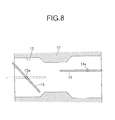
- FIG. 8 is a sectional view when the engine warm-up is completed, and corresponds to FIG. 3 .
- the carburetor is for a general-purpose engine to be mounted on a snowplow truck or the like, which is used in an extremely low temperature, high humidity environment, and, from the upstream side in an air intake direction 13, a butterfly-type choke valve 14 and a butterfly-type throttle valve 15 are placed, in this order, in an air intake path 12 provided in a carburetor main body 11.
- the choke valve 14 is fixedly attached to a choke valve shaft 14a which is rotatably supported by the carburetor main body 11 in a way that makes the choke valve shaft 14a traverse the air intake path 12.
- the throttle valve 15 is fixedly attached to a throttle valve shaft 15a which is rotatably supported by the carburetor main body 11 in a way that makes the throttle valve shaft 15a traverse the air intake path 12.
- the carburetor main body 11 is provided with an accommodation recess 16, which is arranged at a side of the air intake path 12, in a way that makes the accommodation recess 16 opened toward a lateral surface of the carburetor main body 11.
- An open end of the accommodation recess 16 is closed by a lid member (not illustrated), which is detachably attached to the carburetor main body 11.
- An electric motor 17, a throttle valve opening/closing mechanism 18, and a choke valve opening/closing mechanism 19 are accommodated in the accommodation recess 16.
- the electric motor 17 serves as an electric actuator.
- the throttle valve opening/closing mechanism 18 is provided between the electric motor 17 and the throttle valve shaft 15a of the throttle valve 15 in a way that makes the throttle valve opening/closing mechanism 18 open and close the throttle valve 15 in accordance with the operation of the electric motor 17.
- the choke valve opening /closing mechanism 19 is driven by a power exerted by the electric motor 17, and opens and closes the choke valve 14.
- the electric motor 17 is accommodated in and fixed to the inside of the accommodation recess 16 with a motor shaft 21 of the electric motor 17 situated in parallel with an axis of the choke valve shaft 14a and an axis of the throttle valve shaft 15a.
- the throttle valve opening/closing mechanism 18 includes a drive gear 22 provided to the motor shaft 21 of the electric motor 17, a first idle gear 23 in mesh with the drive gear 22, a second idle gear 24 configured to rotate integrally with the first idle gear 23, and a driven gear 25 fixedly attached to the throttle valve shaft 15a, and in mesh with the second idle gear 24.
- the first and second idle gears 23, 24 are sector gears commonly provided to a gear member 27, which is rotatably supported by a first pivot 26 having an axis in parallel with the motor shaft 21 and provided to the carburetor main body 11.
- the driven gear 25 is formed as a sector gear as well.
- the choke valve opening/closing mechanism 19 is provided between the gear member 27 and the choke valve shaft 14a of the choke valve 14.
- the cam 28 is formed in the inner surface side of the gear member 27 around the first pivot 26.
- the choke valve opening/closing mechanism 19 includes a cam follower 30, a first arm 31, a torsion spring 32 and a second arm 33.
- the cam follower 30 is rotatably supported by a second pivot 29, which has an axis in parallel with the first pivot 26 and which is provided to the carburetor main body 11.
- the cam follower 30 includes a cam slide-contact portion 30a which is in slide contact with the cam 28.
- a first end portion of the first arm 31 is rotatably supported by the second pivot 29.
- the torsion spring 32 is provided between a base end portion of the first arm 31 and the cam follower 30.
- the second arm 33 is fixedly attached to the choke valve shaft 14a and is linked and connected to a second end portion of the first arm 31.
- the first arm 31 is formed in an elongated shape extending in a radial direction of the second pivot 29.
- An elongated hole 34 which extends long in the radial direction of the second pivot 29, is provided in the second end portion of the first arm 31.
- the second arm 33 is formed of a substantially V-shape in a way that an intermediate portion of the second arm 33 is rotatably supported by the second pivot 29.
- the first and second arms 31, 33 are linked and connected to each other by inserting a pin 35, which is provided in a first end portion of the second arm 33, in the elongated hole 34. Accordingly, the rotation of the first arm 31 about the axis of the second pivot 29 in an opening direction 37 (see FIG. 4 ), which is a counterclockwise direction in FIGS. 2 and 4 , makes the second arm 33 rotate in a clockwise direction in FIGS. 2 and 4 . Thereby, the choke valve 14 is rotatably driven toward an open side.
- the cam follower 30 rotates in the counterclockwise direction about the axis of the second pivot 29 in FIG. 2 when the electric motor 17 operates the throttle valve 15 in a direction in which the throttle valve 15 rotates toward an open side; thus, the gear member 27 rotates in the counterclockwise direction in FIG. 2 ; and thereby, the cam slide-contact portion 30a comes into slide contact with the cam 28 provided to the gear member 27.
- the torsion spring 32 surrounding the second pivot 29 exerts a spring force which biases the cam follower 30 in a direction in which the cam slide-contact portion 30a comes into slide contact with the cam 28, that is to say, in the counterclockwise direction in FIG.
- the cam follower 30 and the first arm 31 are respectively provided with contact surfaces 30b, 31a which come into contact with each other due to the spring force exerted by the torsion spring 32.
- the choke valve shaft 14a is placed in a location offset from the center of the air intake path 12 toward one side; and while fully closed, the choke valve 14 is put in a state of inclining to a center axis of the air intake path 12 in a way that a portion of the choke valve 14 that is larger in the radius of rotation is situated downstream of the other portion of the choke valve 14 which is smaller in the radius of rotation in the air intake path 12.
- the choke valve opening/closing mechanism 19 opens the choke valve 14 up to a position in which the difference between the rotation moment acting on the portion of the choke valve 14, which is larger in the radius of rotation, due to the intake air pressure and the rotation moment acting on the other portion of the choke valve 14, which is smaller in the radius of rotation, due to the intake air pressure comes to balance with the rotation moment generated by the torsion spring 32.
- the first arm 31 and the torsion spring 32 serve as a relief mechanism 36 for rotating the choke valve 14 toward an open side in accordance with the sharp increase in the load while the choke valve 14 is set between the fully-closed position and the semi-opened position.
- thermo-actuator 40 configured to operate in accordance with ambient temperature is accommodated in and fixed to the accommodation recess 16 of the carburetor main body 11.
- This thermo-actuator 40 is formed from a case 41 in which wax (not illustrated) is included, and a piston 42 projects from the case 41. The amount the piston 42 projects from the case 41 increases in accordance with the rise in the ambient temperature.
- thermo-actuator 40 is capable of driving the choke valve 14 toward an open side.
- a choke valve forcedly-closing device 43 which enables the choke valve 14 to be rotated toward a close side through its manual operation from outside the carburetor, is annexed to the carburetor main body 11.
- the choke valve forcedly-closing device 43 includes an operation lever 45 whose intermediate portion is rotatably supported by a third pivot 44 provided to the carburetor main body 11, a pressure receiving pin 46 with which a first end portion of the operation lever 45 is capable of coming in contact inside the accommodation recess 16, and which is provided to a second end portion of the second arm 33, and a return spring (not illustrated) provided between the carburetor main body 11 and the operation lever 45 in a way that makes the return spring bias the operation lever 45 in a direction in which the first end portion of the operation lever 45 is caused to come away from the pressure receiving pin 46.
- the operation lever 45 brings its first end portion into contact with the pressure receiving pin 46 of the second arm 33, and is thereby capable of forcedly rotating the second arm 33 in the counterclockwise direction in FIG. 2 , that is to say, in a direction in which the choke valve 14 closes.
- the operation of the electric motor 17 is controlled by a controller 48 on the basis of a value detected by revolution speed detector 47 for detecting the condition of revolutions of the engine.
- a battery 49 supplies an electric power to the controller 48 and the electric motor 17.
- the cam 28 is formed in a way that when the engine is stopped, the controller 48 controls the operation of the electric motor 17, and thereby operates the throttle valve opening/closing mechanism 18 and the choke valve opening/closing mechanism 19 in order that, as shown in FIGS. 2 and 3 , the throttle valve 15 is set in the fully-opened position, while the choke valve 14 is set in the semi-opened position.
- the controller 48 controls the operation of the electric motor 17, and thereby operates the throttle valve opening/closing mechanism 18 and the choke valve opening/closing mechanism 19 in order that, as shown in FIG. 6 , the throttle valve 15 is set in an over fully-opened position, while the choke valve 14 is set in the fully-closed position.
- the controller 48 controls the operation of the electric motor 17, as well as thereby operates the throttle valve opening/closing mechanism 18 in order that, as shown in FIG. 7 , the opening degree of the throttle valve 15 is made variable, and the operation of the choke valve opening/closing mechanism 19 in conjunction with the operation of the throttle valve opening/closing mechanism 18 makes the choke valve 14 rotate between the fully-closed position and the semi-opened position in accordance with the opening degree of the throttle valve 15.
- the controller 48 to which the battery 49 supplies the electric power, operates the electric motor 17 and the choke valve opening/closing mechanism 19 in order that when the engine is stopped, the choke valve 14 is set in the semi-opened position and, when the engine starts to be cranked, the choke valve 14 is set in the fully-closed position. For this reason, even if the choke valve shaft 14a of the choke valve 14 freezes up while the engine is being stopped, the amount of air does not become smaller than needed immediately after the engine is started, and the engine stall is avoided. Accordingly, the marketability can be enhanced.
- the use of the choke valve forcedly-closing device 43 enables the choke valve 14 to be rotated toward a close side through the manual operation from outside the carburetor. For this reason, even if the choke valve shaft 14a of the choke valve 14 freezes up with the choke valve 14 semi-opened, the choke valve shaft 14a can be released from its freeze-up condition by forcedly rotating the choke valve 14 toward a close side.
- the throttle valve opening/closing mechanism 18 for opening and closing the throttle valve 15 in accordance with the operation of the electric motor 17 is provided between the electric motor 17 and the throttle valve 15.
- the choke valve opening/closing mechanism 19 includes, as one component, the cam 28 provided to the gear member 27 constituting a part of the throttle valve opening/closing mechanism 18, and is provided between the gear member 27 and the choke valve 14.
- the electric motor 17 can be commonly used between the throttle valve opening/closing mechanism 18 and the choke valve opening/closing mechanism 19. Accordingly, it is possible to reduce the parts in number, and to build the automatic choke apparatus in a compact size.
- the cam 28 of the choke valve opening/closing mechanism 19 is formed in a way that makes the choke valve 14 operate between the fully-closed position and the semi-opened position in accordance with the opening degree of the throttle valve 15 while the engine is being warmed up. For this reason, the engine can be started in a satisfactory condition by matching the opening degree of the choke valve 14 with the opening degree of the throttle valve 15 while the engine is being warmed up.
- the choke valve 14 is driven toward an open side in accordance with the ambient temperature by the thermo-actuator 40, which operates independently of the choke valve opening/closing mechanism 19, and while the warm-up is completed, the choke valve 14 is held in the fully-opened state, as shown in FIG. 8 .
- the engine can be started in accordance with the external environment by adjusting the opening degree of the choke valve 14 in accordance with the ambient temperature.
- the air-to-fuel ratio can be adjusted in accordance with the load by making the choke valve 14 rotate toward an open side in conjunction with the working of the relief mechanism 36.
- An automatic choke apparatus for a carburetor includes an electric actuator, a choke valve opening/closing mechanism configured to open and close a choke valve by being driven by a power exerted by the electric actuator, and a controller configured to control operation of the electric actuator.
- the controller to which a battery supplies electric power, operates the electric actuator and the choke valve opening/closing mechanism in order that, when the engine is stopped, the choke valve is set in a semi-opened position and, when the engine starts to be cranked, the choke valve is set in a fully-closed position. Accordingly, it is possible to prevent the choke valve from freezing up in the fully-closed state in a case where the engine is stopped under an extremely low temperature environment.
Landscapes
- Engineering & Computer Science (AREA)
- Chemical & Material Sciences (AREA)
- Combustion & Propulsion (AREA)
- Mechanical Engineering (AREA)
- General Engineering & Computer Science (AREA)
- Means For Warming Up And Starting Carburetors (AREA)
Abstract
Description
- The present invention generally relates to an automatic choke apparatus for a carburetor and, more particularly, to an automatic choke apparatus for a carburetor that is suitable for use in a general-purpose engine.
- Japanese Patent Application Laid-open No.
2007-2752 - Meanwhile, the automatic choke apparatus for a carburetor, which is disclosed by Japanese Patent Application Laid-open No.
2007-2752 - The present invention has been made with the foregoing situation taken into consideration. The present invention is directed toward providing an automatic choke apparatus that prevents a choke valve from freezing up in a fully-closed state when an engine is stopped in an extremely low temperature environment.
- According to a first feature of the present invention, an automatic choke apparatus for a carburetor includes an electric actuator, a choke valve opening/closing mechanism configured to open and close a choke valve by being driven by a power exerted by the electric actuator, and a controller configured to control operation of the electric actuator. The automatic choke apparatus also includes a battery configured to supply electric power to the controller and the electric actuator. The controller operates the electric actuator and the choke valve opening/closing mechanism such that the choke valve is set in a semi-opened position when an engine is stopped and the choke valve is set in a fully-closed position when the engine starts to be cranked.
- With the first feature of the present invention, the choke valve is set in the semi-opened position when the engine is stopped, and in the fully-closed position when the engine starts to be cranked. For this reason, even if a valve shaft of the choke valve freezes up while the engine is being stopped (i.e., in the semi-opened position), the amount of air does not become smaller than needed immediately after the engine is started, and the engine stall is avoided. Accordingly, the marketability can be enhanced.
- According to a second feature of the present invention, in addition to the first feature, the automatic choke apparatus for a carburetor further includes a throttle valve opening/closing mechanism configured to open and close a throttle valve in accordance with operation of the electric actuator, and provided between the electric actuator and the throttle valve. The choke valve opening/closing mechanism includes, as one component, a cam provided to an operation member constituting a part of the throttle valve opening/closing mechanism, and is provided between the operation member and the choke valve. The cam is formed such that, while the engine is being warmed up, the choke valve is operated between the fully-closed position and the semi-opened position, in accordance with an opening degree of the throttle valve.
- With the second feature of the present invention, the electric actuator is commonly used between the throttle valve opening/closing mechanism for opening and closing the throttle valve and the choke valve opening/closing mechanism. For this reason, it is possible to reduce the number of parts, and to build the automatic choke apparatus in a compact size. Further, the choke valve opening/closing mechanism operates the choke valve between the fully-closed position and the semi-opened position in accordance with an opening degree of the throttle valve while the engine is being warmed up. For this reason, the engine can be started in a satisfactory condition by matching the opening degree of the choke valve with the opening degree of the throttle valve while the engine is being warmed up.
- According to a third feature of the present invention, in addition to the first or second feature, the automatic choke apparatus for a carburetor further includes a thermo-actuator configured to drive the choke valve toward an open side in accordance with ambient temperature independently of the choke valve opening/closing mechanism.
- With the third feature of the present invention, the choke valve is driven toward an open side by the thermo-actuator in accordance with the ambient temperature. For this reason, the opening degree of the choke valve can be adjusted in accordance with the ambient temperature, and the engine can be started in accordance with the external environment.
- According to a fourth feature of the present invention, in addition to any one of the first to third features, the automatic choke apparatus for a carburetor further includes a relief mechanism configured to rotate the choke valve toward an open side in accordance with a sharp increase in load while the choke valve is between the fully-closed position and the semi-opened position.
- With the fourth feature of the present invention, the relief mechanism rotates the choke valve toward an open side if the load sharply increases when the choke valve is set between the fully-closed position and the semi-opened position. For this reason, the air-to-fuel ratio can be adjusted in accordance with the load.
- According to a fifth feature of the present invention, in addition to any one of the first to fourth features, the automatic choke apparatus for a carburetor further includes a choke valve forcedly-closing device that enables the choke valve to be rotated toward a close side through manual operation from outside the carburetor.
- With the fifth feature of the present invention, the choke valve can be rotated toward a close side by use of the choke valve forcedly-closing device. For this reason, even if the valve shaft of the choke valve freezes up with the choke valve being semi-opened, the valve shaft can be released from its freeze-up state by forcedly rotating the choke valve toward a close side.
- The above and other objects, characteristics and advantages of the present invention will be clear from detailed descriptions of the preferred embodiment which will be provided below while referring to the attached drawings.
-
FIG. 1 is a front view of a carburetor while an engine is stopped, and is a view seen from a direction indicated by anarrow 1 inFIG. 2 ; -
FIG. 2 is a side view seen from a line 2-2 inFIG. 1 ; -
FIG. 3 is an enlarged cross-sectional view taken along a line 3-3 inFIG. 1 ; -
FIG. 4 is a view showing a part of a choke valve opening/closing mechanism which is seen in the same direction ofFIG. 2 ; -
FIG. 5 is a diagram showing a configuration of a control system; -
FIG. 6 is a sectional view when the engine starts to be cranked, and corresponds toFIG. 3 ; -
FIG. 7 is a sectional view while the engine is being warmed up, and corresponds toFIG. 3 ; and -
FIG. 8 is a sectional view when the engine warm-up is completed, and corresponds toFIG. 3 . - Descriptions will be hereinbelow provided for an embodiment of the present invention while referring to the attached drawings. First of all, in
FIGS. 1 to 3 , the carburetor is for a general-purpose engine to be mounted on a snowplow truck or the like, which is used in an extremely low temperature, high humidity environment, and, from the upstream side in anair intake direction 13, a butterfly-type choke valve 14 and a butterfly-type throttle valve 15 are placed, in this order, in anair intake path 12 provided in a carburetormain body 11. Thechoke valve 14 is fixedly attached to achoke valve shaft 14a which is rotatably supported by the carburetormain body 11 in a way that makes thechoke valve shaft 14a traverse theair intake path 12. Thethrottle valve 15 is fixedly attached to athrottle valve shaft 15a which is rotatably supported by the carburetormain body 11 in a way that makes thethrottle valve shaft 15a traverse theair intake path 12. - As shown in
FIG. 2 , the carburetormain body 11 is provided with anaccommodation recess 16, which is arranged at a side of theair intake path 12, in a way that makes the accommodation recess 16 opened toward a lateral surface of the carburetormain body 11. An open end of theaccommodation recess 16 is closed by a lid member (not illustrated), which is detachably attached to the carburetormain body 11. - An
electric motor 17, a throttle valve opening/closing mechanism 18, and a choke valve opening/closing mechanism 19 are accommodated in theaccommodation recess 16. Theelectric motor 17 serves as an electric actuator. The throttle valve opening/closing mechanism 18 is provided between theelectric motor 17 and thethrottle valve shaft 15a of thethrottle valve 15 in a way that makes the throttle valve opening/closing mechanism 18 open and close thethrottle valve 15 in accordance with the operation of theelectric motor 17. The choke valve opening /closing mechanism 19 is driven by a power exerted by theelectric motor 17, and opens and closes thechoke valve 14. - The
electric motor 17 is accommodated in and fixed to the inside of the accommodation recess 16 with amotor shaft 21 of theelectric motor 17 situated in parallel with an axis of thechoke valve shaft 14a and an axis of thethrottle valve shaft 15a. In addition, the throttle valve opening/closing mechanism 18 includes adrive gear 22 provided to themotor shaft 21 of theelectric motor 17, afirst idle gear 23 in mesh with thedrive gear 22, asecond idle gear 24 configured to rotate integrally with thefirst idle gear 23, and a drivengear 25 fixedly attached to thethrottle valve shaft 15a, and in mesh with thesecond idle gear 24. The first andsecond idle gears gear member 27, which is rotatably supported by afirst pivot 26 having an axis in parallel with themotor shaft 21 and provided to the carburetormain body 11. The drivengear 25 is formed as a sector gear as well. - Moreover, as one component, a
cam 28 provided to thegear member 27, which is an operational member constituting a part of the throttle valve opening/closing mechanism 18, is included in the choke valve opening/closing mechanism 19. The choke valve opening/closing mechanism 19 is provided between thegear member 27 and thechoke valve shaft 14a of thechoke valve 14. Thecam 28 is formed in the inner surface side of thegear member 27 around thefirst pivot 26. - Referring to
FIGS. 2 and4 , the choke valve opening/closing mechanism 19 includes acam follower 30, afirst arm 31, atorsion spring 32 and asecond arm 33. Thecam follower 30 is rotatably supported by asecond pivot 29, which has an axis in parallel with thefirst pivot 26 and which is provided to the carburetormain body 11. In addition, thecam follower 30 includes a cam slide-contact portion 30a which is in slide contact with thecam 28. A first end portion of thefirst arm 31 is rotatably supported by thesecond pivot 29. Thetorsion spring 32 is provided between a base end portion of thefirst arm 31 and thecam follower 30. Thesecond arm 33 is fixedly attached to thechoke valve shaft 14a and is linked and connected to a second end portion of thefirst arm 31. - The
first arm 31 is formed in an elongated shape extending in a radial direction of thesecond pivot 29. Anelongated hole 34, which extends long in the radial direction of thesecond pivot 29, is provided in the second end portion of thefirst arm 31. On the other hand, thesecond arm 33 is formed of a substantially V-shape in a way that an intermediate portion of thesecond arm 33 is rotatably supported by thesecond pivot 29. The first andsecond arms pin 35, which is provided in a first end portion of thesecond arm 33, in theelongated hole 34. Accordingly, the rotation of thefirst arm 31 about the axis of thesecond pivot 29 in an opening direction 37 (seeFIG. 4 ), which is a counterclockwise direction inFIGS. 2 and4 , makes thesecond arm 33 rotate in a clockwise direction inFIGS. 2 and4 . Thereby, thechoke valve 14 is rotatably driven toward an open side. - The
cam follower 30 rotates in the counterclockwise direction about the axis of thesecond pivot 29 inFIG. 2 when theelectric motor 17 operates thethrottle valve 15 in a direction in which thethrottle valve 15 rotates toward an open side; thus, thegear member 27 rotates in the counterclockwise direction inFIG. 2 ; and thereby, the cam slide-contact portion 30a comes into slide contact with thecam 28 provided to thegear member 27. Thetorsion spring 32 surrounding thesecond pivot 29 exerts a spring force which biases thecam follower 30 in a direction in which the cam slide-contact portion 30a comes into slide contact with thecam 28, that is to say, in the counterclockwise direction inFIG. 2 , and thus rotatably biases thefirst arm 31 in the counterclockwise direction about the axis of thesecond pivot 29 inFIG. 2 . Thecam follower 30 and thefirst arm 31 are respectively provided withcontact surfaces torsion spring 32. - For this reason, while in response to the rotation of the
gear member 27, thecam follower 30 rotates in the counterclockwise direction inFIG. 2 , thefirst arm 31 rotates following thecam follower 30 due to the spring force exerted by thetorsion spring 32. While with the cam slide-contact portion 30a in slide contact with thecam 28, thefirst arm 31 rotates in the clockwise direction inFIG. 2 , that is to say, in a direction in which thechoke valve 14 opens, thefirst arm 31 alone rotates in the clockwise direction inFIG. 2 . - Meanwhile, as clearly shown in
FIGS. 2 and3 , thechoke valve shaft 14a is placed in a location offset from the center of theair intake path 12 toward one side; and while fully closed, thechoke valve 14 is put in a state of inclining to a center axis of theair intake path 12 in a way that a portion of thechoke valve 14 that is larger in the radius of rotation is situated downstream of the other portion of thechoke valve 14 which is smaller in the radius of rotation in theair intake path 12. For this reason, if an intake air pressure of the engine sharply increases and exceeds a predetermined value while thechoke valve 14 is opened at a degree between the fully-closed position and a semi-opened position, the choke valve opening/closing mechanism 19 opens thechoke valve 14 up to a position in which the difference between the rotation moment acting on the portion of thechoke valve 14, which is larger in the radius of rotation, due to the intake air pressure and the rotation moment acting on the other portion of thechoke valve 14, which is smaller in the radius of rotation, due to the intake air pressure comes to balance with the rotation moment generated by thetorsion spring 32. In other words, thefirst arm 31 and thetorsion spring 32 serve as arelief mechanism 36 for rotating thechoke valve 14 toward an open side in accordance with the sharp increase in the load while thechoke valve 14 is set between the fully-closed position and the semi-opened position. - Furthermore, a thermo-
actuator 40 configured to operate in accordance with ambient temperature is accommodated in and fixed to theaccommodation recess 16 of the carburetormain body 11. This thermo-actuator 40 is formed from acase 41 in which wax (not illustrated) is included, and apiston 42 projects from thecase 41. The amount thepiston 42 projects from thecase 41 increases in accordance with the rise in the ambient temperature. - Moreover, a tip end portion of the
piston 42 is capable of coming into contact with apressure receiving portion 30c that is provided to thecam follower 30. Thecam follower 30 rotates in the counterclockwise direction about the axis of thesecond pivot 29 inFIG. 2 according as thepressure receiving portion 30c is pressed by thepiston 42. Thereby, independently of the choke valve opening/closing mechanism 19, the thermo-actuator 40 is capable of driving thechoke valve 14 toward an open side. - A choke valve forcedly-closing
device 43, which enables thechoke valve 14 to be rotated toward a close side through its manual operation from outside the carburetor, is annexed to the carburetormain body 11. The choke valve forcedly-closingdevice 43 includes anoperation lever 45 whose intermediate portion is rotatably supported by athird pivot 44 provided to the carburetormain body 11, apressure receiving pin 46 with which a first end portion of theoperation lever 45 is capable of coming in contact inside theaccommodation recess 16, and which is provided to a second end portion of thesecond arm 33, and a return spring (not illustrated) provided between the carburetormain body 11 and theoperation lever 45 in a way that makes the return spring bias theoperation lever 45 in a direction in which the first end portion of theoperation lever 45 is caused to come away from thepressure receiving pin 46. For this reason, when an operation force is applied to a second end portion of theoperation lever 45 projecting out of the carburetormain body 11, theoperation lever 45 brings its first end portion into contact with thepressure receiving pin 46 of thesecond arm 33, and is thereby capable of forcedly rotating thesecond arm 33 in the counterclockwise direction inFIG. 2 , that is to say, in a direction in which thechoke valve 14 closes. - In
FIG. 5 , the operation of theelectric motor 17 is controlled by acontroller 48 on the basis of a value detected byrevolution speed detector 47 for detecting the condition of revolutions of the engine. Abattery 49 supplies an electric power to thecontroller 48 and theelectric motor 17. - The
cam 28 is formed in a way that when the engine is stopped, thecontroller 48 controls the operation of theelectric motor 17, and thereby operates the throttle valve opening/closing mechanism 18 and the choke valve opening/closing mechanism 19 in order that, as shown inFIGS. 2 and3 , thethrottle valve 15 is set in the fully-opened position, while thechoke valve 14 is set in the semi-opened position. When the engine starts to be cranked, thecontroller 48 controls the operation of theelectric motor 17, and thereby operates the throttle valve opening/closing mechanism 18 and the choke valve opening/closing mechanism 19 in order that, as shown inFIG. 6 , thethrottle valve 15 is set in an over fully-opened position, while thechoke valve 14 is set in the fully-closed position. While the engine being warmed up, thecontroller 48 controls the operation of theelectric motor 17, as well as thereby operates the throttle valve opening/closing mechanism 18 in order that, as shown inFIG. 7 , the opening degree of thethrottle valve 15 is made variable, and the operation of the choke valve opening/closing mechanism 19 in conjunction with the operation of the throttle valve opening/closing mechanism 18 makes thechoke valve 14 rotate between the fully-closed position and the semi-opened position in accordance with the opening degree of thethrottle valve 15. - Next, descriptions will be provided for how the embodiment works. The
controller 48, to which thebattery 49 supplies the electric power, operates theelectric motor 17 and the choke valve opening/closing mechanism 19 in order that when the engine is stopped, thechoke valve 14 is set in the semi-opened position and, when the engine starts to be cranked, thechoke valve 14 is set in the fully-closed position. For this reason, even if thechoke valve shaft 14a of thechoke valve 14 freezes up while the engine is being stopped, the amount of air does not become smaller than needed immediately after the engine is started, and the engine stall is avoided. Accordingly, the marketability can be enhanced. - In addition, the use of the choke valve forcedly-closing
device 43 enables thechoke valve 14 to be rotated toward a close side through the manual operation from outside the carburetor. For this reason, even if thechoke valve shaft 14a of thechoke valve 14 freezes up with thechoke valve 14 semi-opened, thechoke valve shaft 14a can be released from its freeze-up condition by forcedly rotating thechoke valve 14 toward a close side. - Besides, the throttle valve opening/
closing mechanism 18 for opening and closing thethrottle valve 15 in accordance with the operation of theelectric motor 17 is provided between theelectric motor 17 and thethrottle valve 15. The choke valve opening/closing mechanism 19 includes, as one component, thecam 28 provided to thegear member 27 constituting a part of the throttle valve opening/closing mechanism 18, and is provided between thegear member 27 and thechoke valve 14. For these reasons, theelectric motor 17 can be commonly used between the throttle valve opening/closing mechanism 18 and the choke valve opening/closing mechanism 19. Accordingly, it is possible to reduce the parts in number, and to build the automatic choke apparatus in a compact size. - In addition, the
cam 28 of the choke valve opening/closing mechanism 19 is formed in a way that makes thechoke valve 14 operate between the fully-closed position and the semi-opened position in accordance with the opening degree of thethrottle valve 15 while the engine is being warmed up. For this reason, the engine can be started in a satisfactory condition by matching the opening degree of thechoke valve 14 with the opening degree of thethrottle valve 15 while the engine is being warmed up. - Furthermore, the
choke valve 14 is driven toward an open side in accordance with the ambient temperature by the thermo-actuator 40, which operates independently of the choke valve opening/closing mechanism 19, and while the warm-up is completed, thechoke valve 14 is held in the fully-opened state, as shown inFIG. 8 . For this reason, the engine can be started in accordance with the external environment by adjusting the opening degree of thechoke valve 14 in accordance with the ambient temperature. - Moreover, if the load sharply increases while the
choke valve 14 is set between the fully-closed position and the semi-opened position with the engine put in the warm-up condition, the air-to-fuel ratio can be adjusted in accordance with the load by making thechoke valve 14 rotate toward an open side in conjunction with the working of therelief mechanism 36. - An embodiment of the present invention is explained above, but the present invention is not limited to the above-mentioned embodiment and may be modified in a variety of ways as long as the modifications do not depart from its gist.
- An automatic choke apparatus for a carburetor includes an electric actuator, a choke valve opening/closing mechanism configured to open and close a choke valve by being driven by a power exerted by the electric actuator, and a controller configured to control operation of the electric actuator. The controller, to which a battery supplies electric power, operates the electric actuator and the choke valve opening/closing mechanism in order that, when the engine is stopped, the choke valve is set in a semi-opened position and, when the engine starts to be cranked, the choke valve is set in a fully-closed position. Accordingly, it is possible to prevent the choke valve from freezing up in the fully-closed state in a case where the engine is stopped under an extremely low temperature environment.
Claims (15)
- An automatic choke apparatus for a carburetor, including:an electric actuator;a choke valve opening/closing mechanism configured to open and close a choke valve by being driven by a power exerted by the electric actuator; anda controller configured to control operation of the electric actuator,
whereinthe automatic choke apparatus further comprises a battery configured to supply electric power to the controller and the electric actuator, andthe controller operates the electric actuator and the choke valve opening/closing mechanism in order that: the choke valve is set in a semi-opened position when an engine is stopped; and the choke valve is set in a fully-closed position when the engine starts to be cranked. - The automatic choke apparatus for a carburetor according to claim 1, further comprising a throttle valve opening/closing mechanism configured to open and close a throttle valve in accordance with operation of the electric actuator, and provided between the electric actuator and the throttle valve, wherein
the choke valve opening/closing mechanism includes, as one component, a cam provided to an operation member constituting a part of the throttle valve opening/closing mechanism, and disposed between the operation member and the choke valve, and
the cam is formed in order that while the engine is being warmed up, the choke valve is operated between the fully-closed position and the semi-opened position in accordance with an opening degree of the throttle valve. - The automatic choke apparatus for a carburetor according to claim 1, further comprising a thermo-actuator configured to drive the choke valve toward an open side in accordance with ambient temperature independently of the choke valve opening/closing mechanism.
- The automatic choke apparatus for a carburetor according to claim 1, further comprising a relief mechanism configured to rotate the choke valve toward an open side in accordance with a sharp increase in load while the choke valve is between the fully-closed position and the semi-opened position.
- The automatic choke apparatus for a carburetor according to claim 1, further comprising choke valve forcedly-closing device that enables the choke valve to be rotated toward a close side through manual operation from outside the carburetor.
- The automatic choke apparatus for a carburetor according to claim 2, further comprising a thermo-actuator configured to drive the choke valve toward an open side in accordance with ambient temperature independently of the choke valve opening/closing mechanism.
- The automatic choke apparatus for a carburetor according to claim 2, further comprising a relief mechanism configured to rotate the choke valve toward an open side in accordance with a sharp increase in load while the choke valve is between the fully-closed position and the semi-opened position.
- The automatic choke apparatus for a carburetor according to claim 2, further comprising choke valve forcedly-closing device that enables the choke valve to be rotated toward a close side through manual operation from outside the carburetor.
- The automatic choke apparatus for a carburetor according to claim 3, further comprising a relief mechanism configured to rotate the choke valve toward an open side in accordance with a sharp increase in load while the choke valve is between the fully-closed position and the semi-opened position.
- The automatic choke apparatus for a carburetor according to claim 3, further comprising choke valve forcedly-closing device that enables the choke valve to be rotated toward a close side through manual operation from outside the carburetor.
- The automatic choke apparatus for a carburetor according to claim 4, further comprising choke valve forcedly-closing device that enables the choke valve to be rotated toward a close side through manual operation from outside the carburetor.
- The automatic choke apparatus for a carburetor according to claim 6, further comprising a relief mechanism configured to rotate the choke valve toward an open side in accordance with a sharp increase in load while the choke valve is between the fully-closed position and the semi-opened position.
- The automatic choke apparatus for a carburetor according to claim 6, further comprising choke valve forcedly-closing device that enables the choke valve to be rotated toward a close side through manual operation from outside the carburetor.
- The automatic choke apparatus for a carburetor according to claim 7, further comprising choke valve forcedly-closing device that enables the choke valve to be rotated toward a close side through manual operation from outside the carburetor.
- The automatic choke apparatus for a carburetor according to claim 9, further comprising choke valve forcedly-closing device that enables the choke valve to be rotated toward a close side through manual operation from outside the carburetor.
Applications Claiming Priority (1)
| Application Number | Priority Date | Filing Date | Title |
|---|---|---|---|
| JP2010292947A JP5426529B2 (en) | 2010-12-28 | 2010-12-28 | Auto choke device for carburetor for general purpose engine |
Publications (2)
| Publication Number | Publication Date |
|---|---|
| EP2472086A1 true EP2472086A1 (en) | 2012-07-04 |
| EP2472086B1 EP2472086B1 (en) | 2013-07-17 |
Family
ID=45047618
Family Applications (1)
| Application Number | Title | Priority Date | Filing Date |
|---|---|---|---|
| EP20110189745 Active EP2472086B1 (en) | 2010-12-28 | 2011-11-18 | Automatic choke apparatus for carburetor |
Country Status (4)
| Country | Link |
|---|---|
| US (1) | US8783664B2 (en) |
| EP (1) | EP2472086B1 (en) |
| JP (1) | JP5426529B2 (en) |
| CA (1) | CA2758553C (en) |
Cited By (2)
| Publication number | Priority date | Publication date | Assignee | Title |
|---|---|---|---|---|
| EP2789846A1 (en) * | 2013-04-09 | 2014-10-15 | Honda Motor Co., Ltd. | Control apparatus for a battery-less internal combustion engine with a centrifugal clutch, an electronically controlled ignition and an electronically controlled throttle |
| WO2017129222A1 (en) * | 2016-01-25 | 2017-08-03 | Husqvarna Ab | Internal combustion engine provided with a semi-automatic choke device |
Families Citing this family (8)
| Publication number | Priority date | Publication date | Assignee | Title |
|---|---|---|---|---|
| JP5204281B2 (en) * | 2011-09-20 | 2013-06-05 | 富士重工業株式会社 | Engine operation control device |
| US10215130B2 (en) | 2012-02-10 | 2019-02-26 | Briggs & Stratton Corporation | Choke override for an engine |
| US9429107B2 (en) * | 2013-02-22 | 2016-08-30 | Briggs & Stratton Corporation | Solenoid autochoke for an engine |
| US9464588B2 (en) * | 2013-08-15 | 2016-10-11 | Kohler Co. | Systems and methods for electronically controlling fuel-to-air ratio for an internal combustion engine |
| EP2868900B1 (en) * | 2013-11-05 | 2017-07-26 | MANN+HUMMEL GmbH | Control system of at least one flap of a fluid duct and fluid duct system |
| US10054081B2 (en) | 2014-10-17 | 2018-08-21 | Kohler Co. | Automatic starting system |
| US9945326B2 (en) | 2015-05-07 | 2018-04-17 | Briggs & Stratton Corporation | Automatic choking mechanism for internal combustion engines |
| US9932936B2 (en) | 2015-11-11 | 2018-04-03 | Briggs & Stratton Corporation | Carburetor choke removal mechanism for pressure washers |
Citations (6)
| Publication number | Priority date | Publication date | Assignee | Title |
|---|---|---|---|---|
| EP0221364A2 (en) * | 1985-10-04 | 1987-05-13 | Hitachi, Ltd. | Automatic control apparatus for engine throttle valves |
| EP1630390A1 (en) * | 2004-08-18 | 2006-03-01 | HONDA MOTOR CO., Ltd. | Carburetor choke valve electronic control system |
| US20060042595A1 (en) * | 2004-08-26 | 2006-03-02 | Honda Motor Co., Ltd. | Carburetor electrically-operated automatic choke system |
| JP2007002752A (en) | 2005-06-23 | 2007-01-11 | Honda Motor Co Ltd | Electronic controller for vaporizer |
| DE102005040140A1 (en) * | 2005-08-25 | 2007-03-01 | Daimlerchrysler Ag | Device for controlling hydrocarbon emissions from air suction line of internal combustion (IC) engine, opens or closes butterfly valve in suction line when butterfly valve temperature is below or above given temperature |
| EP2128420A2 (en) * | 2008-05-27 | 2009-12-02 | Briggs and Stratton Corporation | Engine with an automatic choke and method of operating an automatic choke for an engine |
Family Cites Families (4)
| Publication number | Priority date | Publication date | Assignee | Title |
|---|---|---|---|---|
| JPS5996463A (en) * | 1982-11-24 | 1984-06-02 | Mikuni Kogyo Co Ltd | Electronic control type auto-choke valve |
| US6752110B2 (en) * | 2002-09-20 | 2004-06-22 | Briggs & Stratton Corporation | Electromechanical choke system for an internal combustion engine |
| JP4129243B2 (en) * | 2004-03-03 | 2008-08-06 | 本田技研工業株式会社 | Choke valve control device for carburetor in power working machine |
| JP5058058B2 (en) * | 2008-04-25 | 2012-10-24 | 本田技研工業株式会社 | General-purpose internal combustion engine |
-
2010
- 2010-12-28 JP JP2010292947A patent/JP5426529B2/en not_active Expired - Fee Related
-
2011
- 2011-11-17 CA CA2758553A patent/CA2758553C/en not_active Expired - Fee Related
- 2011-11-18 EP EP20110189745 patent/EP2472086B1/en active Active
- 2011-12-07 US US13/313,552 patent/US8783664B2/en active Active
Patent Citations (6)
| Publication number | Priority date | Publication date | Assignee | Title |
|---|---|---|---|---|
| EP0221364A2 (en) * | 1985-10-04 | 1987-05-13 | Hitachi, Ltd. | Automatic control apparatus for engine throttle valves |
| EP1630390A1 (en) * | 2004-08-18 | 2006-03-01 | HONDA MOTOR CO., Ltd. | Carburetor choke valve electronic control system |
| US20060042595A1 (en) * | 2004-08-26 | 2006-03-02 | Honda Motor Co., Ltd. | Carburetor electrically-operated automatic choke system |
| JP2007002752A (en) | 2005-06-23 | 2007-01-11 | Honda Motor Co Ltd | Electronic controller for vaporizer |
| DE102005040140A1 (en) * | 2005-08-25 | 2007-03-01 | Daimlerchrysler Ag | Device for controlling hydrocarbon emissions from air suction line of internal combustion (IC) engine, opens or closes butterfly valve in suction line when butterfly valve temperature is below or above given temperature |
| EP2128420A2 (en) * | 2008-05-27 | 2009-12-02 | Briggs and Stratton Corporation | Engine with an automatic choke and method of operating an automatic choke for an engine |
Cited By (3)
| Publication number | Priority date | Publication date | Assignee | Title |
|---|---|---|---|---|
| EP2789846A1 (en) * | 2013-04-09 | 2014-10-15 | Honda Motor Co., Ltd. | Control apparatus for a battery-less internal combustion engine with a centrifugal clutch, an electronically controlled ignition and an electronically controlled throttle |
| US9488146B2 (en) | 2013-04-09 | 2016-11-08 | Honda Motor Co., Ltd. | Control apparatus for general-purpose internal combustion engine |
| WO2017129222A1 (en) * | 2016-01-25 | 2017-08-03 | Husqvarna Ab | Internal combustion engine provided with a semi-automatic choke device |
Also Published As
| Publication number | Publication date |
|---|---|
| JP2012140878A (en) | 2012-07-26 |
| CA2758553C (en) | 2014-02-11 |
| US8783664B2 (en) | 2014-07-22 |
| JP5426529B2 (en) | 2014-02-26 |
| EP2472086B1 (en) | 2013-07-17 |
| CA2758553A1 (en) | 2012-06-28 |
| US20120161341A1 (en) | 2012-06-28 |
Similar Documents
| Publication | Publication Date | Title |
|---|---|---|
| EP2472086B1 (en) | Automatic choke apparatus for carburetor | |
| CN102575598B (en) | Automatic idle system and method | |
| EP2067976B1 (en) | Carburetor and automatic choke assembly for an engine | |
| TWI296674B (en) | Carburetor choke valve electronic control system | |
| JP2009534585A (en) | Intake device for heat engine comprising a cooling main circulation system and a bypass system with a heating mechanism | |
| US7156376B2 (en) | Carburetor electronic control system | |
| US6488009B2 (en) | Throttles | |
| US10215130B2 (en) | Choke override for an engine | |
| US8166950B2 (en) | Variable ratio throttle control | |
| JP6299566B2 (en) | Valve device | |
| JP4979490B2 (en) | Electronic controller for vaporizer | |
| JP3286231B2 (en) | Throttle valve device | |
| JP2004169627A (en) | Engine throttle valve controller | |
| JPH07224691A (en) | Throttle valve device | |
| US6085722A (en) | Exhaust restrictor with gear motor actuator and method of controlling same | |
| JP4075362B2 (en) | Exhaust throttle device for internal combustion engine | |
| JP5703351B2 (en) | Throttle valve opening / closing control device for motorcycle engine | |
| CN111140378A (en) | Electronically controlled throttle device for internal combustion engine | |
| HK40029425A (en) | Electronic control throttling device of internal combustion engine | |
| JP2002030947A (en) | Throttle control device for generator engine | |
| JPH06193473A (en) | Governor for internal combustion engine | |
| JP2006307868A5 (en) | ||
| JPH08232691A (en) | Throttle control device | |
| JP2013189875A (en) | Choke device | |
| JPH05302534A (en) | Throttle control device |
Legal Events
| Date | Code | Title | Description |
|---|---|---|---|
| 17P | Request for examination filed |
Effective date: 20111118 |
|
| AK | Designated contracting states |
Kind code of ref document: A1 Designated state(s): AL AT BE BG CH CY CZ DE DK EE ES FI FR GB GR HR HU IE IS IT LI LT LU LV MC MK MT NL NO PL PT RO RS SE SI SK SM TR |
|
| AX | Request for extension of the european patent |
Extension state: BA ME |
|
| PUAI | Public reference made under article 153(3) epc to a published international application that has entered the european phase |
Free format text: ORIGINAL CODE: 0009012 |
|
| GRAP | Despatch of communication of intention to grant a patent |
Free format text: ORIGINAL CODE: EPIDOSNIGR1 |
|
| RIC1 | Information provided on ipc code assigned before grant |
Ipc: F02D 9/10 20060101AFI20130130BHEP Ipc: F02D 41/06 20060101ALI20130130BHEP Ipc: F02M 1/10 20060101ALI20130130BHEP |
|
| GRAS | Grant fee paid |
Free format text: ORIGINAL CODE: EPIDOSNIGR3 |
|
| GRAA | (expected) grant |
Free format text: ORIGINAL CODE: 0009210 |
|
| AK | Designated contracting states |
Kind code of ref document: B1 Designated state(s): AL AT BE BG CH CY CZ DE DK EE ES FI FR GB GR HR HU IE IS IT LI LT LU LV MC MK MT NL NO PL PT RO RS SE SI SK SM TR |
|
| REG | Reference to a national code |
Ref country code: GB Ref legal event code: FG4D |
|
| REG | Reference to a national code |
Ref country code: CH Ref legal event code: EP Ref country code: CH Ref legal event code: NV Representative=s name: E. BLUM AND CO. AG PATENT- UND MARKENANWAELTE , CH |
|
| REG | Reference to a national code |
Ref country code: IE Ref legal event code: FG4D |
|
| REG | Reference to a national code |
Ref country code: AT Ref legal event code: REF Ref document number: 622384 Country of ref document: AT Kind code of ref document: T Effective date: 20130815 |
|
| REG | Reference to a national code |
Ref country code: DE Ref legal event code: R096 Ref document number: 602011002395 Country of ref document: DE Effective date: 20130912 |
|
| REG | Reference to a national code |
Ref country code: SE Ref legal event code: TRGR |
|
| REG | Reference to a national code |
Ref country code: AT Ref legal event code: MK05 Ref document number: 622384 Country of ref document: AT Kind code of ref document: T Effective date: 20130717 |
|
| REG | Reference to a national code |
Ref country code: NL Ref legal event code: VDEP Effective date: 20130717 |
|
| REG | Reference to a national code |
Ref country code: LT Ref legal event code: MG4D |
|
| PG25 | Lapsed in a contracting state [announced via postgrant information from national office to epo] |
Ref country code: HR Free format text: LAPSE BECAUSE OF FAILURE TO SUBMIT A TRANSLATION OF THE DESCRIPTION OR TO PAY THE FEE WITHIN THE PRESCRIBED TIME-LIMIT Effective date: 20130717 Ref country code: BE Free format text: LAPSE BECAUSE OF FAILURE TO SUBMIT A TRANSLATION OF THE DESCRIPTION OR TO PAY THE FEE WITHIN THE PRESCRIBED TIME-LIMIT Effective date: 20130717 Ref country code: PT Free format text: LAPSE BECAUSE OF FAILURE TO SUBMIT A TRANSLATION OF THE DESCRIPTION OR TO PAY THE FEE WITHIN THE PRESCRIBED TIME-LIMIT Effective date: 20131118 Ref country code: CY Free format text: LAPSE BECAUSE OF FAILURE TO SUBMIT A TRANSLATION OF THE DESCRIPTION OR TO PAY THE FEE WITHIN THE PRESCRIBED TIME-LIMIT Effective date: 20130904 Ref country code: NO Free format text: LAPSE BECAUSE OF FAILURE TO SUBMIT A TRANSLATION OF THE DESCRIPTION OR TO PAY THE FEE WITHIN THE PRESCRIBED TIME-LIMIT Effective date: 20131017 Ref country code: AT Free format text: LAPSE BECAUSE OF FAILURE TO SUBMIT A TRANSLATION OF THE DESCRIPTION OR TO PAY THE FEE WITHIN THE PRESCRIBED TIME-LIMIT Effective date: 20130717 Ref country code: IS Free format text: LAPSE BECAUSE OF FAILURE TO SUBMIT A TRANSLATION OF THE DESCRIPTION OR TO PAY THE FEE WITHIN THE PRESCRIBED TIME-LIMIT Effective date: 20131117 Ref country code: LT Free format text: LAPSE BECAUSE OF FAILURE TO SUBMIT A TRANSLATION OF THE DESCRIPTION OR TO PAY THE FEE WITHIN THE PRESCRIBED TIME-LIMIT Effective date: 20130717 |
|
| PG25 | Lapsed in a contracting state [announced via postgrant information from national office to epo] |
Ref country code: LV Free format text: LAPSE BECAUSE OF FAILURE TO SUBMIT A TRANSLATION OF THE DESCRIPTION OR TO PAY THE FEE WITHIN THE PRESCRIBED TIME-LIMIT Effective date: 20130717 Ref country code: NL Free format text: LAPSE BECAUSE OF FAILURE TO SUBMIT A TRANSLATION OF THE DESCRIPTION OR TO PAY THE FEE WITHIN THE PRESCRIBED TIME-LIMIT Effective date: 20130717 Ref country code: PL Free format text: LAPSE BECAUSE OF FAILURE TO SUBMIT A TRANSLATION OF THE DESCRIPTION OR TO PAY THE FEE WITHIN THE PRESCRIBED TIME-LIMIT Effective date: 20130717 Ref country code: ES Free format text: LAPSE BECAUSE OF FAILURE TO SUBMIT A TRANSLATION OF THE DESCRIPTION OR TO PAY THE FEE WITHIN THE PRESCRIBED TIME-LIMIT Effective date: 20131028 Ref country code: FI Free format text: LAPSE BECAUSE OF FAILURE TO SUBMIT A TRANSLATION OF THE DESCRIPTION OR TO PAY THE FEE WITHIN THE PRESCRIBED TIME-LIMIT Effective date: 20130717 Ref country code: SI Free format text: LAPSE BECAUSE OF FAILURE TO SUBMIT A TRANSLATION OF THE DESCRIPTION OR TO PAY THE FEE WITHIN THE PRESCRIBED TIME-LIMIT Effective date: 20130717 Ref country code: GR Free format text: LAPSE BECAUSE OF FAILURE TO SUBMIT A TRANSLATION OF THE DESCRIPTION OR TO PAY THE FEE WITHIN THE PRESCRIBED TIME-LIMIT Effective date: 20131018 |
|
| PG25 | Lapsed in a contracting state [announced via postgrant information from national office to epo] |
Ref country code: CY Free format text: LAPSE BECAUSE OF FAILURE TO SUBMIT A TRANSLATION OF THE DESCRIPTION OR TO PAY THE FEE WITHIN THE PRESCRIBED TIME-LIMIT Effective date: 20130717 |
|
| PG25 | Lapsed in a contracting state [announced via postgrant information from national office to epo] |
Ref country code: RO Free format text: LAPSE BECAUSE OF FAILURE TO SUBMIT A TRANSLATION OF THE DESCRIPTION OR TO PAY THE FEE WITHIN THE PRESCRIBED TIME-LIMIT Effective date: 20130717 Ref country code: SK Free format text: LAPSE BECAUSE OF FAILURE TO SUBMIT A TRANSLATION OF THE DESCRIPTION OR TO PAY THE FEE WITHIN THE PRESCRIBED TIME-LIMIT Effective date: 20130717 Ref country code: CZ Free format text: LAPSE BECAUSE OF FAILURE TO SUBMIT A TRANSLATION OF THE DESCRIPTION OR TO PAY THE FEE WITHIN THE PRESCRIBED TIME-LIMIT Effective date: 20130717 Ref country code: EE Free format text: LAPSE BECAUSE OF FAILURE TO SUBMIT A TRANSLATION OF THE DESCRIPTION OR TO PAY THE FEE WITHIN THE PRESCRIBED TIME-LIMIT Effective date: 20130717 Ref country code: DK Free format text: LAPSE BECAUSE OF FAILURE TO SUBMIT A TRANSLATION OF THE DESCRIPTION OR TO PAY THE FEE WITHIN THE PRESCRIBED TIME-LIMIT Effective date: 20130717 |
|
| PLBE | No opposition filed within time limit |
Free format text: ORIGINAL CODE: 0009261 |
|
| STAA | Information on the status of an ep patent application or granted ep patent |
Free format text: STATUS: NO OPPOSITION FILED WITHIN TIME LIMIT |
|
| PG25 | Lapsed in a contracting state [announced via postgrant information from national office to epo] |
Ref country code: IT Free format text: LAPSE BECAUSE OF FAILURE TO SUBMIT A TRANSLATION OF THE DESCRIPTION OR TO PAY THE FEE WITHIN THE PRESCRIBED TIME-LIMIT Effective date: 20130717 |
|
| 26N | No opposition filed |
Effective date: 20140422 |
|
| PG25 | Lapsed in a contracting state [announced via postgrant information from national office to epo] |
Ref country code: MC Free format text: LAPSE BECAUSE OF FAILURE TO SUBMIT A TRANSLATION OF THE DESCRIPTION OR TO PAY THE FEE WITHIN THE PRESCRIBED TIME-LIMIT Effective date: 20130717 |
|
| REG | Reference to a national code |
Ref country code: DE Ref legal event code: R097 Ref document number: 602011002395 Country of ref document: DE Effective date: 20140422 |
|
| REG | Reference to a national code |
Ref country code: FR Ref legal event code: ST Effective date: 20140731 |
|
| REG | Reference to a national code |
Ref country code: IE Ref legal event code: MM4A |
|
| PG25 | Lapsed in a contracting state [announced via postgrant information from national office to epo] |
Ref country code: IE Free format text: LAPSE BECAUSE OF NON-PAYMENT OF DUE FEES Effective date: 20131118 |
|
| PG25 | Lapsed in a contracting state [announced via postgrant information from national office to epo] |
Ref country code: FR Free format text: LAPSE BECAUSE OF NON-PAYMENT OF DUE FEES Effective date: 20131202 |
|
| PG25 | Lapsed in a contracting state [announced via postgrant information from national office to epo] |
Ref country code: SM Free format text: LAPSE BECAUSE OF FAILURE TO SUBMIT A TRANSLATION OF THE DESCRIPTION OR TO PAY THE FEE WITHIN THE PRESCRIBED TIME-LIMIT Effective date: 20130717 |
|
| PG25 | Lapsed in a contracting state [announced via postgrant information from national office to epo] |
Ref country code: HU Free format text: LAPSE BECAUSE OF FAILURE TO SUBMIT A TRANSLATION OF THE DESCRIPTION OR TO PAY THE FEE WITHIN THE PRESCRIBED TIME-LIMIT; INVALID AB INITIO Effective date: 20111118 Ref country code: RS Free format text: LAPSE BECAUSE OF FAILURE TO SUBMIT A TRANSLATION OF THE DESCRIPTION OR TO PAY THE FEE WITHIN THE PRESCRIBED TIME-LIMIT Effective date: 20131017 Ref country code: MK Free format text: LAPSE BECAUSE OF FAILURE TO SUBMIT A TRANSLATION OF THE DESCRIPTION OR TO PAY THE FEE WITHIN THE PRESCRIBED TIME-LIMIT Effective date: 20130717 Ref country code: BG Free format text: LAPSE BECAUSE OF FAILURE TO SUBMIT A TRANSLATION OF THE DESCRIPTION OR TO PAY THE FEE WITHIN THE PRESCRIBED TIME-LIMIT Effective date: 20130717 Ref country code: LU Free format text: LAPSE BECAUSE OF NON-PAYMENT OF DUE FEES Effective date: 20131118 |
|
| PG25 | Lapsed in a contracting state [announced via postgrant information from national office to epo] |
Ref country code: MT Free format text: LAPSE BECAUSE OF FAILURE TO SUBMIT A TRANSLATION OF THE DESCRIPTION OR TO PAY THE FEE WITHIN THE PRESCRIBED TIME-LIMIT Effective date: 20130717 |
|
| GBPC | Gb: european patent ceased through non-payment of renewal fee |
Effective date: 20151118 |
|
| PG25 | Lapsed in a contracting state [announced via postgrant information from national office to epo] |
Ref country code: TR Free format text: LAPSE BECAUSE OF FAILURE TO SUBMIT A TRANSLATION OF THE DESCRIPTION OR TO PAY THE FEE WITHIN THE PRESCRIBED TIME-LIMIT Effective date: 20130717 |
|
| PG25 | Lapsed in a contracting state [announced via postgrant information from national office to epo] |
Ref country code: GB Free format text: LAPSE BECAUSE OF NON-PAYMENT OF DUE FEES Effective date: 20151118 |
|
| PG25 | Lapsed in a contracting state [announced via postgrant information from national office to epo] |
Ref country code: AL Free format text: LAPSE BECAUSE OF FAILURE TO SUBMIT A TRANSLATION OF THE DESCRIPTION OR TO PAY THE FEE WITHIN THE PRESCRIBED TIME-LIMIT Effective date: 20130717 |
|
| REG | Reference to a national code |
Ref country code: DE Ref legal event code: R084 Ref document number: 602011002395 Country of ref document: DE |
|
| PGFP | Annual fee paid to national office [announced via postgrant information from national office to epo] |
Ref country code: SE Payment date: 20211012 Year of fee payment: 11 |
|
| PGFP | Annual fee paid to national office [announced via postgrant information from national office to epo] |
Ref country code: CH Payment date: 20211014 Year of fee payment: 11 |
|
| REG | Reference to a national code |
Ref country code: CH Ref legal event code: PL |
|
| REG | Reference to a national code |
Ref country code: SE Ref legal event code: EUG |
|
| PG25 | Lapsed in a contracting state [announced via postgrant information from national office to epo] |
Ref country code: LI Free format text: LAPSE BECAUSE OF NON-PAYMENT OF DUE FEES Effective date: 20221130 Ref country code: CH Free format text: LAPSE BECAUSE OF NON-PAYMENT OF DUE FEES Effective date: 20221130 |
|
| PG25 | Lapsed in a contracting state [announced via postgrant information from national office to epo] |
Ref country code: SE Free format text: LAPSE BECAUSE OF NON-PAYMENT OF DUE FEES Effective date: 20221119 |
|
| PGFP | Annual fee paid to national office [announced via postgrant information from national office to epo] |
Ref country code: DE Payment date: 20251022 Year of fee payment: 15 |