EP2469929B1 - Verfahren zur Verwaltung potentieller Störknoten in einem mobilen Ad-hoc-Netzwerk - Google Patents
Verfahren zur Verwaltung potentieller Störknoten in einem mobilen Ad-hoc-Netzwerk Download PDFInfo
- Publication number
- EP2469929B1 EP2469929B1 EP10290677.3A EP10290677A EP2469929B1 EP 2469929 B1 EP2469929 B1 EP 2469929B1 EP 10290677 A EP10290677 A EP 10290677A EP 2469929 B1 EP2469929 B1 EP 2469929B1
- Authority
- EP
- European Patent Office
- Prior art keywords
- node
- nodes
- pdn
- hop
- neighbours
- Prior art date
- Legal status (The legal status is an assumption and is not a legal conclusion. Google has not performed a legal analysis and makes no representation as to the accuracy of the status listed.)
- Active
Links
Images



Classifications
-
- H—ELECTRICITY
- H04—ELECTRIC COMMUNICATION TECHNIQUE
- H04W—WIRELESS COMMUNICATION NETWORKS
- H04W24/00—Supervisory, monitoring or testing arrangements
- H04W24/02—Arrangements for optimising operational condition
-
- H—ELECTRICITY
- H04—ELECTRIC COMMUNICATION TECHNIQUE
- H04W—WIRELESS COMMUNICATION NETWORKS
- H04W40/00—Communication routing or communication path finding
- H04W40/24—Connectivity information management, e.g. connectivity discovery or connectivity update
- H04W40/246—Connectivity information discovery
-
- H—ELECTRICITY
- H04—ELECTRIC COMMUNICATION TECHNIQUE
- H04W—WIRELESS COMMUNICATION NETWORKS
- H04W40/00—Communication routing or communication path finding
- H04W40/24—Connectivity information management, e.g. connectivity discovery or connectivity update
- H04W40/32—Connectivity information management, e.g. connectivity discovery or connectivity update for defining a routing cluster membership
-
- H—ELECTRICITY
- H04—ELECTRIC COMMUNICATION TECHNIQUE
- H04W—WIRELESS COMMUNICATION NETWORKS
- H04W84/00—Network topologies
- H04W84/18—Self-organising networks, e.g. ad-hoc networks or sensor networks
-
- H—ELECTRICITY
- H04—ELECTRIC COMMUNICATION TECHNIQUE
- H04W—WIRELESS COMMUNICATION NETWORKS
- H04W40/00—Communication routing or communication path finding
- H04W40/02—Communication route or path selection, e.g. power-based or shortest path routing
- H04W40/22—Communication route or path selection, e.g. power-based or shortest path routing using selective relaying for reaching a BTS [Base Transceiver Station] or an access point
Definitions
- This invention relates to a method for managing potentially disruptive nodes in a mobile ad-hoc network, a node and a network.
- the invention is particularly, but not exclusively, applicable to ad-hoc networks.
- a MANET network (Mobile Ad-hoc Network) is a kind of ad-hoc network that has the capability to reconfigure itself and change locations.
- Such a network is composed of a plurality of moving communication nodes that are able to receive/transmit data from/to each other.
- node embraces equipments that can transmit and receive on a selected radio channel.
- data embraces signalling or user traffic or any kind of traffic.
- a MANET network can use a single radio channel or a plurality of radio channels.
- Data communications are usually transmitted in time slots, a time slot being defined by its transmission time and its duration.
- a time slot used by a given node to transmit on a given radio channel can be reused in transmission on the same radio channel by other nodes if they are far away enough and thus do not interfere.
- a node with a wide connectivity is a node that can communicate with many other nodes.
- PDN node potentially disruptive node
- a node with a high altitude location may be considered as a PDN node.
- PDN nodes can reduce the amount of slot spatial reuse that could take place in a network if these PDN nodes were not present. Moreover, PDN nodes can become routing bottlenecks if they have to relay too much data.
- a spatial grid is used, the said grid delimiting a virtual geographical zone, and each node of the network belongs to a square of that grid.
- This enables to utilize Spatial TDMA access type, which is the adaptation of TDMA for mobile ad hoc networks and slot spatial reuse.
- a disadvantage of this solution is that all the nodes of the network have to be equipped with a global navigation satellite system (GNSS).
- GNSS global navigation satellite system
- the solution is not satisfying, as advantaged nodes only have one dedicated slot to transmit per transmission cycle and they have to share it on a round-robin basis.
- the limitation on the use of one slot for transmissions from advantaged nodes to non-advantaged nodes may create bottleneck situations.
- a method for managing node communications in a mobile ad-hoc network where at least a node in the said network performs the following steps:
- a node is identified as a PDN node if its number of 1-hop neighbours is ⁇ times greater than the mean number of 1-hop neighbours of its 1-hop neighbours, ⁇ being a predetermined real value with ⁇ >1.
- the predetermined integer value K is chosen as K ⁇ 3.
- PDN node identification and the BN nodes selection are performed periodically.
- the PDN node identification and the BN nodes selection are performed each time the number of 1-hop and/or 2-hop neighbours of a node is changing.
- a PDN node comes back to a non-PDN status if at least one of the two following conditions is not fulfilled:
- a node belonging to a mobile ad-hoc network comprising means to implement the method described above.
- the said node comprises a PDN Topology Control module, the said module being capable of making links between a PDN node and its RN nodes not allocable for data exchange, in order to decrease the high number of links allocable for data exchange between a PDN and its connected 1-hop neighbours.
- a mobile ad-hoc network comprising a plurality of nodes as described above.
- FIG. 1 is a schematic representation of a mobile ad-hoc network.
- This network comprises a plurality of nodes.
- These radiocommunications nodes are, for example, mobile phones 104, 105, 106, portable computers 101, 102, 103, electronic tablets 107, 108, 109 or unmanned aerial vehicle (UAV) 100.
- a node is an equipment that comprises means to transmit/receive data on a selected radio channel to/from other nodes of the network.
- the UAV 100 is able to transmit/receive data to/from 6 other nodes directly 101, 103, 105, 107, 108, 109.
- the neighbouring nodes that can be reached directly without the use of another node are called 1-hop neighbour node.
- a node that needs n relay nodes to be reached is called n-hop neighbour node.
- the method proposed aims at identifying Potentially Disruptive Nodes (PDN), that have a negative impact on performances in MANET networks, because of a wide connectivity compared to the network average. Identified PDN nodes are then allocating a status to their neighbour nodes in order to optimize slot spatial reuse and routing in the network.
- PDN Potentially Disruptive Nodes
- the proposed method comprises two steps: a first step aiming at identifying PDN nodes in the ad-hoc network and a second step aiming at optimizing slot spatial reuse and routing in the network.
- each node comprises means for self-identification. Those means allow a node to find out and decide itself if it is a PDN node or not.
- the PDN identification step is based on the fact that a PDN node has many 1-hop neighbours and that a non-PDN node has less 1-hop neighbours than a PDN.
- a node needs to know its 2-hop neighbourhood in order to apply the method.
- a given node is identified as a PDN node if it fulfils the first or the first and the second condition described hereafter. In a preferred embodiment, a given node is identified as a PDN node if it fulfils those two conditions together.
- the first condition is that the node has at least K 1-hop neighbours, K being a predetermined integer value. This value can be chosen such as K ⁇ 3.
- the second condition is that the node's number of 1-hop neighbours is ⁇ times greater than the mean number of 1-hop neighbours of its 1-hop neighbours, ⁇ being a predetermined real value chosen such as ⁇ >1.
- This second condition is useful in particular in high density networks as it allows identifying the most disruptive nodes.
- H i designates the i-th 1-hop neighbour of node A, node A being a network node that estimates its status by using the proposed method.
- K ' and ⁇ ' K
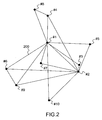
- Figure 2 is an illustration of how a PDN node is identified in a given example of network topology.
- figure 2 comprises 10 nodes, each node being associated to a node identifier, a node identifier being here an integer comprised between 1 and 10. If two nodes are connected, namely they are able to communicate directly which means that they are within radio range, a straight line is drawn between them. For example, the two nodes associated with identifiers #1 and #6 are connected. Accordingly, a line 200 is connecting them.
- Each node of the network will update its status, which means that it will determine if it is a PDN node or a non-PDN node. This update can be performed periodically. Alternatively, the status update can be performed each time the number of 1-hop or 2-hop neighbours is changing.
- 1-hop neighbours Node id 1-hop neighbours id T (number of 1-hop neighbours) #1 #2, #3, #4, #5, #6, #7, #8, #9, #10 9 #2 #1, #3, #4, #5, #6, #7, #9, #10 8 #3 #1, #2 2 #4 #1, #2, #8 3 #5 #1, #2 2 #6 #1, #2, #9 3 #7 #1, #2 2 #8 #1, #4 2 #9 #1, #2, #6 3 #10 #1, #2 2
- node #2 is a PDN node and that nodes #3, #4, #5, #6, #7, #8, #9 and #10 are non-PDN nodes.
- a node becomes a PDN node if the two aforementioned conditions are fulfilled for a predetermined duration.
- PDN nodes are allowed to communicate in time slots only with a subset of selected nodes in order to decrease the high number of links between a PDN and its 1-hop neighbours. Those chosen nodes are called Bridge Nodes (BN nodes). A non-BN node is considered as a Regular Node (RN node) by the PDN node.
- RN node Regular Node
- the aim is to improve the slot spatial reuse and thus the network capacity, and also reduce routing bottleneck issues on PDNs.
- a node can have three types of status:
- the PDN status has priority over the other statuses.
- a RN node cannot communicate with a PDN node. Only a BN node can communicate directly with a PDN node.
- a node When a node is switched on, it is initialized as a RN node.
- a node Once a node has the PDN status, it decides which of its 1-hop neighbours are BN nodes.
- BN nodes are uniformly distributed, so that RN nodes can reach PDN nodes through BN nodes more efficiently, with a known maximum number of hops.
- Figure 3 shows an ad-hoc network configuration without using the invention.
- This configuration comprises a node A that will be further identified as a PDN node and 10 other nodes B, C, D, E, F, G, H, I, J and K.
- a PDN node is allowed to communicate only with some of its connected 1-hop neighbours, called Bridge Nodes, and is not allowed to communicate with the rest of its connected 1-hop neighbours, namely the RN nodes.
- Each PDN node identifies its own BN and RN nodes.
- a PDN node comprises a PDN Topology Control module consisting into making links between a PDN node and its RN nodes not allocable for data exchange, in order to decrease the high number of links allocable for data exchange between a PDN and its connected 1-hop neighbours. It allows improving spatial reuse of time slots and data capacity. Additionally routing bottleneck issues can be solved, in particular for small size networks.
- PDN Topology Control can be performed only by PDN nodes. Additionally, PDN Topology Control only applies to links between a PDN and its connected 1-hop neighbours.
- Each PDN identifies its own BN nodes and RN nodes, independently of the BN and RN nodes identified by other PDN nodes potentially present in the network. For example, this selection can be performed according to the two following rules:
- ⁇ is a configuration parameter, which has an influence on the number of BN nodes determined by a PDN node. It is equal, for example, to 1 or 2.
- this node can be identified as a RN node by PDN1 and as a BN node by PDN2.
- a node A is identified as a BN node by a PDN node and a connected 1-hop neighbour of node A is identified as a BN node by another PDN node, it is not a violation of rule 1.
- the BN nodes have the ability to transmit and receive data directly through the PDN node 400, 401, 402, 403, 404. However, the RN nodes do not have the ability to transmit and receive data directly through the PDN node. If a RN node needs to transmit data to or through a PDN node, it has to send its data to a BN node, directly or by using another RN node. As an example, if node F needs to transmit data to node A, it will use node E or node G to do that as they both have the BN node status.
- the BN nodes have the ability to transmit and receive data directly through the PDN node 500, 501, 502. Compared to the example of figure 4 , there are less connections between node A and other nodes. This is because ⁇ has been chosen as equal to 2.
- the aforementioned rules 1 and 2 allow a PDN node to select its Bridge Nodes as uniformly distributed as possible in its connected 1-hop neighbourhood, so that its RN nodes can reach it (and vice versa) through its BN nodes more efficiently, with a known maximum number of hops. If, because of mobility for example, BN nodes are not properly distributed anymore, the PDN has to re-identify its BN nodes and RN nodes by using rules 1 and 2.
Landscapes
- Engineering & Computer Science (AREA)
- Computer Networks & Wireless Communication (AREA)
- Signal Processing (AREA)
- Mobile Radio Communication Systems (AREA)
Claims (10)
- Verfahren zum Verwalten von Knotenkommunikation in einem Ad-hoc-Mobilfunknetzwerk, umfassend, dass mindestens ein Knoten in dem besagten Netzwerk die folgenden Schritte durchführt:- Identifizieren, ob es ein potenziell unterbrechender Knoten, PDN, oder ein Nicht-PDN-Knoten ist, wobei ein PDN-Knoten ein Knoten ist, der eine Anzahl verbundener 1-Hop-Nachbarknoten hat, die größer als ein vorbestimmter Wert K ist;- wenn der Knoten als ein PDN-Knoten identifiziert wird, Auswählen einer Teilmenge seiner 1-Hop-Nachbarknoten, wobei die ausgewählten Knoten die einzigen 1-Hop-Nachbarknoten sind, die direkt mit dem PDN-Knoten kommunizieren (400, 401, 402, 403, 404) dürfen, wobei die ausgewählten Knoten Brückenknoten, BN, genannt werden, wobei Nicht-BN-Knoten reguläre Knoten, RN, genannt werden, wobei die besagten RN-Knoten imstande sind, mittels der ausgewählten BN-Knoten mit PDN-Knoten zu kommunizieren, wobei BN-Knoten gleichmäßig verteilt sind, sodass RN-Knoten PDN-Knoten über BN-Knoten mit einer bekannten maximalen Anzahl von Hops erreichen können, wobei BN-Knoten so ausgewählt werden, dass ein BN-Knoten in seiner verbundenen β-Hop-Nachbarschaft keinen BN-Knoten hat, wobei β ein konfigurierbarer Parameter ist.
- Verfahren nach Anspruch 1, worin ein Knoten als ein PDN-Knoten identifiziert wird, wenn zusätzlich seine Anzahl von 1-Hop-Nachbarn α-fach größer als die durchschnittliche Anzahl von 1-Hop-Nachbarn seiner 1-Hop-Nachbarn ist, wobei α ein vorbestimmter reeller Wert mit α > 1 ist.
- Verfahren nach einem der vorhergehenden Ansprüche, worin der vorbestimmte ganzzahlige Wert K als K ≥ 3 gewählt wird.
- Verfahren nach einem der vorhergehenden Ansprüche, worin die Identifizierung von PDN-Knoten und die Auswahl von BN-Knoten periodisch durchgeführt werden.
- Verfahren nach einem der Ansprüche 1 bis 3, worin die Identifizierung von PDN-Knoten und die Auswahl von BN-Knoten jedes Mal durchgeführt werden, wenn sich die Anzahl der 1-Hop- und/oder 2-Hop-Nachbarn eines Knotens ändert.
- Verfahren nach einem der vorhergehenden Ansprüche, worin ein PDN-Knoten zu einem Nicht-PDN-Status zurückkehrt, wenn mindestens eine der beiden folgenden Bedingungen nicht erfüllt ist:•
 •
• K' ein vorbestimmter ganzzahliger Wert ist, der sich von K unterscheiden kann, mit 3 ≤ K' ≤ K;α' ein vorbestimmter reeller Wert ist, der sich von α unterscheiden kann, mit 1 < α' ≤ α.
 - Verfahren nach Anspruch 6, worin BN-Knoten so ausgewählt werden, dass ein regulärer Knoten RN mindestens einen BN-Knoten in seiner verbundenen β-Hop-Nachbarschaft hat.
- Knoten, der zu einem Ad-hoc-Mobilfunknetzwerk gehört, dadurch gekennzeichnet, dass er Mittel umfasst, um das Verfahren nach einem der vorhergehenden Ansprüche zu implementieren.
- Knoten nach Anspruch 8, umfassend ein PDN-Topologiesteuerungsmodul, wobei das besagte Modul imstande ist, Verbindungen zwischen einem PDN-Knoten und seinen RN-Knoten zu schaffen, die nicht für Datenaustausch zuteilbar sind, um die hohe Anzahl von Verbindungen zu vermindern, die für Datenaustausch zwischen einem PDN und seinen verbundenen 1-Hop-Nachbarn zuteilbar sind.
- Ad-hoc-Mobilfunknetzwerk, dadurch gekennzeichnet, dass es eine Vielzahl von Knoten nach einem der Ansprüche 8 oder 9 umfasst.
Priority Applications (10)
| Application Number | Priority Date | Filing Date | Title |
|---|---|---|---|
| EP10290677.3A EP2469929B1 (de) | 2010-12-23 | 2010-12-23 | Verfahren zur Verwaltung potentieller Störknoten in einem mobilen Ad-hoc-Netzwerk |
| PL10290677T PL2469929T3 (pl) | 2010-12-23 | 2010-12-23 | Sposób zarządzania potencjalnie zakłócającymi węzłami w ruchomej sieci typu ad hoc |
| ES10290677.3T ES2547413T3 (es) | 2010-12-23 | 2010-12-23 | Procedimiento para gestionar nodos potencialmente perturbadores en una red ad hoc móvil |
| CA2822705A CA2822705C (en) | 2010-12-23 | 2011-12-21 | A method for managing potentially disruptive nodes in a mobile ad-hoc network |
| SG2013048566A SG191318A1 (en) | 2010-12-23 | 2011-12-21 | A method for managing potentially disruptive nodes in a mobile ad-hoc network |
| PCT/EP2011/073551 WO2012085057A1 (en) | 2010-12-23 | 2011-12-21 | A method for managing potentially disruptive nodes in a mobile ad-hoc network |
| AU2011347396A AU2011347396B2 (en) | 2010-12-23 | 2011-12-21 | A method for managing potentially disruptive nodes in a mobile ad-hoc network |
| US13/997,078 US9125077B2 (en) | 2010-12-23 | 2011-12-21 | Method for managing potentially disruptive nodes in a mobile ad-hoc network |
| MYPI2013002357A MY180694A (en) | 2010-12-23 | 2011-12-21 | A method for managing potentially disruptive nodes in a mobile ad-hoc network |
| IL227090A IL227090B (en) | 2010-12-23 | 2013-06-20 | Method for managing potentially disruptive nodes in a mobile ad-hoc network |
Applications Claiming Priority (1)
| Application Number | Priority Date | Filing Date | Title |
|---|---|---|---|
| EP10290677.3A EP2469929B1 (de) | 2010-12-23 | 2010-12-23 | Verfahren zur Verwaltung potentieller Störknoten in einem mobilen Ad-hoc-Netzwerk |
Publications (2)
| Publication Number | Publication Date |
|---|---|
| EP2469929A1 EP2469929A1 (de) | 2012-06-27 |
| EP2469929B1 true EP2469929B1 (de) | 2015-06-17 |
Family
ID=43827507
Family Applications (1)
| Application Number | Title | Priority Date | Filing Date |
|---|---|---|---|
| EP10290677.3A Active EP2469929B1 (de) | 2010-12-23 | 2010-12-23 | Verfahren zur Verwaltung potentieller Störknoten in einem mobilen Ad-hoc-Netzwerk |
Country Status (10)
| Country | Link |
|---|---|
| US (1) | US9125077B2 (de) |
| EP (1) | EP2469929B1 (de) |
| AU (1) | AU2011347396B2 (de) |
| CA (1) | CA2822705C (de) |
| ES (1) | ES2547413T3 (de) |
| IL (1) | IL227090B (de) |
| MY (1) | MY180694A (de) |
| PL (1) | PL2469929T3 (de) |
| SG (1) | SG191318A1 (de) |
| WO (1) | WO2012085057A1 (de) |
Families Citing this family (1)
| Publication number | Priority date | Publication date | Assignee | Title |
|---|---|---|---|---|
| US9942876B2 (en) | 2011-07-22 | 2018-04-10 | Thales | Method for managing single channel spatial reuse in the presence of potentially disruptive nodes in a mobile ad-hoc network |
Family Cites Families (3)
| Publication number | Priority date | Publication date | Assignee | Title |
|---|---|---|---|---|
| EP1477033A2 (de) * | 2002-02-20 | 2004-11-17 | Meshnetworks, Inc. | System und verfahren zum routen von 802.11-datenverkehr über kanäle zur erhöhung der ad-hoc-netzwerkkapazität |
| US7653011B2 (en) * | 2005-05-31 | 2010-01-26 | Cisco Technology, Inc. | Spanning tree protocol for wireless networks |
| JP4976588B2 (ja) * | 2009-03-27 | 2012-07-18 | シャープ株式会社 | 移動端末装置、外部ゲートウェイ装置、移動体通信システムおよび通信方法 |
-
2010
- 2010-12-23 EP EP10290677.3A patent/EP2469929B1/de active Active
- 2010-12-23 PL PL10290677T patent/PL2469929T3/pl unknown
- 2010-12-23 ES ES10290677.3T patent/ES2547413T3/es active Active
-
2011
- 2011-12-21 SG SG2013048566A patent/SG191318A1/en unknown
- 2011-12-21 CA CA2822705A patent/CA2822705C/en active Active
- 2011-12-21 US US13/997,078 patent/US9125077B2/en active Active
- 2011-12-21 MY MYPI2013002357A patent/MY180694A/en unknown
- 2011-12-21 AU AU2011347396A patent/AU2011347396B2/en active Active
- 2011-12-21 WO PCT/EP2011/073551 patent/WO2012085057A1/en not_active Ceased
-
2013
- 2013-06-20 IL IL227090A patent/IL227090B/en active IP Right Grant
Also Published As
| Publication number | Publication date |
|---|---|
| CA2822705C (en) | 2019-04-23 |
| AU2011347396A1 (en) | 2013-07-11 |
| CA2822705A1 (en) | 2012-06-28 |
| PL2469929T3 (pl) | 2016-07-29 |
| AU2011347396B2 (en) | 2016-05-12 |
| SG191318A1 (en) | 2013-07-31 |
| US9125077B2 (en) | 2015-09-01 |
| ES2547413T3 (es) | 2015-10-06 |
| EP2469929A1 (de) | 2012-06-27 |
| WO2012085057A1 (en) | 2012-06-28 |
| MY180694A (en) | 2020-12-07 |
| US20140094205A1 (en) | 2014-04-03 |
| IL227090B (en) | 2018-06-28 |
Similar Documents
| Publication | Publication Date | Title |
|---|---|---|
| EP3677071B1 (de) | Mehrschichtige dichtebewusste standortbasierte kanalzuweisung und adaptives leistungssteuerungsverfahren für mobile ad-hoc-netzwerke | |
| US11290942B2 (en) | System and method for independent dominating set (IDS) based routing in mobile AD hoc networks (MANET) | |
| CN108600942B (zh) | 一种无人机自组网的路由方法 | |
| US7920887B2 (en) | System and method for setting up P2P communication group in cellular system, and P2P communication system and method using P2P communication group | |
| US7787450B1 (en) | Method and system for efficient network formation and maintenance of node routing databases in a mobile ad-hoc network | |
| EP4138361B1 (de) | Mesh-inseln | |
| EP1912392A2 (de) | System und Verfahren zur dynamischen Korrektur der Parallaxe in Kopf-Videosystemen | |
| CN110248416A (zh) | 一种远距离tdma移动自组织网络中的分布式动态时隙分配方法 | |
| US20210168066A1 (en) | Independent Redundant Path Discovery for Bluetooth Mesh | |
| CN107005880A (zh) | 通信方法、服务器、路侧单元和节点 | |
| US9515913B2 (en) | Method providing adhoc network state to support distributed scheduling | |
| CN105072586A (zh) | 嵌入式无线自组织网络中对广播消息的转发的管理方法 | |
| CN116347558A (zh) | 多跳中继通信系统和多跳中继通信网络的构建方法 | |
| EP2179520A1 (de) | System und verfahren zur einrichtung einer p2p-kommunikationsgruppe in einem zellularen system sowie p2p-kommunikationssystem und verfahren unter verwendung einer p2p-kommunikationsgruppe | |
| EP2469929B1 (de) | Verfahren zur Verwaltung potentieller Störknoten in einem mobilen Ad-hoc-Netzwerk | |
| JP2008312059A (ja) | アドホックネットワーク構成方法及びノード装置 | |
| CN110995601A (zh) | 一种软件定义的空基骨干网络拓扑构建方法 | |
| Gruber et al. | Ad hoc routing for cellular coverage extension | |
| CN113747539B (zh) | 基于智能天线的tdma移动自组织网络拓扑控制方法 | |
| KR101409253B1 (ko) | 포텐셜 라우팅 방법, 포텐셜 스케줄링 방법 및 메시 노드 | |
| CN104184829B (zh) | 车辆自组织网络中基于内容完整性和位置信息的路由方法 | |
| Muazu et al. | Quality of Service Guarantees in Vehicular Networks Using Cluster | |
| Masilamani et al. | Scheduled channel access using geographical classification | |
| JP2025511359A (ja) | 無線通信ネットワークのためのタイミングシステム | |
| Abedi et al. | Agile Spectrum mobility aided spectrum-aware routing protocol for cognitive radio ad hoc networks |
Legal Events
| Date | Code | Title | Description |
|---|---|---|---|
| AK | Designated contracting states |
Kind code of ref document: A1 Designated state(s): AL AT BE BG CH CY CZ DE DK EE ES FI FR GB GR HR HU IE IS IT LI LT LU LV MC MK MT NL NO PL PT RO RS SE SI SK SM TR |
|
| AX | Request for extension of the european patent |
Extension state: BA ME |
|
| PUAI | Public reference made under article 153(3) epc to a published international application that has entered the european phase |
Free format text: ORIGINAL CODE: 0009012 |
|
| 17P | Request for examination filed |
Effective date: 20121203 |
|
| 17Q | First examination report despatched |
Effective date: 20130912 |
|
| GRAP | Despatch of communication of intention to grant a patent |
Free format text: ORIGINAL CODE: EPIDOSNIGR1 |
|
| INTG | Intention to grant announced |
Effective date: 20150311 |
|
| GRAS | Grant fee paid |
Free format text: ORIGINAL CODE: EPIDOSNIGR3 |
|
| GRAA | (expected) grant |
Free format text: ORIGINAL CODE: 0009210 |
|
| AK | Designated contracting states |
Kind code of ref document: B1 Designated state(s): AL AT BE BG CH CY CZ DE DK EE ES FI FR GB GR HR HU IE IS IT LI LT LU LV MC MK MT NL NO PL PT RO RS SE SI SK SM TR |
|
| REG | Reference to a national code |
Ref country code: GB Ref legal event code: FG4D |
|
| REG | Reference to a national code |
Ref country code: CH Ref legal event code: EP |
|
| REG | Reference to a national code |
Ref country code: AT Ref legal event code: REF Ref document number: 732484 Country of ref document: AT Kind code of ref document: T Effective date: 20150715 |
|
| REG | Reference to a national code |
Ref country code: IE Ref legal event code: FG4D |
|
| REG | Reference to a national code |
Ref country code: DE Ref legal event code: R096 Ref document number: 602010025263 Country of ref document: DE |
|
| REG | Reference to a national code |
Ref country code: SE Ref legal event code: TRGR Ref country code: ES Ref legal event code: FG2A Ref document number: 2547413 Country of ref document: ES Kind code of ref document: T3 Effective date: 20151006 |
|
| PG25 | Lapsed in a contracting state [announced via postgrant information from national office to epo] |
Ref country code: HR Free format text: LAPSE BECAUSE OF FAILURE TO SUBMIT A TRANSLATION OF THE DESCRIPTION OR TO PAY THE FEE WITHIN THE PRESCRIBED TIME-LIMIT Effective date: 20150617 Ref country code: NO Free format text: LAPSE BECAUSE OF FAILURE TO SUBMIT A TRANSLATION OF THE DESCRIPTION OR TO PAY THE FEE WITHIN THE PRESCRIBED TIME-LIMIT Effective date: 20150917 Ref country code: LT Free format text: LAPSE BECAUSE OF FAILURE TO SUBMIT A TRANSLATION OF THE DESCRIPTION OR TO PAY THE FEE WITHIN THE PRESCRIBED TIME-LIMIT Effective date: 20150617 |
|
| REG | Reference to a national code |
Ref country code: AT Ref legal event code: MK05 Ref document number: 732484 Country of ref document: AT Kind code of ref document: T Effective date: 20150617 |
|
| REG | Reference to a national code |
Ref country code: FR Ref legal event code: PLFP Year of fee payment: 6 |
|
| REG | Reference to a national code |
Ref country code: LT Ref legal event code: MG4D Ref country code: NL Ref legal event code: MP Effective date: 20150617 |
|
| PG25 | Lapsed in a contracting state [announced via postgrant information from national office to epo] |
Ref country code: GR Free format text: LAPSE BECAUSE OF FAILURE TO SUBMIT A TRANSLATION OF THE DESCRIPTION OR TO PAY THE FEE WITHIN THE PRESCRIBED TIME-LIMIT Effective date: 20150918 Ref country code: BG Free format text: LAPSE BECAUSE OF FAILURE TO SUBMIT A TRANSLATION OF THE DESCRIPTION OR TO PAY THE FEE WITHIN THE PRESCRIBED TIME-LIMIT Effective date: 20150917 Ref country code: LV Free format text: LAPSE BECAUSE OF FAILURE TO SUBMIT A TRANSLATION OF THE DESCRIPTION OR TO PAY THE FEE WITHIN THE PRESCRIBED TIME-LIMIT Effective date: 20150617 Ref country code: RS Free format text: LAPSE BECAUSE OF FAILURE TO SUBMIT A TRANSLATION OF THE DESCRIPTION OR TO PAY THE FEE WITHIN THE PRESCRIBED TIME-LIMIT Effective date: 20150617 |
|
| PG25 | Lapsed in a contracting state [announced via postgrant information from national office to epo] |
Ref country code: EE Free format text: LAPSE BECAUSE OF FAILURE TO SUBMIT A TRANSLATION OF THE DESCRIPTION OR TO PAY THE FEE WITHIN THE PRESCRIBED TIME-LIMIT Effective date: 20150617 |
|
| PG25 | Lapsed in a contracting state [announced via postgrant information from national office to epo] |
Ref country code: IS Free format text: LAPSE BECAUSE OF FAILURE TO SUBMIT A TRANSLATION OF THE DESCRIPTION OR TO PAY THE FEE WITHIN THE PRESCRIBED TIME-LIMIT Effective date: 20151017 Ref country code: SK Free format text: LAPSE BECAUSE OF FAILURE TO SUBMIT A TRANSLATION OF THE DESCRIPTION OR TO PAY THE FEE WITHIN THE PRESCRIBED TIME-LIMIT Effective date: 20150617 Ref country code: AT Free format text: LAPSE BECAUSE OF FAILURE TO SUBMIT A TRANSLATION OF THE DESCRIPTION OR TO PAY THE FEE WITHIN THE PRESCRIBED TIME-LIMIT Effective date: 20150617 Ref country code: CZ Free format text: LAPSE BECAUSE OF FAILURE TO SUBMIT A TRANSLATION OF THE DESCRIPTION OR TO PAY THE FEE WITHIN THE PRESCRIBED TIME-LIMIT Effective date: 20150617 Ref country code: PT Free format text: LAPSE BECAUSE OF FAILURE TO SUBMIT A TRANSLATION OF THE DESCRIPTION OR TO PAY THE FEE WITHIN THE PRESCRIBED TIME-LIMIT Effective date: 20151019 Ref country code: RO Free format text: LAPSE BECAUSE OF NON-PAYMENT OF DUE FEES Effective date: 20150617 |
|
| REG | Reference to a national code |
Ref country code: DE Ref legal event code: R097 Ref document number: 602010025263 Country of ref document: DE |
|
| PLBE | No opposition filed within time limit |
Free format text: ORIGINAL CODE: 0009261 |
|
| STAA | Information on the status of an ep patent application or granted ep patent |
Free format text: STATUS: NO OPPOSITION FILED WITHIN TIME LIMIT |
|
| PG25 | Lapsed in a contracting state [announced via postgrant information from national office to epo] |
Ref country code: DK Free format text: LAPSE BECAUSE OF FAILURE TO SUBMIT A TRANSLATION OF THE DESCRIPTION OR TO PAY THE FEE WITHIN THE PRESCRIBED TIME-LIMIT Effective date: 20150617 |
|
| 26N | No opposition filed |
Effective date: 20160318 |
|
| PG25 | Lapsed in a contracting state [announced via postgrant information from national office to epo] |
Ref country code: BE Free format text: LAPSE BECAUSE OF NON-PAYMENT OF DUE FEES Effective date: 20151231 |
|
| PG25 | Lapsed in a contracting state [announced via postgrant information from national office to epo] |
Ref country code: LU Free format text: LAPSE BECAUSE OF FAILURE TO SUBMIT A TRANSLATION OF THE DESCRIPTION OR TO PAY THE FEE WITHIN THE PRESCRIBED TIME-LIMIT Effective date: 20151223 Ref country code: MC Free format text: LAPSE BECAUSE OF FAILURE TO SUBMIT A TRANSLATION OF THE DESCRIPTION OR TO PAY THE FEE WITHIN THE PRESCRIBED TIME-LIMIT Effective date: 20150617 |
|
| REG | Reference to a national code |
Ref country code: CH Ref legal event code: PL |
|
| PG25 | Lapsed in a contracting state [announced via postgrant information from national office to epo] |
Ref country code: SI Free format text: LAPSE BECAUSE OF FAILURE TO SUBMIT A TRANSLATION OF THE DESCRIPTION OR TO PAY THE FEE WITHIN THE PRESCRIBED TIME-LIMIT Effective date: 20150617 |
|
| REG | Reference to a national code |
Ref country code: IE Ref legal event code: MM4A |
|
| PG25 | Lapsed in a contracting state [announced via postgrant information from national office to epo] |
Ref country code: IE Free format text: LAPSE BECAUSE OF NON-PAYMENT OF DUE FEES Effective date: 20151223 Ref country code: CH Free format text: LAPSE BECAUSE OF NON-PAYMENT OF DUE FEES Effective date: 20151231 Ref country code: LI Free format text: LAPSE BECAUSE OF NON-PAYMENT OF DUE FEES Effective date: 20151231 |
|
| REG | Reference to a national code |
Ref country code: FR Ref legal event code: PLFP Year of fee payment: 7 |
|
| PG25 | Lapsed in a contracting state [announced via postgrant information from national office to epo] |
Ref country code: BE Free format text: LAPSE BECAUSE OF FAILURE TO SUBMIT A TRANSLATION OF THE DESCRIPTION OR TO PAY THE FEE WITHIN THE PRESCRIBED TIME-LIMIT Effective date: 20150617 |
|
| PG25 | Lapsed in a contracting state [announced via postgrant information from national office to epo] |
Ref country code: HU Free format text: LAPSE BECAUSE OF FAILURE TO SUBMIT A TRANSLATION OF THE DESCRIPTION OR TO PAY THE FEE WITHIN THE PRESCRIBED TIME-LIMIT; INVALID AB INITIO Effective date: 20101223 Ref country code: SM Free format text: LAPSE BECAUSE OF FAILURE TO SUBMIT A TRANSLATION OF THE DESCRIPTION OR TO PAY THE FEE WITHIN THE PRESCRIBED TIME-LIMIT Effective date: 20150617 |
|
| PG25 | Lapsed in a contracting state [announced via postgrant information from national office to epo] |
Ref country code: NL Free format text: LAPSE BECAUSE OF FAILURE TO SUBMIT A TRANSLATION OF THE DESCRIPTION OR TO PAY THE FEE WITHIN THE PRESCRIBED TIME-LIMIT Effective date: 20150617 Ref country code: CY Free format text: LAPSE BECAUSE OF FAILURE TO SUBMIT A TRANSLATION OF THE DESCRIPTION OR TO PAY THE FEE WITHIN THE PRESCRIBED TIME-LIMIT Effective date: 20150617 |
|
| PG25 | Lapsed in a contracting state [announced via postgrant information from national office to epo] |
Ref country code: MT Free format text: LAPSE BECAUSE OF FAILURE TO SUBMIT A TRANSLATION OF THE DESCRIPTION OR TO PAY THE FEE WITHIN THE PRESCRIBED TIME-LIMIT Effective date: 20150617 Ref country code: TR Free format text: LAPSE BECAUSE OF FAILURE TO SUBMIT A TRANSLATION OF THE DESCRIPTION OR TO PAY THE FEE WITHIN THE PRESCRIBED TIME-LIMIT Effective date: 20150617 |
|
| REG | Reference to a national code |
Ref country code: FR Ref legal event code: PLFP Year of fee payment: 8 |
|
| PG25 | Lapsed in a contracting state [announced via postgrant information from national office to epo] |
Ref country code: MK Free format text: LAPSE BECAUSE OF FAILURE TO SUBMIT A TRANSLATION OF THE DESCRIPTION OR TO PAY THE FEE WITHIN THE PRESCRIBED TIME-LIMIT Effective date: 20150617 |
|
| PG25 | Lapsed in a contracting state [announced via postgrant information from national office to epo] |
Ref country code: AL Free format text: LAPSE BECAUSE OF FAILURE TO SUBMIT A TRANSLATION OF THE DESCRIPTION OR TO PAY THE FEE WITHIN THE PRESCRIBED TIME-LIMIT Effective date: 20150617 |
|
| PGFP | Annual fee paid to national office [announced via postgrant information from national office to epo] |
Ref country code: PL Payment date: 20241129 Year of fee payment: 15 |
|
| PGFP | Annual fee paid to national office [announced via postgrant information from national office to epo] |
Ref country code: ES Payment date: 20250121 Year of fee payment: 15 |
|
| PGFP | Annual fee paid to national office [announced via postgrant information from national office to epo] |
Ref country code: DE Payment date: 20251119 Year of fee payment: 16 |
|
| PGFP | Annual fee paid to national office [announced via postgrant information from national office to epo] |
Ref country code: GB Payment date: 20251113 Year of fee payment: 16 |
|
| PGFP | Annual fee paid to national office [announced via postgrant information from national office to epo] |
Ref country code: IT Payment date: 20251126 Year of fee payment: 16 Ref country code: FI Payment date: 20251211 Year of fee payment: 16 |
|
| PGFP | Annual fee paid to national office [announced via postgrant information from national office to epo] |
Ref country code: FR Payment date: 20251124 Year of fee payment: 16 |
|
| PGFP | Annual fee paid to national office [announced via postgrant information from national office to epo] |
Ref country code: SE Payment date: 20251126 Year of fee payment: 16 |