EP2469901A2 - Effiziente NEMO-Sicherheit mit identitätsbasierter Verschlüsselung - Google Patents
Effiziente NEMO-Sicherheit mit identitätsbasierter Verschlüsselung Download PDFInfo
- Publication number
- EP2469901A2 EP2469901A2 EP11194606A EP11194606A EP2469901A2 EP 2469901 A2 EP2469901 A2 EP 2469901A2 EP 11194606 A EP11194606 A EP 11194606A EP 11194606 A EP11194606 A EP 11194606A EP 2469901 A2 EP2469901 A2 EP 2469901A2
- Authority
- EP
- European Patent Office
- Prior art keywords
- mobile
- network
- mobile router
- node
- identity
- Prior art date
- Legal status (The legal status is an assumption and is not a legal conclusion. Google has not performed a legal analysis and makes no representation as to the accuracy of the status listed.)
- Withdrawn
Links
- 230000006854 communication Effects 0.000 claims abstract description 32
- 238000004891 communication Methods 0.000 claims abstract description 31
- 238000000034 method Methods 0.000 claims abstract description 15
- 230000015654 memory Effects 0.000 description 4
- 238000013475 authorization Methods 0.000 description 3
- 238000009826 distribution Methods 0.000 description 3
- 238000005538 encapsulation Methods 0.000 description 3
- 238000003860 storage Methods 0.000 description 3
- 238000010586 diagram Methods 0.000 description 2
- 238000012545 processing Methods 0.000 description 2
- 238000012795 verification Methods 0.000 description 2
- 235000008694 Humulus lupulus Nutrition 0.000 description 1
- 230000006978 adaptation Effects 0.000 description 1
- 238000003491 array Methods 0.000 description 1
- 230000001419 dependent effect Effects 0.000 description 1
- 238000013461 design Methods 0.000 description 1
- 230000006870 function Effects 0.000 description 1
- 238000004519 manufacturing process Methods 0.000 description 1
Images


Classifications
-
- H—ELECTRICITY
- H04—ELECTRIC COMMUNICATION TECHNIQUE
- H04L—TRANSMISSION OF DIGITAL INFORMATION, e.g. TELEGRAPHIC COMMUNICATION
- H04L63/00—Network architectures or network communication protocols for network security
- H04L63/04—Network architectures or network communication protocols for network security for providing a confidential data exchange among entities communicating through data packet networks
- H04L63/0428—Network architectures or network communication protocols for network security for providing a confidential data exchange among entities communicating through data packet networks wherein the data content is protected, e.g. by encrypting or encapsulating the payload
-
- H—ELECTRICITY
- H04—ELECTRIC COMMUNICATION TECHNIQUE
- H04L—TRANSMISSION OF DIGITAL INFORMATION, e.g. TELEGRAPHIC COMMUNICATION
- H04L9/00—Cryptographic mechanisms or cryptographic arrangements for secret or secure communications; Network security protocols
- H04L9/08—Key distribution or management, e.g. generation, sharing or updating, of cryptographic keys or passwords
-
- H—ELECTRICITY
- H04—ELECTRIC COMMUNICATION TECHNIQUE
- H04L—TRANSMISSION OF DIGITAL INFORMATION, e.g. TELEGRAPHIC COMMUNICATION
- H04L63/00—Network architectures or network communication protocols for network security
- H04L63/06—Network architectures or network communication protocols for network security for supporting key management in a packet data network
-
- H—ELECTRICITY
- H04—ELECTRIC COMMUNICATION TECHNIQUE
- H04L—TRANSMISSION OF DIGITAL INFORMATION, e.g. TELEGRAPHIC COMMUNICATION
- H04L9/00—Cryptographic mechanisms or cryptographic arrangements for secret or secure communications; Network security protocols
- H04L9/08—Key distribution or management, e.g. generation, sharing or updating, of cryptographic keys or passwords
- H04L9/0816—Key establishment, i.e. cryptographic processes or cryptographic protocols whereby a shared secret becomes available to two or more parties, for subsequent use
- H04L9/0838—Key agreement, i.e. key establishment technique in which a shared key is derived by parties as a function of information contributed by, or associated with, each of these
- H04L9/0847—Key agreement, i.e. key establishment technique in which a shared key is derived by parties as a function of information contributed by, or associated with, each of these involving identity based encryption [IBE] schemes
-
- H—ELECTRICITY
- H04—ELECTRIC COMMUNICATION TECHNIQUE
- H04L—TRANSMISSION OF DIGITAL INFORMATION, e.g. TELEGRAPHIC COMMUNICATION
- H04L9/00—Cryptographic mechanisms or cryptographic arrangements for secret or secure communications; Network security protocols
- H04L9/30—Public key, i.e. encryption algorithm being computationally infeasible to invert or user's encryption keys not requiring secrecy
-
- H—ELECTRICITY
- H04—ELECTRIC COMMUNICATION TECHNIQUE
- H04L—TRANSMISSION OF DIGITAL INFORMATION, e.g. TELEGRAPHIC COMMUNICATION
- H04L9/00—Cryptographic mechanisms or cryptographic arrangements for secret or secure communications; Network security protocols
- H04L9/30—Public key, i.e. encryption algorithm being computationally infeasible to invert or user's encryption keys not requiring secrecy
- H04L9/3066—Public key, i.e. encryption algorithm being computationally infeasible to invert or user's encryption keys not requiring secrecy involving algebraic varieties, e.g. elliptic or hyper-elliptic curves
- H04L9/3073—Public key, i.e. encryption algorithm being computationally infeasible to invert or user's encryption keys not requiring secrecy involving algebraic varieties, e.g. elliptic or hyper-elliptic curves involving pairings, e.g. identity based encryption [IBE], bilinear mappings or bilinear pairings, e.g. Weil or Tate pairing
-
- H—ELECTRICITY
- H04—ELECTRIC COMMUNICATION TECHNIQUE
- H04W—WIRELESS COMMUNICATION NETWORKS
- H04W12/00—Security arrangements; Authentication; Protecting privacy or anonymity
- H04W12/02—Protecting privacy or anonymity, e.g. protecting personally identifiable information [PII]
-
- H—ELECTRICITY
- H04—ELECTRIC COMMUNICATION TECHNIQUE
- H04W—WIRELESS COMMUNICATION NETWORKS
- H04W12/00—Security arrangements; Authentication; Protecting privacy or anonymity
- H04W12/03—Protecting confidentiality, e.g. by encryption
-
- H—ELECTRICITY
- H04—ELECTRIC COMMUNICATION TECHNIQUE
- H04W—WIRELESS COMMUNICATION NETWORKS
- H04W12/00—Security arrangements; Authentication; Protecting privacy or anonymity
- H04W12/04—Key management, e.g. using generic bootstrapping architecture [GBA]
- H04W12/041—Key generation or derivation
-
- H—ELECTRICITY
- H04—ELECTRIC COMMUNICATION TECHNIQUE
- H04W—WIRELESS COMMUNICATION NETWORKS
- H04W12/00—Security arrangements; Authentication; Protecting privacy or anonymity
- H04W12/04—Key management, e.g. using generic bootstrapping architecture [GBA]
- H04W12/047—Key management, e.g. using generic bootstrapping architecture [GBA] without using a trusted network node as an anchor
- H04W12/0471—Key exchange
-
- H—ELECTRICITY
- H04—ELECTRIC COMMUNICATION TECHNIQUE
- H04L—TRANSMISSION OF DIGITAL INFORMATION, e.g. TELEGRAPHIC COMMUNICATION
- H04L2209/00—Additional information or applications relating to cryptographic mechanisms or cryptographic arrangements for secret or secure communication H04L9/00
- H04L2209/80—Wireless
-
- H—ELECTRICITY
- H04—ELECTRIC COMMUNICATION TECHNIQUE
- H04L—TRANSMISSION OF DIGITAL INFORMATION, e.g. TELEGRAPHIC COMMUNICATION
- H04L63/00—Network architectures or network communication protocols for network security
- H04L63/16—Implementing security features at a particular protocol layer
- H04L63/164—Implementing security features at a particular protocol layer at the network layer
-
- H—ELECTRICITY
- H04—ELECTRIC COMMUNICATION TECHNIQUE
- H04W—WIRELESS COMMUNICATION NETWORKS
- H04W80/00—Wireless network protocols or protocol adaptations to wireless operation
- H04W80/04—Network layer protocols, e.g. mobile IP [Internet Protocol]
-
- H—ELECTRICITY
- H04—ELECTRIC COMMUNICATION TECHNIQUE
- H04W—WIRELESS COMMUNICATION NETWORKS
- H04W84/00—Network topologies
- H04W84/005—Moving wireless networks
Definitions
- the present disclosure generally relates to mobile computer networks, in particular, with respect to providing an efficient security scheme to Network Mobility (NEMO).
- NEMO Network Mobility
- Mobile IP may allow location-independent routing of Internet Protocol (IP) datagrams (or packets).
- IP Internet Protocol
- Mobile IP may be used in both IPv4 and IPv6 networks.
- Mobile IP for IPv4 networks is described in Internet Engineering Task Force (IETF) Request for Comments (RFC) 3344, and updates are added in IETF RFC 4721, and Mobile IP for IPv6 networks (Mobile IPv6 for short) is described in IETF RFC 3775.
- IETF Internet Engineering Task Force
- RFC Request for Comments
- a mobile node may be associated with a home agent (HA) while in its home network, and may be assigned a home address.
- a HA may store information about mobile nodes whose home addresses are in the HA's network.
- a mobile node When roamed away from its home network, a mobile node may be associated with a foreign agent (FA), and be assigned a care of address (CoA) that identifies its current location in a foreign network. Even though a mobile node may be associated with both a home address and a CoA, the mobile node may be identified by its home address regardless of its current location in the Internet.
- FA foreign agent
- CoA care of address
- Network Mobility is an extension of the Mobile IP protocol.
- the Network Mobility Basic Support Protocol is published in RFC 3963 by the IETF Network Mobility Working Group.
- NEMO is designed to support mobility for an entire mobile network, i.e., a mobile network that moves and attaches to different points in the Internet.
- NEMO may allow session continuity for every node in the mobile network as the network moves.
- NEMO proposes using Internet Protocol Security (IPSec) and Security Associations (SA) for security purpose.
- IPSec and SA may introduce processing overhead to NEMO based networks, including processing overhead related to authentication, return routeability (RR), protocol encapsulation etc., which may have a negative impact on the efficiency of the NEMO security structure design.
- Coupled may mean that two or more elements are in direct physical or electrical contact. However, “coupled” may also mean that two or more elements are not in direct contact with each other, but yet still cooperate or interact with each other.
- a phrase in the form "A/B” or in the form “A and/or B” means (A), (B), or (A and B).
- a phrase in the form "at least one of A, B, and C” means (A), (B), (C), (A and B), (A and C), (B and C), or (A, B and C).
- a phrase in the form "(A)B” means (B) or (AB) that is, A is an optional element.
- NEMO proposes using Internet Protocol Security (IPSec) and Security Associations (SA) for security purposes.
- IPSec Internet Protocol Security
- SA Security Associations
- an entire sub-network including a mobile node of that sub-network, may roam from its home network to a foreign network, and attach to that foreign network.
- the mobile node may be provided with a CoA.
- the mobile node may send the CoA, via one or more binding updates, to its HA in the home network to inform the HA of its current location.
- an end-to-end IPSec Encapsulated Security Payload (ESP) protected bi-directional tunnel may be setup between the home network and the foreign network.
- ESP IPSec Encapsulated Security Payload
- a correspondent node may continue communicating to the mobile node by sending packets to the mobile node's home address.
- the packets may be received by the HA of the mobile node in its home network, and forwarded to the mobile node in the foreign network via the IPSec tunnel.
- the HA may construct an outer layer of IP header using the entrance and exit point of the IPSec tunnel as the source and destination address.
- a separate IPSec tunnel may be setup between each of these networks along the way. Thereafter, packets from the correspondent node may travel through many IPSec tunnels before they reach the mobile node.
- a Mobile node that is attached to an access router (AR) that is close to the edge of a network may be considered as the top level tree node, then the path to the mobile node after roaming n times may need to go an n -th level deeper down the tree.
- the HA and/or the network may be overloaded as the mobile node gets further away and have n -depth of branches of routes, thereby increasing the cost of routing, and reducing the scalability of the NEMO based networks.
- SAs Security Associations
- the SAs may need to individually negotiate with each other the supported encryption association.
- the SA mechanism used by IPSec may impose additional overhead to NEMO compliant networks. Accordingly, the overhead of using IPSec and SA as the method for providing security in NEMO may be burdensome to the mobility and reliability of the NEMO networks.
- IBE Identity Based Encryption
- RFC 5408 The basic concept of IBE is disclosed in RFC 5408 as published by the IETF.
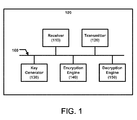
- FIG. 1 illustrates an example device suitable for a communication network based on NEMO and IBE in accordance with various embodiments of the present disclosure.
- the device 100 may include a receiver 110, a transmitter 120, a key generator 130, an encryption engine 140, and a decryption engine 150, coupled to each other via a bus 160 as shown, and endowed with logic to practice the methods of the present disclosure, to be described further below.
- FIG. 1 lists distinct components, it is understood that one or more of these components may be integrated into a single component, or further subdivided.
- the encryption engine 140 and the decryption engine 150 may be combined into a single cryptography engine.
- the device 100 may include other components not illustrated in FIG. 1 , such as power supplies, antennas, memories, etc.
- components 110 through 150 may be implemented in hardware, such as Application Specific Integrated Circuits (ASIC), Field Programmable Gate Arrays (FPGA), or software operating on generic processors (or processor cores), or a combination thereof. Furthermore, components 110 through 150 may be coupled to each other via other types of interconnects, such as, for example, point-to-point connections, etc.
- ASIC Application Specific Integrated Circuits
- FPGA Field Programmable Gate Arrays
- components 110 through 150 may be coupled to each other via other types of interconnects, such as, for example, point-to-point connections, etc.
- FIG. 2 illustrates an example wireless communication system based on NEMO and IBE in accordance with various embodiments of the present disclosure.
- a communication system 200 may include multiple NEMO compliant communication networks 210, 220, and 230, etc.
- the NEMO compliant communication networks 210 through 230 may be coupled to each other via one or more other networks 205.
- the one or more networks 205 may include networks of any size and topology, which may or may not be NEMO compliant, and may be one or more private and/or public networks, including the network cloud that is generally referred to as the Internet, or a mix thereof.
- the number of NEMO compliant communication networks in FIG. 2 is for purpose of illustration. Even though FIG. 2 illustrates 3 NEMO compliant communication networks, the communication system 200 may include more or less NEMO compliant communication networks.
- the communication network 210 may include a home agent (HA) 211 and a correspondent node (CN) 212.
- the communication network 220 may include a HA 221, a mobile router (MR) 222, and a mobile network node (MNN) 223.
- the MR 222, the MNN 223, and the CN 212 may be devices based on the device 100, incorporated with teachings of the present disclosure, as illustrated in FIG. 1 .
- the communication system 200 may further include a Private/Public Key Generator (PKG) server 201.
- the PKG server 201 may hold a Master Public Key and a corresponding Master Private Key.
- the Master Public/Private keys may be statically created or dynamically generated.
- the PKG server 201 may, after necessary authentication and authorization, publish the Master Public Key to the requestor and retain the Master Private Key.
- the PKG server 201 may, after authentication and verification of authorization, publish the Master Private Key to the requestor and retain the Master Public Key.
- the PKG server 201 may be a dedicated service or integrated as part of another service, including a web service, that resides in the communicate system 200.
- the PKG server 201 may be implemented in either software or hardware, and may be centralized or distributed. In various embodiments, the authentication and verification of authorization by the PKG server 201 may be optional.
- entities of the communication system 200 including the CN 212, the MR 222, the MNN 223, the HA 211 and/or the HA 221 may communicate with the PKG server 201 to obtain either the Master Public Key or the Master Private Key, and may generate the necessary encryption/decryption key via the key generator 130.
- the MR 222 may act as a router for the MNN 223 and provide network access to the MNN 223. If the MNN 223 wishes to communicate with the CN 212, the MNN 223 may transmit packets that are designated for the CN 212 first to the MR 222. The MR 222 may receive packets from the MNN 223 via its receiver 110 and forward the packets to the CN 212 via its transmitter 120. The packets may traverse through one or more intermediate routers and HAs, before reaching the CN 212. In various embodiments, the MR 222 and the MNN 223 may roam from network 220 to network 230. The MR 222 may attach to a MR 232 of the network 230. The MNN 223 and the MR 222 may each be provided a CoA, by a FA (not shown) of the network 230.
- the MR 222 and/or the MNN 223 may use the home address of the CN 212 as the identity of the CN 212.
- the MR 222 and/or the MNN 223 may determine whether it has a valid IBE compliant public key for the CN 212. If the MR 222 and/or the MNN 223 do not already have the IBE compliant public key for the CN 212, or if the existing IBE compliant public key is not valid, e.g., expired, the MR 222 and/or the MNN 223 may contact the PKG server 201 to request the Master Public Key (MPubK).
- MPubK Master Public Key
- the MR 222 and/or the MNN 223 may generate, via key generator 130, the unique IBE compliant public key for the CN 212.
- the IBE compliant public key for the CN 212 may be generated by various methods.
- the key generator 130 of the MR 222 and/or the MNN 223 may generate the IBE compliant public key of the CN 212 by performing an XOR operation of the MPubK with the CN 212's identity, i.e., its home address.
- the MR 222 and/or the MNN 223 may then generate the ciphered text by encrypting the clear text message to be transmitted to the CN 212 with the IBE compliant public key of the CN 212, via the encryption engine 140.
- the MR 222 and/or the MNN 223 may then transmit the encrypted message to the CN 212, via the transmitter 120, in accordance with NEMO and Mobile IP.
- the CN 212 may first determine whether it has a valid IBE compliant private key. If the CN 212 does not already have an IBE compliant private key, or if the existing IBE compliant private key is not valid, e.g., expired, the CN 212 may contact the PKG server 201 to obtain a Master Private Key (MPrvK). The CN 212 may then generate its IBE compliant private key, via the key generator 130, for example, by performing an XOR operation of the MPrvK with the CN 212's home address.
- MPrvK Master Private Key
- the CN 212 may decrypt the message from the MNN 223, via the decryption engine 150, using the IBE compliant private key. As the messages are encrypted based on IBE, the messages may be transmitted without setting up tunnels and using costly encapsulations between the CN 212 and the MR 222 and/or the MNN 223, thereby improving the efficiency of communication.
- the method of producing the IBE compliant private key may not be the same as, or symmetrical to, the method of producing the IBE compliant public key, so long as the IBE compliant private key produced may successfully decrypt the message encoded by the IBE compliant public key.
- the CN 212 may likewise perform similar IBE encryption methods as described above.
- the CoA for the MNN 223 and the MR 222 may be used as an identity for the MNN 223 and the MR 222.
- the CN 212 may calculate, via the key generator 130 of the CN 212, the IBE compliant public key by performing an XOR operation of the MPubK with the CoA of the MNN223 and/or the MR222.
- the CN 212 may then encrypt the message via its encryption engine 140 based on the generated public key.
- the CN 212 may transmit the encrypted message via the transmitter 120.
- the MR 222 and/or the MNN 223 may receive the message via its receiver 110; calculate its IBE compliant private key, via key generator 130, by performing an XOR operation of the MPrvK with its own CoA; and use the private key to decrypt, via the decryption engine 150, the message from the CN 212.
- the calculation of IBE compliant public/private key and/or contacting the PKG server 201 may only need to take place if necessary.
- calculation of the IBE compliant public/private key may only be carried out if either the CN 212 or the MR 222 obtained a new CoA, or if the IBE compliant public/private key expires.
- the Master Public/Private keys may not need to be distributed to all entities of the communication network 200 at once, as these keys may be provided on a just-in-time basis.
- the CN 212 may use the home address of the MR 222, or the home address of the MNN 223, as its identity, regardless of their locations.
- the CN 212 may calculate the IBE compliant public key of the MR 222 or the MNN 223 by taking the MPubK and XOR with the home address of the MR 222 or the MNN 223. Since the home address of the MR 222 or the MNN 223 may remain the same regardless the actual location of the MR 222 and/or the MNN 223, this may eliminate the need for the CN 212 to be aware of the CoA of the MR 222 or the MNN 223, provide session continuity, and further simplify the communication process.
- FIG. 3 is a flow diagram illustrating a portion of an example operation of using IBE in NEMO, in accordance with various embodiments of the present disclosure.
- the MR 222 may determine that an IBE compliant encryption key for the CN 212 is needed.
- the MR 222 may contact the PKG server 201 for the Master Public Key, and the PKG server 201 may grant the Master Public Key to the MR 222, in 310.
- the MR 222 may calculate, via the key generator 130, the IBE compliant encryption key for the CN 212 in 320, for example, by taking the Master Public key and performing an XOR operation with the home address of the CN 212.
- the MR 222 may transmit, via the transmitter 120, the ciphered text to the CN 212 in 330.
- the CN 212 may determine that an IBE compliant decryption key for the CN 212 is needed. After receiving the message, the CN 212 may contact the PKG server 201 for the Master Private Key, and the PKG server 201 may grant the Master Private Key to the CN 212, in 340. The CN 212 may then use the Master Private Key to generate, via its key generator 130, the IBE compliant encryption key of the CN 212, and decrypt the ciphered message, via the decryption engine 150, in 350. The CN 212 may generate the IBE compliant private key by, for example, performing an XOR operation between the Master Private Key and the CN 212's home address.
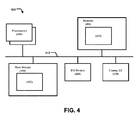
- FIG. 4 illustrates an example computer system suitable for use to practice various embodiments of the present disclosure.
- computing system 400 may include a number of processors or processor cores 402, a system memory 404, and a communication interface 410.
- processors or processor cores 402
- system memory 404 may be included in computing system 400.
- communication interface 410 may be included in computing system 400.
- computing system 400 may include tangible non-transitory mass storage devices 406 (such as an article of manufacture including diskette, hard drive, compact disc read only memory (CDROM) and so forth), input/output devices 408 (such as keyboard, cursor control and so forth).
- the elements may be coupled to each other via system bus 412, which represents one or more buses. In the case of multiple buses, they are bridged by one or more bus bridges (not shown).
- system memory 404 and tangible non-transitory mass storage 406 may be employed to store a working copy and a permanent copy of the programming instructions, herein collectively denoted as 422, that implements one or more operating systems, drivers, applications practiced by various entities in a NEMO compliant communication network, including one or more of the mobile routers, the public/private key generator, the home agent, the foreign agent, etc.
- the permanent copy of the programming instructions may be placed into permanent storage 406 in the factory, or in the field, through, for example, a distribution medium (not shown), such as a compact disc (CD), or through communication interface 410 (from a distribution server (not shown)). That is, one or more distribution media having an implementation of the agent program may be employed to distribute the agent and program various computing devices.
- a distribution medium such as a compact disc (CD)
- CD compact disc
- communication interface 410 from a distribution server (not shown)
Landscapes
- Engineering & Computer Science (AREA)
- Computer Security & Cryptography (AREA)
- Computer Networks & Wireless Communication (AREA)
- Signal Processing (AREA)
- Computing Systems (AREA)
- Theoretical Computer Science (AREA)
- Computer Hardware Design (AREA)
- General Engineering & Computer Science (AREA)
- Algebra (AREA)
- General Physics & Mathematics (AREA)
- Mathematical Analysis (AREA)
- Mathematical Optimization (AREA)
- Mathematical Physics (AREA)
- Pure & Applied Mathematics (AREA)
- Physics & Mathematics (AREA)
- Data Exchanges In Wide-Area Networks (AREA)
- Mobile Radio Communication Systems (AREA)
Applications Claiming Priority (1)
| Application Number | Priority Date | Filing Date | Title |
|---|---|---|---|
| MYPI2010006130 | 2010-12-22 |
Publications (2)
| Publication Number | Publication Date |
|---|---|
| EP2469901A2 true EP2469901A2 (de) | 2012-06-27 |
| EP2469901A3 EP2469901A3 (de) | 2013-07-03 |
Family
ID=46314349
Family Applications (1)
| Application Number | Title | Priority Date | Filing Date |
|---|---|---|---|
| EP11194606.7A Withdrawn EP2469901A3 (de) | 2010-12-22 | 2011-12-20 | Effiziente NEMO-Sicherheit mit identitätsbasierter Verschlüsselung |
Country Status (7)
| Country | Link |
|---|---|
| US (1) | US20120166792A1 (de) |
| EP (1) | EP2469901A3 (de) |
| JP (1) | JP2013506388A (de) |
| KR (1) | KR20120103434A (de) |
| CN (1) | CN102859928A (de) |
| TW (1) | TWI502946B (de) |
| WO (1) | WO2012087597A1 (de) |
Cited By (2)
| Publication number | Priority date | Publication date | Assignee | Title |
|---|---|---|---|---|
| JP2013506388A (ja) * | 2010-12-22 | 2013-02-21 | インテル コーポレイション | Ibeを有する効率的なnemoセキュリティ |
| CN106254327A (zh) * | 2016-07-28 | 2016-12-21 | 努比亚技术有限公司 | 信息处理装置及方法 |
Families Citing this family (5)
| Publication number | Priority date | Publication date | Assignee | Title |
|---|---|---|---|---|
| US8948381B2 (en) * | 2011-09-09 | 2015-02-03 | Fujitsu Limited | Conditional key generation based on expiration date of data |
| US9256763B2 (en) * | 2012-09-03 | 2016-02-09 | Nec Europe Ltd. | Method and system for providing a public key/secret key pair for encrypting and decrypting data |
| KR101460541B1 (ko) * | 2013-07-15 | 2014-11-11 | 고려대학교 산학협력단 | 사용자 아이디 기반 공개키 암호화 방법 |
| CN103457952B (zh) * | 2013-09-05 | 2017-09-01 | 新华三技术有限公司 | 一种基于加密引擎的IPSec处理方法和设备 |
| GB201709760D0 (en) * | 2017-06-19 | 2017-08-02 | Nchain Holdings Ltd | Computer-Implemented system and method |
Family Cites Families (10)
| Publication number | Priority date | Publication date | Assignee | Title |
|---|---|---|---|---|
| US20030211842A1 (en) * | 2002-02-19 | 2003-11-13 | James Kempf | Securing binding update using address based keys |
| US7657037B2 (en) * | 2004-09-20 | 2010-02-02 | Pgp Corporation | Apparatus and method for identity-based encryption within a conventional public-key infrastructure |
| US7822200B2 (en) * | 2005-03-07 | 2010-10-26 | Microsoft Corporation | Method and system for asymmetric key security |
| CA2526791C (en) * | 2005-11-14 | 2012-01-10 | Bce Inc. | Method and system for providing personalized service mobility |
| JP4829639B2 (ja) * | 2006-02-24 | 2011-12-07 | キヤノン株式会社 | データ処理装置およびデータ処理方法 |
| US7881470B2 (en) * | 2006-03-09 | 2011-02-01 | Intel Corporation | Network mobility security management |
| US7894420B2 (en) * | 2007-07-12 | 2011-02-22 | Intel Corporation | Fast path packet destination mechanism for network mobility via secure PKI channel |
| US8422687B2 (en) * | 2008-05-30 | 2013-04-16 | Lantiq Deutschland Gmbh | Key management for communication networks |
| US8488783B2 (en) * | 2010-02-19 | 2013-07-16 | Nokia | Method and apparatus for applying recipient criteria in identity-based encryption |
| US20120166792A1 (en) * | 2010-12-22 | 2012-06-28 | Tat Kin Tan | Efficient nemo security with ibe |
-
2011
- 2011-04-01 US US13/078,603 patent/US20120166792A1/en not_active Abandoned
- 2011-12-08 JP JP2012550223A patent/JP2013506388A/ja active Pending
- 2011-12-08 WO PCT/US2011/064022 patent/WO2012087597A1/en not_active Ceased
- 2011-12-08 KR KR1020117031668A patent/KR20120103434A/ko not_active Ceased
- 2011-12-08 CN CN2011800027403A patent/CN102859928A/zh active Pending
- 2011-12-12 TW TW100145778A patent/TWI502946B/zh not_active IP Right Cessation
- 2011-12-20 EP EP11194606.7A patent/EP2469901A3/de not_active Withdrawn
Non-Patent Citations (1)
| Title |
|---|
| None |
Cited By (2)
| Publication number | Priority date | Publication date | Assignee | Title |
|---|---|---|---|---|
| JP2013506388A (ja) * | 2010-12-22 | 2013-02-21 | インテル コーポレイション | Ibeを有する効率的なnemoセキュリティ |
| CN106254327A (zh) * | 2016-07-28 | 2016-12-21 | 努比亚技术有限公司 | 信息处理装置及方法 |
Also Published As
| Publication number | Publication date |
|---|---|
| KR20120103434A (ko) | 2012-09-19 |
| CN102859928A (zh) | 2013-01-02 |
| WO2012087597A1 (en) | 2012-06-28 |
| US20120166792A1 (en) | 2012-06-28 |
| TWI502946B (zh) | 2015-10-01 |
| TW201236430A (en) | 2012-09-01 |
| EP2469901A3 (de) | 2013-07-03 |
| JP2013506388A (ja) | 2013-02-21 |
Similar Documents
| Publication | Publication Date | Title |
|---|---|---|
| EP2779589B1 (de) | Änderung der Mitgliederreichbarkeitsinformationen eines dynamischen Gruppen-VPNs | |
| US8437345B2 (en) | Terminal and communication system | |
| KR101165825B1 (ko) | 모바일 노드 사이의 저지연성 보안 통신을 제공하는 방법 및 장치 | |
| US8584207B2 (en) | Infrastructure-less bootstrapping: trustless bootstrapping to enable mobility for mobile devices | |
| EP1495621B1 (de) | Sicherheitsübertragungsprotokoll für ein mobilitäts-ip-netzwerk | |
| US6839338B1 (en) | Method to provide dynamic internet protocol security policy service | |
| KR100679882B1 (ko) | 사설 네트워크와 로밍 모바일 단말 사이의 통신 | |
| EP2469901A2 (de) | Effiziente NEMO-Sicherheit mit identitätsbasierter Verschlüsselung | |
| JP2009516435A (ja) | 複数鍵暗号化生成アドレスを使ったモバイルネットワークのためのセキュアな経路最適化 | |
| JP2009528735A (ja) | ロケーションプライバシをサポートする経路最適化 | |
| WO2003030488A1 (en) | Method and system for ensuring secure forwarding of messages | |
| US8514777B1 (en) | Method and apparatus for protecting location privacy of a mobile device in a wireless communications network | |
| EP2449800B1 (de) | Verfahren und system zur optimierung einer mobilen ip-route | |
| TWI300662B (de) | ||
| Laurent-Maknavicius et al. | Inter-domain security for mobile Ipv6 | |
| EP2471247B1 (de) | Verfahren und Netzwerkknoten zur Erzeugung von kryptografisch generierten Adressen in mobilen IP-Netzen | |
| CN100496011C (zh) | 移动式vpn的动态代理器分配方法及系统 | |
| JP5186265B2 (ja) | モバイル通信システム、モバイルルータ、ホームエージェント、及びモバイル通信方法 | |
| Park et al. | Secure firewall traversal in mobile IP network | |
| Baek et al. | FI-Based Local Group Key Generation/Distribution for Mobile Multicast in a Hierarchical Mobile IPv6Network | |
| Wang et al. | IPSec-based key management in mobile IP networks | |
| Jeon et al. | Forwarding scheme extension for fast and secure handoff in hierarchical MIPv6 | |
| Wang et al. | An IPSec-based key management algorithm for mobile IP networks |
Legal Events
| Date | Code | Title | Description |
|---|---|---|---|
| 17P | Request for examination filed |
Effective date: 20111220 |
|
| AK | Designated contracting states |
Kind code of ref document: A2 Designated state(s): AL AT BE BG CH CY CZ DE DK EE ES FI FR GB GR HR HU IE IS IT LI LT LU LV MC MK MT NL NO PL PT RO RS SE SI SK SM TR |
|
| AX | Request for extension of the european patent |
Extension state: BA ME |
|
| PUAI | Public reference made under article 153(3) epc to a published international application that has entered the european phase |
Free format text: ORIGINAL CODE: 0009012 |
|
| PUAL | Search report despatched |
Free format text: ORIGINAL CODE: 0009013 |
|
| AK | Designated contracting states |
Kind code of ref document: A3 Designated state(s): AL AT BE BG CH CY CZ DE DK EE ES FI FR GB GR HR HU IE IS IT LI LT LU LV MC MK MT NL NO PL PT RO RS SE SI SK SM TR |
|
| AX | Request for extension of the european patent |
Extension state: BA ME |
|
| RIC1 | Information provided on ipc code assigned before grant |
Ipc: H04L 29/06 20060101ALI20130524BHEP Ipc: H04W 12/02 20090101ALI20130524BHEP Ipc: H04W 12/04 20090101AFI20130524BHEP |
|
| GRAP | Despatch of communication of intention to grant a patent |
Free format text: ORIGINAL CODE: EPIDOSNIGR1 |
|
| INTG | Intention to grant announced |
Effective date: 20170807 |
|
| STAA | Information on the status of an ep patent application or granted ep patent |
Free format text: STATUS: THE APPLICATION IS DEEMED TO BE WITHDRAWN |
|
| 18D | Application deemed to be withdrawn |
Effective date: 20171219 |