EP2468751A2 - Processes for the preparation of 5-chloro-2-methyl-2,3,3a,12b-tetrahydro-1H-dibenzo[2,3:6,7]oxepino[4,5-c]pyrrole - Google Patents
Processes for the preparation of 5-chloro-2-methyl-2,3,3a,12b-tetrahydro-1H-dibenzo[2,3:6,7]oxepino[4,5-c]pyrrole Download PDFInfo
- Publication number
- EP2468751A2 EP2468751A2 EP11195387A EP11195387A EP2468751A2 EP 2468751 A2 EP2468751 A2 EP 2468751A2 EP 11195387 A EP11195387 A EP 11195387A EP 11195387 A EP11195387 A EP 11195387A EP 2468751 A2 EP2468751 A2 EP 2468751A2
- Authority
- EP
- European Patent Office
- Prior art keywords
- compound
- trans
- amino
- acid
- optionally substituted
- Prior art date
- Legal status (The legal status is an assumption and is not a legal conclusion. Google has not performed a legal analysis and makes no representation as to the accuracy of the status listed.)
- Granted
Links
- 238000000034 method Methods 0.000 title claims abstract description 78
- 230000008569 process Effects 0.000 title claims abstract description 64
- 238000002360 preparation method Methods 0.000 title claims abstract description 9
- VSWBSWWIRNCQIJ-UHFFFAOYSA-N 5-chloro-2-methyl-2,3,3a,12b-tetrahydrodibenzo[2,3:6,7]oxepino[4,5-c]pyrrole Chemical compound O1C2=CC=CC=C2C2CN(C)CC2C2=CC(Cl)=CC=C21 VSWBSWWIRNCQIJ-UHFFFAOYSA-N 0.000 title abstract description 4
- 150000001875 compounds Chemical class 0.000 claims description 143
- 239000000203 mixture Substances 0.000 claims description 62
- 150000001413 amino acids Chemical class 0.000 claims description 45
- 230000009467 reduction Effects 0.000 claims description 39
- HEMHJVSKTPXQMS-UHFFFAOYSA-M sodium hydroxide Inorganic materials [OH-].[Na+] HEMHJVSKTPXQMS-UHFFFAOYSA-M 0.000 claims description 39
- 150000003839 salts Chemical class 0.000 claims description 32
- 150000003951 lactams Chemical class 0.000 claims description 31
- 239000003054 catalyst Substances 0.000 claims description 28
- AQRLNPVMDITEJU-UHFFFAOYSA-N triethylsilane Chemical compound CC[SiH](CC)CC AQRLNPVMDITEJU-UHFFFAOYSA-N 0.000 claims description 28
- WSFSSNUMVMOOMR-UHFFFAOYSA-N Formaldehyde Chemical compound O=C WSFSSNUMVMOOMR-UHFFFAOYSA-N 0.000 claims description 24
- 229910052739 hydrogen Inorganic materials 0.000 claims description 22
- 229910052727 yttrium Inorganic materials 0.000 claims description 22
- KWYUFKZDYYNOTN-UHFFFAOYSA-M Potassium hydroxide Chemical compound [OH-].[K+] KWYUFKZDYYNOTN-UHFFFAOYSA-M 0.000 claims description 21
- 239000002585 base Substances 0.000 claims description 18
- 238000006243 chemical reaction Methods 0.000 claims description 18
- 125000000217 alkyl group Chemical group 0.000 claims description 17
- DGAQECJNVWCQMB-PUAWFVPOSA-M Ilexoside XXIX Chemical group C[C@@H]1CC[C@@]2(CC[C@@]3(C(=CC[C@H]4[C@]3(CC[C@@H]5[C@@]4(CC[C@@H](C5(C)C)OS(=O)(=O)[O-])C)C)[C@@H]2[C@]1(C)O)C)C(=O)O[C@H]6[C@@H]([C@H]([C@@H]([C@H](O6)CO)O)O)O.[Na+] DGAQECJNVWCQMB-PUAWFVPOSA-M 0.000 claims description 16
- UORVGPXVDQYIDP-UHFFFAOYSA-N borane Chemical compound B UORVGPXVDQYIDP-UHFFFAOYSA-N 0.000 claims description 16
- KZMGYPLQYOPHEL-UHFFFAOYSA-N Boron trifluoride etherate Chemical compound FB(F)F.CCOCC KZMGYPLQYOPHEL-UHFFFAOYSA-N 0.000 claims description 12
- DTQVDTLACAAQTR-UHFFFAOYSA-N Trifluoroacetic acid Chemical compound OC(=O)C(F)(F)F DTQVDTLACAAQTR-UHFFFAOYSA-N 0.000 claims description 12
- 239000003153 chemical reaction reagent Substances 0.000 claims description 12
- 229910000085 borane Inorganic materials 0.000 claims description 11
- 230000002378 acidificating effect Effects 0.000 claims description 10
- BDAGIHXWWSANSR-UHFFFAOYSA-N methanoic acid Natural products OC=O BDAGIHXWWSANSR-UHFFFAOYSA-N 0.000 claims description 10
- 125000002496 methyl group Chemical group [H]C([H])([H])* 0.000 claims description 10
- 238000007363 ring formation reaction Methods 0.000 claims description 10
- 125000001797 benzyl group Chemical group [H]C1=C([H])C([H])=C(C([H])=C1[H])C([H])([H])* 0.000 claims description 9
- 125000001997 phenyl group Chemical group [H]C1=C([H])C([H])=C(*)C([H])=C1[H] 0.000 claims description 9
- 125000004169 (C1-C6) alkyl group Chemical group 0.000 claims description 8
- 239000003638 chemical reducing agent Substances 0.000 claims description 8
- 239000002841 Lewis acid Substances 0.000 claims description 7
- ZLMJMSJWJFRBEC-UHFFFAOYSA-N Potassium Chemical group [K] ZLMJMSJWJFRBEC-UHFFFAOYSA-N 0.000 claims description 7
- 150000007517 lewis acids Chemical class 0.000 claims description 7
- 229910052700 potassium Inorganic materials 0.000 claims description 7
- 239000011591 potassium Substances 0.000 claims description 7
- 229910015900 BF3 Inorganic materials 0.000 claims description 6
- WTEOIRVLGSZEPR-UHFFFAOYSA-N boron trifluoride Chemical compound FB(F)F WTEOIRVLGSZEPR-UHFFFAOYSA-N 0.000 claims description 6
- 229910052751 metal Inorganic materials 0.000 claims description 6
- 239000002184 metal Substances 0.000 claims description 6
- 230000001035 methylating effect Effects 0.000 claims description 6
- OSWFIVFLDKOXQC-UHFFFAOYSA-N 4-(3-methoxyphenyl)aniline Chemical compound COC1=CC=CC(C=2C=CC(N)=CC=2)=C1 OSWFIVFLDKOXQC-UHFFFAOYSA-N 0.000 claims description 5
- 235000019253 formic acid Nutrition 0.000 claims description 5
- 239000012279 sodium borohydride Substances 0.000 claims description 5
- 229910000033 sodium borohydride Inorganic materials 0.000 claims description 5
- JEDZLBFUGJTJGQ-UHFFFAOYSA-N [Na].COCCO[AlH]OCCOC Chemical compound [Na].COCCO[AlH]OCCOC JEDZLBFUGJTJGQ-UHFFFAOYSA-N 0.000 claims description 4
- 239000012024 dehydrating agents Substances 0.000 claims description 4
- 238000004519 manufacturing process Methods 0.000 claims description 4
- 239000012022 methylating agents Substances 0.000 claims description 4
- 230000011987 methylation Effects 0.000 claims description 4
- 238000007069 methylation reaction Methods 0.000 claims description 4
- 229920000137 polyphosphoric acid Polymers 0.000 claims description 4
- 239000012419 sodium bis(2-methoxyethoxy)aluminum hydride Substances 0.000 claims description 4
- BLRPTPMANUNPDV-UHFFFAOYSA-N Silane Chemical group [SiH4] BLRPTPMANUNPDV-UHFFFAOYSA-N 0.000 claims description 3
- 230000003301 hydrolyzing effect Effects 0.000 claims description 3
- 229910000077 silane Inorganic materials 0.000 claims description 3
- 230000000063 preceeding effect Effects 0.000 claims 1
- 229960005245 asenapine Drugs 0.000 abstract description 11
- VSWBSWWIRNCQIJ-GJZGRUSLSA-N (R,R)-asenapine Chemical compound O1C2=CC=CC=C2[C@@H]2CN(C)C[C@H]2C2=CC(Cl)=CC=C21 VSWBSWWIRNCQIJ-GJZGRUSLSA-N 0.000 abstract 2
- XEKOWRVHYACXOJ-UHFFFAOYSA-N Ethyl acetate Chemical compound CCOC(C)=O XEKOWRVHYACXOJ-UHFFFAOYSA-N 0.000 description 63
- OKKJLVBELUTLKV-UHFFFAOYSA-N Methanol Chemical compound OC OKKJLVBELUTLKV-UHFFFAOYSA-N 0.000 description 63
- YXFVVABEGXRONW-UHFFFAOYSA-N Toluene Chemical compound CC1=CC=CC=C1 YXFVVABEGXRONW-UHFFFAOYSA-N 0.000 description 63
- WYURNTSHIVDZCO-UHFFFAOYSA-N Tetrahydrofuran Chemical compound C1CCOC1 WYURNTSHIVDZCO-UHFFFAOYSA-N 0.000 description 48
- 230000015572 biosynthetic process Effects 0.000 description 38
- 238000006722 reduction reaction Methods 0.000 description 36
- VEXZGXHMUGYJMC-UHFFFAOYSA-N Hydrochloric acid Chemical compound Cl VEXZGXHMUGYJMC-UHFFFAOYSA-N 0.000 description 32
- BZLVMXJERCGZMT-UHFFFAOYSA-N Methyl tert-butyl ether Chemical compound COC(C)(C)C BZLVMXJERCGZMT-UHFFFAOYSA-N 0.000 description 32
- 238000003786 synthesis reaction Methods 0.000 description 31
- -1 potassium cyanoborohydride Chemical compound 0.000 description 30
- 239000007787 solid Substances 0.000 description 30
- 239000000243 solution Substances 0.000 description 30
- YMWUJEATGCHHMB-UHFFFAOYSA-N Dichloromethane Chemical compound ClCCl YMWUJEATGCHHMB-UHFFFAOYSA-N 0.000 description 27
- YLQBMQCUIZJEEH-UHFFFAOYSA-N tetrahydrofuran Natural products C=1C=COC=1 YLQBMQCUIZJEEH-UHFFFAOYSA-N 0.000 description 23
- XLYOFNOQVPJJNP-UHFFFAOYSA-N water Substances O XLYOFNOQVPJJNP-UHFFFAOYSA-N 0.000 description 22
- RTZKZFJDLAIYFH-UHFFFAOYSA-N Diethyl ether Chemical compound CCOCC RTZKZFJDLAIYFH-UHFFFAOYSA-N 0.000 description 20
- 239000002904 solvent Substances 0.000 description 20
- LFQSCWFLJHTTHZ-UHFFFAOYSA-N Ethanol Chemical compound CCO LFQSCWFLJHTTHZ-UHFFFAOYSA-N 0.000 description 18
- VSCWAEJMTAWNJL-UHFFFAOYSA-K aluminium trichloride Chemical compound Cl[Al](Cl)Cl VSCWAEJMTAWNJL-UHFFFAOYSA-K 0.000 description 16
- 239000012074 organic phase Substances 0.000 description 16
- 239000000725 suspension Substances 0.000 description 16
- 239000011541 reaction mixture Substances 0.000 description 15
- PMZURENOXWZQFD-UHFFFAOYSA-L Sodium Sulfate Chemical compound [Na+].[Na+].[O-]S([O-])(=O)=O PMZURENOXWZQFD-UHFFFAOYSA-L 0.000 description 14
- 239000011777 magnesium Substances 0.000 description 14
- FYYHWMGAXLPEAU-UHFFFAOYSA-N Magnesium Chemical compound [Mg] FYYHWMGAXLPEAU-UHFFFAOYSA-N 0.000 description 13
- 229910052749 magnesium Inorganic materials 0.000 description 13
- 239000012071 phase Substances 0.000 description 13
- UHOVQNZJYSORNB-UHFFFAOYSA-N Benzene Chemical compound C1=CC=CC=C1 UHOVQNZJYSORNB-UHFFFAOYSA-N 0.000 description 12
- IAZDPXIOMUYVGZ-WFGJKAKNSA-N Dimethyl sulfoxide Chemical compound [2H]C([2H])([2H])S(=O)C([2H])([2H])[2H] IAZDPXIOMUYVGZ-WFGJKAKNSA-N 0.000 description 12
- KFZMGEQAYNKOFK-UHFFFAOYSA-N Isopropanol Chemical compound CC(C)O KFZMGEQAYNKOFK-UHFFFAOYSA-N 0.000 description 12
- VLKZOEOYAKHREP-UHFFFAOYSA-N n-Hexane Chemical compound CCCCCC VLKZOEOYAKHREP-UHFFFAOYSA-N 0.000 description 12
- 230000009466 transformation Effects 0.000 description 12
- QTBSBXVTEAMEQO-UHFFFAOYSA-N Acetic acid Chemical compound CC(O)=O QTBSBXVTEAMEQO-UHFFFAOYSA-N 0.000 description 11
- UFHFLCQGNIYNRP-UHFFFAOYSA-N Hydrogen Chemical compound [H][H] UFHFLCQGNIYNRP-UHFFFAOYSA-N 0.000 description 11
- 239000001257 hydrogen Substances 0.000 description 11
- 239000010410 layer Substances 0.000 description 11
- VZCYOOQTPOCHFL-UHFFFAOYSA-N trans-butenedioic acid Natural products OC(=O)C=CC(O)=O VZCYOOQTPOCHFL-UHFFFAOYSA-N 0.000 description 11
- VSWBSWWIRNCQIJ-HUUCEWRRSA-N (S,S)-asenapine Chemical compound O1C2=CC=CC=C2[C@H]2CN(C)C[C@@H]2C2=CC(Cl)=CC=C21 VSWBSWWIRNCQIJ-HUUCEWRRSA-N 0.000 description 10
- QAOWNCQODCNURD-UHFFFAOYSA-N Sulfuric acid Chemical compound OS(O)(=O)=O QAOWNCQODCNURD-UHFFFAOYSA-N 0.000 description 10
- 0 *c(cc1)ccc1Oc1c(CC(Cl)=O)cc(*)cc1 Chemical compound *c(cc1)ccc1Oc1c(CC(Cl)=O)cc(*)cc1 0.000 description 9
- WEVYAHXRMPXWCK-UHFFFAOYSA-N Acetonitrile Chemical compound CC#N WEVYAHXRMPXWCK-UHFFFAOYSA-N 0.000 description 9
- AFVFQIVMOAPDHO-UHFFFAOYSA-N Methanesulfonic acid Chemical compound CS(O)(=O)=O AFVFQIVMOAPDHO-UHFFFAOYSA-N 0.000 description 9
- FAPWRFPIFSIZLT-UHFFFAOYSA-M Sodium chloride Chemical class [Na+].[Cl-] FAPWRFPIFSIZLT-UHFFFAOYSA-M 0.000 description 9
- ZMANZCXQSJIPKH-UHFFFAOYSA-N Triethylamine Chemical compound CCN(CC)CC ZMANZCXQSJIPKH-UHFFFAOYSA-N 0.000 description 9
- 238000001816 cooling Methods 0.000 description 9
- 239000003960 organic solvent Substances 0.000 description 9
- JRKCAGJFDTXMMF-IUODEOHRSA-N trans-11-chloro-2,3,3a,12b-tetrahydro-1h-dibenz[2,3:6,7]oxepino[4,5-c]pyrrol-1-one Chemical compound O1C2=CC=CC=C2[C@H]2CNC(=O)[C@@H]2C2=CC(Cl)=CC=C21 JRKCAGJFDTXMMF-IUODEOHRSA-N 0.000 description 9
- CIWBSHSKHKDKBQ-JLAZNSOCSA-N Ascorbic acid Chemical compound OC[C@H](O)[C@H]1OC(=O)C(O)=C1O CIWBSHSKHKDKBQ-JLAZNSOCSA-N 0.000 description 8
- WHXSMMKQMYFTQS-UHFFFAOYSA-N Lithium Chemical compound [Li] WHXSMMKQMYFTQS-UHFFFAOYSA-N 0.000 description 8
- LRHPLDYGYMQRHN-UHFFFAOYSA-N N-Butanol Chemical compound CCCCO LRHPLDYGYMQRHN-UHFFFAOYSA-N 0.000 description 8
- CTQNGGLPUBDAKN-UHFFFAOYSA-N O-Xylene Chemical group CC1=CC=CC=C1C CTQNGGLPUBDAKN-UHFFFAOYSA-N 0.000 description 8
- URLKBWYHVLBVBO-UHFFFAOYSA-N Para-Xylene Chemical group CC1=CC=C(C)C=C1 URLKBWYHVLBVBO-UHFFFAOYSA-N 0.000 description 8
- CDBYLPFSWZWCQE-UHFFFAOYSA-L Sodium Carbonate Chemical compound [Na+].[Na+].[O-]C([O-])=O CDBYLPFSWZWCQE-UHFFFAOYSA-L 0.000 description 8
- UIIMBOGNXHQVGW-UHFFFAOYSA-M Sodium bicarbonate Chemical compound [Na+].OC([O-])=O UIIMBOGNXHQVGW-UHFFFAOYSA-M 0.000 description 8
- 239000002253 acid Substances 0.000 description 8
- IVSZLXZYQVIEFR-UHFFFAOYSA-N m-xylene Chemical group CC1=CC=CC(C)=C1 IVSZLXZYQVIEFR-UHFFFAOYSA-N 0.000 description 8
- SAWYCGILRHVUAY-UHFFFAOYSA-N methyl 3-chloro-6-(nitromethyl)-5,6-dihydrobenzo[b][1]benzoxepine-5-carboxylate Chemical compound COC(=O)C1C(C[N+]([O-])=O)C2=CC=CC=C2OC2=CC=C(Cl)C=C12 SAWYCGILRHVUAY-UHFFFAOYSA-N 0.000 description 8
- 239000012044 organic layer Substances 0.000 description 8
- 238000010992 reflux Methods 0.000 description 8
- 239000011734 sodium Substances 0.000 description 8
- 229910052708 sodium Inorganic materials 0.000 description 8
- GMDCDXMAFMEDAG-CHHFXETESA-N (S,S)-asenapine maleate Chemical compound OC(=O)\C=C/C(O)=O.O1C2=CC=CC=C2[C@H]2CN(C)C[C@@H]2C2=CC(Cl)=CC=C21 GMDCDXMAFMEDAG-CHHFXETESA-N 0.000 description 7
- ALMJMOPIBISVHZ-UHFFFAOYSA-N 2-[2-(4-chlorophenoxy)phenyl]acetic acid Chemical compound OC(=O)CC1=CC=CC=C1OC1=CC=C(Cl)C=C1 ALMJMOPIBISVHZ-UHFFFAOYSA-N 0.000 description 7
- 239000004215 Carbon black (E152) Substances 0.000 description 7
- 229960001615 asenapine maleate Drugs 0.000 description 7
- 238000001914 filtration Methods 0.000 description 7
- 229930195733 hydrocarbon Natural products 0.000 description 7
- IXCSERBJSXMMFS-UHFFFAOYSA-N hydrogen chloride Substances Cl.Cl IXCSERBJSXMMFS-UHFFFAOYSA-N 0.000 description 7
- 229910000041 hydrogen chloride Inorganic materials 0.000 description 7
- VZCYOOQTPOCHFL-UPHRSURJSA-N maleic acid Chemical compound OC(=O)\C=C/C(O)=O VZCYOOQTPOCHFL-UPHRSURJSA-N 0.000 description 7
- VWIIMLDFDYFOBJ-UHFFFAOYSA-N methyl 2-(5-chloro-2-phenoxyphenyl)-3-hydroxyprop-2-enoate Chemical compound COC(=O)C(=CO)C1=CC(Cl)=CC=C1OC1=CC=CC=C1 VWIIMLDFDYFOBJ-UHFFFAOYSA-N 0.000 description 7
- CADDWXKCPYHVCJ-UHFFFAOYSA-N methyl 2-(5-chloro-2-phenoxyphenyl)acetate Chemical compound COC(=O)CC1=CC(Cl)=CC=C1OC1=CC=CC=C1 CADDWXKCPYHVCJ-UHFFFAOYSA-N 0.000 description 7
- VEZNRTSJHPSRLC-UHFFFAOYSA-N methyl 3-chlorobenzo[b][1]benzoxepine-5-carboxylate Chemical compound COC(=O)C1=CC2=CC=CC=C2OC2=CC=C(Cl)C=C12 VEZNRTSJHPSRLC-UHFFFAOYSA-N 0.000 description 7
- QWSQABREXKWIDM-UHFFFAOYSA-N methyl 6-(aminomethyl)-3-chloro-5,6-dihydrobenzo[b][1]benzoxepine-5-carboxylate Chemical compound COC(=O)C1C(CN)C2=CC=CC=C2OC2=CC=C(Cl)C=C12 QWSQABREXKWIDM-UHFFFAOYSA-N 0.000 description 7
- 239000003921 oil Substances 0.000 description 7
- DYLIWHYUXAJDOJ-OWOJBTEDSA-N (e)-4-(6-aminopurin-9-yl)but-2-en-1-ol Chemical compound NC1=NC=NC2=C1N=CN2C\C=C\CO DYLIWHYUXAJDOJ-OWOJBTEDSA-N 0.000 description 6
- VOTGBXTUIFUDJK-UHFFFAOYSA-N 3-[2-(4-chlorophenoxy)phenyl]-1-methylpyrrolidine-2,4-dione Chemical compound O=C1N(C)CC(=O)C1C1=CC=CC=C1OC1=CC=C(Cl)C=C1 VOTGBXTUIFUDJK-UHFFFAOYSA-N 0.000 description 6
- HEDRZPFGACZZDS-UHFFFAOYSA-N Chloroform Chemical compound ClC(Cl)Cl HEDRZPFGACZZDS-UHFFFAOYSA-N 0.000 description 6
- ZMXDDKWLCZADIW-UHFFFAOYSA-N N,N-Dimethylformamide Chemical compound CN(C)C=O ZMXDDKWLCZADIW-UHFFFAOYSA-N 0.000 description 6
- IMNFDUFMRHMDMM-UHFFFAOYSA-N N-Heptane Chemical compound CCCCCCC IMNFDUFMRHMDMM-UHFFFAOYSA-N 0.000 description 6
- MUBZPKHOEPUJKR-UHFFFAOYSA-N Oxalic acid Chemical compound OC(=O)C(O)=O MUBZPKHOEPUJKR-UHFFFAOYSA-N 0.000 description 6
- AZDRQVAHHNSJOQ-UHFFFAOYSA-N alumane Chemical class [AlH3] AZDRQVAHHNSJOQ-UHFFFAOYSA-N 0.000 description 6
- MVPPADPHJFYWMZ-UHFFFAOYSA-N chlorobenzene Chemical compound ClC1=CC=CC=C1 MVPPADPHJFYWMZ-UHFFFAOYSA-N 0.000 description 6
- 125000005610 enamide group Chemical group 0.000 description 6
- 150000002170 ethers Chemical class 0.000 description 6
- 229940052303 ethers for general anesthesia Drugs 0.000 description 6
- 238000006317 isomerization reaction Methods 0.000 description 6
- 229910052744 lithium Inorganic materials 0.000 description 6
- JIKYERBDTOGAKP-UHFFFAOYSA-N methyl 2-[[2-[2-(4-chlorophenoxy)phenyl]acetyl]-methylamino]acetate Chemical compound COC(=O)CN(C)C(=O)CC1=CC=CC=C1OC1=CC=C(Cl)C=C1 JIKYERBDTOGAKP-UHFFFAOYSA-N 0.000 description 6
- TZIHFWKZFHZASV-UHFFFAOYSA-N methyl formate Chemical compound COC=O TZIHFWKZFHZASV-UHFFFAOYSA-N 0.000 description 6
- UAEPNZWRGJTJPN-UHFFFAOYSA-N methylcyclohexane Chemical compound CC1CCCCC1 UAEPNZWRGJTJPN-UHFFFAOYSA-N 0.000 description 6
- BWHMMNNQKKPAPP-UHFFFAOYSA-L potassium carbonate Chemical compound [K+].[K+].[O-]C([O-])=O BWHMMNNQKKPAPP-UHFFFAOYSA-L 0.000 description 6
- FYSNRJHAOHDILO-UHFFFAOYSA-N thionyl chloride Chemical compound ClS(Cl)=O FYSNRJHAOHDILO-UHFFFAOYSA-N 0.000 description 6
- UAYWVJHJZHQCIE-UHFFFAOYSA-L zinc iodide Chemical compound I[Zn]I UAYWVJHJZHQCIE-UHFFFAOYSA-L 0.000 description 6
- DDBZJSICLLIXHC-IUODEOHRSA-N (2S,6S)-9-chloro-13-oxa-4-azatetracyclo[12.4.0.02,6.07,12]octadeca-1(18),7(12),8,10,14,16-hexaen-3-one Chemical compound O1C2=CC=CC=C2[C@H]2C(=O)NC[C@@H]2C2=CC(Cl)=CC=C21 DDBZJSICLLIXHC-IUODEOHRSA-N 0.000 description 5
- RYHBNJHYFVUHQT-UHFFFAOYSA-N 1,4-Dioxane Chemical compound C1COCCO1 RYHBNJHYFVUHQT-UHFFFAOYSA-N 0.000 description 5
- RESMLHFVRJLXOO-UHFFFAOYSA-N 3-[2-(4-chlorophenoxy)phenyl]-4-hydroxy-1-methylpyrrolidin-2-one Chemical compound O=C1N(C)CC(O)C1C1=CC=CC=C1OC1=CC=C(Cl)C=C1 RESMLHFVRJLXOO-UHFFFAOYSA-N 0.000 description 5
- VZCYOOQTPOCHFL-OWOJBTEDSA-N Fumaric acid Chemical compound OC(=O)\C=C\C(O)=O VZCYOOQTPOCHFL-OWOJBTEDSA-N 0.000 description 5
- 239000008346 aqueous phase Substances 0.000 description 5
- 229960004132 diethyl ether Drugs 0.000 description 5
- XPPKVPWEQAFLFU-UHFFFAOYSA-N diphosphoric acid Chemical compound OP(O)(=O)OP(O)(O)=O XPPKVPWEQAFLFU-UHFFFAOYSA-N 0.000 description 5
- 238000004128 high performance liquid chromatography Methods 0.000 description 5
- DNKXSHLVKBQWEJ-UHFFFAOYSA-N methyl 2-[2-(4-chlorophenoxy)phenyl]-3-hydroxyprop-2-enoate Chemical compound COC(=O)C(=CO)C1=CC=CC=C1OC1=CC=C(Cl)C=C1 DNKXSHLVKBQWEJ-UHFFFAOYSA-N 0.000 description 5
- OFUOCHOAOOPHMQ-UHFFFAOYSA-N methyl 2-[2-(4-chlorophenoxy)phenyl]acetate Chemical compound COC(=O)CC1=CC=CC=C1OC1=CC=C(Cl)C=C1 OFUOCHOAOOPHMQ-UHFFFAOYSA-N 0.000 description 5
- CQXOBQMGIKSKJR-UHFFFAOYSA-N methyl 3-chloro-5-(nitromethyl)-5,6-dihydrobenzo[b][1]benzoxepine-6-carboxylate Chemical compound COC(=O)C1C(C[N+]([O-])=O)C2=CC(Cl)=CC=C2OC2=CC=CC=C12 CQXOBQMGIKSKJR-UHFFFAOYSA-N 0.000 description 5
- 229940005657 pyrophosphoric acid Drugs 0.000 description 5
- 239000012047 saturated solution Substances 0.000 description 5
- 125000001424 substituent group Chemical group 0.000 description 5
- DQUCRGAOGUQHJQ-ZIAGYGMSSA-N trans-5-chloro-2,3,3a,12b-tetrahydro-1h-dibenzo[2,3:6,7]oxepino[4,5-c]pyrrole Chemical compound O1C2=CC=CC=C2[C@H]2CNC[C@@H]2C2=CC(Cl)=CC=C21 DQUCRGAOGUQHJQ-ZIAGYGMSSA-N 0.000 description 5
- GQHTUMJGOHRCHB-UHFFFAOYSA-N 2,3,4,6,7,8,9,10-octahydropyrimido[1,2-a]azepine Chemical compound C1CCCCN2CCCN=C21 GQHTUMJGOHRCHB-UHFFFAOYSA-N 0.000 description 4
- PKMKNEIUKHPJAX-UHFFFAOYSA-N 2-(5-chloro-2-phenoxyphenyl)acetic acid Chemical compound OC(=O)CC1=CC(Cl)=CC=C1OC1=CC=CC=C1 PKMKNEIUKHPJAX-UHFFFAOYSA-N 0.000 description 4
- QGZKDVFQNNGYKY-UHFFFAOYSA-N Ammonia Chemical compound N QGZKDVFQNNGYKY-UHFFFAOYSA-N 0.000 description 4
- ONMMHDIXIDXKTN-DTPOWOMPSA-N Cl.O1C2=CC=CC=C2[C@H]2CNC[C@@H]2C2=CC(Cl)=CC=C21 Chemical compound Cl.O1C2=CC=CC=C2[C@H]2CNC[C@@H]2C2=CC(Cl)=CC=C21 ONMMHDIXIDXKTN-DTPOWOMPSA-N 0.000 description 4
- FEWJPZIEWOKRBE-JCYAYHJZSA-N Dextrotartaric acid Chemical compound OC(=O)[C@H](O)[C@@H](O)C(O)=O FEWJPZIEWOKRBE-JCYAYHJZSA-N 0.000 description 4
- PXHVJJICTQNCMI-UHFFFAOYSA-N Nickel Chemical compound [Ni] PXHVJJICTQNCMI-UHFFFAOYSA-N 0.000 description 4
- OFOBLEOULBTSOW-UHFFFAOYSA-N Propanedioic acid Natural products OC(=O)CC(O)=O OFOBLEOULBTSOW-UHFFFAOYSA-N 0.000 description 4
- XBDQKXXYIPTUBI-UHFFFAOYSA-M Propionate Chemical compound CCC([O-])=O XBDQKXXYIPTUBI-UHFFFAOYSA-M 0.000 description 4
- GRHZLQBPAJAHDM-SPRQWYLLSA-N [(3as,4r,6ar)-2,3,3a,4,5,6a-hexahydrofuro[2,3-b]furan-4-yl] n-[(2s,4s,5s)-5-[[2-(2,6-dimethylphenoxy)acetyl]amino]-4-hydroxy-1,6-diphenylhexan-2-yl]carbamate Chemical group CC1=CC=CC(C)=C1OCC(=O)N[C@H]([C@@H](O)C[C@H](CC=1C=CC=CC=1)NC(=O)O[C@@H]1[C@@H]2CCO[C@@H]2OC1)CC1=CC=CC=C1 GRHZLQBPAJAHDM-SPRQWYLLSA-N 0.000 description 4
- 229960000583 acetic acid Drugs 0.000 description 4
- 230000004913 activation Effects 0.000 description 4
- 150000001298 alcohols Chemical class 0.000 description 4
- 229910000091 aluminium hydride Inorganic materials 0.000 description 4
- 239000003849 aromatic solvent Substances 0.000 description 4
- 235000010323 ascorbic acid Nutrition 0.000 description 4
- 239000011668 ascorbic acid Substances 0.000 description 4
- 239000000706 filtrate Substances 0.000 description 4
- 229910052736 halogen Inorganic materials 0.000 description 4
- 125000005843 halogen group Chemical group 0.000 description 4
- 150000002430 hydrocarbons Chemical class 0.000 description 4
- 125000004435 hydrogen atom Chemical group [H]* 0.000 description 4
- 239000012280 lithium aluminium hydride Substances 0.000 description 4
- BJEPYKJPYRNKOW-UHFFFAOYSA-N malic acid Chemical compound OC(=O)C(O)CC(O)=O BJEPYKJPYRNKOW-UHFFFAOYSA-N 0.000 description 4
- OPUIJYBQVIPZJF-UHFFFAOYSA-N methyl 3-chlorobenzo[b][1]benzoxepine-6-carboxylate Chemical compound COC(=O)C1=CC2=CC(Cl)=CC=C2OC2=CC=CC=C12 OPUIJYBQVIPZJF-UHFFFAOYSA-N 0.000 description 4
- MHZRHHKDULFKLP-UHFFFAOYSA-N methyl 5-(aminomethyl)-3-chloro-5,6-dihydrobenzo[b][1]benzoxepine-6-carboxylate Chemical compound COC(=O)C1C(CN)C2=CC(Cl)=CC=C2OC2=CC=CC=C12 MHZRHHKDULFKLP-UHFFFAOYSA-N 0.000 description 4
- 150000007522 mineralic acids Chemical class 0.000 description 4
- 229940078552 o-xylene Drugs 0.000 description 4
- 150000007524 organic acids Chemical class 0.000 description 4
- 229910000030 sodium bicarbonate Inorganic materials 0.000 description 4
- 235000017557 sodium bicarbonate Nutrition 0.000 description 4
- 229910000029 sodium carbonate Inorganic materials 0.000 description 4
- 150000003573 thiols Chemical group 0.000 description 4
- XJDNKRIXUMDJCW-UHFFFAOYSA-J titanium tetrachloride Chemical compound Cl[Ti](Cl)(Cl)Cl XJDNKRIXUMDJCW-UHFFFAOYSA-J 0.000 description 4
- WJKHJLXJJJATHN-UHFFFAOYSA-N triflic anhydride Chemical compound FC(F)(F)S(=O)(=O)OS(=O)(=O)C(F)(F)F WJKHJLXJJJATHN-UHFFFAOYSA-N 0.000 description 4
- SCYULBFZEHDVBN-UHFFFAOYSA-N 1,1-Dichloroethane Chemical compound CC(Cl)Cl SCYULBFZEHDVBN-UHFFFAOYSA-N 0.000 description 3
- OCJBOOLMMGQPQU-UHFFFAOYSA-N 1,4-dichlorobenzene Chemical compound ClC1=CC=C(Cl)C=C1 OCJBOOLMMGQPQU-UHFFFAOYSA-N 0.000 description 3
- 238000001644 13C nuclear magnetic resonance spectroscopy Methods 0.000 description 3
- 238000005160 1H NMR spectroscopy Methods 0.000 description 3
- PAQZWJGSJMLPMG-UHFFFAOYSA-N 2,4,6-tripropyl-1,3,5,2$l^{5},4$l^{5},6$l^{5}-trioxatriphosphinane 2,4,6-trioxide Chemical compound CCCP1(=O)OP(=O)(CCC)OP(=O)(CCC)O1 PAQZWJGSJMLPMG-UHFFFAOYSA-N 0.000 description 3
- QURJXQASERTKFX-UHFFFAOYSA-N 2-(3-chlorophenoxy)-1-phenylethanone Chemical compound ClC1=CC=CC(OCC(=O)C=2C=CC=CC=2)=C1 QURJXQASERTKFX-UHFFFAOYSA-N 0.000 description 3
- ZWEHNKRNPOVVGH-UHFFFAOYSA-N 2-Butanone Chemical compound CCC(C)=O ZWEHNKRNPOVVGH-UHFFFAOYSA-N 0.000 description 3
- JWUJQDFVADABEY-UHFFFAOYSA-N 2-methyltetrahydrofuran Chemical compound CC1CCCO1 JWUJQDFVADABEY-UHFFFAOYSA-N 0.000 description 3
- QTBSBXVTEAMEQO-UHFFFAOYSA-M Acetate Chemical compound CC([O-])=O QTBSBXVTEAMEQO-UHFFFAOYSA-M 0.000 description 3
- CSCPPACGZOOCGX-UHFFFAOYSA-N Acetone Chemical compound CC(C)=O CSCPPACGZOOCGX-UHFFFAOYSA-N 0.000 description 3
- KRKNYBCHXYNGOX-UHFFFAOYSA-K Citrate Chemical compound [O-]C(=O)CC(O)(CC([O-])=O)C([O-])=O KRKNYBCHXYNGOX-UHFFFAOYSA-K 0.000 description 3
- XDTMQSROBMDMFD-UHFFFAOYSA-N Cyclohexane Chemical compound C1CCCCC1 XDTMQSROBMDMFD-UHFFFAOYSA-N 0.000 description 3
- ZAFNJMIOTHYJRJ-UHFFFAOYSA-N Diisopropyl ether Chemical compound CC(C)OC(C)C ZAFNJMIOTHYJRJ-UHFFFAOYSA-N 0.000 description 3
- CPELXLSAUQHCOX-UHFFFAOYSA-N Hydrogen bromide Chemical compound Br CPELXLSAUQHCOX-UHFFFAOYSA-N 0.000 description 3
- JVTAAEKCZFNVCJ-UHFFFAOYSA-M Lactate Chemical compound CC(O)C([O-])=O JVTAAEKCZFNVCJ-UHFFFAOYSA-M 0.000 description 3
- OFOBLEOULBTSOW-UHFFFAOYSA-L Malonate Chemical compound [O-]C(=O)CC([O-])=O OFOBLEOULBTSOW-UHFFFAOYSA-L 0.000 description 3
- 229910002651 NO3 Inorganic materials 0.000 description 3
- NHNBFGGVMKEFGY-UHFFFAOYSA-N Nitrate Chemical compound [O-][N+]([O-])=O NHNBFGGVMKEFGY-UHFFFAOYSA-N 0.000 description 3
- 229910019142 PO4 Inorganic materials 0.000 description 3
- 239000007868 Raney catalyst Substances 0.000 description 3
- QAOWNCQODCNURD-UHFFFAOYSA-L Sulfate Chemical compound [O-]S([O-])(=O)=O QAOWNCQODCNURD-UHFFFAOYSA-L 0.000 description 3
- HCHKCACWOHOZIP-UHFFFAOYSA-N Zinc Chemical compound [Zn] HCHKCACWOHOZIP-UHFFFAOYSA-N 0.000 description 3
- 150000007513 acids Chemical class 0.000 description 3
- WNLRTRBMVRJNCN-UHFFFAOYSA-L adipate(2-) Chemical compound [O-]C(=O)CCCCC([O-])=O WNLRTRBMVRJNCN-UHFFFAOYSA-L 0.000 description 3
- 150000001408 amides Chemical group 0.000 description 3
- 150000001412 amines Chemical class 0.000 description 3
- 239000007864 aqueous solution Substances 0.000 description 3
- 229940072107 ascorbate Drugs 0.000 description 3
- SRSXLGNVWSONIS-UHFFFAOYSA-M benzenesulfonate Chemical compound [O-]S(=O)(=O)C1=CC=CC=C1 SRSXLGNVWSONIS-UHFFFAOYSA-M 0.000 description 3
- WPYMKLBDIGXBTP-UHFFFAOYSA-N benzoic acid Chemical compound OC(=O)C1=CC=CC=C1 WPYMKLBDIGXBTP-UHFFFAOYSA-N 0.000 description 3
- 239000012267 brine Substances 0.000 description 3
- 125000004432 carbon atom Chemical group C* 0.000 description 3
- 229950005499 carbon tetrachloride Drugs 0.000 description 3
- 150000001735 carboxylic acids Chemical class 0.000 description 3
- 238000009903 catalytic hydrogenation reaction Methods 0.000 description 3
- 239000003795 chemical substances by application Substances 0.000 description 3
- 238000004587 chromatography analysis Methods 0.000 description 3
- 238000011097 chromatography purification Methods 0.000 description 3
- KRKNYBCHXYNGOX-UHFFFAOYSA-N citric acid Chemical compound OC(=O)CC(O)(C(O)=O)CC(O)=O KRKNYBCHXYNGOX-UHFFFAOYSA-N 0.000 description 3
- 239000012043 crude product Substances 0.000 description 3
- 229940117389 dichlorobenzene Drugs 0.000 description 3
- 230000029087 digestion Effects 0.000 description 3
- 238000004821 distillation Methods 0.000 description 3
- 150000002148 esters Chemical class 0.000 description 3
- 229940093915 gynecological organic acid Drugs 0.000 description 3
- 230000007062 hydrolysis Effects 0.000 description 3
- 238000006460 hydrolysis reaction Methods 0.000 description 3
- 230000014759 maintenance of location Effects 0.000 description 3
- 229940049920 malate Drugs 0.000 description 3
- 238000005259 measurement Methods 0.000 description 3
- 150000002739 metals Chemical class 0.000 description 3
- 229940098779 methanesulfonic acid Drugs 0.000 description 3
- WSFSSNUMVMOOMR-NJFSPNSNSA-N methanone Chemical compound O=[14CH2] WSFSSNUMVMOOMR-NJFSPNSNSA-N 0.000 description 3
- SKTCDJAMAYNROS-UHFFFAOYSA-N methoxycyclopentane Chemical compound COC1CCCC1 SKTCDJAMAYNROS-UHFFFAOYSA-N 0.000 description 3
- AGJSNMGHAVDLRQ-HUUJSLGLSA-N methyl (2s)-2-[[(2r)-2-[[(2s)-2-[[(2r)-2-amino-3-sulfanylpropanoyl]amino]-3-methylbutanoyl]amino]-3-(4-hydroxy-2,3-dimethylphenyl)propanoyl]amino]-4-methylsulfanylbutanoate Chemical compound SC[C@H](N)C(=O)N[C@@H](C(C)C)C(=O)N[C@@H](C(=O)N[C@@H](CCSC)C(=O)OC)CC1=CC=C(O)C(C)=C1C AGJSNMGHAVDLRQ-HUUJSLGLSA-N 0.000 description 3
- GYNNXHKOJHMOHS-UHFFFAOYSA-N methyl-cycloheptane Natural products CC1CCCCCC1 GYNNXHKOJHMOHS-UHFFFAOYSA-N 0.000 description 3
- LYGJENNIWJXYER-UHFFFAOYSA-N nitromethane Chemical compound C[N+]([O-])=O LYGJENNIWJXYER-UHFFFAOYSA-N 0.000 description 3
- 235000005985 organic acids Nutrition 0.000 description 3
- NBIIXXVUZAFLBC-UHFFFAOYSA-K phosphate Chemical compound [O-]P([O-])([O-])=O NBIIXXVUZAFLBC-UHFFFAOYSA-K 0.000 description 3
- 239000010452 phosphate Substances 0.000 description 3
- 229910000027 potassium carbonate Inorganic materials 0.000 description 3
- 235000011181 potassium carbonates Nutrition 0.000 description 3
- LPNYRYFBWFDTMA-UHFFFAOYSA-N potassium tert-butoxide Chemical compound [K+].CC(C)(C)[O-] LPNYRYFBWFDTMA-UHFFFAOYSA-N 0.000 description 3
- BDERNNFJNOPAEC-UHFFFAOYSA-N propan-1-ol Chemical compound CCCO BDERNNFJNOPAEC-UHFFFAOYSA-N 0.000 description 3
- 229940001593 sodium carbonate Drugs 0.000 description 3
- HPALAKNZSZLMCH-UHFFFAOYSA-M sodium;chloride;hydrate Chemical compound O.[Na+].[Cl-] HPALAKNZSZLMCH-UHFFFAOYSA-M 0.000 description 3
- 238000003756 stirring Methods 0.000 description 3
- KDYFGRWQOYBRFD-UHFFFAOYSA-L succinate(2-) Chemical compound [O-]C(=O)CCC([O-])=O KDYFGRWQOYBRFD-UHFFFAOYSA-L 0.000 description 3
- 229910021653 sulphate ion Inorganic materials 0.000 description 3
- 229940095064 tartrate Drugs 0.000 description 3
- VZGDMQKNWNREIO-UHFFFAOYSA-N tetrachloromethane Chemical compound ClC(Cl)(Cl)Cl VZGDMQKNWNREIO-UHFFFAOYSA-N 0.000 description 3
- JOXIMZWYDAKGHI-UHFFFAOYSA-N toluene-4-sulfonic acid Chemical compound CC1=CC=C(S(O)(=O)=O)C=C1 JOXIMZWYDAKGHI-UHFFFAOYSA-N 0.000 description 3
- BDNKZNFMNDZQMI-UHFFFAOYSA-N 1,3-diisopropylcarbodiimide Chemical compound CC(C)N=C=NC(C)C BDNKZNFMNDZQMI-UHFFFAOYSA-N 0.000 description 2
- SGUVLZREKBPKCE-UHFFFAOYSA-N 1,5-diazabicyclo[4.3.0]-non-5-ene Chemical compound C1CCN=C2CCCN21 SGUVLZREKBPKCE-UHFFFAOYSA-N 0.000 description 2
- LMDZBCPBFSXMTL-UHFFFAOYSA-N 1-ethyl-3-(3-dimethylaminopropyl)carbodiimide Chemical compound CCN=C=NCCCN(C)C LMDZBCPBFSXMTL-UHFFFAOYSA-N 0.000 description 2
- PAMIQIKDUOTOBW-UHFFFAOYSA-N 1-methylpiperidine Chemical compound CN1CCCCC1 PAMIQIKDUOTOBW-UHFFFAOYSA-N 0.000 description 2
- YQHJFPFNGVDEDT-UHFFFAOYSA-N 2-tert-butyl-1,1,3,3-tetramethylguanidine Chemical compound CN(C)C(N(C)C)=NC(C)(C)C YQHJFPFNGVDEDT-UHFFFAOYSA-N 0.000 description 2
- NLXLAEXVIDQMFP-UHFFFAOYSA-N Ammonia chloride Chemical compound [NH4+].[Cl-] NLXLAEXVIDQMFP-UHFFFAOYSA-N 0.000 description 2
- OYPRJOBELJOOCE-UHFFFAOYSA-N Calcium Chemical compound [Ca] OYPRJOBELJOOCE-UHFFFAOYSA-N 0.000 description 2
- QOSSAOTZNIDXMA-UHFFFAOYSA-N Dicylcohexylcarbodiimide Chemical compound C1CCCCC1N=C=NC1CCCCC1 QOSSAOTZNIDXMA-UHFFFAOYSA-N 0.000 description 2
- IAZDPXIOMUYVGZ-UHFFFAOYSA-N Dimethylsulphoxide Chemical compound CS(C)=O IAZDPXIOMUYVGZ-UHFFFAOYSA-N 0.000 description 2
- DHMQDGOQFOQNFH-UHFFFAOYSA-N Glycine Chemical compound NCC(O)=O DHMQDGOQFOQNFH-UHFFFAOYSA-N 0.000 description 2
- AEMRFAOFKBGASW-UHFFFAOYSA-N Glycolic acid Chemical compound OCC(O)=O AEMRFAOFKBGASW-UHFFFAOYSA-N 0.000 description 2
- XEEYBQQBJWHFJM-UHFFFAOYSA-N Iron Chemical compound [Fe] XEEYBQQBJWHFJM-UHFFFAOYSA-N 0.000 description 2
- YNAVUWVOSKDBBP-UHFFFAOYSA-N Morpholine Chemical compound C1COCCN1 YNAVUWVOSKDBBP-UHFFFAOYSA-N 0.000 description 2
- SECXISVLQFMRJM-UHFFFAOYSA-N N-Methylpyrrolidone Chemical compound CN1CCCC1=O SECXISVLQFMRJM-UHFFFAOYSA-N 0.000 description 2
- KDLHZDBZIXYQEI-UHFFFAOYSA-N Palladium Chemical compound [Pd] KDLHZDBZIXYQEI-UHFFFAOYSA-N 0.000 description 2
- ISWSIDIOOBJBQZ-UHFFFAOYSA-N Phenol Chemical compound OC1=CC=CC=C1 ISWSIDIOOBJBQZ-UHFFFAOYSA-N 0.000 description 2
- NBIIXXVUZAFLBC-UHFFFAOYSA-N Phosphoric acid Chemical compound OP(O)(O)=O NBIIXXVUZAFLBC-UHFFFAOYSA-N 0.000 description 2
- JUJWROOIHBZHMG-UHFFFAOYSA-N Pyridine Chemical compound C1=CC=NC=C1 JUJWROOIHBZHMG-UHFFFAOYSA-N 0.000 description 2
- VYPSYNLAJGMNEJ-UHFFFAOYSA-N Silicium dioxide Chemical compound O=[Si]=O VYPSYNLAJGMNEJ-UHFFFAOYSA-N 0.000 description 2
- KEAYESYHFKHZAL-UHFFFAOYSA-N Sodium Chemical compound [Na] KEAYESYHFKHZAL-UHFFFAOYSA-N 0.000 description 2
- NINIDFKCEFEMDL-UHFFFAOYSA-N Sulfur Chemical compound [S] NINIDFKCEFEMDL-UHFFFAOYSA-N 0.000 description 2
- DKGAVHZHDRPRBM-UHFFFAOYSA-N Tert-Butanol Chemical compound CC(C)(C)O DKGAVHZHDRPRBM-UHFFFAOYSA-N 0.000 description 2
- GPDHNZNLPKYHCN-DZOOLQPHSA-N [[(z)-(1-cyano-2-ethoxy-2-oxoethylidene)amino]oxy-morpholin-4-ylmethylidene]-dimethylazanium;hexafluorophosphate Chemical compound F[P-](F)(F)(F)(F)F.CCOC(=O)C(\C#N)=N/OC(=[N+](C)C)N1CCOCC1 GPDHNZNLPKYHCN-DZOOLQPHSA-N 0.000 description 2
- 229910052783 alkali metal Inorganic materials 0.000 description 2
- 229910000288 alkali metal carbonate Inorganic materials 0.000 description 2
- 150000008041 alkali metal carbonates Chemical class 0.000 description 2
- 229910052784 alkaline earth metal Inorganic materials 0.000 description 2
- 239000004411 aluminium Substances 0.000 description 2
- 229910052782 aluminium Inorganic materials 0.000 description 2
- XAGFODPZIPBFFR-UHFFFAOYSA-N aluminium Chemical compound [Al] XAGFODPZIPBFFR-UHFFFAOYSA-N 0.000 description 2
- 125000003277 amino group Chemical group 0.000 description 2
- 229910021529 ammonia Inorganic materials 0.000 description 2
- AZWXAPCAJCYGIA-UHFFFAOYSA-N bis(2-methylpropyl)alumane Chemical compound CC(C)C[AlH]CC(C)C AZWXAPCAJCYGIA-UHFFFAOYSA-N 0.000 description 2
- UWTDFICHZKXYAC-UHFFFAOYSA-N boron;oxolane Chemical compound [B].C1CCOC1 UWTDFICHZKXYAC-UHFFFAOYSA-N 0.000 description 2
- GZUXJHMPEANEGY-UHFFFAOYSA-N bromomethane Chemical compound BrC GZUXJHMPEANEGY-UHFFFAOYSA-N 0.000 description 2
- 239000000872 buffer Substances 0.000 description 2
- BTANRVKWQNVYAZ-UHFFFAOYSA-N butan-2-ol Chemical compound CCC(C)O BTANRVKWQNVYAZ-UHFFFAOYSA-N 0.000 description 2
- DKPFZGUDAPQIHT-UHFFFAOYSA-N butyl acetate Chemical compound CCCCOC(C)=O DKPFZGUDAPQIHT-UHFFFAOYSA-N 0.000 description 2
- FJDQFPXHSGXQBY-UHFFFAOYSA-L caesium carbonate Chemical compound [Cs+].[Cs+].[O-]C([O-])=O FJDQFPXHSGXQBY-UHFFFAOYSA-L 0.000 description 2
- 229910000024 caesium carbonate Inorganic materials 0.000 description 2
- 239000011575 calcium Substances 0.000 description 2
- 229910052791 calcium Inorganic materials 0.000 description 2
- 150000001732 carboxylic acid derivatives Chemical class 0.000 description 2
- 125000002843 carboxylic acid group Chemical group 0.000 description 2
- 238000013375 chromatographic separation Methods 0.000 description 2
- IHRQBJYWHVRTCP-CJNGLKHVSA-N cis-5-chloro-2,3,3a,12b-tetrahydro-2-methyl-1h-dibenz-[2,3:6,7]oxepino[4,5-c]pyrrol-1-one Chemical compound O1C2=CC=C(Cl)C=C2[C@H]2CN(C)C(=O)[C@H]2C2=CC=CC=C21 IHRQBJYWHVRTCP-CJNGLKHVSA-N 0.000 description 2
- BGRWYRAHAFMIBJ-UHFFFAOYSA-N diisopropylcarbodiimide Natural products CC(C)NC(=O)NC(C)C BGRWYRAHAFMIBJ-UHFFFAOYSA-N 0.000 description 2
- VAYGXNSJCAHWJZ-UHFFFAOYSA-N dimethyl sulfate Chemical compound COS(=O)(=O)OC VAYGXNSJCAHWJZ-UHFFFAOYSA-N 0.000 description 2
- XBDQKXXYIPTUBI-UHFFFAOYSA-N dimethylselenoniopropionate Natural products CCC(O)=O XBDQKXXYIPTUBI-UHFFFAOYSA-N 0.000 description 2
- VDCSGNNYCFPWFK-UHFFFAOYSA-N diphenylsilane Chemical compound C=1C=CC=CC=1[SiH2]C1=CC=CC=C1 VDCSGNNYCFPWFK-UHFFFAOYSA-N 0.000 description 2
- VYFYYTLLBUKUHU-UHFFFAOYSA-N dopamine Chemical compound NCCC1=CC=C(O)C(O)=C1 VYFYYTLLBUKUHU-UHFFFAOYSA-N 0.000 description 2
- 125000001495 ethyl group Chemical group [H]C([H])([H])C([H])([H])* 0.000 description 2
- 239000012458 free base Substances 0.000 description 2
- 229910052500 inorganic mineral Inorganic materials 0.000 description 2
- ZXEKIIBDNHEJCQ-UHFFFAOYSA-N isobutanol Chemical compound CC(C)CO ZXEKIIBDNHEJCQ-UHFFFAOYSA-N 0.000 description 2
- 150000002576 ketones Chemical class 0.000 description 2
- JVTAAEKCZFNVCJ-UHFFFAOYSA-N lactic acid Chemical compound CC(O)C(O)=O JVTAAEKCZFNVCJ-UHFFFAOYSA-N 0.000 description 2
- CFHGBZLNZZVTAY-UHFFFAOYSA-N lawesson's reagent Chemical compound C1=CC(OC)=CC=C1P1(=S)SP(=S)(C=2C=CC(OC)=CC=2)S1 CFHGBZLNZZVTAY-UHFFFAOYSA-N 0.000 description 2
- WMFOQBRAJBCJND-UHFFFAOYSA-M lithium hydroxide Inorganic materials [Li+].[OH-] WMFOQBRAJBCJND-UHFFFAOYSA-M 0.000 description 2
- 239000011976 maleic acid Substances 0.000 description 2
- 235000010755 mineral Nutrition 0.000 description 2
- 239000011707 mineral Substances 0.000 description 2
- 239000003208 petroleum Substances 0.000 description 2
- XHXFXVLFKHQFAL-UHFFFAOYSA-N phosphoryl trichloride Chemical compound ClP(Cl)(Cl)=O XHXFXVLFKHQFAL-UHFFFAOYSA-N 0.000 description 2
- BASFCYQUMIYNBI-UHFFFAOYSA-N platinum Chemical compound [Pt] BASFCYQUMIYNBI-UHFFFAOYSA-N 0.000 description 2
- 239000000843 powder Substances 0.000 description 2
- YKYONYBAUNKHLG-UHFFFAOYSA-N propyl acetate Chemical compound CCCOC(C)=O YKYONYBAUNKHLG-UHFFFAOYSA-N 0.000 description 2
- 238000000746 purification Methods 0.000 description 2
- 102000005962 receptors Human genes 0.000 description 2
- 108020003175 receptors Proteins 0.000 description 2
- 238000007142 ring opening reaction Methods 0.000 description 2
- QZAYGJVTTNCVMB-UHFFFAOYSA-N serotonin Chemical compound C1=C(O)C=C2C(CCN)=CNC2=C1 QZAYGJVTTNCVMB-UHFFFAOYSA-N 0.000 description 2
- 238000007086 side reaction Methods 0.000 description 2
- 239000002002 slurry Substances 0.000 description 2
- 239000012312 sodium hydride Substances 0.000 description 2
- 229910000104 sodium hydride Inorganic materials 0.000 description 2
- 229910052938 sodium sulfate Inorganic materials 0.000 description 2
- 235000011152 sodium sulphate Nutrition 0.000 description 2
- MFRIHAYPQRLWNB-UHFFFAOYSA-N sodium tert-butoxide Chemical compound [Na+].CC(C)(C)[O-] MFRIHAYPQRLWNB-UHFFFAOYSA-N 0.000 description 2
- 239000012321 sodium triacetoxyborohydride Substances 0.000 description 2
- 239000000126 substance Substances 0.000 description 2
- 239000011593 sulfur Substances 0.000 description 2
- 229910052717 sulfur Inorganic materials 0.000 description 2
- AKEJUJNQAAGONA-UHFFFAOYSA-N sulfur trioxide Chemical compound O=S(=O)=O AKEJUJNQAAGONA-UHFFFAOYSA-N 0.000 description 2
- HPGGPRDJHPYFRM-UHFFFAOYSA-J tin(iv) chloride Chemical compound Cl[Sn](Cl)(Cl)Cl HPGGPRDJHPYFRM-UHFFFAOYSA-J 0.000 description 2
- GETQZCLCWQTVFV-UHFFFAOYSA-N trimethylamine Chemical compound CN(C)C GETQZCLCWQTVFV-UHFFFAOYSA-N 0.000 description 2
- 229910052725 zinc Inorganic materials 0.000 description 2
- 239000011701 zinc Substances 0.000 description 2
- JIAARYAFYJHUJI-UHFFFAOYSA-L zinc dichloride Chemical compound [Cl-].[Cl-].[Zn+2] JIAARYAFYJHUJI-UHFFFAOYSA-L 0.000 description 2
- BJEPYKJPYRNKOW-REOHCLBHSA-N (S)-malic acid Chemical compound OC(=O)[C@@H](O)CC(O)=O BJEPYKJPYRNKOW-REOHCLBHSA-N 0.000 description 1
- VYMPLPIFKRHAAC-UHFFFAOYSA-N 1,2-ethanedithiol Chemical compound SCCS VYMPLPIFKRHAAC-UHFFFAOYSA-N 0.000 description 1
- CYNFEPKQDJHIMV-UHFFFAOYSA-N 1-(2,5-dichlorophenyl)ethanone Chemical compound CC(=O)C1=CC(Cl)=CC=C1Cl CYNFEPKQDJHIMV-UHFFFAOYSA-N 0.000 description 1
- AVFZOVWCLRSYKC-UHFFFAOYSA-N 1-methylpyrrolidine Chemical compound CN1CCCC1 AVFZOVWCLRSYKC-UHFFFAOYSA-N 0.000 description 1
- VPFMJGCHDCVATR-UHFFFAOYSA-N 2,3,4,5,6-pentabromoaniline Chemical compound NC1=C(Br)C(Br)=C(Br)C(Br)=C1Br VPFMJGCHDCVATR-UHFFFAOYSA-N 0.000 description 1
- LBLYYCQCTBFVLH-UHFFFAOYSA-N 2-Methylbenzenesulfonic acid Chemical compound CC1=CC=CC=C1S(O)(=O)=O LBLYYCQCTBFVLH-UHFFFAOYSA-N 0.000 description 1
- BMYNFMYTOJXKLE-UHFFFAOYSA-N 3-azaniumyl-2-hydroxypropanoate Chemical compound NCC(O)C(O)=O BMYNFMYTOJXKLE-UHFFFAOYSA-N 0.000 description 1
- WXNZTHHGJRFXKQ-UHFFFAOYSA-N 4-chlorophenol Chemical compound OC1=CC=C(Cl)C=C1 WXNZTHHGJRFXKQ-UHFFFAOYSA-N 0.000 description 1
- JVVRCYWZTJLJSG-UHFFFAOYSA-N 4-dimethylaminophenol Chemical compound CN(C)C1=CC=C(O)C=C1 JVVRCYWZTJLJSG-UHFFFAOYSA-N 0.000 description 1
- 229960000549 4-dimethylaminophenol Drugs 0.000 description 1
- VHYFNPMBLIVWCW-UHFFFAOYSA-N 4-dimethylaminopyridine Substances CN(C)C1=CC=NC=C1 VHYFNPMBLIVWCW-UHFFFAOYSA-N 0.000 description 1
- 102000040125 5-hydroxytryptamine receptor family Human genes 0.000 description 1
- 108091032151 5-hydroxytryptamine receptor family Proteins 0.000 description 1
- FEJUGLKDZJDVFY-UHFFFAOYSA-N 9-borabicyclo(3.3.1)nonane Chemical compound C1CCC2CCCC1B2 FEJUGLKDZJDVFY-UHFFFAOYSA-N 0.000 description 1
- 238000006027 Birch reduction reaction Methods 0.000 description 1
- DVFIGVWHSPTHOQ-HZPDHXFCSA-N CCN(C[C@@H]12)C[C@@H]1c1cc(Cl)ccc1Oc1c2cccc1 Chemical compound CCN(C[C@@H]12)C[C@@H]1c1cc(Cl)ccc1Oc1c2cccc1 DVFIGVWHSPTHOQ-HZPDHXFCSA-N 0.000 description 1
- CQXOBQMGIKSKJR-CZUORRHYSA-N COC([C@@H]([C@@H]1C[N+]([O-])=O)c(cccc2)c2Oc(cc2)c1cc2Cl)=O Chemical compound COC([C@@H]([C@@H]1C[N+]([O-])=O)c(cccc2)c2Oc(cc2)c1cc2Cl)=O CQXOBQMGIKSKJR-CZUORRHYSA-N 0.000 description 1
- MHZRHHKDULFKLP-CZUORRHYSA-N COC([C@@H]([C@H](CN)c1c2)c3ccccc3Oc1ccc2Cl)=O Chemical compound COC([C@@H]([C@H](CN)c1c2)c3ccccc3Oc1ccc2Cl)=O MHZRHHKDULFKLP-CZUORRHYSA-N 0.000 description 1
- 108010009685 Cholinergic Receptors Proteins 0.000 description 1
- 229910021580 Cobalt(II) chloride Inorganic materials 0.000 description 1
- RYGMFSIKBFXOCR-UHFFFAOYSA-N Copper Chemical compound [Cu] RYGMFSIKBFXOCR-UHFFFAOYSA-N 0.000 description 1
- 229910021591 Copper(I) chloride Inorganic materials 0.000 description 1
- RWSOTUBLDIXVET-UHFFFAOYSA-N Dihydrogen sulfide Chemical compound S RWSOTUBLDIXVET-UHFFFAOYSA-N 0.000 description 1
- QMMFVYPAHWMCMS-UHFFFAOYSA-N Dimethyl sulfide Chemical compound CSC QMMFVYPAHWMCMS-UHFFFAOYSA-N 0.000 description 1
- 102000015554 Dopamine receptor Human genes 0.000 description 1
- 108050004812 Dopamine receptor Proteins 0.000 description 1
- 239000004471 Glycine Substances 0.000 description 1
- 239000007821 HATU Substances 0.000 description 1
- 102000000543 Histamine Receptors Human genes 0.000 description 1
- 108010002059 Histamine Receptors Proteins 0.000 description 1
- YZCKVEUIGOORGS-UHFFFAOYSA-N Hydrogen atom Chemical compound [H] YZCKVEUIGOORGS-UHFFFAOYSA-N 0.000 description 1
- 239000005909 Kieselgur Substances 0.000 description 1
- 229910010084 LiAlH4 Inorganic materials 0.000 description 1
- 239000012448 Lithium borohydride Substances 0.000 description 1
- 206010026749 Mania Diseases 0.000 description 1
- 238000003612 Meerwein-Ponndorf-Verley reduction reaction Methods 0.000 description 1
- NTIZESTWPVYFNL-UHFFFAOYSA-N Methyl isobutyl ketone Chemical compound CC(C)CC(C)=O NTIZESTWPVYFNL-UHFFFAOYSA-N 0.000 description 1
- UIHCLUNTQKBZGK-UHFFFAOYSA-N Methyl isobutyl ketone Natural products CCC(C)C(C)=O UIHCLUNTQKBZGK-UHFFFAOYSA-N 0.000 description 1
- 102000014415 Muscarinic acetylcholine receptor Human genes 0.000 description 1
- 108050003473 Muscarinic acetylcholine receptor Proteins 0.000 description 1
- JGFZNNIVVJXRND-UHFFFAOYSA-N N,N-Diisopropylethylamine (DIPEA) Chemical compound CCN(C(C)C)C(C)C JGFZNNIVVJXRND-UHFFFAOYSA-N 0.000 description 1
- FXHOOIRPVKKKFG-UHFFFAOYSA-N N,N-Dimethylacetamide Chemical compound CN(C)C(C)=O FXHOOIRPVKKKFG-UHFFFAOYSA-N 0.000 description 1
- AHVYPIQETPWLSZ-UHFFFAOYSA-N N-methyl-pyrrolidine Natural products CN1CC=CC1 AHVYPIQETPWLSZ-UHFFFAOYSA-N 0.000 description 1
- GRYLNZFGIOXLOG-UHFFFAOYSA-N Nitric acid Chemical compound O[N+]([O-])=O GRYLNZFGIOXLOG-UHFFFAOYSA-N 0.000 description 1
- 229910000564 Raney nickel Inorganic materials 0.000 description 1
- KJTLSVCANCCWHF-UHFFFAOYSA-N Ruthenium Chemical compound [Ru] KJTLSVCANCCWHF-UHFFFAOYSA-N 0.000 description 1
- 108010077895 Sarcosine Proteins 0.000 description 1
- UIIMBOGNXHQVGW-DEQYMQKBSA-M Sodium bicarbonate-14C Chemical compound [Na+].O[14C]([O-])=O UIIMBOGNXHQVGW-DEQYMQKBSA-M 0.000 description 1
- KDYFGRWQOYBRFD-UHFFFAOYSA-N Succinic acid Natural products OC(=O)CCC(O)=O KDYFGRWQOYBRFD-UHFFFAOYSA-N 0.000 description 1
- 239000012317 TBTU Substances 0.000 description 1
- FEWJPZIEWOKRBE-UHFFFAOYSA-N Tartaric acid Natural products [H+].[H+].[O-]C(=O)C(O)C(O)C([O-])=O FEWJPZIEWOKRBE-UHFFFAOYSA-N 0.000 description 1
- RHQDFWAXVIIEBN-UHFFFAOYSA-N Trifluoroethanol Chemical compound OCC(F)(F)F RHQDFWAXVIIEBN-UHFFFAOYSA-N 0.000 description 1
- CLZISMQKJZCZDN-UHFFFAOYSA-N [benzotriazol-1-yloxy(dimethylamino)methylidene]-dimethylazanium Chemical compound C1=CC=C2N(OC(N(C)C)=[N+](C)C)N=NC2=C1 CLZISMQKJZCZDN-UHFFFAOYSA-N 0.000 description 1
- CNANPHIHVOUAKN-UHFFFAOYSA-F [benzotriazol-1-yloxy(dimethylamino)methylidene]-dimethylazanium fluoro-dioxido-oxo-lambda5-phosphane Chemical compound [O-]P([O-])(F)=O.[O-]P([O-])(F)=O.[O-]P([O-])(F)=O.[O-]P([O-])(F)=O.C1=CC=C2N(OC(N(C)C)=[N+](C)C)N=NC2=C1.C1=CC=C2N(OC(N(C)C)=[N+](C)C)N=NC2=C1.C1=CC=C2N(OC(N(C)C)=[N+](C)C)N=NC2=C1.C1=CC=C2N(OC(N(C)C)=[N+](C)C)N=NC2=C1.C1=CC=C2N(OC(N(C)C)=[N+](C)C)N=NC2=C1.C1=CC=C2N(OC(N(C)C)=[N+](C)C)N=NC2=C1.C1=CC=C2N(OC(N(C)C)=[N+](C)C)N=NC2=C1.C1=CC=C2N(OC(N(C)C)=[N+](C)C)N=NC2=C1 CNANPHIHVOUAKN-UHFFFAOYSA-F 0.000 description 1
- KXKVLQRXCPHEJC-UHFFFAOYSA-N acetic acid trimethyl ester Natural products COC(C)=O KXKVLQRXCPHEJC-UHFFFAOYSA-N 0.000 description 1
- 102000034337 acetylcholine receptors Human genes 0.000 description 1
- 239000012445 acidic reagent Substances 0.000 description 1
- 230000001154 acute effect Effects 0.000 description 1
- 239000000654 additive Substances 0.000 description 1
- 229910000086 alane Inorganic materials 0.000 description 1
- 230000001476 alcoholic effect Effects 0.000 description 1
- 102000004305 alpha Adrenergic Receptors Human genes 0.000 description 1
- 108090000861 alpha Adrenergic Receptors Proteins 0.000 description 1
- 229910000147 aluminium phosphate Inorganic materials 0.000 description 1
- 235000019270 ammonium chloride Nutrition 0.000 description 1
- 150000001448 anilines Chemical class 0.000 description 1
- 239000000164 antipsychotic agent Substances 0.000 description 1
- 229960005070 ascorbic acid Drugs 0.000 description 1
- 238000003556 assay Methods 0.000 description 1
- OYLGJCQECKOTOL-UHFFFAOYSA-L barium fluoride Chemical compound [F-].[F-].[Ba+2] OYLGJCQECKOTOL-UHFFFAOYSA-L 0.000 description 1
- 229910001632 barium fluoride Inorganic materials 0.000 description 1
- 150000007514 bases Chemical class 0.000 description 1
- SRSXLGNVWSONIS-UHFFFAOYSA-N benzenesulfonic acid Chemical compound OS(=O)(=O)C1=CC=CC=C1 SRSXLGNVWSONIS-UHFFFAOYSA-N 0.000 description 1
- 208000028683 bipolar I disease Diseases 0.000 description 1
- 230000000903 blocking effect Effects 0.000 description 1
- KHYAFFAGZNCWPT-UHFFFAOYSA-N boron;n,n-diethylaniline Chemical compound [B].CCN(CC)C1=CC=CC=C1 KHYAFFAGZNCWPT-UHFFFAOYSA-N 0.000 description 1
- KDYFGRWQOYBRFD-NUQCWPJISA-N butanedioic acid Chemical compound O[14C](=O)CC[14C](O)=O KDYFGRWQOYBRFD-NUQCWPJISA-N 0.000 description 1
- 239000006227 byproduct Substances 0.000 description 1
- CREMABGTGYGIQB-UHFFFAOYSA-N carbon carbon Chemical compound C.C CREMABGTGYGIQB-UHFFFAOYSA-N 0.000 description 1
- 239000011203 carbon fibre reinforced carbon Substances 0.000 description 1
- BVKZGUZCCUSVTD-UHFFFAOYSA-N carbonic acid Chemical class OC(O)=O BVKZGUZCCUSVTD-UHFFFAOYSA-N 0.000 description 1
- 150000004649 carbonic acid derivatives Chemical class 0.000 description 1
- PFKFTWBEEFSNDU-UHFFFAOYSA-N carbonyldiimidazole Chemical compound C1=CN=CN1C(=O)N1C=CN=C1 PFKFTWBEEFSNDU-UHFFFAOYSA-N 0.000 description 1
- ZDQWVKDDJDIVAL-UHFFFAOYSA-N catecholborane Chemical compound C1=CC=C2O[B]OC2=C1 ZDQWVKDDJDIVAL-UHFFFAOYSA-N 0.000 description 1
- 239000003610 charcoal Substances 0.000 description 1
- NEHMKBQYUWJMIP-NJFSPNSNSA-N chloro(114C)methane Chemical compound [14CH3]Cl NEHMKBQYUWJMIP-NJFSPNSNSA-N 0.000 description 1
- 235000015165 citric acid Nutrition 0.000 description 1
- GVPFVAHMJGGAJG-UHFFFAOYSA-L cobalt dichloride Chemical compound [Cl-].[Cl-].[Co+2] GVPFVAHMJGGAJG-UHFFFAOYSA-L 0.000 description 1
- 238000004440 column chromatography Methods 0.000 description 1
- OXBLHERUFWYNTN-UHFFFAOYSA-M copper(I) chloride Chemical compound [Cu]Cl OXBLHERUFWYNTN-UHFFFAOYSA-M 0.000 description 1
- 239000010779 crude oil Substances 0.000 description 1
- 229940045803 cuprous chloride Drugs 0.000 description 1
- 230000001627 detrimental effect Effects 0.000 description 1
- XNYOSXARXANYPB-UHFFFAOYSA-N dicyclohexylborane Chemical compound C1CCCCC1BC1CCCCC1 XNYOSXARXANYPB-UHFFFAOYSA-N 0.000 description 1
- HPNMFZURTQLUMO-UHFFFAOYSA-N diethylamine Chemical compound CCNCC HPNMFZURTQLUMO-UHFFFAOYSA-N 0.000 description 1
- GGSUCNLOZRCGPQ-UHFFFAOYSA-N diethylaniline Chemical compound CCN(CC)C1=CC=CC=C1 GGSUCNLOZRCGPQ-UHFFFAOYSA-N 0.000 description 1
- SIPUZPBQZHNSDW-UHFFFAOYSA-N diisobutylaluminium hydride Substances CC(C)C[Al]CC(C)C SIPUZPBQZHNSDW-UHFFFAOYSA-N 0.000 description 1
- OIKHZBFJHONJJB-UHFFFAOYSA-N dimethyl(phenyl)silicon Chemical compound C[Si](C)C1=CC=CC=C1 OIKHZBFJHONJJB-UHFFFAOYSA-N 0.000 description 1
- YWEUIGNSBFLMFL-UHFFFAOYSA-N diphosphonate Chemical compound O=P(=O)OP(=O)=O YWEUIGNSBFLMFL-UHFFFAOYSA-N 0.000 description 1
- 239000006185 dispersion Substances 0.000 description 1
- GRWZHXKQBITJKP-UHFFFAOYSA-L dithionite(2-) Chemical compound [O-]S(=O)S([O-])=O GRWZHXKQBITJKP-UHFFFAOYSA-L 0.000 description 1
- 229960003638 dopamine Drugs 0.000 description 1
- 238000001035 drying Methods 0.000 description 1
- 230000000694 effects Effects 0.000 description 1
- 230000002255 enzymatic effect Effects 0.000 description 1
- 230000002349 favourable effect Effects 0.000 description 1
- 229960002089 ferrous chloride Drugs 0.000 description 1
- 239000001530 fumaric acid Substances 0.000 description 1
- 239000012362 glacial acetic acid Substances 0.000 description 1
- 238000010438 heat treatment Methods 0.000 description 1
- 150000002431 hydrogen Chemical class 0.000 description 1
- 229910000037 hydrogen sulfide Inorganic materials 0.000 description 1
- 150000004679 hydroxides Chemical class 0.000 description 1
- 239000005457 ice water Substances 0.000 description 1
- 238000009776 industrial production Methods 0.000 description 1
- INQOMBQAUSQDDS-UHFFFAOYSA-N iodomethane Chemical compound IC INQOMBQAUSQDDS-UHFFFAOYSA-N 0.000 description 1
- 229910052741 iridium Inorganic materials 0.000 description 1
- GKOZUEZYRPOHIO-UHFFFAOYSA-N iridium atom Chemical compound [Ir] GKOZUEZYRPOHIO-UHFFFAOYSA-N 0.000 description 1
- 229910052742 iron Inorganic materials 0.000 description 1
- NMCUIPGRVMDVDB-UHFFFAOYSA-L iron dichloride Chemical compound Cl[Fe]Cl NMCUIPGRVMDVDB-UHFFFAOYSA-L 0.000 description 1
- GJRQTCIYDGXPES-UHFFFAOYSA-N iso-butyl acetate Natural products CC(C)COC(C)=O GJRQTCIYDGXPES-UHFFFAOYSA-N 0.000 description 1
- 125000000959 isobutyl group Chemical group [H]C([H])([H])C([H])(C([H])([H])[H])C([H])([H])* 0.000 description 1
- FGKJLKRYENPLQH-UHFFFAOYSA-M isocaproate Chemical compound CC(C)CCC([O-])=O FGKJLKRYENPLQH-UHFFFAOYSA-M 0.000 description 1
- 238000002955 isolation Methods 0.000 description 1
- JMMWKPVZQRWMSS-UHFFFAOYSA-N isopropanol acetate Natural products CC(C)OC(C)=O JMMWKPVZQRWMSS-UHFFFAOYSA-N 0.000 description 1
- 229940011051 isopropyl acetate Drugs 0.000 description 1
- 125000001449 isopropyl group Chemical group [H]C([H])([H])C([H])(*)C([H])([H])[H] 0.000 description 1
- GWYFCOCPABKNJV-UHFFFAOYSA-N isovaleric acid Chemical compound CC(C)CC(O)=O GWYFCOCPABKNJV-UHFFFAOYSA-N 0.000 description 1
- OQAGVSWESNCJJT-UHFFFAOYSA-N isovaleric acid methyl ester Natural products COC(=O)CC(C)C OQAGVSWESNCJJT-UHFFFAOYSA-N 0.000 description 1
- 239000004310 lactic acid Substances 0.000 description 1
- 235000014655 lactic acid Nutrition 0.000 description 1
- 239000003446 ligand Substances 0.000 description 1
- XGZVUEUWXADBQD-UHFFFAOYSA-L lithium carbonate Chemical compound [Li+].[Li+].[O-]C([O-])=O XGZVUEUWXADBQD-UHFFFAOYSA-L 0.000 description 1
- 229910052808 lithium carbonate Inorganic materials 0.000 description 1
- 229910000103 lithium hydride Inorganic materials 0.000 description 1
- HTBVGZAVHBZXMS-UHFFFAOYSA-N lithium;tris[(2-methylpropan-2-yl)oxy]alumane Chemical compound [Li].[Al+3].CC(C)(C)[O-].CC(C)(C)[O-].CC(C)(C)[O-] HTBVGZAVHBZXMS-UHFFFAOYSA-N 0.000 description 1
- 150000002688 maleic acid derivatives Chemical class 0.000 description 1
- 150000002689 maleic acids Chemical class 0.000 description 1
- 239000001630 malic acid Substances 0.000 description 1
- 235000011090 malic acid Nutrition 0.000 description 1
- 229910052987 metal hydride Inorganic materials 0.000 description 1
- 150000004681 metal hydrides Chemical class 0.000 description 1
- VNWKTOKETHGBQD-UHFFFAOYSA-N methane Natural products C VNWKTOKETHGBQD-UHFFFAOYSA-N 0.000 description 1
- IZDROVVXIHRYMH-UHFFFAOYSA-N methanesulfonic anhydride Chemical compound CS(=O)(=O)OS(C)(=O)=O IZDROVVXIHRYMH-UHFFFAOYSA-N 0.000 description 1
- AMVCFIFDMKEIRE-UHFFFAOYSA-N methyl 2-(2-bromophenyl)acetate Chemical compound COC(=O)CC1=CC=CC=C1Br AMVCFIFDMKEIRE-UHFFFAOYSA-N 0.000 description 1
- 229940102396 methyl bromide Drugs 0.000 description 1
- 239000002480 mineral oil Substances 0.000 description 1
- 235000010446 mineral oil Nutrition 0.000 description 1
- 230000003551 muscarinic effect Effects 0.000 description 1
- PSHKMPUSSFXUIA-UHFFFAOYSA-N n,n-dimethylpyridin-2-amine Chemical compound CN(C)C1=CC=CC=N1 PSHKMPUSSFXUIA-UHFFFAOYSA-N 0.000 description 1
- 125000004108 n-butyl group Chemical group [H]C([H])([H])C([H])([H])C([H])([H])C([H])([H])* 0.000 description 1
- 125000004123 n-propyl group Chemical group [H]C([H])([H])C([H])([H])C([H])([H])* 0.000 description 1
- 229910017604 nitric acid Inorganic materials 0.000 description 1
- 229910052757 nitrogen Inorganic materials 0.000 description 1
- 125000004433 nitrogen atom Chemical group N* 0.000 description 1
- 235000006408 oxalic acid Nutrition 0.000 description 1
- 229910052763 palladium Inorganic materials 0.000 description 1
- 125000001147 pentyl group Chemical group C(CCCC)* 0.000 description 1
- CYQAYERJWZKYML-UHFFFAOYSA-N phosphorus pentasulfide Chemical compound S1P(S2)(=S)SP3(=S)SP1(=S)SP2(=S)S3 CYQAYERJWZKYML-UHFFFAOYSA-N 0.000 description 1
- DLYUQMMRRRQYAE-UHFFFAOYSA-N phosphorus pentoxide Inorganic materials O1P(O2)(=O)OP3(=O)OP1(=O)OP2(=O)O3 DLYUQMMRRRQYAE-UHFFFAOYSA-N 0.000 description 1
- 229910052697 platinum Inorganic materials 0.000 description 1
- 239000003880 polar aprotic solvent Substances 0.000 description 1
- 239000011736 potassium bicarbonate Substances 0.000 description 1
- 229910000028 potassium bicarbonate Inorganic materials 0.000 description 1
- 235000015497 potassium bicarbonate Nutrition 0.000 description 1
- TYJJADVDDVDEDZ-UHFFFAOYSA-M potassium hydrogencarbonate Chemical compound [K+].OC([O-])=O TYJJADVDDVDEDZ-UHFFFAOYSA-M 0.000 description 1
- 238000004321 preservation Methods 0.000 description 1
- 150000003141 primary amines Chemical class 0.000 description 1
- 239000000047 product Substances 0.000 description 1
- 235000019260 propionic acid Nutrition 0.000 description 1
- UMJSCPRVCHMLSP-UHFFFAOYSA-N pyridine Natural products COC1=CC=CN=C1 UMJSCPRVCHMLSP-UHFFFAOYSA-N 0.000 description 1
- 150000003242 quaternary ammonium salts Chemical class 0.000 description 1
- IUVKMZGDUIUOCP-BTNSXGMBSA-N quinbolone Chemical compound O([C@H]1CC[C@H]2[C@H]3[C@@H]([C@]4(C=CC(=O)C=C4CC3)C)CC[C@@]21C)C1=CCCC1 IUVKMZGDUIUOCP-BTNSXGMBSA-N 0.000 description 1
- 238000001953 recrystallisation Methods 0.000 description 1
- 238000011946 reduction process Methods 0.000 description 1
- 229910052703 rhodium Inorganic materials 0.000 description 1
- 239000010948 rhodium Substances 0.000 description 1
- MHOVAHRLVXNVSD-UHFFFAOYSA-N rhodium atom Chemical compound [Rh] MHOVAHRLVXNVSD-UHFFFAOYSA-N 0.000 description 1
- 229910052707 ruthenium Inorganic materials 0.000 description 1
- 229920006395 saturated elastomer Polymers 0.000 description 1
- 238000013341 scale-up Methods 0.000 description 1
- 201000000980 schizophrenia Diseases 0.000 description 1
- DCKVNWZUADLDEH-UHFFFAOYSA-N sec-butyl acetate Chemical compound CCC(C)OC(C)=O DCKVNWZUADLDEH-UHFFFAOYSA-N 0.000 description 1
- 150000003335 secondary amines Chemical class 0.000 description 1
- 238000010956 selective crystallization Methods 0.000 description 1
- 230000000862 serotonergic effect Effects 0.000 description 1
- 229940076279 serotonin Drugs 0.000 description 1
- 150000004756 silanes Chemical class 0.000 description 1
- 239000000741 silica gel Substances 0.000 description 1
- 229910002027 silica gel Inorganic materials 0.000 description 1
- 235000015424 sodium Nutrition 0.000 description 1
- 239000011780 sodium chloride Substances 0.000 description 1
- BEOOHQFXGBMRKU-UHFFFAOYSA-N sodium cyanoborohydride Chemical compound [Na+].[B-]C#N BEOOHQFXGBMRKU-UHFFFAOYSA-N 0.000 description 1
- 230000000707 stereoselective effect Effects 0.000 description 1
- 229940032330 sulfuric acid Drugs 0.000 description 1
- 239000011975 tartaric acid Substances 0.000 description 1
- 235000002906 tartaric acid Nutrition 0.000 description 1
- WMOVHXAZOJBABW-UHFFFAOYSA-N tert-butyl acetate Chemical compound CC(=O)OC(C)(C)C WMOVHXAZOJBABW-UHFFFAOYSA-N 0.000 description 1
- 150000003512 tertiary amines Chemical class 0.000 description 1
- 150000003568 thioethers Chemical class 0.000 description 1
- 238000004448 titration Methods 0.000 description 1
- 238000006276 transfer reaction Methods 0.000 description 1
- 230000001131 transforming effect Effects 0.000 description 1
- 125000005270 trialkylamine group Chemical group 0.000 description 1
- ZDHXKXAHOVTTAH-UHFFFAOYSA-N trichlorosilane Chemical compound Cl[SiH](Cl)Cl ZDHXKXAHOVTTAH-UHFFFAOYSA-N 0.000 description 1
- 239000005052 trichlorosilane Substances 0.000 description 1
- NBTHYJWPOYZDHL-UHFFFAOYSA-N tricyclohexyl(tricyclohexylstannylsulfanyl)stannane Chemical compound C1CCCCC1[Sn](C1CCCCC1)(C1CCCCC1)S[Sn](C1CCCCC1)(C1CCCCC1)C1CCCCC1 NBTHYJWPOYZDHL-UHFFFAOYSA-N 0.000 description 1
- IMNIMPAHZVJRPE-UHFFFAOYSA-N triethylenediamine Chemical compound C1CN2CCN1CC2 IMNIMPAHZVJRPE-UHFFFAOYSA-N 0.000 description 1
- AKQNYQDSIDKVJZ-UHFFFAOYSA-N triphenylsilane Chemical compound C1=CC=CC=C1[SiH](C=1C=CC=CC=1)C1=CC=CC=C1 AKQNYQDSIDKVJZ-UHFFFAOYSA-N 0.000 description 1
- YFTHZRPMJXBUME-UHFFFAOYSA-N tripropylamine Chemical compound CCCN(CCC)CCC YFTHZRPMJXBUME-UHFFFAOYSA-N 0.000 description 1
- 239000011592 zinc chloride Substances 0.000 description 1
- 235000005074 zinc chloride Nutrition 0.000 description 1
Classifications
-
- C—CHEMISTRY; METALLURGY
- C07—ORGANIC CHEMISTRY
- C07D—HETEROCYCLIC COMPOUNDS
- C07D491/00—Heterocyclic compounds containing in the condensed ring system both one or more rings having oxygen atoms as the only ring hetero atoms and one or more rings having nitrogen atoms as the only ring hetero atoms, not provided for by groups C07D451/00 - C07D459/00, C07D463/00, C07D477/00 or C07D489/00
- C07D491/02—Heterocyclic compounds containing in the condensed ring system both one or more rings having oxygen atoms as the only ring hetero atoms and one or more rings having nitrogen atoms as the only ring hetero atoms, not provided for by groups C07D451/00 - C07D459/00, C07D463/00, C07D477/00 or C07D489/00 in which the condensed system contains two hetero rings
- C07D491/04—Ortho-condensed systems
Definitions
- This invention relates to improved processes for the preparation of 5-chloro-2-methyl-2,3,3a,12b-tetrahydro-1 H -dibenzo[2,3:6,7]oxepino[4,5- c ]pyrrole.
- Asenapine (compound trans -(I)) is the international commonly accepted non-proprietary name for trans -5-chloro-2-methyl-2,3,3a,12b-tetrahydro-1 H- dibenzo[2,3:6,7]oxepino[4,5- c ]pyrrole, and has an empirical formula of C 17 H 16 NOCl and a molecular weight of 285.77. The molecule has two chiral centers but has been developed as the racemic mixture of the trans isomer.
- the maleic acid salt (1:1) of asenapine is known to be therapeutically useful and is commercially marketed for the treatment of schizophrenia and acute manic or mixed episodes associated with bipolar 1 disorder.
- Asenapine maleate exhibits high affinity and potency for blocking dopamine, serotonin, ⁇ -adrenergic and histamine receptors, and no appreciable activity at muscarinic and cholinergic receptors.
- the rank order of receptor affinity for asenapine maleate reveals a unique human receptor binding signature, characterized by strong serotonergic properties, when compared to other antipsychotic drugs.
- asenapine maleate is marketed under the name SaphrisTM.
- Asenapine maleate is marketed under the name SycrestTM.
- European Patent EP 1710241 B1 describes that some of the disadvantages of the process described in the '434 patent, specially the unfavourable trans -(VI) / cis -(VI) product ratio, can be improved by subsequent partial isomerization of the unwanted cis -isomer cis -(VI) into the trans-isomer trans -(VI) using 1,5-diazabicyclo[4.3.0]non-5-ene (DBN), leading to a thermodynamic equilibrium ratio of trans -isomer trans -(VI) to cis-isomer cis -(VI) of 1:2.
- DBN 1,5-diazabicyclo[4.3.0]non-5-ene
- Isomers can be separated by chromatography over silica gel, and the cis-isomer cis -(VI) can be isomerized again using DBN resulting in a 1:2 mixture of trans -(VI) and cis -(VI), from which the trans -(VI) can be again separated by chromatography.
- recrystallization of the three combined fractions of the trans -isomer trans -(VI) produced trans -(VI) in an overall yield of only 38% starting from the enamide (V).
- this process involves chromatography, normally not easily implemented at industrial scale.
- EP 1710241 B1 also describes a process, again based on the reduction of compound (V) with Mg/MeOH, in which the mixture of cis- and trans -lactams cis -(VI) and trans- (VI), can be treated in an alcoholic solution comprising an excess of strong alkaline base thereby producing a mixture of amino acids trans -(VII) and cis -(VII).
- the ring-opening reaction is described to be stereoselective, resulting in a 10:1 ratio of the trans -isomer trans -(VII) to the cis -isomer cis -(VII).
- the trans -amino acid derivative trans -(VII) can be isolated and cyclized to give trans -(VI), with preservation of the trans- stereochemistry, but with an overall yield of only 62% from the enamide (V) (see Scheme 3).
- Example 8 of the European Patent EP 1710241 B1 also describes an alternative process for the synthesis of the lactam (VI), see Scheme 4.
- (5-chloro-2-phenoxyphenyl)acetic acid methyl ester compound VIIIa
- 2-(5-chloro-2-phenoxyphenyl)-3-hydroxyacrylic acid methyl ester compound IXa, E/Z mixture 9:1
- compound IXa 2-chlorodibenzo[b,f]oxepin-11-carboxylate
- compound Xa referred to us 8-chlorodibenzo[b,f]oxepin-10-carboxylic acid methyl ester in EP 1710241 B1 , with 85% yield.
- compound trans -(I) or a salt thereof can be obtained in good yields with reduced formation of undesired cis isomers by a process comprising:
- This process allows the conversion of desmethyl-lactam (XVII) into asenapine trans -(I) avoiding any step, such as the conversion of trans -(XII) to lactam trans -(VI) described in EP 1710241 B1 , which can favour the isomerization of the trans compounds into the cis compounds.
- Reduction of desmethyl-lactam (XVII) into desmethylasenapine (XVIII) can be carried out by using reducing agents.
- reducing agent refers to reagents used for the reduction of an amide functionality to the corresponding amine.
- reducing agents and methods include, but are not limited to: silanes such as triethylsilane, diphenylsilane or trichlorosilane, optionally in the presence of one or more Lewis acids, such as trifluoroborane, titanium chloride, aluminium chloride, zinc iodide or trifluoroacetic acid, also in form of complexes with ethers, such as boron trifluoride diethyl etherate; borohydrides such as sodium borohydride, potassium borohydride, lithium borohydride, sodium cyanoborohydride, potassium cyanoborohydride, lithium cyanoborohydride or mixtures thereof, also in the presence of suitable additives such as sulfuric acid, methanesulfonic acid, acetic acid, titanium chloride, cobalt (II) chloride, aluminium chloride, tin chloride, phosphorus oxychloride, methanesulfonic anhydride, trifluoromethanesulfonic
- the preferred reducing agent is a silane, more preferably triethylsilane or diphenylsilane, optionally in the presence of one o more Lewis acids, such as trifluoroborane, also in form of complexes with ethers, such as boron trifluoride diethyl etherate, titanium chloride, aluminium chloride, zinc iodide or trifluoroacetic acid. More preferably, the reduction of the desmethyl-lactam (XVII) into desmethylasenapine (XVIII) is carried out by using triethylsilane in the presence of boron trifluoride diethyl etherate.
- ethers such as tetrahydrofuran, dioxane, diisopropylether, diethylether, 2-methyltetrahydrofuran, cyclopentyl methyl ether or methyl tert -butyl ether; halogenated solvents such as dichloromethane, chloroform, tetrachloromethane, dichloroethane, chlorobenzene or dichlorobenzene; hydrocarbon aliphatic solvents such as methylcyclohexane, cyclohexane, heptane or hexane; hydrocarbon aromatic solvents such as toluene, benzene, o -xylene, m -xylene or
- the molar ratio of the reducing agent with respect to the desmethyl-lactam (XVII) in the reduction of the desmethyl-lactam (XVII) into desmethylasenapine (XVIII) as disclosed herein is from about 1 to about 10, preferably from about 2 to about 6, more preferably about 5.
- the reduction of the desmethyl-lactam (XVII) into desmethylasenapine (XVIII) as disclosed herein can take place at a temperature from about -20oC to about 250oC, preferably from about 20oC to about 200oC, more preferably from about 50oC to about 150oC, and even more preferably from about 100oC to about 110oC.
- the reduction of the desmethyl-lactam (XVII) into desmethylasenapine (XVIII) is carried out by using triethylsilane in the presence of boron trifluoride diethyl etherate, with a molar ratio of triethylsilane with respect to desmethyl-lactam (XVII) of about 5, in the absence of any solvent at about 105oC.
- reduction of desmethyl-lactam (XVII) into desmethylasenapine (XVIII) can also be carried out by transforming the desmethyl-lactam (XVII) into desmethyl-thiolactam and reducing it into desmethylasenapine (XVIII).
- the desmethyl-thiolactam can be obtained, for example, directly by reaction of the desmethyl-lactam (XVII) with sulfur-containing reagents such as Lawesson's reagent, i . e .
- the desmethylasenapine (XVIII) obtained after the reduction of the desmethyl-lactam (XVII) as disclosed herein can be isolated as a base or as a salt, which includes salts with inorganic acids such as hydrochloride, hydrobromide, nitrate, phosphate and sulphate, and salts with organic acids such as acetate, fumarate, oxalate, maleate, citrate, malate, methanesulfonate, benzenesulphonate, tosylate, tartrate, lactate, benzoate, succinate, malonate, adipate, ascorbate or propionate.
- the desmethylasenapine (XVIII) obtained after the reduction of the desmethyl-lactam (XVII) as disclosed herein can be further used in the following methylation step without isolation.
- methylating agent refers to a reagent or mixtures of reagents that can be used for covalent attaching a methyl group to a nitrogen atom.
- methylation reagents include but are not limited to: dimethylsulfate, methyl iodide, methyl chloride, methyl bromide, mixtures of formaldehyde and formic acid and mixtures of formaldehyde and sodium triacetoxyborohydride.
- Transformation of desmethylasenapine (XVIII) into compound trans -(I) with retention of the trans configuration as used herein is preferably carried out by using a mixture of formaldehyde and formic acid as described in the literature ( EP 2166012 A1 , whose content is included herein by reference). This transformation can also be preferably carried out using a mixture of formaldehyde and sodium triacetoxyborohydride, as described in WO 2009/087058 , whose content is included herein by reference.
- ethers such as tetrahydrofuran, dioxane, diisopropylether, diethylether, 2-methyltetrahydrofuran, cyclopentyl methyl ether or methyl tert -butyl ether; halogenated solvents such as dichloromethane, chloroform, tetrachloromethane, dichloroethane, chlorobenzene or dichlorobenzene; hydrocarbon aliphatic solvents such as methylcyclohexane, cyclohexane, heptane or hexane; hydrocarbon aromatic solvents such as toluene, benzene, o -xylene, m -xylene or p -x
- the transformation of desmethylasenapine (XVIII) into compound trans -(I) as disclosed herein takes place in a hydrocarbon aromatic solvent such as toluene, benzene, o -xylene, m -xylene or p -xylene, more preferably in toluene.
- a hydrocarbon aromatic solvent such as toluene, benzene, o -xylene, m -xylene or p -xylene, more preferably in toluene.
- the transformation of desmethylasenapine (XVIII) into compound trans -(I) is carried out using a mixture of formic acid and formaldehyde, preferably an aqueous solution of formaldehyde, as methylating agent in toluene as organic solvent at a temperature about 60oC.
- the present invention provides a process for preparing the desmethyl-lactam (XVII) comprising the ring-closing of the amino-ester (XII') or the amino-acid (XVI), wherein the ring-closing is carried out in the presence of any acidic catalyst or any mild basic catalyst.
- X is H and Y is Cl or wherein X is Cl and Y is H and R is any alkyl, optionally substituted; benzyl, optionally substituted or phenyl, optionally substituted.
- R is a C 1 -C 6 alkyl, optionally substituted. More preferably R is methyl.
- acidic catalyst as used herein is meant a substance which is a proton donor or a substance which in its environment will form or become a proton donor. All acids are operable as an acidic catalyst in this invention, for example, Br ⁇ nsted acids such as mineral and carboxylic acids, or Lewis acids.
- a Lewis acid are zinc chloride, ferrous chloride, tin chloride, aluminum chloride, barium fluoride, and sulfur trioxide.
- Other example of acidic catalysts are quaternary ammonium salts having at least one proton substituent.
- the carboxylic acid group of unreacted amino-acid (XVI) during the cyclization reaction can also act as acidic catalyst according to the present invention.
- the acidic catalyst as used herein comprises any acidic compound having a p K a equal or less than 7.
- mild basic catalyst in the presence of any mild basic catalyst as used herein refers that the strongest base with affinity for hydrogen present in the cyclization reaction mixture has a p K a value below 16.
- Preferred mild basic catalysts are hydroxides such as lithium, sodium or potassium hydroxide; carbonates such as lithium carbonate, sodium carbonate, potassium carbonate or cesium carbonate; hydrogencarbonates such as sodium hydrogencarbonate; primary, secondary or tertiary amines or anilines.
- the amino group of unreacted amino-ester (XII') or amino-acid (XVI) during the cyclization reaction can also act as mild basic catalyst according to the present invention.
- the mild basic catalyst used in the ring-closing reaction is the unreacted amino-ester (XII'), the unreacted amino-acid (XVI) or sodium or potassium hydroxide.
- the p K a is a measurement of the strength of an acid.
- the lower the p K a the stronger the acidity.
- the higher the p K a the weaker the acid.
- the p K b is a related measurement and is a measurement of the strength of a base; the lower the p K b , the stronger the base and the higher the p K b , the weaker the base.
- the p K a of a base's conjugated acid is provided as the p K a of the base.
- the term p K a of a base is used to designate the p K a of the base's conjugated acid.
- the p K a values refer to the p K a in water as determined at room temperature and atmospheric pressure.
- alkyl optionally substituted refers to branched or straight chained alkyl group. Such an alkyl group may be optionally substituted, so that one or more of its hydrogen atoms are replaced by a substituent selected from the group consisting of halogen, thiol, cyano, phenyl, OR 1 , and NR 2 R 3 , in which R 1 , R 2 and R 3 are each independently represented by hydrogen or alkyl.
- C 1 -C 6 alkyl, optionally substituted refers to a branched or straight chained alkyl group containing from 1 to 6 carbon atoms, such as methyl, ethyl, n-propyl, isopropyl, n-butyl, isobutyl, pentyl, etc.
- Such an alkyl group may be optionally substituted, so that one or more of its hydrogen atoms are replaced by a substituent selected from the group consisting of halogen, thiol, cyano, phenyl, OR 1 , and NR 2 R 3 , in which R 1 , R 2 and R 3 are each independently represented by hydrogen or alkyl.
- benzyl, optionally substituted refers to a benzyl group which may be optionally substituted, so that one or more of its hydrogen atoms are replaced by a substituent selected from the group consisting of halogen, thiol, cyano, phenyl, OR 1 , and NR 2 R 3 , in which R 1 , R 2 and R 3 are each independently represented by hydrogen or alkyl.
- phenyl, optionally substituted refers to a phenyl group which may be optionally substituted, so that one or more of its hydrogen atoms are replaced by a substituent selected from the group consisting of halogen, thiol, cyano, phenyl, OR 1 , and NR 2 R 3 , in which R 1 , R 2 and R 3 are each independently represented by hydrogen or alkyl.
- the desmethyl-lactam (XVII) is obtained by a process comprising the ring-closing of the amino-ester (XII') wherein the ring-closing of the amino-ester (XII') is catalyzed by the unreacted amino-ester (XII') which acts as a mild basic catalyst for the cyclization reaction.
- the desmethyl-lactam (XVII) is obtained by a process comprising the ring-closing of the amino-acid (XVI) wherein the ring-closing of the amino-acid (XVI) is catalyzed by the unreacted amino-acid (XVI) which acts as a mild basic catalyst (the amino group) or as an acidic catalyst (the carboxylic acid group) for the cyclization reaction.
- the desmethyl-lactam (XVII) is obtained by a process comprising the ring-closing of the amino-ester (XII') or the ring-closing of the amino-acid (XVI) wherein the ring-closing of the amino-ester (XII') or the amino-acid (XVI) is catalyzed by sodium or potassium hydroxide.
- the ring-closing of the amino-ester (XII') or the amino-acid (XVI) to give the desmethyl-lactam (XVII) as disclosed herein takes place preferably in the presence of an organic solvent or mixtures of an organic solvent and water.
- Non-limiting examples of suitable organic solvents which can be used are: alcohols such as methanol, ethanol, isopropanol, n-propanol, n-butanol, isobutanol, sec-butanol or tert -butanol; ketones such as acetone, methyl ethyl ketone or methyl isobutyl ketone; ethers such as tetrahydrofuran, dioxane, diisopropylether, diethylether, 2-methyltetrahydrofuran, cyclopentyl methyl ether or methyl tert -butyl ether; esters such as ethyl acetate, methyl acetate, isopropyl acetate, n-propyl acetate, n-butyl acetate, isobutyl acetate, sec-butyl acetate or tert -butyl acetate; halogenated solvent
- Preferred organic solvents used for the ring-closing of the amino-ester (XII') or the amino-acid (XVI) to give the desmethyl-lactam (XVII) as disclosed herein are esters, more preferably ethyl acetate, wherein the unreacted amino-ester (XII') or the amino-acid (XVI) acts as a catalyst for the cyclization reaction; or alcohols, more preferably methanol, when sodium or potassium hydroxide is used as a mild basic catalyst.
- the molar ratio of the mild basic catalyst, preferably sodium or potassium hydroxide, with respect to the amino-ester (XII') or the amino-acid (XVI) in the ring-closing of the amino-ester (XII') or the amino-acid (XVI) to give the desmethyl-lactam (XVII) as disclosed herein is from about 0.01 to about 2, preferably from about 0.1 to about 1, more preferably about 0.6.
- the ring-closing of the amino-ester (XII') or the amino-acid (XVI) to give the desmethyl-lactam (XVII) as disclosed herein takes place at a temperature from about -10°C to about 200o, more preferably from about 0oC to about 100oC, more preferably from about 20oC to about 30oC.
- the amino-acid (XVI) can be obtained by hydrolysis of the amino-ester (XII') using known methods in the art, such as hydrolysis under acidic or basic conditions.
- the hydrolysis under basic conditions is particularly preferred since it can help to isomerize undesired cis -(XVI) into trans -(XVI).
- Amino-acid (XVI) is then cyclized to desmethyl-lactam (XVII).
- the desmethyl-lactam (XVII) can be also obtained by the ring-closing of the amino-acid (XVI) by means of the activation of the carboxylic acid followed by intramolecular formation of the amide bond.
- the activation of the carboxylic acid as used herein involves the use of suitable agents for the activation of carboxylic acids in the formation of amides such as thionyl chloride, N,N'-carbonyldiimidazole (CDI), dicyclohexylcarbodiimide (DCC), diisopropylcarbodiimide (DIC), 1-ethyl-3-(3'-dimethylaminopropyl)carbodiimide (EDC or WSC), 1-propanephosphonic acid cyclic anhydride (T3P), 2-(7-aza-1 H -benzotriazole-1-yl)-1,1,3,3-tetramethyluronium hexafluorophosphate (HATU), 2-(1 H -benzotriazole-1-yl)-1,1,3,3-tetramethyluronium hexafluorophosphate (HBTU), 2-(6-chloro-1 H- benzotriazole-1-yl)-1,1,
- amino-ester (XII') as disclosed herein is preferably obtained by a process comprising:
- amino-ester (XII') can be hydrolyzed into the amino-acid (XVI),
- the reduction of the nitro-ester (XI') to the amino-ester (XII') can be carried out by means of any of the known methods in the art, such as catalytic hydrogenation, catalyzed hydrogen transfer reaction, nascent hydrogen conditions (reducing metals in the presence of acidic reagents), and use of reducing borohydride or aluminium hydride reagents (after protection of the ester moiety).
- the amino-ester (XII') as well as the amino-acid (XVI) as disclosed herein can be in form of base or salts thereof.
- Suitable salts of the amino-ester (XII') comprise salts with inorganic acids such as hydrochloride, hydrobromide, nitrate, phosphate and sulphate; or salts with organic acids such as acetate, fumarate, oxalate, maleate, citrate, malate, methanesulfonate, benzenesulphonate, tosylate, tartrate, lactate, benzoate, succinate, malonate, adipate, ascorbate or propionate.
- inorganic acids such as hydrochloride, hydrobromide, nitrate, phosphate and sulphate
- organic acids such as acetate, fumarate, oxalate, maleate, citrate, malate, methanesulfonate, benzenesulphonate, to
- Suitable salts of the amino-acid (XVI) comprise salts with inorganic acids such as hydrochloride, hydrobromide, nitrate, phosphate and sulphate; salts with organic acids such as acetate, fumarate, oxalate, maleate, citrate, malate, methanesulfonate, benzenesulphonate, tosylate, tartrate, lactate, benzoate, succinate, malonate, adipate, ascorbate or propionate; salts with metals such as sodium, potassium, calcium and aluminium; or salts with amines such as N , N -diisopropylethylamine (DIPEA), trimethylamine, tripropylamine, triethylamine, N -methylpiperidine, N , N -dimethylaminopyridine (DMAP), N -methylpyrrolidine and 1,4-diazabicyclo[2.2.2]octane (DABCO).
- compound trans -(I) or a salt thereof can be obtained by a process comprising any of the processes for preparing the desmethyl-lactam (XVII) disclosed above.
- compound trans -(I) or a salt thereof can be obtained by a process comprising:
- compound trans -(I) or a salt thereof can be obtained with reduced formation of undesired cis isomers by a process comprising:
- the term "mild base” refers to a base having a p K a of about 16 or less, preferably about 12 to about 7, more preferably about 12 to about 9.
- Preferred bases are selected from the group consisting of ammonia, mono-, di- or tri-alkylamines (preferably wherein each alkyl group contains from 1 to 6 carbon atoms and more preferably from 1 to 3 carbon atoms, and more preferably is methyl or ethyl), alkali metal carbonates, alkaline-earth metal carbonates, alkali metal bicarbonates, and alkaline earth metal bicarbonates, and combinations thereof. More preferred are the alkali metal carbonates and alkali metal bicarbonates, most preferably sodium and potassium carbonate and sodium and potassium bicarbonate.
- the present invention provides a process for preparing compound trans -(I) or a salt thereof comprising an alternative process for the synthesis of lactam (VI), which avoids the problems related to the magnesium / methanol reduction of enamide (V) disclosed in the prior art.
- the process for the synthesis of lactam (VI) is summarized in Scheme 6 below.
- the reduction of compounds (IVa) or (IVb) can be carried out by any known method in the art for the reduction of ketones to alcohols, such as catalytic hydrogenation, reduction by metals (e.g. lithium, sodium, potassium, magnesium, aluminium, zinc, iron), metal hydride reduction (e.g. lithium or sodium hydride), borohydride reduction ( e.g. lithium, sodium, potassium, calcium or zinc borohydride), cyanoborohydride reduction ( e.g. lithium, sodium or potassium cyanoborohydride), triacetoxyborohydride reduction ( e.g. sodium or potassium triacetoxyborohydride), trialkoxyborohydride reduction (e.g.
- metals e.g. lithium, sodium, potassium, magnesium, aluminium, zinc, iron
- metal hydride reduction e.g. lithium or sodium hydride
- borohydride reduction e.g. lithium, sodium, potassium, calcium or zinc borohydride
- cyanoborohydride reduction e.g. lithium, sodium or
- the cyclization of compounds (XIIIa) or (XIIIb) can be carried out by using any dehydrating agent known in the art, such as stirring in the presence of concentrated sulfuric acid, pyrophosphoric acid or polyphosphoric acid.
- dehydrating agent means a mild chemical compound which removes the water released during the cyclization of compound (XIIIa) or (XIIIb).
- dehydrating agents such as sulfuric acid, pyrophosphoric acid, polyphosphoric acid and phosphorus pentoxide are suitable.
- Desired trans -(VI) can be isolated by any method known in the art, such as selective crystallization or chromatographic purification.
- Undesired cis -(VI) can be converted into desired trans -(VI) by any method known in the art, such as isomerization under basic conditions (e.g . using 1,5-diazabicyclo[4.3.0]non-5-ene (DBN), as described in the European Patent EP 1710241 B1 ) or a ring-opening step followed by isomerization and ring-closing as described in the European Patent EP 1710241 B1 .
- DBN 1,5-diazabicyclo[4.3.0]non-5-ene
- the processes for preparing compound trans -(I) further comprises the conversion of the undesired compound cis -(VI) to the desired compound trans -(VI).
- the compound trans -(I) obtained by the processes disclosed herein can be optionally converted to a salt thereof.
- Suitable salts of compound trans -(I) can be obtained from the treatment with a mineral acid such as hydrochloric acid, hydrobromic acid, nitric acid, phosphoric acid and sulfuric acid, or with an organic acid such as for example ascorbic acid, citric acid, tartaric acid, lactic acid, maleic acid, oxalic acid, malic acid, malonic acid, fumaric acid, glycolic acid, succinic acid, propionic acid, acetic acid, benzene sulphonic acid, toluene sulphonic acid, and methane sulfonic acid.
- the preferred acid addition salt of compound trans -(I) is the maleate salt.
- the chromatographic separation was carried out in a Kromasil 100-5 C18, 5 ⁇ m, 4.6 x 250 mm column at 25 oC.
- the mobile phase was a filtered and degassed acetonitrile / buffer (60 : 40) v/v mixture.
- the buffer was a water / triethylamine / acetic acid (265 : 5 : 4) v/v/v mixture.
- the chromatograph was equipped with a 254 nm detector and the flow rate was 1.0 mL per minute. 20 ⁇ L of the test samples were injected. The test samples were prepared by dissolving the appropriate amount of sample in mobile phase, to obtain a concentration of about 1.0 mg per mL. The chromatogram was run for at least 20 min. The approximate retention time for asenapine was found to be 4 min.
- the chromatographic separation was carried out in a Kromasil 100 C18, 5 ⁇ m, 4.6 x 250 mm column at 30 oC.
- the mobile phase A was water containing 0.1% (w/w) methanesulfonic acid. pH was adjusted to 2.5 with diethylamine.
- the mobile phase B was acetonitrile.
- the chromatograph was programmed as follows: Initial 0-3 min. 75% mobile phase A, 3-50 min. linear gradient to 35% mobile phase A, 50-55 min. isocratic 35% mobile phase A, 55-70 min. linear gradient to 10% mobile phase A, 70-100 min. isocratic 10% mobile phase A, 100-105 min. linear gradient to 75% mobile phase A, 105-110 min. isocratic 75% mobile phase A.
- the chromatograph was equipped with a 210 nm detector and the flow rate was 1.0 mL per minute. 10 ⁇ L of the test samples were injected. The test samples were prepared by dissolving the appropriate amount of sample in methanol, to obtain a concentration of about 0.5 mg per mL. The chromatogram was run for at least 100 min. The approximate retention time for trans -5-chloro-2,3,3a,12b-tetrahydro-1 H- dibenzo[2,3:6,7]oxepino[4,5- c ]pyrrole (compound trans- XVIII) was found to be 16.7 min.
- the aqueous layer was separated, washed with 400 mL of methyl tert -butyl ether, and discarded.
- the organic phases were combined and washed subsequently with 1 x 500 mL and 2 x 250 mL of an 8 % aqueous solution of sodium carbonate.
- the aqueous phases were combined, washed with 2 x 200 mL of methyl tert -butyl ether, and acidified to pH 1 with concentrated hydrochloric acid.
- 400 mL of petroleum ether were added, and the resulting mixture was stirred at room temperature for 30 minutes.
- the suspension was filtered, and the solid was dried until constant weight to obtain 143 g of 5-chloro-2-phenoxyphenylacetic acid (compound XIVa). Yield: 67.1 %.
- the mixture was extracted with 2 x 1 L of dichloromethane at 30 oC.
- the organic phases were combined, washed with 500 mL of water and dried over anhydrous sodium sulphate.
- the solution was concentrated to about 200 mL.
- the solvents were removed under reduced pressure. 250 mL of ethanol were added and subsequently removed under reduced pressure. Finally, the resulting solid was suspended in 500 mL of ethyl acetate.
Landscapes
- Chemical & Material Sciences (AREA)
- Organic Chemistry (AREA)
- Pharmaceuticals Containing Other Organic And Inorganic Compounds (AREA)
- Low-Molecular Organic Synthesis Reactions Using Catalysts (AREA)
- Nitrogen Condensed Heterocyclic Rings (AREA)
Abstract
Description
- This invention relates to improved processes for the preparation of 5-chloro-2-methyl-2,3,3a,12b-tetrahydro-1H-dibenzo[2,3:6,7]oxepino[4,5-c]pyrrole.
- Asenapine (compound trans-(I)) is the international commonly accepted non-proprietary name for trans-5-chloro-2-methyl-2,3,3a,12b-tetrahydro-1H-dibenzo[2,3:6,7]oxepino[4,5-c]pyrrole, and has an empirical formula of C17H16NOCl and a molecular weight of 285.77. The molecule has two chiral centers but has been developed as the racemic mixture of the trans isomer.

- The maleic acid salt (1:1) of asenapine is known to be therapeutically useful and is commercially marketed for the treatment of schizophrenia and acute manic or mixed episodes associated with bipolar 1 disorder. Asenapine maleate exhibits high affinity and potency for blocking dopamine, serotonin, α-adrenergic and histamine receptors, and no appreciable activity at muscarinic and cholinergic receptors. The rank order of receptor affinity for asenapine maleate reveals a unique human receptor binding signature, characterized by strong serotonergic properties, when compared to other antipsychotic drugs. In the United Stated, asenapine maleate is marketed under the name Saphris™. In Europe, asenapine maleate is marketed under the name Sycrest™.
- Asenapine was first described in Example IV of
U.S. Patent No. 4,145,434 ("the '434 patent"). The synthetic process was summarized in a flow sheet in the '434 patent (see Scheme 1), while experimental steps were first described in J. Labelled Compd. Radiopharm. 1994, 34, 845-869.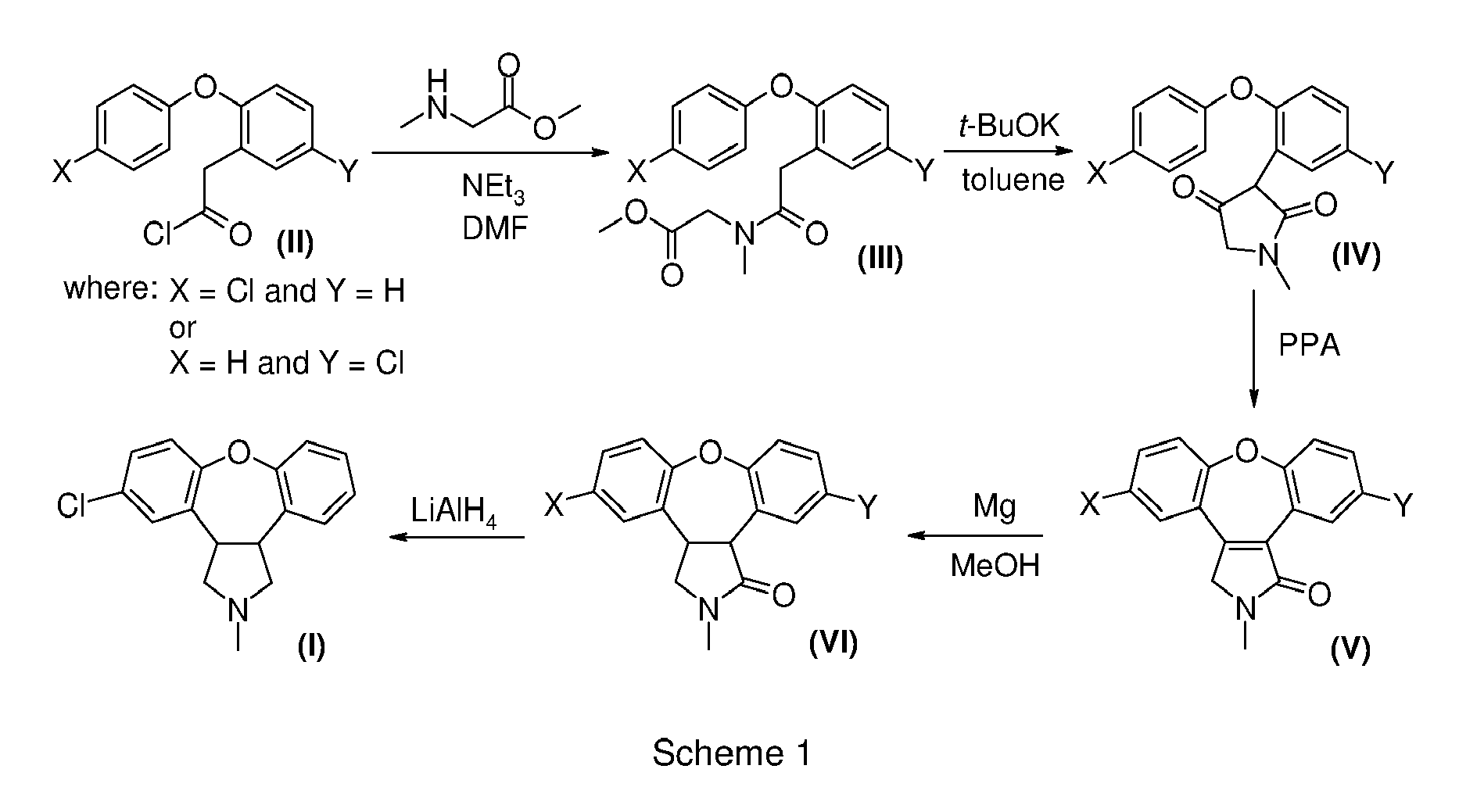
- The reduction of enamide (V) as disclosed in the '434 patent is described to be a major bottleneck for the scale-up of the process to commercial production (see Org. Process Res. Dev. 2008, 12, 196-201). This step is carried out by a magnesium / methanol reduction of the carbon-carbon double bound, which gives rise to the formation of the desired trans-lactam trans-(VI) and its undesired cis-isomer cis-(VI) in an unfavorable ratio of approximately 1:4, together with a significant amount of side products (see Scheme 2). During this process, large amounts of extremely flammable hydrogen gas are formed because of the inevitable highly exothermic side reaction of magnesium with methanol. Additionally, there is no control over the rate in which the heterogeneous reaction between magnesium and methanol takes place. Because of the potential danger of the accumulated heat, a calorimetric study of the original process determined the maximum reaction scale to be only about 10 - 15 Kg (see Org. Process Res. Dev. 2008, 12, 196-201).

- Despite of the drawbacks of the original process, Org. Process Res. Dev. 2008, 12, 196-201 describes that all attempts to develop an alternative process for the magnesium / methanol reduction were unsuccessful (e.g. catalytic hydrogenation in the presence of a variety of palladium, platinum, rhodium, ruthenium and iridium catalysts, different ligands and solvents at pressures varying between 1 and 5 bar; use of zinc powder; Birch reduction using lithium in ammonia; use of magnesium in combination with less acidic alcohols like ethanol or propanol). Org. Process Res. Dev. 2008, 12, 196-201 discloses the dosing of magnesium in portions over a solution of enamide (V) as a way to transform the original process into a safer and more efficient process, since only magnesium in combination with methanol was found to be able to reduce the double bound of enamide (V). However, this process requires the use of some equipments that are not conventional at industrial scale, like solid-addition funnels. Another drawback is that, despite of carrying out the addition of magnesium in portions, a very high amount of heat is released after each addition due to the exothermic reaction between magnesium and methanol (see Figure 2 in Org. Process Res. Dev. 2008, 12, 196-201). Furthermore, despite of the portionwise addition of magnesium, about two molar equivalents of hydrogen are still released in an uncontrolled manner due to the side reaction between magnesium and methanol. These drawbacks make this reduction process non viable for an industrial production of asenapine due to safety reasons.
- European Patent
EP 1710241 B1 describes that some of the disadvantages of the process described in the '434 patent, specially the unfavourable trans-(VI) / cis-(VI) product ratio, can be improved by subsequent partial isomerization of the unwanted cis-isomer cis-(VI) into the trans-isomer trans-(VI) using 1,5-diazabicyclo[4.3.0]non-5-ene (DBN), leading to a thermodynamic equilibrium ratio of trans-isomer trans-(VI) to cis-isomer cis-(VI) of 1:2. Isomers can be separated by chromatography over silica gel, and the cis-isomer cis-(VI) can be isomerized again using DBN resulting in a 1:2 mixture of trans-(VI) and cis-(VI), from which the trans-(VI) can be again separated by chromatography. However, after further repetition of this cycle at kg scale, recrystallization of the three combined fractions of the trans-isomer trans-(VI) produced trans-(VI) in an overall yield of only 38% starting from the enamide (V). Moreover this process involves chromatography, normally not easily implemented at industrial scale. -
EP 1710241 B1 also describes a process, again based on the reduction of compound (V) with Mg/MeOH, in which the mixture of cis- and trans-lactams cis-(VI) and trans-(VI), can be treated in an alcoholic solution comprising an excess of strong alkaline base thereby producing a mixture of amino acids trans-(VII) and cis-(VII). The ring-opening reaction is described to be stereoselective, resulting in a 10:1 ratio of the trans-isomer trans-(VII) to the cis-isomer cis-(VII). The trans-amino acid derivative trans-(VII) can be isolated and cyclized to give trans-(VI), with preservation of the trans-stereochemistry, but with an overall yield of only 62% from the enamide (V) (see Scheme 3).
- Example 8 of the European Patent
EP 1710241 B1 also describes an alternative process for the synthesis of the lactam (VI), see Scheme 4. In this example, (5-chloro-2-phenoxyphenyl)acetic acid methyl ester (compound VIIIa) is reacted with methyl formate in the presence of potassium tert-butoxide to give 2-(5-chloro-2-phenoxyphenyl)-3-hydroxyacrylic acid methyl ester (compound IXa, E/Z mixture 9:1), which is directly cyclized with pyrophosphoric acid to obtain methyl 2-chlorodibenzo[b,f]oxepin-11-carboxylate (compound Xa), referred to us 8-chlorodibenzo[b,f]oxepin-10-carboxylic acid methyl ester inEP 1710241 B1 , with 85% yield. This compound is then reacted with nitromethane in the presence of tert-butyl-tetramethylguanidine to give methyl 2-chloro-10-nitromethyl-10,11-dihydrodibenzo[b,f]oxepine-11-carboxylate (compound Xla), referred to us 8-chloro-11-nitromethyl-10,11-dihydrodibenzo[b,f]oxepine-10-carboxylic acid methyl ester inEP 1710241 B1 , with a trans to cis ratio of 8:1, which is directly hydrogenated in the presence of a sponge nickel catalyst to give methyl 10-aminomethyl-2-chloro-10,11-dihydrodibenzo[b,f]oxepine-11-carboxylate (compound XIIa), referred to us 11-aminomethyl-8-chloro-10,11-dihydrodibenzo[b,f]oxepine-10-carboxylic acid methyl ester inEP 1710241 B1 , which after treatment with potassium tert-butoxide and dimethyl sulphate, is converted into the lactam (VIa) with an overall yield of 81% from compound (Xa), but predominantly corresponding to the undesired cis-isomer (approximately 85:15 ratio with respect to the trans-isomer), being therefore necessary to carry out one of the above described low-yield processes for the conversion of undesired cis-(VI) to trans-(VI).
- It is an object of the present invention to provide simple processes for preparing asenapine at industrial scale which overcome the drawbacks disclosed in the prior art. Additional advantages of the processes as herein disclosed is that asanepine is obtained in high yield and stereoselectivity.
- In a first aspect of the present invention, compound trans-(I) or a salt thereof can be obtained in good yields with reduced formation of undesired cis isomers by a process comprising:
- (a) reducing desmethyl-lactam (XVII),


- (b) methylating desmethylasenapine (XVIII) to give compound trans-(I); and
- (c) optionally converting compound trans-(I) to a salt thereof,
- This process allows the conversion of desmethyl-lactam (XVII) into asenapine trans-(I) avoiding any step, such as the conversion of trans-(XII) to lactam trans-(VI) described in
EP 1710241 B1 , which can favour the isomerization of the trans compounds into the cis compounds. - Reduction of desmethyl-lactam (XVII) into desmethylasenapine (XVIII) can be carried out by using reducing agents. As used herein, the term "reducing agent" refers to reagents used for the reduction of an amide functionality to the corresponding amine. Examples of reducing agents and methods include, but are not limited to: silanes such as triethylsilane, diphenylsilane or trichlorosilane, optionally in the presence of one or more Lewis acids, such as trifluoroborane, titanium chloride, aluminium chloride, zinc iodide or trifluoroacetic acid, also in form of complexes with ethers, such as boron trifluoride diethyl etherate; borohydrides such as sodium borohydride, potassium borohydride, lithium borohydride, sodium cyanoborohydride, potassium cyanoborohydride, lithium cyanoborohydride or mixtures thereof, also in the presence of suitable additives such as sulfuric acid, methanesulfonic acid, acetic acid, titanium chloride, cobalt (II) chloride, aluminium chloride, tin chloride, phosphorus oxychloride, methanesulfonic anhydride, trifluoromethanesulfonic anhydride, pyridine, trifluoroethanol or 1,2-ethanedithiol; boranes such as borane, diborane or catechol borane, also in the form of complexes with ethers, sulfides or amines such as BH3·SMe2, BH3·Et2O, BH3·THF or BH3·diethylaniline; aluminium hydrides such as aluminium hydride (alane), LiAlH4, iBu2AlH, sodium bis(2-methoxyethoxy)aluminium hydride (Red-Al) or LiHAl(OCH3)2, optionally in the presence of one or more Lewis acids, such as trifluoroborane, titanium chloride, aluminium chloride, zinc iodide or trifluoroacetic acid. The preferred reducing agent is a silane, more preferably triethylsilane or diphenylsilane, optionally in the presence of one o more Lewis acids, such as trifluoroborane, also in form of complexes with ethers, such as boron trifluoride diethyl etherate, titanium chloride, aluminium chloride, zinc iodide or trifluoroacetic acid. More preferably, the reduction of the desmethyl-lactam (XVII) into desmethylasenapine (XVIII) is carried out by using triethylsilane in the presence of boron trifluoride diethyl etherate.
- The reduction of the desmethyl-lactam (XVII) into desmethylasenapine (XVIII) as disclosed herein can take place in the absence of any solvent or in the presence of an organic solvent. Non-limiting examples of suitable organic solvents which can be used are: ethers such as tetrahydrofuran, dioxane, diisopropylether, diethylether, 2-methyltetrahydrofuran, cyclopentyl methyl ether or methyl tert-butyl ether; halogenated solvents such as dichloromethane, chloroform, tetrachloromethane, dichloroethane, chlorobenzene or dichlorobenzene; hydrocarbon aliphatic solvents such as methylcyclohexane, cyclohexane, heptane or hexane; hydrocarbon aromatic solvents such as toluene, benzene, o-xylene, m-xylene or p-xylene, or mixtures of two or more of the solvents listed. Preferably, the reduction of the desmethyl-lactam (XVII) into desmethylasenapine (XVIII) as disclosed herein takes place in the absence of any solvent.
- The molar ratio of the reducing agent with respect to the desmethyl-lactam (XVII) in the reduction of the desmethyl-lactam (XVII) into desmethylasenapine (XVIII) as disclosed herein is from about 1 to about 10, preferably from about 2 to about 6, more preferably about 5.
- The reduction of the desmethyl-lactam (XVII) into desmethylasenapine (XVIII) as disclosed herein can take place at a temperature from about -20ºC to about 250ºC, preferably from about 20ºC to about 200ºC, more preferably from about 50ºC to about 150ºC, and even more preferably from about 100ºC to about 110ºC.
- In a preferred embodiment of the present invention the reduction of the desmethyl-lactam (XVII) into desmethylasenapine (XVIII) is carried out by using triethylsilane in the presence of boron trifluoride diethyl etherate, with a molar ratio of triethylsilane with respect to desmethyl-lactam (XVII) of about 5, in the absence of any solvent at about 105ºC.
- Alternatively, reduction of desmethyl-lactam (XVII) into desmethylasenapine (XVIII) can also be carried out by transforming the desmethyl-lactam (XVII) into desmethyl-thiolactam and reducing it into desmethylasenapine (XVIII). The desmethyl-thiolactam can be obtained, for example, directly by reaction of the desmethyl-lactam (XVII) with sulfur-containing reagents such as Lawesson's reagent, i.e. 2,4-bis(4-methoxyphenyl)-1,3,2,4-dithiadiphosphetane-2,4-disulfide, bis(tricyclohexyltin)sulfide, hydrogen sulfide, or phosphorus pentasulfide (P4S10). The reduction of the desmethyl-thiolactam can be performed similarly as the above disclosed reduction of the desmethyl-lactam (XVII) or in the presence of Raney nickel.
- The desmethylasenapine (XVIII) obtained after the reduction of the desmethyl-lactam (XVII) as disclosed herein can be isolated as a base or as a salt, which includes salts with inorganic acids such as hydrochloride, hydrobromide, nitrate, phosphate and sulphate, and salts with organic acids such as acetate, fumarate, oxalate, maleate, citrate, malate, methanesulfonate, benzenesulphonate, tosylate, tartrate, lactate, benzoate, succinate, malonate, adipate, ascorbate or propionate. Alternatively, the desmethylasenapine (XVIII) obtained after the reduction of the desmethyl-lactam (XVII) as disclosed herein can be further used in the following methylation step without isolation.
- Transformation of desmethylasenapine (XVIII) into compound trans-(I) as disclosed herein can be carried out using a methylating agent. As used herein, the term "methylating agent" refers to a reagent or mixtures of reagents that can be used for covalent attaching a methyl group to a nitrogen atom. Examples of methylation reagents include but are not limited to: dimethylsulfate, methyl iodide, methyl chloride, methyl bromide, mixtures of formaldehyde and formic acid and mixtures of formaldehyde and sodium triacetoxyborohydride.
- Transformation of desmethylasenapine (XVIII) into compound trans-(I) with retention of the trans configuration as used herein is preferably carried out by using a mixture of formaldehyde and formic acid as described in the literature (
EP 2166012 A1 , whose content is included herein by reference). This transformation can also be preferably carried out using a mixture of formaldehyde and sodium triacetoxyborohydride, as described inWO 2009/087058 , whose content is included herein by reference. - The transformation of desmethylasenapine (XVIII) into compound trans-(I) as disclosed herein can take place in the absence of any solvent or in the presence of an organic solvent. Non-limiting examples of suitable organic solvents which can be used are: ethers such as tetrahydrofuran, dioxane, diisopropylether, diethylether, 2-methyltetrahydrofuran, cyclopentyl methyl ether or methyl tert-butyl ether; halogenated solvents such as dichloromethane, chloroform, tetrachloromethane, dichloroethane, chlorobenzene or dichlorobenzene; hydrocarbon aliphatic solvents such as methylcyclohexane, cyclohexane, heptane or hexane; hydrocarbon aromatic solvents such as toluene, benzene, o-xylene, m-xylene or p-xylene, or mixtures of two or more of the solvents listed. Preferably, the transformation of desmethylasenapine (XVIII) into compound trans-(I) as disclosed herein takes place in a hydrocarbon aromatic solvent such as toluene, benzene, o-xylene, m-xylene or p-xylene, more preferably in toluene. In a preferred embodiment of the present invention the transformation of desmethylasenapine (XVIII) into compound trans-(I) is carried out using a mixture of formic acid and formaldehyde, preferably an aqueous solution of formaldehyde, as methylating agent in toluene as organic solvent at a temperature about 60ºC.
- The present invention provides a process for preparing the desmethyl-lactam (XVII) comprising the ring-closing of the amino-ester (XII') or the amino-acid (XVI),

wherein X is H and Y is Cl or wherein X is Cl and Y is H and R is any alkyl, optionally substituted; benzyl, optionally substituted or phenyl, optionally substituted. Preferably, R is a C1-C6 alkyl, optionally substituted. More preferably R is methyl. - The ring closing of the amino-ester (XII') or the amino-acid (XVI) under these conditions reduces the isomerization of trans-(XVII) into undesired cis-(XVII).
- By the term "acidic catalyst" as used herein is meant a substance which is a proton donor or a substance which in its environment will form or become a proton donor. All acids are operable as an acidic catalyst in this invention, for example, Brønsted acids such as mineral and carboxylic acids, or Lewis acids. Non-limiting examples of a Lewis acid are zinc chloride, ferrous chloride, tin chloride, aluminum chloride, barium fluoride, and sulfur trioxide. Other example of acidic catalysts are quaternary ammonium salts having at least one proton substituent. The carboxylic acid group of unreacted amino-acid (XVI) during the cyclization reaction can also act as acidic catalyst according to the present invention. The acidic catalyst as used herein comprises any acidic compound having a pK a equal or less than 7.
- The term "in the presence of any mild basic catalyst" as used herein refers that the strongest base with affinity for hydrogen present in the cyclization reaction mixture has a pK a value below 16. Preferred mild basic catalysts are hydroxides such as lithium, sodium or potassium hydroxide; carbonates such as lithium carbonate, sodium carbonate, potassium carbonate or cesium carbonate; hydrogencarbonates such as sodium hydrogencarbonate; primary, secondary or tertiary amines or anilines. The amino group of unreacted amino-ester (XII') or amino-acid (XVI) during the cyclization reaction can also act as mild basic catalyst according to the present invention. Preferably the mild basic catalyst used in the ring-closing reaction is the unreacted amino-ester (XII'), the unreacted amino-acid (XVI) or sodium or potassium hydroxide.
- The pK a is a measurement of the strength of an acid. The lower the pK a, the stronger the acidity. The higher the pK a, the weaker the acid. The pK b is a related measurement and is a measurement of the strength of a base; the lower the pK b, the stronger the base and the higher the pK b, the weaker the base. Although it is not strictly accurate, often the pK a of a base's conjugated acid is provided as the pK a of the base. In this application the term pK a of a base is used to designate the pK a of the base's conjugated acid. In this application the pK a values refer to the pK a in water as determined at room temperature and atmospheric pressure.
- The term "alkyl, optionally substituted" as used herein refers to branched or straight chained alkyl group. Such an alkyl group may be optionally substituted, so that one or more of its hydrogen atoms are replaced by a substituent selected from the group consisting of halogen, thiol, cyano, phenyl, OR1, and NR2R3, in which R1, R2 and R3 are each independently represented by hydrogen or alkyl.
- The term "C1-C6 alkyl, optionally substituted" as used herein refers to a branched or straight chained alkyl group containing from 1 to 6 carbon atoms, such as methyl, ethyl, n-propyl, isopropyl, n-butyl, isobutyl, pentyl, etc. Such an alkyl group may be optionally substituted, so that one or more of its hydrogen atoms are replaced by a substituent selected from the group consisting of halogen, thiol, cyano, phenyl, OR1, and NR2R3, in which R1, R2 and R3 are each independently represented by hydrogen or alkyl.
- The term "benzyl, optionally substituted" as used herein refers to a benzyl group which may be optionally substituted, so that one or more of its hydrogen atoms are replaced by a substituent selected from the group consisting of halogen, thiol, cyano, phenyl, OR1, and NR2R3, in which R1, R2 and R3 are each independently represented by hydrogen or alkyl.
- The term "phenyl, optionally substituted" as used herein refers to a phenyl group which may be optionally substituted, so that one or more of its hydrogen atoms are replaced by a substituent selected from the group consisting of halogen, thiol, cyano, phenyl, OR1, and NR2R3, in which R1, R2 and R3 are each independently represented by hydrogen or alkyl.
- In a preferred embodiment of the present invention, the desmethyl-lactam (XVII) is obtained by a process comprising the ring-closing of the amino-ester (XII') wherein the ring-closing of the amino-ester (XII') is catalyzed by the unreacted amino-ester (XII') which acts as a mild basic catalyst for the cyclization reaction.
- In another preferred embodiment of the present invention, the desmethyl-lactam (XVII) is obtained by a process comprising the ring-closing of the amino-acid (XVI) wherein the ring-closing of the amino-acid (XVI) is catalyzed by the unreacted amino-acid (XVI) which acts as a mild basic catalyst (the amino group) or as an acidic catalyst (the carboxylic acid group) for the cyclization reaction.
- In another preferred embodiment of the present invention, the desmethyl-lactam (XVII) is obtained by a process comprising the ring-closing of the amino-ester (XII') or the ring-closing of the amino-acid (XVI) wherein the ring-closing of the amino-ester (XII') or the amino-acid (XVI) is catalyzed by sodium or potassium hydroxide.
- The ring-closing of the amino-ester (XII') or the amino-acid (XVI) to give the desmethyl-lactam (XVII) as disclosed herein takes place preferably in the presence of an organic solvent or mixtures of an organic solvent and water. Non-limiting examples of suitable organic solvents which can be used are: alcohols such as methanol, ethanol, isopropanol, n-propanol, n-butanol, isobutanol, sec-butanol or tert-butanol; ketones such as acetone, methyl ethyl ketone or methyl isobutyl ketone; ethers such as tetrahydrofuran, dioxane, diisopropylether, diethylether, 2-methyltetrahydrofuran, cyclopentyl methyl ether or methyl tert-butyl ether; esters such as ethyl acetate, methyl acetate, isopropyl acetate, n-propyl acetate, n-butyl acetate, isobutyl acetate, sec-butyl acetate or tert-butyl acetate; halogenated solvents such as dichloromethane, chloroform, tetrachloromethane, dichloroethane, chlorobenzene or dichlorobenzene; polar aprotic solvents such as N,N-dimethylformamide, acetonitrile, N,N-dimethylacetamide, N-methyl-2-pyrrolidone or dimethylsulfoxide; hydrocarbon aliphatic solvents such as methylcyclohexane, cyclohexane, heptane or hexane; hydrocarbon aromatic solvents such as toluene, benzene, o-xylene, m-xylene or p-xylene; or mixtures of two or more of the solvents listed. Preferred organic solvents used for the ring-closing of the amino-ester (XII') or the amino-acid (XVI) to give the desmethyl-lactam (XVII) as disclosed herein are esters, more preferably ethyl acetate, wherein the unreacted amino-ester (XII') or the amino-acid (XVI) acts as a catalyst for the cyclization reaction; or alcohols, more preferably methanol, when sodium or potassium hydroxide is used as a mild basic catalyst.
- The molar ratio of the mild basic catalyst, preferably sodium or potassium hydroxide, with respect to the amino-ester (XII') or the amino-acid (XVI) in the ring-closing of the amino-ester (XII') or the amino-acid (XVI) to give the desmethyl-lactam (XVII) as disclosed herein is from about 0.01 to about 2, preferably from about 0.1 to about 1, more preferably about 0.6.
- The ring-closing of the amino-ester (XII') or the amino-acid (XVI) to give the desmethyl-lactam (XVII) as disclosed herein takes place at a temperature from about -10°C to about 200º, more preferably from about 0ºC to about 100ºC, more preferably from about 20ºC to about 30ºC.
- The amino-acid (XVI) can be obtained by hydrolysis of the amino-ester (XII') using known methods in the art, such as hydrolysis under acidic or basic conditions. The hydrolysis under basic conditions is particularly preferred since it can help to isomerize undesired cis-(XVI) into trans-(XVI). Amino-acid (XVI) is then cyclized to desmethyl-lactam (XVII).
- Alternatively, the desmethyl-lactam (XVII) can be also obtained by the ring-closing of the amino-acid (XVI) by means of the activation of the carboxylic acid followed by intramolecular formation of the amide bond.
- The activation of the carboxylic acid as used herein involves the use of suitable agents for the activation of carboxylic acids in the formation of amides such as thionyl chloride, N,N'-carbonyldiimidazole (CDI), dicyclohexylcarbodiimide (DCC), diisopropylcarbodiimide (DIC), 1-ethyl-3-(3'-dimethylaminopropyl)carbodiimide (EDC or WSC), 1-propanephosphonic acid cyclic anhydride (T3P), 2-(7-aza-1H-benzotriazole-1-yl)-1,1,3,3-tetramethyluronium hexafluorophosphate (HATU), 2-(1H-benzotriazole-1-yl)-1,1,3,3-tetramethyluronium hexafluorophosphate (HBTU), 2-(6-chloro-1H-benzotriazole-1-yl)-1,1,3,3-tetramethylaminium hexafluorophosphate (HCTU), 2-(1H-benzotriazole-1-yl)-1,1,3,3-tetramethyluronium tetrafluorophosphate (TBTU), benzotriazole-1-yl-oxytris(dimethylamino)phosphonium hexafluorophosphate (BOP), benzotriazole-1-yl-oxytrispyrrolidinophosphonium hexafluorophosphate (PyBOP), (1-cyano-2-ethoxy-2-oxoethylidenaminooxy)dimethylaminomorpholinocarbenium hexafluorophosphate (COMU), or mixtures thereof. Preferred agents for the activation of carboxylic acids in the formation of amides is thionyl chloride.
- The amino-ester (XII') as disclosed herein is preferably obtained by a process comprising:
- (a) reducing the nitro-ester (XI'),


- Optionally the amino-ester (XII') can be hydrolyzed into the amino-acid (XVI),

- The reduction of the nitro-ester (XI') to the amino-ester (XII') can be carried out by means of any of the known methods in the art, such as catalytic hydrogenation, catalyzed hydrogen transfer reaction, nascent hydrogen conditions (reducing metals in the presence of acidic reagents), and use of reducing borohydride or aluminium hydride reagents (after protection of the ester moiety).
- The amino-ester (XII') as well as the amino-acid (XVI) as disclosed herein can be in form of base or salts thereof. Suitable salts of the amino-ester (XII') comprise salts with inorganic acids such as hydrochloride, hydrobromide, nitrate, phosphate and sulphate; or salts with organic acids such as acetate, fumarate, oxalate, maleate, citrate, malate, methanesulfonate, benzenesulphonate, tosylate, tartrate, lactate, benzoate, succinate, malonate, adipate, ascorbate or propionate. Suitable salts of the amino-acid (XVI) comprise salts with inorganic acids such as hydrochloride, hydrobromide, nitrate, phosphate and sulphate; salts with organic acids such as acetate, fumarate, oxalate, maleate, citrate, malate, methanesulfonate, benzenesulphonate, tosylate, tartrate, lactate, benzoate, succinate, malonate, adipate, ascorbate or propionate; salts with metals such as sodium, potassium, calcium and aluminium; or salts with amines such as N,N-diisopropylethylamine (DIPEA), trimethylamine, tripropylamine, triethylamine, N-methylpiperidine, N,N-dimethylaminopyridine (DMAP), N-methylpyrrolidine and 1,4-diazabicyclo[2.2.2]octane (DABCO).
- In another aspect of the present invention, compound trans-(I) or a salt thereof can be obtained by a process comprising any of the processes for preparing the desmethyl-lactam (XVII) disclosed above.
- In another aspect of the present invention, compound trans-(I) or a salt thereof can be obtained by a process comprising:
- (a) reducing the nitro-ester (XI'),


- (b) optionally hydrolyzing the amino-ester (XII') into the amino-acid (XVI),

- (c) performing the ring-closing of the amino-ester (XII') or the amino-acid (XVI),


- (d) reducing desmethyl-lactam (XVII) to give desmethylasenapine (XVIII)

- (e) methylating desmethylasenapine (XVIII) to give compound trans-(I); and
- (f) optionally converting compound trans-(I) to a salt thereof,
- In another aspect of the present invention, compound trans-(I) or a salt thereof can be obtained with reduced formation of undesired cis isomers by a process comprising:
- (a) methylating desmethyl-lactam (XVII),


- (b) reducing lactam (VI) to give compound trans-(I); and
- (c) optionally converting compound trans-(I) to a salt thereof,
- As used herein, the term "mild base" refers to a base having a pK a of about 16 or less, preferably about 12 to about 7, more preferably about 12 to about 9. Preferred bases are selected from the group consisting of ammonia, mono-, di- or tri-alkylamines (preferably wherein each alkyl group contains from 1 to 6 carbon atoms and more preferably from 1 to 3 carbon atoms, and more preferably is methyl or ethyl), alkali metal carbonates, alkaline-earth metal carbonates, alkali metal bicarbonates, and alkaline earth metal bicarbonates, and combinations thereof. More preferred are the alkali metal carbonates and alkali metal bicarbonates, most preferably sodium and potassium carbonate and sodium and potassium bicarbonate.
- The authors of the present invention have found that compound trans-(I) can be obtained mainly with the desired trans configuration without the need of carrying out any of the low-yield processes for the conversion of undesired cis- (VI) to trans-(VI) described in
EP 1710241 B1 . - The use of strong bases for the conversion of trans-(XII) to trans-(VI), such as the described use of potassium tert-butoxide in
EP 1710241 B1 , has been found to be particularly detrimental since it helps to the isomerization of the trans compounds into the thermodynamically more stable and undesired cis ones. The authors of the present invention have found that the use of mild bases (i.e. a basic compound having a pK a value below 16) is therefore preferred for this transformation. Alternative methods known which avoid the use of basic reagents, such as the use of formaldehyde in the presence of trifluoroacetic acid and / or triethylsilane, are also preferred for this transformation. - Transformation of lactam (VI) into compound trans-(I) is described in the literature, for example in Example 6 of
EP 1710241 B1 by using lithium aluminium hydride in the presence of aluminium chloride. Alternative methods are the use of borane reagents, sodium bis(2-methoxyethoxy)aluminium hydride (Red-Al), triethylsilane in the presence of a metal catalyst, and / or sodium borohydride in the presence of trifluoroborane, are also particularly preferred for this transformation. - The processes of the present invention, summarized in scheme 5, allow the conversion of the nitro-ester trans-(XI') into compound trans-(I) with a minimum formation of undesired cis-(I).

- In another aspect, the present invention provides a process for preparing compound trans-(I) or a salt thereof comprising an alternative process for the synthesis of lactam (VI), which avoids the problems related to the magnesium / methanol reduction of enamide (V) disclosed in the prior art. The process for the synthesis of lactam (VI) is summarized in Scheme 6 below.

- The processes summarized in Scheme 7 are the processes particularly preferred for the synthesis of lactam (VI).

- The reduction of compounds (IVa) or (IVb) can be carried out by any known method in the art for the reduction of ketones to alcohols, such as catalytic hydrogenation, reduction by metals (e.g. lithium, sodium, potassium, magnesium, aluminium, zinc, iron), metal hydride reduction (e.g. lithium or sodium hydride), borohydride reduction (e.g. lithium, sodium, potassium, calcium or zinc borohydride), cyanoborohydride reduction (e.g. lithium, sodium or potassium cyanoborohydride), triacetoxyborohydride reduction (e.g. sodium or potassium triacetoxyborohydride), trialkoxyborohydride reduction (e.g. sodium or potassium trimethoxyborohydride, triisopropoxyborohydride or tri-tert-butoxyborohydride), trialkylborohydride reduction (e.g. lithium or potassium triethylborohydride or tri-sec-butylborohydride), triarylborohydride reduction (e.g. potassium triphenylborohydride), aluminium hydride reduction (e.g. diisobutylaluminium hydride, lithium or sodium aluminium hydride, lithium trimethoxyaluminium hydride, lithium tri-tert-butoxyaluminium hydride), silane reduction (e.g. triethylsilane, dimethylphenylsilane, triphenylsilane), borane reduction (BH3), alkylborane reduction (e.g. dicyclohexylborane, diisopinocamphenylborane, 9-borabicyclo(3.3.1)nonane), Meerwein-Ponndorf-Verley reduction (e.g. triisopropoxyaluminium and isopropanol), hydrosulfite reduction, electrolytic reduction and enzymatic reduction. Use of borohydride reagents is preferred, and potassium borohydride is particularly preferred.
- The cyclization of compounds (XIIIa) or (XIIIb) can be carried out by using any dehydrating agent known in the art, such as stirring in the presence of concentrated sulfuric acid, pyrophosphoric acid or polyphosphoric acid.
- As used herein, the term "dehydrating agent" means a mild chemical compound which removes the water released during the cyclization of compound (XIIIa) or (XIIIb). Known dehydrating agents such as sulfuric acid, pyrophosphoric acid, polyphosphoric acid and phosphorus pentoxide are suitable.
- Compounds (VIa) or (Vlb) can be obtained having a favorable cis / trans ratio. Desired trans-(VI) can be isolated by any method known in the art, such as selective crystallization or chromatographic purification. Undesired cis-(VI) can be converted into desired trans-(VI) by any method known in the art, such as isomerization under basic conditions (e.g. using 1,5-diazabicyclo[4.3.0]non-5-ene (DBN), as described in the European Patent
EP 1710241 B1 ) or a ring-opening step followed by isomerization and ring-closing as described in the European PatentEP 1710241 B1 . - Transformation of lactams trans-(VIa) or trans-(VIb) into asenapine trans-(I) is described in the literature, for example in Example 6 of
EP 1710241 B1 by using lithium aluminium hydride in the presence of aluminium chloride. Alternative methods known in the art such as use of borane reagents, sodium bis(2-methoxyethoxy)aluminium hydride (Red-Al), triethylsilane in the presence of a metal catalyst, and / or sodium borohydride in the presence of trifluoroborane, are also particularly preferred for this transformation. - In one embodiment of the present invention the processes for preparing compound trans-(I) further comprises the conversion of the undesired compound cis-(VI) to the desired compound trans-(VI).
- The compound trans-(I) obtained by the processes disclosed herein can be optionally converted to a salt thereof. Suitable salts of compound trans-(I) can be obtained from the treatment with a mineral acid such as hydrochloric acid, hydrobromic acid, nitric acid, phosphoric acid and sulfuric acid, or with an organic acid such as for example ascorbic acid, citric acid, tartaric acid, lactic acid, maleic acid, oxalic acid, malic acid, malonic acid, fumaric acid, glycolic acid, succinic acid, propionic acid, acetic acid, benzene sulphonic acid, toluene sulphonic acid, and methane sulfonic acid. The preferred acid addition salt of compound trans-(I) is the maleate salt.
- The term "about" when used in the present invention preceding a number and referring to it, is meant to designate any value which lies within the range defined by the number ±10% of its value, preferably a range defined by the number ±5%, more preferably range defined by the number ±2%, still more preferably a range defined by the number ±1%. For example "about 10" should be construed as meaning within the range of 9 to 11, preferably within the range of 9.5 to 10.5, more preferably within the range of 9.8 to 10.2, and still more preferably within the range of 9.9 to 10.1.
- The chromatographic separation was carried out in a Kromasil 100-5 C18, 5 µm, 4.6 x 250 mm column at 25 ºC.
- The mobile phase was a filtered and degassed acetonitrile / buffer (60 : 40) v/v mixture. The buffer was a water / triethylamine / acetic acid (265 : 5 : 4) v/v/v mixture.
- The chromatograph was equipped with a 254 nm detector and the flow rate was 1.0 mL per minute. 20 µL of the test samples were injected. The test samples were prepared by dissolving the appropriate amount of sample in mobile phase, to obtain a concentration of about 1.0 mg per mL. The chromatogram was run for at least 20 min. The approximate retention time for asenapine was found to be 4 min.
- The chromatographic separation was carried out in a Kromasil 100 C18, 5 µm, 4.6 x 250 mm column at 30 ºC.
- The mobile phase A was water containing 0.1% (w/w) methanesulfonic acid. pH was adjusted to 2.5 with diethylamine.
- The mobile phase B was acetonitrile.
- The chromatograph was programmed as follows: Initial 0-3 min. 75% mobile phase A, 3-50 min. linear gradient to 35% mobile phase A, 50-55 min. isocratic 35% mobile phase A, 55-70 min. linear gradient to 10% mobile phase A, 70-100 min. isocratic 10% mobile phase A, 100-105 min. linear gradient to 75% mobile phase A, 105-110 min. isocratic 75% mobile phase A.
- The chromatograph was equipped with a 210 nm detector and the flow rate was 1.0 mL per minute. 10 µL of the test samples were injected. The test samples were prepared by dissolving the appropriate amount of sample in methanol, to obtain a concentration of about 0.5 mg per mL. The chromatogram was run for at least 100 min. The approximate retention time for trans-5-chloro-2,3,3a,12b-tetrahydro-1H-dibenzo[2,3:6,7]oxepino[4,5-c]pyrrole (compound trans-XVIII) was found to be 16.7 min.
-
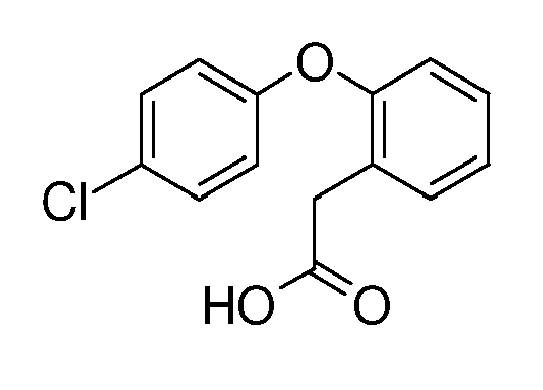
- 27.8 g (216 mmol) of 4-chlorophenol and 47 g (205 mmol) of methyl 2-bromophenylacetate were suspended in 790 mL of dioxane. The mixture was heated to 48 ºC and 141 g of cesium carbonate, 4.5 g of glycine and 8.6 g of cuprous chloride were added. The resulting suspension was heated to reflux and stirred at this temperature for 5 days. After cooling down to room temperature, the solid was removed by filtration, washed with 100 mL of dioxane, and discarded. The mother liquors were combined and concentrated under vacuum. 100 mL of ethyl acetate were added to the residue, and the pH was adjusted to 1 with HCl 2 M. The organic phase was extracted, washed with brine and dried. The solvent was removed under vacuum. 100 mL of water were added to the residue, and the pH was adjusted to 1 with HCl 2 M. The resulting suspension was stirred and filtered, to obtain 41 g of 2-(4-chlorophenoxy)phenylacetic acid (compound XIVb) as a brown solid. Yield: 76.1 %.
-

- 20 g (76.1 mmol) of 2-(4-chlorophenoxy)phenylacetic acid (compound XIVb) were dissolved in 200 mL of toluene under reflux temperature. After cooling to 50 ºC, 8.4 mL of thionyl chloride were added dropwise and the resulting mixture was stirred at 50 ºC for 1 hour. After cooling down to room temperature, the solvent was removed under vacuum. 50 mL of fresh toluene were added to the residue, and were distilled under vacuum. The residue was dissolved in 20 mL of fresh toluene, and the resulting solution was added dropwise over a second flask containing a mixture of 12.8 g of sarcosine hydrochloride, 150 mL of N,N-dimethylformamide, 50 mL of toluene and 26 mL of triethylamine, previously cooled to 5 ºC. The resulting mixture was stirred at 5 ºC for 10 minutes, warmed to room temperature and stirred at this temperature for 2 hours. 300 mL of water were added. The aqueous phase was extracted and washed twice with 300 mL of ethyl acetate. The organic phases were combined, washed with brine, dried and concentrated under vacuum, to obtain 27.8 g of methyl N-{2-[2-(4-chlorophenoxy)phenyl]-1-oxoethyl}-N-methylglycinate (compound IIIb) as an oil.
-

- 27.8 g (79.9 mmol) of methyl N-{2-[2-(4-chlorophenoxy)phenyl]-1-oxoethyl}-N-methylglycinate (compound IIIb) was dissolved in 150 mL of toluene. 11.5 g of sodium tert-butoxyde were added, and the resulting mixture was stirred overnight at room temperature. 350 mL of water were added, and the resulting mixture was extracted three times with 150 mL of ethyl acetate. The combined organic phases were washed with 200 mL of water. The aqueous phases were combined and pH was adjusted to 1 with HCl 2 M. The solvent was removed by filtration, and the solid was recrystallized twice with methanol, to obtain 5.4 g of 3-[2-(4-chlorophenoxy)phenyl]-1-methylpyrrolidine-2,4-dione (compound IVb) as a solid. Yield: 21.4 %.
- 1H-NMR (400 MHz, DMSO-d6, 25 ºC) δ (ppm): 11.06 (broad s), 7.36 (m, 4 H), 7.15 (dd, 1H, J = 7.2 Hz, J = 7.2 Hz), 6.94 (d, 2 H, J = 8.8 Hz), 6.88 (d, 1H, J = 8.0 Hz), 3.81 (s, 2 H), 2.80 (s, 3 H). 13C-NMR (100.6 MHz, DMSO-d6, 25 ºC) δ (ppm): 170.8, 166.4, 156.1, 154.4, 132.2, 129.4, 128.4, 126.4, 123.5, 123.3, 119.9, 118.8, 102.3, 51.2, 28.3.
-

- 5 g (15.8 mmol) of 3-[2-(4-chlorophenoxy)phenyl]-1-methylpyrrolidine-2,4-dione (compound IVb) was dissolved in a mixture of 150 mL of tetrahydrofuran and 15 mL of water. The solution was cooled to 0 ºC, and 4.3 g of potassium borohydride were added slowly, keeping the temperature below 10 ºC. The resulting solution was stirred at 0 ºC for 6 hours. Then, a saturated solution of ammonium chloride was added, and the pH was adjusted to 3 with HCl 2 M. 100 mL of ethyl acetate were added. The organic phase was extracted, washed with saturated sodium bicarbonate and with water, dried and concentrated under vacuum, to obtain 4.5 g of 3-[2-(4-chlorophenoxy)phenyl]-4-hydroxy-1-methylpyrrolidine-2-one (compound XIIIb) as a sticky solid. Yield: 89.6 %.
- 1H-NMR (400 MHz, DMSO-d6, 25 ºC) δ (ppm): 7.39 (dm, 2 H, J = 10.0 Hz), 7.28 (m, 2 H), 7.14 (ddd, 1H, J = 7.6 Hz, J = 7.6 Hz, J = 1.2 Hz), 6.98 (dm, 2 H, J = 8.8 Hz), 6.88 (dd, 1H, J = 8.0 Hz, J = 1.2 Hz), 5.05 (d, 1H, J = 4.8 Hz), 4.26 (dm, 1H, J = 4.8 Hz), 3.94 (d, 1H, J = 6.0 Hz), 3.61 (dd, 1H, J = 10.4 Hz, J = 4.8 Hz), 3.17 (dd, 1H, J = 10.4 Hz, J = 0.8 Hz), 2.78 (s, 3 H). 13C-NMR (100.6 MHz, DMSO-d6, 25 ºC) δ (ppm): 172.2, 156.6, 154.5, 133.3, 129.6, 128.2, 127.4, 126.5, 123.5, 119.3, 118.8, 65.7, 56.5, 47.8, 29.4.
-
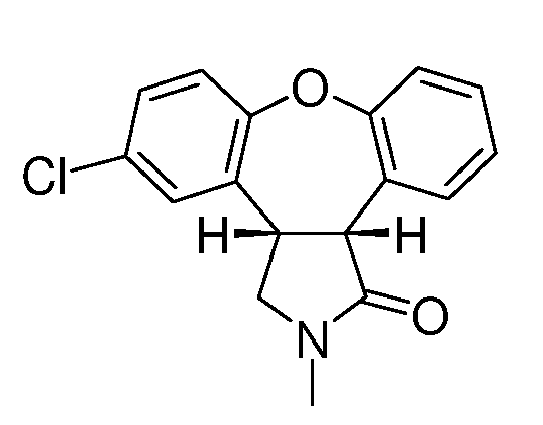
- A mixture of 3 g (9.4 mmol) of 3-[2-(4-chlorophenoxy)phenyl]-4-hydroxy-1-methylpyrrolidine-2-one (compound XIIIb) and 40 g of polyphosphoric acid was stirred overnight at 110 ºC. After cooling down to room temperature, the resulting mixture was poured into 150 mL of an ice-water mixture. 100 mL of dichloromethane were added, and the organic phase was extracted. The aqueous phase was washed with 50 mL of dichloromethane. The organic phases were combined, washed with brine, and evaporated under vacuum. The crude product was purified by column chromatography to obtain 0.5 g of cis-5-chloro-2,3,3a,12b-tetrahydro-2-methyl-1H-dibenz[2,3:6,7]oxepino[4,5-c]pyrrol-1-one (compound cis-Vlb). Yield: 17.7 %.
- 1H-NMR (400 MHz, DMSO-d6, 25 ºC) δ (ppm): 7.65 (d, 1H, J = 8.8 Hz), 7.57 (dd, 1H, J = 7.6 Hz, J = 0.8 Hz), 7.47 (d, 1H, J = 2.8 Hz), 7.41 (dd, 1H, J = 8.6 Hz, J = 2.6 Hz), 7.29 (m, 2 H), 7.16 (ddd, 1H, J = 8.4 Hz, J = 8.4 Hz, J = 1.2 Hz), 4.75 (d, 1H, J = 8.8 Hz), 3.70 (d, 1H, J = 10.0 Hz), 2.96 (m, 1H), 2.66 (s, 3 H), 1.60 (d, 1H, J = 13.6 Hz). 13C-NMR (100.6 MHz, DMSO-d6, 25 ºC) δ (ppm): 174.3, 159.9, 156.8, 136.02, 136.00, 131.2, 130.0, 129.4, 129.3, 128.7, 125.9, 125.7, 123.3, 62.6, 45.5, 36.5, 28.1. MS (electrospray +): 300.1 (100%), 302.1 (50%).
-

- 70 g (0.27 mol) of 2-(4-chlorophenoxy)phenylacetic acid (compound XVIb), as obtained in Example 1, were dissolved in 600 mL of methanol. The solution was heated to 50-55 ºC and stirred at this temperature for 1 hour. Then, 10 g (0.10 mol) of sulfuric acid were added, and the resulting mixture was stirred at 50-55 ºC overnight. The solvent was removed by distillation, and the residue was dissolved in 600 mL of ethyl acetate. The solution was washed with 500 mL of an aqueous saturated solution of sodium bicarbonate, dried with anhydrous sodium sulfate and evaporated under reduced pressure, to obtain 45 g of methyl 2-(4-chlorophenoxy)phenylacetate (compound VIIIb) after chromatographic purification. Yield: 61.0 %.
-
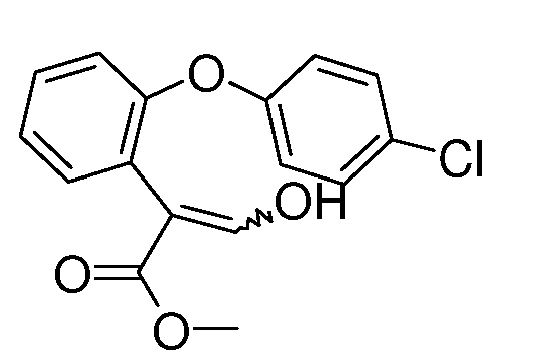
- 12.92 g (0.32 mol) of a 60% sodium hydride dispersion in mineral oil were suspended in 400 mL of tetrahydrofuran. After cooling to 0-5 ºC, a solution containing 45 g (0.16 mol) of methyl 2-(4-chlorophenoxy)phenylacetate (compound VIIIb), as obtained in Example 6, in 300 mL of tetrahydrofuran, was added dropwise while keeping the temperature below 10 ºC. After the addition, the reaction mixture was stirred at 0-5 ºC for 30 minutes. Then, 36.3 g (0.60 mol) of methyl formate were added dropwise, while keeping the temperature below 10 ºC. After the addition, the reaction mixture was stirred at room temperature overnight. 50 mL of 2 M aqueous hydrochloric acid were added. Then, 200 mL of ethyl acetate were added and the phases were decanted. The organic phase was extracted and washed with 200 mL of water and 200 mL of saturated sodium chloride. The organic phase was concentrated to dryness under reduced pressure, to obtain 40 g of methyl 2-[2-(4-chlorophenoxy)phenyl]-3-hydroxyacrylate (compound IXb) after chromatographic purification. Yield: 80.7 %.
-
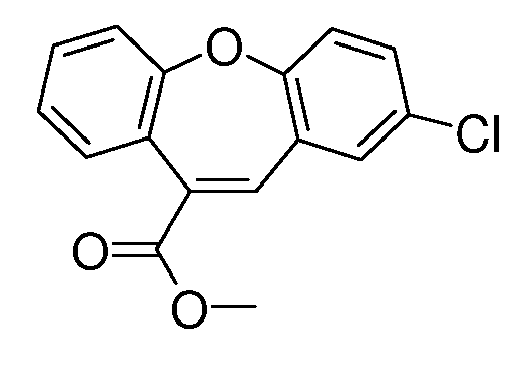
- 40 g (0.13 mol) of methyl 2-[2-(4-chlorophenoxy)phenyl]-3-hydroxyacrylate (compound IXb), as obtained in Example 7, were dissolved in 130 g of pyrophosphoric acid. The solution was stirred at 80 ºC for 2 hours. After cooling to room temperature, hexane (250 mL), toluene (500 mL) and water (500 mL) were added to the reaction mixture. The phases were decanted. The organic layer was extracted, washed with 500 mL of saturated aqueous sodium bicarbonate and with 500 mL of saturated sodium chloride, and evaporated under reduced pressure. The resulting oil was crystallized from n-butanol (50 mL) to obtain 16.9 g of methyl 2-chlorodibenzo[b,f]oxepin-10-carboxylate (compound Xb). Yield: 44.9 %.
-

- 10 g (35 mmol) of methyl 2-chlorodibenzo[b,f]oxepin-10-carboxylate (compound Xb), as obtained in Example 8, and 2.9 g (17 mmol) of 2-tert-butyl-1,1,3,3-tetramethylguanidine, were dissolved in 120 mL of tetrahydrofuran. The solution was stirred at 30 ºC for 30 minutes. Then, 18.7 g (0.31 mol) of nitromethane were added dropwise, while keeping the reaction temperature below 30 ºC. After the addition, the reaction mixture was stirred at 30 ºC overnight. The mixture was adjusted to pH 7 with 1 M aqueous hydrochloric acid and extracted with ethyl acetate. The organic layer was dried with anhydrous sodium sulfate and concentrated under reduced pressure. The resulting oil was crystallized from petroleum ether (50 mL) to obtain 6.6 g of methyl 2-chloro-11-nitromethyl-10,11-dihydrodibenzo[b,f]oxepine-10-carboxylate (compound Xlb). Yield: 54.4 %.
-

- 6 g (17 mmol) of methyl 2-chloro-11-nitromethyl-10,11-dihydrodibenzo[b,f]oxepine-10-carboxylate (compound XIb), as obtained in Example 9, were dissolved in 50 mL of tetrahydrofuran. 1 g of Ni-Raney catalyst was added, and the mixture was stirred under 50 psi (3447 hPa) of hydrogen at 30 ºC for 48 hours. The catalyst was removed by filtration, and the resulting solution was concentrated under reduced pressure to obtain 3.7 g of methyl 11-aminomethyl-2-chloro-10,11-dihydrodibenzo[b,f]oxepine-10-carboxylate (compound XIIb). Yield: 67.5 %.
-

- 2.3 g (7.2 mmol) of methyl 11-aminomethyl-2-chloro-10,11-dihydrodibenzo[b,f]oxepine-10-carboxylate (compound XIIb), as obtained in Example 10, were suspended in a mixture of 20 mL of methanol and 2 mL of 2 M aqueous sodium hydroxide. The mixture was stirred at room temperature overnight. The resulting solid was filtered and washed with methanol, to obtain 1.5 g of trans-5-chloro-2,3,3a,12b-tetrahydro-1H-dibenz[2,3:6,7]oxepino[4,5-c]pyrrol-1-one (compound trans-XVIIb) as an off-white solid. Yield: 72.5 %.
-

- 180 g (0.52 mol) of methyl 2-chloro-11-nitromethyl-10,11-dihydrodibenzo[b,f]oxepine-10-carboxylate (compound Xlb), obtained similarly as described in Example 9, were dissolved in 3 L of tetrahydrofuran. 20 g of Ni-Raney catalyst, previously washed with 500 mL of tetrahydrofuran, were added to the solution, and the mixture was stirred under 50 psi (3447 hPa) of hydrogen at room temperature for 48 hours. The catalyst was removed by filtration and washed with 200 mL of tetrahydrofuran. The filtrate was evaporated to dryness under reduced pressure, and the residue was dissolved in 100 mL of ethyl acetate. The mixture was stirred at 25 ºC for 4 days. The resulting suspension was cooled to 0 ºC and stirred at this temperature for 1 hour. The solid was removed by filtration and washed with 2 x 50 mL of cold ethyl acetate, to obtain 63.0 g of trans-5-chloro-2,3,3a,12b-tetrahydro-1H-dibenz[2,3:6,7]oxepino[4,5-c]pyrrol-1-one (compound trans-XVIIb) as a white solid. The filtrate was evaporated to dryness, and the residue was dissolved in 50 mL of ethyl acetate. The mixture was stirred at 25 ºC for 2 days. The obtained solid was filtered and dried to obtain a second sample of 22.0 g of trans-5-chloro-2,3,3a,12b-tetrahydro-1H-dibenz[2,3:6,7]oxepino[4,5-c]pyrrol-1-one (compound trans-XVIIb) as a white solid. Yield: 57.5 %.
-

- A mixture of 307 g (1.62 mol) 2,5-dichloroacetophenone, 193 g (2.05 mol) of phenol, 302 g (2.19 mol) of potassium carbonate and 15 g (0.24 mol) of copper powder was stirred at 130 ºC for 10 hours. The reaction mixture was cooled to room temperature, diluted with 500 mL of methyl tert-butyl ether and filtered. The filtered solid was washed with methyl tert-butyl ether and was discarded. The filtrate was washed twice with 500 mL of 1 M aqueous sodium hydroxide. The organic layer was extracted, dried over anhydrous sodium sulfate and evaporated under reduced pressure. The residue was mixed with 350 mL of methanol and stirred at 10 ºC for 30 minutes. The resulting suspension was filtered, and the solid was washed with cold methanol, to obtain 236 g of 5-chloro-2-phenoxyacetophenone (compound XV) as an off-white solid. Yield: 58.9 %.
-

- A mixture of 200 g (0.81 mol) of 5-chloro-2-phenoxyacetophenone (compound XV), as obtained in Example 13, 112.3 g (1.29 mol) of morpholine and 40 g (1.25 mol) of sulfur was stirred at 110 ºC for 12 hours. After cooling to room temperature, 1 L of glacial acetic acid and 1 L of concentrated aqueous hydrochloric acid were added, and the resulting mixture was stirred at reflux temperature for 8 hours. The reaction mixture was concentrated to about 1/3 of its initial volume. Then, 800 mL of water and 800 mL of methyl tert-butyl ether were added. The aqueous layer was separated, washed with 400 mL of methyl tert-butyl ether, and discarded. The organic phases were combined and washed subsequently with 1 x 500 mL and 2 x 250 mL of an 8 % aqueous solution of sodium carbonate. The aqueous phases were combined, washed with 2 x 200 mL of methyl tert-butyl ether, and acidified to pH 1 with concentrated hydrochloric acid. 400 mL of petroleum ether were added, and the resulting mixture was stirred at room temperature for 30 minutes. The suspension was filtered, and the solid was dried until constant weight to obtain 143 g of 5-chloro-2-phenoxyphenylacetic acid (compound XIVa). Yield: 67.1 %.
-

- 233 g (0.89 mol) of 5-chloro-2-phenoxyphenylacetic acid (compound XIVa), as obtained in Example 14, were suspended in 1.2 L of methanol. Then, 60.9 g (0.62 mol) of concentrated sulfuric acid were added dropwise. The mixture was heated to 50 ºC and stirred at this temperature for 2 hours. The resulting reaction mixture was concentrated under reduced pressure, and the residue was dissolved in 500 mL of methyl tert-butyl ether. pH was adjusted to 7 by addition of an aqueous saturated solution of sodium carbonate, at a temperature below 25 ºC. The aqueous layer was extracted and washed with 200 mL of methyl tert-butyl ether. The organic phases were combined, washed with 500 mL of saturated sodium chloride, dried over anhydrous sodium sulfate, and evaporated to dryness under reduced pressure to obtain 240.6 g of methyl 5-chloro-2-phenoxyphenylacetate (compound VIIIa) as an oil. Yield: 98.0 %.
-

- A solution of 200 g (0.72 mol) of methyl 5-chloro-2-phenoxyphenylacetate (compound VIIIa), as obtained in Example 15, and 195.31 g (3.25 mol) of methyl formate in 1.2 L of methyl tert-butyl ether was cooled to 5 º C. 118.08 g (1.23 mol) of sodium tert-butoxide were added portionwise, keeping the reaction temperature below 10 ºC. After the addition, the reaction mixture was stirred at room temperature for 2 hours. pH was adjusted to 7 with 4 M aqueous hydrochloric acid, keeping the reaction temperature below 25 ºC. The aqueous layer was extracted and washed with 300 mL of methyl tert-butyl ether. The organic phases were combined, washed with 600 mL of saturated sodium chloride, dried over anhydrous sodium sulfate, and evaporated to dryness under reduced pressure to obtain methyl 2-(5-chloro-2-phenoxyphenyl)-3-hydroxyacrylate (compound IXa) as an oil, which was used in the next step (see Example 17) without further purification.
-
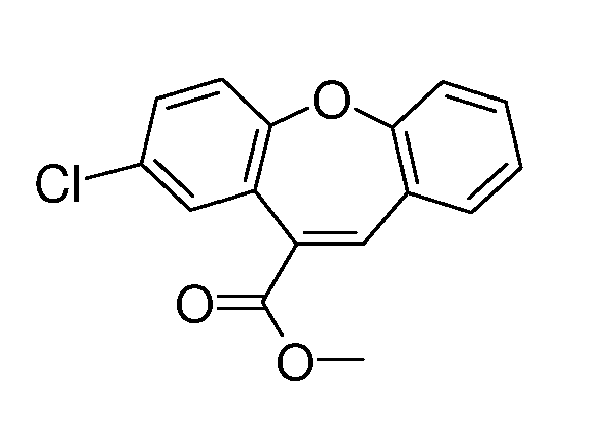
- A mixture of 415.23 g (2.33 mol) of pyrophosphoric acid and 22.14 g of water at 0 ºC was added over methyl 2-(5-chloro-2-phenoxyphenyl)-3-hydroxyacrylate (compound IXa) as obtained in Example 16. The reaction mixture was stirred at 60 ºC for 2 hours. After cooling to 20 ºC, 500 mL of water and 1.4 L of methyl tert-butyl ether were added. The aqueous layer was extracted and washed with 200 mL of methyl tert-butyl ether. The organic phases were combined, washed with 400 mL of an aqueous saturated solution of sodium bicarbonate and 400 mL of saturated sodium chloride, dried over anhydrous sodium sulfate and concentrated to dryness under reduced pressure. The residue was suspended in 400 mL of n-butanol and stirred at room temperature for 1 hour, and at 0 ºC for 2 hours. The resulting suspension was filtered, and the solid was dried until constant weight to obtain 161 g of methyl 2-chlorodibenzo[b,f]oxepin-11-carboxylate (compound Xa) as an off-white solid. Yield: 77.7 %.
-
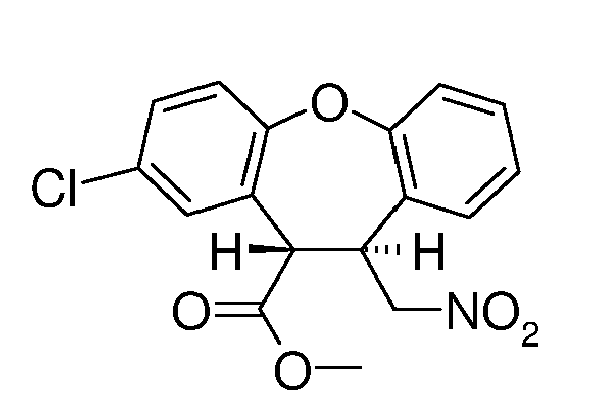
- 161 g (0.56 mol) of methyl 2-chlorodibenzo[b,f]oxepin-11-carboxylate (compound Xa), as obtained in Example 17, were suspended in 342 g (5.60 mol) of nitromethane. Then, 34.19 g (0.22 mol) of 1,8-diazabicyclo[5.4.0]undec-7-ene (DBU) were added portionwise while keeping the reaction temperature below 35 ºC. After the addition, the reaction mixture was stirred at room temperature overnight. Then, 800 mL of methyl tert-butyl ether, 250 mL of 1 M aqueous hydrochloric acid and 250 mL of water were added over the reaction, and the resulting mixture was stirred at room temperature for 30 minutes. The aqueous layer was extracted and washed with 200 mL of methyl tert-butyl ether. The organic phases were combined, washed with 550 mL of saturated sodium chloride, dried over anhydrous sodium sulfate and evaporated to dryness. The residue was suspended in 240 mL of n-butanol and stirred at room temperature for 1 hour. The resulting suspension was filtered, and the solid was dried until constant weight to obtain 150 g of methyl 2-chloro-10-nitromethyl-10,11-dihydrodibenzo[b,f]oxepine-11-carboxylate (compound Xla) as an off-white solid. Yield: 76.8 %.
-
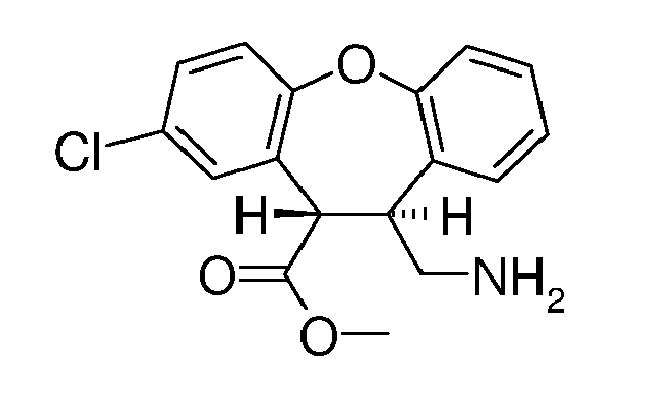
- An aqueous slurry of Ni-Raney (containing 30 g of Ni on a dry basis) was washed with tetrahydrofuran, and added over a solution of 270 g (0.78 mol) of methyl 2-chloro-1 0-nitromethyl-10,11-dihydrodibenzo[b,f]oxepine-11-carboxylate (compound Xla), as obtained in Example 18, in 2.7 L of tetrahydrofuran. The suspension was stirred under 50-60 psi (3447-4136 hPa) of hydrogen at room temperature for 2 days. The catalyst was removed by filtration, and the resulting solution was concentrated under reduced pressure to obtain methyl 10-aminomethyl-2-chloro-10,11-dihydrodibenzo[b,f]oxepine-11-carboxylate (compound XIIa), which was used in the next step (see Example 20) without further purification.
-

- The methyl 10-aminomethyl-2-chloro-10,11-dihydrodibenzo[b,f]oxepine-11-carboxylate (compound XIIa) obtained in Example 19 was mixed with 150 mL of ethyl acetate and stirred at room temperature for 4 days. The resulting suspension was filtered, and the solid was washed with ethyl acetate. The resulting solid was further purified by means of successive digestion steps in methanol (50 mL per g of crude product), until an appropriate purity was achieved. After 7 digestion steps, 60 g of trans-11-chloro-2,3,3a,12b-tetrahydro-1H-dibenz[2,3:6,7]oxepino[4,5-c]pyrrol-1-one (compound trans-XVlla) were obtained as a white powder. Yield: 27.0 %. Purity (HPLC, method 1): 98.5 %.
-

- An aqueous slurry of Ni-Raney (containing 40 g of Ni on a dry basis) was washed with tetrahydrofuran, and added over a solution of 400 g (1.15 mol) of methyl 2-chloro-1 0-nitromethyl-10,11-dihydrodibenzo[b,f]oxepine-11-carboxylate (compound Xla), obtained similarly as described in Example 18, in 2.5 L of tetrahydrofuran. The suspension was stirred under 50-60 psi (3447-4136 hPa) of hydrogen at room temperature for 2 days. The catalyst was removed by filtration, and the resulting solution was concentrated under reduced pressure. The residue was mixed with 300 mL of ethyl acetate, and the solvent was removed by distillation under reduced pressure. This step was repeated. The resulting residue was mixed with 300 mL of ethyl acetate and stirred at 25 ºC for 4 days. The resulting suspension was filtered, and the solid was washed with ethyl acetate. The resulting solid was further purified by means of three successive digestion steps in methanol (5 mL per g of crude product), to obtain 222 g of trans-11-chloro-2,3,3a,12b-tetrahydro-1H-dibenz[2,3:6,7]oxepino[4,5-c]pyrrol-1-one (compound trans-XVIIa). Yield: 67.6 %.
-

- A mixture of 95.0 g (0.33 mol) of trans-11-chloro-2,3,3a,12b-tetrahydro-1H-dibenz[2,3:6,7]oxepino[4,5-c]pyrrol-1-one (compound trans-XVIIa), as obtained in Example 20, 193.3 g (1.66 mol) of triethylsilane and 236.0 g (1.66 mol) of boron trifluoride diethyl etherate was heated to 105 ºC and stirred at this temperature for 24 hours. The resulting suspension was cooled down to 0 ºC, and 50 mL of water were added dropwise. pH was adjusted to above 10 by dropwise addition of a 20% aqueous sodium hydroxide solution. The mixture was extracted with 2 x 1 L of dichloromethane at 30 ºC. The organic phases were combined, washed with 500 mL of water and dried over anhydrous sodium sulphate. The solution was concentrated to about 200 mL. Then, a mixture of 33 mL of a 10M solution of hydrogen chloride in ethanol, and 50 mL of dichloromethane, was added dropwise over the concentrated solution. The solvents were removed under reduced pressure. 250 mL of ethanol were added and subsequently removed under reduced pressure. Finally, the resulting solid was suspended in 500 mL of ethyl acetate. The suspension was filtered, and the solid was washed with 50 mL of ethyl acetate and dried until constant weight to obtain 66.0 g of trans-5-chloro-2,3,3a,12b-tetrahydro-1H-dibenzo[2,3:6,7]oxepino[4,5-c]pyrrole hydrochloride (compound trans-XVIII hydrochloride) as a white solid. Yield: 64.4 %.
-
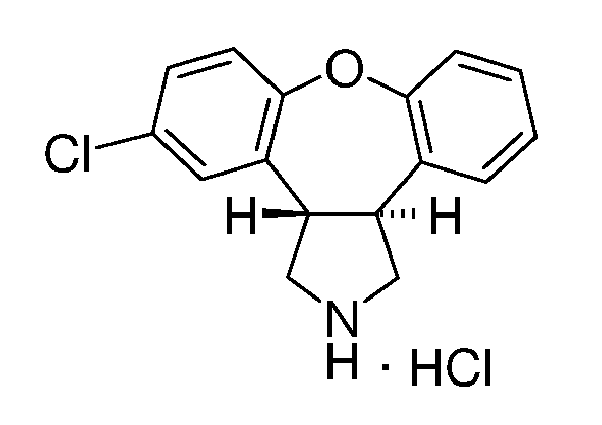
- 0.526 g (1.84 mmol) of trans-11-chloro-2,3,3a,12b-tetrahydro-1H dibenz[2,3:6,7]oxepino[4,5-c]pyrrol-1-one (compound trans-XVIIa) and 17.5 mL of toluene were charged to a 50 mL round-bottomed flask equipped with a Dean-Stark distillation setup. The mixture was heated to reflux and stirred for about 10 min before it was cooled to 0ºC. Then trifluoromethanesulfonic anhydride (0.32 mL, 1.9 mmol) was added dropwise and the mixture stirred for about 30 minutes. Sodium borohydride (100 mg, 2.6 mmol) was then added followed by anhydrous tetrahydrofuran (8.6 mL). The obtained solution was allowed to heat to room temperature and stirred over about 20 h. Water (8.6 mL) and 1 M hydrochloric acid (0.1 mL) were added, and the mixture heated to reflux, stirred for 2 h and allowed to cool down to room temperature. 6 mL of saturated sodium carbonate solution were added, and the obtained layers were separated. The aqueous layer was extracted with diethyl ether (26 mL) three times, and the obtained organic layers were dried with sodium sulfate, filtered, rotary evaporated and dried in the vacuum oven to yield 0.797 g of a crude oil.
- 510 mg of the obtained crude and 10 mL of 1.25 M hydrogen chloride in ethanol were heated to reflux and stirred for 2 h. Then the mixture was rotary evaporated and 10 mL of ethyl acetate was added to the obtained residue. A suspension formed, which was stirred for 27 min. The solid was filtered and washed with ethyl acetate (2 x 1 mL), then it was dried under vacuum to yield 152 mg. Yield: 43%. Purity (HPLC, method 2): 97.4%.
-
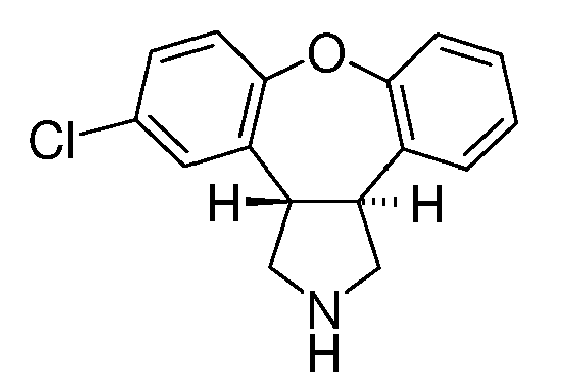
- 1.164 g (8.7 mmol) of aluminium chloride were dissolved in tetrahydrofuran (15 mL) at 10ºC. The solution was then cooled to 3ºC and a 2 M lithium aluminum hydride solution in tetrahydrofuran (7.4 mL, 14.8 mmol) was added over about 13 min. The addition funnel was washed with tetrahydrofuran (2 mL) at the end of the addition. After about 10 min at 0ºC, a solution of 1.52 g (5.2 mmol) of trans-11-chloro-2,3,3a,12b-tetrahydro-1H-dibenz[2,3:6,7]oxepino[4,5-c]pyrrol-1-one (compound trans-XVIIa) in 25 mL of tetrahydrofuran was added dropwise. The obtained solution was stirred for 3 h before it was allowed to heat up to room temperature and left stirring overnight. The reaction mixture was cooled to 2ºC and 16.5 mL of a 0.6 M sodium hydroxide solution were cautiously added over about 20 min. Then the mixture was allowed to warm to room temperature and toluene (22.5 mL) and water (15 mL) were added. The mixture was filtered through diatomaceous earth and the filter was washed with toluene (10 mL), twice. The combined liquors were decanted and the aqueous layer was extracted with toluene (15 mL), twice. The combined organic layers were washed with a saturated solution of sodium chloride (45 mL), twice, and the obtained organic layer was dried with anhydrous sodium sulfate, filtered and rotary evaporated. After drying under vacuum, the obtained oil weighed 1.36 g.
-

- 1.55 g (5.4 mmol) of trans-11-chloro-2,3,3a,12b-tetrahydro-1H-dibenz[2,3:6,7]oxepino[4,5-c]pyrrol-1-one (compound trans-XVIIa) was dissolved in 32.5 mL of anhydrous tetrahydrofuran. 2.1 mL of N,N-diethylaniline-borane complex (11.5 mmol) were added dropwise and the obtained solution was stirred at room temperature for 30 min before heating to reflux. The reaction mixture was stirred for 8 h then it was allowed to cool to room temperature overnight. The mixture was reheated to reflux and stirred for 5 h before allowing to cool down to room temperature. 3 mL of a 6 M hydrochloric acid were added and the mixture refluxed for 1 h and overnight at room temperature. The mixture was then basified with 95 mL of 0.25 M potassium hydroxide and extracted with diethyl ether (50 mL), three times. The organic layers were combined and dried with anhydrous sodium sulfate, filtered and rotary evaporated.
-

- 0.53 g (1.9 mmol) of trans-11-chloro-2,3,3a,12b-tetrahydro-1H-dibenz[2,3:6,7]oxepino[4,5-c]pyrrol-1-one (compound trans-XVIIa) was suspended in 5 mL of anhydrous tetrahydrofuran and cooled to -2ºC. 8.8 mL of borane-tetrahydrofuran complex (8.7 mmol) were added dropwise and the obtained solution was allowed to warm up to room temperature. The reaction mixture was stirred for 20.5 h and 5 mL of anhydrous tetrahydrofuran were added. After further 25 h at room temperature, 8.8 mL of borane-tetrahydrofuran complex (8.7 mmol) were added and the mixture stirred for 4 h before adding 1.25 M hydrogen chloride in ethanol (25.2 mL, 31.5 mmol). After 3 days the reaction mixture was rotary evaporated and toluene (25 mL) and 1 M sodium hydroxide (10.5 mL) were added to the residue. More toluene (25 mL) and water (10 mL) were added and the mixture vigorously stirred for about 2.5 h. Then the layers were separated and the aqueous layer was extracted with toluene (25 mL), twice. The organic layers were combined and washed with 0.1 M sodium hydroxide (4 mL), dried with anhydrous sodium sulfate, filtered and rotary evaporated.
-

- 66.0 g (0.21 mol) of trans-5-chloro-2,3,3a,12b-tetrahydro-1H-dibenzo[2,3:6,7]oxepino[4,5-c]pyrrole hydrochloride (compound trans-XVIII hydrochloride), as obtained in Example 22, were suspended in 500 mL of dichloromethane. 1 M aqueous sodium hydroxide was added until the pH was adjusted to above 10. The aqueous phase was extracted and washed with 500 mL of dichloromethane. The combined organic phases were evaporated to dryness to obtain trans-5-chloro-2,3,3a,12b-tetrahydro-1H-dibenzo[2,3:6,7]oxepino[4,5-c]pyrrole (compound trans-XIX) as a free base, which was dissolved in a mixture of 34.81 g (0.43 mol) of a 37 % aqueous solution of formaldehyde, 33.94 g (0.65 mol) of 88 % formic acid, and 500 mL of toluene. The resulting mixture was heated to 60 ºC and stirred at this temperature for 2 hours. After cooling to room temperature, pH was adjusted to 10 by addition of 1 M aqueous sodium hydroxide. The aqueous layer was extracted and washed with 500 mL of toluene. The organic phases were combined, washed with 500 mL of saturated sodium chloride, dried over anhydrous sodium sulfate and evaporated to dryness under reduced pressure to give asenapine (free base) as an oil, which was subsequently dissolved in 500 mL of isopropanol at 50 ºC. Then, 27.23 g (0.23 mol) of maleic acid and 5.0 g of active charcoal were added, and the resulting mixture was stirred at 65 ºC for 1 hour. The suspension was filtered, and the solid was washed with 50 mL of hot isopropanol. The filtrate was cooled slowly to 10 ºC, and seeded with asenapine maleate at this temperature. After stirring for 2 hours at 10 ºC, the resulting suspension was filtered, and the solid was washed with 50 mL of cold isopropanol. The solid was recrystallized from 500 mL of isopropanol and dried at 70 ºC under reduced pressure, until constant weight, to obtain 45.0 g of asenapine maleate (compound trans-I maleate) as a white powder. Yield: 52.3 %. Purity (HPLC, method 1): 99.8 %. Assay (titration with NaOH): 100.2 %.
Claims (15)
- A process for the preparation of compound trans-(I),
 (a) reducing desmethyl-lactam (XVII),
 (b) methylating desmethylasenapine (XVIII) to give compound trans-(I); and(c) optionally converting compound trans-(I) to a salt thereof,wherein X is H and Y is Cl or wherein X is Cl and Y is H.
 - The process according to claim 1, wherein the reduction of the desmethyl-lactam (XVII) is carried out in the presence of at least one reducing agent, preferably the reducing agent is a silane, more preferably triethylsilane, optionally in the presence of one or more Lewis acids, preferably the Lewis acid is boron trifluoride diethyl etherate.
- The process according to any one of the preceeding claims, wherein the desmethylasenapine (XVIII) is methylated to give compound trans-(I) in the presence of a methylating agent, preferably a mixture of formaldehyde and formic acid.
- A process for preparing the desmethyl-lactam (XVII),


wherein X is H and Y is Cl or wherein X is Cl and Y is H and R is any alkyl, optionally substituted; benzyl, optionally substituted or phenyl, optionally substituted. Preferably, R is a C1-C6 alkyl, optionally substituted. More preferably R is methyl. - The process according to claim 4, wherein the ring-closing of the amino-ester (XII') is catalyzed by the unreacted amino-ester (XII').
- The process according to claim 4, wherein the mild basic catalyst is sodium or potassium hydroxide.
- A process according to any one of claims 4-6, further comprising:(a) reducing the nitro-ester (XI'),
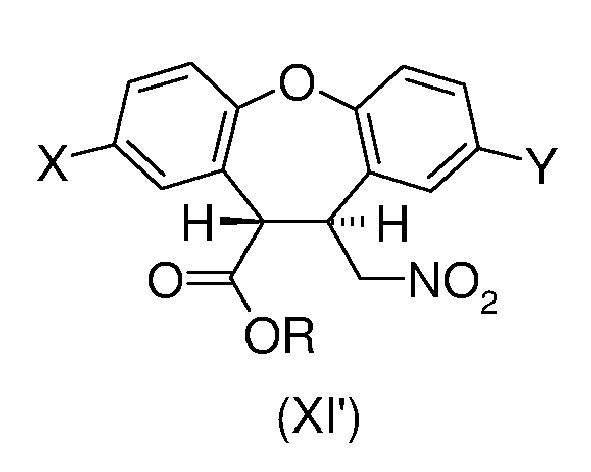


- A process for the preparation of compound trans-(I),
 any one of the processes as defined in the claims 4 to 7
 - A process for the preparation of compound trans-(I),
 (a) reducing the nitro-ester (XI'),
 (b) optionally hydrolyzing the amino-ester (XII') into the amino-acid (XVI),
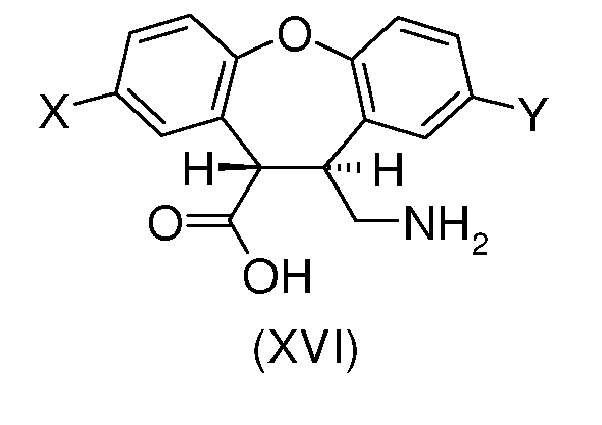 (c) performing the ring-closing of the amino-ester (XII') or the amino-acid (XVI),
 (d) reducing desmethyl-lactam (XVII) to give desmethylasenapine (XVIII)
 (e) methylating desmethylasenapine (XVIII) to give compound trans-(I); and(f) optionally converting compound trans-(I) to a salt thereof,wherein X is H and Y is Cl or wherein X is Cl and Y is H and R is any alkyl, optionally substituted; benzyl, optionally substituted or phenyl, optionally substituted. Preferably, R is a C1-C6 alkyl, optionally substituted. More preferably R is methyl.
 - A process for the preparation of compound trans-(I),
 (a) reducing compound (IV),
 (b) cyclizing compound (XIII) to give compound (VI),
 (c) converting compound (VI) into compound trans-(I); and(d) optionally converting compound trans-(I) to a salt thereof,wherein X is H and Y is Cl or wherein X is Cl and Y is H.
 - The process according to claim 10, wherein the reduction of compound (IV) is performed in the presence of a borohydride reagent, preferably the borohydride is potassium borohydride.
- The process according to any one of claims 10-11, wherein the cyclization of compound (XIII) is carried out by a dehydrating agent, preferably the dehydrating agent is polyphosphoric acid.
- The process according to any one of claims 10-12, wherein the conversion of the compound (VI) into compound trans-(I) comprises a reduction of compound (VI) with one or more reducing agents selected from the group consisting of a borane reagent, sodium bis(2-methoxyethoxy)aluminium hydride, triethylsilane in the presence of a metal catalyst and sodium borohydride in the presence of trifluoroborane.
- A process for the preparation of compound trans-(I),
 (a) methylating desmethyl-lactam (XVII),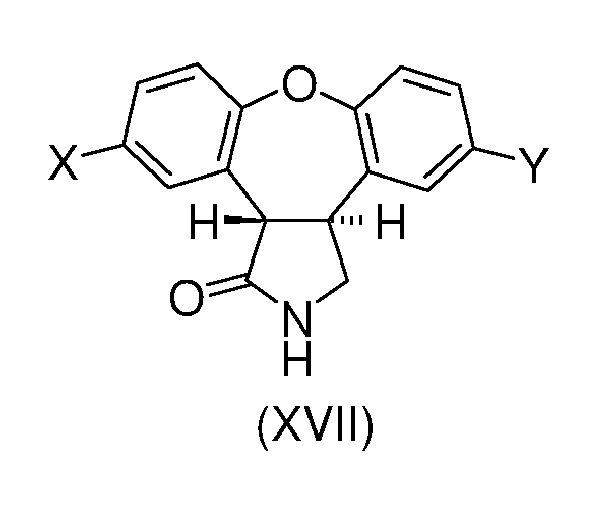
 (e) reducing lactam (VI) to give compound trans-(I); and(f) optionally converting compound trans-(I) to a salt thereof,wherein X is H and Y is Cl or wherein X is Cl and Y is H.
 - The process according to any one of claims 10-14, further comprising the conversion of the undesired compound cis-(VI) to the desired compound trans-(VI).
Priority Applications (1)
| Application Number | Priority Date | Filing Date | Title |
|---|---|---|---|
| EP11195387.3A EP2468751B1 (en) | 2010-12-24 | 2011-12-22 | Processes for the preparation of 5-chloro-2-methyl-2,3,3a,12b-tetrahydro-1H-dibenzo[2,3:6,7]oxepino[4,5-c]pyrrole |
Applications Claiming Priority (2)
| Application Number | Priority Date | Filing Date | Title |
|---|---|---|---|
| EP10382354 | 2010-12-24 | ||
| EP11195387.3A EP2468751B1 (en) | 2010-12-24 | 2011-12-22 | Processes for the preparation of 5-chloro-2-methyl-2,3,3a,12b-tetrahydro-1H-dibenzo[2,3:6,7]oxepino[4,5-c]pyrrole |
Publications (3)
| Publication Number | Publication Date |
|---|---|
| EP2468751A2 true EP2468751A2 (en) | 2012-06-27 |
| EP2468751A3 EP2468751A3 (en) | 2012-08-01 |
| EP2468751B1 EP2468751B1 (en) | 2016-03-16 |
Family
ID=45346379
Family Applications (1)
| Application Number | Title | Priority Date | Filing Date |
|---|---|---|---|
| EP11195387.3A Not-in-force EP2468751B1 (en) | 2010-12-24 | 2011-12-22 | Processes for the preparation of 5-chloro-2-methyl-2,3,3a,12b-tetrahydro-1H-dibenzo[2,3:6,7]oxepino[4,5-c]pyrrole |
Country Status (3)
| Country | Link |
|---|---|
| US (1) | US8580972B2 (en) |
| EP (1) | EP2468751B1 (en) |
| ES (1) | ES2575544T3 (en) |
Cited By (1)
| Publication number | Priority date | Publication date | Assignee | Title |
|---|---|---|---|---|
| CN103772400A (en) * | 2014-01-07 | 2014-05-07 | 万特制药(海南)有限公司 | Preparation method of trans-5-chloro-2,3,3a,12b-tetrahydro-1H-dibenzo[2,3:6,7]oxepino[4,5-c]pyrrole |
Families Citing this family (6)
| Publication number | Priority date | Publication date | Assignee | Title |
|---|---|---|---|---|
| TWI488855B (en) * | 2013-05-31 | 2015-06-21 | Hua Yu Wuxi Pharmaceutical Co Ltd | Reductant and method for preparing asenapine |
| PL3338768T3 (en) | 2016-12-20 | 2020-05-18 | Lts Lohmann Therapie-Systeme Ag | Transdermal therapeutic system containing asenapine |
| ES3001152T3 (en) | 2016-12-20 | 2025-03-04 | Lts Lohmann Therapie Systeme Ag | Transdermal therapeutic system containing asenapine and polysiloxane or polyisobutylene |
| US11033512B2 (en) | 2017-06-26 | 2021-06-15 | Lts Lohmann Therapie-Systeme Ag | Transdermal therapeutic system containing asenapine and silicone acrylic hybrid polymer |
| CN118806732A (en) | 2018-06-20 | 2024-10-22 | 罗曼治疗系统股份公司 | Transdermal therapeutic system containing asenapine |
| KR102802121B1 (en) | 2018-06-20 | 2025-05-02 | 에르테에스 로만 테라피-시스테메 아게 | Transdermal therapeutic system containing asenapine |
Citations (5)
| Publication number | Priority date | Publication date | Assignee | Title |
|---|---|---|---|---|
| US4145434A (en) | 1976-05-24 | 1979-03-20 | Akzona Incorporated | Tetracyclic derivatives and pharmaceutical compositions of matter |
| JPH10227563A (en) | 1997-02-17 | 1998-08-25 | Shikishima:Kk | Drying device |
| WO2009087058A1 (en) | 2008-01-04 | 2009-07-16 | N.V. Organon | Process for the preparation of asenapine and intermediate products used in said process |
| EP1710241B1 (en) | 2005-04-07 | 2009-11-04 | N.V. Organon | Intermediate compounds for the preparation of trans-5-chloro-2-methyl-2,3,3a,12b-tetrahydro-1h-dibenz[2,3:6,7]oxepino[4,5-c]pyrrole |
| EP2166012A1 (en) | 2007-07-06 | 2010-03-24 | Sumitomo Chemical Company, Limited | Process for producing trans-dibenzoxenopyrrole compound and intermediate therefor |
Family Cites Families (5)
| Publication number | Priority date | Publication date | Assignee | Title |
|---|---|---|---|---|
| JPS4969697A (en) | 1972-11-07 | 1974-07-05 | ||
| US7019718B2 (en) | 2000-07-25 | 2006-03-28 | Semiconductor Energy Laboratory Co., Ltd. | Display device |
| WO2007046554A1 (en) * | 2005-10-21 | 2007-04-26 | Sumitomo Chemical Company, Limited | Process for production of dibenzoxepinopyrrole compound, intermediate for production of the compound, and process for production of the intermediate |
| US20090209608A1 (en) * | 2007-08-29 | 2009-08-20 | Protia, Llc | Deuterium-enriched asenapine |
| CN101851242B (en) * | 2010-05-25 | 2013-07-24 | 上海皓元生物医药科技有限公司 | Preparation method of asenapine intermediate |
-
2011
- 2011-12-22 EP EP11195387.3A patent/EP2468751B1/en not_active Not-in-force
- 2011-12-22 ES ES11195387.3T patent/ES2575544T3/en active Active
- 2011-12-23 US US13/336,201 patent/US8580972B2/en not_active Expired - Fee Related
Patent Citations (5)
| Publication number | Priority date | Publication date | Assignee | Title |
|---|---|---|---|---|
| US4145434A (en) | 1976-05-24 | 1979-03-20 | Akzona Incorporated | Tetracyclic derivatives and pharmaceutical compositions of matter |
| JPH10227563A (en) | 1997-02-17 | 1998-08-25 | Shikishima:Kk | Drying device |
| EP1710241B1 (en) | 2005-04-07 | 2009-11-04 | N.V. Organon | Intermediate compounds for the preparation of trans-5-chloro-2-methyl-2,3,3a,12b-tetrahydro-1h-dibenz[2,3:6,7]oxepino[4,5-c]pyrrole |
| EP2166012A1 (en) | 2007-07-06 | 2010-03-24 | Sumitomo Chemical Company, Limited | Process for producing trans-dibenzoxenopyrrole compound and intermediate therefor |
| WO2009087058A1 (en) | 2008-01-04 | 2009-07-16 | N.V. Organon | Process for the preparation of asenapine and intermediate products used in said process |
Non-Patent Citations (4)
| Title |
|---|
| CONSTABLE D.J.C. ET AL: "Key green chemistry research areasa perspective from pharmaceutical manufacturers", GREEN CHEMISTRY, vol. 9, no. 5, 2007, pages 411 - 420, XP055098874 |
| FERNANDES A.C. ET AL: "Reduction of amides with silanes catalyzed by MoO2Cl2", JOURNAL OF MOLECULAR CATALYSIS A: CHEMICAL, vol. 272, no. 1-2, 2 July 2007 (2007-07-02), pages 60 - 63, XP025319022 |
| J. LABELLED COMPD. RADIOPHARM., vol. 34, 1994, pages 845 - 869 |
| ORG. PROCESS RES. DEV., vol. 12, 2008, pages 196 - 201 |
Cited By (1)
| Publication number | Priority date | Publication date | Assignee | Title |
|---|---|---|---|---|
| CN103772400A (en) * | 2014-01-07 | 2014-05-07 | 万特制药(海南)有限公司 | Preparation method of trans-5-chloro-2,3,3a,12b-tetrahydro-1H-dibenzo[2,3:6,7]oxepino[4,5-c]pyrrole |
Also Published As
| Publication number | Publication date |
|---|---|
| US8580972B2 (en) | 2013-11-12 |
| EP2468751A3 (en) | 2012-08-01 |
| US20120165545A1 (en) | 2012-06-28 |
| EP2468751B1 (en) | 2016-03-16 |
| ES2575544T3 (en) | 2016-06-29 |
Similar Documents
| Publication | Publication Date | Title |
|---|---|---|
| EP2468751B1 (en) | Processes for the preparation of 5-chloro-2-methyl-2,3,3a,12b-tetrahydro-1H-dibenzo[2,3:6,7]oxepino[4,5-c]pyrrole | |
| US8853401B2 (en) | Processes for the preparation of morphinane and morphinone compounds | |
| US20080161570A1 (en) | Processes for Synthesizing Quaternary 4,5-Epoxy-Morphinan Analogs and Isolating their N-Stereoisomers | |
| Mansfield et al. | Copper‐Catalyzed Synthesis and Applications of Yndiamides | |
| KR20150140397A (en) | Substituted heterocycle fused gamma-carbolines synthesis | |
| JP2022513934A (en) | Synthesis of substituted heterocyclic condensation γ-carboline | |
| EP3700905A1 (en) | Enamines and diastereo-selective reduction of enamines | |
| Sarkar et al. | Microwave assisted synthesis of 3-benzazepin-2-ones as building blocks for 2, 3-disubstituted tetrahydro-3-benzazepines | |
| WO2014055603A1 (en) | Process for the preparation of an hiv integrase inhibitor | |
| CA3223210A1 (en) | Novel ergolines and methods of treating mood disorders | |
| JP2022514263A (en) | Synthesis of substituted heterocyclic condensation γ-carboline | |
| EP1981891B1 (en) | The use of oripavine as a starting material for buprenorphine | |
| CA2936749C (en) | Transition metal-catalyzed processes for the preparation of n-allyl compounds and use thereof | |
| EP2598496B1 (en) | Novel process for the preparation of asenapine | |
| Incze et al. | New routes to clavine-type ergot alkaloids. Part 2: Synthesis of the last, so far not yet synthesized member of the clavine alkaloid family,(±)-cycloclavine | |
| KR20180129854A (en) | Improved Preparation of Butorphanol Tartrate | |
| Liu et al. | Stereoselectivity in a nitroso-ene cyclization: Formal synthesis of rac-manzacidins A and C | |
| Sarges et al. | Synthesis of aryl-substituted 1, 3-and 1, 4-diazocine derivatives | |
| WO2014016338A1 (en) | New synthetic route for the preparation of 3-amino-piperidine compounds | |
| KR20220035378A (en) | Method for preparing phenol derivatives | |
| JP4508528B2 (en) | Process for producing α-amino substituted carboxylic acid amide | |
| Risgaard et al. | Synthesis and SAR study of a novel series of dopamine receptor agonists | |
| Bolchi et al. | From carnitinamide to 5-aminomethyl-2-oxazolidinones | |
| EP4269391A1 (en) | Synthesis and use of 1-benzyl-4-methyl-5-alkoxy-1,2,3,6-tetrahydropyridine derivative | |
| CN101514201A (en) | Preparation method for (4,7-cis)-octahydro-pyrrolo[3,4-b]pyridine and moxifolxacin |
Legal Events
| Date | Code | Title | Description |
|---|---|---|---|
| AK | Designated contracting states |
Kind code of ref document: A2 Designated state(s): AL AT BE BG CH CY CZ DE DK EE ES FI FR GB GR HR HU IE IS IT LI LT LU LV MC MK MT NL NO PL PT RO RS SE SI SK SM TR |
|
| AX | Request for extension of the european patent |
Extension state: BA ME |
|
| PUAI | Public reference made under article 153(3) epc to a published international application that has entered the european phase |
Free format text: ORIGINAL CODE: 0009012 |
|
| PUAL | Search report despatched |
Free format text: ORIGINAL CODE: 0009013 |
|
| AK | Designated contracting states |
Kind code of ref document: A3 Designated state(s): AL AT BE BG CH CY CZ DE DK EE ES FI FR GB GR HR HU IE IS IT LI LT LU LV MC MK MT NL NO PL PT RO RS SE SI SK SM TR |
|
| AX | Request for extension of the european patent |
Extension state: BA ME |
|
| RIC1 | Information provided on ipc code assigned before grant |
Ipc: C07D 491/04 20060101AFI20120626BHEP |
|
| 17P | Request for examination filed |
Effective date: 20121214 |
|
| 17Q | First examination report despatched |
Effective date: 20130307 |
|
| TPAC | Observations filed by third parties |
Free format text: ORIGINAL CODE: EPIDOSNTIPA |
|
| GRAP | Despatch of communication of intention to grant a patent |
Free format text: ORIGINAL CODE: EPIDOSNIGR1 |
|
| INTG | Intention to grant announced |
Effective date: 20150909 |
|
| GRAS | Grant fee paid |
Free format text: ORIGINAL CODE: EPIDOSNIGR3 |
|
| GRAA | (expected) grant |
Free format text: ORIGINAL CODE: 0009210 |
|
| RIN1 | Information on inventor provided before grant (corrected) |
Inventor name: DURAN LOPEZ, ERNESTO Inventor name: BOCH I LLADO, JORDI |
|
| AK | Designated contracting states |
Kind code of ref document: B1 Designated state(s): AL AT BE BG CH CY CZ DE DK EE ES FI FR GB GR HR HU IE IS IT LI LT LU LV MC MK MT NL NO PL PT RO RS SE SI SK SM TR |
|
| REG | Reference to a national code |
Ref country code: GB Ref legal event code: FG4D |
|
| REG | Reference to a national code |
Ref country code: CH Ref legal event code: EP |
|
| REG | Reference to a national code |
Ref country code: IE Ref legal event code: FG4D |
|
| REG | Reference to a national code |
Ref country code: AT Ref legal event code: REF Ref document number: 781134 Country of ref document: AT Kind code of ref document: T Effective date: 20160415 |
|
| REG | Reference to a national code |
Ref country code: DE Ref legal event code: R096 Ref document number: 602011024011 Country of ref document: DE |
|
| REG | Reference to a national code |
Ref country code: ES Ref legal event code: FG2A Ref document number: 2575544 Country of ref document: ES Kind code of ref document: T3 Effective date: 20160629 |
|
| REG | Reference to a national code |
Ref country code: NL Ref legal event code: MP Effective date: 20160316 |
|
| REG | Reference to a national code |
Ref country code: LT Ref legal event code: MG4D |
|
| PG25 | Lapsed in a contracting state [announced via postgrant information from national office to epo] |
Ref country code: FI Free format text: LAPSE BECAUSE OF FAILURE TO SUBMIT A TRANSLATION OF THE DESCRIPTION OR TO PAY THE FEE WITHIN THE PRESCRIBED TIME-LIMIT Effective date: 20160316 Ref country code: GR Free format text: LAPSE BECAUSE OF FAILURE TO SUBMIT A TRANSLATION OF THE DESCRIPTION OR TO PAY THE FEE WITHIN THE PRESCRIBED TIME-LIMIT Effective date: 20160617 Ref country code: HR Free format text: LAPSE BECAUSE OF FAILURE TO SUBMIT A TRANSLATION OF THE DESCRIPTION OR TO PAY THE FEE WITHIN THE PRESCRIBED TIME-LIMIT Effective date: 20160316 Ref country code: NO Free format text: LAPSE BECAUSE OF FAILURE TO SUBMIT A TRANSLATION OF THE DESCRIPTION OR TO PAY THE FEE WITHIN THE PRESCRIBED TIME-LIMIT Effective date: 20160616 |
|
| REG | Reference to a national code |
Ref country code: DE Ref legal event code: R082 Ref document number: 602011024011 Country of ref document: DE Representative=s name: KILBURN & STRODE LLP, NL Ref country code: DE Ref legal event code: R082 Ref document number: 602011024011 Country of ref document: DE Representative=s name: KILBURN & STRODE LLP, GB |
|
| REG | Reference to a national code |
Ref country code: AT Ref legal event code: MK05 Ref document number: 781134 Country of ref document: AT Kind code of ref document: T Effective date: 20160316 |
|
| PG25 | Lapsed in a contracting state [announced via postgrant information from national office to epo] |
Ref country code: NL Free format text: LAPSE BECAUSE OF FAILURE TO SUBMIT A TRANSLATION OF THE DESCRIPTION OR TO PAY THE FEE WITHIN THE PRESCRIBED TIME-LIMIT Effective date: 20160316 Ref country code: LT Free format text: LAPSE BECAUSE OF FAILURE TO SUBMIT A TRANSLATION OF THE DESCRIPTION OR TO PAY THE FEE WITHIN THE PRESCRIBED TIME-LIMIT Effective date: 20160316 Ref country code: RS Free format text: LAPSE BECAUSE OF FAILURE TO SUBMIT A TRANSLATION OF THE DESCRIPTION OR TO PAY THE FEE WITHIN THE PRESCRIBED TIME-LIMIT Effective date: 20160316 Ref country code: SE Free format text: LAPSE BECAUSE OF FAILURE TO SUBMIT A TRANSLATION OF THE DESCRIPTION OR TO PAY THE FEE WITHIN THE PRESCRIBED TIME-LIMIT Effective date: 20160316 Ref country code: LV Free format text: LAPSE BECAUSE OF FAILURE TO SUBMIT A TRANSLATION OF THE DESCRIPTION OR TO PAY THE FEE WITHIN THE PRESCRIBED TIME-LIMIT Effective date: 20160316 |
|
| PG25 | Lapsed in a contracting state [announced via postgrant information from national office to epo] |
Ref country code: IS Free format text: LAPSE BECAUSE OF FAILURE TO SUBMIT A TRANSLATION OF THE DESCRIPTION OR TO PAY THE FEE WITHIN THE PRESCRIBED TIME-LIMIT Effective date: 20160716 Ref country code: PL Free format text: LAPSE BECAUSE OF FAILURE TO SUBMIT A TRANSLATION OF THE DESCRIPTION OR TO PAY THE FEE WITHIN THE PRESCRIBED TIME-LIMIT Effective date: 20160316 Ref country code: EE Free format text: LAPSE BECAUSE OF FAILURE TO SUBMIT A TRANSLATION OF THE DESCRIPTION OR TO PAY THE FEE WITHIN THE PRESCRIBED TIME-LIMIT Effective date: 20160316 |
|
| PG25 | Lapsed in a contracting state [announced via postgrant information from national office to epo] |
Ref country code: SK Free format text: LAPSE BECAUSE OF FAILURE TO SUBMIT A TRANSLATION OF THE DESCRIPTION OR TO PAY THE FEE WITHIN THE PRESCRIBED TIME-LIMIT Effective date: 20160316 Ref country code: PT Free format text: LAPSE BECAUSE OF FAILURE TO SUBMIT A TRANSLATION OF THE DESCRIPTION OR TO PAY THE FEE WITHIN THE PRESCRIBED TIME-LIMIT Effective date: 20160718 Ref country code: CZ Free format text: LAPSE BECAUSE OF FAILURE TO SUBMIT A TRANSLATION OF THE DESCRIPTION OR TO PAY THE FEE WITHIN THE PRESCRIBED TIME-LIMIT Effective date: 20160316 Ref country code: AT Free format text: LAPSE BECAUSE OF FAILURE TO SUBMIT A TRANSLATION OF THE DESCRIPTION OR TO PAY THE FEE WITHIN THE PRESCRIBED TIME-LIMIT Effective date: 20160316 Ref country code: RO Free format text: LAPSE BECAUSE OF FAILURE TO SUBMIT A TRANSLATION OF THE DESCRIPTION OR TO PAY THE FEE WITHIN THE PRESCRIBED TIME-LIMIT Effective date: 20160316 Ref country code: SM Free format text: LAPSE BECAUSE OF FAILURE TO SUBMIT A TRANSLATION OF THE DESCRIPTION OR TO PAY THE FEE WITHIN THE PRESCRIBED TIME-LIMIT Effective date: 20160316 |
|
| REG | Reference to a national code |
Ref country code: DE Ref legal event code: R097 Ref document number: 602011024011 Country of ref document: DE |
|
| REG | Reference to a national code |
Ref country code: FR Ref legal event code: PLFP Year of fee payment: 6 |
|
| PG25 | Lapsed in a contracting state [announced via postgrant information from national office to epo] |
Ref country code: BE Free format text: LAPSE BECAUSE OF FAILURE TO SUBMIT A TRANSLATION OF THE DESCRIPTION OR TO PAY THE FEE WITHIN THE PRESCRIBED TIME-LIMIT Effective date: 20160316 |
|
| PLBE | No opposition filed within time limit |
Free format text: ORIGINAL CODE: 0009261 |
|
| STAA | Information on the status of an ep patent application or granted ep patent |
Free format text: STATUS: NO OPPOSITION FILED WITHIN TIME LIMIT |
|
| PG25 | Lapsed in a contracting state [announced via postgrant information from national office to epo] |
Ref country code: DK Free format text: LAPSE BECAUSE OF FAILURE TO SUBMIT A TRANSLATION OF THE DESCRIPTION OR TO PAY THE FEE WITHIN THE PRESCRIBED TIME-LIMIT Effective date: 20160316 |
|
| 26N | No opposition filed |
Effective date: 20161219 |
|
| PG25 | Lapsed in a contracting state [announced via postgrant information from national office to epo] |
Ref country code: BG Free format text: LAPSE BECAUSE OF FAILURE TO SUBMIT A TRANSLATION OF THE DESCRIPTION OR TO PAY THE FEE WITHIN THE PRESCRIBED TIME-LIMIT Effective date: 20160616 |
|
| PG25 | Lapsed in a contracting state [announced via postgrant information from national office to epo] |
Ref country code: SI Free format text: LAPSE BECAUSE OF FAILURE TO SUBMIT A TRANSLATION OF THE DESCRIPTION OR TO PAY THE FEE WITHIN THE PRESCRIBED TIME-LIMIT Effective date: 20160316 |
|
| REG | Reference to a national code |
Ref country code: CH Ref legal event code: PL |
|
| PG25 | Lapsed in a contracting state [announced via postgrant information from national office to epo] |
Ref country code: MC Free format text: LAPSE BECAUSE OF FAILURE TO SUBMIT A TRANSLATION OF THE DESCRIPTION OR TO PAY THE FEE WITHIN THE PRESCRIBED TIME-LIMIT Effective date: 20160316 |
|
| REG | Reference to a national code |
Ref country code: IE Ref legal event code: MM4A |
|
| PG25 | Lapsed in a contracting state [announced via postgrant information from national office to epo] |
Ref country code: CH Free format text: LAPSE BECAUSE OF NON-PAYMENT OF DUE FEES Effective date: 20161231 Ref country code: LI Free format text: LAPSE BECAUSE OF NON-PAYMENT OF DUE FEES Effective date: 20161231 Ref country code: LU Free format text: LAPSE BECAUSE OF NON-PAYMENT OF DUE FEES Effective date: 20161222 |
|
| PG25 | Lapsed in a contracting state [announced via postgrant information from national office to epo] |
Ref country code: IE Free format text: LAPSE BECAUSE OF NON-PAYMENT OF DUE FEES Effective date: 20161222 |
|
| REG | Reference to a national code |
Ref country code: FR Ref legal event code: PLFP Year of fee payment: 7 |
|
| PG25 | Lapsed in a contracting state [announced via postgrant information from national office to epo] |
Ref country code: CY Free format text: LAPSE BECAUSE OF FAILURE TO SUBMIT A TRANSLATION OF THE DESCRIPTION OR TO PAY THE FEE WITHIN THE PRESCRIBED TIME-LIMIT Effective date: 20160316 Ref country code: HU Free format text: LAPSE BECAUSE OF FAILURE TO SUBMIT A TRANSLATION OF THE DESCRIPTION OR TO PAY THE FEE WITHIN THE PRESCRIBED TIME-LIMIT; INVALID AB INITIO Effective date: 20111222 |
|
| PG25 | Lapsed in a contracting state [announced via postgrant information from national office to epo] |
Ref country code: TR Free format text: LAPSE BECAUSE OF FAILURE TO SUBMIT A TRANSLATION OF THE DESCRIPTION OR TO PAY THE FEE WITHIN THE PRESCRIBED TIME-LIMIT Effective date: 20160316 Ref country code: MK Free format text: LAPSE BECAUSE OF FAILURE TO SUBMIT A TRANSLATION OF THE DESCRIPTION OR TO PAY THE FEE WITHIN THE PRESCRIBED TIME-LIMIT Effective date: 20160316 |
|
| PG25 | Lapsed in a contracting state [announced via postgrant information from national office to epo] |
Ref country code: AL Free format text: LAPSE BECAUSE OF FAILURE TO SUBMIT A TRANSLATION OF THE DESCRIPTION OR TO PAY THE FEE WITHIN THE PRESCRIBED TIME-LIMIT Effective date: 20160316 |
|
| REG | Reference to a national code |
Ref country code: DE Ref legal event code: R082 Ref document number: 602011024011 Country of ref document: DE Representative=s name: KILBURN & STRODE LLP, NL |
|
| PGFP | Annual fee paid to national office [announced via postgrant information from national office to epo] |
Ref country code: DE Payment date: 20211227 Year of fee payment: 11 Ref country code: GB Payment date: 20211227 Year of fee payment: 11 Ref country code: FR Payment date: 20211227 Year of fee payment: 11 |
|
| PGFP | Annual fee paid to national office [announced via postgrant information from national office to epo] |
Ref country code: IT Payment date: 20211221 Year of fee payment: 11 |
|
| PGFP | Annual fee paid to national office [announced via postgrant information from national office to epo] |
Ref country code: MT Payment date: 20211201 Year of fee payment: 11 |
|
| PGFP | Annual fee paid to national office [announced via postgrant information from national office to epo] |
Ref country code: ES Payment date: 20220103 Year of fee payment: 11 |
|
| REG | Reference to a national code |
Ref country code: DE Ref legal event code: R119 Ref document number: 602011024011 Country of ref document: DE |
|
| GBPC | Gb: european patent ceased through non-payment of renewal fee |
Effective date: 20221222 |
|
| PG25 | Lapsed in a contracting state [announced via postgrant information from national office to epo] |
Ref country code: GB Free format text: LAPSE BECAUSE OF NON-PAYMENT OF DUE FEES Effective date: 20221222 Ref country code: DE Free format text: LAPSE BECAUSE OF NON-PAYMENT OF DUE FEES Effective date: 20230701 |
|
| PG25 | Lapsed in a contracting state [announced via postgrant information from national office to epo] |
Ref country code: FR Free format text: LAPSE BECAUSE OF NON-PAYMENT OF DUE FEES Effective date: 20221231 |
|
| PG25 | Lapsed in a contracting state [announced via postgrant information from national office to epo] |
Ref country code: IT Free format text: LAPSE BECAUSE OF NON-PAYMENT OF DUE FEES Effective date: 20221222 |
|
| REG | Reference to a national code |
Ref country code: ES Ref legal event code: FD2A Effective date: 20240202 |
|
| PG25 | Lapsed in a contracting state [announced via postgrant information from national office to epo] |
Ref country code: ES Free format text: LAPSE BECAUSE OF NON-PAYMENT OF DUE FEES Effective date: 20221223 |
|
| PG25 | Lapsed in a contracting state [announced via postgrant information from national office to epo] |
Ref country code: ES Free format text: LAPSE BECAUSE OF NON-PAYMENT OF DUE FEES Effective date: 20221223 |
|
| PG25 | Lapsed in a contracting state [announced via postgrant information from national office to epo] |
Ref country code: MT Free format text: LAPSE BECAUSE OF NON-PAYMENT OF DUE FEES Effective date: 20221222 |