EP1710241B1 - Intermediate compounds for the preparation of trans-5-chloro-2-methyl-2,3,3a,12b-tetrahydro-1h-dibenz[2,3:6,7]oxepino[4,5-c]pyrrole - Google Patents
Intermediate compounds for the preparation of trans-5-chloro-2-methyl-2,3,3a,12b-tetrahydro-1h-dibenz[2,3:6,7]oxepino[4,5-c]pyrrole Download PDFInfo
- Publication number
- EP1710241B1 EP1710241B1 EP06112333A EP06112333A EP1710241B1 EP 1710241 B1 EP1710241 B1 EP 1710241B1 EP 06112333 A EP06112333 A EP 06112333A EP 06112333 A EP06112333 A EP 06112333A EP 1710241 B1 EP1710241 B1 EP 1710241B1
- Authority
- EP
- European Patent Office
- Prior art keywords
- trans
- formula
- chloro
- methyl
- dibenz
- Prior art date
- Legal status (The legal status is an assumption and is not a legal conclusion. Google has not performed a legal analysis and makes no representation as to the accuracy of the status listed.)
- Active
Links
- 0 *N(C[C@@]12)C[C@]1c1cc(Cl)ccc1Oc1c2cccc1 Chemical compound *N(C[C@@]12)C[C@]1c1cc(Cl)ccc1Oc1c2cccc1 0.000 description 3
- AJPHZZUEMNEZBS-USEQNBQGSA-N CC(C1)C(N)=CC([C@H]2CN3C)=C1Oc1ccccc1[C@H]2C3=O Chemical compound CC(C1)C(N)=CC([C@H]2CN3C)=C1Oc1ccccc1[C@H]2C3=O AJPHZZUEMNEZBS-USEQNBQGSA-N 0.000 description 1
- OOUVAHYYJVOIIB-JBZHPUCOSA-N CN(C[C@@H](C1c2c3)c4ccccc4Oc2ccc3Cl)C1=O Chemical compound CN(C[C@@H](C1c2c3)c4ccccc4Oc2ccc3Cl)C1=O OOUVAHYYJVOIIB-JBZHPUCOSA-N 0.000 description 1
- OOUVAHYYJVOIIB-XJKSGUPXSA-N CN(C[C@H]([C@H]1c2c3)c(cccc4)c4Oc2ccc3Cl)C1=O Chemical compound CN(C[C@H]([C@H]1c2c3)c(cccc4)c4Oc2ccc3Cl)C1=O OOUVAHYYJVOIIB-XJKSGUPXSA-N 0.000 description 1
- CDCWWLYYNIFTQA-CZUORRHYSA-N CNC[C@@H]([C@@H]1C(O)=O)c2cc(Cl)ccc2Oc2c1cccc2 Chemical compound CNC[C@@H]([C@@H]1C(O)=O)c2cc(Cl)ccc2Oc2c1cccc2 CDCWWLYYNIFTQA-CZUORRHYSA-N 0.000 description 1
- FDEBVKYOGYXKFY-CZUORRHYSA-N CNC[C@@H]([C@H](C(O)=O)c1c2)c(cccc3)c3Oc1ccc2Cl Chemical compound CNC[C@@H]([C@H](C(O)=O)c1c2)c(cccc3)c3Oc1ccc2Cl FDEBVKYOGYXKFY-CZUORRHYSA-N 0.000 description 1
Classifications
-
- C—CHEMISTRY; METALLURGY
- C07—ORGANIC CHEMISTRY
- C07D—HETEROCYCLIC COMPOUNDS
- C07D491/00—Heterocyclic compounds containing in the condensed ring system both one or more rings having oxygen atoms as the only ring hetero atoms and one or more rings having nitrogen atoms as the only ring hetero atoms, not provided for by groups C07D451/00 - C07D459/00, C07D463/00, C07D477/00 or C07D489/00
- C07D491/02—Heterocyclic compounds containing in the condensed ring system both one or more rings having oxygen atoms as the only ring hetero atoms and one or more rings having nitrogen atoms as the only ring hetero atoms, not provided for by groups C07D451/00 - C07D459/00, C07D463/00, C07D477/00 or C07D489/00 in which the condensed system contains two hetero rings
- C07D491/04—Ortho-condensed systems
-
- A—HUMAN NECESSITIES
- A61—MEDICAL OR VETERINARY SCIENCE; HYGIENE
- A61P—SPECIFIC THERAPEUTIC ACTIVITY OF CHEMICAL COMPOUNDS OR MEDICINAL PREPARATIONS
- A61P25/00—Drugs for disorders of the nervous system
- A61P25/18—Antipsychotics, i.e. neuroleptics; Drugs for mania or schizophrenia
-
- C—CHEMISTRY; METALLURGY
- C07—ORGANIC CHEMISTRY
- C07D—HETEROCYCLIC COMPOUNDS
- C07D313/00—Heterocyclic compounds containing rings of more than six members having one oxygen atom as the only ring hetero atom
- C07D313/02—Seven-membered rings
- C07D313/06—Seven-membered rings condensed with carbocyclic rings or ring systems
- C07D313/10—Seven-membered rings condensed with carbocyclic rings or ring systems condensed with two six-membered rings
- C07D313/14—[b,f]-condensed
Definitions
- This invention relates to novel amino acid derivatives, to processes for the preparation thereof, and to the use of the amino acid derivatives in the preparation of trans -5-chloro-2-methyl-2,3,3a,12b-tetrahydro-1 H -dibenz-[2,3:6,7]oxepino[4,5- c ]pyrrole.
- Asenapine exhibits potential antipsychotic activity and may be useful in the treatment of depression (see international patent application WO 99/32108 ).
- a pharmaceutical preparation suitable for sublingual or buccal administration of asenapine maleate has been described (see international patent application WO 95/23600 ).
- Asenapine maleate is now the subject of clinical studies, making large scale syntheses of the drug substance necessary.
- the unfavorable product ratio can be improved by subsequent partial isomerization of the unwanted cis- isomer (V) into the trans- isomer (IV) using 1,5-diazabicyclo[4.3.0]non-5-ene (DBN), leading to a thermodynamic equilibrium ratio of trans -isomer (IV) to cis -isomer (V) of 1:2. Separation of the trans -isomer (IV) and the cis -isomer (V) is done by chromatography over silica gel.
- DBN 1,5-diazabicyclo[4.3.0]non-5-ene
- the cis -isomer (V) can be isomerized again using DBN resulting in a 1:2 mixture of compound (IV) and compound (V), from which the trans -isomer (IV) is again separated by chromatography. After further repetition of this cycle at kg scale, recrystallization of the three combined fractions of the trans -isomer (IV) produces trans -11-chloro-2,3,3a, 12b-tetrahydro-2-methyl-1 H -dibenz[2,3:6,7]oxepino[4,5- c ]pyrrol-1-one (IV) in an overall yield of approximately 38% starting from the enamide (III).
- the drawback of the process described above is that it is extremely elaborate and time-consuming, while the final yield of the trans -compound (IV) is only moderate. Therefore there is a need for an improved process for the preparation of the trans -isomer (IV).
- compounds represented by structural formulae having a pair of bold and hashed wedged bonds as shown, e.g., in compound (IV) of Scheme I, or a pair of bold wedged bonds, as shown, e.g., in compound (V) of Scheme I, refer to " trans " or "cis" diastereoisomers, respectively.
- Each of the compounds may exist as a single enantiomer having the absolute stereochemical configuration indicated by the wedged bonds, or having the opposite absolute configuration, or as a mixture of enantiomers (e.g., racemate) having the relative stereochemical configuration indicated by the wedged bonds.
- the present invention provides a process (Scheme III) in which the mixture of lactams, trans -11-chloro-2,3,3a,12b-tetrahydro-2-methyl-1 H -dibenz[2,3:6,7]-oxepino[4,5- c ]pyrrol-1-one (IV) and cis -11-chloro-2,3,3a,12b-tetrahydro-2-methyl-1 H -dibenz[2,3:6,7]oxepino[4,5- c ]pyrrol-1-one (V), is treated in an alcoholic solution comprising an excess of strong alkaline base thereby producing a mixture of trans -8-chloro-10,11-dihydro-11-[(methylamino)-methyl]-dibenz[ b,f ]oxepin-10-carboxylic acid (I) and cis -8-chloro-10,11-dihydro-11-[(methylamino)methyl]-dibenz[
- the ring-opening reaction is stereoselective, resulting in a 10:1 ratio of the trans- isomer (I) to the cis -isomer (la).
- the trans-amino acid derivative (I) is subsequently isolated and cyclized to give trans -11-chloro-2,3,3a,12b-tetra-hydro-2-methyl-1 H -dibenz[2,3:6,7]oxepino[4,5-c]pyrrol-1-one (IV) with preservation of the trans -stereochemistry.
- the yield of the trans -isomer (IV) is approximately 62%.
- the starting material for the ring-opening reaction may be a mixture of the trans -isomer (IV) and the cis -isomer (V) .
- the starting material may be the pure cis -isomer (V) .
- the mixture of isomers (IV) , (V) may be obtained from compound (III) in accordance with Scheme I, above, or may be obtained in a number of synthesis steps such as described in Example 8.
- the hydrolysis of the lactams (IV), (V) can be carried out in an alcoholic solution at reflux temperature in the presence of a stoichiometric excess of a strong alkaline base.
- Preferred bases include alkali metal hydroxides, such as potassium hydroxide or sodium hydroxide, which are used in 2- to 20-fold or in 10- to 20-fold molar excess based on the amount of the isomers (IV), (V).
- Useful alcohols include C1 to C6 alkanols, including methanol, ethanol, n- propanol, 2-propanol, n -butanol, and mixtures thereof. The use of higher boiling alcohols, such as n -propanol and n -butanol, appears to provide shorter reaction times for the ring-opening reaction.
- amino acid derivatives (I), (Ia) are extracted into the water/alcohol phase and acidified to a pH of 1 using hydrochloric acid. Subsequent evaporation of the alcoholic solvents selectively crystallizes the amino acid derivative, trans- 8-chloro-10,11-dihydro-11-[(methylamino)methyl]-dibenz[ b,f ]oxepin-10-carboxylic acid (I) , as the hydrochloride salt.
- Trans - 8-chloro-10,11-dihydro-11-[(methylamino)methyl]-dibenz[ b,f ]oxepin-10-carboxylic acid (I) may be obtained as the crystalline zwitterion, i.e. free base, when the pH is lowered to 6 instead of 1.
- the zwitterion of trans- 8-chloro-10,11-dihydro-11-[(methylamino)methyl]-dibenz[ b , f ]oxepin-10-carboxylic acid (I) may be prepared from the hydrochloride salt by dissolution in a mixture of methanol and water, neutralization to pH 6 with ammonia or sodium hydroxide solution, and evaporation of the methanol to give the free base (I) as a solid.
- the ring-closure reaction (cyclization) of the amino acid derivative (I) to produce the trans lactam derivative (IV) may be carried out using the hydrochloride salt or the zwitterionic form by heating a suspension of the amino acid (I) in a solvent, including an aromatic solvent such as toluene or xylene, either with or without an additive to increase the rate of this reaction.
- a solvent including an aromatic solvent such as toluene or xylene, either with or without an additive to increase the rate of this reaction.
- Suitable additives are silica gel, aluminum oxide, sodium hydroxide, and sodium acetate.
- a preferred solvent to carry out the ring closure is toluene; preferred additives are sodium hydroxide and sodium acetate. Sodium acetate is most preferred as it typically results in the shortest reaction time.
- the amino acid derivative (I) is converted into an activated acid form, such as an acid chloride, which upon neutralization with a base, spontaneously cyclizes to the desired lactam (IV).
- an activated acid form such as an acid chloride
- a further aspect of the invention relates to a process (Scheme IV) for the preparation of trans -2-chloro-10,11-dihydro-11-[(methylamino)methyl]-dibenz-[ b,f ]oxepine-10-carboxylic acid (II) , which is a regioisomer of the amino acid derivative (I) depicted in Scheme III.
- the process comprises the steps of: (a) reduction of an enamide, 5-chloro-2,3-dihydro-2-methyl-1 H -dibenz[2,3:6,7]-oxepino[4,5- c ]pyrrol-1-one (VI), to provide a mixture of lactams, trans- 5-chloro-2,3,3a,12b-tetrahydro-2-methyl-1 H dibenz[2,3:6,7]oxepino[4,5- c ]pyrrol-1-one (VII), and cis -5-chloro-2,3,3a, 12b-tetrahydro-2-methyl-1 H -dibenz-[2,3:6,7]oxepino[4,5- c ]pyrrol-1-one (VIII); (b) hydrolysis of the lactams (VII), (VIII) by treatment in an alcoholic solution with an excess of a strong (alkali) base thereby producing a mixture of the amino acid derivative (II) and its corresponding
- Another aspect of the invention provides an alternative process for preparing asenapine (A) as shown in Scheme V.
- the process provides for treatment of an amino acid derivative (I) or (II) with a reducing agent such as borane or lithium aluminum hydride, optionally in combination with a Lewis acid, such as aluminum chloride.
- a reducing agent such as borane or lithium aluminum hydride
- a Lewis acid such as aluminum chloride
- a further aspect of the invention provides the trans-amino acid derivatives of formula (I) or (II) , as depicted in Schemes III-V, or the enantiomer of each trans-amino acid derivative having the opposite absolute configuration, or a racemic mixture of each trans-amino acid derivative, or a salt thereof.
- Suitable salts include alkali metal salts, such as sodium, potassium or lithium salts, or salts obtained from the combination with an organic base, such as trimethylamine, triethylamine and the like.
- Suitable salts include acid addition salts, which may be obtained by treating the free compounds (I) or (II) with a mineral acid such as hydrochloric acid or hydrobromic acid, or with an organic acid such as maleic acid, acetic acid, methane sulfonic acid, and the like.
- a mineral acid such as hydrochloric acid or hydrobromic acid
- an organic acid such as maleic acid, acetic acid, methane sulfonic acid, and the like.
- Suitable acid addition salts of asenapine (A) can be obtained from the treatment with a mineral acid such as hydrochloric acid, hydrobromic acid, phosphoric acid and sulfuric acid, or with an organic acid such as for example ascorbic acid, citric acid, tartaric acid, lactic acid, maleic acid, malonic acid, fumaric acid, glycolic acid, succinic acid, propionic acid, acetic acid and methane sulfonic acid.
- the preferred acid addition salt of asenapine is the maleate salt, i.e. Org 5222.
- NMR spectra were recorded on a Bruker DPX 400. 1 H-NMRchemical shifts ( ⁇ ) are reported in parts per million (ppm) and are referenced to TMS as an internal standard using the following abbreviations: s (singlet), d (doublet), dd (double doublet) and m (multiplet). Mass spectra were recorded on a PE SCIEX API 165. GC chromatograms were recorded on a HP6890N with a Restek RTX-column.
- the toluene layer is washed with water (200 L), concentrated to a volume of 25 L and purified by chromatography on silica (100 kg) with toluene (115 L) and toluene:ethyl acetate 95:5 v/v (900 L).
- the fractions are pooled and fractions containing exclusively compound trans -11-chloro-2,3,3a,12b-tetrahydro-2-methyl-1 H -dibenz[2,3:6,7]oxepino[4,5- c ] pyrrol-1-one (IV) are combined and concentrated to a volume of 50 L.
- Potassium hydroxide (333.8 g, 6.30 mole) was added to a mixture of cis- 11-chloro-2,3,3a,12b-tetrahydro-2-methyl-1 H -dibenz[2,3:6,7]oxepino[4,5-c]pyrrol-1-one (V) and trans-11-chloro-2,3,3a,12b-tetrahydro-2-methyl-1H-dibenz[2,3:6,7]oxepino[4,5-c]pyrrol-1-one (IV) (105 g, 351 mmol, trans/cis ratio 1:3) dissolved in ethanol (1050 mL). The mixture was heated to reflux for 18 hours.
- Tetrahydrofuran (5 L) is added, stirring is continued for 1 hour at 10°C, and 0.6 N sodium hydroxide solution (100 L) is added keeping the temperature below 10°C. Stirring is continued for 15 minutes at 20°C and toluene (150 L) and of water (100 L) are added. Stirring is continued for 15 minutes at 20°C and the salt layer is separated. The salt layer is extracted with toluene (2 x 50 L). The combined filtrates are separated and the aqueous layer is extracted with of toluene (50 L).
- HPLC area% 45% toluene, 48% trans -nitro ester, 6% cis -nitro ester, 1% starting material.
- HPLC conditions column- 3.5 ⁇ m Zorbax SB-Phenyl, 3 mm x 150 mm; solvent- gradient from 55% water (0.1 % HOCl 4 )/45% methanol (0.1 % HOCl 4 ) to 100% methanol (0.1 % HOCl 4 ) in 10 minutes and hold for 2 minutes; flow 0.5 mL/minute; detection at 210 nm.
- An aqueous slurry of A7000 sponge nickel catalyst (111.74 g/60 mL, containing approximately 60.36 g of catalyst on a dry basis) was washed by adding THF (40 mL), agitating, and decanting the supernatant.
- the catalyst slurry was then charged to a 1500-mL Hastelloy-C stirred autoclave with the aid of THF (200 mL).
- the vessel was sealed, purged with hydrogen, and pressurized to about 50 psig with hydrogen.
- the mixture was stirred at 1100 rpm at room temperature and a solution of trans-8-chloro-11-nitromethyl-10,11-dihydro-dibenzo[ b , f ]oxepine-10-carboxylic acid methyl ester (ca. 369 g, 1.06 mol in 500 mL THF) diluted to 850 mL with THF was added at a rate of about 3.1 mL/minute over the course of about 4.5 hours.
- the temperature of the reaction mixture rose from the exotherm but was maintained between 20 to 32°C by the application of an external water cooling bath.
- the total pressure in the reactor was maintained at 50 to 60 psig by supplying hydrogen on-demand through a pressure regulator from high-pressure reservoir of known volume.
Landscapes
- Chemical & Material Sciences (AREA)
- Organic Chemistry (AREA)
- Health & Medical Sciences (AREA)
- Engineering & Computer Science (AREA)
- Bioinformatics & Cheminformatics (AREA)
- Nuclear Medicine, Radiotherapy & Molecular Imaging (AREA)
- Life Sciences & Earth Sciences (AREA)
- Neurology (AREA)
- Neurosurgery (AREA)
- Chemical Kinetics & Catalysis (AREA)
- General Chemical & Material Sciences (AREA)
- Medicinal Chemistry (AREA)
- Psychiatry (AREA)
- Pharmacology & Pharmacy (AREA)
- Biomedical Technology (AREA)
- Animal Behavior & Ethology (AREA)
- General Health & Medical Sciences (AREA)
- Public Health (AREA)
- Veterinary Medicine (AREA)
- Nitrogen Condensed Heterocyclic Rings (AREA)
- Pharmaceuticals Containing Other Organic And Inorganic Compounds (AREA)
- Plural Heterocyclic Compounds (AREA)
- Pyrrole Compounds (AREA)
- Low-Molecular Organic Synthesis Reactions Using Catalysts (AREA)
- Pyrane Compounds (AREA)
Description
- This invention relates to novel amino acid derivatives, to processes for the preparation thereof, and to the use of the amino acid derivatives in the preparation of trans-5-chloro-2-methyl-2,3,3a,12b-tetrahydro-1H-dibenz-[2,3:6,7]oxepino[4,5-c]pyrrole.
- Trans-5-chloro-2-methyl-2,3,3a, 12b-tetrahydro-1H-dibenz[2,3:6,7]oxepino[4,5-c]pyrrole, which is commonly known as asenapine, is a compound having CNS-depressant activity and having antihistamine and antiserotonin activities (See
US Patent No. 4,145,434 to van den Burg ). The pharmacological profile of asenapine, its kinetics and metabolism, and the first safety and efficacy studies in human volunteers and in schizophrenic patients have been reviewed (See De Boer et al., Drugs of the Future, 18(12), 1117-1123, 1993). It has been established that the maleate salt of asenapine, known as Org 5222, is a broad-spectrum, high potency serotonin, noradrenaline and dopamine antagonist. Asenapine exhibits potential antipsychotic activity and may be useful in the treatment of depression (seeinternational patent application WO 99/32108 international patent application WO 95/23600 - A general methodology for the preparation of asenapine is described in
US Patent No. 4,145,434 . Physical-chemical properties of the drug substance, Org 5222, have been reported (Funke et al., Arzneim.-Forsch/Drug.Res., 40, 536-539, 1990). Additional synthetic methods for the preparation of Org 5222 and radiolabelled derivatives thereof have also been described (Vader et al., J. Labelled Comp. Radiopharm., 34, 845-869, 1994). - The last steps in a known process for the preparation of asenapine (A) are depicted in Scheme I. In this process, the double bond in the enamide, 11-chloro-2,3-dihydro-2-methyl-1H-dibenz[2,3;6,7]oxepino[4,5-c]pyrrol-1-one (III), is reduced by treatment with magnesium in methanol/toluene to produce a mixture of a desired trans-isomer, trans-11-chloro-2,3,3a,12b-tetrahydro-2-methyl-1H-dibenz[2,3:6,7]oxepino [4,5-c]pyrrol-1-one (IV), and an unwanted cis-isomer, cis-11-chloro-2,3,3a,12b-tetrahydro-2-methyl-1H-dibenz[2,3:6,7]-oxepino[4,5-c]pyrrol-1-one (V), in a 1:4 ratio.

- As shown in Scheme II, the unfavorable product ratio can be improved by subsequent partial isomerization of the unwanted cis-isomer (V) into the trans-isomer (IV) using 1,5-diazabicyclo[4.3.0]non-5-ene (DBN), leading to a thermodynamic equilibrium ratio of trans-isomer (IV) to cis-isomer (V) of 1:2. Separation of the trans-isomer (IV) and the cis-isomer (V) is done by chromatography over silica gel. The cis-isomer (V) can be isomerized again using DBN resulting in a 1:2 mixture of compound (IV) and compound (V), from which the trans-isomer (IV) is again separated by chromatography. After further repetition of this cycle at kg scale, recrystallization of the three combined fractions of the trans-isomer (IV) produces trans-11-chloro-2,3,3a, 12b-tetrahydro-2-methyl-1H-dibenz[2,3:6,7]oxepino[4,5-c]pyrrol-1-one (IV) in an overall yield of approximately 38% starting from the enamide (III).

- Throughout this disclosure, compounds represented by structural formulae having a pair of bold and hashed wedged bonds, as shown, e.g., in compound (IV) of Scheme I, or a pair of bold wedged bonds, as shown, e.g., in compound (V) of Scheme I, refer to "trans" or "cis" diastereoisomers, respectively. Each of the compounds may exist as a single enantiomer having the absolute stereochemical configuration indicated by the wedged bonds, or having the opposite absolute configuration, or as a mixture of enantiomers (e.g., racemate) having the relative stereochemical configuration indicated by the wedged bonds.
- The present invention provides a process (Scheme III) in which the mixture of lactams, trans-11-chloro-2,3,3a,12b-tetrahydro-2-methyl-1H-dibenz[2,3:6,7]-oxepino[4,5-c]pyrrol-1-one (IV) and cis-11-chloro-2,3,3a,12b-tetrahydro-2-methyl-1H-dibenz[2,3:6,7]oxepino[4,5-c]pyrrol-1-one (V), is treated in an alcoholic solution comprising an excess of strong alkaline base thereby producing a mixture of trans-8-chloro-10,11-dihydro-11-[(methylamino)-methyl]-dibenz[b,f]oxepin-10-carboxylic acid (I) and cis-8-chloro-10,11-dihydro-11-[(methylamino)methyl]-dibenz[b,f]oxepin-10-carboxylic acid (la). The ring-opening reaction is stereoselective, resulting in a 10:1 ratio of the trans-isomer (I) to the cis-isomer (la). The trans-amino acid derivative (I) is subsequently isolated and cyclized to give trans-11-chloro-2,3,3a,12b-tetra-hydro-2-methyl-1H-dibenz[2,3:6,7]oxepino[4,5-c]pyrrol-1-one (IV) with preservation of the trans-stereochemistry. Starting from the enamide derivative (III), the yield of the trans-isomer (IV) is approximately 62%.
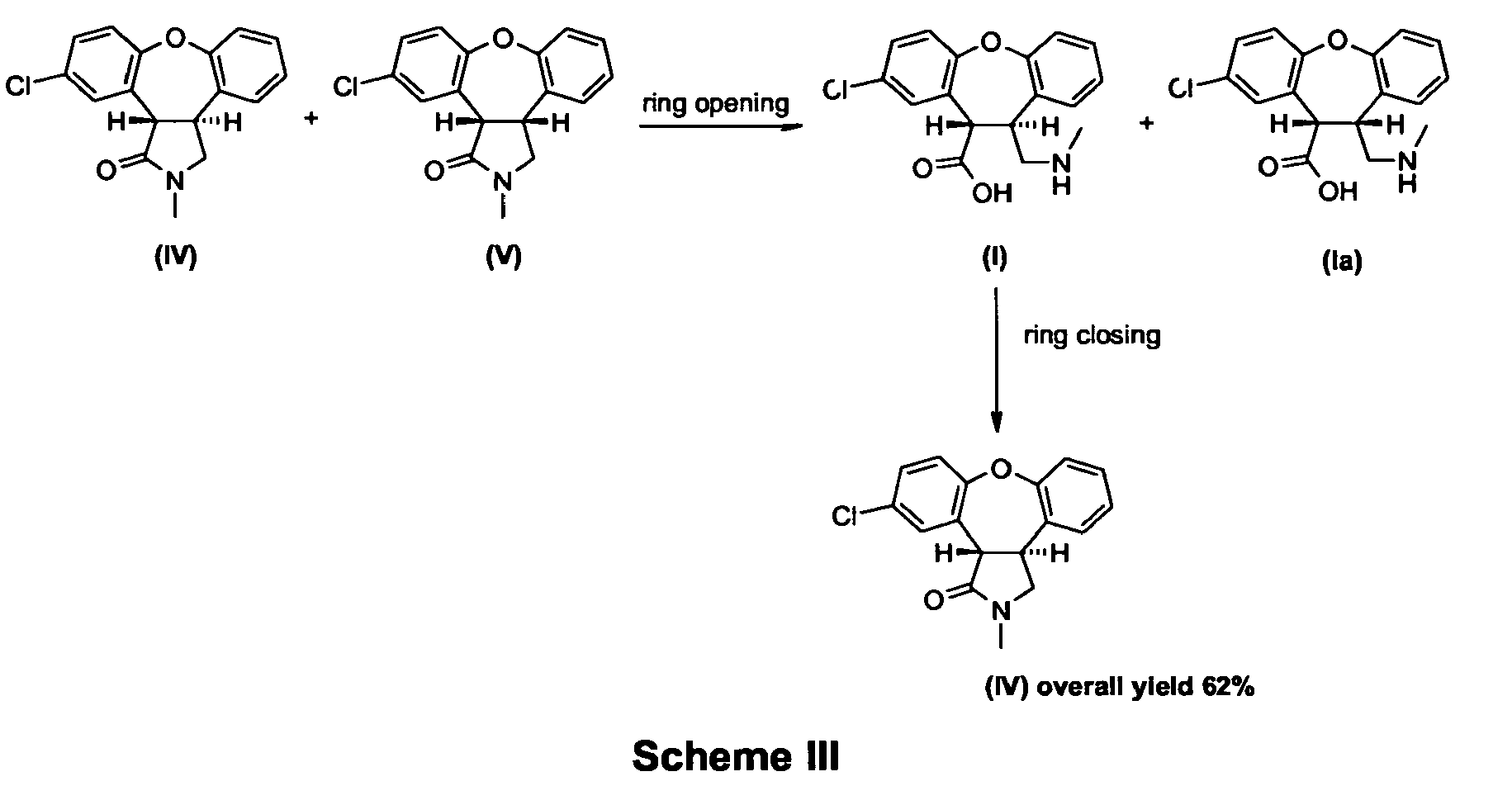
- The hydrolysis of the lactams (IV), (V) can be carried out in an alcoholic solution at reflux temperature in the presence of a stoichiometric excess of a strong alkaline base. Preferred bases include alkali metal hydroxides, such as potassium hydroxide or sodium hydroxide, which are used in 2- to 20-fold or in 10- to 20-fold molar excess based on the amount of the isomers (IV), (V). Useful alcohols include C1 to C6 alkanols, including methanol, ethanol, n-propanol, 2-propanol, n-butanol, and mixtures thereof. The use of higher boiling alcohols, such as n-propanol and n-butanol, appears to provide shorter reaction times for the ring-opening reaction.
- After completion of the ring opening reaction, water and ethanol are added and an extractive work up may follow to remove side products. The amino acid derivatives (I), (Ia) are extracted into the water/alcohol phase and acidified to a pH of 1 using hydrochloric acid. Subsequent evaporation of the alcoholic solvents selectively crystallizes the amino acid derivative, trans-8-chloro-10,11-dihydro-11-[(methylamino)methyl]-dibenz[b,f]oxepin-10-carboxylic acid (I), as the hydrochloride salt.
- Trans -8-chloro-10,11-dihydro-11-[(methylamino)methyl]-dibenz[b,f]oxepin-10-carboxylic acid (I) may be obtained as the crystalline zwitterion, i.e. free base, when the pH is lowered to 6 instead of 1. Additionally, the zwitterion of trans-8-chloro-10,11-dihydro-11-[(methylamino)methyl]-dibenz[b,f]oxepin-10-carboxylic acid (I) may be prepared from the hydrochloride salt by dissolution in a mixture of methanol and water, neutralization to pH 6 with ammonia or sodium hydroxide solution, and evaporation of the methanol to give the free base (I) as a solid.
- The ring-closure reaction (cyclization) of the amino acid derivative (I) to produce the trans lactam derivative (IV) (see Scheme III) may be carried out using the hydrochloride salt or the zwitterionic form by heating a suspension of the amino acid (I) in a solvent, including an aromatic solvent such as toluene or xylene, either with or without an additive to increase the rate of this reaction. Suitable additives are silica gel, aluminum oxide, sodium hydroxide, and sodium acetate. A preferred solvent to carry out the ring closure is toluene; preferred additives are sodium hydroxide and sodium acetate. Sodium acetate is most preferred as it typically results in the shortest reaction time.
- In an alternative method for the ring closure, the amino acid derivative (I) is converted into an activated acid form, such as an acid chloride, which upon neutralization with a base, spontaneously cyclizes to the desired lactam (IV).
- A further aspect of the invention relates to a process (Scheme IV) for the preparation of trans-2-chloro-10,11-dihydro-11-[(methylamino)methyl]-dibenz-[b,f]oxepine-10-carboxylic acid (II), which is a regioisomer of the amino acid derivative (I) depicted in Scheme III. The process comprises the steps of: (a) reduction of an enamide, 5-chloro-2,3-dihydro-2-methyl-1H-dibenz[2,3:6,7]-oxepino[4,5-c]pyrrol-1-one (VI), to provide a mixture of lactams, trans-5-chloro-2,3,3a,12b-tetrahydro-2-methyl-1H dibenz[2,3:6,7]oxepino[4,5-c]pyrrol-1-one (VII), and cis-5-chloro-2,3,3a, 12b-tetrahydro-2-methyl-1H-dibenz-[2,3:6,7]oxepino[4,5-c]pyrrol-1-one (VIII); (b) hydrolysis of the lactams (VII), (VIII) by treatment in an alcoholic solution with an excess of a strong (alkali) base thereby producing a mixture of the amino acid derivative (II) and its corresponding isomer, cis-2-chloro-10,11 -dihydro-11-[(methylamino)methyl]-dibenz[b,f]oxepine-10-carboxylic acid (IIa); and (c) purification of the amino acid derivative (II) from the mixture. Cyclization of the amino acid derivative (II) to the desired lactam (VII), which is a regioisomer of the lactam (IV) depicted in Scheme I, above, and subsequent reduction of the lactam amide group yields asenapine (A).

- Another aspect of the invention provides an alternative process for preparing asenapine (A) as shown in Scheme V. The process provides for treatment of an amino acid derivative (I) or (II) with a reducing agent such as borane or lithium aluminum hydride, optionally in combination with a Lewis acid, such as aluminum chloride. This one-pot reaction provides asenapine (A) in a typical yield of 70%.

- A further aspect of the invention provides the trans-amino acid derivatives of formula (I) or (II), as depicted in Schemes III-V, or the enantiomer of each trans-amino acid derivative having the opposite absolute configuration, or a racemic mixture of each trans-amino acid derivative, or a salt thereof. Suitable salts include alkali metal salts, such as sodium, potassium or lithium salts, or salts obtained from the combination with an organic base, such as trimethylamine, triethylamine and the like. Other suitable salts include acid addition salts, which may be obtained by treating the free compounds (I) or (II) with a mineral acid such as hydrochloric acid or hydrobromic acid, or with an organic acid such as maleic acid, acetic acid, methane sulfonic acid, and the like.
- Suitable acid addition salts of asenapine (A) can be obtained from the treatment with a mineral acid such as hydrochloric acid, hydrobromic acid, phosphoric acid and sulfuric acid, or with an organic acid such as for example ascorbic acid, citric acid, tartaric acid, lactic acid, maleic acid, malonic acid, fumaric acid, glycolic acid, succinic acid, propionic acid, acetic acid and methane sulfonic acid. The preferred acid addition salt of asenapine is the maleate salt, i.e. Org 5222.
- The following examples are illustrative and non-limiting and represent specific embodiments of the present invention. In each of the examples below, the compounds Org 5222, asenapine (A), and all cis- and trans-precursors-e.g., compounds (I), (II), (IV), (V), (VII) and (VIII)-are racemates, and the pairs of bold wedged bonds or bold and hashed wedged bonds used in their structural formulae indicate relative stereochemical configuration.
- For most of the examples, NMR spectra were recorded on a Bruker DPX 400. 1H-NMRchemical shifts (δ) are reported in parts per million (ppm) and are referenced to TMS as an internal standard using the following abbreviations: s (singlet), d (doublet), dd (double doublet) and m (multiplet). Mass spectra were recorded on a PE SCIEX API 165. GC chromatograms were recorded on a HP6890N with a Restek RTX-column.
- Under N2 atmosphere, iodine (4.95 g, 18 mmol) was added to a stirred suspension of magnesium (1.75 gram, 71.87 mmol) in toluene (175 mL). Over a period of 20 minutes, a solution of 11-chloro-2,3-dihydro-2-methyl-1H-dibenz[2,3;6,7]oxepino[4,5-c]pyrrol-1-one (III) (25 gram, 84 mmol; see Vader et al., above) in methanol (175 mL) was added. The reaction mixture was stirred for 35 minutes. Then, over a period of 2 hours, 3 portions of magnesium (1 g, 41.06 mmol) followed by one larger portion of magnesium (2 g, 82.12 mmol) were added. Water (600 mL) and 36% hydrochloric acid (65 mL) were added keeping the temperature below 40°C. Toluene (50 mL) was added, the layers were separated, and the water layer was extracted with toluene (2 x 100 mL). The combined toluene layers were washed with water (200 mL), dried over magnesium sulfate, filtered and evaporated. This gave a mixture of trans-11-chloro-2,3,3a,12b-tetrahydro-2-methyl-1H-dibenz[2,3:6,7]oxepino [4,5-c]-pyrrol-1-one (IV) and cis-11-chloro-2,3,3a,12b-tetrahydro-2-methyl-1H-dibenz[2,3:6,7]oxepino[4,5-c]pyrrol-1-one (V) (25.5 g, ~100%) in the ratio (IV):(V) = 1:4 as determined by1H-NMR and GC.
- 5-Diazabicyclo[4,3,0]non-5-ene (DBN, 1.6 L) is added to toluene (400 L) containing a mixture of cis-isomer (V) and trans-isomer (IV) (10 kg in total) and the reaction mixture is stirred for 1 hour at 20°C. Water (200 L) is added and the pH of the aqueous layer is adjusted to pH 4 with acetic acid (approximately 1.0 L). Stirring is continued for 15 minutes and, if necessary, acetic acid is added to adjust the pH to 4.0 (± 0.2). The layers are separated. The toluene layer is washed with water (200 L), concentrated to a volume of 25 L and purified by chromatography on silica (100 kg) with toluene (115 L) and toluene:ethyl acetate 95:5 v/v (900 L). The fractions are pooled and fractions containing exclusively compound trans-11-chloro-2,3,3a,12b-tetrahydro-2-methyl-1H-dibenz[2,3:6,7]oxepino[4,5-c] pyrrol-1-one (IV) are combined and concentrated to a volume of 50 L. Fractions containing cis-11-chloro-2,3,3a,12b-tetrahydro-2-methyl-1H-dibenz[2,3:6,7]oxepino[4,5-c]pyrrol-1-one (V) or mixtures of trans-11-chloro-2,3,3a, 12b-tetrahydro-2-methyl-1H-dibenz[2,3:6,7]oxepino[4,5-c]pyrrol-1-one (IV) and cis-11-chloro-2,3,3a,12b-tetrahydro-2-methyl-1 H-dibenz [2,3:6,7]oxepino[4,5-c]pyrrol-1-one (V) are combined.
- The combined fractions containing cis-isomer (V) are isomerized again using DBN in toluene and subsequent purification by chromatography as described above is repeated twice. Fractions containing exclusively trans-11-chloro-2,3,3a,12b-tetrahydro-2-methyl-1H-dibenz[2,3:6,7]oxepino[4,5-c]pyrrol-1-one (IV) are combined and evaporated in vacuum to give 4.9 kg (49% m/m) of crude trans-11-chloro-2,3,3a,12b-tetrahydro-2-methyl-1H-dibenz[2,3:6,7]-oxepino[4,5-c]pyrrol-1-one (IV). Recrystallization from methanol provides trans-11-chloro-2,3,3a,12b-tetrahydro-2-methyl-1H-dibenz[2,3:6,7]-oxepino[4,5-c]pyrrol-1-one (IV) (3.8 kg, 38%); mp150.6°C; 1H-NMR (400.13 MHz, CDCl3 relative to TMS) δ 3.03 (d, 3H), 4.03 (m, 1H), 3.53-3.65 (m, 2H), 3.82 (m, 1H), 7.01-7.28 (m, 6H), 7.87 (dd, 1H).
- To a solution of cis-11-chloro-2,3,3a,12b-tetrahydro-2-methyl-1H-dibenz[2,3:6,7]oxepino[4,5-c]pyrrol-1-one (V) (2 gram, 6.7 mmol) in ethanol (20 mL), was added potassium hydroxide (3.8 g, 67 mmol). The reaction mixture was heated to reflux for 5 hours. The reaction mixture was evaporated and water was added (50 mL). The water phase was washed with diethyl ether (2 x 25 mL). The aqueous phase was acidified with concentrated hydrochloric acid to a pH between 5 and 6, resulting in a gum precipitate. Ethyl acetate was added (25 mL), which slowly dissolved the gum and resulted in the formation of fine crystals of the product. The crystals were filtered and dried to give trans-8-chloro-10,11-dihydro-11-[(methylamino)-methyl]-dibenz[b,f]oxepin-10-carboxylic acid (I) (1.1 g, 52%); mp 154.4°C; 1H-NMR (399.87 MHz in MeOD relative to TMS) δ 2.09 (s, 3H), 2.45 and 2.66 (2x m, 2H), 3.23 (s, 1 H), 3.50 (m, 1 H), 3.92 (d, 1 H), 6.96-7.20 (m, 6H).
- Potassium hydroxide (333.8 g, 6.30 mole) was added to a mixture of cis-11-chloro-2,3,3a,12b-tetrahydro-2-methyl-1H-dibenz[2,3:6,7]oxepino[4,5-c]pyrrol-1-one (V) and trans-11-chloro-2,3,3a,12b-tetrahydro-2-methyl-1H-dibenz[2,3:6,7]oxepino[4,5-c]pyrrol-1-one (IV) (105 g, 351 mmol, trans/cis ratio 1:3) dissolved in ethanol (1050 mL). The mixture was heated to reflux for 18 hours. Part of the ethanol (500 mL) was evaporated and water was added (1.5 L). The aqueous phase was extracted with toluene (2 x 750 mL). To the water phase was subsequently added toluene (500 mL) and concentrated hydrochloric acid to adjust the pH to 1. During the addition of hydrochloric acid the temperature rises to 75°C. The water layer was separated and upon cooling crystals of trans-8-chloro-10,11-dihydro-11-[(methylamino)methyl]-dibenz[b,f]oxepin-10-carboxylic acid hydrochloride were formed. The crystals were collected by filtration and dried, giving (I).HCl (84 g, 68%); mp 215°C (dec.); 1H-NMR (399.87 MHz in MeOD relative to TMS) δ 2.65 (s, 3H), 3.30 (s, 2H), 3.95 (m, 1H), 4.32 (d, 1H), 7.11-7.38 (m, 6H).
- Trans-8-chloro-10,11-dihydro-11-[(methylamino)methyl]-dibenz[b,f]-oxepin-10-carboxylic acid hydrochloride (I).HCl (55.5 g) and silica gel (55 g) were suspended in xylene (550 mL). The suspension was heated to reflux for 1 night. The reaction mixture was cooled to 65°C and ethyl acetate (550 mL) was added. The silica gel was filtered off and washed with ethyl acetate (550 mL). The organic phase was evaporated. The crude product was dissolved in methanol (750 mL). The methanol was partly evaporated upon which crystallization of the product takes place. After cooling to 5°C for 3 hours, the product was obtained by filtration. This yielded trans-11-chloro-2,3,3a,12b-tetrahydro-2-methyl-1H-dibenz[2,3:6,7]oxepino[4,5-c]pyrrol-1-one (IV) (47.8 g, 86%); mp 150.6°C; 1H-NMR (400.13 MHz in CDCl3 relative to TMS) δ 3.03 (d, 3H), 4.03 (m, 1 H), 3.53-3.65 (m, 2H), 3.82 (m, 1 H), 7.01-7.28 (m, 6H), 7.87 (dd, 1H).
- Trans-8-chloro-10,11-dihydro-11-[(methylamino)methyl]-dibenz[b,f]-oxepin-10-carboxylic acid hydrochloride (I).HCl (50 g, 142 mmol) was suspended in dichloromethane (1 L) and N,N-dimethylformamide (50 mL). To this suspension was added thionyl chloride (50 mL, 84 mmol). After 30 minutes a clear solution was formed. This solution was added dropwise to a cold mixture of methanol (1 L) and triethylamine (158, 1150 mmol). Additional triethylamine (35 mL) was added to adjust the pH to 8. The organic phase was washed with 1N hydrochloric acid (1 L) and with brine (2 x 1 L). The organic phase was subsequently washed with saturated sodium bicarbonate solution (1 L). The organic phase was dried with magnesium sulfate and evaporated. The crude product (40.7 g) was crystallized from methanol (100 mL). This furnished trans-11-chloro-2,3,3a,12b-tetrahydro-2-methyl-1H-dibenz[2,3:6,7]oxepino-[4,5-c]pyrrol-1-one (IV) (32 g, 75%); 1H-NMR (399.87 MHz in CDCl3 relative to TMS) δ 3.03 (d, 3H), 4.03 (m, 1H), 3.53-3.65 (m, 2H), 3.82 (m, 1H), 7.01-7.28 (m, 6H), 7.87 (dd, 1H).
- To a first reaction vessel containing tetrahydrofuran (2.4 mL) at 0°C was added aluminum chloride (167 mg, 1.26 mmol). To the resulting suspension was slowly added lithium aluminum hydride (3.77 mmol). To a second reaction vessel containing THF (4 mL) was added trans-8-chloro-10,11-dihydro-11-[(methylamino)methyl]-dibenz[b,f]oxepin-10-carboxylic acid hydrochloride (I).HCl (0.4 g, 1.26 mmol). At -10°C, the contents of the first reaction vessel were added to the second reaction vessel. After 30 minutes the reaction mixture was quenched with water and extracted with toluene. The toluene was dried with magnesium sulfate and evaporated. This provided crude trans-5-chloro-2,3,3a,12b-tetrahydro-2-methyl-1H-dibenz[2,3:6,7]-oxepino[4,5-c]pyrrole (A) in nearly quantitative yield with a purity of 63%; 1H-NMR (400.13 MHz in CDCl3 relative to TMS) δ 2.54 (s, 3H), 3.15 (m, 2H), 3.25 and 3.61 (2 x m, 4H), 7.01-7.36 (m, 7H).
- Aluminum chloride (6.9 kg) is added in portions to tetrahydrofuran (100 L) at 0°C. Stirring is continued and a 10% solution of lithium aluminum hydride in tetrahydrofuran (35.0 L) is added keeping the temperature below 10°C. The mixture is cooled to 0°C and stirred for 15 minutes. A solution of trans-11-chloro-2,3,3a,12b-tetrahydro-2-methyl-1H-dibenz[2,3:6,7]oxepino[4,5-c]pyrrol-1-one (IV) (10.0 kg) in tetrahydrofuran (100 L) is added to the mixture while keeping the temperature below 15°C. Tetrahydrofuran (5 L) is added, stirring is continued for 1 hour at 10°C, and 0.6 N sodium hydroxide solution (100 L) is added keeping the temperature below 10°C. Stirring is continued for 15 minutes at 20°C and toluene (150 L) and of water (100 L) are added. Stirring is continued for 15 minutes at 20°C and the salt layer is separated. The salt layer is extracted with toluene (2 x 50 L). The combined filtrates are separated and the aqueous layer is extracted with of toluene (50 L). The combined organic layers are evaporated in vacuum at 70°C to give trans-5-chloro-2,3,3a,12b-tetrahydro-2-methyl-1H-dibenz[2,3:6,7]oxepino[4,5-c]pyrrole (A) (9.4 kg, 99%); 1H-NMR (400.13 MHz in CDCl3 relative to TMS) δ 2.54 (s, 3H), 3.15 (m, 2H), 3.25 and 3.61 (2 x M, 4H), 7.01-7.36 (m, 7H).
- Free base trans-5-chloro-2,3,3a,12b-tetrahydro-2-methyl-1H-dibenz[2,3:6,7]oxepino[4,5-c] pyrrole (A) (1.23 kg) was dissolved in ethanol (2 L) at 60°C. Charcoal (74 g) was added; after stirring for 30 minutes at 60°C, the charcoal was filtered and washed with ethanol (1.2 L). The filtrate was warmed to 65°C and was maintained at this temperature while a warm (60°C) solution of maleic acid (554 g) in ethanol (3.5 L) was added over a 15 minute period. The solution was cooled and seeded at 15°C. After 2 hours stirring at 15°C the suspension was cooled to -10°C and the crystals were filtered, washed with cold ethanol and dried.
1H-NMR (400.13 MHz in CDCl3 relative to TMS) δ 3.14 (s, 3H), 3.93 (m, 2H), 3.79 and 4.08 (2 x m, 4H), 6.24 (s, 2H, vinylic protons of maleic acid), 7.16-7.34 (m, 7H); mass spectrometry m/z 286.1, 229, 220, 201, 194, 166, and 44. - A solution of (5-chloro-2-phenoxy-phenyl)-acetic acid methyl ester (167 g, 605 mmol) and methyl formate (173 mL, 2.8 mol) in t-butyl methyl ether (1 L) was cooled to -10°C. To this solution was added potassium t-butoxide (115 g, 1.03 mol) portionwise so that the temperature remained below 0°C. After 30 minutes, the reaction was quenched by addition of 4N aqueous hydrochloric acid (400 mL). The organic layer was separated and washed with water (3 x 350 mL) and saturated brine (350 mL). The organic fractions were combined and concentrated to dryness and used without purification. The product is 90% E as shown by NMR.1H NMR (400 MHz, CDCl3) 3.6 (s, 3H, E methyl group; Z methyl is at 3.7), 6.8 (d, 1H), 6.9 (m, 2H), 7.0 (t, 1H), 7.2 (m, 3H), 7.3 (m, 2H), 11.8 (d, 1H, E hydroxy proton; Z hydroxy proton is at 4.7).
- A slurry of 2-(5-chloro-2-phenoxy-phenyl)-3-hydroxy-acrylic acid methyl ester (210 g, 691 mmol) was heated in pyrophosporic acid (420 g) to 60°C. After two hours, the reaction was cooled to 20°C and hexane (250 mL), toluene (500 mL), and water (500 mL) were added to quench the reaction. The organic layer was separated and washed with saturated aqueous sodium bicarbonate (500 mL) and saturated brine (500 mL). The organic fraction was concentrated and the resulting oil was crystallized from n-butanol (500 mL; 20°C for one hour and -10°C for two hours), which provided the titled compound as off-white crystals (172 g, 85% yield for steps A and B).1H NMR (400 MHz, CDCl3) 3.9 (s, 3H), 7.1-7.2 (m, 3H), 7.3 (m, 2H), 7.4 (t, 1 H), 7.6 (d, 1H), 8.0 (s, 1H).
- To a 5 L 3-neck round bottom flask was added 8-chloro-dibenz[b,f]-oxepin-10-carboxylic acid methyl ester (305 g, 1.06 mol, 1 eq) followed by THF (1.25 L) and t-butyl-tetramethylguanidine (27 g, 0.15 mol, 0.14 eq). To this solution was added nitromethane (576 g, 9.45 mol, 8.9 eq) in THF (0.5 L) while maintaining a temperature of less than 30°C. The resultant mixture was stirred at room temperature until judged complete by HPLC (overnight, < 3% starting material). Once complete, methyl tertiary butyl ether (1.25 L), water (0.6 L) and 1 N HCl (0.6 L) were added, the layers were separated, and the aqueous layer was extracted a second time with MTBE (1 L). The combined organic layers were washed with 1 N HCl (2 x 0.6 L) and saturated sodium chloride (0.6 L). After addition of toluene (2 L) the organic fraction was concentrated under vacuum to a volume less than 2 L, toluene (1 L) was added, and the mixture was concentrated to minimum volume. Addition of THF (0.5 L) afforded the titled compound as a light colored solution which was used without further purification (368 g, 1.06 mol, theoretical). HPLC area%: 45% toluene, 48% trans-nitro ester, 6% cis-nitro ester, 1% starting material. HPLC conditions: column- 3.5 µm Zorbax SB-Phenyl, 3 mm x 150 mm; solvent- gradient from 55% water (0.1 % HOCl4)/45% methanol (0.1 % HOCl4) to 100% methanol (0.1 % HOCl4) in 10 minutes and hold for 2 minutes; flow 0.5 mL/minute; detection at 210 nm.
- An aqueous slurry of A7000 sponge nickel catalyst (111.74 g/60 mL, containing approximately 60.36 g of catalyst on a dry basis) was washed by adding THF (40 mL), agitating, and decanting the supernatant. The catalyst slurry was then charged to a 1500-mL Hastelloy-C stirred autoclave with the aid of THF (200 mL). The vessel was sealed, purged with hydrogen, and pressurized to about 50 psig with hydrogen. The mixture was stirred at 1100 rpm at room temperature and a solution of trans-8-chloro-11-nitromethyl-10,11-dihydro-dibenzo[b,f]oxepine-10-carboxylic acid methyl ester (ca. 369 g, 1.06 mol in 500 mL THF) diluted to 850 mL with THF was added at a rate of about 3.1 mL/minute over the course of about 4.5 hours. The temperature of the reaction mixture rose from the exotherm but was maintained between 20 to 32°C by the application of an external water cooling bath. The total pressure in the reactor was maintained at 50 to 60 psig by supplying hydrogen on-demand through a pressure regulator from high-pressure reservoir of known volume. After the addition of the starting material was complete, the addition system was rinsed with THF (2 x 25 mL) into the reactor. The completed reaction mixture was stirred at room temperature under about 60 psig hydrogen overnight. After venting of the hydrogen, the reaction mixture was cautiously vacuum filtered and the cake washed with THF (Note: care is required to avoid drying of the catalyst cake in air) to afford a mixture of the titled compounds (1.06 mol, theoretical) as a THF solution. This material was used without further purification. HPLC area% assay: the combined filtrate and washings (1266 g) was devoid of starting material, and consisted of a mixture of the expected amino ester and cis- and trans-lactams. HPLC conditions: same as step C, above.
- To a 5 L 3-neck round bottom flask equipped with mechanical stirring was added THF (1.0 L) followed by the hydrogenation product from step D (1.06 moles in about 0.8 L THF). The contents of the vessel were subsequently cooled to 0°C. Solid potassium t-butoxide (178 g, 1.59 mol, 1.5 eq) was then added portion-wise while maintaining a temperature of less than 5°C. The resulting dark suspension was stirred at less than 5°C until complete consumption of the amino ester, as determined by HPLC. Dimethyl sulfate (170 mL, 1.8 mol, 1.7 eq) was then slowly added while maintaining a temperature of less than 5°C, giving an orange suspension. The contents of the vessel were stirred at less than 5°C until the reaction was complete by HPLC (< 5% des-methyl lactam) at which time ammonium hydroxide (0.5 L) in water (1.0 L) was added to decompose any remaining dimethyl sulfate. The mixture was gradually warmed to room temperature and stirred overnight. Ethyl acetate (0.5 L) was added and the layers were separated. The resultant aqueous layer contained product solids that were extracted into ethyl acetate (2.5 L, 0.5 L) at elevated temperature (55°C). The combined organic layers were concentrated in vacuo to a volume of less than 1 L; octane (0.25 L) was added, and the resultant suspension was warmed to 50°C followed by cooling to 0°C. The suspension was filtered, washed with octane and dried under vacuum at 50°C to afford predominantly the cis-isomer (V) (215.7 g, 68% yield from oxepine ester). HPLC area%: 1.6% unknown, 98.4% cis-isomer (V), and trace trans-isomer (IV). The filtrate from the above isolation was concentrated under vacuum, MTBE was added, and the mixture was heated to reflux. The resultant suspension was cooled to room temperature, filtered, and dried to afford a mixture of cis- and trans-isomers, (V) and (IV), respectively (28.9 g, 9% yield). HPLC area%: 7.9 % cis-isomer (V), 92.1 % trans-isomer (IV). The filtrate from the second isolation was concentrated under vacuum, MTBE (500 mL) and octane (50 mL) were added, and the mixture heated to reflux. The resultant suspension was cooled to 0°C, filtered, and dried to afford a mixture of cis- and trans-isomers, (V) and (IV), respectively (12.2 g, 4% yield). HPLC area%: 4.8% cis-isomer (V), 2.4% unknown, 92.7% trans-isomer (IV). HPLC conditions: same as step C, above. Total yield of the titled compounds was 256.8 g, 81% from trans-8-chloro-11-nitromethyl-10,11-dihydro-dibenzo[b,f]-oxepine-10-carboxylic acid methyl ester (step C).
- Methyl 2-bromophenylacetate (47.0 grams 216.3 mmol) and 4-chlorophenol (27.8 grams, 215.8 mmol) were dissolved in dioxane (790 ml) while warming to 50 °C. To the resulting solution were added, under stirring in an inert nitrogen atmosphere, cesium carbonate (141 grams, 432.2 mmol) and copper(I) chloride (18.56 g, 86.2 mmol). Finally, N,N-dimethylglycine (4.46 grams, 43.2 mmol) was added to the green suspension. The reaction mixture was heated at 110 °C (reflux temperature) for 4 days while stirring. The reaction mixture was filtered over dicalite, which was washed with dioxane (40 ml). The dioxane was removed in vacuo to leave a brownish oil. Ethyl acetate (100 ml) was added to the oil and the pH of the resulting mixture was adjusted to 1 by addition of 1 M HCl (300 ml). The organic phase was washed with saturated brine (300 ml), dried on magnesium sulphate and then concentrated under vacuum to yield 57.2 grams (206 mmol; 95 %) of 2-(4-chloro-phenoxy)-phenyl]-acetic acid methyl ester as a brown oil. The oil was dissolved in methanol (250 ml), whereupon KOH (16.2 grams; 1.4 eq) was added. The resulting solution was heated for 3 h at 60 °C. The reaction mixture was cooled and the methanol (200 ml) was removed under vacuum. To the residue water (100 ml) was added and the pH was adjusted to 1 by addition of 1 M HCl (25 ml). The resulting crystals were filtered off and dried in vacuum at 40 °C to yield 47.3 grams (180 mmol; 87 %) of [2-(4-chloro-phenoxy)-phenyl]-acetic acid (IX).

- [2-(4-chloro-phenoxy)-phenyl]-acetic acid (IX) (47.3 grams; 180 mmol) was suspended in toluene (140 ml) at 48 °C. To this suspension dimethylformamide (4.0 ml) and SOCl2 (19.8 ml; 271 mmol; 1.5 eq) in toluene (18 ml) were added. After 10 min the reaction mixture was concentrated under vacuo and stripped twice with toluene, to yield a brownish oil of [2-(4-chloro-phenoxy)-phenyl]-acetyl chloride. The oil was suspended in toluene (75 ml). To the suspension was added at 5 °C a solution of sarcosine methylester (30.3 grams 217 mmol) and triethylamine (57 ml) in a mixture of dimethylformamide (236 ml) and toluene (47 ml). The brownish suspension was stirred for 2 hours at room temperature. To the reaction mixture water (750 ml) was added and the mixture was extracted twice with ethyl acetate (500 ml). The organic phase was washed with saturated brine (700 ml) and dried on magnesium sulphate. The solvent was removed in vacuum to yield methyl-N-[2-(4-chloro-2-phenoxyphenyl)-1-oxethyl]-N-methylglycinate (X) (61.3 grams, 202 mmol) as a brownish oil.

- To a suspension of tert.-BuOK (21.7 grams; 193 mmol) in toluene (240 ml) was added under nitrogen at 20 °C a solution of compound (X) (61.3 grams), as obtained under (B), in toluene( 240 ml). The resulting suspension was stirred overnight. To the brownish suspension water (750 ml) was added. The solution was extracted 3 times with ethyl acetate (3 x 300 ml). The combined organic phases were washed with water (200 ml). The pH of the water-phase was adjusted with HCl to 1. The obtained crystals were stirred for 3 hours before filtering off. The crystals were dried under vacuum at 40 °C to leave 40.2 grams (127 mmol, 72 %) of 3-[2-(4-chloro-phenoxy)-phenyl]-1-methyl-pyrrolidine-2,4-dione (XI). GC-purity: 96 %.

- P2O5 (90 grams) was added in portions to H3PO4 (90 grams) while maintaining the temperature below 140 °C. The mixture was heated at 115 °C for 1.5 hour, whereupon 3-[2-(4-chloro-phenoxy)-phenyl]-1-methyl-pyrrolidine-2,4-dione (XI) (30 grams; 95 mmol) was added. The resulting mixture was stirred for 4 days at 115°C to 130 °C with extra P2O5 (in total 5 portions of 5 grams each were added). The mixture was poured into water (200 ml) and the resulting precipitate was stirred overnight. The mixture was extracted with dichloromethane (250 ml) and washed with sat. NaHCO3 (pH = 7). After drying on magnesium sulphate the solvent was removed under vacuum. The resulting crude product was dissolved in methanol (520 ml) at 70 °C. Following removal of part of the methanol by evaporation the product crystallized. The mixture was stirred overnight at -12 °C. The crystals were filtered and dried to provide 5-chloro-2,3-dihydro-2-methyl-1 H-dibenz [2,3;6,7] oxepino [4,5-c] pyrrol-1-one (VI) (16.4 grams, 55 mmol; 58 %), purity according to GC 92 %.1H-NMR (400 MHz, CDCl3): 3.2 (s, 3H), 4.3 (s, 1H), 3.8 (m, 1 H), 7.2-7.4 (m, 6H), 8.2 (dd, 1H).
- Under N2 atmosphere iodine (3.0 grams, 11 mmol) was added to a stirred suspension of magnesium (1.22 grams, 50 mmol) in toluene (82 ml). Over a period of 20 minutes a solution of 5-chloro-2,3-dihydro-2-methyl-1H-dibenz [2,3;6,7] oxepino [4,5-c] pyrrol-1-one (VI) (16.4 gram, 55 mmol) in methanol (57 ml) was added. The reaction mixture was stirred for 35 minutes. Then over a period of 2 hours 3 portions of magnesium (2 x 500 mg, 41.06 mmol) followed by one larger portion of magnesium (4 x 500 mg, 82.12 mmol) were added. Water (600 ml) and conc. hydrochloric acid (65 ml) were added while keeping the temperature below 40°C. Toluene (50 ml) was added, the layers were separated and the water layer was extracted twice with toluene (100 ml). The combined toluene layers were washed with water (200 ml), dried on magnesium sulphate, filtered and evaporated. This gave a mixture of trans-5-chloro-2,3,3a,12b-tetrahydro-2-methyl-1 H-dibenz [2,3:6,7] oxepino [4,5-c] pyrrol-1-one (VII) and cis-5-chloro-2,3,3a,12b-tetrahydro-2-methyl-1H-dibenz [2,3:6,7] oxepino [4,5-c] pyrrol-1-one (6) (VIII) (13.6 grams, 82 %) in the ratio (VII) : (VIII) = 3:7 as determined by 1H-NMR and GC.
1H-NMR (400 MHz, CDCl3): 2.9 (s, 3H, cis), 3.0 (s, sH, trans), 4.0 (m, 1H), 3.53-3.65 (m, 2H), 3.8 (m, 1H), 7.0 (d, 1H, trans), 7.15-7.28 (m, 6H), 7.4 (dd, 1H, cis), 7.9 (dd, 1H, trans). - The mixture of lactams (VII) and (VIII) (13.6 grams, 45 mmol, trans/cis ratio 1:2.3), obtained as described under E, was dissolved in ethanol (140 ml). To the solution potassium hydroxide was added (43 grams, 811 mmol), whereupon the mixture was heated to reflux for 18 hours. Part of the ethanol (60 ml) was evaporated and water was added (200 mL). The aqueous phase was extracted twice with toluene (100ml). Subsequently toluene (100 ml) was added to the water phase, followed by concentrated hydrochloric acid to adjust the pH to 1. During the addition of hydrochloric acid the temperature rises to 75°C. The water layer was separated and upon cooling the product crystallized. The crystals were collected by filtration and dried to provide trans-2-chloro-10,11-dihydro-11-[(methylamino)methyl]-dibenz[b,f]oxepin-10-carboxylic acid hydrochloride (II) (3.75 grams, 10.6 mmol, 22 %).
M.p: 203.1 °C. 1H-NMR (400 MHz, MeOD): 2.6 (s, 3H), 3.3 (s, 2H), 3.9 (m, 1 H), 4.4 (d, 1 H), 7.10-7.36 (m, 6H). - To a suspension of trans-2-chloro-10,11-dihydro-11-[(methylamino)-methyl]-dibenz[b,f]oxepin-11-carboxylic acid hydrochloride (II) (2.00 grams, 5.65 mmol) in toluene (15 ml) was added sodium acetate (0.55 grams, 6.70 mmole). The suspension was heated for 2 hours at reflux. The mixture was filtered and the filtrate was concentrated under vacuum at 50 °C to leave a brownish oil (1.49 grams ,4.97 mmol, 89 %), shown to be a mixture of trans (VII) and cis (VIII) in the ratio (VII) : (VIII) = 8:2 as determined by 1H-NMR and GC. Crystallization from methanol (20 ml) gave pure trans-5-chloro-2,3,3a,12b-tetrahydro-2-methyl-1 H-dibenz [2,3:6,7] oxepino [4,5-c] pyrrol-1-one (VII) in a yield of 0.80 gr (2.67 mmol, 47 %).
M.p: 148.4 °C. 1H-NMR (400 MHz, CDCl3): 3.1 (s, 3H, trans), 4.2 (m, 1H), 3.53-3.65 (m, 2H), 3.8 (m, 1 H), 7.0 (d, 1 H0, 7.15-7.28 (m, 5H), 7.8 (dd, 1H). - Aluminum chloride (65.7 mg) was added in portions to tetrahydrofuran (5 mL) at 0 °C. Under stirring a 10 % solution of lithium aluminum hydride in tetrahydrofuran (1.35 mL) was slowly added while keeping the temperature below 10 °C. The mixture was cooled to 0 °C and stirred for 15 minutes. A solution of trans-5-chloro-2,3,3a,12b-tetrahydro-2-methyl-1H-dibenz [2,3:6,7] oxepino [4,5-c] pyrrol-1-one (VII) (0.40 grams) in tetrahydrofuran (4 mL) was added to the mixture while keeping the temperature below 15 °C. Stirring was continued for 2 hours at 10 °C , whereupon 0.5 N sodium tartrate solution (15 mL) was added while keeping the temperature below 10 °C. Stirring was continued for 15 minutes at 20 °C. The salt layer was extracted twice with a toluene:ethyl acetate (8:2) mixture (25 mL).The combined organic layers were dried on magnesium sulphate, filtered and evaporated in vacuo to yield 0.36 grams (94 %) of trans-5-chloro-2,3,3a,12b-tetrahydro-2-methyl-1 H-dibenz [2,3:6,7] oxepino [4,5-c] pyrrole (A).
1H-NMR (400 MHz, CDCl3): 2.6 (s, 3H), 3.1 (m, 2H), 3.2 (m, 2H), 3.6 (m, 2H), 7.01-7.36 (m, 7H).
Claims (12)
- A trans-amino acid derivative of formula I or formula II,

- A trans-amino acid derivative according to claim 1 selected from trans-8-chloro-10,11- dihydro-11-[(methylamino)methyl]-dibenz[b,f]oxepin-10-carboxylic acid, trans-2-chloro-10,11-dihydro-11-[(methylamino)methyl]-dibenz[b,f] oxepine-10-carboxylic acid, or a salt thereof.
- A process for preparing a trans-amino acid derivative of formula 1,


- A process for preparing a trans-amino acid derivative of formula II,


- The process of claim 3 or claim 4, wherein the base is an alkaline base that is present in stoichiometric excess, and the alcohol is a C1 to C6 alkanol.
- The process of claim 3 or claim 4, wherein the base is potassium hydroxide and the alcohol is ethanol.
- A process for preparing asenapine of formula A,
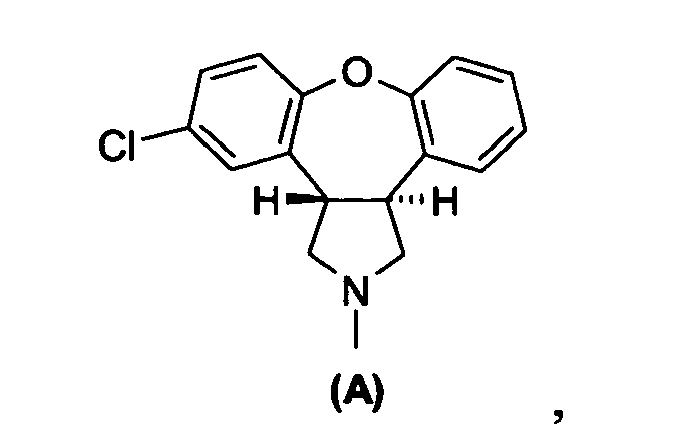 (a) cyclizing a trans-amino acid derivative of formula I or formula II,
 (b) reducing the carbonyl moiety of a lactam of formula IV or formula VII to give the asenapine of formula A; and(c) optionally converting the asenapine of formula A to a salt thereof.
 - The process of claim 7, wherein cyclizing comprises heating the trans-amino acid derivative of formula I or formula II in a solvent.
- The process of claim 7, wherein cyclizing comprises heating the trans-amino acid derivative of formula I or formula II in a solvent and in the presence of sodium acetate.
- The process of claim 7, wherein cyclizing comprises activating the carboxylic acid moiety of the trans-amino acid derivative of formula I or formula II, and treating the activated carboxylic acid with a base.
- A process for preparing asenapine of formula A,
 (a) treating a trans-amino acid derivative of formula I or formula II,
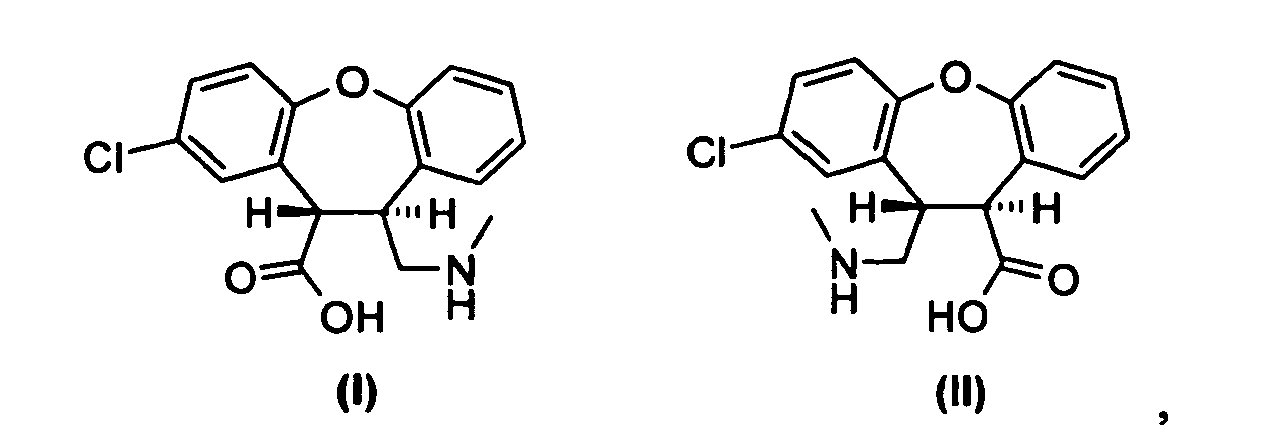 (b) optionally converting the asenapine to a salt thereof.
 - The process of claim 11, wherein the reducing agent is borane or lithium aluminum hydride, optionally in combination with a Lewis acid.
Priority Applications (5)
| Application Number | Priority Date | Filing Date | Title |
|---|---|---|---|
| SI200630526T SI1710241T1 (en) | 2005-04-07 | 2006-04-06 | Intermediate compounds for the preparation of trans-5-chloro-2-methyl-2,3,3a,12b-tetrahydro-1h-dibenz?á2,3:6,7?åoxepino?á4,5-c?åpyrrole |
| EP06112333A EP1710241B1 (en) | 2005-04-07 | 2006-04-06 | Intermediate compounds for the preparation of trans-5-chloro-2-methyl-2,3,3a,12b-tetrahydro-1h-dibenz[2,3:6,7]oxepino[4,5-c]pyrrole |
| EP09174540A EP2154134B1 (en) | 2005-04-07 | 2006-04-06 | Process for the preparation of trans-5-chloro-2-methyl-2,3,3a,12b-tetrahydro-1h-dibenz[2,3:6,7]oxepino[4,5-c]pyrrole. |
| PL06112333T PL1710241T3 (en) | 2005-04-07 | 2006-04-06 | Intermediate compounds for the preparation of trans-5-chloro-2-methyl-2,3,3a,12b-tetrahydro-1h-dibenz[2,3:6,7]oxepino[4,5-c]pyrrole |
| CY20101100023T CY1109722T1 (en) | 2005-04-07 | 2010-01-08 | INTERMEDIATE COMPOUNDS FOR PREPARATION OF TRANS-5-CHLORO-2-METHYL-2,3,3A, 12B-TETRAHYDRO-1H-DIBENZ [2,3: 6,73OXEPINO [4,5-C] PYRROLE |
Applications Claiming Priority (2)
| Application Number | Priority Date | Filing Date | Title |
|---|---|---|---|
| EP05102742 | 2005-04-07 | ||
| EP06112333A EP1710241B1 (en) | 2005-04-07 | 2006-04-06 | Intermediate compounds for the preparation of trans-5-chloro-2-methyl-2,3,3a,12b-tetrahydro-1h-dibenz[2,3:6,7]oxepino[4,5-c]pyrrole |
Related Child Applications (1)
| Application Number | Title | Priority Date | Filing Date |
|---|---|---|---|
| EP09174540A Division EP2154134B1 (en) | 2005-04-07 | 2006-04-06 | Process for the preparation of trans-5-chloro-2-methyl-2,3,3a,12b-tetrahydro-1h-dibenz[2,3:6,7]oxepino[4,5-c]pyrrole. |
Publications (2)
| Publication Number | Publication Date |
|---|---|
| EP1710241A1 EP1710241A1 (en) | 2006-10-11 |
| EP1710241B1 true EP1710241B1 (en) | 2009-11-04 |
Family
ID=35511130
Family Applications (2)
| Application Number | Title | Priority Date | Filing Date |
|---|---|---|---|
| EP09174540A Active EP2154134B1 (en) | 2005-04-07 | 2006-04-06 | Process for the preparation of trans-5-chloro-2-methyl-2,3,3a,12b-tetrahydro-1h-dibenz[2,3:6,7]oxepino[4,5-c]pyrrole. |
| EP06112333A Active EP1710241B1 (en) | 2005-04-07 | 2006-04-06 | Intermediate compounds for the preparation of trans-5-chloro-2-methyl-2,3,3a,12b-tetrahydro-1h-dibenz[2,3:6,7]oxepino[4,5-c]pyrrole |
Family Applications Before (1)
| Application Number | Title | Priority Date | Filing Date |
|---|---|---|---|
| EP09174540A Active EP2154134B1 (en) | 2005-04-07 | 2006-04-06 | Process for the preparation of trans-5-chloro-2-methyl-2,3,3a,12b-tetrahydro-1h-dibenz[2,3:6,7]oxepino[4,5-c]pyrrole. |
Country Status (27)
| Country | Link |
|---|---|
| EP (2) | EP2154134B1 (en) |
| JP (1) | JP2008534657A (en) |
| KR (1) | KR20070116973A (en) |
| CN (2) | CN101175741B (en) |
| AR (1) | AR063188A1 (en) |
| AT (1) | ATE447564T1 (en) |
| AU (1) | AU2006231281B2 (en) |
| BR (1) | BRPI0610677A2 (en) |
| CA (1) | CA2603181A1 (en) |
| CY (1) | CY1109722T1 (en) |
| DE (1) | DE602006010132D1 (en) |
| DK (1) | DK1710241T3 (en) |
| ES (1) | ES2333980T3 (en) |
| HR (1) | HRP20100031T1 (en) |
| IL (1) | IL186354A0 (en) |
| MX (1) | MX2007012446A (en) |
| NO (1) | NO20075152L (en) |
| NZ (1) | NZ562125A (en) |
| PL (1) | PL1710241T3 (en) |
| PT (1) | PT1710241E (en) |
| RS (1) | RS51341B (en) |
| RU (1) | RU2397164C2 (en) |
| SI (1) | SI1710241T1 (en) |
| TW (1) | TW200716589A (en) |
| UA (2) | UA93044C2 (en) |
| WO (1) | WO2006106136A1 (en) |
| ZA (2) | ZA200708490B (en) |
Cited By (1)
| Publication number | Priority date | Publication date | Assignee | Title |
|---|---|---|---|---|
| EP2468751A2 (en) | 2010-12-24 | 2012-06-27 | Medichem, S.A. | Processes for the preparation of 5-chloro-2-methyl-2,3,3a,12b-tetrahydro-1H-dibenzo[2,3:6,7]oxepino[4,5-c]pyrrole |
Families Citing this family (30)
| Publication number | Priority date | Publication date | Assignee | Title |
|---|---|---|---|---|
| JP5027477B2 (en) * | 2005-10-21 | 2012-09-19 | 住友化学株式会社 | Method for producing dibenzooxepinopyrrole compound and its intermediate and novel intermediate |
| TW200817414A (en) * | 2006-07-05 | 2008-04-16 | Organon Nv | Process for the preparation of asenapine and intermediate products used in said process |
| WO2008078482A1 (en) * | 2006-12-22 | 2008-07-03 | Sumitomo Chemical Company, Limited | Process for producing intermediate of asenapine synthesis |
| US7875729B2 (en) | 2007-01-05 | 2011-01-25 | Synthon Bv | Process for making asenapine |
| JP5245428B2 (en) | 2007-07-06 | 2013-07-24 | 住友化学株式会社 | Process for producing trans-dibenzooxenopyrrole compound and its intermediate |
| EP2240492B1 (en) * | 2008-01-04 | 2011-10-05 | N.V. Organon | Process for the preparation of asenapine and intermediate products used in said process |
| RU2012102247A (en) * | 2009-06-24 | 2013-07-27 | Мсд Осс Б.В. | INJECTION COMPOSITIONS CONTAINING ASENAPINE AND METHOD OF TREATMENT WITH THEIR APPLICATION |
| CN101851242B (en) * | 2010-05-25 | 2013-07-24 | 上海皓元生物医药科技有限公司 | Preparation method of asenapine intermediate |
| CA2805542C (en) | 2010-07-29 | 2017-12-12 | Laboratorios Lesvi, S.L. | Novel process for the preparation of asenapine |
| WO2012038975A2 (en) * | 2010-09-22 | 2012-03-29 | Msn Laboratories Limited | Process for the preparation of (3ars,12brs)-5-chloro-2-methyl-2,3,3a12b-tetrahydro-1hdibenzo[2,3:6,7] oxepino [4,5-c]pyrrole maleate and it's pharmaceutical composition thereof |
| ITMI20110734A1 (en) * | 2011-05-02 | 2012-11-03 | Olon Spa | CRYSTALLINE ASENAPINE SALTS |
| WO2013024492A2 (en) | 2011-07-01 | 2013-02-21 | Megafine Pharma (P) Ltd. | A process for the preparation of asenapine and novel salts thereof |
| CN102952144A (en) * | 2011-08-29 | 2013-03-06 | 上海华拓医药科技发展股份有限公司 | Crystal forms of asenapine maleate, and preparation method and medical composition thereof |
| WO2013080069A1 (en) * | 2011-11-28 | 2013-06-06 | Ranbaxy Laboratories Limited | Process for the preparation of asenapine intermediate |
| CN102746209A (en) * | 2012-06-20 | 2012-10-24 | 盛世泰科生物医药技术(苏州)有限公司 | A synthetic method for 3-(2-(4-chlorophenoxy)phenyl )-1-methyl-2,4-dione |
| CN103965206A (en) * | 2013-01-29 | 2014-08-06 | 北京京卫燕康药物研究所有限公司 | New crystal form and preparation method of asenapine maleate |
| CN103113379A (en) * | 2013-03-12 | 2013-05-22 | 盛世泰科生物医药技术(苏州)有限公司 | Synthetic process for asenapine maleate |
| CN103254202A (en) * | 2013-05-19 | 2013-08-21 | 甘肃皓天化学科技有限公司 | Preparation method of asenapine |
| CN103342707B (en) * | 2013-06-28 | 2015-09-02 | 甘肃皓天化学科技有限公司 | For the preparation of the preparation method of A Sainaping intermediate |
| CN104447771A (en) * | 2013-09-12 | 2015-03-25 | 天津市汉康医药生物技术有限公司 | Stable asenapine maleate sublingual compound |
| CN103864802B (en) * | 2014-03-31 | 2016-08-17 | 四川科伦药业股份有限公司 | The preparation method of maleic acid asenapine |
| CN105693735A (en) * | 2016-01-15 | 2016-06-22 | 万特制药(海南)有限公司 | Preparation method of maleic acid asenapine |
| PL3338768T3 (en) | 2016-12-20 | 2020-05-18 | Lts Lohmann Therapie-Systeme Ag | Transdermal therapeutic system containing asenapine |
| ES3001152T3 (en) | 2016-12-20 | 2025-03-04 | Lts Lohmann Therapie Systeme Ag | Transdermal therapeutic system containing asenapine and polysiloxane or polyisobutylene |
| US11033512B2 (en) | 2017-06-26 | 2021-06-15 | Lts Lohmann Therapie-Systeme Ag | Transdermal therapeutic system containing asenapine and silicone acrylic hybrid polymer |
| CN109200025A (en) * | 2017-06-29 | 2019-01-15 | 哈尔滨莱博通药业有限公司 | A kind of asenapine maleate sublingual tablet |
| CN118806732A (en) | 2018-06-20 | 2024-10-22 | 罗曼治疗系统股份公司 | Transdermal therapeutic system containing asenapine |
| KR102802121B1 (en) | 2018-06-20 | 2025-05-02 | 에르테에스 로만 테라피-시스테메 아게 | Transdermal therapeutic system containing asenapine |
| CN110183457A (en) * | 2019-06-27 | 2019-08-30 | 浙江天顺药业有限公司 | A kind of asenapine and preparation method thereof |
| CN112194665A (en) * | 2020-10-20 | 2021-01-08 | 连云港杰瑞药业有限公司 | Method for synthesizing asenapine intermediate |
Family Cites Families (6)
| Publication number | Priority date | Publication date | Assignee | Title |
|---|---|---|---|---|
| NL7605526A (en) * | 1976-05-24 | 1977-11-28 | Akzo Nv | NEW TETRACYCLICAL DERIVATIVES. |
| ATE167057T1 (en) | 1994-03-02 | 1998-06-15 | Akzo Nobel Nv | SUBLINGUAL OR BUCCAL MEDICINAL PRODUCT |
| DK0726265T3 (en) * | 1995-02-08 | 2001-10-22 | Novartis Ag | 10-Aminoaliphatyl-dibenz [b, f] oxepines with antineurodegenerative effect |
| WO1999032108A1 (en) | 1997-12-19 | 1999-07-01 | Akzo Nobel N.V. | Org-5222 in the treatment of depression |
| US6002632A (en) * | 1998-09-17 | 1999-12-14 | Texas Instruments Incorporated | Circuits, systems, and methods with a memory interface for augmenting precharge control |
| CA2370013A1 (en) * | 1999-06-03 | 2000-12-14 | Nippon Suisan Kaisha, Ltd. | Tricyclic fused heterocycle compounds, process for preparing the same and use thereof |
-
2006
- 2006-04-06 CN CN2006800167535A patent/CN101175741B/en not_active Expired - Fee Related
- 2006-04-06 AT AT06112333T patent/ATE447564T1/en not_active IP Right Cessation
- 2006-04-06 CA CA002603181A patent/CA2603181A1/en not_active Abandoned
- 2006-04-06 JP JP2008504777A patent/JP2008534657A/en not_active Withdrawn
- 2006-04-06 PL PL06112333T patent/PL1710241T3/en unknown
- 2006-04-06 DK DK06112333.7T patent/DK1710241T3/en active
- 2006-04-06 ES ES06112333T patent/ES2333980T3/en active Active
- 2006-04-06 UA UAA200711020A patent/UA93044C2/en unknown
- 2006-04-06 NZ NZ562125A patent/NZ562125A/en not_active IP Right Cessation
- 2006-04-06 WO PCT/EP2006/061409 patent/WO2006106136A1/en not_active Ceased
- 2006-04-06 RS RSP-2010/0014A patent/RS51341B/en unknown
- 2006-04-06 AU AU2006231281A patent/AU2006231281B2/en not_active Ceased
- 2006-04-06 CN CN2006100916992A patent/CN1861604B/en active Active
- 2006-04-06 RU RU2007141161/04A patent/RU2397164C2/en not_active IP Right Cessation
- 2006-04-06 DE DE602006010132T patent/DE602006010132D1/en active Active
- 2006-04-06 EP EP09174540A patent/EP2154134B1/en active Active
- 2006-04-06 BR BRPI0610677-3A patent/BRPI0610677A2/en not_active IP Right Cessation
- 2006-04-06 EP EP06112333A patent/EP1710241B1/en active Active
- 2006-04-06 KR KR1020077025399A patent/KR20070116973A/en not_active Ceased
- 2006-04-06 PT PT06112333T patent/PT1710241E/en unknown
- 2006-04-06 AR ARP060101357A patent/AR063188A1/en unknown
- 2006-04-06 TW TW095112190A patent/TW200716589A/en unknown
- 2006-04-06 SI SI200630526T patent/SI1710241T1/en unknown
- 2006-04-06 UA UAA200711019A patent/UA93043C2/en unknown
- 2006-04-06 MX MX2007012446A patent/MX2007012446A/en active IP Right Grant
-
2007
- 2007-10-04 ZA ZA200708490A patent/ZA200708490B/en unknown
- 2007-10-04 ZA ZA200708493A patent/ZA200708493B/en unknown
- 2007-10-07 IL IL186354A patent/IL186354A0/en not_active IP Right Cessation
- 2007-10-10 NO NO20075152A patent/NO20075152L/en not_active Application Discontinuation
-
2010
- 2010-01-08 CY CY20101100023T patent/CY1109722T1/en unknown
- 2010-01-18 HR HR20100031T patent/HRP20100031T1/en unknown
Cited By (1)
| Publication number | Priority date | Publication date | Assignee | Title |
|---|---|---|---|---|
| EP2468751A2 (en) | 2010-12-24 | 2012-06-27 | Medichem, S.A. | Processes for the preparation of 5-chloro-2-methyl-2,3,3a,12b-tetrahydro-1H-dibenzo[2,3:6,7]oxepino[4,5-c]pyrrole |
Also Published As
Similar Documents
| Publication | Publication Date | Title |
|---|---|---|
| EP1710241B1 (en) | Intermediate compounds for the preparation of trans-5-chloro-2-methyl-2,3,3a,12b-tetrahydro-1h-dibenz[2,3:6,7]oxepino[4,5-c]pyrrole | |
| US7956202B2 (en) | Intermediate compounds for the preparation of trans-5-chloro-2-methyl-2,3,3A,12B-tetrahydro-1H-dibenz[2,3:6,7]-oxepino[4,5-C]pyrrole | |
| EP2118114B1 (en) | Process for making asenapine | |
| EP2598496B1 (en) | Novel process for the preparation of asenapine | |
| CA1319365C (en) | 1,3,4-trisubstituted-1,3,4,5-tetrahydrobenzazepine-2-ones | |
| HK1094800B (en) | Intermediate compounds for the preparation of trans-5-chloro-2-methyl-2,3,3a,12b-tetrahydro-1h-dibenz[2,3:6,7]oxepino[4,5-c]pyrrole | |
| EP1885727B1 (en) | Syntheses and preparations of narwedine and related novel compounds | |
| KR101001129B1 (en) | Method for preparing dibenzoxepine derivative | |
| US20060241299A1 (en) | Process for making spirolactone compounds | |
| WO2004037170A2 (en) | Process for making spirolactone compounds | |
| IT202300003888A1 (en) | PROCESS OF PREPARING A MEDICATION USED TO TREAT NICOTINE ADDICTION | |
| WO2006046096A2 (en) | A polymorphic form of narwedine and its use in the synthesis of galantamine |
Legal Events
| Date | Code | Title | Description |
|---|---|---|---|
| PUAI | Public reference made under article 153(3) epc to a published international application that has entered the european phase |
Free format text: ORIGINAL CODE: 0009012 |
|
| AK | Designated contracting states |
Kind code of ref document: A1 Designated state(s): AT BE BG CH CY CZ DE DK EE ES FI FR GB GR HU IE IS IT LI LT LU LV MC NL PL PT RO SE SI SK TR |
|
| AX | Request for extension of the european patent |
Extension state: AL BA HR MK YU |
|
| RAP1 | Party data changed (applicant data changed or rights of an application transferred) |
Owner name: N.V. ORGANON Owner name: PFIZER INC. |
|
| REG | Reference to a national code |
Ref country code: HK Ref legal event code: DE Ref document number: 1094800 Country of ref document: HK |
|
| 17P | Request for examination filed |
Effective date: 20070411 |
|
| AKX | Designation fees paid |
Designated state(s): AT BE BG CH CY CZ DE DK EE ES FI FR GB GR HU IE IS IT LI LT LU LV MC NL PL PT RO SE SI SK TR |
|
| AXX | Extension fees paid |
Extension state: YU Payment date: 20070411 Extension state: BA Payment date: 20070411 Extension state: HR Payment date: 20070411 Extension state: MK Payment date: 20070411 Extension state: AL Payment date: 20070411 |
|
| 17Q | First examination report despatched |
Effective date: 20070713 |
|
| RAP1 | Party data changed (applicant data changed or rights of an application transferred) |
Owner name: N.V. ORGANON |
|
| GRAP | Despatch of communication of intention to grant a patent |
Free format text: ORIGINAL CODE: EPIDOSNIGR1 |
|
| RTI1 | Title (correction) |
Free format text: INTERMEDIATE COMPOUNDS FOR THE PREPARATION OF TRANS-5-CHLORO-2-METHYL-2,3,3A,12B-TETRAHYDRO-1H-DIBENZ(2,3:6,7)OXEPINO(4,5-C)PYRROLE |
|
| GRAS | Grant fee paid |
Free format text: ORIGINAL CODE: EPIDOSNIGR3 |
|
| GRAA | (expected) grant |
Free format text: ORIGINAL CODE: 0009210 |
|
| AK | Designated contracting states |
Kind code of ref document: B1 Designated state(s): AT BE BG CH CY CZ DE DK EE ES FI FR GB GR HU IE IS IT LI LT LU LV MC NL PL PT RO SE SI SK TR |
|
| AX | Request for extension of the european patent |
Extension state: AL BA HR MK YU |
|
| REG | Reference to a national code |
Ref country code: GB Ref legal event code: FG4D |
|
| REG | Reference to a national code |
Ref country code: CH Ref legal event code: EP |
|
| REG | Reference to a national code |
Ref country code: CH Ref legal event code: NV Representative=s name: ISLER & PEDRAZZINI AG |
|
| REG | Reference to a national code |
Ref country code: IE Ref legal event code: FG4D |
|
| REG | Reference to a national code |
Ref country code: PT Ref legal event code: SC4A Free format text: AVAILABILITY OF NATIONAL TRANSLATION Effective date: 20091202 |
|
| REF | Corresponds to: |
Ref document number: 602006010132 Country of ref document: DE Date of ref document: 20091217 Kind code of ref document: P |
|
| REG | Reference to a national code |
Ref country code: SE Ref legal event code: TRGR |
|
| REG | Reference to a national code |
Ref country code: HK Ref legal event code: GR Ref document number: 1094800 Country of ref document: HK |
|
| REG | Reference to a national code |
Ref country code: HR Ref legal event code: TUEP Ref document number: P20100031 Country of ref document: HR |
|
| REG | Reference to a national code |
Ref country code: RO Ref legal event code: EPE |
|
| REG | Reference to a national code |
Ref country code: HR Ref legal event code: T1PR Ref document number: P20100031 Country of ref document: HR |
|
| REG | Reference to a national code |
Ref country code: DK Ref legal event code: T3 |
|
| REG | Reference to a national code |
Ref country code: ES Ref legal event code: FG2A Ref document number: 2333980 Country of ref document: ES Kind code of ref document: T3 |
|
| REG | Reference to a national code |
Ref country code: GR Ref legal event code: EP Ref document number: 20100400240 Country of ref document: GR |
|
| REG | Reference to a national code |
Ref country code: SK Ref legal event code: T3 Ref document number: E 6577 Country of ref document: SK |
|
| REG | Reference to a national code |
Ref country code: PL Ref legal event code: T3 |
|
| PG25 | Lapsed in a contracting state [announced via postgrant information from national office to epo] |
Ref country code: AT Free format text: LAPSE BECAUSE OF FAILURE TO SUBMIT A TRANSLATION OF THE DESCRIPTION OR TO PAY THE FEE WITHIN THE PRESCRIBED TIME-LIMIT Effective date: 20091104 |
|
| REG | Reference to a national code |
Ref country code: HU Ref legal event code: AG4A Ref document number: E007847 Country of ref document: HU |
|
| PLBE | No opposition filed within time limit |
Free format text: ORIGINAL CODE: 0009261 |
|
| STAA | Information on the status of an ep patent application or granted ep patent |
Free format text: STATUS: NO OPPOSITION FILED WITHIN TIME LIMIT |
|
| 26N | No opposition filed |
Effective date: 20100805 |
|
| PGFP | Annual fee paid to national office [announced via postgrant information from national office to epo] |
Ref country code: EE Payment date: 20110324 Year of fee payment: 6 Ref country code: IS Payment date: 20110321 Year of fee payment: 6 Ref country code: SK Payment date: 20110322 Year of fee payment: 6 |
|
| PGFP | Annual fee paid to national office [announced via postgrant information from national office to epo] |
Ref country code: PL Payment date: 20110321 Year of fee payment: 6 Ref country code: RO Payment date: 20110328 Year of fee payment: 6 |
|
| PGFP | Annual fee paid to national office [announced via postgrant information from national office to epo] |
Ref country code: CY Payment date: 20110405 Year of fee payment: 6 |
|
| REG | Reference to a national code |
Ref country code: PT Ref legal event code: PC4A Owner name: MSD OSS B.V., NL Effective date: 20111212 |
|
| REG | Reference to a national code |
Ref country code: NL Ref legal event code: SD Effective date: 20120116 |
|
| REG | Reference to a national code |
Ref country code: CH Ref legal event code: PFUS Owner name: MSD OSS B.V., NL Free format text: FORMER OWNER: N.V. ORGANON, NL |
|
| REG | Reference to a national code |
Ref country code: SI Ref legal event code: SP73 Owner name: MSD OSS B.V.; NL Effective date: 20120119 |
|
| REG | Reference to a national code |
Ref country code: FR Ref legal event code: TP Owner name: MSD OSS B.V., NL Effective date: 20120207 |
|
| REG | Reference to a national code |
Ref country code: HR Ref legal event code: PPPP Ref document number: P20100031 Country of ref document: HR Owner name: MSD OSS B.V., NL |
|
| REG | Reference to a national code |
Ref country code: HU Ref legal event code: FH1C Free format text: FORMER REPRESENTATIVE(S): MOLNAR IMRE, DANUBIA SZABADALMI ES JOGI IRODA KFT., HU Representative=s name: DANUBIA SZABADALMI ES JOGI IRODA KFT., HU Ref country code: HU Ref legal event code: GB9C Owner name: MSD OSS B.V., NL Free format text: FORMER OWNER(S): N.V. ORGANON, NL |
|
| REG | Reference to a national code |
Ref country code: HR Ref legal event code: ODRP Ref document number: P20100031 Country of ref document: HR Payment date: 20120404 Year of fee payment: 7 Ref country code: GB Ref legal event code: 732E Free format text: REGISTERED BETWEEN 20120308 AND 20120314 |
|
| REG | Reference to a national code |
Ref country code: EE Ref legal event code: GB1A Ref document number: E004017 Country of ref document: EE |
|
| PGFP | Annual fee paid to national office [announced via postgrant information from national office to epo] |
Ref country code: MC Payment date: 20120329 Year of fee payment: 7 Ref country code: LT Payment date: 20120328 Year of fee payment: 7 |
|
| REG | Reference to a national code |
Ref country code: SK Ref legal event code: PC4A Ref document number: E 6577 Country of ref document: SK Owner name: MSD OSS B.V., AB OSS, NL Free format text: FORMER OWNER: N.V. ORGANON, OSS, NL Effective date: 20120326 |
|
| REG | Reference to a national code |
Ref country code: ES Ref legal event code: PC2A Owner name: MSD OSS B.V. Effective date: 20120423 |
|
| PGFP | Annual fee paid to national office [announced via postgrant information from national office to epo] |
Ref country code: PT Payment date: 20120329 Year of fee payment: 7 Ref country code: TR Payment date: 20120328 Year of fee payment: 7 |
|
| REG | Reference to a national code |
Ref country code: DE Ref legal event code: R082 Ref document number: 602006010132 Country of ref document: DE Representative=s name: WUESTHOFF & WUESTHOFF PATENT- UND RECHTSANWAEL, DE |
|
| PGFP | Annual fee paid to national office [announced via postgrant information from national office to epo] |
Ref country code: GR Payment date: 20120330 Year of fee payment: 7 Ref country code: DK Payment date: 20120327 Year of fee payment: 7 |
|
| PGFP | Annual fee paid to national office [announced via postgrant information from national office to epo] |
Ref country code: IE Payment date: 20120404 Year of fee payment: 7 Ref country code: BG Payment date: 20120327 Year of fee payment: 7 Ref country code: LU Payment date: 20120419 Year of fee payment: 7 Ref country code: CZ Payment date: 20120329 Year of fee payment: 7 Ref country code: HU Payment date: 20120328 Year of fee payment: 7 |
|
| REG | Reference to a national code |
Ref country code: DE Ref legal event code: R082 Ref document number: 602006010132 Country of ref document: DE Representative=s name: WUESTHOFF & WUESTHOFF PATENT- UND RECHTSANWAEL, DE Effective date: 20120619 Ref country code: DE Ref legal event code: R081 Ref document number: 602006010132 Country of ref document: DE Owner name: MERCK, SHARP & DOHME B.V., NL Free format text: FORMER OWNER: N.V. ORGANON, 5349 OSS, NL Effective date: 20120619 Ref country code: DE Ref legal event code: R081 Ref document number: 602006010132 Country of ref document: DE Owner name: MERCK SHARP & DOHME B.V., NL Free format text: FORMER OWNER: N.V. ORGANON, 5349 OSS, NL Effective date: 20120619 Ref country code: DE Ref legal event code: R082 Ref document number: 602006010132 Country of ref document: DE Representative=s name: WUESTHOFF & WUESTHOFF, PATENTANWAELTE PARTG MB, DE Effective date: 20120619 |
|
| PGFP | Annual fee paid to national office [announced via postgrant information from national office to epo] |
Ref country code: LV Payment date: 20120330 Year of fee payment: 7 Ref country code: BE Payment date: 20120516 Year of fee payment: 7 Ref country code: SE Payment date: 20120410 Year of fee payment: 7 Ref country code: FI Payment date: 20120404 Year of fee payment: 7 |
|
| PGFP | Annual fee paid to national office [announced via postgrant information from national office to epo] |
Ref country code: IT Payment date: 20120420 Year of fee payment: 7 |
|
| PGFP | Annual fee paid to national office [announced via postgrant information from national office to epo] |
Ref country code: SI Payment date: 20120328 Year of fee payment: 7 |
|
| REG | Reference to a national code |
Ref country code: EE Ref legal event code: MM4A Ref document number: E004017 Country of ref document: EE Effective date: 20120430 |
|
| PGFP | Annual fee paid to national office [announced via postgrant information from national office to epo] |
Ref country code: ES Payment date: 20120419 Year of fee payment: 7 |
|
| PG25 | Lapsed in a contracting state [announced via postgrant information from national office to epo] |
Ref country code: EE Free format text: LAPSE BECAUSE OF NON-PAYMENT OF DUE FEES Effective date: 20120430 Ref country code: CY Free format text: LAPSE BECAUSE OF NON-PAYMENT OF DUE FEES Effective date: 20120406 |
|
| REG | Reference to a national code |
Ref country code: CH Ref legal event code: PFUS Owner name: MERCK SHARP AND DOHME B.V., NL Free format text: FORMER OWNER: ORGANON BIO SCIENCES NEDERLAND B.V., NL Ref country code: CH Ref legal event code: PFUS Owner name: ORGANON BIO SCIENCES NEDERLAND B.V., NL Free format text: FORMER OWNER: MSD OSS B.V., NL |
|
| REG | Reference to a national code |
Ref country code: DE Ref legal event code: R082 Ref document number: 602006010132 Country of ref document: DE Representative=s name: WUESTHOFF & WUESTHOFF PATENT- UND RECHTSANWAEL, DE |
|
| PGFP | Annual fee paid to national office [announced via postgrant information from national office to epo] |
Ref country code: CH Payment date: 20130426 Year of fee payment: 8 |
|
| REG | Reference to a national code |
Ref country code: NL Ref legal event code: SD Effective date: 20130814 |
|
| REG | Reference to a national code |
Ref country code: FR Ref legal event code: TP Owner name: MERCK SHARP & DOHME B.V., NL Effective date: 20130724 |
|
| REG | Reference to a national code |
Ref country code: DE Ref legal event code: R082 Ref document number: 602006010132 Country of ref document: DE Representative=s name: WUESTHOFF & WUESTHOFF PATENT- UND RECHTSANWAEL, DE Effective date: 20130705 Ref country code: DE Ref legal event code: R082 Ref document number: 602006010132 Country of ref document: DE Representative=s name: WUESTHOFF & WUESTHOFF, PATENTANWAELTE PARTG MB, DE Effective date: 20130705 Ref country code: DE Ref legal event code: R081 Ref document number: 602006010132 Country of ref document: DE Owner name: MERCK SHARP & DOHME B.V., NL Free format text: FORMER OWNER: MSD OSS B.V., 5349 OSS, NL Effective date: 20130705 |
|
| PG25 | Lapsed in a contracting state [announced via postgrant information from national office to epo] |
Ref country code: RO Free format text: LAPSE BECAUSE OF NON-PAYMENT OF DUE FEES Effective date: 20120406 |
|
| PGFP | Annual fee paid to national office [announced via postgrant information from national office to epo] |
Ref country code: NL Payment date: 20130409 Year of fee payment: 8 |
|
| REG | Reference to a national code |
Ref country code: PT Ref legal event code: MM4A Free format text: LAPSE DUE TO NON-PAYMENT OF FEES Effective date: 20131007 Ref country code: HR Ref legal event code: PBON Ref document number: P20100031 Country of ref document: HR Effective date: 20130407 |
|
| REG | Reference to a national code |
Ref country code: GB Ref legal event code: 732E Free format text: REGISTERED BETWEEN 20131003 AND 20131009 |
|
| BERE | Be: lapsed |
Owner name: MSD OSS B.V. Effective date: 20130430 |
|
| PG25 | Lapsed in a contracting state [announced via postgrant information from national office to epo] |
Ref country code: CZ Free format text: LAPSE BECAUSE OF NON-PAYMENT OF DUE FEES Effective date: 20130406 |
|
| REG | Reference to a national code |
Ref country code: LT Ref legal event code: MM4D Effective date: 20130406 |
|
| PG25 | Lapsed in a contracting state [announced via postgrant information from national office to epo] |
Ref country code: MC Free format text: LAPSE BECAUSE OF NON-PAYMENT OF DUE FEES Effective date: 20130430 |
|
| REG | Reference to a national code |
Ref country code: SE Ref legal event code: EUG |
|
| REG | Reference to a national code |
Ref country code: DK Ref legal event code: EBP Effective date: 20130430 |
|
| REG | Reference to a national code |
Ref country code: SK Ref legal event code: MM4A Ref document number: E 6577 Country of ref document: SK Effective date: 20130406 |
|
| REG | Reference to a national code |
Ref country code: GR Ref legal event code: ML Ref document number: 20100400240 Country of ref document: GR Effective date: 20131104 |
|
| REG | Reference to a national code |
Ref country code: IE Ref legal event code: MM4A |
|
| PG25 | Lapsed in a contracting state [announced via postgrant information from national office to epo] |
Ref country code: LT Free format text: LAPSE BECAUSE OF NON-PAYMENT OF DUE FEES Effective date: 20130406 Ref country code: SK Free format text: LAPSE BECAUSE OF NON-PAYMENT OF DUE FEES Effective date: 20130406 Ref country code: PT Free format text: LAPSE BECAUSE OF NON-PAYMENT OF DUE FEES Effective date: 20131007 Ref country code: SE Free format text: LAPSE BECAUSE OF NON-PAYMENT OF DUE FEES Effective date: 20130407 Ref country code: BE Free format text: LAPSE BECAUSE OF NON-PAYMENT OF DUE FEES Effective date: 20130430 Ref country code: IS Free format text: LAPSE BECAUSE OF FAILURE TO SUBMIT A TRANSLATION OF THE DESCRIPTION OR TO PAY THE FEE WITHIN THE PRESCRIBED TIME-LIMIT Effective date: 20131031 |
|
| PG25 | Lapsed in a contracting state [announced via postgrant information from national office to epo] |
Ref country code: GR Free format text: LAPSE BECAUSE OF NON-PAYMENT OF DUE FEES Effective date: 20131104 Ref country code: FI Free format text: LAPSE BECAUSE OF NON-PAYMENT OF DUE FEES Effective date: 20130406 Ref country code: LV Free format text: LAPSE BECAUSE OF NON-PAYMENT OF DUE FEES Effective date: 20130406 Ref country code: HU Free format text: LAPSE BECAUSE OF NON-PAYMENT OF DUE FEES Effective date: 20130407 Ref country code: IT Free format text: LAPSE BECAUSE OF NON-PAYMENT OF DUE FEES Effective date: 20130406 |
|
| REG | Reference to a national code |
Ref country code: SI Ref legal event code: KO00 Effective date: 20140121 |
|
| PG25 | Lapsed in a contracting state [announced via postgrant information from national office to epo] |
Ref country code: IE Free format text: LAPSE BECAUSE OF NON-PAYMENT OF DUE FEES Effective date: 20130406 Ref country code: DK Free format text: LAPSE BECAUSE OF NON-PAYMENT OF DUE FEES Effective date: 20130430 |
|
| PG25 | Lapsed in a contracting state [announced via postgrant information from national office to epo] |
Ref country code: SI Free format text: LAPSE BECAUSE OF NON-PAYMENT OF DUE FEES Effective date: 20130407 |
|
| REG | Reference to a national code |
Ref country code: ES Ref legal event code: FD2A Effective date: 20140606 |
|
| REG | Reference to a national code |
Ref country code: PL Ref legal event code: LAPE |
|
| PG25 | Lapsed in a contracting state [announced via postgrant information from national office to epo] |
Ref country code: PL Free format text: LAPSE BECAUSE OF NON-PAYMENT OF DUE FEES Effective date: 20130406 Ref country code: ES Free format text: LAPSE BECAUSE OF NON-PAYMENT OF DUE FEES Effective date: 20130407 |
|
| REG | Reference to a national code |
Ref country code: NL Ref legal event code: V1 Effective date: 20141101 |
|
| REG | Reference to a national code |
Ref country code: CH Ref legal event code: PL |
|
| PG25 | Lapsed in a contracting state [announced via postgrant information from national office to epo] |
Ref country code: CH Free format text: LAPSE BECAUSE OF NON-PAYMENT OF DUE FEES Effective date: 20140430 Ref country code: LI Free format text: LAPSE BECAUSE OF NON-PAYMENT OF DUE FEES Effective date: 20140430 |
|
| PG25 | Lapsed in a contracting state [announced via postgrant information from national office to epo] |
Ref country code: NL Free format text: LAPSE BECAUSE OF NON-PAYMENT OF DUE FEES Effective date: 20141101 |
|
| PG25 | Lapsed in a contracting state [announced via postgrant information from national office to epo] |
Ref country code: BG Free format text: LAPSE BECAUSE OF NON-PAYMENT OF DUE FEES Effective date: 20130430 Ref country code: LU Free format text: LAPSE BECAUSE OF NON-PAYMENT OF DUE FEES Effective date: 20130406 |
|
| PG25 | Lapsed in a contracting state [announced via postgrant information from national office to epo] |
Ref country code: TR Free format text: LAPSE BECAUSE OF NON-PAYMENT OF DUE FEES Effective date: 20130406 |
|
| REG | Reference to a national code |
Ref country code: FR Ref legal event code: PLFP Year of fee payment: 11 |
|
| REG | Reference to a national code |
Ref country code: FR Ref legal event code: PLFP Year of fee payment: 12 |
|
| REG | Reference to a national code |
Ref country code: FR Ref legal event code: PLFP Year of fee payment: 13 |
|
| P01 | Opt-out of the competence of the unified patent court (upc) registered |
Effective date: 20230516 |
|
| PGFP | Annual fee paid to national office [announced via postgrant information from national office to epo] |
Ref country code: FR Payment date: 20250319 Year of fee payment: 20 |
|
| PGFP | Annual fee paid to national office [announced via postgrant information from national office to epo] |
Ref country code: GB Payment date: 20250313 Year of fee payment: 20 |
|
| PGFP | Annual fee paid to national office [announced via postgrant information from national office to epo] |
Ref country code: DE Payment date: 20250317 Year of fee payment: 20 |