EP2468530A1 - Fahrzeugluftreifen - Google Patents
Fahrzeugluftreifen Download PDFInfo
- Publication number
- EP2468530A1 EP2468530A1 EP10196102A EP10196102A EP2468530A1 EP 2468530 A1 EP2468530 A1 EP 2468530A1 EP 10196102 A EP10196102 A EP 10196102A EP 10196102 A EP10196102 A EP 10196102A EP 2468530 A1 EP2468530 A1 EP 2468530A1
- Authority
- EP
- European Patent Office
- Prior art keywords
- layer
- corrosion inhibitor
- tread
- pneumatic vehicle
- vehicle tire
- Prior art date
- Legal status (The legal status is an assumption and is not a legal conclusion. Google has not performed a legal analysis and makes no representation as to the accuracy of the status listed.)
- Granted
Links
Images
Classifications
-
- C—CHEMISTRY; METALLURGY
- C08—ORGANIC MACROMOLECULAR COMPOUNDS; THEIR PREPARATION OR CHEMICAL WORKING-UP; COMPOSITIONS BASED THEREON
- C08K—Use of inorganic or non-macromolecular organic substances as compounding ingredients
- C08K5/00—Use of organic ingredients
- C08K5/16—Nitrogen-containing compounds
- C08K5/34—Heterocyclic compounds having nitrogen in the ring
- C08K5/3467—Heterocyclic compounds having nitrogen in the ring having more than two nitrogen atoms in the ring
- C08K5/3477—Six-membered rings
- C08K5/3492—Triazines
-
- B—PERFORMING OPERATIONS; TRANSPORTING
- B60—VEHICLES IN GENERAL
- B60C—VEHICLE TYRES; TYRE INFLATION; TYRE CHANGING; CONNECTING VALVES TO INFLATABLE ELASTIC BODIES IN GENERAL; DEVICES OR ARRANGEMENTS RELATED TO TYRES
- B60C1/00—Tyres characterised by the chemical composition or the physical arrangement or mixture of the composition
- B60C1/0016—Compositions of the tread
-
- B—PERFORMING OPERATIONS; TRANSPORTING
- B60—VEHICLES IN GENERAL
- B60C—VEHICLE TYRES; TYRE INFLATION; TYRE CHANGING; CONNECTING VALVES TO INFLATABLE ELASTIC BODIES IN GENERAL; DEVICES OR ARRANGEMENTS RELATED TO TYRES
- B60C11/00—Tyre tread bands; Tread patterns; Anti-skid inserts
- B60C11/0041—Tyre tread bands; Tread patterns; Anti-skid inserts comprising different tread rubber layers
- B60C11/005—Tyre tread bands; Tread patterns; Anti-skid inserts comprising different tread rubber layers with cap and base layers
-
- B—PERFORMING OPERATIONS; TRANSPORTING
- B60—VEHICLES IN GENERAL
- B60C—VEHICLE TYRES; TYRE INFLATION; TYRE CHANGING; CONNECTING VALVES TO INFLATABLE ELASTIC BODIES IN GENERAL; DEVICES OR ARRANGEMENTS RELATED TO TYRES
- B60C9/00—Reinforcements or ply arrangement of pneumatic tyres
- B60C9/18—Structure or arrangement of belts or breakers, crown-reinforcing or cushioning layers
-
- C—CHEMISTRY; METALLURGY
- C08—ORGANIC MACROMOLECULAR COMPOUNDS; THEIR PREPARATION OR CHEMICAL WORKING-UP; COMPOSITIONS BASED THEREON
- C08K—Use of inorganic or non-macromolecular organic substances as compounding ingredients
- C08K5/00—Use of organic ingredients
- C08K5/16—Nitrogen-containing compounds
- C08K5/34—Heterocyclic compounds having nitrogen in the ring
- C08K5/3442—Heterocyclic compounds having nitrogen in the ring having two nitrogen atoms in the ring
- C08K5/3445—Five-membered rings
-
- C—CHEMISTRY; METALLURGY
- C08—ORGANIC MACROMOLECULAR COMPOUNDS; THEIR PREPARATION OR CHEMICAL WORKING-UP; COMPOSITIONS BASED THEREON
- C08K—Use of inorganic or non-macromolecular organic substances as compounding ingredients
- C08K5/00—Use of organic ingredients
- C08K5/16—Nitrogen-containing compounds
- C08K5/34—Heterocyclic compounds having nitrogen in the ring
- C08K5/3467—Heterocyclic compounds having nitrogen in the ring having more than two nitrogen atoms in the ring
- C08K5/3477—Six-membered rings
- C08K5/3492—Triazines
- C08K5/34922—Melamine; Derivatives thereof
-
- C—CHEMISTRY; METALLURGY
- C08—ORGANIC MACROMOLECULAR COMPOUNDS; THEIR PREPARATION OR CHEMICAL WORKING-UP; COMPOSITIONS BASED THEREON
- C08K—Use of inorganic or non-macromolecular organic substances as compounding ingredients
- C08K5/00—Use of organic ingredients
- C08K5/36—Sulfur-, selenium-, or tellurium-containing compounds
- C08K5/39—Thiocarbamic acids; Derivatives thereof, e.g. dithiocarbamates
- C08K5/405—Thioureas; Derivatives thereof
-
- C—CHEMISTRY; METALLURGY
- C08—ORGANIC MACROMOLECULAR COMPOUNDS; THEIR PREPARATION OR CHEMICAL WORKING-UP; COMPOSITIONS BASED THEREON
- C08K—Use of inorganic or non-macromolecular organic substances as compounding ingredients
- C08K3/00—Use of inorganic substances as compounding ingredients
- C08K3/02—Elements
- C08K3/04—Carbon
-
- C—CHEMISTRY; METALLURGY
- C08—ORGANIC MACROMOLECULAR COMPOUNDS; THEIR PREPARATION OR CHEMICAL WORKING-UP; COMPOSITIONS BASED THEREON
- C08K—Use of inorganic or non-macromolecular organic substances as compounding ingredients
- C08K3/00—Use of inorganic substances as compounding ingredients
- C08K3/02—Elements
- C08K3/06—Sulfur
-
- C—CHEMISTRY; METALLURGY
- C08—ORGANIC MACROMOLECULAR COMPOUNDS; THEIR PREPARATION OR CHEMICAL WORKING-UP; COMPOSITIONS BASED THEREON
- C08K—Use of inorganic or non-macromolecular organic substances as compounding ingredients
- C08K5/00—Use of organic ingredients
- C08K5/04—Oxygen-containing compounds
- C08K5/13—Phenols; Phenolates
Definitions
- the invention relates to a pneumatic vehicle tire, in particular for commercial vehicles, with an air-impermeable inner layer, reinforced by strength members, at least single-layered carcass, bead areas with bead cores, side walls, a multi-layer belt with rubberized metallic reinforcements and a tread with tread grooves.
- Radial-type pneumatic vehicle tires usually have a multi-layer belt for stabilization, which contains rubberized metallic reinforcements.
- the rubberized metallic reinforcements are usually brassed brasses.
- special gum mixtures are used, with the help of which a good adhesion between embedding rubber mixture (gumming mixture) and steel cord is to be achieved in order to ensure in this way the durability of the rubber-steel cord composite.
- the brass cored inside the tire are susceptible to electrochemical corrosion. This can occur in particular when an initial damage to the steel cord and its surrounding rubber coating z. B. has occurred by the penetration of stones in the tire tread, and the steel cord is then exposed to a continuous action of corrosive substances such as rainwater, atmospheric oxygen or salt water. This action of the substances leads to a progressive spread of the corroded areas, which results in a loss of rubber-steel cord adhesion in the corroded areas and thus ultimately can lead to a failure of the tire. In commercial vehicle tires is also to be considered that at too high a degree of corrosion of the radially outer belt layer of the tire is no longer suitable for retreading.
- corrosion inhibitors whose presence on the metal surface inhibits corrosion.
- organic compounds such as dialkylthioureas, sulfoxides, 2-mercaptobenzothiazole, trithiones, 2-propyn-1-ol, 2-butyne-1,4-diol, hexamethylenetetramine or thioamides are used in what are known as sparing admixtures, which largely precede the parent metal Protect the attack by reacting redox faster than the metal.
- corrosion inhibitors adhering to the brassized steel cord reduce adhesion between rubber and steel cord to such an extent that it is not possible to use organic corrosion inhibitors directly on the steel cord or in the encapsulating rubberizing mixture.
- the corrosion inhibitors prevent or hinder the reaction occurring during vulcanization between the brassized steel cord surface and the adhesive system in the topping compound.
- the invention is based on the object to improve the durability and retreading ability in a pneumatic vehicle tire of the type mentioned.
- the pneumatic vehicle tire has at least one vulcanized rubber mixture radially outside the multi-ply belt with rubberized, metallic reinforcements, which does not have direct contact with the metallic reinforcements and contains at least one organic corrosion inhibitor.
- the basic idea of the invention lies in the fact that, on the one hand, the adhesion between the metallic reinforcing member and the rubber compound is not impaired, and on the other hand, after the manufacture of the tire and the completion of the adhesion reaction, the rubberized metallic reinforcements of the belt are protected from corrosion.
- the latter is due to the diffusion of the organic corrosion inhibitor of a rubber mixture, which is not the gum mixture, to the metallic strength carrier, wherein the adhesion reaction between adhesive system and metallic strength carrier is no longer affected because it is already completed.
- the belt of the pneumatic vehicle tire is thereby protected against corrosion, even if it should come to an injury by penetrating stones, and the retreading ability is not affected by corrosion on the belt.
- Organic corrosion inhibitors which can be used are all substances which can be used in the field of corrosion protection, but these can also be used individually as mixtures.
- the corrosion inhibitor or corrosion inhibitors are selected from the group consisting of mercaptobenzothiazole, alkylaminotriazoles, benzotriazoles, alkylphenyltriazoles, amino-alkyl-benzimidazoles and phenylthioureas.
- the rubber mixture contains 0.1 to 10 phr, preferably 0.5 to 2 phr, of Corrosion inhibitor. Optimum corrosion protection is achieved in these ranges without negatively affecting other desired vulcanizate properties such as hardness, modulus of elasticity, tensile strength or elongation at break.
- phr parts per hundred parts of rubber by weight
- the dosage of the parts by weight of the individual substances is always based on 100 parts by weight of the total mass of all the rubbers present in the mixture.
- the pneumatic vehicle tire according to the invention radially outside the belt, the rubber compound with the corrosion inhibitor, so that the corrosion inhibitor can quickly diffuse to the vulnerable outer belt layer.
- the rubber mixture with the organic corrosion inhibitor is part of the tread. It may be z. B. to act the rubber compound of the entire tread. If the tread has a cap-and-base construction, it can be both the cap and the base mixture. Both mixtures may also contain the corrosion inhibitor. If a so-called Undertread is provided in the tire, this may also contain corrosion inhibitors.
- the rubber mixture with the at least one organic corrosion inhibitor is arranged as an additional layer between the tread and the radially outer belt layer. This offers the advantage that this layer can be adapted to the special requirements of optimum protection of the belt layers with regard to their chemical and physical properties, without the desired properties of the other compounds of the tire being influenced.
- the additional layer has a layer thickness of 0.4 to 3.0 mm.
- the amount of rubber mixture with corrosion inhibitor present in the layers of this layer thickness ensures reliable corrosion protection.
- the belt of a pneumatic vehicle tire is subject to high thermal loads due to flexing and centrifugal forces, it has proven to be advantageous for the additional layer to have a thermal conductivity of more than 0.28 W / (m * K). As a result, heat generated on the belt, which can lead to a depolymerization of the surrounding rubber mixtures, be effectively dissipated in outer areas.
- the manufacture of the pneumatic vehicle tire according to the invention is carried out by methods known to the person skilled in the art. If an additional layer with corrosion inhibitor is used, it can be extruded separately and placed on top or extruded with a multi-extruder together with the tread and placed.
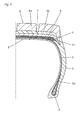
- FIG. 4 shows a cross section through a pneumatic vehicle tire with an embodiment of the invention.
- a pneumatic vehicle tire shown schematically in FIG. 1 has a construction typical for commercial vehicle tires comprising an air-impermeable inner layer 1, a reinforcing carcass ply 2, a belt 4 made up of a plurality of plies of metallic reinforcements embedded in rubber, bead areas with bead cores 3, two sidewalls 5 and a tread 6 on.
- the carcass ply 2 extends over the zenith region and the side walls 5 into the bead areas, is here from axially inside to axially outwardly around bead cores 3 and ends upsets 2a forming in the side walls 5.
- the belt 4 usually consists of four Belt layers 4a.
- the tread 6 arranged radially outside the belt 4 has two layers, namely a tread cap (tread cap) 6a, which forms the radially outermost layer, and a tread base (tread bottom part) 6b.
- the tread cap 6a is profiled, with tread grooves 7 are provided, which extend to the maximum provided tread depth.
- the mixture for the tread cap 6a is preferably a blend optimized for abrasion.
- the tread base 6b is made of a blend optimized for hysteresis losses.
- an additional layer 8 is arranged from a rubber mixture having an organic corrosion inhibitor.
- the layer thickness of this additional layer 8 is about 1 mm. It is not in direct contact with the metallic reinforcements. The latter are still embedded in the gum mixture.
- Table 1 One possible blend composition of layer 8 is shown in Table 1 below.
- the layer 8 corrosion inhibitor migrates into the rubberizing layers of the metallic reinforcements of the belt after manufacture of the tire and protects them from corrosion.
- Table 1 shows example mixtures for the rubber mixture of the layer 8 with corrosion inhibitor and a comparison mixture without corrosion inhibitor with their characteristic properties.
- the vulcanizate properties are not adversely affected by the presence of the corrosion inhibitor. If the mixtures 1 and 2 are arranged radially outside the belt, the corrosion inhibitor after vulcanization of the tire u. a. in the direction of steel cord diffuses, thus protecting the steel cord from corrosion.
Landscapes
- Chemical & Material Sciences (AREA)
- Health & Medical Sciences (AREA)
- Chemical Kinetics & Catalysis (AREA)
- Medicinal Chemistry (AREA)
- Polymers & Plastics (AREA)
- Organic Chemistry (AREA)
- Engineering & Computer Science (AREA)
- Mechanical Engineering (AREA)
- Tires In General (AREA)
- Compositions Of Macromolecular Compounds (AREA)
- Ropes Or Cables (AREA)
Abstract
Description
- Die Erfindung betrifft einen Fahrzeugluftreifen, insbesondere für Nutzfahrzeuge, mit einer luftundurchlässigen Innenschicht, einer durch Festigkeitsträger verstärkten, zumindest einlagig ausgeführten Karkasse, Wulstbereichen mit Wulstkernen, Seitenwänden, einem mehrlagigen Gürtel mit gummierten, metallischen Festigkeitsträgern und einem Laufstreifen mit Profilrillen.
- Fahrzeugluftreifen in Radialbauweise besitzen üblicherweise zur Stabilisierung einen mehrlagigen Gürtel, der gummierte metallische Festigkeitsträger enthält. Bei den gummierten metallischen Festigkeitsträgern handelt es sich in der Regel um vermessingte Stahlcorde. Für die Einbettung dieser Stahlcorde werden spezielle Gummierungsmischungen eingesetzt, mit Hilfe derer eine gute Haftung zwischen einbettender Kautschukmischung (Gummierungsmischung) und Stahlcord erzielt werden soll, um auf diese Weise die Haltbarkeit des Gummi-Stahlcord-Verbundes zu gewährleisten.
- Die vermessingten Stahlcorde innerhalb des Reifens sind anfällig für elektrochemische Korrosion. Diese kann insbesondere dann auftreten, wenn eine anfängliche Beschädigung des Stahlcordes und seiner umgebenden Gummierung z. B. durch das Eindringen von Steinen in die Reifenlauffläche aufgetreten ist, und der Stahlcord danach einer fortdauernden Einwirkung von korrodierend wirkenden Substanzen wie Regenwasser, Luftsauerstoff oder Salzwasser ausgesetzt ist. Diese Einwirkung der Substanzen führt zu einer fortschreitenden Ausbreitung der korrodierten Bereiche, was in einem Verlust der Gummi-Stahlcord-Haftung in den korrodierten Bereichen resultiert und damit letztendlich zu einem Ausfall des Reifens führen kann. Bei Nutzfahrzeugreifen ist außerdem zu berücksichtigen, dass bei einem zu hohen Korrosionsgrad der radial äußeren Gürtellage der Reifen nicht mehr für die Runderneuerung geeignet ist.
- Zur Vermeidung der Korrosion von Metallen ist es hinlänglich bekannt, Korrosionsinhibitoren einzusetzen, deren Anwesenheit auf der Metalloberfläche die Korrosion hemmt. Als Korrosionsinhibitoren werden in so genannten Sparbeizen beispielsweise organische Verbindungen wie Dialkylthioharnstoffe, Sulfoxide, 2-Mercaptobenzothiazol, Trithione, 2-Propin-1-ol, 2-Butin-1,4-diol, Hexamethylentetramin oder Thioamide eingesetzt, die das Grundmetall weitgehend vor einem Angriff schützen, in dem sie schneller Redox-Reaktionen eingehen als das Metall.
- Bei Fahrzeugluftreifen hat es sich aber herausgestellt, dass auf dem vermessingten Stahlcord anhaftende Korrosionsinhibitoren die Haftung zwischen Gummi und Stahlcord so stark verringern, dass der Einsatz von organischen Korrosionsinhibitoren direkt auf dem Stahlcord oder in der einbettenden Gummierungsmischung nicht möglich ist. Die Korrosionsinhibitoren verhindern oder behindern die während der Vulkanisation stattfindende Reaktion zwischen der vermessingten Stahlcordoberfläche und dem Haftsystem in der Gummierungsmischung.
- Der Effekt einer ungenügenden Schichthaftung durch die Anwesenheit von Korrosionsinhibitoren wird auch für die galvanische Metallbeschichtung in der
DE 41 19 102 A1 beschrieben, weshalb die Inhibitoren vor der galvanischen Beschichtung elektrochemisch desorbiert werden. - Der Erfindung liegt die Aufgabe zu Grunde, bei einem Fahrzeugluftreifen der eingangs genannten Art die Haltbarkeit und Runderneuerungsfähigkeit zu verbessern.
- Gelöst wird die Aufgabe erfindungsgemäß dadurch, dass der Fahrzeugluftreifen radial außerhalb des mehrlagigen Gürtels mit gummierten, metallischen Festigkeitsträgern zumindest eine vulkanisierte Kautschukmischung aufweist, die nicht in direktem Kontakt mit den metallischen Festigkeitsträgern steht und die zumindest einen organischen Korrosionsinhibitor enthält.
- Der Grundgedanke der Erfindung ist darin zu sehen, dass zum einen die Haftung zwischen metallischem Festigkeitsträger und Gummierungsmischung nicht beeinträchtigt wird, zum anderen aber nach der Herstellung der Reifens und dem Abschluss der Haftungsreaktion die gummierten metallischen Festigkeitsträger des Gürtels vor Korrosion geschützt werden. Letzteres geschieht durch die Diffusion des organischen Korrosionsinhibitors aus einer Kautschukmischung, die nicht die Gummierungsmischung ist, zum metallischen Festigkeitsträger hin, wobei die Haftungsreaktion zwischen Haftsystem und metallischem Festigkeitsträger nicht mehr beeinflusst wird, weil sie bereits abgeschlossen ist. Der Gürtel des Fahrzeugluftreifens wird dadurch gegen Korrosion geschützt, auch wenn es zu einer Verletzung durch eindringende Steine kommen sollte, und die Runderneuerungsfähigkeit wird nicht durch Korrosion am Gürtel beeinträchtigt.
- Als organische Korrosionsinhibitoren kommen alle im Bereich des Korrosionsschutzes einsetzbaren Substanzen in Frage, wobei diese einzeln aber auch als Gemische eingesetzt werden können. Vorzugsweise ist der Korrosionsinhibitor bzw. sind die Korrosionsinhibitoren jedoch ausgewählt aus der Gruppe, bestehend aus Mercaptobenzothiazol, Alkylaminotriazolen, Benzotriazolen, Alkylphenyltriazolen, Amino-alkyl-benzimidazolen und Phenylthioharnstoffen. Mit diesen Substanzen wird durch hohe Diffusionsgeschwindigkeiten in den vulkanisierten Kautschukmischungen des Reifens ein schneller und hoher Schutz der metallischen Festigkeitsträger der Gürtellagen erzielt.
- Gemäß einer bevorzugten Weiterbildung der Erfindung enthält die Kautschukmischung 0,1 bis 10 phr, vorzugsweise 0,5 bis 2 phr, des Korrosionsinhibitors. In diesen Mengebereichen wird ein optimaler Korrosionsschutz erreicht, ohne dass andere gewünschte Vulkanisateigenschaften, wie Härte, Elastizitätsmodul, Zugfestigkeit oder Reißdehnung, negativ beeinflusst werden.
- Die in dieser Schrift verwendete Angabe phr (parts per hundred parts of rubber by weight) ist dabei die in der Kautschukindustrie übliche Mengenangabe für Mischungsrezepturen. Die Dosierung der Gewichtsteile der einzelnen Substanzen wird dabei stets auf 100 Gewichtsteile der gesamten Masse aller in der Mischung vorhandenen Kautschuke bezogen.
- Da insbesondere die radial äußere Gürtellage des mehrlagigen Gürtels der Gefahr der Beschädigung beispielsweise durch eindringende Steine ausgesetzt ist, weist der Fahrzeugluftreifen erfindungsgemäß radial außerhalb des Gürtels die Kautschukmischung mit dem Korrosionsinhibitor auf, so dass der Korrosionsinhibitor schnell zu der gefährdeten äußeren Gürtellage diffundieren kann. Dabei ist es möglich, dass die Kautschukmischung mit dem organischen Korrosionsinhibitor Teil des Laufstreifens ist. Es kann sich dabei z. B. um die Kautschukmischung des gesamten Laufstreifens handeln. Weist der Laufstreifen einen Cap-und-Base-Aufbau auf, kann es sich sowohl um die Cap- als auch die Basemischung handeln. Es können auch beide Mischungen den Korrosioninhibitor enthalten. Ist im Reifen ein so genannter Undertread vorgesehen, kann auch dieser Korrosioninhibitoren enthalten.
- Alternativ dazu kann aber auch vorgesehen sein, dass die Kautschukmischung mit dem zumindest einen organischen Korrosionsinhibitor als zusätzliche Lage zwischen Laufstreifen und radial äußerer Gürtellage angeordnet ist. Dies bietet den Vorteil, dass diese Lage den speziellen Erfordernissen eines optimalen Schutzes der Gürtellagen hinsichtlich ihrer chemischen und physikalischen Eigenschaften angepasst werden kann, ohne dass die gewünschten Eigenschaften der anderen Mischungen des Reifens beeinflusst werden.
- Für einen besonders guten Schutz der äußeren Gürtellage weist die zusätzliche Lage eine Schichtdicke von 0,4 bis 3,0 mm auf. Die in den Lagen dieser Schichtdicke vorliegende Menge an Kautschukmischung mit Korrosioninhibitor gewährleistet einen sicheren Korrosionsschutz.
- Da der Gürtel eines Fahrzeugluftreifen hohen thermischen Belastungen durch Walk-und Fliehkräfte ausgesetzt ist, hat es sich als vorteilhaft erwiesen, dass die zusätzlichen Lage eine Wärmeleitfähigkeit von mehr als 0,28 W/(m*K) aufweist. Dadurch kann am Gürtel entstehende Wärme, die zu einer Depolymerisation der umgebenden Kautschukmischungen führen kann, effektiv in äußere Bereiche abgeführt werden.
- Die Herstellung der erfindungsgemäßen Fahrzeugluftreifen erfolgt nach dem Fachmann bekannten Verfahren. Wird eine zusätzliche Lage mit Korrosionsinhibitor verwendet, kann diese gesondert extrudiert und aufgelegt oder mit einem Mehrfachextruder gemeinsam mit dem Laufstreifen extrudiert und aufgelegt werden.
- Die Erfindung soll nun anhand der Figur und der Tabelle 1 näher erläutert werden.
- Die einzige Zeichnungsfigur,
Fig. 1 , zeigt einen Querschnitt durch einen Fahrzeugluftreifen mit einer Ausführungsform der Erfindung. - Der in
Fig. 1 schematisch dargestellte Fahrzeugluftreifen weist einen für Nutzfahrzeugreifen typischen Aufbau aus einer luftundurchlässigen Innenschicht 1, einer mit Festigkeitsträgern verstärkten Karkasseinlage 2, einem Gürtel 4 aus einer Anzahl von Lagen bestehend aus in Gummi eingebetteten metallischen Festigkeitsträgern, Wulstbereichen mit Wulstkernen 3, zwei Seitenwänden 5 und einem Laufstreifen 6 auf. Die Karkasseinlage 2 verläuft über den Zenitbereich und die Seitenwände 5 bis in die Wulstbereiche, ist hier von axial innen nach axial außen um Wulstkerne 3 herumgeschlagen und endet Hochschläge 2a bildend in den Seitenwänden 5. Bei einem Nutzfahrzeugreifen besteht der Gürtel 4 meist aus vier Gürtellagen 4a. Der radial außerhalb des Gürtels 4 angeordnete Laufstreifen 6 weist zwei Schichten auf, nämlich eine Laufstreifencap (Laufstreifenoberteil) 6a, welche die radial äußerste Schicht bildet, und eine Laufstreifenbase (Laufstreifenunterteil) 6b. Das Laufstreifencap 6a ist profiliert, wobei Profilrillen 7 vorgesehen sind, die bis auf die maximal vorgesehene Profiltiefe reichen. Die Mischung für die Laufstreifencap 6a ist bevorzugt eine hinsichtlich Abrieb optimierte Mischung. Die Laufstreifenbase 6b ist aus einer Mischung gefertigt, welche hinsichtlich Hysterese-Verluste optimiert ist. Radial außerhalb des Gürtels 4 und unterhalb der Laufstreifenbase 6b ist eine zusätzliche Lage 8 aus einer Kautschukmischung angeordnet, die einen organischen Korrosionsinhibitor aufweist. Die Schichtdicke dieser zusätzlichen Lage 8 beträgt ca. 1 mm. Sie steht nicht in direktem Kontakt mit den metallischen Festigkeitsträgern. Letztere sind noch von der Gummierungsmischung eingebettet. Eine mögliche Mischungszusammensetzung der Lage 8 ist in der folgenden Tabelle 1 wiedergegeben. Der Korrosioninhibitor aus der Lage 8 wandert nach der Herstellung des Reifens in die Gummierungsschichten der metallischen Festigkeitsträger des Gürtels und schützt diese vor Korrosion. - In der Tabelle 1 sind Beispielmischungen für die Kautschukmischung der Lage 8 mit Korrosionsinhibitor und eine Vergleichsmischung ohne Korrosionsinhibitor mit ihren charakteristischen Eigenschaften angegeben.
- Die Mischungsherstellung erfolgte unter üblichen Bedingungen unter Herstellung einer Grundmischung und anschließend der Fertigmischung in einem Labortangentialmischer. Es wurden die Mooney-Viskositäten ML (1+4) bei 100 °C mit Hilfe eines rotorlosen Vulkameters (MDR = Moving Disc Rheometer) gemäß DIN 53 523 ermittelt. Aus sämtlichen Mischungen wurden Prüfkörper durch optimale Vulkanisation unter Druck bei 160 °C hergestellt und mit diesen Prüfkörpern für die Kautschukindustrie typische Materialeigenschaften mit den im Folgenden angegebenen Testverfahren ermittelt.
- Shore-A-Härte bei Raumtemperatur gemäß DIN 53 505
- Rückprallelastizität bei Raumtemperatur gemäß DIN 53 512
- Zugfestigkeit bei Raumtemperatur gemäß DIN 53 504
- Reißdehnung bei Raumtemperatur gemäß DIN 53 504
- Spannungswerte (Modul) bei 50, 100, 200 und 300 % Dehnung bei Raumtemperatur gemäß DIN 53 504
- Stahlcordhaftung gemäß ASTM 2229/D1871 vor Alterung bei Raumtemperatur, Einbettlänge 12,5 mm, Auszugsgeschwindigkeit 125 mm/min, Messung der Herausziehkraft und der Bedeckung mit Gummi (0 % = keine Bedeckung, 100 % = vollständige Bedeckung), verwendeter Stahlcord: vermessingt, 3x0,20 + 6x0,35, wobei der Stahlcord mit einer üblichen Gummierungsmischung versehen wurde und zwischen zwei Platten aus unterschiedlichen Kautschukmischungen einvulkanisiert wurde. Die eine Platte bestand aus einer Kautschukmischung mit Korrosionsinhibitor, die andere Platte war die Vergleichsmischung ohne Korrosionsinhibitor.
- Aus der Tabelle wird ersichtlich, dass die Vulkanisateigenschaften durch die Anwesenheit des Korrosionsinhibitors nicht nachteilig beeinflusst werden. Werden die Mischungen 1 und 2 radial außerhalb des Gürtels angeordnet, kann der Korrosionsinhibitor nach der Vulkanisation des Reifens u. a. in Richtung Stahlcord diffundieren und schützt so den Stahlcord vor Korrosion.
| Bestandteile | Einheit | Vergleichsmischung | Mischung 1 für Lage 8 | Mischung 2 für Lage 8 |
| Naturkautschuk | phr | 100 | 100 | 100 |
| Ruß N326 | phr | 51 | 51 | 51 |
| Kieselsäure | phr | 10 | 10 | 10 |
| Weichmacheröl | phr | 7 | 7 | 7 |
| Korrosionsinhibitora | phr | - | 0,25 | 2,0 |
| Alterungsschutzmittel | phr | 1,5 | 1,5 | 1,5 |
| Resorcin | phr | 1,25 | 1,25 | 1,25 |
| Hexamethoxymethylmelamin | phr | 1,4 | 1,4 | 1,4 |
| Zinkstearat | phr | 1 | 1 | 1 |
| Zinkoxid | phr | 6 | 6 | 6 |
| Beschleuniger | phr | 1,2 | 1,2 | 1,2 |
| Schwefel | phr | 5,5 | 5,5 | 5,5 |
| Eigenschaften | ||||
| ML (1+4) bei 100 °C | Mooney-Einh. | 41,2 | 38,3 | 42,1 |
| Härte bei RT | ShoreA | 72 | 72 | 72 |
| Rückprallelast. bei RT | % | 40 | 40 | 37 |
| Zugfestigkeit bei RT | MPa | 22 | 22 | 22 |
| Reißdehnung bei RT | % | 429 | 440 | 489 |
| Modul 50 % | MPa | 1,8 | 1,8 | 1,8 |
| Modul 100 % | MPa | 3,4 | 3,4 | 3,1 |
| Modul 200 % | MPa | 9,0 | 8,8 | 7,6 |
| Modul 300 % | MPa | 16,0 | 15,7 | 13,5 |
| Herausziehkraft | N | 790 | 836 | 823 |
| Bedeckung | % | 96 | 97 | 96 |
| a 5-Methylbenzotriazol |
Claims (8)
- Fahrzeugluftreifen, insbesondere für Nutzfahrzeuge, mit einer luftundurchlässigen Innenschicht (1), einer durch Festigkeitsträger verstärkten, zumindest einlagig ausgeführten Karkasse (2), Wulstbereichen mit Wulstkernen (3), Seitenwänden (5), einem mehrlagigen Gürtel (4) mit gummierten, metallischen Festigkeitsträgern und einem Laufstreifen (6) mit Profilrillen (7),
dadurch gekennzeichnet,
dass er radial außerhalb des mehrlagigen Gürtels (4) mit gummierten, metallischen Festigkeitsträgern zumindest eine vulkanisierte Kautschukmischung aufweist, die nicht in direktem Kontakt mit den metallischen Festigkeitsträgern steht und die zumindest einen organischen Korrosionsinhibitor enthält. - Fahrzeugluftreifen nach Anspruch 1, dadurch gekennzeichnet, dass der oder die Korrosionsinhibitor(en) ausgewählt ist bzw. sind aus der Gruppe, bestehend aus Mercaptobenzothiazol, Alkylaminotriazolen, Benzotriazolen, Alkylphenyltriazolen, Amino-alkyl-benzimidazolen und Phenylthioharnstoffen.
- Fahrzeugluftreifen nach Anspruch 1 oder 2, dadurch gekennzeichnet, dass die Kautschukmischung 0,1 bis 10 phr des Korrosionsinhibitors enthält.
- Fahrzeugluftreifen nach Anspruch 3, dadurch gekennzeichnet, dass die Kautschukmischung 0,5 bis 2 phr des Korrosionsinhibitors enthält.
- Fahrzeugluftreifen nach zumindest einem der Ansprüche 1 bis 4, dadurch gekennzeichnet, dass die Kautschukmischung mit dem zumindest einen organischen Korrosionsinhibitor Teil des Laufstreifens ist.
- Fahrzeugluftreifen nach zumindest einem der Ansprüche 1 bis 4, dadurch gekennzeichnet, dass die Kautschukmischung mit dem zumindest einen organischen Korrosionsinhibitor als zusätzliche Lage (8) zwischen Laufstreifen und radial äußerer Gürtellage angeordnet ist.
- Fahrzeugluftreifen nach Anspruch 6, dadurch gekennzeichnet, dass die zusätzliche Lage (8) eine Schichtdicke von 0,4 bis 3,0 mm aufweist.
- Fahrzeugluftreifen nach Anspruch 6 oder 7, dadurch gekennzeichnet, dass die zusätzlichen Lage (8) eine Wärmeleitfähigkeit von mehr als 0,28 W/(m*K) aufweist.
Priority Applications (3)
| Application Number | Priority Date | Filing Date | Title |
|---|---|---|---|
| EP20100196102 EP2468530B1 (de) | 2010-12-21 | 2010-12-21 | Fahrzeugluftreifen |
| ES10196102T ES2461898T3 (es) | 2010-12-21 | 2010-12-21 | Cubiertas de neumáticos para vehículos automóviles |
| PCT/EP2011/070203 WO2012084345A1 (de) | 2010-12-21 | 2011-11-16 | Fahrzeugluftreifen |
Applications Claiming Priority (1)
| Application Number | Priority Date | Filing Date | Title |
|---|---|---|---|
| EP20100196102 EP2468530B1 (de) | 2010-12-21 | 2010-12-21 | Fahrzeugluftreifen |
Publications (2)
| Publication Number | Publication Date |
|---|---|
| EP2468530A1 true EP2468530A1 (de) | 2012-06-27 |
| EP2468530B1 EP2468530B1 (de) | 2014-02-26 |
Family
ID=44237124
Family Applications (1)
| Application Number | Title | Priority Date | Filing Date |
|---|---|---|---|
| EP20100196102 Active EP2468530B1 (de) | 2010-12-21 | 2010-12-21 | Fahrzeugluftreifen |
Country Status (3)
| Country | Link |
|---|---|
| EP (1) | EP2468530B1 (de) |
| ES (1) | ES2461898T3 (de) |
| WO (1) | WO2012084345A1 (de) |
Cited By (1)
| Publication number | Priority date | Publication date | Assignee | Title |
|---|---|---|---|---|
| CN115626010A (zh) * | 2022-11-09 | 2023-01-20 | 山东玲珑轮胎股份有限公司 | 一种低滚阻低电阻结构的汽车轮胎 |
Families Citing this family (1)
| Publication number | Priority date | Publication date | Assignee | Title |
|---|---|---|---|---|
| FR3080797A1 (fr) * | 2018-05-04 | 2019-11-08 | Compagnie Generale Des Etablissements Michelin | Pneumatique presentant des proprietes d'usure et de resistance au roulement ameliorees |
Citations (4)
| Publication number | Priority date | Publication date | Assignee | Title |
|---|---|---|---|---|
| DE4119102A1 (de) | 1991-06-10 | 1992-12-17 | Henkel Kgaa | Verfahren zur vorbehandlung von buntmetall-oberflaechen vor einer galvanischen metallbeschichtung |
| EP0964028A1 (de) * | 1998-06-09 | 1999-12-15 | Pirelli Pneumatici S.p.A. | Mit Kieselsäure verstärkte Reifenzusammensetzungen die Triazole enthalten |
| EP1475408A1 (de) * | 2002-02-15 | 2004-11-10 | Bridgestone Corporation | Kautschukzusammensetzung und daraus hergestellter pneumatischer reifen |
| EP1533338A1 (de) * | 2002-07-11 | 2005-05-25 | Bridgestone Corporation | Reifen, runderneuerter reifen und kautschukzusammensetzung zur reparatur von vulkanisiertem kautschukprodukt |
-
2010
- 2010-12-21 EP EP20100196102 patent/EP2468530B1/de active Active
- 2010-12-21 ES ES10196102T patent/ES2461898T3/es active Active
-
2011
- 2011-11-16 WO PCT/EP2011/070203 patent/WO2012084345A1/de not_active Ceased
Patent Citations (4)
| Publication number | Priority date | Publication date | Assignee | Title |
|---|---|---|---|---|
| DE4119102A1 (de) | 1991-06-10 | 1992-12-17 | Henkel Kgaa | Verfahren zur vorbehandlung von buntmetall-oberflaechen vor einer galvanischen metallbeschichtung |
| EP0964028A1 (de) * | 1998-06-09 | 1999-12-15 | Pirelli Pneumatici S.p.A. | Mit Kieselsäure verstärkte Reifenzusammensetzungen die Triazole enthalten |
| EP1475408A1 (de) * | 2002-02-15 | 2004-11-10 | Bridgestone Corporation | Kautschukzusammensetzung und daraus hergestellter pneumatischer reifen |
| EP1533338A1 (de) * | 2002-07-11 | 2005-05-25 | Bridgestone Corporation | Reifen, runderneuerter reifen und kautschukzusammensetzung zur reparatur von vulkanisiertem kautschukprodukt |
Cited By (1)
| Publication number | Priority date | Publication date | Assignee | Title |
|---|---|---|---|---|
| CN115626010A (zh) * | 2022-11-09 | 2023-01-20 | 山东玲珑轮胎股份有限公司 | 一种低滚阻低电阻结构的汽车轮胎 |
Also Published As
| Publication number | Publication date |
|---|---|
| EP2468530B1 (de) | 2014-02-26 |
| WO2012084345A1 (de) | 2012-06-28 |
| ES2461898T3 (es) | 2014-05-21 |
Similar Documents
| Publication | Publication Date | Title |
|---|---|---|
| KR101670113B1 (ko) | 기본 스트랜드가 현장에서 고무화되는 2층 코드인 다중 스트랜드 코드 | |
| EP2753658B1 (de) | Schwefelvernetzbare gummierungsmischung | |
| DE602005000079T2 (de) | Radialer Luftreifen | |
| EP2683560B1 (de) | Fahrzeugluftreifen | |
| DE112015002461B4 (de) | Kautschukzusammensetzung, vulkanisierte Gummiplatte und Verwendung der vulkanisierten Gummiplatte in einem Förderband | |
| EP2477824B1 (de) | Fahrzeugluftreifen | |
| EP2366559B1 (de) | Reifen mit Lauffläche mit weicherer innerer Übergangsgummischicht kurzer Faserverstärkung | |
| DE102011055316A1 (de) | Kautschukmischung und Schlauch enthaltend die Kautschukmischung | |
| DE102024104524B4 (de) | Reifen | |
| EP2468530B1 (de) | Fahrzeugluftreifen | |
| DE60200479T2 (de) | Lauffläche bestehend aus zwei Schichten mit jeweils unterschiedlicher Konzentration an Antioxidantien | |
| EP1419904B1 (de) | Zweiradluftreifen, insbesondere Fahrradluftreifen | |
| DE112022001029B4 (de) | Kautschukzusammensetzung für Reifen, Reifen sowie Verfahren zu dessen Herstellung | |
| DE102018131358B4 (de) | Luftreifen | |
| DE102010004059A1 (de) | Kautschukzusammensetzung zum Beschichten von Textilcord und Reifen unter Verwendung derselben | |
| EP3351590B1 (de) | Kautschukzusammensetzung für schläuche und hydraulikschlauch | |
| EP1928951B1 (de) | Kautschukmischung für innerliner von fahrzeugluftreifen | |
| EP3300924B1 (de) | Fahrzeugluftreifen | |
| EP2594414B1 (de) | Gummierter Festigkeitsträger | |
| EP2425991B1 (de) | Fahrzeugluftreifen | |
| JP2017533135A (ja) | タイヤサイドウォール保護コーティング | |
| KR101077741B1 (ko) | 타이어 보강재용 비드 와이어 및 이의 제조방법 | |
| DE102017116953B4 (de) | Luftreifen | |
| EP1867494B1 (de) | Fahrzeugluftreifen mit Seitenwand-Verstärkungsprofil | |
| KR102236874B1 (ko) | 구리 및 알루미늄을 포함하는 합금으로 도금된 스틸 코드, 이를 포함하는 타이어 벨트 및 이를 포함하는 타이어 |
Legal Events
| Date | Code | Title | Description |
|---|---|---|---|
| AK | Designated contracting states |
Kind code of ref document: A1 Designated state(s): AL AT BE BG CH CY CZ DE DK EE ES FI FR GB GR HR HU IE IS IT LI LT LU LV MC MK MT NL NO PL PT RO RS SE SI SK SM TR |
|
| AX | Request for extension of the european patent |
Extension state: BA ME |
|
| PUAI | Public reference made under article 153(3) epc to a published international application that has entered the european phase |
Free format text: ORIGINAL CODE: 0009012 |
|
| 17P | Request for examination filed |
Effective date: 20130102 |
|
| 17Q | First examination report despatched |
Effective date: 20130516 |
|
| REG | Reference to a national code |
Ref country code: DE Ref legal event code: R079 Ref document number: 502010006159 Country of ref document: DE Free format text: PREVIOUS MAIN CLASS: B60C0001000000 Ipc: B60C0009180000 |
|
| GRAP | Despatch of communication of intention to grant a patent |
Free format text: ORIGINAL CODE: EPIDOSNIGR1 |
|
| INTG | Intention to grant announced |
Effective date: 20130919 |
|
| RIC1 | Information provided on ipc code assigned before grant |
Ipc: C08K 5/13 20060101ALI20130906BHEP Ipc: B60C 9/18 20060101AFI20130906BHEP Ipc: C08K 3/04 20060101ALI20130906BHEP Ipc: C08K 3/06 20060101ALI20130906BHEP Ipc: C08K 5/405 20060101ALI20130906BHEP Ipc: C08K 5/3492 20060101ALI20130906BHEP Ipc: C08K 5/3445 20060101ALI20130906BHEP |
|
| GRAS | Grant fee paid |
Free format text: ORIGINAL CODE: EPIDOSNIGR3 |
|
| GRAA | (expected) grant |
Free format text: ORIGINAL CODE: 0009210 |
|
| AK | Designated contracting states |
Kind code of ref document: B1 Designated state(s): AL AT BE BG CH CY CZ DE DK EE ES FI FR GB GR HR HU IE IS IT LI LT LU LV MC MK MT NL NO PL PT RO RS SE SI SK SM TR |
|
| REG | Reference to a national code |
Ref country code: GB Ref legal event code: FG4D Free format text: NOT ENGLISH |
|
| REG | Reference to a national code |
Ref country code: CH Ref legal event code: EP |
|
| REG | Reference to a national code |
Ref country code: AT Ref legal event code: REF Ref document number: 653349 Country of ref document: AT Kind code of ref document: T Effective date: 20140315 |
|
| REG | Reference to a national code |
Ref country code: IE Ref legal event code: FG4D Free format text: LANGUAGE OF EP DOCUMENT: GERMAN |
|
| REG | Reference to a national code |
Ref country code: DE Ref legal event code: R096 Ref document number: 502010006159 Country of ref document: DE Effective date: 20140410 |
|
| REG | Reference to a national code |
Ref country code: ES Ref legal event code: FG2A Ref document number: 2461898 Country of ref document: ES Kind code of ref document: T3 Effective date: 20140521 |
|
| REG | Reference to a national code |
Ref country code: NL Ref legal event code: VDEP Effective date: 20140226 |
|
| REG | Reference to a national code |
Ref country code: LT Ref legal event code: MG4D |
|
| PG25 | Lapsed in a contracting state [announced via postgrant information from national office to epo] |
Ref country code: IS Free format text: LAPSE BECAUSE OF FAILURE TO SUBMIT A TRANSLATION OF THE DESCRIPTION OR TO PAY THE FEE WITHIN THE PRESCRIBED TIME-LIMIT Effective date: 20140626 Ref country code: NO Free format text: LAPSE BECAUSE OF FAILURE TO SUBMIT A TRANSLATION OF THE DESCRIPTION OR TO PAY THE FEE WITHIN THE PRESCRIBED TIME-LIMIT Effective date: 20140526 Ref country code: LT Free format text: LAPSE BECAUSE OF FAILURE TO SUBMIT A TRANSLATION OF THE DESCRIPTION OR TO PAY THE FEE WITHIN THE PRESCRIBED TIME-LIMIT Effective date: 20140226 |
|
| PG25 | Lapsed in a contracting state [announced via postgrant information from national office to epo] |
Ref country code: NL Free format text: LAPSE BECAUSE OF FAILURE TO SUBMIT A TRANSLATION OF THE DESCRIPTION OR TO PAY THE FEE WITHIN THE PRESCRIBED TIME-LIMIT Effective date: 20140226 Ref country code: PT Free format text: LAPSE BECAUSE OF FAILURE TO SUBMIT A TRANSLATION OF THE DESCRIPTION OR TO PAY THE FEE WITHIN THE PRESCRIBED TIME-LIMIT Effective date: 20140626 Ref country code: SE Free format text: LAPSE BECAUSE OF FAILURE TO SUBMIT A TRANSLATION OF THE DESCRIPTION OR TO PAY THE FEE WITHIN THE PRESCRIBED TIME-LIMIT Effective date: 20140226 Ref country code: FI Free format text: LAPSE BECAUSE OF FAILURE TO SUBMIT A TRANSLATION OF THE DESCRIPTION OR TO PAY THE FEE WITHIN THE PRESCRIBED TIME-LIMIT Effective date: 20140226 Ref country code: CY Free format text: LAPSE BECAUSE OF FAILURE TO SUBMIT A TRANSLATION OF THE DESCRIPTION OR TO PAY THE FEE WITHIN THE PRESCRIBED TIME-LIMIT Effective date: 20140226 |
|
| PG25 | Lapsed in a contracting state [announced via postgrant information from national office to epo] |
Ref country code: RS Free format text: LAPSE BECAUSE OF FAILURE TO SUBMIT A TRANSLATION OF THE DESCRIPTION OR TO PAY THE FEE WITHIN THE PRESCRIBED TIME-LIMIT Effective date: 20140226 Ref country code: HR Free format text: LAPSE BECAUSE OF FAILURE TO SUBMIT A TRANSLATION OF THE DESCRIPTION OR TO PAY THE FEE WITHIN THE PRESCRIBED TIME-LIMIT Effective date: 20140226 Ref country code: LV Free format text: LAPSE BECAUSE OF FAILURE TO SUBMIT A TRANSLATION OF THE DESCRIPTION OR TO PAY THE FEE WITHIN THE PRESCRIBED TIME-LIMIT Effective date: 20140226 |
|
| PG25 | Lapsed in a contracting state [announced via postgrant information from national office to epo] |
Ref country code: EE Free format text: LAPSE BECAUSE OF FAILURE TO SUBMIT A TRANSLATION OF THE DESCRIPTION OR TO PAY THE FEE WITHIN THE PRESCRIBED TIME-LIMIT Effective date: 20140226 Ref country code: RO Free format text: LAPSE BECAUSE OF FAILURE TO SUBMIT A TRANSLATION OF THE DESCRIPTION OR TO PAY THE FEE WITHIN THE PRESCRIBED TIME-LIMIT Effective date: 20140226 Ref country code: CZ Free format text: LAPSE BECAUSE OF FAILURE TO SUBMIT A TRANSLATION OF THE DESCRIPTION OR TO PAY THE FEE WITHIN THE PRESCRIBED TIME-LIMIT Effective date: 20140226 Ref country code: DK Free format text: LAPSE BECAUSE OF FAILURE TO SUBMIT A TRANSLATION OF THE DESCRIPTION OR TO PAY THE FEE WITHIN THE PRESCRIBED TIME-LIMIT Effective date: 20140226 |
|
| REG | Reference to a national code |
Ref country code: DE Ref legal event code: R097 Ref document number: 502010006159 Country of ref document: DE |
|
| PG25 | Lapsed in a contracting state [announced via postgrant information from national office to epo] |
Ref country code: SK Free format text: LAPSE BECAUSE OF FAILURE TO SUBMIT A TRANSLATION OF THE DESCRIPTION OR TO PAY THE FEE WITHIN THE PRESCRIBED TIME-LIMIT Effective date: 20140226 Ref country code: PL Free format text: LAPSE BECAUSE OF FAILURE TO SUBMIT A TRANSLATION OF THE DESCRIPTION OR TO PAY THE FEE WITHIN THE PRESCRIBED TIME-LIMIT Effective date: 20140226 |
|
| PLBE | No opposition filed within time limit |
Free format text: ORIGINAL CODE: 0009261 |
|
| STAA | Information on the status of an ep patent application or granted ep patent |
Free format text: STATUS: NO OPPOSITION FILED WITHIN TIME LIMIT |
|
| 26N | No opposition filed |
Effective date: 20141127 |
|
| REG | Reference to a national code |
Ref country code: DE Ref legal event code: R097 Ref document number: 502010006159 Country of ref document: DE Effective date: 20141127 |
|
| PG25 | Lapsed in a contracting state [announced via postgrant information from national office to epo] |
Ref country code: IT Free format text: LAPSE BECAUSE OF FAILURE TO SUBMIT A TRANSLATION OF THE DESCRIPTION OR TO PAY THE FEE WITHIN THE PRESCRIBED TIME-LIMIT Effective date: 20140226 |
|
| PG25 | Lapsed in a contracting state [announced via postgrant information from national office to epo] |
Ref country code: SI Free format text: LAPSE BECAUSE OF FAILURE TO SUBMIT A TRANSLATION OF THE DESCRIPTION OR TO PAY THE FEE WITHIN THE PRESCRIBED TIME-LIMIT Effective date: 20140226 |
|
| PG25 | Lapsed in a contracting state [announced via postgrant information from national office to epo] |
Ref country code: BE Free format text: LAPSE BECAUSE OF NON-PAYMENT OF DUE FEES Effective date: 20141231 |
|
| PG25 | Lapsed in a contracting state [announced via postgrant information from national office to epo] |
Ref country code: LU Free format text: LAPSE BECAUSE OF FAILURE TO SUBMIT A TRANSLATION OF THE DESCRIPTION OR TO PAY THE FEE WITHIN THE PRESCRIBED TIME-LIMIT Effective date: 20141221 |
|
| REG | Reference to a national code |
Ref country code: CH Ref legal event code: PL |
|
| GBPC | Gb: european patent ceased through non-payment of renewal fee |
Effective date: 20141221 |
|
| REG | Reference to a national code |
Ref country code: IE Ref legal event code: MM4A |
|
| PG25 | Lapsed in a contracting state [announced via postgrant information from national office to epo] |
Ref country code: IE Free format text: LAPSE BECAUSE OF NON-PAYMENT OF DUE FEES Effective date: 20141221 Ref country code: GB Free format text: LAPSE BECAUSE OF NON-PAYMENT OF DUE FEES Effective date: 20141221 Ref country code: LI Free format text: LAPSE BECAUSE OF NON-PAYMENT OF DUE FEES Effective date: 20141231 Ref country code: CH Free format text: LAPSE BECAUSE OF NON-PAYMENT OF DUE FEES Effective date: 20141231 |
|
| REG | Reference to a national code |
Ref country code: FR Ref legal event code: PLFP Year of fee payment: 6 |
|
| PG25 | Lapsed in a contracting state [announced via postgrant information from national office to epo] |
Ref country code: SM Free format text: LAPSE BECAUSE OF FAILURE TO SUBMIT A TRANSLATION OF THE DESCRIPTION OR TO PAY THE FEE WITHIN THE PRESCRIBED TIME-LIMIT Effective date: 20140226 |
|
| PG25 | Lapsed in a contracting state [announced via postgrant information from national office to epo] |
Ref country code: MC Free format text: LAPSE BECAUSE OF FAILURE TO SUBMIT A TRANSLATION OF THE DESCRIPTION OR TO PAY THE FEE WITHIN THE PRESCRIBED TIME-LIMIT Effective date: 20140226 |
|
| PG25 | Lapsed in a contracting state [announced via postgrant information from national office to epo] |
Ref country code: GR Free format text: LAPSE BECAUSE OF FAILURE TO SUBMIT A TRANSLATION OF THE DESCRIPTION OR TO PAY THE FEE WITHIN THE PRESCRIBED TIME-LIMIT Effective date: 20140527 Ref country code: BG Free format text: LAPSE BECAUSE OF FAILURE TO SUBMIT A TRANSLATION OF THE DESCRIPTION OR TO PAY THE FEE WITHIN THE PRESCRIBED TIME-LIMIT Effective date: 20140226 |
|
| PG25 | Lapsed in a contracting state [announced via postgrant information from national office to epo] |
Ref country code: TR Free format text: LAPSE BECAUSE OF FAILURE TO SUBMIT A TRANSLATION OF THE DESCRIPTION OR TO PAY THE FEE WITHIN THE PRESCRIBED TIME-LIMIT Effective date: 20140226 Ref country code: MT Free format text: LAPSE BECAUSE OF FAILURE TO SUBMIT A TRANSLATION OF THE DESCRIPTION OR TO PAY THE FEE WITHIN THE PRESCRIBED TIME-LIMIT Effective date: 20140226 Ref country code: HU Free format text: LAPSE BECAUSE OF FAILURE TO SUBMIT A TRANSLATION OF THE DESCRIPTION OR TO PAY THE FEE WITHIN THE PRESCRIBED TIME-LIMIT; INVALID AB INITIO Effective date: 20101221 |
|
| REG | Reference to a national code |
Ref country code: FR Ref legal event code: PLFP Year of fee payment: 7 |
|
| REG | Reference to a national code |
Ref country code: AT Ref legal event code: MM01 Ref document number: 653349 Country of ref document: AT Kind code of ref document: T Effective date: 20151221 |
|
| PG25 | Lapsed in a contracting state [announced via postgrant information from national office to epo] |
Ref country code: AT Free format text: LAPSE BECAUSE OF NON-PAYMENT OF DUE FEES Effective date: 20151221 |
|
| REG | Reference to a national code |
Ref country code: FR Ref legal event code: PLFP Year of fee payment: 8 |
|
| PG25 | Lapsed in a contracting state [announced via postgrant information from national office to epo] |
Ref country code: MK Free format text: LAPSE BECAUSE OF FAILURE TO SUBMIT A TRANSLATION OF THE DESCRIPTION OR TO PAY THE FEE WITHIN THE PRESCRIBED TIME-LIMIT Effective date: 20140226 |
|
| PG25 | Lapsed in a contracting state [announced via postgrant information from national office to epo] |
Ref country code: AL Free format text: LAPSE BECAUSE OF FAILURE TO SUBMIT A TRANSLATION OF THE DESCRIPTION OR TO PAY THE FEE WITHIN THE PRESCRIBED TIME-LIMIT Effective date: 20140226 |
|
| REG | Reference to a national code |
Ref country code: DE Ref legal event code: R081 Ref document number: 502010006159 Country of ref document: DE Owner name: CONTINENTAL REIFEN DEUTSCHLAND GMBH, DE Free format text: FORMER OWNER: CONTINENTAL REIFEN DEUTSCHLAND GMBH, 30165 HANNOVER, DE |
|
| PGFP | Annual fee paid to national office [announced via postgrant information from national office to epo] |
Ref country code: FR Payment date: 20251222 Year of fee payment: 16 |
|
| PGFP | Annual fee paid to national office [announced via postgrant information from national office to epo] |
Ref country code: ES Payment date: 20260130 Year of fee payment: 16 |
|
| PGFP | Annual fee paid to national office [announced via postgrant information from national office to epo] |
Ref country code: DE Payment date: 20251231 Year of fee payment: 16 |